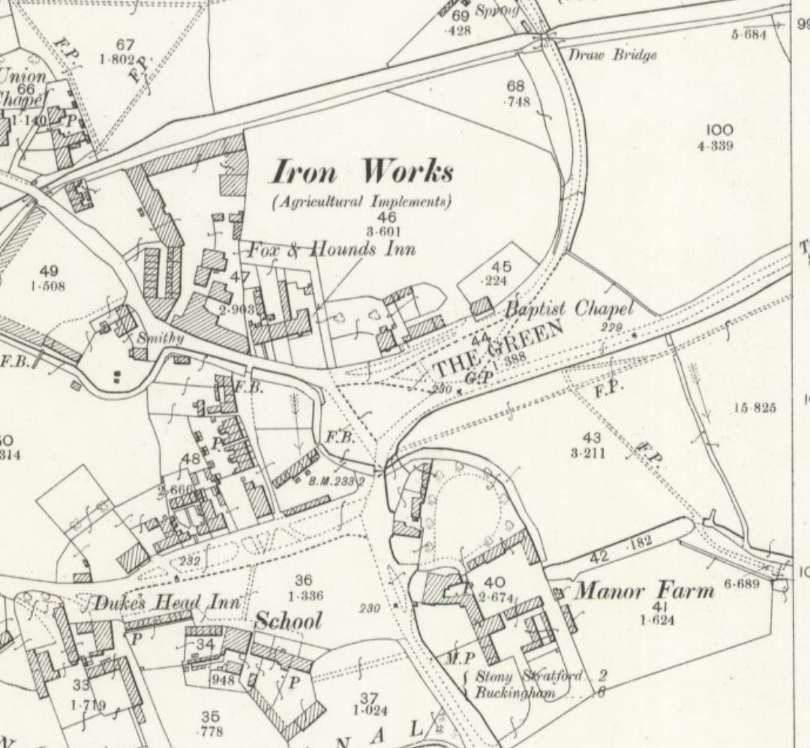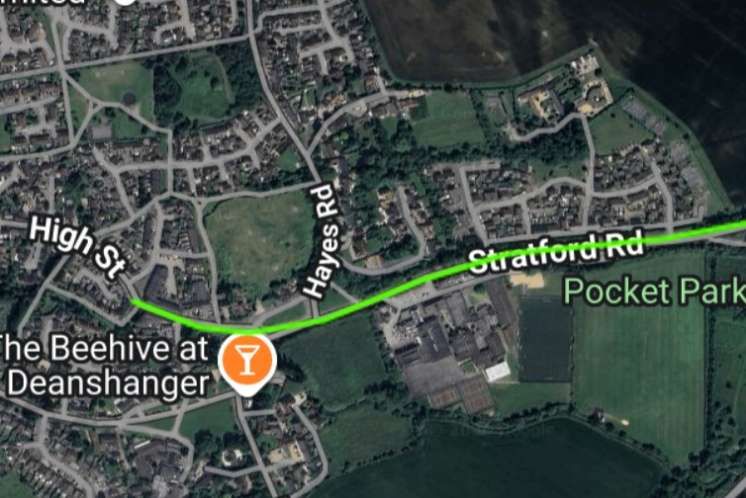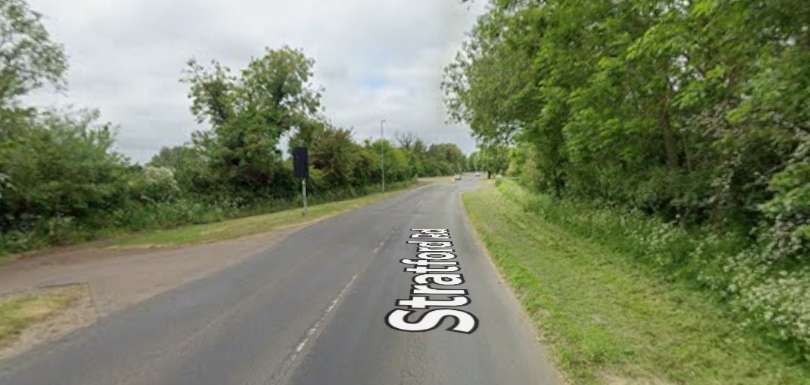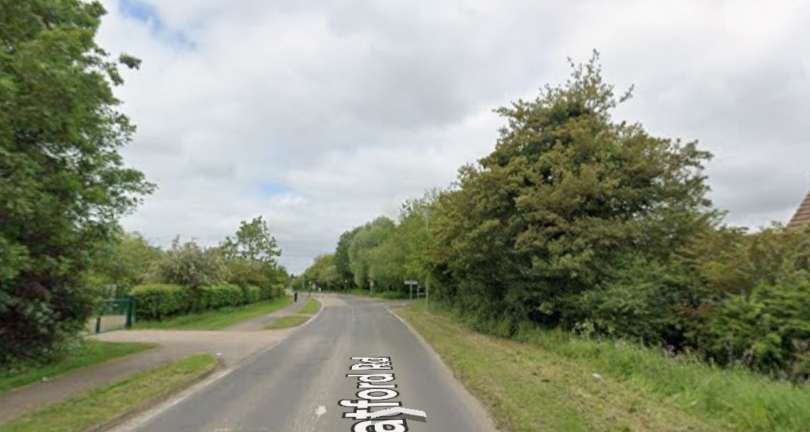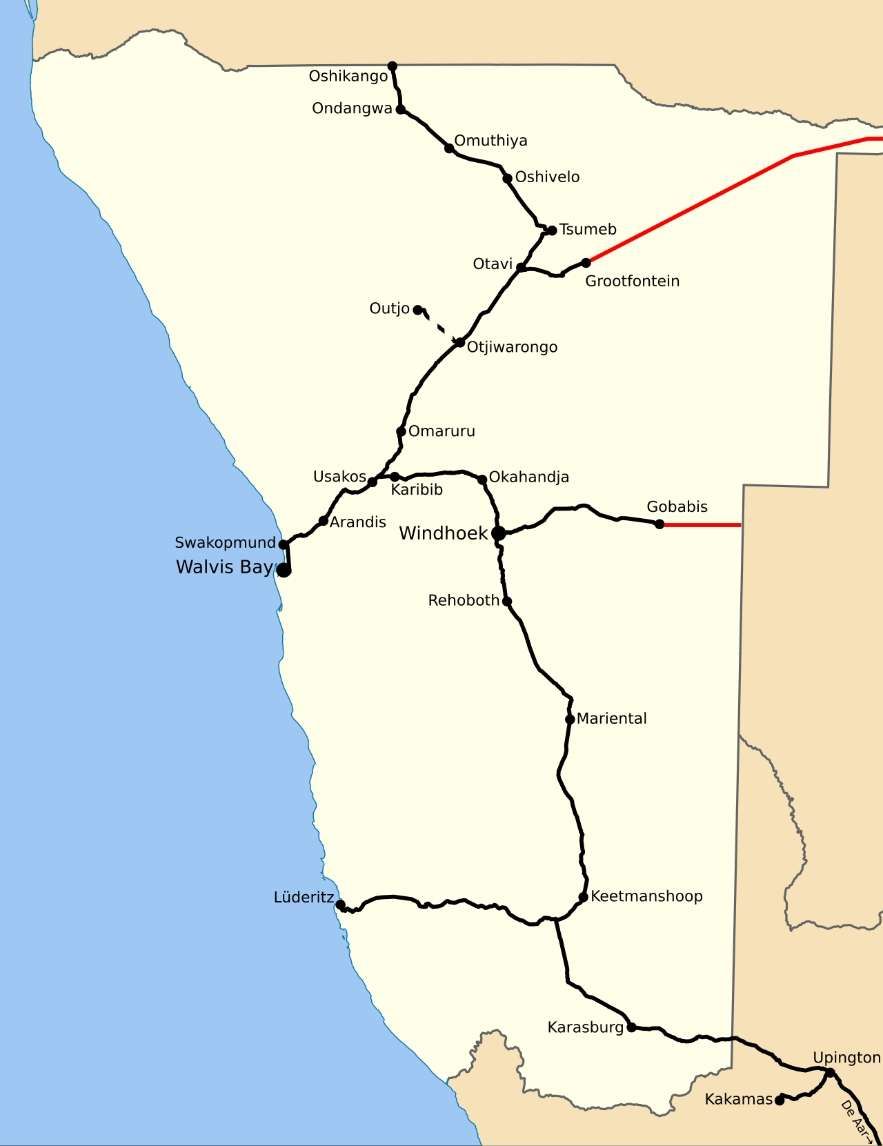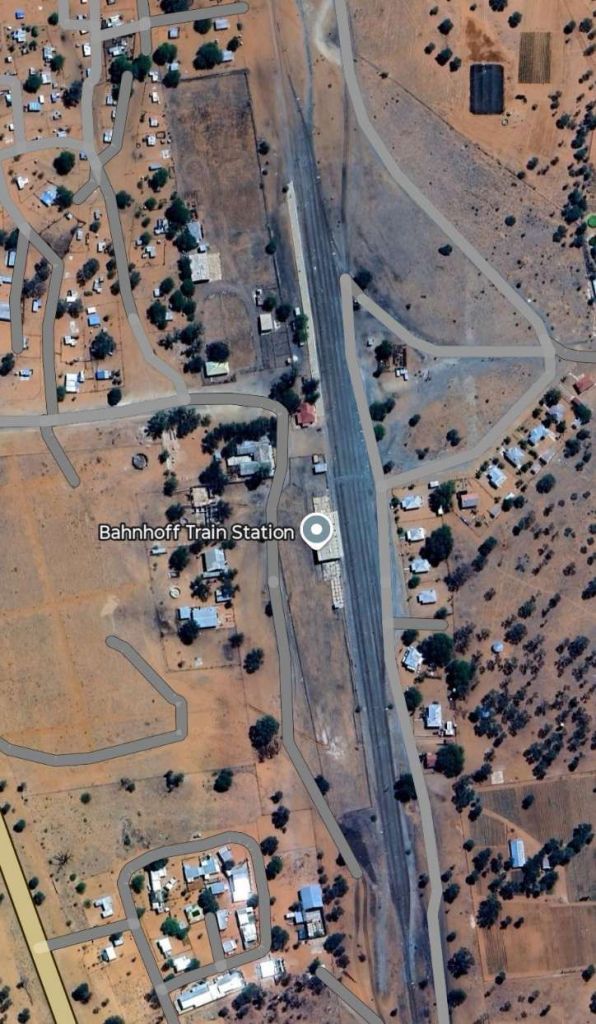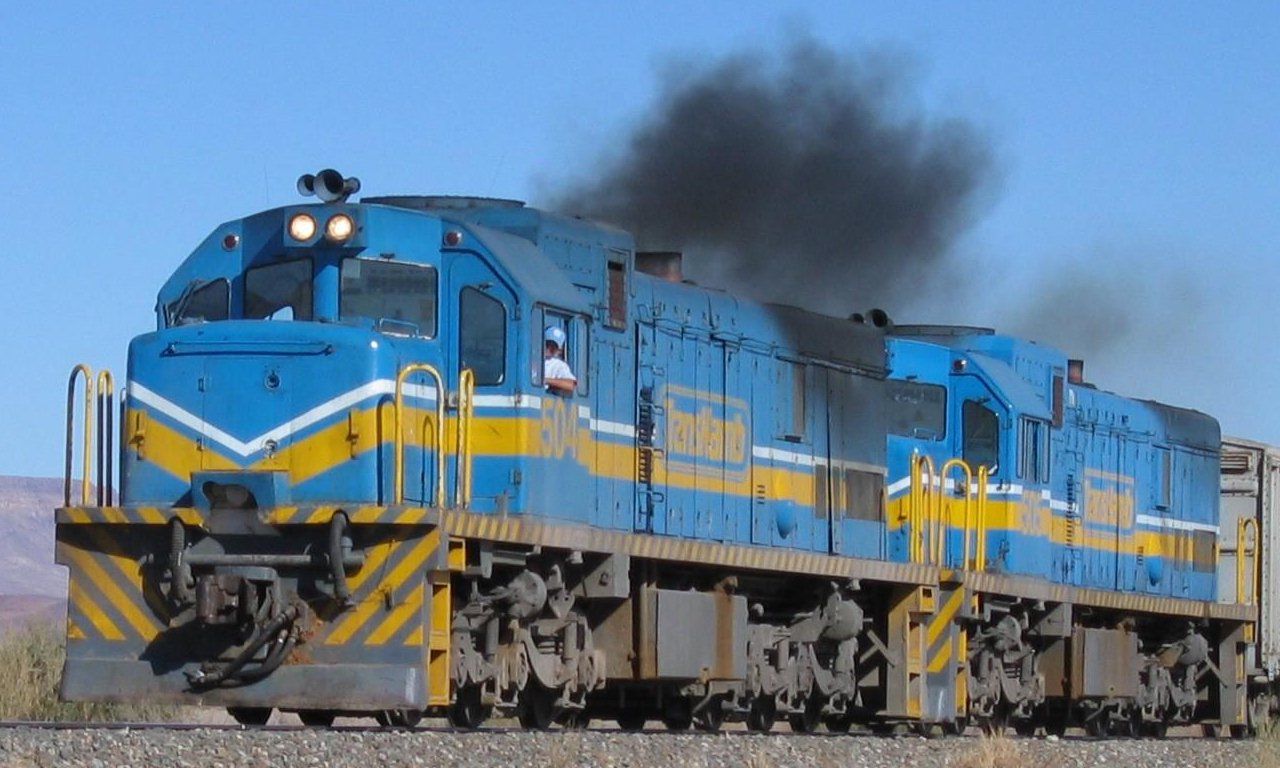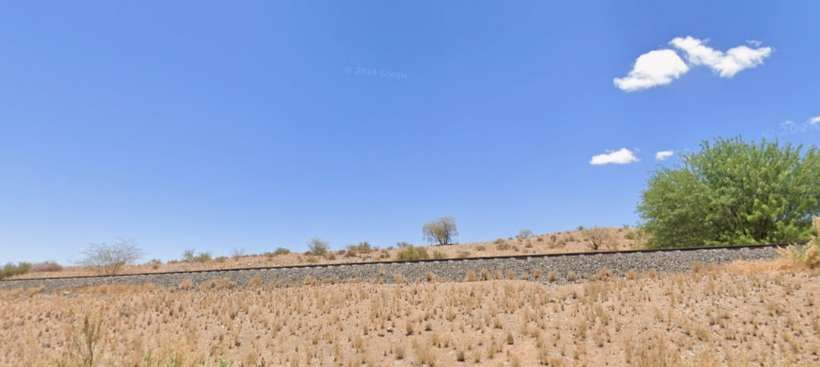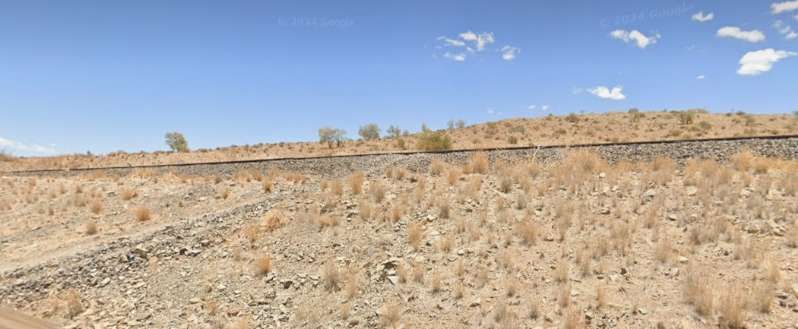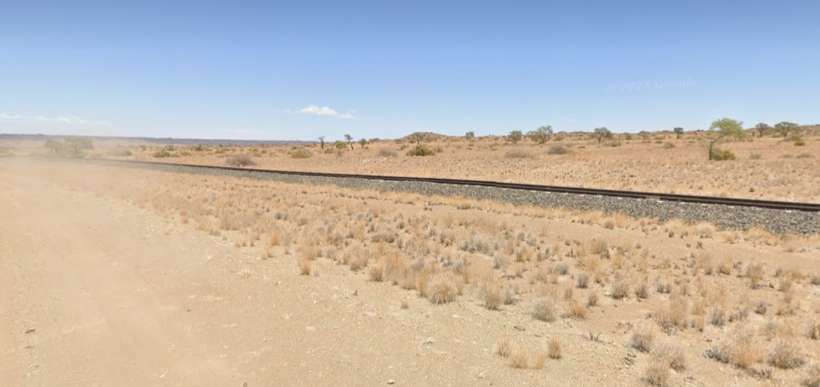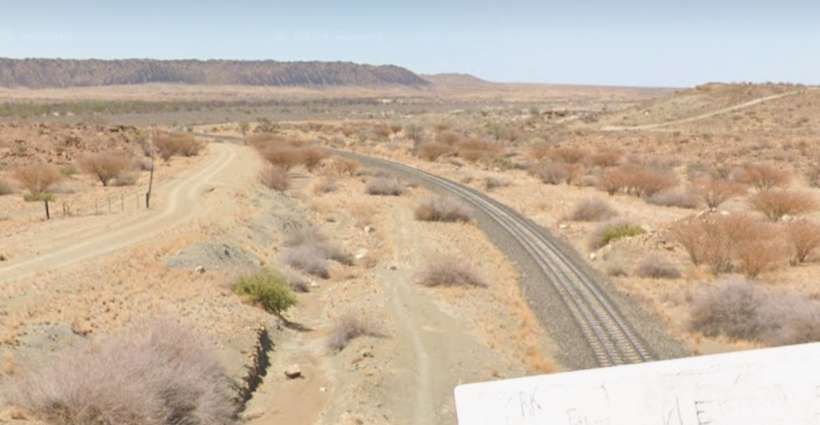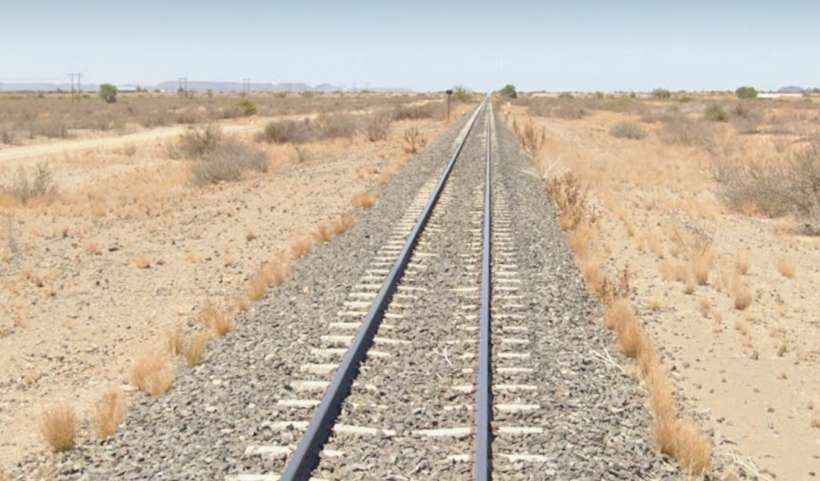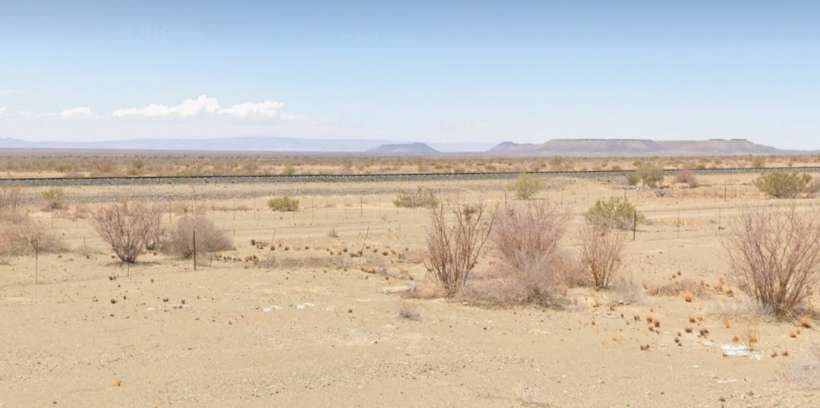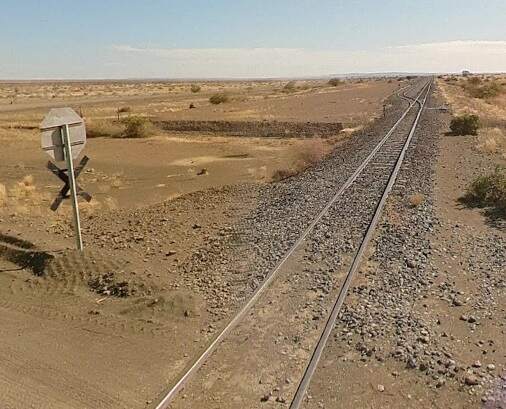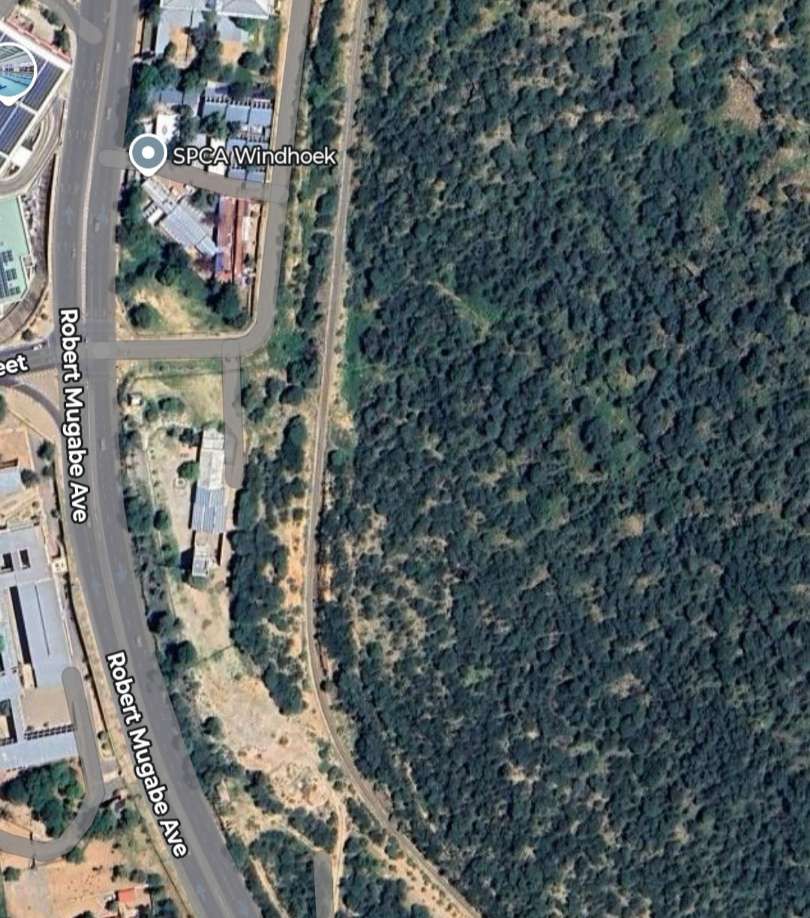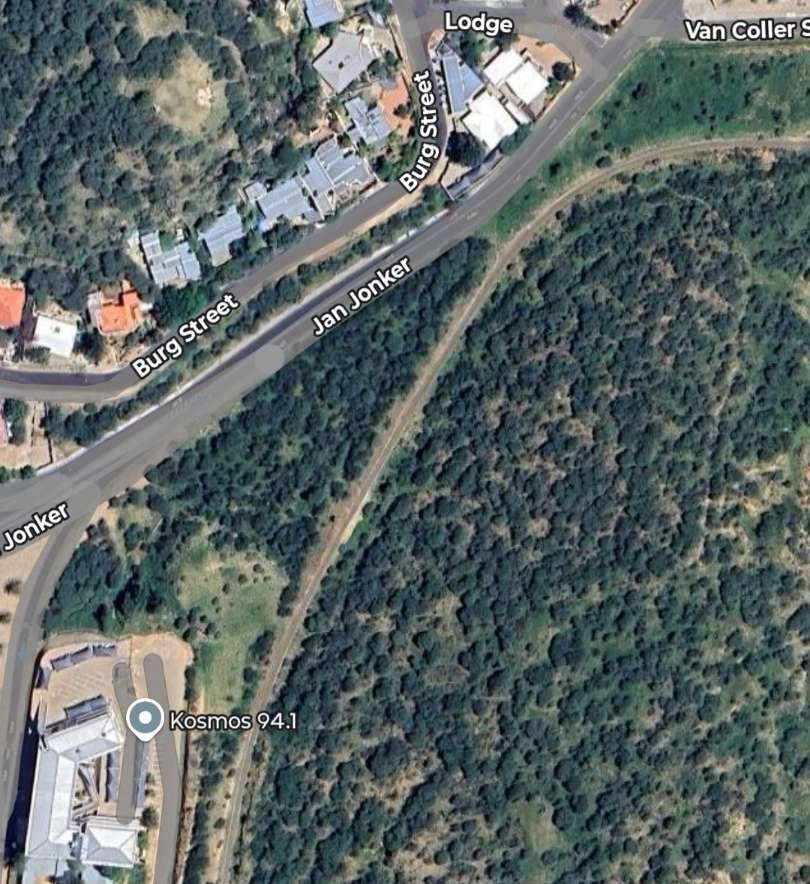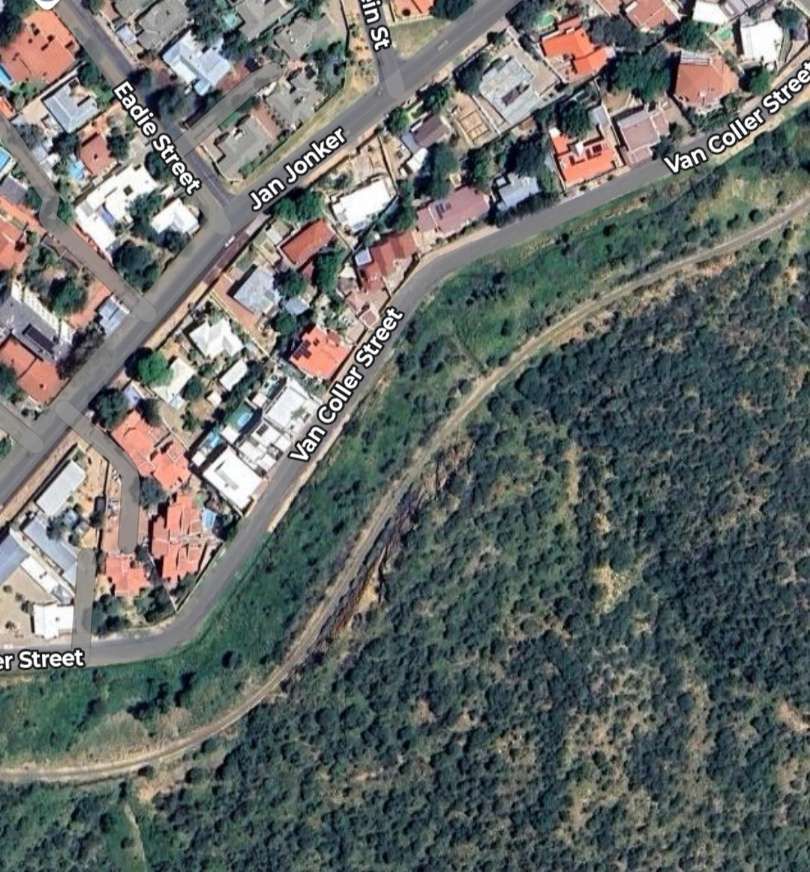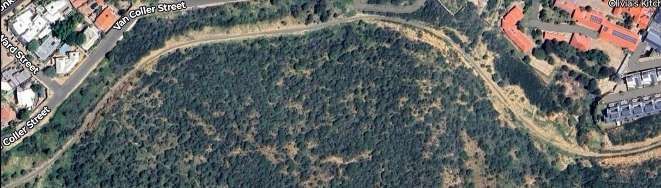
In Part 1, we looked at the railways in the North of Namibia, that article can be found here. [4] This article covers lines which left Windhoek and covered the South of the country.
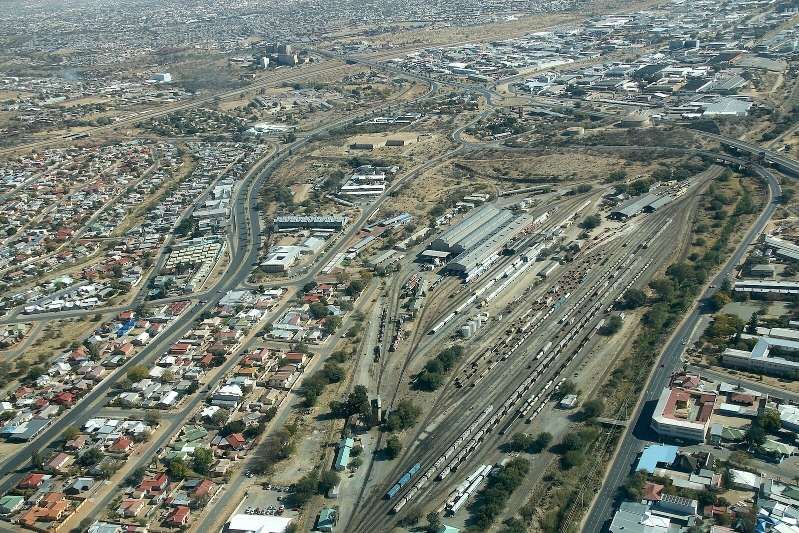
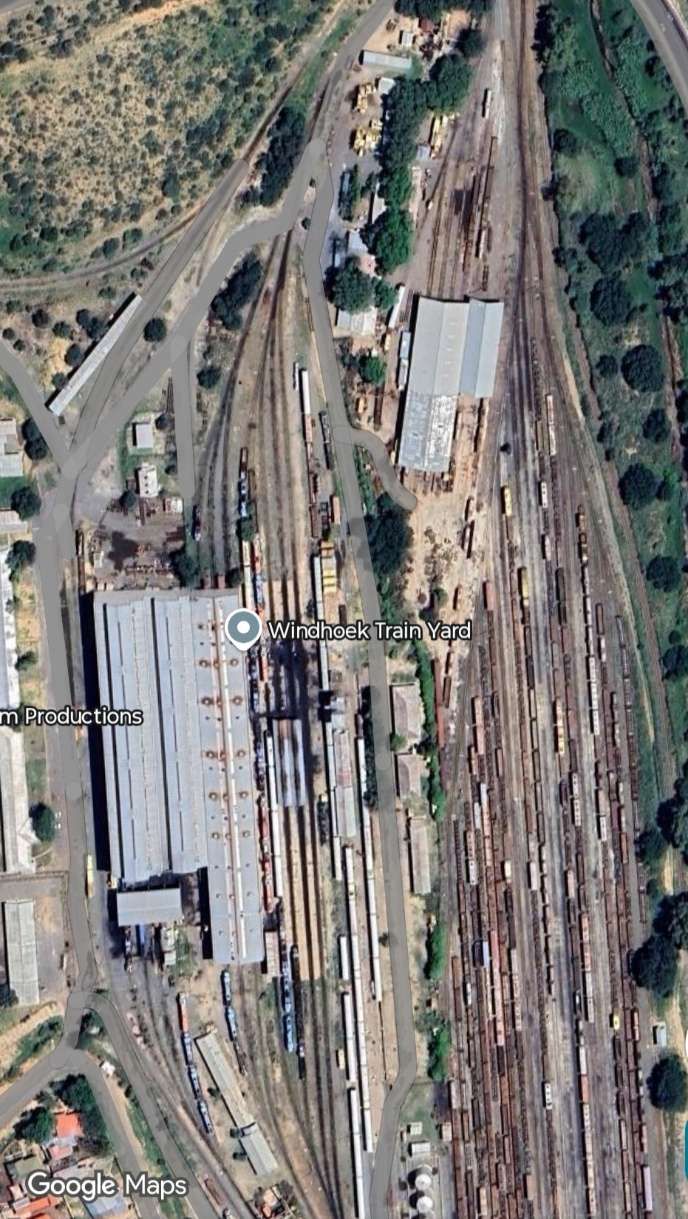
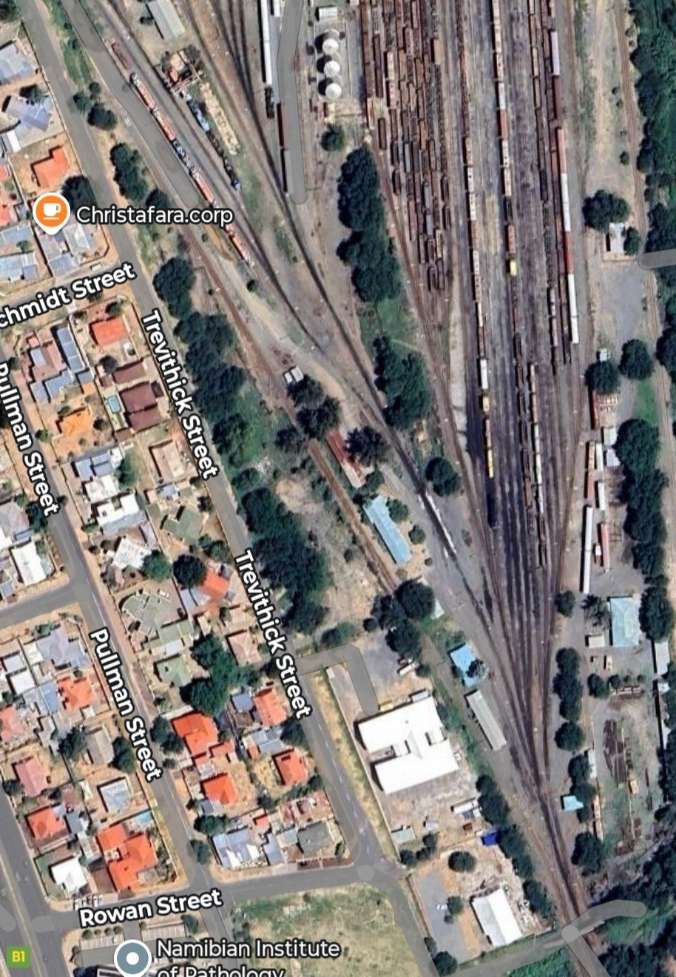
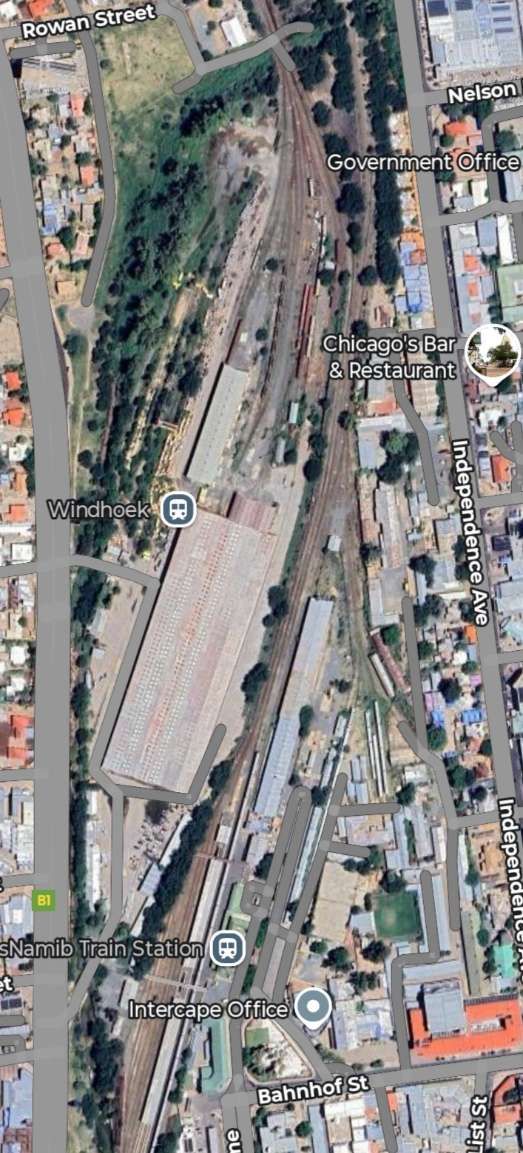
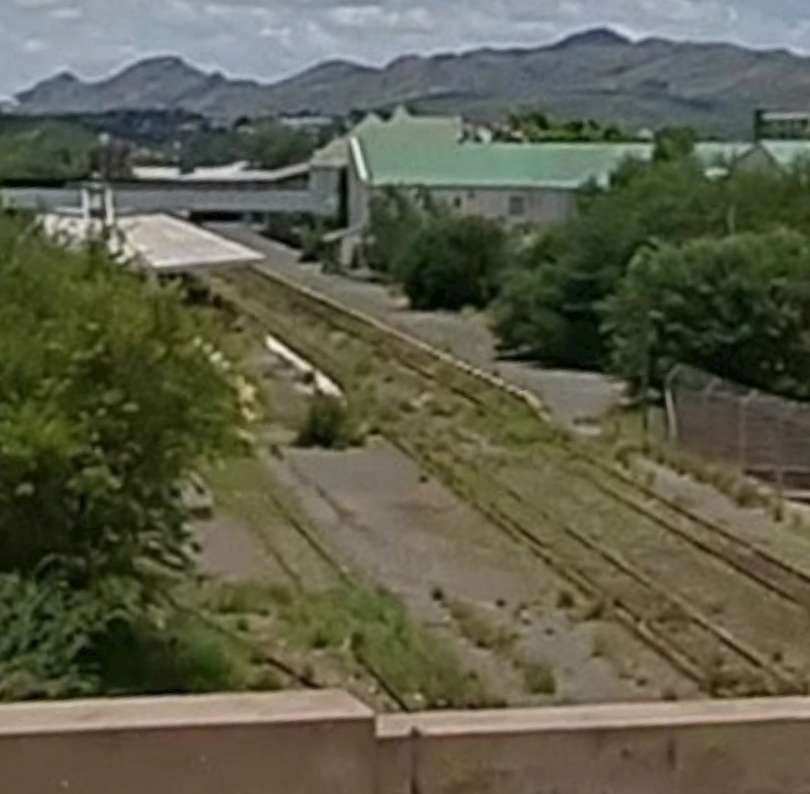
After the aerial image immediately below, the next three images form a kind of ‘tryptic’ which shows the TransNamib train yard and station at Windhoek. Taken together they show the full site. …
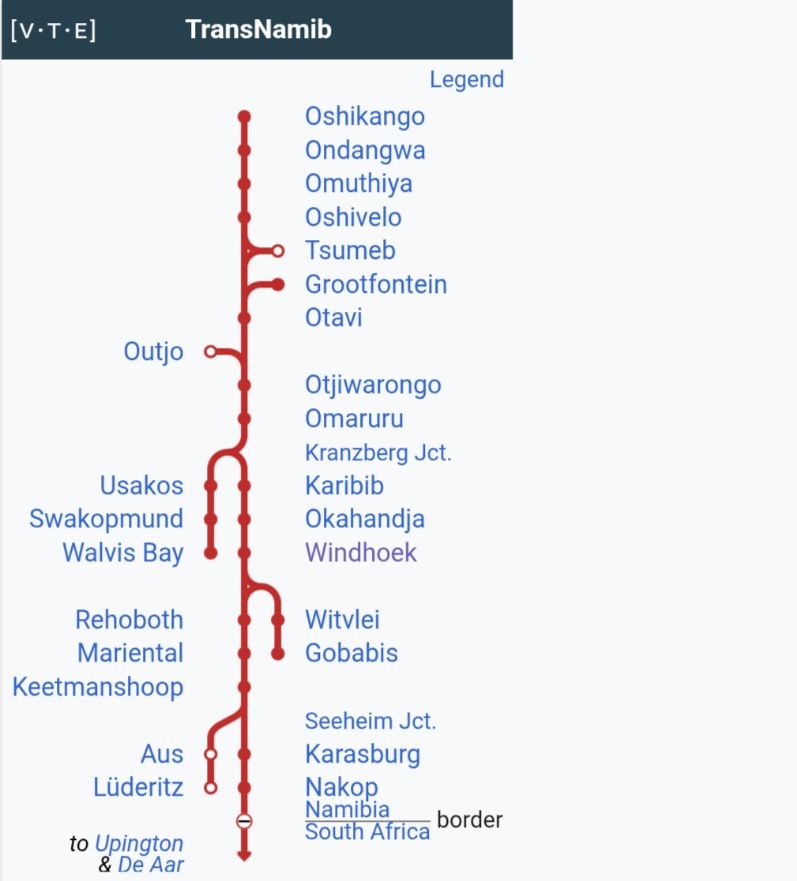
The railway line from Windhoek to Nakop is 869 kilometres (540 miles) long. The section between Karasburg and Keetmanshoop was completed in 1909. In 1912, the 500 kilometres (310 miles) connection between Karasburg and Windhoek was completed, and the extension to Upinhton (South Africa) was built in 1915.
Windhoek
Aris
Rehoboth
Tses
Keetmanshoop
Karasburg
Nakop (border)
Upington
We start our look at the main line to the South, in Windhoek at the South end of the Railway Station site. …
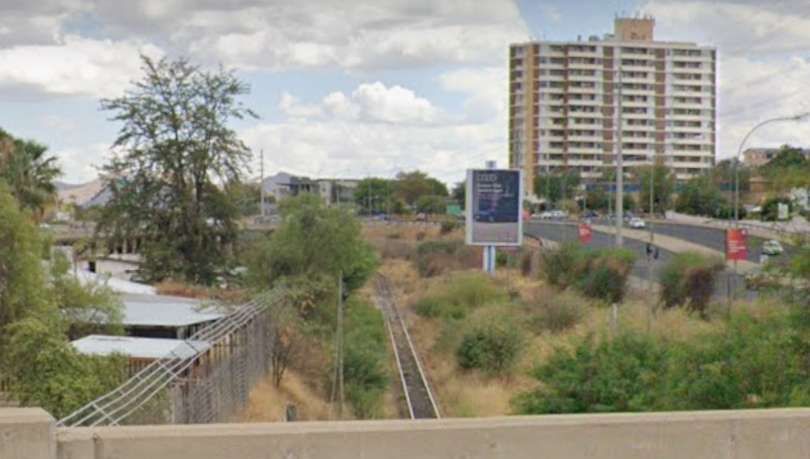
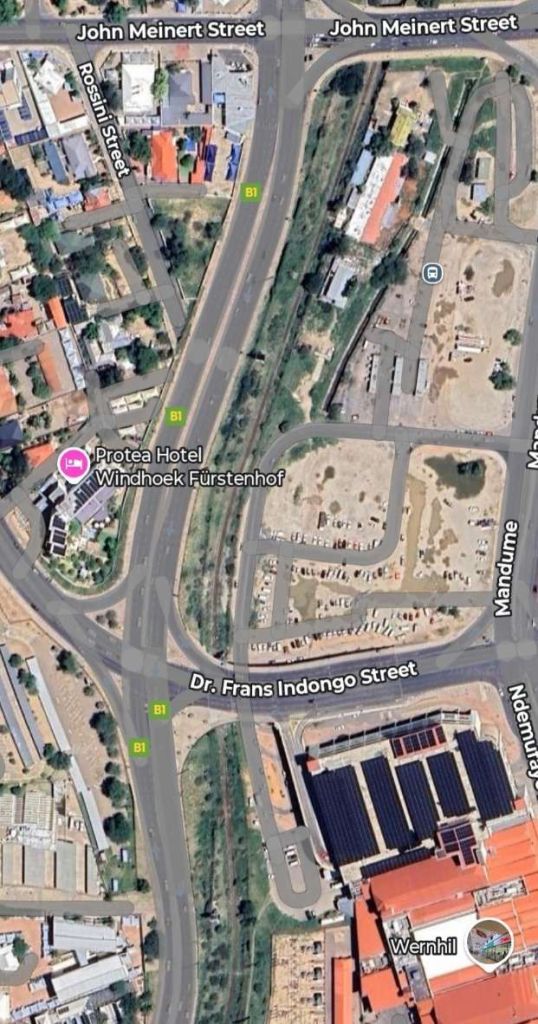
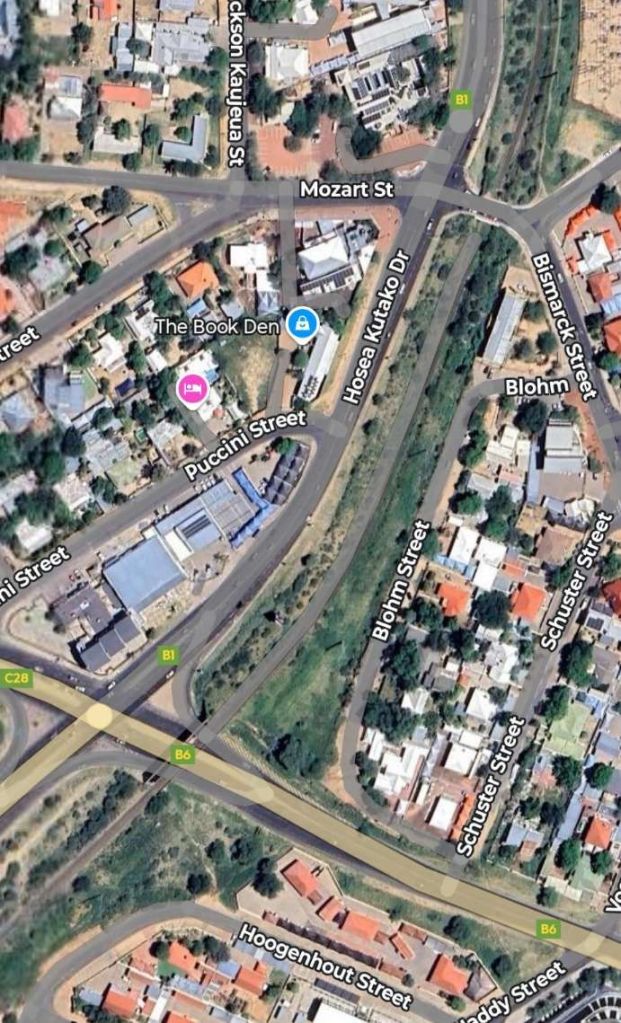
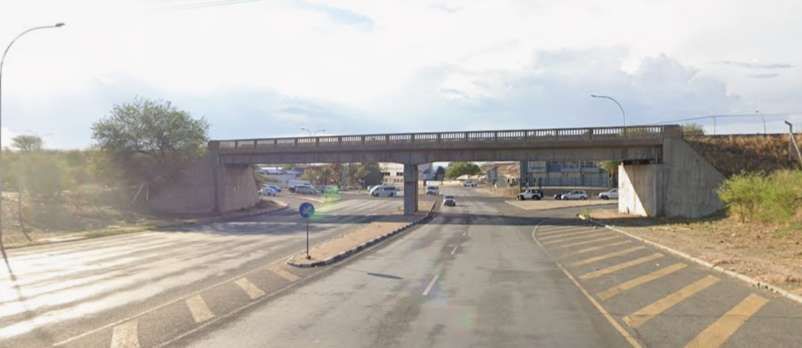
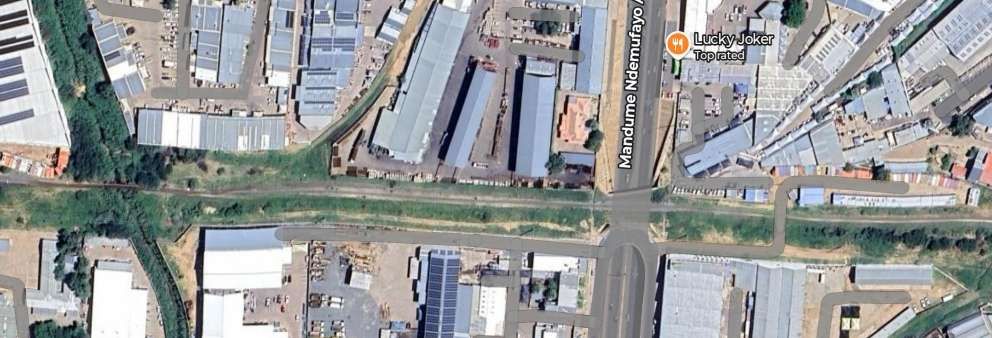
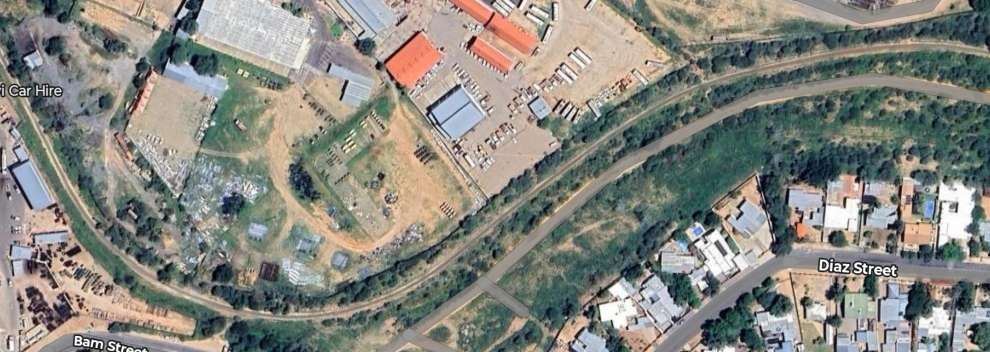
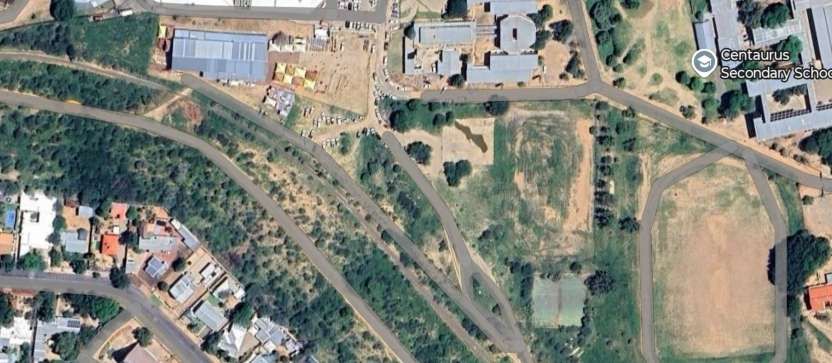
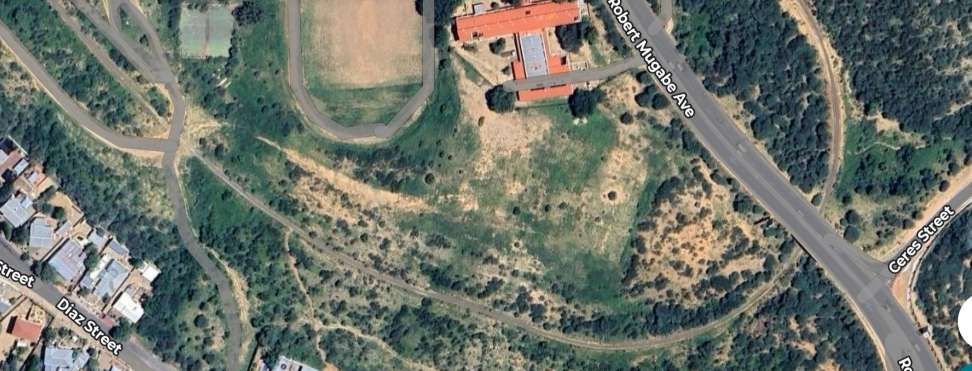
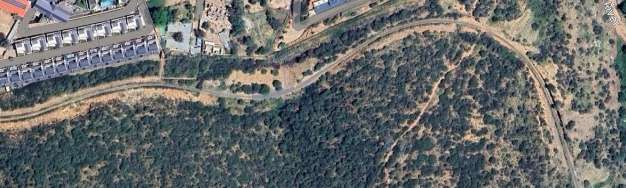
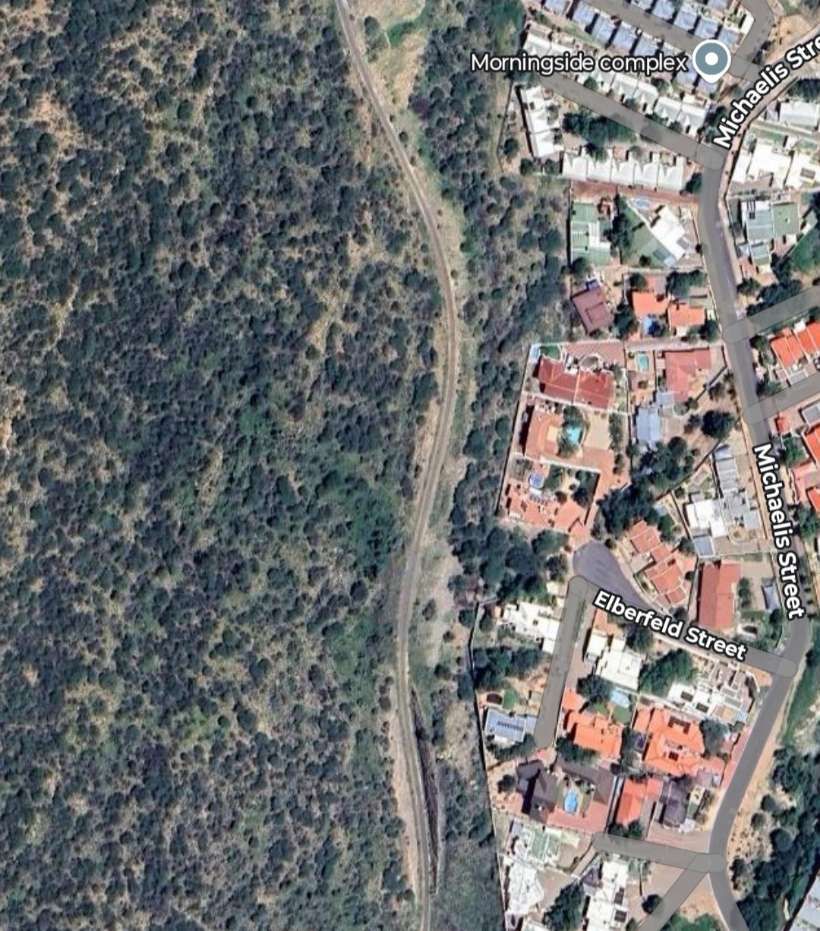
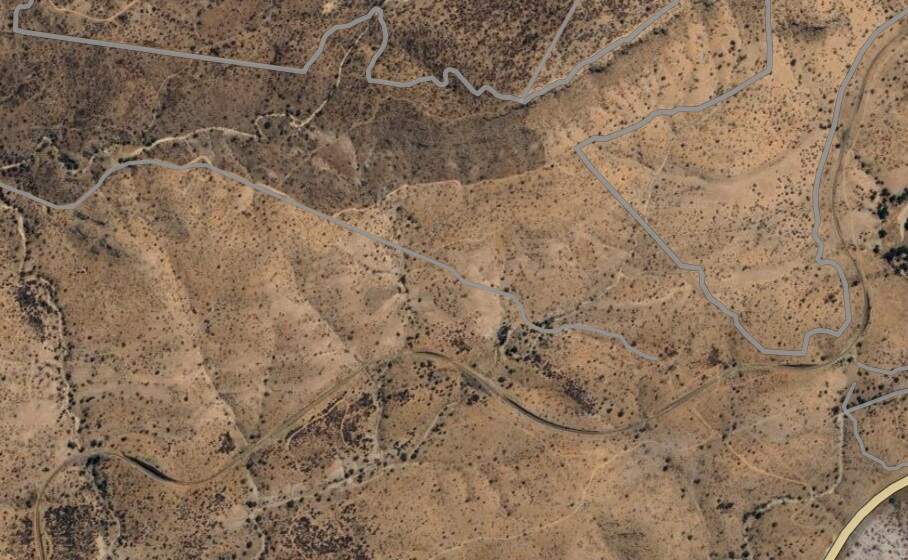
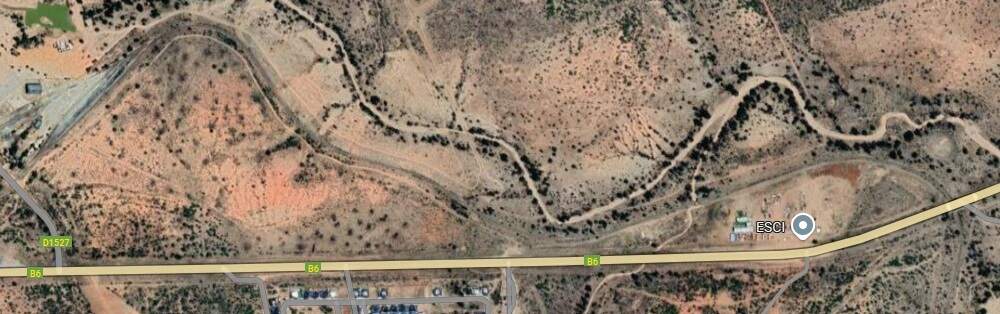
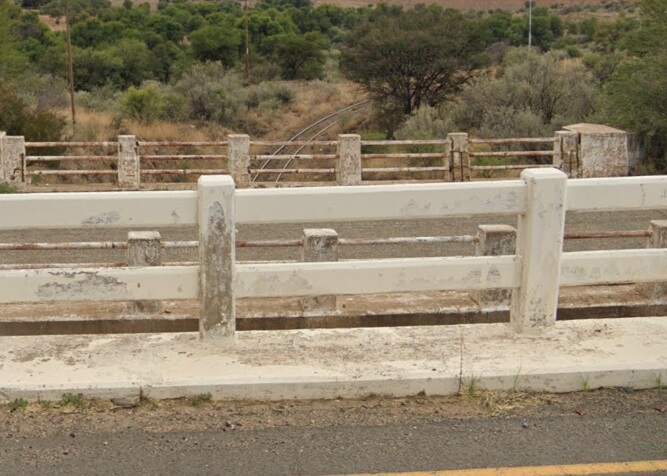
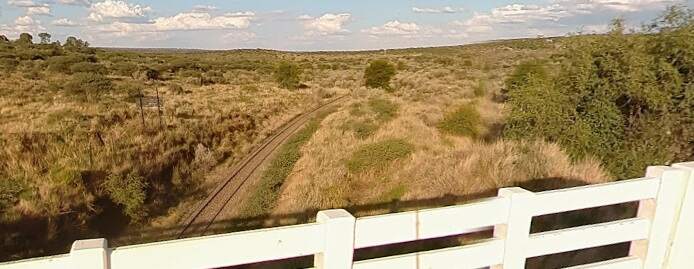
The southern end of Windhoek Railway Station, seen from John Meinert Street. [Google Streetview, 2023]The line South, from John Meinert Street. [Google Streetview, 2023]A satellite image showing the railway South of John Meinert Street. [Google Maps, June 2025]The next length of the line to the South, to a point South of the B6. [Google Maps, June 2025]The bridge carrying the railway across the B6. [Google Streetview, 2024]
Although it does not look like it as yet, the line South of Windhoek Railway Station climbed relatively steeply as it meandered South. … As we will soon see, the landscape South of Windhoek is different to that to the North of the city.
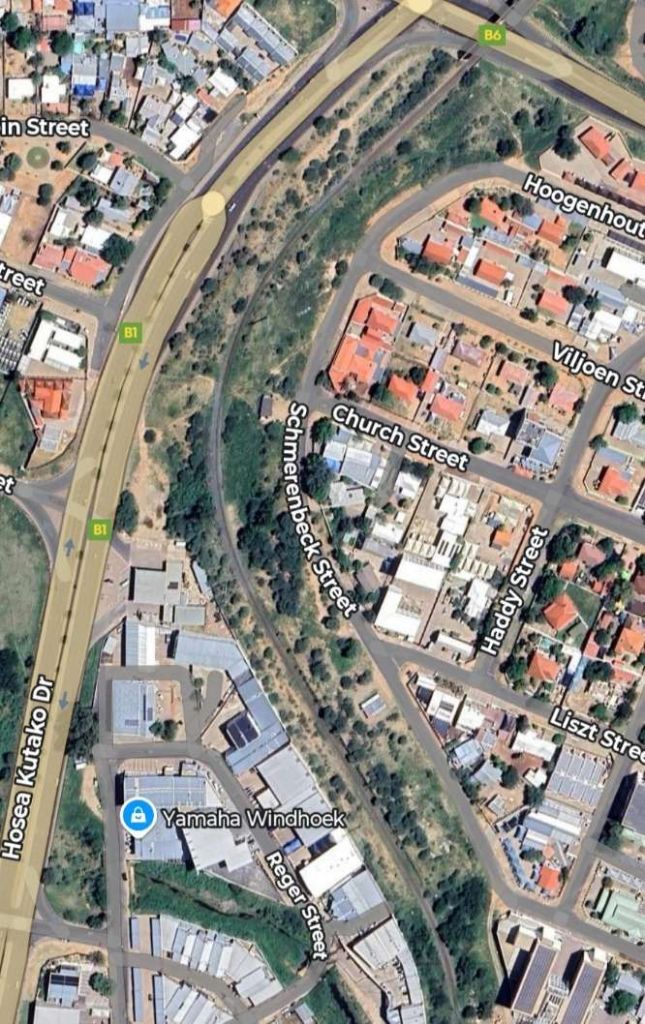
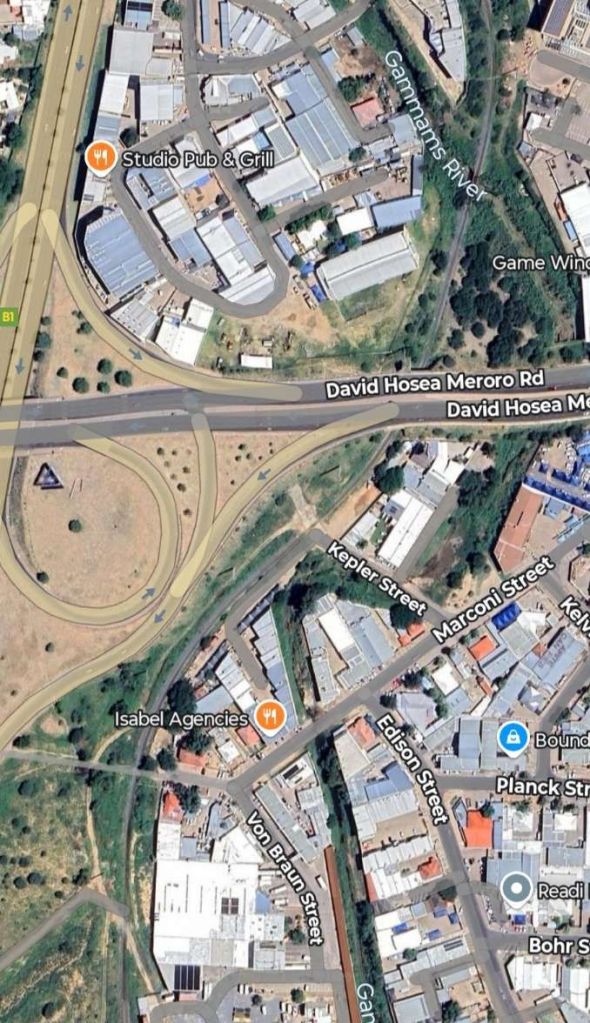
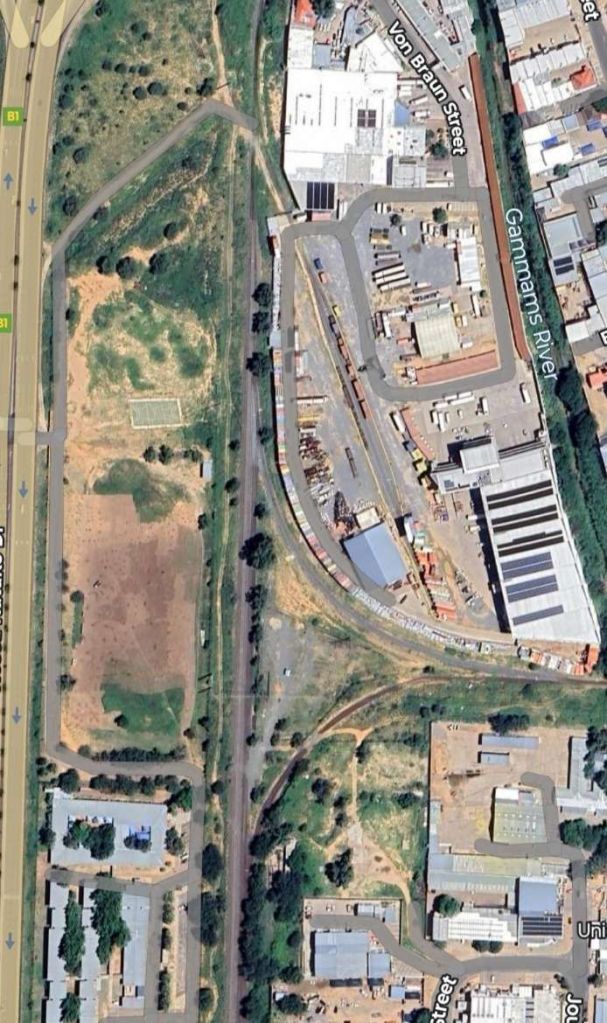
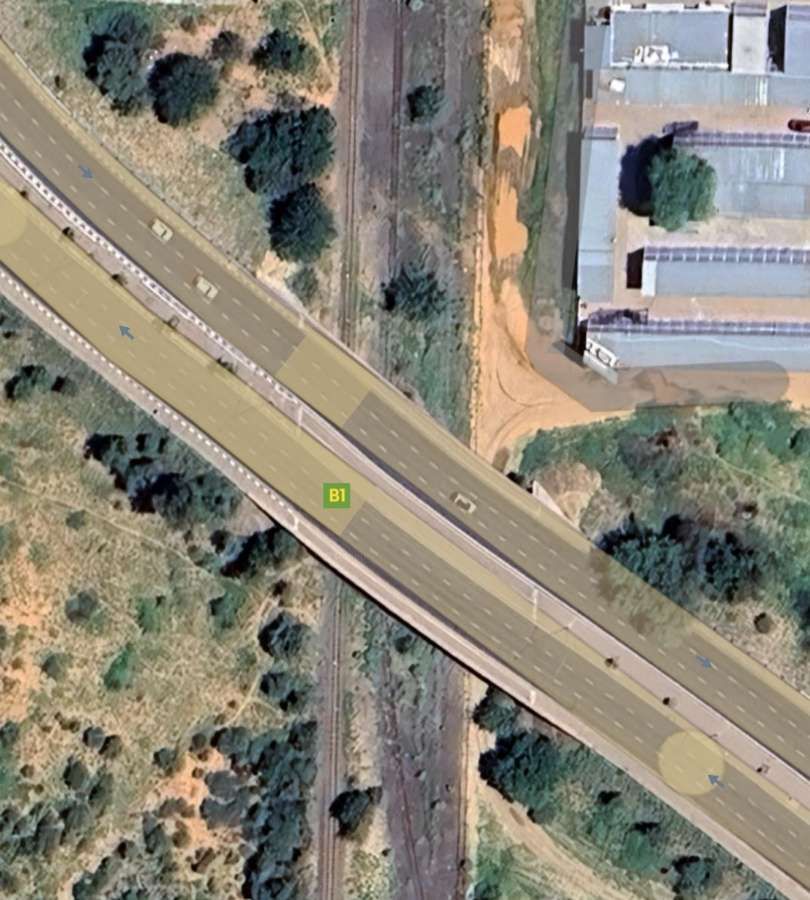
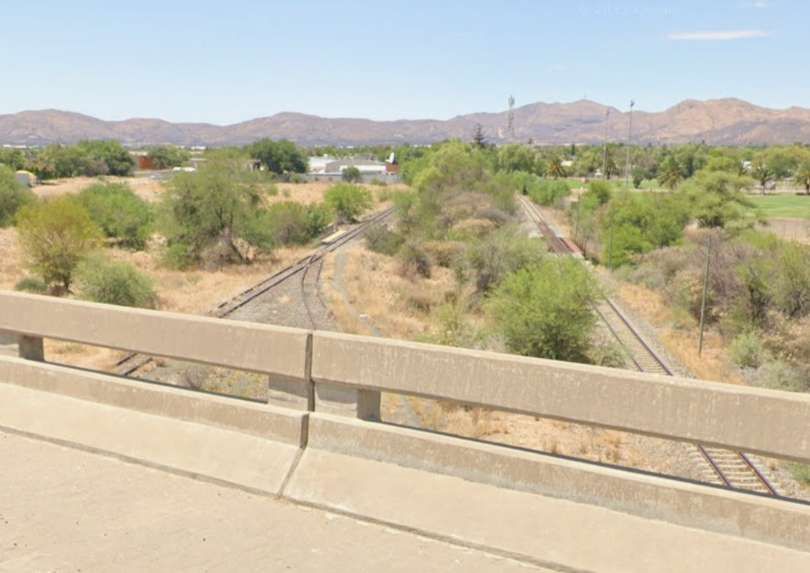
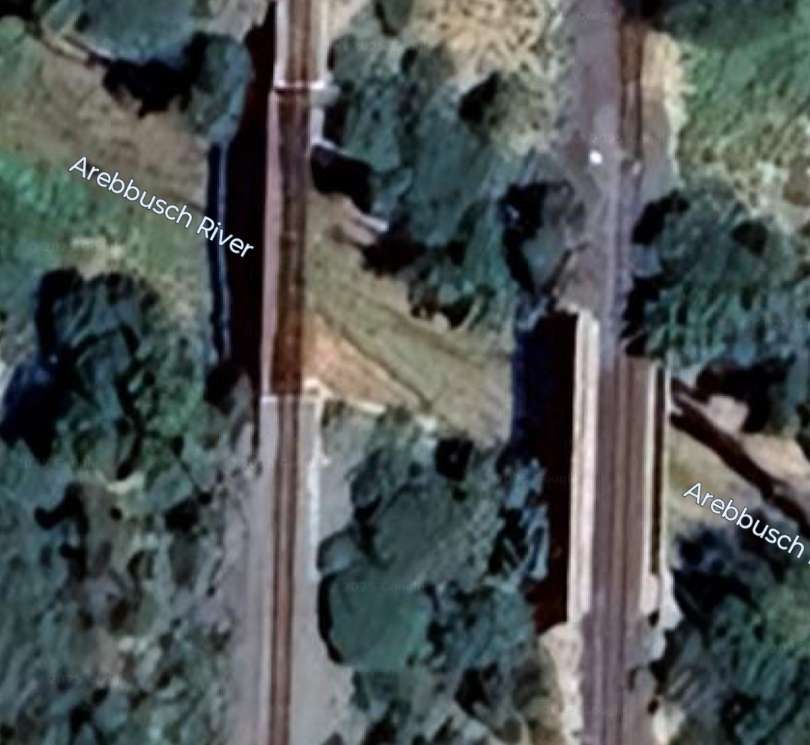
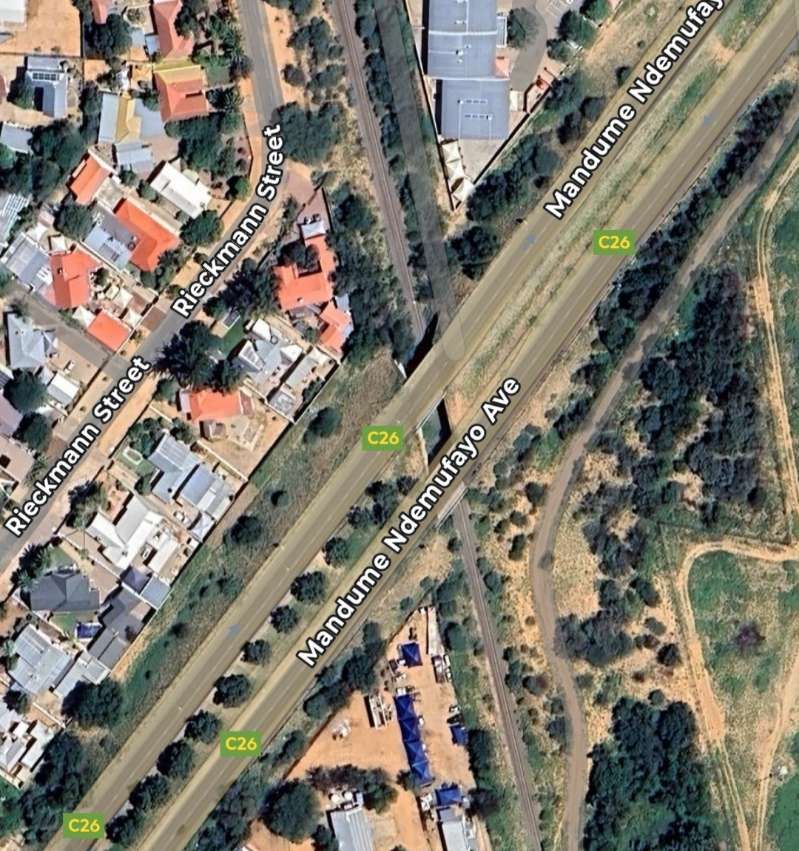
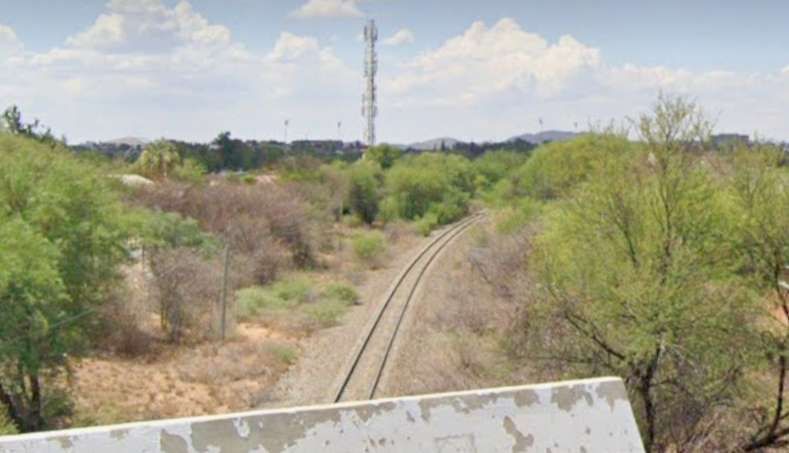
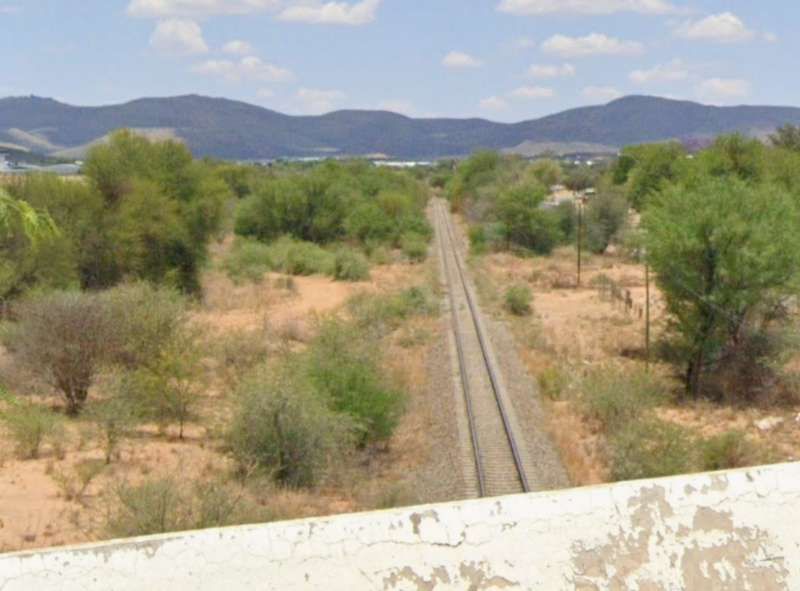
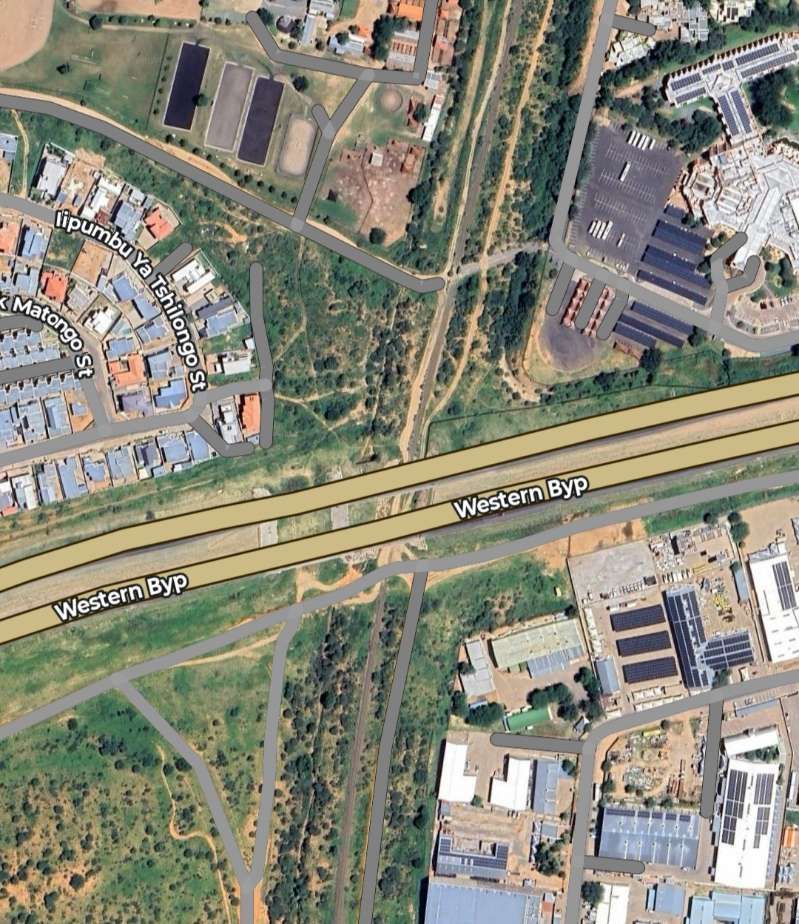
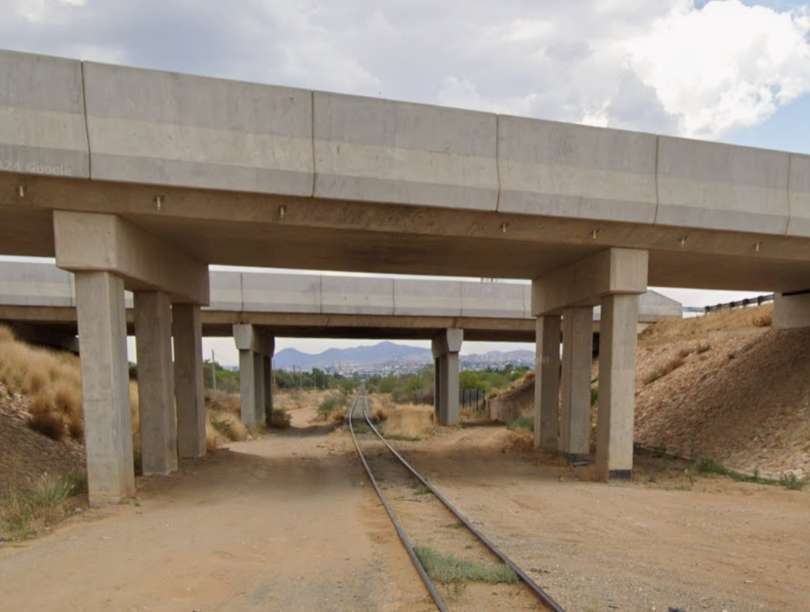
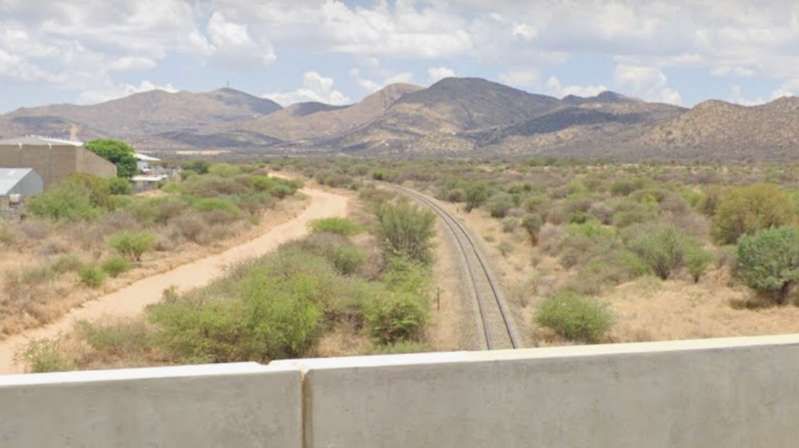
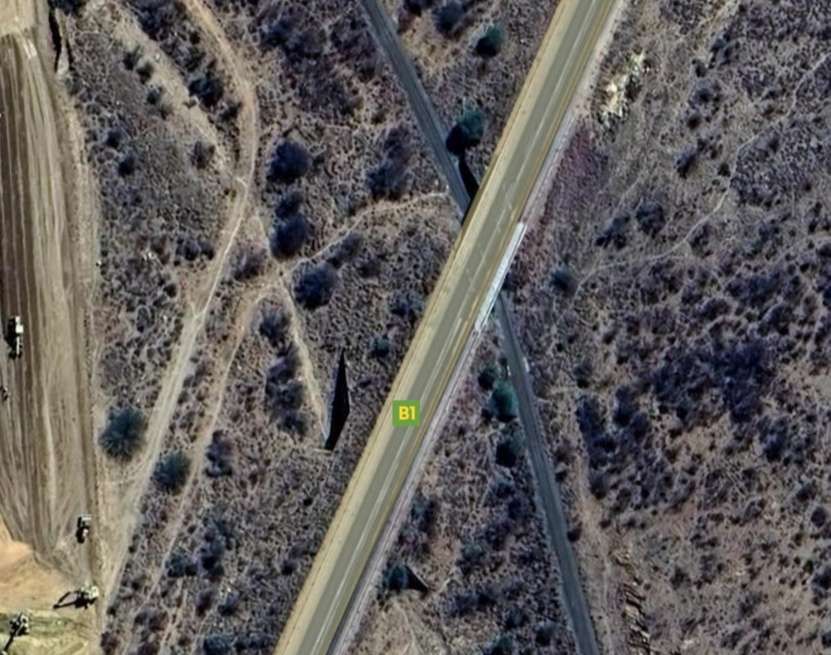
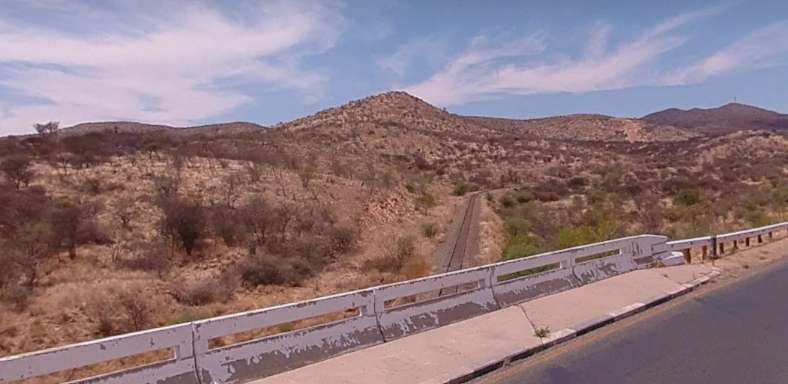
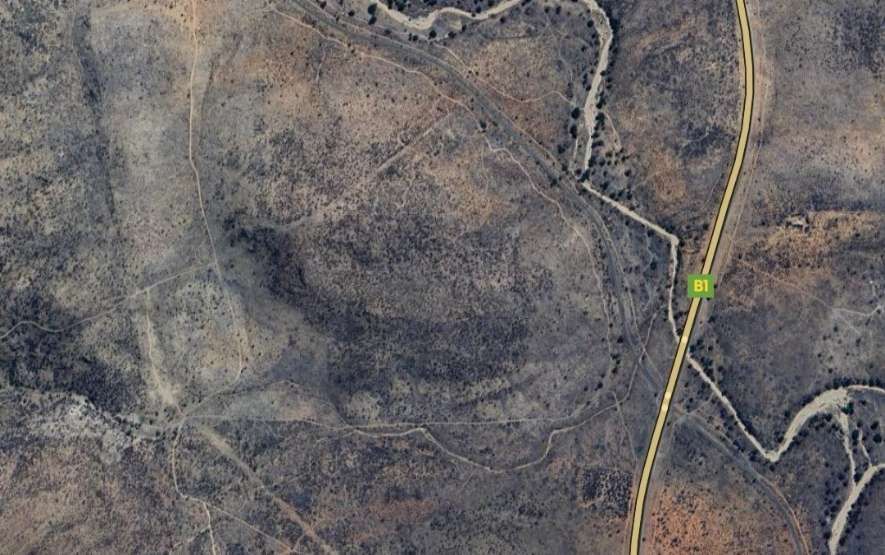
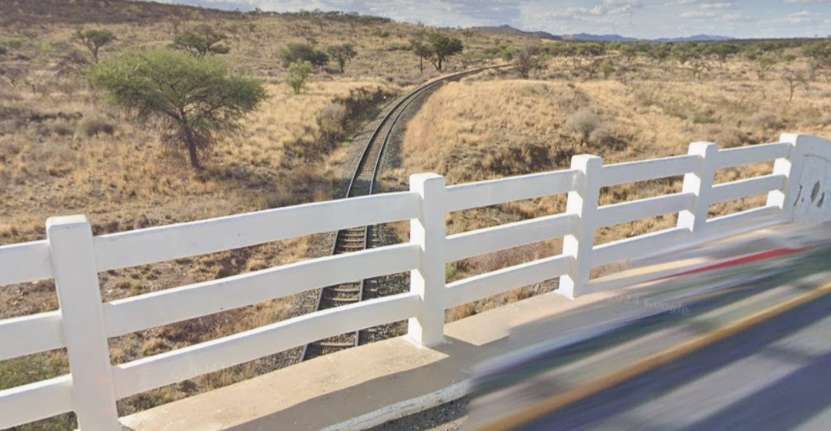
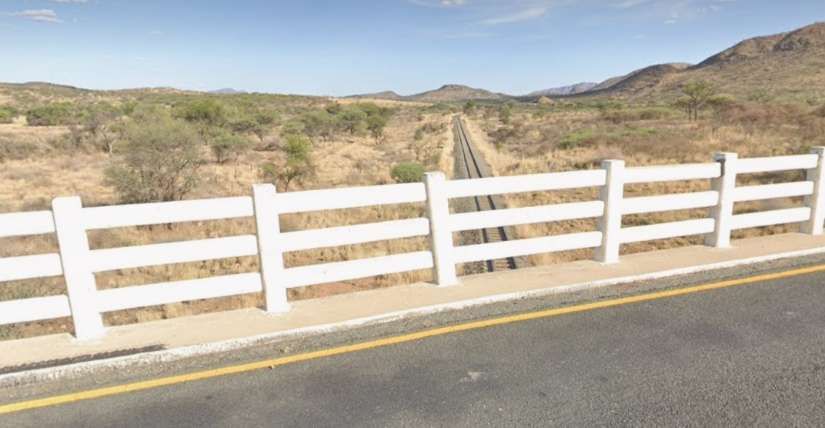
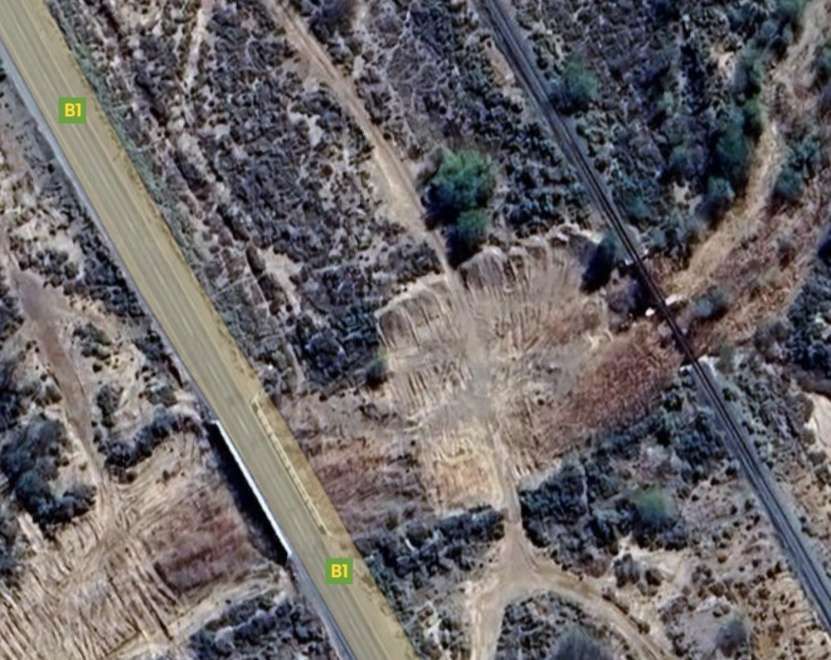
The line to the South of the B6 curves round the residential area of Schmerenbeck Street. [Google Maps, June 2025]The line then crosses the Gammams River and under David Hosea Meroro Road. [Google Maps, June 2025]The triangular junction visible in this image gives access to the branch line to Gobabis. [Google Maps, June 2025]The line then passes under the B1. [Google Maps, June 2025]Looking South from the B1. [Google Streetview, 2024]Then the line(s) cross the Arebbusch River. [Google Maps, June 2025]The next road to bridge the line is the C26. [Google Maps, June 2025]The view from Mandume Ndemufayo Avenue (C26) back towards Windhoek Railway Station. [Google Streetview, 2024]The view South from Mandume Ndemufayo Avenue towards the hills. [Google Streetview, 2024]The line passes under the city’s Western Bypass. [Google Maps, June 2025]This view looks North-northeast under the Western Bypass towards Windhoek Railway Station. [Google Streetview, 2024]Looking South from the Western Bypass. [Google Streetview, 2024]The line passes once again under the B1 as the hills draw closer. [Google Maps, June 2025]The view South-southeast along the line from the bridge carrying the B1. [Google Streetview, 2022]
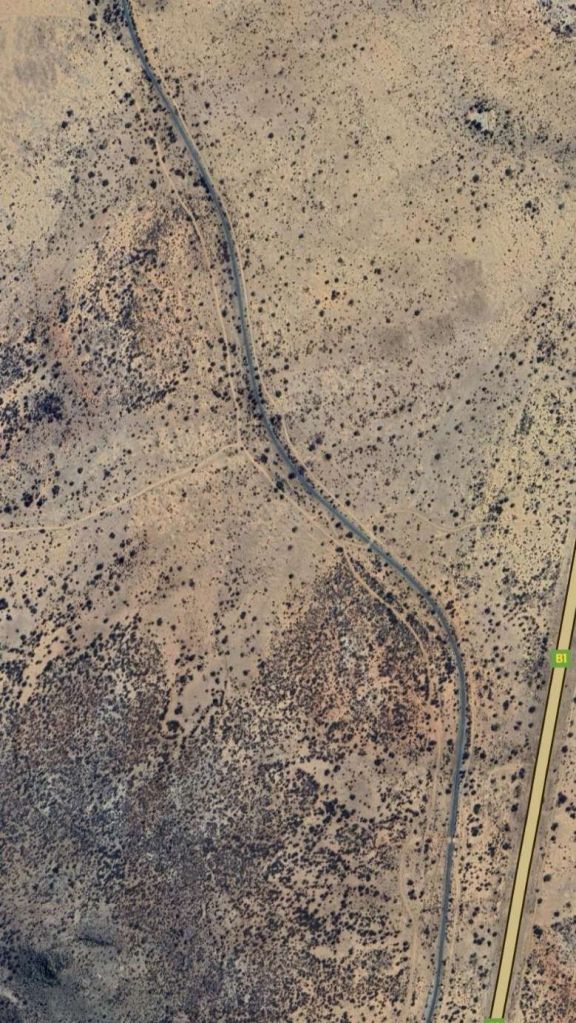
The line continues to wind its way into the hills passing under the B1 once again.
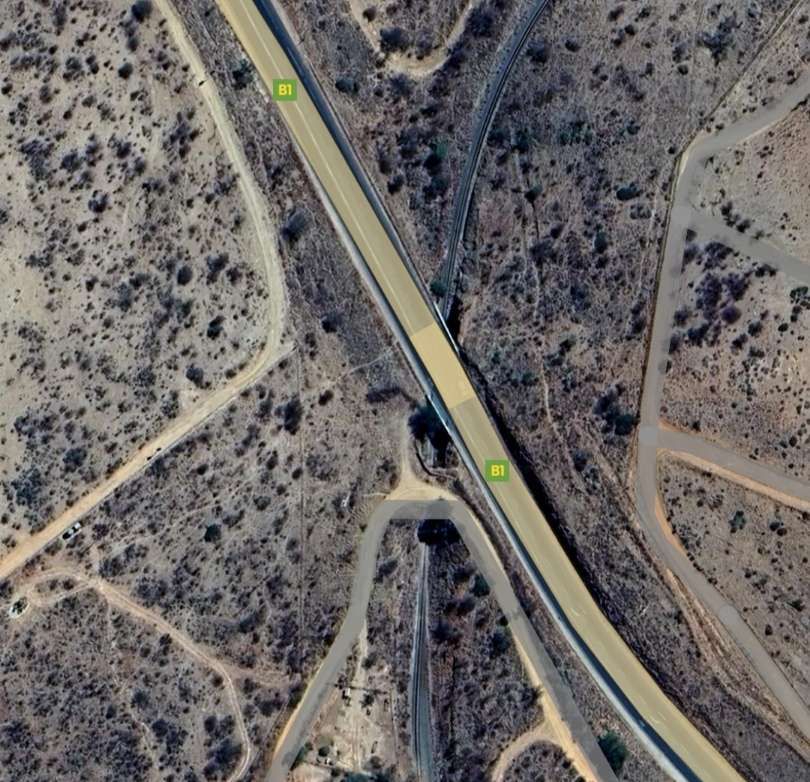
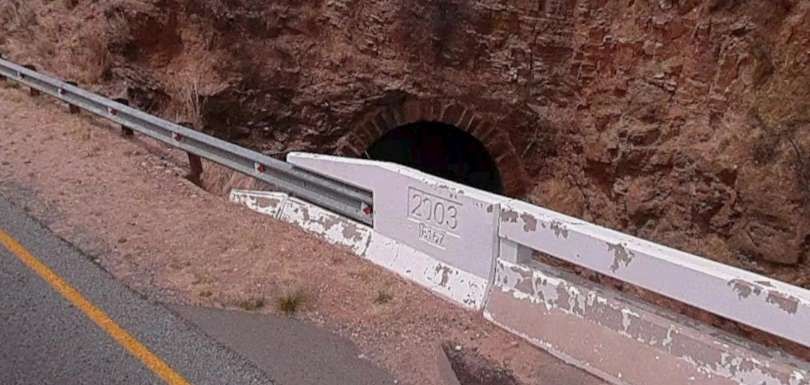
The line has deviated away from Birmingham as it finds its own way into the hills. It returns to pass under the modern road again. [Google Maps, June 2025]The view South from the bridge carrying the B1. The line enters a very short tunnel just to the South of the modern road. [Google Streetview, 2022]The B1 continues to climb as it heads South. The railway takes a different path as it gains height. It crosses over the B1 by means of this bridge. [Google Streetview, 2022]
Some kilometres further along the line it again crosses the B1. This time the road bridges the line. …
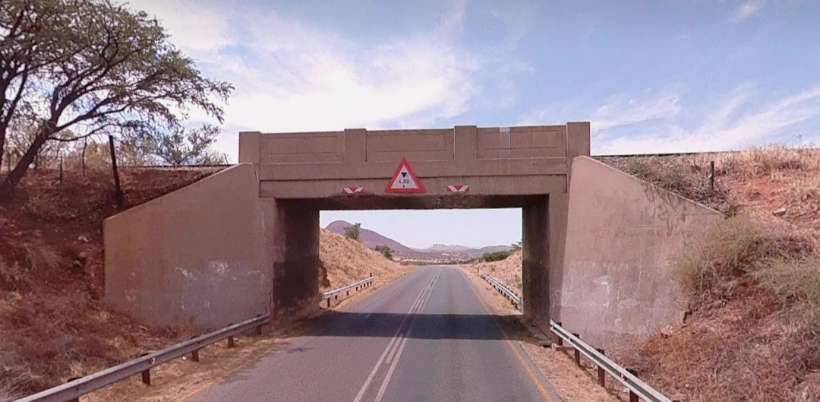
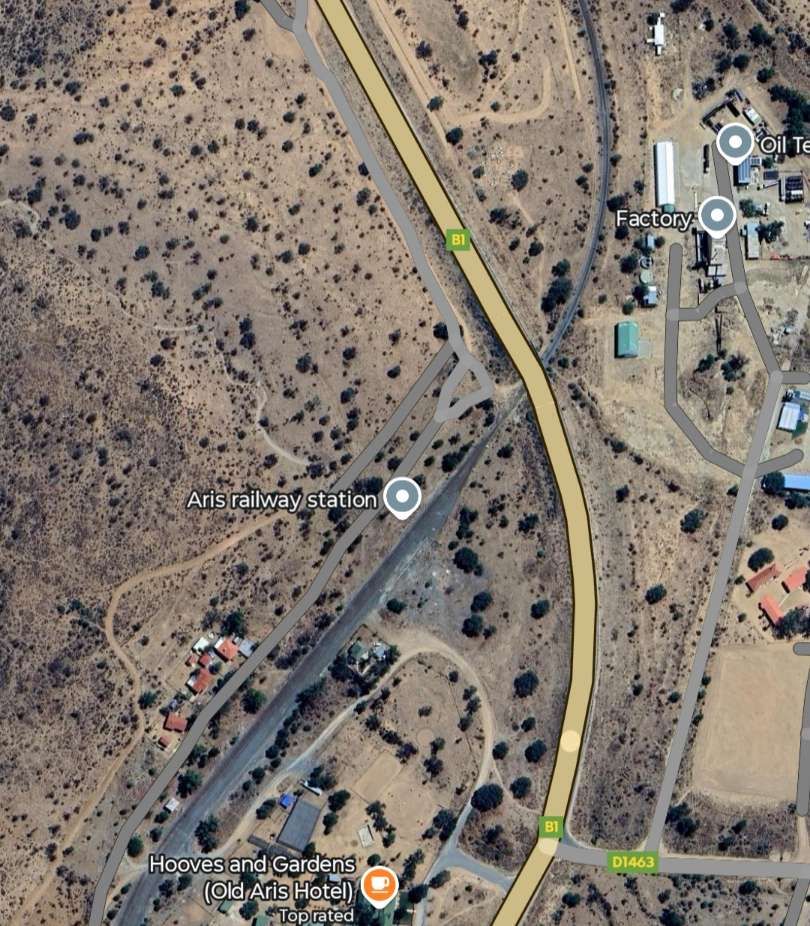
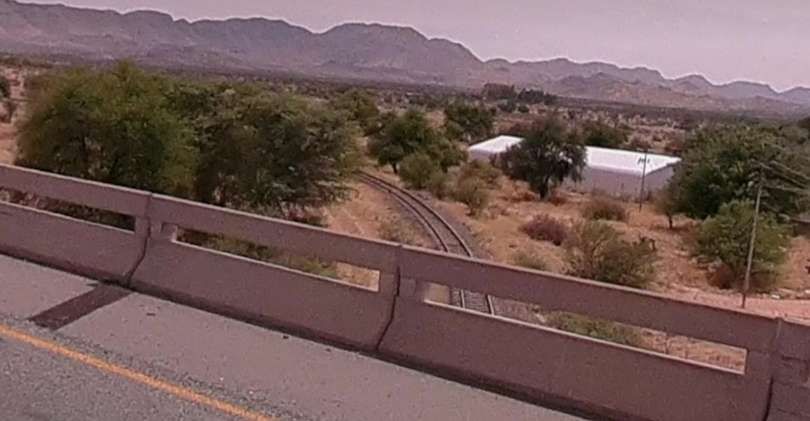
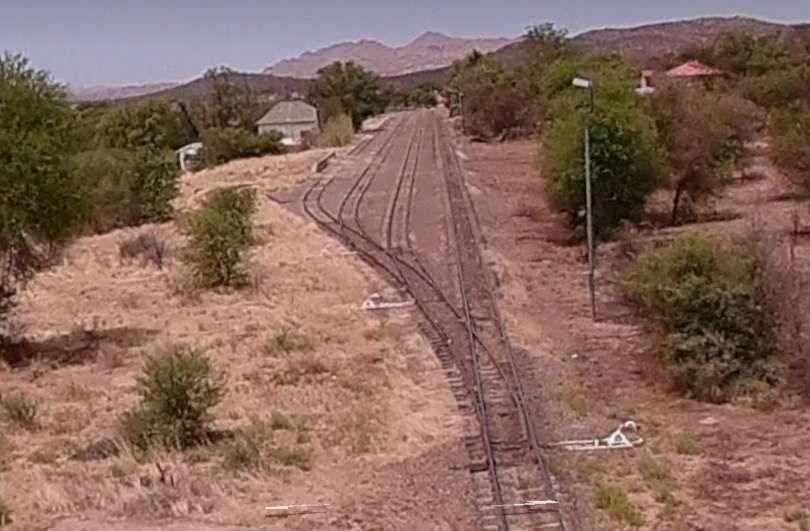
Both road and railway continue their journey South. Here their paths cross once again close to Aris Railway Station. [Google Maps, June 2025]Looking back along the line to the North from the bridge carrying the ,B1 over the line. [Google Streetview, 2022]And from the same bridge looking Southwest into Aris Railway Station. [Google Streetview, 2022]
The community of Aris and its railway station are shown in a YouTube video. …
Aria Railway Station. [9]
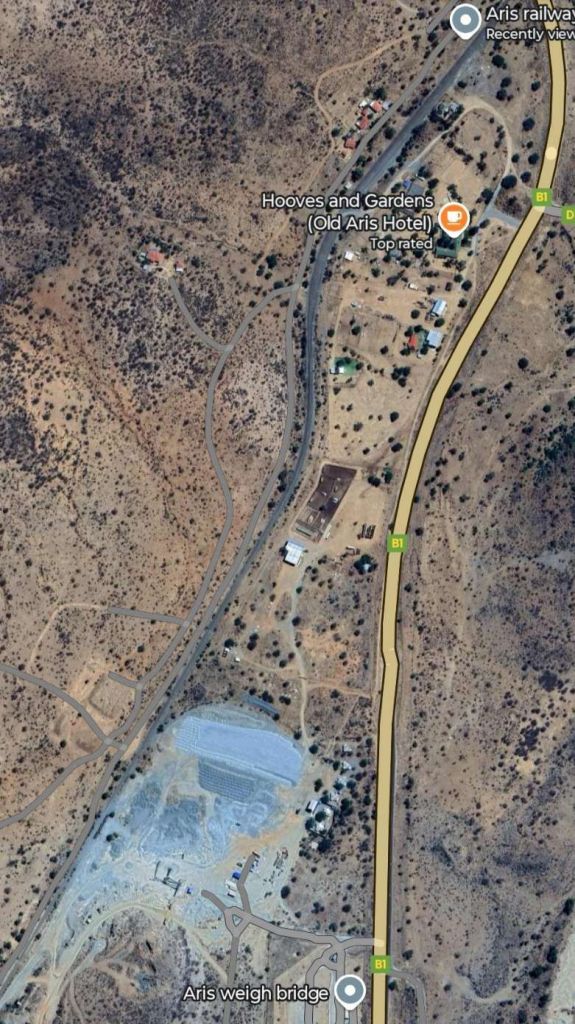
South of Aris Railway Station,two tracks run in parallel as far as Aris Quarry.
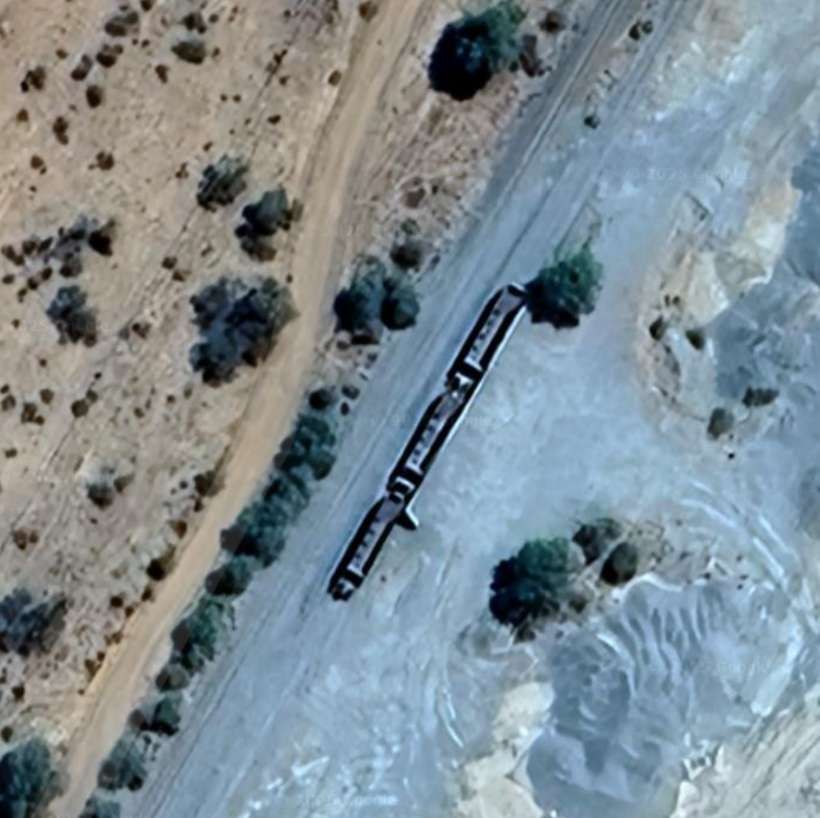
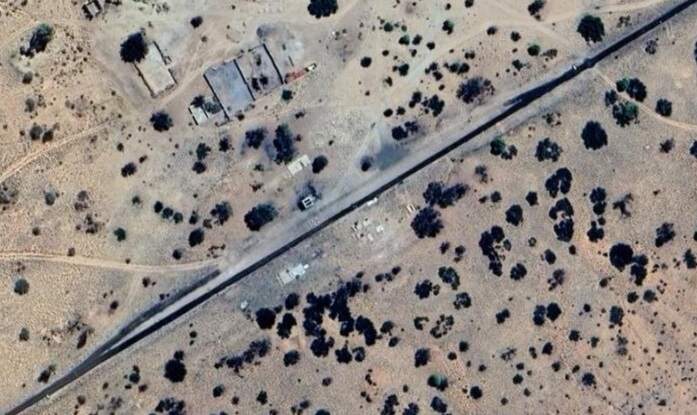
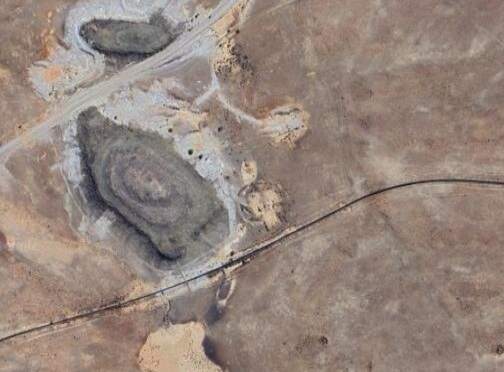
Part of Aris Quarry appears at the bottom left of this satellite image. The other significant part of the Quarry sits to the Southeast on the East side of the B1. [Google Maps, June 2025]At Aris Quarry Google Maps shows three bogie hopper wagons at a short wharf. [Google Maps, June 2025]T
The line continues South towards Rehoboth. …
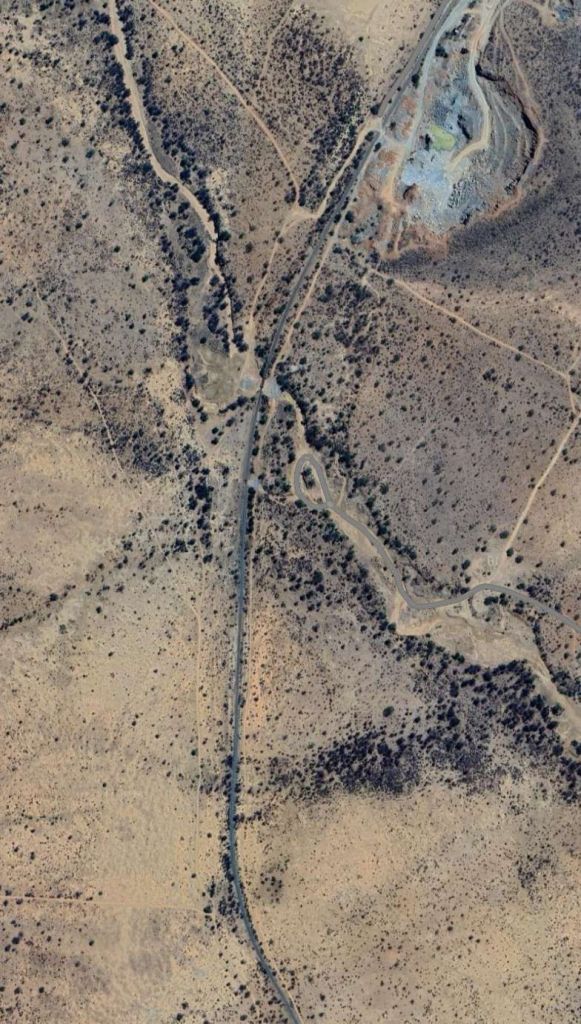
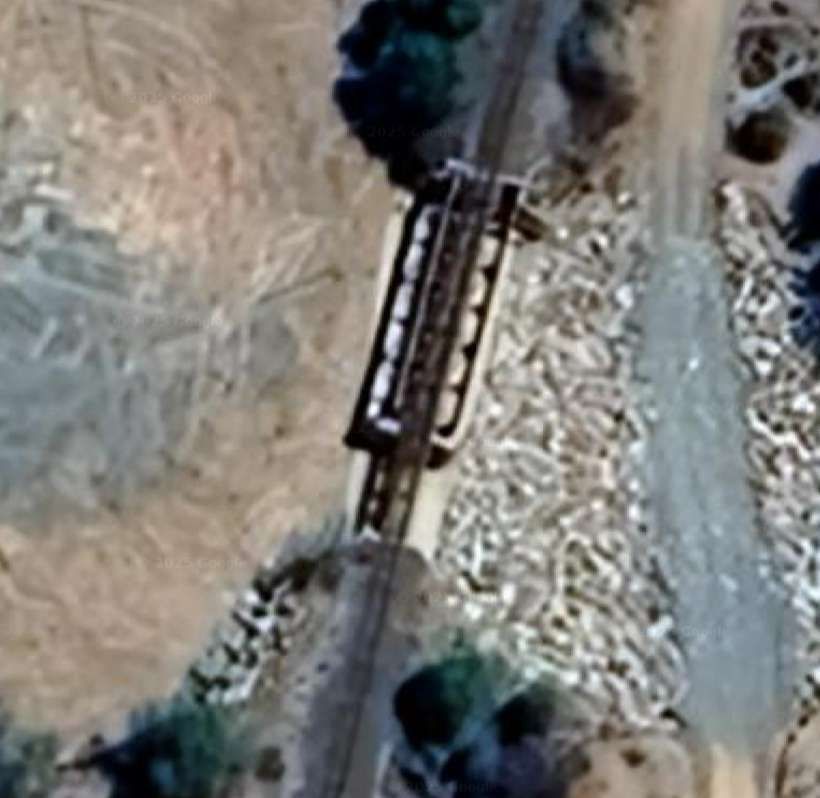
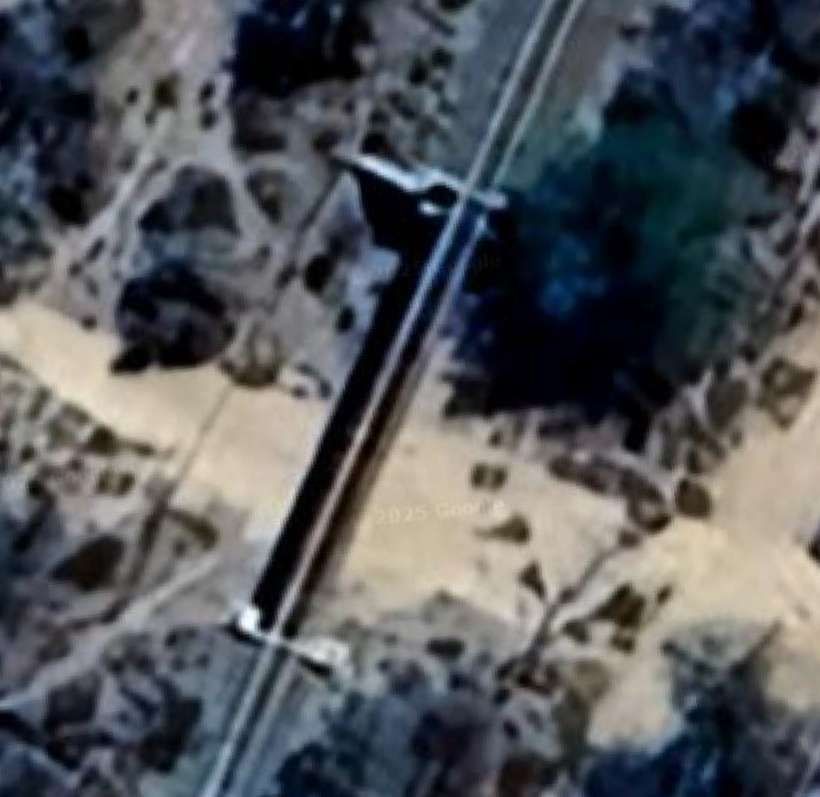
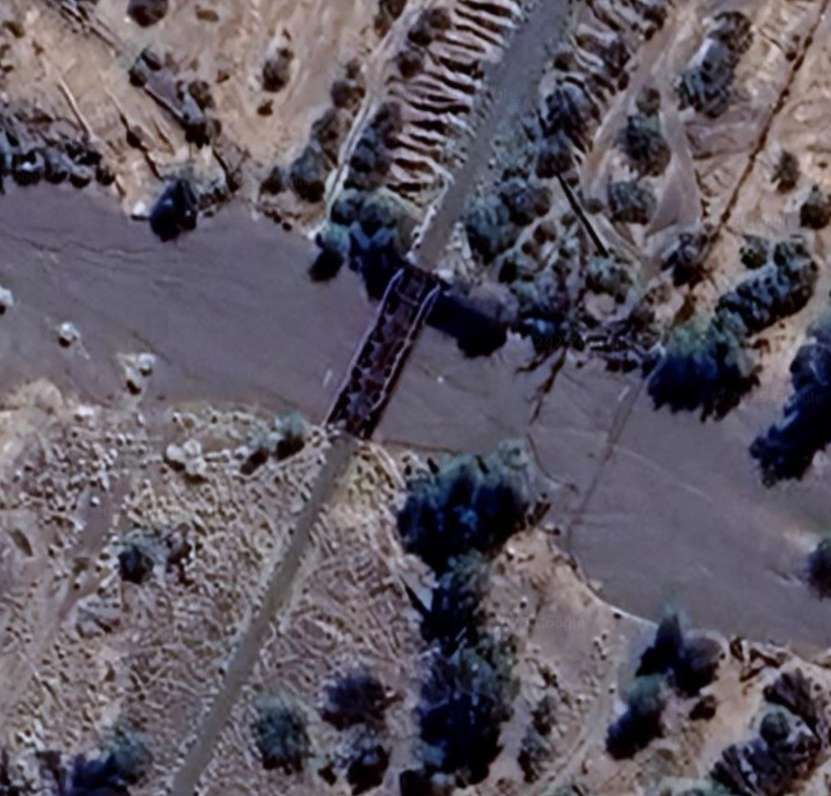
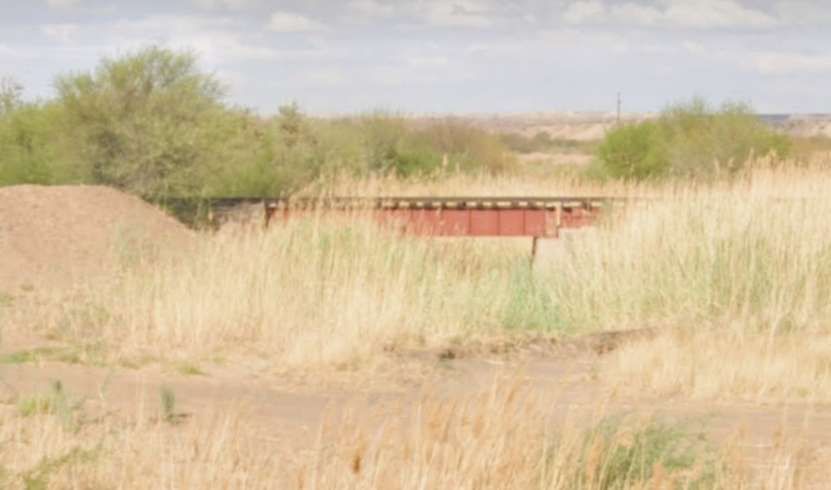
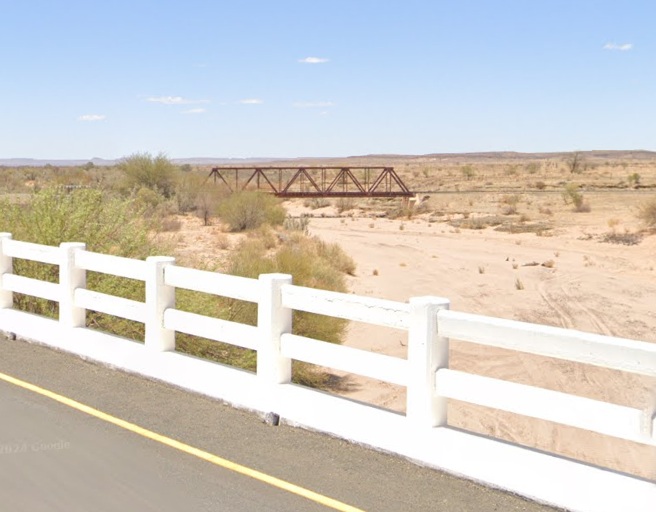
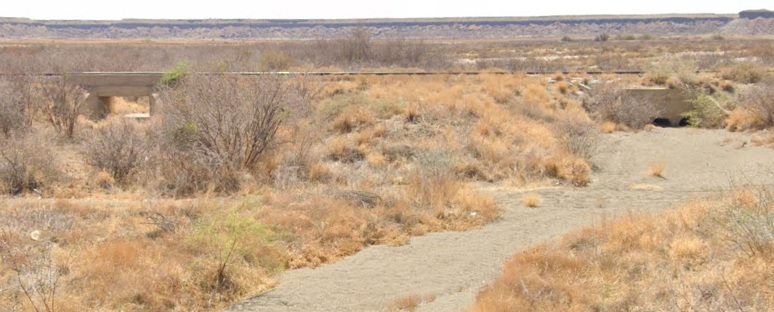
Quarry land sits on the East side of the line at the top of this next satellite image. A dry water ourselves can be seen across the image. It is bridged by the line. [Google Streetview, June 2025]A closer image of the truss girder bridge crossing the dry river bed. [Google Maps, June 2025]
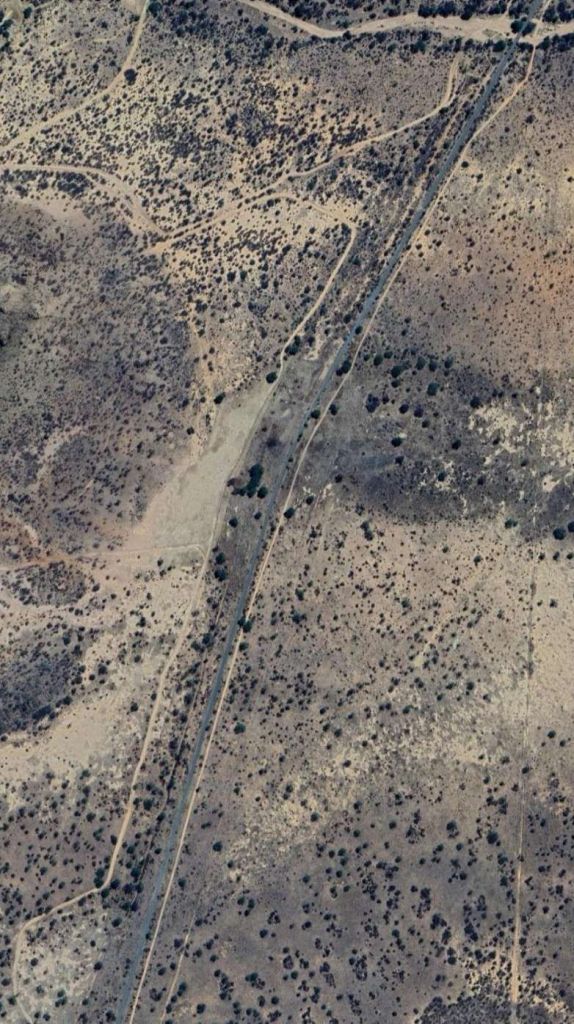
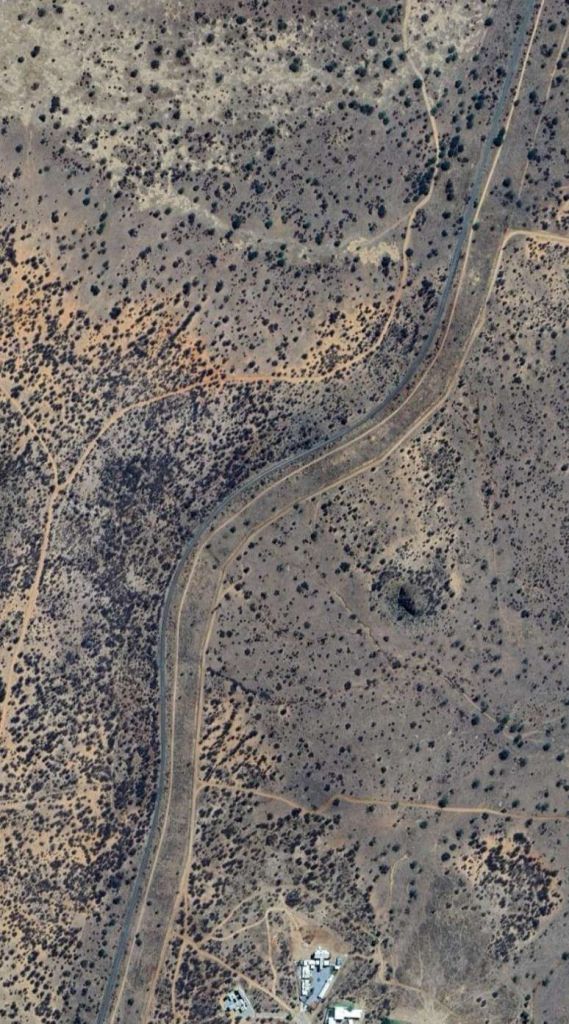
The next two satellite images show the line heading further South. …
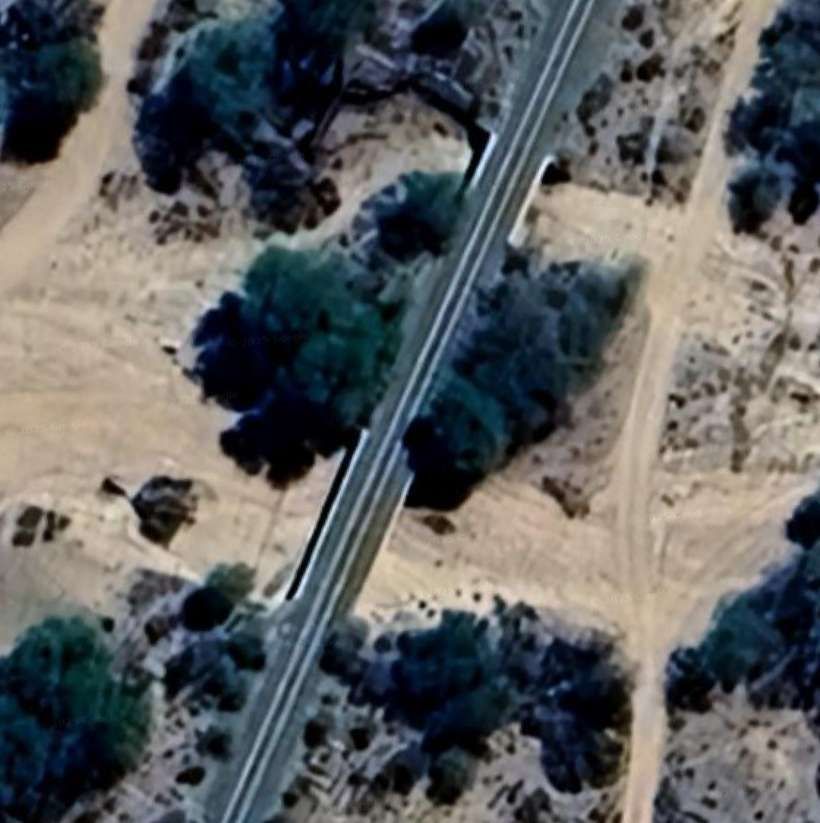
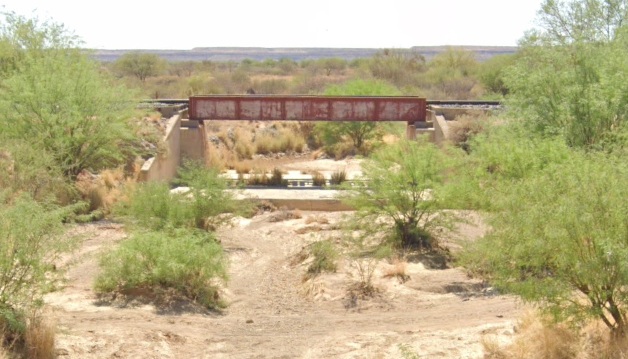
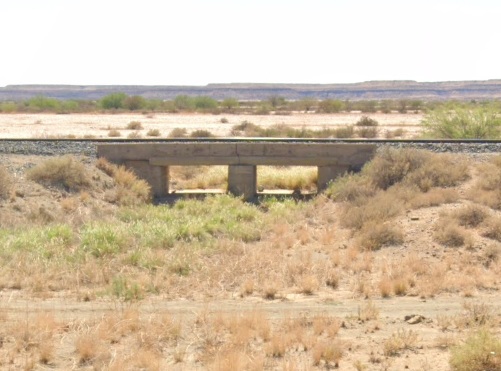
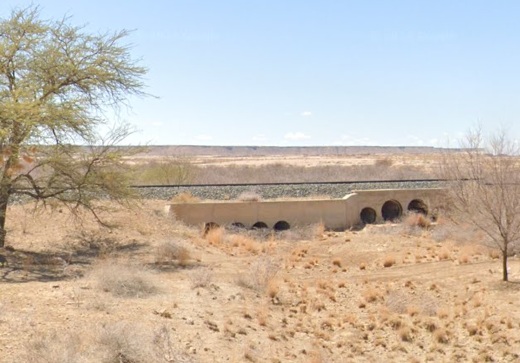
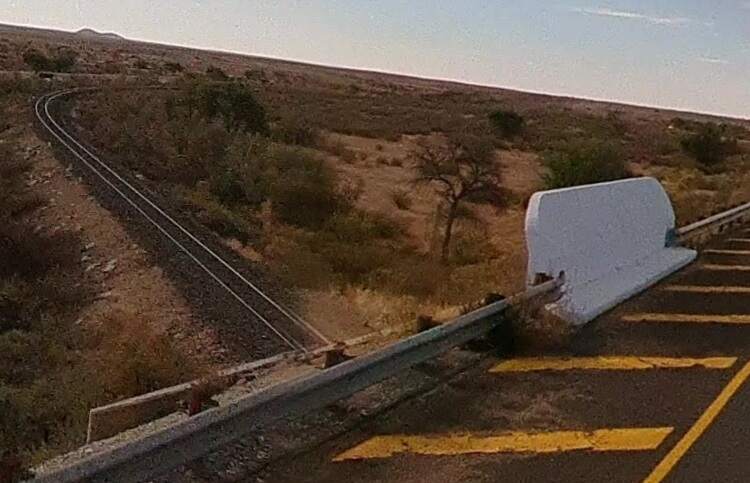
For a short distance the B2 runs close to the railway. The railway then crosses two more dry watercourses. [Google Maps, June 2025]The view from the B1 at the top of the satellite image immediately above looking West. The railway line can be seen between the road and the mountain. [Google Streetview, January 2024]The bridge over the first dry river. [Google Maps, June 2025]The bridge over the second of the two watercourses. [Google Maps, June 2025]
The next three satellite images take the line further South, running on its own course with the B1 away to the East. …
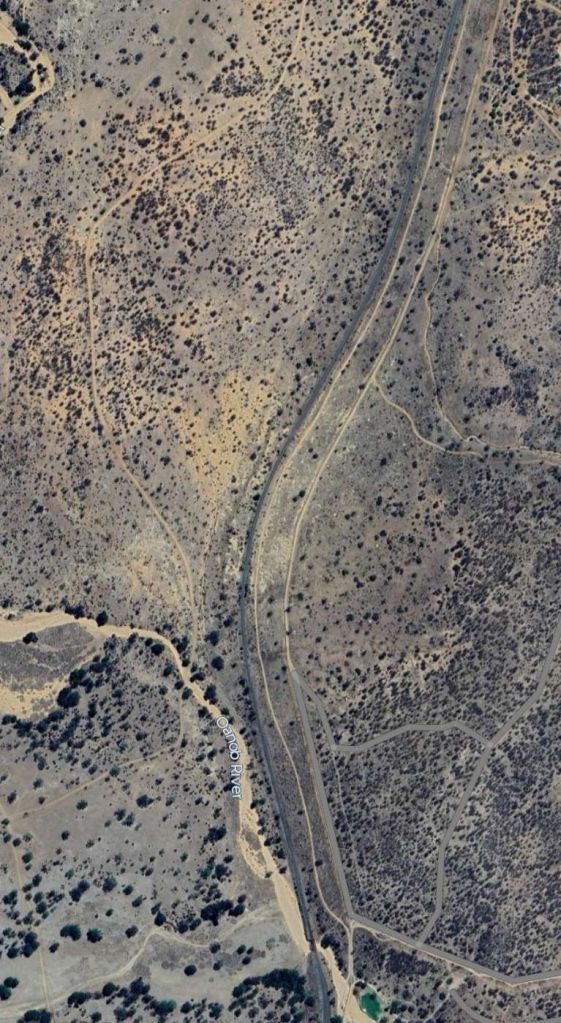
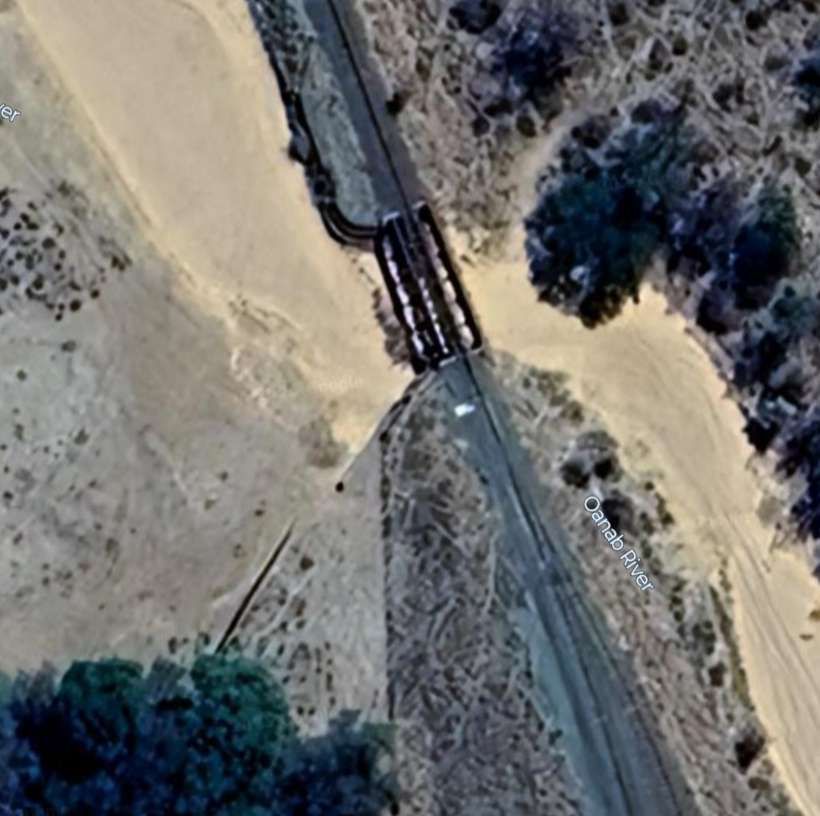
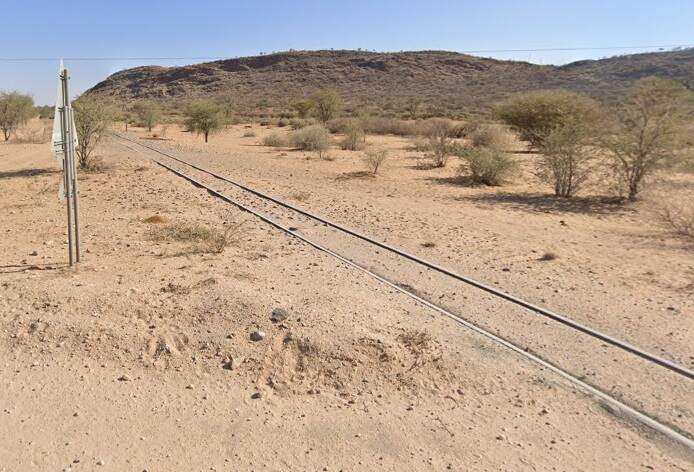
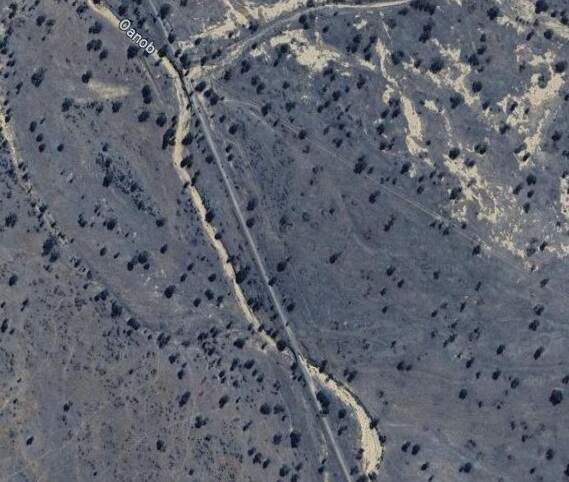
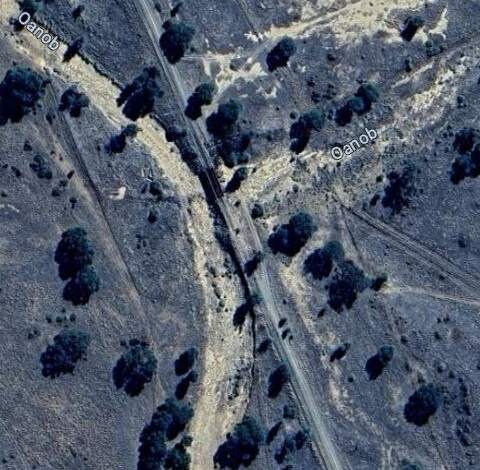
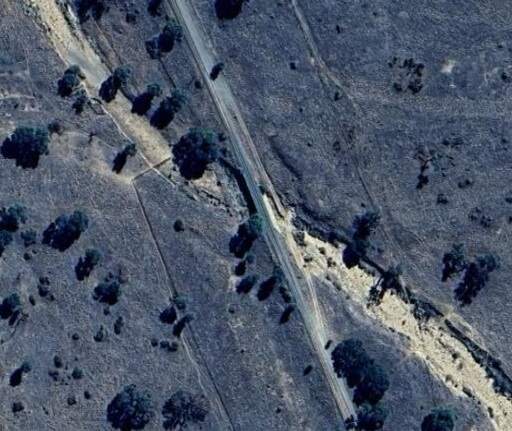
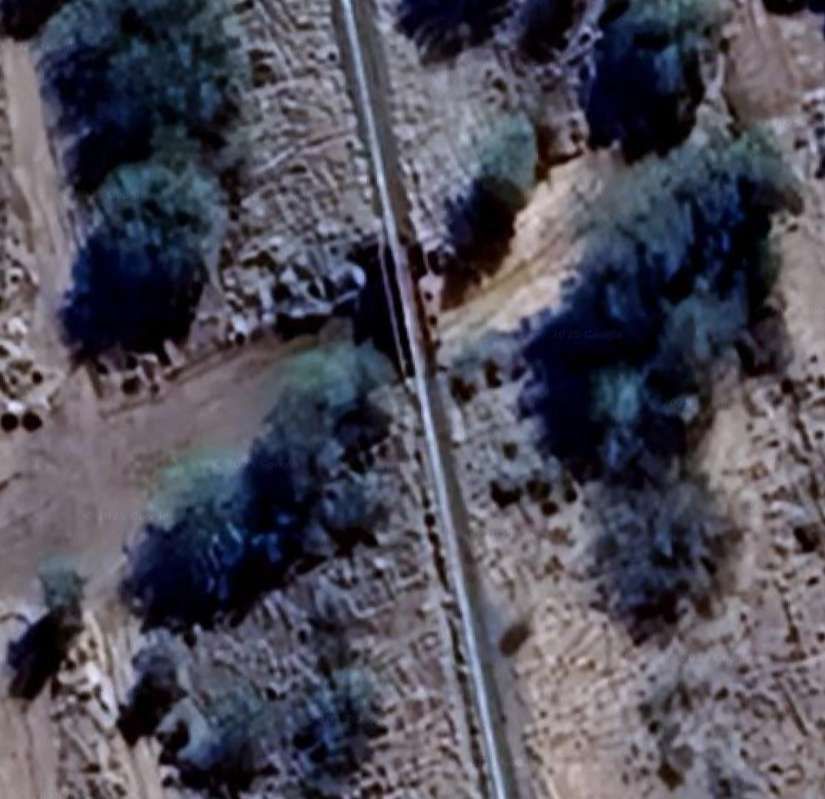
Close to the bottom of this image the railway crosses the Oanob River’s watercourse on a causeway with a short trestle bridgeThe truss girder bridge over the dry watercourse of the Oanab River. [Google Maps, June 2025]
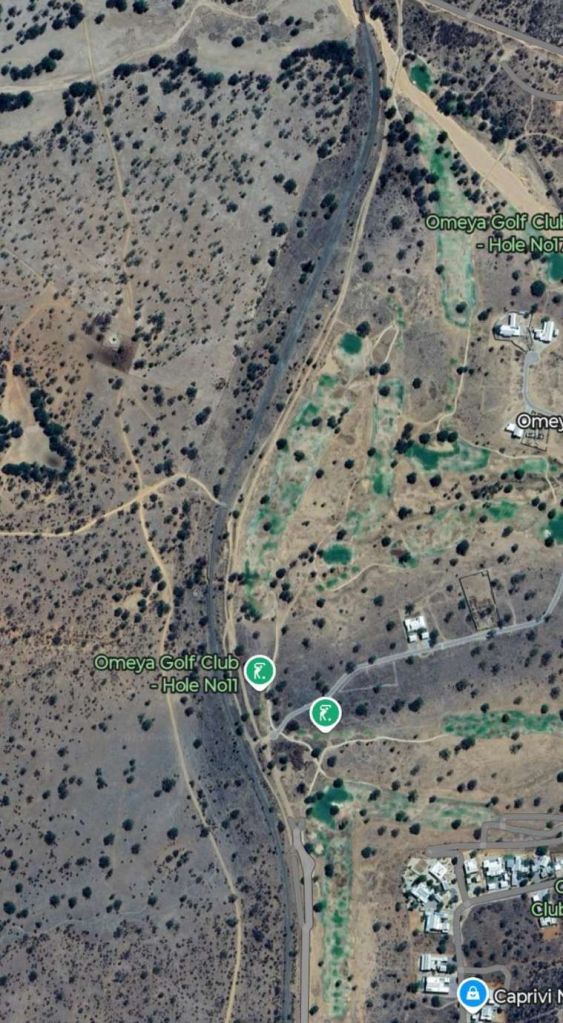
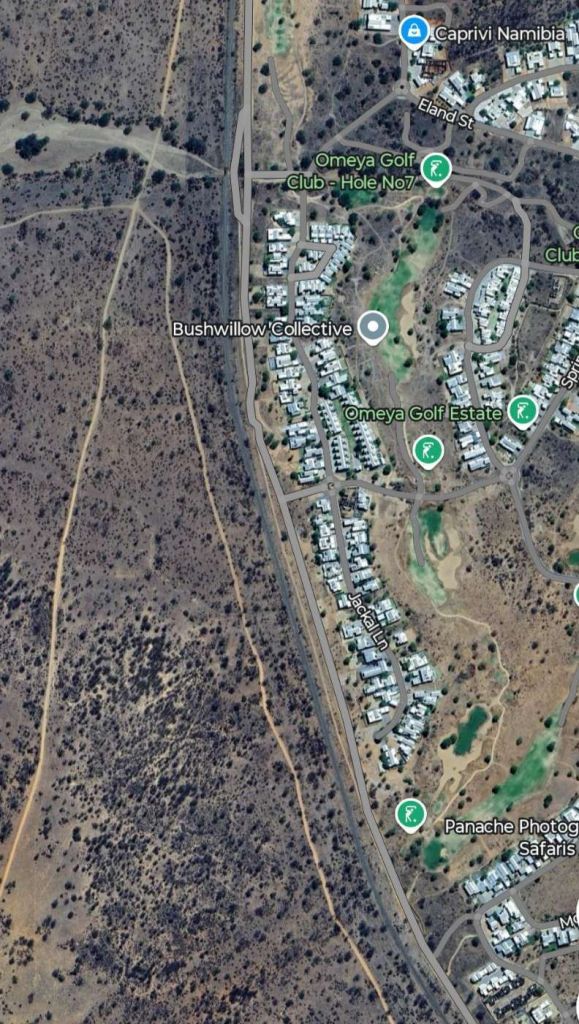
More satellite images take us further South. The first two of these extracts from Google’s satellite imagery shows the line running past the Omeya Golf and Residential Oasis. More about this relatively recent development can be found here [6] and here. [7]. The second of these is a sales video produced to attract investors and house sales.
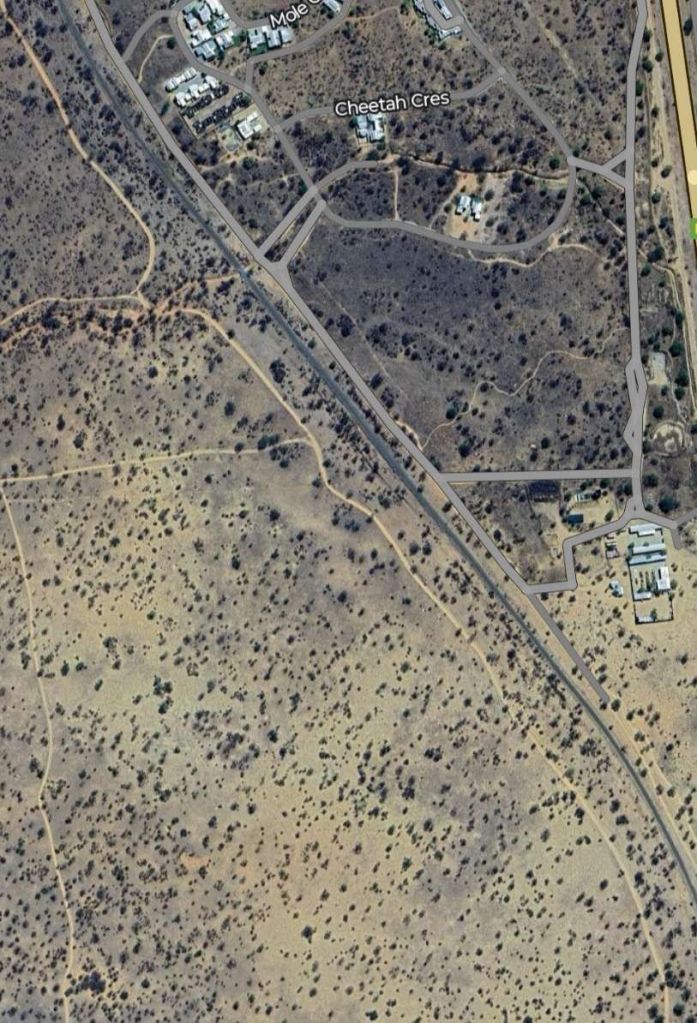
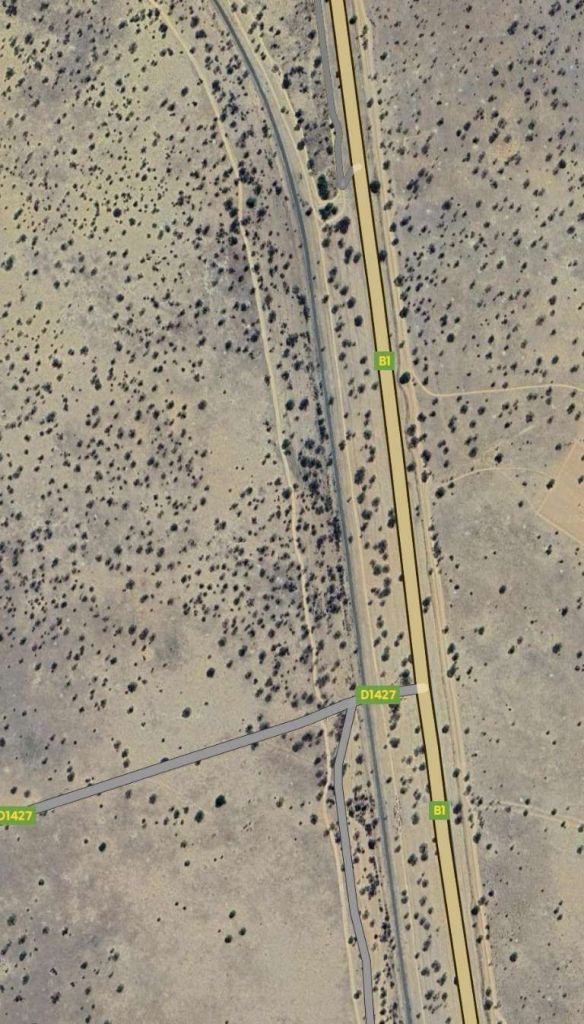
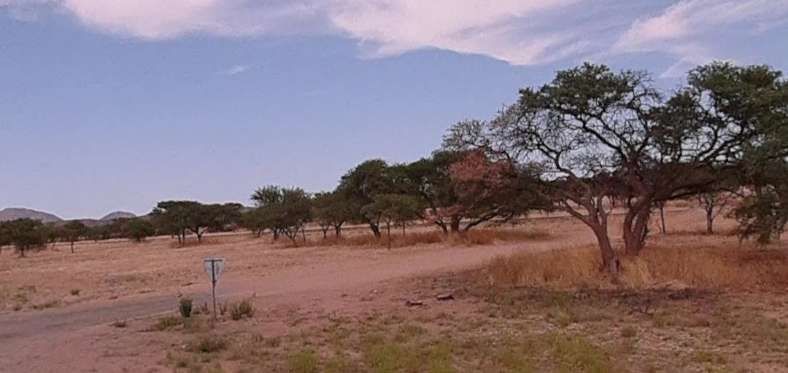
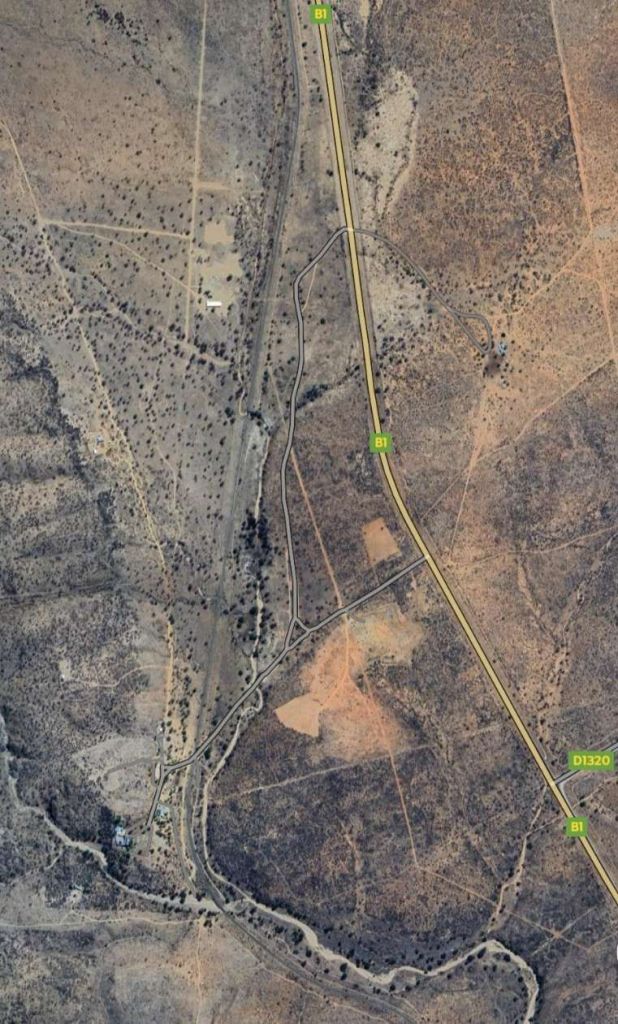
Four satellite images take the line South to a point where it once again runs alongside the B!. [Google Maps, June 2025]Looking Southwest from the B1 just to the North of its junction with the D1427. The railway can be seen in the background behind the closest trees. [Google Streetview, 2022]
Over the next 3 or 4 kilometres the line and the road run in parallel, with little worthy of note, Before the railway moves away to the West of the road once again. …
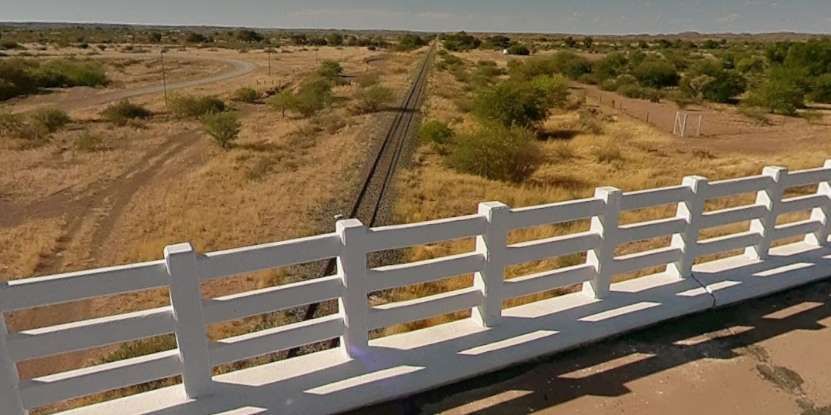
The line crosses four dry watercourses before turning towards the East. [Google Maps, June 2025]Running Southeast the line follows the fourth of the watercourses and passes under the B1. [Google Maps, June 2025]Looking North-northwest along the line from the bridge carrying the B1. [Google Streetview, November 2023]Looking Southeast from the same bridge towards Rehoboth. [Google Streetview, November 2023]
The line wanders its way through the hills to the East of the B1 passing from the Khomas Region of Namibia into the Hardap Region. It runs through a number of small townships close to the Usip River before entering Vogelpan where Rehoboth Railway Station was sited.
Just a short distance to the South of Vogelpan, the railway turns East to cross the Usip River. ….
Looking East from the C25, the line can be seen curving away to the East and crossing the channel of the Usio River. [Google Streetview, August 2024]
Just to the South of the location of the photograph immediately above, the C25 itself turns East and crosses both the Usip River watercourse and then the railway.
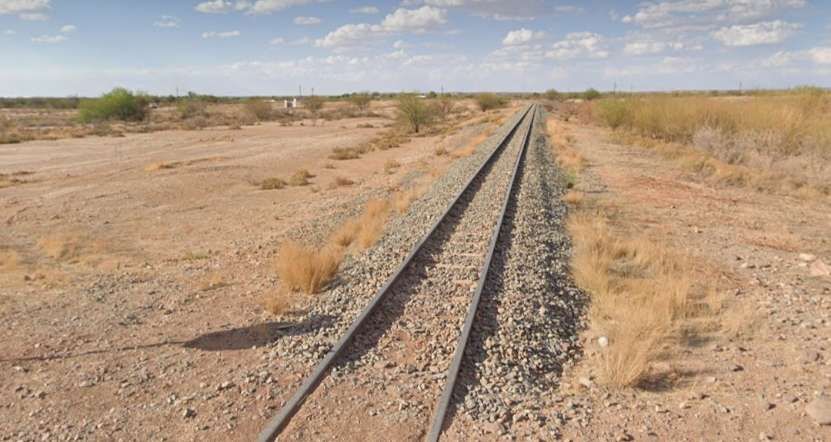
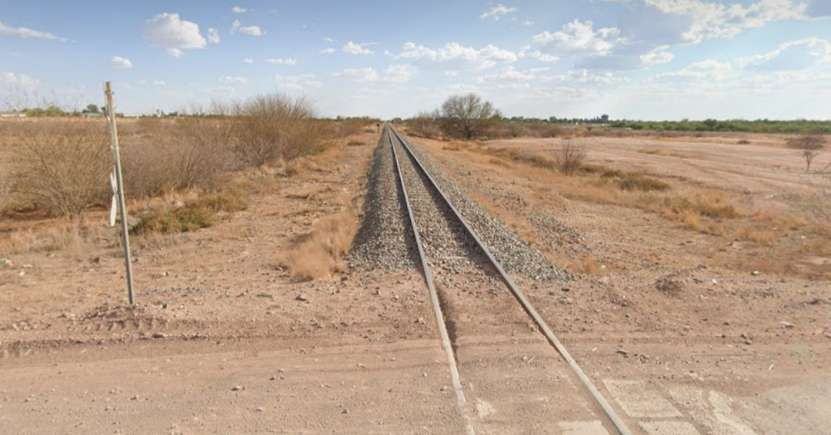
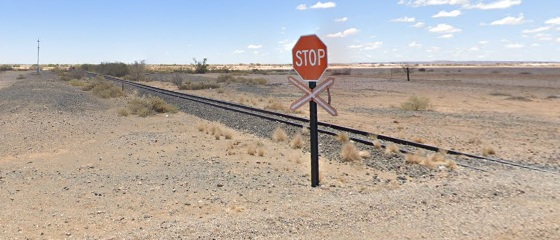
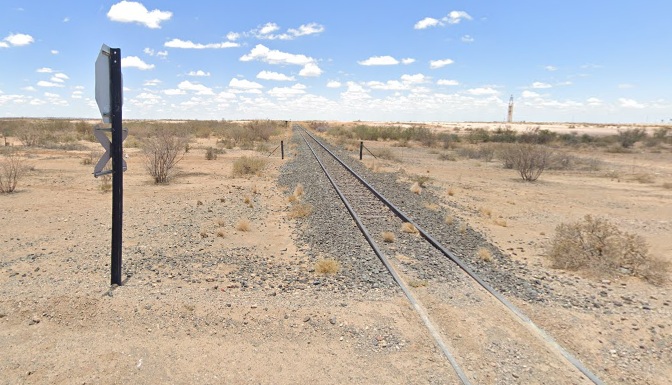
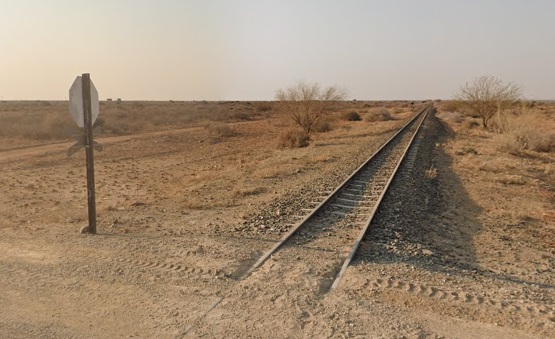
Looking North-northwest from the ungated crossing on the C25, along the railway back towards Vogelpan. [Google Streetview, August 2024]Looking Southwest from the same crossing on the C25, along the railway. [Google Streetview, August 2024]
The railway runs down the East side of the River Usip passed its confluence with the Oanob River. It then continues alongside the Oanob (less than 1 kilometre to the East of the river).
The railway then crossed the Oanob River and a tributary in quick succession. [Google Maps, June 2025]
The first bridge (on the left) crosses the Oanob, the second (on the right, crosses the tributary). [Google Maps, June 2025]
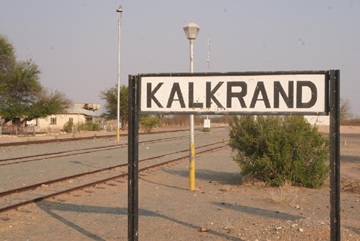
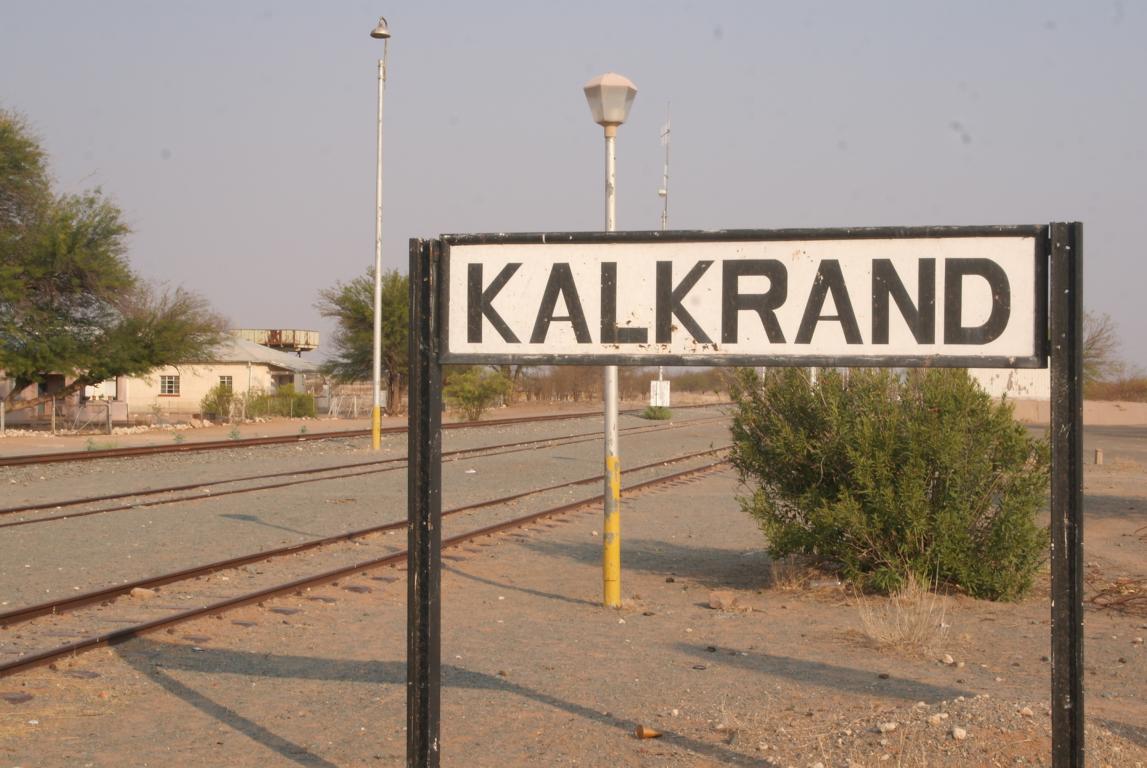
The line then continues, pretty much in a South-southeast direction for some considerable distance with little to remark on. It passes close to Duinevelde on its way South before reaching Kalkrand.
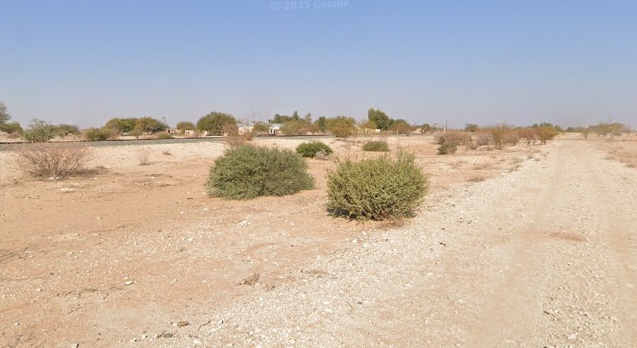
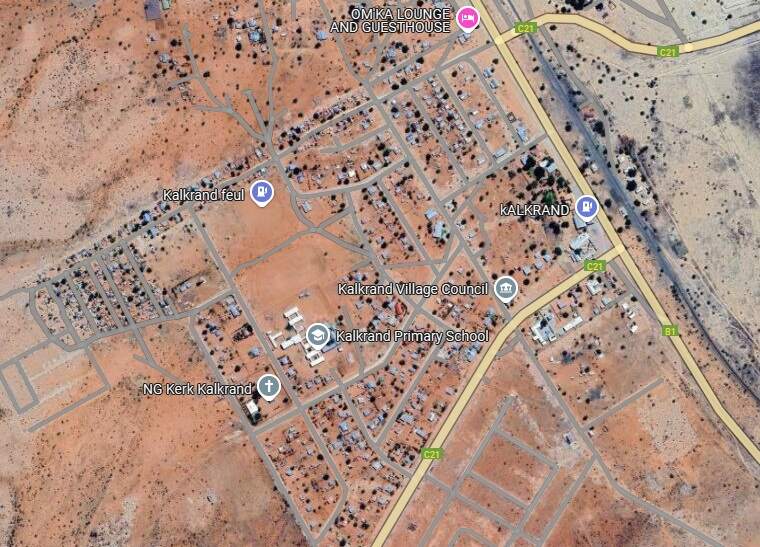
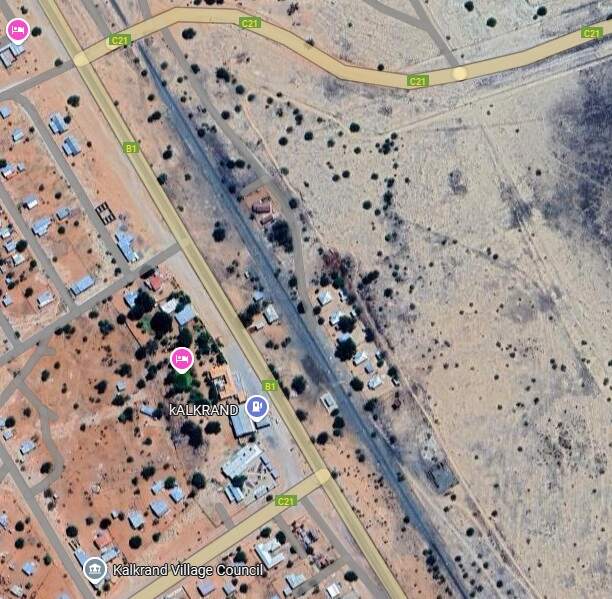
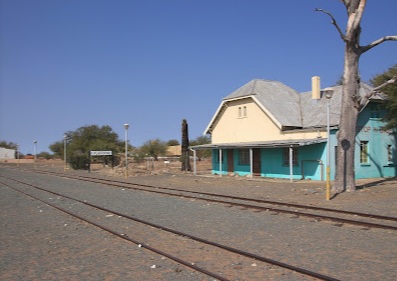
The railway is seen here (from a minor road to the West of the line) approaching Kalkrand from the North. [Google Streetview, August 2024]Kalkrand and its railway Station. [Google Maps, June 2025]Kalkrand Station and passing loop. [Google Maps, June 2025]
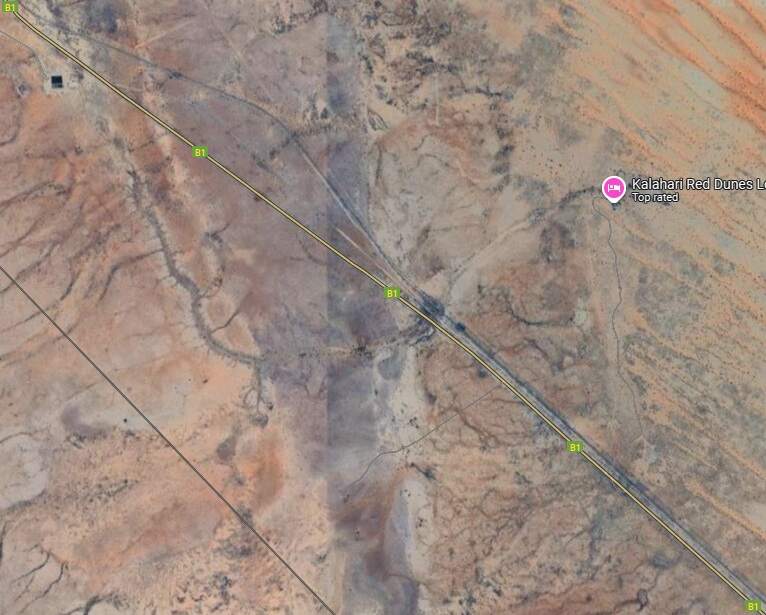
Southeast of Kalkrand the line and the B1 run in parallel. …
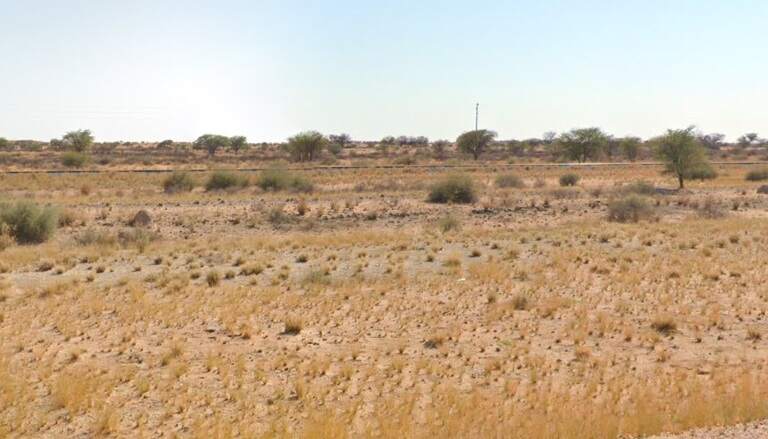
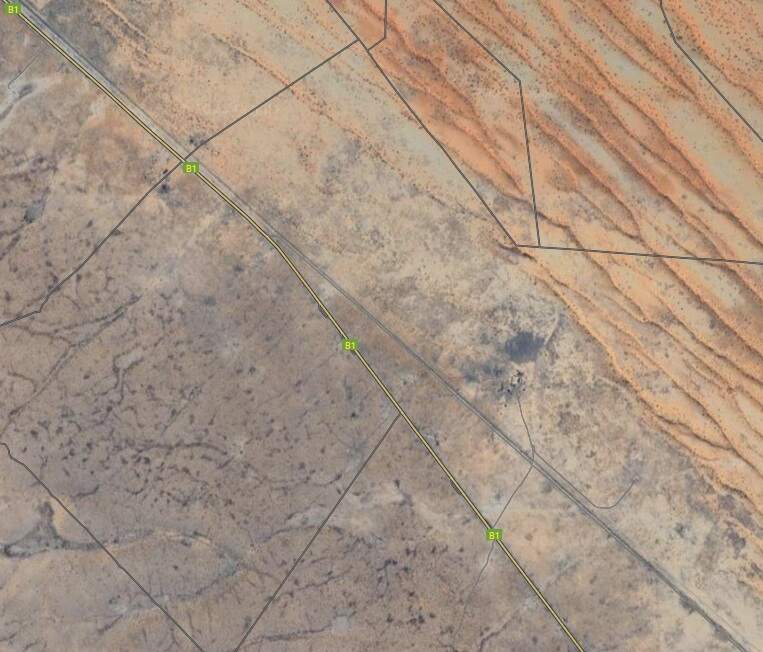
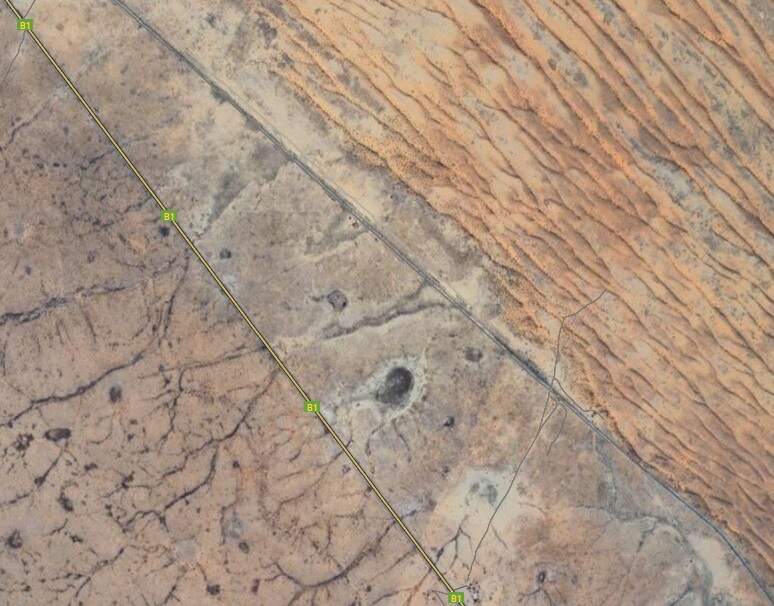
Road and rail together head Southeast. [Google Maps, June 2025]Looking East from the B1, the railway can be seen on a parallel course. [Google Streetview, December 2023]The dunes of the Kalahari desert appear in the top right of this satellite image. [Google Maps, June 2025]The railway flirts with the edge of the dunes. [Google Maps, June 2025]
The line continues in a generally Southeasterly direction along the edge of the Kalahari Desert before beginning to swing round to the South and heading into rougher terrain where its route is dictated by the contours. …
Sidings some distance to the South of Kalkrand. [Google Maps, June 2025]These two structures carry the line over watercourses in the hills [Google Maps, June 2025]
Further South and again on flatter terrain the line passes under the C20. …
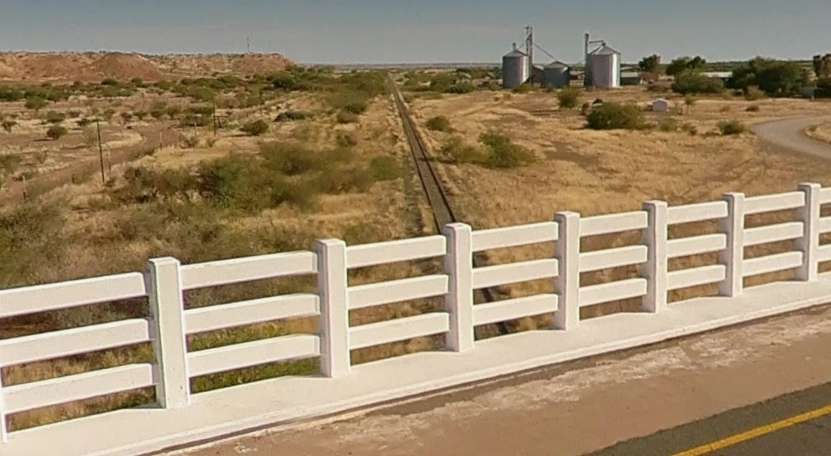
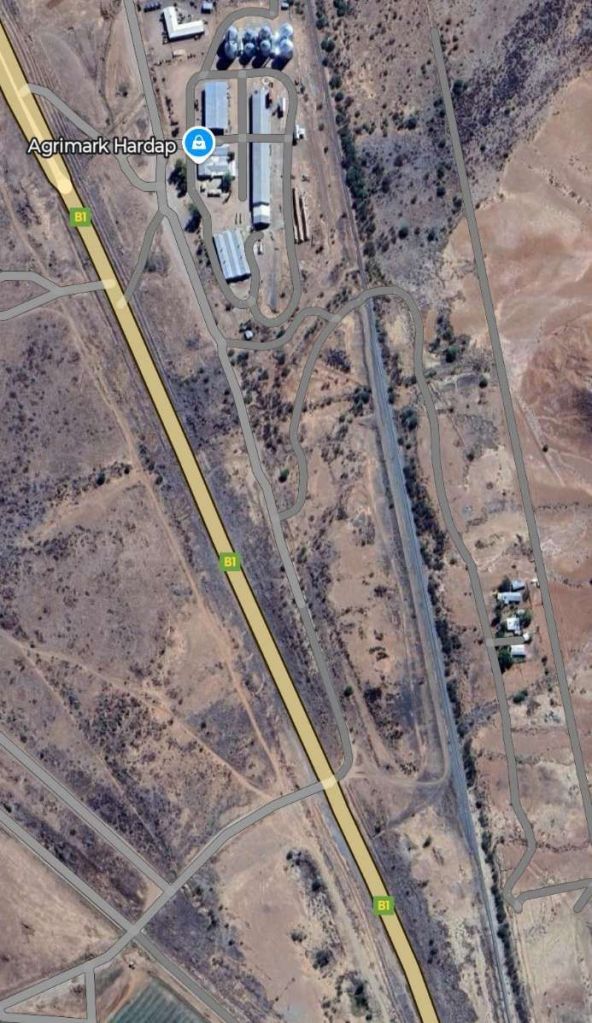
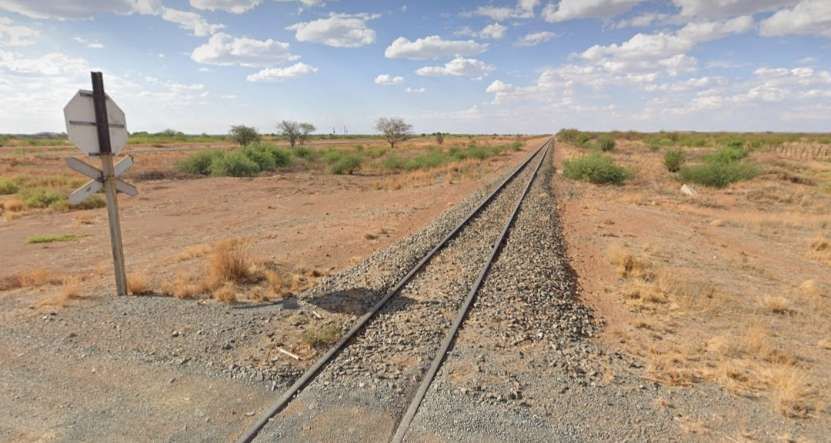
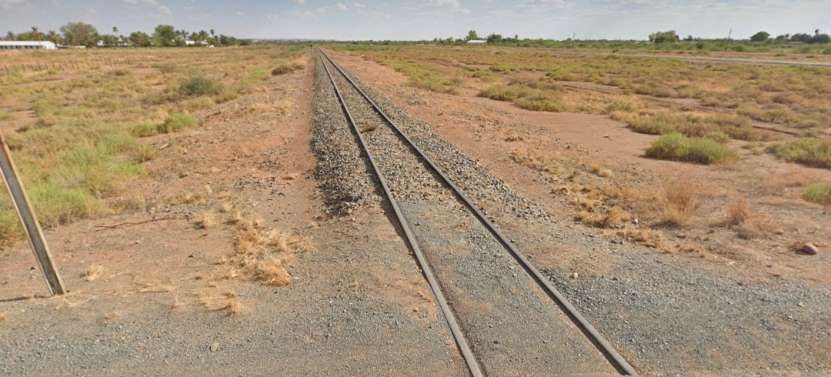
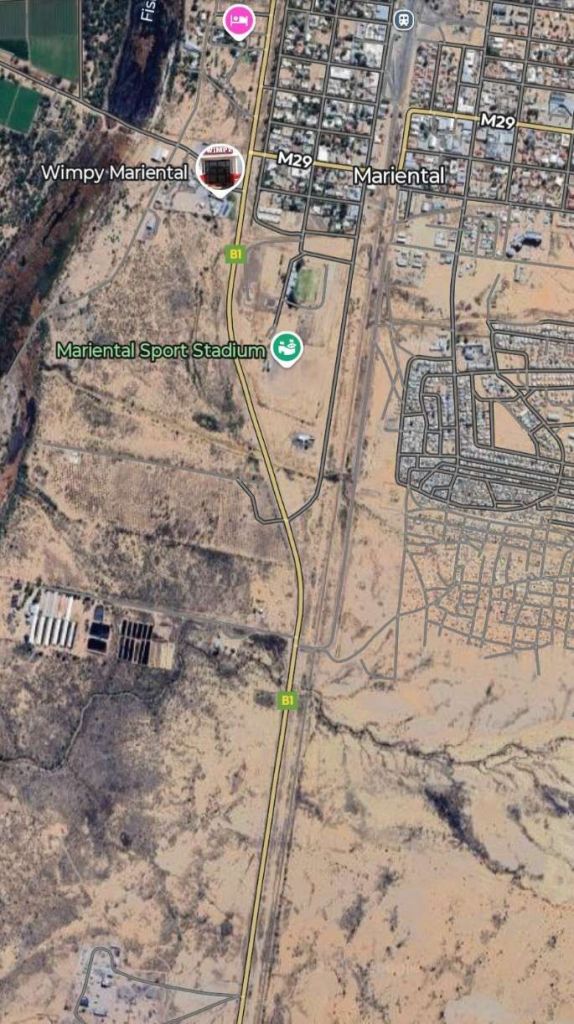
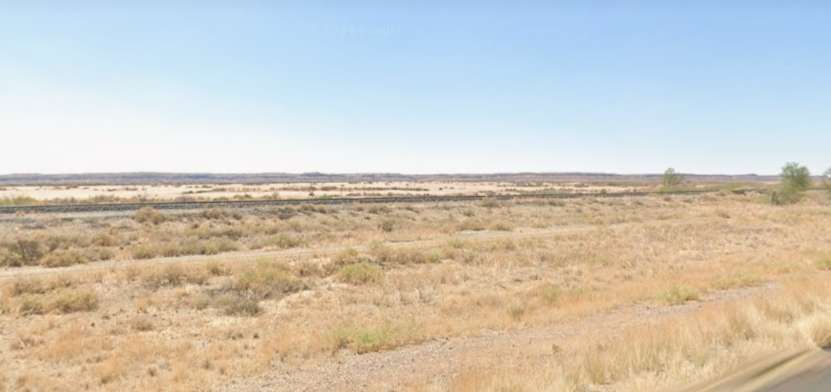
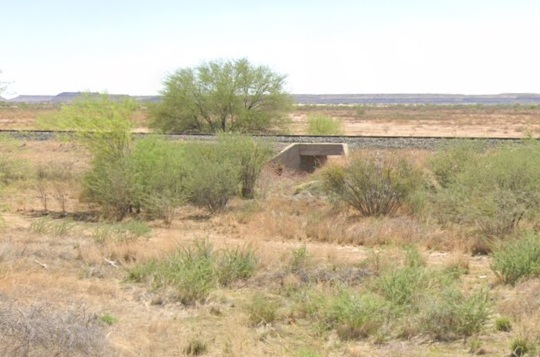
Looking North-northwest along the line from the bridge carrying the C20. [Google Streetview January 2018]Looking Southeast along the line from the same bridge. The various storage tanks on the horizon are associated with Agrimark, an agricultural and retail store, part of the Agrimark, Namibia network. Adjacent to it, between the Fish River and the B1 and on the West side of the Fish River is an area of irrigated fields. [Google Streetview, January 2028]Agrimark’s storage facility heralds the arrival of Southbound strains in the town of Mariental. [Google Maps, June 2025]Looking North from an ungated crossing on a minor road North of Mariental. [Google Streetview, December 2023]Looking South from the same crossing. [Google Streetview, December 2023]Further South, the line bridges a dry watercourse which is a tributary of the Fish River. [Google Maps, June 2025]The bridge in the above satellite image as seen from the B1. [Google Streetview, December 2023]Immediately North of Mariental, the crosses another minor road at an ungated crossing. This view looks North along the line. [Google Streetview, December 2023]Looking South towards Mariental from the same crossing. [Google Streetview, December 2023]Mariental Township with the Railway Station at the centre of the satellite image. [Google Maps, June 2025]
The next two extracts from Google Maps satellite imagery cover the length of the railway station site. …
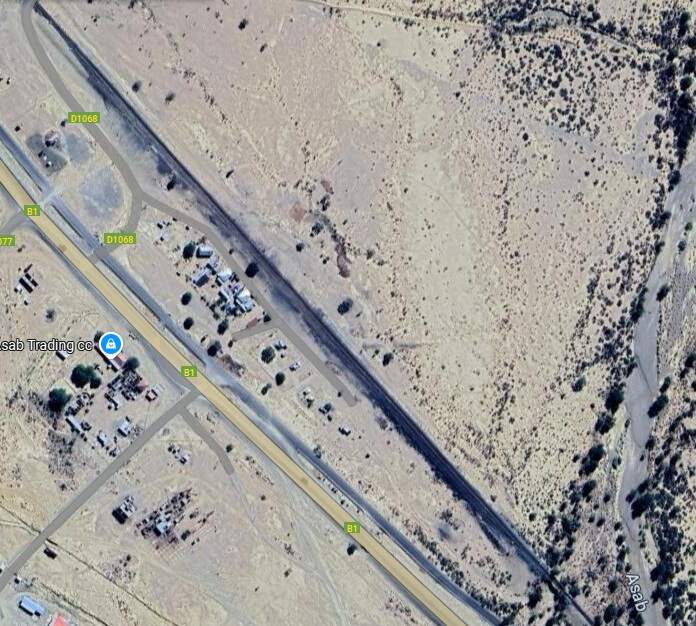
These two images show the station site at Mariental. [Google Maps, June 2025]Mariental Station building. [Google Streetview, December 2023]The station building at Mariental seen fromt he Southwest. [Google Streetview, December 2023]Immediately South of Mariental, the B1 and the railway run South side by side. [Google Maps, June 2025]The railway seen from the B1 to the South of Mariental. [Google Streetview, January 2018]A series of different culverts and bridges support the line over historic channels most of which are dry. [Google Streetview, December 2023]The next road crossing is that for the C18. It is another ungated crossing and this is the view looking North along the line. [Google Streetview, August 2024]And this is the view South along the line at the same crossing. [Google Streetview, August 2024]Looking Northwest from the ungated crossing over the D1068 at Asab. [Google Streetview, December 2023]Looking Southeast from the D1068 into the station at Asab. [Google Streetview, December 2023]Asab Trading CentreSidings/Station and River. [Google Maps, June 2025]Looking North from the B1 along the Asab River watercourse with the railway bridge close to the centre of the image. [Google Streetview, December 2023]
The line continues Southeast from Asab. …
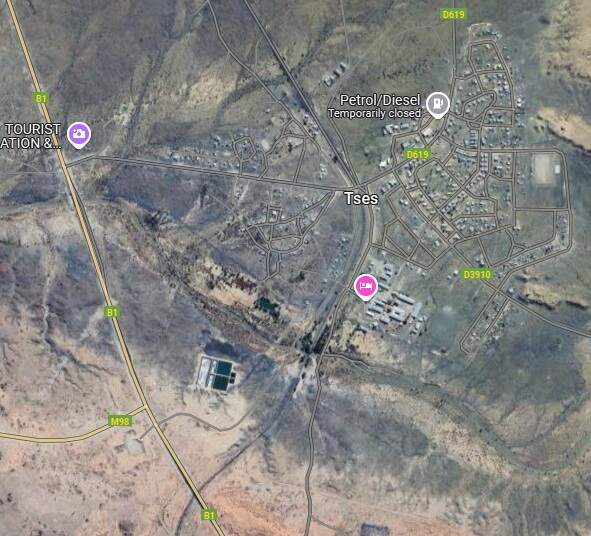
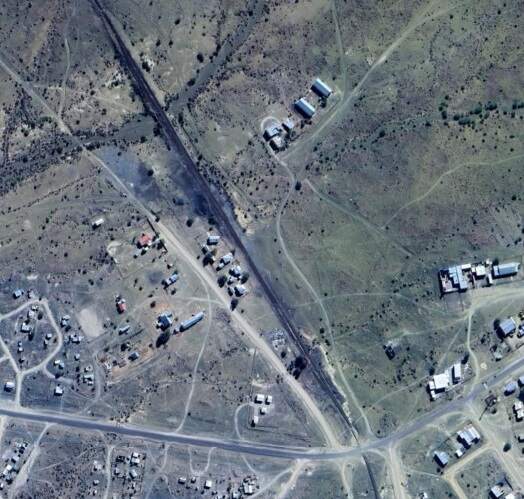
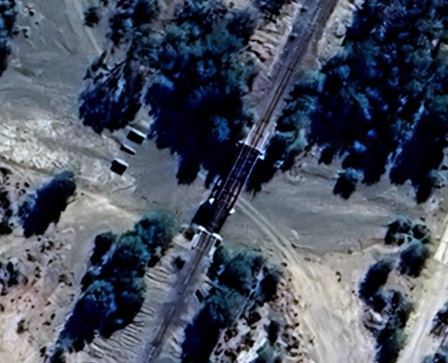
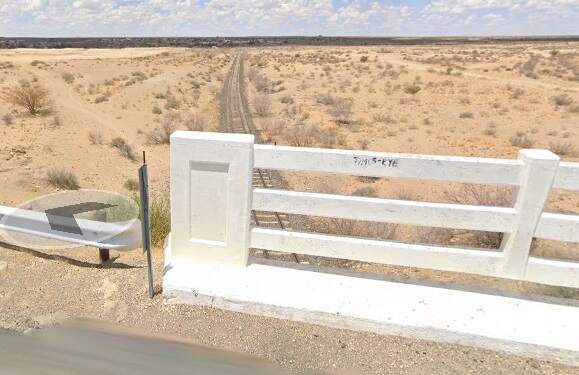
Looking North from the D3919Looking Southeast from the D3919The line continues Southeast towards Tses on a shallow embankment with bridge openings for run-off water over dry watercourses. [Google Streetview, December 2023]Tses Township, the B1 and the railway. [Google Maps, June 2025]Tses Station and Sidings. [Google Earth, June 2025]Tses River Bridge. [Google Earth, June 2025]Looking Northeast from the bridge carrying the B1 along the line, back towards Tses. {Google Streetview, December 2023]Looking ahead to the Southwest from the same bridge. [Google Streetview, December 2023]
The line continues in a generally Southwards direction. Again, when hills are encountered it curves its way along the contours to limit gradients. …
Another glimpse of the line from the bridge carrying the B1 across the outfall channel from the Van Rym Dam on the approaches to Keetmanshoop. [Google Streetview, December 2023]
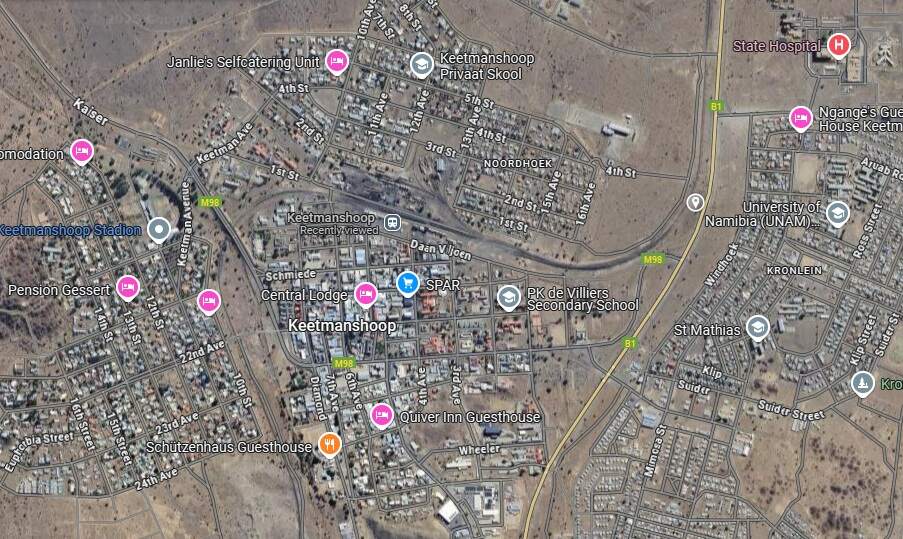
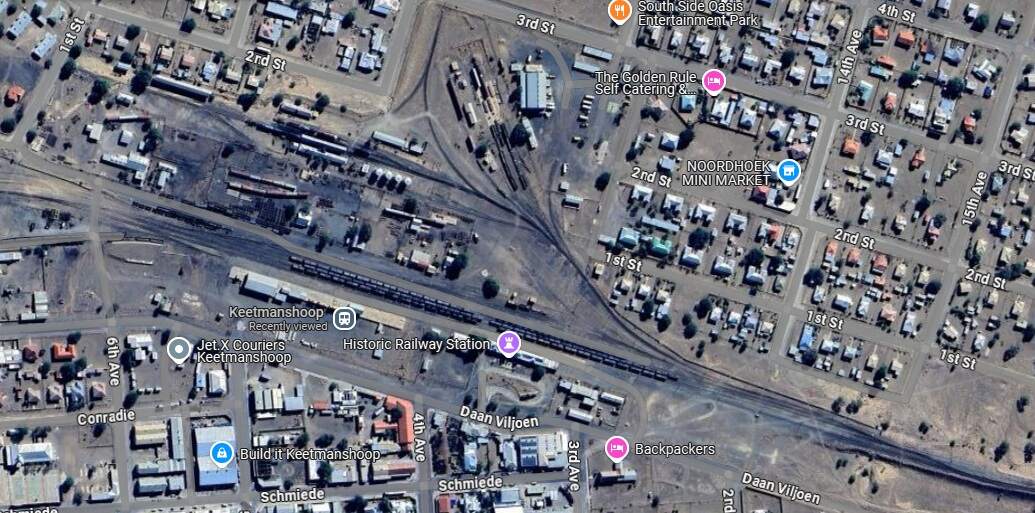
Keetmanshoop is the next significant settlement on the line. …
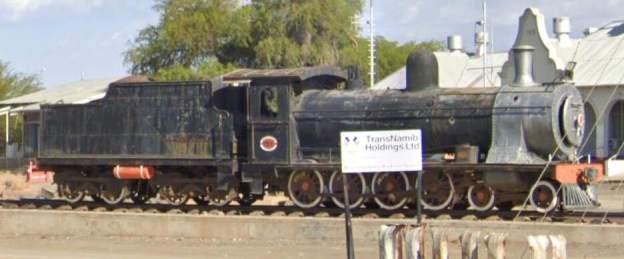
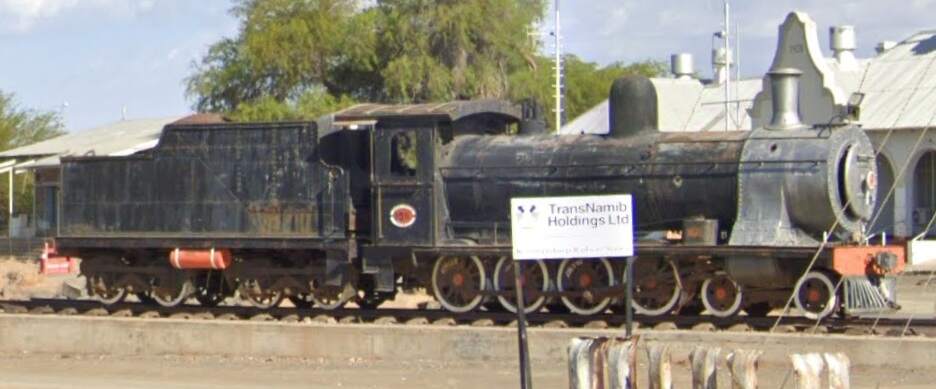
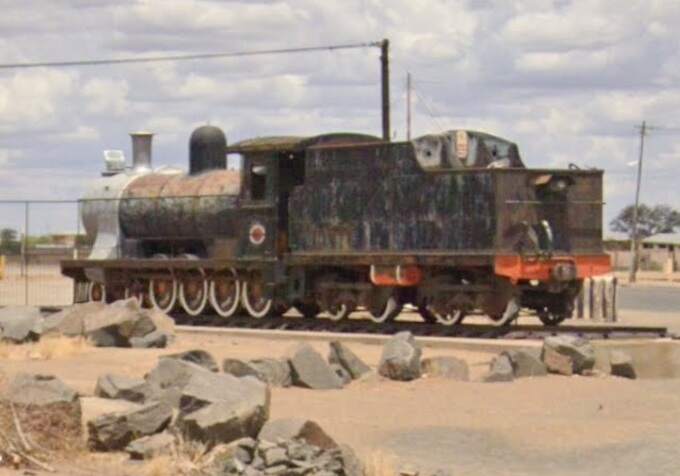
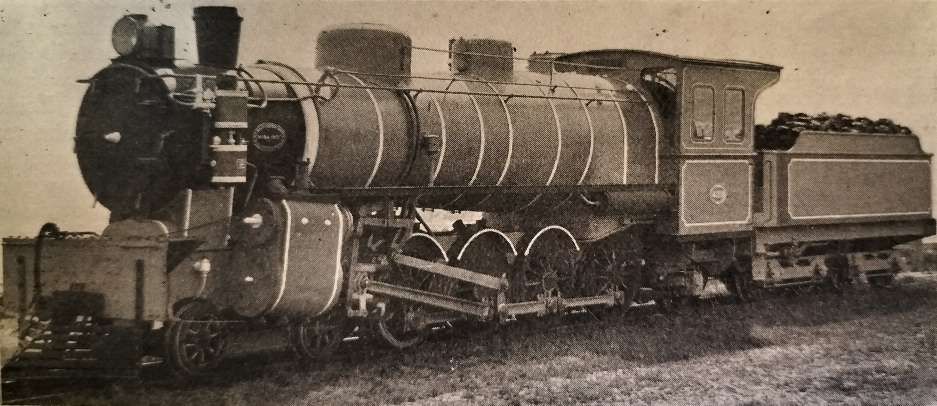
4-8-0 Locomotive Class 7A, No. 1011 was built by Neilson & Co, of Glasgow, Scotland, as works no 4930 in 1896, it was brought to Keepmanshoop in 1980 to be plinthed. The first Class 7 locomotives were commissioned by the Cape Government Railways and delivered by Dübs & Co of England in 1892. Follow-up batches were built by Sharp, Stewart & Co, Neilson, Reid & Co, and North British Locomotive Company. They had a wheel arrangement of 4-8-0, coupled wheels of 3’6 3/4″ (1086mm diameter) and Stephenson link valve gear. The engines were originally powered by saturated steam, but many were later reboilered and converted to use superheated steam. Modifications such as larger boilers, increases in cylinder diameters and larger cabs resulted in the reclassification of the locomotives as Class 7A, 7B, 7C, 7D, 7E and 7F. More information and photographs can be seen here. [16]
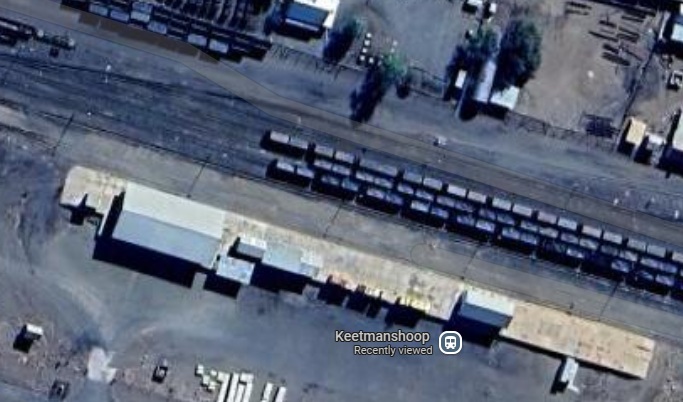
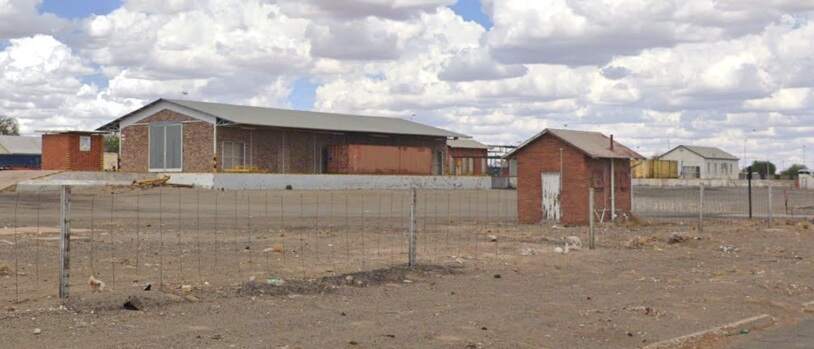
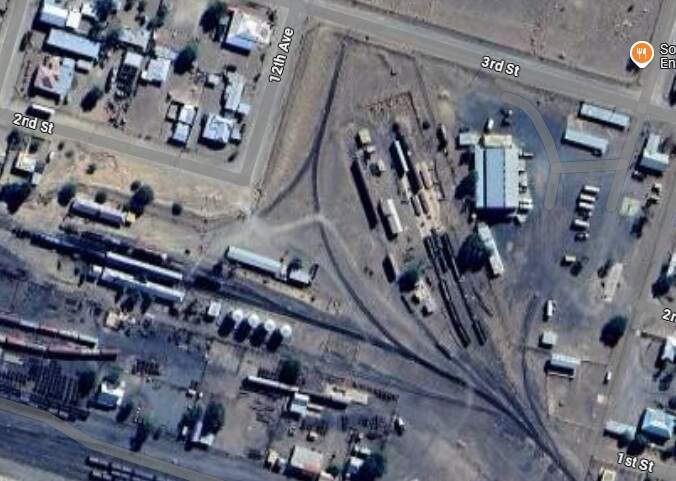
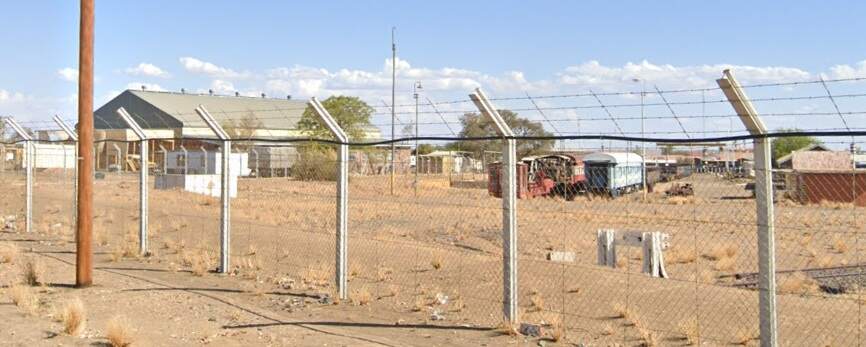
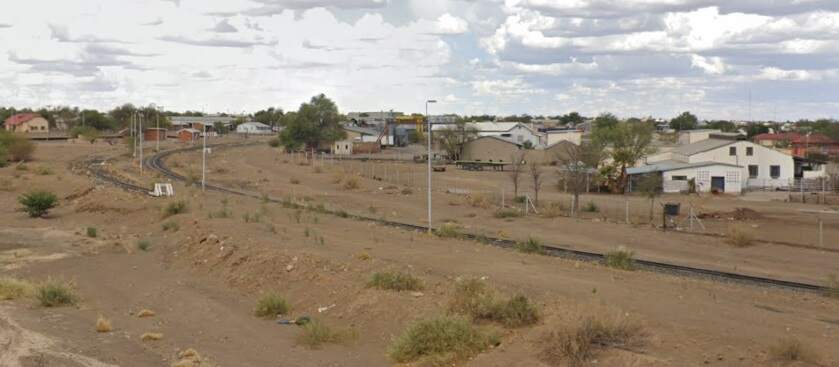
More modern facilities at Keetmanshoop Railway Station. [Google Maps, June 2025]A view of these modern facilties from the Southwest on Darn Viljoen. [Google Streetview, December 2023]The yard and turning triangle at Keetmanshoop Station. [Google Maps, June 2025]The view of the yard from the corner of 3rd Street and 12th Avenue. [Google Streetview, December 2023]
While Keetmanshoop railway Station sits approximately on an East-West alignment is is approached bey means of a sharp curve from the North and trains leaving to the South take a sharp curve to the South within the township.
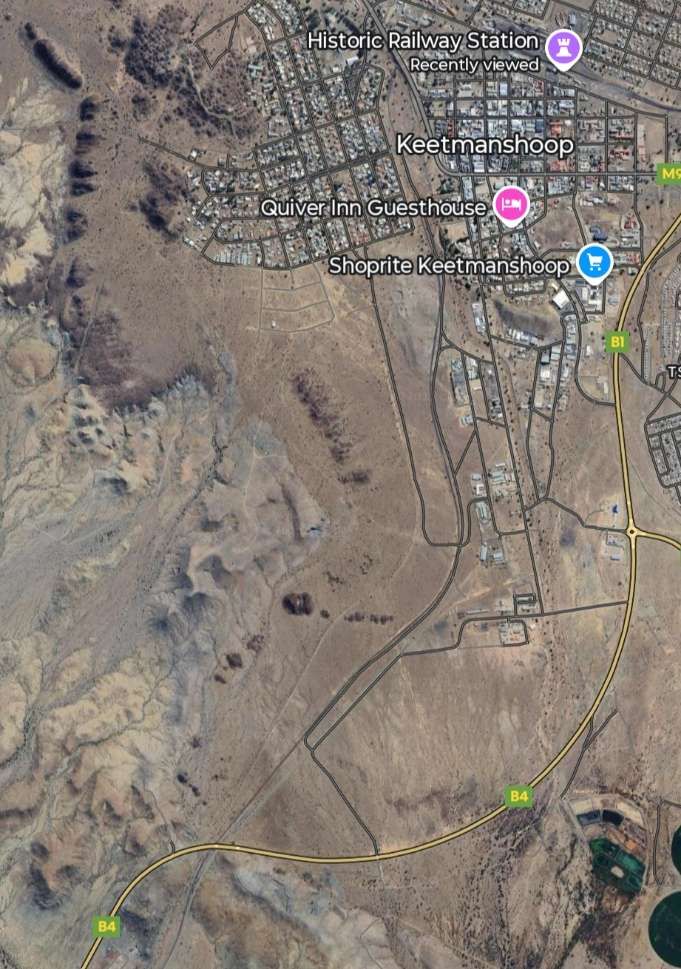
The line continues to the South. … First five images following the line South and Southwest as far the point where the B4 bridges the line.
A series of five images following the line, first along Railway Street and then at an ungated crossing, all photographs are taken looking Southwest. [Google Streetview, December 2023]The length of line covered by the images above. The B4 crosses the line at the bottom of the image. [Google Maps, June 2025]
Two pictures now taken from the bridge carrying the B4 over the line.
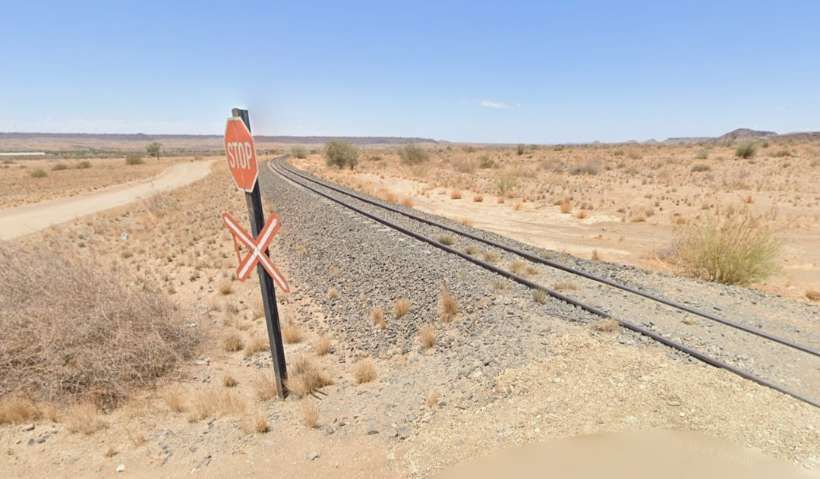
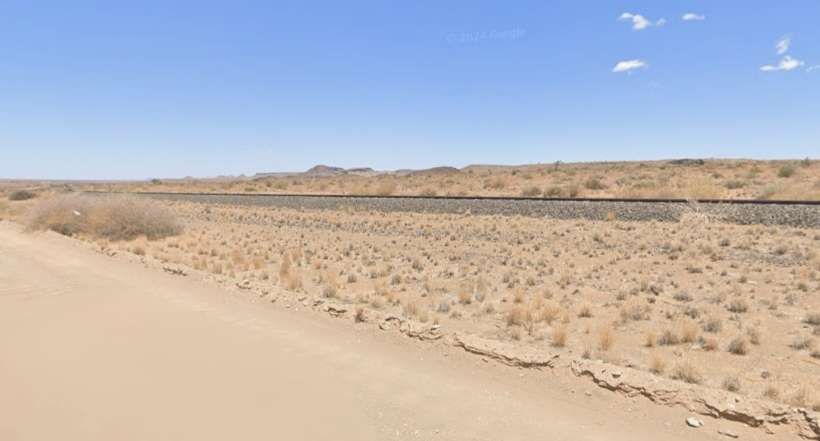
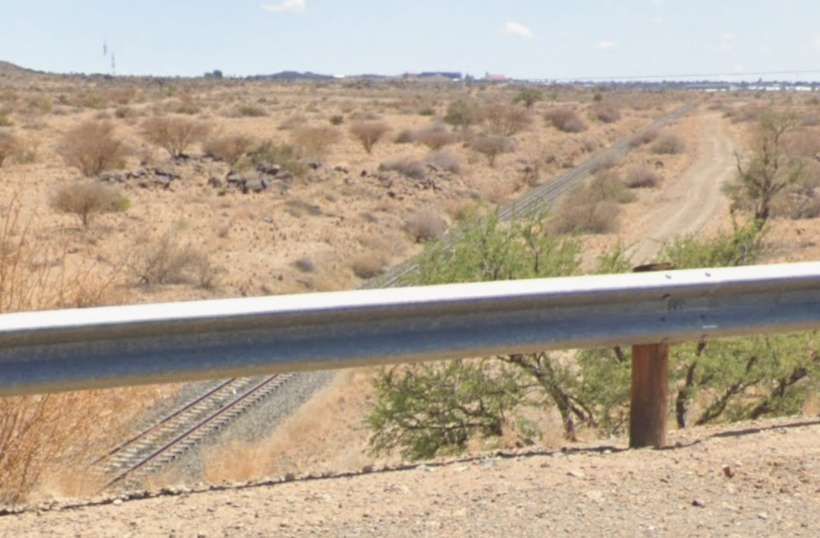
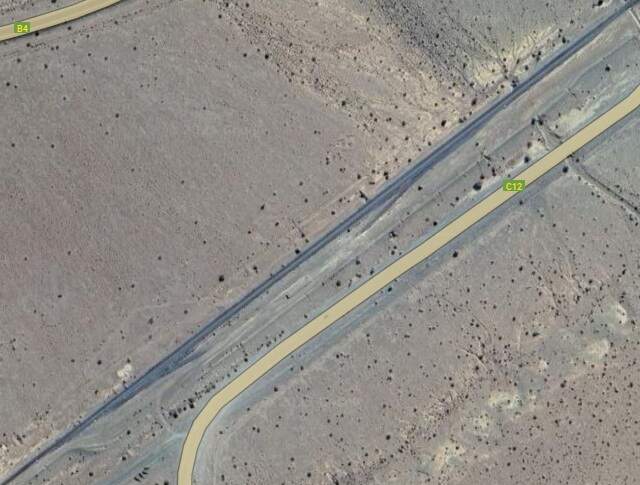
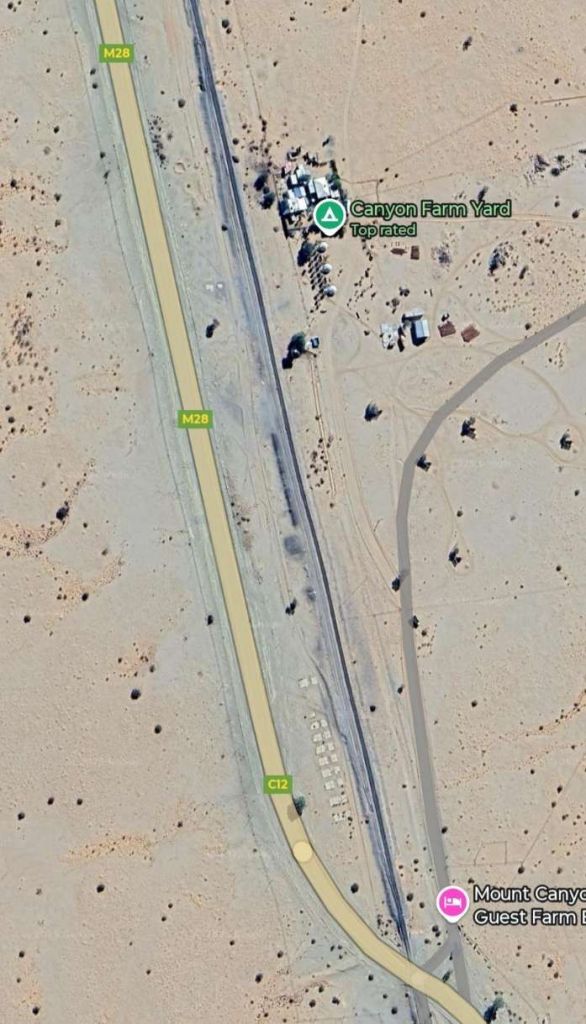
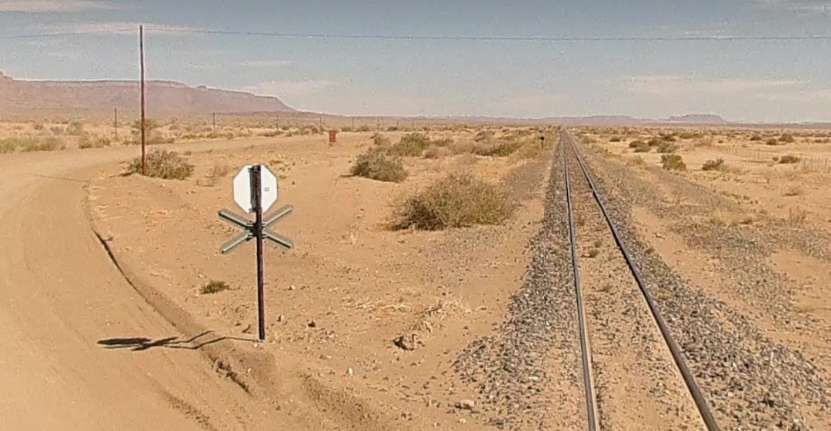
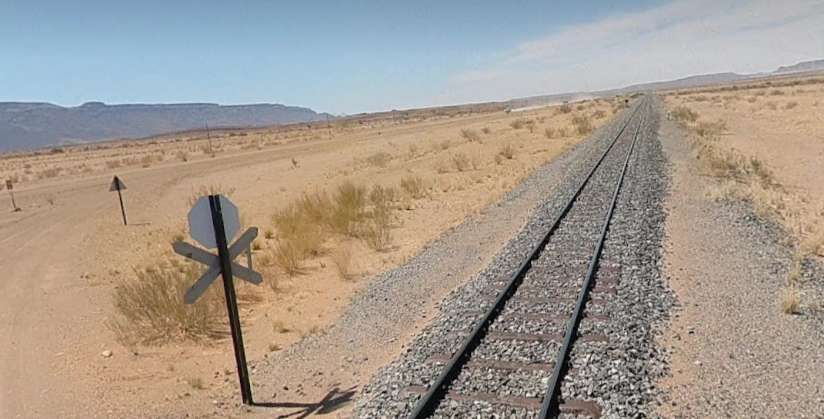
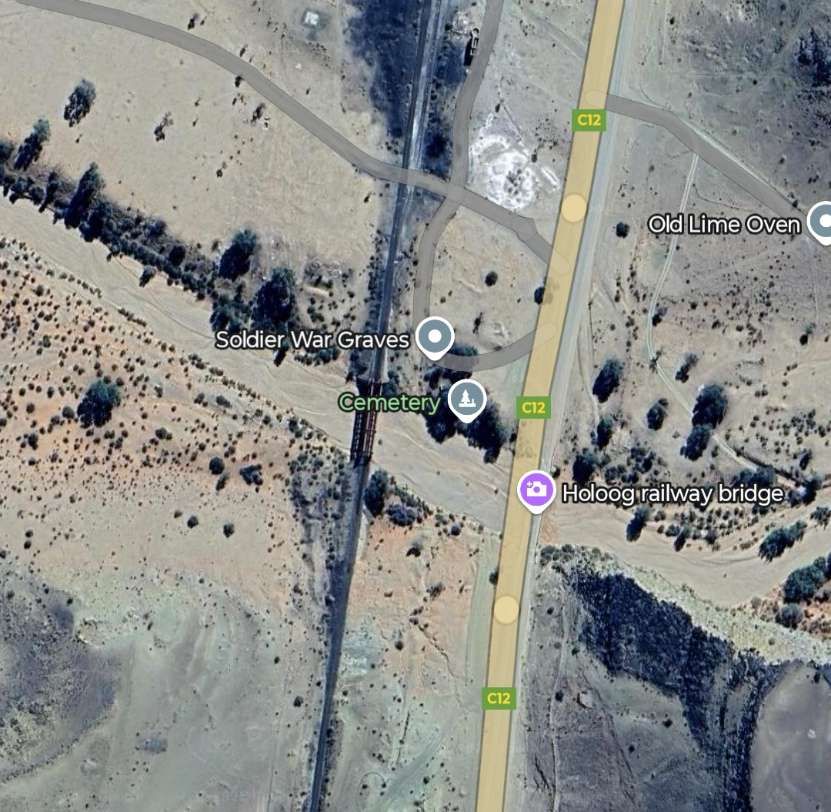
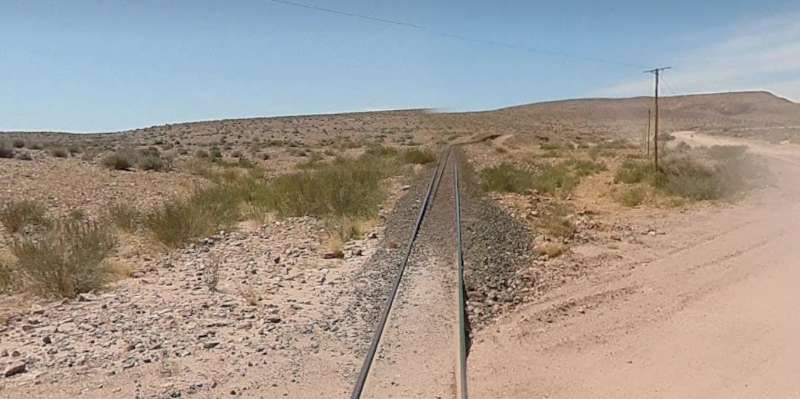
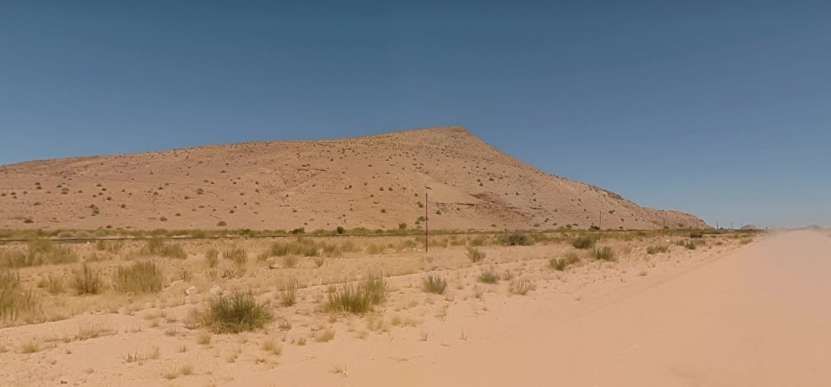
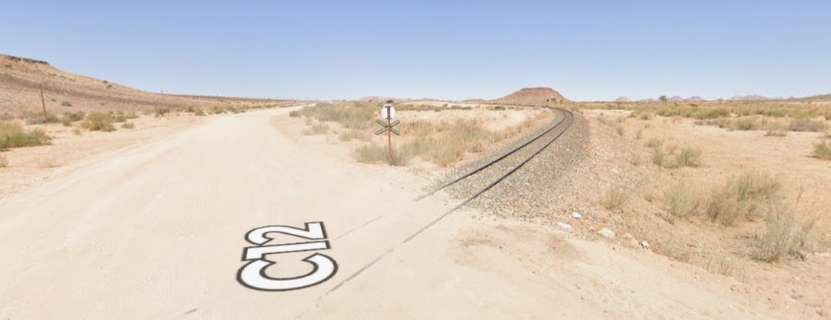
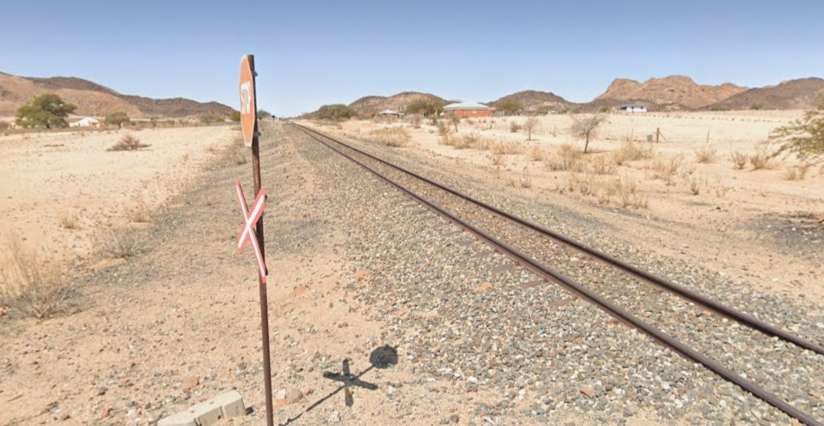
Looking North from the B$ towards Keetmanshoop. [Google Streetview, December 2023]Looking South along the line ahead. [Google Streetview, December 2023]Looking Southwest along the line from an ungated crossing to the South side of the B4. [Google Streetview, December 2023]Looking Southwest along the line from another ungated crossing to the South side of the B4. [Google Streetview, December 2023]The B4 and the railway run parallel, perhaps around 100 metres apart. This photograph shows the line running parallel to the road. Google Streetview, December 2023]Another view looking Southwest, this time from the ungated crossing which takes the C12 dirt road over the line. [Google Streetview, January 2018]The last image showed a passing loop to the Southwest of the C12. This satellite image shows the full length of the loop. [Google Maps, June 2025]
The railway turns to the West as it approaches the junction at Seeheim.
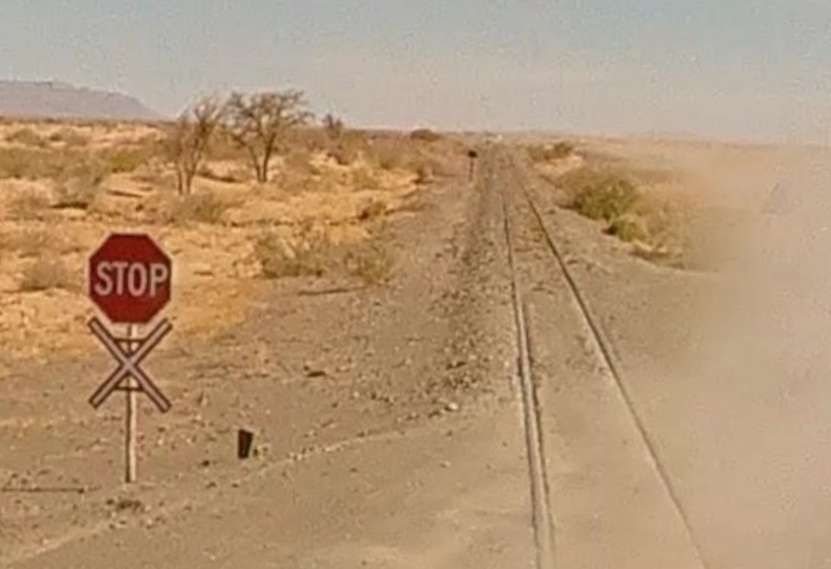
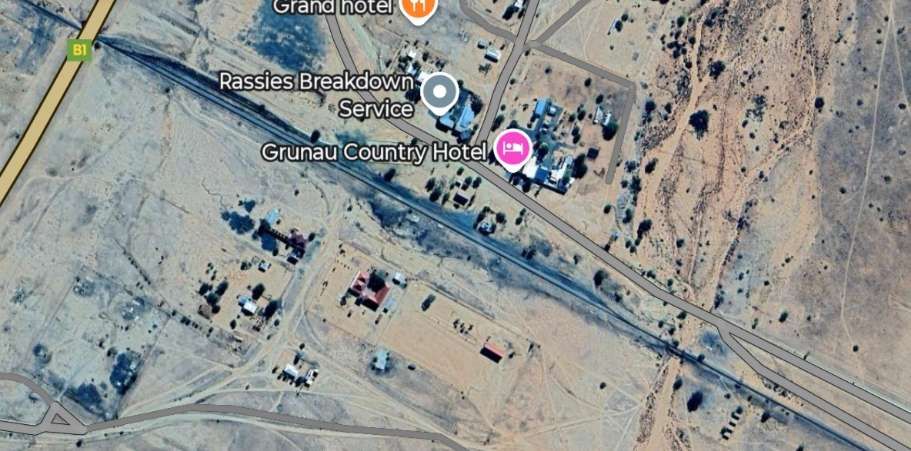
The railway continues to run parallel to the C12/M28 for some considerable distance. Close to Grunau the C12/M28 meets the B1 which crosses the line at 90°.
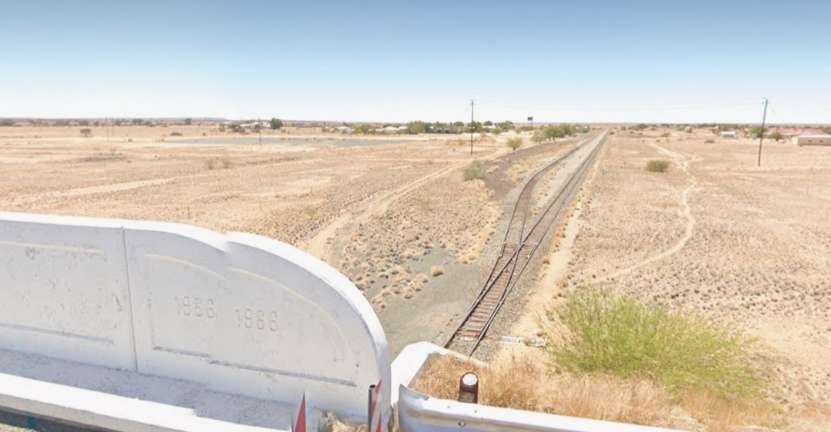
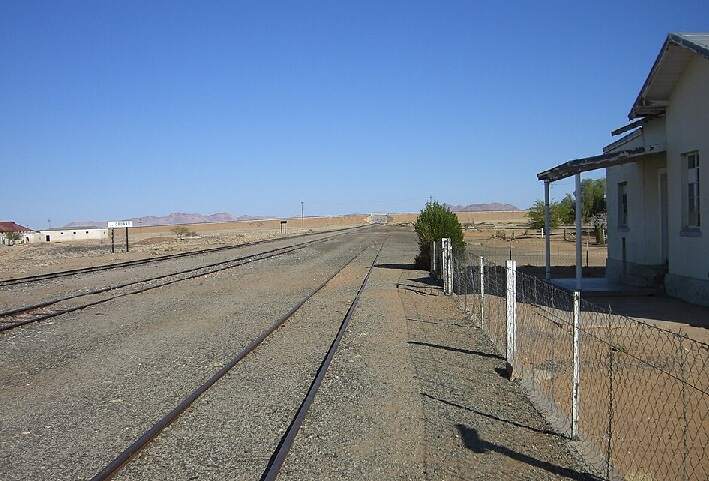
Looking East-southeast from the bridge carrying the B1 over the railway, the passing loop at Grunau is just ahead. [Google Streetview, 2024]The railway station/passing loop at Grunau to the East of the B1. [Google Maps, June 2025]Grunau Railway Station, (c) Pgallert (2010) and licenced for reuse under a Creative Commons Licence (CC BY-SA 3.0). [17]
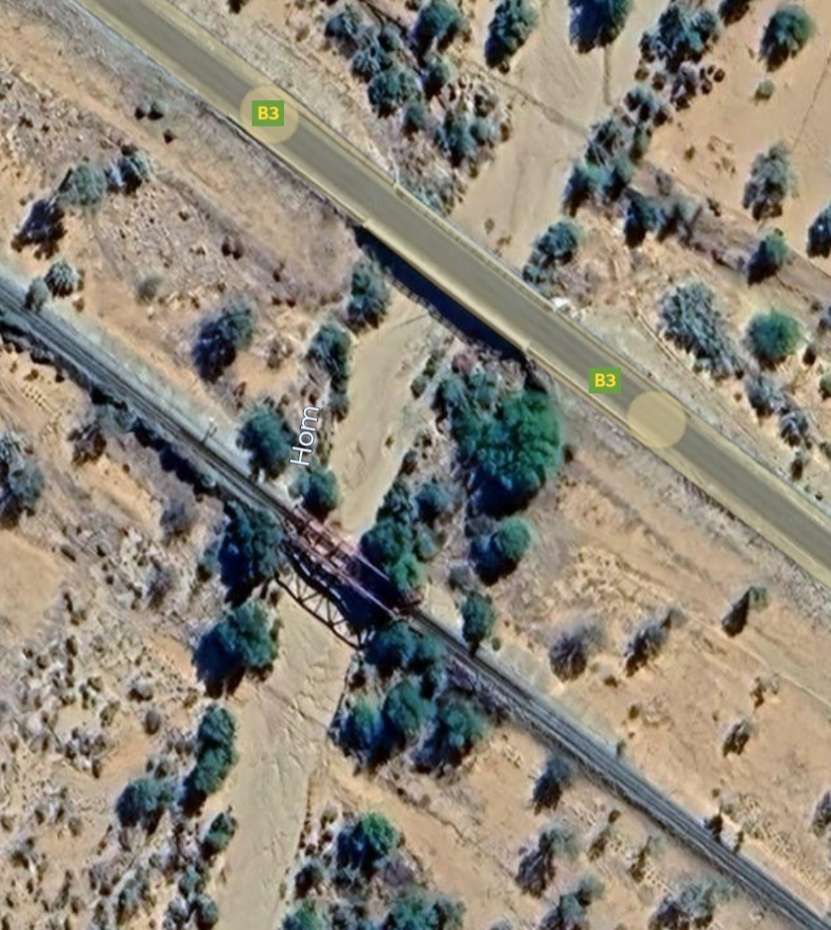
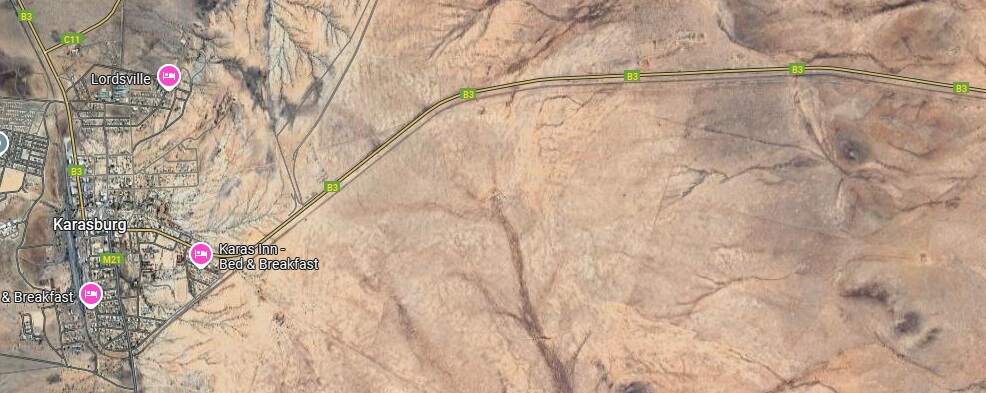
East of Grunau, the line runs parallel to the B3 in a southeasterly direction. …
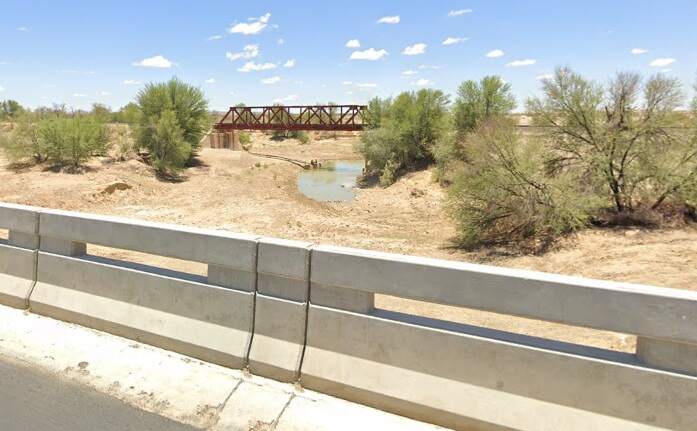
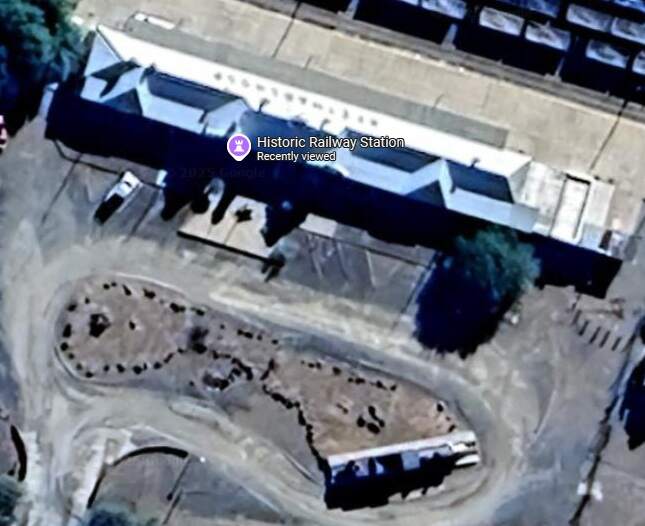
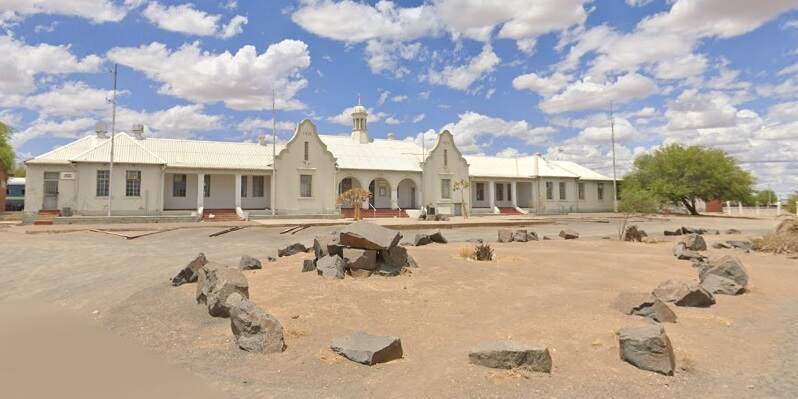
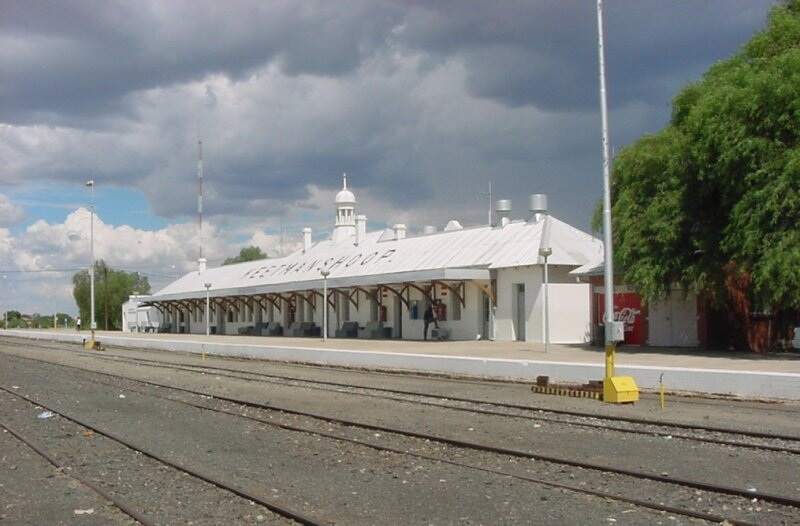
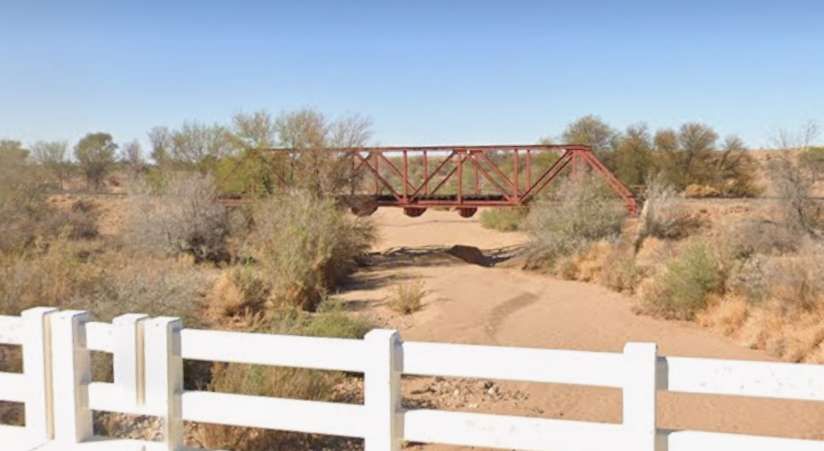
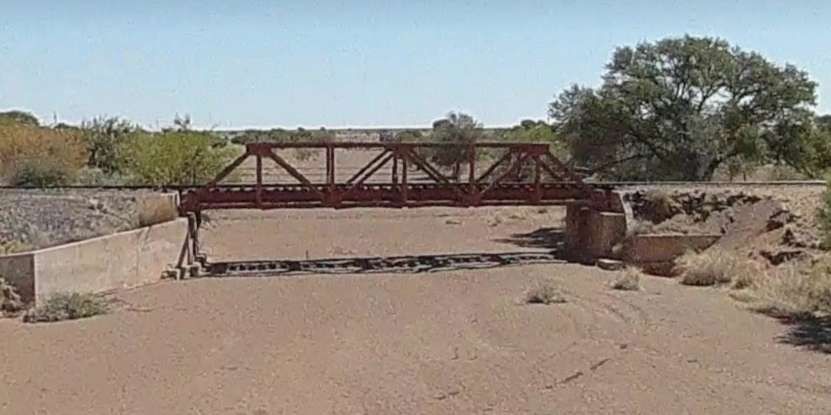
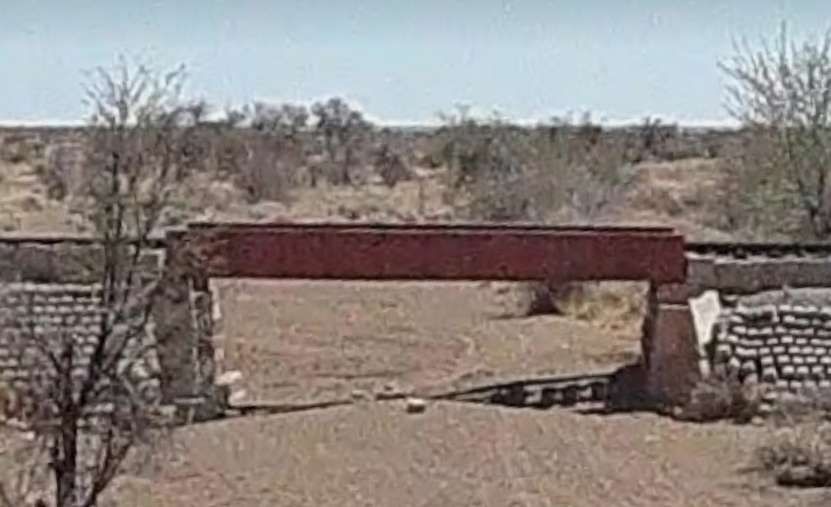
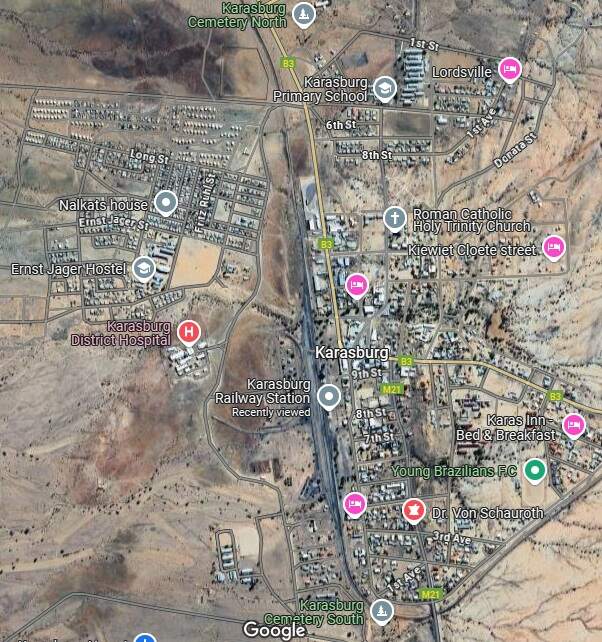
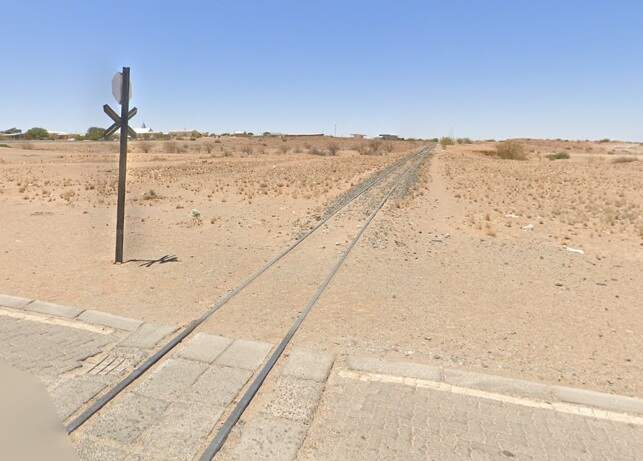
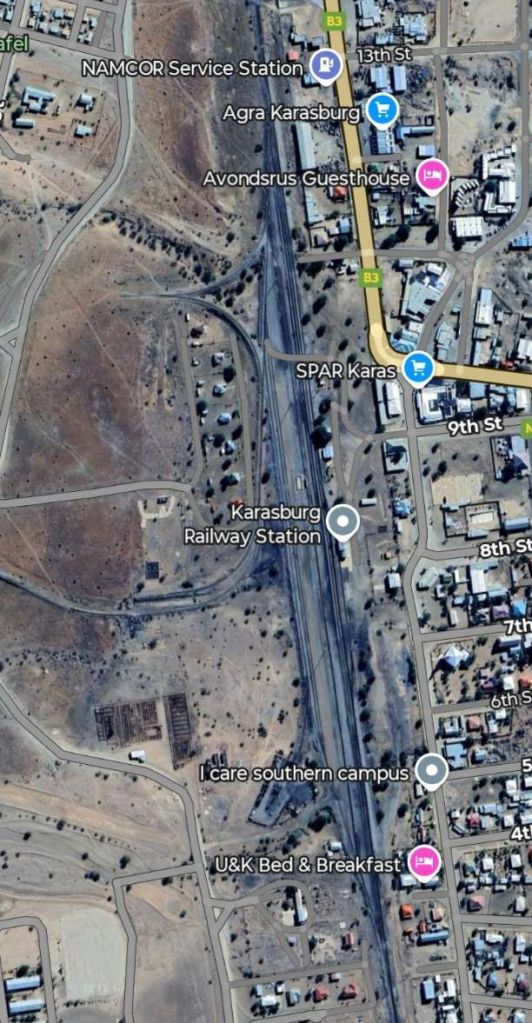
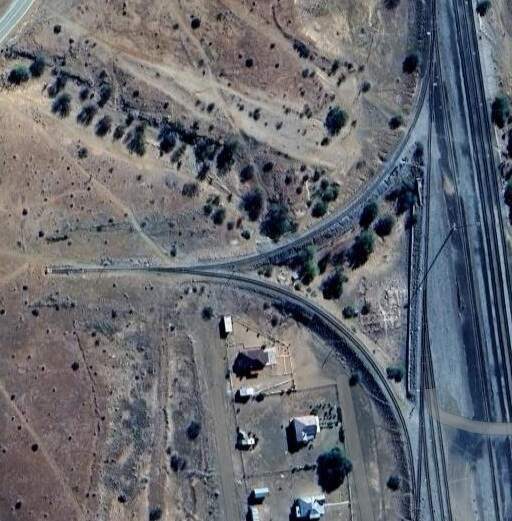
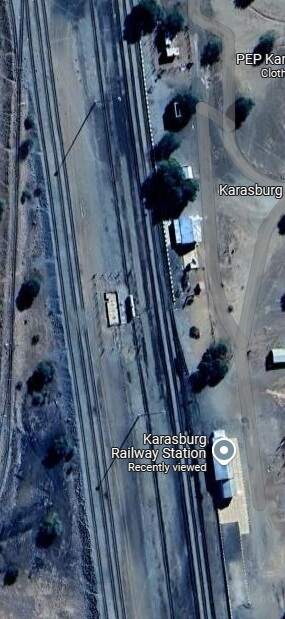
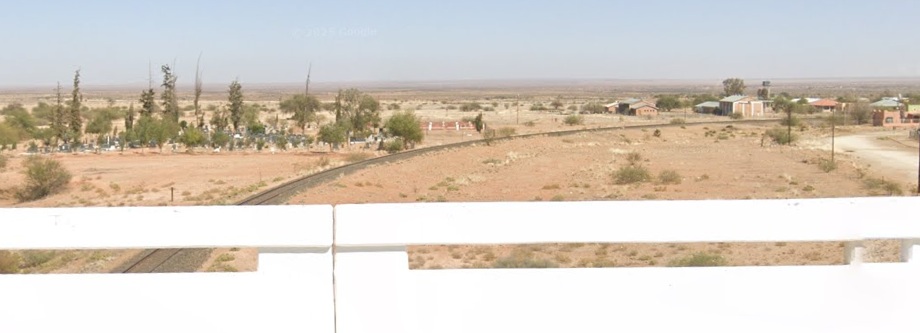
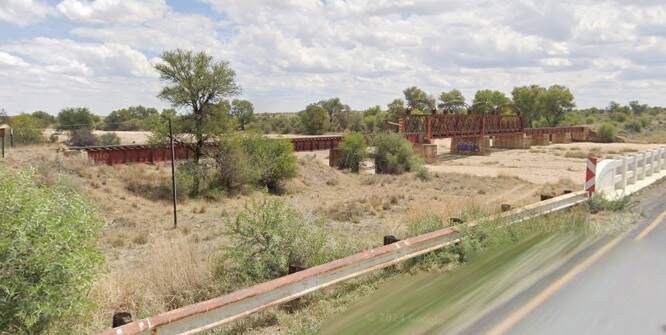
The line bridges the dry watercourse of the Hom River and other watercourses as it head Southeast. [Google Maps, June, 2025]The Hom River Railway Bridge, seen from the B3 Bridge over the same watercourse. [Google Streetview, 2022]Two further structures carry the Railway over dry watercourses on the run into Karasburg. [Google Streetview, The railway enters Karasburg from the North West, curving round to close to a North-South alignment through the railway Station and then sharply curving round to the Northeast as it leaves the town. [Google Maps, June 2025]The view South towards Karasburg Railway Station from the ungated crossing at Hendrik Snyman Street. [Google Streetview, January 2024]Karasburg Railway Station. [Google Maps, June 2025]The turning triangle at Karasburg. [Google Maps, June 2025]
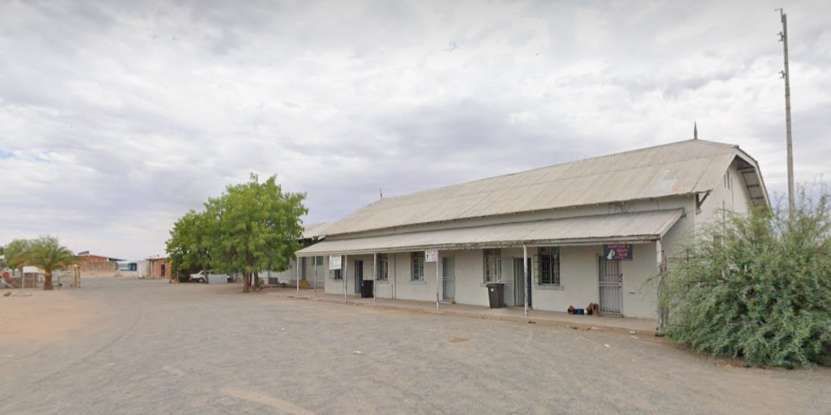
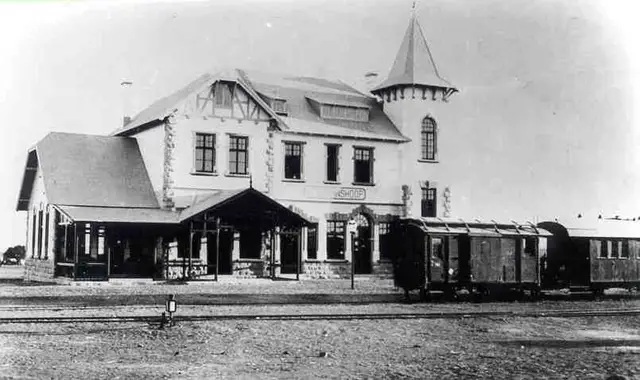
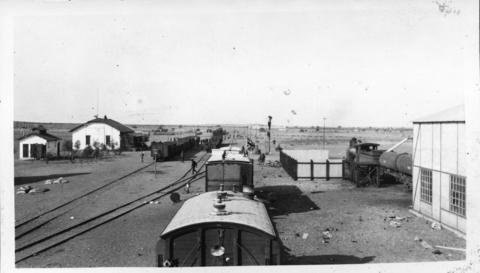
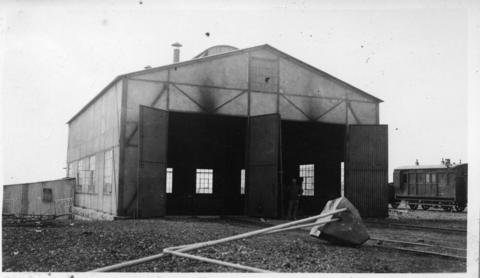
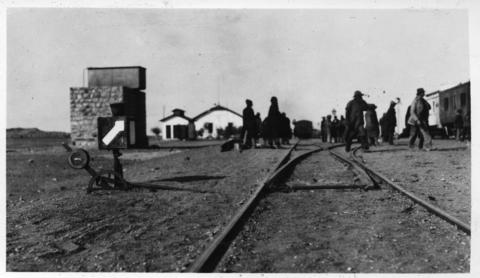
Karasburg Railway Station: passenger platform/building (note the painted edge of the platform) and goods shed. The pictures below come from 1914/1915 and show different aspects of Karasburg Railway Station at that time.
Karasburg Railway Station in 1914/1915. [18]The engine shed in 1914/1915. [18]Pointwork at Karasburg Railway Station. [18]
As we have already noted the line South of Karasburg Station curves sharply to the Northeast and passing under the M21.
Looking West from the bridge carrying the M21 over the railway at Karasburg. [Google Streetview, September 2024]Looking East from the bridge carrying the M21 over the railway at Karasburg. The curve shown on the last image continues as the railway turns to the Northeast. [Google Streetview, September 2024]East of Karasburg the line runs Northeast alongside the B3 before head East on the South side of the road. [Google Maps, June 2025]
For some distance the line runs along the South side of the B3. separating from it close to Nuwefontein. The B3 crosses to the East side of the Ham River, with the railway remaining on the West side of the river, before crossing it close to De Villiersputs. Near Grondorner, the line crosses the D237 and bridges a tributary of the Ham River before running alongside the D237 in a Southeasterly direction. After a number of kilometres, the D237 turns away to the South and the line continues in a generally easterly direction.
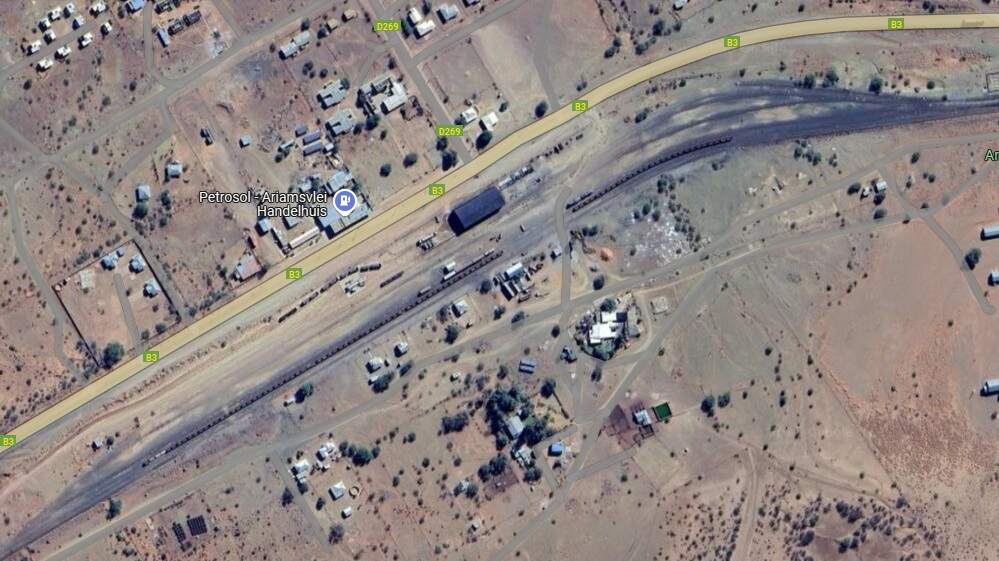
Meandering to the north and then again to the East the line of the B3 once again and runs on its South side towards Ariamsvlei, the border with South Africa and Nakop, beyond the border in South Africa.
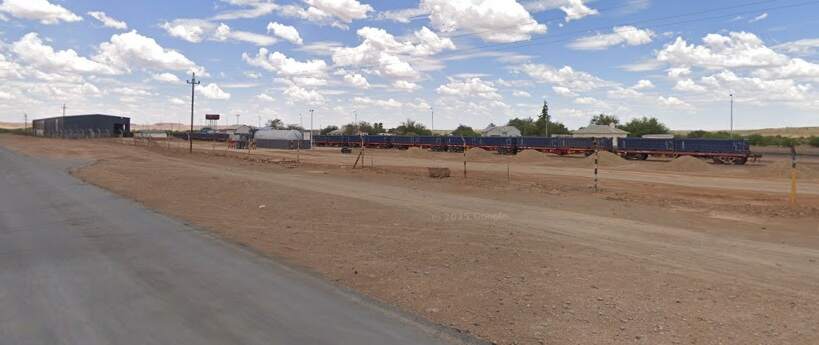
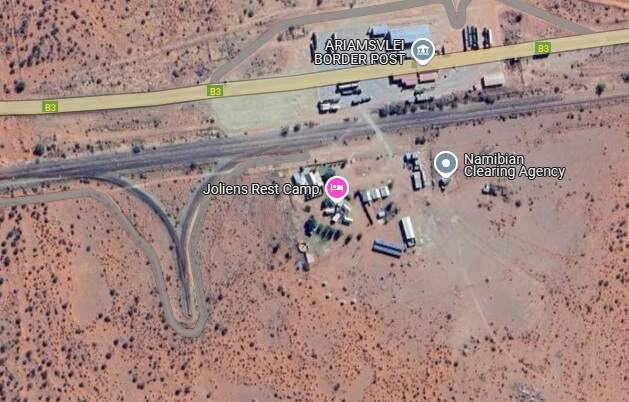
Ariamsvlei Railway Station and marshalling yard. [Google Maps, June 2025]The view East into the site from the B3. Google Streetview, January 2024]Ariamsvlei turning triangle and border post which is just about 10 kilometers from the border with South Africa. Nakop is beyond the border. [Google Maps, June 2025]
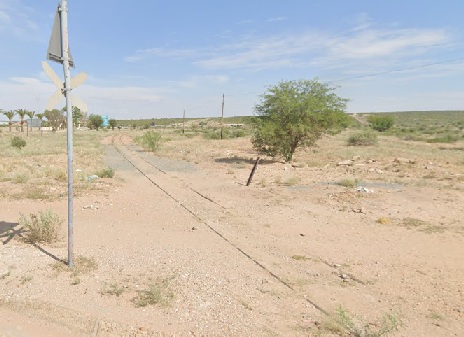
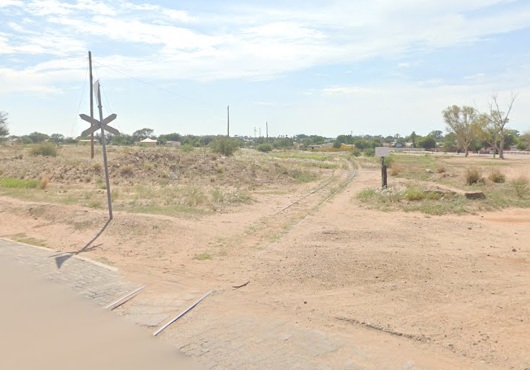
Beyond Ariamsvlei is the border crossing at Nakop and the South African town of Upington.
Windhoek-Gobabis
Next we look at a line which ran East from Winhoek. … The railway line from Windhoek to Gobabis is 228 kilometres (142 miles) long and was completed in 1930. [10]
Windhoek (capital – junction)
Neudamm
Omitara
Gobabis (branch railhead)
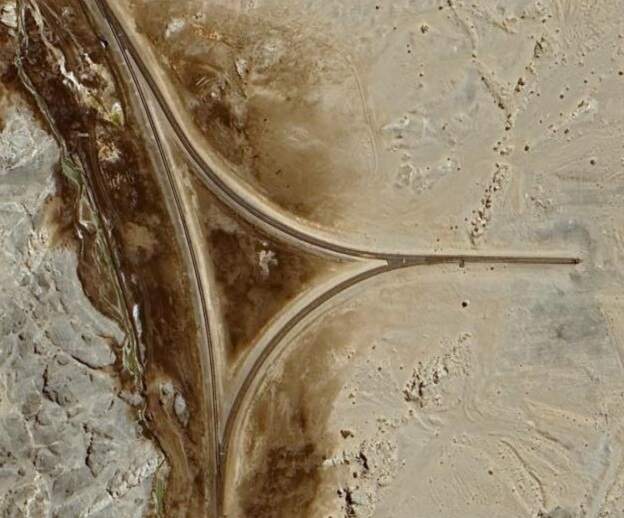
The line to Gobabis leaves the Windhoek-Nakop line at a triangular junction and headed East.
The Windhoek-Gobabis line leaves the line to Nakop in the Southern suburbs of Windhoek. [Google Maps, June 2025]
These next fourteen satellite images show the line wandering back and forth through the Windhoek suburbs. …
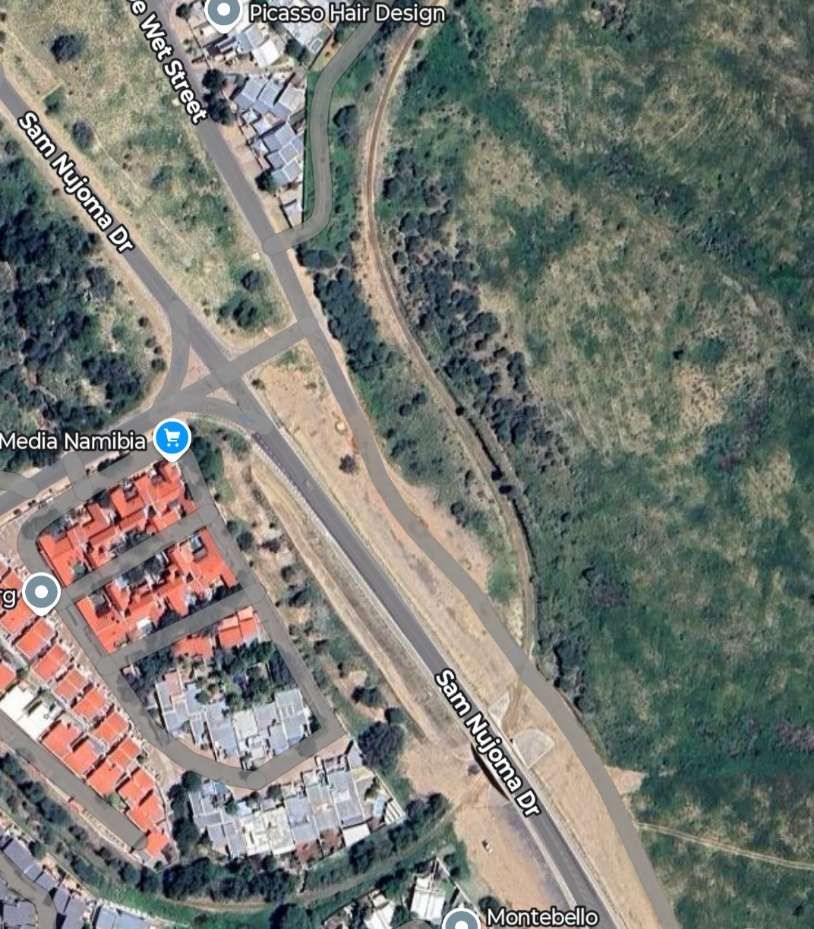
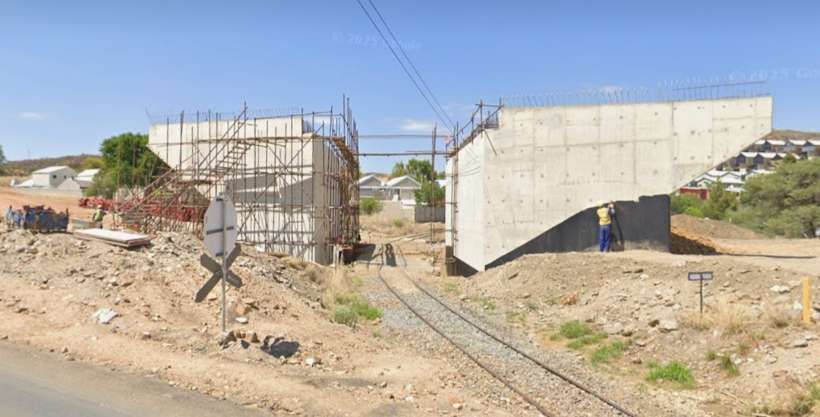
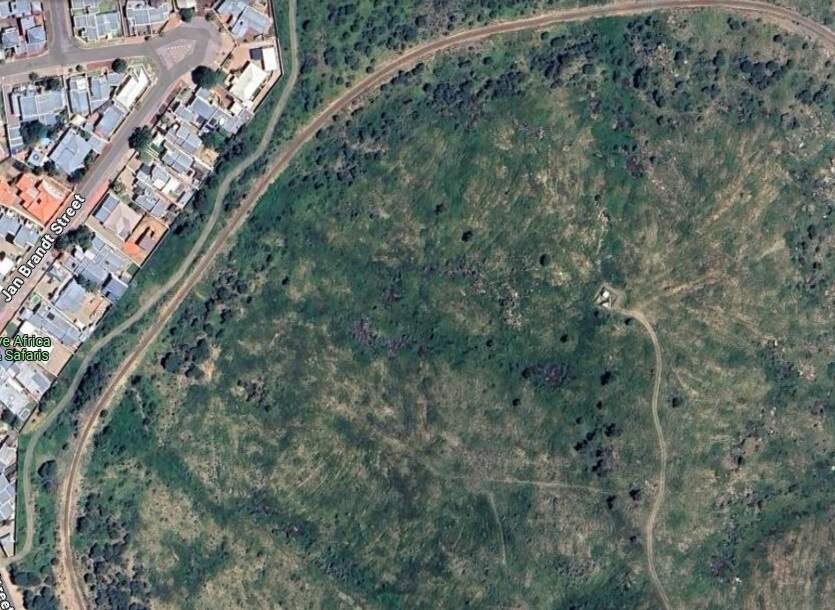
These fourteen extracts from Google’s satellite imagery take the Gobabis line to a point to the East of Sam Nujoma Drive. [Google Maps, June 2025]Looking South-southwest from Andries de Wet Street along the line of the railway towards Windhoek Railway Station, showing the substantial bridge under construction in 2024. [Google Streetview, 2024]
The journey beyond Andries de Wet Street continues, the next satellite images cover larger areas than the ones above. ….
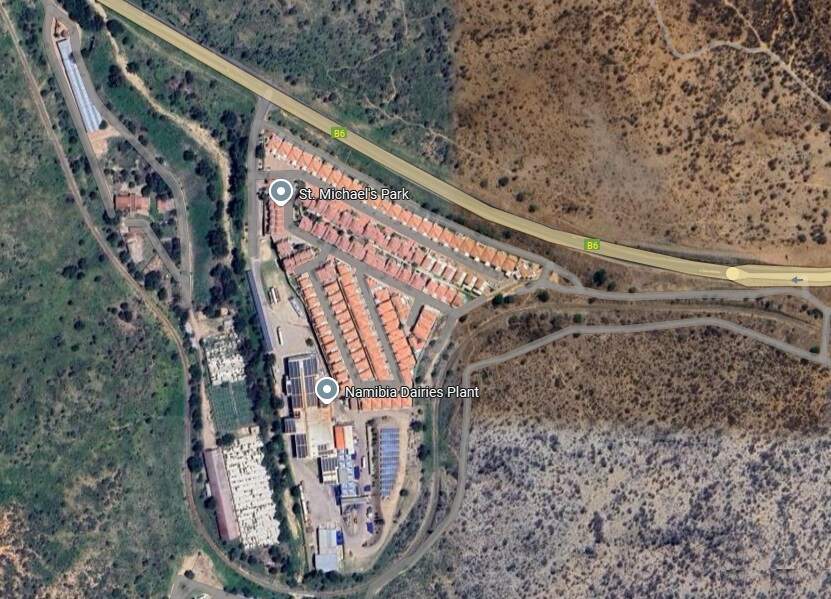
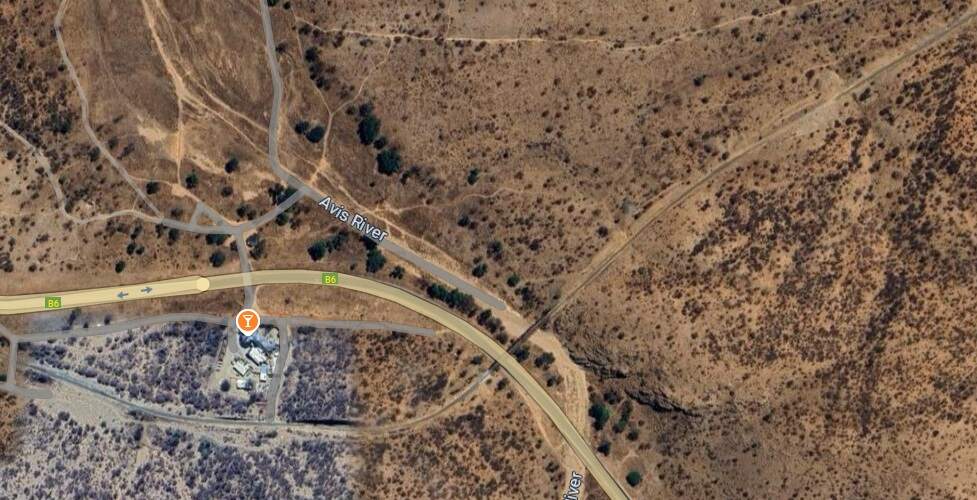
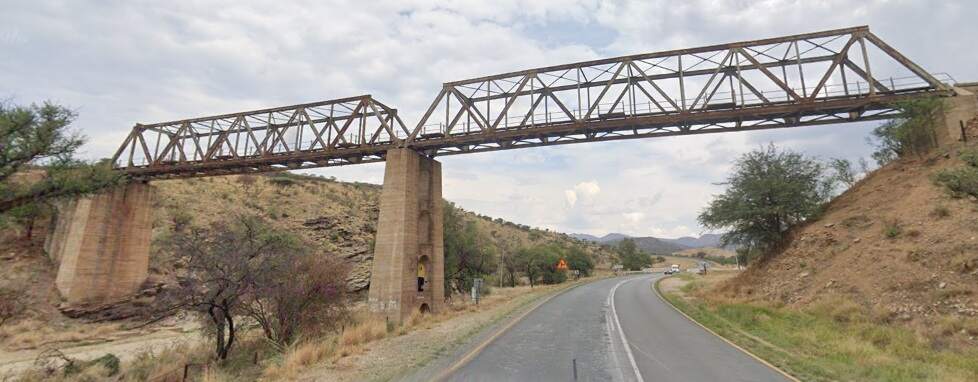
This sequence of three images takes the line out into open country beyond the Avis River. [Google Maps, June 2025][The truss girder bridge which carries the railway over the B6 and the channel of the Avis River. [Google Streetview, January 2024]
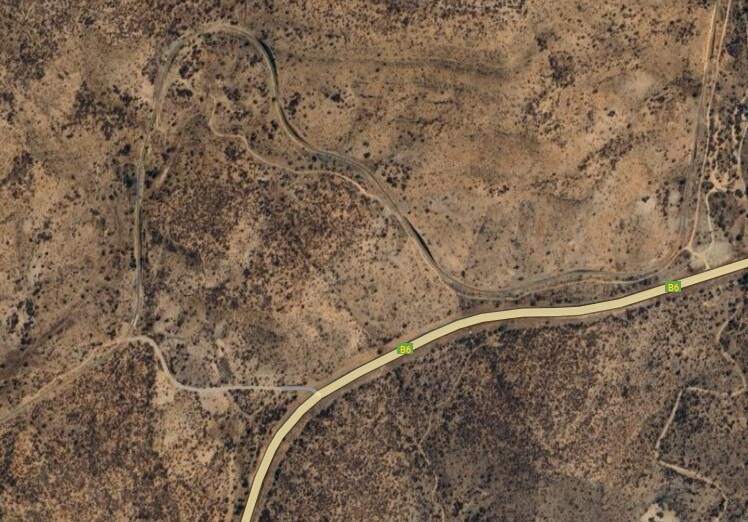
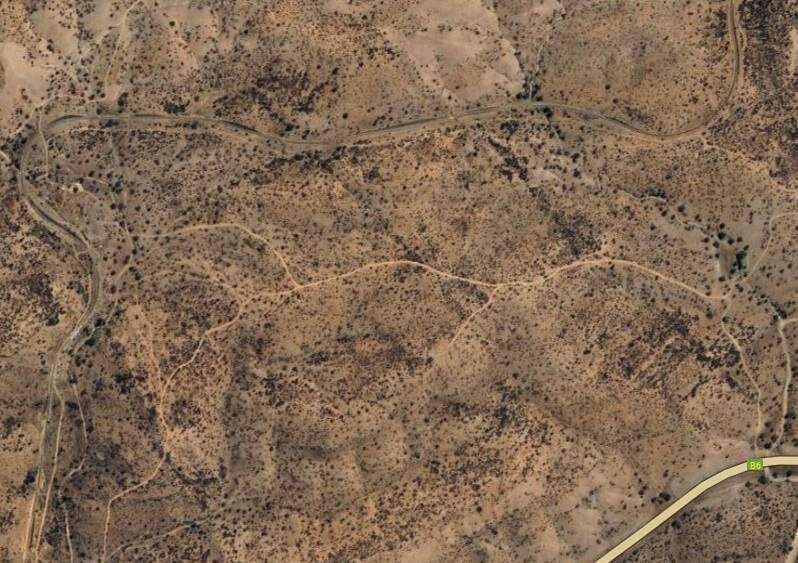
The line continues in a generally easterly direction, although the contours of the terrain mean that the railway has to meander back and forth to find the most advantageous route. These next extracts from Google’s satellite imagery show the way that the line picks its way through the landscape. …
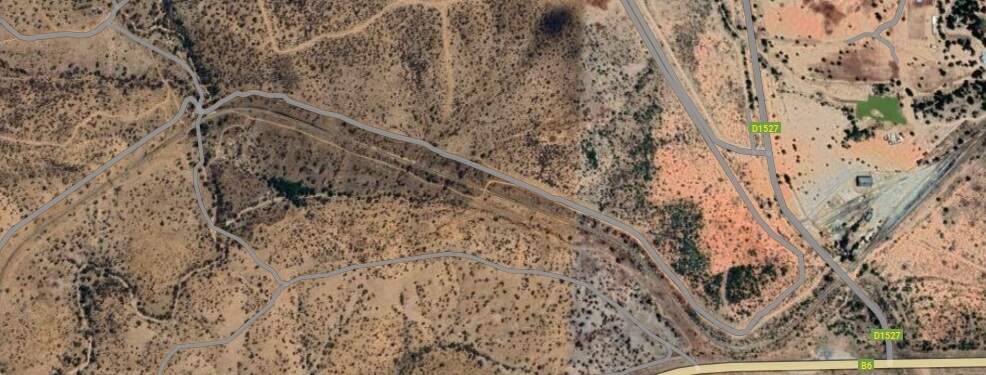
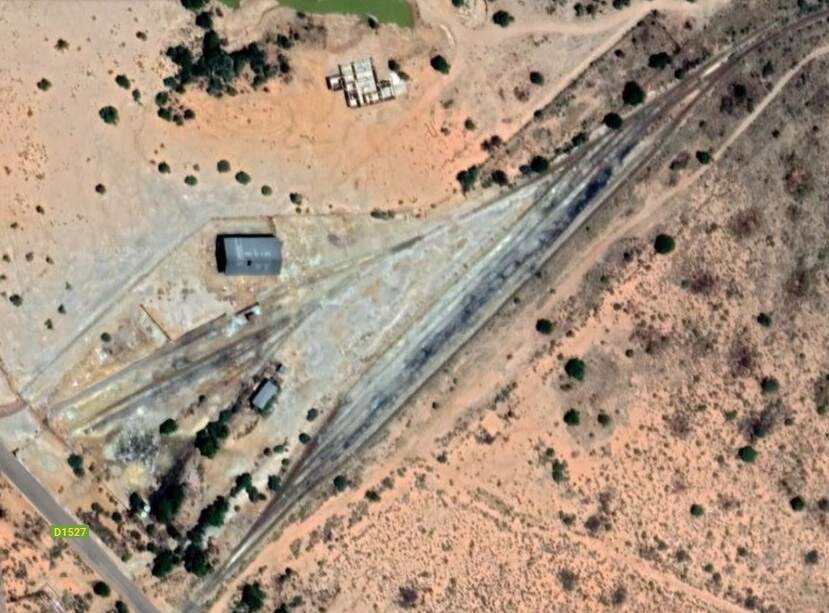
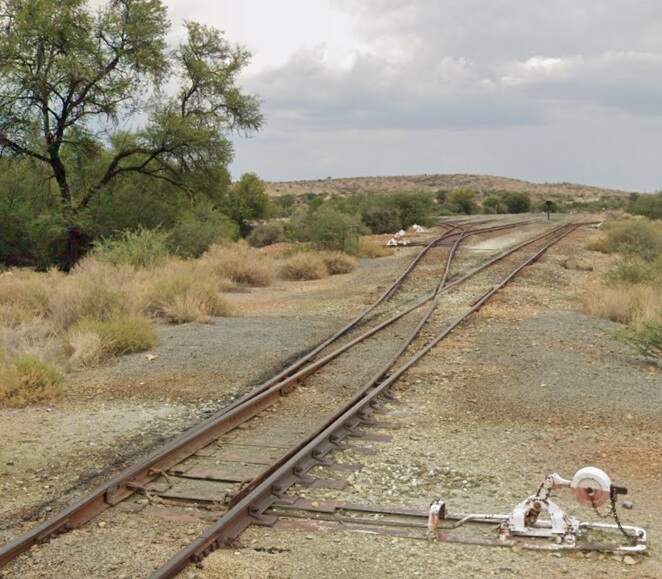
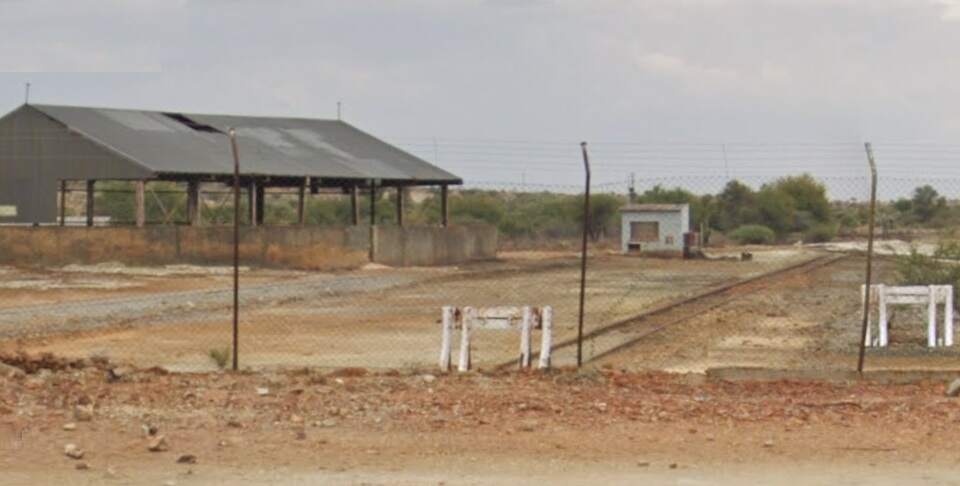
This sequence of four extracts from Google’s satellite imagery takes the line as far as Finkenstein. [Google Maps, June 2025]The railway station close to Finkenstein Estate/Village. [Google Maps, June 2025]The view Southwest from the D1527 along the railway towards Windhoek. Google Streetview, January 2024]Looking Northeast into the railway station site from the D1527. [Google Streetview, January 2025]A little further to the Northwest on the D1527, this is the view looking Northeast into the goods yard at the station. [Google Streetview, January 2024]
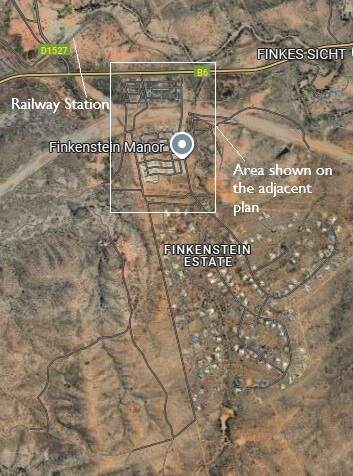
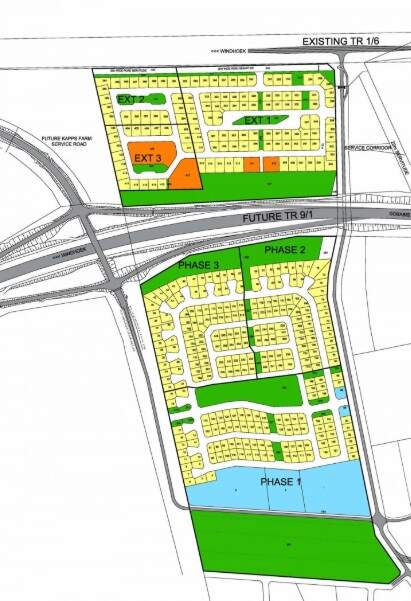
These two images indicate the area of the Finkenstein Estate/Village and current proposals for new housing and a new major road.The location of the railway Station can be seen at the top-left of the satellite image. The lighter swathe of ground curving across the top half of the satellite image is the construction site for the new road. [5][Google Maps, June 2025]
The line continues East from Finkenstein. At the right side of this satellite image the railway passes under the B6. [Google Maps, June 2025]Looking Northwest from the B6 along the line towards Finkenstein Station and Windhoek. [Google Streetview, January 2024]Looking Southeast from the B6 the line is curving to the South. The older road bridge is visible alongside the B6. Not too far ahead, out of shot are the construction works for the road that will replace the B6 as a main artery. [Google Streetview, January 2024.
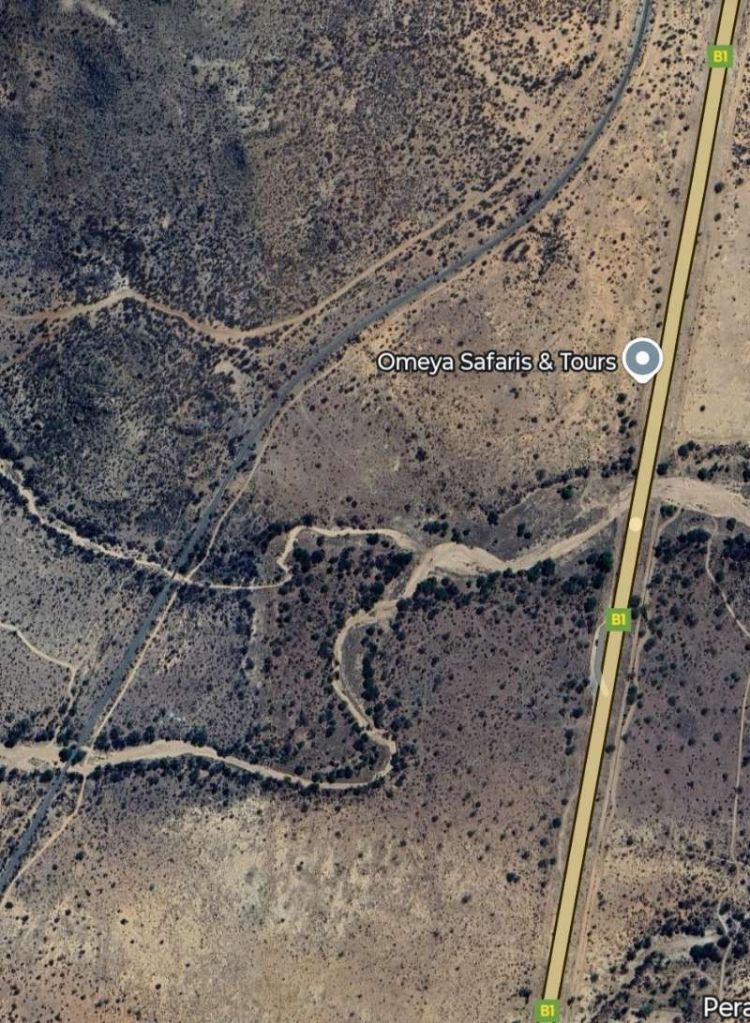
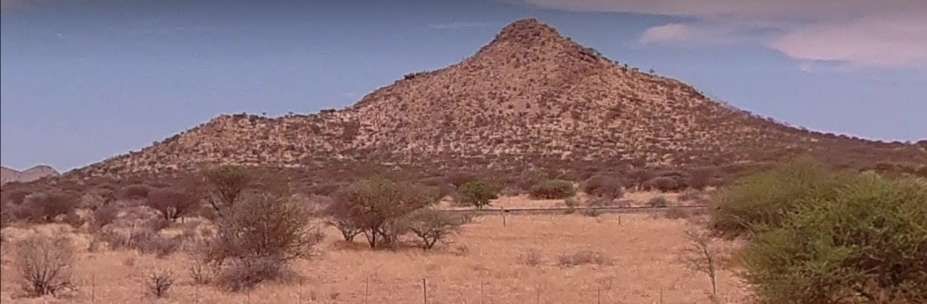
Almost immediately after passing under the B6, the line begins to swing round from a Southwestern trajectory to the Northeast and then the East before passingunder the B6 again.
Looking Northeast from the bridge carrying the B6 over the line. The line can be seen curving round to the East. [Google Streetview, January 2018]
The line heads generally in an easterly direction and after some kilometeres runs alongside the Seeis River. …
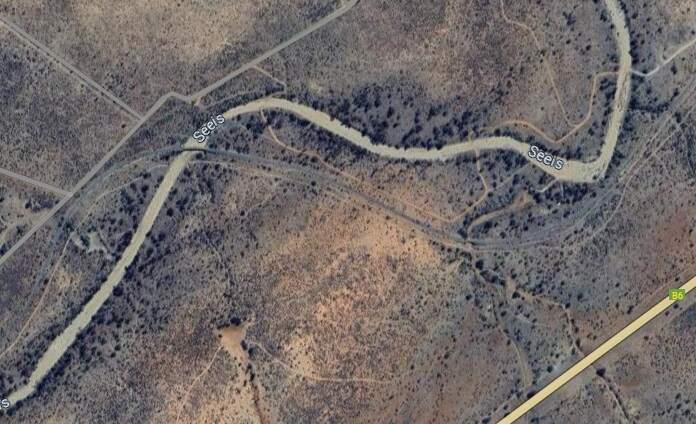
The railway bridges the Seeis River and then runs alongside both the river and the B6. [Google Maps, June 2025]
Stocking close to the South bank of the Seeis River, the line passes to the North of Sonnleiton Village before rejoining the B6 close to Windhoek Airport, and passing to the South of the airport and then running immediately alongside the B6.
The railway seen looking North from the B6. [Google Streetview, January 2024]
Both road and rail pass just to the North of the settlement of Seeis where an old railway station was sited, and then over the River Seeis.
The Seeis River Railway Bridge seen looking North from the B6. [Google Streetview, January 2024]
The video below shows the settlement, its station and its bridge. ….
YouTube video of Seeis and its station and railway bridge. [19]
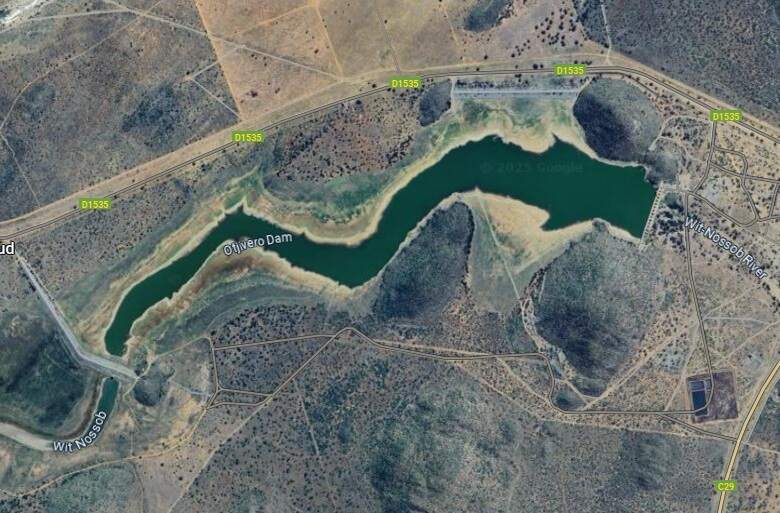
Beyond Seeis the railway continues alongside the B6 in a Northeasterly direction. The railway then turns further Northwest and leaves the B6, finding its own path towards Gobabis. It crossed the D1535 at an ungated crossing. The D1535 then runs alongside the railway heading Northeast before crossing the railway again at another ungated crossing. Both road and railway cross the Wit Nossob River and run along its North bank, crossing tributaries enroute before passing to the North of the Otjivero Reservoir and Dam.
The Otjivero Reservoir and Dam. The railway runs on the North side of the D1535. [Google Maps, June 2025]
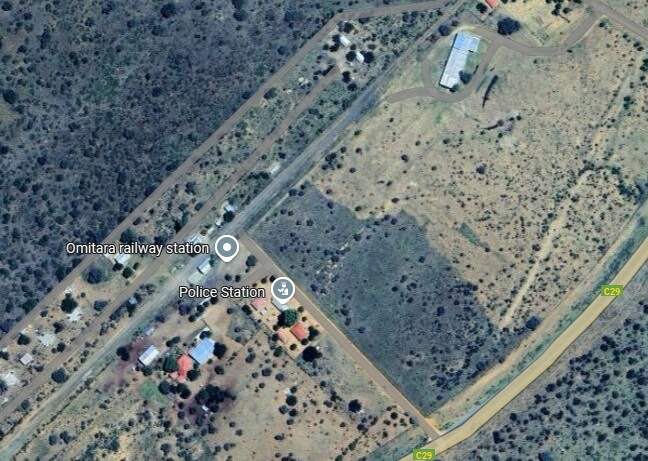
Beyond the Dam, the railway follows the C29 heading East. it pulls away a little to the North to create room for Omitara Railway Station.
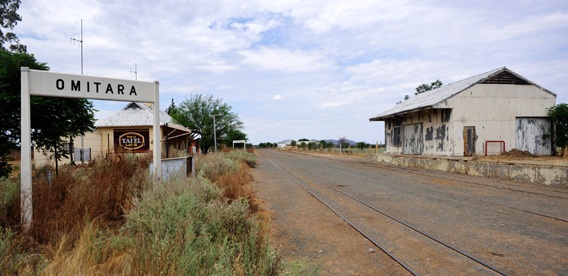
Omitara Railway Station. [Google Maps, June 2025]Omitara Railway Station, (c) Arche-foto, Burkhart Rüchel, and licenced for reuse under a Creative Commons Licence, (CC BY-SA 3.0). [20]
Northeast of the station the railway passes under the C29, continuing to run East-northeast and then East, and then Southeast, before returning to run alongside the B6 once again. Following the line on satellite images has become increasingly difficult.
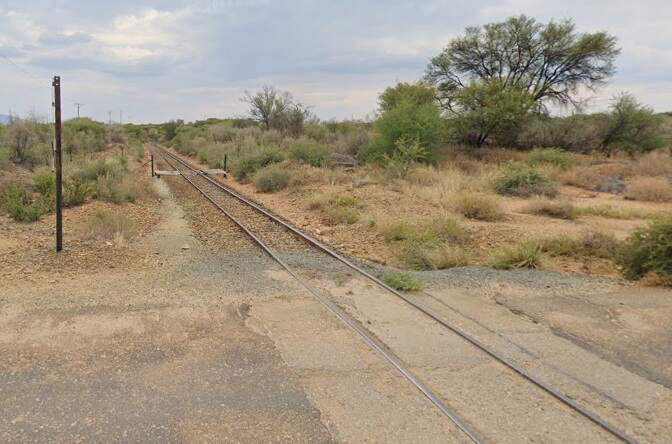
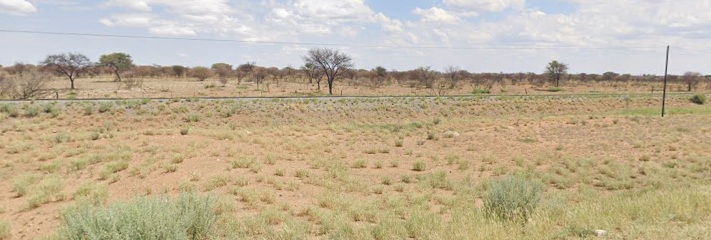
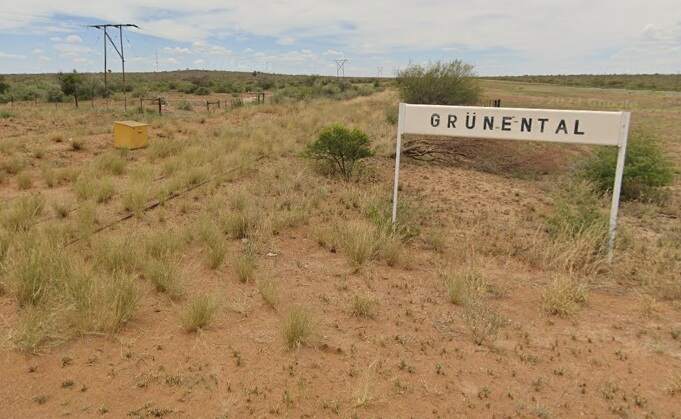
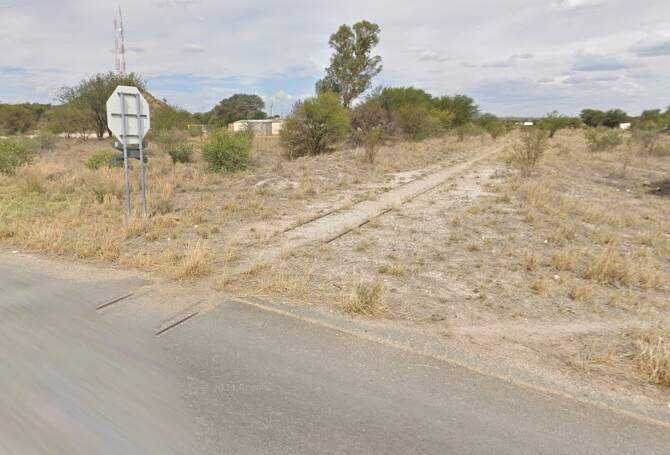
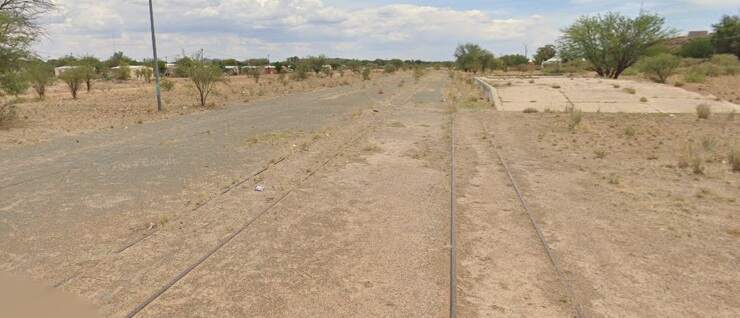
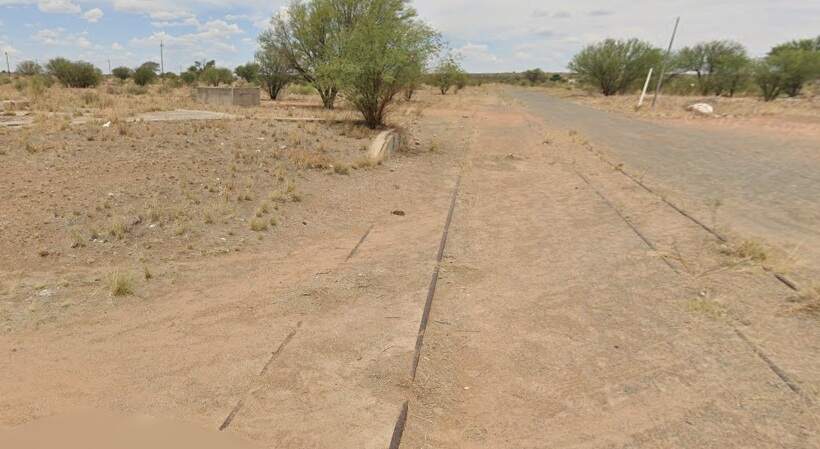
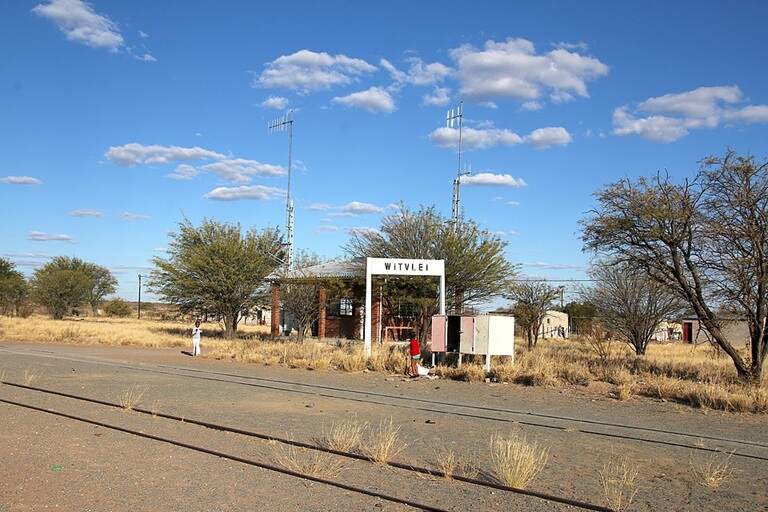
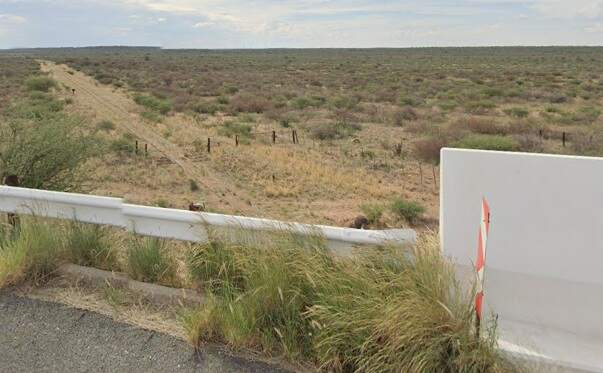
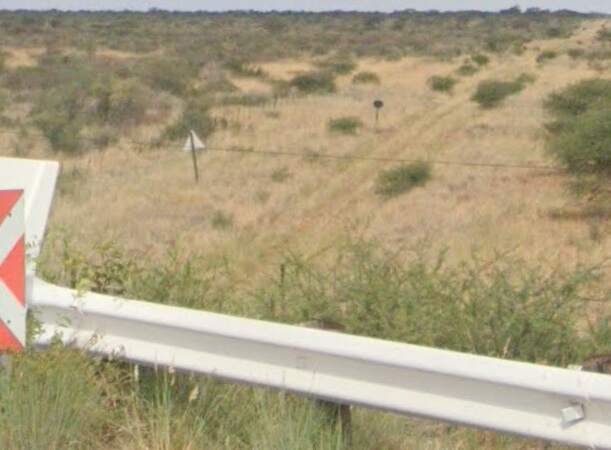
This photograph looks along the line to the East from the ungated crossing over the D1658 at Grunental. As can be seen the line is significantly over grown by grasses. [Google Maps, June 2025]Looking East at the ungated crossing over the D1663, the line seems to be disappearing into the sand. {Google Streetview, January 2024]Looking West at the old station site at Witvlei. [Google Streetview, January 2024]Looking East at the old station site at Witvlei. [Google Streetview, January 2024]Witvlei Railway Station in 2018, (c) Hp.Baumeler and licenced for reuse under a Creative Commons licence, (CC BY-SA 4.0). [21]Looking back West along the apparently little used line towards Windhoek from the bridge carrying the B6 across the line. [Google Streetview, January 2024]Looking East from the same bridge, the line is almost indistinguishable from the surrounding grassland. [Google Streetview, January 2024]
The railway continues to the East, with the B6 running parallel to it on the North side.
Looking East along the line at an ungated crossing on a minor road.The B6 can be seen over to the left. [Google Streetview, January 2024]
The line begins to turn to the Southeast before crossing the Black Nossob River. …
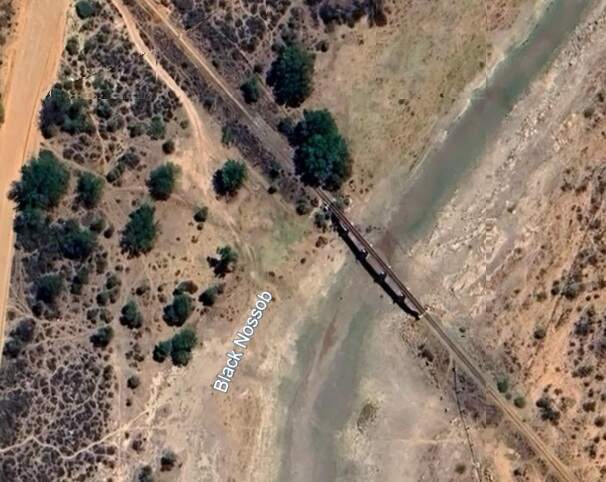
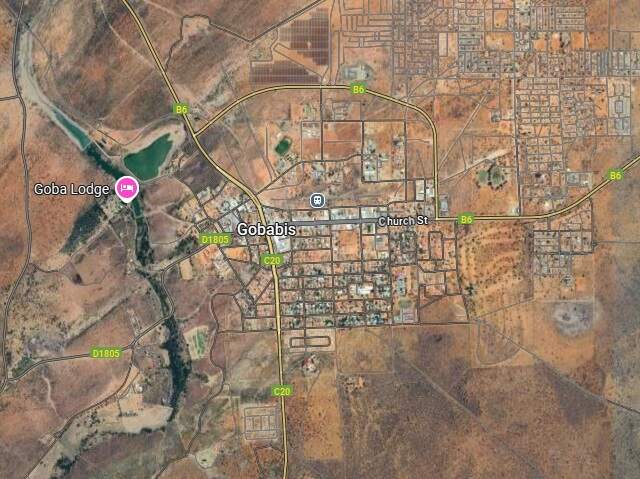
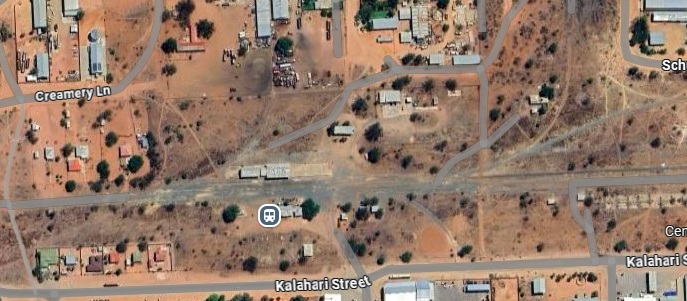
Looking Southeast from the C30 along the line towards the Black Nossob River. [Google Streetview, January 2024]The railway bridge over the Black Nossob River close to Gobabis. [Google Maps, June 2025]Gobabis: the Black Nossob River, Reservoir and Dams are on the left side of the satellite image. The railway bridge over the Black Nossob can just be picked out in the extreme top left of the image. The railway flanks the reservoir and lake before passing under the B6 and then, after the B6 has turned through 90, under the B6 (Gobabis Bypass).Looking West from the B6 bridgeLooking East from the B6 BridgeLooking Northwest from the Gobabis Bypass (B6).Looking Southeast from the Gobabis Bypass (B6).Looking Northwest from Heroes Lane/Creamery Lane, GobabisLooking Southeast from Heroes Lane/Creamery Lane, Gobabis
The 6 images immediately above show the railways approach to Gobabis Railway Station.
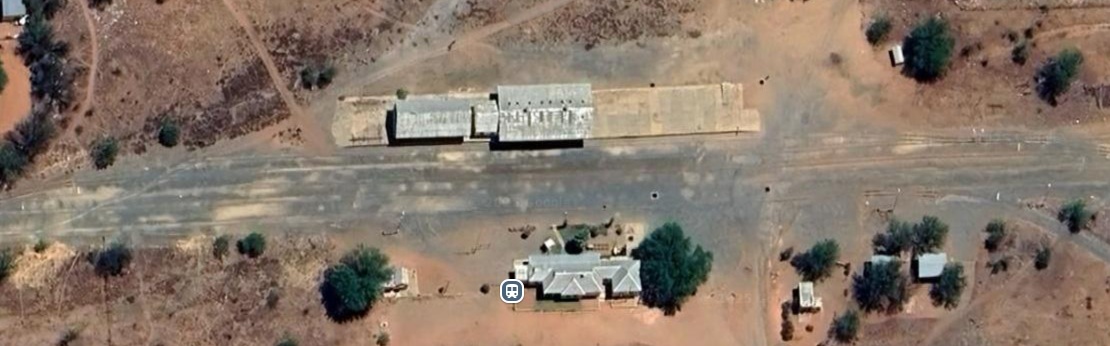
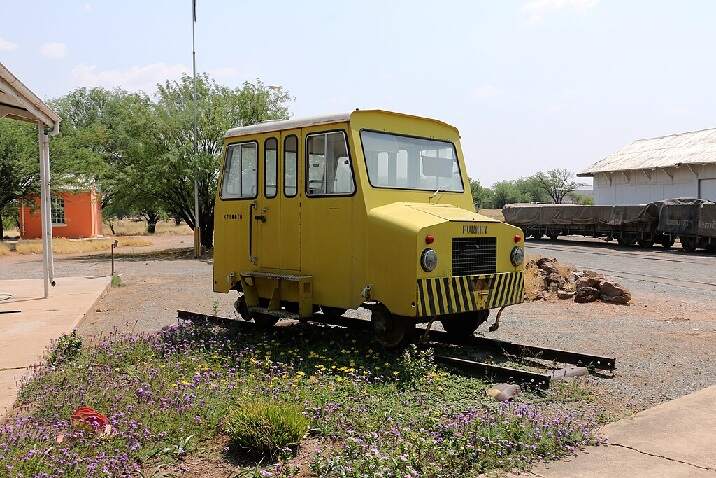
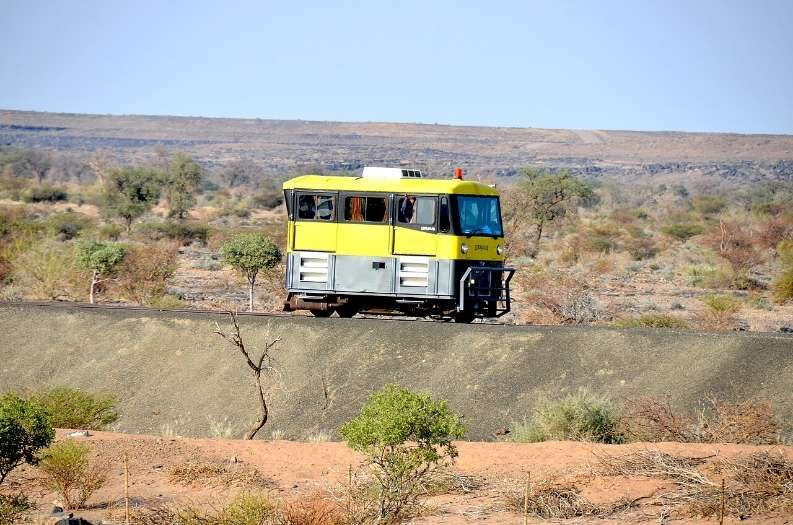
Gobabis Railway Station. Its turning triangle can be seen at the right side of this satellite image. A series of sidings are the end of the line, these are just Southeast of the turning triangle. [Google Maps, June 2025]Gobabis Railway Station Buildings. [Google Maps, June 2025]Gobabis Railway Station Building, (c) Hp. Baumeler and licenced for reuse under a Creative Commons Licence (CC BY-SA 4.0). [22]Plinthed at Gobabis Railway station is this 5 man railway inspection car (c) Hp. Baumeler and licenced for reuse under a Creative Commons Licence (CC BY-SA 4.0). [23]Also plinthed at Gobabis Railway station is this small flatbed wagon, (c) Hp. Baumeler and licenced for reuse under a Creative Commons Licence (CC BY-SA 4.0). [24]
Gobabis is the end of the line. There are plans on the drawing board for a Trans-Kalahari Railway Line which would extend East from the current livestock railhead at Gobabis and may well be electrified. [25][26][27]
Seeheim-Lüderitz
The final length of line to be looked at is that from Seeheim to Lüderitz. The railway line from Seeheim to Lüderitz is 318 kilometres (198 miles) long. The connection between Lüderitz and Aus was completed in 1906, and the extension to Seeheim was completed in 1908. [1] The service between Aus and Lüderitz was decommissioned in 1997, due to poor track condition, and there is no regular passenger service between Seeheim and Aus. … The line to Lüderitz was rehabilitated in the 2010s and was scheduled for reopening in 2017. Test trains ran to Lüderitz in 2014 and Lüderitz Harbour in 2018. [2]
We begin this journey from Seeheim Railway Junction. …
Seeheim Railway Junction. [Google Maps, June 2025]
Just a short distance Northwest along the line from the junction is Seeheim Railway Station.
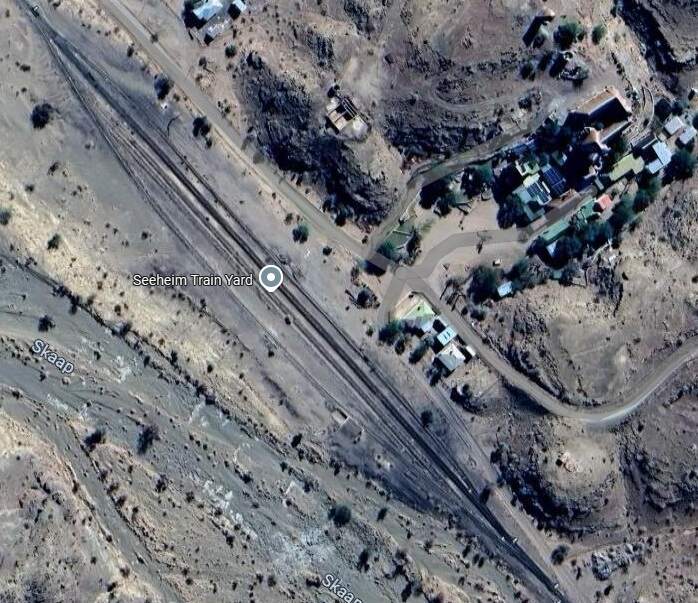
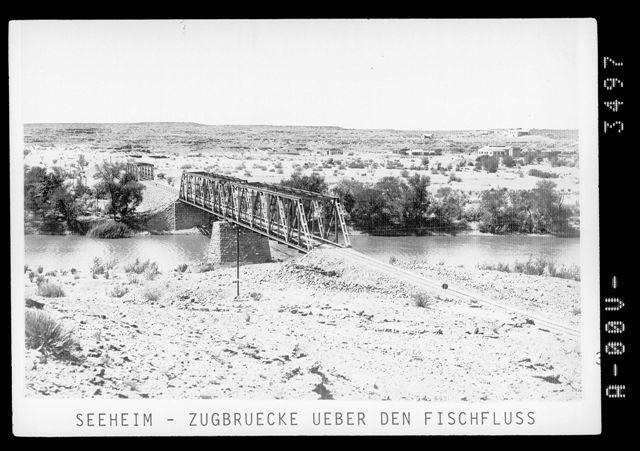
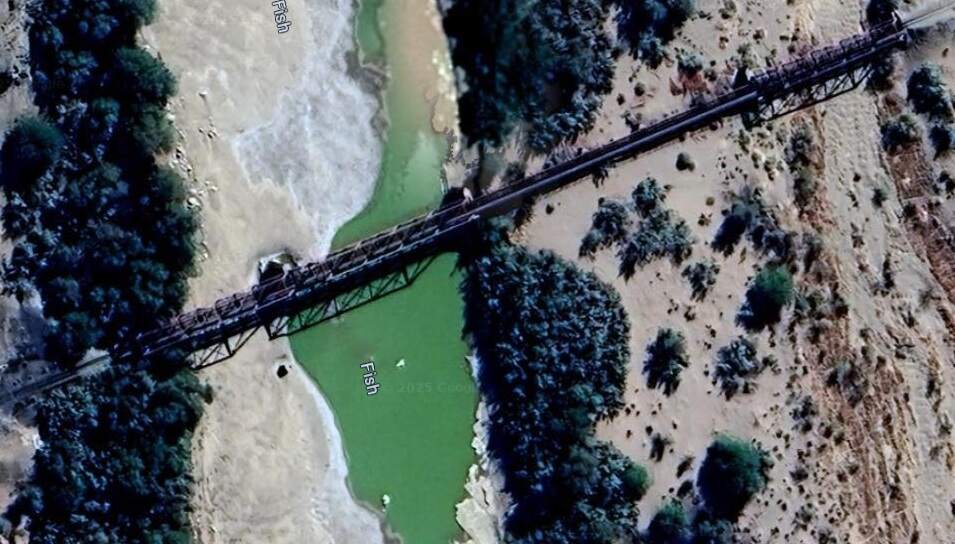
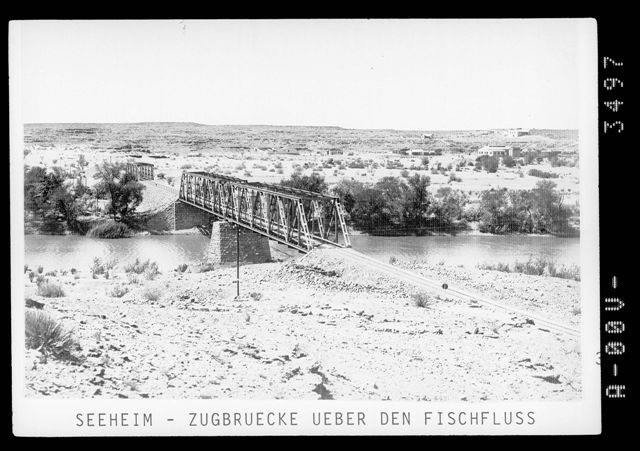
Seeheim Railway Station in very early days. [30]The train yard at Seeheim in the 21st century. The Skaap River is just to the South of the Yard. [Google Maps, June 2025]A short distance beyond the limits of the old railway station the line crosses the Fish River close to its confluence with the Skaap River. This is a very early postcard image of the railway bridge over the river. A modern image of the bridge in the distance on this postcard can be seen here. [29] [30]The bridges over the Fish River in the 21st century. [Google Maps, June 2025]After crossing the Fish River the railway follows its North bank. [Google Streetview, June 2025]It crosses a couple of tributaries before heading away from the river into the hills. [Google Streetview, June 2025]
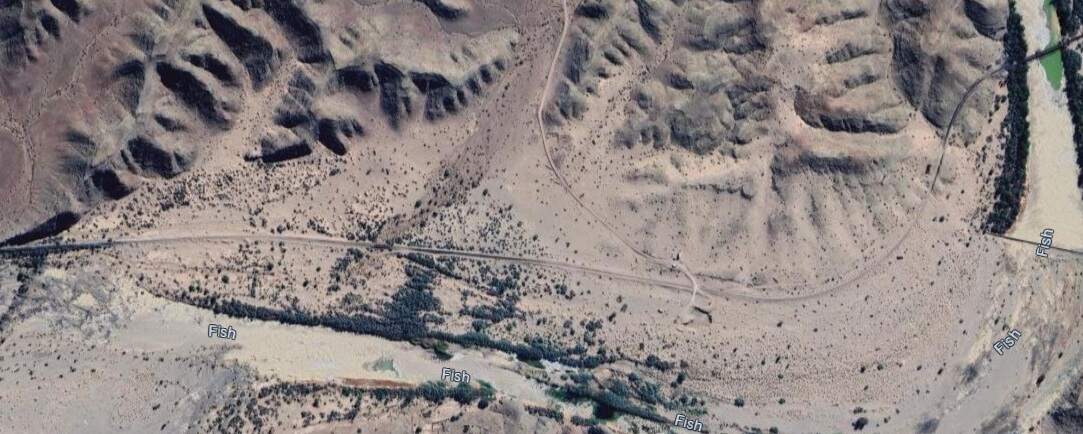
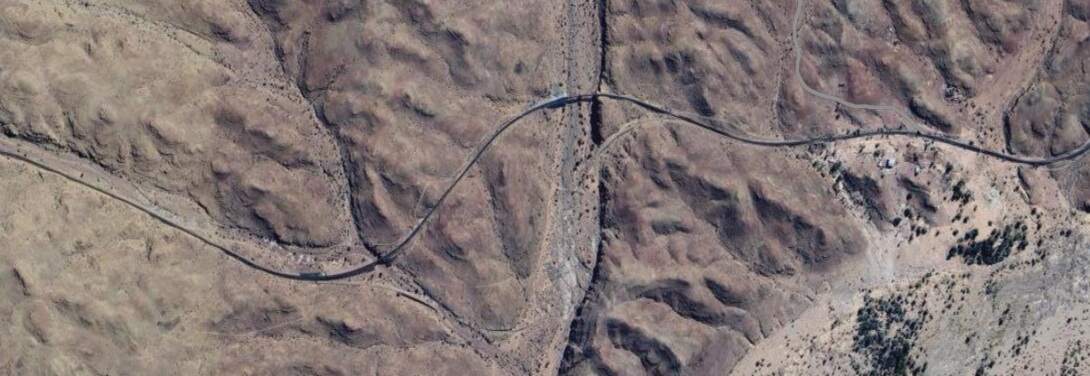
After some distance winding through the hills, the railway line crosses the D463, bridges a dry watercourse and crosses an open area of sand before again winding its way through more hills, heading Northwest. The next image shows the location of Sandverhaar Railway Station and Bridge.
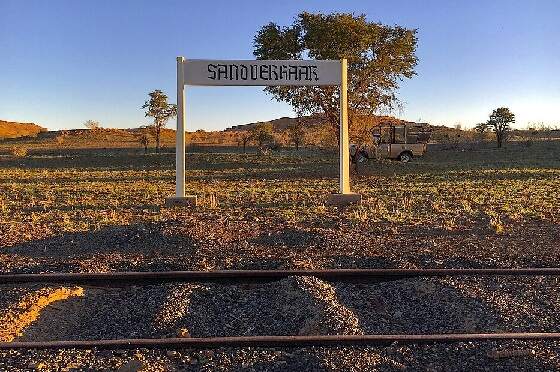
Sandverhaar Railway Station and Bridge. [Google Maps, June 2025]Sandverhaar Railway Station, (c) Matthias Bruhin & Hp.Baumeler and licenced for reuse under a Creative Commons Licence (CC BY-SA 4.0). [28]
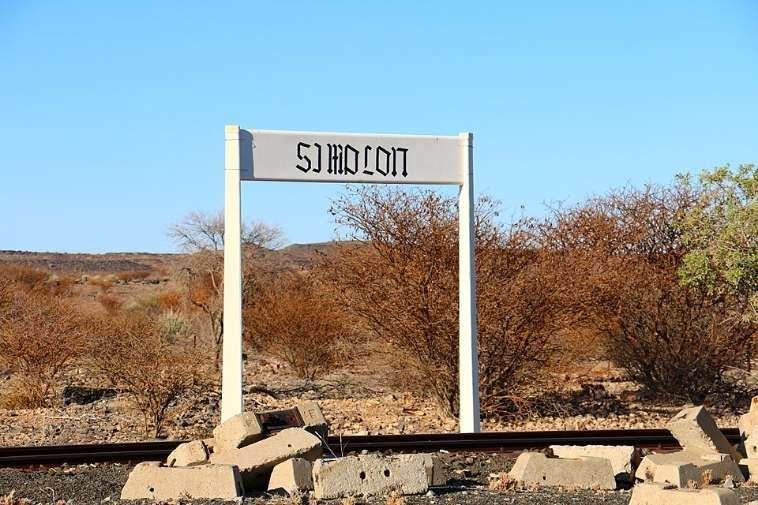
A little further West the line crosses the dry watercourse of the Gurib River and close to Alte Kalkofen Lodge passes through the site of what was Simplon Railway Station.
Immediately to the West of Simplon Station, the line crosses the D462 and then, for a short while runs alongside the B4.
At Goageb, the line passes under the B4 before entering the Railway Station.
Looking Northwest from the first bridge at Goageb carrying the B4 over the line. [Google Streetview, December 2023]
Goageb Railway Station. [Google Maps, June 2025]
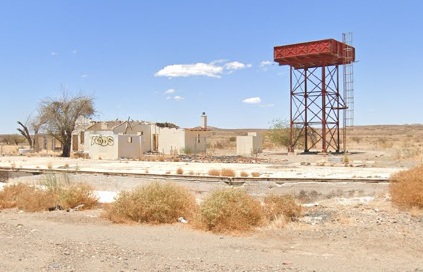
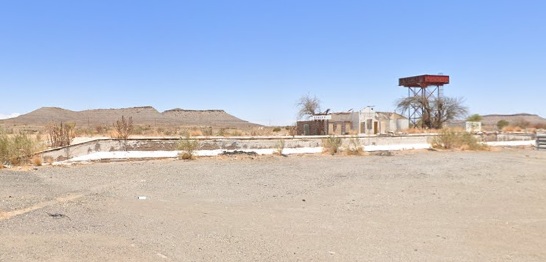
The Station building and water tower at Goageb, seen from the Southwest. [Google Streetview, December 2023]The platform, station building and water tower at Goageb, seen from the Northwest. [Google Streetview, December 2023]
The bridge carrying the railway over the Konkiep River, seen from the bridge carrying the B4 over the river. [Google Streetview, December 2023]Looking back towards the railway’s bridge over the river. [Google Streetview, January 2018]Looking Northwest from the bridge carrying the B4, along the line of the railway. [Google Streetview, January 2018]
After passing under the B4 the railway turns North-northwest and runs alongside the B4 for a few kilometres before the road turned away toward the North. The railway then turns to the Southwest.
A relatively short passing loop is provided seemingly in the middle of nowhere! [Google Maps, June 2025]
These next few pictures give a sequence of satellite images or views in sequence along the line.
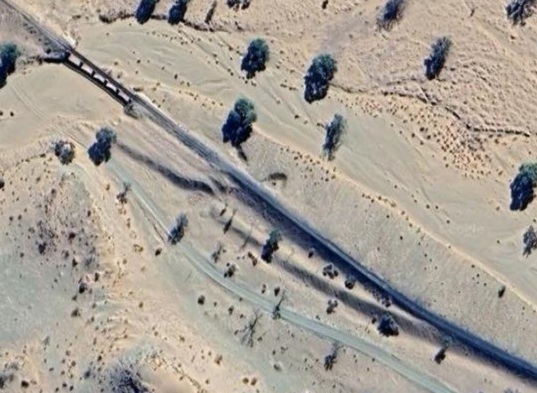
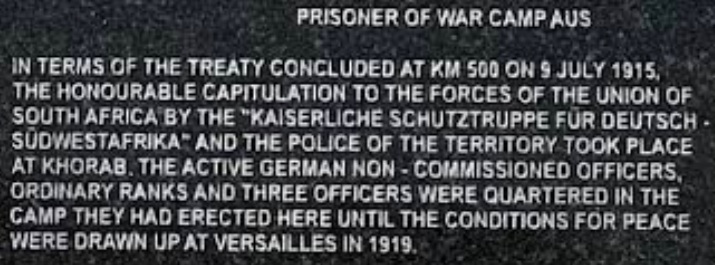
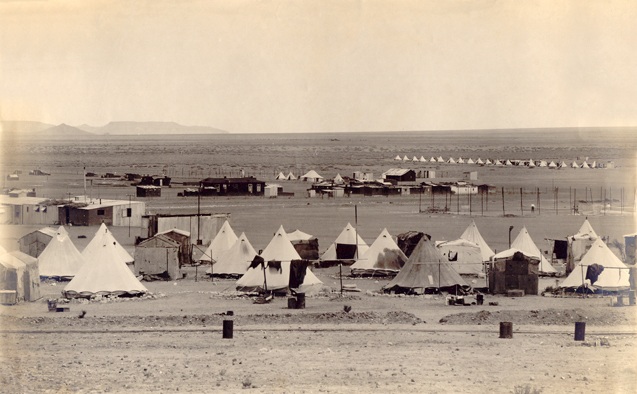
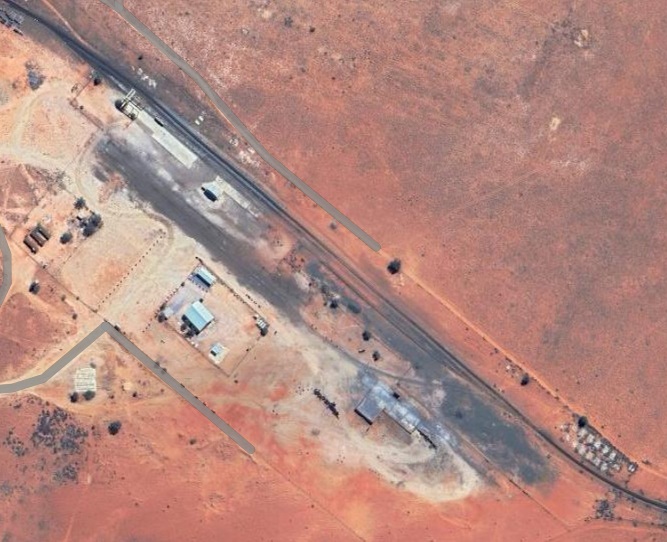
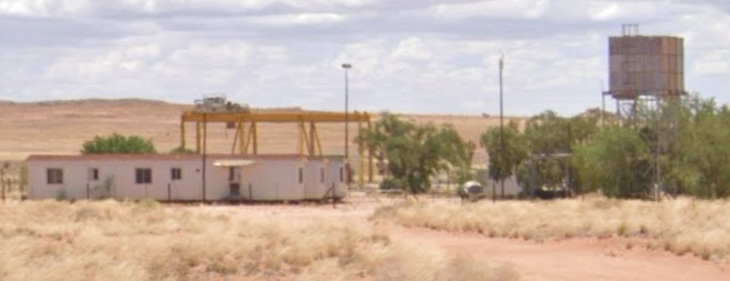
An igneous rock intrusion alongside the lineA dramatic S-curve on the line. Another unnamed passing loopThe line running South of and close to the B4Looking South from the B4 along the D446 we can see an ungated crossing . The railway is around 100 metres from the B4 at this location.A memorial has been placed at the site of a prisoner of war camp from the First World War to the East of the town of Aus.The Camp near Aus for German prisoners of war 1915-1919, (c) Public Domain. [31]Immediately to the South of the Kriegsgefangenen Denkmal, the war memorial, there are a series of sidings/passing loop on the railway as shown here. [Google Maps, June 2025]A gantry crane, cabins and water tower are present at this location. [Google Streetview, January 2024]
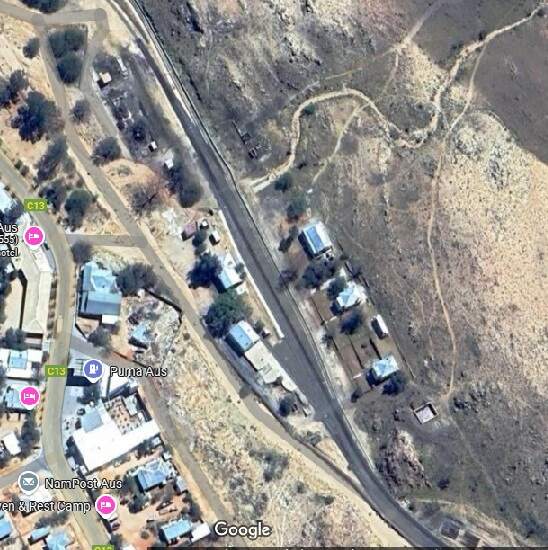
It is only a short distance from this location to the township of Aus. The railway passes, first, under the C13 and then into Aus.
The view Northwest from the C13 towards Aus. [Google Streetview, January 2024]Aus Railway Station. [Google Maps, June 2025]Looking Southeast, this photograph shows the railway line curving round into Aus Railway Station. [Google Streetview, December 2023]The Southeast end of Aus Railway Station site. [Google Streetview, December 2023]The station approach at Aus. [Google Streetview, December 2023]
Northwest of the railway station, the line crosses the C13 again, this time at an ungated crossing.
Looking Southeast from the ungated crossing on the C13 towards Aus Railway Station. [Google Streetview, December 2023]Looking Northwest along the line from the ungated crossing on the C13 – Aus church is prominent in this photograph. [Google Streetview, December 2023]
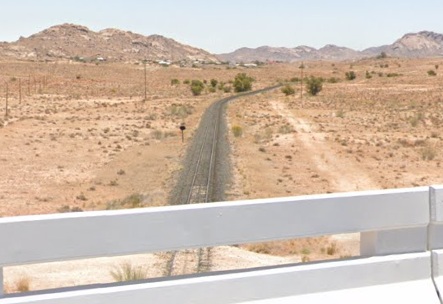
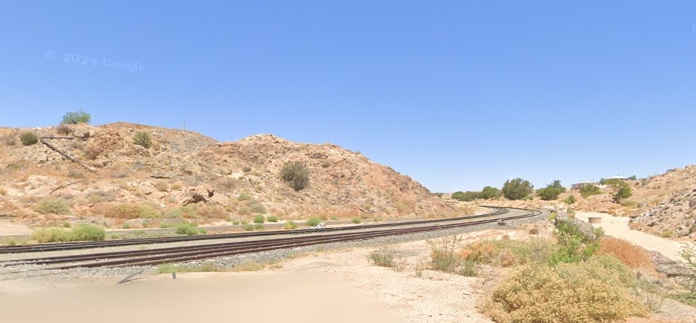
West of Aus the railway passes through the hills. The next image looks backthrough those hills towards Aus.
Looking back towards Aus we can see the line meandering through the hills. [Google Streetview, November 2021]Looking ahead along the railway line from the same location. [Google Streetview, November 2021]
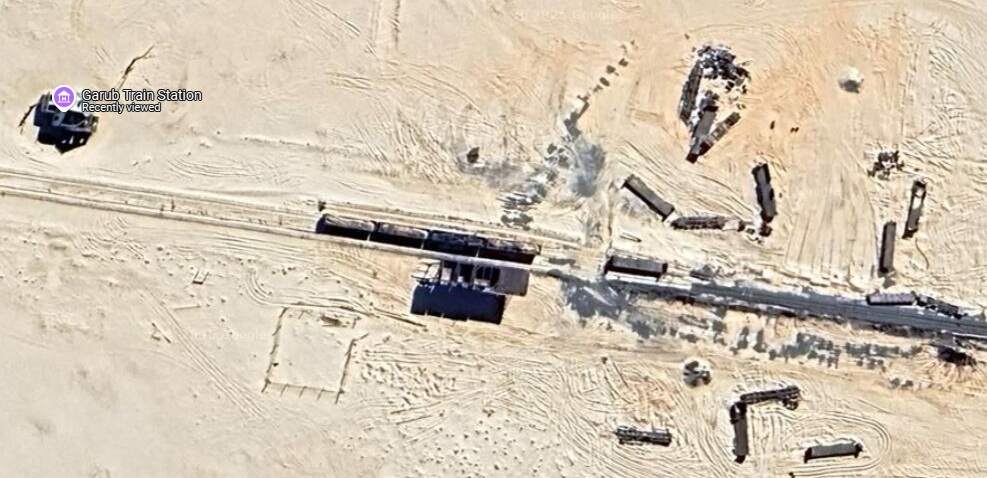
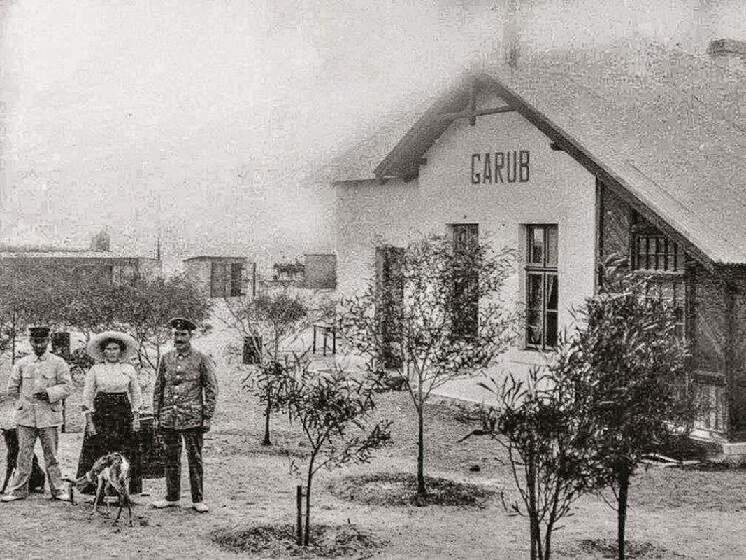
The next station on the line was at Garub. The station is no longer in use.
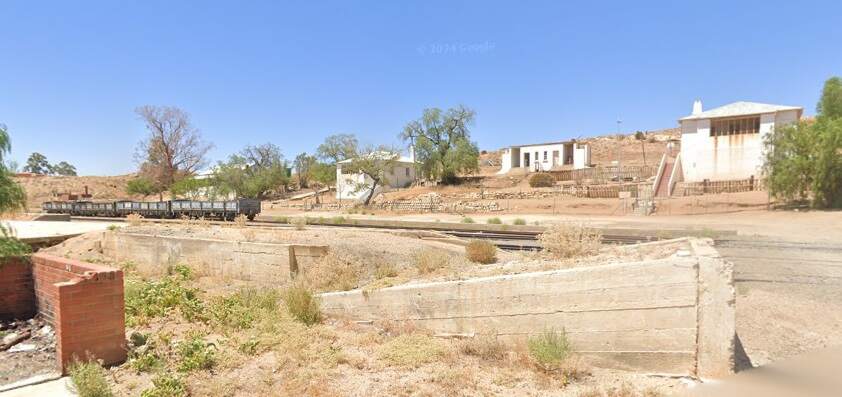
Garub Railway Station: the station hose and water tower remain standing. [Google Maps, June 2025]Garub Railway Station building in the early 1900s, (c) Public Domain. [32]
This image of Garub station house and water tower is embedded here from fineartamerica.com. [33]
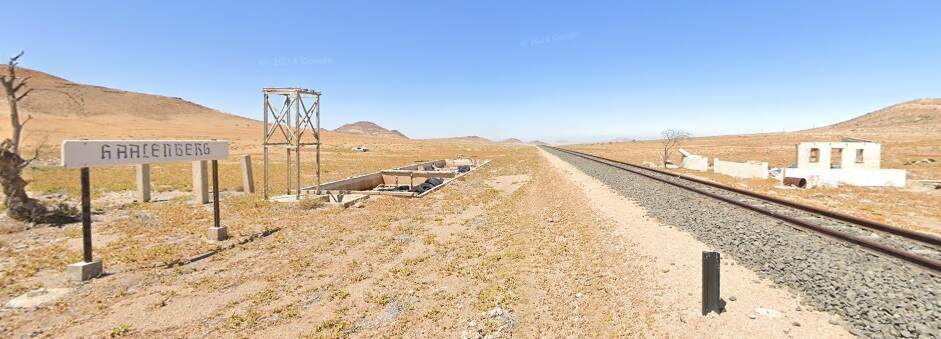
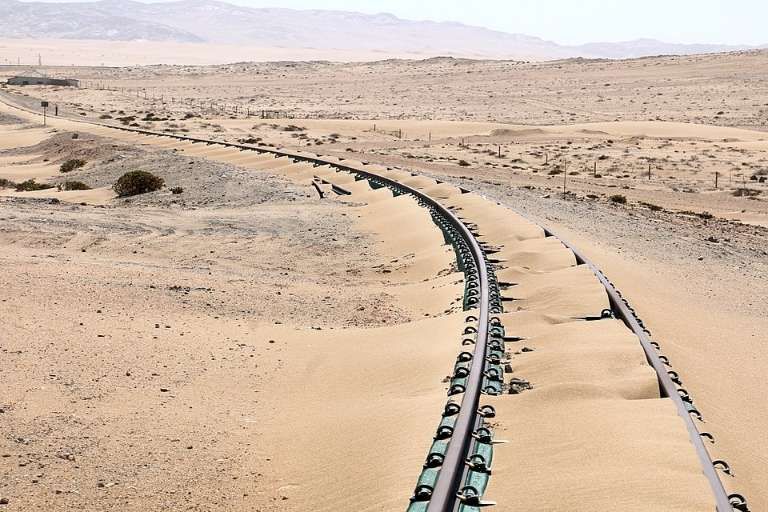
To the West of Garub the B4 and the railway run in parallel. The line passes through another abandoned stations at Tsaukaib, Haalenburg, Rotkop and Grasplatz.
The abandoned Railway Station at Haalenburg, looking West. [Google Streetview, December 2023]The abandoned Railway Station at Grasplatz, looking West. [Google Streetview, December 2023]
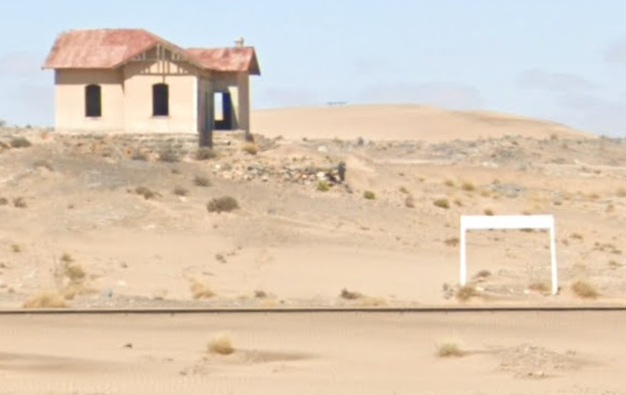
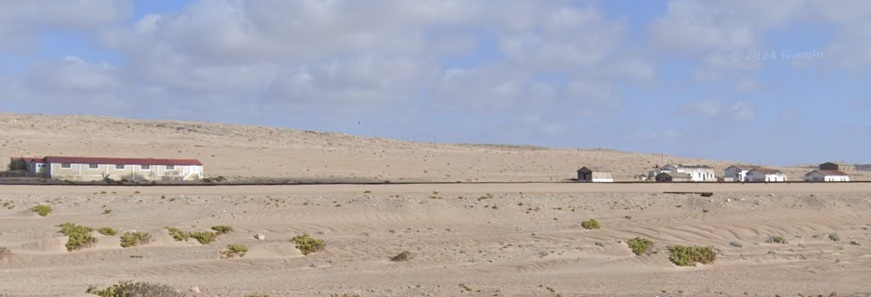
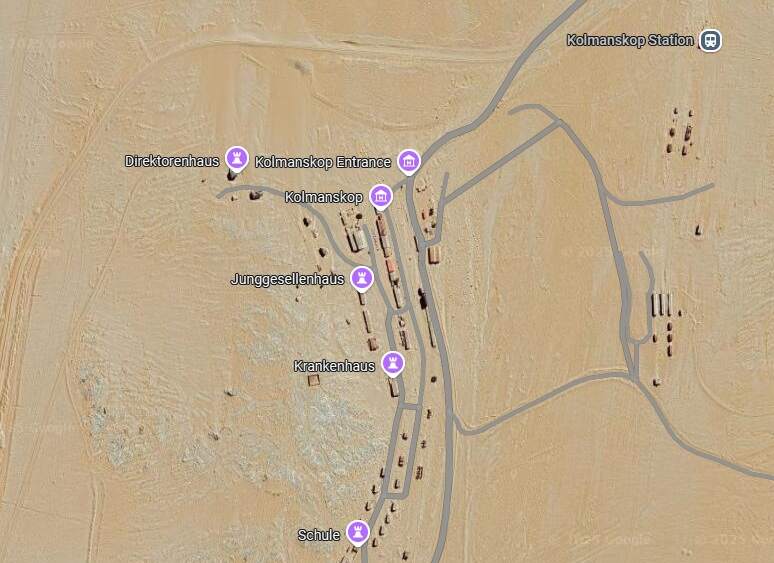
At Kolmanskop there is an entire derelict mining station which once had its own railway station.
Kolmanskop seen from the B4 with the railway visible in front of the buildings.Kolmanskop mining village. The diamond mine was to the South of the village. [Google Maps, June 2025]
As well as its railway link to Lüderitz, Kolmanskop was “the terminus of two private narrow-gauge electrified railway lines that served the diamond mining industry further south. One ran 119 kilometres (74 mi) via Pomona to Bogenfels. It was completed in 1913 but destroyed during World War I in 1915 by South African troops. The other railway line, 7 kilometres (4.3 mi) long and completed in 1920, led to Charlottental. Both were powered by a 1.5 megawatts (2,000 hp) power station in Lüderitz, then assumed to be the largest in Africa.” [1][34][35]
Kolmanskop is only a short distance from the Atlantic Ocean. The B4 and the railway find their own way down to the coast at Lüderitz.
The railway meanders down to the coast following the contours to keep the gradient to a minimum. On the way it passes through a turning triangle. It not obvious why the turning triangle is located at this point on the railway. However, not far beyond the triangle there are a series of sidings/loops which are shown in the image below.
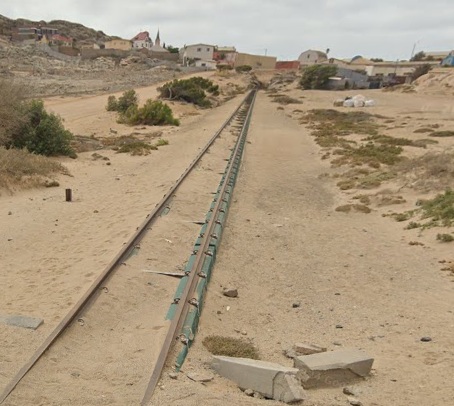
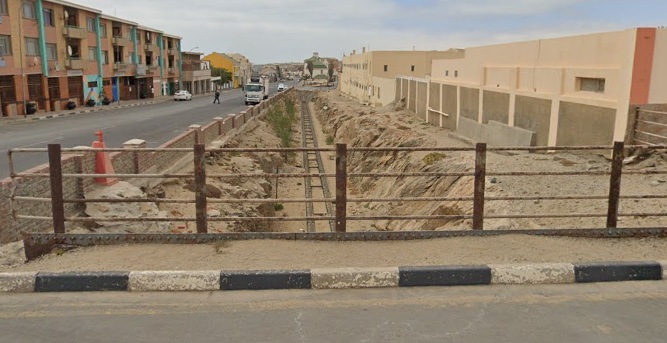
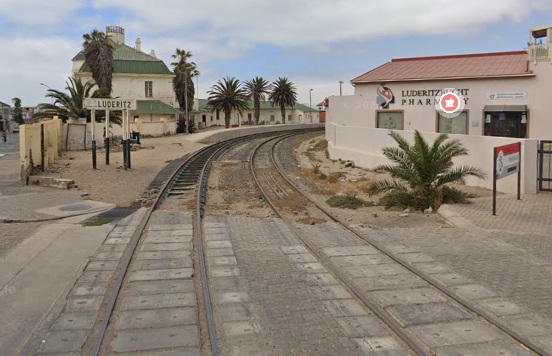
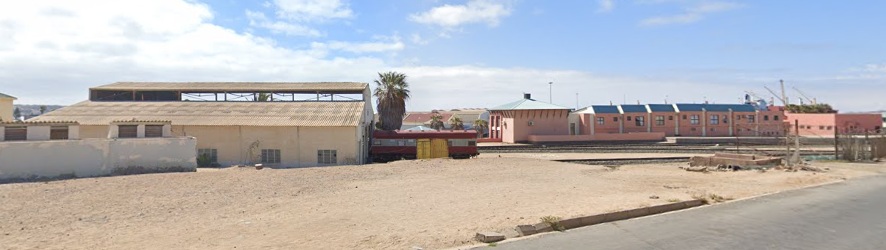
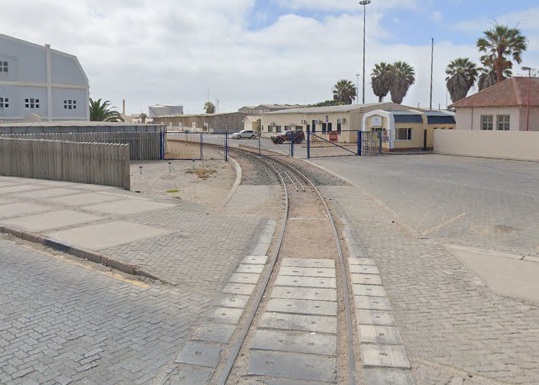
Goods transfer sidings/loops close to Lüderitz. [Google Maps, June 2025]Just short of Lüderitz, the Atlantic is on the left of this photograph, the railway on the right. [Google Streetview, January 2024]Looking West along the railway towards the centre of Lüderitz. [Google Streetview, January 2024]Further along the line and looking North. [Google Streetview, January 2024]Looking North from the ungated crossing at Bay Street. The platform of the passenger station is just ahead. [Google Streetview, January 2024]
A photograph looking Southwest through the station can be viewed here. [37]
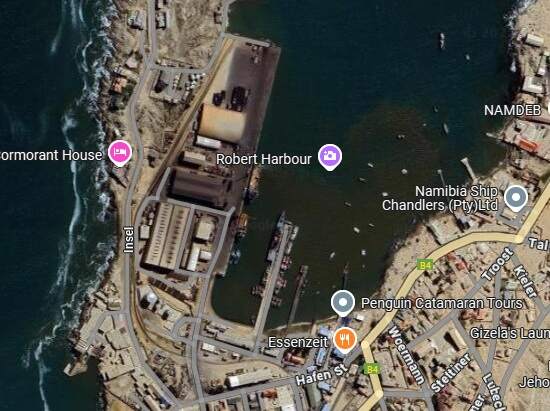
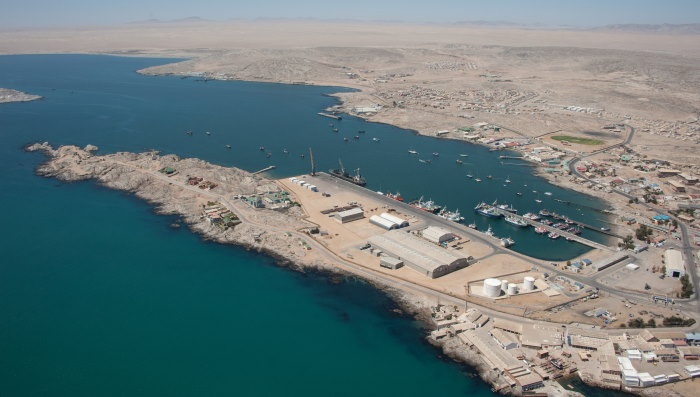
The engine shed and yard in Lüderitz are to the Northeast of the station platforms. [Google Maps, June 2025]The gates to the port at Lüderitz seen from Hafen Street. [Google Streetview, January 2024]The Port of Lüderitz. [Google Maps, June 2025]An aerial view of the port. [36]
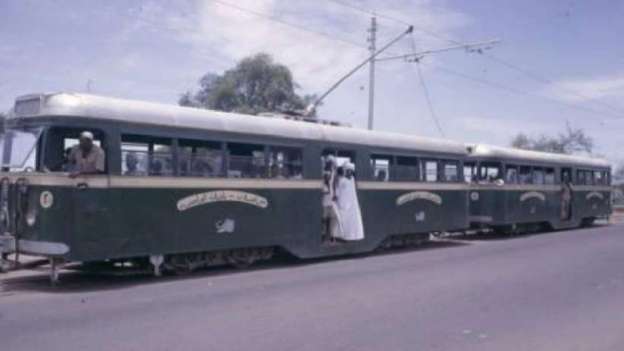
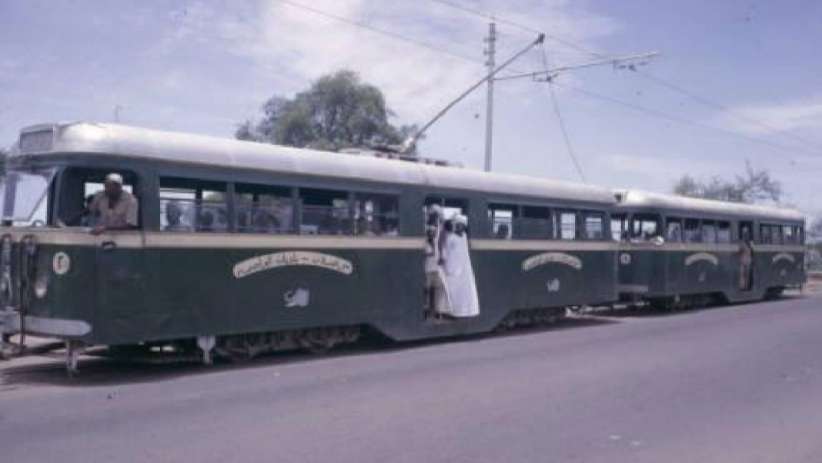
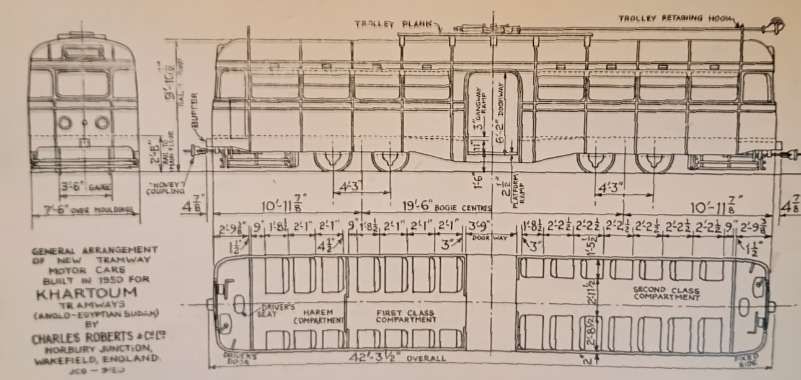
The Modern Tramway reported in December 1950 on the purchase by the Sudan Light & Power Company of the new 4-motor bogie tramcars. The bogies and equipment were being “supplied by the English Electric Company and the underframes and bodies by Charles Roberts and Company Ltd., under sub-contract to the English Electric Company. All motor tramcars and trailers [were to] be fitted with air brakes. As will be seen from the drawing reproduced, the body design [was] a pleasing example of modern British practice. The trailer cars [were] of similar outline.” [1: p270]
I published an article about the railways/tramways of Sudan in May 2022. That article can be found here. [7] This present article should be seen as an addendum to that article.
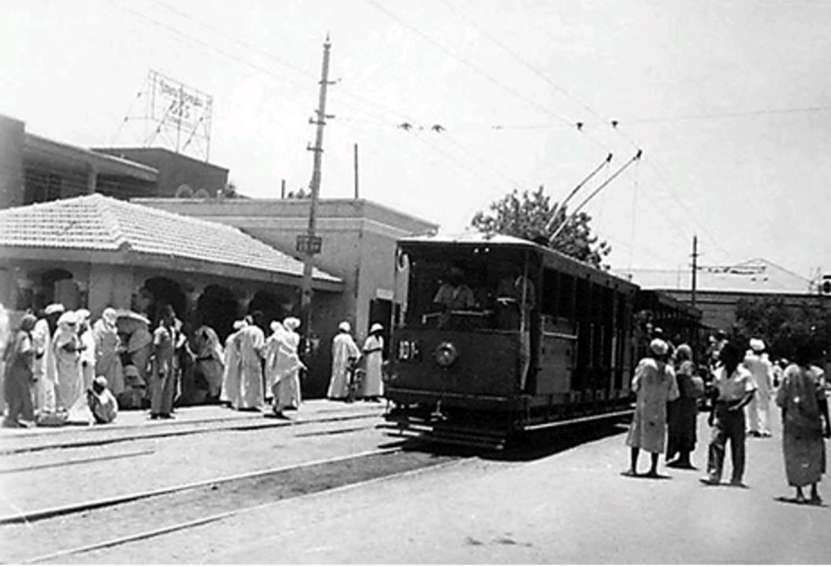
The image is embedded from Getty Images. It is a high-angle view of pedestrians, cars and an EEC tram &n trailer at the tram terminus in Omdurman, Sudan, circa 1955. The tramline connects Omdurman, on the west bank of the River Nile, with Khartoum. (Photo by Three Lions/Hulton Archive/Getty Images). [4]
The Modern Tramway continues:
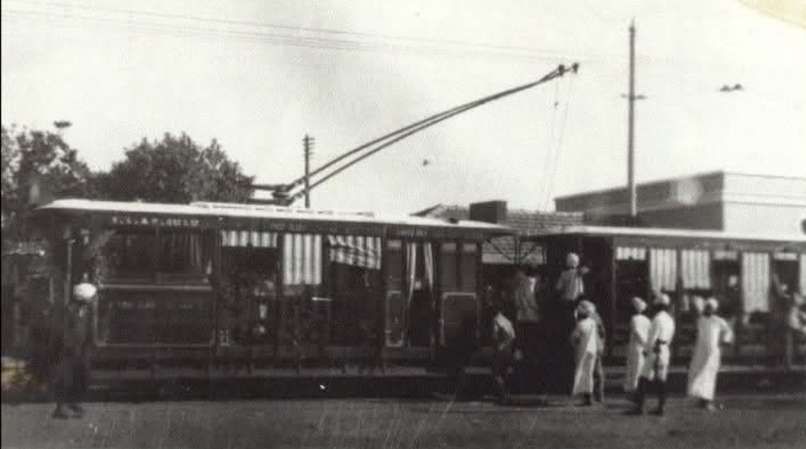
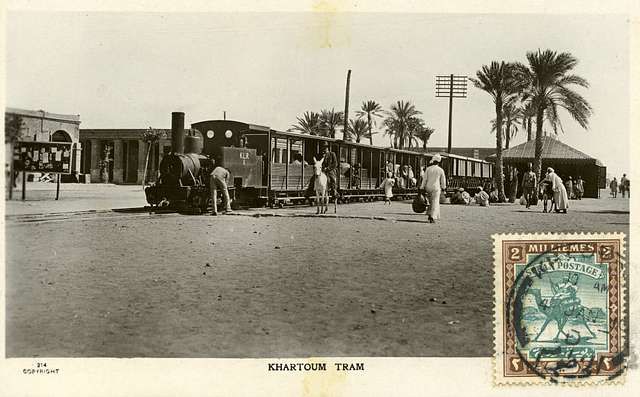
“Electric tramway operation in Khartoum began on 16th January, 1928 when the line from Khartoum North to Omdurman via Khartoum and the White Nile Bridge was opened. The Khartoum Tramways were the first electric tramways in the Sudan and transport in the city and outskirts had been previously provided by two steam tramway lines, which were closed on the opening of the electric line.” [1: p270]
The Modern Tramway describes the electric tramway which replaced the steam-powered trams:
“The present rolling stock of the 3ft. 6 n. gauge Khartoum tramways consists of 16 single-truck motor trams, 15 4-wheel trailers, one 4-wheel electric locomotive and 30 goods trucks. All the stock was built by the English Electric Company Ltd. Four passenger services are operated, viz:
Khartoum Central Station Omdurman Central Station (5 miles).
Khartoum Central Station Khartoum North (3) miles).
Omdurman Central Station Abu Rouf (14 miles).
Circle (12 miles).” [1: p270]
“Headways are 18, 20, 20 and 30 minutes respectively. In addition a freight service is operated between Khartoum railway station and Omdurman. The main Iine begins at Khartoum North (where it made end on junction with a steam tramway to Shabat Reach, a service now operated by motor buses) and shortly turns south to cross the Blue Nile; on gaining the other bank, the line turns east, passing through the main part of Khartoum and running parallel to the Blue Nile. On this section there is the main depot and a large loop which runs round to the Central Station and the back of the city before turning north to rejoin the main line. At Mogren Point, the main line crosses the White Nile and immediately turns north towards Omdurman; this city stretches for 6 miles along the river and during the régime of the Mahdi it became the capital of his empire. The city is memorable for the battle fought outside its walls in 1898 between the followers of the Mahdi and the British. Some distance after turning north, there is another depot at Zaptia, on the western side of the line. At Omdurman Central Station the tramway turns east, back towards the river Nile, which it reaches at Abu Rouf, the final terminus. From this point, there is a ferry service to the terminus of the former steam tramway at Shabat Reach on the other side of the Nile. The tramways are all single-line-and-loop and there are several goods sidings. In 1948, 8,883,851 passengers were carried, whilst goods traffic averages 12,000 tons yearly.” [1: p270-271]
“At the time of the inauguration of the electric tramways it was thought that due to the very dry nature of the ground in Khartoum, satisfactory earth points could not be obtained for earthing the track for a track return system. It has since been established that it is possible to provide earth points, and the new trams will operate on the normal single overhead and track return system.” [1: p271]
The Modern Tramway acknowledged the help of the Sudan Light and Power Company Ltd., who provided the information on which these notes are based.
References
Modern British Tramcars for Khartoum; in The Modern Tramway Vol. 13 No. 156, London, December 1950, p270.
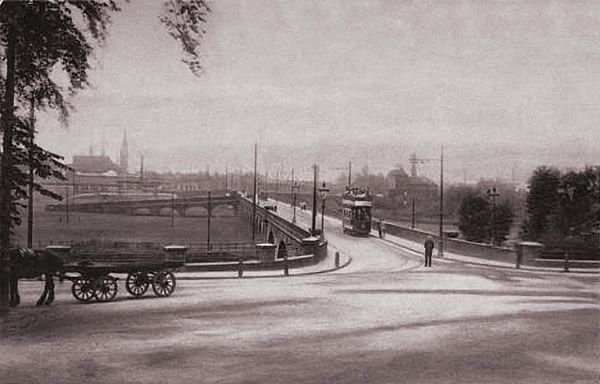
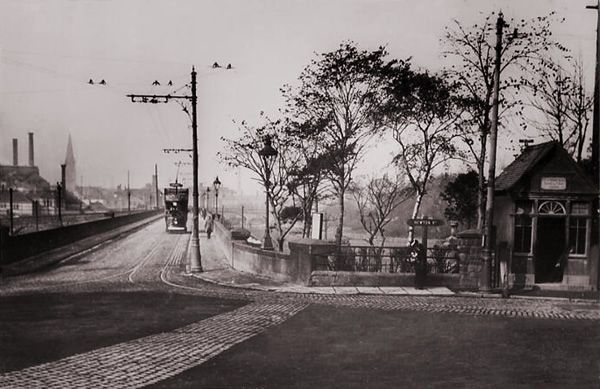
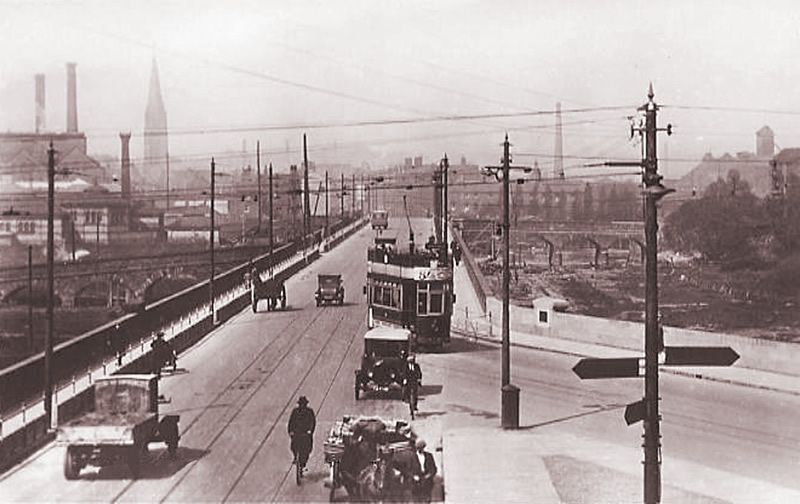
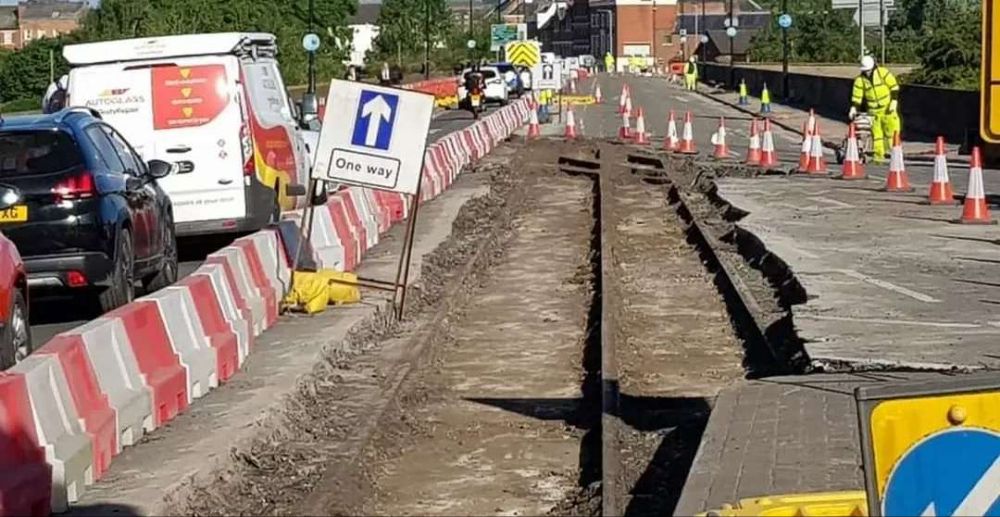
The mention of ‘Lickey’ in the railway press usually conjures up thoughts of the Lickey Incline and the bankers needed to enable steam-powered trains to make the climb.
In an article written in 1949 (Modern Tramway’s Prize Article of 1949) and published in February 1950, B.J. Pridmore prophetically proposed a Light Rail solution to anticipated traffic issues on the transport corridor centred on the Bristol Road.
Would cities in the UK which already had some reserved tram tracks have benefitted from forward thinking that sustained the use of trams through the latter years of the 20th century on tracks and routes which would be suitable for the current wave of Light Rapid Transit/Modern Tramway provision?
Here is Pridmore’s article in full (illustrations are from a variety of referenced sources):
“Summary
There are few cities with a passenger transport route so convenient for conversion to a rapid-transit light railway as is the Birmingham route to the Lickey Hills. In this article is submitted a scheme for such a conversion, describing the route, the alterations required to the track and vehicles, the attractive services which could be operated, and the possibility, in the future, of the possession by Birmingham of a true rapid-transit installation giving a public passenger transport system freed from the delays due to street congestion.
Introduction
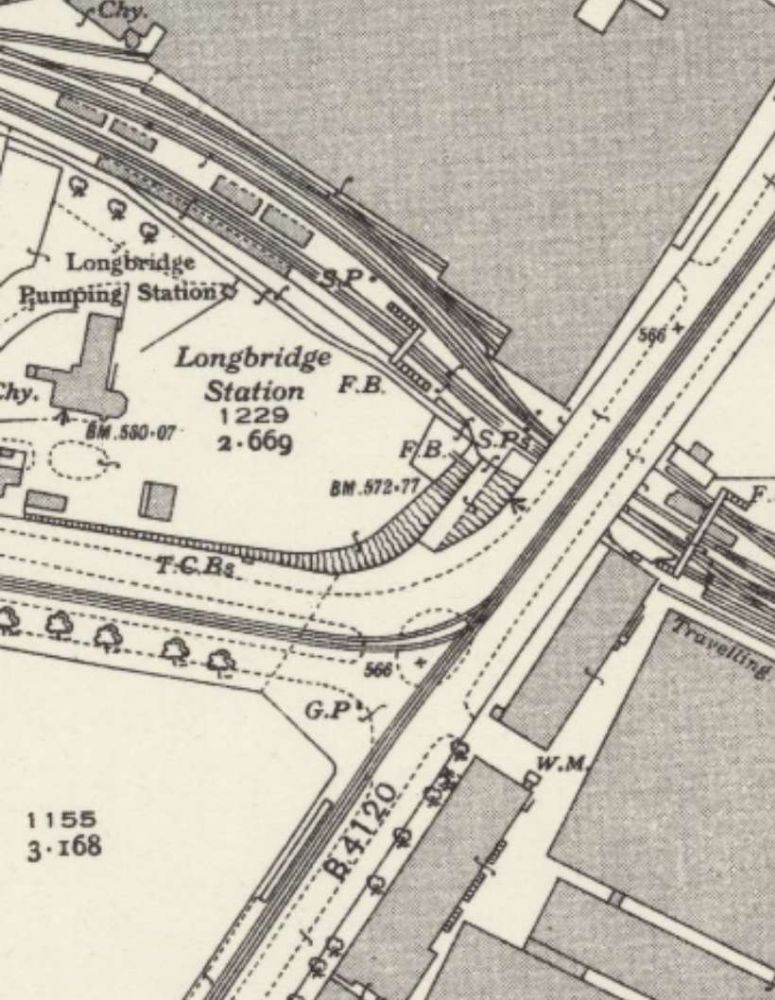
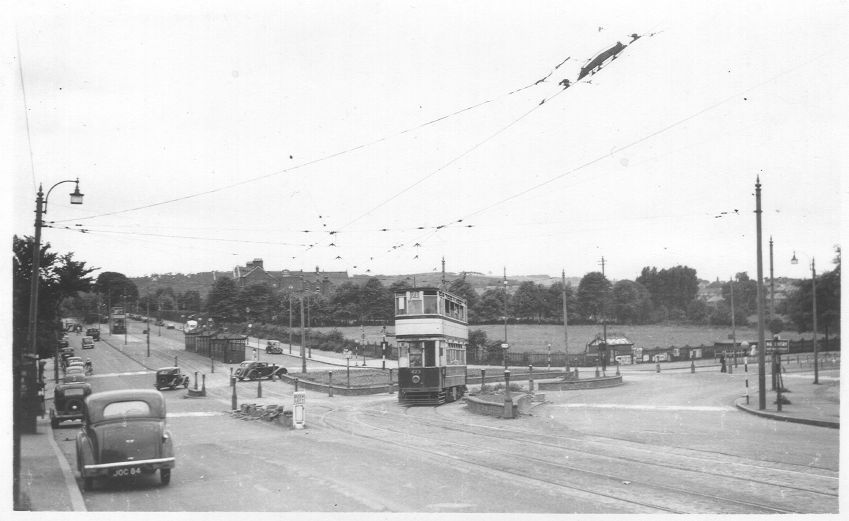
The Lickey route of the Birmingham tramways extends about eight miles Southwest of the city, connecting it to the suburb of Edgbaston (2 miles) and the almost separate entities of Selly Oak (4 miles), Northfields (6 miles) and Longbridge (7 miles and location of the Austin Works), bifurcation at this point giving two termini at the dormitory villages of Rednal and Rubery on the edge of the Lickey Hills.
The traffic on this route is partly of a business character, with a morning peak to the city, two small mid-day peaks, outward and inward, from the city to Selly Oak, and the evening peak of outward-bound traffic. Superimposed upon this are the industrial peaks, of a general nature to and from the city, and of a concentrated nature in the opposite directions to and from the Austin Works at Longbridge. Further traffic is of an interurban nature: between each of the shopping centres of Northfields and Selly Oak as well as from each of these to Birmingham there is appreciable miscellaneous traffic. There is also considerable holiday traffic to the Lickey Hills on non-working days.
Services are operated from the city to Rubery and Rednal, with many short workings to Selly Oak, and extra mid-day journeys from Longbridge to Northfields and Selly Oak, whilst services on the inner (and suburban) section of the route are amplified by the superposition of those to and from Pershore Road (Cotteridge). which share the Bristol Road with the Lickey routes for the first two miles or so to the junction at Pebble Mill Road.
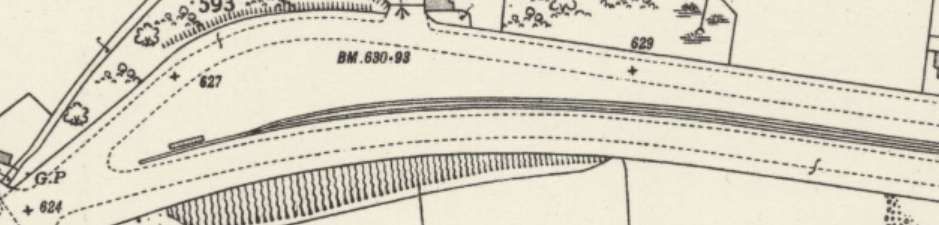
This trunk route with large and varied traffic and high load factor has already about three-quarters of its length constructed as reserved track. Much of this has recently been relaid “solid” on a concrete foundation, instead of on the ballasted sleepers as originally.
It has only two short gradients of any magnitude, and would thus seem ideal for gradual conversion towards an interurban light railway giving ample capacity on the route and removing public transport from the road proper, hence also reducing congestion in the bigger Birmingham of tomorrow for it is along this route that Birmingham seems ripe for the next phase of expansion.
In the remainder of this article it is suggested how, ultimately, this route should be converted to a light railway as a contribution towards ideal transport in the greater Birmingham of the future.
The Track and the Route
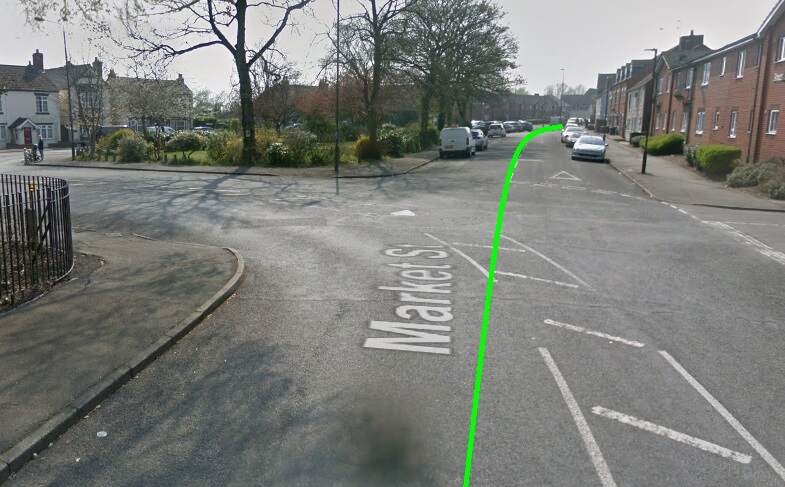
The present Navigation Street terminus loop should be improved to give loading islands outside two parallel tracks at the terminal loading point; the track layout should include crossovers to enable Pershore Road cars to be separated from Lickey cars, and Selly Oak and other short working cars to be separated from through cars (as will be needed for peak-hour services, q.v.). The one-way streets forming the loop are amply wide enough to permit the tram tracks to be relocated at the sides and be totally reserved; public transport would thus be segregated from the rest in this most congested section of the route.
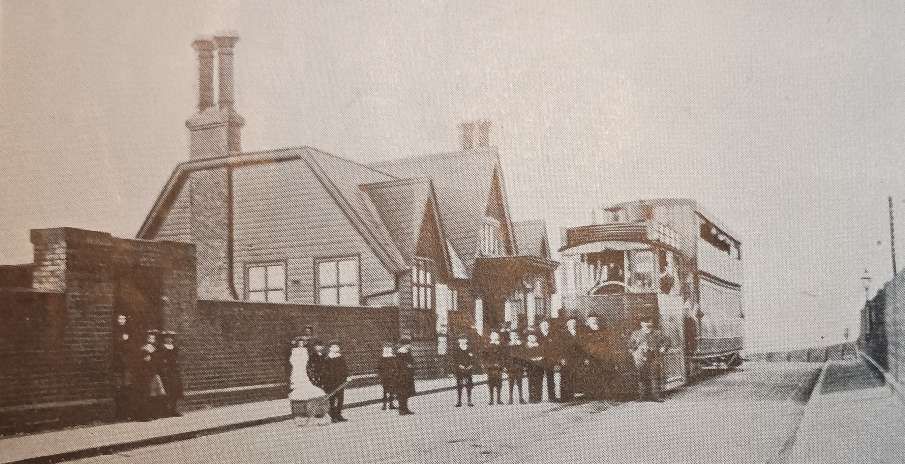
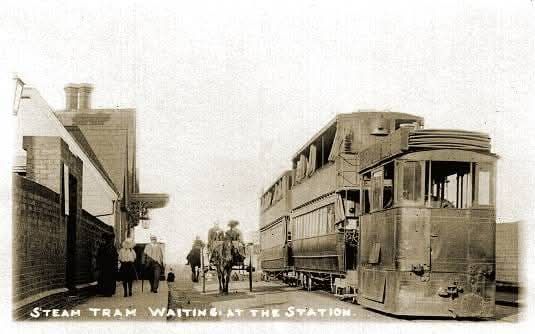
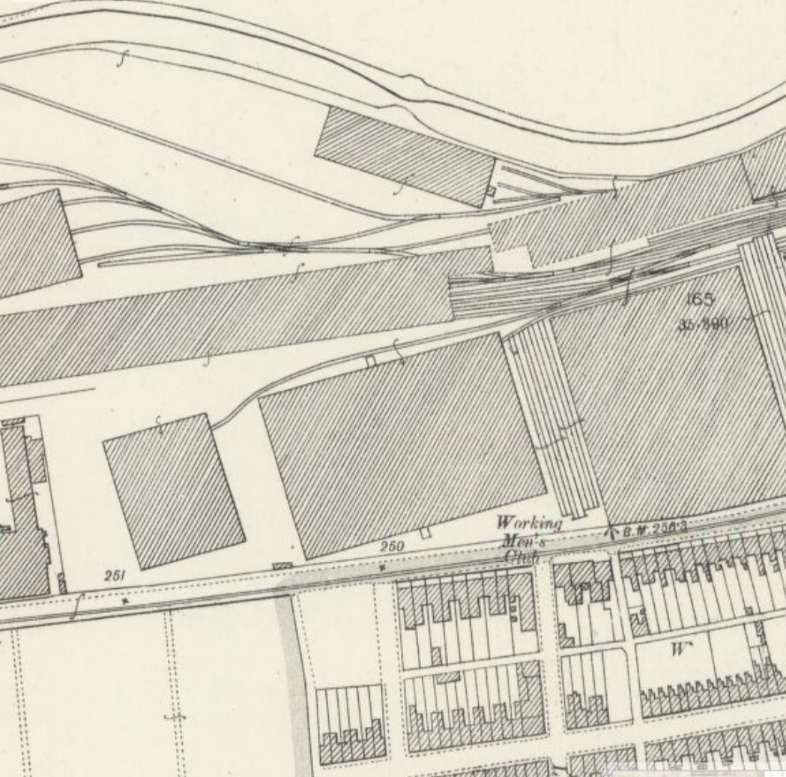
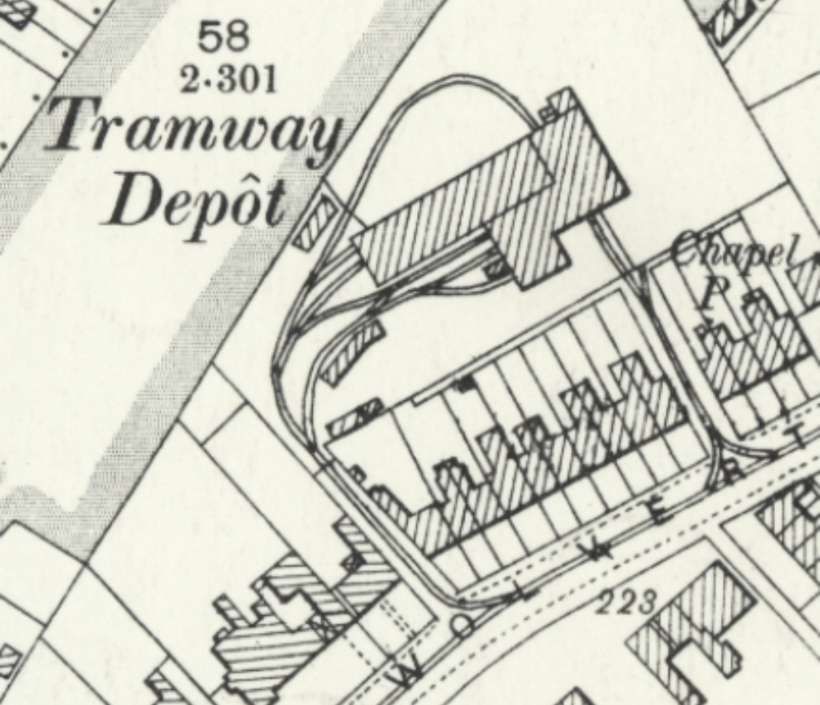
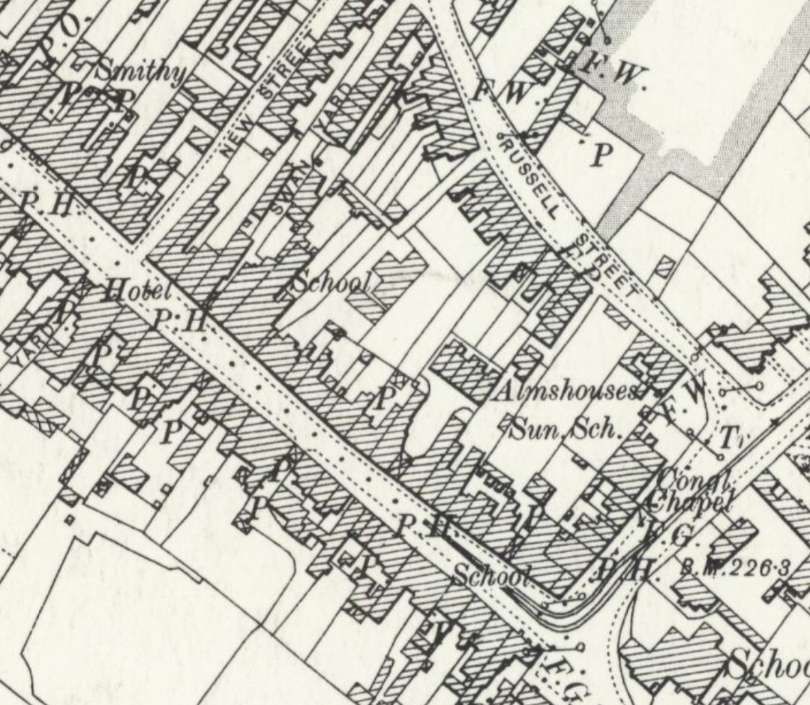
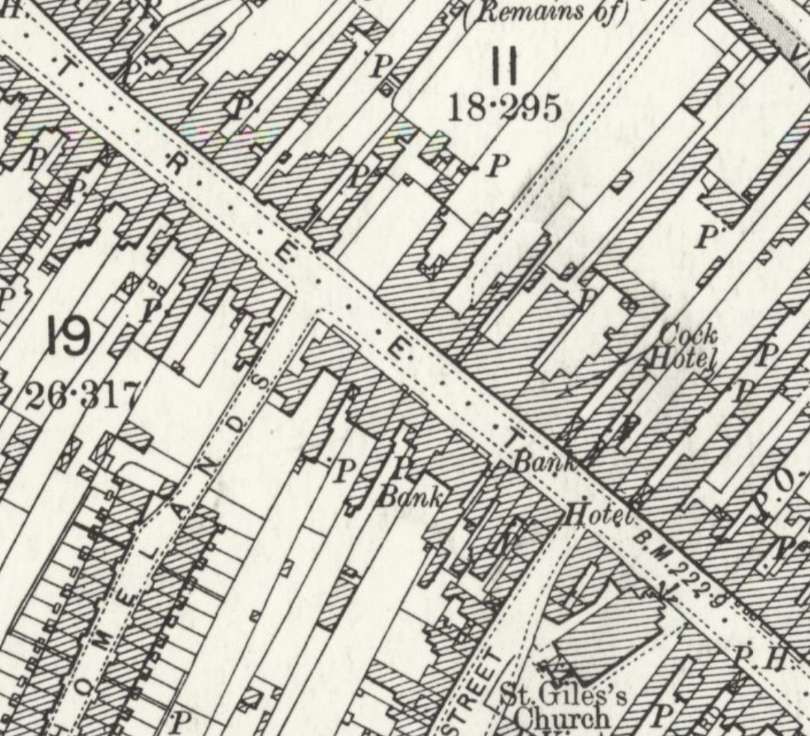
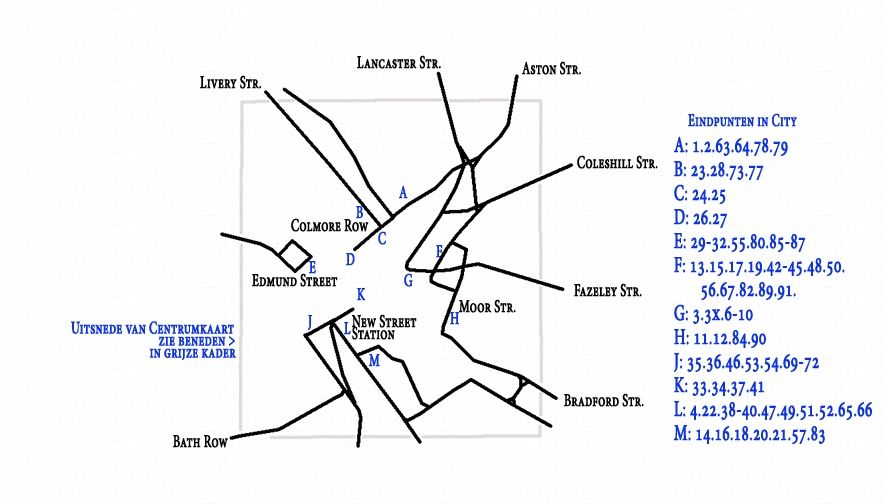
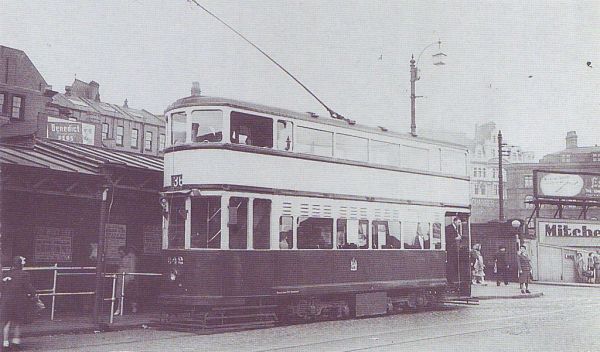
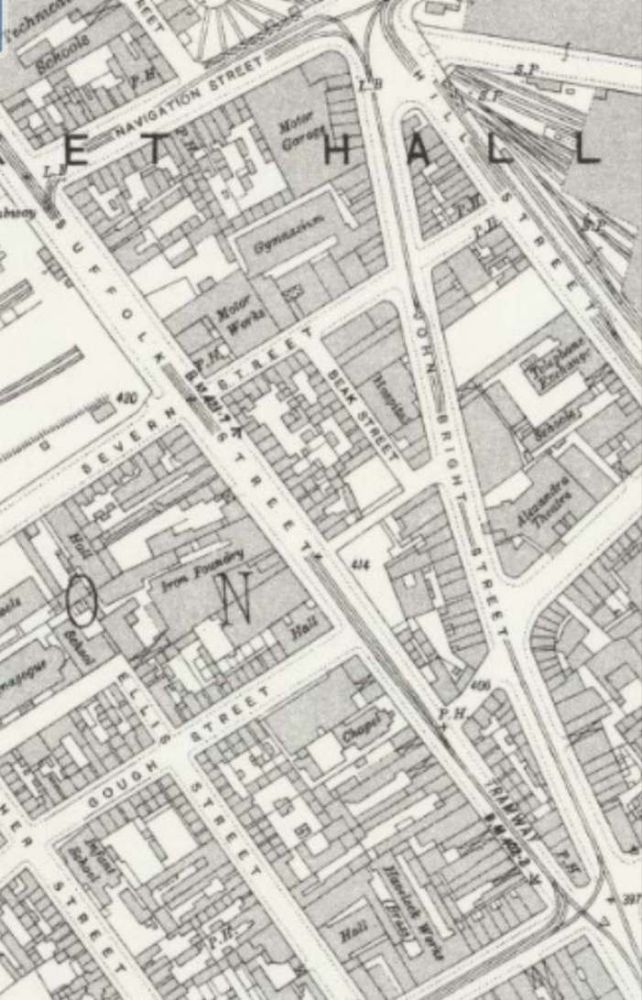
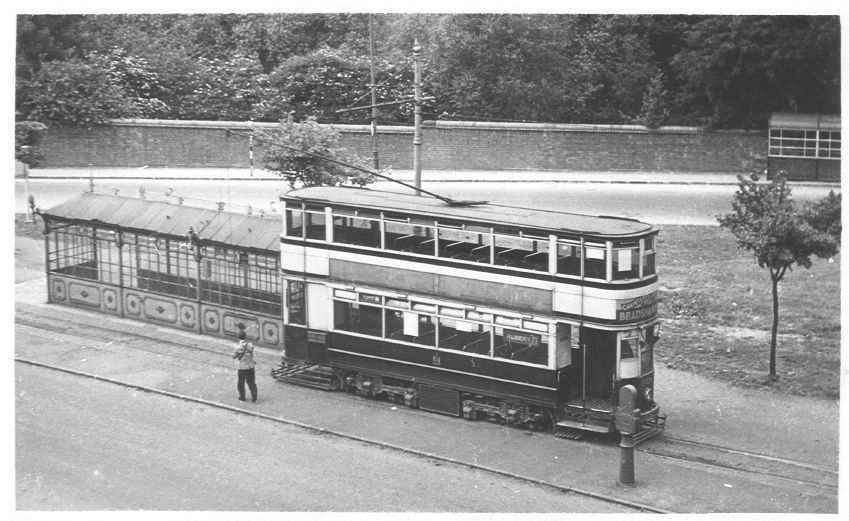
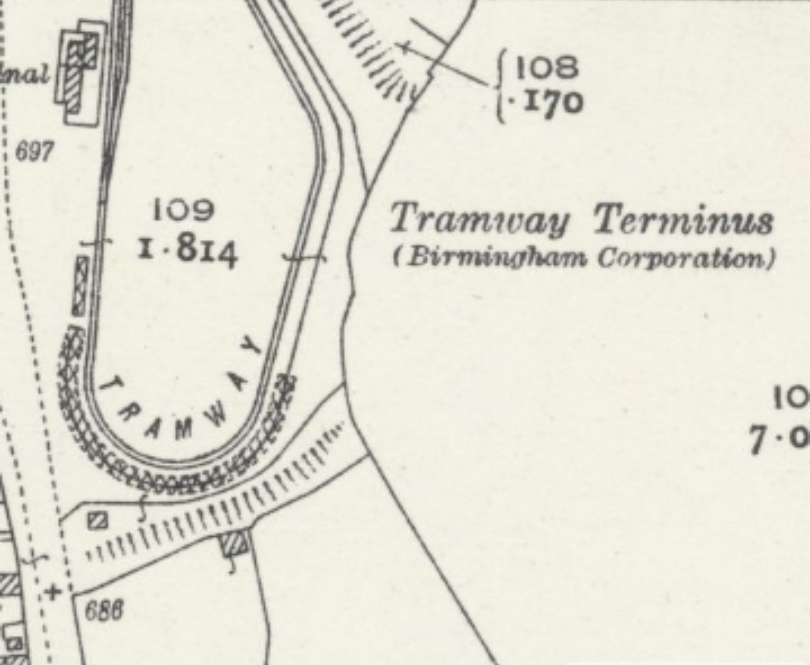
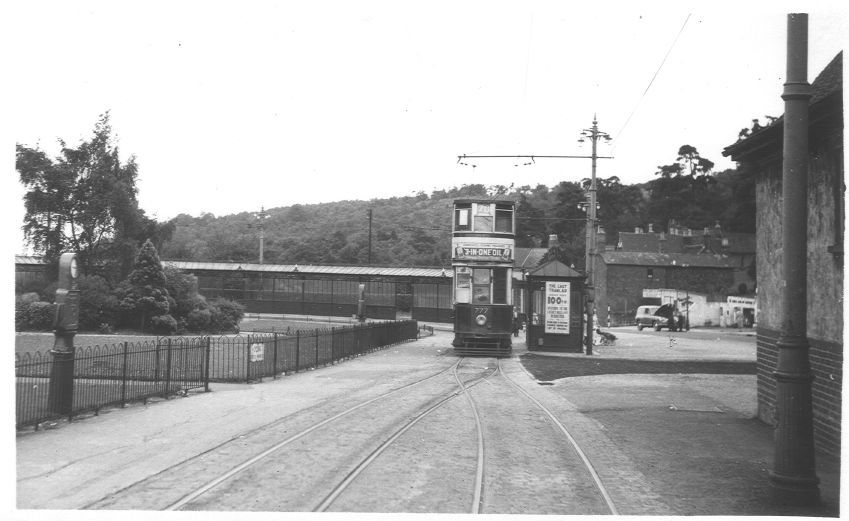
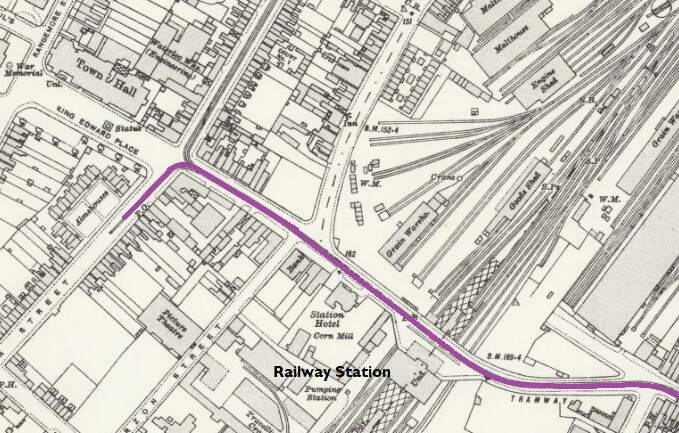
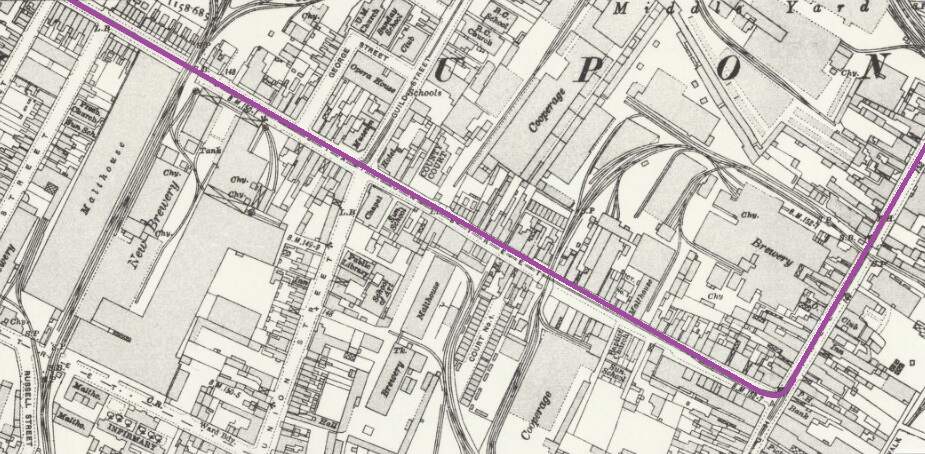
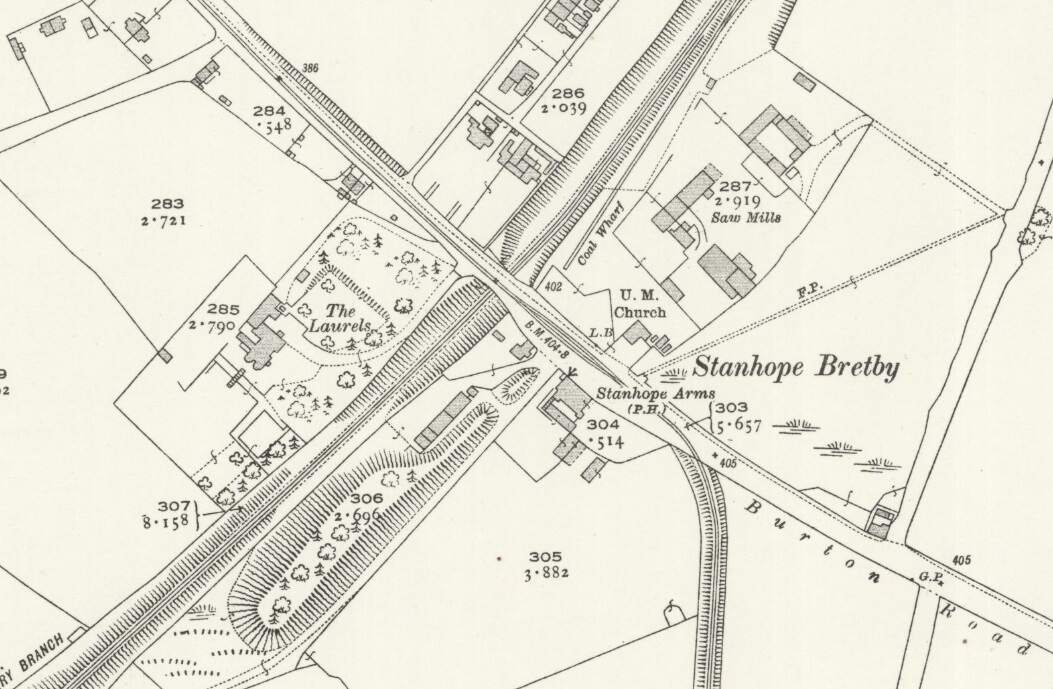
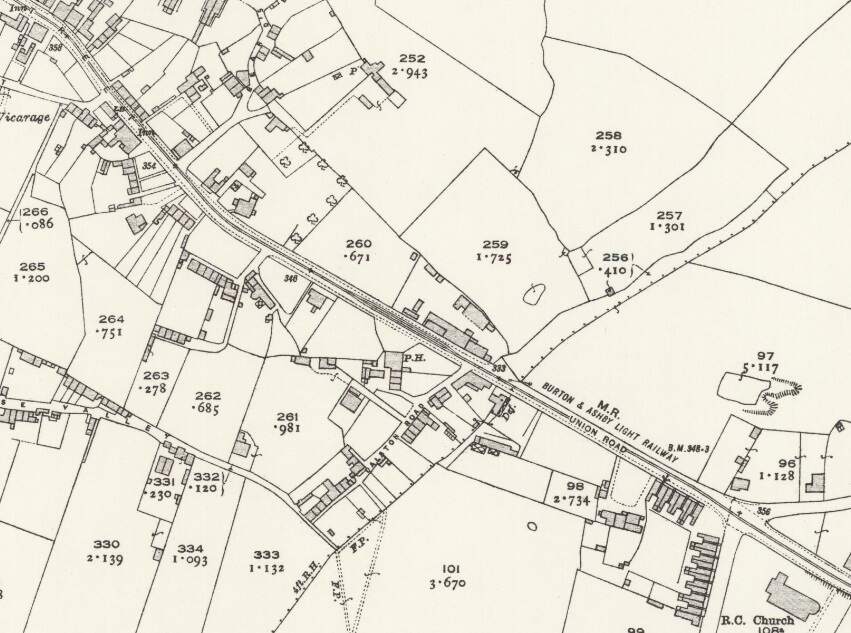
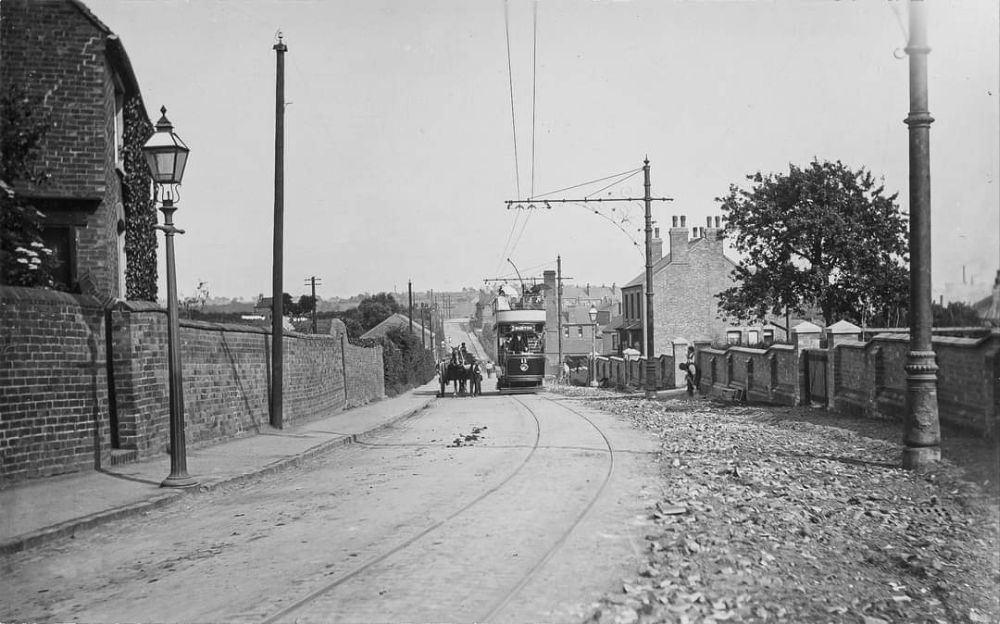
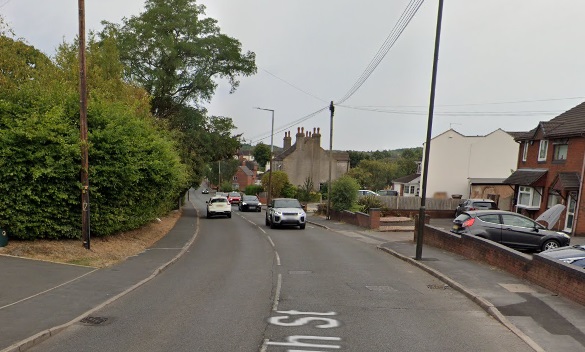
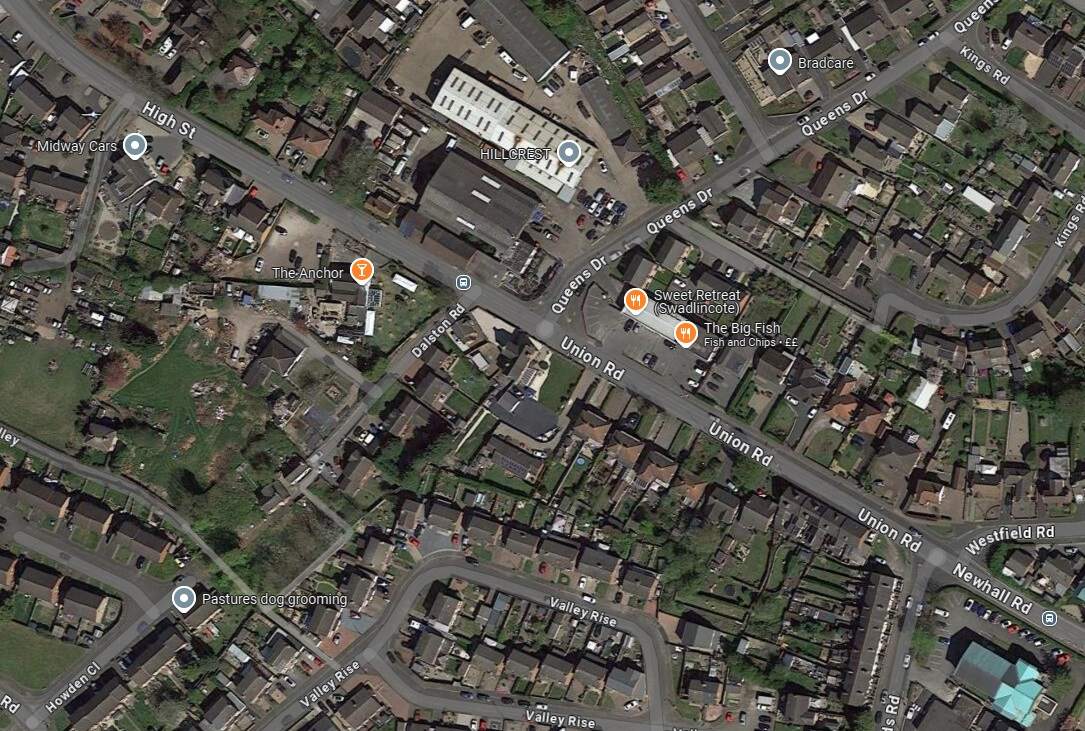
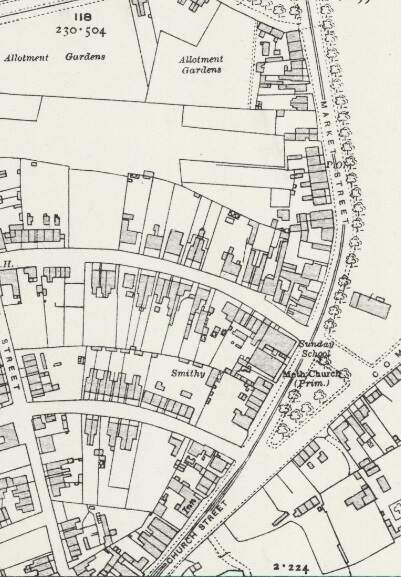
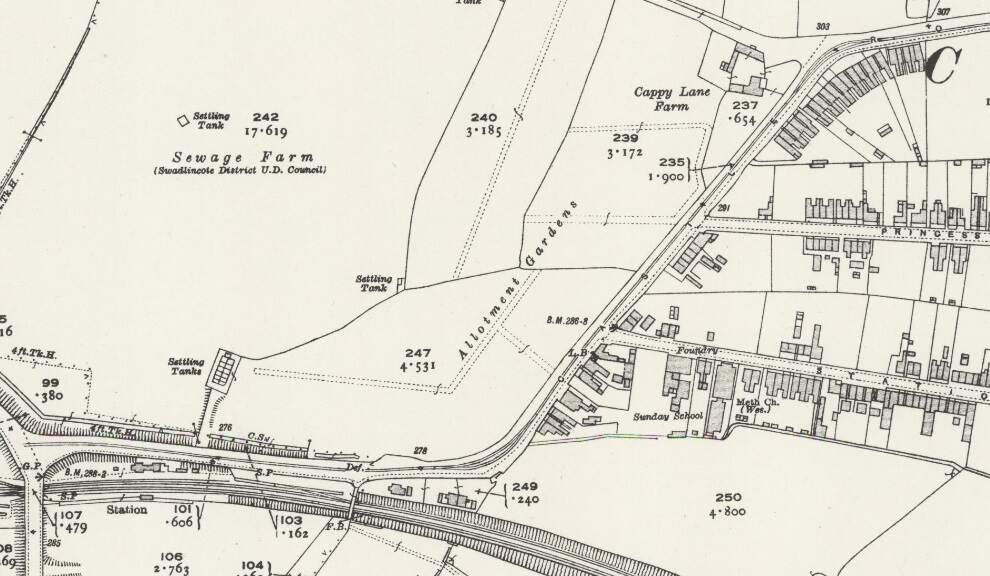
Tram No. 842 sits at the Navigation Street terminus of the route from Birmingham to Rednal and Rubery. [3]The Navigation Street terminus of the tram service to and from the Lickey Hills. Tram services No. 70 and No. 71 circulated round the loop shown on this extract from the 25″ Ordnance Survey of 1913 (published in 1918). [6]
The Bristol Road as far as Pebble Mill Road will ultimately have to be widened if traffic increases much more; but taking in part of the footways and front gardens would in general give room for the central eighteen feet of reservation which would suffice for the tramway. Alternatively, the reservation could be at the side and a three-lane road be left for the remainder of the traffic. As an interim measure local road-widening and the provision of loading islands with queue barriers, the former combined with pedestrian crossings, at the few important stops, should be undertaken.
The narrow road through Selly Oak and under the railway bridge presents the greatest obstacle; track reservation should be made when this is widened, while the provision of loading islands would seem the only present practicable measure.
The roads through Northfields and Longbridge are amply wide enough for a narrow track reservation (lacking the wide grass borders of the present reservations) and conversion of these sections to dual carriageway with central reservation for the tramway should be done as soon as the conversion scheme is commenced.
The tracks at present reserved can remain as now except that it would be wise to convert the remainder of the sleeper track to ‘solid’ track before high-speed running is commenced.
The Cars
Pending the acquisition of new cars (possibly like those at Llandudno, which show what can be done on 3ft. 6in. gauge if the spirit is willing), conversion of about 20 cars of the ‘800’ class for the base service and its reserves, and rehabilitation of another forty air-braked cars, would enable the Department to put the scheme into operation with the minimum of delay.
The cars to be converted should have their roofs and ends removed and the body sides made straight (instead of waisted). The roofs and ends should be renewed and the cars at the same time lengthened about two feet each end. The new ends and roofs should be on the lines of those of the post war Glasgow cars: platform doors should be added and the stairhead doors and bulkheads omitted. Large destination and route number blinds should be fitted below the top-deck windows. Interior decoration should be as modern and attractive as in any other vehicle of early 1950s – brown ceilings are out of place to-day.
To reduce noise the short coil springs on the bogies might be replaced by rubber pads. The long coil springs should be shortened and stiffened (to reduce noise) and have rubber pads above them, again to reduce noise. The motor gear ratio should be decreased by about 10 per cent and helical gears fitted. Automatic but optional field shunting, giving 66 per cent of normal field, should be added. This should give free-running speed of up to 35 m.p.h., yet, by reason of the large amount of free-running possible on such a route, should not unduly stress the motors thermally. The present controllers would suffice for the more arduous duty if a lineswitch contactor were added to perform circuit breaking; the cost and complexity of contactor control would not, in such a conversion, be justified. The present brake installation could be retained if rubber bushed joints were used in the rigging to reduce noise.
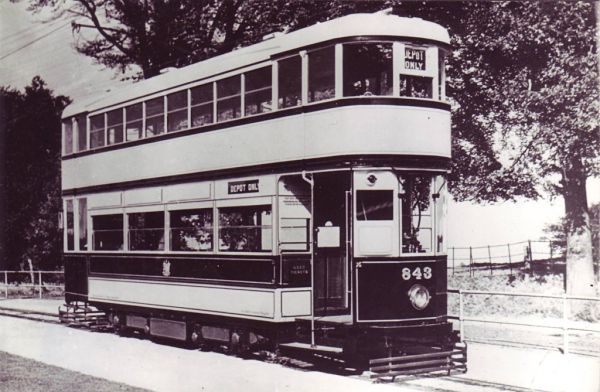
The cars to be rehabilitated should be given straight sides, new roofs, rubber rods in the springing, automatic optional weak field, and lineswitch circuit breakers. These alterations would render them comparable in appearance and performance with No. 843, which in good condition, is still an advertisement for 3ft. 6in. gauge possibilities.” [1: p37-38]
These should be spaced as widely as possible, on the theory of ‘greatest good for greatest number’, even if the short-distance passenger suffers during peak hours. It is more important that the many living in Selly Oak and beyond should have a fast journey home than that an Edgbaston passenger should be set down at the end of his turning. There should be three stops only between Navigation Street and Pebble Mill Road, located where they will be of most use to peak-hour passengers. These stops should have loading islands and queue barriers as described earlier. Other stops, convenient for short distance passengers, clearly labelled ‘not used in peak hours’, should be provided to attract the extra revenue, so useful to any undertaking, which accrues from the casual off peak travel which is a consequence of an attractive service being available.
Beyond Pebble Mill Road, peak-hour stops at each outskirts and the centre of Selly Oak, Northfields, and Longbridge, should be the main points for loading and unloading; there should be some additional stops between these centres at places where the need is obviously great. None of these additional stops should be separated by less than a quarter of a mile, however, but additional stops ‘not used in peak hours’ should also be provided where considered appropriate.” [1: p38-39]
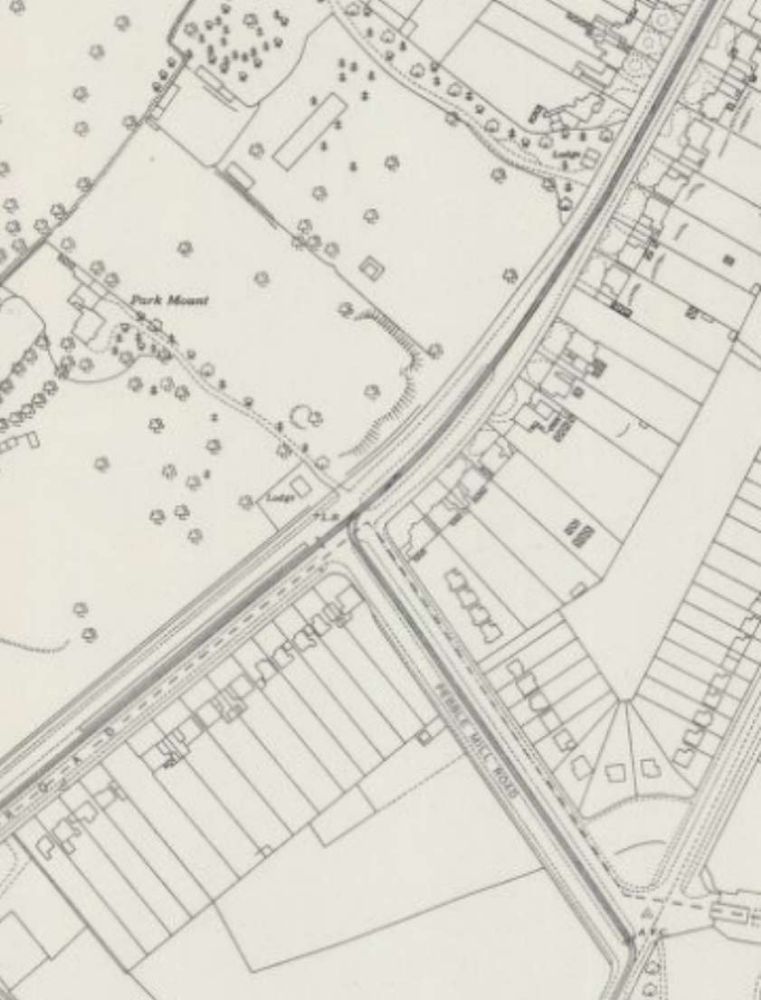
The junction of Pebble Mill Road and Bristol Road, Birmingham as shown on the 25″ Ordnance Survey of 1939 which was published in 1945. [7]Looking Southwest along Bristol Road through its junction with Pebble Mill Road. The trams for The Lickey Hills stopped just beyond the junction. Pebble Mill Road central reservation was at times used to store trams and particularly after the closure of the network before there was room for them at the Depot. [Google Streetview, June 2024]
Pridmore continues:
“Services
A base frequency of 12 cars per hour from Navigation Street, half of which would run to Selly Oak only, would probably suffice. Pershore Road should be symmetrically superimposed. The equal service to
During peak hours, however, a different technique would facilitate traffic flow and give quick travel to long-distance passengers; it is suggested that 12 packets of departures per hour be arranged. The first of each packet would be a fast to Rednal or Rubery, running non-stop to Pebble Mill Road. The second would be a duplicate of the first, but routed to the alternative terminus, stopping only at the peak hour stops to Pebble Mill Road to pick up only. Thence both these cars, would continue, using peak hour stops only (as is presumed in all peak hour services), to their respective termini. The third car would be the triplicate, running as the duplicate but probably to Selly Oak, Northfields or Longbridge only, as the traffic for the extremities of route dictates. Fourth would be the Pershore Road car, stopping also to set down at intermediate points to Pebble Mill Road, and fifth would be its duplicate performing similar duties as necessary.
If a less or more frequent service should prove necessary its pattern should be similar to that indicated above, as the suggested total frequency of 60 cars per hour is well within the capacity of a single line of tramway, whilst the use of packet departures will facilitate the through-running of the long-distance cars.
Inwards peak hour working, when with the load, would be arranged so that cars from Bristol Road would stop only to set down between Pebble Mill Road and Navigation Street, and that such cars should be given priority at the Pebble Mill Road junction.”
The necessity for large destination blinds on the cars, a point mentioned earlier, is now appreciated; the indication of “limited stop” must be given, as well as the destination, and regular users will wish clearly to be aware of both whilst a car approaches their stop.” [1: p39-40]
The success of a scheme such as that described above would commend its application to the similar but not quite so heavily trafficked routes to Pype Hayes and Erdington on the east of Birmingham.
When the full conversion to reserved track had been completed in the less near future, consideration should be given to the provision of a third track to Pebble Mill Road to permit the regular operation of peak hour expresses both ways, and for the ultimate operation of two or three-car trains of single deck high-speed vehicles much as the P.C.C. cars on metre gauge lines in the U.S.A. and elsewhere.
The use of such trains would then render possible the economic construction of cross-town subways in further effort to remove passenger transport from the sorely congested central streets of Birmingham.
The transport problem of Birmingham, as of many large cities, is becoming increasingly severe. The author is of the opinion that such problems can only be solved by the provision of an urban transport installation, and not by the use of supposedly flexible vehicles on the existing network of roads; it is the attempt to solve the problem by this latter means that is responsible for the congestion in the centre of Birmingham at the present time. An embryo specialised installation exists in Birmingham to-day; it is recommended that it be developed as far as possible for its specialist purpose while there is still time and before the traffic of the future swamps the Bristol Road completely, as it will do if numberless small vehicles are expected to cope with it in competition with the many others who regard themselves as having equal claim to the surface of a public road.” [1: p40]
References
B. I. Pridmore; A Lickey Light Railway; in Modern Tramway Vol. 13 No. 146, London, p37-40.
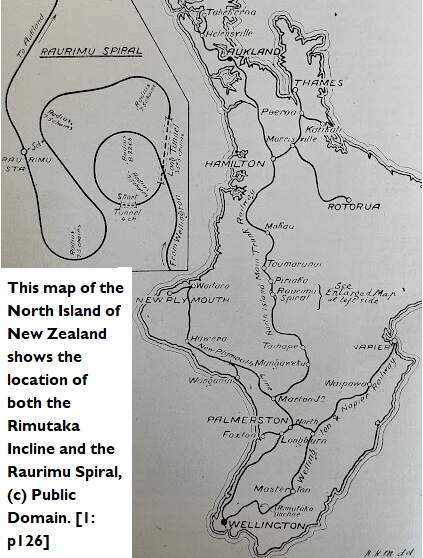
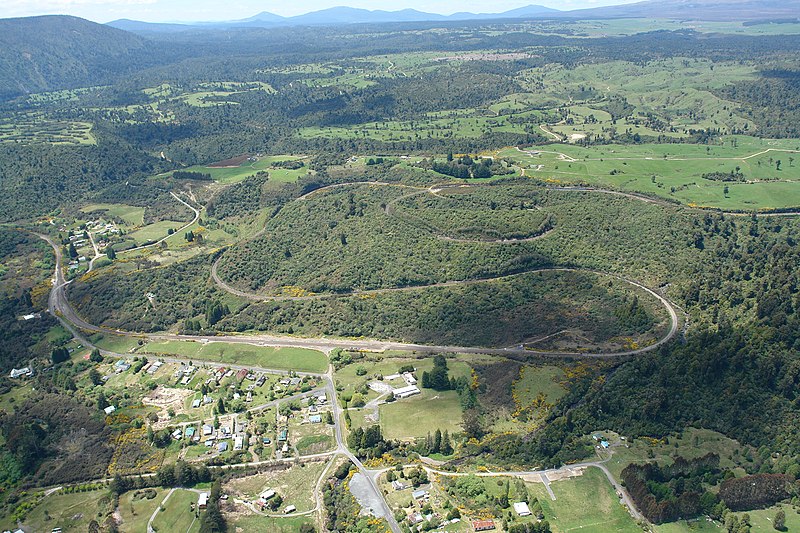
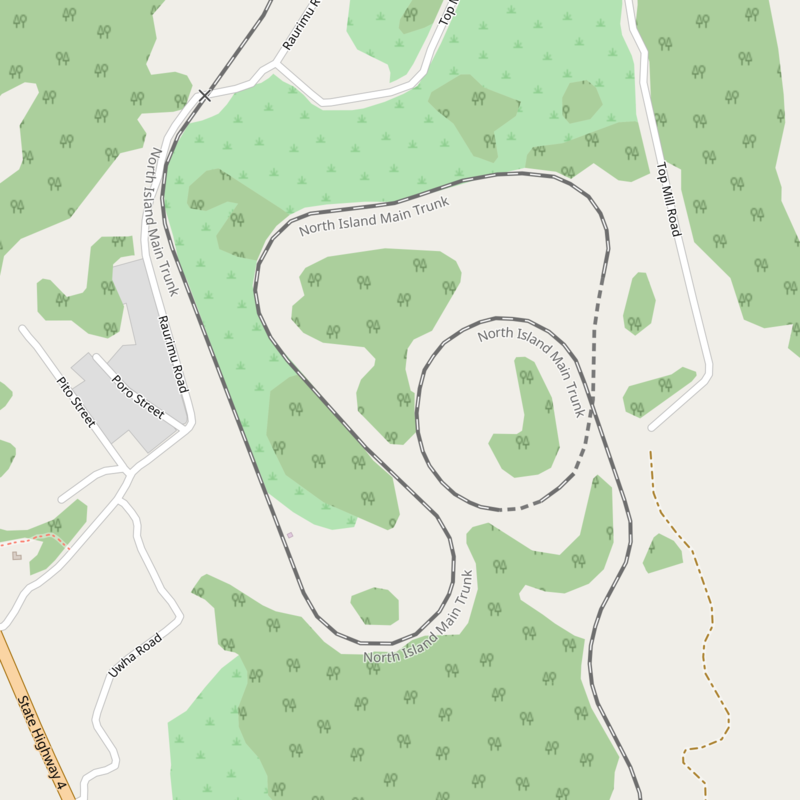
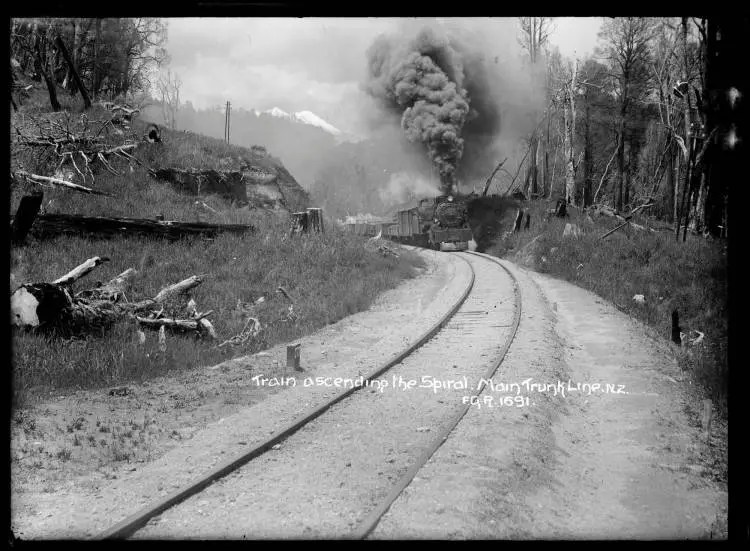
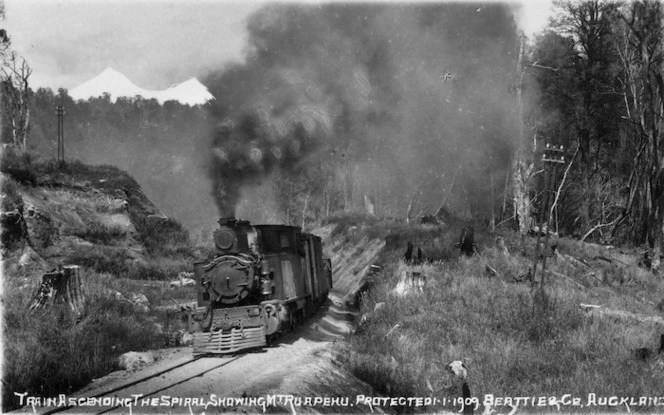
Both the Rimutaka Incline and the Raurimu Sprial were highlighted by Will Lawson in an article in The Railway Magazine in 1909. [1]
The Rimutaka Incline
Will Lawson wrote about the mountain railways of New Zealand in the August 1909 issue of The Railway Magazine. [1] The two principal lines on the South Island were under construction at the time of his article. Those on the North Island were already in use.We look first at the Rimutaka Incline. …
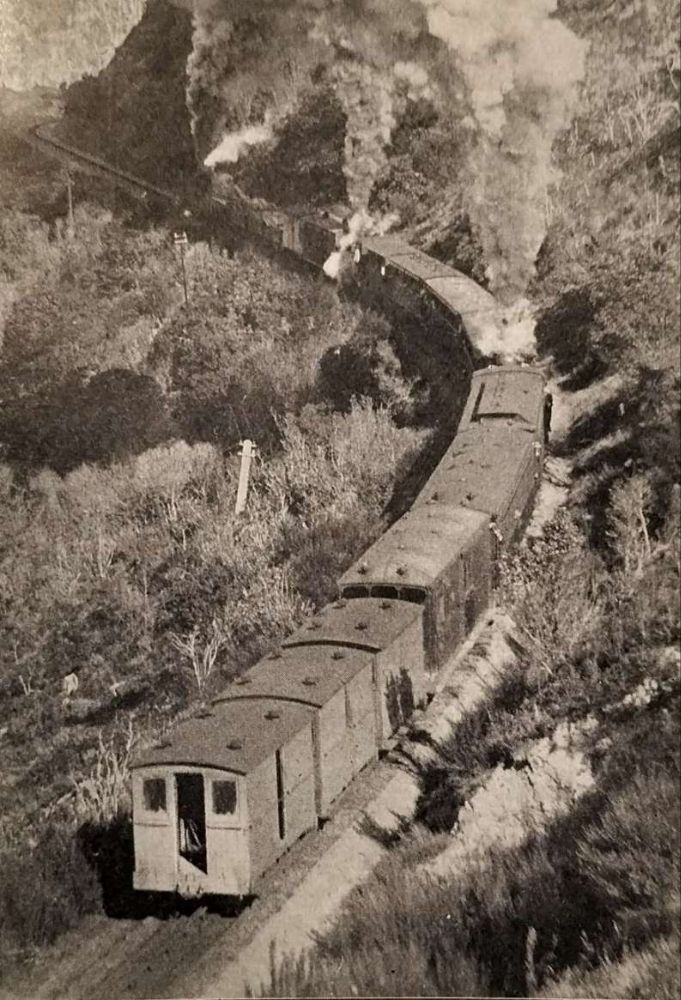
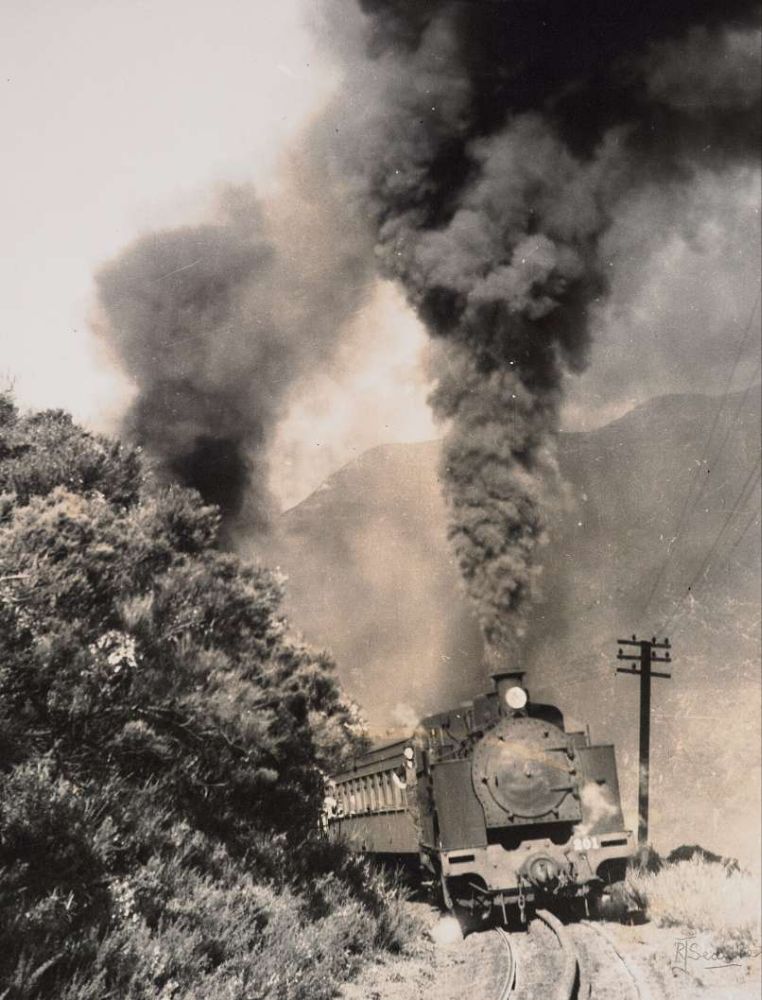
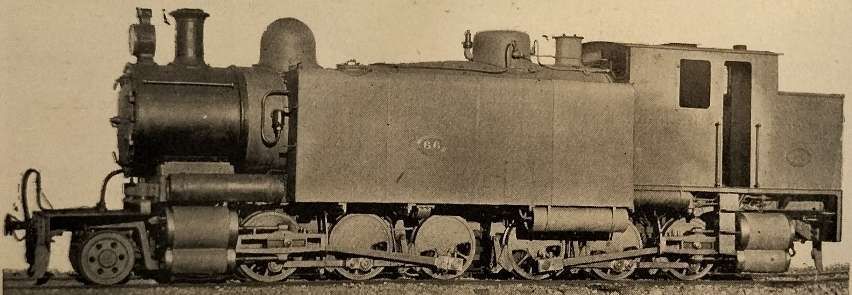
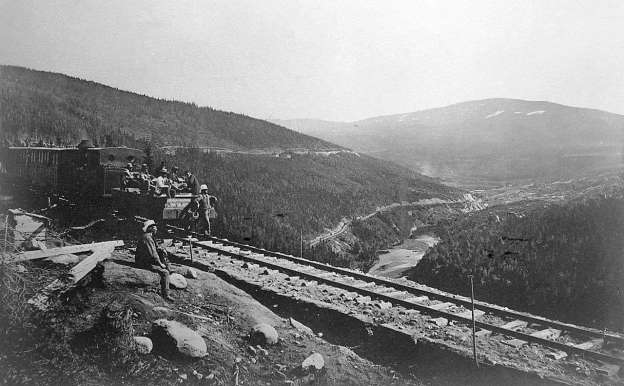
“It is raining at Cross Creek, that lonely railway outpost at the foot of the Rimutaka Incline. Heavy vapours cling to the mountain, and out across the valley only a cloak of mist is to be seen. In the winter twilight, the mail train from Napier arrives. The engine which has hauled it over the plains is uncoupled. With her big driving – wheels, she could hardly propel herself up the 1 in 15 grade which now confronts her, and she gives way to two black, squat-funnelled Fell engines, which already are moving out from the running-shed to be attached to the train. They are followed by No. 66, a huge freight engine, which rolls along with an air of supreme disgust, as though this business of climbing mountains was beneath her contempt. These grimy black monsters, with never a gleam of brass about them, take the mail to the summit-No. 66 in the lead, and the two Fell engines at convenient distances, sandwiched among the carriages, while three brake-vans bring up the rear. These have powerful brakes, which operate on a centre rail laid between the usual rails carrying the wheels. On this rail the Fell engines also grip with their bevel grip-wheels. The carriage lamps are lighted, and the Cyclopean eye of each steel Goliath gleams through the rain. It is 21 miles to the summit, on a greasy rail, up the side of a black, wet mountain. Yet a glance at the hissing, steaming engines now attached to the train gives reassurance. They have an air of irresistibility that is most convincing, and they apparently scorn the grade which rises abruptly outside the level station yard. The leading engine blows her whistle; the sound is echoed by the other two; white steam shoots skyward; and the train glides away from the lonely settlement.
Standing on the level, the water-gauges appear to be empty, but as the engine meets the hill and her bevel-wheels slide on to the centre rail to be firmly clutched thereon by a powerful lever, the water, owing to the tilt of the engine, rises in the glass to a normal level. One reason for not filling the boiler up when on the level is that if there is too much water in the boiler, the heavy blast of the exhaust steam causes ‘priming’. This, of course, is fatal to effective driving.
The bevel wheels on the Fell are driven by an engine distinct from that which drives the ordinary driving-wheels, and as both sets of wheels slip occasionally, the exhaust from the Fell engines occurs with some irregularity. The effect is peculiar, suggestive of an asthmatic Samson climbing a greasy pole. In contrast, the steady thrash! thrash! of No. 66 has dignity. The pace is the merest crawl, scarcely exceeding a walking pace, and the din from the three engines is deafening. This is due to the extremely high pressure at which the boilers are worked. The exhaust steam, mingled with smoke, shoots up for a distance of some 30 ft., and there swirls and hangs in a heavy cloud, which, dimly seen in the coming darkness, marks the progress of the train along the mountain side. The glare from the open fire-doors transforms the cloud of steam into a mass of wicked red vapours, which, with the black, foggy mountains and yawning ravines, makes the scene almost Mephistophelean in its luridness. The train of carriages appears as a procession of glow-worms crawling through a night of foggy density.
On the Incline the shovel is never idle, and in the half-hour occupied in making the ascent the fireman exerts enough energy to run her 20 miles or so on the level. Even on the ends of the hair of his head drops of perspiration cling. In the cab there is only that shielded lamp, so designed that it throws its light on the water-gauge and steam-gauge. The driver’s eyes are shielded from it, as they also are from the furnace glare. Drivers and firemen may elect to work on this section of line or not, as they choose. Extra pay is given them, and in the busy season a great deal of overtime is to be earned. There is one driver who has continued on this run for 20 years, and there are others who are content to stay, despite the, to the lay mind, severity of the ordeal to be gone through in each up-run, especially on thick, wet nights. On such occasions the engine eats coal – one may almost hear her chewing it, and the resulting smoke is suffocating in the tunnels of which there are three – two short ones on the way up and a long curving one at the summit. Best Coalbrookdale is burned – the hottest, cleanest coal obtainable.
Now, some distance up the track looms the first tunnel, piercing an outstanding spur. The engine whistles, there is a sound of slamming windows, with which the engines are fitted, and then such a pandemonium of sound as cannot be imagined. It is an inferno. The 30-foot column of expanding steam and smoke is confined by the tunnel’s arch about 2 ft. above the funnel, and there follows a terrific compression which forces the hot vapours into the engine-cab in spite of windows. Each thrash of the spouting funnel stuns like a blow, the sulphur suffocates, the heat scorches. And on top of all these the fireman opens the fire-door and tosses coal in. Then it seems that there is no air to breathe at all. The wet rail is making the pace slower than usual, though the leading engine, having a dry rail in the tunnel, is exerting herself to get out as quickly. as possible. Still the stuttering, thrashing exhaust thuds on the tunnel’s arch: the tiny lamp in the cab gleams faintly through the smoke; the wicked red shafts from the air-holes in the fire-door radiate their redness in the suffocating atmosphere. Then the clamour of the funnel quietens; the windows are shot open; driver and fireman lean out to breathe God’s air once more. The men in the second and third engines have a worse time than those in the leader, as the tunnel becomes hotter and more foul with the passage of each engine. Onward, upward, she goes – slipping and racing – sanding and swearing. When the wheels slip, sand is thrown upon the rail, but before this is done, steam is shut off. If the sand were thrown under the spinning wheels while steam is on, possibly every rod and crank would be broken owing to the sudden check to the revolving wheel jarring these parts and throwing undue strain upon them.
Another tunnel is passed through, after which the pace quickens. The ‘long straight’ is reached. Here the grade is easier, and the line is straight. So the engines quicken their stroke, and when the last tunnel appears, they are making better time. Into this horseshoe shaped hole in the mountain crest the one-eyed, black giant of steel thunders. She crashes and rumbles along, her crew coughing in the smoky atmosphere. Then clang-clang! clang-clang! A bell, swung at the side of the tunnel and rung by the wheels of each passing vehicle, cries weirdly, telling that the uphill fight is over, the level road is here at last. The engine’s beat becomes more rapid as each carriage tops the grade to the ringing of the bell. As the other engines reach level ground the pace becomes the normal pace of a train running into a station. Ding-dong! ding-dong! A deep-toned bell moans its message through the vaulted place. The grade is a down one now, into the Summit station. The centre grip-rail ends abruptly, and the train rolls into the Summit yard, where an engine of the usual tank type takes it over from the monsters of the mountains, and away down the 1 in 35 grades which lead to Wellington.” [1: p123-126]
The Rimutaka Incline was built in the early 1870s and, as of 1909, was the steepest commercial railway in the world (the only railway on a grade of 1 in 15 on which ordinary rolling stock was used). “It [crossed] a spur of the Tararua Range at an elevation of 1,114 ft. above sea-level, and about a dozen trains [passed] over it in each direction daily.” [1: p121] It avoided what would have been a 25 mile (or more) deviation. Until the middle of the first decade of the 20th century, the line was worked by Fell locomotives alone, by 1909 a Mallet type of locomotive (designed and built in New Zealand specifically for work on the incline) was included in the roster.
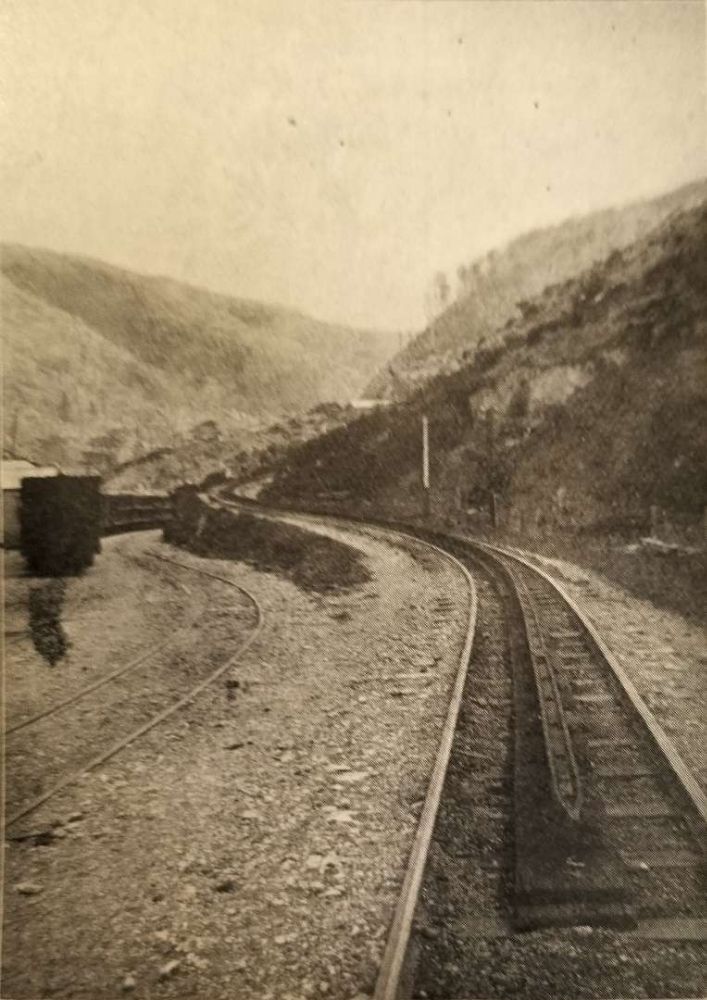
Fell locomotives operate conventionally on regular gradients but are equipped with an extra four laterally-set wheels, which grip an additional centre-rail laid between the usual rails. The “lateral wheels are driven by a separate set of engines located under the smoke-box, and they are pressed to the rail by a lever which the fireman moves when the engine reaches the place where the centre-rail begins. Until that place is reached, progress is made by the usual driving wheels. The pressure exerted by the four grip wheels amounts to 70 tons, and, in addition, the engine has two powerful brakes, having jaws which grip the centre- rail in case of a stoppage and when descending the incline.” [1: p122]
In 1909 the relatively new Mallet-type loco, No.66, was proving to be highly effective. It was “65 tons in weight, carried on 12 driving-wheels and two leading wheels, an articulated tank engine working at a pressure of 200 lbs. to the square inch. The driving-wheels [were] in two [six-coupled sets], each set being driven by compound engines, the exhaust from the rear cylinders occurring through a pipe on the top of the engine cab. On the incline this engine [could] pull a train weighing 110 tons, and to accomplish this she [burned] half a ton of coal. Usually, however, she [took] the train up the hill in conjunction with the Fell engines.” [1: p122]
The incline was on the line from Wellington to Napier with the steep upward grade being on the Napier to Wellington service.
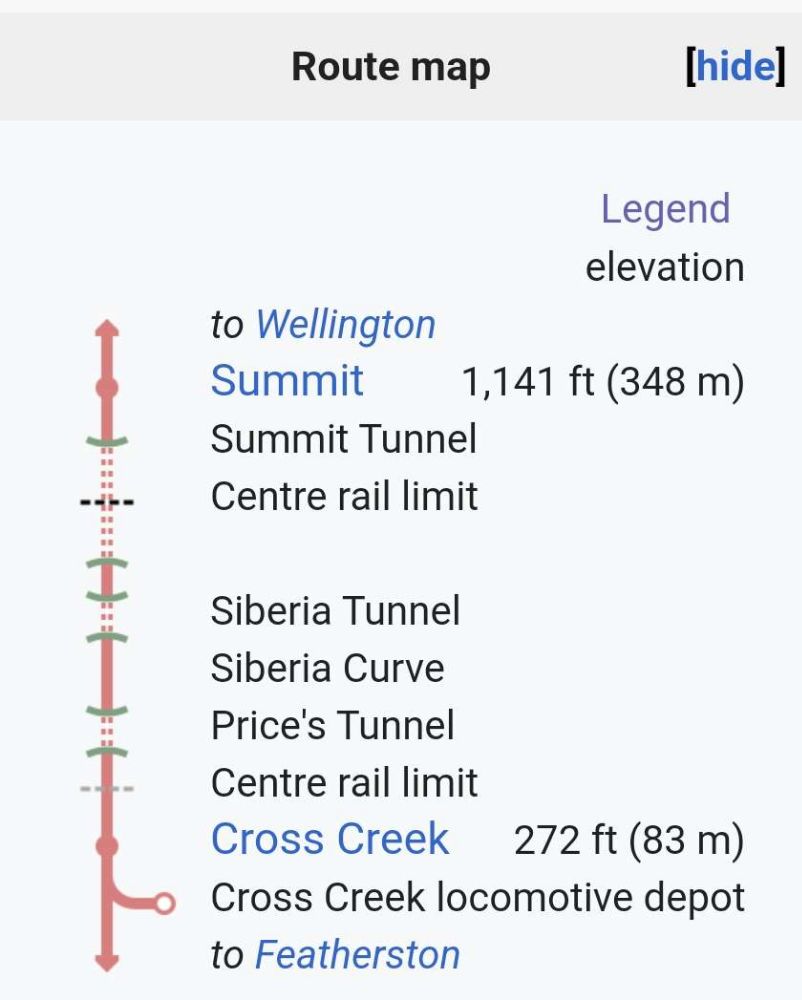
Wikipedia tells us that the “Rimutaka Incline was a 3-mile-long (4.8 km), 3 ft 6 in (1,067 mm) gauge railway line on an average grade of 1-in-15 using the Fell system between Summit and Cross Creek stations on the Wairarapa side of the original Wairarapa Line in the Wairarapa district of New Zealand. … The incline formation is now part of the Remutaka Rail Trail.” [2]
These notes come from the Wikipedia entry about the incline. …
The construction of a railway from Wellington to Masterton was authorised in the Railways Act passed on 13th September 1871. Julius Vogel, Colonial Treasurer, travelled to England to raise finance for a major public works programme for railway construction. Vogel returned via the United States, where he studied rail systems.
After the Act was passed, a survey party investigated four different routes. A commonality between all the proposals was the section from Upper Hutt to Kaitoki (later Kaitoke). Between Kaitoke and the Wairarapa, the four proposals were the Tauwharenikau Route, Mr Sinclair’s Route, a coastal route and the Pakuratahi Route.
While the government was conducting its surveys, Wellington Province Superintendent William Fitzherbert instructed his Provincial Engineer, Charles O’Neill, to investigate the possibility of a railway through the Rimutaka Valley (the route of the road between Featherston and Upper Hutt), with a tunnel through the dividing range. The survey was carried out between May andJuly 1871, and O’Neill reported that a tunnel 130 chains (2.6 km) long would be required, with the line rising at 1 in 60 from the Pakuratahi to the tunnel then descending at 1 in 40 to Featherston. This survey was forwarded to the Minister for Public Works.
In mid-1873 the route to Featherston was chosen after a final survey for the route from Upper Hutt to Summit.
For the line between Summit and the Wairarapa, several proposals were considered. The first, with gradients up to 1 in 30, was dismissed. It was found that to keep the gradient to no steeper than 1 in 40, curves of three chains (60 m) radius would be required. This would have required special rolling stock and heavy earthworks and was thus abandoned.
Another proposal was known as the Birch Spur Incline. This would have involved the line continuing from Summit to Birch Spur from where a rope-worked incline would convey traffic to the valley floor where the railway would continue through a narrow valley to the Wairarapa plains. The Public Works Department engineers investigating this proposal were unable to locate a suitable incline, so this proposal was also abandoned.
The last option was a three-mile (4.8 km) incline with gradients averaging 1 in 15 “to be worked by locomotives of an unusual nature”. This line was the most favourable from an engineer’s point of view, and required not unreasonable earthworks. The final decision was made by the head of the Public Works Department, John Carruthers. He determined that an incline worked by the Fell system would be suitable, and cited the Mont Cenis Pass Railway as an example. Though special locomotives would be required, factors in its favour were that ordinary rolling stock could be used and it was a proven system. It was to be the third and last Fell system employing the centre rail for both tractive power and braking, and the longest surviving. Though it was considered to be a “temporary” measure, it outlasted the second such system in Brazil by 72 years. [2]
Construction
Construction of the Rimutaka Incline was included in two contracts that were let for the building of the original Wairarapa Line. These contracts were known as the Summit contract and the Incline contract. [2]
The Summit Contract included the excavation of Summit station yard and related drainage, Summit tunnel, and formation work to a point 26 chains (523 m) beyond the tunnel. It was the shortest contract of those let for the line, it was finished by the original contractor, and it had the fewest alterations. Work was to start on 12th July 1874 and to be completed by 22nd July 1876, at which time the Pakuratahi contract was due to be completed. [2]
Summit yard was a large cut into the hillside, 120 feet (37 m) wide and 500 yards (460 m) long initially. Excavations removed material to a depth of 15–20 feet, with this fill being dumped on the opposite side of the yard to form level ground. On the hillside above the yard, further ground was levelled and houses erected thereon. [2]
After the yard had taken shape, work commenced on the tunnel. The approach to the tunnel was about 6 chains long and up to 60 feet (18 m) deep. The line entered the tunnel on a downward grade of 1 in 1,000, steepening to a grade of 1 in 15 at the eastern portal. At that end a small drainage tunnel had to be built to divert a stream that had flowed down a steep gully where the tunnel mouth was to be. The maximum height of the tunnel was 15 feet (4.6 m) above the floor: once rails were laid the maximum clearance was 13 feet 9 inches (4.19 m) The width of the tunnel varied from 10 feet 6 inches (3.20 m) at the floor to 12 feet (3.7 m) at 7 feet 6 inches (2.29 m) above the floor. Despite castigation from various parties, it was not until March 1877 that work on both ends of the tunnel met at the middle, having taken three and a half years to complete. [2]
The Public Works Department lined the tunnel after the rails had reached the site, enabling them to use work trains to bring materials and other supplies in. It was during this phase that the only fatality on this contract occurred: on 3rd May 1878, a sizeable portion of the lining collapsed on two men. One was killed outright, the other lost his eyesight due to severe head injuries. [2]
The Summit contract was completed on 10th December 1877, 17 months behind schedule. [2]
The Incline Contract was let on 5th October 1875 to Charles McKirdy for the sum of £49,029. The contract covered the formation only, with the Public Works Department responsible for track laying. [2]
Work on the contract began on 22nd October 1875. None of the major earthworks seem to have presented any great difficulties, save the lower tunnel, which was plagued by accidents and materials failures largely because of the unstable nature of the rock through which it passed. The tunnel was named Price’s after the manager McKirdy employed for this contract. On 2nd March 1876, two men died due to a cave-in of the tunnel roof. [2]
Between October 1877 and March 1878, platelaying was completed up to Summit. This enabled the use of work trains to haul up materials that were used to line Summit Tunnel. Track laying on the incline commenced in April 1878 and reached Cross Creek the following month. During this work, locomotive H199 was stabled at Summit and used to haul work and ballast trains to the railhead. [2]
Initially, only simple arrangements were made for the station yard at Cross’s Creek, as it had yet to be decided the nature of operations on the Incline. It consisted of the main line, an engine siding of 10 chains, and the runaway siding. [2]
After formation work continued beyond Cross Creek, McKirdy ran out of time and money, with the remainder of his contract being picked up by his guarantors, T. W. Young and Robert Greenfield. They finished the formation to Featherston on 17th August 1878, with track laying finishing the following month. The contract was completed 13 months late. [2]
Operation – Initially, trains on the incline were limited to the weight that could be managed by a single locomotive. After complaints from management of the expense of running too many trains, two locomotives seem to have been used, both at the head of the train. From 1887 trains were worked with multiple locomotives, each at the head of its rated load. As the maximum weight of a train during this period was 150 tons, no more than three locomotives were used per train. Train operations continued to be modified until by 1908 the maximum load allowed per train had increased to 250 tons descending and 260 tons ascending. [2]
When the line opened, there were two Fell brake vans in service, each 12 ft 6 in (3.81 m) long and 5 ft 9 in (1.75 m) from floor to ceiling, with open platforms at either end. The wear on the brake blocks fitted to these vans was so severe that a set of blocks seldom lasted more than one trip down the incline. Like the positioning and loading of the locomotives, the arrangements for positioning of the Fell vans varied until they were largely standardised by 1897. For ascending trains, Fell vans were placed at the rear of the train. For descending trains, a Fell van was placed between the locomotives and the leading vehicle. If the gross weight of the train exceeded 120 tons or included more than 15 vehicles (excluding the locomotives in both cases) a second Fell van was attached to the rear of the train. These rules applied before the introduction of the Westinghouse continuous air brake. The Fell locomotives were never turned, running cab first on descending trains. [2]
As descending trains departed Summit the “through” guard applied the brakes on the leading vehicle, then moved through the train applying the brakes on the other vehicles until he reached the train van, which also had brakes that had to be applied. Each Fell van had its own guard to operate the two sets of brakes. [2]
After the introduction of the continuous brake system in 1903 it became possible to operate trains with five locomotives, and on descending passenger trains up to five Fell brake vans could be used – two next to the locomotives, one in the middle, and two at the rear. As each brake van had its own guard and the train had a train guard and locomotive crews, a train with five brake vans and four locomotives had a crew of 14, which added to the expense of the operation. Moreover, to reduce the strain on couplings, when several locomotives were used they would be distributed through the train, as can be seen from photos. This necessitated significant re-marshalling of the train at either end of the incline. [2]
Instructions issued in 1885 regarding the use of the safety siding required that the points for the incline be set to the safety siding. As descending trains approached the Cross Creek yard, the driver of the leading locomotive sounded a long whistle, which signalled that all was well. On hearing this signal the signalman would set the points for the arrival road. As far as is known no real emergency occurred. Cross Creek had an unusual six-lever partially-interlocked signalling installation and had no “distant” signals so had points indicators which applied to the “main” line (see Heine for station layout), while Summit had a fully interlocked 27-lever frame. [2][3]
Unusual traffic included four royal trains: for the Prince of Wales in 1921; the Duke (later King George VI) and Duchess of York in 1927; the Duke of Gloucester in 1935; and Queen Elizabeth II and the Duke of Edinburgh in 1954. Trains were diverted from the Manawatu line due to slips, floods or other mishaps. [2]
The original yards at Cross Creek and Summit were sufficient for the traffic levels of the time, but increasing traffic brought about incremental additions. The full extent of the Summit yard was reached in 1903, which coincided with the introduction of full signalling and interlocking, not introduced to Cross Creek until 1915. [2]
The Fell locomotives (H class) were not to be operated on any part of the railway other than the Incline, with the sole exception of conveying them to the Petone (and later Hutt) Workshops for maintenance. In the latter case, bunkers, water tanks and boilers were to be empty and the locomotives were to be towed at a speed not exceeding 10 miles per hour (16 km/h). These rules were relaxed to allow the locomotives to travel light engine to Petone and back under their own steam, subject to the same speed restrictions. In 1887 they were permitted to be operated between Cross Creek and Pigeon Bush, later extended to Featherston to enable them to be used for banking purposes. Running rights between Cross Creek and Featherston were revoked about 1943. [2]
Speed limits for trains on the Incline were changed several times. From 1884 to 1888 the limit was 6 mph (9.7 km/h) ascending and descending, except light passenger trains for which the limit was 8 mph (13 km/h). In 1888 these limits changed to 5 mph (8.0 km/h) up, 9 mph (14 km/h) down. The limits were finally 6 mph (9.7 km/h) up, 10 mph (16 km/h) down. [2]
Various classes of locomotives were deployed to supplement the H class when one or more was away for maintenance or repairs, including
W192 and 238 2-6-2T locomotives, built in 1889 and 1891 respectively, which spent most of their time on the Wellington to Summit section until their transfer in 1909;
54-ton We 4-6-4T locomotives rebuilt from 4-8-0 B Class locomotives, rated to haul passenger trains up to 55 tons and goods trains up to 60 tons, until 1906, after which they were used mainly on the Upper Hutt to Summit section and rated to haul passenger trains up to 130 tons, mixed trains 150 tons and goods trains 155 tons, and were then later sent to work on the Rewanui Incline on the South Island;
65-ton E 66, rated to haul 80 tons up the Incline, and nicknamed Pearson’s Dream. In 1910 it was transferred to banking duties on the Wellington to Johnsonville section, but it was never popular with crew. (This is interesting, given Lawson’s very positive description of the loco in use on the Incline);
Wg 480 4-6-4T locomotive, during the first World War.
After the Great War traffic was well within the capabilities of the six H class Fell locomotives. [2]
The mileages run by the H class locomotives show notable increases that correspond to economic and other major events, such as the opening of the Wairarapa Line as far as Masterton, completion of the line to Woodville, and the nationalisation of the Wellington and Manawatu Railway. With the opening of the railway to Masterton the annual mileage of the H class rose from less than 7,000 to more than 8,000, in 1883–1897 to 34,000, and to 42,000 when the line was opened to Woodville and began carrying traffic from the Hawke’s Bay. Mileage peaked at 64,123 in 1906–07, about 10,687 miles per locomotive or 1,780 return Incline trips. [2]
Wairarapa railcars
In 1936 seven lightweight Wairarapa railcars, RM 4–10, were introduced between Palmerston North, Masterton and Wellington. They were specifically designed for the Incline, and were built at the Hutt Workshops. They were named after historic Maori canoes: Maahunui, Mahuhu, Mamari, Matahourua, Mataatua, Arai-te-Uru and Arawa. Initially powered by 130 horsepower (97 kW) Leyland petrol engines, they were upgraded after several years to 120 horsepower (89 kW) diesel engines. They had a single rear driving axle with 38½” (978 mm) diameter wheels, necessitated by the need for the axle and final drive unit to have sufficient clearance above the Incline’s centre rail. Because of the large rear wheels the floor of the passenger compartment was 52½” (1334 mm) above rail level, more than 12 inches (300 mm) higher than normal. They were rated for a maximum speed of 60 mph (97 km/h) and expected to climb the Incline at 15-17 mph, but actually managed only 10–12 mph. Nevertheless, they greatly speeded up passenger trains on the route and immediately proved popular. They were withdrawn in 1955 when the Incline closed. [2]
Several options for an alternative to the Incline were considered in the 20th century, but it was not until after WWII that a route through a tunnel between Maymorn and Lucena’s Creek was selected. Construction was started in 1948 by the Public Works Department and completed by a private contractor in 1955. The tunnel and deviation opened on 3rd November 1955, five days after this the Incline closed. [2][6]
Demolition was swift, with the removal of track between Cross Creek and Pigeon Bush largely completed by March 1956. H 199 was used to haul the work trains that removed the track between Cross Creek and Summit. The buildings were sold at auction, on site. Some of the rails were sent to the Rewanui Incline, as were a couple of the Fell brake vans. Five of the six H class locomotives were towed to the Hutt Workshops, later to Silverstream, to be scrapped. [2]
Today
A resurgence of public interest in the incline followed the publication of a book in 1976 and the opening of the Fell Engine Museum in the early 1980s, prompting the New Zealand Forest Service to re-establish access to Cross Creek in 1984. [5: p40] Interest increased following the publishing of an article in the NZ Runner magazine “Try this Run” in the November-December 1984 issue, which promoted this incline as a backcountry running opportunity [Issue No 35]. The official opening of a rail trail using the formation of the original railway line from Cross Creek to Kaitoke followed in 1987. [5: p41] It is today one of the more popular recreational facilities in the region and forms part of the Remutaka Forest Park. [5: p41]
The Raurimu Spiral
“The Raurimu Spiral is a single-track railway spiral, starting with a horseshoe curve, overcoming a 139-metre (456 ft) height difference, in the central North Island of New Zealand, on the North Island Main Trunk railway (NIMT) between Wellington and Auckland. It is a notable feat of civil engineering, having been called an ‘engineering masterpiece’. [8] The Institute of Professional Engineers of New Zealand has designated the spiral as a significant engineering heritage site.” [7][9]
A bird’s eye view of the Raurimu Spiral, seen from the West and taken in November 2007, (c) Duane Wilkins and licenced for reuse under a Creatiev Commons Licence (CC BY-SA 2.0). [10]
“During the construction of the central section of the NIMT, a major obstacle arose: how to cross the steep slopes between the North Island Volcanic Plateau to the east and the valleys and gorges of the Whanganui River to the west? … South of Taumarunui, the terrain is steep but not unmanageable, with the exception of the stretch between Raurimu and National Park, where the land rises too steeply for a direct rail route. A direct line between these two points would rise 200 metres (660 ft) in a distance of some 5 kilometres (3.1 mi), a gradient of 1 in 24. The area was thoroughly surveyed during the 1880s in an attempt to find a route with a lesser grade, but the only viable possibility seemed to require a 20-kilometre (12 mi) detour and nine massive viaducts. Even then, the gradient would have been steeper than 1 in 50.” [9]
“The problem was solved in 1898 by a surveyor in the employ of Robert Holmes, Public Works Department engineer. He proposed a line that looped back upon itself and then spiralled around with the aid of tunnels and bridges, rising at a gradient of 1 in 52. Though costly and labour-intensive, the scheme was still cheaper than the previous plan by Browne and Turner which required 9 viaducts down the Piopiotea River.” [9]
Wikipedia tells us that the railway “forms an ascending spiral southwards, with two relatively short tunnels, a circle and three hairpin bends. From the north, trains pass Raurimu before going round a 200° bend to the left in a horseshoe curve, climbing above the track on which they have just travelled. Two sharp bends to the right follow, after which the line passes through two short tunnels, the Lower Spiral Tunnel (384 m) and the Upper Spiral Tunnel (96 m). Trains then complete a full circle, crossing over the Lower Spiral Tunnel through which they have just passed which is 23-metre (75 ft) below, before continuing towards Wellington. Two kilometres (1.2 mi) further on the line has two more sharp bends, to the right and then to the left. … After the second of these bends a train has risen 132 metres (433 ft) and travelled 6.8 kilometres (4.2 mi) from Raurimu– the straight-line distance is 2 kilometres (1.2 mi). Some of the sharp curves are only 7½ chains (150 m) radius. … A masterly feature of Holmes’ layout is the way in which it uses natural land contours so that no viaducts are needed, and only two short tunnels.” [9]
The line to Auckland was only completed in November 1908. The work on construction of the line across the feet of substantial mountains such as Mt. Ruapehu, Mt. Tongariro and Mt. Ngaruhoe (still an active volcano) proved arduous and held back the opening of the route. Overall, the “line rises to 3,000 ft. above sea-level. The maximum grade in the 90-mile mountain section is 1 in 50, and the sharpest curve has a radius of 7. 5 chains.” [1: p126]
At Raurimu, the railway rises 700 ft. in 7 miles, of which 4 miles constitutes the spiral. For the main lengths of the trunk route New Zealand Railways designed 72-ton four cylinder balanced compound Class ‘A’ locomotives. For the 90-mile mountain section a bigger beast of an engine was required! The Class ‘X’ “mountain engine [was] a monster weighing 92 tons. … The ‘A’ was probably the first narrow gauge locomotive, (3ft 6in gauge) in the world to be fitted with inside as well as outside cylinders, and the ‘X’ [was] similarly equipped. She [was] a four-cylinder engine, with eight-coupled 3ft. 9in. driving-wheels, which, carrying about 50 tons of her weight, [gave] her immense grip of the rail, her tractive force being 30,000 lbs. The ‘A’ (six- coupled 4ft. 6in. wheels) [had] a force of 17,000 lbs. So the ‘X’ [pulled] nearly double the load an ‘A’ [could] haul. A four-wheeled leading bogie and a two-wheel trailing truck [completed] her wheel arrangement. New Zealand, in the design and construction of this engine, [had] taken a stride which [brought] her narrow gauge on almost level terms with the standard one. The only fault which [could] possibly be found in the ‘X’ [was] in the width of the locomotive in the region of her fire-box. Her furnace and tubes [had] a heating surface of 2,000 square ft., and she [worked] at a pressure of 250 lbs. of steam to the square inch. Consequently, she [had] an enormous fire-box, which [overhung] at the sides. But, having length as well, she [had] symmetry and stability. At a high speed she [would have been] inclined to roll. Her speed, however, rarely [exceeded] 30 miles an hour, her business being to pull a heavy train up the hills at a fair pace.” [1: p126-127]
On the mountain section, the rails are 70 lbs., flat-footed (Vignoles) ones, spiked to sleepers and heavily ballasted. “The line [crossed] viaducts of great height, two of them curved ones, and it [pierced] many tunnels, one of which [had] an S-curve in its length. Altogether, the engineering conditions [were] severe, making the maintenance of a service of fast travel over this section a strenuous task.” [1: p127]
Train ascending the Raurimu Spiral in the early 1900s, (c) Frederick George Radcliffe/Auckland Libraries and authorised for reuse without restriction (Public Domain). [12]
Lawson goes on to describe a journey South over the spiral:
“There is bustle and babel on the railway platform at Taumarunui when the south-bound overland train is due. Her strident whistle sounds through the wintry morning air. A porter hurries along, his lantern gleaming in the dark, bidding all stand back, and he has hardly walked the length of the station when the express engine rushes past, bringing as her train six passenger cars, and the mail and baggage cars, three in number. She has come headlong from Te Kuiti, 50 miles away, through the long Poro-o-tarao tunnel and along the banks of the beautiful Ongaruhe River. But her ‘beat’ ends here. To fill her place comes a broad-backed monster whose bulging flanks overshadow her narrow wheel base. This is the ‘X’ engine, the monster of the mountains which will carry the mail, careering, where all Nature is, like herself, colossal. Her footplate is wide and her cab roomy and comfortable, after the American pattern. When her fire-door is opened it discloses an enormous cavern whence a stinging glare strikes out to the eyes. Beneath her tremendous energy one can almost feel the giant quiver. A shrill whistle is blown, and the fireman, watching for the guard’s starting signal, says, ‘Right away!’ There is a deep hoot from her whistle, and her throttle is opened slowly. So gently does she apply her strength, that the first sign of her moving is a gentle puff from her funnel 20 ft. away. Gathering way, she blows out a steady succession of muffled puffs, for there is nothing noisy about this locomotive until occasion in the shape of hard work demands it. Soon she is warming up and getting into her stride along the gently-rising track which leads to Piriaka. Originally it was intended that no grade on this line was to exceed 1 in 70, which, if not an easy one, is not unusual when cost of construction has to be studied, but the trend of the land towards the mountains compelled a maximum of 1 in 50, as already stated. Except on the Spiral, the maximum is 1 in 55. The big engine is making light work of her train of 9 heavy cars. Her fireman finds time to lean out and watch the carriage lights twinkling away in perspective. Past Kakahi and Owongo to Oio (surely the shortest railway name in the world!) and then the grades begin. Her furnace yawns for coal, her funnel’s roar rises in tone and intensity, her fireman mops his brow. Presently her hoarse, booming whistle hoots at the lights of Raurimu, the station at the foot of the Spiral. She steams into the station and makes her first stop after a 30-mile run. The engine is uncoupled, and runs along to a tank to water. This done, she returns to the train, and again her whistle blows for a starting signal. ‘X’, now thoroughly warmed to her work, makes haste to gather speed on the level stretch below the Spiral. It is a brave effort, and when she meets the rise she has attained some pace. Looking back, one may see where the grade begins. Some of the cars are still on the level. One by one they lift their noses to the grade until the whole train is hanging heavily on the engine’s draw-bar. Round to the left we sweep, and faintly can be heard the flange of a carriage wheel crying on the curve. Round and upwards for a mile.
Then nearly 100 ft. below, pale in the coming dawn, gleam the lights of Raurimu. One mile to gain a hundred ft. – that is, approximately, the achievement of Raurimu Spiral. Up we go: the engine blowing stentoriously, the fireman firing furiously, the carriages following unwillingly, and the speed a good 20 miles an hour. There is never a slip from the 8 driving-wheels, though there is a slight frost on the mountain side. The driver is watchful, and sands the line judiciously. A hoot from her whistle, and we are in the long 35-chain tunnel, and we feel it to be a relief when we are out in the pure mountain air once more.
Round and upwards, the big ‘X’ roars, steaming well. At last, the spiral motion ceases, and we rush out on to a length of straight line, which carries us over the long tunnel just passed through, which is 85 ft. beneath us. The mail rushes southward to the muffled measure of deep sound which her wheels toss out. Suddenly the thunder of our speed changes to an echoing, hollow-crashing sound. The earth which choked and deadened the uproar has dropped away, and a deep gorge, crossed by a towering entanglement of steel, echoes and re-echoes the sound. At either side of the engine, white handrails gleam. We are on Makatote Viaduct, the tallest in New Zealand, standing 260 ft. above the river-bed. Soon after, two curved viaducts are crossed: Toanui and Hapuawhenua. Then the train runs into Ohakune, which is half-way between Auckland and Wellington. After a short pause, we speed on across the Karioi Plains, and climb up to Waiouru, which is 2,659 ft. above the sea, and is the highest railway point in New Zealand. Snow-clad Ruapehu, the nearest and highest of the trio of mountains, shows bravely in the morning sunlight, and the wind that blows from the mountain is bitterly cold. So far, there has not been need for a snow-plough here, yet the possibility of one being required is always to be reckoned with. Last winter (1908), on the Central Otago Line, in the South Island, a snowstorm swept the high lands traversed by the railway, effectually blocking the line. One train was cut off from civilisation, and the engine belonging to it was set to the task of clearing the line. A snow-plough was devised by fastening a stout beam from the point of the cowcatcher to the top of the funnel, resting also against the smoke-box. Then all around were arranged timbers bound with iron. The engine, one of the “B” type of the New Zealand railways – 4-8-0, with 3ft. 6.25in. driving-wheels, weight 65 tons – patrolled the line, and finally succeeded in clearing the road again. Her enginemen had a cold time, working in a blizzard at 2,000 ft, above the sea. At one time it was freezing so hard, that icicles were formed on the engine. Whether such conditions will be met with on the North Island Trunk Line remains to be seen. Even the ‘X’ engines will find it hard work to climb the Raurimu Spiral if there are ‘ice-whiskers’ on the rails.” [1: p127-129]
A Wf class tank engine climbing the Raurimu spiral in 1909 Original photographic prints and postcards from file print collection, Box 5. Ref: PAColl-5800-54. Alexander Turnbull Library, Wellington, New Zealand. (c) A. Williams/Alexander Turnbull Library and made available without restriction provided reproduced as taken with no alteration. [13]
References
Will Lawson; New Zealand’s Mountain Railways; in The Railway Magazine, August 1909, p121-129.
Richard Leitch, David; Scott, Brian (1995). Exploring New Zealand’s Ghost Railways (1998 ed.). Wellington: Grantham House.W. Heine; Semaphore to CTC: Signalling and train working in New Zealand, 1863-1993; New Zealand Railway and Locomotive Society, Wellington, 2000.
An article by Seymour Glendenning in the July 1906 issue of The Railway Magazine focussed on the newly opened Burton & Ashby Light Railway. [1]
The light railway was a 3ft 6in gauge electric tram line supplied with electricity from a diesel generator plant near Swadlincote. [17] The power plant sat alongside the tram depot. [1: p56]
Glendenning explains that the rail network in the area between Burton and Ashby-de-la-Zouch was, of necessity design round the topography of South Derbyshire which resulted in the Midland Railway bypassing some significant industry and associated communities. A branch, built by the Midland Railway, off the main line penetrated the South Derbyshire Hills to serve Bretby Colliery. Another Midland Railway branch line described a rough horseshoe alignment, leaving the mainline not far from the Bretby Colliery line. This second branch served Newhall, Swadlincote and Woodville with a short branch designated as the Woodville Goods Branch.
This network of lines meant that the journey from Burton to Ashby was longer than the two towns might have hoped, and that transport to and from Ashby and Burton and the villages in the hills was much longer than it might be if an alternative could be designed which could cope with the steeper gradients necessary on a more direct route.
Initially local interests brought a bill before Parliament for the construction of a Light Railway. The Midland Railway opposed the bill which was then withdrawn with the Midland Railway agreeing to construct the line. Glendenning notes that it took only two years from the Midland’s agreement to carry out the project to its completion in 1906.
The Light Railways was “an electric railway, laid upon the public highway, with stopping places at all penny stages and intermediate points, while the various villages and towns through which it passes will practically serve as stations. … [Some] of the line … resembles that of a branch railway, fenced or hedged in on either side, this being necessary in consequence of short cuts across fields or garden plots. … The electric current is taken from an overhead cable, suspended from steel poles or standards, placed at frequent intervals along the line of route.” [1: p54]
Glendenning tells us that “the greater part of the track [was] laid singly and on one side of the public highway, a double road being laid at frequent intervals to serve as crossing places. An enormous expense, however, [was] incurred in widenings and clearance. For nearly half-a-mile in Newhall the street … had to be widened, involving the demolition of a number of houses and the clearing away of numerous front gardens. In Ashby itself, also, where the tram [had] to take some very abrupt curves on its tortuous way to the station, valuable property [was] cleared away in Bath Street and Market Street, in order to afford a safe route for the cars.” [1: p54]
The route of the line(s) is shown in black on the map extract below.
The line runs through 3 counties – Staffordshire, Derbyshire and Leicestershire. In 1906, Glendenning starts to describe the route:
“At the western extremity is Burton, with its huge breweries which supply a great part of the world’s beer. It was intended at first that, after crossing the Trent Bridge, the railway should leave Burton up a steep slope between the Winshill and Stapenhill roads, but eventually it was mutually agreed between the town and the railway that the Corporation track should be used as far as Winshill. The new line, therefore, begins at High Bank Road, with a very deep curved gradient up to Moat Bank, where a height of 250 ft. above Burton is reached. A fine stretch of hilly country then opens to view, with Brizlincote Hall on the right; next the line dips 60 ft. to cross a lateral valley. Then it rises again, and follows a number of switchback undulations until it enters Newhall, which is 400 ft. above ordnance survey datum line. Newhall furnishes a strong contrast to the fair country west of it. Collieries, brick yards, and pipe works abound. Newhall displays the characteristics of mining villages, i.e., it is dingy, squalid, and untidy. However, its teeming population will doubtless find the new line a very great convenience, both for business and pleasure purposes, and there seems little doubt but what the Midland Railway Company will reap a continued harvest of fares from the thousands of miners and their families. From Newhall, the level of the track gradually descends until it is below 200 ft., and then leaves the Ashby main road to take a right-angled turn into Swadlincote. Here the line, after going due south for a time, is carried over the old railway the single loop to Swadlincote and Woodville before mentioned on a long bridge of steel girders, resting on blue brick piers. The bridge [as can be seen below] has a switchback appearance, while the [second view below] taken from Swadlincote goods yard, shows a Midland Railway train passing under [the bridge there]. Shortly after crossing the bridge the track takes an abrupt turn to the left, in order to resume its eastward direction. At the same place, there is a branch about two miles long, going first south and then south-west to Gresley. The road towards Ashby rises continuously until it reaches a height of 569 ft. above sea level. It passes through the heart of the Derbyshire Potteries, where a great industry is carried on in the manufacture of furnace bricks, sanitary pipes, and common earthenware. Furnaces and kilns abound in Swadlincote, and the subsidiary industry of crate making is also much in evidence.” [1: p54-55]
Before continuing to follow Glendenning’s description of the line East from Swadlincote, it is worth looking at the first part of the line already described by Glendenning on contemporary mapping from the early 20th century, and as it appears in the 21st century.
The Burton terminus of the line was in Wellington Street, although as we have already noted the route within Burton ran not on Midland Railway metals but on those of the Corporation.
Burton-on-Trent’s tramway network opened on 3rd August 1903. “The system comprised four routes going out from Station Street to Horninglow, Branston Road, Stapenhill, and Winshill. The depot was in Horninglow Road. … The initial 20 tramcars were built by the Electric Railway & Tramway Carriage Works of Preston. A further four cars were obtained in 1919. … The system was closed on 31 December 1929.” [3]
The Burton-on-Trent tramway network. The terminus of the Burton and Ashby Light Railway was to the West of the railway station which sits, in the adjacent map extract, below the second ‘n’ of Burton-on-Trent. The terminus of the tramway was close to the Town Hall on Wellington Street, just beneath the second ‘o’ of Burton-on-Trent.
The terminus of the Burton and Ashby Light Railway was outside the post office on Wellington Street, just a stone’s throw from Burton Town Hall and the railway station just a short distance to the Southeast. The lilac line superimposed on the 1920 25″ OS map (published in 1922), shows the route of the line which ran along the town’s tramway network. [4]The same area in the 21st century. [Google Earth, October 2024]The railway station, seen from the Northwest in 1927. Burton-on-Trent Railway Station Passenger Facilities were at road level above the station platforms. Borough Road ran across the front of the station building, at the centre of this extract from Britain From Above aerial image No. EPW019724. The route followed by trams from the Burton and Ashby Light Railway started off the bottom of the image on Wellington Street and followed Borough Road. [11]The 1920 25″ OS mapping shows the route continuing along Station Street and turning up High Street. [5]Approximately the same area in the 21st century. [Google Earth, October 2024]Burton and Ashby Light Railway trams continued Northeast on High Street. [6]The Light Railway trams continued to follow the track of the Corporation Tramways across Trent Bridge. [7]The Light Railway’s trams continued to the East along Bearwood Hill Road. [7]Trent Bridge and Bearwood Hill Road to the East.
A series of images showing Trent Bridge in tramway days follows below.
After crossing the Midland Branch the Burton and Ashby Light Railway turned of the road that became the A511 (Burton Road) to the South and rather then following a highway picked its own route through the fields.
The Burton and Ashby Light Railway turned South off Burton Road (A511) to the East of what was the Stanhope Arms. [Google Streetview, August 2023]A tram on what appears to be the length of the line between the A511 and Sunnyside, (c) Public Domain. [9]The Burton and Ashby Light Railway followed its own fenced route South as Far as Sunnyside where it turned to the East. [16]The modern satellite image has the approximate route of the tramway superimposed in green. Before reaching Sunnyside, the railway followed what is now the line of ‘The Tramway’ a modern small estate road. It then turned towards the East running down Sunny side and across it junction with Bretby Road. [Google Maps, October 2024]Looking Northwest from Sunnyside, the green line shows the route of the old railway. [Google Streetview, March 2023]Looking Southeast along Sunnyside, the old railway ran down the centre of the road. There was a passing loop immediately in front of the camera. [Google Streetview, March 2023]A view looking Northwest on Sunnyside – on the right of this image a tram can be seen approaching Sunnyside from the North. This image was shared on the Newhall, Stanton & BretbyYesteryears Facebook Group by Keith Townsley on 5th December 2020, (c) Public Domain. [27]On this very similar image, a tram is turning onto Sunnyside. This image was shared on the Newhall, Stanton & Bretby Yesteryears Facebook Group by Marcus Payne on 10th September 2020, (c) Public Domain for the original image. [24]Looking Southeast along Sunnyside towards Bretby Road with the Light Railway rails in the road surface. This image was shared on the Newhall, Stanton & Bretby Yesteryears Facebook Group by Marcus Payne on 12th September 2020, (c) Public Domain for the original image. [24]Looking Southeast from Sunnyside across its junction with Bretby Road and along the line of the Light Railway which ran next to Matsyard Footpath. This image was shared on the Newhall, Stanton & Bretby Yesteryears Facebook Group by Julie Brown on 14th August 2022, (c) Public Domain [25]A similar view in 2024. The Light Railway ran along the line of the footpath. {Google Streetview, February 2023]The view towards Newhall from Bretby Road. This image was shared on the Newhall, Stanton & Bretby Yesteryears Facebook Group by Marcus Payne on 10th September 2020, (c) Simnett, Public Domain for the original. [24]This further extract from the 1920 25″ Ordnance Survey shows the line entering Newhall village alongside Matsyard Footpath and then running along the High Street. [16]Approximately the same area as it appears on Google Maps satellite imagery. The line entered at the top left corner of this image and then ran onto and along High Street (B5353). [Google Maps , October 2024]Looking Northwest from High Street, Newhall along Matsyard Footpath. The green line shows the approximate line of the old railway. [Google Streetview, February 2023]A tram approaching High Street, Newhall from the Northwest. This image was shared on the Newhall, Stanton & Bretby Yesteryears Facebook Group by Marcus Payne on 10th September 2020, (c) Public Domain for the original image. [24]Tram No. 13 entering Newhall at the same location as the Google Streetview image above, (c) Public Domain. [18]High Street, Newhall. This image was shared on the Newhall, Stanton & Bretby Yesteryears Facebook Group by Marcus Payne on 10th September 2020, (c) Public Domain for the original image. [24]A tram on Newhall High Street. This image was shared on the Newhall, Stanton & Bretby Yesteryears Facebook Group by Julie Brown on 16th January 2023, (c) Public Domain [26]The line ran on Southeast along High Street, Union Road and Newhall Road (B5353) passing St. Peter & St. Paul’s Catholic Church (which appears bottom-right on this map extract). [16]A tram on High Street/Union Street, Newhall. This image was shared on the Newhall, Stanton & Bretby Yesteryears Facebook Group by Julie Brown/Keith Townsley on 15th February 2023, (c) Public Domain. [24] Much the same location in the 21st century. [Google Streetview, August 2022]Approximately the same area as that shown on the extract from the 1920 25″ Ordnance Survey. [Google maps, October 2024]Looking Southeast along Newhall Road, B5353 with St. Peter and St. Paul Roman Catholic Church on the right of the image. The Button and Ashby Light Railway ran down Newhall Road towards Swadlincote. [Google Streetview, Aril 2019]
Another extract from the 1920 25″ Ordnance Survey. Trams from Burton-on Trent remained on Newhall Road for only a short distance, turning South along Midland Road. [16]
The same area in the 21st century, as shown by Google Maps satellite imagery. [Google Maps, October 2024]
This next extract from the 1920 25″ Ordnance Survey shows the Burton and Ashby Light Railway heading South towards Swadlincote Market Place along Midland Road. Sitting to the West of the Light Railway Bridge and at a lower level was Swadlincote Railway Station. To its North were some Sanitary Earthenware Works. [20]
The North end of the bridge on Midland Road, a tram is approaching from the North. Three trams are waiting to head out from the depot access road towards the Market Place. [29]
Glendenning provided a photograph of the bridge in this photograph under construction (see above). The bridge appears on the map extract immediately above and is seen here in use by the Burton and Ashby Light Tramway, (c) Public Domain. [19]The bridge over the Swadlincote and Woodville Branch seen from the East. A Midland Railway locomotive is about to depart the yard through Swadlincote Railway Station which is on the far side of the bridge. The station footbridge can be seen beneath the Light Railway Bridge. [1: p57]A similar view in the 21st century. [Google Streetview, August 2022]
The tram depot for the Burton and Ashby Light Railway was accessed at high level off the bridge shown above.
The tram depot off Midland Road, Swadlincote, seen from the West. The trams on the depot are (left to right) Nos. 18, 5, 14, 9 and 10. On the left of the depot is the horse-drawn trolley tower. The map extract immediately below shows the depot (top-left). [17]
We digress a little here to take a quick look at the Midland Railway’s Swadlincote and Woodville Branch which passes under the Light Railway in the image above.
This extract from the 1921 revision of the 252 Ordnance Survey shows the Swadlincote and Woodville Brach to the East of the Light Railway overbridge. Note the Mineral Railway leaving the Branch approximately at the centre of this extract. [21]
To the East of the overbridge a Mineral Railway left the Swadlincote & Woodville Branch in a southerly direction, it served a number of industrial concerns including: Anchor Glazed Brick and Sanitary Pipe Works (which sat to the Southwest of Swadlincote High Street and which were served by means of a bridge under High Street); Swadlincote Sanitary Pipe Works (on the East side of the High Street/Hill Street); Jack i th’ Holes Pottery (by means of a tunnel under Hill Street and Granville Colliery); Middle Sinks & Chimney Pots Works; and Hill Top Works (by means of a tunnel under Granville Colliery.
To the West of the overbridge sat Swadlincote Railway Station and the branch line headed away from Swadlincote to the West-southwest.
Swadlincote Railway Station sits on the West side of Midland Road close to the Light Railway Bridge. The map extract shows the Swadlincote and Woodville Brach heading away to the West-southwest. [20]
West of Swadlincote, the Swadlincote and Woodville branch served a number of industrial concerns, those closest to Swadlincote included: Swadlincote Old Colliery (and associated Brick & Pipe Works); Stanton Colliery (and Hawfields Brickworks); and Cadley Hill Colliery.
Cadley Hill Colliery. [20]Stanton Colliery. [20]Swadlincote Old Colliery. [20]
Returning to the Light Railway, we note that at Swadlincote Market Place a branch left the main line to Ashby-de-la-Zouch which ran South from Swadlincote to serve Castle Gresley.
The Castle Gresley Branch
The branch line to Castle Gresley first ran West-southwest along West Street and then, by means of a relatively wide arc (see the small image below), turned down Alexandra Road. Track was dualled along these two streets as far as a point a little to the South of the Public Library. [20]
The Light Railway turned South into Alexandra Road by means of a wide arc. The green line gives the approximate alignment of the double track tramway at this location. [Google Streetview, March 2023]
Tram No. 10 dropping down Alexandra Road towards Swadlincote Town Centre. Sharpe’s can be seen at the bottom of the hill. This image was shared by Keith Townsley on the New and Old of Swadlincote & Burton on Trent Facebook Group on 10th April 2021. [28]
The line ran South from Alexandra Road into Church Avenue. It then turned to the South-southeast along Wilmot Road before sweeping round to the West on York Road before turning sharply into Market Street. [20]
The Light Railway ran off Wilmot Street in a wide arc through what is now park land. [Google Streetview, March 2023]
The Burton and Ashby Light Railway (Gresley Branch) swept round from Market Street into Church Street. [20]
Trams swept round from Market Street into Church Street. [Google Streetview, April 2019.
The line continued in a generally westerly direction passing Church Sanitary Earthenware Works and Church Gresley Colliery. Sharp right and left curves took the railway through the square at the colliery gates and onto Castle Street. [22]The light Railway served the square outside Castle Gresley Colliery which is now a roundabout. It turned sharply towards the North and then back to wards the West as it left the square. [Google Streetview, March 2023]
A short distance along Castle Street took the line as far as Gresley Railway Station where the Gresley Branch terminated in front of the Station buildings.
The branch line terminated outside Gresley Railway Station buildings. [22]These two views shows the Gresley Station buildings before closure of the Station. Both show the platform elevation of the station, (c) Public Domian, found on the Burton-on-Trent Local History site maintained by Kevin Gallagher. [23]
Gresley Station is long-gone, the railway remains in place in the 21st century.
The location of Gresley Station seen from High Cross Bank Roundabout on the A444. [Google Streetview, March 2023]
References
Seymour Glendenning; The Burton and Ashby Light Railway; in The Railway Magazine, London, July 1906, p53-57.
E.E. Speight tells of his own experiences travelling by rail in Norway. In an article which is primarily a travelogue rather than a technical piece. He fails to mention the gauges of the different railways that he travels along. [1] The matter of the differing gauges of railways in Norway is covered in some paragraphs below.
In 1899, Norway had around 1,300 miles of railway. The principal elements were lines running:
from Christiania South towards Sweden reaching the border at Kornsjo (169 km – the Smaalensbanen);
from Christiania East towards Sweden reaching the border beyond Kongsvinger;
from Christiania to Trondhjem (562 km) with branches to Lillehamer, Otta and from Elverum to Kongsvinger;
from Trondhjem to Storlien (108 km) to meet the line in Sweden from Stockholm;
from Christiania South to Drammen, Laurvik and Skien (204 km) with branches to Randsfjord, Kongsberg and Kroderen, Horten and Brevik.
between Christiansand and Byglandsfjord (Saetersdal); Stavanger and Ekersund (Jaederbanen); and Bergen to Vosse (108 km).
The city of Oslo was founded in 1024. In 1624, it was renamed Christiania after the Danish king; in 1877, the spelling was altered to Kristiania. In 1925, it reverted to its original medieval name of Oslo.
It seems as though E.E. Speight may have missed the 1877 memo about the renaming of the city, and so continued to refer to Kristiania as Christiania. Reading in the 21st century we need to read Christiania as Oslo.
In the 21st century, the Norwegian railway system comprises 4,109 km of 1,435 mm (4 ft 8 1⁄2 in) (standard gauge) track of which 2,644 km is electrified and 274 km double track. There are 697 tunnels and 2,760 bridges. [2]
This was not the case in the early years of the network. The first railway in Norway was the Hoved Line between Oslo and Eidsvoll and opened in 1854. The main purpose of that railway was to move lumber from Mjøsa to the capital, but passenger service was also offered. In the period between the 1860s and the 1880s Norway saw a boom of smaller railways being built, including isolated railways in Central and Western Norway. The predominant gauge at the time was 1,067 mm (3 ft 6 in) (narrow gauge), but some lines were built in 1,435 mm (4 ft 8 1⁄2 in) (standard-gauge), particularly where those lines connected to the standard-gauge lines of Sweden. [2]
When building the Norwegian Trunk Railway (1850-1854), Robert Stephenson built the line to British standard gauge. This line was very expensive; Pihl argued that narrow-gauge railways would be less expensive to construct, he argued successfully for 3 ft 6 in (1,067 mm) gauge. During the railway construction boom of the 1870s and 1880s all but the Kongsvinger Line, the Meråker Line and the Østfold Line were built with narrow gauge, leaving Norway with two incompatible systems. [7]
The 3ft 6in gauge was chosen by Carl Pihl in 1857 as the ‘standard-gauge’ for Norwegian railways. Pihl was a civil engineer and director of the Norwegian State Railways (NSB) from 1865 until his death in 1897. [7]
A number of main line railways were built to the 3 ft 6 in (1,067 mm), to save cost in a sparsely populated mountainous country. This included: the Hamar – Grundset Railway which commenced operation in 1861; the more challenging Trondheim – Støren Railway which commenced operations in 1864; and Norway’s first truly long-distance line, the Røros Line, connecting Oslo and Trondheim (in 1877).
In 1883 the entire main railway network had been taken over by Norwegian State Railways (NSB), though a number of industrial railways and branch lines continued to be operated by private companies. [2]
It was the decision of the Norwegian Parliament to construct the Bergen line to standard-gauge (in the year following Phil’s death), which finally settled the debate over gauges. By this time, it had been demonstrated that standard-gauge lines built to the same specifications as the narrow gauge could be constructed at the same cost. [7]
Ultimately, all narrow-gauge lines owned by the NSB were either closed or converted between 1909 and 1949, at a cost many times larger than the initial savings of building them narrow.
Projects such as the Bergen Line and the Sørland Line (also built to standard-gauge) were connecting all the isolated railways and transshipment costs were becoming significant. [7]
Some private railways had 750 mm (2 ft 5 1⁄2 in) and one had 1,000 mm (3 ft 3 3⁄8 in) gauge. A few railways are in part still operated as museum railways, specifically the Thamshavn Line, Urskog–Høland Line and the Setesdal Line. [3]
The Thamshavn Line (Norwegian: Thamshavnbanen) was Norway’s first electric railway, running from 1908 to 1974 in what is now Trøndelag county. Today it is operated as a heritage railway and is the world’s oldest railway running on its original alternating current electrification scheme, using 6.6 kV 25 Hz AC. It was built to transport pyrites from the mines at Løkken Verk to the port at Thamshavn, as well as passengers. There were six stations: Thamshavn, Orkanger, Bårdshaug, Fannrem, Solbusøy and Svorkmo. The tracks were extended to Løkken Verk in 1910. [4]
The Urskog–Høland Line (Norwegian: Urskog–Hølandsbanen), also known as Tertitten, is a narrow gauge (750 mm (2 ft 5 1⁄2 in)) railway between Sørumsand and Skulerud in Norway. [5]
The Setesdal Line (Norwegian: Setesdalsbanen) was a railway between Kristiansand and Byglandsfjord in southern Norway, 78 km (48 mi) long. It was built with a narrow gauge of 1,067 mm (3 ft 6 in), and opened to Hægeland 26 November 1895, and to Byglandsfjord 27 November 1896. Stations along the line included Mosby, Vennesla, Grovene (Grovane), Iveland and Hægeland. Now, 8km of this line is open as a heritage railway. [6]
By the 21st century, of the operational (non-heritage) railways in Norway, only the Trondheim (Trondhjem) Tramway has a different gauge, the metre-gauge, 1,000 mm (3 ft 3 3⁄8 in). [2]
Returning to Speight’s article in The Railway Magazine, he refers his readers to a government publication in French and Norwegian which provided excellent statistical information and maps/plans – De Offentlige Jernbaner, Aschehoug & Co., Christiania. This appears to have been a regular, annual, publication and copies from later years can be purchased online. [8]
Speight focus was on describing his own experiences on the rail network in Norway. He entered Norway from Sweden on a train which ran direct from Helsingborg (in Sweden) to Christiania (Oslo) remarking on the spaciousness and comfort of the Norsk-Svensk hurtugtog, or fast train.
His first sight when opening the curtains of his train compartment in the morning was drizzle at the station in Frederikstadt. His first rail with rail journey in Norway was travelled at a very slow pace with long waits at stations in the route to Christiania (Oslo). He comments on the dramatic scenery and on the difficulties which must have been experienced in building the line on which he was travelling. Speight points his readers to the illustration below, which shows the Ljans viaduct (admittedly the photo quality is poor) and he says: “The train winds in and out among rocks and trees and over many a gorge, passing the most picturesque little wooden homesteads all the way from Ljan, a few miles out of the city. One of the pretty villas was a smoking ruin as we passed, and the conductor told me that the day before it was all right, and that such fires were a common occurrence. At the upper window of another of these wooden villas, standing just over the water of an inlet of the fjord, appeared two faces, and the conductor cheerily saluted his wife and little child, as he does three times each week on his return from Sweden.” [1: p449]
The three photographs immediately above are further photos of Ljans Viaduct taken before 1929 all of which are in the collection of the Norsk Jernbarnemuseum. [9]
Speight continues: the main station in Oslo “adjoins the quays, and is at the bottom of the main street which runs up past the chief shops to the Castle, Carl Johan’s Gade, or Johan as it is known all over Norway.” [1: p449]
The trip from Copenhagen to Christiania (Oslo) was advertised as an 18 hour or a 22 hour journey. In Speight’s view, the journey could have been completed in either 12 or 14 hours. The causes for the length of the journey, in Speight’s view were “the length and weight of the trains, the frequent long stops and the form of locomotive used. … They [were] manifestly incapable of taking the eight or ten corridor carriages over the gradients on this line. … The [then] present total of stopping time amount[ed] to about three hours; this [was] partly accounted for by the fact that meals [were] taken in the stations, and at the customs station a long stay [was] made. But there [was] no need for the five or ten minutes’ stops made at many of the small stations where the little business could [have been done] in a quarter of the time. If the two Governments cared to run … an express, from Helsingborg, stopping only, say, at Halmstad, Gothenburg, Trollhättan, Frederikshald, Frederik stadt and Moss (running a steamer thence to Horten for quick connection with Skein and Drammen) the journey should [have been completed] in 12 hours, the more easily if a restaurant car were [to be] attached to save long stops.” [1: p450]
Speight then travelled Southwest from Oslo along the line which had termini in Skein, Kroderen and Kongsberg. He complains that no first class carriages were provided on the line and comments again about the slow speed of the service despite expresses being provided. He says: “An approach is made towards running expresses, four trains daily passing between Christiania and Drammen, 33 miles, without a stop, but with an occasional crawl, in an hour and a half. There are obstacles to fast speed on this line also, as there are many crossings and such gradients that for the heavy trains it is necessary to have a small engine at each end The point of depar ture in Christiania is situated by Piperviken, a quay for coast steamers. Vestbanens station is smaller than the Eastern station, but none the less cold and uncomfortable. There is no refreshment room, and some of the less known Midland stations, say Bingley or Keighley, are palaces in comparison. The trains, however, are comfortable, being provided with through passages, open to the public, and irregularly disposed seats – some like an English tram car, others saloon fashion.” [1: p450]
Speight has only praise for the scenery on the line: “The scenery along the line is remarkably attractive. Inland, after leaving the western bights of Christiania fjord, the road is cut through many pretty bits of English scenery, and at busy, timber-laden Drammen the sea again appears. It is near Holmestrand, however, that a typical form of Norwegian railway is traversed, where high speed is manifestly impossible. On one side are cliffs, pine-clad and bird-haunted; on the other, beating against a low sea-wall, the water of the fjord. Holmestrand is a little seaside resort which is becoming very popular. The railway here runs close under the cliffs, and the town spreads on the narrow steep between the line and the beach. Down to Tönsberg, a viking town of lost glory, the train is backed, to be run out after a short stay on to the main line again, a proceeding which would have been unnecessary had the station been built some half-mile from the present one. The district between Tönsberg and Laurvik is meadow and shrubby rockland, abounding in ancient memories of rich plundering days. In one field near the railway is the famous Gokstad mound, whence, some years back, the large viking ship was taken which now stands in the University Museum at Christiania.” [1: p451]
“At Sandefjord, one of the most prettily situated towns in Norway, at the head of a four-mile fjord, with wooded rocky banks, [were] many signs of prosperity, and goods wagons are constantly to be seen in the sidings and down at the harbour, to which a branch line runs through the town. From here the line goes over the crest of the hill to Laurvik, a growing port, where passengers from Christiania for English ports are taken on board. Though the distance from Christiania is only 98 miles, the quickest train, the 11.17 p.m., takes 4 hr. 40 min. to make the journey, and one wretched “blandet-tog,” or mixed goods and passenger, actually spends 10 hr. 40 min. on the way. There is a morning train from Laurvik to Christiania which takes 11 hours, being passed on the way by another. Those who are unfortunate enough to be reduced to riding in one of these mixed trains have a dreadful time.” [1: p451]
This line, after leaving Laurvik, passes through Porsgrund, famous for its porcelain, and ends at Skien, a thriving manufacturing town.
Speight was unable to travel over the lines which run from the coast inland, those from Christiansand to Byglandsfjord, Stavanger to Ekersund, and Bergen to Voss. He comments that the “two latter are perhaps too well known to English tourists to need description. … Two of the views accompanying this article (Trangereid Station and the mountain tunnel between Dale and Bolstad) will remind visitors to Bergen of the marvellous manner in which the engineering difficulties along the Vossebanen have been overcome.” [1: p451]
Speight now turns from the smaller lines in Norway to what was known as the trunk line to the North, “a line which by the very nature of the country it passes through must always attract the attention of those who are “railway mad.” Its seclusion and remoteness from the general tourist-route, added to the fact that from the map it appears to traverse a most romantic part of the country, stealing through the mountains, like the Midland line from Settle to the North, lends an air of mystery.” [1: p451-452]
From Oslo (Christiania), the train leaves “the large station by the docks at 1.45pm and runs to Eidsvold and over an inlet of Lake Mjosen into Hamar (on that section of the line built originally by an English company, and called Hovedbanen) steadily at 26 miles per hour, through meadow, wood, and lakeside scenery. At Hamar a change of trains is made, and all the passengers rush into the refreshment-room for ‘mid-dag’, an abundant meal of three courses, which costs about two shillings. Ample warning is given, and then you take places in a most comfortable corridor-train which seats and sleeps two persons only in each first-class compartment, a convenience which makes the journey no hardship, and which is regulated from the booking-office in Christiania. After leaving Hamar the pace is slow but very steady, and one’s attention is wholly occupied by the view from the windows. Fairly level country is passed through until Elverum, twenty miles from Hamar, then begins a slow climb, which lasts for eight hours. Elverum is 608 feet above the sea, and Tyvold, the highest point on the line, which is passed about two in the morning, 2,158 feet.” [1: p453]
The line climbs alongside the River Glomen for 150 miles, alternately on one bank then the other, until “settling down to a regular position east of the stream, under steep wooded cliffs. The river was filled with timber floating down from the mountains. … Across the valley which grew narrower hourly were mountain-ridges, whose summits were white with snow. Under them nestled farms the whole way, though their share of sunlight and warmth seemed to be small. Here and there would appear clusters of prosperous looking farmsteads, with telephone lines running from one to another. And all the while the long train was slowly making its way up through cuttings and tiny rock tunnels, along sandy strips of road among the fragrant pines.” [1: p453-454]
Speight continues: “Koppang was the supper-place, where we had twelve minutes to drink milk and eat smörbröd, i.e., sandwiches of bread and fish, cheese, or meat. After leaving this station the conductor began to prepare the beds, and when they were ready they were indeed cosy. Sleep came easily after the mountain air, and although the intervening grades of the slope were missed, this only heightened the surprise with which I looked out of the window after suddenly waking at two o’clock. The scenery had changed entirely. We were running along the side of a bare, wintry ridge, and the next minute passed gingerly over a roaring torrent. It was light, as the June nights are in Norway, and … everything was covered with snow, altogether such a view as one might get among the upper heights of Craven in winter. I had missed Röros, the high mining town, which I specially had hoped to see, but it was gratifying to have returned to consciousness just at the very highest point of the line.” [1: p454]
It took five hours to drop 2,100ft to sea-level at Trondhjem, “here everything was cold and desolate, and all the barns were dripping. … At Stören, reached [at] about five, the conductor brought us coffee and biscuits from the refreshment room. … From Stören we ran the 33 miles into Trondhjem in an hour and a half … and at 6.55 am, the train drew up alongside the harbour, where in old days the Hansa ships docked.” [1: p454-455]
“The line beyond Trondhjem … runs over the mountains into Sweden, … it provides one of the most fascinating railway journeys possible. … From Trondhjem the line runs along the bends of the fjord for many miles, turning finally inland at a place called Hell. … Then we enter Stördal, a narrow valley much resembling Upper Wharfdale, but with higher fells on each side and steeper falls of water coming down through the trees. For thirty miles the train creeps along into the heart of the mountains, past isolated farms, and always near the river, for the valley is only a few yards wide in places. The cart-road is grass-grown and one can see that the railroad is responsible for most of the traffic. Time after time one seems to be running straight into the hills; then a bend is turned and another mile or so of valley appears, with wonderful variety of forest and mountain views.” [1: p455]
When the train arrived at Gudaan a locomotive was attached behind, and then the train was pushed and pulled up through the otherwise bleak and desolate forest. Speight continues: “So well do we climb that in one hour we have actually ascended 1,000 feet, and when we reach the Swedish frontier station, [Storlien], sixty-six miles from Trondhjem, we are over 2,000 feet above the sea, in a wilderness of deep snow, though it is already June.” [1: p455]
This laborious journey between Norway and Sweden was necessary because there was constant traffic between Sweden and Trondhjem and trains can be very heavy. Speight refers us to Samuel Laing, who, he says, “lived in this region about the year 1834, [and] dwells at some length on the trade route over into Sweden, traversed in winter by sleighs, the best railroad in the world, he says. His astonishment would have been worth recording had he been told that in time an actual railroad would penetrate these wilds of the Keel, and that comfortable, spacious carriages would daily find their way through those bleak woods.” [1: p455]
At Storlien, Speight, left Norway, continuing his journey into Sweden.
Early Locomotives in Norway
Speight commented on locomotives in Norway in 1899 seemingly being underpowered for the duties expected of them. He only provided one photograph of a locomotive in the article which is shown below. No details of the locomotive appears in his article. …
An 2-4-0T Norwegian Locomotive! Speight provides no details about the loco. It appears that it carries the name Munis. [1: p451]
It seems as though Norway’s early narrow gauge steam locomotive classes were numbered using roman numerals by the NSB (I,II,III,IV,V, etc). [20] There is a limited amount of information available online about these locomotives, but it seems that a lot of the earliest classes were 2-4-0T locos. However, the first 3ft 6in gauge steam locomotive on Norway’s railways was an 0-4-2T, not a 2-4-0T but of a similar size to the other tank locomotives pictured above and further below. This 2-4-0T locomotive was No. 1 of the Hamar – Grundset Railway and is shown below at Løten station. The date was 18th October 1861, and it is believed that the photo was taken during a test run. Regular timetabled operations commenced on the railway the following month. The locomotive was built by Robert Stephenson & Co. in 1860. I found the photograph on transpressnz.blogspot.com. [25]
No. 1 of the Hamar – Grundset Railway shown at Løten station on 18th October 1861. It is believed that the photo was taken during a test run. [25]
I have not been able to clarify which class of locomotive is pictures in E.E. Speight’s article. Similar sized locos are pictured below but all different in some way from E.E. Speight’s photograph – different cab, different dome, different chimney.
An example of the NSB Class II 2-4-0T side tank locos is shown below.
NSB Class II 2-4-0T Loco No. 3 Hakon. [24]
The NSB Class III locos were a class of six side tank 2-4-0T locomotives. They were built by Beyer, Peacock and company from 1868 to 1871 as part of the III class for the Norwegian State Railways. They were designed, built and operated for small local passenger trains for which they operated until the 1920s.
NCB Class III 2-4-0T Loco. No. 21, Alf. [22]
The NSB Class IV (or Tryggve Class) locos were 1,067 mm (3 ft 6 in) narrow gauge 2-4-0T steam locomotives built by Beyer, Peacock & Co. in Manchester, England. [21] This was a class of twenty-five side tank 2-4-0 locomotives. The first of the class was built by Beyer, Peacock and company in 1866 and the last built in 1882 also by Beyer, Peacock and company and originally classed II and XV from 1898. In 1900 the class was re-designated IV and IX and operated by the Norwegian State Railways until 1952 when the last one was withdrawn. The class was named Tryggve after the first locomotive of the class which was also numbered two. [23]
NCB Class IV 2-4-0T Loco No. 8, Cudrun at Melhus station. [23]
All these locomotives could well have been encountered by Speight on his journey through Norway.
References
E.E. Speight; Through Norway by Rail; in The Railway Magazine, London, November 1899, p447-455.
Towards the end of March 2024, I stumbled across a number of journals of the New Zealand Model Railway Guild. One of these, the March 2021 edition, included a pictorial article about J1211 North British 4-8-2 Locomotive No. 24534 of 1939. [6] The June 2021 issue included a history of the class [7: p13-15] and General Arrangement plans as originally carried in the Railway Gazette in 1940. [7: p22-24] Also in that journal are four photographs of J1211 in service between 1960 and 1970. [8]
40 No 4-8-2 locomotives which were built in 1939 by the North British Locomotive Company and became the New Zealand Railways (NZR) J class.
They were designed to provide a mixed traffic locomotive suitable for running on the lighter secondary lines of the NZR network, and for express passenger trains in major routes.
“The J class incorporated roller bearing axles, hydrostatic lubrication and twin Westinghouse brake pumps. … They had bar frames instead of plate frames and were equipped with Baker Valve-gear. The locomotives were attached to Vanderbilt tenders and were outshopped with distinctive bullet-nosed streamlining.” [1] The streamlining also encompassed the full length of the top of the boiler between the cab and the smoke box door and the area immediately beneath the smoke box door.
The J Class locos were out shopped with a distinctive streamlining from the cab to the top of the smoke box door and with a bullet-nosed smoke box door. [2]
New Zealand’s North Island benefitted from the first thirty of the class placed into service. The South Island hosted the remaining ten locomotives which apparently were used “The first 30 of the class in service were allocated to the North Island, with the remaining ten locomotives allocated to the South Island where they were used “on the hilly section between Dunedin and Oamaru. They were immediately placed into service on the main trunk routes in both islands in order to help move wartime traffic during the Second Word War. Although used on freight trains as well, the class was well suited to high-speed running on the passenger trains of the era.” [1]
Apparently, the streamlining became “burdensome for maintenance and the skyline casing, which was open at the top proved to be a trap for soot from the locomotive’s exhaust. After a time, the skyline casing started to be removed from some examples of the class leaving them with just the bullet nose.” [1]
Ultimately the bullet nose was also removed from the majority of these locomotives.
The locomotives of the class had their streamlining removed in the war years. [2]
Members of the class “were generally considered to be a very reliable engine and well suited to their task. … They were capable of speeds of over 60 mph with a 300-ton express train. …. However, today surviving engines being used to haul excursion trains are restricted to 80 kph. … On favourable grades a single J could move a 1000-ton train.” [7: p14]
“The design was successful enough that NZR opted to build an improved variant … in its own Hillside workshops from 1946.” [1] These ‘Ja’ class locomotives were numbered 1240 to 1274 and became “the mainstay of the South Island rail services. Meanwhile North British were commissioned to build another 16, numbered from 1275 to 1290, also classified ‘Ja’, but they were oil fired and to be based in the North Island. … The sixteen ‘Ja’ from North British were the last steam locomotives to enter service with the NZR.” [7: p15]
Three J Class 4-8-2 are noted by Trainweb [2] as having been preserved:
J 1234, North British #24557/1939. For some time based at Glenbrook Vintage Railway, Auckland.. This locomotive is owned by Steam Incorporated of Paekakariki, and was leased to the Glenbrook Vintage Railway in 1998. The locomotive was returned to Paekakariki in June 2015. [4] It is now in storage awaiting a 2nd restoration at Paekakariki. [5]
J 1211 “Gloria”, North British #24534/1939. Mainline Steam Heritage Trust, Auckland (Operational). [3]
J 1236, North British #24559/1939. Mainline Steam Heritage Trust, Auckland (Being Restored). [2]