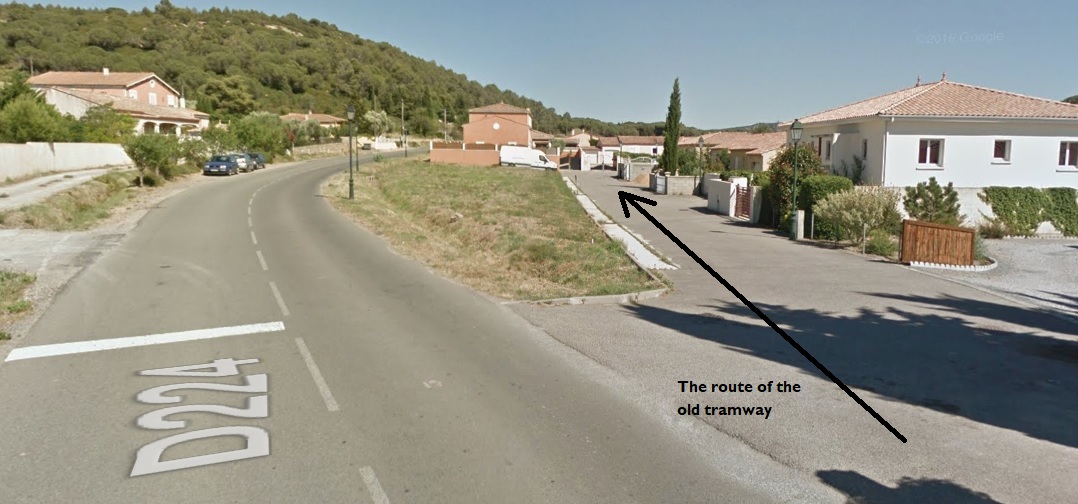
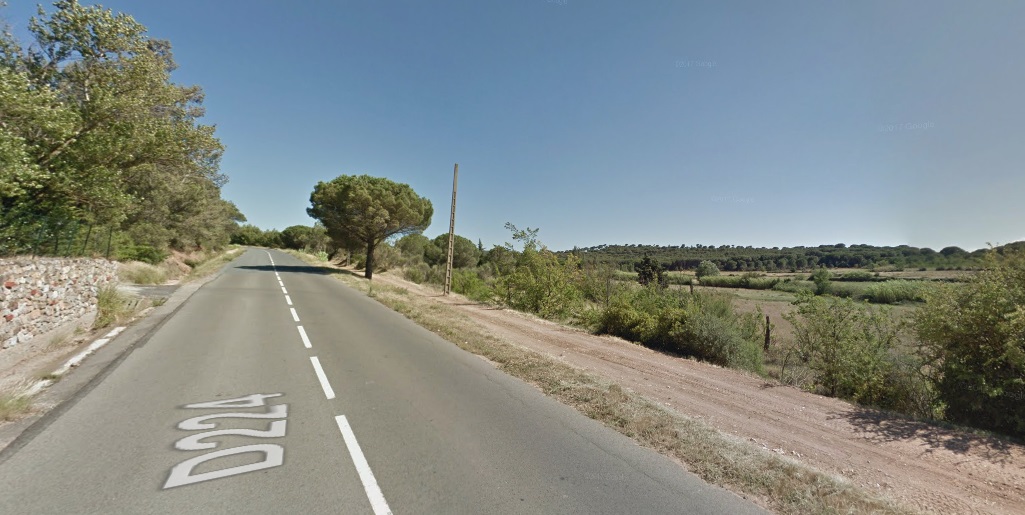
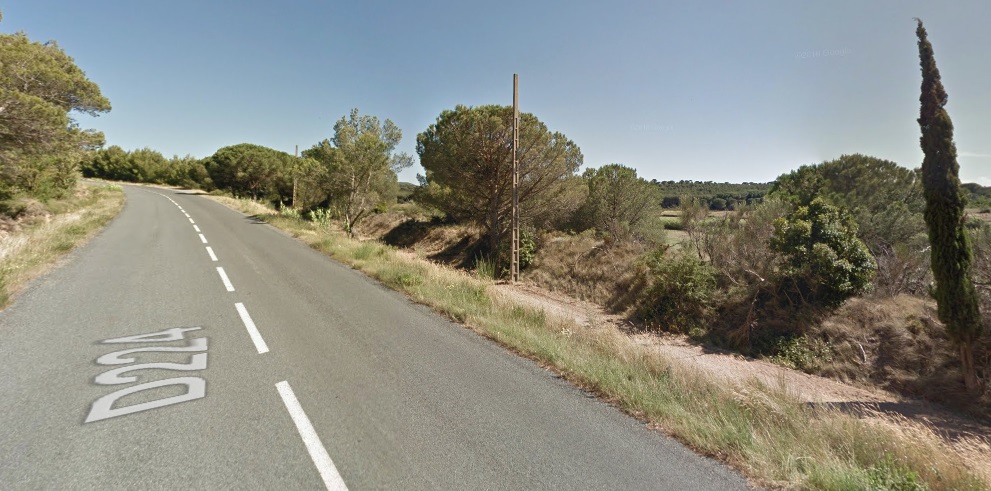
Category Archives: French Railways and Tramways

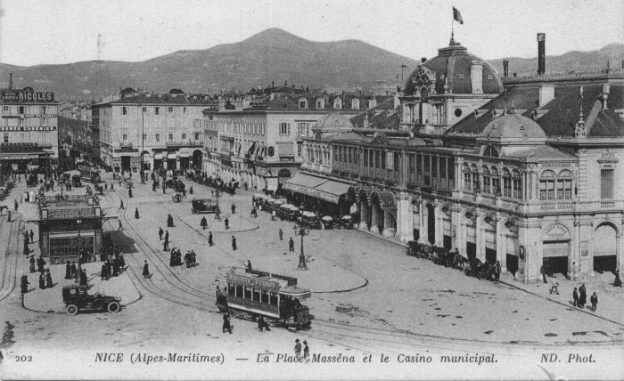
TNL Tramways – Recovery after the First World War (Chemins de Fer de Provence 83)

This blog is based on the text of the book written in French by Jose Banaudo: Nice au fil du Tram: Volume 1, Histoire; Les Editions du Cabri, 2004. The notes below are intended to promote a better understanding by an English audience of the tramways of southern France.

Difficult recovery

Like all transport companies, TNL faced post-war years of economic, social and material hardships. All developments of the network were suspended. The political upheaval brought tourism to a halt. Habits were changing and other forms of transport stole passengers from the trams. Inflation increased the price of materials and supplies when urgent repairs were required after years of neglect.

Employees who had shown great loyalty during the conflict started to defend their rights. They years after the first World War were ones of social unrest. in May 1920 the police and army occupied the Ste. Agathe depot to prevent striking workers disabling the network,

The constant search for savings was prioritised above the quality of the service to customers, especially on the wider departmental lines where the service had been reduced to two or three trips a day on certain sections during the war years. Not only did the service not improve, but in some cases it was further diminished. For example, on La Grave-de-Peille route there was only one round trip per day in 1919. In the face of protests raised by this failure, an improved service was introduced the following year.

The urban service also left much to be desired. In Nice City Council, the discontent was such that for the first time some elected officials proposed to replace the trams with buses.

Expansion projects of the departmental network
At Levens, work on the extension towards the village continued at a very slow pace during the war. The formation had been completed by 1917, including the curved tunnel, but the terms for moving the terminus facilities were still unresolved between the department and the company. The tunnel leading to the village of Levens, the structure was completed but never used. No tracks were laid through the tunnel. [2]

On the line from La Pointe-de-Contes to L’Escarene, work resumed at the end of 1919.

In the first half of the 20s, the development of the departmental network was still on the agenda for the Alpes-Maritimes General Council. However, persistent economic difficulties discouraged public investment in trams to rural areas where road transport now seemed to offer a more flexible and less expensive solution. The commissioning of new Haut-Var and Esteron lines of the TAM network proved to be a big mistake, the lines were not viable from the beginning, this reinforced an evolution towards road transport.

Even with most of the work complete, the TNL began to wonder whether it was viable to complete and maintain the routes into Levens village and between La Pointe-de-Contes and L’Escarene.

The work on these new links was postponed. As were two other projects planned by the TNL: the establishment in Menton of a TNL passenger and goods station closer to the port, and an underground crossing of the Monaco principality. It became clear very quickly that these projects would not be viable, given the deficits being experienced on the other departmental lines. New agreements were made with the local authorities but these only brought a brief stay of execution for the least remunerative lines which it had been designed to preserve. [3]

A first restructuring of the urban network
The TNL obtained authorisation, on 6th July 1920, to introduce multi-tier pricing by dividing each line in two, three or four sections, depending on the distance traveled. From 1st January 1923, all the lines of the network were renumbered and their number placed prominently on a color disc at each end of the tram. Nos. 1 to 16 designated urban lines. Nos. 20 to 24 were applied to services on the line to Monte Carlo; Nos. 26 to 30 to those to the valleys of Paillons; Nos. 31 to 34 to those on the line to Antibes and du Cap; Nos. 41 to 46 to the Monte-Carlo and Menton group of lines.
Stops were classified in two categories, fixed and request, which a few years later were designated by red and green plates.

Private entrepreneurs were equipping themselves with trucks and buses. Initially they provided links to the tramway and railway networks and did not act in competition with the trams. Banaudo reports that as early as 1921, the Société Anonyme Nicoise de Transports Automobiles (Santa) opened a Nice – La Turbie line via the Grande Corniche and a Nice – Colomars circuit through the hills, with the financial support of the department and the city of Nice.

Urban buses appeared in Nice on 28th May 1925 on the Massena-St. Sylvestre line via Jospeh Garnier and St. Barthelemy boulevards (now Auguste Reynard). The TNL operated this first service with road buses. [4]

A second service was inaugurated by the TNL between Saluzzo – Caucade by Dubouchage, Victor-Hugo and Gambetta Boulevards, on 5th October. In May 1926 the terminus of this line was moved to Place Masséna.

As the first buses appeared, the tramway network began to contract. More of that in future articles.

Jose Banaudo gives the following details about the TNL in 1927 which come from the Ministry of Public Works [5] …….

STATISTICS T.N.L. 1927

The TNL operated 141 km of lines, divided as follows:

  • Urban network: Nice 26 km (excluding common trunk routes).
  • Monaco network 5 km.
  • Coastal network 50 km.
  • Departmental network 60 km.

The staff is composed of 1373 people, 14 of whom are in administration, 846 in movement, 323 to the equipment and 190 to the track.

The fleet of rolling stock includes 17 freight tractors. 175 power units a travellers. 96 passenger trailers and 162 freight cars.

Trams travelled 5,437,583 km during the year, including 4,164,884 on the urban network, 984,534 on the coastal network and 288,165 on the departmental network .

The total number of passengers carried was 35,416,562. of which 31,680,850 on the urban network. 2,976,441 on the coastal network and 759,271 on the departmentai network.

The total volume of goods transported is 489,689 tonnes of which 299,239 were on the urban network. 148,376 on the coastal network and 42,074 on the departmental network.

Revenues amounted to 24,521,671 francs, including 22,080,605 francs in passenger traffic, 2,286,958 in freight traffic, and 154,108 in miscellaneous revenue. The expenses amount to 22,597,515 francs. i.e. a profit of 1,924,156 francs and a total cost/income ratio of 0.92. But it must be taken into account that only the urban network allowed this level of return to be reported. The coastal lines recorded a deficit of 453,771 francs and a coefficient of 1.1, while the departmental network was subject to a déficit of 431,971 francs and a coefficient of 1.36. These figures pointed forward to likley closures on lines outside the conurbation.

During the year, 925 accidents were recorded, including 6 derailments, 539 collisions with cars, people or animals, and 380 miscellaneous accidents. The overall toll was 4 killed (1 traveller and 3 third parties) and 114 wounded (12 workers. 68 passengers and 34 third parties).

References

  1. Jose Banaudo; Nice au fil du Tram: Volume 1, Histoire; Les Editions du Cabri, 2004, p78.
  2. Jose Banaudo; Nice au fil du Tram: Volume 1, Histoire; Les Editions du Cabri, 2004, p79.
  3. Jose Banaudo; Nice au fil du Tram: Volume 1, Histoire; Les Editions du Cabri, 2004, p80.
  4. Jose Banaudo; Nice au fil du Tram: Volume 1, Histoire; Les Editions du Cabri, 2004, p81.
  5. Jose Banaudo; Nice au fil du Tram: Volume 1, Histoire; Les Editions du Cabri, 2004, p82.

Nice to Digne-les-Bains Part 15 – Locomotives and Rolling Stock – Steam (Chemins de Fer de Provence 79)

This post focusses on the Steam locomotives used on the line between Nice and Digne-le-Bains. It is unlikely to be comprehensive and I’d be grateful of any contributions by others which will add to my knowledge. I am hampered particularly by not having access to the seminal work on the network by Jose Banaudo, “Le Siecle du Train des Pignes.” [25] The text of this book is in french and as it is out of print a good copy will cost well over 50 euros. If anyone has access to this book and is prepared to add to the text of the blog, please feel free to do so, or email me direct and I will update the post.

I would be particularly interested in details of locomotives which ran on the Nice to Digne Line throughout its life and which are nor properly covered within the text below.

As part of studies on the two other main-lines which made up the network of the Chemins de Fer du Sud de la France – the Central Var line and Le Macaron – we covered a lot of ground investigating early traction and steam power on the lines of the whole network and provided as much information as possible about rolling stock on the system.

The relevant posts are:

Locomotives and Rolling Stock on the Central Var Line (Chemins de Fer de Provence 50)

Locomotives and Rolling Stock on the Central Var Line (Chemins de Fer de Provence 52)

Rolling Stock on the Central Var Line (Chemins de Fer de Provence 54)

Ligne du Littoral (Toulon to St. Raphael) – Part 14 – Locomotives and Rolling Stock (Chemins de Fer de Provence 49)

These posts are as comprehensive as possible for the era of operation of those lines and cover the period up to their closure after the Second World War. However, they are focussed on the two lines which closed. It make sense, therefore to review those posts in the light of a focus on the Nice to Digne Line. This blog sets out to do just that. I need also to acknowledge the support I have received in collating this information from Etienne de Maurepas (Étienne Thilliez). [12]

Steam Locomotives on the Nice to Digne Line

Background information on the companies which built the steam locomotives which served on the Central Var line can be found by reading my post on the locomotives of the Coastal Line  – Le Macaron. [1]

At the height of its powers, between 1888 and 1908, Le Chemins de Fer du Sud de la France network had:

• 23 steam locomotives.
• 42 passenger coaches: 3 in 1st class A series; 21 mixed 1st and 2nd class series AB; 6 in 2nd class B series; 2 mixed 2nd class + van series BD and 10 open coaches called ‘jardiniers’ series AC and C. These were sourced from various manufacturers: the Foundries and Forges of Horme Company, Chantiers de la Buire in Lyon; the Desouche and David workshops in Pantin; the Hanquet factories -Aufort and Company in Vierzon; the establishments De Dietrich in Lunéville; and the ‘jardiniers’ came from a network of steam trams – the Raincy-Montfermeil in the northern suburbs of Paris.
• 12 luggage and post office vans: 10 luggage vans with DD series postal compartment and 2 DS series emergency vans. Their manufacturers were as follows: 6 Buire vans, 4 De Dietrich vans, 2 Hanquet-Aufort vans.
• 219 goods wagons: built by Horme and Buire, Hanquet-Aufort, De Dietrich, and Magnard and Decauville.

Between 1889 and 1894, 19 steam locomotives were put into circulation on the whole network; divided between 3 manufacturers: 8 SACM, 8 Pinguely and 3 Corpet-Louvet.[2] A number of these were used on the Nice to Digne line.

Between 1889 and 1894, 19 steam locomotives were put into circulation on the whole network; divided between 3 manufacturers: 8 SACM, 8 Pinguely and 3 Corpet-Louvet.[5] A number of these were used on the Central Var line.

Later, other locomotives were purchased …..These Locomotives included some from the manufacturer Franco-Belge as well as SFCM, SACM, Pinguely and Corpet-Louvet.

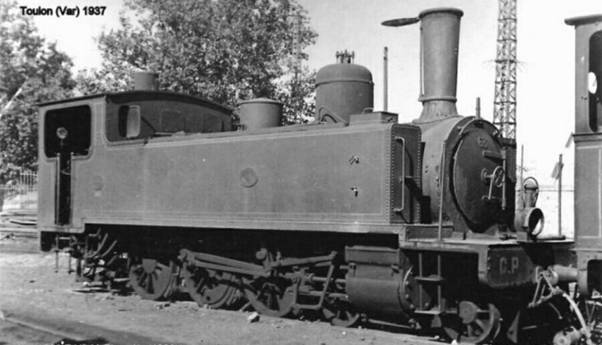
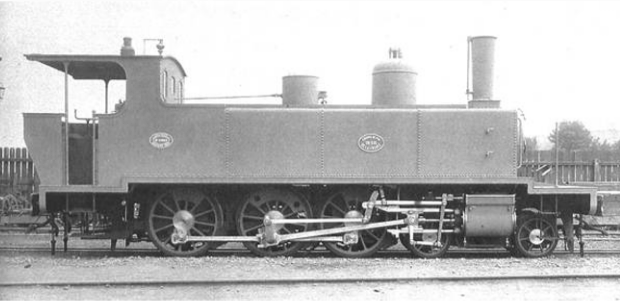
In the first decade of the 20th Century, Pinguely 4-6-0T locomotives were ordered. The close-up shot shown below is taken at Toulon, but these locomotives also served on the Nice to Digne Line.Very similar 4-6-0T locomotives were ordered from SACM. The image below is one used on the Macaron but it is identical in design to ones used on the Nice to Digne line.Details of these locomotives and pictures of them operating on the Nice to Digne line can be found below.

1. Pinguely, SFCM and SACM 4-6-0T Locomotives

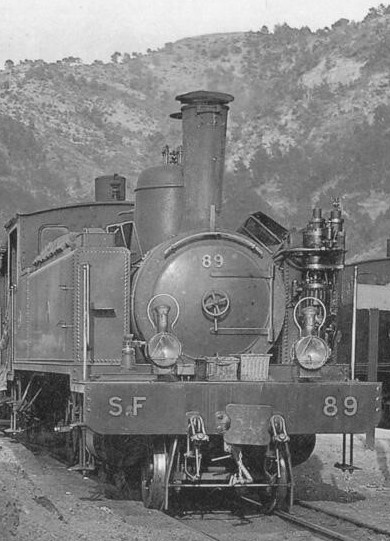
Locomotive No. 89 is a 4-6-0T Pinguely (Works No. 192) delivered in November 1905 and remodelled in 1949 (see picture below). Sérié E of Les Chemins de Fer du Sud de la France, it is part of a series of 12 locomotives delivered between August 1905 and December 1907. The whole network including the coastal line had a total of 28 E and F Series 4-6-0T locomotives, supplied by several manufacturers. No. 89 was scrapped in January 1951. According to José Banaudo, these 4-6-0T locomotives were the best steam engines on the network.The picture of SF No. 89 was taken at La Manda Station on the Nice to Digne line. This is the best head-on picture of a Pinguely 4-6-0T engine that I have discovered.

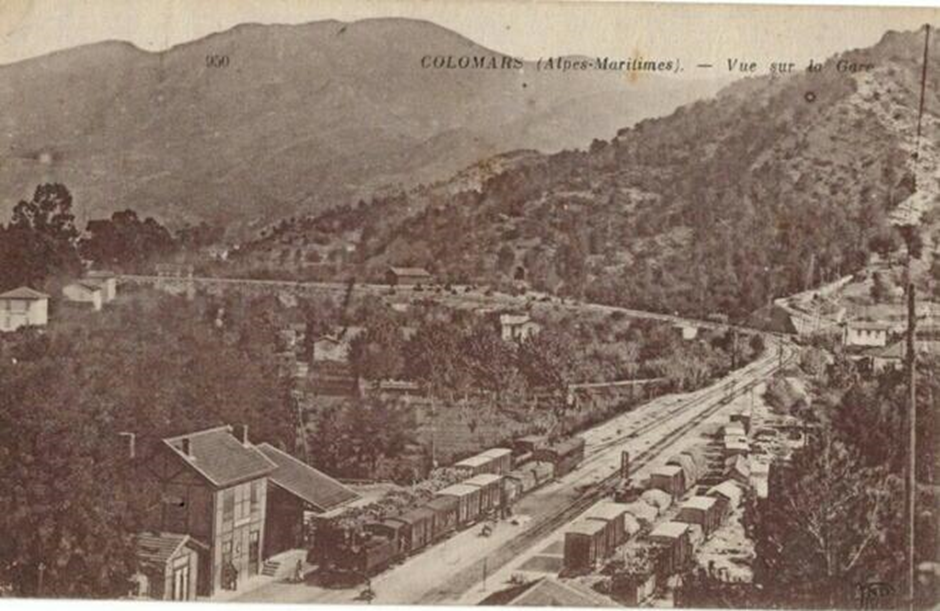
It is difficult to distinguish between the different 4-6-0T locomotives on many of the postcard images available today. For example, there are two images of the La Manda Station near Colomars below. In the first image it appears that the locomotive is a 4-6-0T but the resolution of the image is not good enough to determine whether it was made by Pinguely or SACM. The second image appears in Jose Banaudo’s book [3] and on the CPArama website. [4] Banaudo highlights the fact that the locomotive in that image is a 4-6-0T but does not clarify which manufacturer. He does draw attention to the flat wagon at the left of the picture which he says must have come off the TAM network because of its narrower loading gauge.I have been consulting with 242T66 on “Les Passions Metrique et Etoile!!” Forum [9][12] about some of the photographs in this blog. They comment that it is likely that the locomotive in the second image is an type E 4-6-0T because the type F had an air-compressor fitted to the right-hand side of the smokebox. It is possible that the locomotive is a SACM Series 81-86 rather than a Pinguely locomotive.NICE (AM) – Locomotive No. 102 tows freight train at La Madeleine station – Photo Card. 
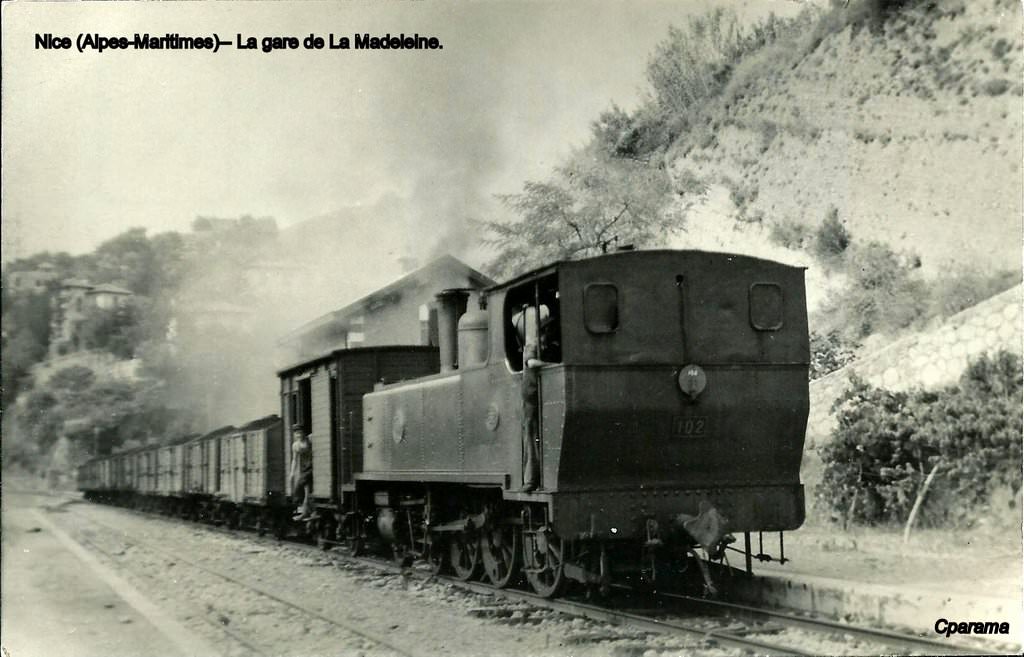
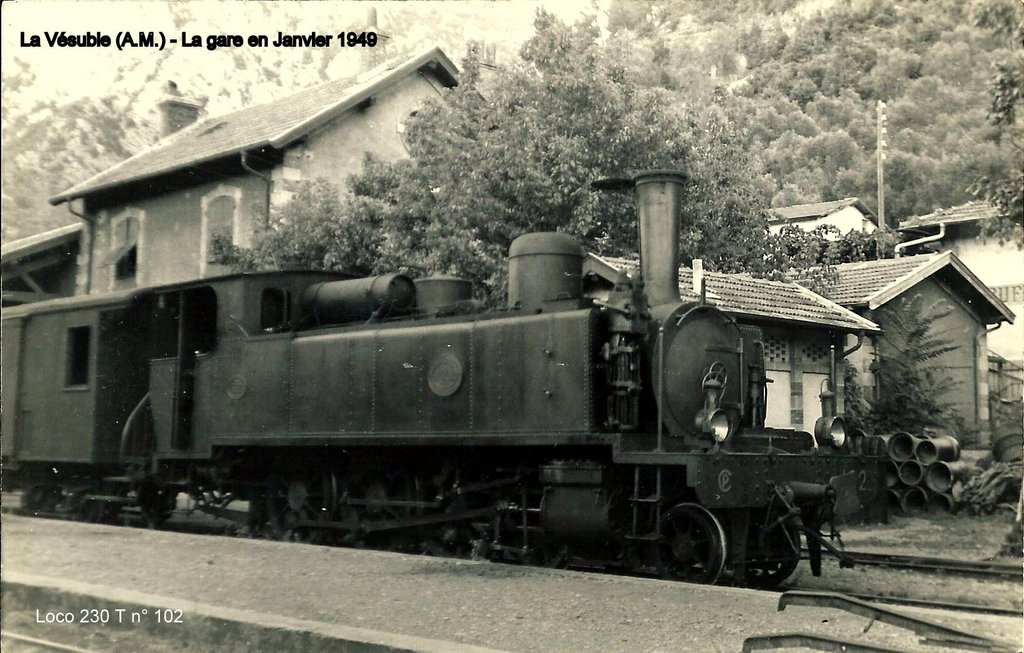
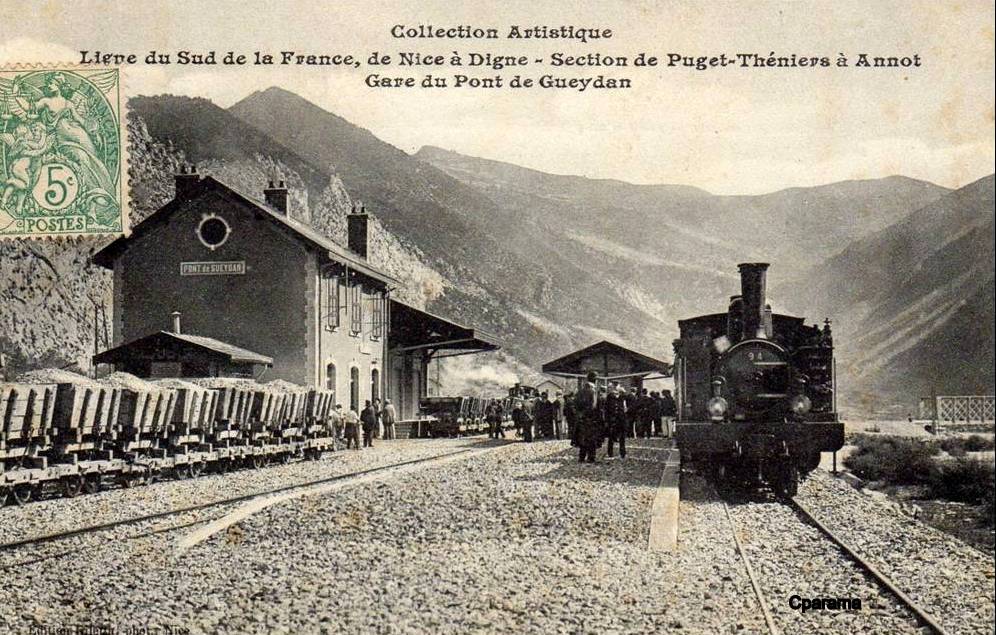
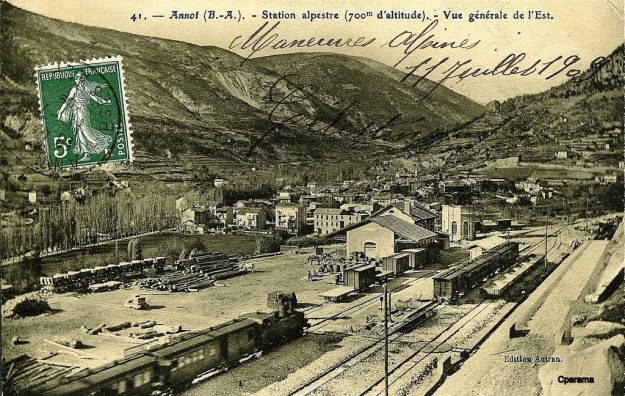
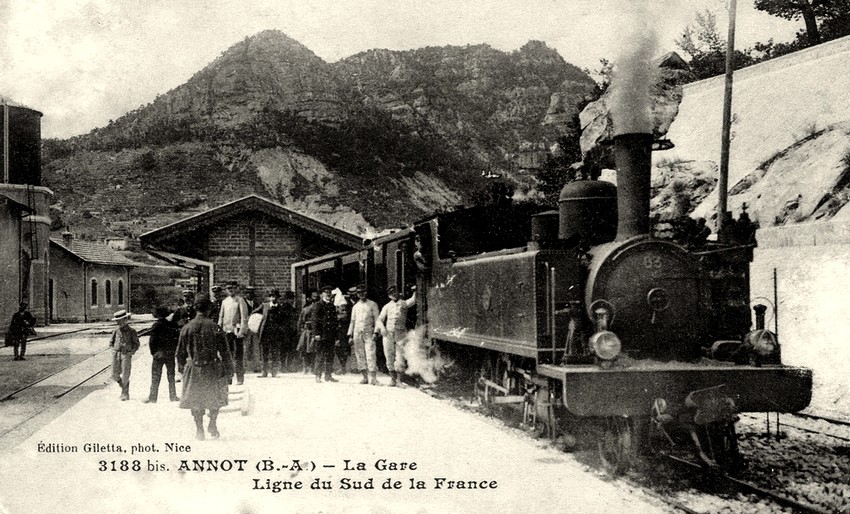
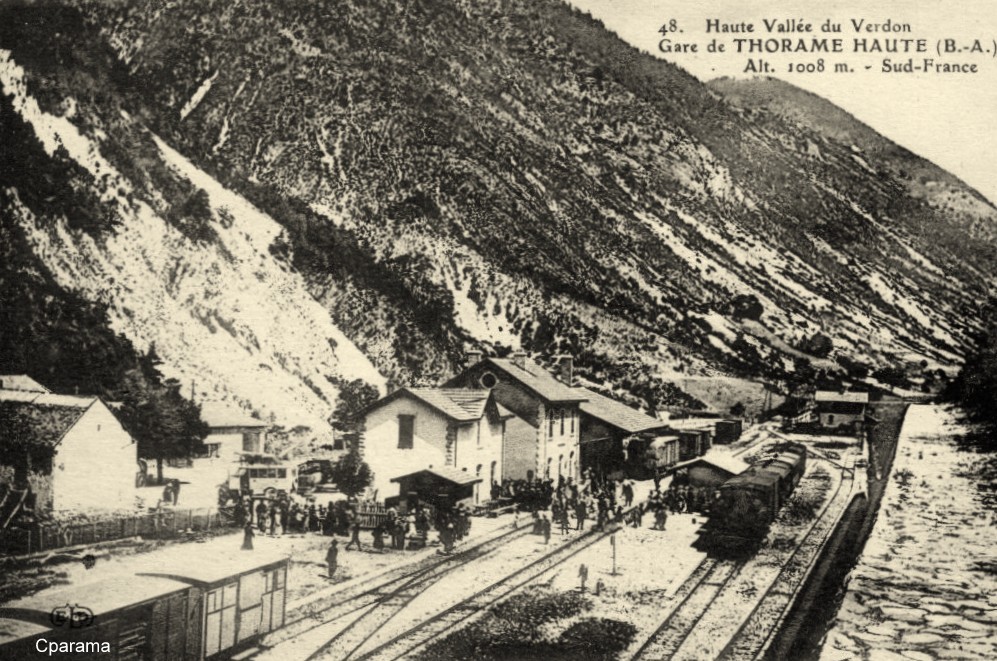
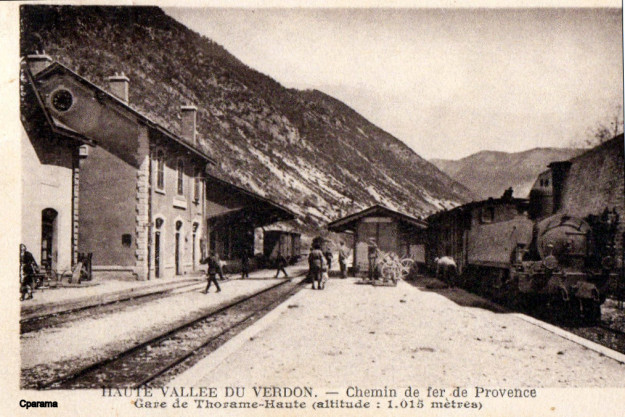
The locomotive No. 102, type 4-6-0T, was built in 1908 by the French Society of Mechanical Engineering (SFCM) – Cail in Denain (North). It was delivered on July 6, 1911 to the Railways of Provence – It was part of the series Nos.101 to 105 – After a career of more than 40 years, having traveled 752,362 km. this loco was stabled in 1952 and scrapped on 24th March 1954. [3][10]Another view of the 4-6-0T locomotive No. 102, at the station of La Vésubie in January 1949 – Photo card. (Bernard Roze collection). [10]This picture shows the official reception train headed by 4-6-0T Pinguely No. 94 on 30th September 1907, the trucks on the left belong to the contractor, Entreprise Orizet. The station is La Gare du Pont de Gueydan. [3][5][12]In this view, taken sometime between 1908 and 1911 .an unidentified 4-6-0T (I think) approaches Annot Station from Nice. At this time the middle section of the line between Annot and Saint-Andre-des-Alpes was still under construction. [3][7]A train for Nice headed by 4-6-0T SACM No. 83 at Annot Station. [3][12]What appears to be a 4-6-0T locomotive stands at Thorame-Haute. The picture is not clear enough to identify the locomotive. [6][12]An unidentified 4-6-0T also standing at Thorame-Haute. Although the picture is present in Jose Banuado’s book the locomotive is not identified by him. [3][6][12]

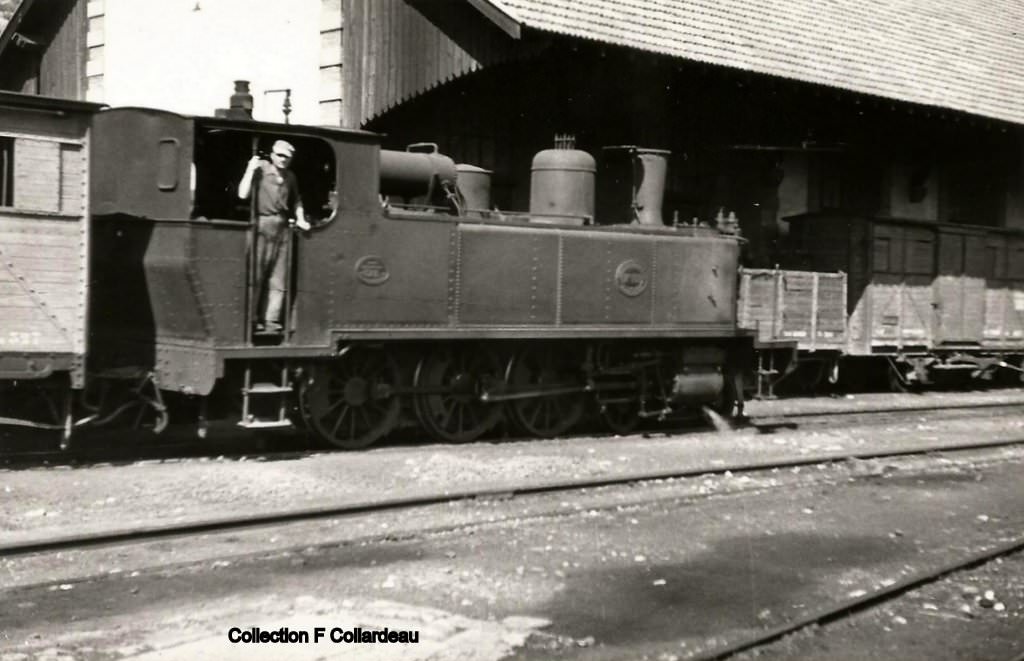
610-11 – Machine 230T (4-6-0T) No. 101 built by SFCM-Cail in 1908, in Digne on April 19, 1949.
Photograph: F. Collardeau – Publisher: BVA in Lausanne (Switzerland). [10]

2. Smaller Steam Locomotives (0-6-0T/2-4-0T)

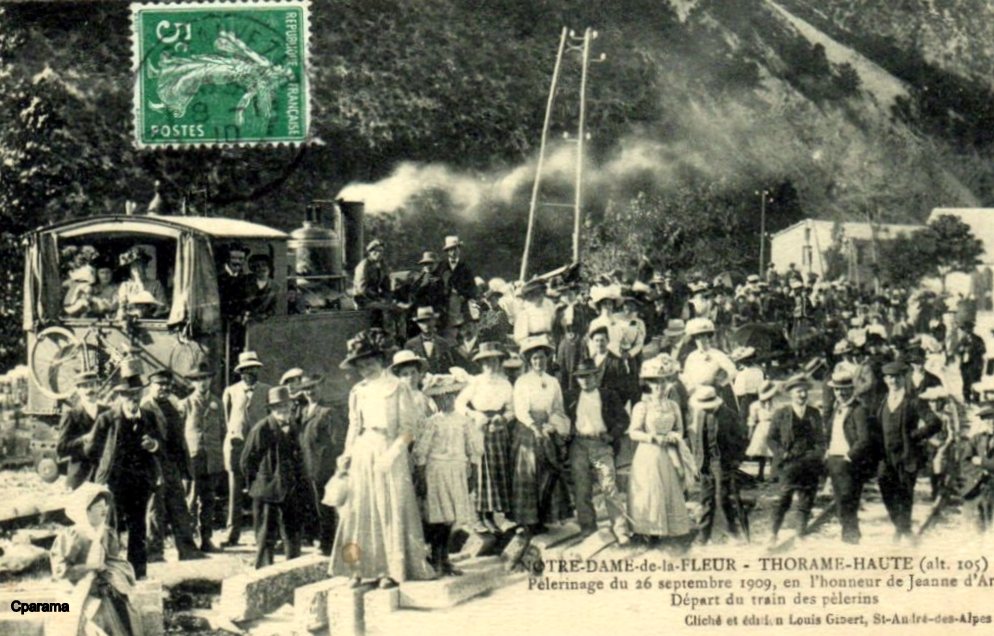
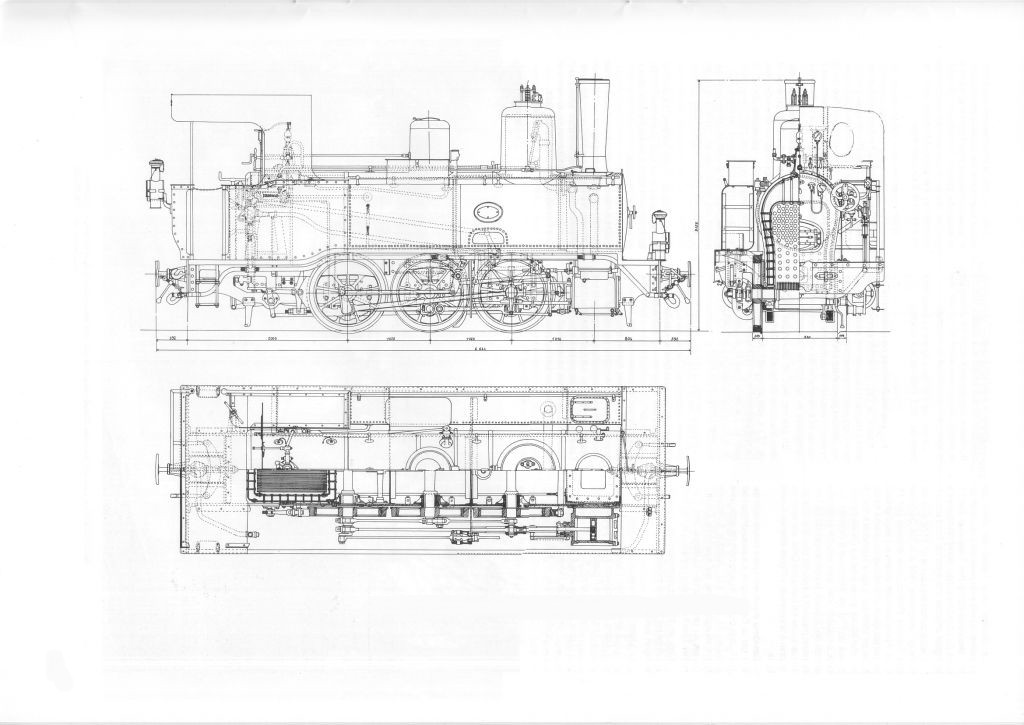
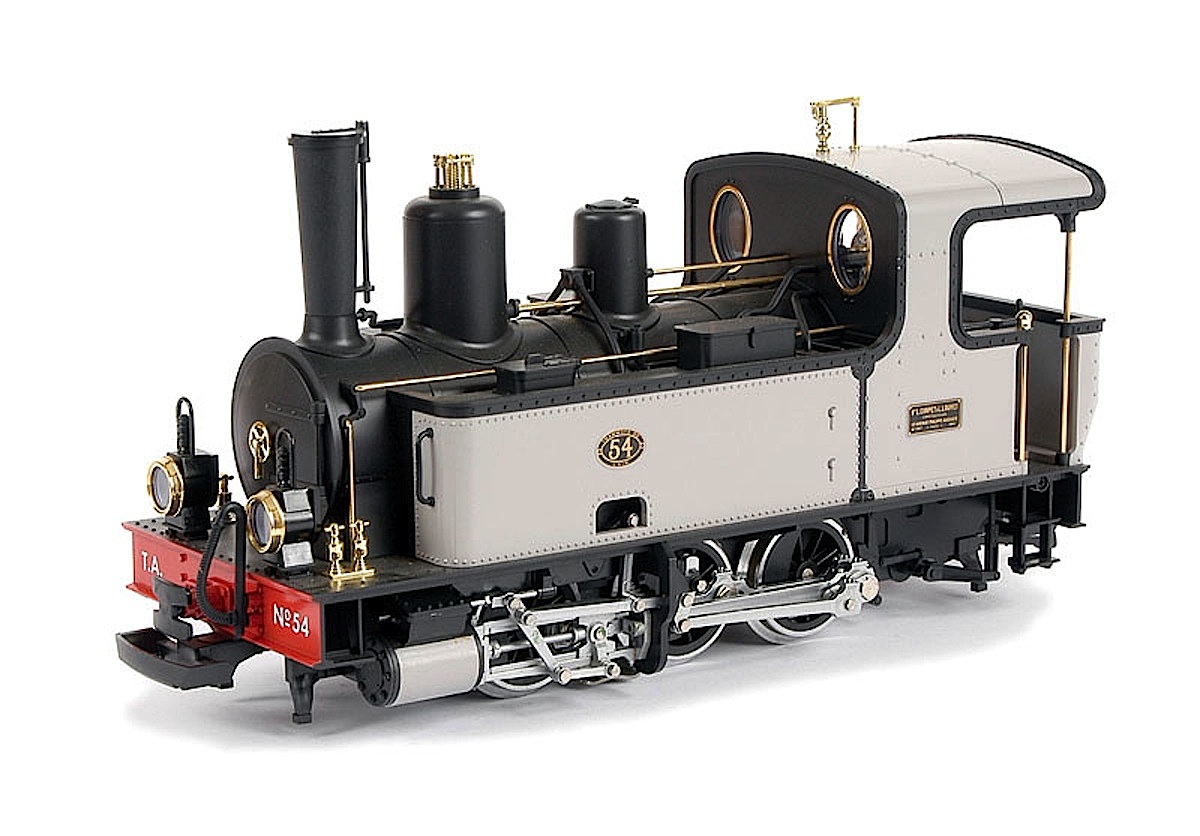
The line was served by a series of smaller locomotives. However, the first image below was taken before the opening of the line and illustrates an early form of chartered train. The contractor for the line provided a train for access to the special festival at Thorame-Haute on 26th September 1909. The locomotive used was one of its own 0-6-0T locos.An 0-6-0T Pinguely industrial locomotive owned by Entreprise Orizet, on a pilgrims’ special, 26th September 1909, Notre Dame de la Fleur at Thorame-Haute. [3][8][12]Drawing from Corpet-Louvet. [13]A model of one of these locomotives in the livery of the Tramways de l’Aude which I have also been writing about (cf. the series of blog posts which can be found on this site under the category ‘Railways and Tramways of South-Western France’ and which start with https://rogerfarnworth.com/2018/08/27/tramways-de-laude-overview-part-1). This model is No. 54 in the Tramways de l’Aude fleet of these small locomotives. The French company Lucien Corpet built 826 of these metre-gauge 0-6-0T locos for railways across Europe, and you can still see examples in use today. This LGB model offers all the classic LGB technical features: a powerful Bühler motor, weather-resistant gearbox, voltage stabilization, reliable power pick-ups and much more. The prototype was one of many built from 1890 onwards. 0-6-0T locomotives were the mainstay of Corpet’s production with weights ranging from 7 to 22 tons. Railway companies could order these locos from a catalogue. [14]

Corpet-Louvet was a family-size railway manufacturer, which nevertheless managed to find markets and satisfy its customers with simple, well-built and robust machines. Their locomotives came out of the workshops for a hundred years, straddling two centuries, the second half of the nineteenth century and the first of the twentieth century.

The small Corpet-Louvet locomotives are regularly cited as emblematic of the secondary railways. From 1855 until 1952, the plant produced 1962 locomotives. The majority of them were built to operate on metre-gauge rails and were tank engines. [19]

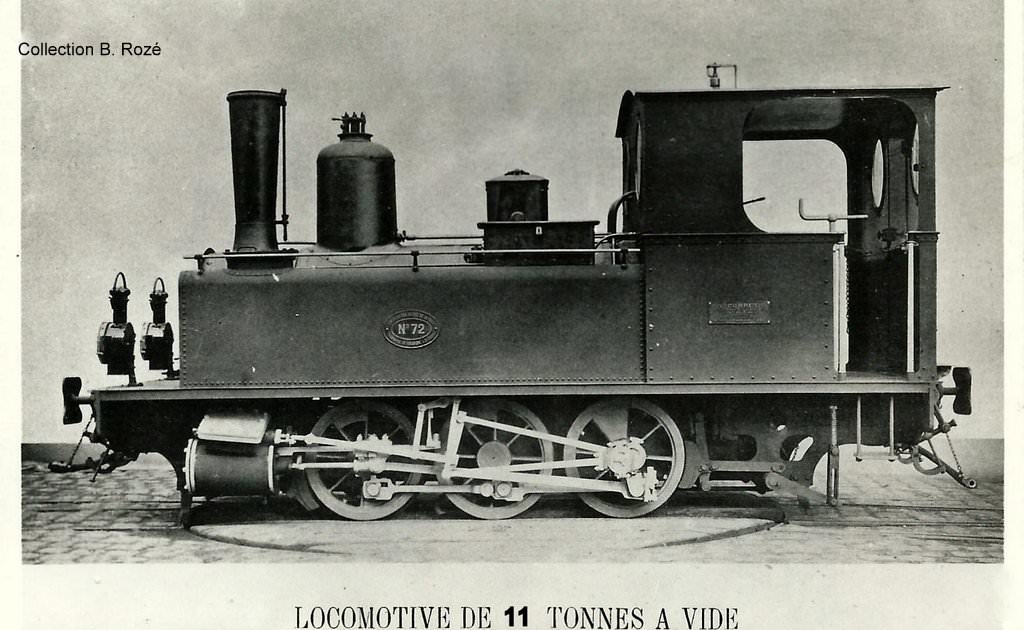
Three 0-6-0T Corpet-Louvet locomotives numbered 70 to 72 (as below) were ordered by the Chemins de Fer du Sud to operate on the line between Cogolin and St. Tropez. [19] Further examples may have been used throughout the rest of the network including on the Nice to Digne Line. I have not yet been able to identify any. Whether certain locomotives were specifically allocated to the Central-Var or to the Alpes line, I do not know. Allocations may have changed over the years anyway and it is likely that some engines at least were used on both lines.

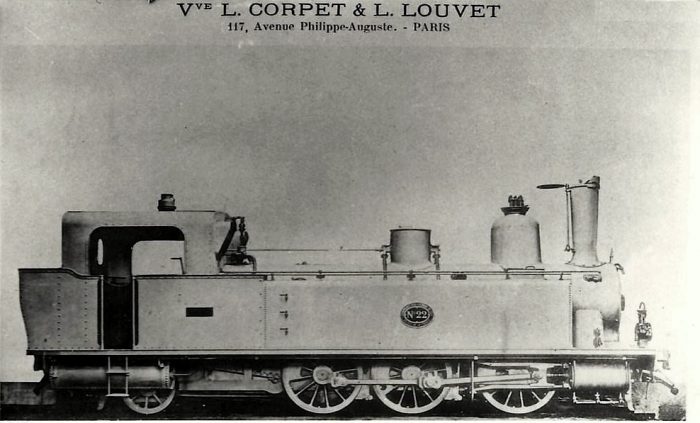
According to J. Banaudo, [25] very few Corpet-Louvet engines were used on the Alpes network bewteen Nice and Digne, apart from the four class D 031T (0-6-2T) No. 20-23 built 1894/5 with works numbers 619 to 622. I have not yet found a picture of one of these locos at work on the Nice to Digne line. These 031T (0-6-2T) Corpet locos on the Sud-France were large 28-ton steam locomotives. [27] One of these is shown in ex-works condition in the picture below.Corpet-Louvet Works No. 621 – No. 22 on the Sud-France network.

N° 19 L’Arve was a metre-gauge industrial 030T (0-6-0T) locomotive built 1887, acquired second-hand 1893, converted to standard-gauge 1897, withdrawn 1933. Designed for easy conversion from metre to standard-gauge and vice-versa, she was mainly used on the short mixed-gauge link and exchange sidings between Nice PLM (now SNCF) station and la Gare de la Sud de France.

Corpet-Louvet 030T (0-6-0T) Nos. 32 and 33 (1905/1906) from Régie des Chemins de fer du Sud-Ouest were borrowed during the war (1943/1945) (as were much bigger 141s (2-8-2s), also built by Corpet-Louvet) but saw very little use indeed.

No details are given by J. Banaudo [25] of the various industrial engines that were used by contractors when they built the lines. They may have included Corpet-Louvet 020T (0-4-0T) or 030T (0-6-0T) engines. [12]

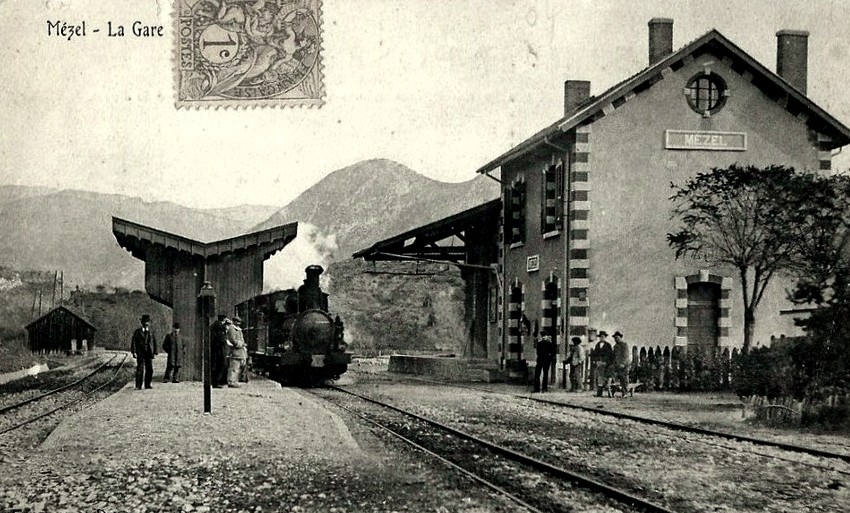
I have one photograph of a 2-4-0T locomotive on the Nice to Digne line.A 2-4-0T built by SACM stands at Mezel Station. The loco was in the series No. 5 – No. 12. The picture was taken when the line was completed as far as St André-les-Alpes only. [3][12] “The Société Alsacienne de Constructions Mécaniques (SACM) [Alsatian corporation of mechanical engineering] is an engineering company with its headquarters in MulhouseAlsacewhich produced railway locomotives, textile and printing machinery, diesel enginesboilers, lifting equipment, firearms and mining equipment. SACM also produced the first atomic reactor at Marcoule. The company was founded by André Koechlin in 1826 to produce textile machinery. In 1839, he opened a factory to build railway locomotives at Mulhouse in AlsaceThe business grew rapidly but in 1871, the annexation of Alsace-Lorraine by Germany, brought about the transfer of some production to Belfort in France. In 1872 the company merged with the Graffenstadencompany of Illkirch-Graffenstaden (a suburb of Strasbourg) to form SACM.” [23]

3. Mallet 0-4-4-0T

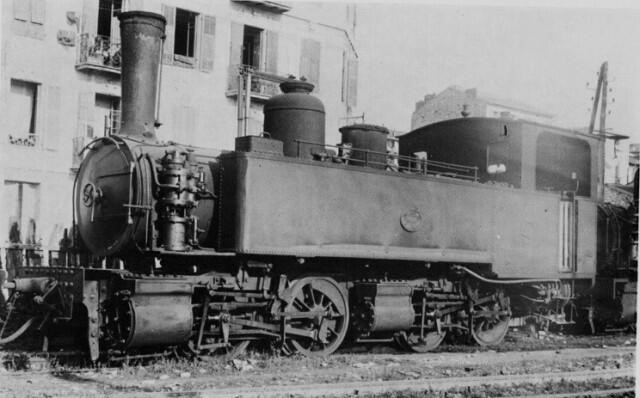
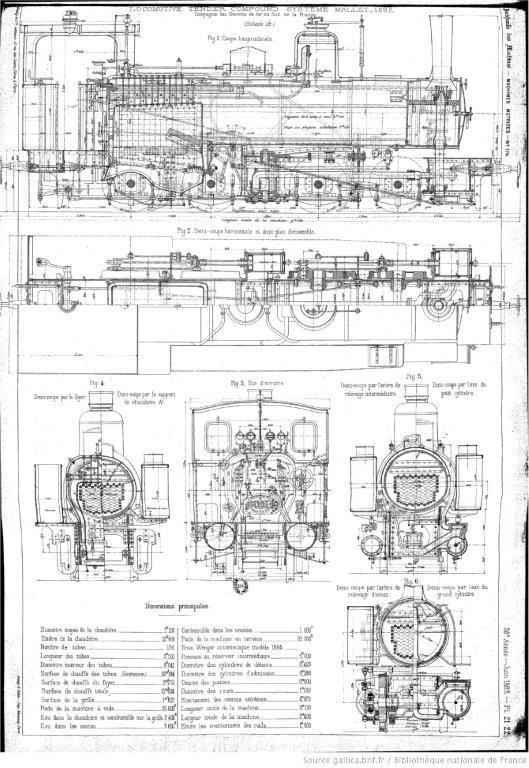
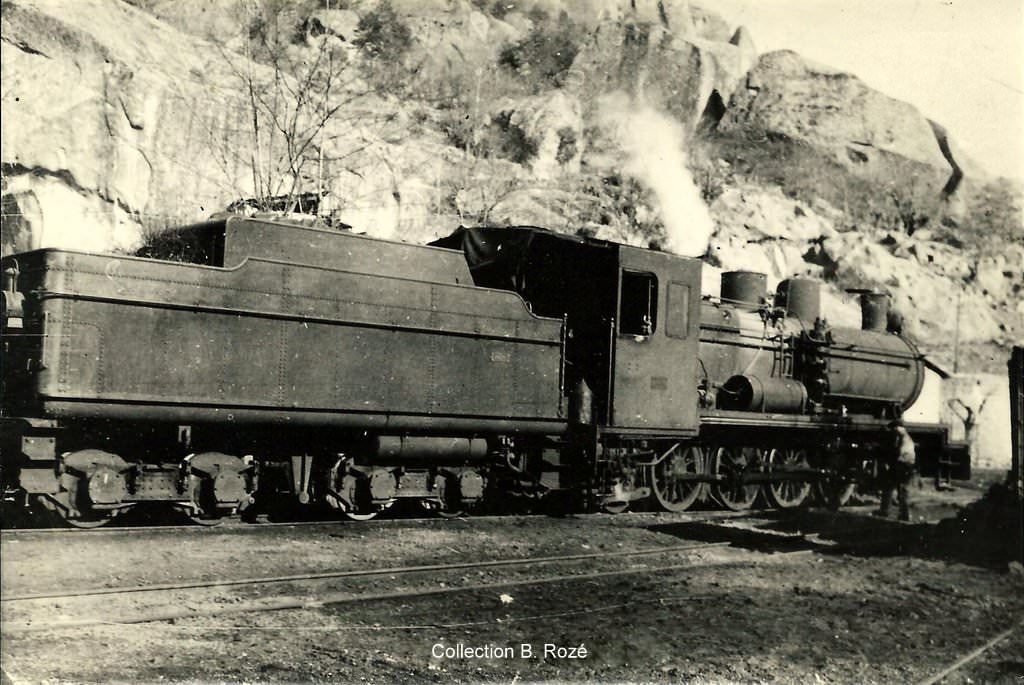
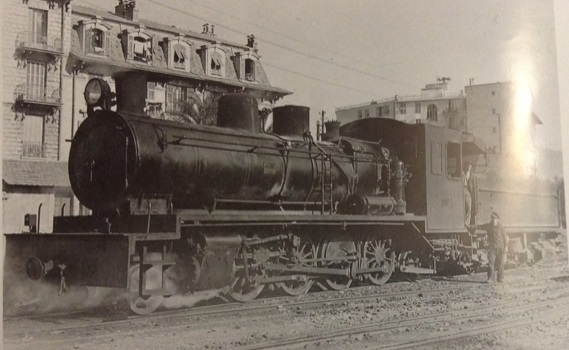
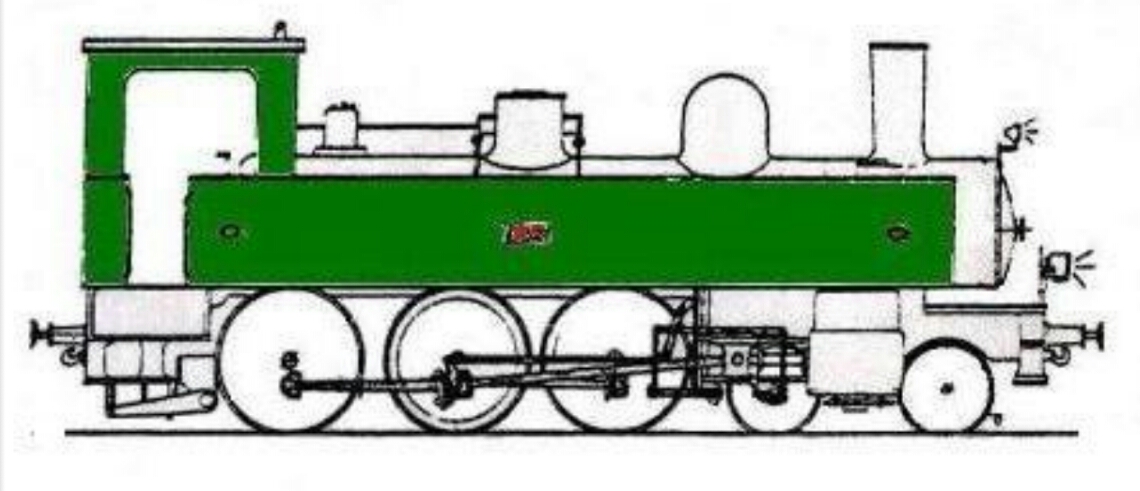
Mallets were relatively powerful locomotives for their size, having two sets of driving wheels. Relatively limited use of this type of locomotive was made on the Chemins de Fer du Sud de la France.An example of the class. Two of this type of locomotive were stabled in Toulon at the liberation in 1944. I believe that they were moved to Saint Raphael and loaded onto SNCF wagons for transport to the factory of Corpet-Lovet in 1945 for refurbishment. They could be found in use on the Nice to Digne line in 1946 and 1947.An SACM Mallet 0-4-4-0T at Nice.Mallet 0-4-4-0T drawings. [11]

4. Other forms of Steam Traction on the Line

A. 2-8-2 Tender Locomotives

Locomotive No. 17 was one of a series of 7 locomotives built by the Corpet-Louvet establishments in La Courneuve and delivered in 1943 to the Railways of Provence. These machines were originally intended for the Dakar-Niger railway in Africa, but, because of the war, they were assigned to the Nice-Digne line. In the picture above, we see the loco at Annot (Basses-Alpes). These locomotives were not a success on the line. No. 17 ended its career on 14th May 1947 having travelled only 103,144 km. [3]

Locomotive No. 18 was another of this Class – seen here at Nice Station. [26]

B. 0-6-0 (Class A) and 2-4-0 (Class B) Tender Locomotives

In he early years after the opening of the network a number of 2-4-0 and 0-6-0 Tender locos were in use. Pictures are available of these at work on the Nice to Meyrargues line. I have not been able to find examples on the length between Nice and Colomars. However, it is pretty certain that they did run on the length between Colomars and Nice, and probable that theybran over the length of the line between Nice and Digne-les-Bains.

The Central Var had four 030 (0-6-0) tender locomotives, they were built in 1887 by SACM Belfort: No. 1 “Draguignan”; No. 2 “Flayosc”; No. 3 “Entrecasteaux”; No. 4 “Salernes.” [24]

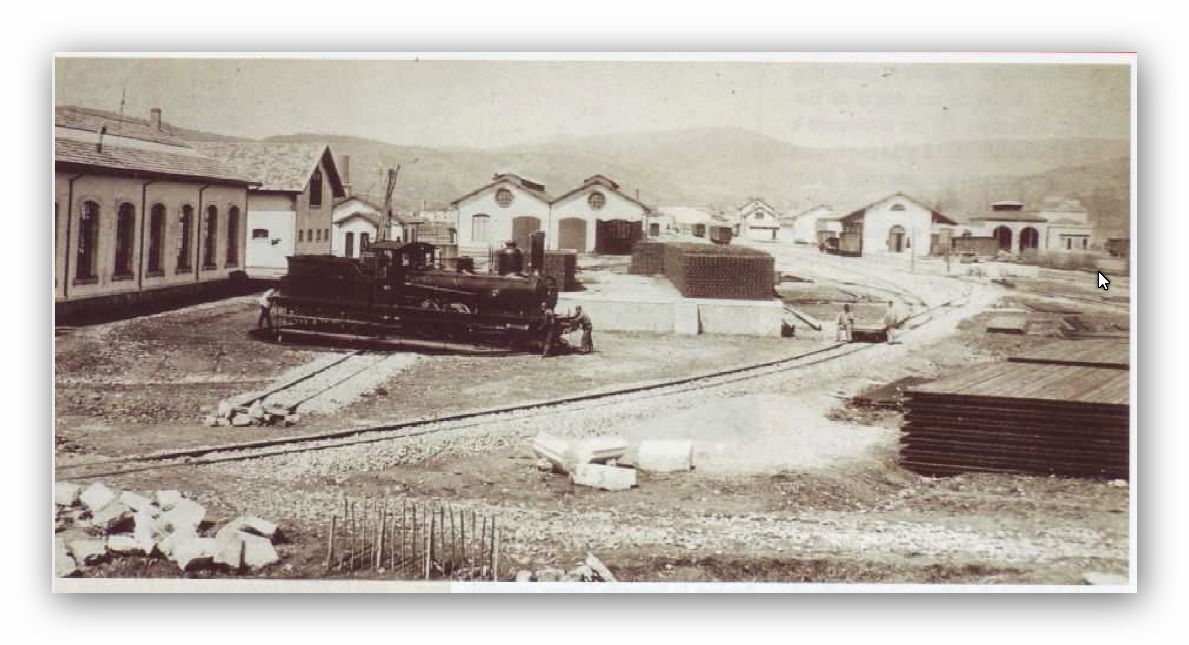
An early photograph of one of the Class B locomotives on the turntable at Draguignan. [24]

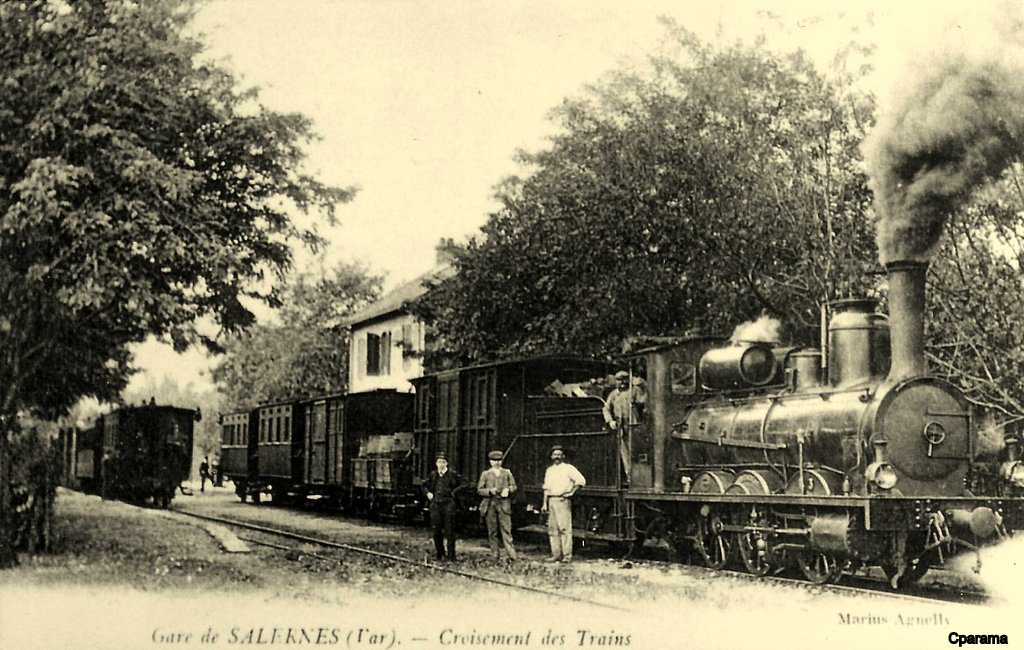
A SACM-Belfort 0-6-0 Tender Locomotive (Class A) at Salernes Station. [24]

Modern Steam on the Nice to Digne Line

In modern times, three steam locomotives have been in use on the Nice of Digne Line. They have been renovated and maintained by the GECP (Groupe d’Etude pour les Chemins de fer de Provience):

A. The Portuguese [16][18] 2-4-6-0T

This steam locomotive was built in 1923 for the Portuguese Railways. It belongs to what was a series of 16 locomotives built by Henschel & Sohn for the Caminhos de Ferro do Estado (Minho e Douro division) in 1911 (CP No. E 201-204, ex MD 451-454), 1913 (CP E 205 / 206, ex MD 455-456) and 1923 (CP E 207-216, ex MD 457-466). Two other similar locomotives were delivered in 1923 to Companhia dos Caminhos from Ferro de Porto to Povoa de Varzim and Famalicao: PPF 16/17, later Norte 41/42 then CP E 181/182. [26]

During the early 1970s it was based in Sernada, used to haul passenger and freight trains on the lines Val de Vouga/Espinho to Sernada and Aveiro to Viseu. In 1975 it was transferred to Lousado, where it provided service on the line from Famalicao to Povoa de Varzim.

After being transferred to the central workshops in Puerto Campanhã it underwent its last revision in service in 1976. Later on it was based in Regua where it pulled mixed trains and work trains on the line from Corgo Regua to Chaves. It was taken out of service in 1981.

Three years later, the Portuguese Railways offered to sell twelve steam locomotives no longer in use. One of them was the E 211.

It was offered to and bought by GECP and in July 1986 towed from Regua to Vila-Real and then transferred onto road transport to be moved to the South of France. At the small station at Mezel-Chateauredon the locomotive was transferred back onto rails and moved to the depot at Puget-Therniers where ultimately it was to be refurbished. For a short period (1988-1992) it pulled the Train des Pignes between Puget and Annot, sometimes even between Nice and Digne-les-Bains.

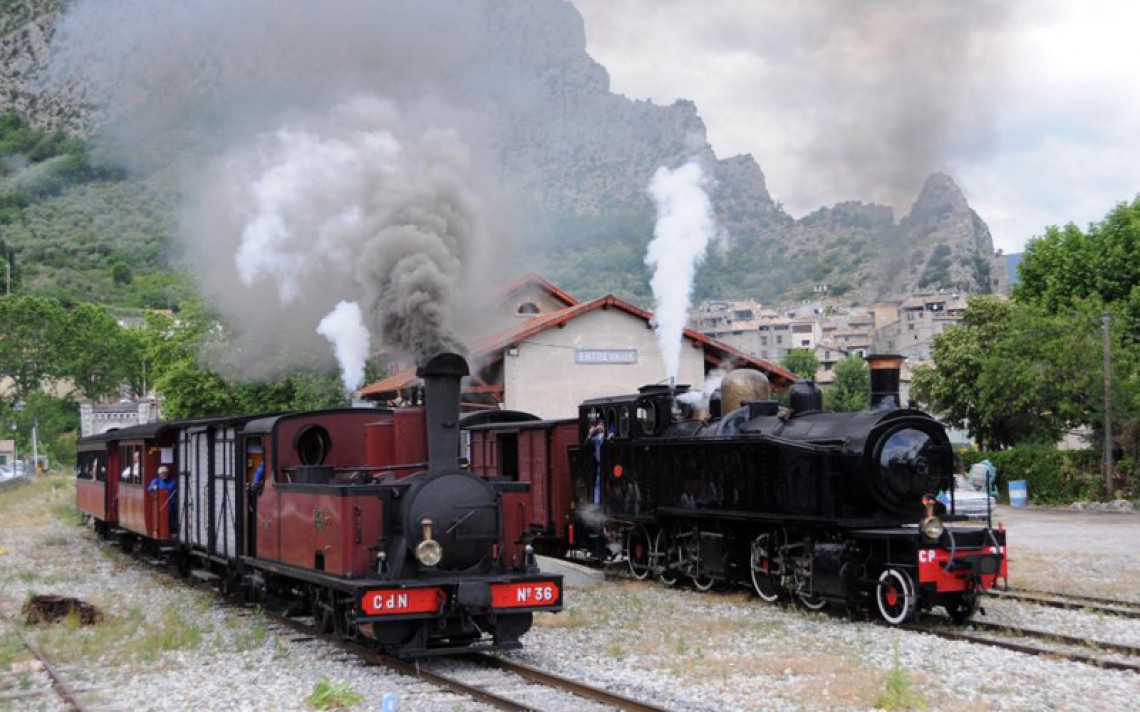
The locomotive was then restored at the Lucato Termica workshops in Castelletto-Monferrato In the Piedmontaise province of Alessandria in Italy. That restoration took time, and it was not until 2009 that the locomotive was once again available in Puget-Thernier and June 2010 before it pulled its first Train des Pignes.The full specification of the loco can be found on the GECP website. [16]The Portuguese and Corpet-Louvet 0-6-0T.  [15]

B. 0-6-0T Corpet Louvet (CdN No.36)

This small 0-6-0T loco is seen in action in 2008 in the video below: [20]

LGB G-Scale Model of the CdN locomotive No. 36 which was built by Corpet Louvet an which, late in the 20th century, could be found running regularly between Puget-Theniers and Annot. [21]

No.36 (Lulu) is now housed at the Musée des tramways à vapeur et des chemins de fer secondaires français which is located alongside Valmondois railway station, in the small town of Butry-sur-Oise in the departement of Val-d’Oise, 30 kilometres north of Paris.This locomotive was one of a series numbered 30 to 42, They all worked on the CdN from 1925 to the closing of the network in 1956. They developed a power of 375 hp, towed a load of 90 tonnes with a top speed of 50 km/hr. This was the maximum speed allowed on the network.
The last line where they were employed was the St.Brieuc – Paimpol line. At the closure of the network No. 36 (Lulu) remained exposed for a long time in front of the station of St Brieuc. [22]

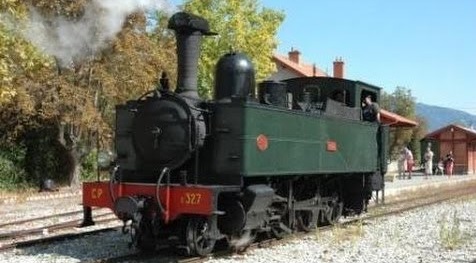
C. 4-6-0T No. E327 ‘Bretonne’ [19]This locomotive was one of twelve commissioned by the Chemins de fer de l’Ouest for the operation of the metre-gauge lines of the Reseau Breton. It was built by the Compagnie de Fives-Lille, in Lille (Nord). It first saw service in September 1909 as No. E327 and was based at the  Caraix depot (Finistere). It ran for 58 years on that network. It is very similar to a whole range of 4-6-0T locomotives that were used on the Chemins de fer du Sud de la France.

After closure of the Reseau Breton by the SNCF, E327 was declared supernumery in September 196. It was saved from destruction by the Federation des Amis des Chemins de fer Secondaires (FACS). It was transferred in December 1969 to the Chemin de fer du Vivarais (CFV) but was only rarely used on that network. In March 1979, it appeared at ‘Exporail’ in Cannes and was thenmade available to the GECP in Nice to launch its tourist train.After a partial overhaul, the locomotive was used from July 1980 unil the end of the 1987 season. Renovated by l’Arsenal de Toulon, E327 reentered service in 1993 and continued in circulation until 2007. The loco is now waiting full refurbishment once again. Full details of the specification of E327 can be found on the GECP website. [17]

References

  1. https://rogerfarnworth.wordpress.com/2018/01/26/ligne-du-littoral-toulon-to-st-raphael-part-14-locomotives-and-rolling-stock-chemin-de-fer-de-provence-49
  2. Roland Le Corff; http://www.mes-annees-50.fr/Le_Macaron.htm. Retrieved 13th December 2017.
  3. José Banaudo; Les Train des Pignes; Les Editions de Cabri, 1999.
  4. http://www.cparama.com/forum/colomars-t23738.html, accessed 12th February 2018.
  5. https://www.cparama.com/forum/pont-de-gueydan-cne-de-saint-benoit-t28160.html, accessed on 10th August 2018.
  6. http://www.cparama.com/forum/thorame-haute-t28161.html, accessed on 10th August 2018.
  7. https://www.cparama.com/forum/annot-t1810-20.html, accessed on 2nd August 2018.
  8. https://www.cparama.com/forum/notre-dame-de-la-fleur-cne-thorame-haute-t28159.html, accessed on 14th August 2018.
  9. http://www.passion-metrique.net/forums/viewtopic.php?f=2&t=4143&start=3120.
  10. https://www.cparama.com/forum/locomotives-et-trains-divers-t23762-20.html, accessed on 23rd August 2018.
  11. http://www.bnf.fr, accessed on 23rd February 2018.
  12. A friend who posts on a few French Railway interest forums as 242TE66.
  13. http://tramwaytetg.free.fr/page22.htm, accessed on 31st October 2018.
  14. http://www.gbdb.info/details.php?image_id=164&sessionid=331671d706495c4df71149187a6e1d74&l=english, accessed on 31st October 2018.
  15. http://www.nicetourisme.com/nice/1360-train-des-pignes-a-vapeur, accessed on 17th November 2018.
  16. http://gecp.asso.fr/e211.html, accessed on 17th November 2018.
  17. http://gecp.asso.fr/e327.html, accessed on 17th November 2018.
  18. https://trainmec.blogspot.com/2013/06/train-des-pignes-la-portugaise-e-211.html, accessed on 7th December 2018.
  19. http://www.mes-annees-50.fr/Le_Macaron_locos_vapeur_Corpet.htm, accessed on 7th December 2018.
  20. http://wap.codedfilm.com/download/voie-m–trique-corpet-louvet-n–36-sur-les-chemins-de-fer-de-provence-juillet-2008/GdTmwDcLIY0, accessed on 10th December 2018.
  21. https://www.worthpoint.com/worthopedia/lgb-20790-corpet-louvet-d-36-steam-249760598, accessed on 10th December 2018.
  22. http://www.passion-metrique.net/forums/viewtopic.php?f=2&t=2122&start=0, accessed on 10th December 2018.
  23. https://en.m.wikipedia.org/wiki/Société_Alsacienne_de_Constructions_Mécaniques, accessed on 11th December 2018.
  24. https://rogerfarnworth.com/2018/02/23/locomotives-and-rolling-stock-on-the-central-var-line-chemins-de-fer-de-provence-50.
  25. José Banaudo; Le Siecle du Train des Pignes; Les Editions de Cabri, 1991.
  26. http://www.passion-metrique.net/forums/viewtopic.php?f=2&t=8154&start=90, accessed on 16th December 2018.

  27. http://passion-metrique.net/forums/viewtopic.php?t=10561&start=15, accessed on 17th December 2018.
Tramways de l’Aude – Narbonne to Fleury d’Aude

Narbonne’s tramways have been explored in some depth in my previous post …..

Tramways de l’Aude – Tramways in Narbonne

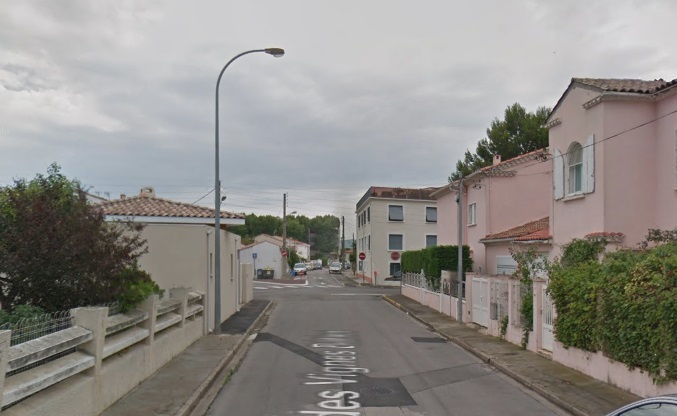
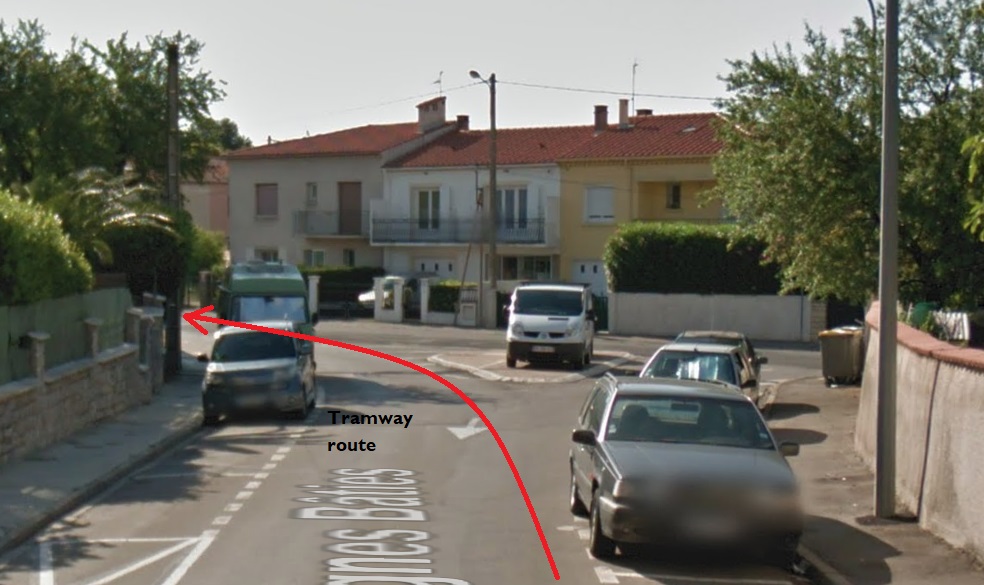
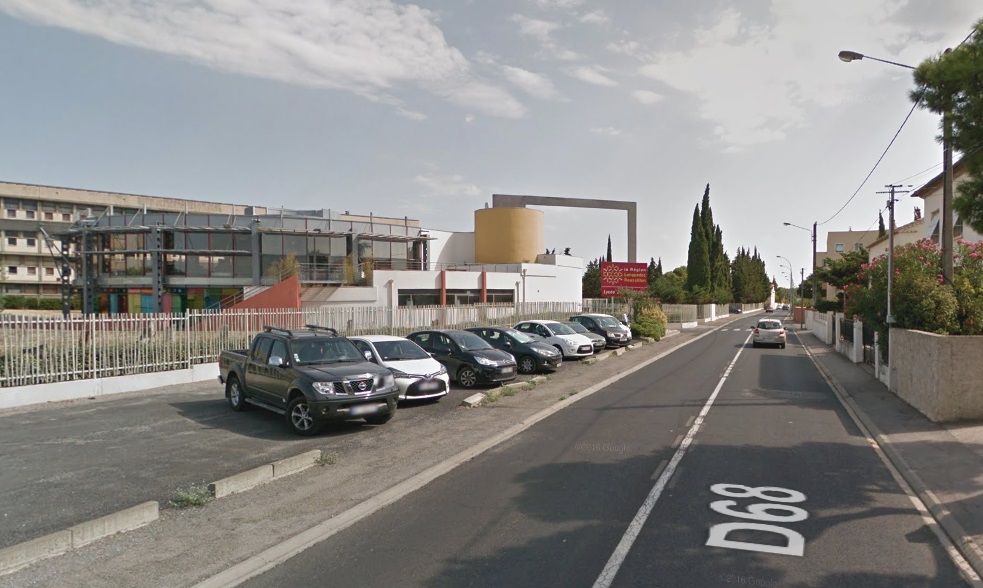
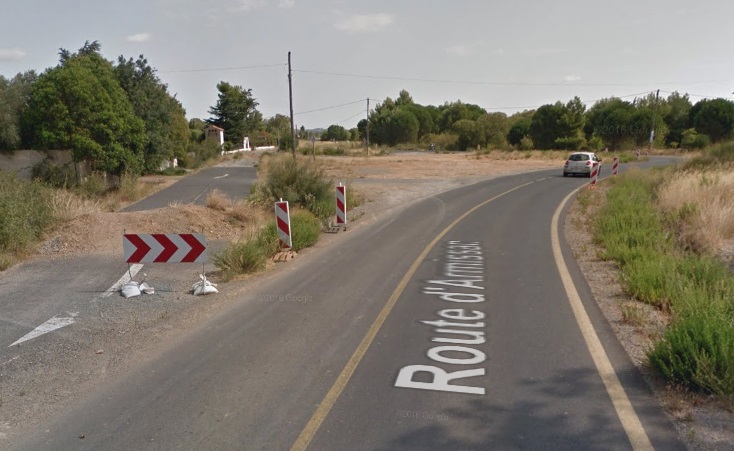
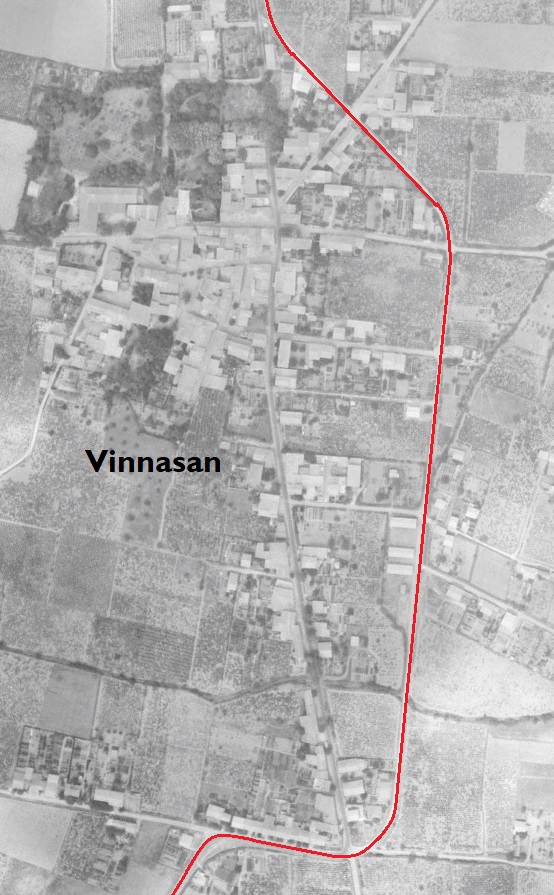
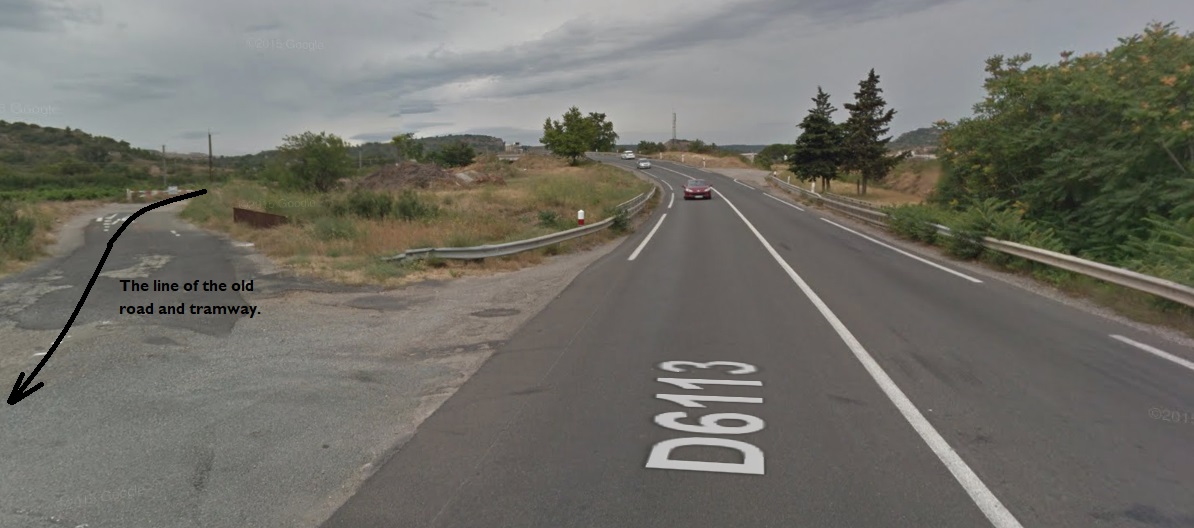
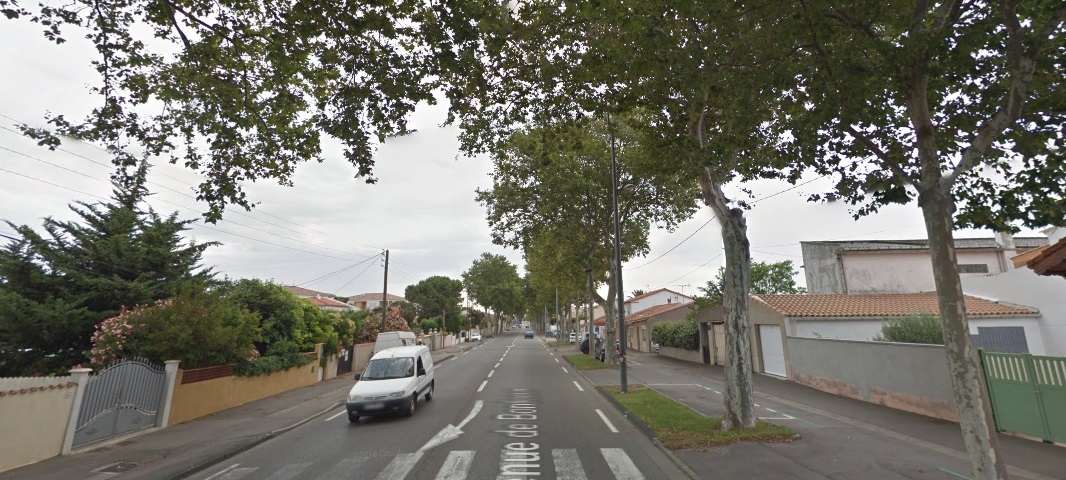
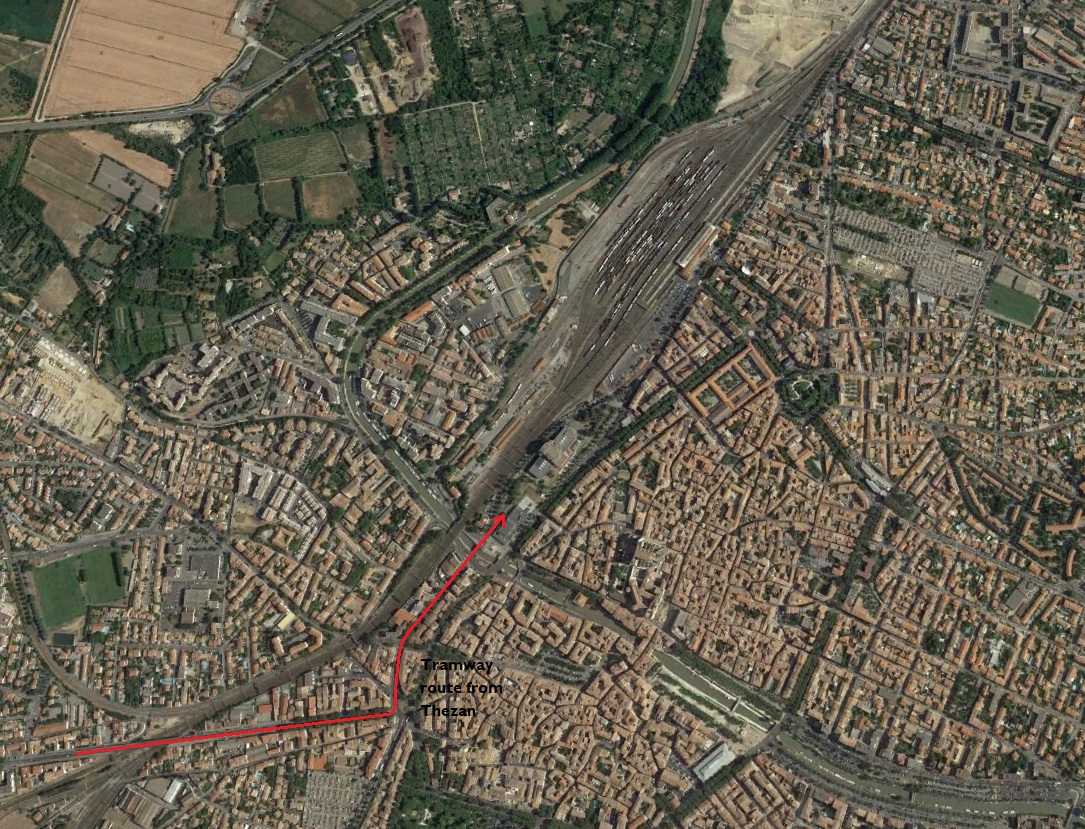
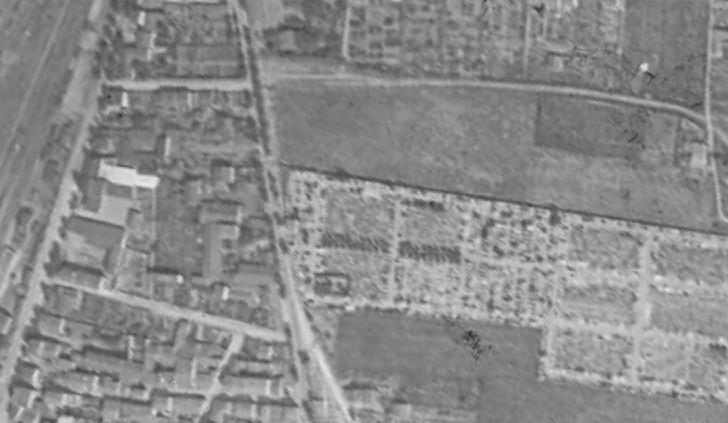
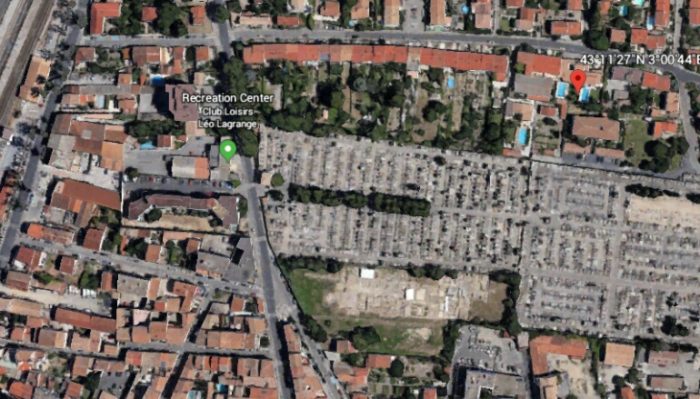
The route to Fleury set off Northeast from the tramway station on the forecourt of the Gare du Midi in Narbonne. After a very short distance the tramway route turned to a more southeasterly direction and in turn, within a short distance, left behind the suburbs of Narbonne.Things in the early 21st century are much different. In the image above the line can be seen leaving the station and heading East. [1] In the image below that line is now a road flanked by domestic dwellings. The cemetery appears to be essentially unchanged.The route as far as Vinnasan is shown on a composite of aerial photographs from 1939 to 1958 below. [1] Most of the route followed what is now the D68 over relatively flat countryside. I have not been able to find any images of the tramway between Narbonne and Vinnasan. The Google Streetview images below show the route of the tramway through what were open fields and are now suburbs of Narbonne.The old road and tramway route are on the left.

The tramway crossed farmland and a number of irrigation canals before reaching Vinnasin.

Vinassan

Vinnasan is now sited very close to the A9/E80 Autoroute which runs just to the East of the area of the adjacent aerial image. The tramway route has been superimposed onto an aerial image from 1958, although it would by that date have been long-gone.

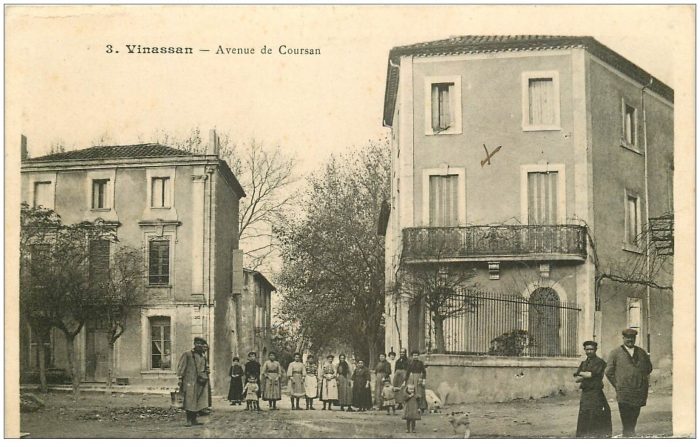
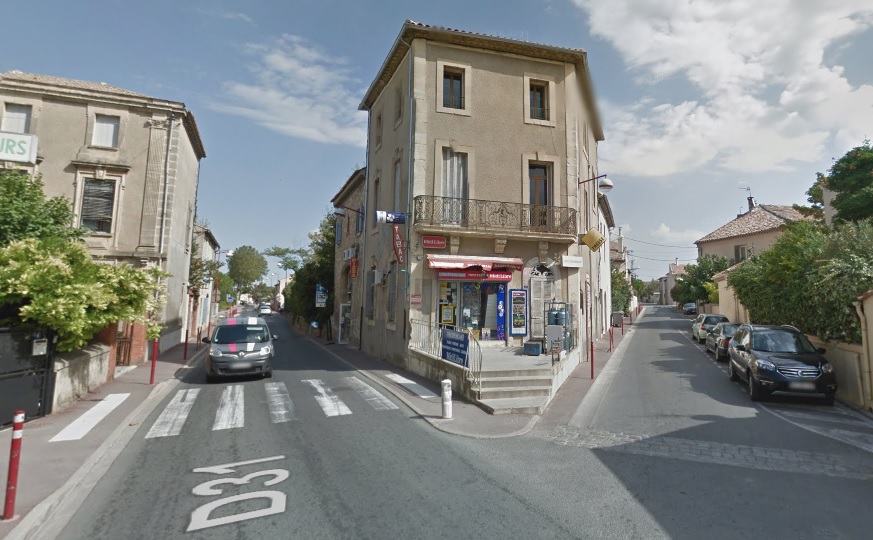
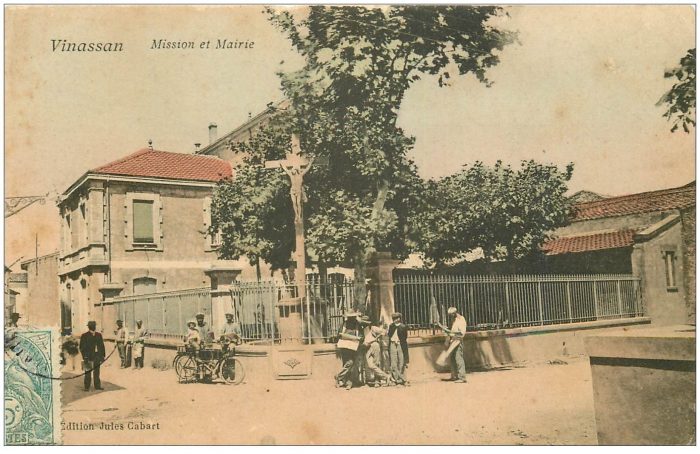
This is a close-up image of the top right of the above ‘snake’ illustrating the length of the route to Vinnasan from Narbonne. The tramway by-passed the centre of the village, taking a more easterly route than the main north-south road through the village (now the D31). The postcard images above come from the central area of Vinnasan, both taken from the main north-south road which is now the D31. They are matched to modern images which show relatively little change. [2][3] The tramway ran to the east of the main village road.

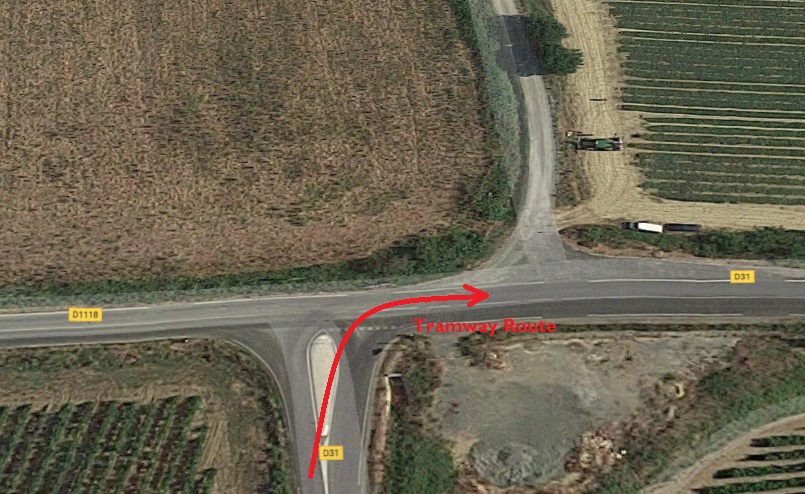
North of Vinnasan, the tramway followed the modern D31 north to a T-junction with the road between Coursan and Salled’Aude. The present day D1118 meets the D31 and the D31 turns East to Salles d’Aude.

From the junction the tramway continued eastwards to Salles d’Aude past the Winery of Chateau Pech-Celeyran-Saint-Exupery.

Salles d’Aude

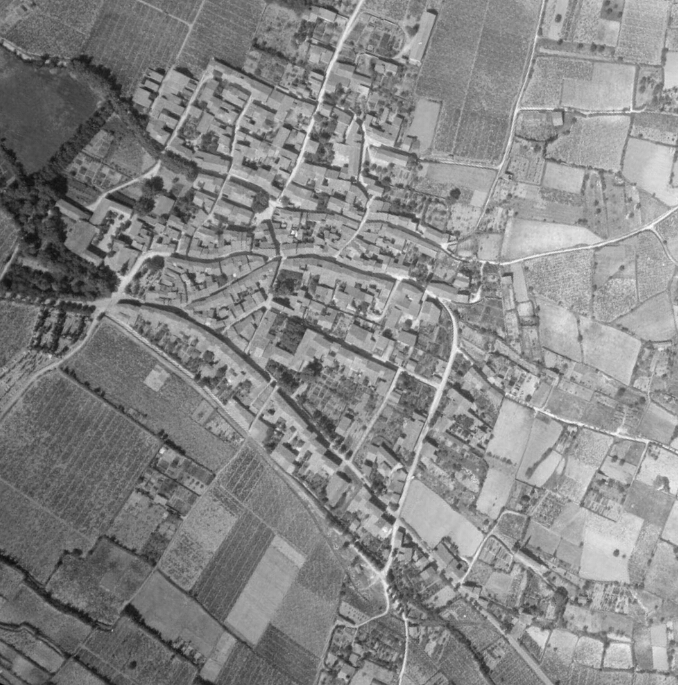
This 1945 aerial image shows Salles d’Aude and the road which is now the modern D31 crossing the lower half of the old village from West to East, entering immediately below the woodland in the top left of the image and exiting off the bottom edge of the image close to the right-hand corner. The vestiges of the tramway route can be seen to the south side of the properties which flank the road [1]This picture is taken from South of the village and shows the tramway route on embankment in front of the village. It runs approximately along the line of what is now Rue du Grimal. [4]

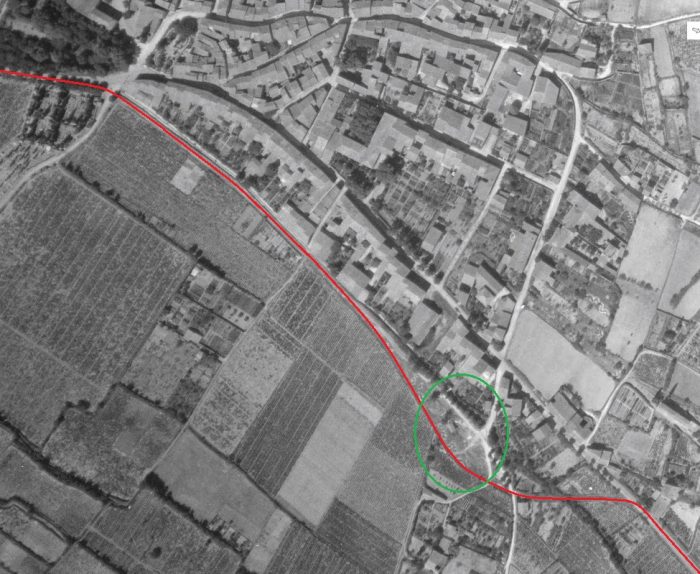
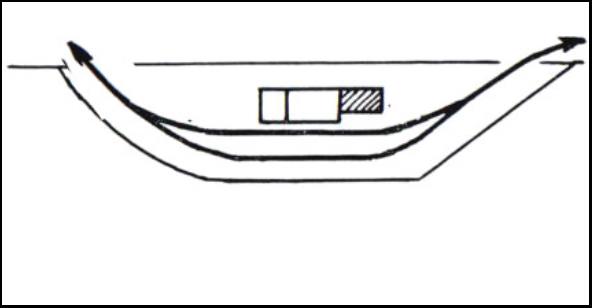
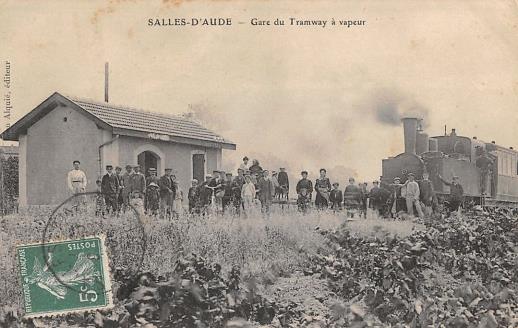
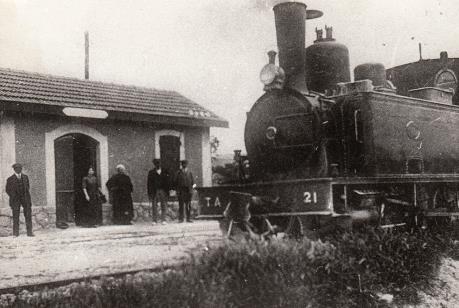
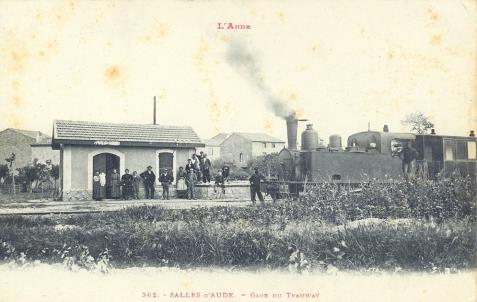
The station was sited to the Southeast of the village in the area highlighted by the green ellipse on the aerial image above, which places it some distance to the right of the picture immediately above.Sketch plan of the Station at Salles d’Aude. [5]The Station at Salles d’Aude. [5]Corpet-Louvet 0-6-0T No. 21 at Salles d’Aude. [5]Another Corpet-Louvet 0-6-0T, this time unidentified, at the Station. [5]

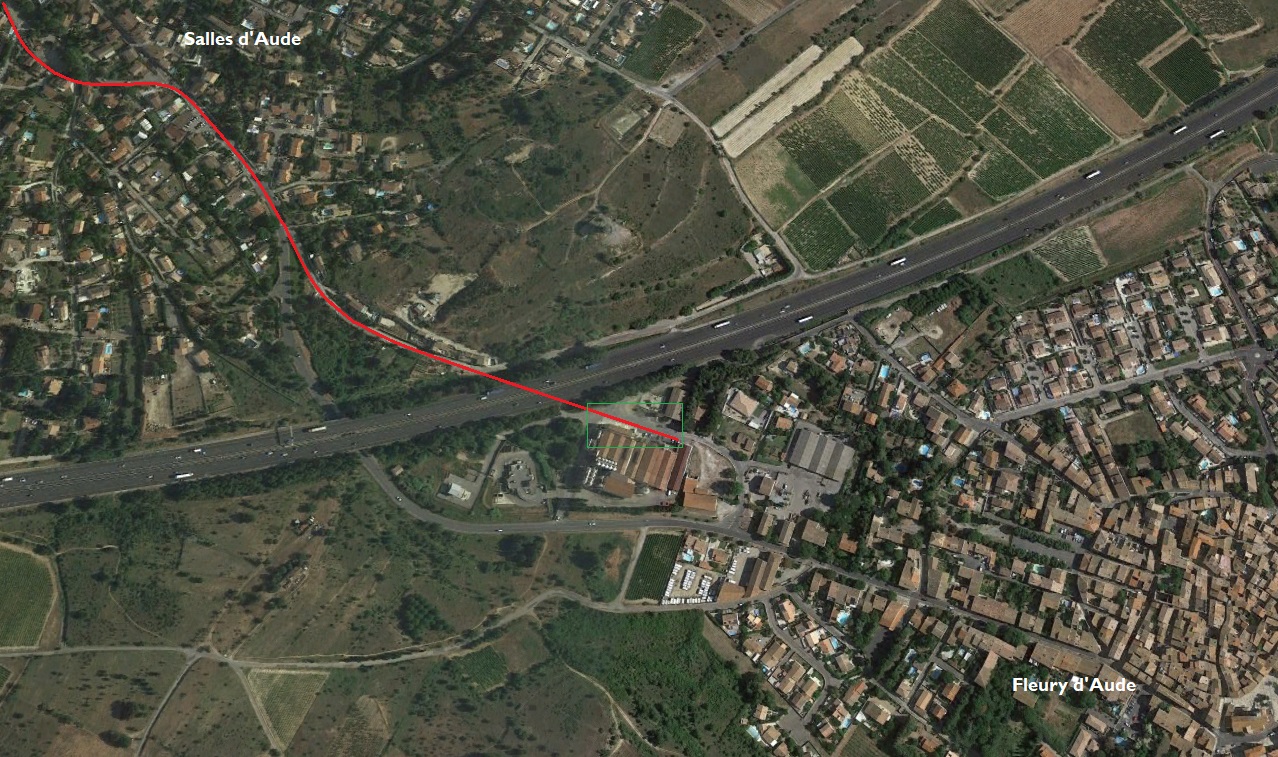
It was only a short distance from Salles d’Aude to Fleury d’Aude. Tha station at Salles D’Aude was at the topleft of the satellite image below. The tramway route is shown in red and the location of the station at Fleury d’Aude is shown with a green box both on the satellite image and the aerial photo below.

Fleury d’Aude

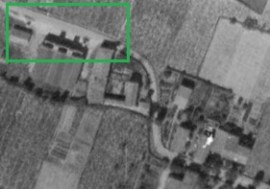
The western entrance to the village is shown on this extract from a 1945 aerial photograph. The tramway station location is highlighted by the green rectangle. By 1945, the station site had already been subsumed into the Co-op site.

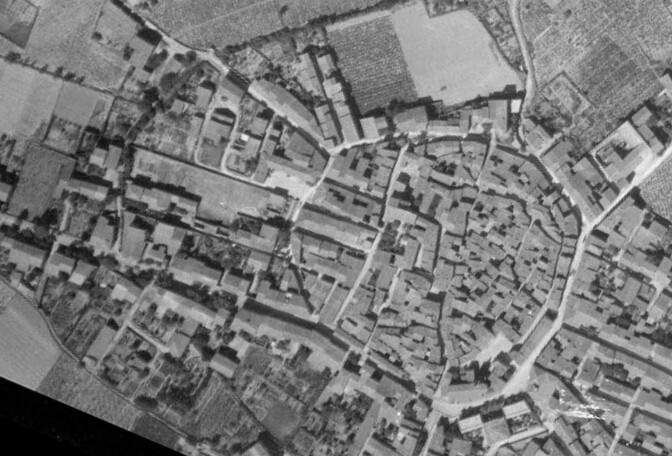
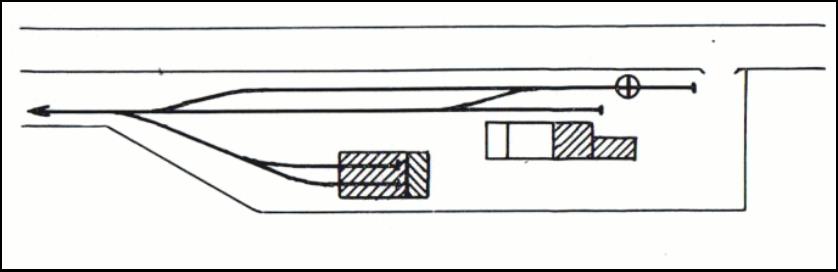
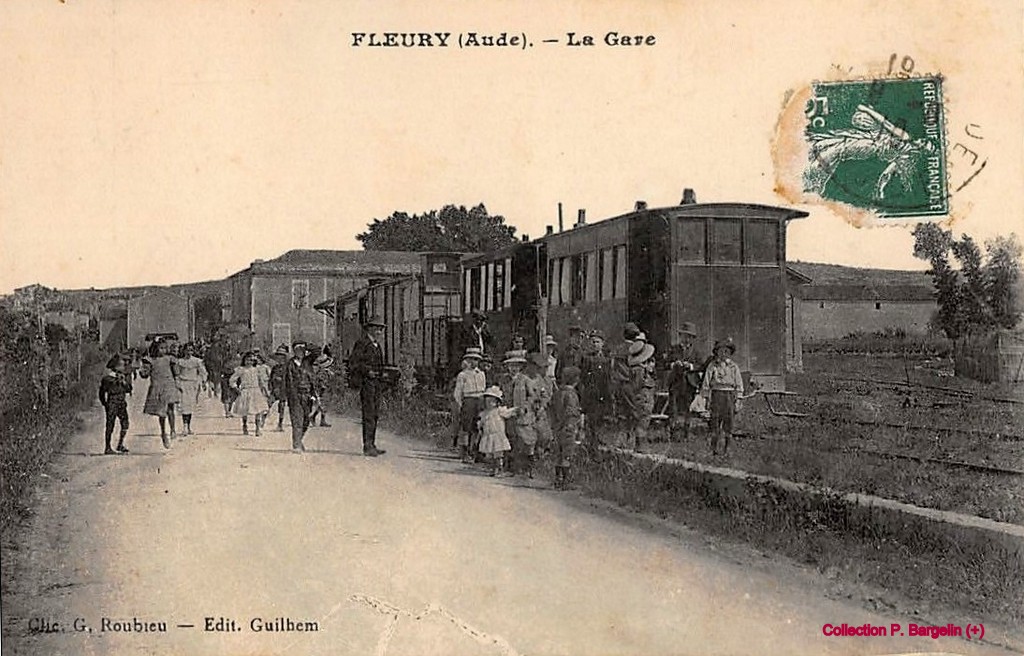
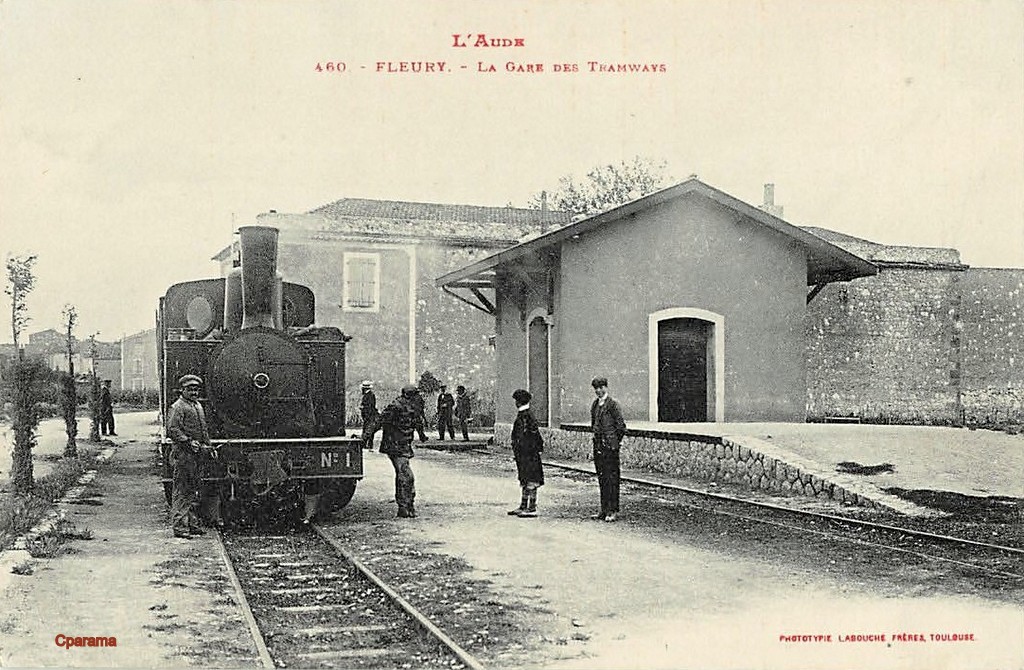
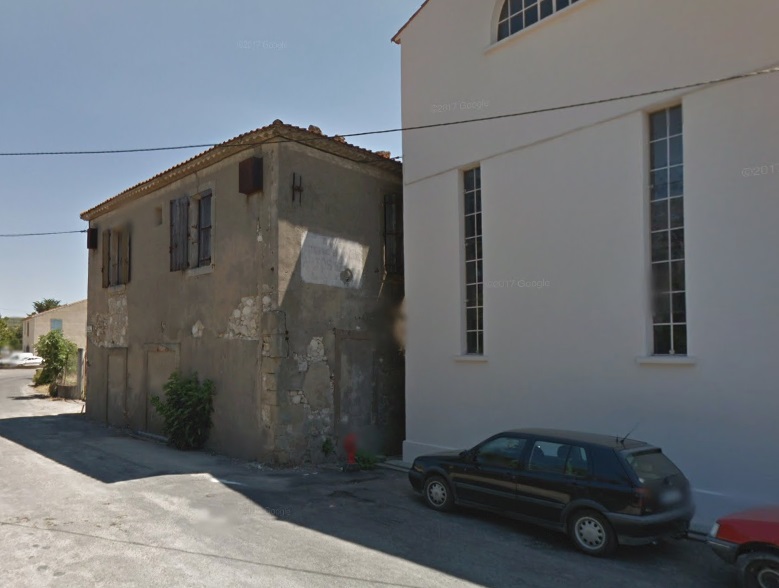
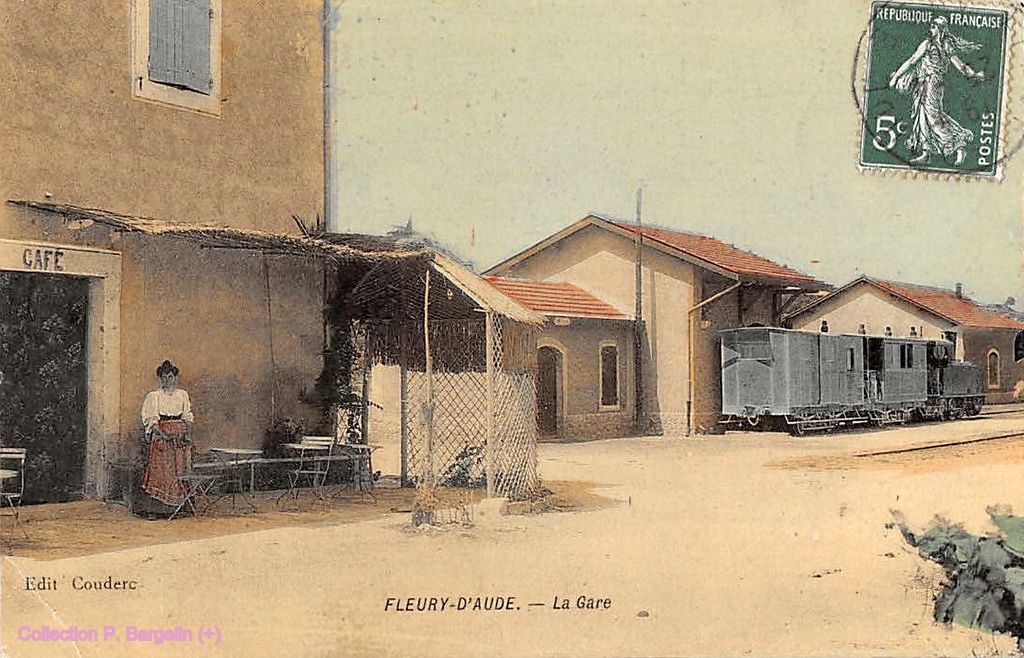
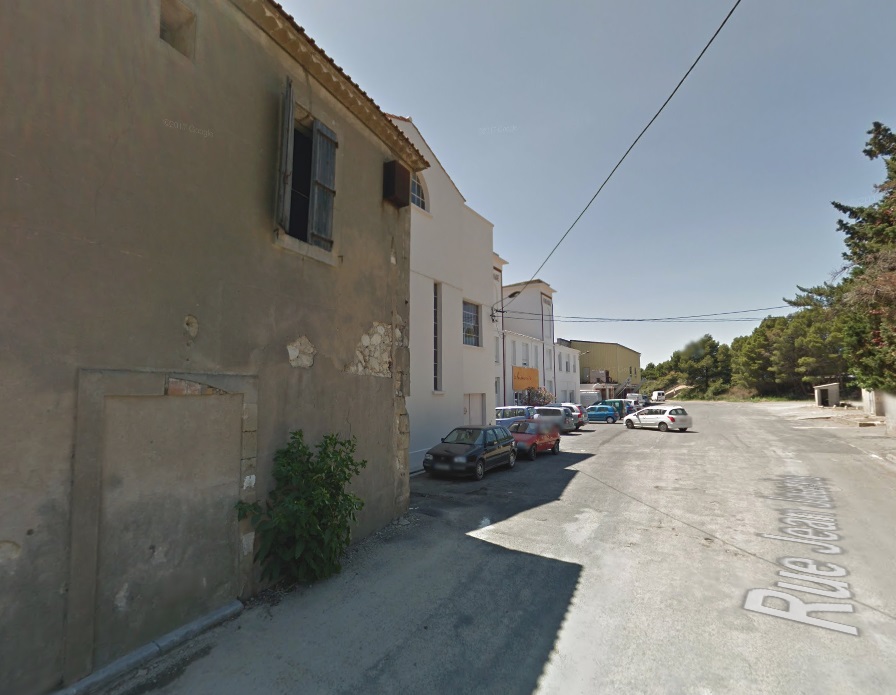
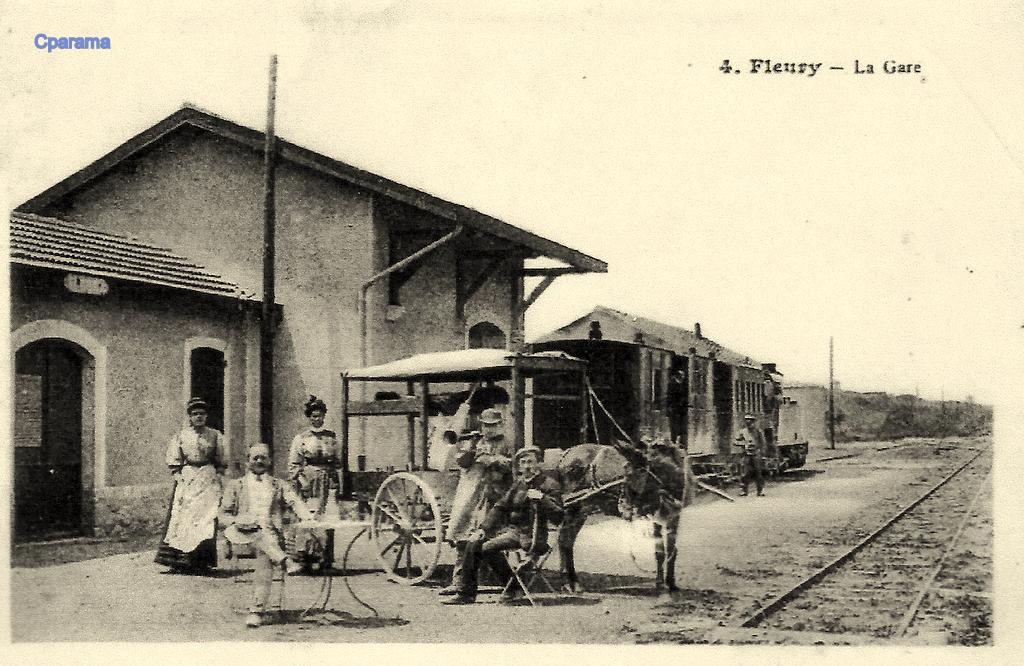
The centre of the village of Fleury d’Aude is shown below on the next 1945 aerial image. The central circular area of the old village is typical of many such villages in Southern France. The smaller aerial image above was taken at the same time as the one below and abuts directly onto it.The station was out to the West of the centre of the village. The building in the bottom right of the green rectangle appears in a number of the pictures below. It is at the right-had side of the sketch plan below, just beyond the station site boundary on the sketch. It can be seen beyond the tram in the first postcard image below. [5]The station at Fleury d’Aude. [6]Corpet-Louvet 0-6-0T No. 1 at Fleury d’Aude Station. [6]The two images above show the building referred to in the last paragraph above. The first is a closer image of the building on an early 20th century postcard the second is taken in the early 21st century.The station cafe and passenger and goods facilities. The engine shed is visible behind the locomotive which is preparing to leave for Narbonne. [6]The cafe building in the early 21st Century with the modern Co-op buildings on the site of the station.Fleury d’Aude Station. [6]

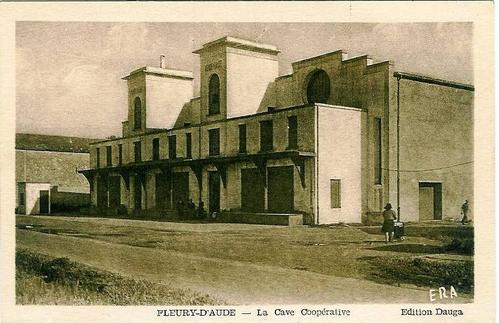
The Co-op which was built on the station site is called La Vendemiaire.[7] The Co-op was created in 1937 and the building opened its doors to the wine harvest in 1938. In 1979, 652 members still cultivated 889 hectares of vines (just a little more than one hectare per cooperator) and the cellar vinified 91,000 hectoliters of table wines.The Co-op building soon after construction in the late 1930s. The tramway station was under the forecourt and the facade of the new building. The brick building at the left of the picture is the building which housed the station cafe and appears in images above. [8]

This is the final planned post on the Tramways de l’Aude.

I hope that you have enjoyed the journey.

References

  1. https://remonterletemps.ign.fr, accessed on 20th to 27th November 2018.
  2. https://www.fortunapost.com/cartes-postales-francaises/3261-carte-postale-ancienne-11-vinassan-avenue-de-coursan.html, accessed on 15th November 2018.

  3. https://www.fortunapost.com/cartes-postales-francaises/3262-carte-postale-ancienne-11-vinassan-mission-et-mairie-petrolette-sur-cale.html, accessed on 30th November 2018.
  4. http://www.sallesdaude.fr/fr/decouvrir/un-peu-dhistoire, accessed on 30th November 2018.
  5. http://www.cpaaude.fr/THEMES/TRAMWAYS/index_fichiers/Page1105.htm, accessed on 15th November 2018.
  6. https://www.cparama.com/forum/fleury-d-aude-t259.html, accessed on 15th November 2018
  7. http://www.lavendemiaire.com, accessed on 3rd December 2018.
  8. http://www.cavescooperatives.fr/article-27593489.html, accessed on 2nd December 2018.
 

Tramways de l’Aude – Narbonne to Ouveillan

Trams to Ouveillan took a relatively tortuous route out of Narbonne. The route is covered well on this link:

Tramways de l’Aude – Tramways in Narbonne

For the sake of completeness, some of the details on that link are repeated here ….

Narbonne

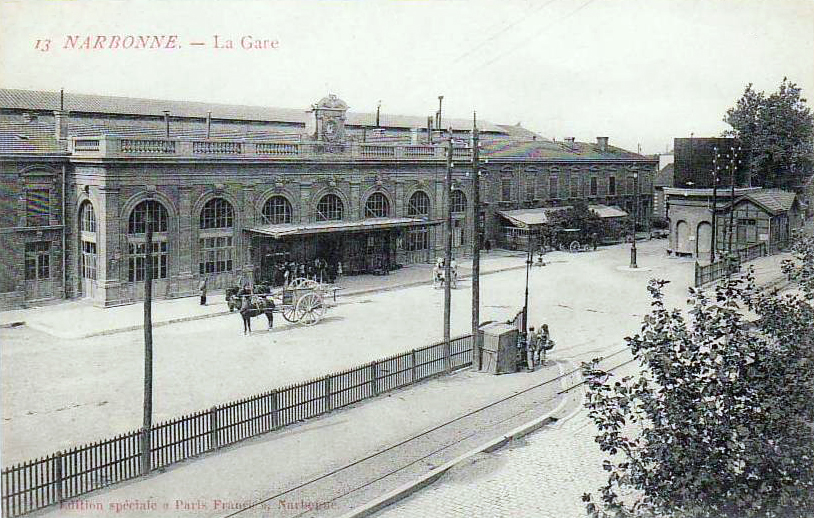
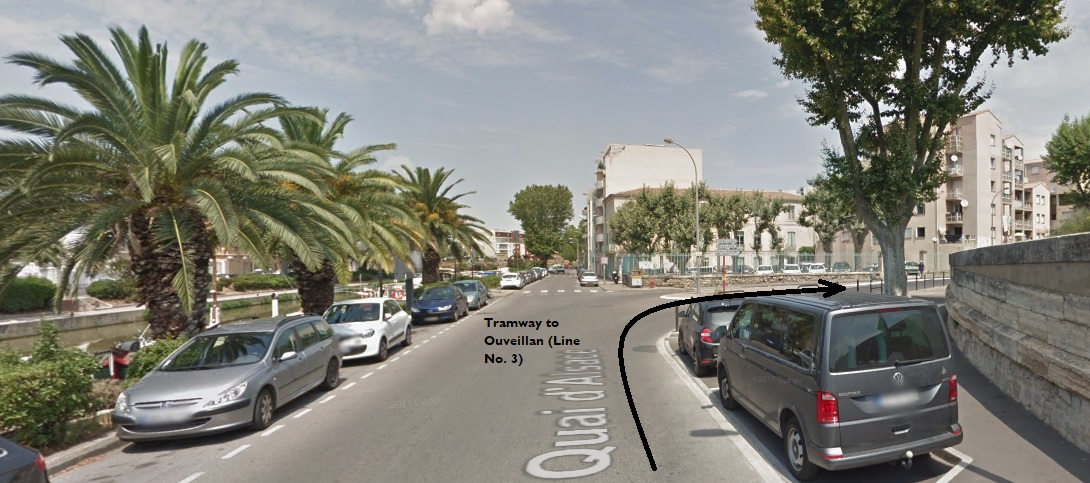
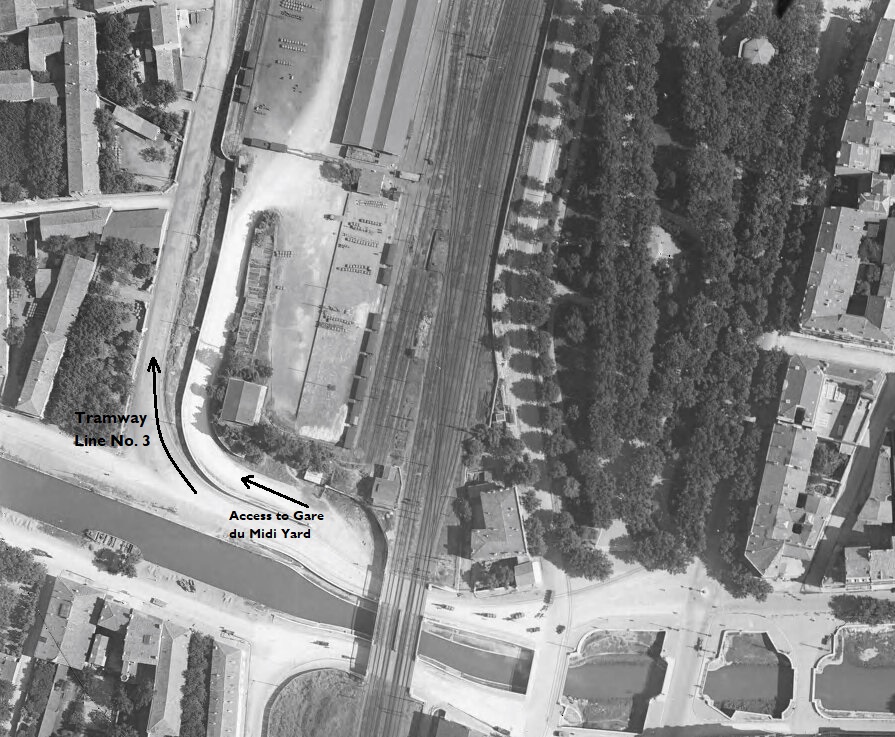
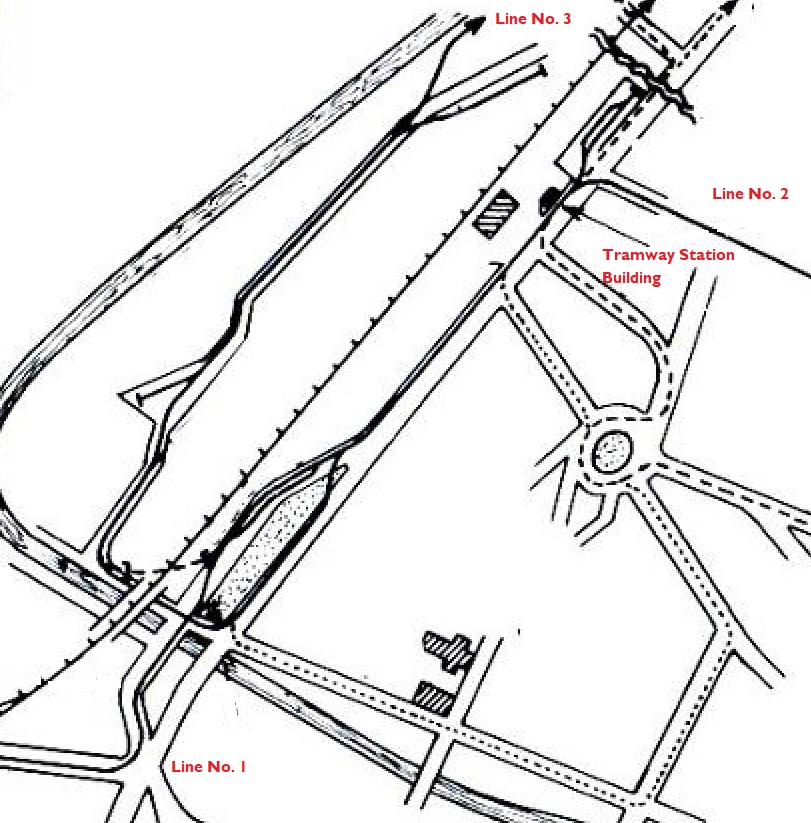
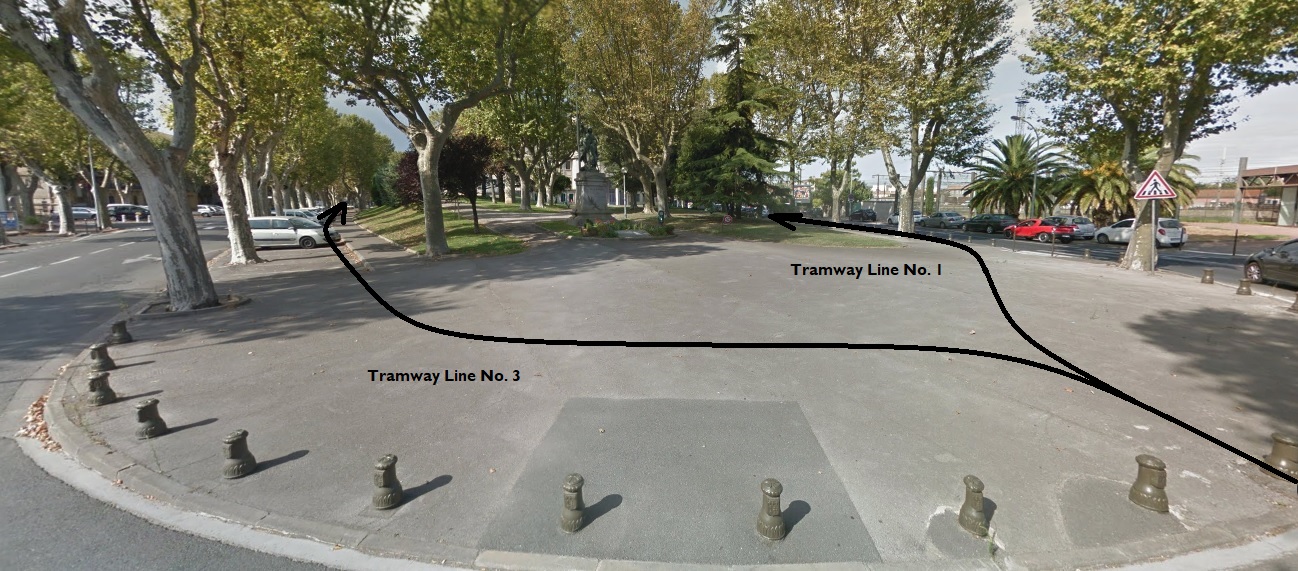
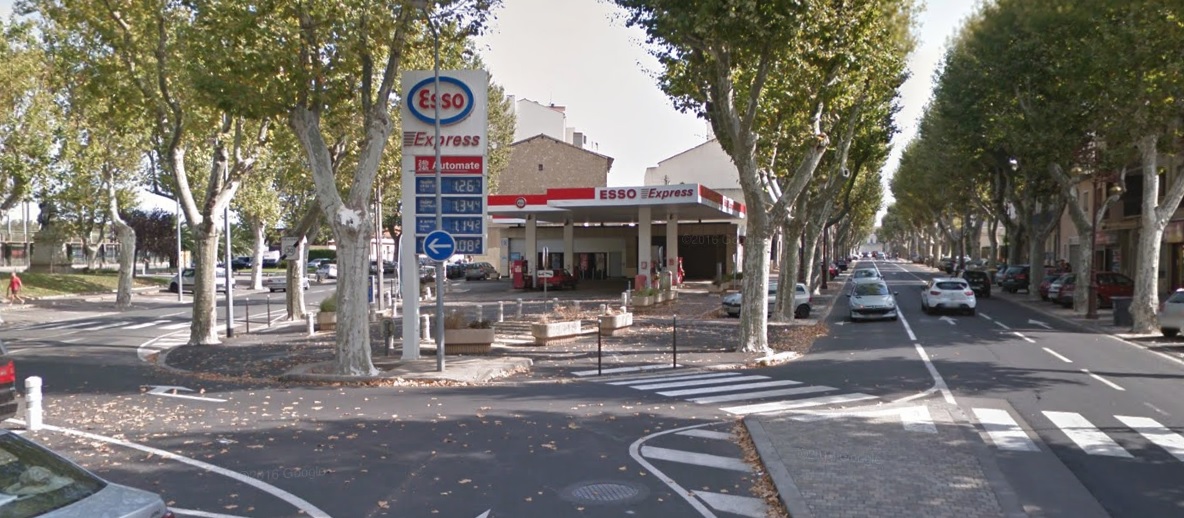
The tramway station was sited on the forecourt of the Gare du Midi as shown in the image below. The tramway station building is on the right of the picture.Trams to Ouveillan left the station in a southeasterly direction travelling roughly in parallel with the Midi mainline. The route to Thezan (Line No. 1, below) hugged the boundary wall of the Gare du Midi’s yard, the route to Ouveillan (Line No. 3, below) diverted slightly to the East.The tram (above) leaves the station and heads Southwest. It follows this route to the East of the Statue des Combatants. [7]The tram continues heading South towards the Canal du Midi. [8]This image shows a tram further along the route to Ouveillan (Line No. 3  above). It has reached the point on its route which is furthest to the Southwest and is now passing under the standard gauge line before turning Northeast. [9]The tramway route to Ouveillan (black arrow) ran along what is now the Quai d’Alsace and then turned Northeast as shown below.The tramway passed under the Standard Gauge line as shown in the 1930 aerial image above and then turned North around the boundary wall of the station goods yard. [10]

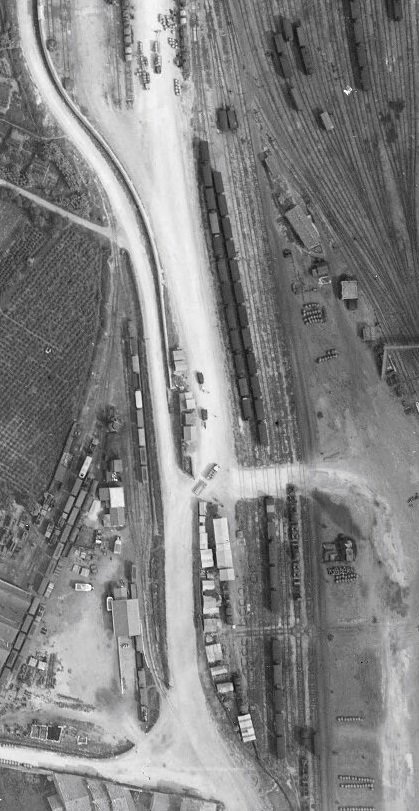
It then followed that boundary wall in a northeasterly direction. Its own marshalling yard is shown on the adjacent image. [10]

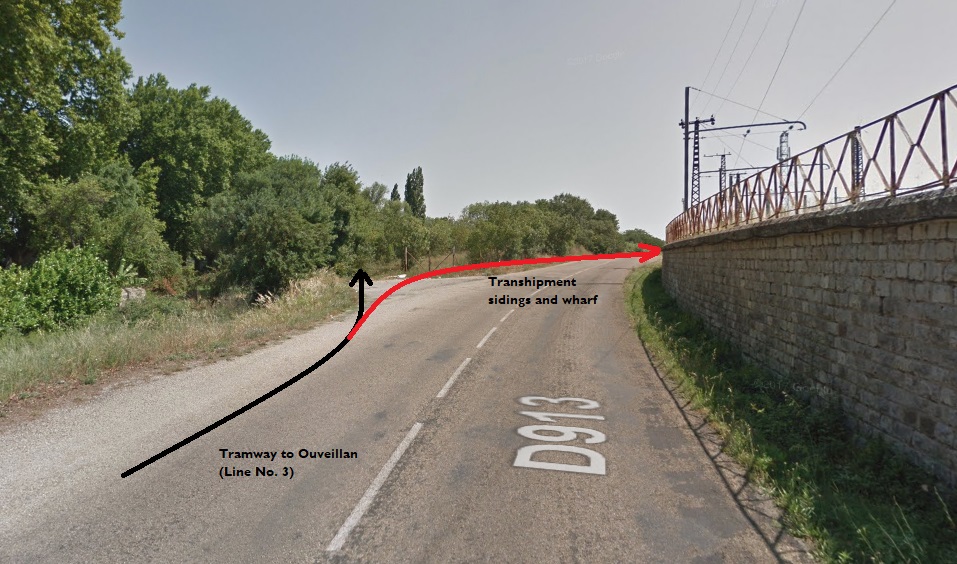
The next image shows the further extension of the line alongside the Western boundary of the Gare du Midi goods yard heading North-east towards Cuxac-d’Aude. [10]The monochrome images above have been aligned to show the tramway running up and down the photograph. It actually ran in a more northeasterly direction. The tramway followed what is now the D913 Rue de Cuxac along the western side of the large standard gauge facilities until it reached a branch to a series of sidings and a transshipment wharf/shed. At this point the mainline drifted to the West to follow the line of the Canal du Midi. It can be seen running towards the top left of the picture above. [17]This Google Streetview image shows the line of the tramway to Ouveillan in black and the approximate line of the route into the transshipment yard and wharf in red. In this post we are following the black arrow!The tree to the right of this image marks the point vthat the tramway aligns itself to the Canal. For some distance now the trams ran alongside the Canal behind the line of trees which flanked the Canal.

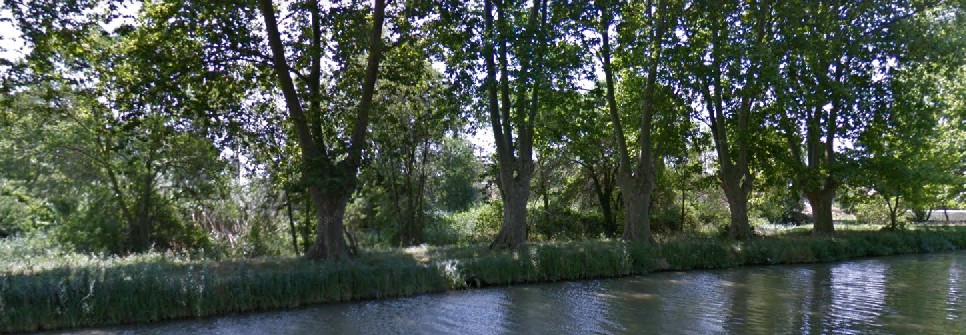
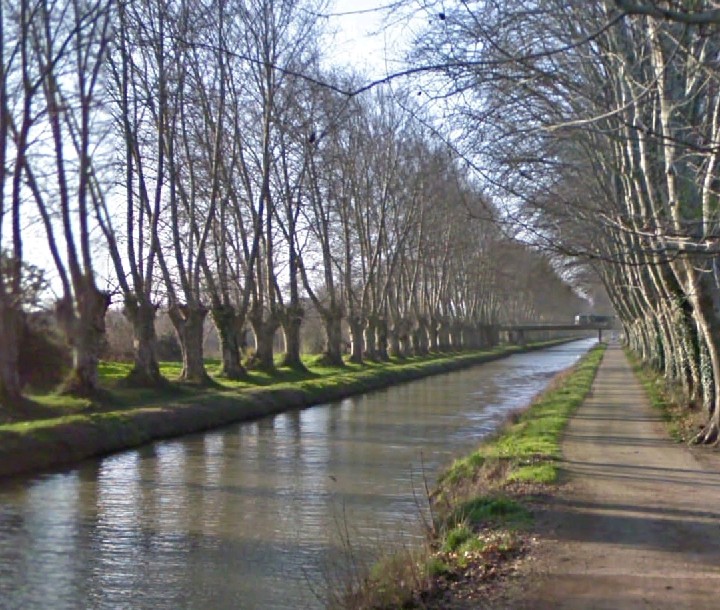
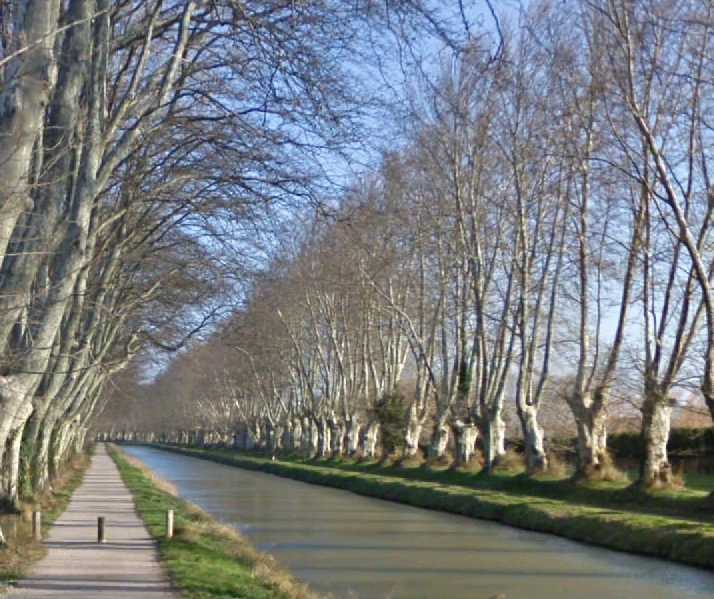
The next two views show the Canal du Midi flanked by trees. I believe that the tramway ran beyond the trees on the far bank of the Canal in each image.The Canal du Midi looking South.The Canal du Midi looking North from the same location.

The trams had an easy journey alongside the Canal and only left it when the Canal turned away from the route the tram needed to take to Cuxac.

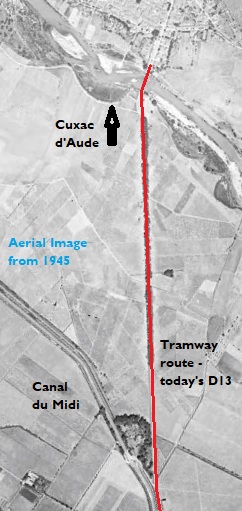
The tramway alignment was approximately as shown on the aerial photograph from 1945. The bridge over the River Aude can be seen clearly in the aerial image just at the point where the tramway reaches the village of Cuxac d’Aude.

Cuxac d’Aude

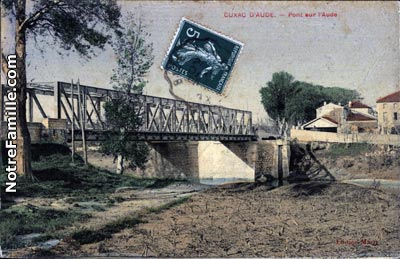
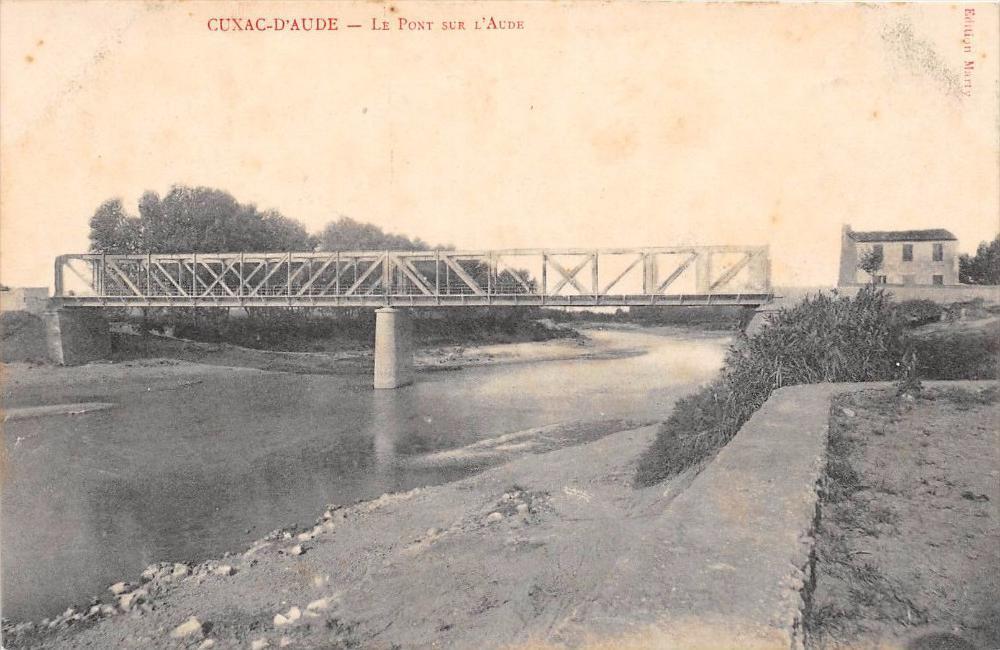
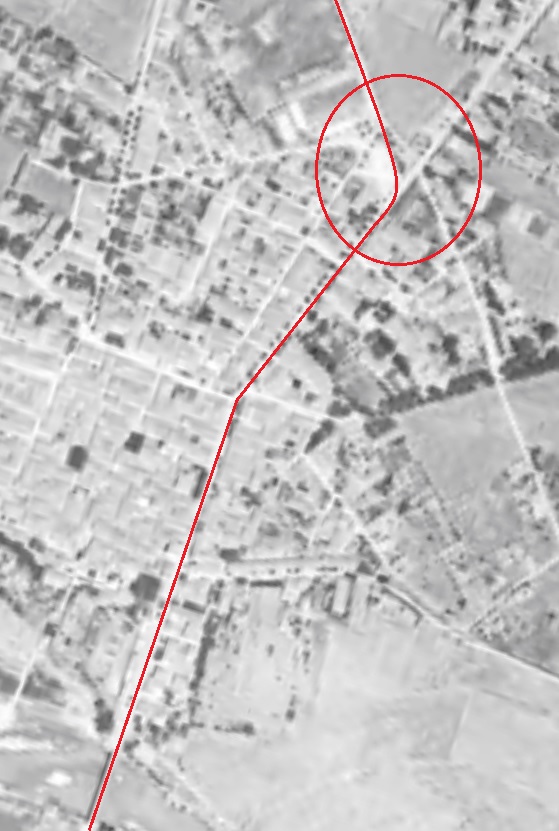
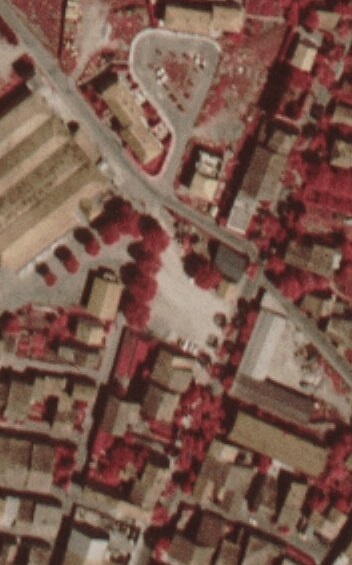
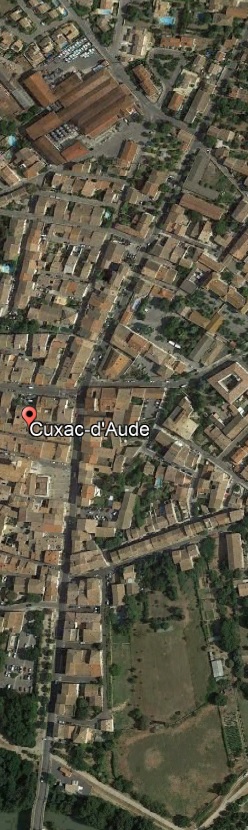
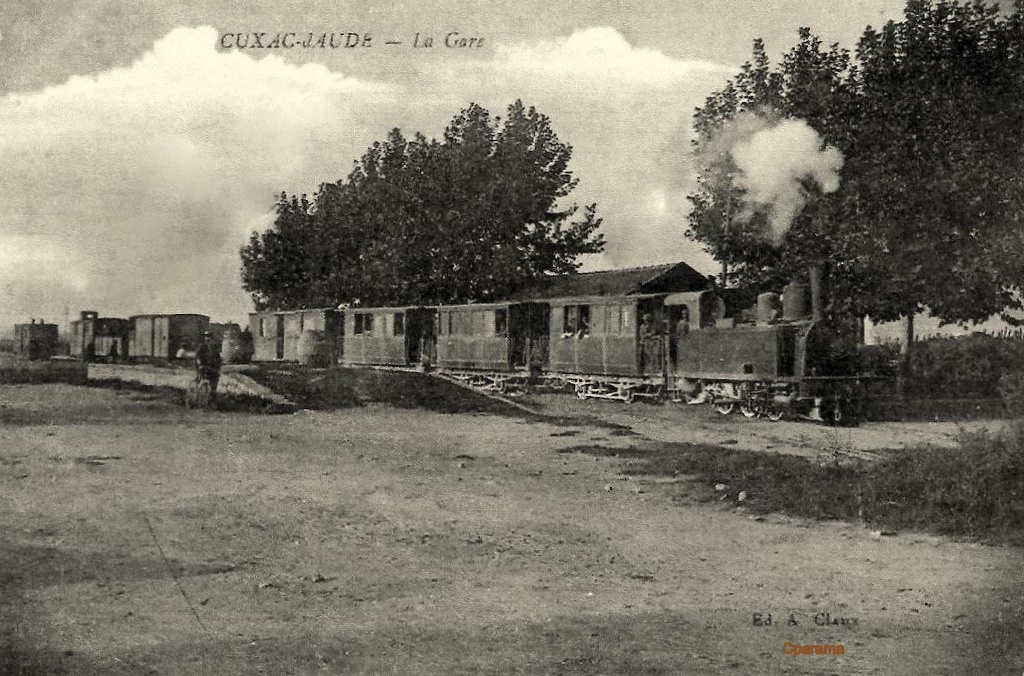
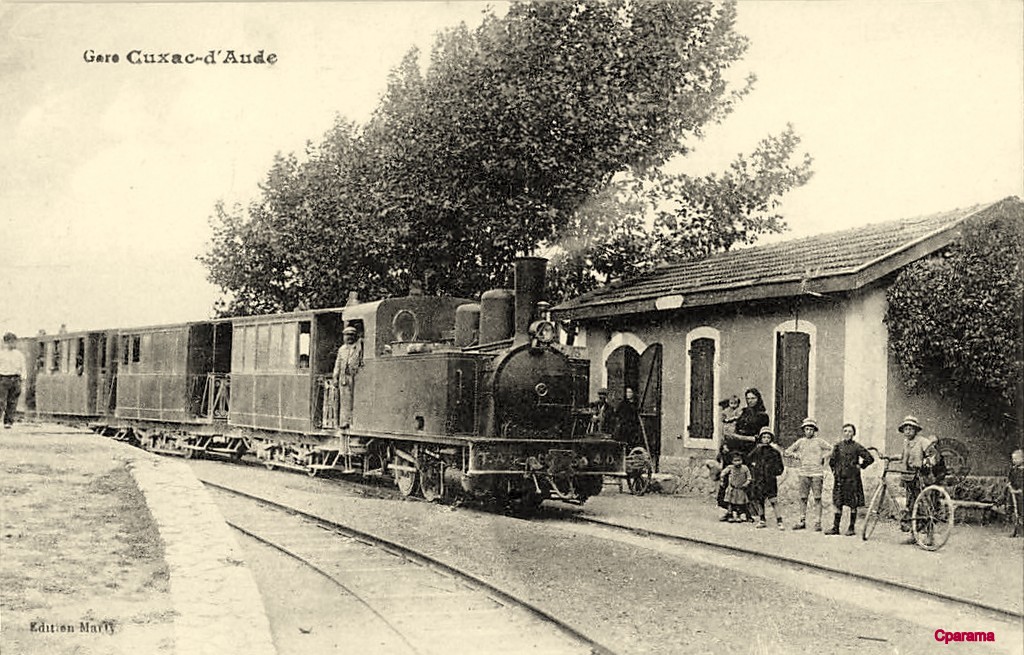
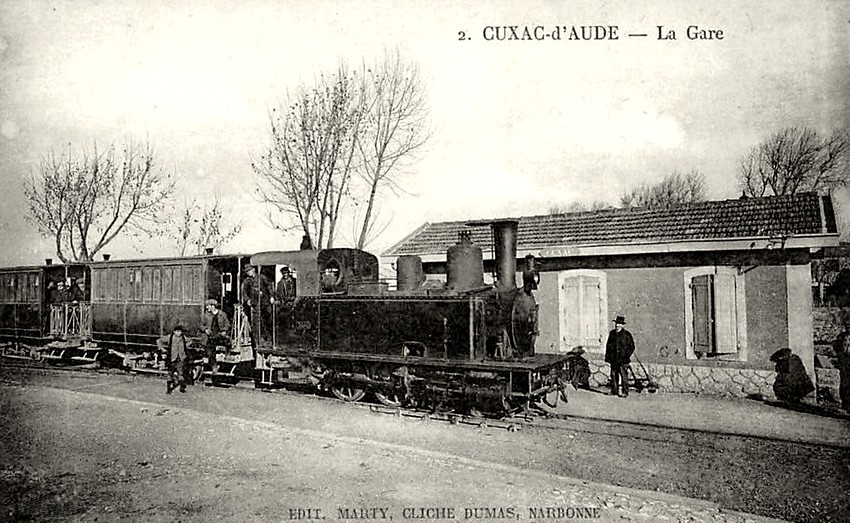
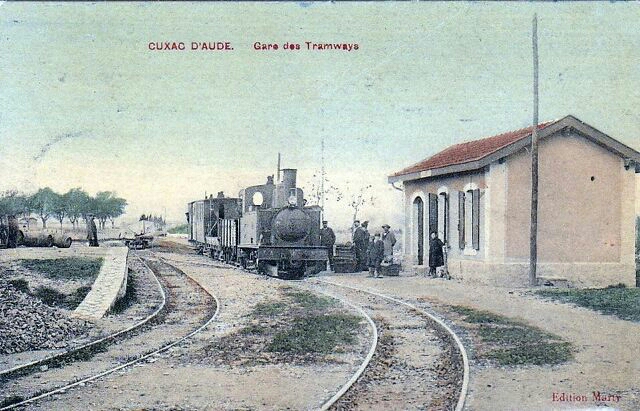
The village of Cuxac was approached by trams crossing the Rive Aude on the bridge illustrated below. [2] The bridge was a steel truss girder bridge which has now been replaced.The first image below is shows the centre of Cuxac from the air in 1945. The bridge over the River Aude can be picked out at the bottom of the picture. The tramway station is at the centre of the red oval. The tramway route is marked as a red line. [6]The station location is shown in the mid 1970s on the next image (adjacent), and in the mid-1980s in the one below. [6]The final image (adjacent), shows the same area in the early 21st century from Google Earth. The tramway route is still evident in the street layout and the station building has been preserved and is in private ownership. It is used as a pizza takeaway business in the 21st century!

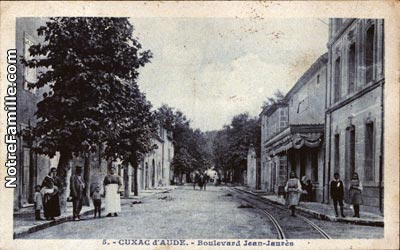
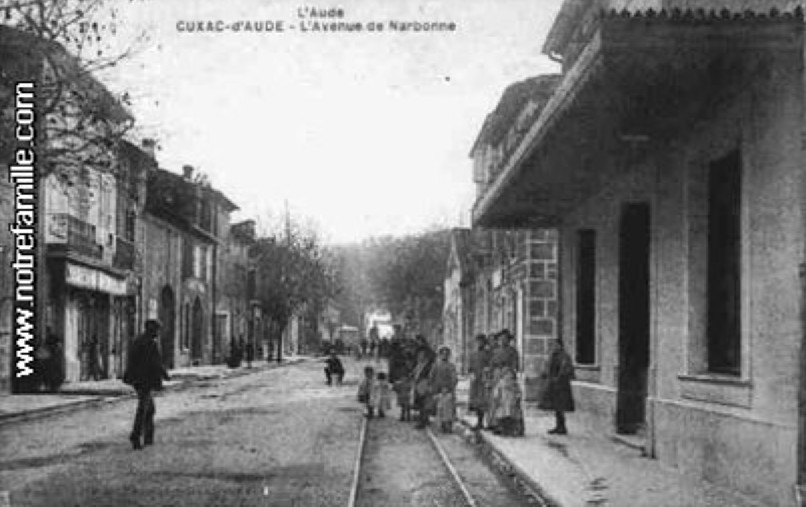
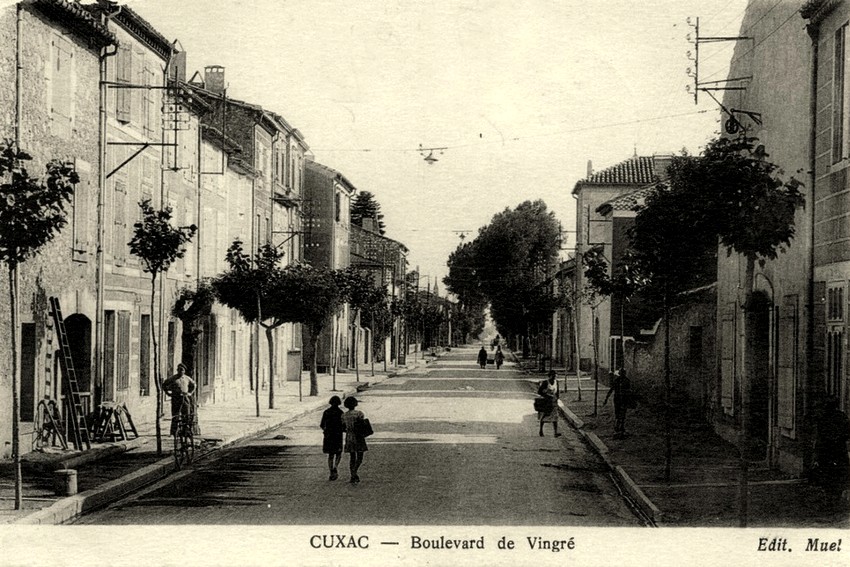
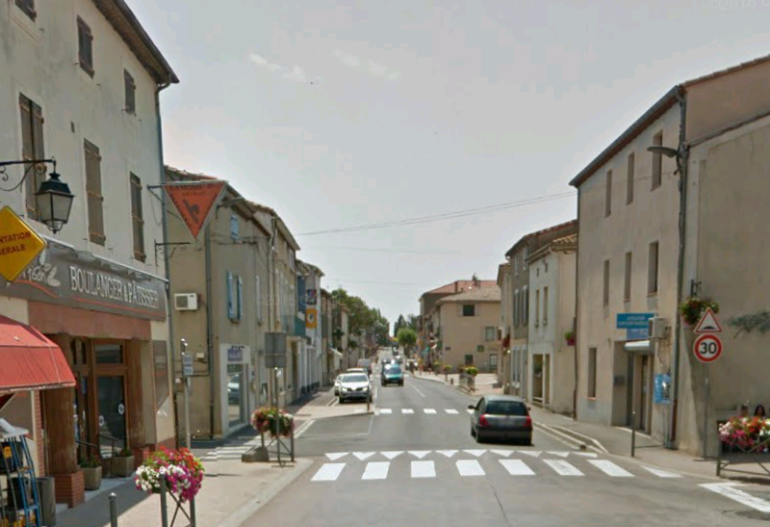
The picture immediately below is an image taken from north of the junction central to the adjacent image just above the town name and pink marker. The view looks southwards down Boulevard Jean Jaures. The curve in the tramway lines accommodates the change in direction of the road at the junction which is also evident in the adjacent image. [2]The second image (below), taken Just to the south of the one above, looks south towards Narbonne and so bears the legend, L’Avenue de Narbonne. [2]A similar location after the removal of the tramway. The street is now known as the Boulevard de Vingre. [4]Boulevard Jean Jaures or Boulevard de Vingre (D13) in the early 21st century. This image was taken from approximately the same location as the first postcard view of the street, also looking South.

Travelling North-northeast from the centre of the village along  what is now the D413, the trams ran on the West side of the road until they reached what was, in the early 20th century, primarily, open ground on the edge of the village where the station was built.A tram arrives at the Station in Cuxac from Narbonne having travelled through the village first. [3] This tram has travelled from Ouveillan and will go on through the village of Cuxac d’Aude to Narbonne. It obscures the view of the station building. [3]This tram has also travelled from Ouveillan and will go on through the village of Cuxac d’Aude to Narbonne. [3]This and the previous monochrome image show the station building to good effect. [4]This view shows the line ahead to Ouveillan as a tram arrives from there on its way to Narbonne. [5]

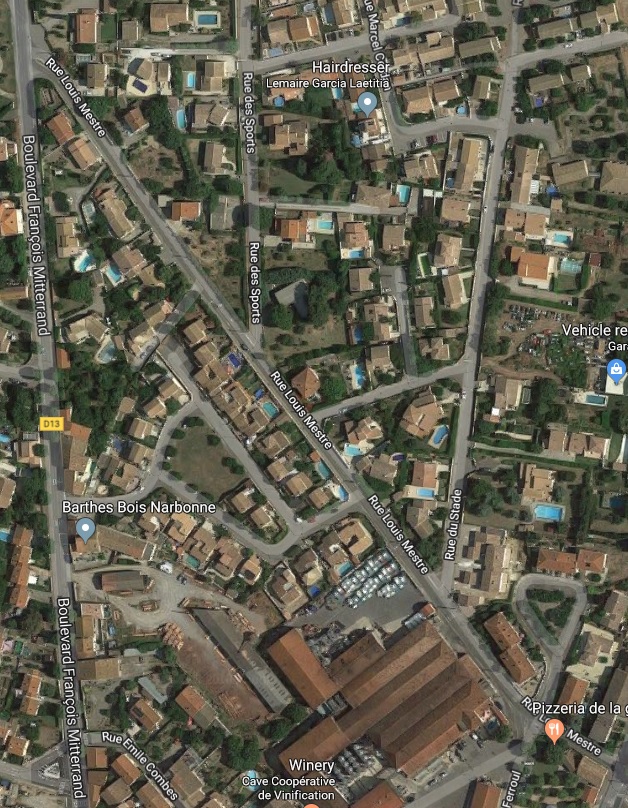
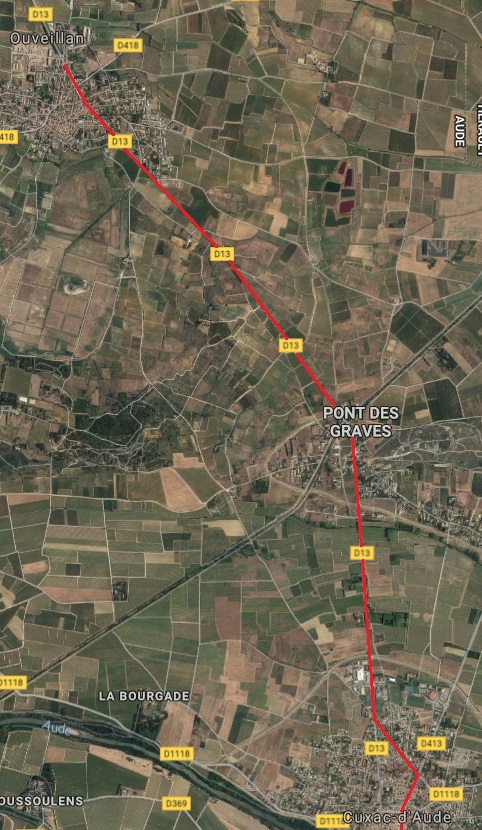
The journey to Ouveillan from Cuxac was over relatively level ground. Trams followed what is now the D13 through to Ouveillan, after travelling through the suburbs of Cuxac on the Rue Louis Mestre.On the way, trams passed through what is now known as Pont des Graves, as can been seen on the adjacent satellite image from Google Maps.

Pont des Graves

At this point the current D13 bridges the Canal d’Atterrissement de l’Etang de Capestang.

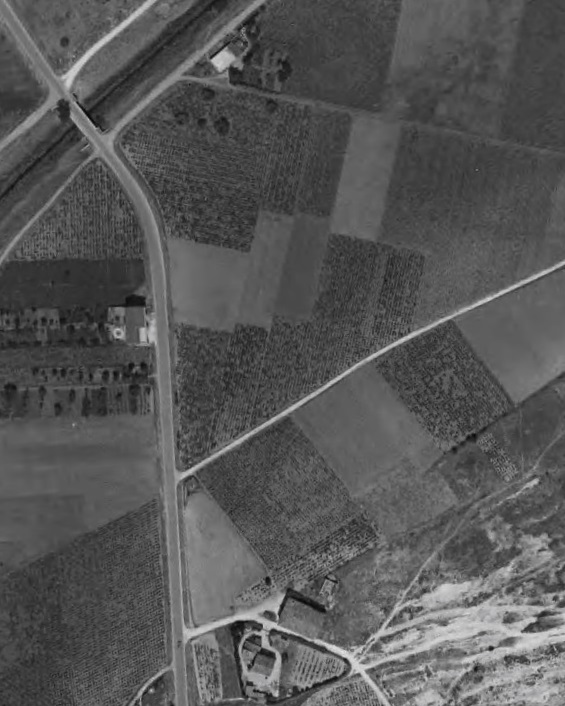
Back in 1939, which is the date of the earliest aerial image available, the bridge and canal were in place but the small community of Pont des Graves had still to form. This can be seen clearly on the aerial image below. [10]The journey from Pont des Graves to Ouveillan was direct and level, following the D13.

Ouveillan

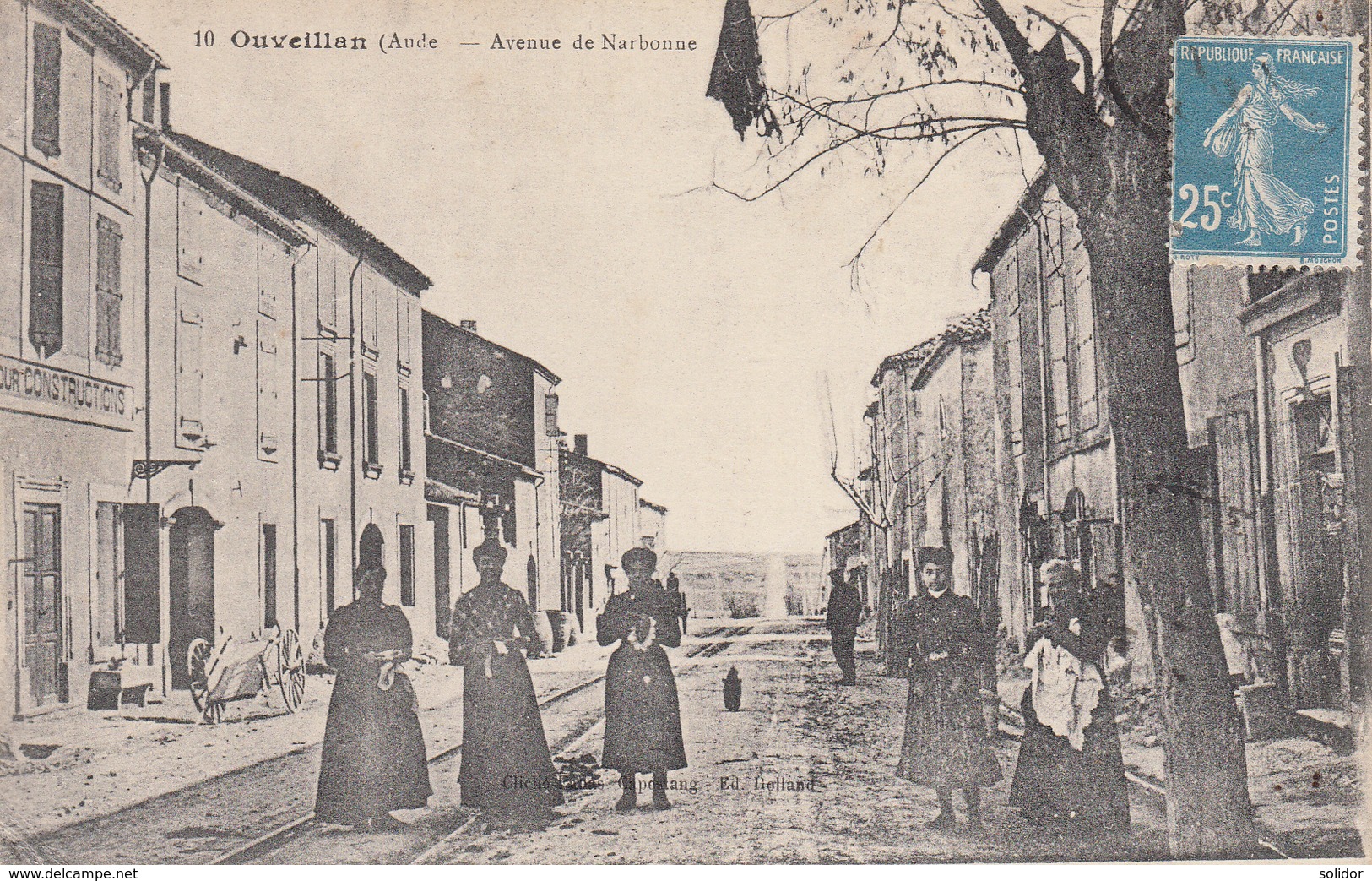
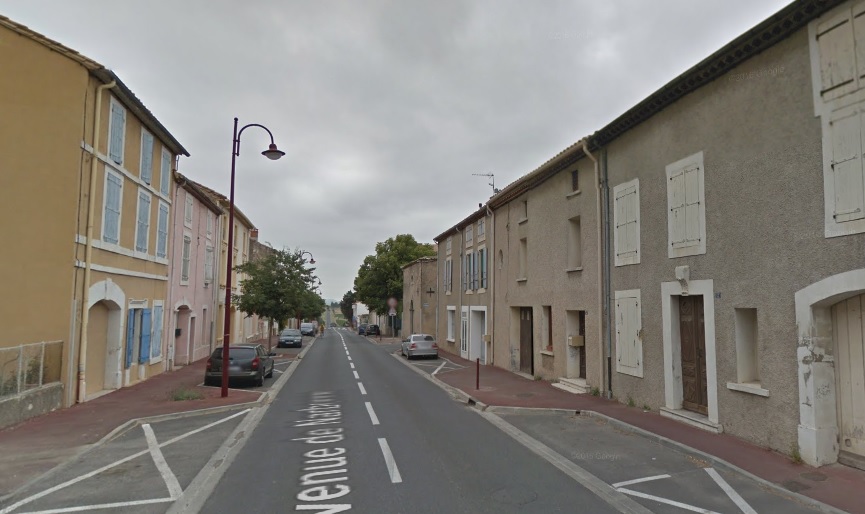
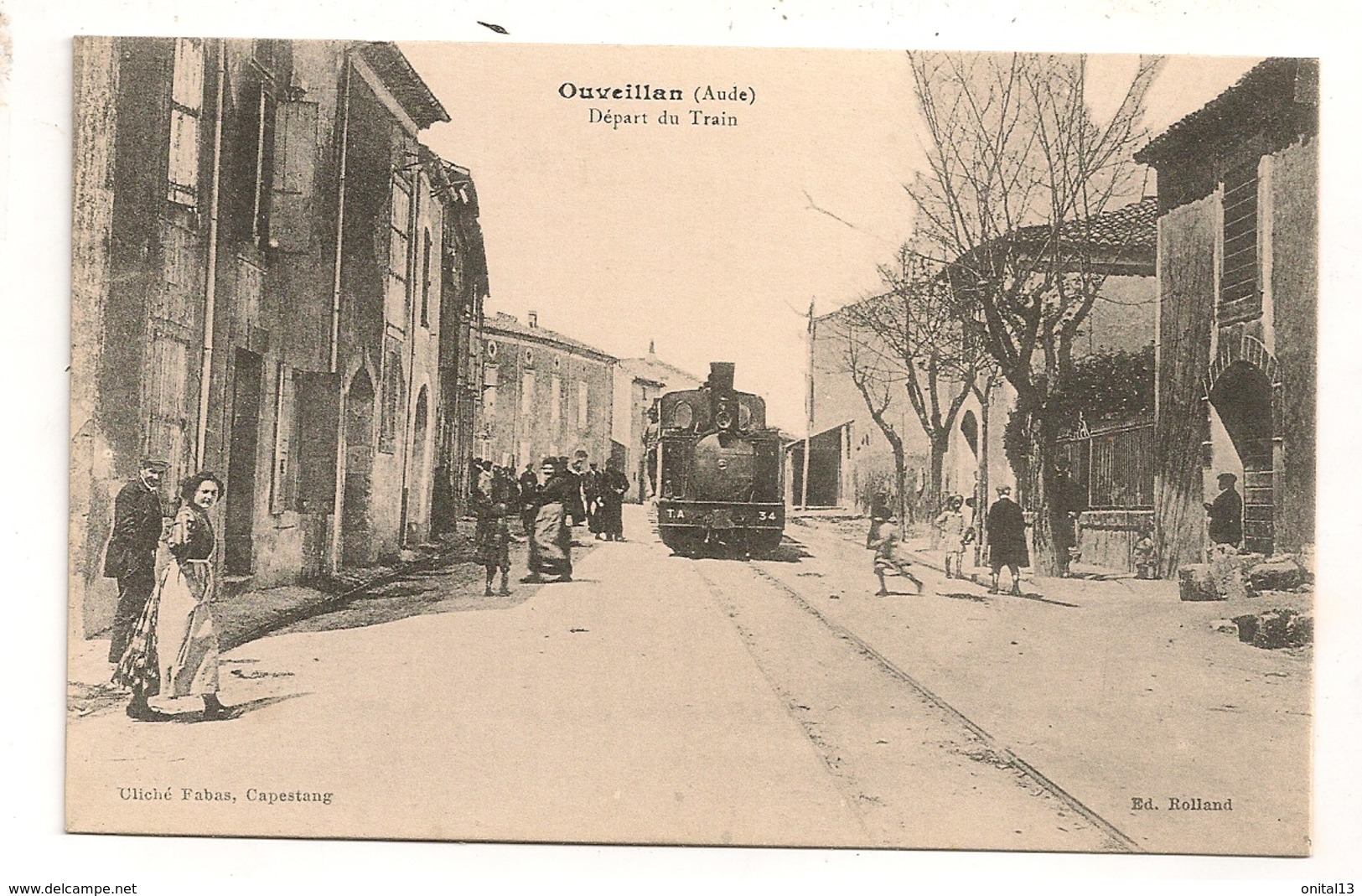
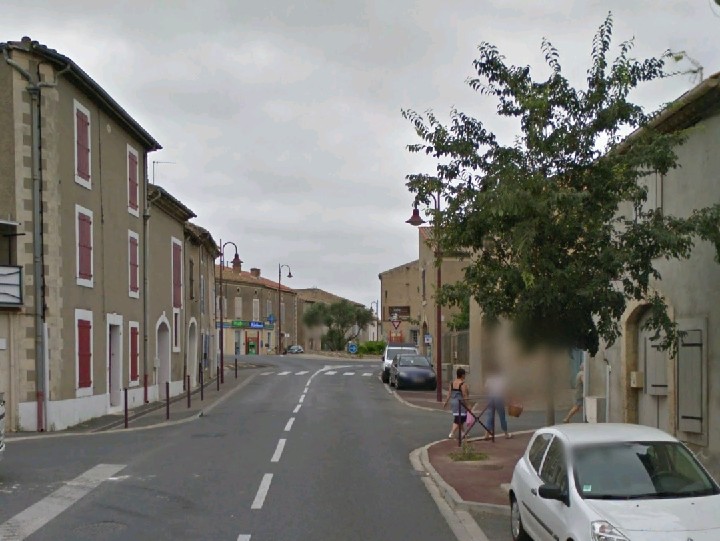
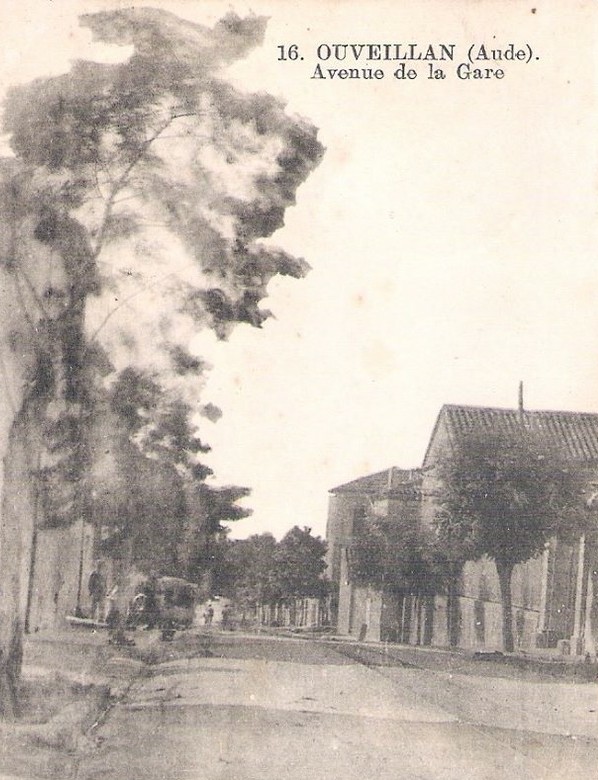
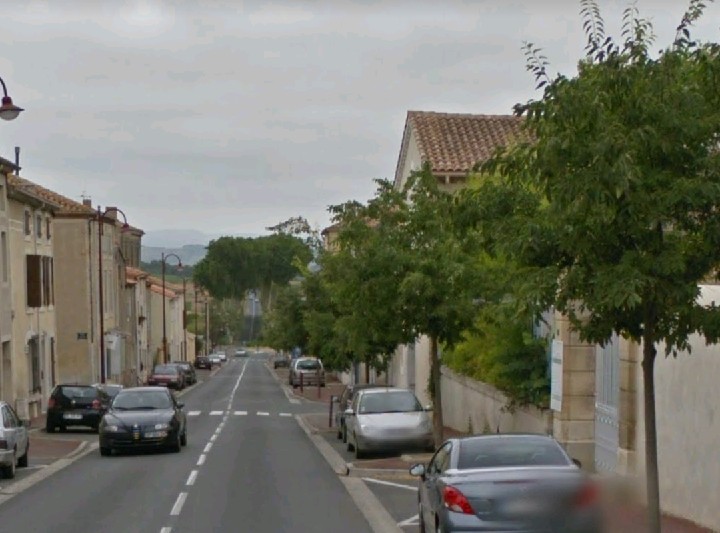
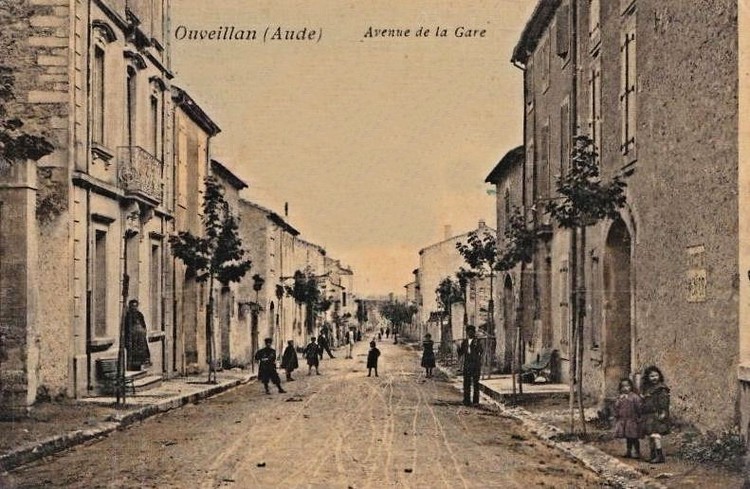
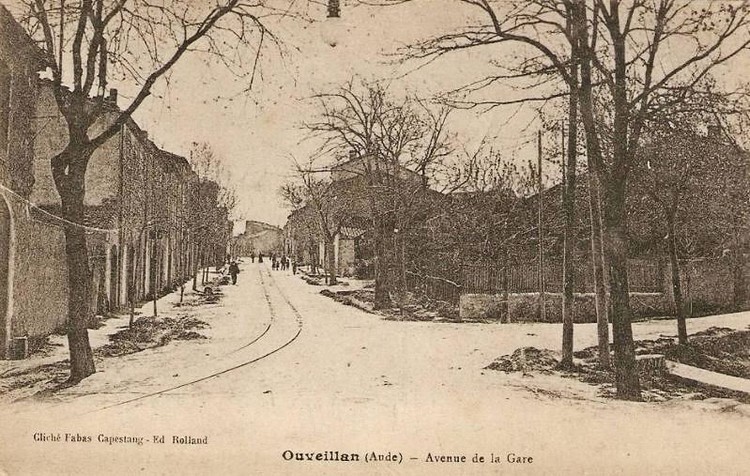
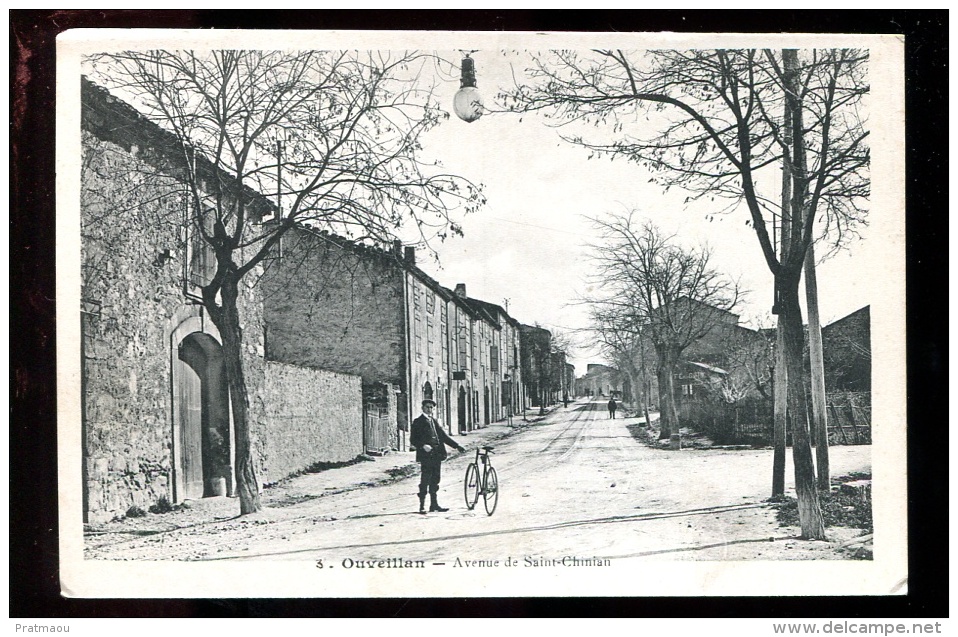
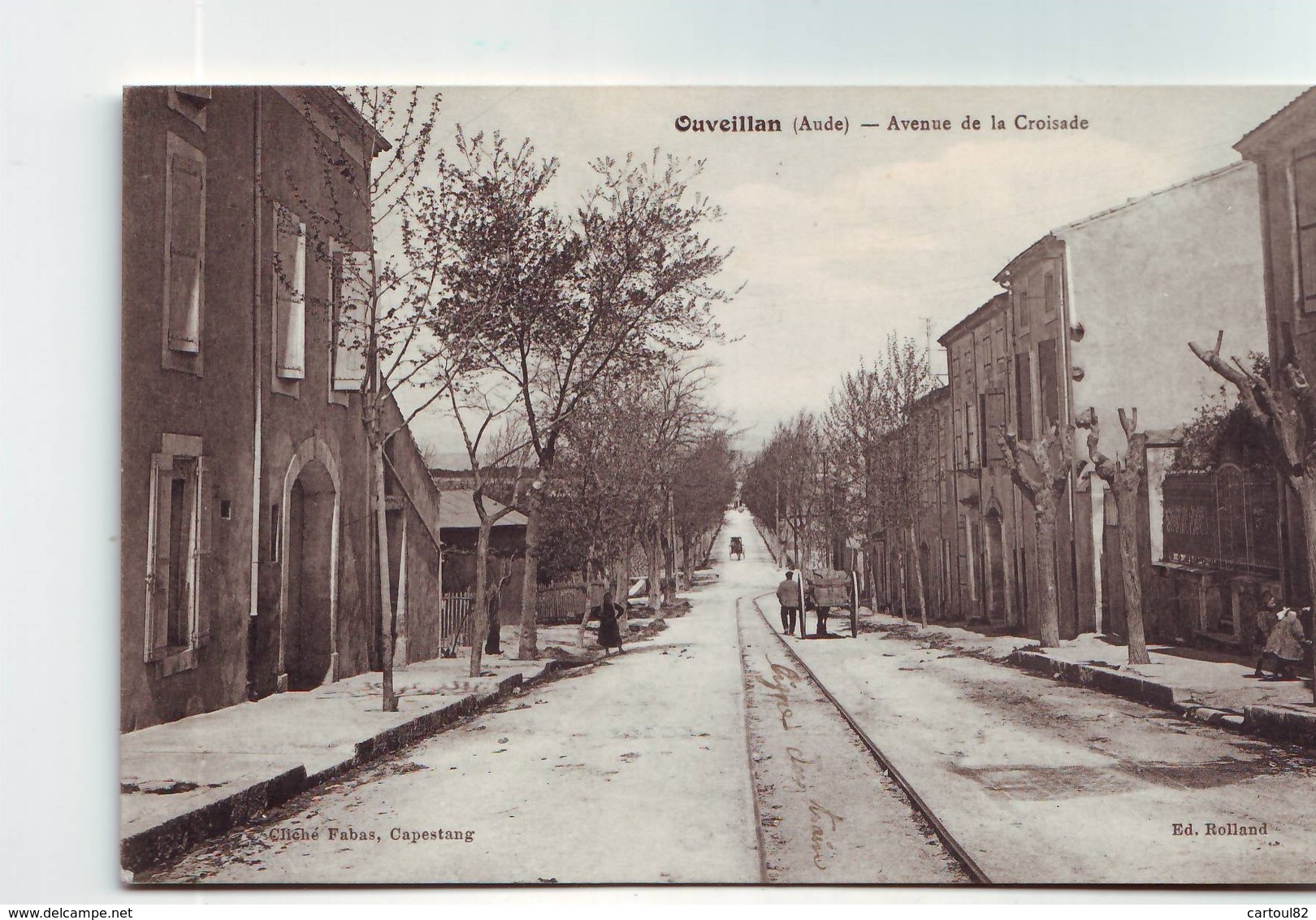
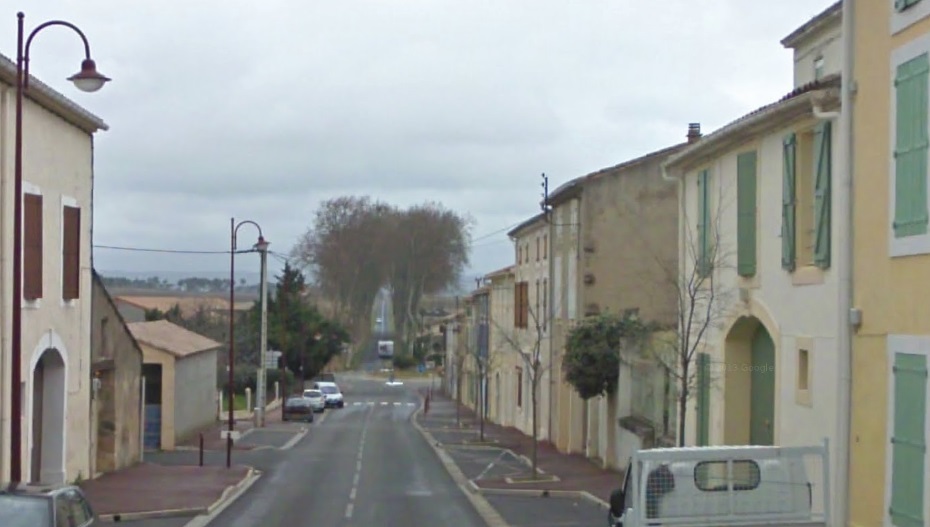
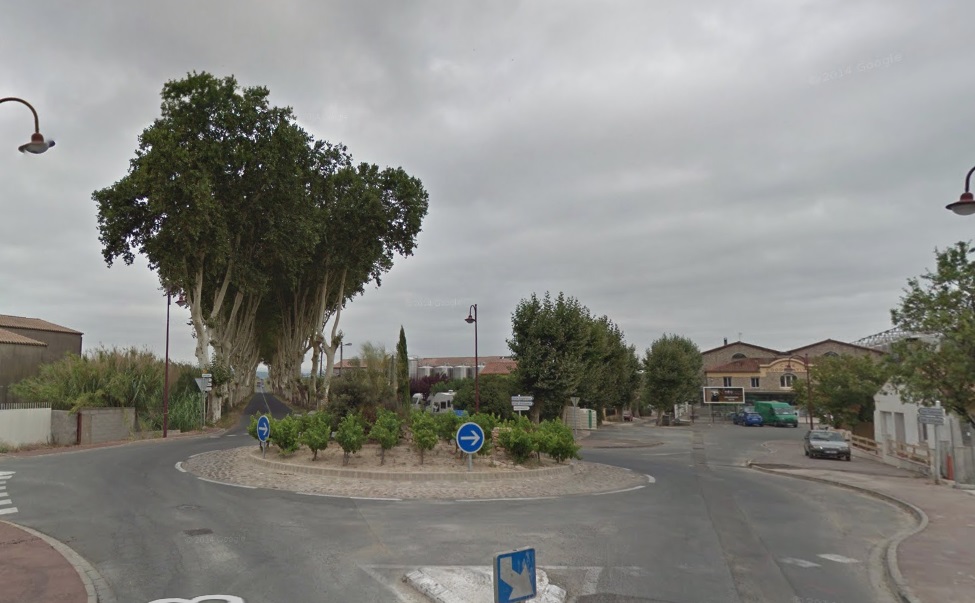
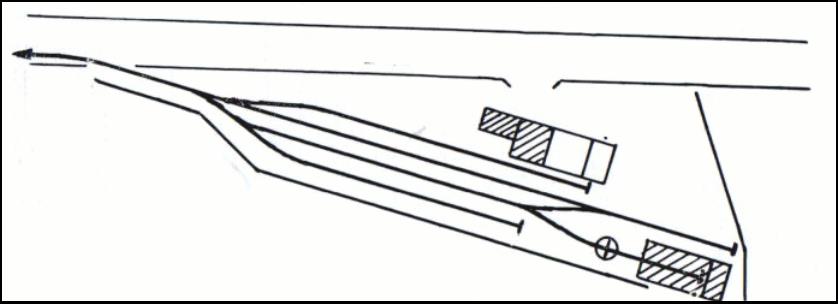
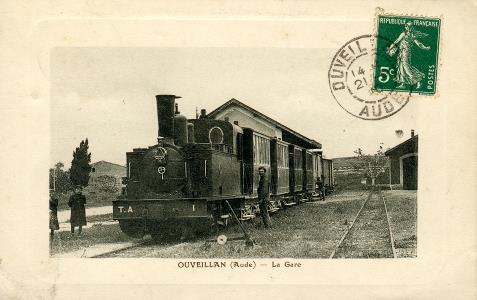
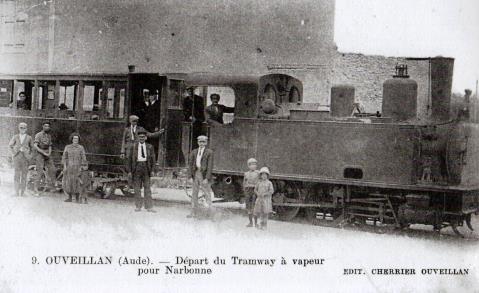
The tramway entered Ouveillan along the Avenue de Narbonne.The tramway on Avenue de Narbonne. This view looks towards Cuxac. [1]Approximately the same location in the early 21st century.A train heads away from Ouveillan tramway station along the Avenue de Narbonne. [1]Approximately the same location in the early 21st century.Further Northwest along what is now the D13, the tramway is still visible, and this card refers to the road on which it is running as Avenue de la Gare. [1]The same location, once again in the 21st century.This is an earlier, pre-tramway view of the Avenue de la Gare. [11]This time the tramway is in place. The station is off to the left of the photographer. [11]Avenue de la Gare was also known as Avenue de Saint Chinian. It bears that alternative name today and is part of the modern D13. This postcard view looks back Southeast towards the centre of Ouveillan. [1]It seems that the road was known also as Avenue de la Croisade. This excellent view shows the tramway bearing off the main road into the station site. [1]Almost exactly the same location in the early 21st century. The station site is to the right of the main road beyond the houses.The station was in the open area to the right of the plane trees.In the light of the size of other Tramways de l’Aude stations the terminus at Ouveillan was well provided for in infrastructure terms and it was sited adjacent to what would become the wine co-op buildings of the town which can be seen in the Google Streetview image above. [12]

We finish this post with two images from the terminus at Ouveillan.

References

  1. https://www.delcampe.net/fr/cartes-postales/europe/france/11-aude/autres-communes?f=keyword:ouveillan, accessed on 25th November 2018.
  2. https://www.communes.com/cartes-postales-anciennes-cuxac-d-aude, accessed on 25th November 2018.
  3. https://www.cparama.com/forum/cuxac-t6776.html, accessed on 25th November 2018.
  4. http://www.en-noir-et-blanc.com/cuxac-d-aude-p1-1339.html, accessed on 25th November 2018.
  5. I picked up this image some time ago and did not keep a link reference for it. I cannot now find its original location on the internet. I will gladly add the relevant link if someone is able to point it out, accessed on 25th November 2018.
  6. https://remonterletemps.ign.fr, accessed on 25th November 2018.
  7. https://www.delcampe.net/fr/collections/cartes-postales/france/narbonne/narbonne-train-locomotive-avenue-de-la-gare-et-monument-des-combattants-chemin-de-fer-belle-animation-453866037.html, accessed on 2nd November 2018.
  8. https://www.delcampe.net/fr/collections/cartes-postales/france/narbonne/aude-11-narbonne-joli-plan-sur-les-boulevards-de-la-gare-et-du-college-avec-voiture-ancienne-animation-janson-343316390.html, accessed on 2nd November 2018.
  9. https://collection-jfm.fr/t/cartes-postales-anciennes/france/11-aude/narbonne-11, accessed on 4th November 2018.
  10. https://remonterletemps.ign.fr, accessed on 8th November 2018.
  11. http://www.belcaire-pyrenees.com/2016/10/test.html, accessed on 26th November 2018.
  12. http://www.cpaaude.fr/THEMES/TRAMWAYS/index_fichiers/Page2347.htm, accessed on 26th November 2018.
 

Ligne de Central Var – Postcript – A short walk near Seillans (Chemins de Fer de Provence 28a)

On 20th November 2018, my wife and I visited a few small villages near Fayence. This included an hour or two in and around Seillans.

In December 2017, I completed a blog about the metre-gauge Central Var line of the Chemins de Fer du Sud de la France. The full story can be found on my blog. Two posts covered the line close to Seillans:

Ligne de Central Var – Part 7 – Tanneron to Seillans (Chemins de Fer de Provence 27)

Ligne de Central Var – Part 8 – Seillans to Claviers (Chemins de Fer de Provence 28)

That blog focussed on a journey along the line from Nice to Meyrargues travelling from East to West. What pictures I was able to take in November 2017, were limited to those accessible from a vehicle in a single day trip.

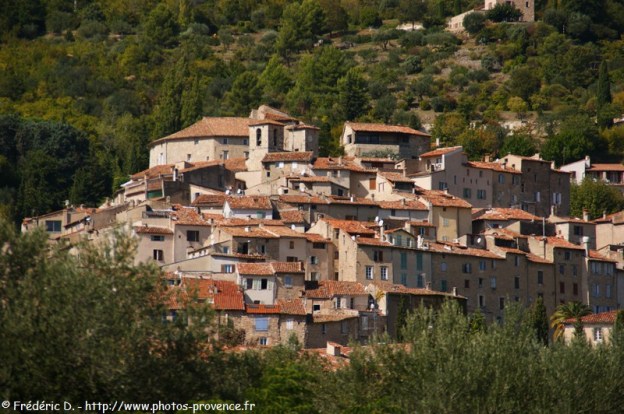
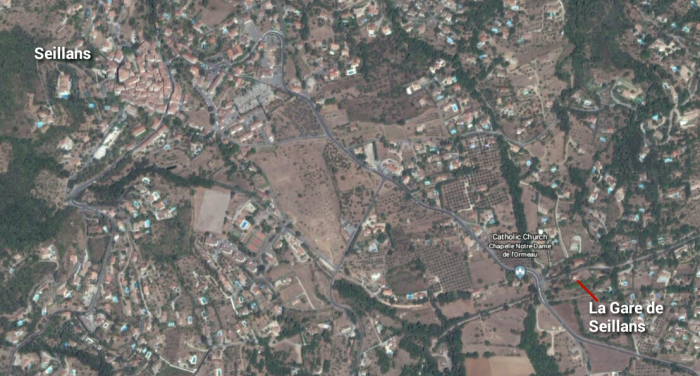
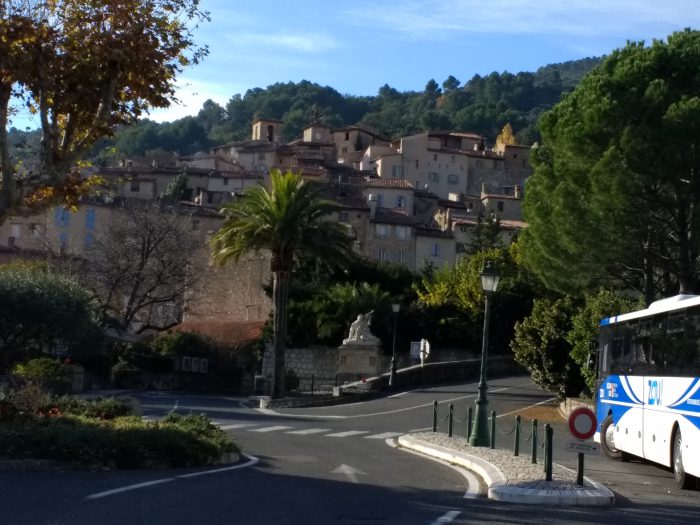
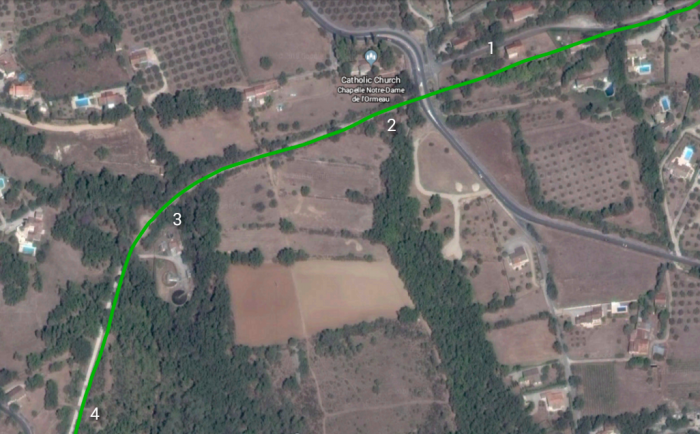
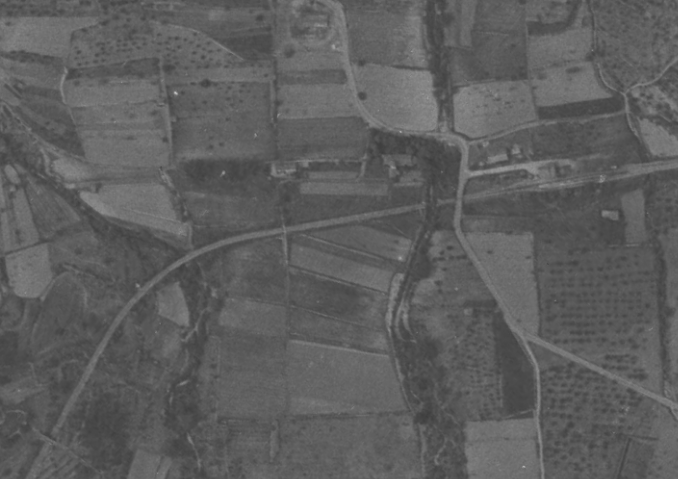
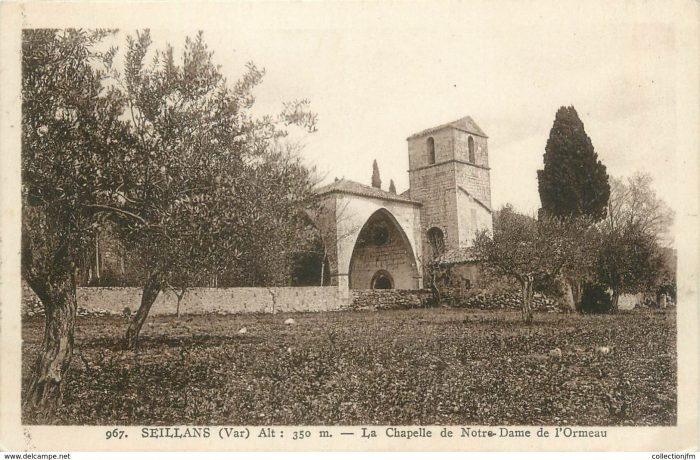
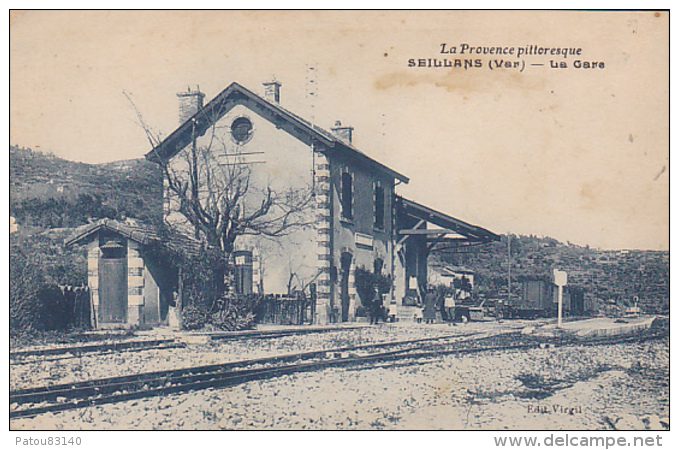
This blog post looks at a very short length of the line to the West of the station at Seillans which we explored after lunch close to the Chappelle de Notre Dame de l’Ormeau which is marked in blue below and just happens to be close to the old station at Seillans which is itself a couple of kilometres from the village of Seillans.Seillans village on 20th November 2018.The area of our walk on 20th November 2018. The green lone approximates to the route oif the railway line.Approximately the same area, but this time in an aerial image from 1944. The railway was in use in the period immediately after the war and Seillans Station can be seen with track in place an an access road from the Fayence to Seillans road.

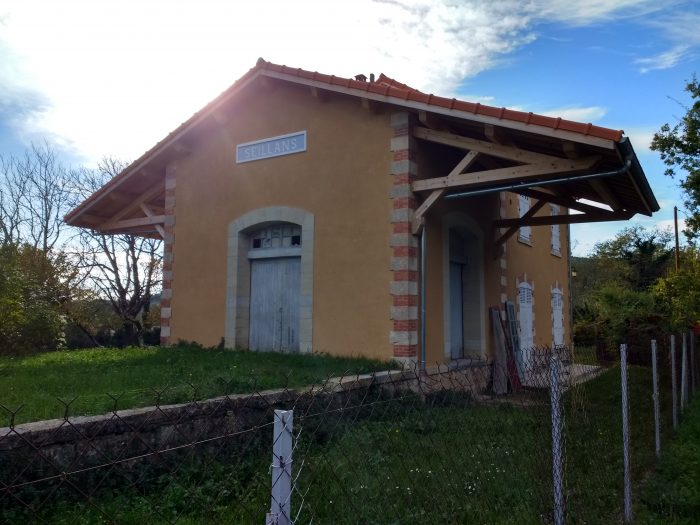
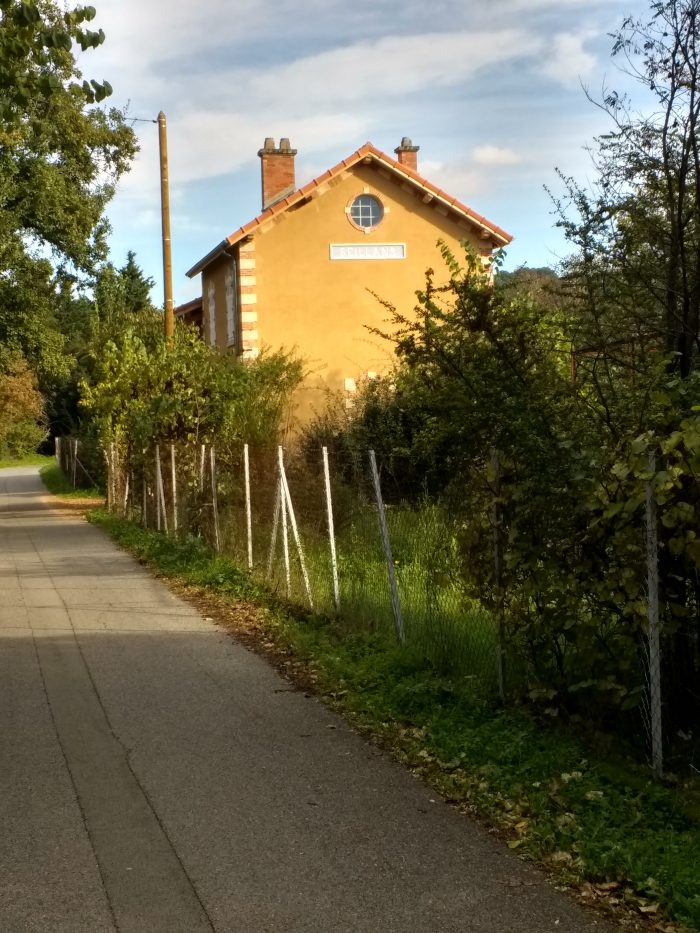
The pictures below show a stroll from East of La Gare to beyond the accommodation bridge in the bottom right of the satellite image above and a return journey along the same route.Approaching Seillans station building from the East on 20th November 2018. The station building (1) is in private hands. The picture is taken from the adjacent road with the old metre-gauge line and yard beyond the station building on its South side.Immediately to the West of the Route de Fayence (D19), the railway crossed a small stream. The bridge is long-gone although the three ends of the parapets remain (2). The bridge has been replaced by a small footbridge. The route of the railway can be seen disappearing into the distance, (20th November 2018).After a short straight section, the railway turned through a slight curve and crossed another, larger stream, adjacent to what are now the village sewage works. The structure was significant (3). This picture was taken after scrambling down the steep embankment, (20th November 2018).

Beyond the stream the footpath following the railway route becomes the road access to the treatment works and is a tarmacked single lane road. All the images below were taken on the 20th November 2018 unless staed and referenced otherwise.The accommodation bridge in the distance is that marked (4) on the satellite image.

A short distance after reaching the bridge  in the image above, we returned to the Station and our car which was parked at the Chappelle de Notre Dame de l’Ormeau.Looking Northeast along the line, back towards Seillans Station.Looking Northeast at the point where the railway began to turn eastwards, this picture shows the parapets of the bridge adjacent to the sewage works (3).Two pictures taken on the walk back towards Seillans Station.The view of the Chappelle de Notre Dame de l’Ormeau which would have been seen from the train. A picture taken by me, and a postcard image from the early 1900s. [1]Two pictures of the station building taken from the West.

The station building taken from the Southwest.


References

1. https://www.delcampe.net/fr/cartes-postales/europe/france/83-var/autres-communes?f=keyword:seillans, accessed on 20 the November 2018.

Ligne du Littoral (Toulon to St. Raphael) – Part 15a – November 2018 Visits to the Line (Chemins de Fer de Provence 81a)

Another Postscript.

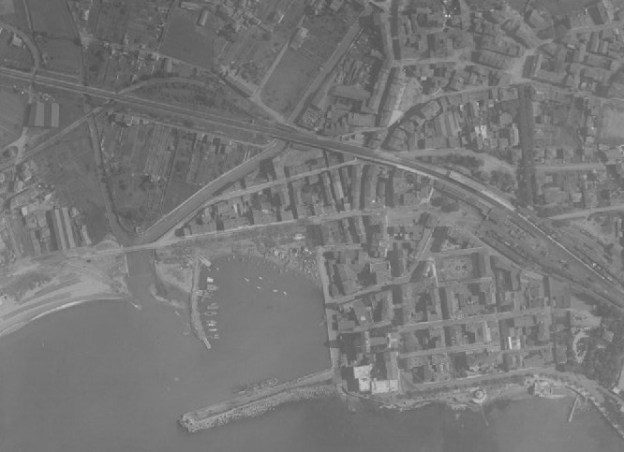
This 1929 aerial photograph from the IGN site ‘remonterletemps.ign.fr’ really interests me. I discovered it on 19th November 2018 while staying in Saint-Raphael.

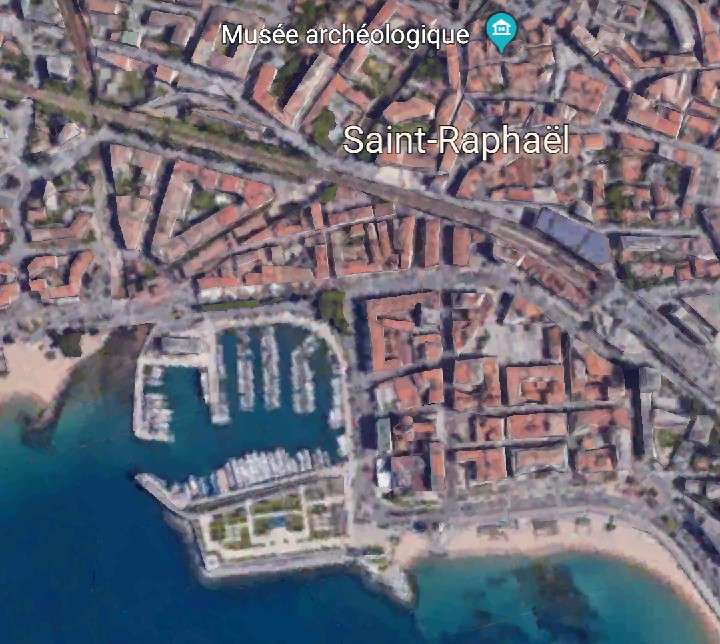
The centre of St. Raphael is in the middle of the picture, the relatively small harbour looks more expansive than it does now in the early 21st century. Watching some of the large yachts if the mega-rich manouvering in the harbour is interesting.

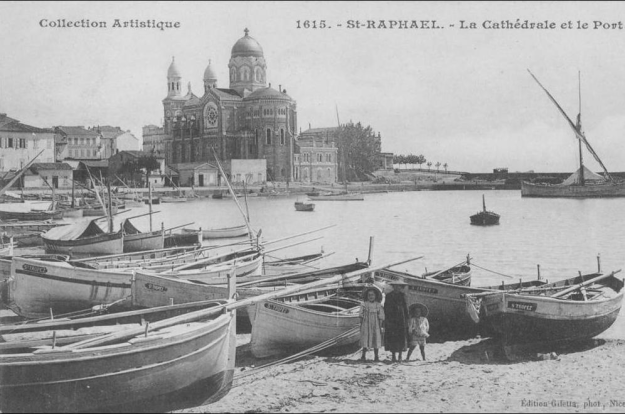
The large church building stood out much more clearly in the 1920s than it does today. The River Garonne was not built over in the way it is today.

The metre-gauge line can clearly be seen passing under what was the PLM standard-gayge mainline and climbing in an arc to meet the mainline at St. Raphael railway station. The metre-gauge sidings can be seen to the right-hand (East) side of the photo.

It is also possible to identify the metre-gauge passenger station building on the aerial image to the North of the mainline under what is now the site of the Gate Routiere.

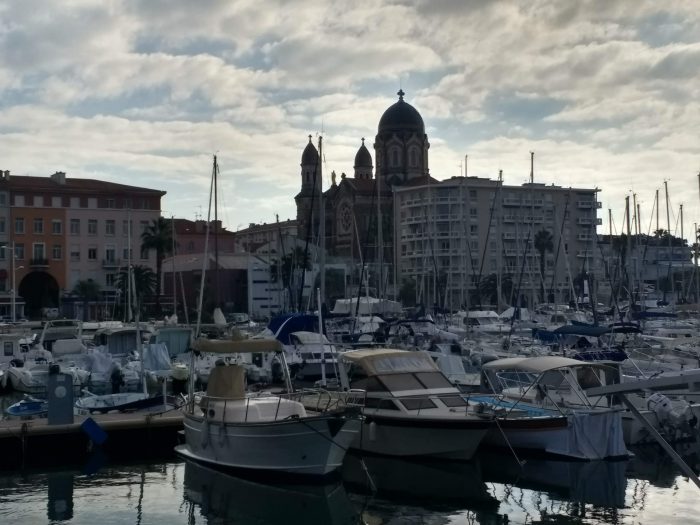
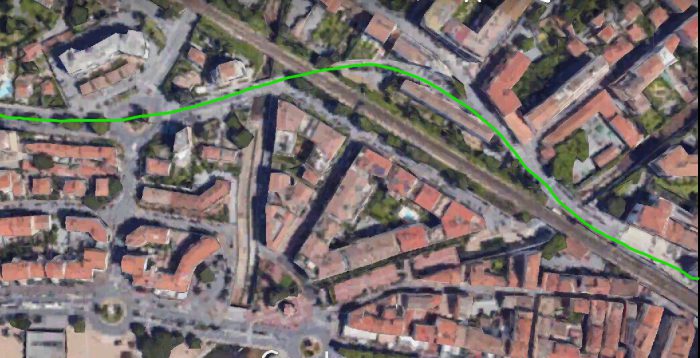
The Google Earth satellite image below shows approximately the same location in the early 21st century. The grey roofed building houses the Gare Routiere and there are modern strictures over the site of the old goods yard.Little was done in the developments of the late 20th century to preserve significant aspects/views. As can be seen above there is a large modern block between the port and the church which obscures what could still have been an excellent view of the church. The images below show the effect of  modern development in this particular corner of the world!Perhaps surprisingly the alignment of the old metre-gauge line can still be picked out in this image. I have enhanced the scale a little in the image below and shown the approximate alignment with a green line. Tarmac covers most of the route shown. There is a break beneath the mainline.

Ligne du Littoral (Toulon to St. Raphael) – Part 15 – November 2018 Visits to the Line (Chemins de Fer de Provence 81)

On 13th and 16th November 2018, my wife (Jo) and I walked around St. Raphael and took some photographs of the location of Le Macaron railway station and updated the post below accordingly.

On 14th November we traced the line of Le Macaron between Ste. Maxine and St. Raphael. I was able as a result to add a PostScript to my earlier blog post on that length of Le Macaron. The revised post can be found at:

Ligne du Littoral (Toulon to St. Raphael) – Part 13 – Sainte Maxime via Aygulf and Fréjus to Saint Raphael (Chemins de Fer de Provence 48)

On Sunday 18th November, Jo and I travelled from St. Raphael, via the Sunday Market in Le Muy, to Hyeres. We also enjoyed an hour or so on the spit of land extending out from Hyeres towards Iles d’Hyeres and we had lunch next to La Tour Fondue. We spent the rest of the day following Le Macaron from Hyeres to Sainte-Maxime.

Nothing I saw on the journey caused me concern about the text of the series of blog posts about the route that I have written.

I was able to take a few pictures while on the journey, although there was little time to stop if the full journey was to be completed in daylight!

On the journey we were also able to make three detours. The first, to Les Bormettes and the site of the old torpedo factory at what is now known as Miramar. The second to the old perched village of Bormes les Mimosa. The third to St. Tropez.

We took a few photographs on Sunday 18th November and these follow at the end of this blog post, together with a few from other sources.

The relevant links to my blog are:

Ligne du Littoral (Toulon to St. Raphael) – Part 6 – Hyeres to Bormes les Mimosas (Chemins de Fer de Provence 41)

Ligne du Littoral (Toulon to St. Raphael) – Part 7 – La Londe & Les Bormettes (Chemins de Fer de Provence 42)

Ligne du Littoral (Toulon to St. Raphael) – Part 8 – Bormes les Mimosas to Cavalaire (Chemins de Fer de Provence 43)

Ligne du Littoral (Toulon to St. Raphael) – Part 9 – Cavalaire to La Foux les Pins (Chemins de Fer de Provence 44)

Ligne du Littoral (Toulon to St. Raphael) – Part 10 – La Foux les Pins to Saint-Tropez (Chemins de Fer de Provence 45)

Ligne du Littoral (Toulon to St. Raphael) – Part 11 – La Foux les Pins to Cogolin (Chemins de Fer de Provence 46)

Ligne du Littoral (Toulon to St. Raphael) – Part 12 – La Foux les Pins to Sainte Maxime (Chemins de Fer de Provence 47)

Some photographs … The majority my own, others are referenced below.

Le Muy, 18th November 2018.

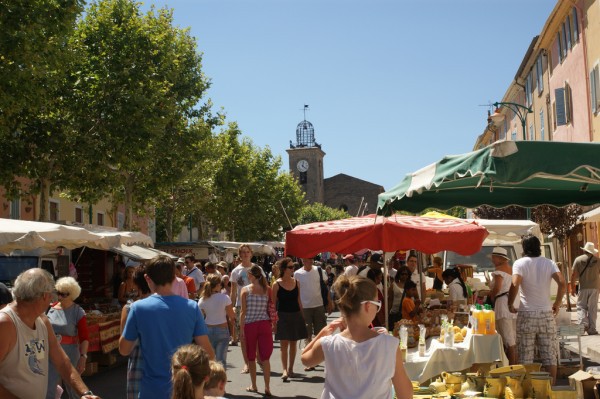
Le Muy, Sunday Market. [1]

The remaining station at Hyeres is the SNCF standard-gauge station. [2]

A view out to sea from close to the branch-line to the torpedo factory (long-gone) at Miramar. The picture was taken on 18th November 2018.

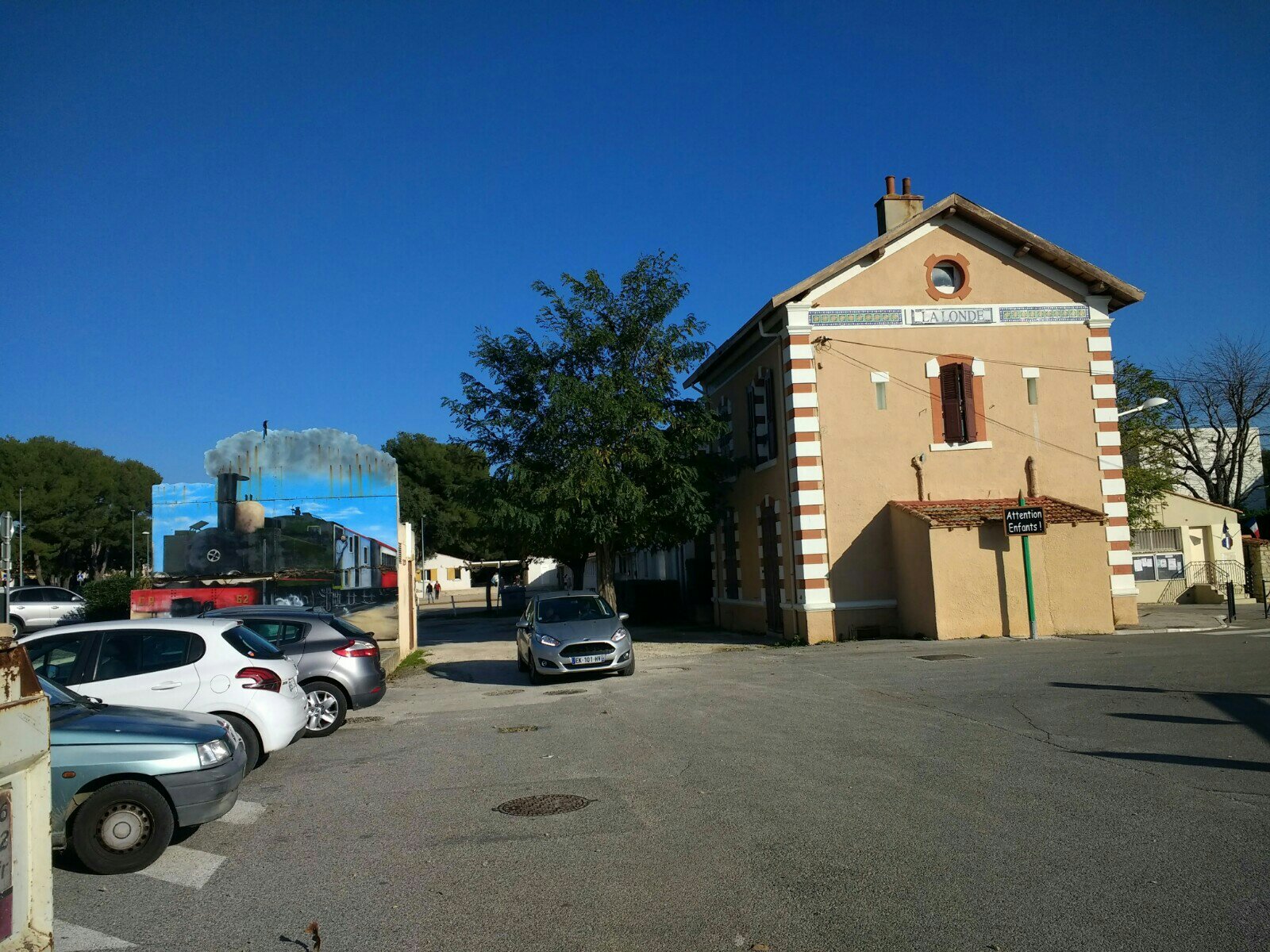
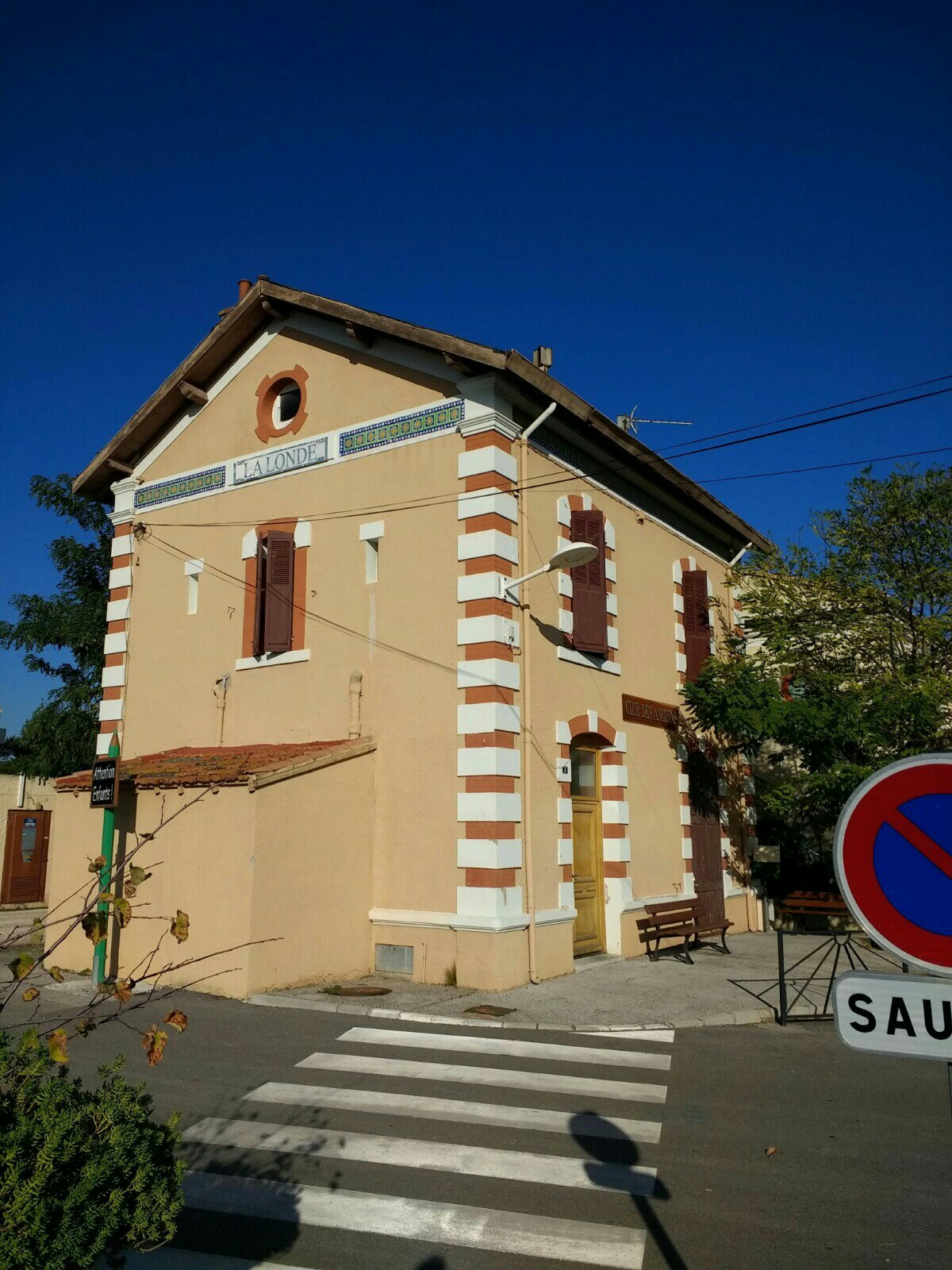
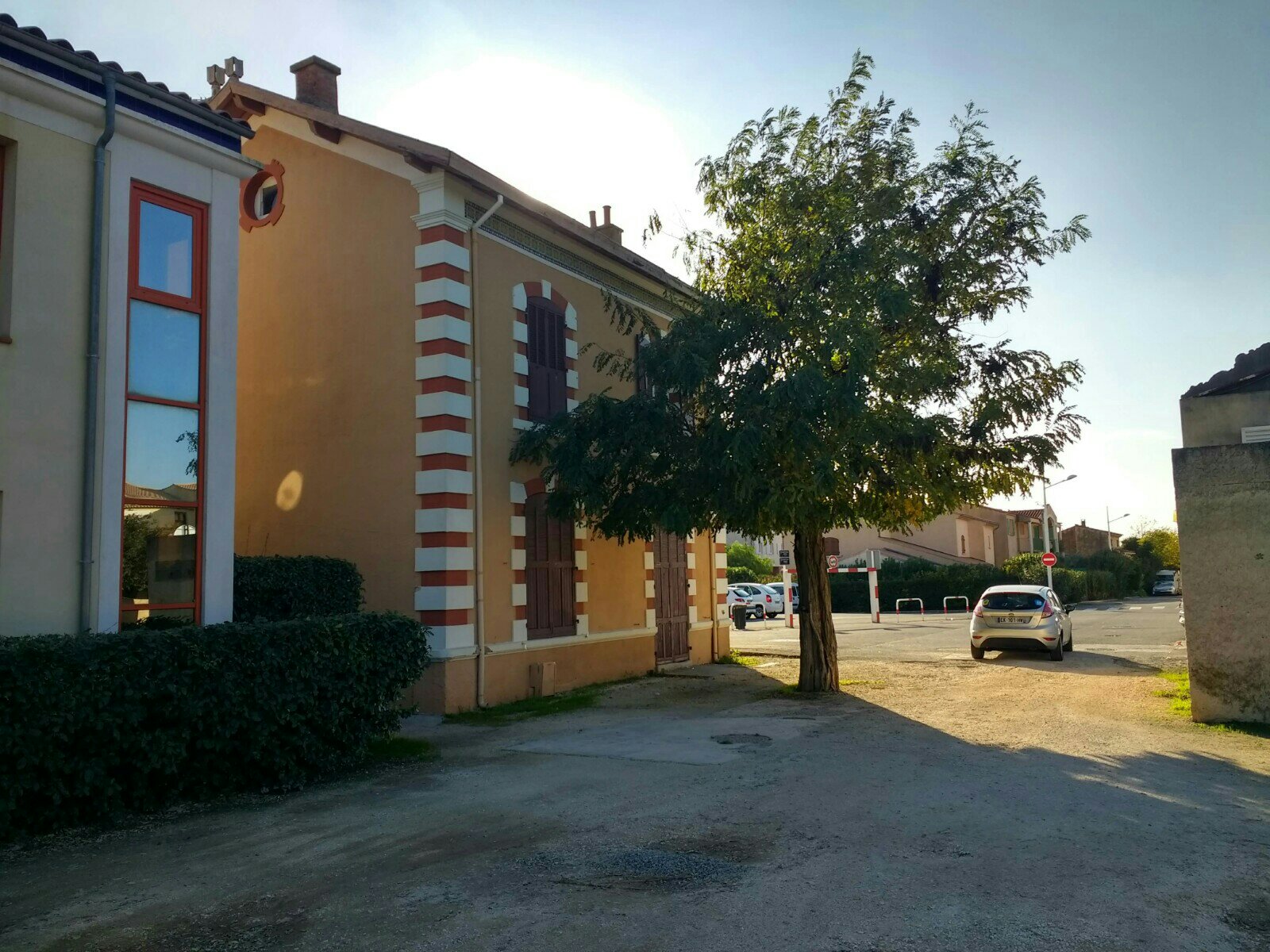
The railway station building at La Londe-les-Maures taken from what was the line of the railway just to the West of the station on 18th November 2018.

The railway station building at La Londe-les-Maures taken from the South.

The railway station building at La Londe-les-Maures taken from what was the line of the railway just to the East of the station. This image was also captured on 18th November 2018.


Clearly this image was not taken in November! we drove around the village which sits high above the valley below and as a result high above its ancient railway station. [3]

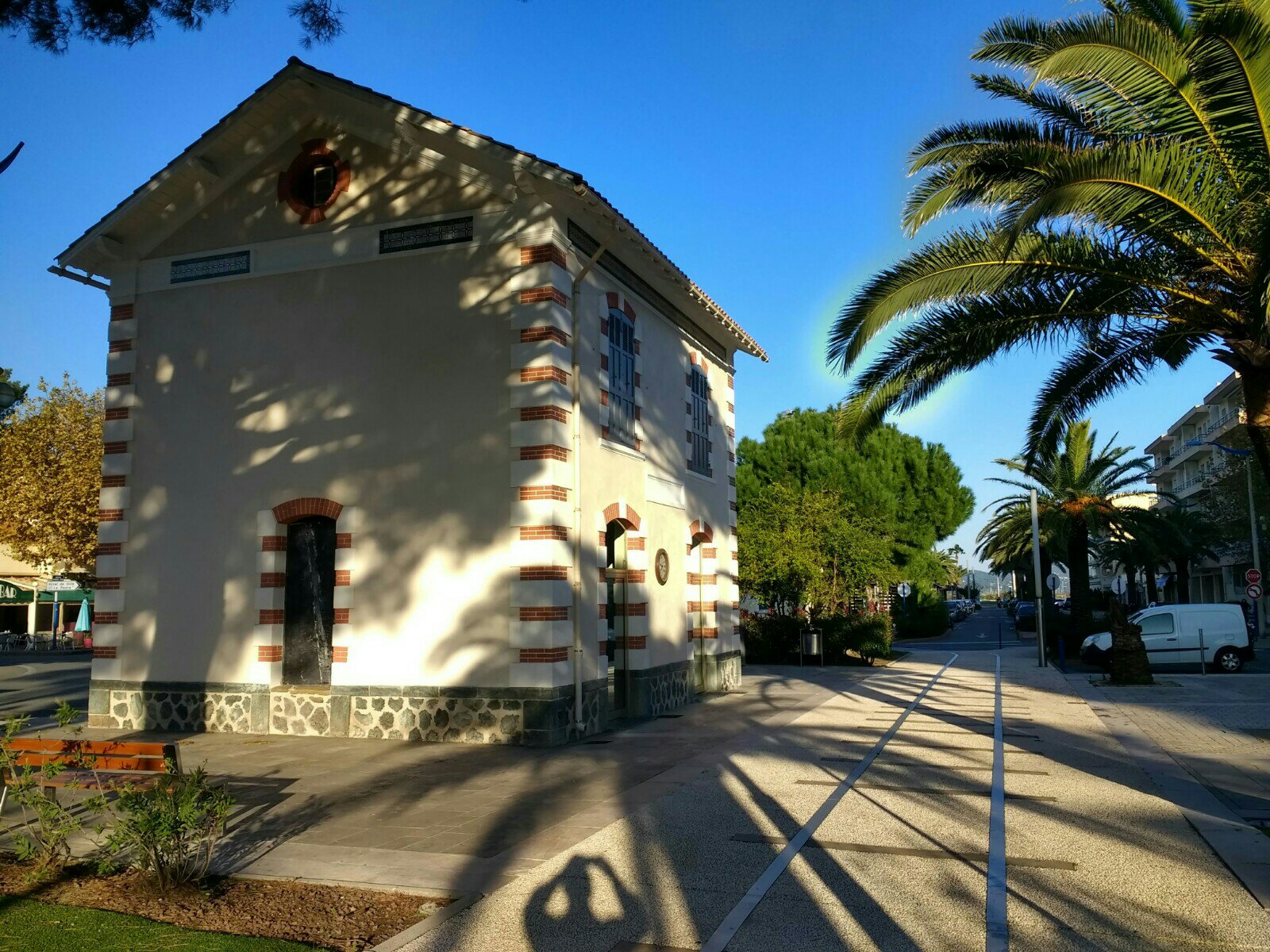
The old station building at Cavalaire-sur-Mer taken from the North on 18th November 2018.

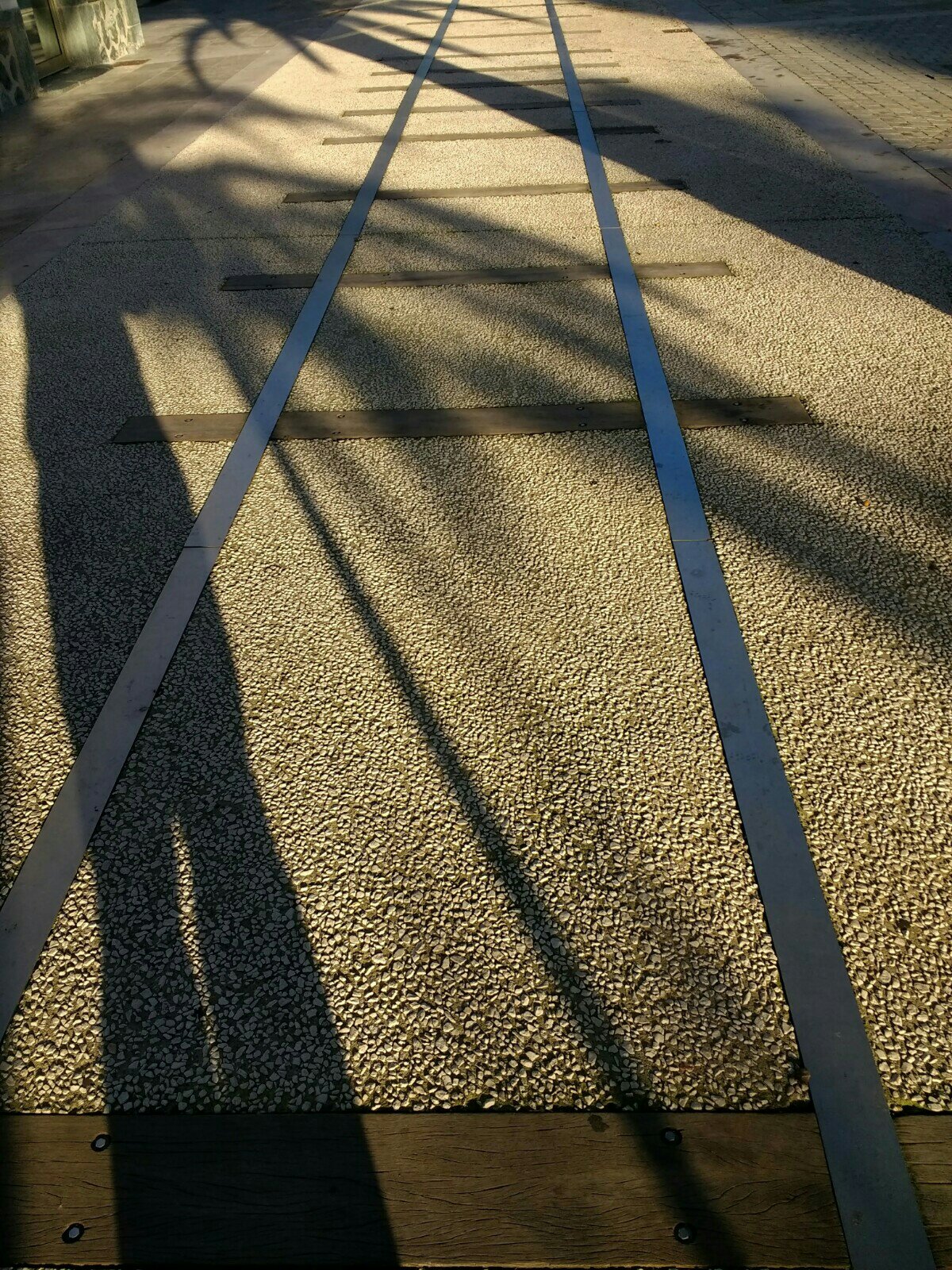
The same building also pictured on 18th November 2018. in remodelling the centre of the town the authorities have chosen to reflect its railway history by building a ‘railway’ into the paving. Flat metal and wooden piecs have been used to good effect.

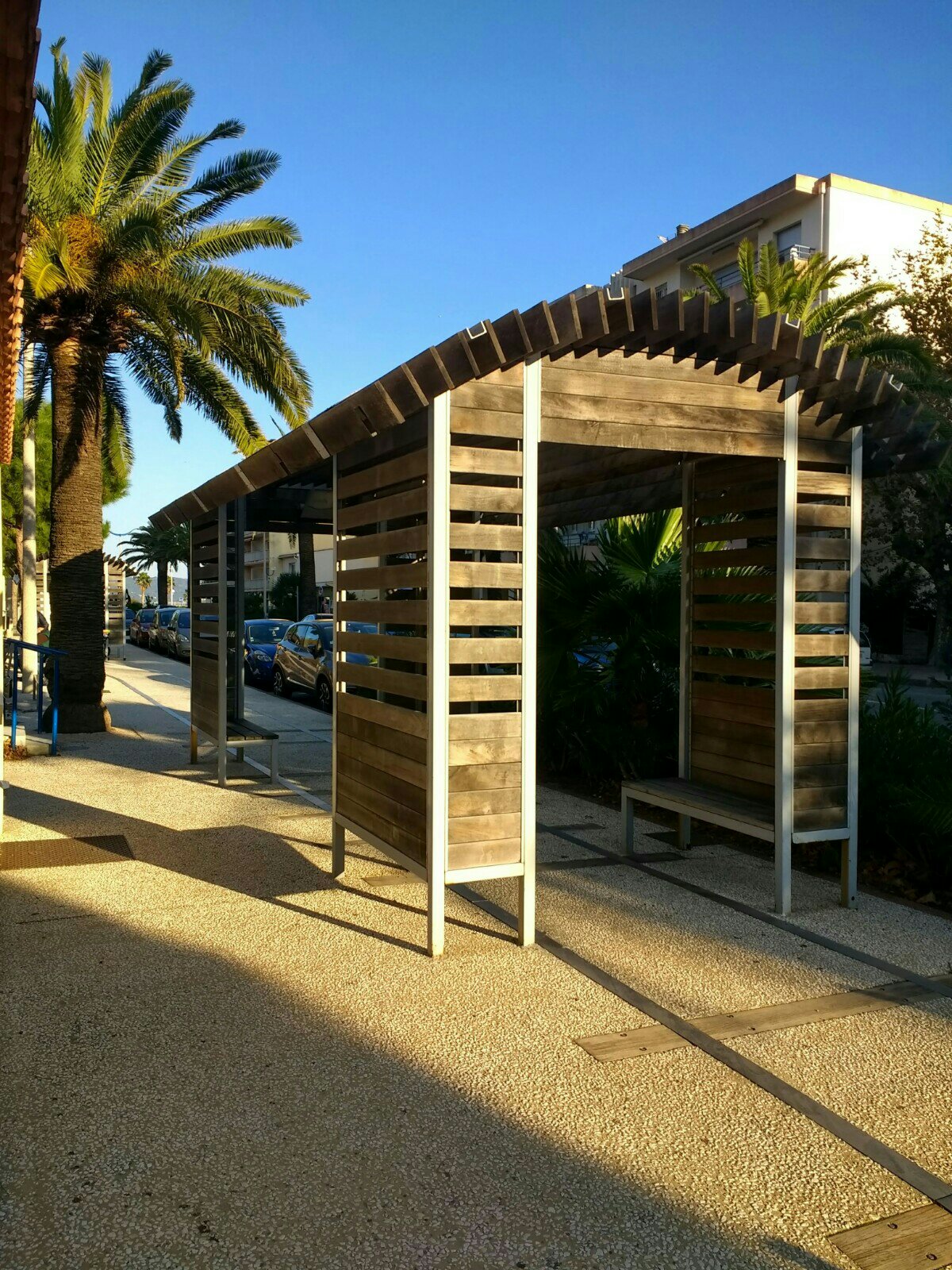
The old village centred on the station and the present town has reflected that by running the ‘railway’ through the centre and, as can be seen in the image below has created a series of benches that mimic the old railway wagons of Le Macaron.

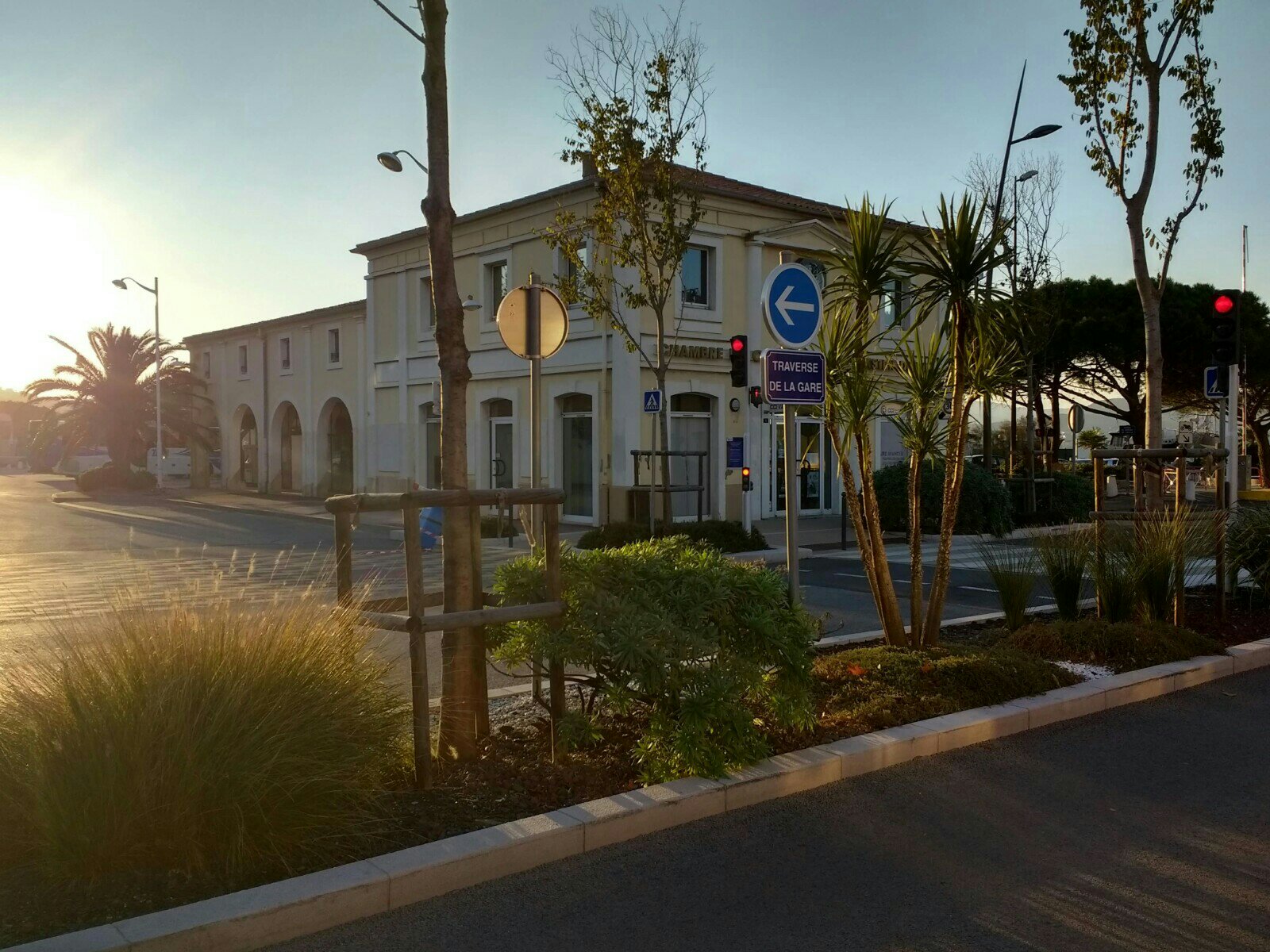
This image shows one of the buildings associated with the old branch-line to St. Tropez. It was also taken on 18th November 2018 as the sun was beginning to set. Evidnce of the existence of the station is preserved in the name of the road as the image below highlights.

The old station area in St. Tropez now forms a large tourist car-park as can be seen in this image taken on 18th November 2018.

St. Tropez in the evening sun on 18th November 2018.

References

  1. https://www.lebonguide.com/degustation/marche-du-muy_332155, accessed on 18th November 2018.
  2. http://archives.varmatin.com/hyeres/les-trains-de-retour-a-la-gare-dhyeres.2198511.html, accessed on 18th November 2018.
  3. https://www.bormeslesmimosas.com/fr/quoi-faire/visites-et-patrimoine/le-mimosa, accessed on 18th November 2018.

Tramways de l’Aude – Tramways in Narbonne

The city of Narbonne was served by three tramway routes. The first  travelled West to Thezan and the remainder of the network of the Tramways de l’Aude. That tram route is covered in the post which can be found on the link below:

Tramways de l’Aude – Thezan to Narbonne

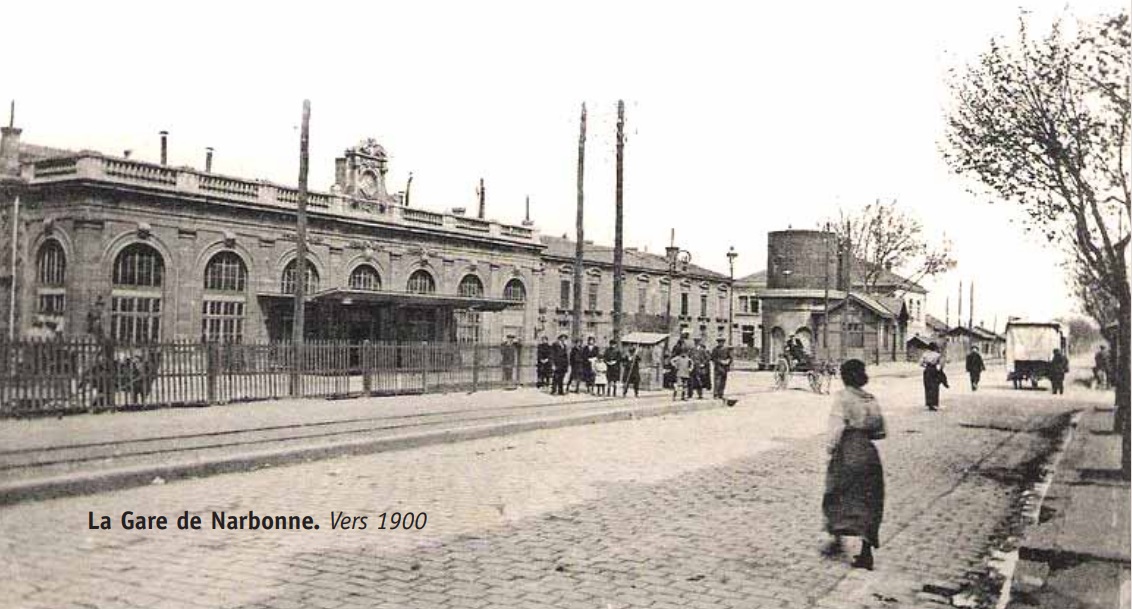
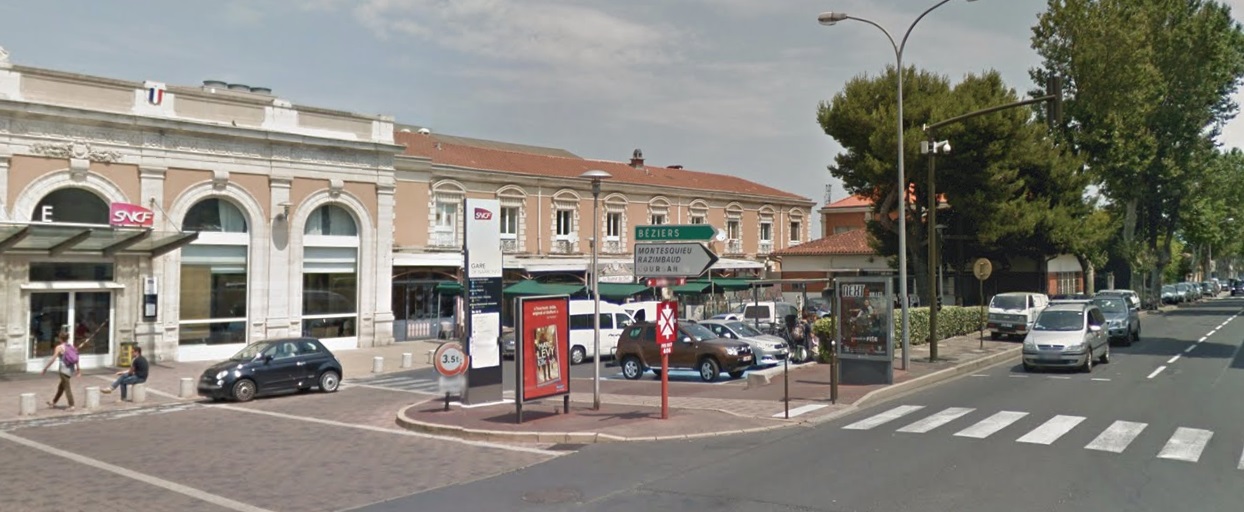
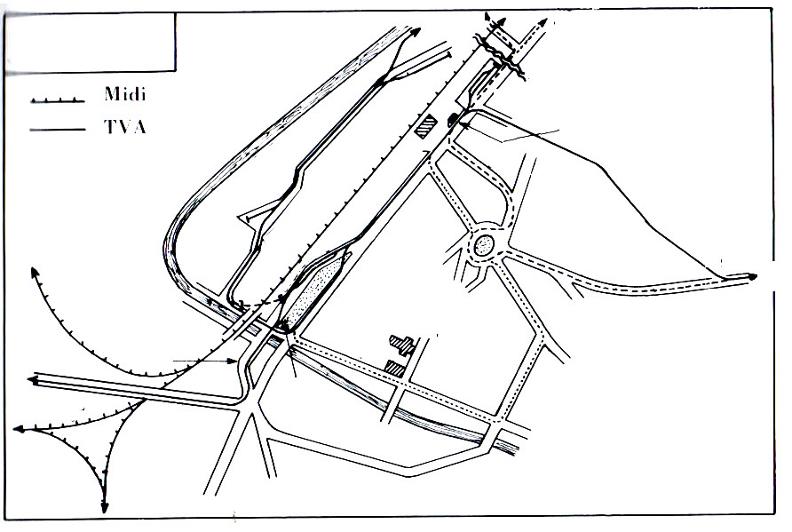
Trams left the station building which was opposite the Gare du Midi and headed South and West through the city before leaving in the direction of Thezan. This was Line No. 1 on the sketch plan below. [16]The tramway station building was small. It can be seen above, just in front of the water tanks outside the Gare du Midi. The tramway itself is also visible above, running from the tramway  station building off to the left of the picture. [1]

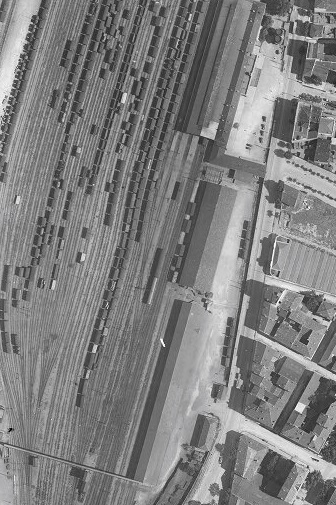
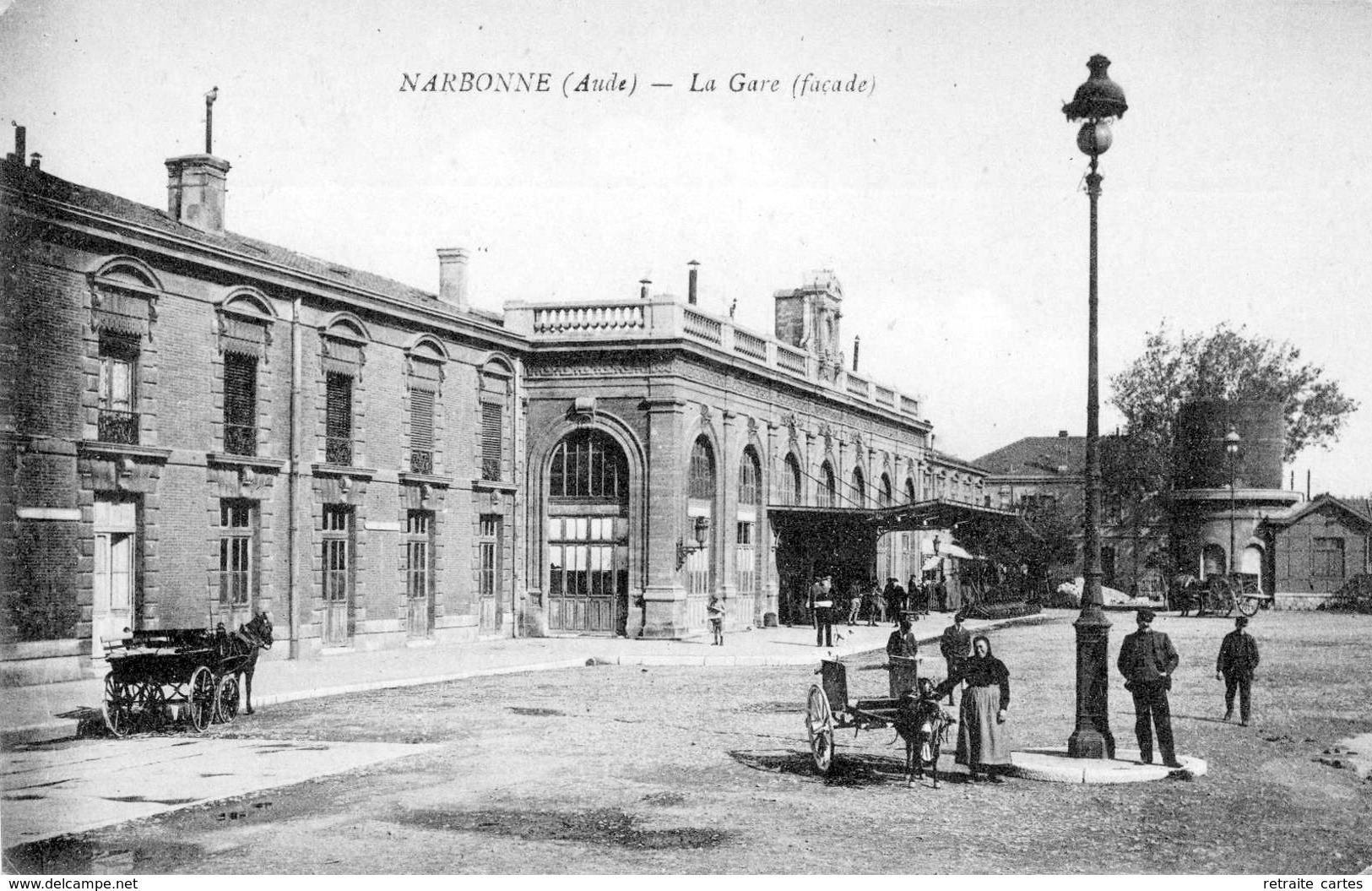
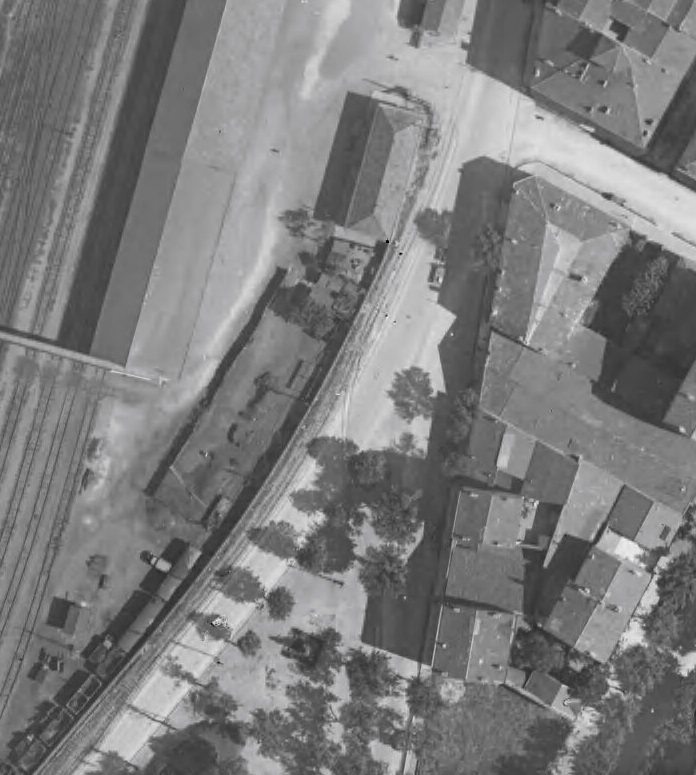
The tramway ran on the right-hand side of the Gare du Midi boundary wall and can just be picked out on the adjacent aerial image from 1930s. [17]The tramway building can be seen on the right of this image. [2]The Gare du Midi [3][10]The Gare du Midi with the tramway in front. The water tanks and the tramway station are visible once again. [3]A similar view taken in the early 21st century.A great shot (above) of the tramway station with the Gare du Midi behind and the tramway track just in front – in the bottom left of the picture. [18]

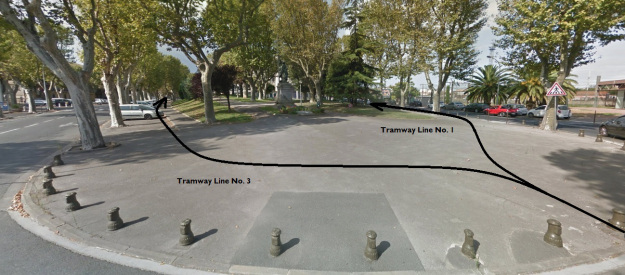
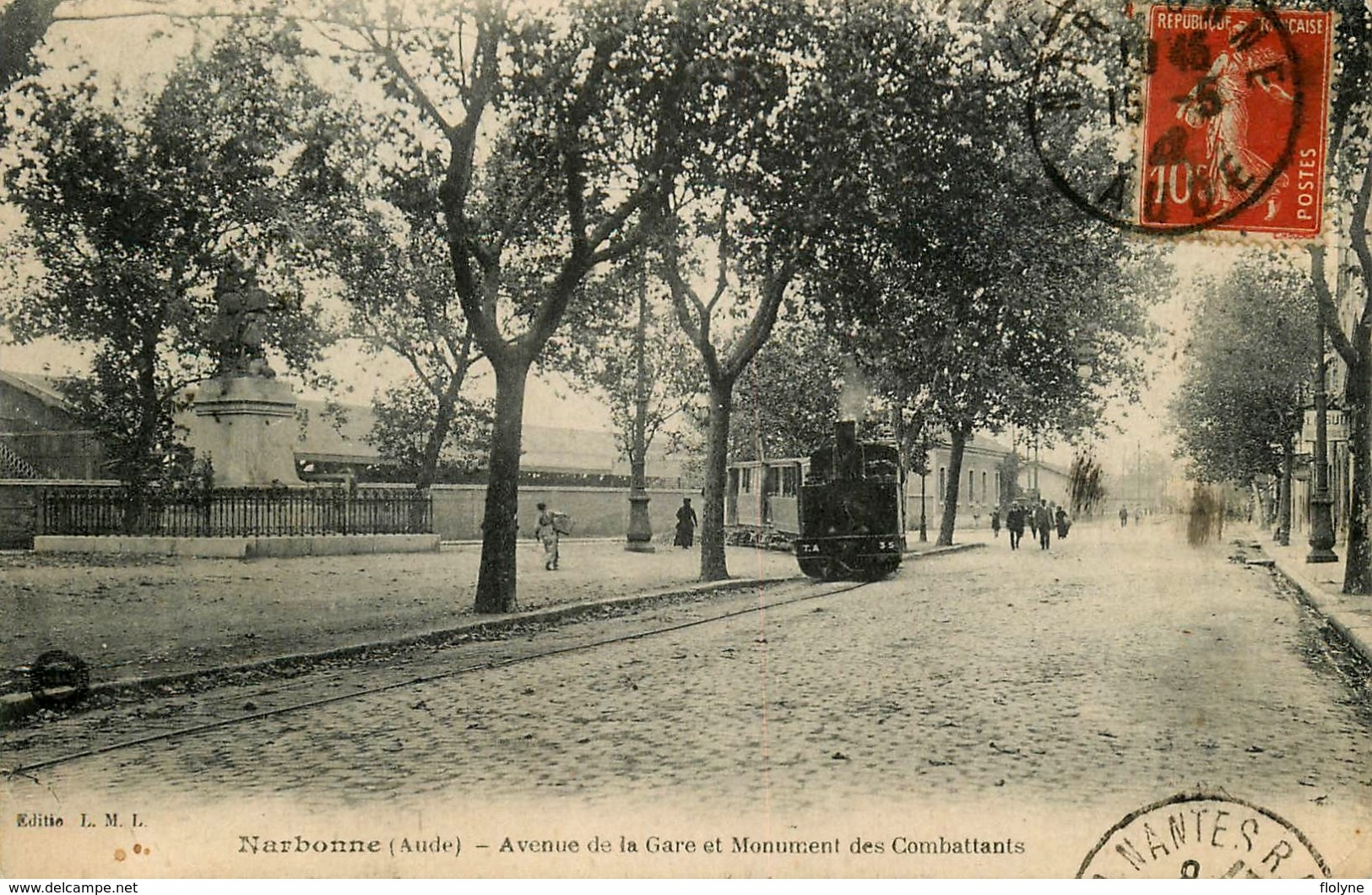
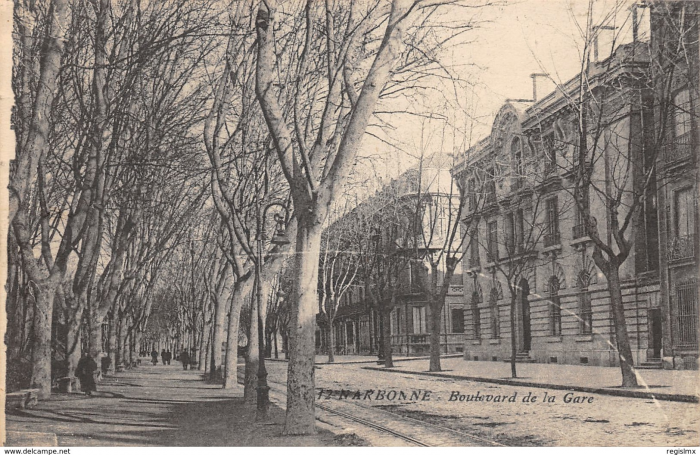
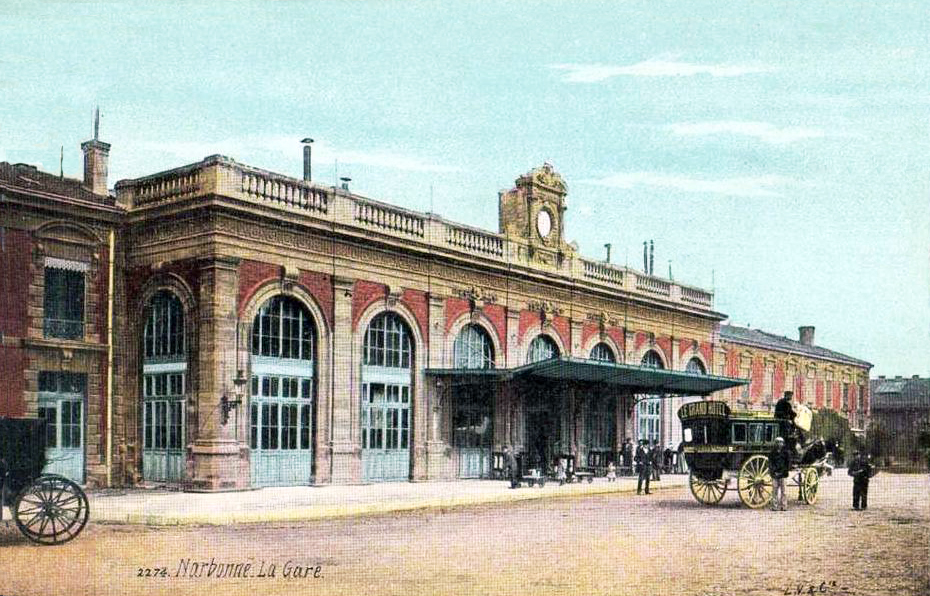
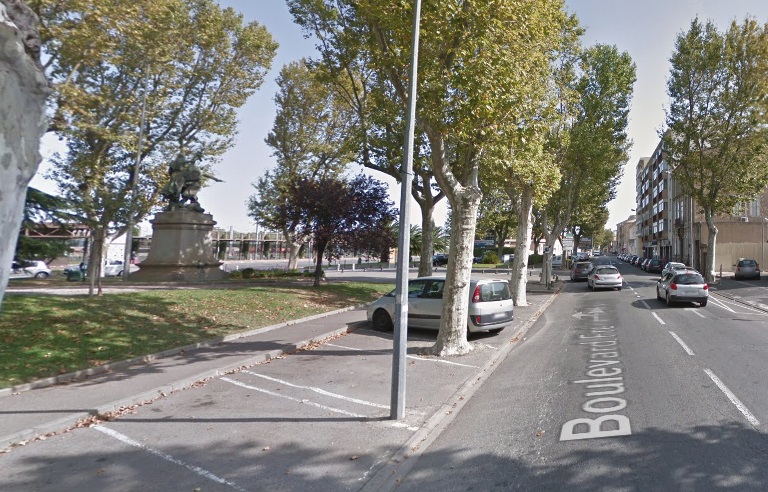
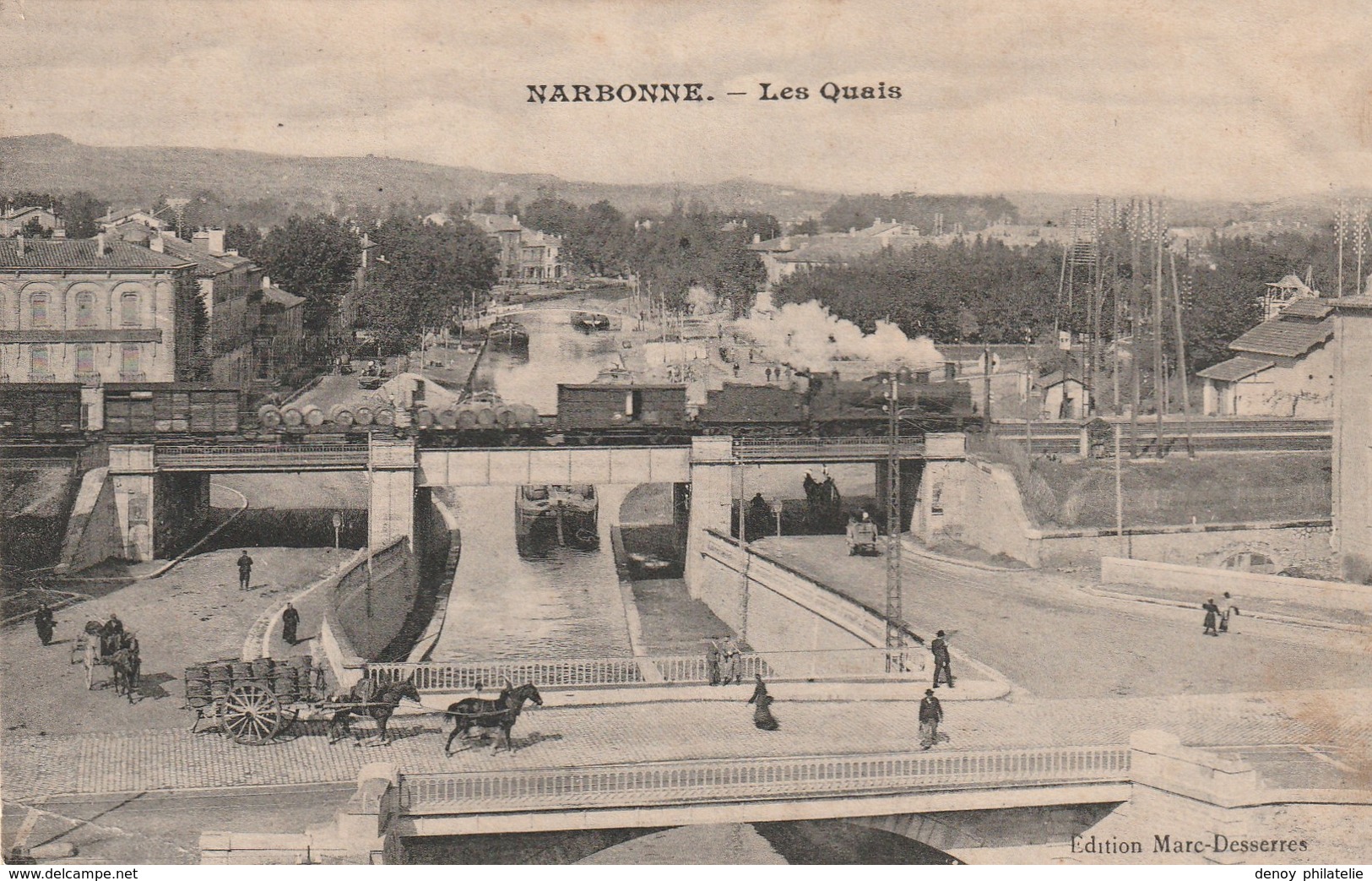
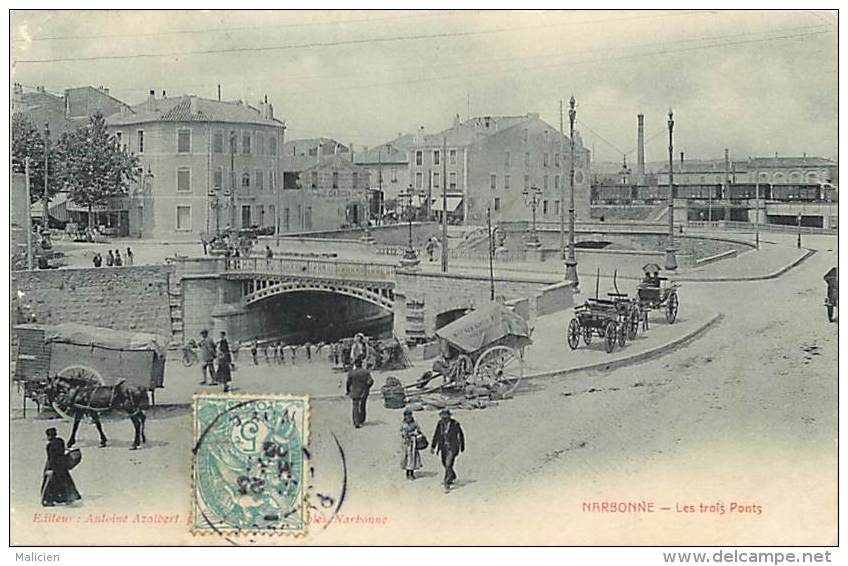
The Gare du Midi building dominates the adjacent picture. The relative size of the tramway building can easily be seen. The building sits to the right of the two watertanks. The tramway can also be seen on the right-hand side of the image. [17]The station shown from the opposite direction. The photographer is standing close to the tramway building. [4]One final postcard view of the station forecourt in the early 1900s. [9]The tram (above) leaves the station and heads Southwest. There are two routes travelling in this direction. The one pictured to the East of the Statue des Combatants and one (not visible) to the West of the statue. The route to the West of the statue is the one which heads for Thezan. The tram in this picture is on the first part of the tramway to Ouveillan. [8]Approximately the same view in the early 21st century.This 1930 aerial image shows the tramway junction to the North of the Statue des Combatants. [17]Taken from the Northeast, this view shows the Statue des Combatants and the approximate alignment of the two tramway routes heading Southwest from the Gare du Midi. Line No. 1 heads for Thezan de Corbieres. Line No. 3 heads Southwest before turning through 180 degrees, passing under the railway line and heading for Ouveillan.A little further Southwest the Boulevard du Gare (now Boulevard Frederic Mistral) met the Boulevard du College (now Boulevard Marcel Sembat). The tramway track was on the left-hand side of the Boulevard du Gare which is on the left of the picture. [10]The same location in the early 21st century.Heading South towards the Canal du Midi. [10]This image shows a tram further along the route to Ouveillan (Line No. 3 on the sketch plan above). It has reached the point on its route which is furthest to the Southwest and is now passing under the standard gauge line before turning Northeast. [13]This image shows the three bridges over the Canal du Midi and I have added the two tramway routes for clarity. Both can be picked out on the image.[5]The same location and again it is just possible to pick out the tramway tracks. [6]The under-bridge in the 21st century.The Standard Gauge Line can be glimpsed in the upper right quadrant of this picture. The bridge carrying what we have called Line No. 1 in just in front of the railway bridge. Line No. 3 does not quite make it onto the right-hand side of the image. [7]A tram returning from Ouveillan. The railway bridge can just be glimpsed in the left background. This location is marked on the sketch plan of the tramways above as a single dot which is elsewhere given the name, ‘Arret Narbonne Ville.’ [15][16]A 21st Century picture of the same location but with the camera much closer to road level. The building on the right is that on he right of the monochrome image and the building on the left clearly match those in the monochrome image above.This picture shows the location of the Arret Narbonne Ville with a tram leaving to the right to head for the Gare du Midi. The same direction as the tram in the monochrome image above. [16]The two tramways are easily seen on this 1930s aerial photograph. Line No. 1 runs from top to bottom of the image, Line No. 3 runs left to right. The Canal du Midi in just off the bottom of the photo. [17]The tramway route to Ouveillan ran along what is now the Quai d’Alsace and then turned Northeast as shown below. The tramway passed under the Standard Gauge line as shown in the 1930 aerial image above and then turned North around the boundary wall of the station goods yard. [17]

It then followed that boundary wall in a northeasterly direction. Its own marshalling yard is shown on the adjacent image. [17]

This location was not the only possible point of exchange between the metre-gauge line and the standard gauge line. The relative size of the facilities is striking. The tramway’s compact facilities kept the tramway overheads low.This image is taken from a point on the bottom edge of the aerial image immediately above looking North into the area of the tramway sidings which has now been completely redeveloped.

The monochrome images above have been aligned to show the tramway running up and down the photograph. It actually ran in a more northeasterly direction. The tramway followed what is now the D913 Rue de Cuxac along the western side of the  large standard gauge facilities until it reached a further series of sidings and a transshipment wharf/shed. [17]This image from the 1930s shows the main tramway route following the banks of the Canal while a branch runs into the Gare du Midi facilities to the East of the D913, where a transshipment wharf and shed are provided. [17]This Google Streetview image shows the line of the tramway to Ouveillan in black and the approximate line of the route into the transshipment yard and wharf in red.The location of the sidings and transshipment shed/wharf in the early 21st Century.

North of the Tramway Station at the Gare du Midi the tramway had further sidings alongside the standard gauge facilities. The third line in Narbonne (Line No. 2, on our sketch plan above) set off North from the Station as well.

On the adjacent aerial image, again from 1930, the transshipment facilities near the line to Ouveillan can be seen in the top left. The tramway station building, bottom centre. The tramway sidings to the East of the Standard Gauge line can just be picked out at the top right of the picture. Careful inspection of the image will show the tramway departing to the East from a point where the sidings begin. This is shown more clearly below.[17]

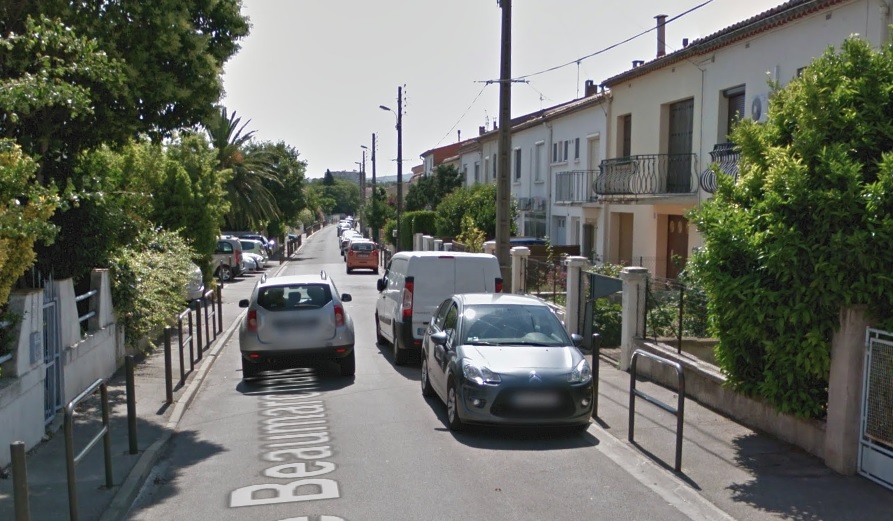
The modern Avenue de Carnot follows the line of the old road and tramway. The tramway then turns East as on the aerial images from 1930. The road is now known as Rue Beaumarchais. As can be seen on the image immediately above it led to open fields.In the early 21st century the are is now part of the suburbs of Narbonne.

This completes the survey of the tramways in Narbonne. The two routes to Ouveillan and Fleury remain to be covered  as they travel North and East out of the city. Once those posts are completed our survey of the Tramways de l’Aude will also be complete.

References

  1. http://www.commune1871.org/bulletins/pdf/Bulletin_40.pdf, accessed on 2nd November 2018.
  2. http://www.trains-de-jardin.net/images/?dossier=Mirliton34/CorbieresAnciens, accessed on 2nd November 2018.
  3. http://transpressnz.blogspot.com/2012/10/gare-d3e-narbonne-france.html, accessed on 2nd November 2018.
  4. https://www.gares-sncf.com/fr/gare/frxna/narbonne, accessed on 2nd November 2018.
  5. https://www.delcampe.net/fr/collections/cartes-postales/france/narbonne/narbonne-faubourgs-du-canal-train-55510337.html, accessed on 2nd November 2018.
  6. https://www.delcampe.net/fr/collections/cartes-postales/france/narbonne/11-narbonne-les-quais-avec-train-sur-le-pont-525985727.html, accessed on 2nd Novembr 2018.
  7. https://www.delcampe.net/fr/collections/cartes-postales/france/narbonne/departs-div-ref-ee90-aude-narbonne-3-ponts-chariot-douillard-gruissan-canal-canaux-train-trains-363690920.html, accessed on 2nd November 2018.
  8. https://www.delcampe.net/fr/collections/cartes-postales/france/narbonne/narbonne-train-locomotive-avenue-de-la-gare-et-monument-des-combattants-chemin-de-fer-belle-animation-453866037.html, accessed on 2nd November 2018.
  9. https://www.delcampe.net/fr/collections/cartes-postales/france/narbonne/narbonne-la-gare-facade-tres-beau-plan-anime-612931234.html, accessed on 2nd November 2018.
  10. https://www.delcampe.net/fr/collections/cartes-postales/france/narbonne/aude-11-narbonne-joli-plan-sur-les-boulevards-de-la-gare-et-du-college-avec-voiture-ancienne-animation-janson-343316390.html, accessed on 2nd November 2018.
  11. https://www.cparama.com/forum/narbonne-t220-20.html, accessed on 2nd November 2018.
  12. http://www.wiki-narbonne.fr/index.php?title=Gare_de_Narbonne, accessed on 3rd November 2018.
  13. https://collection-jfm.fr/t/cartes-postales-anciennes/france/11-aude/narbonne-11, accessed on 4th November 2018.
  14. https://phil1101.skyrock.com, accessed on 7th November 2018.
  15. https://www.geneanet.org/cartes-postales/view/5928211#0, accessed on 7th November 2018.
  16. http://www.cpaaude.fr/THEMES/TRAMWAYS/index_fichiers/Page1963.htm, accessed on 2nd November 2018.
  17. https://remonterletemps.ign.fr, accessed on 8th November 2018.
  18. https://www.cparama.com/forum/narbonne-t220-40.html, 5th November 2018.


Tramways de l’Aude – Thezan to Narbonne

To begin this next post we return to the junction station of Thezan. The station sits to the Northwest of the village and is covered in the post which can be found on the link below:

Tramways de l’Aude – Les Palais to Ripaud

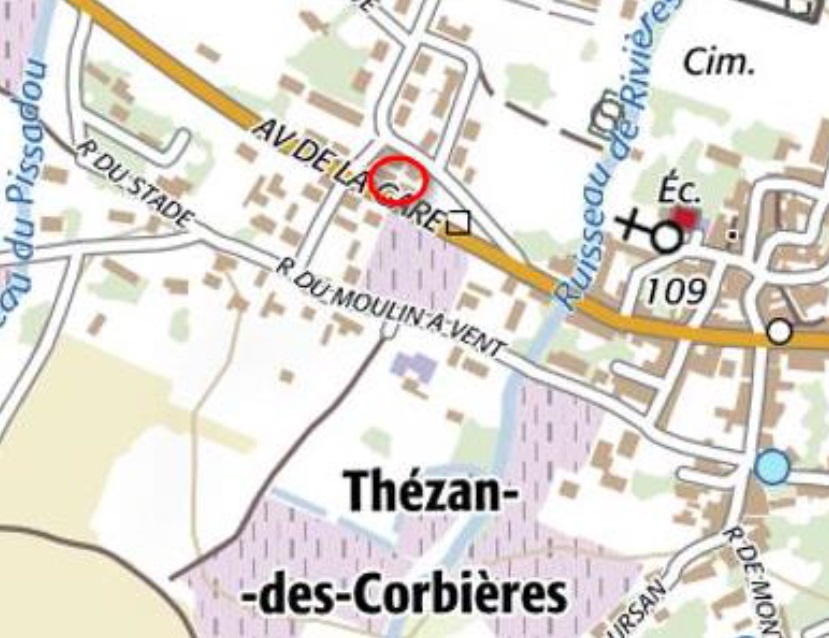
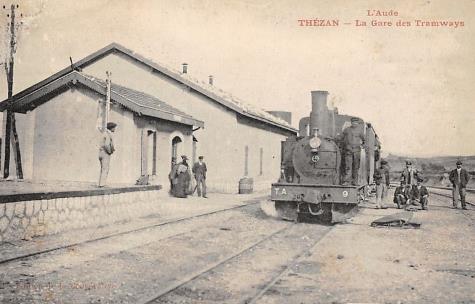
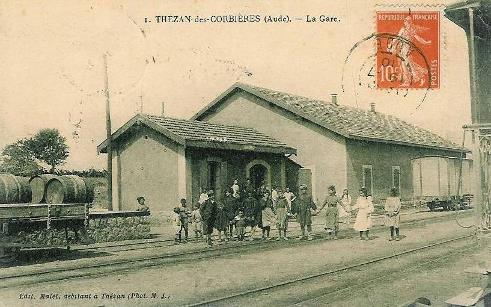
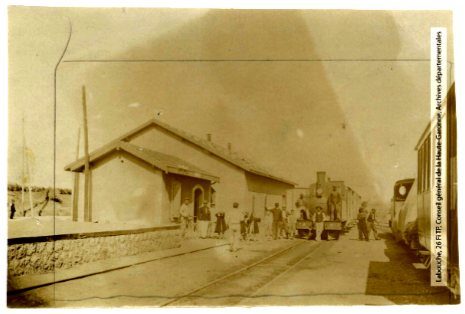
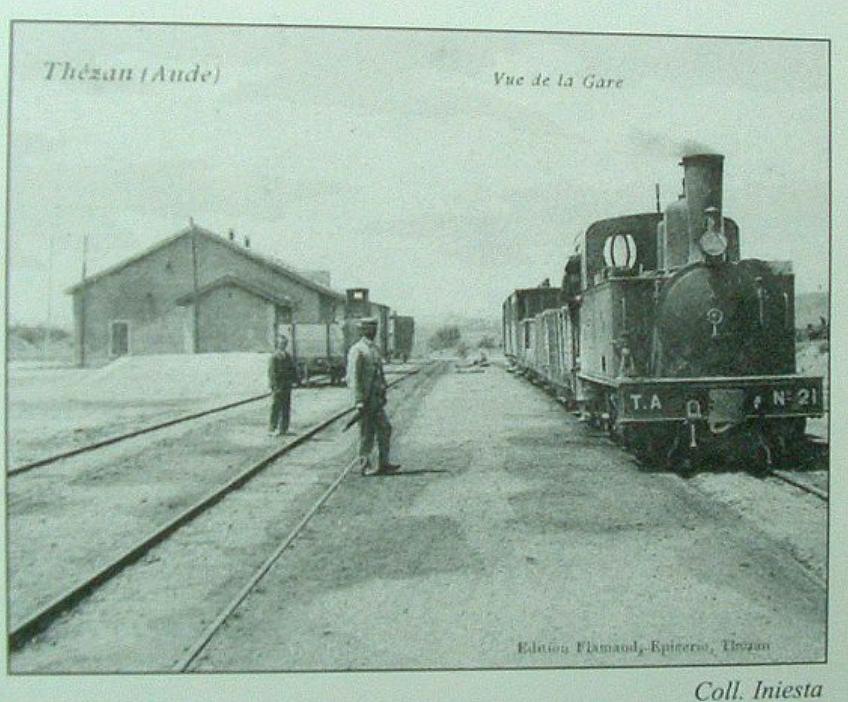
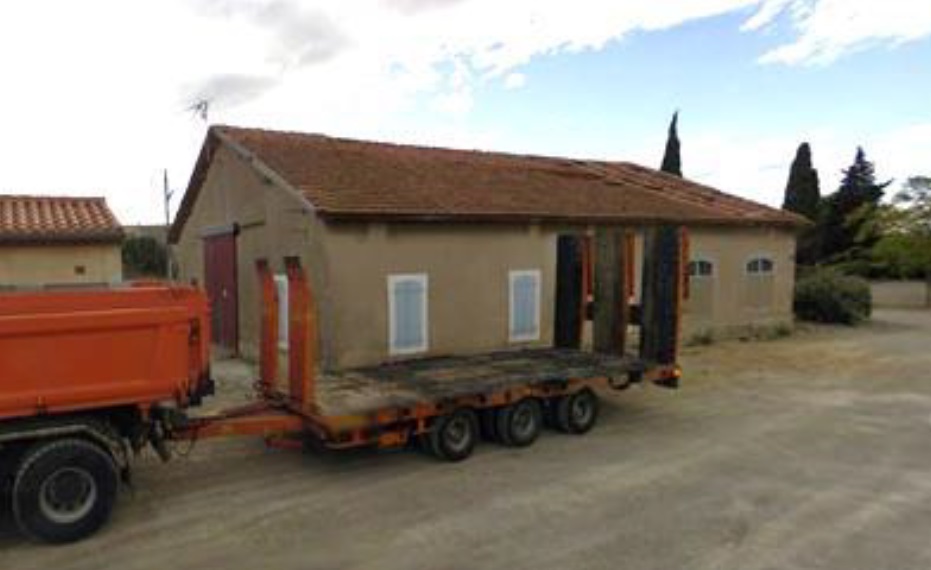
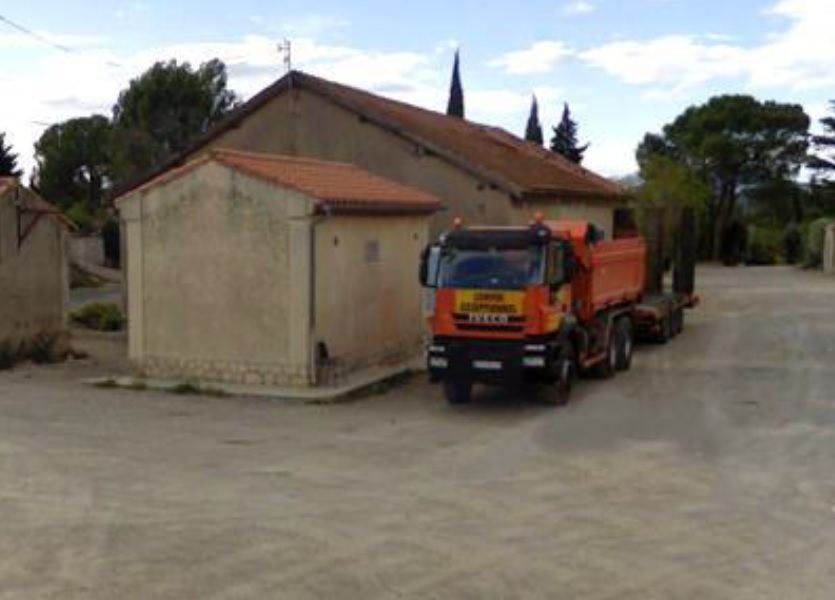
For the sake of completeness some of that post is repeated at the start of this blog. …The station location is clearly marked by the red circle on the map above. Some of the infrastructure remains, do the location can be accurately fixed. [2]The four pictures above all show the main station building at Thezan. [3][4] Thezan was a junction station receiving trains from a number of different routes and was one of the busier stations on the network. The two images immediately above show that the main station buildings are still in evidence in the early 21st century, in use as a road maintenance depot. [2]

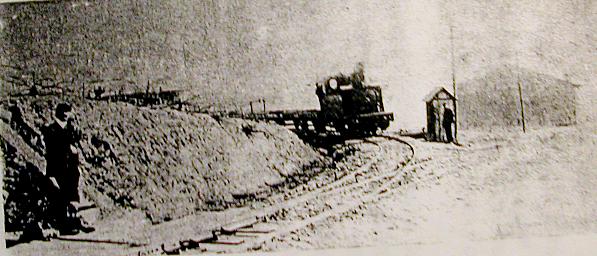
The junction was to the South east of the town. Trains to Narbonne would bear off to the left.Here a train approaches from Narbonne. The picture shows the telephone booth for the pointman. Given the heavy traffic of passengers and goods, the role of the pointman in Thézan was a position of high responsibility. With the arrival of a train from Narbonne, he had to make sure that no train was due on the common stretch Durban – Port La Nouvelle, then telephone to the train station of Thézan to obtain the authorization to switch the points. [4] There is an excellent page written in French on the site  http://www.thezandescorbieres.com which tells the story of the station. Auto translate in Chrome is a real boon! [4]

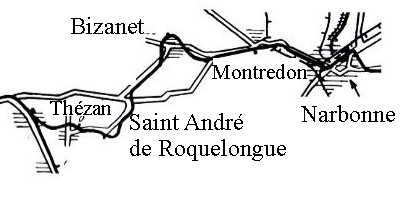
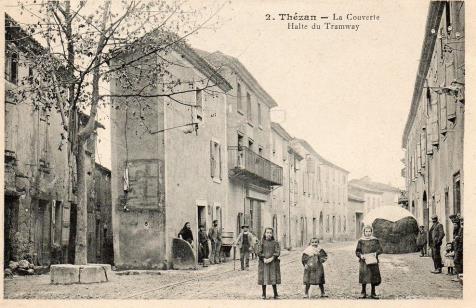
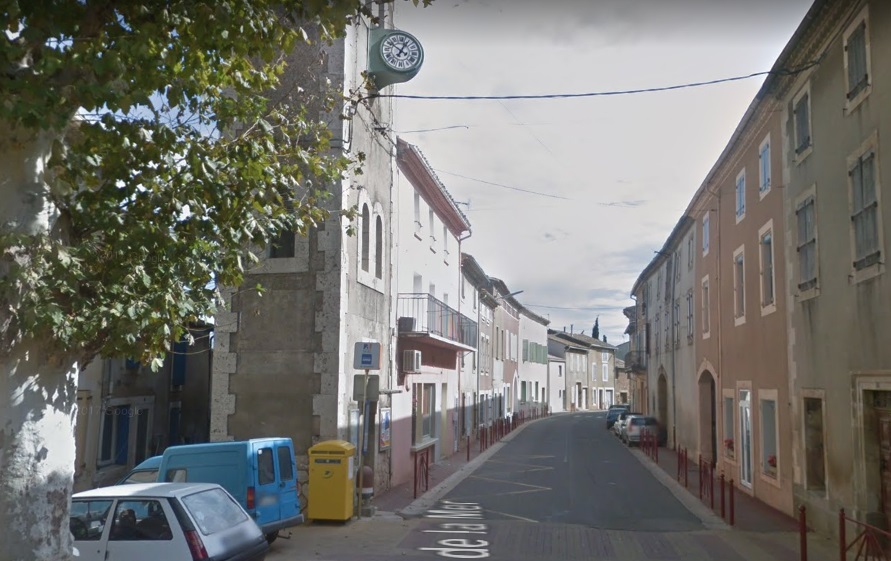
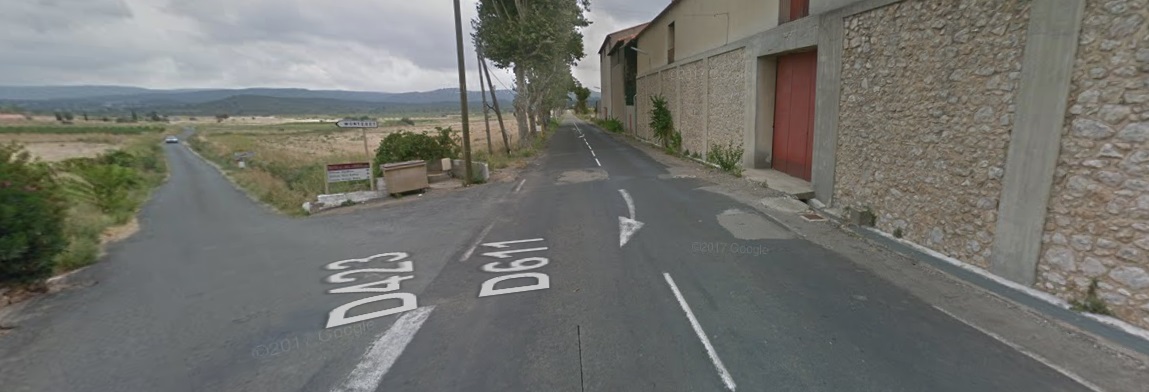
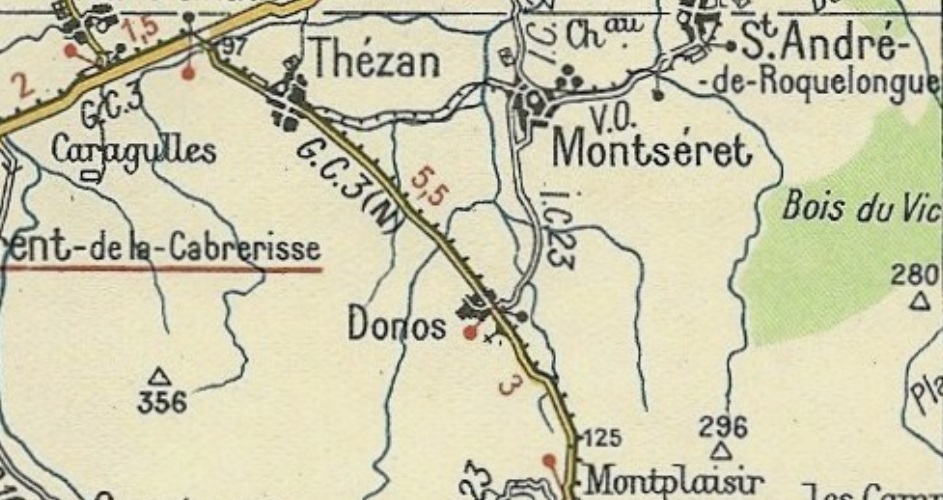
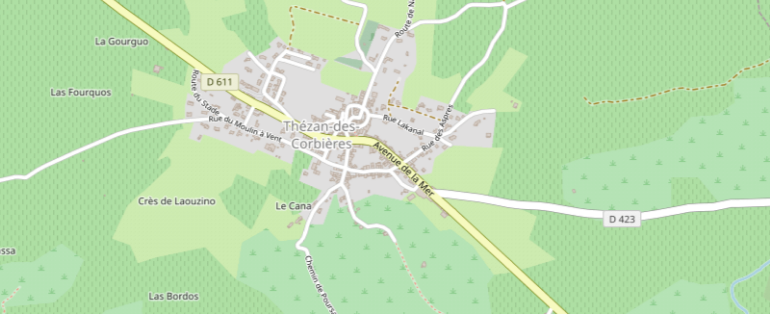
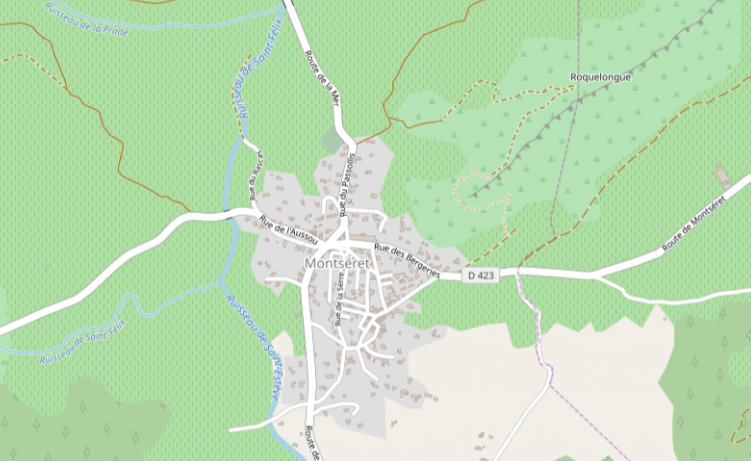
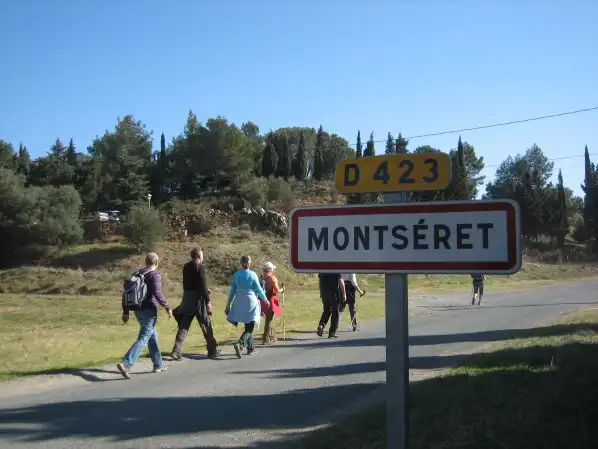
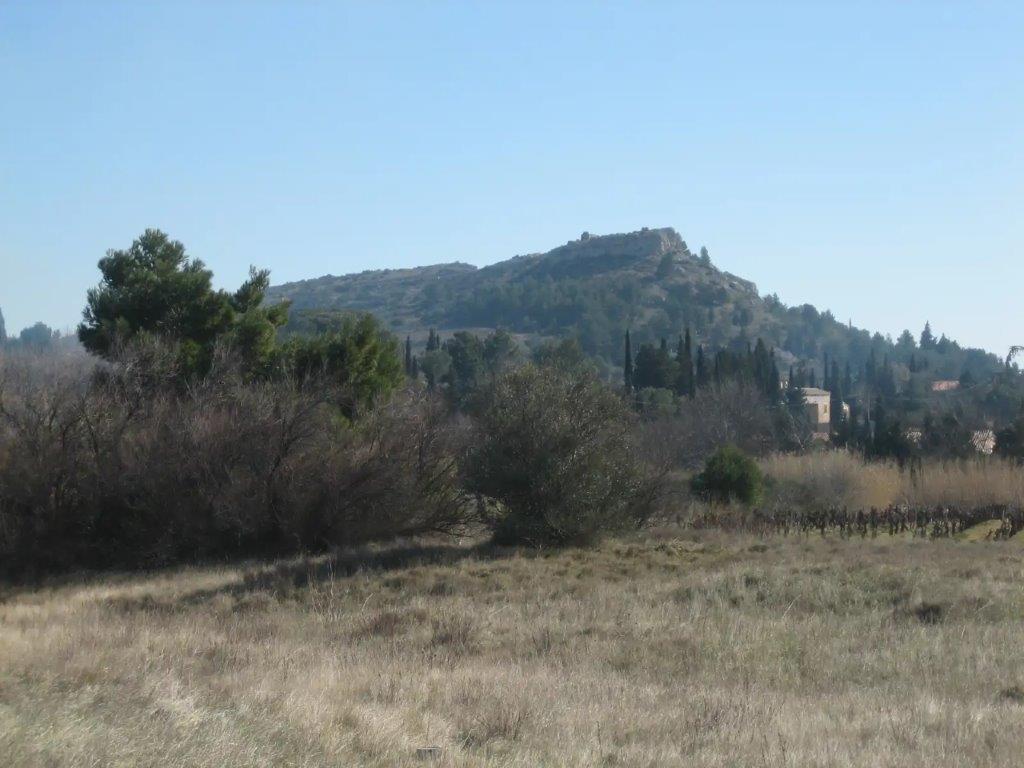
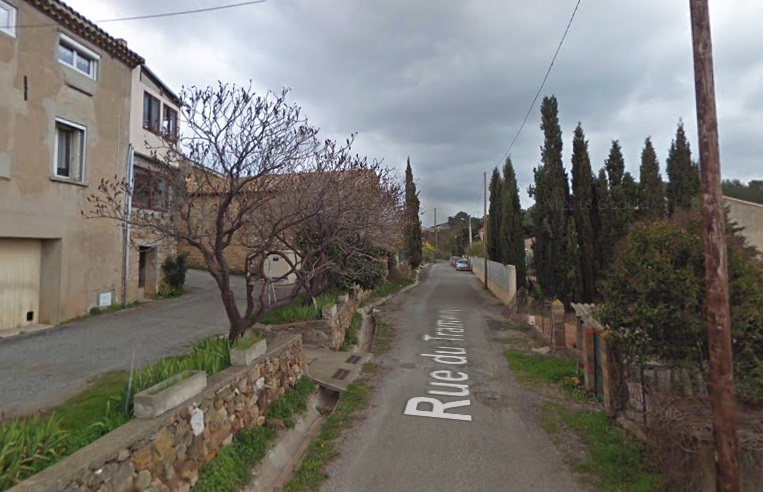
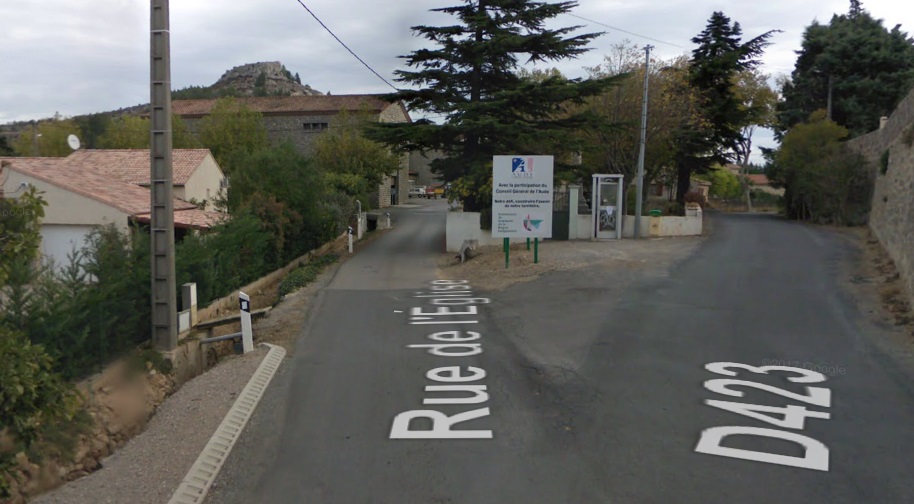
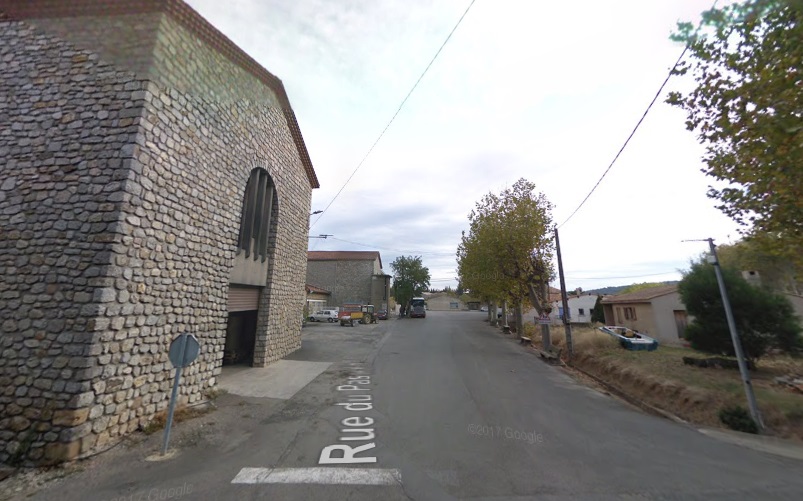
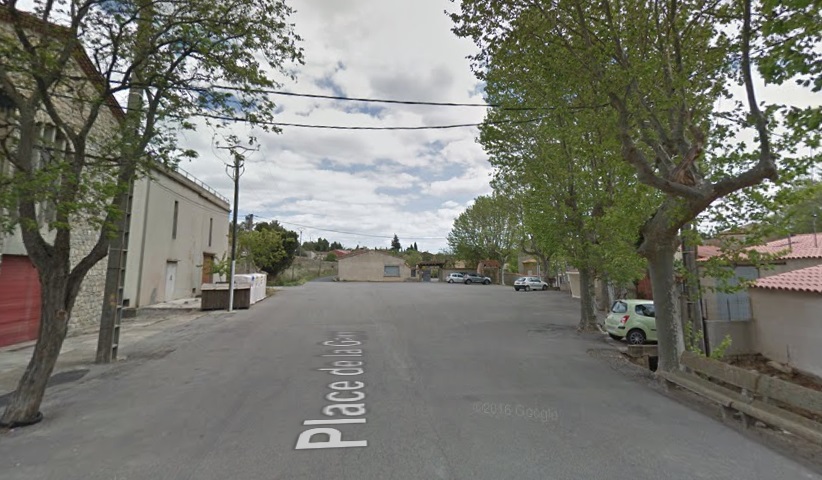
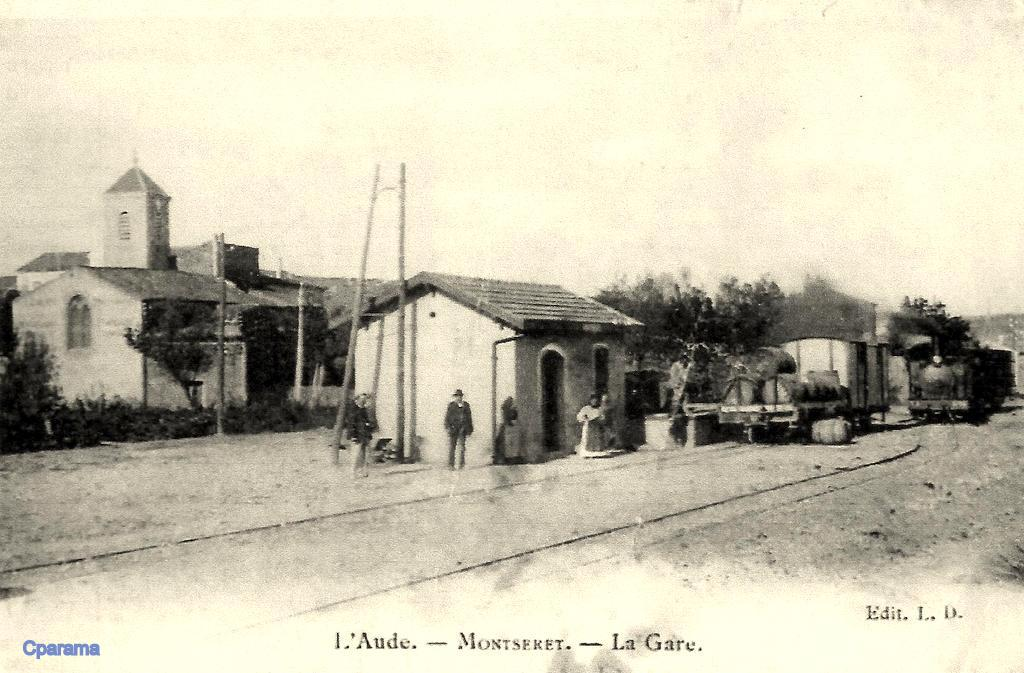
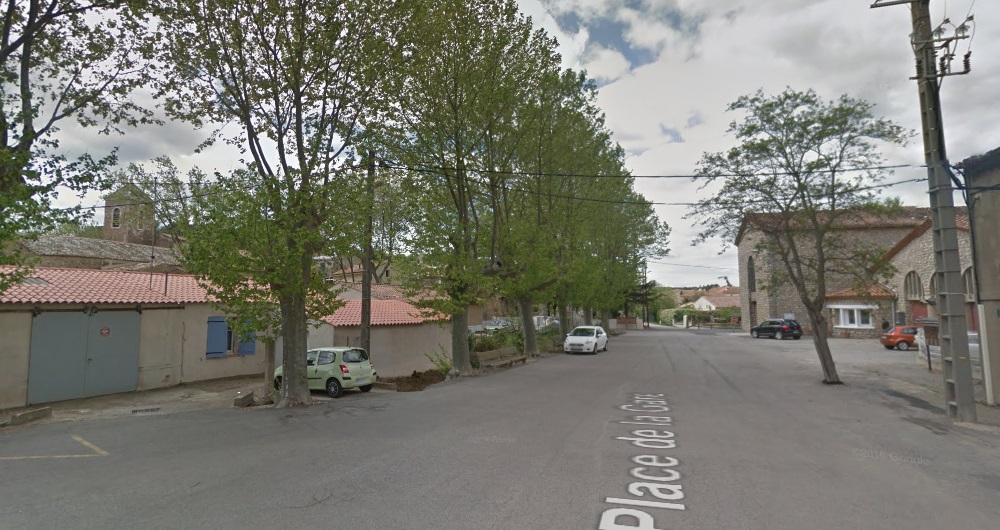
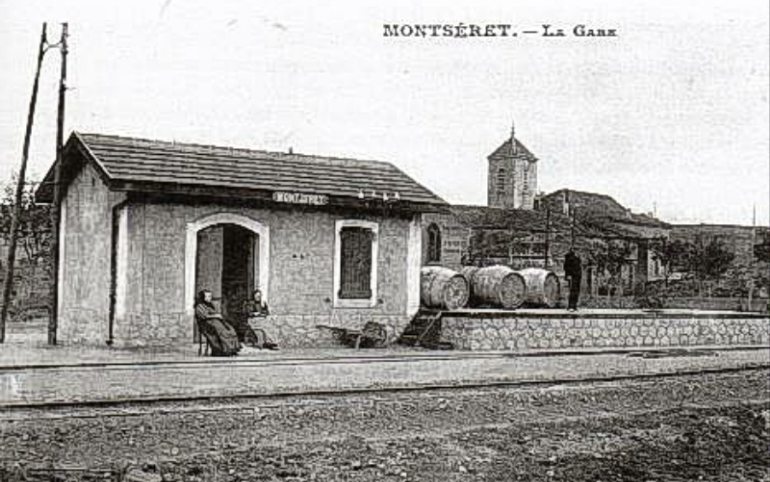
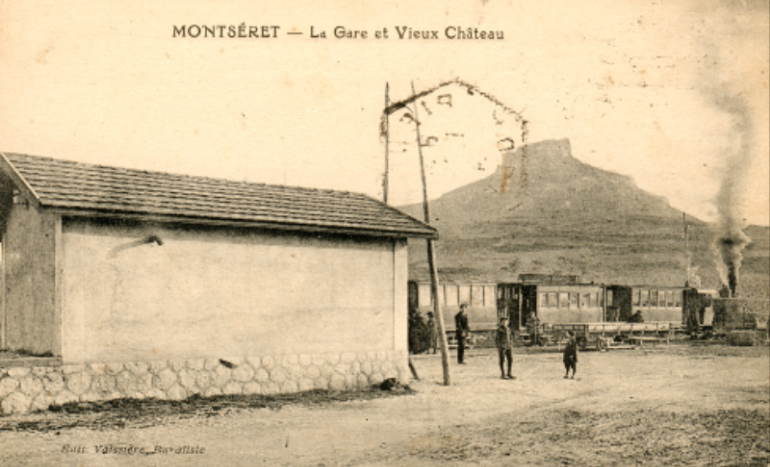
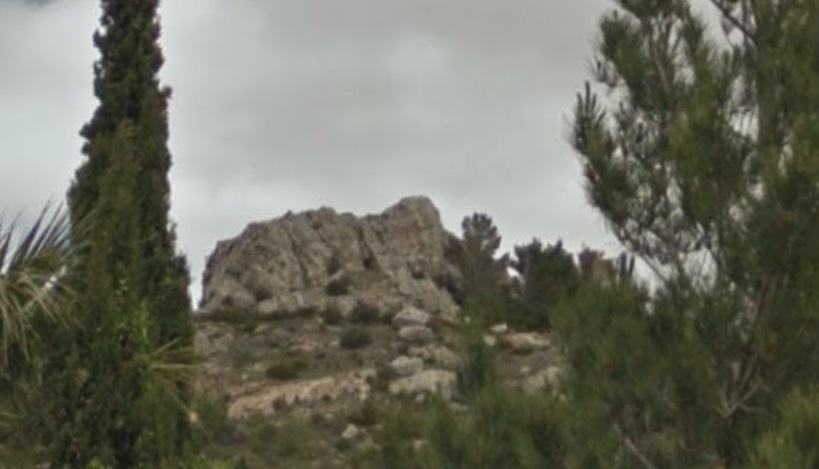
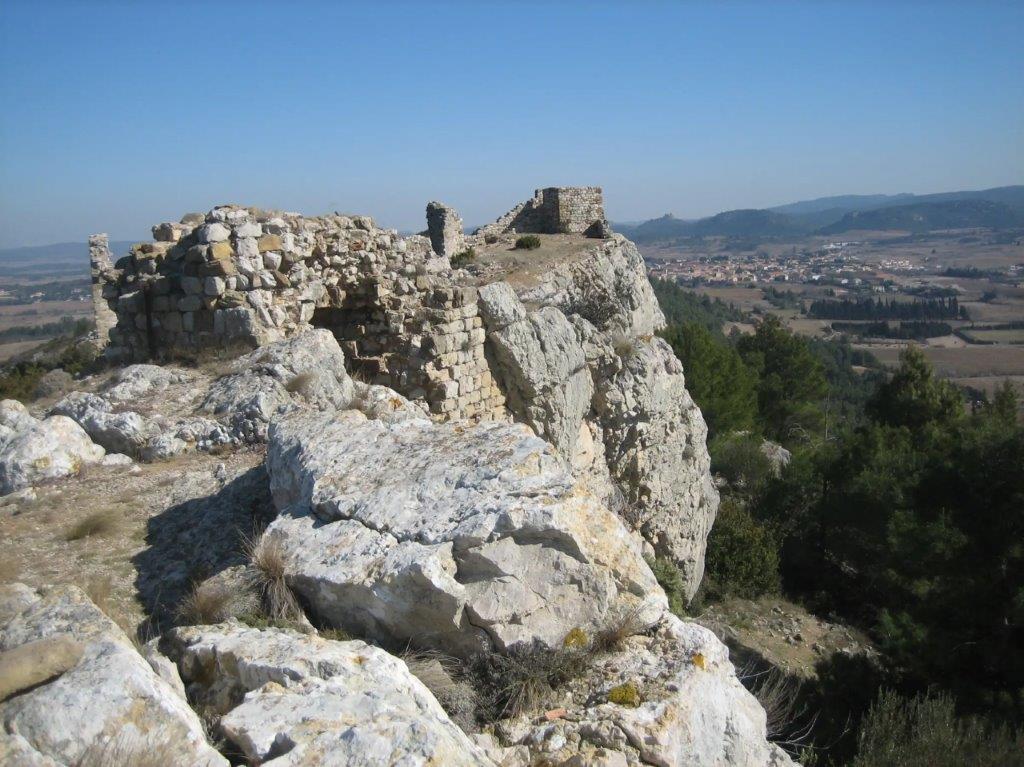
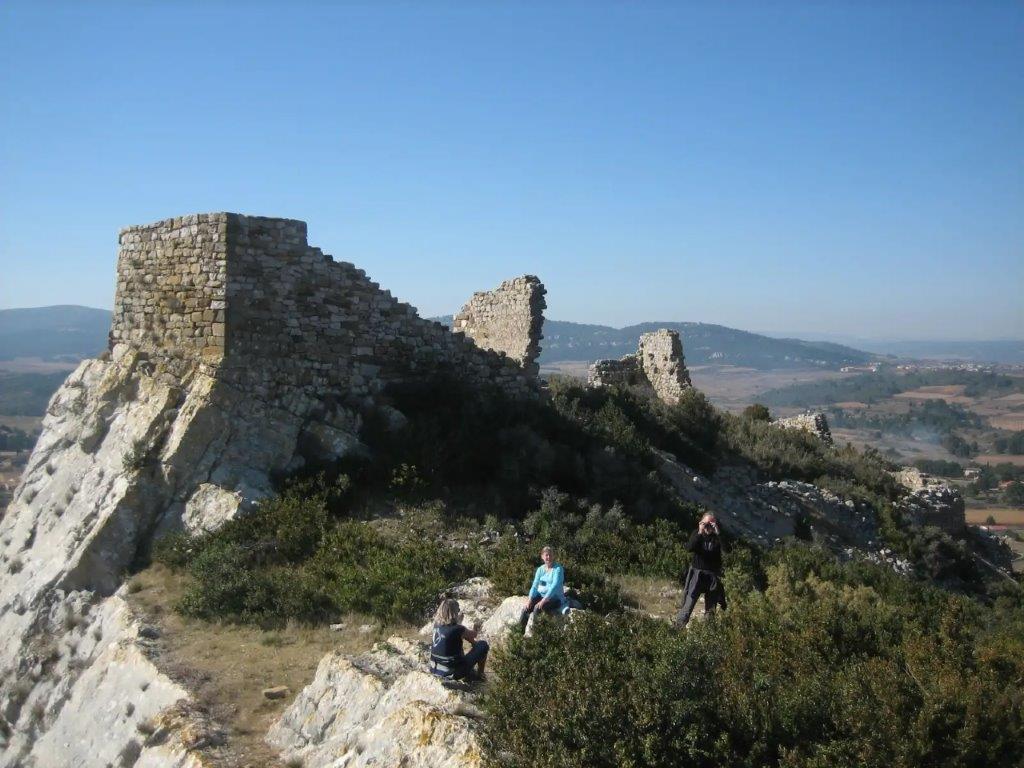
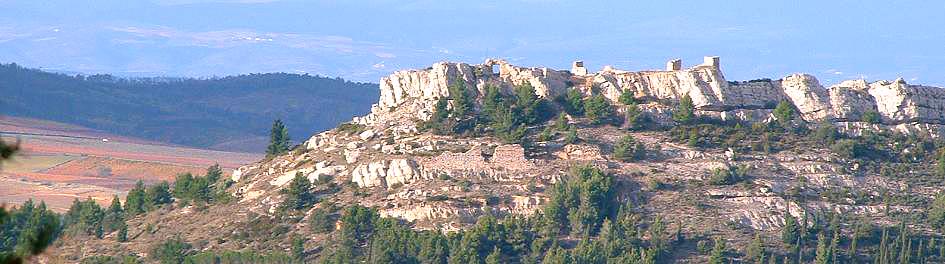
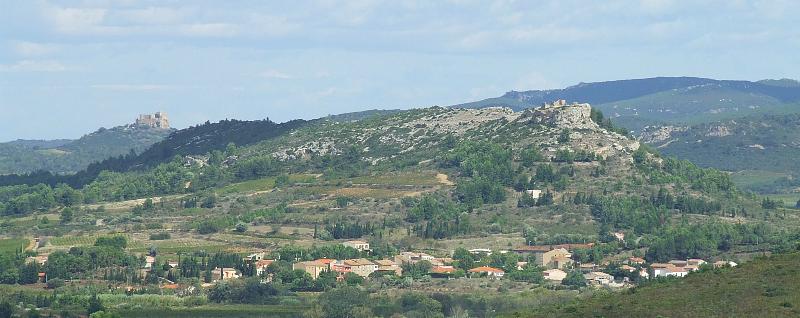
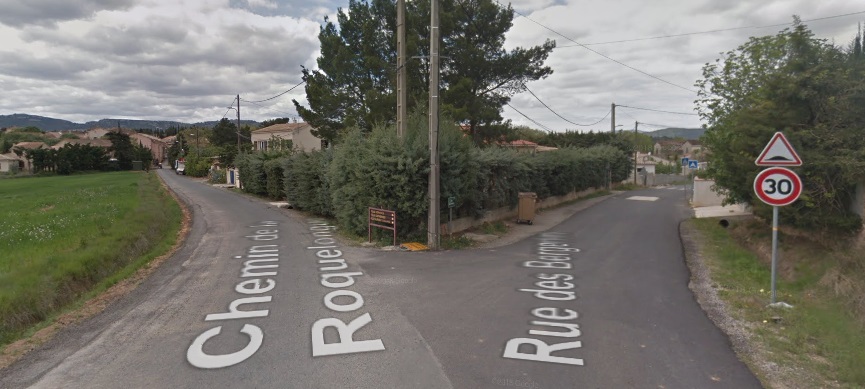
There was a small halt in the centre of Thezan at the beginning of Avenue de la Mer. The pictures below show the location early in the 20th and 21st centuries. [3] The tramway junction was to the Southeast of the town. This is the location in 2017. The large buildings on the right of the picture are the Wine Co-operative buildings. When the tramway was in use the D423 did not exist. The 1930s Michelin map show the tramway heading off across the fields towards Montseret and Saint-Andre as below. On arriving at Montseret, the tramway approached the village on Rue de l’Aussou. Its route across the open fields to Montseret is now the D423. It crossed the Ruisseau de Saint-Felix and then dropped away south of the Rue de l’Aussou taking its own route into the village. That route is now the minor road Rue du Tramway and can just be picked out on the South side of Rue de l’Aussou on the OpenStreetMap above.The old tramway bridge on what is now the D423 approaching Montseret. The bridge crosses the Ruisseau de Saint-Felix.The village sign on the Rue de l’Aussou. The ridge, on which Montseret Chateau, sits is just visible beyond the trees above the D423 sign. [5]Montseret Chateau from a distance. [5]The tramway route is the tarmacked narrow road on the right of this image. The Rue de l’Aussou continues in the centre of the picture.The tramway entered the village and then took a route to the north of the D423 through the village. That route is now the Rue de l’Eglise. The three images immediately above show its route. The Chateau can now clearly be seen above the village. The two images above show the approach to the old station site which was close to the Cooperative buildings.Montseret Tramway Station with the church behind. The view is taken looking West-southwest. [6]This view is taken in the same direction at the same location in 2016. The treeline obscures the view. The two images below are taken in opposite directions at this site. The second includes sight of the chateau. [12]The tramway found its own route out of Montseret to the East. The track bed has been tarmacked and is now the Rue des Bergeries. The chateau and its ridge can easily be seen to the North of the old tramway route. Two images taken from close to the Chateau on the ridge above Montseret. [5]The Chateau from the village of Montseret. [7]Should we be focussing on a chateau from the Cathar period in a blog about a tramway from the early 20th century? You might not think so. But this chateau played a significant but small part in the history of the tramway.

The chateau was built in the 10th century. It was an imposing castle, with keep and double ramparts. The name of Moun Séré resulted in its village becoming known as Montséret,. The name comes from ‘sereno’, a small migratory African bird (Bee-eater) which still today comes to nest on top of this rock. [8]In the foreground are the remains of the castle on the rocky outcrop of Roca Longua, and the new village in the plain. In the far left of the picture, the castle of St Martin de Toques, behind in the extension is the massif of the Fontfroide Abbey. [8]

What is surprising is that the crusade against the Albigensians (Cathars) spared the castle. It was not destroyed and indeed survived until around 1550 as a family home/redoubt. Possibly because of the plague, the chateau was abandonned at around that time.

As time passed, the stones of the chateau were used for the construction of the current village and for the low walls between the vines and in the early 20th century they were used to stabilse the embankments of the new tramway! [5]

To the East of Montseret the tramway meets the present D423 on its way towards Saint-Andre-de-Roquelongue.The tramway alignment was along the road to the right in the above image. This view looks back West towards Montseret village. The D423 is on the left.

The old Michelin map shows the tramway route following the old road between Montseret and Saint-Andre-de-Roquelongue to a point just to the West of the Ruisseau de la Caminade.It seems from the 1930s Michelon map and from evidence from aerial photography that the present D423 follows the old tramway route which ran a few metres to the South of the old road. The new alignment of the road can be seen in the 1950s aerial image below. [11]The old road and bridge were just to the North of the tramway and what became the present day D423. [11]The approach to the station site at Saint-Andre.

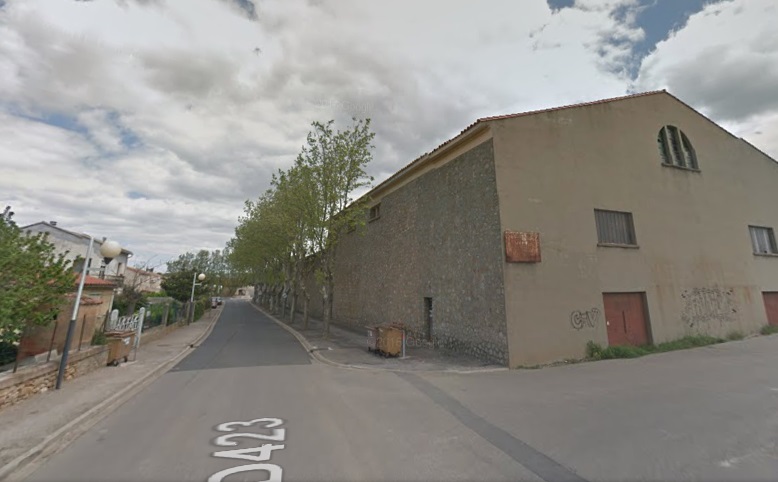
The tramway then headed straight for Saint-Andre along the route of the present D423. It by-passed the village to the southeast continuing along the line of what is now the D423. The line closed in the 1930s and by the mid-1940s it was a road.

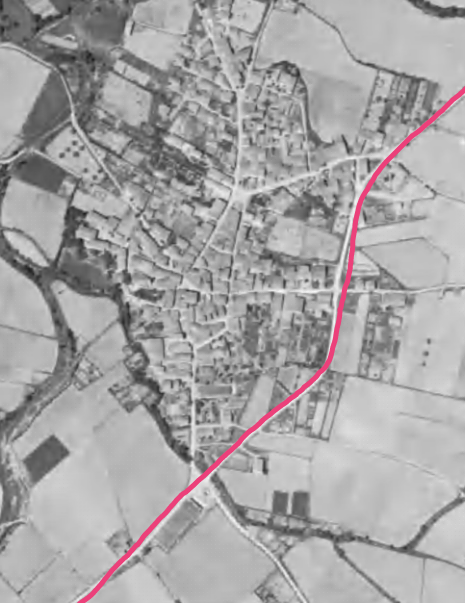
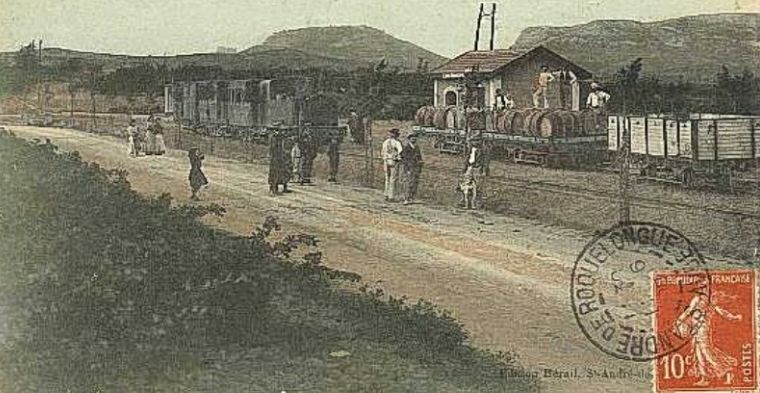
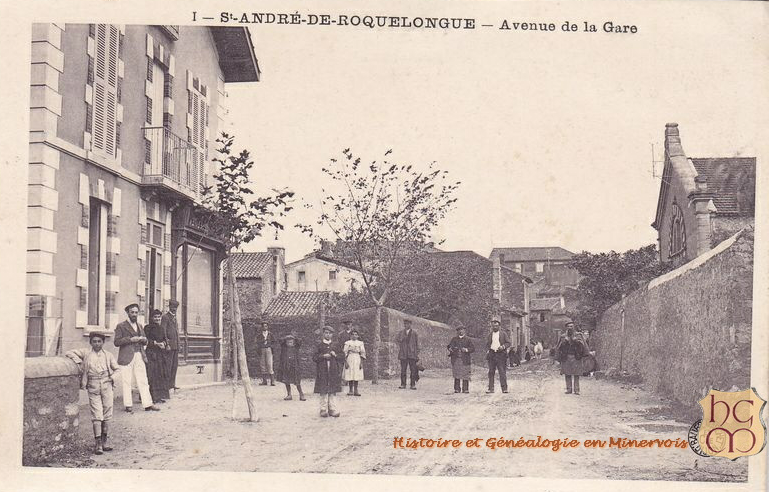
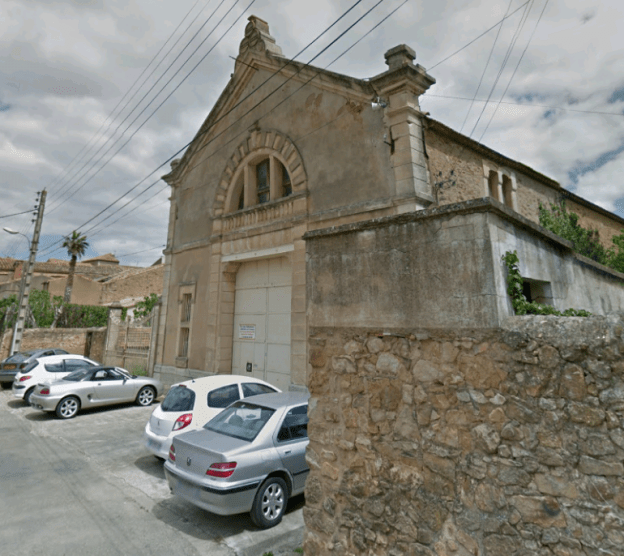
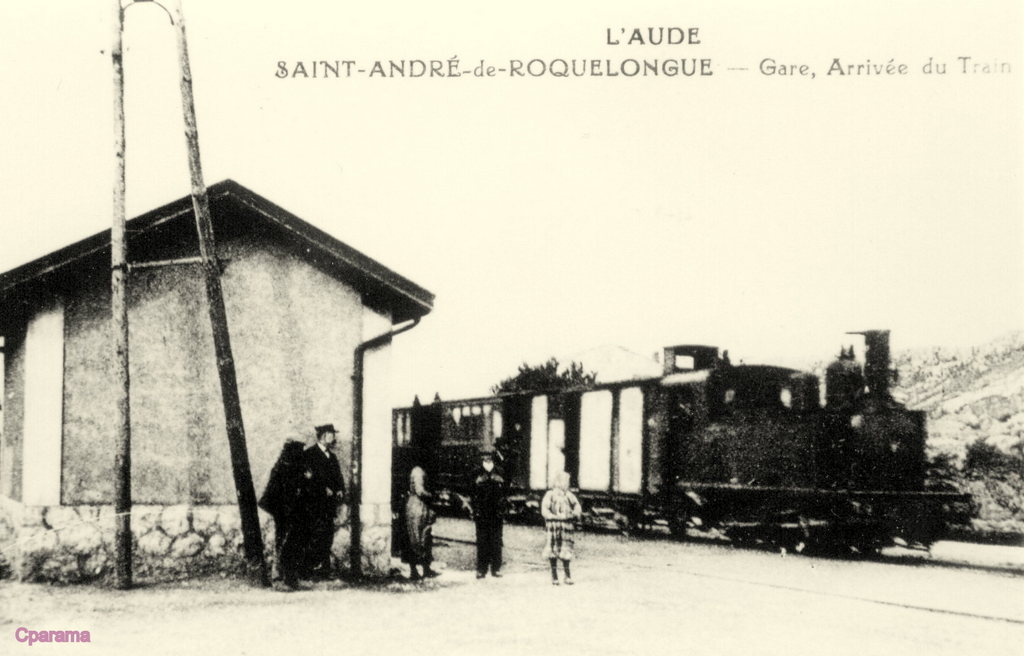
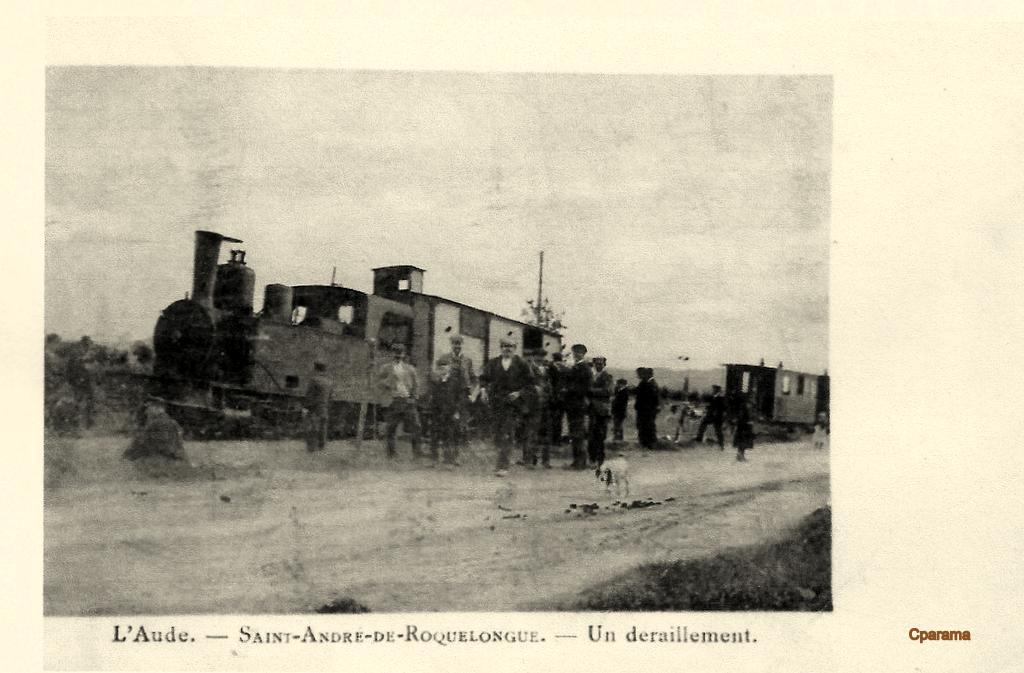
The tramway route is approximately as shown by the pink line on the adjacent 1940s aerial photo. My sketching of the Iine seems to have it to the East of the present road. This is just a slip of the pen as the road follows the route of the old tramway. The station appears to have been sited close to the location of the Co-operative on the South side of the village. I believe that this view is taken looking Northwest through the station site. [13]The route from the centre of the village to the station was known as the Avenue de la Gare, it has a longer name in the early 21st century the Rue de la Cave Cooperative Saint-Andre-de-Roquelongue. The building on the right of the above image is still standing. [13]Two more views, above, of the station. [13]A derailment at Saint-Andre-de-Roquelongue, close to the station site. [13]

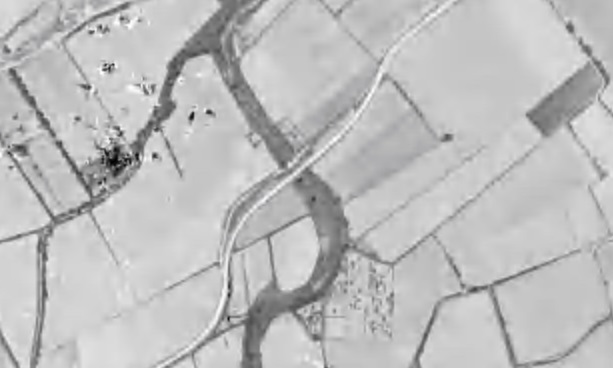
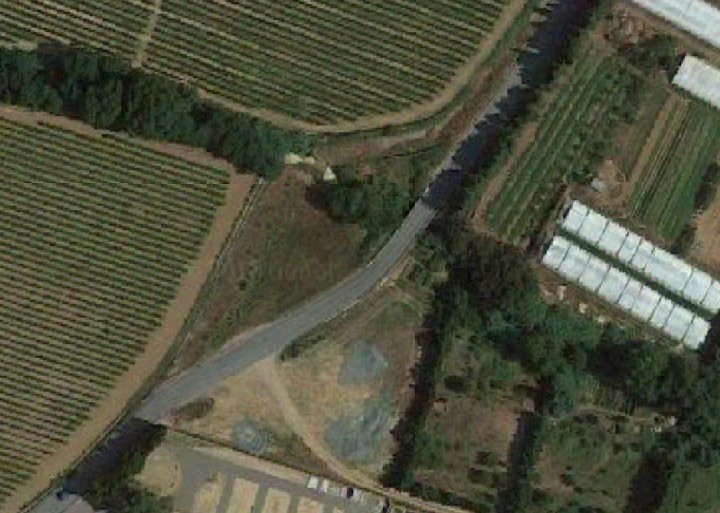
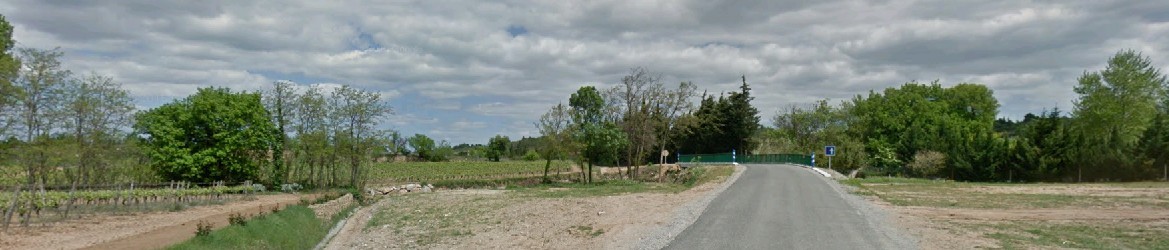
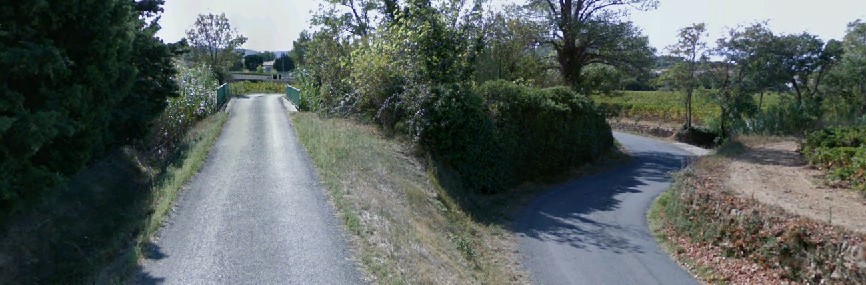
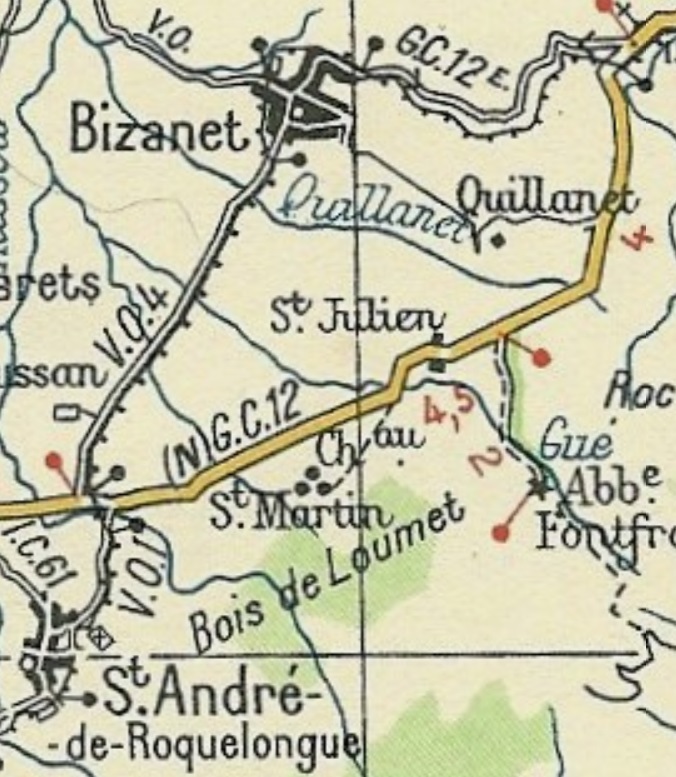
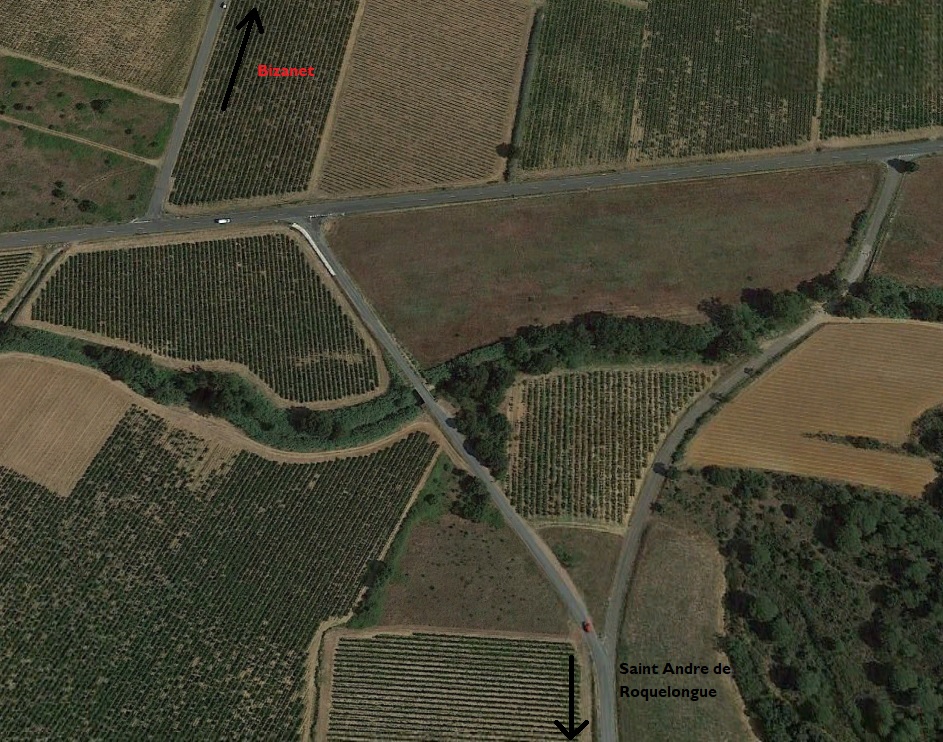
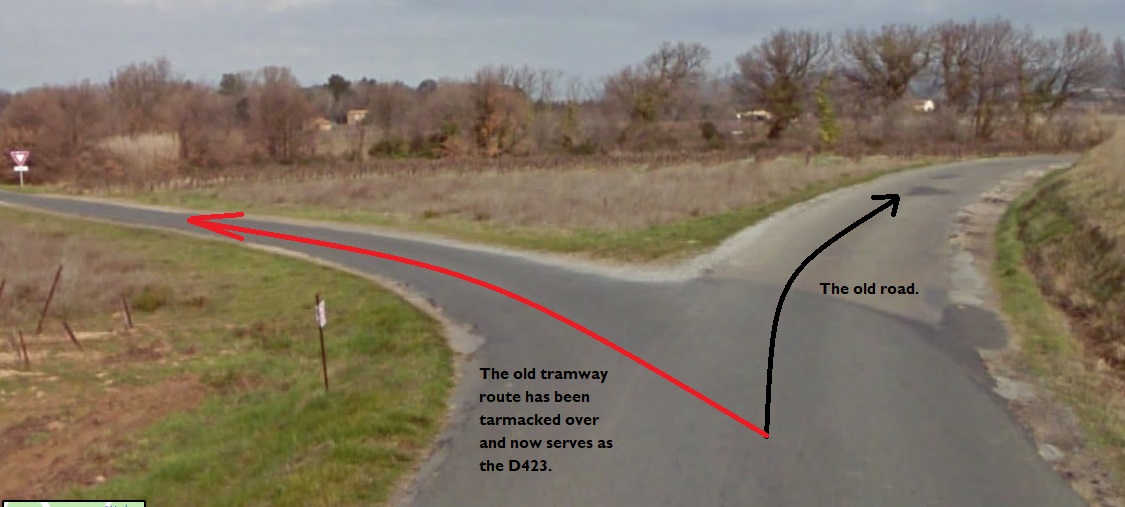
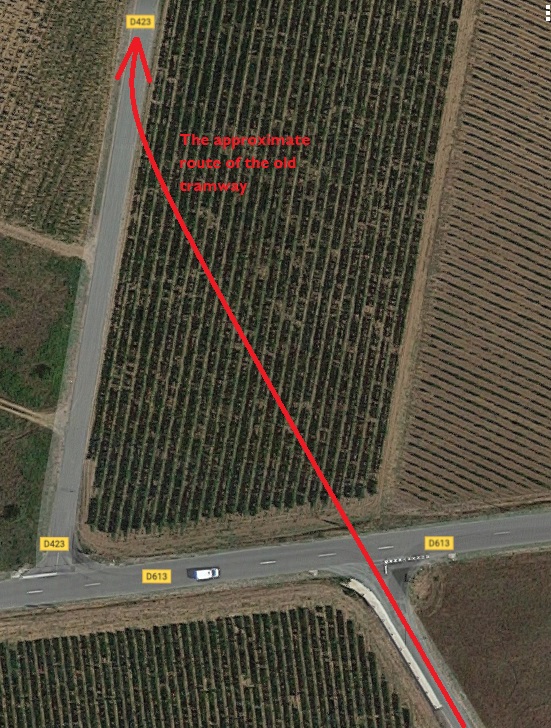
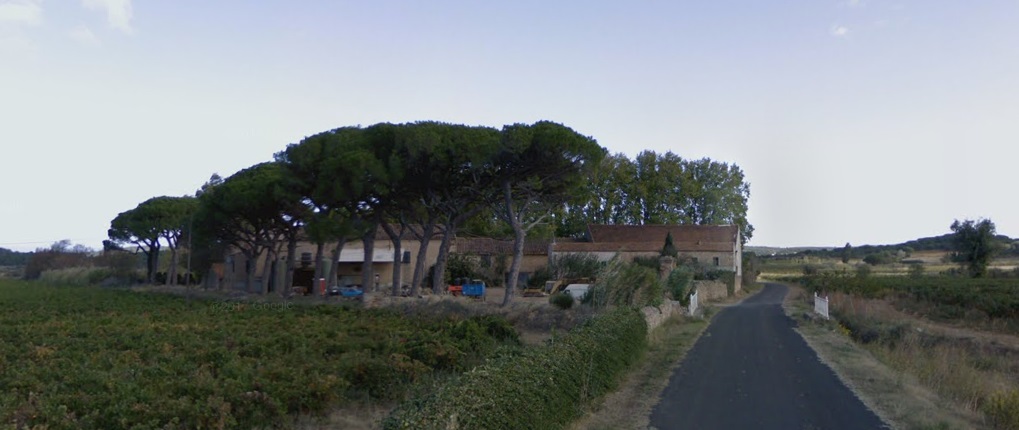
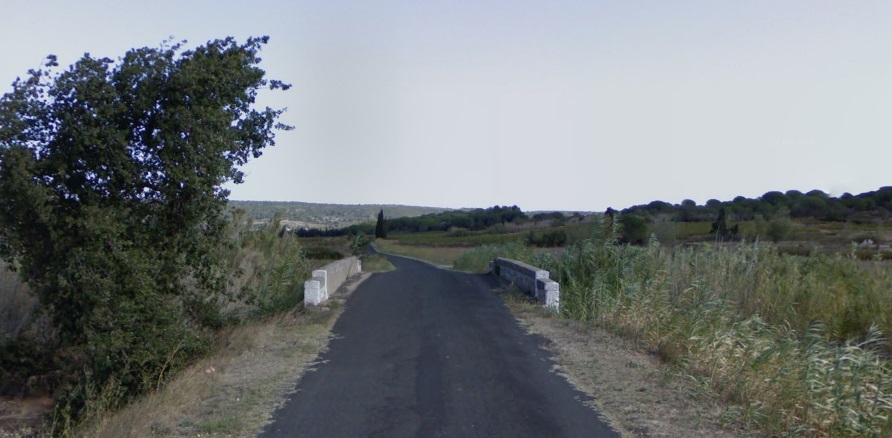
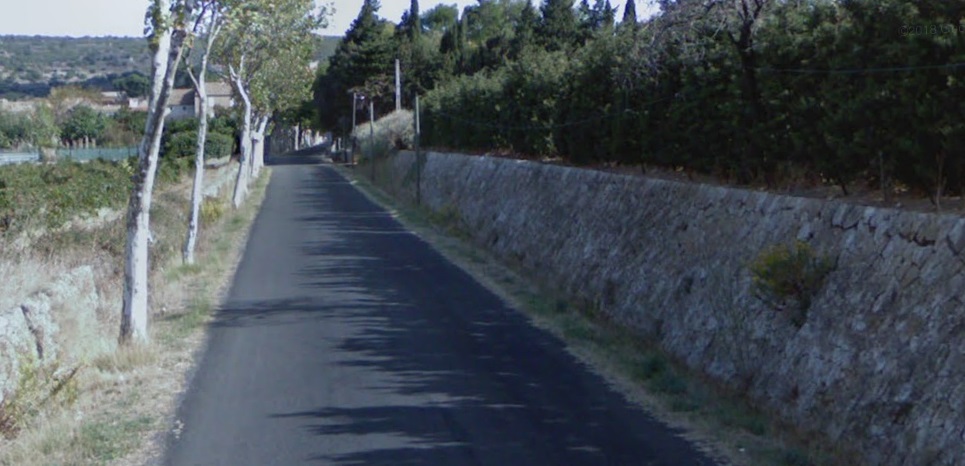
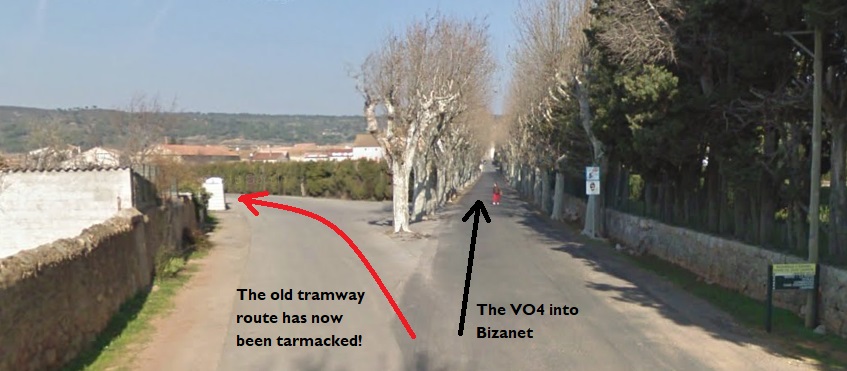
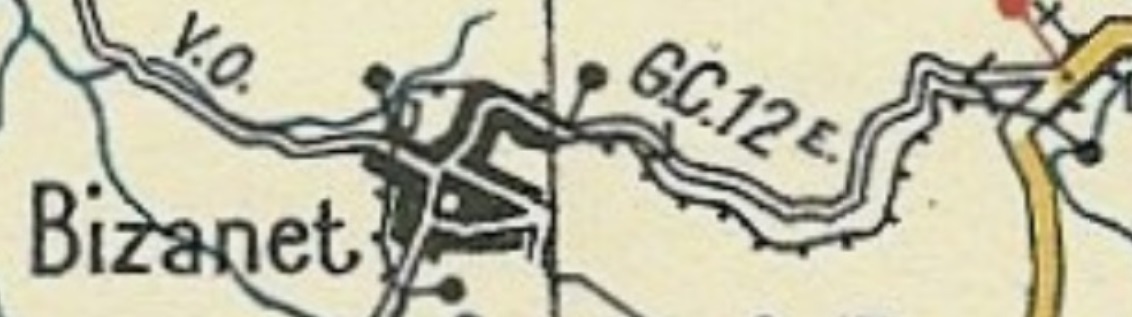
The tramway left Saint-Andre-de-Roquelongue along what is now the D423 en route to Bizanet. A short distance beyond Saint-Andre the road crossed the Ruisseau de l’Alvern at a ford and the tramway remained above the watercourse. The modern D423 now follows the route of the tramway.A very early 21st century image of the two routes., looking towards Bizanet. This shows the condition as much the same time as the satellite image was taken.More recently the two short routes have been brought up to the same surfaced standard. This view looks back towards Saint-Andre.The road to Bizanet crossed the GC12 at a staggered junction. The tramway is shown deviating from the road (VO1) south of the GC12 (D613) and rejoining the VO4 North of the GC12 on the 1930s Michelin map above. The staggered junction still exists in the early 21st century, as shown below on the satellite image. The old road reaches the D613 to the right-hand side of the image. The present road running through the middle of the image and reaching the D613 much closer to the road North to Bizanet is the route of the tramway.The picture above shows that the modern D423 crosses the old tramway bridge over the Ruisseau de Saint-Esteve as it approaches the D613 (GC12).

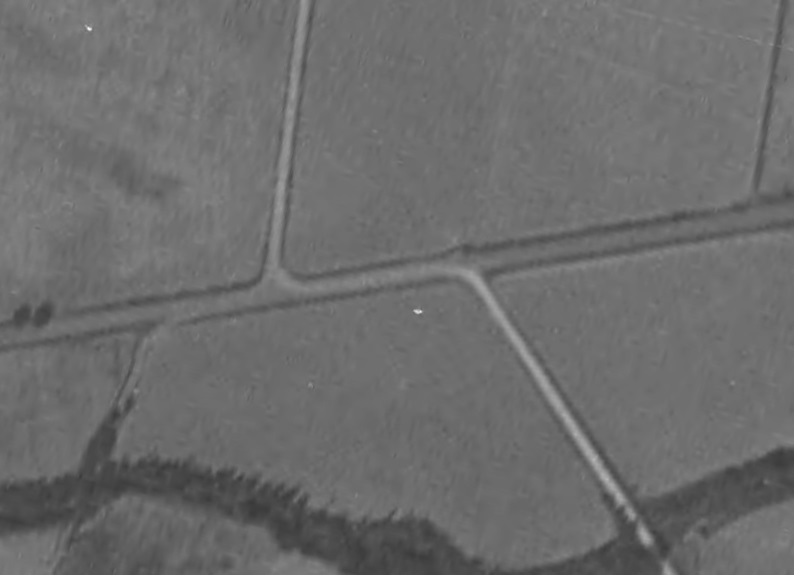
The tramway route to the north side of the main road has been obliterated by the extension of a vineyard across its route. As the adjacent satellite image shows, the route cannot be identified through the field. The red line is an approximation to the route of the tramway.This aerial image from the mid-1940s suggests that the tramway may have dog-legged along the old GC12, although there is some faded evidence in the mage of a route across the field from the portion of the road south of the GC12. Can anyone shed any light on which is the actual route?

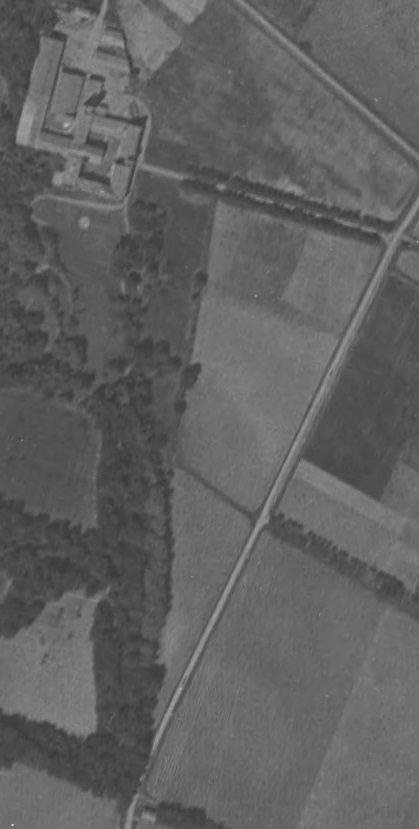
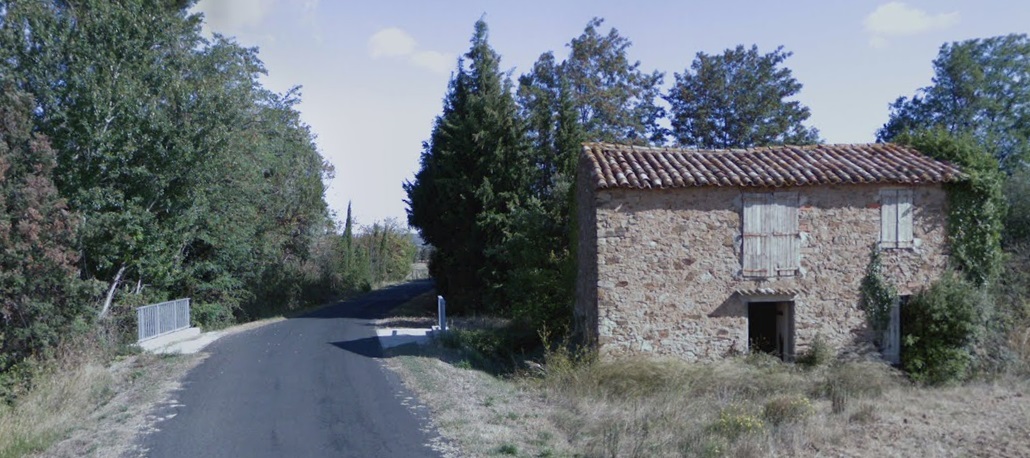
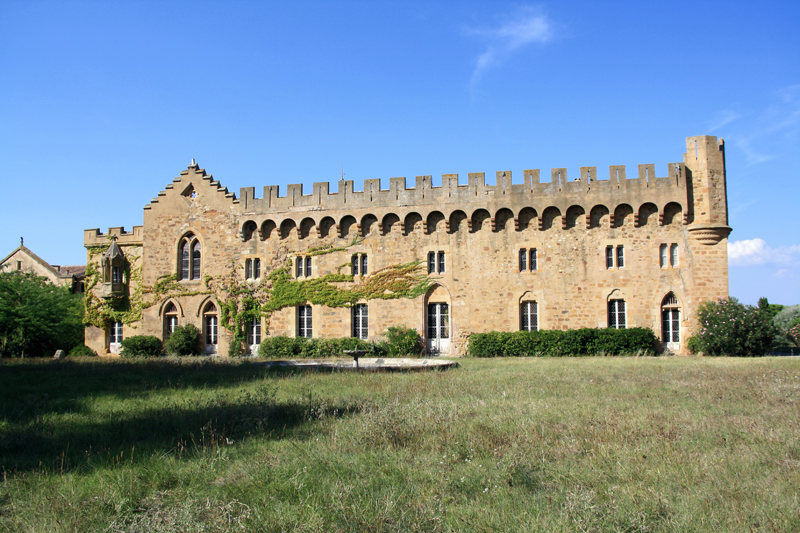
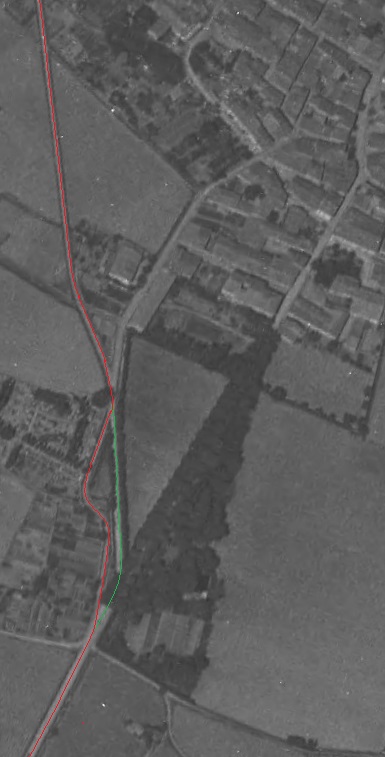
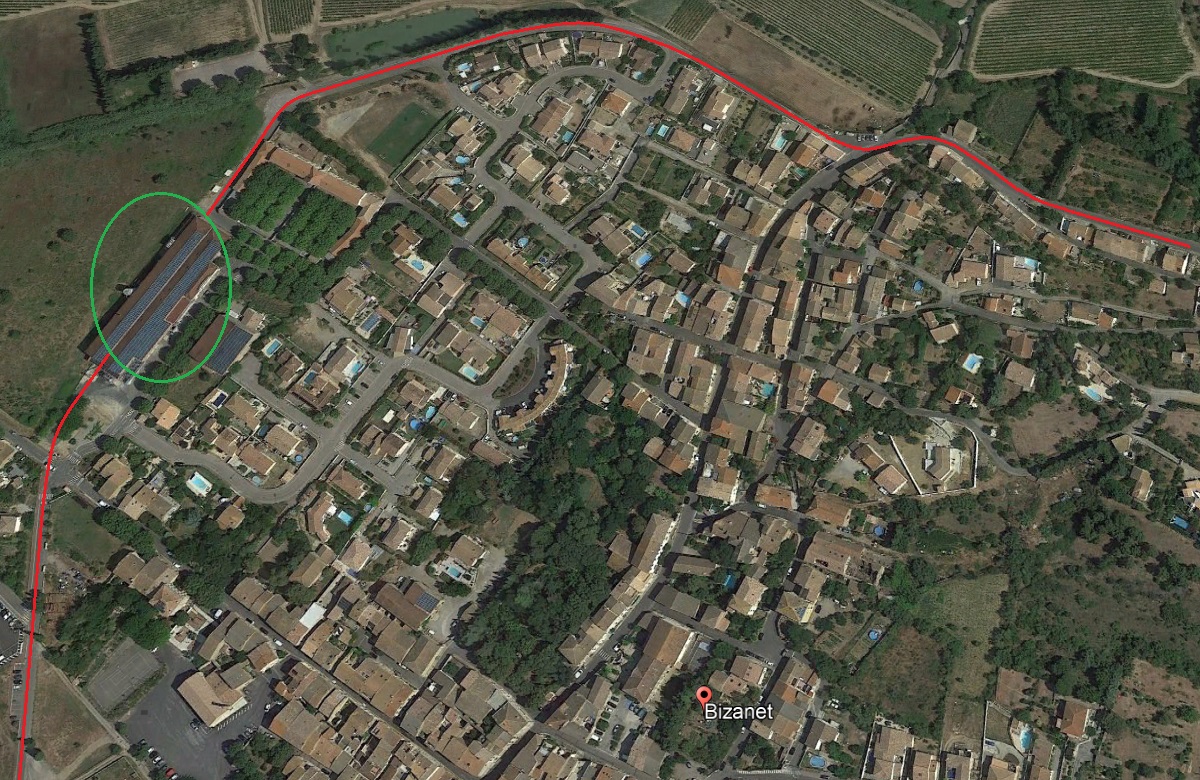
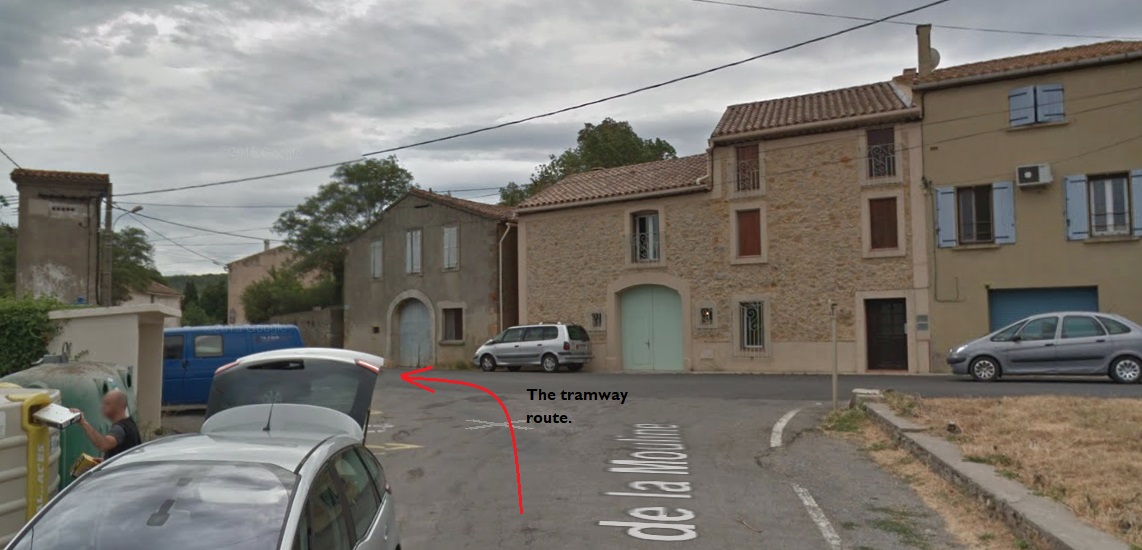
North of the GC12 (D613) the tramway continued to follow the line of what is now the D423 across vineyards, around copses and across scrub-land. It passed isolated farms and farm buildings on a relatively straight course across level ground towards Bizanet. The small building in the first colour image below can be seen at the bottom of the adjacent aerial photograph. It is adjacent to the small bridge which appears to be the southern boundary of the grounds of the Monastere de Gaussan which can be seen in plan towards the top of the aerial image. The monastery was an interesting fortified structure as can be seen in the second colour image below.After passing the monastery the tramway continued across relatively flat ground to wards Bizanet.The modern road deviates from the line of the old road and tramway on the approach to Bizanet as the modern road has to climb over the A61 autoroute. The route of the old road and tramway are now lost under the construction of the A61.The tramway route into Bizanet.It appears that as the tramway approached Bizanet it slipped away to the west of the road.

As the aerial photograph shows the route of the tramway is a little unclear. It could have been either the red or green lines show in the photograph. In the early 21st century it is almost impossible to tel. The cemetery has been extended East to meet the road which follows the green line and also southwards over the red alignment.

It would be really helpful if someone with good local knowledge could confirm the tramway route!

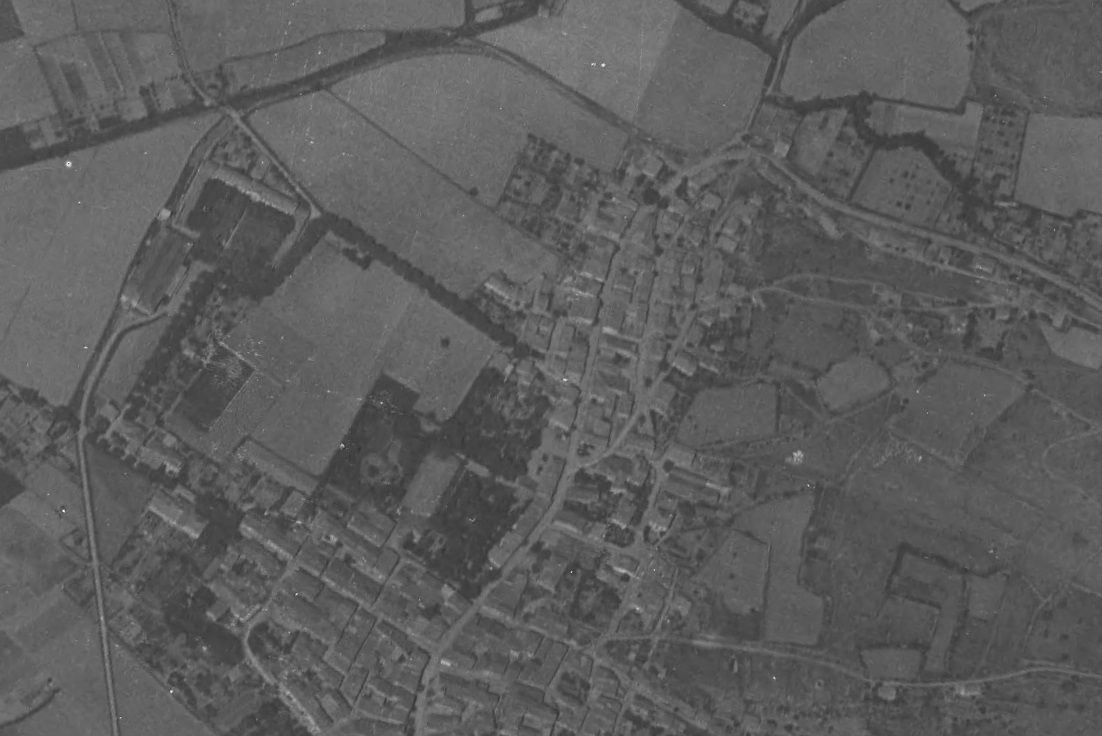
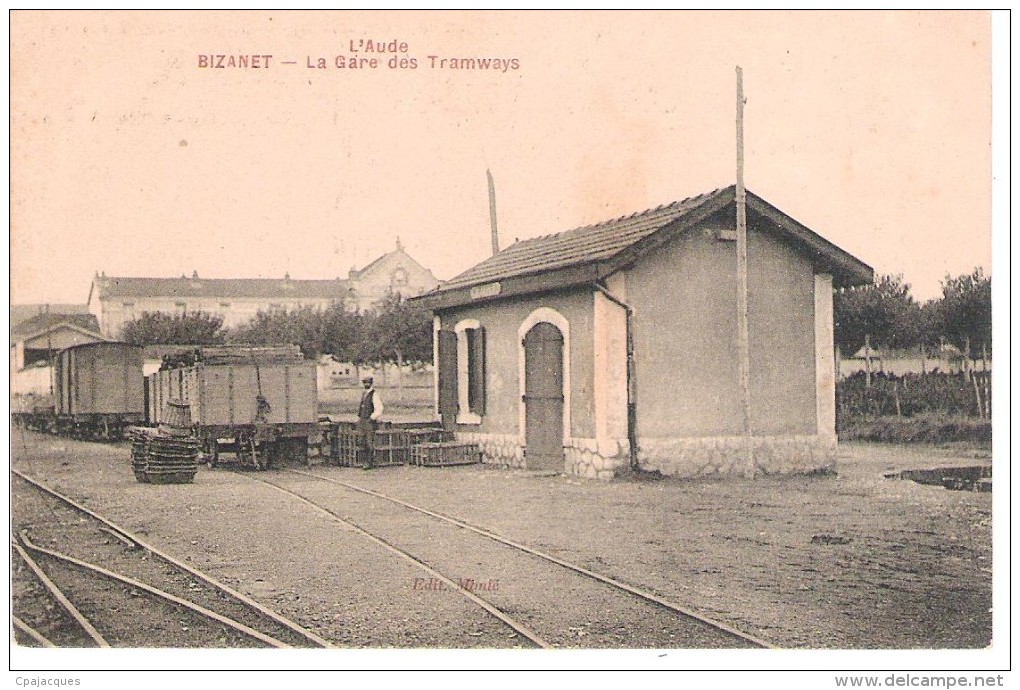
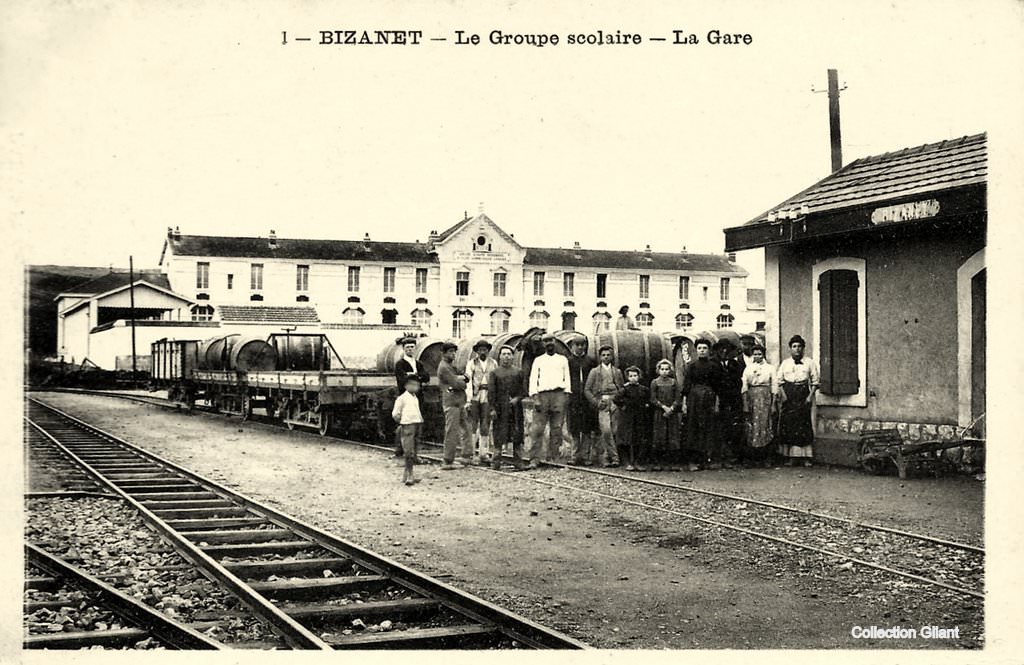
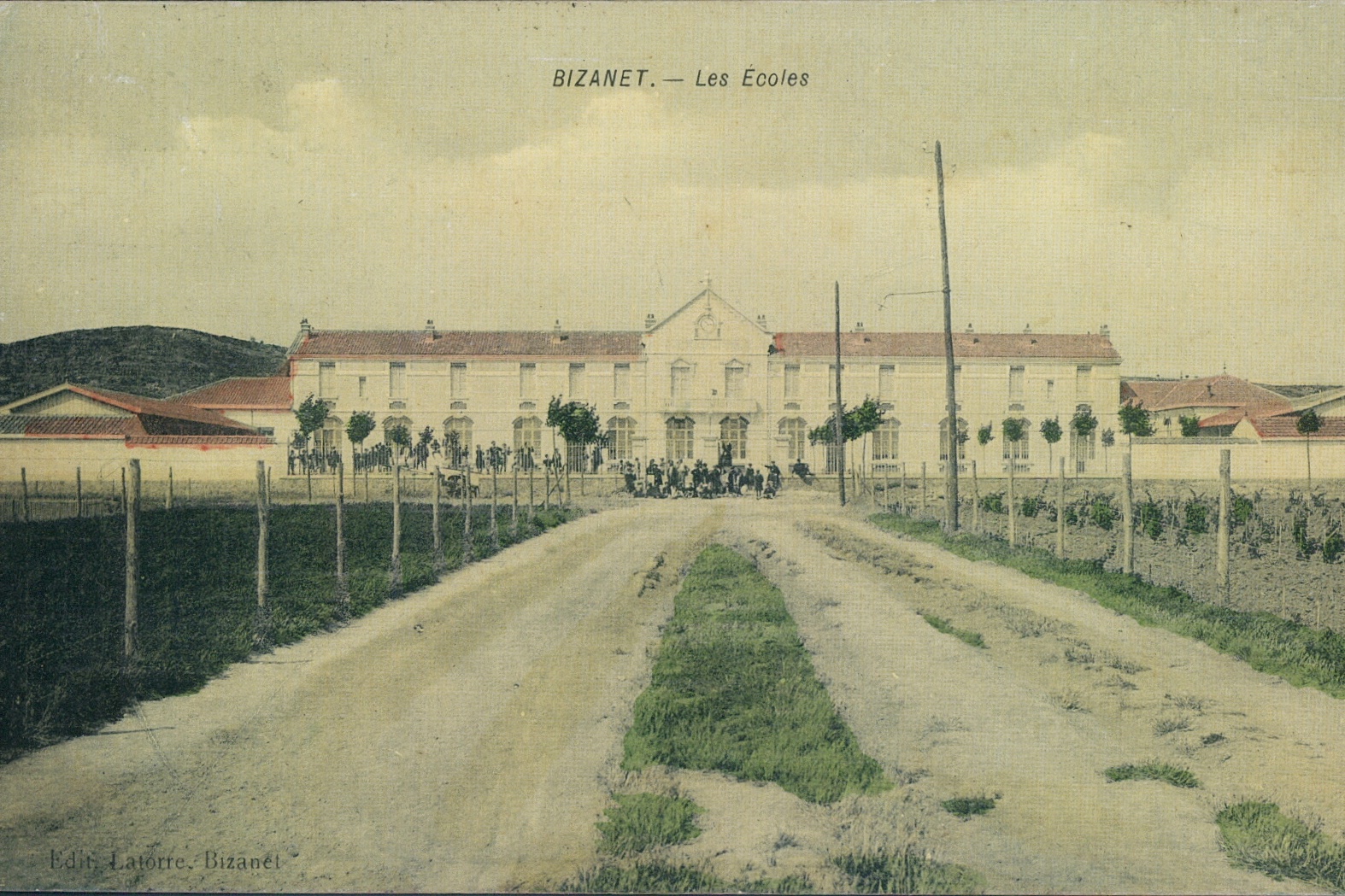
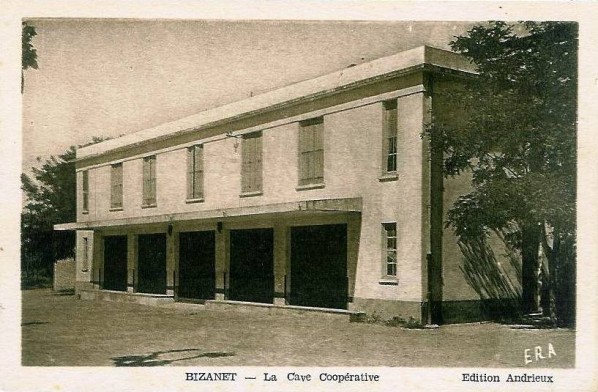
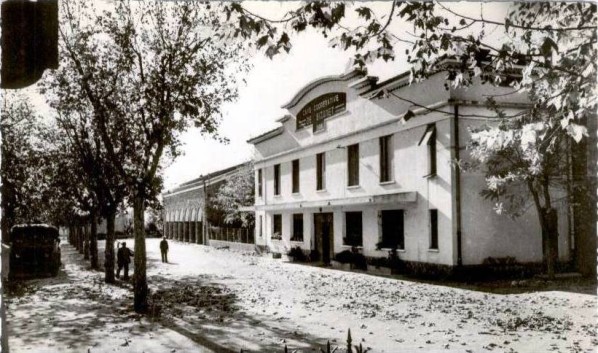
The tramway flanked the old village of Bizanet on its western side, before crossing what was a minor road, now the D224 on the West side of the village and reaching the location of the tramway station. The route of the tramway can be picked out to the western edge of this aerieal image from the 1940s. At this time, two important buildings we a little outside the village limits to the West. The Co-operative building and the School(s). [16]

The school buildings are easily seen in these two old postcard pictures of the tramway station at Bizanet.Wagons wait to be loaded adjacent to the station building with the school behind. [14]The school buildings are more easily seen in this image. [15]The station buildings were off this image to the left. [17]

The station site has been lost under the building which survives on the site and which was built in 1935 – the cooperative cellar ‘La Corbière Bizanetoise’. The next three images show that building at different times over the years. [18]The tramway passed to the West of the school grounds and then curved gradually round to the East along the line of the road known in the 21st century as the Rue de la Mouline.This satellite image shows the location of the tramway station circled in green and the approximate tramway alignment in red. These have been imposed on an image from 2016 from Google Earth. Between 1944 and 2016 the village has expanded into the area encircled by the old tramway.The tramway followed the GC12 (D224) Route de Narbonne out of the village to the East.The tramway route slipped to the South of the GC12 (D224) so as to avoid a steep gradient on the road.It then followed the southern shoulder of the highway for a few hundred metres. Before diverting away onto its own route once again as the road began to climb.The line of the old tramway can just be picked out below the road in this image.The line of the old tramway through the campsite to the East of Bizanet.The thin red line shows the approximate tramway route to the East of Bizanet including the length through the campsite. The tramway stays both South of the road and at lower altitude.This 1930s map shows the line approaching the more southerly arm of the GC12 (D613) on the South side of the more northerly arm of the GC12 (D224). On reaching the southerly arm of the GC12 (D613) the tramway crossed the road and took up a position on the southern shoulder of the road. It remained there through the halt for Montredon until close to the junction with the N113 (D6113) where it cut off the corner between the two roads and then took up a place on the southern shoulder of the N113 (D6113) heading into Narbonne.The route outlined above is shown on a more up-to-date map from Google Maps.Looking back from the D613 along the SC113 which follows the line of the old tramway.A little further to the East looking across the vineyards towards Narbonne.The modern D613 curves towards the North as the route of the old tramway continues in a northeasterly direction. This is the approximate location of the halt which served Montredon-des-Corbieres.

The tramway stayed right at this location and ran on to join the N113 (D6113) to the East of Montredon and then crossed the standard gauge line which ran East into Narbonne.The original crossing of the mainline was via a level crossing which the road and tramway shared. The old alignment can just be picked out to the East of the modern D6113 bridge over the standard gauge line.Looking back along the D6113 to the railway bridge. The old route joins the newer road from the left and then follows the D6113 towards Narbonne and on onto the Avenue de Bordeaux as the city suburbs pass by.Avenue de Bordeaux on the way into Narbonne, courtesy of Google Streetview.A sketch plan of the centre of Narbonne showing the tramway network alongside the rail network. There were three tramway routes in Narbonne, our route enters from the bottom left of the sketch. The other two lines will be for a future post. [21]The centre of Narbonne, showing the route of the old tramway from Thezan, courtesy of Google Earth.The entrance of the promenade close to the Gare du Midi in Narbonne. [19]Porte Neuve. [20]The Gare du Midi, Narbonne. [22]The Gare du Midi, Narbonne. [23]A general view of Narbonne. [24]

In the next post we will look more carefully at the tramways and the railways in Narbonne. Suffice to say, today, that we have arrived in Narbonne!

References

  1. Michel Vieux; Tramways a Vapeur de l’Aude; R. Latour Editions 14 rue Sébile 09300 Lavelanet, 2011.
  2. http://www.inventaires-ferroviaires.fr/hd11/11203.a.pdf, accessed on 15th October 2018.
  3. http://www.cpaaude.fr/THEMES/TRAMWAYS/index_fichiers/Page4306.htm, accessed on 19th October 2018.
  4. http://www.thezandescorbieres.com/train.htm, accessed on 19th October 2018.
  5. http://audephotos.over-blog.com/article-le-chateau-de-montseret-100684707.html, accessed on 30th October 2018.
  6. https://www.cparama.com/forum/montseret-t168.html, accessed on 30th October 2018.
  7. http://www.sesa-aude.fr/16-juin-2018-Montseret, accessed on 30th October 2018.
  8. http://www.thezandescorbieres.com/monseret.htm, accessed on 30th October 2018.
  9. https://www.cparama.com/forum/saint-andre-de-roquelongue-t219.html, accessed on 30th October 2018.
  10. https://album.minervois-gen.org/index.php?/category/207, accessed on 30th October 2018.
  11. https://remonterletemps.ign.fr/telecharger?x=2.837574&y=43.108009&z=15&layer=GEOGRAPHICALGRIDSYSTEMS.MAPS.SCAN-EXPRESS.STANDARD&demat=DEMAT.PVA$GEOPORTAIL:DEMAT;PHOTOS&missionId=missions.4968045, accessed on 30th October 2018.
  12. http://www.cpaaude.fr/THEMES/TRAMWAYS/index_fichiers/Page3670.htm, accessed on 30th October 2018.
  13. http://www.cpaaude.fr/THEMES/TRAMWAYS/index_fichiers/Page3577.htm, accessed on 30th October 2018.
  14. https://www.delcampe.net/fr/cartes-postales/europe/france/11-aude/autres-communes?f=keyword:bizanet-11, accessed on 31st October 2018.
  15. https://www.cparama.com/forum/bizanet-t172.html, accessed on 31st October 2018.
  16. https://remonterletemps.ign.fr/telecharger?x=2.830640&y=43.139463&z=13&layer=GEOGRAPHICALGRIDSYSTEMS.MAPS.SCAN-EXPRESS.STANDARD&demat=DEMAT.PVA$GEOPORTAIL:DEMAT;PHOTOS&missionId=missions.4969258, accessed on 1st November 2018.
  17. http://mediatheque.bizanet.over-blog.com/album-1766335.html, accessed on 30th October 2018.
  18. http://www.cavescooperatives.fr/article-bizanet-aude-51251585.html, accessed on 1st November 2018.
  19. https://www.delcampe.net/fr/collections/cartes-postales/france/narbonne/536-narbonne-entree-de-la-promenade-neuve-wagon-de-tramway-646301284.html, accessed on 1st November 2018.
  20. https://www.geneanet.org/connexion/?from=view_limit_redirect&url=https%3A//www.geneanet.org/cartes-postales/view/5928211, accessed on 1st November 2018.
  21. http://www.cpaaude.fr/THEMES/TRAMWAYS/index_fichiers/Page1963.htm, accessed on 2nd November 2018.
  22. https://www.delcampe.net/fr/collections/cartes-postales/france/narbonne/cpa-narbonne-la-gare-chemin-de-fer-34-herault-transport-484452183.html, accessed on 2nd November 2018.
  23. https://picclick.fr/10887967-Narbonne-Narbonne-la-Gare-x-323499958215.html, accessed on 2nd November 2018.
  24. https://picclick.fr/10818350-Narbonne-Narbonne-x-323396587096.html, accessed on 2nd November 2018.


Tramways de l’Aude – Ripaud to Port La Nouvelle via Portel

The previous two posts in this series about Les Tramways de l’Aude both finished their journeys at Ripaud. These posts can be found at:

https://rogerfarnworth.com/2018/10/19/tramways-de-laude-les-palais-to-ripaud, and

Tramways de l’Aude – Tuchan to Ripaud via Durban

This post continues the journey to the coast from Ripaud, via Portel-des-Corbieres, Sigean and La Nouvelle. The route is shown in the featured image above.

In the last two posts we have seen glimpses of a model made of Ripaud station and its environs by Pascal Deschamps and Christophe Salle. The images which follow are taken from three different websites. The model gives a really good impression of what the Tramways de l’Aude were like in their later years. [1][2][3] The model is in HOm Scale. Ripaud Station  was a junction station. The two lines seen entering the sketch below from the left come from Les Palais and Durban. The line leaving the sketch on the right heads for La Nouvelle.We have already seen, in other posts, some images of the station and its environs in the early 20th century, but these bear repeating here alongside some matching modern images taken at the location.The inn at Ripaud. [4]The inn at Ripaud. The tramway from Durban enters from the bottom right, the tramway from Les Palais enters from the bottom left. [4]The Engine Shed with the station building just in shot on the right and a tram in the station. [5]The engine shed in 2003. [6]The last remaining vestige of the station appears to be this short section of retaining wall which appears in a number of the pictures above!

After quite an intense focus on Ripaud we head on along the tramway towards the coast. The route follows the valley of La Berre and the GC3 (D611A) past the small village of Gleon and on towards Portel-des-Corbieres.The GC3 (D611A) and the old tramway route follow the valley side towards Portel. Trams travelled on the shoulder of the road adjacent to the drop to the River Berre.

After Les Campettes (today, Les Campets) the GC3 (D611A) left the riverside to follow a more direct route to Portel.Along the full length of this journey the tramway remained on the South Side of the GC3. Just before arriving at Portel, the GC105 (D611A) separated from the tramway route which continued to follow the GC3 (D3) into the centre of the old village.

The station was located in front of the Rocbère cooperative cellar. A sign indicating a speed limit of 8km/hr still remained in 1947 at the entrance to the village at the crossroads.  Single track rails were laid directly in the cobbled roads because it was not until 1920 that the first asphalting was seen. Portel station allowed for trains to pass. There was only a relatively sparce service on the line. The winter 1928-1929 passenger schedules were as follows: from Ripaud to La Nouvelle, the trams passed through Portel at 6:32 am and 3:18 pm; the return journey saw trams at 8:29 am and 5:59 pm. [7] A tram trundles through Portel on Avenue de la Gare. [7]The same view in 21st Century. The building on the left is the post office.

The tramway passed through Portel on the GC3 on an approximately North-South axis. The station location is not obvious on the 1930s Michelin map above, nor on the adjacent 1946 aerial photograph. I understand that it was North of the village and so may well have been at the location at the top of the aerial photograph where the road opens out.

If anyone has better information, I would really appreciate hearing from them!


The tramway in front of the Town Hall. [8]The same location in the early 21st Century.

As the tramway left Portel it crossed La Berre on a single-span arch bridge.A tram crosses the bridge at Portel travelling towards La Nouvelle. [12]A similar view of the bridge at Portel. [9]A view of Portel and its bridge from the South bank of La Berre. [10]The kind of blue sky (above) that we expect from the South of France. [11]

After crossing the bridge  across La Berre (shown in plan in the adjacent satellite image), the tramway and the GC3 (D3) headed southeast.

The modern road at times smooths out the tighter bends on the old GC3.

The first image below is typical of very minor deviations with the old road (and tramway route) now being used as a lay-by and picnic site.

However, just a little further to the Southeast the deviations from the modern road are more pronounced as the maps below show.The old road and the tramway route deviate from the modern D3 to the Southeast of Portel.The route of the old GC3 and the associated tramway deviate again from the modern D3. Not surprising, as the old route is now blocked by the line of the A9/E15 Autoroute – Le Catalane.

Along the length of the GC3 to Sigean the tramway followed the North shoulder of the road. The town is so much larger than when the tramway was in use. The route through the countryside to the West of Sigean has been overwhelmed by the town’s suburbs.

On entering the town, the tramway followed the route indicated on the satellite image below. The pink line is sketched onto the image by hand and is therefore only approximate.The aerial image below was taken in 1942 sometime after the closure of the tramway. The dogleg inntye tramway route can easily be picked out.The tramway ran across the South side of the old village of Sigean along the Avenue de Narbonne and the Route de La Nouvelle.The first of a few images of the line through Sigean. [13]From a similar location close to the station. [13]A later monochrome image after the closure of the tramway also looking West along Avenue de Narbonne. [13]An image from roughly the same location but in the 21st century.An early image from approximately the same location [13]The tram arriving from Portel. [13]The same location in the 21st Century.A tram leaving in the direction of Portel. [14]Another tram leaving for Portel. The view is taken, this time, from the West. [13]This view shows a tram heading the other way – towards La Nouvelle. [13]The route East of Sigean crosses the main standard gauge line near La Nouvelle and then passes through La Nouvelle before reaching Port La Nouvelle.

A few kilometres to the East of Sigean, the tramway and road crossed the River Rieu on a three-arch stone viaduct. The road between Sigean and La Nouvelle was the N9, today it is the D6139. The modern road splits as it approaches Le Rieu. East-bound traffic crosses the old bridge and West-bound traffic uses a new concrete structure to the North of the old bridge.The old bridge is under the traffic lane to the right in the above picture.The ‘Pont du Rieu’ which is to the East of Sigean. The picture is taken from the North. [13]The same bridge from the South. [15]The old bridge taken from a vehicle travelling over the Northern bridge which carries Westbound traffic.

From Le Rieu, which links into the series of lakes close to the coast through which the waters of La Berre flow, the tramway and the N9 (D6139) head for La Nouvelle and its port.  It appears that the tramway followed the N9 almost all the way to the station entrance. Jut before crossing the Standard Gauge line the N( turned south and the tramway followed the road which accessed the port, village and beach at La Nouvelle. The photo below shows the route of the tramway which was under the modern D6139.The N9 is the road shown on the image below entering top left and turning sharply to the south.An aerial image from 1946. [15]OpenStreetMap shows that quite a bit has changed in the road layout In La Nouvelle and to its Northwest. The tramway followed what is now known as Avenue Charles Palauqui. [18]

The old NP has become the D709 and the image immediately below shows that modern road on its approach to the point where the tramway turned into the village of La Nouvelle.The picture below shows the road (D3) crossing the Standard-Gauge line in 21st century. The tramway curved away to the right to make its approach to the terminus station before reaching this rail crossing. It crossed the standard-gauge line at level off to the right of the picture.The next picture shows the point at which the Gare du Midi (and the tramway station) access road left the road running down to the beach. The station access is to the right in the photo. The branch of the tramway leadign to the beach crossed the picture in front of the curved wall of the building close to the centre of the image and then headed off the top left of the picture.The terminus station adjacent to the Gare du Midi, it seems clear to me, from the sketch plan that passenger services took a secondary place in the life of the tramway. Goods were more important. The road junction at the right-hand end of the sketch-plan is the one shown in the Google Streetview image directly above the plan. [17]The very approximate line of the tramway is shown by a thin red line on the above image. The station was adjacent to the Gare du Midi and formed a terminus for the tramway with a branch heading back out of the station to the beach. This short branch saw the greatest passenger use across the whole network! [15]

These next images are from the area around the Gare du Midi and the tramway station.A view of the station site from the West.  The Gare du Midi is visible with a standard-gauge train nearer the camera. The narrow-gauge tramway station was behind. [17]The Gare du Midi passenger facilities are shown on the right of this picture the building ahead is part of the goods handling facilities for the standard-gauge line. The track shown in the front-left of the image is one of the sidings of the Tramways de l’Aude. [19]The three images directly above show the Gare du Midi. [20][21]

The following images focus more one the Tramways de l’Aude, its station buildings and traffic.The three monochrome images immediately above show the Tramways de l’Aude facilities at La Nouvelle. The first two are taken from the North the last is taken looking from the South with the Gare du Midi just off shot to the left. Interspersed with these images are two modern pictures taken to illustrate the present condition of the site and to show that the tramway passenger building still remains. [17]

A short branch ran from the terminus out along the Quai du Port and the Avenue de la Mer to the lighthouse at the end of the harbour wall.The two images immediately above are taken from roughly the same position on Avenue de la Mer!The Tramway can be seen in the forefront of this image of the Quai. [23]A tram trundles along the branch heading for the Gare du Midi. [16]The same buildings but taken from the road rather than the Quai.A view looking West along Avenue de la Mer. [19]This is the nearest Google Streetview can get to showing the same image!The lighthouse at the end of the harbour wall. The tramway travelled right out to the end of the wall. The two images above are very similar but they are not the same! [16]

The images below show the light-house today. The first is the cloest I have been able to find to the angle of the pictures above.This image (above) is the one used as the record image on the internet listing of France’s lighthouses! [24]

The adjacent image is taken from on top of the sea wall. [25]

The image below is the last image in this post and shows an aerial view of the old tramway route from the lighthouse and then curving back along the Avenue de la Mer, before reaching the Quai du Port and the tramway station close to the image horizon! The beaches at La Nouvelle were and are partciularly popular. Fr the short period of the existence of the Tramways de l’Aude income from this short branch was significant. If only that had been true for the rest of the network! [26]


References

  1. http://objectif-trains.com/tramways-de-laude, accessed on 25th October 2018.
  2. https://tramways-aude-miniature.webnode.fr/ripaud, accessed on 20th October 2018.
  3. http://www.montelirail.fr/Tous-les-Reseaux-2018-M2_1.68.html, accessed on 25th October 2018.
  4. http://www.cpaaude.fr/THEMES/TRAMWAYS/index_fichiers/Page2764.htm, accessed on 20th October 2018.
  5. http://www.cpaaude.fr/THEMES/TRAMWAYS/index_fichiers/Page2764.htm, accessed on 20th October 2018.
  6. http://forum.e-train.fr/viewtopic.php?f=4&t=40082&start=60, accessed 20th October 2018.
  7. https://www.lindependant.fr/2014/09/14/quand-le-tramway-circulait-sur-l-avenue-des-corbieres,1929254.php, accessed on 26th October 2018.
  8. https://www.geneanet.org/cartes-postales/view/1489269#0, accessed on 26th October 2018.
  9. https://www.tripadvisor.co.uk/LocationPhotoDirectLink-g1221593-d1532261-i209014308-Relais_De_Tamaroque-Portel_des_Corbieres_Aude_Occitanie.html, accessed on 26th October 2018.
  10. http://renovhabitat.legrandnarbonne.com/1048-photos/3881-portel-des-corbieres-credit-photo-jean-belondrade.html, accessed on 26th October 2018.
  11. https://www.booking.com/hotel/fr/relais-de-tamaroque.fr.html?aid=356983;label=gog235jc-hotel-XX-fr-relaisNdeNtamaroque-unspec-gb-tab-L%3Afr-O%3Aandroid-B%3AandroidSwebkit-N%3AXX-S%3Abo-U%3AXX-H%3As;sid=b0566469f8863f77cde47733a9d9380a;dist=0&keep_landing=1&sb_price_type=total&type=total&, accessed on 26th October 2018.
  12. https://www.midilibre.fr/2011/08/04/le-pont-de-tamaroque-a-desenclave-la-commune,366144.php, accessed on 26th October 2018.
  13. https://www.delcampe.net/fr/cartes-postales/europe/france/11-aude/sigean?f=moyens-de-transport:tramway, accessed on 27th October 2018.
  14. https://openagenda.com/jep-2017-occitanie/events/la-tramway-de-l-aude, accessed on 26th October 2018.
  15. https://remonterletemps.ign.fr, accessed on 28th October 2018.
  16. https://cascastelchateau.fr/les-tramways-de-laude, accessed on 28th October 2018.
  17. http://www.cpaaude.fr/THEMES/TRAMWAYS/index_fichiers/Page3478.htm, accessed on 29th October 2018.
  18. https://www.openstreetmap.org/search?query=La%20Nouvelle%20aude#map=16/43.0183/3.0423, accessed on 28th October 2018.
  19. https://www.cparama.com/forum/la-nouvelle-t84-20.html, accessed on 27th October 2018.
  20. https://www.delcampe.net/fr/cartes-postales/europe/france/11-aude/port-la-nouvelle?f=lieux:gare, accessed on 29th October 2018.
  21. https://www.google.co.uk/search?sa=G&hl=en-GB&q=JPEG&tbm=isch&tbs=simg:CAQSlwEJENL1BiSNLbMaiwELEKjU2AQaBAgVCAMMCxCwjKcIGmIKYAgDEij-A9cKlg3gAtkKigO2DbgN2grlHuI50CvjOM8r6znkOMorzSvqOMwrGjA2bms8w4xONqNoGh_1spsaQdLb8Z1Oq0rqFfrLFGDo8dtaWxhKqI0H2WnQKaWo-NjUgBAwLEI6u_1ggaCgoICAESBEm_1nq8M,isz:m&ved=0ahUKEwjHg7bry6veAhWCESwKHaKBAxgQ2A4ILSgC&biw=1345&bih=865#imgrc=Cf7MJPy4Kj0SXM:, accessed on 29th October 2018.
  22. https://www.tripadvisor.com/LocationPhotoDirectLink-g1025646-d12318071-i345268003-Le_Phare_de_Port_la_Nouvelle-Port_La_Nouvelle_Aude_Occitanie.html, accessed on 29th October 2018.
  23. https://www.geneanet.org/connexion/?from=view_limit_redirect&url=https%3A//www.geneanet.org/cartes-postales/view/6259095, accessed on 25th October 2018.
  24. http://www.lighthousesrus.org/showSql.php?page=Med/FranceS, accessed on 29th October 2018.
  25. https://www.ibiblio.org/lighthouse/fras.htm, accessed on 29th October 2018.
  26. https://www.gettyimages.co.uk/videos/la-nouvelle?sort=mostpopular&offlinecontent=include&phrase=la%20nouvelle, accessed on 29th October 2018.