Category Archives: The North East

The Stockton & Darlington Railway

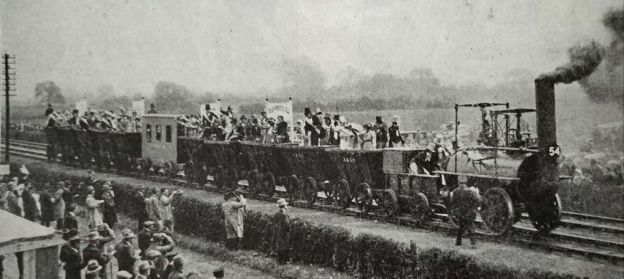
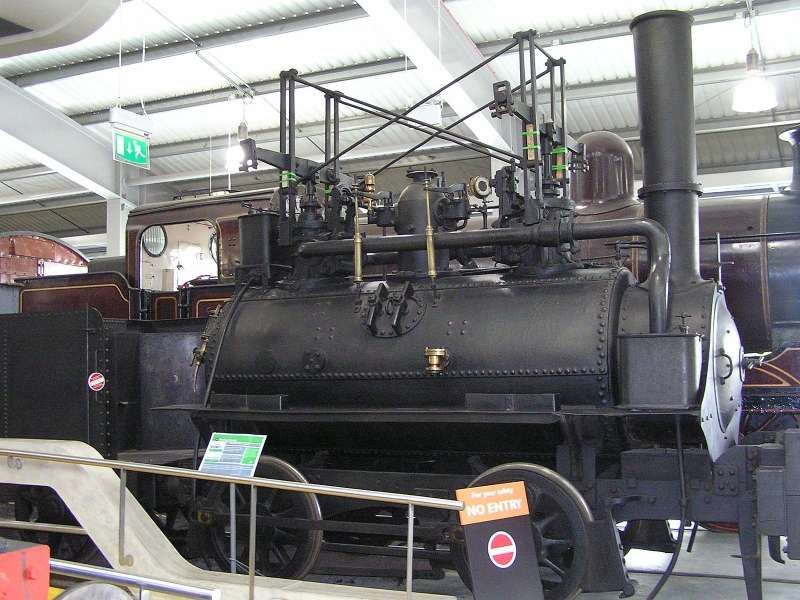
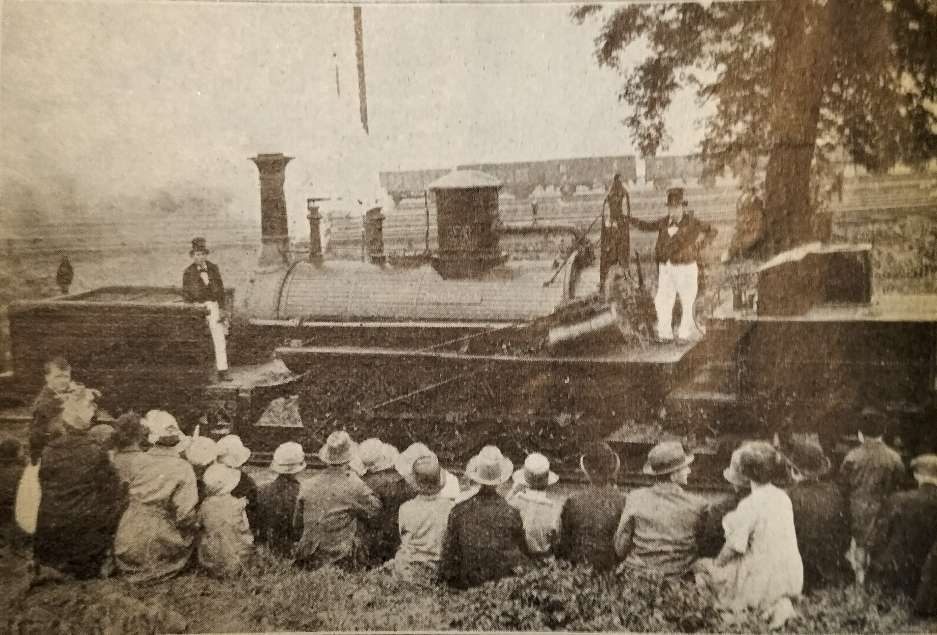
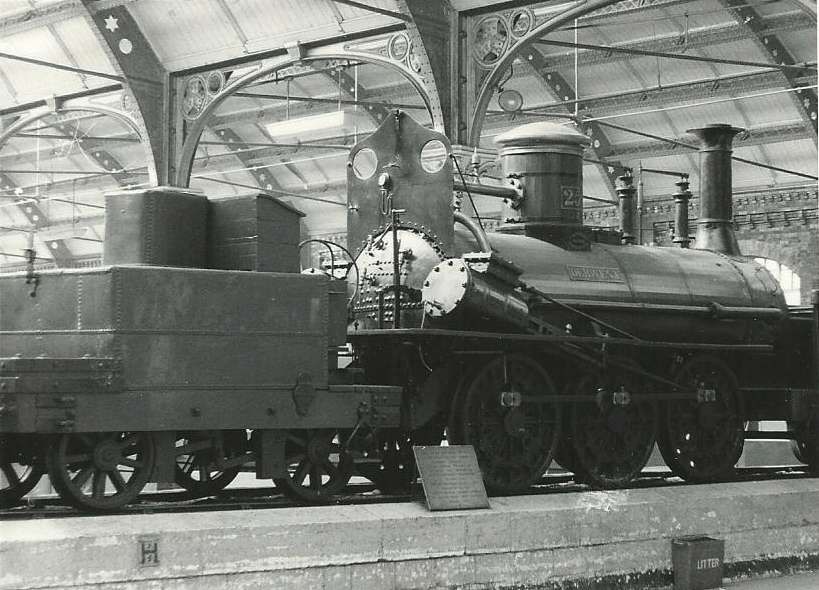
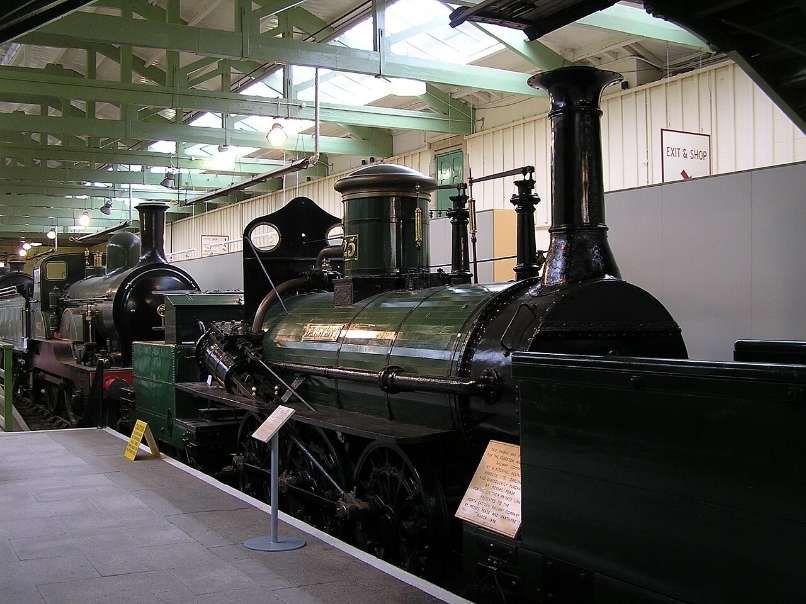
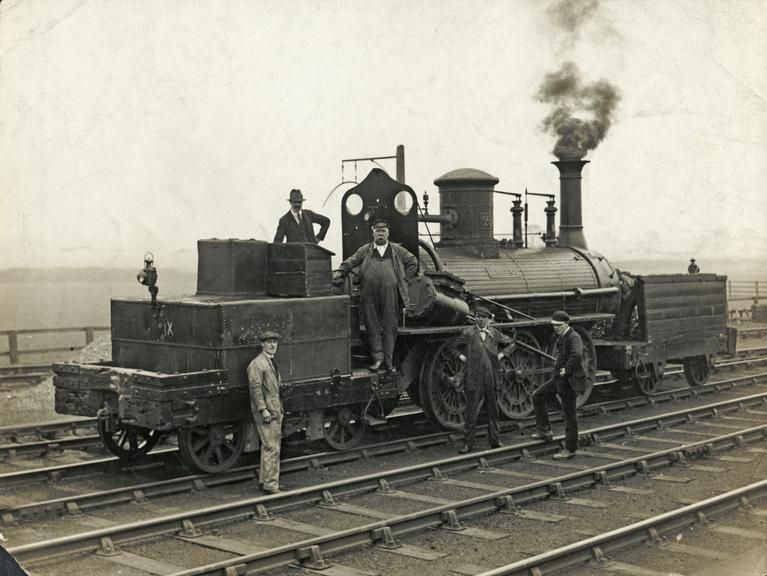
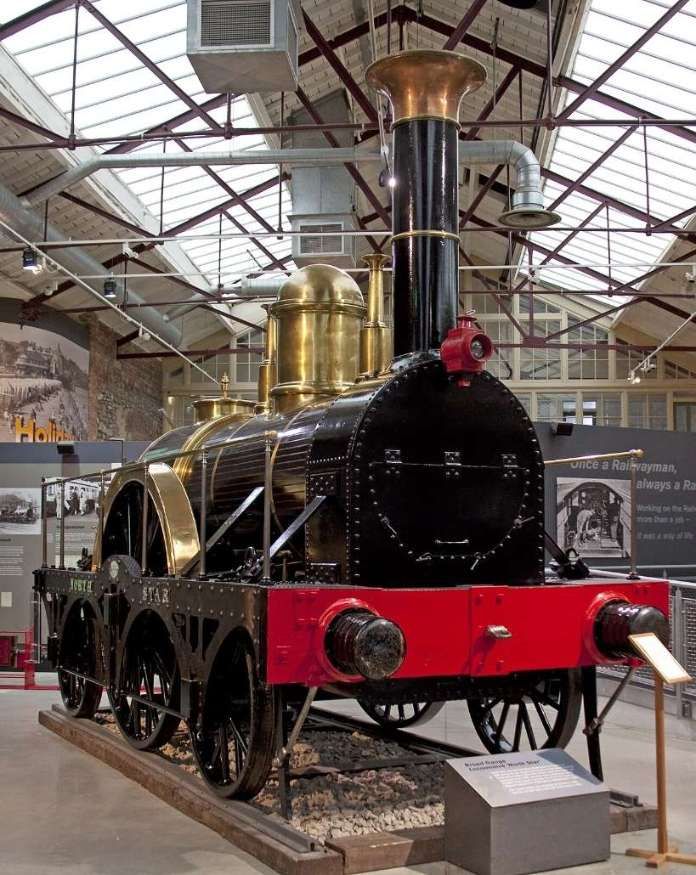
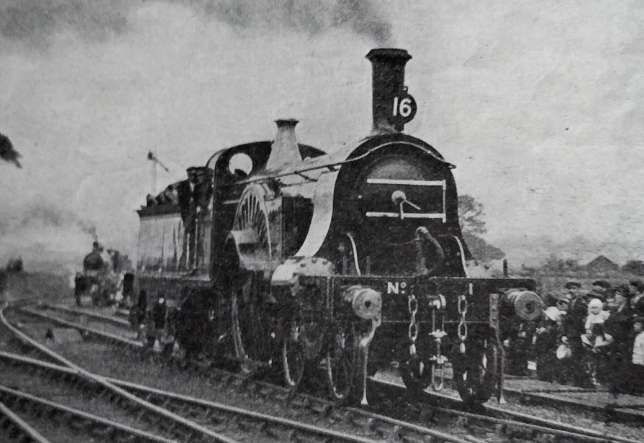
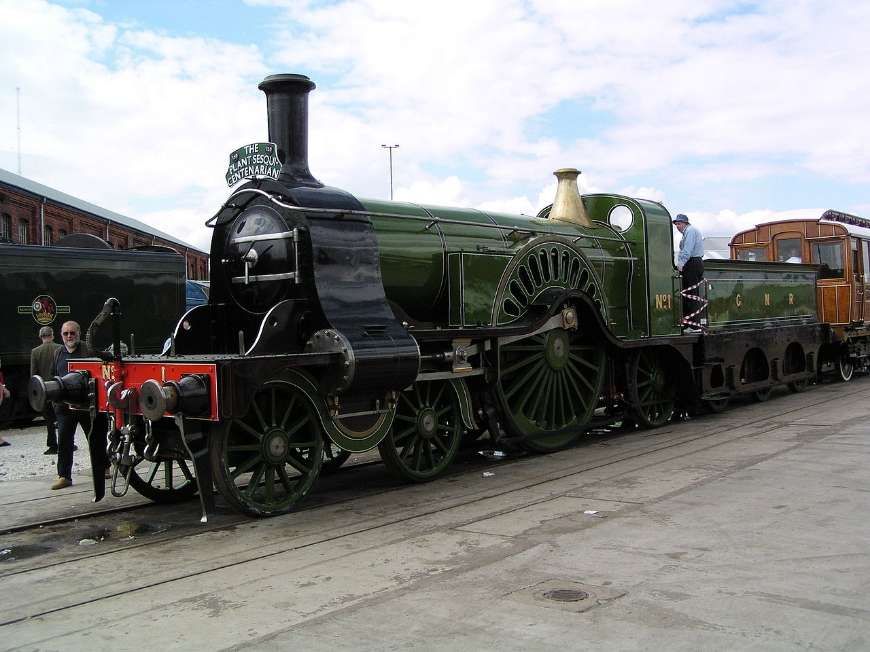
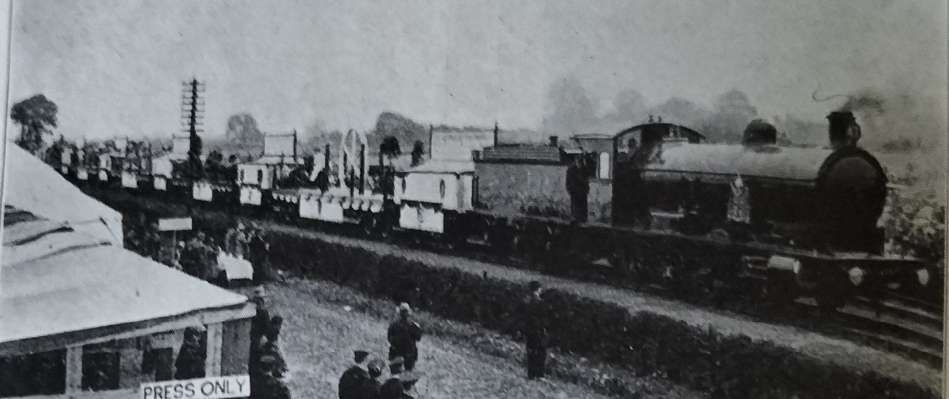
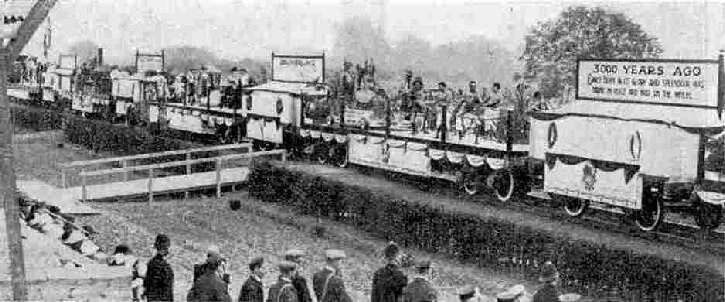
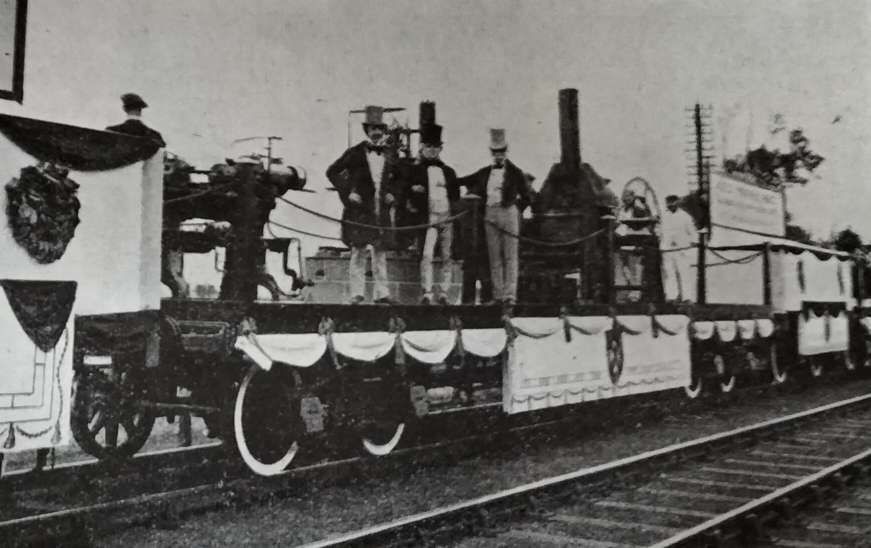
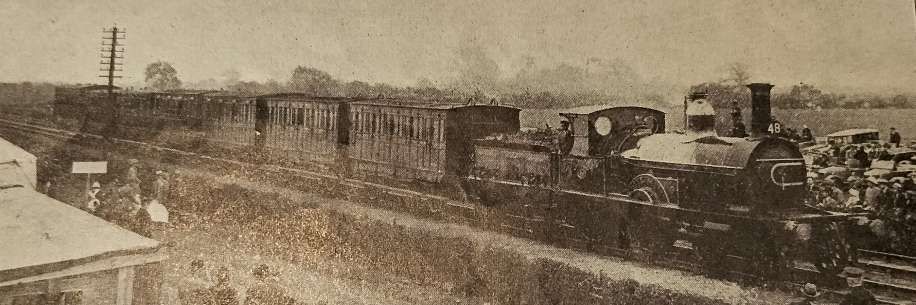
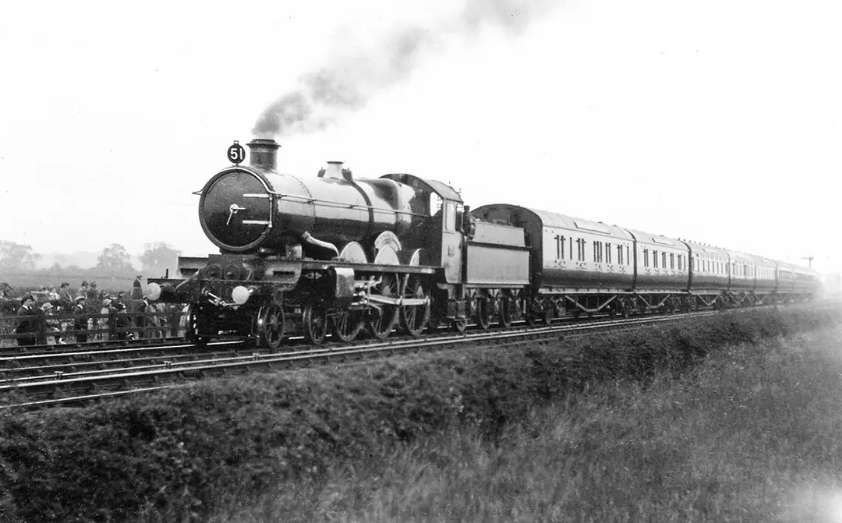
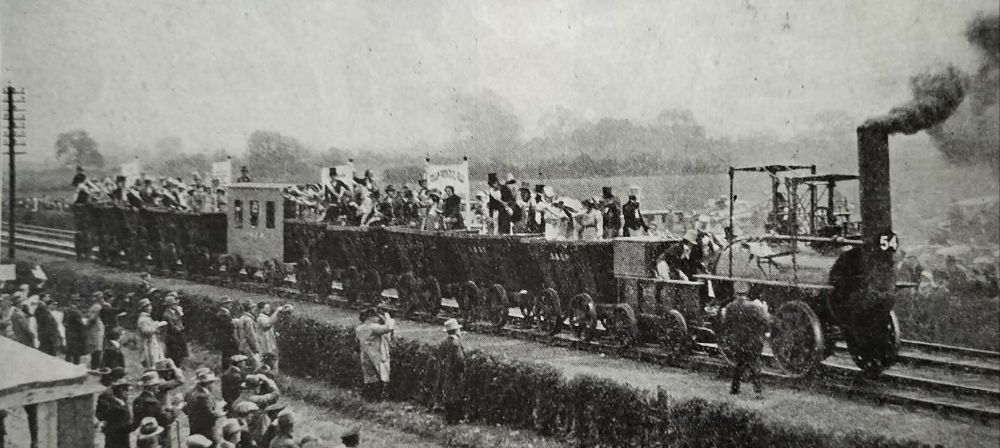
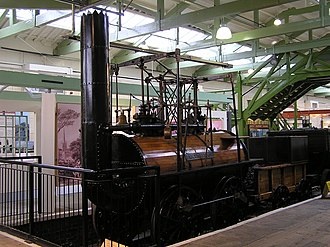
On 27th September 2025 we marked the bicentenary of the Stockton & Darlington Railway which is accepted the world over as one of the most significant developments in the history of railways, the precursor of all that was to follow in the development of railway networks throughout the world. That day, Locomotion No. 1 (a replica appears in the featured image above) pulled a long train along the Stockton and Darlington Railway. …………

The logo for the series of events across the country to mark this significant anniversary. [46]

Andrew Wilson, writing in 2002, said that the Stockton & Darlington Railway (S&DR) “was incorporated in 1821. With the line from Stockton to Shildon opening on 27th September 1825. The S&DR became the world’s first steam-operated railway, although passenger services were initially horse-drawn; regular steam-powered passenger services commenced in 1833. In 1843 the line was extended to Bishop Auckland, and Barnard Castle was reached in 1856. Additional lines were soon planned, and one of these the South Durham & Lancashire Union Railway sought to link Bishop Auckland and Tebay so that coke from the Durham coalfields could be easily moved to the Furness ironworks, and iron-ore moved back to Cleveland.” [1: p13]

The Institution of Civil Engineers says that “The Stockton and Darlington Railway (S&DR) was the first passenger railway to use steam trains to transport passengers.” [4] The Company started operations at the end of September 1825 and was eventually taken over by the North Eastern Railway in 1863 when “it consisted of 200 route miles (320km) and around 160 locomotives.” [4]

Network Rail says: “On 27th September 1825, the world’s first passenger train, hauled by George Stephenson’s Locomotion No.1, carried more than 400 people along the Stockton and Darlington Railway. The landmark event drew crowds of up to 40,000 people and marked the birth of modern passenger train travel.” [46]

Darren Caplan, chief executive of trade body the Railway Industry Association, said: “It is hard to overstate the benefits that the railway has brought, and continues to bring, not just to the UK, but also globally, since 1825. Rail networks don’t just keep people connected, they also play a crucial role in spurring economic growth, creating jobs, boosting sustainability, and bringing together local communities.” [46]

The Encyclopedia Brittanica speaks of the S&DR as “first railway in the world to operate freight and passenger services with steam traction.” [6]

The Friends of the Stockton & Darlington Railway say that the S&DR “demonstrated to the wider world that such a railway could be a technical and financial success. The S&DR made possible the railways that were to follow such as the Liverpool & Manchester Railway. … It was therefore the birthplace of the modern railways that we know today.” [5]
Asked, ‘What’s so special about the S&DR?’ Neil Hammond, the Chair of the Friends of the Stockton & Darlington Railway, said, “We would argue that it’s the railway that got the world on track.” [7]

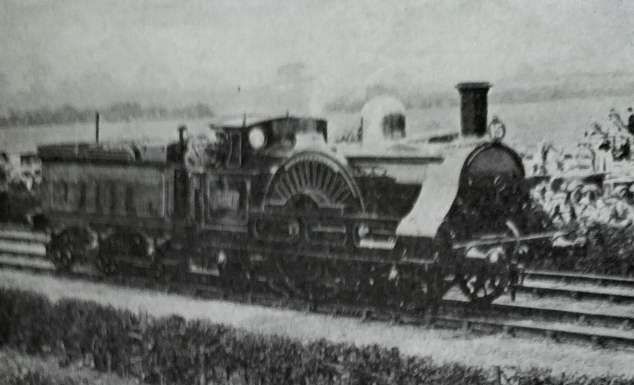
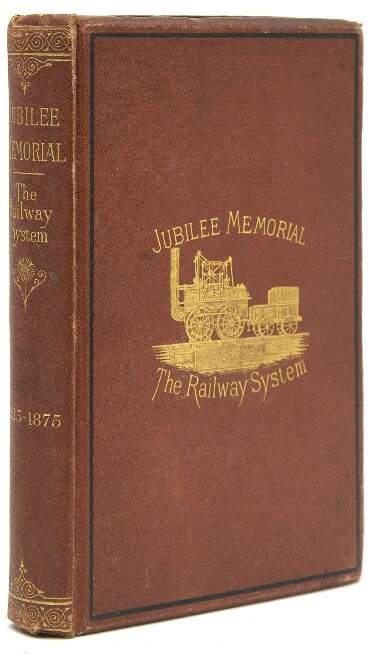
J. S. Jeans, writing in 1875, somewhat effusively called the S&DR, “the greatest idea of modern times.” [9] (His book appears in the adjacent image.)

According to Hammond, the S&DR, for the first time, brought together various elements of engineering and ideas for what a railway could be, which gave the rest of the world a blueprint for how to build a recognisably modern railway. Anthony Coulls of the National Railway Museum said that, “It set the DNA for the railway system.” [7]

From the outset, it was much more than just a way of conveying coal, unlike many of the other early railways. Transport of other goods and regular passenger services were intrinsic to its operation and purpose. “It used a combination of horses, stationary steam engines and steam-powered locomotives to pull wagons along its 26 miles, from the coalfields of County Durham to the port on the River Tees at Stockton, via the then-village of Shildon and market town of Darlington. Signalling systems, timetables and the idea of stations were all developed by the S&DR.” [7]

While there had been earlier wooden waggonways, metal plateways and the use of steam engines, it was the coming together of engineering excellence with the motivation, vision and financial backing, mainly from Darlington’s Quaker families, in particular Edward Pease, which made the S&DR a significant milestone in the creation of what we now think of as the modern railway system. It required business people to recognise the potential role of the railway for communities and businesses beyond the mineral industries and to invest in a service that anyone (the public) could buy into and make use of. In return, unlike earlier mineral waggonways, the rail infrastructure would be a permanent fixture with a regular service linking populated areas and so attract additional businesses and industries resulting in population growth and movement. … By 1830, the S&DR was already a network of main and branch lines and had demonstrated to others building railways elsewhere in the UK and abroad, the model of a permanent, profitable steam powered public railway.” [8]

Coulls said that “Engineers travelled from across Britain and the world to see the the railway in action, to replicate its successes and learn from its mistakes. Bigger railways, such as the Manchester to Liverpool line, followed soon after and within a decade there was a global ‘railway mania’, akin to the rapid development and impact of the internet in the 20th Century.” [7]

He continued: “The S&DR was not the first railway and it was rapidly eclipsed. But it proved the practicality of the steam locomotive pulling trains over long distances.” [7]

There have been quite a number of detractors over the years and questions have been raised about the true place of the S&DR in railway history. As Coulls said, “it was not the first railway and it was rapidly eclipsed.” [7]

What we do know is that at least 400 people (maybe 600) travelled by train on the Stockton and Darlington Railway on 27th September 1825 and we know that around 40,000 people turned up to witness the event. [46] What is it that makes that event remarkable enough to be seen as the moment that the modern railway was born?

Lets first, make sure that we have understood the story on the Stockton & Darlington Railway Company: …

A Short History of the Stockton & Darlington Railway

Coal Reserves in Co. Durham
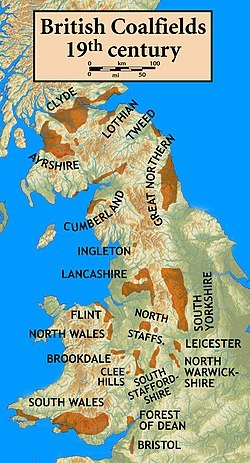
Coalfields in the United Kingdom in the 19th century. [103]

The Durham Coalfield is continuous with the Northumberland Coalfield to its North. It extends from Bishop Auckland in the South to the boundary with the county of Northumberland along the River Tyne in the North, beyond which is the Northumberland Coalfield. [106]

The two contiguous coalfield areas were often referred to as the Durham and Northumberland Coalfield(s) or as the Great Northern Coalfield. [108]

Three major ‘measures’ of Coal exist(ed) in the Durham Coalfield:

Upper (Youngest) Coal Measures: Hylton Castle Seam. [103]
Middle Coal Measures: Dean, Hebburn Fell, Usworth, Ryhope Five-Quarter, Ryhope Little, High Main, Metal, Five-Quarter, Main, Maudlin, Durham Low Main; Brass Thill, and Hutton Seams. [103]
Lower (Oldest) Coal Measures: Harvey, Tilley, Busty, Three-Quarter, Brockwell, Victoria, Marshall Green and Ganister Clay Seams. [103]
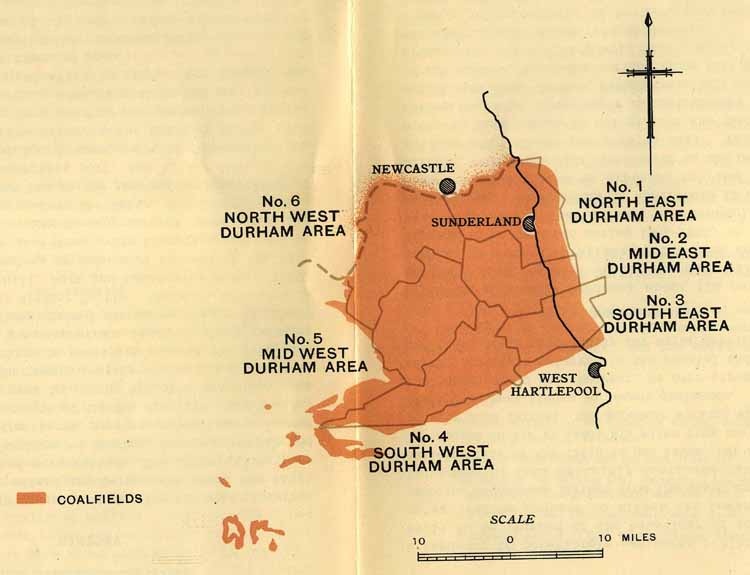
A closer focus on the Durham Coalfield: from a pamphlet printed by the National Coal Board in the 1950s, courtesy of ‘Mining History UK’, www.mhuk.org.uk. [106]
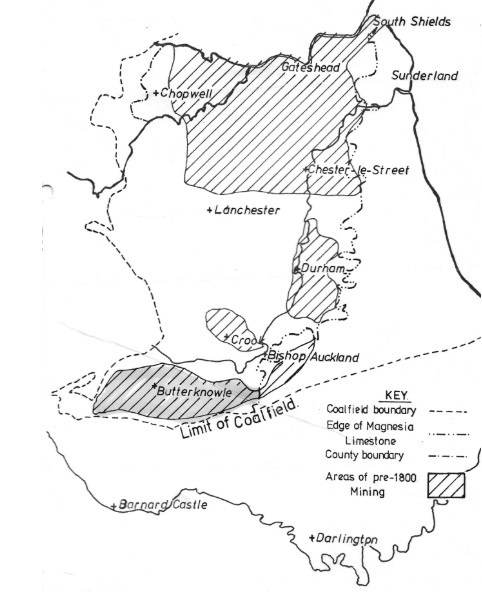
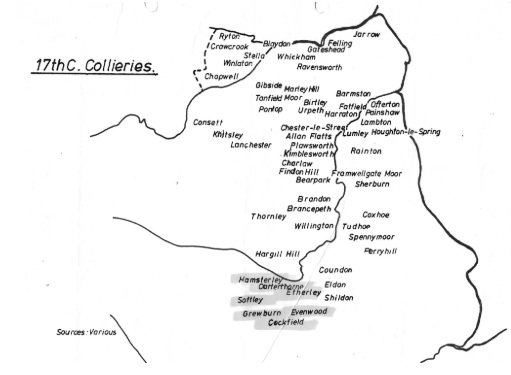
Early Collieries tended to be sited as close as possible to major rivers. This is true of the Durham Coalfield – along both the Tyne and the Wear. The Tees appears bottom-right in this sketch map and was outside the extent of the Durham coalfield. [104]
The Durham Coalfield: showing the mining areas developed before 1800. Proximity to river courses was paramount in keeping transport costs as low as possible. It is noticeable again that the River Tees and Stockton and Darlington were well outside the coalfield to the South. [104]
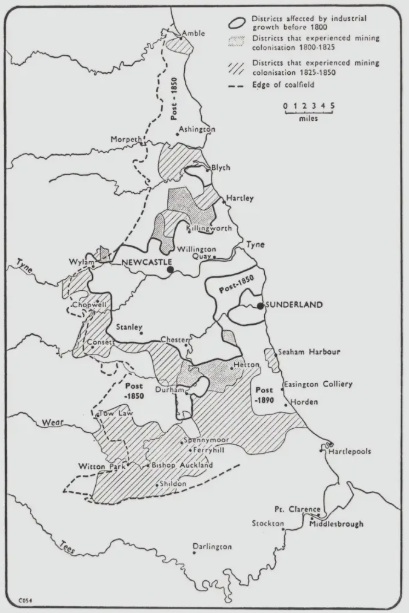
This drawing highlights the extended areas of coal mining in 1800-1825 and 1825-1850. The areas concerned remain significantly to the North of the River Tees (and, indeed, Darlington and Stockton). [104]
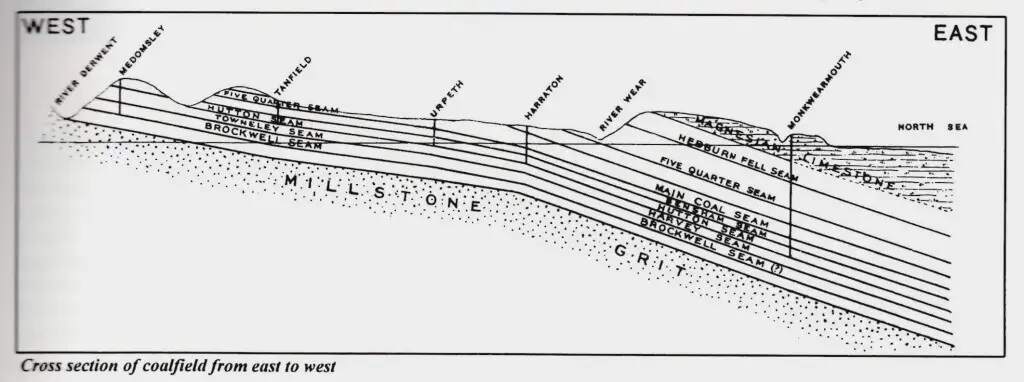
A cross-section of the Coalfield looking North. [104]

THe UK was the first country to develop its coal resources to any appreciable extent. The Durham Coalfield was among the first to be worked. The initiative came largely from the Bishops of Durham. The accounts of the See of Durham between 1274-1345 include a reference to the profits of the Bishop’s coalmines. By the middle of the fourteenth century mining had become well established at Whickham and Gateshead on the south side of the Tyne. “In 1366-1367 coal from Winlaton was bought by Edward III for the works at Windsor Castle. Coalpits were also in operation at Ferryhill, Hett and Lanchester before 1350. However, the cheapness of transport enjoyed by the pits close to the rivers gave them a big advantage and even at the beginning of the seventeenth century, almost all the large collieries were along the Tyne. Development of the Wear valley reserves led to the increasing importance of Sunderland as an exporting port, and by the time of the Civil War, the town had become, next to Newcastle, the biggest centre of the trade in the British Isles. The growth in the trade from the Tyne was phenomenal. In the year ended at Michaelmas, 1564, almost 33,000 tons of coal were shipped from Newcastle: in 1685, the tonnage was 616,000 almost 19 times as much.” [106]

Development of the industry in South Durham did not lag much behind the rest of the County. “As far back as the fourteenth century, part of the Bishopric of Durham south of Bishop Auckland was being successfully worked for coal. The Upper Wear Valley between Durham City and Bishop Auckland was in the Middle Ages the most populous part of the county because of the lead mines in the district. The coal consumed came from small workings sprinkled all through the valley and J. U. Nef, in his book ‘The Rise of the British Coal Industry’, estimates that by the middle of the seventeenth century there must have been twenty or thirty pits within an area of about 150 square miles. Every manor of any size had its own pits.” [106]

In more recent times, production from the Durham coal mines increased from about 26 million tons in 1877 to the highest recorded figure of almost 56 million tons in 1913. Just after the 1st World War there were 170,000 miners at work in the Durham coalfields. Since then, however, production has declined significantly. By the late 20th century production, with the closure of mines during the middle years of the century, production fell rapidly. The last mine in the Durham Coalfield closed in 1994. [107] The last in the Northumberland Coalfield (Ellington Colliery) closed in 2005. [108]

A few things to note:-

  • Coal Output – according to Sunnyside Local History Society, prior to the introduction of tramroads and then railways the combined output of the Northumberland and Durham coalfields was around 2,000,000 tons of coal per annum. [109] By 1850, the output was around 5,800,000 tons. By 1865, the coal exported from the combined coalfield was about 6,400,000 tons per annum. The railways and, prior to them, the tramroads enabled this dramatic increase, markedly increasing productivity and reducing costs. [110]
  • The location of Darlington and Stockton – both are some distance outside the Durham Coalfield. It is reasonable to ask what it was that meant that a railway route via Darlington to Stockton on the River Tees was considered to be the best route for the export of coal from the Southwest area of the coalfield. In practical terms, although the River Wear penetrated the Durham Coalfield close to the deposits in the Southwest, it was not navigable for much of its length. This meant that the distance to the port at Stockton (where the Tees was navigable) was shorter than the distance to Sunderland. The coal that was produced in the Southwest of the coalfield was either for local use or travelled by pack horse routes across the higher ground between the River Wear and the River Tees, or were carted on poorly surfaced roads to Stockton. It was natural, therefore to look to improve the route already used, rather than seek out significantly different alternative routes to the North and East. Landowners in the Southwest of the coalfield would only be able to exploit the coal reserves under their land once an economically sustainable transport method could be devised.
  • Pack horses – could carry about an eighth of a ton each. [111]
  • Tramroads – dramatically increased the capacity which a single horse could pull, from around 1 ton over uneven and poorly maintained roads to around 10 tons/horse. The problem, in the early 1800s, was to cost of horses and fodder. The Napoleonic Wars resulted in a dramatic increase in the cost of fodder and horses became more scarce as a result of the demands made by the wars. Landowners needed cheaper ways to transport coal to the ports for onward transport to London and the South. [112]
  • Canals – a number of different schemes were considered but foundered because of cost or the level differences involved in reach mines in the Pennine hills. If viable, they would have dramatically increased the load which could be pulled by one horse to as much as 30 tons! [111]
  • Steam railways – initially saw the amount of freight carried as 80 tons/locomotive (the amount pulled by Locomotion No. 1 on its inaugural trip on the Stockton and Darlington Railway). [113] And would go on to be able to move 100s of tons in single trains as the technology improved.

The Development of the Stockton & Darlington Railway
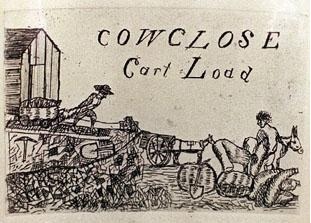
Until the 19th century, coal from the inland mines in southern County Durham used to be taken away on packhorses. Then later by horse-drawn carts as the roads were improved. [47]
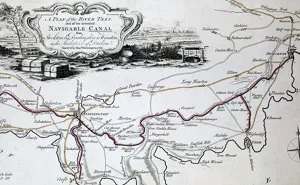
A number of canal schemes failed.

Promoters included George Dixon, John Rennie, James Bradley and Robert Whitworth. [117]
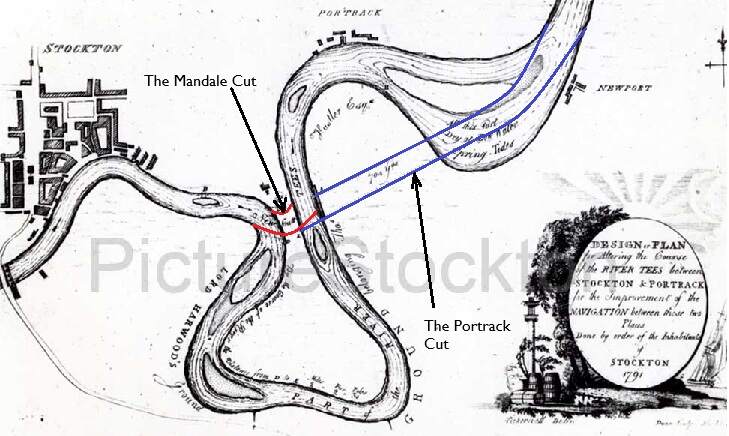
The River Tees was straightened in the early 19th century through the creation of two cuts, the Mandale Cut (1810 – 220 yards long, saving over 2 miles of journey) and the Portrack Cut (1831 – 700 yards long), significantly improving access to Stockton’s port. [47]

Also in the early 19th century, another canal was proposed to take coal from the mines in the Southwest of Co. Durham to Stockton. The proposed route bypassed Yarm and Darlington and the scheme was resisted by Edward Pease and Jonathan Backhouse, both of Darlington. [47] It was at a meeting held in Yarm to oppose the construction of the canal that a tramroad was proposed. [48: p16] The Welsh engineer George Overton advised building a tramroad. He carried out a survey [49: p45-47] and planned a route from the Etherley and Witton Collieries to Shildon, and then passing to the north of Darlington to reach Stockton. The Scottish engineer Robert Stevenson was said to favour the railway, and the Quaker Edward Pease supported it at a public meeting in Darlington on 13th November 1818, promising a five per cent return on investment. [48: p16-17][49: p55 & 63] Approximately two-thirds of the shares were sold locally, and the rest were bought by Quakers nationally. [50: p33, 52, 79–80, 128][51][52][53: p223] A private bill was presented to Parliament in March 1819, but as the route passed through Earl of Eldon’s estate and one of the Earl of Darlington’s fox coverts, it was opposed and defeated by 13 votes. [11][54]
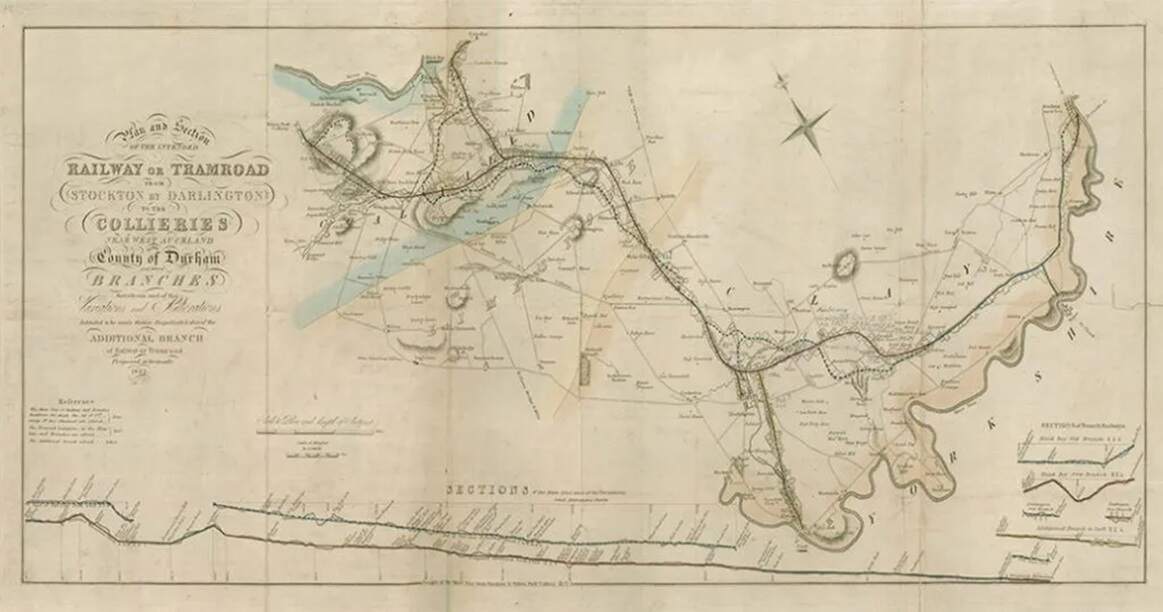
This plan, drawn by George Stephenson shows the original tramroad proposed by George Overton and George Stephenson’s own proposals for a railway. [118]

The first submission of a bill for what became the Stockton & Darlington Railway was deferred because of the death of George III. A revised bill was submitted on 30th September 1820. The route had to avoid the lands of Lord Darlington and Viscount Barrington. [49: p64-67][54]

The railway was unopposed this time, but the bill nearly failed to enter the committee stage as the required four-fifths of shares had not been sold. Pease subscribed £7,000; from that time he had considerable influence over the railway and it became known as “the Quaker line”. The Stockton and Darlington Railway Act 1821 (1 & 2 Geo. 4. c. xliv), which received royal assent on 19th April 1821, allowed for a railway that could be used by anyone with suitably built vehicles on payment of a toll, that was closed at night, and with which land owners within 5 miles (8 km) could build branches and make junctions;[49: p70][50: p37] no mention was made of steam locomotives. [48: p19][54]

What does seem significant, with the benefit of hindsight, is the way that this new railway initiated the construction of more railway lines, causing significant developments in railway mapping and cartography, iron and steel manufacturing, as well as in any industries requiring more efficient transportation. The railway(s) produced a demand for railway related supplies while simultaneously providing the mechanisms which brought significant economies of scale and logistics to many manufacturers and businesses [54][56][57]
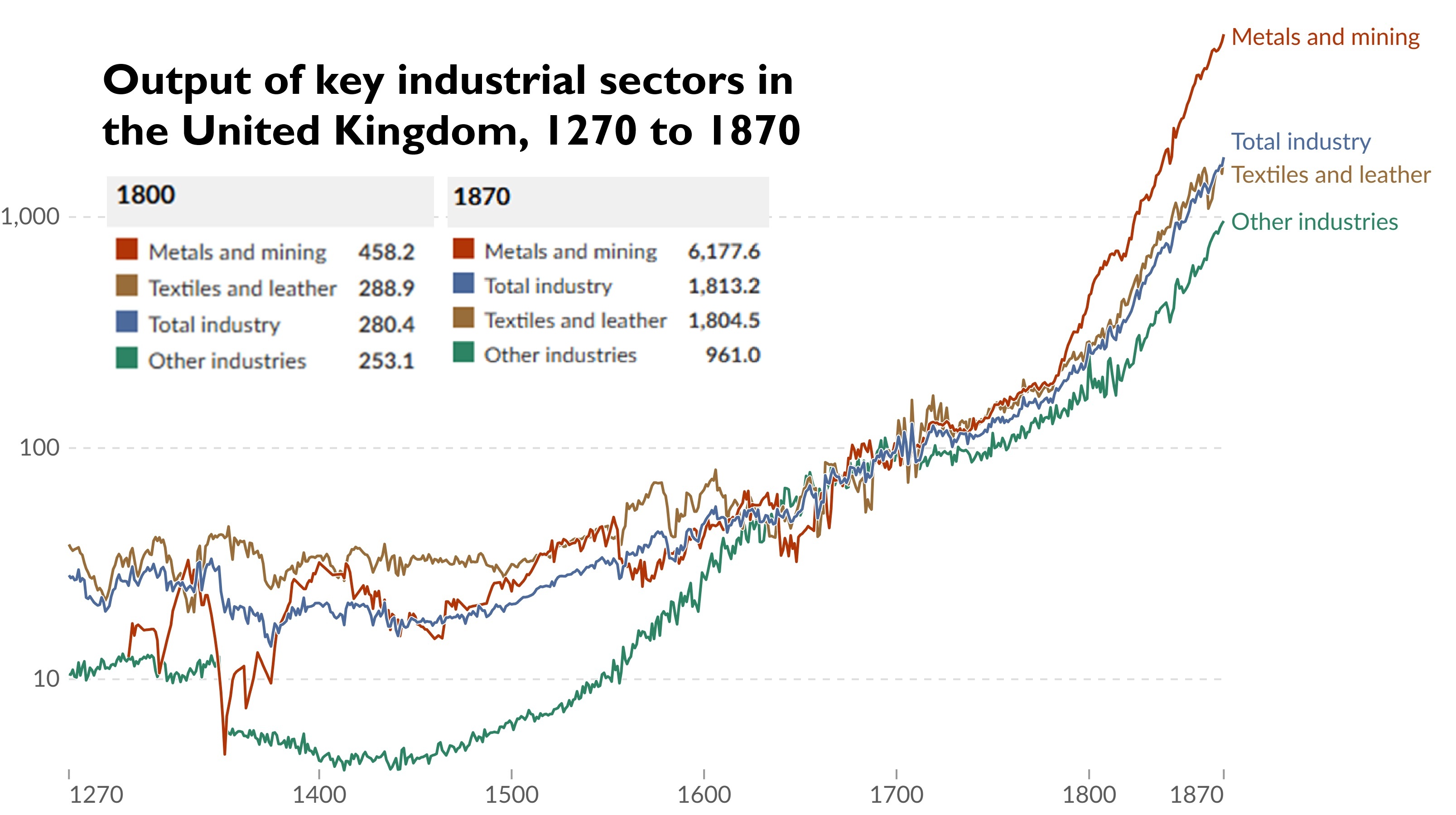
This graph shows just how significant industrial growth was in the period before 1870 The vertical scale is logarithmic and we are focussing only on the period from 1800 to 1870. Each element of the industrial economy is set to a value of 100 in the year 1700. By 1800 the metals and mining sector had grown to 4.6 times its value in 1700, by 1870 it had risen to 618 times the 1700 value. The very rapid rise is due primarily to improvements in technology of which the railways were a dominant part. [119]
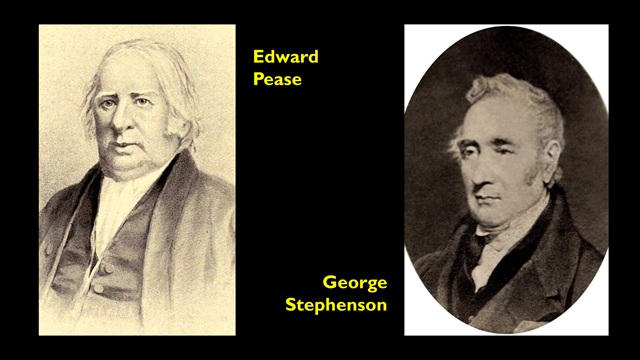
Edward Pease and George Stephenson, (c) Public Domain.

Edward Pease (1767-1858) was the chief inspiration and founder of the S&DR, in choosing a railway rather than a canal, in promoting its route, via Darlington, and adopting steam locomotive power.” [58: p13] Edward Pease had some concerns about George Overton’s competence in respect of railway construction. He turned to George Stephenson who had proven himself to be an excellent engine-wright at the Killingworth collieries, for advice. [54] In addition, Pease invested £7,000 (as much as £750,000 today) of his own money to overcome cashflow problems
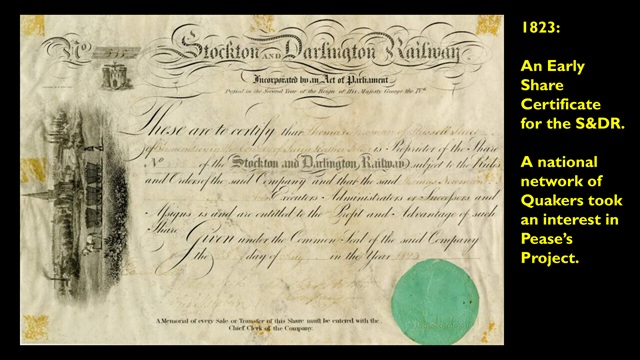
A early share certificate (1823) for the Stockton and Darlington Railway. [127]

Pease also undertook, with fellow Quakers, what was perhaps the first targeted national sale of shares. They sought a wider involvement in share ownership beyond those immediately involved with their project.

On 12th May 1821 the shareholders appointed Thomas Meynell as chairman and Jonathan Backhouse as treasurer; a majority of the managing committee, which included Thomas Richardson, Edward Pease and his son Joseph Pease, were Quakers. The committee designed a seal, showing waggons being pulled by a horse, and adopted the Latin motto Periculum privatum utilitas publica (“At private risk for public service”).[49: p73][50: p184] By 23rd July 1821, it had decided that the line would be a railway with edge rails, rather than a plateway, and appointed Stephenson to make a fresh survey of the line, [49: p74][54]
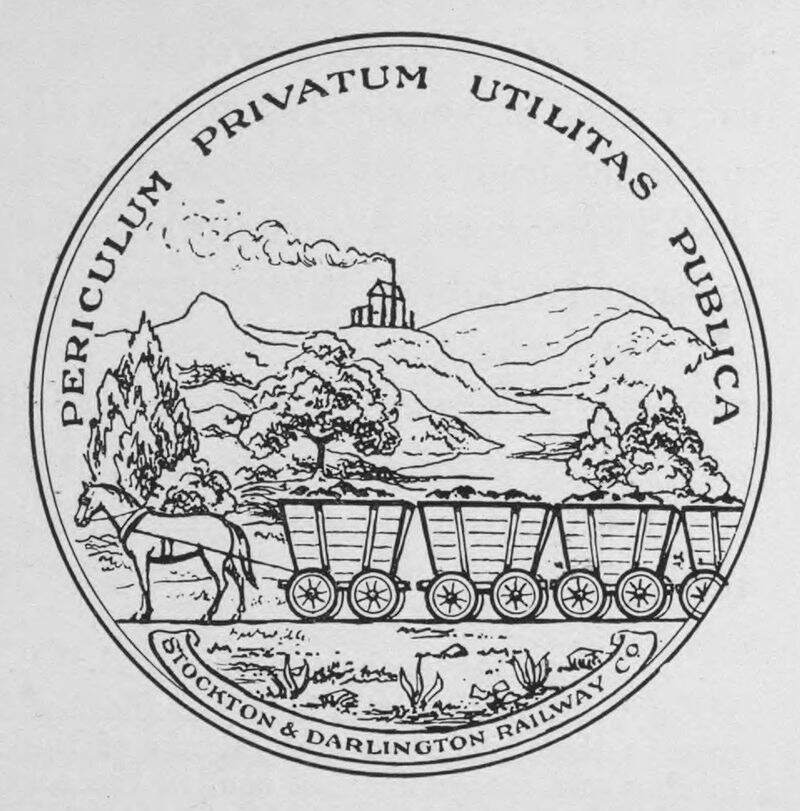
The Seal of the Stockton & Darlington Railway Co. © Public Domain. [49: p73][55]

The seal of the railway company was designed in 1821. It is clear that, at that time at least, the planned railway was not intended for steam propulsion or passenger use.

The Latin motto is Periculum privatum utilitas publica (At private risk for public service). [54]
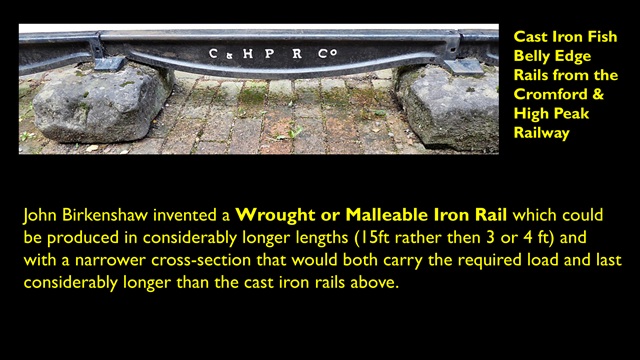
Stephenson recommended using malleable iron rails, even though he owned a share of the patent for cast iron rails. Malleable iron rails formed about 65% of the railway but cast iron rails were used at junctions and on the remainder of the line. [4][59: p74][60]
By the end of 1821, Stephenson “had reported that a usable line could be built within the bounds of the Act of Parliament, but another route would be shorter by 3 miles (5 km) and avoid deep cuttings and tunnels.” [48: p20]

Overton had kept himself available, but had no further involvement and the shareholders elected Stephenson [as] Engineer on 22nd January 1822, with a salary of £660 per year. [49: p79-80] On 23rd May 1822 a ceremony in Stockton celebrated the laying of the first track at St John’s Well, the rails 4 ft 8 in (1,422 mm) apart, [61] the same gauge used by Stephenson on his Killingworth Railway.” [48: p20][54] This was altered to 4 ft 8½ in to reduce binding on curves. [120: p19]

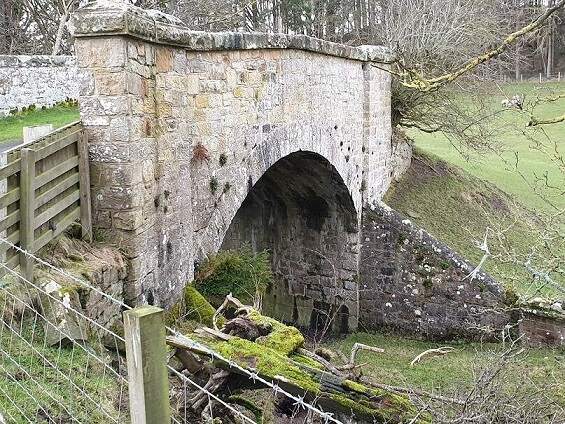
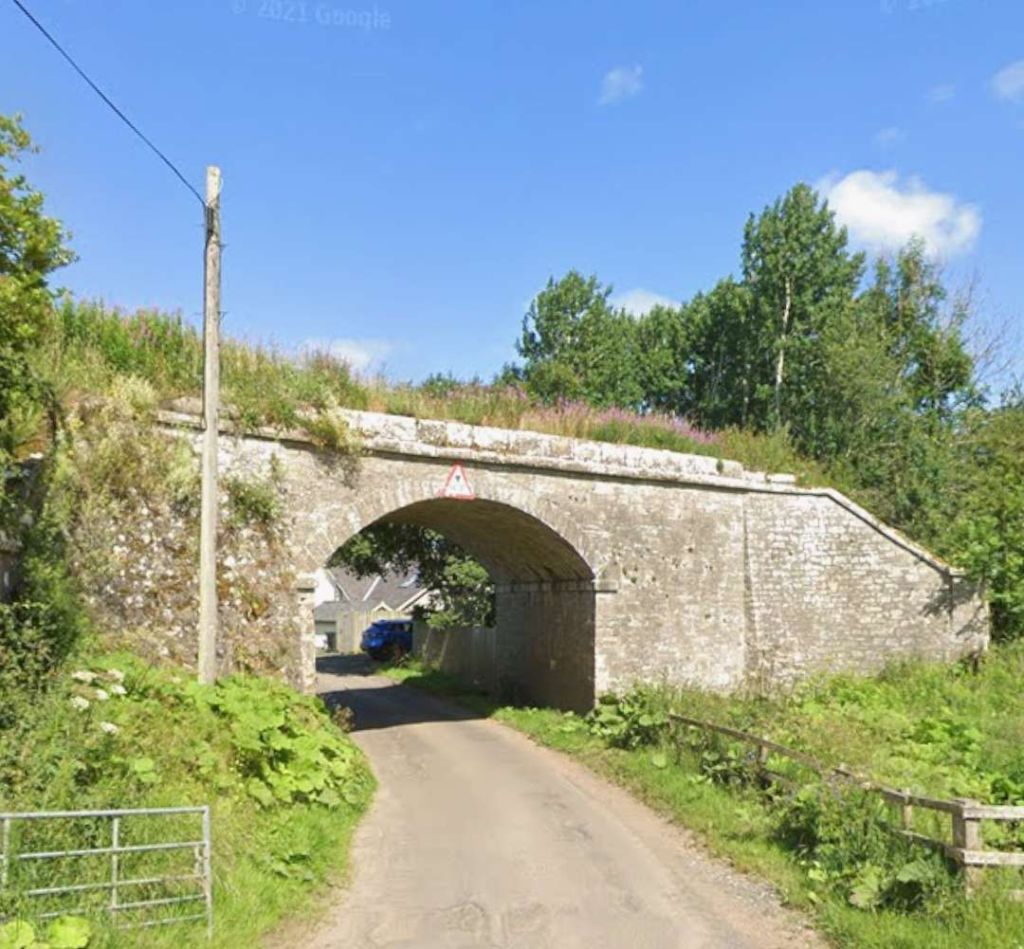
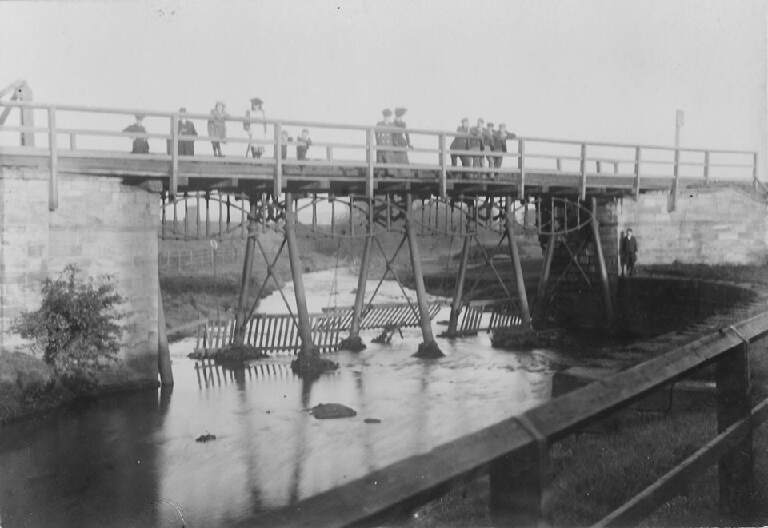
Stephenson advocated the use of steam locomotives on the line. [48: p19] Pease visited Killingworth in mid-1822 [62: p154] and the directors visited Hetton colliery railway, on which Stephenson had introduced steam locomotives. [49: p83] A new bill was presented, requesting Stephenson’s deviations from the original route and the use of “locomotives or moveable engines”, and this received royal assent on 23rd May 1823 as the Stockton and Darlington Railway Act 1823 (4 Geo. 4. c. xxxiii).[49: p85-86] The line included embankments up to 48 feet (15 m) high, and Stephenson designed an iron truss bridge to cross the River Gaunless. The Skerne Bridge over the River Skerne was designed by the Durham architect Ignatius Bonomi.” [59: p75][65][54] George Stephenson’s bridge over the Gaunless suffered flood damage and had to be rebuilt – the directors of the railway company instructed Stephenson to consult Bonomi about the construction of Skerne Bridge – Bonomi designed a stone arch bridge, with a single arch spanning the river and two smaller flood arches over the paths either side. Bonomi’s bridge is still in use today. “Being the oldest railway bridge in continuous use in the world, it is a Grade I listed building.” [68]
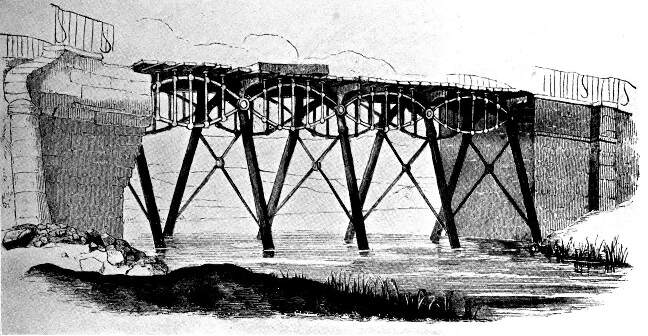
Stephenson’s Iron Bridge across the River Gaunless, © Public Domain, first published in The Engineer in 1875, and published as detailed above in 1915 by William W. Tomlinson. [49: p107].
A victorian photograph of George Stephenson’s bridge over the River Gaunless, © Public Domain. [102]
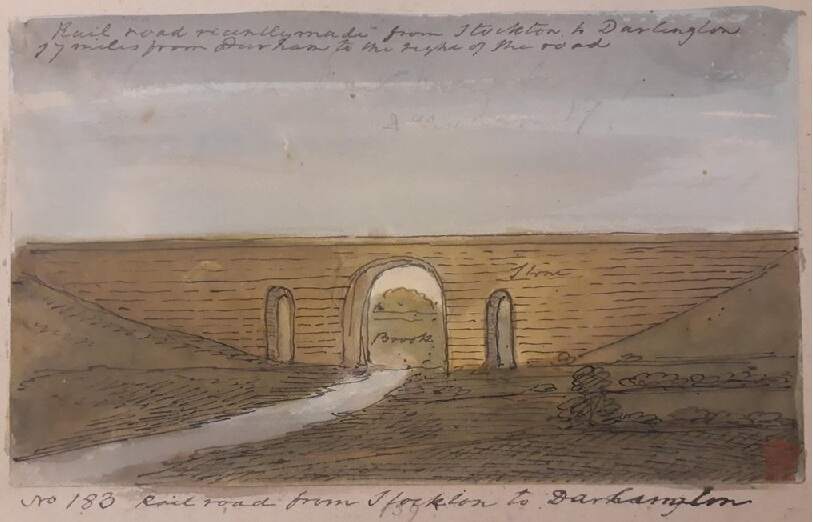
A watercolour from the 1825 journal of the Revd John Skinner showing Skerne Bridge as originally built. The Revd John Skinner was touring the North-East of England in August 1825, and sketched the newly-built railway bridge that carried the Stockton and Darlington Railway over the River Skerne. This is the only known image of the bridge in as-built condition; all later images (even those purporting to portray the opening day in September 1825) show the bridge with strengthening buttresses, which were were added in 1829, © Public Domain (British Library Add MS 33684 f. 89). [69]
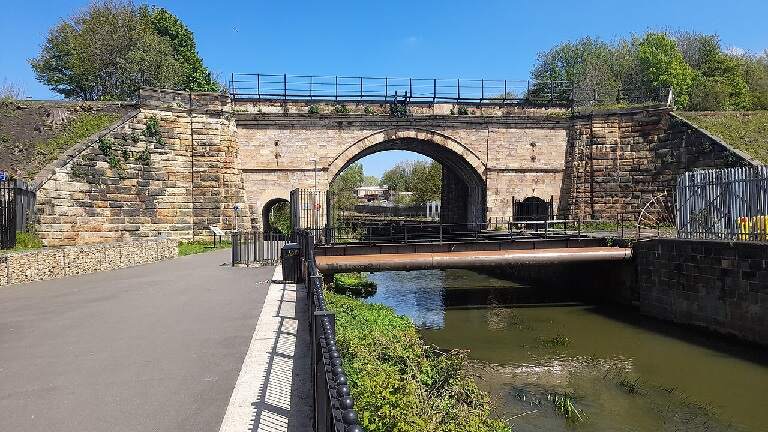
Skerne Bridge seen from the South in May 2021. The oldest railway bridge in continuous use in the world. The centre section is the original stone arch built for the Stockton and Darlington Railway in 1825; the curved flanking walls were added later to strengthen it. The bridge was also widened on the north side; this was later removed, leaving only the piers beside the original bridge, © Verbarson and licenced for reuse under a Creative Commons Licence (CC BY-SA 4.0). [70]

By 1823, Stephenson and Pease had opened Robert Stephenson and Company, a locomotive works at Forth Street, Newcastle, from which the following year the S&DR ordered two steam locomotives and two stationary engines. [49: p95-96][54]

This highlights another way in which the S&DR was very much of its time and looked different from a modern railway: It only used locomotives (or horses) on the level sections of the line. Inclines were operated by a combination of gravity and steam-power from stationary engines.

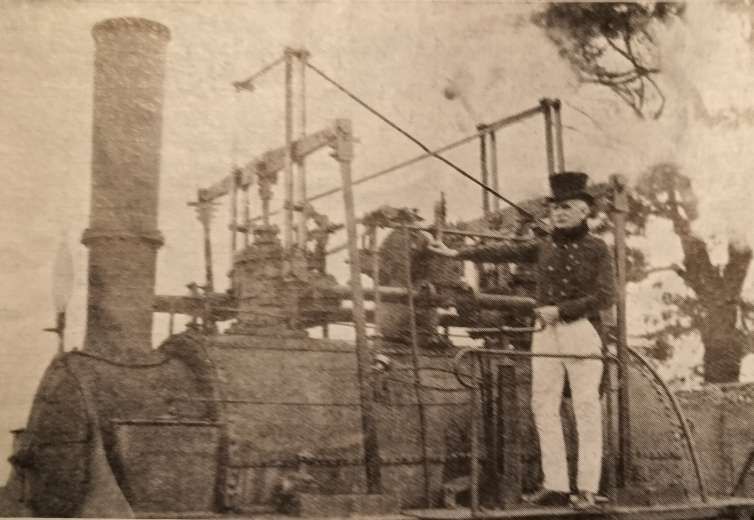
On 16th September 1825, with the stationary engines in place, the first locomotive, ‘Locomotion No. 1’, left the works, and the following day it was advertised that the railway would open on 27th September 1825.” [49: p105][54]

The Opening of the Line

Wikipedia tells us that “the cost of building the railway had greatly exceeded the estimates. By September 1825, the company had borrowed £60,000 in short-term loans and needed to start earning an income to ward off its creditors. A railway coach, named Experiment, [71] arrived on the evening of 26th September 1825 and was attached to Locomotion No. 1, which had been placed on the rails for the first time at Aycliffe Lane station following the completion of its journey by road from Newcastle earlier that same day. Pease, Stephenson and other members of the committee then made an experimental journey to Darlington before taking the locomotive and coach to Shildon in preparation for the opening day, with James Stephenson, George’s elder brother, at the controls. [49: p105-106] On 27th September, between 7 am and 8 am, 12 waggons of coal [74] were drawn up Etherley North Bank by a rope attached to the stationary engine at the top, and then let down the South Bank to St Helen’s Auckland. A waggon of flour bags was attached and horses hauled the train across the Gaunless Bridge to the bottom of Brusselton West Bank, where thousands watched the second stationary engine draw the train up the incline. The train was let down the East Bank to Mason’s Arms Crossing at Shildon Lane End, where Locomotion No. 1, Experiment and 21 new coal waggons fitted with seats were waiting.” [49: p109-110]
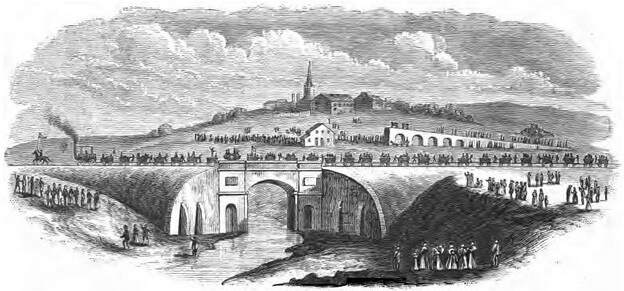
The opening train of the Stockton and Darlington Railway crosses Skerne Bridge. The bridge drawn here is actually the later version of the bridge with pilasters, buttresses and wingwalls which were not part of Bonomi’s original design, © Public Domain. [67: p192]

Between 450 and 600 people travelled behind Locomotion No. 1, most in empty waggons but some on top of waggons full of coal. Wikipedia tells us that “brakesmen were placed between the waggons, and the train set off, led by a man on horseback with a flag. It picked up speed on the gentle downward slope and reached 10 to 12 miles per hour (16 to 19 km/h), leaving behind men on field hunters (horses) who had tried to keep up with the procession. The train stopped when the waggon carrying the company surveyors and engineers lost a wheel; the waggon was left behind and the train continued. The train stopped again, this time for 35 minutes to repair the locomotive and the train set off again, reaching 15 mph (24 km/h) before it was welcomed by an estimated 10,000 people as it came to a stop at the Darlington branch junction. Eight and a half miles (14 km) had been covered in two hours, and subtracting the 55 minutes accounted by the two stops, it had travelled at an average speed of 8 mph (13 km/h). Six waggons of coal were distributed to the poor, workers stopped for refreshments and many of the passengers from Brusselton alighted at Darlington, to be replaced by others.” [49: p110-112][54][59: p85]
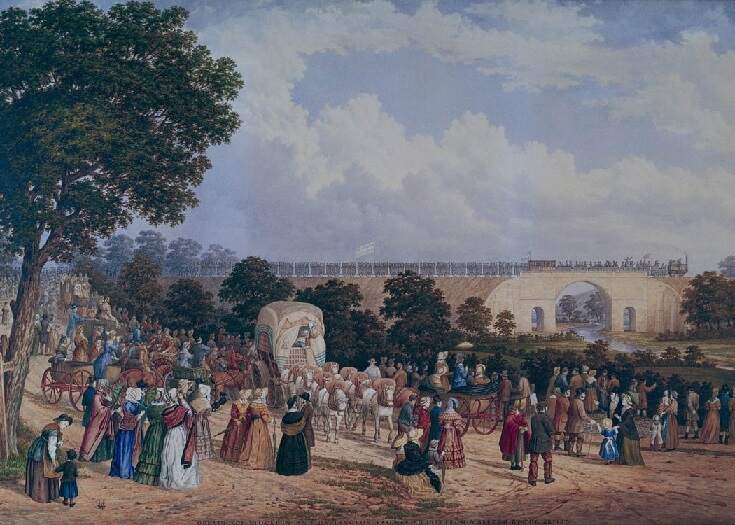
The opening of the Stockton & Darlington Railway on 27th September 1825, a painting by John Dobbin, © Public Domain. [77]

Wikipedia continues: “Two waggons for the Yarm Band were attached, and at 12:30 pm the locomotive started for Stockton, now hauling 31 vehicles with 550 passengers. On the 5 miles (8 km) of nearly level track east of Darlington the train struggled to reach more than 4 mph (6.4 km/h). At Eaglescliffe near Yarm crowds waited for the train to cross the Stockton to Yarm turnpike. Approaching Stockton, running alongside the turnpike as it skirted the western edge of Preston Park, it gained speed and reached 15 mph (24 km/h) again, before a man clinging to the outside of a waggon fell off and his foot was crushed by the following vehicle. As work on the final section of track to Stockton’s quayside was still ongoing, the train halted at the temporary passenger terminus at St John’s Well 3 hours, 7 minutes after leaving Darlington. The opening ceremony was considered a success and that evening 102 people sat down to a celebratory dinner at the Town Hall.” [49: p112-114]

The story of the opening day illustrates effectively that the line was not hauled throughout by steam locomotives and relied significantly on stationary steam engines for managing movements on steep inclines.

Early Days

The railway that opened in September 1825 was 25 miles (40 km) long and ran from Phoenix Pit, Old Etherley Colliery, to Cottage Row, Stockton; there was also a 1⁄2 mile (800 m) branch to the depot at Darlington, 1⁄2 mile (800 m) of the Hagger Leases branch, and a 3⁄4 mile (1,200 m) branch to Yarm. [49: p106] Most of the track used 28 pounds per yard (13.9 kg/m) malleable iron rails, and 4 miles (6.4 km) of 57 1⁄2 lb/yd (28.5 kg/m) cast iron rails were used for junctions.” [49: p89-90][54][79] To put this in context, modern railway rails typically weigh between 40 to 70 kg/m (88 to 154 lb/yd), with heavier rails used for higher speeds and axle loads. In Europe, a common range is 40 to 60 kg/m, while in North America, it’s more common to see rails in the 55 to 70kg/m (115 to 154 lb/yd) range. The heaviest mass-produced rail was 77.5 kg/m (171 lb/yd). [78][79][80]
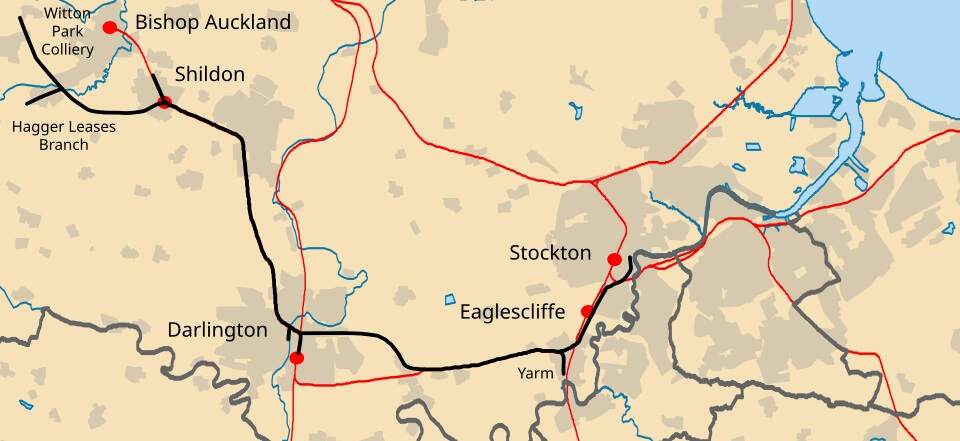
The full length of the Stockton & Darlington Railway in 1827 – modern railways are shown as red lines. [54][81]

The S&DR was “single track with four passing loops per mile; [48: p27] square sleepers supported each rail separately so that horses could walk between them. [59: p74] Stone was used for the sleepers to the west of Darlington and oak to the east; Stephenson would have preferred all of them to have been stone, but the transport cost was too high as they were quarried in the Auckland area. [49: p91] The railway opened with the company owing money and unable to raise further loans; Pease advanced money twice early in 1826 so the workers could be paid. By August 1827 the company had paid its debts and was able to raise more money; that month the Black Boy branch opened and construction began on the Croft and Hagger Leases branches. During 1827, shares rose from £120 at the start to £160 at the end.” [49: p138-140][54] Horses could haul up to four waggons. Dandy Waggons were introduced in mid-1828. A Dandy Waggon “was a small cart at the end of the train that carried the horse downhill, allowing it to rest while the train descended under gravity. The S&DR made their use compulsory from November 1828.” [48: p27][49: p154-156][54]

The line was initially used to carry coal to Darlington and Stockton, carrying 10,000 tons [82] in the first three months and earning nearly £2,000. In Stockton, the price of coal dropped from 18 to 12 shillings, and by the beginning of 1827 was … 8s 6d.[49: p117, 119] At first, the drivers had been paid a daily wage, but after February 1826 they were paid 1⁄4d per ton per mile; from this they had to pay assistants and fireman and to buy coal for the locomotive. [49: p132] The 1821 Act of Parliament had received opposition from the owners of collieries on the River Wear who supplied London and feared competition, and it had been necessary to restrict the rate for transporting coal destined for ships to 1⁄2d per ton per mile, which had been assumed would make the business uneconomic. There was interest from London for 100,000 tons a year, so the company began investigations in September 1825. In January 1826, the first staith opened at Stockton, designed so waggons over a ship’s hold could discharge coal from the bottom. [49: p120-121] About 18,500 tons of coal was transported to ships in the year ending June 1827, and this increased to over 52,000 tons the following year, 44.5% of the total carried.” [49: p136][54]

Locomotives

The locomotives were unreliable at first. Soon after opening, Locomotion No. 1 broke a wheel, and it was not ready for traffic until 12th or 13th October; Hope, the second locomotive, arrived in November 1825 but needed a week to ready it for the line – the cast-iron wheels were a source of trouble. [49: p118-119, 142] Two more locomotives of a similar design arrived in 1826; that August, 16s 9d was spent on ale to motivate the men maintaining the engines. [49: p118-119, 142] By the end of 1827, the company had also bought Chittaprat from Robert Wilson and Experiment from Stephenson. Timothy Hackworth, locomotive superintendent, used the boiler from the unsuccessful Chittaprat to build the Royal George in the works at Shildon; it started work at the end of November.” [49: p116, 142-143][54] A drawing of the Royal George appears below.
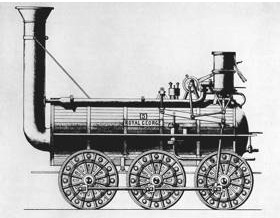
The boiler was a plain cylinder 13 ft. long and 4 ft. 4 in. in diameter. There were six coupled wheels 4 feet in diameter, and the cylinders, which were placed vertically at the end opposite to the fire place, were 11″ diameter, the stroke of the piston being 20 inches. The piston rods worked downward and were connected to the first pair of wheels. [122]

Problems with the locomotives may have seen the railway reverting to the use of horses but for the fact that Pease and Thomas Richardson were partners with Stephenson in the Newcastle works. Locomotives were clearly superior to horses when they were working. In his book, Tomlinson showed that coal was being moved by locomotive at half the cost of using horses. Rolt could not imagine the company reverting to horses. [83] Robert Young states that the company was unsure as to the real costs as they reported to shareholders in 1828 that the saving using locomotives was 30 per cent. Young also showed that Pease and Richardson were both concerned about their investment in the Newcastle works and Pease unsuccessfully tried to sell his share to George Stephenson. [50: p61-63][54][84]

New locomotives were ordered from Stephenson’s, but the first was too heavy when it arrived in February 1828. It was rebuilt with six wheels and hailed as a great improvement, Hackworth being told to convert the remaining locomotives as soon as possible. In 1828, two locomotive boilers exploded within four months, both killing the driver and both due to the safety valves being left fixed down while the engine was stationary.” [49: p146-148][54]
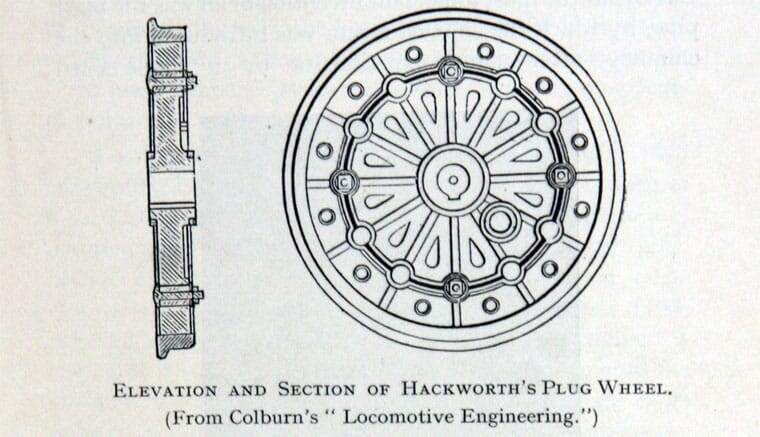
Hackworth redesigned locomotive wheels – cast-iron wheels used to fracture too easily. His solution was the first use of “a system of cast iron wheel with a wrought iron tyre shrunk on. The wheels were made up in parts because the lathes in the Shildon workshops were too small to turn up the rims when fixed upon the axle. They were dotted with plug holes to ensure sound castings and reduce unnecessary weight. This new wheel type was very efficient and so was used on nearly every engine on the S&DR and on other railways for many years.” [124: p157-8][125: p30].
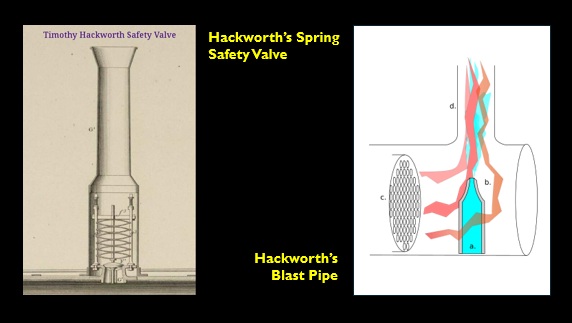
He designed the spring safety valve. He perfected the blast pipe and again it was to be used on many engines subsequently. Perhaps the most important invention was the blast pipe which ensured that boiler pressure was always maintained; thus curing the lack of steam found in Stephenson’s earlier engines.

Hackworth lagged Royal George’s boiler with strips of mahogany to insulate it. “Royal George” was built for coal traffic and so was designed to be strong and with good tractive adhesion suitable in all weathers and the blast pipe doubled the amount of useful work [it] could do.” [124: p228]. The ‘blast pipe’ discharged exhaust steam through a converging nozzle blast pipe in the chimney, greatly increasing combustion intensity and steam production.
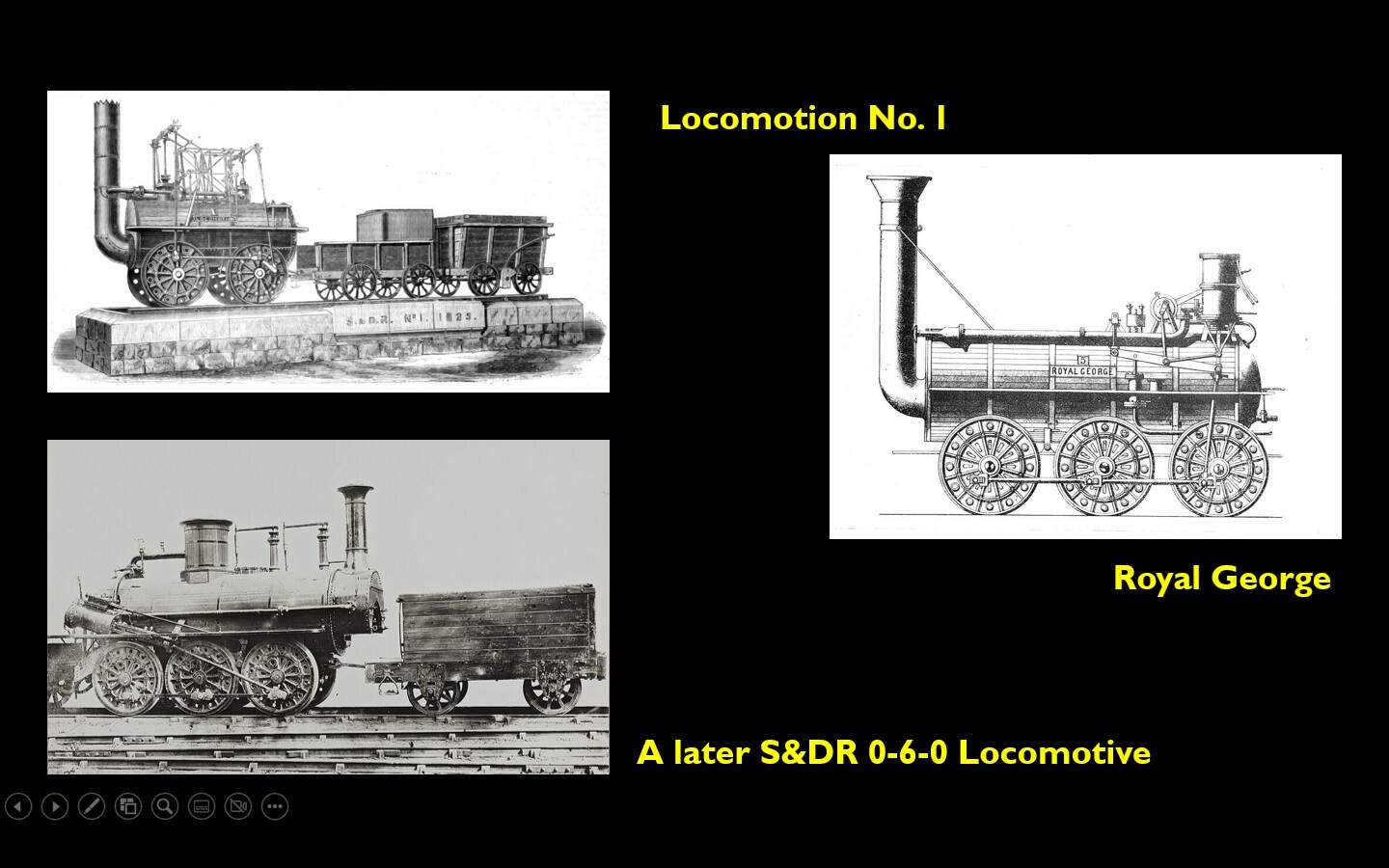
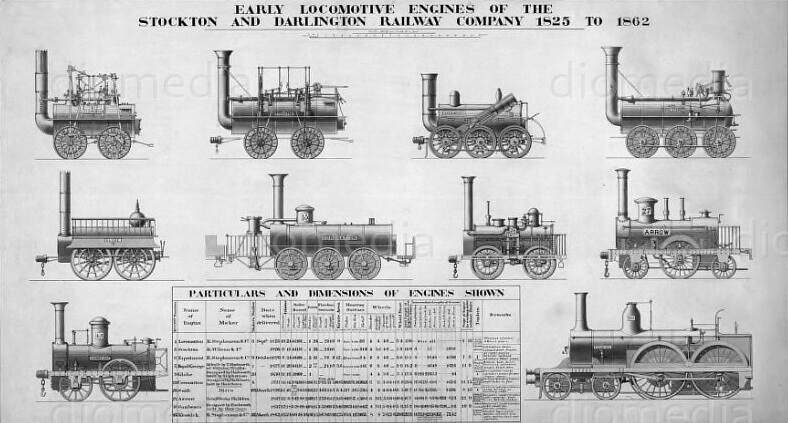
The S&DR was designed to be operated by travelling locomotive and through the skills of Timothy Hackworth, it was here that the locomotive engine became reliable and efficient. Through his work for the S&DR, confidence in the use of locomotives was gradually built up so that other embryonic railway companies were also prepared to embark on their use. By the time the Liverpool and Manchester line opened in 1830 the S&DR had 12 locomotives and by 1832 it had 19.” [125: p2]

The surviving documentation suggests that without Hackworth’s promotion of the locomotive and his key developments such as the plug wheel and blast pipe which allowed the practical and ultimately successful implementation of locomotive power on the S&DR for all to see, then the railways that followed would have significantly delayed the use of travelling locomotives. Hackworth cast enough doubt in the Director’s minds of the Liverpool & Manchester Railway about the dangers and short comings of rope pulled inclines, that they organised the Rainhill Trials only months before opening in order to test the power and efficiency of various locomotives. … From 1828 when the locomotives were proven technology (thanks to Hackworth’s design of the Royal George the previous year), there was a growth in locomotive engineering companies in England, and by 1830, also in America and France.” [125: p3]

“Perhaps there was no man in the whole engineering world more prepared for the time in which he lived. He was a man of great inventive ability, great courage in design, and most daring in its application…” (The Auckland Chronicle, 29th April 1876 referring to Timothy Hackworth)

Passengers
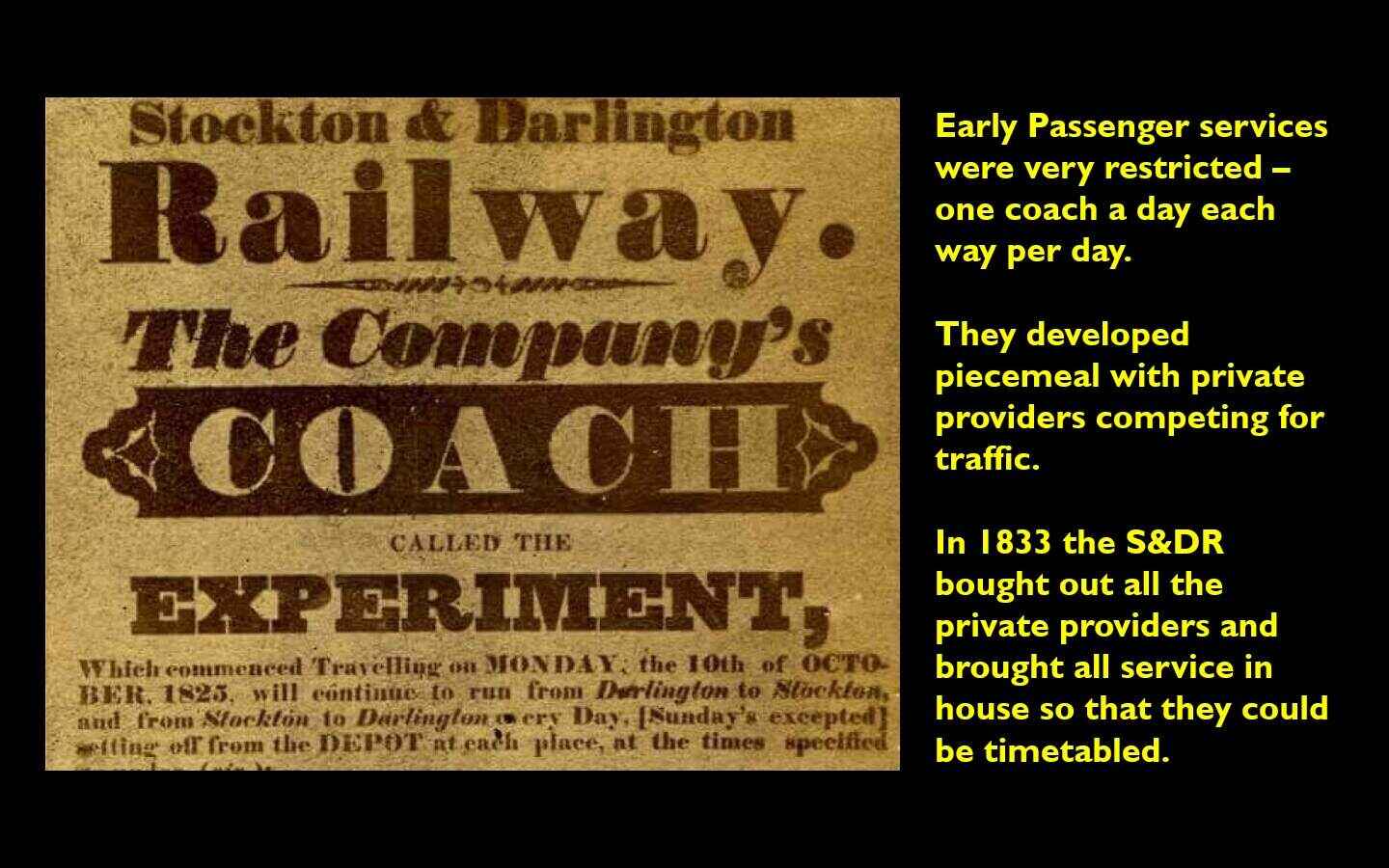
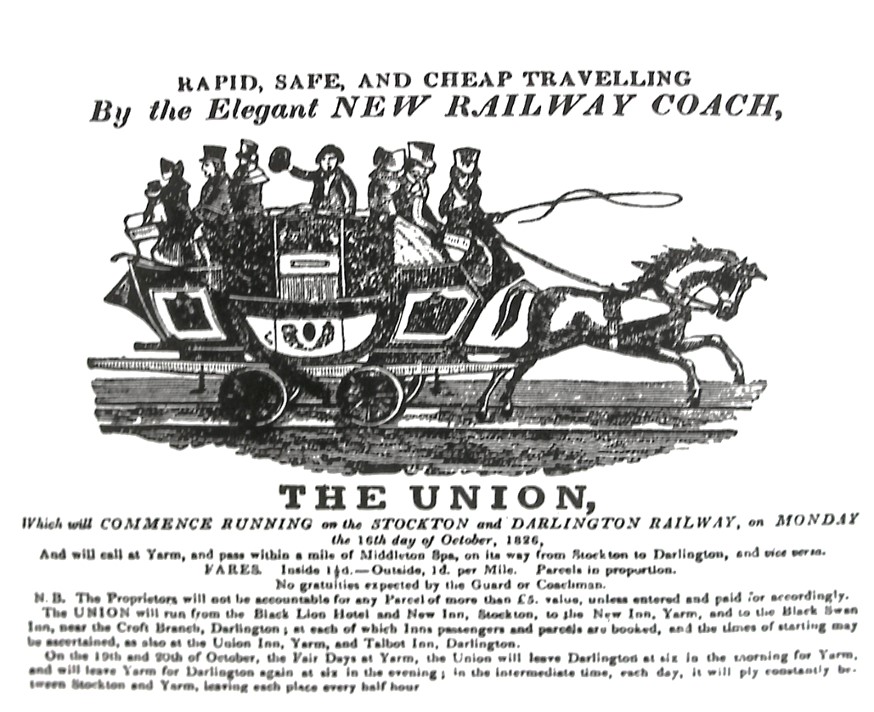
Wikipedia tells us that “passenger traffic started on 10th October 1825, after the required licence was purchased, using the Experiment coach hauled by a horse. The coach was initially timetabled to travel from Stockton to Darlington in two hours, with a fare of 1s, and made a return journey four days a week and a one-way journey on Tuesdays and Saturdays. In April 1826, the operation of the coach was contracted for £200 a year; by then the timetabled journey time had been reduced to 1 hour 15 minutes, and passengers were allowed to travel on the outside for 9d. A more comfortable coach, Express, started the same month and charged 1s 6d for travel inside. [49: p122-126] Innkeepers began running coaches, two to Shildon from July, and The Union, which served the Yarm branch from 16th October. [49: p126-127] There were no stations: [87: p117] in Darlington the coaches picked up passengers near the North Road Crossing, whereas in Stockton they picked up at different places on the quay. [49: p130] Between 30,000 and 40,000 passengers were carried between July 1826 and June 1827.” [49: p131]
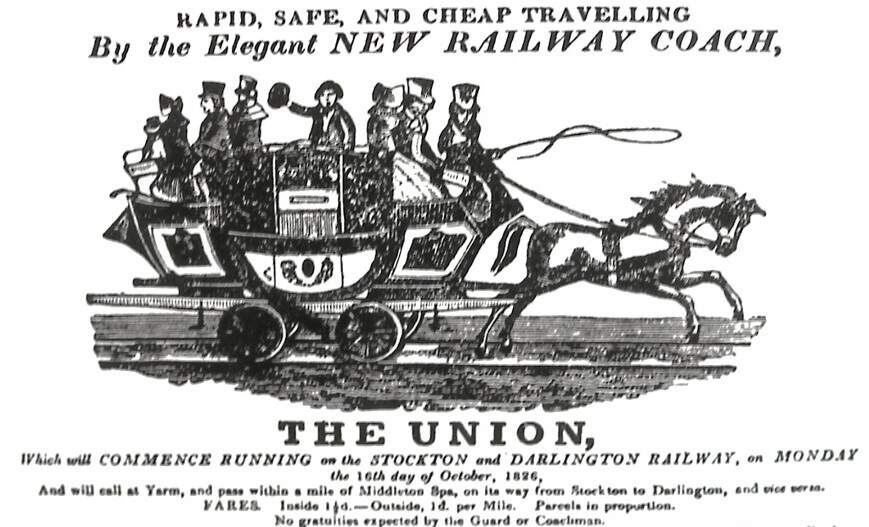
The Union” started operating on 16th October 1825 and ran between Stockton and Yarm. [121]

Innovation occurred relatively quickly, the company decided that it needed to provide hostelries (pubs) close to its coal depots. Tickets were sold in various locations but, significantly, in the pubs closest to pick up points. The practice mirrored what happened with stagecoaches.

Perhaps a more significant change seems to have happened almost organically. … Some of the buildings at coal depots began to provide space for passengers to wait along with other goods to be carried by the railway. … Heighington was a wayside location on the railway. It had a coal depot, and the S&DR built a public house in 1826-1827 to oversee the coal depot. Historic England describe the building as a proto-railway station, built before the concept of the railway station had fully developed. [123] This was the first such structure on the railway.
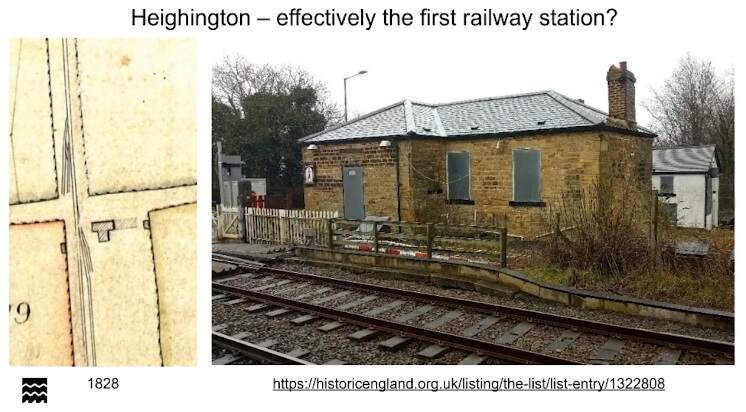
This was one among a number of loading and unloading depots which would evolve into the now familiar railway architecture such as goods and passenger stations. [125]

Developing Understanding

In truth, a lot of work went into getting three different forms of traction to harmonise – horse, inclined plane and locomotives on a single line. This was further complicated by the fact that it was a public railway that anyone could use subject to payment and an agreement to abide by any rules. The increasingly popular use of the single line also meant that rules had to be established for giving way and the ‘first past the post’ system was adopted. Signalling considered (but blocked by local landowners), [128: p12] warnings were sounded on the approach to level crossings, braking systems improved and sleepers made heavier. There was no past experience to learn from, no book to consult and the duties of railway officials had yet to be clearly defined. [124: p121]

The S&DR led the way in devising a system to run a public railway. It was here that passenger timetables evolved, baggage allowances were created, rules made regarding punishment for non-purchase of tickets, job descriptions for railway staff evolved and signalling and braking developed and improved for regular use. The S&DR also recognised the need for locomotives of a different design to haul passengers rather than heavy goods and the need to provide facilities for passengers and workers at stations – all before 1830.” [125: p2]
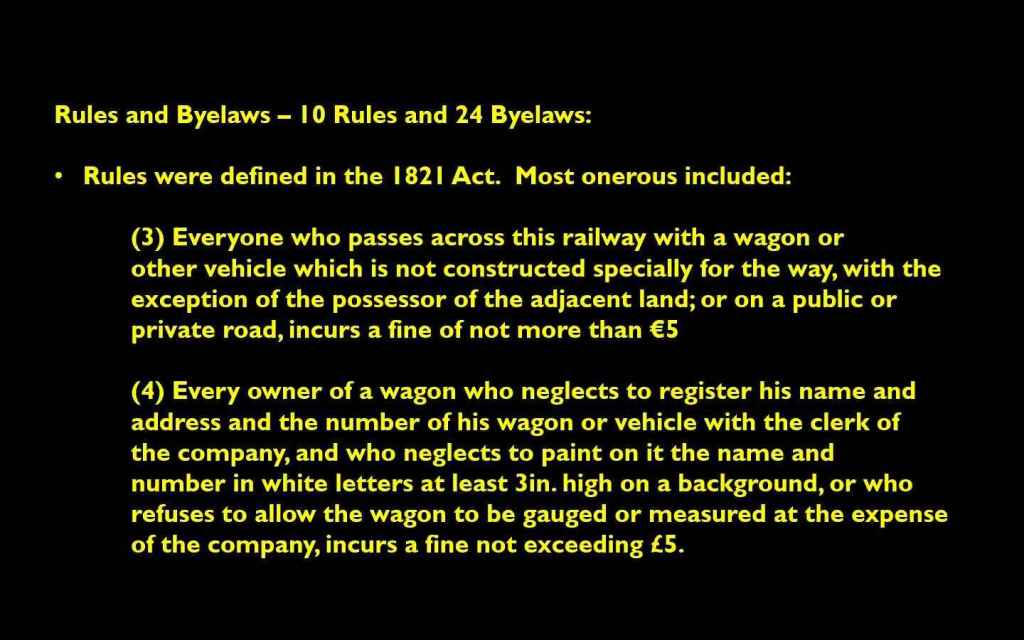
The Stockton & Darlington’s regulations were initially laid down in ten ‘rules’ set out in the company’s Act of Incorporation of 19th April 1821, which established fines for those failing to preserve order and security on the railway. These were of a fairly general nature. [128: p12-13]

Two rules had attached to them the massive (for the day) fine of £5, these required wagons to be especially constructed for the railway, to bear the owner’s name and wagon number in 3-inch high lettering, and to allow the company to gauge wagons if it felt necessary.
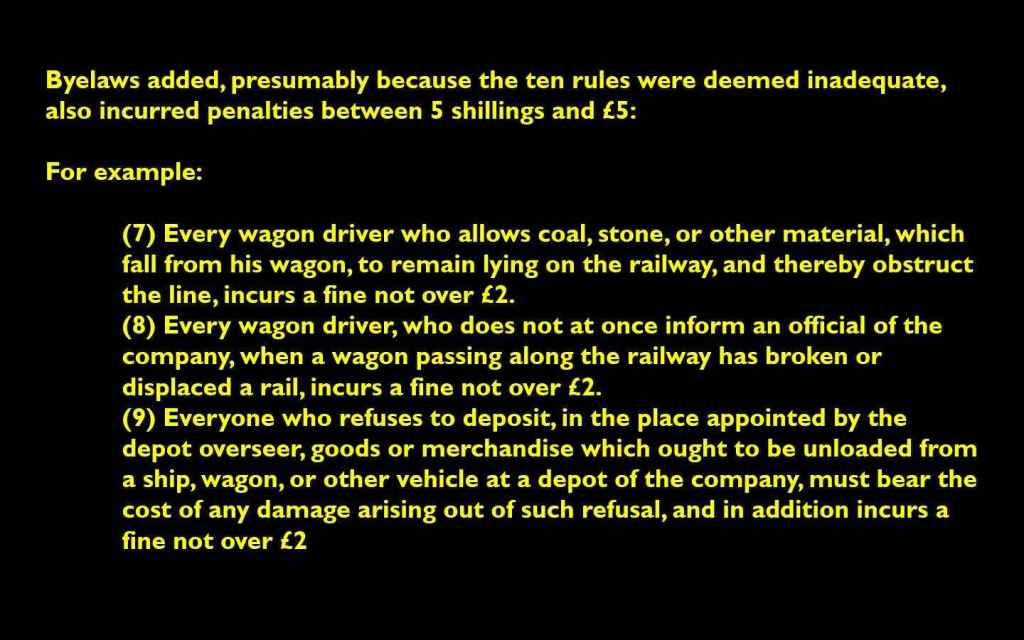
By July 1826, these rules were supplemented by 24 byelaws and rules concerning wagons taking to sidings, all of these suggesting that there were shortcomings in the original rules which were discovered as an early result of operational experience. [128: p67-68]

After the launch date in 1825, other advances followed rapidly. “The growth of health and safety, the administration of running a regional railway, … and, [critically,] commercial success that would reassure other investors that it was safe to invest in their own regional railway that would soon form part of a national and then international railway network.  The first purpose-built goods station (as opposed to coal and lime which went to the depot down the road) was opened in Darlington 1827. … [It formed] the inspiration for the later 1830 warehouse at Liverpool Road Station in Manchester which still survives.” [125]

Many aspects of the line were still unproven technology when they came to be used in the context of a public regional railway. Until it could be proven (and the launch of 1825 went some way to do that with enough customers ready to pay for the service to immediately allay fears of money losses), that the line had to work first before it could be expanded. It was up to the S&DR to find a way forward as new problems arose. [Much of that responsibility fell on Timothy Hackworth’s shoulders.] … Through the hard knocks of money shortages, operating difficulties and the limitations of contemporary engineering, the S&DR had discovered what would be necessary [to run a railway] by the start of 1829, at a time when the L&MR was still vacillating over vital traction and operating decisions.” [126: p11-12]

A Change in Passenger and Goods Services

It was 1833, before the passenger railway service began to become something like we would recognise today. By 1833, it had become obvious that the competing needs of passengers and goods under an open access model needed to be managed. Network management, capacity and overall co-ordination were increasingly seen as important. As the network expanded, the conflicts increased. Until 1833, passenger services were run by external contractors. In 1833, the S&DR took on this responsibility directly.
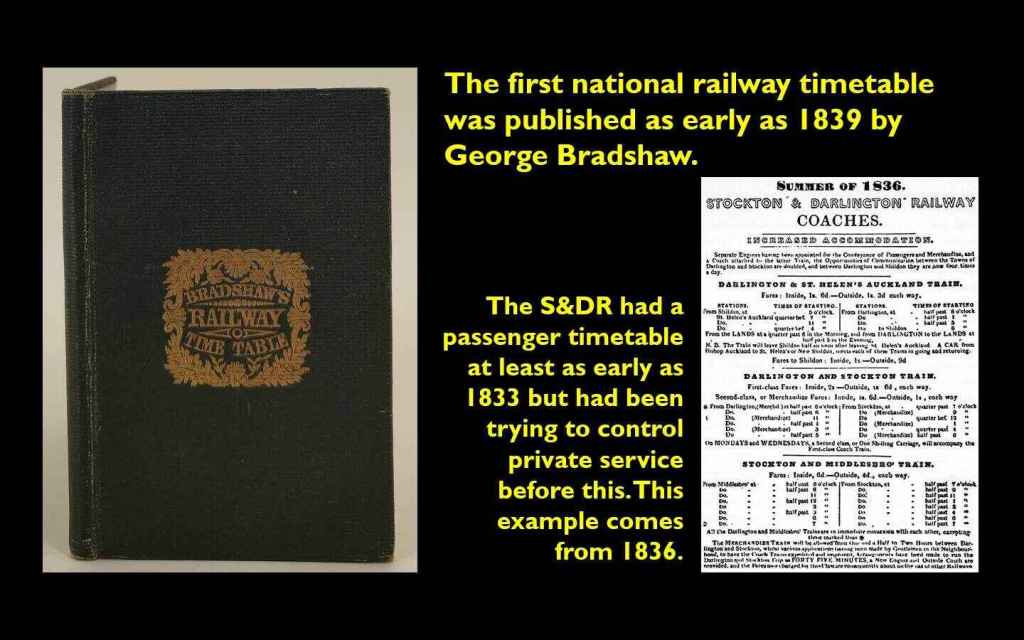
The railway changed from a kind of ‘public road’ on which all-comers could transport goods and passengers to a system where services were co-ordinated, managed, timetabled and run by the Company.

The S&DR established a permanent rail infrastructure providing a regular service transporting both goods and passengers. In this particular sense, the S&DR was truly the launch of a modern railway network. Managed, timetabled services for passengers and goods made possible the rapid expansion of railways in the 19th century across the globe, together with attendant huge worldwide social and economic change.
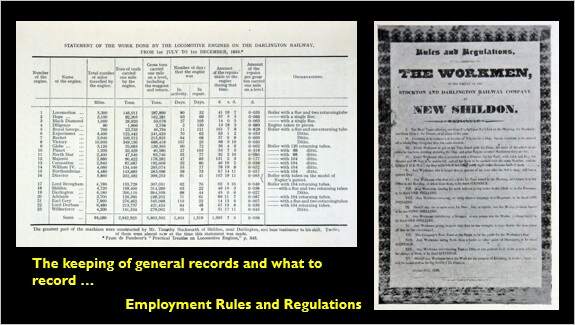
In a railway context, everything was being done for the first time:

the keeping of general records; various statistical and financial records; employment of staff and rules; at first all drivers were self-employed and paid their firemen themselves.
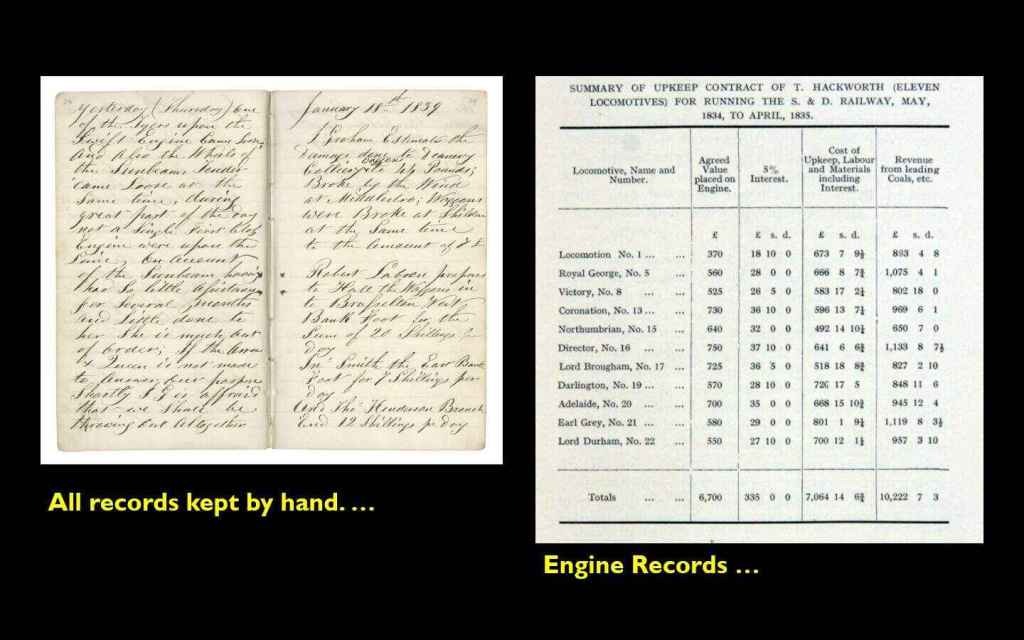
Engine shed maintenance records; the need for dedicated general goods facilities; all arrangements for passengers; the management and supply of first coke and then coal for use by steam engines. ….

The S&DR, from the official launch in September 1825, “was at the forefront of technology in terms of operating locomotives regularly and over a relatively long stretch of line, it was to the S&DR that other embryonic railway companies looked to. Railway engineers and promoters from other parts of the UK, France, and the USA attended the opening ceremony in 1825. Two of those distinguished French guests went on to found France’s first public railway. Others were to visit the S&DR Works in the years that followed including engineers from Prussia who took copious detailed notes on Hackworth’s experiments. Hackworth himself shared his results widely (often at the request of Edward Pease) and organised trials at the request of engineers from other companies who were torn between the use of canal versus railway, or horse versus locomotive, or stationary versus travelling engine. The S&DR was at its most influential until around 1830.” [125: p2] A very short period of time!

Beyond 1830, “there were significant technological achievements … such as the delivery of Russia’s first locomotives to the Tsar in the 1840s from Hackworth’s Soho Works in Shildon, the continuing evolution of the first railway towns at New Shildon and Middlesbrough and the delivery of gas to the works in New Shildon in 1841 before anywhere else in the country apart from Grainger Town in Newcastle. Further the grouping of internationally important structures with later pioneering structures (such as at North Road in Darlington or at Locomotion in Shildon) provides an insight into those rapidly developing days of the early railway and add value to each other.” [125: p3]

The First ‘Railway’ Town – New Shildon
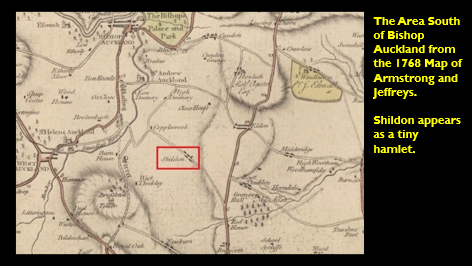
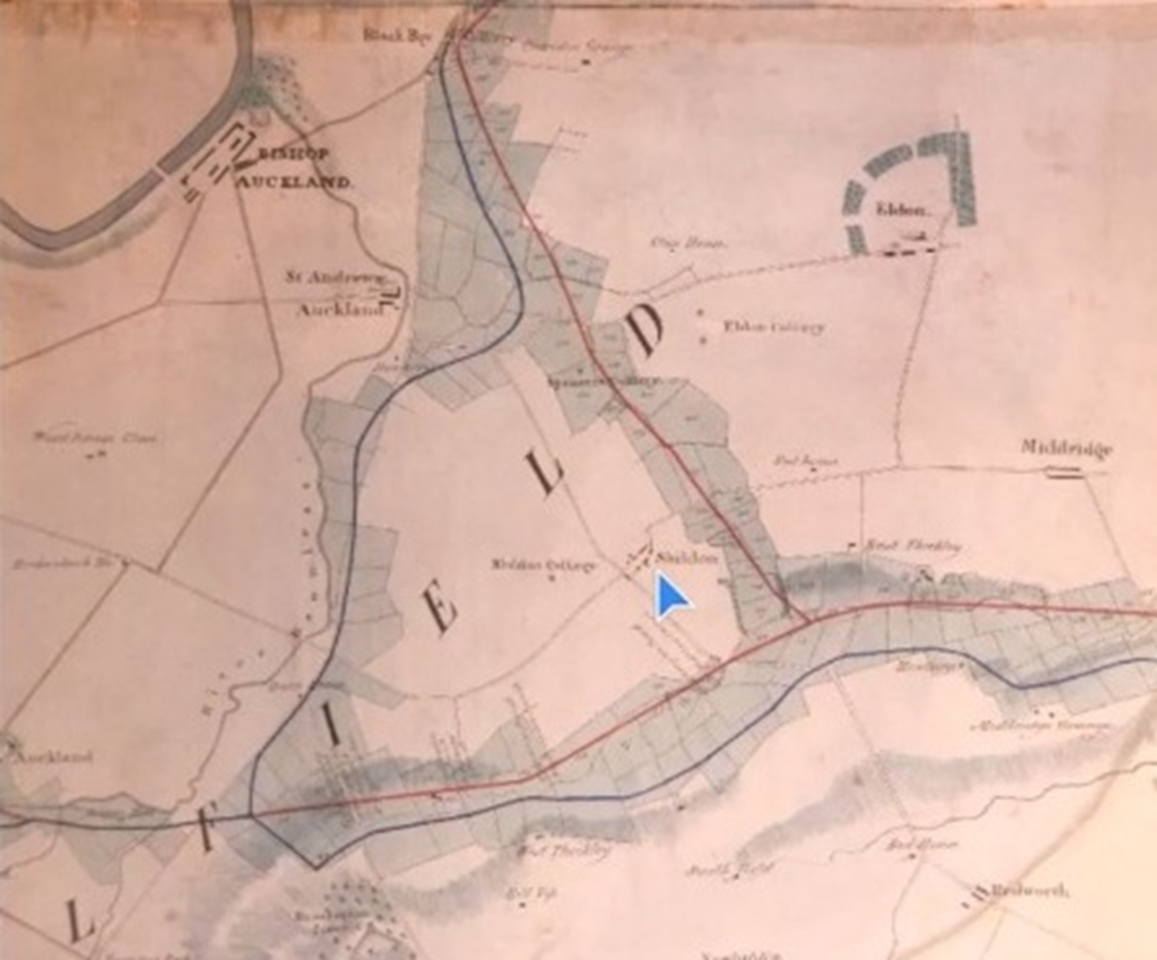
Shildon was, at the start of the 1820s, just a tiny hamlet, (c) National Library of Scotland. [105]
The same area South of Bishop Auckland as it appears on Stephenson’s survey of 1821.
Shildon still appears as a tiny hamlet. [118]
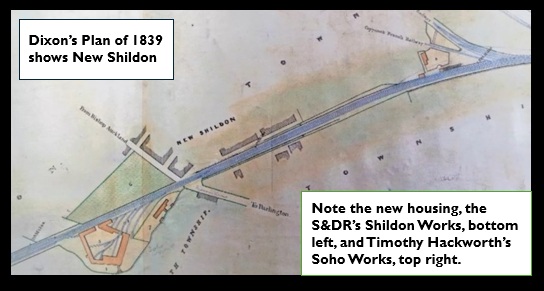
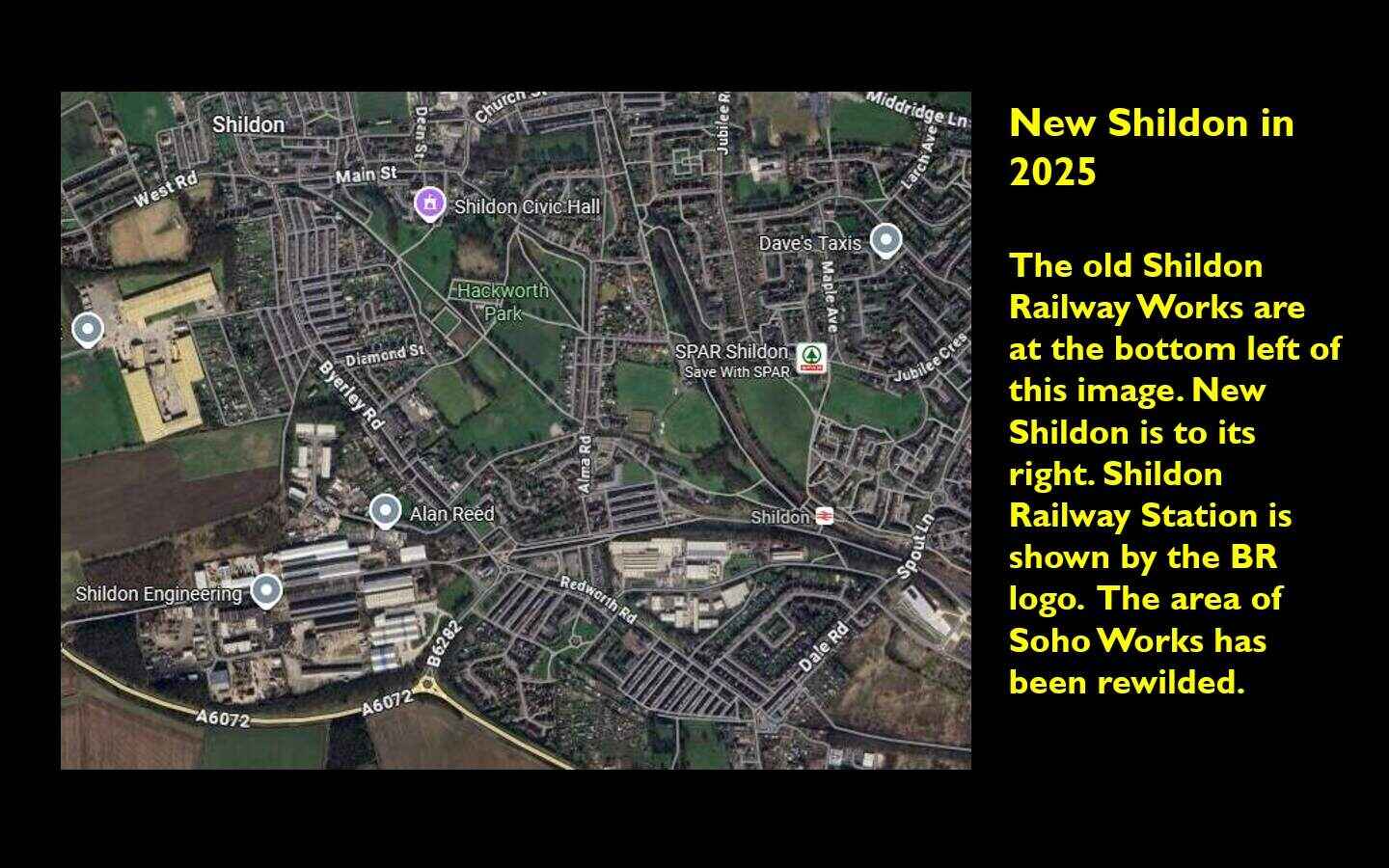
On Dixon’s Plan of 1839, there is new housing, the S&DR’s Shildon Works, bottom left, and Timothy Hackworth’s Soho Works, top right. [129]
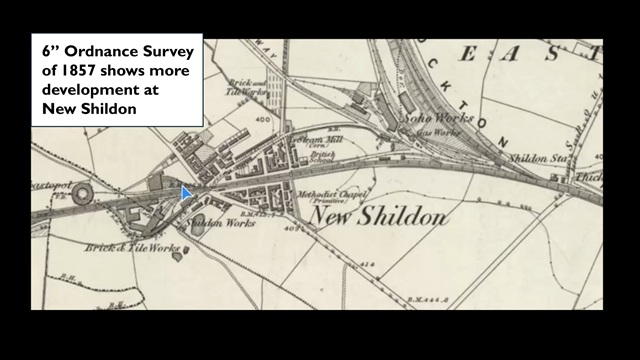
New Shildon has developed significantly by the time of this map extract. A significant number of streets are now present, and both the railway works and Hackworth’s Soho Works have expanded. Note Shildon’s Railway Station at the right side of the image. [130]
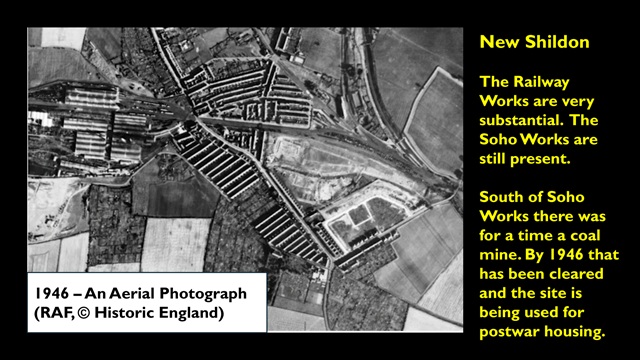
By the 21st century New Shildon has completely swallowed the original hamlet of Shildon and urban sprawl has devoured all of the land North to Bishop Auckland. [Google Maps, August 2025]

The Second ‘Railway’ Town – Port Darlington and Middlesbrough

The ongoing story of the railway company is one of strong growth particularly in the carriage of goods. It opened its own port near the mouth of the River Tees.
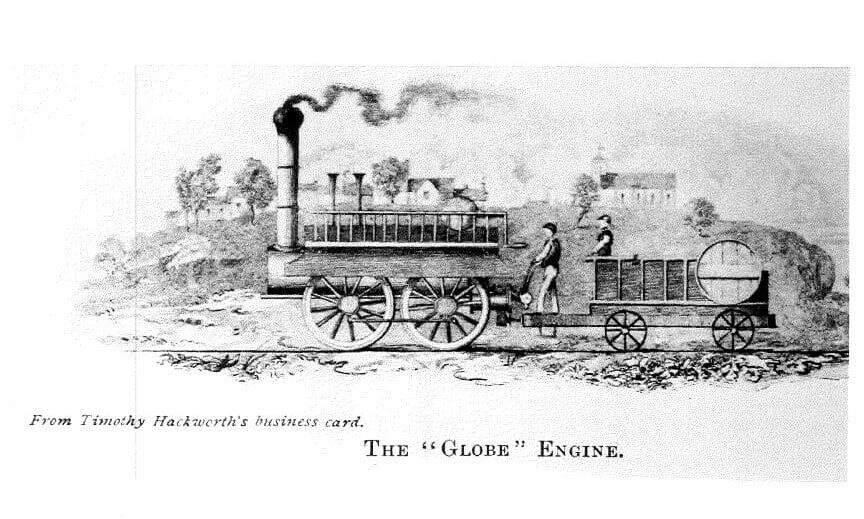
When Port Darlington opened for business at the end of 1830. Hackworth’s engine ‘The Globe’ hauled a passenger train carrying about 600 people down to the staithes, © Public Domain. [95][97]
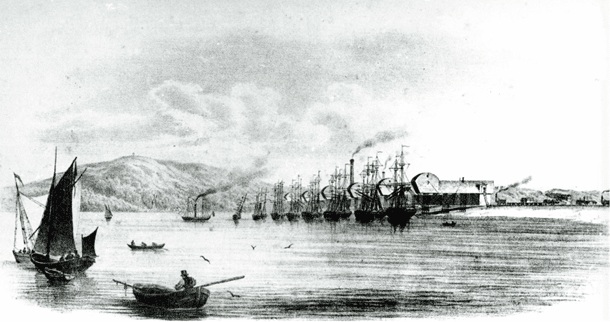
Hackworth’s six steam powered coal drops and staithes at Port Darlington with a fully laden coal train approaching. Eston Nab can be seen on the Cleveland Hills in the distance, © Public Domain (Source: taken from a survey by Richard Otley, held at Teesside Archives (U.OME(2) 6/1)). [95] This image also appears on the front cover of ‘The Globe’ (July 2018), the journal of the Friends of the S&DR. [96]

The S&DR played a significant role in the rapid expansion of Middlesbrough. Initially a farming community of around 25 people at the beginning of the 19th century, it transformed into a major iron and steel producer, “spurred by the arrival of the Stockton and Darlington Railway and the discovery of iron ore in the Cleveland Hills. This rapid expansion led to a significant population increase and the development of a new town, planned by Joseph Pease and others, centred around a gridiron street pattern and a market square. [85][86] Middlesbrough had only a few houses before the coming of the railway, [87] but a year later had a population of over 2,000 and at the 2011 census had over 138,000 people. [88][89] Port Darlington was first established, as shown on the left of the image below, which also shows the gridiron street pattern in what would become Middlesbrough, the new town on the right of the image. [95]
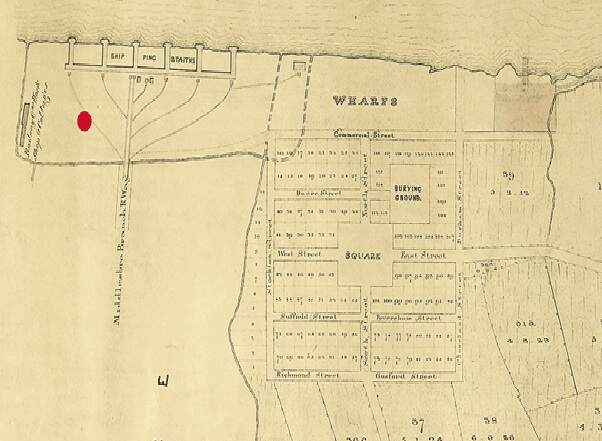
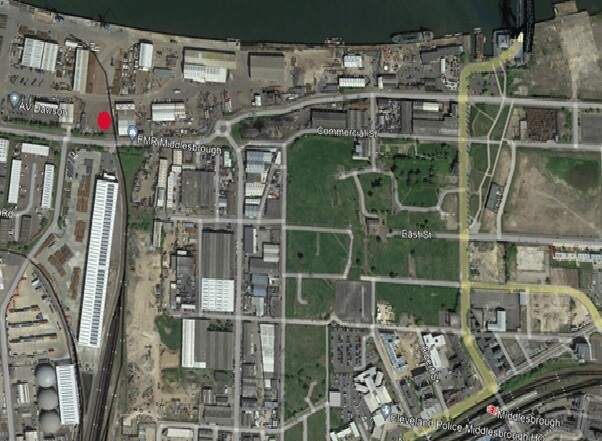
Port Darlington’s staithes are on the left of this development plan, the fan of sidings and the staithes can be seen close to the red dot. This plan also shows the planned gridiron street pattern in the new town, on the right of the image behind the wharfs where ships could be loaded and unloaded. [95]
The same area in the 21st century, the red dot provides continuity between these two images. A single rail siding still serves the area which had the staithes and some of the gridiron pattern of streets remains. The first house was completed in the New Town in the Spring of 1830. [Google Maps July 2025]

We have already noted the staithes built at Port Darlington to allow more mechanised loading of ships. These staithes were ingeniously designed, even if health and safety was not as paramount as perhaps it should have been. The Port of Middlesbrough describes the operation: “Staithes were elevated platforms for discharging coal and other materials from railway cars into coal ships for transport. … A steam engine hoisted a wagon full of coal off the line and about 20 feet into the air, where it landed on a gantry. A horse then pulled the wagon along the gantry and out over the water. At the end of the gantry, the wagon was strapped into a cradle and, with a man clinging to it, was swung in an arc on to the ship below. Here, the man unbolted the bottom of the wagon and the coal fell into the hold. Finally, the weight of the next full wagon swinging downwards caused the empty wagon and the man to swing upwards back to the gantry.” [95]

Plans from the port authority are shown below. It is difficult to imagine the process described from looking at these plans. It may be that the plans show a later design of staithe.
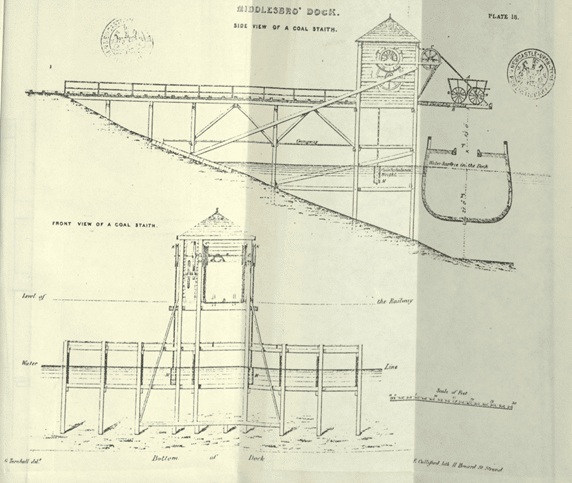
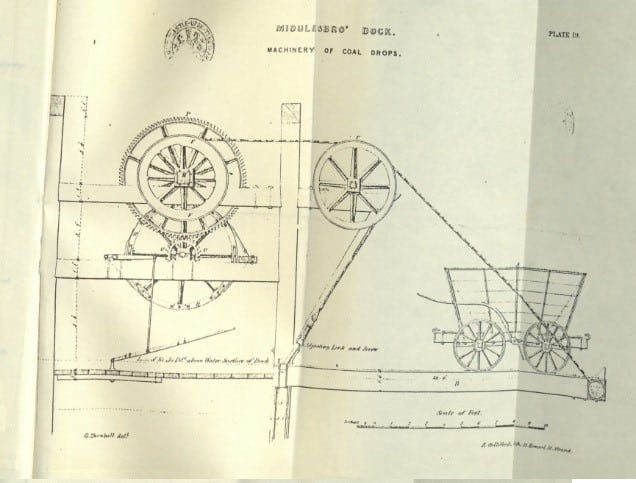
One of the staithes at Port Darlington/Middlesbrough Dock. [95]
A closer view of the staithe shown in the image above. [95]

The years after 1827 (once Company finances were on a sound footing)

A series of different extensions and branches to the S&DR appeared over the period from 1827. [54] “In 1830, the company opened new offices at the corner of Northgate and Union Street in Darlington. [49:p189] Between 1831 and 1832 a second track was laid between Stockton and the foot of Brusselton Bank. Workshops were built at Shildon for the maintenance and construction of locomotives. [49: p235-236] In 1830, approximately 50 horses shared the traffic with 19 locomotives, but travelled at different speeds, so to help regulate traffic horse-drawn trains were required to operate in groups of four or five.” [54] The rule book stated that locomotive-hauled trains had precedence over horse-drawn trains. Even so, accidents and conflict occurred. The practice was to allow private use of the line by industries that it served, “some horse drivers refused to give way and on one occasion a locomotive had to follow a horse-drawn train for over 2 miles (3 km). [49: p383-384][50: p91-94] The committee decided, in 1828, to replace horses with locomotives on the main line, starting with the coal trains, but there was resistance from some colliery owners.” [54]

After the S&DR bought out the local coach companies in August 1832, a mixed [locomotive-hauled] passenger and small goods service began between Stockton and Darlington on 7th September 1833, travelling at 12–14 miles per hour (19–23 km/h); locomotive-hauled services began to Shildon in December 1833 and to Middlesbrough on 7th April 1834. [49: p384-385][50: p68] The company had returned the five per cent dividend that had been promised by Edward Pease, and this had increased to eight per cent by the time he retired in 1832.” [50: p87-88][54]

In 1835, the S&DR partnered with the York & North Midland Railway (Y&NMR) to form the Great North of England Railway (GNER) to build a line from York to Newcastle which along the would run along the line of the S&DR’s Croft branch at Darlington. Pease specified a formation wide enough for four tracks, so freight could be carried at 30 miles per hour (48 km/h) and passengers at 60 mph (97 km/h), and George Stephenson had drawn up detailed plans by November 1835. [48: p64-65][54] The Acts of Parliament enabling the scheme were given royal assent on 4th July 1836 (Darlington to Newcastle) and 12th July 1837 (Croft to York). The railway opened for coal traffic on 4th January 1841 using S&DR locomotives, and to passengers with its own locomotives on 30th March 1841. [48: 67-69][54][87: p93-94]

A patchwork of different schemes was to follow:

  • By February 1842, a passenger service between Darlington and Coxhoe supported by an omnibus service to Shincliffe on the Durham & Sunderland Railway. [87: p165]
  • Early in 1842, the Shildon Tunnel Company opened its 1,225-yard (1,120 m) tunnel through the hills at Shildon to the Wear basin and after laying 2 miles (3.2 km) of track to South Church station, south of Bishop Auckland, opened in May 1842. [49: p435-437]
  • In 1846, the S&DR installed Alexander Bain’s “I and V” electric telegraph to regulate the passage of trains through the tunnel. [90: p52-53]
  • The SD&R provided a 3 1⁄4 hour service between Darlington and Newcastle, with a four-horse omnibus from South Church to Rainton Meadows on the Durham Junction Railway, from where trains ran to Gateshead, on the south side of the River Tyne near Newcastle. [48: p74]

By 1839, the S&DR track “had been upgraded with rails weighing 64 lb/yd (32 kg/m). [91: p415] The railway had about 30 steam locomotives, most of them six coupled, [91: p419] that ran with four-wheeled tenders with two water butts, each capable of holding 600 imperial gallons (2,700 L; 720 US gal) of water. [91: p422] The line descended from Shildon to Stockton, assisting the trains that carried coal to the docks at a maximum speed of 6 mph (9.7 km/h); the drivers were fined if caught travelling faster than 8 mph (13 km/h), [91: p415, 422] and one was dismissed for completing the forty-mile return journey in 4 1⁄2 hours. [59: p136-137] On average there were about 40 coal trains a day, hauling 28 waggons with a weight of 116 tons. [91: p423] There were about 5,000 privately owned waggons, and at any one time about 1,000 stood at Shildon depot.” [54][91: p417-418]

Wikipedia continues: “The railway had modern passenger locomotives, some [still] with four wheels. [91: p421-422] There were passenger stations at Stockton, Middlesbrough, Darlington, Shildon and West Auckland, and trains also stopped at Middlesbrough Junction, Yarm Junction, Fighting Cocks and Heighington. [91: p416] [A significant improvement on early passenger practice.] Some of the modified road coaches were still in use, but there were also modern railway carriages, some first class with three compartments each seating eight passengers, and second class carriages that seated up to 40. [91: p416][92] Luggage and sometimes the guard travelled on the carriage roof; [49: p423] a passenger travelling third class suffered serious injuries after falling from the roof in 1840. [49: p400] Passenger trains averaged 22–25 mph (35–40 km/h), and a speed of 42 mph (68 km/h) was recorded. Over 200,000 passengers were carried in the year to 1st October 1838, [91: p419] and in 1839 there were twelve trains each day between Middlesbrough and Stockton, six trains between Stockton and Darlington, and three between Darlington and Shildon, where a carriage was fitted with Rankine’s self-acting brake, taken over the Brussleton Inclines, and then drawn by a horse to St Helen Auckland. [91: p418] The Bradshaw’s railway guide for March 1843, after South Church opened, shows five services a day between Darlington and South Church via Shildon, with three between Shildon and St Helens. Also listed were six trains between Stockton and Hartlepool via Seaton [94] over the Clarence Railway and the Stockton and Hartlepool Railway that had opened in 1841.” [87: p146-147][54]

During the 1830s, Port Darlington quickly became overwhelmed by the volume of traffic (both imports and exports) and work started in 1839 on Middlesbrough Dock which was laid out by William Cubitt and capable of holding 150 ships! It was “built by resident civil engineer George Turnbull. [89] … After three years and an expenditure of £122,000 (equivalent to £9.65m at 2011 prices), the formal opening of the new dock took place on 12 May 1842. [49: p437][89] The S&DR provided most of the finance, and the dock was absorbed by the company in 1849.” [49: p508][54] The S&DR was, by 1849, a well established and very significant company.

Ongoing Developments

Political manoeuvring to secure a route from London to Scotland via the Northeast continued during this period and the S&DR saw its stocks in the GNER increase in value before a new concern, the Newcastle and Darlington Junction Railway (N&DJR) bought out the GNER.

The S&DR also secured interests in the Wear Valley, [4] [54] a line to Redcar and Saltburn, a branch to a mine at Skelton, [4][54] a line to Barnard Castle, a route (South Durham and Lancashire Union Railway (SD&LUR)) over Stainmore Summit to Tebay, [54] and, through running rights over the Eden Valley Railway (EVR) and the Lancaster & Carlisle Railway (L&CR), to Penrith. “The S&DR opened a carriage works south of Darlington North Road station in 1853 [98] and later it built a locomotive works nearby to replace its works at Shildon [which was] designed by William Bouch, who had taken over from Hackworth as Locomotive Supervisor in 1840, it completed its first locomotive in 1864.” [54][87: p8][99] The inclines, built when stationary engines were used, were bypassed by lines on gentler grades. By the early 1860s, the S&DR had a significant network, even having absorbed the EVR and the SD&LUR. [54]
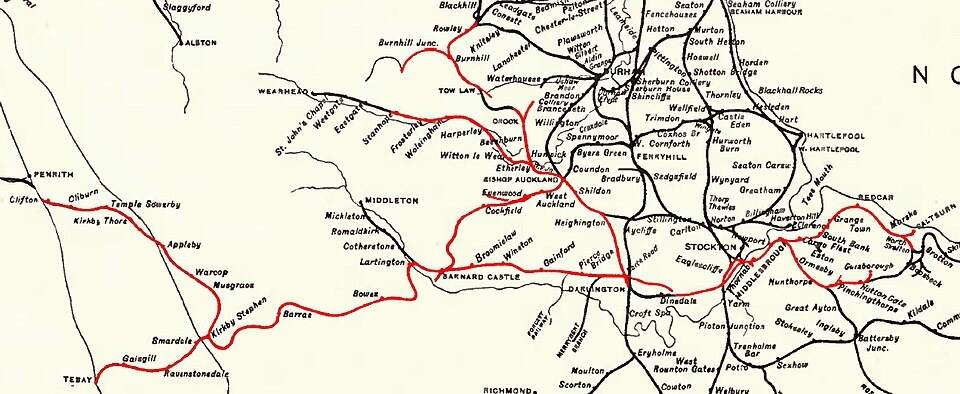
The former S&DR, shown in red, as part of the larger NER network of 1904, © Public Domain. [101]

With 200 route miles (320 km) of line and about 160 locomotives, [100: p167] the Stockton and Darlington Railway became part of the North Eastern Railway on 13th July 1863. Due to a clause in the North Eastern and Stockton and Darlington Railways Amalgamation Act 1863 (26 & 27 Vict. c. cxxii) the railway was managed as the independent Darlington Section until 1876, when the lines became the NER’s Central Division. [87: p9][48: p133] After the restoration of the dividend in 1851, by the end of 1854 payments had recovered to 8 per cent and then had not dropped below 7 1⁄2 per cent.” [50: Appendix 1][54]

I guess that we might easily be able to agree that the Stockton & Darlington Railway was of great local significance. It significantly reduced the cost of coal supplied to Stockton and Darlington. It temporarily enhanced the Port at Stockton before moving that trade downstream to Middlesbrough. It dramatically improved the speed of supply of larger quantities of coal. It made the town and Port of Middlesbrough. It linked the industries of Cumbia and Cleveland allowing speedy transport of coal and iron-ore to the different industries. It improved passenger travel East-West and began with others the development of North-South travel freight and passenger train travel. ……

But how has the Stockton & Darlington Railway transcended the local and become internationally significant? ……

Why Is the Stockton & Darlington Railway So Important?

So, what is the case? Was the S&DR the first real railway?

As 2025 got underway, this question prompted me to look at what is known of railway history in the period from 1800 to 1850, and led to the writing of an article (online) about railway developments during that period. The article is entitled ‘The Mother of All Inventions‘. [2]

September 2025 marked the bicentenary of the Stockton & Darlington Railway (S&DR) and, very naturally and most appropriately, major events were planned across the UK, and enthusiasts across the world planned their own commemorations. In this context, it is, at the very least, worth considering what the S&DR can and cannot justifiably claim for itself. In fact, Anthony Dawson in an article in Steam Railway Magazine in February 2025 suggested that we best get to understand the importance of the S&DR, perversely, by considering what cannot be claimed for it. [3] What follows below is based around that article by Anthony Dawson.

Dawson says: “while every enthusiast would arguably agree that the [S&DR] is special and that the bicentenary of its opening is a landmark worthy of celebration, how many of us truly understand why the [S&DR] is so momentous? Indeed, putting the Stockton & Darlington’s importance into context isn’t exactly straightforward, nor can it be boiled down to a particular ‘first’. Therefore, to understand why the Stockton & Darlington is so important, we need to look at what it wasn’t.” [3]

He goes on to suggest that, to paraphrase Winston Churchill, “while the [S&D] was not the beginning, it was the end of the beginning. Although it wasn’t the first of anything, as early railway historian the late Andy Guy put it, it was ‘better than the first’.” [3]

Was the Stockton & Darlington the first railway?

Perhaps that question can only be answered once we have agreed a definition of a ‘railway’. Collins Dictionary offers three definitions: a railway is the steel tracks that trains travel on; a railway is a company or organization that operates railway routes; and, a railway is the system and network of tracks that trains travel on. [10] Accepting these definitions would rule out a number of early ‘railway-like’ systems based on stone and wood.

The Collins dictionary definitions are very narrowly drafted. Dawson points us to Dr Michael Lewis’ definition: A railway is “a prepared track which so guides the vehicles running on it that they cannot leave the track”. [3][11] This short, simple definition allows for the inclusion of the Diolkos and other rutways of the Classical World, [12][13] possible rutways in Wiltshire (circa 300CE), [13] Cornwall (circa 1550s), [13][14] rutways in 19th century Australia, [15] and the guide-pin railways developed in Germany and Austria in the Middle Ages. Lewis’ definition includes ‘railways’ “before the late 18th Century, [often] private … with rails essentially of wood or occasionally of stone, with carriage only of goods in vehicles propelled by horse- or by man-power, and with a variety of methods of guiding the wheels. ” [11]

Dawson comments that, “The earliest evidence for ‘railways’ in this country comes from the Lake District when German-speaking immigrants led by Daniel Hochstetter introduced them to silver mines at Caldbeck during the reign of Elizabeth I. These railways consisted of longitudinal planks which guided an iron pin secured to the bottom of a four-wheel mine cart, working rather like a slot-car. … But the first [‘true’] railway in England was very likely that built by Huntingdon Beaumont in 1604 to carry coal from his pits at Wollaton near Nottingham down to the River Trent. It was made entirely from wood and greatly improved the transport of coal for onward shipping by water. So pleased was Beaumont with this new technology, he invested heavily in four similar railways around Newcastle, which were built to carry coal down to the Tyne. Beaumont, however, failed to break into the local market. This, coupled with heavy investment in his new railways and his lavish lifestyle, led him to being declared bankrupt, ending his days in a debtors’ prison.” [3]

Dawson goes on to say that, “following the turmoil of the English Civil War and Commonwealth period, wooden railways began to spread across Shropshire where they took on the name ‘Railed Way’ and the North-East where they were known as ‘Waggonways’ – two different names for the same idea. Indeed, as excavations on the first railway in Scotland – the Tranent to Cockenzie Waggonway of 1722 – have shown, there was very little new in the technology of a wooden railway. It [was] essentially a giant ladder laid on the ground. They used old ideas to provide a solution to a new problem.” [3]

The coming of the 18th century heralded a transport revolution. Dawson says: “The early waggonways carried largely coal and other minerals down to a staithe or wharf on a river or canal for onward shipping. Thus, they grew hand in hand with the canal network and many canal companies even owned their own waggonways as feeder lines. There was a transport revolution on the roads as well with the growth of turnpikes. Taken together, [these events] … fed and fuelled industrialisation and growing urbanisation, particularly in the North of England. Improved transport links meant coal could go to market quicker. It meant it was cheaper at the point of sale, which meant greater profits and, in turn, greater demand.” [3]

Various forms of ‘railway’ were clearly well established by the advent of the 19th century. The S&DR was clearly not the first railway.

If not the first ‘railway’, was the Stockton & Darlington the first to use iron rails?

Iron was first used in a ‘railway’ context as protective plating for the early wooden ‘railways’. Lengths of cast iron plate were nailed to the running surface of wooden rails, probably first in Coalbrookdale. Wooden rails were wearing too quickly and the iron covers improved longevity. It was a simple logical next step to move from cast-iron plate to cast-iron bars and then to either cast iron edge rails or cast iron L-shaped ‘tram-plates’. Cast-iron rails were common by the 1790s, their only real fault was that they were brittle and often broke under load. Indeed, when Trevithick’s early locomotive ‘Pen-y-darren’ made its maiden run on the Merthyr Tramroad in 1804, it was noted that the cast-iron rails were not robust enough for the heavy locomotive and a number broke. [16]

Dawson says that “What was needed was a superior type of rail … made from wrought iron. First rolled in any quantity in 1820 at Bedlington Iron Works, the Stockton & Darlington was probably the first railway to use wrought-iron rails on a large scale. Due to distrust of the new material, half of the line was laid with cast iron and half with wrought. It was a major technological breakthrough and one crucial to the development of the locomotive.” [3]

It may well be that around two thirds of the length of the railway used wrought iron rails and one third had cast iron rails. Cast iron was used for the chairs which sat on the sleepers.
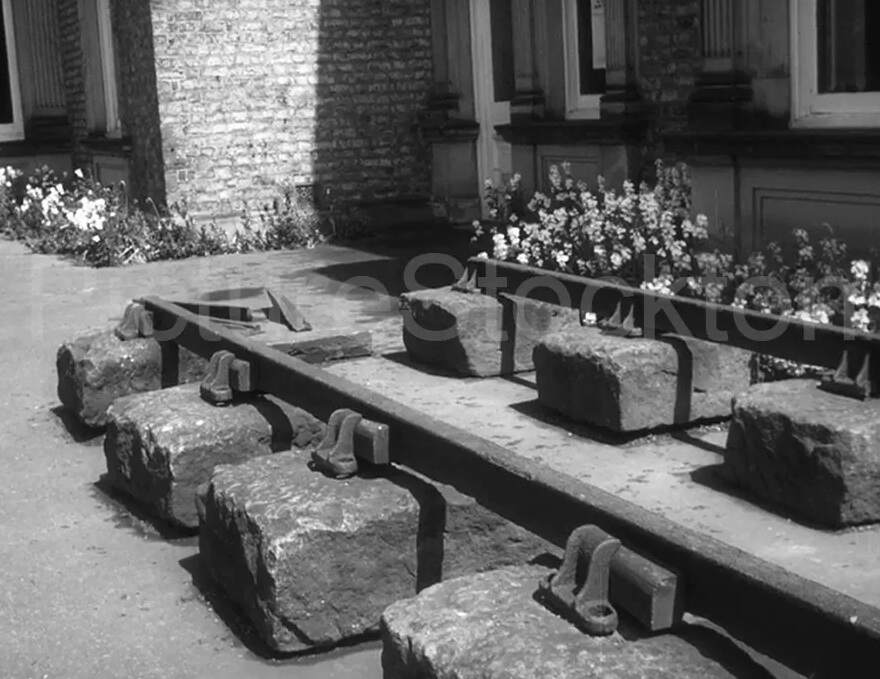
A section of the original Stockton & Darlington Railway track, including the rail, chairs and sleepers, at Preston Park Museum circa. 1962 (c) Bruce Coleman, courtesy of the Shildon Archive [133]

So, it seems that the Stockton & Darlington was not the first to use iron rails but that it was important in the taking of the next technological step of employing wrought-iron rails. “Bedlington Ironworks, in Blyth Dene, Northumberland … is remembered as the place where wrought iron rails were invented by John Birkinshaw in 1820, … with their first major use being [on] the Stockton and Darlington Railway. [17] Birkinshaw’s wrought-iron rails were rolled in 15ft lengths.

If not the first railway and not the first to use iron, was the S&DR the first railway authorised by Act of Parliament?

The first Act of Parliament for a railway was obtained by Charles Brandling for what became the Middleton Railway. It ran from coal pits at Hunslet down to the River Aire. The Act received Royal Assent in 1758. A significant number of Acts of Parliament relating to railways preceded the S&D, including this small selection: [18]
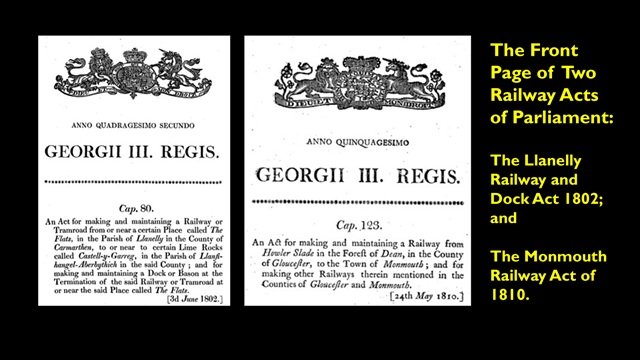
The Llanelli Railway and Dock Act, 1802 and the Monmouth Railway Act 1810. [134][135]
  • 1802: The Llanelly Railway and Dock Act;
  • 1803: The Croydon, Merstham and Godstone Iron Railway Act;
  • 1804: The Ellesmere Canal, Railway and Water Supply Act;
  • 1805: The Surrey Iron Railway Act;
  • 1808: The Kilmarnock and Troon Railway Act;
  • 1809: The Bullo Pill Railway Act; the Gloucester and Cheltenham Railway Act; the Lydney and Lidbrook Railway Act;
  • 1810: The Monmouth Railway Act; the Severn and Wye Railway and Canal Co. Act; The Severn Tunnel Act;
  • 1811: The Hay Railway Act; the Llanvihangel Railway Act; the Penclawdd Canal and Railway or Tramroad Act; the Severn and Wye Railway and Canal Co. Extension Act;
  • 1812: the Anglesey Railway Act;
  • 1813-15: the Usk Tram Road;
  • 1817: the Mansfield and Pinxton Branch;
  • 1818: the Kidwelly and Llanelly Canal and Tramroad Company Act; the Kington Railway Act;
  • 1819: the Leeds and Liverpool Canal Branch and Railway Act; the Plymouth and Dartmoor Railway Act;
  • 1820: the York and North Midland Railway Act; and the Plymouth and Dartmoor Railway (Crabtree and Sutton Pool Branch) Act. [18]

All these and more received their Royal Assent in advance of the S&D at some great expense. Dawson explains that “getting such an Act was very expensive and required having a Parliamentary Agent and introducing a Private Members’ Bill. It would then have to go through both Houses and committee stage and, unless the Bill could demonstrate it was for the public good, could be thrown out at any stage. It was a big risk, but ultimately worth it. Even though the Middleton had an Act, it didn’t mean it was a public railway. It was owned by the Brandlings, to carry their coal to market. It wasn’t open to any other users, and wasn’t a public right of way.” [3]

Not the first railway, not the first to use iron, not the first railway to received Royal Assent through an Act of Parliament. …Was, then, the S&D the first public railway?

All the railways built in the 17th and 18th centuries were private railways, built over private land. Dawson notes that, “or a railway to be public – to be public right-of-way – that meant it needed an Act of Parliament. It also meant that, until 1825 when the law was changed, an Act was also needed to form a joint-stock company.” [3]
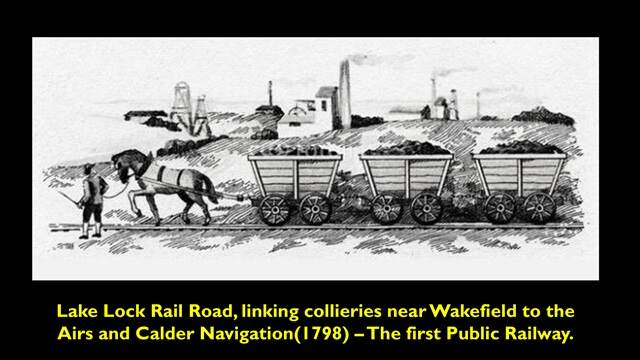
Lake Lock Rail Road was the first public railway in England. It opened in 1798. [132]

The first public railway in England was the Lake Lock Rail Road (LLRR), which opened in 1798. It linked collieries near Wakefield to the Aire & Calder Navigation. The LLRR qualifies as a public railway “because it was open to any user upon payment of a toll and because its capital was held in publicly traded shares. … The LLRR didn’t operate the railway itself, but rather allowed colliery owners to run their own trains on it, for which a toll was paid.” [3] The LLRR can claim another first! As well as being “probably the world’s first public railway, it was also owned … by the world’s first public railway company.” [21]

If you are unhappy with the idea of the LLRR being the first public railway, Then perhaps you would have to accept the Surrey Iron Railway as the next contender for the title – It required an Act of Parliament and incorporated in 1803 and fully open at the latest by 1806.
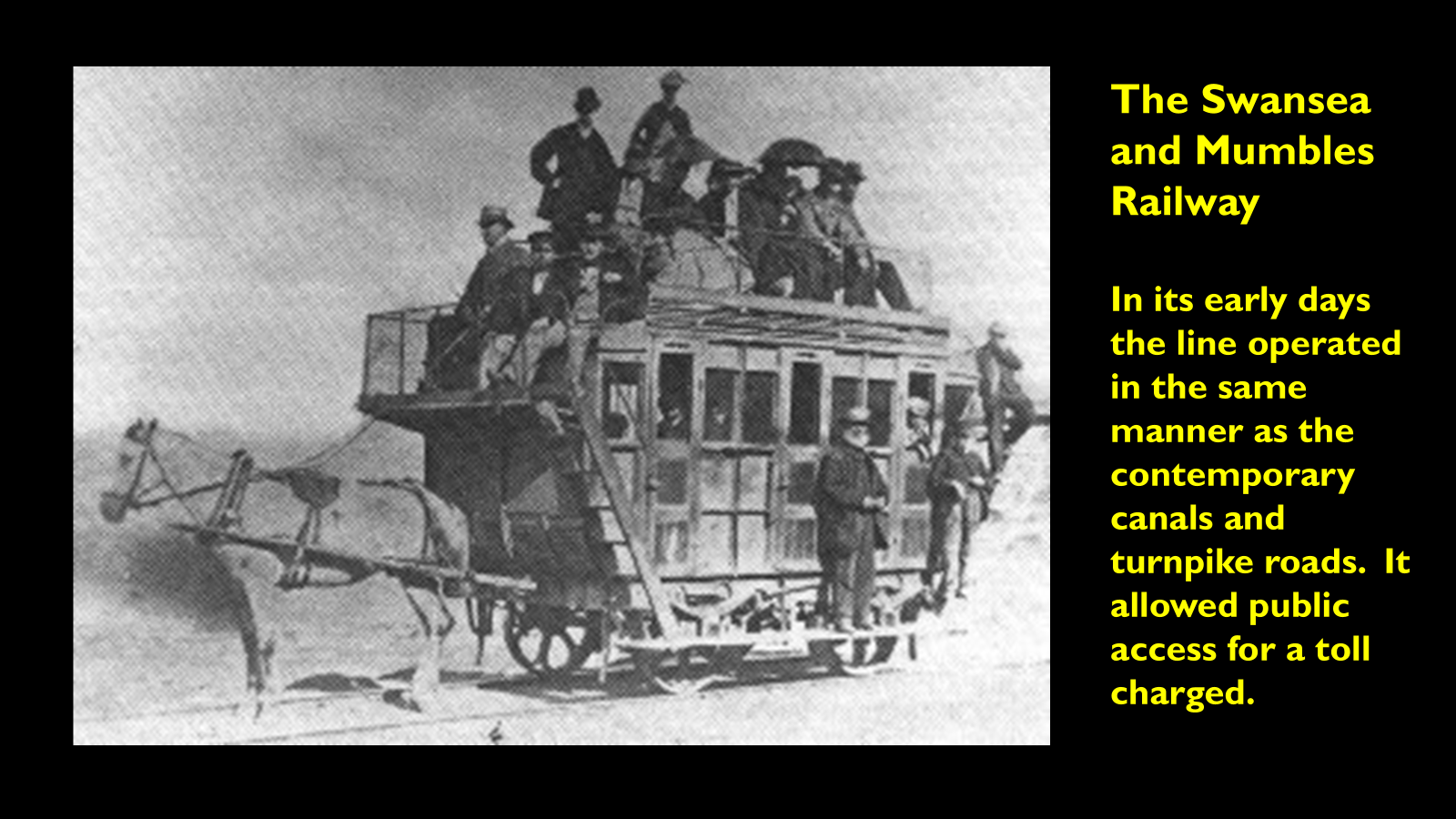
The first public railway carrying passengers – The Swansea and Mumbles Railway. [131]

The first passenger-carrying public railway in the United Kingdom was opened by the Swansea and Mumbles Railway at Oystermouth in 1807, using horse-drawn carriages on an existing tramline. [19][20]

The first public railway in Scotland was the Kilmarnock & Troon Railway (K&TR) which finally opened in 1812. Like the LLRR, it operated as a toll road, so that independent carriers could place wagons on it, and pay for the facility. [22]

We have established that the Stockton & Darlington was not the first public railway. Given what we have already discovered, our next question needs to be one about the intentions of the designers and directors of the Stockton & Darlington.

Was the Stockton & Darlington the first to be designed and built with mechanical operation in mind?

Here we have to start from an ambivalent position. … It depends! … Do you see hydraulic power as a form of mechanical power? If your answer is ‘Yes’, then the first length of railway to be operated mechanically is one known to have existed in Sweden in the late 1600s, where a waterwheel was employed to haul wagons up an incline. By the end of the 1700s, this technology was in use in Mas-sachusetts (on the South Hadley Canal) for a rail-based lift for canal boats linked with practice at Ketley, Shropshire at that time but assisted by power from a water wheel. There was another ex-ample at Bad Gastein in what is now Germany. [114][115: p87 & p337][116] The water-powered haulage of wagons up an inclined plane in the UK was initially limited to one location in Devon alt-hough the practice was used much later in North Wales. [115: p87-88]

If we set aside waterpower, perhaps the S&DR could stake a claim to be the first public railway designed to be worked mechanically. But it definitely was not the first to be operated mechanically. … (More of that later).

Setting aside waterpower, was the S&DR the first railway designed to be operated mechanically? … Again the answer is ‘No!’ … Early inclines were self-acting, water power could support this but, as Gwyn tells us, experience on the Ketley Incline led Reynolds, when carrying out a survey for a canal to connect the Oakengates collieries with the River Severn, to conclude that the wastage of water from locks “would be prohibitive, and after much hesitation and a public competition, he and the other shareholders resolved on a modification of the Ketley system, but with fixed steam engines on its three inclined planes, at Donnington Wood, Windmill Farm and Hay. Instead of locks at the summit as at Ketley, reverse railed slopes were constructed into docks permanently kept in water, and the cradles were equipped with overlapping wheels which ran on ledges on the docksides to maintain them in a horizontal position. The engines were used to draw boats and cradles out of the docks and to haul up the main incline if necessary. All three were built to a hybrid design by Reynold’s protégé, Adam Heslop. These were the first locations in the world where railed vehicles were moved by steam. They were operational by 1793.” [115: p89]
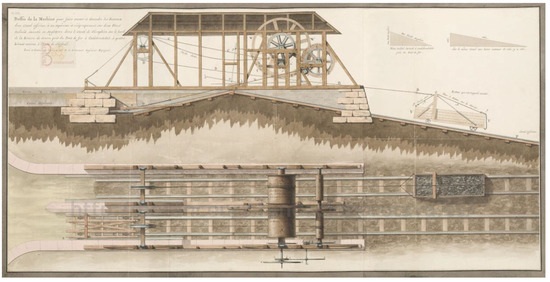
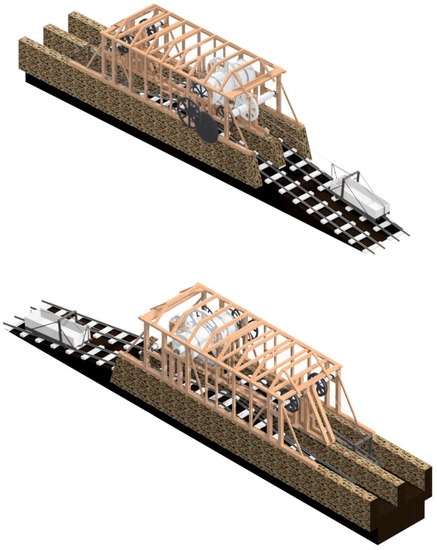
The top of the Hay Inclined Plane as drawn by Agustín de Betancourt. [136]
Rendered isometric views of the 3D CAD model of the top area/winding house of the Hay Incline. [136]

This was followed by a significant section of the Lancaster Canal crossing the Ribble Valley. In 1803, steam-powered inclines were used “to connect the northern and southern ends of the Lancaster Canal. Its three inclined planes were each equipped with a high-pressure 6-horsepower 13-inch cylinder engine costing £350 and made by Summerfield and Atkinson, a local foundry which offered ‘patent steam engines’, and which also built the waggons. The first was installed in May of that year. In June, a 6-horsepower steam engine was installed on a plateway incline to haul spoil on the construction of London Docks.” [115: p89]

From the turn of the nineteenth century a number of shorter inclines were being steam-operated or steam-assisted. Examples include: an incline at Wellington Quay on the North bank of the Tyne (where George Stephenson was employed for a time), 1802/1803; an incline at Glynneath, connecting Aberdare Ironworks with Neath Canal, 1805; Bewicke Main (Urpeth) Colliery, 1805. [115: p89-91]

Three years prior to the opening of the Stockton & Darlington Railway George Stephenson designed and built another railway (the Hetton Colliery Railway) which, like the Stockton & Darlington “used a combination of stationary engines, rope haulages and level sections worked by locomotives.” [3] However, the Hetton Colliery Railway was a private, not a public railway:- “The Hetton Colliery Railway was an 8-mile (13 km) long private railway opened in 1822 by the Hetton Coal Company at Hetton-le-Hole, County Durham. … The Hetton was the first railway to be designed from the start to be operated without animal power, as well as being the first entirely new line to be developed by … George Stephenson.” [25]
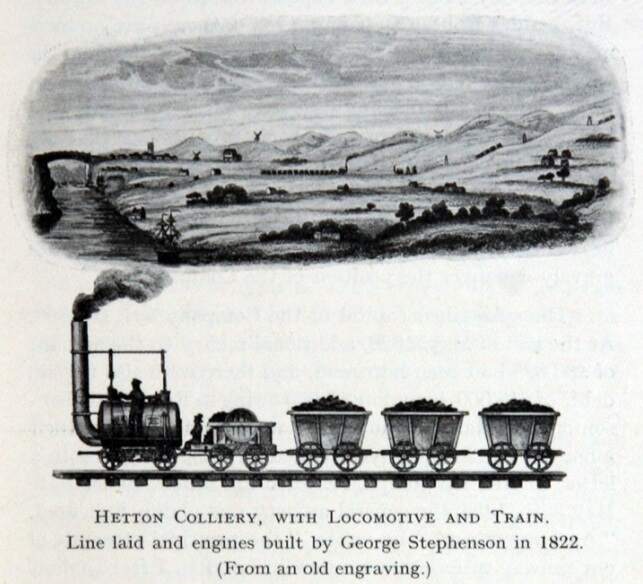
Again, if we set aside hydraulic and discrete uses of stationary steam-power, it seems that the Stockton & Darlington was the first ‘public‘ (rather than ‘private‘) railway to be designed and built with steam power in mind. This, perhaps, feels as though we are making some headway. … The Stockton & Darlington was the first ‘public‘ railway to be designed and built with steam power in mind. … That is definitely a ‘first’ isn’t it. ….

Was the Stockton & Darlington the first railway to use steam power?

Surely, given that the S&DR was the first public railway designed for mechanical operation, that must mean that it was the first to use steam-powered engines. Mustn’t it?

Nothing is that simple!

The Middleton Railway in Leeds, was using steam power by 1812: “In 1812, it introduced the worlds first commercially successful steam locomotives which were designed and built in Leeds. These locomotives incorporated one of the most significant advances in the design of the steam locomotive – namely the twin cylinder engine which eliminated the need for the cumbersome flywheel employed on earlier single cylinder engined locomotives.” [24][34][35][36]

Incidentally, because it was the first railway to regularly use steam locomotives, the Middleton Railway also “lays claim to other firsts; they employed the first regular professional train driver in the world, a former pit labourer named James Hewitt. More tragically, a 13 year old boy called John Bruce was killed in February 1813 whilst running along the tracks – almost certainly the first member of public killed by a locomotive.” [36]

The Kilmarnock & Troon Railway first used steam power in 1817: in 1817 the Duke of Portland acquired a locomotive for the K&TR named ‘The Duke‘, which was the first use of steam locomotive power in Scotland. Its use was however discontinued in view of frequent breakages of the cast-iron rails on the line. [23] … Notes in The Railway Magazine of January 1950, suggest that this was only a hiatus in the use of this locomotive on the K&TR: In his ‘Story of the Life of George Stephenson‘, Samuel Smiles noted the discontinued use of ‘The Duke‘, but later, in his ‘Lives of the Engineers Volume III’ he appears to have secured further information, viz: “The iron wheels of this engine were afterwards removed, and replaced with wooden wheels, when it was again placed upon the road and continued working until the year 1848.” [43: p59][44: p139] This is supported by W. J. Gordon, writing in 1910, who says of the K&TR: “on it was placed the Killingworth engine with the chain gearing bought by the Duke of Portland from George Stephenson in 1817. The iron wheels of this remarkable engine broke down the cast-iron rails, for it thumped horribly, but, instead of being withdrawn from duty, as usually reported, it had its iron wheels taken off and replaced by wooden ones; and with wooden wheels it worked the traffic-mineral, goods and passenger-until 1848, for so many years in fact that it has been confused with or mistaken for the old St. Rollox, one of the first engines of the Glasgow & Garnkirk, which it in no way resembled.” [43: p59-60][45: p188-190]

Gordon appears to “have picked up and recorded a local railway tradition about the locomotive. It is difficult to credit that an old Killingworth-type engine was re-furbished in 1839 or later, after two decades of disuse, but this seems to be the only way of reconciling the various scraps of evidence. No trace has been found of any other Kilmarnock & Troon locomotive.” [43: p60]

It would be impossible to argue that the K&TR was built with steam power in mind, however, the K&TR was definitely the first use of steam-power on a public railway in Scotland. It could also be argued that this was the first use of steam power on a public railway in the United Kingdom. This was eight years before the Stockton and Darlington first used steam-powered trains.

However, neither of these could justifiably make a claim to be the first to use steam on a revenue earning railway. That accolade must go to the Merthyr Tramroad (otherwise known as the Pen-y-Darren Tramway and associated with the Pen-y-darren Ironworks, in Merthyr Tydfil) a bit earlier in the 19th century, on 21st February 1804 to be more precise, and to a locomotive designed by Richard Trevithick.

In 1802, Trevithick took out a patent for his high-pressure steam engine. To prove his ideas, he built a stationary engine at the Coalbrookdale Company’s works in Shropshire in 1802, forcing water to a measured height to measure the work done. The engine ran at forty piston strokes a minute, with an unprecedented boiler pressure of 145 psi.” [26]

It seems that the experiment in Shropshire led to Trevithick experimenting with creating steam railway locomotives. He had already designed and built a road locomotive, ‘Puffing Devil‘. [27]

In 1802, the Coalbrookdale Company in Shropshire built a rail locomotive for him. [28] The death of a company workman in an accident involving the engine is said to have caused the company to not proceed to running it on their existing railway. [29]
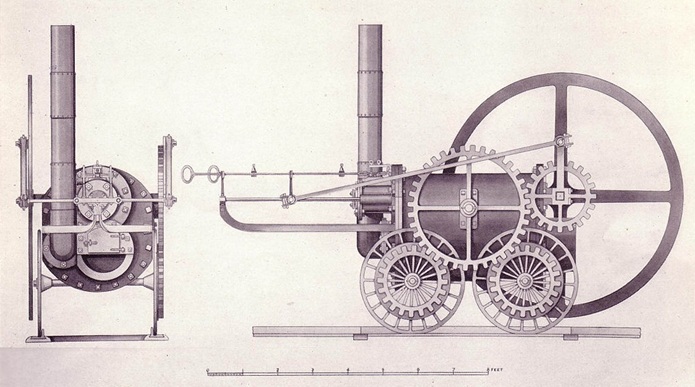
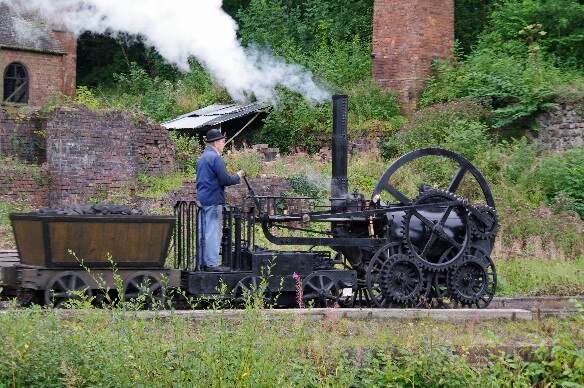
The Coalbrookdale Locomotive: To date, the only known information about the locomotive comes from a drawing preserved at the Science Museum, London, together with a letter written by Trevithick to his friend Davies Giddy. The design incorporated a single horizontal cylinder enclosed in a return-flue boiler. A flywheel drove the wheels on one side through spur gears, and the axles were mounted directly on the boiler, with no frame. [30] On the drawing, the piston-rod, guide-bars and cross-head are located directly above the firebox door, thus making the engine extremely dangerous to fire while moving. [31] Furthermore, the first drawing by Daniel Shute indicates that the locomotive ran on a plateway with a track gauge of 3 ft (914 mm), © Public Domain. [32]
The replica Coalbrookdale Locomotive in action at Blists Hill Victorian Town in Ironbridge Gorge in the 1990s. This replica was made in 1989 by a team of apprentices at GKN Sankey of Telford with the additional inclusion of a few safety additions, such as a trailing driver’s platform. The locomotive first ran in 1990 at Blists Hill at Ironbridge, © Unknown. [26]

The drawing above has been used as the basis of all images and replicas of the later ‘Pen-y-darren’ locomotive, as no plans for that locomotive have survived. It cannot be an exact sister of the later locomotive because there is a tunnel on the Pen-y-darren Tramway which would have required a lower chimney and a smaller flywheel. [3]
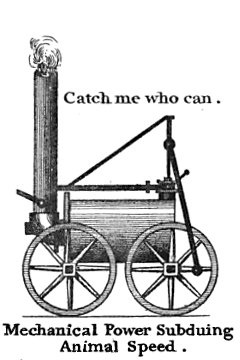
In 1804, Trevithick’s revised locomotive ran on the Pen-y-darren Tramway pulling a commercial load. Soon after this (1808) Trevithick exhibited a similar steam locomotive in London, built for him by John Urpeth Rastrick and John Hazledine at their foundry in Bridgnorth which was named ‘Catch Me Who Can‘. Although only on a small circular track, and only in use for matter of weeks, this was the first locomotive to power a train carrying fare-paying passengers. The drawing of the locomotive ‘Catch Me Who Can‘ is taken from a card/admission ticket to Trevithick’s ‘Steam Circus‘, summer 1808, © Public Domain. [33]

The S&DR was not the first railway to use a steam locomotive. However, the S&DR saw a step change in the use of steam power. … “Prior to 1825 no one had ever attempted to run a locomotive as far as George Stephenson did; the furthest they had ever run was a few miles.” [3] George Stephenson had such faith in steam power “that he designed and built a steam railway to be worked by locomotives not just for a couple of miles but for tens of miles” [3] – twenty six miles in all!

We have established that the S&DR was the first ‘public‘ (rather than ‘private‘) railway to be designed and built with steam power in mind. We have seen that while not the first to use steam-power, it was the first to be so confident in the new technology to believe that it could be used over significant distances.

We have noted, in passing, that the majority of different railways in use prior to 1825, were designed to carry coal or iron ore and some other ancillary forms of freight.

Can we say that the Stockton & Darlington was the first to carry fare-paying passengers over any significant distance?

Dawson tells us that “unofficial passenger carrying goes back into the 18th Century, on what were private mineral lines. The first public railway, as authorised by an Act of Parliament and which authorised the railway to do so was the Swansea & Mumbles Railway of 1807. This was a horse-drawn service, working to a timetable and, in 1812, saw the first railway station open in Swansea.” [3]

He continues: “The first passenger service on a public railway in Scotland was in 1813, on the Kilmarnock & Troon [Railway]. Again, it was horse-worked but like the Stockton & Darlington tickets could be bought from local inns along the line – as well as refreshments and parcels left there to be carried by the railway as well. There was a long history of public passenger railways before 1825. … Therefore, the Stockton & Darlington was tapping into an existing idea.” [3]

David Gwyn says: “In April 1807 the first known public railway passenger service was inaugurated, enabling tourists to enjoy the beauties of Swansea Bay along a plateway opened the previous year to carry limestone from the Mumbles to the copper smelters, and coal and manure in the opposite direction. Such services were soon found on railways in the border country, Scotland and the English West Country. Some carriers offered pleasure carriages for hire. Well-heeled people could now make railway journeys in order to enjoy attractive scenery, and humbler folk could travel by train to buy and sell – both Dr Griffiths plateway from the Rhondda to Pontypridd and the rail section of the Somerset Coal Canal to Radstock were used by women taking farm produce to market.” [115: p71-72]

Gwyn goes on to say that, “Carriers offering passenger services for wealthy tourists built specially designed vehicles, including long-wheelbase carriages on the Sirhowy, hauled at 6 or 7 mph, and on the Oystermouth.” William Chapman suggested in 1813 that ‘long carriages, properly constructed, and placed on two different sets of Wheels, viz. 8 in all, may take 30 or 40 people with their articles to market’.” A ‘market caravan’ on the Plymouth and Dartmoor had fireplaces to keep passengers warm, and there was also an open carriage with an awning. The Kilmarnock and Troon had a coach called ‘the Caledonia’, another called ‘the boat’, then one variously described as ‘an enormous Gypsy caravan’, ‘the Czar’s winter sledge’ and a ‘Brobdingnagian diligence’.” On other systems, humbler passengers rode on unconverted waggons, perhaps for the price of some beer money to the haulier or some other acknowl-edgement, or paid a fare to travel in a coal waggon which had been brushed out, and had planks inserted to serve as seats.” [115: p73]

Let’s tighten up the question. …

Was the S&DR the first to use steam for passenger trains?

Again we have to ask what criteria this should be judged by. Dawson says, “Yes, the opening train of the Stockton & Darlington was indeed pulled by a locomotive, and … included a purpose-built passenger carriage and passengers travelling in coal waggons, but that was a one-off event. It wasn’t the start of a regular steam-worked passenger service. Indeed, the Stockton & Darlington’s passenger service was horse-worked until 1833.” [3]

It was only after a number of years of operating passenger services that the economic potential for steam powered passenger services was recognised by the S&DR and it introduced its own steam hauled passenger services in 1833. It should be borne in mind that, “Although the S&DR made use of steam locomotives from its opening day, it can also be seen to represent a transitional stage of railway development in which stationary engines and horse-drawn vehicles were also utilised. Although [George Stephenson’s] ‘Locomotion’ represents a notable development [in] the earlier pioneering work of George Stephenson and others, it is fair to say that the subsequent work of Timothy Hackworth, the first Superintendent Engineer of the S&DR, proved the supremacy of the steam locomotive over other forms of motive power.” [37]

We have already noted in passing that passengers were carried on a number of earlier steam powered trains:

  • on 21st February 1804, Trevithick’s locomotive pulled a train of coal wagons which carried workmen (over 11 tons of coal, five wagons and 70 men) over the length of the line and it was also proposed to couple a private carriage begin the engine; [38][39]
  • Trevithick’s ‘Catch Me Who Can‘ of 1808 was pioneering in two ways – it was the first purpose-built passenger locomotive, as well as the first to haul fare-paying passengers; [33] and,
  • steam-powered trains on the Middleton Railway and associated lines also carried passengers, informally from very early days, formally by around 1834. [40]

We also have to note that the first regular steam-worked passenger service was to be established in May 1830 on the Canterbury and Whitstable Railway, which incidentally issued the first ever season tickets in 1834. [41] That line “was worked by a combination of stationary engines and a single locomotive – the now preserved Invicta, designed and built by Robert Stephenson & Co in Leeds immediately after Rocket.” [3]

In September 1830, the Liverpool and Manchester opened with a timetabled steam-powered passenger service. So, the S&DR cannot claim to be the first steam-powered passenger service.

If we accept that all of this is true, that the S&DR was not the first in any of the ways already discussed. What can we say about the S&DR which justifies the place it holds in the popular mind and in the eyes of technical specialists, journalists and railway enthusiasts around the world?

What is so special about the Stockton & Darlington Railway?

It is clear that the Stockton & Darlington Railway would not have existed without the, at least, two centuries of railway development which came before it. As Dawson says, “During those two centuries, crucial ideas and crucial technologies were worked out from the track to locomotives, to carrying passengers and legal structures. So, while the Stockton & Darlington wasn’t really the first of anything, it was the culmination of that previous development and evolution. It represents the bringing together and synthesising of existing ideas into a new concept. A public railway, authorised by Act of Parliament, to carry passengers, to use steam locomotives and use iron rails. In many ways it was, as Andy Guy noted in 2016, ‘better than the first’.” [3]

The Museum at Hopetown, Darlington says that, “The Stockton & Darlington was by no means the first railway, but its opening in 1825 marked a very significant step in the development of railways by bringing together two features for the first time: the concept of a public railway, available to all, for transport of passengers and goods; and the use of steam locomotives.” [37]

On that first journey on 27th September 1825, made by the locomotive, ‘Locomotion No. 1‘, driven by George Stephenson, a large number of wagons filled with coal, flour and passengers were hauled along the line. There was a passenger carriage called ‘Experiment’ present which carried the railway’s directors. 300 passenger tickets were sold officially. However, a total amount of nearly 700 passengers were crammed into the wagons and the total load on that day was about 80 tons! [42]

There was clearly a sense that something momentous was happening that day and history has proven that to be the case.

And that initial success, together with that of the neighbouring Hetton Colliery Railway, meant that George Stephenson had demonstrable experience in the use of steam locomotives and places on which to trial his continued development of the technology.
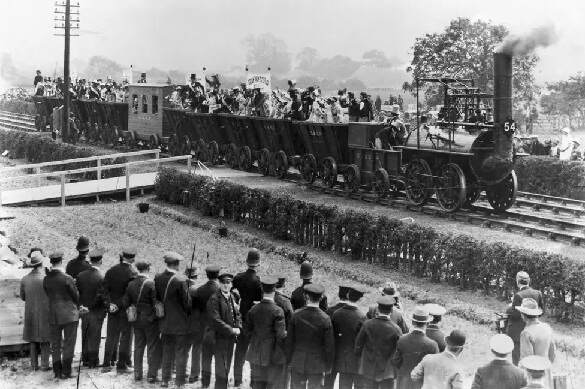
The opening day was recreated in 1925 for the centenary celebrations, © Public Domain. [7]

As Dawson says, the S&DR “wasn’t the first. It wasn’t the first railway, it wasn’t the first steam railway, nor was it the first main line railway. But what it did do was put the railway squarely on the map and in the public consciousness showing what a steam-worked railway could do, laying the foundations for everything that came afterwards.” [3] It was a critical link in the chain of developments that brought about our modern railways. “The Liverpool & Manchester and the birth of main line railways as we know them simply wouldn’t have happened without the Stockton & Darlington Railway.” [3] It placed George Stephenson at the forefront of the development of railway technology and gave him space to test and modify locomotive design.

In that context, However, we must acknowledge the strength of debate underway between 1825 and 1829.

In this four-year period there was an intense debate about whether locomotive power or stationary engines were best.

Stephenson ascribed to the use of fixed engines where gradients were both short and steep. Others argued for the use of a variety of different fixed engines. The directors of the Liverpool & Manchester Railway challenged Stephenson’s proposals for the use of locomotives. This resulted in a number of studies taking place. The first of these took place on the S&DR and reported that rope haul-age would be suitable for the Liverpool & Manchester, with the proviso that it could cause problems at level crossings and at junctions.

A second study based at the Bolton & Leigh Railway and at the Middleton Railway also found in favour of the use of stationary engines for the Liverpool & Manchester spaced at no more than 2-mile intervals, with goods and passengers changing from one system to another at locations dictated by the gradient or by the length of rope in use. That study saw the value of locomotives for light loads but estimated that the rate per ton per mile for heavier loads would be 2/3 of a penny cheaper with stationary engines rather than locomotives.

There was a worldwide proliferation of the use of stationary engines from the second half of the 1820s into the 1830s.

The complexity of use of the stationary engines over significant distances, the necessary transshipment of goods and passengers to suit the technology eventually brought the director of the Liverpool & Manchester to the conclusion that provided locomotives could meet specific criteria then they should be used for the longer lower gradient length (35 miles) of the railway.

There is little doubt that the experience of working the S&DR and the rapid development in loco-motive technology which resulted gave Stephenson and Hackworth a clear advantage over any competition. But it must be remembered that the ‘ordeal’ at Rainhill was as much about the choice between stationary engines and mobile locomotives as it was about which was the best locomotive.

Both Hackworth and Stephenson entered locomotive for the Rainhill Trials Stephenson’s expertise, honed by experience on the S&DR and built on a fastidious attention to detail which saw all parts of Rocket tried and tested as part of a component review, resulted in Rocket significantly out-performing all its competitors (including Hackworth), but perhaps of greater significance, the debate over the use of locomotives or stationary engines had been conclusively resolved in favour of the locomotive.

Locomotive design was developing so quickly that after 1831, Rocket became design-expired and was only used on engineers’ trains and for other secondary duties! [137] [115: p144-171]

To summarise, … the S&DR:

Was a significant step forward on a journey to technological advancement and in the history of transport. The S&DR made a critical contribution to the history of the world, not just to the development of railways. It:

Demonstrated the Feasibility of Steam Railways as a means of transport of goods and passengers over significant distances. It proved that steam-powered trains could be a practical and profitable means of transport, not just for coal but also for passengers.

Inspired Global Growth: The S&DR’s success led to a surge in railway construction both in Britain and around the world, as other countries sought to replicate its model. Initially, it gave confidence to a number of investors in railways. After the opening of the S&DR, people knew that they would be investing in proven technology, not risking their money on what was no more than an experiment.

Brought About Technological Innovation: The S&DR pioneered various railway technologies, including signaling systems, timetables, and station layouts, which became standard practices in the railway industry.

Had a Significant Economic Impact: The railway transformed the Tees Valley into an industrial powerhouse, facilitating the transport of goods and people, and contributing to the growth of new industries and towns.

Had a Manifest Social Impact: The S&DR made travel more accessible to people of all classes, leading to increased social mobility and cultural exchange.

Created a Legacy: The S&DR is considered the “birthplace of the modern railway system” and its legacy continues to be celebrated through museums, heritage sites, and ongoing research.

By the time Richard Trevithick died in 1833 the first main lines were extending across Britain. By the time of George Stephenson’s death in 1848, the railway mania was in full swing. Soon the world would be crisscrossed by parallel iron rails, and nothing would ever be the same again. Places once considered perilously distant could be reached in hours.

However, if the S&DR had not opened in 1825, somewhere else would have taken its place as the birth-place of modern railways within a matter of a few short years. It was however, the tipping point when one excellent technology of tramway and tramroad gave way to what we now call the railway..
Industries would soon transport their goods across the globe with ease.
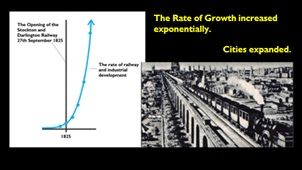
Industrial output grew exponentially. … Cities were reshaped now that people didn’t have to live within walking distance of work.
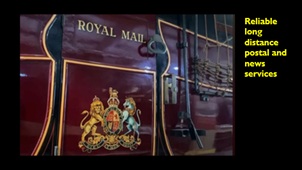
Businesses could be more productive than ever before with reliable means of communication. News of events in far-off places could be on the breakfast table the following day.
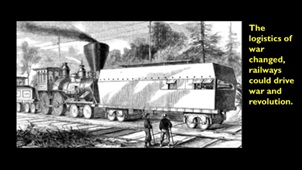
Railways would drive wars and revolutions.
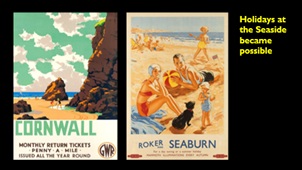
Railways also made going on holiday accessible to ordinary people.
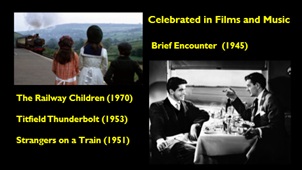
Railways were celebrated in literature music and film.
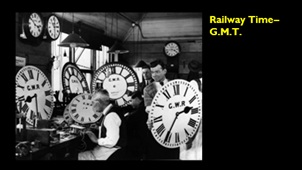
The new need for consistent timekeeping across the country meant that Greenwich Mean Time (GMT) was adopted as standard – even time itself would be spiked to the iron way.

And here we are, 200 years later in a world that Trevithick and Stephenson would barely recognize. Perhaps the best way to end would be with a quote attributed to Stephenson found in Smile’s biography of George Stephenson and told to Smile by John Dixon. …

The time will come when railways will supersede almost every other form of conveyance in this country when mail coaches will go by railway and railroads will become the great highway for the king and all his subjects. I know there will be great and almost insurmountable difficulties to be encountered but what I have said will come to pass as sure as you live.” [George Stephenson]

References

  1. Andrew Wilson; The Stainmore Route and the Eden Valley Line; in Rex Kennedy (ed.); Steam Days, Red Gauntlet Publications , Bournemouth, Forest, January 2002, p13-30.
  2. https://rogerfarnworth.com/2025/03/03/the-mother-of-all-inventions
  3. Anthony Dawson; Stockton & Darlington: Better than the first; in Steam Railway Magazine, February 2025; via https://www.steamrailway.co.uk/blog/features/stockton-darlington-better-than-the-first, accessed on 21st March 2025.
  4. https://www.ice.org.uk/what-is-civil-engineering/infrastructure-projects/stockton-and-darlington-railway, accessed on 26th March 2025.
  5. https://www.sdr1825.org.uk, accessed on 26th March 2025.
  6. https://www.britannica.com/topic/Stockton-and-Darlington-Railway, accessed on 26th March 2025.
  7. https://www.bbc.co.uk/news/uk-england-tees-56168296, accessed on 26th March 2025.
  8. https://www.sdr1825.org.uk/why-was-the-stockton-darlington-railway-important, accessed on 26th March 2025.
  9. J. S. Jeans; Jubilee Memorial of the Railway System. A History of the Stockton and Darlington Railway and a Record of Its Results; Longmans, Green & Co., London, 1875. (later 1974 ed., p74).
  10. https://www.collinsdictionary.com/dictionary/english/railway, accessed on 26th March 2025.
  11. M. J. T. Lewis; Railways in the Greek and Roman World, in A. Guy & J. Rees, J. (eds.); Early Railways. A Selection of Papers from the First International Early Railways Conference; (PDF); Newcomen Society, London, 2001, p8–19; via https://web.archive.org/web/20110721083013/http://www.sciencenews.gr/docs/diolkos.pdf, accessed on 26th March 2025.
  12. David Gwyn and Neil Cossons; Early Railways in England: Review and summary of recent research; Historic England, Discovery, Innovation and Science in the Historic Environment Research Report Series No. 25-2017; via
  13. The first railways in England probably date, at earliest, from the second half of the 16th century and were associated with mines where German-speaking miners were employed. Smith-Grogan 2010 suggests that several Cornish rutways might date back to the 1550s and be associated with Burchard Cranich and Ulrich Frosse. The West-Country mining engineer Sir Bevis Bulmer (1536-1615) was familiar with Agricola’s De Re Metallica (Skempton 2002), and another possible literary conduit is Sebastian Munster’s Cosmographia Universalis, published in German in 1544 and in Latin in 1550. This includes a woodcut of a hund on flanged wooden rails in a mine at Ste Marie/Markirch in Alsace (Lewis 1970, 51).” [12: p20]
  14. G. Smith-Grogan; Rutways in Cornwall; in Early Railways 4, Fourth International Early Railways Conference; Newcomen Society, London, 2010.
  15. J. Longworth and P. Rickard; Plateways, Steel Road Rails, Stoneways, and Rutways in Australia; in Early Railways 6, Sixth International Early Railways Conference; Newcomen Society, London, 2016.
  16. https://en.wikipedia.org/wiki/Richard_Trevithick#%22Pen-y-Darren%22_locomotive, accessed on 14th April 2025.
  17. https://en.wikipedia.org/wiki/Bedlington_Ironworks, accessed on 14th April 2025.
  18. http://www.railarchive.org.uk/Acts%20of%20Parliament%201801%20to%201840.pdf, accessed on 14th April 2025.
  19. https://en.wikipedia.org/wiki/History_of_rail_transport_in_Great_Britain, accessed on 15th April 2025.
  20. Mumbles Railway Was ‘Remarkable’; BBC News, 25th March 2007; via http://news.bbc.co.uk/1/hi/wales/south_west/6491379.stm, accessed on 15th April 2025.
  21. https://www.branchstow.co.uk/wakefieldsfirstrailwayanditscollieriesjohngoodchild, accessed on 15th April 2025.
  22. https://en.wikipedia.org/wiki/Kilmarnock_and_Troon_Railway, accessed on 15th April 2025.
  23. https://www.nationaltransporttrust.org.uk/heritage-sites/heritage-detail/kilmarnock-and-troon-railway, accessed on 15th April 2025.
  24. https://railway200.co.uk/activity/celebration-of-the-90th-birthday-of-courage-the-worlds-smallest-standard-gauge-diesel-loco/, accessed on 15th April 2025.
  25. https://en.wikipedia.org/wiki/Hetton_colliery_railway, accessed on 15th April 2025.
  26. https://preservedbritishsteamlocomotives.com/richard-trevithick-1802-coalbrookdale-locomotive, accessed on 16th April 2025.
  27. https://en.wikipedia.org/wiki/Richard_Trevithick, accessed on 16th April 2025.
  28. Francis Trevithick; Life of Richard Trevithick: With an Account of His Inventions, Volume 1; E. & F.N. Spon, London, 1872.
  29. John Denton; Shropshire Railways; in Shropshire; Shropshire County Council, 1980. p335.
  30. G. F. Westcott; The British Railway Locomotive 1803–1853; HMSO, London, 1958 p3 & p11.
  31. Early steam locomotives; in Locos in Profile; via https://web.archive.org/web/20110612124726/http://www.locos-in-profile.co.uk/Articles/Early_Locos/early1.html, accessed on 16th April 2025.
  32. https://en.wikipedia.org/wiki/Richard_Trevithick#/media/File:Coalbrookdale_loco.jpg, accessed on 16th April 2025
  33. https://en.wikipedia.org/wiki/Catch_Me_Who_Can, accessed on 16th April 2025.
  34. Designed and built by Matthew Murray, four of these locomotives were built for use in Leeds, where they lasted – despite one blowing up – until the early 1830s. Three were built for use around Newcastle-upon-Tyne; three under licence for use near Wigan, and one for service in South Wales. A working model was sent to the Tsar of Russia and copies were built in modern-day Belgium and Poland. This means not only were they the first locomotives in commercial use, but the first built in any number and the first to be used in many countries around the world.” [3]
  35. The design of this early locomotive address one particular problem associated with these early locomotives: “Colliery manager John Blenkinsop focussed on a particular problem with locomotives on cast-iron rails, specifically that an engine light enough to run on the tracks without breaking them would have trouble with the weight of the wagons and the often steep gradients of the track. Blenkinsop relaid the track on one side with a toothed rail – patented in 1811 – and approached engineer Matthew Murray to design a locomotive with a pinion to mesh with the rail. The resulting Salamanca became the first commercial steam locomotive to operate successfully in 1812.” [36]
  36. https://www.airedalesprings.co.uk/blog/great-feats-of-british-engineering-middleton-railway, accessed on 16th April 2025.
  37. https://www.hopetowndarlington.co.uk/stories/the-stockton-darlington-railway, accessed on 16th April 2025.
  38. http://www.alangeorge.co.uk/penydarren_ironworks.htm, accessed on 16th April 2025.
  39. https://en.wikipedia.org/wiki/Penydarren, accessed on 16th April 2025.
  40. https://sherburninelmethistory.co.uk/local-railway-history, accessed on 16th April 2025.
  41. https://crabandwinkle.org/past, accessed on 16th April 2025.
  42. https://uk.hornby.com/railway-200, accessed on 16th April 2025.
  43. Notes and News; in The Railway Magazine, January 1950, Volume 96, No. 585, Transport (1910) Ltd., Westminster, London.
  44. Samuel Smiles; Lives of the Engineers, Volume III; John Murray, 1862.
  45. W. J. Gordon; Our Home Railways Volume II; Frederick Warne & Co., 1910.
  46. https://www.networkrail.co.uk/stories/all-aboard-railway-200, accessed on 14th July 2025.
  47. https://www.thenorthernecho.co.uk/history/railway/stockton/3165797.Efforts_that_kept_the_mines_afloat, accessed on 14th July 2025.
  48. Cecil J. Allen; The North Eastern Railway; Ian Allan, Shepperton, HB 1964 (SB 1974).
  49. William Weaver Tomlinson; The North Eastern Railway: Its rise and development; Andrew Reid and Company, 1915; via https://archive.org/details/northeasternrail00tomlrich/northeasternrail00tomlrich, accessed on 14th July 2025.
  50. Maurice W. Kirby; The Origins of Railway Enterprise: The Stockton and Darlington Railway 1821–1863; Cambridge University Press. 2002.
  51. In the 19th century members of the Society of Friends travelled to attend regular meetings and came to know Quakers elsewhere, this leading to marriages and business partnerships. The Society of Friends published guidance on conduct that included honesty in business matters, and this gave Quakers the confidence to invest in the dealings of a devout member. [50: p52, 79–80, 128]
  52.  “In the mean time, a bill is to be brought into Parliament to carry a rail-way from Bishop Auckland to Darlington and Stockton. Mr. Stevenson … has been called … to give an opinion as to the best line. The work is estimated at 120,000l., a great part of which is already subscribed.” [53: p223]
  53. Thomas Thomson, ed.; Durham Coal Field; in Annals of Philosophy. Vol. XIII.; Baldwin, Cradock and Joy, London, March 1819.
  54. https://en.wikipedia.org/wiki/Stockton_and_Darlington_Railway, accessed on 14th July 2025.
  55. https://en.wikipedia.org/wiki/File:Stockton_and_Darlington_seal_(en).jpg, accessed on 14th July 2025.
  56. David Milbank Challis & Andy Rush; The Railways Of Britain: An Unstudied Map Corpus; in Imago Mundi. Volume 61, No. 2, 2009, p186–214; via https://www.semanticscholar.org/paper/The-Railways-of-Britain%3A-An-Unstudied-Map-Corpus-Challis-Rush/8ff97f7c976fe3a2cb7ed2e07a268ab4ab904490, accessed on 14th July 2025.
  57. From [1825] on, an abundance of maps, plans, diagrams and technical drawings were created to enable railways to be planned, constructed and operated; to be changed, developed and regulated; to attract business and passengers; and to provide railway staff with a range of specialist tools.” [56]
  58. Diana Collecott; The Arrival of Quakerism in Teesdale; in The Quaker Line: A study to understand the importance of the Quaker community to the Stockton & Darlington Railway; compiled by the Friends of the Stockton & Darlington Railway (FSDR), supported by Historic England, 2022/3, p7-14; via https://www.sdr1825.org.uk/wp-content/uploads/2023/12/The-Quaker-Line-Alan-Townsend-Ed.pdf, accessed on 14th July 2025.
  59. L. T. C. Rolt; George and Robert Stephenson: The Railway Revolution; Penguin, 1984.
  60. Malleable iron rails cost £12 10s and cast iron rails £6 15s per ton at that time, but malleable iron rails could be less than half the weight for the same strength. [59: p74]
  61. Smiles [62: p160] states that early tramroads had rails 4 ft 8 in (1,422 mm) apart, but Tomlinson [49: p82–83] questions this, stating that the most common gauge of the early tramroads and waggonways was about 4 ft (1,219 mm), and some, such as the Wylam Waggonway, had the rails 5 ft (1,524 mm) apart. The gauge of the S&DR was given in early documents as 4 ft 8 in (1,422 mm), but the distance between the rails was later measured as 4 ft 8+1⁄2 in (1,435 mm), and this became the standard gauge used by 60 per cent of railways worldwide. The difference of 1⁄2 inch (13 mm) is a mystery.” [54][63: p75][64]
  62. Samuel Smiles; Lives of the Engineers. The Locomotive. George and Robert Stephenson; John Murry, Albermarle Street, London, 1904; via https://archive.org/details/livesengineersg00smilgoog/page/n8/mode/2up?view=theater, accessed on 15th July 2025.
  63. Hunter Davis; George Stephenson: A Biographical Study of the Father of Railways; Weidenfeld and Nicolson, London, 1975.
  64. Robert Stephenson (1803–1859); Network Rail; via https://web.archive.org/web/20140226231103/http://www.networkrail.co.uk/VirtualArchive/robert-stephenson, accessed on 15th July 2025.
  65. The Skerne bridge was shown on the reverse of the Series E five-pound note that featured George Stephenson, issued by the Bank of England between 1990 and 2003.[66] Allen [48: p22] and Tomlinson [49: p93–95] state that Bonomi was directly appointed by the directors after Stephenson had ignored suggestions to consult him, but Rolt [59: p75] does not mention this.” [54]
  66. Withdrawn Banknotes Reference Guide (PDF) (Report). Bank of England, London, p27; via https://web.archive.org/web/20170329073154/http://www.bankofengland.co.uk/banknotes/Documents/withdrawnrefguide.pdf, accessed on 15th July 2025.
  67. Robert H. Thornton; A History of the Growth of the Steam Engine; D. Appleton & Co., New York, via https://archive.org/stream/ahistorygrowths03thurgoog#page/n5/mode/2up, accessed on 15th July 2025.
  68. https://en.wikipedia.org/wiki/Skerne_Bridge, accessed on 15th July 2025.
  69. https://commons.wikimedia.org/wiki/File:Skerne_Bridge,_Darlington,_in_1825,_by_Revd._John_Skinner.jpg, accessed on 15th July 2025.
  70. https://commons.wikimedia.org/wiki/File:Skerne_Railway_Bridge_South_Side_May_2021.jpg, accessed on 15th July 2025.
  71. Smiles [62: p166] has an image of this railway coach and describes it as ‘a somewhat uncouth machine’, even though the Illustrated London News had discounted in 1875 an earlier publication of Smiles’ image, stating that coach used on the opening day was a similar to a road coach. [72] Tomlinson [49: p109–110] describes the coach as having a table, cushioned seats and carpets, and criticises the Smiles image for the lack of roof seats, having the wheels outside the coach frame and says that the drawing in Smiles does not look like a vehicle that was built for £80 (approximately £8300 in 2023). [73]
  72. Railway Jubilee at Darlington; Illustrated London News. 2nd October 1875, p342.
  73. UK Retail Price Index inflation figures are based on data from Gregory Clark; The Annual RPI and Average Earnings for Britain, 1209 to Present (New Series); MeasuringWorth, 2017, via https://measuringworth.com/datasets/ukearncpi accessed on 15th July 2025.
  74. These waggons (known as wagons after about 1830) [75] were designed to carry a Newcastle chaldron (pronounced ‘chalder’ in Newcastle) of coal, about 53 long cwt (5,900 lb; 2,700 kg). This differed from the London chaldron, which was 36 bushels or 25+1⁄2 long cwt (2,860 lb; 1,300 kg). [49: p120][76]
  75. A. A. Jackson; The Railway Dictionary: An A-Z of Railway Terminology; Alan Sutton, 1922, p322.
  76. Bill Griffiths; A Dictionary of North East Dialect; Northumbria University Press. 2005, p30.
  77. https://teesvalleymuseums.org/theme/the-stockton-darlington-railway/view-object/the-opening-of-the-stockton-and-darlington-railway-1825, accessed on 15th July 2025.
  78. https://en.wikipedia.org/wiki/Railway_track, accessed on 15th July 2025.
  79. https://en.wikipedia.org/wiki/Rail_profile, accessed on 15th July 2025.
  80. https://railroadrails.com/information/railroad-track-weight-and-length, accessed on 15th July 2025.
  81. https://commons.wikimedia.org/wiki/File:Stockton_%26_Darlington_Railway_with_today%27s_lines.svg, accessed on 15th July 2025.
  82. An imperial or long ton is the same as 1.016 metric tonnes and 1.120 short tons, the US customary unit.
  83. Compare Tomlinson (49: p141–142) and Rolt (59: p143).
  84. Robert Young; Timothy Hackworth and the Locomotive; Locomotive Publishing Co., London, 1923 – republished by The Hackworth Society/The Book Guild Ltd., 2000 in PB.
  85. https://en.wikipedia.org/wiki/History_of_Middlesbrough, accessed on 15th July 2025.
  86. https://en.wikipedia.org/wiki/Middlesbrough, accessed on 15th July 2025.
  87. K. Hoole; A Regional History of the Railways of Great Britain: Volume IV The North East; David & Charles, Newton Abbot, 1974.
  88. Census 2011; Middlesbrough Council; via https://web.archive.org/web/20131230231647/http://www.middlesbrough.gov.uk/?articleid=3995, accessed on 15th July 2025.
  89. Paul Delplanque; Middlesbrough Dock 1839–1980; in the Middlesbrough Gazette, 17th November 2011; via https://web.archive.org/web/20130409123451/http://rememberwhen.gazettelive.co.uk/2011/11/middlesbrough-dock-1839-1980.html, accessed on 15th July 2025.
  90. A. N. Mackay, ed.; A History of North Eastern Railway Signalling; North Eastern Railway Association, 2016.
  91. Francis Whishaw; The Railways of Great Britain and Ireland Practically Described and Illustrated (2nd ed.); John Weale, London,1842.
  92. Passenger accommodation was sometimes classified as inside and outside following the practice on stage-coaches; express trains with premium fares were known as first-class trains. The S&DR introduced third class accommodation on some trains in 1835 as people unable to afford a second class ticket had been walking along the tracks.” [93]
  93. Charles Edward Lee; Passenger Class Distinctions; in the Railway Gazette, London, 1946.
  94. Bradshaw’s Monthly General Railway and Steam Navigation Guide; March 1843, p16
  95. https://www.portofmiddlesbrough.com/1830-port-darlington-is-born, accessed on 16th July 2025.
  96. https://www.sdr1825.org.uk/wp-content/uploads/2021/03/6-The-Globe-Jul-2018.pdf, accessed on 16th July 2025.
  97. https://commons.wikimedia.org/wiki/File:The_Globe_locomotive.jpg, accessed on 16th July 2025.
  98. Historic England; Details from listed building database (1121229); National Heritage List for England; via https://historicengland.org.uk/listing/the-list/list-entry/1121229?section=official-list-entry, accessed on 16th July 2025.
  99.  Darlington North Road Locomotive Works; Railway Correspondence & Travel Society; 24 August 2012; via https://web.archive.org/web/20140115121551/https://www.rcts.org.uk/branches/north_east/page.htm?id=Darlington%20North%20Road%20Locomotive%20Works, accessed on 16th July 2025.
  100. Peter Walton; The Stainmore and Eden Valley Railways; Oxford Publishing, 1992.
  101. https://en.wikipedia.org/wiki/File:S%26DR_as_part_of_NER_in_1904_(en).jpg, accessed on 16th July 2025.
  102. https://commons.wikimedia.org/wiki/File:Gaunless_Bridge_before_1901.jpg, accessed on 16th July 2025.
  103. https://en.wikipedia.org/wiki/Durham_Coalfield, accessed on 17th July 2025.
  104. https://evenwoodramshawdistricthistorysociety.uk/geology-the-durham-coalfield-etc, accessed on 17th July 2025.
  105. https://maps.nls.uk/view/220113055, accessed on 13th August 2025.
  106. https://web.archive.org/web/20110719144222/http://www.cmhrc.pwp.blueyonder.co.uk/durhamcf.htm, accessed on 17th July 2025.
  107. https://durhamrecordoffice.org.uk/our-records/coal-mining-and-durham-collieries, accessed on 17th July 2025.
  108. http://www.northumbria.ac.uk/sd/central/its/uni_press/catalogue/hist/gnc_bm, accessed on 17th July 2025.
  109. https://www.sunnisidelocalhistorysociety.co.uk/durham.html, accessed on 18th July 2025.
  110. https://muse.jhu.edu/article/623440/summary, accessed on 18th July 2025.
  111. https://www.pontcysyllte-aqueduct.co.uk/object/horses, accessed on 18th July 2025.
  112. https://www.theheritageportal.co.za/article/railway-put-world-track, accessed on 18th July 2025.
  113. https://en.wikipedia.org/wiki/Locomotion_No._1, accessed on 18th July 2025.
  114. L.O. Karlsson; A Rediscovered Early Rail Wagon; in Early Railways; Newcomen Society, London, p20-23.
  115. David Gwyn; The Coming of the Railway: A New Global History, 1750-1850; Yale University Press, New Haven & London, 2023.
  116. Sir William Strickland; Technical Study of the Inclined Plane Mechanism of the South Hadley Canal, South Hadley,Massachusetts; 1794.
  117. https://picturestocktonarchive.com/2019/07/19/the-bishop-auckland-to-stockton-canal-1770, accessed on 4th August 2025.
  118. https://www.networkrail.co.uk/stories/incredible-stephenson-railway-history-rediscovered, accessed on 4th August 2025.
  119. https://ourworldindata.org/grapher/output-of-key-industrial-sectors-in-england-and-the-uk, accessed on 4th August 2025.
  120. A. Vaughan; Railwaymen, Politics and Money; John Murray, London, 1997.
  121. https://regency-explorer.net/wp-content/uploads/2020/08/Advertisment-for-the-first-horse-drawn-railway-in-Britain.jpg, accessed on 7th August 2025.
  122. https://www.thehopkinthomasproject.com/TheHopkinThomasProject/TimeLine/Wales/LocomotiveDevelopment/WrightIllustratedHistory/WrightHTMs/HackworthRoyalGeorge.htm, accessed on 7th August 2025.
  123. https://historicengland.org.uk/listing/the-list/list-entry/1322808?section=official-list-entry, accessed on 7th August 2025.
  124. R. Young; Timothy Hackworth and the Locomotive; 1975
  125. https://www.sdr1825.org.uk/wp-content/uploads/2021/03/2016-12-28-SDR-Volume-1-Significance-Management.pdf accessed on 9th August 2025.
  126. A. Guy; Better Than First: the Significance of the Stockton & Darlington Railway, 1821-30; (unpub paper given at the Friends of the S&DR Conference June 2015).
  127. https://commons.wikimedia.org/wiki/File:Stockton_and_Darlington_Railway_Share_Certificate_issued_1823.jpg, accessed on 13th August 2025.
  128. http://www.metadyne.co.uk/pdf_files/RULE_MAIN_V4.pdf, accessed on 13th August 2025.
  129. https://www.sdr1825.org.uk/wp-content/uploads/2021/03/StocktonandDarlingtonRailwayHeritageActionZone–AerialInvestigationandMapping-Historic-England-2021.pdf, accessed on 13th August 2025.
  130. https://maps.nls.uk/view/102341692, accessed on 13th August 2025.
  131. https://en.wikipedia.org/wiki/Swansea_and_Mumbles_Railway, accessed on 14th August 2025.
  132. https://www.historyofrailroad.com/news/lake-lock-rail-road-company-above-ground-railway#google_vignette, accessed on 14th August 2025.
  133. https://picturestocktonarchive.com/2016/03/30/original-sd-line-railway-tracks-outside-preston-hall-museum, accessed on 14th August 2025.
  134. https://www.legislation.gov.uk/ukla/Geo3/42/80/contents/enacted, accessed on 14th August 2025.
  135. https://www.legislation.gov.uk/ukla/Geo3/50/123/contents/enacted, accessed on 14th August 2025.
  136. José Ignacio Rojas-Sola & Eduardo De la Morena-De la Fuente; The Hay Inclined Plane in Coalbrookdale (Shropshire, England): Geometric Modeling and Virtual Reconstruction; Symmetry 2019, Volume 11, No. 4, p589; https://doi.org/10.3390/sym11040589; via https://www.mdpi.com/2073-8994/11/4/589, accessed on 20th August 2025.
  137. M.R. Bailey & J.P. Glithero; The Engineering and History of Rocket; National Railway Museum, London and York, 2000.
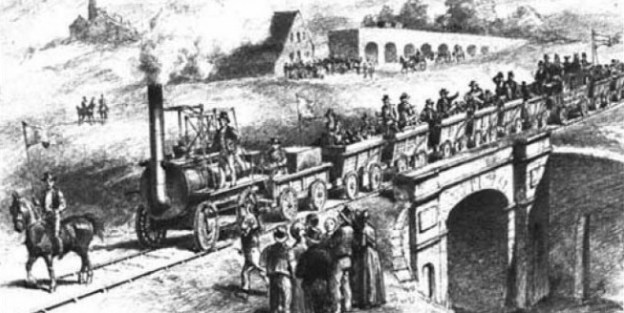
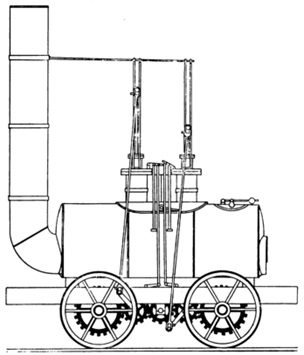
The Mother of All Inventions. …

Why were railways created?

What were the circumstances which brought about their existence?

History does not make it easy to take out one example from a steady continuum of change. …

David Wilson writes: “There have been track or plateways since Roman times. You might say that these could be brought within the term railway and therefore the Romans invented the railway.” [1: p61]

Except there were railways of a sort, at least as far back at 600 BCE, possibly going back even further, maybe as far back as 1000 BCE. The clearest example being the Diolkos Trackway. [2] This was a paved trackway near Corinth in Ancient Greece which enabled boats to be moved overland across the Isthmus of Corinth.

David Wilson continues: “For most people, however, the railways began with the Stockton and Darlington (S&D), though I’m sure many people already appreciate that history is not always what it seems.” [1: p61]

David Wilson tells us that if one wished to take the view that the first ever railway was the first to have been authorised by Parliament, then the first railway was built in Leeds – The Middleton Railway. “The Middleton Railway was given Parliamentary Assent in 1758 and began using steam traction in 1812, two years before the advent of Mr Stephenson’s first locomotive, ‘Blucher’, and 13 years before the opening of the S&D.” [1: p61]

But there is more to consider. … The Lake Lock Rail Road opened in 1798 (arguably the world’s first public railway). It carried coal from the Outwood area to the Aire and Calder navigation canal at Lake Lock near Wakefield. [3][4] The Surrey Iron Railway was the first railway to be authorised by the UK Parliament (21st May 1801).  It was a horse-drawn railway which ran between Wandsworth and Croydon. [5][6][7][8][9] It was followed by The Carmarthenshire Railway or Tramroad (authorised by Act pf Parliament on 3rd June 1802). It was a horse-drawn goods line, located in Southwest Wales, the first public railway first authorised by Act of Parliament in Wales.[3][10][11][12]

The Low Moor Furnace Waggonway was constructed in 1802. It connected Barnby Furnace Colliery to Barnby Basin on the Barnsley Canal. It was replaced in 1809 by The Silkstone Waggonway which operated until 1870. [19][20] The Merthyr Tramroad, between Merthyr Tydfil and Abercynon, also opened in 1802. [5][13][14][15][16][17][18] The Lancaster Canal Tramroad (also known as the Walton Summit Tramway or the Old Tram Road), was completed in 1803. It linked the north and south ends of the Lancaster Canal across the Ribble valley. [21][22]

The first steam locomotive to pull a commercial load on rails was Penydarren (or Pen-y-Darren) was built by Richard Trevithick. It was used to haul iron from Merthyr Tydfil to Abercynon, Wales. The first train carried a load of 10 tons of iron. On one occasion it successfully hauled 25 tons. However, as the weight of the locomotive was about 5 tons the locomotive’s weight broke many of the cast iron plate rails. [5][13][14][15][16][17]

We could go on to mention:

  • The Croydon, Merstham & Godstone Goods Railway opened in 1805; [23]
  • The Sirhowy Tramroad opened in 1805; [24]
  • The Ruabon Brook Tramway (also known as Jessop’s Tramway or the Shropshire Union Tramway) also opened in 1805; [25][26][27][28]
  • The Middlebere Plateway (or Middlebere Tramway) opened on the Isle of Purbeck in 1806; [29][30][31][32]
  • The Monmouthshire Canal Tramway, open by 1806; [33][34]
  • The Oystermouth Railway, opened in 1806; [35][36] and
  • The Doctor’s Tramroad, Treforest which opened in 1809. [37][38][39]
  • The Monmouth Railway authorised by the UK Parliament in 1811. [5][72][73]
  • The Kilmarnock & Troon Railway which opened in 1812. [5][74][75][76][77]
  • The Killingworth Waggonway of which a first stretch opened in 1762 and which was extended in 1802, 1808 and 1820. [78][79][80][81][82][83]
  • The Haytor Granite Railway of 1820 which not only transported granite from Dartmoor as freight but ran on granite rails. [84]

The drawing of the locomotive Blücher (below) was done by Clement E. Stretton, © Public Domain. Blücher was built by George Stephenson for the Killingworth Waggonway. It was the first of a series of locomotives which established his reputation as an engine designer and eventually “Father of the Railways”.

We could list other railways opening before the S&D in 1825. The use of steam power at The Merthyr Tramroad and The Middleton Railway preceded its use on the S&D. A very strong claim to be the most significant development in the early 1800s could be made on behalf of The Middleton Railway. But it is the Stockton & Darlington (S&D) Railway which has caught the imagination and it is the 200th anniversary of the S&D which is being celebrated in 2025 as the beginning of the railway age.

Why is this?

It is clear that the claim to fame of the Stockton and Darlington (S&D) is lessened, at least, by the prior claim of the Middleton Railway both as first to be sanctioned by Parliament and first to make commercial use of steam power. The claims associated with other railways which preceded the S&D also must be significant. However, there is one important and fundamental difference between it and them. David Wilson says that, unlike the Middleton Railway, “the S&D was constructed with a view to carrying other companies’ goods and, to a lesser extent, to carry people.” [1: p61]

In addition, he says, “Bear in mind the distinction between the carriage of goods and people, and between carrying one’s own goods and those of others. In many ways this type of division is what distinguishes the modern concept of the railway as a system for the transport of goods and passengers on a hire and reward basis from the early plateways and railways such as the Middleton, which were not essentially built to carry anything other than goods, typically coal, for their owners.” [1: p61]

Perhaps, though, there are more grounds for the place taken in history by the S&D. Rather than just running between a pithead and a coal wharf on a canal, river or road and serving specific industrial concerns, the S&D also was built by public subscription and linked one town to another.

David Wilson continues: “To arrive at a description of what constitutes a railway we have to enlarge our definition to include not only Parliamentary Sanction, the use of rails or tracks, and the carriage of goods, but also the carriage of the public, the carriage of public goods and that one settlement be joined to another by the laying of a line paid for through the issue of shares. Thus … a railway is a set of tracks laid between two centres of habitation, which carries goods or people for commercial reward and has been authorised by Act of Parliament. It will have been built through the raising of public funds, either through the sale of shares in it or via government spending from the public purse.” [1: p61]

Let’s return to the era before the existence of the steam locomotive, the era of that list of lines highlighted above (and many more).

David Wilson comments: “The growth of the coal mining industry in the later part of the 17th and early 18th century had led to a growth in the plateway systems used to move the coal from the pit head to [a road], canal or river for shipment to the growing cities and the newly built mills. By as early as 1645 there were wagonways taking coal from the Durham coalfields down to the Tyne. By 1800 there were more than 100 miles of these plateways in the Tyneside area alone.” [1: p61]

Similar developments were taking place elsewhere in the UK:

  • The first overground railway line in England may have been a wooden-railed, horse-drawn tramroad which was built at Prescot, near Liverpool, around 1600 and possibly as early as 1594. Owned by Philip Layton, the line carried coal from a pit near Prescot Hall to a terminus about half a mile away. [40]
  • The Wollaton Waggonway in Nottinghamshire was in use by 1604. [5]
  • In East Shropshire and around the Severn Gorge; [41][42] A railway was made at Broseley in Shropshire some time before 1605 to carry coal for James Clifford from his mines down to the River Severn to be loaded onto barges and carried to riverside towns. It is possible that Clifford’s ‘railway’ was in use as early as 1570 and a similar line may well have been constructed by William Brooke near Madeley, again down to the River Severn. [43: p21] By 1775, there were a number of both short and long tramroads in the area around the Severn Gorge.
  • The Tranent to Cockenzie Waggonway was built by the York Buildings Company of London, to transport coal from the Tranent pits to the salt pans at Cockenzie and the Harbour at Port Seton, in Haddingtonshire, now East Lothian. [5][44]
  • The Alloa Wagon Way was constructed in 1768 by the Erskines of Mar in Alloa, to carry coal from the Clackmannanshire coalfields of central Scotland to the Port of Alloa. [45]
  • The Halbeath Railway opened in 1783, from the colliery at Halbeath to the harbour at Inverkeithing. [46][47]
  • The Charnwood Forest Canal, sometimes known as the ‘Forest Line of the Leicester Navigation’ was, under the guidance of William Jessop, using railways to supplement the canal between Nanpantan and Loughborough wharf, Leicestershire by 1789. [5][48]
  • The Butterley Gangroad (or Crich Rail-way) was built by Benjamin Outram in 1793. [49][50][51][52][53][54][55][56][57]
  • The Earl of Carlisle’s Waggonway opened in 1799 from coal pits owned by George Howard, 6th Earl of Carlisle around Lambley to Brampton, Cumbria. [51][58] There is some confusion over dates. The earliest opening date quoted is 1774, the latest 1799. [59] Dendy Marshall says that it was built in 1775. [60] C.E. Lee says it was constructed in 1798. [59][61]

It is perhaps easy to loose sight of the scale of these industrial undertakings. The rapid expansion of mining, plateways and railways “led to an increase in the numbers of horses in use … and a growth in the amount of horse feed needed. By 1727 The Tanfield Waggonway, in Co. Durham, carried 830 wagon loads of coal daily that’s a lot of horses.” [1: p61][5][62][63] “In 1804, the Middleton Colliery line was carrying 194 loads per day. Each wagon held about 2.5 tons and required the use of one horse and driver.” [1: p61]

A crisis in the use of horses and wagons occurred early in the 19th century with the advent of the Napoleonic Wars. The conflict became a significant drain on both horse and horse feed availability. The resulting inflation in the price of horses and feed lowered the profitability of each wagon load of coal. David Wilson says that, “The more visionary (or greedy, depending on your point of view) pit owners started to search for alternatives to the horse to move their goods to market. They provided their pit engineers with money and materials to experiment with steam power to replace horse power.” [1: p61]

Of course, steam power wasn’t new. Knowledge of the power of steam had been around since before the Common Era in Greek society [64][65][66] and the pits themselves had steam engines for pumping out the water and for lifting coal to the surface, or as winding engines on rope-worked inclines. [66][67] Newcomen’s first engine was installed for pumping in a mine in 1712 at Dudley Castle in Staffordshire. [66][68] What was new was first, the expiry of Boulton & Watt’s patent for a high-pressure steam engine, [5][69] and second, the idea of making the steam engine mobile, thus creating the steam locomotive. What eventually became even more revolutionary was the idea of creating a network of railways to serve the whole country. [1: p61]

We sometimes talk of a ‘perfect storm’ (a particularly violent storm arising from a rare combination of adverse meteorological factors), when we are talking about a series of adverse conditions occurring at the same time – a situation caused by a combination of unfavourable circumstances. The opposite of a ‘perfect storm’ is usually assumed to be a period of calm. However, the true opposite of a perfect storm is the occurrence (co-occurence) of a series of positive factors which combine to produce something significantly valuable. Wilson says that “as with almost anything man-made, there must be certain ingredients present. To bake a cake you need eggs, flour, milk etc. and in creating a railway you need, metalworking skills, engineering expertise, labour, capital and an incentive.” [1: 61]

The early years of the 19th century saw a timely co-incidence of these and other factors:

  • growing shortages of horse and feed coupled to the rising prices of both;
  • poor road conditions;
  • a rapidly developing understanding of engineering – Wilson suggests that this was “as a consequence of the more theoretical works of philosophers such as Newton, Descartes and Leibniz. … Such men have a reputation as creators or exponents of the mechanistic world view. Prior to the works of these men many had thought, and indeed some still do think, that the earth was a living entity. However, the views espoused by Newton, Descartes and Leibniz came to be accepted, the world was made up of dead, lifeless and inert matter, here to benefit mankind;” [1: p62]
  • the availability of skilled and unskilled labour – particularly the ‘navigators’ who were skilled in the techniques of earthworks, tunneling and bridge building – the men who had earlier built the canals. (“These men were to become the skilled labour of the railway construction industry and in turn they passed on their skills to the former farm labourers who were recruited to railway works as the lines progressed along their routes“); [1: p62]
  • developing metalworking skills – “the Darby family, who set up the … Coalbrookdale foundry. had acquired new skills in metalworking from tinkers, in what is now the Netherlands;” [1: p62] After constructing Ironbridge, “the Coalbrookdale ironmasters began to widen their horizons. One of their number, John “Iron Mad” Wilkinson, constructed what was reputedly the first iron barge and, more importantly, … the smiths of Coalbrookdale collaborated with Richard Trevithick in the construction of his locomotive – they cast the cylinder block and the plates for the construction of the boiler;” [1: p62]
  • the increasing availability of financial capital;
  • the increasing birth rate and the better health of the work-force which provided the necessary labour while engineering work was still labour-intensive.

The Availability of Capital

Among the physical factors listed above is an interesting financial factor which will bear some scrutiny. Wilson tells us that “the capital to build the world’s first public railway came, not from the Government, but from the Society of Friends, the Quakers.” [1: p62] He notes too that the Darby family whose Coalbrookdale plant had such a formative influence in the early days of the industrial revolution, were also Quakers. Wilson explains that Quakers were isolated from much of society and public life because of a refusal to sign up to the articles of faith of the established church. However, the same religious views made them sympathetic to works performed for the public good. Various Quaker families began to take an interest in the developing railway sphere. The website quakersintheword.org [70] tells the story of the significant role played in financing railways played by the Quakers.

In 1818 a small group of Quaker businessmen, including Edward Pease and his son Joseph from Darlington, Benjamin Flounders and the banker Jonathan Backhouse, met to discuss the possibility of building a railway from Darlington, passing several collieries, to the port of Stockton.” [70] 

The Act of Parliament required for the work to take place faced significant delays in the parliamentary process. “The delay proved very significant, as in April 1821 Edward met George Stephenson and recruited him as an engineer for the railway. The original intention had been that the coaches would be horse drawn, just like all the others now in existence. However, George convinced Edward that steam engines were the future for railways, and that he could build them. The Pease family then put up much of the capital that enabled Stephenson to establish a company in Newcastle, where he built the locomotives.” [70]

After the opening of the Stockton & Darlington Railway, “the railway network grew under the guidance of Edward’s son Joseph, who opened the Stockton & Middlesbrough branch in 1828. … In 1833 Joseph became the first Quaker to enter Parliament and the railway interests passed to his brother Henry. In 1838, Henry opened the Bishop Auckland & Weardale line, followed by the Middlesbrough and Redcar line in 1846. Henry wanted to traverse the Pennines and in 1854 he started the Darlington & Barnard Castle line, which opened in 1856.” [70]

Quakers were often involved in railway developments in the 19th century, for instance, “in 1824, a group of merchants, including Quaker philanthropist and anti-slavery campaigner James Cropper, went to see the Stockton and Darlington railway.  They soon began building the Liverpool and Manchester railway, which opened in 1830.” [70]

Incidentally, Quakers “were also responsible for two innovations that improved the way these new passenger railways worked – timetables and tickets. James Cropper produced a 12-page timetable for the Liverpool and Manchester railway, probably the first railway timetable ever.  It was the forerunner of Quaker George Bradshaw’s Railway Companion, published in 1839. Bradshaw’s became a household name for anyone using the railways. … The second innovation was the railway ticket. In 1839 Thomas Edmundson, another Quaker, was appointed station master at Milton, on the Newcastle and Carlisle line.  He was unhappy that customers paid their fares directly to him without receiving a receipt.  Consequently he introduced the railway ticket, which came into general use with the creation of the Railway Clearing House in 1842.” [70]

The Birth Rate and Increasing Health of the UK Population

Wilson points us to one more significant factor in the development of railways in the early 19th century. “Seemingly disconnected and irrelevant factors were playing their part. During the period from the end of the civil war (1649) onwards there was a growing awareness of the value of the human being as resource, and a concerted effort was made to increase the birth rate and to cut the death rate. … This did not stem from any rise in humanitarianism but from a recognition that people were worth money. After all, in the 1640s and on into the 19th century, slavery was still common throughout the so-called civilised world, including Britain. Improvements in diet and sanitation increased life exресtancy. It is no coincidence that the first workhouses began to appear around the middle of the 17th century – a reasonably fit and healthy population produced more than a sickly and unfit one.” [1: p62]

By the beginning of the 19th century, the conditions were in place for a major economic expansion. A growing empire and military strength ensured the supply of raw materials and provided a growing market place for the products made from them. An expanding population provided the physical means by which the empire might be held together. Technology provided the ability to carry out the grand design. The workhouses and other reforms had created a disciplined workforce.” [1: p62-63]

By 1850, a quarter of a million workers – a force bigger than the Army and Navy combined – had laid down 3,000 miles of railway line across Britain, connecting people like never before. [71]

And Finally …

Wilson suggests one other, less definable, reason for the dramatic welcome given to steam technology in particular. He suggests that there was a more visceral connection to steam power which predisposed humanity to embrace the technology.

No doubt, the S&D was at the forefront of engineering developments it was “the white heat of technology, the frontier of science.” [1: p63] Wilson asks us to consider that there was (and still is) a connection between “a piece of primitive industrial technology, the steam locomotive and its enduring popularity, and an ancient, and some might say mystical, view of the world.” [1: p63]

Wilson says: “Prior to the advent of the mechanistic world view in which cause and effect, hard science and hard facts are the order of the day, people held to a more animistic philosophy. Miners would pray to the earth before digging it up. … In this more mystic view of the world things were not made of chemicals and atoms, molecules and the force of gravity. They were composed of the four elements – earth, air, fire and water.” [1: p63] He asks us to consider whether “the reason so many people took to the steam engine and the railway when it began was that the steam locomotive has a unique blend of the four elements not only in its construction but in the very forces and requirements necessary for its movement. … [It] is made from the ores of the earth, heated by fire which needs air to burn. The metals from the forge are then tempered by water whilst being shaped on the anvil. In order to make the steam locomotive work, coal, or part of the earth, is consumed along with air in a fire which turns water into steam which in turn brings the locomotive to life.” [1: p63]

We all know that all men, are just little boys at heart. Increasingly women are involved in the preservation movement. There seems to be a deep emotional connection for many of us between the steam beasts of earth, wind, fire and water that reigned over the railway networks for the world for more than a century and a half and our own psyche, something deeply ‘elemental’!

Whatever the cause, the early 19th century saw humanity embrace steam-power and the benefits it brought with open arms and wallets.

References

  1. David Wilson; Mother of Inventions; in the Evening Mail Supplement, 1st June 1993, p61-63.
  2. https://en.m.wikipedia.org/wiki/Diolkos, accessed on 2nd March 2025.
  3. https://en.wikipedia.org/wiki/1790s_in_rail_transport, accessed on 20th February 2025.
  4. https://web.archive.org/web/20100604080339/http://www.stanleyhistoryonline.com/Lake-Lock-Rail-Road.html, accessed on 8th January 2025.
  5. https://en.wikipedia.org/wiki/Timeline_of_railway_history, accessed on 7th January 2025.
  6. https://web.archive.org/web/20070523122428/http://www.stephensonloco.fsbusiness.co.uk/surreyiron.htm, accessed on 9th January 2025.
  7.  Dorian Gerhold; The Rise and Fall of the Surrey Iron Railway, 1802–46 (PDF); in Surrey Archaeological Collections, Vol. 95, 2010, p193–210; via https://archaeologydataservice.ac.uk/archiveDS/archiveDownload?t=arch-379-1/dissemination/pdf/vol_95/surreyac095_193-210_gerhold.pdf, accessed on 6th February 2025.
  8. https://en.wikipedia.org/wiki/1801_in_rail_transport, accessed on 20th February 2025.
  9. https://en.wikipedia.org/wiki/Surrey_Iron_Railway, accessed on 20th February 2025.
  10. https://coflein.gov.uk/en/site/275707, accessed on 8th January 2025.
  11.  https://en.wikipedia.org/wiki/1802_in_rail_transport, accessed on 20th February 2025.
  12.  M.R. Connop Price; The Llanelly & Mynydd Mawr Railway; Oakwood Press, Oxford, 1992.
  13. https://rogerfarnworth.com/2019/02/02/the-penydarren-tramroad-south-wales-part-1
  14. https://rogerfarnworth.com/2019/02/06/the-penydarren-tramroad-south-wales-part-2
  15. https://coflein.gov.uk/en/site/91513, accessed on 8th January 2025.
  16. https://www.irsociety.co.uk/Archives/59/Penydarren.htm, accessed on 8th January 2025.
  17. https://coflein.gov.uk/en/site/91513, accessed on 8th January 2025.
  18. https://en.wikipedia.org/wiki/Merthyr_Tramroad, accessed on 20th February 2025.
  19. https://en.wikipedia.org/wiki/Low_Moor_Ironworks, accessed on 20th February 2025.
  20. Silkstone Waggonway, South Yorkshire: Survey Report (PDF). Vol. 1; Yorkshire Archaeological Trust,  August 2012; via https://web.archive.org/web/20160311113301/http://iadb.co.uk/epip/Silkstone%20Waggonway%20Vol%201%20text%20plates%20figures.pdf, accessed on 20th February 2025.
  21. https://en.wikipedia.org/wiki/Lancaster_Canal_Tramroad, accessed on 20th February 2025.
  22. S. Barritt; The Old Tramroad – Walton Summit to Preston Basin; Carnegie Publishing, Lancaster, 2000.
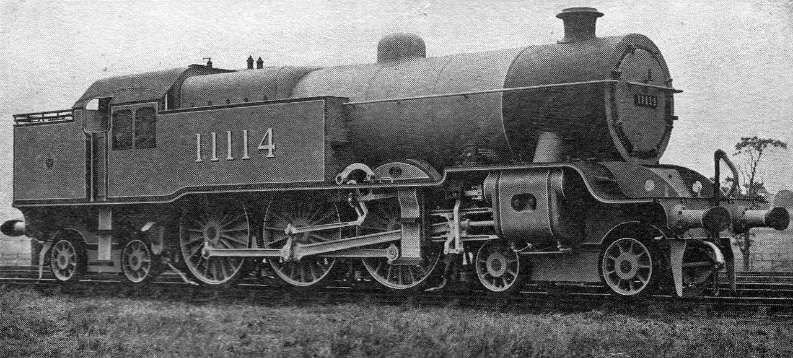
  23. Paul W. Sowan; The Croyden, Mertsham & Godstone Iron Railway: A Short Chapter in a Long Story; The Bourne Society (LHR45), Croydon, London, 2006, LHR45, p53-69; via https://bournesoc.org.uk/bslivewp/wp-content/uploads/CMG-Iron-Railway-SECURE.pdf, accessed on 9th January 2025.
  24. https://en.wikipedia.org/wiki/Sirhowy_Railway#Sirhowy_Tramroad, accessed on 20th February 2025.
  25. Alan Jowett; Jowett’s Railway Atlas; Patrick Stephens Limited, 1989, p57, 59.
  26. https://en.wikipedia.org/wiki/Ruabon_Brook_Tramway, accessed on 20th February 2025.
  27. Trefynant – Opening of Branch Railway at Trefynant Works; in Wrexham Advertiser, 6th January 1866, p8.
  28. Meeting of the Wrexham District Highways’ Board; in Wrexham Advertiser. 26th January 1867, p5.
  29. https://en.wikipedia.org/wiki/Middlebere_Plateway, accessed on 20th February 2025.
  30. R.W. Kidner; The Railways of Purbeck (Third ed.); Oakwood Press, 2000.
  31. Purbeck’s clay railways; in Dorset Life Magazine, January 2007; via https://web.archive.org/web/20070927150728/http://www.dorsetlife.co.uk/articles/ArticlesDetail.asp?ID=599, accessed on 20th February 2025.
  32. Middlebere Plateway; The Purbeck Mineral & Mining Museum; via https://web.archive.org/web/20070928063415/http://www.pmmmg.org/Middlebere.htm, accessed on 20th February 2025.
  33. https://en.wikipedia.org/wiki/Monmouthshire_and_Brecon_Canal#Monmouthshire_Canal_Tramway, accessed on 20th February 2025.
  34. https://coflein.gov.uk/en/site/308291, accessed on 20th February 2025.
  35. https://en.wikipedia.org/wiki/1807_in_rail_transport, accessed on 20th February 2025.
  36. https://en.wikipedia.org/wiki/Swansea_and_Mumbles_Railway, accessed on 9th January 2025.
  37. https://cof, lein.gov.uk/en/site/407018/?ref=goodoil.news, accessed on 20th February 2025.
  38. https://coflein.gov.uk/en/site/96185, accessed on 20th February 2025.
  39. https://britishlistedbuildings.co.uk/300024912-machine-bridge-also-known-as-pont-y-doctor-pontypridd/photos/147433, accessed on 20th February 2025.
  40. Mark Jones; Lancashire Railways – The History of Steam; Countryside Books, Newbury, 2012 p. 5.
  41. https://rogerfarnworth.com/2022/04/25/ancient-tramroads-near-telford-part-1-tramroads
  42. https://rogerfarnworth.com/2022/04/26/ancient-tramroads-near-telford-part-2-the-coalbrookdale-company-tramroads-shown-on-the-1882-83-6-os-maps-published-in-1887-and-later-surveys
  43. Peter King, The First Shropshire Railways in G. Boyes (ed.), in Early Railways 4: Papers from the 4th International Early Railways Conference 2008, Six Martlets, Sudbury, 2010, p70–84.
  44. https://en.wikipedia.org/wiki/Tranent_to_Cockenzie_Waggonway, accessed on 25th February 2025.
  45. An oblique aerial photograph taken facing north shows a general view in 1928 of Alloa, its Town Hall, Marshill and Church Street. The wagon road which was used to transport coal from the Holton area of Sauchie to Alloa harbour. Although the tracks are gone the road still exists from Station Hotel down to South School. https://www.britainfromabove.org.uk/image/SPW020247, accessed on 7th January 2025.
  46. https://en.wikipedia.org/wiki/1780s_in_rail_transport, accessed on 25th February 2025.
  47. Mark Poustie; Halbeath Railway; via https://www.railscot.co.uk/articles/Halbeath_Railway/#google_vignette, accessed on 25th February 2025.
  48. https://waterways.org.uk/waterways/discover-the-waterways/charnwood-forest-canal, accessed on 8th January 2025.
  49. Early Years; https://web.archive.org/web/20180120205818/http://www.butterleygangroad.co.uk/bgearlyyears.html, accessed on 8th January 2025.
  50. https://heritagecalling.com/2015/03/17/heritage-highlights-where-is-one-of-the-worlds-oldest-surviving-railway-tunnels, accessed on 8th January 2025.
  51. https://en.wikipedia.org/wiki/1790s_in_rail_transport, accessed on 20th February 2025.
  52. https://en.wikipedia.org/wiki/Butterley_Gangroad, accessed on 22nd February 2025.
  53.  https://historicengland.org.uk/listing/the-list/list-entry/1422984?section=official-list-entry, accessed on 22nd February 2025.
  54.  https://www.bbc.co.uk/news/uk-england-derbyshire-31951751, accessed on 22nd February 2025.
  55.  P. Riden; Outram, Benjamin (bap. 1764, d. 1805); in the Oxford Dictionary of National Biography; Oxford University Press, Oxford, 2004; via, https://www.oxforddnb.com/display/10.1093/ref:odnb/9780198614128.001.0001/odnb-9780198614128-e-20959, accessed on 22nd February 2025.
  56. https://historicengland.org.uk/listing/the-list/list-entry/1109195?section=official-list-entry, accessed on 22nd February 2025.
  57. https://en.wikipedia.org/wiki/Steam_Horse_locomotive, accessed on 22nd February 2025.
  58. Brian Webb & David A. Gordon; Lord Carlisle’s Railways; Railway Correspondence & Travel Society, 1978.
  59. https://en.wikipedia.org/wiki/Brampton_Railway, accessed on 25th February 2025.
  60. C.F. Dendy Marshall; A History of British Railways Down to the Year 1830; Oxford University Press, London. 1938, 1971.
  61. C.E. Lee; The Brampton Railway; in The Railway Magazine, May and June 1942.
  62. https://en.wikipedia.org/wiki/Tanfield_Railway, accessed on 25th February 2025.
  63. Tanfield Railway; Wear – BBC Home; via https://www.bbc.co.uk/wear/content/articles/2008/05/20/tanfield_main_feature.shtml, accessed on 25th February 2025.
  64. Hero (Heron) of Alexandria, described in detail what is thought to be the first working steam engine. He called it an aeolipile (“wind ball”). His design was a sealed caldron of water was placed over a heat source. As the water boiled, steam rose into the pipes and into the hollow sphere. The steam escaped from two bent outlet tubes on the ball, resulting in rotation of the ball. The principle he used in his design is similar to that of today’s jet propulsion. Hero (Heron) did not consider this invention being useful for everyday applications: he considered his aeolipile invention as a novelty, a remarkable toy. https://www.smith.edu/hsc/museum/ancient_inventions/steamengine2.html, accessed on 3rd March 2025. The same device was also mentioned by Vitruvius in De Architectura about 100 years earlier. [66]
  65. https://blogs.bl.uk/digitisedmanuscripts/2020/12/ancient-steam-engines.html, accessed on 3rd March 2025.
  66. https://en.wikipedia.org/wiki/History_of_the_steam_engine, accessed on 3rd March 2025.
  67. In 1712, Thomas Newcomen’s atmospheric engine became the first commercially successful engine using the principle of the piston and cylinder, which was the fundamental type of steam engine used until the early 20th century. The steam engine was used to pump water out of coal mines. [66]
  68. Steven Johnson; The Invention of Air: A story of Science, Faith, Revolution and the Birth of America; Riverhood Books, New York, 2008.
  69. https://mises.org/mises-daily/james-watt-monopolist, accessed on 8th January 2025.
  70. https://www.quakersintheworld.org/quakers-in-action/286/Railways-in-Britain, accessed on 3rd March 2025.
  71. https://www.railwaymuseum.org.uk/objects-and-stories/navvies-workers-who-built-railways, accessed on 3rd March 2025.
  72. https://co-curate.ncl.ac.uk/wylam-wagonway, accessed on 15th January 2025.
  73. https://www.twsitelines.info/smr/1032, accessed on 15th January 2025.
  74. https://en.wikipedia.org/wiki/Kilmarnock_and_Troon_Railway, accessed on 20th February 2025.
  75. Campbell Highet; The Glasgow and South Western Railway; Oakwood Press, Lingfield, 1965.
  76. https://en.wikipedia.org/wiki/1812_in_rail_transport, accessed on 20th February 2025.
  77. C.J.A. Robertson; The Origins of the Scottish Railway System 1722–1844; John Donald Publishers, Edinburgh, 1983.
  78. https://my.northtyneside.gov.uk/sites/default/files/web-page-related-files/Killingworth%20Moor%20Archaeological%20Assessment.pdf, accessed on 3rd March 2025.
  79. https://co-curate.ncl.ac.uk/blucher, accessed on 15th January 2025.
  80. https://en.wikipedia.org/wiki/Killingworth_locomotives
  81. Clement E. Stretton; The Railway World, Volume VI; 1897.
  82. https://co-curate.ncl.ac.uk/killingworth-waggonway, accessed on 15th January 2025.
  83. https://www.northeastheritagelibrary.co.uk/coalsarchive/ww07/killingworth-waggonway, accessed on 15th January 2025.
  84. https://en.wikipedia.org/wiki/Haytor_Granite_Tramway, accessed on 27th April 2025

1825-1925: The Railway Centenary Celebrations at Darlington, 1st to 3rd July 1925 – The Railway Magazine, August 1925

A significant proportion of the August 1925 edition of The Railway Magazine [1] was dedicated to coverage of the Centenary celebrations at Darlington. Given the short timescale between the event and the publication date of the August issue of the magazine (?late July?), and given that modern digital techniques were in no way available, the achievement of publication in such a short time is to be admired.

Writing at the end of 2024, in just a few months the 200th anniversary will occur, it will be interesting to see what celebrations will be taking place in the Summer of 2025. See, for example, the National Railway Museum‘s plans for 2025. [42]

G.A. Sekon offered The Railway Magazine’s congratulations to the organisers of the 1925 exhibition on their organisational achievements and on the “comprehensiveness and interest of the exhibits brought together.” [1: p101] He also notes that the opportunity was taken by the King to appoint many different leading railway officers to the Order of the British Empire these included: four CBEs (Mr. R. C. Irwin, Secretary, L.M.S.R., Mr. E. A. Bolter, Secretary, G.W.R., Mr. G. Davidson, Divisional General Manager, North Eastern Area, L.N.E.R., and Mr. G. S. Szlumper, Assistant General Manager, Southern Railway), eight OBEs and fourteen MBEs.

The ‘main event’ was the procession which was “witnessed at ease and in comfort by many hundreds of thousands in view of the accessibility of the route practically from end to end and the arrangements whereby landowners generously allowed access to fields adjoining the line.” [1: p103]

The event was opened by HRH. the Duke of York, accompanied by the Duchess of York.  (The Duke of York being the future George VI who became King unexpectedly following the abdication of his brother, King Edward VIII, in December 1936.)

In his opening address Mr. W. Whitelaw made it clear that, “The Exhibition was the result of the co-operation of five great railway companies, assisted by many friends from all parts of the country, who possessed interesting relics of the first passenger railway in the kingdom. It seemed very fitting that the commencement of the celebration of what took place on 27th September 1825, should be in that great railway town of Darlington. If Darlington did not own all the credit for the science of railways, at any rate no one could deny or challenge the statement that Darlington was the home of the first great railway statesman, Edward Pease.”

The Procession

A short (20 minute) film of the procession/cavalcade can be viewed here. [35]

The centenary celebrations were held in July to allow guests from foreign countries visiting the International Railway Congress to take part. An exhibition of rolling stock at the new Faverdale Wagon Works in Darlington was opened by the Duke and Duchess of York (later King George VI and the Queen Mother). The following day the royal couple watched as procession of locomotives passed between Stockton and Oak Tree Junction, starting with a Hetton Colliery locomotive that had been built in 1822 and finishing with a replica train of ten chaldron waggons and ‘the company’s coach’ hauled by Locomotive No.1 propelled by a petrol engine in a specially built tender.” [45] A copy of the original programme for the procession can be found here. [46]

The procession was due to have 54 items, one of which had to be withdrawn (the North British Locomotive Company’s geared turbine condensing locomotive). [1: p123] The final list was: [8]

  • 1. Hetton Colliery locomotive – 1822.
  • 2. S. & D.R. “Derwent” – 1845.
  • 3. NBR 0-6-0 No. 381 (LNER J31 10114) – 1867.
  • 4. NER 0-6-0 No. 1275 – 1874.
  • 5. LNER J26 0-6-0 No. 517 (ex NER) – 1905.
  • 6. LNER B16 4-6-0 No. 934 (ex NER) – 1921.
  • 7. LNER K3 2-6-0 No. 203 – 1925.
  • 8. LNWR 0-8-0 No. 1881 (LMS 8900) – 1901.
  • 9. LMS 0-8-0 No. 9446 (ex LNWR) – 1922.
  • 10. LNER 02 2-8-0 No. 3501 – 1924.
  • 11. GWR 2-8-0 No. 4700 – 1919
  • 12. LNER P1 2-8-2 No. 2393 – 1925.
  • 13. LNER electric loco No. 9 (hauled by J71 0-6-0T 317) (ex NER) – 1914.
  • 14. GWR 2-2-2 “North Star”(replica), (on wagon, hauled by J71 0-6-0T No. 181) – 1837.
  • 15. LNWR 2-2-2 No. 3020 “Cornwall” – 1847.
  • 16. GNR 4-2-2 No. 1 – 1870.
  • 17. MR 4-2-2 No. 679 – 1899.
  • 18. LNER X4 4-2-2 No. 5972 (exGCR) – 1900.
  • 19. NER Class 901 2-4-0 No. 910 – 1875.
  • 20. LNER E5 2-4-0 No. 1463 (ex NER) – 1885.
  • 21. LNER D17/1 4-4-0 No. 1620 (ex NER) – 1892.
  • 22. LNER D15 4-4-0 No. 8900 “Claud Hamilton” (ex GER) – 1900.
  • 23. LNER C2 4-4-2 No. 3990 “Henry Oakley” (ex GNR) – 1898.
  • 24. LNER C1 4-4-2 No. 3251 (ex GNR) – 1902.
  • 25. LNER C11 4-4-2 No. 9902 “Highland Chief” (ex NBR) – 1911.
  • 26. LNER C7 4-4-2 No. 2207 (ex NER) – 1917.
  • 27. LNER B13 4-6-0 No. 2006 (ex NER) – 1900.
  • 28. LNER B3 4-6-0 No. 6169 “Lord Faringdon” (ex GCR) – 1917.
  • 29. LMS 4-6-0 No. 5900 “Sir Gilbert Claughton” (ex LNWR) – 1913.
  • 30. LNER A1 4-6-2 No. 2563 “William Whitelaw” – 1924
  • 31. Withdrawn
  • 32. LNER electric loco No. 13 (hauled by J71 0-6-0T No. 1163) – 1922.
  • 33. LNER X1 2-2-4T No. 66 “Aerolite” (ex NER) – 1851.
  • 34. LNER J61 0-6-0ST No. 6469 (ex GCR) – 1873.
  • 35. LNER Y6 0-4-0T No. 7133 (ex GER) – 1897.
  • 36. LNER G6 0-4-4T No. 949 (ex NER) – 1874.
  • 37. LNER G5 0-4-4T No. 1334 (ex NER) – 1901.
  • 38. LNER H1 4-4-4T No. 2152 (ex NER) – 1913.
  • 39. LNER A5 4-6-2T No. 5088 (ex GCR) – 1923.
  • 40. LMS 4-6-4T No. 11112 – 1924.
  • 41. GWR 2-8-0T No. 5225 – 1924.
  • 42. LNER U1 2-8-8-2 No. 2395 – 1925.
  • 43. LNER Railbus 130Y (ex NER) – 1922.
  • 44. LNER petrol autocar No. 2105Y – 1923.
  • 45. Sentinel steam railcar – 1925.
  • 46. LNER Q7 0-8-0 No. 904 (ex NER) on mineral train. – 1919.
  • 47. LNER Q5 0-8-0 No. 130 (ex NER) hauling tableaux train.
  • 48. GNSR 4-4-0 No. 45A and train of old 4-wheel coaches – 1865.
  • 49. LMS 4-6-0 No. 10474 with vestibule coaches. – 1925.
  • 50. GWR 4-6-0 No. 4082 “Windsor Castle” with GWR royal train – 1924.
  • 51. GWR 4-6-0 No. 111 “Viscount Churchill” with coaches.
  • 52. SR 4-6-0 No. 449 “Sir Torre” with coaches. – 1925.
  • 53. LNER A2 4-6-2 No. 2400 “City of Newcastle” with coaches. – 1922.
  • 54. “Locomotion” – 1825

This list can be found on the Stockton & Darlington Rail Centre website. [8]

Of these items, The Railway Magazine chose to highlight a number of these including:

  • 1. The Hetton Colliery Locomotive

The procession was headed by the old Hetton Colliery engine, built in 1822 by George Stephenson and Nicholas Wood, previous to the establishment of Stephenson’s works at Newcastle-on-Tyne. The engine, by the way, was rebuilt in 1857, and again in 1882, when the link motion, at present fitted, was added.” [1: p109]

The Hetton Colliery Locomotive (‘Lyon’ or ‘Lyons’), © Public Domain. [1: p110]
The same locomotive, ‘Lyon’ or ‘Lyons’ on display at Shildon Museum in 2009. It is an 0-4-0 loco dating back as far as 1821 but significantly refurbished/rebuilt in 1852 (or 1857) and again in 1882, © Gillett’s Crossing and licenced for reuse under a Creative Commons Licence (CC BY-SA 2.0). [2]
  • 2. The ‘Derwent’

Next in order came the old ‘Derwent’, a mineral engine of Timothy Hackworth’s design, which was built in 1845 by William and Alf Kitching, of the Hopetown Foundry, Darlington, for the Stockton and Darlington Railway. The ‘Derwent’ also ran under its own steam.” [1: p109]

The ‘Derwent’, © Public Domain. [1: p110]
‘Derwent’ on a plinth at Darlington. Hackworth 0-6-0 No.25 “Derwent” (with a tender each end) built in 1845 by W & A. Kitching for the Stockton & Darlington Railway. It passed to the North Eastern Railway in 1863 and then withdrawn in 1869 and was sold to Pease & Partners for construction of the Waskerley Resevoir. The NER bought it for preservation in 1898 and it was eventually put on display in Darlington Station, where this photograph was taken in July 1972, © Hugh Llewellyn and licenced for reuse under a Creative Commons Licence (CC BY-SA 2.0). [3]
The same locomotive, ‘Derwent’ on display in Darlington (Head of Steam) in 2009, © Gillett’s Crossing and licenced for reuse under a Creative Commons Licence (CC BY-SA 2.0). NB. ‘Head of Steam’ is now, in 2024, part of Hometown Darlington. [4]
‘Derwent’ again: this image is held in the Science Museum Collection – Science Museum Group. Steam locomotive No. 25 “Derwent”, Stockton & Darlington Railway. 1978-7012 Science Museum Group Collection Online, and authorised for reuse under a Creative Commons Licence (CC Zero). [5]

Then followed a number of engines more or less familiar to the present generation [1925], although two of them were built over 50 years ago. A 1925 modern goods express 2-6-0, with special valve gear, and a mineral engine 2-8-0 with three cylinders, were a great contrast to the veterans that had passed earlier. Then followed a “Mikado” type of locomotive built at the Doncaster works of the L.N.E.R., for fast mineral work, but even greater interest was shown in a model of the old North Star, built in 1837 by Robert Stephenson and Co., which was mounted on a Great Western ‘crocodile’, drawn by a locomotive. Several specimens of the single-driver expresses popular in the latter half of the [19th century]  were in the procession, including the Cornwall, which has a driving wheel of 8 ft. 6 in. in diameter the largest locomotive driving wheel still in service in the world.” [1: p109]

  • 4. 0-6-0 Stockton & Darlington Goods

Fourth in the procession was a typical 0-6-0 locomotive from the Stockton and Darlington (S&D) Railway. This was probably NER No. 1275 which was the only NER 1001 Class locomotive to survive into LNER ownership. It was built by Dübs & Co., Glasgow, and was delivered to the S&D in May 1874. 1275 entered into LNER ownership with an official mileage of 908,984 miles. Still in its NER livery, it was quickly withdrawn on 16th February 1923. [6]

More details can be found on the Preserved British Steam Locomotives website. [6]

0-6-0 Stockton & Darlington Goods, © Public Domain. [1: p111]

This locomotive is preserved as part of the National Collection and is on static display at the National Railway Museum at York. [6]

NER No. 1275 is preserved in the National Railway Museum in York: Science Museum Group. NER 0-6-0 ‘1001’ class steam locomotive and tender, No 1275, 1874. 1975-7009 Science Museum Group Collection Online. [7]
  • 8. LNWR No. 1881, 0-8-0 Webb Compound Locomotive (LMS No. 8900 of 1901)
LNWR No. 1881, © Public Domain. [1: p111]

The LNWR Class B was a class of 0-8-0 steam locomotives introduced in 1901. These locomotives were a development of the three-cylinder compound Class A (though this letter classification was not introduced until 1911), they had a 4-cylinder compound arrangement. 170 were built between 1901 and 1904. [9]

Another photograph of LNWR No. 1881 at Crewe in grey livery for its ex-works photograph. It was designated as a Class B locomotive by the LNWR from 1911 onwards. This was given the LMS No. 8900, © Public Domain. [9]
  • 12. LNER P1 2-8-2 No. 2393 ‘Mikado’

The London and North Eastern Railway Class P1 Mineral 2-8-2 Mikado was a class of two steam locomotives designed by Nigel Gresley. They were two of the most powerful freight locomotives ever designed for a British railway. It was initially intended they be a more powerful 2-10-0 version of the earlier Class O2 2-8-0s. The design was submitted in August 1923, for use between Peterborough and London, and also between Immingham and Wath marshalling yard. The power was quoted as being 25% more than the O2.” [21]

LNER P1 2-8-2 ‘Mikado’ No. 2393, © Public Domain. [1: p114]
Gresley P1 Mikado, No. 2394, © Public Domain. [22]

No. 2393 was completed in June 1925, just in time for the Stockton & Darlington Centenary celebrations in July. It was fitted with a Robinson superheater, whilst No. 2394 (completed in November) had the “E Double” superheater recommended by The Superheater Co.” [22]

  • 14. GWR 2-2-2 ‘North Star’ (replica)

North Star was the first GWR locomotive, it on 31st May 1838 it worked the inaugural train for the company’s directors. More details can be found on the Preserved British Steam Locomotives website. [10]

A replica of the 1837 built GWR 2-2-2 ‘North Star’ (on a wagon which was hauled by J71 0-6-0T No. 181 when in the procession) © Public Domain. [1: p112]
‘North Star’ on display in Swindon in 2011. It is a replica built in 1923 including a number of parts from the original locomotive, © Tony Hisgett and licenced for reuse under a Creative Commons Licence (CC BY 2.0). [11]
  • 15. LNWR 2-2-2 No. 3020 ‘Cornwall – 1847

Built in 1847, ‘Cornwall’ is a preserved steam locomotive. She was built as a 4-2-2 at Crewe Works in 1847, but was extensively rebuilt and converted into her current form in 1858. [12]

The ‘ Cornwall’, © Public Domain. [1: p113]

Wikipedia tells us that, “In 1858, Ramsbottom redesigned Cornwall almost completely. Little survived unchanged, other than the outside frames and the centres of the drivers. The boiler was … moved entirely above the driving axle, without any notches, channels or tubes. … New cylinders and valve gear were provided. … The wheel arrangement was [changed to] 2-2-2. … Ramsbottom also included his newly designed tamper-proof safety valves.” [12]

There was another minor rebuild in the 1870s providing a typical LNWR style of cab, with a short roof and semi-open sides. It was renumbered 3020 in June 1886. [12]

‘Cornwall’ after the 1858 rebuild, at Ordsall Lane shed, Manchester, circa. 1890, © Tony Hisgett and licenced for reuse under a Creative Commons Licence (CC BY 2.0). [12]
‘Cornwall’ after the 1858 rebuild, viewed from the other side at an unknown location and uncertain date, © Public Domain. [12]
‘Cornwall’ on display at Shildon in 2011, © James E. Pets and licensed for reuse under a Creative Commons Licence (CC BY-SA 3.0). [13]
  • 16. GNR 8ft Single No. 1

The Great Northern Railway (GNR) No. 1 Class Stirling Single was a class of steam locomotive designed for express passenger work. Designed by Patrick Stirling, they were characterised by a single pair of large (8 ft 1 in) driving wheels which led to the nickname ‘eight-footer’. Originally the locomotive was designed to haul up to 26 passenger carriages at an average speed of 47 miles per hour (76 km/h). It could reach speeds of up to 85 mph (137 km/h). [14]

GNR 8ft Single No. 1, © Public Domain. [1: p113]
A three-quarter view of a GNR 8ft Single (No. 1008), © Tony Hisgett and licensed for reuse under a Creative Commons Licence (CC BY 2.0). [15]

The first of the class, No. 1 is the only engine to be preserved. It is exhibited at the National Railway Museum, York. It was restored to running order during the 1930s for the fiftieth anniversary of the Race to the North and steamed again during the 1980s.” [14]

Stirling Single No. 1 at Doncaster Works in 2003, © Our Phellap and authorised for reuse under a Creative Commons Licence (CC BY-SA 3.0). [16]
This series of three locomotives were No. 19, 1875 built NER Class 901 2-4-0 No. 910; No. 20, 1885 built LNER E5 2-4-0 No. 1463 (ex NER); and No. 21, 1892 built LNER D17/1 4-4-0 No. 1620 (ex NER) © Public Domain. [1: p112]

The three locomotives shown in the image above are:

  • 19. 1875 built NER Class 901 2-4-0 No. 910;
  • 20. 1885 built LNER E5 2-4-0 No. 1463 (ex NER);
  • 21. 1892 built LNER D17/1 4-4-0 No. 1620 (ex NER)

The LNER Encyclopedia says that “Fletcher’s ‘901’ class was his final express passenger design for the … NER. The ‘901’ Class was created in 1872 to provide new more powerful express locomotives to replace the 16in cylinder locomotives still being used by the NER for express work. The first two locomotives, Nos. 901/2, were built at Gateshead in 1872. Whilst these were being built, two batches of ten each were ordered from Beyer, Peacock & Co and Neilson & Co. These twenty engines were built and delivered in 1873. A further 33 were built at Gateshead between 1873 and 1882 in four batches.” [17]

A Fletcher NER ‘901’ 2-4-0 Locomotive, © Public Domain. [17]
In preservation No. 910 is now a part of the National Collection and is currently located at the Shildon Locomotion. [17]

The LNER Encyclopedia says that the  “new E5 locomotives were direct descendents of Fletcher’s ‘901’s. The cab design was changed, and a completely new tender design was used. A total of twenty E5s were built in 1885, with Darlington and Gateshead building ten each.” [18]

E5 No. 1463 is owned by the National Collection, but is on loan to the Darlington ‘Head of Steam’ Museum, now known as ‘Hopetown Darlington’s. [18]

The LNER Encyclopedia also notes that the NER Class M1 (later Class M) locomotives were Wilson Worsdell’s first express passenger locomotives for the North Eastern Railway (NER). … Twenty Class M1 locomotives were built at Gateshead between 1892 and 1894. More information can be found on the LNER Encyclopedia website. [19] These NER M1 locomotives became the LNER D17/1 Class at the grouping. [20]

Preserved NER M1 locomotive No. 1621 at the National Railway Museum at Shildon in 2010, © Hugh Llewellyn and licenced for reuse under a Creative Commons Licence (CC BY-SA 2.0). [20]
  • 32. LNER electric loco No. 13 (hauled by J71 0-6-0T No. 1163) – 1922
LNER electric loco No. 13 (built in 1922 and hauled by J71 0-6-0T No. 1163). No. 13 seems quite dull alongside a sparkling No. 1163, © Public Domain. [1: p117]

The LNER operated a surprising variety of electric locomotives and multiple units. Although its electric operations were eclipsed by the Southern, the LNER had the largest electric locomotive stud of the Big Four companies. More about the various electric locks and multiple units can be found on the LNER Encyclopedia website. [27]

Sir Vincent Raven was a great believer in the electrification of main lines. After the success of the Shildon-Newport electrification, he planned to electrify the North Eastern Railway’s (NER) stretch of the East Coast main line from York to Newcastle. As a part of this plan, authorisation was granted in March 1920 to build the prototype electric passenger locomotive No. 13. This had a 2-Co-2 (4-6-4) wheel arrangement, and was built at Darlington with electrical equipment provided by Metropolitan-Vickers.” [28] The loco was completed in 1922 just before the NER became part of the LNER in 1923.

Electric Locomotive No. 13 in a bright grey livery. In 1919 the North Eastern Railway made plans to electrify its York-Newcastle stretch of the East Coast Main Line and this locomotive was a prototype built for hauling passenger trains. It had an electrically heated boiler to generate steam for train heating. It transferred into LNER ownership in 1923. The LNER did not give class numbers to its electric locomotives. It survived into BR days and was in 1946 designated Class EE1, © Public Domain. [29]
  • 40. LMS 4-6-4T No. 11112 – 1924.
LMS (ex-L&YR) Four-cylinder 4-6-4T Locomotive No. 11112, © Public Domain. [1: p 115]

The Lancashire and Yorkshire Railway (L&YR) Hughes 4-6-4T class of steam locomotives were a 4-6-4T version of the L&YR Class 8 (‘Dreadnought’ Class 4-6-0), hence they were known as ‘Dreadnought tanks’. All were actually built by the LMS in 1924 after the grouping, albeit at the L&YR’s Horwich Works. Withdrawals started in 1938, with three engines (11112, 11115, 11116), one each in 1939 and 1940 (11113 and 11111 respectively), four in 1941 (11114, 11117–11119) and the last (11110) in January 1942. No examples were preserved. [23]

Another example of the same class, No. 11114. [23]
  • 41. GWR 2-8-0T Locomotive No. 5225

The 4200 class of 2-8-0T engines was designed to work the heavy short-haul coal and mineral trains in South Wales. They were designed using standard GWR parts as used in the 2800 class. A total of 205 locomotives were built (including the 5205 class) between 1910 and 1940. They were the only 2-8-0T to run in Britain. [24]

GWR 2-8-0T Locomotive No. 5225, one of the later versions of this class with outside steam pipes and raised framing over the cylinders, © Public Domain. [1: p115]

The first engine to be built was 4201 in 1910 (4200 was a later engine built in 1923). Between 1910 and 1930 195 were built numbered 4200-4299 and 5200-5294. 5205 onwards had larger cylinders and other minor alterations and were known as the 5205 class.” [24]

GWR 2-8-0T No. 5227 at Didcot, © Didcot Railway Centre. [25]

Five examples of the 4200 class and three members of the 5205 class have been preserved (4247, 4248, 4253, 4270, 4277, 5224, 5229 and 5239). There are also three locomotives preserved from the 7200 class which were rebuilds of the 5205 series 5264 rebuilt as 7229, 5275 rebuilt as 7202 and 5277 rebuilt as 7200).” [24]

  • 42. LNER ‘Garratt’ Locomotive No. 2395

The London and North Eastern Railway Class U1 was a solitary 2-8-0+0-8-2 Garratt locomotive designed for banking coal trains over the Worsborough Bank,[i] a steeply graded line in South Yorkshire and part of the Woodhead Route. It was both the longest and the most powerful steam locomotive ever to run in Britain. It was built in 1925 with the motion at each end being based on an existing 2-8-0 design. The original number was 2395, and it was renumbered 9999 in March 1946, and then 69999 after nationalisation in 1948, although it retained its cab-side plate bearing its original number throughout its life. The locomotive ran for some time as an oil burner, and was tried out on the Lickey Incline in 1949–1950 and again, after the electrification of its home line, in 1955. These trials were unsuccessful, and so the locomotive was withdrawn in 1955 and scrapped.” [26]

LNER Class U1 heavy duty freight locomotive No. 2395 © Public Domain. [1: p114]

The locomotive was constructed in just 3 weeks in 1925, perhaps with the Stockton & Darlington centenary celebrations in mind. It was ready just in time and sent in the standard outshopped grey livery before being painted black. [26]

Ex-works photograph of LNWR Class U1 Garrett Locomotive, © Public Domain. [26]
  • 43. LNER Petrol Railcar/Railmotor No. 130Y, later 2105Y

The 1920s were quite an era for experimentation on the railways of the UK. This Railcar/Railmotor is included in a number looked at elsewhere on this blog. The relevant article can be found here. [30]

The North Eastern Railway (NER) “authorised the construction of the experimental Petrol Autocar No. 2105 on 21st September 1922. On 19th October, Raven reported the purchase of a 6-cylinder 105hp Daimler engine from the Slough Trading Estate Co. Ltd. The remainder of the vehicle was built at York Carriage Works and was completed in July 1923. By this time, Grouping had occurred, and the autocar was given the LNER number 2105Y. It was later renumbered as No. 22105 in August 1926.” [31]

LNER Railcar No. 2105Y, © Public Domain. [1: p116]
  • 45. Sentinel-Cammel Steam Railmotor of 1925
Sentinel Steam Railmotor, © Public Domain. [1: p116]

Sentinel produced a significant number of steam railcars/railmotors. They are covered elsewhere on this blog. Please click here. [33]

The LNER arranged for trials of two Sentinel railmotors in 1924. After those trials, adaptations were made including providing larger boilers. The result was ideal for LNER uses and a series of 80 units were purchased. The first two large boiler railcars were ordered on 11th December 1924. These railcars used the bodies from the trial railcars and the cost was discounted accordingly. Numbered Nos. 12E & 13E, the railcars entered service with the LNER in May 1925 and were classified as Diagram 14600-614E. [34] They were ‘state of art’ units available just in time for the Stockton & Darlington celebrations.

  • 46. LNER 0-8-0 Q7 (formerly NER T3) with mineral wagons.
A rake of mineral wagons behind LNER 0-8-0 Q7 No. 904, © Public Domain. [1: p117]

The North Eastern Railway Class T3, classified as Class Q7 by the LNER, was a class of 0-8-0 steam locomotive designed for heavy freight. Five were built by the NER in 1919 and a further 10 by the LNER in 1924. No. 904 was put in charge of a rake of mineral wagons for the procession. [32]

No. 901 is preserved at Darlington. …

LNER Class Q7 No. 901 (BR 63460) has survived and is preserved at Darlington. It is the only one of the Class to have survived, © Gillett’s Crossing and licenced for reuse under a Creative Commons Licence (CC BY 2.0). [32]
  • 47. LNER Q5 0-8-0 No. 130 (ex NER) hauling tableaux train
LNER Q5 0-8-0 No. 130 (ex NER) hauling tableaux train, © Public Domain. [1: p120]
The tableaux train passing the grandstand, © Public Domain. [37]
A tableau from the train above, © Public Domain. [1: p121]

This train consisted of a series of tableaux depicting the history of the wheel. It was described in the publication ‘Railway Wonders of the World’ like this: “The tableaux consisted of six wagons each carrying a separate ‘picture’. The first was allegorical and depicted a number of astrologers grouped at one side of a symbolic wheel, with a scene showing modern engineering practice on the other. The two scenes were joined through the spokes of the wheel by a huge chain, representing the links of time. The second tableau showed a tribe of prehistoric men, who, having felled a tree with their flint axes, were shown transporting the trunk on logs used as rollers – the earliest form of the wheel. Then came an Egyptian scene in which one of the royal Pharaohs was being drawn on a wheeled platform by slaves, showing how the Egyptians started the wheel in its manifold forms so that, through the ages that followed, progress successively moved on the wheels of chariot, wain, and coach. This was followed by the fourth tableaux showing how the wheel was discarded for a time when Sedan chairs were used, and the fifth depicting the story of the wheel in transport opening its most famous chapter when Stephenson mounted an engine on wheels and steam locomotion began. On one side of this wagon Stephenson was explaining the working of a model of “Locomotion No. 1” to a group of friends and workmen, whilst on the other side modem mechanics were working with present-day materials and tools. The final tableau showed how the railways of the world have grown from the few miles of permanent way uniting Stockton and Darlington.” [37]

  • 48. GNSR 4-4-0 No. 45A and train of old 4-wheel coaches
Great North of Scotland Railway 4-4-0 No. 45A and train of old 4-wheel coaches – 1865, © Public Domain. [1: p126]

The locomotive was one of a Class which transferred to the LNER. More details can be found here. [38]

No. 45A was repainted in GNSR green to take part in the Stockton & Darlington Centenary celebrations. It was withdrawn on 31st July 1925 shortly after its return. There was some talk of preservation, and it was temporarily employed as a shunter at the Inverurie Works. However, preservation was not to be, and No. 45A was scrapped soon afterwards. [38]

  • 49. LMS Train of Vestibule Stock behind LMS 4-6-0 No. 10474
LMS Train of 9 No. Vestibule Carriages, © Public Domain. [1: p118]

LMS 4-6-0 No. 10474 was a Class 8 4-6-0 steam locomotive to a Lancashire & Yorkshire Railway design that was built for the LMS by Horwich Works in 1925. 10474 and its siblings were used on express passenger trains for the LMS. [36]

Its train is made up of nine vestibule carriages built at Derby and used on the West Coast route to Scotland. [1: p124]

The same train in the procession/cavalcade at the Stockton & Darlington centenary celebrations, © Public Domain. [36]
  • 50. GWR Royal Train behind GWR 4-6-0 No. 4082 ‘Windsor Castle’
GWR Royal Train, © Public Domain. [1: p120]

No. 4082 ‘Windsor Castle’, “was chosen as the Royal engine from the time that it was driven from Swindon works to Swindon station by King George V accompanied by Queen Mary on 28th April 1924. Plaques were mounted on the side of the cab to commemorate the occasion.” [39]

  • 51. GWR Train of Articulated Vehicles behind GWR 4-6-0 No. 111 ‘Viscount Churchill’
GWR Train of Articulated Vehicles, © Public Domain. [1: p118]

No 111 ‘Viscount Churchill’ (converted into a Castle class 4-6-0 from ‘The Great Bear’) took charge of a train of express passenger articulated coaches. Didcot Railway Centre says that the new GWR articulated coaches “came as a surprise to many as the railway press was unaware they had been developed. The train had one two-coach unit and two three-coach units. The formation was one brake first, one first, one first restaurant car, one kitchen car, one third restaurant car, two third-class coaches and a brake third. The first-class coach interiors were finished in walnut and the third-class in mahogany.” [40]

A direct view of GWR No. 111 and its train, © Public Domain. [40]
  • 52. SR Train of New Stock behind SR 4-6-0 No. 449 ‘Sir Torre’
SR Train of New Stock, © Public Domain. [1: p119]

The LSWR N15 class was a British 2–cylinder 4-6-0 express passenger steam locomotive designed by Robert Urie. The class had “a complex build history spanning three sub-classes and ten years of construction from 1918 to 1927. The first batch of the class was constructed for the London and South Western Railway (LSWR), where they hauled heavy express passenger trains to the south coast ports and further west to Exeter. After the Lord Nelsons, they were the second biggest 4-6-0 passenger locomotives on the Southern Railway. They could reach speeds of up to 90 mph (145 km/h).” [41] The Southern Railway (SR) publicity department gave the N15 locomotives names associated with Arthurian legend; the class hence becoming known as King Arthurs.

  • 53. LNER Train of Articulated Stock behind LNER A2 4-6-2 No. 2400 ‘City of Newcastle’
LNER Train of Articulated Stock, © Public Domain. [1: p119]

The LNER Class A2 4-6-2 steam locomotive was designed by Vincent Raven for the North Eastern Railway (as NER class 4.6.2). Two were built by the NER in 1922 before the grouping and another three by the LNER in 1924. Their LNER numbers were 2400–2404. All five locomotives were named by the LNER. ‘City of Newcastle’ was the first of the class. [43]

  • 54. Locomotion No. 1 and a replica train
Locomotion No. 1 and a replica train, © Public Domain. [1: p122]

The replica train pulled by a modern incarnation of ‘Locomotion No.1’ was the last element of the procession/cavalcade. It was somewhat shorter than the original train of September 1825. ..

On 27th September 1825, Locomotion No. 1 hauled the first train on the Stockton and Darlington Railway, driven by George Stephenson. The train consisted of Locomotion No.1, eleven wagons of coal, the carriage ‘Experiment’, and a further 20 wagons of passengers, guests, and workmen. Around 300 tickets had been sold, but about twice as many people were believed to have been aboard. The train, which had an estimated weight of 80 metric tons and was 400 feet long, reached a maximum speed of 12 mph, and took two hours to complete the first 8.7 miles of the journey to Darlington, slowed by a derailed wagon and a blocked feed pump valve for an average speed of 8 mph. [44]

Locomotion No. 1 (originally named Active) … was built in 1825 by … George and Robert Stephenson at their manufacturing firm, Robert Stephenson and Company. It became the first steam locomotive to haul a passenger-carrying train on a public railway … [It] was ordered by the Stockton and Darlington Railway Company in September 1824; its design benefitted from George Stephenson’s experience building his series of Killingworth locomotives. It is believed that Locomotion No. 1 was the first locomotive to make use of coupling rods to link together its driving wheels, reducing the chance of the wheels slipping on the iron rails. However, the centre-flue boiler proved to be a weakness, providing a poorer heating surface than later multi-flue boilers. … Locomotion hauled the first train on the Stockton and Darlington Railway, the first locomotive to run on a public railway. On 1st July 1828, it was heavily damaged when its boiler exploded at Aycliffe Lane station, killing its driver, John Cree. It was rebuilt, but as a consequence of the rapid advances in locomotive design, [it] became obsolete within a decade. It was used on the railway until 1850, after which it was converted into a stationary engine. In 1857, as a consequence of its historical importance, Locomotion was preserved and put on display. Between 1892 and 1975, it was on static display at one of the platforms at Darlington Bank Top railway station, and was then on display at the Head of Steam museum based at Darlington North Road railway station between 1975 and 2021. It was then moved to the Locomotion museum in Shildon. A working replica of Locomotion was built, and following years of operation at Beamish Museum was put on display at the Head of Steam museum.” [44]

The Exhibition

At the Railway Centenary Exhibition held in the LΝΕR’s Faverdale Wagon Works and Sidings at Darlington “was gathered together the biggest and most interesting collection of railway appliances, locomotives, rolling stock and other material ever exhibited in this country. The locomotives and rolling stock on rails at the exhibition sidings numbered 99, whilst in the building were three locomotives and about 650 other items. … The railways were naturally the chief exhibitors, but many extremely interesting items were loaned from private collections.” [1: p127]

The Railway Magazine went on to list all the major exhibits, some of which were in the cavalcade/procession covered above.

The details given in The Railway Magazine are reproduced in the Appendix below.

The exhibition was comprehensive, giving an outstanding insight into the world of railways in Great Britain.

Appendix – Exhibition Items

The Railway Magazine … [1: p127-130]

In the outdoor catalogue were: the model of North Star, constructed for the exhibition, utilising the original driving wheels. Nearby was the Invicta, Canterbury and Whitstable Railway, built by R. Stephenson & Co., in 1830, and a 2-2-2 engine constructed by Bury, Curtis & Kennedy in 1846 for the Great Southern Railway. Two locomotives came from Belgium, one a 2-2-2 saddle tank, with tender built for the 3-ft. 7-in. gauge Anvers-Gand Railway in 1844, the other a full-size model of a 2-2-2 engine built in 1835 for the Belgian State Railways. Other old locomotives included the Derwent, Cornwall and the Hetton Colliery locomotive, which led the van in the Centenary procession. There was also the historic Locomotion, and a full size model of the Rocket. The remaining locomotives are tabulated according to groups, subdivided on the basis of original ownership.

Of these, the sections of the LNER were responsible for 33 locomotives.

The NER‘s total was 14:

No. 949 0-4-4 5-ft. passenger tank built by Neilson & Co. in 1874, designed by E. Fletcher;

No. 1334, 0-4-4 5-ft. 11-in. passenger tank built at Darlington in 1901, designed by Wilson Worsdell;

No. 2151, 4-4-4 5-ft. 9-in. passenger tank, 3 cylinders, built at Darlington in 1913, designed by Sir Vincent Raven;

No. 1275, 0-6-0 5-ft. mineral engine, built in 1874 by Dubs & Co., designed by W. Bouch;

No. 517, 0-6-0 4-ft. 74-in. mineral engine built at Gateshead in 1905, designed by W. Worsdell;

No. 934, 4-6-0 5-ft. 8-in. express goods engine, 3 cylinders, built at Gateshead in 1921, designed by Sir Vincent Raven;

No. 902, 0-8-0, 4-ft. 71-in. 3-cylinder mineral engine, built at Darlington in 1919, designed by Sir Vincent Raven;

No. 910, 2-4-0, 7-ft. express passenger engine, built at Gateshead in 1875, designed by E. Fletcher;

No. 1463, 2-4-0 7-ft. express passenger engine, built at Darlington in 1885, “Tennant” type;

No. 1620 4-4-0 7-ft. 1.25-in. express passenger engine, built at Gateshead, 1892, by W. Worsdell;

No. 2207, 4-4-2, 6-ft. 10-in. express passenger engine, 3 cylinders, built at Darlington, 1911, designed by Sir Vincent Raven;

No. 2006, 4-6-0 6-ft. 11-in. express passenger engine, built at Gateshead, 1900, designed by W. Worsdell, Gold Medal, Paris, 1900;

No. 9, 0-4-4-0 4-ft. electric freight engine, built at Darlington, 1914, designed by Sir Vincent Raven;

No. 13, 4-6-4, 6-ft. 8-in. electric express engine, built at Darlington, 1922, designed by Sir Vincent Raven.

The Great Central section was represented by four engines:

No. 6499, 0-6-0, 3-ft. 9-in, saddle tank shunting engine, built by Manning Wardle & Co., 1876, for the Manchester, Sheffield and Lincolnshire Railway;

No. 5088, 4-6-2 5-ft. 7-in. passenger side tank engine, built at Gorton, 1923, designed by J. G. Robinson;

No. 5972, 4-2-2 7-ft. 9-in. inside cylinder express passenger engine, built at Gorton, 1900, designed by H. Pollitt;

No. 6169, Lord Faringdon, 4-6-0 6-ft. 9-in. 4-cylinder express passenger engine, built at Gorton, designed by J. G. Robinson.

Two locomotives represented the GE section

No. 7133 was a 0-4-0 3-ft. 1-in. enclosed tramway engine built at Stratford in 1897;

No. 8900 (1900), Claud Hamilton, 4-4-0 7-ft. express passenger engine, built at Stratford, 1900, designed by J. Holden. Gold Medal Paris Exhibi- tion, 1900.

The GN section showed three engines:

The celebrated No. 1, 4-2-2 8-ft. 2-in. express engine, with outside cylinders, built at Doncaster, 1872, designed by P. Stirling:

No. 3990 (No. 990), 4-4-2 6-ft. 8-in. express engine, built at Doncaster, 1898, designed by H. A. Ivatt, the first “Atlantic” engine constructed in Great Britain;

No. 3251 (No. 251), 4-4-2 6-ft. 8-in. express engine, built at Doncaster, 1902, designed by H. A. Ivatt, the first engine on a British railway with a wide firebox.

The NBR section was represented by two engines:

No. 10114, 0-6-0 5-ft. 13-in. goods engine, built by Neilson & Co. in 1868, designed by T. Wheatley;

No. 9902, Highland Chief, 4-4-2 6-ft. 9-in, express engine, built by R. Stephenson & Co., 1911, designed by W. P. Reid.

The GNSR section was represented by No. 45A, 4-4-0 5-ft. 61-in. mixed traffic engine, built in 1866 by Neilson & Co., designed by W. Cowan.

The remaining seven locomotives exhibited by the LNER. were built since the grouping of the railways:

“Garratt” type 2-8-0+0-8-2, built by Beyer Peacock & Co., 1825, fitted with H. N. Gresley’s valve gear, driving wheels, 4-ft. 8-in. diameter, 6 cylinders (three to each truck), the first 6-cylinder “Garratt” locomotive, weight in working order, 176tons;

No. 203, 2-6-0 3-cylinder 5-ft. 8-in. express goods engine, built an Darlington, 1925, designed by H. N. Gresley (No. 202, a similar engine, was shown in the Exhibition building);

No 3499, 2-8-0 3-cylinder 4-ft. 8-in. mineral engine, built at Doncaster, 1924, designed by H. N. Gresley;

No. 2393, “Mikado” type (2-8-2) 3-cylinder 5-ft. 2-in. mineral engine, fitted with “booster” to drive trailing wheels, built at Doncaster, 1925, designed by H. N. Gresley;

No. 2563, William Whitelaw, 4-6-2 3-cylinder 6-ft. 8-in. express engine, designed by H. N. Gresley;

No. 2400, City of Newcastle, 4-6-2 3-cylinder 6-ft. 8-in. express engine, built at Darlington, 1922, designed by Sir Vincent Raven.

The LMS exhibit of modern locomotives comprised six engines: …

Three LNWR engines: …

No. 1881, 4-cylinder compound 4-ft. 3-in. mineral engine, built at Crewe, 1901, designed by F. W. Webb;

No. 9446, 0-8-0 4-ft. 2-in. goods engine, built at Crewe, 1922, designed by C. J. B. Cooke;

No. 5900, Sir Gilbert Claughton, 4-cylinder, 6-ft. 3-in. express engine, built at Crewe, 1913, designed by C. J. B. Cooke.

The Midland section exhibit was No. 679, 4-2-2 7-ft. 91-in. express engine, built at Derby, 1899, designed by S. W. Johnson.

The L&YR section showed No. 10474, 4-6-0 4-cylinder 6-ft. 3-in. express, built at Horwich, designed by G. Hughes.

The LMS specimen was No. 11112, 4-cylinder 6-ft. 3-in. passenger tank, built at Horwich, 1924, designed by G. Hughes.

The Somerset & Dorset Joint Railway No. 86 2-8-0 4-ft. 71-in. mineral engine, built by R. Stephenson & Co., 1825, designed by Sir H. Fowler (LMS)

The GWR was represented by three modern locomotives:

No. 5225, 2-8-0 4-ft. 7-in. mineral tank engine, built at Swindon, designed by G. J. Churchward;

No. 4700, 2-8-0 5-ft. 8-in. express goods engine, built at Swindon in 1919, designed by G. J. Churchward;

No. 4082, Windsor Castle, 4-6-0 4-cylinder 6-ft. 8-in. express, built at Swindon, designed by C. B. Collett. This is the locomotive the King and Queen drove at Swindon.

The SR was represented by No 449, Sir Torre, at the head of the train of modern coaches.

In addition there were: the City and South London Railway‘s old electric engine supplied for the opening of the railway in 1890. The LNER showed a petrol bus for rail service, a petrol autocar, and a Sentinel-Cammell steam coach.

Modern rolling-stock-passenger and freight was represented in profusion: …

A complete train by each of the four groups: …

GWR – showed an articulated rake of coaches and a 10-compartment third-class corridor coach, 70ft long;

LNER – showed a similar articulated rake and an electric coach, a Post Office van, a sleeper with first-class berths and third-class compartments, a twin (articulated) sleeper, a ‘triplet’ dining set, corridor third etc.;

SR – sent Pullman Car ‘Lydia’, whilst the Pullman Car Company exhibited ‘Niobe’;

LMS – showed a first-class corridor coach, Queen Victoria’s saloon (and indoors – Queen Adelaide’s carriage);

London Electric Railways by one of the latest tube coaches.

Also in view were:

The “Dandy” coach from the Port Carlisle Railway;

A Stockton & Darlington carriage built circa 1850;

A GNSR coach from circa 1865.

The wide range of modern freight vehicles was well shown by the 18 wagons, etc, of different types exhibited by the LNER, varying from a four-wheeled horse-box to a set of three 60-ton flat wagons tight coupled for conveying 160-ton guns. The GWR showed a 20-ton mineral wagon, a 35-ton well trolley, a 30-ton articulated gun wagon, and a 70-ft. rail or timber truck. There were a few items of old goods rolling-stock, including a ‘Chaldron’ coal wagon built in 1826.

Within the building the fine display of signalling appliances from the earliest days, through the crude interlocking of some sixty years ago to the present perfect locking apparatus, electrical and mechanical, attracted much attention. So did the many specimens representing all periods during the past 100 years of the rails, chairs, and sleepers that go to make up the permanent way. Chief interest was taken in the numerous models, many on a large scale, and as regards locomotives chiefly working models, actuated by compressed air. Of the 46 locomotive models there were two of the Locomotion, while several GWR. broad-gauge engines made a fine display. The Metropolitan Railway was a big exhibitor in this section, showing seven or eight models of locomotives of various railways. A quarter-size model of the GNR’s 8-ft. 1-in. single (Stirling’s famous 4-2-2 type) was prominent, as, too, was the Dandy Cart, with horse aboard, as attached to the rear of horse-hauled mineral trains. Here also were models in plenty of railway bridges and viaducts, railway coaches, steamers, &c. Early railway tickets, bills, time-tables, passes, medals, &c., were to be seen in profusion, with specimens of Edmondson’s ticket-dating presses and ticket-printing machines invented in 1840, and taken from actual work to be shown at Faverdale. Railway-station bells, besides early signal and hand lamps of various types, were represented, whilst the many loan collections of literature and maps relative to early railways provided information of rare value to those interested in the development of the railway system.

References

  1. G.A. Sekon, ed.; 1825-1925: The Railway Centenary Celebrations at Darlington, 1st to 3rd July 1925; in The Railway Magazine, London, No. 338, August 1925, p101-142.
  2. https://commons.m.wikimedia.org/wiki/File:Hetton_Colliery_0-4-0_(1822_or_1851)_Locomotion_Shildon_29.06.2009_P6290048_(9989613283).jpg, accessed on 27th December 2024.
  3. https://commons.m.wikimedia.org/wiki/File:S%26DR_Derwent_(Hugh_Llewelyn).jpg, accessed on 27th December 2024.
  4. https://commons.m.wikimedia.org/wiki/File:Stockton_%26_Darlington_0-6-0_25_%27Derwent%27_Head_of_Steam,_Darlington_30.06.2009_P6300113_(10192716434).jpg, accessed on 27th December 2024.
  5. https://collection.sciencemuseumgroup.org.uk/objects/co205769/steam-locomotive-no-25-derwent-stockton-darlington-railway, accessed on 27th December 2024.
  6. https://preservedbritishsteamlocomotives.com/sd-class-1001-0-6-0-stockton-darlington-railway-1275, accessed on 28th December 2024.
  7. https://collection.sciencemuseumgroup.org.uk/objects/co205734/ner-0-6-0-1001-class-steam-locomotive-and-tender-no-1275-1874, accessed on 28th December 2024.
  8. http://www.railcentre.co.uk/RailHistory/Stockton/Pages/StocktonPage6.html, accessed on 28th December 2024.
  9. https://en.m.wikipedia.org/wiki/LNWR_Class_B, accessed on 28th December 2024.
  10. https://preservedbritishsteamlocomotives.com/north-star-2-2-2-gwr-broad-gauge, accessed on 28th December 2024.
  11. https://commons.m.wikimedia.org/wiki/File:North_Star_Steam_museum_Swindon.jpg, accessed on 28th December 2024.
  12. https://en.m.wikipedia.org/wiki/LNWR_2-2-2_3020_Cornwall, accessed on 28th December 2024.
  13. https://commons.m.wikimedia.org/wiki/File:LNWR_locomotive,_%22Cornwall%22.jpg, accessed on 28th December 2024.
  14. https://en.m.wikipedia.org/wiki/GNR_Stirling_4-2-2, accessed on 29th December 2024.
  15. https://en.m.wikipedia.org/wiki/GNR_Stirling_4-2-2#/media/File%3A4-2-2_GNR_1008.jpg, accessed on 28th December 2024.
  16. https://en.m.wikipedia.org/wiki/GNR_Stirling_4-2-2#/media/File%3AGNR_Stirling_1_at_Doncaster_Works.jpg, accessed on 29th December 2024.
  17. https://www.lner.info/locos/E/ner_901.php, accessed on 29th December 2024.
  18. https://www.lner.info/locos/E/e5.php, accessed on 29th December 2024.
  19. https://www.lner.info/locos/D/d17.php, accessed on 29th December 2024.
  20. https://en.m.wikipedia.org/wiki/NER_Class_M1, accessed on 29th December 2024.
  21. https://en.m.wikipedia.org/wiki/LNER_Class_P1, accessed on 30th December 2024.
  22. https://www.lner.info/locos/P/p1.php, accessed on 30th December 2024.
  23. https://en.m.wikipedia.org/wiki/L%26YR_Hughes_4-6-4T, accessed on 30th December 2024.
  24. https://preservedbritishsteamlocomotives.com/4200-2-8-2t-gwr-churchward-4200-4299-5200-5204https://preservedbritishsteamlocomotives.com/4200-2-8-2t-gwr-churchward-4200-429, accessed on 30th December 2024.
  25. https://didcotrailwaycentre.org.uk/article.php/71/5227-5205-class, accessed on 30th December 2024.
  26. https://en.m.wikipedia.org/wiki/LNER_Class_U1, accessed on 30th December 2024.
  27. https://www.lner.info/locos/Electric/electric.php, accessed on 30th December 2024.
  28. https://www.lner.info/locos/Electric/ee1.php, accessed on 30th December 2024.
  29. https://en.m.wikipedia.org/wiki/LNER_Class_EE1#/media/File%3ANorth_Eastern_Railway_electric_locomotive_No_13.jpg, accessed on 30th December 2024.
  30. https://rogerfarnworth.com/2024/08/08/petrol-railmotors-the-railway-magazine-september-1922
  31. https://www.lner.info/locos/IC/ner_petrol_autocar.php, accessed on 30th December 2024.
  32. https://en.m.wikipedia.org/wiki/NER_Class_T3, accessed on 30th December 2024.
  33. https://rogerfarnworth.com/2024/06/26/steam-railmotors-part-6-after-the-grouping
  34. https://www.lner.info/locos/Railcar/sentinel.php, accessed on 30th December 2024.
  35. https://player.bfi.org.uk/free/film/watch-the-official-film-of-the-railway-centenary-1925-online, accessed on 31st December 2024.
  36. https://locomotive.fandom.com/wiki/L%26YR_Class_8_No._10474, accessed on 31st December 2024.
  37. https://www.railwaywondersoftheworld.com/railway_centenary.html, accessed on 31st December 2024.
  38. https://www.lner.info/locos/D/d47.php, accessed on 31st December 2024.
  39. http://www.greatwestern.org.uk/m_in_cas_40827013.htm, accessed on 31st December 2024.
  40. https://www.facebook.com/161421647218065/posts/pfbid0otP6Sxuamk1BURpmy2cZ6opNaZmjVDnwY8AcomKmaoE3YioDGEtK8jZmsRQ2yAZAl/?app=fbl, accessed on 31st December 2024.
  41. https://en.m.wikipedia.org/wiki/LSWR_N15_class, accessed on 31st December 2024.
  42. https://blog.railwaymuseum.org.uk/2025-celebrating-200-years-of-the-stockton-darlington-railway, accessed on 31st December 2024.
  43. https://en.m.wikipedia.org/wiki/LNER_Class_A2, accessed on 31st December 2024.
  44. https://en.m.wikipedia.org/wiki/Locomotion_No._1, accessed on 31st December 2024.
  45. https://en.m.wikipedia.org/wiki/Stockton_and_Darlington_Railway, accessed on 31st December 2024.
  46. https://wp.me/p9H29O-Ao, accessed on 31st December 2024.

The New High Level Bridge at Newcastle-on-Tyne – The Railway Magazine, July 1906

A contemporary account of the completion of the additional rail bridge over the River Tyne.

This is the Bridge that became known as the King Edward VII Bridge. It is a Grade II listed structure and has been described as “Britain’s last great railway bridge”. [4]

The King Edward VII Bridge, Newcastle, (c) Ardfern and licenced for reuse under a Creative Commons Licence (CC BY-SA 3.0). [5]
A map of the North-Eastern Railway at Newcastle -on-Tyne. This sketch comes from the article in The Railway Magazine and suffers from a minor problem that left me struggling, for a short while, to make sense of it. Surely Central Station, Newcastle is on the North bank of the Tyne? It was the lack of a North point on the map that left me confused! [1: p9]

The introduction to the article in the Railway Magazine says:

Travellers journeying by the East Coast route to and from places north of Newcastle-on- Tyne, have always commented on an anachronism of the twentieth century, that hitherto has required trains to run into a ‘dead end’ station, thus compelling a stop, with consequent delay, whatever might be the stress of competition between the rival routes. Now however, all this is to be altered. Readers of The Railway Magazine are acquainted with the fact that for some years past the North-Eastern Railway has had under construction a duplicate high-level bridge across the Tyne, by means of which trains north to south, and vice versa, will be enabled to pass through the Central Station, without stopping, if necessary, but, at all events, without having the direction in which the train is travelling altered. The plan [above shows] how this improvement is effected by means of the new bridge and connecting lines. His Majesty the King has consented to open the new bridge, and thus inaugurate the improvement, on Tuesday, 10th July, after which date it will be possible to work the North-Eastern Railway trains that pass through Newcastle-on-Tyne in a manner showing a considerable improvement in the system now [pertaining]” [1: p9-10]

The New High Level Bridge Carrying the North Eastern Railway across the Tyne at Newcastle. [1: p10]

From the South side of the River Tyne a triangular junction gives access to the bridge, which is described by The Railway Magazine::

“A stone viaduct of three spans forms the approach to the bridge proper, which consists of four girder spans; the first being 191 ft. between piers, the two centre ones each 300 ft., and the northern span 231 ft. between the piers; this is followed by a stone viaduct of 10 spans each 25 ft. wide. The height of the ten piers of this viaduct, from road level to the spring of the arch, is 18 ft., and the arches are semi-circular, the arch stones being 18 in. in depth. The distance from road level to rail level is 33 ft., the foundations being on clay and averaging about 7 ft. in depth. This arching rests on ashlar piers 4 ft. thick and 51 ft. transversely, each pier being relieved by three 7 ft. arches.

The new line is next carried by a bridge across Pottery Lane, and then enters the well-known Forth goods warehouse of the North-Eastern Railway at the first storey level by steel girders resting on brick piers. The spans through the warehouse are 40 ft., and the foundations for the piers are taken down to good clay beneath the cellar floor. The distance from rail to the bottom of the foundation is 40 ft. The roof of the warehouse is held up by a wind screen, resting on the piers outside the parapet girders, and the corner of the building, cut off by the railway, is now being used as offices for the goods staff.

Beyond the goods warehouse the new line continues to a junction with the Newcastle and Carlisle Railway, a short distance west of the Central station at Newcastle.

The new bridge carries four pairs of metals.

The total length of the main bridge, measuring from the first abutment on the north side to the abutment on the south side is 1,150 ft. The girders measure 48 ft. 6 in. from centre to centre of parapets, and the breadth of steel work overall is 50 ft., so that there is thus provided a space of 6 ft. between the tracks, and room for a pathway for the use of platelayers on either side. The girders are built of double lattice work, with top and bottom booms 3 ft. deep, and are braced together at the top and bottom by transoms, of which the lower are of lattice work and the upper of plate work 164 in. deep, the latter carrying the timberway on which the rails run. Each girder has panels of 23 ft., of which the struts or ties are lattice girders 4 ft. 1 1/2 in. wide.

The girders for the centre spans have a camber of 7 1/2 in. and the north span of 6 in. The parapets, which are 5 ft. high are bracketed to the outside of the girders and are of lattice work, and, in order to carry the railway over the piers, the opposite top booms are bracketed out towards each other leaving a space of 6 in. between the ends of the top booms of the girders. To provide for expansion these girders rest on roller bearings at one end of cast steel, with a base of 38 sq. ft. each. The total weight of steel for each of the spans is: North span, 950 tons; two central spans, 3,482 tons; southern span, 1,350 tons. As the rails begin to diverge on the pier in the southern side of the river they are some distance apart at the next pier, there being then 132 ft. between the parapets. For this span of 191 ft. there are also five girders, but they spread out towards the south like a fan instead of being parallel.

The river piers are of Norway granite, and the foundations have all been taken down to the same depth, namely, 69 ft. below high water, and they have been built in caissons. The adoption of the caisson method of constructing the foundations marks a difference between the new high-level and the old bridge, as the latter was built on piled foundations. It should, however, be remembered that in 1845, when Stephenson’s great work was undertaken, the Tyne could almost be forded at low water, whilst there is now a deep-water channel beneath both bridges.

The total length of the new railway is 4 furlongs 2 chains, whilst the loop to the south-east is 1 furlong 2 chains in length. Of this length of railway 19 chains is straight, including the crossing of the river, but the rails are on a 10-chain curve on leaving the west end of the Central station, and again, on a similar curve on reaching the south side of the river, the south-east curve having a radius of 7 chains. The line is level from the commencement on the north side as far as the pier on the south side of the river, when the main curve falls to the south-west on a gradient of 1 in 132, and the loop falls at 1 in 226. The new high-level bridge has been constructed from the designs of Mr. C. A. Harrison, the chief engineer of the Northern Division of the North-Eastern Railway, and this gentleman laid the foundation stone on 29th  July 1902, so that less than four years have been occupied in constructing the bridge and new approach railway to Newcastle Central station.” [1: p10-11]

Another view of the King Edward VII Bridge, Newcastle, (c) Nathan Holth, 13th May 2018. [6]

The original ‘High Level Bridge’ – designed by Robert Stephenson

The first High Level Bridge across the Tyne at Newcastle was opened in 1849. It was designed by Robert Stephenson, that bridge carried rail and road traffic and was the first in the world to do so.

Network Rail tells us that “the Newcastle & Berwick Railway secured the Act to build its line in 1845. It stipulated that the company should construct a combined road and rail bridge across the River Tyne between Newcastle and Gateshead, to be completed within four years. … The bridge was designed by Robert Stephenson and detailed drawings were made under the supervision of Thomas E Harrison. To avoid excessive width, and thereby expense, it was decided to carry the railway above, rather than beside, the roadway. The roadway itself was designed to be 20ft (6m) wide with a 6 1/2ft (2m) footway on either side. The combined width allowed three standard gauge tracks to run across the top rail level of the bridge. The overall length of the bridge was to be 1338ft (408m).” [2]

An extract from the contract drawings for Stephenson’s bridge. [2]

Network Rail goes on to describe the construction of the bridge:

The bridge was a tied arch (or bow-string) bridge with the main structural elements made of either cast or wrought iron. It had in total six spans each 125ft (38m) in length, the cast iron bows supporting the railway while wrought iron ties supported the road deck below. To enable a level line for the railway across the deep and wide Tyne valley, the roadway was built at 96ft (29m) and the railway 120ft (37m) above high water on the river. Contracts for the production of the ironwork were let to local firm Hawkes, Crawshay & Co. of Newcastle.

The bridge sits on five masonry piers, 50ft (15m) thick and 16ft (5m) wide. Although the River Tyne at the point the bridge is constructed was no more than 3ft (1m) deep at low water, its bed consisted of some 30ft (9m) of silt before underlying bedrock could be reached.

A recent invention, the ‘Nasmyth Steam Pile Driver’, was used for the first time in bridge building, enabling the piles for the bridge foundations to be driven down to the bedrock quickly and efficiently. Rush & Lawton of York were contracted to build the five main masonry piers and the land arches on each side carrying the approaches; 50,000 tons of stone was quarried near Newcastle, mainly at Heddon on the Wall.

To assist in the construction work a wooden viaduct was built immediately to the east of the permanent one. This temporary structure was opened to railway traffic on 29 August 1848, just a year before the High Level Bridge itself was opened by Queen Victoria on 28 September 1849. The public roadway over the bridge was not completed and opened until some six months later.” [2]

A Gallery of photos, drawings and engravings of Stephenson’s High Level Bridge. …..

References

  1. The New High Level Bridge at Newcastle-on-Tyne; in The Railway Magazine, London, July 1906, p9-11.
  2. https://www.networkrail.co.uk/who-we-are/our-history/iconic-infrastructure/the-history-of-the-high-level-bridge-newcastle, accessed on 25th October 2024.
  3. https://en.m.wikipedia.org/wiki/High_Level_Bridge,_River_Tyne#/media/File:Newcastle_high_level_bridge,_12_September_2010.jpg, accessed on 26th October 2024.
  4. David Morton; The Tyne’s King Edward VII railway bridge at 110: A brief history in 14 historic facts; in The Evening Chronicle, Trinity Mirror, Newcastle upon Tyne, 7th July 2016, accessed via https://web.archive.org/web/20120429085232/http://www.twmuseums.org.uk/discovery/buildingbridges/the-king-edward-vii-railway-bridge/ on 27th October 2024.
  5. https://commons.wikimedia.org/wiki/File:King_Edward_VII_Bridge,_Newcastle_upon_Tyne,_July_2015_(05).JPG, accessed on 27th October 2024.
  6. https://historicbridges.org/bridges/browser/?bridgebrowser=unitedkingdom/kingedward7bridge, accessed on 27th October 2024.

The Border Counties Railway – Part 2 – Chollerton to Redesmouth Junction

This is the second article in a series about the Border Counties Railway. The first can be found here. [3]

An online acquaintance pointed me to a film made in the mid-1980s, ‘Slow Train to Riccarton’ which records something of the lives of people associated with this railway line:

https://youtu.be/cUOVM8ENOIg?si=f4sjHHSNsjn6qYm2 [2]

The film shows different lengths of the line and records a number of people speaking about their life on and around the line.

This first image is a still from the film which denotes where we are starting this next length of the journey along the line. A few more ‘stills’ will help to locate us as we travel along the line.

Chollerton Railway Station name-board. [2]
Chollerton Station Waiting Room on 25th August 1959. By then, the railway lines at Chollerton were becoming overgrown with weeds and grass. What was once the station waiting room was now the village Post Office. Media ID 21635767 © Mirrorpix [1]
Chollerton Railway Station and St. Giles’ Church. [5]
The same area in the 21st century. [Google Maps, October 2024]
Chollerton Railway Station building in the 21st century, now a private dwelling. [Google Streetview, July 2021]

The line travelled on, Northwest from Chollerton, much of the time in deep cutting as far as Dallabank Wood, by which time it was running on a northerly course. Soon after the wood, the line turned towards the Northwest, passed under the local road (Dalla Bank), crossed a short but high embankment under which Barrasford Burn was culverted, and entered Barrasford Railway Station.

The red line shows the route of the old railway immdiately to the North of Chollerton Railway Station. [Google Maps, October 2024]
The cutting South of Dalla Bank, Facing towards Chollerton in 2013, (c) Mike Quinn and licensed for reuse under a Creative Commons Licence (CC BY-SA 2.0). [15]
The line continued on as marked by the red line under Dalla Bank and on to Barrasford Station which was located at the top left of this extract from Google’s satellite imagery. [Google Maps, October 2024]
The view along the old railway line North-northwest from Dalla Bank. [Google Streetview, August 2023]
Barrasford Railway Station name-board. [2]

Barrasford Railway Station opened on 1st December 1859 by the North British Railway. The station was situated on a lane to Catheugh, around “200 yards northeast of the centre of Barrasford village. A siding adjoined the line opposite the platform and there was a further loop to the northwest. Both of these were controlled by a signal box, which was at the northwest end of the platform. The station was host to a camping coach from 1936 to 1939.” [4]

Barrasford station was closed to passengers on 15th October 1956 but remained open for goods traffic until 1st September 1958, although it was downgraded towards an unstaffed public siding.” [4]

The trackbed of the old railway looking back to the Southeast close to Barrasford Railway Station in December 2013, (c) Mike Quinn and licensed for reuse under a Creative Commons Licence (CC BY-SA 2.0). [11]
Barrasford Railway Station in 1962, 4 years after the final closure of the line, © Ben Brooksbank and authorised for reuse under a Creative Commons Licence (CC BY-SA 2.0). [4]
Barrasford Railway Station building in the 21st century – in private hands. [Google Streetview, August 2023]
Barrasford Railway Station was just a few hundred yards to the Northeast of the village of Barrasford. [6]
The same location in the 21stcentury. [Google Maps, October 2024]
The former Barrasford Station building seen from the East in 2013, (c) Mike Quinn and licensed for reuse under a Creative Commons Licence (CC BY-SA 2.0). [10]
Barrasford Railway Station in 2010, (c) Steve Wright and licensed for reuse under a Creative Commons Licence (CC BY-SA 2.0) [12]
Looking back Southeast towards Chollerton. A footpath follows the line of the old railway. [Google Streetview, August 2023]
The line ahead to the Northwest is marked by the red line. [Google Streetview, August 2023]

A short distance Northwest of Barrasford Railway Station, was Barrasford Quarry which was provided with its own siding.

The line Northwest of Barrasford Railway Station. [Google Maps, October 2024]
The track bed of the old railway a little to the Northwest of Barrasford Railway Station, looking back along the line towards the station in December 2013, (c) Mike Quinn and licensed for reuse under a Creative Commons Licence (CC BY-SA 2.0). [12]
Looking back towards Barrasford Station from Chishill Way. The line was carried at high level over the road. Only the embankments remain. [Google Streetview, August 2023]
A wintertime view along the old railway to the West from the East side of Chishill Way, in December 2013, (c) Mike Quinn and licensed for reuse under a Creative Commons Licence (CC BY-SA 2.0). [13]
Looking West from Chishill Way. The railway embankment is to the right of the trees. [Google Streetview, August 2023]
The track bed further West from Chswell Way, in December 2013, (c) Mike Quinn and licensed for reuse under a Creative Commons Licence (CC BY-SA 2.0). [14]
Barrasford Quarry Sidings and Tramway. [7]
Tarmac’s quarry at Barrasford is a much larger affair in the 21st century. [Google Maps, October 2024]
The entrance to Barrasford Quarry. The red line indicates the approximate route of the old railway which is treelined to the West of the quarry road and through open fields to the East of the quarry road. The siding was on the North side of the line. [Google Streetview, August 2023]
Just to the Northwest of Barrasford Quarry Siding was a branch line to Camp Hill, Gunnerton Quarry.This branhc was about 2 miles in length and is recorded on some maps as an old Waggonway. [8]
The same location in the 21st century with the old railways superimposed. [Google Maps, October 2024]

The Camp Hill Branch as shown on satellite imagery from Railmaponline.com. The branch was a short industrial line serving a relatively small quarry to the North of Barrasford Quarry. It appears to have been disused by 1920 as one of the local OS Map sheets across which the line travels shows the line lifted by that time and referred to as an ‘Old Waggonway”. The line is present on map sheets surveyed in 1895.

A short section of the Camp Hill Branch Line as shown on the 1920 25″ Ordnance Survey which was published in 1922. [18]
The view South along the line of the Clay Hill Branch towards the Border Counties Railway in February 2023, © Les Hull and licensed for reuse under a Creative Commons Licence (CC BY-SA 2.0). [30]
The Border Counties Railway to the Northwest of the junction with the Camp Hill Branch. [17]
The road overbridge on the road South from Gunnerton as shown in the Google Streetview image below. There was an adjacent siding with a crane at this location in 1920. This is an extract from the 1920 25″ Ordnance Survey. [19]
Looking to the Southwest along the road South from Gunnerton at the point where it bridged the Border Counties Railway in December 2013, (c) Mike Quinn and licensed for reuse under a Creative Commons Licence (CC BY-SA 2.0). [16]
The view Southeast from the bridge in the image above in December 2013, (c) Mike Quinn and licensed for reuse under a Creative Commons Licence (CC BY-SA 2.0). [22]

A little further to the Northwest, the access road to Short Moor crossed the old railway. Just before that lane there was another stone bridge which gave access between fields either side of the line.

Stone bridge Southwest of the Short Moor access road in December 2013, (c) Mike Quinn and licensed for reuse under a Creative Commons Licence (CC BY-SA 2.0). [28]
Two bridges crossed the line close to Short Moor. [29]

A distant view from the Southwest of the bridge carrying the access road to South Moor which is on the left of this image. The stone-arched bridge is just to the right of centre. [Google Streetview, April 2011]

Further to the Northwest, the line as shown on the railmaponline.com satellite imagery. {17}
The line ran on to the Northwest and this is the next significant point on the old railway. Close to Chipchase Castle the line was bridged by a minor road. [20]
The view across the old railway bridge from the Northeast. [Google Streetview, June 2009]
This next roadoverbridge carries an access road over the Border Counties Railway close to Kiln Plantation shortly before the highway turns away from the railway to the West along the North side of the plantation. [21]
The view from the South of the road bridge in the map extract above. [Google Streetview, April 2011]
The same structure in a photograph taken by Paul Hill and shared by him on the Border Counties Railway Facebook Group on 17th August 2020. [23]

A short distance to the Northwest another access road runs off the highway and crosses the Border Counties Railway.

This map estract shows the lane leading to Comogon in 1920, which was carried over the old railway by means of a private access bridge. [24]
The access road is private and this is the closest view of the old line at this location that is possible. The red lines show its route which was in a slight cutting to the right of the access road and a slight embankment to the left of the road. [Google Streetview, April 2011]
Wark Railway Station as shown on the 25″ Ordnance Survey of 1895. [25]
The view Southeast along the Border Counties Railway through Wark Railway Station. [Google Streetview, June 2009]
The Goods Shed at Wark Railway Station. [Google Streetview, June 2009]
Wark Signal Box when still in use. It sat just Northwest of the station platforms. This image was shared by Ian Farnfield on the Border Counties Railway Facebook Group on 6th April 2022. The provenance of this image is not known. [26]
Wark Signal Box in the 21st century. This image was taken by Ian Farnfield and shared by him on the Border Counties Railway Facebook Group on 6th April 2022. [26]

A short distance Northwest from Wark Railway Station the Border Counties Railway passed under another minor road.

This next extract from the 1895 25″ Ordnance Survey shows that bridge mentioned above crossing the old railway. [27]
The bridge mentioned above. [Google Streetview, July 2023]

From this point, the line turns to a more northerly direction as this next extract from the railmaponline.com satellite imagery shows. An accommodation track and Blind Burn next passed under the line of the railway. The image below shows the location.

The view Northeast along Piper Gate towards what was a bridge carrying the Border Counties Railway over the Burn and road. [Google Streetview, Aril 2011]

Northwest of Piper Gate a private access road follows the track bed to a private dwelling. Further North another access track passed underneath the line (shown in the first map extract below)

The access road to what is now R.D. Archer & Son. [31]
Over the next length of the line it ran quite close to the River North Tyne swinging to the East and then relatively sharply to the West Much of this length of the line was on embankment and a series of cattle-creeps were needed for access between farm fields. [17]
Close to Heugh, the line bridged a track which led West towards Countess Park at the river’s edge. [32]
The bridge adjacent to Heugh seen from the West in November 2020, © Andrew Curtis and licensed for reuse under a Creative Commons Licence (CC BY-SA 2.0). [35]
A second access road to Countess Park ran North-South and was also bridged by the old railway. [33]
The bridge shown on the map extract immediately above, seen from the North in May 2019, © Russel Wills and licensed for reuse under a Creative Commons Licence (CC BY-SA 2.0). [34]

Continuing North from Countess Park alongside the River North Tyne, the Border Counties Railway reaches Redesmouth Railway Station which was a junction station.

Redesmouth as shown on the OS Explorer Map Sheet. The dismantled railways can easily be seen. The Border Counties Railway bears Northwest from the Station and crosses the River North Tyne.

The two images immediately above focus on the railway infrastructure at Redesmouth which spreads over quite a large site surrounding the hamlet of Redesmouth. [Google Maps, October, 2024] [36]

The Signal Box and Waiting Room/Water Tower at Redesmouth Junction. [39]
The Signal Box and Water Tank (with waiting room beneath) at Redesmouth Station, seen from the South in May 1975 after closure and before renovation as a private home, © pt and licensed for reuse under a Creative Commons Licence (CC BY-SA 2.0). [37]
The renovated signal box and waiting room at Redesmouth as seen in May 2007, © Les Hull and licensed for reuse under a Creative Commons Licence (CC BY-SA 2.0). [38]
Redesmouth Railway Station seen from the North. The waiting room and signal box can be seen on the right of this image. [Google Streetview, April 2011]
A postcard image of Redesmouth Station in the very early years of its existence before the Signal Cabin was rebuilt to give a better view of the lines approaching the station. This image was shared on The Whistle Stop Facebook Page on 9th July 2017, (c) Public Domain. [40]

We finish this segment of our journey on the Border Counties Railway here at Redesmouth.

References

  1. https://shop.memorylane.co.uk/mirror/0300to0399-00399/railway-lines-chollerton-rapidly-overgrown-weeds-21635767.html
  2. https://youtu.be/cUOVM8ENOIg?si=f4sjHHSNsjn6qYm2, accessed on 24th September 2024.
  3. https://rogerfarnworth.com/2024/09/16/the-border-counties-railway-part-1-hexham-to-chollerton
  4. https://en.m.wikipedia.org/wiki/Barrasford_railway_station, accessed on 4th October 2024.
  5. https://maps.nls.uk/geo/explore/#zoom=17.6&lat=55.04171&lon=-2.11022&layers=168&b=ESRIWorld&o=100, accessed on 4th October 2024.
  6. https://maps.nls.uk/geo/explore/#zoom=17.3&lat=55.05695&lon=-2.12850&layers=168&b=ESRIWorld&o=100, accessed on 4th October 2024.
  7. https://maps.nls.uk/geo/explore/#zoom=17.3&lat=55.06153&lon=-2.14428&layers=168&b=ESRIWorld&o=100, accessed on 4th October 2024.
  8. https://maps.nls.uk/geo/explore/#zoom=17.1&lat=55.06274&lon=-2.14638&layers=168&b=ESRIWorld&o=100, accessed on 4th October 2024.
  9. https://www.geograph.org.uk/photo/2270834, accessed on 21st October 2024
  10. https://www.geograph.org.uk/photo/3788974, accessed on 21st October 2024.
  11. https://www.geograph.org.uk/photo/3788972, accessed on 21st October 2024.
  12. https://www.geograph.org.uk/photo/3788954, accessed on 21st October 2024,
  13. https://www.geograph.org.uk/photo/3788955, accessed on 22nd October 2024.
  14. https://www.geograph.org.uk/photo/3788956, accessed on 22nd October 2024.
  15. https://www.geograph.org.uk/photo/3579114, accessed on 22nd October 2024.
  16. https://www.geograph.org.uk/photo/3800747, accessed on 22nd October 2024.
  17. https://railmaponline.com/UKIEMap.php, accessed on 22nd October 2024.
  18. https://maps.nls.uk/geo/explore/#zoom=17.3&lat=55.06702&lon=-2.14178&layers=168&b=ESRIWorld&o=100, accessed on 22nd October 2024.
  19. https://maps.nls.uk/geo/explore/#zoom=18.3&lat=55.06677&lon=-2.15418&layers=168&b=ESRIWorld&o=100, accessed on 22nd October 2024.
  20. https://maps.nls.uk/geo/explore/#zoom=17.3&lat=55.07628&lon=-2.18538&layers=168&b=ESRIWorld&o=100, accessed on 22nd October 2024.
  21. https://maps.nls.uk/geo/explore/#zoom=17.3&lat=55.08081&lon=-2.19234&layers=168&b=ESRIWorld&o=100, accessed on 22nd October 2024.
  22. https://www.geograph.org.uk/photo/3785588, accessed on 22nd October 2024.
  23. https://www.facebook.com/photo/?fbid=176492280689846&set=pcb.2762530180657885, accessed on 22nd October 2024.
  24. https://maps.nls.uk/geo/explore/#zoom=17.3&lat=55.08364&lon=-2.19673&layers=168&b=ESRIWorld&o=100, accessed on 22nd October 2024.
  25. https://maps.nls.uk/geo/explore/#zoom=17.3&lat=55.08580&lon=-2.20367&layers=168&b=ESRIWorld&o=100, accessed on 22nd October 2024.
  26. https://www.facebook.com/photo/?fbid=10166275293725524&set=gm.4430757023690820&idorvanity=1005511202882103, accessed on 22nd October 2024.
  27. https://maps.nls.uk/geo/explore/#zoom=18.3&lat=55.08941&lon=-2.21047&layers=168&b=ESRIWorld&o=100, accessed on 22nd October 2024.
  28. https://www.geograph.org.uk/photo/3801813, accessed on 22nd October 2024.
  29. https://maps.nls.uk/geo/explore/#zoom=17.3&lat=55.07066&lon=-2.16799&layers=168&b=ESRIWorld&o=100, accessed on 22nd October 2024.
  30. https://www.geograph.org.uk/photo/7404692, accessed on 22nd October 2024.
  31. https://maps.nls.uk/geo/explore/#zoom=18.3&lat=55.10369&lon=-2.21770&layers=168&b=ESRIWorld&o=100, accessed on 22nd October 2024.
  32. https://maps.nls.uk/geo/explore/#zoom=18.3&lat=55.11812&lon=-2.20251&layers=168&b=ESRIWorld&o=100, accessed on 22nd October 2024.
  33. https://maps.nls.uk/geo/explore/#zoom=18.3&lat=55.12010&lon=-2.20643&layers=168&b=ESRIWorld&o=100, accessed on 22nd October 2024.
  34. https://www.geograph.org.uk/photo/6160483, accessed on 22nd October 2024.
  35. https://www.geograph.org.uk/photo/6691232, accessed on 22nd October 2024.
  36. https://maps.nls.uk/geo/explore/#zoom=16.4&lat=55.13241&lon=-2.21384&layers=168&b=ESRIWorld&o=100, accessed on 22nd October 2024.
  37. https://www.geograph.org.uk/photo/697704, accessed on 22nd October 2024.
  38. https://www.geograph.org.uk/photo/1699167, accessed on 22nd October 2024.
  39. https://maps.nls.uk/geo/explore/#zoom=18.4&lat=55.13217&lon=-2.21256&layers=168&b=ESRIWorld&o=100, accessed on 22nd October 2024.
  40. https://www.facebook.com/photo?fbid=1871550826442636&set=pcb.1871554073108978&locale=en_GB, accessed on 23rd October 2024.

The Border Counties Railway – Part 1 – Hexham to Chollerton

The featured image above was included in a Steam Days article in September 2021. Crossing the River Tyne on approach to Border Counties Junction is Gresley ‘K3’ class 2-6-0 No 61897, a St Margarets allocated locomotive that has worked through, and the stock is different too, ex-LNER and cascaded down from main line work. In due course the condition of the Border Counties Bridge and the predicted cost of repairs was a major factor in the abandonment of this ex-NBR route, with passenger trains ceasing to run on 13th October 1956, although the passage of goods trains continued through to 1 September 1958. [37]

At the end of August 2024, we visited Kielder Water Reservoir, passing through Bellingham on the way. We noticed a disused railway for which a good number of structures and embankments/cuttings remained in place.

This was the Border Counties Railway (BCR), a line connecting Hexham in Northumberland, with Riccarton Junction on the Waverley Route in Roxburghshire. [1]

The BCR was also known as the North Tyne Railway as it ran beside the River North Tyne for much of its length.

The line between Kielder and Falstone is now under the waters of the Kielder Water Reservoir.

In 1844 the North British Railway (NBR) was authorised to build a line from Edinburgh to Berwick to join an English line there. The NBR line ran close to the coast avoiding most high ground and opened in 1846. In 1845 the Caledonian Railway was authorised to construct a line from both Glasgow and Edinburgh to Carlisle, crossing the Southern Uplands at Beattock Summit, 1,033 ft (315 m) above sea level.” [1][2][3][4]

In 1853, talk was of a significant coal seam around Plashetts and in 1854, Robert Nicholson was engaged to survey a railway route to serve this coalfield. “His line was to run from Hexham, … through Reedsmouth to Bellingham, and on to the coal deposits at Falstone. His work was remarkably quickly done, for a bill for the Border Counties Railway was submitted to Parliament for the 1854 session. … The scheme was authorised when the Border Counties Railway (North Tyne Section) Act 1854 (17 & 18 Vict. c. ccxii) was given royal assent on 31st July 1854. The capital was to be £250,000.” [1]

The line was built as a single line, but land was acquired for later doubling, and all the bridges except the Hexham bridge, were built for double-track The full length of the authorised line was initially not built before “a public train service started on 5th April 1858; there were four passenger trains each way Monday to Saturday, and two on Sunday. They ran from Hexham to Chollerford, with an intermediate station at Wall.” [1]

It was to be only a further 16 months before the remaining length of the line was authorised when the Border Counties Railway (Liddesdale Section and Deviations) Act 1859 (22 & 23 Vict. c. xliii) got royal assent on 11th August 1859. The authorised capital for the whole line was increased by £100,000. The North British Railway were authorised to make a working arrangement with the BCR.
From Wark, the line approached Reedsmouth, and there was a temporary goods terminus at Countess Park there while the river bridge was completed. The passenger service terminated at Wark. There was a demonstration train from Newcastle to Countess Park run on 1st December 1859. Public opening was expected ‘within the week” but this proved to be inaccurate, and the opening throughout to Falstone was delayed until 2nd September 1861.”

By 1860 the BCR was seriously short of cash; “the authorised capital had never been fully raised and the hoped-for coal reserves at Plashetts were disappointing. There seemed little chance of raising more capital now. The North British Railway was expansive, and was happy to take over the local line, and the result was the North British and Border Counties Railways Amalgamation Act 1860 (23 & 24 Vict. c. cxcv), passed on 13th August 1860; … the act regularised the use by BCR trains of Hexham station of the Newcastle and Carlisle Railway. The BCR network was known now as the NBR (Border Counties Section).” [1]

The construction of the line throughout to Riccarton was completed by mid-April 1862, but the opening of the line to Riccarton did not take place until 24th June 1862 for goods, and 1st July 1862 for passengers. [1]

On 1st May 1865, “the Wansbeck Railway was opened, between Morpeth and Reedsmouth. The Wansbeck Railway had been promoted independently but was taken over by the North British Railway in 1863.” [1]

Wikipedia provides this sketch map © Afterbrunel and licensed for reuse under a Creative Commons Licence (CC BY-SA 4.0). This image does not show the Wansbeck Railway from Morpeth which met the line at Reedsmouth. [1]

From Hexham to Riccarton Junction

Hexham Railway Station

Hexham sits on what was once the Newcastle to Carlisle Railway (NCR) and which is, in the 21st century, known as the Tyne Valley Line.

Hexham Station was opened on 9th March 1835 by the NCR which became part of the  North Eastern Railway (NER) in 1862.

The original station was probably designed by the architect Benjamin Green of Newcastle-upon-Tyne. It was altered and extended between 1835 and 1871 and again by 1901. It is now a Grade II listed structure and stands in a conservation area. The station was restored in 1998/1999. [5]

After the NCR had been absorbed by the NER, the station became a junction, with the opening of the first section of the BCR, between Hexham and Chollerford in April 1858. The first section of a second branch, the Hexham and Allendale Railway, was opened for goods in August 1867. Initially promoted to serve lead mines, that line opened for passengers in March 1869. [6][7]

Since the closure of the Hexham and Allendale Railway to passengers in 1930 (completely in 1950), as well as the BCR in 1956 (completely in 1958), the station has diminished in size and importance. Both lines met with the Tyne Valley Line to the West of the station. [6][7][8: p134]

The Disused Stations website covers Hexham Station in some detail. [9]

Hexham Railway Station at the turn of the 20th century. The station was on the Newcastle to Carlisle mainline within commuting distance of Newcastle. It was the junction station for two lines, the Border Counties Railway and the Allendale line. [11]
The immediate vicinity of Hexham Railway Station in the 21st century as it appears on Google Maps. [Google Maps, September 2024]
Hexham Overhead Signal Cabin as seen from the Southeast end of Hexham Station platforms, © Mike Quinn and licensed for reuse under a Creative Commons Licence (CC BY-SA 2.0). The gantry signal cabin was built around 1896 and is Grade II listed. [12]
Hexham Railway Station in 2009, © Nigel Thompson and licensed for reuse under a Creative Commons Licence (CC BY-SA 2.0). [10]
Hexham Railway Station looking Southeast from the A6079 in 2024. The footbridge can be seen beyond the platform canopies and even further, beyond the footbridge, the signal cabin mounted on its own steel structure over the running lines. [Google Streetview, March 2024]
Looking Northwest from the A6079 overbridge. The line to Carlisle heads away into the distance. [Google Streetview, March 2024]

A straight length of line brings the railway to the banks of the Tyne. The line curves round toward the West and follows the South bank of the Tyne as far as Border Counties Junction where trains for Riccarton Junction and Hawick left the Borders Railway and crossed the Tyne on an angled viaduct.

Border Counties Junction

An extract from the 25″ Ordnance Survey from the turn of the 20th century which focusses on the Border Counties Junction and the viaduct across the River Tyne. [15]
The same area as it appears on the ESRI satellite imagery provided by the National Library of Scotland (NLS). [15]
The Border Counties Junction in 1939, the Newcastle & Carlisle main line runs ahead with the incoming Allendale (left) and Border Counties (right) lines. The BCR crosses the bridge in the right foreground. The Allendale route was by now goods only. Note the timber crossing for the bridleway alongside the main line. This photo appears to have been taken from a footbridge over the line. It also appears in R.R. Darsley & D.A. Lovett’s book about the line. [12][13: p11]
A track-level.view of Border Counties Junction from the East, under the footbridge adjacent to the signal box. [14]
The Border Counties Viaduct over the River Tyne seen from the South. As well as being carried by the Hexham Courant, the photograph appears in R.R. Darsley & D.A. Lovett’s book about the line. Class 3MT 2-6-0 No. 77011 is crossing the bridge with a train for Hexham. The bridge was demolished in 1959. As can be seen on the ESRI satellite image above, the cut-waters and iron base of the piers still remain, © A.J. Wickens. [14][13: p12]
The piers/cut-waters from the Border Counties Viaduct as they appeared in the 1980s. [14]
A postcard view of the Border Counties Viaduct from the West. [14]

Acomb Colliery

A short distance beyond the viaduct on the Border Counties Railway was a private colliery line which served Acomb Colliery.

Mining at Acomb seemed to stop and start between the mid 19th century until 1909, when a larger complex opened until 1952.” [20]

There were various owners before the pit was taken on at nationalisation by the NCB. … Messrs. Stobart & Co. (1840s), J. Morrison & Co. (1860s), Messrs. Morrison (1880s), Tynedale Coal Co. Ltd. (1910s), Acomb Coal Co. Ltd. (1920s), National Coal Board (1947). [20]

For more information about the coal workings on the site, please consult the Durham Mining Museum. [21]

It is worth noting that the half-mile long line was worked by one engine, Black Hawthorn 0-4-0ST No. 1068 for over 30 years until closure of the mine in 1952. [13: p12]

An extract from the 6″ Ordnance Survey of 1920, published in 1922. The most southerly length of the Acomb Colliery Railway is shown on the OS map. The full length has been sketched onto the map extract. The line ran parallel to the Border Counties Railway which provided a loop line to allow transfer of coal (and other loads) to and from the private line. [27]
Approximately the same area as it appears on modern satellite imagery. Note the modern A69 which crosses the North Tyne just South of the location of the Southern terminus of the Acomb Colliery Railway. [Google Maps, September 2024]
The route of the Acomb Colliery Railway which is now a footpath from the village down to the River North Tyne. This photo was taken looking West in July 2020, © Mike Quinn and licensed for reuse under a Creative Commons Licence, (CC BY-SA 2.0). [16]
The route of the Acomb Colliery Railway which is now a footpath from the village down to the River North Tyne. This photo was also taken looking West in July 2020, © Mike Quinn and licensed for reuse under a Creative Commons Licence, (CC BY-SA 2.0). [17]
The route of the Acomb Colliery Railway which is now a footpath from the village down to the River North Tyne. This photo was taken looking East in July 2020, © Mike Quinn and licensed for reuse under a Creative Commons Licence, (CC BY-SA 2.0). [18]
Pit tub, former Acomb Colliery: this pit tub commemorates the former Acomb Colliery which operated until 1952. The site was taken over and restored by Northumberland County Council in 1980. This photo was taken in March 2023, © Oliver Dixon and licensed for reuse under a Creative Commons Licence, (CC BY-SA 2.0). [19]
Howford Brick and Tile Works

These works sat alongside the line, just a few hundred metres North of the Acomb Colliery Railway.

Howford Brick & Tile Works. [23]
The location of Howford Brick & Tile Works hosts Heidelberg Materials Ready mixed Concrete plant in the 21st century. The route of the old railway is shrouded in trees. [Google Maps, September 2024]

North Tyne Colliery

Some distance further North, North Tyne Colliery sat adjacent to the line.

North Tyne Colliery was served by a 500yd. loop off the Border Counties Railway, it also had a tramway linking it to the road network (A6079). Messrs Walton & Cooper worked a drift mine here from 1906 to 1922. This extract comes from the 25″ Ordnance Survey of 1921. [13: p13][23]
Approximately the same area as shown on the OS map extract above. The site of the colliery is now heavily wooded. [Google Maps, September 2024]

For further information about this colliery, please consult Durham Mining Museum. [22]

Wall Railway Station

Wall Railway Station was 1/3 mile from the village. It sat alongside the River North Tyne on its East bank a few hundred metres North of North Tyne Colliery.

Wall Railway Station alongside the River North Tyne. [23]
A similar area on modern satellite imagery. [Google Maps, September 2024]
Wall Station seen from the South, © John Mann Collection and used here with the kind permission of Nick Catford. [25]
Wall Railway Station: the old buildings as seen from the West (from Homer’s Lane), © Peter McDermott and licensed for reuse under a Creative Commons Licence (CC BY-SA 2.0). [24]
Wall Railway Station seen from the A6079. [Google Streetview, June 2016]
The Old Signal Box at Wall Railway Station has been refurbished as self-catering accommodation. [26]

There is good coverage of Wall Railway Station on the Disused Stations website. [25]

Humshaugh Railway Station

North of Wall Railway Station there was little to interest us until the BCR reached Humshaugh Railway Station. Darsley & Lovett say that “the station was opened as Chollerford on 5th August 1858 and was the BCR’s first temporary terminus. Sidings once led to a lime depot, where a tramway, inclined at 1 in 5, led to Brunton kilns. Another tramway led to the quarry. They closed in 1895.” [13: p18]

Historic England say that the grade II listed kilns were located North of Brunton Bank near Chollerford were probably built in the early 19th century. [29] Nearby was Brunton Bank Quarry. There is no evidence of a tramway, in the immediate vicinity of the station, leading to these two sites on the Ordnance Survey of 1896.

Humshaugh Railway Station, as shown on the 25″ Ordnance Survey just before the turn of the 20th century. [28]
The railway station site as it appears on modern satellite imagery. [Google Maps, September 2024]
Looking North-northwest along the B6318 towards Chollerford. The parapets of the bridge carrying the road over the old railway can be seen in the photo. Little is visible either side of the road as the old line has been reclaimed by vegetation. [Google Streetview, August 2023]
Humshaugh Railway station seen from the B6318 in 1957.  The line was closed to passengers in 1956 but open for goods traffic until 1958. This was the occasion of a Special run for the Institute of Transport of a new Metropolitan-Cammell four-car DMU, © Walter Dendy, deceased and licensed for reuse under a Creative Commons Licence, (CC BY-SA 2.0). [31]
Humshaugh Railway station site in private hands, seen from the B6318 in 1997, © Ben Brooksbank and licensed for reuse under a Creative Commons Licence (CC BY-SA 2.0). [30]

Only a short distance beyond Humshaugh Railway Station, the old railway passed under what became the A6079 and then passed a Limekiln at the bottom of a tramroad which served Cocklaw Quarry.

Another extract from the 25″ Ordnance Survey completed before the turn of the 20th century. Shows both the location of the road bridge and the Limekiln. [28]
The same location on 21st century satellite imagery. The line of the BCR can easily be made out, as can the location of the limekiln at the junction of the tramroad and railway. [Google Streetview, September 2024]
An enlarged extract from the 25″ Ordnance Survey which shows the loop provided by the NCR at the limekiln. [28]
This extract from the 25″ Ordnance Survey at a small scale than the previous extracts shows the full length of the tramroads serving Cocklaw Quarry. This was a 3ft gauge tramroad with an incline. [28]

A short distance further North the line bridged a road and stream at the same location. …

An enlarged extract from the 25″ Ordnance Survey of 1895/6 which shows the next significant structure on the BCR. [32]
The same location in the 21st century. [Google Maps, September 2024]
The line bridged both road and stream by means of a stone-arched structure. This photo of the bridge is taken from the Southeast. [Google Streetview, July 2021]
Another extract from the 25″ Ordnance Survey. Another bridge, this time spanning both the road which became the A6079 and a tributary to the River North Tyne. [34]
The same area on 21st century satellite imagery. [Google Maps, September 2024]
The viaduct which carried the BCR over what became the A6079. [Google Streetview, July 2023]
The view from the North on the A6079 of the same viaduct. [Google Streetview, July 2023]

Chollerton Railway Station

The station was opened on 1st December 1859 by the North British Railway. It was on the west side of the A6079 at the junction with an unclassified road and immediately southwest of Chollerton village. A goods loop and a coal depot were to the south. A small goods shed was sited at the south end of the platform. Instead of extending the platform, the NBR built a new one to the north with a wooden waiting shelter. The original buildings remained in use and the siding was adjusted so that one of the two docks used the old platform. There was a three-ton crane in the goods yard. The station closed to passengers on 15th October 1956 and closed completely on 1st September 1958.” [33]

Shortly after crossing the viaduct above the line entered Chollerton Railway Station. The station sat opposite the village church, St. Giles. [35]
The same area on modern satellite imagery. [Google Maps, September 2024]
The northern end of Chollerton Railway Station looking North. [36]
A view of the site of Chollerton Railway Station from the East on the A6079. [Google Streetview, July 2023]

Chollerton Railway Station is the end of this first part of the journey along the Border Counties Railway.

References

  1. https://en.m.wikipedia.org/wiki/Border_Counties_Railway, accessed on 30th August 2024.
  2. G.W.M. Sewell; The North British Railway in Northumberland; Merlin Books, Braunton, 1991
  3. David St. John Thomas; The North British Railway. Vol. 1; David & Charles, Newton Abbot, 1969.
  4. Dr. T.  Bell;. Railways of the North Pennines: The Rise and Fall of the Railways Serving the North Pennine Orefield; The History Press, Stroud, 2015.
  5. https://www.hexham-courant.co.uk/news/23638422.celebrating-188th-anniversary-hexham-train-station, accessed on 31st August 2024.
  6. https://newcastlephotos.blogspot.com/2013/02/hexham-railway-station.html?m=1, accessed on 31st August 2024.
  7. https://en.m.wikipedia.org/wiki/Hexham_railway_station, accessed on 31st August 2024.
  8. Geoffrey Body; Railways of the Eastern Region. Vol. 2: Northern Operating Area. Patrick Stephens, Wellingborough, 1988.
  9. http://disused-stations.org.uk/h/hexham, accessed on 31st August 2024.
  10. https://www.ebay.co.uk/itm/324957581085, accessed on 1st September 2024.
  11. https://maps.nls.uk/geo/explore/#zoom=15.7&lat=54.97493&lon=-2.09430&layers=168&b=1&o=100, accessed on 5th September 2024.
  12. Swedebasher; The Borders Railway: an Operating Review; in Steam Days, 14th September 2021, via https://www.pressreader.com/uk/steam-days/20210914/281560883923116, accessed on 5th September 2024.
  13. R.R. Darsley & D.A. Lovett; Hexham to Hawick: The Border Counties Railway; The Middleton Press, Midhurst, West Sussex, 2011.
  14. https://www.hexham-courant.co.uk/news/16614029.celebrating-age-steam, accessed on 6th September 2024.
  15. https://maps.nls.uk/geo/explore/#zoom=17.0&lat=54.98194&lon=-2.12117&layers=168&b=1&o=100, accessed on 6th September 2024.
  16. https://www.geograph.org.uk/photo/6554258, accessed on 6th September 2024.
  17. https://www.geograph.org.uk/photo/6554261, accessed on 6th September 2024.
  18. https://www.geograph.org.uk/photo/6554273, accessed on 6th September 2024.
  19. https://www.geograph.org.uk/photo/7435432, accessed on 6th September 2024.
  20. https://www.northeastheritagelibrary.co.uk/coalsarchive/hex01a/acomb-colliery, accessed on 6th September 2024.
  21. http://www.dmm.org.uk/colliery/a005.htm, accessed on 6th September 2024.
  22. http://www.dmm.org.uk/colliery/n031.htm, accessed on 6th September 2024.
  23. https://maps.nls.uk/view/132279821, accessed on 6th September 2024.
  24. https://www.geograph.org.uk/photo/3099951, accessed on 6th September 2024.
  25. http://disused-stations.org.uk/w/wall/index.shtml, accessed on 6th September 2024.
  26. https://theoldsignalbox.co.uk, accessed on 6th September 2024.
  27. https://maps.nls.uk/geo/explore/#zoom=15.3&lat=54.98913&lon=-2.12172&layers=257&b=1&o=100, accessed on 7th September 2024.
  28. https://maps.nls.uk/view/132268229, accessed on 7th September 2024.
  29. https://www.gooseygoo.co.uk/site/brunton-bank-limekilns, cf. https://historicengland.org.uk/listing/the-list/list-entry/1156634, accessed on 7th September 2024.
  30. https://www.geograph.org.uk/photo/3695106, accessed on 7th September 2024.
  31. https://www.geograph.org.uk/photo/5081121, accessed on 7th September 2024.
  32. https://maps.nls.uk/view/132268217, accessed on 7th September 2024.
  33. https://en.m.wikipedia.org/wiki/Chollerton_railway_station, accessed on 8th September 2024.
  34. https://maps.nls.uk/geo/explore/#zoom=16.5&lat=55.03813&lon=-2.10817&layers=168&b=1&o=100, accessed on 8th September 2024.
  35. https://maps.nls.uk/geo/explore/#zoom=16.5&lat=55.04086&lon=-2.10998&layers=168&b=1&o=100, accessed on 8th September 2024.
  36. https://shop.memorylane.co.uk/mirror/0300to0399-00399/overgrown-tracks-shrubs-flowers-platform-21635871.html, accessed on 8th September 2024.
  37. https://www.pressreader.com/uk/steam-days/20210914/281560883923116, accessed on 16th September 2024.