
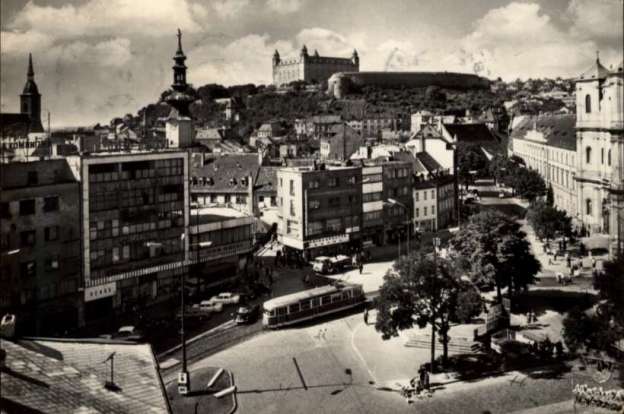
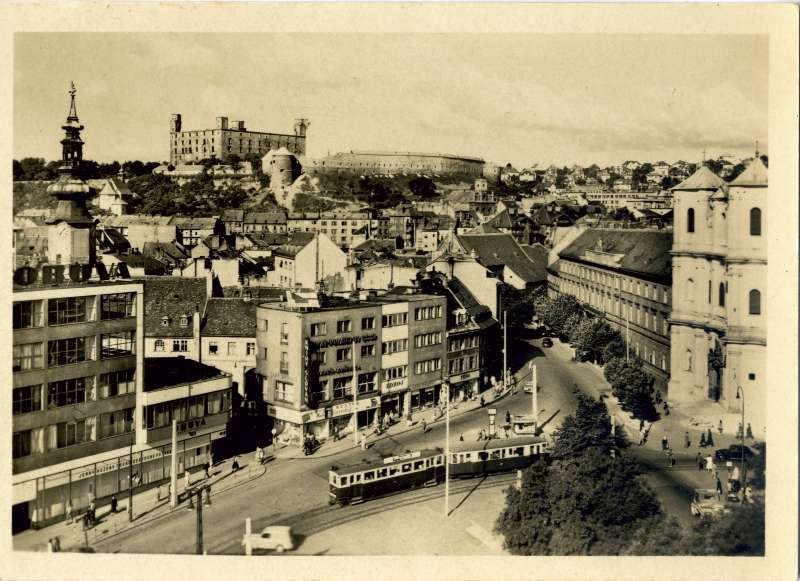
The featured image for this article is a vintage postcard featuring a tram crossing Hurbanovo námestie in Bratislava, © Public Domain. [7]
The Modern Tramway carried a short article by Gerald Druce about Bratislava’s Tramways as he encountered them at the beginning of the 1950s. [1]
This series of photographs appear on a single page in the journal and are of relatively low definition. [1: p264]
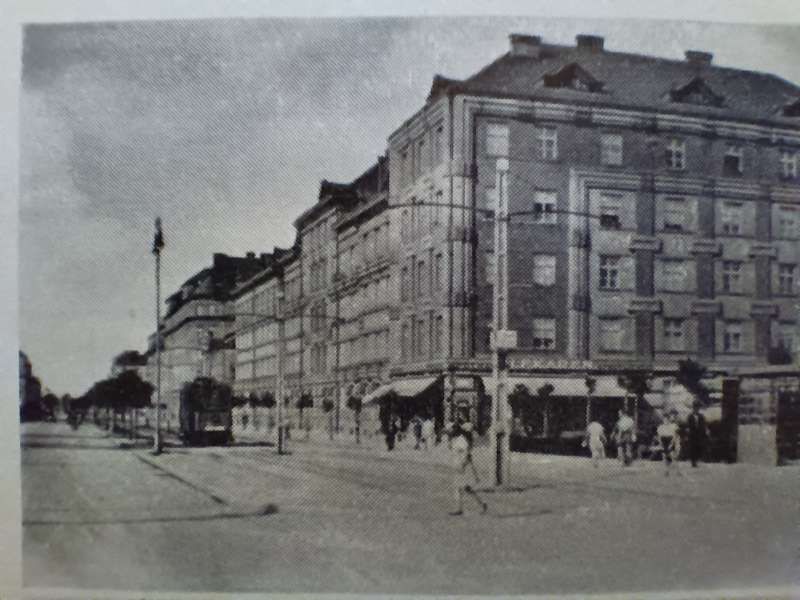
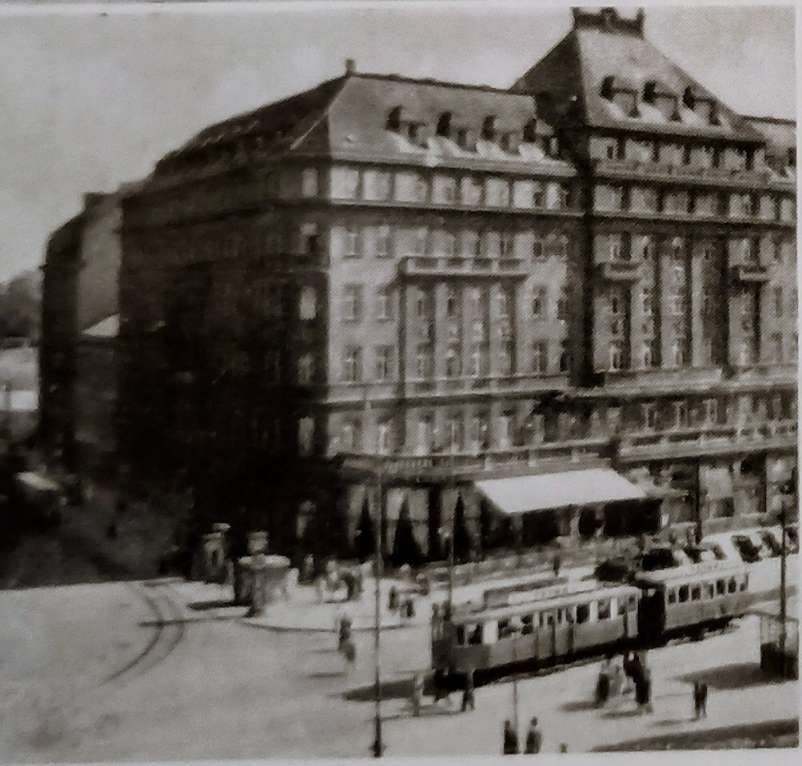
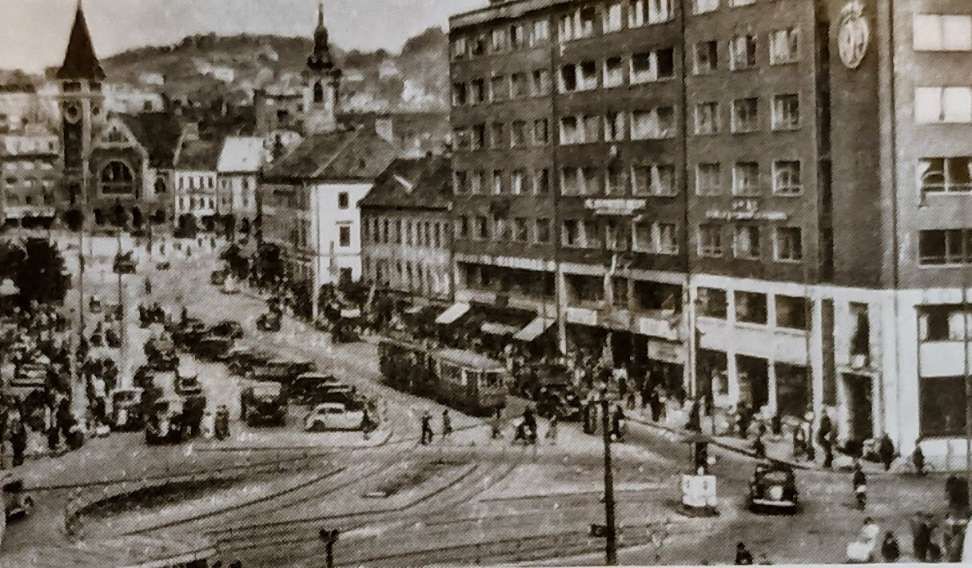
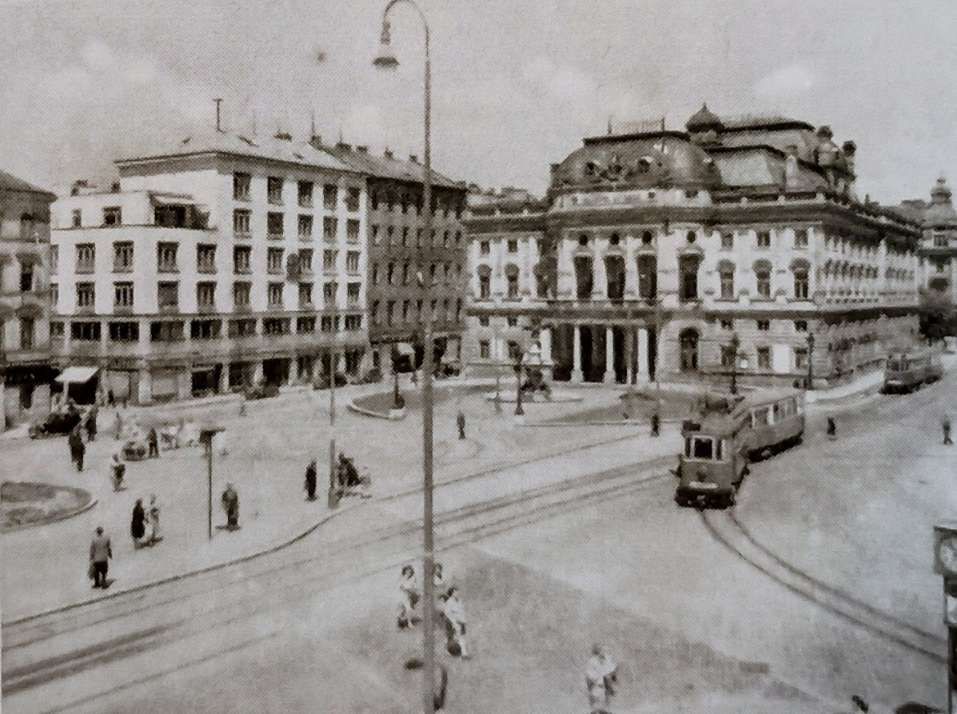
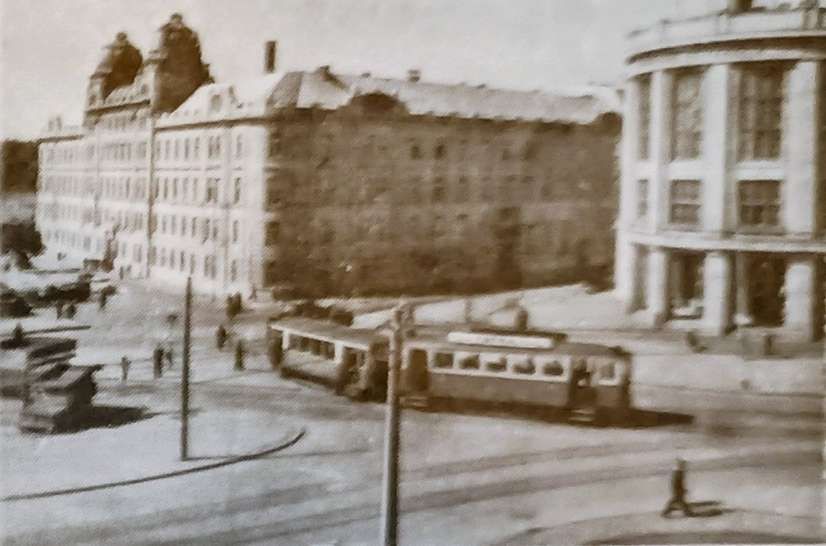
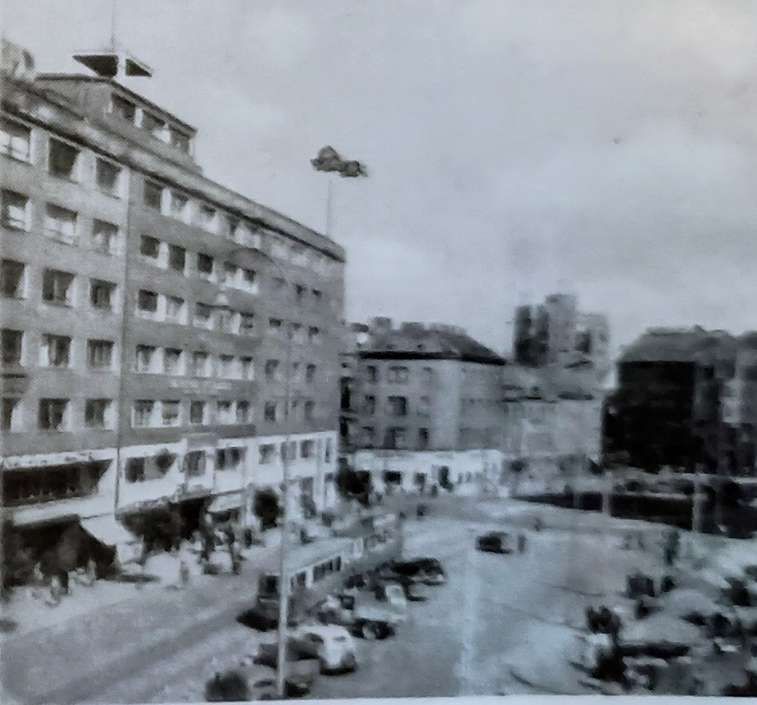
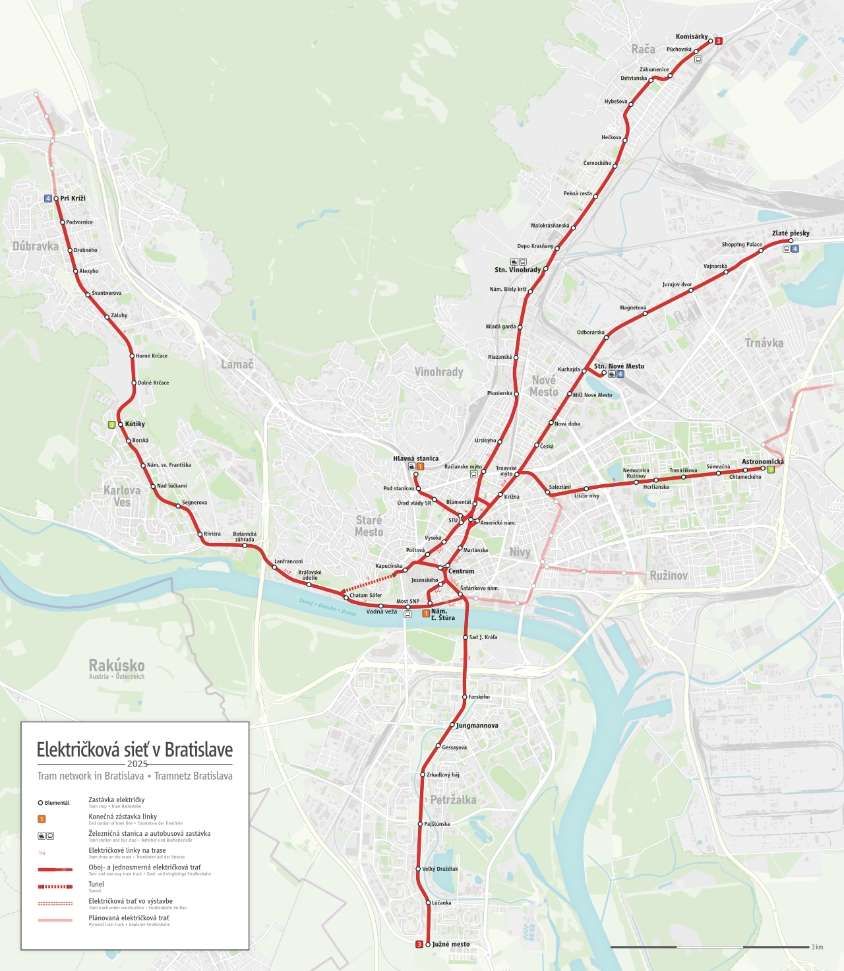
Trams in the city have been electrically powered since the system was opened in 1895; there were never any horse-driven or steam-powered trams in Bratislava. It is the one of two urban tram systems in Slovakia with the other system located in Košice. Conversions to standard-gauge rails have been proposed in the past, but the network continues to use metre-gauge track. In the 21st century, rolling stock consists of 211 tram vehicles and trams operate on five lines over approximately 42 km (26 mi) of track. [2]
Gerald Druce wrote:
“Bratislava, a town of some 150,000 inhabitants, is the capital of Slovakia and is situated near the southern frontier of Czechoslovakia, on the north bank of the river Danube. Before 1918 Slovakia formed part of the Hungarian section of the Austro-Hungarian Empire
“A Swiss firm, the Bratislava Electric Power and Lighting Company, founded in 1895, was given powers to build and operate an electric tramway. Construction was rapid and operation commenced in 1896 on metre gauge tracks. Tramway extensions followed the expansion of the town and the system gradually developed into its present form. The Company was nationalised at the end of the war, but the tramway is now municipally owned. There are about 9 route miles of track in use, most of which is double and a considerable amount of which is in reservation.
“The focal point of the system is Stalin Square where there is a large tram station from which the routes radiate to the outer termini. One line runs west along the Square and then turns north and is carried on reserved track along an embankment to the Central Station. Another continues north for a short distance and then bifurcates, one route continuing north to Dynamitka, and the other turning east to Nova Doba and Zatisie. Both these routes are mostly reserved track at the side of the road; that to Dynamitka is single track with passing loops. In the other direction from Stalin Square the track runs south towards the Danube. At the ‘Savoy’, the Nova Ves line turns west; after a short section of private right-of-way the track is laid on a central reservation all the way to the terminus. This route has recently been extended for nearly a mile. The other route from the ‘Savoy’ continues to the Danube Bridge and then turns east to the depot; there is also a single-track loop from the ‘Savoy’ to the Danube Bridge, which is used in the anti-clockwise direction by services 1 and 2. There is another loop at the Central Station; elsewhere the trailers are shunted by means of a double set of crossovers.
“The following services are operated:
1 – Central Station – Savoy.
2 – Zatisie – Savoy.3 – Dynamitka – Nova Ves.
4 – Nova Doba – Danube Bridge (Depot).
“Services are frequent on all the routes and trailers are used on all except service 4. An all-night service is provided with one car working alternately on services 1 and 2.
“Despite the frequent service the cars are always full and the undertaking has found it profitable to employ two conductors per car, making a crew of five for a two-car train. A flat rate of 2kcs. 50h. (3d.) is charged on all town services (buses, trolleybuses and trams) and two transfers are allowed, although it is only possible to change once and make the complete journey by tram, the principal use of the second transfer being for the bus feeder-services.
“The cars, all of which are single-truck and are vestibuled, are painted brick-red and cream, with a grey roof. A pantograph is used for current collection. The oldest motor cars now running were built about 1910 and are used on service 4 and for extras. In 1923, six centre-entrance cars were obtained from Ringhoffers of Prague, but were not entirely satisfactory and two have been rebuilt as works cars. After this a return was made to a modernised version of the end-platform design, with separate drivers cabs and cushioned seats; this design was adhered to until 1939 and 15 more are now on order. Most of the trailers are similar to the standard motor cars, but there are still a few older ones running which have a clerestory roof. There are also four small centre-entrance trailers rebuilt from early motor cars which are used in pairs on service 3. Four new trailers built in the tramway workshops were placed in service in 1949/50. The undertaking now owns 36 motor cars and 28 trailers.” [1: p277]“Before the war an interurban line ran from Bratislava to Vienna, operated by electric locomotives hauling long bogie trailers with open end platforms. In Bratislava, the interurban trains used the Stalin Square tram station and ran over the local system’s track to the Danube Bridge. At the end of the war the bridge was blown up, by which time the tram service had been discontinued. Although the junction at the north end of the bridge is still in place the track on the south side of the river, which was laid in the road, has been taken up and the overhead has been removed. Nevertheless the course of the tramway can easily be traced.” [1: p276]
Gerald Druce wrote his article in 1951, which was at the very beginning of the Socialist era. Wikipedia talks of the war (WW2) year and in the years immediately following:
“After the outbreak of the war, transport demands were sharply increased which had an effect on tram services. Night services had to be cancelled after 10 pm. In 1941, construction of the tunnel under Bratislava Castle, which is now used by trams, began. The tunnel construction took 8 years and the tunnel was put into operation in 1949. During the Second World War, it served as an anti-aircraft cover and was later used by car transport and pedestrians. Since 1983, it has been designated exclusively for trams.” [2]
“In 1942, classic pantographs were installed on the network. Two more years later, the number designation of tram lines and other modes of transport was introduced. Just before and during the Red Army’s occupation of the city in 1945, all public transport, including the railroad, was halted in the city. After the liberation, 90% of the network was damaged, and extensive repairs began to correct this.” [2]
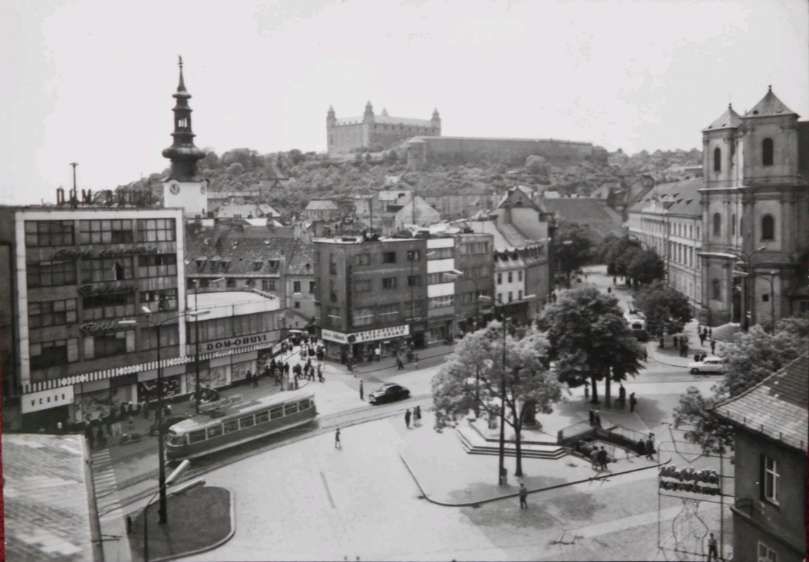
Wikipedia only provides a very short comment on the period of communist control:
“In 1950s, first 6MT trams appeared. The track from Karlova Ves was doubled and the last monorail section disappeared. Since 1952, the number of lines has increased to five.” [2]
That reference to a monorail is intriguing and will be worth following up!
Post-Communism
Tram lines were opened on the just-completed housing estates. The operation of Tatra T2 trams was terminated and the construction of the metro started but it was stopped a year later.
A proposal to swap Bratislava’s tram tracks to standard-gauge was considered and came to nothing. “The 1990s marked the modernisation of the rolling stock (K2S, T3G, T3Mod, etc.) and brand new trams of the Tatra T6A5 type were delivered between 1991 and 1997. At this time, however, the tram network became very congested.” [2]
More Recent Times
After more than 20 years of metro proposals being discussed, in 2002, all plans for the metro were officially cancelled and preparations began to replace it with rapid transit trams. “The first steps were only taken in 2006, when the Petržalka tram project was submitted for an environmental impact assessment and the first steps were taken for the start of construction. The start of construction was planned for the summer of 2007. At a similar time, Škoda 06 T trams were tested in Bratislava. This vehicle was originally developed for the Italian city of Cagliari, where a 960mm track gauge is used, while for the tests in Bratislava its chassis was modified to 1,000 mm.” [2]
The first stage of the construction of the tramway to Petržalka over the Old Bridge was the rebuilding of the Old Bridge which was opened on 16th February 2016.
“Construction of the first length of the new network was undertaken by a consortium of three firms led by Eurovia SK. The project was valued at €58 million plus VAT. As much as 85% of the project’s cost was financed from European Union funds, while the state contributed 10% and the city contributed 5%.” [2]
The funds also allowed for the purchase of thirty air conditioned low-floor Škoda 30T trams and thirty Škoda 29T trams. In addition to trams, the city also bought trolleybuses, and completed modernisation of the Tatra K2 tramcars. By February 2010, only the Skoda 29T and 30T trams and renovated or new Tatra K2S and Tatra K2G cars have been running on Bratislava’s rails.
The Škoda 29T trams were single-directional, five-section low-floor trams. The Škoda 30T trams were bidirectional variants of the 29T trams.
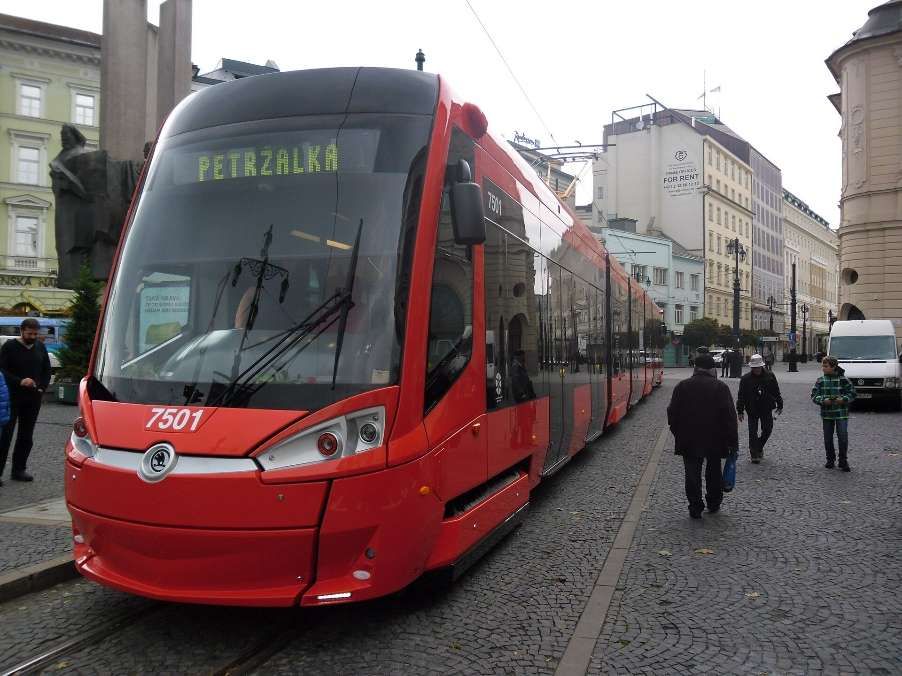
“On 15th June 2020, reconstruction started on the section between the stops Cintorín Rača and Záhumenice on Račianska radial. The reconstructed line was opened on 7th September 2020. On 27th July 2025, the second stage of the Petržalka tram line was opened.” [2]
References
- Gerald Druce; The Bratislava Tramways; in The Modern Tramway, Volume 14, No. 168, December 1951, p264 & p277-278.
- https://en.wikipedia.org/wiki/Trams_in_Bratislava, accessed on 20th May 2026.
- https://en.wikipedia.org/wiki/Trams_in_Bratislava#/media/File%3ABa_tram_map.svg, accessed on 20th May 2026.
- https://www.geneanet.org/cartes-postales/view/6159836#0, accessed on 20th May 2026.
- https://ebay.us/m/7CcuWw, accessed on 21st May 2026.
- https://commons.wikimedia.org/wiki/File:%C5%A0koda-30T.JPG, accessed on 21st May 2026.
- https://ebay.us/m/AFP5MC, accessed on 21st May 2026.


