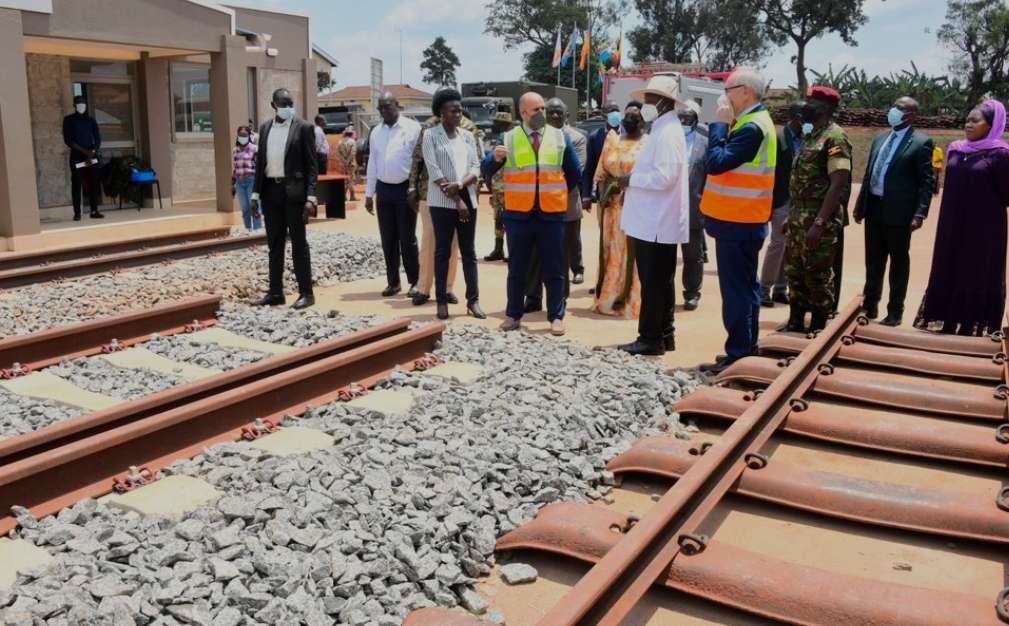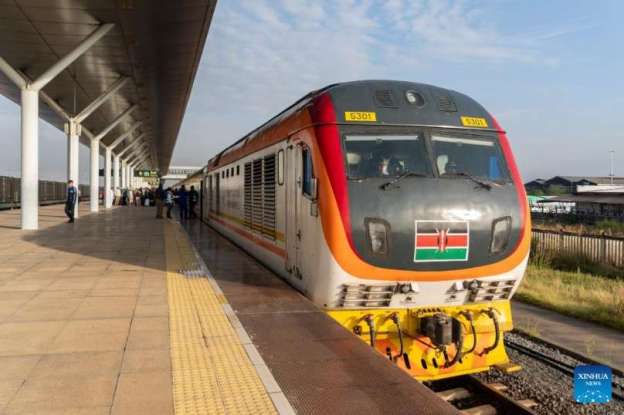
A. Uganda to begin construction of its Standard Gauge railway network in April 2026.
In August 2025, Rogers Atukunda wrote of the construction of Uganda’s Standard Gauge railway network commencing in April 2026. His article can be found here. [1]
B. Uganda is to use electric traction for the Kampala to Malaba Standard Gauge Railway Line.
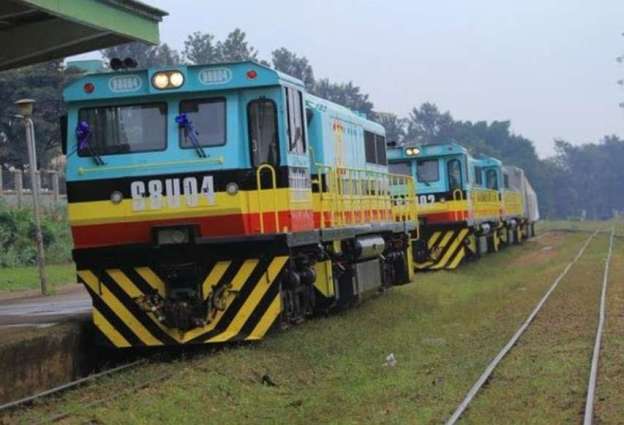
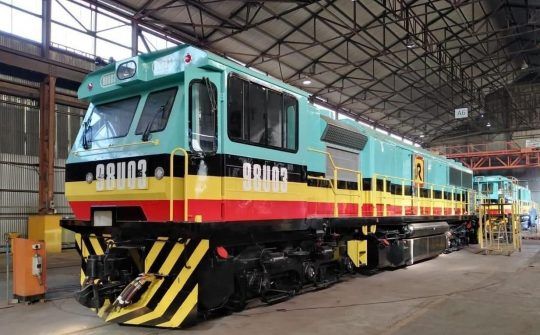
Uganda has recently confirmed that its Standard Gauge line from Malaba/Tororo to Kampala will operate with electric traction to European standards rather than diesel traction to Chinese standards.
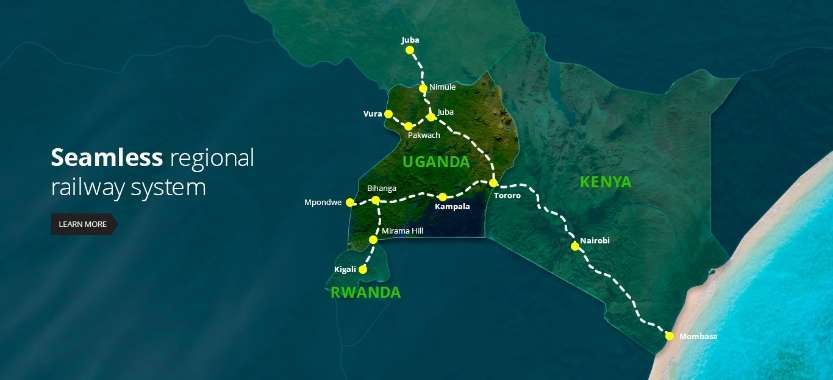
The planned regional standard-gauge network includes two lines separating inside the Eastern border of Uganda at Tororo. These then diverge further in the West (at Bihanga) and in the North (at Gulu). The total route length will be 1,724 kilometres subject to change due to design modifications and additional sidings and/or branch lines. [3]
Kabona Esiara of ‘The East African‘ explained in November 2025 that this required detailed negotiations between the railway authorities in Kenya and Uganda. These negotiations commenced in mid-November 2025. [2]
Uganda and Kenya were working on a raft of technical and policy measures to facilitate a seamless SGR system between the two countries as they work in the next few years on parallel finishing of their SGR lines.
Kenya says it will start constructing the Naivasha-Kisumu-Malaba line early in 2026 while construction of Uganda’s Kampala-Malaba should commence in the second quarter of 2026.
C. A series of mis-steps in the development of railways in Kenya and Uganda.
Mary Serumaga, in 2018, said that “the building of standard gauge (SGR) railways in both Uganda and Kenya and the predictable sagas that have ensued are reminiscent of the controversies surrounding the building of the Uganda and Rhodesian Railways in the late 19th and early 20th centuries. Both present a framework within which it is possible finally to understand the limited achievements in development in all sectors (and frankly, underdevelopment in many) and regression in Uganda’s primary education, copper mining and agricultural sectors. Both SGR projects are tainted with suspicion of shady procurement which, if taken together with the track records of the implementers, points to corruption. It would be irresponsible to say otherwise.” [4]
“The route, design, level of service and all other decisions of the Uganda Railway of 1990 were dictated by potential profits for foreign investors (both public and private) and their local agents, and not by notions of public service and the common good of those who would bear the ultimate cost. Return on investment is not a bad thing but the Imperial government also claimed to be acting in the interests of the indigenous populations. … The difference now is that there is no pretence about whether the railways are serving the interests of the general population. The different financial implications presented by the procurement process itself, the selection of routes and the relative cost of engineering in the different terrains, plus the cost of compensating displaced landowners, provide scope for long-running, energy-depleting corruption scandals. From the outset, there has been a lack of confidence that procurement processes for the necessary services would prioritise the interests of the public over the interests of the contractor and would actively exclude the personal interests of the public servants commissioning the works. This is what is triggering the anxiety surrounding the SGRs.” [4]
“Moreover, the choice over whether to upgrade the old railway or to start afresh was not adequately debated publicly. Ditto the options on financing. For the Kenyan SGR, the most costly of the potential routes were reportedly selectively chosen. Several cheaper routes on land allegedly already in possession of the government are said to have been rejected. … There are also questions surrounding passenger service. Do the railways only serve trade or are passengers entitled to this alternative to dangerous road transport?” [4]
“Uganda owns one half of the old East African Railway. Together with the Kenyan leg, it was put under a 25-year management contract. The new owners renamed their new toy Rift Valley Railways (RVR). In 2017, after only twelve years, the governments cancelled the contracts in a move the RVR called an illegal takeover. On the Ugandan end, there were allegations of asset-stripping by previous European concessionaires as well as unpaid concession fees and massive salary arrears caused by RVR. If RVR were to successfully sue the government for cancellation of the contract, their compensation would be the first budget overrun. … The government of Uganda then signed a Memorandum of Understanding in 2014 with the China Civil Engineering Construction Corporation (CCECC), which had submitted a study. It abandoned those negotiations in favour of a second Chinese entity, the China Harbour Engineering Company. In justifying its action, the government questioned the quality of the CCECC’s study, which it said was cut and pasted from pre-existing feasibility studies (something that could have been avoided by following proper procurement procedures). CCECC insists it was a pre-feasibility study requiring less detail than a full-blown feasibility study. Whatever the case, if CCECC had followed through with its suit for US$8 million in compensation, which would have been another massive blow to the budget at inception. Whatever compensation they have agreed to has not been made public but as matters stand, the budget for the eastern leg of the SGR has gone up from CCECC’s proposed US$4.2 billion to CHEC’s US$6.7 billion.” [4]
The remainder of Mary Serumaga’s article which looks back at colonial construction work and draws parallels with 21st century procurement and construction in East Africa can be found here. [4]
D. President Yoweri Museveni’s State of the Nation Address in June 2025.
In June 2025, President Museveni highlighted significant rail developments, advancing the Standard Gauge Railway (SGR) project to link with Kenya and the region, aiming to cut costs and boost trade, while discussing financing for the $2.8 billion Kampala-Malaba SGR and emphasizing participation in the development of the new rail infrastructure. In essence, the 2025 address signalled a push for comprehensive road and railway modernization and expansion, leveraging oil revenues and debt financing to build a robust network for economic transformation. [5] Museveni said, “we are soon finalizing the construction of the 1,443km East African Crude Oil Pipeline (EACOP) from Buliisa to Tanga in Tanzania. The construction of the SGR, which I launched last year, is soon starting,” [5] and “the NRM Government has prioritized infrastructure development especially roads, railways and electricity.” [5] In addition, the government will be focusing on revitalizing metre-gauge lines (like Tororo-Gulu, Kampala-Malaba).
E. Kenya – Additional Madaraka Express Trains for the Christmas period.
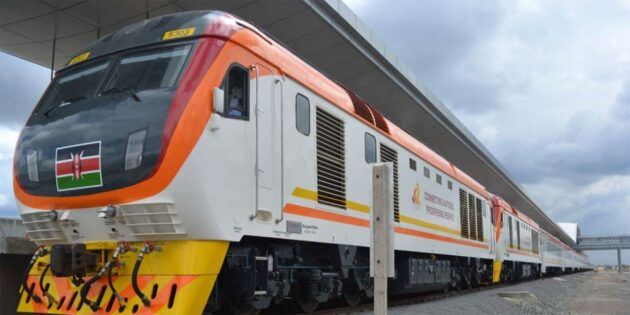
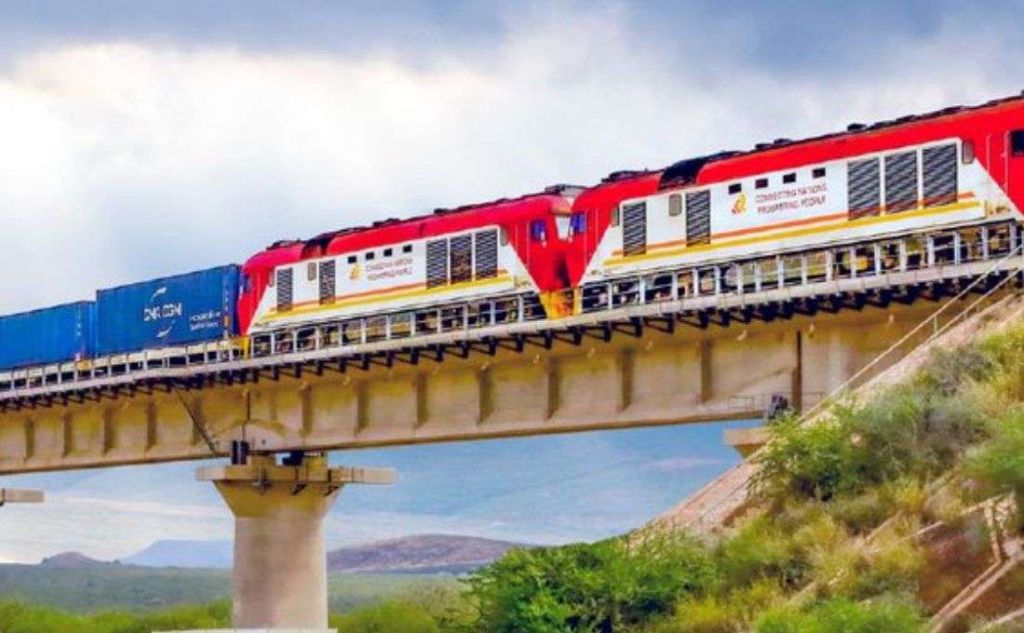
Kenya Railways announces additional Madaraka Express trains from 8th December 2025, to 5th January 2026, to meet increased festive season demand. The Nairobi-Mombasa train departs Nairobi at 9:40 AM, arriving in Mombasa at 3:35 PM, while the Mombasa-Nairobi train leaves at 4:30 PM, reaching Nairobi at 10:55 pm. [6]
“The railway operator said the move comes in response to increased demand during the holiday period, when thousands of Kenyans and tourists journey along the scenic Nairobi-Mombasa route. … ‘We are committed to providing a safe and convenient travel experience, and the additional services will help ease congestion while maintaining punctuality’ reads the notice dated 2nd December.” [7]
A report from The EastAfrican, 21st October 2024. [1]
On Monday 14th October 2024, Uganda signed a deal with Turkish firm Yapi Merkezi for the construction of the standard gauge railway (SGR) from Malaba to Kampala, after a 16-year wait.
When completed, the $2.9 billion-dollar electric rail project is expected to reduce transportation costs and increase the efficiency of the rail transport system in Uganda.
Construction of Uganda’s 273km SGR line, expected to be completed in four years, has started without a lender bankrolling the project, and authorities say it will be commissioned in the first week of November.
The EastAfrican has learnt that in this financial year, the SGR was allocated $40.8 million for compensation of project-affected persons. Canon Perez Wamburu, coordinator of Uganda’s SGR Unit, said the total budget is close to $49 million.
The Finance ministry has identified American lender Citi Bank to syndicate a loan of about $3 billion.
Uganda is under pressure from Tanzania and Kenya, which have SGR systems, to build its section to facilitate a synchronised regional rail network. Kenya is also working on extending its SGR line from Naivasha to Kisumu and on to Malaba.
“The two systems will be connected and will be seamless. We support our Kenyan friends in doing that. And the timelines agreed on with the Kenya brothers will be met,” said Gen Katumba Wamala, Uganda’s Works and Transport minister.
He explained that the two countries agreed that by the time the Malaba-Kampala SGR section reaches Kampala, the Naivasha-Kisumu-Malaba section will also be ready.
Uganda plans to develop 1,700km of SGR network covering Tororo to Gulu and Nimule at the South Sudan border, with a spur from Gulu to Pakwach and Vurra at the Democratic Republic of Congo border.
A western line will run from Kampala to Bihanga and Kasese-Mpondwe at the DR Congo border, with a spur southward from Bihanga to Mirama Hills at the Uganda-Rwanda border and another to Muko, Kabale.
Wikipedia tells us that the Ugandan SGR network will be part of a much wider SGR rail network in East Africa:
“The Uganda Standard Gauge Railway is a planned railway system linking the country to the neighboring countries of Kenya, Rwanda, Democratic Republic of the Congo and South Sudan, as part of the East African Railway Master Plan. The new Standard-gauge railway (SGR), is intended to replace the old, inefficient metre-gauge railway system. The entire 1,724 kilometres (1,071 mi) SGR in Uganda will cost an estimated $12.8 billion.” [3]
“This 1435 mm (4 ft 8 1⁄2 in) railway line is intended to ease the transfer of goods between the port of Mombasa and the Ugandan capital of Kampala, and subsequently to Kigali in Rwanda, and to Beni in the Democratic Republic of the Congo and to Nimule and Juba in South Sudan. Goods would travel from Mombasa along the Kenya Standard Gauge Railway to Malaba, at the border with Uganda, and transfer on to this railway system.” [2]
“In March 2019, during a state visit to Kenya, President Yoweri Museveni of Uganda and his host, President Uhuru Kenyatta of Kenya, jointly publicly committed to extend the Kenyan Standard Gauge Railway to Uganda. Completing the critical missing link to the Kenyan SGR would then unlock the funding for Uganda’s Malaba–Kampala line. As of October 2023, the Naivasha–Malaba section of Kenya’s SGR has not been constructed.” [2] It seems that, in October 2024, a renewed commitment has been made to complete the SGR to the border with Uganda.
In Uganda the SGR network will consist of four main sections:
“Malaba–Kampala Section
Also referred to as the Eastern Line, this section will stretch from the border with Kenya at Malaba, through Tororo and Jinja, to end at Kampala. The distance of this section is approximately 219 kilometres (136 mi).[5] The entire Malaba–Kampala section, measuring 273 kilometres (170 mi) with associated train stations and railway yards, is budgeted to cost US$2.3 billion. Once funding is secured, the construction of the Eastern Line is expected to last 42 months.
Tororo–Gulu Section
Also referred to as the Northern Line, this section will extend from Tororo, through Mbale and Lira to Gulu, a distance of approximately 367 kilometres (228 mi). From Gulu, one spur will continue north to Elegu and on to Nimule and Juba in South Sudan. The section in Uganda measures approximately 106 kilometres (66 mi). Another extension stretches from Gulu southwestwards through Pakwach to end at Goli at the Border with the Democratic Republic of the Congo, a distance of approximately 187 kilometres (116 mi).
Kampala–Mpondwe Section
This is referred to as the Western Line. It will start in Kampala and pass through Bihanga in Ibanda District, continuing on to Mpondwe at the border with DR Congo, a distance of about 430 kilometres (267 mi).
Bihanga–Mirama Hills Section
This is also referred to as the Southwestern Line. It will stretch from Bihanga through Ibanda and Mbarara to end at Mirama Hills, at the border with Rwanda, a distance of about 191 kilometres (119 mi).” [2]
The Wikipedia article continues:
“The construction was expected to be financed by the government of Uganda, using borrowed money from the Exim Bank of China. However, the lender has been unwilling to approve the loan until Kenya finalizes the funding arrangement for the Naivasha–Kisumu–Malaba section of its SGR.
In January 2023, the Ugandan government terminated the contract that it had signed with China Harbour Engineering Company (CHEC) to build the Kampala–Malaba section of the Ugandan SGR, on account of ‘failure to execute’ for eight consecutive years.
In May 2023, the government identified Yapı Merkezi Group from Turkey as the new engineering, procurement and construction (EPC) contractor. Funding is expected to be sourced from European banks. Works are expected to commence in 2024 starting with the 273 kilometres (170 mi) Kampala–Malaba section. The funding bank was later identified as Standard Chartered Plc of the United Kingdom.
In July 2023, the Ugandan and Kenyan cabinet ministers of transportation met in Mombasa. The communique issued at the end of the two-day consultations announced that going forward, the two countries will jointly explore funding sourcing for the Naivasha–Kisumu–Malaba portion of the Kenya Standard Gauge Railway. Together, the two countries are seeking at least $6 billion in new funding for their SGR projects from financiers in Europe and the Middle East.
In February 2024, both countries reaffirmed their commitments to build the Naivasha-Kisumu-Malaba section in Kenya and the Malaba-Kampala section in Uganda, starting in 2024. The Ugandan government has contracted the Yapı Merkezi Group from Turkey to build the 273 kilometres (170 mi) section between Malaba and Kampala at a contract price of US$2.9 billion. Work was expected to start in August 2024. As of August 2024, the Uganda government was working on finalizing the engineering, procurement and construction (EPC) documentation and obtaining approvals from relevant government bureaucrats. The construction distance from Malaba to Kampala is now reported as 332 kilometres (206 mi). Construction is expected to begin in [late] 2024.
On 14th October 2024, the government of Uganda signed the EPC documents with Yapı Merkezi to build the Malaba-Kampala section of the Uganda Standard Gauge Railway at a contract price of €2.7 billion (approx. USh10.8 trillion). Construction is expected to take four years and conclude in [late] 2028.” [2]
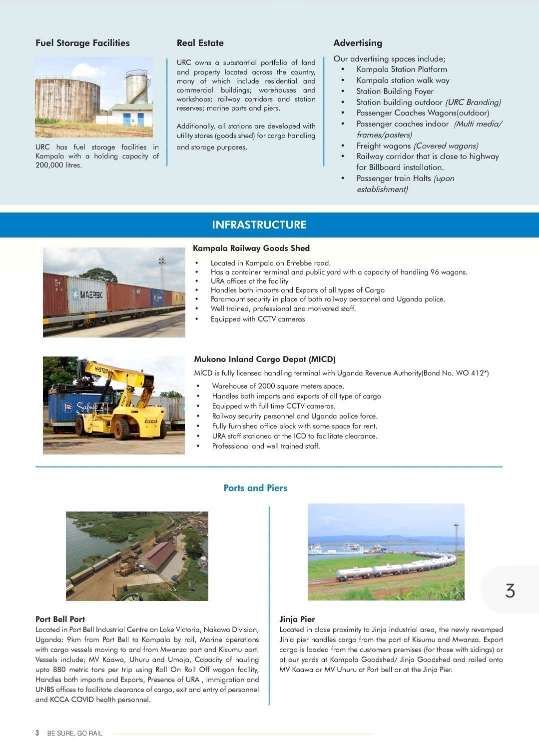
The Cross-Cultural Foundation of Uganda (CCFU) a non-governmental, not-for-profit organisation that promotes and appreciation of culture as vital for human development that responds to our diverse identities, with support from the European Union and SOGEA SATOM and the Uganda Railways Corporation established the Uganda Railway Museum. [4]
The museum highlights the important role that railways played in Uganda’s history and nation building. It is located along the Jinja-Iganga Highway at the Railway Station in Jinja City. It offers a varied programme that includes heritage theme nights, exploring a locomotive and coach, film recollections/stories, guided tours and access to a cafeteria. Part of the museum has been designed with young people in mind to support their learning and appreciation of Uganda’s history.
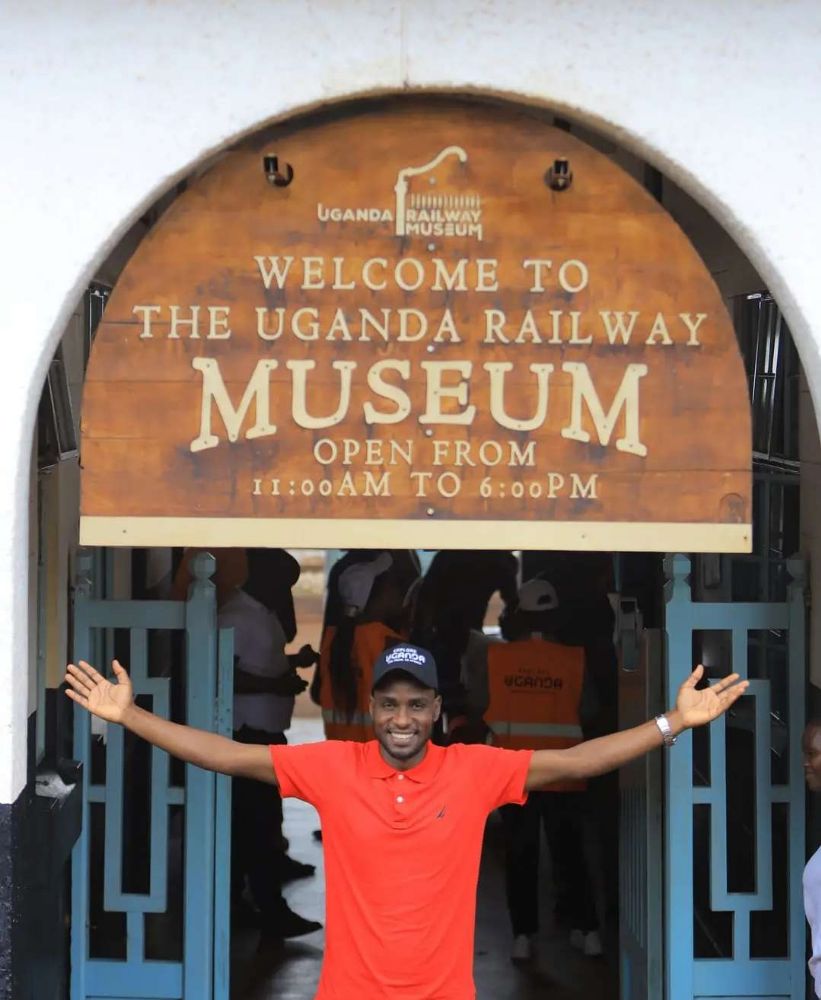
Welcome to Uganda’s Railways Museum! This image was posted on the Museum’s Facebook Page on 17th September 2024. [11]
The Museum’s formal opening ceremony took place in March 2022. It is now open for public visits every Tuesday to Sunday, 11:00am – 6:00pm at 5000 Ugandan shillings for adults and 2000 shillings for children.
While there are ongoing government efforts to revamp the railway transport with the rehabilitation of the northern line and the construction of the Standard Gauge Railway. The establishment of the railway museum complements the government of Uganda’s efforts to highlight the importance of railway transport by reinvigorating its interest among Ugandans.
B. Ugandan Old Railway Line Rehabilitation on Track
In January 2024, The EastAfrican reported that Uganda’s planned overhaul of the metre gauge railway to cut transport costs on the Northern Corridor and improve trade competitiveness had entered its final stages, even as the country faced a shortage of equipment, wagons, and trains.
The EastAfrican reported in January 2024 that Spanish firm Imathia Construction had completed replacing steel sleepers with concrete sleepers on the Namanve-Kampala section of the line, which was handed over to the Uganda Railways Corporation (URC) at the beginning of 2024. The contractor then embarked on the final section, Namanve-Mukono.
This would be the second section of the track to be completed after rehabilitation of the Tororo-Namanve line, including the line to Jinja Pier, which was completed a year ago.
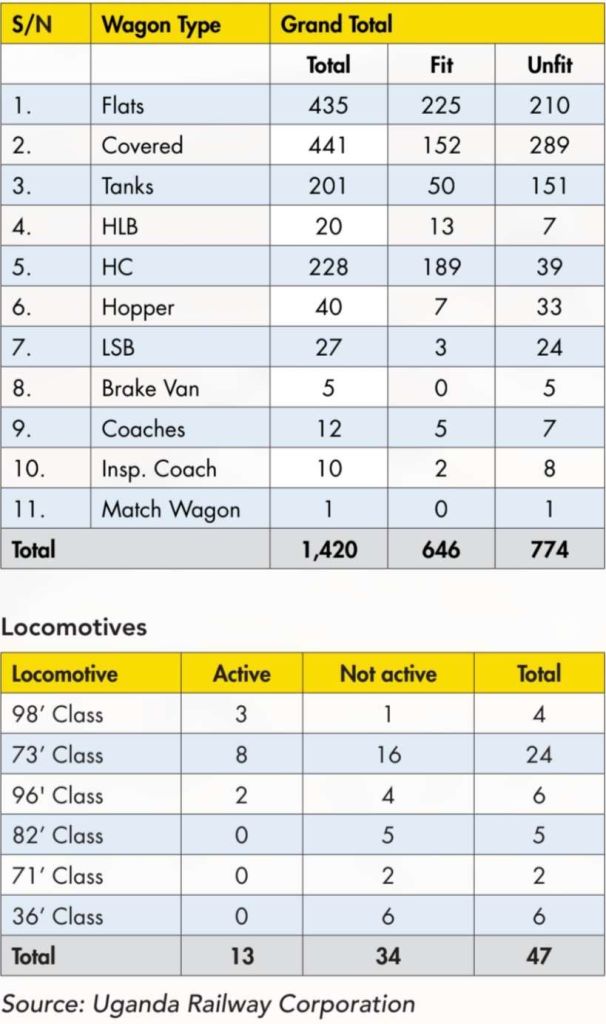
While the Malaba-Namanve metre gauge track is now in fair condition, importers, exporters, and shippers remain sceptical about switching to rail, citing a shortage of rolling stock and inefficiency, which has resulted in 90 percent of traffic on the Northern Corridor being carried by road and only about seven percent is carried by rail because of the poor state of rail infrastructure. [5]
Uganda’s General Motors GL30 Locomotives
C. Restoring Uganda’s Railways: The Long Road Ahead.
Rothschild Jobi; Restoring Uganda’s Railways: The Long Road Ahead; in Infrastructure, Travel and Tourism, Uganda, 9th August 2024. [10]
“The Uganda Railways Corporation (URC) is now focusing on restoring railway infrastructure in up-country areas, a step taken months after the successful resumption of limited passenger services on the Kampala-Mukono route. This move comes as part of an effort to address the deteriorating state of the country’s railway system.
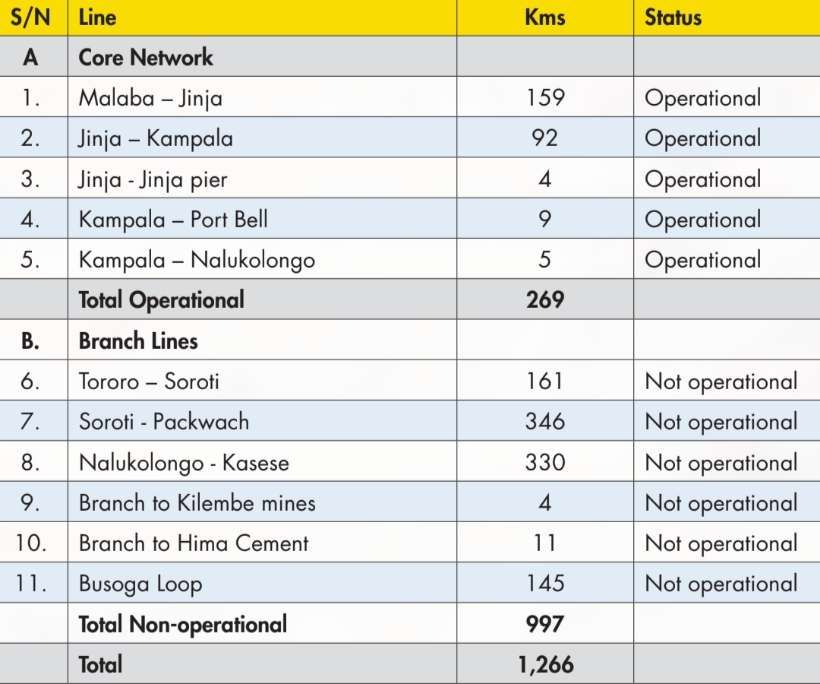
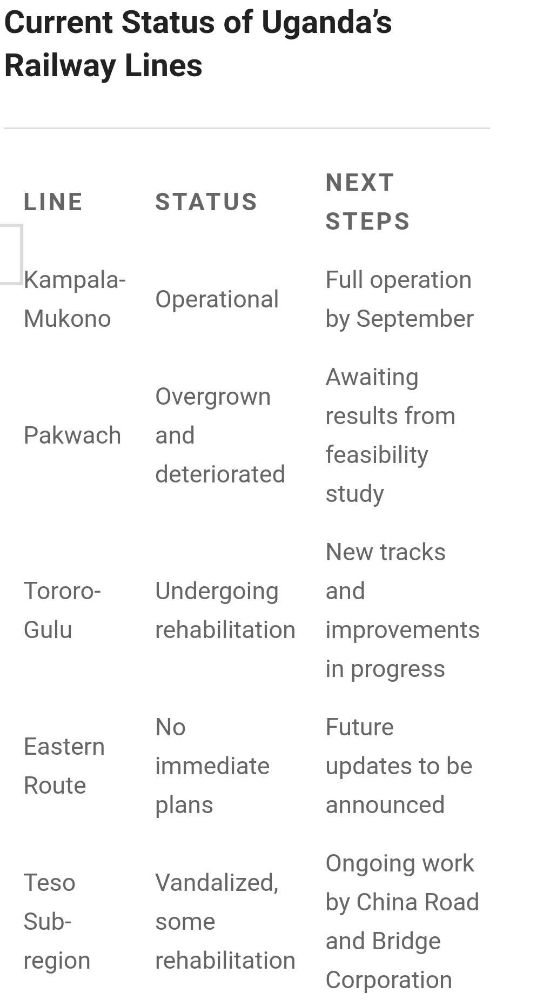
Table: Status of Uganda’s main railway lines in August 2024.
In April, the Kampala-Mukono route was reopened, offering passengers a 40-minute journey from Namanve to Kampala in the morning, with a return trip available in the evening. This was seen as a positive development, but it also highlighted the need for broader improvements across the railway network.
URC’s Head of Communications, Mr. John Linnon Sengendo, stated in an interview on Monday that the focus is now shifting to the up-country lines. He emphasized that the aim is to complete the railway network by restoring these lines, which have suffered from neglect over the years.
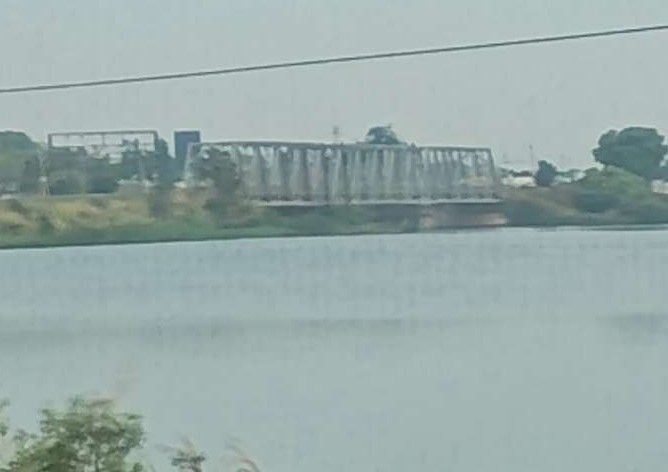
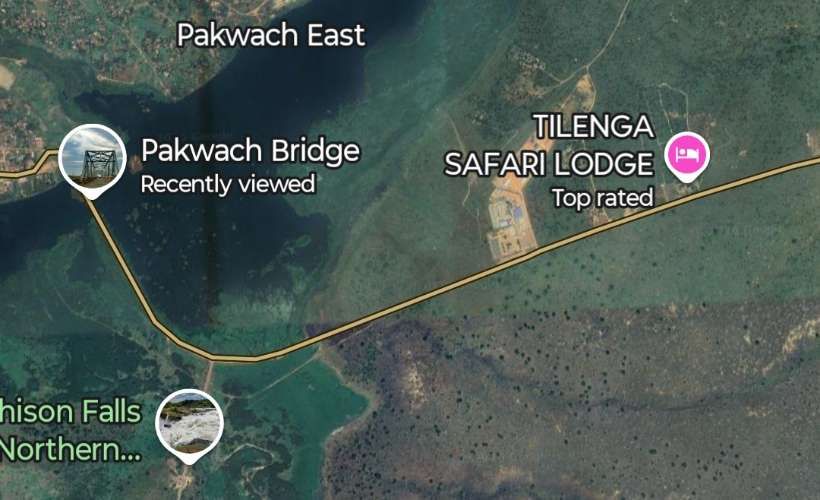
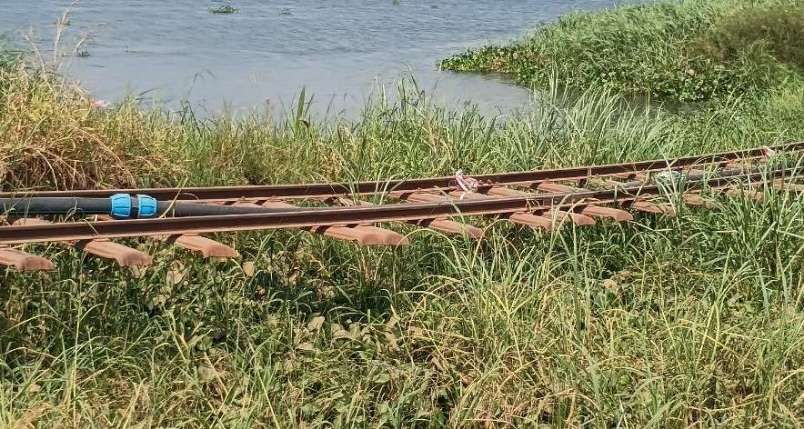
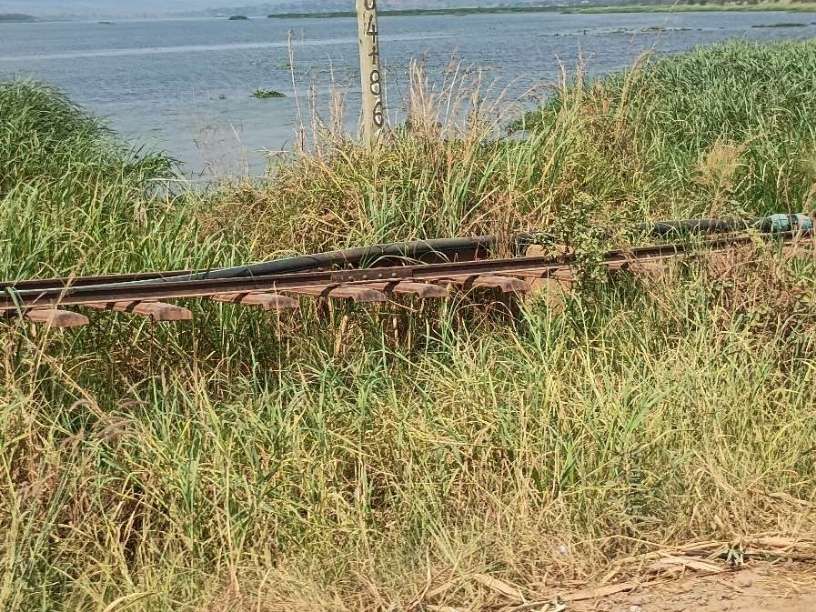
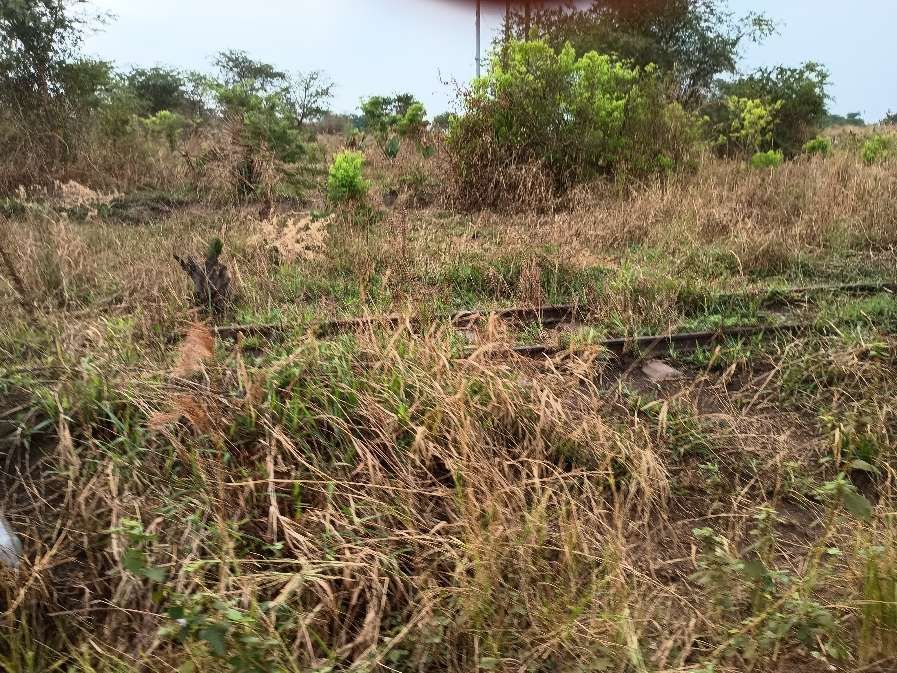
One such line is the Pakwach railway, which was originally constructed in 1964. It played a crucial role in transporting goods and passengers from Nebbi District. However, by the 1980s, the line fell into disrepair. Despite plans announced in 2005 to repair the Gulu-Pakwach line, it remains overgrown with vegetation, and the infrastructure has deteriorated significantly.
Mr. Daudi Onencan, a 68-year-old farmer in Pakwach, reminisced about the line’s past significance. He noted that the railway provided a cost-effective way for farmers to transport goods to markets in distant districts.
Pakwach District Chairperson, Mr. Robert Omito Steen, highlighted ongoing efforts to revive the railway line due to its importance for transporting bulky goods. Discussions with various line ministries have been ongoing, with the hope that these efforts will lead to the line’s restoration.
In 2016, feasibility studies and bush clearance were carried out to assess the state of the railway lines. These efforts raised hopes for the line’s revival, but the overgrowth has since returned.
Mr. Sengendo mentioned that the study results will inform the government’s next steps. He noted that the Ministry of Works and Transport has sanctioned a company to undertake the study, and the restoration of the railway line is a key objective. The broader SGR (Standard Gauge Railway) project also includes the Tororo-Gulu-Pakwach line.
In Mityana District, residents in several villages are resisting eviction from the railway reserve despite numerous warnings. The railway reserve, now occupied by residential and commercial buildings and gardens, faces challenges as some residents claim they unknowingly purchased land in the reserve from individuals who have since relocated.
Mr. Ssande Kafunda, Chairperson of Bbuye Village, reported that affected residents are seeking advice on how to handle the situation, as they were misled about the land’s status.
Mityana municipal mayor, Mr. Faustine Mukambwe, supports the railway rehabilitation and believes it will boost local development. He urged residents to embrace the project and mentioned that the municipal council is exploring new land for constructing a new abattoir, as the current one is situated in the railway reserve.
In 2014, over 80,000 encroachers on railway reserves in various areas were given 28 days to vacate to allow for railway transport revitalization. Despite these orders, many encroachers remain, although some have relocated.
Progress is being made on the Tororo-Gulu line, with rehabilitation efforts underway. The previously non-existent track is now being upgraded with new tracks, improved drainage systems, and enhanced level crossings.
Regarding the Eastern route, Mr. Sengendo indicated that there are no immediate plans to work on this line but assured that the public will be informed if the need for restoration arises.
Mr. Sengendo also mentioned that the government, through URC, is committed to enhancing both land and water railway infrastructure to improve service for Ugandans. The aim is to reduce transportation costs for both exports and imports, thereby lowering prices for goods and increasing export earnings.
Passenger services are nearing completion on the Kampala-Mukono route, which is expected to be fully operational by September. Work will soon commence on the Kampala-Kyengera and Port Bell routes, funded by the African Development Bank.
For cargo transport, new locomotives and wagons are being acquired to support the expanding network. Plans include procuring multipurpose wagon ferries for routes between Kisumu and Mwanza. The goal is to have both the Metre Gauge Railway and Standard Gauge Railway networks complement each other, as part of the East African Community’s efforts to improve the railway system.
In the Teso Sub-region, Kumi Resident District Commissioner, Mr. Ahamada Washaki, stressed the importance of rehabilitating the railway line. However, much of the railway line in Teso remains vandalized, with key stations deserted. URC’s Mr. Sengendo explained that the line has been non-operational for over 30 years, contributing to its current state. Rehabilitation work by China Road and Bridge Corporation is ongoing on a 375km stretch, with completion expected in two years.” [10]
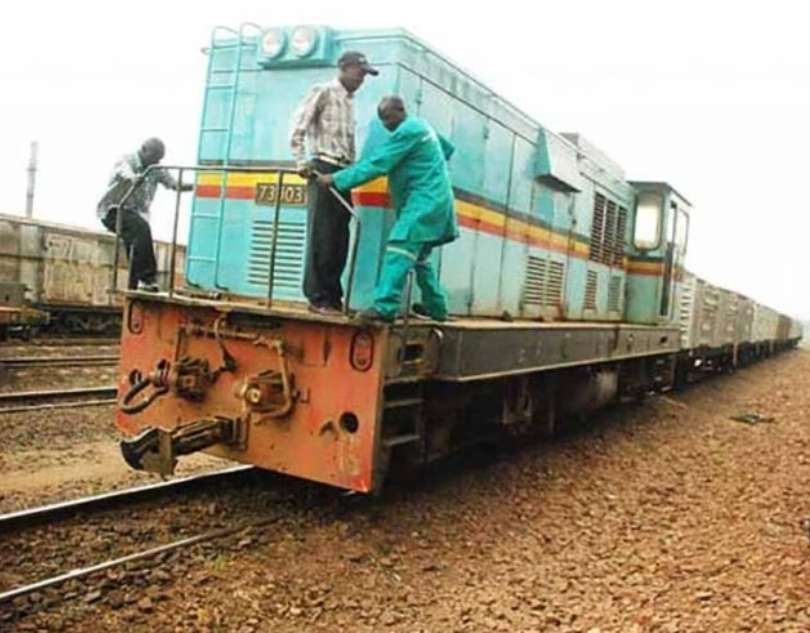
Uganda Railways Corporation locomotive. [13]
D. Uganda Railways Projects to be Implemented in the Financial Year 2024/2025.
On 21st June 2024, infrastructure.go.ug [6] reported that the Ugandan government was working on their objective of reducing the cost of doing business in Uganda by making improvements to the rail network.
They note the then imminent completion of the Kampala-Namanve project. They highlight ongoing work on the line between Tororo & Gulu, funded entirely by the Ugandan government. They talk of work on the African Development Bank project, which will address some of the unfinished portions of the Kampala-Malaba route. They mention work on the route between Port Bell and Kyengera in Kampala and plans for the acquisition of better passenger carriages and locomotives.
URC board technical committee chairperson, Andrew Muguluma commented in an interview with New Vision that, “Even though Uganda is developing its standard gauge railway at a different pace than other countries, … the country is catching up to the current infrastructure.” [6]
The article on infrastructure.go.ug’s website continues:
“The government has made significant investments in the rail industry, according to Leonard Kerezya, senior principal auditor in the Office of Auditor General, who urged URC top management to conduct engineering audits in order to address risks.n … KAccording to him, due to inadequate infrastructure driving up transportation costs along the northern corridor (the Malaba-Kampala rail line), only 7% of traffic in Uganda travels by rail. This means that over 90% of traffic in Uganda moves by road.” [6]
“The government committed to building a multimodal transportation infrastructure as part of NDP III (FY2020–2025) in order to increase the nation’s competitiveness through investments in better and more affordable transportation.” [6]
In respect of the SGR, they say:
“The Democratic Republic of the Congo, Uganda, Kenya, Rwanda, and other partner states of the Northern Corridor Integration Projects (NCIP) decided last month (May 2024) to pool resources to expedite the Standard Gauge Railway (SGR) project’s development. … The Joint Ministerial Committee on SGR met in Mombasa, Kenya, and decided to take this action. … The transportation ministers restated their determination to finish the remaining SGR portions as soon as possible, from Kenya’s Naivasha to Rwanda, Uganda, South Sudan, and the Democratic Republic of the Congo.” [6]
“Kenya pledged to restart building on the Naivasha-Kisumu-Malaba and Kisumu-Malaba SGR sections, respectively, beginning in July and September of 2024. … Subject to the availability of resources, Uganda is also anticipated to begin building on Malaba-Kamppala in September. The country is currently nearing the conclusion of discussions with Yapi Merkezi, the prospective contractor.” [6] An agreement which, in October 2024, now appears to be in place.
URC is a business entity that answers to the Ministry of Transportation and Works. It was founded to carry out railway, marine, and road services for the carriage of goods and passengers both inside and outside of Uganda, as required by the Uganda Railways Corporation Act, Cap 331. URC’s network of tracks spans 1,266 kilometers in total.
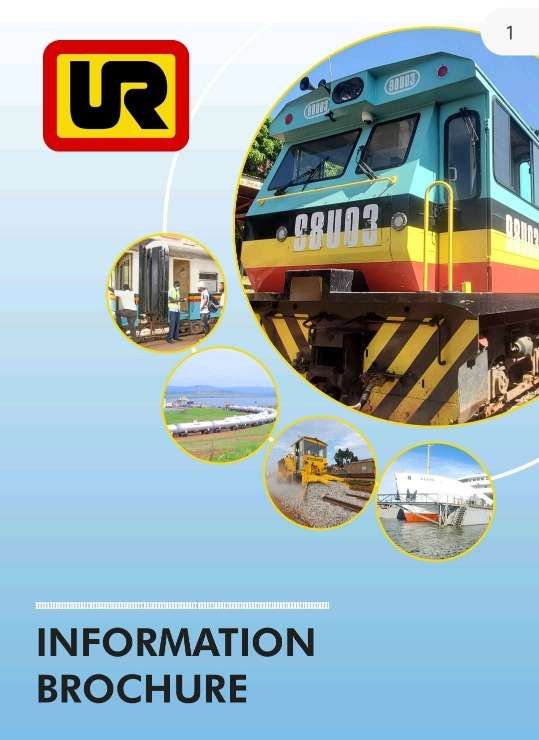
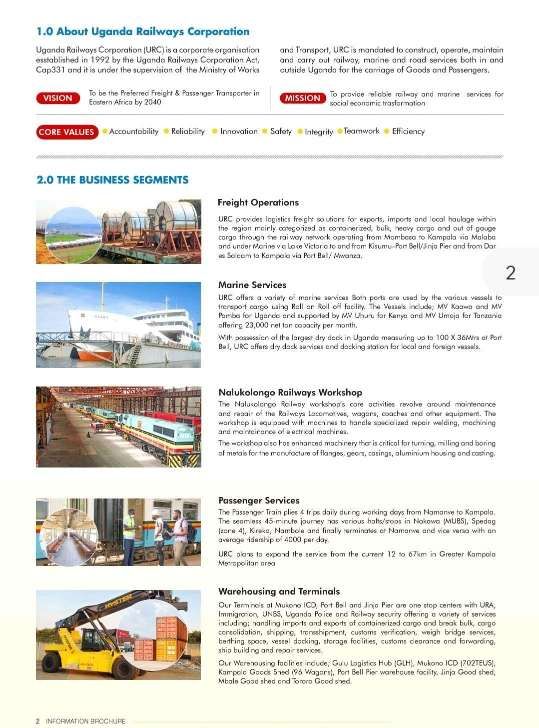
E. Uganda Railways Brochure
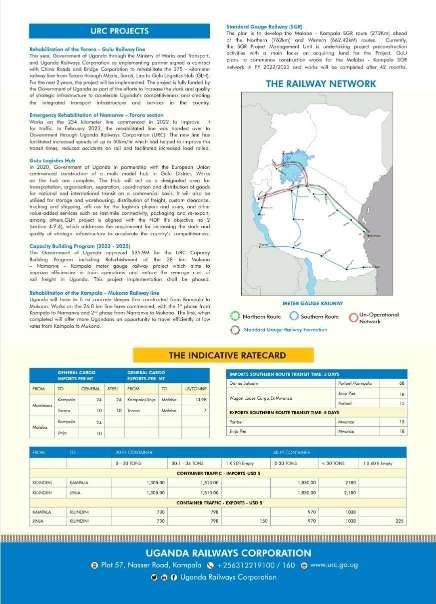
Uganda Railways Corporation has produced a glossy 4 page .pdf brochure. [7]
F. A Journey on Kampala’s Newly Reopened Commuter Train
By Kabona Esiara, Correspondent in Kampala, Uganda Nation Media Group [8]
“Five O’clock found me at the station ready for the 5.30pm train, which leaves Kampala city heading eastwards to Namanve, 16 kilometres away.
The Kampala train station, established in the 1920s, hosts the offices, service centre, and waiting and boarding areas, and has worked as the main office for passenger and cargo trains over the years.
Located in the central business district convenient for departing and incoming goods and passengers the station has recently become a beehive of activity after the return of the train.
Booking for tickets is done here. Mornings and evenings are busy, as dozens of passengers throng the station to get a trip worth Ush2,000 ($0.52), much cheaper than the fare of the commuter taxis for the same journey, which is Ush4,000 ($1.05) or more.
On the day I took the train, the line was long and the ticketing officers were picking out people who had smaller denominations of the Ugandan currency – 1,000; 2000 and 5,000 leaving those with big ones to wait.
As 5.30pm approached, the train hooted, sending an echoing sound into the city and signalling the start of the journey. The people in the queue rushed in to find seats.
Inside the coach, the once-tattered seats are now covered in brown leather and thin-inch sponge cushions making them more comfortable than the metal seats of the past.
The fans mounted above the dash of the coaches have been fixed, sending fresh air circulating and improving travellers’ experience. Before they were fixed, a frequent rider on the train says the heat in the coaches was unbearable.
The old, five-coach train snaked through Nakawa, Kireka, Namboole and terminated at Namanve.
For the 16km ride to Namanve, the train spent only 45 minutes, a huge difference from an average of two hours that vehicles, especially public commuter taxis, spend from the CBD to Kazinga near Namanve.
However, Uganda Railways Corporation (URC) is operating old rolling stock, and most of it is in disuse.
There are only five coaches to transport passengers in a city of four million people.
In order not to miss the train, many passengers reach the station early, some by 5.00am for the morning trip and 4.00pm to catch the train that departs at 5.30pm for the evening return journey.
With the market yearning for train services and Kampala struggling to achieve its ambitious plan to shift 20% of the freight and passenger bases to rail, Paul Power, a transport sector commentator based in Kampala, says the city needs $200 million to invest in rail passenger transport.
The money will be pumped into buying rolling stock, constructing stations and improving the safety and security of the railway system in the Kampala commuter railway networks.
‘My understanding is that at least 20% of the market share for rail transport is needed to make the planned standard gauge railway project viable and bankable. I don’t know the latest cost estimate, but I have heard anything from $3 billion to over $12 billion, with electrification’, Mr Power said.
He, however, noted that achieving a 20% market share for railway transport would be challenging, as currently rail transport on the metre gauge railway is less than one per cent of the freight transport market, and passenger services resumed on 1st May 2024, after almost a one year of absence due to track rehabilitation.
‘The rolling stock needed to transport 20 percent of the freight and passenger markets by rail is enormous’, he said.
The government has also to come up with deliberate policies to encourage private investment in the railway to achieve the significant shift from road to rail transport, some of which include subsidies, enforcement of tighter road weight restrictions, restrictions on the type of goods that can be transported on roads.
Uganda’s railway sector is described as not well organised. There is no safety regulator. Laws need to be updated, and there is no sustainable funding model for implementing a modern rail transport system.
According to Power, in Uganda, a strategic direction for the sector is missing, sector targets and objectives need to be defined, and a need to separate infrastructure management from train operations and safety regulation.
‘These challenges are mostly ‘soft.’ Institutional and private investors need clarity on the ‘operating environment’ – that is, rules – before significant investor interest can be mobilised’, he explained.
Uganda’s plan to grow rail freight and passenger traffic got a boost recently, when Italian investors, led by Ambassador Mauro Massoni, expressed interest in constructing a 64km railway line from Tororo to Majanji.
This alternative route on the Northern Corridor is meant to reduce congestion and increase efficiency in the region’s transportation network, as it links to water, railways, and roads.
The planned investment complements the SGR linking Kenya to Kampala, whose construction works are yet to begin. The details of the investment in the proposed route, funding, and implementation timelines have not been made public.
President Yoweri Museveni welcomed the proposal, highlighting the potential for the railway line to cater to traffic from northern Uganda and neighbouring countries, bypassing Kampala.
‘That traffic doesn’t have to come to Kampala. It can go straight either to Kenya or to Tanzania’, the President said, emphasising the project’s strategic importance.
The Italian investors also proposed establishing an academy to train Ugandans in cutting-edge railway construction and maintenance technology, ensuring skills transfer and job creation for the local workforce.
But, amid the challenges, signs that URC is fighting for a piece of the big commuter transport market share are clear. Lately, the train and coaches have been repainted.
Margret Nantume, one of the frequent users of the commuter train, said many people have not embraced the train because of the cost.
‘While I use the train to escape the daily traffic gridlock on the Kampala-Jinja highway, the increase in the train ticket from Ush1,000 ($0.26) to Ush2,000 ($0.52) for every stop is discouraging passengers’, she said.
‘Many people are opting for taxis and boda boda, which are flexible in pricing and charge fares per stop, while others walk to their destinations’.
Recently, URC acting managing director David Musoke Bulega revised the fares upwards to hedge his ticket sale revenues against fuel costs.
The train stops are located at far distances from the main road, which inconveniences passengers and adds to the transport costs to their destinations.
Passengers who live in Seeta and Mukono incur an additional Ush2000 ($0.52) to reach their destinations by taxi, in addition to the train ticket of the same amount, bringing the total to Ush4,000 ($1.05).
Besides, they have to walk 500 metres from the Namanve railway station to the nearest taxi stage.
The walk-to-work measure many households in Uganda have adopted to reduce pressure on their home budgets is also contributing to the reduced number of passengers travelling by train.
When the train stops at Namanve railway station, factory employees in Kampala’s Business and Industrial Park walk for either night shifts or to their homes. A 2021 study commissioned by Friedrich-Elbert-Stifting says 50 percent of workers in Uganda walk to and from work.
But John Leon Sengendo, URC publicist, says every inch of the train coach will be occupied in the coming days, when schools open for the second term.
He also expects passengers who opted for other transport modes to return and new ones recruited, especially when the Namanve-Kyetume line is completed in August [2024].
The Namanve-Mukono section will be the third track to be completed, after the rehabilitation of the Tororo-Namanve line, including the line to Jinja Pier, which was completed two years ago. The Namanve-Kampala section, which was handed over in January this year, was the second to be completed by Spanish firm Imathia Construction, after replacing steel sleepers with concrete beams.
After Uganda Transport Company, a public passenger transportation firm, folded in the 1980s, Kampala was plunged into a disorganised and unreliable transport service run by unprofessional private players.
The government, under pressure to reduce traffic gridlocks, is betting on an efficient railway system to address this challenge. A 2017 World Bank study estimated that traffic jams cost Uganda more than $800 million annually in lost productivity, wasted fuel and increased emissions.
The ultimate plan of URC is to extend passenger services to Mukono, Kyengera, and Port Bell Kampala.
‘We want to alleviate the problem and stress people face with road transport. Our roads are still highly congested, and people spend a lot of time in traffic jams for short distances. With the train service, it will be far smoother and faster. It is a worthwhile endeavour’, said Minister of Works and Transport Katumba Wamala. [8]
F. Uganda Railways Rules Out Electric Locomotives For Now
URN – 24th October 2024. [9]
“The Uganda Railways Corporation (URC) has no immediate plans to deploy electric trains, despite growing calls for a more modern railway system.
Instead, the focus remains on restoring the existing rail network and expanding services, particularly with diesel-powered trains, as part of the country’s railway revitalization strategy according to John Lennon Sengendo, URC’s senior public relations and communications officer.
URC recently completed upgrades on the Kampala-Mukono Meter Gauge Railway (MGR), primarily catering to passenger services. Plans are underway to introduce cargo services soon, while ongoing projects, including the Tororo-Gulu line, aim to enhance the rail system across key regions like Mbale, Kumi, Soroti, and Lira, culminating at the Gulu Logistics Hub.
Additionally, there is significant progress toward the construction of the Standard Gauge Railway (SGR) line between Kampala and Malaba, which will eventually extend to borders with the Democratic Republic of Congo, Rwanda, and South Sudan.
Unlike the planned SGR project, which will be electric, all upgrades on the MGR will continue using diesel-powered trains. According to URC, procurement is underway for diesel multiple units (DMUs), which are trains powered by onboard diesel engines and do not require a separate locomotive.
This decision has sparked debate, particularly as Uganda now generates electricity far beyond current demand. Many question why the country isn’t transitioning to electric trains, given its increased electricity capacity.
“For the improvements we are doing on the MGR network, specifically for the passenger service component, there will not be electrification, at least for now. Electrification will be purely on the SGR,” said Sengendo.
He emphasized that DMUs and electric multiple units (EMUs) are the same. The only difference is that one is electric and the other is Diesel,” he says, adding that the DMUs to be deployed will be able to move at speeds of 120 kilometres per hour, “which is relatively good.”
Furthermore, Sengendo pointed out that cost is a major factor behind the preference for DMUs. While Uganda has abundant electricity, the infrastructure needed for electrification is expensive. “A lot of work and money goes into the installation of the infrastructure, which may not make sense to do on the MGR, yet the government is constructing an SGR, which will be electric,” he explained.
Uganda plans to incorporate feedback from citizens to ensure the DMUs offer both comfort and efficiency, with the manufacturer tailoring them to the country’s specific requirements.
A potential challenge to seamless rail transport across the region lies in Kenya’s SGR, which remains diesel-powered. This could hinder smooth operations between Mombasa and Kampala. Sengendo, however, expressed optimism that by the time Uganda’s SGR is complete, the two countries will have aligned their strategies, possibly considering hybrid rolling stock that can operate on both diesel and electric tracks if Kenya doesn’t electrify its SGR.
Many countries worldwide continue to use DMUs, including the USA, Canada, the UK, Australia, Japan, and several European nations like Germany, Belgium, and Russia. Recent technological advancements have produced diesel-hydraulic engines, which can alternate between diesel and hydraulic power, reducing emissions, noise, and fuel consumption.
Experts note that DMUs offer more flexibility since they can run on electrified tracks, whereas electric trains can only operate on dedicated electric railways. While electrified systems may prove more cost-effective in the long run – typically after about 30 years, depending on electricity costs – DMUs remain a practical and affordable solution for Uganda’s immediate rail needs.” [9]
Uganda has begun restoring a disused branch of a railway line built under the British Empire, which it hopes will offer a cheaper way to transport goods to neighbouring countries. … Work has begun to restore nearly 400 kilometres of the tracks between Tororo in eastern Uganda, near the border with Kenya, and Gulu in the north, near South Sudan.
“Our ambition is to move all long-distance bulk cargo transportation onto rail from roads in a few years because rail is cheaper in terms of cost and time,” a spokesperson for for state-run Uganda Railways Corporation, John Linnon Sengendo, told Reuters news agency.
Uganda decided to revamp the old network after plans to build a separate, modern line failed to secure funding from China.
The government cancelled its contract with a Chinese firm earlier this year and is now seeking a new contractor for the project, which would see the construction of a standard gauge railway linking the Ugandan capital Kampala to the Kenyan border, where it would join up with Kenya’s modern lines.
Another Chinese contractor, China Road and Bridge Corporation, will repair the old line over two years at a cost of 200 billion shillings (50.6 million euros) to the Ugandan government, Sengendo said.
Uganda’s railway network fell into disrepair during the country’s economic collapse in 1970s and early ’80s.
Ugandan officials hope once the link is restored, rail will replace trucks in shipping transit goods to South Sudan and north-eastern Democratic Republic of Congo.
Under its East African Railway Master Plan, the East African Community regional bloc is aiming to revive lines serving Tanzania, Kenya, Uganda and extend them to Rwanda and Burundi. Ultimately it hopes to add South Sudan and Ethiopia to the network too.
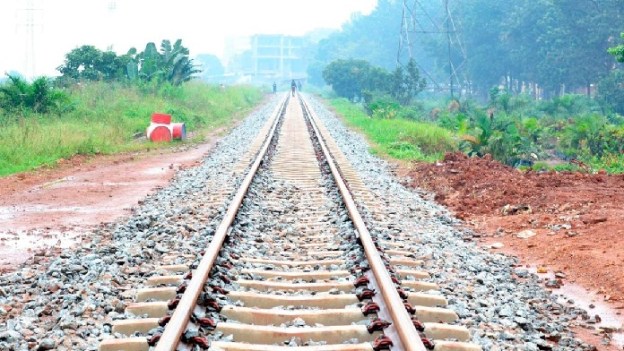
A recently relaid section of metre-gauge track in Kampala, (c) Sylvia Katushabe
Uganda’s planned overhaul of the metre gauge railway to cut transport costs on the Northern Corridor and improve trade competitiveness has entered its final stages, even as the country faces a shortage of equipment, wagons, and trains.
The EastAfrican has learnt [that] Spanish firm Imathia Construction has completed replacing steel sleepers with concrete beams on the Namanve-Kampala section of the line, which is expected to be handed over this month, Uganda Railways Corporation (URC) publicist John Lenon Sengendo said, adding that the contractor will then embark on the final section, Namanve-Mukono.
This will be the second section of the track to be completed after rehabilitation of the Tororo-Namanve line, including the line to Jinja Pier, which was completed a year ago. While the Malaba-Namanve metre gauge track is now in fair condition, importers, exporters, and shippers remain sceptical about switching to rail, citing a shortage of rolling stock and inefficiency, which has resulted in 90 percent of traffic on the Northern Corridor being carried by road and only about seven percent is carried by rail because of the poor state of rail infrastructure.
As a result, transport costs are comparatively high on the Northern Corridor, ranging from 20 cents to 25 cents per tonne per kilometre for road transport, while the cost for rail transport ranges from US cents 6 to US cent 12 per tonne per kilometre, depending on the type of cargo.
The shortage of rolling stock is partly blamed on URC. A June 2022 Uganda’s Auditor General after reviewing URC’s asset register, had 521 wagons located in different parts of Kenya.
But only 128 wagons exist, leaving a balance of 393 wagons unaccounted for, raising fears of a possibility of URC overstating its asset values in the financial statements.
[A] URC accounting officer explained that “there were many wagons left in Kenya by RVR (U) Ltd upon concession termination. A repatriation exercise to return these assets to Uganda commenced in July 2021 and by December 2021, a total of 243 wagons had been brought back.”
Under this project, Uganda is to buy 3,000 horsepower locomotives by 2026. The number of Uganda government-owned wagon ferries is also expected to increase from the current two to four, a development set to help URC meet the growing traffic demand on Lake Victoria.
The other financiers are the African Development Bank, which will provide $233.2 million, and the African Development Fund to provide $100.7 million – both concessional loans to finance the construction and purchase of rolling stock, which includes locomotives, wagons and coaches.
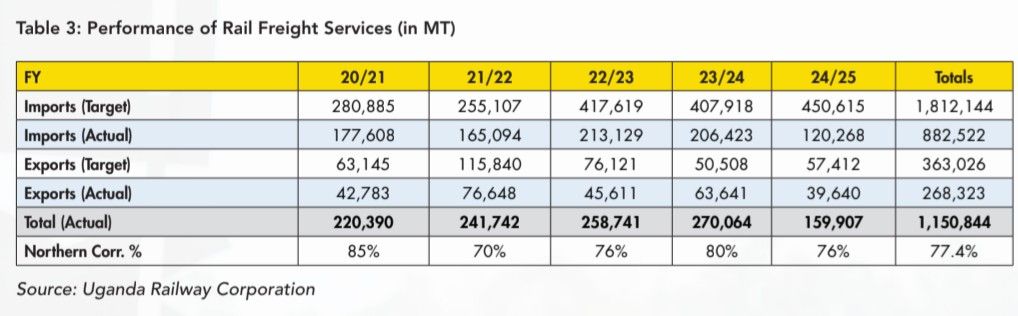
URC’s target is to move cargo from road to rail, and we expect to be moving six million tonnes a year.
In its efforts to revamp the metre gauge railway, Uganda is also reviving the route from Tororo in Eastern Uganda to Gulu City in the north. The line is currently under construction. Significantly, the city also hosts the Gulu Logistics Hub, whose phase one is also under construction. … The hub – which will be rail-linked – was planned as a strategic location connecting to the growing markets of Congo and South Sudan.
Kenyan government to spend $731m on new trains, SGR revamp
An SGR cargo train at the Naivasha Inland Container Depot in Kenya. Kenya’s National Treasury report shows Transport ministry will receive $714.7 million for the “Development of Standard Gauge Railway” between July this year and June 2026. [2]
The government of Kenya has stepped up expenditure on the Nairobi-Mombasa standard gauge railway (SGR) with a plan to hit Ksh100 billion ($731.53 million) in the next three years to revamp the line, build new sidings and buy more locomotives and cargo wagons.
A report by Kenya’s National Treasury shows that the country’s Transport ministry will receive an additional Ksh97.7 billion ($714.7 million) for the “Development of Standard Gauge Railway” between July this year and June 2026.
This reverses a trend where the previous government had cut allocations to the SGR and will push the spending related to this line beyond KSh780 billion ($5.7 billion) by June 2026.
Beginning July, the Kenyan government has allocated Ksh37.4 billion ($275.79 million) from the Railway Development Levy Fund (RDLF) for the Nairobi-Mombasa SGR.
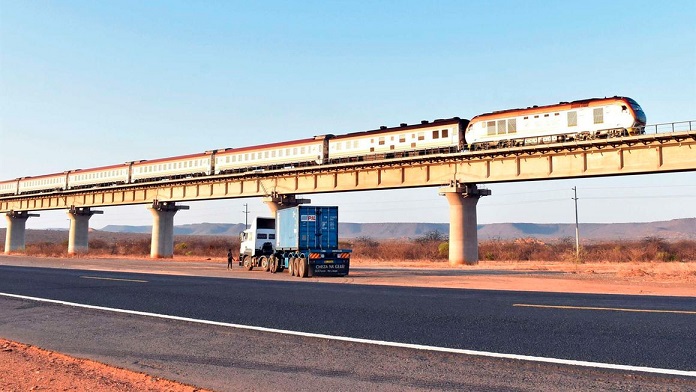
A Mombasa-bound SGR passenger train on the extended viaduct in the ‘Maneaters Area’. The line is set at high level to allow the safe passage of wildlife, (c) Wachira Mwangi. [2]
The bulk of the allocation, according to the breakdown shared with the Business Daily from transport, has been earmarked for the acquisition of additional locomotives and freight wagons at a cost of Ksh11.9 billion ($87.1 million).
Kenya last bought its 1,620 locomotives and wagons from China in 2018.
State had no plans for extension – The allocations to transport ministry show that the government had no plans to extend the SGR beyond Naivasha to Kisumu and finally Malaba in the next three years.
The rest of the funds, which have been allocated under the “Mombasa to Nairobi SGR” vote will largely be used to build new feeder lines and rehabilitate the old metre gauge railway (MGR) lines.
Charged at the rate of two percent, the Railway Development Fund (RDF) is levied on all goods imported into the country for home use.
“The purpose of the levy shall be to provide funds for the construction of a standard gauge railway network in order to facilitate the transportation of goods,” reads part of the Miscellaneous Fees and Levies Act which establishes the kitty.
Budgetary allocations for the acquisition of locomotives and wagons are projected to increase to Ksh16 billion ($117 million) in Financial Year 2024/25 and Ksh22.2 billion ($162.4 million) in the Financial Year 2025/26 taking the total allocations for the three years to Ksh50.1 billion ($366.5 million).
Another Ksh5.9 billion ($43.16 million) will be spent on the rehabilitation, remanufacturing or overhaul of locomotives, wagons and coaches, according to a breakdown of the Ksh37.4 billion ($273.6 million) allocation.
The new feeder lines will link some of the sections of the modern railway such as the Mombasa SGR Terminus to critical urban centres.
This includes Ksh4.48 billion ($32.77 million) for the construction of the Riruta-Lenana-Ngong Railway Line and Ksh2.96 billion ($21.65 million) for the construction of a Railway Metro Line linking Embakasi Station and Ruai town.
In the next 12 months, the government will also build a new 2.8-kilometre Metre Gauge Railway (MGR) link from Mombasa SGR Terminus to Mombasa MGR station at a cost of Ksh2.5 billion ($18.29 million).
These funds will also be used to construct a railway bridge across the Makupa causeway that links Mombasa Island to the Kenyan mainland.
New MGR line – A new Metre Gauge Railway (MGR) line linking the Naivasha Inland Container Depot to the existing Longonot Railway Station has been allocated Ksh1.6 billion ($11.7 million) in the next financial calendar.
The construction of a Railway Metro Line connecting Athi River Station to the East African Portland Cement has been allocated Ksh400 million ($2.93 million).
This is projected to rise to Ksh1.17 billion ($8.56 million) in the Financial Year starting July next year and Sh1.36 billion in Financial Year 2025/26.
Another Railway Metro Line connecting Athi River Station to NSSF and Mavoko will absorb Ksh450 million ($3.3 million), a figure that is set to increase to Ksh1.56 billion ($11.4 million) and Ksh1.89 billion ($13.83 million) in 2024/25 and 2025/26.
The money will also be used to rehabilitate the line between Longonot and the Western border town of Malaba, which is aimed at facilitating the movement of cargo from the port city of Mombasa to Uganda.
Also in this border town, which is prone to congestion, the State plans to build Malaba Cargo Handling Yard. Around Ksh474 million ($3.45 million) has been set aside for this project.
Other spending items will be the acquisition of plant and equipment, which shall take up Ksh3.8 billion ($27.8 million) in the next fiscal year, Sh1.1 billion in Financial Year 2024/25 and Ksh600 million ($4.4 million) in the Financial Year 2025/26.
Logistics Hub – A logistics hub is planned for Athi River with the state putting aside Ksh1.125 billion ($8.23 million).
The allocation for this planned logistics hub will reduce to Ksh375 million ($2.74 million) in the year ending June 2025.
Initial plans were to extend the SGR to Uganda; however, this has since stalled with the Treasury not getting funds for the extension to Kisumu and finally to Malaba.
Murkomen at the beginning of this year said the Kenya Kwanza administration in partnership with the Chinese government is keen on extending the SGR from Naivasha’s Mai Mahiu to the border of Uganda through a five-year plan that will see the multibillion-dollar railway line run through Narok, Bomet, Nyamira, Kisumu, and Malaba.
“In the long run, we would like to complete the connection of the SGR from Suswa to Kisumu through Bomet, Nyamira, parts of Kisii and later to Malaba. Later, we can think of upgrading the existing MGR via Nakuru to Kisumu and via Eldoret to Malaba,” he said on December 15, 2022.
With the additional expenditure, the government hopes the country’s most expensive piece of infrastructure will help to grow the economy and improve the standard of living for Kenyans.
The administration of former President Uhuru Kenyatta borrowed Ksh656.1 billion ($4.8 billion) in three tranches for the construction of the two phases of the SGR, contributing to a major build-up of Kenya’s stock of debt.
Kenya will use Ksh11.9 billion ($87 million) to acquire rolling stock that will be used to ferry cargo on the SGR from Mombasa to Naivasha.
Grand $15 billion plan to expand Kenya SGR to Kisumu, Malaba, Isiolo
The standard gauge railway line at the Naivasha Inland Container Depot, a transhipment hub for Kenya’s SGR from Mombasa, which is to extend to the proposed Malaba railway line in Uganda. [3]
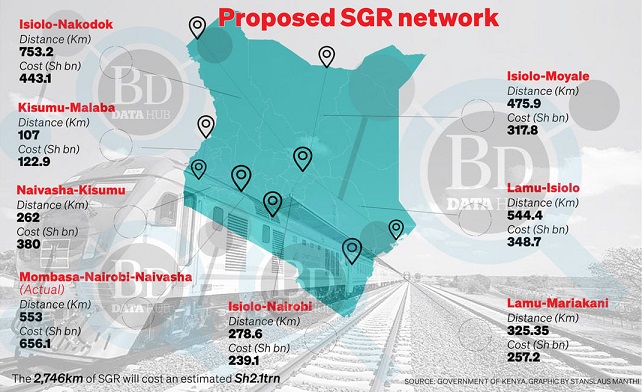
Kenya has set sights on a Ksh2.1 trillion ($15.3 billion) plan to extend the standard gauge railway (SGR) to Kisumu, Malaba and Isiolo by the end of June 2027, a government document seen by the Business Daily shows.
According to the plan, the State Department of Transport will build another 2,746 kilometres of the SGR at $15.3 billion, a move that will push the total spend on the modern railway to more than Ksh2.75 trillion ($20 billion).
The plan, lifted from the Jubilee Government’s grand scheme on SGR (so far Kenya’s most expensive project), is part of the Ksh3.42 trillion ($24.9 billion) Lamu Port South Sudan-Ethiopia Transport (Lapsset).
Lapsset is aimed at opening up northern Kenya and revamping the northern corridor by spurring movement within Kenya, South Sudan and Ethiopia.
It is an ambitious scheme that will not only see the modern railway reach the border town of Malaba via Kisumu, as it was initially envisioned, but also Isiolo, Moyale and the island of Lamu.
The line will move from Mariakani in Mombasa County to Lamu to Isiolo. From Isiolo, the SGR will be connected to the northeastern town of Moyale which borders Ethiopia.
From Isiolo, the government will extend the SGR to Nairobi, connecting the country’s capital city and commercial hub to northern Kenya and finally to Ethiopia.
From Naivasha, the SGR is extended to Malaba through Kisumu.
The bulk of the financing for these additional kilometres of the SGR, around Ksh1.8 trillion ($13 billion), will be from external financiers that the document has not revealed while the rest will come from the Kenyan government.
So far, the SGR from Mombasa to Naivasha has been financed by the Chinese at a total cost of Ksh656.1 billion ($4.7 billion)
The longest stretch of the planned SGR, 753.2 kilometres, will be from Isiolo to Nakodok, a small town near the border between Kenya and South Sudan.
The Transport Ministry, headed by Kipchumba Murkomen, has cost this phase of the SGR at Ksh443.2 billion ($3.2 billion).
From Lamu to Isiolo, a distance of 544.4 kilometres, the Ruto administration plans to build the rail line at Ksh348.7 billion ($2.5 billion).
From Isiolo to Moyale, a distance of 475.9 kilometres, the country is expected to use Ksh317.8 billion ($2.3 billion) to build a new SGR line.
The line connecting Mariakani to Lamu of 325.3 kilometres will cost Ksh257.3 billion ($1.8 billion).
Locations on Kenya’s planned SGR network. [3]
There will be another line of 278 kilometres connecting Nairobi to Isiolo that will consume Ksh239.2 billion ($1.7 billion).
Phase 2B of the SGR from Naivasha to the lakeside city of Kisumu will cost Sh380 billion while the last leg, 2C, from Kisumu to Malaba bordering Uganda will take another Ksh122.9 billion ($896 million).
The document from the State Department of Transport reveals what appears like a near-impossible feat of the government wanting to complete the entire transport circuit in four years from 2023 to 2027.
Although the ministry’s document indicates that construction of these railway lines is to begin at the start of July this year, no budgetary allocation has been made for the SGR for the next three financial years.
In 2014, the government entered into a tripartite agreement with the governments of Rwanda and Uganda to construct a standard gauge railway from Mombasa through Kampala to Kigali, Rwanda.
However, the SGR ended abruptly in Naivasha with China reportedly declining to finance the last leg of the modern railway after failing to strike an agreement with Uganda.
The new administration of President Ruto has rekindled plans to complete the SGR.
Through a partnership with the Chinese government, Mr Murkomen said earlier this year the government wanted to extend the SGR from Naivasha’s Mai Mahiu to the border of Uganda through a five-year plan that will see the multibillion-dollar railway line run through Narok, Bomet, Nyamira, Kisumu, and finally Malaba.
“In the long run, we would like to complete the connection of the SGR from Suswa to Kisumu through Bomet, Nyamira, parts of Kisii and later to Malaba. Later, we can think of upgrading the existing MGR via Nakuru to Kisumu and via Eldoret to Malaba,” the CS said in a statement on December 15 last year.
The Transport Ministry has been allocated Ksh100 billion ($729 million) from the Railway Development Levy Fund (RDLF) for the next three years to revamp the existing SGR line from Mombasa to Naivasha via Nairobi and build new sidings.
The money will also be used to buy more locomotives and cargo wagons, which are aimed at improving the freight capacity of the modern railway which is still facing cut-throat competition from trucks.
Plans to revamp the SGR involve mostly building new metre gauge railway (MGR) or rehabilitating them.
New Concrete Sleepers for the Metre-Gauge in Uganda
New Vision reported that, on 1st September 2023, President Yoweri Museveni opened a new Concrete sleeper making facility at Kawolo, Buikwe District, Kampala. The sleepers are to be used in the rehabilitation of the metre-gauge railway line.
The traditional steel sleepers are no longer in favour. Thefts and vandalism mean that alternatives have had to be sought. [6]
The old steel sleepers on the right. The new concrete sleepers in ballast on the left. [7]
The sleepers are being used on the Kampala to Namanve line before being rolled out to other projects. The construction of the factory valued at over 19 million Euros (about 76 billion Uganda Shillings) started in June 2020.
On-going work on the Kampala to Namanve line. [8]
The use of concrete sleepers on the suburban lines will be supplemented by the procurement of diesel multiple units and additional coaches.
“In August 2020, URC said the Government had secured funding from the Spanish government and African Development Bank (AfDB) to the tune of shillings 1.3 trillion to revamp the Metre Gauge Railway by rehabilitating about 250 kilometres from Malaba to Kampala.” [6]
On 1st February 2024, work on the Kampala to Namanve line was close to completion and a predicted opening in March 2024. [9]
Kenya Railways puts proposed Lapsset SGR costs at $16 billion: bulk on Isiolo-Nakodok line
Kenya will need at least Ksh 2.4 trillion ($16 billion) to construct a proposed Standard Gauge Railway (SGR) on the Lamu Port-South Sudan-Ethiopia-Transport (Lapsset) corridor, according to projections by the Kenya Railways Corporation.
According to the parastatal, it would cost Ksh 523.05 billion ($3.49 billion) to build a 544.4 km SGR link to connect Lamu and Isiolo and a further Ksh 476.7 billion ($3.178 billion) to extend the line from Isiolo to Moyale over a distance of 475.9 km.
The largest spending would be on constructing the SGR line from Isiolo to Nakodok town on the border between Kenya and South Sudan over a distance of 753.2 km at a cost of Ksh664.65 billion ($4.431 billion).
Kenya Railways has estimated that a further Ksh 358.8 billion ($2.392 billion) will be required to link Isiolo and Nairobi via SGR over a distance of 278.6 km and a further Ksh 385.95 billion ($2.573 billion) for the 325.35 km stretch between Lamu and Mariakani.
The entire stretch will cover a total of 2,377.45 km, translating into a cost of Ksh 1 billion ($6.667 million) for every kilometre of the SGR.
But the cost of undertaking such a colossal venture, which would be by far the most expensive in Kenya’s history, will be far higher than Kenya Railways’ estimates considering the company did the costing at an exchange of Ksh150/US dollar.
The parastatal has nonetheless expressed confidence in raising Ksh275.9 billion ($1.84 billion) or 11.4 percent of the total project cost by the financial year 2027/28 through funding from the government, collections from the Railway Development Levy Fund (RDLF) and loans.
Kenya in 2014 began construction of Phase 1 of the SGR line between Mombasa and Nairobi covering 472km. Phase 2A Nairobi-Naivasha (120km) was constructed in 2017. The project was funded by a $5.08 billion loan from China.
“The SGR line has led to expansion of the Inland Container Depot (ICD) in Nairobi at Embakasi, and construction of the ICD – Naivasha at Mai Mahiu,” said Kenya Railways.
The firm added: “This has contributed to decongestion of the seaport of Mombasa and facilitated seamless transit of goods destined to Western Kenya and neighbouring countries.”
Already, two studies have been undertaken to explore the feasibility of a Lapsset corridor railway by Japan Port Consultants in 2009 and China Civil Engineering Construction Company (2015). The latter study estimated the cost of the project at $10.4 billion with a financial rate of return of between nine percent and 12 percent.
The proposal to build an SGR line along the Lapsset corridor is however not feasible yet as the Lapsset project has failed to take off due to lack of funding as well as insecurity. Kenya is also facing a huge debt pile which has been worsened by the rapid depreciation of the Kenyan shilling leading to a surge in foreign currency external loans.