
The travel section of the Saturday Guardian Magazine on 23rd May 2023 included a few pages about train journeys in Europe (pages 72 to 77).
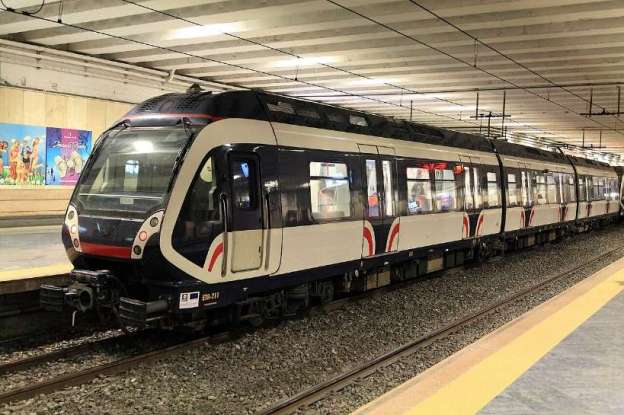
The featured image for this short article is a photograph of a EAV (Ente Autonomo Volturno)-owned Circumvesuviana train at Napoli Garibaldi station, © Falk2 and licensed for reuse under a Creative Commons licence (CC BY-SA 3.0). [8]
1. Time Travel on the Naples Line
The first of the articles, written by Sophia Seymour picks up on a new film about the region around Naples which “reveals rarely visited villas, seismic landscapes and a ‘civilisation buried mid-sentence’ – all accessible by train.” [1: p72]
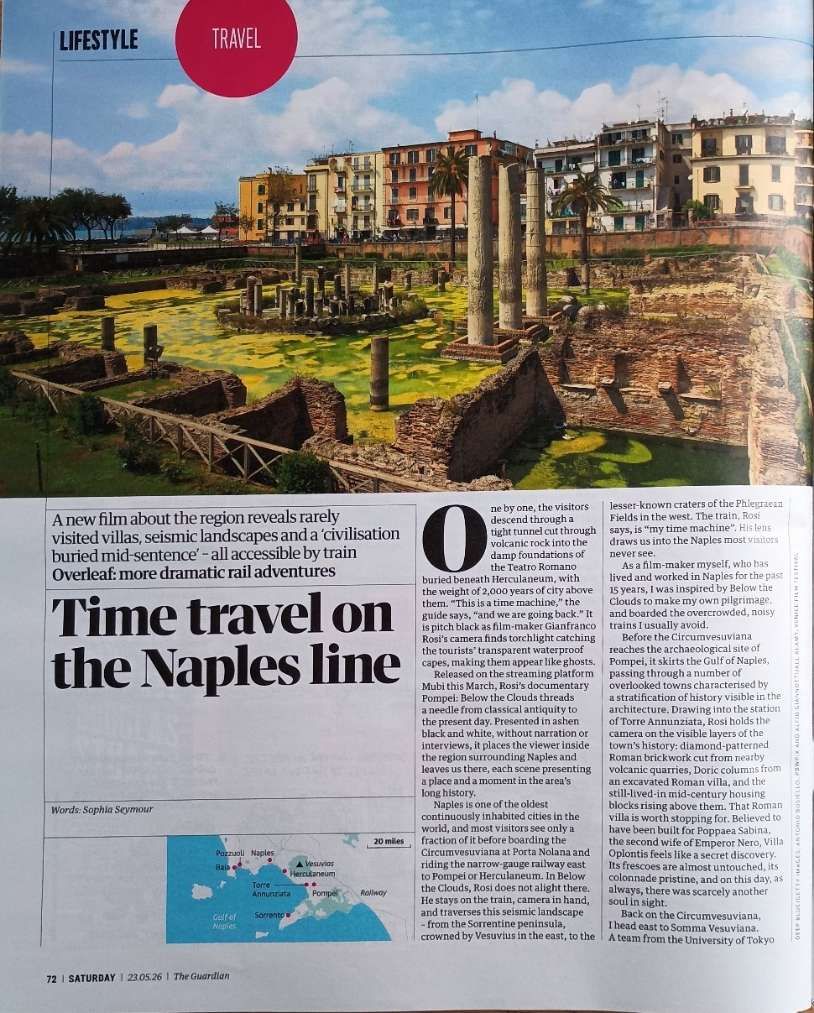
The film had its world premiere in the main competition of the 82nd Venice International Film Festival on 30th August 2025, where it won the Special Jury Prize. It was theatrically released in Italy by 01 Distribution on 18th September 2025. [2][3]
Peter Bradshaw of The Guardian rated the film five stars out of five, calling it “utterly distinctive” and “a ghostly yet luminous cinematic mosaic.” [2]
Sophia Seymour chose to experience the Naples portrayed by Gianfranco Rosi by travelling on the ‘Circumvesuviana’ a narrow gauge line around the Bay of Naples, a train which Rosi says, is “my time machine“.
Rosi chooses to travel on the ‘Circumvesuviana’ beyond the tourist route to Pompei and Herculaneum. “He stays on the train, camera in hand and traverses this seismic landscape – from the Sorrentine peninsula, crowned by Vesuvius in the east, to the lesser-known crates of the Phlegraean Fields in the West.” [1: p72]
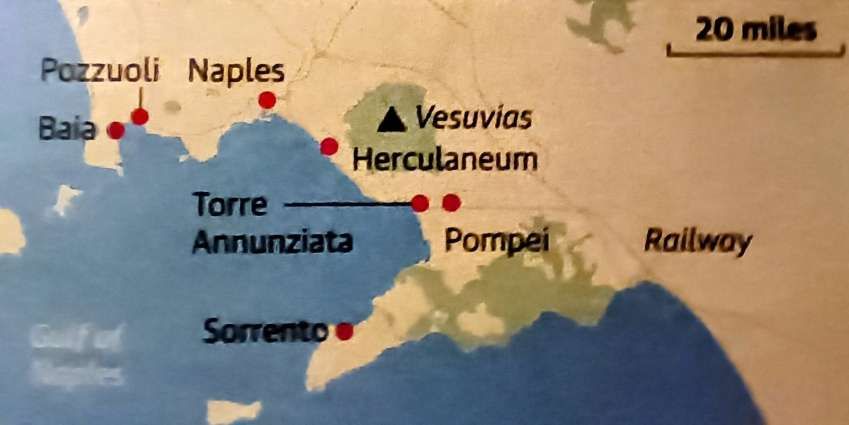
The Bay of Naples, Naples, Pompei Herculaneum, Sorrento and Vesuvius. [1: p72]
Sophia Seymour writes:
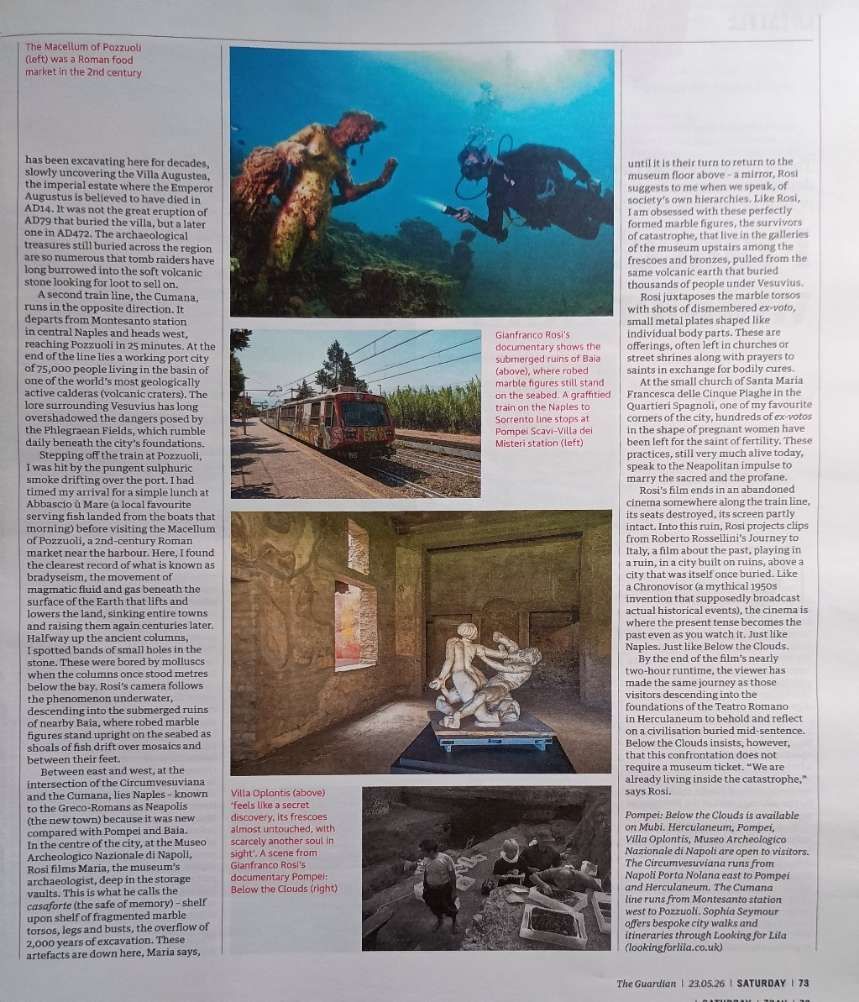
“Before the Circumvesuviana reaches the archaeological site of Pompei, it skirts the Gulf of Naples, passing through a number of overlooked towns characterised by a stratification of history visible in the architecture. Drawing into the station of Torre Annunziata, Rosi holds the camera on the visible layers of the town’s history: diamond-patterned Roman brickwork cut from nearby volcanic quarries, Doric columns from an excavated Roman villa, and the still-lived-in mid-century housing blocks rising above them. That Roman villa is worth stopping for. Believed to have been built for Poppaea Sabina, the second wife of Emperor Nero, Villa Oplontis feels like a secret discovery. Its frescoes are almost untouched, its colonnade pristine, and on this day, as always, there was scarcely another soul in sight.
Back on the Circumvesuviana, I head east to Somma Vesuviana. A team from the University of Tokyo has been excavating here for decades, slowly uncovering the Villa Augustea, the imperial estate where the Emperor Augustus is believed to have died in AD 14. It was not the great eruption of AD 79 that buried the villa, but a later one in AD 472. The archaeological treasures still buried across the region are so numerous that tomb raiders have long burrowed into the soft volcanic stone looking for loot to sell on.
A second train line, the Cumana, runs in the opposite direction. It departs from Montesanto station in central Naples and heads west, reaching Pozzuoli in 25 minutes. At the end of the line lies a working port city of 75,000 people living in the basin of one of the world’s most geologically active calderas (volcanic craters). The lore surrounding Vesuvius has long overshadowed the dangers posed by the Phlegraean Fields, which rumble daily beneath the city’s foundations.
Stepping off the train at Pozzuoli, I was hit by the pungent sulphuric smoke drifting over the port. I had timed my arrival for a simple lunch at Abbascio ù Mare (a local favourite serving fish landed from the boats that morning) before visiting the Macellum of Pozzuoli, a 2nd-century Roman market near the harbour. Here, I found the clearest record of what is known as bradyseism, the movement of magmatic fluid and gas beneath the surface of the Earth that lifts and lowers the land, sinking entire towns and raising them again centuries later.
Halfway up the ancient columns, I spotted bands of small holes in the stone. These were bored by molluscs when the columns once stood metres below the bay. Rosi’s camera follows the phenomenon underwater, descending into the submerged ruins of nearby Baia, where robed marble figures stand upright on the seabed as shoals of fish drift over mosaics and between their feet.
Between east and west, at the intersection of the Circumvesuviana and the Cumana, lies Naples – known to the Greco-Romans as Neapolis (the new town) because it was new compared with Pompei and Baia. In the centre of the city, at the Museo Archeologico Nazionale di Napoli, Rosi films Maria, the museum’s archaeologist, deep in the storage vaults. This is what he calls the casaforte (the safe of memory) – shelf upon shelf of fragmented marble torsos, legs and busts, the overflow of 2,000 years of excavation.” [1: p72-73]
The Circumvesuviana and the Cumana are two essential, distinct commuter rail networks operated by the Ente Autonomo Volturno (EAV) in the Naples metropolitan area. They serve completely different regions and purposes for both commuters and travelers.
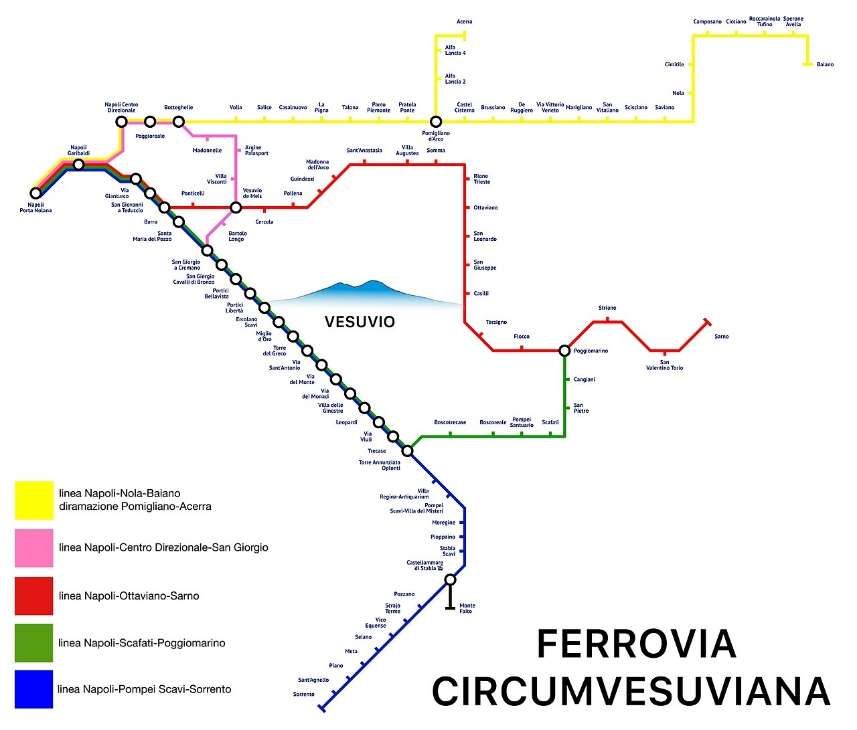
The Circumvesuviana is a 950 mm gauge railway network radiating east and south of Naples, circling Mount Vesuvius. It operates 142 km (88 mi) of route on six lines. It is entirely separate from other national and regional railway lines. It has 96 stations with an average inter-station distance of 1.5 km. [4]
It is the primary way for tourists to reach major archaeological sites like Pompei (Pompei Scavi station) and Herculaneum (Ercolano Scavi station). It also runs to Sorrento, making very busy during the tourist season.
Main departures are from Napoli Porta Nolana, though trains stop at Napoli Garibaldi (underneath the main Centrale station).
Because regular Circumvesuviana trains are heavily used by locals, frequently crowded, and lack air-conditioning, EAV operates the Campania Express during the peak tourist season. This premium service guarantees seating, is air-conditioned, and makes far fewer stops between Naples and Sorrento.
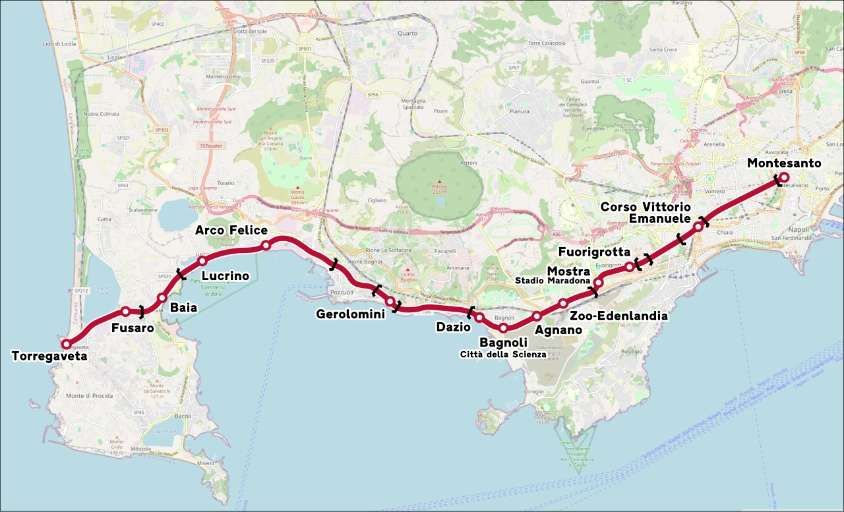
The Cumana is a standard-gauge commuter railway that heads west from central Naples, traveling through the Phlegrean Fields (Campi Flegrei) along the coast to Torregaveta. [6]
It runs through the western districts of Naples (Fuorigrotta and Bagnoli) out to Pozzuoli, Baia, and Fusaro. It is popular for accessing coastal views, the port for ferries to the islands, and local archaeological spots like the Flavian Amphitheater.
The main city centre station is Napoli Montesanto. The Cumana is typically more modern, less crowded, and used more by local commuters than the chaotic, tourist-heavy Circumvesuviana.
References
- Sophia Seymour; Time Travel on the Naples Line; in Saturday (the Guardian Magazine), 23rd May 2026, p72-73.
- Peter Bradshaw; Pompei: Below the Clouds review – a ghostly yet luminous cinematic mosaic of Naples crowns a superb trio; in Saturday (the Guardian Magazine), 30th August 2025.
- https://en.wikipedia.org/wiki/Below_the_Clouds, accessed on 23rd May 2026.
- https://en.wikipedia.org/wiki/Circumvesuviana, accessed on 23rd May 2026.
- https://en.wikipedia.org/wiki/Circumvesuviana#/media/File%3ACircumvesuviana_map_2025.jpg, accessed on 23rd May 2026.
- https://www.napoliunplugged.com/naples-regional-metro-system, accessed on 23rd May 2026.
- https://en.wikipedia.org/wiki/Cumana_railway#/media/File%3AMappa_ferrovia_Cumana.svg, accessed on 23rd May 2026.
- https://en.wikipedia.org/wiki/Naples_metropolitan_railway_service, accessed on 23rd May 2026.


