
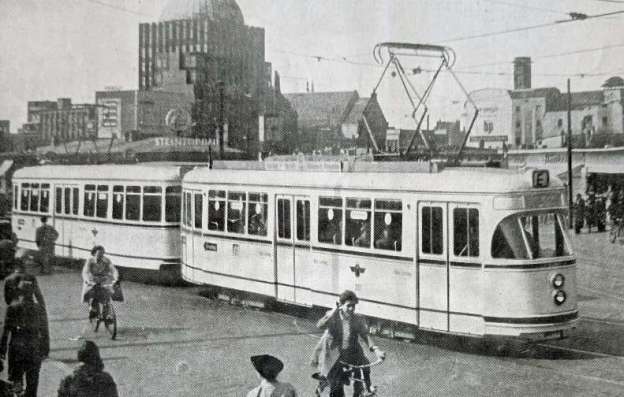
The featured image for this article shows the prototype Standard Tramcar on the streets of Hanover, © Streek en Stadsvervoer, Public Domain. [1: p280]
During the 1950s, German trams transitioned from older, war-damaged wooden vehicles to new, streamlined standard designs that supported the postwar Wirtschaftswunder (economic miracle). Standard designs emerged in both East and West Germany, heavily influencing urban transit.
In West Germany, operators sought to replace aging fleets with standardized models to streamline manufacturing and repairs:
- The Verbandswagen (VÖV): Developed by the Association of Public Transport Companies (VÖV) starting in 1950. These were traditional two-axle trams that could be built quickly using existing components but featured a more modern, modernized exterior.
- DÜWAG Großraumwagen: (Articulated Trams) Introduced in the early 1950s by DÜWAG (Düsseldorfer Waggonfabrik), these four-axle, bogie-mounted trams revolutionized West German transit. They featured wide doors for easy boarding, large windows, and better passenger flow.
- Munich’s M-Wagen: Built by Josef Rathgeber, the first units of this iconic, four-axle, bogie-style tram were introduced in 1949/1950 to begin rebuilding Munich’s transport network.
The Modern Tramway writes, at the end of 1951, about a standard tramcar being developed by committee in West Germany in the very early 1950s which would become known as the DÜWAG Großraumwagen (DÜWAG Articulated Tram):
“The tramway sets of the large German cities normally consist of one 4-wheel motor car and two 4-wheel trailers, each with a length of 8 to 10 metres, and each capable of transporting about 70 persons. In contrast with the post-war construction programmes of other European countries, German post-war tramcars have for the most part adhered to this tradition, as witness the 4-wheel K.S.W and Aufbau types of which some hundreds are now in service. Exceptions are the 1949 6-wheel cars of Munich and the 1950 bogie cars in Hamburg, high-capacity cars operating in trains of two cars (motor and trailer) only.
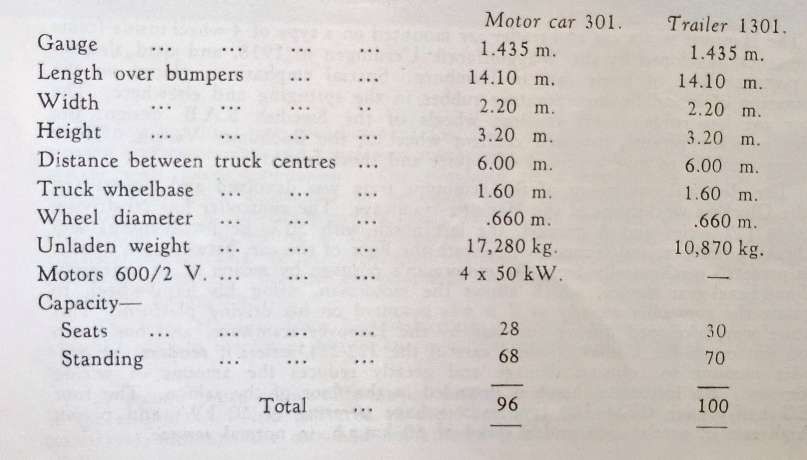
“Early in 1950, it was announced that a Committee, consisting of representatives of the tramcar-building industry and of several West German tramways (among them Hanover, Düsseldorf, Wuppertal, Cologne, Duisburg and Dortmund) were working on plans for a standard tramcar which would compare with the latest models of other countries, notably the U.S.A., Sweden and Switzerland. The car would be an all-electric single-ended unit about 14 metres long, mounted on two 4-wheel bogies equipped with the latest rubber springing devices, and capable of transporting 100 passengers; a two-car train of such cars (motor car and trailer) would therefore replace three-car train of the usual 4-wheel cars, with consequent economy in staff. Pay-as-you-pass operation with a seated conductor would be incorporated, since the load would exceed the capacity of a mobile conductor.
“The first prototype car and trailer began to take shape late in 1950 at the works of the Düsseldorfer Waggonfabrik in Düsseldorf, to the order of the Hanover tramways, who meanwhile evolved and constructed the special electrical equipment. The car and trailer were delivered to Hanover in March of this year, and entered public service on 28th April for the period of the Heavy Industries Fair. It is fitting that the honour of operating the first car should be accorded to the Hanover tramways, since the General Manager, Dr. Ing. Philipp Kremer, played the leading part in the evolution of the design and the principles which have led to its realisation. Numerous visits were made to other European countries operating modern tramcars to study features not hitherto tried in Germany, and in the case of the Belgian P.C.C. cars and certain other modern designs we were privileged to supply Dr. Kremer with material from the files of The Modern Tramway.
“The details which follow refer specifically to this initial prototype train for Hanover, since many details of the final standard design will be decided only after experience is gained with several slightly differing prototype cars operating in different cities:” [1: p273]
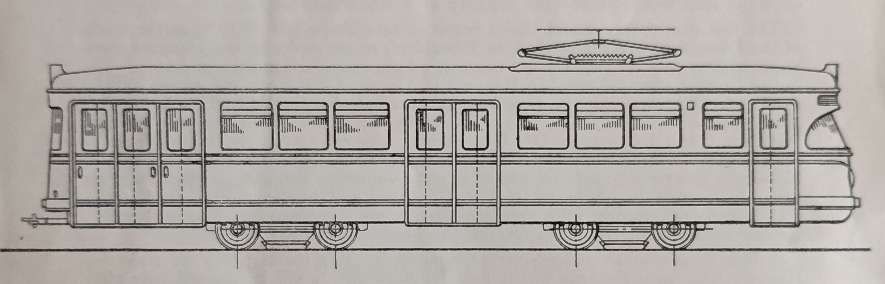
“The all-steel body, so constructed that damaged parts can be replaced rapidly in case of minor collisions, has a rounded form and a sharply inclined front windscreen to minimise reflections from the brightly-illuminated car interior. The electrically worked folding doors are of a new design with increased window-space, the motor car has three doors at the rear, giving one double-width and one single width opening: passengers enter by these doors and congregate on the large rear platform before paying their fares to the seated conductor and passing to the saloon. The conductor’s desk is placed immediately forward of the rear entrance, with a good view of passengers boarding. Exit is by means of a double-width door in the centre of the car and a further double width exit is provided at the front, the doors of which are controlled by the motorman. An ordered flow of passengers is thus ensured, from the rear of the car to the centre and front, and once passengers are accustomed to the system a marked reduction in loading and unloading time is expected. The trailer has the same treble width rear entrance, but as in this case the seated conductor has to control both entrance and exit doors, the latter, again treble-width, are located in the centre of the car only and the front exit is dispensed with. As the cars travel only with closed doors, roof ventilators are provided, together with opening upper portions to all windows. It is hoped in particular that the folding doors will eliminate accidents caused through passengers attempting to ride on the steps or to board or alight from cars in motion.” [1: p274]
“The Hanover motor car and trailer are mounted on a type of 4-wheel inside-frame bogie truck developed by the Waggonfabrik Uerdingen in 1938, and used also for the post-war fleet of bogie cars in Hamburg. Special emphasis is placed on the elimination of noise, by incorporating rubber in the springing and elsewhere. The motor car has rubber-insert resilient wheels of the Swedish S.A.B. design; the trailer uses the recently-patented resilient wheel of the Bochumer Verein. These features combine to give a remarkably quiet and shock-free ride.
Wagonfabrik Uerdingen (Uerdingen Wagon Factory), merged with Düsseldorfer Waggonfabrik (Düsseldorf Wagon Factory) in 1935. The firm operated under the name DÜWAG (or Duewag) and was one of the leading manufacturers of railway and tramway vehicles in Germany. In fact, from the 1960s onwards, Duewag, had close to a monopoly of the market in Germany.
In the 21st century, the firm is a manufacturer of regional and high-speed trains as part of Siemens Mobility. [5][6]
Over the years Duewag produced a series of different rail vehicles and tram/light rail vehicles including: the Duewag T4 tramcar; the Duewag GB6 tramcar; the Duewag GT6 tramcar in various versions; the Duewag GT8 tramcar in various versions; the Duewag GT12 tramcar; the SL79 trams in Oslo; Hanover’s TW 400 trams; Hanover’s TW 6000 trams; Stadtbahnwagen Type M/N trams/light rail vehicles used by in used by several Stadtbahn and tramways in Germany, Austria, Poland, Romania and Turkey; Stadtbahnwagen Type B vehicles used on Stadtbahn networks in North Rhine-Westphalia, Bursa and Turkey; SSB DT8 used on the Stuttgart Stadtbahn system, produced in multiple iterations by various manufacturers; Hong Kong Light Rail Phase 1 (Comeng); Phase 2 (Kawasaki); and Phase 3 (A Goninan) bogies; Siemens-Duewag U2 which was used on the Frankfurt U-Bahn, Edmonton LRT, the Calgary CTrain), the San Diego MTS, in Mendoza, and in Sacramento; Siemens SD-400 for the North and South American market, and
Siemens-Duewag Supertram for use on the South Yorkshire Supertram light rail network.
Resilient wheels of the Swedish S.A.B. (Svenska Aktiebolaget Bromsregulator) design are specialized railway wheelsets featuring a sandwich of compressed rubber pads inserted between the central wheel hub and the outer steel tire. This elastic connection significantly dampens noise, absorbs high-frequency vibrations, and reduces wear on both tracks and rolling stock. Not just suitable for trams, these wheels have a heavy rail application as well, and are standard for BR Class 86/2 electric locomotives. [7]
The Modern Tramway article continues:
“The electrical equipment of the prototype tram was devolved and constructed in the Glocksee workshops of the Hanover tramways. The controller has 20 driving notches (12 series and 8 parallel, the last notch with 50% field-weakening) and 17 braking notches, and is mounted beneath the floor of the car, between the trucks. it is actuated mechanically from the motorman’s position by means of an ingenious rod-and-bevel-gear device, which allows the motorman, using his hand-wheel, to regulate the controller exactly as if it was mounted on his driving platform. This feature was developed during the war by the Hanover tramways, and has given good service on the modern 4-wheel cars of the 222-231 series; it renders the controller immune to collision damage and greatly reduces the amount of wiring necessary. An inspection hatch is provided in the floor of the saloon. The four AEG half-voltage GBM 320 type motors have a rating of 50 kW. and permit a high rate of acceleration and a speed of 60 km.p.h. in normal service.” [1: p274]
AEG GBM 320 50kW motors were direct-current (DC) series-wound traction motors which were manufactured by AEG and SSW (Siemens-Schuckertwerke) and were widely used in mid-20th-century European light rail vehicles.
The Modern Tramway article continues:
“Braking is effected on the motor car as follows:
1. By an electric brake with 17 notches, the current thus produced also applying the disc brakes of the trailer car through solenoids, as is usual in Germany.
2. By an electro-magnetic track brake (four shoes with a force of 4,000 kg. each).
3. By a hand-lever-actuated oil brake working through brake drums on the armature shafts of each motor.
“The trailer also has a mechanical handbrake working on braking discs on each of the four axles. The track-brake shoes and the trailer solenoids are also wired for operation at 24 volts from the car’s battery, should the need arise.“Secondary electrical equipment is grouped in a battery-fed 24 volt circuit (with a Bosch charging unit fitted with automatic cut-in and cut-out), and comprises: emergency lighting, twin headlamps (close and distant), rear light, door motors, moving trafficator-arms and regulation side-lamps, loudspeaker and optical signalling system with passenger-buttons. The provision of a low-tension supply enables normal automobile accessories to be used, with consequent economy. Current collection is by a twin-beam pantograph mounted well forward, and the motor car and trailer are joined by a Scharfenberg automatic coupling, incorporating all electrical connections, of the type used on the elevated railway (and the latest trams) at Hamburg. Normal bar couplings are provided at the ends of the train for use in emergency.
“The new Hanover train has undergone prolonged tests, and to the end of May the car had completed 11,000 km. in public service, an average of 220 km. per day.” [1: p275]
The Scharfenberg automatic coupling is a commonly used type of fully automatic railway coupling. Designed in 1903 by Karl Scharfenberg in Königsberg, Germany (today Kaliningrad, Russia), the coupler has gradually spread from transit trains to regular passenger service trains, although outside Europe its use is generally restricted to mass transit systems. [8]
The Modern Tramway article continues:
“A second 2-car train, differing in several important details, was completed at the end of May and delivered to the Rheinische Bahngesellschaft (Düsseldorf tramways); although the cars had not entered public service late in August their appearance on tests has caused much public interest by reason of their bold light green colour scheme. The motor car represents an attempt to drive both axles of a 4-wheel truck from one motor, mounted longitudinally, this feature is experimental, and further prototype cars will revert to the 4-motor principle using layouts and transmissions embodied in the P.C.C. car and the Swiss standard car respectively. The Düsseldorf car also lacks the inclined windscreen of the Hanover model. One prototype car will be constructed to the metre gauge, and operated for test purposes by the tramways of Wuppertal.” [1: p275-276]
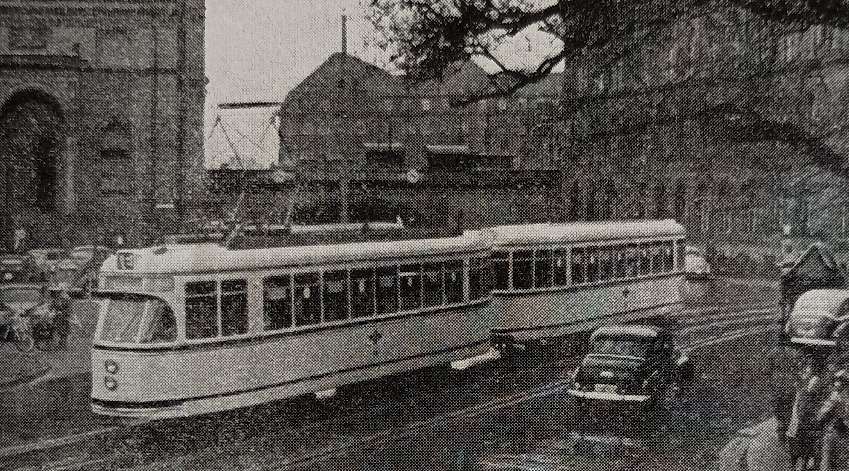
“Orders have already been placed for 70 of the standard cars, partly by means of special credits accorded by the Transport Ministry of the West German government; standard-gauge models are to operate in Düsseldorf, Dortmund, Cologne, Duisburg and on the Siebengebirgsbahn (Bonn), metre-gauge models in Wuppertal and Bochum-Gelsenkirchen. There is little doubt that, once the final design is evolved and mass-production commences, many further orders will be forthcoming.” [1: p276]
This was indeed the case
A significant number of these trams were delivered to tram networks around Germany. There were design differences which were requested by different networks. The most obvious difference between these trams was the design of the front windscreen.
“The single-ended trams featured three different types of windshields, each named after its initial design: a flat windshield (Düsseldorf type), a slanted windshield (Hanover type), and a split slanted windshield (Kiel type), derived from the American PCC tram . The double-ended trams all had flat windshields.” [4]
Furthermore, several licensed versions of this type were produced. These – almost all single-ended trams – were built between 1954 and 1977 under the direction of various companies and are, or were, particularly common in Austria .
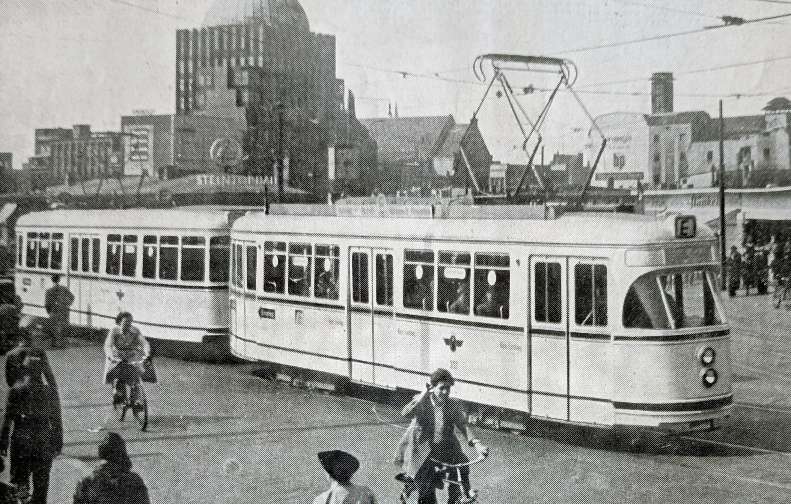
We have already noted that the very first DÜWAG articulated tram was delivered to Üstra in Hanover in 1951, followed by series production vehicles from 1952 onwards. In addition to Hanover, initially only Düsseldorf received several prototypes. German Wikipedia tells us that, “Most operators did not procure series production trams until 1954, when the Duewag tandem drive with one motor per bogie became available. The Duewag articulated trams were also available as bidirectional vehicles . The electrical equipment and control systems were supplied by Siemens , BBC , or Kiepe Elektrik.” [4]
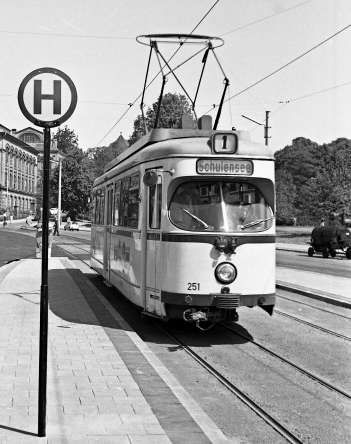
Keil: a Duewag large-capacity tramcar No. 251 at the Schloßgarten stop in June 1963, is just one example of the ubiquity of the standard tram design. [9]
How come, Germany has so many cities with their own tram network?
“In the 21st century, Germany still has an extensive number of tramway networks (Straßenbahn in German) … Some of these networks have been upgraded to light rail standards, called Stadtbahn in German. Straßenbahn and Stadtbahn schemes are usually operated on the legal foundation of the BOStrab, the Tramways Act of Germany.” [2]
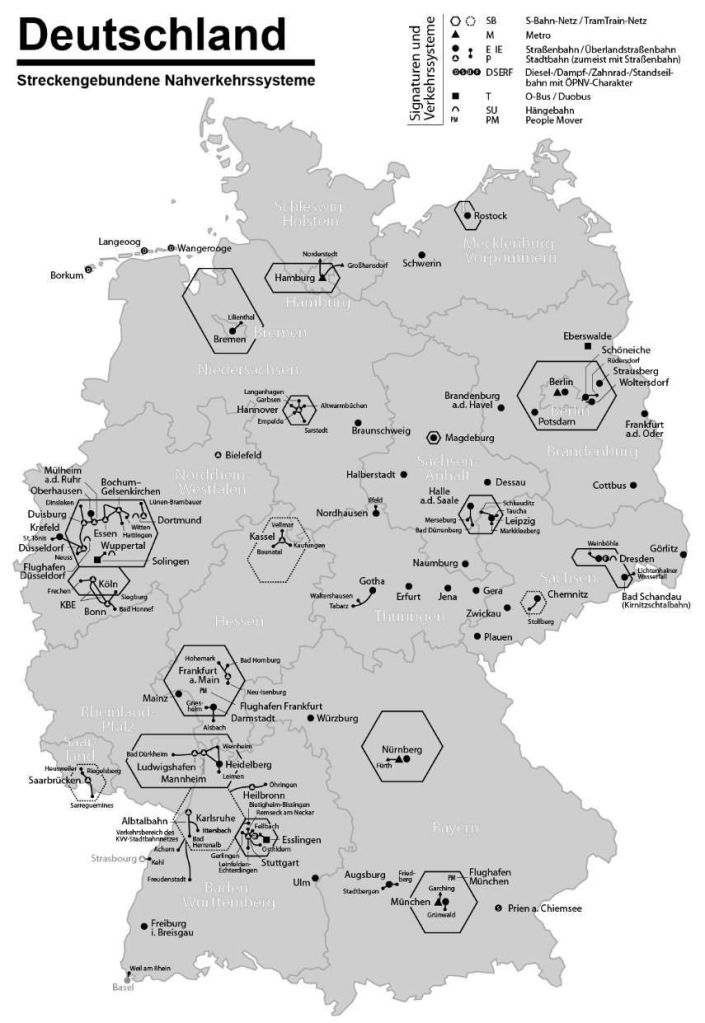
“Tramways served as the primary means of urban transport in Germany until the early 1960s when they were systematically replaced by buses. However, in the 1980s tramways began to reappear; experts spoke of the ‘renaissance of the tramway’. In the 1990s tramways had again become a modern means of public transport. Popular notions of fashion have been used by scholars to explain this cycle of acceptance rejection and restoration. Tramways were a highly visible manifestation of commodity culture and people projected onto them not just travel destinations but more broadly their desires, ideas and beliefs.” [2]
In the early 1950s, electric trams were still the backbone of German urban transport. However, later in the decade, the rise in private car ownership led to a car-centric shift. Many cities—particularly in West Germany and West Berlin—viewed trams as old-fashioned and began replacing them with buses and underground metros (U-Bahn). [3]
“These plans were only partly fulfilled due to high costs and booth Munich and Nuremberg ended up retaining and later expanding portions of their tram networks. Other cities, like Hanover and Stuttgart, pursued a middle ground by putting trams in tunnels through the city centre with the intent to eventually convert them to an U-Bahn. By the 1980s, virtually all German cities abandoned these costly full-conversion schemes and trams stayed on the surface.” [3]
So, Germany kept, and modernised, many of its tram networks. “Today, an unrivalled 60 cities still run trams, stitching together new housing, walkable neighbourhoods and low-car lifestyles. This essay shows how those tracks survived the mid-century cull and why they remain a cornerstone of Germany’s greener, people-first urban renaissance.” [3]
“In East Germany, trams were even more dominant. Socialist transport policy emphasised public transport, and funding was limited for widespread motorways. As a result, every major East German city kept its trams and many were expanded. Leipzig, Dresden, and Magdeburg extended tram routes into new Plattenbau (prefabricated apartment) quarters during the 70s and 80s. Tram networks continued to be expanded after reunification. In East Berlin a 4.5km tram line opened in 1991 through the large Hellersdorf housing estate, providing crucial links to a growing suburban district. Reunified Germany inherited a robust base of tram systems across both East and West.” [3]
‘Creat Strreets’ [3] tell us that factors which led to many more tram networks being retained than in other countries such as the UK and the USA include:
- Economic realities: A postwar economic boom in the UK and US meant that car ownership skyrocketed. Meanwhile, Germany was still in a deep economic depression. After the formation of West Germany in 1949, federal and state governments continued to provide funding for municipally owned transport companies, including trams.
- Policy and planning: German cities remained denser, more compact, and more mixed-use and city councils were pragmatic about transport. German tram companies often remained publicly owned and focused on long-term service. By the 1970s, the oil crises also reminded Germany of the value of electric transport, helping halt further closures.
- Cultural differences: It’s difficult to understand Germany’s decision to retain trams without understanding that to German policymakers keeping trams would have seemed like the pragmatic, sensible and safe option, whereas a switch to buses would have been an unknown risky option. Furthermore, unlike in the UK and US where trams came to represent the past and the car became an important status symbol, public transport in Germany never acquired a social stigma. Trams were not associated with poverty or obsolescence, but rather with efficiency. German cities were among the first to recognize the downsides of car dependency, too: pollution, congestion, and hollowed-out city centres. Rather than widening roads and doubling down on motorways, cities such as Freiburg reinvested in trams as part of traffic calming and pedestrianisation strategies.
- Continuous modernization: Rather than letting systems decay, German operators never stopped investing in new tramcars and technology. From the 1950s, Düsseldorf based DÜWAG began supplying West German cities with modern articulated trams, and cities like Düsseldorf, Frankfurt, and Hannover introduced new, higher-capacity trams. This kept service quality high and public support strong. Trams were reimagined as a modern, attractive, clean transport, integrated into pedestrian zones and designed with attractive vehicles and stops. In contrast, many North American and British trams had been neglected and unmodernised, making buses seem like an improvement in comparison.
- The tram-train: Germany was an early adopter of the tram-train (or “Stadtbahn”) concept that mixes tram and metro elements. The best-known example is in Karlsruhe. By using dual-voltage tram vehicles, Karlsruhe linked street tramlines to existing regional rail tracks, effectively merging local and regional transport. This model has since inspired tram-trains in cities like Saarbrücken and Kassel and in Cologne and Frankfurt some tram lines go underground and now run as light-rail metros in the centre while still operating on streets in outlying areas. It’s a case where Germany led in expanding tram usage at a time when others were only starting to consider reintroducing trams.
- Pragmatism: Where other countries pursued replacing trams with buses, German cities often kept trams that still served dense areas well. They chose a flexible approach which allowed for gradual upgrades rather than wholesale dismantling.
- Strong municipal operators: Many tram systems remained in the hands of publicly accountable city utilities, giving them a long-term investment outlook. This made it easier to plan for continuity and renewal.
- Public acceptance and use: Even during the car boom of the 1960s and 70s, trams were well-used. As other forms of transport became congested or expensive, trams kept their niche and their advocates.
- Return on Investment: Returns for trams was higher than for road-building, particularly when urban regeneration effects were included. A 2025 study by MCube and the Technical University of Munich, commissioned by Deutsche Bahn, found that every €1 spent on local public transport generates around €3 in added economic value for Germany’s GDP.
References
- The New German Standard Car; in The Modern Tramway, Volume 14, No. 168, December 1951, p273-276 & p280.
- https://en.wikipedia.org/wiki/Trams_in_Germany, accessed on 20th May 2026.
- https://www.createstreets.com/the-country-that-never-tore-up-its-tracks, accessed on 20th May 2026.
- https://de.wikipedia.org/wiki/Duewag-Gro%C3%9Fraumwagen, accessed on 20th May 2026
- https://de.wikipedia.org/wiki/Waggonfabrik_Uerdingen, accessed on 20th May 2026.
- https://en.wikipedia.org/wiki/Duewag, accessed on 20th May 2026.
- https://trid.trb.org/View/18694, accessed on 20th May 2026.
- https://en.wikipedia.org/wiki/Scharfenberg_coupler, accessed on 20th May 2026.
- https://de.wikipedia.org/wiki/Stra%C3%9Fenbahn_Kiel, accessed on 20th May 2026.
 Roger Farnworth