
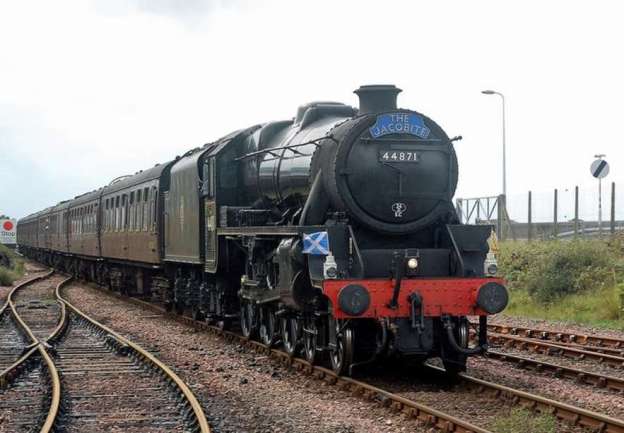
The featured image for this article shows the Jacobite arriving at Mallaig Railway Station, © Mary & Angus Hogg and licensed for reuse under a Creative Commons licence (CC BY-SA 2.0). [18]
In the bookshop at Wemyss Bay Railway Station in May 2026, I picked up the Spring 2026 issue of West Highland News Plus which is the magazine of the friends of The West Highland Lines. It reminded me that 2026 is the 125th anniversary of the opening of the Mallaig Extension on 1st April 1901.
More of that later. …
In mid November 2025:
Among a variety of different news reports, the magazine included:
- Network Rail (NR) Contracts
“NR completed a £15 million improvement project on the West Highland Line between Crianlarich and Fort William. … Over a nine-day closure of the line, engineers worked to deliver a series of critical upgrades, including renewing sections of track, drainage improvements and clearing hazardous vegetation to help protect the line against heavy rainfall and extreme weather conditions. Targeted track renewals, replacing around 10km of rail and more than 9,000 sleepers. Renewal of a railway bridge near Corrour, and vegetation management. Renewal of five culverts, improving drainage and ensuring structural stability and renewal of a footbridge.” [1: p4]
“While a £4.5 million project on the Kyle Line was completed in early November.” [1: p4]
In June 2025:
“NR delivered an £11.5 million upgrade on the Far North Line, while a £4.5 million project on the Kyle Line was completed in early November. Both projects involved renewing sections of track, some of which dated back almost a century.
These last two projects involved renewing sections of track, some of which dated back almost a century.
- ScotRail Statistics
“ScotRail recorded its busiest day in 2025 – Friday, 12th December with 345,216 journeys, the highest daily total since services were brought into public ownership (in April 2022). The figure surpassed previous records set during major events like the Edinburgh Festivals, large concerts including Taylor Swift and Oasis, and key sporting fixtures. Removing peak fares has meant significant savings for passengers across the country, with some journeys reduced by almost 50% including those between Edinburgh and Glasgow.
“ScotRail also announced that 7,866,187 passenger journeys were made during December, making it the busiest December since Scotland’s Railway returned to public ownership. This is ten per cent (701,910 journeys) more than the 7,164,277 journeys made in December 2024, and 69 per cent more than the 4,646,072 journeys made in December 2022. Over a similar period (7th December 7 to 3rd January) ScotRail also recorded its best punctuality and reliability scores since its return to public ownership. 88.5 per cent of trains met their punctuality target, an increase of more than nine percentage points from the 79.2 per cent recorded in 2022/23.
“The ORR’s [2] figures for the period April 2024 to March 2025 showed Scotland’s busiest stations: Glasgow Central – 25.3 million, Edinburgh Waverley – 22.8m, Glasgow Queen St. – 15m, Edinburgh Haymarket – 3.3m and Paisley Gilmour St. – 3.2m. On The West Highland Lines, passenger entries/exits for 2024 to 2025 were: Oban: 201,750; Fort William: 176,226 and Mallaig: 90,476.” [1: p7]
- Earth Observation Company SatSense
I am sure someone will understand this better than I do. …
“Network Rail awarded a major contract in November to the Earth Observation Company SatSense to monitor the UK’s entire rail network using satellite Interferometric synthetic aperture radar (InSAR) technology. This is a world first, as it is the first time that a major rail operator has used the technology on such a large scale. The multi-million-pound, multi-year contract will integrate data from Sentinel-1 and the upcoming NISAR mission to monitor Britain’s rail network. The process will build upon NR’s operational expertise and proven asset management processes to manage railway assets by combining regular satellite radar data with advanced analytics to map deformation, flooding and surface changes.
“SatSense will use satellites, including the Sentinel-1, NISAR, and TerraSAR-X constellations, to produce data, which it will process and integrate into NR’s earthwork asset management systems. The approach will reduce the need for costly, subjective, and untimely repeat on-site examinations.
“The technology gives a cost-effective alternative to actually visiting scheduled sites; a reduced risk to personnel, by minimising the time needed for working on the track and on slopes; faster data collection by eliminating the time constraints of ground-based surveys and high data accuracy and consistency with millimetre-level precision enable repeatable measurements over time for trend analysis while reducing human error and subjectivity. Britain’s railways are increasingly making use of satellite technology, such as providing Wi-Fi to the Scottish Highlands and on the North Yorkshire Moors Railway.” [1: p8]
- Future Ferries
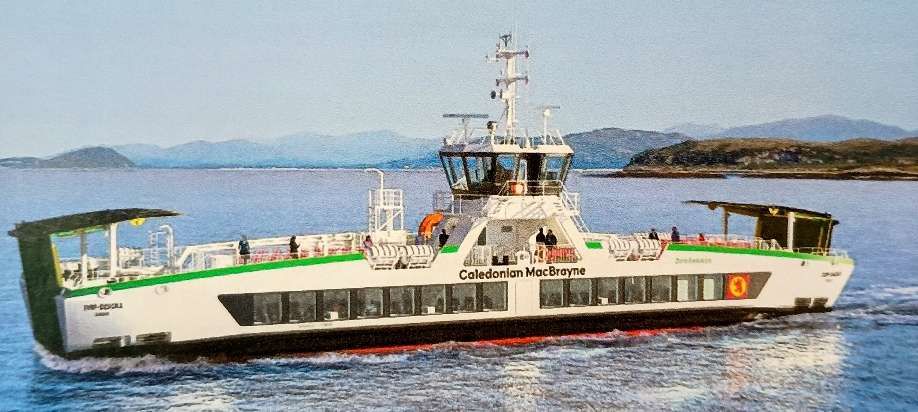
“The names of Scotland’s seven small electric ferries being built in Poland for CalMac have been unveiled after more than 1,000 people voted in a poll based on Scottish lochs. The Loch class ferries form the first £160 million phase of the two-part Small Vessel Replacement Programme which also includes harbour upgrades to accommodate the vessels and recharge their batteries. The vessels, which can carry up to 150 passengers and 24 cars, will serve Colintraive – Rhubodach (Bute), Lochaline – Fishnish (Mull), Tarbert (Loch Fyne), Portavadie, Fionnphort (Mull) – lona, Sconser (Skye) Raasay, Tobermory Kilchoan (Ardnamurchan) and Tayinloan (Kintyre) – Gigha, are due to start arriving in 2027.” [1: p17]
The 125th Anniversary of the Opening of the Mallaig Extension
In his article in the journal, John McGregor writes about the various machinations which preceded the construction of the 40 mile long Mallaig Extension. [3: p19-20]
The result of various negotiations was the decision of the government to support two schemes to serve the West coast of Scotland North of Oban. One of those would be the line through Fort William to Mallaig, the other would need to be selected from lines to Achnasheen, to Ullapool, to Lochinvar and to Loch Laxford.
One of these four alternatives was already authorised – the line from Garve to Ullapool. The project received approval from the Westminster Parliament by means of a local Act of Parliament, the Garve and Ullapool Railway Act 1890 (53 & 54 Vict. c. ccxxxiii), of 14th August 1890. Sadly for the folk of Ullapool there was not enough financial backing for the scheme. [5]
Those pushing for finance for the Garve to Ullapool route were to be disappointed. The directors of the Highland Railway decided to opt “for a measure of assistance sufficient to carry the Dingwall & Sky route on to Kyle of Lochalsh, the terminus originally intended.” [3: p20] 1897, saw the line to Kyle of Lochalsh extension completed.
McGregor continues:
“The proposed Treasury Guarantee for the Mallaig Extension (1892), supplemented by the assurance of a parliamentary grant for Mallaig harbour, was overtaken by the Government’s defeat in that year’s general election. … The incoming Liberals, lacking an overall majority, were variously distracted (not least by their doomed-to-fail pursuit of Irish Home Rule). Suspicious of the railway industry as an over-powerful vested interest, they eventually acknowledged their permanent civil servants’ advice that the Conservative offer was binding, but not until the Mallaig Extension Bill had passed into law (1894) – and this at the second attempt. (As a ‘late bill’ in parliamentary session 1892-93, it had met with procedural challenge from the Caledonian and Highland Companies.) When the Liberal administration retreated to opposition without securing the legislation to confirm the Guarantee, the duty fell to the returning Conservatives, who, joining with the anti-Home Rule Liberals under a common ‘Unionist’ banner, were emphatically victorious in 1895.” [3: p20]
But, there was trouble over the promised subsidy. It would be the first time that such a subsidy would be made to a commercial railway company on the UK mainland. In addition, McGregor notes, there were some constitutional issues at stake:
“Though talked up for partisan reasons, the ‘constitutional’ aspect of all this was of some importance. Besides the alleged iniquity of state-subsidised competition, it could be argued that the Treasury and the Board of Trade, which oversaw the design of Mallaig harbour, were framing policy without the initial parliamentary sanction traditionally required. A different, though related argument, alarming for the North British, held that such ‘lavish’ assistance made the Mallaig line a ‘Government road’, open to all-comers including the Caledonian if a Callander & Oban branch were to reach Fort William from Connel Ferry. And with a new Light Railways Act in prospect (it passed in 1896), other voices continued to urge that the Mallaig scheme be comprehensively reassessed, for light -and cheaper – construction.
“Finally, the North British were to the very end vulnerable in that they were known to have half-repented their West Highland involvement. Why should the taxpayer help remedy what now looked to be their burdensome and expensive mistake?” [3: p20]
McGregor draws attention to a number of different recorded statements in Parliament in the proceedings related to the West Highland Railway, Mallaig Extension Bill, Parliamentary Session 1893-94:
- Cameron of Lochiel, evidence: The Promoters [of the West Highland Railway) were very much disappointed with [the] Roshven part of the line being thrown out… and…ever since I have been doing all in my power to obtain an extension to the west coast in some shape or form. [No one] would contend that Mallaig Harbour is perfect [but it] is the only one we…have left. [3: p20]
- Spencer Walpole, chairman, Lothian Commission (1889-90), evidence: We recommended, in the event of the Mallaig line being made, that something should be done for the Highland [Company]…. We thought that was carrying out the spirit of our instructions. [3: p20]
- John Conacher, general manager, North British Railway, submitted with his evidence a minute of the North British Railway board (1893): With reference to the proposed extension of the West Highland Railway to Mallaig…the… Company agree to guarantee the difference between the sum of £260,000 to be guaranteed by, Government and the total capital…estimated at £338,000. [3: p20]
- Callander & Oban Railway/Caledonian Railway Petition Against – House of Lords: Notwithstanding the Bill originally professed to be promoted solely in the interests of the population of the Western Highlands and Islands, and for the development of the fishing industry, in accordance with [the Lothian Commission Report] it is now avowedly supported by the North British Railway Company (without whose aid it could not be made), entirely in their own interest…for purely competitive purposes. … [3: p20-21]
- Highland Railway Petition Against, – House of Lords: [It is] wholly without precedent and contrary to public policy to sanction the grant of powers to construct a railway and harbour upon the anticipation that the Government may at some future time ask Parliament to subsidise the Company [in question] to a very large amount. The clear consent of Parliament to…such a subsidy…should precede the application for the grant of these powers. [3: p20]
- Exchange between Committee Chairman and counsel for the North British Company, House of Commons: It places the Committee in a very unusual position, for they [become] practically a court of review of the inauguration of a new description of public policy. … Not quite so…. The Treasury [have made] it a condition [of] their obtaining power to make the subsidy that we shall obtain Parliamentary sanction to the scheme upon its merits. [3: p20]
In truth, it is unlikely that an issue of this nature would have been seen as of any real significance outside of the UK (and the USA). Government intervention in railway matters were usual, rather than exceptional.
Nicholas Faith says that:
“Almost instinctively, Britons and Americans left the shape of their [rail network] to market forces, to individual promoters. In Britain this relatively unregulated competition led merely to the duplication of a few lines. In the United States duplication ran riot. Even after the rationalisation of the 1890s there were twenty-one different routes between New York and Chicago, varying in length between 912 and 1376 miles, and no fewer than ninety ‘all-rail’ routes between New York and New Orleans.
“By contrast the Continental Europeans adopted the orderly ‘Belgian’ pattern, because they were deemed to be of crucial national interest. The pattern, by which railways were planned and regimented, government would ensure that the promoters received a ‘normal’ rate of return during construction. In return, the state ensured that the railways’ assets would revert to public ownership at the end of a specific period.
“The French went the furthest. They had planned a coherent rail system before a single mile of main-line track had been laid. As a result there is only one line between any two major towns: but because the network radiates from Paris connections between some major provincial centres – most obviously Lyons and Bordeaux – have ranged from the poor to the disgraceful.
“Planning did not preclude political conflict even before any main lines had been built. By 1848, the railways represented symbols of bourgeois capitalism powerful enough for the French revolutionaries of that year to call for their nationalisation. In the event their relationship to the state was worked out only during the reign of the Emperor Napoleon III. …
“Following the Crimean War, Haussmann’s enormously expensive reconstruction of Paris and a financial crisis in 1857, the French railway companies were forced to ask for financial help. The next year the system was divided into two, the 7,774 kilometres already built and the 8,578 kilometres of lines being promoted at the time. In a typically French carve-up, the network was divided between six great companies. The state guaranteed the interest due on loans required to build the new network, receiving a small percentage on the revenues of the railway companies, which, effectively, became the state’s partners. As usual the capital required was under-estimated and the agreement had to be revised, but it provided France with a coherent network and allowed the state to intervene if it thought rates were too high.
“However, the politicians would not let well alone. By the mid-1860s the opposition was demanding the construction of socially useful but economically marginal local lines, and the railway companies, with their close links to the Emperor, became symbols of his over-centralised regime and its grasping supporters. After the 1870 war, the opposition’s views prevailed and an elaborate network of smaller, local lines was built, largely for electoral reasons. This ‘Freycinet network’ was much abused at the time, although it made an enormous contribution to the unity of rural France. But the unfortunate Chemins de Fer de l’Ouest, which included a high proportion of branch lines running through thinly-populated rural areas, got into terrible financial trouble and had to be nationalised. The first lines to be taken over were in a poor financial and operational condition, so their nationalisation inevitably led to perfectly justified accusations of incompetence and over-manning. Nevertheless the French state gradually increased its influence until a unified network was formed under national control just before World War II.
“In Germany the individual states had originally perceived the railways as a further opportunity to assert their identity. In most cases, even when private money was involved, there seems to have been a tacit understanding that eventually the state would take over. To build the line between Cologne and Minden the government provided a guarantee that the bonds would pay 3 ½ per cent interest. The state would also buy a seventh of the original share capital, which was arranged so that eventually the government would own the whole lot. [So valuable was the railway, that its gradual sale enabled Bismarck to fund the Prussian war against Austria in 1866.]
“But arrangements varied. Baden modelled its system on that of Belgium. In the neighbouring state of the Pfalz, private enterprise held sway. One bemused observer points out that ‘both of these systems involved serious time losses and periods of indecision at the start and both slowly created a viable and profitable railroad system in the end.’ What mattered more than the system was ‘the basic determination to decisively and energetically develop the railroad through one system or another.’
“To Bismarck it was essential that the railways, the most potent symbol of German unity, should be in public hands. In 1873, he insisted on the creation of a new Imperial railway agency for the newly-united German Empire, ostensibly to work towards greater uniformity in rates, in fact to promote eventual nationalisation of the few lines in Prussia not already in the state’s hands.
“It took even the supposedly all-powerful Bismarck several years to create a Ministry of Public Works designed to take charge of the nationalisation process. Meanwhile his friend and banker, Gerson Bleichroder, was busy buying shares in lines he expected to be nationalised. In 1863 Bleichroder had enabled Bismarck to acquire cheap options on shares in a couple of railways, but his later investments were on a much larger scale. Fritz Stern, in Gold and Iron reckons that ‘at some points, roughly half of his liquid capital was invested in these shares.’ For Stern the investment represented ‘the clearest commitment to his own policy of nationalization, because failure or even undue delay in nationalizing could have cost him money.’ The commitment ‘sustained his intense interest in the nationalization of railroads. Less sympathetic commentators would simply have labelled Bismarck an ‘insider trader’.
“The truly enthusiastic railway politician, like Cavour, was less interested in the relationship between them and the state than simply in getting them built. ‘His methods were eclectic,’ wrote P.M. Kalla-Bishop in Italian Railways ‘there was a state plan and a state railway system, yes; but should a private company wish to build a railway it was encouraged, and, as well, there were railways jointly owned by a company and the state. The object was to get railways built by any means.’
“Even the knowledgeable Cavour assumed that politically-motivated lines – in his case those running down the Italian peninsula, specifically designed to encourage national unity – would also prove economically viable. They didn’t. Similar mistakes were made in Spain and Austria-Hungary, which both ‘constructed “star” systems, centring inappropriately upon their capital cities. In Austria-Hungary like Italy, a state with more ambitions than capital, government policy was often dictated by the financial needs of the Emperor. As a result the railways changed from private ownership with state guarantees, into state ownership; then, in 1885, the state lines were leased to private companies in three networks, the Mediterranean, the Adriatic, and the Sicilian. Although these corresponded to France’s six great companies, they were far less economically successful, and nationalisation was required a mere twenty years later.
“The smaller, and generally even poorer, European countries often suffered from the depredations of British promoters. Portugal had some especially unhappy experiences, while the Swedes, after experiencing the misdeeds of the unscrupulous John Sadleir, reverted to an earlier pattern by which the Gota canal had been built as a private monopoly under strict state supervision, using government-guaranteed funds.
“The pendulum swung the same way outside Europe. In Japan the Meiji Emperor was so anxious to encourage railway construction that the government’s own Railway Bureau actually surveyed and built the first lines, while the company received a guaranteed eight per cent yield on its capital. In India the first railways were built under a system which combined profit-sharing and a generous state guarantee. In 1869, an increasingly self-confident Imperial administration decided to take over the task of construction itself. The task proved too burdensome so private enterprise was allowed to enjoy the rewards from profitable lines, albeit with a smaller guarantee, while the state took on the burden of unprofitable routes. The government investment proved immensely worthwhile: by 1914, the government-owned railways were providing a fifth of India’s total government revenue, more than customs and excise combined.
“In the absence of such a firm imperial hand the whole messy process of construction, operation and attempted regulation of such natural monopolies provided innumerable opportunities for politicians to sell the valuable gifts they had in their power: construction rights, permission for compulsory land purchase, government backing for their loans, preventing competition once the lines were built. Individual politicians, or fleeting pro-railway majorities in Parliament or Congress, are sometimes denounced as corrupt, but, somewhat unfairly, the railway promoters have borne most of the blame. But the moralising was, and is, largely confined to Britain, Canada and the United States. In non-Anglo-Saxon countries people have lower expectations of honesty from their politicians.” [7: p71-76]
Nicholas Faith focusses once again on the British situation in the 19th century:
“In Britain the railways division of the British Board of Trade dates back to 1841. However it was subject not only to politicians’ whims but also to the prevailing mood of the day, and thus swung between allowing the railways to regulate their own affairs and a mood particularly prevalent after a major crash – a determination to assert the primacy of the public interest.
“The companies became adept at delaying or evading regulations. For instance the 1844 Regulating Act provided that every company had to run at least one train every day to serve all the inhabitants along its route. The train had to stop at every station, cheap fares would be available, and the train had to average at least 12 mph. These ‘Parliamentary trains’ became a long-standing joke, famous for their inconvenience, discomfort and snail-like pace.
“The companies’ long-term rear-guard action against regulation was helped by the ‘railway interest’, the first major, organised, feared and overrated – industrial lobby. Opponents alleged that the legislature was dominated by members dedicated more to the railways than to the common good.
“On the face of it the critics seemed to have a case. For a generation after the great influx resulting from the railway boom of the 1840s there were never fewer than a hundred Members of Parliament with some railway connections. Nevertheless, … there was a gulf between appearance and reality. Most of the members of the ‘interest’ were directors of local railways; they were not tied to the major companies most likely to come into conflict with government. However, they were powerful enough to block much legislation for the twenty years after 1846, a period when Parliament was dominated by interest groups rather than parties. In this atmosphere political pressure for effective control or eventual nationalisation naturally evaporated. It was only after the Reform Bill of 1867, and the resulting reinforcement of party discipline, that Parliament started to act, albeit mainly on settlements of railway disputes. Earlier regulations had assumed that the railways would play fair, would reduce their charges in return for protection from competition. Of course they didn’t.
“Yet even after a series of crashes in the early 1870s, even after the companies had refused to accept government-imposed brakes (partly because they could not agree on the type they would fit) the Board of Trade’s inspectors were still divided as to whether legislation was needed or whether they could rely on ‘the persuasive power of public opinion as a means of securing the adoption of safety devices’. Not surprisingly, by 1884, even The Times was calling for government regulation of railways on behalf of the public.
“The laissez-faire attitude was still far more powerful than it was in Continental Europe. The British companies, for instance, waged a long campaign to avoid granting automatic protection to work men injured at work, whereas in France railway companies were bound to provide compensation even if they were in no way to blame.
“Even in Britain, however, nationalisation had had its advocates from the very beginning. John Ruskin, for one, had always believed that ‘all means of public transport should be provided at public expense, by public determination where such means are needed, and the public should be its own “shareholder”.” During the debates of the early 1840s, many pioneers, including the great contractor Thomas Brassey and, more surprisingly, George Hudson, the Railway King, testified that a controlled monopoly was the best form of railway management. Competition, Hudson pointed out – and later experience in the United States proved his point – led to ruinous undercutting of rates, inevitably succeeded by agreements not to compete, what the Americans called ‘pools’. In the United States, freight railroads are still privately owned and in Britain it took until 1923 to group the companies into four giant concerns, and a further quarter of a century before Britain followed the rest of Europe and nationalised its lines.” [7: p78-80]
Returning to the specifics of the Mallaig Extension Railway, ultimately a government subsidy was agreed. Construction started in 1897. It was entrusted to the Simpson & Wilson Engineering Partnership [8][9] with the contractors being Robert McAlpine & Sons. [10]
True to his ‘nickname’ Concrete Bob [10] made very significant use of mass concrete on the Mallaig Extension – Glenfinnan, Loch-nan-uamh, Morar and Borrodale Viaducts were built of mass concrete.
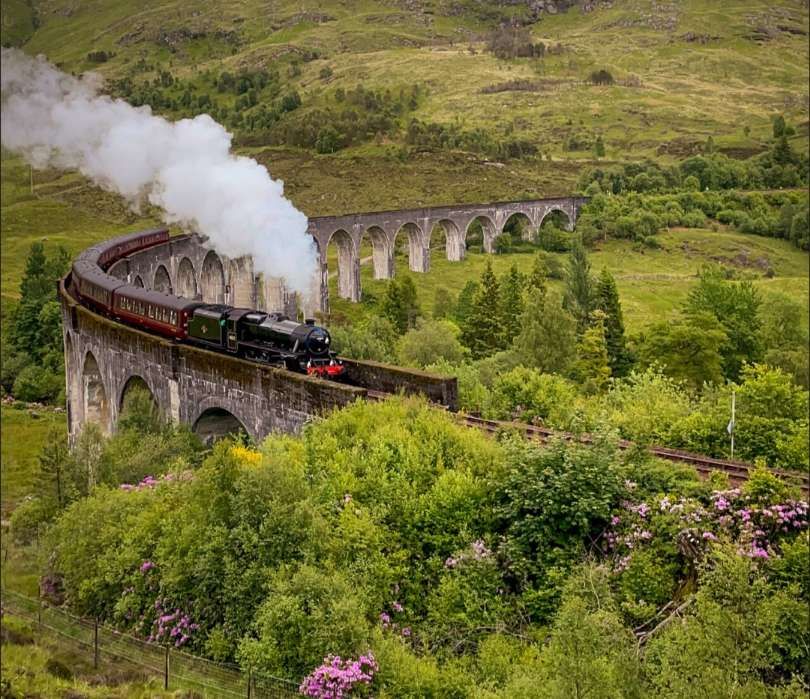
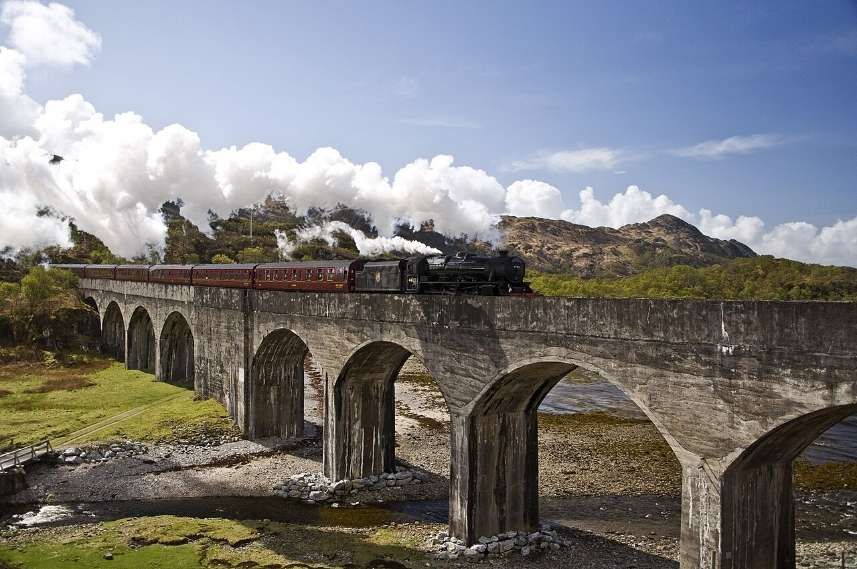
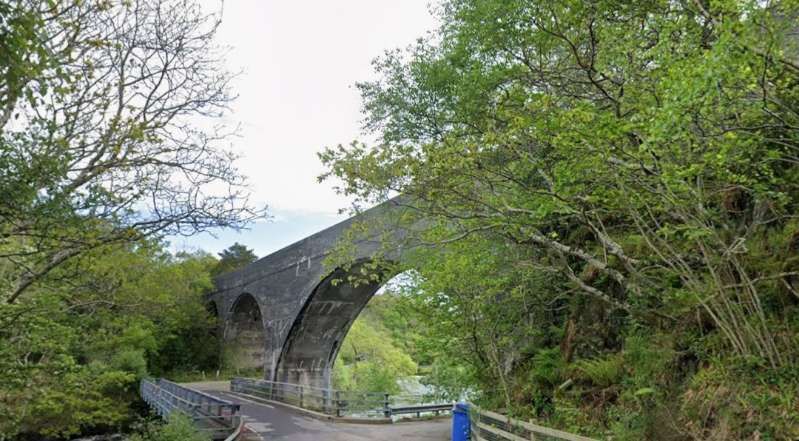
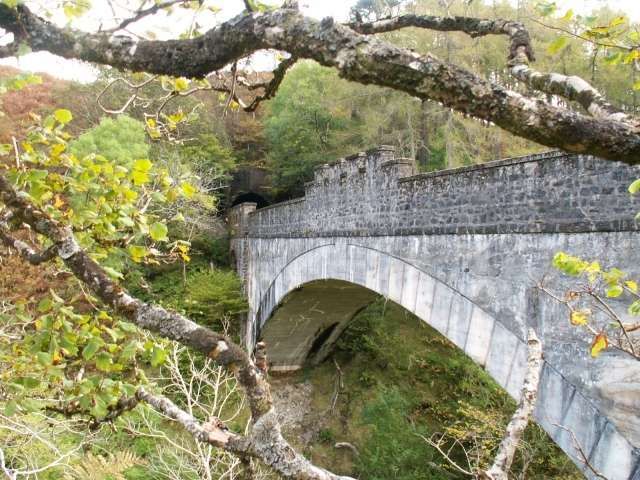
McGregor tells us that Borrodale Viaduct “had the widest concrete arch yet attempted for a railway bridge. [Mass concrete] was also used in lesser structures, accommodation works and station buildings.” [3: p21]
Initial phases of construction focused on earthworks – extensive rock cuttings totaling over 495,000 cubic yards and embankments of nearly 750,000 cubic yards.
Construction of viaducts, bridges and tunnels followed, then track laying. Subsequent phases involved the construction of viaducts and bridges, followed by track laying, “with the line featuring 11 tunnels, six major concrete viaducts, and a single-track alignment with gradients up to 1 in 48 and numerous curves.” [15]
The use of mass concrete for the structures was an innovative and cost-effective engineering in a remote setting. “The total workforce peaked at over 2,000 navvies, many of whom arrived by sea aboard the SS Clansman in December 1897. … Major works were largely completed by 1900, though the remote terrain contributed to logistical delays in transporting materials and equipment.” [15]
The article on Grokipedia continues:
“The Mallaig Extension Railway officially opened on 1 April 1901, extending the West Highland line 40 miles from Banavie near Fort William to the new fishing port at Mallaig on Scotland’s Atlantic coast. The extension, authorized by the West Highland Railway (Mallaig Extension) Act of 1894 and completed ahead of the 1902 deadline, was designed primarily to facilitate rapid transport of fresh sea fish to southern markets, transforming the small village of Mallaig into a major herring port. On opening day, arriving steamers including the SS Clydesdale from Stornoway and the SS Lovedale from Portree berthed at Mallaig, discharging passengers who boarded the inaugural train bound for Glasgow via Fort William—a journey that underscored the line’s role in integrating rail and sea travel.
Early operations combined passenger and freight services on the single-track route, with trains handling everything from local crofters’ livestock and agricultural goods to the burgeoning herring catches landed by up to 700 skiffs in nearby lochs like Nevis and Hourn. The initial timetable provided several mixed trains daily between Fort William and Mallaig, supporting connectivity to the Outer Hebrides and Isle of Skye.” [25]
McGregor tells us that:
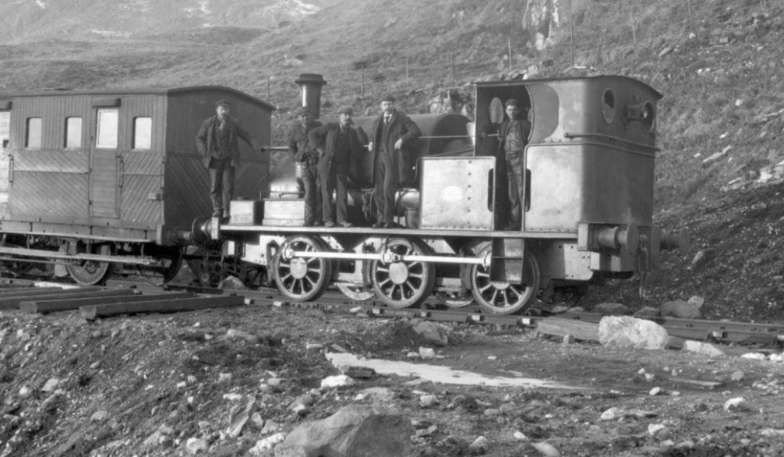
“The first ten miles out of Corpach were constructed relatively easily, along the north shore of Loch Eil, but to the west supplies were brought in by sea direct from Glasgow. Camps had been set up near Lochailort, Loch nan Uamh and the Morar estuary. Contractors’ railways were used and where (rail) access was impossible, horses were used, up to 200 at a time.
“Excavating along the route’s bedrock, predominantly mica schist, quartz and gneiss, challenged even the sharpest steel and latest tools. Gelignite was used for blasting, causing several serious accidents. But a new style of drilling was on the way, thanks to a visit to his dentist by young Thomas Malcolm McAlpine. He noticed the dentist pressed a knob on the floor and a ‘Pelton wheel’ was driven by water. So, on the railway water-driven turbines were introduced using plentiful supplies from the local lochs. Previous methods cost large numbers of manpower, with the new hydropower, this was cut by 500-600 men.
“The use of mass concrete to build the structures on The Extension is well known, but Scottish engineer John Strain had first used it building the Callander & Oban Railway. (Mass concrete is poured or cast-in-place concrete with no steel reinforcements but large amounts of crushed stone aggregate.)
“Some of the local land owners resented the resulting appearance of the concrete, so the contractor was asked to add red colour to the mix and, by scoring the surface, emulate the look of dressed granite (from a distance). The mighty Glenfinnan Viaduct, in 1901, was the longest concrete bridge in the UK. Excavations had started in 1897 and by October 1898 a contractor’s railway was laid. By completion of the viaduct, a total of 14,914 cubic yards of concrete had been used. The contractor was paid £18,904, of which £17,883 was payment for concrete.
“A quite different problem faced the builders between Arisaig and Morar: the ground was not solid enough to carry a railway. To get the line across the soft and peaty stretch of land known as Keppoch Moss, the contractors used the same principle that had been used on the West Highland ‘main’ line across parts of Rannoch Moor- floating on a subsurface raft made from alternate layers of turf and brushwood, capped by a large quantity of cinders.
Although the first public service train ran on the new line on Monday, 1st April 1901, there had already been previous trains. The Oban Times reported that in June 1900 a ‘pioneer’ train, which was occupied by members of the contractor’s firm, engineers and railway officials and friends, completed the journey of 40 miles from Banavie to Mallaig in a little over two hours. When Queen Victoria died in 1901, the McAlpines ran a special train on Saturday, 2nd February to enable villagers of Glenfinnan to attend a memorial service at Corpach. A hoped-for official opening for late 1900 did not happen because of signalling problems and after a week of inspections by the Board of Trade’s Major Pringle in March 1901, the line was finally given the green light to open.” [3: p22][4]
The Story of RETB
In 1979, a lot of the overhead pole route to the far north of Scotland was brought down by a storm. Full replacement could not be justified and the line was at risk of closure. “The only means of providing a train service in the short term was to use the train staff and ticket system, which was both clumsy and expensive, often involving road vehicles to transport the staff to the adjacent signal box if the sequence of trains changed from the timetabled order.” [1: p23]
Chris Green, then General Manager of ScotRail, sought a solution which would be less expensive. The BR Signalling & Telecoms Department and the BR Research Group at Derby ” initially designed a system where the bell signals and token instrument controls could be sent over a radio link. … This … enabled the line to resume normal working, it did nothing to reduce the costs of operation. ” [1: p23]
RETB was the next iteration in the design process. It works by:
“Having a chain of radio transmitting (base) stations on hilltop or high-ground sites along the routes interspersed with radio repeater locations, normally sited at one of the passing loops. A radio signal sent from the first base station gives radio coverage for between 10-20 miles of line and which is picked up by the first repeater station. This repeater transposes the signal into a different frequency and sends that signal out which is picked up by the second base station, which then broadcasts that signal to the next section of line. This second broadcast is picked up by the second repeater which again transposes the signal to a third frequency and transmits it on to the third base station.
“This chain of events continues until all the line is covered. The repeater system means that no cable connection is needed to feed into the various base stations and thus no lineside cabling is required on the route. To guard against a break in the chain, a rented landline connects the far end site back to the control point so that token control data can be sent in the reverse direction.” [1: p23]
This system coincided with the introduction of Solid State Interlocking (SSI) which was installed at the central control point. “This was the first application of SSI and preceded the first main line application at Leamington Spa. The SSI is programmed for the route from which a signaller’s console enables electronic tokens to be issued and transmitted into the radio chain.” [1: p23]
The system requires that all rolling stock on the line must:
“be equipped with a mobile radio and a cab display unit on which the tokens are displayed. The signaller knows the rough position of every train by receipt of verbal messages received from the driver normally given at the passing loop locations and, under the control of the SSI, can issue a token for a train to go from one passing loop to the next. The SSI prevents the issue of any conflicting token. Once the train arrives at the passing loop the driver contacts the signaller and the token is retrieved. The system relies on verbal messages between signaller and the train drivers but normally a signaller can control up to 20 train movements dependent on traffic levels.
“The passing loop points are normally set for left hand running into the loop. There is no facing point lock, but they are controlled by train operated movements. When a train leaves a loop, it runs through the points the wrong way and pushes them over to the reverse direction. Once all wheels have passed, a stored energy device returns the points to the normal facing direction. A speed limit of 15 mph over the points ensures safe operation but increases journey times. This speed limit is an impairment for reducing journey times and NR is investigating whether the points can be changed to powered operation under the control of the token that has been issued.
“The system was first introduced on the Kyle of Lochalsh line in late 1984 and on the Far North lines to Thurso and Wick in 1985. It was deemed a success. Both routes were initially controlled from a centre at Dingwall which was subsequently moved to the Inverness signalling centre. Later it was deemed suitable for the West Highland Lines from Helensburgh to Oban, Fort William and Mallaig with a control centre at Banavie (west of Fort William) which came into operation during 1987/88. This involved BR buying a hill top for the base station at White Corries using thermocouple gas generators for power, later converted to solar panels and wind generators. Sixteen manual signal boxes were then closed on the WHLs.“In the early days, RETB had its reliability problems often necessitating a resumption of train staff and ticket working. Some of this was due to inadequate radio coverage. Later, a change of frequency band became necessary because of European bandwidth regulation. Both aspects have caused a total rebuild of the systems in Scotland. … Two later developments have been the addition of the Train Protection and Warning System (TPWS) to prevent trains entering a single line section unless they are in possession of a token, and the introduction of a ‘Request to Stop’ system used by passengers at some rural stations.” [1: p24]
Corrour Railway Station
John McGregor included a short article about Corrour Railway Station in this copy of the magazine. [16] A separate article focusses on that Station. It can be found here. [17]
References and Notes
- Doug Carmichael (ed); West Highland News Plus; Friends of The West Highland Lines, February 2026.
- The Office of Rail and Road.
- John McGregor; 1st April Marks the 125th Anniversary of the opening of the Mallaig Extension; in West Highland News Plus; Friends of The West Highland Lines, February 2026, p19-22.
- Hege Hernaes; Building the Mallaig Railway – A Photographer’s Story; Glenfinnan Station Museum, 2020.
- https://en.wikipedia.org/wiki/Garve_and_Ullapool_Railway, accessed on 20th June 2026.
- John Ross; New Photographs Give Historic Insight into Spectacular Mallaig Railway Line; The P&J, 29th December 2020; via https://www.pressandjournal.co.uk/fp/news/highlands-islands/2774281/spectacular-rail-line, accessed on 20th June 2026.
- Nicholas Faith; The World the Railways Made; Pimlico Publishing, London, 1994.
- Alexander Simpson was born at Coatdyke on 1 October 1832. His early experience appears to have been as a railway engineer in south-west Scotland as he was based in Ardrossan when his elder son Robert was born in September 1859. He first came into prominence as the engineer of a railway system in San Domingo which had been financed by Glasgow investors and on his return in the early 1880s was appointed engineer to the Glasgow and City District Railway Company, a subsidiary of the North British, undertaking the tunnel from Finnieston to Bellgrove.
Later in the same decade he took Walter Stuart Wilson, some 18 years his junior (born 1850), into partnership as Simpson & Wilson. The practice was a civil engineering firm specialising in railway work and particularly tunnelling for the North British Railway and its subsidiaries. It undertook the Glasgow District Subway (1890-6) and the extension of the West Highland line from Fort William to Mallaig. An ambitious proposal for a third tier of lines at Queen Street Station, Glasgow, planned in 1898-9, was not carried out.
Simpson was for many years a director of the North British Railway. It is not yet clear when he retired, but his place was taken by his son Robert. He died on 22 May 1922 at Carbieston, Ayr, and was survived by Robert, another son and two daughters, his wife Agnes Fell having predeceased him. He was buried at Cathcart.
Wilson withdrew from the partnership in the same year (1922) and retired to Summerdell, Holme, Carnforth, Lancashire where he died on 24 October 1926.
The practice was continued by Robert Simpson who died in Glasgow on 25 June 1931 leaving the then very substantial moveable estate of £96,684 4s 3d. [9] - https://www.scottisharchitects.org.uk/apex/r/dsa/dsa/architects?p8_id=207703&session=11469516672413, accessed on 23rd June 2026.
- Sir Robert McAlpine Limited is, today, a British building and civil engineering company based in Kings Langley, England. It carries out engineering and construction in the infrastructure, heritage, commercial, arena and stadium, healthcare, education and nuclear sectors. Its founder was a risk-taker who made and lost money at different times in his career. He is known as ‘Concrete Bob’ for the fact of his use of concrete blocks as well as bricks in the building of housing estates. Later he was to use mass concrete to great effect on the Mallaig Extension Railway. [11]
- https://en.wikipedia.org/wiki/Sir_Robert_McAlpine, accessed on 23rd June 2026.
- https://en.wikipedia.org/wiki/Glenfinnan_Viaduct#/media/File:Glenfinnan_Viaduct_-_2022.jpg, accessed on 23rd June 2026.
- https://en.wikipedia.org/wiki/Loch_nan_Uamh_Viaduct#/media/File:The_Jacobite_Express_-_geograph-3677281-by-Stuart-Wilding.jpg, accessed on 23rd June 2026.
- https://en.wikipedia.org/wiki/Borrodale_Viaduct#/media/File:Borrodale_viaduct_-_geograph.org.uk_-_66363.jpg, accessed on 23rd June 2026.
- https://grokipedia.com/page/mallaig_extension_railway, accessed on 23rd June 2026.
- John McGregor; Corrour; in West Highland News – Plus; Friends of the West Highland Lines, Spring 2026, p26-28.
- https://rogerfarnworth.com/2026/06/26/corrour-railway-station
- https://en.wikipedia.org/wiki/The_Jacobite_(steam_train)#/media/File:The_Jacobite_Arriving_at_Mallaig_-_geograph.org.uk_-_3119099.jpg, accessed on 26th June 2026.


#/media/File:The_Jacobite_Arriving_at_Mallaig_-_geograph.org.uk_-_3119099.jpg)