Category Archives: Railways and Tramways Around Nice

Various posts about the railways and tramways in Provence and Les Alpes Maritime.

The First Generation Electric Tramways of Nice again. Five more lines. (Chemins de Fer de Provence/Alpes-Maritimes No. 89) …

Jose Banaudo published a two volume set of books about the historic trams of Nice, “Nice au fil du Tram.” Articles based around the first of these two volumes can be found on this blog.

This is the second in a series looking at the second volume. The first can be found on this link:

The First Generation Electric Tramways of Nice again. Four of the Urban Lines. (Chemins de Fer de Provence/Alpes-Maritimes No. 88)

La Ligne de Riquier et du Parc-Imperial

This line was almost entirely double-tracked. It originated on the Place de Riquier (today Auguste-Blanqui), west of the PLM station on the Nice – Ventimiglia line which serves this working-class district to the east of the city. It ran down Rue Arson, passing the depot on Boulevard Ste. Agatha. 

Initially, an old building stood out from other frontages along the route and required a short section of single track (304 metres) The building was demolished in 1914 and the single-track section was eliminated.  At the intersection with Rue Barbéris, a branch headed east to serve a warehouse. At Rue Barla, the Ligne du Port crossed the rails on Rue Arson. Shortly thereafter, two other branches made it possible to deliver wagons to the Giordan metallurgical plant and the cement warehouse on Rue Lascaris.  The line then reached the Eastern corner of the Port, where it joined the Monte-Carlo line and the Voie des Docks towards the Quai des Deux-Emmanuel.

After running along a length of Rue des Deux-Emmanuel, the line turned right onto Place Cassini (now Ile-de-Beauté) where there was a significant tram-halt.  In order to make it easier for the trams that had their terminus here to reverse, a complete loop went around the church of Notre-Dame du Port via Rue Rusca, Rue Fodéré and Rue Pacho.  At the West end of the square, the tramway passed in front of the monument in honor of President Sadi Carnot, whose bronze bust disappeared during the requisition of non-ferrous metals during the last war, then it went up Rue Cassi to Place Garibaldi.  From there, the route was common with other lines on the Boulevards of Pont-Vieux and Mac-Mahon (today Jean-Jaurès), Place Masséna, Avenue de la Gare (today Jean-  Médecin) and Avenue Thiers to the PLM station.
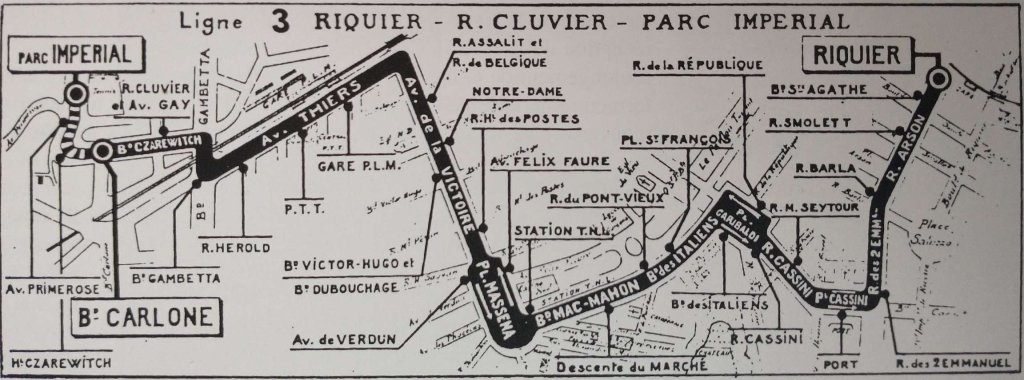
The Route from Place de Riquier to Parc-Imperial via the PLM Station on Avenue Thiers. This image shows the route as it was before 1934. It comes from the collection of Richard Panizzi. [1: p23]

Jose Banaudo continues: “After stopping at the station, the line continued West along Avenue Thiers where a new main post office was installed in 1931 in a large red brick building, in a rather incongruous style in our latitudes.  At the intersection of Boulevard Gambetta, the Parc-Impérial line briefly joined the ‘Circulaire’  in order to pass under the bridge of the PLM Marseille-Nice line.  Then, it branched off to the left into Boulevard du Czaréwitch (today Tzaréwitch) whose name honors the Crown Prince of Russia, Nicolas Alexandrovitch, who died in 1865 in a villa in this district where the Imperial family used to come stay in the winter.” [1: p22]
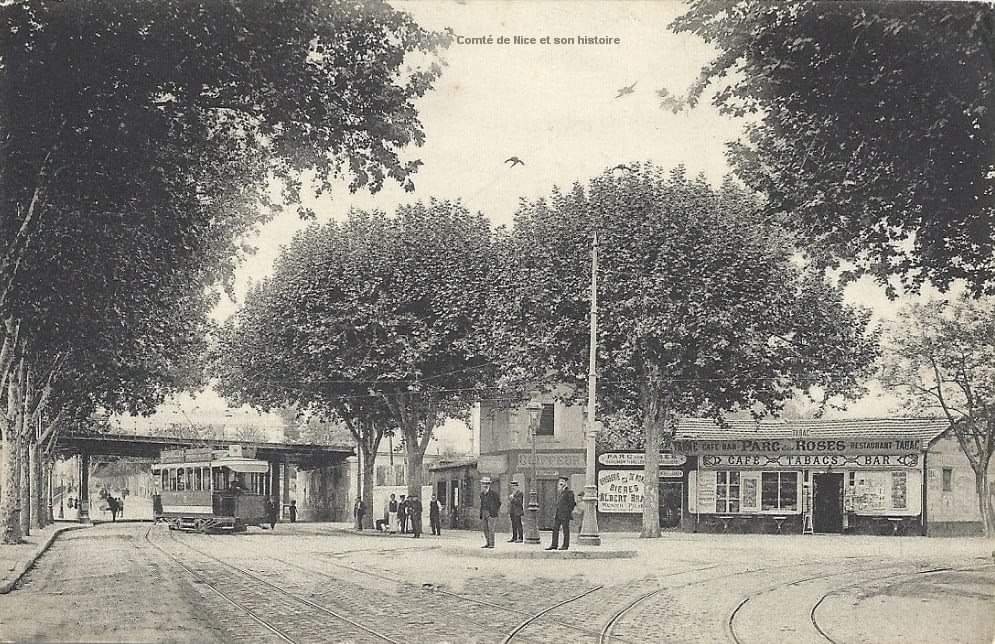
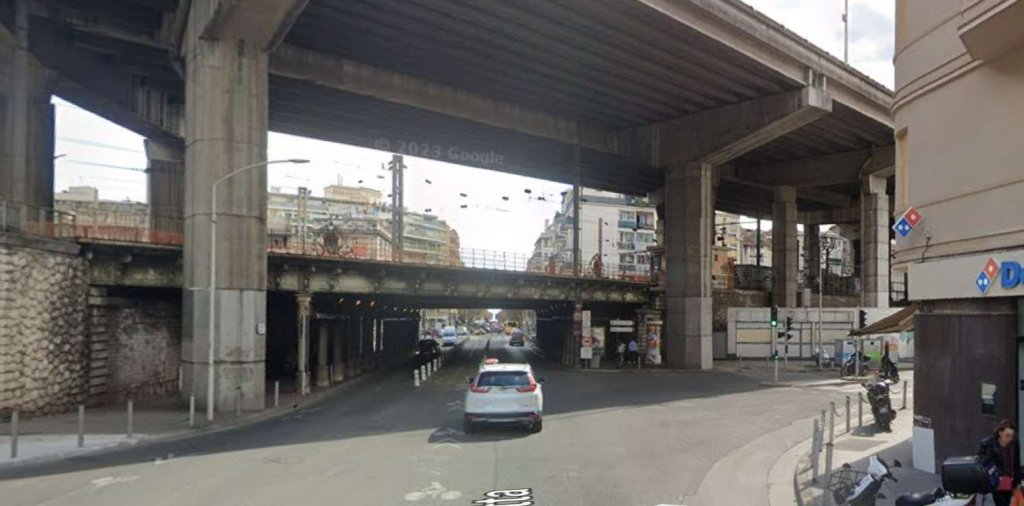
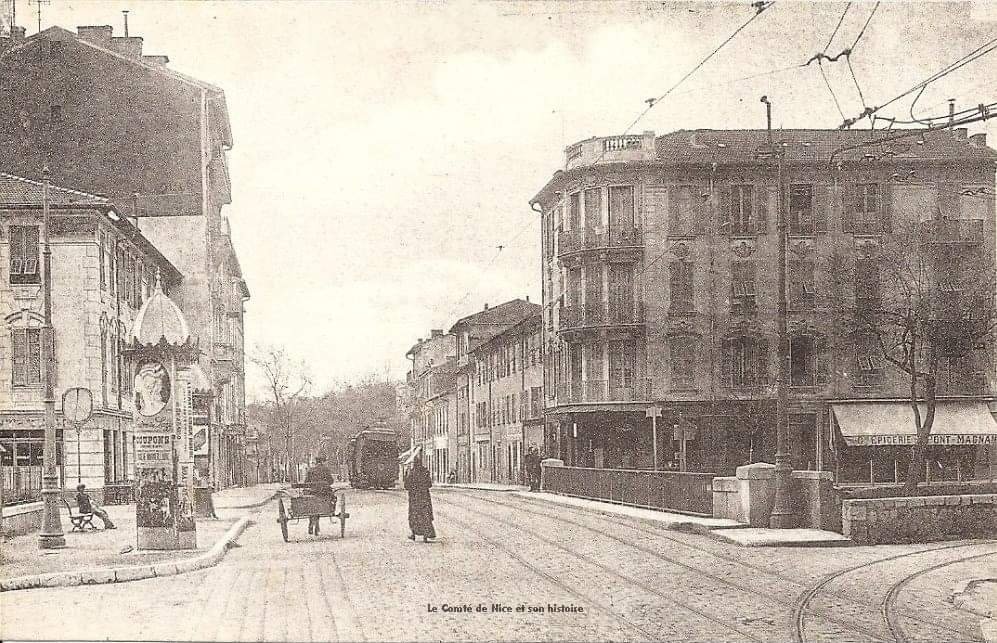
After passing under the railway bridge, T1 motor car crosses the triangle junction on Boulevard Gambetta to enter Boulevard Czaréwitch. This postcard image was shared on the Comte de Nice et son Histoire Facebook Group by Roland Coccoli on 18th June 2019 and 6th April 2023. [3]
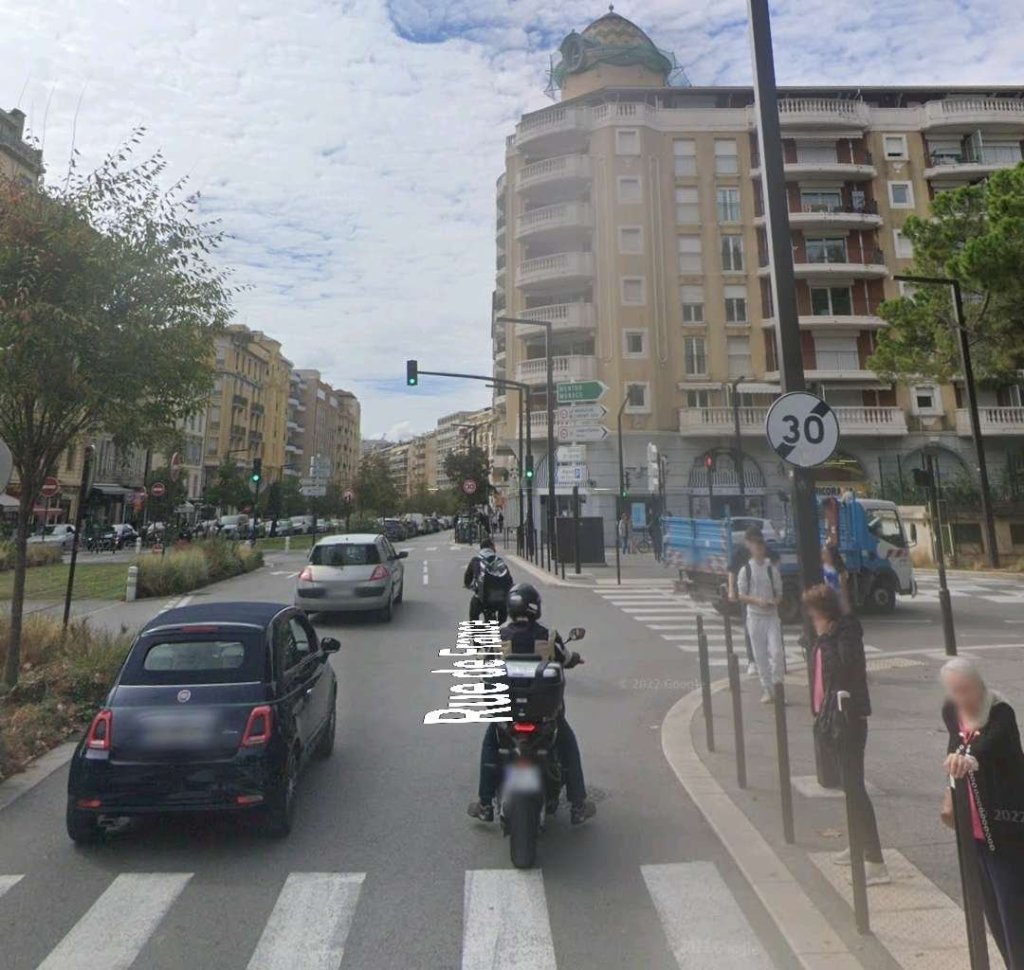
The same location in 2023, Boulevard Gambetta looking South. The scene is now dominated by the motorway flyover. [Google Streetview, April 2023]
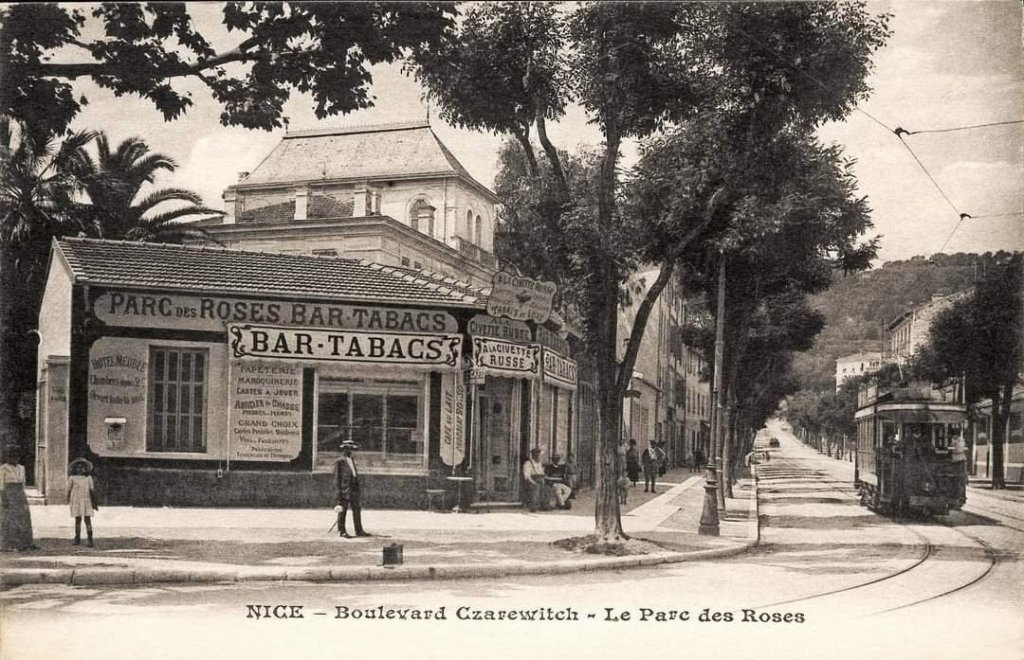
This postcard image comes from the collection of Jean-Pierre Garacio and was shared on the Comte de Nice et son Histoire Facebook Group on 27th January 2015 by Jean-Paul Bascoul. The photograph shows Boulevard Czaréwitch running into the distance on the right and depicts a T2 motor car arriving from Parc-Impérial and passing in front of the Parc des Roses hotel/bar-restaurant. The mention of “Civette Russet” above the entrance door at the centre of the image indicates the strength of the Russian community in this district where the imperial family frequently stayed in the second half of the 19th century. [4]
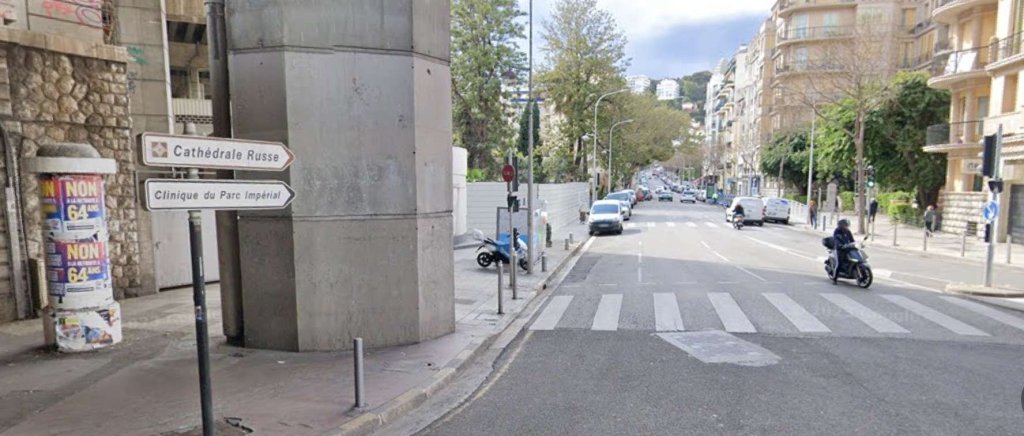
The camera is in approximately the same location taking this photograph. Boulevard Tzarewitch runs East from its junction with Boulevard Gambetta. [Google Streetview, April 2023]

Trams then passed in front of the Russian Orthodox cathedral, completed in 1912, and stopped at the crossroads with Rue Cluvier where the double track ended.  The urban service terminus was set shortly before the intersection with Avenue de la Tour-Lascaris (today Boulevard François-Grosso).

There was a further 529 metres of single-track climbing Boulevard du Parc-Impérial and Avenue d’Angleterre (today Paul-Arène) to terminate at the Southwest corner of the Grand Hôtel du Parc-Impérial. 
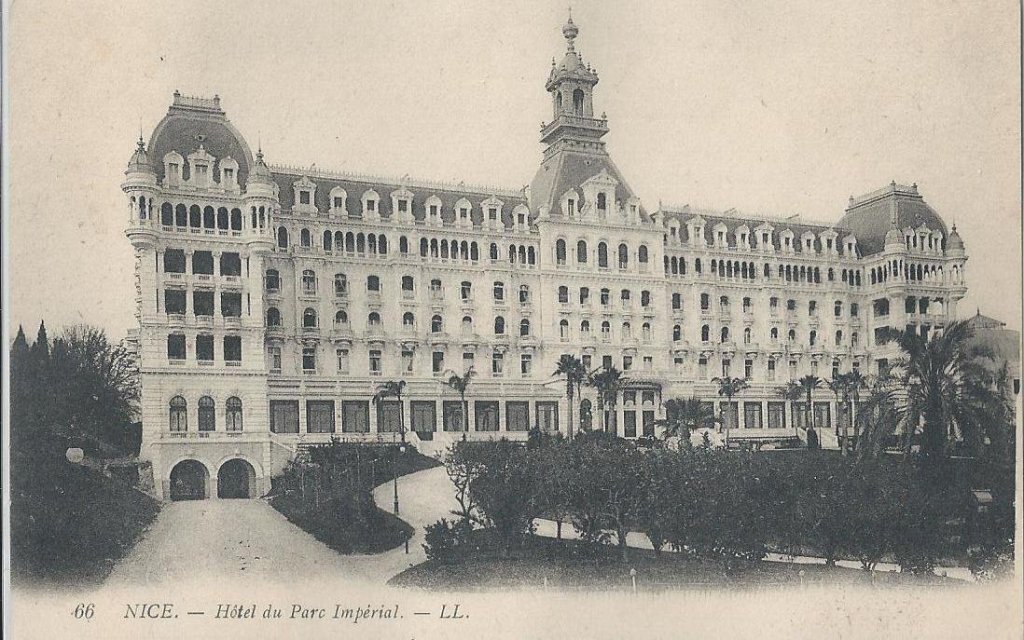
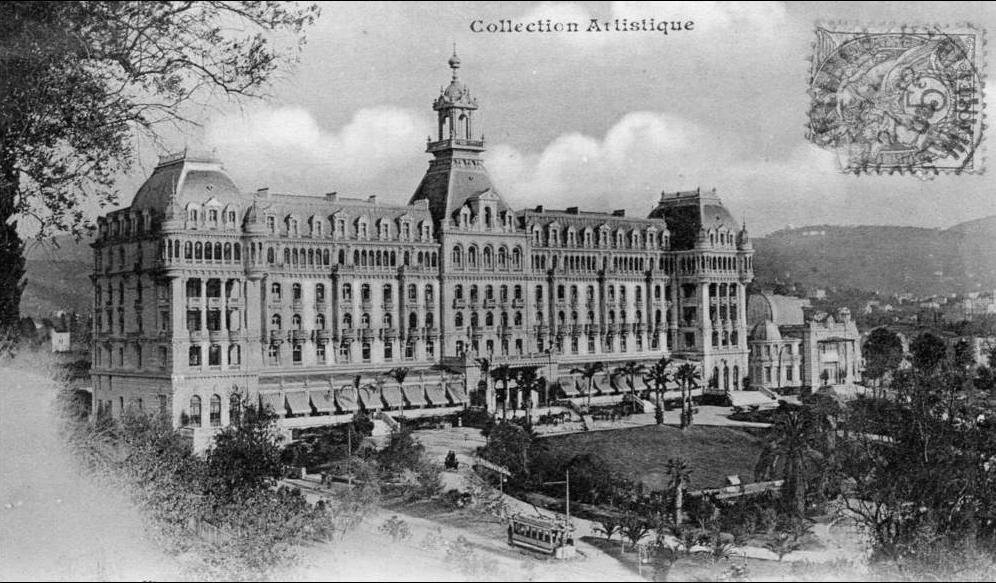
This is a postcard image of l’Hotel Parc-Imperial, Nice. [2]
Another view of the Hotel Imperial at Parc Imperial. In the foreground of this image a tram can be seen approaching the terminus of the line. This length of line was only used in the holiday season (between December and May). [5]

The Hotel opened in 1900 on the property where the Russian Imperial family came for vacation. It was this luxury establishment which had financed the extension of the tramway to its doors. The single-track section was only operated during the tourist (winter) season, from 1st December to 15th May.  It disappeared in the post-war years  when the hotel found itself in a difficult financial situation leading to its acquisition by the city of Nice in 1926 with a view to transforming it into a school.
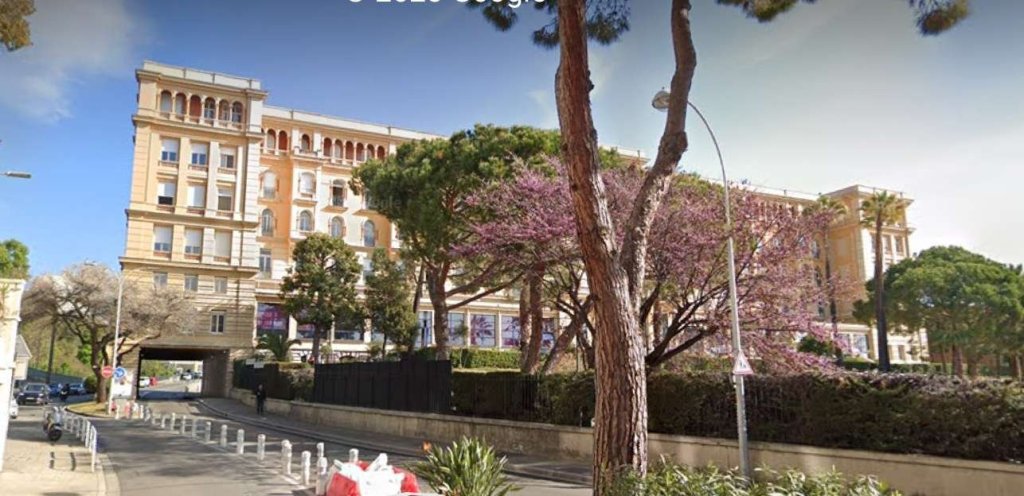
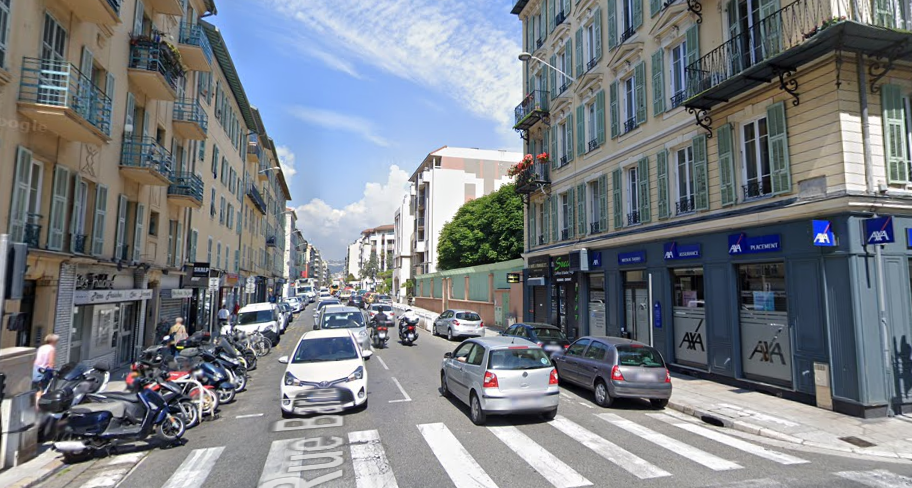
The Hotel Parc Imperial was purchased by the City of Nice in 1926 the roofline has changed but the building seems to have the same footprint in 2023. The tram seen in the image above was approaching the Hotel along the road in the foreground, (Avenue Paul-Arene in the 21st century). [Google Streetview, April 2023]

The Riquier-Parc-Impérial line linked a working-class district and a residential area in the hills, passing through the main transfer points of the urban network: the Port, Places Garibaldi and Masséna, then the PLM station. The route was used by services from Mont-Boron to the PLM station which used it after running between Mont-Boron and the Port on the Monte-Carlo interurban line.  In the 1934 redesign, this route disappeared with the exception of the Riquier – Port – Garibaldi section which was integrated into the new line No. 7. Line No. 7 was the last line served by trams, running until 10th January 1953.

La Ligne de la Gendarmerie, Pasteur, St. Pons et St. Andre

This line linked Place Masséna with St. Andre.

From the TNL station on Place Masséna, the double-track line ran along Rue Gioffredo.  Initially, this route also served the Monte-Carlo and Levens lines, and then, from 1934, all services serving the east of the city took this route. After passing behind Masséna high school and Voeu church, trams for St. Andre met the line arriving from the PLM station via Rue Tonduti-de-L’Escarène, and then saw the interurban lines turn away to the right via Rue Defly towards Place Garibaldi.

Until the end of the Masséna – Garibaldi route via the left bank of the River Paillon in 1934, Rue Defly and Pont Garibaldi were only used by interurban services to Levens, Villefranche, St. Jean-Cap-Ferrat, Beaulieu and Monte Carlo.

At the end of Rue Gioffredo, the service connection to the Cimiez line turned away to the left and St. Andre trams turned right into Boulevard Carabacel where there was a connection to the construction materials warehouse of Charles Véran. At Place Carabacel (today Jean-Moulin), tracks to Pont and Rue Barla turned away to the right. The tramway to Levens rejoined that for St. Andre after having detoured through Place Garibaldi.

The line then ran along the right bank of the River Paillon, then only lightly developed, via the quays of Place d’Armes and Pasteur (today Galliéni and Lyautey).  After passing under the PLM Nice – Ventimiglia railway, trams arrived at the stop serving  the Gendarmerie, which was the terminus for several years. From there, the single track followed the shoulder of the roadway on land recovered from the river bed.  Two branches served a fuel trader and the Andréis steel construction works.  The tramway then ran under the bridge of the PLM Nice – Cuneo line, after which there was a passing loop at the stop called ‘Vésubie’, at the intersection of avenue Florès.  It then ran alongside the district named Pasteur after the large hospital built in 1913, and where a velodrome brought great entertainment on race days. The valley narrowed here, at the foot of the hill where the monastery of Cimiez and the ancient abbey of St. Pons stand. Two stops with passing loops followed, at St. Pons-Octroi and St. Pons-Asile, the latter serving the psychiatric hospital Ste. Marie.

Shortly after this narrow passage where the ligne de Contes could be seen on the other bank of the river and where some services continued towards Levens, the St. André tramway left the Paillon valley to follow the Chemin de Grand Communication No. 19 (currently Departmentale No. 19) into the narrow valley of the River Banquière to reach the terminus at St. André.
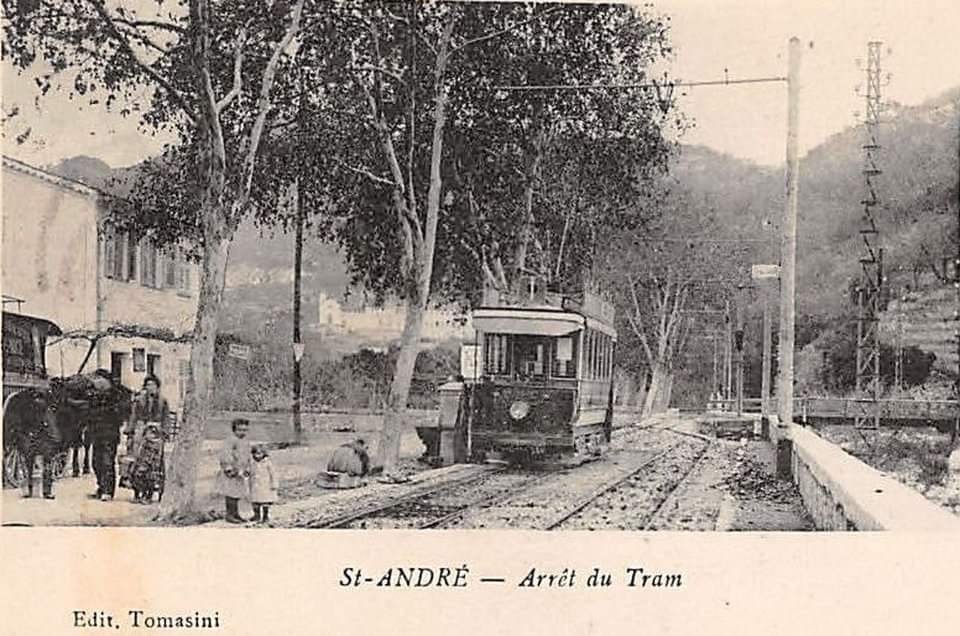
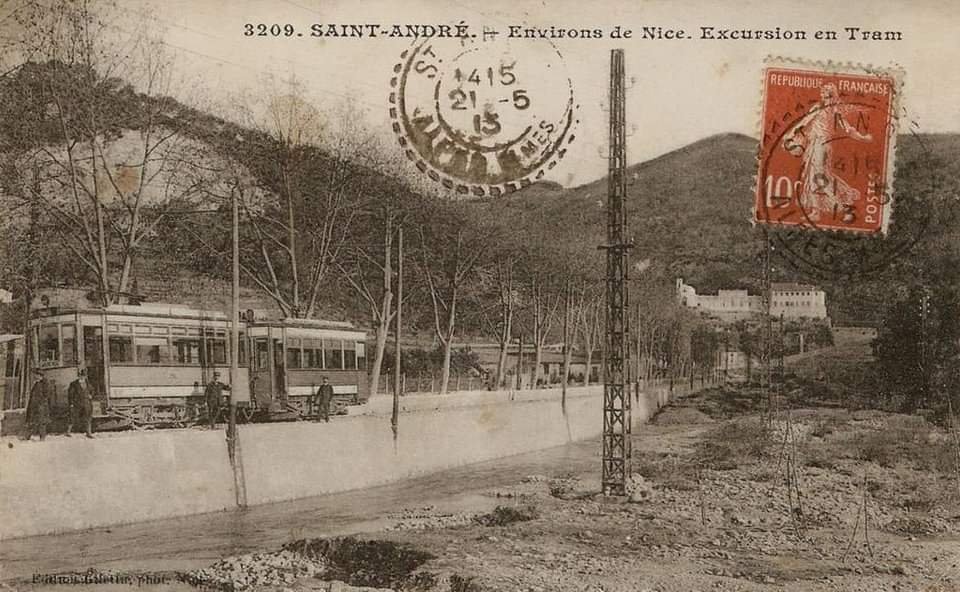
A tram for St. Andre waiting at the tram stop in the village which was in the Valley of the River Banquiere. [9]
Possibly a service for Levens in the immediate vicinity of St. Andre. These two images were shared by Roland Coccoli on the Comte de Nice et Son Histoire Facebook Group on 17th May 2020. [6]

I have been unable to locate these two views in relation to the landscape around St. Andre de la Roche in 2023. However, one group of buidlings does appear on the image below.
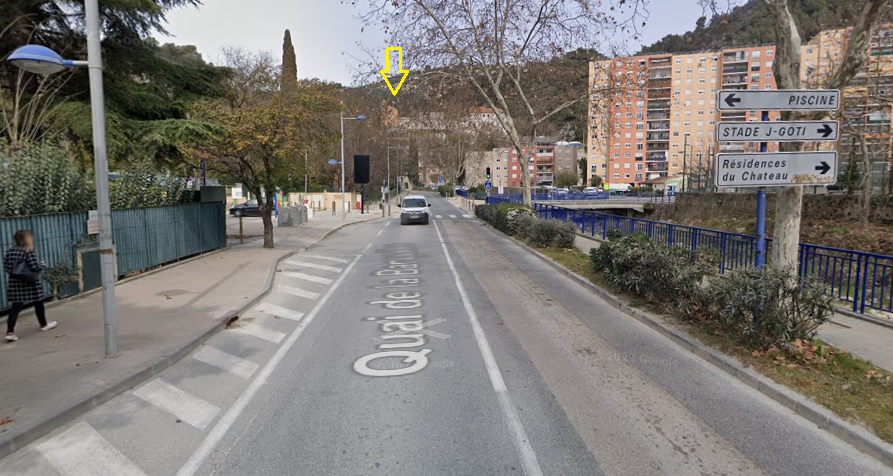
The group of buildings marked by the yellow arrow appear on both the monochrome images above. This suggests that the tram stop featured in those images was somewhere along the length of the M19 (Quai de las Banquiere) visible in this photograph. [Google Streetview, May 2023]

This line closed in September 1948 in favour of a replacement bus service.

La “Rocade” des Rules Barla, De Lepante et Assalit (Sauzzo – Gare PLM – Carras)

This route, was created to link the East to the West of the city of Nice via the main railway station. The location of its termini was altered several times. Intentionally, it served less busy streets.
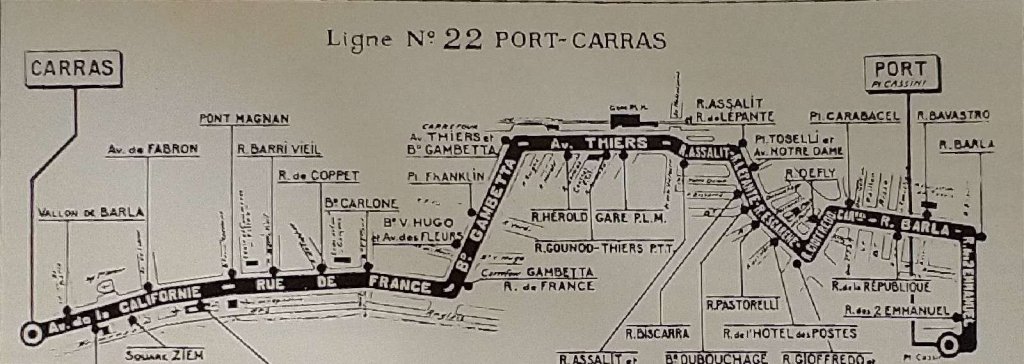
The route as of 1934, from the collection of Richard Panizzi. [1: p28]

At its Eastern end it originated not far from the Port in the Riquier district, on Place Saluzzo (today Max-Barel) which since 1908 has been the starting point of the “Moyenne Corniche” towards the Col de Villefranche.  From there, a dedicated route led via Boulevard Imperatrice-de-Russie Boulevard (today Lech-Walesa) to warehouses which were used by the army during the First World War. 

The double track followed Rue Barla in a westward direction where, just 87 m from its starting point, it crossed Rue Arson and the line going down from Riquier towards the Port.  Shortly after, the tram passed in front of the tobacco factory.
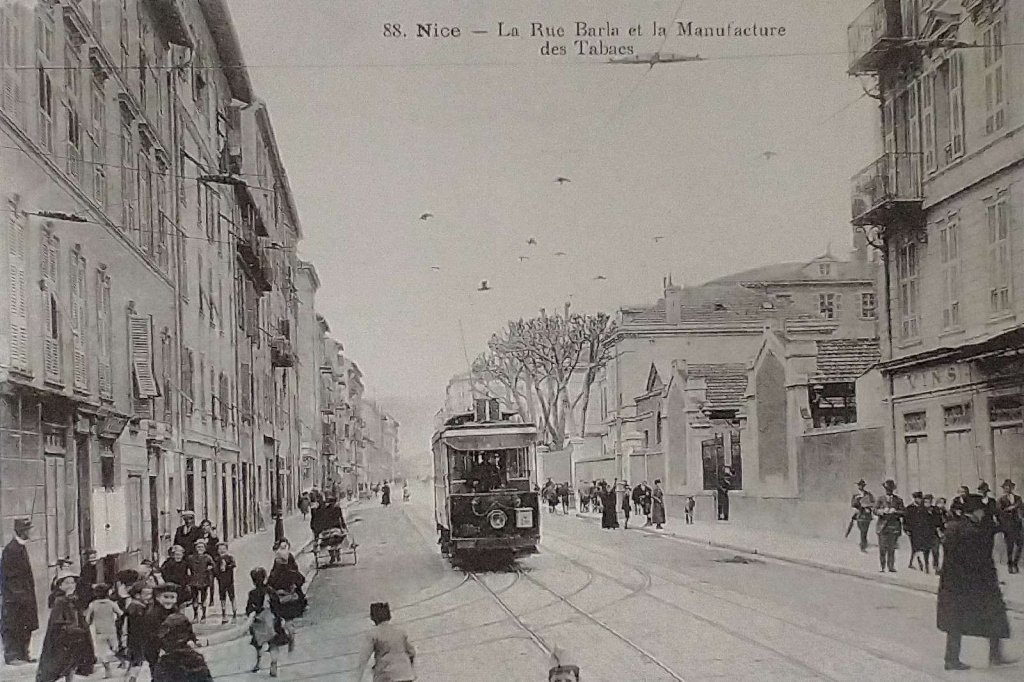
A T2 motor car providing a Carras – Saluzzo service has just passed in front of the ‘Manufacture des Tabacs’ and is arriving at the crossroads of Rue Barla and Rue Arson. The branch to the left is used by freight trains traveling between the port and Gare du Sud, from the collection of Andre Lebecque. [1: p27]
Approximately the same location in the 21st century. This photograph was taken at the junction of Rue Baral and Rue Arson. [Google Streetview, January 2019

At the crossroads with Rue de la République, it crossed the line of Abattoirs, La Trinité and Contes, and then crossed the River Paillon on Le Pont Barla. Banaudo says that this was, “a beautiful structure with three cast iron arches in a style similar to that of the Garibaldi bridge nearby.” [1: p27] 

Now on the right bank of the Paillon, the line met La Ligne de St. Pons which it followed for a short distance along Boulevard Carabacel and Rue Gioffredo. [1: p27]
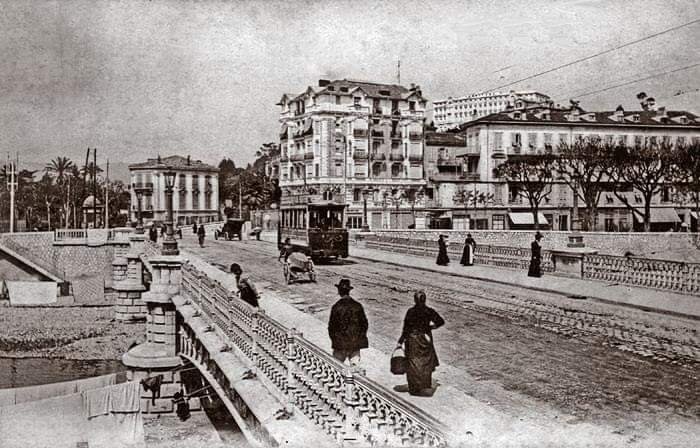
A Thomson tram crosses le Pont Barla towards the street of the same name and Place Saluzzo.  In the background is Place Carabacel (today Jean-Moulin), from where the St. Pons line branched off towards Place-d’Armes (today Galliéni). Note the sheets, which have been washed in the river, drying on lines below the bridge. This photograph was shared on the Comte de Nice et son Histoire Facebook Group on 7th June 2016 by Roland Coccoli. [7]
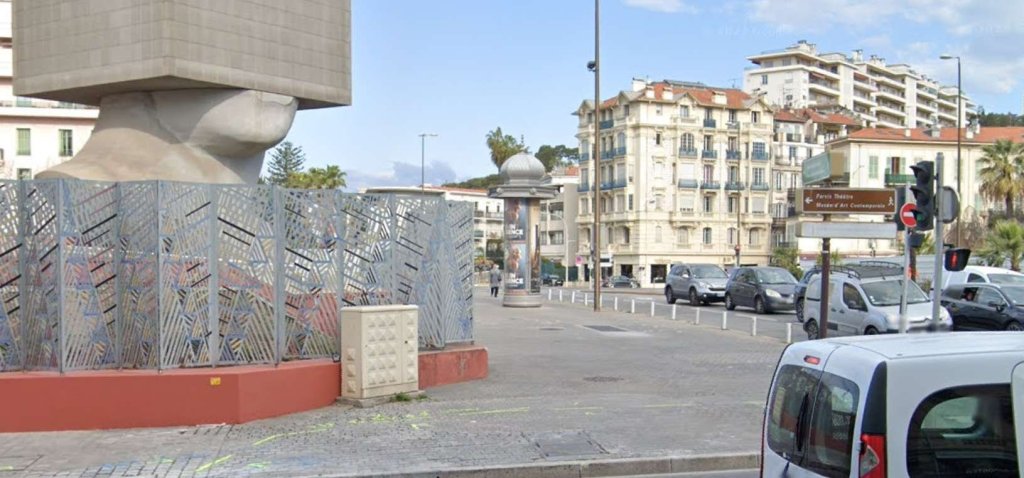
A similar view in 2023. The building just to the right of the centre of this image is the same as that at the centre of the image above. [Google Streetview, April 2023]

Arriving at the intersection of Rue Tonduti-de-L’Escarène, the tramway branched off to the North taking this fairly narrow street to Place Sasserno.  From there, it entered Rue de Lépante, which commemorates “a terrible naval battle against the Turks in 1571 in which ships crewed from Nice participated.” [1: p27]

Turning sharply to the West, the line followed the narrow Rue Assalit at the end of which it came out at the end of Avenue de la Gare (today Jean-Medecin). It crossed the tram tracks there and entered Avenue Thiers, stopping in front of the PLM station before following Avenue Thiers along its entire length to the intersection with Boulevard Gambetta.  At Boulevard Gambetta, the trams turned South towards the crossroads of Rue de France and then turned West to run along the same route as lines to La Madeleine, La Californie and Cagnes to a terminus at either Pont-Magnan or at Carras depending on its year of operation. [1: p27]
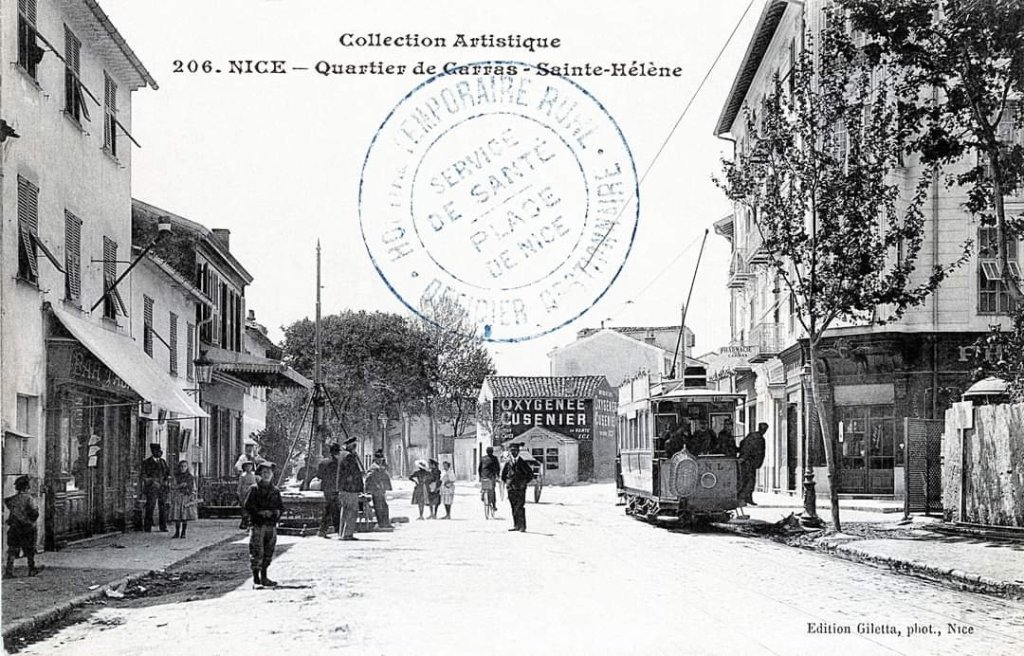
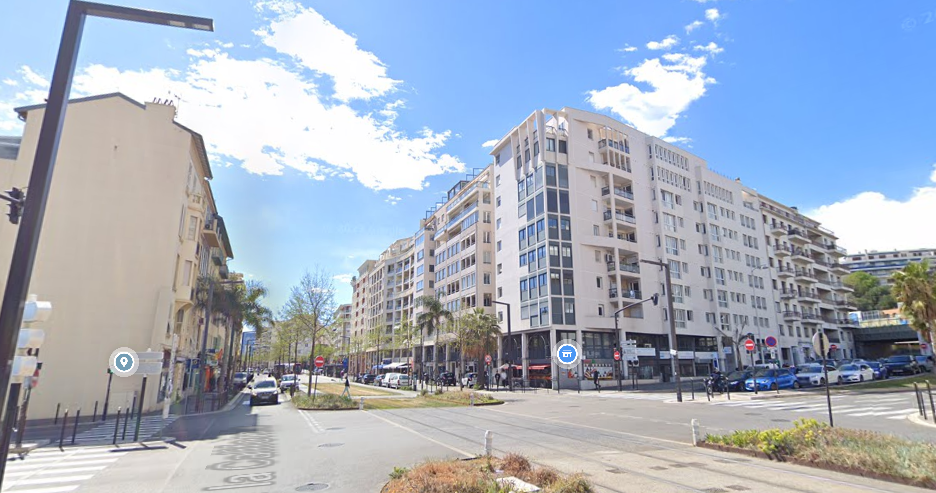
Nice – Carras District – Saint Helene – tram stop. The stamp at the centre of the card shows that it was sent during WWI from the Ruhl temporary hospital which was used for war-wounded soldiers and which was in the building that in calmer times was the Ruhl Hotel on the Promenade des Anglais. This postcard image was shared on the Comte de Nice et son Histoire Facebook Group by Jean-Paul Bascoul on 26th February 2023. [8]
The Avenue de la Californie in 2023. The road forms the main artery for Nice’s modern tram service to and from the Airport. This photograph is taken close to the terminus of the tram route in Carras. [Google Streetview, April 2023]

This line closed in November 1948 in favour of a replacement bus service.

La “Circulaire” Par le Passage a Niveau (Ste. Agathe – Passage a Niveau Gambetta)

Of all of the lines in the Nice tram network, this line was the most varied. Over most of the route, it followed tracks used by other lines. The only exceptions, Banaudo tells us, “being the lengths between Gare du Sud and  PN  Gambetta and at the Gambetta / Czaréwitch crossroads.” [1: p30]
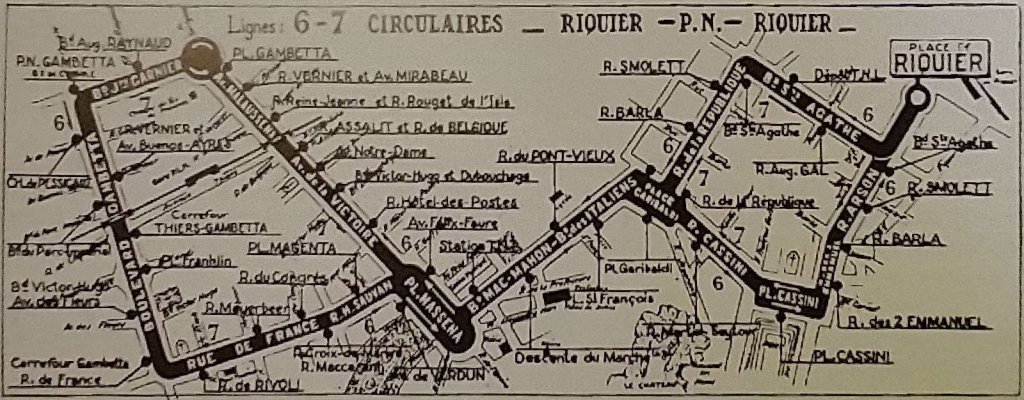
This route map comes from the collection of Richard Panizzi. [1: p31]

Banaudo goes on to say that the route, “lost its circular character in 1934 with the elimination of the north-south axis via the avenues, but part of its route was taken up later to create line 7 which  was the last served by trams, closing in 1953.” [1: p30]

Initially, the ligne “Circulaire” services left Place Masséna along Avenues de la Gare (now Jean-Medecin) and Malaussena to Place Gambetta (today Général De Gaulle) in front of the Gare du Sud.  “There, the route branched off to the west taking Boulevard Joseph-Garnier to the level crossing of the Nice – Digne and Nice – Meyrargues lines of the Chemins de fer du Sud de la France (SF).  The TNL double track crossed that of the SF by a quadruple crossing on which traffic was governed by instructions common to the two companies.  Here, the trains had priority over the trams: an announcement by electric bell warned the barrier guard of their approach, who closed the signals for the tram and then stretched four chains across the road to stop traffic.  In the north-west corner of the level crossing, a TNL track connected to a long siding belonging to the SF, through which the goods convoys commuting from the Port were pushed back towards the goods yard of the Gare du Sud.” [1: p30]
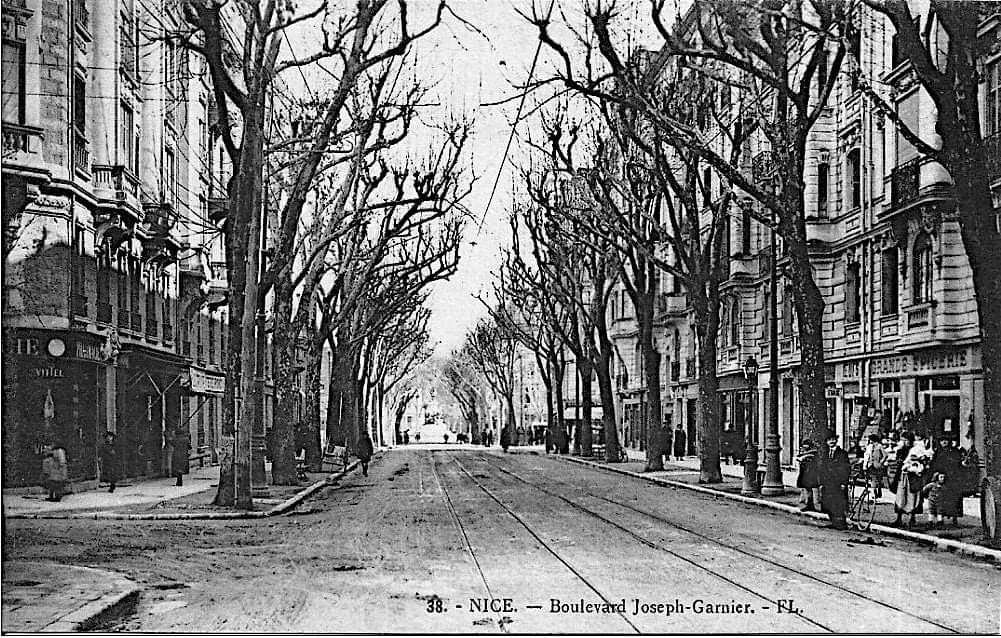
A winter view of Boulevard Joseph-Garnier looking East with tram tracks visible in the road surface. [9]
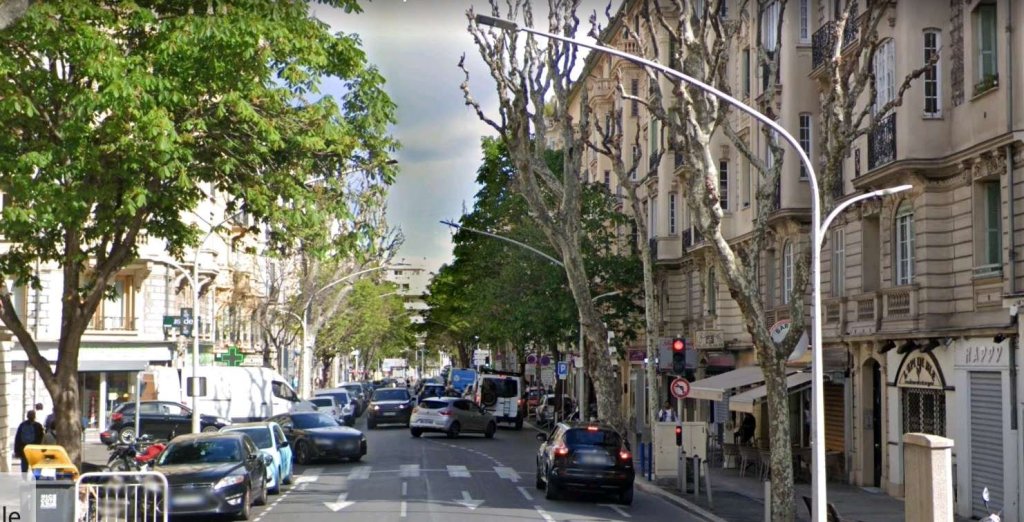
The same location on Boulevard Joseph-Garnier in April 2023. The photograph is taken from a point just a few tens of metres to the West od the monochrome image above. [Google Streetview, April 2023]

After this the “Circulaire” ran South along Boulevard Gambetta.  At the crossroads of Boulevard Czaréwitch (today Tzaréwitch), the line to the Parc-Impérial left to the West. The “Circulaire” then passed under the railway bridge.  After which, the lines towards the PLM Station branched off to the East onto Avenue Thiers. Some distance further South, the “Circulaire” turned left (East) into Rue de France, joining the route used by trams serving La Madeleine, Carras and Cagnes and returned to Place Masséna.

Banaudo tells us that, “Later, the route was extended eastwards in three stages: – First to the Port via Boulevards Mac-Mahon and du Pont-Vieux (today Jean-Jaurès), Place Garibaldi and Rue  Cassini. Then, an additional loop was added to this circuit: from the Port, it went up Rue Arson to Boulevard Ste.  Agathe, running along that street to reach Rue de la République and then Place Garibaldi.” [1: p30]

A third short “extension allowed Place de Riquier to be served, which the tramway reached in one direction via the Port and in the other via Boulevard Ste. Agathe.” [1: p30]
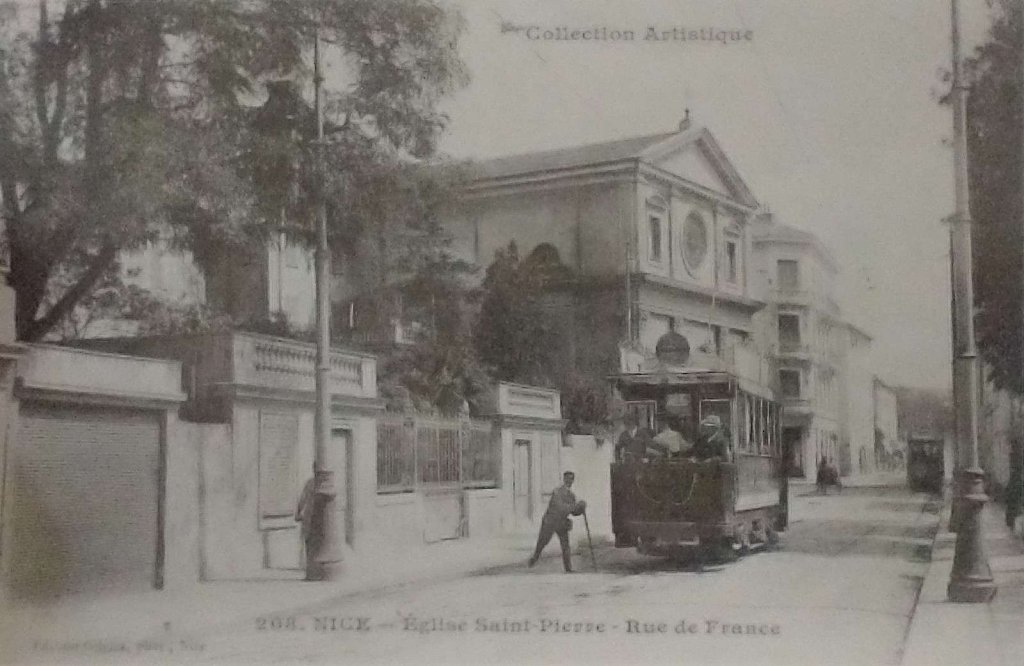
Rue de France, the Thomson tramcar nº 38 has just passed a car going in the opposite direction in front of the l’Eglise St.Pierre-d’Arène heading towards Boulevard Gambetta. The disk at the front of the roof indicates that the tram is on the “circulaire” service. The photograph was taken by Giletta in the period before the 1st World War. The church was extensively  remodelled in the period between the two world wars. This image comes from the collection of Jean-Pierre Garacio. [1: p32]

This line finally closed in January 1953 in favour of a replacement bus service.

La Ligne de la Madeleine (Masséna – La Madeleine)

The last line to open in Nice’s urban tram network served La Madeleine running initially from Place Masséna but it’s Eastern terminus changed on a number of occasions. First to the Port, then Abattoirs and finally La Trinité Victor. 

Departing from Place Masséna, the tramway first the main East-West artery heading towards Carras and Cagnes. At Pont Magnan it turned North and became a single-track route. A passing loop was installed just to the North of the junction.
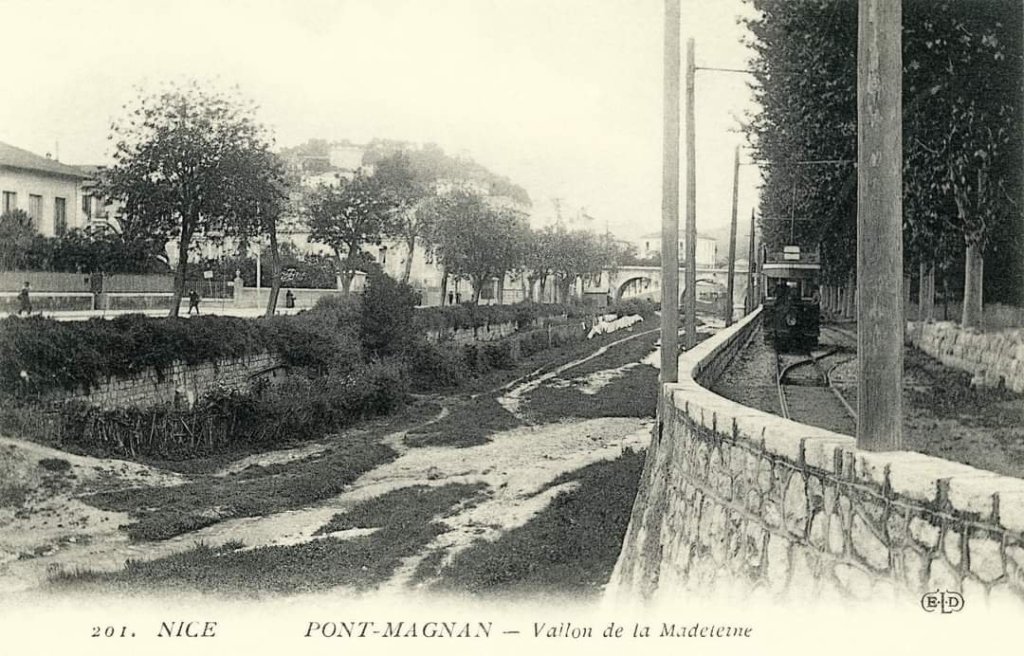
Just to the North of Rue de France a tram sits in the passing loop presumably awaiting the arrival of another tram from Place Masséna. This image looks North toward the PLM railway viaduct. It was shared on the Comte de Nice et son Histoire Facebook Group on 2nd February 2023 by Jean-Paul Bascoul. [14]
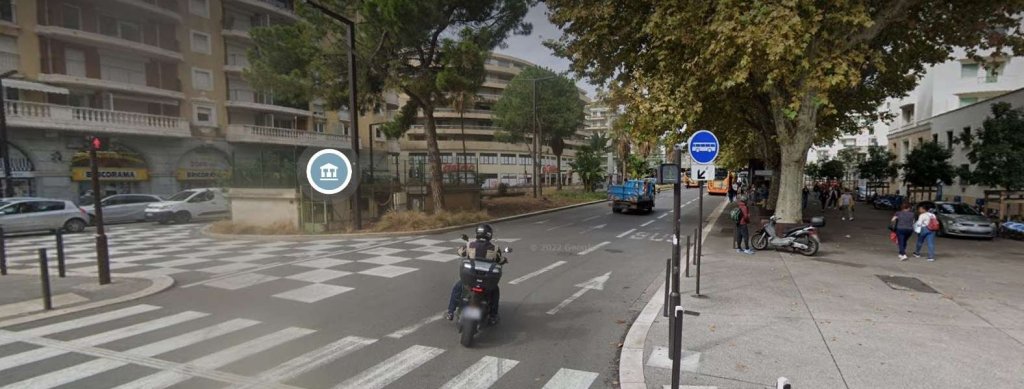
Looking from Rue de France along Boulevard de la Madeleine in October 2022. During the 20th century, the River Magnan was culverted leaving the immediate area looking very different to the monochrome view above! [Google Streetview, October 2022]
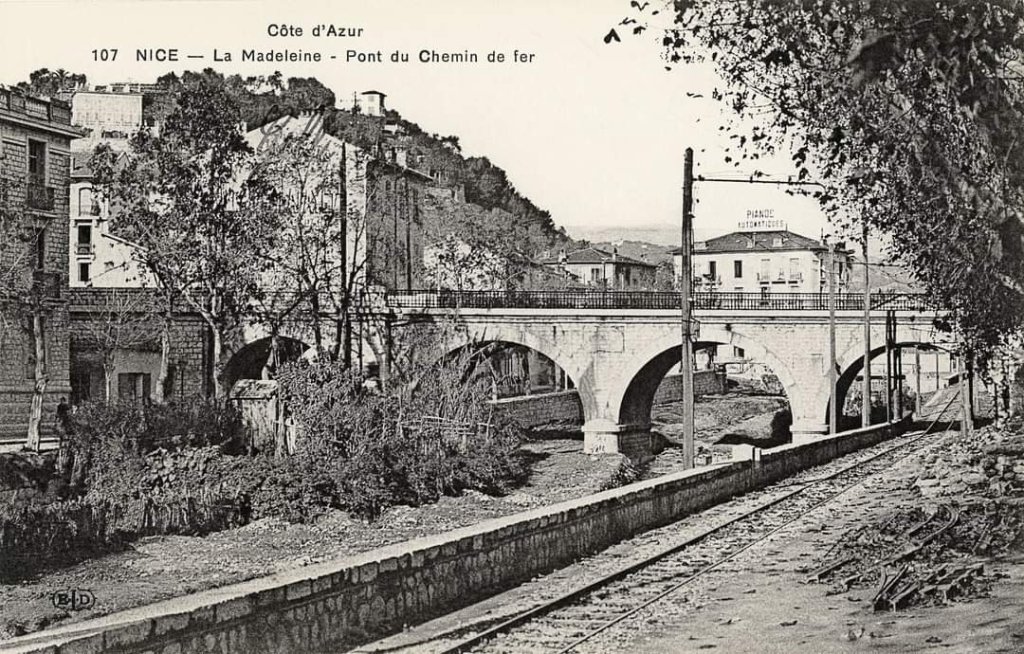
The tramway running along the left bank of the River Magnan the PLM Marseille – Nice railway was carried over the River on the viaduct at the centre of this image which looks North and which was shared on the Comte de Nice et son Histoire Facebook Group by Jean-Paul Bascoul on 16th April  2020. [11]
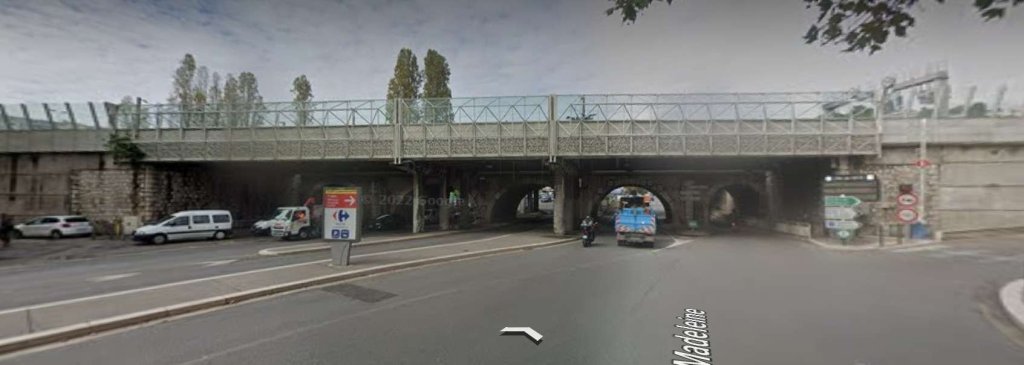
A similar view in 2022 to that immediately above. The railway viaduct, in the 22st century is flanked on both North and South faces by the high level dual carriageway Voie Pierre Mathis. [Google Streetview, October 2022]

Passing under the PLM Marseille – Nice railway line, the track ran along the left bank of the River Magnan, between Boulevard de La Madeleine and the river. Jose Banaudo tells us that the line “takes its name from the silkworm breeding industry … which flourished in this sector until the end of the 19th century.” [1: p33]
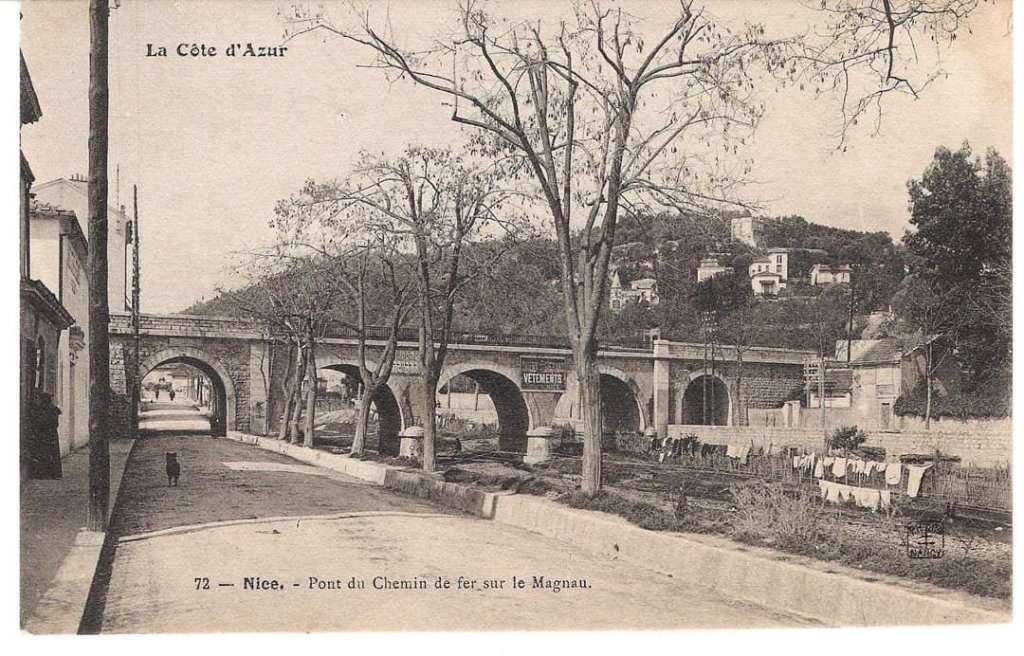
Looking South, this postcard image shows the railway viaduct across the Valley of the River Magnan. Trams ran between the road at the river. This image was shared on the Comte de Nice et son Histoire Facebook Group by Roland Coccoli on 16th April 2016. [12]
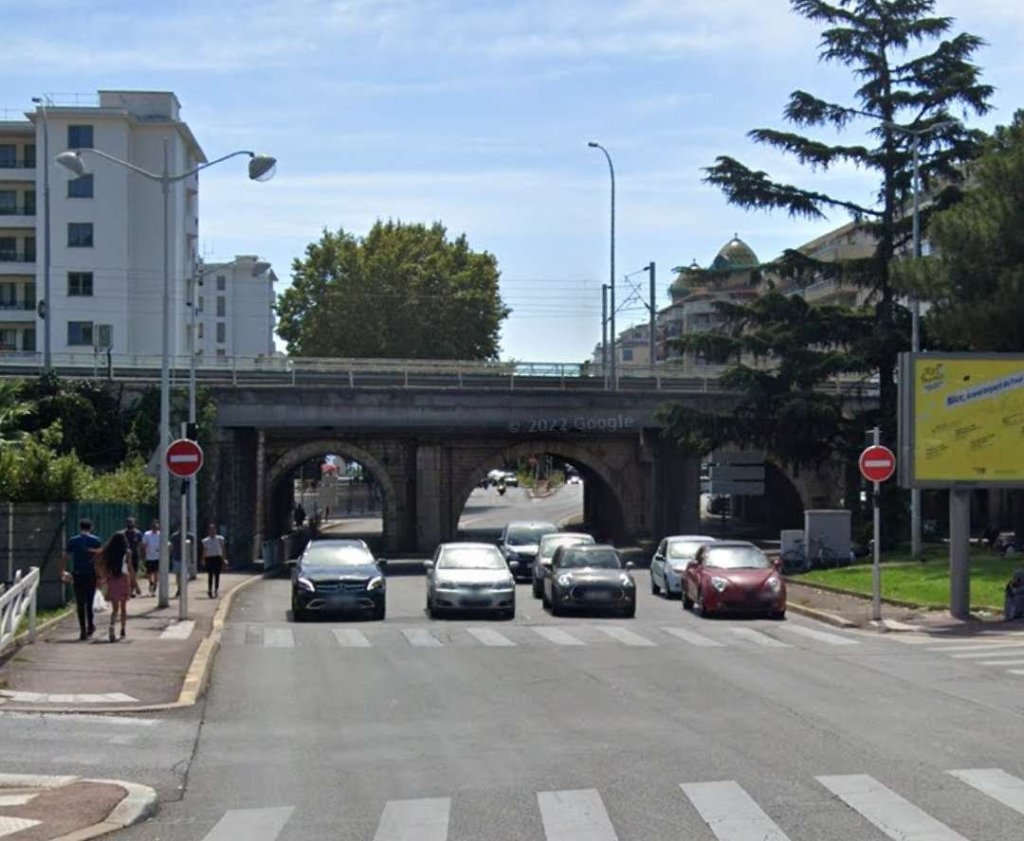
Also looking South towards the Mediterranean, this 21st century view emphasises the changes which have occurred in the valley of the River Magnan. [Google Streetview, August 2020]
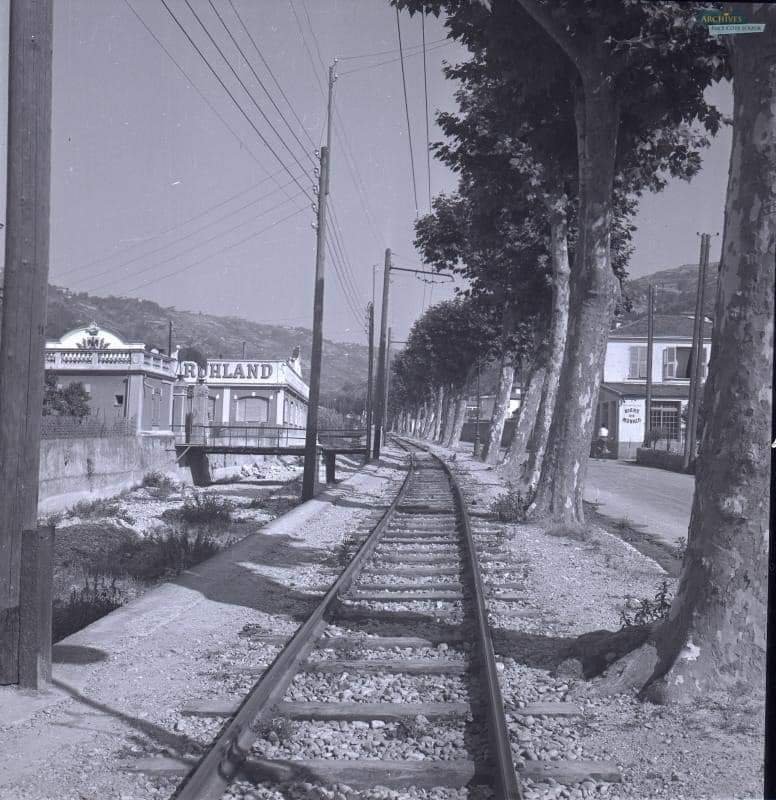
Further North and looking North in 1942. Some work was undertaken in the river channel that year. This image predates the work. It was shared on the Comte de Nice et son Histoire Facebook Group by Charles Louis Fevrier on 17th January 2021. [13]
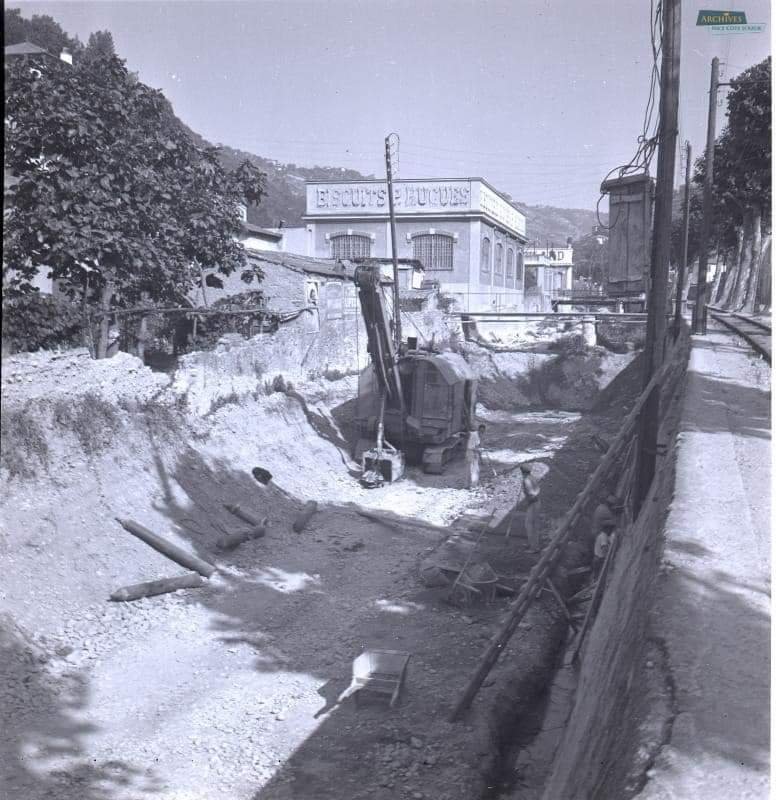
Approximately the same view during the work in 1942. [13]
Looking North again. The Boulevard de la Madeleine follows the line of the River Magnan which continues in culvert. It is impossible to locate a modern photograph at the location of the monochrome images above as there has been so much development in the river valley. [Google Streetview, April 2023]
Looking South at the same location. All three of these images were shared on the Comte de Nice et son Port Facebook Group on 17th January 2021 by Charles Louis Fevrier. The tramway is visible in all three images. [13]

The Magnan valley, then a relatively sparsely populated district on the edge of the city, justified its tram service due to the presence of “numerous craft workshops and small factories such as a mechanical piano factory, a glassworks, a biscuit factory, a button factory and several laundries. These establishments also left their names on the tram stops, and later on the bus stops.” [1: p33]
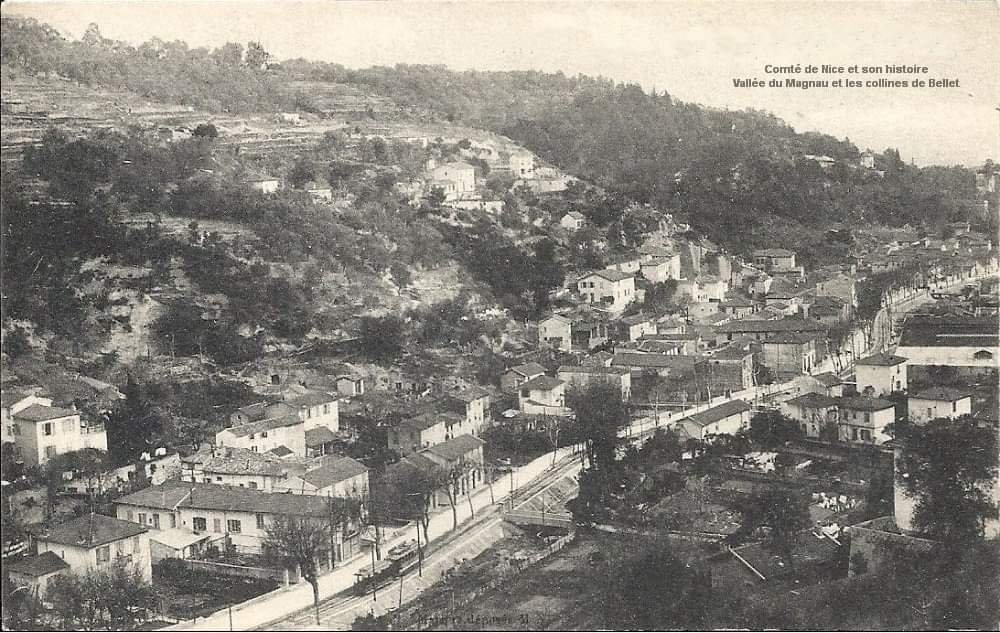
A tram running along the left bank of the River Magnan in La Madeleine. This image was shared on the Comte de Nice et son Histoire Facebook Group on 10th October 2019 by Roland Coccoli. [10]

On Sundays, the activity of the workshops was replaced by renowned restaurants with dance floors and boules. Many city dwellers came to spend a relaxing day in the countryside, which inevitably included an excursion to the “Trou des Etoiles”, a natural cave, 35 m deep at the base of Ventabrun hill which was then mentioned in the most prestigious tourist guides.” [1: p33]

Passing loops sat in front of two restaurants, “Chalet des Roses” and “Les Orangers”. The terminus was in the Place de La Madeleine (today Alexandre-Blanchi) below the church, the cemetery and la gare Sud-France station which served the village.
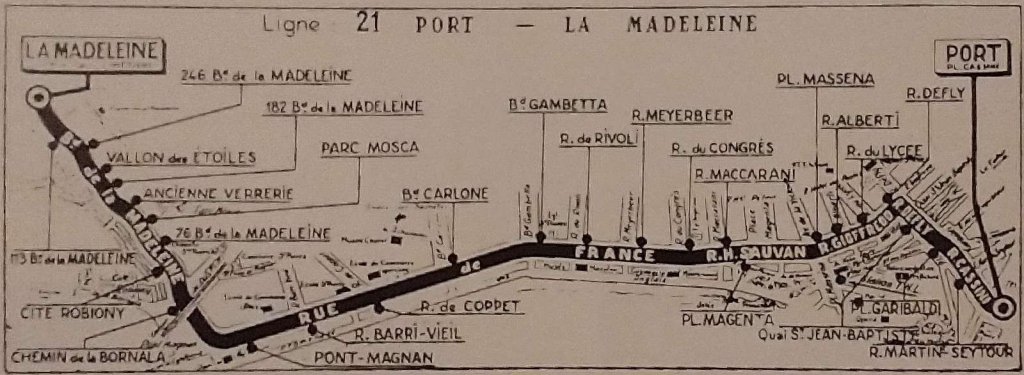
Once again, this route map comes from the collection of Richard Panizzi. [1: p34]

This line closed in December 1951 in favour of a replacement bus service.

References

  1. Jose Banaudo; Nice au fil du Tram, Volume No. 2: Les Hommes, Les Techniques; Les Editions de Cabri, Breil-sur-Roya, France, 2005. This is a french language text.
  2. https://cartepostale-ancienne.fr/image/data/nice2/nice%20anciennes%20cartes%203%20-%20Copie%20(2).jpg, accessed on 18th September 2023.
  3. https://m.facebook.com/groups/ciccoli/permalink/3653570808222095, accessed on 18th September 2023.
  4. https://m.facebook.com/groups/ciccoli/permalink/3603827463196430, accessed on 19th September 2023.
  5. https://www.geneanet.org/cartes-postales/view/5006424#0, accessed on 19th September 2023.
  6. https://m.facebook.com/groups/ciccoli/permalink/2772946732951178, accessed on 19th September 2023.
  7. https://m.facebook.com/groups/ciccoli/permalink/1767626043483257, accessed on 23rd September 2023.
  8. https://m.facebook.com/groups/ciccoli/permalink/3627417797504063, accessed on 23rd September 2023.
  9. https://m.facebook.com/groups/ciccoli/permalink/3258725034373343, accessed on 23rd September 2023.
  10. https://m.facebook.com/groups/ciccoli/permalink/3254264148152765, accessed on 27th September 2023.
  11. https://m.facebook.com/groups/ciccoli/permalink/3660228510889658, accessed on 27th September 2023.
  12. https://m.facebook.com/groups/ciccoli/permalink/1747300928849102, accessed on 27th September 2023.
  13. https://m.facebook.com/groups/ciccoli/permalink/2999148096997706, accessed on 27th September 2023.
  14. https://m.facebook.com/groups/ciccoli/permalink/3608755489370294, accessed on 27th September 2023.
The First Generation Electric Tramways of Nice again. Four of the Urban Lines. (Chemins de Fer de Provence/Alpes-Maritimes No. 88)

Jose Banaudo published a two volume set of books about the historic trams of Nice, “Nice au fil du Tram.” Articles based around the first of these two volumes can be found on the following links:

https://rogerfarnworth.com/2018/08/28/tnl-tramways-during-the-first-world-war-chemins-de-fer-de-provence-80/

https://rogerfarnworth.com/2018/12/28/tnl-tramways-recovery-after-the-first-world-war-chemins-de-fer-de-provence-83/

https://rogerfarnworth.com/2019/04/09/the-tnl-tram-network-the-beginning-of-the-decline-1927-1934-chemins-de-fer-de-provence-84/

https://rogerfarnworth.com/2019/10/14/the-tnl-tram-network-the-changes-in-the-urban-network-1929-1934-chemins-de-fer-de-provence-86/

https://rogerfarnworth.com/2020/08/12/the-tnl-tram-network-chemins-de-fer-de-provence-87/

This new post is the first of a series of articles based on the second volume. [1] The books were published as French language texts, quotations directly from the books have been translated with the assistance of ‘Google Lens’ and ‘Google Translate’.

Jose Banaudo tells us that, after a time served only by horse-powered trams, Nice granted concessions to the Tramways de Nice et du Littoral (TNL). Those concessions were granted, line by line, by the city of Nice, by the State, by the Principality of Monaco, by the Port of Nice and by the Departmente des Alpes-Maritimes on the understanding that electrically powered trams would be used. The individually granted concessions meant that the TNL had to work hard to ensure that the differences between these concessions did not significantly affect the service it provided to the public. In fact, it achieved “a remarkable technical unification of its operations.” [1: p6]

Rather than looking at the detail of the statutes, Jose Banaudo has grouped his work into three main categories: the urban lines of Nice; those of the coast (including the urban networks of Monaco and Menton); and those of the hinterland.

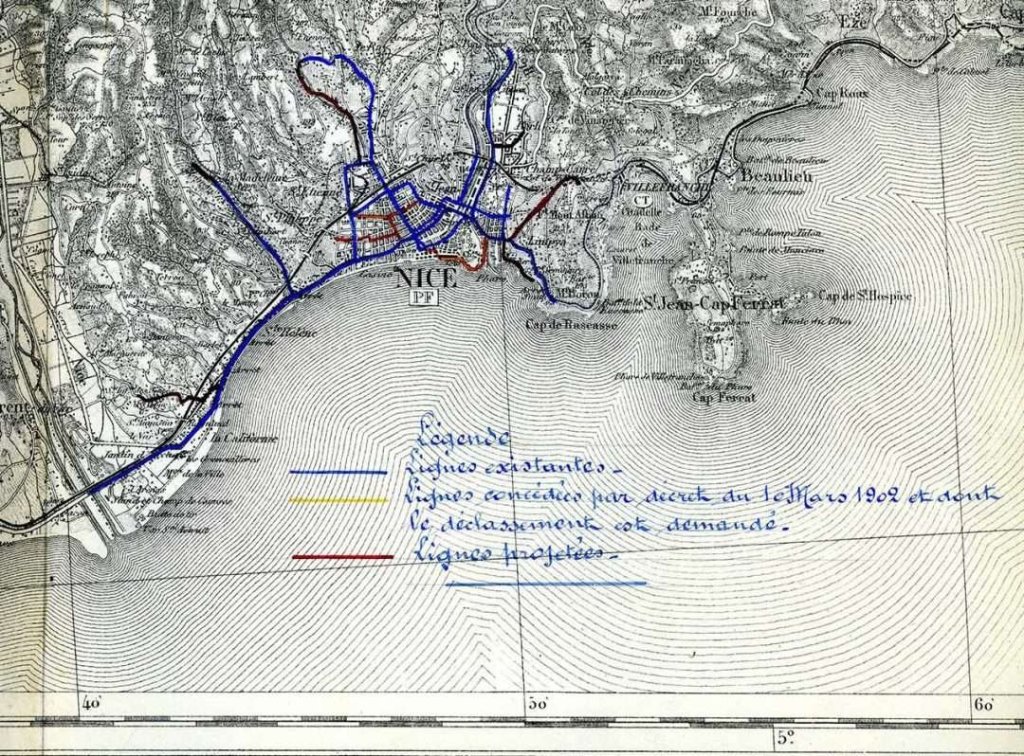
Held in Nice Archive Library, this is a map of the tram network (cartes du reseau des tramways), in the early 20th century. Archives Nice Côte d’Azur, 2 O 3. [3]

The urban network in Nice was built in just a short time between 1900 and 1902. “Subsequently, the mileage was increased in 1903 by the Parc-Impérial line, in 1907 by the extension of the Gendarmerie to St. Pons line, then in 1908 by the line to La Madeleine and the extension from St. Pons to St. André.” [1: p6] Banaudo tells us that, “Other lines planned for the residential areas of the city centre and on the edge of the Old Town were not built, following disagreements with the municipality.” [1: p6]

In the first chapter of his book, [1] Jose Banaudo covers the nine original urban lines, and the modifications made to that network. This article covers four of those lines.

He notes that until the end of 1922, the lines were designated by a number which did not appear on the vehicles. On 1st January 1923 visible numbering was introduced which was then altered on 8th October 1934. This later renumbering took account of the removal of the north-south axis route and most of the interurban lines ….

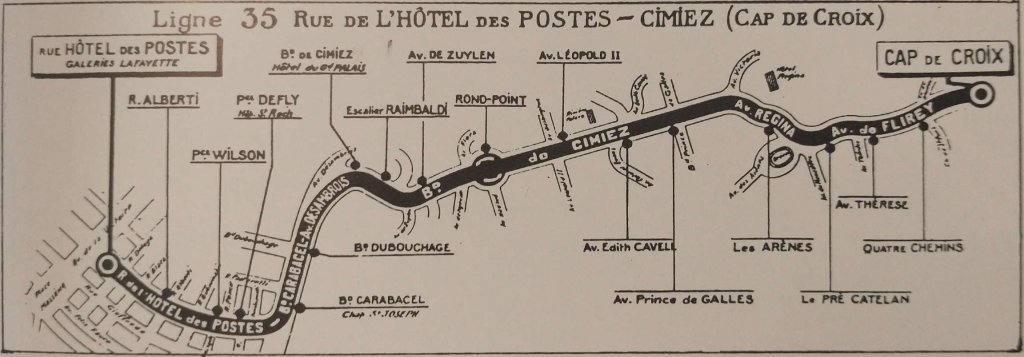
For each of the lines covered below, Banaudo provides a route map. The route maps used comes from a series produced in 1934.

La Ligne de Cimiez

The first tramway on this route was a 600mm track gauge tramway created in 1895. The new tramway was double track for most of its route, it began at the corner of Rue de l’Hôtel-des-Postes and Avenue de la Gare, where it connected with the tracks going up the avenue from Place Masséna.

This, and subsequent route maps, show each route as it was in 1934. They are sourced from the collection of Richard Panizzi. [1: p7]
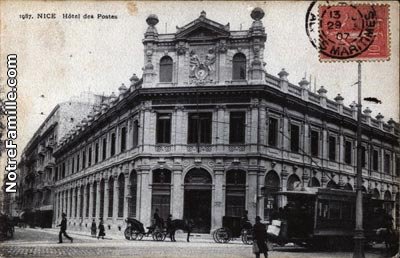
L’Hotel des Postes with a tram running on Rue de l’Hotel des Postes. [2]
L’Hotel des Postes looking North from Rue Foncet in October 2022. [Google Streetview, October 2022]

After passing Place de la Liberté (now Wilson) in front of the main post office (built in 1888 and which gave its name to the street), it reached the crossroads at Rue Tonduti-de-L’Escarène where it was crossed at right angles by the route between Nice’s Port and the Railway Station. (That route was used both for passengers and for goods.

The line crossed Place Defly (today Marshall) where it passed in front of the main entrance of the l’hopital St. Roch. It then passed the end of the Rue de l’Hôtel-des-Postes (initially named Scaliéro at that point) close to the southern slopes of the hill of Cimiez. Here the tramway veered left onto Boulevard Carabacel, while on the right a short walk of 140 m made it possible to reach the depot of Ste. Agathe via the Barla bridge.

Around here were elite villas and a few luxurious hotels, such as the Hermitage and the Grand-Palais, which had their own private funicular. At the end of Boulevard Carabacel, the Avenue Désambrois heralded the start of the Boulevard de Cimiez and its long climb to Les Arenes.

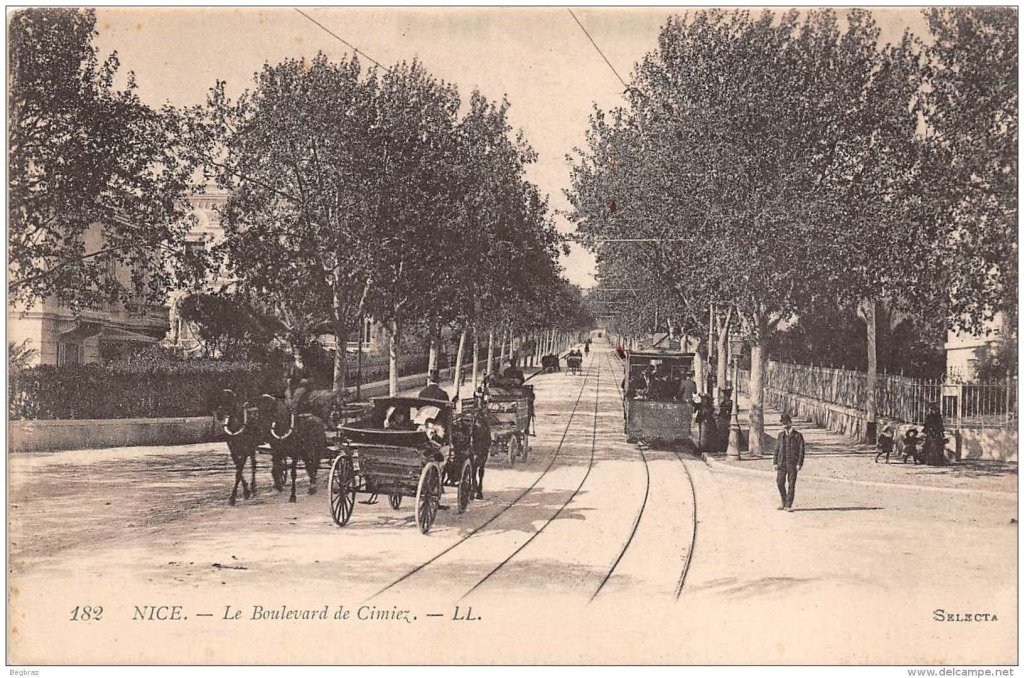
Le Boulevard de Cimiez. [4]
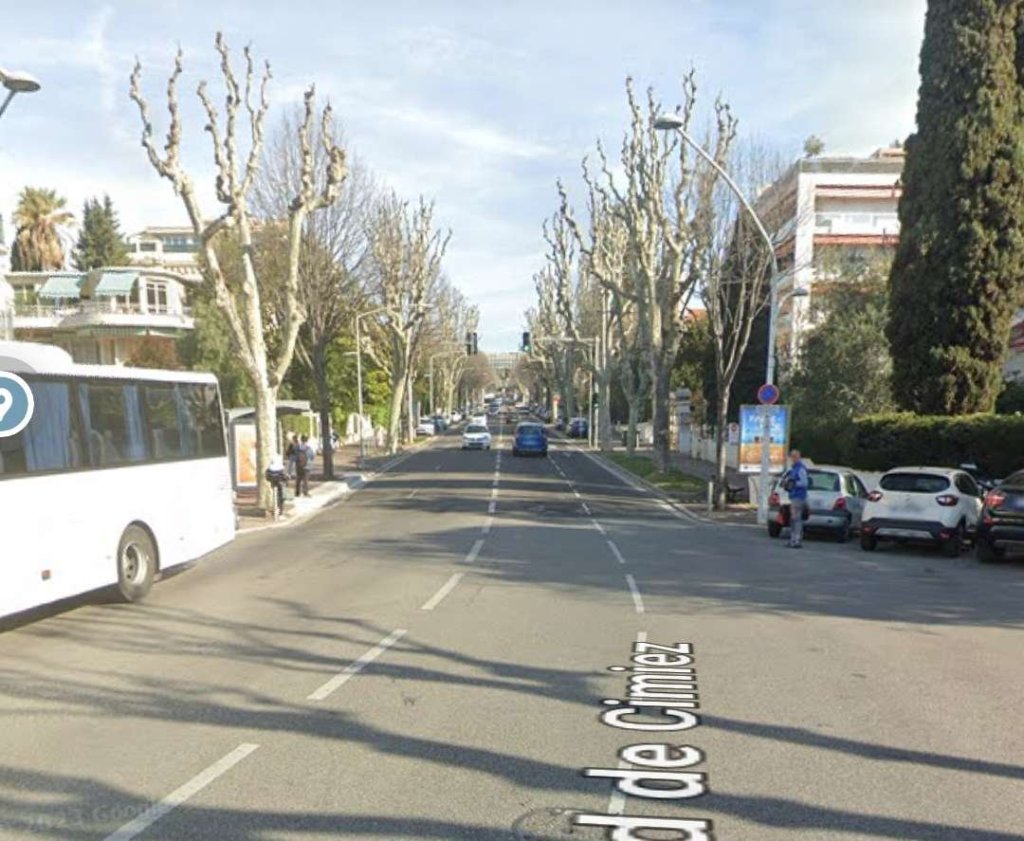
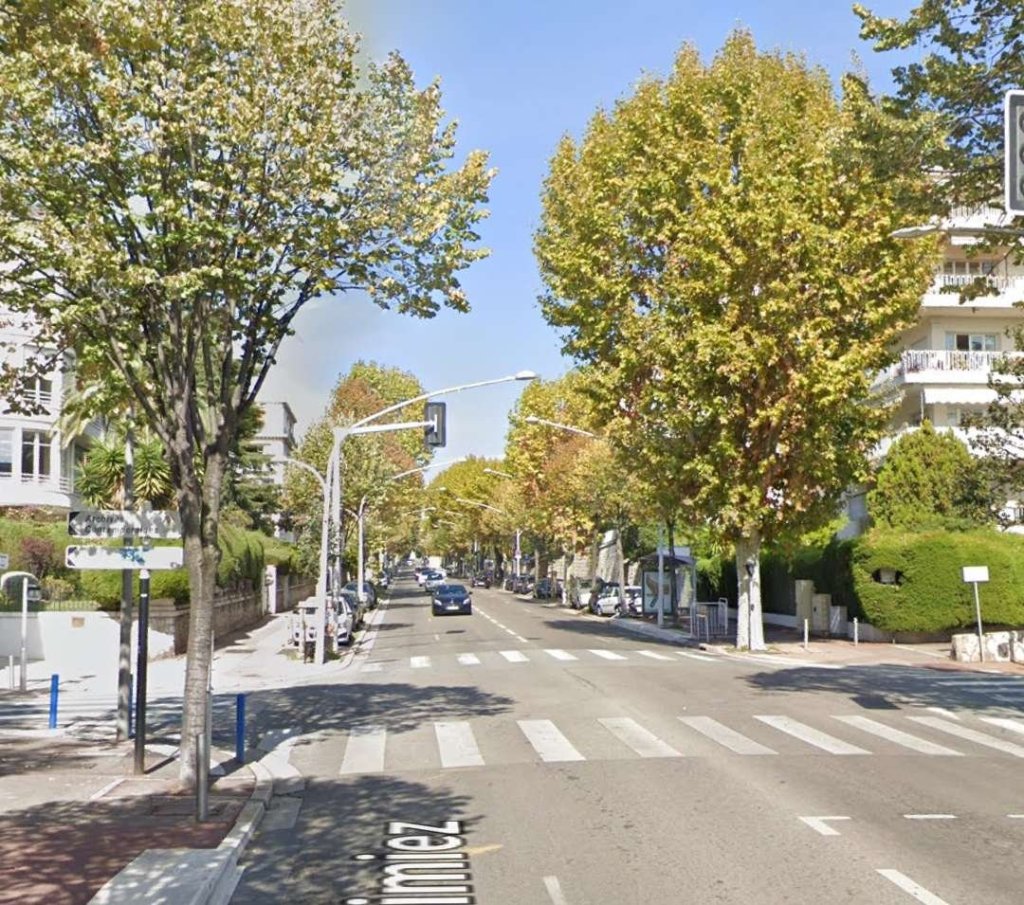
Le Boulevard de Cimiez in March 2023. [Google Streetview, March 2023]
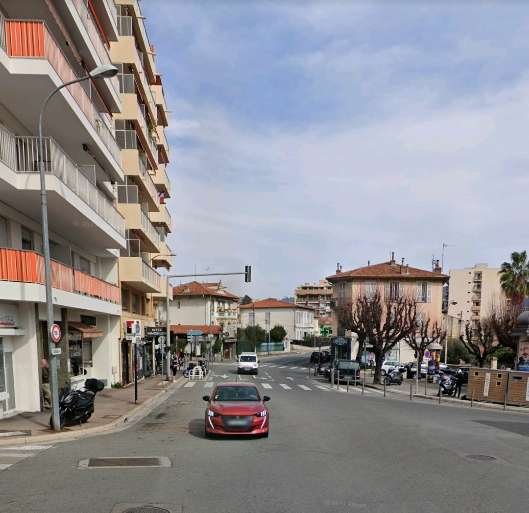
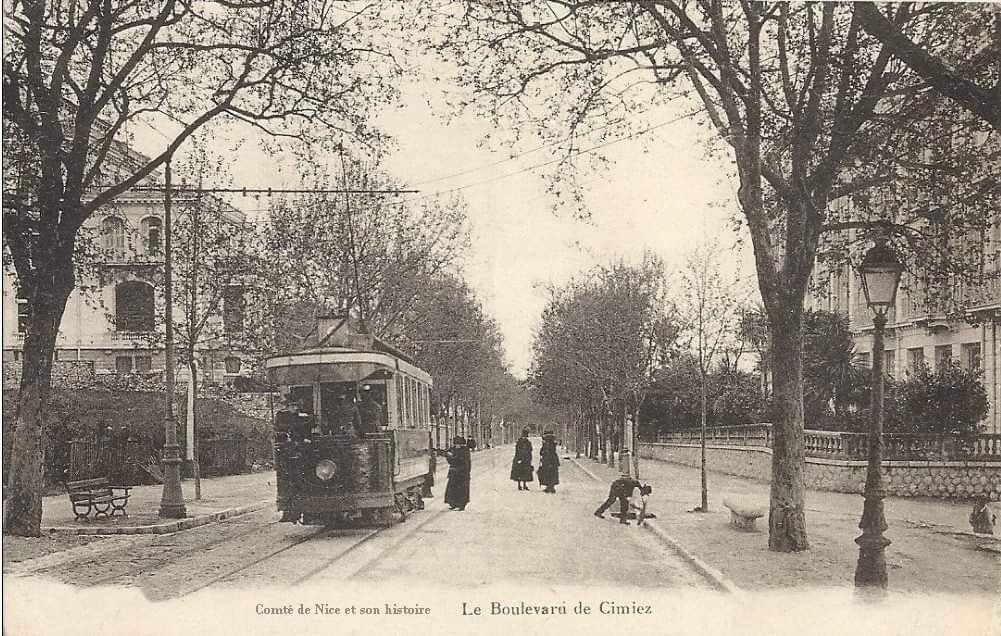
Another view of Le Boulevard de Cimiez. This image was shared on the Comte de Nice et son Histoire Facebook Group on 8th July 2019 by Roland Ciccoli. [5]
Le Boulevard de Cimiez in March 2023 again. [Google Streetview, March 2023]

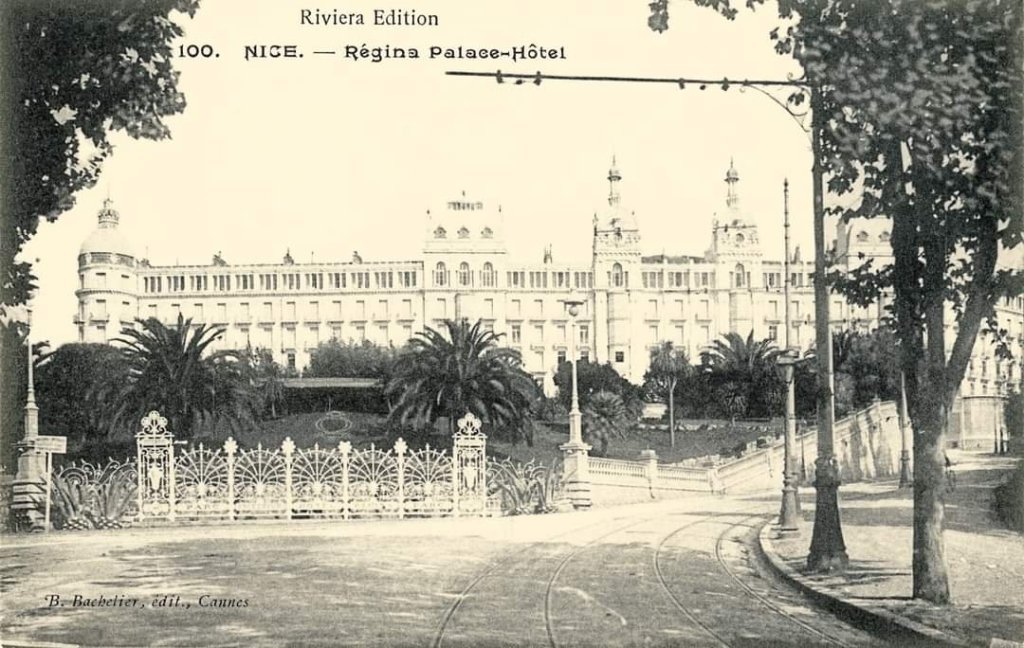
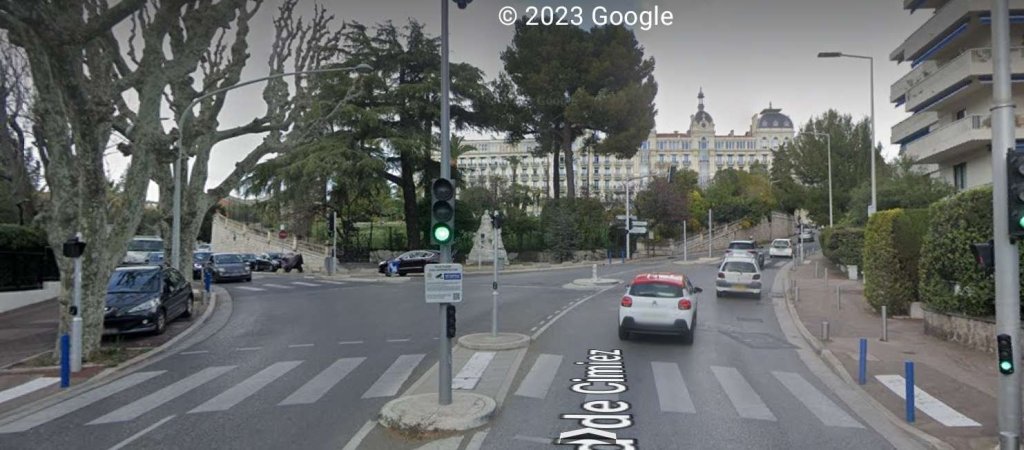
Le Boulevard de Cimiez climbed to a junction beneath the substantial Régina Hotel where the statue of Queen Victoria marks the frequent stays of the British sovereign in the Cimiez district in the latter years of the 19th century.

The older tramway turned to the left to pass in front of the hotel. The TNL route turned to the right with a brief steep climb to reach Les Arenes (the Arena) directly.

The tram route bears to the right in front of the Regina Palace Hotel. The older horse -drawn tramway turned left at this location. This image was shared on the Comte de Nice et son Histoire Facebook Group on 15th March 2019 by Jean-Paul Bascoul. [5]
The same location in 2023. [Google Streetview, April 2023]
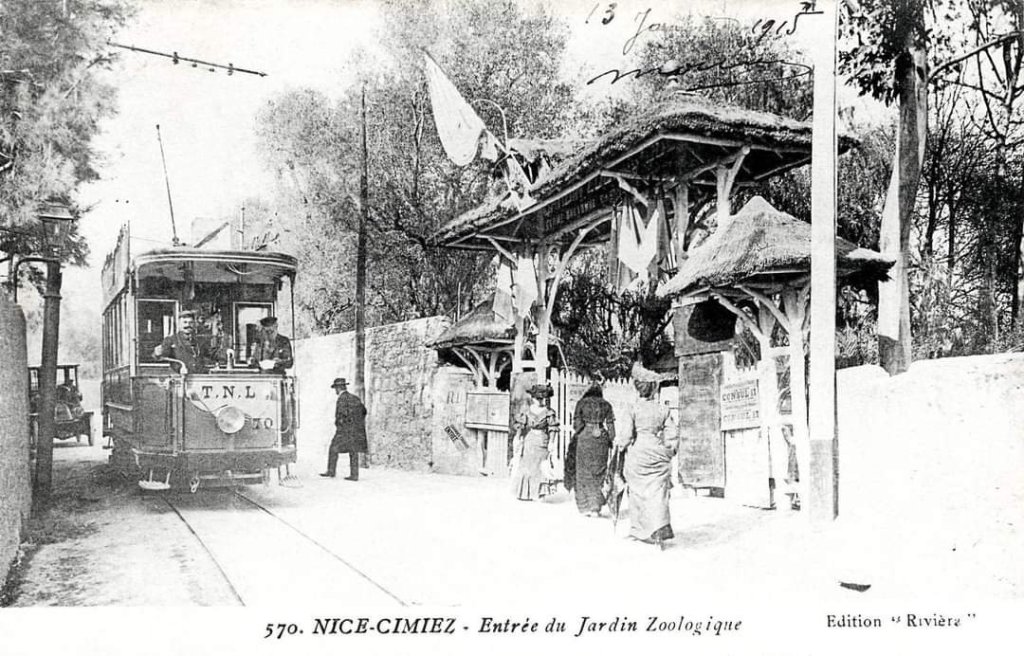
Les Arenes, the remains of the ancient Roman city of Cemenelum, was very popular with the people of Nice with its park of olive trees and the nearby Franciscan monastery. Many walkers used this tram service to access this area on Sundays and during the annual festivals of Des Mais and Des Cougourdons. Here, the line became single track to go up Avenue Cap-de-Croix (today Flirey). The only passing loop was near the Octroi-de-Brancolar on the Place des Quatre-Chemins (now Commandant-Gérôme), shortly before reaching the Cimiez terminus. This was located on a single track and steep slope in front of the entrance to the Zoological Gardens.

The terminus of ‘La Ligne de Cimiez’ at the Zoological Gardens. This image was shared on the Comte de Nice et son Histoire Facebook Group on 27th June 2015 by Jean-Paul Bascoul. [7]

The Jardin Zoologique was founded in the last years of the 19th century and closed in 1906.

La Ligne de Carras, La California, St. Augustin et St. Laurent-du-Var

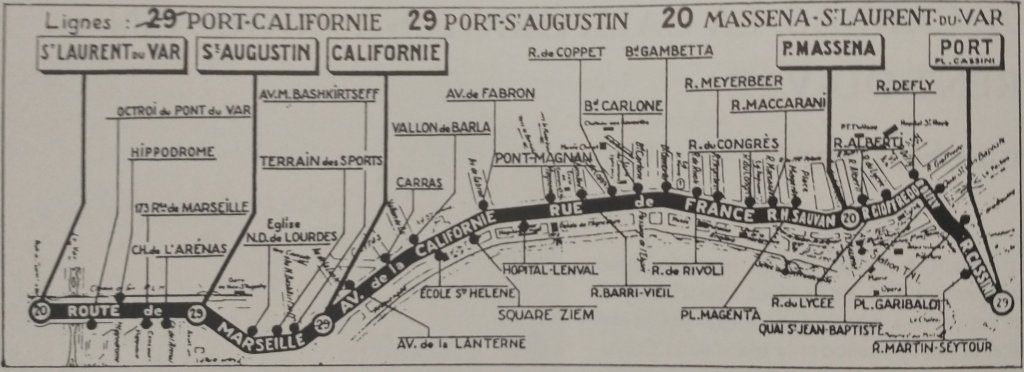
A route map from 1934 held in the collection of Richard Panizzi [1: p10]

This line ran West from Place Massena to St. Laurent-du-Var, initially following an East-West route along Rue Masséna, Place Magenta, Rue de  France and the Place de la Croix-de-Marbre.

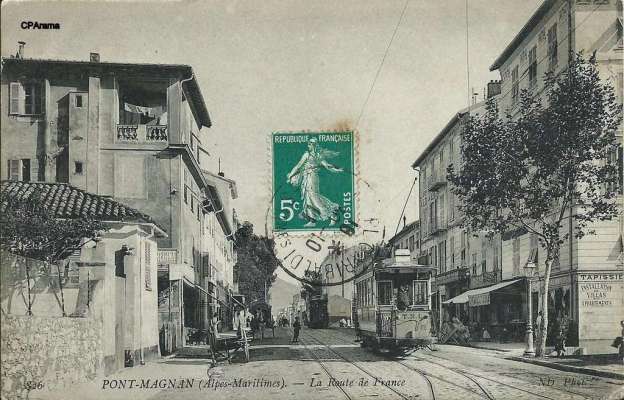
That length of this route was shared with the interurban lines to Cagnes and Antibes, and with other urban routes: the one towards the Passage-à-Niveau branched off onto Boulevard Gambetta, while the line from La Madeleine branched off at Pont-Magnan. 

Pont Magnon. The tram tracks can be seen in the road surface. The branch to La Madeleine turns away at the right of this image which was shared on the Comte de Nice et son Histoire Facebook Group on 14th January 2020 by Roland Coccoli. [10]
The location of Pont Magnan. Boulevard de la Madeleine runs away to the right at this junction. [Google Streetview, October 2022]

Beyond the bridge over the Magnan valley, the tramway followed the Avenue de la Californie to serve the Lenval children’s hospital; the suburb of Ste. Hélène and its church; continuing then to Carras where several services terminated.

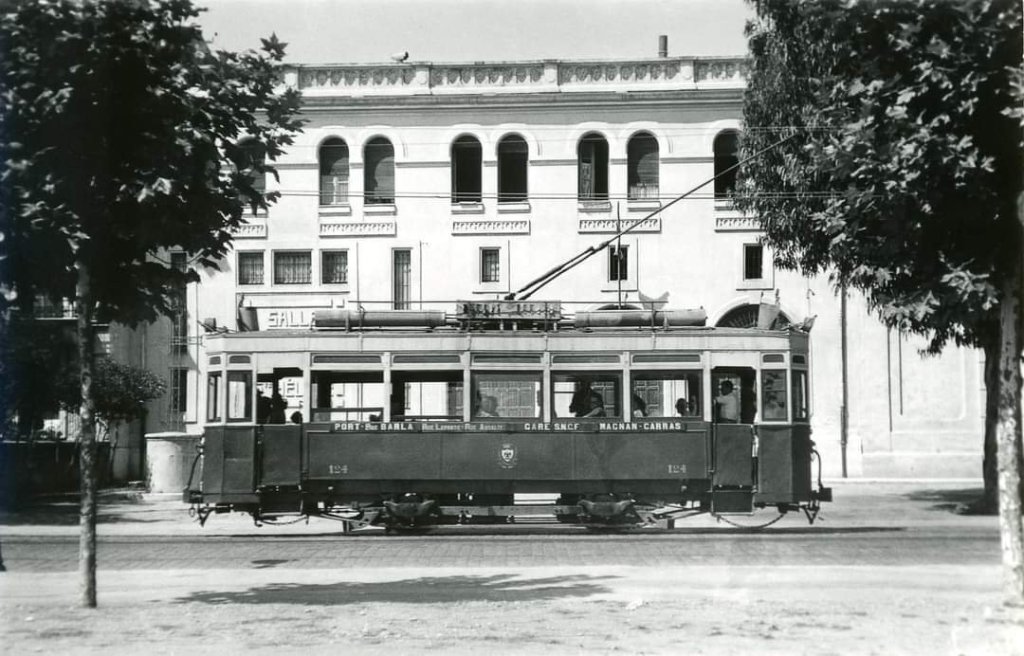
TNL tram No. 124 alongside the church rooms if Ste. Hélène on Avenue de la Californie. This image was shared on the Comte de Nice et son Histoire Facebook Group on 11th June 2020 by Jean-Paul Bascoul. [9]
The same location on Avenue de la Californie, l’Eglise de Ste. Helene. [Google Streetview, April 2023]

The line then continued on through the district of La Californie, where the electricity substation provided power and where a short branch line, opened in 1910 to serve the airfield for the great air show in Nice.

Banaudo notes that the creation of a branch for an air show which lasted only two weeks aroused criticism.  “The local press pointed out that in this same district, the TNL company had always refused to establish a line serving the Caucade cemetery, which would have been more useful for the people of Nice.  Families going to the cemetery had to leave the tramway at Carras and walk up Avenue Ste. Marguerite. … This large cemetery in the west of Nice was first served by public transport by the Santa-Azur bus company which opened a bus-route in 1922, to which the TNL reacted, opening their own tram service in 1925.” [1: p9]

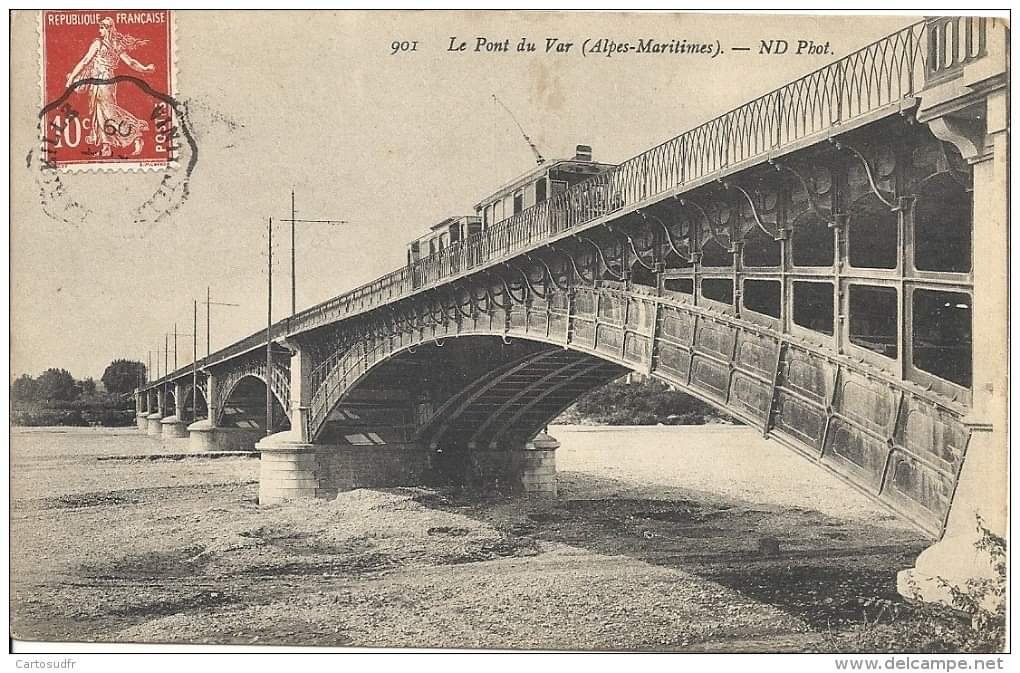
Trams then stopped near the St. Augustin bridge to serve the station called ‘Le Var’ (today ‘Nice-St. Augustin’). At this point the line became single-track and ran alongside the railway embankment to the left (East) bank of the river. A branch serving the Hippodrome du Var was opened in 1901. The branch was about 800 metres long and was used on horse racing days.  The River Var was initially crossed on a 355 m long mixed rail/road bridge, carrying the PLM railway, the tramway and the highway. In 1923, a new railway bridge was built upstream of the original.  On the right (West) bank, the tramcars providing urban services terminated at the level crossing of St. Laurent-du-Var, while those towards Cagnes and Antibes continued heading West.

A tram on the bridge over the River Var. This image was shared on the Comte de Nice et son Histoire Facebook Group on 17th March 2016 by Roland Ciccoli. [8]
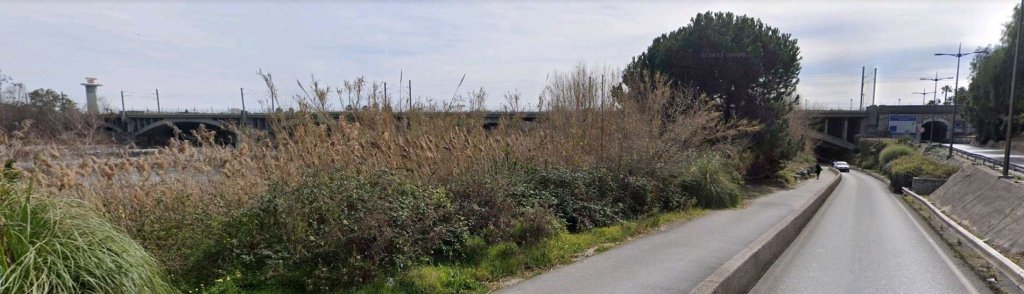
A view in 2022 of the same bridge, vegetation close to the bridge makes it impossible to show a direct modern comparison with the picture above. [Google Streetview, October 2022]

La Ligne de St. Maurice et St. Sylvestre

Originally this line had its terminus at Place Masséna, although services on the route were quickly extended to the Port.

From the Port, trams followed Rue Cassini to Place Garibaldi where they turned left along Rue des Italiens towards Place Masséna.

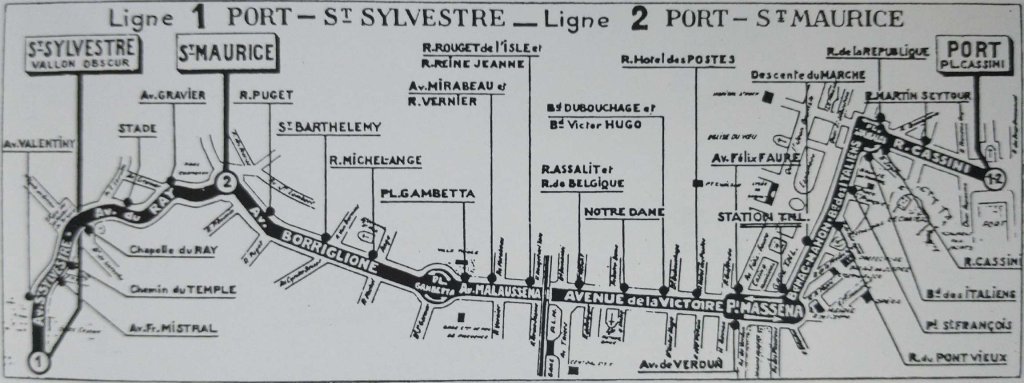
A route map of this line from 1934 held in the collection of Richard Panizzi [1: p13]
Place Massena looking North along Avenue de la Gare, which in 2023 is known as Avenue Jean Medecin. This image was shared on the Comte de Nice et son Histoire Facebook Group on 22nd December 2015 by Roland Coccoli. [12]
A similar view from Place Massena looking towards Avenue Jean Medecin. [Google Streetview, 2013]

Banaudo notes that North of Place Masséna there was a connection to Rue de l’Hôtel des Postes and the line to Cimiez.

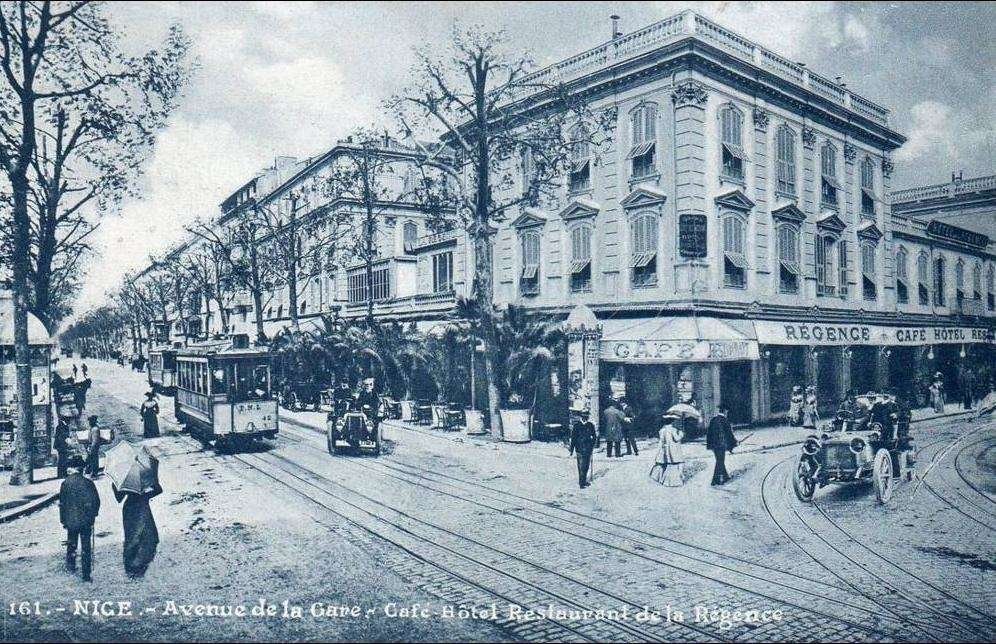
At the junction between Avenue de la Gare (now Avenue Jean Medecin) and Rue de l’Hotel des Postes with Café de la Regence on the corner. Avenue de la Gare runs away on the left side of the image. The connection to the line to Cimiez can be seen on the right. Note the central conduit used for power in the centre of Nice. [16]
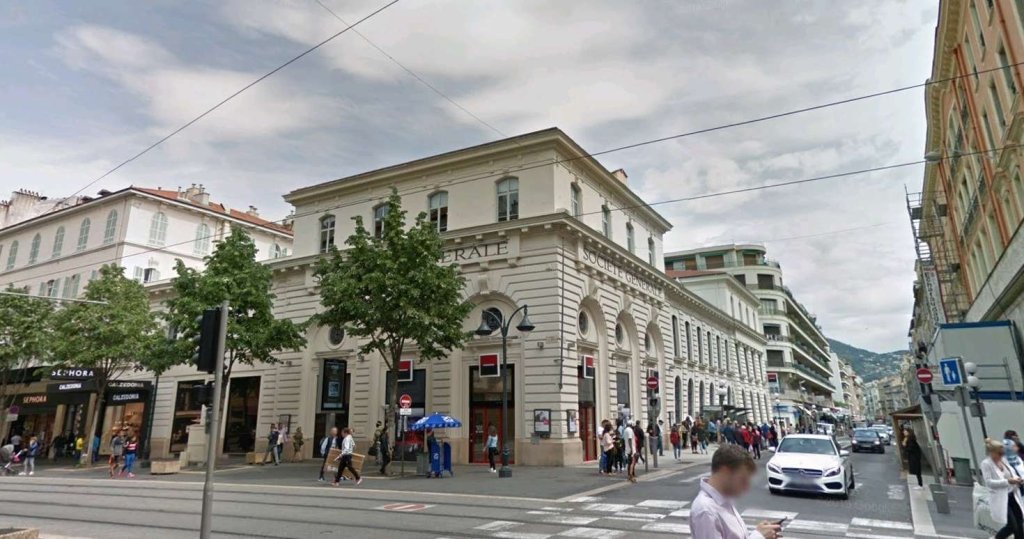
The same junction in the 21st century. The Café de la Regence has been replaced by the Societe Generale building. Modern tram tracks can be seen in the surface of Avenue Jean Medecin. [Google Streetview,

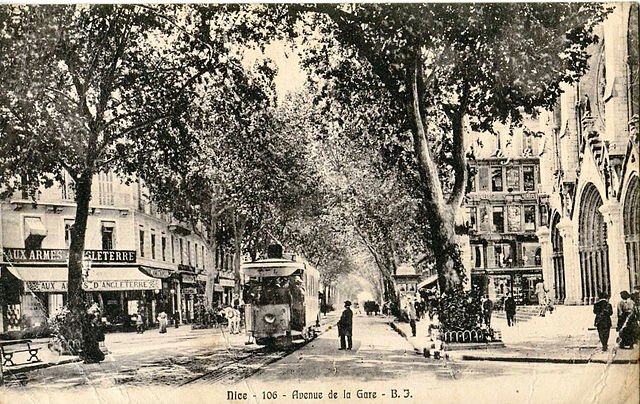
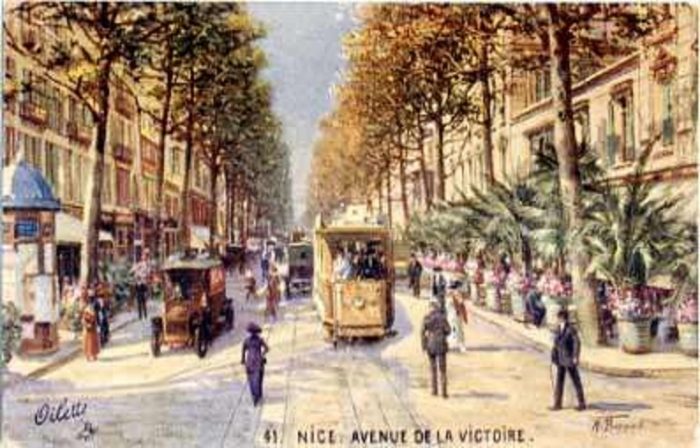
The line then followed Avenue de la Gare (later renamed Avenue de la Victoire then today Avenue Jean-Médecin). “On this route,” Banaudo says, “shaded by majestic plane trees was concentrated a great urban activity with the first big stores of the city, the banks, the hotels, the brasseries and cafes, of which some were frequented heavily by those on winter vacations.” [1: p12]

Banaudo continues: “After passing in front of the neo-Gothic style Notre-Dame church, inaugurated in 1868, the tramway crossed the tracks arriving from the Port by Rue Assalit which continued towards the PLM station by Avenue Thiers. It then passed under the bridge of the Nice-Ventimiglia line, beyond which the supply by aerial wire replaced the underground conduit which was used between Place Masséna and the railway station.” [1: p12]

In this South-facing view, a tram passes Notre Dame church on what was Avenue de la Gare, Avenue Jean-Médecin (Public Domain). [13]
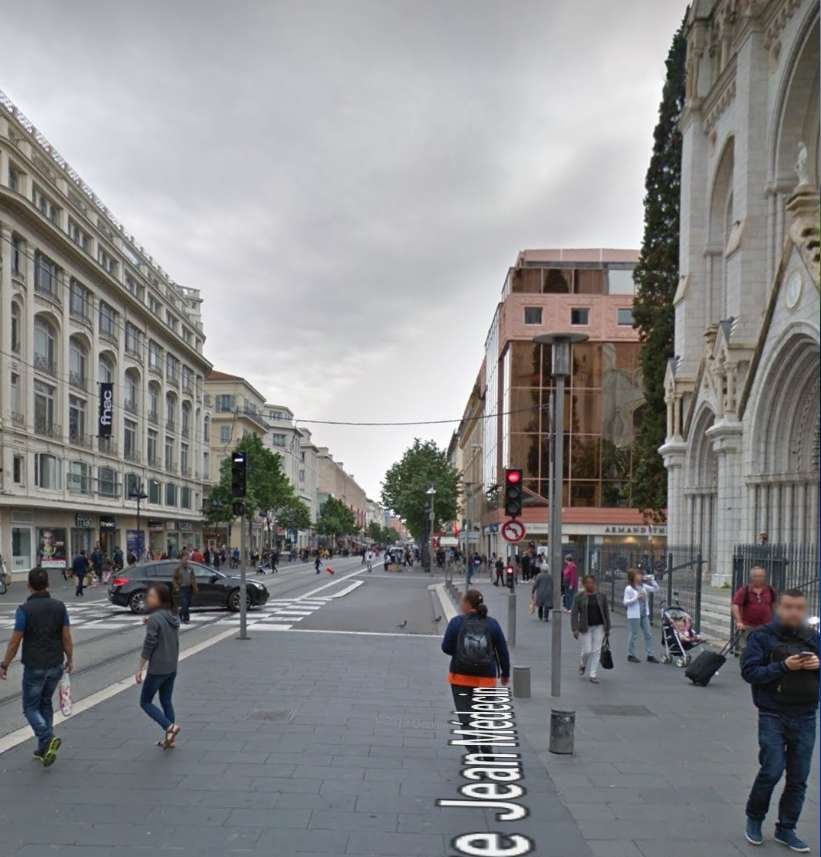
The same location looking South on Avenue Jean Medecin (previously Avenue de la Gare) with the Basilique Notre Dame de l’Assomption on the right. [Google Streetview, May 2018]
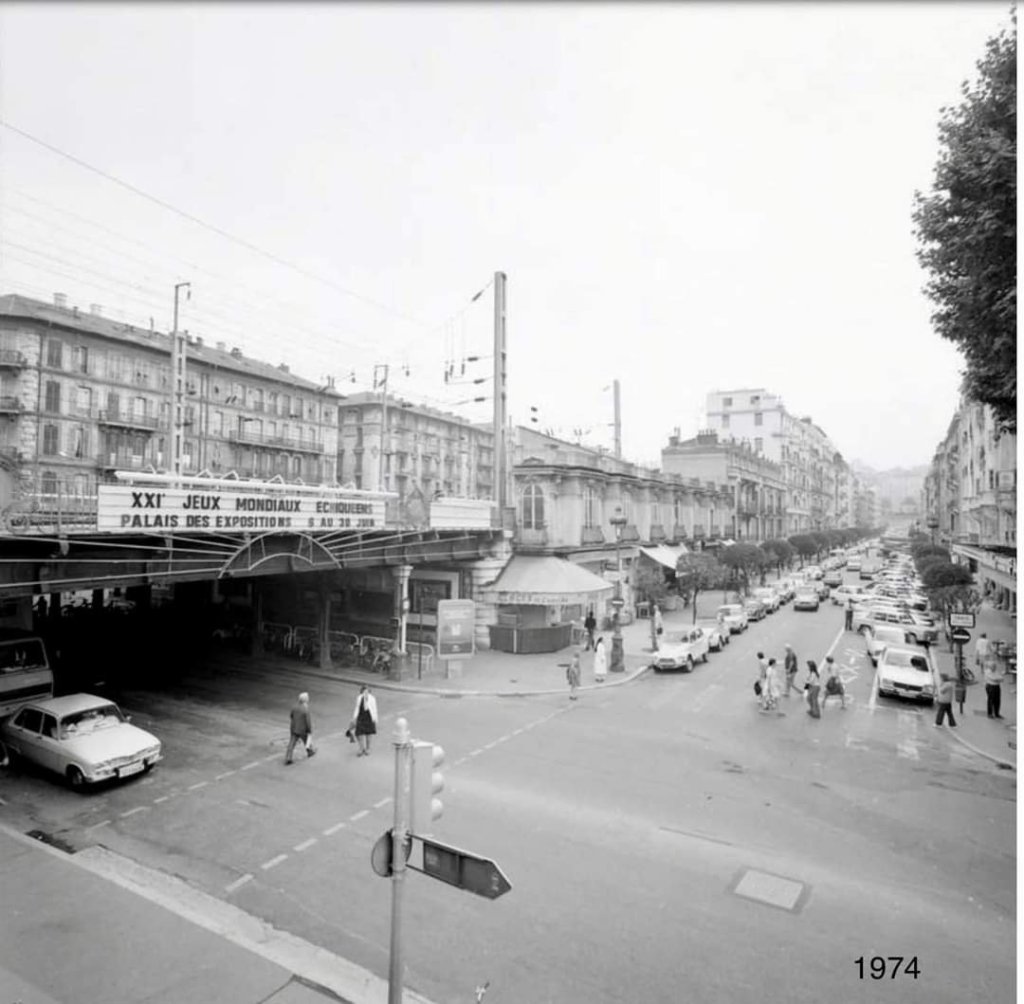
Avenue Jean Medecin passes under the SNCF (formerly PLM) railway lines. Boulevard Raimbaldi runs away from the camera alongside the railway. This photograph was shared on the Comte de Nice et son Histoire Facebook Group by Laure Bermond on 22nd July 2023. [14]
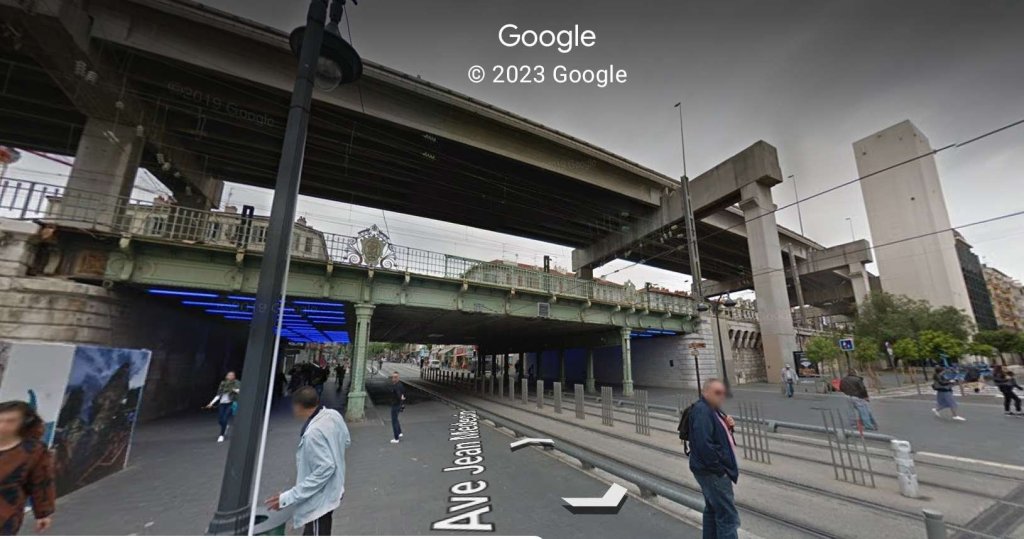
The railway bridge now sits beneath the Voi Pierre Mathis. [Google Streetview, May 2018]
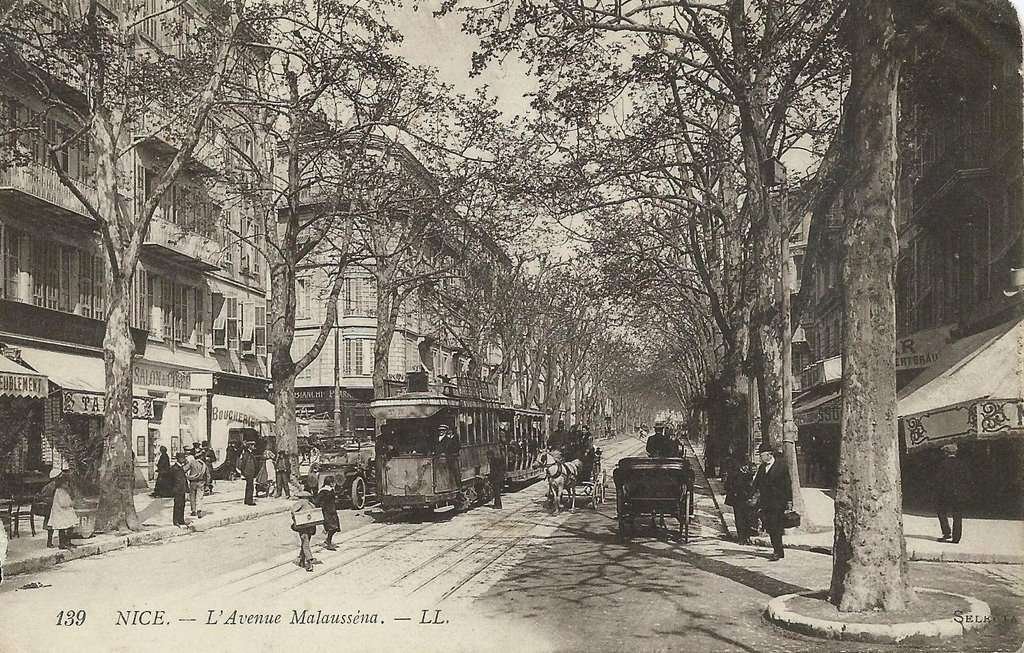
Trams on Avenue Malaussena. The conduit used for power collection is visible again. The trams are stopped here to allow the pickup assembly (plough) to be lifted from the conduit and for the pole to be raised to make contact with the overhead power line. [17]

North of the railway lines, the route continued along Avenue Malaussena, through Place Béatrix (later Place Gambetta of the Liberation and today Place General De Gaulle) where stood the imposing facade of the Gare du Sud, terminus of the Chemins de Fer du Sud de la France lines which served  Digne-les-Bains, Grasse, Draguignan and Meyrargues. Those lines can be followed in other posts on this blog. [11]

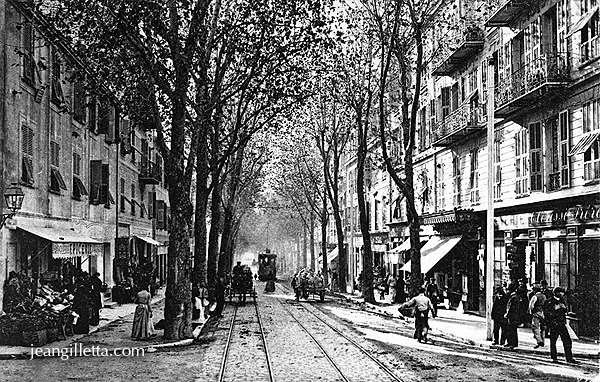
Avenue Borriglione in 1900. The trams share the carriageway with horse drawn carts. In the 21st century the route is reserved for the use of trams and pedestrians. [18]
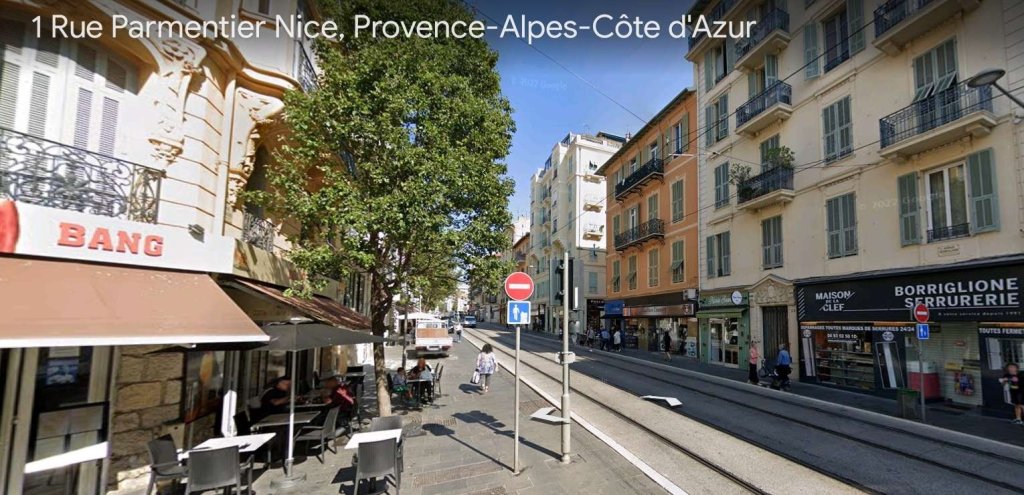
The same length of Avenue Borriglione seen from the corner of Rue Parmentier in the 21st century. The trams have the road carriageway dedicated to their use. [Google Streetview, October 2022]

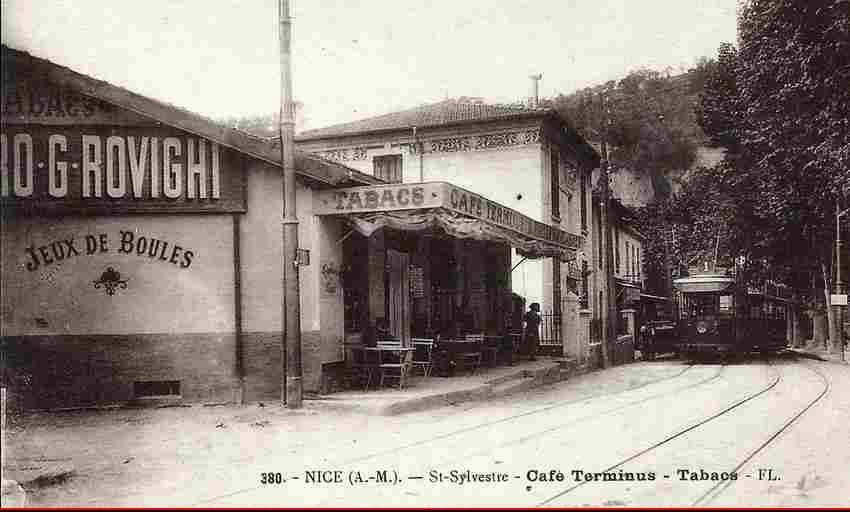
At Place Beatrix, the line towards the Passage-à-Niveau Gambetta turned away to the left along Boulevard Joseph-Garnier, while the route we are following “continued its route along Avenue Borriglione, a narrower street than those previously taken.  Place de St. Maurice (today Place de Alexandre-Médecin) marked the end of the double track and served as a terminus for every other service on this route.  Beyond this, the tram continued its route along Avenue du Ray through what were then still rural suburbs. There were four crossing loops along this length. The terminus was established on the Place de St. Sylvestre (today Place de General-Goiran), at the outlet of the Vallon-Obscur where inns, guinguettes and boules pitches were popular Sunday excursion destinations.” [1: p12]

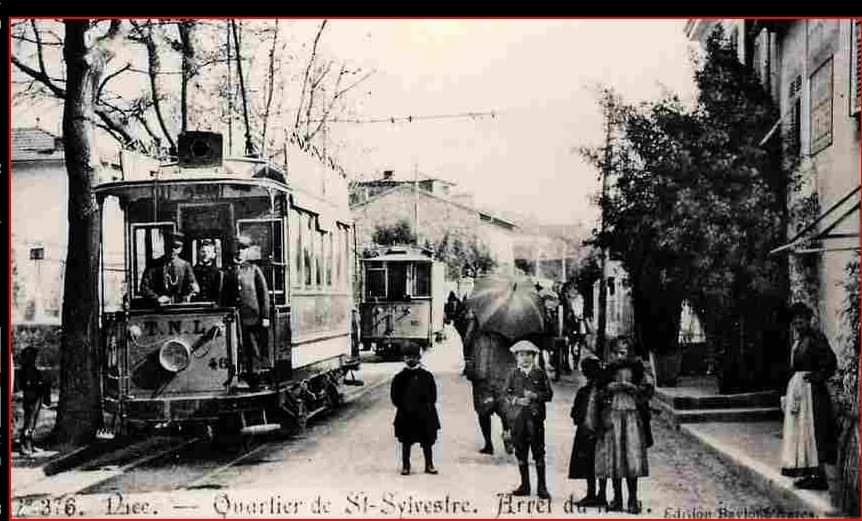
A stop on the run towards the terminus in St. Sylvestre. This image was shared on the Comte de Nice et son Histoire Facebook Group by Jose Barbe D’acier on 20th February  2023. [15]
The tram terminus at St. Sylvestre. This image was also shared on the Comte de Nice et son Histoire Facebook Group by Jose Barbe D’acier on 20th February  2023. [15]
This image shows the approximate location of the old tramway terminus on Avenue de St. Sylvestre. [Google Streetview, October 2022]
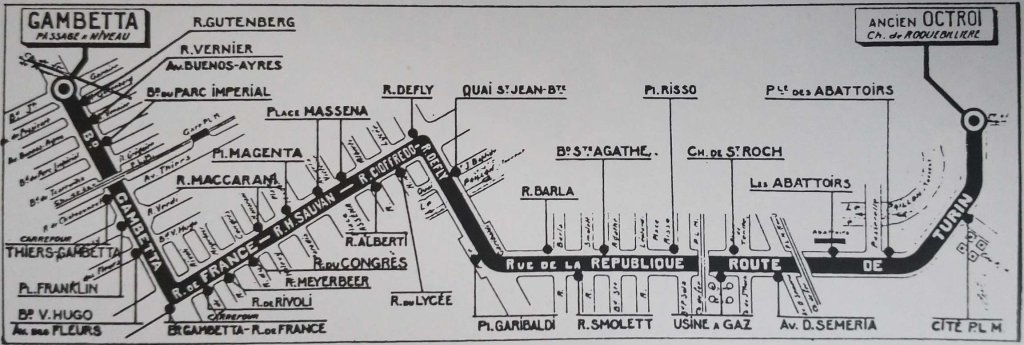
La Ligne des Abattoirs et de la Trinite (Gare PLM – Abattoirs)

This line shared most of its route with other lines and when the restructuring occurred in 1934 the city centre section between Avenue Thiers and Place Garibaldi, was removed as the service was covered effectively by other lines.

Originally, the line started in front of the PLM station in Nice-Ville, from where the tramway went along Avenue Thiers to turn South on Avenue de la Gare, which it followed to Place Masséna. At the southern end of Place Masséna, the double-track turned into the Boulevards Mac-Mahon and du Pont-Vieux (today Jean-Jaurès).

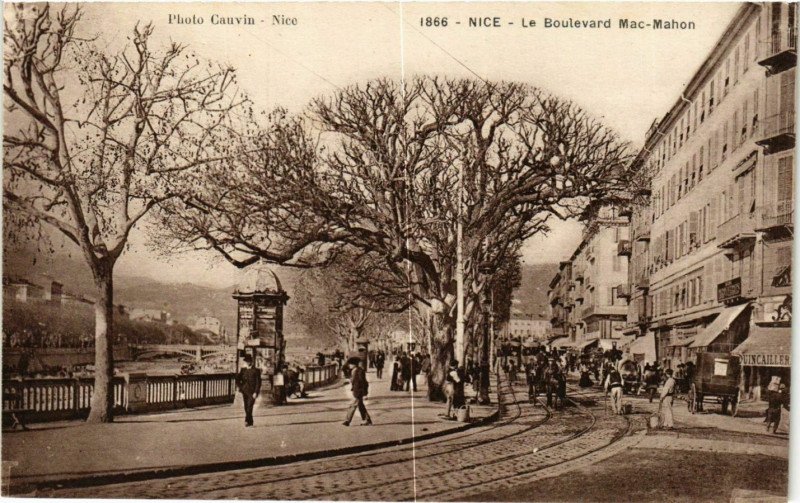
The old route of the tramway turned left into Boulevard Mac-Mahon. This view shows the street in 1866 before the River Paillon was culverted. [21]
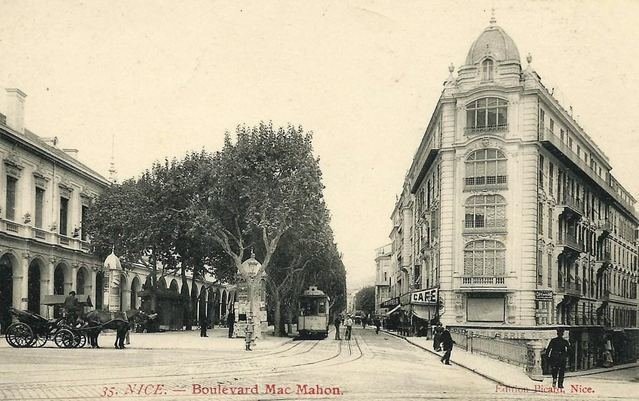
The old route of the tramway turned left into Boulevard Mac-Mahon. [19]
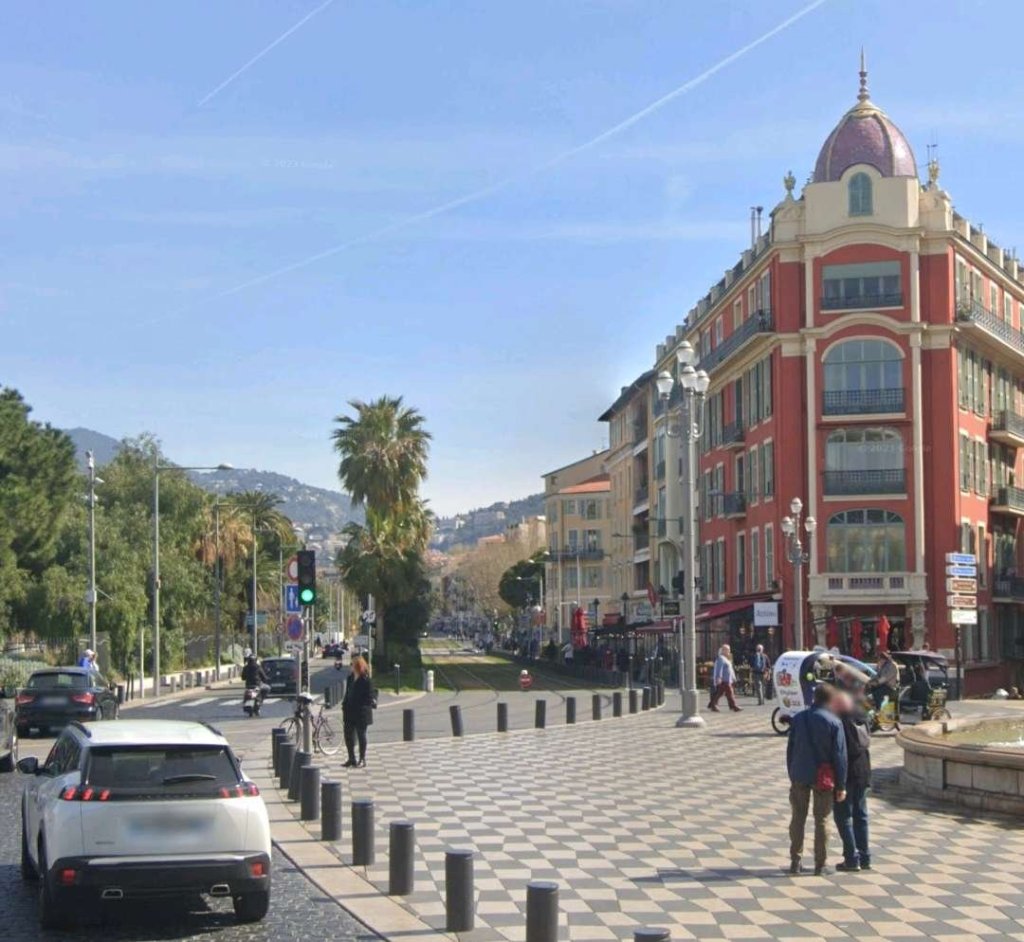
A similar view in the 21st century, looking along Boulevard Jean-Jaurès. [Google Streetview, October 2022]

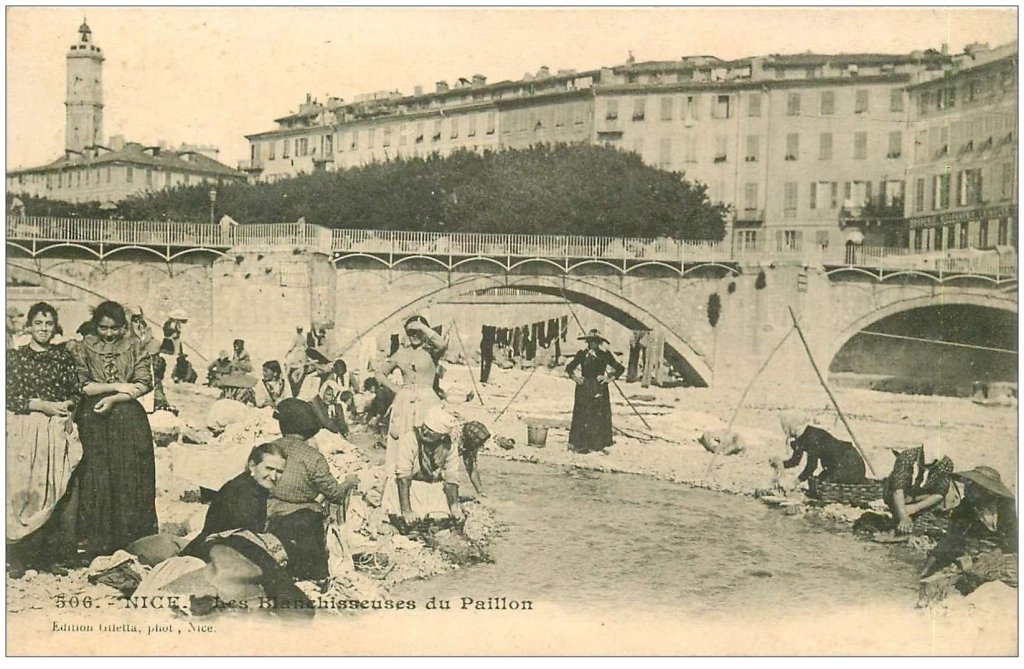
Passing along the left (East) bank of the River Paillon. Banaudo notes that the river was, “often reduced to a meager trickle of water flowing over stretches of pebbles where the ‘bugadiera’ (washerwomen) came to wash and spread their laundry on either side of the Pont-Vieux.” [1: p17] 

‘Bugadiera’ in the river channel of the Paillon. [23]

There was a fruit and vegetable market here in summer at the edge of the Old Town that the people of Nice affectionately nicknamed the ‘Babazouk’.

This route map for the line shows its route after the changes to the network in 1934. The map comes from the collection of Richard Panizzi. Place Garibaldi can be seen bottom-centre of the image. To the left of this the route shown dies not match that described by Jose Banaudo. The changes to the network in 1934 resulted in the trams beginning this journey by travelling along Boulevard Gambetta from their new terminus at Place Gambetta. They turned left onto Rue de France and then ran along Rue H. Sauvan and across the North end of Place Masséna onto Rue Gioffredo before turning right onto Rue Defley and approaching Place Garibaldi from the North. [1: p20]
A tram on Rue Gioffredo after the Second World War. [20]

When it reached Place Garibaldi, the … tramway crossed the Monte-Carlo and Port lines, before joining the Contes line, which had its terminus at a corner of the square. The double tracks ran up Rue de la République in its entirety, crossing at the intersection of Rue Barla the Gare PLM-Place Saluzzo line. Then at the intersection of Boulevard Ste. Agathe it passed the junction to the depot and the Riquier district. Arriving at Place Risso, it took the road to Turin and passed under the bridge of the PLM Nice-Ventimiglia line.” [1: p17]

The next section of the line passed Nice’s gas works and coking plant where a series of branches allowed for goods traffic to and from the works/plant and military military maintenance warehouses. There was also a branch into the St. Roch station.

After Place de La Brigue, the tramway passed under the bridge of the PLM Nice-Coni line and crossed an industrial district, with slaughterhouses and the cattle market on its left, and to the right, refrigerated warehouses and meat traders and the access to St. Roch station.  A terminus for urban services was located a little beyond the footbridge of the Abattoirs, at the point where the Route de Turin joins the bank of the River Paillon.

The double track ended, and just beyond this point, the line included sidings at the Hauteur de la Cité PLM and at the Octroi de Turin, the urban terminus and a stabling point for freight trains waiting to enter the city. Banaudo, writing in 2005, comments that “the provisional terminus of the new Nice tramway will be established here, at the end of the ‘Pont Michel’ named after a former metallurgical workshop in the St. Roch district.  This end of the Chemin de Roquebillière is now called Boulevard Pierre Sémard.” [1: p17]

The single track tramway was now laid in the shoulder if the road and provided connections to a marble merchant and to the military fodder yard, an establishment which gave its name to a tram stop with a passing loop. Here, “the valley narrowed between the heights of Mont Gros, surmounted by the dome of the Observatory on the left bank, and the hills of Cimiez and St. Pons on the right bank where the line to Levens ran.” [1: p17] 

After passing “the Notre-Dame de Bon-Voyage chapel, where travelers in the past invoked divine protection before undertaking their journey towards the Col de Tende and Piedmont, the line passed under the PLM Nice-Coni line and l’Evitement des Carrières where some other urban services terminated.  Opposite the then rural district of L’Ariane, the tramway tracks crossed those of the railway which served the Gerland warehouse, and then the Vallon de l’Oli and Boccadore sidings.” [1: p17]

At the entrance to the town of La Trinité-Victor, trams encountered the bridge over the Laghet valley, …  then the branch to the Ariane flour mill which turned left to cross the PLM railway and the Paillon.  The track rejoined the roadway in the centre of La Trinité-Victor, where the terminus was established.” [1: p17] Trams providing rural services continued beyond this point. The line actually continued on to Contes, Bendéjun and La Grave-de-Peille.

The line continues on from the urban terminus at La Trinite-Victor toward Contes. [22]

References

  1. Jose Banaudo; Nice au fil du Tram, Volume No. 2: Les Hommes, Les Techniques; Les Editions de Cabri, Breil-sur-Roya, France, 2005. This is a french language text.
  2. https://www.communes.com/cartes-postales-anciennes-nice, … content://media/external/downloads/1000019420, accessed on 19th August 2023.
  3. https://archives.nicecotedazur.org/dossier_pedagogique/la-revolution-des-transports-a-nice-le-tramway, accessed on 20th August 2023.
  4. https://www.delcampe.net/en_GB/collectables/postcards/france-nice/unclassified/nice-boulevard-de-cimiez-tramway-613224433.html, accessed on 20th August 2023.
  5. https://m.facebook.com/groups/ciccoli/permalink/2473601369552384, accessed on 20th August 2023.
  6. https://m.facebook.com/groups/ciccoli/permalink/3639384749640701, accessed on 20th August 2023.
  7. https://m.facebook.com/groups/ciccoli/permalink/2171905139722010, accessed on 21st August 2023.
  8. https://m.facebook.com/groups/ciccoli/permalink/3291175687794944, accessed on 21st August 2023.
  9. https://m.facebook.com/groups/ciccoli/permalink/3699253803653795, accessed on 21st August 2023.
  10. https://m.facebook.com/groups/ciccoli/permalink/2655694664676386, accessed on 21st August 2023.
  11. The lines to Digne-les-Bains and Meyrargues were metre-gauge secondary railway lines. The original terminus no longer serves the railways and is a cultural and food centre with a more modern, but much less impressive, terminus sited to the West.
  12. https://m.facebook.com/groups/ciccoli/permalink/1701108476801681, accessed on 22nd August 2023.
  13. https://fr.m.wikipedia.org/wiki/Fichier:BJ_106_-_NICE_-_Avenue_de_la_Gare.JPG, accessed on 22nd August 2023.
  14. https://m.facebook.com/groups/ciccoli/permalink/3728410140738161, accessed on 22nd August 2023.
  15. https://m.facebook.com/groups/ciccoli/permalink/3622716204640889, accessed on 22nd August 2023.
  16. https://www.geneanet.org/cartes-postales/view/5006406#0, accessed on 23rd August 2023.
  17. https://www.cparama.com/forum/viewtopic.php?f=177&t=30104, accessed on 23rd August 2023.
  18. http://jeangilletta.com/fr/produit/nice-avenue-borriglione-1900, accessed on 23rd August 2023.
  19. https://www.geneanet.org/cartes-postales/view/4074034#0, accessed on 24th August 2023.
  20. http://p9.storage.canalblog.com/94/63/1127995/103839634_o.jpg, accessed on 24th August 2023.
  21. https://cartorum.fr/carte-postale/206013/nice-nice-le-boulevard-mac-mahon-france, accessed on 25th August 2023.
  22. https://villedelatrinite.fr/la-commune/histoire,vaccessed on 25th August 2023.
  23. https://www.fortunapost.com/06-alpes-maritimes/2066-carte-postale-ancienne-06-nice-les-blanchisseuses-du-paillon-1903.html, accessed on 25th August 2023.


The TNL Tram Network 1935 – 1944 – (Chemins de Fer de Provence 87)

This post continues a series of reflections on the tramway network in and around Nice which are primarily based on Jose Banaudo’s French language book “Nice au fil due Tram Volume 1: l’Histoire” [1]

Jose Banaudo’s excellent book on the Trams of Nice is sadly not available in English. This series of posts seeks to translate the text of the book for an English audience.

A more general impression of Nice in the War Years can be found on the Calameo website. [2] An English reader will require translation software or a good knowledge of French.

The Difficult Years (1935-1944)

Following the wave of tramway closures between 1929 and 1933 of departmental lines and in 1934 on the urban network, the length of the network operated by the TNL was reduced to almost a quarter of the pre-war mileage. The fleet of rolling stock had been reduced by almost two-thirds, with a usable fleet of fifty-eight powered cars and twenty-six trailers, plus ‘tractors’ and wagons assigned to freight traffic. At that time, only Paris and Nice had so profoundly transformed their network; in all other major French cities, buses had been introduced to complement existing tram lines or to replace those that were proving particularly difficult to operate.

Closures continued in subsequent years. Another reviewe of the urban network took place, and on 18th March 1935, tramway lines 4, 6 and 7 to the East of the City of Nice were converted to road vehicles.

On 18th November 1935, the tramway lines 20 from St. Laurent-du-Var and 29 from St. Augustin were switched to buses. In addition, the lines 37 from Contes and 38 from La Grave were extended towards the city centre with a new terminus on Gioffredo Street (at the corner of Place Massena).

On 20th June 1936, the staff of the TNL went on strike to demand the repeal of the laws decreed by the French government and to insist on a reduction of the working week to forty hours. Work resumed on 3rd July but not on the lines north of the PLM mainline. The company closed these routes during the strike.

The year 1937 saw no improvement in the company’s finances. The fleet of vehicles was reduced, the station at Place Garibaldi and a depot at Carnoles was abandoned. The TNL was also closing bus lines. Six were to go in July 1937.

Interurban bus lines that had replaced the trams were also gradually being handed over by the TNL to private carriers.

In 1938, the finances of the TNL continued to deteriorate. By 15th August 1938, the tram lines had been reduced to five: 21 from La Madeleine, 22 from Carras, 29 California (shortened), 35 from Cimiez, 36 from La Trinite, plus a partial service 36 shortened to the Carrieres de Bon-Voyage. However, the situation was far from stabilized and in the year leading up to the declaration of war, there was hardly a month that went by without significant changes to the network.

This picture shows the line from Nice to La Madeleine in 1949 – Powered car No. 123 is pulling a very old-fashioned trailer. Although taken after the Second World War, this picture is typical of the decaying state of the tramways in Nice from 1935 onwards. The tram is in a relatively poor condition and does not display the line number, © Ch. Schnabel – Th. Assa collection. [3]

The TNL. network as of 1st September 1939

Banaudo records the following TNL tram lines still in existence:

No. 3, Gioffredo – La Trinité;
No. 3A, Gioffredo – La Madeleine;
No. 9, Port – Gioffredo – California;
No. 22, Port – Station – Carras;
No. 35, Hôtel-des-Postes – Cimiez;

and these TNL bus routes still running:
No. 1, Port – St. Sylvestre;
No. 2, Riquier – St. Maurice;
No. 4, St. Sylvestre – Hôpital-Pasteur;
No. 6-7, Circulaire Passage-à-Niveau – St. Roch;
No. 8, Gare du Sud – Caucade;
No. 8A, Garibaldi – Caucade. [1]

References

  1. Jose Banaudo; Nice au fil due Tram Volume 1: l’Histoire; Les Editions de Cabri, 2004, p97-100. Translated using ‘deepl’ translation software in August 2020.
  2. Les Alpes Maritimes Pendant La Seconde Guerre Mondiale by cdi06130;
    https://en.calameo.com/read/00417128672f1708ac36a, accessed on 21st October 2020.
  3. http://transporturbain.canalblog.com/pages/les-tramways-de-nice—de-l-apogee-au-declin/31975780.html, accessed on 21st October 2020.

The TNL Tram Network – The Changes in the Urban Network (1929-1934) (Chemins de Fer de Provence 86)

This post continues a series of reflections on the tramway network in and around Nice which are based on Jose Banaudo’s French language book “Nice au fil du Tram Volume 1: Histoire.” The text below includes elements translated from Jose Banaudo’s book. [1]

A Changing Urban Network in/around Nice

The 1930s through to the 1950s saw major changes in the urban environment. As elsewhere, the car began to dominate people’s understanding of progress. Other forms of transport, to a greater or lesser extent, took a secondary place. Independence, rather than interdependence, came to dominate political thinking. The strengthening democracy after the Second World War valued the perspective of the individual. By the end of the 1950s the place if the ‘expert’ in any debate was beginning to be challenged. No longer were people as willing to be told what was best for them. In a significant way, the car became a touchstone for that growing independence and self-confidence. The tram and the train began to be seen as part of the past rather than an important part of the future.

We noted in the last post in this series how buses began to replace trams on the longer routes. Road improvements swept away the tram infrastructure. The rails were replaced, at first, in some places, by trolleybuses. In others the change to petrol/diesel engines vehicles was more rapid.

Banaudo, writing in French, says: “While the tramway disappeared from most interurban lines, the monopoly of this mode of transport was not immediately threatened in the city of Nice. Initially, in 1925-26, TNL had simply created three ‘automobile omnibus’ lines serving routes complementary to the tramway network. These services were designated from 1928 onwards by letters:
A Masséna – St. Sylvestre;
C Masséna – Caucade; and
D Masséna -St. Isidore.
On March 20th of the same year, two new links were created to serve Mont-Boron Hill, to the east of the city:
B1 Masséna – Miramar, and
B2 Masséna – Col de Villefranche.
Their routes were modified several times, only stabilizing in September 1929, the first taking Boulevard Carnot (Basse Corniche) and the second, the Chemin du Mont-Alban (Moyenne Corniche).” [1: p93]

He continues: “The year 1929 was marked by the development of road transport in the city, with the delivery of Renault buses of a Parisian type which were put into service on eight new lines which opened from 19th January to 7th October:

A: Place Masséna – St. Sylvestre, by Boulevard de Cessole;

D1: Place Masséna – Digue-des-Français, by St. Augustin;

E: The PLM Station – Port, via Berlioz, Rossini, du Congrès and Paradis streets;

F: Square Masséna – St. Etienne, by Boulevard Carabacel, Avenues Désambrois and Lambert, Streets Mirabeau, Vernier and Chemin de Pessicart;

G: Square Masséna – Le Ray, by Streets Gubernatis and de Lépante and Avenue St. Lambert;

H : Place Masséna – St. Roch, by Place Garibaldi, Rue Bonaparte and Boulevard de Riquier;

S1: Place Masséna – La Bornala, by Rue de la Buffa;

S3: Rue de l’Hôtel-des-Postes – Rimiez, by Avenue des Arènes.” [1: p93]

After this, there was a lull in the development of bus routes with some routes opening and then closing within short periods of time.

However some routes were set up which survived. Line K: Masséna – Madeleine-Superior was created in February 1932 and in March 1933.

The tramway is eliminated from the centre of Nice

Banaudo says: “All the bus-lines created by the TNL between 1925 and 1933 in the municipality of Nice were established on routes complementary to the main routes travelled by tramways, either by taking streets in the city centre that had previously been left out of the network, by climbing hills that were not suitable for trams, or by opening up suburban districts that were undergoing urbanisation. Operated by limited-capacity buses where the driver issued tickets to passengers, these lines had low frequencies and carried relatively modest traffic.” [1: p95]

Early in the 1930s, following the example of Paris. TNL and the municipality began negotiations to extend the use of buses to a main route, that from Place Massêna along the Avenues of la Victoire, Malaussena and Borriglione. It was envisaged that this move would improve traffic movement and eliminate the need the costly maintenance of an electrical power supply. “On 5th June 1931, the municipal council decided to convert the lines serving St. Maurice, St. Sylvester and the Boulevard Tzarewitch to a bus-service.” [1: p95]
To implement this program, it was necessary to finance the purchase of a further sixty buses. These were ordered from ‘Renault’ and ‘Panhard et Levassor’ from 1933 onwards. The road vehicle fleet reached 144 units by the following year, surpassing the number of motorised trams. In addition, the TNL finally won a number of legal actions against interurban line operators who picked-up and put-down passengers inside the city in direct competition with trams and buses. [1: p95]

Lines were either provided with new termini, as in the case of lines to the West and East of the centre of Nice, or diverted along alternative routes as in the North of the city. Place Massena lost its trams altogether. We now know that this decision was one which came to be regretted by the municipality towards the end of the 20th century as they began to develop plans for a new tram network. [1: p95]

A new “Gare municipale d’Autobus” on the Couverture du Paillon, between the Casino Municipal and Place Massena was opened in 1934. The departures and arrivals of all long-distance lines were moved to the new bus station. The end of the tramway provision in Place Masséna saw the tramway kiosk demolished and a new “TNL Station” was built south of the Casino Municipal, along Boulevard des Italiens (now Jean-Jaurès). [1: p95]

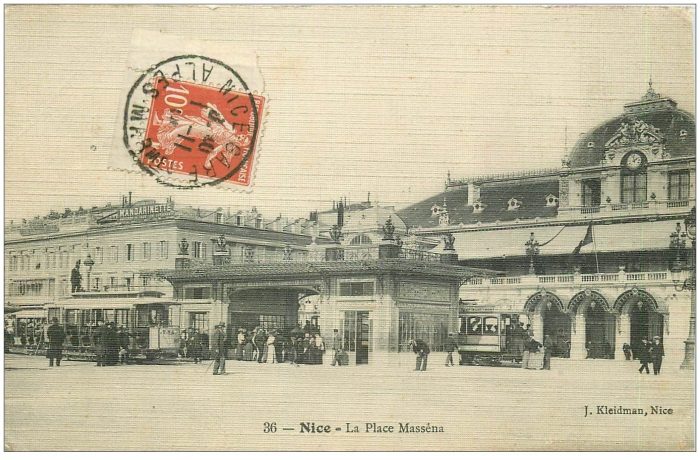
The Tramway kiosk in Place Massena in 1913 [2]

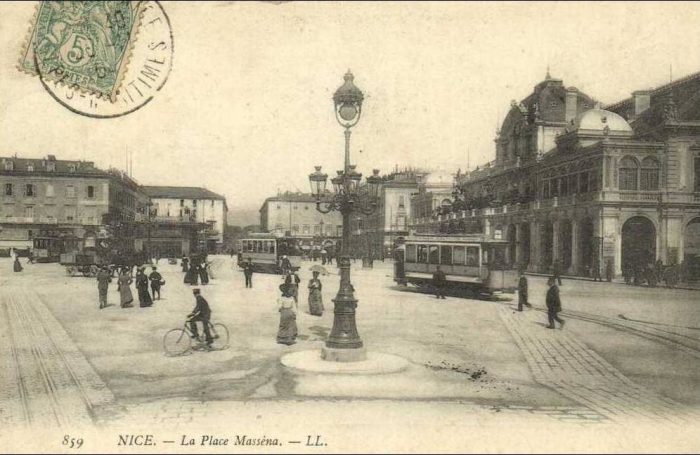
Place Massena again. [3]

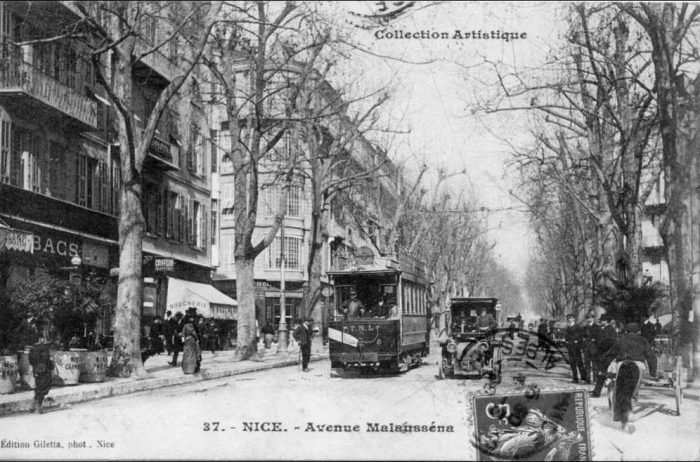
Avenue de Malaussena. [4]

Avenue de la Victoire [5]

Monday 8th October 1934 was chosen as the date for the changes to take place. On the Sunday evening, the trams ran for the last time on Place Masséna and the south-north axis through the Avenues de la Victoire, Malaussena, Borriglione, du Ray and St Sylvestre, as well as in Joseph-Garnier Boulevard, Tzaréwitch Boulevard and on the left bank of the Paillon, between Place Masséna and Place Garibaldi. The next day, the network was completely reorganized, creating thirteen tram lines (including those of Contes and La Grave, the last vestiges of the departmental network) and twenty-two city bus lines. A new pricing system based on tickets sold in booklets came into effect. [1: p95]

There were initial problems. Users were disrupted by changes in numbering and new tram routes. The buses were considered noisy. polluting and at certain times their capacity was notoriously insufficient compared to that of the old trams and their trailers. The Nice daily newspaper “L’Eclaireur”, which from the beginning had unreservedly encouraged change, began to doubt whether it had been worthwhile. [1: p95]

My understanding of Banaudo’s comments is that the changes were hastily brought in so as to satisfy a variety of different political agendas. Hindsight suggests that the conurbation would have been better served by renovating/refurbishing its tramways rather than allowing them to fall into disrepair and be replaced by what ultimately has proved to be a poorer series of alternatives.

References

  1. Jose Banaudo; Nice au fil due Tram Volume 1: l’Histoire; Les Editions de Cabri, 2004.
  2. https://www.fortunapost.com/06-alpes-maritimes/2100-carte-postale-ancienne-06-nice-tramway-place-massena-1913-carte-toilee.html, accessed on 14th October 2019.
  3. https://www.geneanet.org/cartes-postales/view/5938209#0, accessed on 14th October 2019.
  4. https://www.geneanet.org/cartes-postales/view/7404985#0, accessed on 14th October 2019.
  5. http://www.retro-photo.fr/cartes-postales-anciennes/cpa,illustrateurs,nice–41-avenue-de-la-victoire-tramway–signee-beraud-,8390.html, accessed on 14th October 2019.

Ligne de Central Var – Part 13a – Sillans la Cascade to Barjols (Chemins de Fer de Provence 85)

Sillans la Cascade to Barjols

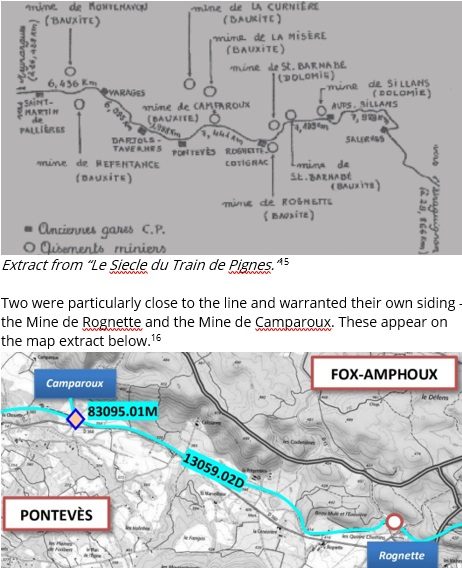
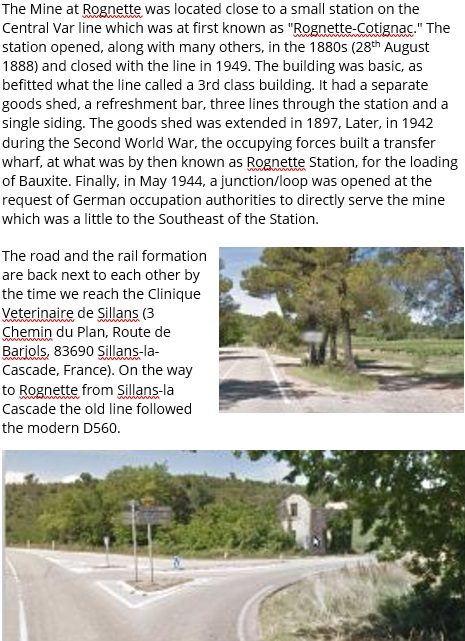
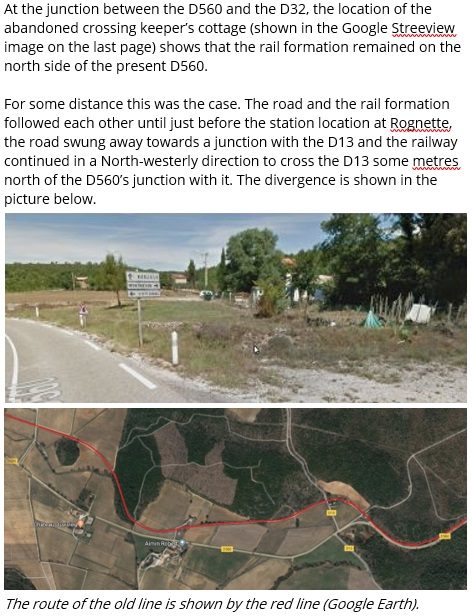
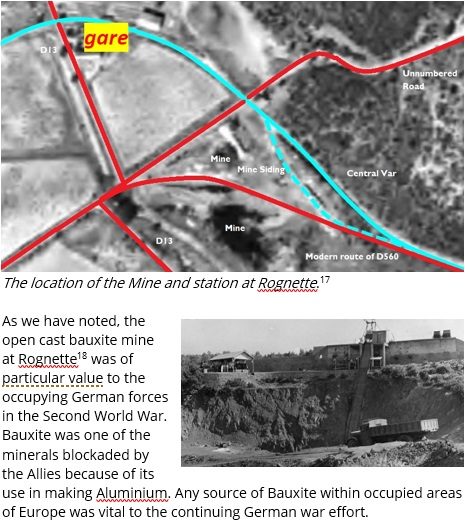
I have been preparing a book about the Central Var line and in doing so have recognised that my original post about this length of the line carries some significant omissions, particularly in relation to Rognette and two mines in close proximity to it. I have reviewed the original post to include details of these mines and to improve referencing of pictures.

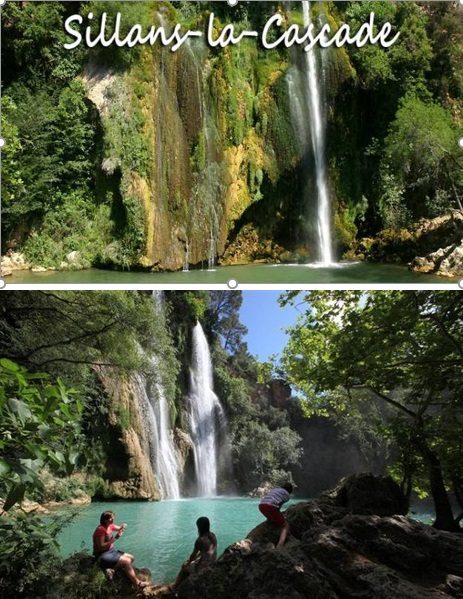
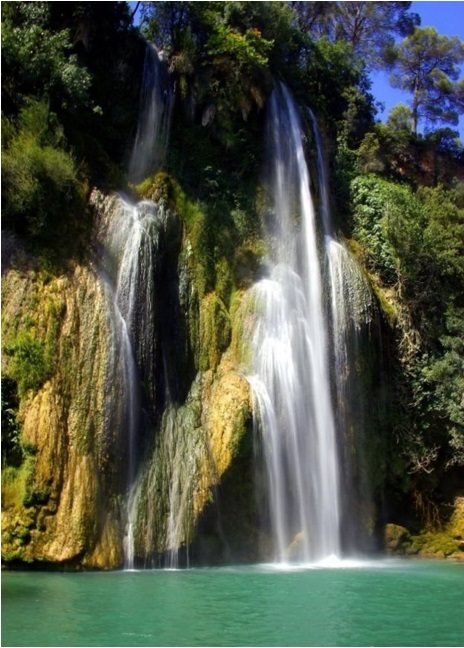
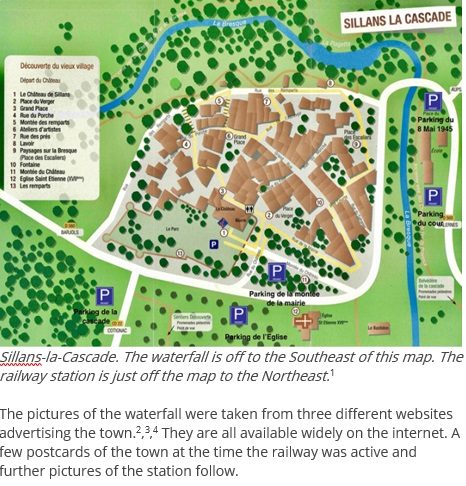
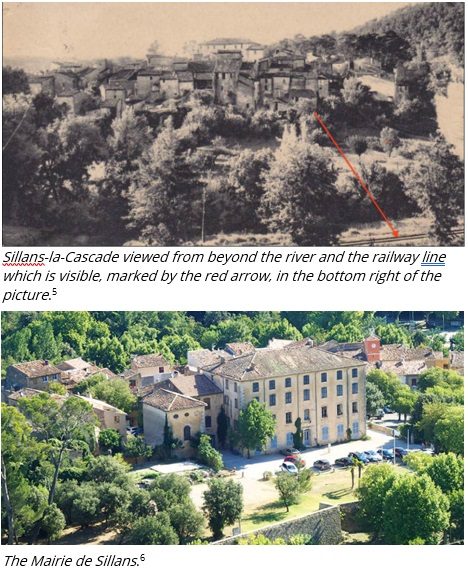
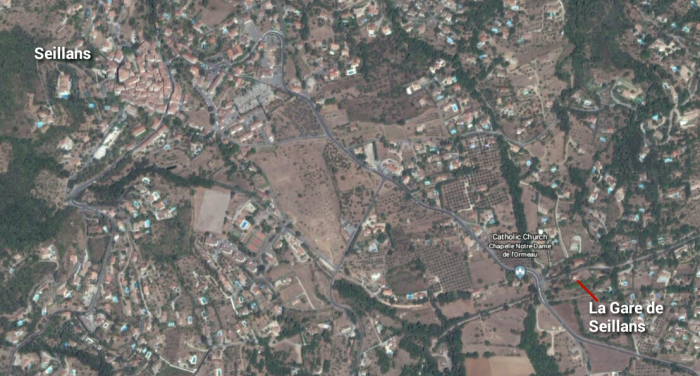
We got off our train to Meyraragues to have a look round Sillans and its environs.The town is known for its waterfall which is just to the Southeast of the town. ….

References

  1. http://sillans-la-cascade.fr/blog/page/6, accessed on 19th August 2019.
  2. https://www.provence7.com/portails/villes-et-villages/communes-a-visiter/sillans-la-cascade-a-visiter-83, accessed on 19th August 2019.
  3. https://www.bookmarkplayer.info/sillans-la-cascade.html, accessed on 18th August 2019.
  4. http://www.mgfedayi.info/Pot-Falls-f51f00, accessed on 19th December 2019.
  5. https://www.passion-metrique.net/forums/viewtopic.php?f=2&t=8154&start=60 © J.F. Mc Cameron, accessed on 9th December 2017
  6. https://www.tourinprovence.fr/commerces/commerces-services/2421-mairie-de-sillans-la-cascade.html, accessed on 9th December 2017
  7. https://yasminroohi.com/maison-de-village/maison-de-village-sillans-la-cascade-var-provence, accessed on 1st May 2018.
  8. https://thebesthotels.org/room-photo-sabai-inn-pattaya-ID3385898.htm, accessed on 1st December 2018.
  9. https://sillans-la-cascade.fr/municipalite/sillans-2020, accessed on 17th August 2019.
  10. https://www.pinterest.co.uk/sirpiano/sillans-la-cascade-provenza-francia, accessed on 9th December 2017.
  11. https://en.wikipedia.org/wiki/Sillans, accessed on 9th December 2017.
  12. https://www.cparama.com/forum/sillans-la-cascade-t30688.html, accessed on 9th December 2017.
  13. https://www.passion-metrique.net/forums/viewtopic.php?f=2&t=8154&start=60 © J.F. Mc Cameron, accessed on 9th December 2017.
  14. Jose Banaudo; Le Siecle du Train de Pignes; Les Editions du Cabri, Briel-sur-Roya 1991.
  15. https://www.la-provence-verte.net/accueil/documentation/ftp2/pah-ponteves.pdf, accessed on 17th August 2019.
  16. http://www.inventaires-ferroviaires.fr/hd83/83095.1.pdf, accessed on 17th August 2019.
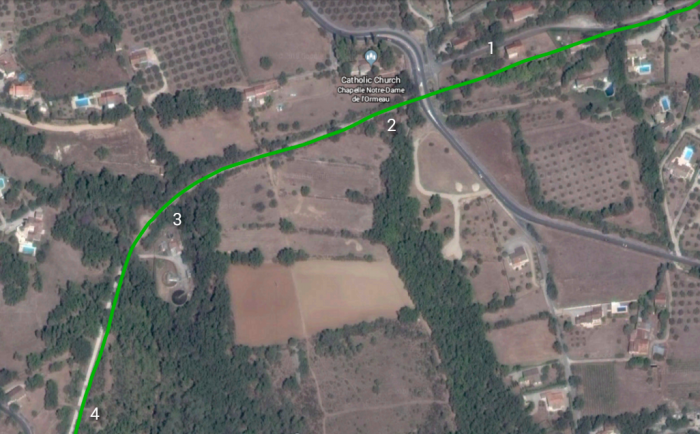
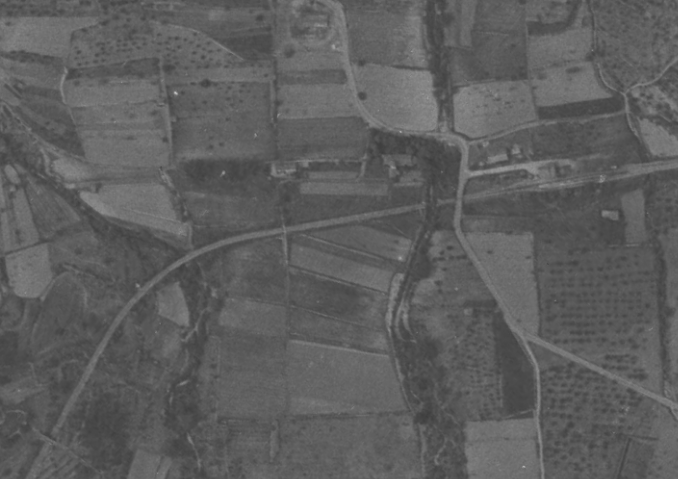
  17. http://www.inventaires-ferroviaires.fr/hd83/83095.1.pdf, adapted from an IGN aerial image of 1949 and further altered to show modern road alignments, accessed on 17th August 2019.
  18. https://archives.var.fr/arkotheque/navigation_facette/index.php?f=fondsiconographique&mde_present=mosaique&crit1=33&v_33_1=rognette, accessed on 18th August 2019.
  19. Ibid.
  20. http://www.inventaires-ferroviaires.fr/hd83/83095.1.pdf, accessed on 17th August 2019.
  21. Ibid.
  22. https://www.passion-metrique.net/forums/viewtopic.php?f=2&t=8154&start=60 © J.F. Mc Cameron, accessed on 19th August 2019.
  23. http://www.inventaires-ferroviaires.fr/hd83/83128.a.pdf, accessed on 16th August 2019.
  24. I am unable to provide a direct reference for this plan but suspect that it comes from Jose Banaudo; Le Siecle du Train de Pignes; Les Editions du Cabri, Briel-sur-Roya 1991.
  25. https://www.randomania.fr/de-barjols-sur-le-theme-de-leau-a-ponteves, accessed on 9th December 2017.
  26. http://www.waymarking.com/waymarks/WMXNNR_Gare_de_Barjols_Tavernes_Barjols_Paca_France, accessed on 19th August 2019.
  27. https://www.passion-metrique.net/forums/viewtopic.php?f=2&t=8154&start=60,  © J.F. Mc Cameron, accessed on 19th August 2019.
  28. Ibid.
  29. Ibid.

The TNL Tram Network – The Beginning of the Decline (1927-1934) (Chemins de Fer de Provence 84)

This post continues a series of reflections on the tramway network in and around Nice which are based on Jose Banaudo’s French language book “Nice au fil du Tram Volume 1: Histoire.” The text below is based on a tranlation from Jose Banaudo’s book. [1]

From 1921 onwards the TNL grew closer to its counterpart in Paris and in 1927 it was integrated into Parisian Group and the TNL headquarters were moved to Paris. Its board began to be Chaired by the Chair of the wider group and a new director of the TNL was appointed, Mr Jacques Schopfer, formerly a rolling stock and traction engineer.

The TNL was now tied to the dictats and intentions of the STCRP, for better or for worse! At the end of the 1920s the tramway was no longer seen as a fast, safe and efficient means of transport, but rather as an obstacle to traffic and an obstacle to progress towards the free movement of cars.

Banaudo says that after initially supplementing their existing network with buses, the public transport operators in both Nice and Paris tried to convert most of the existing lines to buses. They were encouraged by public opinion, the press, tourist information offices, car clubs and many elected officials, both in the Alpes-Maritimes General Council and in the city of Nice. It is not surprising that the new mayor elected in December 1928, Jean Médecin, made the removal of the tracks in Place Masséna and on Avenue de la Victoire one of his election promises.

While these debates were taking place in the city of Nice, work to extend the ‘departmental’ lines at Levens and L’Escarène was suspended and the General Council considered using the infrastructure built to establish roads there.

In the autumn of 1926, the valleys behind Nice were hit by torrential rains. Damage to the TAM network, the lines in the valleys of l’Estéron, Haut-Var, Tinée and especially the Vésubie occured and a massive landslide engulfed the village of Roquebillière and about twenty of its inhabitants died. Closer to the coast, the TNL lines of the Paillon basin were also affected. On 18th November, the flooded river damaged the permanent way on the La Grave-de-Peilie branch, but tram traffic was able to resume on a temporary detour on 15th December.

A large landslide blocked the stretch between Contes and Bendéjun. The road was rebuilt in January 1927, but the TNL took the opportunity to abandon their line between Contes and Bendejun. Ultimately, the General Council accepted this closure.

On 1st December 1927, new arrangememts replaced the city of Nice with the State as the licensing authority for the urban network and ratified the creation of new bus lines. This was approved by a ministerial decree on 5th March 1929. In the spring of 1928, agreement was reached with the General Council to only maintain tram lines where absolutely necessary, particularly when the freight service so required; otherwise, tramway routes would be replaced by bus services.

So, only the rural lines to Contes, La Grave and Sospel were retained out of the wider departmental network, all other lines would be replaced by bus services.

Banaudo comments that passenger numbers were dropping rapidly and there were very few signs of hope. On 30th October 1928 the PLM inaugurated its international service Nice-Breil-Cuneo. The construction work for this line had been a major part of the freight traffic on both the La Grave and Sospel lines for years. The new line provided a much faster link to the communities served originally by the trams. In Sospel alone, the average number of tram passengers fell by 51% and the tonnage of goods by 58%!
1929 marked the beginning of the end for the departmental tramways. The TAM lines to Estéron, Vésubie, Haut-Var, Grasse and Bar closed in April and May. The TNL closures began in the autumn. With the development of car traffic, the elimination of the tramway was considered a priority on coastal arteries. The first line hit by the road-building programme was Nice – Antibes, the Bridges and Roads Department widened the RN7 onto the shoulder occupied by the tramway. As a result, tram traffic ceased on 29th October 1929 between St. Laurent-du-Var and Antibes. The service was replaced by buses. The few power cars kept in Antibes for its urban service were isolated from the rest of the network, sheltered and briefly maintained in the shed near the PLM station. After seven months of this arrangement that service closed on 1st June 1930.

In April 1930, the General Council closed the Monte-Carlo line, the service had already effectively been replaced by a private contractor who used comfortable coaches and frequent departures, every ten or even five minutes during rush hour!

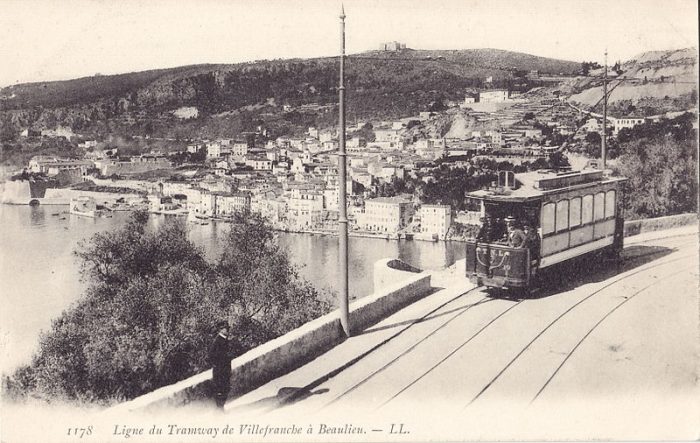
The line between Villefranche and Beaulieu along the Base Corniche [2]

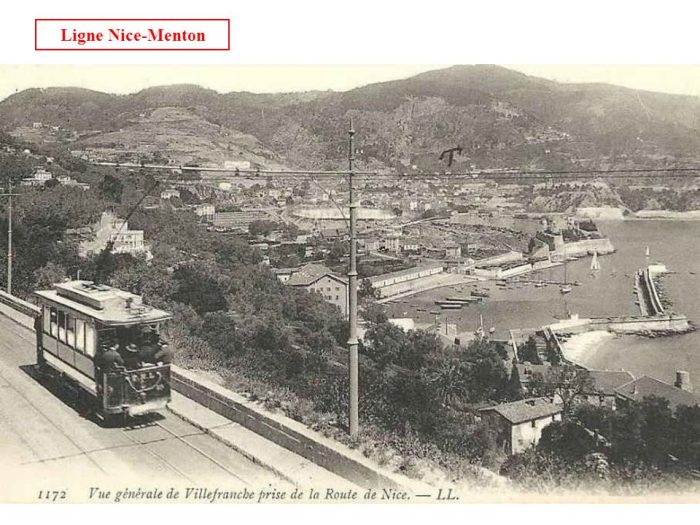
The coastal line was gradually converted to buses. On 9th March 1931, the tramway was closed between Villefranche, Pont-St. Jean, St. Jean-Cap-Ferrat, replaced by a road service. On 18th June the length between Nice and Villefranche gave way to a suburban bus service.

Ligne Nice-Villefranche [3]

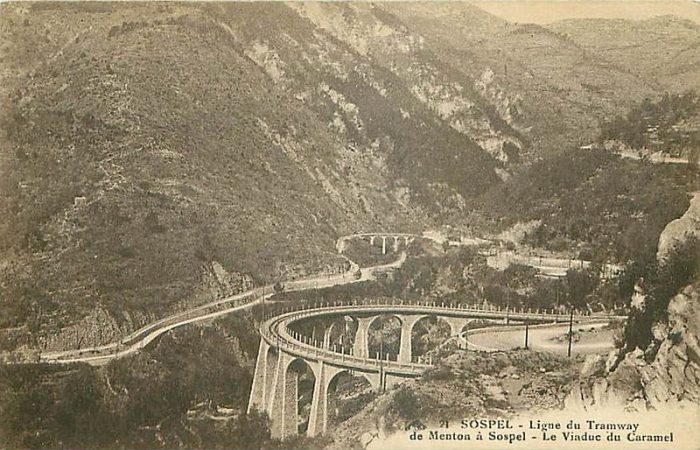
Two lines which took so much effort to build and operate were then closed. The first was the Menton to Sospel line.

The snaking route of the Menton to Sospel tramway viewed from behind the Viaduc du Caramel. [4]

For more information about the Menton to Sospel tramway please see the following links:

Sospel to Menton Tramway

The Sospel to Menton Tramway Revisited (Chemins de Fer de Provence 51)

The Menton to Sospel Tramway Revisited Again! (Chemins de Fer de Provence 61)

The traffic on the Menton to Sospel line collapsed after the opening of the Nice to Cuneo railway line. It was closed and replaced by a bus service. The route had only been in service for 19 years.

The next to close was the Nice to Levens line. Details of the route to Levens can be found on the following links:

The Nice to Levens Tramway – Part 1 (Chemins de Fer de Provence 55)

The Nice to Levens Tramway – Part 2 (Chemins de Fer de Provence 56)

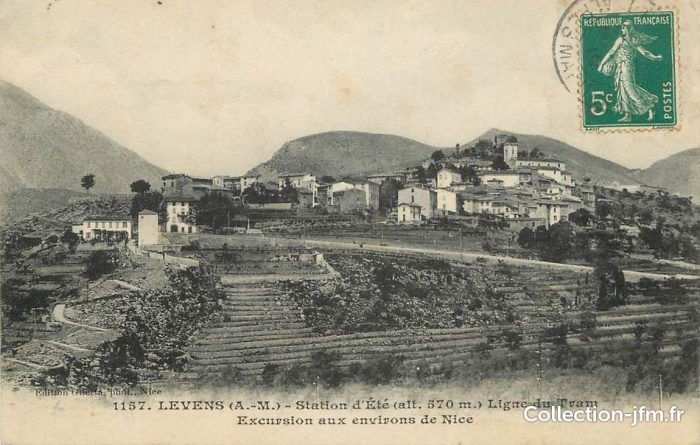
Two shots of the station at Levens. It had been intended to extend this line from the station into the village of Levens and a tunnel was built to make this possible. after all 5hat expenditure the extension was never opened. [5][6]

The Principality of Monaco did not want to be left out of the trend towards the use of buses. On 8th May 1931, the TNL signed an agreement with the Monaco government to replace two tram services, No. 41 (between Visitation, place d’Armes and St. Roman) and No. 42 (between Monaco Station, place d’Armes and the Casino) with new bus services. Three bus services replaced the two tram routes and a further two bus lines were soon added.

Trams in Monte Carlo. [7]

However, the tramway was not yet totally excluded from Monaco since the TNL line to Menton, still crossed the eastern part of Monaco between the Casino and St. Roman. However, on 28th May 1931 the TNL signed an agreement with the authorities in Menton to prepare the town for the end of tramway services and in January 1932 both the remainder of the Sospel line and the line from Monte-Carlo to Menton were closed.

A tram approaching Monte Carlo from Nice. [8]
The bus fleet was not yet up to full strength and it took some months to completely close the tramways around Menton. So it was not until 1933 that the network was finally abandoned.
For a short period of transition, the TNL organized a bus route between Beausoleil and La Turbie to replace the rack railway whose operation had just been suspended following a fatal accident in March 1932. The service operated from 25th April to 31st July 1932 before is was passed to a local company.
In less than three and a half years, large parts of the TNL tram network had been closed with the full support of various statutory bodies and the local press.

References

  1. Jose Banaudo; Nice au fil due Tram Volume 1: l’Histoire; Les Editions de Cabri, 2004.
  2. https://fr.m.wikipedia.org/wiki/Tramway_de_Nice_et_du_Littoral, accessed on 11th April 2019.
  3. https://slideplayer.fr/slide/3703631, accessed on 11th April 2019.
  4. https://fr.m.wikipedia.org/wiki/Tramway_de_Menton_à_Sospel, accessed on 11th April 2019.
  5. https://www.geneanet.org/cartes-postales/search/?country=FRA&go=1&page=1&place=Levens&region=PCA&size=40&subregion=F06&zonegeo=Alpes-Maritimes%2C+France, accessed on 11th April 2019.
  6. https://collection-jfm.fr/p/cpa-france-06-levens-station-d-ete-ligne-du-tram-excursion-aux-environs-de-nice-12154, accessed on 11th April 2019.
  7. http://www.barrysbest.net/Weathertopia/MonteCarloMonaco.html#.XK9Ntpgo-9c, accessed on 11th April 2019.
  8. https://www.akpool.co.uk/postcards/27613626-postcard-monaco-tram-route-de-nice-a-monaco, access on 11th April 2019.

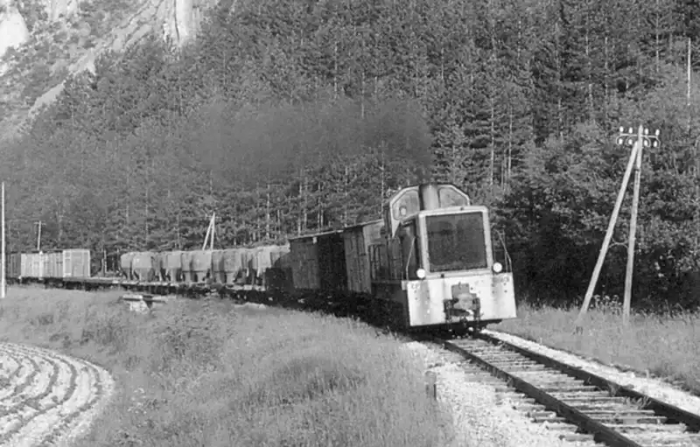
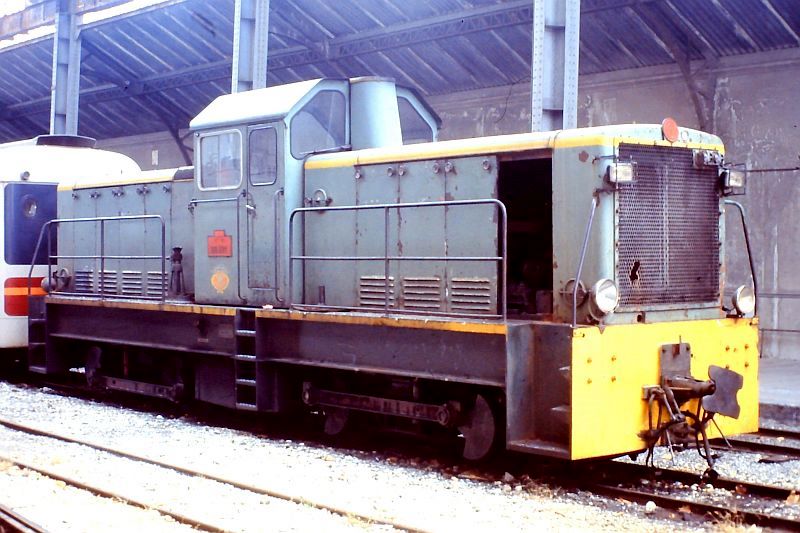
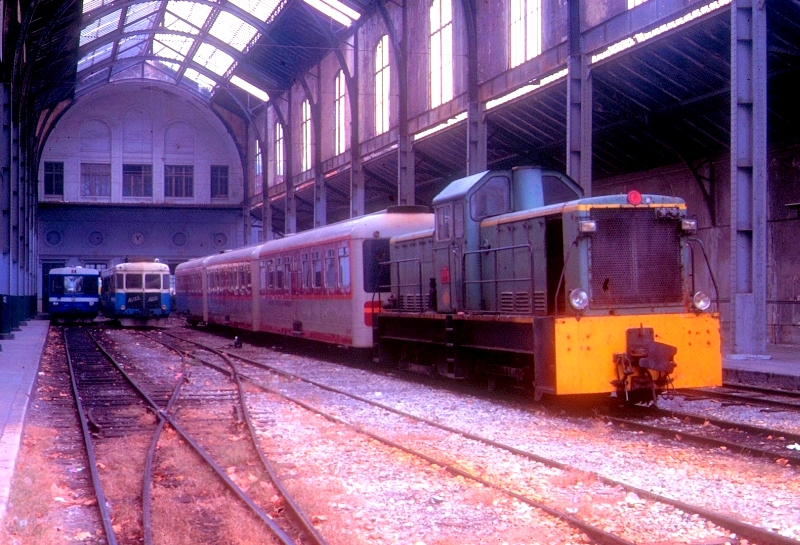
Nice to Digne-les-Bains Part 16 – Locomotives and Rolling Stock – Shunters and others – Diesel Traction (Chemins de Fer de Provence 82)

The use of steam on the Nice to Digne line was gradually abandonned. Increasingly, the travelling public became dissatisfied with steam haulage and the economics began to turn in favour of the combustion engine. The ease of use of diesel power worked in its favour, as did the rapid acceleration possible which resulted is significant reductions in journey times.

Initially, diesel traction was trialed on the shorter journeys. One of the earliest diesel units to be employed towards the end of steam was CP51 which first started work in 1948. There is an older locomotive at work on the line, BA11, but this was not brought to the line until 1988 by the GECP.

CP51

This locomotive is still present on the network and owned by the GECP. It was the first diesel shunter at work on the network and there is a hope that it will be refurbished and running once again. It was recently moved (in December 2017) from the depot at Lingostiere to the GECP depot at Puget-Theniers.CP51 at Lingostière Depot [1]CP51 moved to Puget-Theniers in 2017. [2]

CP51 was the first of a number of diesel traction units which ultimately ran alongside a range of Railcars (Autorails) on the Nice to Digne line. It performed a series of differnt duties on the line over the years. One important role was the movement of transfer stock from the Chemins de Fer du Sud to the SNCF and vice-versa.

Pictures of the locomotive in use on the connecting line can be seen on the following link: [3]

https://rogerfarnworth.com/2018/04/12/the-connection-between-the-plmsncf-station-in-nice-and-la-gare-du-sudchemins-de-fer-de-provence-59CP51 in good condition in its later use on the Nice to Digne line. [5]

BA11

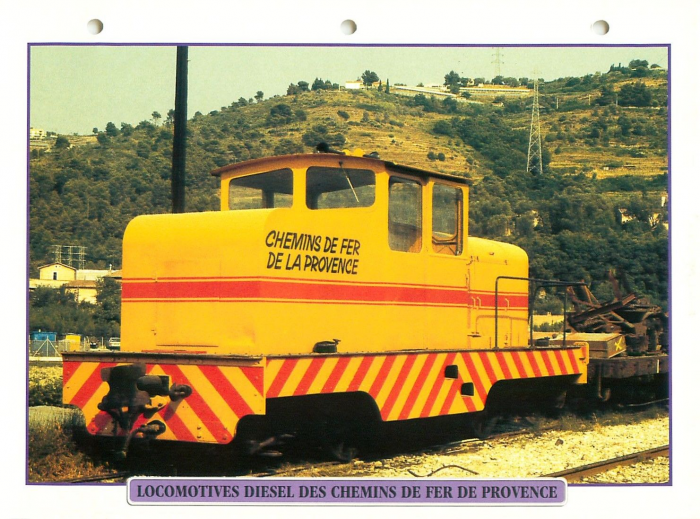
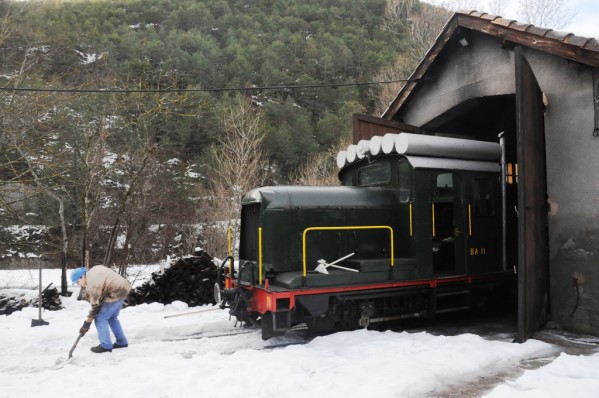
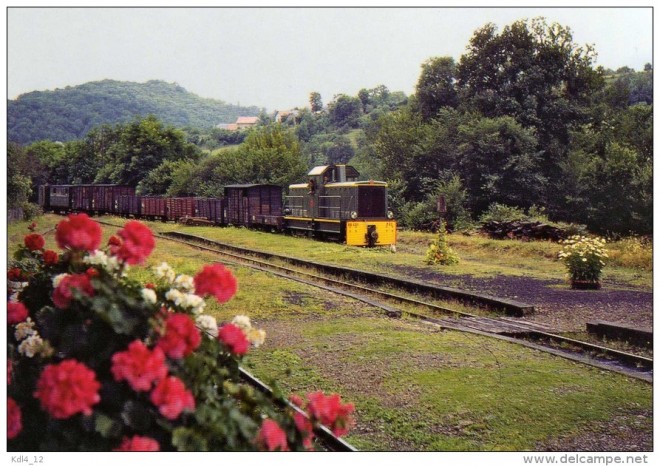
BA11 was one of 4 diesel 0-6-0 shunters (locotracteurs) in use on the Chemin de Fer du Blanc-Argent. [4] Of those four locomotives, No. 12 is now on the Chemin de Fer de la Baie de Somme, Nos. 13 and 14 are still on the Chemin de Fer du Blanc-Argent. [9] BA11 is the oldest diesel locotracteur (shunter) on the Nice to Digne line and it is still operational.

Before arriving at the Chemin de Fer du Blanc-Argens these locos were in use by the Compagnie des Chemins de Fer Departmentaux (C.F.D.) on their Nord d’Indre et Loire network.

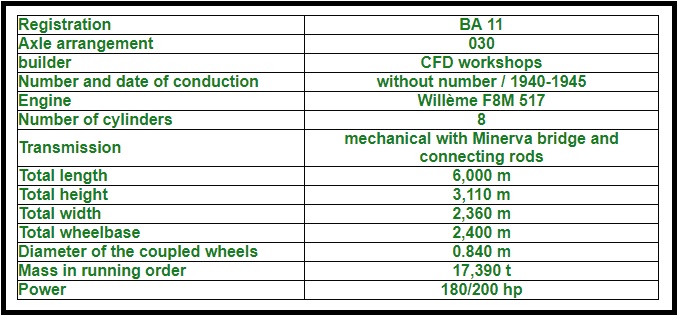
No. 11 was built during the Second World War, based on the chassis of an old steam loco. This transformation was carried out by the C.F.D.  The steam loco was itself built in 1885 by the Belgian firm, ‘Couillet’. Work on the conversion started in January 1940 at the C.F.D. workshops in Neuille-Pont-Pierre. It was completed in January 1941. [10]

The new diesel locotractuer was initially endowed with a Renault 130 hp engine but not used for lack of fuel . Then it was equipped with a Berliet 150hp engine for the Chemins de fer de l’Yonne. Once refurbished again by C.F.D, the Locotracteur No. 11 circulated from January 1950 on the Laroche Migennes – L’Isle-Angély line and was equipped with a 200 hp, 8 cylinder Willeme engine. [11]

In 1952 BA11 was sold to the Chemin de Fer du Blanc-Argens in February 1952 and not brought to the Chemin de fer de provence by the GECP until March 1989.BA11 in the snow at Puget-Theniers. [11]Details of BA11 provided by the GECP. [10]

BB401

BB401 was built in 1962 [15] by the C.F.D. it was a diesel-hydraulic locomotive.

It ran, for some years on the Chemin de Fer de Paris à Orléans (PO) Corrèze and was transferred to the Nics-Digne line in 1971 where it remains. [17]BB401 at La Gare de Saint-Bonnet-Avalouze (PO-Corrèze) in 1963, (c) Jean-Michel Vaugouin. [16]Here at Argentat on the same PO Correze network in 1967, BB 401 awaits the departure of Billard X251 courtesy of “030T 1707 Nord-Est” on the Passions Metrique et Etroit Forum in France. [16]BB401 at Lingostiere in 1985. [18]BB401 at Lingostiere in 1997. [18]BB401 in storage at La Tinee and in a dilapidated condition in the 21st century! [12]BB401 at the Gare de la Tinee a little earlier in the 21st century. [13]BB401 at the head of a goods train in the 1970s. [6]The two images immediately above were taken in November 1989 and show BB401 at the Gare du Sud in Nice. They were downloaded from Smugmug. They were taken by Dave Rowland and freely available to download. I was unable to establish whether copyright issues applied. [14]

BB402

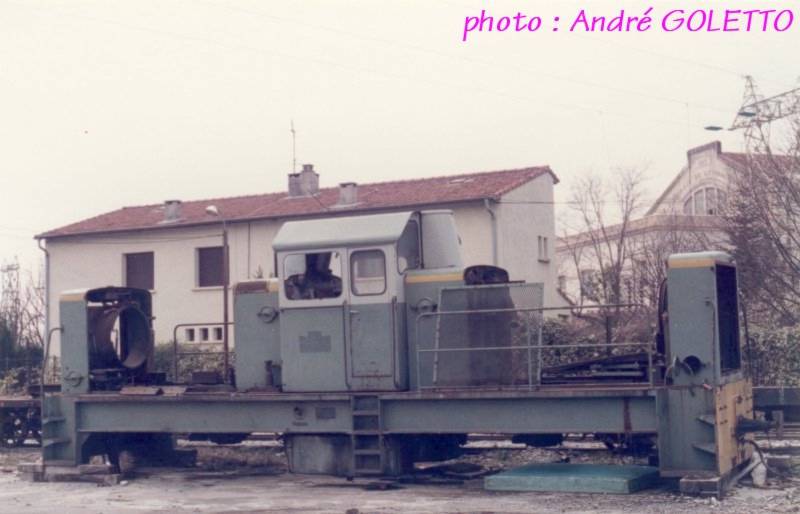
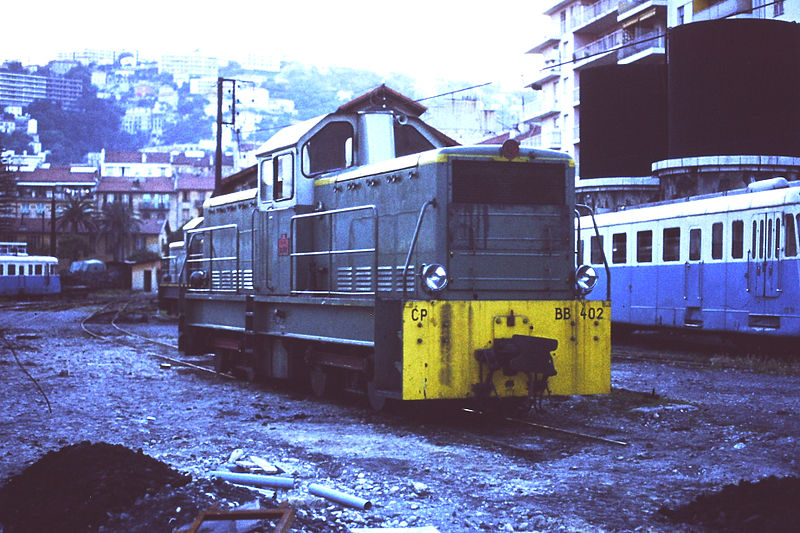
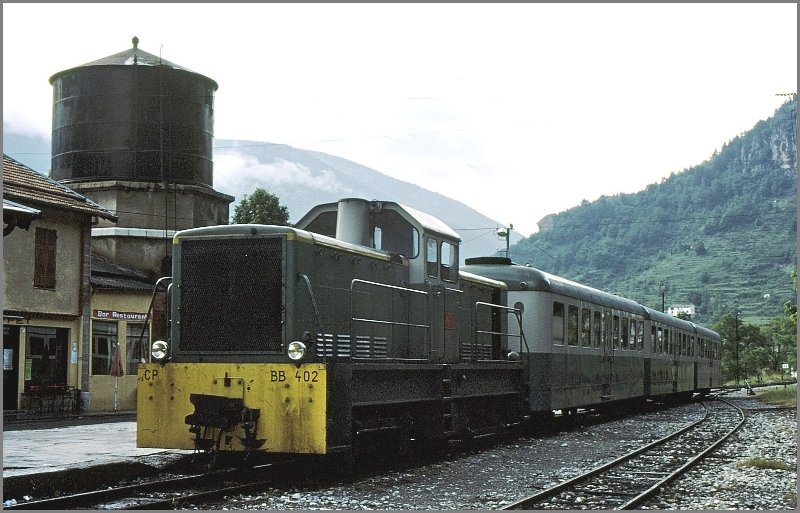
BB402 was also built by the C.F.D. at Montmirail in 1962 both locos were part of one batch of locotracteurs bult that year (BB400-BB404). Both had/have a central cabin and two ‘bonnets’ which hid/hide identical 207hp motors from Poyaud. [20]

The transmission of both units was/is hydraulic using an Asynchronous hydraulic system patented by the C.F.D. which synchronised the two engines. In both engines the axles of the bogies are coupled by connecting rods. [19]

BB402 was progressively stripped down, presumably to provide spare parts for BB401. It seems as though the remains were transported to the Chemins de Fer du Vivarais in 2001. In 2013, only the body shell remained in the depot at Tournon. [23]

BB402 at Lingostiere in 1985. [18]BB402 at the Gare du Sud in May 1976. [21]Diesel locomotive BB 402 with three passenger cars at the platform in Annot in June 1977, (c) Herbert Graf. [22]An autorail “Ville de Digne” crosses with BB 402 in Annot in June 1977, (c) Herbert Graf. [22]

T61-T66

These six locotracteurs were built in 1950 by Brissonneau & Lotz. [19][24]

A locotracteur of the series T61-66 at Colomars. [7]A locotracteur of the series T61-66 on 1 September 1959, taken at Fugeret,  in charge of the goods train 502A [8]

An HOm model of the Brissonneau and Lotz T61 of the Chemins de fer de Provence runs with sound! (Trains d’Antan). [25]

Commonly known as ‘Provence-type tracteurs’. The Brissonneau-et-Lotz 040DE locomotives were produced at the request of the Union des Voies Ferrées (UVF). These locomotives contrast significantly with the much more modest locomotives which had hitherto been used on the secondary lines in France.Provencal T62 in green livery. The car at the crossing gate is a Simca 1000, these vehicles were produced at Poissy in France from 1961 to 1978 [1]  (c) J-C. Reese. [27]

Until 1950, the French railway Industry had very little experience in the field of diesel locomotives with electric transmission. It is not initially clear where the Brissonneau-et-Lotz gained the knowledge to allow it to manufacture this series of locomotives. The answer is primarily associated with metre-gauge railways. [27]

In the 1930s Brissonneau-et-Lotz manufactured motor vehicles (autorails/railcars) for narrow-gauge lines which were equipped with electric transmissions, for example, the railcars delivered in 1934 to the Chemins de Fer d’Anjou [28]. These railcars were seen as a loss-leader by the company and were provided at well-below market price. This allow Brissonneau-et-Lotz to undertake evaluations of the locomotives in service.

In November 1935, the Deux-Sèvres Tramway Company (TDS) awarded Brissonneau-et-Lotz a contract to retrofit a diesel locomotive onto the chassis of an 0-6-0T steam locomotive (No. 16) built by Blanc-Misseron. The revitalised locomotive was delivered in 1937 to the TDS. It had a MAN 240hp diesel engine associated with an electric transmission. After a long and valuable career, this machine has been enjoying a peaceful time, since 1996, at the “Musée des tramways à vapeur et des chemins de fer secondaires français”  (MTVS). [27][28]

Building this small locomotive (shown in the adjacent image) paved the way for Brissonneau-et-Lotz’s involvement in the manufacture of diesel-electric locomotives.

In November 1936, two Bo-Bo diesel-electric locomotives were ordered from Brissonneau-et-Lotz for the coastal line (Le Macaron). They arrived in 1938, the locos were equipped with two Berliet 150hp engines and were numbered T1 and T2. Those locomotives were sold into Spain with the closure of Le Macaron.

As a result of providing these two locos Brissonneau-et-Lotz were contracted to provide two locomotives for the Malagasy network, then four for the Reunion network (these had 160hp Saurer engines).

After the second world war, competitive tenders were invited to provide Bo-Bo locomotives for the the Union de Voie-Ferree (UVF). The design had been determined to be the best for the secondary lines. Brissonneau-et-Lotz was chosen to build a series of these machines. Unfortunately, only three networks (including the Chemins de Fer de Provence) chose to purchase the locomotives. The series was, as a result, limited to only 10 locos. They were distributed to the Voie Ferree du Dauphine (VFD), the Chemins de Fer de Provence (CP), and Chemins de Fer de la Corse (CFC). The work took 3 years to complete primarily because it was difficult to source the necessary parts and because technical specifications were altered in an endeavour to reign in project costs. [27]T64 in brown and cream livery at the head of a mixed goods and passenger train on the journey between Nice and Digne-les-Bains in March 1953. At the time these locos were the height of modernity,  © Michel Dupont-Cazon. [27]

T62 at the Gare due Sud in Nice, © Jean Louis Paris. [27]

It appears that cost reductions were partially achieved by a sharing of design costs between Renault, which was supplying the overseas market in the 1950s and Brissonneau-et-Lotz, who were supplying the domestic market. Although Renault used hydro-mechanical transmissions, the parallels between the Renault locomotives intended for overseas and the Brissonneau-et-Lotz diesel-electric vehicles designed according to the specifications of the UVF are obvious. Both series of locomotives used Renault diesel engines, both used two diesel engines in order to attain the necessary pulling power.

The four engines of the VFD were designated T1 to T4 and received there between August 1950 and January 1951. They served there until just before the Winter Olympic Games of 1968.

T63 stabled at Nice, resplendent in its brown and cream livery. © M. Fontaine.

The Winter Olympic Games of 1968 in the area around Grenoble required significant improvements to road infrastructure. The line between Jarrie-Vizille and Livet ran alongside the N91 which had to be widened. As a result the line was closed in 1964. T1-T4 were offered for sale that year but it took 20 years for them all to find new homes. However T3 was moved to Provence where it was renumbered T63.Tracteur T62 in “Arzens” livery, designed to harmonize it with second generation SY railcars. It is snowing that day in Nice, © Jean-Rémy Grasser. [29]

T64 from the Chemins de Fer de Provence was dispatched  to the metre-gauge network in Corsica in August 1963 where it took the number 403. In January 1964  the Chemins de Fer de Provence received compensation in the form of locomotive T3  which was numbered T65. It survived until it was scrapped in 1983.Technical spec. of the Brissonneau-et-Lotz tracteurs. [29]

When originally ordered, T61 to T64 were intended for passenger service alongside the Renault ABH railcars on the Nice to Digne-les-Bains line. The technical spec. was downgraded to limit cost overruns, their role was limited to heading goods trains. T61, T62, T63, and T64 arrived in 1951. As we have already noted T64 left the network for Corsica in 1963, T65 was added to the roster of the Chemins de Fer de Provence in 1964. The closure of the line to Meyrargues meant that the network had more Renault ABH autorails available for the Nice-Digne service than originally expected and the reduced spec. of the tracteurs created no significant problems.
T65 seems to have ceased active operations in 1970. It was canabalised to provide parts for T61 which had been in an accident in 12th August 1971. Interestingly, the locos delivered to the Chemin de Fer de Provence and the VFD networks did not have exactly the same ends. As a result, the T61 became an asymmetric machine. [29, (note 5)]

By January 1974 the condition of the locos meant that both T63 and T61 had to be cset aside and cannibalised in favour of T62, the only machine of the series kept in active by the Chemins de Fer de Provence. For the T62, the 1970s were devoted to lower-level tasks such as weeding, supplying ballast for the track and other materials, pushing snow plows, and so on. In addition to the service trains, the locomotive supported some special trains composed of cars R 1341 to 1344 (ex-AT 1 to 4), which offered enhanced capacity to the autorails. Maintenance to T62 took place in Desbrugères in the early 1980s and in 1987-88 the SNCF supplied diesel engines and electrical transmission sub-assemblies to maintain the T62. During the 1990s, the T62 remained the most obvious Brissoneau-et-Lotz locomotive on the network. Its condition deteriorated over time.

In February 1999, the T62 received a running-mate. The former T1 of the VFD arrived on the network (Gm 4/4 508 of the Jura Railways) and it was numbered T66. It required some repairs after an eventful road journey from Switzerland. The parts needed were sourced from La Mure where the locos T2 and T4 of the VFD were stored.

On 19th January 2000, tests of T66 on the network revealed poor performance and resulted in a decision to re-motorise both T62 and T66. Neither performed exceptionally in the early years of the 21st century. Major work was intended to secure their future on the network. [27]

T62 at Entrevaux in December 2014, (c) JeffP, RMWeb.co.uk. [31]T66 in service in Nice. [12]

Henchel BB1200

The Compania Minera de Sierra Menera (SM) ordered first three then two additional locomotives of the type DH 1200 from Henschel in Kassel. The drive unit consisted of a four-stroke Maybach-Mercedes Benz diesel engine type MB 820b with 12 cylinders in V-arrangement. It delivered 880 kW at a maximum of 1500 revolutions per minute and was equipped with turbocharger and intercooler. The cooling water was cooled in a cooling system installed under the roof. The cooling air was sucked into the side walls and blown out through the roof. A short PTO shaft transmited the torque of the diesel engine to the Voith L306r turbo transmission with hydrodynamic brake. It included three hydraulic transducers and a reversing gearbox. Two cardan shafts each drove a bogie. The two axles in the bogie are also connected by cardan shafts. The locomotives were braked with compressed air. The locomotives were designed for double traction and therefore has a skid protection device.

Of these 5 locomotives, Henchel BB1200 No. 1004 with serial number 31003, built in 1966 was numbered 1404 by the Ferrocarriles de Vía Estrecha (FEVE) and noted on their roster in 1973.

The FEVE replaced on the Henschel locomotives the Maybach deisel engine by a French SACM engine, which was installed on other FEVE locomotives to standardize the spare parts inventory. Regularly there were problems with this engine type. To improve the reliability of the locomotives, the control of the first three locomotives was modernized. A mid-nineties built-in programmable logic controller with redesigned cabs extended their life. The locomotive 1404 was sold in 1992 through intermediaries to the Chemins de fer de Provence. The middleman just re-painted the loco. Regular disturbances led in March 2006 to the final shutdown of the locomotive and it was placed in storage at Lingostière . [32]

BB1200 at Entrevaux. [12]BB1200 at Lingostière on 16th May 2010, (c) Eric Coffinet. [30]BB1200 at Annot (c) JeffP, RMWeb.co.uk. [31]

Draisines DU 101 and 102

These modern locomotives were constructed by Matisa and are used for a variety of maintenance work on the line. They are popular with the staff. They are also used to supplement existing locomotives in the event of breakdown. [33]Draisine DU 101. [34]Draisine DU 102. [35]

References:

  1. https://commons.wikimedia.org/wiki/File:CP-51-d%C3%A9bris_Lingosti%C3%A8re_04-2014.jpg, accessed on 17th November 2018.
  2. https://www.gecp-asso.fr, accessed on 10th December 2018.
  3. https://rogerfarnworth.com/2018/04/12/the-connection-between-the-plmsncf-station-in-nice-and-la-gare-du-sudchemins-de-fer-de-provence-59
  4. https://en.wikipedia.org/wiki/Chemin_de_Fer_du_Blanc-Argent, accessed on 12th December 2018.
  5. https://picclick.fr/Diesel-de-Provence-SNCF-Locomotive-Railway-Chemin-de-153151417340.html, acessed on 12th December 2018.
  6. http://cccp.traindespignes.free.fr/phototheque-digne.html, accessed on 12th December 2018.
  7. http://www.passion-metrique.net/forums/viewtopic.php?f=2&t=8154&start=120, accessed on 12th December 2018.
  8. http://www.passion-metrique.net/forums/viewtopic.php?f=2&t=8154&start=135, accessed on 12th December 2018.
  9. Organ, John; Northern France Narrow Gauge. Midhurst: Middleton Press, 2002.
  10. http://gecp.asso.fr/ba11.html, accessed on 12th December 2018.
  11. http://train-des-pignes.over-blog.fr/article-inventaire-du-materiel-roulant-du-gecp-44929448.html, accessed on 13th December 2018.
  12. http://cccp.traindespignes.free.fr/phototheque-materiel.html, accessed on 18th December 2018.
  13. https://commons.wikimedia.org/wiki/File:BB401_Gare_de_la_Tinee.jpg, accessed on 18th December 2018.
  14. https://daverowland.smugmug.com/RAILWAYS/European-Railways-1988/FRANCE-03-06-November-1989, accessed on 18th December 2018.
  15. https://en.wikipedia.org/wiki/Chemins_de_Fer_de_Provence, accessed on 18th December 2018.
  16. http://www.passion-metrique.net/forums/viewtopic.php?f=2&t=8552&p=406865&hilit=BB401#p406865, accessed on 18th December 2018.
  17. http://www.passion-metrique.net/forums/viewtopic.php?f=2&t=3728&start=0, accessed on 18th December 2018.
  18. http://metrique43.free.fr/vm_reel/vm_01.htm, accessed on 18th December 2018.
  19. https://fr.wikipedia.org/wiki/Chemins_de_fer_de_Provence, accessed on 18th December 2018.
  20. https://fr.wikipedia.org/wiki/Poyaud, accessed on 18th December 2018.
  21. https://commons.wikimedia.org/wiki/File:CP_BB402-III.JPG, accessed on 18th December 2018.
  22. http://www.bahnbilder.de/name/galerie/kategorie/frankreich~schmalspur–und-zahnradbahnen~chemin-de-fer-de-provence-cp/digitalfotografie/48.html, accessed on 18th December 2018.
  23. http://www.passion-metrique.net/forums/viewtopic.php?f=2&t=8552&start=75, accessed on 18th December 2018.
  24. https://en.wikipedia.org/wiki/Brissonneau_and_Lotz, accessed on 18th December 2018.
  25. To learn more about the Trains d’ Antan see: http://passion-metrique.net/forums/viewtopic.php?f=3&t=4739&hilit=frot, accessed on 18th December 2018.
  26. https://en.m.wikipedia.org/wiki/Simca_1000, accessed on 23rd December 2018.
  27. Voie-Libre (Loco-Revue) No. 21: October 2002, http://fr.1001mags.com/parution/voie-libre/numero-21-octobre-2002/page-38-39-texte-integral, accessed on 23rd December 2018.
  28. https://fr.wikipedia.org/wiki/Mus%C3%A9e_des_tramways_%C3%A0_vapeur_et_des_chemins_de_fer_secondaires_fran%C3%A7ais#Mat%C3%A9riel_%C3%A9lectrique_ou_%C3%A0_moteur_%C3%A0_combustion_interne, accessed on 25th December 2018.
  29. http://fr.1001mags.com/parution/voie-libre/numero-21-octobre-2002/page-44-45-texte-integral, accessed on 25th December 2018.
  30. https://commons.wikimedia.org/wiki/File:CP_locomotive-Henschel-31002.JPG, accessed on 28th December 2018.
  31. http://www.rmweb.co.uk/community/index.php?/topic/76570-railways-in-france-1980s90s-more-pics-added-012015/page-5, accessed on 28th December 2018.
  32. http://www.le-rail.ch/text/projekt73.htm, accessed on 28th December 2018.
  33. http://golinelli.pagesperso-orange.fr/trains/actucp.htm, accessed on 29th December 2018.
  34. http://cccp.traindespignes.free.fr/autorails.html, accessed on 29th December 2018.
  35. http://tgveurofrance.com.pagesperso-orange.fr/cp.htm, accessed on 29th December 2018.

TNL Tramways – Recovery after the First World War (Chemins de Fer de Provence 83)

This blog is based on the text of the book written in French by Jose Banaudo: Nice au fil du Tram: Volume 1, Histoire; Les Editions du Cabri, 2004. The notes below are intended to promote a better understanding by an English audience of the tramways of southern France.

Difficult recovery

Like all transport companies, TNL faced post-war years of economic, social and material hardships. All developments of the network were suspended. The political upheaval brought tourism to a halt. Habits were changing and other forms of transport stole passengers from the trams. Inflation increased the price of materials and supplies when urgent repairs were required after years of neglect.

Employees who had shown great loyalty during the conflict started to defend their rights. They years after the first World War were ones of social unrest. in May 1920 the police and army occupied the Ste. Agathe depot to prevent striking workers disabling the network,

The constant search for savings was prioritised above the quality of the service to customers, especially on the wider departmental lines where the service had been reduced to two or three trips a day on certain sections during the war years. Not only did the service not improve, but in some cases it was further diminished. For example, on La Grave-de-Peille route there was only one round trip per day in 1919. In the face of protests raised by this failure, an improved service was introduced the following year.

The urban service also left much to be desired. In Nice City Council, the discontent was such that for the first time some elected officials proposed to replace the trams with buses.

Expansion projects of the departmental network
At Levens, work on the extension towards the village continued at a very slow pace during the war. The formation had been completed by 1917, including the curved tunnel, but the terms for moving the terminus facilities were still unresolved between the department and the company. The tunnel leading to the village of Levens, the structure was completed but never used. No tracks were laid through the tunnel. [2]

On the line from La Pointe-de-Contes to L’Escarene, work resumed at the end of 1919.

In the first half of the 20s, the development of the departmental network was still on the agenda for the Alpes-Maritimes General Council. However, persistent economic difficulties discouraged public investment in trams to rural areas where road transport now seemed to offer a more flexible and less expensive solution. The commissioning of new Haut-Var and Esteron lines of the TAM network proved to be a big mistake, the lines were not viable from the beginning, this reinforced an evolution towards road transport.

Even with most of the work complete, the TNL began to wonder whether it was viable to complete and maintain the routes into Levens village and between La Pointe-de-Contes and L’Escarene.

The work on these new links was postponed. As were two other projects planned by the TNL: the establishment in Menton of a TNL passenger and goods station closer to the port, and an underground crossing of the Monaco principality. It became clear very quickly that these projects would not be viable, given the deficits being experienced on the other departmental lines. New agreements were made with the local authorities but these only brought a brief stay of execution for the least remunerative lines which it had been designed to preserve. [3]

A first restructuring of the urban network
The TNL obtained authorisation, on 6th July 1920, to introduce multi-tier pricing by dividing each line in two, three or four sections, depending on the distance traveled. From 1st January 1923, all the lines of the network were renumbered and their number placed prominently on a color disc at each end of the tram. Nos. 1 to 16 designated urban lines. Nos. 20 to 24 were applied to services on the line to Monte Carlo; Nos. 26 to 30 to those to the valleys of Paillons; Nos. 31 to 34 to those on the line to Antibes and du Cap; Nos. 41 to 46 to the Monte-Carlo and Menton group of lines.
Stops were classified in two categories, fixed and request, which a few years later were designated by red and green plates.

Private entrepreneurs were equipping themselves with trucks and buses. Initially they provided links to the tramway and railway networks and did not act in competition with the trams. Banaudo reports that as early as 1921, the Société Anonyme Nicoise de Transports Automobiles (Santa) opened a Nice – La Turbie line via the Grande Corniche and a Nice – Colomars circuit through the hills, with the financial support of the department and the city of Nice.

Urban buses appeared in Nice on 28th May 1925 on the Massena-St. Sylvestre line via Jospeh Garnier and St. Barthelemy boulevards (now Auguste Reynard). The TNL operated this first service with road buses. [4]

A second service was inaugurated by the TNL between Saluzzo – Caucade by Dubouchage, Victor-Hugo and Gambetta Boulevards, on 5th October. In May 1926 the terminus of this line was moved to Place Masséna.

As the first buses appeared, the tramway network began to contract. More of that in future articles.

Jose Banaudo gives the following details about the TNL in 1927 which come from the Ministry of Public Works [5] …….

STATISTICS T.N.L. 1927

The TNL operated 141 km of lines, divided as follows:

  • Urban network: Nice 26 km (excluding common trunk routes).
  • Monaco network 5 km.
  • Coastal network 50 km.
  • Departmental network 60 km.

The staff is composed of 1373 people, 14 of whom are in administration, 846 in movement, 323 to the equipment and 190 to the track.

The fleet of rolling stock includes 17 freight tractors. 175 power units a travellers. 96 passenger trailers and 162 freight cars.

Trams travelled 5,437,583 km during the year, including 4,164,884 on the urban network, 984,534 on the coastal network and 288,165 on the departmental network .

The total number of passengers carried was 35,416,562. of which 31,680,850 on the urban network. 2,976,441 on the coastal network and 759,271 on the departmentai network.

The total volume of goods transported is 489,689 tonnes of which 299,239 were on the urban network. 148,376 on the coastal network and 42,074 on the departmental network.

Revenues amounted to 24,521,671 francs, including 22,080,605 francs in passenger traffic, 2,286,958 in freight traffic, and 154,108 in miscellaneous revenue. The expenses amount to 22,597,515 francs. i.e. a profit of 1,924,156 francs and a total cost/income ratio of 0.92. But it must be taken into account that only the urban network allowed this level of return to be reported. The coastal lines recorded a deficit of 453,771 francs and a coefficient of 1.1, while the departmental network was subject to a déficit of 431,971 francs and a coefficient of 1.36. These figures pointed forward to likley closures on lines outside the conurbation.

During the year, 925 accidents were recorded, including 6 derailments, 539 collisions with cars, people or animals, and 380 miscellaneous accidents. The overall toll was 4 killed (1 traveller and 3 third parties) and 114 wounded (12 workers. 68 passengers and 34 third parties).

References

  1. Jose Banaudo; Nice au fil du Tram: Volume 1, Histoire; Les Editions du Cabri, 2004, p78.
  2. Jose Banaudo; Nice au fil du Tram: Volume 1, Histoire; Les Editions du Cabri, 2004, p79.
  3. Jose Banaudo; Nice au fil du Tram: Volume 1, Histoire; Les Editions du Cabri, 2004, p80.
  4. Jose Banaudo; Nice au fil du Tram: Volume 1, Histoire; Les Editions du Cabri, 2004, p81.
  5. Jose Banaudo; Nice au fil du Tram: Volume 1, Histoire; Les Editions du Cabri, 2004, p82.

Nice to Digne-les-Bains Part 15 – Locomotives and Rolling Stock – Steam (Chemins de Fer de Provence 79)

This post focusses on the Steam locomotives used on the line between Nice and Digne-le-Bains. It is unlikely to be comprehensive and I’d be grateful of any contributions by others which will add to my knowledge. I am hampered particularly by not having access to the seminal work on the network by Jose Banaudo, “Le Siecle du Train des Pignes.” [25] The text of this book is in french and as it is out of print a good copy will cost well over 50 euros. If anyone has access to this book and is prepared to add to the text of the blog, please feel free to do so, or email me direct and I will update the post.

I would be particularly interested in details of locomotives which ran on the Nice to Digne Line throughout its life and which are nor properly covered within the text below.

As part of studies on the two other main-lines which made up the network of the Chemins de Fer du Sud de la France – the Central Var line and Le Macaron – we covered a lot of ground investigating early traction and steam power on the lines of the whole network and provided as much information as possible about rolling stock on the system.

The relevant posts are:

Locomotives and Rolling Stock on the Central Var Line (Chemins de Fer de Provence 50)

Locomotives and Rolling Stock on the Central Var Line (Chemins de Fer de Provence 52)

Rolling Stock on the Central Var Line (Chemins de Fer de Provence 54)

Ligne du Littoral (Toulon to St. Raphael) – Part 14 – Locomotives and Rolling Stock (Chemins de Fer de Provence 49)

These posts are as comprehensive as possible for the era of operation of those lines and cover the period up to their closure after the Second World War. However, they are focussed on the two lines which closed. It make sense, therefore to review those posts in the light of a focus on the Nice to Digne Line. This blog sets out to do just that. I need also to acknowledge the support I have received in collating this information from Etienne de Maurepas (Étienne Thilliez). [12]

Steam Locomotives on the Nice to Digne Line

Background information on the companies which built the steam locomotives which served on the Central Var line can be found by reading my post on the locomotives of the Coastal Line  – Le Macaron. [1]

At the height of its powers, between 1888 and 1908, Le Chemins de Fer du Sud de la France network had:

• 23 steam locomotives.
• 42 passenger coaches: 3 in 1st class A series; 21 mixed 1st and 2nd class series AB; 6 in 2nd class B series; 2 mixed 2nd class + van series BD and 10 open coaches called ‘jardiniers’ series AC and C. These were sourced from various manufacturers: the Foundries and Forges of Horme Company, Chantiers de la Buire in Lyon; the Desouche and David workshops in Pantin; the Hanquet factories -Aufort and Company in Vierzon; the establishments De Dietrich in Lunéville; and the ‘jardiniers’ came from a network of steam trams – the Raincy-Montfermeil in the northern suburbs of Paris.
• 12 luggage and post office vans: 10 luggage vans with DD series postal compartment and 2 DS series emergency vans. Their manufacturers were as follows: 6 Buire vans, 4 De Dietrich vans, 2 Hanquet-Aufort vans.
• 219 goods wagons: built by Horme and Buire, Hanquet-Aufort, De Dietrich, and Magnard and Decauville.

Between 1889 and 1894, 19 steam locomotives were put into circulation on the whole network; divided between 3 manufacturers: 8 SACM, 8 Pinguely and 3 Corpet-Louvet.[2] A number of these were used on the Nice to Digne line.

Between 1889 and 1894, 19 steam locomotives were put into circulation on the whole network; divided between 3 manufacturers: 8 SACM, 8 Pinguely and 3 Corpet-Louvet.[5] A number of these were used on the Central Var line.

Later, other locomotives were purchased …..These Locomotives included some from the manufacturer Franco-Belge as well as SFCM, SACM, Pinguely and Corpet-Louvet.

In the first decade of the 20th Century, Pinguely 4-6-0T locomotives were ordered. The close-up shot shown below is taken at Toulon, but these locomotives also served on the Nice to Digne Line.Very similar 4-6-0T locomotives were ordered from SACM. The image below is one used on the Macaron but it is identical in design to ones used on the Nice to Digne line.Details of these locomotives and pictures of them operating on the Nice to Digne line can be found below.

1. Pinguely, SFCM and SACM 4-6-0T Locomotives

Locomotive No. 89 is a 4-6-0T Pinguely (Works No. 192) delivered in November 1905 and remodelled in 1949 (see picture below). Sérié E of Les Chemins de Fer du Sud de la France, it is part of a series of 12 locomotives delivered between August 1905 and December 1907. The whole network including the coastal line had a total of 28 E and F Series 4-6-0T locomotives, supplied by several manufacturers. No. 89 was scrapped in January 1951. According to José Banaudo, these 4-6-0T locomotives were the best steam engines on the network.The picture of SF No. 89 was taken at La Manda Station on the Nice to Digne line. This is the best head-on picture of a Pinguely 4-6-0T engine that I have discovered.

It is difficult to distinguish between the different 4-6-0T locomotives on many of the postcard images available today. For example, there are two images of the La Manda Station near Colomars below. In the first image it appears that the locomotive is a 4-6-0T but the resolution of the image is not good enough to determine whether it was made by Pinguely or SACM. The second image appears in Jose Banaudo’s book [3] and on the CPArama website. [4] Banaudo highlights the fact that the locomotive in that image is a 4-6-0T but does not clarify which manufacturer. He does draw attention to the flat wagon at the left of the picture which he says must have come off the TAM network because of its narrower loading gauge.I have been consulting with 242T66 on “Les Passions Metrique et Etoile!!” Forum [9][12] about some of the photographs in this blog. They comment that it is likely that the locomotive in the second image is an type E 4-6-0T because the type F had an air-compressor fitted to the right-hand side of the smokebox. It is possible that the locomotive is a SACM Series 81-86 rather than a Pinguely locomotive.NICE (AM) – Locomotive No. 102 tows freight train at La Madeleine station – Photo Card. 
The locomotive No. 102, type 4-6-0T, was built in 1908 by the French Society of Mechanical Engineering (SFCM) – Cail in Denain (North). It was delivered on July 6, 1911 to the Railways of Provence – It was part of the series Nos.101 to 105 – After a career of more than 40 years, having traveled 752,362 km. this loco was stabled in 1952 and scrapped on 24th March 1954. [3][10]Another view of the 4-6-0T locomotive No. 102, at the station of La Vésubie in January 1949 – Photo card. (Bernard Roze collection). [10]This picture shows the official reception train headed by 4-6-0T Pinguely No. 94 on 30th September 1907, the trucks on the left belong to the contractor, Entreprise Orizet. The station is La Gare du Pont de Gueydan. [3][5][12]In this view, taken sometime between 1908 and 1911 .an unidentified 4-6-0T (I think) approaches Annot Station from Nice. At this time the middle section of the line between Annot and Saint-Andre-des-Alpes was still under construction. [3][7]A train for Nice headed by 4-6-0T SACM No. 83 at Annot Station. [3][12]What appears to be a 4-6-0T locomotive stands at Thorame-Haute. The picture is not clear enough to identify the locomotive. [6][12]An unidentified 4-6-0T also standing at Thorame-Haute. Although the picture is present in Jose Banuado’s book the locomotive is not identified by him. [3][6][12]

610-11 – Machine 230T (4-6-0T) No. 101 built by SFCM-Cail in 1908, in Digne on April 19, 1949.
Photograph: F. Collardeau – Publisher: BVA in Lausanne (Switzerland). [10]

2. Smaller Steam Locomotives (0-6-0T/2-4-0T)

The line was served by a series of smaller locomotives. However, the first image below was taken before the opening of the line and illustrates an early form of chartered train. The contractor for the line provided a train for access to the special festival at Thorame-Haute on 26th September 1909. The locomotive used was one of its own 0-6-0T locos.An 0-6-0T Pinguely industrial locomotive owned by Entreprise Orizet, on a pilgrims’ special, 26th September 1909, Notre Dame de la Fleur at Thorame-Haute. [3][8][12]Drawing from Corpet-Louvet. [13]A model of one of these locomotives in the livery of the Tramways de l’Aude which I have also been writing about (cf. the series of blog posts which can be found on this site under the category ‘Railways and Tramways of South-Western France’ and which start with https://rogerfarnworth.com/2018/08/27/tramways-de-laude-overview-part-1). This model is No. 54 in the Tramways de l’Aude fleet of these small locomotives. The French company Lucien Corpet built 826 of these metre-gauge 0-6-0T locos for railways across Europe, and you can still see examples in use today. This LGB model offers all the classic LGB technical features: a powerful Bühler motor, weather-resistant gearbox, voltage stabilization, reliable power pick-ups and much more. The prototype was one of many built from 1890 onwards. 0-6-0T locomotives were the mainstay of Corpet’s production with weights ranging from 7 to 22 tons. Railway companies could order these locos from a catalogue. [14]

Corpet-Louvet was a family-size railway manufacturer, which nevertheless managed to find markets and satisfy its customers with simple, well-built and robust machines. Their locomotives came out of the workshops for a hundred years, straddling two centuries, the second half of the nineteenth century and the first of the twentieth century.

The small Corpet-Louvet locomotives are regularly cited as emblematic of the secondary railways. From 1855 until 1952, the plant produced 1962 locomotives. The majority of them were built to operate on metre-gauge rails and were tank engines. [19]

Three 0-6-0T Corpet-Louvet locomotives numbered 70 to 72 (as below) were ordered by the Chemins de Fer du Sud to operate on the line between Cogolin and St. Tropez. [19] Further examples may have been used throughout the rest of the network including on the Nice to Digne Line. I have not yet been able to identify any. Whether certain locomotives were specifically allocated to the Central-Var or to the Alpes line, I do not know. Allocations may have changed over the years anyway and it is likely that some engines at least were used on both lines.

According to J. Banaudo, [25] very few Corpet-Louvet engines were used on the Alpes network bewteen Nice and Digne, apart from the four class D 031T (0-6-2T) No. 20-23 built 1894/5 with works numbers 619 to 622. I have not yet found a picture of one of these locos at work on the Nice to Digne line. These 031T (0-6-2T) Corpet locos on the Sud-France were large 28-ton steam locomotives. [27] One of these is shown in ex-works condition in the picture below.Corpet-Louvet Works No. 621 – No. 22 on the Sud-France network.

N° 19 L’Arve was a metre-gauge industrial 030T (0-6-0T) locomotive built 1887, acquired second-hand 1893, converted to standard-gauge 1897, withdrawn 1933. Designed for easy conversion from metre to standard-gauge and vice-versa, she was mainly used on the short mixed-gauge link and exchange sidings between Nice PLM (now SNCF) station and la Gare de la Sud de France.

Corpet-Louvet 030T (0-6-0T) Nos. 32 and 33 (1905/1906) from Régie des Chemins de fer du Sud-Ouest were borrowed during the war (1943/1945) (as were much bigger 141s (2-8-2s), also built by Corpet-Louvet) but saw very little use indeed.

No details are given by J. Banaudo [25] of the various industrial engines that were used by contractors when they built the lines. They may have included Corpet-Louvet 020T (0-4-0T) or 030T (0-6-0T) engines. [12]

I have one photograph of a 2-4-0T locomotive on the Nice to Digne line.A 2-4-0T built by SACM stands at Mezel Station. The loco was in the series No. 5 – No. 12. The picture was taken when the line was completed as far as St André-les-Alpes only. [3][12] “The Société Alsacienne de Constructions Mécaniques (SACM) [Alsatian corporation of mechanical engineering] is an engineering company with its headquarters in MulhouseAlsacewhich produced railway locomotives, textile and printing machinery, diesel enginesboilers, lifting equipment, firearms and mining equipment. SACM also produced the first atomic reactor at Marcoule. The company was founded by André Koechlin in 1826 to produce textile machinery. In 1839, he opened a factory to build railway locomotives at Mulhouse in AlsaceThe business grew rapidly but in 1871, the annexation of Alsace-Lorraine by Germany, brought about the transfer of some production to Belfort in France. In 1872 the company merged with the Graffenstadencompany of Illkirch-Graffenstaden (a suburb of Strasbourg) to form SACM.” [23]

3. Mallet 0-4-4-0T

Mallets were relatively powerful locomotives for their size, having two sets of driving wheels. Relatively limited use of this type of locomotive was made on the Chemins de Fer du Sud de la France.An example of the class. Two of this type of locomotive were stabled in Toulon at the liberation in 1944. I believe that they were moved to Saint Raphael and loaded onto SNCF wagons for transport to the factory of Corpet-Lovet in 1945 for refurbishment. They could be found in use on the Nice to Digne line in 1946 and 1947.An SACM Mallet 0-4-4-0T at Nice.Mallet 0-4-4-0T drawings. [11]

4. Other forms of Steam Traction on the Line

A. 2-8-2 Tender Locomotives

Locomotive No. 17 was one of a series of 7 locomotives built by the Corpet-Louvet establishments in La Courneuve and delivered in 1943 to the Railways of Provence. These machines were originally intended for the Dakar-Niger railway in Africa, but, because of the war, they were assigned to the Nice-Digne line. In the picture above, we see the loco at Annot (Basses-Alpes). These locomotives were not a success on the line. No. 17 ended its career on 14th May 1947 having travelled only 103,144 km. [3]

Locomotive No. 18 was another of this Class – seen here at Nice Station. [26]

B. 0-6-0 (Class A) and 2-4-0 (Class B) Tender Locomotives

In he early years after the opening of the network a number of 2-4-0 and 0-6-0 Tender locos were in use. Pictures are available of these at work on the Nice to Meyrargues line. I have not been able to find examples on the length between Nice and Colomars. However, it is pretty certain that they did run on the length between Colomars and Nice, and probable that theybran over the length of the line between Nice and Digne-les-Bains.

The Central Var had four 030 (0-6-0) tender locomotives, they were built in 1887 by SACM Belfort: No. 1 “Draguignan”; No. 2 “Flayosc”; No. 3 “Entrecasteaux”; No. 4 “Salernes.” [24]

An early photograph of one of the Class B locomotives on the turntable at Draguignan. [24]

A SACM-Belfort 0-6-0 Tender Locomotive (Class A) at Salernes Station. [24]

Modern Steam on the Nice to Digne Line

In modern times, three steam locomotives have been in use on the Nice of Digne Line. They have been renovated and maintained by the GECP (Groupe d’Etude pour les Chemins de fer de Provience):

A. The Portuguese [16][18] 2-4-6-0T

This steam locomotive was built in 1923 for the Portuguese Railways. It belongs to what was a series of 16 locomotives built by Henschel & Sohn for the Caminhos de Ferro do Estado (Minho e Douro division) in 1911 (CP No. E 201-204, ex MD 451-454), 1913 (CP E 205 / 206, ex MD 455-456) and 1923 (CP E 207-216, ex MD 457-466). Two other similar locomotives were delivered in 1923 to Companhia dos Caminhos from Ferro de Porto to Povoa de Varzim and Famalicao: PPF 16/17, later Norte 41/42 then CP E 181/182. [26]

During the early 1970s it was based in Sernada, used to haul passenger and freight trains on the lines Val de Vouga/Espinho to Sernada and Aveiro to Viseu. In 1975 it was transferred to Lousado, where it provided service on the line from Famalicao to Povoa de Varzim.

After being transferred to the central workshops in Puerto Campanhã it underwent its last revision in service in 1976. Later on it was based in Regua where it pulled mixed trains and work trains on the line from Corgo Regua to Chaves. It was taken out of service in 1981.

Three years later, the Portuguese Railways offered to sell twelve steam locomotives no longer in use. One of them was the E 211.

It was offered to and bought by GECP and in July 1986 towed from Regua to Vila-Real and then transferred onto road transport to be moved to the South of France. At the small station at Mezel-Chateauredon the locomotive was transferred back onto rails and moved to the depot at Puget-Therniers where ultimately it was to be refurbished. For a short period (1988-1992) it pulled the Train des Pignes between Puget and Annot, sometimes even between Nice and Digne-les-Bains.

The locomotive was then restored at the Lucato Termica workshops in Castelletto-Monferrato In the Piedmontaise province of Alessandria in Italy. That restoration took time, and it was not until 2009 that the locomotive was once again available in Puget-Thernier and June 2010 before it pulled its first Train des Pignes.The full specification of the loco can be found on the GECP website. [16]The Portuguese and Corpet-Louvet 0-6-0T.  [15]

B. 0-6-0T Corpet Louvet (CdN No.36)

This small 0-6-0T loco is seen in action in 2008 in the video below: [20]

LGB G-Scale Model of the CdN locomotive No. 36 which was built by Corpet Louvet an which, late in the 20th century, could be found running regularly between Puget-Theniers and Annot. [21]

No.36 (Lulu) is now housed at the Musée des tramways à vapeur et des chemins de fer secondaires français which is located alongside Valmondois railway station, in the small town of Butry-sur-Oise in the departement of Val-d’Oise, 30 kilometres north of Paris.This locomotive was one of a series numbered 30 to 42, They all worked on the CdN from 1925 to the closing of the network in 1956. They developed a power of 375 hp, towed a load of 90 tonnes with a top speed of 50 km/hr. This was the maximum speed allowed on the network.
The last line where they were employed was the St.Brieuc – Paimpol line. At the closure of the network No. 36 (Lulu) remained exposed for a long time in front of the station of St Brieuc. [22]

C. 4-6-0T No. E327 ‘Bretonne’ [19]This locomotive was one of twelve commissioned by the Chemins de fer de l’Ouest for the operation of the metre-gauge lines of the Reseau Breton. It was built by the Compagnie de Fives-Lille, in Lille (Nord). It first saw service in September 1909 as No. E327 and was based at the  Caraix depot (Finistere). It ran for 58 years on that network. It is very similar to a whole range of 4-6-0T locomotives that were used on the Chemins de fer du Sud de la France.

After closure of the Reseau Breton by the SNCF, E327 was declared supernumery in September 196. It was saved from destruction by the Federation des Amis des Chemins de fer Secondaires (FACS). It was transferred in December 1969 to the Chemin de fer du Vivarais (CFV) but was only rarely used on that network. In March 1979, it appeared at ‘Exporail’ in Cannes and was thenmade available to the GECP in Nice to launch its tourist train.After a partial overhaul, the locomotive was used from July 1980 unil the end of the 1987 season. Renovated by l’Arsenal de Toulon, E327 reentered service in 1993 and continued in circulation until 2007. The loco is now waiting full refurbishment once again. Full details of the specification of E327 can be found on the GECP website. [17]

References

  1. https://rogerfarnworth.wordpress.com/2018/01/26/ligne-du-littoral-toulon-to-st-raphael-part-14-locomotives-and-rolling-stock-chemin-de-fer-de-provence-49
  2. Roland Le Corff; http://www.mes-annees-50.fr/Le_Macaron.htm. Retrieved 13th December 2017.
  3. José Banaudo; Les Train des Pignes; Les Editions de Cabri, 1999.
  4. http://www.cparama.com/forum/colomars-t23738.html, accessed 12th February 2018.
  5. https://www.cparama.com/forum/pont-de-gueydan-cne-de-saint-benoit-t28160.html, accessed on 10th August 2018.
  6. http://www.cparama.com/forum/thorame-haute-t28161.html, accessed on 10th August 2018.
  7. https://www.cparama.com/forum/annot-t1810-20.html, accessed on 2nd August 2018.
  8. https://www.cparama.com/forum/notre-dame-de-la-fleur-cne-thorame-haute-t28159.html, accessed on 14th August 2018.
  9. http://www.passion-metrique.net/forums/viewtopic.php?f=2&t=4143&start=3120.
  10. https://www.cparama.com/forum/locomotives-et-trains-divers-t23762-20.html, accessed on 23rd August 2018.
  11. http://www.bnf.fr, accessed on 23rd February 2018.
  12. A friend who posts on a few French Railway interest forums as 242TE66.
  13. http://tramwaytetg.free.fr/page22.htm, accessed on 31st October 2018.
  14. http://www.gbdb.info/details.php?image_id=164&sessionid=331671d706495c4df71149187a6e1d74&l=english, accessed on 31st October 2018.
  15. http://www.nicetourisme.com/nice/1360-train-des-pignes-a-vapeur, accessed on 17th November 2018.
  16. http://gecp.asso.fr/e211.html, accessed on 17th November 2018.
  17. http://gecp.asso.fr/e327.html, accessed on 17th November 2018.
  18. https://trainmec.blogspot.com/2013/06/train-des-pignes-la-portugaise-e-211.html, accessed on 7th December 2018.
  19. http://www.mes-annees-50.fr/Le_Macaron_locos_vapeur_Corpet.htm, accessed on 7th December 2018.
  20. http://wap.codedfilm.com/download/voie-m–trique-corpet-louvet-n–36-sur-les-chemins-de-fer-de-provence-juillet-2008/GdTmwDcLIY0, accessed on 10th December 2018.
  21. https://www.worthpoint.com/worthopedia/lgb-20790-corpet-louvet-d-36-steam-249760598, accessed on 10th December 2018.
  22. http://www.passion-metrique.net/forums/viewtopic.php?f=2&t=2122&start=0, accessed on 10th December 2018.
  23. https://en.m.wikipedia.org/wiki/Société_Alsacienne_de_Constructions_Mécaniques, accessed on 11th December 2018.
  24. https://rogerfarnworth.com/2018/02/23/locomotives-and-rolling-stock-on-the-central-var-line-chemins-de-fer-de-provence-50.
  25. José Banaudo; Le Siecle du Train des Pignes; Les Editions de Cabri, 1991.
  26. http://www.passion-metrique.net/forums/viewtopic.php?f=2&t=8154&start=90, accessed on 16th December 2018.
  27. http://passion-metrique.net/forums/viewtopic.php?t=10561&start=15, accessed on 17th December 2018.

Ligne de Central Var – Postcript – A short walk near Seillans (Chemins de Fer de Provence 28a)

On 20th November 2018, my wife and I visited a few small villages near Fayence. This included an hour or two in and around Seillans.

In December 2017, I completed a blog about the metre-gauge Central Var line of the Chemins de Fer du Sud de la France. The full story can be found on my blog. Two posts covered the line close to Seillans:

Ligne de Central Var – Part 7 – Tanneron to Seillans (Chemins de Fer de Provence 27)

Ligne de Central Var – Part 8 – Seillans to Claviers (Chemins de Fer de Provence 28)

That blog focussed on a journey along the line from Nice to Meyrargues travelling from East to West. What pictures I was able to take in November 2017, were limited to those accessible from a vehicle in a single day trip.

This blog post looks at a very short length of the line to the West of the station at Seillans which we explored after lunch close to the Chappelle de Notre Dame de l’Ormeau which is marked in blue below and just happens to be close to the old station at Seillans which is itself a couple of kilometres from the village of Seillans.Seillans village on 20th November 2018.The area of our walk on 20th November 2018. The green lone approximates to the route oif the railway line.Approximately the same area, but this time in an aerial image from 1944. The railway was in use in the period immediately after the war and Seillans Station can be seen with track in place an an access road from the Fayence to Seillans road.

The pictures below show a stroll from East of La Gare to beyond the accommodation bridge in the bottom right of the satellite image above and a return journey along the same route.Approaching Seillans station building from the East on 20th November 2018. The station building (1) is in private hands. The picture is taken from the adjacent road with the old metre-gauge line and yard beyond the station building on its South side.Immediately to the West of the Route de Fayence (D19), the railway crossed a small stream. The bridge is long-gone although the three ends of the parapets remain (2). The bridge has been replaced by a small footbridge. The route of the railway can be seen disappearing into the distance, (20th November 2018).After a short straight section, the railway turned through a slight curve and crossed another, larger stream, adjacent to what are now the village sewage works. The structure was significant (3). This picture was taken after scrambling down the steep embankment, (20th November 2018).

Beyond the stream the footpath following the railway route becomes the road access to the treatment works and is a tarmacked single lane road. All the images below were taken on the 20th November 2018 unless staed and referenced otherwise.The accommodation bridge in the distance is that marked (4) on the satellite image.

A short distance after reaching the bridge  in the image above, we returned to the Station and our car which was parked at the Chappelle de Notre Dame de l’Ormeau.Looking Northeast along the line, back towards Seillans Station.Looking Northeast at the point where the railway began to turn eastwards, this picture shows the parapets of the bridge adjacent to the sewage works (3).Two pictures taken on the walk back towards Seillans Station.The view of the Chappelle de Notre Dame de l’Ormeau which would have been seen from the train. A picture taken by me, and a postcard image from the early 1900s. [1]Two pictures of the station building taken from the West.

The station building taken from the Southwest.


References

1. https://www.delcampe.net/fr/cartes-postales/europe/france/83-var/autres-communes?f=keyword:seillans, accessed on 20 the November 2018.