Author Archives: Roger Farnworth

Unknown's avatar

About Roger Farnworth

A retired Civil Engineer and Priest

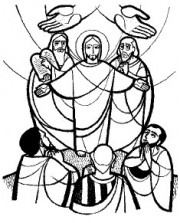
The Transfiguration – 2 Kings 2:1-12; Mark 9:2-9; 2 Corinthians 4:3-6 (and Colossians 1:15-20)

The Transfiguration.

Our Lectionary ensures that we encounter the Transfiguration twice this year. On the Sunday Next Before Lent (14th February 2021) and on the Feast of the Transfiguration (6th August 2021).

The lectionary readings set for 14th February 2021 are:

2 Kings 2: 1-12, 2 Corinthians 4: 3-6; and Mark 9: 2-9.

The first of these readings is the story of Elijah’s transfiguration in the moments before his death. In 2 Corinthians, Paul talks of a kind of transfiguration in our hearts as we see Christ revealed in his glory. Mark’s short account of the Transfiguration, places Jesus, Moses and Elijah together at the top of a mountain.

Not in 2 Corinthians but elsewhere in the letters attributed to him, Paul struggles to impress on us the nature and importance of  Jesus as God’s Son. In Colossians 1:15-20, Paul writes:

Christ is the image of the invisible God, the firstborn of all creation; for in him all things in heaven and on earth were created, things visible and invisible, whether thrones or dominions or rulers or powers – all things have been created through him and for him. He himself is before all things, and in him all things hold together. He is the head of the body, the church; he is the beginning, the firstborn from the dead, so that he might come to have first place in everything. For in him all the fullness of God was pleased to dwell, and through him God was pleased to reconcile to himself all things, whether on earth or in heaven, by making peace through the blood of his cross.

Paul and others like him were doing Christ-centered theology for the first time. They had met with the risen Jesus, some had lived alongside him for at least three years, and they were all struggling to put into words and ideas the reality of what they had encountered.

Paul talks, in that letter to the Colossians, of Jesus as the image of the invisible God, as someone in whom the whole Godhead dwells bodily. … He has begun to realise just exactly who Jesus was and is, and it excites him. And in that passage from Colossians it’s as though, words tumble out as Paul realises just what it all means. We can almost feel his longing that his readers will understand too.

The story of the Transfiguration (Mark 9:2-9) is part of the same kind of process going on for Peter. Up to this point, he has seen Jesus healing, he has felt his own poverty and sinfulness alongside the richness of Jesus character, he has listened to Jesus speaking, he has seen his wisdom and listened to his parables and gradually it has become clearer to him that Jesus is more than just a special person, but try as he might he can’t get his head around it all. In the verses immediately preceding our Gospel reading he has hesitantly voiced what is inside his head. “You are the Messiah, the Holy one of God,” he says to Jesus.

But ultimately he still isn’t sure what he means … and then comes the Transfiguration. He sees Jesus and Moses and Elijah together and he believes he’s worked it out. He places Jesus on the highest pedestal that his mind can comprehend. Jesus is the equal of Moses and Elijah, perhaps the greatest prophet ever. And for a Jew, that was saying something!

And Peter wants to build booths, small shrines, little churches. His leader, his master, is in his mind the equal of Moses, the equal of Elijah. This needs to be marked.

And then he hears God speak: … “This is my Son, my Chosen, listen to him.” Listen only to him.

Peter discovers that he has not gone far enough. His own mind just was not big enough to comprehend who Jesus was, who Jesus is. The truth was just so much bigger than he ever thought.

And we are left with the same revelation – Jesus is bigger than our own ideas of him. God is beyond our comprehension and we will only begin to understand God, to relate to God if we relate to Jesus. And we will only do that if we allow ourselves to see God’s revelation of Jesus. The lesson of the Transfiguration is that creating our own image of Jesus, of God, achieves little. All it does is bring God down to our own level. And depending on our own perspective we create a Christ who is meek and mild, or a Christ who is white rather than a Jew, a red-haired handsome specimen of humanity; or perhaps we might create Christ as the freedom fighter, the revolutionary, the liberator, or we see him as the social reformer.

“No,” says God, “Jesus is bigger than all of this – he is my Son. You can’t pin him down. You can’t domesticate him. He is there to challenge you, to save you, to draw the best out of you. Listen to him.”

We are intended to be dazzled by the light of Jesus face. To be drawn to him, and to see the world fade into dimness. And in that encounter, God expects us to be changed, to be renewed, to be challenged, to be shaken out of our present categories, our concepts of the way things are.

By meeting with Christ, we begin to understand God as Father, Son and Holy Spirit – but more than that – we are challenged to move out with hope into our world, believing that God’s kingdom in Jesus is all that other’s really need, looking to bring that kingdom into being, looking for the signs of God’s presence in the world around us. Longing to serve our Lord, longing to be changed still more. Longing to be Transfigured in our encounter with Jesus.

For as Paul says in our reading from 2 Corinthians:

It is the God who in creation said “Let there be Light!” “Let light shine out of darkness,” who has also shone into our own hearts to give the light of the knowledge of the Glory of God in the face of Jesus Christ.

The Uganda Railway: the Gilded Years 1924-1928

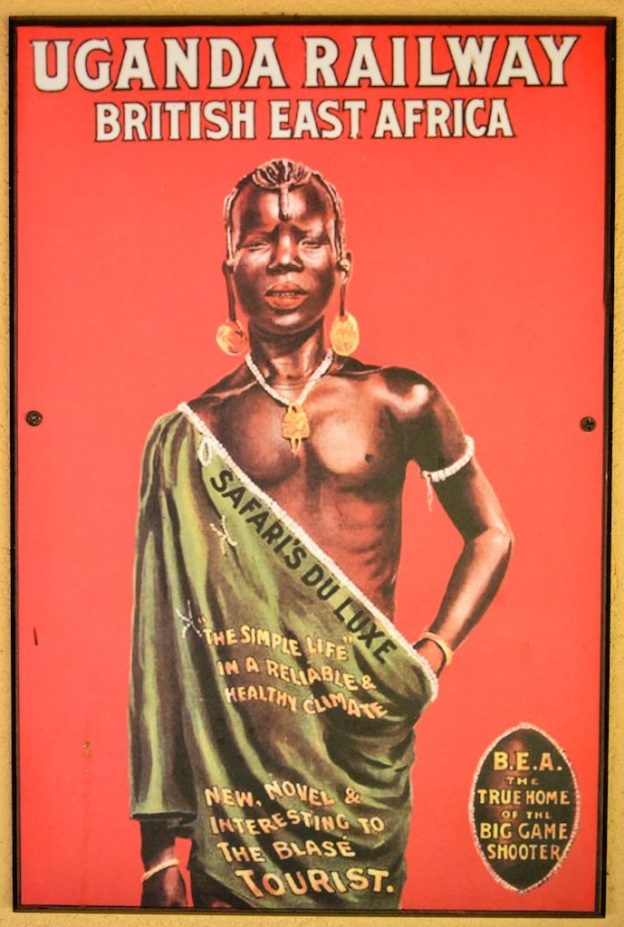
Great advances in the development of East Africa occurred during these years. A serious attempt was made to unify the East African Territories. “Kenya became a playground for wealthy sportsmen who came to shoot, or to photograph, big game, and they spent much money on their sport.” [1: p443]

The following Earnings/Working Profits are recorded in or estimated from Hill’s narrative:

Year           Earnings        Working Profits

1924          £1,635,189       £756,722            [1: p447]

1925          £1,993,509       £903,438            [1: p456]

1926          £2058,710        £841,937            [1: p459]

1927       £2,257,403       £1,030,000           estimated [1: p463/4]

1928       £2,511,227               –                     [1: p475] working profit not recorded by Hill

1929       £2,825,310               –                     [1: p475] working profit not recorded by Hill

The 1924 the working profit was reduced by £149,004 of loan charges.£165,579 was credited to the Renewals Fund and £438,139 to the Betterment Fund. Together with other sums, the result was that in 1925, £750,000 was put to a programme of renewals/betterment. There was also heavy expenditure on port development, new lines, rolling-stock and equipment. East Africa’s transport needs were expanding rapidly. [1: p447]

A search on Facebook produced this composite image on the Baringo New Channel [2]

Image

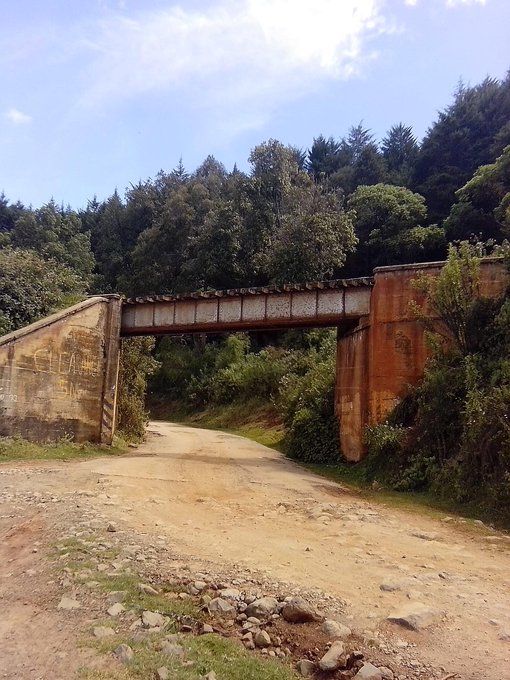
Twitter carries this image of a railway bridge on the metre-gauge line in hilly Timboroa [3]

By the end of 1924, the Uasin-Gishu line had reached Timboroa; the Thika line had been extended to the Tana River. The Solai branch and the Kitole branch were under construction.

During 1925, the Thika line was expected to reach Nyeri, and the Uasin-Gishu line beyond Timboroa, through Turbo into Eastern Uganda was being funded by a £3.5 million loan. It was required – there had been a very rapid increase in traffic which was causing significant connection at the ports on Lake Victoria and at Mombasa. [1: p448/9]

At the end of 1924, 30 miles of the Mombasa to Nairobi mainline had been relayed with 80-lb rails. Work continued slowly through 1925. [1: p450]

On 3rd February 1926, the Kenya & Uganda (Transport) Order in Council was promulgated. The name of the railway was changed from the ‘Uganda Railway’ to the ‘Kenya & Uganda Railway’. [1: p453] At this time the Inter-Colonial Railway Council held its last meeting. The railways were placed under the command of the High Commissioner who was also Governor of Kenya and a new ‘Kenya & Uganda Railway Advisory Council’ held its first meeting in February 1926 at Entebbe. [1: p453/4] It decided that the most pressing need was for there to be negotiations with the Tanganyika authorities to ensure that the two railway systems collaborated, rather than competed, with each other for custom. [1: p454]

There was continued criticism of congestion at ports and in Uganda, [1: p457] with goods delayed and damaged in transit. Criticism failed to take account of a significant increase in demand for railway services, nor of problems at ports which were outside of the control of the railway authorities.

By 1926, the mainline rail replacement programme had reached Makindu, 207 miles from Mombasa. New Central railway offices were under construction in Nairobi. The Uganda extension has reached the Eastern edges of the M’pologoma Swamp but the length heading East was over 10 months behind schedule due to supply problems across Lake Victoria. [1: p462]

In 1927, a commission to review the possibility of uniting the three East African Territories was set up. When it reported in 1929, it suggested that the two railway systems of East Africa must eventually be amalgamated under one management. “Meanwhile … there was much that could be done in the direction of assimilation of rates, the standardisation of engines, rolling stock, equipment and rules and regulations, all of which would greatly facilitate amalgamation in due course.” [1: p467]

In September 1927, Felling, a strong supporter of ‘Closer Union’ spoke his mind in the Legislative Council. As part of his comments he stressed that one management of the Kenya and Uganda Railway and the Tanganyika Railway must “come in due course, but there [was] no urgent need for amalgamation of management’s; and anyway, such an amalgamation would be very difficult to arrange until there  [was] a definite railway link connecting the two territories.” [1: p468]

Further, he said, on the same occasion, that “it [was] clear that it [was] necessary for the general development of this part of the Empire that there should be rail communication between Kenya and the Central Tanganyika line, also a steady programme of railway construction to connect the Tanganyika Railway with Northern Rhodesia and Nyasaland …  [and] perhaps two lines, to the Congo.” [1: p468]

He argued that “railway development in East Africa should not be looked upon so much as an East African investment as a sound Imperial investment, as in the interests of the people of Great Britain even more than in the interests of the native inhabitants of the territories concerned.” [1: p469] He also argued for the rapid completion of a rail link from Jinja to Kampala.

In 1927, developments in the railways brought the advent of corridor coaches and dining cars. These were essential to a satisfactory timetable. 6 No. Mikado (2-8-2) locos were put to work on the 89-lb rails between Mombasa and Makindu. [1: p470/1]

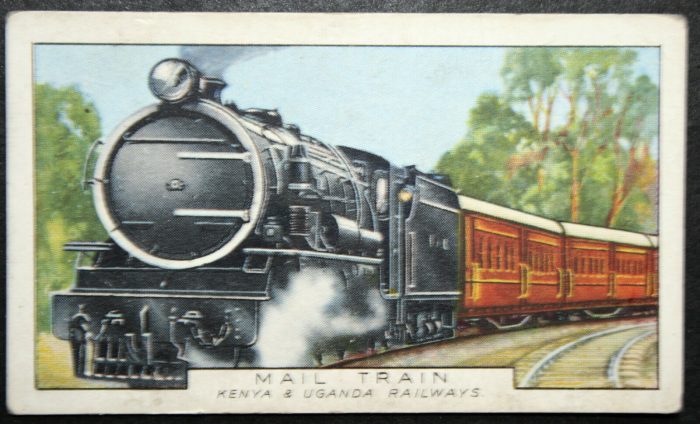
Kenya & Uganda Railways Mail Train 1930’s Vintage Card. [4]

Kenya & Uganda Railways Mail Train 1930’s Vintage Card. [5]

The KUR EA class, later known as the EAR 28 class, was a class of 1,000 mm (3 ft 3 3⁄8 in) gauge 2-8-2 steam locomotives. The six members of the class were built in 1928 for the Kenya-Uganda Railway (KUR) by Robert Stephenson and Company. Builder’s numbers were 3921-3926. They were numbered 2801-2806 on the Kenya & Uganda Railway. [6]

A road and railway causeway/bridge between Mombasa Island and the mainland was commenced in June 1927.

In addition to the Uganda extension, building of branch lines continued:

  • On 1st November the Nyeri branch reached lnaro Moru.
  • In Uganda, work commenced on the Tororo, Mbale, Soroti branch in February 1927.
  • A branch from Fulfil to Thomson Falls was approved.
  • A line from Kisumu towards Mumias was proposed.
  • A preliminary survey for a branch from Turi to Sotik was completed. [1: p471]

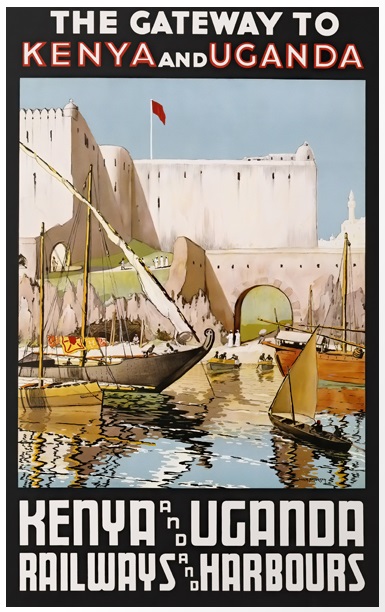
The Kenya & Uganda Railways & Harbours Logo, (c) Martin Greave, 2003 [7][8][9]

The railway’s name was changed by Order in Council on 20th December 1927, to the ‘Kenya and Uganda Railway and Harbours’. [1: p472]

On 15th January 1928, the final section of the Uganda Extension from Broderick Falls to M’Bulamuti opened to traffic. Within 9 months Christian Felling had died as a result of a severe attack of malaria.

The figures listed above show impressive growth in the years to 1929. The figures fr the following period fell just as rapidly as we will see. Hills says that “although it was not yet apparent, the railway, in common with Kenya and Uganda and the greater part of the civilised world, had come near to the end of the gilded years of prosperity.” [1: p475]

References

  1. M.F. Hill; Permanent Way – The Story of the Kenya and Uganda Railway – Volume 1; Hazel, Watson & Viney Ltd, Aylesbury & London, 1949.
  2. https://www.facebook.com/BaringoNews/photos/a.695797717132551/1628337577211889/?__cft__%5B0%5D=AZXJTt5l44WKBwkc0OGOfdIBXJh5I0bMPcuQteTC_Me64OsopQKfjMESZy7PrPzOAchw-FVc0KdGd_asD0vB0qxFYfXPjx9uZ5ZJuAzio6UEu7EiKntyV2sqAzLkwPgR33qQ1HSeBZ77yIYr-80TACI2&__tn__=EH-R, accessed on 6th February 2021.
  3. https://twitter.com/kresearcher/status/417357022041227266, accessed on 6th February 2021.
  4. https://www.ebay.co.uk/itm/Kenya-Uganda-Railways-Mail-Train-1930s-Vintage-Card-VGC-/383704927668, accessed on 6th February 2021.
  5. https://www.pinterest.co.uk/pin/319614904809896703, accessed on 6th February 2021.
  6. https://wikivisually.com/wiki/KUR_EA_class, accessed on 6th February 2021.
  7. https://www.fotw.info/images/e/eaf)kur.gif, accessed on 6th February 2021.
  8. https://en.wikipedia.org/wiki/Kenya_and_Uganda_Railways_and_Harbours, accessed on 6th February 2021.
  9. https://www.worldcat.org/title/story-of-a-railway-adapted-from-permanent-way-the-story-of-the-kenya-and-uganda-railway/oclc/11895232, accessed on 6th February 2021.

The Micklehurst Loop – Part 1A

Just after I posted my first article about the Micklehurst Loop, I was sent a series of photographs by an online acquaintance, Tony Jervis. In February 1981, he visited the same length of the Micklehurst Loop as covered in that article. Tony’s pictures show the line before removal of the two viaducts but after the lifting of the length of line retained to serve the Staley and Millbrook Sidings opposite Hartshead Power Station.

Tony also pointed out a further YouTube video from Martin Zero which is embedded towards the end of this addendum. …..

My first article on the Micklehurst Loop can be found using this link:

The Micklehurst Loop – Part 1

At the time of Tony Jervis’ visit on 14th February 1981, only one section of the Spring-Grove Viaduct had been removed – a simply supported span which  took the line over the Spring-Grove Mill. Toney was very happy for me to share these pictures as an addendum to my original article and he very kindly provided some notes to go with a number of the photographs. I have provided some annotated OS Maps to go with the pictures.

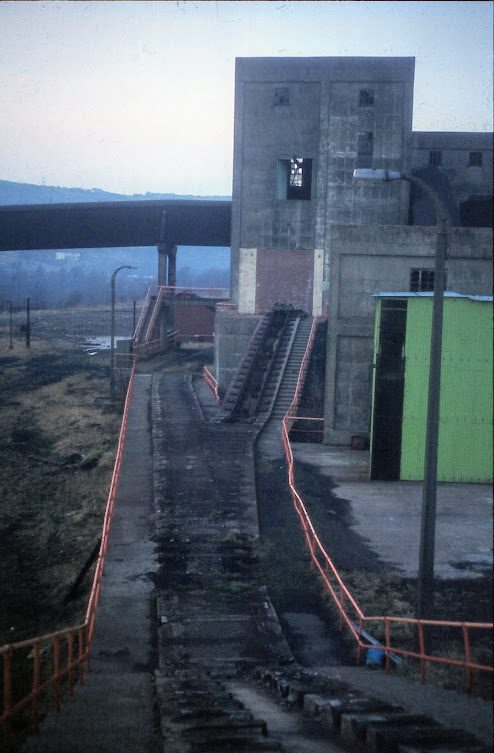
I have retained the reference numbers of the photographs used by Tony Jervis. I find the images fascinating. The first three photographs speak for themselves and are centred on Knowl Street Viaduct at the bottom end of the loop immediately adjacent to Stalybridge New Tunnel.

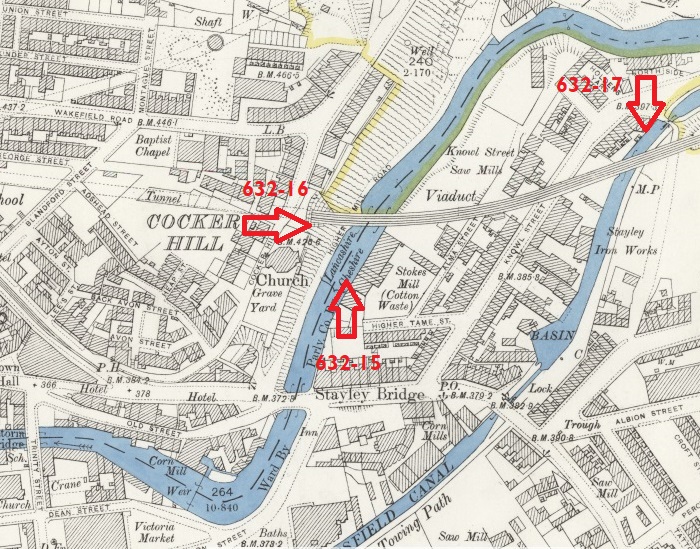
The 25″ OS Map showing the area to the East of Cocker Hill where the Micklehurst Loop broke out of Stalybridge New Tunnel and immediately spanned the River Tame. The locations of three of Tony’s photographs marked. [1]

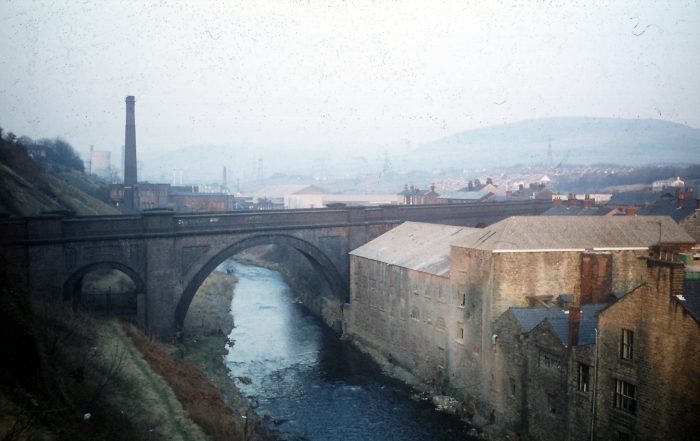
Photograph 15, 1981, (c) Tony Jervis. [2]

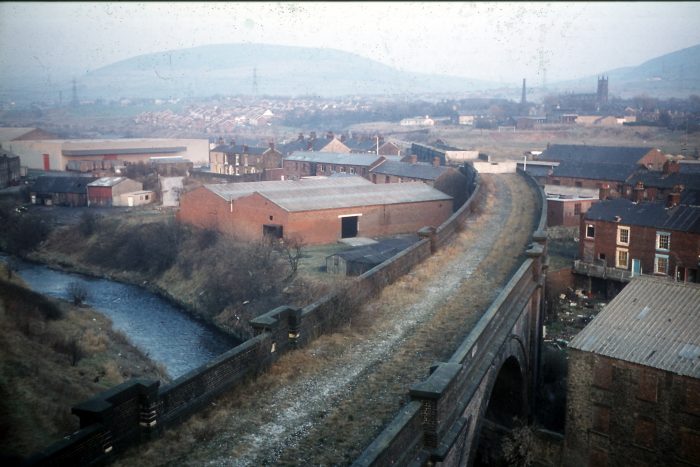
Photograph 632-16, shows the length of the viaduct and is taken from above the Eastern Portal of Stalybridge New Tunnel, 1981, (c) Tony Jervis. [2]

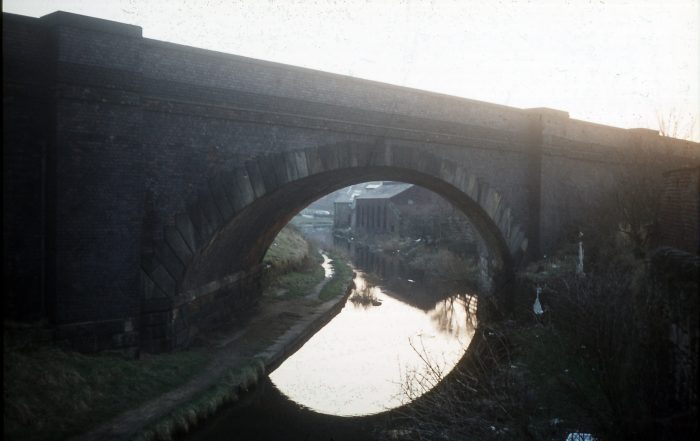
Photograph 632-17,shows the skew span over the Huddersfield Narrow Canal looking towards the Centre of Stalybridge, 1981, (c) Tony Jervis. [2]

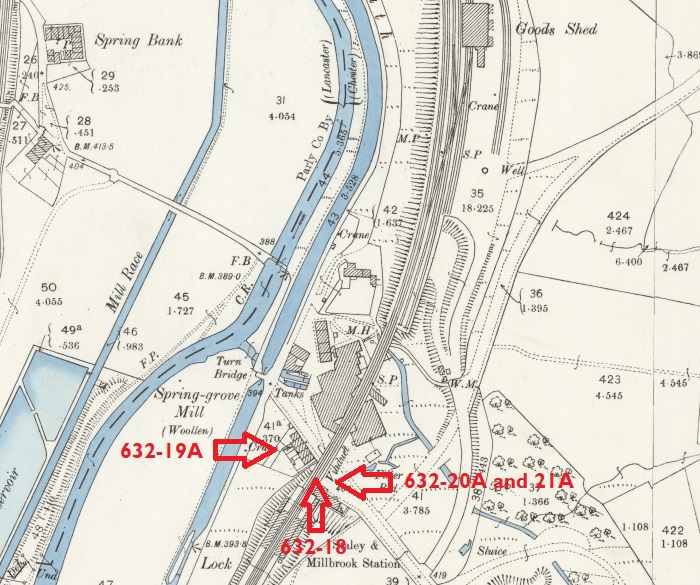
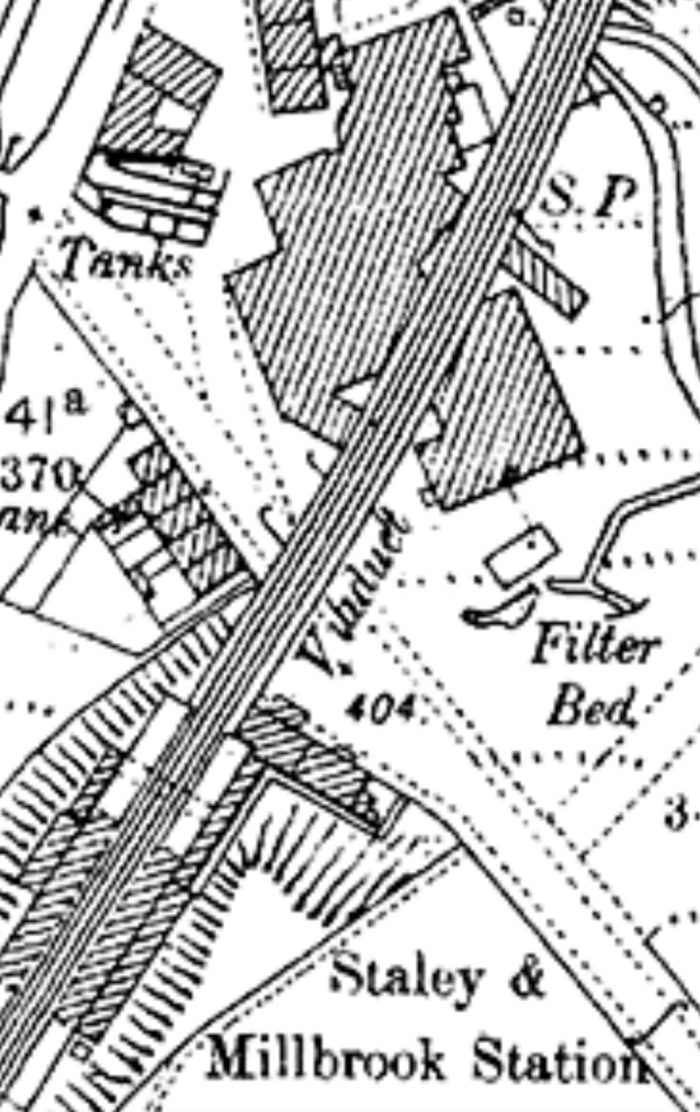
The next few pictures were taken in and around the Staley and Millbrook Station. The software I use allows me to add arrows which are vertical or horizontal but not at an angle, so the locations of the pictures shown on the OS Map immediately below are approximate.

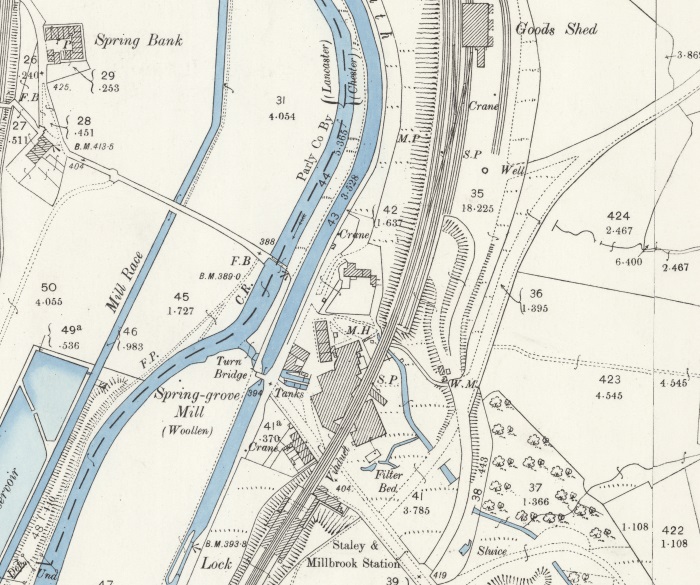
25″ OS Map of Staley & Millbrook Station site at the turn of the 20th century. [1]

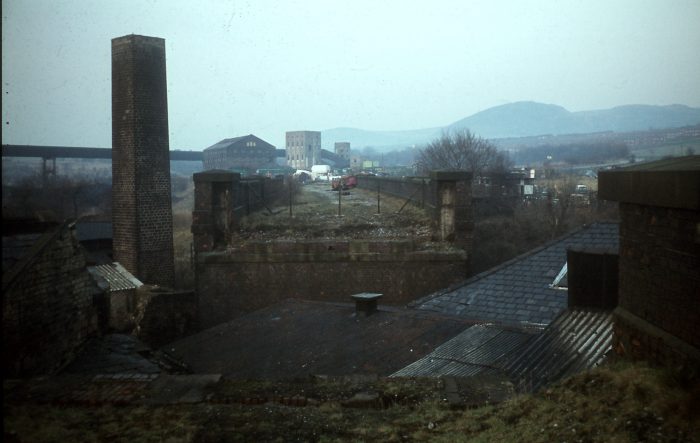
Photograph 632-18 shows Spring-Grove Mill was spanned by a simply-supported girder bridge which had already been removed when Tony Jervis visited in 1981, (c) Tony Jervis. [2]

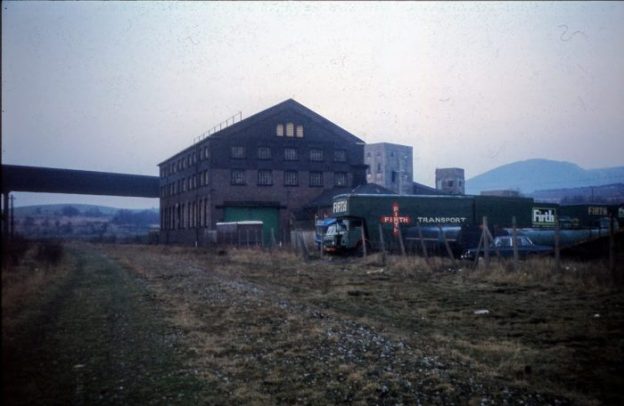
Tony comments about the above image: this picture shows “the gap in the viaduct over the roof of Spring Grove Mill.  I assume the gap was spanned by a horzontal girder bridge, which would have been easier to lift away for scrap than demolish a viaduct arch.  In the background, the power station’s coal conveyor and bunkers are still intact, though the station had been closed about 18 months earlier.  The goods shed … was still in the hands of Firth Hauliers.” [2]

The Goods shed and part of the conveyor are still in place. The viaduct, the mill chimney,the section of the mill visible to the extreme left of the image, the coal handling facilites are long-gone in the 21st century.

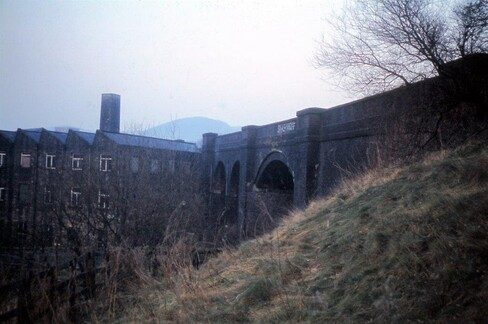
Photograph 632-19A, 1981, the portion of the mill on this (West) side of the viaduct and the mill chimney, still present in 1981, were demolished along with the viaduct in the later part of the 20th century (c) Tony Jervis. [2]

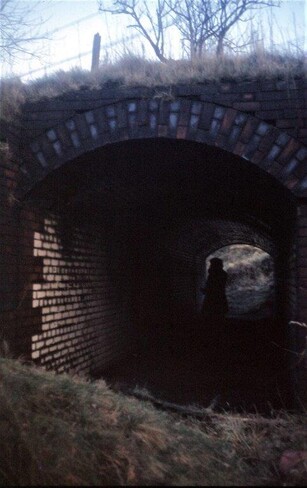
Tony Jervis, writing in 1981, comments: “the station platforms were up to the right at the top of the grassy bank but would not have been accessible for passengers from this side.  Beyond the third arch was a span across the top of Spring-Grove Mill, which was presumably modified to allow the railway to be built.  I assume the span was some sort of flat girder bridge which has since been craned away.” [2]

Photograph 632-20A, 1981, (c) Tony Jervis. [2]

He continues: “Passengers for the northbound platform would have climbed a covered passage from the booking office and come through this subway (picture 632-20A) whence another short covered ramp or steps would have led up to the platform waiting room. Note the glazed white tiles designed to slightly lighten the subway’s gloom. Since I appear not to have photographed them, I assume that the station platforms had long been swept away.

Photograph 632-21A, 1981, (c) Tony Jervis. [2]

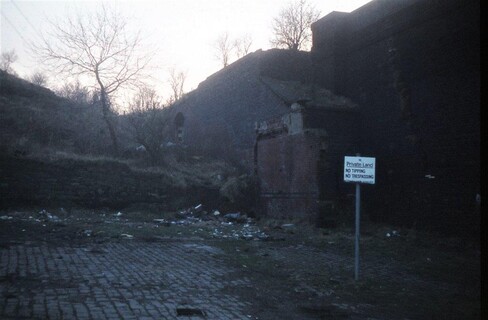
Tony Jervis says: “Picture 632-21A (below) is taken from the middle of Grove Road east of the viaduct.  The red brick wall would have been the end of the booking office; the station master’s house would have been out of shot to the left.  In the distance is the entrance to the subway. There are marks of the platform retaining wall, which is partly of red brick at the bottom and blue engineering brick further up, that suggest a flight of stairs with an intermediate landing led up the southbound platform and that a lower ramp alongside followed the grass bank up to the subway.  One might wonder, thinking of travel a century ago, whether there might have been a need for sack trucks or even a four-wheeled luggage trolley to reach  the platforms.  The white notice forbidding tipping and trespassing is not in the middle of the road but at the edge of the triangular station forecourt; it won’t show up on the posted picture but above the words is the BR “kinky arrow” symbol. Looking at the 25-inch OS plan, it is interesting to note that the formal entrance to nearby Staley Hall was from Millbrook village to the south but from the back of the building a footpath dropped down to Grove Road alongside the the stationmaster’s house, a tradesmen and servants’ entrance maybe?”

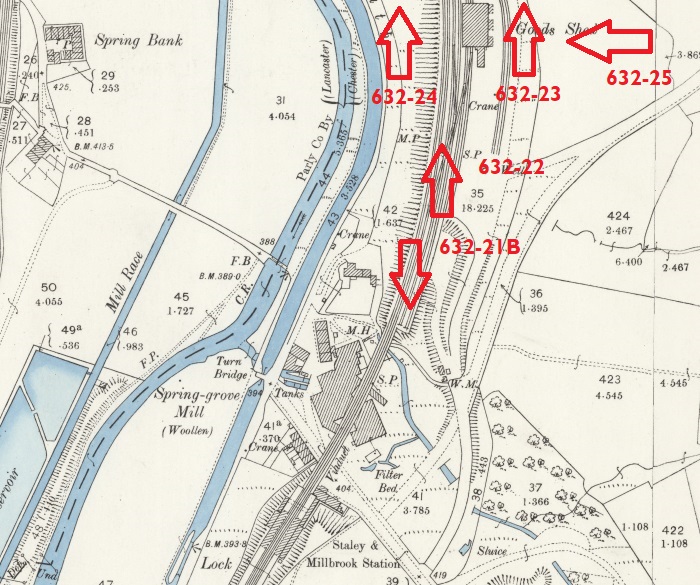
Tony has also provided photographs which were taken late in the evening on 14th 1981 of the Goods Yard across the river and canal from Hartshead Power Station. Their locations are again  marked on the 25″ OS Map immediately below ……

25″ OS Map of the Staley & Millbrook Coal Sidings site. The extract does not show the full extent of the sidings which were in place in the mid-20th century..[1]

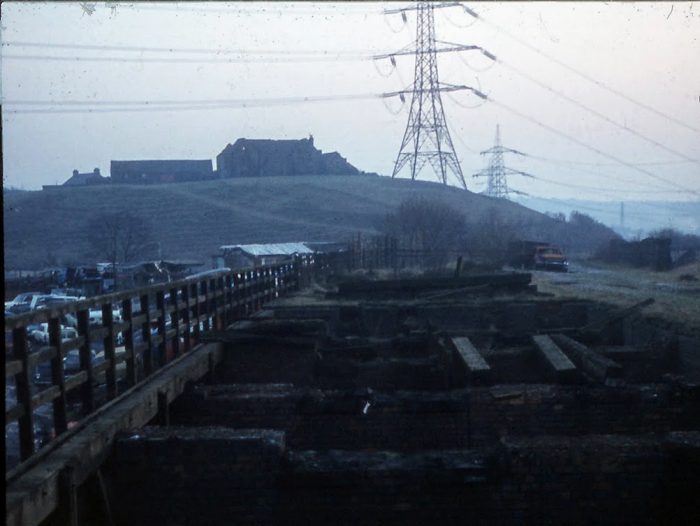
Photograph No. 632-21B        9-644    14 Feb 1981    SD 976000 S    Former coal drops at Staley & Millbrook Goods Depot alongside Spring Grove Viaduct. The ruined structure on the horizon is Staley Hall. These drops were just to the North of Spring-Grove Viaduct, (c) Tony Jervis, 1981 – [Tony comments: The “B” suffix is because I managed to give two slides the same number when I numbered them back in 1981.] [2]

Tony Jervis comments: “These coal drops are near the end of the two sidings on the 25-inch OS map closest to the running lines.  They are not marked on the map but the road approach for coal merchants’ lorries is clearly shown.  I did wonder if the apparent tramway in Grove Road in one of [the photographs in the previous article] was a way of transferring coal from here round to the mill’s boiler house (below the chimney, one presumes) but I have seen no indication of it on any map.  The viaduct over Spring Grove Mill starts by the rusty car.  The building on the hill is Staley Hall and the “tradesmen’s” footpath I mentioned in a previous description can be seen descending the bank.” [2]

Photograph No. 632-22        9-646    14 Feb 1981    SD 976001 N    Staley & Millbrook Goods Warehouse and the former Hartshead Power Station coal conveyor, (c) Tony Jervis, 1981. [2]

Tony comments: This picture shows “the goods shed when in use by Firth Transport.  The cleaner ballast in the foreground was the southbound running line and the smoother patch to left of that is presumably where the walkway is today.  In the background is the part of the coal conveyor that remains in situ today.” [2]

Photograph No. 632-23        9-645    14 Feb 1981    SD 977002 NW    Hartshead Power Station Sidings and start of coal conveyor, Staley & Millbrook Goods Depot, (c) Tony Jervis, 1981. [2]

Tony comments: “One of the two towers on the edge of the power station coal sidings.  I presume the “stepped” areas fenced in orange surrounded conveyor belts lifting the coal from siding level up to the high-level conveyor.” [2]

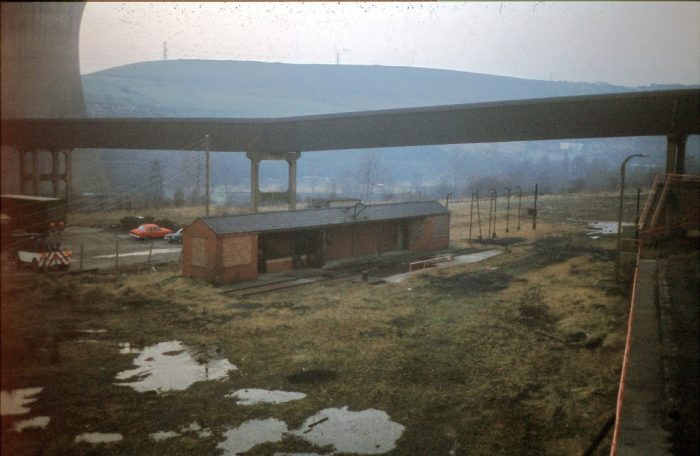
Photograph No. 632-24        9-647    14 Feb 1981    SD 977002 WNW    Site of Hartshead Power Station Sidings and coal conveyor, Staley & Millbrook Goods Depot, (c) Tony Jervis, 1981. [2]

Tony comments: “Swinging left about 45 degrees from the previous photo, I’m not sure what purpose this building served.  There is a capstan in front of it, suggesting that locomotives were not allowed to traverse the length of surviving track and wagons thereon were moved by cable.  Could it have been an oil depot of some sort? The tall pipes at the far end could have been used to empty rail tank cars. Some power stations could burn oil as well as coal; was Hartshead one of them?” [2]

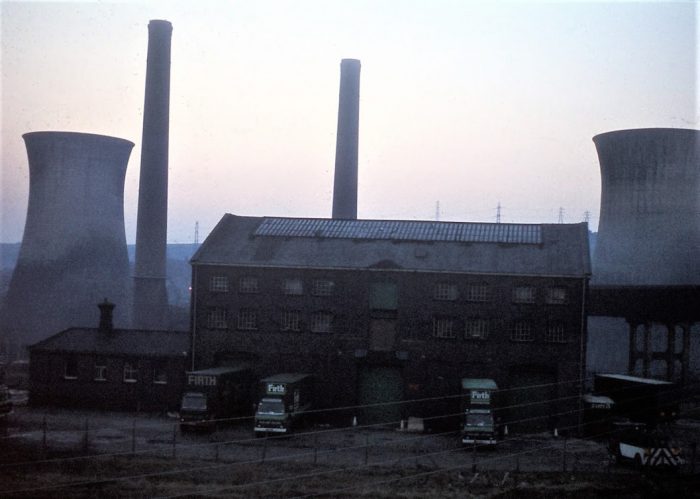
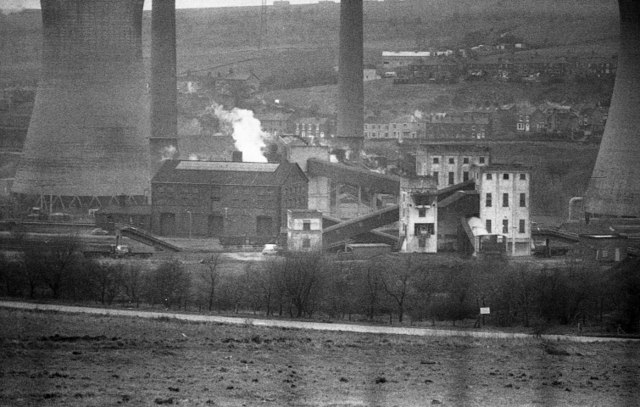
Photograph No. 632-25A      9-648    14 Feb 1981    SD 978002 WSW    Staley & Millbrook Goods Warehouse; Hartshead Power Station beyond, (c) Tony Jervis, 1981 [2]

Tony comments: that it was really too dark by the time this picture was taken, none-the-less  by screwing the contrast control to its maximum a grainy image of the shed and power station  appears reasonably clear but very grainy. [2]

Flicking back and forth between this short article and the latter part of my first article about the Micklehurst Loop (https://rogerfarnworth.com/2021/01/31/the-micklehurst-loop-part-1), will allow a comparison with images of the Staley and Millbrook Station and Goods Depot Sites early in their life and in the 21st century.

To complete this short addendum to my first post here is another video from Martin Zero.

Tony Jervis comments: [4] “After watching the half-hour video, I read some of the comments by other viewers, some of whom had worked on the site.  The tunnel turned out to be the power station’s engine shed and the steps led down to a conical underground coal hopper from which conveyor belts took the coal onwards or, perhaps, removed fly-ash.” 

Martin also found on the surface a length of surviving rail track with a lump of iron between the rails that might have been a “mule” or “beetle” for moving wagons slowly past an unloading point.  It was mentioned by some people that there had also been an “oil conveyor” — surely a pipeline? — leading from the sidings owards the power station. That makes me wonder if my postulation that the low building in my “S & M Goods 4” posting (slide 632-24) may have been a tank wagon unloading station was in fact correct.

Martin did also show a circular object buried in the ground nearby which could perhaps have been the base of the capstan that appears in my photo.  But the area is nowadays so afforested that it was impossible to work out accurately how the various items and buildings he found related to one another.”


References

  1. https://maps.nls.uk, accessed on 2nd February 2021.
  2. Photographs taken by an acquaintance on the “bygoneLinesUK@groups.io” group, online, Tony Jervis. They are reproduced here with his kind permission.
  3. https://youtu.be/IL6yY5UFTPI, accessed on 6th February 2021.
  4. From an email dated 6th February 2021.

The Micklehurst Loop – Part 1

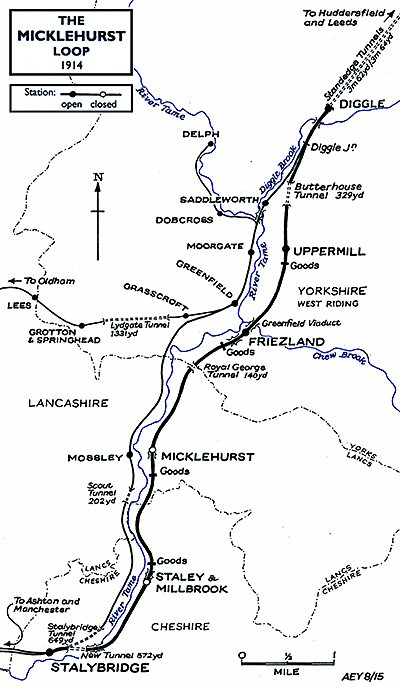
I am indebted to Alan Young for a number of the images in this and the following articles about the Micklehurst Loop. This is his drawing of the Loop which appears at the head of his article about the Loop on the ‘Disused Stations‘ website. It is used with his kind permission, (c) Alan Young. [7]

During January 2021, my wife and I walked the majority of the length of the Micklehurst Loop from Stalybridge to Diggle. This was the goods relieving line for the main Stalybridge to Huddersfield railway line. It had been hoped to alleviate congestion by making the mainline into a 4-track railway but the geography mitigated against this and a route on the other side of the Tame Valley was chosen instead.

The maps used in this sequence of articles are predominantly 25″ OS Maps from 1896 through to 1922 and have been sourced from the National Library of Scotland. [1] There are a number of websites which focus on the Loop which are excellent. The sites concerned are noted immediately below and the relevant link can be found in the references section of this page or by clicking on the highlighted text here:

  1. The most detailed treatment of the line and its stations can be found on the Disused Stations – Site Records website. The particular pages on that site which cover the Loop were provided by Alan Young. One page covers the route and pages covering each of the stations can be accessed from that page. [7]
  2. Particularly good for old photographs of the Loop is the Table 38 webpage about the railway. [12]
  3. 28DL Urban Exploration has pages about Stalybridge New Tunnel under Cocker Hill [19] and about Hartshead Power Station. [20]

Part 1 – Stalybridge to Staley & Millbrook Station and Goods Yard

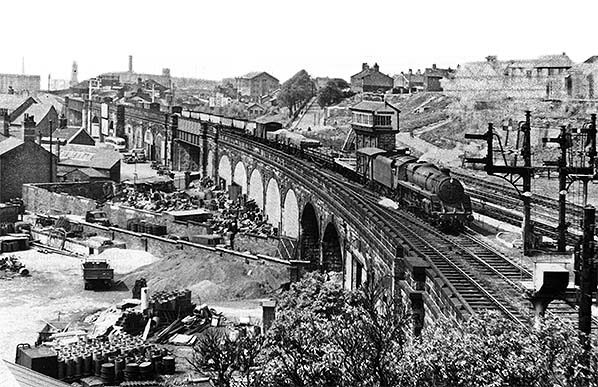
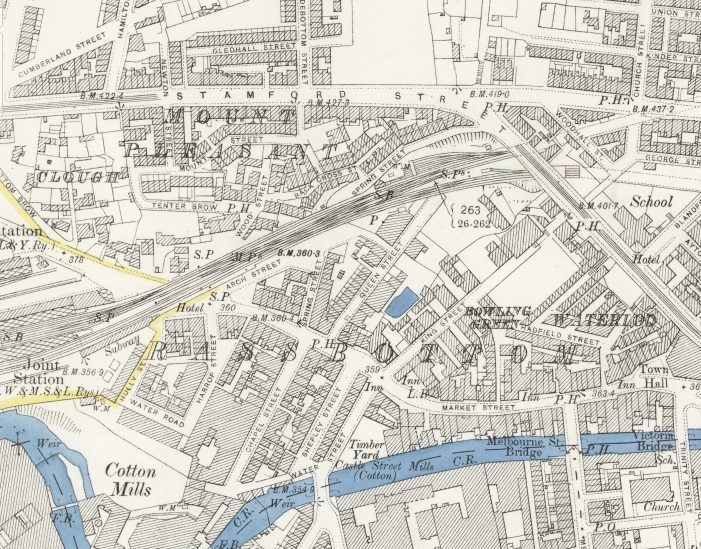
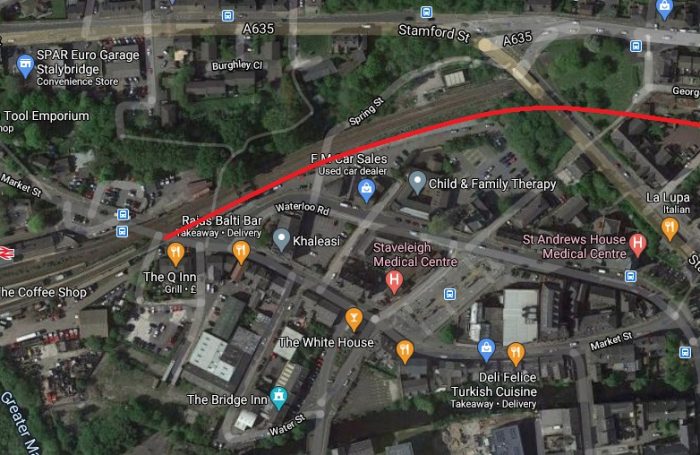
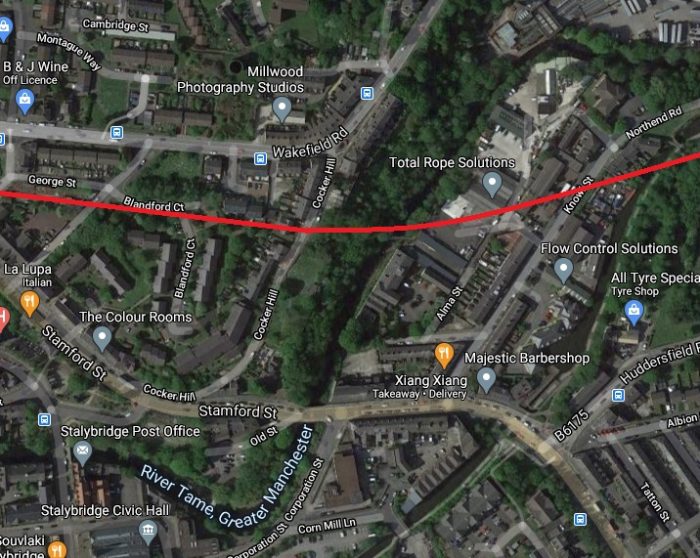
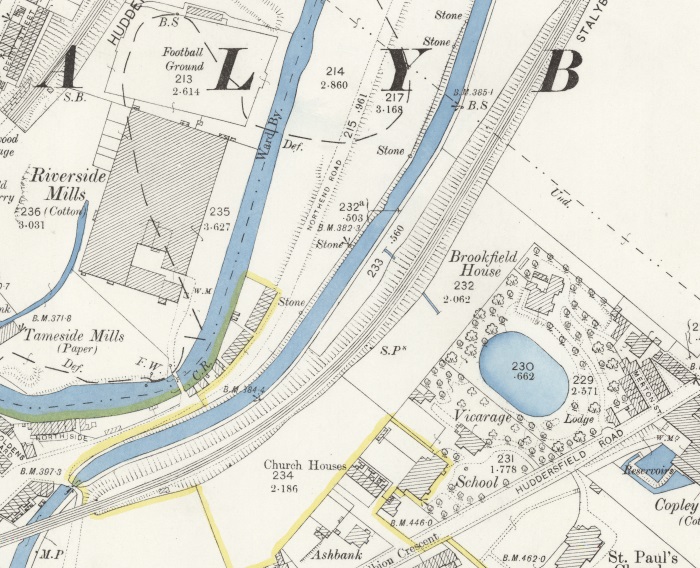
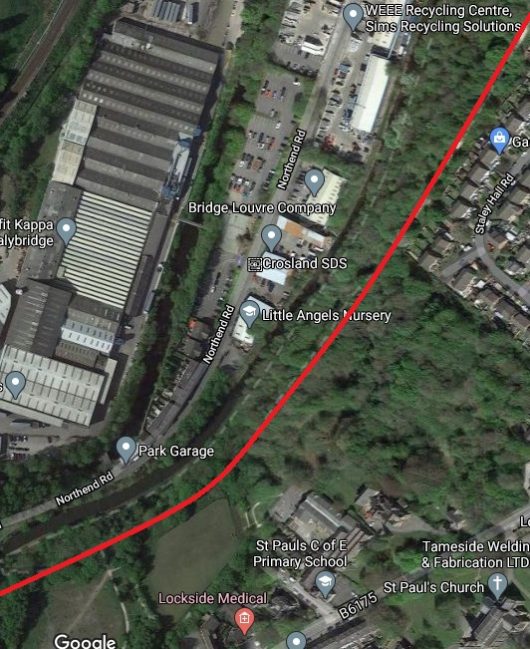
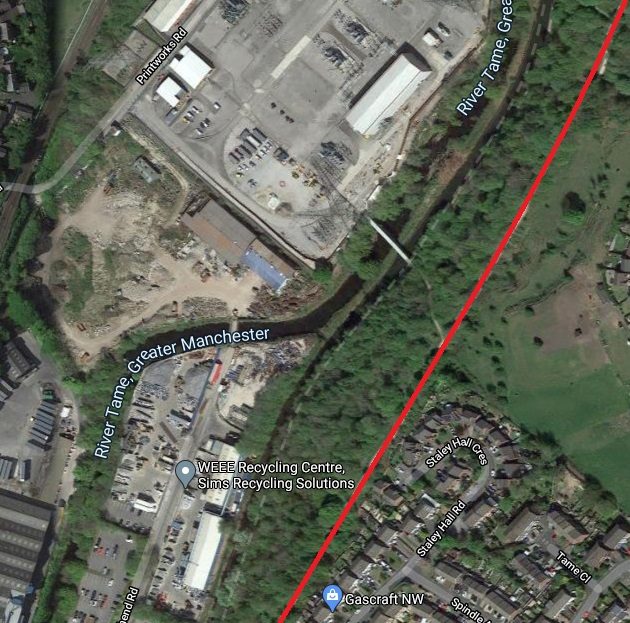
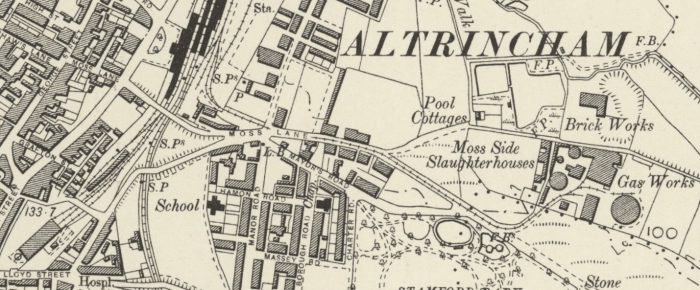
This first map extract shows the Western end of the Micklehurst Loop. It left the mainline at Stalybridge Station which can be seen on the left side of the extract. Both the mainline and the loop entered tunnels under Stamford Street, Stalybridge. [1]This modern satellite image covers approximately the same area of Stalybridge as the map extract above. The route of the former Micklehurst Loop is highlighted by the red line.Looking west towards Stalybridge Station circa 1960 from Stamford Street BR standard Class 5 No.73162 takes the Micklehurst Loop as it pulls away from Stalybridge Station with a Huddersfield-bound freight and approaches Stalybridge New Tunnel. Photo by Peter Sunderland courtesy of Alan Young. [7]

The Western portal of Stalybridge New Tunnel sits just to the East of the Bridge that carries Stamford Street over the route of the Loop. It is difficult to photograph and access is not easy. While search for images of the line I came across a video on YouTube:

This video shows the Western end of the tunnel and then covers a walk through the full length of the tunnel and a glance out of the Eastern Portal. [8]

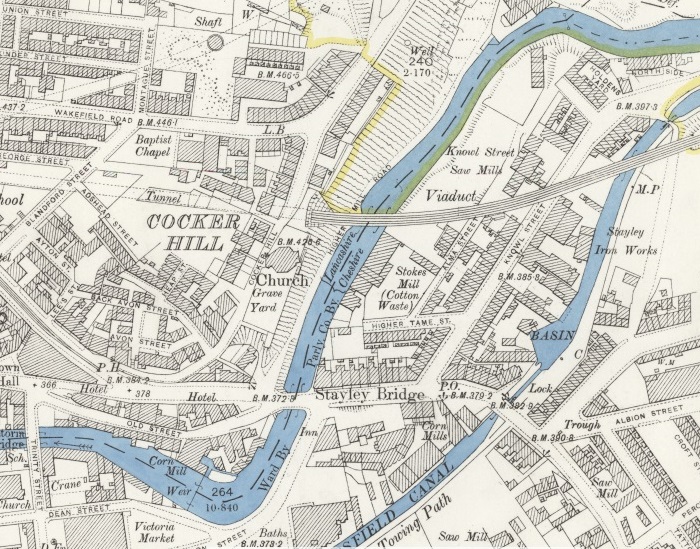
This next map extract shows the Micklehurt Loop emerging from the tunnel under Cocker Hill. The main line is in tunnel further North. Just South of the tunnel mouth Old St. George’s Church can be picked out, an octagonal church building which has now been replaced by St. George’s Church which is off the map extract to the North. Immediately to the East of the tunnel entrance, the Loop crossed the course of the River Tame and the Huddersfield Narrow Canal on a Viaduct.Much has changed in the satellite image above which covers approximately the same area. The canal basin can just be picked out, as can Knowl Street. The course of the River Tame is unchanged. Old St. George’s is long-gone. There is no evidence left of the Viaduct which carried the line.

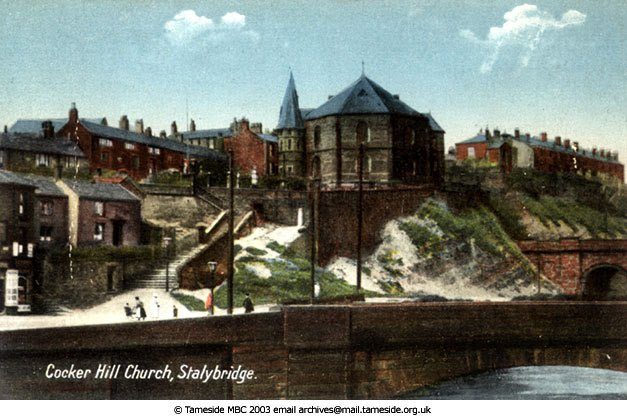
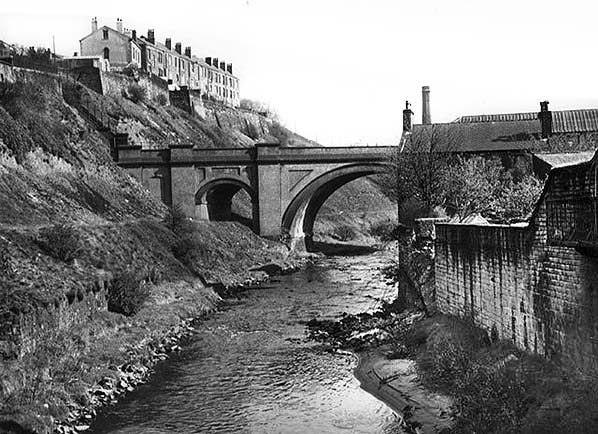
Old St. George’s Church was located almost directly over the tunnel. It was an unusual church building and over its life was rebuilt twice on essentially the same plan. “The first was built in 1776. It was the first recorded church in Stalybridge and it did fall down shortly after it was built. The next church was demolished around a hundred years later because of structural problems and the last church was demolished in the 1960’s as it was no longer used.” [3]The last incarnation of Old St. George’s Church on Cocker Hill. This coloured monochrome image is held in the archives of Tameside MBC. The Micklehurst Loop can be seen exiting the tunnel below the church to the right and immediately crossing the River Tame on Knowl Street Viaduct. [4]This monochrome image is provided with permission,  courtesy of Alan Young, once again. [7] He comments: “looking north up the River Tame the western end of Knowl Street Viaduct in Stalybridge is seen in this undated view. Having crossed this 16-arch viaduct the Micklehurst Loop promptly plunged into Stalybridge New Tunnel through Cocker Hill (left). This section of line ceased to handle traffic in 1972, when coal movements to Hartshead Power Station (near Staley & Millbrook) ceased, and the line was taken out of use in July 1976, but it was not until 1991 that the viaduct was demolished.” [7]

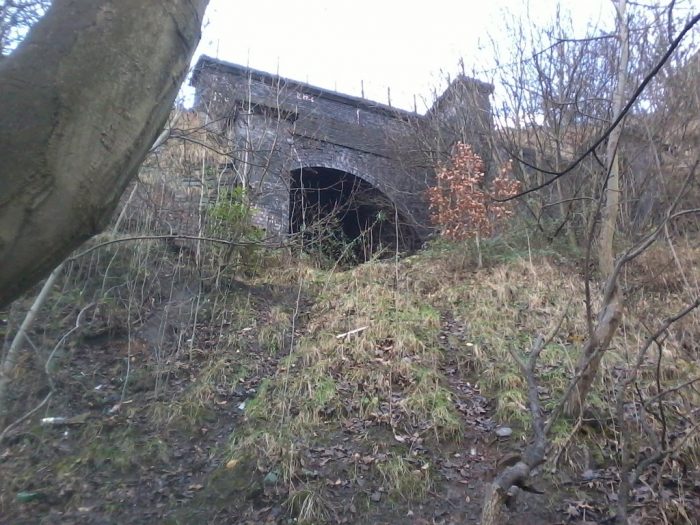
The Eastern Portal of the tunnel, which was directly below the church can still be reached with a little careful clambering. The image below has a Creative Commons Licence. (CC BY-SA 2.0).The East Portal of Stalybridge New Tunnel which is directly below the site of Old St. George’s Church © Copyright Tom Hindley and licensed for reuse under a Creative Commons Licence. (CC BY-SA 2.0). [5]

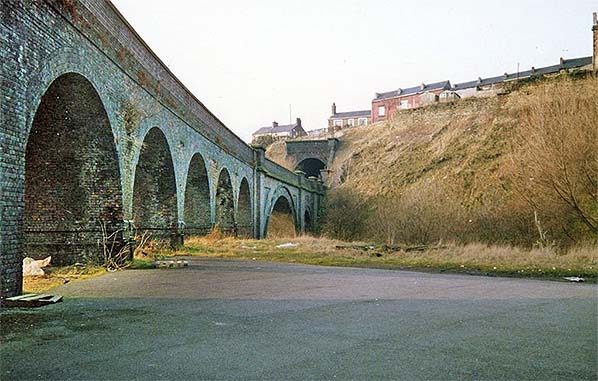
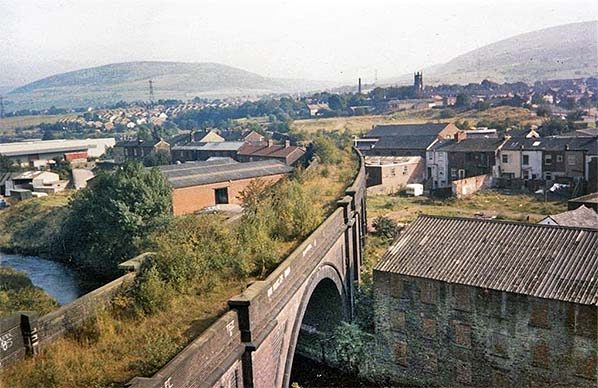
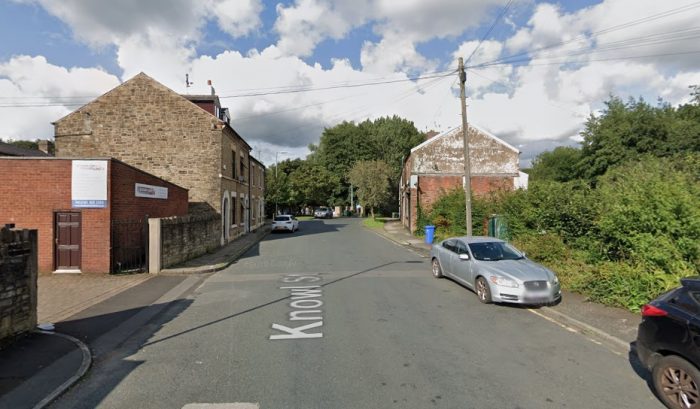
Knowl Street Viaduct carried the Loop over the River Tame, Knowl Street and the Huddersfield Narrow Canal and a series of arches in between. There were 16 arches in all.This photograph taken from the East alongside Knowl Street Viaduct is included with permission, courtesy of Alan Young. [7] Alan comments: “The Micklehurst Loop diverged from the original Huddersfield-Manchester line a short distance east of Stalybridge station, entered Stalybridge New Tunnel (about 300yd in length) then promptly crossed the broad valley of the River Tame on Bridge No.3 (also known as Knowl Street Viaduct). This impressive curving viaduct, in the blue engineering brick used by the LNWR on the Loop’s major structures, was 330yd in length with 16 arches. In addition to crossing the River Tame, the viaduct also strode across Huddersfield Narrow Canal and three roads. In this undated westward view, the viaduct and Stalybridge New Tunnel through Cocker Hill are shown. Coal trains that served Hartshead Power Station ceased to run over the viaduct in 1972, but it was not until July 1976 that the line was officially taken out of use. Fifteen years elapsed before the viaduct was demolished in 1991.” [7]A further image used with permission, courtesy of Alan Young. [7]  Alan comments: “Looking north-east from a point close to the eastern portal of Stalybridge New Tunnel. The Knowl Street Viaduct, 330yd in length and with 16 arches, is seen crossing the River Tame then curving away towards the next station of Staley & Millbrook. The local passenger service on the Micklehurst Loop, on which this viaduct was located, ceased in 1917, but occasional passenger trains and many freight workings continued into the 1960s; coal traffic continued to pass over the viaduct until 1972 en route to Hartshead Power station near Staley & Millbrook station and the line was officially taken out of use in 1976. Nature is taking over the former trackbed as seen on this undated photograph. The viaduct was demolished in 1991.” [7]A modern view of Knowl Street taken from Google Streetview. Knowl Street Viaduct crossed Knowl Street at this location. The spandrel walls on the North side of the Viadct passed very close to the gable end of the terraced building to the East of Knowl Street, the righthand side in this view.

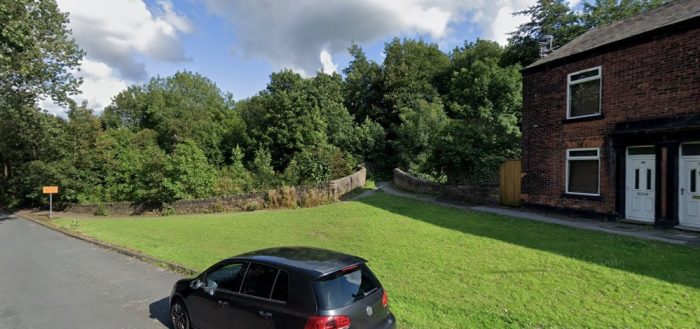
After crossing the Huddersfield Narrow Canal the Loop line regained the embankment shown on the next OS Map extract below. Just to the North of the point where the viaduct crossed the canal is a stone bridge carrying what is now (in the 21st century) the canal-side walk. That bridge is shown at the centre of the Google Streetview image below and at the bottom left of the OS Map extract. It is named Knowl Street Bridge and carries the number 97. [8]

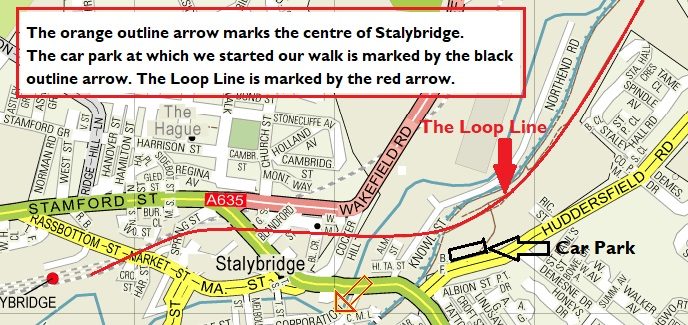
After crossing the Canal the line was carried on embankment, passing to the West of Brookfield House and running North by Northeast parallel to the Canal with Huddersfield Road a distance away to the South. Across the valley of the River Tame to the West were Riverside Mills.The approximate line of the railway, shown in red, runs parallel to the canal. We parked in a small car park just off the south of this satellite image, as illustrated below. The image shows that the site of the Riverside Mills is now occupied by the premises of Smurfit Kappa, Stalybridge. [9]Stalybridge and the Southwest end of the Micklehurst Loop.

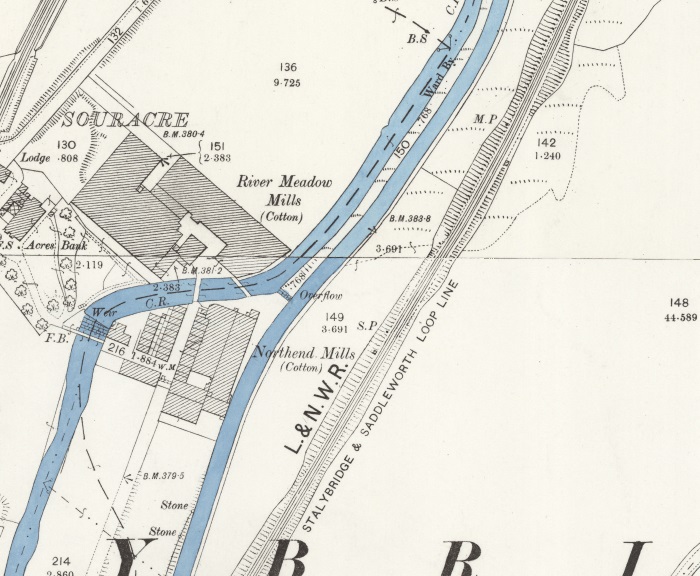
Brookfield House was  “a large detached house built in the early 19th century for James Wilkinson, and shown on the 1850 Stayley Tithe Map. All that remains is the former mid-19th century lodge house at 93, Huddersfield Road, with the entrance to the former drive with stone gate piers on its south side. The grounds of Brookfield House are clearly shown on the 1898 OS Map, and included an oval lake and glasshouses, …. Brookfield House was demolished and the lake filled in between 1910-1933. The grounds are now overgrown with self-set woodland.” [2]This next OS Map extract illustrates, at the the top right, how tightly the river, railway and canal follow each other at times up the Tame Valley. The railway sits above the canal which in turn sits a little above the river. Also evident is the name used on this series of OS Maps for the Loop Line – the “Stalybridge and Saddleworth Loop Line.”

Alan Young explains: “Although described as both the ‘Stalybridge & Saddleworth Loop‘ and ‘Stalybridge & Diggle Loop‘ on Ordnance Survey maps, the line is more commonly known as the ‘Micklehurst Loop’.” [7]

River Meadow Cotton Mills were owned by Henry Bannerman who was a successful farmer in Perthshire, Scotland At the age of 55 in 1808 he “moved with his family to Manchester, determined to get involved in the burgeoning Lancashire cotton industry.” [10]

At one time the company had “four cotton mills in the Manchester area: Brunswick Mill in Ancoats, Old Hall Mill in Dukinfield and the North End Mill and River Meadow Mill, both in Stalybridge.” [10]

In 1929, the Lancashire Cotton Industry was struggling. It had not regained its markets after the First World War. In an attempt to save the industry, the Bank of England set up the ‘Lancashire Cotton Coroporation’. Bannermans’ mills were taken over a few years later. The mills were acquired by Courtaulds in 1964 and all production ceased in 1967.” [10] After closure the four-storey mill which was Grade II Listed “was used by Futura before they moved to Quarry Street and then S. A. Driver warp knitters, dyers , printers and finishers.” [11] As can be seen in the satellite image below, the Mill is now demolished.Souracre and River Meadow Cotton Mill and Souracre in the 21st century .

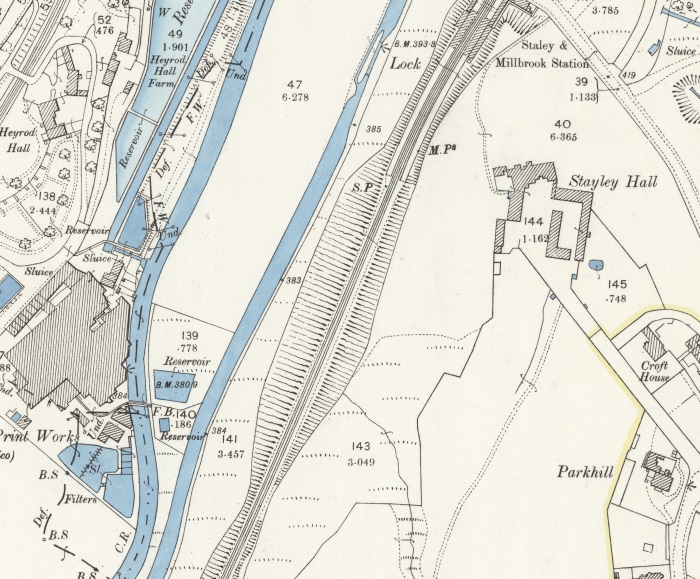
North of Souracre and visible at the bottom left of this next OS Map extract were Hartshead Calico Print Works East of Printworks Road and close by Heyrod Hall. Also visible on this map extract are Stayley Hall and the first Station on the Micklehurst Loop – Stayley and Millbrook Station.

Hartshead Print Works – is visible just below centre-left on the OS Map extract above. The works was listed in the Stalybridge Directory of 1891 as owned by John L. Kennedy &Co. Ltd, Calico Printers. lt was purchased in 1899 by the Calico Printers Association. [18]

Heyrod Hall – is shown on the top left of the OS Map extract above.

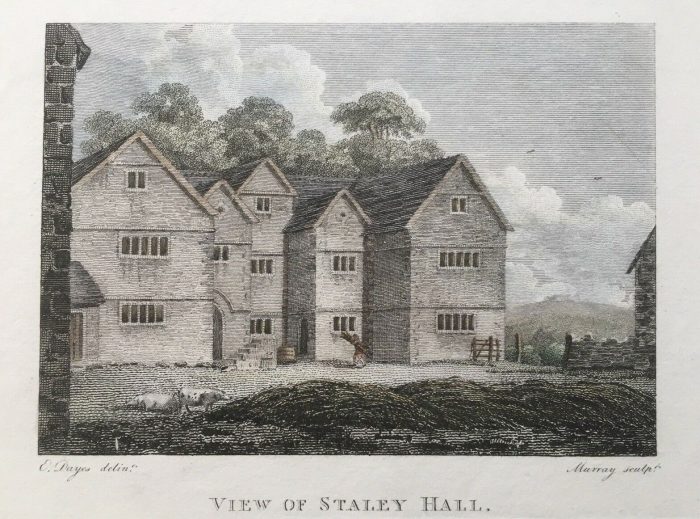
Stayley Hall – is a Grade II* Listed Building which dates back to at least the early 15th century.[14] The first records of the de Stavelegh family as Lords of the Manor of Staley date from the early 13th century. Stayley Hall was their residence. [15]

It came into the possession of the Assheton family through marriage and united the manors of Stayley and Ashton and thence into the family of Sir William Booth of Dunham Massey. In the middle of the 16th century. [15]

Stayley Hall 1795. [21]

In the middle of the 18th Century the Earldom of Warrington became extinct and the Hall, alonng with all the Booth’s estates passed to Harry Grey, 4th Earl of Stamford. Stayley Hall was owned by the Booth family until the death of  Roger Grey, 10th Earl of Stamford in 1976. [15]

Wikipedia concludes its history of the Hall as follows: “In 2004 the Metropolitan Borough Council announced that they had granted permission to a developer to build 16 homes next to Stayley Hall. A condition of the planning consent was that the hall be restored.[3] The developer has converted the hall and outbuildings into houses and apartments, most of which are now occupied.” [15]

Early 25″ OS Map covering the length of the passenger facilities and most of the goods facilities at Staley & Millbrook Station. [1]

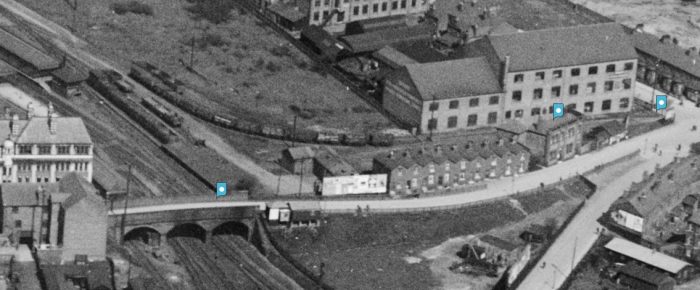
Staley and Millbrook Station – Alan Young’s on his webpage about the Station comments as follows: “Staley & Millbrook station stood on a steep slope immediately south of Spring Grove Viaduct.  The two facing platforms were equipped with waiting rooms, most likely of timber construction, with glazed awnings, as is thought to have been the building style at all four of the Loop’s stations. The platforms, too, were most likely of timber construction as that material was used for the platforms at Micklehurst, where they were also on an embankment, and timber would be a much lighter load than masonry for an embankment to support. The stationmaster’s house and adjoining single-storey office range to its west faced Grove Road across a small, triangular forecourt. The station house was constructed of dark red brick with string courses of blue engineering brick and pale stone lintels.” [18]Staley & Millbrook Station building and the Sprong-grove Viaduct take from the East on Grove Road in the early 20th century. The picture shows a clean and relatively well maintained site, very different to what remains in the 21st century, please see the pictures below. [18]Staley and Millbrook Railway Station and Spring-grove Mill. [16]

Staley and Millbrook Station buildings have long-gone as has the Viaduct, the first arch of which spanned Grove Road and looked to be a graceful structure. Also of interest in the monochrome picture of the Station and Viaduct above is what appears at first sight to be evidence of a tramway or industrial railway in the cobbles of Grove Road. I have not as yet been able to find out anything about what this feature actually is. The feature is not marked on the map extract immediately above. Closer examination of the picture above suggests that rather than being part of a short industrial line the cobbles may have been laid to facilitate a particular movement around the Spring-grove Mill.

In the 21st century, this length of Grove Road has been tarmacked – a thin layer of tarmac covers the original sets. The next two pictures were taken on 30th January 2021 on a second visit to the site after walking the route of the Loop.

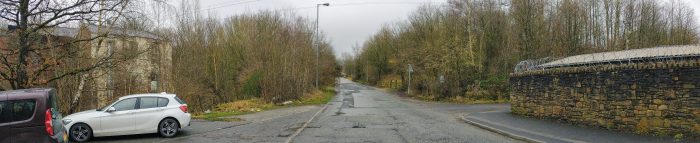
Taken from East of the route of the Micklehurst Loop, this photograph shows the location of the old station building. It sat facing the road on the left-hand side of the panorama. The Southern abutment of the viaduct sat adjacent to the station building, in the area of trees between the 5-bar field gate and the stone wall towards the right of the picture. The masonry wall is in the location of what were terraced houses between the canal and the railway viaduct. (My photograph, 30th January 2021)Another panorama, this time taken from the canal bridge to the West of the Loop. What is left of Spring-grove Mill can be seen on the left side of the image. Grove Road, heading towards Millbrook is central to the image. The masonry wall is the location of the terraced houses mentioned above. The first trees beyond it mark the line of the viaduct. The station building was sited beyond to the West. (My photograph, 30th January 2021)

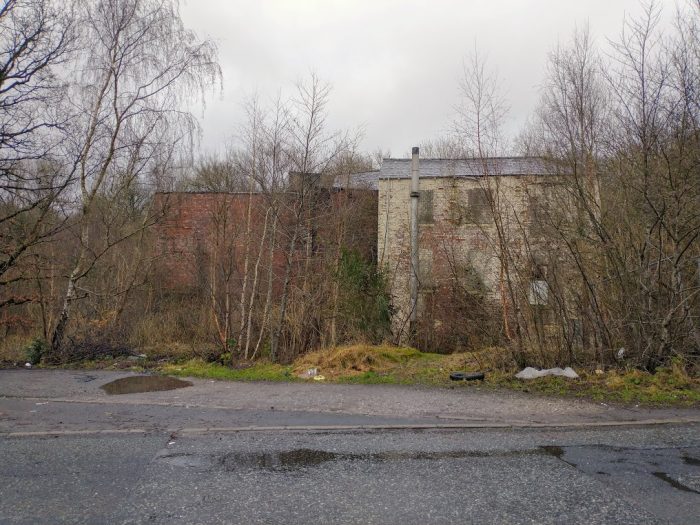
Spring-grove Mill – As we have already noted, Spring-grove Mill is shown straddled by the viaduct on the OS Map extract above. When Staley & Millbrook station opened, “there was already some population and industry in the immediate neighbourhood. Spring Grove Cotton Mill faced the station across Grove Road, and map evidence suggests that the railway’s viaduct sliced through the existing mill building. A terrace of three cottages, also pre-dating the railway, stood immediately north of the platforms, and Stayley Hall was about 100yd south of the station. Millbrook village, with three cotton mills, was about ten minutes’ walk uphill east of the station.” [16] [18]The remaining buildings of Spring-grove Mill. The lighter (cream painted) brickwork is the part of the mill shown on the map extracts as being on the East side of the viaduct. The portion of the Mill to the West of the viaduct has been demolished. The red-brick portion of the remaining building would have been under the arches of the viaduct. The Western spandrels of the viaduct arches would have followed a line running from the intersecting kerb-stones in the right-foreground over the redbrick part of the present building. (My own photograph – 30th January 2021)

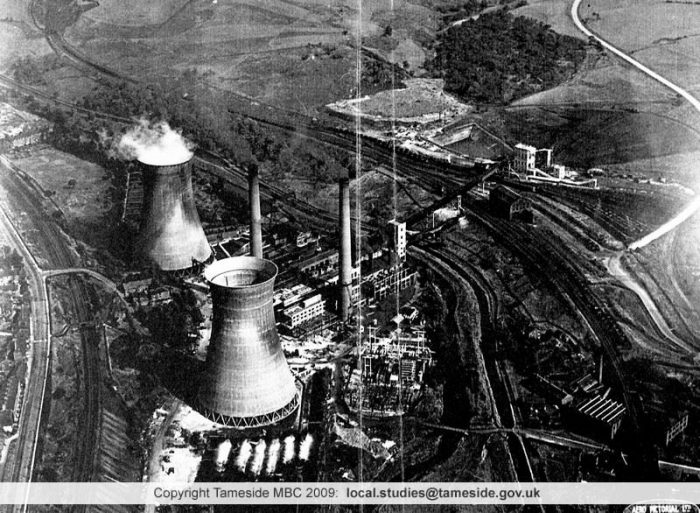
Spring Grove Mill was a cotton mill from 1818 to 1868 and then was a woollen mill for 100 years, it was the last steam-powered mill in the area. [17] The image of Hartshead Power station below, includes Spring-grove Mill in the bottom right-hand corner. By the time the aerial photograph was taken Grove Road appeared to extend across the Canal and the River Tame towards Heyrod.

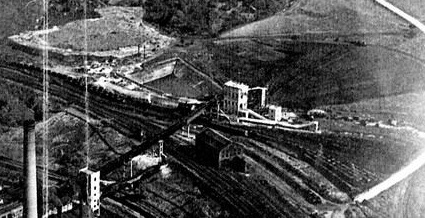
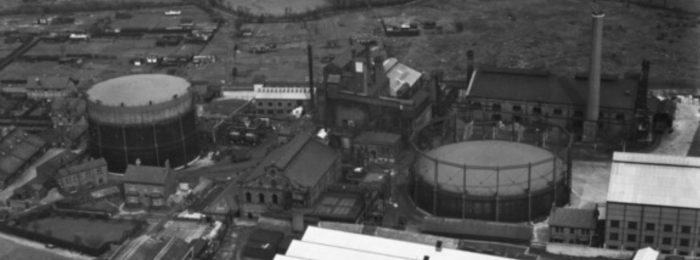
Hartshead Power Station was also located North of Souracre to the West of the River Tame. It was a coal-fired station and was served by trains on the Micklehurst Loop up until the 1970s. The picture immediately below was posted by Tameside Council on their Facebook page in 2015.An aerial picture of Hartshead Power Station taken before the Second World War. It was opened by the Stalybridge, Hyde, Mossley and Dukinfield (SHMD) Joint Board in 1926 and the cooling towers were erected in the 1940s. The station closed in 1970 and was demolished in the 1980s. Although the Good Shed visible to the top right of the image still stands. The Micklehurst Loop curves from the bottom right to the top left of the picture. [13]This enlarged extract from the image above show the coal transfer facilities and railway sidings associated with the power station . [13] The resolution of the image is not wonderful but it does highlight the traffic which was brought to the site throughout the middle 50 years of the 20th Century.

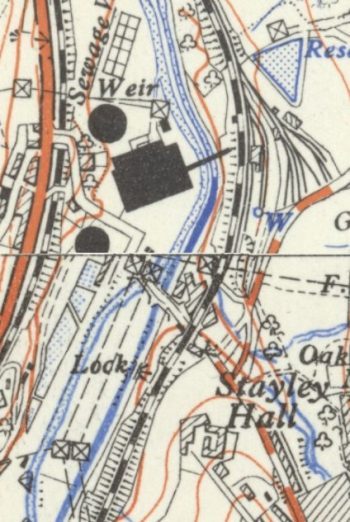
OS 1:25,000 Map form the early- to mid-20th century, sourced from the National Library of Scotland – Hartshead Power Station. One of the two cooling towers is not shown in full as it crosses the map join. [14]

The full extent of the Hartshead Power Station site at Souracre can be seen on the adjacent OS Map extract from the middle of the 20th century, which also shows the location of Stayley Hall and the Stayley and Millbrook Station build just North-northwest of Stayley Hall.

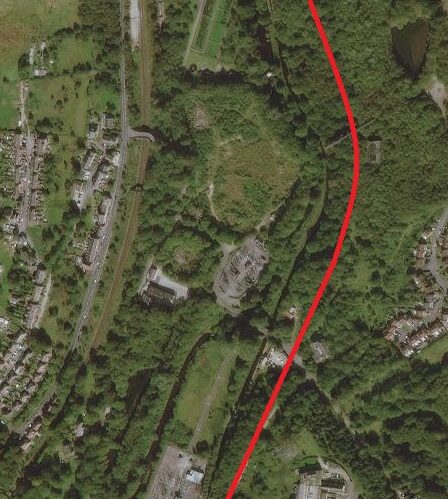
Approximately the same area is shown below on a relatively recent extract from the ESRI World Image website which is the satellite mapping used by the National Library of Scotland. [13]

The Good Shed which is considered further below is visible on both the map extract and the satellite image and the extent of the railway sidings on the East side of the Loop line is evident.

ESRI Satellite Image extract showing the current status of the Hartshead Power Station site with the approximate route of the Micklehurst Loop Line shown in red. The Goods Shed is still standing and can be seen just to the right of the red line. Along with the Loop line all of the lines in the sidings have ben lifted. [13]A view from the East looking across the power station site with the Good Shed and coal transshipment facilities in the foreground. the lack of trees compared with the satellite image and all other pictures of the site in the 21st century is striking, © Copyright David Dixon and licensed for reuse under this Creative Commons Licence. [23]

The substantial Goods Shed was built at the same time as the Loop initially with two sidings to its East. These sidings were expanded with the advent of the power station in the early 20th century. The site is now overgrown and is returning to nature. The only exception being the Goods Shed itself. There is an excellent video showing its current condition on ‘Martin Zero’s’ YouTube Channel which is embedded below. My own pictures of the site also follow below.

The Goods shed at Stayley and Millbrook Station presided over a large expanse of sidings which served Hartshead Power Station on the opposite side of the Huddersfield Narrow Canal and the River Tame. [22]Looking South towards the location of the passenger facilities at Staley and Millbrook Station. The Goods shed is on the left (the East side of the Loop line). (My photograph, 18th January 2021).The Goods Shed taken from the same location as the last photograph – a substantial three-storey structure. (My photograph, 18th January 2021).

The next part of this walk following the line of the Micklehurst Loop sets off from this goods shed traveling North.

References

  1. https://maps.nls.uk, accessed on 18th January 2021.
  2. Copley Conservation Area Appraisal and Management Proposals; Tameside MBC, March 2013, p9-10.
  3. https://cockerhill.com/2010/07/06/old-st-georges-church-cocker-hill, accessed on 23rd January 2021.
  4. https://public.tameside.gov.uk/imagearchive/Default.asp & https://cockerhill.com/2010/07/06/old-st-georges-church-cocker-hill, accessed on 23rd January 2021.
  5. https://www.geograph.org.uk/photo/3119673, accessed on 22nd January 2021.
  6. http://nwex.co.uk/showthread.php?t=6918, accessed on 27th January 2021.
  7. http://disused-stations.org.uk/features/micklehurst_loop/index.shtml, accessed on 25th January 2021.
  8. https://canalplan.org.uk/waterway/cjdf & https://canalplan.org.uk/place/1hv4, accessed on 27th January 2021.
  9. https://www.smurfitkappa.com/uk/locations/united-kingdom/smurfit-kappa-stalybridge, accessed on 28th January 2021.
  10. http://cosgb.blogspot.com/2010/12/henry-bannerman-sons-limited.html, accessed on 28th January 2021.
  11. https://en.wikipedia.org/wiki/List_of_mills_in_Tameside#Mills_in_Stalybridge, accessed on 28th January 2021.
  12. http://www.table38.steamrailways.com/rail/Micklehurst/micklehurst.htm, accessed on 24th January 2021.
  13. https://scontent.fman2-1.fna.fbcdn.net/v/t1.0-9/10923473_10152970711638376_5311634515634523408_n.jpg?_nc_cat=102&ccb=2&_nc_sid=9267fe&_nc_ohc=TvOmLmn5KTcAX_Ayq7O&_nc_ht=scontent.fman2-1.fna&oh=2306db45618ba15e6bc27d582f00e643&oe=6037BA9F, accessed on 29th January 2021.
  14. Mike Nevell; Tameside 1066–1700; Tameside Metropolitan Borough and University of Manchester Archaeological Unit. p. 112 & 141, 1991.
  15. https://en.wikipedia.org/wiki/Stayley_Hall, accessed on 29th January 2021.
  16. https://m.facebook.com/story.php?story_fbid=784689891661955&id=121283594669258, accessed on 29th January 2021.
  17. https://www.google.com/url?sa=t&source=web&rct=j&url=https://www.tameside.gov.uk/countryside/walksandtrails/lowerbrushes.pdf&ved=2ahUKEwjXrum3xMHuAhVMTBUIHYmQAeQ4ChAWMAJ6BAgSEAI&usg=AOvVaw2DR5SZ9N3AM7__DD-ZN0Bv, accessed on 29th January 2021.
  18. https://gracesguide.co.uk/John_L._Kennedy_and_Co, accessed on 29th January 2021.
  19. https://www.28dayslater.co.uk/threads/stalybridge-new-tunnel-stalybridge-july-2012.72653, accessed on 26th January 2021.
  20. https://www.28dayslater.co.uk/threads/hartshead-power-station-heyrod-and-millbrook-2015-2019.119500, accessed on 29th January 2021.
  21. https://www.ebay.co.uk/itm/1795-Antique-Print-Stayley-Hall-Stalybridge-Greater-Manchester-after-E-Dayes-/292642997239, accessed on 29th January 2021.
  22. https://youtu.be/VdmWydx4VBw & https://www.facebook.com/martinZer0/?comment_id=Y29tbWVudDoxNTU4MjI2MDIxMDExNzUxXzE1NjA0NDMwMjQxMjMzODQ%3D, accessed on 31st January 2021.
  23. https://www.geograph.org.uk/photo/2204271, accessed on 31st January 2021.

Into 2021 with God! – Genesis 1:1-5 and Mark 1:4-11 – 10th January 2021

The authors of our lectionary placed the Old Testament reading alongside the Gospel reading for  10th January 2021 for a reason. They wanted us to see them in parallel.

In both cases God is doing something new.

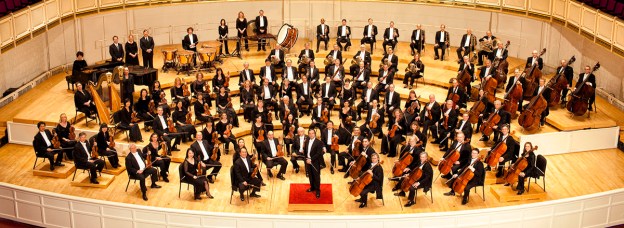
I am not an expert in classical music, a bit of a Philistine really, but as I thought about these two readings from Genesis and Mark it seemed to me that they could be described as two different movements from the same symphony. I’m told that the classical composers used variations on the same theme to develop their composition and that if you listen carefully to the music you can hear the main theme being repeated. …..

Perhaps you can imagine a heavenly orchestra playing the first 5 verses of Genesis. Dark, brooding music portrays an overwhelming sense of chaos and darkness. I imagine that the composer would use discordant modern themes to convey a sense of disorder. Then over this music comes the main theme of the symphony – quietly at first, starting with flute and piccolo, and gradually engaging the whole orchestra. Like a wind gradually rising from a gentle breeze to a violent gale. God’s mighty wind (his Holy Spirit) sweeps across the universe. God is speaking, and his very words change the universe for ever. “Let there be light” and light appears. God saw that it was good, and Night and Day were born.

God breaks into the history of the universe with a powerful word of creation.

Our second reading comes much later in the same symphony. The main musical themes are now well developed – we=ve heard them over and again throughout the symphony. When John the Baptist appears we return to that same discordant, abrupt and harsh theme that we heard right at the beginning of the symphony. His harsh manner, his odd clothing, his strange habits all seem to echo the chaos and darkness of Genesis. The sound from the orchestra builds and noise of the crowds coming to John for baptism shake the concert hall and then John’s voice can be heard as a sharp solo, perhaps, by the oboe cutting through the surrounding noise.

Then quietly at first the main theme appears again. The theme that represented God at work as Creator gradually supersedes the chaos of the early part of this movement. Jesus has come for baptism. The Word of God, from the beginning of John’s Gospel, is beginning his work. And as Jesus comes up out of the waters of baptism the whole orchestra joins the theme – the heavens are rent open, the Holy Spirit descends on Jesus and God speaks, a strong solo voice: “You are my Son, the Beloved; with you I am well pleased”.

Can you see the common themes in the two passages?

  • The milling crowd, longing for God to act in their lives; and the universe awaiting God’s creative action.
  • The wind of God, and the Spirit of God hovering over the waters of the deep and the waters of baptism.
  • The word of God bringing creation, “Let there be light”; and the Word of God, Jesus, God’s Son, whose ministry brings redemption.

God’s delight is obvious in both passages. Looking at creation, ‘God saw that it was good’. Looking down on his Son, God said, “You are my beloved Son, with you I am well pleased”.

The theme from each movement of our symphony is the same. God creating his world and God redeeming that same world. All part of the same plan. In our symphony, both represented by the same theme.

And now, early in 2021, we are participating in what the Bible calls the end times, the days between Jesus’ first and second coming. We are participating in what we might call the final movement of the symphony.

In the first movement, God saw that everything was good. What does he see now, at the start of this new year, in Ashton, in our churches, in our families and personal lives? Where are the signs of new creation? Where are the dark, formless voids that still await God’s creative action?

In the later movement God expressed overwhelming pleasure at the baptism of his Son. What things in our world, our town, our churches or in our lives today, give God pleasure?

Where might we begin to hear that same musical theme of God’s intervention here in Ashton-under-Lyne? What do we long that God would do in our town and in our world?

At this moment the pandemic looms increasingly large and we can feel the discordant notes of fear and anger. The discordant music seems to dominate our lives, yet quietly, almost unheard in the chaos of noise that theme of hope is still present quietly picked out again by flute and piccolo bringing a measure of calm in the midst of the noise.

How might the final movement of our symphony be being played out? What should I do? What should we do to participate in God’s work here? Now, in these difficult times? Which of the musical voices are we contributing to? The discordant chaos or the still, small, haunting voice of calm and hope?

The Uganda Railway in the first 5 years after World War 1

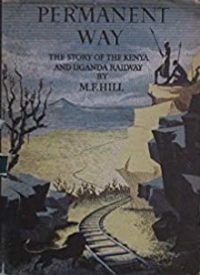
I recently picked up a copy of each of the two volumes of ‘Permanent Way‘ written by M.F. Hill and published in 1949. The first volume [1] is a history of ‘The Uganda Railway’ written in the 1940s when the railway company was known as ‘The Kenya and Uganda Railways and Harbours’ and published at the end of that decade under the jurisdiction of the new ‘East African Railways and Harbours’ which was formed to formally include the infrastructure in the modern country of Tanzania.

Hill’s first volume provides a detailed history of the Uganda Railway until just after the end of World War II. This article covers the period between WW1 and WW2.

In the years immediately after WW1, further European settlement was encouraged and ‘European’ electoral areas were set up. By 1921, the Census revealed the European population of the EAP to be 9,651 and the Indian population to be 22,822. [1: p379]

No effective provision was made in the 1919 Ordinance which established the European franchise, for Indian elected representatives. This was a cause of Indian resentment [1: p379f] Changes in India led to a greater Indian interest in politics in what, in 1920, became the Kenya Colony. The annexation of the EAP took place in June 2020, only the area lease from the Sultan of Zanzibar were excluded (a 10 mile wide costal strip).

In addition to the Indian issue, political turmoil/controversy revolved round issues which had an ill-effect on the new colony’s economy. These included:

  • the virtual bankruptcy of The Uganda Railway;
  • the need for drastic reorganisation;
  • the lack of aboriginal contribution to the colony’s economy – the native population was producing little of value on world markets;
  • the Indian community had yet to make a net contribution to the economy of the Colony.

The number of ex-pat European farmers was only 1,339, most in financial difficulty because of lack of experience, falling prices and a “disastrous currency conversion.” [1: p381] …… The rising value of the Indian Rupee against the pound resulted in a dramatic increase in the sterling value of all local services and commodities. The European settler in 1919 received 850 rupees for £100 instead of the rate before the War of 1500 Rupees for £100. If the £3 million loan first discussed in 1913 had been raised in 1919 its value would have been a third less than in 1913. The farmer also received far fewer Rupees for his sterling exports – he had to sell twice as much produce to meet his liabilities. [1: p382]

After much debate and extensive negotiation the sterling value of the East African Rupee was fixed at 2 Shillings. This was relative parity with the Indian Rupee at the time, but within 6 months the exchange rate in India settled back to historic levels of around 15 Rupees to the pound. [2: p384f]

Settlers costs were as a result fixed at a very high level, their income was held down and then they had to watch as Government salaries were increased by 50% to maintain the value of salaries at an equivalent sterling value. All government related costs charged to settlers where increased by more than 50%. [1: p385f]

Pressure to revert to a conversion rate of 15 Rupees to the pound was resisted by HM Government, the 2 Shilling (Florin) of the Rupee was maintained. However, a local review highlighted a need to create a lower standard denomination and this was eventually accepted. The order came into force on 1sr January 1922 and the Shilling became the standard currency its value set at 20 Shillings to one pound sterling. [1: p388]

The new currency maintained the high exchange rate and as a result local costs had to be reduced. Native labour lost 33% of the increase which came from the high exchange rate although, in practice, this meant that their buying power returned to historic levels.

Hill comments that another effect was the greater pressure placed on the aboriginal/indigenous populations in the reserves to take up paid employment outside the reserves. The terms on which this occured were seen by Mission Societies and the Aboriginal Protection Society. Hill says that this was an ill-informed response, however the parallel scheme in Uganda was more onorous. “In Uganda a native could be called out to work, by compulsion and with no pay, for thirty days a year,band for a greater variety of communal purposes than in Kenya.” [1: p392]

Hill says that by 1920, Kenya was planning to extend the line across the Uasin-Gishu Plateau towards Uganda and the Thika Line to Nyeri. The lack of local labour resulted in the Kenyan authorities it arrangements for forced labour into line with Uganda which inevitably drew more criticism. [1: p392]

Hill tells of a significant debate over the relative merits of the settler’s need for labour and the protection of the rights of indigenous labourers. By 1921, Winston Churchill, who had just inherited the role of Secretary of State ensured that the Kenyan Government would only use forced labour when it was absolutely necessary. In 1922, this became a statute at the time when it also became a requirement to seek HM Government approval for the use of compulsory labour. In 1923, Uganda followed suit. [1: p393]

Between 1919 and 1939, compulsory labour was only once called upon to work for the State. “In 1925 the Secretary of State agreed that compulsory labour should be employed on the extension of the Uasin Gishu Railway and on the line from Thika to Nyeri. In each case the need was urgent, because construction was severely retarded – with heavy financial loss – by a lack of labour. The largest number of compulsory labour employed in any one month was 1,500 on the Uasin Gishu line and 1,300 on the Thika-Nyeri line.” [1: p394]

Hill notes that as of the end of March 1920 the outstanding grant and loan balances available to improve the railway were £1,301,033. The settlement of the rupee-shilling conversion in 1921 enabled the colony to raise a loan of  £5 million of which over £4.2 million was designated for use on the railway.

In May 1921 it was decided at a meeting in London that the financial year of the Kenya Colony should become the same as the calendar year.

Over the next few years, the recall of the Military Governor, Sir Edward Northey, led to a significant change in direction for the colony. Northey had worked to the dictum that European interests were paramount and that Indian interests should not be ignored [1: p397ff] The new commitment of HM Government is described by Hill, quoting from the Devonshire White Paper: [2]

“The general policy underlying any decision that may be taken on the questions at issue must first be determined. It is a matter for satisfaction that, however irreconcilable the views of the European and Indian communities in Kenya on many points may be, there is one point on which both are agreed, namely, the importance of safeguarding the interests of the African natives. …” [1: p399]
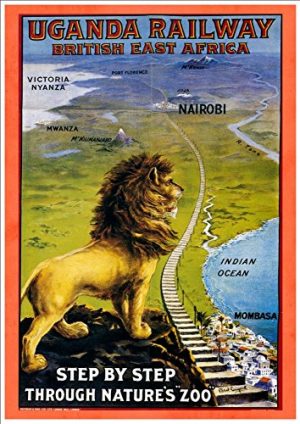
This policy change was significant. Hill says that HM Government now regarded “themselves as exercising a trust on behalf of the African population, … the object of which may be defined as the protection and advancement of the native races.” [1: p400]

Whether Hill interprets the situation correctly may be open to interpretation, certainly the Wikipedia article about the White Paper suggests a slightly different motivation. [2] However, it does seem to be the case that the net result was Kenya avoiding the route that was pursued in South Africa and Southern Rhodesia. [2]

Returning to focus more directly on The Uganda Railway. … The Working Profit of the Railway, even when enhanced by some creative accounting was much lower immediately after WW1 than in earlier years. The figures from within Hill’s account are:

1919-1920         £62,582        [1: p402]

1920-1921      £155,916        [1: p404]

1921                  £15,883        [1: p407]   –   only 9 months and in the midst of a worldwide depression.

1922                  £56,785        [1: p436]

1923                £300,910        [1: p439]

34 No. ‘G’ Class locomotives were delivered by the North British Locomotive Co. and 17 of these were in service by the end of March 1920. At that time, two more were on order from Nasmyth, Wilson & Co. Ltd. A daily service once again became possible along the full line. However, of the 36 new locomotives, 21 were intended for the Magadi Line traffic. [1: p402]

It was as late as 1st April 1921 that the Secretary of State finally rules that the working profit of the railway was no longer to be regarded as available for general colonial revenue purposes and that any surplus generated was to be used:

  • first, for renewals, upkeep and betterment of the railway;
  • second, for meeting loan charges on future development costs;
  • third, for a reduction in railway rates. [1: p404]
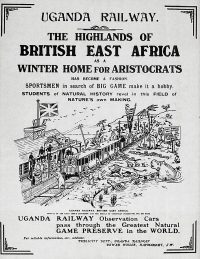
Hill notes that the general improvement in the economy brought significant pressure to bear on the railway – the numbers of engines, carriages and goods wagons available  for use was short, it seemed, on what demand required. Despite night-shift working in the maintenance facilities, 24 engines were in the year awaiting overhaul in August 1920. [1: p405] These problems were mitigated by using 17 locomotives and 108 covered wagons intended for the Magadi Line, as anticipated traffic did not arise from the Soda Works until 1921. [1: p406]

At the end of 1920, Lieut.-Colonel F.D. Hammond was appointed by the Secretary of State as Special Commissioner for Railways, Eastern Africa. He arrived in Kenya on 20th January 2021 and left on 24th August 2021 after completing his tour of investigation. His report brought about a new era in the history of The Uganda Railway [1: p409,410]

Meanwhile, Hill writes, there was a significant debate being played out over the route of the Uasin0Gishu Line. An argument had been put forward for a revised alignment which left the existing main line  on the Mau Plateau rather than at Nakuru. There would have been significant initial cost savings if proponents of this route were to prevail. However, given the increasing levels of traffic from Uganda, major improvements on the existing line between Nakuru and Mau Summit would inevitably be necessary in the relative near future. The ruling grade would have needed to be improved from 2% to 1.5% and concomitant improvements to structures would also be required if transportation costs were to be kept as low as possible. The originally surveyed route from Nakuru would, while costing more initially, would result in lower transportation costs. [1: p410-414]

Hill comments: “There is no doubt that the conclusion reached … in favour of the Nakuru route was sound, although much of the financial argument could not be sustained. … The line took far longer to build than was expected, it proved exceedingly expensive and, during the building, there was persistent friction between … the Chief Engineer … and the senior representative in Kenya of the contractors.! [1: p141]

Hammond, says Hill, reported in May 1921 that he was in full agreement with the Nakuru route “being economically the proper one to choose.” [1: p415] He strongly urged acceptance of that route. Hill goes on to say that while this debate was raging, “Hammond was devising a plan for the complete reorganisation of the railway.” [1: p415]

A new ‘Inter-Colonial Railway Council’ was set up with terms of reference provided by Lord Milner, the Secretary of State, which made that Council the effective administration authroity for the railway and all auxiliary services. Hill says that they were “to be administered as a single instrument for the benefit of Kenya and Uganda by a body of men who, with the expection of the Chairman (Hammond was in the Chair at first) were unlikely to have much experience of railway policy or practice.” [1: p419]

When Hammond left Kenya in August 1921 the position of General Manager of the railway was decreed by the Secretary of State as including the role of Chair of the Council. [1: p422]

Hill goes on to discuss the Hammond report – the main points raised were that there:

  • had been gross inefficiencies in freight transport – goods from Kisumu to Mombasa were taking close to 8 days to travel a distance for which the working timetables allowed 2.5 days. Goods from Mombasa to Nairobi were taking as much as 12.5 days to cover the scheduled running time of 1.33 days. Hammond estimated that the efficient running of the network would result in an 11% surplus capacity with the existing availability of goods wagons at the heaviest envisaged traffic levels (including for Magadi’s output). [1: p422-423]
  • was a need for a marked improvement of the telegraph system to ensure safe operating of the railway; [1: p 423]
  • was a need  a better cleaning regime, particularly of passenger stock; [1: p 423]
  • was too much centralisation of maintenance and no progress in developing maintenance facilities, particularly for locomotives; [1: p 423-424]
  • were huge stocks of coal; [1: p 424]
  • was major work required to maintain/replace machinery in teh worskshops; [1: p 424]
  • were ineffective financial controls in the workshops and in the Chief Mechanical Engineer’s Department; [1: p 424]
  • was a major need for investment in replacement of time served timber buildings; [1: p 424-425]
  • was undue pressure on the General Manager from the Protectorate Government to minimise expenditure on the railway; [1: p 425]
  • was no programme for replacement of railway structures.  Although properly maintained, structures would not be adequate for the axle loads of the next generation of locomotives; [1: p 426]
  • was an over-provision of steamers on the Lakes with no possibility of sale to others; [1: p 426]
  • was no possibility of improving the capacity of Lakes steamers as Kisumu Port could not be developed to accommodate ships with a greater draught; [1: p 426-427]
  • were significant losses on the Busoga Railway and the Port Bell-Kampala line caused by a failure of the Railway to properly credit income to those lines. Thos losses were then being born by the Uganda Government; [1: p 427]
  • was a need to focus on generating traffic from Uganda and the Belgian Congo [1: p427]
  • was work to do to address expensive, slow and cumbersome systems in the Stores and Accounts Departments.
  • were too many staff drawn from India rather than from a wider pool and very little intention to employ local staff to do anything other than manual roles. [1: p427] This meant that the railway was entirely dependent on the economic and political circumstances which might arise in India. [1: p428]
  • had been a failure over 20 years to train local technical staff especially when compared to the situation pertaining in Tanganyika which had been in the German sphere of influence. [1: p428]

Hammond placed the highest priority for action on creating a comprehensive technical training scheme for local staff. He proposed the diversion of capital from the £300,000 fund set aside for the provision of additional rolling stock.

He instituted, with Railway Council agreement, a new goods tarrif system which focussed on maximising revenue. It had a tapering system of rates dependent on volumes carried and a far simpler classification of goods. The system was uniform across the network and ensured that “no transport be done at less than cost price.”[1: p429]

He also insisted that the General Manager should place a high priority on public relations and must “be directly represented on Chambers of Commerce and other local associations.” [1: p429]

Hammond estimated that the required annual contribution to a Renewals Fund should be around £280,000 and that there should also be:

  • a three-year programme to replace worn out plant/machinery at a cost of about £24,000/annum; and
  • a five-year programme of building replacement costing £112,000/annum. [1: p 430]

He emphasised the paramount importance of separating colony and railway finances, and suggested that capital costs for the development of the railway were for the colony to bear, withe the railway being tasked with the operating of the network. [1: p431]

Hammond also stipulated that, to ensure fair-dealing with Uganda, Kenya and Uganda should be placed under one Governor-General or High Commissioner to whom the railway would be responsible. [1: p432]

As a final matter, he looked into the status of the Voi-Kahe branch built during WW1. His recommendation was that “the last 57 miles of track at the Modi end of the Tanga line be picked up and used for the betterment of the costal section [in Tanganyika] and that the Voi-Kahe line be retained, regraded and realigned. He considered that the cost of the reconstruction of the Voi-Kahe line should fall upon Tanganyika as the chief benefactor, and he devised a financial arrangement whereby the Territory would bear all loss and collect all profit derived from the line. [1: p433]

Implementation of Hammond’s report was delayed by political issues. There was major controversy over the probable impact of his recommendations and implementation was delayed “pending further negotiations and discussions.” [1: p434]

The railway concentrated on reform of its own administration. The Railway Council pressed for urgent action where economies could be immediately effected. [1: p434-435]

In January 1922, the Council considered the reduction of coal stocks. It decided that the General Manager had acted in the best interests of the railway in purchasing the coal but considered that the information given to him “as to the state of the home markets at the time in question left much to be desired.” [1: p435] It was resolved to sell surplus coal stocks at the best prices obtainable.

At the end of 1922, a new General Manager was appointed. Within 3weeks or arriving, C. L. N. Felling, ” had devised a scheme for the control of the railway. It was discussed for nearly two years, but the eventual Order in Council differed little from Felling’s original draft. [1: p435]

After considerable debate, a final decision over the Voi- Moshi line was made. It was resolved to keep the line open. [1: p437-439] “Within a few years the line was paying its way, and it later became the first section of any railway in British Africa where the engines were driven by Africans, who also provided the bulk of the signal and station staff.” [1: p439]

At the end of 1923, the General Manager’s report announced a significant programme of new construction which included  the extension of the Uasin-Gishu line to meet the Busoga Railway in Uganda. “Considerable extensions and improvements to the mechanical workshops were carried out during the year and the repair of locomotives … was up to date. During 1823, thirty-seven engines were thoroughly overhauled, five were scrapped, … and twenty new engines were erected.” [1: p441]
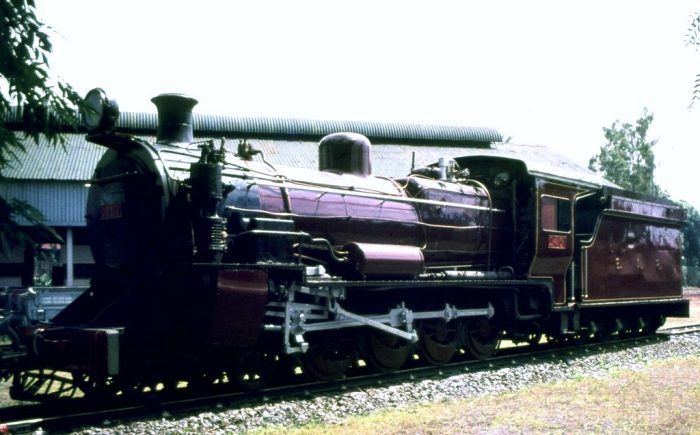
A Uganda Railway GD Class 4-8-0 Locomotive. The first of these was built in 1923 by the Vulcan Foundry of Nasmyth, Wilson and Co. They were numbered 162 to 217 and layer became Class 24 Locomotives as The Uganda Railway developed. [6]

Hill comments: “Within a year, Christian Felling had created an amazing improvement in the working of the railway. The financial position and prospect had changed for the better beyond the most optimistic prediction. It was only the start of great achievement: in the next 4 years he was to transform the railway and it’s finances.” [1: p442]


References

  1. M.F. Hill; Permanent Way – The Story of the Kenya and Uganda Railway – Volume 1; Hazel, Watson & Viney Ltd, Aylesbury & London, 1949.
  2. Wikipedia notes: This document was intended to create “a compromise between Indian interests and those of the Europeans, despite its affirmation of African paramountcy. [3] Nevertheless, the Paper allowed for the (slow) improvement of African conditions, such as the establishment of technical schools for Africans by a 1924 Education Ordinance, as well as the appointment of Eliud Mathu to the Legislative Council, the first African to hold a seat. It also allowed for the formation of an African party, the Kikuyu Central Association, which presented African grievances to the colonial government. Although the Indians were prevented from settling in the White Highlands, they were granted five seats on the Legislative Council and immigration restrictions imposed on them by the white settlers were removed. [4] The White Paper was used by the British government to retain control over the Kenya Colony, and is cited as one reason why Kenya did not develop as a white minority ruled country, as South Africa and Southern Rhodesia did.” [5] https://en.wikipedia.org/wiki/Devonshire_White_Paper; accessed on 3rd January 2021.
  3. Robert M. Maxon; The Devonshire Declaration: The Myth of Missionary Intervention; History in Africa Volume 18,1991, p259–270.
  4. History and Government Form 2 Teachers Guide. East African Publishers. p91–92
  5. Robert M. Maxon; Struggle for Kenya: The Loss and Reassertion of Imperial Initiative, 1912-1923. Fairleigh Dickinson Univ Press, 1993, p270–279.
  6. https://en.m.wikipedia.org/wiki/UR_GD_class, accessed on 8th January 2021.

Epiphany 2021

Matthew 2: 1-12

In the bleak midwinter  by Christina Rossetti

In the bleak midwinter, frosty wind made moan,
Earth stood hard as iron, water like a stone;
Snow had fallen, snow on snow, snow on snow,
In the bleak midwinter, long ago.

Our God, Heaven cannot hold Him, nor earth sustain;
Heaven and earth shall flee away when He comes to reign.
In the bleak midwinter a stable place sufficed
The Lord God Almighty, Jesus Christ.

Enough for Him, whom cherubim, worship night and day,
A breastful of milk, and a mangerful of hay;
Enough for Him, whom angels fall before,
The ox and ass and camel which adore.

Angels and archangels may have gathered there,
Cherubim and seraphim thronged the air;
But His mother only, in her maiden bliss,
Worshipped the beloved with a kiss.

What can I give Him, poor as I am?
If I were a shepherd, I would bring a lamb;
If I were a Wise Man, I would do my part;
Yet what I can I give Him: give my heart.

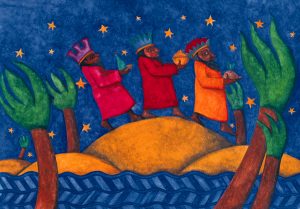
The Feast of the Epiphany celebrates the moment when the story of Christ’s birth first becomes a matter for the whole world. Up until the appearance of the Wise Men, the Magi, the story is exclusive. All the main characters are from Palestine. All of them are Jews.

In Matthew 2: 1-12, we hear the story of how, after Jesus was born, some wise men from the East, from beyond the borders of what we now call Palestine and Israel, even from beyond the boundaries of the Roman Empire, heard that a King had been born. The Gentiles are at this point included in the story.

These wise men wanted to find the King so that they could worship him. They followed a star to Jerusalem and asked some priests there if they knew where to find the King. The priests knew where Jesus was to be born, because they had been told by the prophet Micah, so they told the wise men that they would find the new King in Bethlehem.

The Wise Men saw the star and chose to follow it, otherwise the Star would have been useless. …

So it is with all that God promises us in his Word. We need to respond to the gifts God gives us. We need to continue to grow in faith and commit to following God – and in doing so we make God’s promises our own. We find God to be trustworthy – God is there for us when we need him. This is the journey that each of us is on!

Wise men and women today are still seeking for Jesus. We don’t look for him in Bethlehem, because he is no longer there. He is on his throne in heaven. We don’t need a star to help us find him. We can find him by reading about him in the Bible, by sharing together in the bread and wine of communion, by talking together with others who know him well.

Just as the Wise Men brought gifts to the Christ-child, so Christina Rossetti reminds us that Christian faith is not just about how we receive the gifts and love which God gives, nor is it just about following the best path to the right place. The words of the last verse of her carol remind us that our faith is also about what we bring, about the offering of ourselves, the core of who we are, as a gift to the Christ-child.

What can I give Him, poor as I am?
If I were a shepherd, I would bring a lamb;
If I were a Wise Man, I would do my part;
Yet what I can I give Him: give my heart.

The Uganda Railway during the First World War

I recently picked up a copy of each of the two volumes of ‘Permanent Way‘ written by M.F. Hill and published in 1949. The first volume [1] is a history of ‘The Uganda Railway’ written in the 1940s when the railway company was known as ‘The Kenya and Uganda Railways and Harbours’ and published at the end of that decade under the jurisdiction of the new ‘East African Railways and Harbours’ which was formed to formally include the infrastructure in the modern country of Tanzania.

Hill’s first volume provides a detailed history of the Uganda Railway until just after the end of World War II. This article covers the period of WW1.

Hill provides, at least as far as I can tell, what appears to be a very fair compilation of activity throughout the East Africa Protectorate (EAP) and the Uganda Protectorate UP) during the War. [1: p344ff] There was significant unrest in the EAP contributed to by a range of incompetencies exhibited by the EAP Government based in Nairobi, during the first year of the War. He highlights the importance of a meeting of Settlers in September 2015, which pressed on the Government the need for effective organisation and which resulted in the first elected representation for the Settlers onto a War Council.
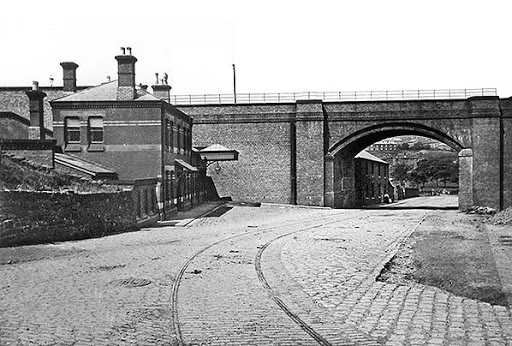
Hill says that organisation improved markedly from this time on, although there were still significant losses in the community and the forces particularly due to fever. The German resistance throughout the War is noted by Hill as being one of “courage, endurance and astounding ingenuity” before it surrendered eventually on 25th November 1918. [1: p354]

Hill’s summary of the EAP campaign says: “The most ardent advocate of the East African campaign cannot maintain that it contributed to the ultimate to the ultimate defeat of Germany. The most caustic critic cannot deny that the story of the campaign is an epic of human endurance in the face of terrible trials. Fever, disease and starvation, through the breakdown of a suicidal system of supply, were von Lettow’s [2] allies, and they caused far more casualties than his soldiers.” [1: p354]

British troops after their train has run over a German mine. [3][4]

Hill points to the War Office record which states that, “during the campaign, 976 officers and 17,650 other ranks were killed, died or missing. Those figures covered the East African, South African, West African, British and Indian troops engaged in the campaign. In addition, 44,572 African porters were killed or died of disease. The maximum strength employed at any time was 24,156 combatants and 187,369 non-combatants. Altogether 112,000 fighting troops and 261,000 non-combatants took part in the campaign. Of the vast army of African porters, on which the transport and supply of the troops in the field mainly depended, nearly 60,000 were recruited in Uganda and the great majority of the remainder came from the Native tribes of the East Africa Protectorate. They were called upon to pay a terrible price in human life and misery because the First German War overspilt from Europe into Africa ” [1: p355]

H.M. armoured train, ‘Simba’ was built in the workshops at Nairobi to counteract the German mounted patrols that carried out nuisance raids on the railway during the War. [3][4] It was destroyed by a mine.

He goes on to talk about ‘The Uganda Railway’. Throughout the text of the chapter on the War, Hill again provides details of the working profit each year:

1914-1915     –      £180,600     [1: p355]

1915-1916     –      £287,300     [1: p360]

1916-1917     –      £351,815     [1: p364]

1917-1918     –      £208,986     [1: p368]

1918-1919     –      £152,255     [1: p370]

During 1915, Parliament approved a loan of £1.868 million for further expenditure at Kilindini Harbour, for railway improvements and for roads and bridges. Only a fraction of the loan was spent until the end of the War. Survey work onthe line from Nakuru across the Uasinn Gishu Plateau did continue. Oil storage at Kilindini and at Kisumu was increased along with work to piers at several ports and Harbours associated with trade on Lake Victoria. One new ship, the ‘Rusunga’, was launched on the lake. [1: p355f]

Hill highlights locomotive developments in 1915: 3 new tank engines were put into service; seven ‘G’ class engines were erected but not out into service until 1817 for lack of flangeless tyres for the leading powered axle/wheel set.

Twenty-nine of the ‘F’ class locos were still working. By the start of the War, the annual engine mileage was 1,862,453 of which the ‘F’ class locos were doing about 50%. The Mallets (18 No.) were doing good work, hauling satisfactory loads, but we’re proving very expensive to maintain. [1: p356]

The Magadi Line opened on 14th January 1915, the Thika Line was still passenger only and already paying its way. The Busoga Railway was crippled by the major drop in export and import traffic. It had also been realised that the costs associated with making Lake Kioga navigable would be exorbitant.

Towards the end of 1915 it was decided to build a new branch line from Voi to Maktau to solve supply problems for the proposed offensive into German East Africa. In due course this line would be extended to Kahe and so would link The Uganda Railway with the line from Tanga to the foothills of Kilimanjaro. [1: p358]

At around this time the military took control of The Uganda Railway. [1: p358f]

By June 1915,1,166 vehicles were being dispatched  monthly from Kilindini. In January 1916 this had increased to 2,994 vehicles. Before the end of March 1916, 25 engines and 200 ten ton covered wagons had been imported from India, mainly for the Voi-Maktau line, but also to receive pressure on the main line. Further wagons were purchased from the contractors for the Magadi Line. [1: p359]

A working profit of £287,000 was achieved in the 1915/1916 financial year but there was no significant allowance made for necessary maintenance and a renewals fund had still not been created. The survey of the line across the Uasin-Gishu Plateau was completed and the first mention appeared in an Annual Report of the General Manager of this route becoming the start of a trunk line through Uganda to the Congo. [1: p361]

In November 1915, the Port at Kilindini was taken over by the Royal Navy and closed to civilian traffic. The inadequate Old Port at Mombasa had to be used for all exports.

The March 1817 report if the General Manager drew attention to the wretched state of engines and rolling stock.

Little had changed by March 1919. The General Manager’s report was a repetition of the difficulties of previous years:

“Little had been done to remedy a chronic decay, the difficulties had, inevitably, become more critical. Several engines had been taken out of service either for lack of spares or as not worth repairing. In February 1919, fifteen new ‘G’ class engines were ordered, but they were not expected to arrive before the end of the year. Meanwhile, of the railway’s ninety-two engines, only seventy-seven were in working order and many of those were in bad shape. Most of the railway’s original rolling-stock particularly the second- and third-class carriages, was virtually beyond repair except at great and uneconomic cost. The majority of the machines in the workshops were worn out and incapable of turning out accurate work.” [1: p371]

All the subsidiary lines were also showing a loss and it was recognised that the two lines in Uganda (Busoga and Port Bell) were too small to be operated effectively as separate systems. [1: p372]

“For years the Treasury of the EAP had pillaged the railway in order to balance its budget. Now the Treasury had extended the field of pillage to Uganda. By this time the state of the railway was so derelict and critical that some radical reorganisation could not long be avoided. The surcharge, and the protests of Uganda, proved to be the last straws. Undoubtedly they impelled the series of events and the design of policy which eventually placed the railway on a sounder constitutional basis and a very much sounder financial basis. Unfortunately, this ill-advised surcharge, following upon the long struggle to secure to Uganda a fair allocation of the customs revenue derived from its imports via Kilindini, left a legacy of suspicion and resentment which exercised an unhappy influence on relations between the two territories for many years.” [1: p373]

References

  1. M.F. Hill; Permanent Way – The Story of the Kenya and Uganda Railway – Volume 1; Hazel, Watson & Viney Ltd, Aylesbury & London, 1949.
  2. Lieut.-Colonel (later General) von Lettow-Vorbeck was the German commander-in-chief in East Africa and remained so throughout the conflict until the end of November 2018 when surrender became inevitable.
  3. http://www.kaiserscross.com/188001/293122.html, accessed on 28th December 2020.
  4. Lieutenant Colonel Charles Hordern; Military Operations East Africa August 1914 – September 1916; Battery Press, Nashville, Tennesse, 1990.
  5. The featured Image at the start of this article comes from http://ww1blog.osborneink.com/?p=10064, accessed on 28th December 2020

The Feast of St. John the Apostle and Evangelist – 27th December 2020

John 20:19-31

On 27th December, the Church celebrates the Feast of St. John, Apostle and Evangelist. Born in Bethsaida, he was called while mending his nets to follow Jesus. He became the beloved disciple of Jesus. He wrote the fourth Gospel, three Epistles and the Apocalypse. The first chapter of his Gospel which focuses of the Word made flesh is one of the most read Gospel reading at Christmas time. In his Gospel and in his epistles, he speaks of the divinity of Christ and of the primacy of love. With James, his brother, and Simon Peter, he was one of the witnesses of the Transfiguration. At the Last Supper, he leans on the Master’s breast. At the foot of the cross, Jesus entrusts His Mother to his care. John was close to both Jesus and Mary. Towards the end of his life, we know that John was exiled to the island of Patmos under Emperor Domitian.

I have chosen to reflect on a passage from close to the end of John’s Gospel. It might seem strange to be reading an Easter story just after Christmas. It isn’t the passage set for the Feast of St. John. But it is the point at which John’s Gospel reaches its climax.

We’re not told why Thomas wasn’t in the upper room that first Easter evening when Jesus visited his disciples. We could spend time trying to imagine where he was – but we won’t! Suffice to say, he missed the key event, the turning point, the moment that changed defeat into victory. And how did he respond? … In exactly the same way as most of us would have done. … Thomas just could not believe what the others told him.

I doubt any of us would have done under those same circumstances. We say that ‘Seeing is believing’ – but so is sharing in an experience with others. Thomas not only didn’t see what happened, he was left out of the experience that everyone else shared. He was in a lonely place, wanting to believe, wanting to share in everyone else’s happiness, but unable to do so. He’d not been there, he had not seen Jesus.

Thomas’ reactions and feelings are understandable, and as we read the story we can see that Jesus thought so too. He provided a repeat of the same encounter – one in which Thomas could share. He then gently reminded Thomas of his outburst – no indignant rebuke, just words which drew Thomas back to faith. Thomas’ response is one of the clearest statements of Jesus’ divinity in the Bible. Having seen the truth of the resurrection he cannot but exclaim, “My Lord and my God!”

The next 3 verses are important, and they are pivotal to St. John’s message:

Jesus said to Thomas: “Have you believed because you have seen me? Blessed are those who have not seen and yet have come to believe.” ….  Now Jesus did many other signs in the presence of his disciples, which are not written in this book. But these are written so that you may come to believe that Jesus is the Messiah, the Son of God, and that through believing you may have life in his name.

St. John has led his readers through a story – a story which allows those readers to meet Jesus and begin to understand who he is. It’s a journey of discovery, one in which we can identify with the different characters, feel their emotions, struggle with them to understand what Jesus is doing and saying. Thomas’ words are the culmination, the pinnacle of the story – the point where even the strongest of doubters expresses faith. Jesus response is not just for Thomas’ ears, not just for the disciples, but for all who read John’s Gospel in coming generations. “Don’t think,” says Jesus, “that the disciples were in some way special because they saw all these events first hand. Rather, blessed are those who read the stories and encounter Christ through the work of his Spirit in their lives and the lives of those around them.”

“Blessed,” says Jesus, “are all who read this Gospel, who struggle with doubts & come to believe that I am the Son of God.”

St. John’s message for us is that we have not missed out on the party, we can still be part of the events which changed defeat into victory. We too can own the risen Jesus as our Lord.

This is good news – particularly for those of us who struggle with doubt; for those of us who’d like to believe more strongly than we do; for those of us who see other people’s faith, or the joy they seem to experience in their Christian life, and feel that we are somehow missing out.

I think this passage is not just important as the culmination, the climax of St. John’s Gospel. It is important because St. John chooses, at this climactic moment of change, to embrace doubt. He places the strongest words of faith in the mouth of Thomas the doubter.

Everything is different, Jesus was dead and is now alive. Nothing can now be the same. In the story, Thomas struggles to accept this new reality. For so many of us change is difficult to handle, yet it is happening all the time. It is happening right now as we struggle towards a possible post-Covid reality.

We need to continue to engage with the communities around our churches, looking for new ways to serve, new ways to make Christ known and to bring hope where there is despair. We need to accept that the future for the Church of England is one with significantly less stipendiary clergy – perhaps one third less in numbers in only a few years’ time – and we need to imagine new forms of ministry both lay and ordained, new ways of being church. Nothing is the same as it was, nothing will be the same as it was, and we want to shout out the loudest “No! Not now, not ever!”

I think that there are two key things to take away from this passage.

First – it’s OK to be honest – don’t pretend that everything is OK when it isn’t, don’t manufacture faith if it isn’t there. We can express our fears and we can express our doubts. In fact expressing our fear and our doubt is often, like it was for Thomas, the first step to faith.

Second – this story of doubt and faith is made the crowning moment of John’s Gospel – the pinnacle – Jesus reaching out to his loyal but doubting and fearful follower, not in anger but in love. Thomas’ exclamation, “My Lord and my God!” is the point at which John choses to rest his case. He has asked his readers to understand who Jesus is and this story of doubt and faith is the crucial last part of his argument. Honest struggling with change, honest struggling through doubt towards faith is given the highest honour in John’s Gospel.

So, don’t be discouraged if the pace of change or the circumstances we face are a struggle. Don’t be discouraged if believing is a struggle. Be encouraged as you struggle to be faithful in an ever-changing context, when at times everything you hold dear seems threatened. Be encouraged as you struggle to believe, for the story of Thomas makes clear that God loves the open and honest doubter.