
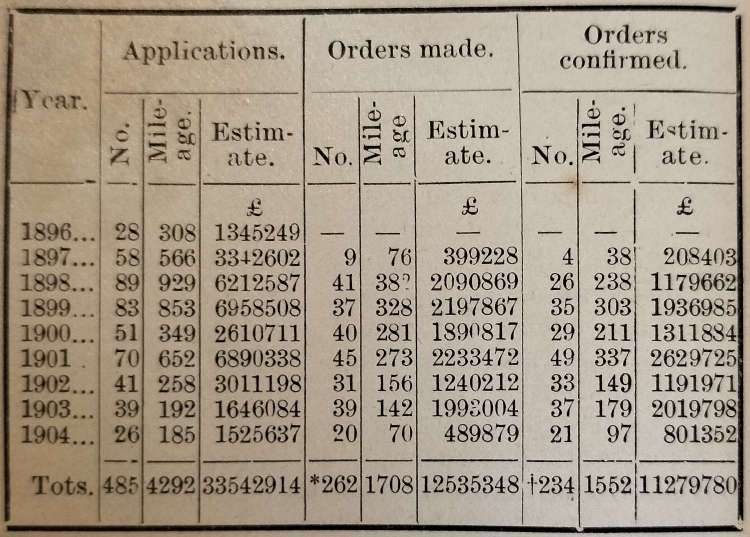
A note in the August 1905 edition of The Railway Magazine mentions a 1904 report from the Light Railway Commissioners and comments from the Board of Trade in 1905. [1: p170]
The Regulation of Railways Act 1868 permitted the construction of light railways subject to ‘…such conditions and regulations as the Board of Trade may from time to time impose or make’; for such railways it specified a maximum permitted axle weight and stated that ‘…the regulations respecting the speed of trains shall not authorize a speed exceeding at any time twenty-five miles an hour’. [2]
“The Light Railways Act 1896 did not specify any exceptions or limitations that should apply to light railways; it did not even attempt to define a ‘light railway’. However, it gave powers to a panel of three Light Railway Commissioners to include ‘provisions for the safety of the public… as they think necessary for the proper construction and working of the railway’ in any light railway order (LRO) granted under the act. These could limit vehicle axle weights and speeds: the maximum speed of 25 miles per hour (mph) often associated with the Light Railways Act 1896 is not specified in the act but was a product of the earlier Regulation of Railways Act 1868. … However, limits were particularly needed when lightly laid track and relatively modest bridges were used in order to keep costs down.” [2]
Sir Francis Hopwood’s report to the Board of Trade on the proceedings of the Light Railways Commission during 1902, indicated “a growing tendency to embark on private and municipal light railway schemes all over the country. Thirty-one fresh orders, of which only two for steam traction, were submitted, eighteen being confirmed, making a total of thirty-five for the year. No order was rejected. Since 1896, 420 applications [had] been made, more than half being confirmed. They represented 3,900 miles of line, with a capital expenditure of £30,371,193. The total mileage sanctioned during 1902 amount[ed] to 1,500 miles, with a capital expenditure of £10,148,900, or over a third of the aggregate for five years.” [10]
The short report in the August 1905 Railway Magazine highlighted the “number of applications made to the Commissioners in each year since the commencement of the Act, the number of orders made by the Commissioners, and the number confirmed by the Board of Trade, with mileage and estimates.” [1: p170]
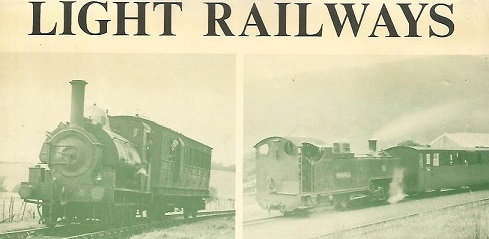
Railways built under the Light Railways Act 1896 struggled financially and by the 1920s the use of road transport had put paid to the majority. Some survived thanks to clever management and tight financial control.
“The Light Railways Act was repealed in 1993 for England and Wales by the Transport and Works Act 1992 and no new light railway orders were allowed to be issued for Scotland after 2007. … Until the Transport and Works Act 1992 introduced transport works orders, heritage railways in the UK were operated under light railway orders.” [2]
Among many others, Light Railways which were built under the Act include these examples:
Welshpool and Llanfair Light Railway, opened in 1903, closed in 1956, reconstructed and reopened between 1963 and 1981 on the entire route except Welshpool town section. Articles about this line can be found here, here and here. [3]
Tanat Valley Light Railway, articles about the line can be found here and here. [4]
Shropshire & Montgomery Light Railway, five articles about this line and its rolling stock can be found here, here, here, here and here. [5]
Kelvedon & Tollesbury Light Railway, an article about this line can be found here. [6]
Campbeltown and Machrihanish Light Railway is referred to in this article. [7]
Bere Alston and Calstock Light Railway, the East Cornwall Mineral Railway and this line are covered in three articles which can be found here, here and here. [8]
Ashover Light Railway, is covered in three articles which can be found here, here and here. [9]
A parallel act governed light railways built in Ireland.
References
- The Railway Magazine, London, August 1905.
- https://en.m.wikipedia.org/wiki/Light_Railways_Act_1896, accessed on 14th August 2024.
- https://rogerfarnworth.com/2022/07/24/the-welshpool-llanfair-light-railway/ and https://rogerfarnworth.com/2022/09/23/the-welshpool-llanfair-light-railway-an-addendum/.
- https://rogerfarnworth.com/2019/09/18/the-tanat-valley-light-railway-and-the-nantmawr-branch-part-1/ and https://rogerfarnworth.com/2020/03/17/the-tanat-valley-light-railway-and-the-nantmawr-branch-part-2/.
- https://rogerfarnworth.com/2019/05/18/the-shropshire-and-montgomeryshire-light-railway-and-the-nesscliffe-mod-training-area-and-depot-part-1/ and https://rogerfarnworth.com/2019/07/21/gazelle/ and https://rogerfarnworth.com/2019/07/27/gazelles-trailers/ and https://rogerfarnworth.com/2019/08/02/ford-railmotors-on-colonel-stephens-lines-in-general-and-on-the-smlr/ and https://rogerfarnworth.com/2019/08/12/the-shropshire-and-montgomeryshire-light-railway-and-the-nesscliffe-mod-training-area-and-depot-part-2/.
- https://rogerfarnworth.com/2019/01/29/the-kelvedon-and-tollesbury-light-railway/
- https://rogerfarnworth.com/2024/08/08/water-troughs-major-works-campbeltown-machrihanish-light-railway-welsh-highland-railway-and-other-snippets-from-the-railway-magazine-january-1934/.
- https://rogerfarnworth.com/2019/03/26/the-east-cornwall-mineral-railway-part-1/ and https://rogerfarnworth.com/2019/03/28/the-east-cornwall-mineral-railway-part-2/ and https://rogerfarnworth.com/2019/04/02/the-bere-alston-to-callington-branch/.
- https://rogerfarnworth.com/2019/01/15/the-ashover-light-railway-part-1/; and https://rogerfarnworth.com/2019/01/19/the-ashover-light-railway-part-2/ ; and https://rogerfarnworth.com/2019/01/19/the-ashover-light-railway-part-3/
- The Railway Magazine, London, July 1903.
 Roger Farnworth
Hi Roger
As always I enjoyed reading your latest article.
I am the owner of the limekilns at Calstock and part of the incline railway that were in turn part of the ECMR.
Historical Railways Estate are now in the middle of renovation and consolidation works on Skew Bridge which is the incline bridge over Lower Kelly.
I intend to write something about this in our community newspaper “Calstock News”
Would it be in order to include the three links to your articles about the ECMR, duly credited of course.
Or indeed would you consider your articles being re-published therein, once again credited.
Similarly there is a Calstock Parish Local History Group magazine which might also be appropriate for your articles?
Please let me know what you think and meanwhile thanks again for all of your efforts.
Yours sincerely
Martin
Martin Smith Cobwebs 1 Lower Kelly Calstock PL18 9RX smithmartin@me.com
>
Hello Martin
I am very happy for you to link to the articles. Best wishes.
Roger
Thanks RogerMartin, sent from my iPhone
Dear Roger The Basingstoke & Alton light railway also has an interesting history, having been pulled up to be used in France in WW1 and ‘forced’ to be relaid afterwards. The man in the street of a certain era will know it as the railway used in Oh Mr Porter. Kind regards David Wallingford
Thank you, David.
An excellent article! Did any lines built under the 1868 Act have “Light” in their title?
There is a discussion of the Act on RMWeb which might be of interest to you Richard. …
https://www.rmweb.co.uk/forums/topic/167761-light-railways-begun-using-the-regulation-of-the-railways-act-1868/