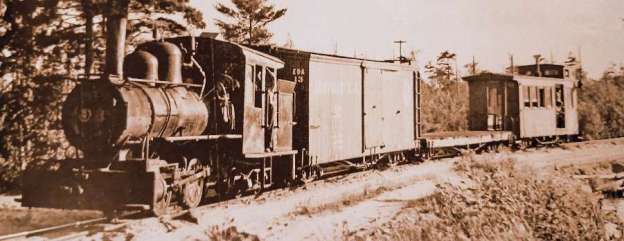
The featured image for this article is Monson Railroad No. 4 on an Edaville Railroad works train in 1950, © Public Domain. [2: p93]
In January 2026, I was reading an early copy of The Railway Magazine and wrote an article about the Edaville Railroad which can be found here. [1]
In January 2026, I had not really cottoned-on to the significance of the Edaville Railroad as a pioneer in the field of preservation.
We all recognise the Talyllyn Railway as the first railway in the world to be preserved. But the Edaville Railroad predates the date in 1951 when volunteers began running the Talyllyn.
The Edaville Railroad opened in 1947. It was not a ‘preserved’ railway, but it still has a claim to being the first heritage railway. It was a 2ft-gauge railway, built by an enthusiast on a green field site to run historic stock.
Definitely not the same thing as a ‘preserved Railway’ but still of paramount significance in the early development of the international preservation movement.
Jones retells the story of the line, starting with its 2ft-gauge antecedents in Massachusetts and Maine:
- The Billerica and Bedford Railroad opened near Boston, Massachusetts in the 19th century. It was not the success that George Mansfield, its owner, had hoped.It was unable to compete effectively with the well-established standard-gauge lines around Boston. It closed. Mansfield saw a better location for his railroad. [8]
- The Sandy River Railroad (or the Sandy River & Rangeley Lakes Railroad) was the result of Mansfield’s careful consideration. His 2ft-gauge railway was much more suited to the mountainous terrain. Smaller and lighter locomotives were much more able to handle the tight curves and steep inclines needed to negotiate the mountain valleys. It was the first of five 2ft-gauge railways in Maine. [7] The others were:
- The Kennebec Central Railroad between Randolph and Togus. The railroad was built to offer transportation for American Civil War veterans living at Togus to the nearby City of Gardiner, although only reaching Radolph on the opposite side of the Kennebec River. [3]
- The Wiscasset, Waterville & Farmington Railway is a restored 2-foot narrow-gauge heritage railroad in Alna, Maine. 3.5 miles (5.6 km) of the track has been rebuilt and is operated by the non-profit Wiscasset, Waterville and Farmington Railway Museum as a heritage railroad. The original line hauled freight and passengers from 1895 to 1933. It was famous for its ‘big dreams and little wheels’. The line was operated from 1895 until 1933 between Wiscasset, Albion, and Winslow, it never made it to Waterville and Farmington. It was abandoned by 1936. [4]
- The Monson Railroad operated between Monson Junction on the Bangor and Aroostook Railroad and Monson, Maine. The primary purpose of this railroad was to serve several slate mines and finishing houses in Monson. It operated from 1883 to 1943. [5]
- The Bridgton & Saco River Railroad (the Bridgton & Harrison Railway) was established in 1882 to connect the towns of Cumberland County with the national rail network at the Saco River. The route was extended in 1898 to reach Harrison. It was purchased by the Maine Central Railroad in 1912, but faced severe financial struggles in the 1920s. In 1927, it was reorganized as the Bridgton & Harrison Railway to keep the line alive. The Harrison extension was shut down in 1930. The remainder of the line ceased regular operations in 1941. [6] Jones says that the line stayed open until 1944 for excursion rides. [2: p93]
Jones says that one of those enthusiasts “was Ellis D. Atwood a cranberry farmer from South Carver. He thoroughly enjoyed his experiences on the Bridgton & Harrison, and when that railroad finally decided to close, he bought most of the remaining equipment and five miles of rail.” [2: p93]
The series of dykes and canals around Atwood’s plantation, in particular the dykes, provided the ideal place to lay the 2ft-gauge track. “The first rails were laid in late 1945, heading out in a clockwise direction from the screen (processing) house into the bogs. The trains were sent out with supplies and workers until they reached the end of the line, at which time they were unloaded and reversed direction, backing up all the way to the screen house to reload. … A mild winter and some intelligent planning … enabled work to continue right through the winter of 1947. … Ellis also employed several of his farmhands as railroad track gangs … keeping them working during the normally quiet winter season.” [2: p93]
By April 1947, nearly 5.5 miles of track formed a complete loop of track. An acquaintance stubbled across two locomotives from the Monson Railroad. Although these were in a poor state of repair, Atwood bought both. He now had four locomotives, Nos. 3 and 4 from the Monson Railroad and Nos. 7 and 8 from the Bridgton & Harrison Railway.
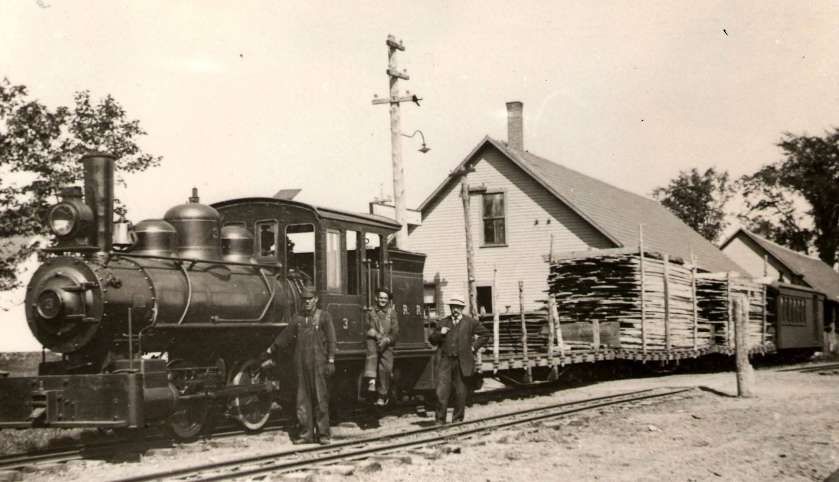
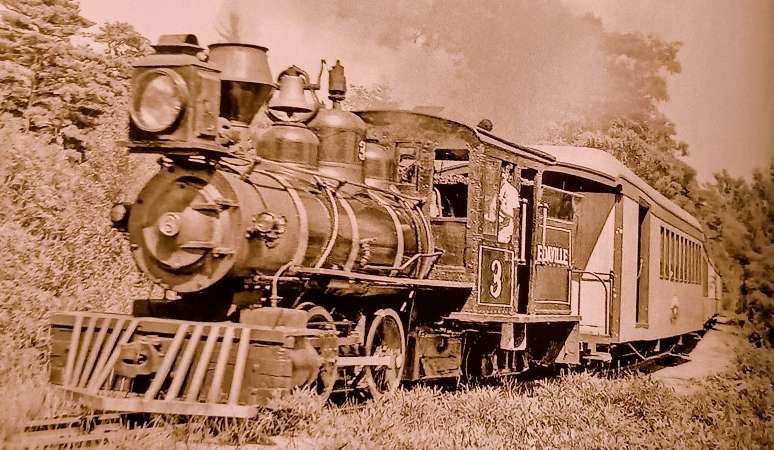
Atwood also purchased some surviving rolling stock from the Sandy River & Rangeley Lakes Railroad.
Jones goes on to explain that:
“Atwood had originally planned to use the passenger cars to carry his workers from one location to another, but fairly soon after completion of the trackwork, enthusiasts started showing up and asking for rides. Atwood’s neighbours were enchanted by the diminutive railroad and, little by little, word spread about these tiny trains. Soon, enthusiasts were arriving daily hoping to get a ride. Ellis loved to show off his trains and, in the beginning, gave people rides out of the kindness of his heart. It became evident that there was money to be made from paying passengers.
“He charged a nickel a ride and soon there was so much demand for rides that the tourist trains became more important than the railroad’s role as a working part of the plantation.
“Atwood built a station near the screen house and started selling tickets to his little railroad empire. It was an immediate success.
“He was delighted by the Christmas season. He had decorated his nearby home for many years, and people would come from all over to see the bright lights and displays. Once the decision was made to turn Edaville into an excursion railroad, he soon realised he had a wonderful location to expand on the Christmas decorations he loved, and thus the Holiday Festival of Lights was born, pre-empting, surely, today’s Santa specials on heritage railways. The lights would soon become Edaville’s most successful venture, bringing crowds of nearly 10,000 people each day in later years. Soon after Edaville had established itself as a thriving excursion railroad, in November 1950, Atwood was killed in a boiler explosion while trying to fix a malfunctioning heater in the screen house. He was 61.” [2: p94]
After telling the early tale of the line, Jones goes on to tell the story of the next few years under Norman Blounts ownership and the ensuing unstable years when operation was spasmodic. He rehearses the story of the removal of much of Atwood’s original collection back to Maine in September 1993 to become a significant part of the collection of the newly opened Maine Narrow Gauge Railroad and Museum. Jones also writes of Edaville’s life as the home of Thomas Land from 2015 onwards.
Jones concludes by drawing contrasts and comparisons between the Edaville Railroad and the Talyllyn. …
“There are many close similarities between the two operations, but also many differences both stark and subtle.
“Firstly, both lines were built for the conveyance of freight: the Talyllyn was planned to take slate from the Bryn Eglwys mines opened by John Pughe in the shadow of Cader Idris in 1847 and received Parliamentary sanction in 1865, while the Edaville Railroad was laid after the Second World War by a man who was obviously a steam enthusiast, but at the outset only wanted his trains to carry cranberries on the first leg of their long journey from the bogs in which they grew on his South Carver farm to the Christmas table and elsewhere.
“Both heritage concerns relied on traction imported from closed lines elsewhere: the original Edaville stock had been made redundant by closures in Maine while the Talyllyn revivalists were fortunate enough to be able to obtain two 2ft 3in gauge locomotives from the sister Corris Railway which had just closed.
“Again, the Edaville concern differs from the Talyllyn in that it was not in itself an original railway, as it was built on a green field site and became a heritage line purely by chance rather than deliberation: the closures of the 1940s which had ravaged other narrow gauge railroads led to enthusiasts converging on the diminishing numbers of steam sites in greater numbers to the point where Ellis D Atwood was staring a gift horse in the mouth.
“It was hardly a volunteer-led affair: some of his full-time farmhands were ordered to forget the fabled red fruits and build and operate the railway around his estate and the heritage trains were later run, successfully from the start, on a commercial basis.” [2: p97]
After publishing this article I heard from James Waite with some reflections about the Edaville Railroad. These can be found in Appendix 1 below. …
James also wrote an article for Rob Dickinson’s website about his first visit to Maine in 2011. That article can be found here. [10]
Robert Hall has written a review of the book ‘The Maine Two-Footers’ referred to below (15th October 2024). This can be found here on Rob Dickinson’s website. [11]
References
- https://rogerfarnworth.com/2026/01/30/the-edaville-railroad-south-carver-massachusetts/
- Robin Jones; The First Heritage Railway; in Great British Railway Firsts: How Britain Led the World in Rail Technology; Mortons Media, Horncastle Lincs., 2019, p92-97.
- https://en.wikipedia.org/wiki/Kennebec_Central_Railroad, accessed on 17th June 2026.
- https://en.wikipedia.org/wiki/Wiscasset,_Waterville_and_Farmington_Railway, accessed on 17th June 2026.
- https://en.wikipedia.org/wiki/Monson_Railroad, accessed on 17th June 2026.
- https://en.wikipedia.org/wiki/Bridgton_and_Saco_River_Railroad, accessed on 17th June 2026.
- https://en.wikipedia.org/wiki/Sandy_River_Railroad, accessed on 17th June 2026.
- https://en.wikipedia.org/wiki/Billerica_and_Bedford_Railroad, accessed on 17th June 2026.
- https://www.mainememory.net/record/9181/image/9181?utm_source=copy+link&utm_medium=social, accessed on 18th June 2026.
- https://www.internationalsteam.co.uk/trains/usa04.htm, accessed on 30th June 2026.
- https://www.internationalsteam.co.uk/trains/usa13.htm, accessed on 30th June 2026.
Appendix 1 – Email from James Waite (19th June 2026)
Hello Roger,
I enjoyed your email about the Edaville line and the article in the Railway Magazine.
Like you I hadn’t really appreciated Edaville’s significance in the heritage railway world for many years, and I only really got into it when I visited Maine, and Edaville, over a long weekend in 2011.
Some additional info, and one correction to the RM article. The Bridgton & Harrison was latterly owned by Bridgton town council, and some time before 1941 it sold its stockholding to a scrap merchant. A long battle followed during which those who wanted to keep the railway did their best to obstruct the applications to the Interstate Commerce Commission and the Public Utilities Commission for their consents to close the line, and those consents weren’t forthcoming until September 1941. Closure took place immediately, and dismantling the railway began about one week later. It isn’t the case that any excursions ran until 1945.
Ellis Atwood was one of several enthusiasts who went up to Bridgton immediately the closure became public knowledge, and they negotiated the purchase of locos and rolling stock from the scrap merchant. Pear Harbour and the USA’s entry into WW2 happened a few weeks later, before EDA could move his purchases. State consent was needed during the war for any significant freight movement either by rail or road, and EDA couldn’t obtain it, and so his purchases remained out in the open until the war ended in 1945. By then he had bought out the other purchasers and it all moved to South Carver.
Linwood Moody was responsible for finding the two Monson locos in a scrapyard in New Jersey. He was an enthusiast who lived in Maine and who visited the 2-footers and got to know them well during the 1930s. He was also a professional railwayman. In 1945 EDA wrote to him and offered him a job at Edaville, and seeking out more pieces of 2ft stock was one of his responsibilities.
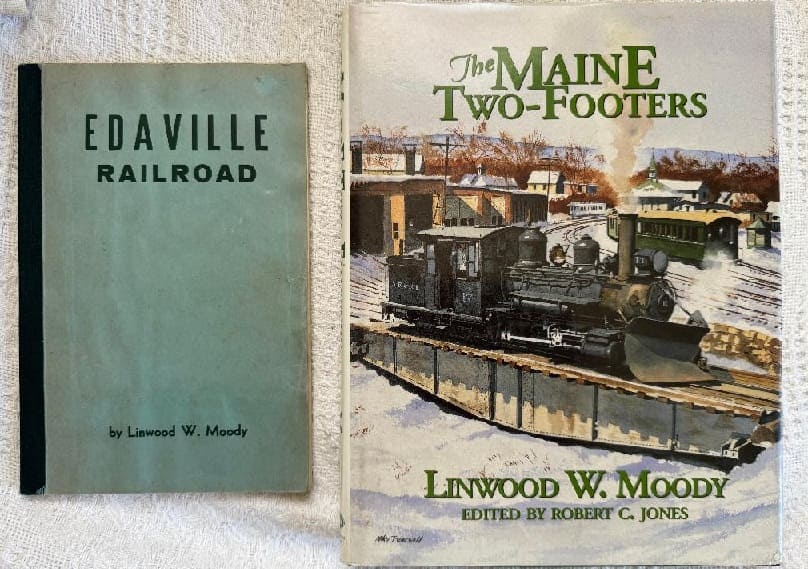
These two books which he wrote are essential reading on Edaville’s history and that of the 2ft lines more generally. The larger one is well-known and used copies are available quite cheaply nowadays on places like Amazon. The small pale blue one is a guidebook, published in 1947 while Edaville was still being built. At 80 pages it’s very detailed! It has the benefit of being largely in the present tense!
Hope all this is of interest.
Best wishes,
James