Tag Archives: photography

The Railway between Nice, Tende and Cuneo – Part 5 – Breil-sur-Roya to Ventimiglia

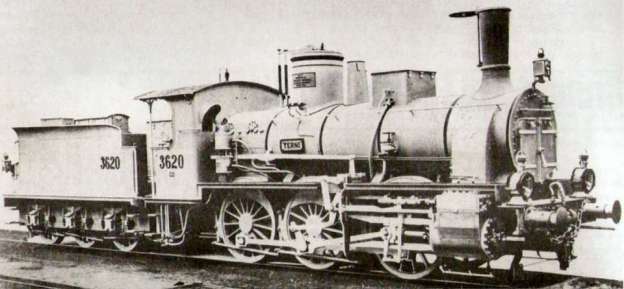
The featured image for this article, above is an FS Series 320 0-6-0 (030 in Italian notation) steam locomotive which was used in the early days of operation on the southern section of the Ventimiglia-Cuneo line, before the North and South sections could be linked. The locomotive depicted is FS3620 and carries a nameplate – ‘Terni’. 201 locomotives of this Class were built between 1904 and 1908. [8]

In the first four articles about the line from Cuneo to the sea we covered the length of the line from Cuneo to Breil-sur-Roya. These articles can be found here, [9]  here [10] here, [11] and here. [12]

I also want to acknowledge the assistance given to me by David Sousa of the Rail Relaxation YouTube Channel https://www.youtube.com/@RailRelaxation/featured and https://www.railrelaxation.com and particularly his kind permission given to use still images from rail journeys that he has filmed on the Cuneo-Ventimiglia railway line. [35][55]

South of Breil-sur-Roya a junction allows direct access to Ventimiglia and to Nice. The map below shows the two routes as they existed prior to the alteration of the border between France and Italy after the Second World War.
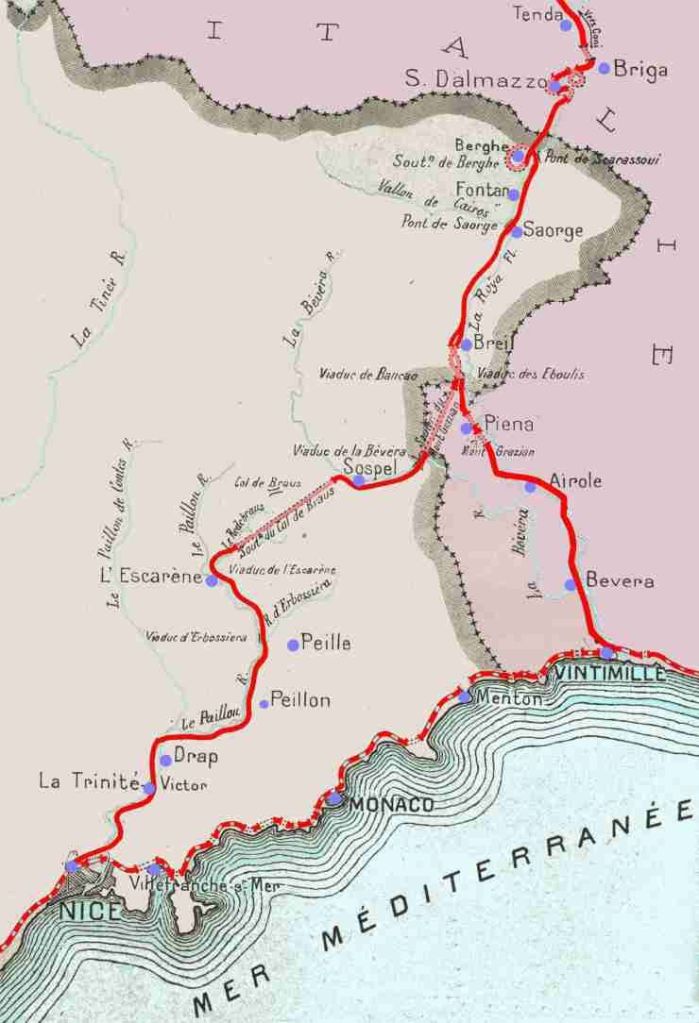
The lines Nice to Tende and Ventimiglia to Tende in the period from 1928 to the Second World War, before the annexation, in 1947, of St-Dalmas de Tende and Piene to France. [40]

This article follows the line South from Breil-sur-Roya to Ventimiglia in two parts: the first as far as Airole and the second from Airole to Ventimiglia. ….

1. The Line South from Breil-sur Roya to Airole
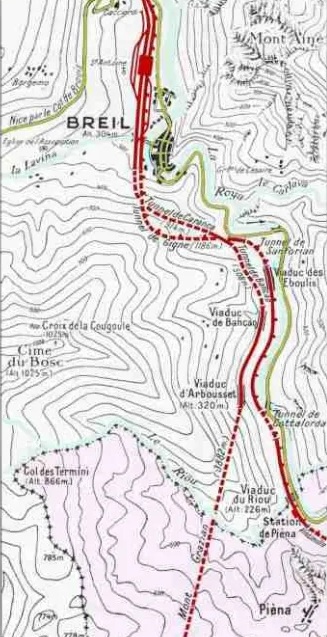
This drawing/map shows the two routes heading South from Breil-sur-Roya. [40]

As with the line immediately to the North of Breil-sur-Roya, the works to the South were constructed by the French. Both of the lines heading South from Breil-sur-Roya entered tunnels just a short distance South of Breil.
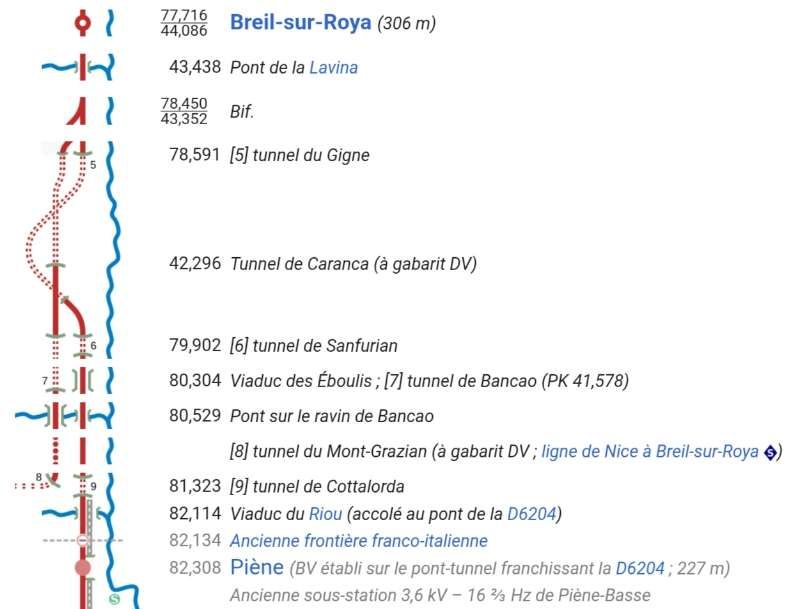
Breil-sur-Roya to Piene. [22]
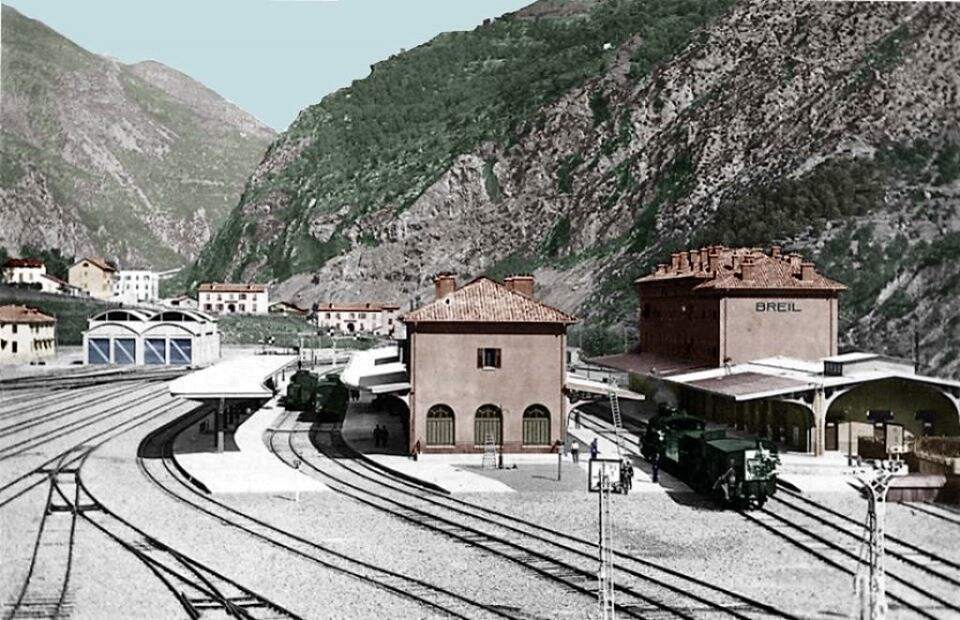
A colourised postcard view of Breil-Sur Roya Railway Station looking North through the station site in advance of the official opening in 1928. This colourised image was shared on the Stura-Cuneo Facebook Page on 20th February 2020, (c) Public Domain. [29]
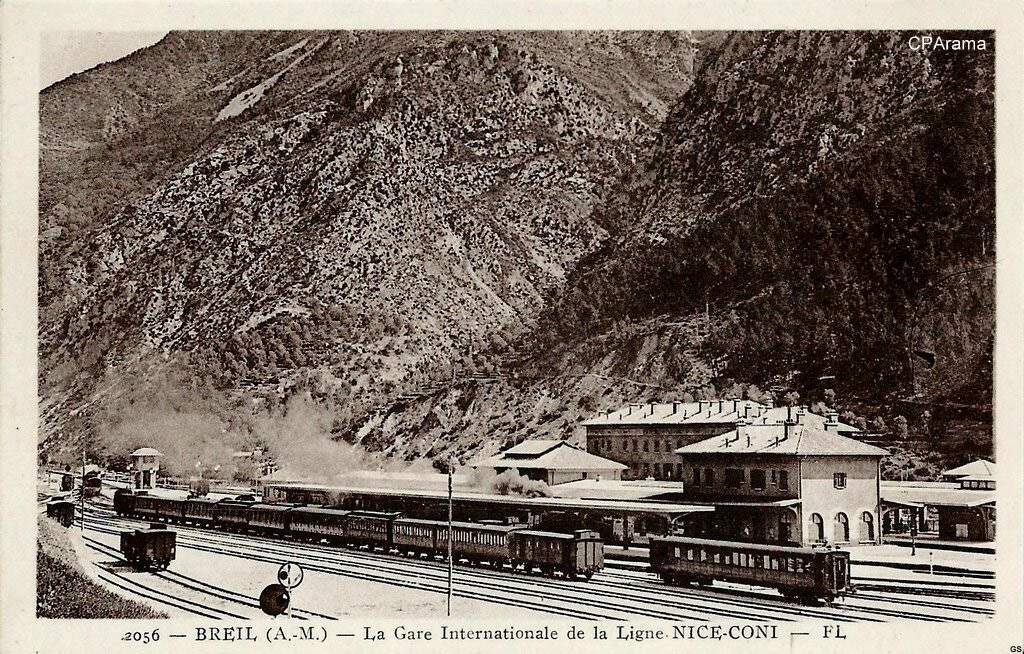
Breil-sur-Roya station during its very early operation (1928-35), before electrification, with numerous passenger carriages standing idle. The passenger building is in the background; in the foreground are the buildings on the second platform, the only ones today significantly reduced in height and length, publisher Frédéric Laugier, (c) Public Domain. [30]
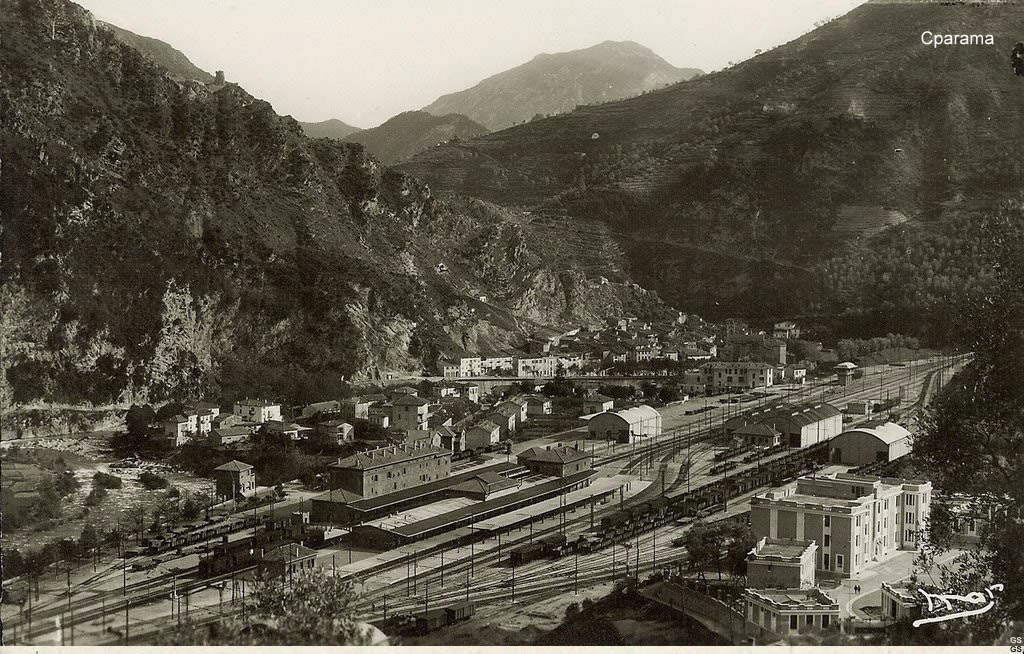
Breil-sur-Roya Railway Station at the height of its development, with electrification completed (1935), with the passenger building, the large freight yard filled with wagons, and the concrete sheds with arched vaults. Those in the background still exist but are used for non-railway purposes. The Breil Ecomuseum is now located on the north side, half-hidden by the foliage of the tree in the foreground. The photograph was taken from the hillside to the Northwest of the station site and faces Southeast, (c) Public Domain. [30]
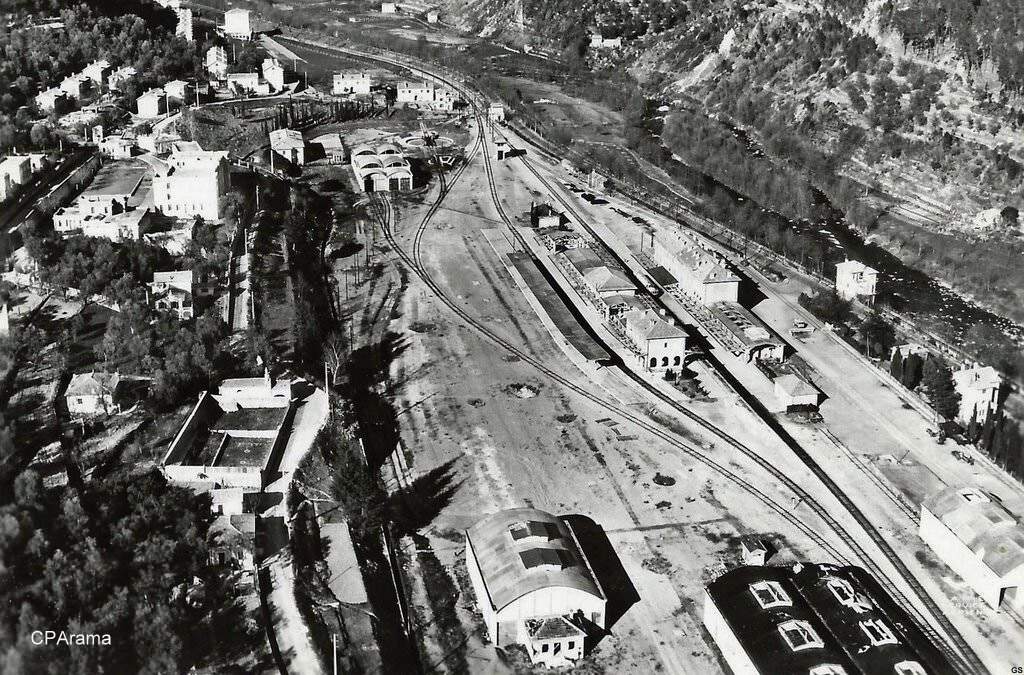
After the war, the line to Nice was reopened in 1947, but the station, reduced to the simple terminus of a secondary section, was greatly simplified, removing almost all the sidings (the long straight lines of which can still be made out). In the background, the line to Fontan still features the electrification poles (removed from the rest of the station), but it was naturally abandoned and remained there until its reconstruction in the 1970s. In the 21st century, platform 2, which had been removed at the time, has been restored, the buildings on the second platform have been scaled down, and the third platform has been eliminated. The turntable, which still exists, is part of the Ecomusée, publisher Lapie à Saint-Maur, 1955, (c) Public Domain.[31]
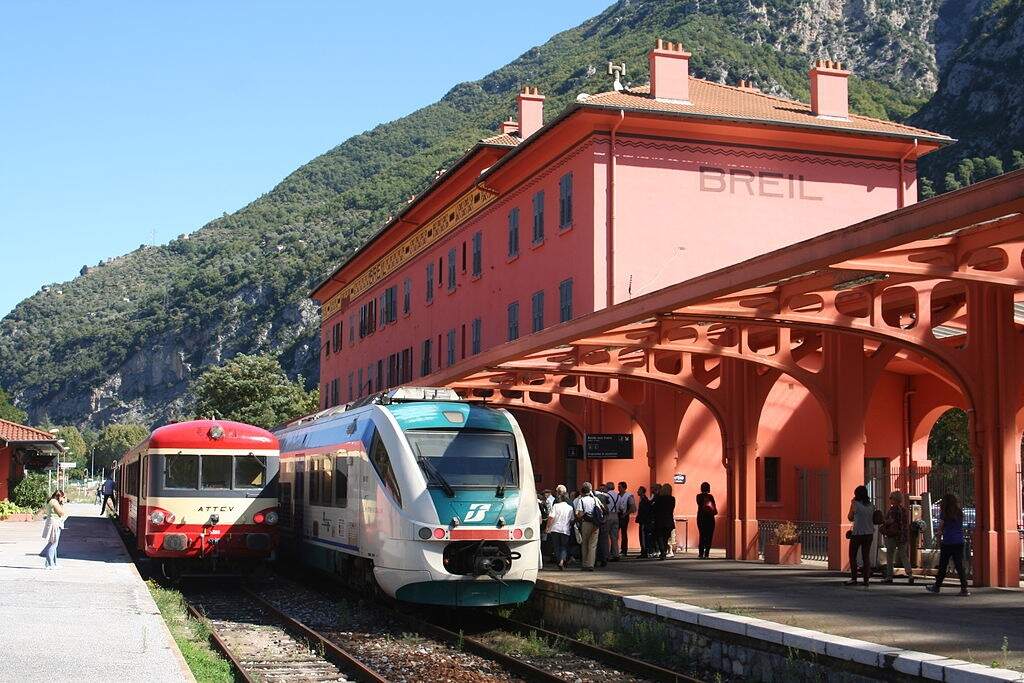
Breil-sur-Roya Railway Station in 2013, (c) Gilles Tagadaand licenced for reuse under a Creative Commons Licence (CC BY-SA 3.0). [32]
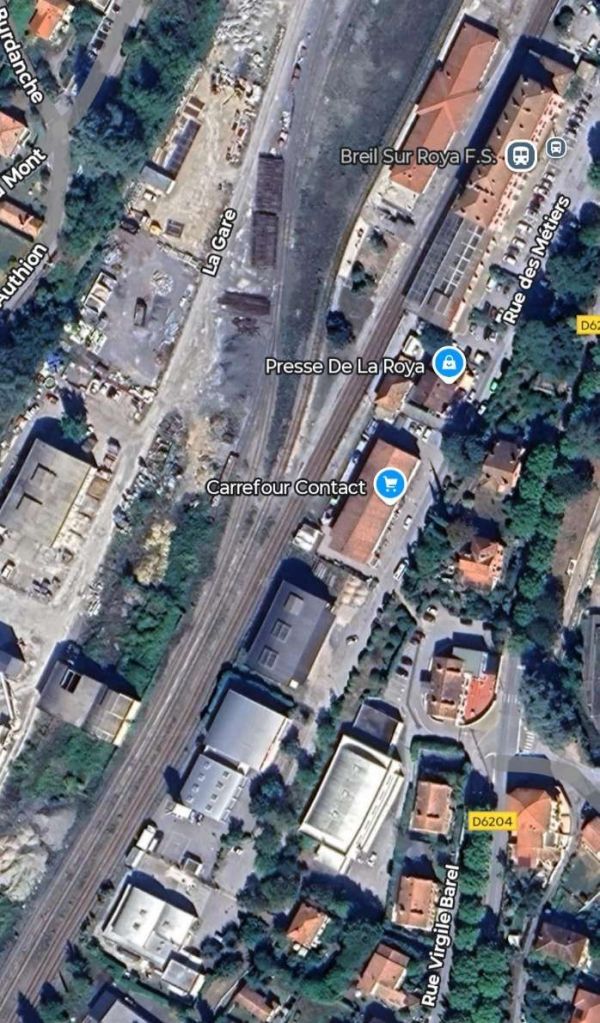
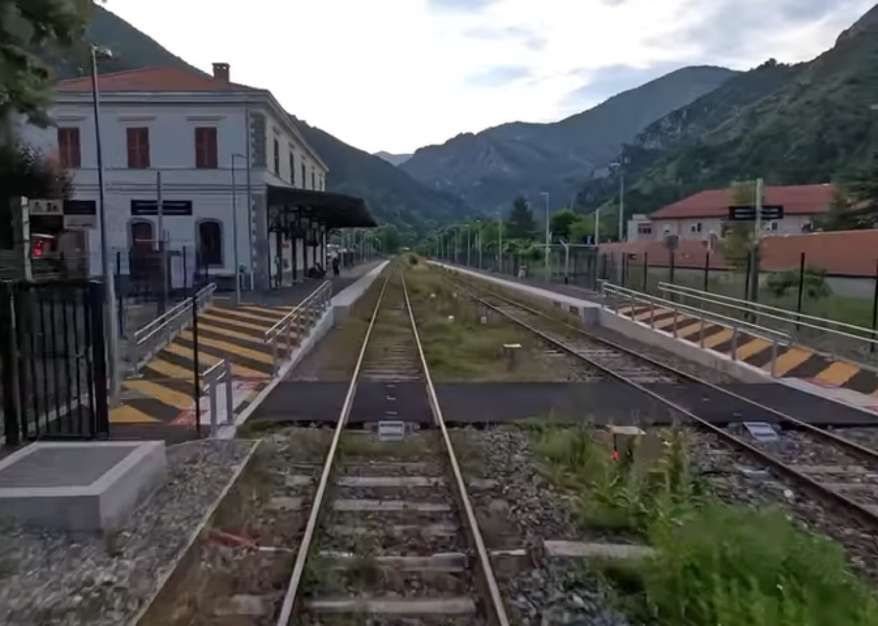
The southern end of the railway station site in Breil-sur-Roya. Two lines leave the station heading South-southwest. [Google Maps, August 2025]

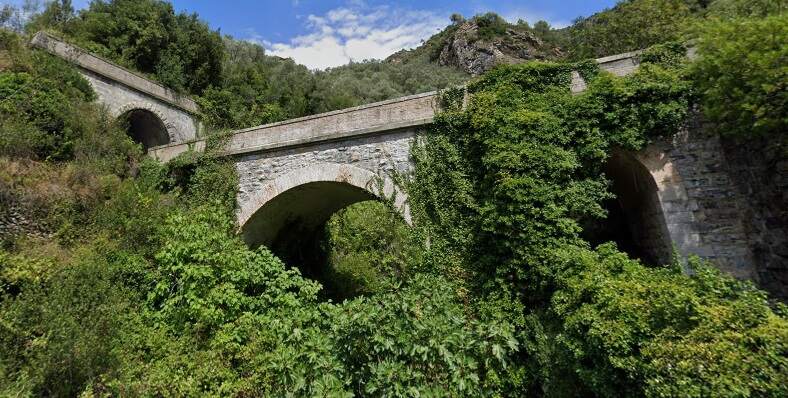
South of the station adjacent parallel bridges cross the Voie de la Première Dfl and Vallon de la Lavina (the Lavina Bridge).
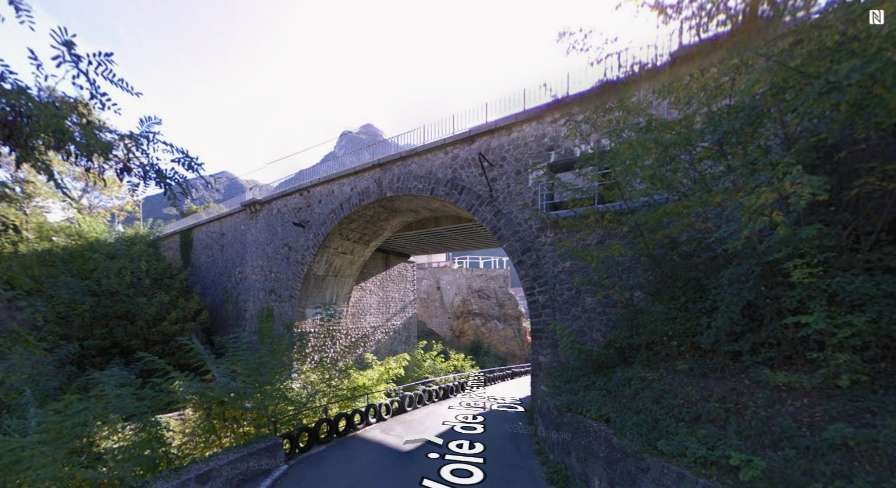
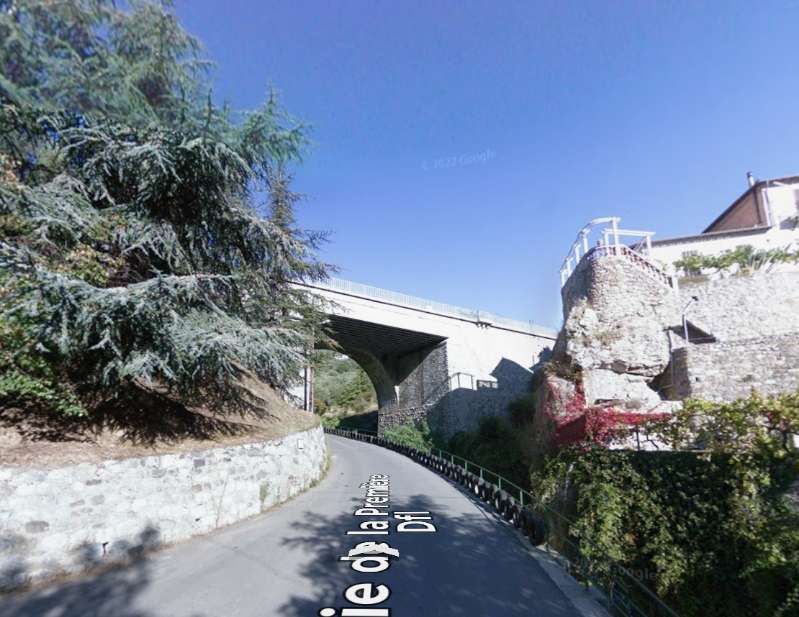
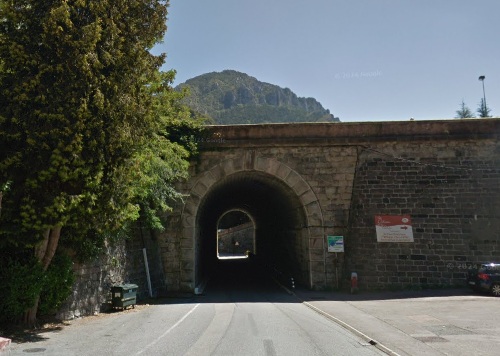
Looking East under the railway bridges (the Lavina Bridge) along Voie de la Première Dfl. [Google Streetview, October 2008]
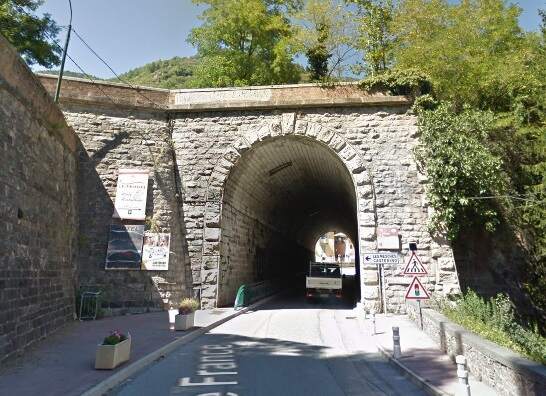
Looking West under the railway bridges (the Lavina Bridge)along Voie de la Première Dfl. [Google Streetview, October 2008]
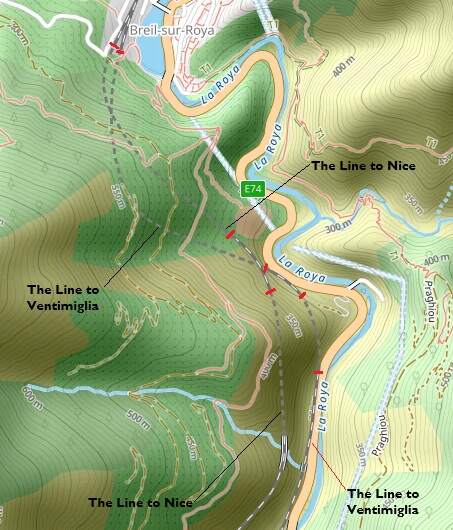
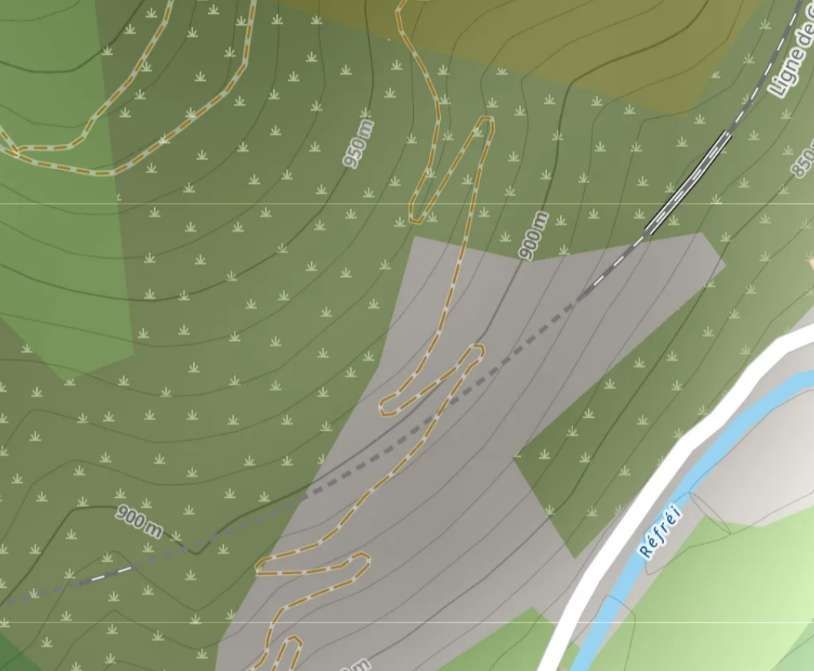
This extract from the OpenStreetMap mapping shows the close correlation of the two different routes over the first fe kilometres. The short red lines are the locations of tunnel mouths. [13]
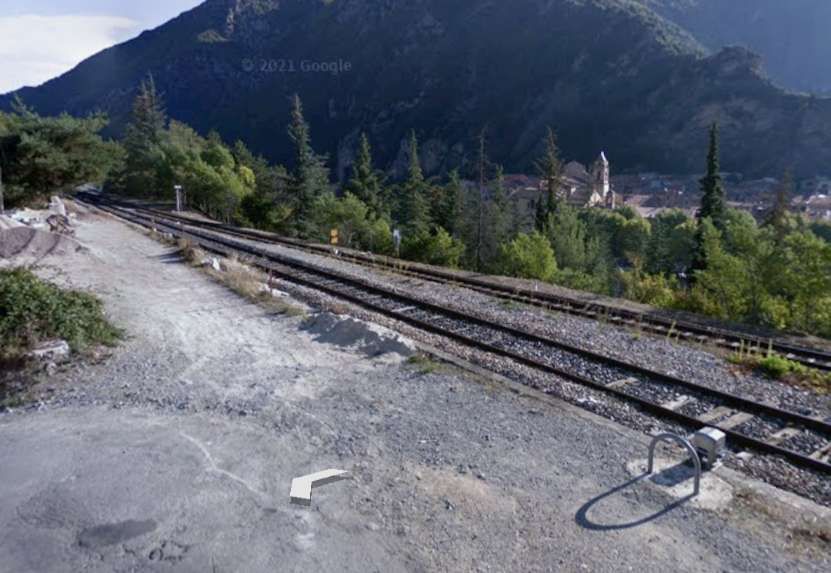
A short distance to the South the two lines can be seen to be separating both geographically and in level. This view looks Northeast with the station off to the left. [Google Streetview, October 2008]
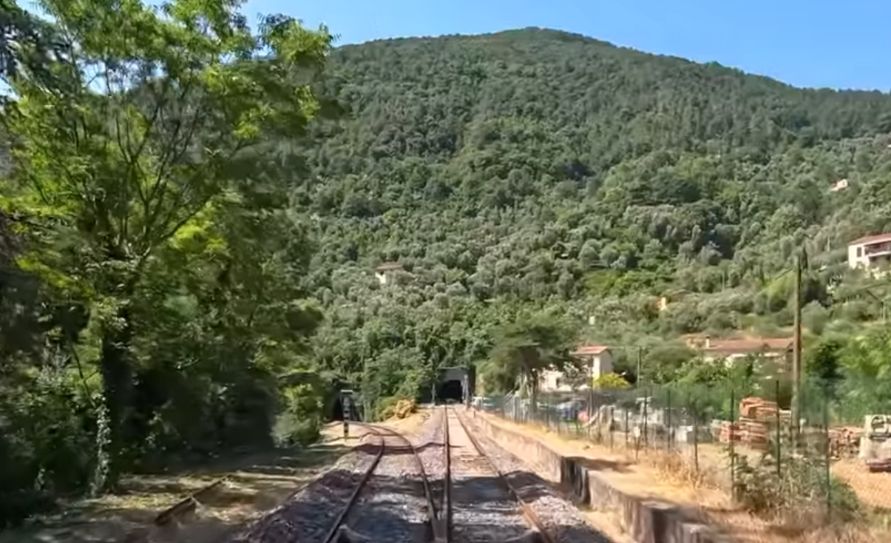
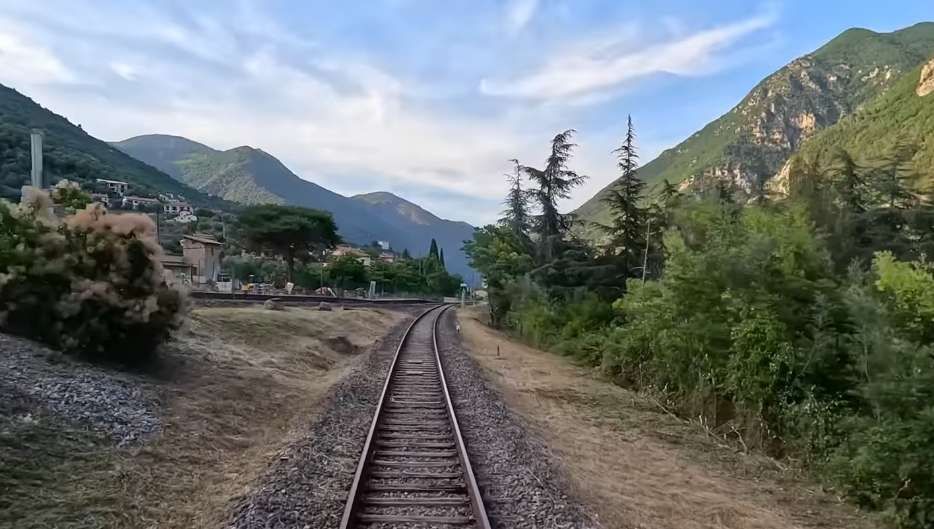
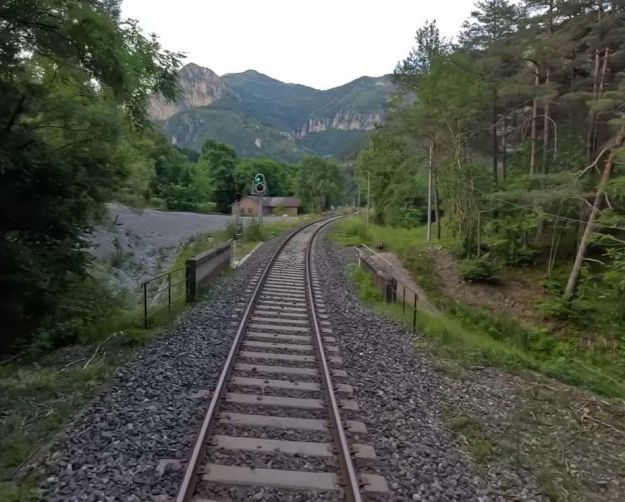
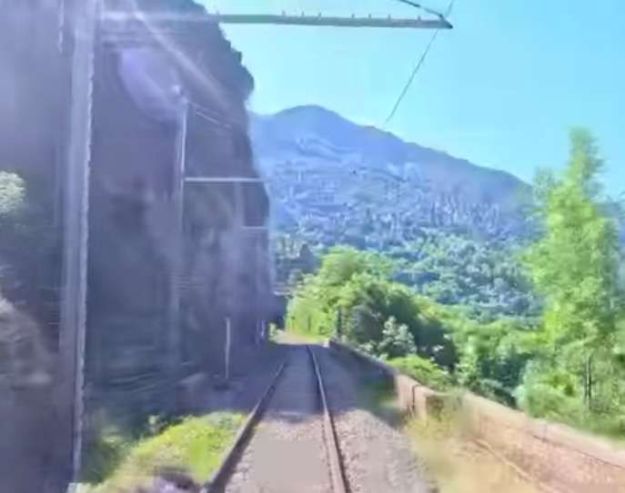
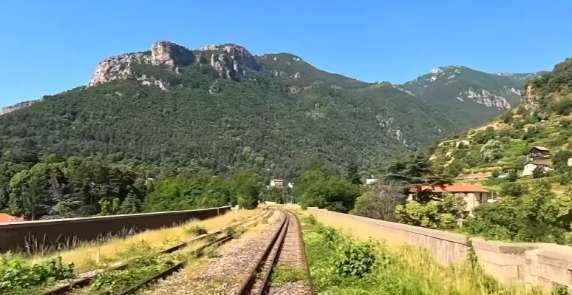
The view South from the cab of a Ventimiglia-bound train. Again, the separation in level is quite marked. [55]
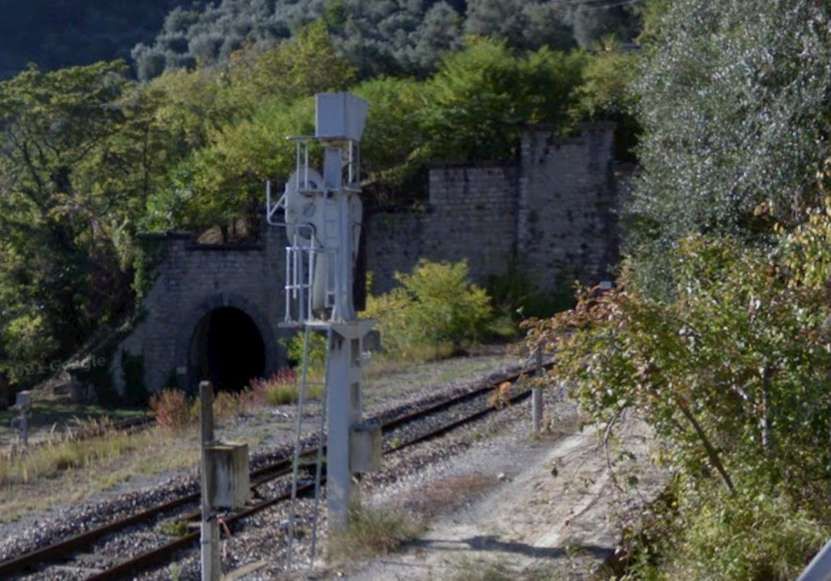
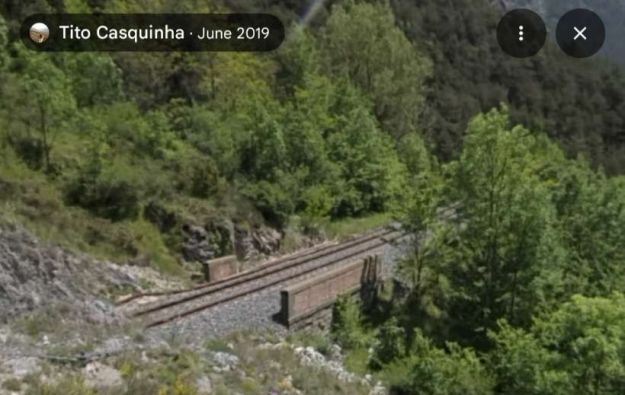
At the same location, this view looks Southeast. Both lines enter  a tunnel just to the South. One tunnel mouth is visible on the left of the image at a lower level. The other tunnel mouth is behind the vegetation on the right of this image. [Google Streetview, October 2008]
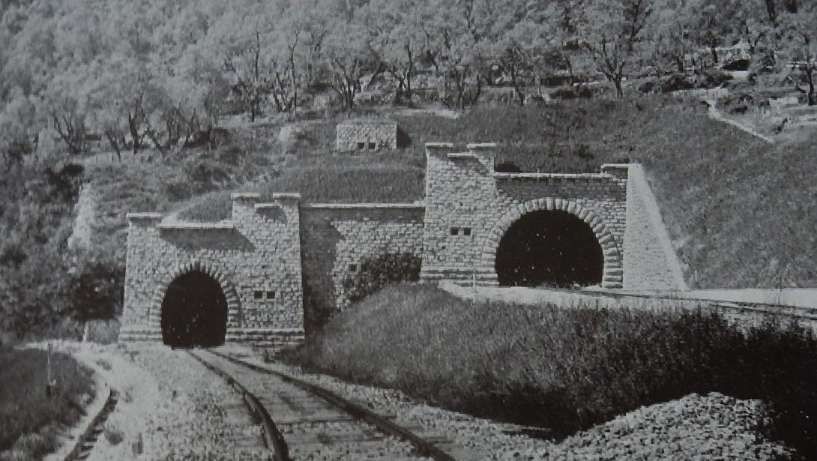
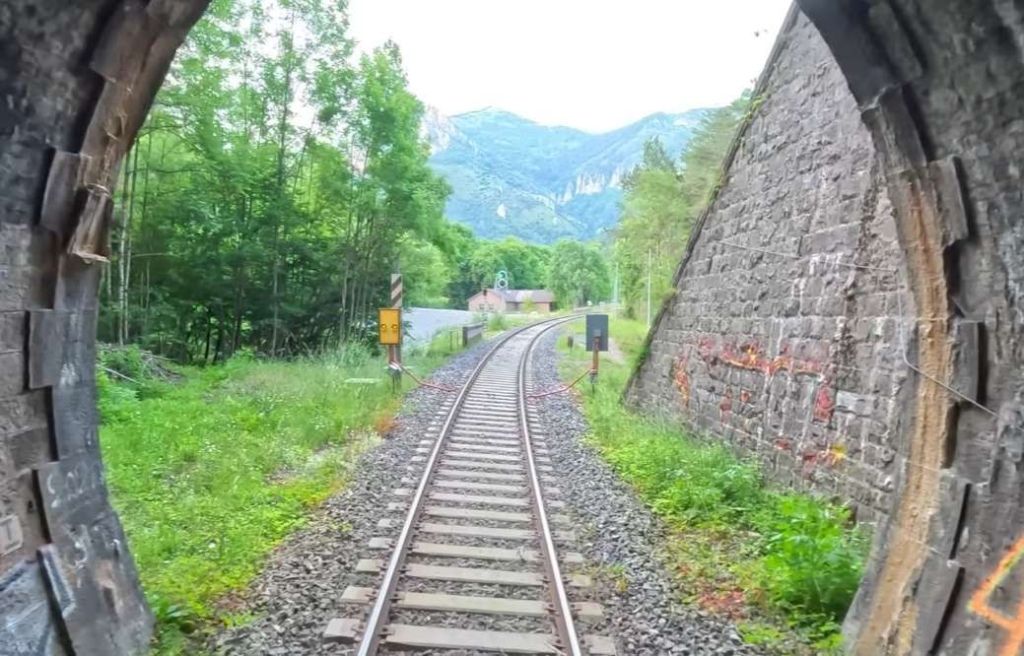
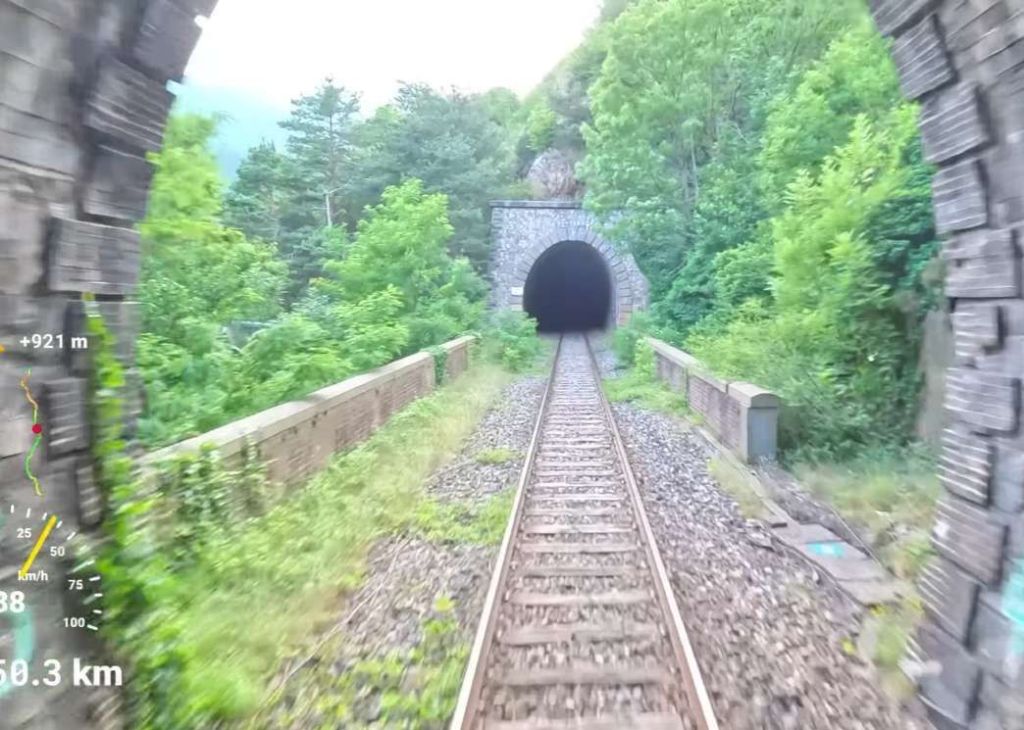
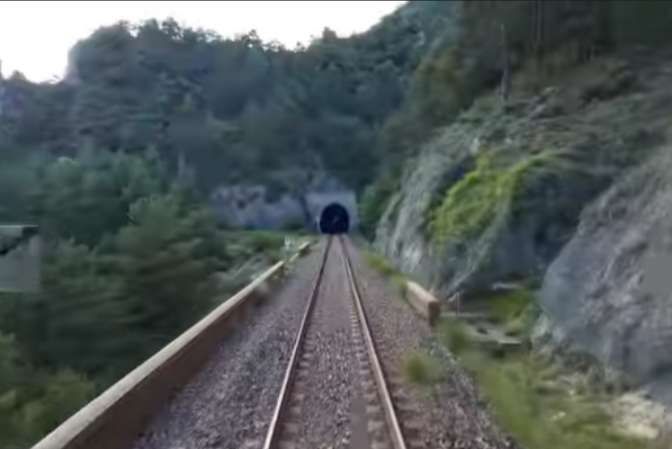
The two tunnel mouths. On the left, that of Gigne Tunnel, on the right, that of Caranca Tunnel. Left for Ventimiglia, right for Nice! [54]

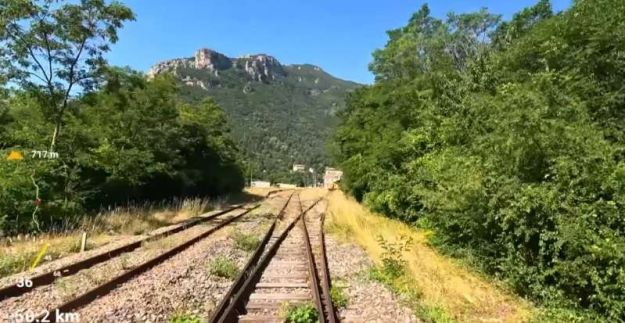
The approach to the junction from Ventimiglia. The line from Nice is at the higher level on the left. [35]
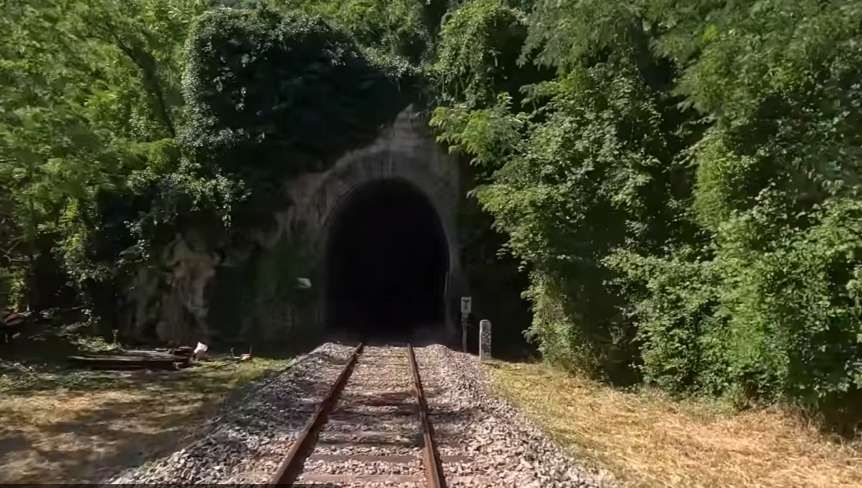
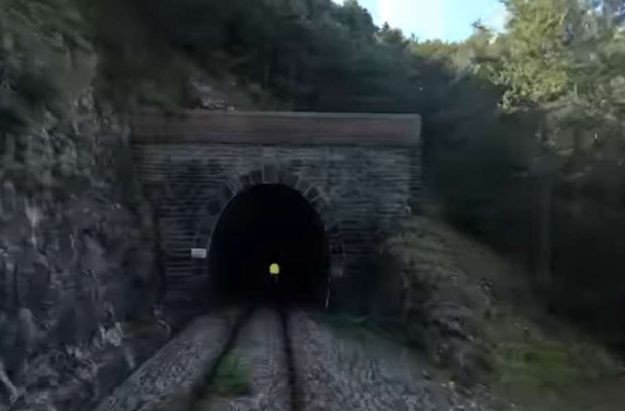
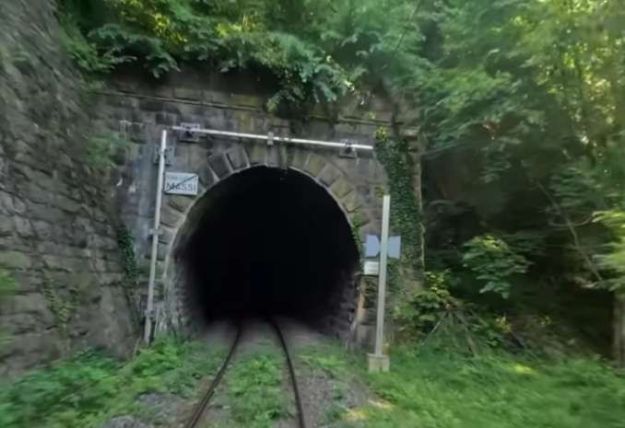
The mouth of Gigne Tunnel (1188 metres in length), seen from the cab of the Ventimiglia-bound service. The tunnel is S-shaped. Trains heading South turn to the East within the tunnel and then, close to the East Portal, begin to turn to the South again. [55][1: p126]
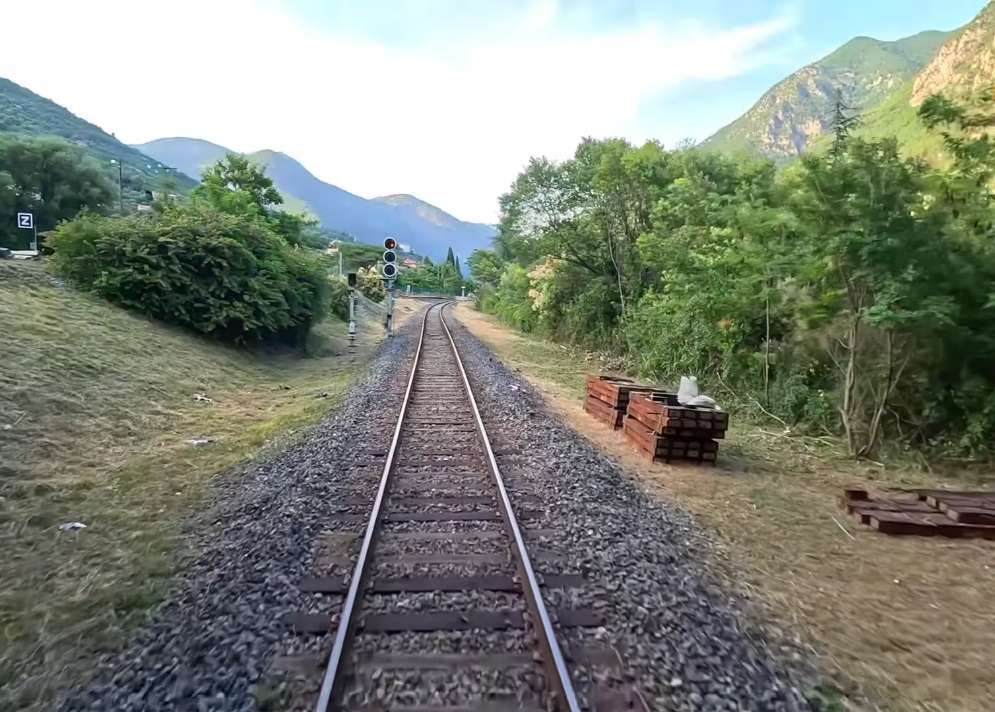
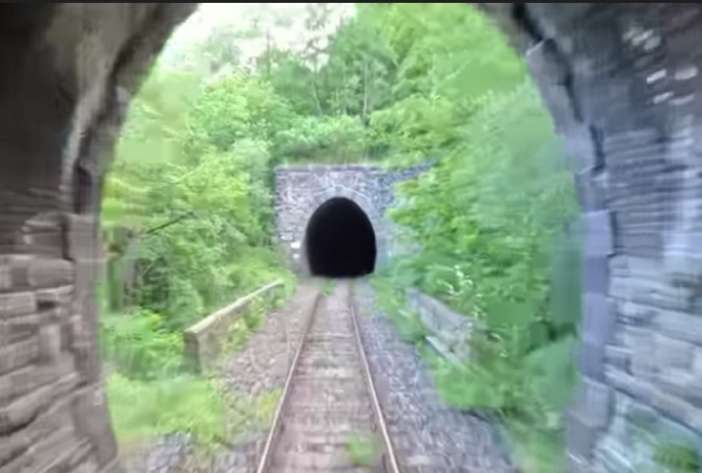
The view North from the North Portal of Gigne Tunnel, seen from the cab of a Northbound train. [35]

The route of this tunnel crosses twice under the Caranca tunnel on the Nice line. [1: p126]
Just beyond the East Portal of Gigne Tunnel the line begins to curve South again. [55]
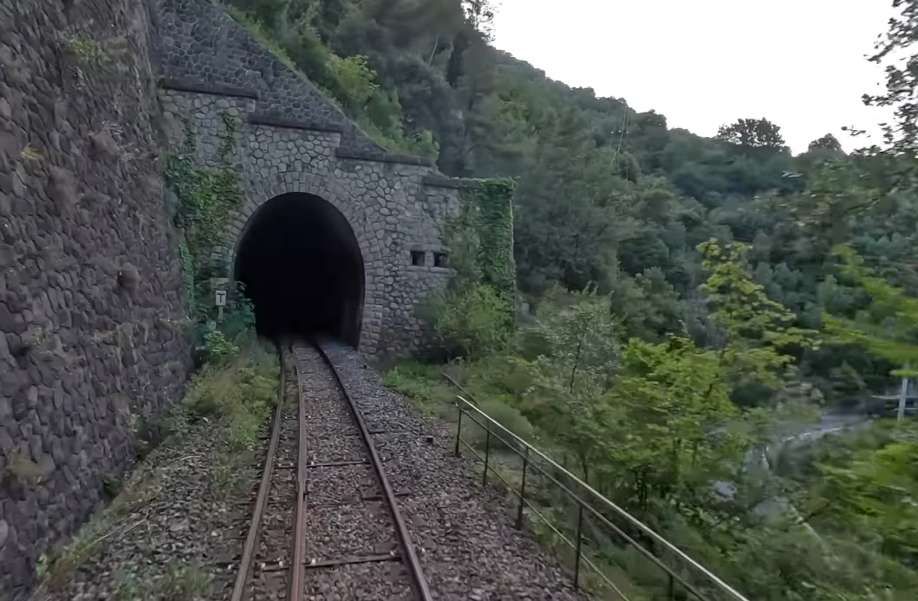
The East Portal of Gigne Tunnel, seen from the cab of a Northbound train. [35]
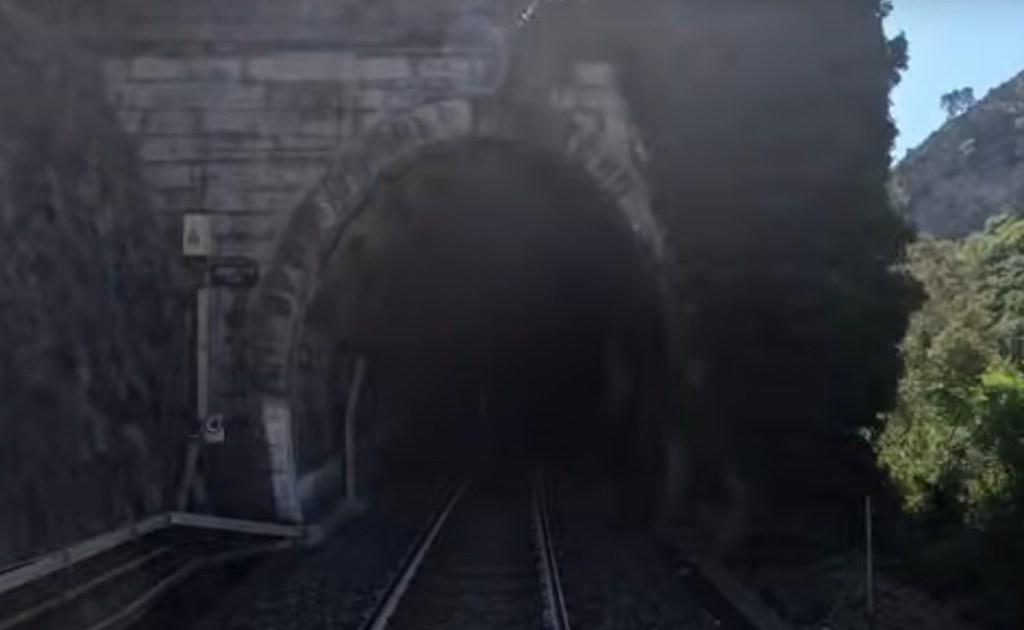
The North Portal of Sanfurian Tunnel (260 metres in length) was in deep shade when this image was taken from the cab of a Ventimiglia-bound train. [55]

The view Northwest from the same portal of Sanfurian Tunnel. [35]
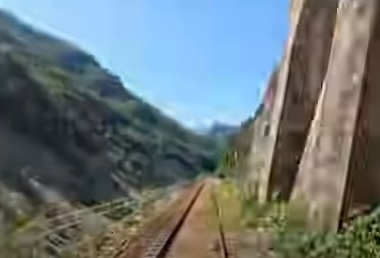
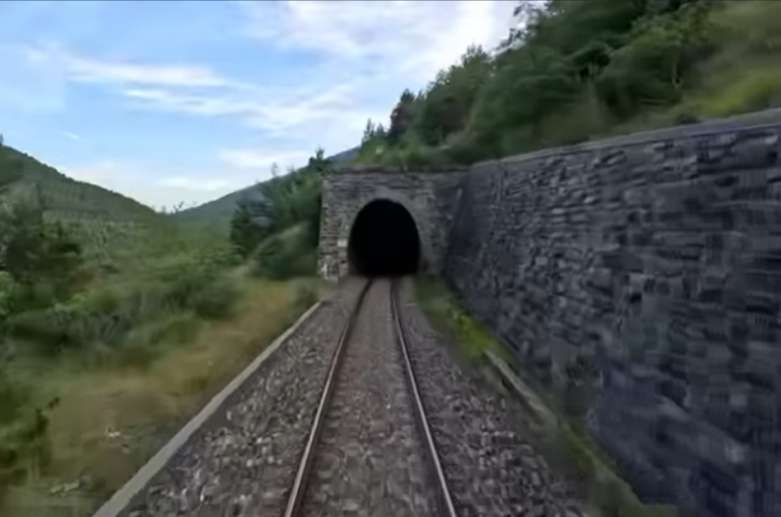
The view South from the mouth of Sanfurian Tunnel. Note the high retaining walls to the right of the image. [55]
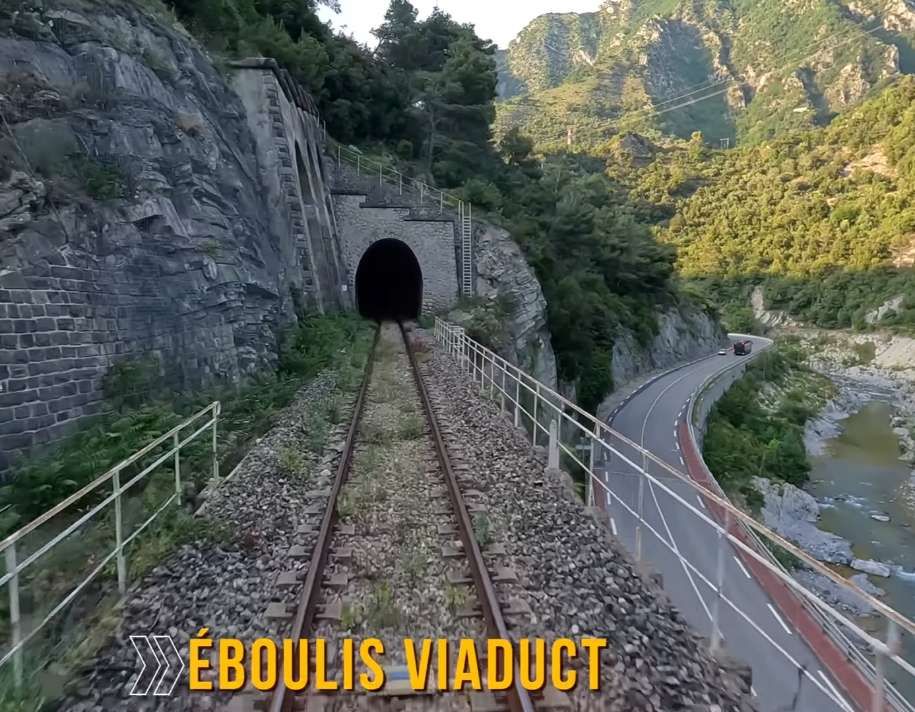
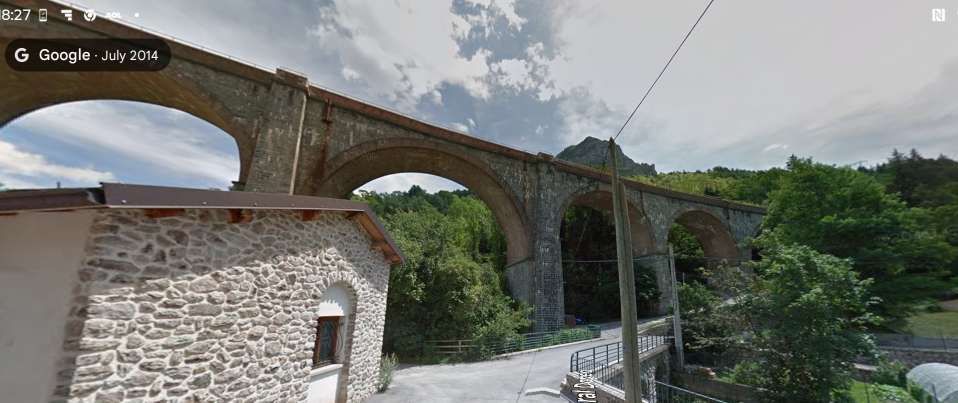
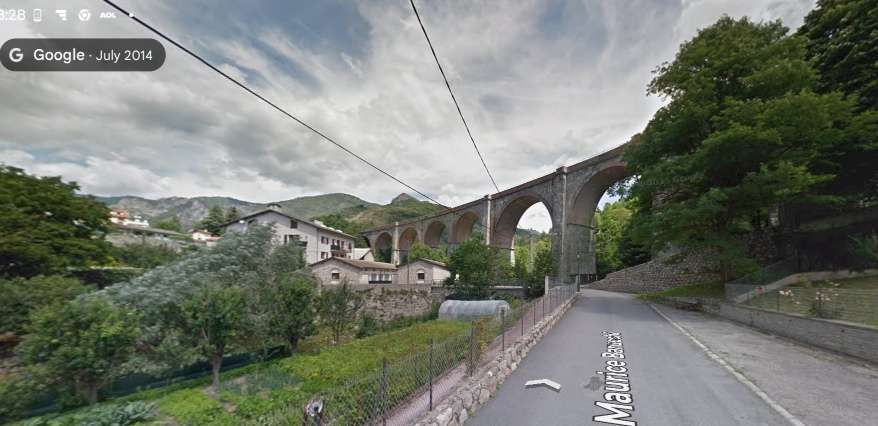
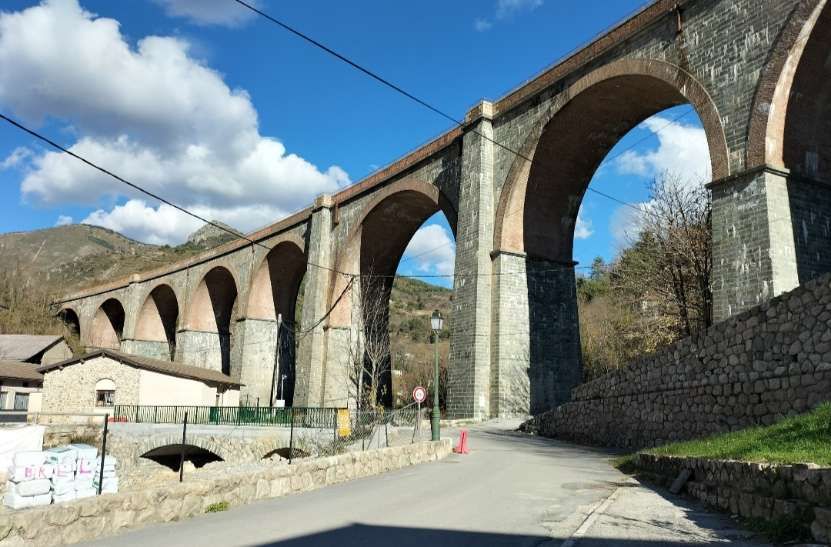
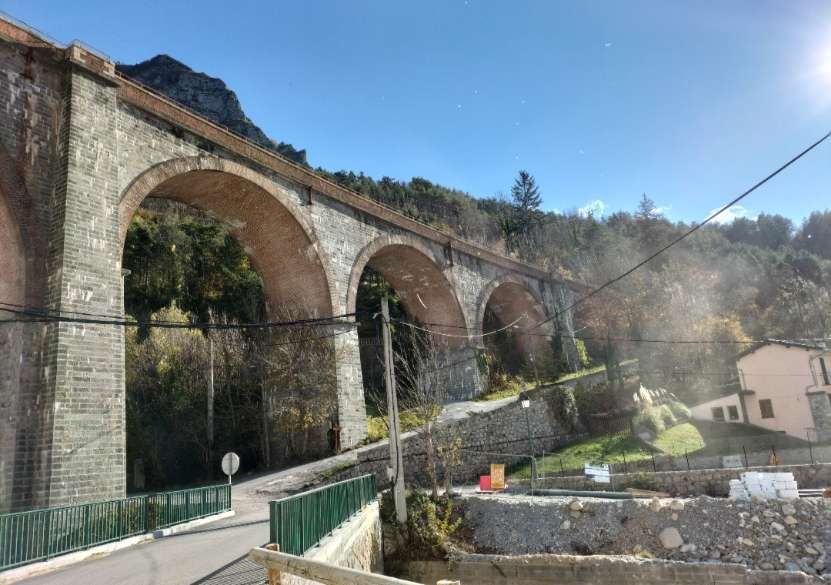
The South Portal of Sanfurian Tunnel, seen from the North end of Eboulis Viaduct. This viaduct has eight 18 metre stone arches and nine 7 metre stone arches. [35][1: p126]
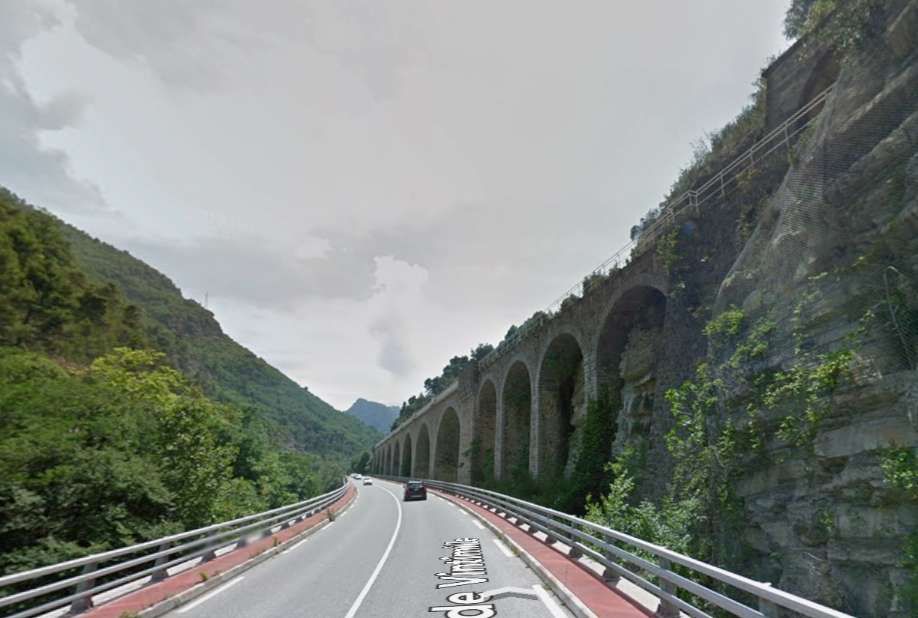
The view from the North along the Route de Ventimiglia with the railway viaduct alongside the road. [Google Streetview, July 2014]
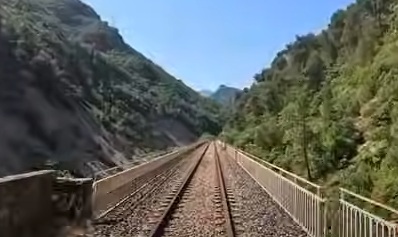
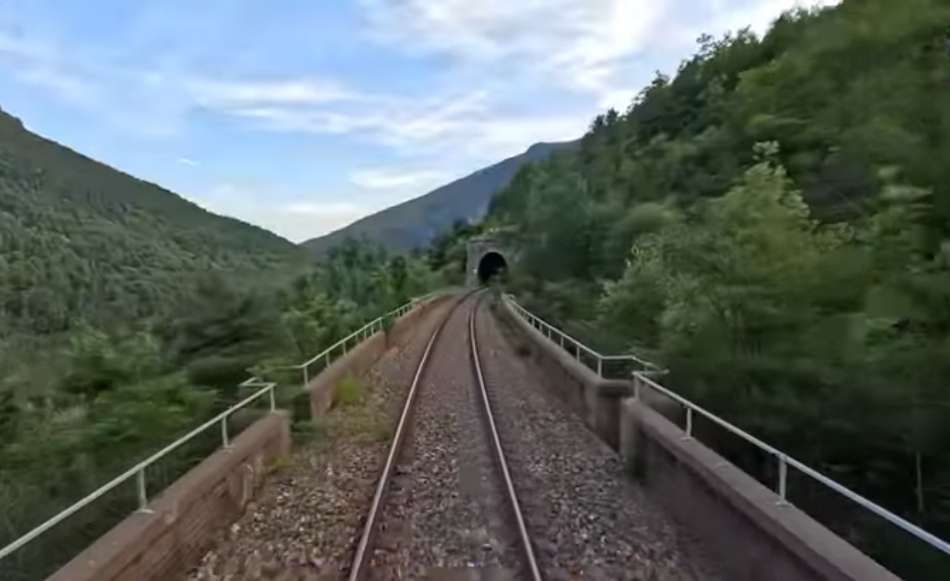
Eboulis Viaduct facing South. [55]
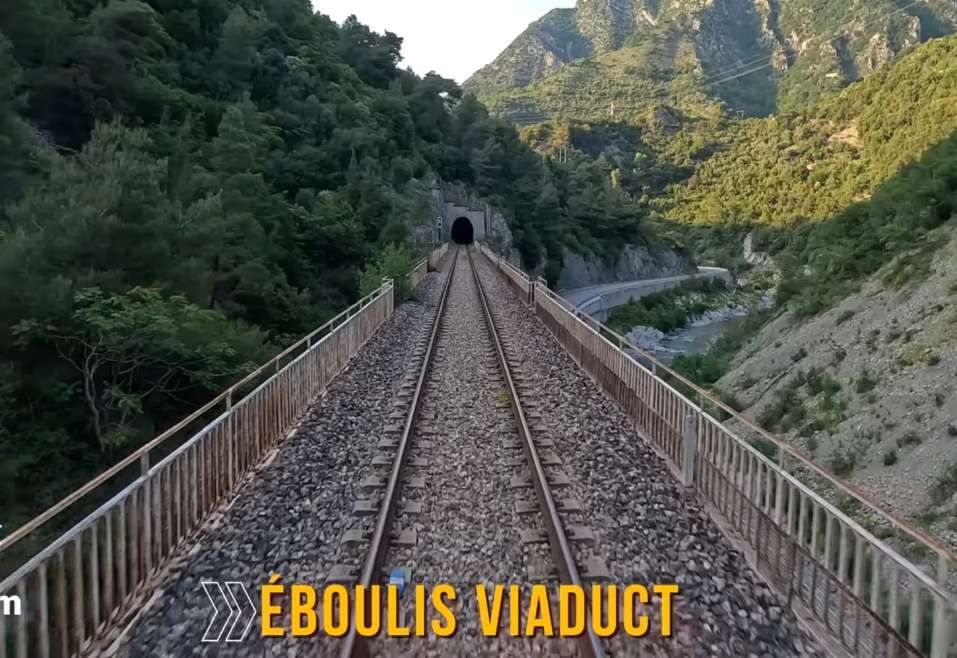
Eboulis Viaduct looking North, seen from the cab of a Northbound train.  [35]

Eboulis Viaduct before the construction of the road between it and the River Roya. The quality of this image is not perfect but it is still possible to make out the South portal of Snfurian Tunnel towards the right of the image. [49]
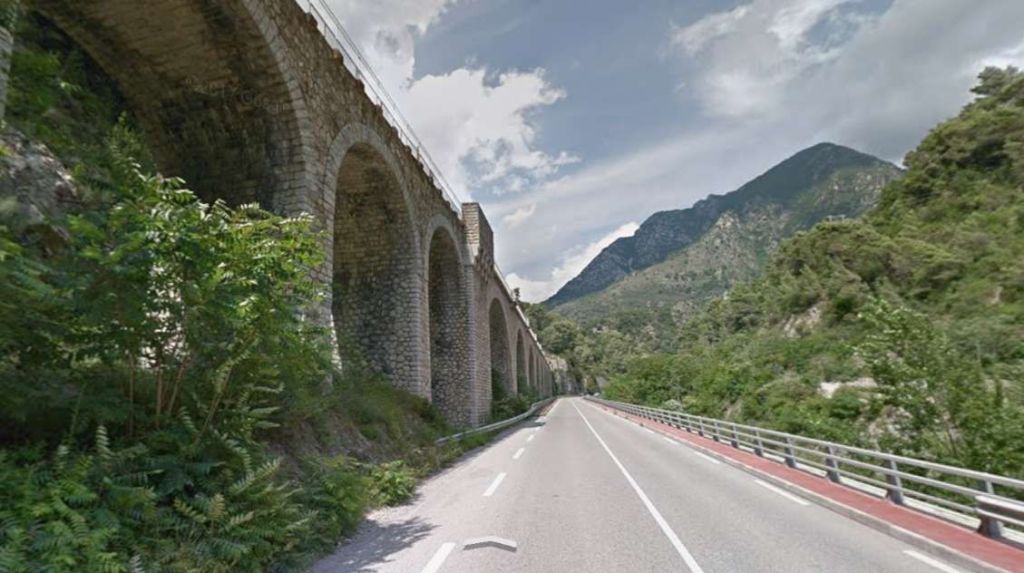
The view along the E74/D6204 from the South with the viaduct to the left of the road and the river to the right below the road. [Google Streetview, July 2014]
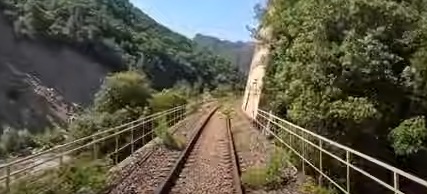
Looking South over Bancao Viaduct. [55]
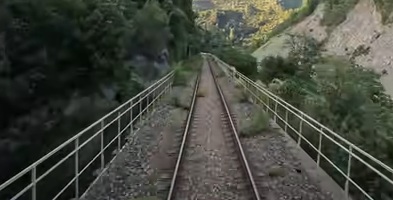
Looking North along Bancao Viaduct. [35]
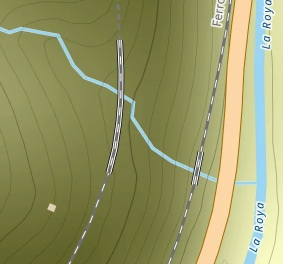
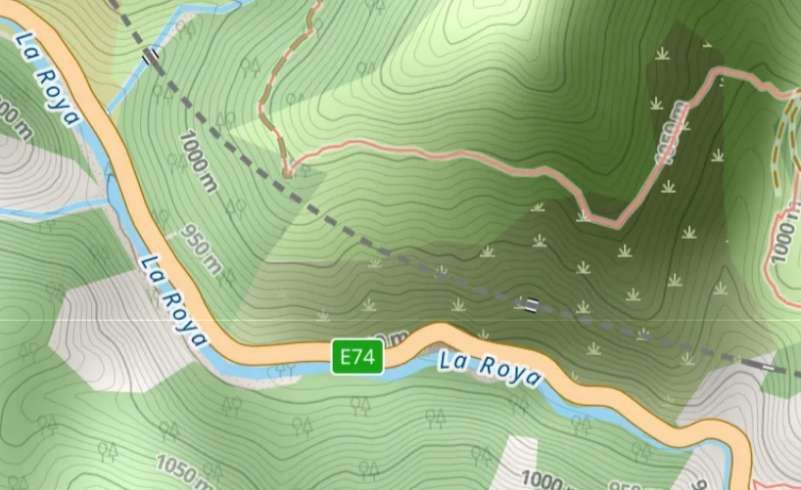
Bancao Viaduct on the line from Breil-sur-Roya to Ventimiglia is close to the D6204 on this extract from OpenStreetMap. The line to the West is the line from Breil-sur-Roya to Nice which is at a much higher level. [14]
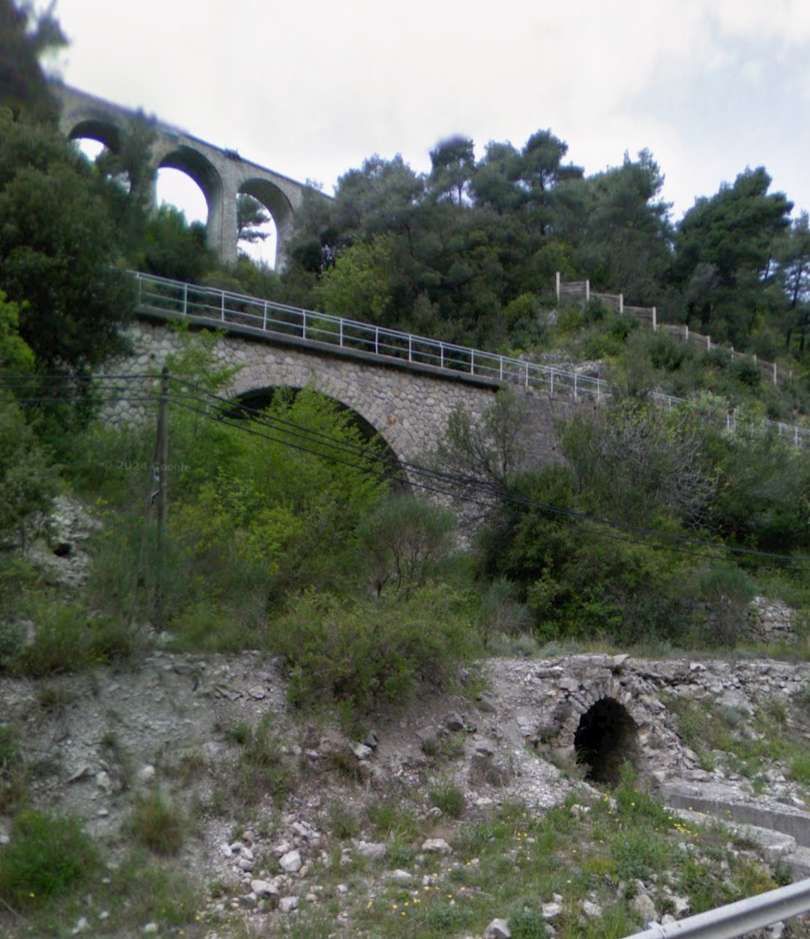
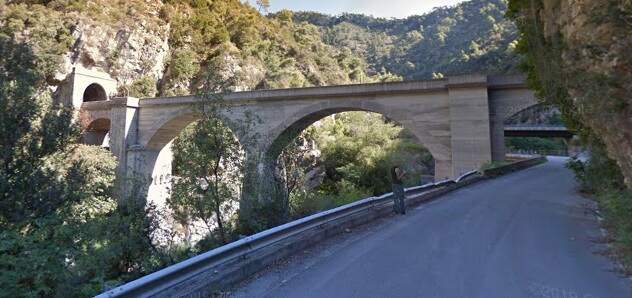
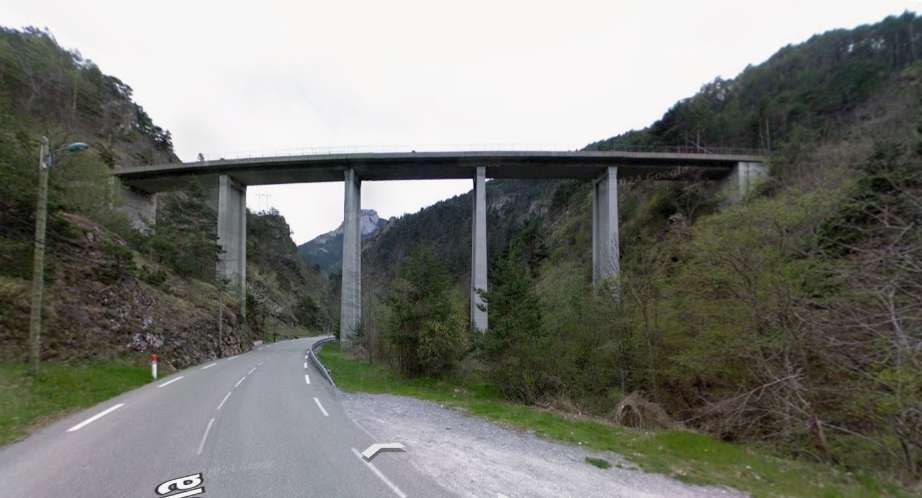
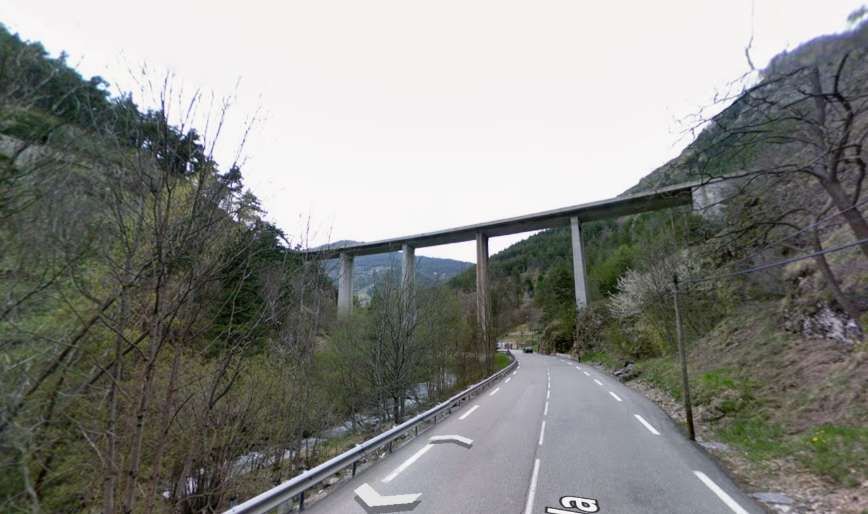
Looking West from the D6204/E74, a small culvert close to the road is dwarfed by the bridge carrying the line to Ventimiglia which in turn is dwarfed by the viaduct carrying the line to Nice. [Google Streetview, April 2008]

The bridge carrying the line to Ventimiglia is also known as the Bancao Ravine Bridge. [1: p126]

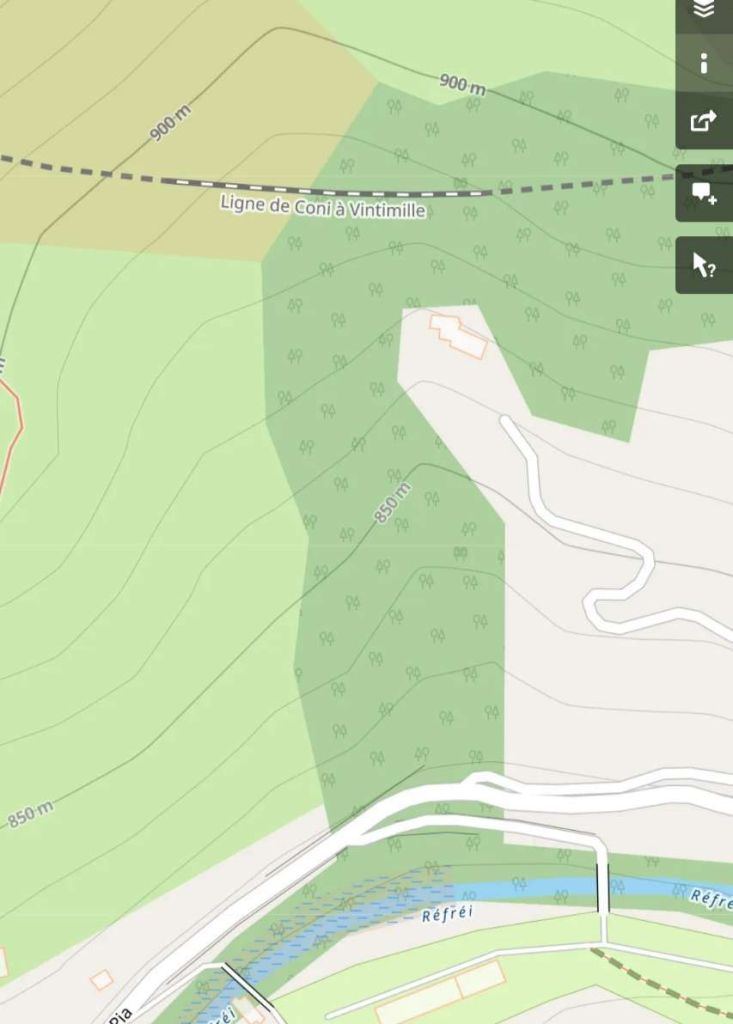
The length of the line South of Bancao Viaduct. The two rail line are still running in parallel, only beginning to separate significantly at the bottom of this extract from Open StreetMap. Cottalorda Tunnel begins towards the bottom of this map extract. [15]

The line can only be seen fleetingly from the road.
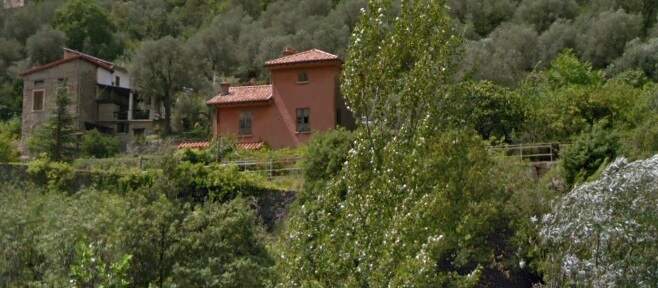
It runs in front of the terracotta-coloured building near the centre of this image. Railings at the edge of a retaining wall supporting the line can be seen to the right of the image. [Google Streetview, July 2014]
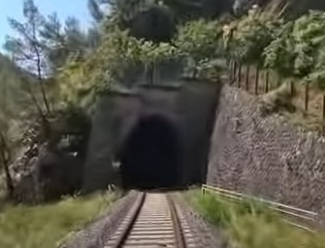
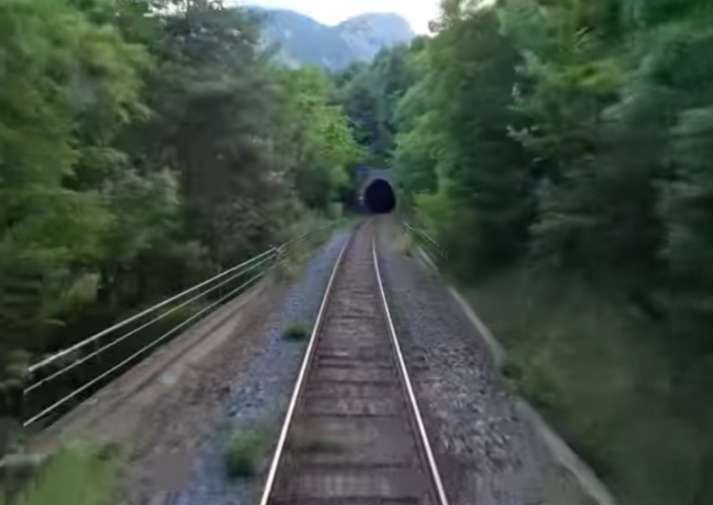
The North portal of Cottalorda Tunnel (297 metres long). [55]
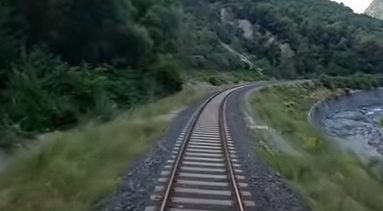
Turning through 180°, this is the view North at the same location. [35]
Just a glimpse of the tunnel mouth and the associated retaining wall can be seen from the D6204/E74. [Google Streetview, July 2014]
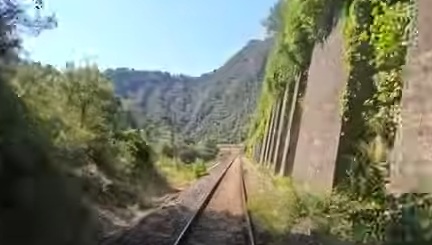
The view South from the southern portal of Cottalorda Tunnel. [55]
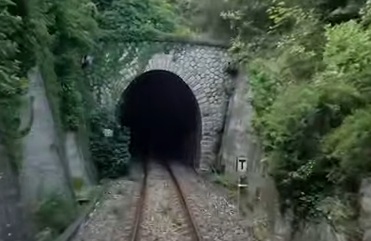
The southern portal of Cottalorda Tunnel. [35]
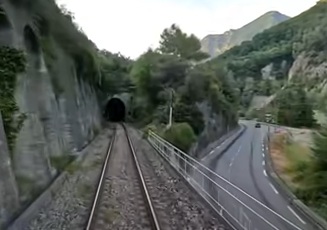
Looking back towards Breil-sur-Roya and the mouth of Cottalorda Tunnel. Note the arcaded retaining wall on the left, typical of the retaining walls on this length of the line. The D6204 runs alongside and below the line to the right. [35]
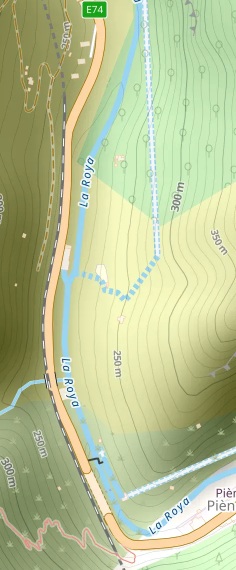
This next length of the line from the South portal of Cottalorda Tunnel runs immediately adjacent to the E74/D6204. [16]
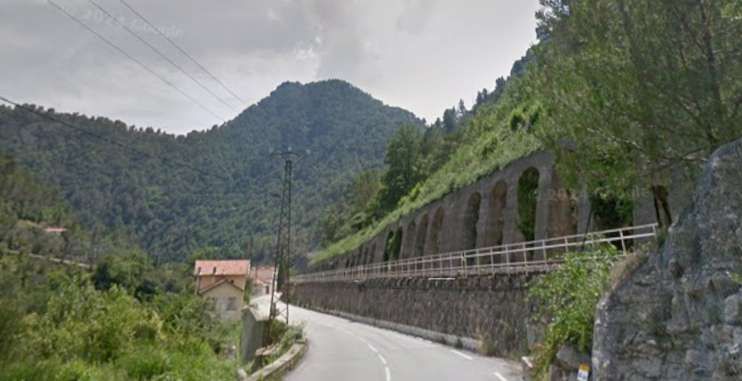
This smaller image, looks South along the D6204/E74. The railway can be seen adjacent to, but above the road. To the West side of the line, large retaining walls create space for the line on the steeply graded valley side. {Google Streetview, July 2014]
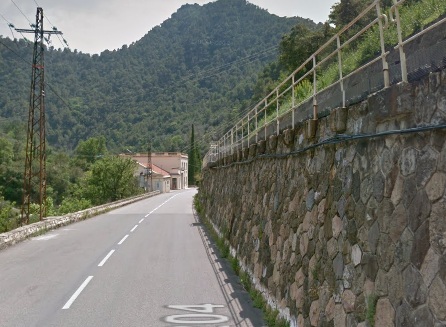
A little further South the Hydroelectric Plant is now visible. [Google Streetview, July 2014]
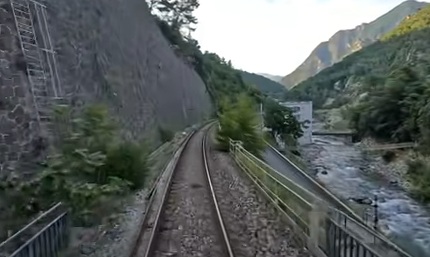
This View looks North. The building beyond the trees is Breil’s Hydroelectric Power Station (below). [35]
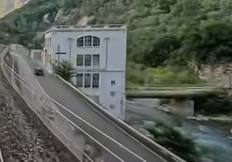
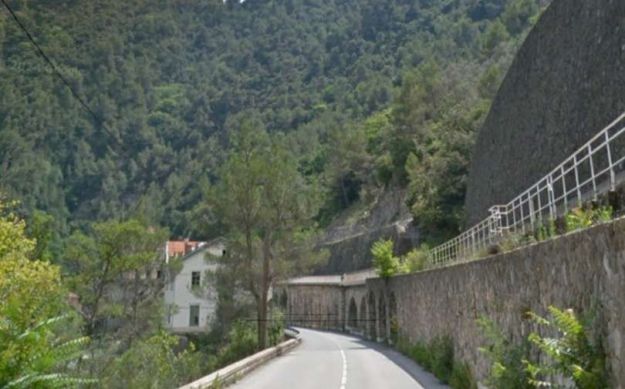
Now just beyond the Power Station , again looking South with a high retaining wall above the railway which sits a few metres above road level on the right. Three arcades carrying the line are followed by the three stone arches of the Riou Viaduct. [Google Streetview, July 2014]

Construction work on the Italian length of the line in the lower Roya (Roia) Valley began in Ventimiglia. Banaudo et al have chosen to follow the line from South to North to reflect the way this section of the line was constructed. We continue to follow the line from North to South.

The length of the line from the border at Piena (Piene) to Airole was completed before the first world war but traffic along this part of the line had to wait for completion of the length of the line in French territory. The Italian authorities decided that services would commence only between Ventimiglia and Airole. That length is covered later in this article.

The international border at the time of construction was just to the North of Piena (Piene). That border line remained the same through the interwar years. Services North from Airole via Piena to Breil-sur-Roya had to wait until 1928 and the opening of the full line.

The Riou Viaduct (three 6.25m masonry arches) was the location of the international boundary. Banaudo et all tell us that the point that the line crossed the boundary is marked by the letters I and F engraved in a stone on the deck of the structure. [1: p125]

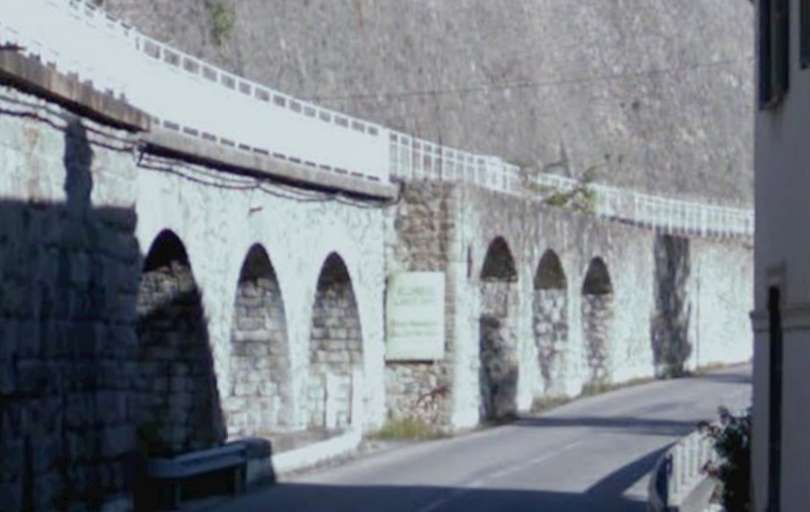
The Riou Viaduct straddled the centuries old border between Genoa and Savoy which became the border between Italy and France. This view looking South along the D6204/E74 shows the arcade retaining wall (3 bays) followed by the three-arch viaduct. [Google Streetview, July 2014]
This view looks North along the D6204/E74 towards Breil-sur-Roya. The three arches of the Riou Viaduct are on the left of the image. [Google Streetview, July 2014]

Immediately to the South of the Riou Viaduct, Piene (Piena) Station was built as a frontier station below the village of Piena-Alta which, Banaudo et al tell us, was for centuries the outpost of the Genoese republic and the border with the States of Savoy. [1: p125-126]

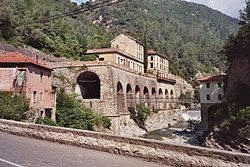
Close to the road border post at Piena-Bassa, the “Italian administration decided to establish a station intended for police and customs control operations. There were three platform faces, a two-story passenger building and a customs clearance hall of the same size for goods, comprising a warehouse, offices and two apartments on the upper floors. The site was hemmed in by the tunnel to the South, the French border to the North, the mountainside to the West, and the Roya River to the East, necessitating the construction of the station, cantilevered over a masonry gallery supported by seven arches, above the SS 20 roadway.” [1: p126]
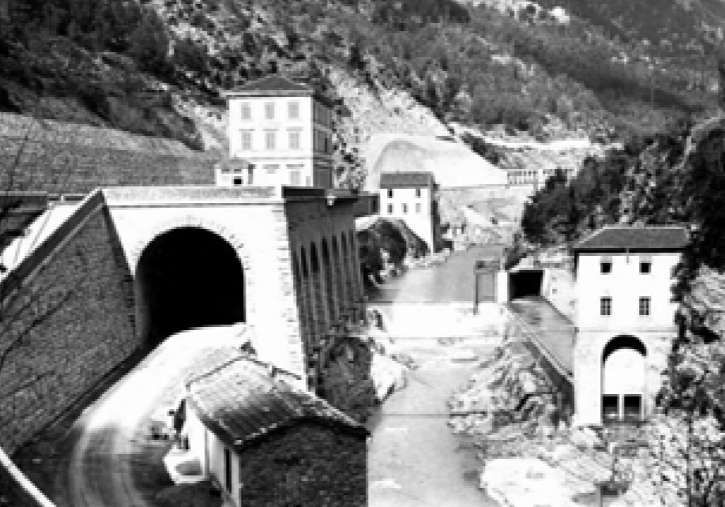
This photograph was taken in 1925 facing upstream.. It shows Piene (Piena) Railway Station sitting at high level, above the Ventimiglia road, (Collection of J. L. Taylor) (c) Public Domain. [26]

Also facing up stream, this image shows the structures at this location in 2006, (c) Markus Schweiss and licenced for reuse under a Creative Commons Licence, (CC BY-SA 3.0). [33]
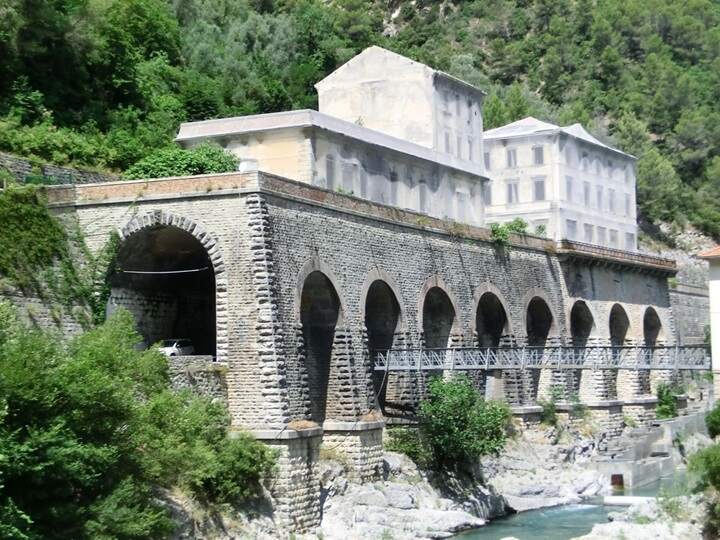
Since the photograph above was taken a netting protection has been applied to the principal buildings at rail level. This photograph taken in 2019 also faces upstream, (c) Eugenio Merzagora/Structurae and made available for reuse under their non-commercial licence. [34]
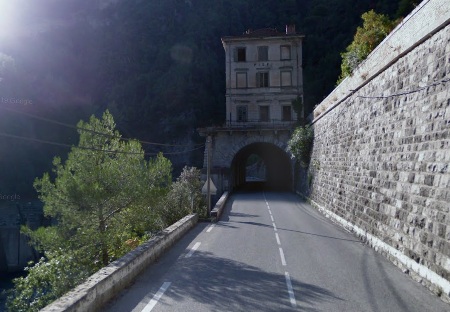
This view looks South along the D6204/E74. it is taken a couple of hundred metres South of the Riou Viaduct where the road passes what was Piene Railway Station building. The site was tight and in order to accommodate the necessary station buildings, they were built over the road. [Google Streetview, October 2008]
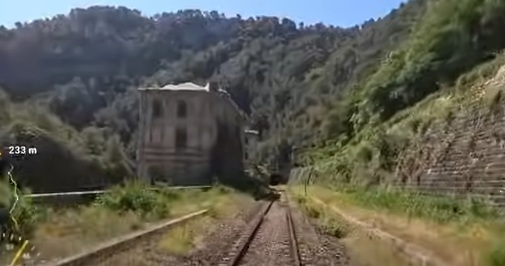
Piene Railway Station (closed) seen from the cab of a Southbound train. [55]
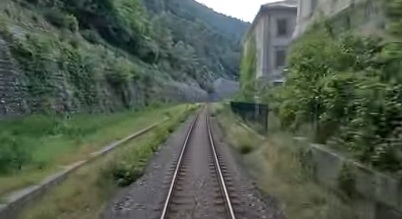
Piene Railway Station (closed) seen from the cab of a Northbound train. [35]

Writing about the length of the line between Ventimiglia and the border at Piena (Piene), Banaudo et al say: “In the lower Roya Valley, the seven tranches of the Ventimiglia – southern border section were successively awarded in 1908, 1910, 1911, 1912, and 1913. Despite the lower altitude, the route was as difficult as on the purely Alpine section of the line, with steep gorges and terrain that offered highly varied resistance to earthworks: unstable marly limestone, very hard black limestone, clayey marl, schist, sandstone, etc. Of the 17,260 m route, nearly half way to be in tunnels, with nineteen structures totaling 8,259 m, fifteen bridges and viaducts representing sixty-four masonry arches, as well as various secondary structures for crossing waterways and rural roads.” [1: p118]
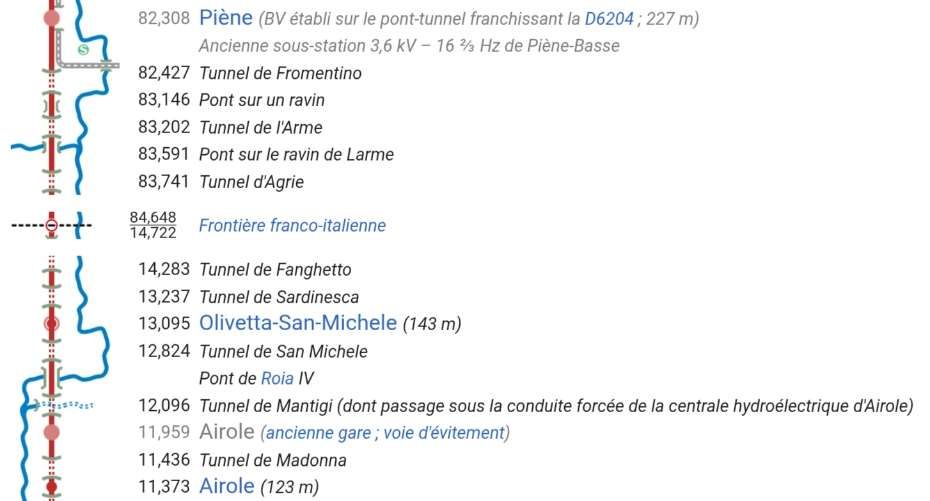
Piene Railway Station to Airole Railway Station. [22]

South of Piene (Piena) a series of structures carry the line over or through the obstacles in its path:

• the Fromentino Tunnel, 645 m long;
• a viaduct with three 10 m arches;
• the Arme Tunnel, 333 m long;
• a viaduct with four 10 m arches;
• the Agrie Tunnel, 820 m long;
• the Fanghetto tunnel, 419 m long, extended by a gallery (the post-WW2 border was established at the North end of this tunnel);
• the Sardinesca Tunnel, 820 m long;
• a single span arch bridge over the Tron valley.

These are all illustrated below.
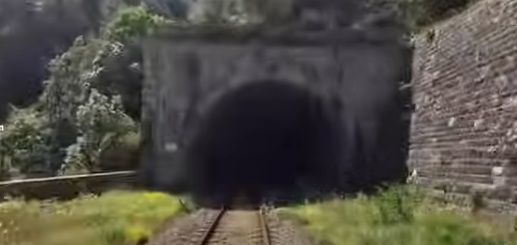
The North Portal of Fromentino Tunnel (645 metres in length) in shade. [55]
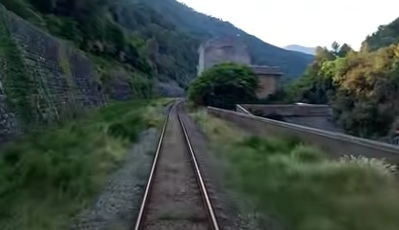
The view from the North portal of Fromentino tunnel. [35]
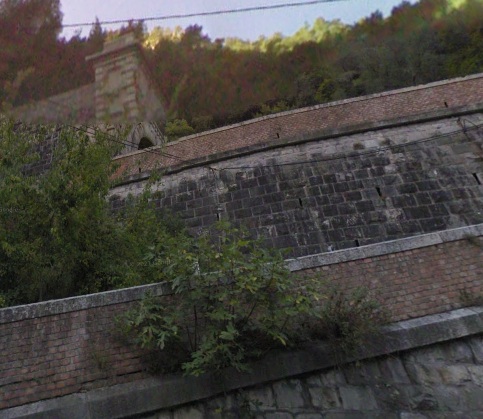
It is just possible to see the tunnel mouth above, when looking up from the road. [Google Streetview, October 2008]
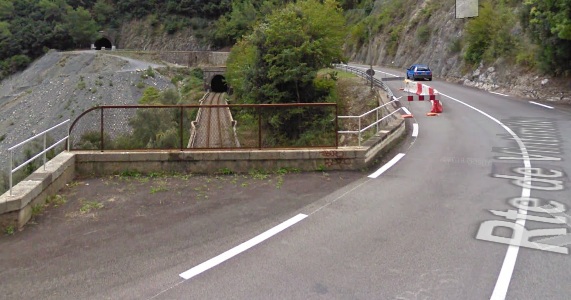
The view South from the D6204/E74 above the South portal of Fromentino Tunnel. Before reaching the Arme Tunnel, the line crosses a 3-viaduct of three 10 m span arches. The stone parapets of the viaduct can be seen below the top rail of the parapet immediately in front of the camera. [Google Streetview, September 2010]
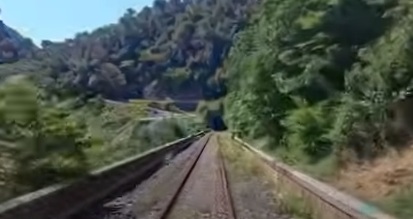
The view South from the cab of a Ventimiglia-bound train at the southern portal of Fromentino Tunnel. The viaduct parapets are in the foreground. [55]
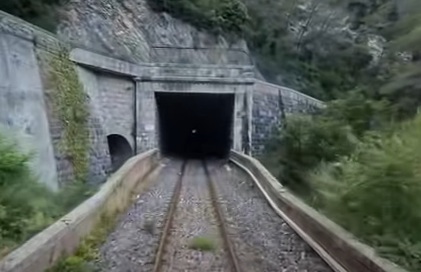
Turning round, this is the view of the South Portal of Fromentino Tunnel. [35]
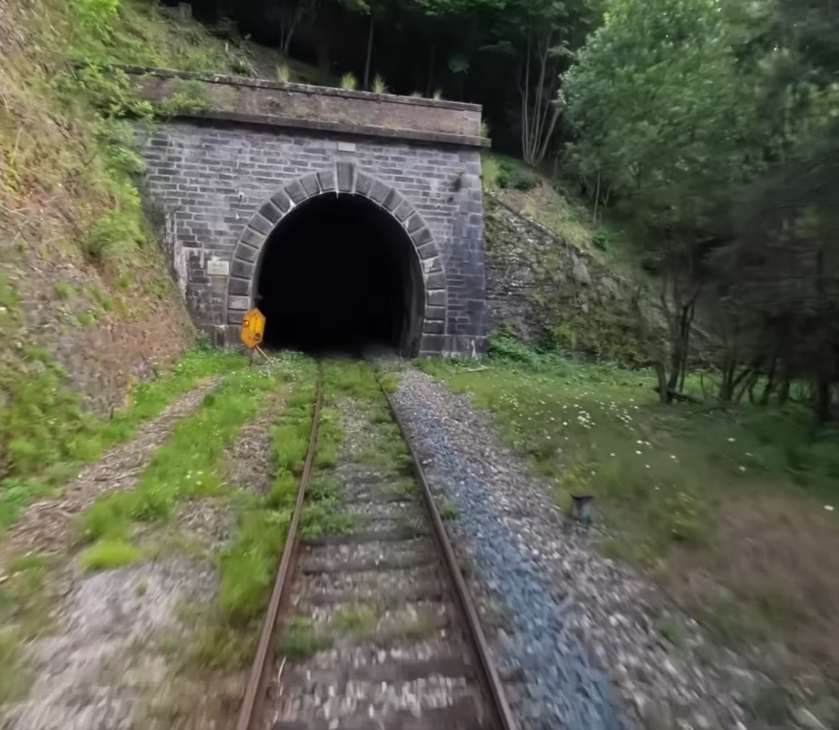
Looking toward the northern portal of Arme Tunnel (333 metres long) which again is in shade. [55]
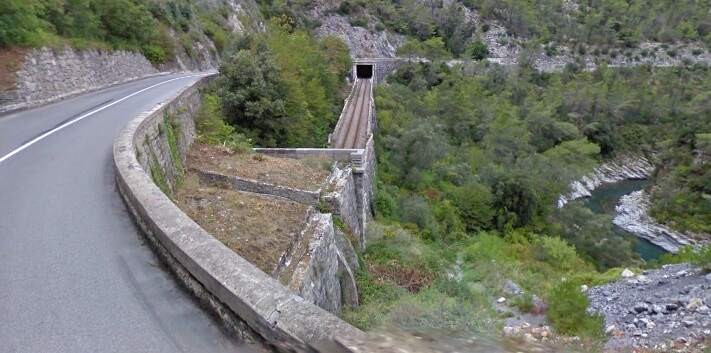
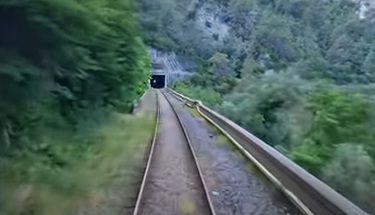
A view looking north along the railway from the road immediately above the North portal of Arme Tunnel. The parapets of the viaduct can again be seen between the two tunnel mouths. [Google Streetview, September 2010]

A similar view back towards Breil-sur-Roya from the cab of a Northbound service the mouth of Arme Tunnel. [35]
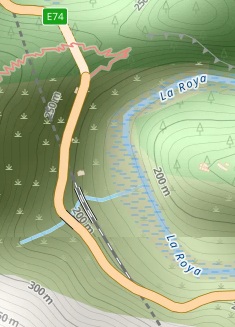
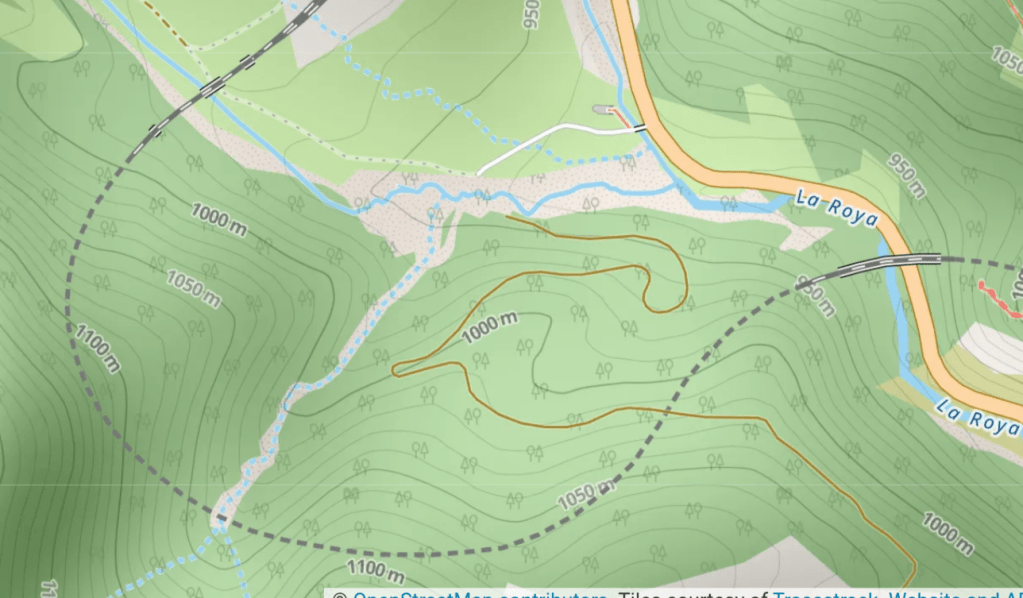
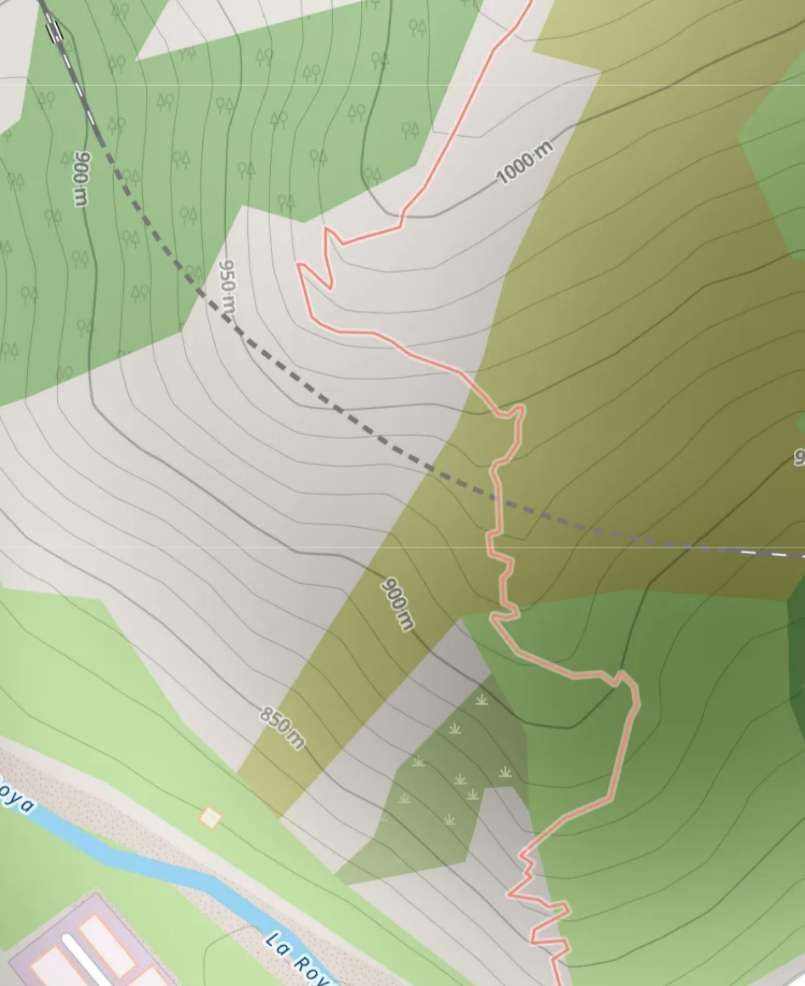
This next length of the line is heading South-southeast. Arme tunnel is at the top of this extract from OpenStreetMap. The line bridges (on a four-arch viaduct) a tributary of La Roya before being swallowed by Agrie Tunnel.
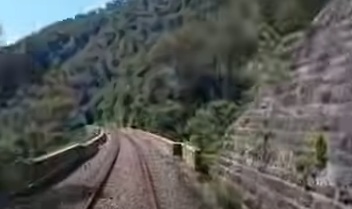
The view South from the mouth of Arme Tunnel. [55]
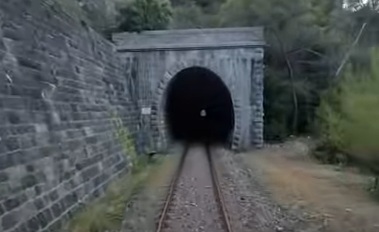
Turning through 180°, this is the South portal of the Arme Tunnel. [35]
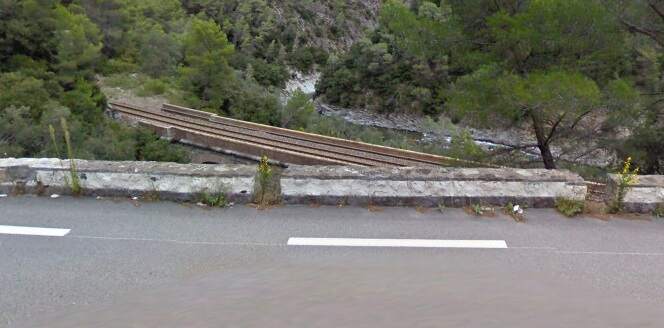
The railway and the bridge are just visible over the edge of the road, looking East. The bridge is a viaduct of four 10 m spans. [Google Streetview, September 2010]
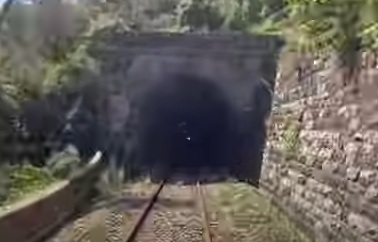
The northern portal of Agrie Tunnel (820 metres in length). [55]
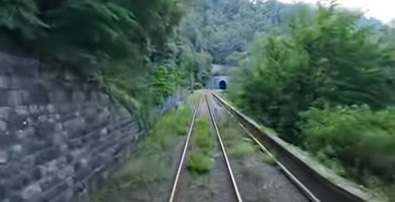
The view from the cab of a Northbound service leaving Agrie Tunnel. [35]
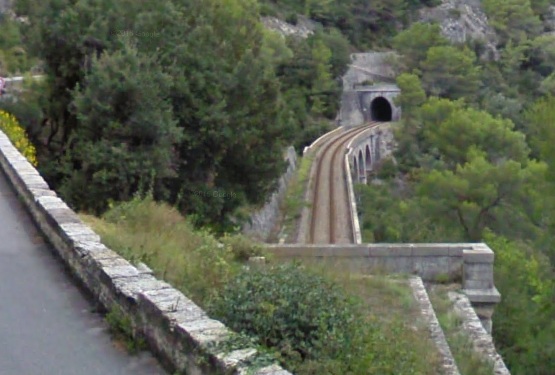
A better view is obtained from the road above the North portal of Agrie Tunnel. This view shows the viaduct mentioned above. [Google Streetview, September 2010]
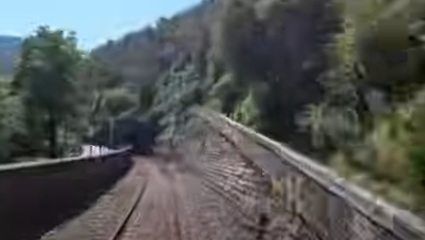
This is the view from the cab of a Southbound train at the South portal of Agrie Tunnel. The train is travelling at 68 km/hour and the still image from the video is much less distinct. [55]
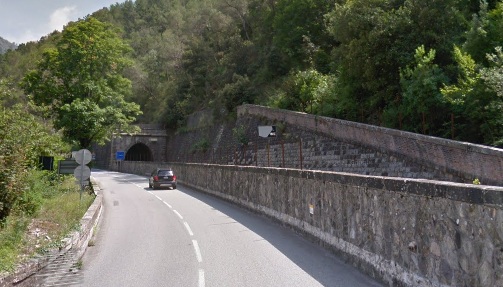
A similar view but from the road. A metre high wall separates the road and the railway. [Google Streetview, July 2014]
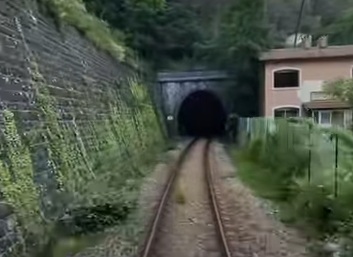
Turning through 180°, we see the mouth of the Agrie Tunnel from the cab of the Northbound service. [35]
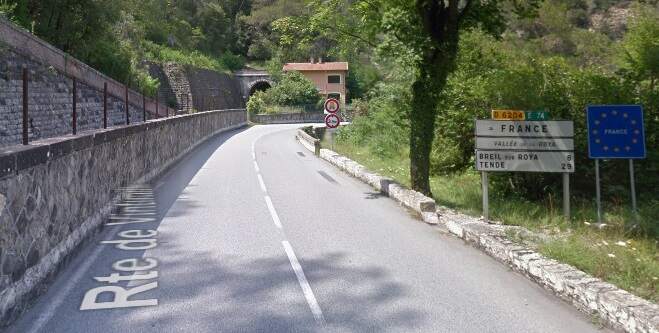
A similar view from the road. It is at this location that we cross into Italy! The border was adjusted as part of reparations after WW2. [Google Streetview, July 2014]

At high speed the video stills are less distinct. This is the northern mouth of the Fanghetto Tunnel which is in shade. This tunnel is 419 metres in length and trains cross the border between France and Italy as they enter it. [55]
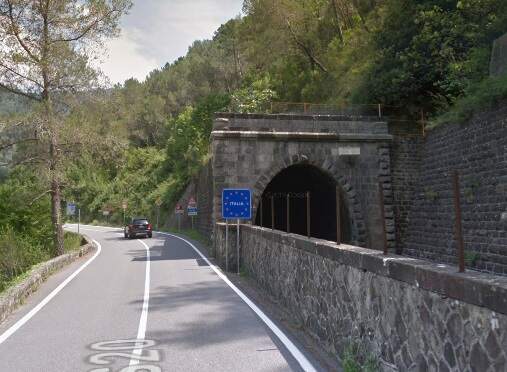
A much more distinct view from the road of the mouth of Fanghetto Tunnel. [Google Streetview, July 2014]
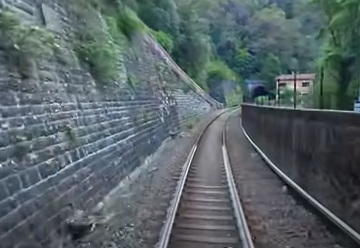
Here, we are looking from Italy into France in this view back towards Breil-sur-Roya from the mouth of the Fanghetto Tunnel. [35]
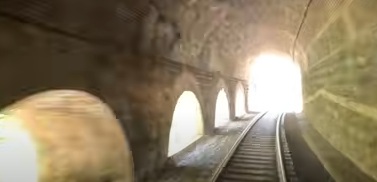
The southern end of the Fanghetto Tunnel is galleried/arcaded with low level arches letting in light before the tunnel mouth is reached. [55]
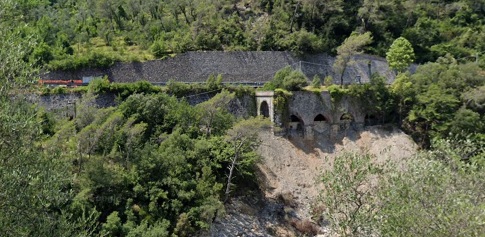
The arcades close to the southern mouth of Fanghetto Tunnel seen from the East side of the valley. [Google Streetview, July 2021]
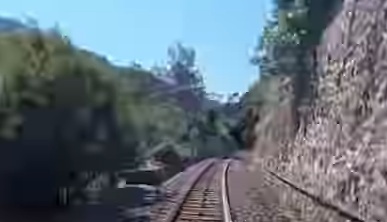
The view along the line from the southern portal of Fanghetto Tunnel. [55]
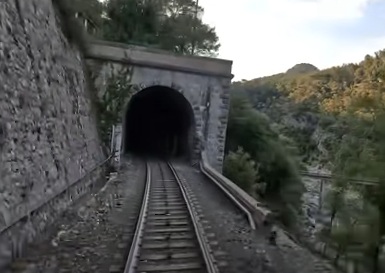
The southern portal of the Fanghetto Tunnel. [35]
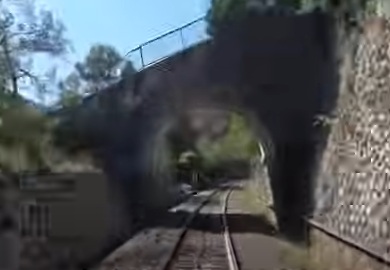
With the Southbound train now travelling at 75 km/hr, small structures (like this accommodation bridge) whizz by and, certainly in this direction with the bridge face in shadow, it is impossible to make out any detail.. [55]
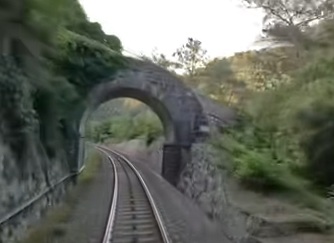
The structure is seen in better light, from the cab of the Northbound service. [35]
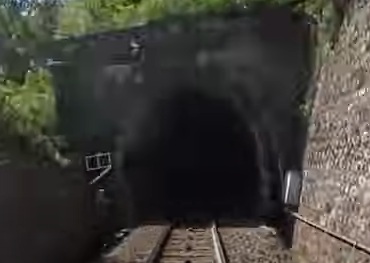
The northern mouth of Sardinesca Tunnel (820 metres long) again in shadow and indistinct because of the speed of the train. [55]
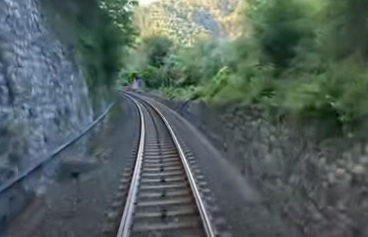
Looking back towards Breil-sur-Roya from the cab of a Northbound train at the mouth of the Sardinesca Tunnel. [35]
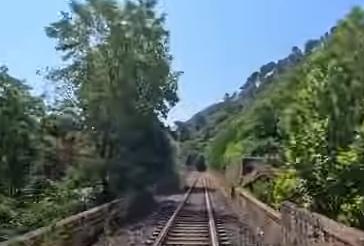
The view South beyond the southern portal of Sardinesca Tunnel. The parapets of a single span arch bridge are visible close to the camera. [55]
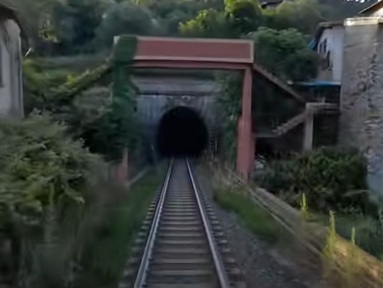
Turning through 180° we get a look at a footbridge over the line just outside Sardinesca Tunnel. [35]
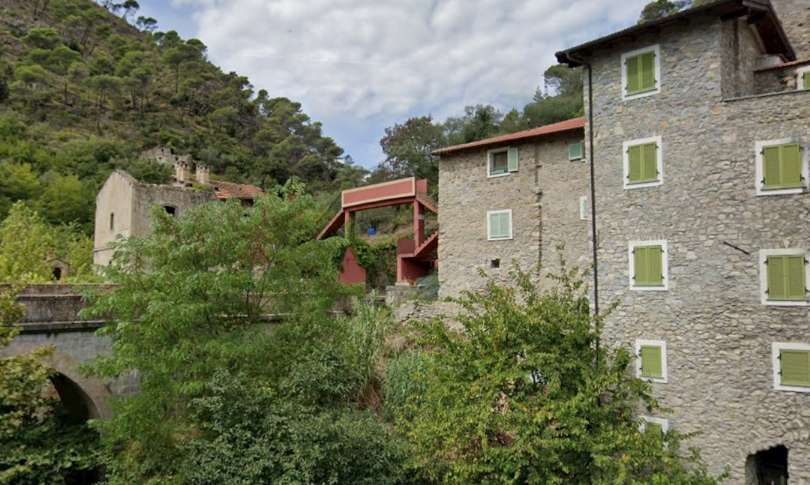
The same footbridge seen from the SS20 road. the arch bridge over the Tron, a tributary of the Roya, can be seen on the left of the image. [Google Streetview, August 2021]
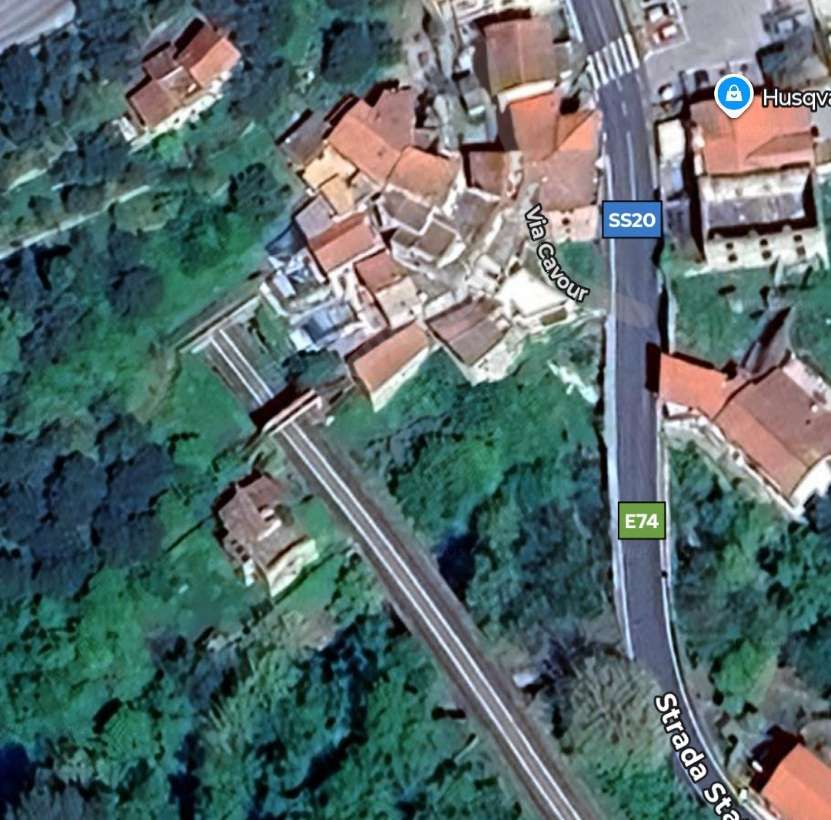
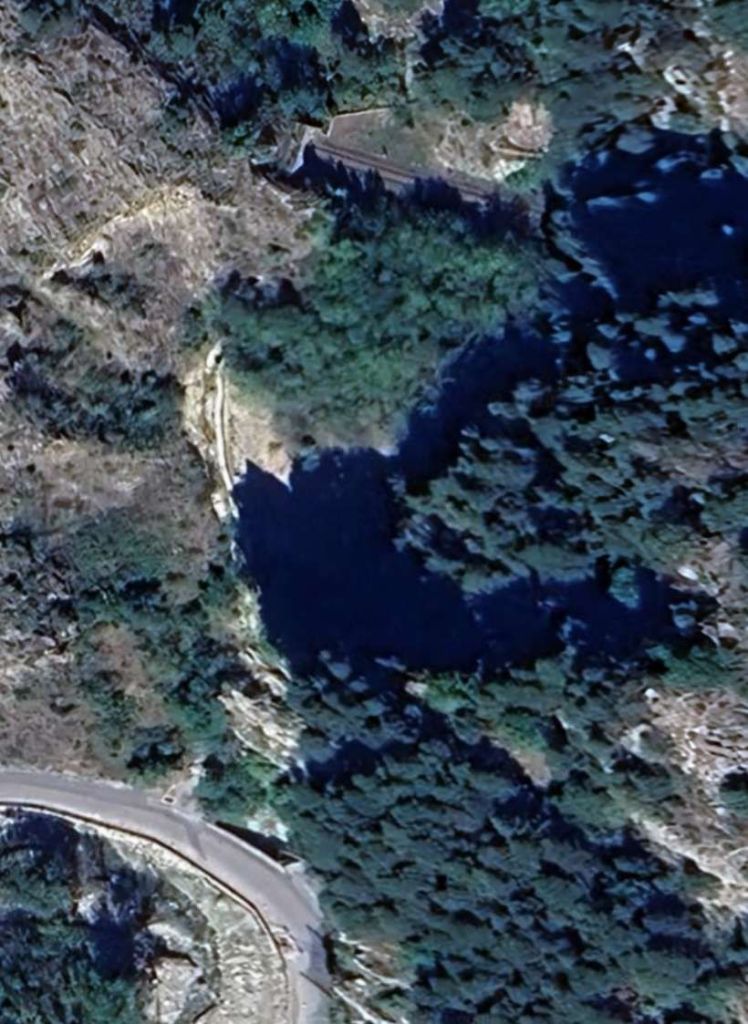
An extract from Google’s satellite imagery showing the same location. Note the tunnel mouth and adjacent footbridge in the top-left quadrant of the photograph. [Google Maps, August 2025]

Next comes the Olivetta-San-Michele Station and the San-Michele Tunnel (133 m long).
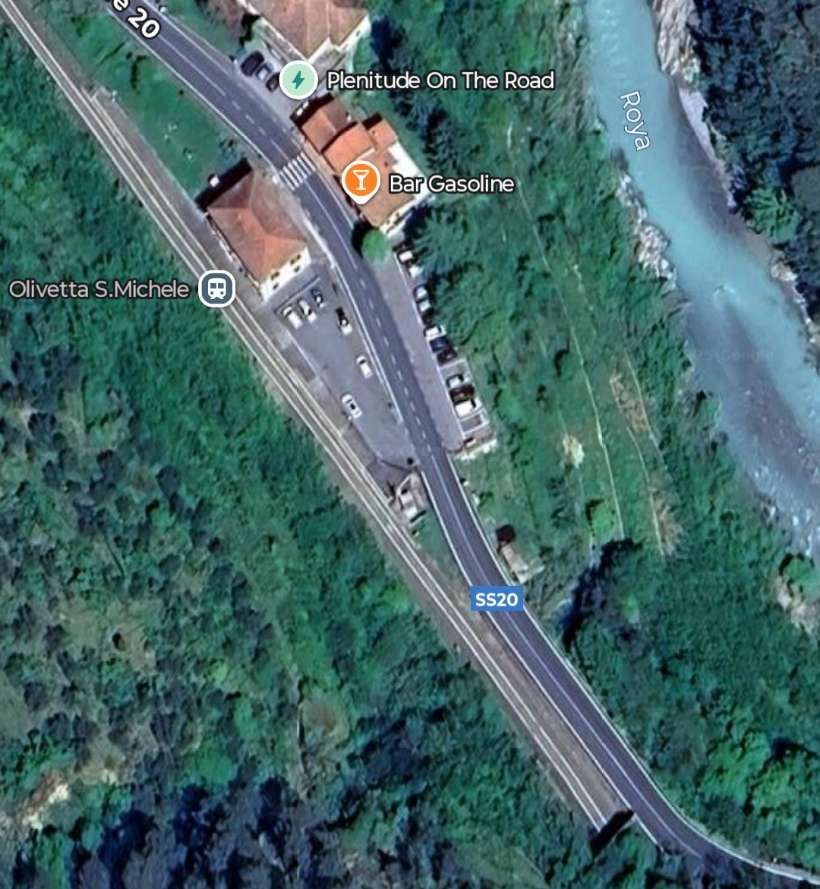
A very short distance South of the footbridge is Olivetta San Michele Railway Station. [Google Maps, August 2025]
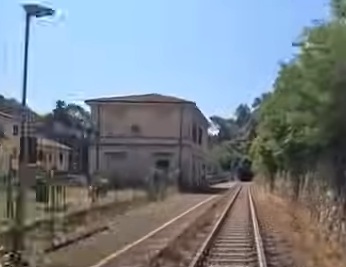
Olivetta San Michele Station, seen from the cab of the Ventimiglia-bound service. [55]
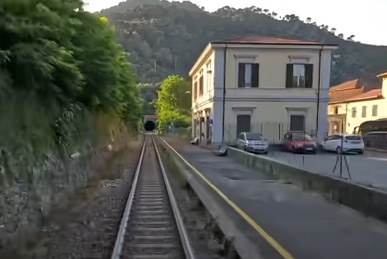
A better railside view of the station building at Olivetta San Michele, this time from the cab of a Northbound train. [35]
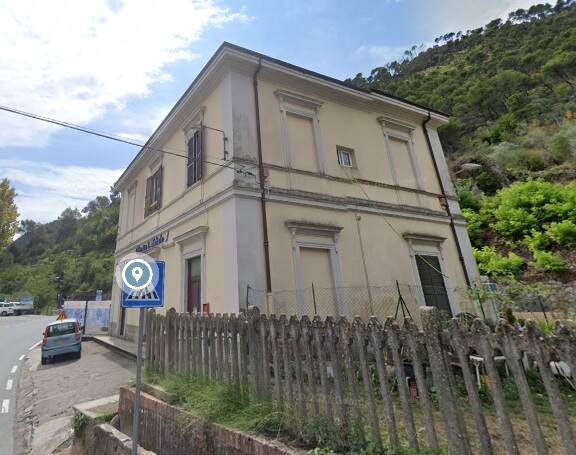
The station building seen looking South from the SS20/E74 road. [Google Streetview, August 2021]
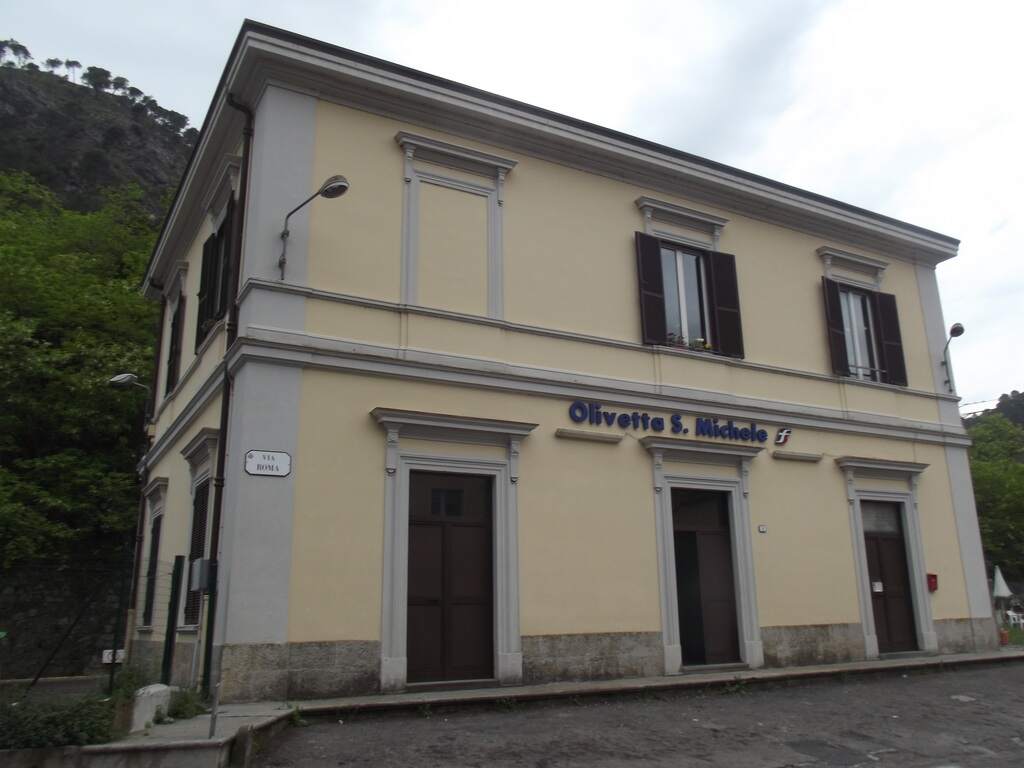
The station building seen from the East, (c) Pampuco and licenced for reuse under a Creative Commons Licence (CC BY-SA 4.0). [36]
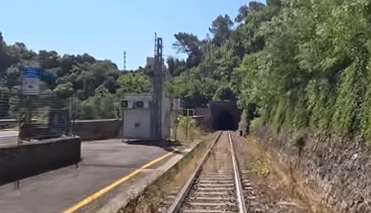
The view ahead along the line towards Ventimiglia from the cab of the Southbound train as it pulls out of Olivetta San Michele Station. The tunnel ahead is San Michele Tunnel which is 126 metres in length. [55]
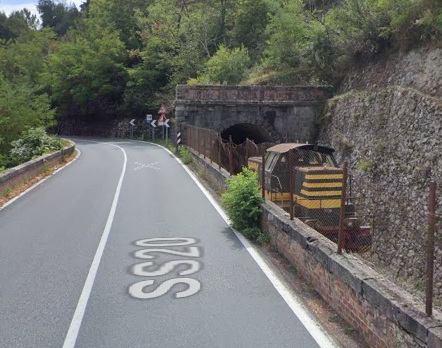
A view, looking South from the SS20, of the northern mouth of San Michele Tunnel with an Italian Locomotive heading into the tunnel (I may well need correcting on this) is shown in more detail below… It appears to be a Belgian locomotive (SNCB) No. 7336 with the name, ‘Mexico’. [Google Streetview, August 2021]
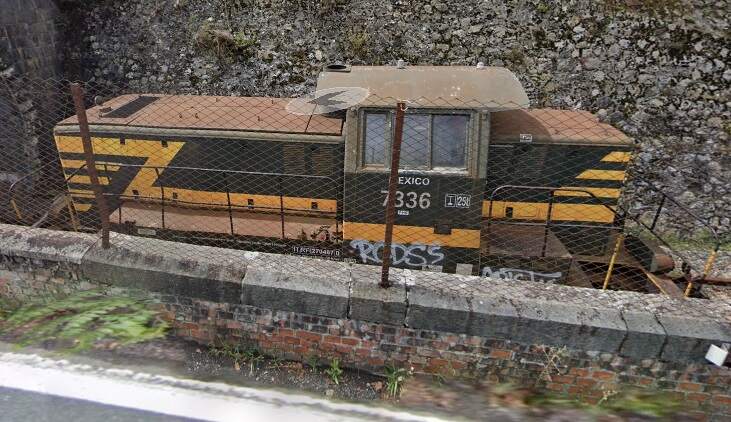
This picture it taken just a short distance to the South of the image above. It shows a side-on view of the same locomotive. I would not expect to see this locomotive at this location! [Google Streetview, August 2021]
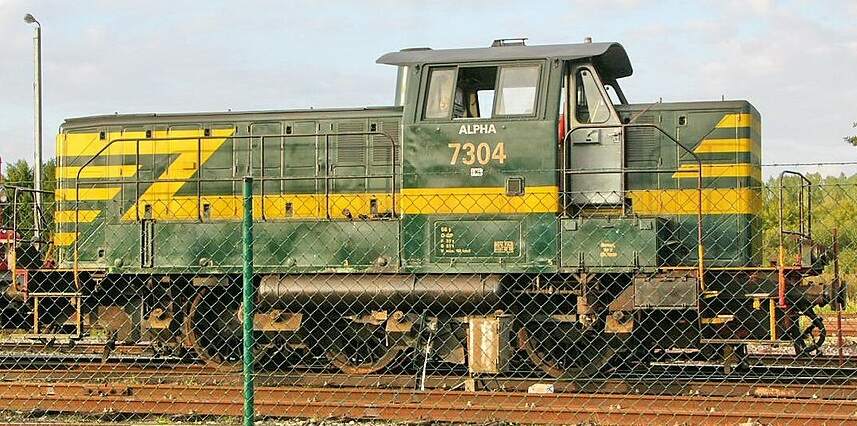
This is SNCB 7304 – the image is provided by Wikipedia. The family resemblance with 7336 is manifest. The Class 73 locomotives formed the backbone of the SNCB/NMBS shunting locomotive fleet. [20]

Class 73 locomotives were built in three batches: 7301-7335 during 1965–1967, 7336-7375 during 1973-1974 and finally 7373–7395 in 1976–1977. [20]
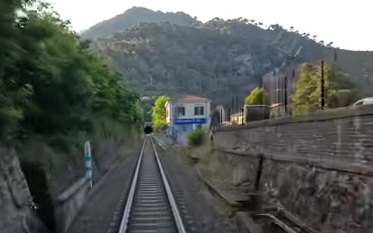
This is the view North through the station site as seen from the cab of a Northbound service at the North postal of the San Michele Tunnel. [35]
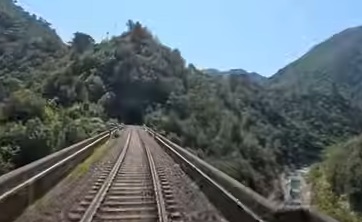
Looking out from the Southeast portal of San Michele Tunnel, the line ahead crosses Roya IV Bridge which is 126 metres in length and then enters Mantici Tunnel which is 604 metres long. [55]
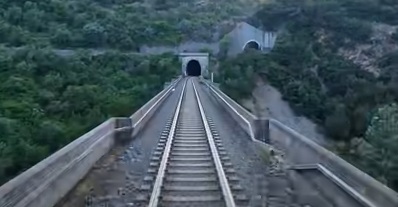
One hundred metres further South and turning through 180°, this is the view across Roya IV Bridge towards the San Michele Tunnel. Note that the road tunnel is just above the railway tunnel, although on a different line. [35]
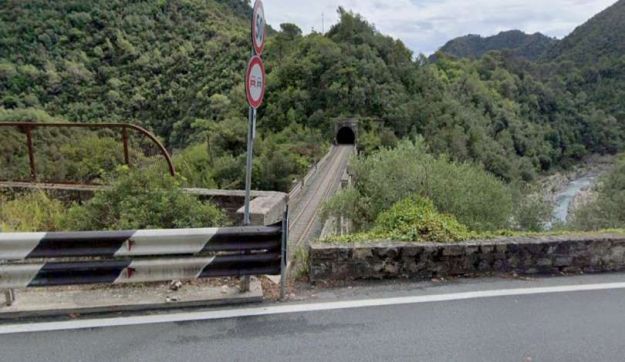
The view from the road above the Southeast portal of San Michele Tunnel. The mouth of Mantigi Tunnel (604 metres long) can be seen at the end of the railway viaduct. [Google Streetview, August 2021]
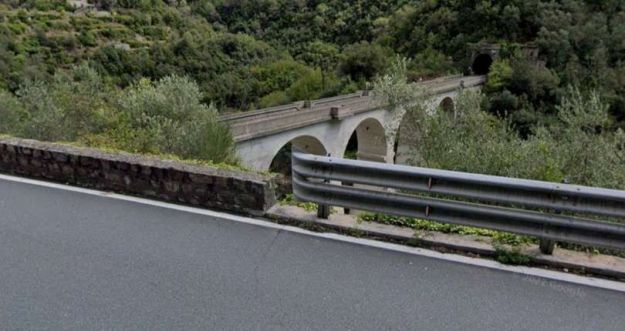
A very short distance along the road a somewhat better view of the viaduct. [Google Streetview, August 2021] More views of the viaduct can be seen here, [17] here, [18] and here. [19]

Roya IV Bridge was also known as the San-Michele Viaduct. It was made up of five 15 metre arches. [1: p125]

The Mantigi tunnel has a short section where it is very close the the surface of the ground above, Banaudo et al, tell us that this allowed the provision of a vertical ventilation shaft. [1: p125]

Trains travelling South to Ventimiglia crossed the viaduct and ran on through Mantigi Tunnel. Airole Railway Station was originally on a large plateau beyond the Southeast portal of Mantigi Tunnel.
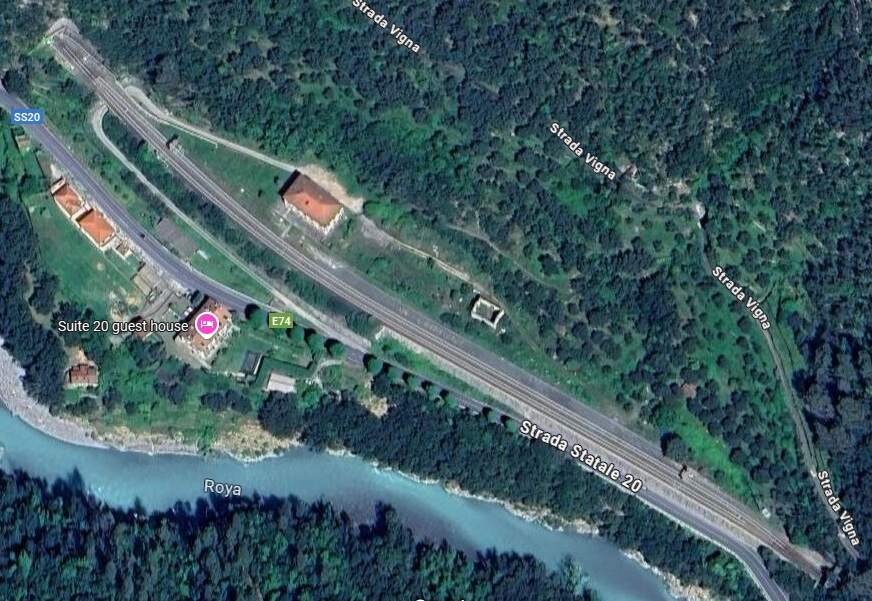
The original location of Airole Railway Station. The substantial passenger building remains. The walls of one other building can be seen to the Southeast of the passenger facilities. [Google Maps, August 2025]

Banaudo et al tell that “Airole station was located in an olive grove to the North of the village, in the only place where the shallower slope of the left bank of the Roya allowed the construction of a retaining wall to support all the railway infrastructure: the passenger building, three platform tracks and two freight tracks with a goods shed and high platform, as well as a water column for the locomotives.” [1: p121]

The station was built in 1914 and remained operational until, sadly, the station site was abandoned in the 1970s when it was replaced by a single platform halt in the centre of Airole. [25]
At the southern end of Mantigi Tunnel, trains enter a passing loop (Airole Loop), which is all that is left of the original railway station, before entering another tunnel! [55]
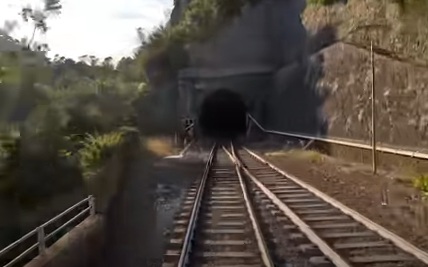
Looking back towards Breil-sur-Roya from within the passing loop. Immediately to the North of the loop, Northbound trains plunge into the Mantigi Tunnel. [35]
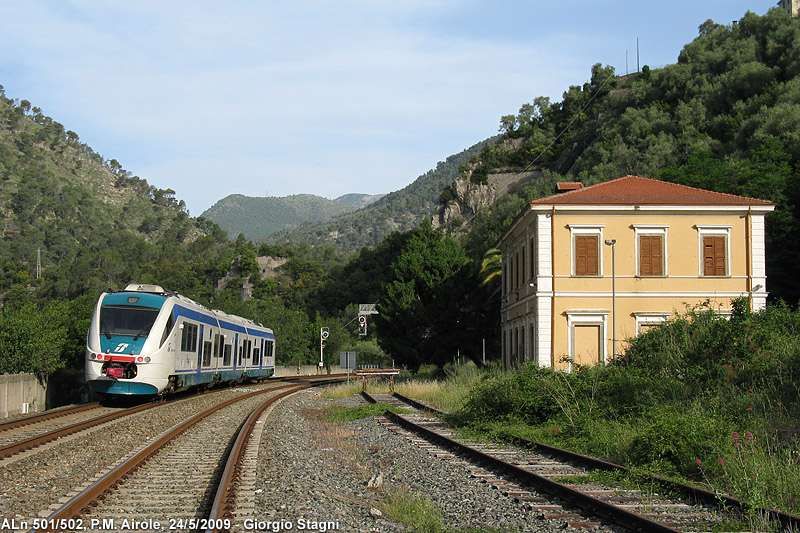
This excellent photograph of the old station building looks North towards the Mantigi Tunnel, © Giorgio Stagni and licenced for reuse under a Creative Commons Licence (CC BY-SA 3.0). [25]
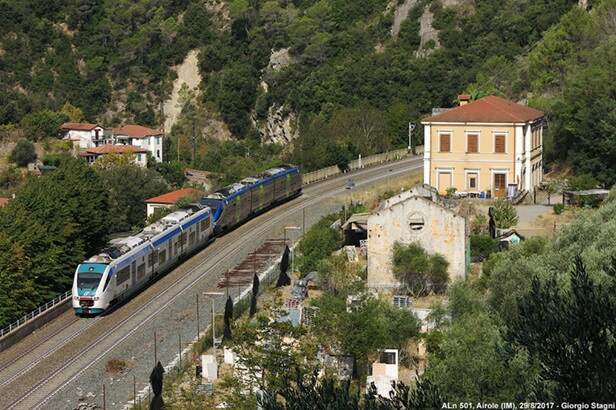
The station building and the shell of the old goods shed. This is another photograph © Giorgio Stagni and licenced for reuse under a Creative Commons Licence (CC BY-SA 3.0). [37]
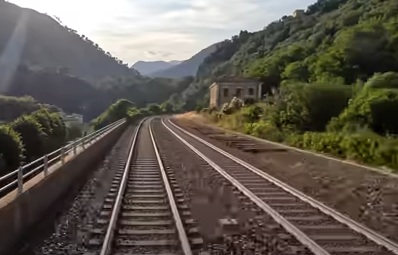
Looking North from the cab of a Northbound train approaching the old railway station building. It is evident from both these pictures that there were originally sidings at this location – confirmation that the station facilities at Airole were once quite significant. [35]
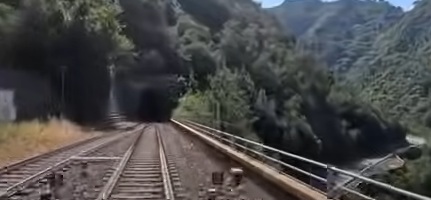
At the end of the passing loop trains enter Madonna Tunnel (249 metres long). [55]
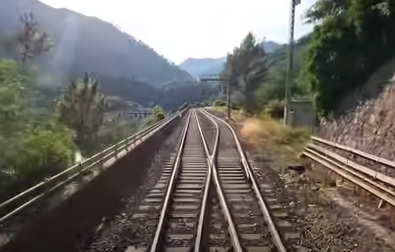
Looking back towards Breil-sur-Roya from the portal of Madonna Tunnel. The passing loop is still provided at this location as there is no room at the present Airole Railway Station for more than a single track. [35]
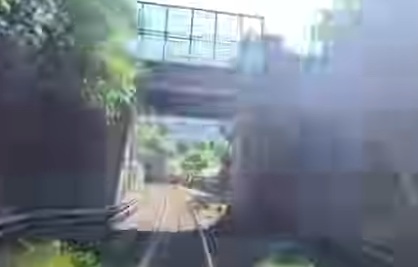
Leaving Madonna Tunnel trains immediately pass under a local road bridge which appears as not much more than a silhouette as eyes get used to the light on leaving the tunnel. [55]
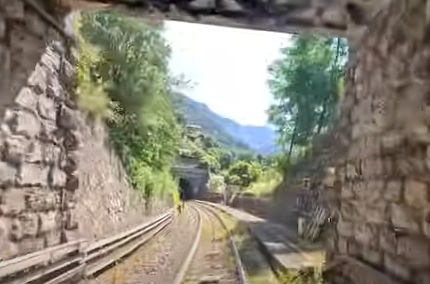
Airole Railway Station seen from the cab of a Ventimiglia-bound train passing under the accommodation bridge shown above. [55]
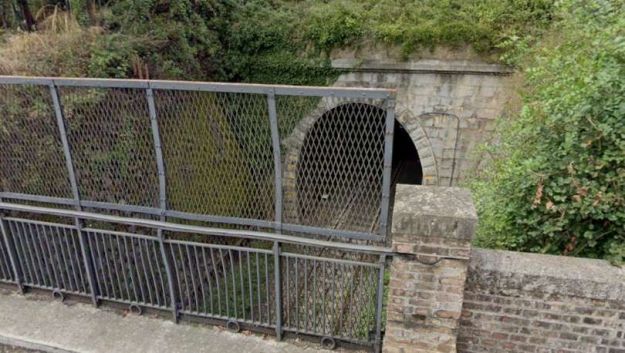
The view West from the bridge which carries Via Giacomo Matteotti over the line. [Google Streetview, August 2021]
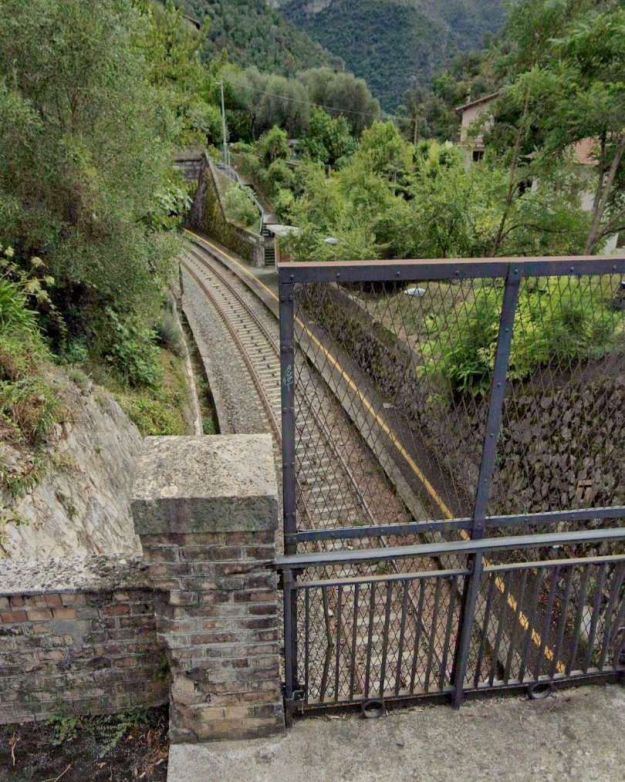
Turning to face East, this is the present Airole Railway Station as seen from Via Giacomo Matteotti. [Google Streetview, August 2021]
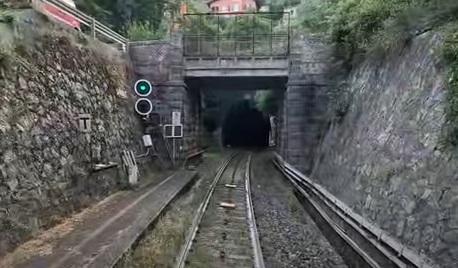
A Northbound train is stationary at Airole Railway Station. This is the view ahead, West towards Olivette San Michele. The road over bridge sits a few metres closer to the station than the mouth of Madonna Tunnel. [35]
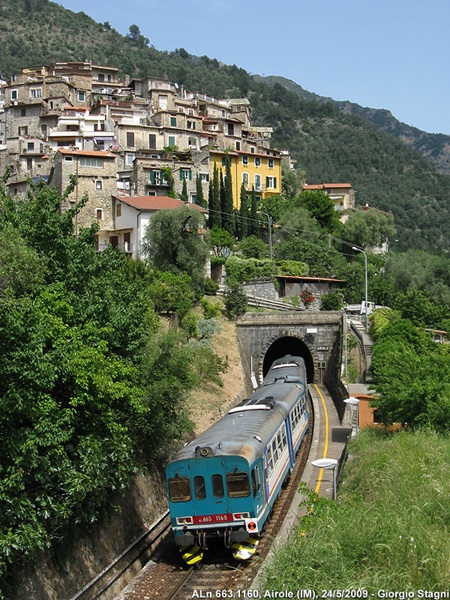
A great action shot showing ALn 663 1160 at Airole station, © Giorgio Stagni and licenced for reuse under a Creative Commons Licence (CC BY-SA 3.0). [38]
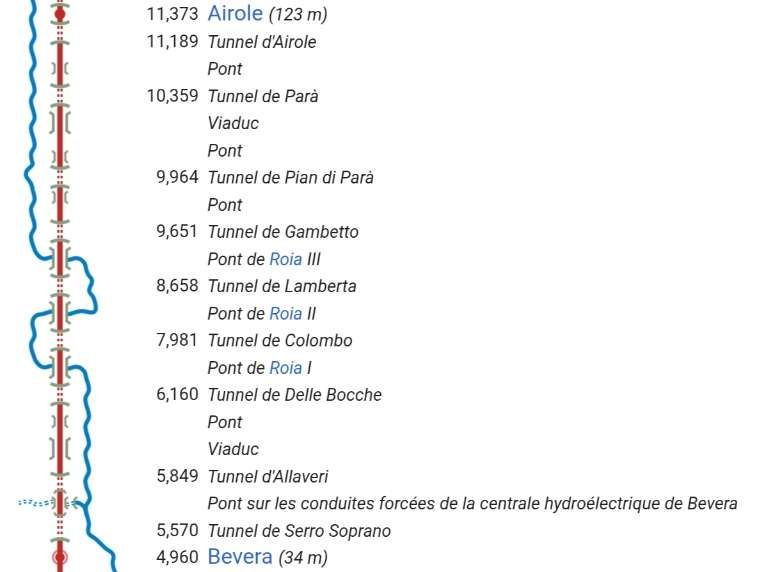
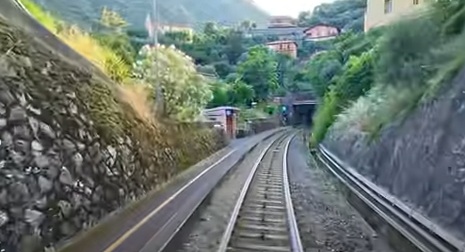
Airole to Bevera. [22]

Airole Railway Station seen from the cab of a northbound service entering the station from the East. [35]
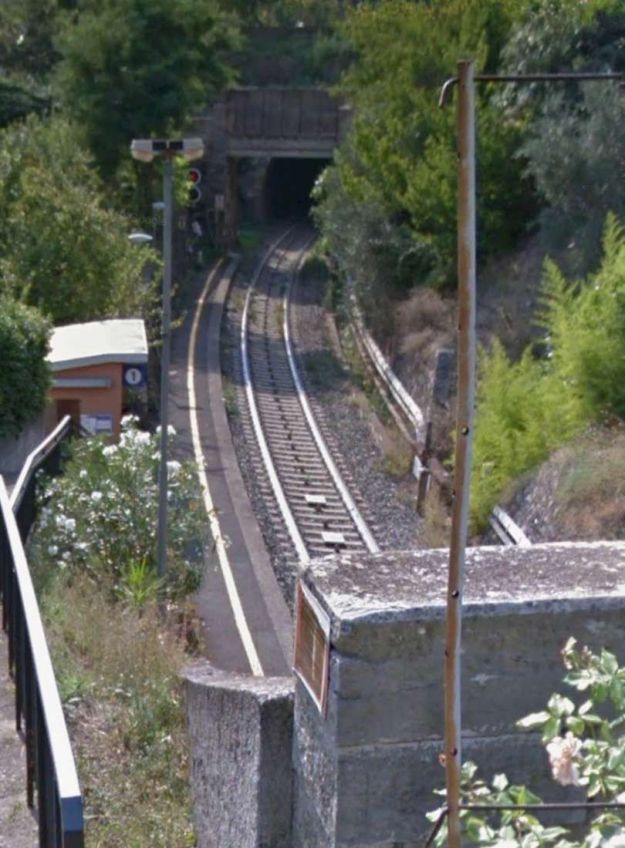
A similar view but this time the camera is on Via G. Biancheri which crosses the railway line above the West portal of Airole Tunnel (153 metres in length). [Google Streetview, August 2021]
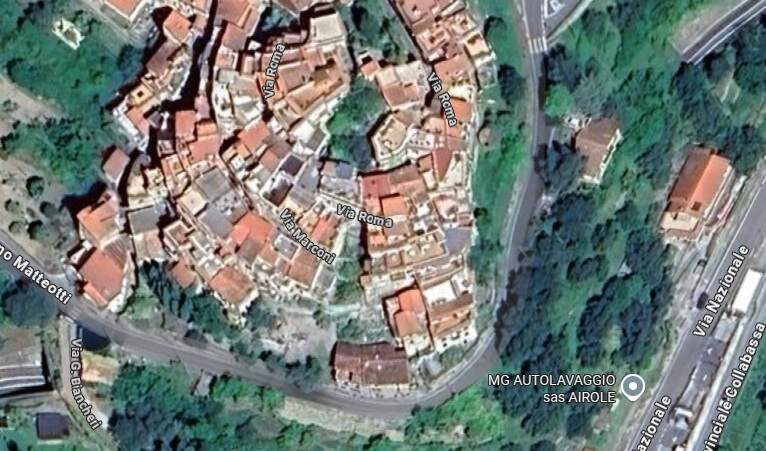
This extract from Google’s satellite imagery shows the village of Airole which sits over the line. Airole Tunnel curves to the Northeast. Its West Portal is bottom-left in this image, its Northeast portal is top-right. [Google Maps, August 2025]
The view Southwest from the cab of a Ventimiglia-bound train at the Northeast portal of Airole Tunnel. [55]
The Southwest portal of Para Tunnel (754 metres long). [55]
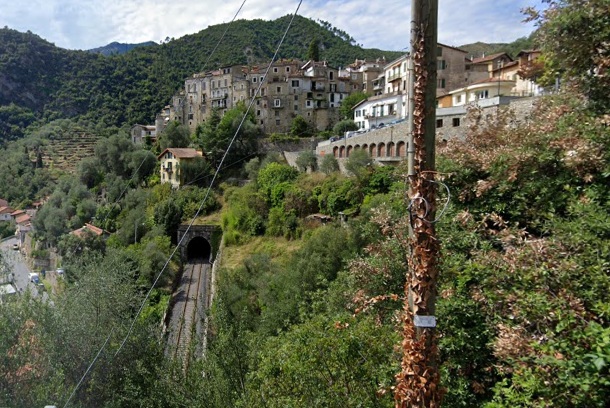
Looking Southwest from Via Luigi Trucchi the Northeast portal of Airole Tunnel can be seen below the village of Airole. [Google Streetview, August 2021]
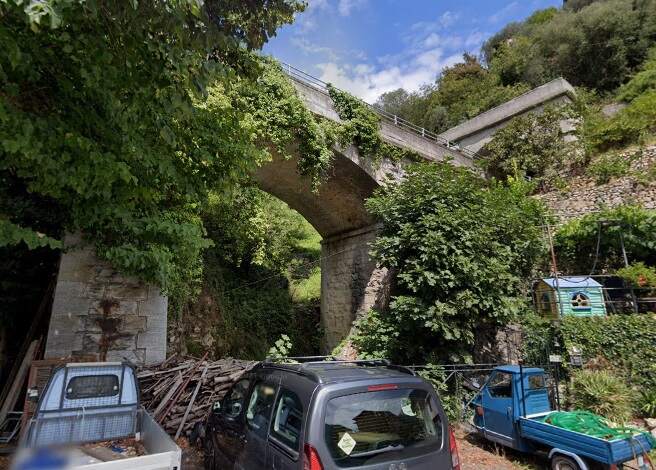
The view from Via Nazionale of the short bridge (Airole Bridge, one 10 metre arch) which sits to the Southwest of the mouth of Para Tunnel. The stonework of the tunnel portal can be seen above and to the right of the viaduct. Para Tunnel is over 747 metres long. [Google Streetview, August 2021]
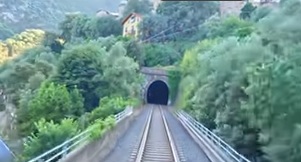
This is the view back towards Airole Village and Railway Station from the mouth of Para Tunnel. White fencing sits on top of the parapet walls of Airole Bridge. [35]
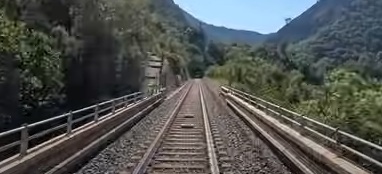
Para Tunnel curves round to the Southeast. This is the view from the cab of the Southbound train as it exits Para Tunnel and crosses La Para II viaduct (four 10 metre arches). [55]
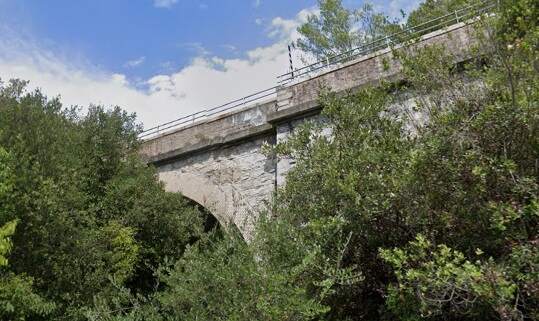
The viaduct mentioned above can be glimpsed from Via Natzionale. [Google Streetview, August 2021]
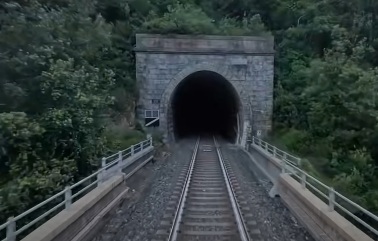
This is the view back into the mouth of Para Tunnel. [35]
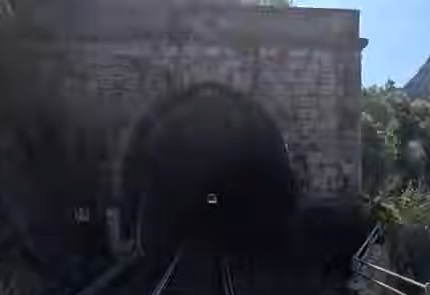
The Northwest portal of Pian de Para Tunnel. The tunnel is 184 metres long. [55][1: p125]
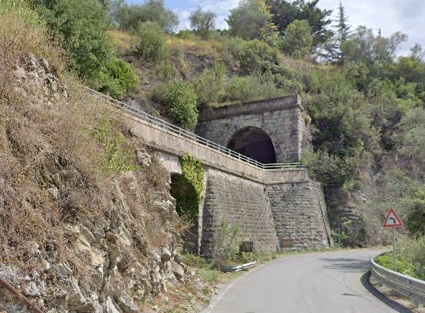
A view of the Northwest portal of Pian de Para Tunnel from Via Nazionale. There is a single-span arch bridge carrying the line close to the tunnel mouth. [Google Streetview, August 2021]

The next length of the line as it appears on OpenStreetMap and annotated with the tunnel names. [21]
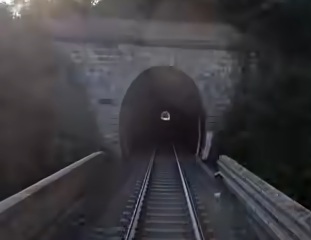
The Southeast portal of Pian de Para Tunnel seen from the cab of the Northbound train. [35]
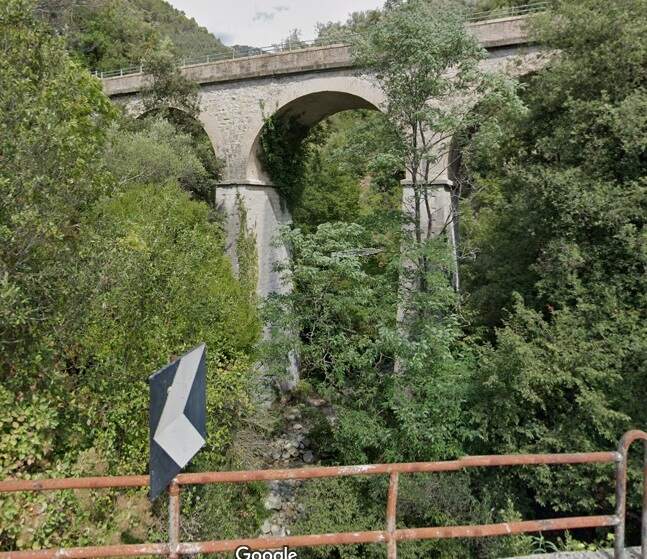
Immediately to the Southeast of the tunnel portal Southbound trains cross La ParaI Viaduct. The Viaduct appears to have three 5 metre spans. This image looks Northeast from Via Nazionale. [1: p125]
The Southeast portal of Pian de Para Tunnel can be seen in the top-left of this image, looking North from a point a little further along Via Nazionale. [Google Streetview, August 2021]
The Southbound train is now travelling at over 80 km/hr. This is the portal of the next tunnel on the route – Gambetto Tunnel (173 metres in length. [55] [1: p125]

Turning through 180°, this is the view back towards Airole from the mouth of the Gambetto Tunnel. [35]
Gambetto Tunnel opens out onto the next bridge over La Roya – Roya No. III Bridge. [55] This structure is also known as the Lamberta Viaduct, it is made up of three 14 metre arches and two 10 metre arches. The gallery beyond the bridge is the route of the modern SS20. [1: p125]
Turning through 180°, this is the mouth of the Gambetto Tunnel from the cab of a Northbound service. [35]
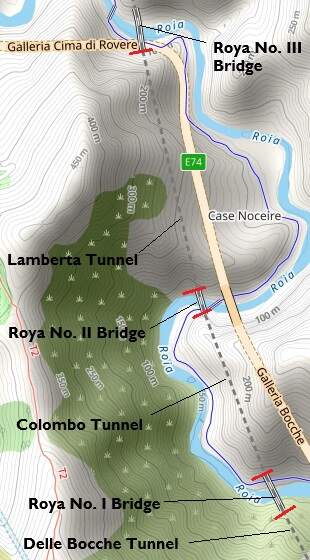
With the railway running South-southeast towards Bevera and Ventimiglia, it alternates between tunnels and viaducts switching sides of La Roya (Roia) river. [23]

The Roya No. III bridge is also known as the Lamberta Viaduct. [1: p125]

The Roya No. II bridge is also known as the Colombo Viaduct. [1: p125]
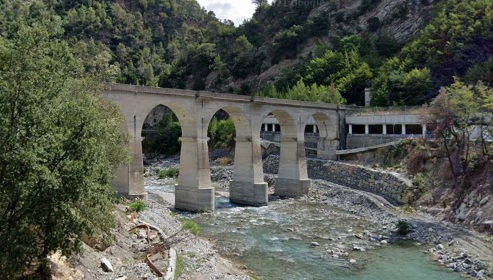
A view of Roya No. III bridge from the bridge carrying Via Nazionale of the Roya to the West of the railway. [Google Streetview, August 2021]
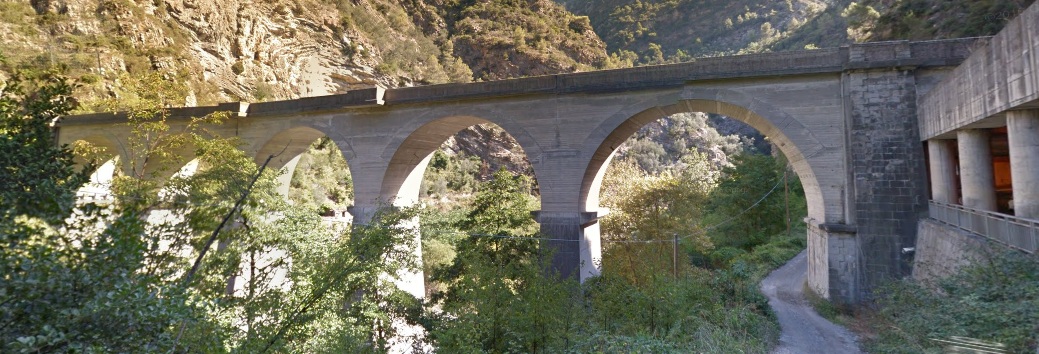
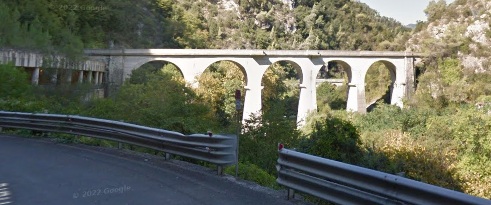
The old road, Via Nazionale passes under the five stone arches of La Roya No. III bridge – three 14 metre arches and two 10 metre arches. The concrete gallery allows light into the tunnel carrying the modern SS20/E74. [Google Streetview, September 2011]

A view of La Roya No. III bridge from the Via Nazionala further to the East along the valley. [Google Streetview, September 2011]
Southbound trains then plunge into Lamberta Tunnel which is 750 metres in length. [55]
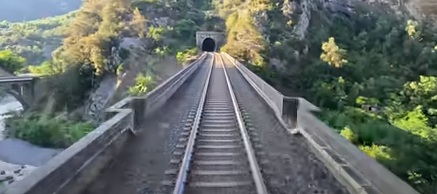
Turning through 180°, this is the view across Roya III bridge from the mouth of the Lamberta Tunnel. [35]
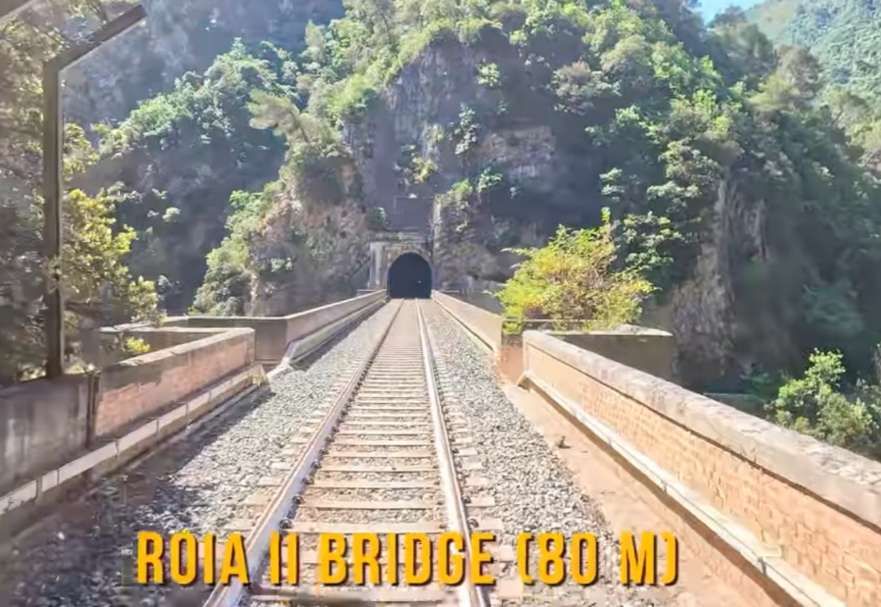
Leaving Lamberta Tunnel at its southern end, Southbound trains immediately crossed La Roya again on Roya No. II bridge. [55] The bridge is also known as the Colombo Viaduct. [1: p125]
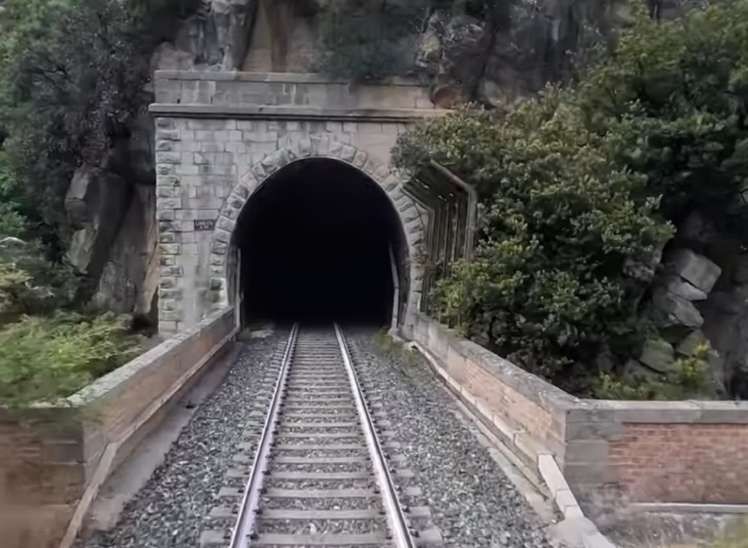
Turning through 180° we see the Lamberta Tunnel Portal. [35]
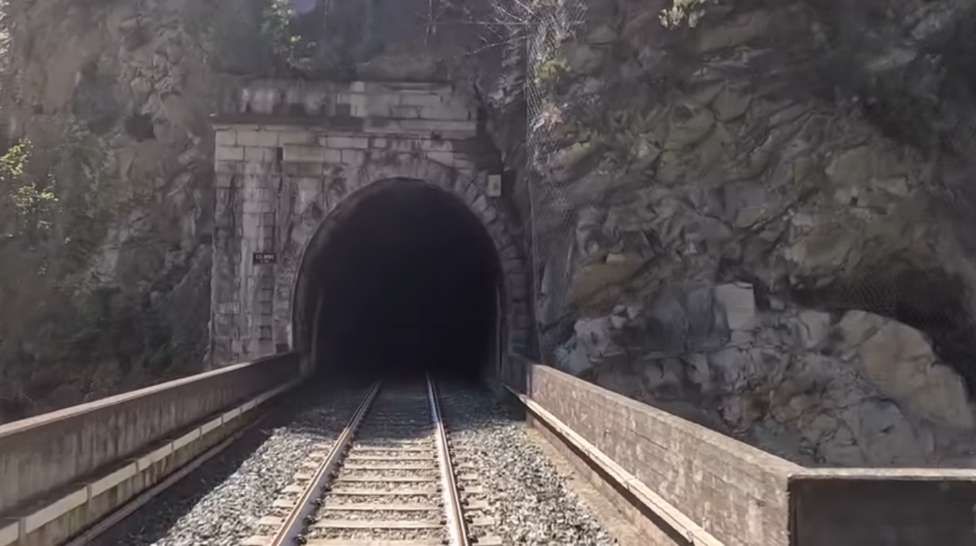
Once across La Roya on No. II bridge trains ran on into Colombo Tunnel. [55]
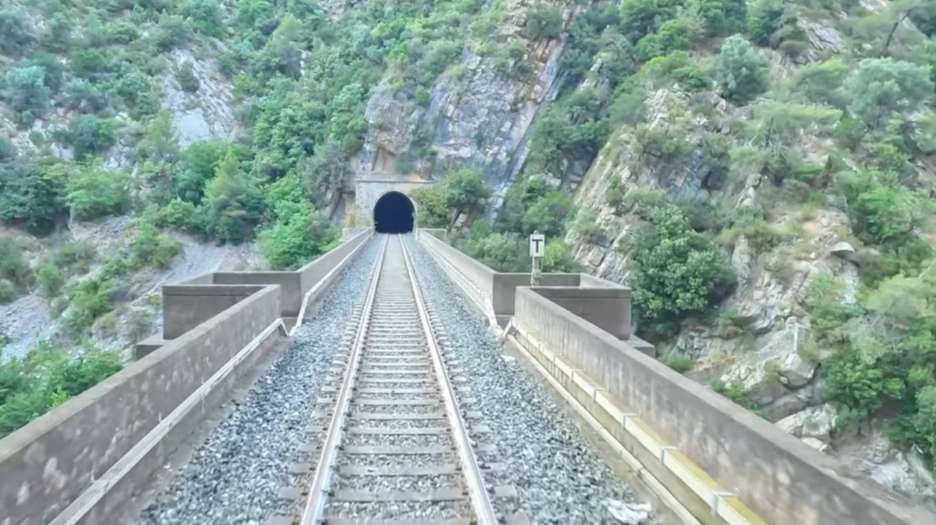
Looking back across La Roya from the mouth of the Colombo Tunnel. [35]
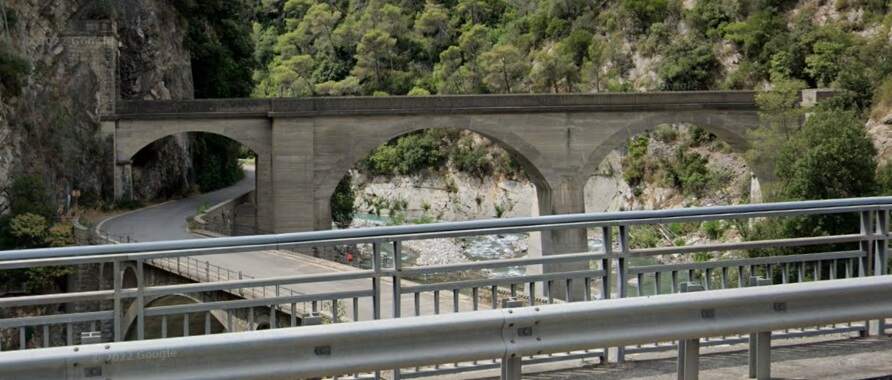
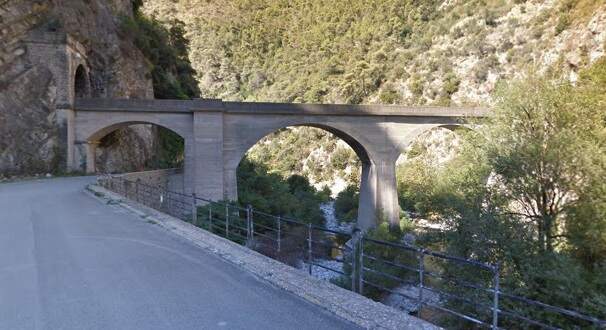
Roia (Roya) No. II Bridge, seen from the viaduct carrying the SS20/E74 across the river. The old road down the valley (Via Nazionale) can be seen crossing the river at a lower level. The northern portal of Colombo Railway Tunnel can be seen on the left of this image. [Google Streetview, August 2021]
A similar view, looking West from the Via Nazionale. [Google Streetview, September 2011]
The view from the West of Roia No. II bridge, looking East. The tunnel mouth visible in this photograph is the southern portal of the Lamberta Tunnel. [Google Streetview, September 2011]

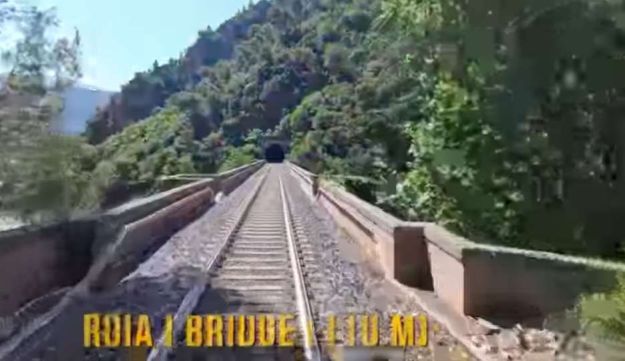
Looking South across Roia (Roya) No. 1 bridge (also known as the Bocche Viaduct) from the South portal of Colombo Tunnel. [55]
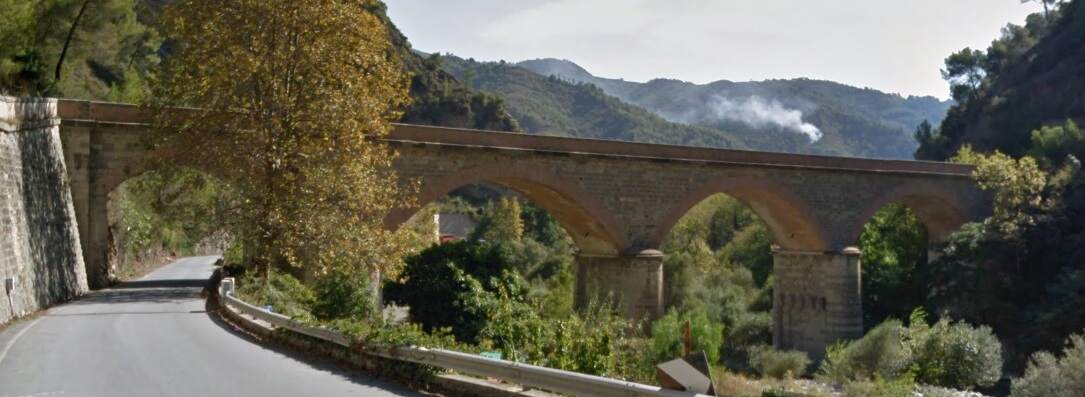
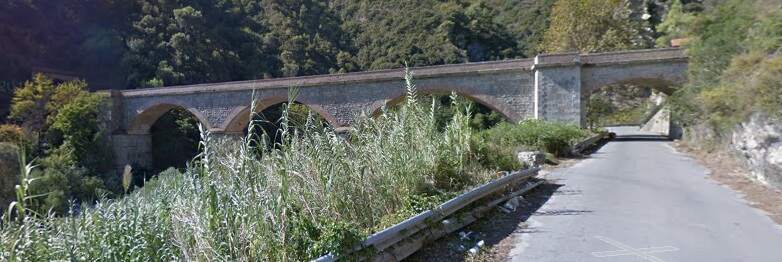
Roia No. I bridge, seen from the West on Via Nazionale. [Google Streetview, September 2011]
Roia No. I bridge, seen from the East on Via Nazionale. The tunnel mouth visible on the left of the image is the northern portal of Delle Bocche Tunnel. [Google Streetview, September 2011]

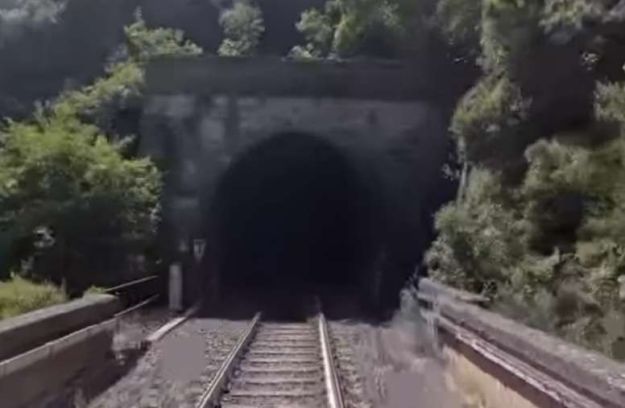
The northern tunnel mouth of Delle Bocche Tunnel. [55]
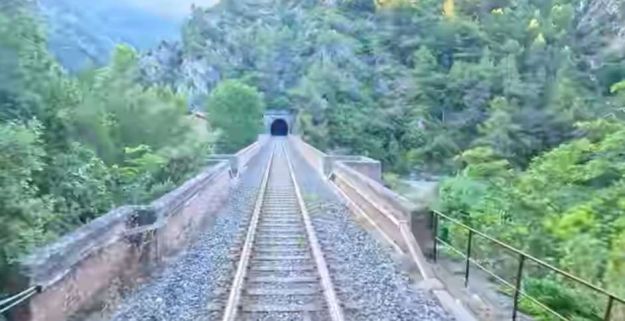
Looking back from the Delle Bocche tunnel mouth across the Roia No. 1 bridge. [35]

Banaudo et al tell us that the length of the Roia (Roya) Valley that we have just traversed is known as the ‘Bocche’, “the wild gorges of the Roya which for a long time represented an abstacle to communications between the Ligurian lands of the Republic of Genova and the Piedmontese domain of the Kingdom of Sardinia. It was only in 1893that the … road from Ventimiglia to Breil was completed … after lengthy construction work hampered by the difficult terrain and the reluctance of the military authorities. The railway tamed this gorge through an uninterrupted succession of tunnels and viaducts.” [1: p121, 125]
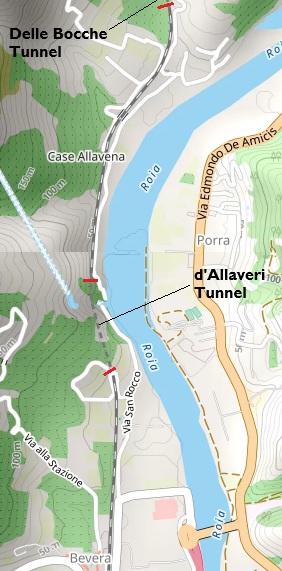
Delle Bocche Tunnel (927 metres long) ends at the top of this OpenStreetMap extract. There is a short bridge which carries a length of the line before Southbound trains enter d’Allaveri Tunnel which, although it appears as one tunnel on the map extract is actually two tunnels with a very short open length in between. The Aqueduct illustrated on the map passes under the railway in that opening in pipes, (Pont sur les conduites forcées de la centrale hydroélectrique de Bevera). The first length of the tunnel is named d’Allaveri Tunnel (69 metres long), the second length is known as Serro Soprano Tunnel (245 metres long).

Once beyond these tunnels, Southbound trains have a clear run down to Bevera Railway Station. [24]
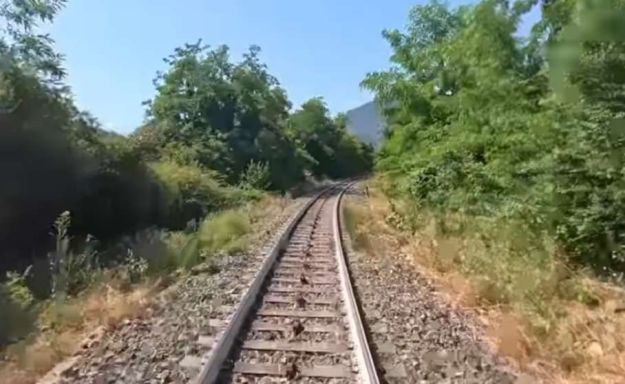
Looking South from the South portal of Delle Bocche Tunnel. [55]
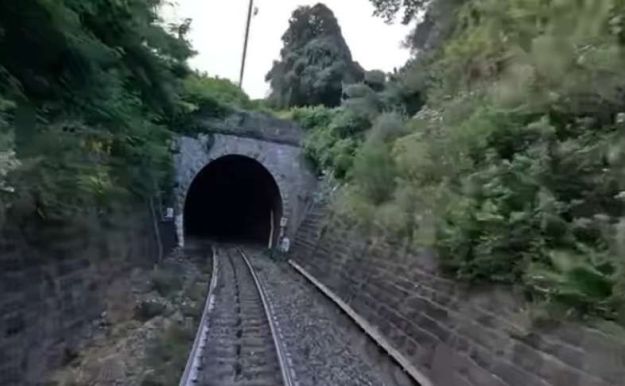
Looking back to the North, this is the South portal of Delle Bocche Tunnel. [35]
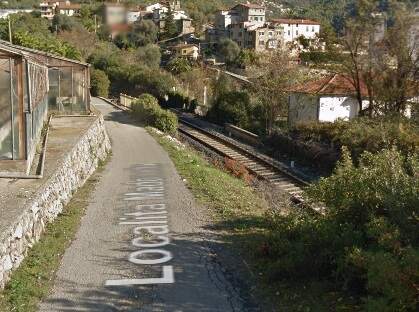
A glimpse of the line from a local road (Localita Madonetta) at a point a couple of hundred metres South of the South portal of Dell Bocche Tunnel. The camera is facing Northeast. [Google Streetview, November 2011]
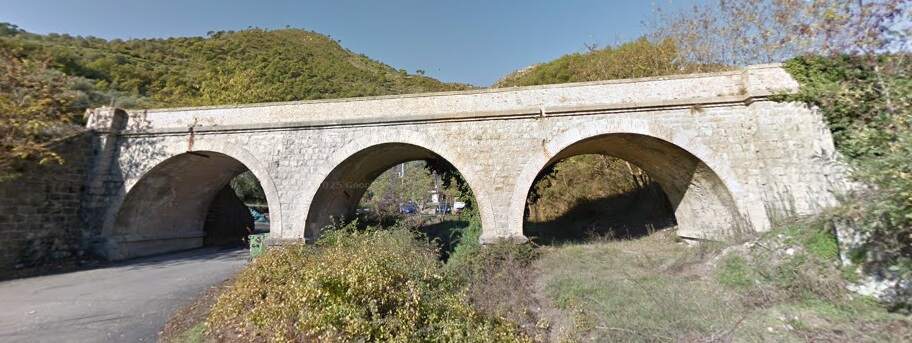
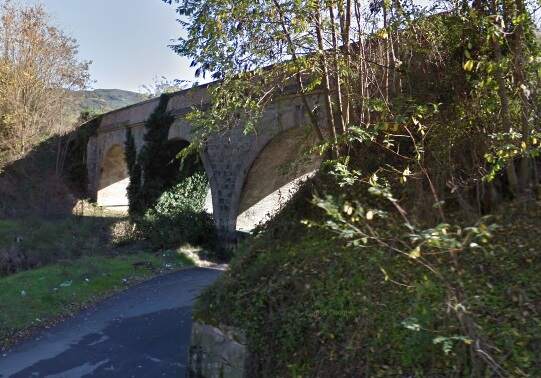
A short distance further South the line bridges a shallow valley and crosses a minor access road. This is the East elevation of the Varese Viaduct (three 8 metre arches) seen from Via Comunale di Varase. [Google Streetview, November 2011][1: p121]
The western elevation of the same structure, seen from the Southwest. [Google Streetview, November 2011]
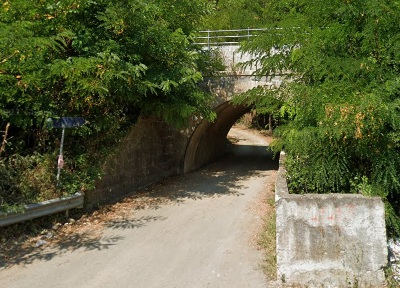
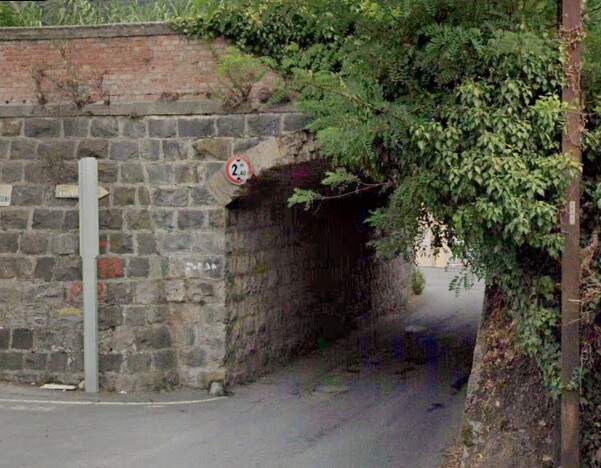
A little further Southwest the line is carried on a low bridge under another minor road. This view looks West from Via Comunale di Varase. [Google Streetview, November 2011]
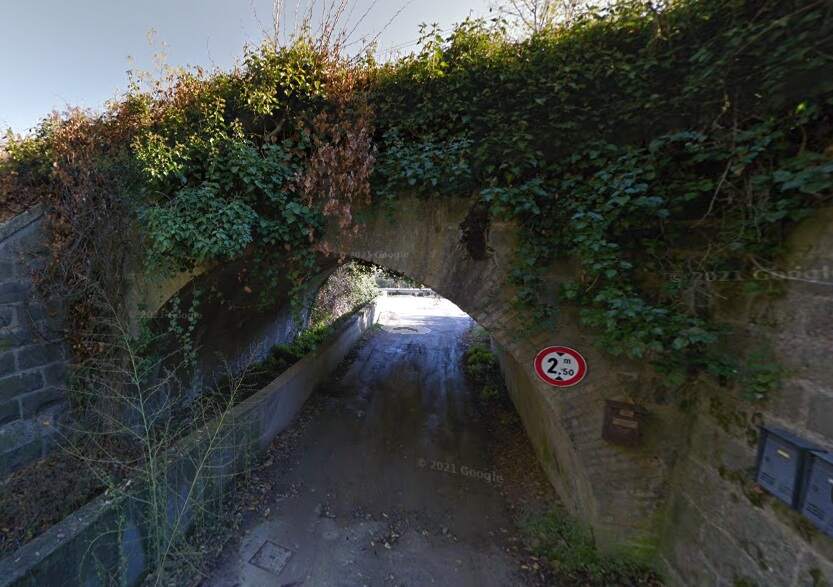
The same structure seen from the West. [Google Streetview, November 2011]

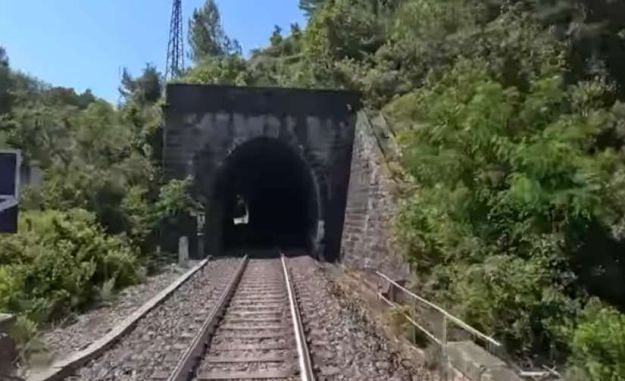
Continuing South the line is carried alongside the River Roia (Roya) and above Via San Rocco on retaining walls and a series of nine 8 metre arches. The arches comprise one structure known as the Allaveri Viaduct. The North portal of d’Allaveri Tunnel can be glimpsed just to the right of centre in this photograph. [Google Streetview, November 2011]

The North portal of d’Allaveri Tunnel. This and the next tunnel are in the vicinity of the hamlet of Varese and the Bevera Hydroelectric Power Station. [55]
The view North from the cab of a Northbound train at the North portal of d’Allaveri Tunnel. [35]
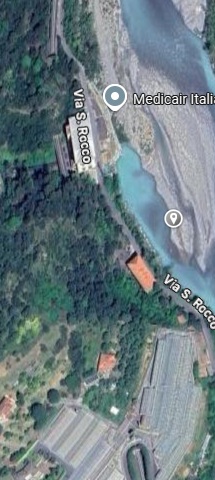
This extract from Google’s satellite imagery shows the two tunnels at this location and Bevera’s Hydroelectric power plant which is immediately adjacent to the railway. It is the white-roofed building just above the centre of this image.

D’Allaveri Tunnel is the very short tunnel to the North of the Hydroelectric plant (71 metres in length). Serro Soprano Tunnel (244 metres long) extends South from the building to a point near to the bottom of this image.

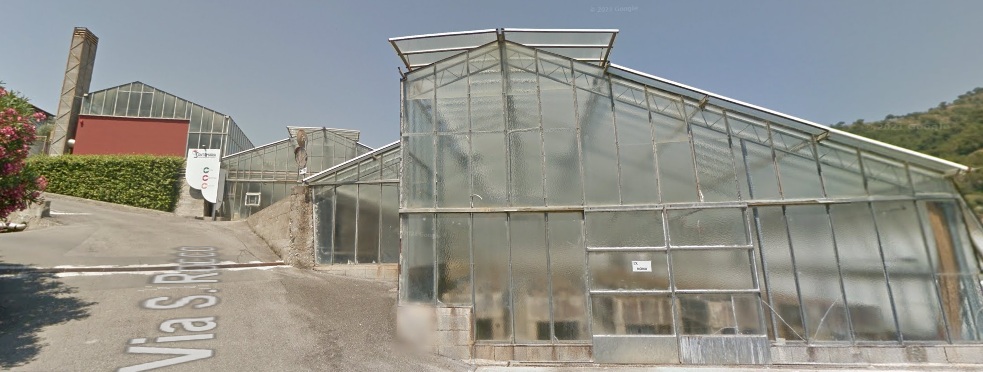
The grey area at the bottom of the image (surrounding the tunnel mouth) is a series of greenhouses. As shown below.
[Google Streetview, July 2019]

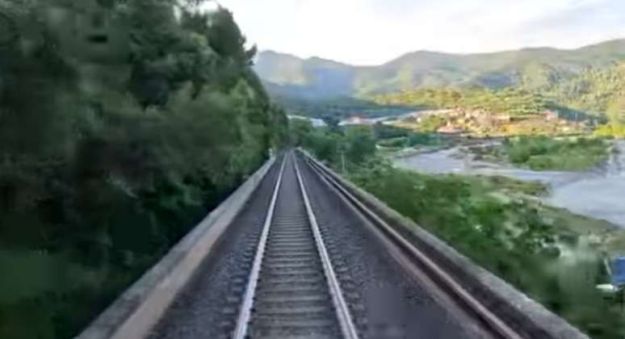
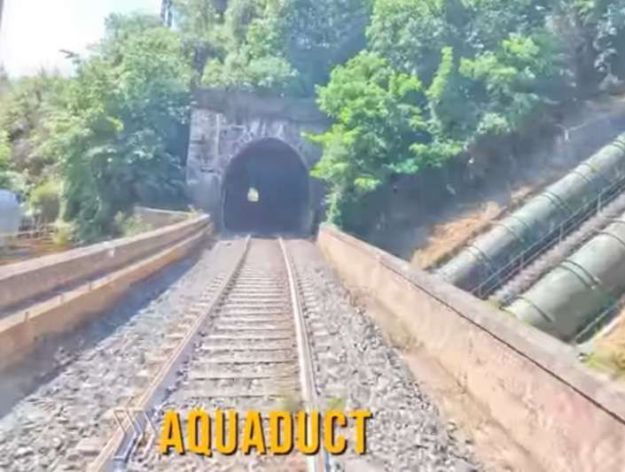
An overexposed photograph showing the view South from the southern portal of d’Allaveri Tunnel. The Aqueduct which carries water under pressure to Bevera’s hydroelectric plant can be seen on the right. The line bridges the penstock on three 5 metre arches before southbound trains enter Serro Soprano Tunnel ahead. [55]
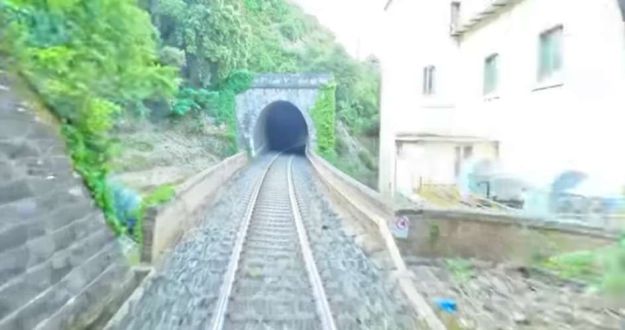
Another over-exposed view, this time facing North at the North portal of Serro Soprano Tunnel. The southern mouth of d’Allaveri Tunnel can be seen ahead.[35]
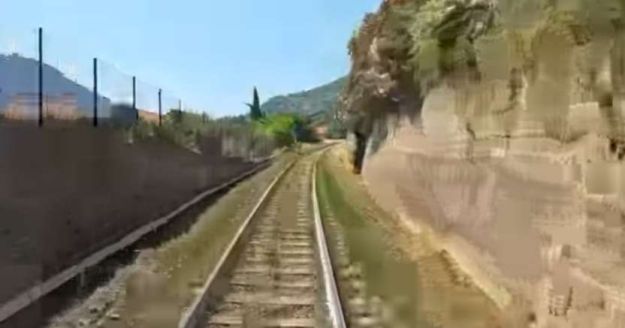
Looking South towards Bevera at the mouth of Serro Soprano Tunnel. [55]
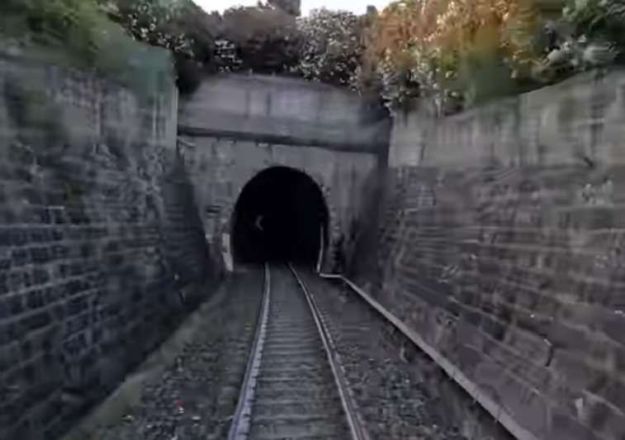
The South portal of Serro Soprano Tunnel. [35]
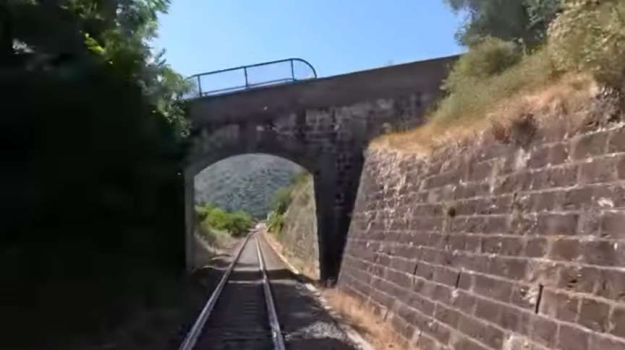
An accommodation bridge North of Bevera Railway Station, seen from the cab of the Southbound service. [55]
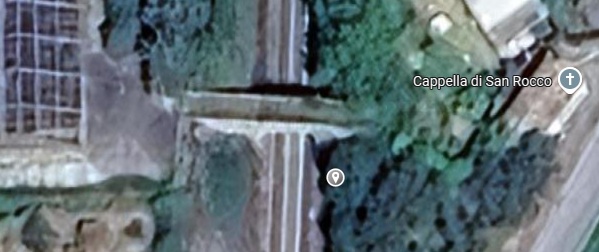
The accommodation bridge, seen from above. [Google Maps, August 2025]
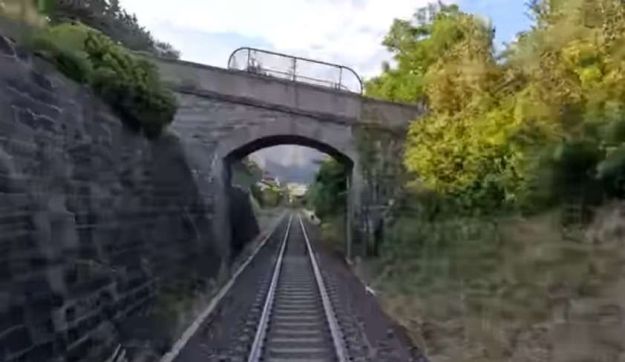
The same structure seen from the cab of the Northbound train. [35]

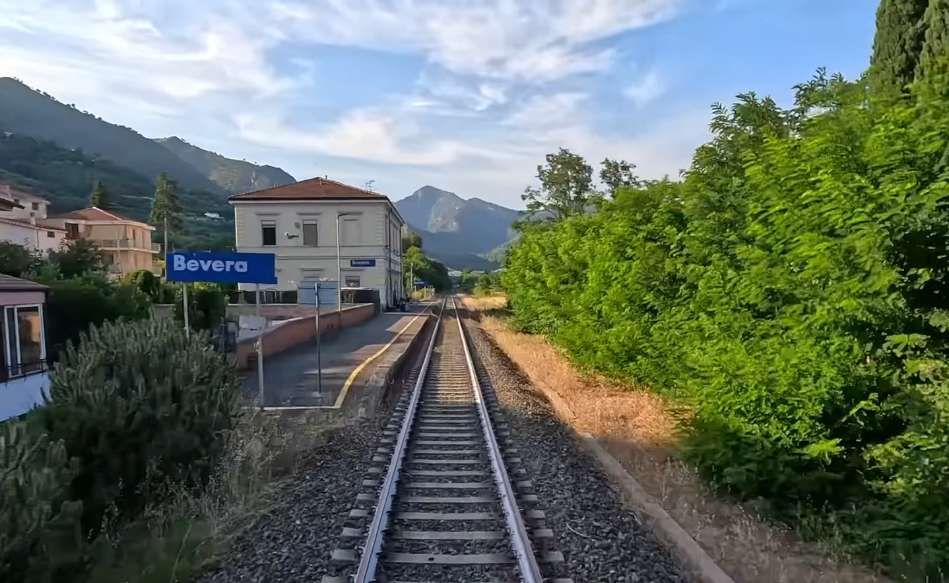
As we head South towards Bevera Railway Station, the valley of the Roia widens significantly and we enter the suburbs of Ventimiglia, of which Bevera is one part. Beverea Railway Station was built with a large “classically designed passenger building, two platform faces and and two freight tracks with a goods shed and loading platform.” [1: p121] In the 21st century Bevera is a single platform halt.
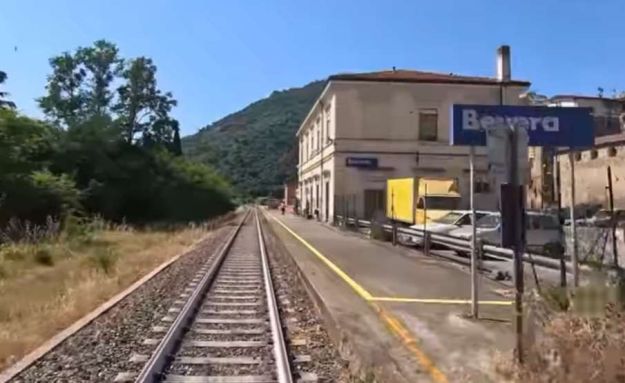
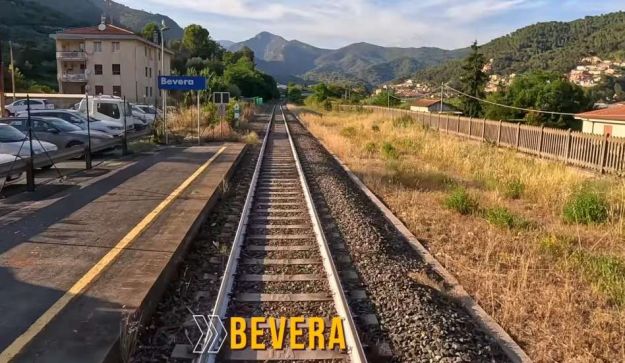
A Southbound train approaches Bevera Railway Station. [55]
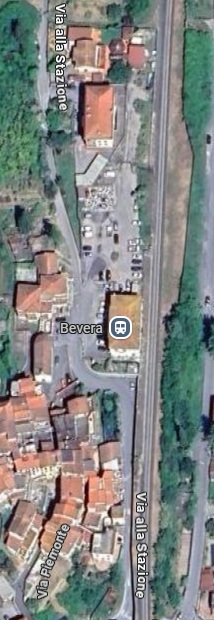
Bevera Railway Station seen from above. [Google Maps, August 2025]
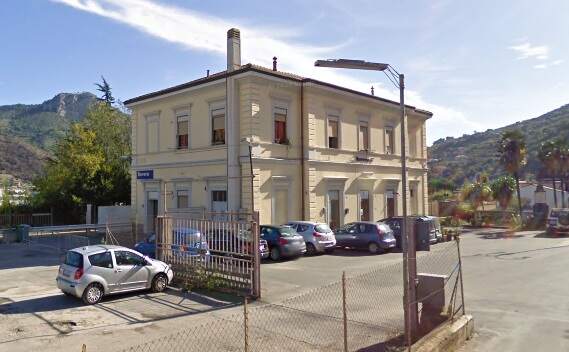
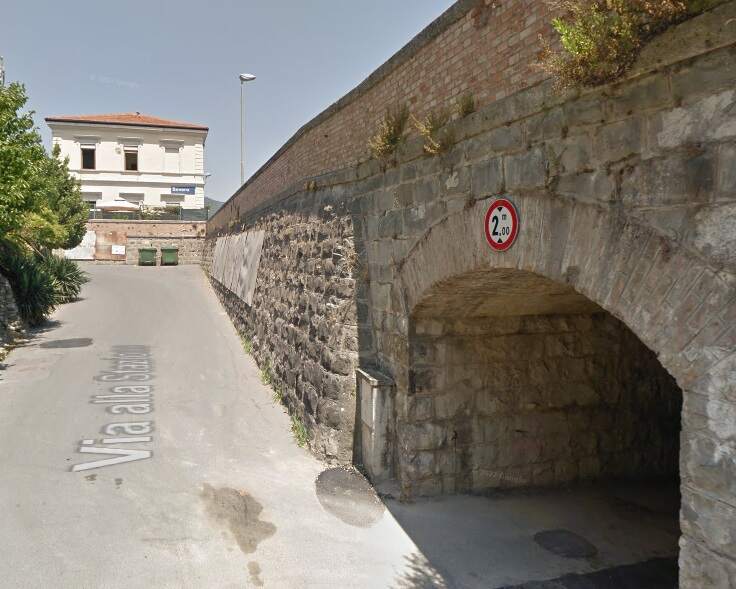
Bevera Railway Station building and forecourt seen from the Northwest. [Google Streetview, October 2010]
Bevera Station building seen from the South adjacent to a low underpass under the railway. [Google Streetview, July 2019]
A second underpass just a little further to the South. [Google Streetview, August 2021]

The Northbound service sits at Bevera Railway Station which is a single platform halt. [35]
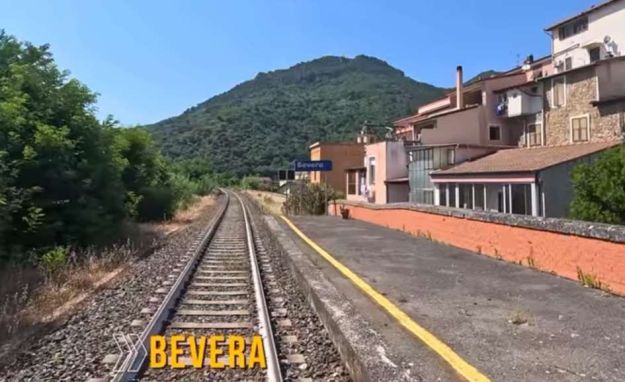
The Southbound train, stationary at Bevera Railway Station. [55]
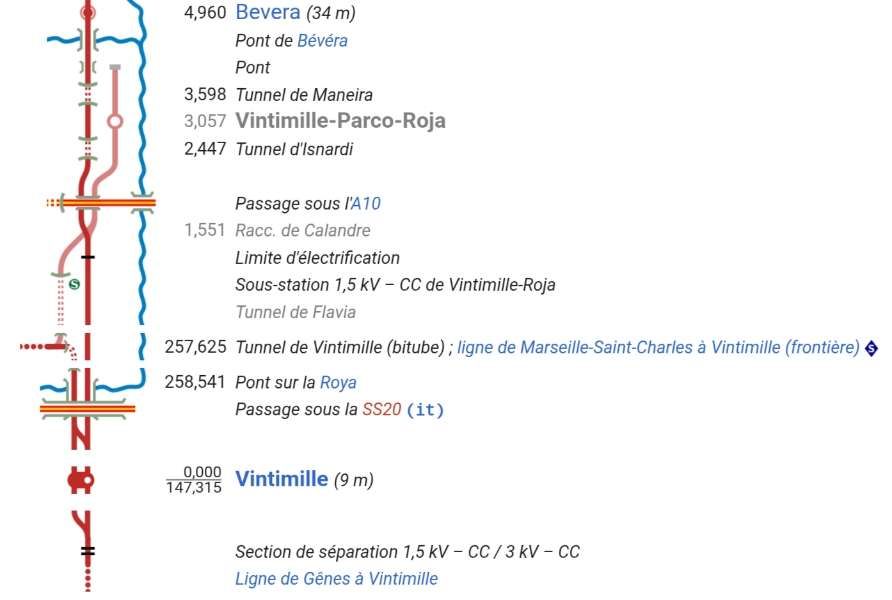
Bevera to Ventimiglia. [22]

Looking North into the Bevera Station site

South of Bevera Railway Station the railway bridges the Bevera River (Torrente).
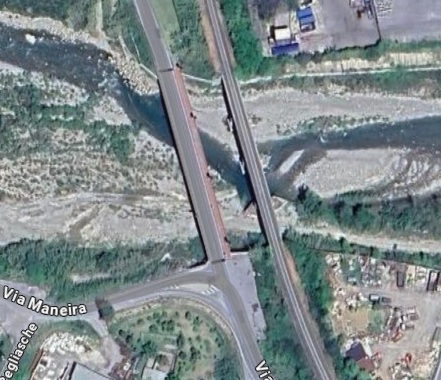
The bridge over the Bevera Torrente. The river is quite a significant tributary to the Roia (Roya). [Google Maps, August 2025]
The railway bridge over the Bevera, seen from the main road to the East. The viaduct has four16.35 metre arches and spans the Bevera close to its confluence with the Roia. [Google Streetview, August 2021][1: p119]

The same bridge, seen from the Northwest. [Google Streetview, August 2021]
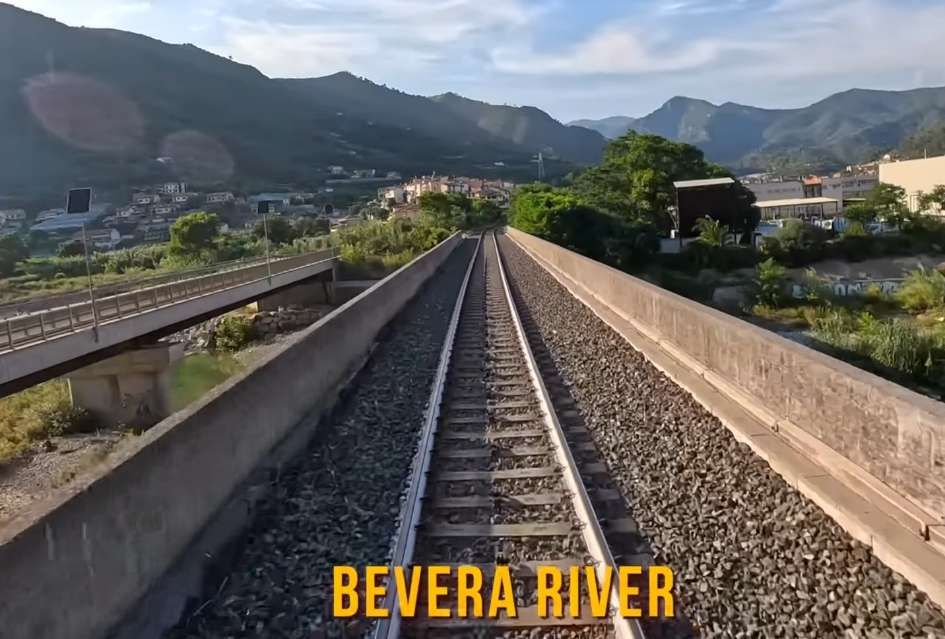
The view North along the line from the cab of a Northbound train as it crosses the bridge over the Bevera River. [35]

The line runs on to the South on embankment through the suburbs of Ventimiglia.
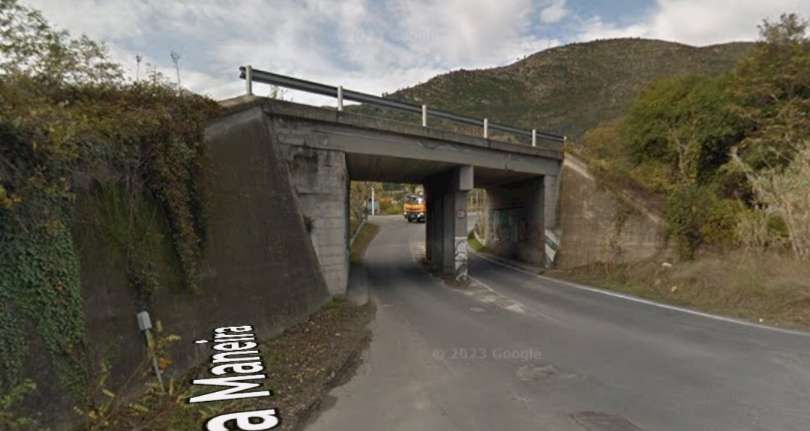
The bridge over Via Madeira seen from the East. [Google Streetview, August 2021]
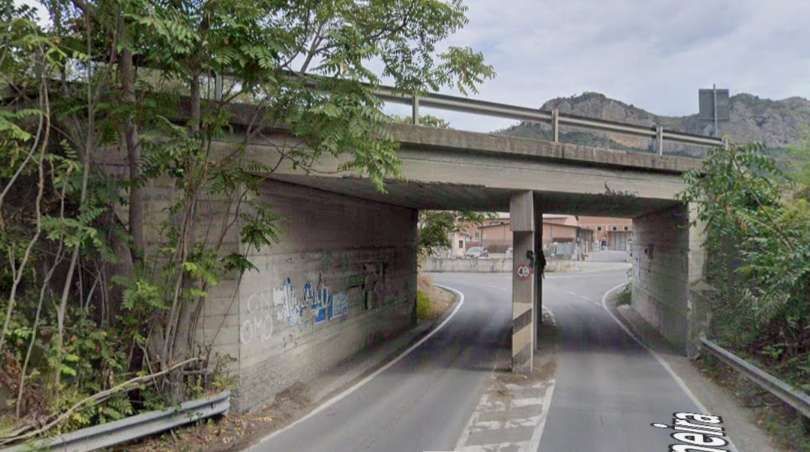
The same bridge seen from the West. [Google Streetview, August 2021]
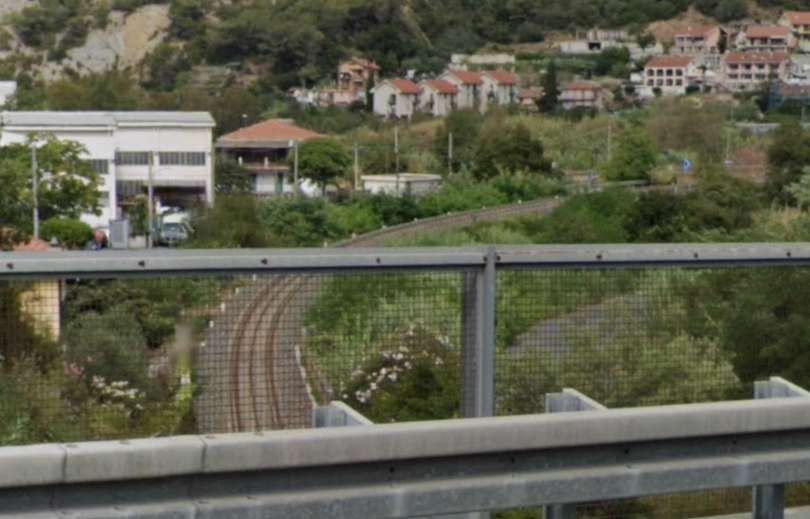
Looking back along the line towards Bevera Railway Station from Pont Bevera (Viadotto Autoporto). [Google Streetview, August 2021]
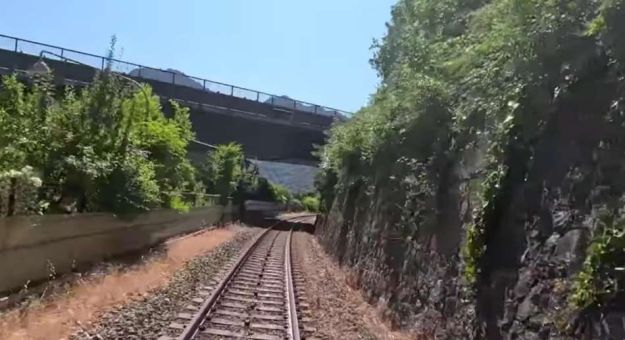
Facing towards Ventimiglia this image taken from the cab of the Ventimiglia-bound service looks through Pont Bevera (Viadotto Autoporto). [55]
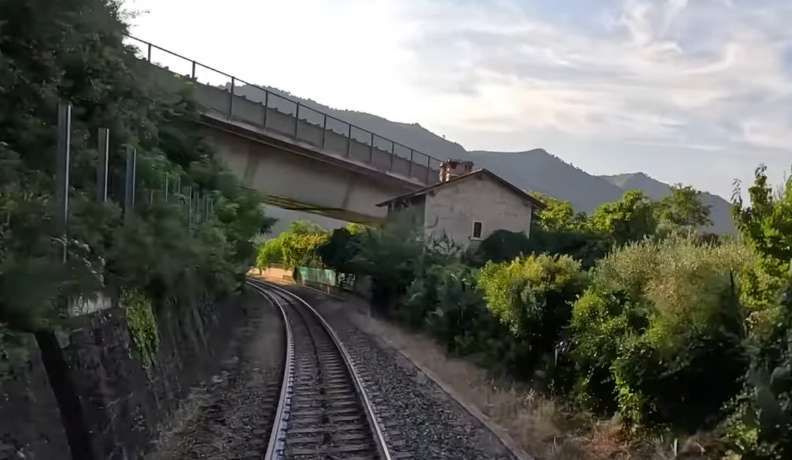
Facing North towards Bevera and looking under Pont Bevera (Viadotto Autoporto). [35]
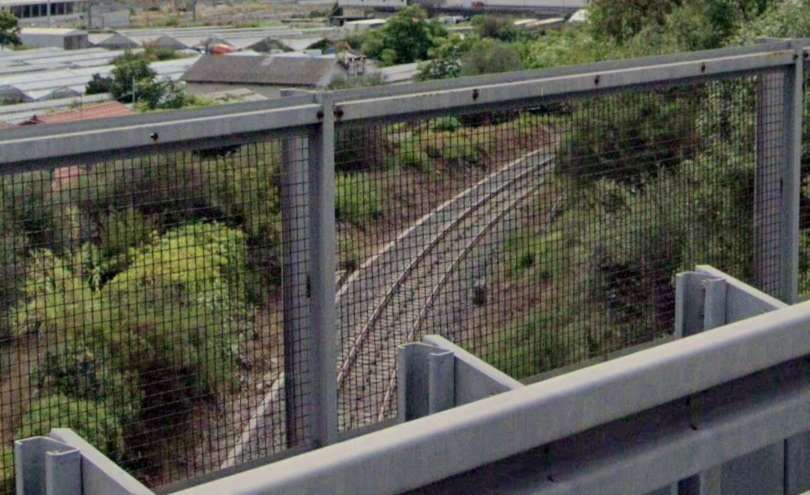
Looking ahead along the line towards Ventimiglia Railway Station from Pont Bevera (Viadotto Autoporto). [Google Streetview, August 2021]
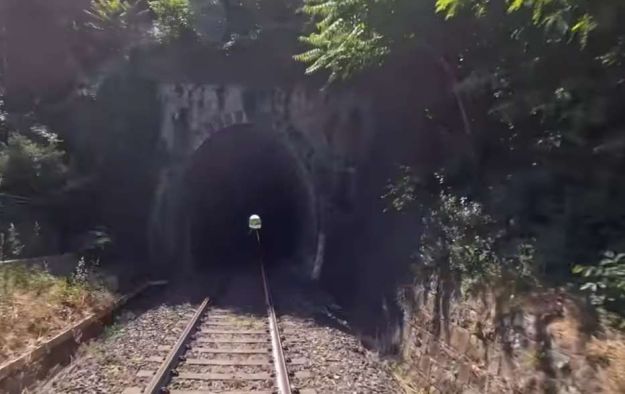
The North portal of Maneira Tunnel (171 metres in length) is in shadow and difficult to make out from the cab of the ventimiglia-bound train. [55][1: p119]
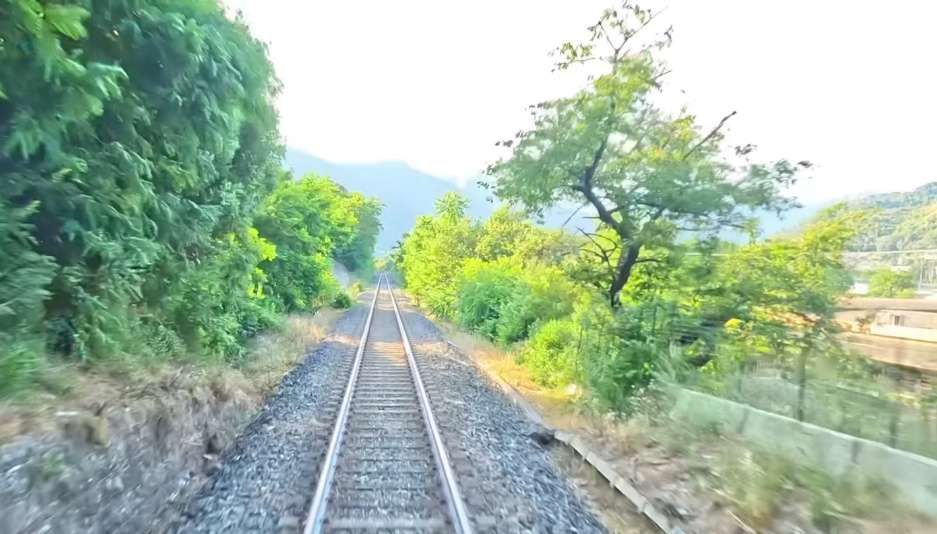
Turning through 180°, this is the view North from the cab of a Northbound service as it leaves the North portal of Madeira Tunnel. [35]
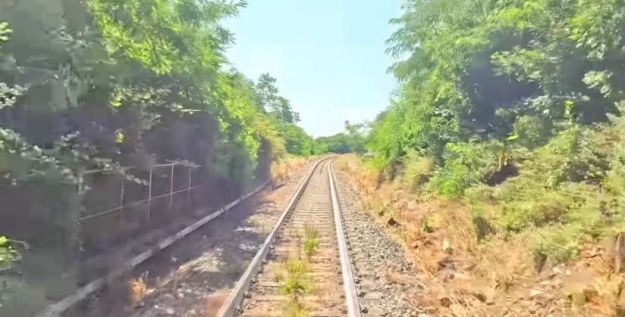
The view South from the South portal of Maneira Tunnel. [55]
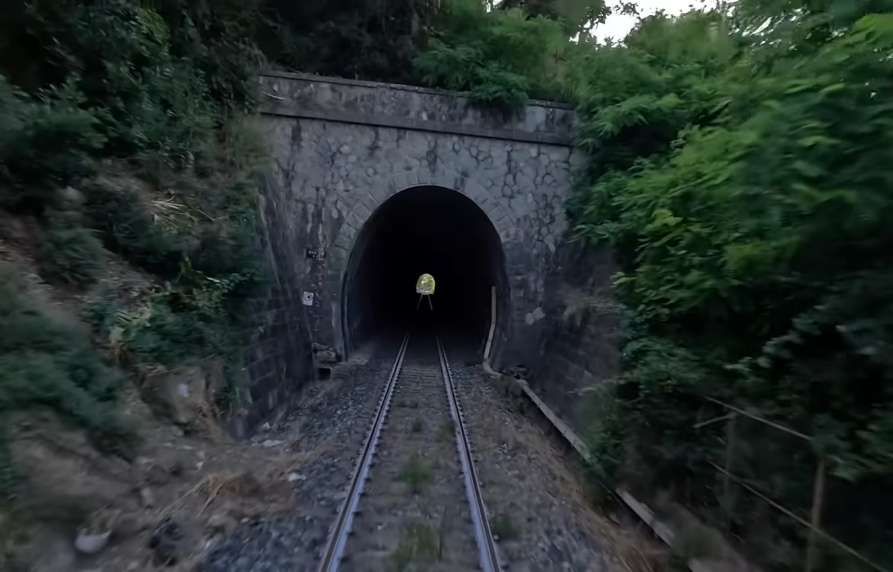
Turning through 180°, this is the South portal seen fr

The line continues on embankment with low height underpasses to provide vehicular access under the line as shown below. [Google Streetview, August 2021]…
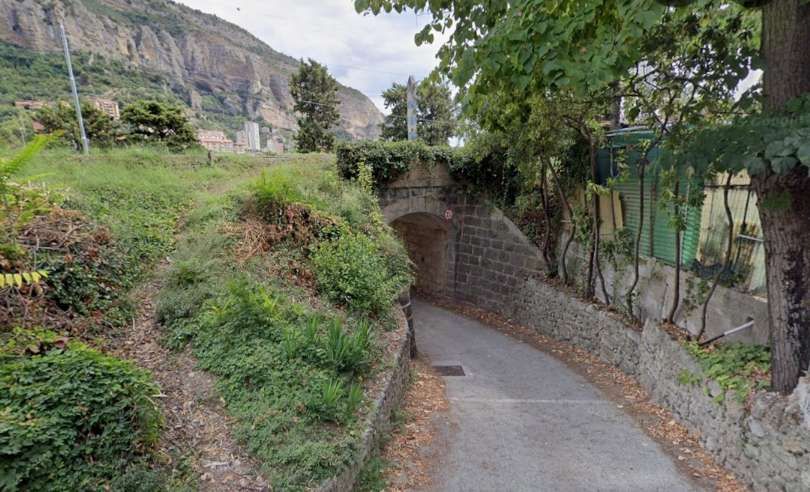
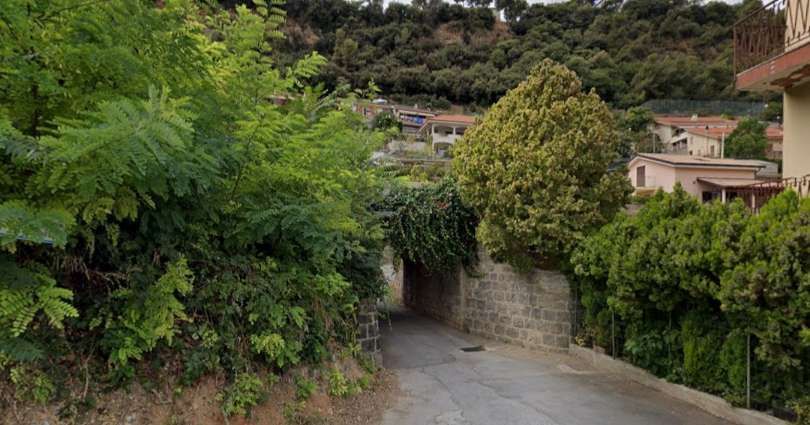
In between the second and third underpasses shown above the line passes through d’Isnardi Tunnel (168 metres in length). The North portal is so much in shade that the view from the cab of the Ventimiglia-bound service does not provide any detail. [55] That is the first image below…
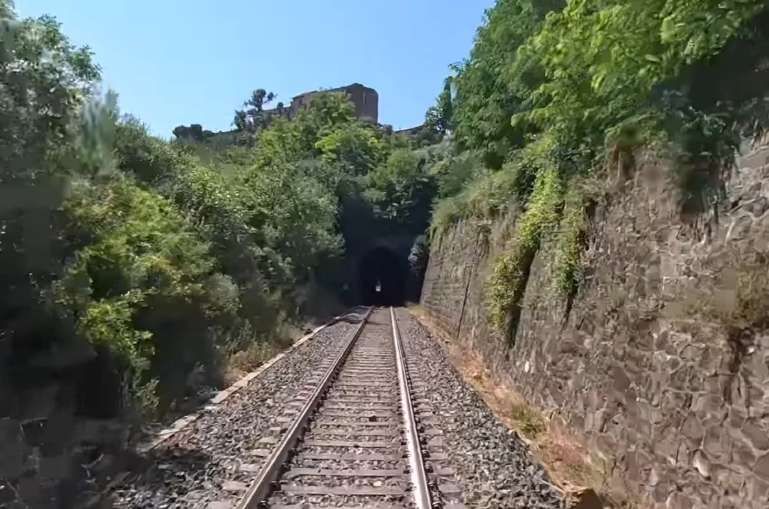
The North portal of d’Isnardi Tunnel is so much in shade that no details can be made out from the cab of the Ventimiglia-bound service. [55]
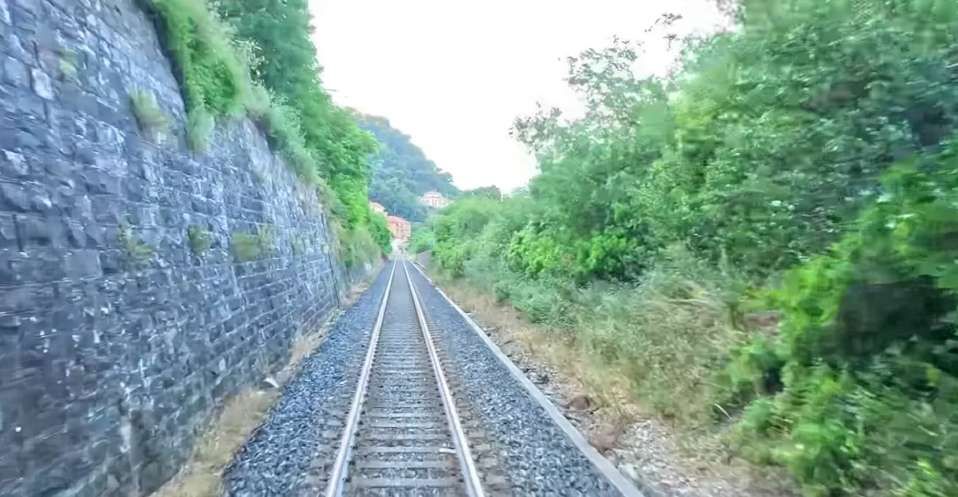
Turning through 180° this is the view North from the North portal of the tunnel. [35]
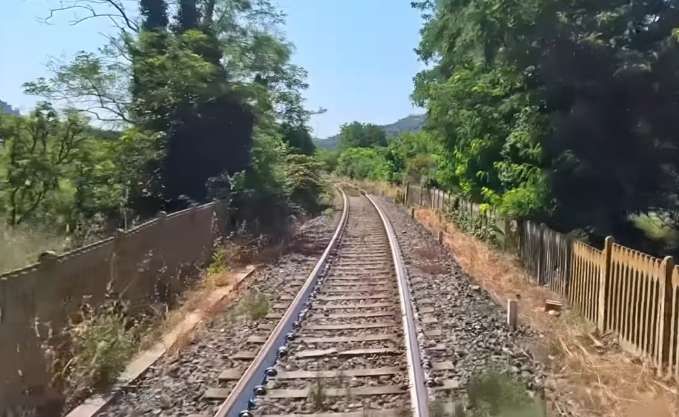
The view South from the South portal of d’Isnardi Tunnel. [55]
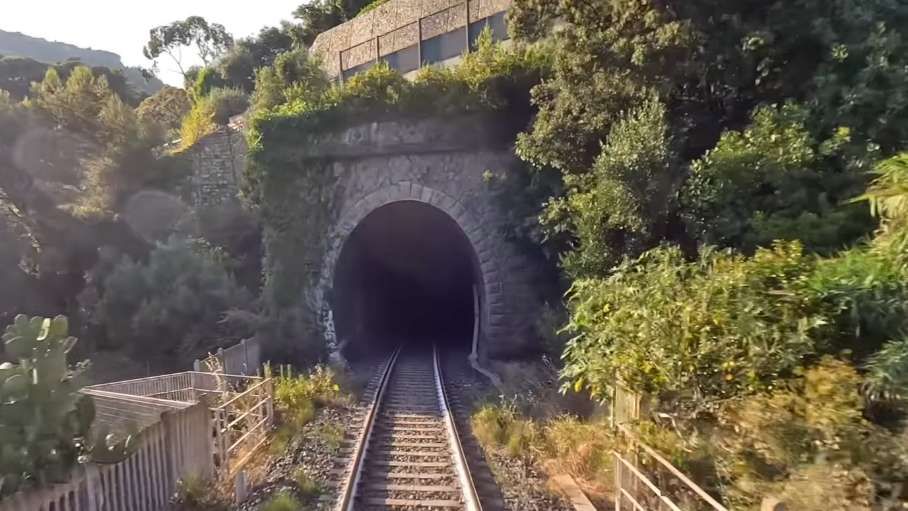
Turning through 180° the South portal is seen from the cab of a Northbound service. [35]

The next few images come from above the level of the line further to the South – the first two from alongside to the West of the line and then from over bridges. ….
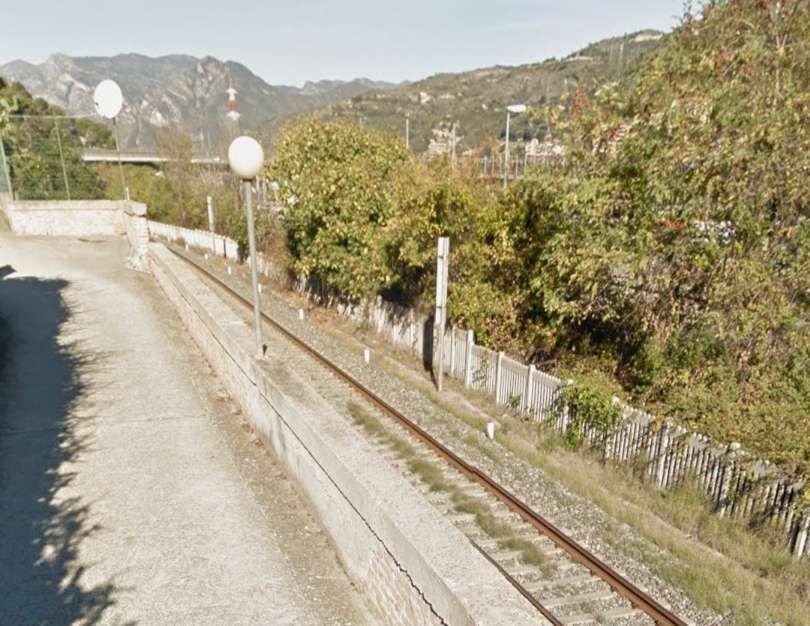
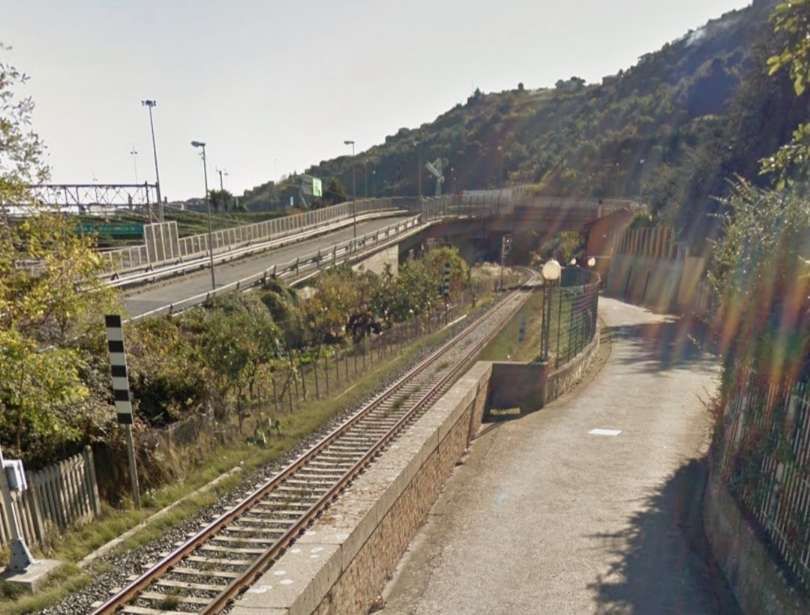
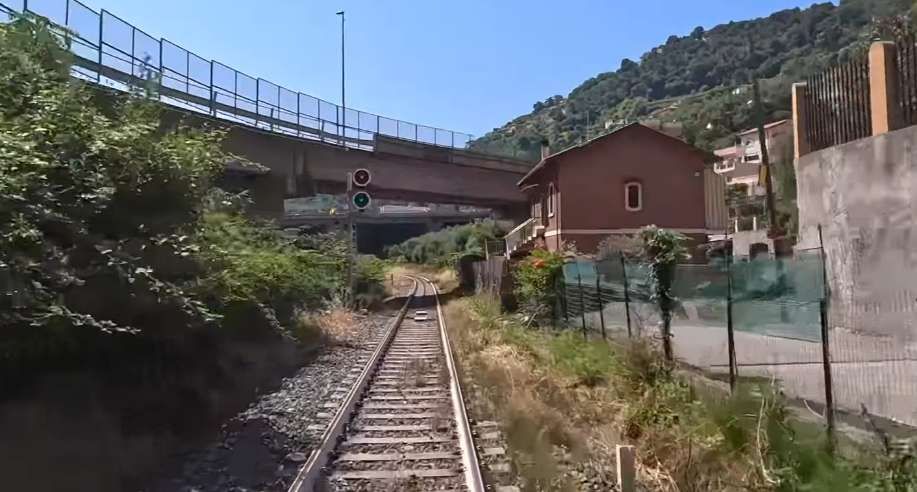
The first two of the images above look back along the line and then forward towards Ventimiglia Railway Station from Via Peglia. [Google Streetview, November 2011] The second pair of images look back and forward along the line from the bridge carrying Via Gallardi over the line. [Google Streetview, August 2021] The final par of images look back (across a curve in the line) and then forward along the line from the E80 (close to the toll booths). In the first of this pair of images the bridge carrying Via Gallardi over the line can be seen. [Google Streetview, July 2019]

The next two images show the bridge carrying Via Gallardi over the line. [55][35]…
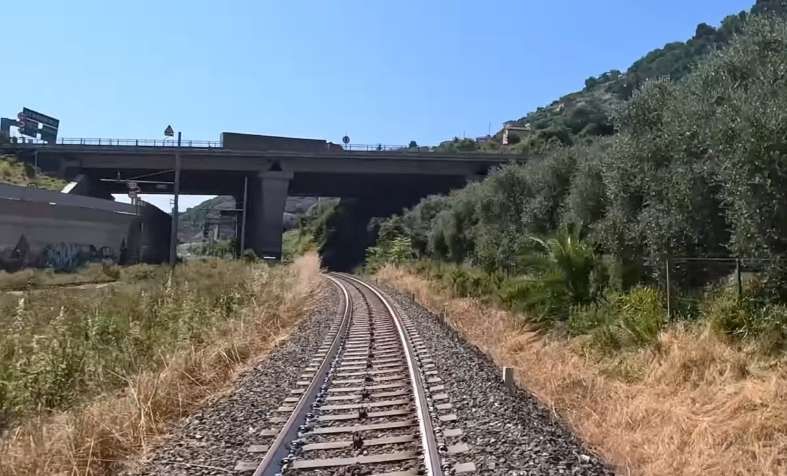
This next pair of photos show the overbridge which carries the E80. [55][35] …
The next batch of photos continue towards Ventimiglia Railway Station. …
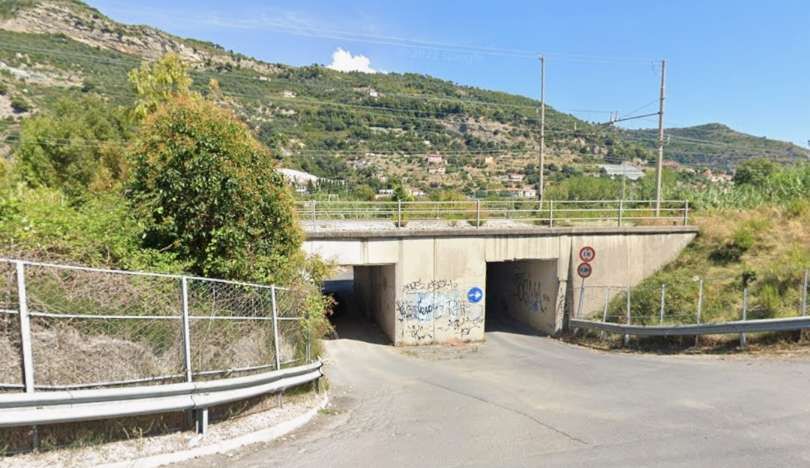
Two further underpasses are shown in the first two images above, the second pair of images are taken from the bridge carrying the SS20 over the line, the first looks back to the West towards the point where the double-track line from Nice begins to run alongside the single-track line from Cuneo. The second looks forward from the same bridge towards Ventimiglia Railway Station. The last two images are underpasses that the 3 lines cross on their way East. [Google Streetview, September 2024]

A cab level view of the diverging tracks seen in the third of the six views in the gallery above. The double-track line heading towards Nice diverges to the left. It is just approximately 6 kilometres to the international border. [35]

The next pair of images show the bridge carrying the SS20 as seen from cabs on services to and from Cuneo. [55][35] The first faces towards Ventimiglia, the second towards Bevera. …

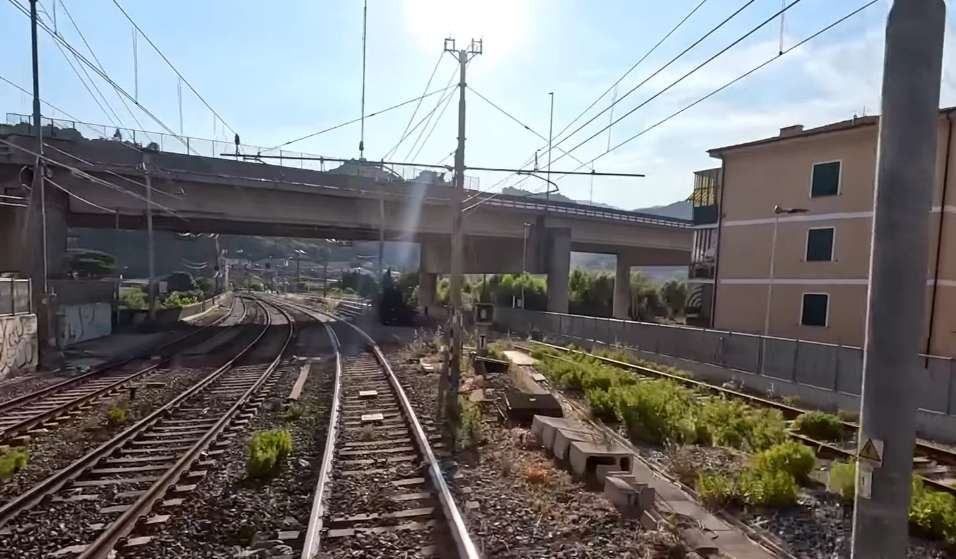
The next three images show the final approach into Ventimiglia Railway Station. [55] …
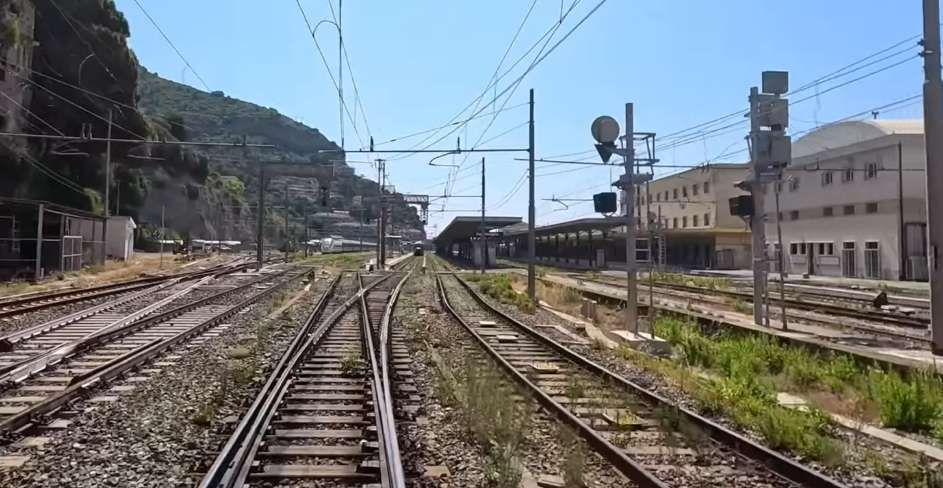
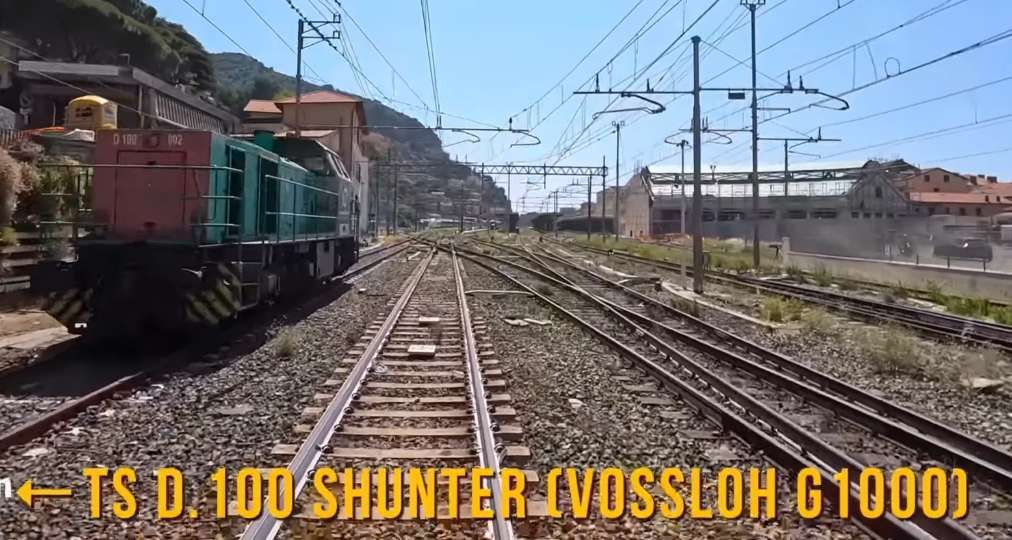
The middle image above shows a shunter idling in a siding alongside the main running lines – TS D100 Shunter [Vossloh G1000 BB]. The Vossloh G1000 BB is a class of off-centre cab diesel-hydraulic B’B’ 4 axle locomotives built by Vossloh in Kiel since 2002. The class is based upon the standard Vossloh locomotives design, and they are a higher powered development of the Vossloh G800 BB which were produced mainly for the Austrian Federal Railways, with a 1.1 MW (1,500 hp) MTU engine replacing the 0.8 MW (1,100 hp) Caterpillar engine in the G800; as a result the front engine compartment is enlarged, whilst other features: bogie frame and overall dimensions remain the same. [27]
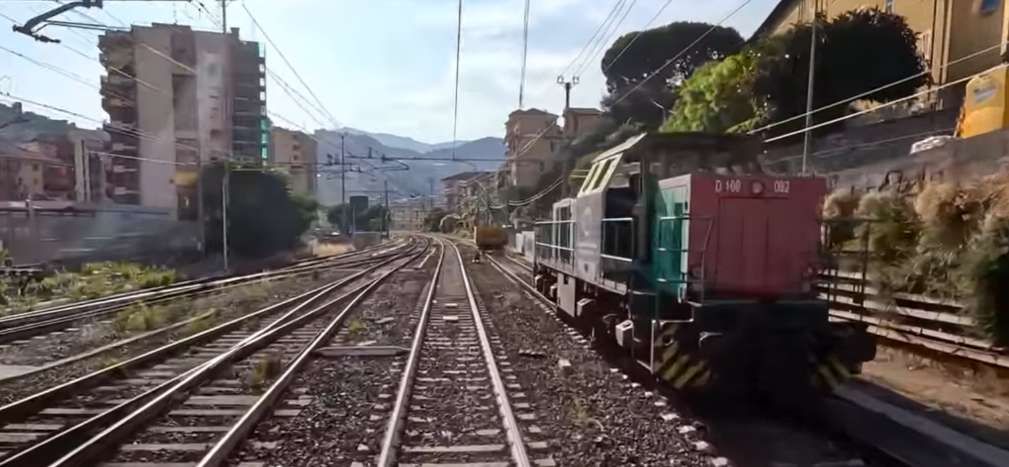
Another view of the TS D100 Shunter [Vossloh G1000 BB], this time from the cab of the Cuneo-bound service. [35]
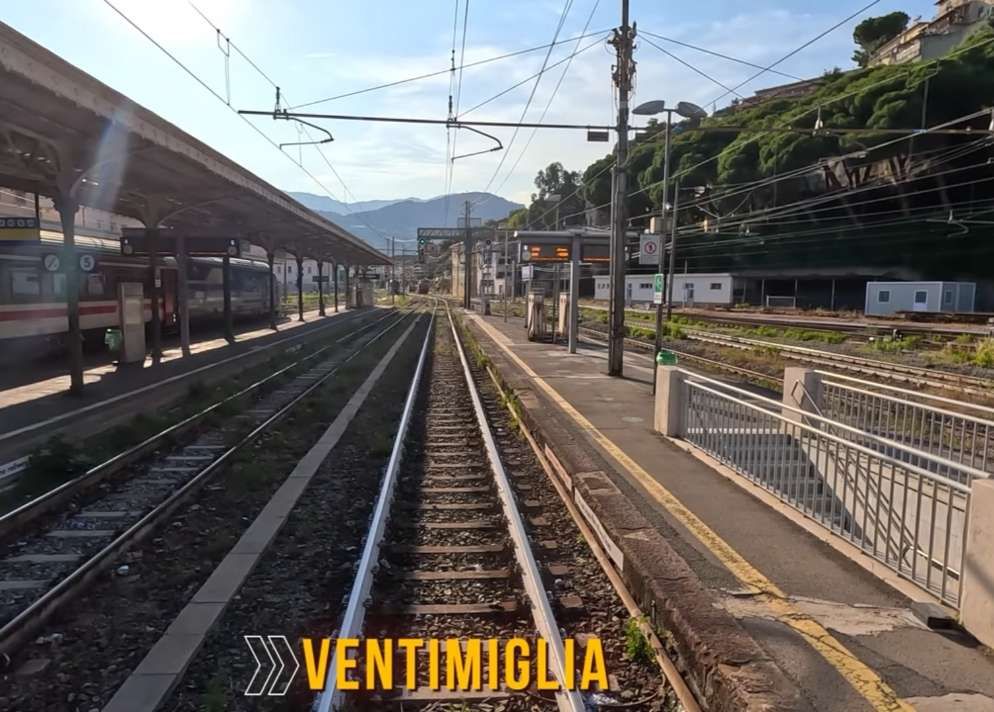
Looking Northwest from the cab of a Cuneo-bound train about to depart from Ventimiglia Railway Station. [35]
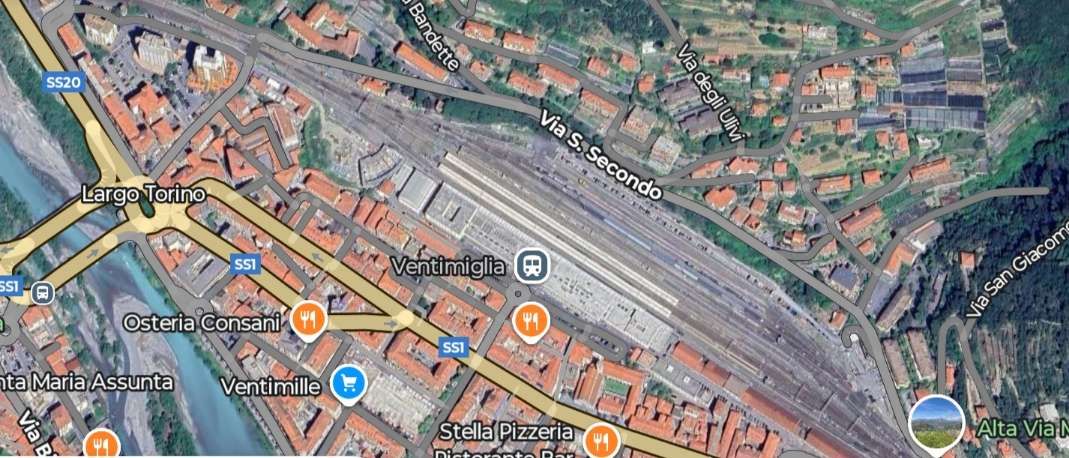
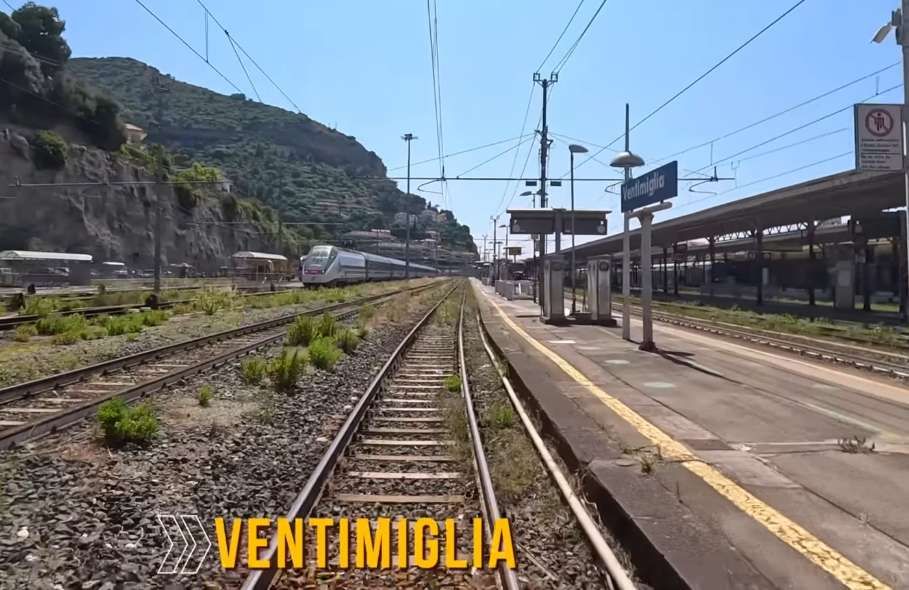
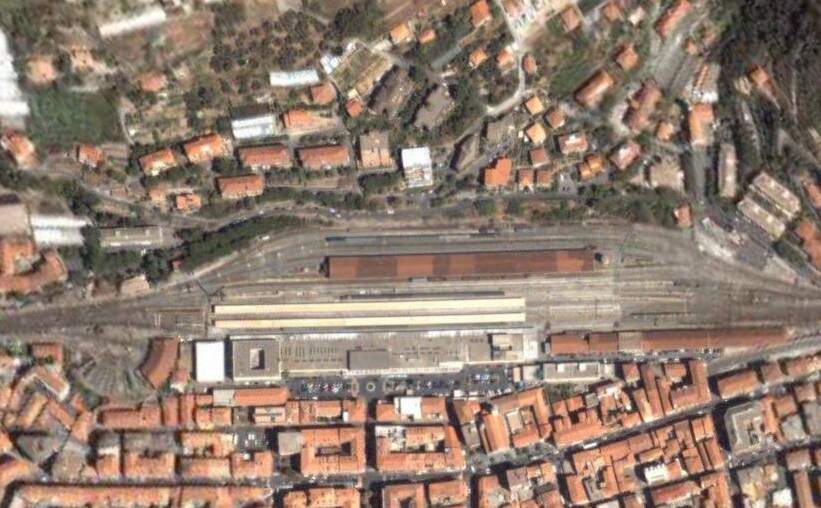
Ventimiglia Railway Station is on a Northwest to Southeast axis. [Google Maps, August 2025]

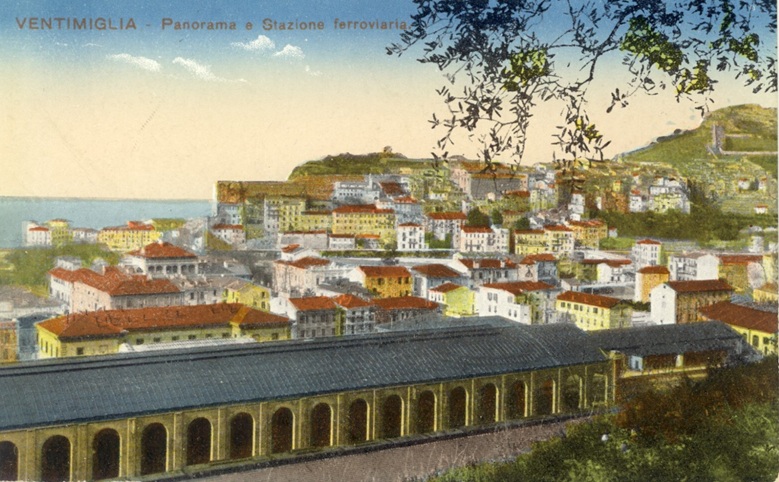
A postcard view of Ventimiglia taken from the hillside to the Northeast of the Railway Station which features in the foreground of the image. [44]
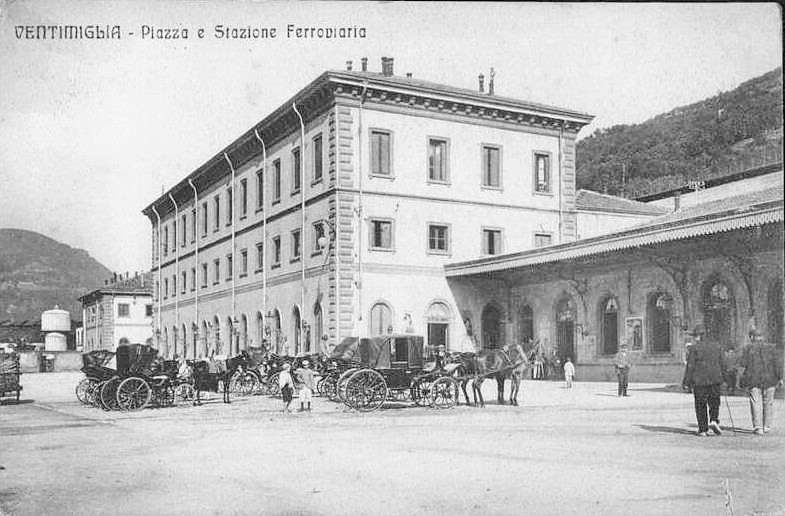
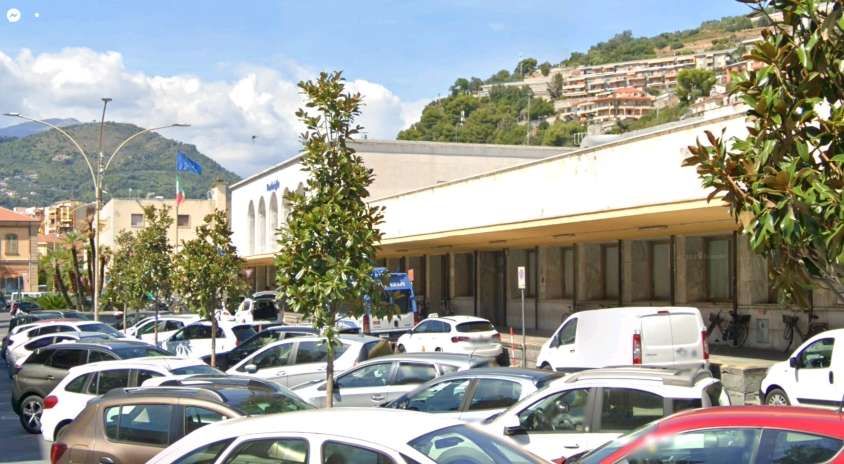
Ventimiglia Railway Station in very early days, © Public Domain. [28]
The station in the 21st century, seen from approximately the same location. This building was constructed after WW2. [Google Streetview, August 2021]
This satellite image dated 2006 from Google shows: on the left, the abandoned locomotive shed at Ventimiglia; the lighter coloured main station building below the centre of the image; and other railway buildings with red roofs. [45]

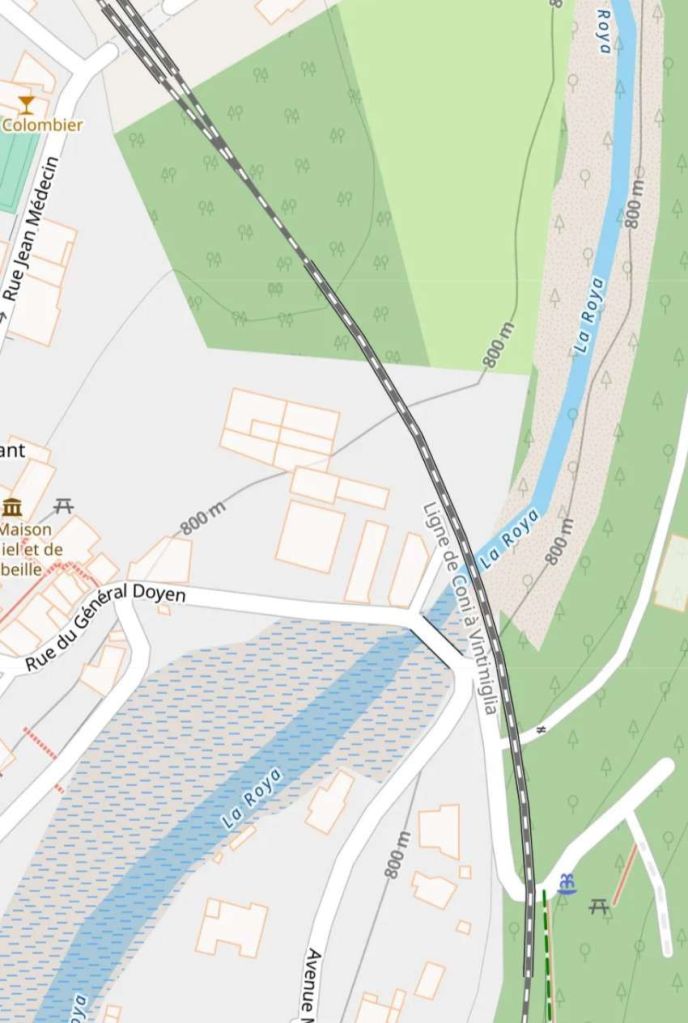
Banaudo et al write that “the single track of the Col de Tende line runs alongside the Nice double track for a few hundred metres. [Initially] they crossed the Roya River together on a six-span metal viaduct, which was soon replaced by a new structure with eight 17-metre stone arches. Immediately beyond the bridge, the two routes separate and the Cuneo route climbs up the right bank of the river, at a gradient of 13 mm/m, the valley is still relatively wide. A bundle of three service tracks called Scalo Roia is located to the left of the main track. The Isnardi tunnel (168 m long) and Maneira tunnel (171 m long) precede a four-arch viaduct (with 6-metre arches).” [1: p119] This description assumes that the line is followed West out of Ventimiglia Railway Station.
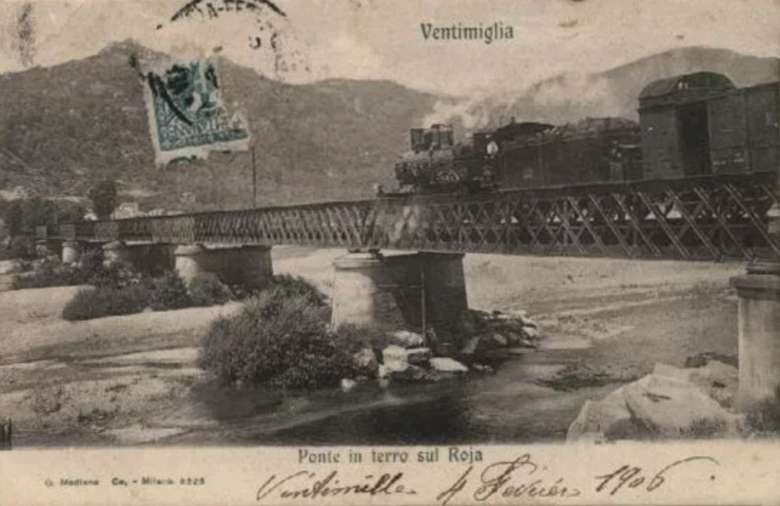
The earliest rail bridge over the River Roia at Ventimiglia. This single track structure was widened
The early (widened) metal bridge carrying the Nice line and the Cuneo line over the Roia in Ventimiglia, seen from the East, © Public Domain. [28]
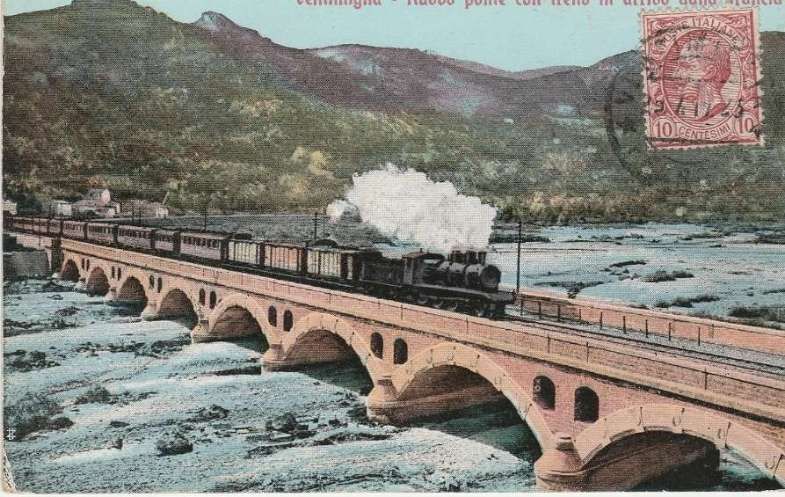
The replacement stone arch viaduct. The postcard was posted in 1917. [47]
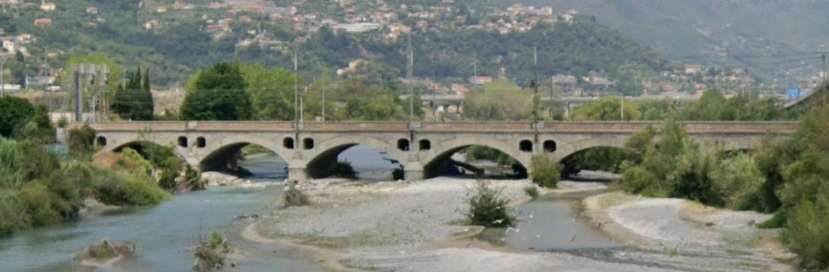
The same elevation of the bridge in the 21st century, viewed from the next structure downstream. [Google Streetview, July 2021]
The upstream elevation of the same bridge, in 1955. [48]
The upstream elevation of the same bridge, seen from the Northeast. The high-level structure carries the SS20 over the railway line. The upstream elevation of the river bridge is a modern extension to the second bridge which comprised eight 17 metres stone arches. [Google Streetview, July 2021]

Banaudo et al comment that while construction was just beginning between Breil and the southern border, the work begun in 1908 by the Italian companies from the coast was nearing completion. While awaiting the connection to France, the FS decided to operate the Ventimiglia-Airole section (11.970 km), which entered service on 16th May 1914. The service was provided by three round trips, including two local passenger trains and one mixed train, which covered the entire route in about thirty minutes uphill and twenty-five minutes downhill. Traction was provided by three-axle 030 locomotives with separate tenders, Group 320 (formerly the 3600 of the Rete Mediterranea), based to the newly created Savona depot.” [1: p142]

In France, WWI caused the cessation of all work on the line and in the aftermath of the conflict, “the resumption of construction proved very difficult. The PLM’s construction department received only meager allocations from the state, with priority funding being allocated to the recovery of the disaster-stricken regions of the northeast.” [1: p138]

On site, the years of inactivity had allowed serious deterioration, particularly of the tunnels on the unopened line. Following a three-day inspection tour of the entire line, the French decided to begin work once again.

The contractors made a significant investment in manpower and materials at the beginning of 1920 but discovered that rather than dealing with the PLM, the works would be directly funded by the government. The government determined that the budget for the work on French soil would be reduced from 104 to 75 million Francs and indicated that the maximum spend in 1920 would be 17 million Francs. This inevitably led to redundancies and to slower progress of the works. [1: p140]

When the authorities indicated in June 1920, that “only 700,000 Francs of credit remained to complete the year, … the elected officials of the Alpes-Maritimes immediately rushed to Paris to meet with representatives of the Ministry and the PLM management. Following discussions, a new budget was allocated by the State for railway construction. The PLM had a budget of 41 million Francs, 25 of which were allocated to the Nice-Cuneo line. Work could [continue], but the engineers and contractors in charge of it would have to take into account the irregular arrival of funds until the end when organizing their work.” [1: p140]

Work on the Nice to Breil-sur-Roya line and the remaining length of the line between Ventimiglia and Breil ran in parallel. The increased budget meant competition to attract staff was strong and people had to be hired from Italy, Spain, Portugal and Morocco. Stonemasons were in particularly short supply. We will probably see more about what this meant for the work when we follow the line from Breil-sur-Roya to Nice.

Banaudo et al note that in the early 1920s the line was opened between Ventimiglia and Airole for passengers and was used also to supply the French construction site on the length of the line between Breil-sur-Roya and Piena (Piene).

From Breil to the southern border, the [railbed/formation] was passable by 1921 and the final track was immediately laid, while the FS did the same between Airole and Piena on the section removed during the war. On 30th January 1922, the Italian and French rails were finally connected on the Riou bridge, and the Borie company obtained  from then on the authorization to directly route its materials from Nice to Breil by rail.” [1: p142]

Once the line opened fully between Ventimiglia and Cuneo, the line “retained the Ventimiglia-Airole service created before the war, while on the Cuneo San-Dalmazzo-di-Tenda line, the timetable included three daily three-class buses and a seasonal train running on public holidays from July to September. The 58 km journey took 2 hours 30 minutes in the north-south direction and 2 hours 10 to 15 in the opposite direction.  This service included one less return journey than in 1915, because a fast Cuneo Nice bus connection was introduced in 1921 following an agreement between the FS and the Compagnia Generale dei Tramways Piemontesi (CGTP), to avoid the inconvenience of transhipment while waiting for the railway to be fully operational.” [1: p143-146]

In December 1923 it was agreed that on the length of line between the two borders, “all trains … would be hauled by the FS, including maintenance trains; in the event that they had to be exceptionally handled by a French locomotive, the latter would be accompanied by a pilot from the FS. The San-Dalmazzo Piena section would be equipped with Morse-type telegraph devices. The protection signals for Breil station on the Fontan-Saorge and Piène sides would be Italian, but the departure signals for all directions would be the PLM-type. The organization of customs controls between San-Dalmazzo, Fontan-Saorge, Breil and Piena was also [agreed].” [1: p146]

Banaudo et al provide a significant series of photographs of the construction work on the lines between Cuneo, Nice and Ventimiglia which takes up a large proportion of Volume 1 of Les Trains du Col de Tende. The photographs and drawings are predominantly from the French lengths of the line. [1: p152-311] It is a very significant collection of images which stand as a superb tribute to the amazing work of the various contractors employed on the line.

Opening of the line from Cuneo to Ventimiglia to passenger traffic had to wait for the completion of all of the French construction work. “Finally in October 1928 the lines were all completed – the celebrations must have been fantastic events. At last the small towns and villages along the route had access to jobs, schools and universities, cultural activities, hospitals … everything the cities had to offer.” [39]

The next article in this short series will look a the line heading out of Breil-sur-Roya towards Nice. It can be found here. [5]

References

  1. Jose Banaudo, Michel Braun and Gerard de Santos; Les Trains du Col de Tende Volume 1: 1858-1928; FACS Patrimoine Ferroviaire, Les Editions du Cabri, 2018.
  2. Jose Banaudo, Michel Braun and Gerard de Santos; Les Trains du Col de Tende Volume 2: 1929-1974; FACS Patrimoine Ferroviaire, Les Editions du Cabri, 2018.
  3. Jose Banaudo, Michel Braun and Gerard de Santos; Les Trains du Col de Tende Volume 3: 1975-1986; FACS Patrimoine Ferroviaire, Les Editions du Cabri, 2018.
  4. https://m.facebook.com/story.php?story_fbid=pfbid0eumWUFwJCPBGQUUtr3Apx72qr5cUhihwxpcFzDbkms3fta5zRXYZZLUozkAMmeKvl&id=1412933345657144, accessed on 5th December 2023. The Facebook Page, “L’Histoire de Menton et ses Alentours,” is the work of Frank Asfaux, https://www.facebook.com/franckasfaux06, accessed on 4th December 2023.
  5. https://rogerfarnworth.com/2025/08/29/the-railway-between-nice-tende-and-cuneo-part-6-breil-sur-roya-to-lescarene/
  6. Not used.
  7. Not used.
  8. https://commons.m.wikimedia.org/wiki/File:Locomotiva_RM_3620.jpg, accessed on 17th August 2025.
  9. https://rogerfarnworth.com/2025/07/22/the-railway-from-nice-to-tende-and-cuneo-part-1.
  10. https://rogerfarnworth.com/2025/07/26/the-railway-from-nice-to-tende-and-cuneo-part-2.
  11. https://rogerfarnworth.com/2025/08/06/the-railway-from-nice-to-tende-and-cuneo-part-3-vievola-to-st-dalmas-de-tende
  12. https://rogerfarnworth.com/2025/08/16/the-railway-between-nice-tende-and-cuneo-part-4-st-dalmas-de-tende-to-breil-sur-roya
  13. https://www.openstreetmap.org/#map=15/43.93077/7.51647&layers=P, accessed on 18th August 2025.
  14. https://www.openstreetmap.org/#map=17/43.923820/7.520512&layers=P, accessed on 19th August 2025.
  15. https://www.openstreetmap.org/#map=16/43.91950/7.51623&layers=P, accessed on 20th August 2025.
  16. https://www.openstreetmap.org/#map=16/43.91231/7.51672&layers=P, accessed on 20th August 2025.
  17. https://maps.app.goo.gl/K4hzccr8VUYJHKFY8, accessed on 20th August 2025.
  18. https://maps.app.goo.gl/z72vMryPchvUUfKY9, accessed on 20th August 2025.
  19. https://maps.app.goo.gl/DPvnhXKP5nEfJ4Cs8, accessed on 20th August 2025.
  20. https://en.wikipedia.org/wiki/Belgian_Railways_Class_73, accessed on 21st August 2025.
  21. https://www.openstreetmap.org/#map=16/43.86646/7.56652&layers=P, accessed on 21st August 2025.
  22. https://fr.m.wikipedia.org/wiki/Sch%C3%A9ma_de_la_ligne_de_Coni_%C3%A0_Vintimille, accessed on 21st August 2025.
  23. https://www.openstreetmap.org/#map=15/43.85683/7.57327&layers=P, accessed on 22nd August 2025.
  24. https://www.openstreetmap.org/#map=15/43.83408/7.57936&layers=P, accessed on 22nd August 2025.
  25. https://commons.m.wikimedia.org/wiki/File:Airole_vecchia_staz_ferr.jpg, accessed on 23rd August 2025.
  26. https://www.vermenagna-roya.eu/wp-content/uploads/2019/06/BR-1-I-f-4-gare-pont-fs-de-piene.pdf, accessed on 23rd August 2025.
  27. https://en.wikipedia.org/wiki/Vossloh_G1000_BB, accessed on 24th August 2025.
  28. https://www.marklinfan.com/f/pop_printer_friendly.asp?TOPIC_ID=3305, accessed on 24th August 2025.
  29. https://www.facebook.com/photo.php?fbid=619477608613399&id=156990911528740&set=a.468384633722698, accessed on 25th August 2025.
  30. https://www.stagniweb.it/foto6.asp?File=roya3&Inizio=4&Righe=10&InizioI=1&RigheI=50&Col=5, accessed on 25th August 2025.
  31. https://www.stagniweb.it/cart5/cbreil07.jpg, accessed on 25th August 2025.
  32. https://commons.wikimedia.org/wiki/File:Croisement_entre_une_Caravelle_X-4500_et_un_Minuetto_devant_la_gare_de_Breil-sur-Roya.JPG, accessed on 25th August 2025.
  33. https://www.wikidata.org/wiki/Q1948555, accessed on 25th August 2025.
  34. https://structurae.net/en/media/324516-piene-station-and-piene-station-tunnel-nbsp, accessed on 25th August 2025.
  35. https://www.youtube.com/watch?v=_qX8v5gceVU, accessed on 31st July 2025.
  36. https://www.wikidata.org/wiki/Q3095820#/media/File:Olivetta_san_michele_train_station.png, accessed on 25th August 2025.
  37. https://www.stagniweb.it/altro2/large4/tend0617.jpg, accessed on 25th August 2025.
  38. https://www.stagniweb.it/foto9/tend8304.jpg, accessed on 25th August 2025.
  39. https://ventimigliaaltawords.com/2013/10/14/all-steamed-up-about-the-ventimiglia-cuneo-rail-link/, accessed on 5th August 2025.
  40. Franco Collidà, Max Gallo & Aldo A. Mola; CUNEO-NIZZA History of a Railway; Cassa di Risparmio di Cuneo, Cuneo (CN), July 1982.
  41. Franco Collidà; 1845-1979: the Cuneo-Nice line year by year; in Rassegna – Quarterly magazine of the Cassa di Risparmio di Cuneo; No. 7, September 1979, pp. 12-18.
  42. Stefano Garzaro & Nico Molino; THE TENDA RAILWAY From Cuneo to Nice, the last great Alpine crossing; Editrice di Storia dei Trasporti, Colleferro (RM), EST, July 1982.
  43. SNCF Region de Marseille; Line: Coni – Breil sur Roya – Vintimille. Reconstruction et équipement de la section de ligne située en territoire Français; Imprimerie St-Victor, Marseille (F), 1980.
  44. https://www.picclickimg.com/images/g/QSkAAOSw4Ihlu1Ul/s-l1600.jpg, accessed on 25th September 2025.
  45. https://www.marklinfan.net/stazione_ventimiglia.htm, accessed on 25th August 2025.
  46. https://ebay.us/m/Ne0trP, accessed on 25th August 2025.
  47. https://www.geneanet.org/cartes-postales/view/7792915#0, accessed on 25th August 2025.
  48. https://casamaini.altervista.org/ancora-treni, accessed on 25th August 2025.
  49. https://youtu.be/rLXAEz-n4mM?si=RLQC31jynGeM_lQR, accessed on 26th August 2025.
  50. Not used.
  51. Not used.
  52. Not used.
  53. Not used.
  54. F. Honore; Le Rail a Travers Les Alpes: De Nice a Coni par la Voie Ferrée; L’Illustration, No. 4470, 3rd November 1928, p499.
  55. https://www.youtube.com/watch?v=Hbzk68KoRj8&t=4533s, accessed on 4th August 2025.
The Railway between Nice, Tende and Cuneo – Part 3 – Vievola to St. Dalmas de Tende

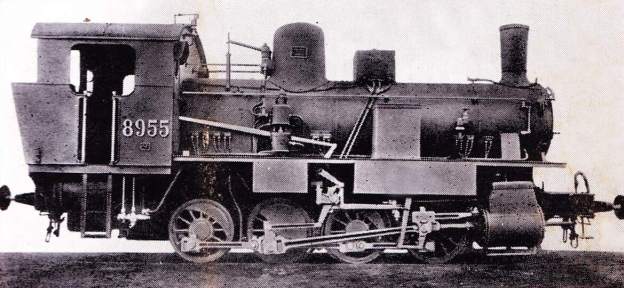
The first decade of the 20th century saw the existing roster of locomotives on the line South of Cuneo supplemented by two additional series : 130s (UK, 2-6-0) tender locos of the FS 630 series; and 040T (UK, 0-8-0T) tank locos of the FS 895 series. The featured image for this article is one of the tank locomotives of the FS 895 series. [65]

In the first two articles about the line from Cuneo to the sea we covered the length of the line from Cuneo to Vievola. These articles can be found here [9] and here. [10]

I also want to acknowledge the assistance given to me by David Sousa of the Rail Relaxation YouTube Channel https://www.youtube.com/@RailRelaxation/featured and https://www.railrelaxation.com and particularly his kind permission given to use still images from rail journeys that he has filmed on the Cuneo Ventimiglia railway line. [35][55]

The Line South from Vievola

Our journey South down the line continues from Vievola. …

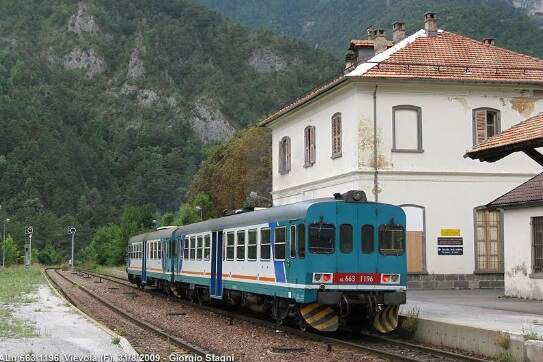
The station building, seen from the Southwest. [Google Streetview, October 2008]
Vievola Railway Station looking North, © Diego Fernández, November 2024. [Google Maps, July 2025]
The station at Vievola, seen from the Southeast. Excavated material from the tunnel was used to create a platform for the new station. This photograph is taken looking South and shows a water column and water tower a red roofed building and a toilet block as well as the main station building and the goods shed. The three buildings nearest to the camera have gone, as has the water column. This image was shared on the Ferrovia Internazionale Cuneo-Ventimiglia-Nizza Facebook Group by Mario Zauli on 16th June 2014, © Public Domain. [12]
Vievola Railway Station looking South, © Baptiste, July 2023 and licenced for reuse under a Creative Commons Licence, (CC BY-SA 3.0). [Google Maps, July 2025][11]

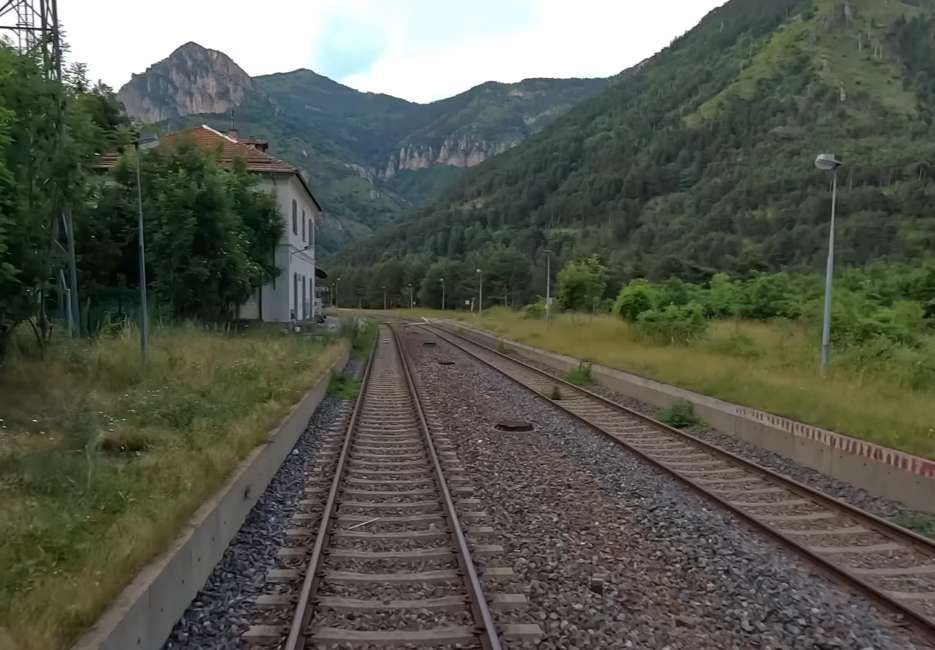
Vievola Railway Station, seen from a north-bound train in the 21st century. [35]

Vievola Railway Station, seen from slightly further South from the cab of a train heading North through the station back in the 1990s. [8]

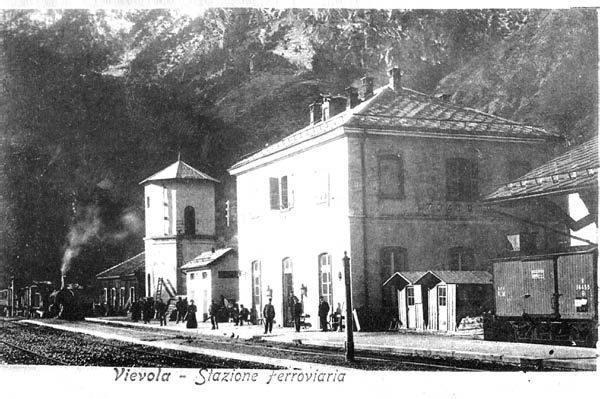
A postcard view from 1910 of Vievola Railway Station. The image faces South. [66]

Before we can head South from Vievola on the railway, it needs to have been built! This, it turns out, was dependent on international agreements and their ratification by national parliaments. This process was fraught with difficulty! It would take until 21st March 1906 for agreements to be ratified!

Banaudo et al tell us that over the final decades of the 19th century, the various interests on the French side of the border sought to persuade the French government that the line from Nice to Cuneo was an important investment which should be made. As a result, the French government “invited the PLM company to undertake a route study from Nice to Sospel in circular dated 30th September 1890, renewed on 28th January 1892, given the lack of response from the railway administration. On 12th May, a prefectural decree authorized the company’s engineers to enter properties to conduct the first surveys.” [1: p57]

Banaudo et al continue: “To meet the requirements of the Ministry of War, the route had to include Lucéram. This resulted in a 15 km extension of the direct route between Nice and Sospel. In 1895, the General Staff showed an initial sign of goodwill by agreeing to the study being extended beyond Sospel towards Italy, subject to certain conditions.  On 19th April 1898, Gustave Noblemaire (1832-1924), director of the PLM company, submitted a preliminary proposal for a line from Nice to the border via the Paillon de Contes valley, the Nice pass, L’Escarène, the Braus pass, Sospel, Mount Grazian, Breil and the Roya valley. The Lucéram service was included as a branch line from L’Escarène, other solutions were not technically feasible.” [1: p57-59]

The military response arrived on 27th September 1899, when the principle of the branch line was accepted. It was a few months, 10th January 1900, before the military confirmed their requirements, specifically: “commissioning of the Lucéram branch line at the same time as the L’Escarène – Sospel section; construction of the extension beyond Sospel after reinforcing the installations at Fort du Barbonnet and orientation of the tunnel under Mont Grazian so that it could be held under fire from the fort in the event of war; development of mine devices and defensive casemates at the heads of the main tunnels between L’Escarène and the border; and authorization for Italy to begin laying the track from San-Dalmazzo-di-Tenda to Fontan only after the completion of the Nice-Fontan section by France.” [1: p59]

Cross-border discussions took place between the French departmental Bridges and Roads Department and “its counterpart in the civil engineering department of the province of Cuneo to determine the main technical characteristics of the railway line built by the RM between Cuneo and Vievola, in order to adopt equivalent standards for the French section in terms of grades, curves, and gauge.” [1: p59]

Banaudo et al continue: “At the dawn of the 20th century, while the choice of a route from Nice to the Italian border at San-Dalmazzo via the Paillon, Bévéra, and Roya rivers was no longer in doubt in France, the same was not true in Italy. Indeed, although this solution was preferred by Piedmontese business circles, it was opposed by multiple pressure groups weary of twenty years of French policy of opposition and uncertainty. For many localities on the Riviera or in the Ligurian hinterland, as well as for a persistently Francophobic segment of the general staff, the construction of a line entirely within Italian territory appeared to be the best way to avoid diplomatic and strategic complications.” [1: p59]

In Italy, Piedmont and Liguria had differing views about the appropriate railway routes. Piedmont secured a promise, in the Italian parliament, to extend the railway to Tende and a decision to connect it to the coast soon. In Liguria, the desire was to secure a connection to Ventimiglia via either the Roya Valley or the Nervia Valley. Serious consideration was given to a tramway in the Roya Valley, the central section of which would run through French territory but this was rejected by the French military. [14]

A number of alternative schemes were put forward by Italian interests and by the city of Marseille. The city of Turin appointed a commission to look at all the options and after its report “concluded that it preferred the most direct route via the Col de Tende and the Roya, towards Ventimiglia and Nice. Similarly, the French Chamber of Commerce in Milan supported this choice in March 1900, also proposing the construction of a new 47 km line between Mondovi and Santo Stefano Belbo, designed by the engineer Ferdinando Rossi to shorten the journey between Cuneo, Alessandria and Milan.” [1: p60-61]

In 1901, French and Italian diplomats and then the Turin authorities agreed the main principles for an international agreement. On 24th January 1902 the PLM was granted the concession for the railway from Nice to the Italian border via Sospel, Breil-sur-Roya, and Fontan, as well as the beginning of the line from Breil-sur-Roya to Ventimiglia. This was ratified by law on 18th July 1902.

After this a further military inspection led to the strategic Lucéram branch being temporarily left aside with the possibility of a replacement by an electric tramway from Pont-de-Peille to L’Escarène, to be operated by the Compagnie des Tramways de Nice et du Littoral (TNL).

Banaudo et al continue: “On Monday 6th June 1904, delegations from both countries met in Rome to sign the bipartite convention regulating the terms and conditions of operation of the future line and its implementation into international service. …  In its broad outline, the agreement provided for the completion of the works within eight years (i.e. by 1912) and the possibility for the Italian railway administration to have its Ventimiglia-Cuneo trains transit French territory, with reciprocal authorization for the French operator to run its own vehicles in Italy on direct Nice-Cuneo trains and to establish a local service between Breil, Fontan and San-Dalmazzo-di-Tenda. … Initially, passenger services on the line would be provided by three direct daily connections Nice-Cuneo and Ventimiglia-Cuneo, and vice versa, offering carriages of all three classes.”

Banaudo et el describe the main points of the convention in respect of the transport of people and goods, particularly for transit between the two borders. “Police and customs controls would be simplified as much as possible for nationals of both countries. Nevertheless travelling between two Italian stations via the international section would require a passenger to have a valid passport. Italian postal vehicles would be permitted to travel duty-free on this section, as would goods and baggage in transit, provided they were placed in sealed vehicles and, for livestock, had undergone a prior health inspection at an Italian station. A special clause authorized the passage of Italian military transports of men, equipment, and animals through French territory, while conversely, the French army would be permitted to transit its consignments from Nice to Breil via Ventimiglia.  Article 20 of the convention regulated a legal situation that was probably unique in Europe, that of the Mont Grazian tunnel, whose straight route would pass over a distance of 2,305 metres in Italian subsoil, although its two portals would be in France: ‘It is understood that for the part of the Mont Grazian tunnel located under Italian territory, the Italian government delegates to the French government its rights of control over the railway and its police and judicial rights’. This unusual situation resulted from a modification of the route decided at the request of the General Council of the Alpes-Maritimes. … This more direct route passing under Italian soil was finally preferred to the entirely French route under the Brouis pass, which would have been longer and would have moved the Breil station further from the village.” [1: p62-63]

In Italy, the ratification of the agreements made at the convention took three weeks – it was all done by 28th June 1904. In France thins would be quite different. “On 27th March 1905, as the convention was about to be submitted to a parliamentary vote, the Ministry of War decided to abandon the branch line to Lucéram, which was too costly and difficult to implement. Instead, the nearest stations, L’Escarène and Sospel, would need to be equipped with facilities for the rapid disembarkation of troops and equipment. At L’Escarène in particular, the station would need to be able to accommodate ten twenty-car trains per day and would have to include a military platform opening onto a large open area, an engine shed, and several water columns/supplies.  In addition, the road from L’Escarène to Lucéram would need to be improved to facilitate access to the defensive sector of L’Authion.” [1: p63]

Banaudo et al comment: “The French Chamber of Deputies finally ratified the agreement on 3rd July 1905, more than a year after its Italian counterpart, but the Senate would continue to procrastinate until 8th March 1906. The senators demanded financial participation from the Alpes-Maritimes department in the land acquisition costs, and the French Consul in Italy, Henri Bryois, made numerous appearances in Paris to convince them. The day after the Senate’s vote, on 9th March 9, a parade, speeches, and demonstrations of sympathy for France enlivened the streets of Cuneo. … On 20th March, a final law officially ratified the agreement. … The municipality of Nice organized a grand celebration to celebrate the culmination of fifty years of effort.  On 21st March 1906, Prime Minister Giolitti and Ambassador Barrère exchanged the documents ratified by the parliaments of both countries. Work could finally begin!” [1: p63]

In Italy, the ratification of the international convention led to the money for the completion of the works being set aside (24 million lire for the length South from Vievola to the then border, and 16 million lire for the length North from Ventimiglia to the southern border). In addition, the decision was taken to build the new station in Cuneo to accommodate the increased traffic that would arise from the new line.

A year later, on 1st July 1905, the Italian state brought all nationally significant rail routes/networks under the direct authority of the Ministry of Public Works (the Ferrovie dello Stato (FS)).  This had only a limited impact on the Cuneo-Vievola line. “The 3200, 3800, and 4200 series locomotives of the Rete Mediterranea now formed series 215, 310, and 420 of the [FS}. … At that time, the Torino depot had a complement of 128 locomotives, including 20 from the 215 series and 18 from the 310 series deployed in the line, to which were added ten locos from the 320 series. These were also 030s [in UK annotation, 0-6-0s] with three-axle tenders, initially ordered by the RM as series 3601 to 3700 and gradually delivered by five manufacturers between 1904 and 1908.” [1: p64]

The first decade of the 20th century saw the existing roster of locomotives supplemented by two other series:

  • 130s (UK, 2-6-0) tender locos of the FS 630 series; and
  • 040T (UK, 0-8-0T) tank locos of the FS 895 series.
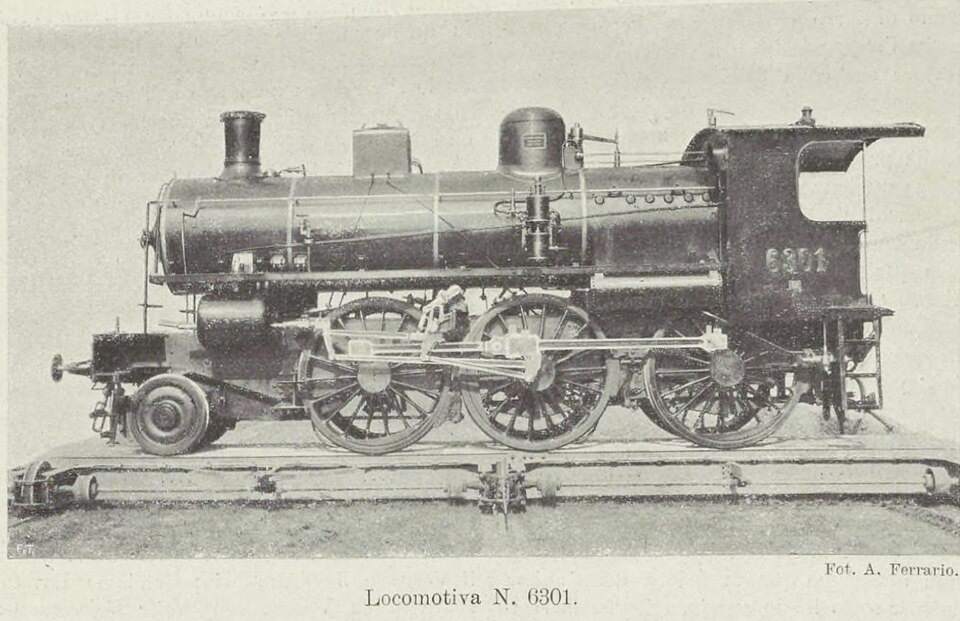
Locomotive No. 6301was a 2-6-0 (130) locomotive in the FS 630 series. [64]
Locomotive No. 8955 was an 0-8-0T (040T) locomotiv3 in the FS 895 series, [65]

In 1906, a subsidised bus service was introduced to complement and replace the various horse-drawn and motor services already in existence on the roads between Vievola, Ventimiglia and Nice. [1: p64][c.f. 14] The connection to Nice was later (in 1912) taken over by the Truchi company of Nice. [1: p64]


Vievola to Tende

Banaudo et al, again: In August 1907, the first of eleven work packages between Vievola and the [then] border were awarded: package 1 from Vievola to the Gaggeoetlen tunnel, and package 4 of the Cagnolina tunnel to Tenda. In June 1911, it was the turn of package 2, between the Gaggeo and Alimonda tunnels, and the following month, package 3 from Alimonda to Cagnolina. These contracts were signed with the Tuscan companies Sard and Faccanoni and the Ghirardi company, originally from the region of Lake Maggiore. Over 8.2 kilometres, the line crosses Triassic and Permian terrain cut by Jurassic, Cretaceous, and Carboniferous veins. There are ten tunnels covering a distance of 5.90 kilometres, or 72% of the route, as well as seven bridges and viaducts totaling seventeen masonry arches. The section has no level crossings, but seven “caselli” (houses) were built to house the road workers and their families. Some are isolated in the mountains, sometimes between two tunnels, and accessible only by railway.” [1: p64-67]

A schematic representation of the line from Vievola to Tende. [18]
A short video embedded from YouTube, taken at Vievola Railway Station in 2010. [23]
Vievola Railway Station is at the centre of this extract from Google’s satellite imagery. The hamlet is Northeast of the Station just beyond the top of the image. Trains for Tende and beyond set off to the Southwest. The railway bridge can be seen at the bottom left of this image. [Google Maps, July 2025]

From Vievola, the line begins its journey down the valley of La Roya by crossing a single-arch bridge over the Dente valley which suffered some disruption resulting from Storm Alex in October 2020.

A closer focus on the bridge spanning the River Dente. This image appears to be taken after the inundation which occurred with Storm Alex in 2020. [Google Maps, July 2025]
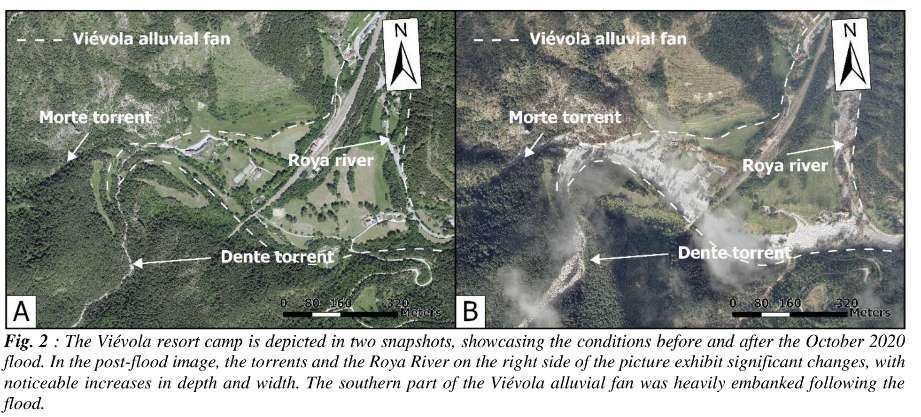
This pair of images are taken from a report into the majority damage caused by Storm Alex. The image on the left is the condition of the area prior to the storm, that on the right shows the situation after the storm. [15]
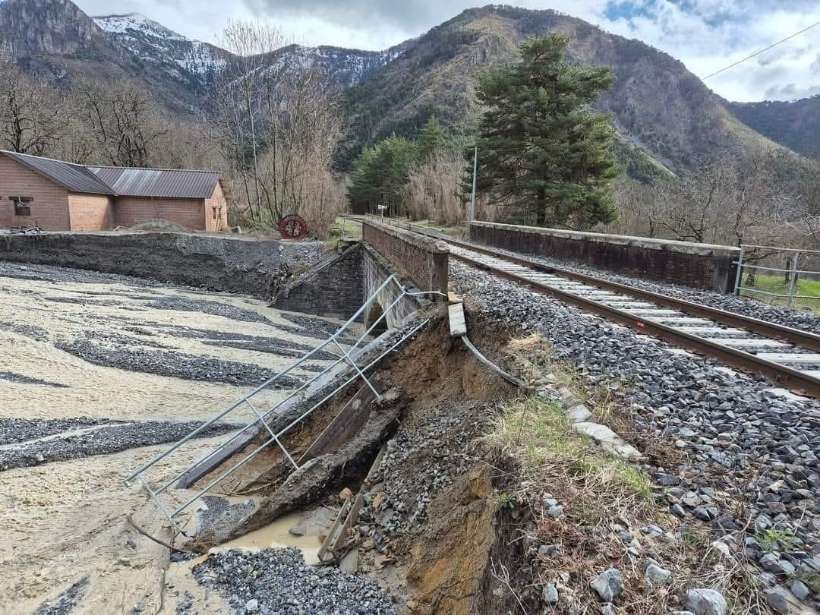
The bridge that spanned the Dente, in the immediate aftermath of Storm Alex in October 2020. In the view of the engineers checking the line, the bridge was unstable because of erosion. This image was shared on the Ferrovia Internazionale Cuneo-Ventimiglia-Nizza Facebook Group by Osservatorio Ferrovia del Tenda on 3rd Aprilb2924 and credited to Damien Board. [16]
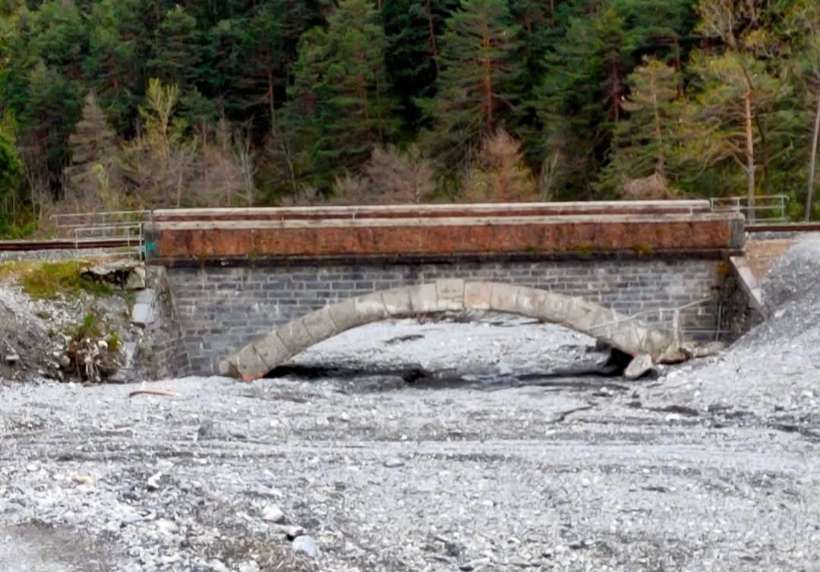
The same bridge after further flooding at Easter 2024. This image was shared on the Ferrovia Internazionale Cuneo-Ventimiglia-Nizza Facebook Group by Gianluca Morelli on 4th May 2024. [17]

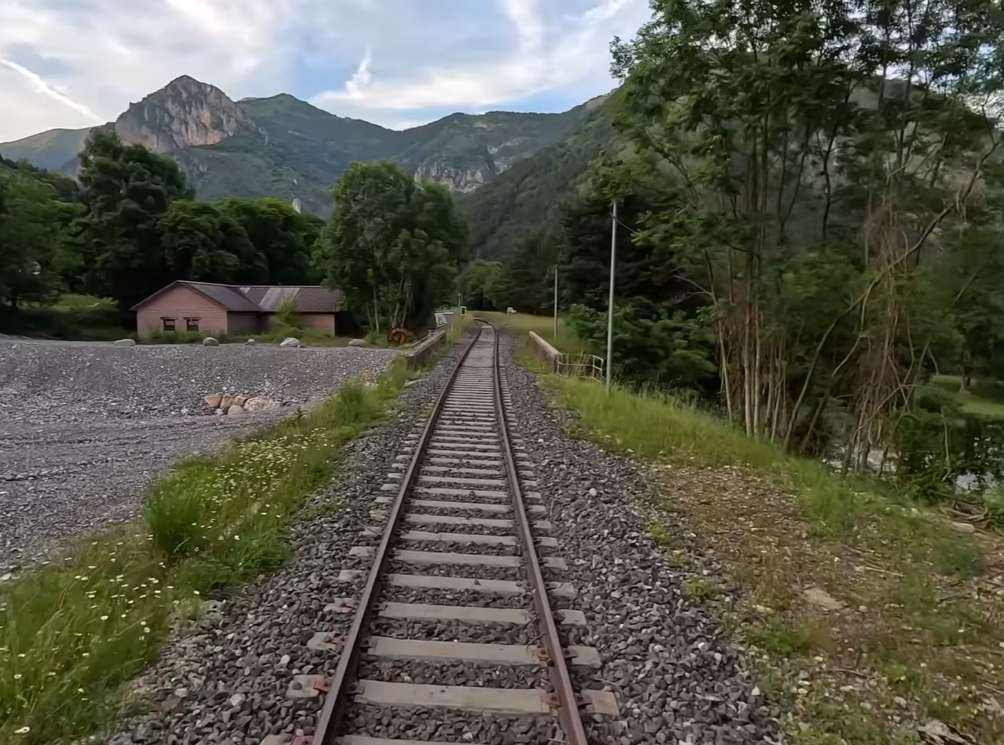
A short distance South of the bridge over the river, looking North towards Vievola from the cab of a north-bound train. [35]

Taken from a point a little further to the South, this photograph shows the parapets of a bridge over a small stream to the South of the Dente river. This image is also taken from the cab of a north-bound train in the 2020s. [35]

After crossing the 12 metre span bridge the line enters the 1273 metre long Branego horseshoe tunnel.

This photograph looks North from the mouth of the Branego Tunnel towards Vievola Railway Station. It is taken from the cab of the same North-bound train. [35]

The 1273 metre long Branego Tunnel. The bridge in the Dente valley is top-left  and the Vievola (Chapel) Viaduct is middle-right in this image. [19]

The tunnel opens onto the right bank of La Roya about 25 metres above the river. The Vievola Viaduct spanned the river on five 15 metre masonry arches. Banaudo et al tell us that, “this structure would later be called the ‘Chapel viaduct’ due to its proximity to the Sanctuary of the Visitation or Madonna of Vievola.” [1: p67]

The East Portal of Branego Tunnel taken from the cab of a train approaching Vievola Railway Station from the South. [35]

The Vievola (Chapel) Viaduct seen from the cab of a train approaching it from Tende. [35]

I believe that the viaduct was fatally damaged by the German forces retreating at the end of WW2. It has been rebuilt in concrete as a 5-span concrete viaduct.

Looking South along the E74/D6204 under the railway viaduct. [Google Streetview, April 2008]
Looking North along the E74/D6204 torads the railway viaduct. [Google Streetview, April 2008]
The same location on Google satellite imagery shows a denuded valley floor after Storm Alex. [Google Earth 3D, July 2025]

Now on the left bank of La Roya, the line passes through a series of tunnels with very brief open lengths spanning narrow valleys or slight depressions. The first tunnel on the Left bank is shown below. …

After crossing the Chapel Viaduct trains heading for Tende ran straight into Gaggio Tunnel (373 metres long) which curves towards the Southeast. [20]

The Southeast Portal of Gaggio Tunnel seen from the cab of a Northbound train at the mouth of Devenzo Tunnel. The parapets of the 12-metre span arched bridge over the San Pancrazio valley can be seen between the two tunnels. [35]

The Bridge over the Vallon Pancrasio (the San Pancrazio valley) is a 12 metre span arch bridge. [21]
The San Pancrazio valley as it appears on Google’s satellite imagery after the damage from Storm Alex. [Google Earth 3D, July 2025]
A closer look at the railway bridge spanning the San Pancrazio valley. [Google Earth 3D, July 2025]

The tunnel portals are generally made of local stone as are the arched bridges. The next tunnel is the Devenzo tunnel, shown below. …

The Devenzo Tunnel (732 metres long) extends Southeast from the San Pancrazio valley to the Mezzora Valley which seems little more than an ‘indentation’ in the valley side. A shorter tunnel is beyond the opening (the Mezzora Tunnel – 351 metres long) which opens out onto the Alimonda Valley at the bottom-right of this map extract. [22]

This photograph is another still from a video taken from the cab of a train travelling North from Tende. It shows the short length of open line mentioned above. The parapets are those of the viaduct of two 6 metre arches. [35]

This Google Earth satellite image shows the railway line breaking cover to cross the Alimonda valley near the top of the image. The E74/D6204 is at the bottom-left of the image. [Google Earth, July 2025]
The same location as it appears on OpenStreetMap. The bridge over the Alimonda valley is at the top-right of the image and the E74/D6204 is in the bottom-left. [24]

The Southeast portal of the Mezzora Tunnel can be seen in this image taken from the tunnel mouth of the Alimonda Tunnel. It is possible to see along the full length of this tunnel to the short opening mentioned above. In the course of travelling this short length of open line the railway crosses the Alimonda Valley. [35]

The next tunnel, the Alimonda Tunnel begins immediately the Alimonda valley has been crossed. The tunnel is 380 m long.

The Alimonda Tunnel: the bridge over the Alimonda Valley is top-left in this map extract, the bridge over the Scara Valley is bottom-right. [25]
The bridge over the Scara Valley is on the right of this map extract. There is very little of the railway open to the elements at this location. [26]

The short length of track and bridge in the Scara Valley between the Alimonda Tunnel and the Frera Tunnel, seen from the cab of a service which has just left the Frera Tunnel heading for Vievola and on to Cuneo. [35]

Before entering the Frera Tunnel, it is worth pulling back a little to see the route of the line ahead. This is the first ‘spiral’ on the line down towards Ventimiglia and Nice. A large section of the spiral is within one tunnel but the engineers made use of the Valley of the Refrei to avoid having to put the entire spiral in tunnel. [36]

The Frera Tunnel (498 m long) runs North-northwest to South-southeast passing over the line ahead which is at a lower level – both are tunneled out of the rock. There is an open length of the line and a bridge at the bottom-right. [27]

The short length of track and the bridge between the Frera and the Rio Freddo tunnels. [35]

After crossing the bridge noted above the line soon disappears into the Rio Freddo Tunnel (376 m long). The bridge is top-left. The tunnel opens out for a short length at the right of this map extract. [28]
A short length of line is open to the elements to the North of the valley of the Refrei and between the Rio Freddo and Morga Tunnels. [29]

The short length of line between the Rio Freddo and the Morga Tunnels, seen from the cab of a train just leaving Morga Tunnel. The Rio Freddo tunnel mouth is ahead. Between the two tunnel mouths is the Morga Bridge (two 8-metre arches). [35]

Banaudo et al tell us that “from the exit of the Rio-Freddo tunnel [on the North flank of the Refrei valley], the village of Tenda (Tende) appears below and the railway describes a helical loop which ends at [the lower end of] the Cagnolina tunnel. … This loop loses about sixty metres of altitude in less than 3 km of travel.” [1: p70]

After the very short open length of line to the East of the Rio Freddo  Tunnel, another short tunnel ensues – the Morga Tunnel (160 m long). [30]
Another short open length of line sits between the Morga and Gerbo Tunnels. [31]

The short open length of track between Morga and Gerbo tunnels, seen from the cab of a Cuneo-bound service and framed by the Southwest mouth of Gerbo Tunnel. [35]

Pulling back a little enables the full length of Gerbo Tunnel (279 m long) to be seen, together with the open length of line and viaduct to the East – Gerbo Viaduct. [32]

The Northeast Portal of Gerbo Tunnel seen from the cab of a Cuneo-bound train in the 2020s. [35]

A short distance further along the line, the Bazara Viaduct (of five 8 m arches) is seen here, with the Gerbo Tunnel beyond – these are seen from the cab of a Cuneo-bound service in the 21st century. [35]

After a short length of line to the Northeast or Gerbo Viaduct the line enter Cagnolina Tunnel and under many tons of rock swings round to travel West while on a downward grade. [33]

Here the Cuneo-bound train is just leaving the South Portal of Cagnolina Tunnel (at the right of the above map extract) and crossing a small bridge close to the tunnel mouth. [35]

Still in tunnel, the line passes under the line we have just travelled before breaking out into the valley of La Roya. It then bridges the river and heads down the the valley side on the left bank of La Roya to Tende Railway Station. [34]

The lower (West) portal of the Cagnolina Tunnel and the bridge over La Roya. Taken from the cab of a train heading North from Tende. The bridge over La Roya has a 12 metre span. [35]

A significant retaining wall to the West of the line, above which runs the E74/D6204. [35]

A short tunnel (Tende Galleria) part way along the length that the E74/D6402 run parallel and in close proximity to each other. The view looks North-northwest along the line. [35]

A train from Cuneo arrives at Tende Railway Station in February 2023. [37]

The Tende Railway Station today has a passenger building and two platform faces. In the past, it had three platform faces and a goods shed of classic Italian design, “the station had a number of goods tracks, two reinforced concrete water tanks supplying two hydraulic cranes, as well as an 8.50 metre turntable which was probably transferred from Vievola when the line was extended.” [1: p70]

Tende Railway Station looking Northwest, © George Ringler and licenced for reuse under a Creative Commons Licence (CC BY-SA 3.0). [38]

Wikipedia tells us that Tende Railway Station “opened on 7th September 1913. [40: p146] … Tende remained the temporary terminus for almost two years, until the opening of the Tende – Briga Marittima – San Dalmazzo di Tende section, which took place on 1st June 1915.” [39][40: p149]

The station and yard were electrified along with the line in 1931. [40: p171-172]

Tende “became isolated from the railway network after the destruction of bridges and tunnels by the retreating Germans between 15th and 26th April 1945.” [39][41: p15] .

It remained under the jurisdiction of the Italian State Railways (FS) until 15th September 1947 and was passed into the hands of the Société Nationale des Chemins de fer Français (SNCF) the following day, when the upper Roja valley was separated from the province of Cuneo and became French territory by virtue of the peace treaty with France.” [39]

After thirty-four years of inactivity, it was reopened on 6th October 1979 , the day of the inauguration of the rebuilt Cuneo-Ventimiglia line.” [39][40: p243]

The station yard was originally of a significant size. [42: p81] For the reopening of the Limone-Ventimiglia line to traffic … it was initially planned that the Tende station would be transformed into a stop equipped with only a single track, but it was subsequently decided to build a loop [43: p34] with a useful length of 560 metres and a single track serving the loading platform and the goods warehouse. [43: p29]

The Goods Shed and Passenger building at Tende seen from Avenue du 16 Septembre 1947 and looking Southeast. [Google Streetview, July 2014]

A French and an Italian train pass at Tende in 2022. The train on the right is, I believe, an ALe501 trainset commissioned by Trenitalia in the early 2000s and produced by Alstom Ferroviaria, (c) Tomas Votava. [Google Maps, August 2025]

TER No. 76671 on the Train des Merveilles service from Nice stands at Tende Station, (c) Kenta Yumoto. [Google Maps, August 2025]

We have travelled as far as Tende Railway Station and noted that the line reached the village in 1913 and remained the terminus of the line from Cuneo until 2015. While the line as far as Tende was still under construction, Banaudo et al tells us that there were continued contacts “between the Italian and French authorities to resolve the remaining issues concerning the connection between the two networks in the Roya Valley. On 3rd January 1910, the Ministers of Public Works of both countries … met to discuss the problems of Franco-Italian communications. On 15th May 1910, the Cuneo Chamber of Commerce approached the government to request the acceleration of work between Vievola and Tenda. … During the same period, … efforts were being made to produce [hydroelectric power]. … The first plants were installed in Airole and Bevera in 1906, and later in San-Dalmazzo between 1909 and 1914.” [1: p70-74]

The Roya hydroelectric power plants were intended to supply the Vallauria Mining Company and its ore processing facilities, public lighting, industries and the tramways of the Ligurian Riviera as far as Savona and Genoa.” [1: p74]

In France, two small power plants were built at the beginning of the century at Pont d’Ambo, downstream from Fontan, and in Breil. Between 1912 and 1914, a larger power plant was built opposite the village of Fontan.

Banaudo et al tell us that “In both France and Italy, the simultaneous construction of the railway and power plants turned the Roya Valley into a huge construction site for a dozen years. The companies had to house, feed, and entertain several hundred workers, most of them from other regions of Italy.” [1: p74]

After the opening of Tende Railway Station in September 1913, “the FS improved the service which had remained unchanged for a quarter of a century. Four Cuneo – Tenda return trips would now run every day, including a mixed goods-passenger one. From July to September, a fifth return trip was added. The 50 km journey took an average of 1 hour 50 minutes.” [1: p75]

Meanwhile, the project to divert the railway line and build a new station on the Altipiano in Cuneo which we noted in the first of these articles, [9] was being developed. Work began in September 1913 [1: p80] but it was to be 7th November 1937 before the new station opened! [44]

While the line was creeping southwards from Cuneo to Tenda, work had begun in Ventimiglia on the northbound line up the Roya Valley. However, by the outbreak of World War I it had only covered 20 kilometres to Airole. Meanwhile, and again interrupted by the war, another line was being built northeast from Nice to join the Cuneo-Ventimiglia line at Breil sur Roya.” [39] Progress on these two lines is covered in other posts in this series of articles. [45][46][47][48]

From Tende to St. Dalmas de Tende (San Dalmazzo di Tenda)

In the first half of 1912, calls for tenders were issued for six lots of the section between Tenda, Briga, San-Dalmazzo, and the northern border of the Paganin Valley, followed in April 1913 by the award of the seventh and final lot. Here again, the tunnels, fifteen in number, account for more than two-thirds of the route, or 8,576 metres out of 12,335 metres. There are also seven bridges and viaducts, comprising a total of thirty-five masonry arches, about ten short-span structures, and there were ten roadside houses.” [1: p127]

The length of the line from Tende to San Dalmazzo di Tenda (San Dalmas de Tende). [51]
Schematic plan of the line from Tende South to the former Italian border via La Brigue and Saint Dalmas de Tende. [18]
Tende Railway Station in the 21st century, seen from the Southeast, from the cab of a northbound train. [35]

Tende Railway Station seen from the cab of a South-bound service. [55]

Leaving Tende Railway Station, the line soon passes onto the curved viaduct spanning the Roya River opposite the village. The viaduct has one 20-metre arch and eleven 15-metre arches. 

The southern end of the station site and the viaduct which crosses the valley of La Roya. [53]

A South-bound service crosses Tende Viaduct. This is the view from the cab. [55]

An old Italian postcard view of the village of Tende, seen from the South. The viaduct features to the right of the centre of the image. [52]
The curve of the viaduct at Tender shows up well in this photograph, © Public Domain. [68]
Tende Viaduct seen from the access road to the village cemetery. [Google Streetview, October 2008]
The first of two views of Tende Viaduct from Rue General Doyen showing the northern half of the viaduct. [Google Streetview, July 2014]
The second of two views of Tende Viaduct from Rue General Doyen showing the more southerly portion of the viaduct. [Google Streetview, July 2014]
The viaduct, seen from Avenue Maurice Barucchi. [Google Streetview, July 2014]

We were in Tende in November 2023 so saw something of the major work being undertaken after Storm Alex hit the area in October 2020 and took these photographs of the viaduct

The northern half of the viaduct. [My photograph, Wednesday 22nd November 2023}
The larger viaduct arch span over La Roya. [My photograph, Wednesday 22nd November 2023]
The southern length of the viaduct. [My photograph, Wednesday 22nd November 2023]
Tende Viaduct seen from the South from the cab of a train heading for Tende Railway Station. [35]

Once across the viaduct, trains heading South ran on through three tunnels on the left bank of La Roya on a falling grade of 25mm/m. These were:

Borgonuovo Tunnel (200 metres long) …

The approach to Borgonuovo Tunnel, seen from the cab of a South-bound train. [55]

Looking North from the mouth of Borgonuovo Tunnel, from the cab of a North-bound train. [35]

The view South from the mouth of Borgonuevo Tunnel., [55]

The southern portal of Borgonuovo Tunnel, seen from the cab of an approaching train. [35]

The view from above the South portal of Borgonuovo Tunnel, (c) Tito Casquinha, June 2019. [Google Maps, August 2025]

The same length of line seen from across the valley. [Google Streetview, October 2008]

Bijorin Tunnel (248 metres long) …

The North portal of the Bijorin Tunnel. [55]

The view from the northern portal of Bijorin Tunnel. [35]

The view South from the mouth of Bijorin Tunnel. Colombera tunnel is just visible ahead. [55]

The length of line between Bijorin and Colombera tunnels, seen from the far side of the valley of La Roya. [Google Streetview, October 2008]

The South portal of Bijorin Tunnel is ahead in this still from a video taken from the cab of a North-bound train. This image also shows avalanche warning wires above the line. [35]

Colombera Tunnel (212 metres long) …

The North portal of Colombera Tunnel. [55]

The view North towards Bijorin Tunnel from the mouth of Colombera Tunnel. [35]

An over exposed view South from the South Portal of Colombera Tunnel. [55]

The South Portal of Colombera Tunnel seen from the cab of a Northbound train. [35]

This OpenStreetMap extract shows the three tunnels named above, and the lengths of open railway line between. [54]

A short distance further South the railway bridges a minor road. These are the bridge parapets seen from the cab of a South-bound train. The minor road is just visible to the left of the image. [55]

The next tunnel is Bosseglia Tunnel. The railway and the main road separate as the line heads into the tunnel which is S-shaped and 1585 metres in length. The southern portal of the tunnel opens out into the Levenza valley, a short distance to the East of La Brigue Railway Station. Banaudo et all refer to the station as Briga-Marittima station, which appears to be the name of the station in Italian. [1: p127]

The Bosselgia Tunnel (which is over 1.5 km long) and the railway station at La Brigue as they appear on OpenStreetMap. [56]

Looking South, this is the northern portal of the Bosseglia Tunnel. [55]

Looking North from the mouth of Bosseglia Tunnel. [35]

Looking West from the southern portal of Bosseglia Tunnel towards La Brigue Railway Station. [55]

Turning through 180 degrees, this is the southern portal of the Bosseglia Tunnel seen from a North-bound train. [35]

La Brigue Railway Station once comprised a passenger building, two platform faces (a third would be built during electrification), three freight tracks with a good shed and a raised platform. The modern station is situated to the East of the old station. [1: p127]

Looking West along La Brigue Railway Station platform, © Remontees, and licenced for reuse under a Creative Commons Licence (CC BY-SA 4.0). [57]

A similar view with an ALn501+502 train set in the station, © Georgio Stagni, June 2014 and authorised for reuse under a Creative Commons Licence (CC BY-SA 3.0). [57]

Looking East along the station platform, © JpChevreau and licenced for reuse under a Creative Commons Licence (CC BY-SA 4.0). [57]

Looking West from the modern La Brigue Station through the site of the original station. [55]

Further through the site of the old railway station and continuing to face West down the Levenza valley. The old goods shed is on the left. [55]

The site of the two La Brigue Railway Stations. The modern station is on the right of this map extract, the old station and goods shed are left of centre. [58]
The station at La Brigue is a short distance to the West of the village. [Google Maps, August 2025]

The original station building at La Brigue, seen from the cab of a train heading for Ventimiglia. [55]

The bridge over the D43 and the River Levenza. [59]

The bridge over the D43 and the River Levenza. [55]

The bridge which carries the railway over the D43 and the River Levenza, seen from the East. [Google Streetview, August 2016]

The bridge which carries the railway over the D43 and the River Levenza, seen from the West. [Google Streetview, August 2016]

The view back across the bridge over the River Levenza towards La Brigue Railway Station. The D43 can just be made out to the right of the bridge. [35]

Leaving La Brigue Railway Station the line resumes following a falling grade of 25 mm/m. This continues through the Levenza viaduct, which, as we have seen consists of three 8-metre arches abutting a single span road bridge. Beyond this is the Levenza tunnel (418 m long). …

The Northeastern portal of the Levenza tunnel. [55]

The view back along the line from the Northeast portal of the Levenza tunnel. [35]

This overexposed view looks Southwest from the Southwest tunnel mouth of the Levenza tunnel. [55]

The Southwest portal of the Levenza tunnel seen from the cab of a North-bound service. [35]

Beyond the Levenza Tunnels is and an unnamed viaduct of three 8-metre arches) and the line then enters the Rioro Spiral Tunnel.

The Rioro Tunnel forms a loop which describes a circle of 300-metre radius and accommodates a 30-metre drop.

Banaudo et al tell us that the tunnel “is officially divided into two sections: Rioro I (282 m) and Rioro II (1527 m), connected by an artificial tunnel with a lateral opening closed by a gate. At this opening, a ‘casello’ (a ‘hut’) was built into the mountainside to house a road worker and his family.” [1: p127]

Looking Northeast from the mouth of the Rioro spiral tunnel. [35]

The Northeastern portal of the Rioro sprial tunnel. [55]

The Rioro Spiral Tunnel between La Brigue and St. Dalmas de Tende is 1828 metres in length. [60]

Trains are within the tunnel for some minutes as they cover nearly two kilometres of turning track within the tunnel. This view comes from the cab of a South-bound train. [55]

Facing Southwest along the line at the mouth of the Rioro Spiral Tunnel. The picture is overexposed as the camera is reacting to daylight after running through the tunnel. [55]

The Southwest Portal of the Rioro Spiral Tunnel, seen from the cab of a North-bound train. [35]

The Rioro Spiral Tunnel opens onto the left bank of the Levenza River, just before its confluence with the Roya River.

To the Southwest of the tunnel, the line is carried alongside the River Levenza on a retaining wall. The parapet of this wall, protected by railings, can be seen on the right of this image. [55]

The River Roya is crossed by the San-Dalmazzo I viaduct. Banaudo et al tell us that “the seven 15-metre masonry arches of this structure were widened to carry three tracks to accommodate the approach to the station, built on a vast embankment. An underpass beneath it provides a route for the [E74/D6204].” [1: p127]

The line is retained above the Levenza River and then crosses La Roya on a viaduct of seven 15-metre masonry arches. A short tunnel under the wide embankment to the Southwest of the river allows the  D6204 to pass under the railway. [61]

A postcard view of the viaduct and station at the centre of St. Dalmas de Tende. The station building is to the right of this image, the viaduct in the centre. The photograph was taken on the hillside to the North of the village. This image was shared on the Ferrovia internazionale Cuneo-Ventimiglia-Nizza Facebook Group by Luisa Grosso on 1st November 2021. [63]

The bridge over La Roya on the approach to St. Dalmas de Tende. [55]

The bridge over the Avenue de France (the D6204/E74) seen from the North. The road is in tunnel as a large area was dedicated to the station complex at St. Dalmas de Tende as it was originally a border station in Italy. [Google Streetview, August 2016]

The same bridge/tunnel seen from the South on the Avenue de France. [Google Streetview, August 2016]

A long double-track section of the line runs through the station at St. Dalmas de Tende. A small yard remains on the North side of the line entered vis the point seen in this image. [55]

The final approach to St. Dalmas Railway Station from the Northeast. [55]

St. Dalmas de Tende Railway Station seen, looking Southwest, from the cab of a South-bound train. [55]

St. Dalmas de Tende Railway Station as show on OpenStreetMap. [62]
A postcard image overlooking the station site at St. Dalmas de Tende prior to the construction of the large station building. [5]
The station during construction work. There is scaffolding on the main station building, which appears to have been built in sections with a completed length nearest to the water tower. The engine shed is under construction, centre-right. This image was shared on the Ferrovia Internazionale Cuneo-Ventimiglia-Nizza Facebook Group by Mauro Tosello on 12th June 2022. [6]
A postcard view of the Railway Station at St. Dalmas de Tende, taken from the East. The tunnel at the Southwest end of the station site can be seen on the left of the photograph. This image was shared on the Ferrovia internazionale Cuneo-Ventimiglia-Nizza Facebook Group by Luisa Grosso on 1st November 2021. [63]
The locomotive Depot at St. Dalmas de Tende. The depot was on the Southeast side of the running lines opposite the railway Station and close to the Biogna River. The road shown on the OpenStreetMap plan of the modern station to the Southeast of the site is the road shown at the top of this plan. This drawing comes from From the December 1929 Technical Magazine of Italiane Ferrovie. It was shared on the Ferrovia Internazionale Cuneo-Ventimiglia-Nizza Facebook Group on 13th February 2024 by Francesco Ciarlini Koerner. [4]

St. Dalmas de Tende Railway Station seen, looking Northeast, from the cab of a North-bound service. [35]

St. Dalmas de Tende (San-Dalmazzo-di-Tenda in Italian) was “the last station on Italian territory, before the northern border.  This is where the French Forces would install a large-scale border station that will handle customs clearance operations in addition to the French facilities at Breil. In the first phase, a temporary passenger building and a small freight shed were built on the vast embankment created from the spoil from the tunnels upstream of the confluence of the Roya and Biogna rivers. The original layout includes four through tracks, one of which is at the platform, five sidings, three storage tracks, a temporary engine shed, a 9.50 m turntable, and a hydraulic power supply for the locomotives.” [1: p127]

It is here, at St. Dalmas de Tende, that we finish this third part of our journey from Cuneo to the coast.

Located at the confluence of the Roya River with the side valleys of the Levenza and Biogna, San-Dalmazzo-di-Tende “was built around a former Augustinian convent that became offices of the Vallauria mining company and then a spa. Since the border was established in 1860 a few kilometers downstream in the Paganin Gorges, first a few dozen, then hundreds of workers, employees, and civil servants gradually settled in San-Dalmazzo with their families. Jobs were plentiful, with the development of mining in the neighboring Val d’Inferno, the creation of a sawmill, the construction of dams and hydroelectric power plants, the emergence of tourism, and the permanent presence of a large number of police, customs, and tax guards.  This influx … was reinforced during the railway works, which attracted many workers: earthmovers, masons, stonemasons, miners, carpenters, etc. These newcomers, who mostly came from other regions, sometimes far away, slowly integrated into the local population.” [1: p130]

The line to San-Dalmazzo-di-Tende was opened on 1st June 1915. The three of the four daily services were connected to the Southern arm of the line which by this time had reached Airole, by a coach shuttle. [1: p131]

A temporary station was provided as a terminus of the line from Cuneo. It was sited to the Northeast of the present large station building which was not built until 1928.

The next length of the line can be found here. [67]

References

  1. Jose Banaudo, Michel Braun and Gerard de Santos; Les Trains du Col de Tende Volume 1: 1858-1928; FACS Patrimoine Ferroviaire, Les Editions du Cabri, 2018.
  2. Jose Banaudo, Michel Braun and Gerard de Santos; Les Trains du Col de Tende Volume 2: 1929-1974; FACS Patrimoine Ferroviaire, Les Editions du Cabri, 2018.
  3. Jose Banaudo, Michel Braun and Gerard de Santos; Les Trains du Col de Tende Volume 3: 1975-1986; FACS Patrimoine Ferroviaire, Les Editions du Cabri, 2018.
  4. https://www.facebook.com/share/p/19U2VzU6gT, accessed on 8th August 2025.
  5. https://www.facebook.com/groups/FerroviaCuneoVentimiglia/permalink/5329737250380256/?rdid=6Xne0EJn2Z4xCUiE&share_url=https%3A%2F%2Fwww.facebook.com%2Fshare%2Fp%2F1C8mWmX57o%2F#, accessed on 8th August 2025.
  6. https://www.facebook.com/groups/FerroviaCuneoVentimiglia/permalink/1747294131957937/?rdid=QhA9x5D943zrICPG&share_url=https%3A%2F%2Fwww.facebook.com%2Fshare%2Fp%2F1E6w5RsWSL%2F#, accessed on 8th August 2025.
  7. TBA
  8. https://youtu.be/2Xq7_b4MfmU?si=1sOymKkFjSpxMkcR, accessed on 20th July 2025.
  9. https://rogerfarnworth.com/2025/07/22/the-railway-from-nice-to-tende-and-cuneo-part-1.
  10. https://rogerfarnworth.com/2025/07/26/the-railway-from-nice-to-tende-and-cuneo-part-2.
  11. https://commons.m.wikimedia.org/wiki/File:Vievola_staz_ferr_ALn_663.jpg, accessed on 26th July 2025.
  12. https://www.facebook.com/photo/?fbid=1430625447210493&set=gm.755686417785385, accessed on 25th July 2025.
  13. https://commons.m.wikimedia.org/wiki/File:Stazione_Vievola_1910.jpg, accessed on 27th July 2025.
  14. https://rogerfarnworth.com/2025/07/27/a-tramway-in-the-valley-of-the-river-roya-early-20th-century
  15. http://www.lmm.jussieu.fr/~lagree/TEXTES/PDF/RK_Landslides_Vie%CC%81vola_Revised.pdf, accessed on 29th July 2025.
  16. https://www.facebook.com/share/p/16iQbYtjAB, accessed on 29th July 2025.
  17. https://www.facebook.com/share/p/1YwoXQBLiR, accessed on 29th July 2025.
  18. https://fr.m.wikipedia.org/wiki/Sch%C3%A9ma_de_la_ligne_de_Coni_%C3%A0_Vintimille, accessed on 22nd July 2025.
  19. https://www.openstreetmap.org/#map=16/44.10895/7.56098&layers=P, accessed on 29th July 2025.
  20. https://www.openstreetmap.org/#map=17/44.108596/7.571928&layers=P, accessed on 30th July 2025.
  21. https://www.openstreetmap.org/#map=19/44.106950/7.573406&layers=P, accessed on 30th July 2025.
  22. https://www.openstreetmap.org/#map=15/44.10372/7.58022&layers=P, accessed on 30th July 2025.
  23. https://youtu.be/cHWVUYznw6g?si=lGZhcr09_Lx2RIpd, accessed on 30th July 2025.
  24. https://www.openstreetmap.org/#map=19/44.102247/7.586114&layers=P, accessed on 31st July 2025.
  25. https://www.openstreetmap.org/#map=17/44.101422/7.588175&layers=P, accessed on 31st July 2025.
  26. https://www.openstreetmap.org/#map=17/44.100292/7.590059&layers=P, accessed on 31st July 2025.
  27. https://www.openstreetmap.org/#map=17/44.098049/7.591515&layers=P, accessed on 31st July 2025.
  28. https://www.openstreetmap.org/#map=17/44.094337/7.595475&layers=P, accessed on 31st July 2025.
  29. https://www.openstreetmap.org/#map=18/44.092624/7.597449&layers=P, accessed on 31st July 2025.
  30. https://www.openstreetmap.org/#map=18/44.093422/7.599427&layers=P, accessed on 31st July 2025.
  31. https://www.openstreetmap.org/#map=18/44.093468/7.600340&layers=P, accessed on 31st July 2025.
  32. https://www.openstreetmap.org/#map=17/44.095803/7.602404&layers=P, a cessed on 31st July 2025.
  33. https://www.openstreetmap.org/#map=16/44.09671/7.60013&layers=P, accessed on 31st July 2025.
  34. https://www.openstreetmap.org/#map=16/44.09483/7.59382&layers=P, accessed on 31st July 2025.
  35. https://www.youtube.com/watch?v=_qX8v5gceVU, accessed on 31st July 2025.
  36. https://www.openstreetmap.org/#map=15/44.09608/7.59520, accessed on 2nd August 2025.
  37. https://youtu.be/K6aAQ_zTWds, accessed on 2nd August 2025.
  38. https://commons.m.wikimedia.org/wiki/File:Gr_gare_de_tende_en_2004.jpg, accessed on 2nd August 2025
  39. https://it.m.wikipedia.org/wiki/Stazione_di_Tenda, accessed on 2nd August 2025
  40. Franco Collidà, Max Gallo & Aldo A. Mola; CUNEO-NIZZA History of a Railway; Cassa di Risparmio di Cuneo, Cuneo (CN), July 1982.
  41. Franco Collidà; 1845-1979: the Cuneo-Nice line year by year; in Rassegna – Quarterly magazine of the Cassa di Risparmio di Cuneo; No. 7, September 1979, pp. 12-18.
  42. Stefano Garzaro & Nico Molino; THE TENDA RAILWAY From Cuneo to Nice, the last great Alpine crossing; Editrice di Storia dei Trasporti, Colleferro (RM), EST, July 1982.
  43. SNCF Region de Marseille; Line: Coni – Breil sur Roya – Vintimille. Reconstruction et équipement de la section de ligne située en territoire Français; Imprimerie St-Victor, Marseille (F), 1980.
  44. https://en.wikipedia.org/wiki/Cuneo_railway_station, accessed on 3rd August 2025.
  45. T.B.A.
  46. T.B.A.
  47. T.B.A.
  48. T.B.A.
  49. https://ventimigliaaltawords.com/2013/10/14/all-steamed-up-about-the-ventimiglia-cuneo-rail-link, accessed on 25th July 2025.
  50. https://trainconsultant.com/2020/10/09/nice-coni-incroyable-derniere-nee-des-grandes-lignes-internationales, accessed on 17th July 2025.
  51. https://www.openstreetmap.org/#map=14/44.07112/7.59577&layers=P, accessed on 3rd August 2025.
  52. https://ebay.us/m/aao3zt, accessed on 3rd August 2025.
  53. https://www.openstreetmap.org/#map=18/44.087616/7.595785&layers=P, accessed on 3rd August 2025.
  54. https://www.openstreetmap.org/#map=16/44.08095/7.59714&layers=P, accessed on 3rd August 2025.
  55. https://www.youtube.com/watch?v=Hbzk68KoRj8&t=4533s, accessed on 4th August 2025.
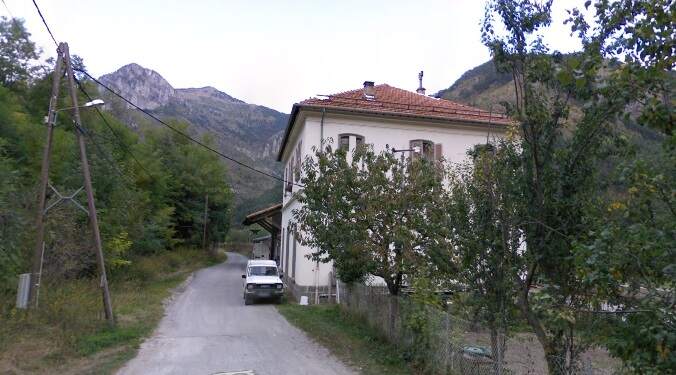
  56. https://www.openstreetmap.org/#map=15/44.06722/7.59971, accessed on 4th August 2025.
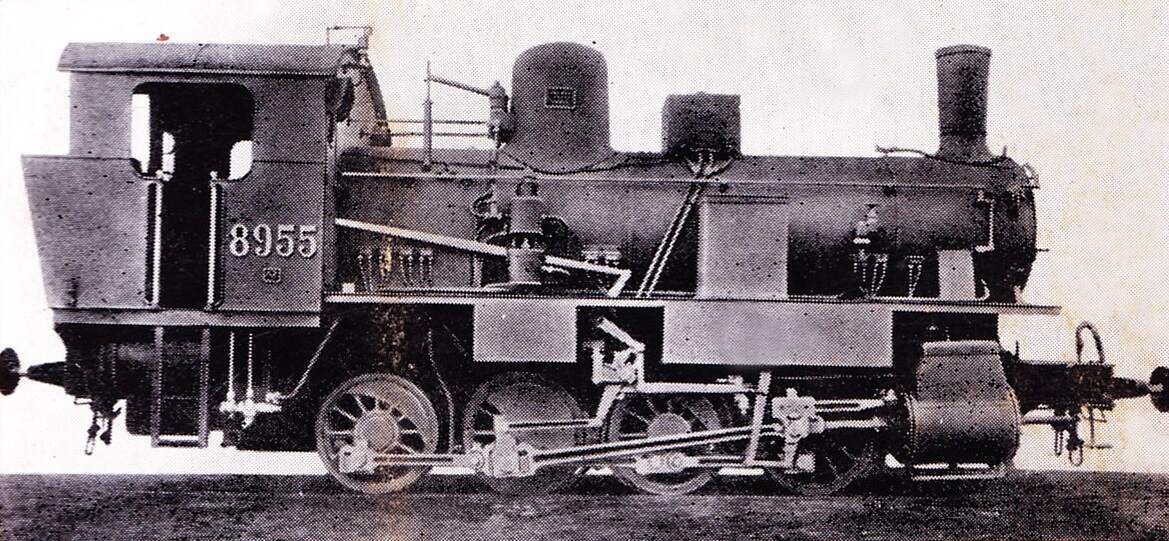
  57. https://commons.m.wikimedia.org/wiki/Category:Gare_de_La_Brigue, accessed on 4th August 2025.
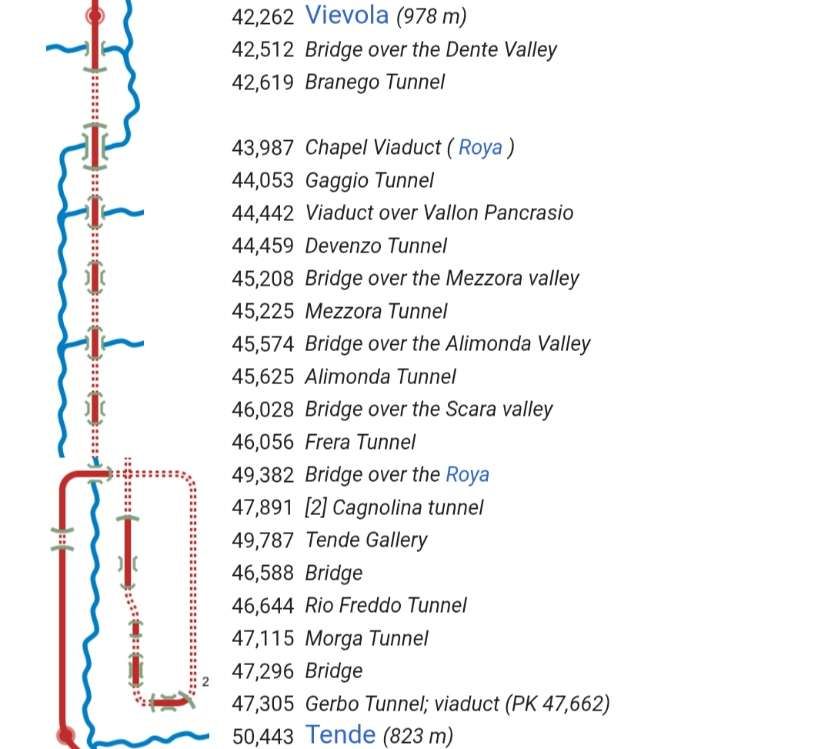
  58. https://www.openstreetmap.org/#map=18/44.062224/7.604105, accessed on 4th August 2025.
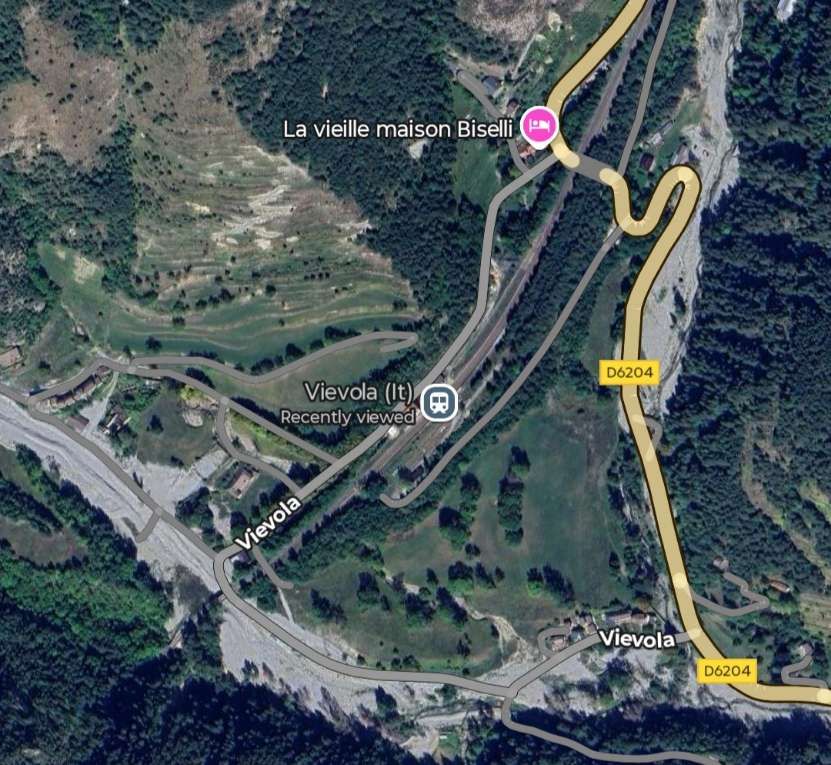
  59. https://www.openstreetmap.org/#map=17/44.061282/7.597185, accessed on 4th August 2025.
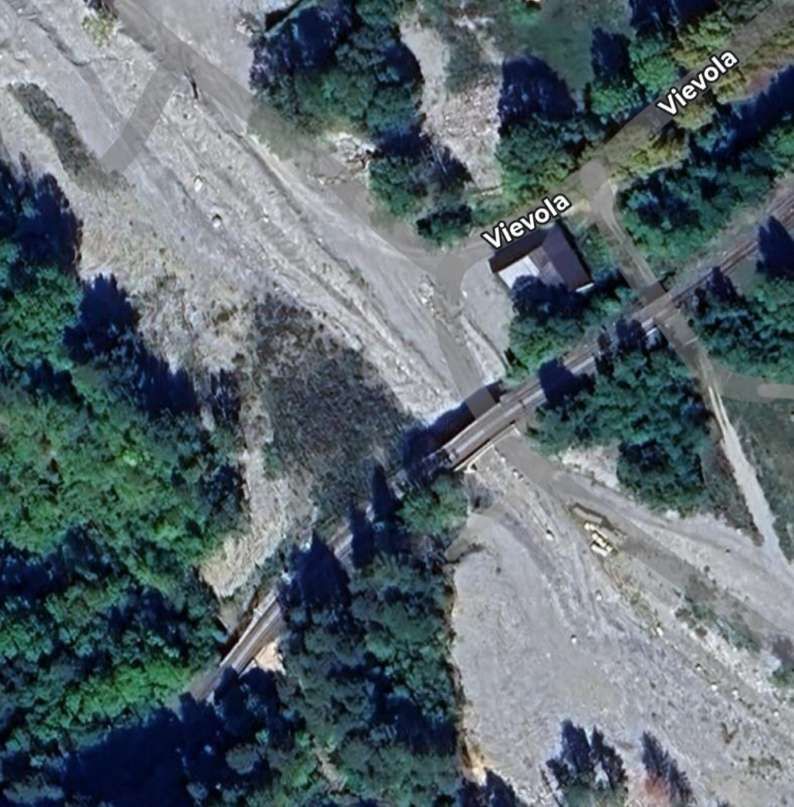
  60. https://www.openstreetmap.org/#map=16/44.05701/7.59374, accessed on 5th August 2025.
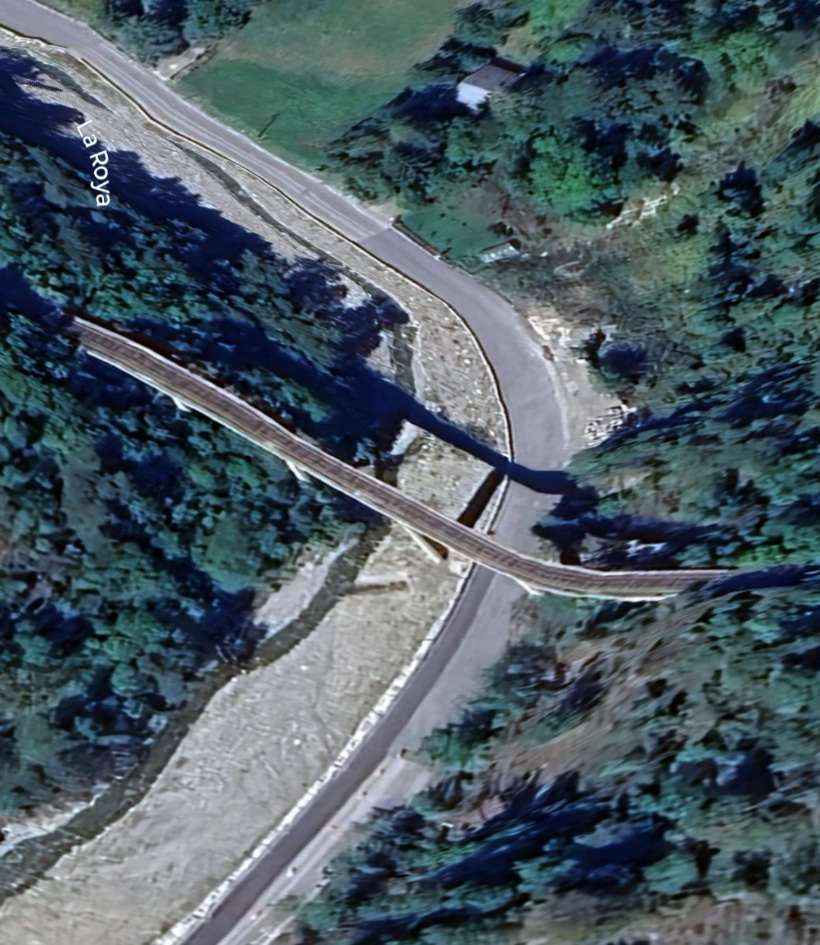
  61. https://www.openstreetmap.org/#map=16/44.05690/7.58934, accessed on 5th August 2025.
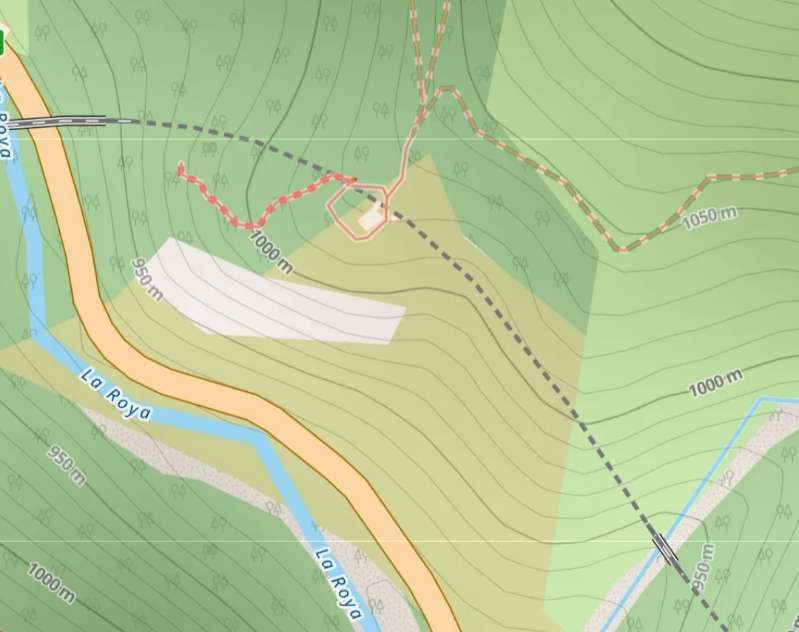
  62. https://www.openstreetmap.org/#map=17/44.055854/7.584440, accessed on 5th August 2025.
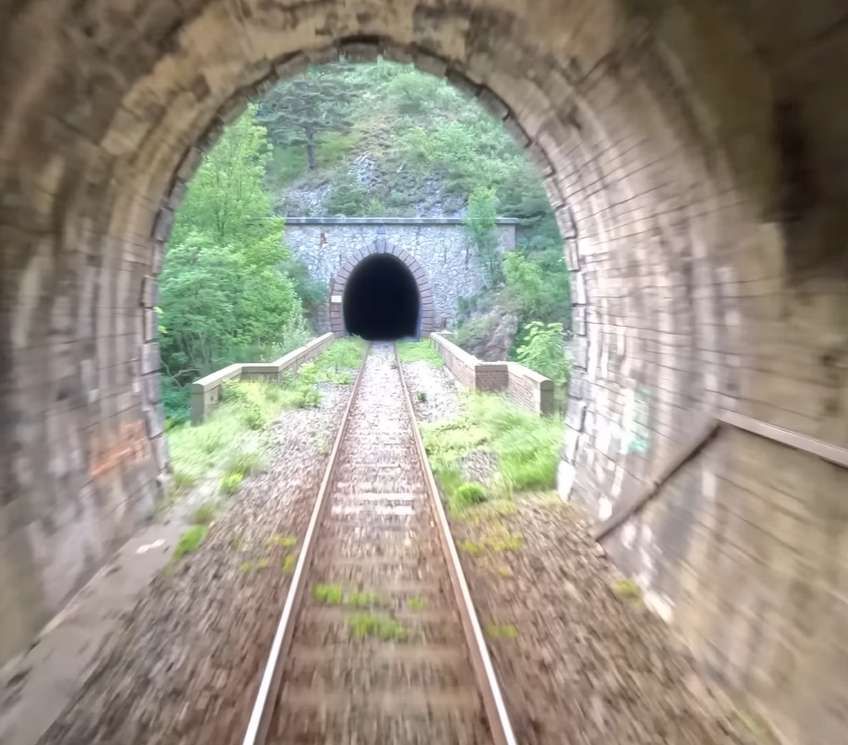
  63. https://www.facebook.com/groups/194416750579024/search/?q=st.%20dalmas%20de%20tende, accessed on 5th August 2025.
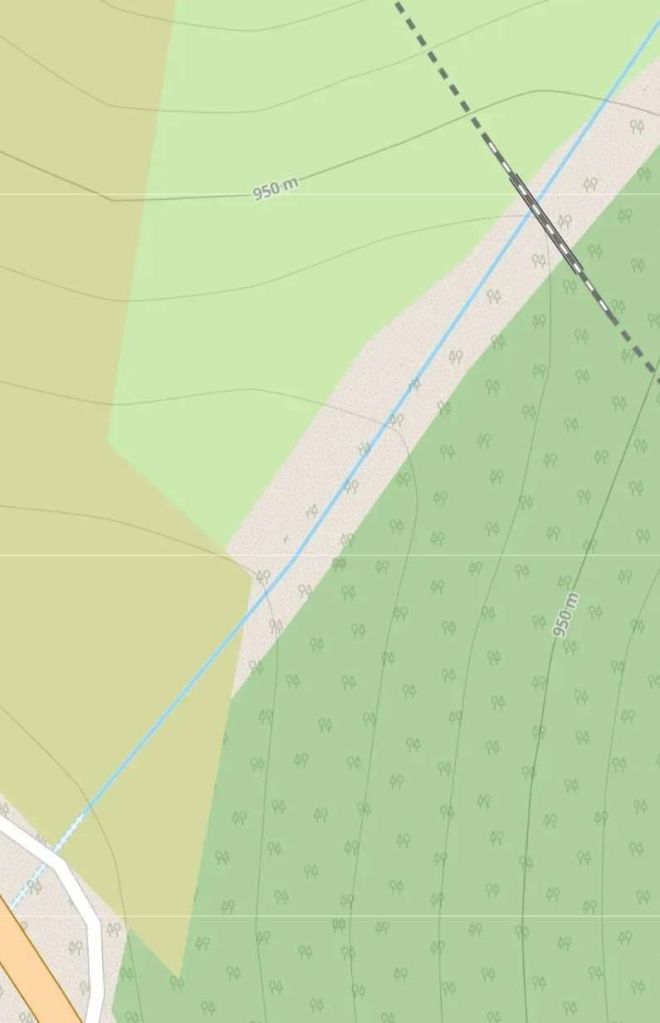
  64. https://commons.wikimedia.org/wiki/File:Locomotiva_N._6301.jpg, accessed on 6th August 2025
  65. https://commons.wikimedia.org/wiki/File:FS_895.jpg, accessed on 6th August 2025.
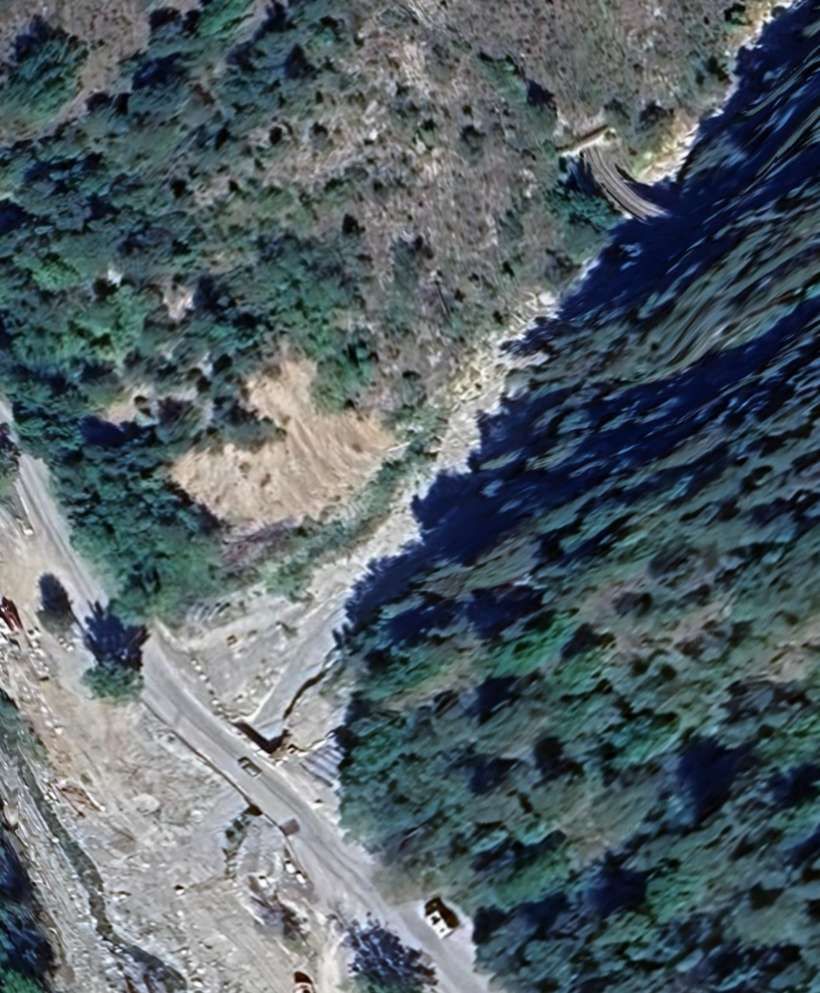
  66. https://commons.wikimedia.org/wiki/File:Stazione_Vievola_1910.jpg, accessed on 6th August 2025.
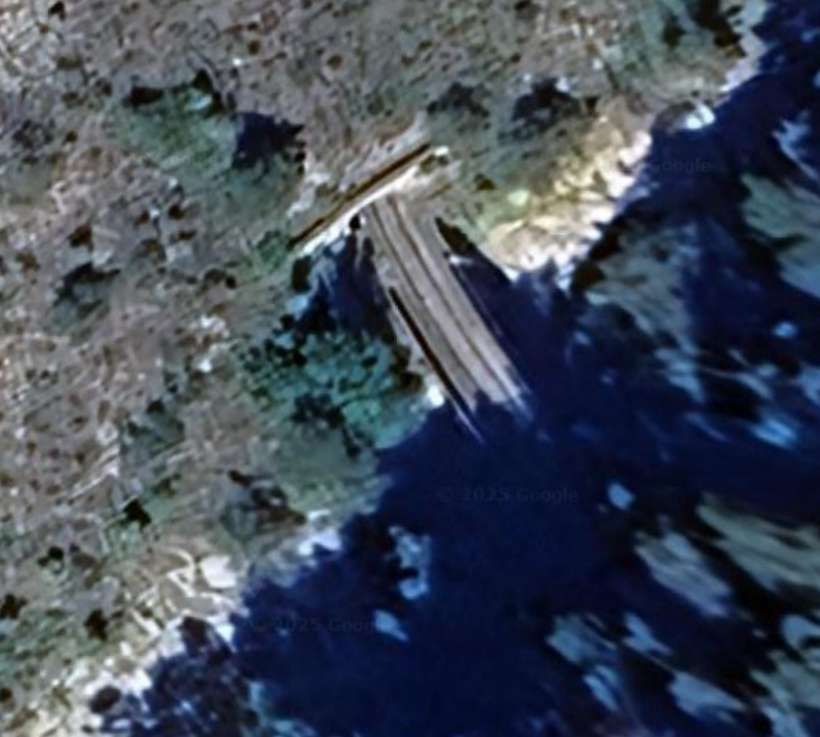
  67. https://rogerfarnworth.com/2025/08/16/the-railway-between-nice-tende-and-cuneo-part-4-st-dalmas-de-tende-to-breil-sur-roya/
  68. This image appeared on an Italian Facebook Group but I did not record which one and cannot now find the image or the group, accessed on 1st October 2025.
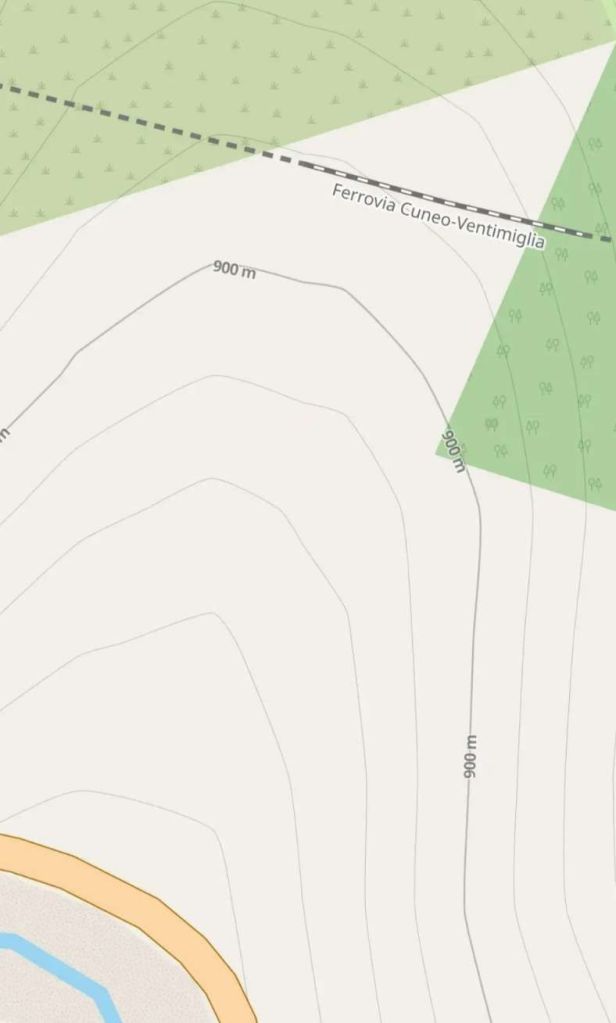
Stockport Corporation Tramways – Part 2 (Modern Tramway Vol. 12 No. 138, June 1949)

P.W. Gentry wrote about Stockport’s trams in the July 1949 issue of Modern Tramway.

He says: “Besides possessing several interesting features of its own, the Stockport system today commands added attention as the last last surviving member of that once network of standard gauge undertakings encircling Manchester. It is an unusually pleasing system by virtue of its compact and simple arrangement, its focal point being Mersey Square.” [1: p123]

The article in Modern Tramway caught my attention because for about 9 years I worked in Stockport as a highway engineer.

This is a second article looking at Stockport Corporations Tramways. The first article which looked at the history of the network and followed one axis of that network can be found here. [2]

Mersey Square was the main hub of Stockport’s tramway network and appeared as a schematic plan in Gentry’s article in The Modern Tramway. …

Mersey Square was the hub of the Stockport Corporation tramways. Mersey Square Depot and Heaton Lane Depot are shown clearly on this sketch plan drawn in 1949. The modern A6 runs left-right across the lower half of the plan. © P.W. Gentry, Public Domain. [1: p123]
An extract from Map: Lancashire CXII.9; Ordnance Survey, 25 inch to 1 mile; revised: 1934; published: 1936, showing Mersey Square as it was in 1934. The tram depot had, by this time, been enlarged and the additional depot on Heaton Lane constructed. Heaton lane Depot is accessed via the branch West off Wellington Road. [8]

Stockport Corporation’s Trams

Before looking at the remaining tram routes operated by Stockport Corporation it is worth noting the trams which Stockport Corporation used to operate the network. P.W. Gentry listed these as follows:

This table is taken from Gentry’s article. [1: p126]

Gentry provided basic details in his article, more details can be found here. [8] The same website provides a history of the network [9] and a Trolleybus/Bus Fleet List 1913-1969. [10]

Stockport’s Tram Routes

The Stockport Corporation Tramway Network (1901-1951), © Rcsprinter123 and licenced for reuse under a Creative Commons Licence (CC BY 3.0) [3]

Edgeley to Mersey Square and Mersey Square to Reddish and Gorton

This first axis of the network was covered in my first article about Stockport Corporation Trams, here. [2] Two further axes are worth our attention: the first, below, that between Gatley and Bredbury; the second that between Manchester and Hazel Grove.

Gatley to Mersey Square and Mersey Square towards Bredbury

We start with the tram terminus in Gatley.

Gatley Green and the terminus of the Stockport Corporation Tramway as shown on the 25′ Ordnance Survey of 1907, published in 1935. [11]
The same location in the 21st century. [Google Streetview, January 2025]
The Gatley tram terminus was outside the Horse and Farrier Pub. This view looks East from Gatley Bridge, © Public Domain. [5]
A similar view along the A560 in the 21st century, with the Horse and Farrier Pub on the left. [Google Streetview, August 2024]
A tram at the same location viewed from another angle, this time from the South, © Public Domain. [6]
A similar view from Church Road in the 21st century. [Google Streetview, August 2024]
To the East, the tramway passed under Gatley Road Railway Bridge. 25′ Ordnance Survey of 1907, published in 1935 the railway as being under construction but with the bridge in place. [11]
Gatley Road Railway Bridge seen from the West, looking East along the A560. [Google Streetview, August 2024]
This satellite image shows the length of the A560 from just West of Gatley Railway Bridge to just East of Greenhall Bridge. The dominant feature at the centre of the image is the A34, Kingsway, one of the main arterial routes on the South side of Manchsterer.  [Google Maps, January 2025]
Looking West towards Gatley Road Railway bridge in the 1910s with a tram heading for Stockport, © Public Domain. [16]
A similar location on Gatley Road in the 21st century. [Google Streetview, August 2024]
This extract from the 25′ Ordnance Survey of 1907, published in 1935, shows a location further to the East – Greenhall Bridge carried the road and tramway over Micker Brook. On this map the political boundary has taken precedence over the tramway. The tramway ran along the road from left to right. [11]
Looking East Long the A560 towards Cheadle. The bridge over Micker Brook was one which we needed to replace during the 1990s when I was responsible for the maintenance of highway bridges for Stockport MBC. [Google Streetview, August 2024]
It is somewhat easier to appreciate the layout of the bridge with 3D image. This bridge was rebuilt during my time at Stockport Council in the 1990s. [Google Earth (3D), January 2025]

Gatley Road ran through to the junction at the West end of the Cheadle High Street.

The tramway ran through from Gatley Road onto High Street, Cheadle as the 25′ Ordnance Survey of 1907, published in 1935, shows. [11]
The same junction in the 21st century. [Google Maps, January 2025]
Looking West along Gatley Road, Cheadle in 1908, from the West end of Cheadle High Street, © Public Domain. [7]
A very similar view looking West from Cheadle High Street in the 21st century. [Google Streetview, August 2024]
The tramway ran West to East along Cheadle High Street and on to Stockport Road. This extract is taken, again, from the 25″ Ordnance Survey, this sheet was surveyed in 1916 and published in 1922. [12]
Looking West along Cheadle High Street, © Public Domain. [15]
The same view in the 21st century. [Google Streetview, August 2024]
The junction of Cheadle High Street with Stockport Road and Manchester Road, looking West. The passing loop at the junction can be seen in this image, © Public Domain. [13]
A view of the same road junctionfrom Stockport Road in the 21st century. [Google Streetview, August 2024]
an early image looking East from the junction. The tram is heading for Stock port on Stockport Road, Cheadle Green is behind the tram, © Public Domain. [14]
A similar view in the 2020s. [Google Streetview, August 2024]
Further East on the same OS map sheet, the tramway can be seen continuing East on Stockport Road. [12]
The last section of Stockport Road on this particular OS map sheet shows the tramway and road running Northeast and approaching the railway bridge. [12]
The next 25″ Ordnance Survey sheet ( surveyed in 1916 and published in 1922) shows Stockport Road and the tramway heading Northeast under the railway bridge into Cheadle Heath. Top-right in this map extract is Cheadle Heath Railway Station. The junction with Edgeley Road is just above the centre of the image. [17]
Looking Southwest along Stockport Road Cheadle Heath with the railway bridge on the right side of the image. This image comes from Stockport Image Archive, © Public Domain. [20]
A similar view in the 2020s looking across the motorway slop road roundabout and under the railway bridge, West towards Cheadle. [Google Streetview, August 2024]
Laying the tram tracks at the junction of Stockport Road and Edgeley Road, Cheadle Heath in 1903. This image comes from the Stockport Image Archive and faces towards Stockport, © Public Domain. [21]
The same location in the 1940s, again facing towards Stockport. This is another image from the Stockport Image Archive, © Public Domain. [22]
The view along Stockport Road towards Stockport in the 2020s. [Google Streetview, August 2024]
Continuing Northeast, the road and tramway began the descent into the River Mersey valley. The road took the name Brinksway. [17]
The tramway followed Brinksway as it ran East on the South side of the River Mersey. One of Stockport’s road bridges over the river, Brinksway Bridge, can be seen towards the right of this map extract. [17]
Looking down Brinksway towards Stockport town centre. This image is held in the Stockport Image Archive, © Public Domain. [23]
A similar view in the 2020s. [Google Streetview, August 2024]
Looking up Brinksway to the location of the photograph above. The houses on the distance in this view are those on the left of the last image. This image is held in the Stockport Image Archive, © Public Domain. [24]
Approximately the same location on Brinksway, facing the same direction. [Google Streetview, August 2024]
Further East down Brinksway this view shows one of the significant rock outcrops. This view is held in the Stockport Image Archive, © Public Domain. [25]
A very similar location on Brinksway, facing in the same direction. [Google Streetview, August 2024]
An extract from Britain from Above image EPW036823, Brinksway and Brinksway Bridge in 1931, © Historic England. [26]
Trams on Brinksway.in 1931. This view looks towards Stockport town centre, © Public Domain. [26]
A similar location in n Brinksway, looking towards the town centre. [Google Streetview, August 2024]
Continuing East Brinksway became Chestergate as trams approached the centre of Stockport, passing under Stockport’s iconic viaduct which can be seen in the extreme top-right of the map extract. [17]
Just a very short length of Chestergate (and the tramway) intrudes into the next map sheet to the North (25″ Ordnance Survey of 1916, published in 2922). [18]
Trams then passed under the A6, Wellington Road South into Mersey Square (an extract from the 25″ Ordnance Survey of 1917, published in 1922). [19]
Looking East towards Mersey Square, a tram heads West towards Gatley/Cheadle, Public Domain. [4: p94]
Looking West-southwest under Wellington Road along Chestergate with the Beckwith Steps to the right. This image was shared on the Memories of Stockport Facebook Group by Dave Moran on 23rd April 2024 [28]
A tram turns out of Mersey Square onto Chestergate, heading for Cheadle/Gatley, while another, older trams heads towards St. Peter’s Square, © Public Domain. [31]

Tram services entered Mersey Square and crossed the Mersey. Services to the West of the town commenced here and ran along Princes Street to Bridge Street. That length of the network is covered in an earlier article which can be found here. [2]

We resume this article at the Northeast end of Princes Street and its junction with Bridge Street and then follow the route to Hyde.

A tram at the junction of Tiviot Dale, Princes Street and Bridge Street. Bridge Street runs off the picture to the right. This image was shared on the Memories of Stockport Facebook Group by Dave Moran on 24th August 2023, © Public Domain. [27]
A similar view from the end of Princes Street. [Google Streetview, August 2024]
The views above look Northeast from Princes Street, the two immediately below face Northwest from Bridge Street and the two further below face Southeast along Bridge Street. [35]
Looking back from Bridge Street to its junction with Princes Street ,(on the left) and Tiviot Dale (on the right). A tram is pictured on the corner of Tiviot Dale and Princes Street. Several shot fronts are pictured in the background including the Co-operative Insurance, Leonard Aaron, opthalmic opticians as well as shops selling musical instruments and a chemist. This image was shared by Dave Moran on the Memories of Stockport Facebook Group on 23rd April 2024, © Public Domain. [32]
The same location in the 2020s. [Google Streetview, August 2024]
Looking Southeast from the junction of Tiviot Dale, Princes Street and Bridge Street, a tram heads along Bridge Street towards the junction. The tram has just turned right onto Bridge Street from Warren Street. [33]
An earlier monochrome image from Stockport Image Archive which shows Tram No. 28 turning from Warren Street onto Bridge Street before crossing Lancashire Bridge. This image was shared by Marilyn Ann Cronshaw on the Memories of Stockport Facebook Group on 14th August 2015, © Public Domain. [44]
A similar view in the 21st century. [Google Streetview, August 2024]
An overhead view looking East across Lancashire Bridge and Warren Street This is an extract from image No. EPW013110, © Historic England. [36]
Warren Street cut across a peninsula of land between the River Goyt and the River Mersey with the confluence between the River Goyt and the River Tame to the North. [35]
An accident in the 1930s on Warren Street between a tram and a lorry, © Public Domain. [34]
Park Bridge is bottom left on this extract from the 25″ Ordnance Survey of 1917, published 1922. [35]
A shorter stretch of Great Portwood Street in the 21st century. [Google Maps, January 2025]
A tram passes the Queen’s Public House on Great Portwood Street on its way East. This image was shared on the Memories of Stockport Facebook Group by Julian Ryan on 20th November 2022, © Public Domain. [38]
The same location in the 2020s. [Google Streetview, August 2024]
Further Northeast along Great Portwood Street on the same OS Map sheet as the extract above. [35]
A similar length of Great Portwood Street. It now has one of the major M60 junctions.on the North side. [Google Streetview, January  2025]
The tramway turns Southeast onto Carrington Road and runs down to the River Goyt at Carrington Bridge before continuing West on Stockport Road West. [35]
A similar length of the road/tramway as appears on the map extract above. St. Paul’s School and Church at the junction of Great Portwood Street and Carrington Road are long gone and Carrington Road has been diverted to meet the large motorway roundabout. [Google Maps, January 2025]
St. Paul’s Church, Great Portwood Street, seen from the Southwest on Great Portwood Street. The junction with. Arrington Road is behind the tram. This image was shared on the Stockport Memories Facebook Group by Niall Dorsett on 24th November 2024, © Public Domain. [49]
This view looking West from Portwood Roundabout is from approximately the same location. Everything in the monochrome image above has gone. [Google Streetview, September 2023]
Carrington Road, Portwood, looking Northwest close to it junction with Great Portwood Street which is just at the far end of the St. Paul’s School site. The school is to the left of the tram. The churchyard is on the right with the church building just off the picture to the right, © Public Domain. [37]
Looking Northwest along what was Carrington Road. The wall beyond the lamp post is what was the churchyard boundary wall. The line of the road ran through the planted beds with the location of the Scholl to the left of the planting. [Google Streetview, September 2023]
This next extract from the 25″ Ordnance Survey takes the tramway to the West edge of the OS Sheet, over New Bridge, along Stockport Road West. [35]
The same length of Stockport Road West on modern satellite imagery. Notice the shortening of the loop in the River Goyt which was required to allow construction of the M60. [Google Maps, January 2025]
Stockport Road West as it appears on the 25″ Ordnance Survey of 1917, published in 1922. [39]
A very similar length of Stockport Road West which, rather than running through a rural landscape, now runs through a residential area. [Google Maps, January 2025]
Stockport Road East through Bredbury as it appeared on the 1917 Ordnance Survey. [39]
A short molar length of Stockport Road East in the 21st century. [Google Maps, February 2025]
An interesting arrangement of under and over bridges appears in the bottom-left of this next extract from the 25″ Ordnance Survey of 1917. Trams passed over the Cheshire Lines Committee (Great Central and Midland Joint Railway) from Bredbury Junction, and then under the same company’s lines through Bredbury Railway Station. Woodley village can be seen top-right and on the next map extract. [40]
St. Mark’s Woodley appears bottom-left in between Stockport Road East and Redhouse Lane. [40]
This image shows a similar length of the A560 as it appears towards the end of the first quarter of the 21st century. [Google Maps, February 2025]
Hyde Road Woodley looking Northeast from St. Mark’s Church. This image was shared on the Stockport Memories Facebook Group by Ian Scottson on 8th October 2024, © Public Domain. [50]
Looking Northeast along the A560 from adjacent to St. Mark’s Churchyard. Redhouse Lane joins the A560 from the right. [Google Streetview, April 2015]
Stockport Tram No.10 outside the Lowes Arms in Woodley in 1947, heading for Hyde. This image was shared on the Stockport Memories Facebook Group by Dave Eccles on 10th June 2024, © Public Domain. [48]
A similar view looking North from the A560 at the location of the Lowes Arms in Woodley. [Google Streetview, June 2023]
Woodley village continues Northeast along Hyde Road. [40]
Woodley Railway Station is in the upper-right quadrant of this extract from the 25″Ordnance Survey. Hyde Road runs bottom-left to top-right. [40]
A similar length of the A560/A627 as in the map extracts immediately above. Woodley Railway Station is at the top-right of the image. [Google Maps, February 2025]
An early 20th century photograph looking Northeast along Stockport Road, Woodley. The railway station is on the right with the railway passing under the road ahead. As can be seen here and on the map extract above, there was a passing loop which allowed trams to pass each other immediately outside Woodley Railway Station. This image was shared on the Stockport Memories Facebook Group by Ian Scottson on 5th October 2024, © Public Domain. [47]
Now the A627, Hyde Road runs past Woodley Railway Station. This view is from a similar location to the monochrome image above. [Google Streetview, June 2023]
Stockport Road/Hyde Road continues Northeast from Woodley towards Gee Cross. [41]
The same length of Hyde Road/Stockport Road in the 21st century
This view Southwest along Stockport Road shows a tram heading for Woodley along Pole Bank (Stockport Road, A560 in the 21st century), © Public Domain. [46]
The same view in the 21st century. [Google Streetview, June 2025]
The 25″ Ordnance Survey shows that trams turned East along Stockport Road towards Gee Cross. [41]
Dowson Road runs North and Stockport Road heads East at the junction on the left side of this satellite image. Trams turned East along Stockport Road. [Google Maps, February 2025.
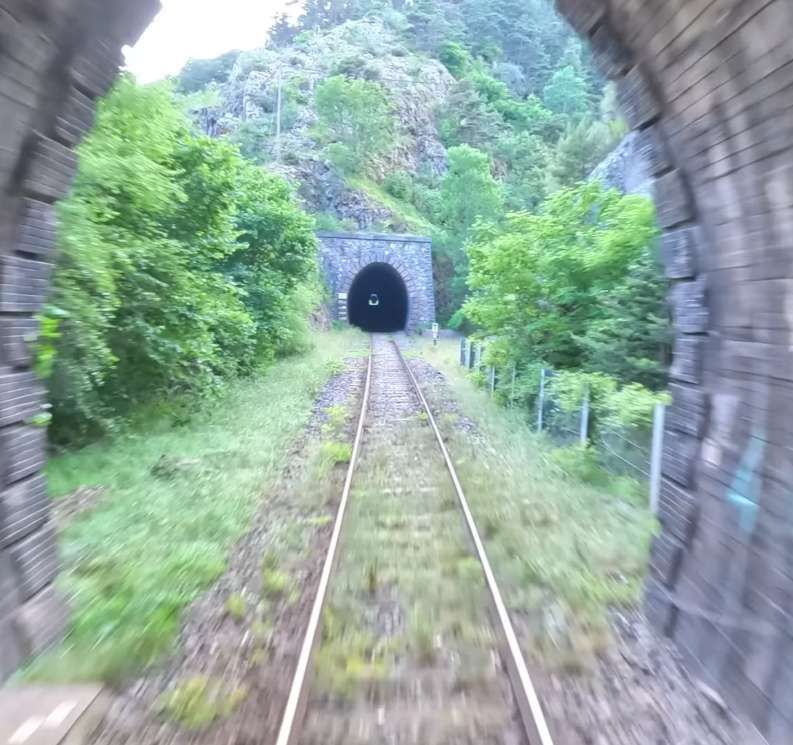
Looking Northeast from the Gerrards, close to the left edge of the map extract and satellite image above, along Stockport Road towards Dawson Road in Gee Cross. In the middle distance trams heading for Hyde turned right on Stockport Road, © Public Domain. [30]
A view Northeast from a camera location closed to the location of the tram in the monochrome image above. [Google Streetview, June 2023]
In Gee Cross, the main road on which the trams were travelling (Stockport Road) gave way to Mottram Old Road – both now lengths of the A560. Trams branched off what is now the A560 along another length of Stockport Road. Today, this is the B6468.  [42]
A similar length of Stockport Road, Gee Cross. [Google Earth, February 2025]
This image shows a tram travelling along Stockport Road, Gee Cross at the very bottom of the map extract above, © Public Domain. [29]
A similar location in the 21st century looking Northeast. [Google Streetview, June 2023]
Probably dating from the 1920s, This photograph shows the tramlines running along Stockport Road towards Hyde. Mottram Old Road is on the right side of the image. There was a passing loop at the junction. The old sign post remains at the junction but has lost an arm. The lamp on the top of the pole remains. The houses behind it have gone leaving a grassy embankment. © Public Domain. [45]
A view Northeast from a similar location in the 2020s. The lamppost can easily be made out beyond the car turning onto the A560. [Google Streetview, June 2023]
This next extract from the 25″ Ordnance Survey shows the tram tracks running North along Stockport Road (B6468), bridging the Cheshire Lines Committee railway and then Northwest into Hyde along Market Street. [42]
A similar length of Stockport Road and Market Street in Hyde. The old railway in cutting is now a footpath/cycleway. A roundabout now marks the bend from Stockport Road into Market Street and a housing estate now sits on the site of the Slack Cotton Mills. [Google Maps, February 2025]
Trams from Stockport continued Northwest along Market Street, Hyde. Terminating close to the Market ground, seen here in the top-left of the extract from the 25″ Ordnance Survey of 1917, published 1922. [42]
The final length of the route covered by Stockport’s trams which reached as far as the Market ground which can be seen in the top-left of this satellite image [Google Earth, February 2025]
Market Street, Hyde in around 1930. A tram on the Stockport Edgeley service waits at the Town Hall terminus as a bus departs for Romiley from the Market. This image was shared on the Hyde Past and Present Facebook Group by Lee E. Brown 8th November 2024. © Public Domain. [51]
A tram on Market Street, Hyde, © Public Domain. [52]
A view Northwest along Market Street in the 21st century. [Google Streetview, June 2023]
A photograph from around 1930 of the tram terminus on Market Street outside the Town Hall. The leading tram is a Manchester Corporation car on the No 19 service to Manchester Exchange. In the centre is an SHMD car and at the far end is a Stockport car and going off the position of the poles, they are both on the Edgeley run. Across the market there is a rare glimpse of the Norfolk Hotel. The photographer was standing on the corner of Greenfield Street, looking across to the market ground. Market Street goes away behind the trams. The top of the Midland Bank is visible above the trams. This length of tramway may be unique in the UK being served by four different tram companies/services, SHMD, Ashton, Manchester and Stockport trams. This image was shared on the Hyde Past and Present Facebook Group by Lee E. Brown on 23rd November 2019. [53]
A view from a similar location in the 21st century. [Google Streetview, June 2023]

This completes the length of the tramway from Stockport to Hyde. The next article in this short series will cover the line from Manchester to Hazel Gri

References

  1. P.W. Gentry; Stockport Corporation Tramway; Modern Tramway, Vol. 12 No. 138, June 1949, p123-126.
  2. https://rogerfarnworth.com/2025/01/15/stockport-corporation-tramways-modern-tramway-vol-12-no-138-june-1949-part-1
  3. https://en.m.wikipedia.org/wiki/Stockport_Corporation_Tramways, accessed on 3rd January 2025.
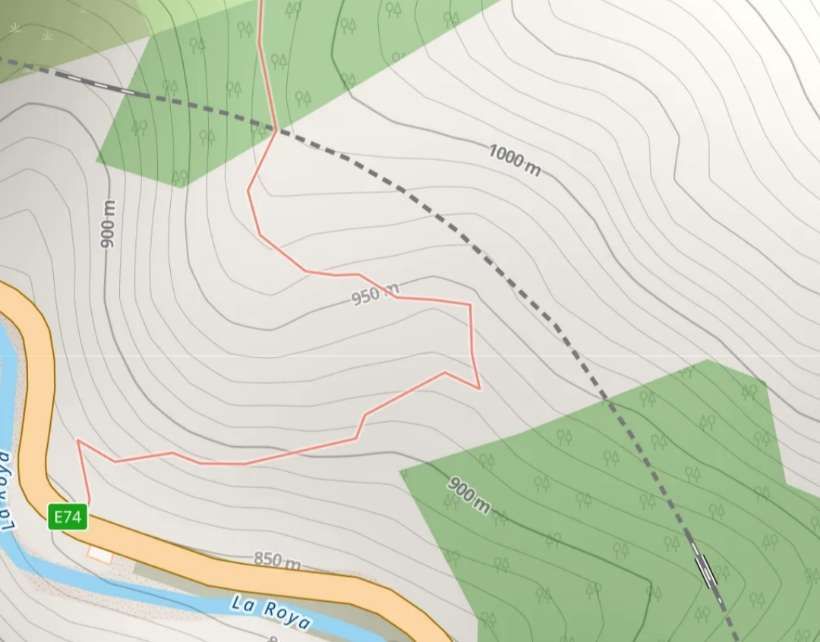
  4. Harry Postlethwaite, John Senior & Bob Rowe; Super Prestige No. 14, Stockport Corporation; Venture Publications, Glossop, Derbyshire, 2008. This document is made freely available by MDS Books as a .pdf: https://www.mdsbooks.co.uk/media/wysiwyg/Stockport_Download_1.pdf, accessed on 14th January 2025.
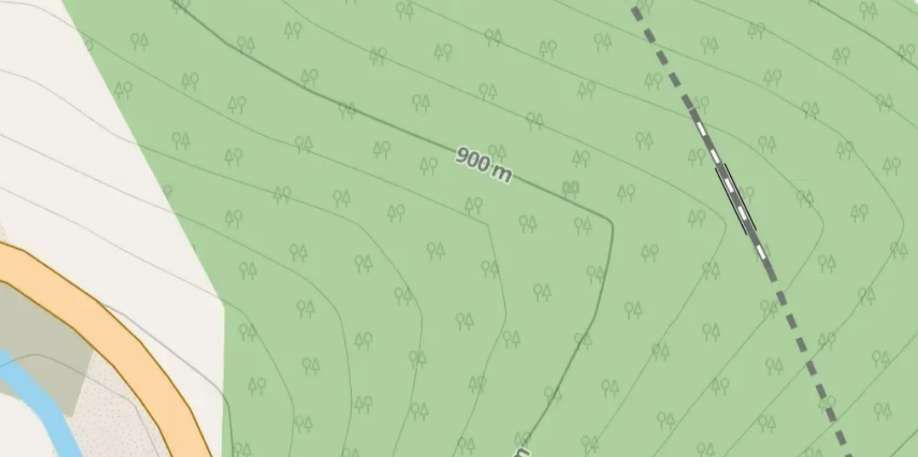
  5. https://www.ebay.co.uk/itm/361890923297?mkcid=16&mkevt=1&mkrid=711-127632-2357-0&ssspo=ibGa9k_VTo6&sssrc=4429486&ssuid=&var=&widget_ver=artemis&media=COPY, accessed on 15th January 2025.
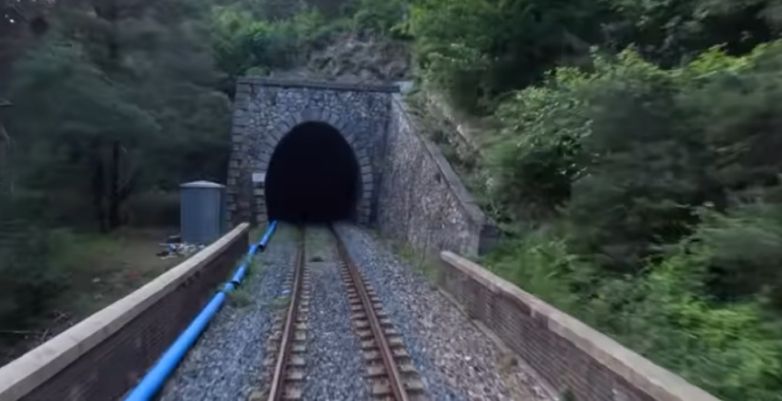
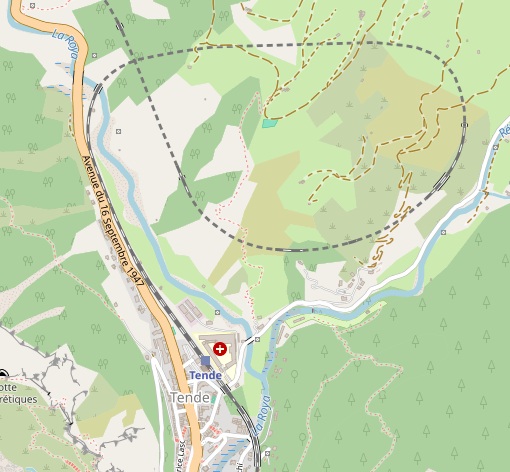
  6. https://www.ebay.co.uk/itm/361906909095?mkcid=16&mkevt=1&mkrid=711-127632-2357-0&ssspo=ibGa9k_VTo6&sssrc=4429486&ssuid=&var=&widget_ver=artemis&media=COPY, accessed on 15th January 2025.
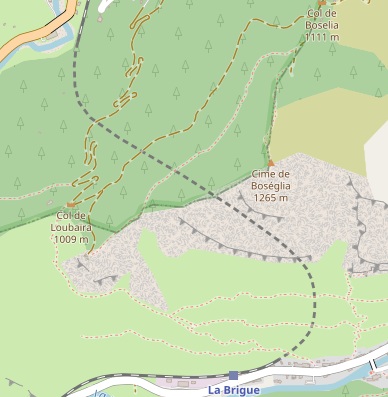
  7. https://fr.m.wikipedia.org/wiki/Fichier:Gatley_Road,_Cheadle_1908.png, accessed on 15th January 2025.
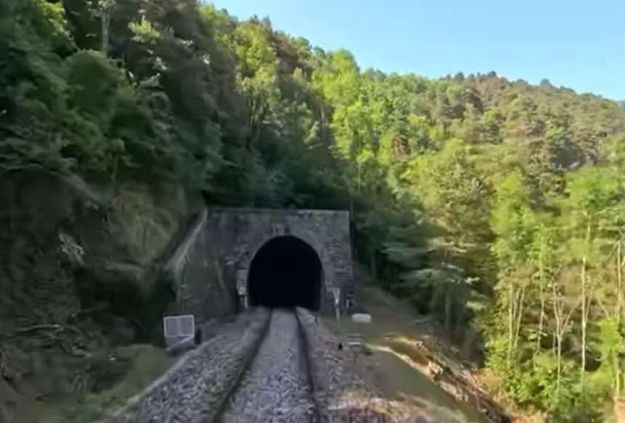
  8. https://localtransporthistory.co.uk/fleetlists/stockport2, accessed on 16th January 2025.
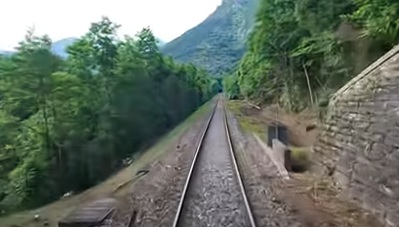
  9. https://localtransporthistory.co.uk/fleetlists/stockport1, accessed on 16th January 2025.
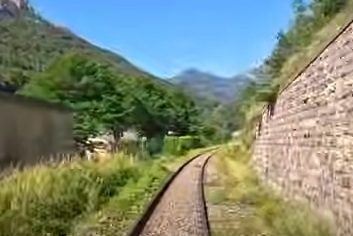
  10. https://localtransporthistory.co.uk/fleetlists/stockport3, accessed on 16th January 2025.
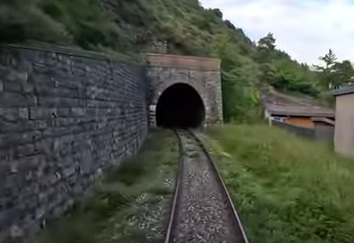
  11. https://maps.nls.uk/view/114581923, accessed on 16th January 2025.
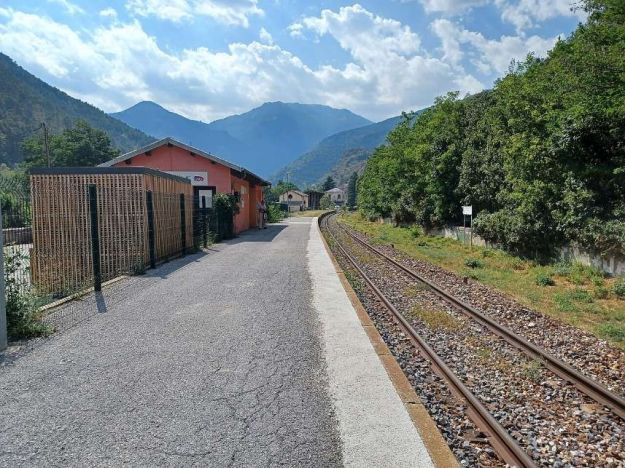
  12. https://maps.nls.uk/view/126523838, accessed on 19th January 2025.
  13. https://www.facebook.com/photo/?fbid=521382444623405&set=a.454578394637144&locale=eu_ES, accessed on 20th January 2025.
  14. https://www.facebook.com/photo/?fbid=521383347956648&set=a.454578394637144&locale=eu_ES, accessed on 20th January 2025.
  15. https://www.cheadlephotos.net/contents/en-uk/d2_1900s.html, accessed on 20th January 2025.
  16. https://www.cheadlephotos.net/contents/en-uk/d8_1910s.html, accessed on 20th January 2025.
  17. https://maps.nls.uk/view/126523844, accessed on 20th January 2025.
  18. https://maps.nls.uk/view/126523814, accessed on 20th January 2025.
  19. https://maps.nls.uk/view/126523904, accessed on 20th January 2025.
  20. https://imagearchive.stockport.gov.uk/Home/Photograph?accessionno=34735&searchString=Tram&searchOption=Title&searchArea=All&first=False&last=False, accessed on 20th January 2025.
  21. https://imagearchive.stockport.gov.uk/Home/Photograph?accessionno=10854&searchString=Tram&searchOption=Title&searchArea=All&first=False&last=False, accessed on 20th January 2025.
  22. https://imagearchive.stockport.gov.uk/Home/Photograph?accessionno=25483&searchString=stockport%20road&searchOption=Title&searchArea=9&first=False&last=False, accessed on 20th January 2025.
  23. https://imagearchive.stockport.gov.uk/Home/Photograph?accessionno=35263&searchString=Brinksway&searchOption=Title&searchArea=All&first=False&last=False, accessed on 20th January 2025.
  24. https://imagearchive.stockport.gov.uk/Home/Photograph?accessionno=42132&searchString=Brinksway&searchOption=Title&searchArea=All&first=False&last=False, accessed on 20th January 2025.
  25. https://imagearchive.stockport.gov.uk/Home/Photograph?accessionno=2201&searchString=Brinksway&searchOption=Title&searchArea=All&first=False&last=False, accessed on 20th January 2025.
  26. https://www.britainfromabove.org.uk/en/image/epw036823, accessed on 20th January 2025.
  27. https://www.facebook.com/share/p/14edX1aoxB, accessed on 20th January 2025.
  28. https://www.facebook.com/share/p/18R2xVHgGe, accessed on 20th January 2025.
  29. https://www.ebay.co.uk/itm/163654326560?mkcid=16&mkevt=1&mkrid=711-127632-2357-0&ssspo=7o9wvntyQeW&sssrc=4429486&ssuid=afQhrar7TGK&var=&widget_ver=artemis&media=COPY, accessed on 21st January 2025.
  30. https://images.app.goo.gl/PgmXAz92FPtaD7Qa9, accessed on 21st January 2025.
  31. https://stockportheritagetrust.co.uk/gallery, accessed on 21st January 2025.
  32. https://www.facebook.com/share/p/1GiD3aC5Ku, accessed on 21st January 2025.
  33. https://www.reddit.com/r/stockport/comments/1896toe/bridge_st_1900s/#lightbo, accessed on 21st January 2025.
  34. https://imagearchive.stockport.gov.uk/Home/Photograph?accessionno=35206&searchString=Tram&searchOption=Title&searchArea=All&classSearch=False, accessed on 21st January 2025.
  35. https://maps.nls.uk/view/126523904, accessed on 21st January 2025.
  36. https://www.britainfromabove.org.uk/image/EPW013110, accessed on 21st January 2025
  37. https://www.facebook.com/share/p/158MXnGX2o, accessed on 21st January 2025.
  38. https://www.facebook.com/share/p/1YU8yCcRz2, accessed on 21st January 2025.
  39. https://maps.nls.uk/view/114581242, accessed on 22nd January 2025.
  40. https://maps.nls.uk/view/126523886, accessed on 22nd January 2025.
  41. https://maps.nls.uk/view/126523892, accessed on 22nd January 2025.
  42. https://maps.nls.uk/view/126523865, accessed on 23rd January 2025.
  43. Not used.
  44. https://www.facebook.com/share/p/15sGQpHa5e, accessed on 23rd January 2025.
  45. https://oldhyde.blogspot.com/2008/01/tramlines-at-gee-cross.html?m=1, accessed on 31st January 2025.
  46. https://www.ebay.co.uk/itm/126400306855?mkcid=16&mkevt=1&mkrid=711-127632-2357-0&ssspo=IfOvO8v2Tu-&sssrc=4429486&ssuid=afQhrar7TGK&var=&widget_ver=artemis&media=COPY, accessed on 31st January 2025.
  47. https://www.facebook.com/share/p/19wVpLgfFs, accessed on 31st January 2025.
  48. https://www.facebook.com/share/p/15J8AoAWM5, accessed on 1st February 2025.
  49. https://www.facebook.com/share/p/19NgP1hLD7, accessed on 1st February 2025.
  50. https://www.facebook.com/share/p/18ABuv2goR, accessed on 2nd February 2025.
  51. https://www.facebook.com/share/p/19kyFJiqkS, accessed on 5th February 2025.
  52. https://www.ebay.co.uk/itm/394065476691?mkcid=16&mkevt=1&mkrid=711-127632-2357-0&ssspo=VG76xMQ6St6&sssrc=4429486&ssuid=afQhrar7TGK&var=&widget_ver=artemis&media=COPY, accessed on 5th February 2025.
  53. https://www.facebook.com/share/p/1E8S164umA, accessed on 5th February 2025.

Stockport Corporation Tramways – Modern Tramway Vol. 12 No. 138, June 1949 – Part 1

P.W. Gentry wrote about Stockport’s trams in the July 1949 issue of Modern Tramway.

He says: “Besides possessing several interesting features of its own, the Stockport system today commands added attention as the last last surviving member of that once network of standard gauge undertakings encircling Manchester. It is an unusually pleasing system by virtue of its compact and simple arrangement, its focal point being Mersey Square.” [1: p123]

This article in Modern Tramway caught my attention because for about 9 years I worked in Stockport as a highway engineer.

We know that tramways arrived in Stockport in the 1880’s from the Manchester direction when “the Manchester Tramways and Carriage Co, Ltd., [opened] a horse-car service into Mersey Square via Levenshulme.” [1: p123]

In 1889, the Stockport and Hazel Grove Carriage and Tramway Co. Ltd. was formed and “instituted horse car services southwards to Hazel Grove and Edgeley at Easter 1890.” [1: p123]

Stockport tramcar No. 5, dating from 1901, is preserved at the Heaton Park Tramway. The lower saloon of tramcar No. 5 was recovered from a field, where it had been used as a hen house, in 1971. It was restored by the ‘Stockport 5 Tramway Trust’. It now runs on the Heaton Park Tramway, a tramway museum in Heaton Park, Manchester. [2]

Stockport Corporation began tramway operations when, in 1890, “an Order under the Tramways Act was obtained for the construction and operation of electric tramways. Work commenced in Sandy Lane on 12th February 1901 and the three routes projected were opened in stages.” [1: p123]

Woodley Route: to Woodley Station by 26th August 1901; and Pole Bank by 30th May 1902.

Reddish Route: to Sandy Lane by 3rd September 1901; to Holdsworth Square by 30th May 1902; and to the Bull’s Head in Reddish by 25th November 1903.

Cheadle Route: to the Robin Hood on Brinksway by 23rd January 1902; to Cheadle Heath Bridge by 25th July 1903; to Cheadle Green by 5th May 1904; and to the Horse & Farrier, Gatley Green by 24th May 1904.

In parallel, negotiations secured the purchase of the horse tramways. First, the Levenshulme line (which was electrified by Manchester Corporation by 1903 and maintained by them). The Stockport & Hazel Grove undertaking was purchased in 1994 for £14,000 and electrified by 5th July 1905.

Tram service No. 35 was by then running from Manchester to Hazel Grove.

Mersey Square was the main hub of Stockport’s tramway network. …

Mersey Square was the hub of the Stockport Corporation tramways. Mersey Square Depot and Heaton Lane Depot are shown clearly on this sketch plan drawn in 1949. The modern A6 runs left-right across the lower half of the plan. © P.W. Gentry, Public Domain. [1: p123]

The National Library of Scotland retains three digital versions of the OS 25″ mapping:

An extract from Map: Cheshire X.15; Ordnance Survey, 25 inch to 1 mile; revised: 1907; published: 1932 which shows Mersey Square as it was in 1907. It seems as though publication of this map was delayed for 25 years! [6]
An extract from Map: Lancashire CXII.9; Ordnance Survey, 25 inch to 1 mile; revised: 1917; published: 1922, which shows Mersey Square as it was in 1917. [7]
An extract from Map: Lancashire CXII.9; Ordnance Survey, 25 inch to 1 mile; revised: 1934; published: 1936, showing Mersey Square as it was in 1934. The tram depot has been enlarged and the additional depot on Heaton Lane constructed. Heaton lane Depot is accessed via the branch West off Wellington Road. [8]

The sequence of extracts from the Ordnance Survey’s 25″ series of maps shows the development from 1907 to 1934. The most significant changes in that period were: the dualling of the trackwork on the A6 South of the Square; and the development of the Tram Depot. As can be seen from the map extracts, the main depot building was widened to reach the river bank and then extended Southwest towards Mersey Square. A surprising change appears in the latest extract – the conversion of the dual track work on Chestergate where it passes under the A6, Wellington Road to a stretch of single track.

Mersey Square in 1932, seen from the West. This image was shared on the Memories of Stockport Facebook Group on 19th January 2021 by Chris Paul. [13]

The 1930s to the 1970s saw major changes to the centre of Stockport. The River Mersey was culverted from Mersey Square, Northeast to Bridge Street and a dual carriageway road was created along the line of the River Mersey. This new road was not used by trams but it altered traffic arrangements at Mersey Square while it was in use.

The construction of Merseyway in the 1930s is nearing completion in this photograph which was shared on the Memories of Stockport Facebook Group on 18th October 2020 by Dave Moran. [12]
The view Southwest from Bridge Street, showing the dual carriageway over the River Mersey in the mid-20th century. This image was shared on the Memories of Stockport Facebook Group on 26th June 2020 by Julian Ryan. [9]
Merseyway was built on a series of reinforced concrete portal frames spanning the river. Given the positioning of the vehicles on the structure, this image probably comes from while the road was closed. The image was shared on the Memories of Stockport Facebook Group on 26th September 2018 by Marilyn Ann Cronshaw. [11]
Merseyway is seen from the Southwest, looking Northeast in the mid-20th century. The tram depot is on the left. This image was shared on the Memories of Stockport Facebook Group on 10th August 2020 by Keith Povey. [10]
A final view of Merseyway as a road across the roundabout at its Southwest end in Mersey Square. The photograph was taken from Wellington Road and it was shared on the Memories of Stockport Facebook Group on 6th October 2020 by Mark Lloyd. [14]
Mersey Square seen from the Southeast in 1948. The oddly shaped roundabout at the end of Merseyway is on the right with the old fire station above it. This image was shared on the Memories of Stockport Facebook Group on 28th August 2023 by Michael  Sidebottom. [15]
Traffic emerging from Mersey Square onto Wellington Road (A6). Manchester is away to the right, Hazel Grove to the left. Heaton Lane Tram Depot is beyond Wellington Road on the right of the image. This photograph was shared by Marilyn Ann Cronshaw on 24th June 2015. [16]
Mersey Square, Stockport in the 21st century. [Google Maps, January 2025]

By July 1905, the network was “in its final shape, with a total route mileage of 19.46. Of this, however 2.51 route miles (Vernon Park Pole Bank) was the property of Bradbury and Romiley Urban District Council, 1.64 miles (Cheadle Heath Bridge Gatley Green) belonged to Cheadle and Gatley U.D.C. and 0.88 miles to Hazel Grove and Bramhall U.D.C., all these sections being leased to Stockport Corporation for operating purposes. The total length of track over the system as a whole was 34.03 miles, and the cost of track construction averaged the modest figure of £7,227 per route mile.” [1: p124]

In addition to joint working with Manchester Corporation, a similar arrangement was made with “The Stalybridge, Hyde, Mossley and Dukinfield Transport and Electricity Board, Pole Bank being the point of connection between the two systems. Stockport cars were operated through to Hyde Town Hall from 1st January, 1903, when the Pole Bank Hyde line was the property of the Oldham, Ashton and Hyde Electric Tramways, Ltd., a B.E.T. subsidiary, but it was not until 1923, when this undertaking sold out to local authorities and the Hyde – Pole Bank section was taken over by the Joint Board, that mutual through running could be started. A joint S.H.M.D.-S.C.T. service was introduced in March 1925, between Hyde and Edgeley via Mersey Square and continued until the Joint Board ceased to operate trams on 26th May, 1945. Thereafter, Stockport maintained the service unaided until 2nd March, 1947, when buses took over and the trams were cut back to Vernon Park.” [1: p124]

The withdrawal of the through services into Manchester occurred in the late 1940s but, Gently says, “luckily, only one section of the purely local system [had] suffered likewise, that being the Cheadle-Gatley section, on which buses were substituted on 21st September 1931. An early trolleybus route to Offerton was given up as impracticable many years [earlier].” [1: p124]

Wikipedia tells us that the fleet of tramcars steadily increased, with the Corporation owning a total of 87 double-deck electric tramcars through the life of the system, [3] although the highest number at any one time was 85 [4] and numbers  settled down at 82, “all of which [were] of the single-truck top-covered vestibuled type with an average seating capacity of 60. Only 26 cars [had] open balconies, and these [were] used only at peak periods; ten of them [had] reversed staircases. The 56 totally enclosed cars [included] 30 which [were] fully upholstered on both decks, the seats being particularly deep and comfortable. The car [equipment comprised] Westinghouse, DK.30 or DK.35 motors and Dick, Kerr DB.1 (form K3) controllers, and hand-operated track brakes [were] fitted on account of the steep gradients. In 1944, the fleet numbering was re-arranged with the primary object of grouping together between 1 and 29 all those cars which, on account of a low bridge near Bredbury, had low-built top-covers, these being identified by a large H (denoting “Hyde,” the route concerned) on either side of the headlamp.” [1: p124] This was needed until abandonment of the lines beyond Vernon Park rendered this unnecessary. [5]

Three photographs of Stockport Corporation Trams. The first photograph shows Tram No. 35 at Cheadle Heath. The second, Tram No. 54 at Hazel Grove. The third shows Trams Nos. 59 and 60 at Cheadle Heath, © V. E. Burrows but very probably in the Public Domain. [1: p125]

Most of the network survived the Second World War but was progressively closed in 1950 and 1951, only surviving for a short while after the Modern Tramway article of 1949. … “The Crossley Road to Hazel Grove route was the first to go, on 14th January 1950, followed by the Edgeley to Vernon Park route on 3rd March 1951, the Cheadle route on 10th April 1951 and finally the Reddish line on 25th August 1951.” [3]

Wikipedia also explains that: “The Corporation also ran a small trolleybus line, using three vehicles which collected current from the overhead lines using the German Lloyd-Kohler system, the only use of this system in Britain. The route opened in 1913, but the onset of the First World War made obtaining spare parts from Germany impossible, and it ran intermittently, due to maintenance problems. It was replaced by motor buses in 1920.” [3]

It is interesting to note that the deals made with adjacent networks “allowed long journeys to be made by tram, with the route from Hazel Grove to Seaforth Sands near Liverpool being 51.5 miles (82.9 km). One lady is known to have travelled between Liverpool and Stockport for pleasure on several occasions, although it took almost a whole day to reach her destination.” [3]

Gentry noted that Stockport’s track was “double throughout on the Levenshulme, Cheadle Heath, Edgeley and Hazel Grove routes and mostly so on Reddish except between the top of Lancashire Hill and Clare Road; this latter section, together with Princes Street and most of the Vernon Park route [was] single-and-loop. The rail used [weighed] 101 lbs. per yard. The chief depot [was] located in Mersey Square, with a subsidiary depot nearby in Heaton Lane.” [1: p124]

Stockport’s Tram Routes

The Stockport Corporation Tramway Network (1901-1951), © Rcsprinter123 and licenced for reuse under a Creative Commons Licence (CC BY 3.0) [3]

Edgeley to Mersey Square and Mersey Square to Reddish and Gorton

The first axis that we will look at is tram movements from Edgeley through Mersey Square and then North from Mersey Square to Reddish and beyond.

The tram terminus in Edgeley was on Castle Street just East of Dale Street and opposite a small Mission Church and Institute. It is shown here on an extract from the 25″ Ordnance Survey of 1916 (published 1922). This length of Castle Street is part of the B5465. [19]
A tram at the terminus on Castle Street, Edgeley, Stockport. This image faces West and was shared on the Memories of Stockport Facebook Group on 26th March 2020 by Jim Rooney, © Public Domain. [18]
The same location on Castle Street in Edgeley (B5465). Looking West, as above, Dale Street is on the left, on the near side of the half-timbered building. [Google Streetview, August 2023]
Looking East from Castle Street’s junction with Caroline Street. The Wesleyan Chapel, seen on the left, has been demolished and the road pedestrianised. This image was shared by Marilyn Ann Cronshaw on the Memories of Stockport Facebook Group on 14th April 2018, © Public Domain. [22]
A similar view East along Castle Street in the 21st century. [Google Streetview, January 2021]
Castle Street, Greek Street and Shaw Heath junction with dual tram tracks running along Castle Street and Greek Street. This is an extract from the 25″ Ordnance Survey of 1934 (published in 1936). [20]
A tram running towards Edgeley leaves Greek Street and crosses Shaw Heath before running along Castle Street, Edgeley. This image was shared on the Memories of Stockport Facebook Group by Marilyn Ann Cronshaw on 25th May 2016, © Public Domain. [23]
The Castle Street, Greek Street and Shaw Heath junction is now a roundabout. The armoury building still stands. This view shows the location in the monochrome image above as it appears in the 21st century. [Google Streetview, January 2021]
The line from Edgeley met that from Hazel Grove at the junction between the A6 and Greek Street1907 (published 1932). [21]
Looking North from the junction of Greek Street and Wellington Road South. This image was shared by Barry Tasker on the Memories of Stockport Facebook Group on 11th January 2019, © Public Domain. [26]
The same view in the 21st century. [Google Streetview, September 2023]
Now further North, looking South along Wellington Road South from its junction with St. Petersgate. This image was shared on the Memories of Stockport Facebook Group by Barry Tasker on 14th May 2021. It is held in Stockport Image Archive, © Public Domain. [24]
Looking South on Wellington Road South from a similar location in the 21st century. [Google Streetview, September 2023]
Trams ran North up Wellington Road South, turned right into St. Petersgate, then right into St. Peter’s Square and down the ramp into Mersey Square. [21]
Wellington Road South (A6), St. Petersgate, St. Peter’s Square and Mersey Square in the centre of Stockport in the 21st century. The large disturbed area either side of the A6 is the construction site for the new transport interchange. [Google Earth, January 2025]
The view North down Wellington Road South from a point South of St. Petersgate. A then brand new Brush-built tramcar No. 38 purchased in 1905 for the new Edgeley and Hazel Grove routes is standing in Wellington Road South and facing towards Mersey Square. In the left hand middle distance the shape of the gasometer which would be demolished to make way for the Heaton Lane complex can just be discerned.  This car would be top covered two years later. [38: p21]
Looking Northeast along St. Petersgate with the Public Baths on the left. This image was shared on the Memories of Stockport Facebook Group by Marilyn Ann Cronshaw on 20th February 2019. [28]
A similar view Northeast on St. Petersgate in the 21st century. [Google Streetview, January 2021]
St. Peter’s Square looking Southwest along St. Petersgate towards Wellington Road South. Trams from Hazel Grove and Edgeley turned of Wellington Road South at St. Petersgate. Those travelling towards Hazel Grove and Edgeley turned left into Duke Street/Lord Street and then right into Wellington Street to find their way to Wellington Road South. This image was shared on the Memories of Stockport Facebook Group by Marilyn Ann Cronshaw on 31st May 2016, © Public Domain. [30]
A similar, ground-level view in the 21st century. [Google Streetview, July 2021]
Two trams pass at the junction of St. Petersgate and St. Peter’s Square. This image was shared on the Memories of Stockport Facebook Group by Keith Povey on 8th July 2020, © Public Domain. [29]
A very similar camera position shows an earlier view with a new Manchester electric tram passes a Hazel Grove-bound horse tram in St Peter’s Square. This photograph was taken in 1902 soon after Manchester’s electric cars reached the town, but it would be another 20 or so years before Stockport’s cars could reach Manchester due to the complicated boundaries and various leasing agreements pertaining at the time. [38: p13]
A similar view in the 21st century. [Google Streetview, July 2018]
The Theatre Royal on St. Petersgate with a tram about to turn North into St. Peter’s Square. The image was shared in the Memories of Stockport Facebook Group by David Henthorne on 25th June 2024, © Public Domain. [27]
One of the buildings at the centre of the monochrome image above, that on the left, has been replaced.  That on the right survives. [Google Streetview, July 2024]

Trams ran through St. Peter’s Square and down the ramp into Mersey Square. The tram stop was in the centre of the paved area with both the Tram Depot and the Fire Station close by.

Tram No. 63 on the service from Edgeley to Reddish is about to leave Mersey Square. The tram depot is behind on the right, the fire station behind on the left. The tram will leave the tram stop, turn right onto Wellington Road and immediately right again into Princes Street. This image was shared on the Memories of Stockport Facebook Group on 26th July 2023 by Dave Moran.  [17]
The location is vastly different today. The Tram Depot and fire station now replaced by Merseyway Shopping Centre. [Google Streetview, 2018]
The main entrance to the Tram Depot. This image was shared on the Memories of Stockport Facebook Group by Marilyn Ann Cronshaw on 22nd May 2016. [32]
The interior of Stockport Tram Depot, © Public Domain. [31]
An extract from an image earlier in this article. It shows the tram route out of Mersey Square onto Wellington Road and the route then taken by trams from Reddish and East of the town centre up Princes Street. We noted earlier that the image shows Mersey Square in 1932. The fire station and the main Tram Depot are at the top of the extract. The building which just transgresses on the image in the bottom left is Heaton Lane Tram Depot, © Public Domain. [13]
An early view South from Wellington Road North showing trams leaving/entering Mersey Square. The tram at the centre of the image is turning left into Princes Street. Mersey Square was enlarged by removing the buildings on the left of this image. [38: p18]
Also looking South along Wellington Road South from Wellington Road North. The entrance to Mersey Square is on the left. The town hall is in the far distance, © Public Domain. [25]
The same view in the 21st century. The Town Hall is just visible in the distance. [Google Streetview, September 2023]
Princes Street in the early 20th century, seen from Mersey Square/Wellington Road. This image was shared on the Memories of Stockport Facebook Group by Barry Tasker on 9th October 2024. [33]

The Northeast end of Princes Street. The 25″ Ordnance Survey of 1934 (published in 1936). [34]
The Northeast end of Princes Street. Bridge Street is to the right, Tiviot Dale to the left. Trams for Brinksway and the East side of Stockport turned right at the junction, those for Reddish and beyond turned up Tiviot Dale. This image was shared on the Memories of Stockport Facebook Group by Dave Moran on 14th April 2024, © Public Domain. [35]
The same view in the 21st century. [Google Streetview, January 2021]
Beyond Tiviot Dale trams ran up Lancashire Hill and then along Sandy Lane. This is the junction of Lancashire Hill and Sandy Lane as shown on the 25″Ordnance Survey of 1934. [34]
After running along Sandy Lane, trams headed Northeast on Reddish Road. The 25″ Ordnance Survey of 1934. [34]

Reddish Road then turns to the North and later to the Northwest.

Another extract from the 25″ Ordnance Survey of 1934 (this sheet published in 1935). The tram tracks turned with Reddish Road as the road ahead led to Reddish Station forecourt. [36]
As this next extract from the 25″ Ordnance Survey of 1934 shows, trams followed Reddish Road over the railway via Reddish Bridge and on to Holdsworth Square. [36]
North of Holdsworth Square trams ran North along Gorton Road crossing the LMS & LNER Joint Railway between Manchester and Hayfield adjacent to that line’s Reddish Station. The location is shown on this extract from the 1934 25″ Ordnance Survey. [37]

The next map extract and photograph show the terminus of the route we have been following from Mersey Square to Gorton. …

The tramway from Stockport enters this map extract from the South along Reddish Lane. The terminus was in Reddish Lane close to the junction with Hyde Road. [39]
The tram terminus on Reddish Lane, Gorton, © Public Domain. [40]

This first article has looked at the history of Stockport Corporation’s Tramways and has highlighted two of the tramway routes operated by Stockport Corporation. The line from Edgeley to Mersey Square and the line from Mersey Square to Gorton. Subsequent articles will look at other routes operated by the Corporation.

References

  1. P.W. Gentry; Stockport Corporation Tramway; Modern Tramway, Vol. 12 No. 138, June 1949, p123-126.
  2. https://en.m.wikipedia.org/wiki/Stockport_Corporation_Tramways#/media/File%3AStockport_Number_5%2C_Heaton_Park_Tramway_Museum_(Geograph-4167219-by-David-Dixon).jpg, accessed on 3rd January 2025.
  3. https://en.m.wikipedia.org/wiki/Stockport_Corporation_Tramways, accessed on 3rd January 2025.
  4. Modern Tramway, June 1943.
  5. Modern Tramway, June 1944.
  6. https://maps.nls.uk/view/114581263, accessed on 5th January 2025.
  7. https://maps.nls.uk/view/126523904, accessed on 5th January 2025.
  8. https://maps.nls.uk/view/126523907, accessed on 5th January 2025.
  9. https://www.facebook.com/share/p/15pVSz4uTy, accessed on 5th January 2025.
  10. https://www.facebook.com/share/p/18ZGQQZQZZ, accessed on 5th January 2025.
  11. https://www.facebook.com/share/p/1AfqEejxmr, accessed on 5th January 2025.
  12. https://www.facebook.com/share/p/1AfB1qbnNG, accessed on 5th January 2025.
  13. https://www.facebook.com/share/p/1B5P32GLvD, accessed on 5th January 2025.
  14. https://www.facebook.com/share/p/1H1x6AYNkX, accessed on 5th January 2025.
  15. https://www.facebook.com/share/p/1DUQnYgBCr, accessed on 5th January 2025.
  16. https://www.facebook.com/share/p/15jXGS5iBm, accessed on 5th January 2025.
  17. https://www.facebook.com/share/p/1UnsoASBSk, accessed on 5th January 2025.
  18. https://www.facebook.com/share/p/15BPGZntyH, accessed on 5th January 2025.
  19. https://maps.nls.uk/geo/explore/#zoom=17.7&lat=53.40069&lon=-2.17069&layers=168&b=ESRIWorld&o=100, accessed on 5th January 2025.
  20. https://maps.nls.uk/view/126523934, accessed on 6th January 2025.
  21. https://maps.nls.uk/view/114581263, accessed on 6th January 2025.
  22. https://www.facebook.com/share/p/1HC6JcC1R1, accessed on 6th January 2025.
  23. https://www.facebook.com/share/p/1Qt37wW3hZ, accessed on 7th January 2025.
  24. https://www.facebook.com/share/p/1ApajVt82q, accessed on 7th January 2025.
  25. https://www.prints-online.com/framed-prints/new-images-july-2023/stockport-wellington-road-probably-1930s-32362390.html, acceessed on 7th January 2025.
  26. https://www.facebook.com/share/p/12DgqRHQ9dt, accessed on 7th January 2025.
  27. https://www.facebook.com/share/p/1G5sDeVFFy, accessed on 8th January 2025.
  28. https://www.facebook.com/share/p/19e1r8C26L, accessed on 8th January 2025.
  29. https://www.facebook.com/share/p/18W4BiYa6P, accessed on 8th January 2025.
  30. https://www.facebook.com/share/p/1TwNeXjxWq, accessed on 9th January 2025.
  31. https://www.facebook.com/share/p/165N1bS3t4, accessed on 9th January 2025.
  32. https://www.facebook.com/share/p/1CqDfJmzea, accessed on 9th January 2025.
  33. https://www.facebook.com/share/p/15koactRA9, accessed on 9th January 2025.
  34. https://maps.nls.uk/view/126523907, accessed on 9th January 2025.
  35. https://www.facebook.com/share/p/15qvo1w4d6, accessed on 9th January 2025
  36. https://maps.nls.uk/view/126523880, accessed on 9th January 2025.
  37. https://maps.nls.uk/view/126523853, accessed on 9th January 2025.
  38. Harry Postlethwaite, John Senior & Bob Rowe; Super Prestige No. 14, Stockport Corporation; Venture Publications, Glossop, Derbyshire, 2008. This document is made freely available by MDS Books as a .pdf: https://www.mdsbooks.co.uk/media/wysiwyg/Stockport_Download_1.pdf, accessed on 14th January 2025.
  39. https://maps.nls.uk/view/126522992, accessed on 14th January 2025.
  40. https://www.ebay.co.uk/itm/186869629144?mkcid=16&mkevt=1&mkrid=711-127632-2357-0&ssspo=FqgD3SOfROO&sssrc=4429486&ssuid=&var=&widget_ver=artemis&media=COPY, accessed on 14th January 2025.