
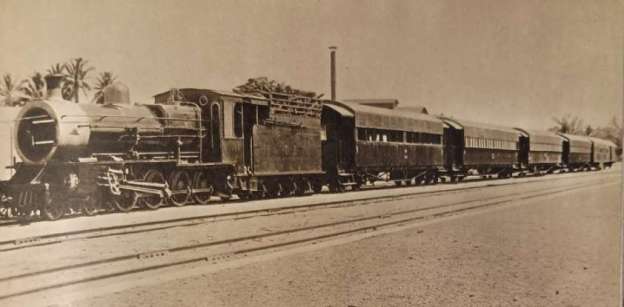
The featured image for this article is a photograph of the first ,’corridor’ mail train leaving Dar es Salaam in 1922. The locomotive is No. 1098 ex NGSR of India (later a TR NZ Class Locomotive), the carriages are from the former German Tanganjika-Express. The standard consist for the train during the German era was: 1 No. Postwagen (mail); 1 No. Packwagen (van); 1 No. Boy-Wagen (CC? for servants); 1 No. Küchenwagen (kitchen); 1 No. Speisewagen (dining-car); 2 No. Schlafwagen (AA sections, AAB sleeping-compartments). Under German control carriages were of varnished teak. Later Tanganyika Railways, carriages maroon/cream, then East African Railways, then Tanzania Railways. [1: p182][3]
The civil administration after the first world war was set up in Wilhelmstal in the Usambara hills. Wilhlemstal was renamed Lushoto. The location was inconvenient to say the least. “Lushoto was far from the Central Railway, communications were slow and irregular, and supervision of the outlying districts was necessarily sketchy. The sailings of ships between Tanga and Dar es Salaam were so haphazard that it often took six or seven weeks for the civil administration at Lushoto to receive a reply by letter from the military authorities in Dar es Salaam.” [1: p174]
Hill tells us that, “The Administrator had only accepted the extended responsibilities delimited by the Proclamation of 21st January 1918 [and additional areas included on 1st March 1918] on the understanding that the military authorities would release suitable accommodation in Dar es Salaam to the civil government. This agreement was not kept, and the civil administration remained at Lushoto until 12th February 1919, when its headquarters was transferred to Dar es Salaam. On 1st October 1918, the civil administration became responsible for the town of Dar es Salaam, and on 1st January 1919, for the districts of Lindi and Songea. On 31st January 1919, a Royal Commission appointed Sir Horace Byatt to be administrator of that part of German East Africa which was occupied by His Majesty’s Forces.” [1: p174]
Hill continues: “As a result of the Treaty of Peace with Germany, signed on 28th June 1919, Germany renounced, in favour of the Principal Allied and Associated Powers, all her rights over German East Africa. The Allied and Associated Powers then agreed – in conformity with Article 22, Part 1 (Covenant of the League of Nations) of the Treaty of Peace – that His Britannic Majesty should exercise a mandate to administer that part of German East Africa which became known as the Tanganyika Territory. On 22nd July 1920, the Tanganyika Order in Council constituted the office of Governor and Commander-in-Chief, and on 5th August, Sir Horace Byatt was appointed Governor.” [1: p174]
“The Belgians were still administering the Kigoma district, the northern part of the Ufipa district and Biharamulo. These areas were handed over by the Belgians on 22nd March 1921, and there remained to be settled only the delimitation of the Anglo-Belgian boundary on the border of Ruanda-Urundi. The boundary originally drawn by the joint Commissioners provided a corridor for the possible construction of a railway connecting Tanganyika and Uganda, along the West side of the Kagera River. The line so drawn placed a small part of the Kingdom of Ruanda, known as the Lukira sub-district, in British territory. After joint Belgian and British representations to the Permanent Mandates Commission of the League of Nations, the midstream of the Kagera became the boundary between Tanganyika and Ruanda-Urundi. The Lukira sub-district was handed over to the Belgians in the December of 1923.” [1: p174-175]
“At first the administration of occupied enemy territory had to be on a provisional basis. German ordinances and regulations were followed unless they were repugnant to British law. Until the enactment of a Courts Ordinance in 1920 political officers exercised the judicial powers conferred on them by the Commander-in-Chief. The German methods of administration were not greatly changed, and in the coastal districts political officers continued to rule through the Liwalis, [2] Akidas [2] and Jumbes. Unless they had shown anti-British sympathies, the African civil servants of the German administration were retained in the service of the new Government.” [1: p175]
Hill tells us that, “the recruitment of the staff required to administer a huge territory in the aftermath of a terrible war proved exceedingly difficult.” [1: p175] The official report states that “No sweeping measures [were] taken to dispense with the Akidas, [2] but though they remain[ed], their status [had] been radically altered. Their privileges [were] curtailed, their powers of punishment [were] taken away, and they [were] being closely supervised. When vacancies [occurred], the wishes of the people as to a successor [were] ascertained and, if possible, a local man of influence [was] selected in preference to an alien. Every endeavour [was] made to restore the old tribal organisations, and it [was] hoped that in course of time the German conception of the Akida system [2] [would] cease to exist, even though the name may remain.” [1: p175]
“A census-taken in the April of 1921 – returned the population of Tanganyika as 4,107,000 Africans, 2,447 Europeans, 9,411 Indians, 4,782 Arabs and Baluchis and 798 Goans. Of the Europeans, 1,598 were British subjects, including 300 settlers from South Africa, and 300 were Greeks. The rest were Poles, Italians, Czechoslovaks, Swiss, Dutch, Belgians, French and Americans. With one or two exceptions all the Germans formerly resident in German East Africa were repatriated.” [1: p176]
“A Treasury was established at Lushoto towards the end of 1916, and on 1st January 1917, the accounting operations of all political officers in the northern area were transferred from military to civil control. In the March of 1918 the accounts of the political officers in the central area and on 1st January 1919, of the Songea and Lindi districts were also transferred.” [1: p176]
“On 1st February 1919, the civil administration became responsible for the cost of the peacetime garrison of three battalions of the King’s African Rifles and on 1st April, for the cost of maintaining the railway. In the early years the revenue collected was adequate to meet the cost of the limited form of administration, but as its responsibilities expanded expenditure rapidly increased.” [1: p176]
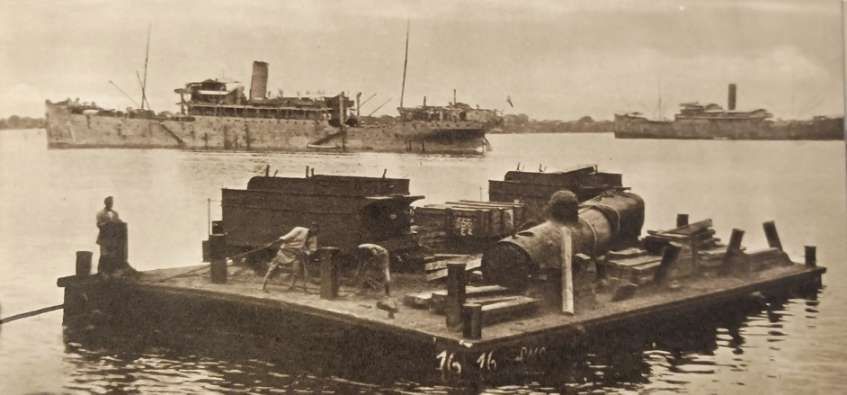
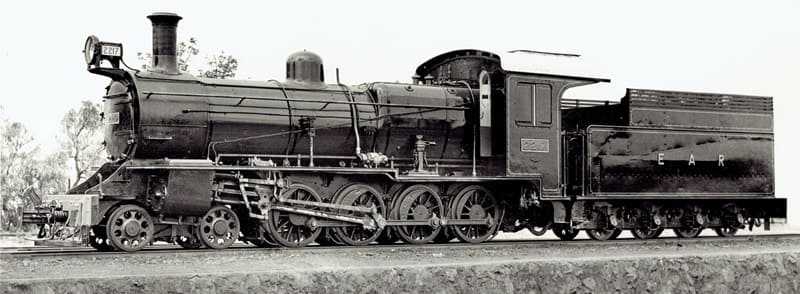
One of the first purchases in 1916 was a series of four locomotives which were later to be known as the NZ Class. These were first purchased for the Nizam’s Guaranteed State Railway (NGSR) in India. They were built by Naysmith Wilson in 1915 and were commandeered to assist in the invasion of German East Africa in March 1916. Initially they carried their original NGSR numbering (NGSR 1095-1098). [9: p40] The numbering was adapted to include the letters ‘TR’ (TR 1095-8) and as such the locomotives were in service for many years. Finally, in the early 1930s, they were re-classified NZ, for Nizam, and renumbered 200-03. These locomotives had a long and distinguished career, remaining in service until after the amalgamation in 1948, when they became EAR 2201-4. [9: p54]
Hill provides figures for revenue and expenditure of the administration in the years to 31st March 1920:
Revenue 1916/1917: £128,622
Revenue 1917/1918: £336,446
Revenue 1918/1919: £461,842
Revenue 1919/1920: £669,097
Total Revenue: £1,586,007
Expenditure 1916/1917: £35,116
Expenditure 1917/1918: £157,285
Expenditure 1918/1919: £383,097
Expenditure 1919/1920: £790,026
Total Expenditure: £1,366,524
Surplus balance 31st March 1920: £230,483
As can be seen from the figures, 1919/1920 was the first year in which expenditure exceeded income. Expenditure from this time on was only going to increase.
Hill tells the story of the transition, outlining the move away from the German rupee. In 1921, the East African shilling became the standard coin in Tanganyika territory. He notes particular problems with shipping in the years after the cessation of hostilities. Delays also occurred in liquidation of the various German estates in the territory meaning grievous setbacks in the economic output of the territory.
Hill tells us that, “When the civil administration assumed responsibility for the Tanganyika Railways on 1st April 1919, an immense task of repair and reorganisation had to be tackled and the prospect of the railway system paying its way was dubious and remote. The Northern line [the Usambarabahn ](351.7 kms.), henceforth known as the Tanga Railway, had been severely damaged by the Germans. All ten of the major bridges, with aggregate spans of 260 metres, and 23 minor bridges, with aggregate spans of 160 metres, were blown up: most of the water tanks and pumps were destroyed; 30 miles of track were picked up and thrown into the bush, and 60 sets of points and crossings were damaged.” [1: p179]
“The Voi-Kahe line (149 kms.) lay mainly within Kenya. It was essentially a military railway built for purposes very different from the working of open-line traffic on a commercial basis.
On the Central line (1,244 kms.) most of the damage was between Dar es Salaam and Dodoma. The retreating Germans blew up 92 major bridges with aggregate spans of 2,200 metres and 14 minor bridges; more than 100 sets of points and crossings were destroyed, and most of the watering stations were damaged.
Hill tells us that “The advice of Lieut.-Colonel Hammond and of Mr. Gillman was set aside, and the General Manager, Lieut.-Colonel G. Maxwell, apparently changed his mind. In 1923, a scheme was submitted to the Governor for the construction of a line along the old German formation, from Tabora to Kahama, where it could collect traffic from the Kahama and Shinyanga districts. The contract for the construction of this section was let on 23rd February 1925, and railhead reached Isaka in 1926. Progress had been seriously checked by exceptionally heavy rains – 20 inches of rain fell in the last fortnight of November – but the first half of the eventual Mwanza line was a very cheap addition of 197 kilometres to the railway system. The first 120 kilometres, on the well-built German formation, with all the culverts and nearly all the bridges complete and in a remarkably sound state of repair after ten years of neglect, involved comparatively little work. Moreover, the light track lifted from the Central line between Dar es Salaam and Morogoro was sufficient for 160 kilometres of the Mwanza line. The total cost of the line from Mwanza to Shinyanga was, therefore, only £262,577, or about £1.335 per kilometre.” [1: p207-208]
As Hill recounted previously (recorded in the first of these articles) [4] temporary repairs were soon effected to the Tanga line and it was opened for through traffic by August 1916. The Central Line was working again by February 1917.
Nevertheless, the physical damage done to the lines was by no means made good while they were under military control. “The maintenance of the permanent way and of buildings was only undertaken in so far as it was necessary, The civil administration, therefore, had to repair the deterioration and destruction of the war, to sort out the consequent confusion and to build up an organisation suitable for peace conditions. The task was not aided by the failure to appoint a substantive General Manager until late in 1920, … nor by the fact that the section of the Central Railway from Tabora to Kigoma was not handed over by the Belgians until April 1921.” [1: p180]
Hill continues: “The administration also took over the Sigi narrow-gauge line (23 kms.), the Shume ropeway, both of which fed the Tanga line and had been little damaged by the Germans, and the Lindi narrow-gauge line (60 cms.). During the last two phases of the East African campaign three lines were built to carry supplies to the forces. From the Central line a branch, 25 kilometres long, was built from Dodoma towards the Great Ruaha, but the rails were soon picked up as they were needed elsewhere. A short tramline in-land from Kilwa was also soon picked up. The Lindi line originally ran from Mingoyo to Mtua. It was later extended for about 4 miles down the creek towards Lindi and then from Mtua through Ndanda to Masasi, giving a total length of about 90 miles. The rails varied in weight from 12 lb. to 20 lb. to the lineal yard, and the steepest grade was 1 in 50 up from the coast and 1 in 33 down to the coast. At first neither the Shume ropeway nor the Lindi line was operated. On the Lindi line there were sufficient tractors and wagons to run a service if the track were repaired.” [1: p180]
“On both the Tanga and the Central Railways permanent repairs were started in 1919. On the Tanga line it was possible to postpone the repairs to a few bridges, as the temporary structures were sound enough to last for at least another year. In fact, several lasted for many years. The permanent repairs to both lines, with the exception of several bridges, were completed by the end of 1922. During 1919 and 1920 the permanent way was maintained in fair order, but stretches near the coast still showed signs of the long neglect during the years of war. Fortunately, the good design and construction of much of the permanent way enabled it to withstand the ravages of neglect better than had been expected. A great deal of bush clearing had to be undertaken. During the war, the bush had been allowed to encroach towards the track, thereby threatening the telegraph lines and blocking the line of vision from the footplates of engines.” [1: p180-181]
A significant programme of repairs to station buildings and staff quarters was also required. “These buildings were generally of a high standard of construction, considerably superior to those on the Uganda Railway – but maintenance and repairs had been neglected for years. A lack of funds and technical supervision made it impossible to tackle more than the most urgent repairs. The Germans only provided quarters for the European staff of the railways and left many of the Asian and all the African staff to fend for themselves. An official report for 1920 stated: ‘The state of the quarters for the Asian clerical staff and artisans, as well as for the African permanent labour, is far from satisfactory, although everything possible has been done within the narrow limits of the available funds. The question of permanent structures to take the place of wattle and daub will soon become very urgent‘.” [1: p181]
Early in April 1919 and “again a year later the Buiko-Lembeni section of the Tanga Railway and 48 kilometres of the Voi-Kahe line were damaged by flood water. There were a few major and a large number of minor breaches and wash-aways. An official report stated: ‘These sudden floods are due to cloudbursts in the mountains adjoining the dry and desert-like plains and are likely to occur regularly at the beginning of each rainy season. As the banks are generally low, serious damage or prolonged delay to traffic on the main line need not be anticipated. But if the Voi-Kahe line is to be kept open, a large number of culverts under the high banks will have to be built to avoid long delays to traffic‘.” [1: p181]
“Towards the end of April 1919, a more serious flood occurred west of Kidete station on the Central Railway. Nearly four kilometres of the line were under water and for six weeks not a single vehicle was able to travel over this section of the line. That capricious old lady, Mother Africa, then went from one extreme to another, from flood to drought. Another factor which adversely affected traffic on the Central line during 1919 was a famine which afflicted a large part of central Tanganyika. The removal of foodstuffs from the famine-stricken area, which stretched for about 340 kilometres along the railway, was prohibited for the greater part of the year. The loss of down traffic was largely compensated for by the up traffic of foodstuffs dispatched from Dar es Salaam for the relief of the famine. These factors made it very difficult for the Railway Administration to estimate the probable traffic in a more normal year.” [1: p181]
An official report stated: “Traffic on the Central line is confined to a few stations, the majority not even paying the wages of the staff, and the country for the most part appearing unproductive. As many stations as possible have been closed and only those kept open which are necessary to avoid excessive runs and to provide crossing places. There are 36 stations open and 18 closed. …. The Tanga Railway has had longer to recover from the war than the Central line, and is fortunate in the hinterland as far as Buiko, practically all the stations up to this point showing good results. The principal traffics are sisal, hides, cotton, coffee, fruit and grains, and there is a heavy passenger traffic. Some falling off may appear owing to lack of shipping and the high rate of exchange, although this section of the line is very promising and serves a fertile country. With the exception of Moshi the remainder of the line is unremunerative as it runs through desert country. The Voi-Kahe Railway is also unremunerative, though most of the traffic from Moshi finds its way to Kilindini, and will probably continue to do so, as Kilindini, apart from being slightly nearer to Moshi than Tanga, provides a good wharf, cranage and, most important of all, shipping. A comparison of the receipts for the nine months ended 31st December 1919, for the 175 kilometres, Tanga to Buiko, and the remaining 308 kilometres, is interesting. Tanga to Buiko Rs. 287,995; Buiko to Voi Rs. 77,194, of which Moshi contributed Rs. 49,356 and Voi Rs. 17,508. There are 21 stations on the Tanga line, eight on the Voi-Kahe line, and one on the Sigi line.” [1: p181-182]
“On the Central line the Tanganyika Railways inherited from the Germans 20 German goods engines (2-8-0 type) of which six were derelict; 22 German tank engines (2-8-0 type) of which six were derelict; two German tank engines (0-8-2 type); seven German Mallet engines (0-4-4-0 type), of which two were derelict and five were laid up, and six German shunting tank engines (0-4-0 type). In addition there were nine engines of British manufacture which had been brought over from India during the war. Four of them were G-class (Indian) ABR engines (4-8-0 type); one was an F-class (Indian) (0-6-0 type) and four were G-class (Indian) Nizam engines (4-8-0 type). In 1922 the four G-class ABR engines and the F-class engine were packed for return to India. The German goods engines, with bogie tenders, were capable of pulling a maximum load of 16 four-wheeled vehicles over all sections of the line. The German tank engines had less tractive effort and less boiler capacity, and they were only suitable for use on the plateau to the east and west of Tabora. It was estimated that the locomotive stock was sufficient to work one train each way per day between Dar es Salaam and Tabora. By the end of 1921 one passenger train and one goods train ran once a week in each direction between Dar es Salaam and Kigoma, and a mixed train ran once a week in each direction between Dar es Salaam and Tabora. In addition a water train ran once a week along the length of the line. It was also estimated, with unwarranted optimism, that the German goods engines would last for another twelve years, the tank engines for ten years, and that new engines would not be required until and unless the traffic increased to more than a train a day between Dar es Salaam and Tabora, in addition to fuel and construction trains.” [1: p182]
“On the Tanga line the Tanganyika Railways acquired only seven German engines. Three were German goods engines (2-8-0 type), three were German tank engines (2-8-0 type), of which one was laid up, and one was a German Mallet-class engine which was also laid up. There were also 15 engines of British manufacture brought over from India. Twelve were F-class (Indian) engines (0-6-0 type), of which two were laid up, and three were M-class (Indian) engines (2-6-0 type), of which two were laid up. There was also a B-class (2-6-0 type) engine and a shunting tank engine (2-4-0 type) on loan from the Uganda Railway. The latter was laid up and condemned. There were two small engines on the Sigi line.” [1: p183]
“The F-class (Indian) engines were of an obsolete type and it was estimated that none of them would last for more than three years. The three German goods engines and the three German tank engines were the only engines on the line capable of coping with a full traffic load. The light rail on the coastal section, between Tanga and Mombo, made it necessary to station the lighter engines at Tanga. In consequence the load out of Tanga was limited to eight vehicles.” [1: p183]
“On both the Central and the Tanga lines a deal of money was spent on reconditioning the German engines. None of them was really satisfactory and all were scrapped as soon as money was available to buy new British engines.” [1: p183]
“On the Central line the total numbers of vehicles was 465 and on the Tanga and Voi-Kahe line 365. During 1919 and 1920 an exceptionally heavy burden was carried by the carriage and wagon repair shops at Tabora, Dar es Salaam and Tanga. In all, they dealt with 620 units, of which 30 were completely rebuilt, 400 underwent heavy repairs and 190 light repairs. Particular attention was paid to the repair and maintenance of the vacuum brakes, many units being completely fitted and others fitted with piping only. In the Tabora shops the difficulty of this work was increased by a lack of inspection kits. On the Tanga line there was a shortage of rolling stock and there were no fly-proof trucks for the carriage of livestock through the belts infested by tsetse. The work in the erecting shops at Dar es Salaam, Tabora and Tanga was also very heavy. The number of engines that could be accommodated at the same time was five in the Tabora shops, two in the Dar es Salaam shops and three in the Tanga shops. The engine pits were commodious, but suffered from the use of a girdered screw-jack arrangement to lift the engines, which took a great deal more time than would have been required if overhead cranes had been available.” [1: p183]
The British tariffs, “first started on the Tanga line in 1916, was completed during 1920. The regulations were much the same as those of the Uganda Railway and the rates were similar to those charged by the Germans.” [1: p183]
The official report stated: “The German tariff was a well-thought-out book and appears to be suited to the country. Owing to the existing unsettled state of the Territory, the shortage of shipping and the fluctuating state of the market, it did not, and does not yet, appear advisable to make any change. For instance, it would be impossible to apply the usual theory for the formation of rates and follow, through all the phases of a changeable market, the price of sisal, cotton, mica, etc., raising the rates as the prices go up and lowering them when the price falls. … Although not easily of comparison owing to the fact that a telescopic scale exists on the Tanganyika Railways, and a flat rate on the Uganda Railway, rates here are higher than those on the Uganda Railway. The Uganda Railway has over thirty special rates applicable to various commodities between certain stations or groups of stations. The railways in Tanganyika have no special rates, but reduce by one class for certain heavy loading traffics in wagon loads.” [1: p183-184]
Hill continues: “The passenger fares on the Tanganyika Railways were generally lower than on the Uganda Railway, but coaching stock was so short in Tanganyika that there was often only one vehicle of a certain class on a train. There was no prospect of raising fares until a better and more comfortable service could be provided to the public. The German passenger stock was not divided into compartments. The seating was sometimes arranged with a centre gangway and sometimes with a side corridor. Lighting was generally by acetylene or oil-burning lamps. These coaches were renovated, divided into compartments and fitted with electric light.” [1: p184]
“The dockyard at Dar es Salaam was the only one of its kind on the east coast of Africa between Suez and Durban and capable of undertaking any ordinary floating repairs to ships. In 1920, a marine boiler from the ‘Fifi’, now [in 1957] a launch on Lake Tanganyika, was completely rebuilt; a 120-ton lighter was replated and redecked; all the pontoons and cargo landing stages at Dar es Salaam were renovated; steam-tugs and motor-launches were reconditioned; cranes and winches were overhauled, and much work was done on the Government’s coastal steamer, ‘Lord Milner’, and the Lake tug ‘Mwanza‘.” [1: p184]
During the year ended 31st March 1920, imports into Tanganyika were valued at Rs. 17,376,045, of which nearly half were cotton-piece goods. Domestic exports were valued at Rs. 19,940,156 and re-exports at Rs. 1,445,912. Of the domestic exports 16,744 tons of sisal accounted for Rs. 6,543,372; 3,944 tons of hides for Rs. 3,407,010; 3,926 tons of coffee for Rs. 2,807,605; 5,330 tons of copra for Rs. 1,581,461, and 741 tons of cotton for Rs. 935,009. In common with Kenya and Uganda, Tanganyika was hard hit by the post-war slump. In the following year the value of the import trade decreased by £308,000 and the value of the export trade by £784,000.” [1: p184]
“The financial results of the Tanganyika Railways for the first three years of working under British civil administration were stated to be a loss of nearly £175,000 in 1920, of nearly £189,000 in 1921 and of over £191,000 in 1922. The real loss was considerably greater for those figures were struck without any provision for interest or renewals charges.” [1: p184]
It is small wonder that the General Manager wrote of the Central line: “This railway was undoubtedly built for reasons other than purely trade and, now that it has been built, the best has to be made of a line passing through largely undeveloped country …” [1: p184-185]
Officially published results were:
1919 to 1920
Working expenses £278,591
Gross receipts £103,778
Operating Loss. £174,813
1920 to 1921
Working expenses £346,300
Gross receipts £157,393
Operating Loss. £188,907
1921 to 1922
Working expenses £387,819
Gross receipts £196,682
Operating Loss. £191,137
Towards the end of 1920, the Secretary of State for the Colonies appointed Lieutenant Colonel F.D. Hammond to:
(1) report on the possibility of improvement in all departments of the railway systems of Kenya, Uganda and Tanganyika.
(2) preside at the meetings of an inter-Colonial Council to consider the relations of Kenya and Uganda in regard to railway work.
(3) advise on railway rates ‘on the understanding that in future net receipts from the systems are to be regarded as available for betterment purposes and new construction only, and that rates are therefore to be kept as low as possible’.
(4) investigate the position with regard to the Voi-Kahe Military Railway, and to advise (a) whether the track should be bought from the War Office, and, if so, (b) whether the line should be maintained as the route from Moshi to Mombasa, the upper section of the Tanga-Kahe line being abandoned; or (c) whether the track should be used for improving the Tanga-Moshi Railway, Tanga still being regarded as the port for the Moshi area.
(5) advise on railway extension generally regarding Kenya, Uganda and Tanganyika as a single whole from the point of view of railway and harbour development.
Lieut.-Colonel Hammond’s report was published in the November of 1921 [5] and, in so far as the Central Railway was concerned, it was a depressing document. Lieut.-Colonel Hammond wrote:
“The present state of the accounts and the uncertainty of the amount which will have to be paid to the Military Administration make it impossible close review of the financial situation. to enter into any
“The outstanding feature is that the revenue falls far short of what is required to meet actual working expenses exclusive of renewals or loan charges.
“The loan charges on the railways are fortunately very light, because the only ones which will have to be met are those on the equipment and stores handed over by the Military Administration, and none will have to be paid on the cost of original construction. The railways may also be called on to pay interest on the funds provided to cover the deficit on working.
“The deficit on working for 1921-1922 is estimated to be at least £200,000; it is not possible to expect that such a sum can be covered by the economies or recommendations proposed in this Report. The cause of this heavy loss is to be found in the very poor traffic which the two railways are carrying, while the expenses of maintaining a system of 1,747 kilometres (1,092 miles) long are bound to remain high, however reduced the service may be. Although the present depression, of course, is responsible to a certain extent, a return of normal markets could not be expected to right matters.
“In the case of the Central Railway, the German Administration showed a profit on working prior to the war, but this was due solely to the heavy construction traffic which was being carried. The construction of the main line was only completed in 1914, and by that time the construction of the branch northwards from Tabora had already been begun, and platelaying had commenced. Full credit was given to open lines for the carriage of the large quantities of construction material required, and the revenue thus obtained was the only reason why the Administration was able to show a profit on working the main line. Without this revenue there would have been a heavy loss, though how far it is impossible in the absence of accurate figures to state.
“The reason for the poor traffic return is not difficult to find; leaving aside the first 280 kilometres of the coastal zone, where the traffic prospects are good, the Central Railway, for the remaining 960 kilometres of its length, passes through country of which, excluding the salt works at Usoki, only 120 kilometres, or approximately one-eighth, can be considered as possible of producing a paying traffic. It is impossible to expect any railway to pay under such geographical conditions, and the prospect of deficits for many years to come will have to be faced.
“The chief hope of turning those deficits into profits, or at any rate of reducing them, lies in the development of the basin of Lake Tanganyika and the trade with the Congo.
“The opening up of the mineral deposits which are known to exist would have the same effect, but until some more definite information as regards the extent and quality of the latter is obtainable, it would be unwise to indulge in any anticipations regarding the traffic.” [1: p186]
When Hammond turns his attention to the Tanga Line, he is less pessimistic:
“The prospects on the Tanga line are brighter; this railway has already carried a paying traffic over the first 130 kilometres to Mombo. Over the next 45 kilometres to Buiko, development had been commenced by the Germans, and this section would probably have already reached the remunerative stage had it not been for the war. Unfortunately, as a result of the war, and the delay in the liquidation of enemy properties, the cultivated areas have reverted to a condition where it is probably harder to clear and replant than in the case of virgin land. It is estimated locally that this section of 175 kilometres will take five to seven years to reach its pre-war output, but there is no doubt that it will eventually once again be a paying proposition throughout its length.” [1: p187]
The British authorities had been negotiating with the Belgian Government to allow a Belgian enclave at each of Dar es Salaam and Kigoma. It was the Belgian authority’s intention to export significant goods along the Central Railway in Tanganyika and they had agreed a right to use their own wagons on the line, provided they met the Railway Administration’s regulations regarding weight, dimensions and brakes. Hammond noted the Belgian Government’s intention to spend £20,000,000 on infrastructure project in the Congo. He considered that it would not be to the advantage of the Central Railway to have foreign trucks on its line. He then wrote:
“The best course for the Tanganyika Railways to pursue would be to get into touch with the Belgian authorities and to obtain from them a definite guarantee of a certain tonnage, if possible covering the whole period of the Belgian development programme. On the strength of this the General Manager can calculate what additional trucks and locomotives he will require. If the programme only extends over a short period, such as three or four years, it might be found that the net profits accruing would not profit the railway for the purchase of the stock.” [1: p187]
Hammond also noted that “when the Tabora-Kigoma section of the Central Railway was handed over by the Belgians in the April of 1921, both the track and the equipment were in bad condition. Of the 13 engines taken over from the Belgians, five were only fit for scrap and the rest were in need of extensive heavy repairs. In some of the engines there were 12 inches of sediment in the water space.” [1: p187]
Hill continues: “Of the 40 engines on the Central line which were in the possession of the Railway Administration before taking over the Tabora-Kigoma section, 29 were in fair running condition at the time of Lieut.-Colonel Hammond’s inspection, eight were under repair and three were waiting repair. He recommended that the 24 engines which were in the best condition and of the most suitable type should be selected for the current work of the railway; and that the remaining engines should be laid up and not repaired until a prospect of increasing traffic warranted the use of more than 24 engines. In this way the expense of repairing the engines surplus to the traffic would be deferred until there was some prospect of them being used. Lieut.-Colonel Hammond recommended that the same policy be applied to the repair of wagons.” [1: p188]
“Although the bulk of the skilled labour employed both in the running and the workshop departments of the Locomotive Department was Asian, there had been a marked decrease due to the difficulty of obtaining suitable drivers and artisans from India. This was partly due to the bad reputation which the climate of East Africa, particularly of Dar es Salaam, had earned in India during the war, and also to the bad quarters provided in Dar es Salaam. Lieut.-Colonel Hammond urged that £22,000 be spent on the provision of suitable housing for 124 Asian employees at Dar es Salaam. He considered that the Indian staff were distinctly inferior in quality and that, in consequence, the problem of training Africans was urgent. ‘The Tanganyika Railways,’ he wrote, ‘have been assisted in this by the legacy of the German policy, under which considerable progress had been made in training the natives, although no definite scheme appears to have been in force‘.” [1: p188]
Hill continues: ,”Already a good proportion of the engine-drivers on the Tanganyika Railways were Africans. The whole of the skilled labour in the moulding shops at Dar es Salaam, including the charge-hands, were Africans. The tools in the saw-mills were practically all run by Africans. The carriage fitting was done entirely by Africans, under the supervision of a European. At Tanga, the whole of the new carpentry work, some of it requiring a high standard of skill, was done by Africans under the supervision of a Japanese charge-hand. With the full support of the General Manager, Lieut.-Colonel Hammond recommended that the training of Africans be put on a proper basis as soon as possible and that the establishment of foremen and charge-hands be increased to 15 in order to provide for instructors of African trainees.” [1: p188]
“Many of the typists employed in the head offices were also Africans, and Lieut.-Colonel Hammond noted that in any scheme for the training of Africans for a career on the railways it was essential that “undue importance should not be attached to clerical as opposed to manual skill.” He considered that the wage of eight florins per month, plus rations, paid to unskilled native labour was higher than was warranted either by the cost of living or by the general state of the labour market, and that a reduction of at least three florins a month was possible and should be extended to all Government Departments.” [1: p188-189]
Hill tells us that, “during the military administration of the railways, stores were obtained through the agency of the War Office. Whereas accurate quantity ledgers were kept by the Stores Department, no attempt was made to keep priced ledgers. A stock of German stores also remained. Departments held large stocks at places like Tabora which they had obtained from the Stores Department, but for which they kept no ledgers, and also stocks of German stores. Scattered up and down the line were stores, such as rails and girders, the surplus of the materials required to repair the damage done by the Germans which had never been collected. After the civil administration had taken over the railways, representatives of the War Office made lists of the stores remaining on the system and drew up a valuation of £595,000, including the Voi-Kahe military railway which was valued at £161,000. The General Manager disputed these valuations and submitted his own figure of £283,000 for all the stores, exclusive of the Voi-Kahe line, which the War Office representatives valued at £434,000. This was one of several long and prolonged arguments concerning the finances of the Tanganyika Railways. Lieut.-Colonel Hammond stated that it was not clear whether the railways were definitely committed to take over all the stores left by the military administration or not. He considered that if they were so committed allowance should be made in the price for taking over in bulk and for stores of no use or surplus to present needs. If there were no commitment, he considered that the railways should only accept such stores as could eventually be used and the price paid for any stores surplus to requirements should take into consideration the interest charges which would accrue until the stores were used.” [1: p189]
Hill continues: “The most controversial item of Lieut.-Colonel Hammond’s terms of reference was that concerning the Voi-Kahe Railway. He pointed out that it had been built as a military line and had been badly aligned and graded. If it were to be retained, he considered that it should be realigned direct from Taveta to Moshi, in order to tap the southern slopes of Kilimanjaro, at an estimated cost of £360,000. On the coastal section of the Tanga line there were 57 miles of 31-lb. rail which could only carry the lighter engines and limited the load out of Tanga. Lieut.-Colonel Hammond estimated that it would cost £300,000 to relay the coastal section with heavier track. If the Voi-Kahe line were picked up and the materials used to relay the coastal section the cost would be about £100,000. A third alternative was to pick up the 57 miles of the Moshi-Buiko section of the Tanga line and use it to relay the coastal section, at an estimated cost of £55,000. On Lieut,-Colonel Hammond’s figures, which later proved to be far too high, the cost of retaining the Voi-Kahe line and of relaying the coastal section of the Tanga line would be £415,000 apart from the sum required to buy the Voi- Kahe line from the War Office. Lieut.-Colonel Hammond’s recommendations were largely influenced by the expenditure of £1,000,000 on the deep-water wharves at Kilindini. To use the Tanga route as the outlet for the Kilimanjaro traffic, he wrote, would entail the development of two deep-water ports within 70 miles of each other, and the chief purpose of the second port, Tanga, would be merely to tap an area which could be equally well served by Kilindini. In fact, to pull up the Voi-Kahe line might suit the immediate need of the Tanganyika treasury, but it would be detrimental to wider interests. Lieut.-Colonel Hammond was not impressed by the argument that as Tanganyika was a mandated territory it would be wrong to pull up any railway within its borders and so cause a divergence of traffic through a British Colony. The upper section of the Tanga line was unlikely to produce a remunerative traffic for ten years or more and, due to a lack of water, it might never do so. Lieut.-Colonel Hammond recommended that the last 94 kilometres of the Tanga line, between Same and Moshi, be picked up and used for the betterment of the coastal section and that the Voi-Kahe line be retained, re-graded and realigned. He considered that the cost of the reconstruction of the Voi-Kahe line should fall upon Tanganyika as the chief benefactor, and he devised a financial arrangement whereby the Territory would bear all loss and collect all profit derived from the line.” [1: p189-190]
Hill continues: “Early in 1923 the Colonial Office decided to reject Lieut.-Colonel Hammond’s advice and to accept the view of Sir Horace Byatt, the Governor of Tanganyika, that to subordinate the interests of the port of Tanga to the interests of Kilindini would be contrary to the spirit of the Mandate. In consequence Sir Horace argued that Tanga should be developed into a modern and well-equipped port. Mr. C. L. N. Felling-later Sir Christian Felling-who had just been appointed General Manager of the Uganda Railway at once lodged an emphatic protest against a policy of developing three major ports, Kilindini, Tanga and Dar es Salaam, on the East African coast. He maintained that the sound policy was to concentrate on the development of Kilindini and Dar es Salaam. Lieut.-Colonel Hammond had made precisely the same point. ‘This necessity for concentrating on a few ports,’ he wrote, ‘and spending all the money available on them is the principal reason for my recommendation that the area around Moshi and Arusha and their hinterland should evacuate its products via Kilindini instead of via Tanga.’ It was ridiculous, Mr. Felling argued, to regard Kenya and Tanganyika as rivals. They should be regarded as partners, and the sound policy was to establish a joint control of the two railway systems under a Governor-General. Mr. Felling was one of the first civil servants to realise the grave disadvantage of the lack of an East African authority to co-ordinate the economic policy of Taganyika, Kenya and Uganda. Mr Felling’s protest was of no avail, and the Voi-Kahe line was closed to traffic on 19th April 1923, by Order of the Colonial Office. [1: p190-191]
This was not the last word on the matter. Hill describes the political manoeuvres which eventually saw the line retained. The Government of Kenya bought the line for £70,000 and in the end reconditioning was undertaken for only £30,000 and the line was open to traffic once again by 4th February 1924. It soon paid its way!
Hill comments that there could be no doubt that “the decision to maintain the Voi-Kahe line was right, certainly from wide and long-range points of view. Nevertheless, the fact that the Uganda Railway owned and worked the line proved a persistent source of irritation to the Tanganyika Railways until the two systems were amalgamated in 1948 and any question of competition was thereby eliminated. Meanwhile, in 1925 the Traffic Manager of the Tanganyika Railways complained that the Uganda Railway took about 75 per cent. of the outward traffic from Moshi and about 30 per cent. of the inward traffic.” [1: p191]
Hill tells us that in the same year the General Manager of the Tanganyika Railways wrote that “the Uganda Railway working into Moshi has resulted in this railway having to keep open and work 178 kilometres of line (Buiko-Moshi) to share in a traffic which would be small for one railway and which is insignificant for two.” [1: p191]
Hill says that “there were many such complaints during the twenty-five years (1923-1948) needed to bring about the amalgamation of the two systems, which was the only sound solution of this and of several other economic problems.” [1: p191]
Hill was, of course writing from the perspective of the British Colonial authorities. Had he been able to look forward to the probable arrangements made as countries were granted independence, his reflections might have been different. The EAR struggled to continue as an effective organisation working for three different governments and eventually closed in the late 1970s.
Hammond also had something to say about freight charges. As far as low value products were concerned, such as groundnuts from Tabora, he recommended that lower rates in accord with those that The Uganda Railway was charging would be appropriate. He also advised the reclassification of certain imported goods – notably agricultural and industrial machinery, paints and petrol, which should be lowered, and rice, tea, tobacco, cotton-piece goods and matches which should be raised to a higher classification. He reviewed rates across the network recommending that where alternative routes existed, parity in charges was important. He wrote:
“The Uganda and the Tanganyika Railways at the present time both serve the area lying between Mwanza and Tabora, and in the future, if a steamer service on Lake Tanganyika is developed, the central regions of Urundi may quite possibly be able to export either via Victoria Nyanza or Lake Tanganyika. Any attempt at competition between the two systems for such traffic could not be permitted; the managements must arrange to balance their rates at these points in such a manner that the traffic will go to whichever of the two systems is most conveniently placed to the point of production, and so give the produce the easiest and cheapest route to the sea. In the case of Mwanza this would affect indirectly the rates from other ports on Victoria Nyanza, and in the case of Tabora any intermediate stations to Dar es Salaam which handle the same commodities. It is, therefore, of great importance that the two General Managers should consult each other and come to a mutual agreement before the introduction of any rates affecting these particular areas.’” [1: p192]
Hill continues: “Turning to the future development of the Tanganyika Railways, Lieut.-Colonel Hammond considered that an extension of the Moshi-Voi branch towards Arusha must wait until the Tanganyika Government was in a position to bear the initial losses. He did, however, recommend that the extension to the Sanya river, laid and picked up during the war, be relaid on the grounds that trade from the Arusha area was handicapped by having to pass through a narrow belt of tsetse-fly between Moshi and the Sanya. In consequence the cost of animal-drawn transport was as high as Florins 4.50 per 50 lb. It was a strange argument, as it presupposed that a railway was the only alternative to ox- or mule-drawn wagons. Lorries are no less immune to tsetse than a train.” [1: p192]
“Lieut.-Colonel Hammond estimated that the cost of reconstruction of the Sanya river extension would be £7,600, including the carriage of materials. He pointed out that the quantity of spare permanent-way material left by the military authorities on the Tanga line was far in excess of maintenance needs and that the surplus was sufficient to relay the 25 kilometres that had been picked up. Lieut.-Colonel Hammond’s advice was accepted and, in this instance, it was unfortunate. The Sanya branch which took off the Tanga line 10 kilometres south of Moshi and climbed a lava ridge at the foot of Kilimanjaro to reach the Sanya plain, was built at a cost of £26,000. Construction started towards the end of 1923, and the line was open to traffic by the following December. It was badly aligned, built of indifferent materials, and it brought very little traffic to the main line. Only a year later it was decided to build another line from Moshi to Arusha. The survey, which started in the April of 1926 and was completed October, only needed to re-establish on the ground the good alignment staked out by the Germans in 1912. It was obvious that the first part of the Sanya extension could not be retained. It was scrapped and the new line branched off at Moshi and joined the Sanya line at Km. 13. Construction started in the November of 1927, and it did not progress as rapidly as had been expected largely due to the contractors’ inability to recruit sufficient satisfactory labour. Tengeru, the main station for the coffee estates on the lower slopes of Mount Meru, was opened for traffic in the November of 1928, and the whole line was formally opened by the Governor, Sir Donald Cameron, in the December of 1930. This extension of the Tanga line by 86 kilometres from Moshi to Arusha cost £316,000, or approximately £3,700 per kilometre. The track laid weighed 45 lb. per lineal yard, and the main difficulty was the bridging of several deep gorges along the skirts of Mount Kilimanjaro and Mount Meru.” [1: p192-193]
“In common with the Germans, Lieut.-Colonel Hammond was convinced that the chief hope of the Central Railway must be centred on Lake Tanganyika and the Congo traffic. He pointed out that if supplemented by a service on the Lake the Central Railway was the natural and shortest route to the north-eastern part of Rhodesia and that Abercorn was only 15 miles from the Lake. He urged that the Graf von Goetzen be salved and refitted for passenger and cargo work at an estimated cost of £35,000, and that the Marine Service be amalgamated with the railways. In the absence of any proper motive for competition with the Uganda Railway, Lieut.-Colonel Hammond noted that there was no good reason for building the Ruanda Railway, started by the Germans in 1914, from Tabora to the elbow of the Kagera river. In 1915 the Germans planned to build a branch from Isaka, on the Ruanda Railway, to Mwanza. The object of these lines was to tap the rich districts of Ruanda and Urundi and to divert this traffic and the traffic of the Mwanza district from the Marine Department of the Uganda Railways.” [1: p193]
Hammond also made a considerable number of recommendations for the improvement of the efficiency of the several departments of the Tanganyika Railways. The General Manager’s Annual Report for the year 1922 stated that “practically all the local suggestions made by Lieut.-Colonel F. D. Hammond have been adopted with considerable benefit.” [1: p193]
Deficits and Profits
Hill turns to the matter of the viability of the Tangayika Railways. He first focussed on the matter of what should be the liability of the Tanganyika Government for the capital cost of the the network. On 1st April 1919, Hill notes that the lines in Tanganyika were valued at:
Central Railway: £4,015,000
Tanga Railway: £880,000
Lindi Railway: £11,400 (this proved to be a bad investment)
Sigi Railway: NIL (no appreciable value)
He notes that the issues surrounding the northern line (Tanga Railway) were clear – that it was covered by the Treaty of Versailles and was the property of the Tanganyika Government. It was not as simple as this for the Central Railway.
Hill notes that for a payment of £33,994, Tanganyika Railways acquired assets with a capital value of (£4,015,000 + £880,000 =) £4,895,000. He comments, however, that “on paper this was an advantageous position, but in practice it proved exceedingly difficult to set the railways on a sound financial basis.” [1: p195]
The Lindi Tramway
“The Lindi tramway, acquired for £11,400, in poor state of repair, proved a bad bargain. A great disadvantage was that the terminus at the coast was not at Lindi but high up the creek. In consequence, goods had to travel by dhow or lighter between the terminus and Lindi port, whereas produce carried by porters went straight to Lindi. Inevitably, the existence of the tramway provoked demands, by commercial interests and administrators alike, that it be used for the evacuation of the produce from a hinterland of which the potential output was exaggerated. In 1922 the line was opened from May until October. The ‘tractors’ used were, in fact, Ford cars on railway wheels and they had been hard worked during the war. The traffic was disappointing and operating costs were not met. It was again opened during the harvest season of 1923 with no better result. Between the September of 1924 and the February of 1925 the tramway made a profit of £1,450, but there was still a net loss of £3,000 on these seasons. At this stage there was a long investigation on the advisability of reconditioning the tramway at an estimated cost of £100,000, but the plan was eventually set aside. From September 1926 until 1929 the tramway was run by the District Commissioner with manpower. At the high transport rate of 80 cents for the ton-kilometre, the tramway made a profit of about £1,000 for the first two years, but thereafter, even on a basis of manpower and high rates, further losses were incurred. The tramway was not operated in 1930 and in 1932 the track was sold cheaply to sisal planters.” [1: p195] It is possible that the prior existence of this tramway provoked interest in replacing it with a metre-gauge line after WW2. At the very least there must have been something in the collective memory of traders and Government officials which resulted in a later metre-gauge line being proposed.
The Sigi Tramway
“The Sigi tramway, which was mainly used to transport timber from the Sigi Saw-mills to Tengeni on the Tanga line was operated until the July of 1923 when it was closed down. This tramway could not be made to pay unless it carried a quantity of timber greater than the railway’s need, and there was no other market available. The track was also sold to sisal planters, and much of the well-graded formation was later converted into the main road to the East African Agricultural Station at Amani.” [1: p195]
The Wider Network
During the first four years of British rule there were serious deficits on the budgets of the Territory and the railways. For the year ended 31st March 1920, the revenue of Tanganyika was £669,097; for the following year it was £946,844, and for the year ended 31st March 1922, it was £978,192. Expenditure increased far more rapidly than the revenue. For the year ended 31st March 1920, expenditure was £790,026. In the following year it was £1,389,354, and for the year ended 31st March 1922, it was £1,807,890. Then the rise of expenditure was checked.
“For the year ended 31st March 1923, it was £1,811,872 and in the following year £1,901,158. Revenue amounted to £1,228,586 for the year ended 31st March 1923, and to £1,315,188 in the following year. Apart from free grants amounting to £408,169 in 1921 and 1922, the financial assistance received from the Imperial Exchequer was in the form of repayable loans. By 31st March 1924, the total of loans received was £2,385,891, of which £1,726,653 had been spent. It was arranged that interest should only be paid on that part of the loan expenditure devoted to revenue-earning works, such as capital expenditure on the railways and the electric power station at Dar es Salaam.” [1: p196]
Hill tells us that as “the ravage of war was repaired, the Territory’s exports increased year by year. In 1913, 20,834 tons of sisal were exported from German East Africa. In 1921 the exports of sisal from Tanganyika were 7,923 tons; by 1924 they had risen to 18,428 tons worth £644,835, and by 1926 to 25,022 tons worth £911,293. In 1913 the Germans exported 8,961 tons of groundnuts. The export of groundnuts from Tanganyika in 1921 was 8,448 tons; in 1924 it was 18,684 tons valued at £359,918, and in 1926 it was 15,867 tons valued at £254,903. Other exports in 1924 were 2,541 tons of cotton worth £373,753 and 5,261 tons of coffee worth £352,529. In 1926, 6,539 tons of cotton worth £427,437 and 6,539 tons of coffee worth £495,199 were exported.” [1: p195]
“In 1922, approval was given for a loan of £250,000 for capital expenditure on the railways. From now on there was a considerable investment in the two railways, mainly directed to reducing the deficits which were the main feature of the railways accounts until an operating profit of £3,261 was made during the year ended 31st March 1926. By then capital expenditure amounted to £610,107 on the Central Railway and to £184,905 on the Tanga Railway, a total of £795,012. At the same date the Deficiency Account stood at £786,498, of which £475,689 was debited to the Central Railway and £310,809 to the Tanga Railway. From the Imperial Treasury the railways had received free grants of £478,158, of which £126,462 was for capital expenditure and £351,696 was to meet the deficits for the years 1919-1920 and 1920-1921. In addition, the railways had raised repayable loans of £1,342,534 involving an interest burden of £46,446 a year. Of this sum £893,028 had been borrowed for capital expenditure and £449,506 to meet the deficiency in working.” [1: p196]
As well as the manifest difficulties associated with a railway built primarily through very scarcely populated territory which would not support revenue raising activity, the railway was contending, firstly, with “the poor condition of the locomotives, rolling stock and equipment which made operating costs unduly high in relation to the volume of traffic. Secondly, the deterioration during and immediately after the war of most of the German plantations took longer to repair than had been expected; it was several years before the output of plantation crops was restored to the pre-war level. Thirdly, the available traffic lacked balance: in the post-war years the down-traffic far exceeded the up-traffic and there was a lot of light and empty running up the line.” [1: p197]
“The fact that the capital of the territory, Dar es Salaam, was at the coast, that it was the hub of commerce as well as the centre of Government, tended to increase the disbalance of traffic. There was no town of any size in the hinterland to which imports flowed from the coast-nothing comparable, for instance, with Nairobi or Kampala, which provided the Uganda Railway with a considerable up-traffic. The fourth reason was that the German tariff at first regarded as ‘a well thought-out book’ and ‘suited to the country’ with the few amendments made to it after the war was unsatisfactory and out of accord with operating costs. A new tariff was devised during 1922, but its introduction was delayed, as it had to be sent to England for printing, and it was not introduced until the January of 1924. By the end of that year it was clear that the new tariff had brought satisfactory results, although the rate for sisal had proved to be too low and it had to be raised. In 1924 there was also an increase of the up-traffic, more especially in respect of machinery and cement, which suggested that development would bring greater traffic to the railways in later years.” [1: p197]
The deficits of the early years, coupled with the age-old tendency to over-estimate the potential output from Africa colonies, set the pattern of railway policy. In general terms the policy was:
(a) To increase traffic by building branch lines into potentially productive areas. The outlook is well illustrated by an extract from a ‘Memorandum on Railways’ written by the Governor, Sir Donald Cameron, in the October of 1925: “If a railway may not be built in tropical Africa because there is doubt whether it will pay, the whole of its working expenses and debt charges within such a brief period as five years, little, if any, railway expansion can take place in this Territory … and it is reasonably certain that if additional railway facilities are provided, considerable development may be expected with consequent benefit to the revenue indirectly.” [1: p197]
(b) To reduce working expenses as far as possible.
(c) To re-equip the two railways with satisfactory locomotives and rolling stock and to relay the sections of the line which were in need of heavier track so that an increase of traffic could be carried at less working cost.
Hill continues “The first 38 miles of the Central line out of Dar es Salaam were relaid with new 55-lb. British standard track in 1923 and the relaying of the line from Dar es Salaam to Morogoro was completed in 1926. In 1929 and 1930, a considerable length of the Tanga line was relaid with new 45-lb. British standard track. The onset of the world slump then checked progress, but a further length of the light German track was strengthened by the insertion of two additional sleepers in each length of rail. Due to the mistakes of the German surveyors and engineers, it seemed probable that the line from Mombo to Tanga would always be the most unsatisfactory section of the Tanganyika Railways.” [1: p198]
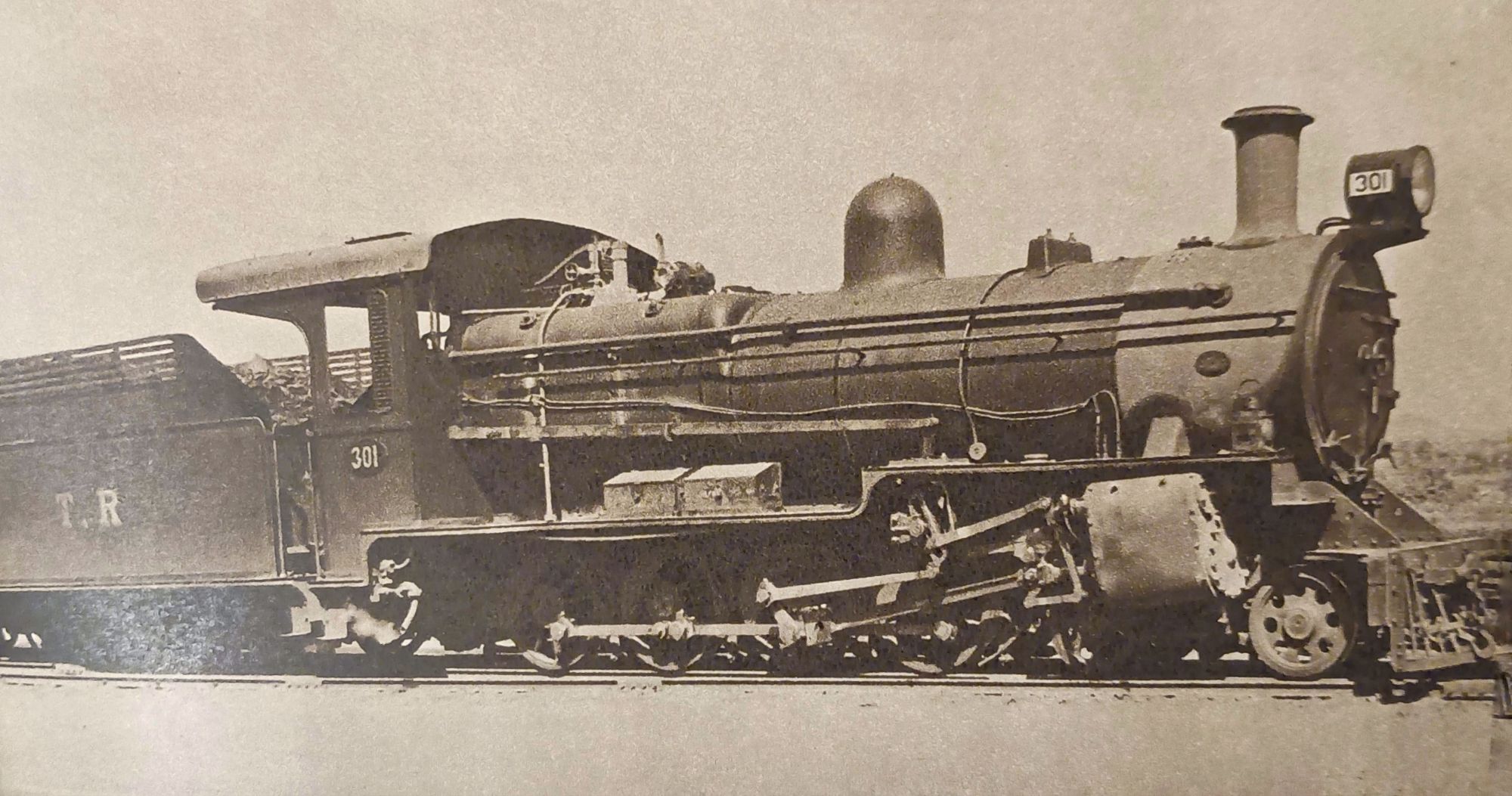
In 1923, six new 4-8-0 tender, super-heated engines of the DL class were imported from Great Britain and put into service on the Central line, together with 21 bogie wagons of 25 tons. New brake vans and passenger coaches were near completion in the workshops. Shortly afterwards four German tank engines were transferred from the Central to the Tanga line. In his annual report for the year 1923, Mr. K. C. Strahan, the Chief Mechanical Engineer, wrote:
“The arrival of the new engines has meant redistribution of the engine power: two of the DL engines are working on the Dar es Salaam section and four on the Dodoma section. … The position on the Tanga line is as before, except that the engines are twelve months older. The situation will be improved by the transfer of the four G.T. engines, and some relief on this account is in sight. During the year, unceasing attention has been necessary to keep the obsolete F-class 0-6-0 tender engines on the active list, and it is again pointed out that in running these engines with bearings below condemning size in several cases, considerable responsibility has been taken. The excessive repairs have resulted in proportionately heavy expenditure, for whereas on the Central line the maintenance of the stock costs 79 cents per kilometre, on the Tanga line the figure is Sh. 1.05 per kilometre.
“The supply of power on the Central line during the harvest season of the past year was equal to demands, and with the increased loads taken by the DL class (37.5 per cent. greater than the other 4-8-0 engines), there is now a small reserve. The average number of engines in traffic will probably be 32 after redistribution has taken place, but the average hauling capacity is increased.
“On the Tanga line there was unavoidable difficulty in dealing with rushes of traffic, as power is largely dependent on the unreliable F-class engines, but the trial mileage run shows a decrease. The necessity of putting two engines on every train out of Tanga with more than seven vehicles on it is most wasteful, but could not be avoided owing to the condition of the engines.” [1: p198-199]
Hill says that “The new 4-8-0 engines were the first locomotives in Tanganyika to use superheated steam and they proved very reliable and economical in service. As traffic increased, it proved more and more difficult, and finally impossible, to obtain reliable service from the old German engines. In 1926, eleven new Mikado engines (2-8-2) were imported from Great Britain. Two new shunting engines were imported in 1927 and seven more in 1929.” [1: p199]
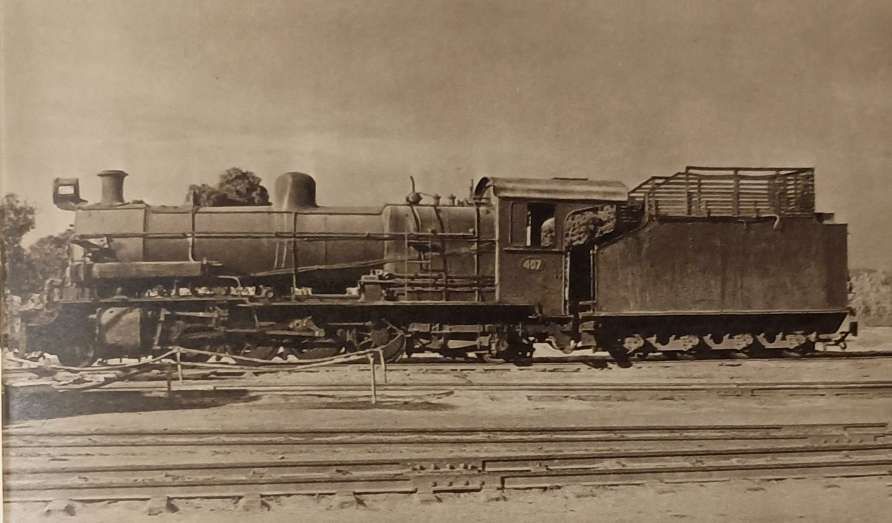
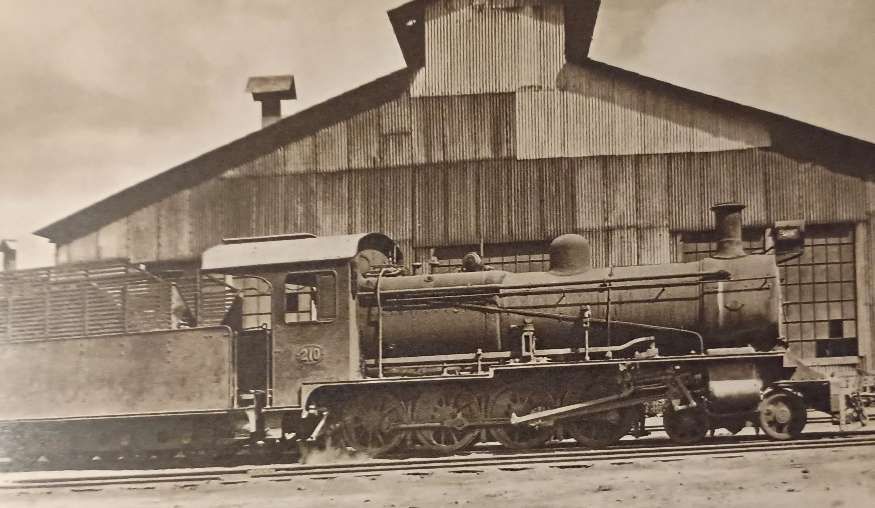
R. Ramaer says that the four locomotives known as the NZ Class (Nizam) locomotives from India acted “as the prototype for the TR’s own G class, a very similar unsuperheated, slide-valve engine, thirteen of which were supplied by Stephenson and Nasmyth Wilson and put in service in 1928-31. They were again closely similar to the original BESA-designed 4-8-0s for India and thus provide, as the last 4-8-0s built for the TR, a direct link with the first engines of this wheel arrangement to see service in this part of the world. The first eight were supplied to the Tanga Line in 1928 and released F class engines 96 and 720, which had become very expensive to maintain. One of the new Gs, unassisted, could handle the mail trains, a marked improvement over the old and obsolete six-coupled engines. The G had an axle load of only 8-8½ tons, a necessity on the light track of the Tanga Line. The reason for their obsolete concept is not quite clear, however, if we remember that these engines were built at the same time as the KUR EA class Mikados. Their original running numbers 20-32 were later changed to 204-16, as the locomotives were considered to be direct descendants of the NZ class locomotives 200-3. After the amalgamation in 1948 the G class engines were renumbered 2205-17 and gradually taken out of service.” [9: p58]
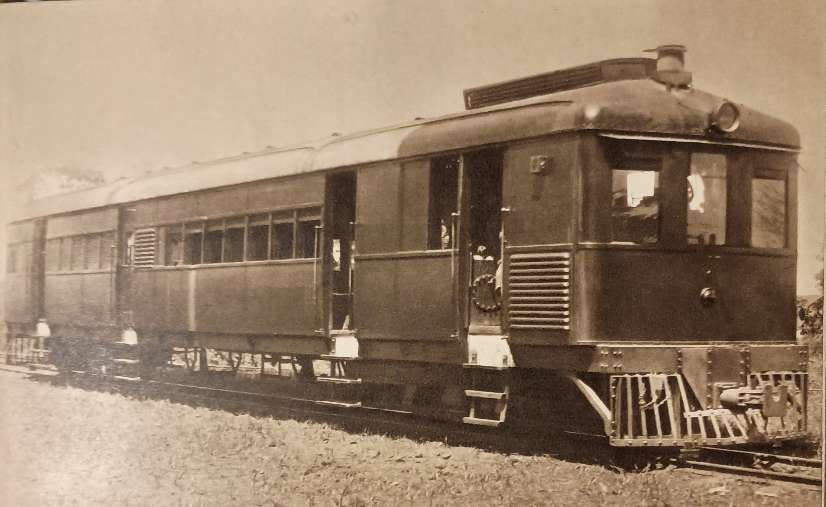
“In 1929, two Sentinel rail cars were put into service between Moshi and Arusha. Although they were appreciated by the travelling public, they failed to attract sufficient traffic to make them an economic proposition on this section of the line. At the same time a Sentinel shunting engine was also acquired. This was a small unit incorporating a high-speed steam engine and geared drive. It was so successful that a further seven Sentinel shunting engines were ordered, and put into service in 1931. They proved satisfactory and economical shunting engines at smaller stations on both the Tanga and the Central lines. In the February of 1930 two Sentinel coaches were put into service between Tanga and Korogwe to carry passengers and a limited amount of luggage. In the July of 1931 these coaches had to be withdrawn, as it was suspected that the axle-load was proving too heavy for the light track.” [1: p199]
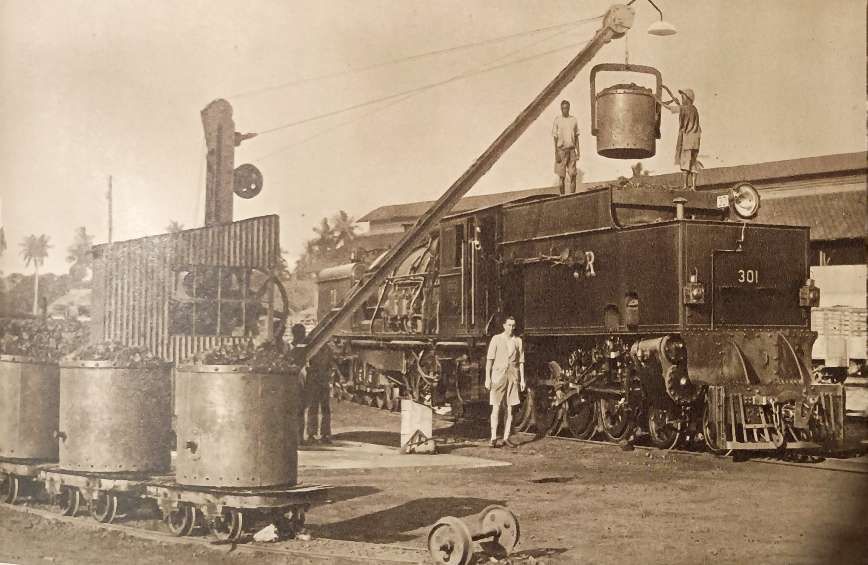
Hill continues: “In German times, and during the first five years of the British Administration, firewood was the only fuel used on both the Central and the Tanga lines. By 1923, along several sections of the railways, the timber conveniently close to the line had been cut down, and the fuel contractors were forced to work farther and farther afield at ever-increasing cost. In 1923, it was decided to experiment with the use of coal, and trial consignments were ordered from South Africa and the Belgian Congo, the experiments were carried out in 1924. The South African coal was satisfactory but the dirt content of the Congo coal was too high. By 1925, coal was being used by all engines running near the coast where a supply of wood fuel was most difficult to obtain. By 1930, coal was used by all engines on the Tanga line and by engines on the Central line running between Dar es Salaam and Dodoma. Around Tabora, firewood was still comparatively plentiful, and it was used as fuel between Dodoma and Kigoma for several years to come.” [1: p199]
On 1st June 1923, the Railways Administration became responsible for the marine service on Lake Tanganyika. Hill spends a few pages describing the salvage operations and the return to service of the Graf von Goetzen which was still lying on the Lake bed in shallow water, it was renamed Liemba when recommissioned. The tug Mwanza was still out of commission in 1923 but also returned to revenue-earning service. Hill notes that by 1929 receipts were greater than working costs for the services on Lake Tanganyika. This improvement was short-lived.
Early in British rule, the sea-ports of Tanganyika were run by a separate department if the Colonial Government. Hill says that, ” This arrangement did not prove satisfactory, and on 1st November 1925, the Port and Marine Department was absorbed by the railways, which then became known as The Tanganyika Railways and Marine. “All the shore working of the ports was taken over by the Traffic Department and the Railway’s Marine Department was responsible for the handling of ships in port, for the operation and maintenance of navigational aids along the coast of Tanganyika and for the dockyard at Dar es Salaam.” [1: p205]
£32,000 was spent on heavy repairs to the wharf at Tanga and £302,000 on the expansion of facilities at Dar es Salaam.
“In 1925, the total number of ships calling at Tanganyika ports was 975, with an aggregate of 1,853,140 tons. By 1930, the number of ships calling had risen to 1,318, with an aggregate of 2,892,145 tons. In the year ended 31st March 1930, Dar es Salaam port handled 157,356 tons of imports and 81,186 tons of exports. In that year Tanga port handled 56,182 tons of imports and 71,434 tons of exports. As the finances of the ports were not separated from those of the railways until 1939, there is no means of telling how the ports fared financially during the first twenty years of British administration. The lack of comment in official reports on the finances of the ports during the years when the railways were in a bad way suggests that the ports at least paid their way.” [1: p205]
“Towards the end of 1923 the Government’s steamship ‘Lord Milner’ was found to be unseaworthy. In order to maintain the navigational aids along the coast, the railways acquired the steamship ‘Azania’, built by Ferguson Bros. of Glasgow for £27,000. She was a vessel of 375 gross tons, with a draft of 9 feet, a cruising speed of 8 knots and a cargo capacity of 180 tons. The ‘Azania’, which was also equipped for the use of the Governor on journeys up and down the coast, was successfully employed on the maintenance of the navigational aids of the coast until after the Second World War.” [1: p205]
“In pursuit of the policy to increase the railways’ traffic by building branch lines to potentially productive areas, one of the first projects to be examined was the German design for a line from Tabora to Mwanza on Lake Victoria. This was the project that Lieut.-Colonel Hammond had opposed. In 1922, Mr. C. Gillman, then a District Engineer, wrote a most interesting report on railway development in Tanganyika. Mr. Gillman joined the staff of Philip Holzmann & Co., the contractors for the construction of the Central Railway, in 1905 as an Assistant Engineer. At the outbreak of war he was interned by the Germans, but in 1916 he was released and received a commission in the Railways Corps of the British expeditionary force. In 1919, Mr. Gillman joined the Railways’ Administration as a District Engineer. In 1928, he became Chief Engineer; for a year – in 1935 and 1936, between the terms of office of Lieut.-Colonel G. Maxwell and Mr. R. E. Robins – he acted as General Manager and he retired towards the end of 1937. Thereafter, for three years, he was Water Consultant to the Government of Tanganyika. For more than thirty-two years Mr. Gillman was closely concerned with the vicissitudes of the railways in Tanganyika and he was appointed a C.B.E. in recognition of his services. A man of strong opinions, he was often at logger-heads with the policy of his superiors and, at times, he was prone to overstate his case. Nevertheless, he was a remarkable character, although his writings suggest that he was not always an easy character to deal with or to work with. Be that as it may, on several important issues the march of events proved that Mr. Gillman’s judgement was sometimes sounder than that of others who had a greater say in the moulding of railway policy in Tanganyika. Nevertheless, he was not always right, and some of his writings also suggest that he made good use of the advantage of hindsight.” [1: p206]
For Tanganyika Notes and Records of June 1942, Mr. Gillman wrote a brief history of the Tanganyika Railways, in the course of which he referred to Lieut.-Colonel Hammond’s recommendations for the future extension of the railways. Mr. Gillman wrote:
“I had been asked to give my own views on railway extensions which I did in a lengthy report submitted early in 1922 and based on intensive studies of all the accumulated material left by the Germans, as well as on such personal knowledge of the country as I possessed. Full of youthful enthusiasm, backed – perhaps unavoidably – by my chief’s pushful energy; without, as was inevitable at the time, any realisation of the great advances to be made during the next ten to fifteen years with efficient motor transport; and, above all, lacking an intimate appreciation of large parts of the Territory and, therefore, considerably misled by the optimism of our predecessors, I was no doubt optimistic myself – though not entirely void of guarded cautiousness when I drew up the following ‘likely programme for railway development during the next thirty to fifty years’:
“(1) A southern railway from Ngerengere to Amelia Bay (Manda) on Lake Nyasa, to be built with as little delay as possible to the upper reaches of the Kilombero plain, the upper division to follow as need arises.
“(2) Simultaneously, a ‘Rift Valley Railway’ as a physical link between the two existing separate systems, should be taken in hand, the Moshi-Arusha section at once and further sections in yearly instalments, construction being pushed in both directions from Arusha and Dodoma.
“(3) Then the following feeder lines, as the future development of the country may require, in what looked like a reasonable order of urgency: Upper Kilombero to Ubena, Dodoma to Iringa, Kimamba to Tuliani, Mwanza to Kahama (note the place in the order and the insistence on building south from Mwanza) eventually to be continued to Tabora; and Ruiga Bay, a little south of Bukoba, to the Kagera river.
“The report wound up by strongly pleading for a far-seeing policy of extensive railway reconnaissance surveys in order ‘to make the choice of the most economical alignments possible when the time arrives for construction, and thus to avoid the usual gross mistakes, the inevitable consequences of decisions based on hurried surveys, and entailing not only wasteful construction but also, and much more serious, because accumulating, waste in working.’
“These recommendations found the full approval of the General Manager who, more particularly, re-emphasised the fact that the Tanganyika Territory part of the Lake Victoria basin was already served by the Uganda Railway.” [1: p206-207]
Meanwhile, the East Africa Commission, consisting of the Hon. W. Ormsby-Gore, M.P. (Conservative), Major A. G. Church, D.S.O., M.C., M.P. (Labour), and Mr. F. C. Linfield, J.P., M.P. (Liberal), had visited Tanganyika from September 22nd to October sth. They travelled up the Central line to Tabora and thence by car to Mwanza: in November they returned for five days and visited Arusha, Moshi and Tanga.
In so far as the railways were concerned, the main conclusion of the Commission’s report to the Secretary of State for the Colonies, published on 17th April 1925, was that:
“The further economic development of both native and non-native production in East Africa is dependent on the early provision of increased transport facilities and, in particular, on new railway construction.” [1: p208]
The Commission expressed these views on the development of the railway system of Tanganyika:
“The Central line was completed to Lake Tanganyika just before the war, and it is clear that the principal considerations before the German Government in pushing for-ward this single line without feeders were:
“(1) Strategic;
“(2) In order to secure at the earliest possible moment a share of the important mineral traffic from the eastern Congo.
“It was clearly their expectation that, once the Central line had been completed, its commercial value would depend on the further construction of the necessary feeder railways and roads. The German Government had already nearly completed the earth-work of the first branch line northwards from Tabora into the populous areas to the north, and had intended to extend this northern spur:
“(1) In the direction of Bukoba-Ruanda;
“(2) To Mwanza.
“This last project had been decided upon after very careful surveys had been made by the Germans as to the possibilities of extending the Tanga line from Moshi to Lake Victoria, but the extreme difficulty from an engineering point of view of crossing the Great Rift Valley and traversing a rocky volcanic crater country immediately to the west of it, as well as the practically uninhabited area through which such a railway would have to run, decided them to abandon such a project in favour of making Tabora the most important collecting junction on the Central line for the populous north-west.
“With regard to the great undeveloped southern area of the Territory, the Germans had considered possible lines from Lake Nyasa to the subsidiary port of Kilwa, but these, too, appear to have been abandoned in favour of the wiser policy of concentrating at the port of Dar es Salaam. The Germans had undertaken preliminary investigations for routes from Lake Nyasa to a point on the Central line. In our opinion, the whole question of the development of the south-western highlands, as well as the basin of Lake Nyasa, depends on the construction of such a line.
“The General Manager of the railways has gone into this question very carefully and has investigated possible alternative routes. We discussed this question very fully and considered all the data that [was] put before us, and our recommendation is that the line should be commenced at Ngerengere (Km. 145 of the Central Railway) and should proceed via Kisaki to Kidatu on the Great Ruaha river. This river, the only formidable one on the route, should be bridged at this point, and thence the railway should follow the left bank of the Kilombero river and thence by the Pitu Valley (a tributary of the Kilombero) to the Rutukira Valley, and thence from the confluence of the Rutukira and Ruhuhu to Manda (Wiedhafen) situated in the Amelia Bay on Lake Nyasa. This is the route recommended by the General Manager.
“The Kilombero Valley may be described as a great alluvial plain which could be turned into one of the finest cotton, sugar and rice producing areas in the world, and which by drainage and irrigation could eventually cover approximately 1,000 square miles.
“The Pitu Valley was described to us as very fertile and fairly well populated, and the centre of one of the richest potential grain districts of the country.
“The maximum elevation which such a railway would have to cross is on the divide between the Indian Ocean (Pitu Valley) and Lake Nyasa (Rutukira Valley), at an eleva-tion of 2,940 fect above sea-level. When one remembers that the Mau summit of the old Uganda line is over 8,000 feet above sea-level, and the summit of the new through line to Uganda (Uasin Gishu) is over 9,000 feet, the difficulties and consequently the cost of the proposed Lake Nyasa trunk line should be materially less than any other similar line hitherto constructed in East Africa.
“The total length from Ngerengere to Manda by the proposed route is just over 400 miles. It is the most considerable new construction which we recommend to you, and it would do more to open up and develop a vast new area of Africa than any other line which we can suggest. We recommend that you should invite the consent of the Treasury to an immediate survey and estimate of the cost of this line. We consider that this survey should be undertaken not merely from an engineering point of view, but also from an economic and administrative point of view, and that the survey party should be accompanied by a qualified agricultural officer who should report on the possible agricultural development of the different areas which the line would traverse, and on the means of access to it from the Iringa district.
“We advise this route, not only in the interests of the development of Tanganyika Territory, but also because it would provide the cheapest and quickest route and outlet for the northern half of Nyasaland and the eastern parts of North-eastern Rhodesia.“We are satisfied that the other alternative route to Lake Nyasa via Dodoma, Iringa, Tukuyu to Mwaya (the port at the extreme north end of Lake Nyasa), although giving a more direct route to the south-western highlands of Tanganyika Territory, would be more expensive and more difficult. The eastern portions of these highlands could be connected by means of roads with our proposed line at different points in the Kilombero Valley, while the western portions in the neighbourhood of Tukuyu could use the excellent existing road from Tukuyu to Mwaya and lake transport from Mwaya to Manda. We wish this new trunk line to Lake Nyasa to be regarded as of primary importance.
“In our opinion the most urgent new railway construction is the completion of the Tabora-Kahama line (which will be open this year) to Mwanza. This line should, in our opinion, proceed from Kahama to Shinyanga and thence via Kuru (to the east of the existing Shinyanga-Mwanza road) to Mwanza. We are glad to learn that the portion from Kahama to Shinyanga has been sanctioned in principle. It should be pushed for-ward without delay.
“Shinyanga district is one of the richest, most densely populated and progressive native areas in the whole territory, while between Shinyanga and Mwanza lies a promising cotton area. Animal transport between Shinyanga and Tabora is out of the question on account of tsetse-fly. Fly again appears north of Shinyanga and between Shinyanga and the frontier of the Mwanza district. Motor transport is out of the question between either Shinyanga and Tabora or Shinyanga and Mwanza except during the dry months of the year.
“The total distance from Tabora to Mwanza by the route we propose is approximately 260 miles. Thus, leaving out the already sanctioned branch to Shinyanga, approximately 140 miles of new construction will have to be undertaken.
“A study of the map of East Africa makes it clear that sooner or later all the railway systems should be linked in physical connection in order to secure the maximum of economy in management and control. Instead of a series of separate managements, survey staffs and railway workshops, a single organisation would enable great economy to be effected in these matters, and salaries could be afforded that should enable the East African railway service to attract first-class men.
“We therefore considered how best such physical connection between the various railway systems could be effected, due regard being had to the need of opening up the greatest possible profitable area. We have come to the conclusion that these two desiderata would best be attained by a line connecting Moshi at the foot of Mount Kilimanjaro with Dodoma on the Tanganyika Central Railway, such a line passing through Arusha, Gwanzave (Ufiome district), Kondoa Irangi, to Dodoma. This would involve some 280 miles of new construction which could be begun from both ends simultaneously.
“In view of the existing physical connection between the Tanga line and the Uganda Railway by the existence of the Voi-Kahe branch, constructed as a military railway during the war, we recommend that the management and operation of the Tanga line should be transferred forthwith to the Uganda Railway. The Tanga line would remain in the ownership of the Tanganyika Government, and the terms on which the operation of the line would be taken over by the Uganda Railway should be the subject of joint recommendations to you by the High Commissioner for the Uganda Railway system and the Governor of Tanganyika Territory.
“We should like to suggest, however, that, in addition to the arrangements regarding finance, service and rates in connection with the proposed transfer of the Tanga line, the Government of Tanganyika Territory and the unofficial residents in Tanga district should have some representation on the new Inter-Colonial Board recently established in connection with the Uganda Railway, in order that the interests of Tanga shall be represented.
“We recommend that the extension from Sanya river, the present terminus to the west of Moshi, to Arusha should be approved and commenced as soon as possible.
“The three new railways which we recommend in this territory have an importance from a political and administrative point of view in addition to their economic value. Tanganyika Territory is geographically the centre of the group of British East African Dependencies, and if any advance is to be made in the direction of better co-ordination, effective means of communication with Nyasaland and Northern Rhodesia on the one hand and Uganda and Kenya on the other are essential. The railway programme we suggest takes this consideration into account.
“But, apart from external communication, the proposed development of the railway system is urgently required from an internal point of view. In our opinion, there has been a tendency to concentrate expenditure and interest in Dar es Salaam and the places which can be easily reached from Dar es Salaam by means of the Central Railway, with the result that both the northern and the southern areas of the territory have been comparatively neglected. In particular, Mwanza and Bukoba have suffered from shortage of staff in all departments and from lack of attention by the headquarter officers in Dar es Salaam, the main cause having been the difficulty of communications.
“The absence of railway or road communication between the Tanga-Moshi-Arusha area and the capital has led to an agitation started in the Arusha district for the transfer of the northern area of the territory to Kenya, with which it is linked by the Voi-Kahe railway and by means of the motor road from Nairobi to Arusha. In our opinion insufficient attention has been given to the important northern districts, and the feelings of the settlers in the northern areas are not without some cause. To this feeling have been added the fears and misunderstandings regarding Great Britain’s position as Mandatory. Arusha planters took the lead in this matter and they definitely urged annexation of their district by Kenya. They were at first supported by their colleagues in the Moshi district, but we gathered when at Moshi that opinions in this district had undergone considerable change. The non-native communities in Tanga expressed no desire for the proposed annexation. The natives were strongly opposed to it.
“We pointed out that annexation was out of the question without a revision of the terms of the Treaty of Versailles, and that, even if the administration of the northeastern highlands by the Government of Kenya were thought desirable on its merits, the area would remain mandated territory, subject to the conditions of the mandate. In that case an annual report would have to be rendered by the Governor of Kenya in the same manner as in the case of the British Mandated Territory of Togoland which is administered as part of the Gold Coast Colony. This would confer upon the Permanent Mandates Commission, and the Council of the League of Nations, the right to review and comment on all Kenya legislative or administrative action applied to the mandated area.
“We are, however, satisfied that the desire for the suggested transfer would disappear if the Arusha district were rendered more accessible from Dar es Salaam by the construction of further road and rail communications, and if greater attention and encouragement were given in future to the special needs of the district in such matters as coffee development and European education.
“The plains round Mount Kilimanjaro and Mount Meru are capable of considerable development by means of irrigation, the rainfall on the two mountains being high, and at present running very largely to waste. Such development would require considerable capital and non-native enterprise, but, if it were undertaken, large crops of irrigated cotton both native and non-native could be produced, and the most valuable and suitable arabica coffee area in the whole of East Africa considerably extended. On the actual mountains of Kilimanjaro and Meru there is already a large, in some places a congested, native population, and no further land can be alienated. But in the plains round the mountains, provided irrigation is carried out, further non-native settlement can safely be encouraged.
“To return to the question of communications, the Director of Public Works informed us that he regarded the country as being ‘starved for roads’. It is essential that in a country like Tanganyika Territory there should be a definite road policy. The department responsible should have the duty, not only of constructing and maintaining existing public roads and bridges, but also of drawing up, in consultation with the General Manager of Railways, the Agricultural Department and the Native Affairs Department, a programme of main and feeder roads to be carried out as and when money is available, either from loan funds or from current revenue. There should also be an annual report on roads.” [1: p208-212]
Hill tells us that of the lines recommended by the Commission two were quickly built – the Tanga line was extended to Arusha and the Tabora-Kahema line was extended to Mwanza. Both opened towards the end of the 1920s.
Hill says that “From 1925 onwards, the proposal to build a railway to the southern part of Tanganyika led to a long and complex controversy, notable for a welter of conflicting ideas. In 1925, a reconnaissance survey was carried out from Ngerengere, on the Central Railway, down to Tukuyu. In 1926, a further preliminary survey was run from Dodoma to the Ruaha river and thence to llongo, Kasale and Fife. In 1927, tacheometric surveys were run between Dodoma and Iringa and Unyika and the border. In the same year, a further reconnaissance survey was carried out between Unyika and Iringa and thence to Msagali. In 1928, a report and estimate on the line from Dodoma to Fife was submitted and, in 1929, the Chief Engineer, Mr. C. Gillman, prepared a comprehensive report on the project for a railway to the south. This report was strongly criticised by the European settlers who were concerned with the development of the southern highlands, an enterprise greatly encouraged by the support of Lord Delamere. Several of the lines surveyed ran along alignments which suited the interests of the European farming community, but they passed through very difficult country and would have been very expensive to construct and to operate. Mr. Gillman bluntly stated that a line from Dodoma to Fife could only be regarded, technically and economically, as an impossible proposition which could in no circumstances be recommended.” [1: p213]
“Shortly before the publication of Mr. Gillman’s report the committee appointed to submit proposals under the Imperial Colonial Development Act had unanimously recommended the immediate construction of a line from Kilosa to Ifakara on the Kilombero plain and of another line from Dodoma to Iringa. This committee also recommended a detailed survey from Iringa to llongo with a view to an early extension.” [1: p213-214]
In the autumn of 1929, Brigadier-General F. D. Hammond was again commissioned by the Secretary of State to report on the Tanganyika Railways. He arrived in Dar es Salaam on 1st September and left on 5th November. While he was in the Territory, the Governor, Sir Donald Cameron, asked him to express his views on Mr. Gillman’s report. In the summary of the conclusions of his report, Brigadier-General Hammond wrote:
“The question as to which route should be chosen for the Southern line has been clouded by the demand for a so-called ‘Imperial Link’ between the Tanganyika and Rhodesian Railway systems. No adequate justification, economic, administrative or strategic, for this ‘Link’ has been advanced. The phrase has not, however, been without its influence on the recommendations of the local Colonial Development Fund Committee. What is required in the interests of the Territory is the route which will open up best the huge undeveloped area lying to the south of the Central line, bearing in mind that some day it may be sound to extend it to join the neighbouring system. It is not disputed that the Dodoma-Iringa section will not be a paying proposition as a separate line, whereas the Kilosa-Ifakara section is one of the most promising in the country. To choose the Dodoma-Iringa-Fife route would mean giving to this, one of the least promising propositions, priority in capital and labour over all the other schemes and delaying all of them by four years. For these reasons I recommend the Kilosa-Ifakara-Mpanga-Fife route for the Southern line.” [1: p214]
In the July of 1930 Sir Donald Cameron appointed a Railway Commission under the chairmanship of Sir Sidney Henn. The Commission, which fairly represented all interests and travelled widely through the country, submitted its report in September 1930. The Commission recommended:
(1) The immediate construction of a railway from Kilosa to Ifakara.
(2) The construction of a railway from Dodoma to Ubena, “on the assumption that His Majesty’s Government will provide the capital free of interest for at least twenty years, as it is not anticipated that the railway will meet its expenses within that period or that Tanganyika Territory could undertake the burden of this development without serious detriment to other interests.” Sir Sidney Henn and Mr. M. P. Chitale dissented from the recommendation to build this line.
(3) The construction of a line from Kilosa or Kimamba to the neighbourhood of Korogwe or Mombo. The General Manager, Lieut.-Colonel G. Maxwell, dissented from this recommendation. [1: p214]
The Commission also recommended: the survey and construction of feeder roads as an essential part of railway construction; the building of better roads in the areas not served by railways; that careful attention be paid to the progress if experiments on road-trains; and that there be an early investigation of the problems of progress and irrigation in the Kilombero Valley.
The despatch to the UK of this report was written by Sir Donald Cameron. He supported the proposed line from Kilosa to Ifakara provided it could be demonstrated that it would be profitable within 5 years. He disappointed those arguing for a line into the southern highlands and closed down the possibility of a railway South from the Central line. In so doing, he brought an end to speculation about a possible link line into Northern Rhodesia.
However, it was clear that should a link be made with lines in Northern Rhodesia, then the question of gauge compatibility would become important. “Experiments were set in train to determine whether some adaptable form of track could be used in all future track laying. In 1928, trials of a new type of sleeper, known as the F type, which was adaptable to either of the gauges, were started. These experiments proved successful, and in 1929 it was decided to standardise the F type of sleeper for all new purchases of track. … A further tacheometric survey was run from Kilosa to Ifakara, but the onset of the Great Depression soon put an end to any further steps towards the building of the line. In 1933, a tacheometric survey between Kilosa and Korogwe closed the extensive series of surveys which had occupied the railways’ surveyors since 1924.” [1: p215]
Hill tells us that, “The extension of the Tanga Railway to Arusha inspired the settlers in the Upper Sanya and Ngare-Nairobi areas to press for a short branch line to their farms. The preliminary survey was not satisfactory, but a later tacheometric survey led to a strong recommendation that the branch be constructed. The proposal was supported by the Development Committee and by Brigadier-General Hammond. Construction of the line was approved and bridging and other materials were imported from England and carted to the site. In the February of 1931 construction started, but after some £10,000 had been spent the work was stopped, again due to the world depression.” [1: p215]
He continues: “In 1926 a preliminary survey for a branch line from Itigi, via Singida, to Mkalama was completed. It was not a good job, and early in the following year a second survey established that Manyoni was a more suitable junction for a line to the north. Also in 1927, a tacheometric survey from Manyoni to Mkalama was completed, and a rough reconnaissance was done on a line from Manyoni via Kondoa Irangi to Arusha. In 1928, the location survey started from Manyoni, and it was completed as far as Singida in 1929 and to Kinyangiri in 1930. It was estimated that the line would cost £557,000. In 1930, there was also a reconnaissance for lines from Singida to Arusha and from Dodoma to Arusha.” [1: p215-216]
“The General Manager wrote a most optimistic report of the economic prospect of the Manyoni-Kinyangiri branch which was also strongly supported by the Develop-ment Committee and by Brigadier-General Hammond. The General Manager predicted that the line would produce a revenue of from £50,000 to £70,000 a year after five years. The Governor was more cautious. He thought it preferable to postpone the scheme ‘if there is a prospect of a suitable road-unit being produced in a reasonable time’. Nevertheless, approval was given for the construction of the line. Work started in the September of 1931 and the rates quoted by the contractor, Mr. Yelitch, were a good deal less than those which had previously been paid. This was mainly due to the amount of cheap labour available as a consequence of the world depression which pressed hardly on Africans. The line was opened to Singida by the Governor, Sir Stewart Symes, on 31st July 1932, and railhead reached Kinyangiri early in 1933. Due to very heavy rains the last section of the line was not sufficiently consolidated to open for public traffic until 1st April 1934. It was a suitable day of the year, for the line was to prove an expensive and disastrous folly. The line was laid with new 45-lb. track, and the actual cost of the 150 kilometres was £537,000 or £3,700 per kilometre. No interest was payable on the capital for the first two years.” [1: p216]
Hill explains: “The Kinyangiri branch was built on the assumption that it would stimulate export traffic from the districts of Singida and Mkalama and thereby encourage imports of consumer goods. The pressure of population on the land of these districts was fairly heavy and the people owned large herds of cattle. Apart from the fact that any increase of exports required a change in the way of life of the people – away from a pastoral existence to the growing of crops – it was apparently overlooked that the climate, the soil and the lack of water supplies made any move towards more intensive agriculture virtually impossible. In fact, without a large investment in the better distribution of water supplies, there was no real prospect that the land could do more than provide a subsistence economy for the people.”
Against a predicted value of £50,000, the annual receipts of the Kinyangiri branch, were £5,000 in the first year, rising to £13,000 in 1935. The receipts for the next four years were:
1936 £15,000
1937 £19,500
1938 £10,200
1939 £13,100
The costs of maintaining and operating the branch were:
1935 £34,600
1939 £45,100
Hill says: “By then the operation of the Kinyangiri branch had resulted in a total deficit of £262,500, taking into account interest and renewals and allowing for the value of additional traffic brought to the main line. In fact, no payments to a renewals fund were made, so the actual loss to the railways, after payment of interest charges, was £205,500 by the end of 1939. Small wonder that the General Manager wrote in 1937: ‘It seems practically certain that the branch will remain a burden to the Territory until the debt has been amortised’.” [1: p217]
The branch line from Moshi to Arusha was also a disappointing venture from a financial point of view. “Taking into account all charges, including interest and renewals, and all receipts, including the value of additional traffic brought to the Tanga line, and compensation in respect of additional traffic carried by the Kenya and Uganda Railways, the deficit for 1931 was £22,900. This deficit fell, steadily but slowly, to £17,000 for 1939. By then the aggregate deficit was £194,200. As no contributions were, in fact, made to the renewals fund, the actual loss to the railways was £143,200.” [1: p217]
Hill says that, “It is clear that the building of these two branches was largely responsible for the financial difficulties of the Tanganyika Railways in the ‘thirties. It was unfortunate that no heed was paid to Brigadier-General Hammond’s contention that ‘when a new railway is built which it is estimated will not pay its way within five years, the Territory should bear all losses until it reaches the paying stage.’ This point was persistently stressed by Mr. R. E. Robins, who succeeded Lieut.-Colonel G. A. P. Maxwell as General Manager of the Tanganyika Railways on 15th May 1936.” [1: p217]
Hill provides a table showing profit and loss for the Tanganyika Railways in the late 1920s and early 1930s. …
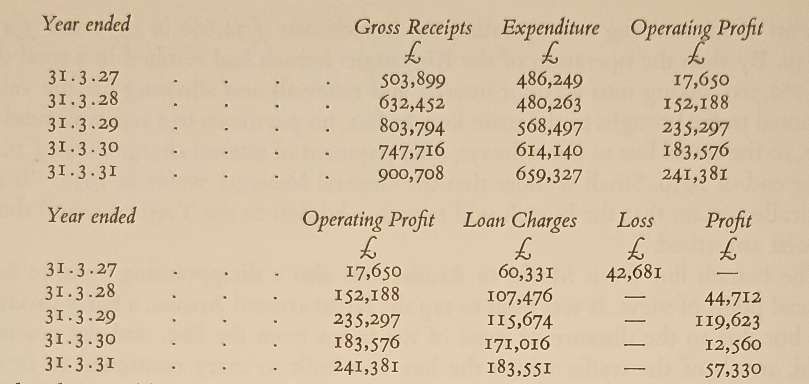
Hill notes that, “The rapid increase of the railways’ gross receipts and operating profits during the years 1926-1930, the buoyancy of world markets and confidence in the expansion of Tanganyika’s economy, inspired a general spirit of optimism. Expansion was the mood of the day, and it was often based on premises which were inadequately examined. The railways’ policy of building branch lines, and of investing large sums in the equipment of the lines to carry the expected increase of traffic, was bound to lead to serious trouble if the upward trend of the economy were checked. Admittedly, none could have foreseen the plague of locusts which afflicted East Africa from 1938 to 1931, nor the years of drought which exacerbated the ravage of locusts, nor the sudden collapse of the New York stock market, in the autumn of 1929, which heralded the Great Depression. On the other hand, sounder judgement might well have avoided the major blunder of the Kinyangiri branch and the excessive reliance placed on the traffic of copper concentrate from the Belgian Congo.” [1: p 218-219]
In terms of weight, sisal provided the railways with the greatest volume of traffic, but as the plantations were nearly all in the coastal districts, the haul was short and the revenue proportionately less than the total tonnage suggested. From the point of view of revenue, the most valuable traffic to the railways was the copper concentrate, mined at Katanga in the Belgian Congo and exported via Kigoma and Dar es Salaam. It travelled the length of the Central line, and it contributed far more to the railways’ revenue than any other commodity. From 1923 to 1931 the rise in the copper traffic was spectacular:
Year ending 31st March 1924. …………. 4,434 tons
Year ending 31st March 1925. ………….. 8,739 tons
Year ending 31st March 1926. …………. 18,817 tons
Year ending 31st March 1927. …………. 16,632 tons
Year ending 31st March 1928. ………… 26,565 tons
Year ending 31st March 1929. ………… 29,997 tons
Year ending 31st March 1930. …………. 18,538 tons
Year ending 31st March 1931. ………….. 34,137 tons
Hill says that the Railways’ Administration “seem to have taken it for granted that the copper traffic would continue and to have overlooked two considerations. First, the ores of Katanga were low grade and, secondly, they were mined in the middle of Africa which meant high freight charges on the way to European markets. Whereas the Katanga mines could compete in the good years, they were amongst the first enterprises to feel the effect of the depression.” [1: p219]
For the year to 31st March 1932, the copper traffic was only 7,166 tons and by the October of 1931 it had ceased. The Belgian Congo then diverted almost all traffic to its own outlets on the West coast of Africa – Stanleyville and Matadi in preference to the Tanganyika Railways. There was also some reason to suspect that a more lenient method of assessing customs duty was applied to the west coast route. Hill comments that: “The disadvantage of the copper traffic had been that, except in the years 1925 to 1927 – when the Congo imported heavy railway material via the East Coast to hasten the completion of lines which would eventually compete with the Tanganyika Railways the down-traffic to Dar es Salaam was far greater than the up-traffic to Kigoma, In fact, the copper traffic involved a lot of light running and empty trains into Kigoma. Even so, the sudden and complete cessation of traffic was a severe setback to the Tanganyika Railways.” [1: p 219-220]
Flood water persistently assailed various sections of the permanent way in the rainy seasons. There was a severe shortage of water for locomotives during long seasons of dry weather. Hill’s own view, expressed in the late 1950s, was that these problems had still not been resolved.
Serious flooding problems required the raising of embankment levels across the Usinge swamp and the provision of culverts through the embankment. However, the most troublesome section of the line was between Kilosa and Dodoma, through the Mukondokwa Valley. In January 1930, major problems with flooding required a diversion of the line between Kms. 319 and 323 to the North and the continued repair of breeches to embankments elsewhere. A bridge, at Km. 342 was also washed away and proved difficult to repair. In March 1930, another washout occurred between Kms. 281 and 287 and the bridge at Km. 342 was again washed away. Further problems were experienced at the beginning of April 1930.
A major realignment project saw £257,000 spent on a new route higher up the valley slopes and when further flooding affected the Mukondokwa Valley in 1936, the railway was not affected. However, in 1937, the river rose once again and washed away the main railway bridge, with traffic stopped for a month.
Extensive minor wash-aways occurred annually throughout the whole system, including the Tanga line and the newly constructed Mwanza branch. “As early as 1926, it was clear that the cause of many of the wash-aways was that the bush covering of the slopes had been cleared and the land brought under cultivation.” [1: p222] Whilst not an example of climate change, this was an example of the way human action could be responsible for adverse effects on a local environment.
Hill continues: “The greater part of the country traversed by the Central line is arid and dries out almost completely for several months of the year. Most of the water points established by the Germans were derived from surface sources and there was barely enough water to suffice in the average year. In years of less than average rainfall there was a serious shortage. The depots at Dodoma and Tabora, where water was required for wash-outs and for shunting locomotives in addition to running trains, were in a particularly bad position and water had frequently to be railed in by train to supplement the meagre supply. The heavy draw-off of water from the stations with a fair supply to supplement those with a poor supply resulted in a shortage of water at all stations. In some years the overall position became extremely serious.” [1: p222-223]
“At Tabora an additional well was sunk in 1923, in the hope that more water would be found and in 1924 the well was deepened and lined. This was not successful and complaints of water shortage at Tabora were made each year. It was necessary to send Tabora locomotives to Malagarasi or Itigi for their wash-outs in the dry season. A plant was installed at Tabora to enable water used for washing out engines to be collected, purified and returned to circulation. This was a useful expedient but, in spite of it, the shortage continued. Eventually a deep boring plant was purchased and, in 1930, two deep boreholes were sunk at Tabora.” [1: p223]
“The situation at Dodoma was almost as difficult and from there locomotives had to be sent to Morogoro or to Kilosa for their wash-outs. The Germans had found insufficient surface water at Dodoma and had sunk a number of boreholes at the station which produced a barely sufficient quantity of water for railway purposes. The township at Dodoma was faced with an even more serious shortage of water than the railways, so the Public Works Department decided to construct a dam to impound and store flood water. In order to pay for this scheme, it was decided that the railway supply should be closed and the P.W.D. should supply both the railways and the township from their new dam. The dam was completed and brought into operation in 1930. In subsequent years the water in the dam proved insufficient to meet all requirements, and the railway boreholes were re-opened to supplement the supply.” [1: p223]
We have already noted that Brigadier-General Hammond compiled a second report for the Secretary of State for the Colonies in March 1930. Hill says that he found more to comment than to criticise. His recommendations covered a wide field. Hammond noticed the way the growth in road transport had brought the growth of passenger traffic on the Tanga line to a standstill, so he suggested the use of railcars to meet this competition. He noted too, that with the Railway Company not permitted to own land, it was not really a business, just a semi-independent arm of the state. He was also unimpressed by the quality of the Annual Report of the General Manager.
In relation to the Tanga line, Hammond, made these recommendations:
“The maintenance of both rail connections with Moshi has meant the division of traffic between the two railways to the detriment of both. Despite a good increase in receipts on the Tanga line and low capital charges, there was still a loss on working in 1928/29 of £22,095. The Kenya and Uganda Railways are handling the majority of the high-priced imports and the Tanganyika Railways the bulk of the low-priced exports.
“Great economies can be effected if the Kenya and Uganda Railways work the Tanga line and port as agents on behalf of the Tanganyika Railways. There are no great legislative or administrative difficulties, and my recommendation to this effect has the support of the East Africa Commission of 1924 and of the Closer Union Commission of 1928. The two General Managers are working out a scheme for this purpose, and it is hoped that one acceptable to both parties can thus be solved. Failing this, the matter should be subjected to arbitration. When a proper solution has been reached, the Tanga line should soon show good working results.
“Motor competition has already made its presence felt on the Tanga line and will soon do so on the Central line. I recommend that this should be met by a system of tolls, which will encourage the man who tries to open up services in new areas or on roads radiating from the railway, but definitely discourage the man who chooses to enter into competition with the railways and is using up energy and capital in wasteful competition. [1: p223-224]
Hammond dealt with several controversies which had arisen between the Tanganyika Treasury and the railways, but on the financial side his most important recommendation dealt with the urgent need to establish a renewals fund. In a summary of his report he wrote:
“It is recommended that, instead of applying surpluses to the redemption of two items for which the railways acknowledge indebtedness to the Tanganyika Treasury, they should be applied to the reduction of the arrears of renewals and the items should figure as ‘Advances from Treasury.’
“It is recommended that future surpluses should be applied first to reducing arrears of renewals and that the railways should not pay interest on these special advances and on cash advanced prior to 31st March 1927, until the arrears have been wiped out. If the railways become part of an organisation separate from the Government, the advances should be repaid or interest paid on them.
“A Renewals Fund should be started. The necessary data has been prepared and payments should start as from 1st April 1930. An Arrears of Renewals Account should also be started.
“After deducting Sinking Fund contributions, the contribution to the Renewals Fund for the year 1930-1931 will be £152,860, as against a credit balance on Revenue Account for the year 1928-1929 of £122,692. It is hoped that this gap will be made good by an increase of net revenue but, if not, any shortfall in the contribution must be added to the arrears of renewals. These arrears will amount on 1st April, 1930, to £1,271,119, which emphasises the need for generous treatment of the railways by the Territory.
“An item of approximately £1,270,000 for ‘Arrears of Renewals’ will have to appear in the Balance Sheet with a corresponding increase of the Deficiency Account.” [1: p224-225]
Hammond also stated that the cause of the weak financial position of the Tanganyika Railways was the small volume of business handled compared with the mileage maintained. “It is, therefore,” he wrote, “even more necessary for the Tanganyika Railways than for the ordinary railway to increase their gross receipts and to expend capital in doing so.” [1: p225]
In other words, Hammond advised a continuation of the policy of expansion. Events were soon to show that such advice was of no value and quite impossible to follow.
He noted that in order to provide for the development of the whole system the General Manager estimated that the normal capital requirements during the next three years would be:
1930-31 £442,500
1931-32 £355,500
1932-33 £279,100
Hill says that, “The largest items were £650,000 for locomotives and rolling stock and £153,000 for housing for the Asian and African staff. Brigadier-General Hammond considered proposed capital expenditure was reasonable and justifiable. He also approved the expenditure of £176,000 on the wharf frontage and facilities at Dar es Salaam, £40,000 on fixed moorings and a tug and £125,000 to improve and enlarge the wharf accommodation at Tanga. He did not approve a proposal to spend £85,000 on a new single-ended traffic yard at Dar es Salaam.”
Hammond pointed out that the improvement in the railways’ financial position was due to the increased earnings on the Central line, which had showed a surplus of £140,280 for the year ended 31st March 1929, after allowance for interest had been made. On the other hand the Tanga line still showed a loss on revenue account alone before allowing for loan charges.
“This is in marked contrast,” he wrote, “with the situation as it appeared when I reported on these railways in 1921. Then, although both lines were working at a loss, the prospects of the Tanga line were, according to the opinions of all whom I consulted, considered by far the brighter both on account of the possibilities of the Moshi-Arusha area and because development had already begun along the lower section before the war. The change in the relative positions is well shown in the coaching and goods earnings of the two lines. In the year 1922 these totalled £196 per mile for the Central line and £162 per mile for the Tanga line; in the year 1928/29 they were £583 and £321 per mile respectively. The growth in the former has been due principally to the development of the transit trade with the Congo, and in a lesser degree to the good agricultural development in the area between Kilosa and Kidugallo.
“Although overshadowed by the results on the Central line, there has also been excellent development on the Tanga line, but the retention of two outlets for the Moshi and Arusha traffic has meant a division of the receipts coupled with expenditure in operating and maintaining two lines instead of one, while the upper section of the Tanga line, apart from Moshi itself, has produced up to date insignificant receipts,
“Although the financial results have thus shown a welcome improvement, the traffic on both lines still remains light. On the Dodoma-Morogoro section the average number of trains per week is 14 each way, on the Morogoro-Tabora section nine to ten, and on the Tabora-Kigoma and Tabora-Mwanza section four per week each way. On the Tanga line there is an average of 15 trains a week each way as far as Korogwe; beyond that the average does not exceed six a week each way.” [1: 225-226]
Dealing with the prospects of the Central line, Brigadier-General Hammond wrote:
“To a person like myself, revisiting the country after eight years, the increase in cultivated land along the railway is striking. The development has obviously not reached its limit by any means; new acreages are being planted and, though the increase may not be so rapid as in the past, there should be a steady progress. The only important commodity which has been disappointing is groundnuts; the tonnage of these, which was 10,845 in 1924/25, fell to 3,853 in 1925/26 and only reached 9,224 in 1928/29. This is attributed partly to a series of bad seasons and partly to the fact that some of the natives in the Mwanza area have turned from groundnuts to cotton. For the latter reason a large increase cannot be expected except at the expense of cotton, but development in agriculture has already taken place amongst the tribes along the main line and, with a steady growth in this and with the return of a few good seaons, it would not be unreasonable to anticipate a moderate increase on the 1924/25 figures.” [1: p226]
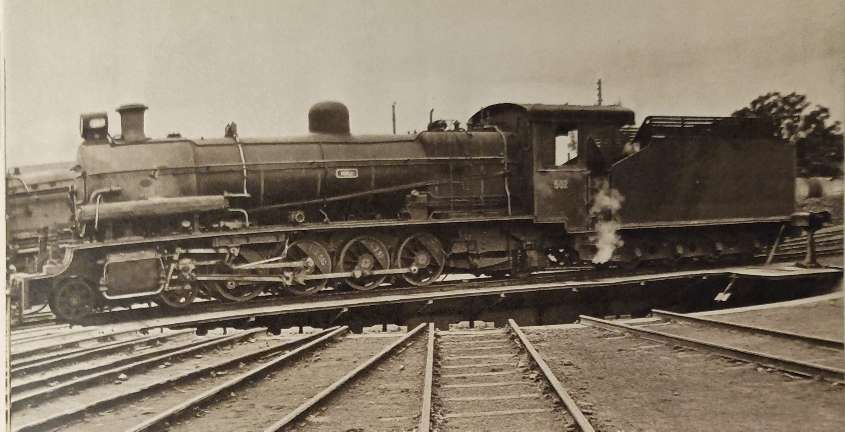
The “RV” class designation was short for “River”, as each RV class locomotive was named after a river in the Tanganyika Territory. The Class entered service on the Tanganyika Railways between 1928 and 1930, and its members were later operated by the TR’s successor, the East African Railways (EAR), (c) Public Domain. [1: p303]
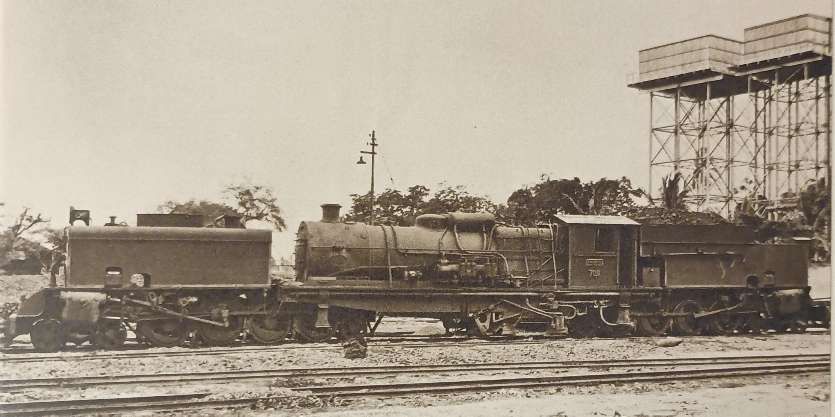
As the 1930s unfolded, there was significant debate in Kenya, Uganda and Tanganyika regarding the need to provide some protection for the railways from road competition. “In 1935 committees were appointed in Kenya, Uganda and Tanganyika to consider the control and co-ordination of all forms of transport. The Uganda and Tanganyika committees generally supported the need for regulation and the Kenya committee strongly supported the regulation of all forms of transport. In the July of 1936 Brigadier-General Sir Osborne Mance visited East Africa to advise the three Governments on the problem. His report, which was not published until 1937, generally endorsed the proposals to regulate all forms of transport on the lines recommended by the Kenya Committee. General Mance pointed out that if motor transport were under the same obligation as the railways to carry traffic tendered at the same rates as the railways for all commodities, viz. an average of 12-68 cents (Kenya and Uganda Railways) and 18-29 cents (Tanganyika Railways) per ton-mile, it would have to go out of business and leave the railways alone in the field. If, however, road transport were allowed to pick and choose and limit itself to the highest classes of traffic in one direction and the best return load available in the other, it could easily undercut the high railway import rates and earn a profit. The railways would then lose the revenue necessary to balance the low export rates and, as any attempt to raise the latter rates beyond the amount determined by world competitive prices would result in the cessation of exports and hence of imports, a heavy railway deficit would occur which would have to be made good by the Government at the expense of the taxpayer, including the importer, who would in this way lose any temporary advantage obtained by the reduction of rates for the carriage of imports by road. The only beneficiary would be the motor transporter, until he was also ruined by cut-throat competition for the diminishing traffic.” [1: p229]
General Mance concluded that some form of regulation of transport was inevitable, and that the railway system was essential as the cheapest form of transport for imports and exports. He recommended a continuation of the policy of protecting the railways from uneconomic competition by road transport.
He considered that all forms of transport should be controlled by licensing. He saw no need to restrict the operation of dhows on Lake Victoria and he advised a monopoly of air services in East Africa with railway participation.
In regard to roads, he suggested that East Africa should concentrate on the construction of real, all-weather roads for vehicles of moderate size and, only later on, improve the principal trunk roads for heavier vehicles. Priority should be given to feeder roads rather than those parallel to the railways. Ultimately it would probably be the demands for passenger transport which would require the development of long distance road because the railways would always be best suited to freight!
Hill reports on the performance and enhancement of the railways in the 1930s: “For the year ended 31st March 1930, the Tanganyika Railways made a profit of £57,830, after meeting interest charges of £183,551. During the year both lines received a considerable reinforcement of rolling stock. From England, the Central line received 50 covered goods wagons; 14 bogie covered goods wagons; 2 bogie first-class coaches, a second-class coach and a dining car, and 8 brake vans and 6 fuel trucks. In addition, 5 bogie third-class coaches, an inspection coach, 2 travelling workshops and a pay coach were built locally for the Central line. From England, the Tanga line received a first- and second-class bogie coach and a dining car; 8 bogie covered-goods wagons, and 24 covered-goods wagons and 4 brake vans. An inspection coach and 2 motor vans were built locally for use on the Tanga line.” [1: p230]
“In the June of 1931 three new Garratt-type engines (4-8-2-2-8-4) were added to the stock on the Central line. These engines weighed 131.35 tons, and had a tractive effort of 40,260 lb. at 85% boiler pressure. Due to the disastrous fall in traffic, the first of these engines was not put into service until the March of 1932. The Garratts were far more economical and efficient than any engines previously owned by the railways. Their arrival enabled all the old German engines, except four shunting engines, two on the Central and two on the Tanga line to be laid up in 1932. The old German engines had always been very expensive to run and the Garratts made possible a considerable reduction of running costs.” [1: p230]
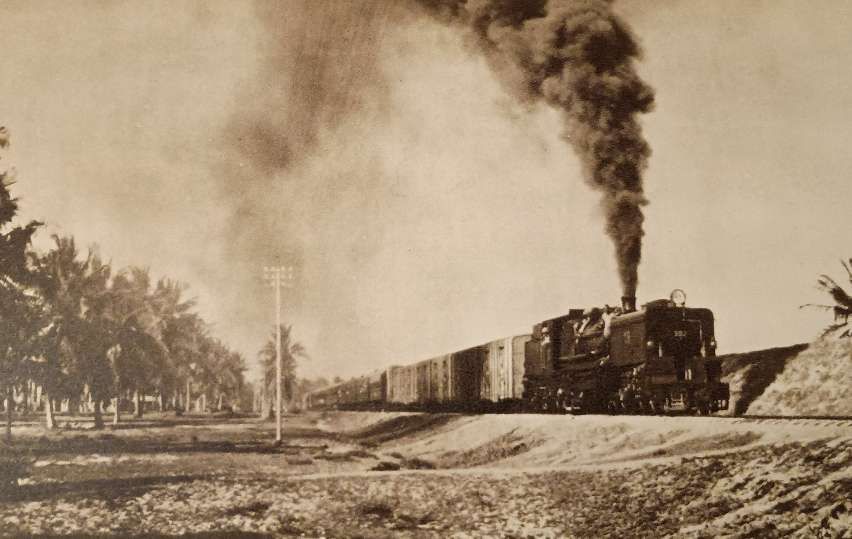
“Although the revenue of the Kenya and Uganda Railways was £255.589 less in 1930 than in the previous year, and there was a deficit of £83,210 on the year after meeting loan charges of £690,181 and a contribution of £324,784 to the Renewals Fund – the Tanganyika Railways did not feel the full adverse effect of the Great Depression until the following year. When the blow fell it was extremely hard. The Territory’s revenue, which was £1,992,675 for the year ended 31st March 1930, fell to £1,749,478 for the following year and to £1,552,368 for the year ended 31st March 1932, when it was necessary to raise a loan of £500,000 to strengthen the Territory’s working balance which had shrunk too small. Exports, which exceeded £4 millions in 1928, declined to £1,890,722 in 1931. In so far as the railways were concerned, the effects of the depression were exacerbated by three factors: (a) the loss of the Congo traffic-partly due to the depression and partly to the Belgian policy of diverting traffic to the West coast route via Stanleyville and Matadi; (b) the failure of the crops along the Central line, (During the year ended 31st March 1931, the railways moved 17,486 tons of groundnuts, but in the following year only 2,908 tons were moved); (c) a large increase of interest charges, which rose from £115,674 for the year ended 31st March 1929, to £252,072 for the year ended 31st March 1932. In 1933, the railways’ accounts were changed to coincide with the calendar year, and interest charges were £291,399. In 1934 they reached a peak of £323,919.” [1: p230-231]
In his annual report for the year ended 31st March 1932, the General Manager wrote that it was not until the March of 1931 that
“that the seriousness of the situation was fully realised and that no ordinary measures to curtail expenditure would meet the case.”
He then stated:
“Accordingly, drastic proposals were put in hand to cut down expenditure in every possible direction. These proposals necesitated very heavy retrenchments of staff; heavy repairs in the workshops were cut down; labour wages were considerably reduced; artisans on agreements were put on daily rates of pay; workshops staff were put on short time and their wages reduced. Travelling allowances were stopped and heavy cuts were made in mileage and other railway allowances.
“The Workshops and Stores Depot at Tabora were closed down, and from the 1st January, 1932, a levy on salaries was introduced.
“The result of these proposals as finally approved amounted to a decrease in working expenditure of some £245,000 out of a total estimated working expenditure of ap-proximately £700,000, a decrease of 35 per cent. for the year under review.
“The following reductions in staff were made during the year:
European 106
Asiatics 451
Africans 2,507
In total 3,064
“Though the reductions made this year have been considerable, their full effect will not be evident until 1932-1933 owing to the heavy expenditure on account of leave pay, gratuities, passages, etc., which follow retrenchments. At the date of writing the reduction in the number of European staff amounts to 156.
“Every possible avenue for reducing expenditure is being explored during 1932 and considerable further reductions will be reflected during 1932 and 1933.
“The difficulties of such a complete change of policy and the consequent retrenchment will, I hope, be appreciated.”
Hill tells us that, “In addition to the failure of the groundnuts crop, the export traffic on the Central line declined by 2,535 tons of cotton and 2,785 tons of grains. On the Tanga line the export traffic of coffee was down by 1,338 tons, of sisal by 3,511 tons and of timber by 1,782 tons. The only bright spot was an increase of sisal exports down the Central line from 8,507 tons to 15,100 tons. In aggregate the goods traffic carried declined by 101,729 tons. The worst blow was that only 7,166 tons of copper were carried during the year ended 31st March 1932 as compared with 34,127 tons in the previous year. When the copper traffic ceased entirely in the October of 1931, the loss of revenue was about £90,000 a year. In the upshot the railways’ revenue fell from £900,708 to £557,792. Expenditure was £514,600, giving an operating surplus of £43,193. After loan charges of £252,072 had been met, there was a loss of £208,880 without making any provision for renewals.”[1: p231-232]
“As a result of the new and enforced policy of economy, the curtailment of services, the reduction of staff and working expenses, the ratio of expenditure to revenue on the railways, exclusive of debt charges, fell steadily from 66.40% in 1933 to 49.31% in 1937.” [1: p232]
Hill reports that “the weather was favourable during 1932 and the Government’s efforts to increase the output of African-grown crops were very successful. The output of crops and products, exclusive of coffee and beeswax, was 80 per cent. greater than in 1931. In view of the low export prices for such products as groundnuts, cotton, copra and grains, the response of African growers to the Government’s plea for greater pro-duction was remarkable. Although the production of exportable crops nearly doubled, the value increased only from £1,890,722 to £2,356,942. As the Territory’s imports had declined from £4,285,952 in 1929 to £1,872,012 in 1932, there was still a favourable balance of visible trade.” [1: p237]
He continues: “The sisal industry was particularly hard hit by the slump. On the plantations, salaries and wages were drastically reduced, cultivating and re-planting were reduced to a minimum and development was at a standstill. Nevertheless, production was maintained, and in 1932 a total of 39,500 tons, valued at approximately £500,000, was exported. From Bukoba, 7,107 tons of native-grown coffee were exported and the European-owned plantations in the Northern and Tanga provinces produced about 4,000 tons of Arabica coffee, of which 3,600 tons were exported. On Kilimanjaro, about 12,500 native growers produced over 800 tons of Arabica coffee. The Kilimanjaro Native Co-operative Union, Ltd., was formed, under the guidance of a European manager, and was showing highly satisfactory results. The total value of minerals exported was £194,102, of which gold accounted for £150,166 and salt for £32,639. Of the exports of bullion, 30,881 ozs., the Lupa goldfields in the Mbeya district produced 15,843 ozs., practically all from alluvial, although reefs were being developed in this field. The Sekenke mine in the Mkalama district produced 10,843 ozs., and 4,100 ozs. came from the Musoma district.” [1: p237]
“As the closing date of the railways’ financial year had been altered to December 31st, in accord with the Territory’s accounts, the General Manager’s report covered the period April 1st, 1932, to December 31st, 1932. For that period the gross receipts exceeded working expenditure by £111,738, but interest charges of £161,816 resulted in a loss of £51,078.” [1: p237]
The General Manager wrote that “to place the Tanganyika Railways and Port Services in a satisfactory position, the revenue from all services should be £1,000,000 per annum. In the year ended 31st March 1931, it had reached the £900,000 mark, but one-third of this sum was earned from the Congolese traffic. The task is a difficult but not an impossible one, and a good start has been made by all classes of producers in Tanganyika in 1932….” [1: p238] In fact, ten years were to pass before the railways achieved a revenue in excess of £1 million.
Hill tells us that “by the end of 1932 good progress had been made in training Africans to drive the super-heated engines working main-line passenger and goods trains, 14 African engine men had been certified as competent, although all but two or three were illiterate and dependent on station-masters, guards and shed staff for information on the working of trains and on shed clerks for the booking of repairs to engines. The engine-drivers on the Tanga line, with one exception, were Africans.” [1: p238]
In 1932, Mr Roger Gibb came to East Africa to undertake an enquiry into railway rates required by the Joint Select Committee of Parliament on ‘Closer Union. He visited Uganda and Kenya before arriving in Tanganyika in July 1932. In his report published early in 1933, “he advised against the amalgamation of the Tanganyika Railways and the Kenya and Uganda Railways on the grounds that the economies which would result would not be sufficient to out-weigh the political disadvantages arising from a clash of interests. Mr. Gibb thought that the Tanganyika Railways would benefit from adopting the rate charges which he had proposed for the Kenya and Uganda Railways, but that the greater gain would emerge from the Government’s policy of stimulating native production with a consequent greater density of traffic.
“Inevitably Mr. Gibb turned his mind to the old controversy about the Tanga line. The statistics showed that the traffic to and from the Kilimanjaro district was no more than a train-load a week in each direction, which did not justify two ways to the coast. As the traffic was clearly Tanganyika traffic, Mr. Gibb thought that the Tanganyika Government should be entitled to break the link with Mombasa in order to reduce these losses. On the other hand, there was more to be said for the closing of the line between Buiko and Kahe, so Mr. Gibb proposed that the Kenya and Uganda Railways should carry all the Kilimanjaro traffic to Mombasa under an arrangement whereby the Tanganyika Railway would fix the rates to Voi and Mombasa and receive any profit. Mr. Gibb suggested that the track between Kahe and Buiko should be lifted and the earthworks used as a roadway, and the line between Buiko and Tanga sold, if possible, to a private company. He did not improve the prospect of any such sale by stating ‘if after the Tanga-Buiko line is disposed of, the section becomes prosperous, as it is suggested that it may, no great harm will be done to the Government by its sale. A government can get back in taxation much of its lost profits from abandoned ownership’.” [1: p239] Gibb’s proposals were not adopted and “within a few years the long controversy which the Tanga line had provoked lost much of its importance. The rates from Moshi to the coast by either route were assimilated, and in 1936 Sir Osborne Mance suggested that a pooling arrangement on the principle suggested for Lake Victoria would be likely to give the Tanganyika Railways a fair share of traffic and profit.” [1: p239-240]
During WW2, the lack of a link between the Kenya & Uganda Railways and the Central Tanganyika Railways was significant .Transport problems would have been even greater if the link from Kenya with the line between Tanga and Moshi had been broken!
Hill continues:
“The extension of the Central line to Mwanza … brought it into competition with the Kenya and Uganda Railways for the trade of the southern part of the Lake Victoria basin, The Secretary of State had ruled in 1928 that non-competitive rates should be arranged, leaving trade to take its normal course, a decision implemented by an agreement permitting the Kenya and Uganda Railways to retain its Lake traffic at all points except Mwanza; the rates from Mwanza to either Dar es Salaam or Mombasa were equalised and the rates from Tanganyika ports across the Lake were made higher via the Tanganyika route than via Kenya by the cost of transport across the Lake. It was contended by Tanganyika interests that this arrangement still left certain advantages with the Kenya and Uganda Railways, derived, among other causes, from their ownership of the steamers on the Lake. Mr. Gibb now suggested that the traffic arising at, or destined for, Tanganyika ports on the Lake should be pooled to prevent undue competition, and that as regards new traffic, a contribution should be made by the Kenya and Uganda Railways to the Tanganyika Railways for tonnage in excess of an agreed proportion. In 1934 the Secretary of State decided against a change in the previous arrangement until the total traffic to the Tanganyika Lake ports reached the tonnage handled by the Kenya and Uganda Railways prior to the building of the Mwanza line; this figure was exceeded in 1935, but Sir Osborne Mance, who reported on the matter in 1936, expressed the view that it would be preferable to revert to the decision of 1928, and allow the routes to function in accordance with their relative advantages; he considered that the present rates on the Kenya-Uganda Railways to Mombasa should apply equally to to Dar es Salaam for all Tanganyika ports, the revenue from traffic being pooled and divided on a percentage basis.
By 1936, the Kenya and Uganda Railways had overcome the worst of the effects of the slump and were once more working at a profit. As a result there was considerable pressure in Kenya and Uganda on the railways to reduce several rates in their tariff. When this was done in 1936, the Tanganyika Railways were in no position to take similar action, so the agreements between the two railways regarding equalisation of costs over the two routes had to be abandoned. This action led to an even greater diversion of traffic away from the Tanganyika Railways to the Kenya and Uganda Railways. Indeed, it was stated that traffic was being consigned from stations on the Mwanza branch via the Lake to Mombasa rather than to Dar es Salaam. The settlement finally reached in 1937 provided for equality of rates, freedom of choice by trader, payment to the transport system for services rendered and a division of profits between the two railways.
Although this agreement helped the Tanganyika Railways, there still remained the problem of the traffic which was carried across the border to the Kenya and Uganda system by road or by dhows on Lake Victoria which did not fall within the scope of the agreement. The 1934 Ordinance could not prevent this movement of traffic, as it only applied to traffic being carried between two places on the Tanganyika system. In 1939, the 1934 Ordinance was amended to enable the prohibition of the movement of goods by road on any route. It provided that before movement was prohibited, a public enquiry should be held. A second Ordinance to control, in a similar manner, the movement of goods by inland-water transport was also brought into operation in 1939. In that year the General Manager stated that the amended Ordinance, and the Ordinance to control Lake transport, had met reasonably well the threat of competition. However, he did not accept these Ordinances as being a complete solution of the problem, and he continued to press for the application of the more general Ordinance of 1937. [1:p240-241]
The years 1933 and 1934 saw a significant reduction in rainfall in the second shorter rainy season which also arrived late, meaning that the planting season was greatly shortened. Drought conditions saw food shortages. In places, the longer rains also failed. Locusts also proved to be a serious problem.
However, Hill says:
“Despite the poor rainfall, the exports of sisal, coffee and cotton were all greater than in any previous year. The output of sisal was 72,510 tons valued at 1.847.562; 14,766 tons of coffee valued at 6495,237 were exported, and the exports of cotton amounted to 31,612 bales valued at £326,613. The exports of gold were valued at £295,690. … From all this the railways derived little benefit. In 1933, gross receipts were only £532,092, and in 1934, only £565,842. After paying interest charges the losses on the two years were £112,635 and £125,254 respectively.” [1: p242]
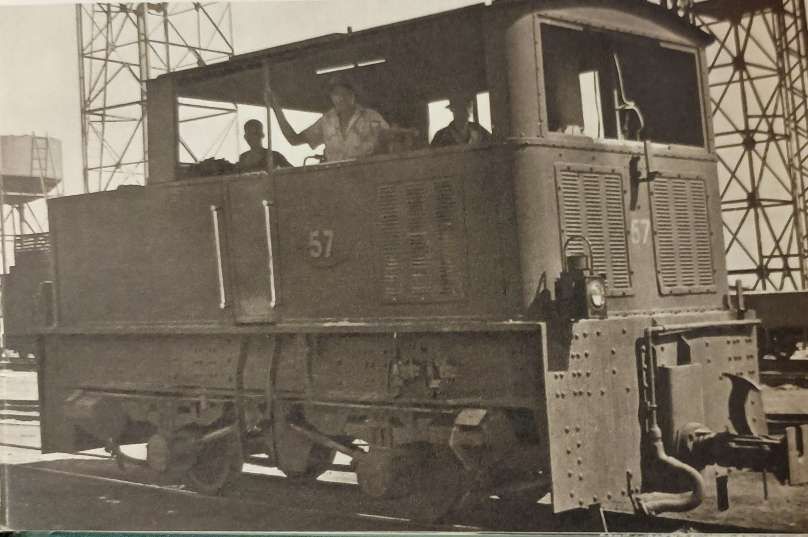
For the first eight months of 1934, Sentinel cars maintained a service between Moshi and Arusha, “but it was not a financial success. It was clear that the coastal section of the Tanga line offered the best opportunity for the railcars, once the difficulties arising from the axle-loading on the light track had been overcome. The cars were withdrawn in August for a general overhaul while the track was strengthened. Just before Christmas the new service was started. It was a good service, with reduced fares and daily early morning departures from Tanga and Korogwe (50 miles), with a return service from both ends in the afternoon. Twice a week the service was extended to Mombo (81 miles). From the outset the service proved a success, and receipts increased steadily week by week. Along this section of the line the fiercest competition from motor transport was met and passenger receipts had fallen consistently since 1930, until traffic was only 30 per cent. of that carried formerly. The Sentinel cars arrested the decline, and in the January of 1935 there was a substantial increase of passenger traffic for the first time since 1930. In view of the great success of the Sentinel rail-cars on the Tanga line, it was decided in 1936 to alter the gear ratio of two of the Sentinel shunting engines and run them on the Mwanza line between Shinyanga and Mwanza, hauling a single coach, and thereby providing a service similar to that given by the railcars on the Tanga line. Unfortunately, the traffic was not sufficient to pay for the service, which was withdrawn at the end of October 1937.” [1: p242-243]
Hill continues:
“By 1935 the drastic measures taken to deal with the financial difficulties of the railways were showing their full effect, Earnings rose to £662,296, while working expenditure was only £350,893, that is 52-98 per cent. of earnings. After meeting interest charges of £322,435, there was a small loss of £11,059, a great improvement on the results of the four previous years.” [1: p243]
Further efforts were made to cope with motor competition. A 15-ton road-train unit was acquired to initiate a branch service to the Kahama goldfields. However, this venture was not a success. In 1937 the road-train played a useful part in a campaign to deal with sleeping sickness around Urambo. In 1938 it was used for famine relief on the Tabora-Uyowa run, and it was laid up in the February of 1939. (During WW2 the road-train was taken over by the military authorities.)
Hill tells us that “the recovery of the railways’ finances in 1935 and 1936 was assisted by the general move away from the Great Depression. The gross volume of Tanganyika’s external trade in 1935 exceeded that of the previous year by £1.5 million. Exports rose by 30 per cent, to £3,445,143, and imports were valued at nearly £3 million. The most welcome feature was the recovery of sisal, for the price rose to £29 a ton, nearly double the price during the years of depression. During the year, 82,676 tons of sisal were exported and valued at £1,134.732; 18,558 tons of coffee exports were valued at £486,843; cotton exports were valued at £569,547, and gold exports at £369,742.” [1: p243]
“The economic recovery which started early in 1935 continued in 1936, when the Territory’s revenue was nearly £2 million and expenditure £1,739,009. The value of exports rose to £4.516,284, more than £1 million greater than in 1935. After paying debt charges of £315,254, the railways made a profit of £52,875.” [1: p244]
Throughout the first half of the 1930s, no provision was made for a renewals fund. “With a profit again earned after meeting interest charges, a Renewals Fund was started. Unfortunately, the railways owed the Territory £402,131 at the end of 1936, Of this total, £151,416 represented the value of floating assets taken over in 1927; £223,066 had been advanced to meet the losses of 1933 and 1934; and £27,649 was the value of stores taken over from the Public Works Department in 1935. In that year, in the interests of economy, the Railway Stores Department was combined with the Government Stores in Dar es Salaam. The railways took over all stores held by the Government and continued to act as storekeepers for the Government until 1948. … The Government pressed for a reduction of the loan of £402,131 and demanded that any profits earned by the railways should be allocated for this purpose. In consequence a peculiar arrangement was made whereby the railways repaid their debt to the Government annually, and the Government advanced to the railways, annually as a loan, a sum of £50,000 for the Renewals Fund. By this queer device the profit of £52,875 earned in 1936 was reduced by £50,000 to £2,875 and the debt due by the railways to the Government of Tanganyika was increased to £452,131. On 1st January 1936, the accounts of the railways showed an excess of liabilities over assets of £211,185. At 31st December 1936, this figure was reduced to £208,310 after providing for the liability of £50,000 to the Renewals Fund. At a later date it was decided that essential renewals should be financed from a Railway Renewals Reserve which was maintained within the accounts of the Territory. The accounts of the railways and ports services were charged with the expenditure when it occurred, the expenditure was met by repayable borrowings from the Territory’s reserve, bearing interest at 4 per cent. per annum. It was estimated that at the end of December 1939, the total arrears of renewals contributions on assets provided from British capital was £1,256,225.” [1: p244]
Hill continues:
“In the year 1937 Tanganyika’s revenue and exports were greater than ever before. The total value of exports, including re-exports of £342,012, was £5,311,464. This achievement was in no way due to favourable climatic conditions. It would be true to say that it was accomplished in spite of adverse factors, particularly in the case of native crops. Except in the Eastern Province, the rains were not favourable. They were heavy and prolonged in the Lake, Western and Northern Provinces, and caused serious losses in coffee, cotton, groundnuts and maize, whereas in the Southern Province they were deficient, and low yields of grain were the result. In spite of these discouragements, the efforts of African cultivators resulted in ample supplies of food for their own consumption and of produce for sale.
Their efforts were helped by the good fortune that no extensive outbreak of plant pests or disease occurred and that the Territory remained, throughout the year, almost entirely free from locust infestation. The owners of livestock were not so fortunate. Rinderpest swept southward during the year, being finally held up in the Central Province, and there was an extensive outbreak of contagious bovine pleuro-pneumonia in the Lake Province.
Agricultural products sold for good prices during the greater part of the year. Sisal stood at from £28 to £30 per ton; the world price of American cotton was 7d. to 8d. per lb. of lint; coffee prices had risen appreciably over the past five years, and the prices of maize, groundnuts, copra and sesame were high. The outlook seemed good enough, but in the latter part of the year there came a serious slump in the prices of all agricultural produce except grains and tea.
Sisal attained record figures both in quantity (90,000 tons) and value (over £2,000,000), and coffee, cotton and rice established new records in quantity. The value of the cotton crop was below that of 1929, owing to a particularly rapid price decline. Gold made another advance both in quantity and value.
The railways’ revenue increased to £780,565, and after meeting debt charges of £312,454 the profit was £83,198. The percentage of revenue to earnings fell to the extremely low figure of 49:31 per cent.” [1: p244-245]
1938 was a year of disappointing setbacks for Tanganyika: “The weather was generally unfavourable and there was a decline in the prices realisable for Tanganyika’s products on the world’s markets. The value of the Territory’s exports fell by over £1 million to £4,050,734. The railways’ revenues fell to £662,556, and after paying debt charges there was a loss of £20,780. A striking example of how severely the railways’ revenue could be hit by a bad season was was provided by the groundnuts crop, always liable to marked fluctuation. In 1937, the railways carried 20,895 tons of groundnuts. In 1938 the railways carried 2,783 tons of groundnuts. This meant a direct loss of revenue of £37,000, apart from the indirect loss caused by a consequent reduction of imports. There was also a large fall in the traffic of grains, which produced £27,476 in 1937 and only £17,246 in 1938. Further loss to the Tanganyika Railways, estimated at £20,000, was caused by the infiltration of traffic carried initially by the Kenya and Uganda Railways and then into Tanganyika by road or waterway.” [1: p245]
“Moreover, 1938 was the year of Munich. Uncertainty about the future of Tanganyika, caused by demands for the return of the Territory to Germany, had a most adverse effect on the economy. There was a reluctance to invest capital in the country, many development projects were set aside and a large number of commercial firms reduced their stocks to a minimum. In 1937, the European population of Tanganyika was 9,107, of whom 5,642 were males and 3,465 were females. The British, including South Africans, numbered 4.145. The number of Government officials, including the European staff of the Tanganyika Railways, was 1,035. The number of British subjects in Tanganyika who were not in the public service was, therefore, about 2,150. The number of Germans was nearer 1,000, and many of them had been infected with the political outlook of Nazism.” [1: p246]
The Munich crisis, in the September of 1938, brought home to the Government the need to set all defence plans in readiness, more especially to ensure internal security against possible action by the German inhabitants whose propaganda had been active and whose organisation could not be underestimated. (For more about the political machinations of the later months of 1938 – see F. S. Joelson’s book, Germany’s Claim to Colonies (Hurst & Blackett), 1939.)
Hill comments: “The vacillations of certain statesmen, and the reservations of statements in the House of Commons and elsewhere, over several years, did great hurt to the economy of Tanganyika. The uncertainty of the prospect set a check on settlement and investment and a brake on economic development. Immense progress had been made in the face of great difficulties the very nature of a vast country, drought and flood and the Great Depression. Much more would have been achieved without the threat that Germany might regain the sovereignty of Tanganyika. From now on men’s minds were depressed by the increasing realisation that a Second World War was inevitable.” [1: p247]
From the start of 1939, all ports in Tanganyika were administered by the railways. Hitherto the railways had only been concerned with Dar es Salaam and Tanga. Hence-forward they were also responsible for Pangani, Bagamayo, Kwale, Tirene Bay, Kilwa Kivingee, Lindi and Mikindani. In his Annual Report for 1939 the General Manager wrote:
“The ports and railways are operated under different forms of legislation, provide different types of transport services, and moreover, only four ports are at present connected to the railway system. The finances of the two services have therefore been separated. This is essential, as it is generally desirable that the port users should meet the cost of the port services and that railway users should bear the cost of railway services. Should, however, it be necessary for either to assist the other, it is desirable that the amount of such assistance should be recorded. For services rendered by the railways to the ports debits have been shown in the ports’ accounts and credits in the railways accounts and vice versa.” [1: p247]
1939 was another disappointing year. The gross receipts of the railways and the ports amounted to £712,642 and expenditure to £426,947. The excess of receipts over expenditure was £285,695, but debt charges of £311,585 resulted in a loss of £25,890.
At the end of 1932 the staff of the Tanganyika Railways consisted of 174 Europeans, 495 Asians and 7,741 Africans. At the end of 1939 the staff consisted of 120 Europeans, 475 Asians and 7,600 Africans.
In the Annual Report, it was noted that two surveys had been made of the ‘transit’ traffic between the east coast of Africa and those parts of Tanganyika which were served by the Kenya and Uganda Railways as well as by the Tanganyika Railways. The two areas surveyed were the Tanganyika coast of Lake Victoria and the Moshi-Arusha area near Kilimanjaro. Hill provides a table which is produced below and which covers only the traffic from those areas to the Indian Ocean ports.
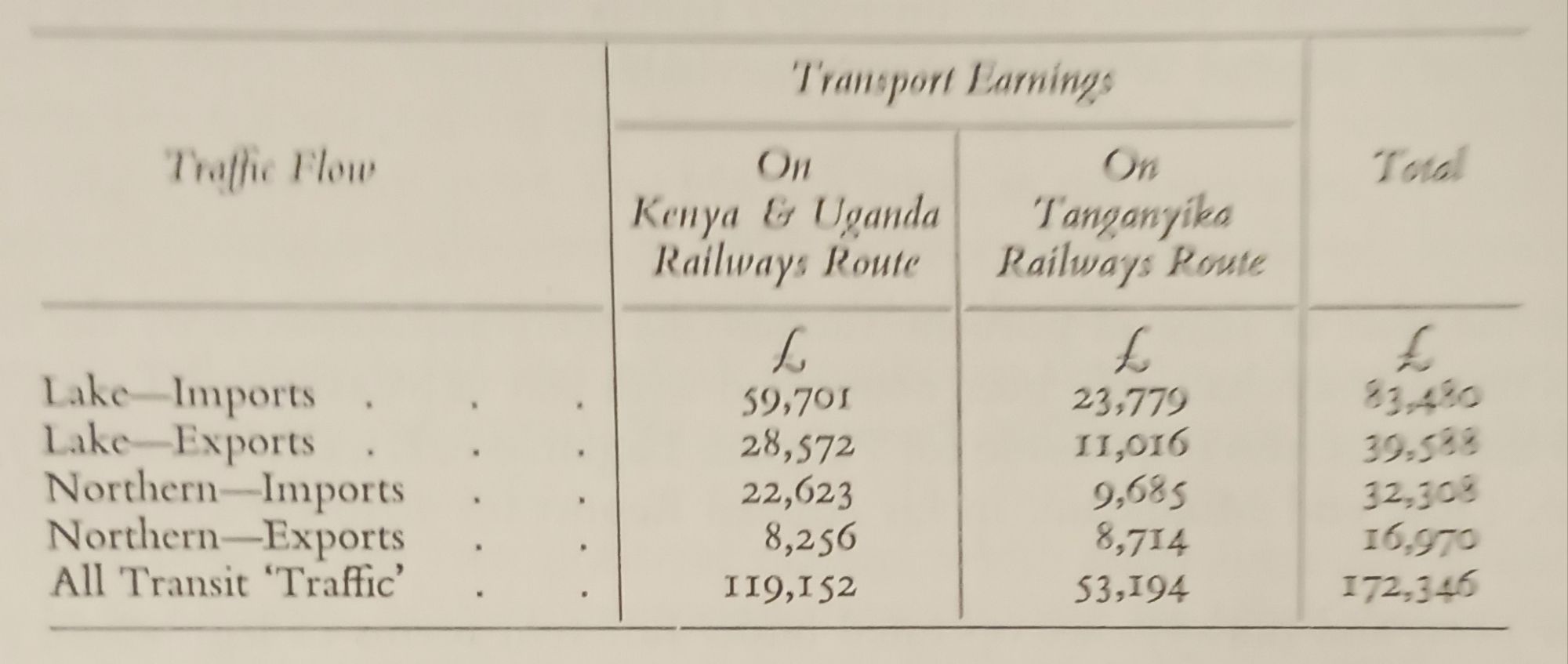
Hills table shows that earnings on the routes through Tanzania amount to about 31% of the total income from the traffic. A complex formula determined how that detriment was addressed in payments between the to networks. [1: p248]
That formula produced payments in favour of Tanganyika Railways:
- For running rights on the Kahe-Moshi section;
- For the ‘feeder value’ of the Arusha branch line; and
- Through the Lake Victoria pooling arrangement.
Against these payments the Kenya-Uganda administration received payment:
- For the carrying of goods on the Lake part of the journey in respect of traffic between Tanganyika Lake ports and Dar-es-Salaam; and
- Through the Lake Victoria pooling agreement.
The net effect of the calculation saw £9,460 paid to Tanganyika Railways. This figure did not fairly represent the actual loss of revenue income for the Tanganyika Railways.
Hill asks us to remember that despite all efforts “the Tanganyika Railways … had a deficit of approximately £25,000 in 1939, and that no provision [had] yet been made for depreciation which has been assessed at not less than £100,000 per annum. As the transport administration [had] been unable to make this provision, the taxpayers of the Territory … [were] called upon to set aside £50,000 per annum to ensure that funds [would] be available when required … for essential renewals. The Territory as a whole [was], through taxation, making an annual provision at present of £75,000 (ultimately to be increased to £125,000) which, …[would] be required by the railway to meet its costs, while at the same time net payments exceeding £90,000 per annum are being made to the transport services of another colony. In effect, the taxpayers of Tanganyika … [were] being asked to pay this amount to the railway users of Kenya and Uganda. … This arrangement result[ed] in the Kenya and Uganda Railways users obtaining a lower-rate level than they would otherwise have enjoy[ed].” [1: p249]
“Despite this unsatisfactory position, … the Tanganyika Railways … acknowledged the sympathetic consideration received from the Kenya and Uganda Railways. Every effort was being made … to adopt common standards on many aspects of railway working, and the close touch maintained by the two administrations [was] probably not fully realised. The difficulties which exist[ed] on the northern frontier arise from historical accidents and [were] no reflection on the management of the Kenya and Uganda system.” [1: p249]
Mr. Robins, the General Manager in his 1939 annual report, wrote about the problems which would be faced by Tanganyika Railways on the outbreak of war between Great Britain and Germany:
“A careful study of this and previous Annual Reports will reveal that the policy of the administration is to maintain the present rate level and, by constant examination, to reduce the working expenditure to the lowest level compatible with the maintenance of the assets in as healthy a condition as is possible from revenue sources in order to defer the day when heavy expenditure on renewals will be required. At the same time the administration is endeavouring to apply a sound staff policy which will enable its operation of a public service to be carried on with efficiency and economy. It is for these reasons that in several cases savings which have been achieved and which are disclosed by an examination of the detailed heads of expenditure have been utilised for the better maintenance of assets such as buildings in order to prolong their life. At the same time, by constant attention to actual and potential flows of traffic, details of the former now being made available by the use of mechanical accounting machines, the administration is always seeking to increase its net revenue.
“This, however, is not sufficient to ensure a satisfactory future for the railways and ports services. Additional traffic must be transported if they are to be self-supporting. As has been pointed out in previous reports, whilst the policy of endeavouring to foster traffic from other territories must not be neglected, it is the opinion of the present management that the possibilities in that direction are limited, mainly because the transport administrations of other territories do likewise, and the Tanganyika system is in a very vulnerable position in that respect. It is also very natural that the policy of other transport authorities will be directed to the retention of their own traffic at almost any cost. The solution must, therefore, be sought within the boundaries of this large territory, Tanganyika. It should be able to support its own modest transport system.
“There is no doubt that in the past the Mandate, under which the country is administered, has been imperfectly understood; it has engendered a feeling, rightly or wrongly, that the future is insecure, that there is a serious risk attaching to private investment in the country. Production and industry were, so to speak, also marking time in the hope that some day the future would be clearer. This sense of insecurity was a serious factor in peacetime, but the repercussion of it left the country in such a position that the shock of war dealt the railway system a serious blow against which no reserves were available upon which to draw. In consequence, the possibility of a very serious deficit has to be faced in the forthcoming year.
“Every effort is being made by the Government and the public to meet this situation in such a manner as to avoid Tanganyika being a burden to the Empire and, in fact, to go further and enable it to render aid to the Empire, but the accumulated effect of the long-standing feeling of insecurity makes the country start off with a handicap. It is sincerely to be hoped that whatever settlement is reached after this conflict, it will be one in which there is no room for uncertainty. If, then, the methods employed in war-time are employed in peace-time, there will be no doubt that this country can produce within its boundaries sufficient traffic to support its transport system. That, combined with a prudent financial policy, will overcome most of the difficulties which the management has had to face for some time.” [1: p249-250]
Hill explains: “For twenty years, from 1919 to 1939, the basic problem of the Tanganyika Railways remained the same. The fixed costs of railways are commonly high, although the Tanganyika Railways derived advantage from the cheap acquisition of the German capital assets. The costs of moving traffic on railways are comparatively low, but in the case of the Tanganyika Railways they were increased by several factors, including the state and type of much of the German equipment and the unsatisfactory alignment of several sections of the Tanga and Central lines. During the first twenty years of British administration of the Tanganyika Railways good progress was made in solving what may be termed the technical problems. The basic trouble was that the traffic offering was insufficient to enable the railways to earn sufficient revenue to meet running costs, interest charges, and to provide for renewals and for betterment. The goods traffic density, in terms of ton-miles per route mile, was too low.” [1: p250-251]
Hills point is clearly made in the next table that he supplies which compares the Tanganyika network with other Africa networks:
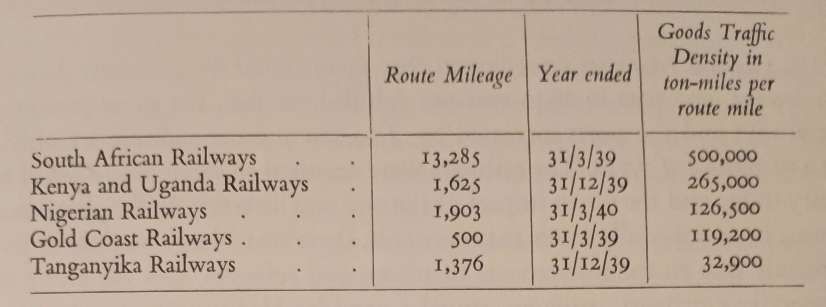
This table shows that the revenue from goods in Tanganyika was significantly less than in other areas of the continent. [1: p251]
For the year 1939, the goods traffic density of the first-class railways of the United States of America was 1,365,000 ton-miles per route mile; in the United Kingdom it was 868,000. The only means whereby the Tanganyika Railways could achieve a sound financial state was by carrying a considerably greater volume of traffic, which could only be provided by the economic development of the Territory. [1: p251]
References
- M.F. Hill; Permanent Way Volume II: The Story of the Tanganyika Railways; East African Railways and Habours, Nairobi, Kenya; Watson & Viney, Aylesbury & Slough, 1957.
- The German Akida system in Tanganyika (German East Africa) was an administrative strategy replacing indigenous leaders with appointed agents—often coastal Arabs or Swahili—to enforce colonial rule, collect taxes, and maintain order. These agents managed “Akidates,” serving as a brutal, intermediary authority between German district officers and local populations. The term Akida predated the arrival of German Empire to the region. Prior to the arrival of German Empire, the Akida served the coastal towns in a special function. The individual was a prominent member of the younger generation and was a prominent war leader in the region. His responsibilities were to keep order and control public festivities. The Akida answered to Liwali (an Arab or African governor of a town, usually a district headquarters) in the region. He was appointed or recognized by the Sayyid of Zanzibar. The concept was adopted by the German Empire, but it altered the roles of the Akida. Few of the Akida’s were indigenous to their region. Most were literate men from different regions. Their purpose was the representation of the German Empire’s bureaucratic tradition of administration. For more information about the German System of Administration please see https://avim.org.tr/en/Analiz/GERMAN-COLONIAL-LEGACY-TANZANIA-AND-THE-HUMBOLDT-FORUM, accessed on 17th March 2026.
- https://www.trains-worldexpresses.com/700/704.htm, accessed on 17th March 2026.
- https://rogerfarnworth.com/2026/03/16/railways-of-tanzania.
- Report on the Railway Systems of Kenya, Uganda and Tanganyika,’ by Lieut.-Colonel F. D. Hammond, C.B.E., D.S.O., Royal Engineers, Special Commissioner for Railways, Eastern Africa. The greater part of this report, including the recommendations in respect of the Voi-Kahe line is dealt with at length in M. F. Hill; Permanent Way, Vol. I, The Story of the Kenya and Uganda Railways; chapter XIV, p 422ff. The report is also covered in an article about the Uganda Railway on this blog: https://rogerfarnworth.com/2021/01/08/the-uganda-railway-in-the-first-5-years-after-world-war-1
- https://en.wikipedia.org/wiki/TR_DL_class, accessed on 30th April 2026.
- https://en.wikipedia.org/wiki/TR_MK_class, accessed on 30th April 2026.
- https://commons.wikimedia.org/wiki/File:EAR_1953_Steam_%26_diesel_catalogue_Page_37_-_Nr._2217.jpg, accessed on 1st May 2026.
- R. Ramaer; Steam Locomotives of the East African Railways; David & Charles, Newton Abbott, 1974.
- https://en.wikipedia.org/wiki/TR_GA_class, accessed on 1st May 2026.


