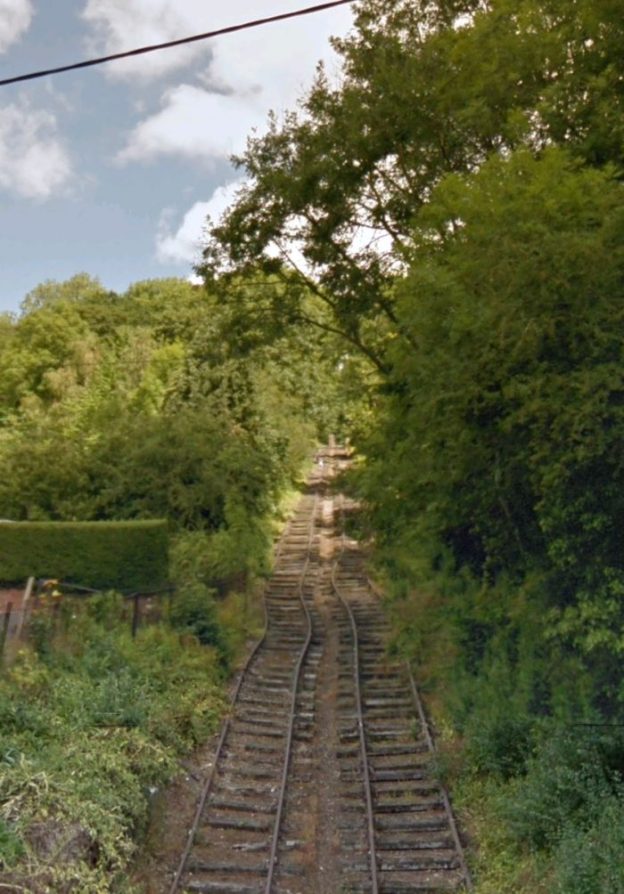
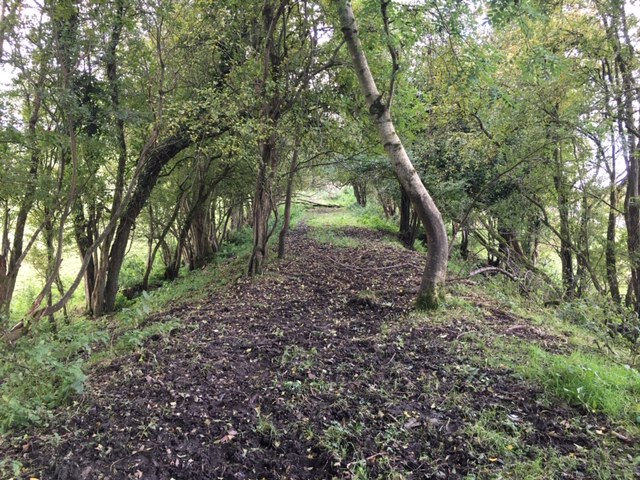
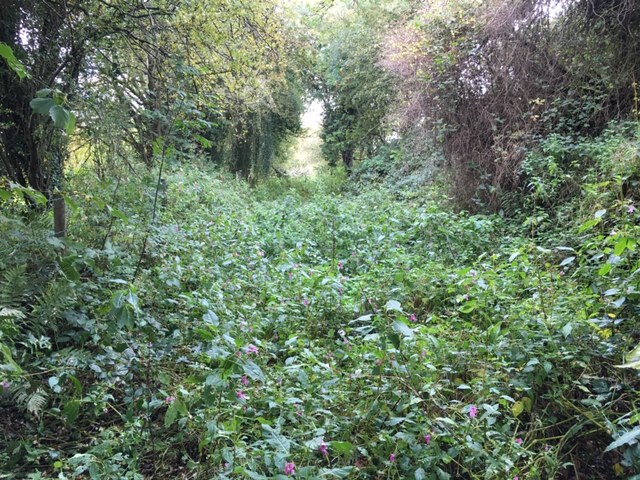
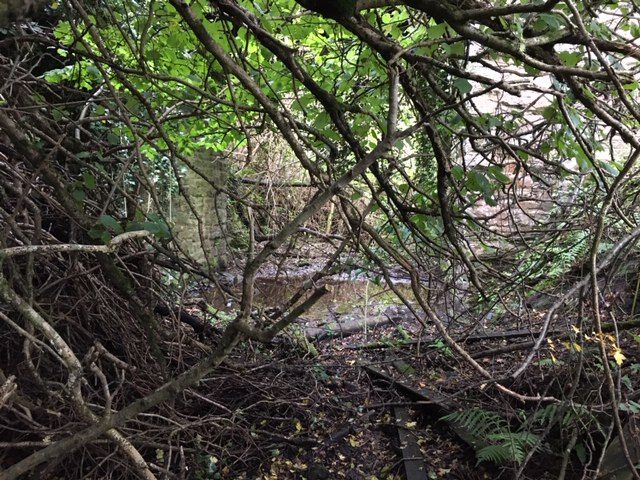
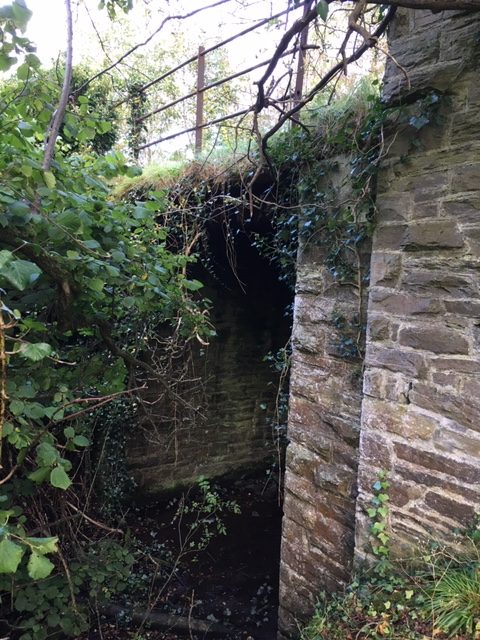
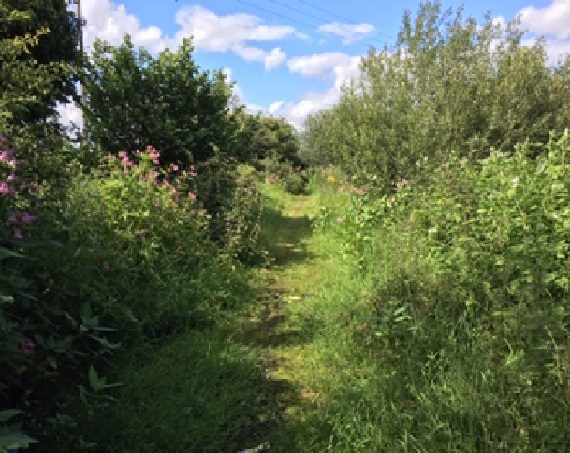
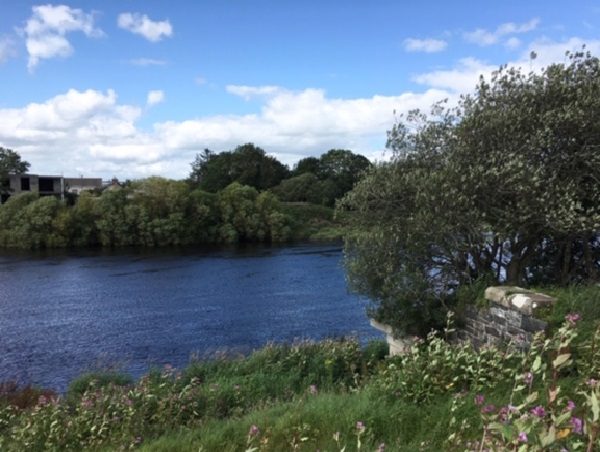
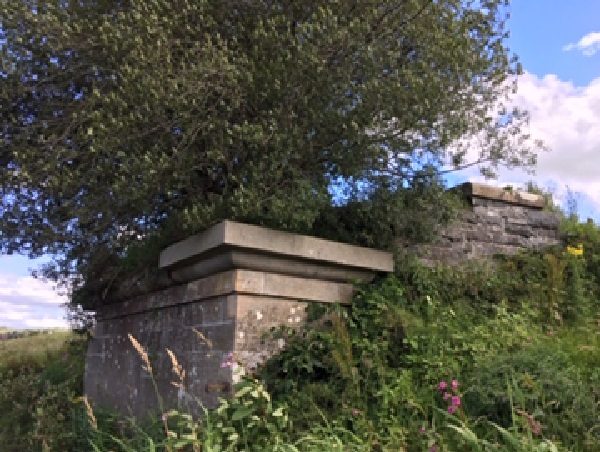
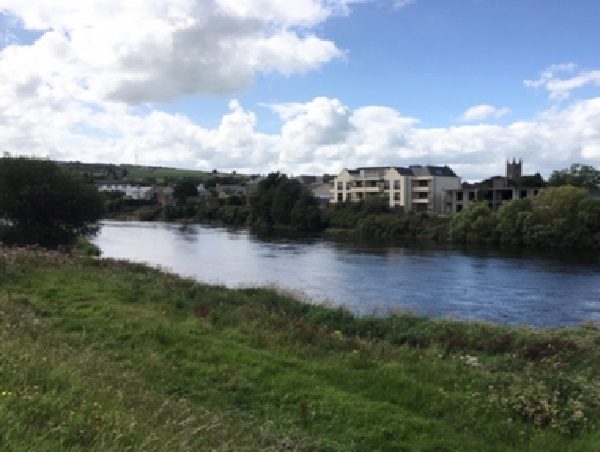
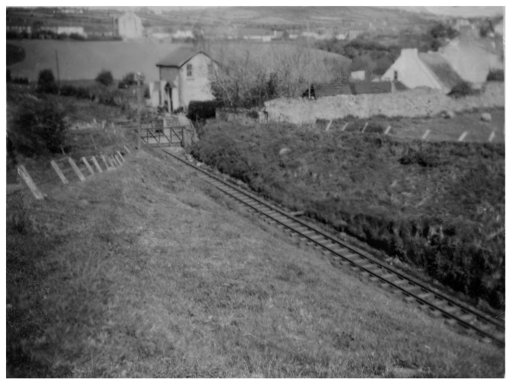
On a visit to Ludlow in late October 2020, my wife and I drove down through Ironbridge Gorge on the River Severn. Just North of Ironbridge we drive through the village of Coalport and over a bridge which spanned a steep inclined plane – two steeply graded parallel railway lines. I suppose it is arguable whether the Inclined Plane really constitutes a railway as it was used for transporting boats between a Canal and a river.
This was the Hay Inclined Plane which provided access from the Shropshire Canal to the River Severn. As far back as 1788 the owners of the canal held a competition to find the most effective way of lowering and lifting loads between the canal and the river.
The winning proposal was submitted by Henry Williams and James Loudon, which was also used at a number of other places in Shropshire. Construction was completed in 1793. By 1820 it was in poor condition and major repairs were needed. (This was also the case in the 1940s.) [1]
In 1857 the Incline was taken over by the LNWR (London and North Western Railway). In 1858, the LNWR closed the Shropshire Canal between the Wrockwardine Wood and Windmill inclined planes, leaving only a short section of canal to serve the industrial area of Blists Hill.
In the 18th and 19th centuries, Blists Hill was an industrial region consisting of a brick and tile works, blast furnaces and coal, iron and fire clay mines operated by the Madeley Wood Company. A short section of the Shropshire Canal ran across the site to the Hay Inclined Plane, which transported boats up and down the 207 ft (63m) high incline from Blists Hill to Coalport. [2]
By 1861, the LNWR had opened their Coalport Branch from Wellington to Coalport which passed across the bottom of the Hay Incline. It seems as though the last use of the Hay Incline was in the year 1894 and it was formally closed in 1907. [1]
The Incline was restored in 1968 and once more in 1975. Rails were reinstated as part of the creation of the Ironbridge Gorge Museums. [3][4]
The video below was taken by DJI Spark. It gives an excellent overview of the location. [5]
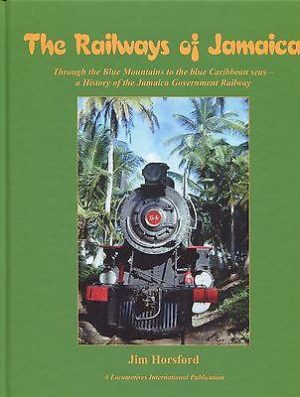
I have just enjoyed reading, ‘The Railways of Jamaica’, written by Jim Horsford. It is a Locomotives International publication, published by Paul Catchpole Ltd, St. Austel, Cornwall. [1]
This is an excellent study on the history of the main lines of the railways in Jamaica and also reflects briefly on some of the still open lines serving the Bauxite industry. The book results from a visit by Jim Horsford in 2006 to Jamaica and includes photographs from his own collection and those of other enthusiasts and past residents of Jamaica. In addition some aerial views taken from a helicopter show the condition of various sites on the old network in 2006.
In addition to a review of the network, Jim Horsford provides details of the majority of different locomotives and railcars used on the system together with passenger and good stock.
I managed to pick up the book on offer from Mainline and Maritime [2] for £5. It is at present on offer on their website for £10 and they offer to include a volume about the Sugar Cane lines of Cuba along with it. The RRP is £25.
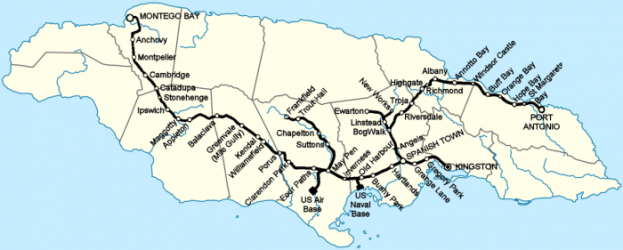
Each of the main lines and branch lines on the public network are described in detail. The system used to link the capital Kingstown with Montego Bay, Port Antonio, Ewarton, Frankfield, Fort Simonds, Port Esquival and the Pleasant Valley. The featured image shows the network at its peak before Bauxite Mining operations began.
The book was a delightful read.
Wikipedia [3] provides provides a relatively strong study of the railways of the Caribbean island through until final closure of the network in 1992. [4] It does not seem necessary to reproduce significant parts of that article in this post. The full Wikipedia article can be found here. [3]
The first colonial railway for both freight and passengers opened in Jamaica in 1845, only twenty years after George Stephenson’s Stockton and Darlington Railway commenced operations in the United Kingdom.
By the 1890s expansion had reached its peak, with 216 miles of main and branch lines. Railway services contributed greatly to the development of the island “by providing efficient and inexpensive transport and by opening up the interior to the cultivation of old and new plantation crops, encouraging the intensification of peasant agriculture, promoting the establishment of agro-industries and creating new townships.” [5]
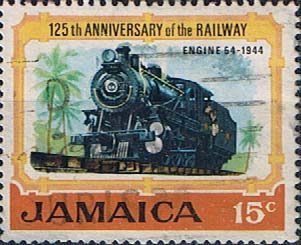
Jamaica 1970 Jamaican Railways SG 326 [6]
In the 1930s the failure of the banana industry and competition from motor transport drastically reduced revenue. By the 1970s the railways had become a liability. In 1975 two of the mainlines closed. This was the beginning of the end, although the railways struggles on until 1992.
Four private industrial lines continue to operate in the 21st Century, in part using Jamaica Railway Corporation (JRC) lines. [7] Of the total of 272 kilometres (169 miles) of standard-gauge lines operating in 1992, 207 kilometres (129 mi) of public lines belonging to JRC closed, leaving 65 kilometres (40 mi) in private hands. [8].
Wikipedia tells us that the JRC still exists in the early 21st century. It is responsible for management of the JRC interests and property, and maintaining its locomotives but not the rolling stock. [9] In November 1990, the JRC signed a 30-year Track User Agreement with Alcan Jamaica, which was renegotiated with the successor Windalco in December 2001. [3]
“The company makes J$40 million per year through track user fees for the hauling of alumina and bauxite, and the residual from the rental of real estate and its three operable locomotives. The company has a staff of 76, who fulfill contractual obligations to users of the company’s facilities” [3][10].
It seems that, “during the 1990s, a plan was considered which would see commuter services between Kingston and Spanish Town, later extended to Linstead. It was proposed to cost US$8 million and be running by January 2001, with the government holding 40% of a public-private venture.” [3] This proposal appears not to have come to fruition.
A further revival of rail services was considered in the very early years of the 21st century. Discussions were held with a series of different partners: the Canadian National Railway; the Rail India Technical and Economic Service (RITES); and then with the China Railway after a deal was signed by the Prime Minister P J Patterson with Chinese vice-president Zeng Qinghong in Jamaica in February 2005. [3]
On 16th April 2011 an inaugural train ran from May Pen to Linstead. [11] This service was short-lived, running until August 2012, [12] and it was December 2016 before “the government signed a memorandum of understanding with Herzog International to study the resumption of passenger and freight services. The Ministry of Transport & Mining envisaged a three-stage reopening process, with Phase 1 covering Montego Bay to Appleton, Phase 2 Spanish Town to Ewarton and Phase 3 Spanish Town to Clarendon.” [13]
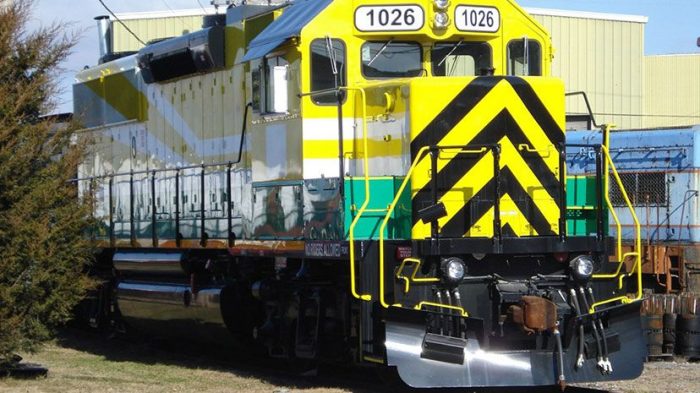
The bright colours of the proposed refurbished/new stock for Jamaica Railways. [19]
The 2016 initiative foundered “in late 2017 because Herzog Jamaica Limited failed to meet the deliverables of a non-binding memorandum of understanding brokered with the Ministry of Transport and Mining.” [12]
At the beginning of 2020, the Jamaica Observer reported that the Government was “to try a new approach to restore passenger rail service to Jamaica, almost 28 years after the trains stopped rolling. Minister with portfolio responsibility for information Karl Samuda … announced a change in the approach to the privatisation of the Jamaica Railway Corporation (JRC). ” [14]
The Jamaica Gleaner reported in June 2020 that the Government was still committed to reviving a rail service. [15]
There is an educational video about the line. The film was made in the mid-1960s: [16]
The next video was shot during the brief window of activity starting in 2011. it covers a length of the line between Bog Walk and Angels on a journey on 9th August 2011. [17]
One final link takes you to a .pdf produced by the Jamaican government. It tells the story of the railways. We need to forgive the incorrect captions under the first two pictures, (the captions have been transposed). The .pdf can be downloaded by clicking here. [18]
References
J. Horsford; The Railways of Jamaica; a Locomotives International publication, published by Paul Catchpole Ltd, St. Austel, Cornwall, 2010.
For more details see: Veront M. Satchell & Cezley Sampson (University of the West Indies); The rise and fall of railways in Jamaica, 1845-1975′; in the Journal of Transport History; Volume No. 24, Issue No.1, March 2003; p1-21.
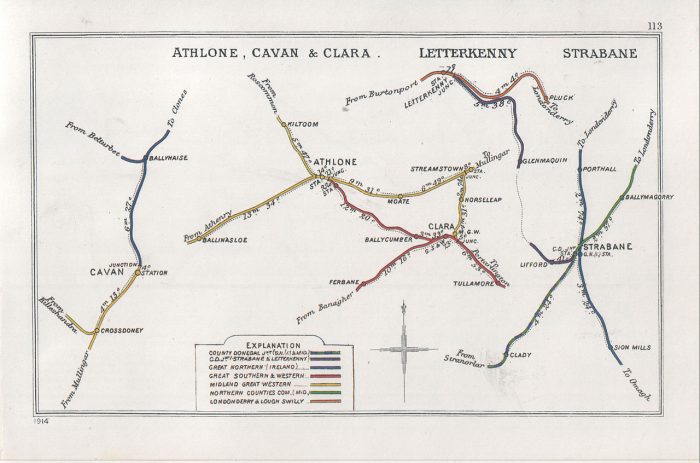
As we noted at the start of the previous article about this line, Wikipedia gives us a very short history of the line from Strabane to Letterkenny and provides a single image – the Railway Clearing House map with stations in Strabane and Letterkenny:
The Railway Clearing House map with stations in Strabane and Letterkenny. [3]
This series of articles seeks to expand our understanding of the route of the various Co. Donegal Railways through combining old images and modern views. Satellite images also give us a good understanding of what remains of the infrastructure of these lines.
A Journey Along the Line – Strabane to Letterkenny – Part B – Raphoe to Convoy
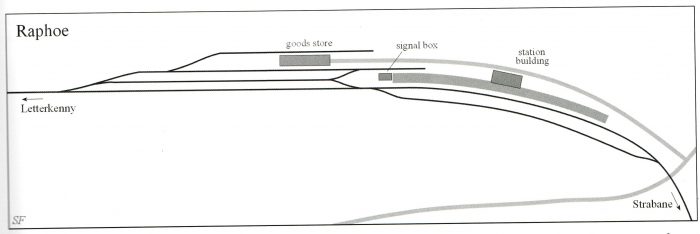
A sketch plan of Raphoe Railway Station by Steve Flanders from the book ‘The County Donegal Railways’ [1: p43] This drawing is included by kind permission of Steve Flanders.
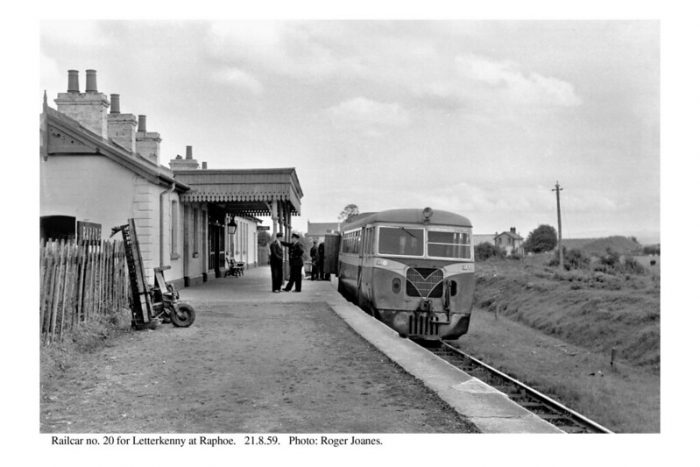
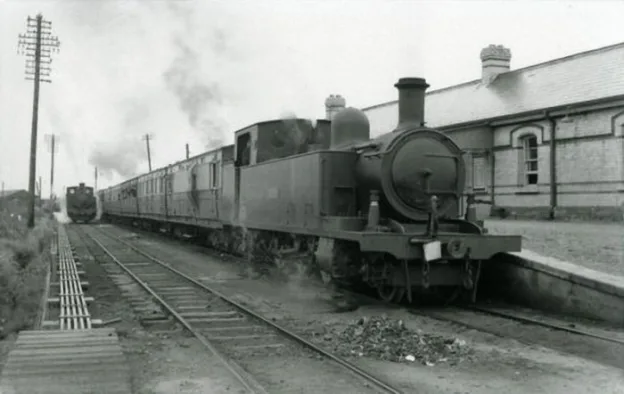
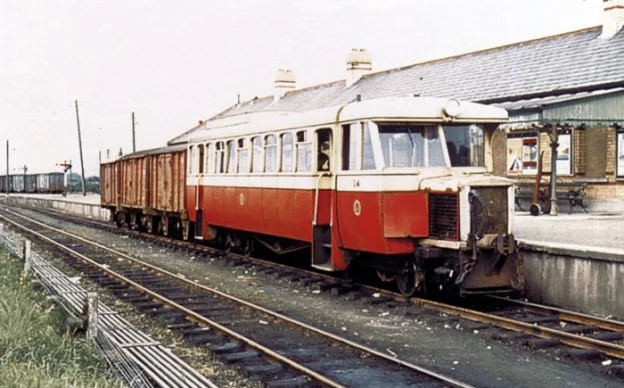
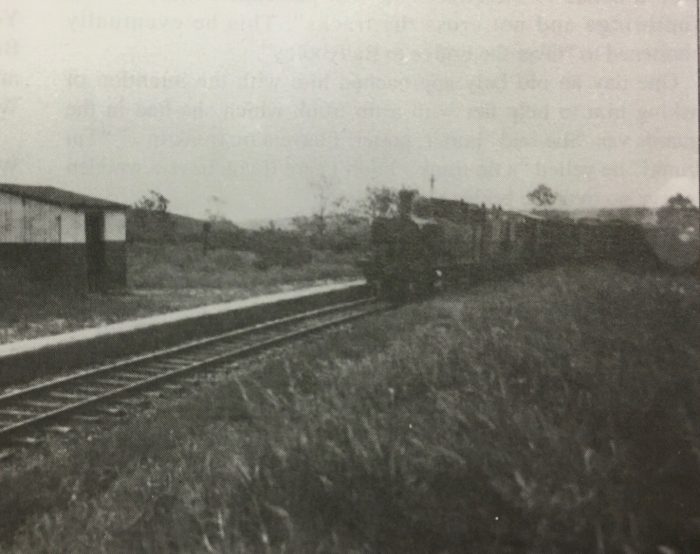
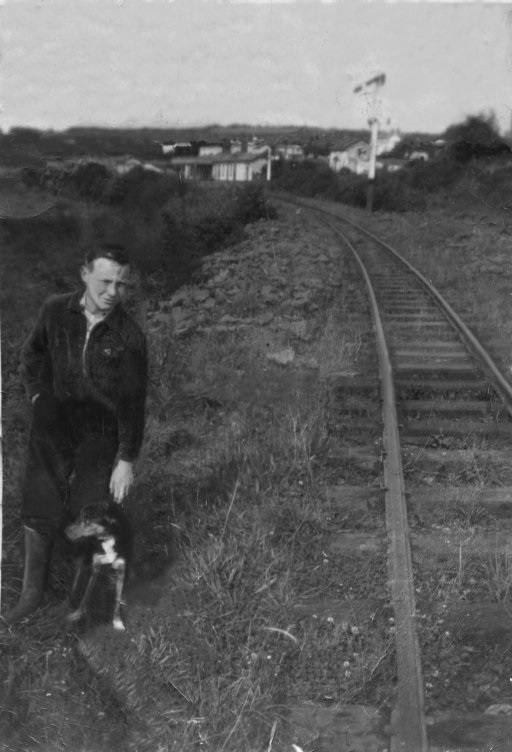
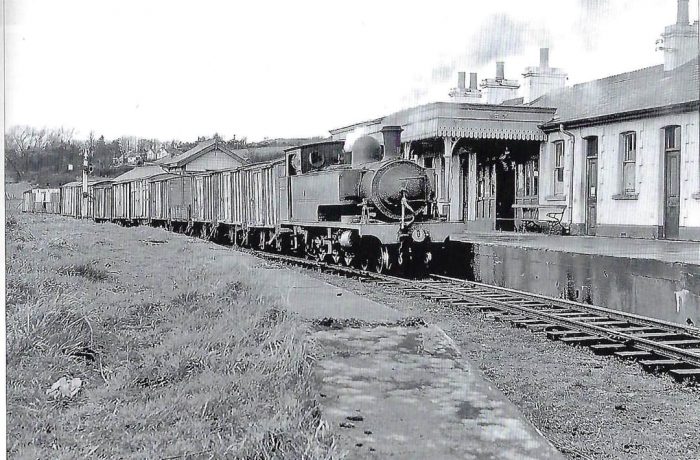
Railcar No. 20 at Raphoe Station, heading for Letterkenny in 1959 (c) Roger Joanes (CC BY-NC-ND 2.0) The Crossing-keepers cottage at the level-crossing to the East of the Station can be picked out to the right of the railcar. By this time, the passing loop shown in Steve Flanders sketch plan above had been lifted. [7]
Having enjoyed a stopover in Raphoe, we start the next stage of this journey back at the Railway Station at Raphoe and pick up the last image (above) from the previous article about the line:
Before we climb aboard Railcar No. 20 as it sets off for Letterkenny we look at the condition of the station site in the 21st century. The two pictures immediately below were taken relatively recently by Kerry Doherty. The first shows the location of the old station platform, the second looks from the West through the station site.
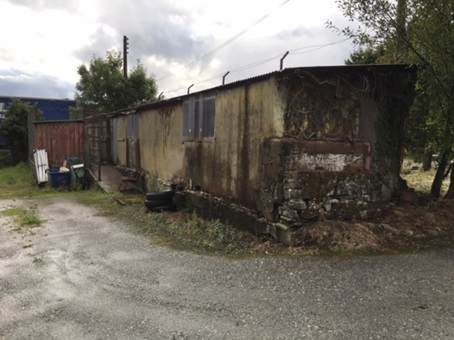
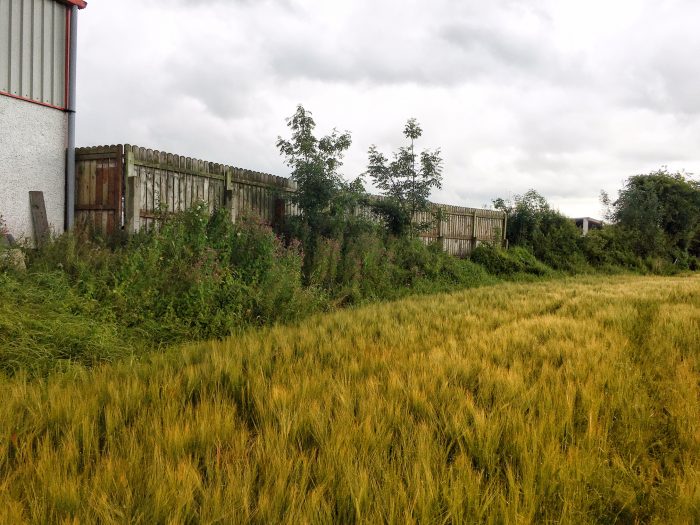
All that remains of the platform of Raphoe station. You can clearly see this shed is built on top of it (c) Kerry Doherty. [6]
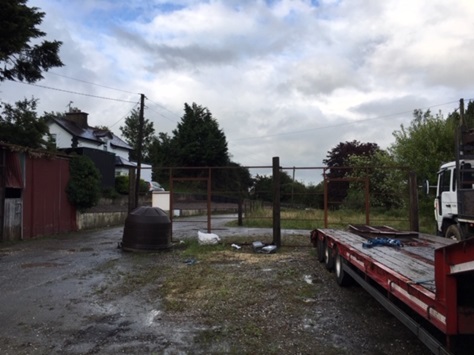
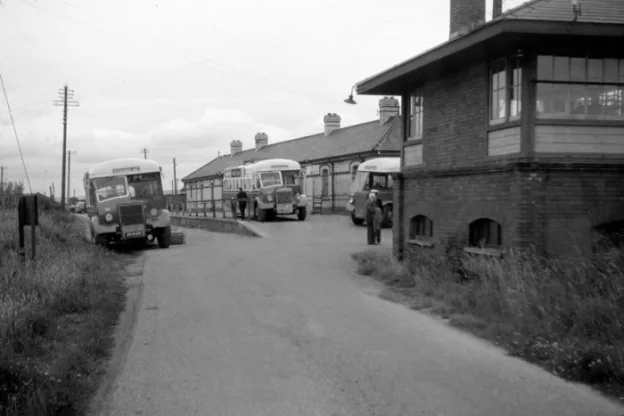
This picture appeared at the end of the last article about this line. It shows the site of Raphoe Station in 21st century taken from a similar position to the Roger Joanes image above. The Station Master’s House on the left is the only building remaining on the site. Kerry Doherty comments that ‘it was difficult to get a photo of the site as many lorries now occupy the yard’, (c) Kerry Doherty. [6]
There are also two excellent photographs of Raphoe in Anthony Burges Album of the line. [8: p32-33]
Now we set off towards Convoy from Raphoe Railway Station. …….
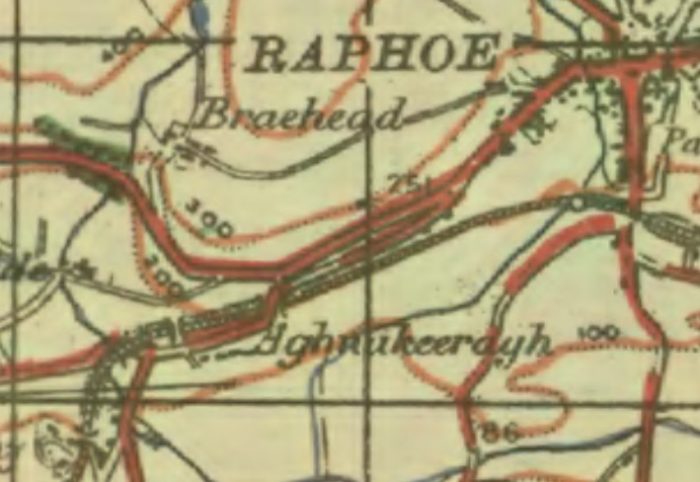
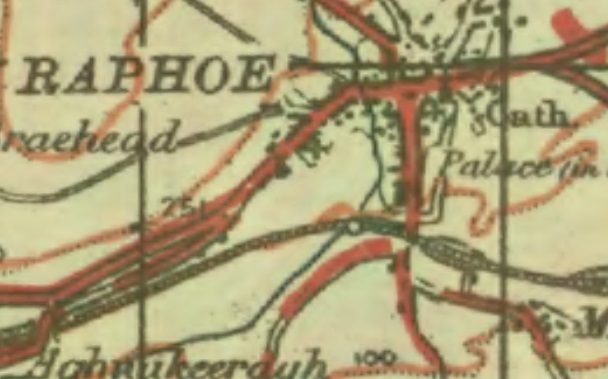
GSGS 1940s Map of Raphoe and its Southwestern approaches. [2]
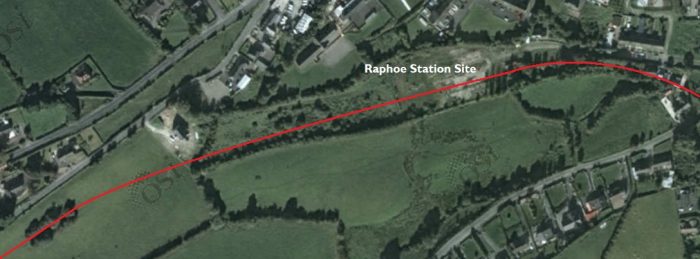
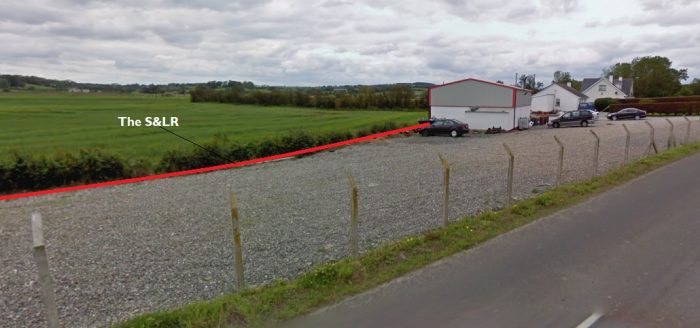
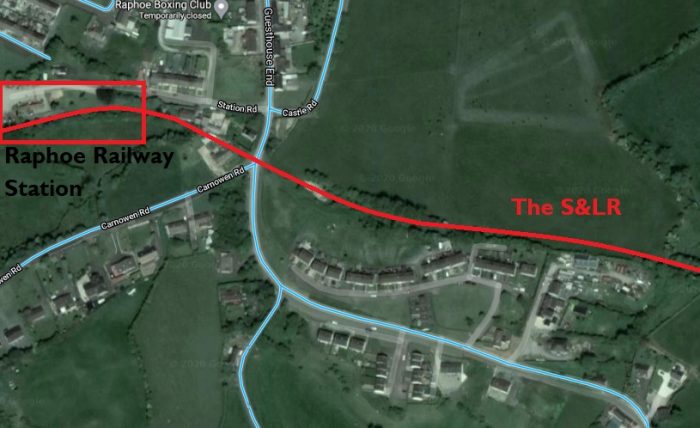
The site of Raphoe Railway Station in the 21st century. [4]
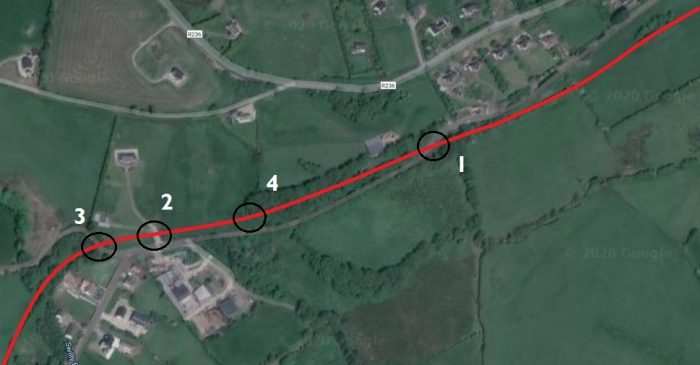
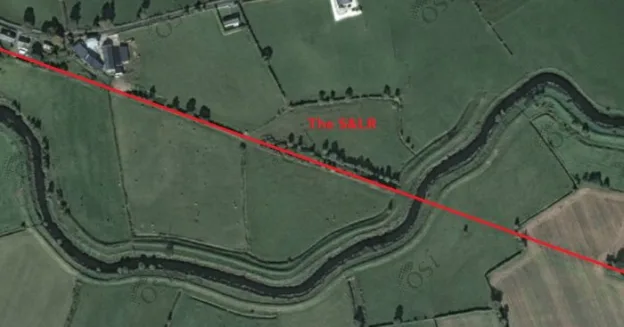
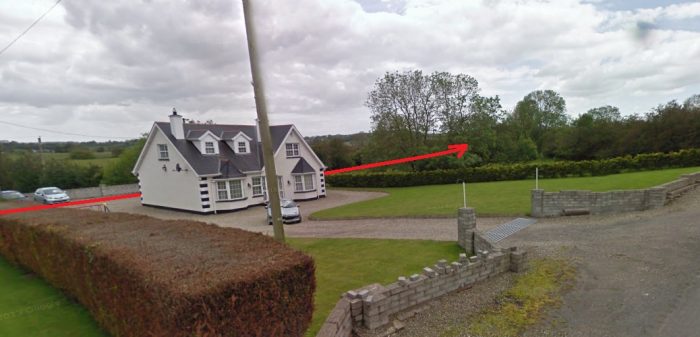
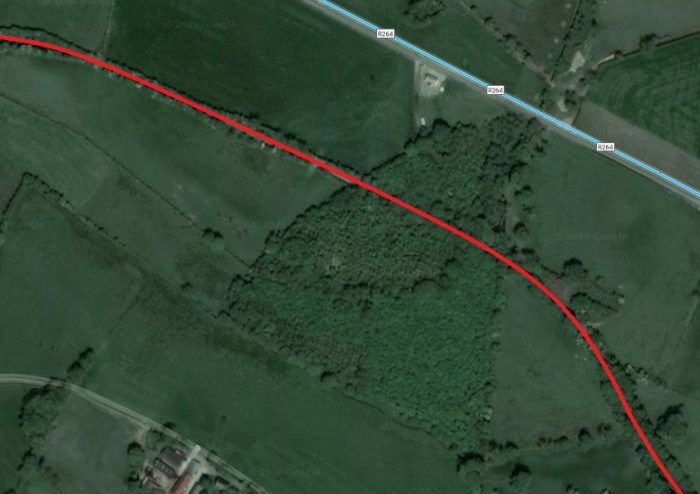
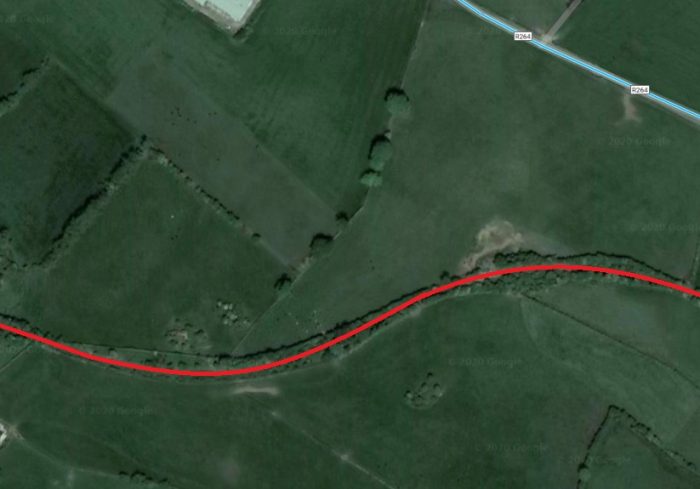
The route continues through Aughnakeeragh (Google Maps). The three images immediately above show that the line began, gradually, to curve round to a Southwesterly direction as it left Raphoe Railway Station, before turning almost directly South at Aughnakeeragh. At location ‘1’ on the map immediately above, the road turned sharply to the south so as to cross the railway on a bridge.
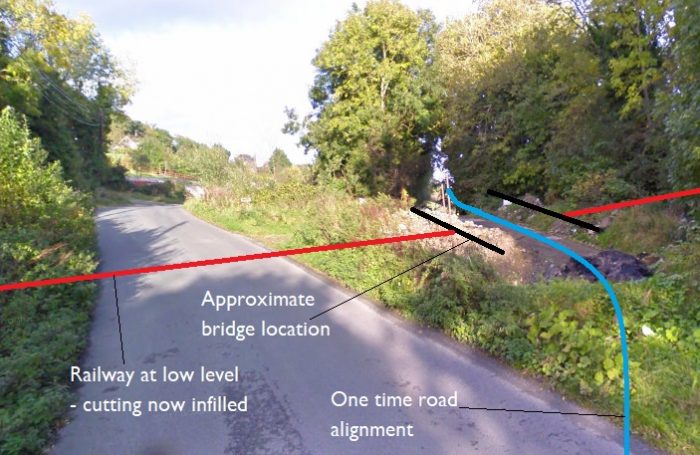
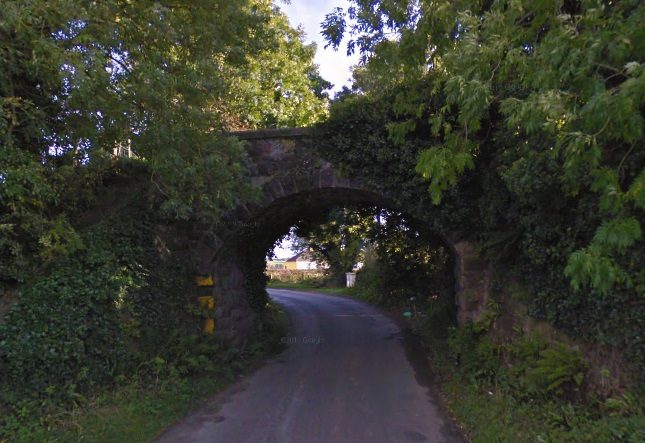
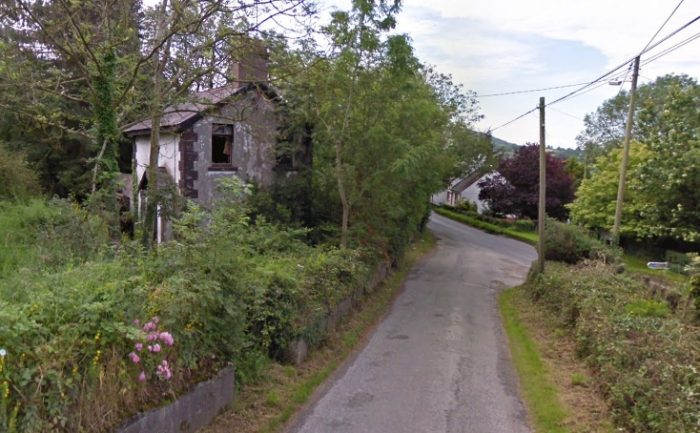
The narrow road crossed the old railway on a stone arch bridge. The railway cutting has now been infilled and the road alignment marginally improved (Google Streetview). This view shows the approach from Raphoe.
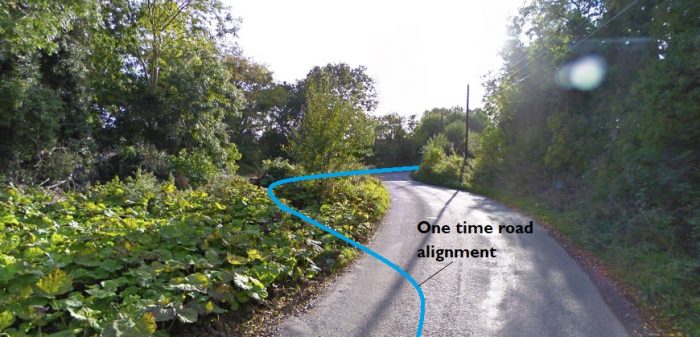
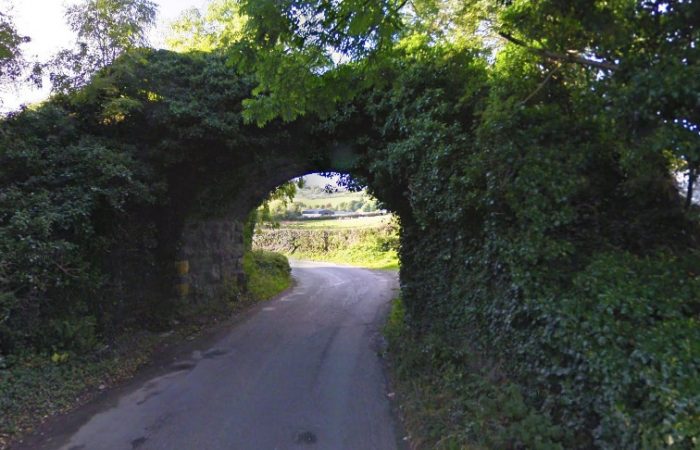
Crossing the bridge location and turning to look back towards Raphoe, this is the view (Google Streetview)
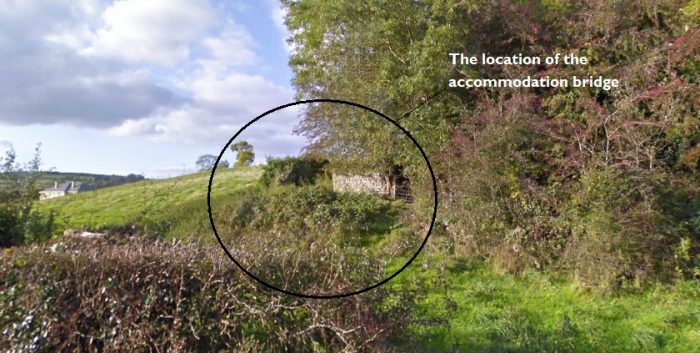
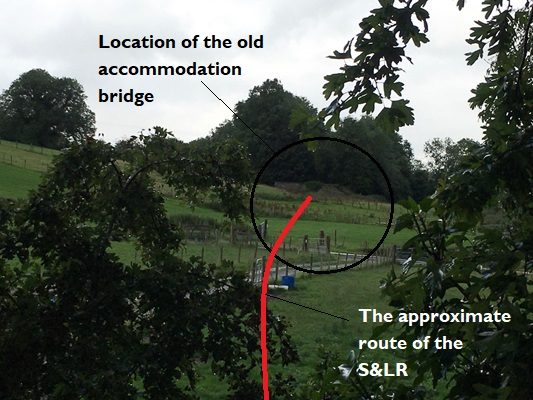
At location ‘4’, an accommodation bridge provided access across the old line.
The location of the old bridge is difficult to pick out on this image from Google Streetview.
This image, taken by Kerry Doherty from the top of the bridge at location ‘3’ above gives a better impression of the remains of the old bridge. The S&LR was in cutting at the bridge but the land drops away towards the foreground and at the point of the modern access road in the middle of the picture, the line went from being in cutting to being on an embankment, (c) Kerry Doherty [6]
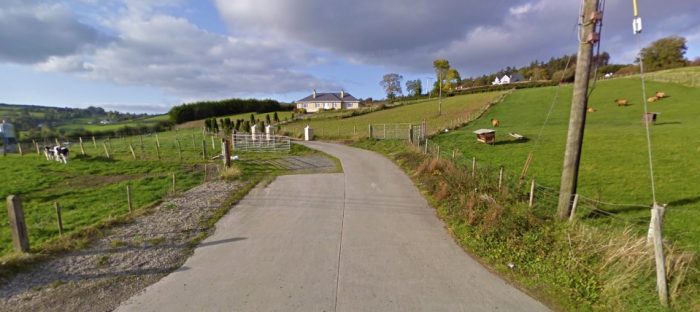
As noted under the picture above, at location ‘2’, the old railway was almost at the same level as the surrounding land with cutting to the East and embankment developing to the West.
A modern farm access road crosses the old line at the approximate location when natural land levels and the formation of the S&LR matched (Google Streetview).
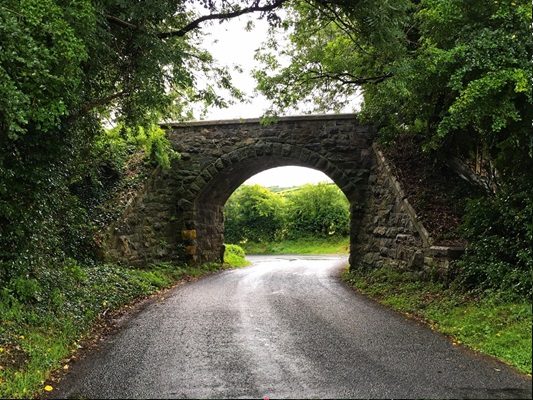
At location ‘3’, close to Aughnakeeragh, the railway was carried over a road on a stone arch bridge.
This Google Streetview image shows the bridge viewed from the Southeast.
\n Convoy Railway Station
The Google Streetview image of the bridge taken from the Northwest shows it heavily overgrown by ivy.
In this recent photograph, the bridge has been stripped of vegetation and is much more clearly visible, (c) Kerry Doherty. [6]
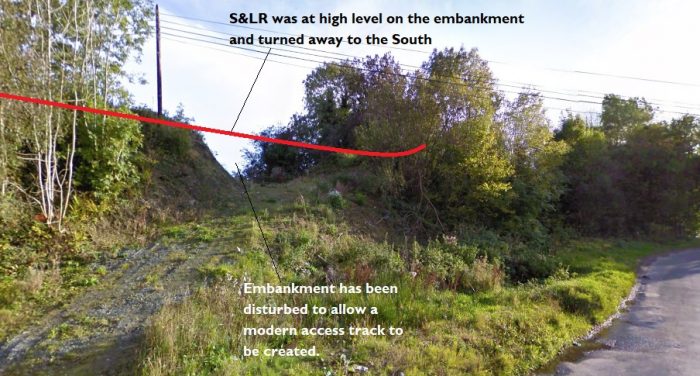
This Google Streetview image is taken from the road on the North side of the line, immediately to the West of the above bridge and shows the Railway embankment disturbed to allow vehicles to access land to the South.
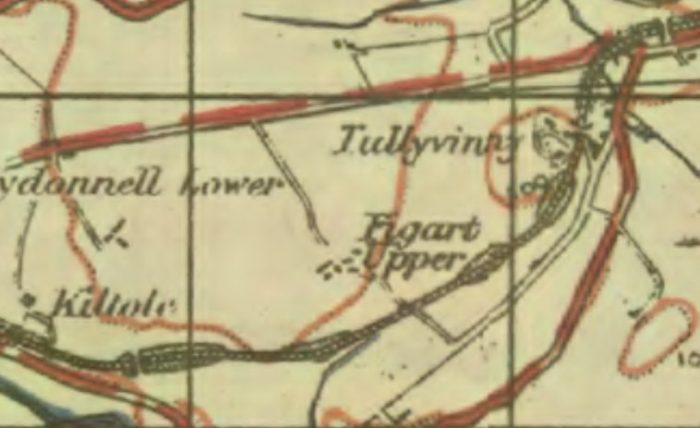
The next extract from the GSGS 1940s series of Maps shows the line to the West of Aughnakeeragh. [9]
After passing immediately to the West of Aughnakeeragh the line headed South for a Short distance before curving to the West once again.
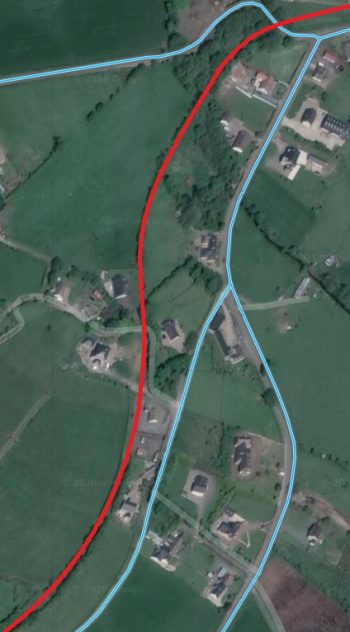
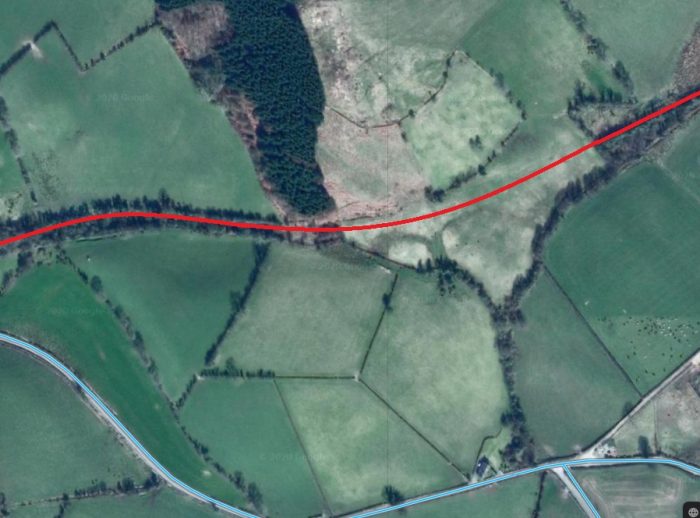
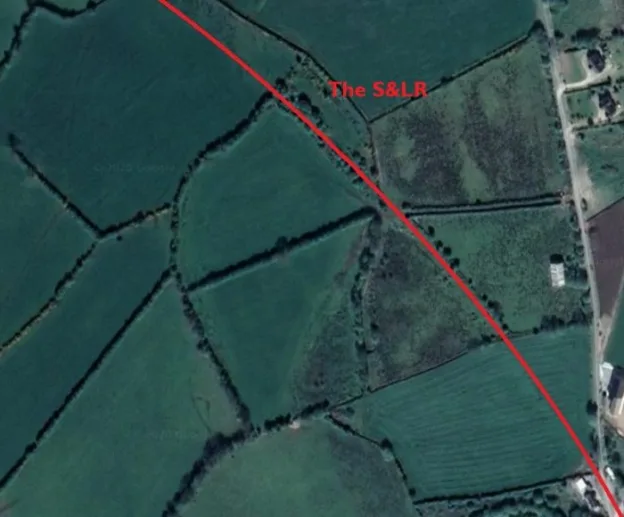
There was an accommodation bridge which carried a lane across the S&LR at Tullyvinny. The location appears on the adjacent Google Maps extract to the Southwest of the road junction at the centre of the satellite image. The lane ran parallel to the S&LR for a short distance on the East side of the railway cutting before turning West across the line. The closest we can get on Google Streetview is shown in the first image below.
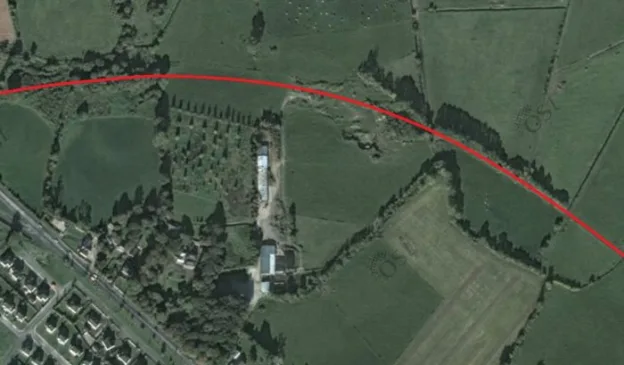
The next track to cross the line was that leading to Figart Upper Farm. The Lane appears in the bottom third, on the left-hand side of the next Google Maps satellite image below. The farm is on the left-hand side of the image close to the top.
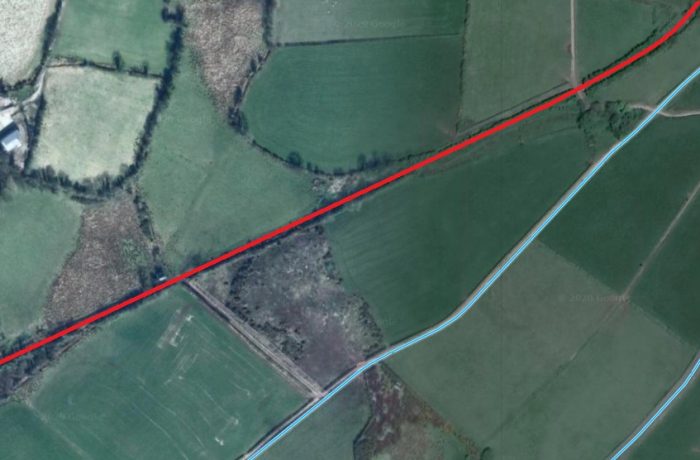
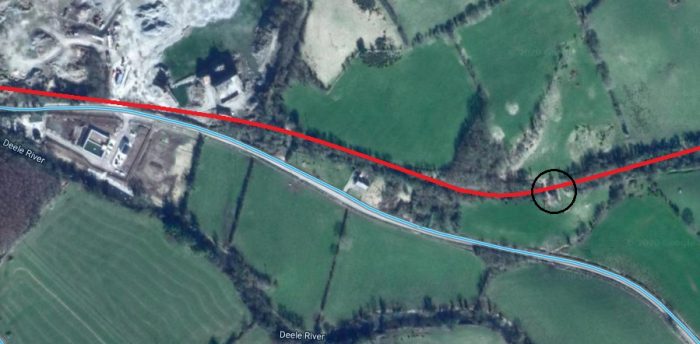
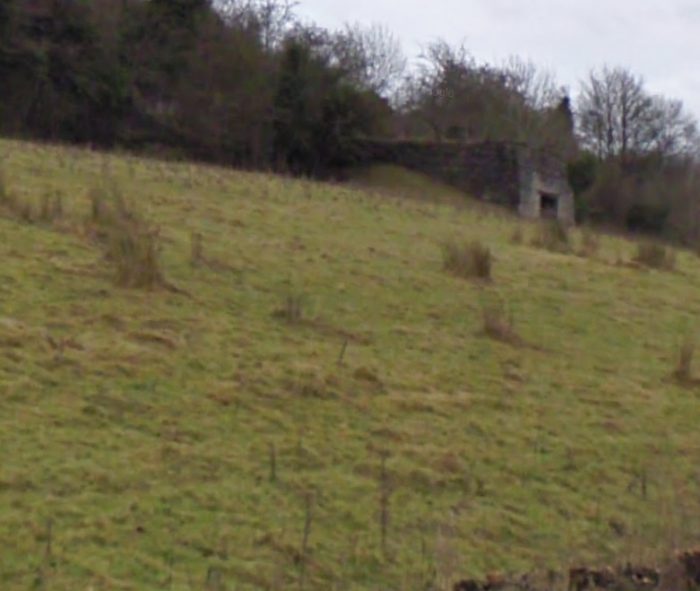
From Figart Upper Farm to Kiltole the old line was alternately in cutting and at the same level as the surrounding land but on the hill above the road which ran parallel to it to the South. An accommodate bridge over the line is marked by the black circle on the above plan and appears to relate to another structure which can be seen on the Goggle Streetview photograph below and which is taken from the road a little to the West of the accommodation bridge.
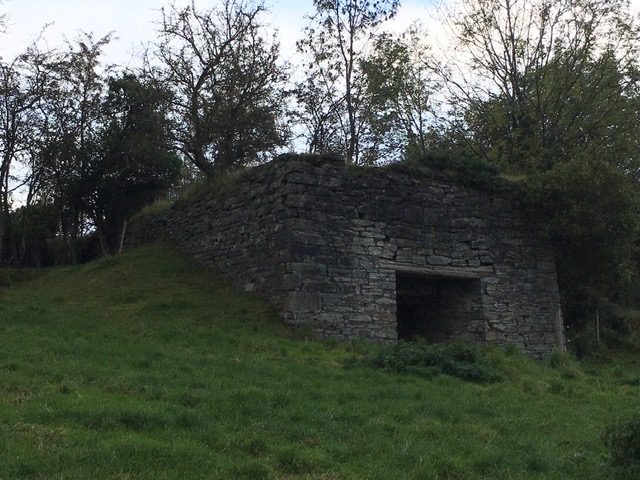
A lime kiln adjacent to the accommodation bridge referred to above. It seems as though the bridge permitted access to the lime kiln. (Google Streetview).
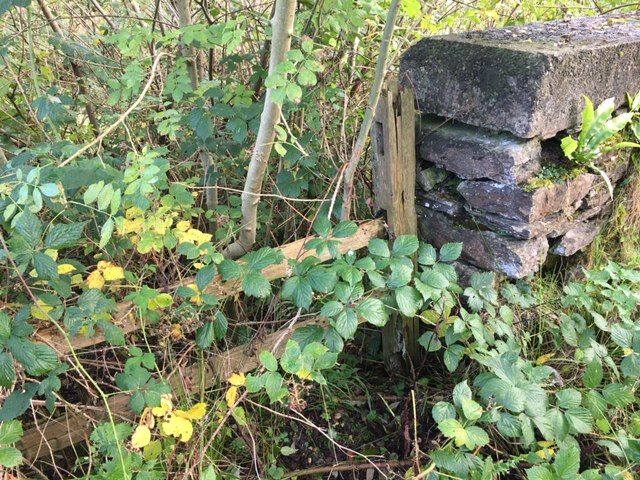
Very kindly, when I first asked about this structure in very early October 2020, Kerry Doherty offered to investigate. He took his camera with him as he endeavoured to walk the line from the West. He gained access to the old line through a field adjacent to the Kiltole Quarry . His first photograph shows the formation to the East of the quarry.
The formation of the Strabane and Letterkenny Railway to the East of Kiltole Quarry, (c) Kerry Doherty [6]
Kerry’s trek along the line increasingly required him to struggle through bushes, small trees and thick under growth. The next picture is taken looking West from close to the lime-kiln and its bridge.
Looking West towards Convoy close to the Limekiln, (c) Kerry Doherty. [6]
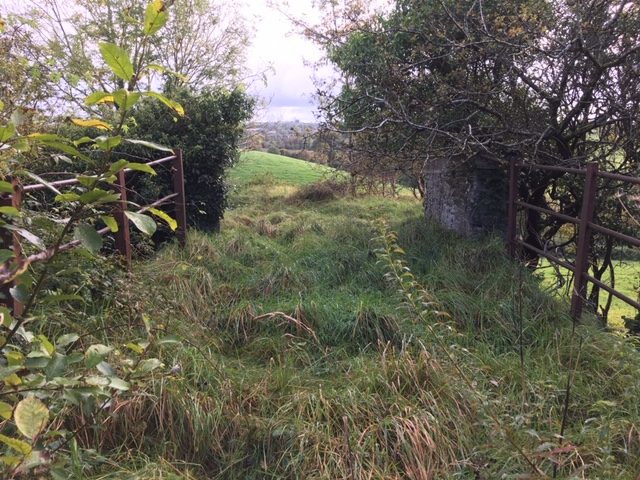
Kerry Doherty says: “It got almost impassable approaching the bridge beside the lime kiln. The bridge pillars can just be seen through the trees,” (c) Kerry Doherty. [6]
Kerry says: “I climbed the cutting to get a better shot of the bridge,” (c) Kerry Doherty. [6]
Some original boundary fencing adjacent to the bridge parapet, (c) Kerry Doherty. [6]
Looking across the accommodation bridge and then across the Lime Kiln to the South, (c) Kerry Doherty. [6]
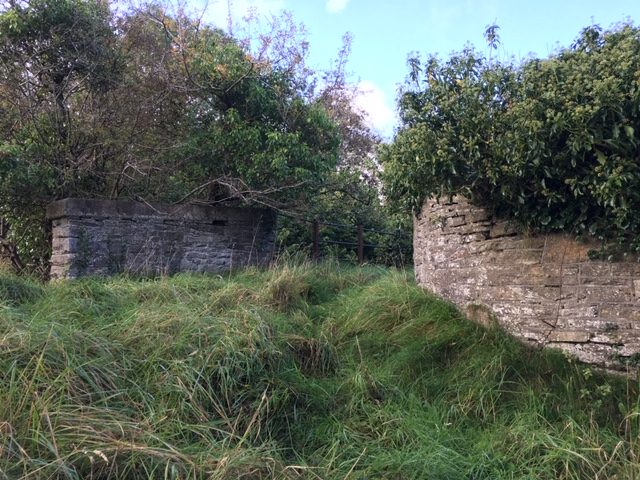
Adjacent to the Lime Kiln the two approach walls to the bridge parapet railing can be seen. That to the East is curved in plan, (c) Kerry Doherty. [6]
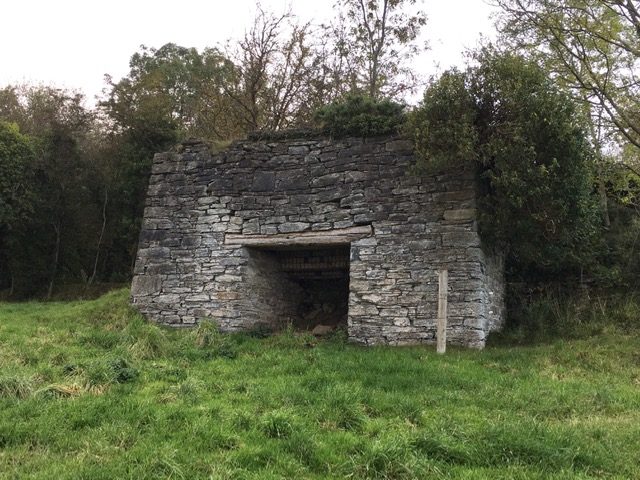
Three pictures of the Lime Kiln follow. All again taken by Kerry Doherty:
The Lime Kiln from the South, (c) Kerry Doherty. [6]
The view from the Southwest, (c) Kerry Doherty. [6]
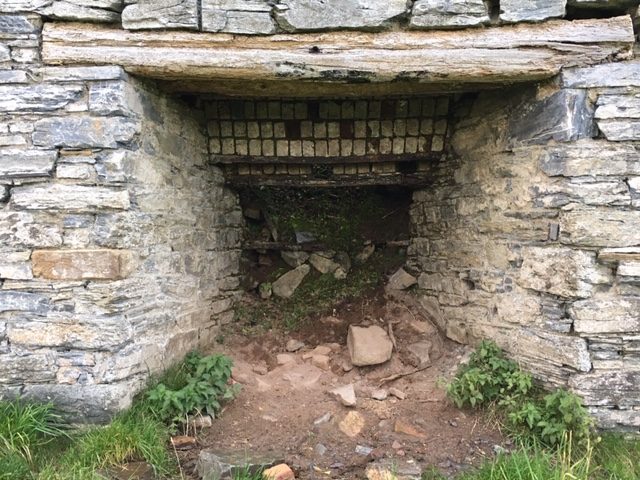
A close-up shot of the mouth of the Kiln, (c) Kerry Doherty. [6]
Immediately to the west, the road and old railway ran close together. This can be seen in this next Google Streetview image.
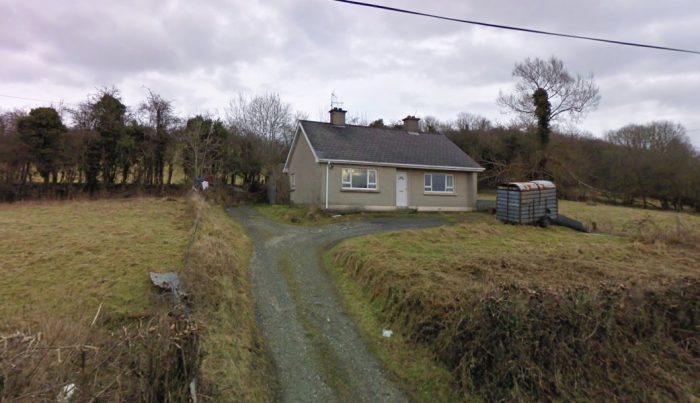
In this picture the formation of the S&LR can be seen in the trees immediately at the back of the land belonging to this bungalow (Google Streetview).
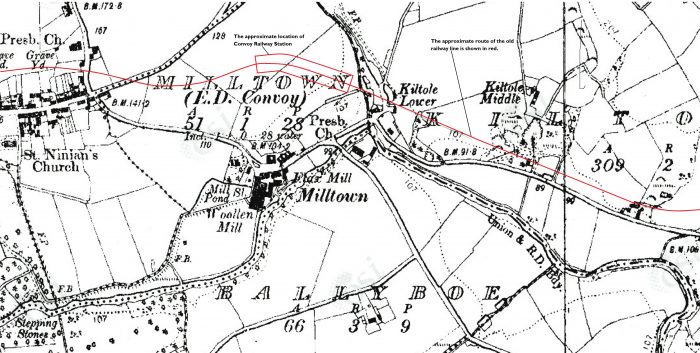
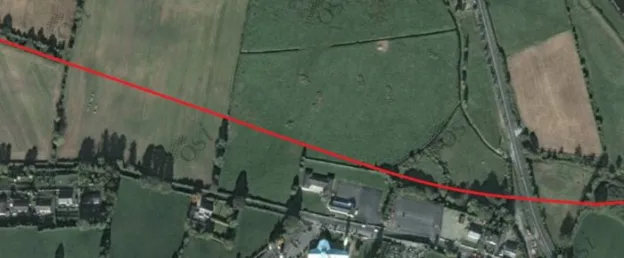
The line ahead now approaches Convoy. Although the formation is completely lost as it crossed the site of the now defunct Kiltole Quarry. The railway station was in the part of Convoy referred to as Milltown (to the East of Convoy itself), sited just to the North of the old mills.
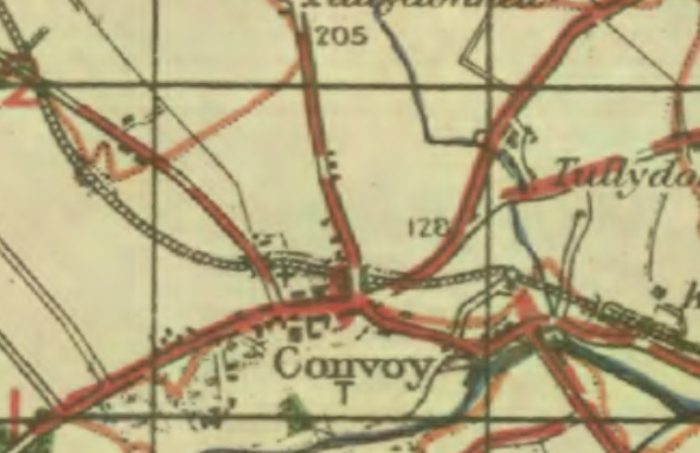
The Village/Town of Convoy (Milltown) on the GSGS 1940s Series of Maps. [10]
Convoy on the Header National Townland and Historical Map Viewer. The route of the old railway has been imposed on the map as a thin red line. [11]
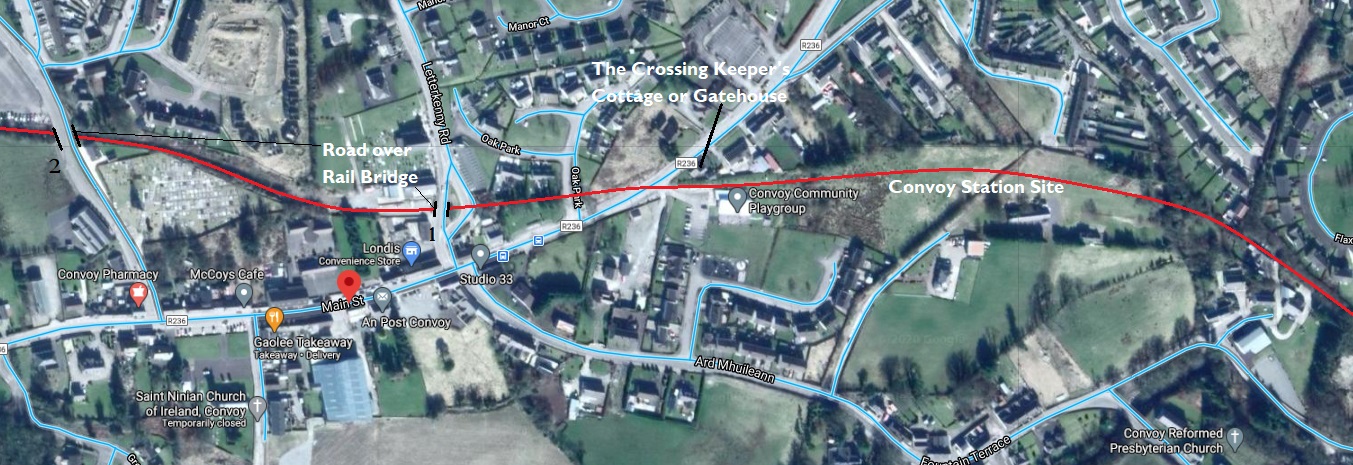
The approximate route of the old line through Convoy (Google Maps). The locations of the Gatehouse and the two road over rail bridges are marked.
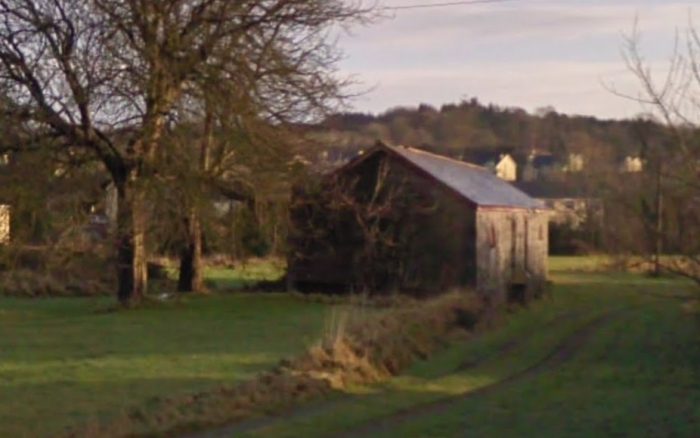
The closest view of the Railway Station site at Convey that is available on Google Streetview. The last remaining structure on the site is the goods shed.
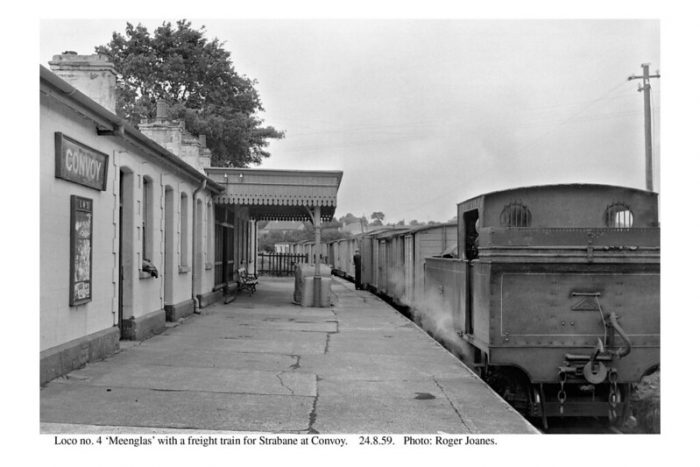
Convoy Railway Station 1959 (c) Roger Joanes, (CC BY-NC-ND 2.0).
This second length of the Strabane to Letterkenny line finishes here at Convoy, the remainder of the line to Letterkenny will follow in another post.
References
Edward M Patterson (original author), Joe Begley & Steve Flanders (authors of additional material in the Revised Edition); The County Donegal Railways; Colourpoint Books, Newtownards, Co. Down 2014. As noted in my first article about the Co. Donegal Railways this was to have been my holiday reading while walking different parts of the network, but 2020 has been a strange year!
Edward M Patterson (original author), Joe Begley & Steve Flanders (authors of additional material in the Revised Edition); The Lough Swilly Railway; Colourpoint Books, Newtownards, Co. Down 2017. This was also to have been part of my holiday reading, but 2020 has been a strange year!
Kerry Doherty of Ballindrait very kindly sent me a series of pictures of the Strabane and Letterkenny Railway route. Each of these, in this article, bears the reference number [6] Later, and also referenced [6] Kerry scrambled through the undergrowth along the old line to find evidence of the accommodation bridge and the rear of the lime kiln.
In early September 2020, while staying in Bream in the Forest of Dean we walked around the Titanic Steel Works and the Dark Hill Ironworks of father and son David and Robert Mushet. These two establishments sit adjacent to what was the Coleford branch of the Severn and Wye Joint Railway. They were also served, in its time, by the Milkwall branch of Severn and Wye Tramway.
The location is significant in the development of the Bessemer Process for making hardened steel. Robert Mushet took the relatively novel ideas of Bessemer and refined them to the point where the process became functional in an industrial context. [3]
The tramway closed when the Coleford Branch opened as the route of the new railway closely followed the old tramway. There are only a few places where the route of the old tramway diverged from the newer railway and one of these locations is in the area of the Mushet owned works. The next few OS Map extracts come from the very early series of 25″ OS Maps which were drawn in the period from 1873-1888, nonetheless, the old tramway was by this time only a memory,
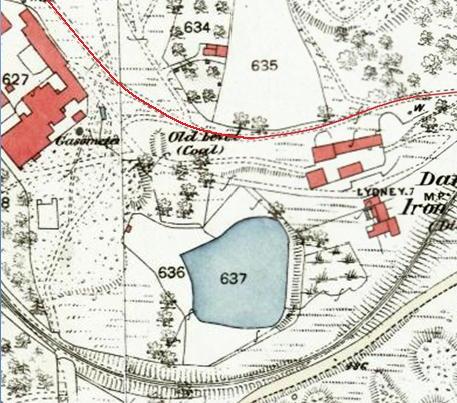
At the Eastern end of the Dark Hill Iron Works site, the old tramway diverged from the line of the Severn and Wye Joint railway. The loop shown here was no doubt provided to lessen the gradient. Steam power enabled the newer railway to take a more direct route. The Severn and Wye Joint Railway is shown by the double black lines which curve from the right of the map extract to pass through the words ‘Darkhill Iron Works’ at the bottom of the extract. [1]
The tramway route shown by the thin red line ran across the North side of Darkhill Iron Works and then on the Northeast side of the Titanic Steel Works. The Severn and Wye Joint Railway looped round the South side of the two sites. [1]
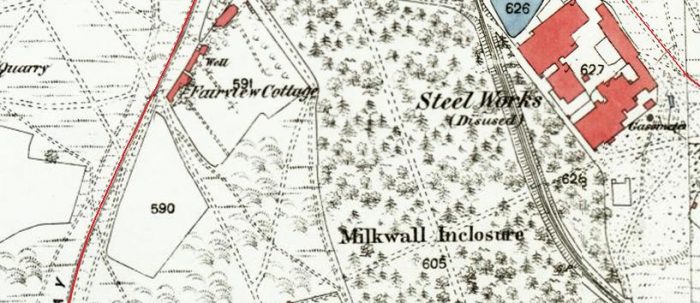
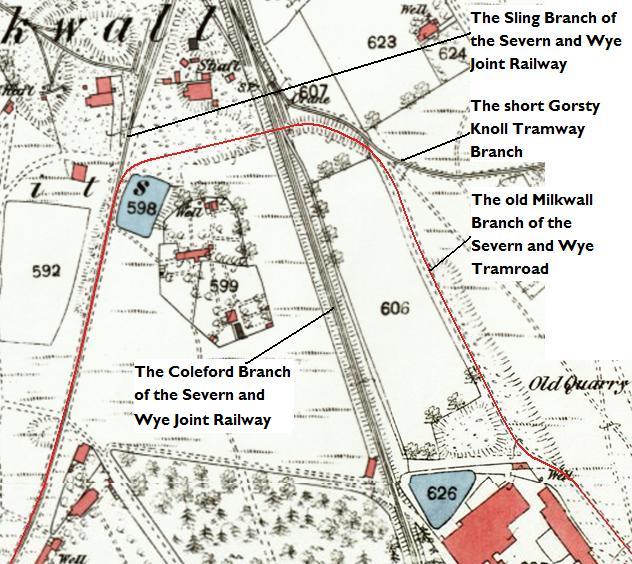
The two distinct red lines which appear on this map extract are both part of the old Milkwall branch of the Severn and Wye Tramroad. That to the West of the Map extract became the Sling Branch which left the Coleford Branch of the Severn and Wye Joint Railway at the small Milkwall Station to the North. That railway can be seen running to the West side of the Titanic Steel Works. The other red line is just to the Northeast of the Titanic Steel Works. [1]The two arms of the tramway which are seen as red lines on the map extract prior to this one are shown coming together just to the South of the Milkwall Station on the Severn and Wye Joint Railway which is sited just off the North side of this map extract.
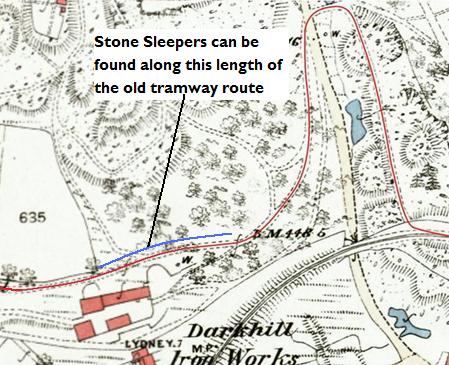
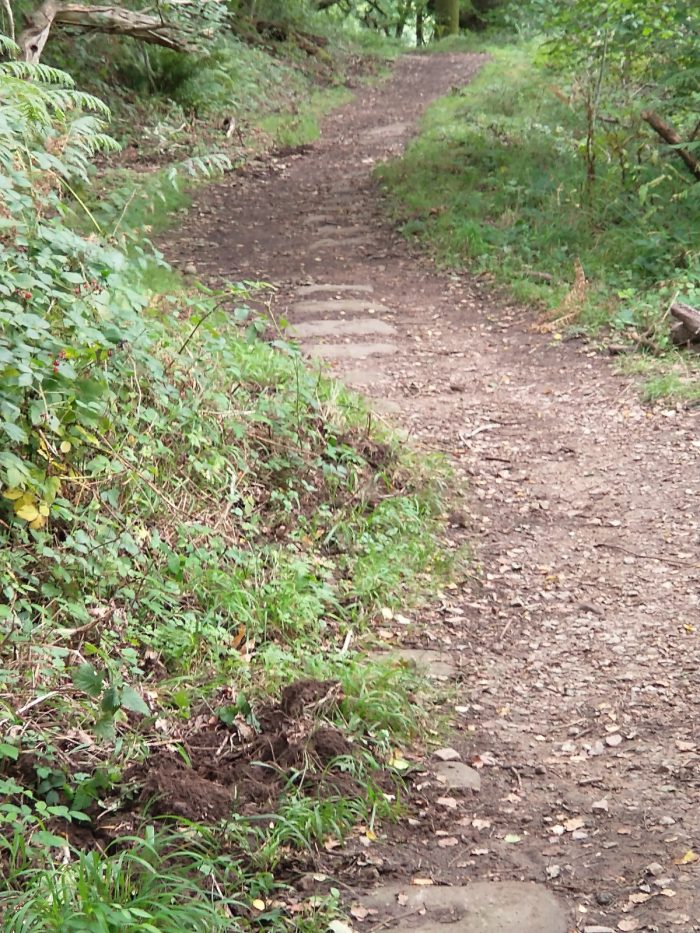
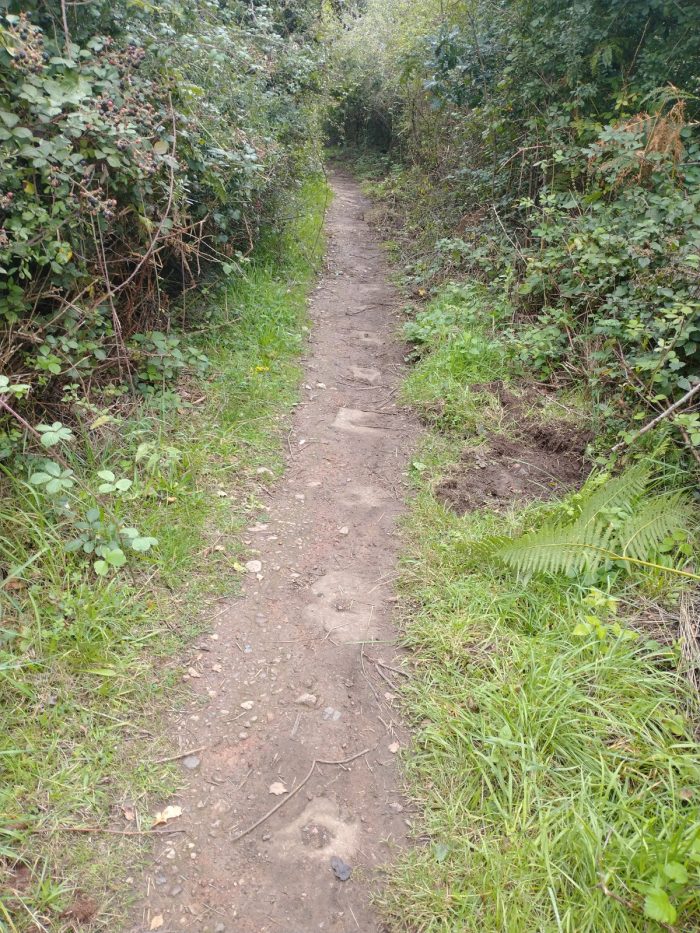
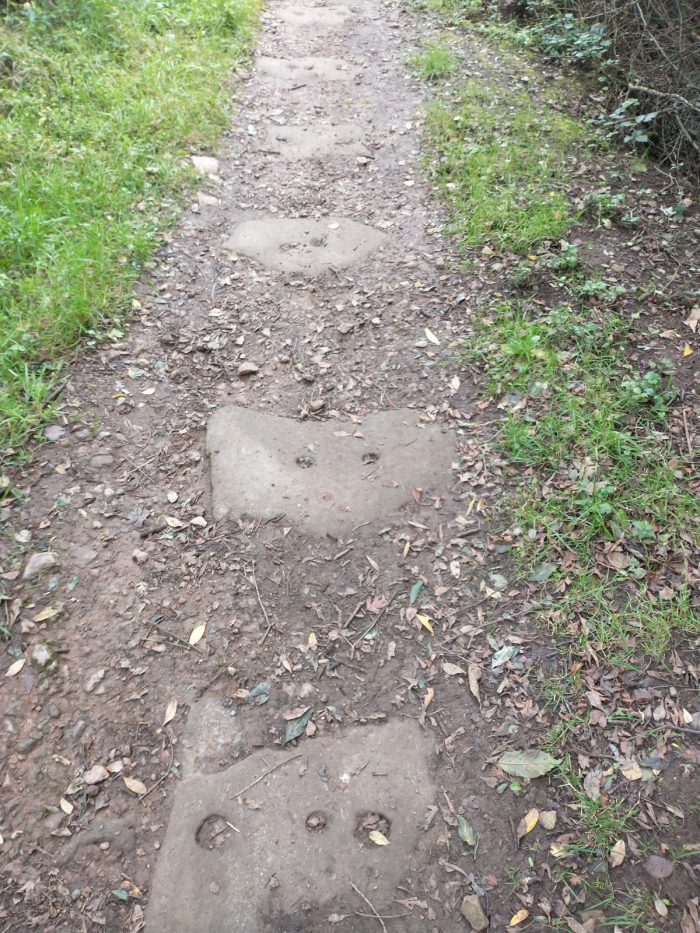
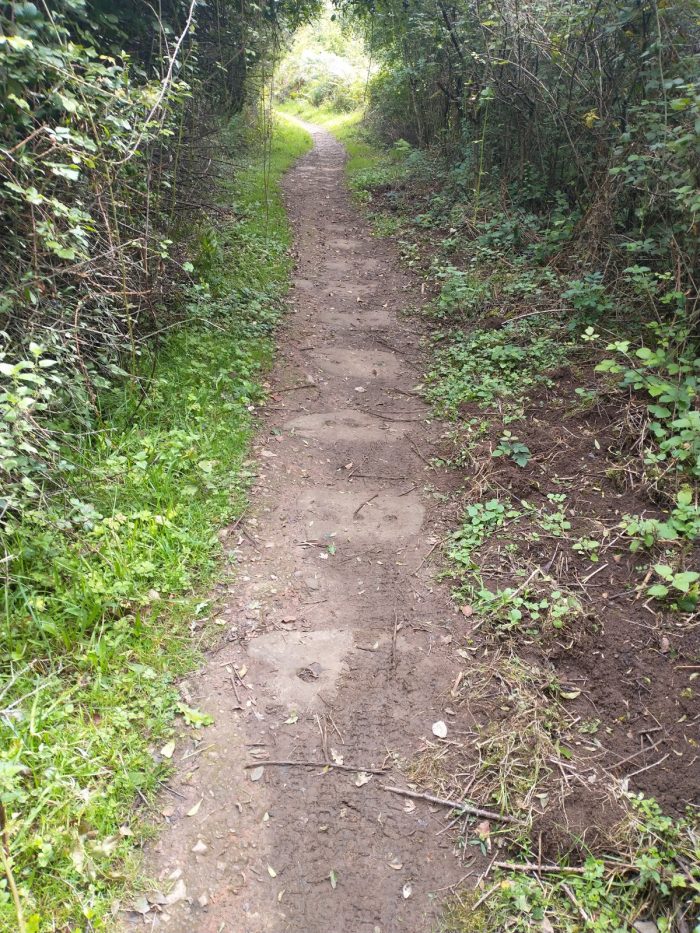
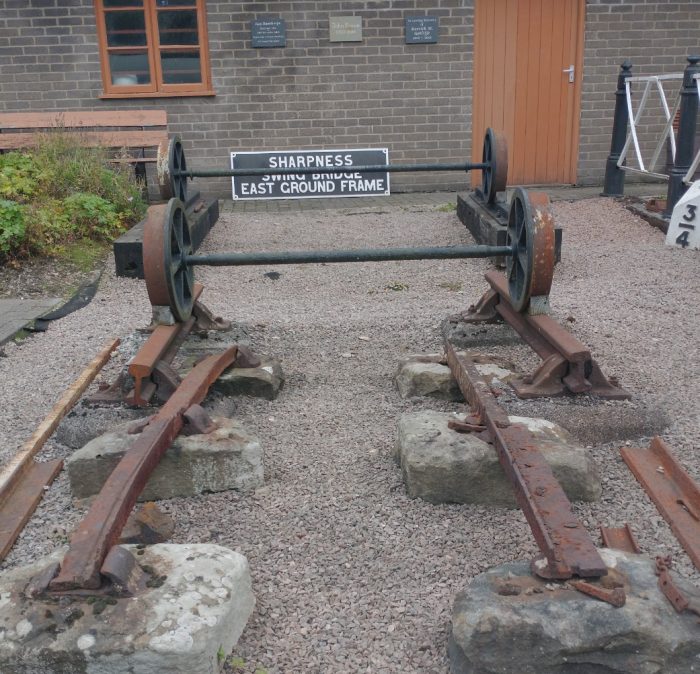
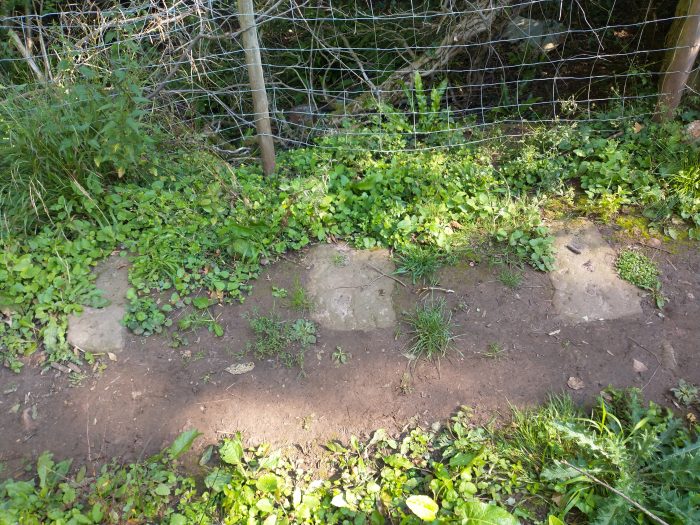
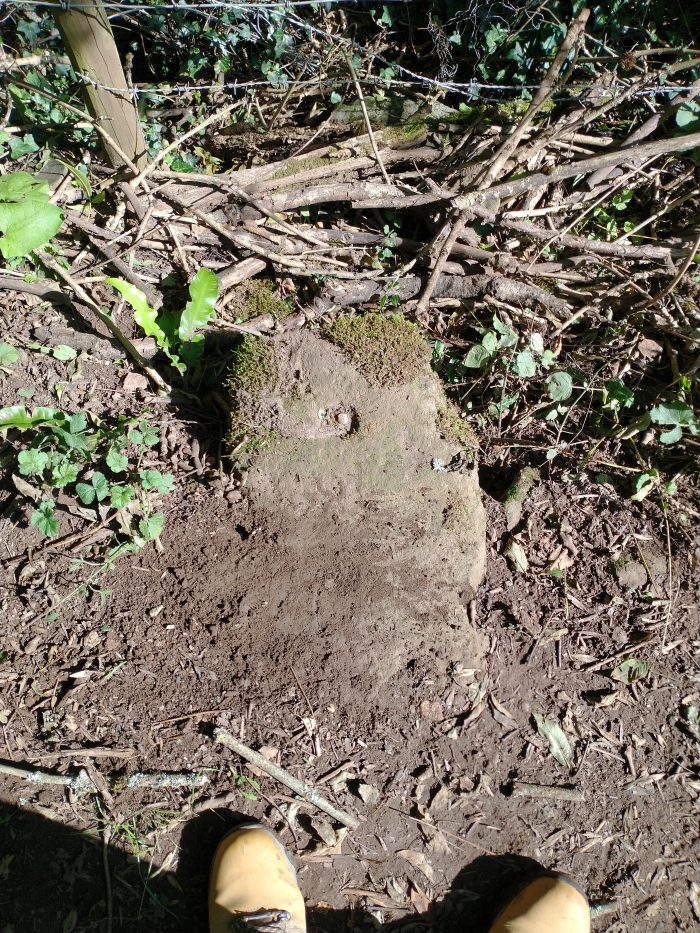
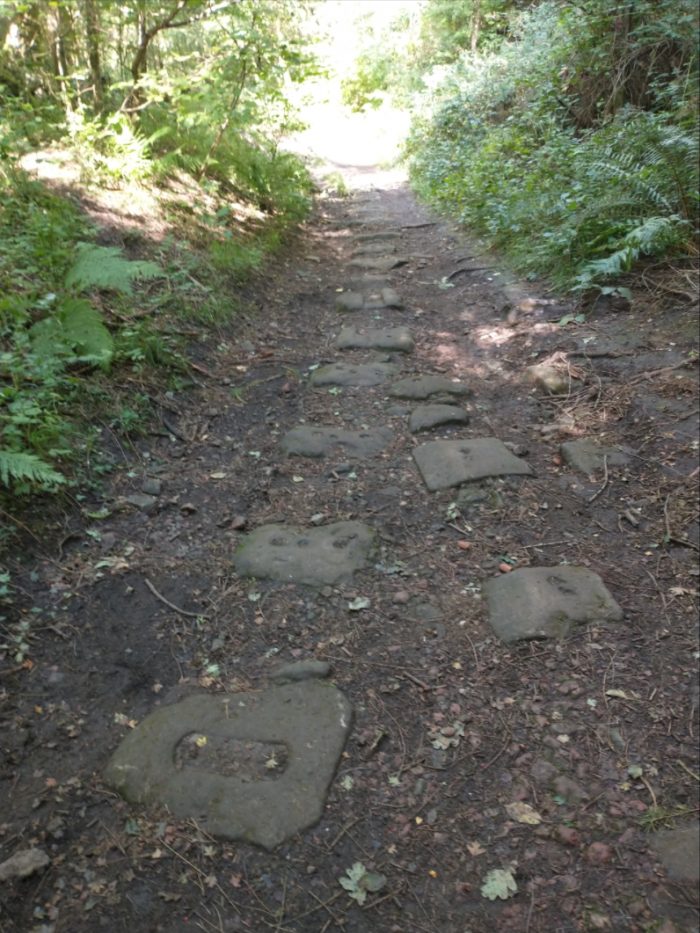
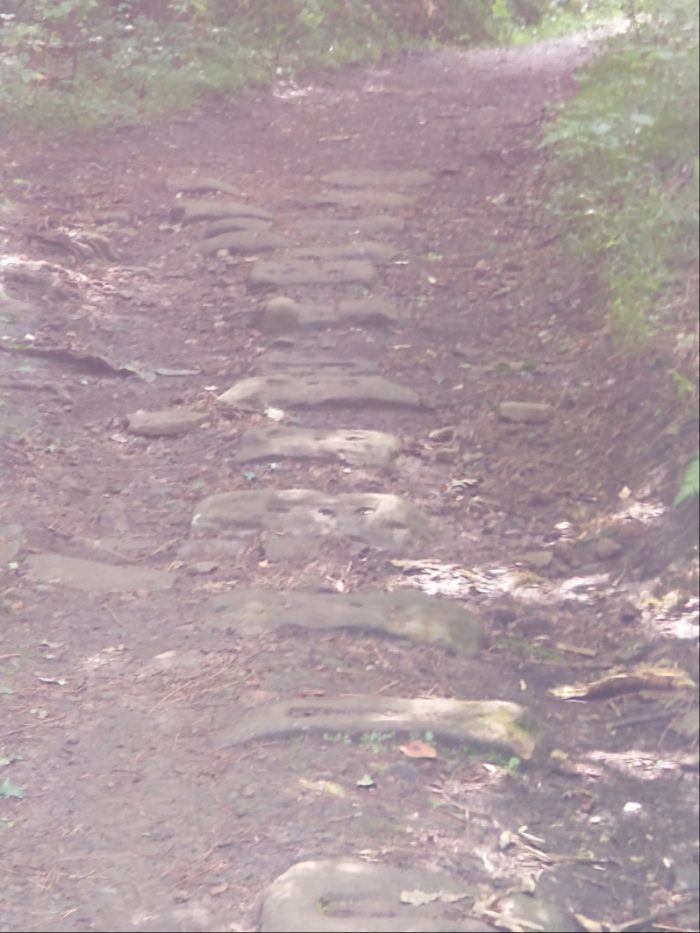
We followed a Heritage Walk route which took us around Milkwall and Dark Hill areas of the Forest. [2] We encountered a significant section of the old stone sleepers which were used to support the cast-iron L-shaped plates which the trams ran on. Pictures I took at that location follow. I have also included a photograph taken the same week at the Dean Forest Railway which shows how the plates were keyed-in to the stone sleepers using purpose made ‘chairs’.
Generally the modern footpaths which follow the routes of these old tramways are not wide enough to allow both rows of stone sleepers to be seen.
The different gauges used at different times in the Forest can be seen clearly in this picture taken at the Dean Forest Railway at Norchard on 2nd September 2020. The tramway gauge and construction can be seen in the foreground. Tramways in the forest were of 3’6″ to 3’8″ track gauge. Each plate was fixed in place by a metal chair which in turn was supported by an independent stone block/sleeper. All the photographs above are my own.
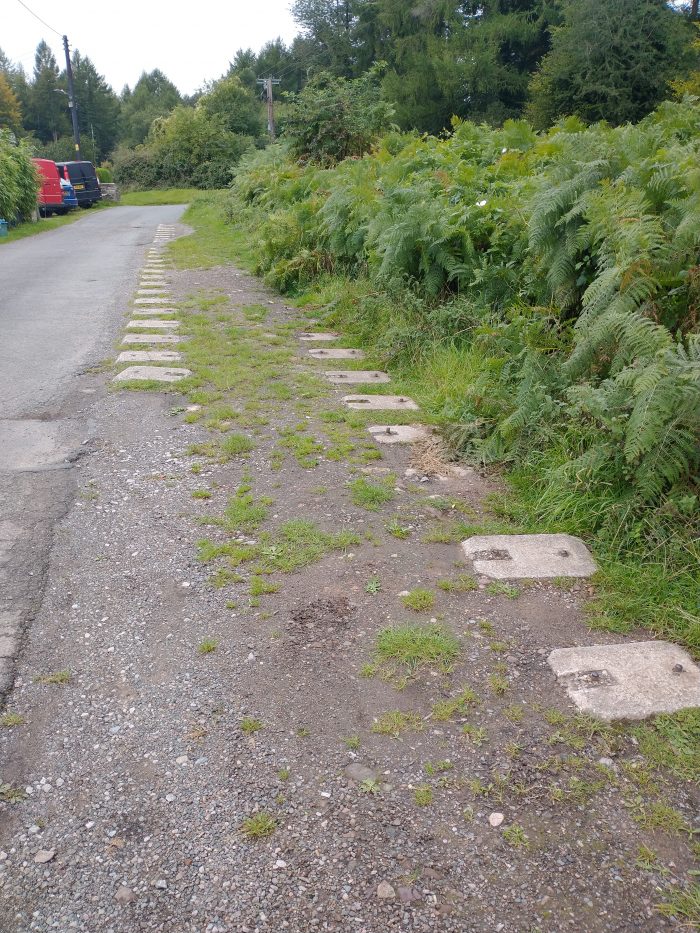
As we noted when looking at the map extracts above, the Sling branch of the Severn and Wye Joint Railway followed the line of the older Milkwall Tramway. Our walk took us, for a short distance, along the line of the Sling Branch. The more modern rails of the branch were supported on concrete blocks similar in size to the stone blocks which once supported the tramway. My picture below shows these concrete blocks where they are still visible outside Fairview Cottage which appears in the third of the four map extracts above.
There is an app which can be downloaded to mobile phones which provides access to a number of different Walks, one of these is the Coleford Heritage Walk, part of which we followed: https://www.forestersforest.uk/projects/12/hidden-heritage-app, accessed on 3rd September 2020.
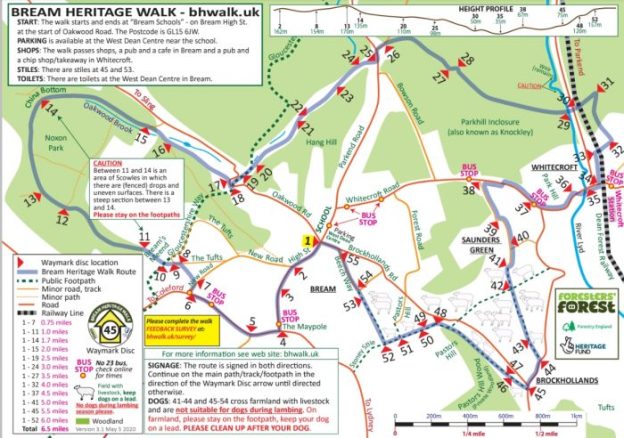
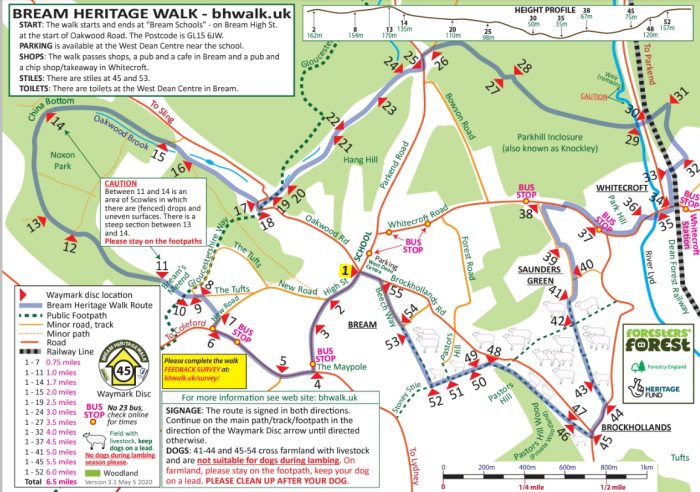
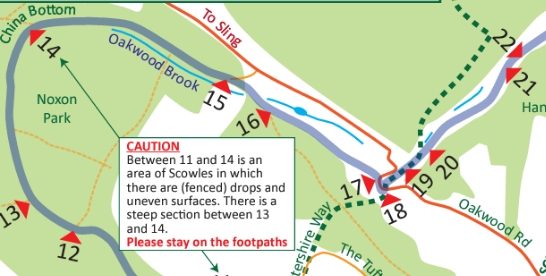
We are in the Forest of Dean again for a week away from work. On 1st September 2020 we followed a sign-posted circular walk which started in the centre of the village of Bream on the Southwest side of the Forest. The route was planned with the support of the Big Lottery Heritage Fund and featured a series of different heritage locations around the village. An overview plan appears below. [1]
Bream was one of a number of villages which sat on the edges of the old Royal Forest of Dean and in pre-industrial times had a population of around 300. The industrialisation of the Forest brought relatively rapid expansion to many of these villages. Bream’s population in the early 21st century is over 3,000.
The walk, including the different detours that we chose to make was about 7.5 miles in length. The first sections of the walk were along modern roads but we soon found ourselves walking along one of the access routes that would have been used by the workers in the iron ore mines in and around Noxon Park.
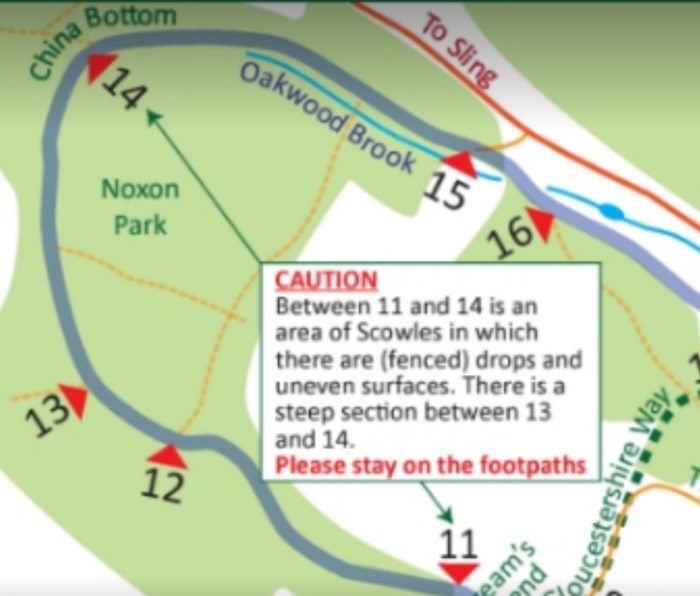
We passed a number of caves and sink-holes which were created by early iron ore miners. The area is riddled with underground workings and a number of relatively large caves have, over the years collapsed to create large and deep depressions (or scowles) at the surface. These can be found between locations 11 and 14 on the walk route map.
Initially, these workings were served by packhorses that carried the iron-ore away to be refined, but by the 19th century, plateways or tramways were being built to improve the transport of the ore.
The walk took us first along the route of the China Bottom Branch of the Oakwood Tramway which was covered in an earlier post about the tramways in the Forest (https://rogerfarnworth.com/2017/10/02/oakwood-and-dikes-tramways). [2] The branch ran between the approximate locations 13 and 14 on the map above. The track shows up on the old map below as two dotted lines leading from the bottom left of the map towards China Bottom.
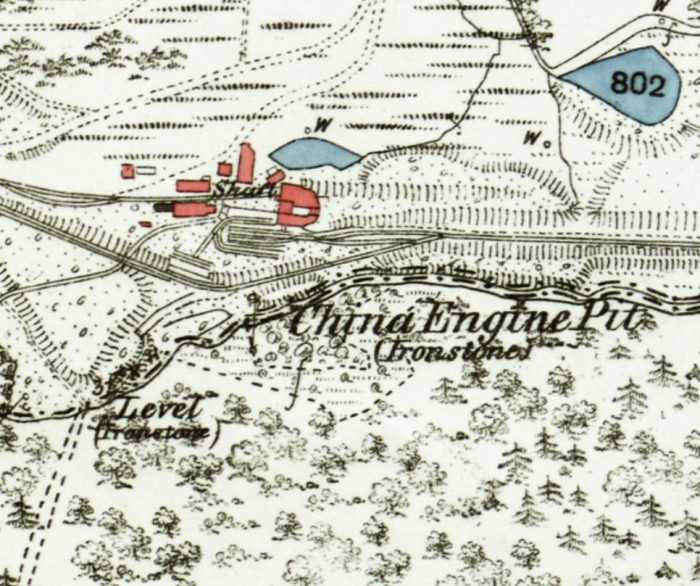
When we reached China Bottom, we joined the route of the Oakwood Tramway which can be seen running left to right across the map extract below. The early China Bottom Branch served the small mines in the Noxon Park. These were superseded by the larger mines at China Bottom and Princess Louise and the early tramway branch was then abandoned and the cast-iron rails were lifted.
Extract from the OS 25″ Map on the mid 19th Century. [5]
China Bottom takes its name from a large iron-ore mine which once occupied the site which was called ‘China Engine Pit’. Its name indicates that the mine had a powerful steam engine which lifted iron-ore to the surface and pumped out water from the mine. “These engines were usually beam engines of the type used in Cornish tin mines, as seen on the TV series Poldark.” [7]
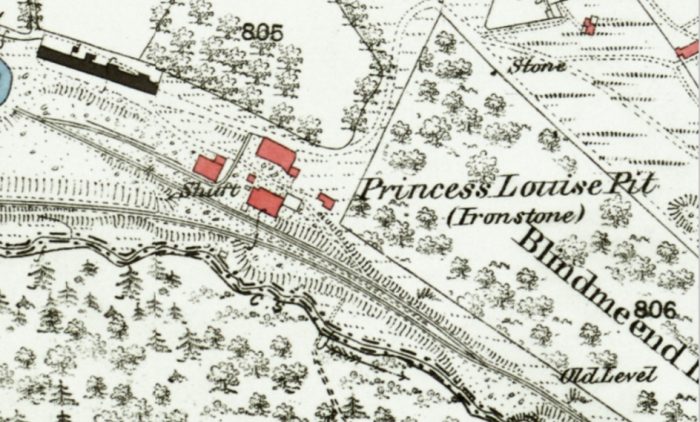
Close by was another large iron-ore mine called the ‘Princess Louise’ which had a 180 metre deep shaft. For more information, see the ‘Derelict Places’ Website. [3]
Princess Louise Pit, OS 25″ Map from the mid 19th century. [6]
The Oakwood Tramway
From location 14 through to between location 20 and 21 our path followed the route of the Oakwood Tramway. We picked it up again by taking a diversion northwards from location 24.
Oakwood Tramway ran, at first, on the Northern side of Oakwood Brook, between locations 14 & 15. The brook was culverted under the tramway and then supplied water power for Oakwood Mill which sat close to the brook between it and the road between Sling and Bream. [1]
At location 16 on the walk we passed Oakwood Mill Land Level, another iron ore mine.
“The land level was driven from 365 feet O.D. at the entrance. It is an adit or tunnel driven into the hill side for a distance of 1650 feet (500 metres). From the far end of the tunnel further levels were driven at right angles to facilitate mining and removal of the iron ore. The level also allowed water to drain from the iron ore measures above 365 feet, allowing previously underwater deposits to be exploited. The level can be seen on Sopwith’s Map of 1835“. [11]
In 1827 David Mushet the metallurgist laid the earliest length of the Oakwood Tramroad from this area to Parkend. “Within a short distance you can observe a series of large flat stones in the pathway. These are sleepers for the Oakwood Tramway which terminated at Parkend and was used to transport mainly iron ore for transfer to the railway at Marsh Sidings (near Parkend’s Fountain Inn).” [11]
To the left and right of the walk route we came across dry mill ponds which originally “fed the water wheel at the Oakwood Corn Mill. The mill occupied the old buildings to the left and the waterwheel which drove the machinery was situated in a sunken chamber at the side. The sluice gate, which released the water onto the wheel, can be seen in the far corner of the stone-lined pond. It is probable that the operation of the mill was sporadic and dependant on the mill ponds containing sufficient water to drive the wheel.” [11]
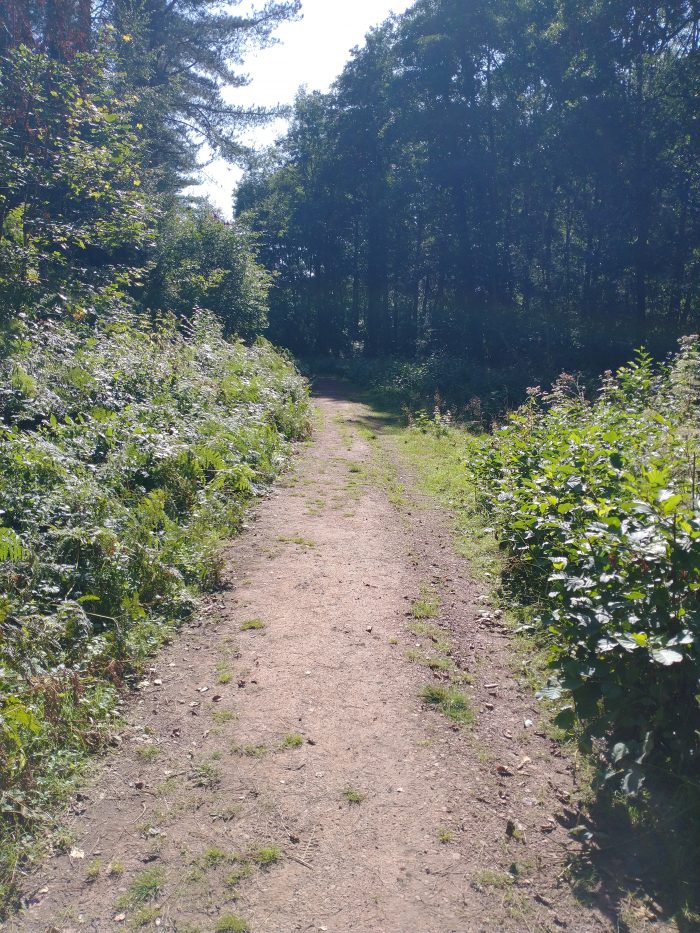
The route of the Oakwood Tramway between locations 14 and 15, 1st September 2020.The different gauges used at different times can be seen clearly in this pisture taken at the Dean Forest Railway at Norchard on 2nd September 2020. The tramway gauge and construction can be seen in the foreground. Tramways in the forest were of 3’6″ to 3’8″ track gauge.
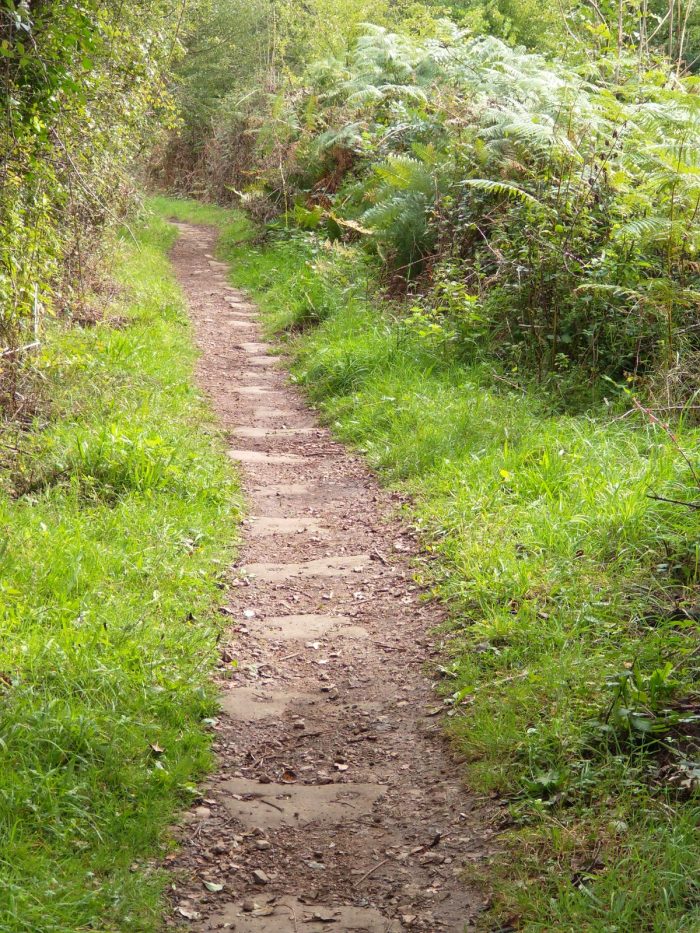
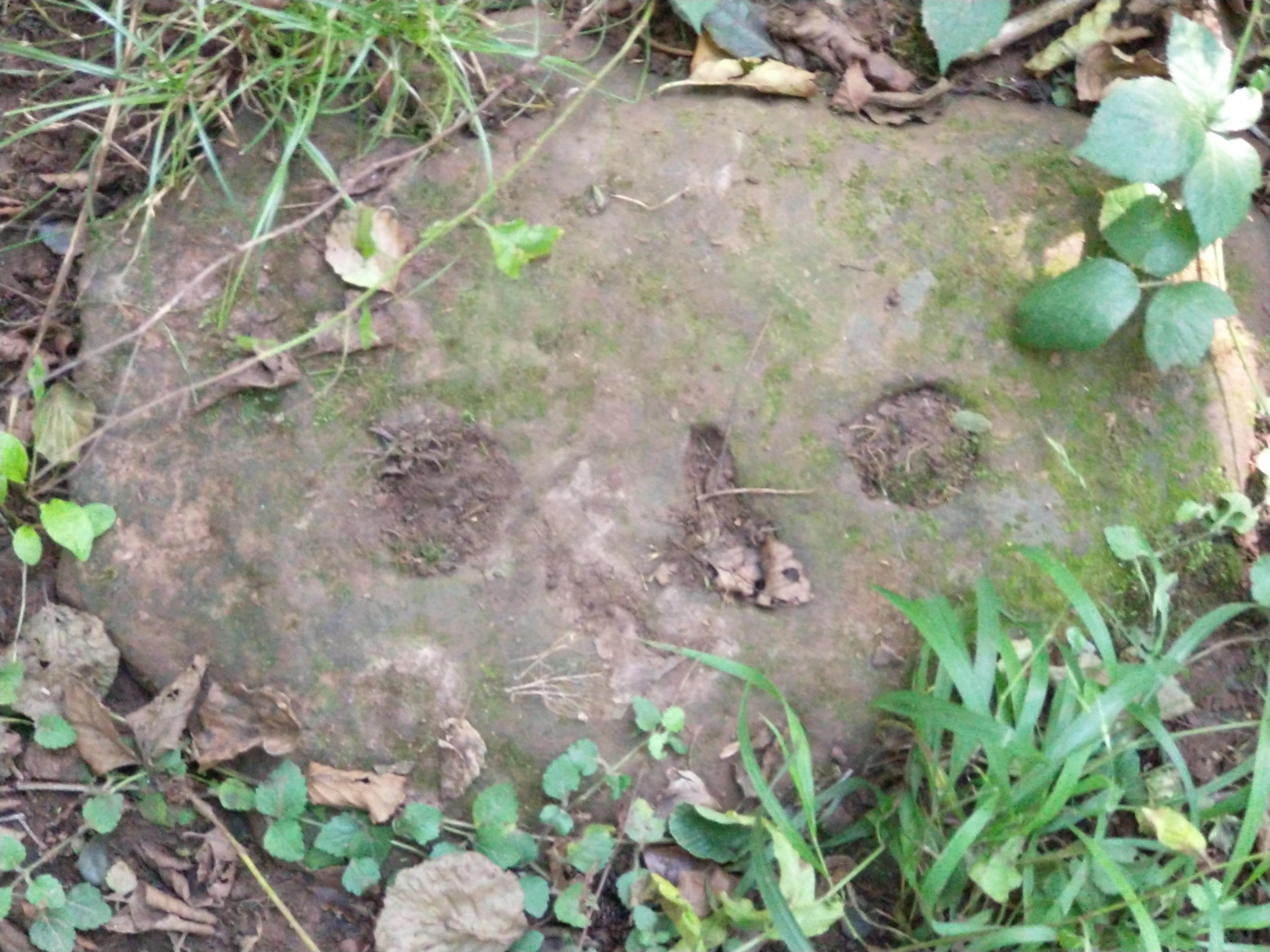
The Oakwood Tramway most probably consisted of L-shaped cast-iron rails resting on stone blocks or sleepers, as shown above, which served to spread the load over the ground, and to maintain the gauge. We located a number of these stone blocks along the first length of the tramway between 14 and 20. Each had two or three holes into which the rails or ‘plates’ were fixed. A few photographs taken on 1st September 2020 at different locations along the path, follow. …
There were long lengths of the route where usage and time have resulted in these stone blocks/sleepers being covered. “From this point, the tramroad did not plunge down the slope to the bottom of Mill Hill, it ……. went to the right and took a level path that hugged the hillside as it continued along the valley.” [12] It then turned to the Northeast following the valley.
In the valley bottom is what, in the 21st century, is a large white rendered private house. This was, until 1969, the ‘Oakwood Inn’.
At location 19 on the walk we passed what was once Oakwood Mill Deep Level iron-ore mine. It was driven in the early 1800’s by “David Mushet and it drained water from the earlier surface workings, both draining the mine of water and allowing a much easier extraction of ore.” [13] And at location 20, we passed the remains of Bromley Furnace.
The next significant location on the walk is the Oakwood Chemical Works and Flour Mill Colliery. We will return to look at the route of the tramway after we have looked at the Flour Mill Colliery site.
Flour Mill Colliery and its present use.
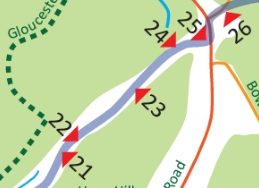
At locations 21, 22 and 23 on the walk we passed the site of Flour Mill Colliery. The walk runs immediately alongside the remaining colliery buildings on the line of the old tramway.
A while ago, the Colliery and the current use of its remaing buildings featured on my blog. [4]
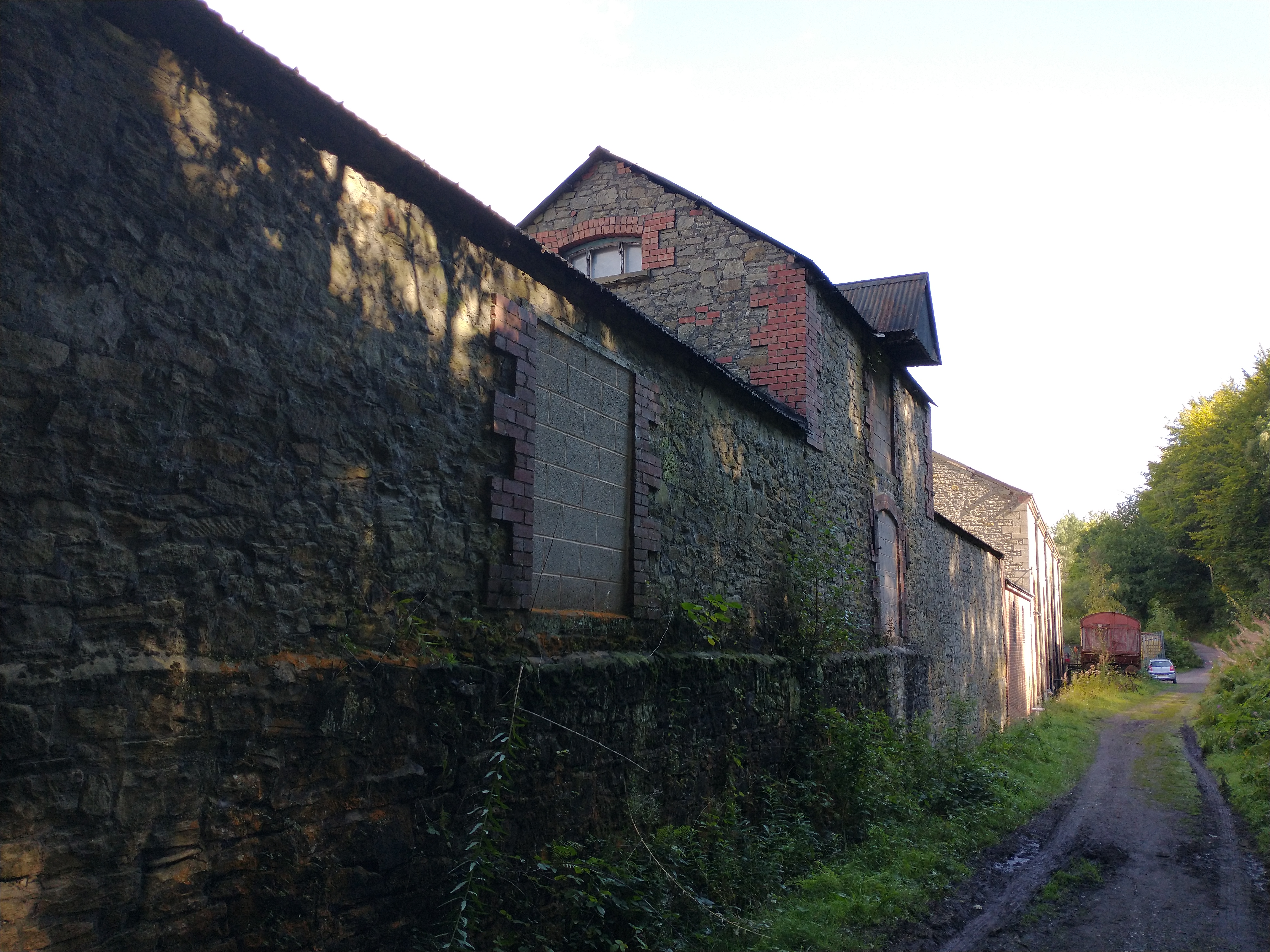
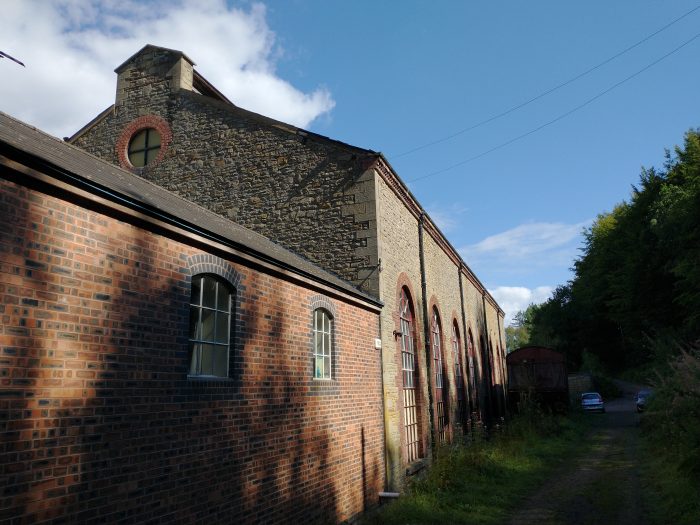
The buildings of Flour Mill Colliery sit immediately alongside the route of the Heritage Walk, 1st September 2020.The Electricity Generating Hall/Building of the old colliery is now in use as an engineering works, 1st September 2020.
These buildings are now in use for the repair and refurbishment of steam locomotives. We spent a while wandering around the boundary of the works.
For more pictures please click here, [9] and for more information about the engineering works please click here. [10]
The route of the walk deviates away from the tramway alignment approximately at the entrance to the modern works, just northeast of the electricity generating hall. The tramway route begins to drop away heading for the transshipment wharves at Parkend.
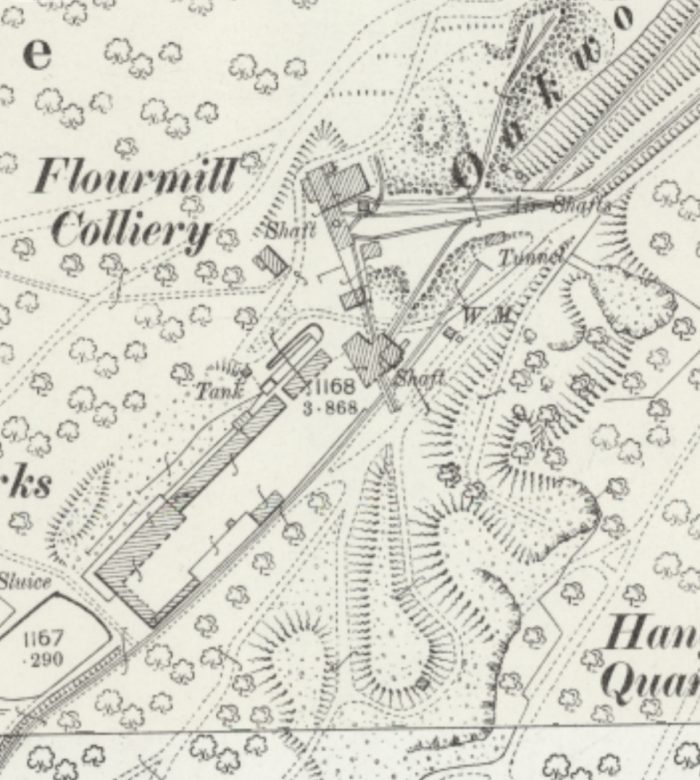
When Flour Mill Colliery was expanding in the late 19th century it had to bridge the Oakwood Tramway which ran through the enlarged site. The later 25″ OS Map extract below shows the site of Flour Mill Colliery towards the end of the 19th century. The Oakwood tramway can be seen bridged by a relative wide man-made land bridge. [15] This is approximately at location 23 on the walk. The Oakwood Tramway leaves the map extract in the top right corner heading for Parkend. A rope-worked incline runs away to the right just to the South of the Oakwood Tramway. That incline led to what was most recently known as the Princess Royal Colliery. ……
The 25″ OS Mapping of the late 19th century shows that Flour Mill Colliery had two shafts. The more southerly of the two had required a bridge between the shaft and the colliery spoil heaps. The more northerly of the two shafts, later required a land bridge over the tramway which was first culverted before the land was built up to provide access across the Oakwood tramway to a rope worked incline which took coal from Flour Mill Colliery to Princess Royal Colliery. [8][14]
The Oakwood Tramway again
25″ OS Map extract [18]
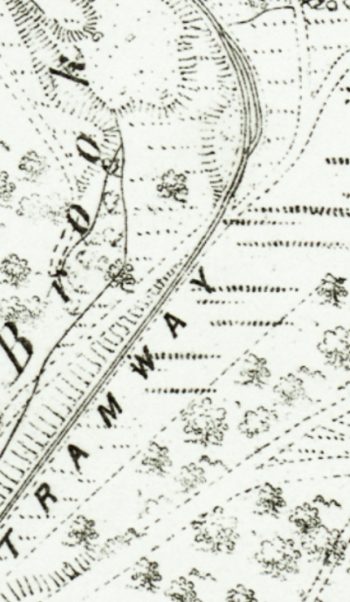
To the Northeast of the land bridge, Oakwood Tramway was in deep cutting. Its route could only be found by taking a deviation from the Bream Heritage Walk at location 24 on the walk route shown above. It was a delight to find significant remains of the tramway between this point and the Parkend Road.
The Oakwood Tramway was a single-track line with passing places. The two pictures immediately below were taken to the North of location 24 on the Bream Heritage Walk. They show the location of one of these passing places. A shirt loop of line left the main route and returned back to join it in a very short distance. Just long enough to accommodate a train of trams and their motive power (a horse or two)! The map extract below shows the location. [16]
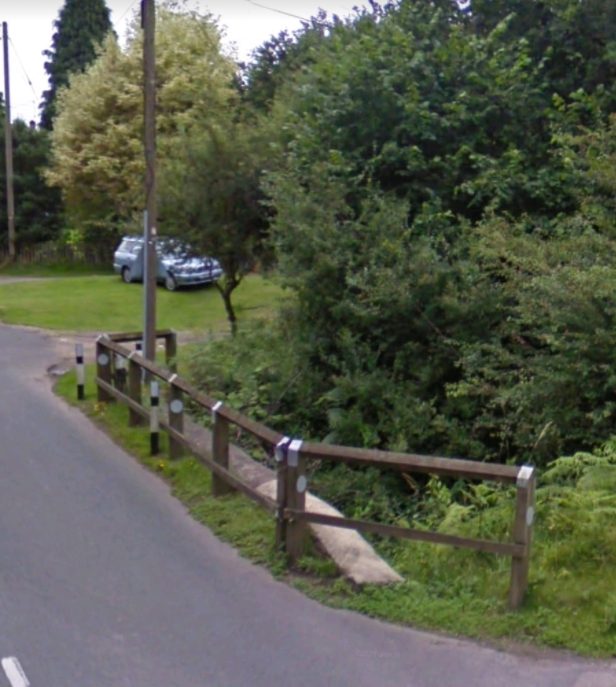
The two pictures show the northern end of the passing loop which can be seen on the OS Map above. The first looks north, the second looks South. Both pictures were taken on 1st September 2020.The rope-worked incline passed under the Bream to Parkend Road at this location. The barrier protect the drop into the cutting, (Google Streetview).
Our walk turned away from the Tramway just North of the location of the passing loop shown in the pictures above. We walked up to the Parkend Road and turned back towards Bream. We were able to make out the point where the rope-worked incline passed under the road. The last picture above was taken from the Bream to Parkend Road at location 25 on the Bream Heritage Walk,
We were staying in the Forest of Dean in September 2020 and followed the Bream Heritage Walk. Details of the walk can be found on my blog, [1] and independently on-line here. [2]
The walk passes alongside the engineering works at Flour Mill Colliery. [3] We spent a while walking round the industrial site before continuing our walk.
“The Flour Mill is a listed building which was converted to a railway workshop in 1995 – 1996, and used as such since 1996. The Flour Mill Ltd operates the business in the building undertaking work repairing and overhauling steam locomotives.” [3] Please note that this is a working site and not a visitor attraction.
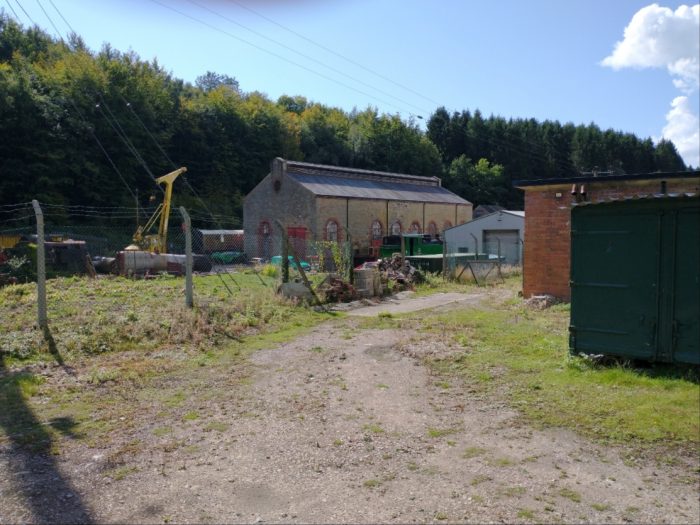
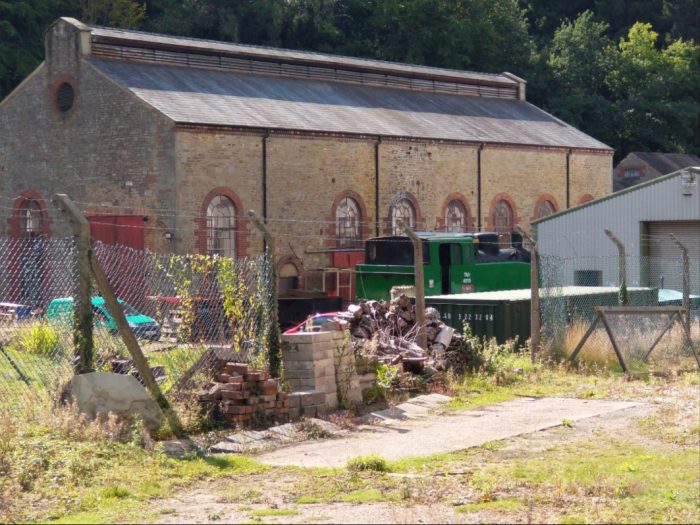
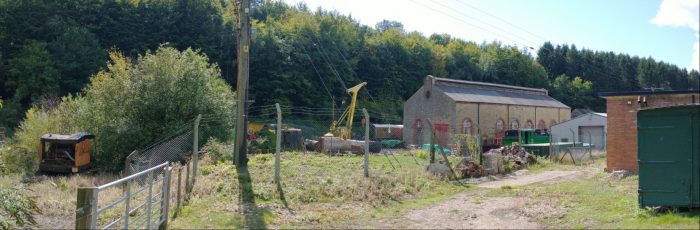
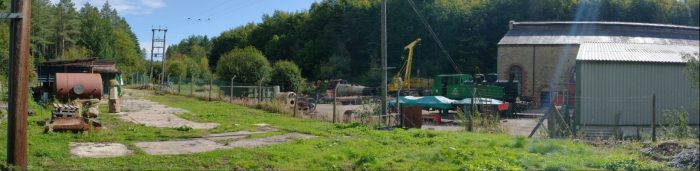
It was possible, from outside the boundaries of the site, to take a number of photographs which might be of interest. …..
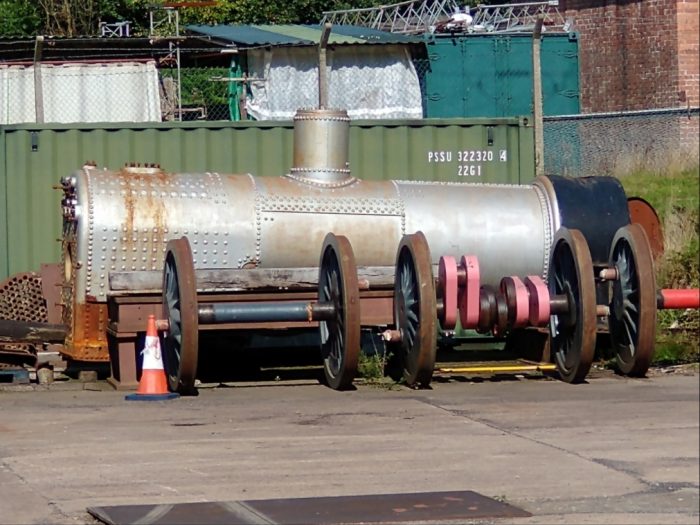
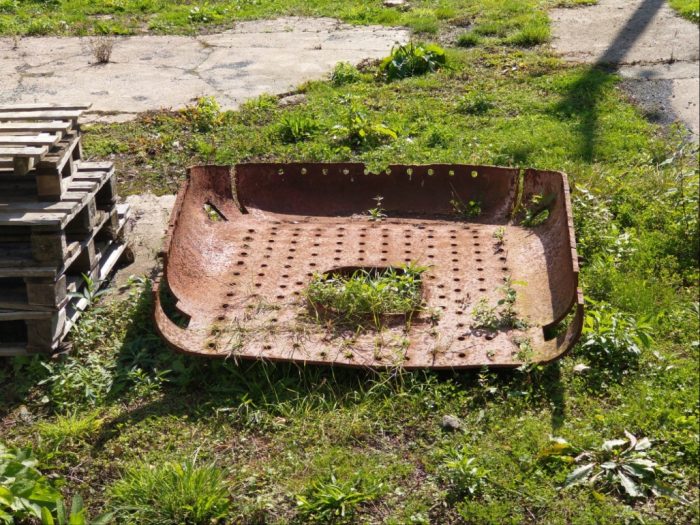
Locomotive boiler and driving wheels/axles. Others may be able to give an idea of the provenance, 1st September 2020.
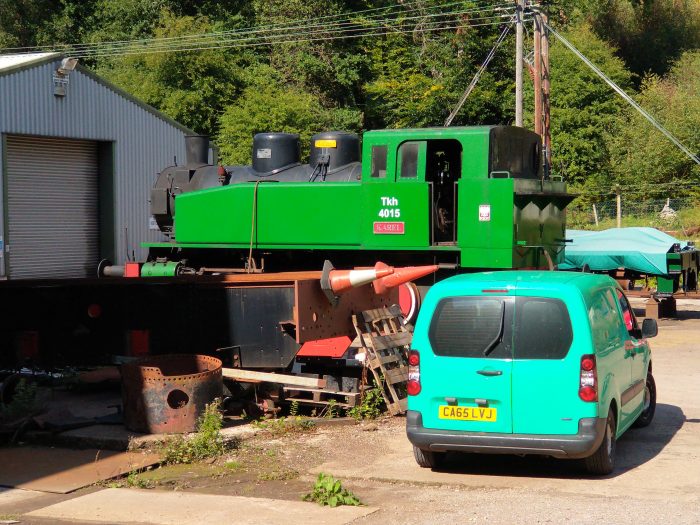
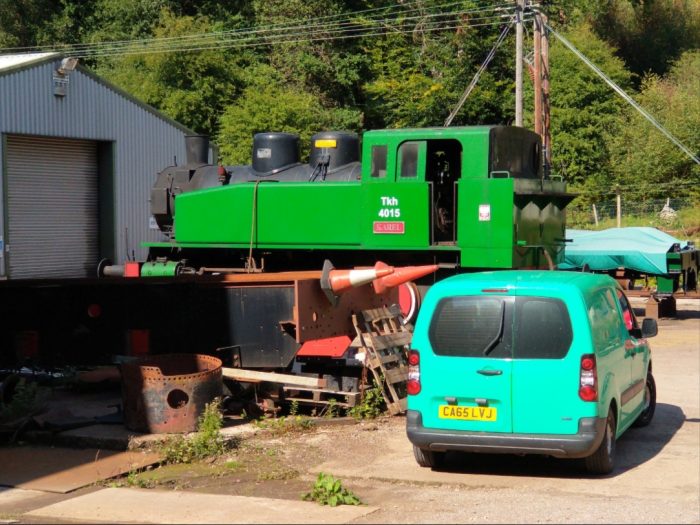
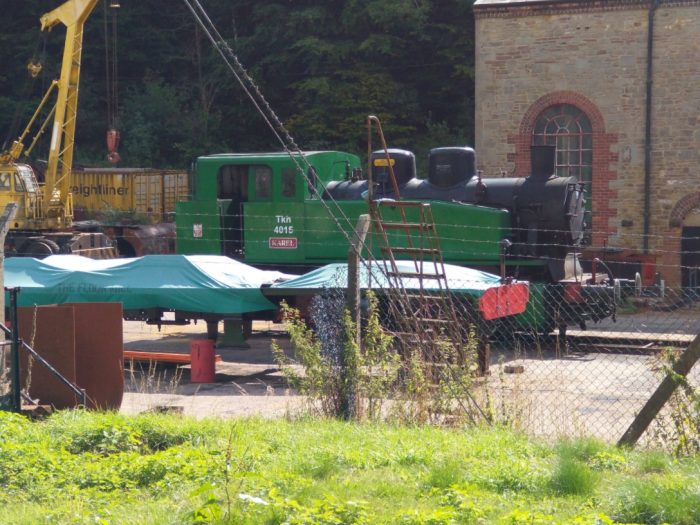
These two photographs show Locomotive TDK 4015 ‘Karel’ outside the main works building. This locomotive was imported to UK and moved to the Avon Valley Railway. It was withdrawn in 2013, and sent to the Flour Mill in the Forest of Dean for overhaul. It returned to traffic September 2016 but was back under repair again in 2020. It was made by Fablok, Poland in 1947. [4][5] (1st September 2020).
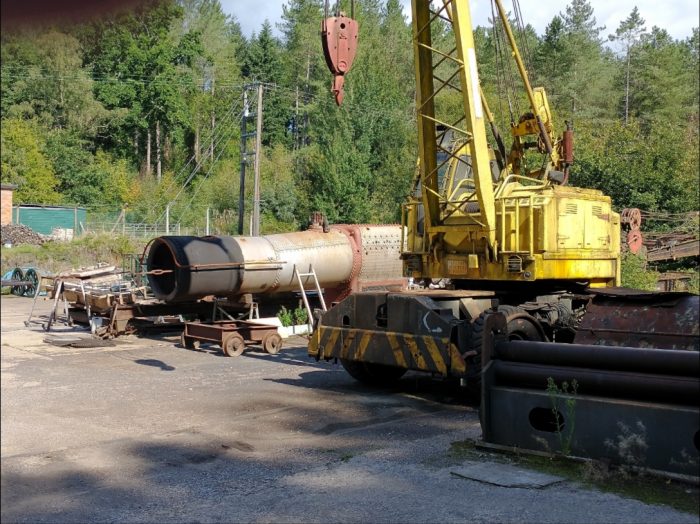
Another locomotive boiler and the site crane, 1st September 2020.
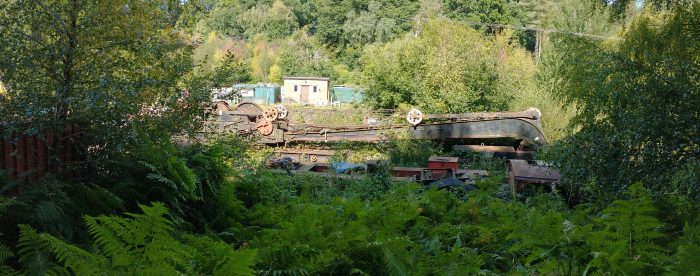
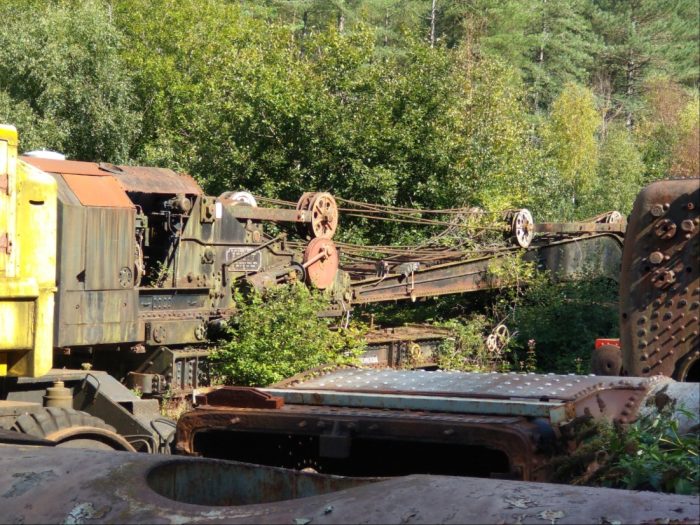
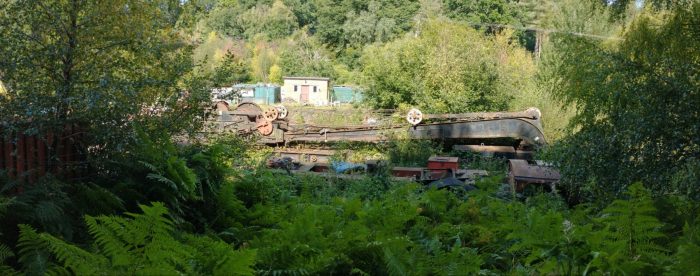
These two images show a railway crane awaiting refurbishment. I will have to rely on others to provide more information! (1st September 2020).
The next series of images are all taken from the North boundary of the site.
More information about the site can be found on The Flour Mill’s website. [3]
This post continues a series of reflections on the tramway network in and around Nice which are primarily based on Jose Banaudo’s French language book “Nice au fil due Tram Volume 1: l’Histoire” [1]
Jose Banaudo’s excellent book on the Trams of Nice is sadly not available in English. This series of posts seeks to translate the text of the book for an English audience.
A more general impression of Nice in the War Years can be found on the Calameo website. [2] An English reader will require translation software or a good knowledge of French.
The Difficult Years (1935-1944)
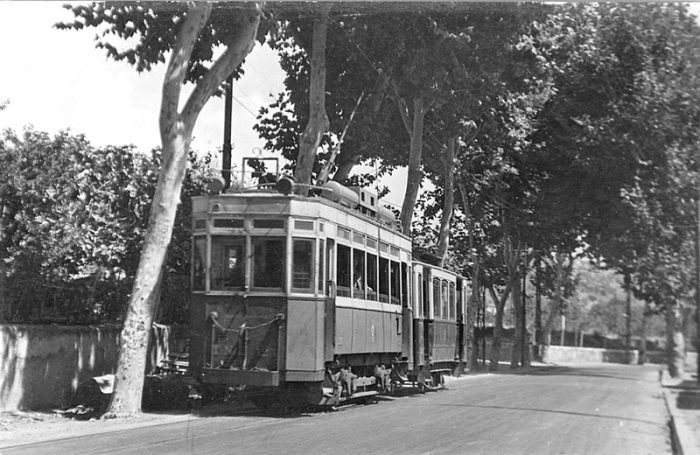
Following the wave of tramway closures between 1929 and 1933 of departmental lines and in 1934 on the urban network, the length of the network operated by the TNL was reduced to almost a quarter of the pre-war mileage. The fleet of rolling stock had been reduced by almost two-thirds, with a usable fleet of fifty-eight powered cars and twenty-six trailers, plus ‘tractors’ and wagons assigned to freight traffic. At that time, only Paris and Nice had so profoundly transformed their network; in all other major French cities, buses had been introduced to complement existing tram lines or to replace those that were proving particularly difficult to operate.
Closures continued in subsequent years. Another reviewe of the urban network took place, and on 18th March 1935, tramway lines 4, 6 and 7 to the East of the City of Nice were converted to road vehicles.
On 18th November 1935, the tramway lines 20 from St. Laurent-du-Var and 29 from St. Augustin were switched to buses. In addition, the lines 37 from Contes and 38 from La Grave were extended towards the city centre with a new terminus on Gioffredo Street (at the corner of Place Massena).
On 20th June 1936, the staff of the TNL went on strike to demand the repeal of the laws decreed by the French government and to insist on a reduction of the working week to forty hours. Work resumed on 3rd July but not on the lines north of the PLM mainline. The company closed these routes during the strike.
The year 1937 saw no improvement in the company’s finances. The fleet of vehicles was reduced, the station at Place Garibaldi and a depot at Carnoles was abandoned. The TNL was also closing bus lines. Six were to go in July 1937.
Interurban bus lines that had replaced the trams were also gradually being handed over by the TNL to private carriers.
In 1938, the finances of the TNL continued to deteriorate. By 15th August 1938, the tram lines had been reduced to five: 21 from La Madeleine, 22 from Carras, 29 California (shortened), 35 from Cimiez, 36 from La Trinite, plus a partial service 36 shortened to the Carrieres de Bon-Voyage. However, the situation was far from stabilized and in the year leading up to the declaration of war, there was hardly a month that went by without significant changes to the network.
Banaudo records the following TNL tram lines still in existence:
No. 3, Gioffredo – La Trinité;
No. 3A, Gioffredo – La Madeleine;
No. 9, Port – Gioffredo – California;
No. 22, Port – Station – Carras;
No. 35, Hôtel-des-Postes – Cimiez;
and these TNL bus routes still running:
No. 1, Port – St. Sylvestre;
No. 2, Riquier – St. Maurice;
No. 4, St. Sylvestre – Hôpital-Pasteur;
No. 6-7, Circulaire Passage-à-Niveau – St. Roch;
No. 8, Gare du Sud – Caucade;
No. 8A, Garibaldi – Caucade. [1]
References
Jose Banaudo; Nice au fil due Tram Volume 1: l’Histoire; Les Editions de Cabri, 2004, p97-100. Translated using ‘deepl’ translation software in August 2020.
Wikipedia gives us a very short history of the line from Strabane to Letterkenny and provides a single image – the Railway Clearing House map with stations in Strabane and Letterkenny:
The Railway Clearing House map with stations in Strabane and Letterkenny. [3]
“The County Donegal Railways Joint Committee (CDRJC) constructed the Strabane and Letterkenny Railway. It opened for public service on 1 January 1909 with a route length of 19.25 miles. It was the last railway constructed by the CDRJC bringing the network operated by this company to 121 miles. The company pioneered the use of diesel operated railcars, but despite this innovation, closure came at the end of 1959, and the railway was shut on 1 January 1960.” [2]
This history must be worth expanding! It gives so little detail!
Wikipedia tells us that Letterkenny was already rail-served in 1909. “‘The Londonderry and Lough Swilly Railway Company’ (The L&LSR, the Swilly) was an Irish public transport and freight company that operated in parts of County Londonderry and County Donegal between 1853 and 2014.” [4] Incorporated in June 1853, [5] “it once operated 99 miles of railways. … It closed its last railway line in July 1953 but continued to operate bus services under the name Lough Swilly Bus Company until April 2014, becoming the oldest railway company established in the Victorian era to continue trading as a commercial concern into the 21st century. Following a High Court petition by HM Revenue and Customs, the company went into liquidation and operated its final bus services on 19 April 2014.” [4][7][8]
The first railway station in Letterkenny opened on 30th June 1883. The line out of Derry started out as the “Londonderry and Buncrana Railway” and was absorbed into the L&LSR in 1887. [9] That line is not the subject of this article but it is important to note that Letterkenny had been rail-served for many years before the branch from Strabane arrived in the town.
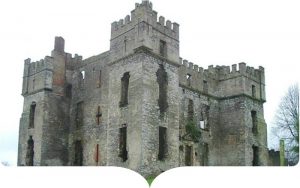
Raphoe Bishop’s Palace. [10]
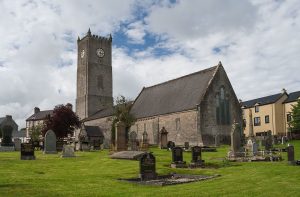
Raphoe Cathedral. [11]
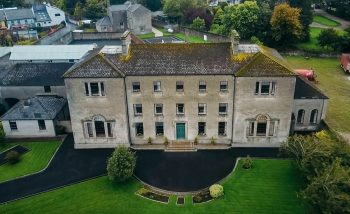
Raphoe Royal and Prior School in 21st century. [12]
Patterson et al [1: p41] explain that the Co. Donegal Railways from Strabane to Stranolar – which were accessed from Londonderry over either the Great Northern Railway (along the valley of the River Foyle) to Strabane or the more tortuous route owned by the Co. Donegal Railways which passed over the higher ground to the East of the River Foyle, through New Buildings, Collion, Donemana, Ballyheather and Ballymagorry and on to Strabane – ran to the South of an area which included the small towns of Raphoe and Convoy. The L&LSR ran to the North of this area. “At the end of the 19th century, Raphoe had a population of around 700, …. centred around a cathedral, a ruined bishop’s palace and a Royal School. Convoy, only about a third he size of Raphoe, was a manufacturing village with a reputation for woolen textile manufacture. By Donegal standards, the people living there felt they ought to have a railway.” [1: p41]
That sense of entitlement built on endeavours which began as early as 1860 but which foundered on more powerful interests. It wasn’t until around 25 years later that a light railway/tramway was planned between Strabane and Drumcairn and it became more likely that the area would be rail served. However, that scheme also foundered for lack of money. [1: p41]
It was 1902 when a new version of the scheme was proposed at an estimated cost of £100,000 which ran between Strabane and Letterkenny via Lifford, Ballindrait, Convoy and Raphoe. The scheme was the subject of a bill submitted to Parliament in the winter of 1902-3. [1: p41-42] That application failed to achieve its key objective of reaching Letterkenny. The Act only allowed a line from Strabane to Convoy. A further submission was made in 1904 and was successful. The promoters called the line the Strabane and Letterkenny Railway (S&LR) and within no more than a year it had effectively been taken over by the Great Northern Railway in advance of their takeover of the Co. Donegal Railway. [1: p42-43]. Work started on building the line in 1906. Robert McAlpine and Sons were the principal contractor. The line was eventually opened to traffic on New Year’s Day 1909. [1: p43-44]
Patterson et al comment that “since much of the share capital of the S&L had been provided by the Midland and the Great Northern, owners of the CDRJC since 1906, it was natural that the Joint Committee should take over the operation of the line and work it as a branch. ” {1: p44-45]
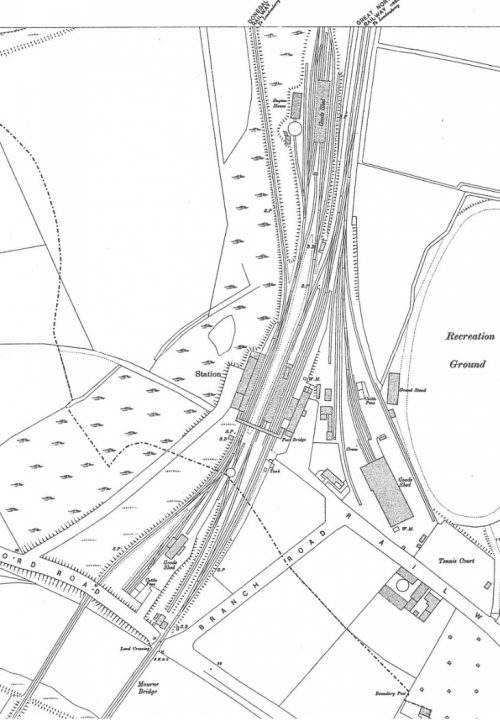
1905 Ordnance Survey Map. [14]
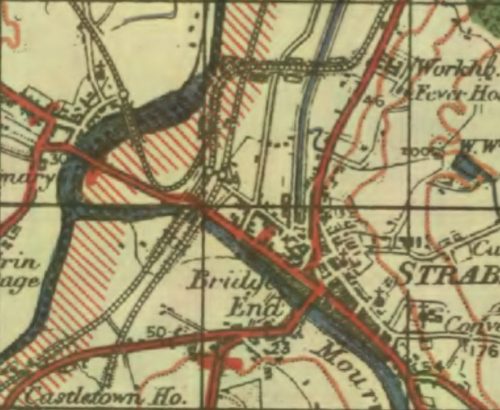
Strabane Railway Station was first opened in 1847 on the Great Northern Irish standard-gauge line. It expanded to include the narrow-gauge Co. Donegal lines in 1894 when the new narrow gauge crossed the river into the southern end of the station.
Prior to the narrow-gauge, the Finn Valley railway shared the southern approach to the railway station with the Irish North Western Railway – the predecessor of the GNR. The Finn Valley Railway was held to ransom for access into Strabane Railway Station. The advent in Ireland of the new 3ft gauge railways encouraged the directors of the West Donegal Railway (WDR) to choose that gauge for their new railway in the late 1870s. After a period of mixed gauge use of Stranorlar Railway Station, Parliament sanctioned the amalgamation of the Finn Valley with the WDR in 1892 and in 1893 powers were obtained for a change of gauge between Stranorlar and Strabane and for the construction of a new narrow-gauge link from the old Finn Valley junction with the GNR into Strabane Railway Station. [1: p19-28] That link appears on the 1905 Ordnance Survey Map above. The map was drawn only a few years before the construction of the S&LR.
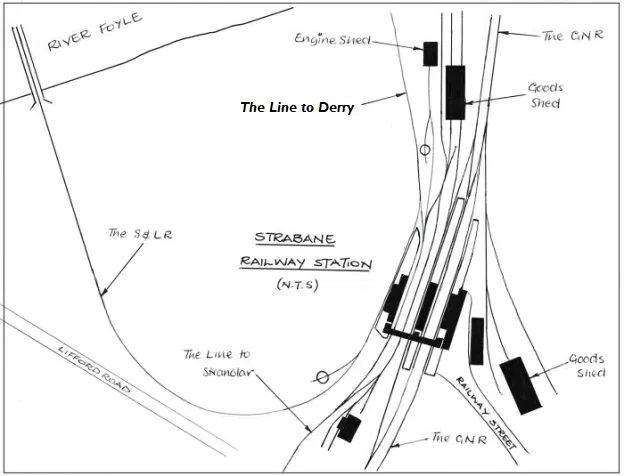
My sketch below shows the layout of Strabane Railway Station in the years following the construction of the S&LR. Strabane Railway Station in the 1930s (c) Roger Farnworth
A Journey Along the Line – Strabane to Letterkenny – Part A – Strabane to Raphoe
Strabane on the GSGS Map from the 1940s. The GNR runs roughly North-South the Co. Donegal runs from the top right to the bottom left with the branch to Letterkenny returning to the North edge of the map having passed through the Railway Station at Lifford. The station at Strabane is marked by the linked roundels near to the centre of the map. [13]
On the GSGS 1940s OS Map, the Strabane to Letterkenny branch is shown leaving the Co. Donegal mainline just to the North of Strabane Railway Station. My sketch above shows the actual arrangement. It was difficult to fairly represent the track arrangement at the station at the scale the GSGS Maps were drfated. Letterkenny trains left Strabane Railway Station at the station platforms and then turned sharply round to the Northwest before crossing the River Foyle and entering Lifford Railway Station.
Recently, I have been consulting with Chris Amundson. The link immediately below shows what is known about the layout of Strabane Railway Station in different eras:
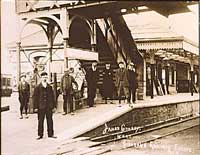
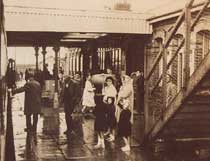
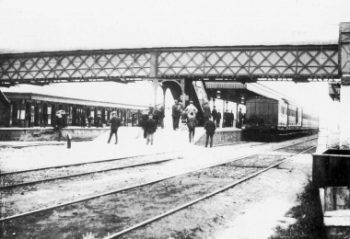
The next few pictures show the footbridge at Strabane Station. The first three are relatively low resolution images posted on the BBC Northern Ireland Your Place and Mine website. [15]
These first three images are taken looking North through the Station. The first is taken from just South of the Western station platform. On the far left of the image the S&LR platform can be glimpsed. The second shows the main station buildings with the footbridge steps to the right of the image. The third looks Northeast under the footbridge towards the main station buildings.
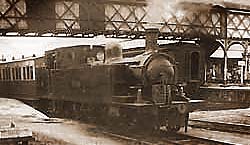
The fourth picture was found on both Sepiatown [16] and OldStrabane webpages [17] It shows the station footbridge, again looking North, from the GNR side of the station. (I have been unable to contact both of the two sites to get permission to share photographs, postcard images, etc., here. Email links, where they exist, no longer function. Should the site owners wish me to remove the images credited to those sites then I will do so and replace them with the links referred to in the references at the end of this article.)
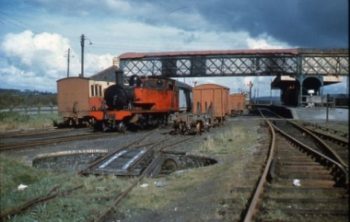
The first colour image shows the station footbridge again, also looking Northeast, this time from close to the Co. Donegal lines turntable. County Donegal Railway No 11 “ERNE” is moving vans in May 1957. [17][18]
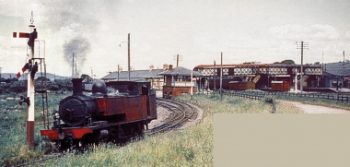
The second colour image shows the same engine (No. 11 ERNE Class 4, 4-6-4 ‘Baltic’ tank), heading away, light engine, from Strabane Railway Station on the Letterkenny line in March 1958. The CDR signal box, and station footbridge are shown in the background. [17][19]
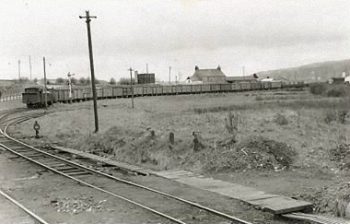
The following image shows a Goods Train approaching Strabane from Lifford, presumably having travelled from Letterkenny. The photographer is looking Southwest from a point near the Signal Box at Strabane. [17][20]
As noted above, these superb images can be found on two sites, http://www.sepiatown.com and oldstrabane.blogspot.com. Each image is individually referenced on the http://www.sepiatown.com website. I have only been able to provide a general reference for the same images on the oldstrabane.blogspot.com website.
Those on the http://www.sepiatown.com website are geographically referenced for their location around the station site.
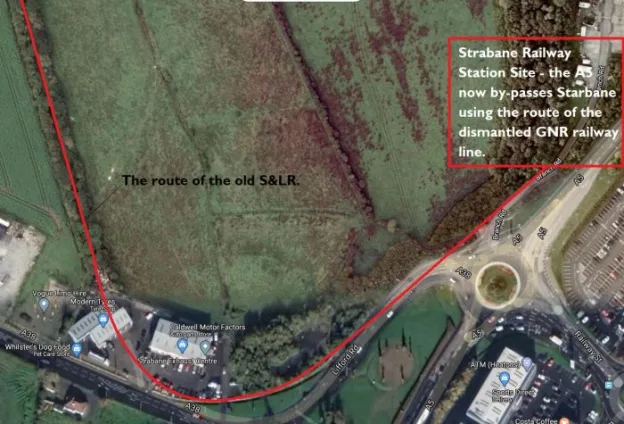
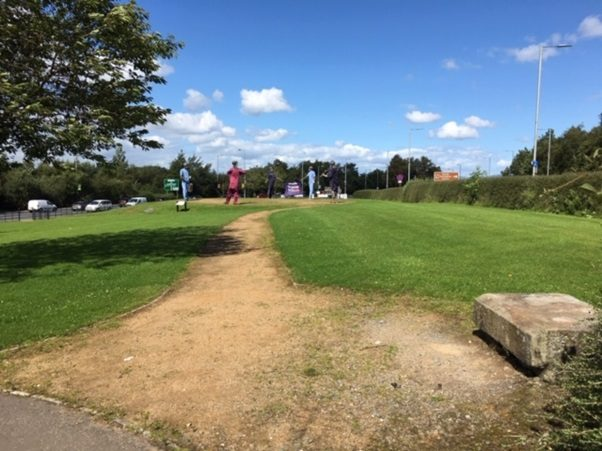
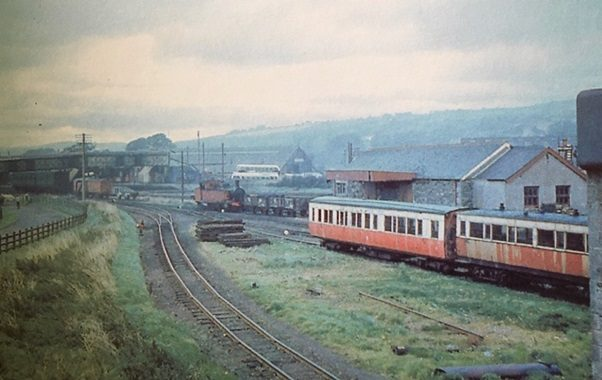
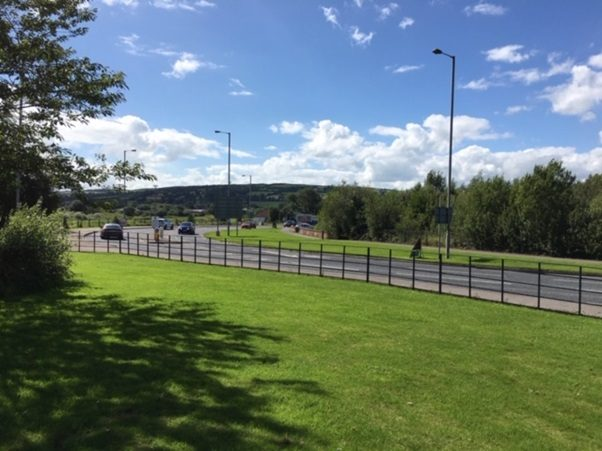
A train prepares to depart for Letterkenny. Platform 5 at Strabane Railway Station. [17][24]Diesel Shunter Phoenix at Strabane Station looking Southwest from Platform 5 – the platform used by the Strabane to Letterkenny services The signal box can be made out beyond the end of the platform. [17][22]Railcar No. 14 at Strabane Railway Station on 20th August 1959, preparing to leave Platform 5 for Letterkenny. [17][23]he Strabane & Letterkenny Railway closed on 1st January 1960. This photograph was taken sometime after the closure (probably in 1965). The rail track has been removed and replaced by a road. The building on the right nearest to the camera is the Co. Donegal Railways signal box. [17][21]he route of the old S&LR is marked by the double row of trees heading North from the modern A38 (Google Maps).Kerry Doherty supplied this photograph for comparison with the one above. It shows Strabane Railway Station and is taken from the “camels hump” bridge. He comments that ‘This site has been much filled in and raised quite a bit.’ Photograph supplied by Kerry Doherty. [45]Kerry Doherty supplied this photograph for comparison with the one above. It shows Strabane Railway Station and is taken from the “camels hump” bridge. He comments that ‘This site has been much filled in and raised quite a bit.’ The line in the centre foreground is the S&LR. Photograph supplied by Kerry Doherty. [45]Turning through 180 degrees, we are now looking in the direction of Lifford, the Letterkenny line trackbed would have been where the grass is on the far side of the road. Curving off sharply to the right (c) Kenny Doherty. [45]
Trains for Letterkenny used the most westerly platform at Strabane Railway Station – Platform No. 5. Trains traversed a very tight curve round to the Northwest, followed a short straight-alignment before crossing the River Foyle.
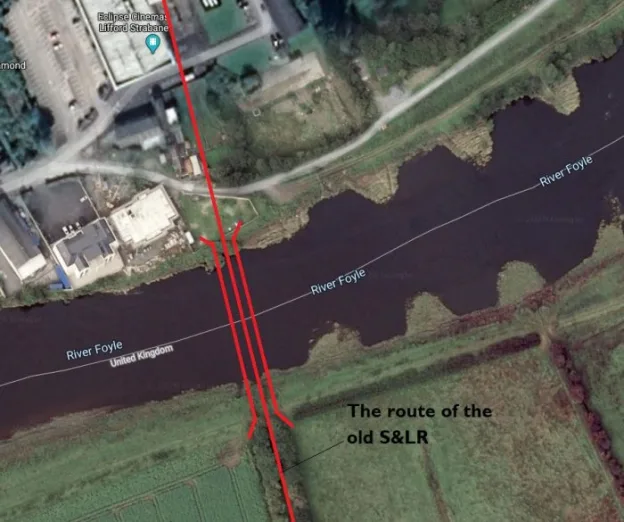
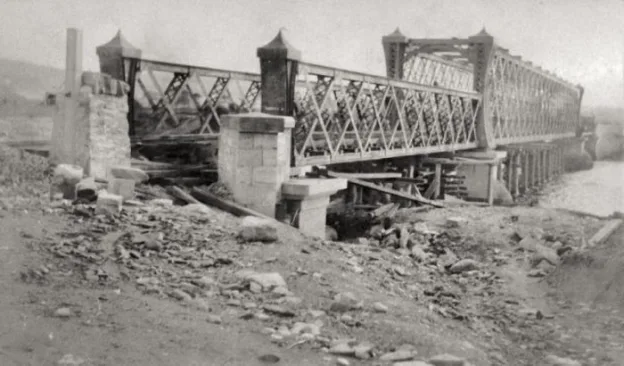
As we have noted, there was a sharp curve in the line out of out of Strabane. THis image shows the trackbed after the curve, looking towards Lifford. Kerry Doherty comments: ‘It’s interesting to note that when the line was lifted in January 1960, this was tarred and the railway bridge used for buses and lorries and the road bridge was being replaced. The tar is still under the moss underfoot,’ (c) Kerry Doherty. [45]Looking across the River Foyle at the location of Lifford Station which is in the trees, (c) Kerry Doherty [45]The magnificent stone abutment of the bridge. This is the southern bridge abutment, (c) Kerry Doherty. [45]The location of Lifford Bridge, (c) Kerry Doherty. [45]Lifford Bridge. Photo by John Langford, supplied for inclusion here by Kerry Doherty. The picture is taken from approximately the same angle as the more modern image above. Lifford Station Halt can be seen on the right side of this image. Kerry Doherty Collection. [45]The location of the old Strabane/Liffor Railway Bridge across the River Foyle. (Google Maps)he Construction of Lifford Railway Bridge. The photographer is on the West side of the River Foyle, looking SE towards Strabane Station on the Strabane-Letterkenny line. The picture was taken in 1908. [17][25]
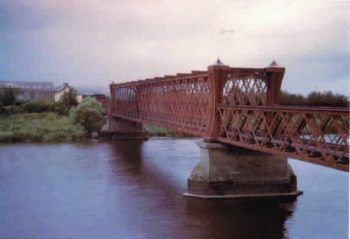
A much later image of the Strabane/Lifford Railway Bridge (c) Margaret (Blee) Fisher. [26]
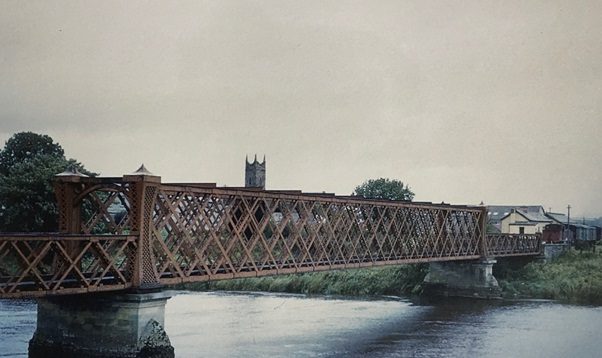
The Strabane/Lifford Railway Bridge over the River Foyle is shown during construction above and much later, probably not long before demolition, in the adjacent photograph.
All that remained in the latter 20th century was the bridge foundations. By the early 21st century, these also were gone.
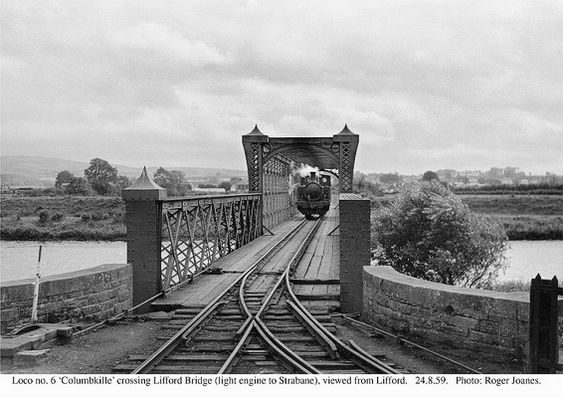
The same bridge in 1959. This photograph is taken from the end of the platform at Lifford Halt (c) Roger Joanes (CC BY-NC-ND 2.0). [29]
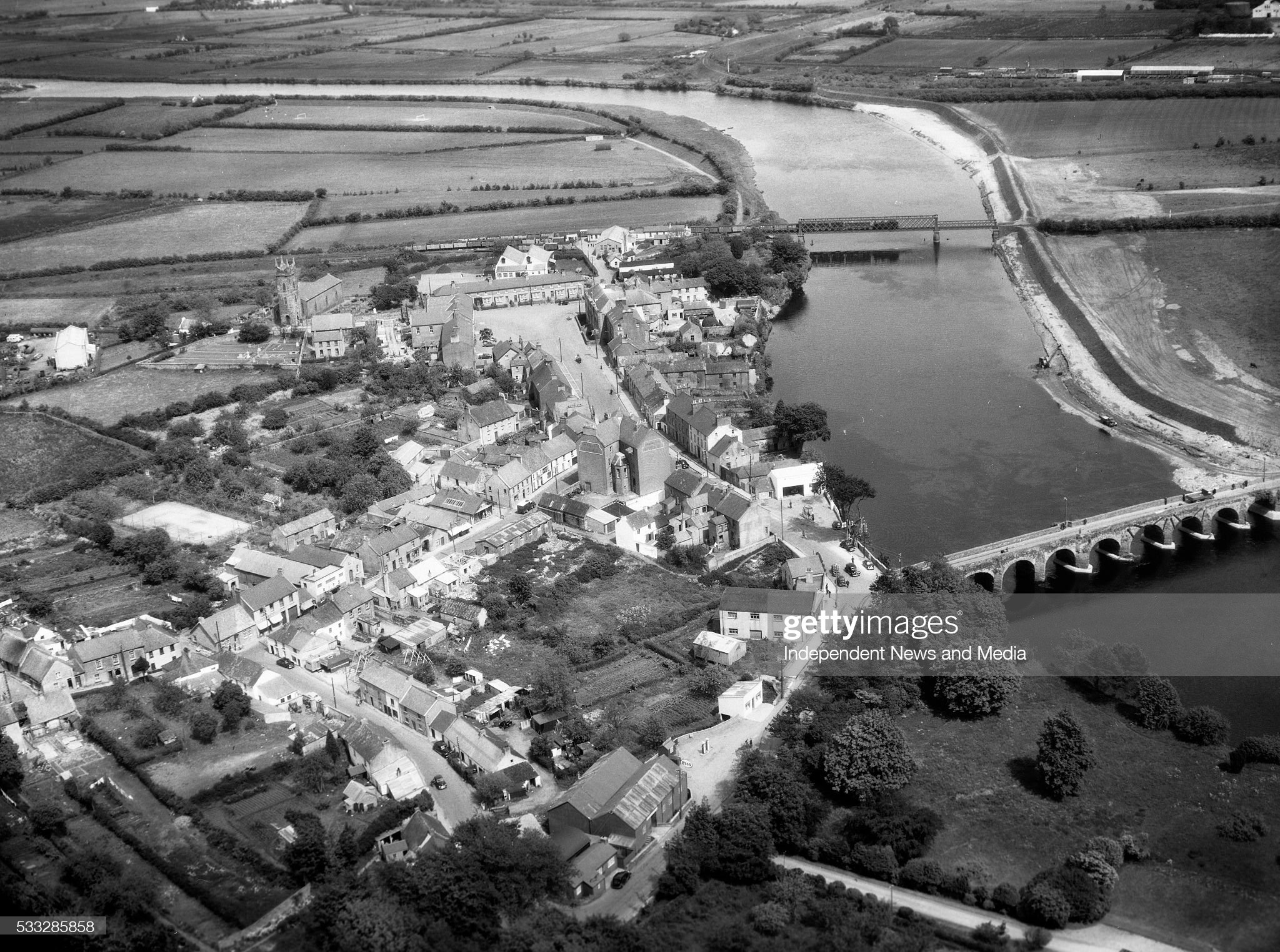
The S&LR bridge can be seen towards the top of this image. Lifford Halt Station is just to the left pf the bridge. This image is embedded with permission from http://www.gettyimages.co.uk. An unidentified Co. Donegal steam locomotive is crossing the bridge in charge of a long goods from Letterkenny. [30]
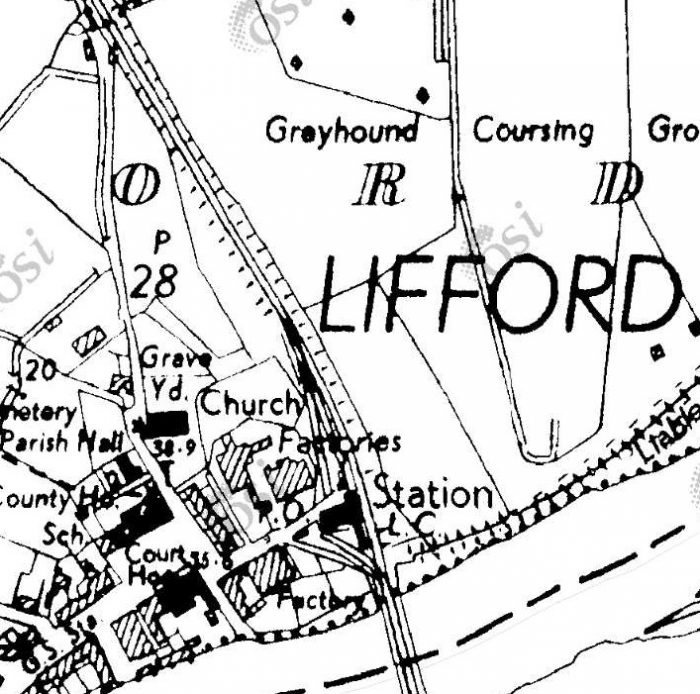
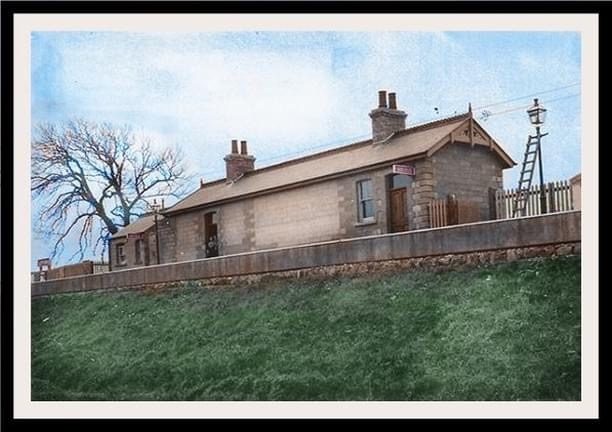
Lifford Station and Railway on the S&LR. [27]Lifford Halt Station Builing, a colourised monochrome image. The photograph was taken by William Lawrence included here courtesy of Kerry Doherty. [43]Lifford Station (from behind), the platform was on the other side of the building. This picture was taken some years ago as the building has been modified and is now surrounded, as can be seen below, by a high fence. The images below show the building as it is now, owned by two different people. The track-side elevation is much better kept and in recent years was the post office, (c) Kerry Doherty. [45]Lifford Halt Station Building (Google Streetview).Lifford Halt Station (Google Streetview).
The photo above appears on the Donegal Heritage Centre Facebook page and is embedded here with permission. [31] There is also an excellent photograph of the station and platform in Anthony Burges book, The Swilly and the Wee Donegal. [44: p30] The satellite image below shows the S&LR just North of the location of the old station.
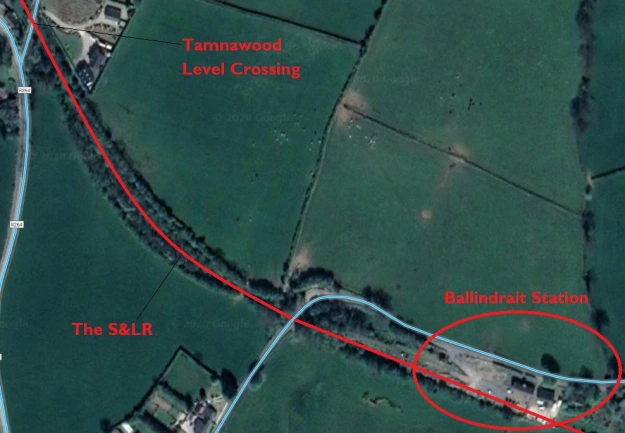
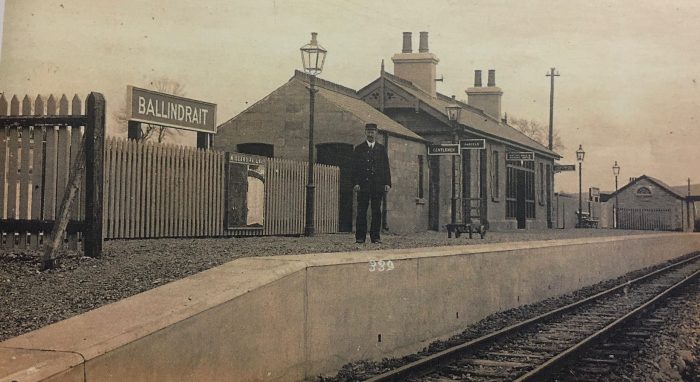
The S&LR (Google Maps)The S&LR [31]The S&LR [31]The approximate alignment of the S&LR approaching Ballindrait Station which is just off the satellite image to the West. [31]The approximate line of the S&LR in the 21st century. [27]Ballindrait Railway Station as first built. This picture is an old postcard view taken by William Lawrence and provided courtesy of Kerry Docherty. [43]
Ballindrait Station in 21st century viewed from the West along the access road from the village (Google Streetview). The building on the right is the old passenger building with the platform beyond.
Ballindrait Railway Station was to the Northeast of the village on the North side of the Deele River.
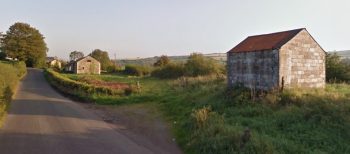
The Goods Shed (Google Streetview).
Ballindrait Goods Shed, looking towards Lifford (c) Kerry Doherty. [43]
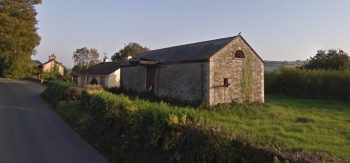
There is a bungalow on the site of the old station, close to the old station house, but many of the buildings associated with the station are also still present. A sequence of views are adjacent to this text, three of which are views on Google Streetview.
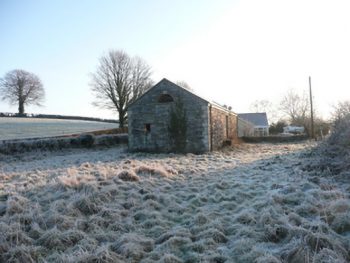
The two wintry views are from the Irish National Inventory of Architectural Heritage. [32]
Ballindrait Goods Shed from the Southwest. [32]
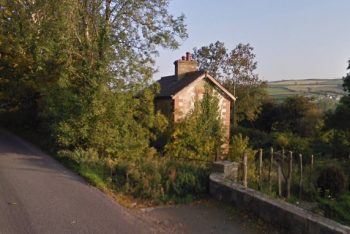
The Station Master’s House (Google Streetview)
There are also some pictures taken recently by Kerry Doherty which show the site from the alignment of the old railway (these make an excellent comparison with one of the images in the book, The Swilly and the Wee Donegal, by Anthony Burges . [44: p31])
Kerry Doherty’s photos include one of the old goods shed looking towards Lifford.
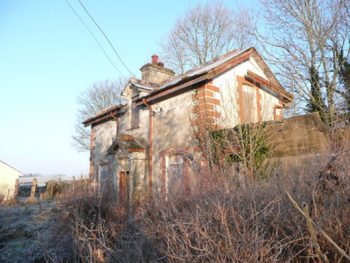
The Station Master’s House from the Southeast. [32]
The station buildings are in a surprisingly good condition having seen little or no maintenance over the years since the closure of the S&LR.
Ballindrait platform shelter and platform remains, looking towards Coolaghy (c) Kerry Doherty. [43]
I am particularly grateful to Kerry Doherty for the modern images which appear to be more up-to-date than the Google Streetview images.
Leaving the station, the railway travelled only a short distance due West before crossing the station access road leading up from Ballindrait village on a steel girder bridge.
Ballindrait platform shelter and platform remains, looking towards Coolaghy (c) Kerry Doherty. [43]
The bridge deck has been removed and the abutments, if they still exist, are completely obscured by vegetation.
Beyond Ballindrait the S&LR followed the route of the R264 closely. The picture below looks back towards Ballindrait railway station in the year before closure of the line.
Leaving Ballindrait the line followed a relatively straight course for a short distance. This view looks back towards the station from just beyond the road under bridge which took the station access road into Ballindrait. [45]
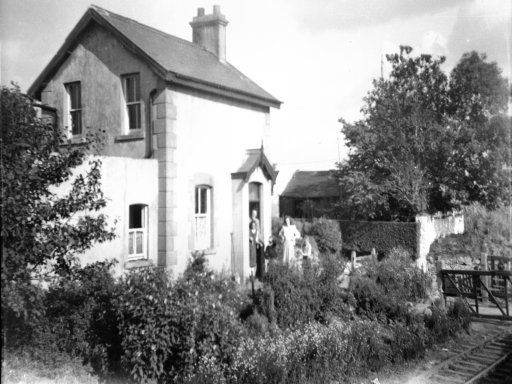
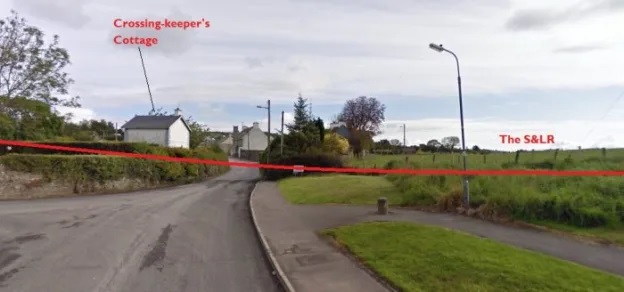
Initially crossing a side road on the level at Tamnawood Crossing. The crossing keeper’s cottage still stands in the early 21st century and is shown below in two images, the first comes from the Irish National Inventory of Architectural Heritage. [33] The second from Google Streetview.
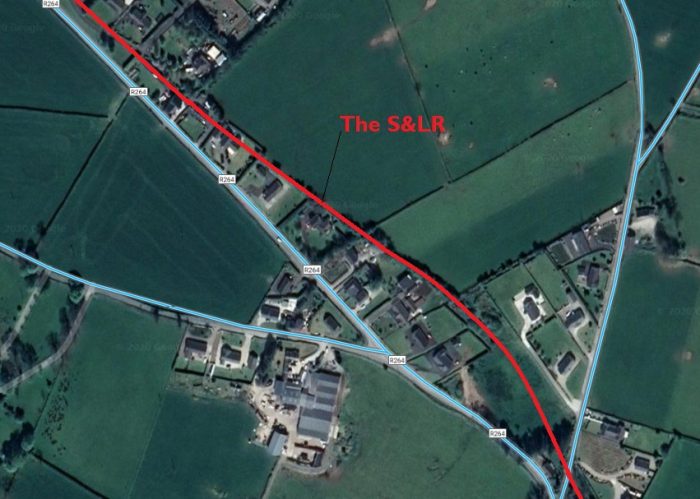
At first it ran along the North side of the road. Modern develop obscures its route. The first two Google Satellite images below show that modern development.
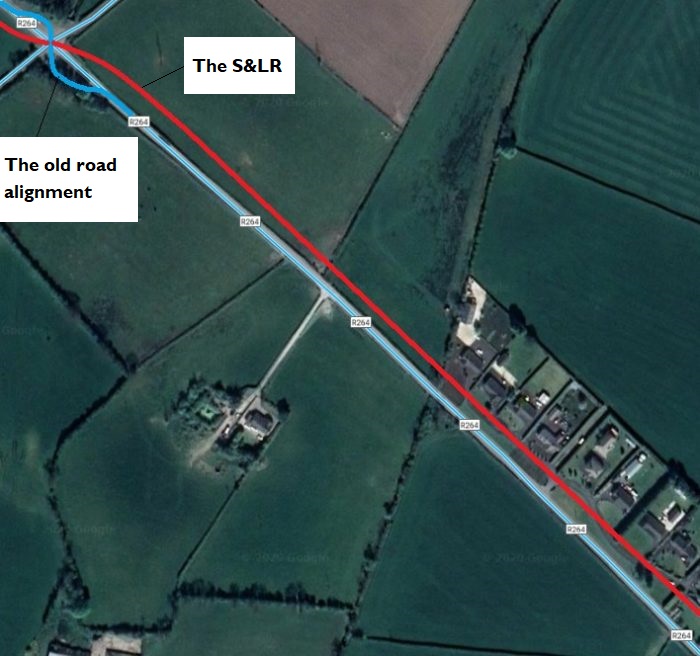
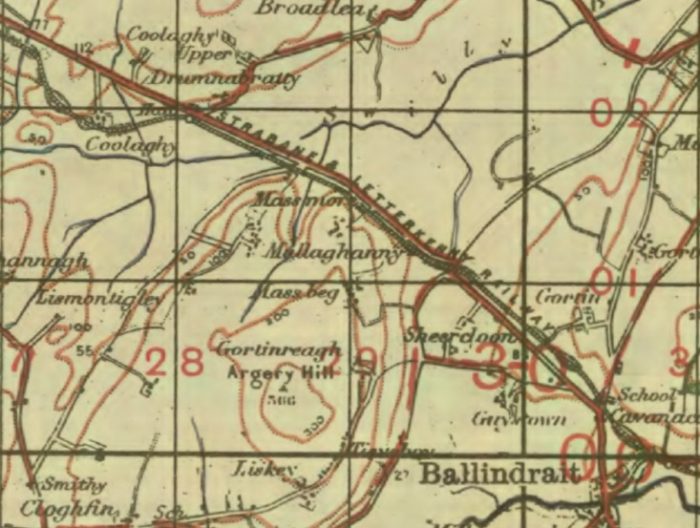
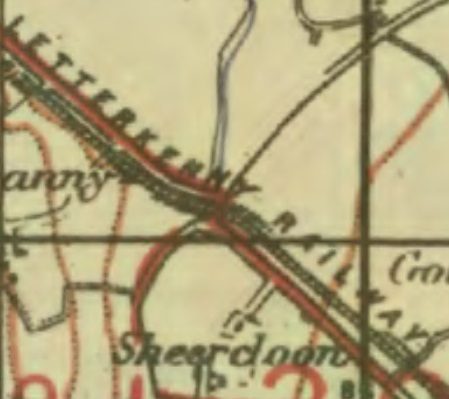
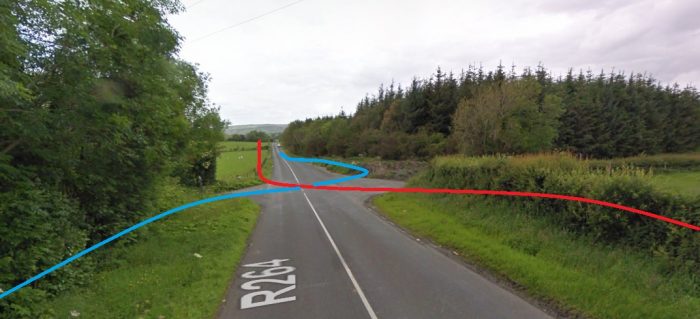
After a few more hundreds of metres, line crossed the R264 on the level. The old road has been realigned at this point. The location can be picked out on the GSGS Map below but is more easily picked out on the larger scale extract provided after the two satellite images.
The approximate alignment of road and rail is illustrated on the Google Streetview photograph below the larger scale map extract.
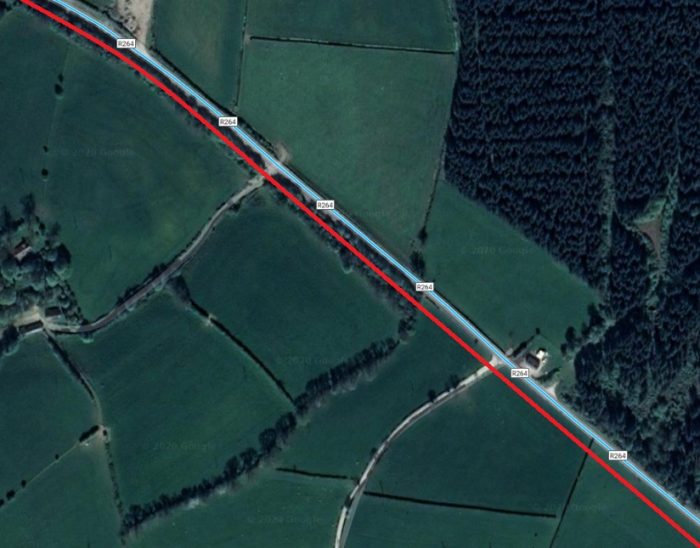
Beyond the road crossing the S&LR followed the South side of the R264, only a few metres away from the carriageway, until it reach Coolaghy Halt where it turned away Southwest from the road.
The route as far as Coolaghy Halt is illustrated on the Google Sateliite images below.GSGS Map from 1941 shows the route of the Strabane to Letterkenny Railway following the route of the Ballindrait to Raphoe Raod (R264). [34]GSGS Map from 1941 shows the point at which the S&LR crossed the R264. [34]The R264 looking Northwest towards Raphoe showing the approximate alignments of the old road and the S&LR (Google Streetview).
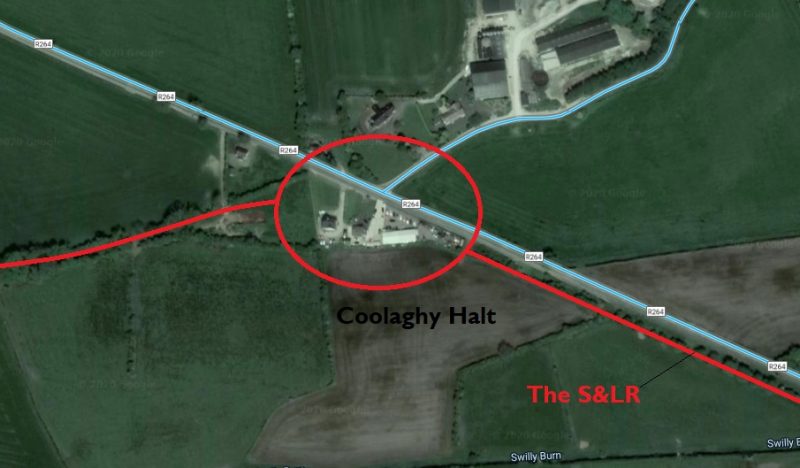
The location of Coolaghy Halt (Google Maps)
Coolaghy Halt was the first point for some distance that the railway left the side of the old road. The route of the S&LR is still easily picked out as a line of trees and shrubs running West-southwest away from the R264.Coolaghy Halt in 1942 from the Tom P. McDevitte Collection courtesy of Kerry Doherty, the image is also reproduced in ‘Railway Days in Strabane’. [43]Coolaghy Halt’s location in the 21st century. The platform was where the fence sits today. Photograph by Kerry Doherty. [43]The location of Coolaghy Halt (Google Streetview)A side road from the Northeast met the R264 at the location of the Halt which was on the South side of the road. The red line on these two Google Streetview images shows the approximate alignment of the old S&LR at this point (Google Streetview).
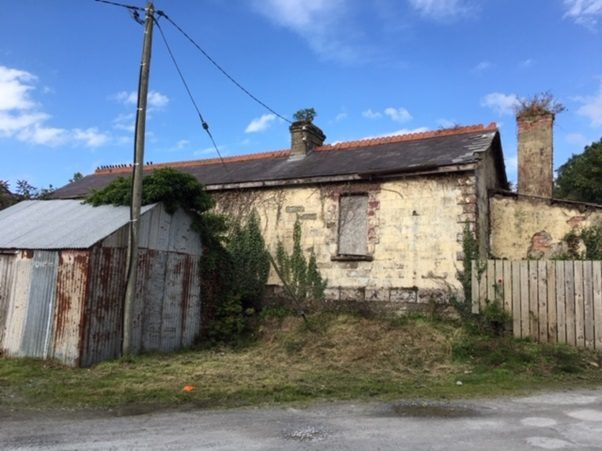
Onward from Coolaghy Halt, the S&LR was only away from the R264 for a few hundred metres, running behind what is now P Connolly Car Sales and Repairs before drifting back towards the road and roughly following its alignment for a few hundred metres before turning away to the Southwest again en-route to what was Raphoe Railway Station.Raphoe Railway Station sat on the South side of the town. [35]
A view from above the cutting just before crossing the road into the Raphoe Station site, you can see the gap where it crossed the road, (c) Kerry Doherty. [45].
There is an excellent view of the station complex available in Ernie’s Railway Archive on Flickr … https://flic.kr/p/2iRSdWW … That image is best seen as part of that album of photographs on Flickr. [40] The next few pictures show the station while the line was in operation.
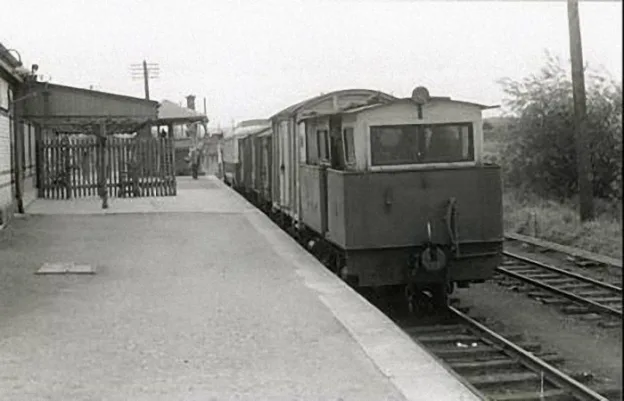
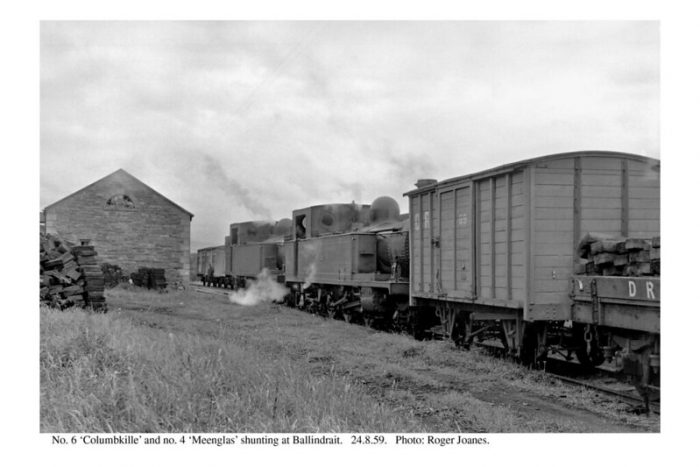
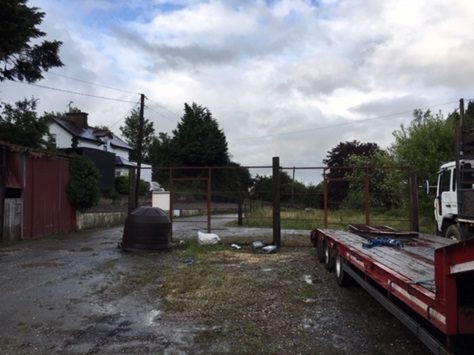
Erne at Raphoe Railway Station in 1959 (c) Douglas Robinson, used with permission from the Co. Donegal Railway Heritage Centre. [36]Shunting at Ballindrait in 1959 (c) Roger Joanes (CC BY-NC-ND 2.0) [41]Railcar No. at Rahoe Station (c) Roger Joanes (CC BY-NC-ND 2.0) [39]A view of Raphoe Station from the West (c) Roger Joanes (CC BY-NC-ND 2.0) [38]The site of Raphoe Station in 21st century taken from a similar position to the last Roger Joanes image above. The Station Master’s House on the left is the only building remaining on the site. Kerry Doherty comments that ‘it was difficult to get a photo of the site as many lorries now occupy the yard’, (c) Kerry Doherty. [45]
We complete the first stage of the journey along the Strabane to Letterkenny Railway at Raphoe. As we noted at the start of this article, this is a place with a long history and it is worth the stopover to see the town!! There are two superb pictures of the station in Anthony Burges book, The Swilly and the Wee Donegal. [44: p32 &33]
References
Edward M Patterson (original author), Joe Begley & Steve Flanders (authors of additional material in the Revised Edition); The County Donegal Railways; Colourpoint Books, Newtownards, Co. Down 2014. As noted in my first article about the Co. Donegal Railways this was to have been my holiday reading while walking different parts of the network, but 2020 has been a strange year!
Steve Flanders & Hugh Dougherty, The Londonderry and Lough Swilly Railway; Midland Publishing, 1997.
Edward M Patterson (original author), Joe Begley & Steve Flanders (authors of additional material in the Revised Edition); The Lough Swilly Railway; Colourpoint Books, Newtownards, Co. Down 2017. This was to have been part of my holiday reading, but 2020 has been a strange year!
Kerry Doherty of Ballindrait, Co. Donegal. provided a series of images from his collection of photographs for use in this article.
Anthony Burges; The Swilly and the Wee Donegal; Colourpoint, Newtownards, Second Impression, 2010.
After first publishing this article, Kerry Doherty of Ballindrait very kindly sent me a series of pictures which needed to be included in the article. Each of these bears the reference number [45].
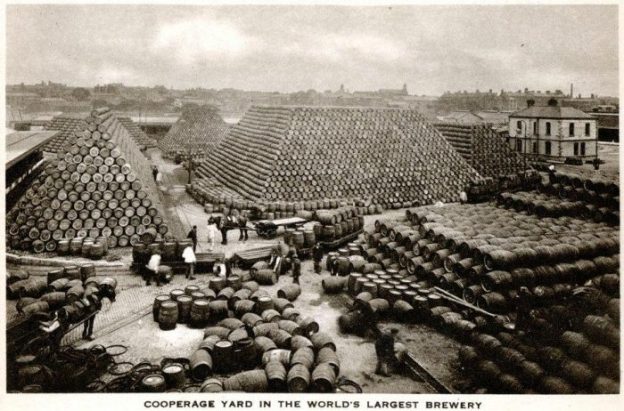
The featured image above shows a staggering number of barrels at the Guinness Brewery in Dublin! [3]
This very short article results from some recent reading about the railways on the Guinness Brewery site in Dublin.
An article in ‘Narrow Gauge & Industrial Railway Modelling Review’ Issue 60 Volume 8, October 2004, p134-142; [1] and
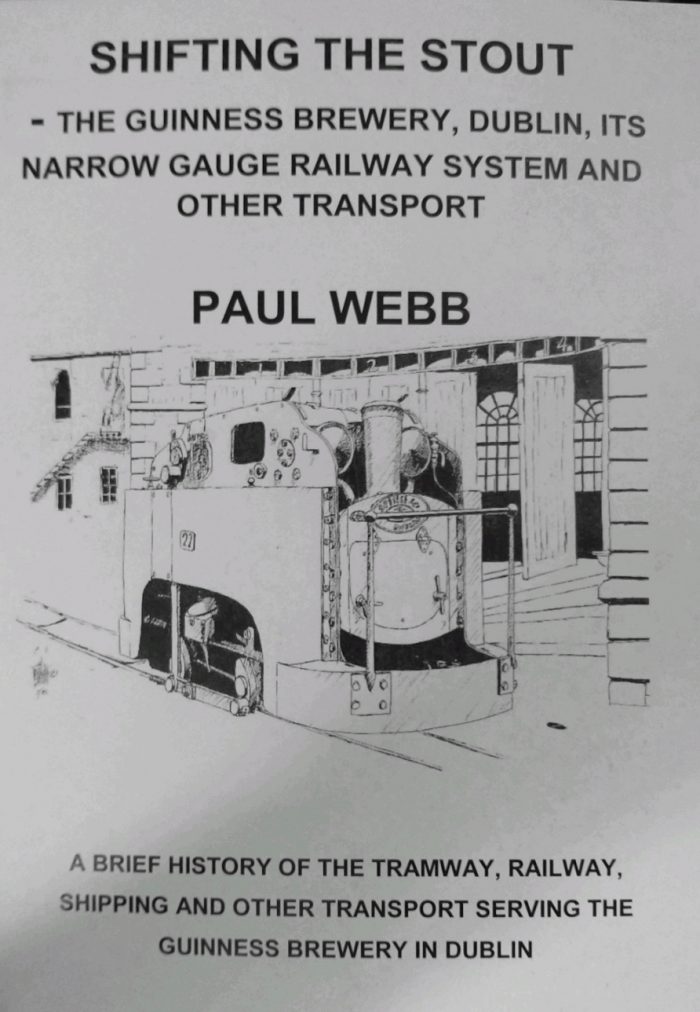
Paul Webb, ‘Shifting the Stout’, The Moseley Trust, Apedale, Newcastle-under-Lyme, Staffordshire. [2]
The Brewery in St James’s Gate, Dublin was founded by Arthur Guinness in 1759, one of dozens based on the pure water available from the River Liffey. Guinness outlasted and outgrew all its competitors to become one of the greatest brewing empires in the world.
Between 1868 and 1886 Guinness spent over £1 million on capital projects. As part of these developments, two rail systems were created within the expanded brewery site. I have covered these in some depth in an earlier article about the brewery railways. ….
Instrumental in much of the development of the brewery site was Samuel Geoghegan who was Engineer to the Brewery.
The article in Narrow Gauge & Industrial Railway Modelling Review is archive material, courtesy of ‘Engineering’ magazine and the Greenwich & District NGRS. It consists primarily of a transcript of an illustrated presentation by Samuel Geoghegan which was carried by ‘Engineering’ Magazine in September and October 1888. It includes detailed drawings, engravings and photographs. Back copies of the magazine are available from Roy C. Link, Cambrian Forge, Garndolbenmaen, Gwynedd, LL51 9RX.
Paul Webb’s book is an A4 no-frills publication in basic green card cover and printed on standard copier paper but it contains a wealth of illustrations and detailed text about the Brewery and the various forms of transport, road, rail and water, that served it. Well worth the £8.50 plus postage that it cost, especially knowing that any profit from the sale supports the Moseley Railway Trust.
There are also some excellent YouTube offerings which focus on the brewery and the different modes of transport it employed. …. For example: [4]
References
Samuel Geohegan; Tramways and Rolling Stock at Guinness’s Brewery; Narrow Gauge & Industrial Railway Modelling Review, Issue 60 Volume 8, October 2004, p134-142 (https://narrowgaugeandindustrial.co.uk, accessed on 22nd July 2020.)
Paul Webb, Shifting the Stout; The Moseley Trust, Apedale, Newcastle-under-Lyme, Staffordshire. (https://avlr.org.uk/moseley-railway-trust, accessed on 22nd July 2020.)
The 1973 Railway World Annual carried a one page article about the short railway on Alderney which was owned by the Department of the Environment and which served a quarry. [1]
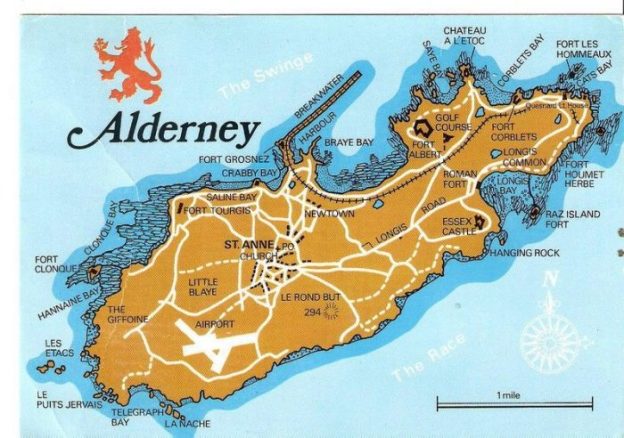
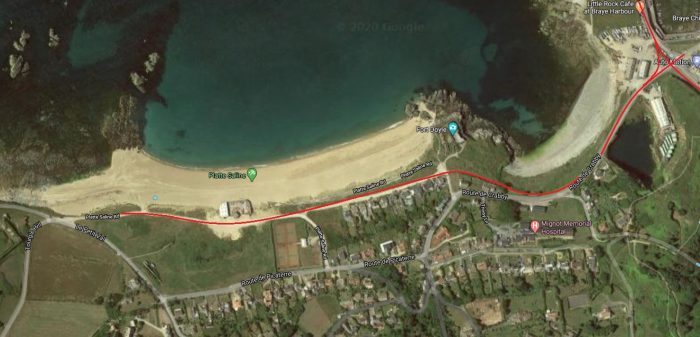
The Alderney Railway opened in 1847 and ran for about 2 miles (3.2 km), mostly following a coastal route, from Braye Road to Mannez Quarry and Lighthouse. Wikipedia notes that: “The railway was built by the British Government in the 1840s and opened in 1847.” [2] It was built as standard-gauge track. [5]
On 8th August 1854, the Queen Victoria and Prince Albert rode on the railway in a horse drawn tender.
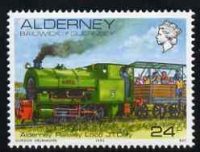
Alderney Postage Stamp (1983-1993) showing one of the locos which used to run on The Alderney Railway. [8]
The line’s “original purpose was to carry stone from the eastern end of the island to build the breakwater and the Victorian era forts.” [2] It was operated by the Admiralty and so was probably the first nationalized railway in the British Isles? [4] It carried stone for around 130 years. From the 1920s it was in private hands and crushed stone was taken off-island for road-building until the Second World War. [4]
During the War, under German occupation, no effort was made to maintain the breakwater. The standard-gauge track was replaced by German 60cm gauge rails and the line was used for the transport of munitions.
As we have noted its primary function was providing stone for the building of Alderney’s Breakwater. There bis an excellent article about this, written by M. Swift, in the Industrial Railway Society Journal, “The Industrial Railway Record,” No. 52 (February1974)– p170-173. [5]
M. Swift notes: “The vast increase in maritime trade during the early Victorian period was followed by a demand for harbours of refuge around Britain, and the Government proposed several schemes during 1846‑47. One was for a breakwater some 2,650 feet long from Grosnez Point, on the north side of Alderney in the Channel Islands, enclosing 67 acres of water. This was developed by successive Admiralty Boards during 1854‑58, the final proposal being a west breakwater 6,600 feet long and an east breakwater from Chateau a I’Etoc, 1,700 feet long enclosing 150 acres. The cost was estimated at £2½ million pounds.” [5]
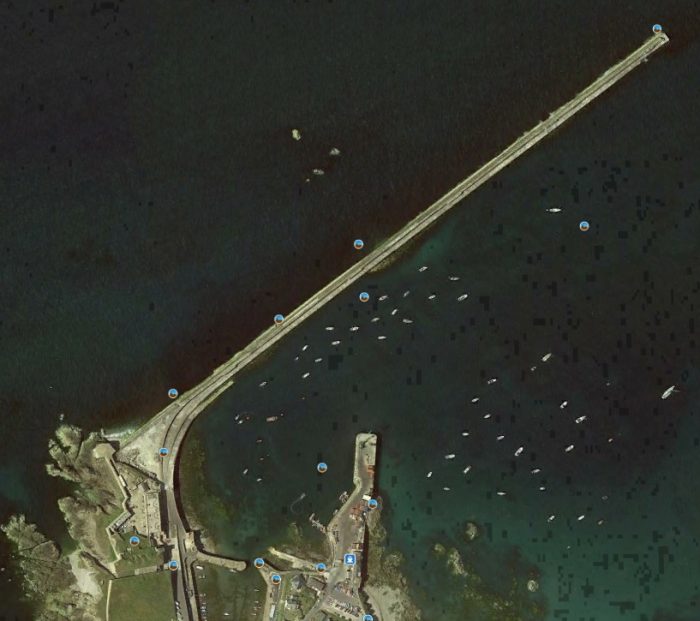
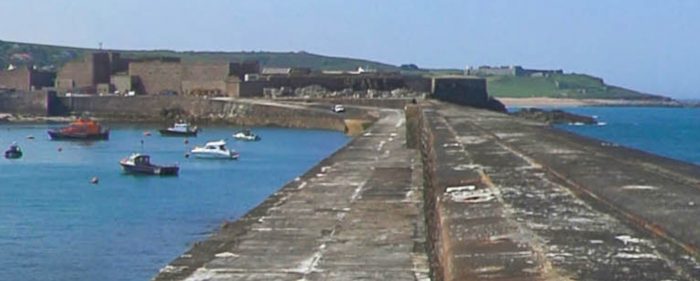
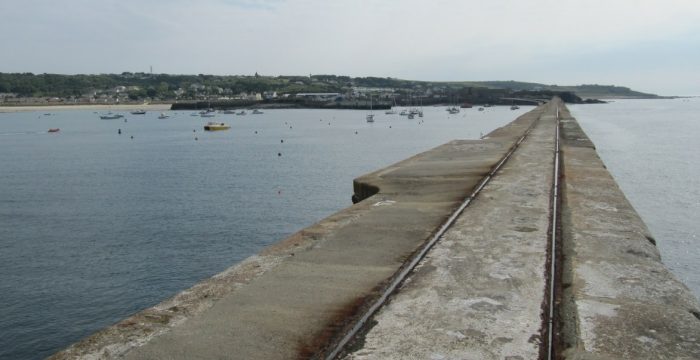
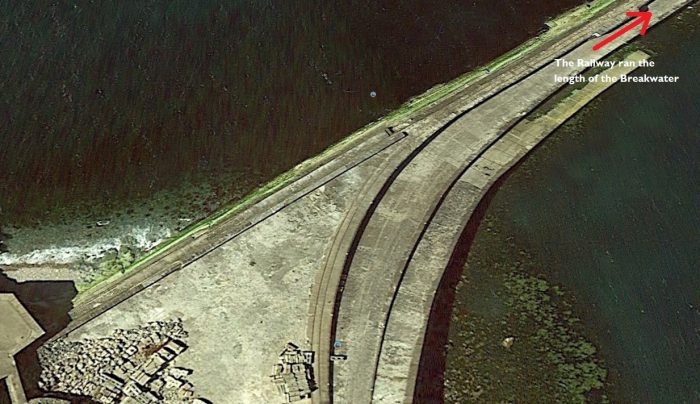
“The breakwater was planned as a rubble bank built up to 12 feet below low water, topped by a masonry wall with the promenade level on the sea side 37 feet above low water, and the quay level on the harbour side 23 feet above low water. The scale of the task was magnified by the depth of the water, which reached a depth of some 150ft.” [5]Alderney Breakwater (Google Earth)The view Southwest along the breakwater towards Fort Grosnez (Google Maps). The old breakwater railway can just be picked out running from the bottom right towards the fort.A clearer image of the rails in the top surface of the breakwater. The picture is taken from further to the Northeast along the breakwater (Google Earth).
M. Swift describes the construction work in some detail. This is not directly relevant to this article but can be found by following the link in the references below. [5]
“The railway from the breakwater to Mannez quarries was 2½ miles long, laid to standard gauge with 65lb double-headed rails. A branch ran about half a mile to Craby Bay where shingle was excavated for making concrete blocks. The first two locomotives were six coupled with four wheel tenders, named ‘Veteran’ and ‘Fairfield’. These were replaced by two six coupled tank locomotives ‘Bee’ and ‘Spider’, and a four coupled tank locomotive ‘Waverley’ built by Henry Hughes of Loughborough. 300 to 400 four wheel 5‑ton capacity end tipping wagons were used to carry stone over the railway, and a few survived at least into the 1920’s.” [5]
The Industrial Railway Record (IRR) [5] includes a photograph of one of the locomotives used on the line. The Henry Hughes locomotive (Waverley) used by Thomas Jackson (the Contractor) in building the breakwater was later photographed on Alderney, presumably in Mannez Quarry when it was used to pull trains of stone in connection with the maintenance of the breakwater. The picture is included in the IRR article courtesy Ian Allan Ltd. [5]
The Alderney Railwat website has a photograph of one of the two 0-6-0 ST locomotives with the train of low stone wagons at the head of a page about the railway’s history. This photograph was also taken at Mannez Quarry. [4]
After the Second World War, “the Ministry of Defence re-laid the track at standard gauge (56½” – 1.435m) with concrete sleepers in panels and used ‘Molly’ a four wheeled Sentinel vertical boiler engine and rolling stock of 24 side tipping wagons (‘Yankees’) to tip Granite chippings into the sea from the Breakwater for maintenance of the mound.” [4]
The railway was probably in this form when it became the subject of the short article in The 1973 Railway World Annual. It was not long after this that negotiations were opened between the Home Office and the Alderney Railway Society which was formally established in 1978. ……Vulcan Drewry 0-4-0 diesel locomotive Elizabeth and former London Underground 1959 Tube Stock cars, (c) Dmartin@ukonline.co.uk (2007), (GNU Free Documentation License). [2]
In the mid 1970’s The British Home Office who were responsible for maintenance and operation, (there being only a minimal use of the track at this time), were approached to see if the line could be used for Passenger transport and after several years permission was obtained. Alderney Railway Society was established in 1978. When trains began to run in 1979, Alderney Railway Company Ltd was formed to hold the lease and operate the line. [4]
Passenger trains first ran in 1980. [4] Trip Advisor tells us that, for a time, the passenger railway ran under steam power(as illustrated on the postage stamp earlier in this article:
In 1982 an 0-4-0 Bagnall steam locomotive by the name of “J.T. Daly” was acquired and ran with two ex-Chatham Dockyard open wagons which had light weight roofs to provide some protection for the passengers. J.T. Daly remained with the Alderney Railway until the early 1990s but due to its limited use and high cost of maintenance was subsequently sold to the Pallot Steam Museum in Jersey.
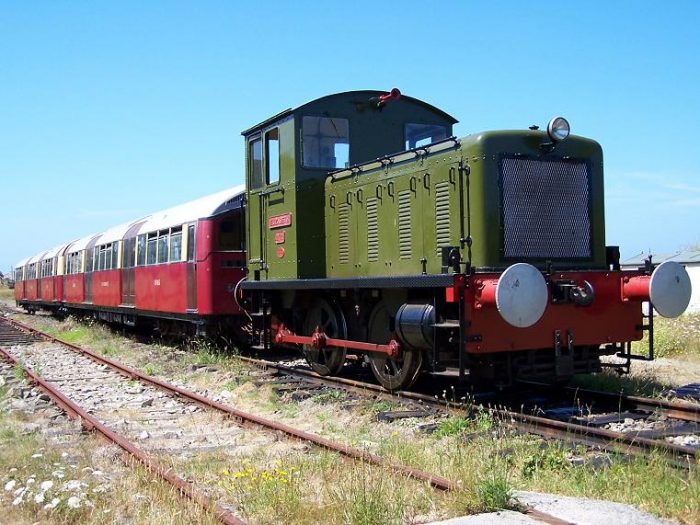
1985 saw the arrival of the Vulcan Drewry 0-4-0 diesel locomotive “Elizabeth” which after 20 years is still providing sterling service. By 1987 it was decided to try and provide improved accommodation for passengers and two ex London Underground 1938 tube cars were acquired from the North Downs Railway. These were drawn and propelled by Elizabeth and gave good service but by 2000 both vehicles had unfortunately succumbed to corrosion caused by the salt sea air. They were returned to England and scrapped.
In 2001 the Alderney Railway acquired two replacement 1959 tube cars from London Underground numbered 1044 and 1045. These vehicles have aluminum bodies with wooden floors and hopefully will survive the salt air. [9]
Wikipedia tells us that the current stock includes the two London Underground carriages, two 0-4-0 diesel locomotives and six Wickham 27A MkIII railcars. [2, c.f. 10]
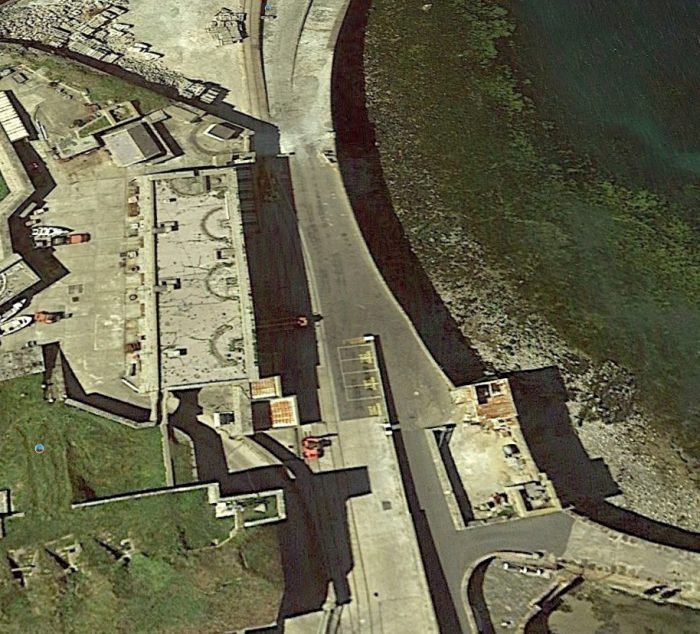
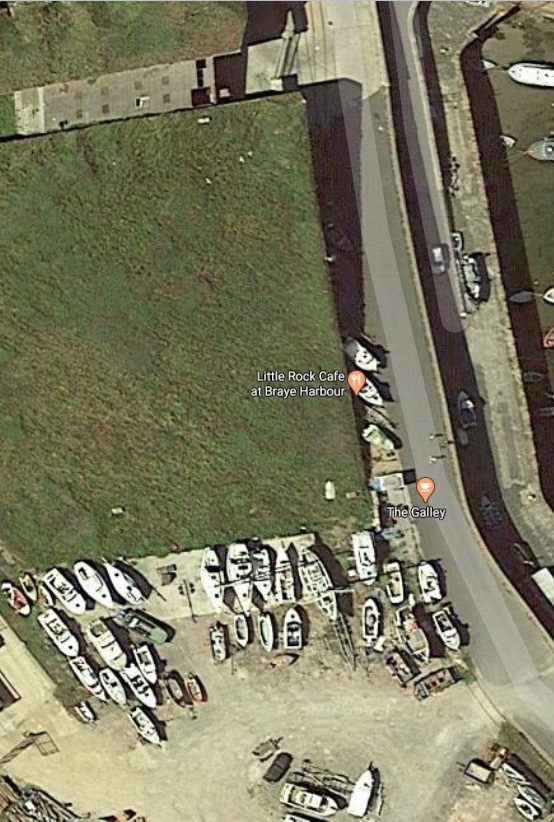
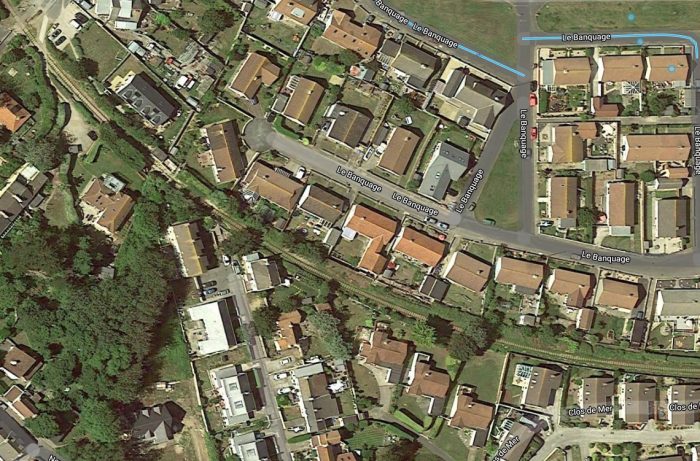
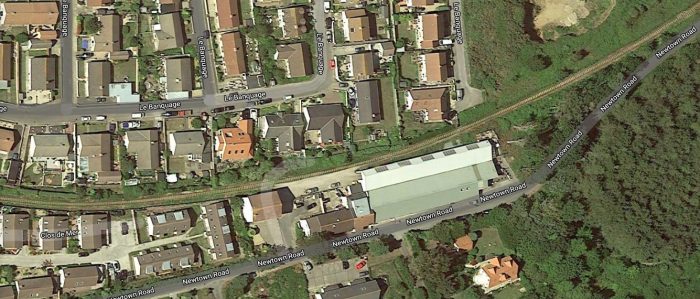
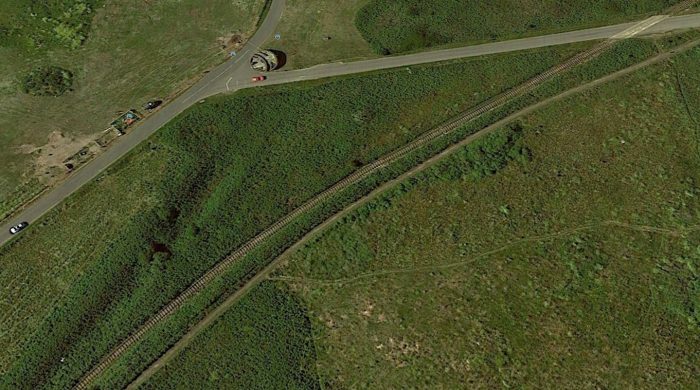
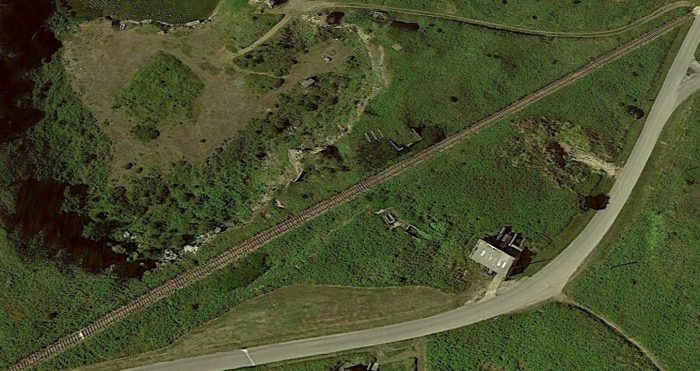
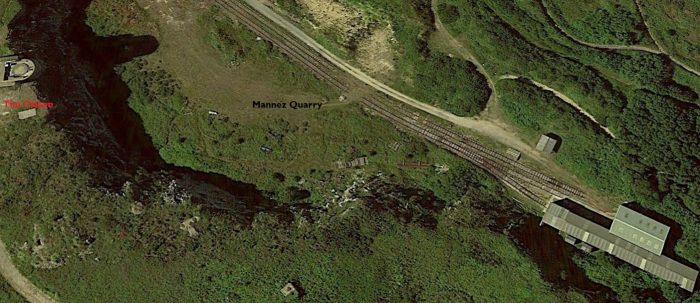
The first length of the historic line ran along the breakwater, then in front of Fort Grosnez before entering Braye Village. The passenger line running in the 21st century starts from Braye Road Station and heads East to Mannez Quarry.The old railway was in use out onto the breakwater. It can still be seen on satellite images. A short stub siding ran in the yard in the bottom left of this image. The route to Mannez Quarry curved South from the breakwater, (Google Earth).As it passed the East aspect of the fort, it divided into two to allow shunting of wagons (Google Earth).
Running Southeast from the breakwater and Fort Grosnez the old line reached the location of the present railway station.
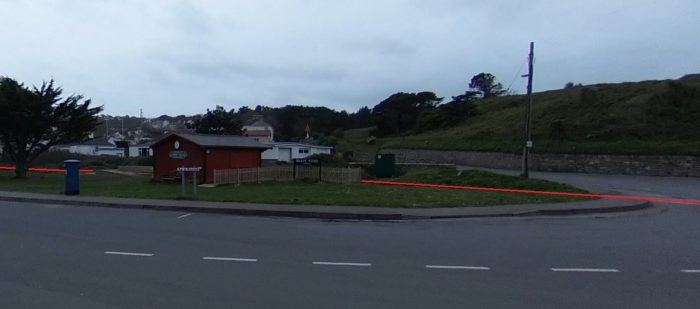
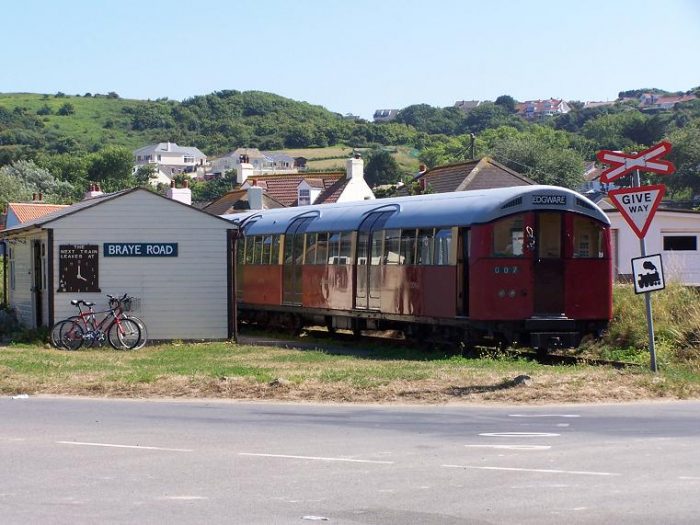
The railway is open, Covid-19 permitting, as a tourist attraction, “nowadays, the old train wagons have been replaced by two London Underground carriages and a diesel engine carrying visitors from Braye Road Station to Mannez Station near the Lighthouse.” [3]The line from the breakwater enters on the right of this picture. The station building at Braye Road Station is the timber shed to the left of centre. (Google Streetview).Tube stock stabled at Braye Road Station, (c) Dmartin@ukonline.co.uk (2007), (GNU Free Documentation License). [2]
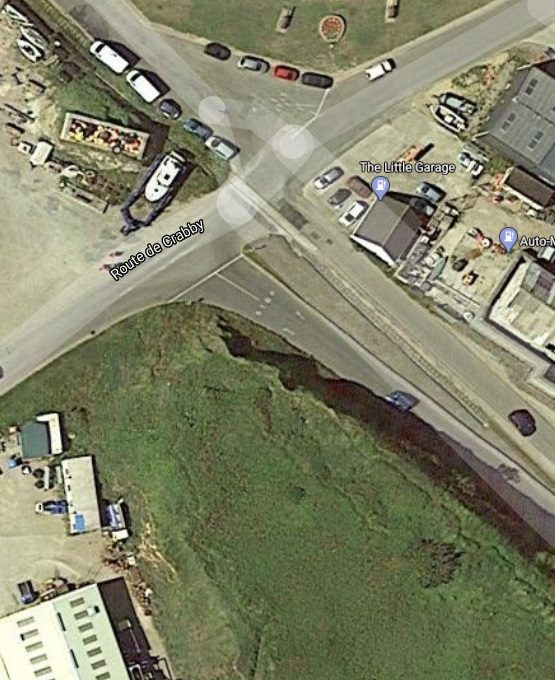
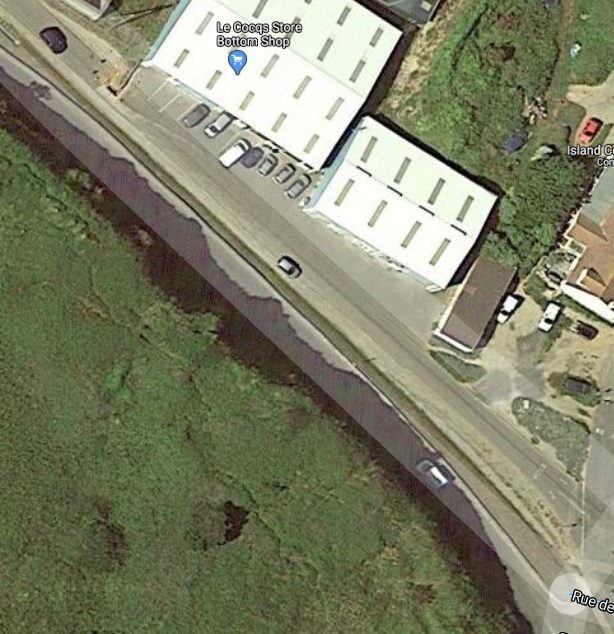
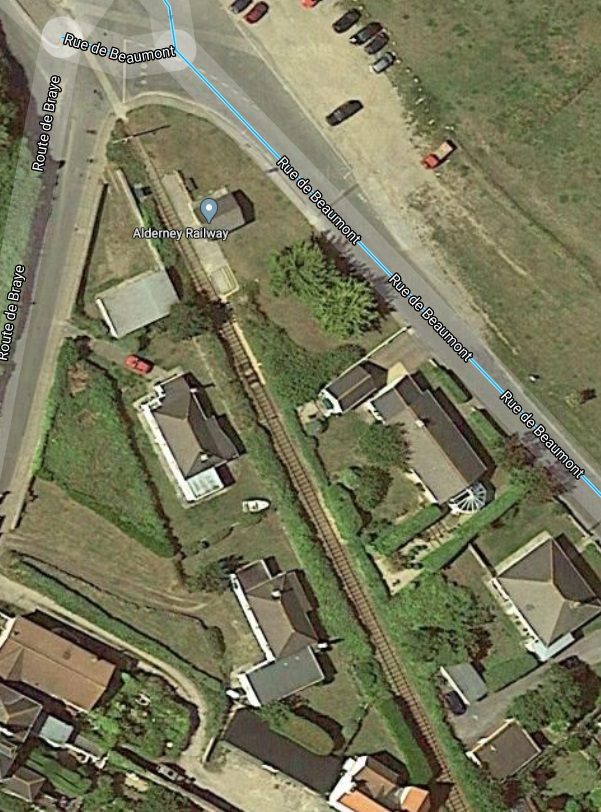
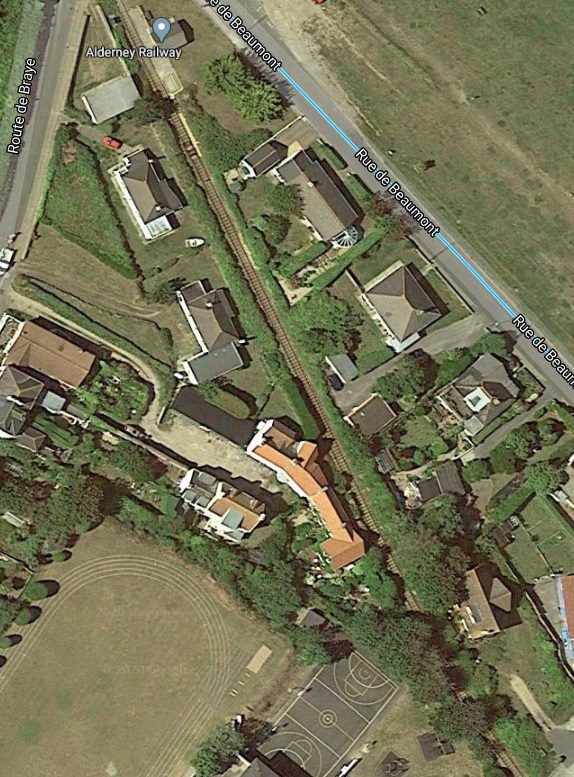
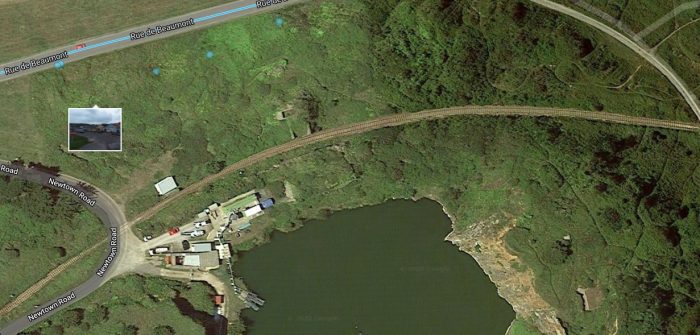
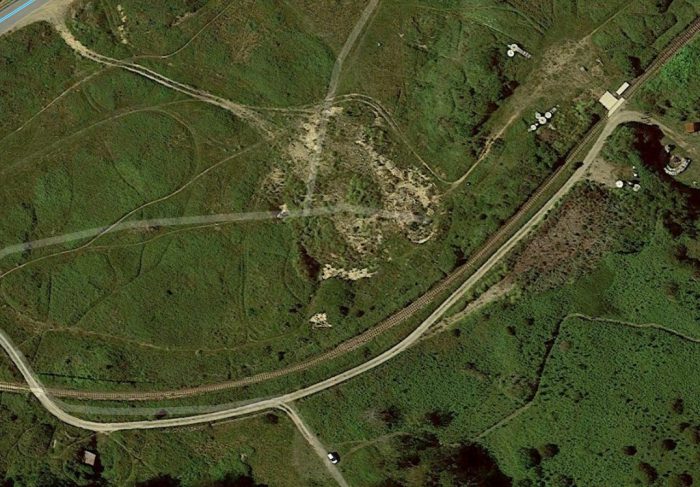
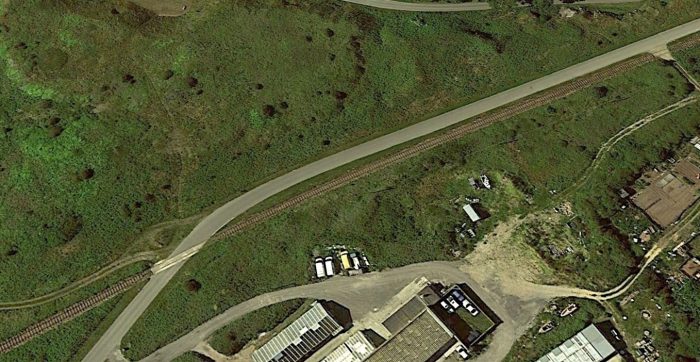
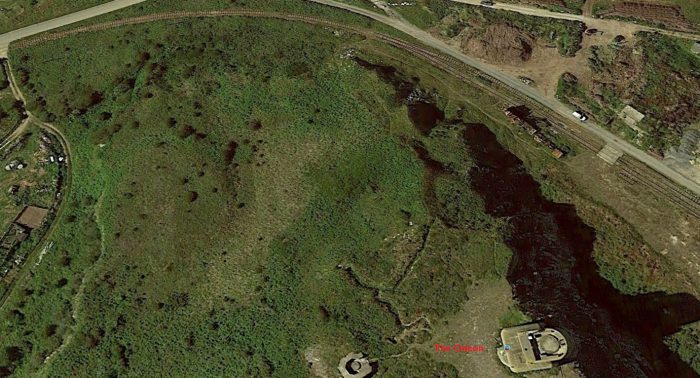
These next satellite images show the line leading away from Braye Road Station in the 21st century.The last few Google Earth satellite images below show the approach to the Station in Mannez Quarry.
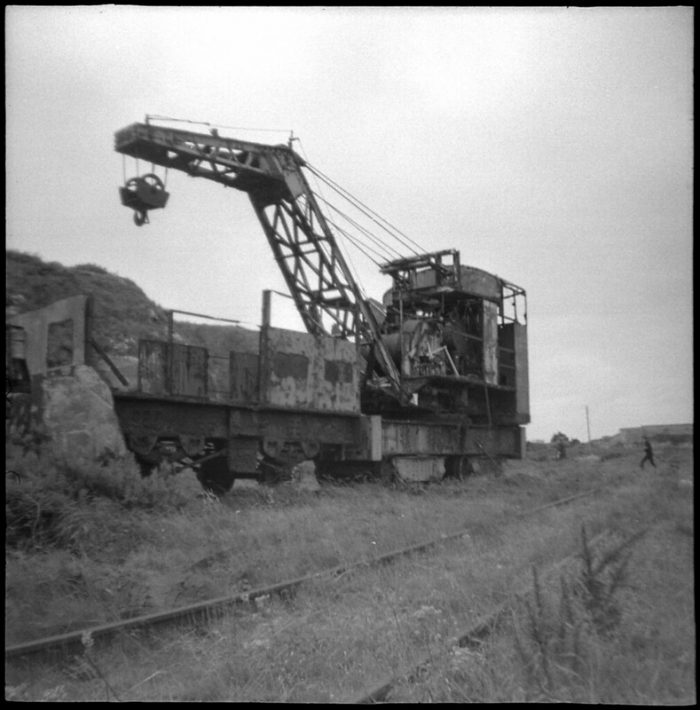
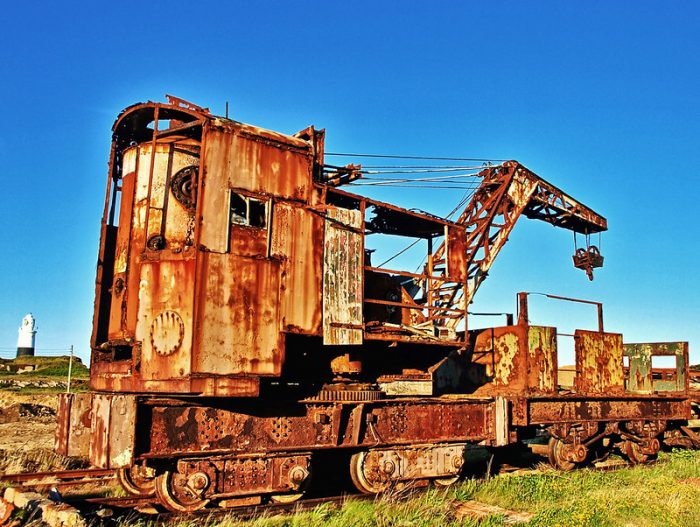
Steam Crane at Mannez Quarry (c) moogiemedia on Flickr (2011) (CC BY-NC 2.0). [6]Steam Crane at Mannez Quarry (c) Neil Howard (2009) (CC BY-NC 2.0). [7]
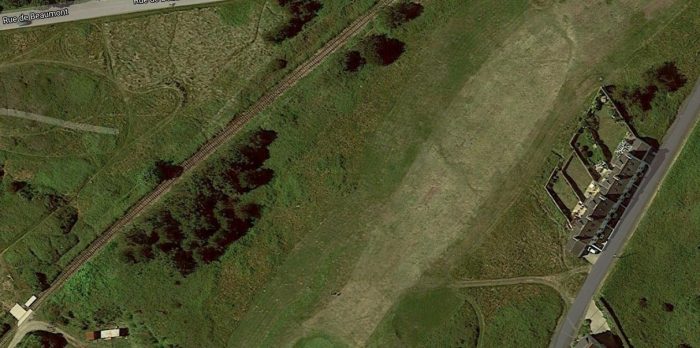
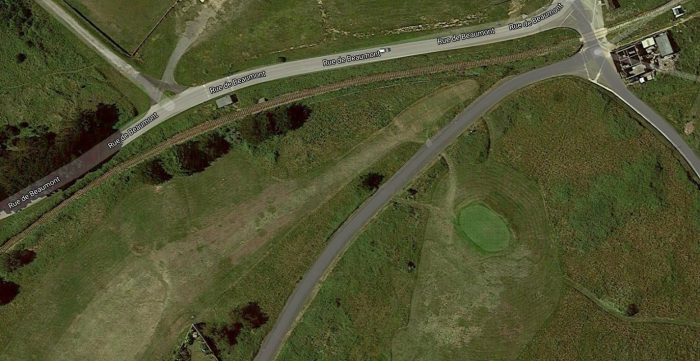
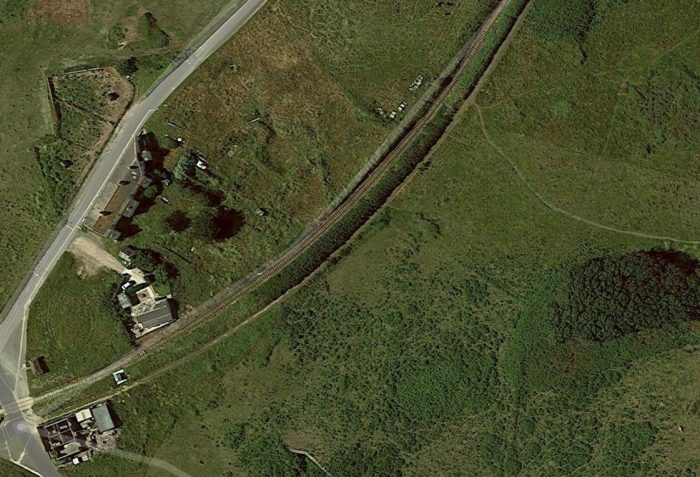
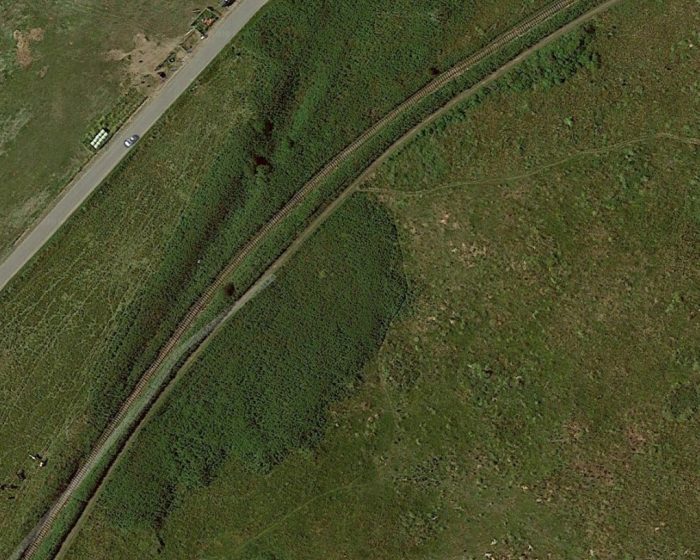
There was also a single branch line which left the main line in the village of Braye, not too far from Fort Grosnez, and headed West along the coast of Alderney a short distance to Craby Bay. It was used to transport shingle for the making of concrete blocks. [5] Its approximate route is imposed on the Google Earth Satellite image below.
References
Michael Bryan; Alderney’s Railway; in A. Williams; Railway World Annual; Ian Allan, Sheperton, Surrey, 1973, p89.