Category Archives: French Railways and Tramways

Ligne du Littoral (Toulon to St. Raphael) – Part 2 – Toulon (Chemins de Fer de Provence 37)

The history of the line from Toulon to Saint-Raphael was short. The full line was open by 1905 and closed by 1948 and was out of use or in a poor state of repair during both World Wars. Find out more in my post: Ligne du Littoral (Toulon to St. Raphael) – Part 1 (Chemin de Fer de Provence 36)[1]

We will follow the line from Toulon towards St. Raphael, initially taking time to understand the rail and tram networks in Toulon.

Toulon

Toulon was not connected to the Chemin de Fer du Sud Littoral until sometime after the line opened. Objections were raised initially by the PLM, which, while it had supported the construction of the line from St. Raphael to Hyeres, was concerned about possible competition over the longer route and had provided its own link between Hyeres and Toulon. Demand grew for an extension to Toulon and a line was eventually opened in 1905.

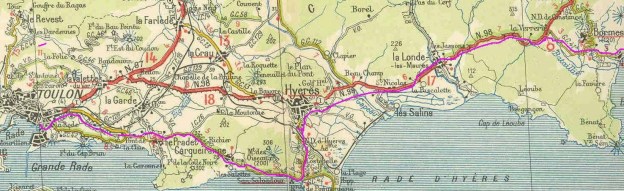
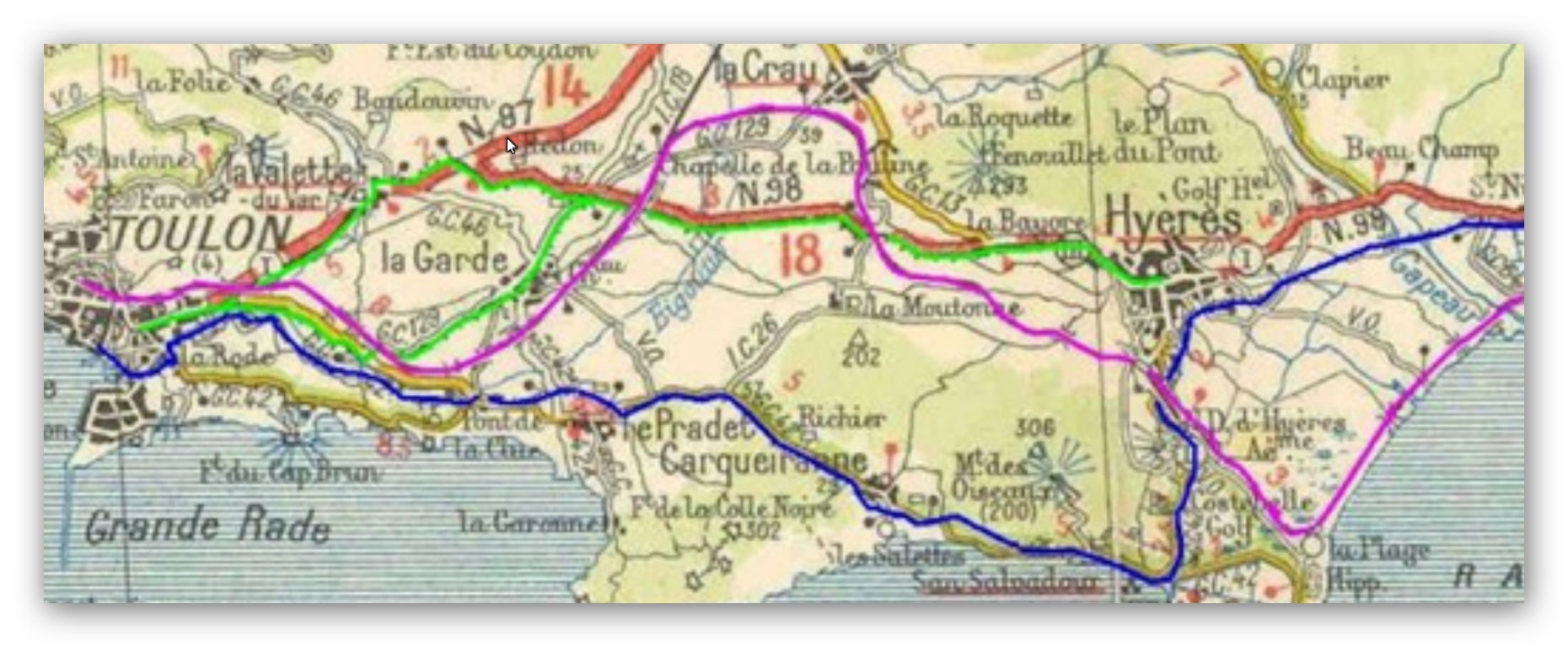
The featured image above is a Michelin map from the 1930s which comes from the website/blog of Marc Andre Dubout.[2] The map below is an extract from the Western end of the featured image focussing on the city of Toulon. Apart from the obvious road detail on the map there are three features with noting. The first is the route we are going to follow which is shown in blue. The second, a fluorescent pink line, is the route of the PLM’s railway along the coast to Nice (which turns away north near La Crau and a branch from the PLM mainline to Hyeres and Les Salins-d’Hyeres. The third, in bright green, is the tramway from Toulon to Hyeres. This is shown as a castellated line on the map alongside the GC129 or N87, and N98, extending West towards Toulon, and East towards Hyeres. In different ways, at different times these four modes of transport were in competition or alliance with each other and with road transport as well.
Toulon is a port city on southern France’s Mediterranean coast, lined with sandy beaches and shingle coves. It’s a significant naval base and the harbour is home to submarines and warships, as well as fishing boats and ferries. The grand Musée National de la Marine in the Port of Toulon exhibits maritime artefacts. Rugged limestone mountains form a backdrop to the city. And a cable-car shuttles visitors up Mont Faron.

Toulon is the capital of the Department of the Var. The Commune of Toulon had a population of about 165,000 in 2010 making it the fifteenth-largest city in France. It is the centre of an urban area with 559,421 inhabitants (2008), the ninth largest in France. Toulon is the third-largest French city on the Mediterranean coast after Marseilles and Nice.

Toulon is an important centre for naval construction, fishing, wine making, and the manufacture of aeronautical equipment, armaments, maps, paper, tobacco, printing, shoes, and electronic equipment. The military port is the major naval centre on France’s Mediterranean coast, home of the French aircraft carrier Charles de Gaulle and her battle group. The French Mediterranean Fleet is also based in Toulon.[3]

The PLM[4] line from Marseilles to Nice via Toulon was completed in 1864, eighteen years after it first arrived in Marseilles and four years after Les Alpes Maritimes became part of France in 1860 and Nice became its capital.

The PLM Station in Toulon
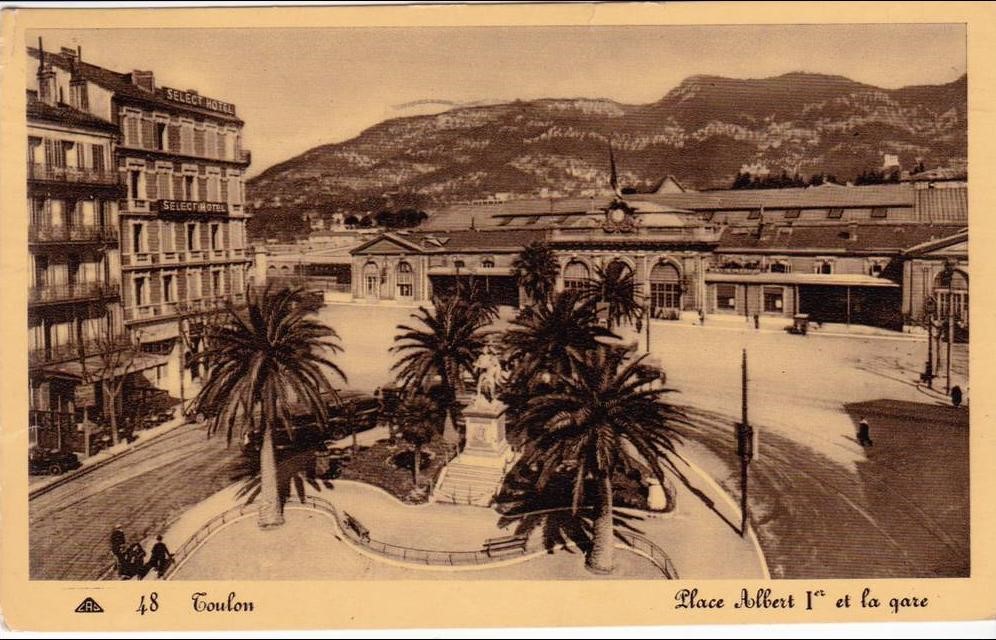
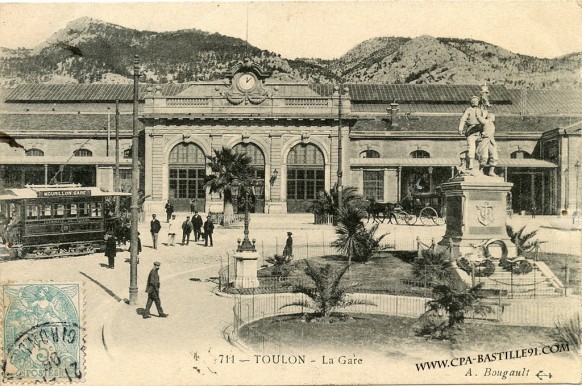
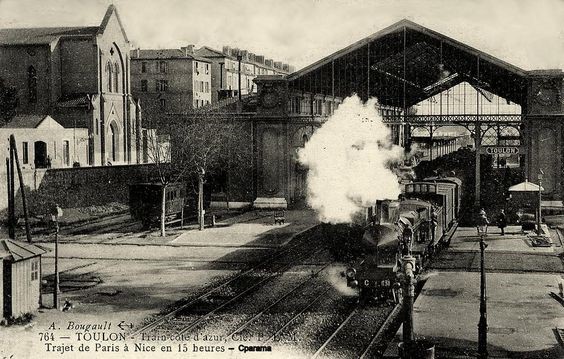
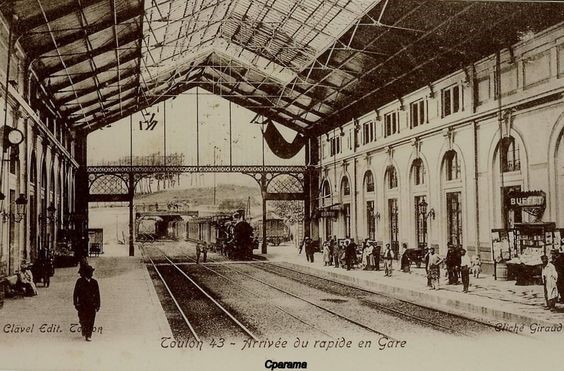
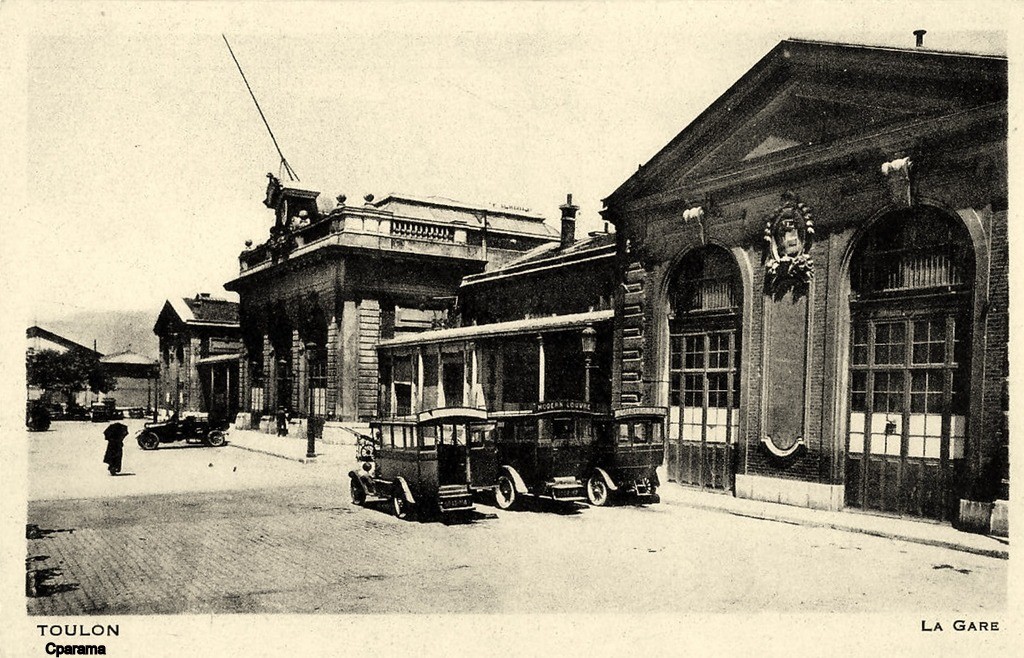
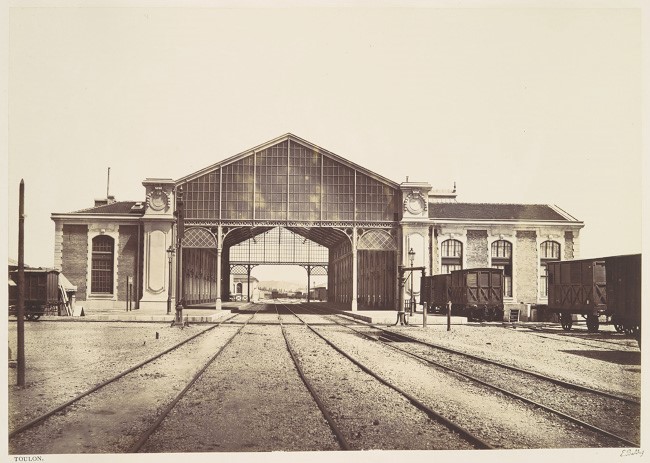
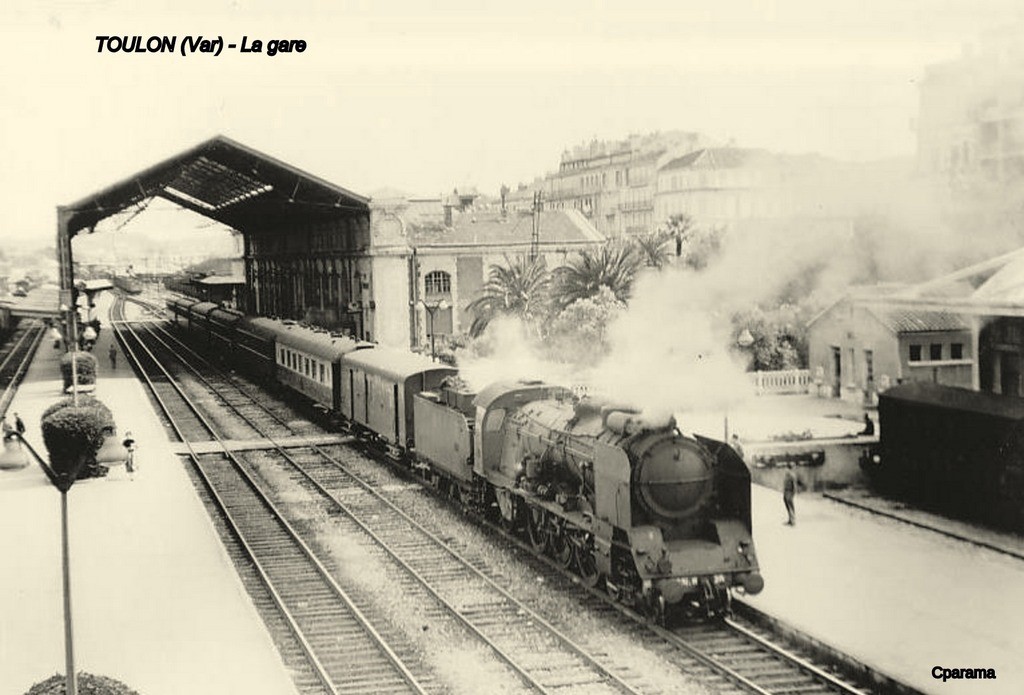
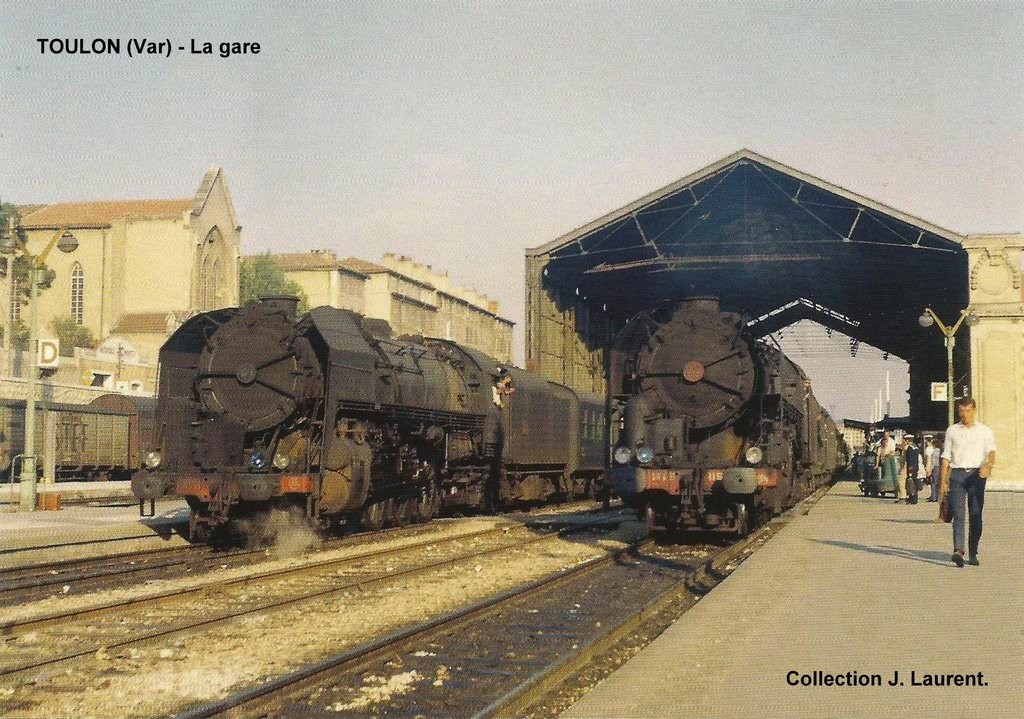
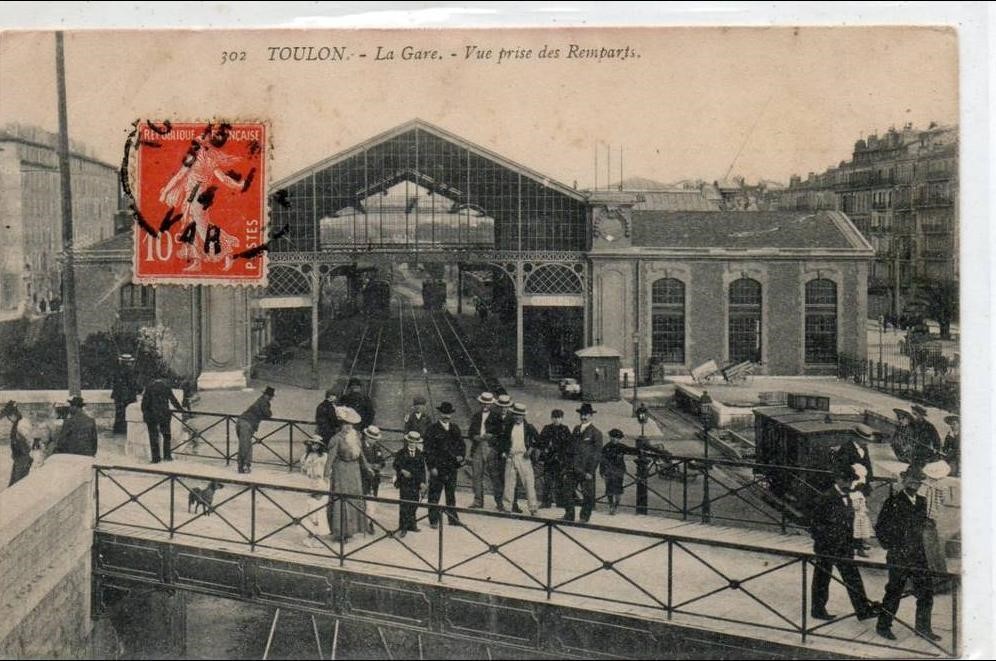
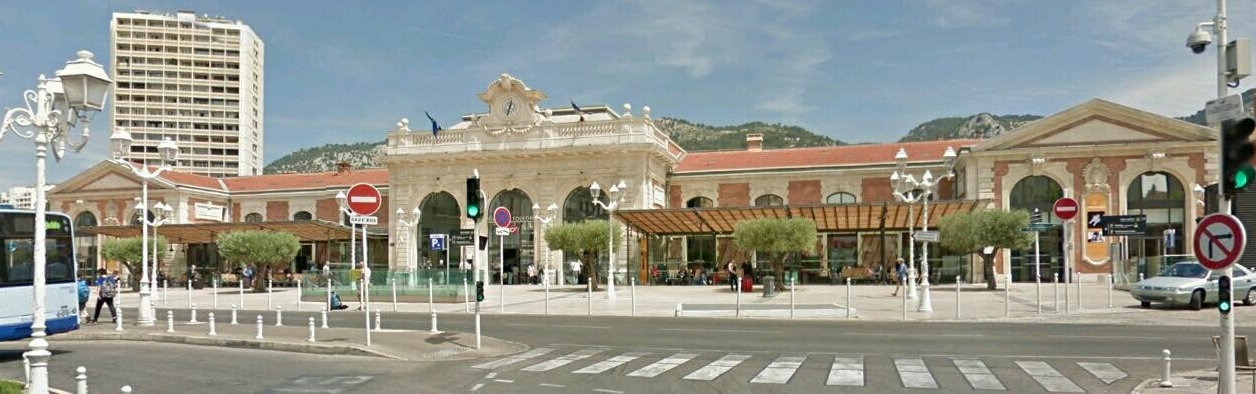
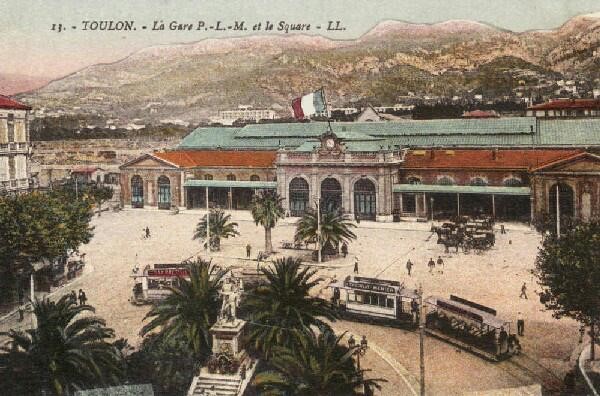
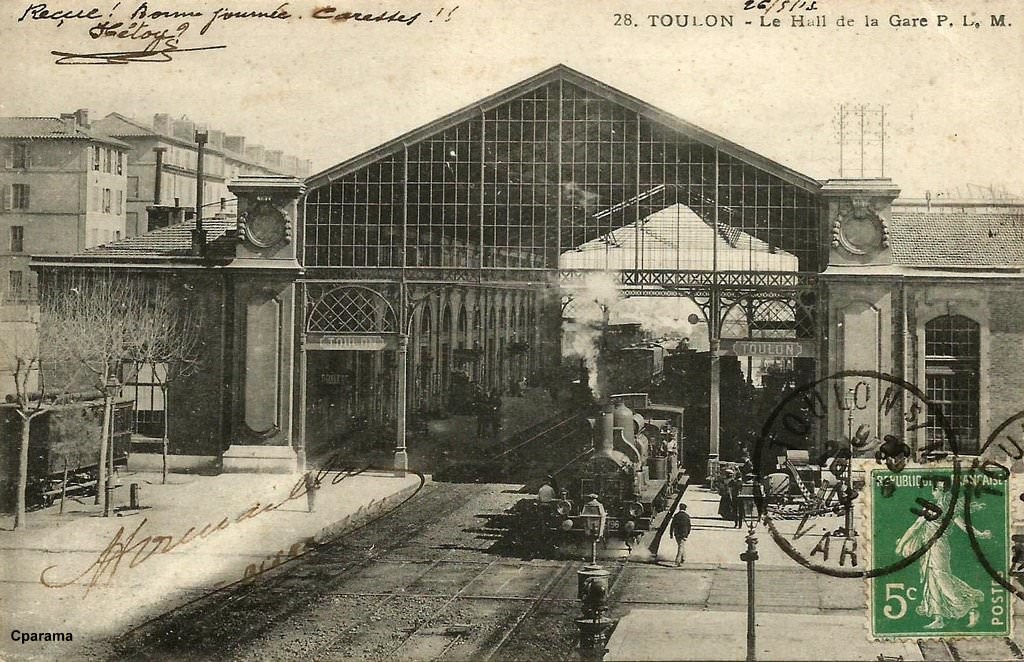
As a significant city in France, Toulon warranted a grand station. The PLM did not disappoint. This is what the station looks like today. The original overall roof of the train-shed (see later pictures from the last century and 3D modelling drawings) has gone but the frontage and building remain.
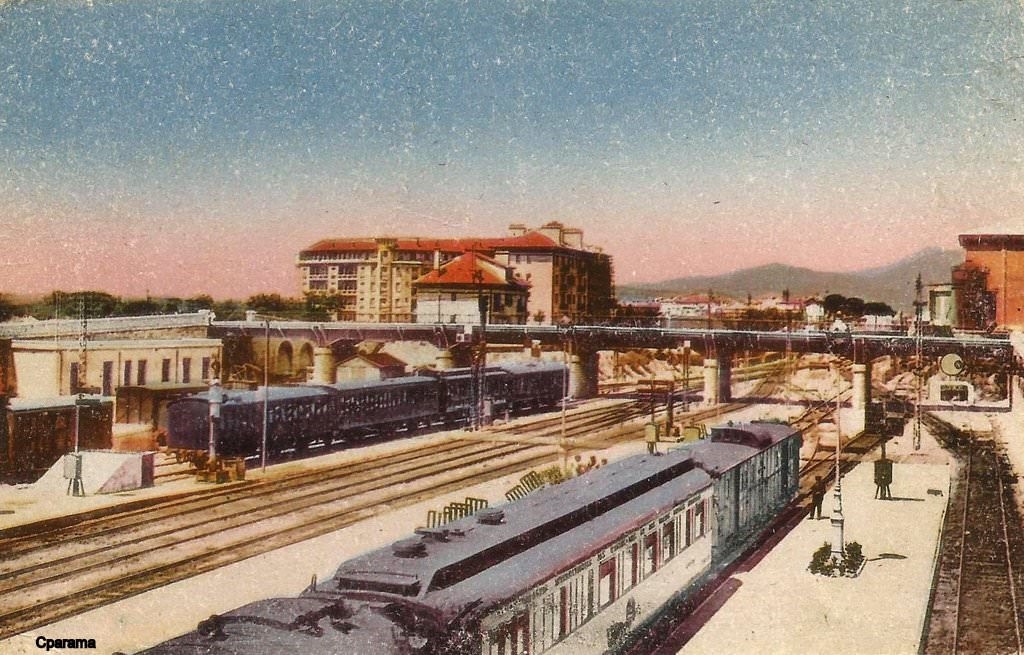
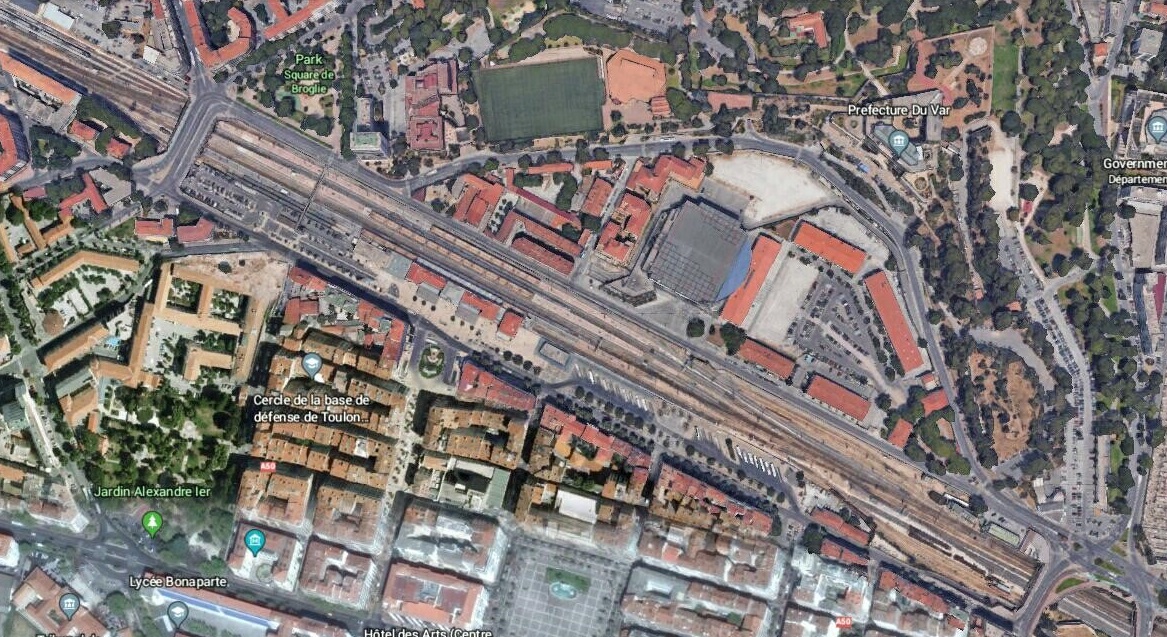
The satellite image below gives some idea of the extent of the passenger facilities and platforms. Sidings and goods facilities extend in either direction beyond the road bridges at each end of the platforms.
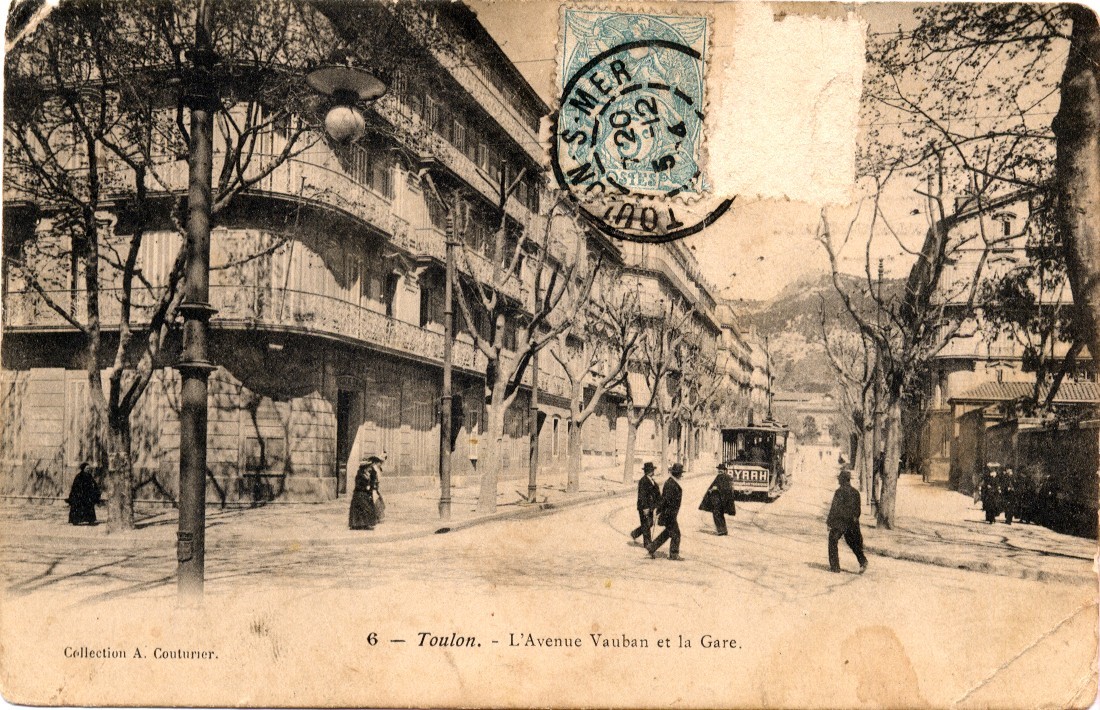
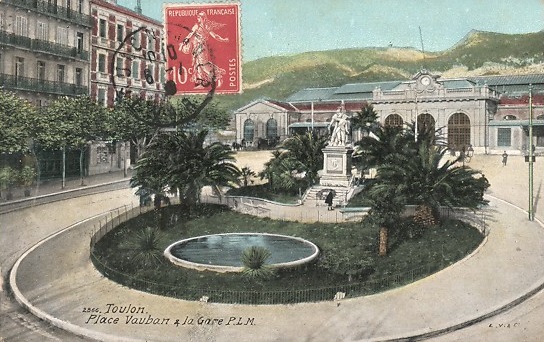
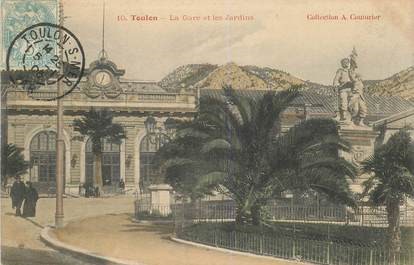
The following images come from earlier times. They show the station with its train-shed intact and some show the trams that served the station.
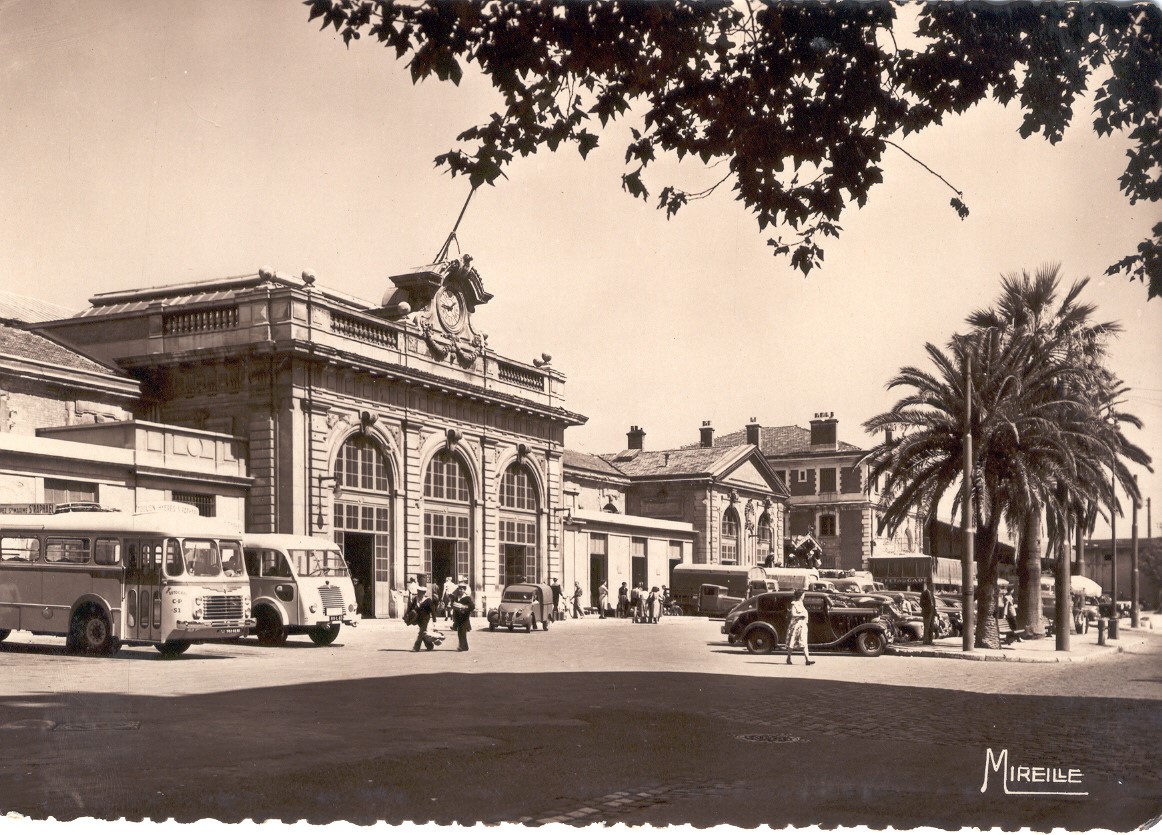
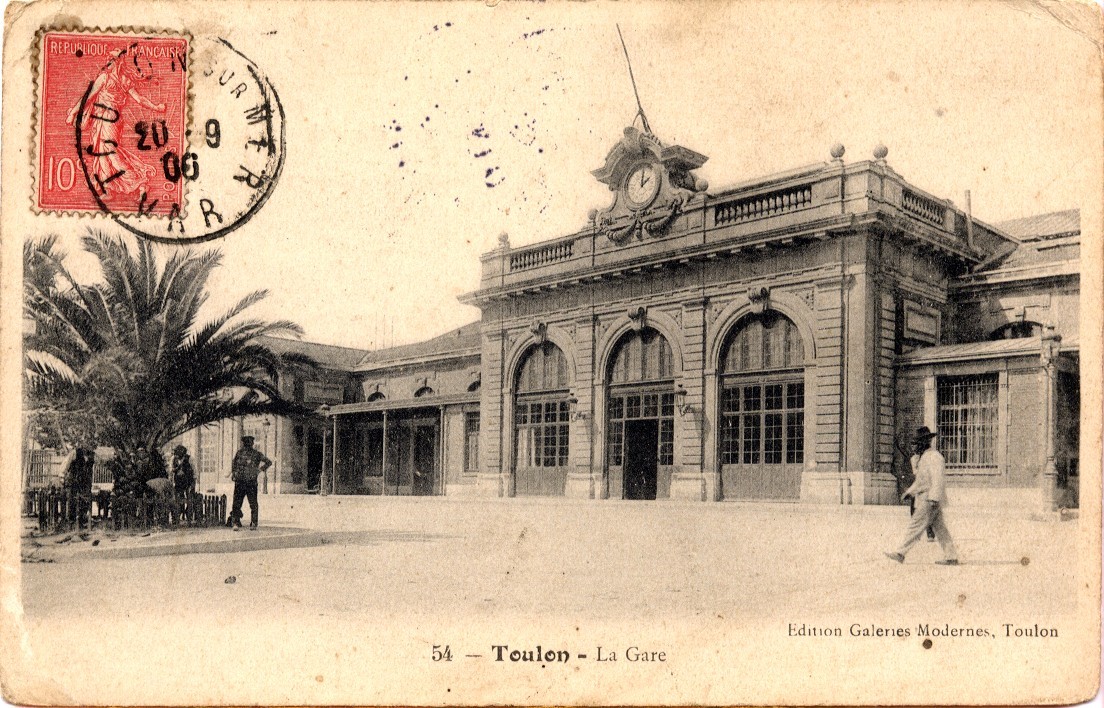
  The station is at the far end of L’Avenue Vauban
 

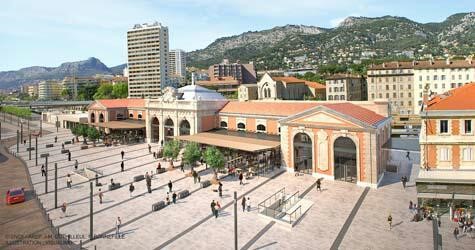
The photo below is of a 3D reconstruction of Toulon PLM as a CAD drawing.

Trams in and around Toulon, and the PLM branch to Hyeres and Les Salins-d’Hyeres

Details of the tramways of Toulon, and the branch-line are covered in other posts in this series.[5],[6]


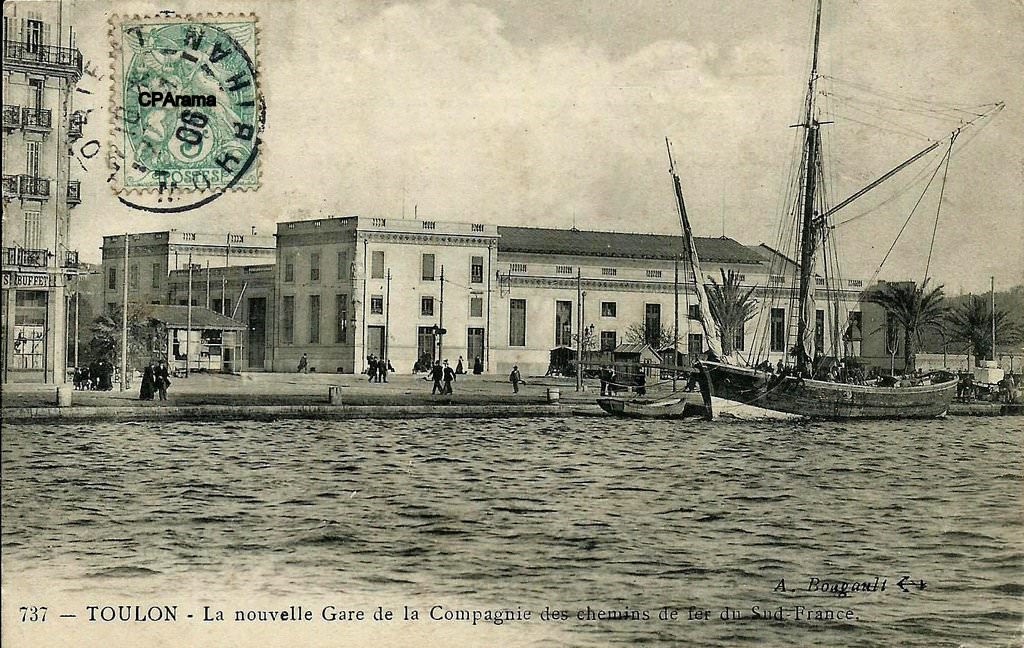
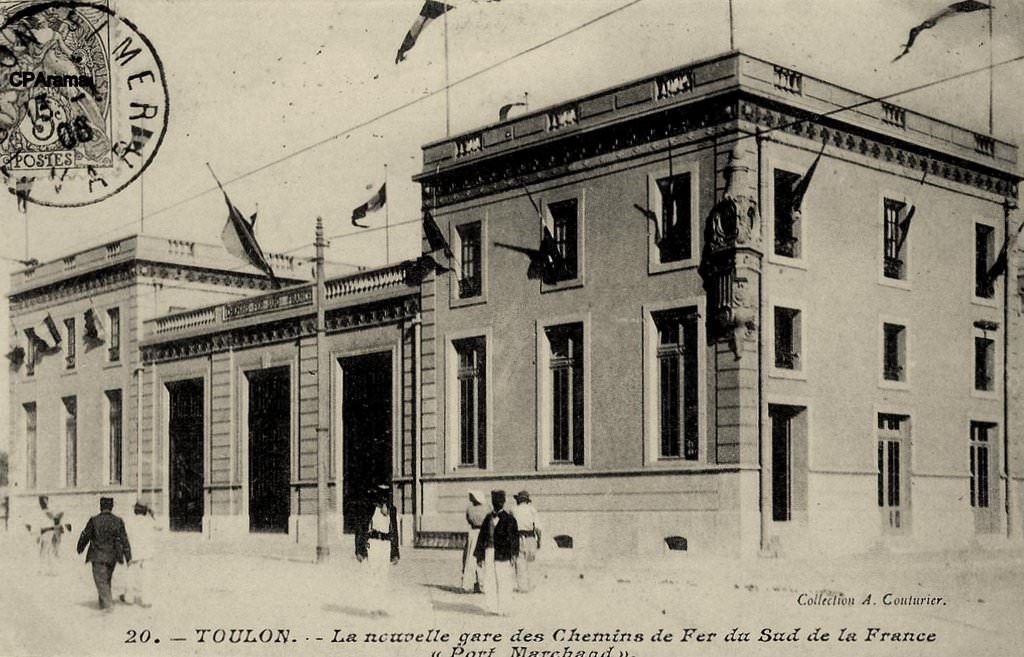
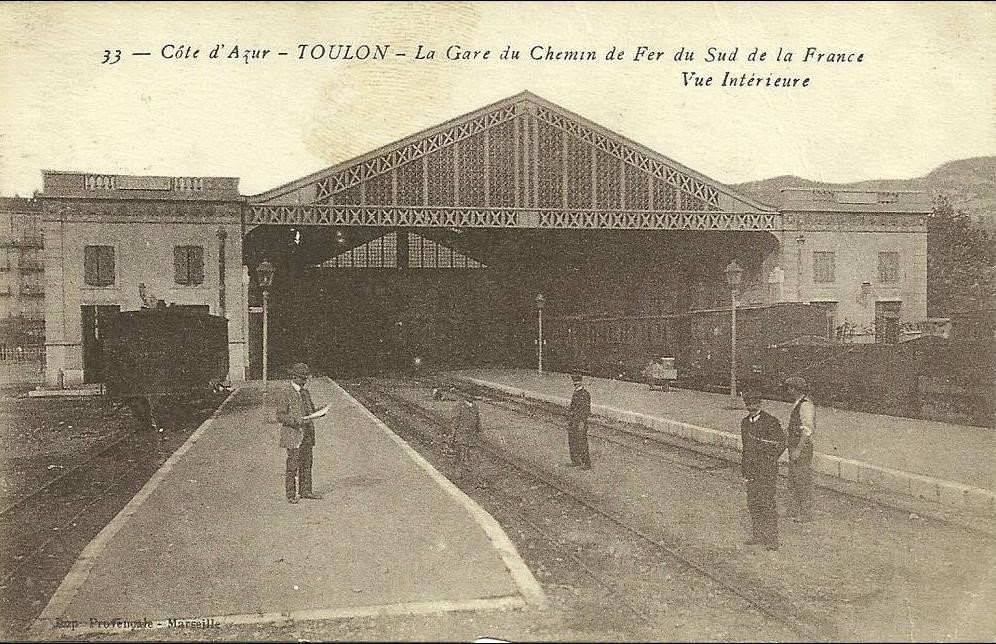
Chemin de Fer du Sud Station in Toulon

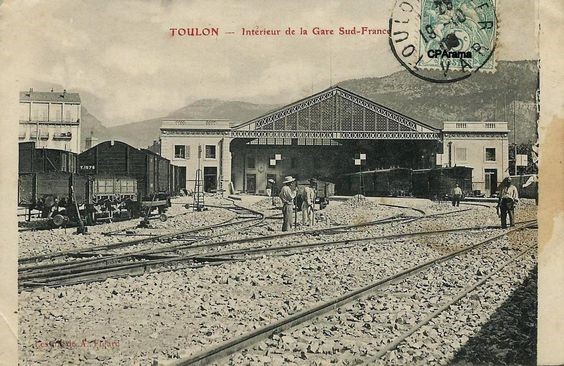
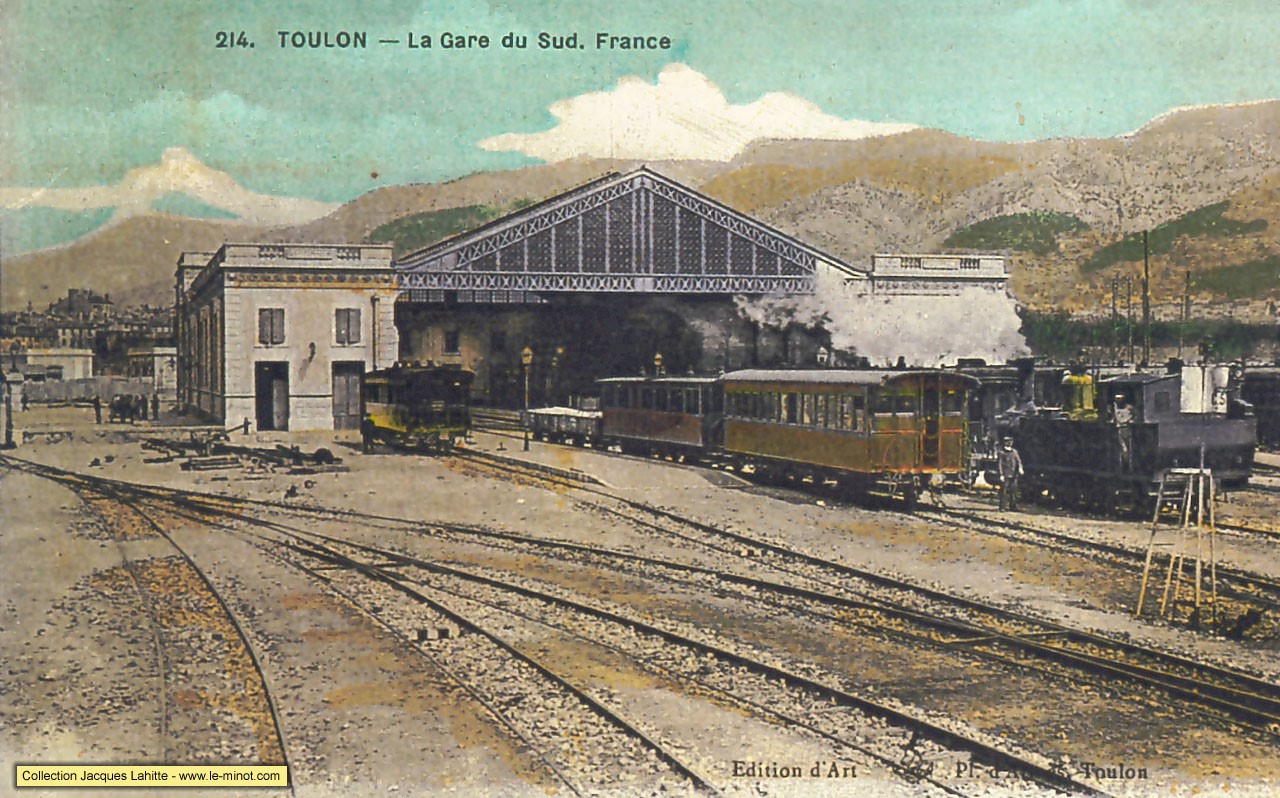
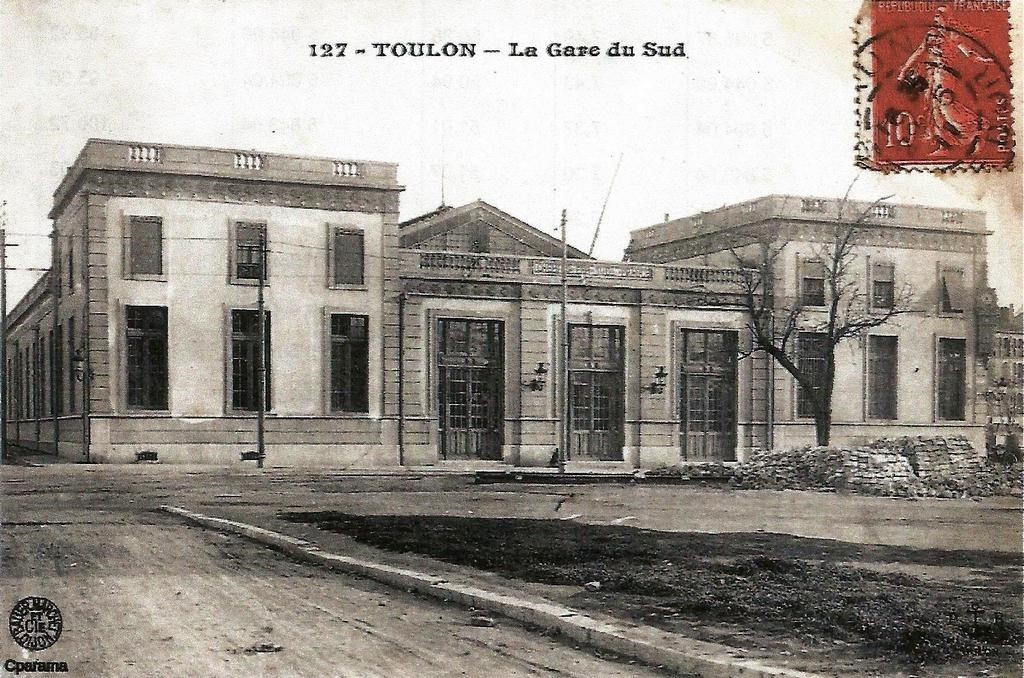
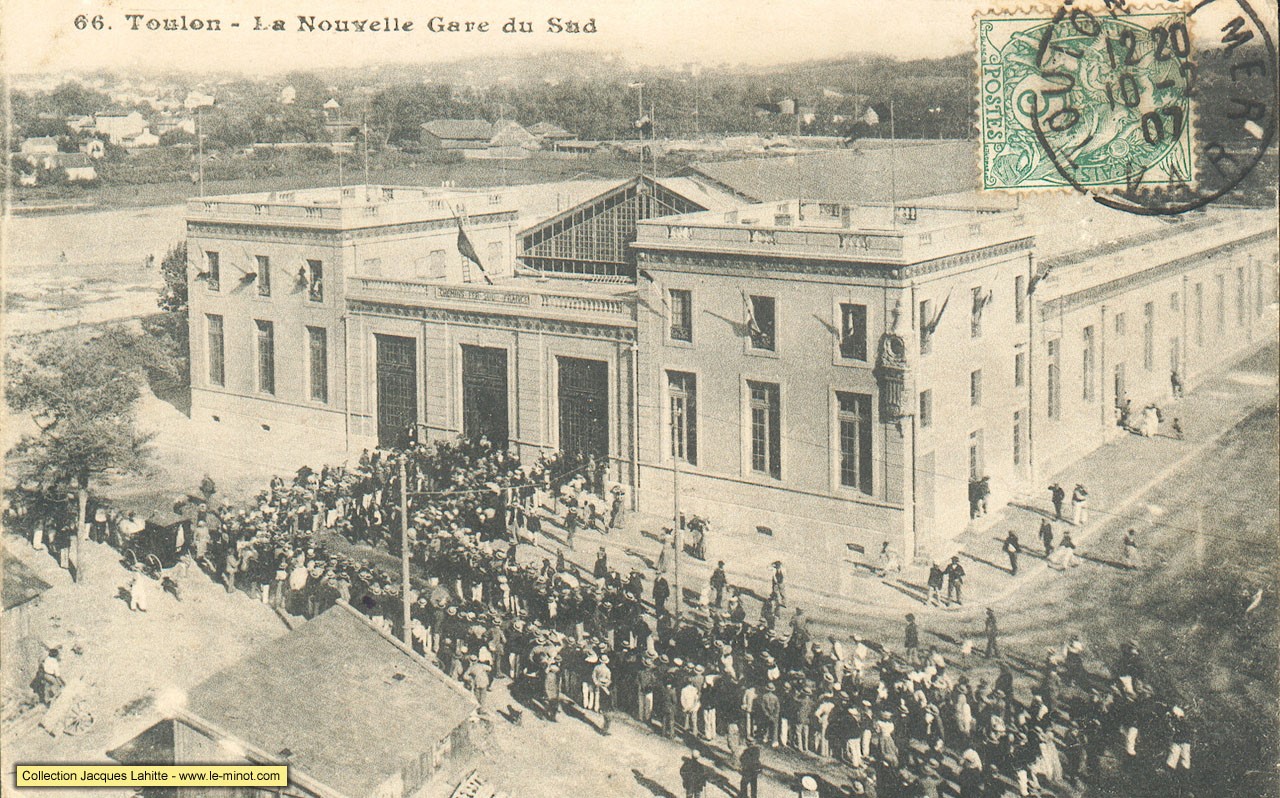
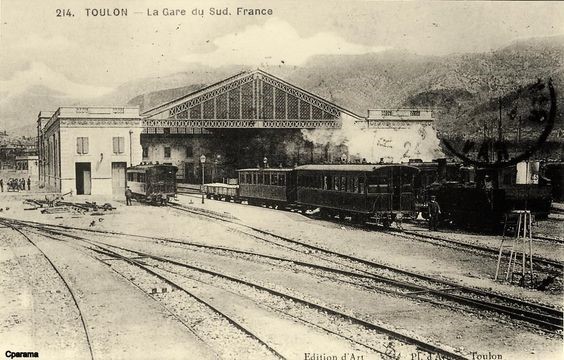
As we have already noted the Chemin de Fer du Sud arrived late in in Toulon. The first services were operating in 1905. The station was also separated by some distance from the PLM station further north in the city. The images that appear next give an insight into the construction and layout of the station. The buildings, sadly, no longer exist and the site has been redeveloped. The first picture is of the opening ceremony.
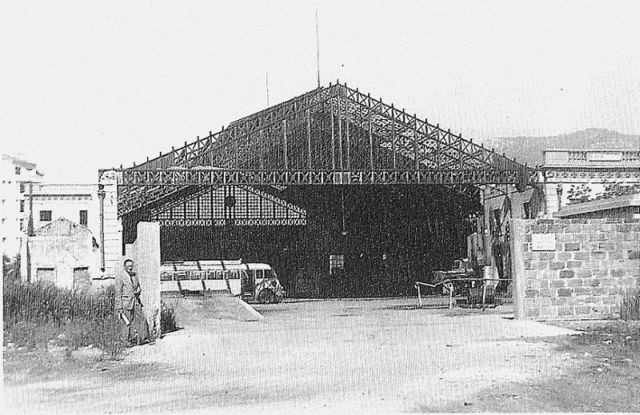
The station after closure

A large part of the Station was badly damaged in the bombing of 24th November 1943. The north wing got blown up and the glass roof lost almost all of its glazing. In the Spring of 1944 (29th April in particular) the station was hit again. After liberation, the north wing was cleared and cordoned off with a palisade. Things remained like this until the line was closed.[7]
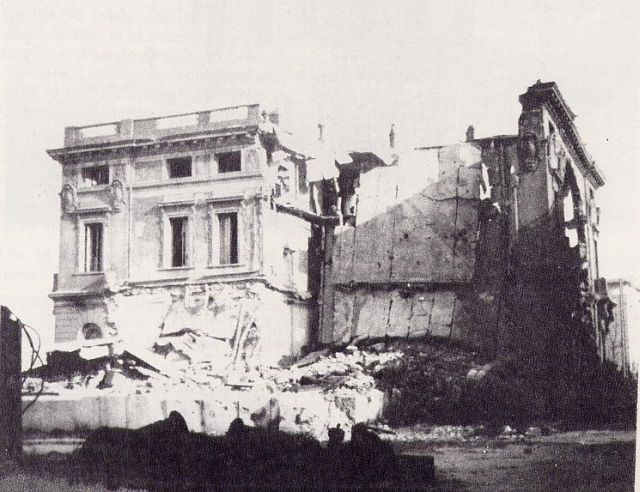
The bomb damage to the north wing.

The station after closure


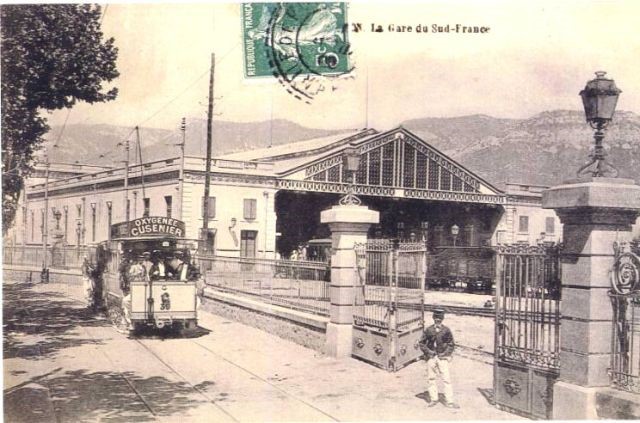
Beautiful old postcard of the early 20th century (around 1905) an overloaded tram carries its passengers towards the Mourillon. In front of the gateway to the South Station, a man in a boater poses patiently with his hands in his pockets. You can see behind it the vast buildings of the station (a “U” sheltered by a large glass roof which houses the tracks and platforms).[8]
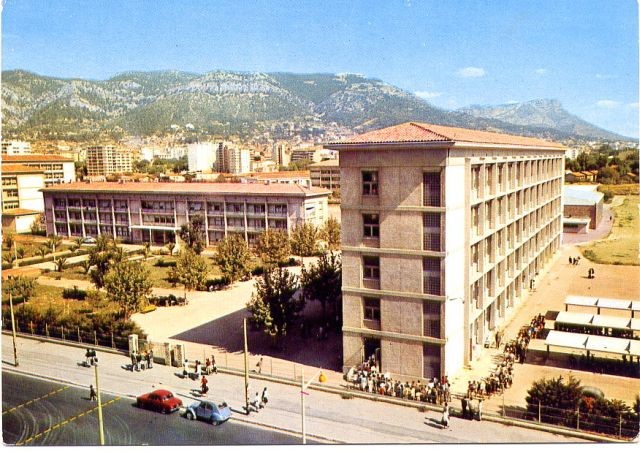
The final picture was taken by R. Le Corff in the 1960s. Trolleybus posts can be seen in the foreground and show the line being followed by the tram in the picture above. He comments: “New arteries, streets and buildings have sprouted everywhere. Dumont d’Urville high school was built on the former site of the Station (I attended the school in 1967-68) – We see here a fairly old photo of the school (taken to 1968-70) because the trolleybus posts are still in place. unless I’m mistaken, this is the entrance located at Avenue de Lattre de Tassigny, about where we see the tram on the picture above.”

References

[1] https://rogerfarnworth.wordpress.com/wp-admin/post.php?post=4098&action=edit.

[2] Marc Andre Dubout; http://marc-andre-dubout.org/cf/baguenaude/toulon-st-raphael/toulon-st-raphael1.htm, accessed 14th December 2017

[3] Wikipedia; https://en.m.wikipedia.org/wiki/Toulon, accessed 19th December 2017

[4] Railway Wonders of the World, Through Southern France; http://www.railwaywondersoftheworld.com/southern_france.html, accessed 18th November 2017

[5]

[6]

[7] R. Le Corff; http://www.mes-annees-50.fr/Le_Macaron_gare_du_sud.htm, accessed 20th December 2017.
[8] R. Le Corff; http://www.mes-annees-50.fr/Le_Macaron_gare_du_sud.htm, accessed 20th December 2017.
Ligne du Littoral (Toulon to St. Raphael) – Part 1 – History (Chemins de Fer de Provence 36)

Toulon to St. Raphael – ‘Le Macaron’

Chemin de Fer du Sud de la France

Ligne du Littoral – Part 1

This railway ran along the Mediterranean coast in the department of Var in Provence in Southern France. When the PLM built its railway from Marseilles to Nice is chose an inland route bypassing the costal towns of Var.

I guess that the board of the PLM, in their wisdom, felt that they would gain most from the quickest possible route linking Marseilles, Cannes, Nice and Monaco. And who is to say that they were wrong.

Nevertheless, this left a significant portion of the coast adrift with no rail service. The Chemin de Fer du Sud stepped in to provide a metre gauge service along the coast. The line eventually extended from Toulon to St. Raphael and was not connected to the rest of the Chemin de Fer du Sud system. It was the most southerly of the three mainlines of that system.

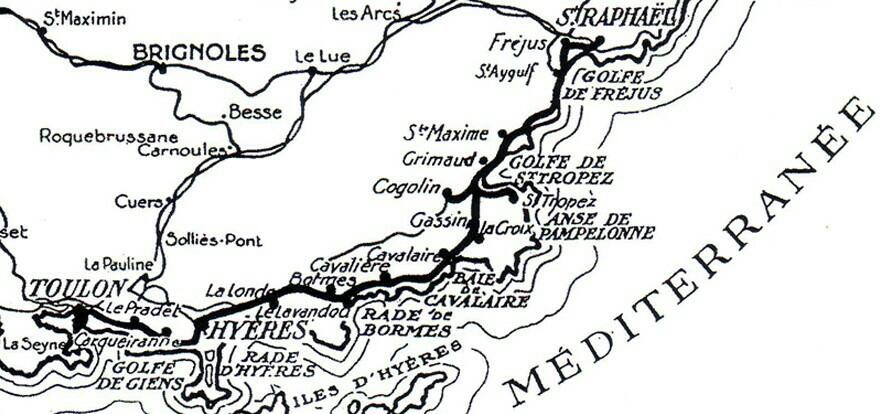
The PLM line left the coast at St. Raphael in the North-East and returned to the coast at Toulon. The metre gauge line had a large station at Toulon and followed the coast through Hyères and Frejus back to St. Raphael, with branches to St. Tropez and Cogolin. The area just inland is known as the Massif de Maures.

The line, 110 kilometres was long, followed the coast for most of its route. The tightest radius was 100 metres. The line was most often on its own formation, sometimes on a protected roadside platform alongside what was then the N559 or the D98.

History of the Line[1]

The PLM, at first, welcomed the construction of a metre gauge line as it anticipated that it would only increase traffic on its own system. The decision to begin the work on the laine was taken in 1887. The first 33 kilometre-long section from Saint-Raphaël to Cogolin/St. Tropez was opened on 25th August 1889. The line was then extended to Hyères, a further 51 kilometres. This work was completed in August 1890. The two short branches to Cogolin and St Tropez were completed a year later in 1892.[2]

The PLM became nervous of the possibility of the line extending to Toulon. It was fearful for competition on through traffic. So, the terminus of the coastal line was initially fixed as being at Hyères. It was a few years before the line was extended through to Toulon. The completion of the line and the opening of the last section to Toulon took place on 6th August 1905. This last 23 kilometres was constructed as a result of the success of the line over previous years.

The line was very popular with tourists as it opened up access to coastal resorts to the East of Toulon. Nonetheless rapid construction of the line left the formation fragile and regular maintenance and sometimes more significant work was required to keep the line in operation. Very early in its existence, the line had to cope with bad weather. Structures built for the line were neither big enough, nor robust enough to deal with flooding in the area. Major work had to be undertaken to rectify the problem.

During the first 25 years of its existence, the line allowed the opening up of the coastal towns of the Massif des Maures and the demographic growth of many communes such as Pradet, Carqueiranne, La Londe, Cavalaire, Sainte-Maxime and Saint-Tropez. It considerably enhanced the economy of the area, even if its own finances did not fully reflect this. In the years before the Great War a series of different projects were mooted and possible concessions were investigated.

An agreement signed on 27th November 1908, between the General Council of the Var and the Chemin de Fer du Sud de la France granted the opportunity for the railway company to build branch-lines connecting other villages and towns to their main line between Toulon and St. Raphael and also providing connections to the Central Var line. The two main routes agreed were:

  • A line from Salernes through Brignoles to a junction withe the coastal line near Pradet.
  • A line from Draguignan to St. Aygulf, connected at both ends to the Chemin de Fer due Sud’s main lines.

A further commitment to these lines was made in April 1909 when the agreement was enshrined in law. However, these additions to the network were destined never to be realised. The advent of the First World War meant that schemes of this nature were inevitably put on hold.

The First World War left the Company in a parlous state. The poor state of the line was not addressed in the years immediately after the War. In the 1920s, a series of different natural disasters affected the line. The degradation of the service and the poor state of the network accentuated the competition by the road.

Finally, in 1932, the local authorities responded. A decision was taken to modernise the line. Immediately after this decision there were very violent storms in the Mediterranean and these storms seem to have provoked a tidal wave which badly damaged costal defences and the railway line as well.

Surprisingly, this disaster did not cause the closure of the line, rather it prompted greater commitment to the modernisation plan. Work was undertaken quickly and the line was fully open once again by October 1933.

Modernisation almost went as far as electrification, but a dispute between the Railway Company and the Local Authorities meant that this did not go ahead. The Local Authorities decided that electrification would bring such an improvement in profitability that the work would pay for itself and so did not warrant subsidy. The Railway Company was unable to raise finance for the electrification. In fairness, both sides had strong arguments on their side. The costal line was after all the most financially viable and busiest of the lines of the Chemin de Fer du Sud de la France. By 1933, the historical company only had the coastal route under its control as the other two lines had been taken over by the State after going bankrupt.

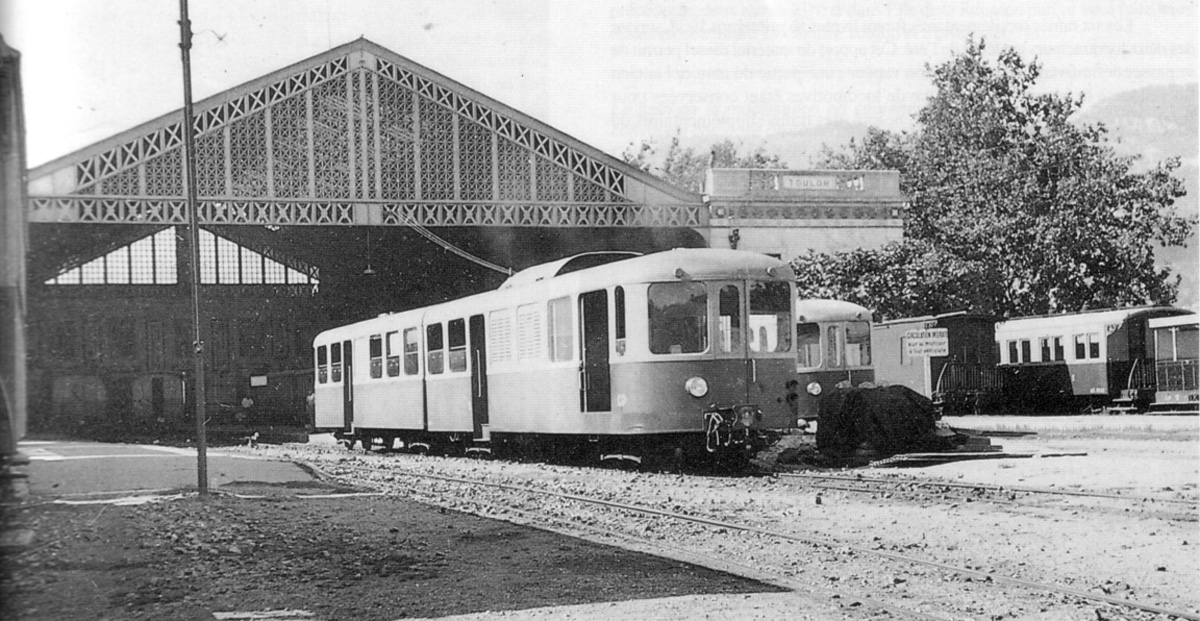
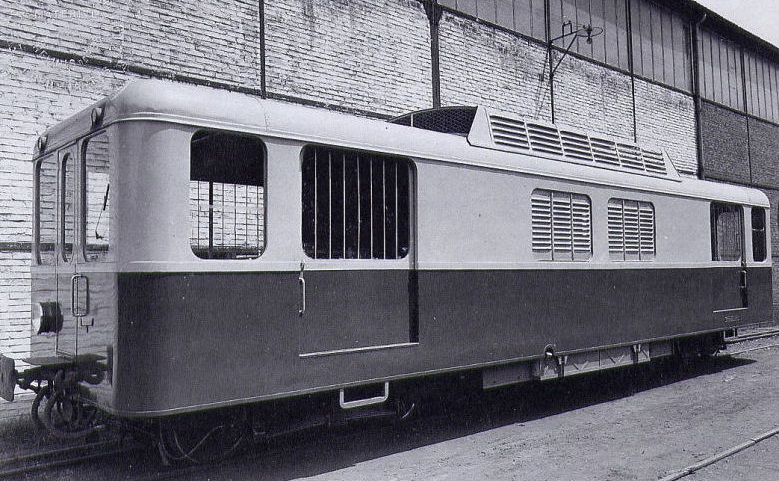
The Railway Company turned to look at diesel railcars as the best solution to secure the future of the line. The decision was taken to buy 10 200hp railcars rather than the originally proposed 7 100hp railcars. They arrived in 1935 and were an immediate success.

In two years the number of travellers tripled, the revenue doubled and the cost per kilometre cut by two-thirds. The daily timetable was increased to seven round trips on each section, and thirteen between Toulon and Hyères. The Company was so successful that they became victims of their own success: some schedules trains had to be increased from single car operations two, three and even four car operations on occasions. In this period, the train overcame all competition. The Toulon-Hyères tramway closed on 30th September 1936, and bus companies saw their customers desert their services and consequently saw a dramatic drop in revenues.

During this period any problems encountered were those arising from success rather than failure. In 1936, the General Council of Var ordered six new railcars and two locomotives. During the years 1937 and 1938, seventeen new stops were created on the line and a departmental coordination plan was created to regulate compettitve activity between road and rail.

Between Toulon and Hyères, the bus service was reduced and between Toulon and Cavalière buses were cancelled completely. However, the Railway Company found that it need to supplement the rail service on that second route and developed a coach service to complement its own rail service.

As a consequence of this action, a small change was made to the agreement with governed the management of the line and other transport in the area. In July 1938 this change formally permitted the Railway Company to replace some of it trains with road vehicles as necessary. This addendum did not at the time seem significant but ultimately it was the freedom for the company to do this which cause the end of the rail service only a few years later.

On the eve of the war, in 1939, the Chamber of Commerce of Toulon finally secured the permit for construction of a metre-gauge track between the Toulon terminus of the costal line and the PLM station.

Wartime bombing and occupation caused serious damage to the coastline and to parts of the railway. A few weeks after the liberation, a shuttle was put back into service from Toulon to Hyères, it allowed a daily return in each direction. It ran heavily overloaded.

In the immediate aftermath of the Second World War, the employees of the Railway Company managed, without significant resources and without recognition, to restore traffic along the whole length of the line. It was operational by 15th March 1945 before the end of the conflict in Europe. But the number of vehicles was reduced and those operable were in a very poor state of repair. It quickly became obvious that there was no likelihood of financing and that the Company was also riddled with debt. On 29th October 1945 the Company Director proposed transferring all service to road vehicles. Technical reports were undertaken on the state of the railway and proved to be surprisingly positive about its condition and the possibility of proper repair. However, the political discussions about what to do with the railway lasted three long years, during which the railway operated in really poor conditions. Overloading of the remaining 9 railcars was common and the Company supplemented these with road transport. In the same period maintenance of the permanent way was cut t a bear minimum to allow the company to purchase more road vehicles. By the summer of 1948, Railway Company flyers were only mentioning their bus services and no reference was made to the railway, even though trains were still running.

The closure was drawn out. On 14th May 1948, the decision was made to close the line. On 19th May, the Frejus diesel workshop was in flames. Railcar repairs were no longer possible. Rail cars continued to provide a service along the line until 2nd June 1948. A truncated service continued between Toulon and Hyères, until 18th October 1948. Some sources suggest that some sort of service continued without any logistical support until 1949.[3]

And finally, why ‘Le Macaron‘ (the Macaroon in English)?

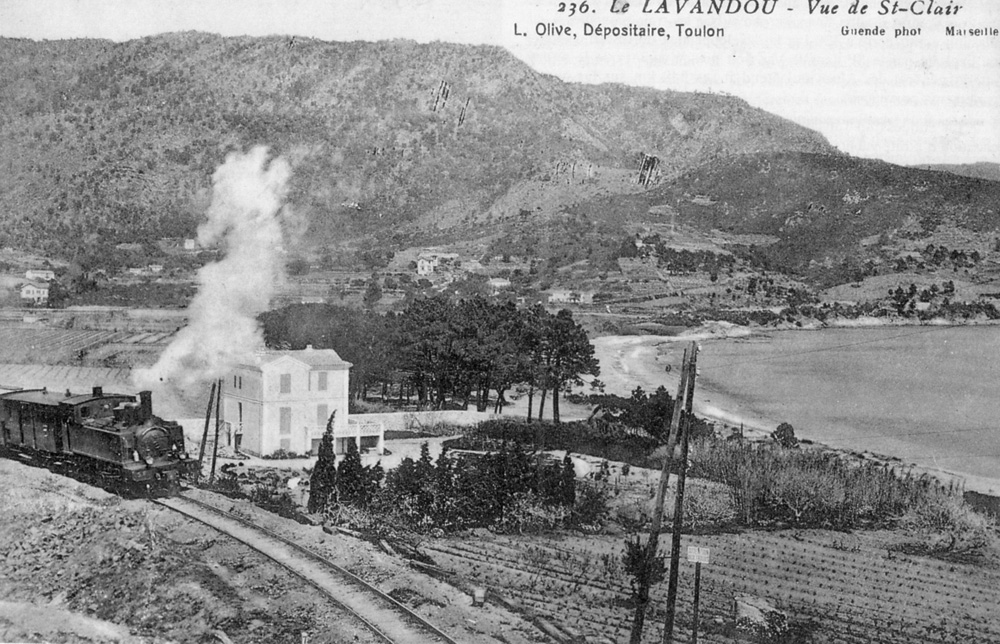
A plausible explanation is provided by Roland le Corff [4] who suggests that in Provençal, the train was called Lou mascaroun (which gave the word macaron) and which means “black” and more precisely a person blackened by coal. For example, this is what coal miners were called. What could be more logical than to name a steam train whose black smoke smeared on the faces of passengers leaning out of the window and of course that of the mechanic and driver placed in the front row?

References

[1] Wikipedia; https://fr.wikipedia.org/wiki/Ligne_du_littoral_varois, accessed 17th December 2017; and http://cccp.traindespignes.free.fr/infos-historique-lignes.html, accessed 18th December 2017.

[2] http://marc-andre-dubout.org/cf/baguenaude/toulon-st-raphael/toulon-st-raphael1.htm, accessed 15th December 2017.

[3] E.g. http://cccp.traindespignes.free.fr/infos-historique-lignes.html, accessed 18th December 2017.

[4] Roland le Corff; http://www.mes-annees-50.fr/Le_Macaron_historique.htm, accessed 18th December 2017.

Ligne de Central Var – Part 15 – Rians to Meyrargues (Chemins de Fer de Provence 35)

Rians to Meyrargues

We start the last section of our journey on the Ligne de Central Var of the Chemin de Fer du Sud de la France from the station at Rians. Before returning to the station we take a look round the town and its immediate environs.

A view of the church and bell tower in RiansRians is a commune in the Var department in the Provence-Alpes-Côte d’Azur region in south-eastern France. It is a provençal village in the Upper Var located north east of the Montagne Sainte-Victoire. It is on a narrow farming plain between the hills north-east of Sainte-Victoire and south of the Durance/Verdon hills.

The main employment is agriculture, predominantly wine. The village itself is built on a hill that is dominated by a 12th-century bell tower and the church of Notre Dame de Nazareth. The Town is made up of concentric medieval streets that work their way down the hill.

I am told that notable events in Rians include: dancing in the squares on 14th July; the Fête de St Laurent on 8th August; and the Fête de la Courge in October. We missed all these as we drove across the north side of Rians in November 2017.

A few pictures will give us a feel for the village.

 Rians photo rians0131b.jpg

 Rians photo rians0088b.jpg

 Rians photo rians0058b.jpg

 Rians photo rians0109b.jpg

 Rians photo rians0121b.jpg

 Rians photo rians0149b.jpg

Since prehistoric times, this village has been populated. There is apparently proof that around 40,000 years ago people used to live in caves of Rigabe. There are over 4,300 people living in  Rians at present.

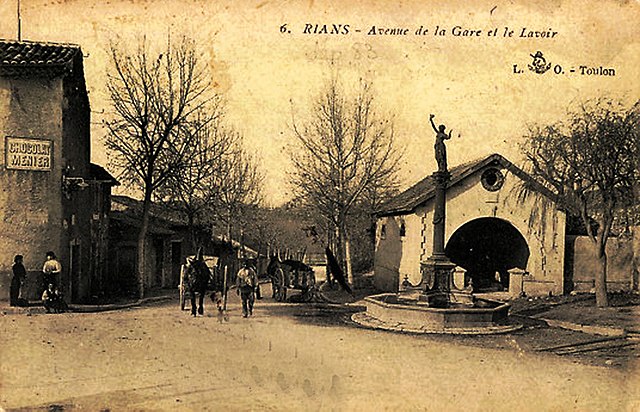
After a good look round, we head for the station up Avenue de la Gare.

As we wait for our train we notice once again the large Wine Cooperative next to the station and comment on how much larger its warehouse is than the goods facilities at the station.

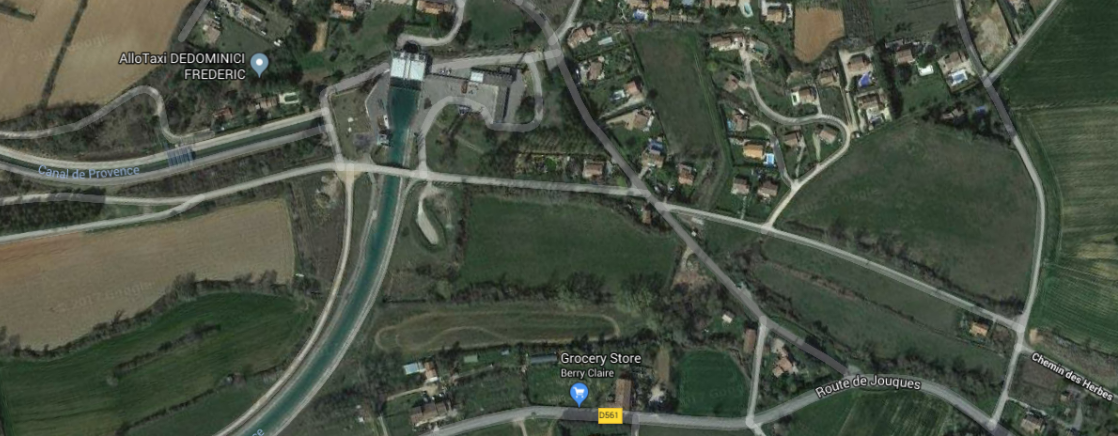
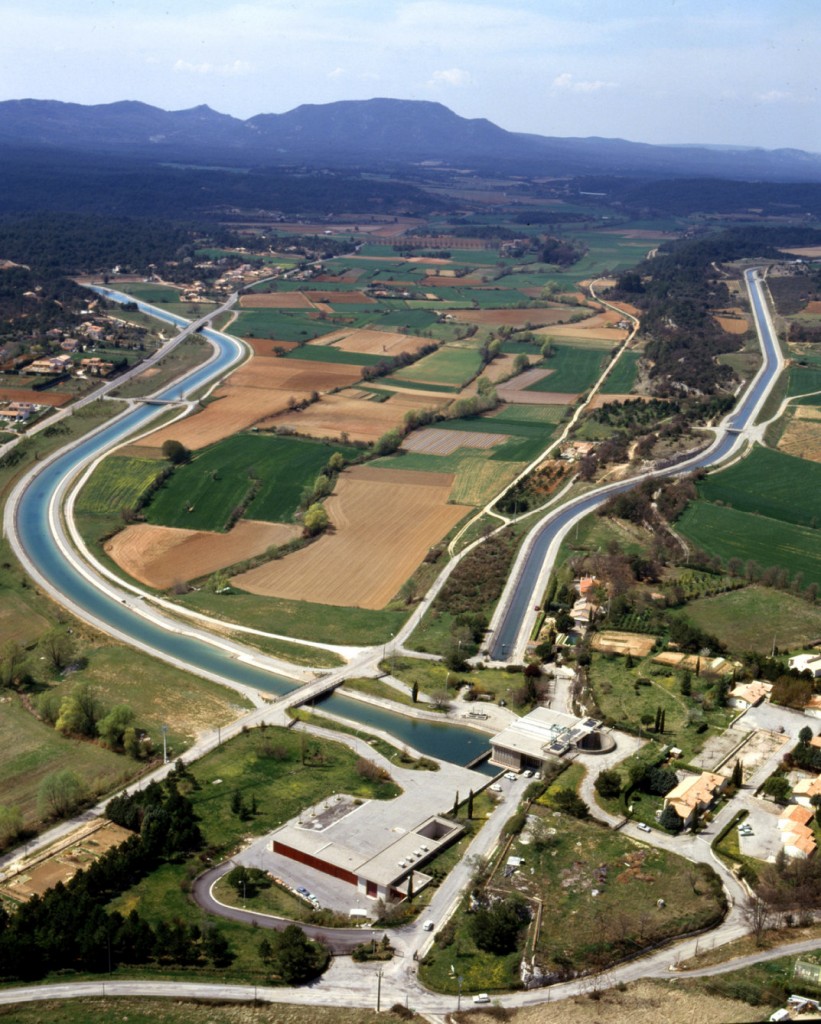
The line heads north-west from the station and curves round to a more westerly direction before crossing the Canal de Provence. In the satellite image below the Chemin des Herbes in the bottom right is the route of the line immediately after leaving Rians Station. The line leaves the image centre left below the East-West arm of the Canal.

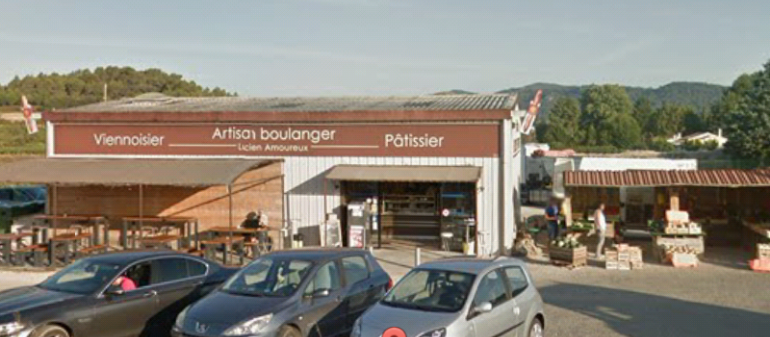
Incidentally, in November 2017, we had breakfast at a small Boulangerie on the North side of Rians – Artisan Boulanger, Lucian Amoureux. The premises are just to the South of the old line. A lovely and cheap breakfast it was too.

The Canal de Provence is run by SCP – La Société du Canal de Provence. In 1957, aware that the control of water was the key to the socio-economic development of Provence, three territorial communities, the departments of Var and Bouches-du-Rhône and the City of Marseille, decided to pool their rights to the catchment around the Verdon river. They gave the Société du Canal de Provence the task of ensuring the hydraulic development of the region.

In 1963, the company was commissioned by State concession to build and manage the Canal de Provence and the other works necessary for the water supply of the Eastern and coastal areas of Provence.

The Company has an annual turnover of 100 million euros. On average it invests 40 million euros each year in its infrastruture. It has 480 employees and transports 200 million cubic metres of water each year. It also produces 20 Million kWh of hydro-electric power each year.

It has nearly 70 km of open channels, more than 5,000 km of water supply and distribution pipelines, 85 dams and local reservoirs, 83 pumping stations, 19 water treatment stations, 4 clarification and filtration stations, 6 mini and micro hydropower plants that produce 50% of the company’s consumption. It supplies 1,700 companies, 165 municipalities, 6,000 farms, 80 000 ha equipped with irrigation, 37,000 individuals, 2,000 posts and fire stations and about 40% of the population of the entire Provence-Alpes-Côte d’Azur region.

More information can be found by following this link: http://en.calameo.com/read/000326974aee7083e98b9.

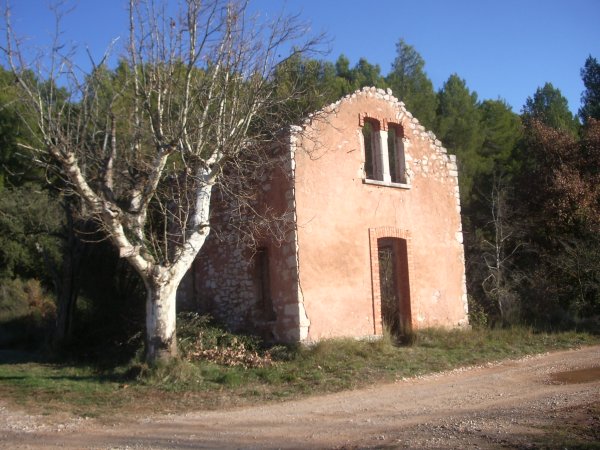
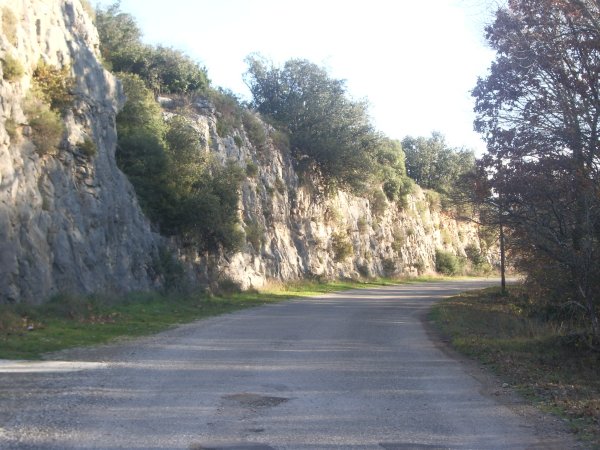
The railway line ran along the line of the road which can be seen in the picture above, crossing the large canal on a bridge and then heading off into the distance to the left (South side) of the narrower canal. Two pictures along the route show, first, an abandonned crossing keeper’s cottage, and then a view back down the line before it reached the next halt, showing some of the significant earthworks along this length of the line.

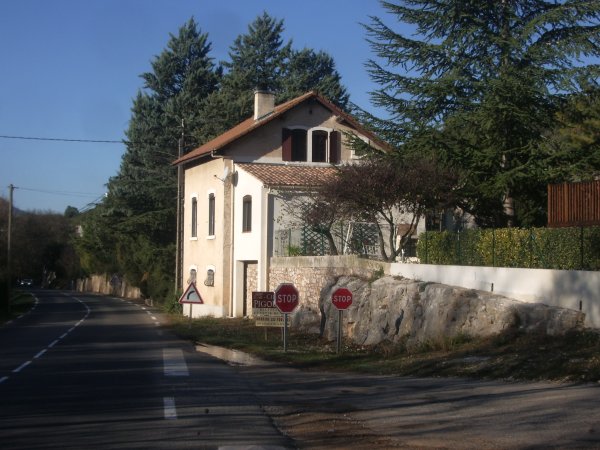
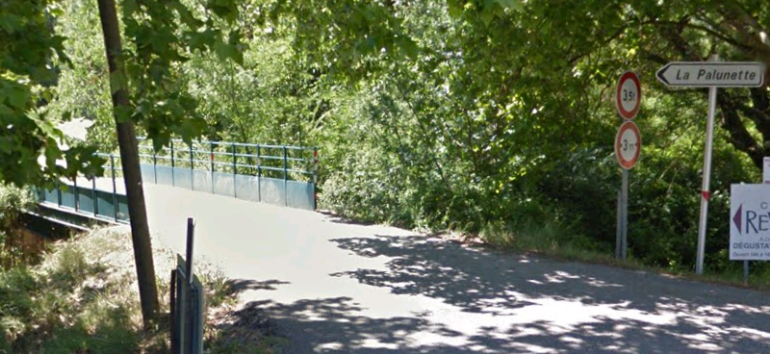
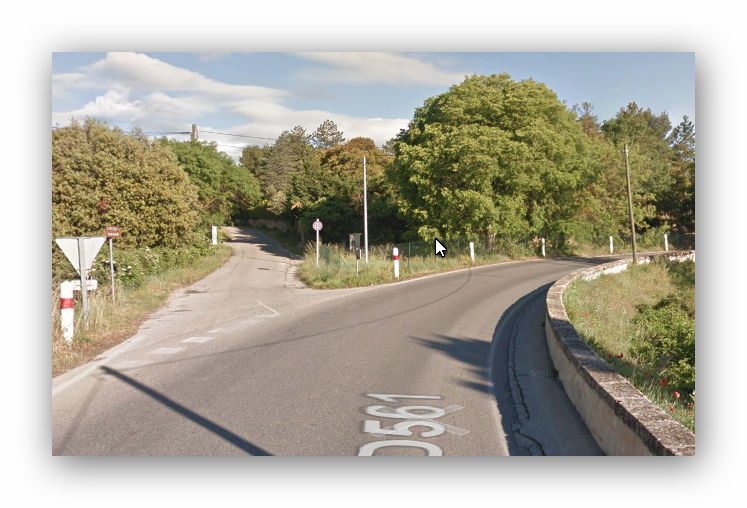
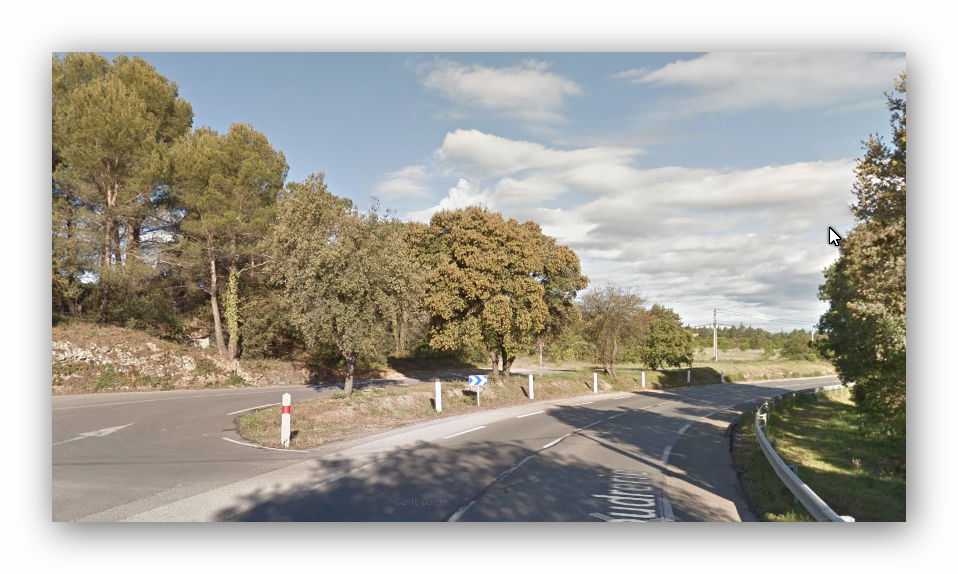
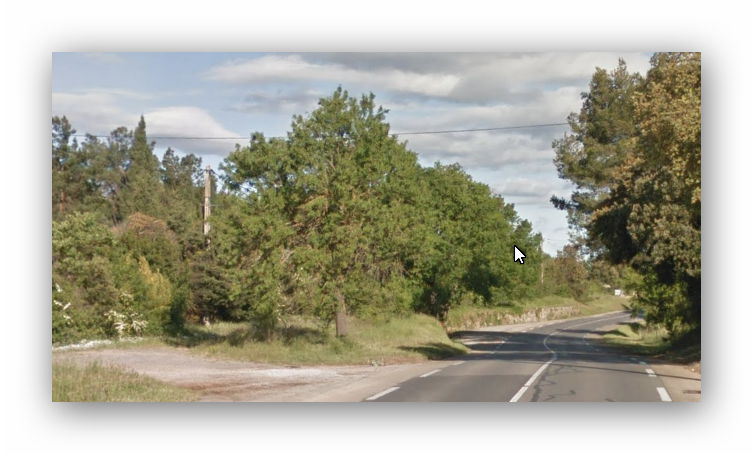
A few kilometres after crossing the canal, the rail formation meets up with the D561 road to the West of Le Benas and just to the East of the border between Var and Bouches-du-Rhone. There was a small halt at this point (Roques-Port Sec) and the building remains as a private property.

The satellite images suggest that at one time the old road was above the line of the railway, separated from it by retaining walls and at one point by a rock bluff. The present road has apparently been aligned with the old railway on a widened formation.

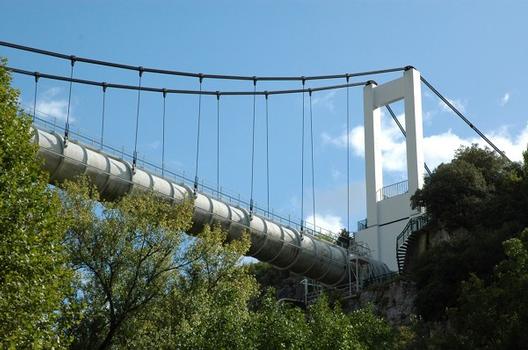
Close to the border a modern aqueduct can be seen over the D561, part of a whole series of water supply arrangements run by the SCP. This is a suspension bridge carrying a water supply. Typical of Provence is the amount spent by the Department and Region in securing a good water supply for residential, farming and business use.

We move on now into Bouches-du-Rhone. Jouques is the next village on the line.

It is a small village not far from Le Durance, nestled between Provence and Luberon. On the way to Jouques the line leaves the alignment of the D561 (while remaining on Route de Rians) and crosses the river (the Ruisseau de Saint-Bachi) and travels along on the South side of the river.

Approaching Jouques, the formation runs immediately alongside Chemin de Couloubleau. The road, as can be seen, widens out to include the railway formation and becomes Avenue de la Gare.

A short stop at Jouques Station and we are on our way once again. the tracks head across the yard ahead of us on the adjacent photo and then into a very short tunnel before we pick it up again on La Burlière. The picture below looks back down the line towards Jouques town centre.

The route then finds a path alongside the D561 once again as it leave Jouques behind. The trains followed tracks aligned roughly with the cycleway/footway on the left of the photograph.

At various points along the D561 its route can be picked out, either directly alonside the carriageway or deviating away from it.

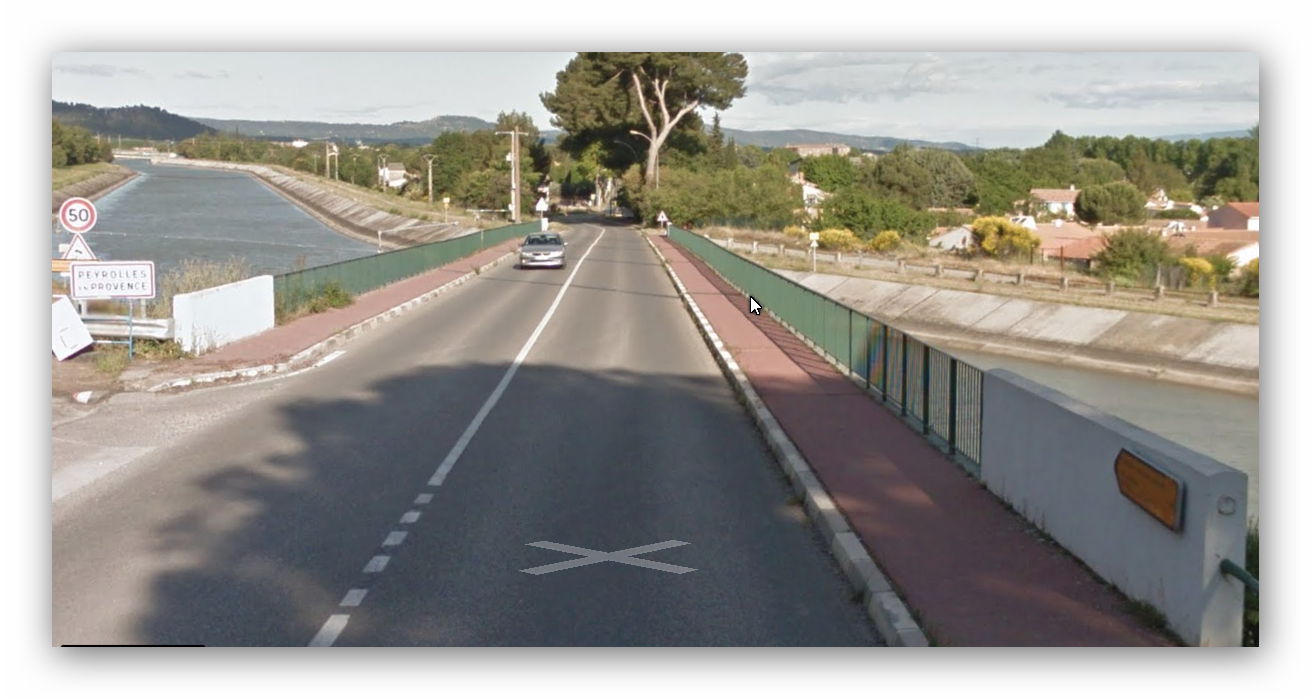
The line continued to what is now a major canal aligned with the present D561 road bridge – Pont EDF. When the railway was in use this canal did not exist. It was built in the 1960s.

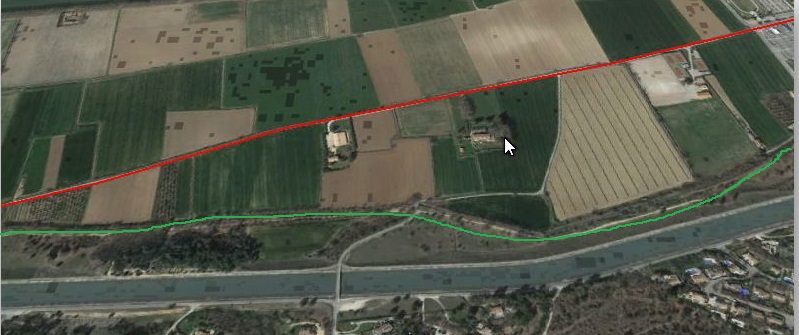
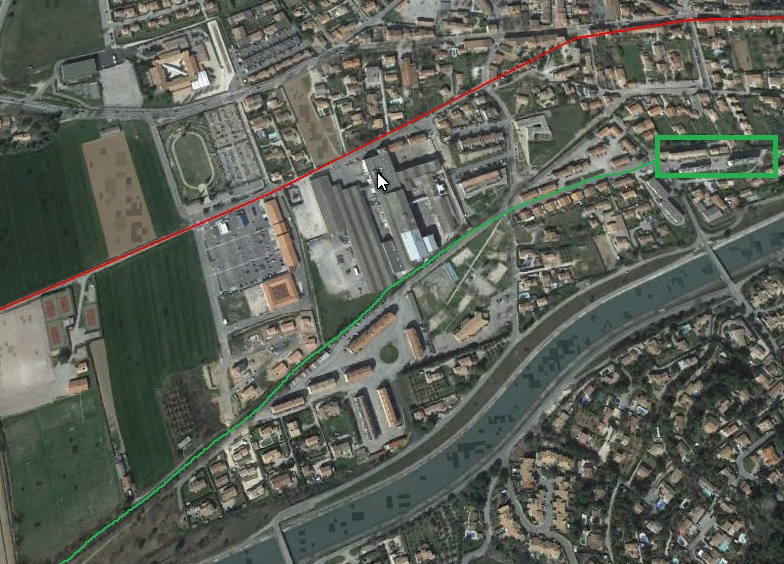
The formation seems to have been obliterated by the canal works. It does not follow the alignment suggested in the file associated with Google Earth as we can identify the station building somewhat to the South of that line, much closer to the canal.

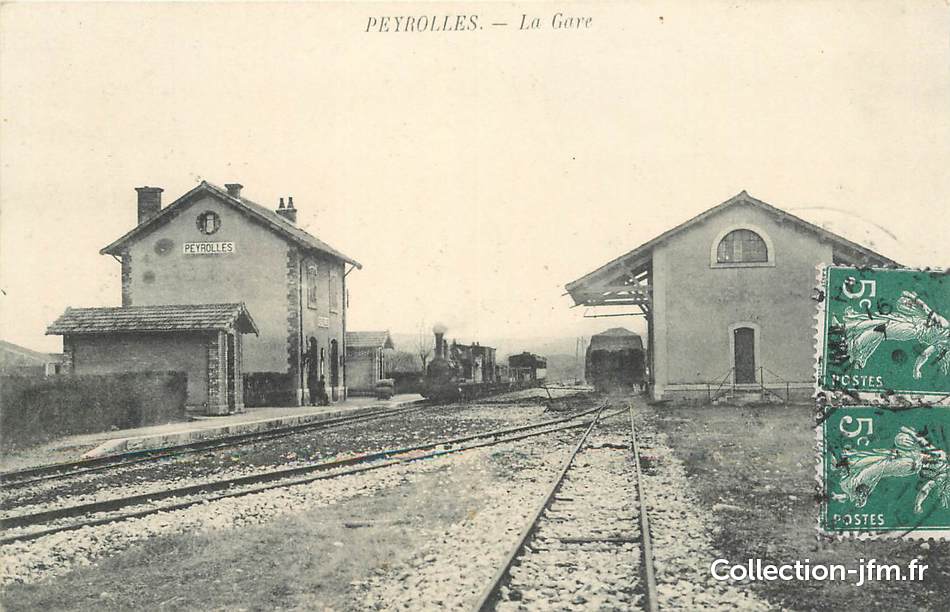
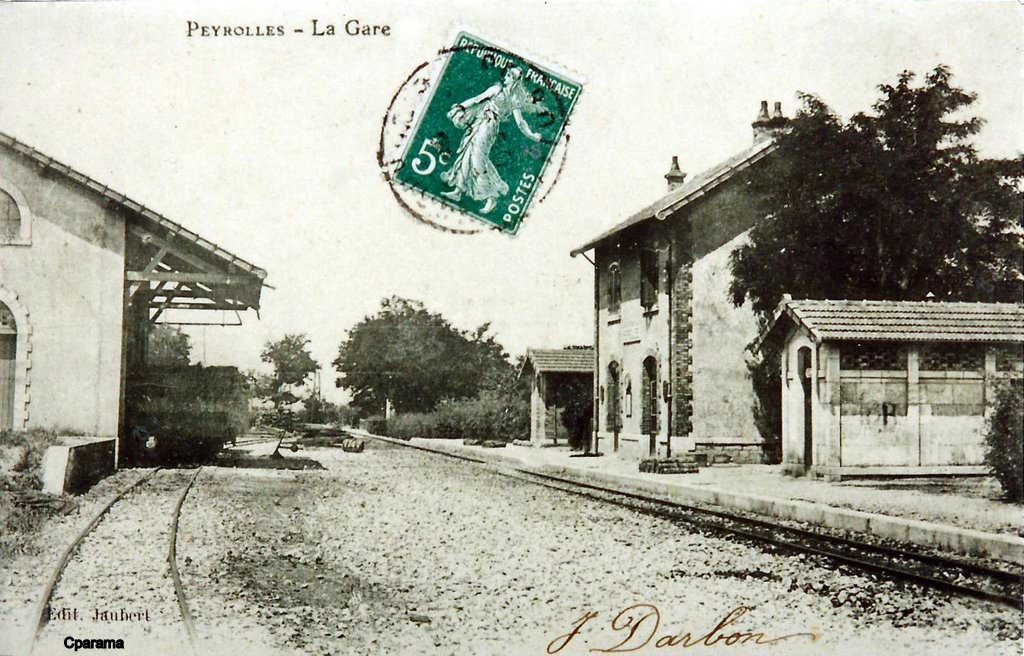
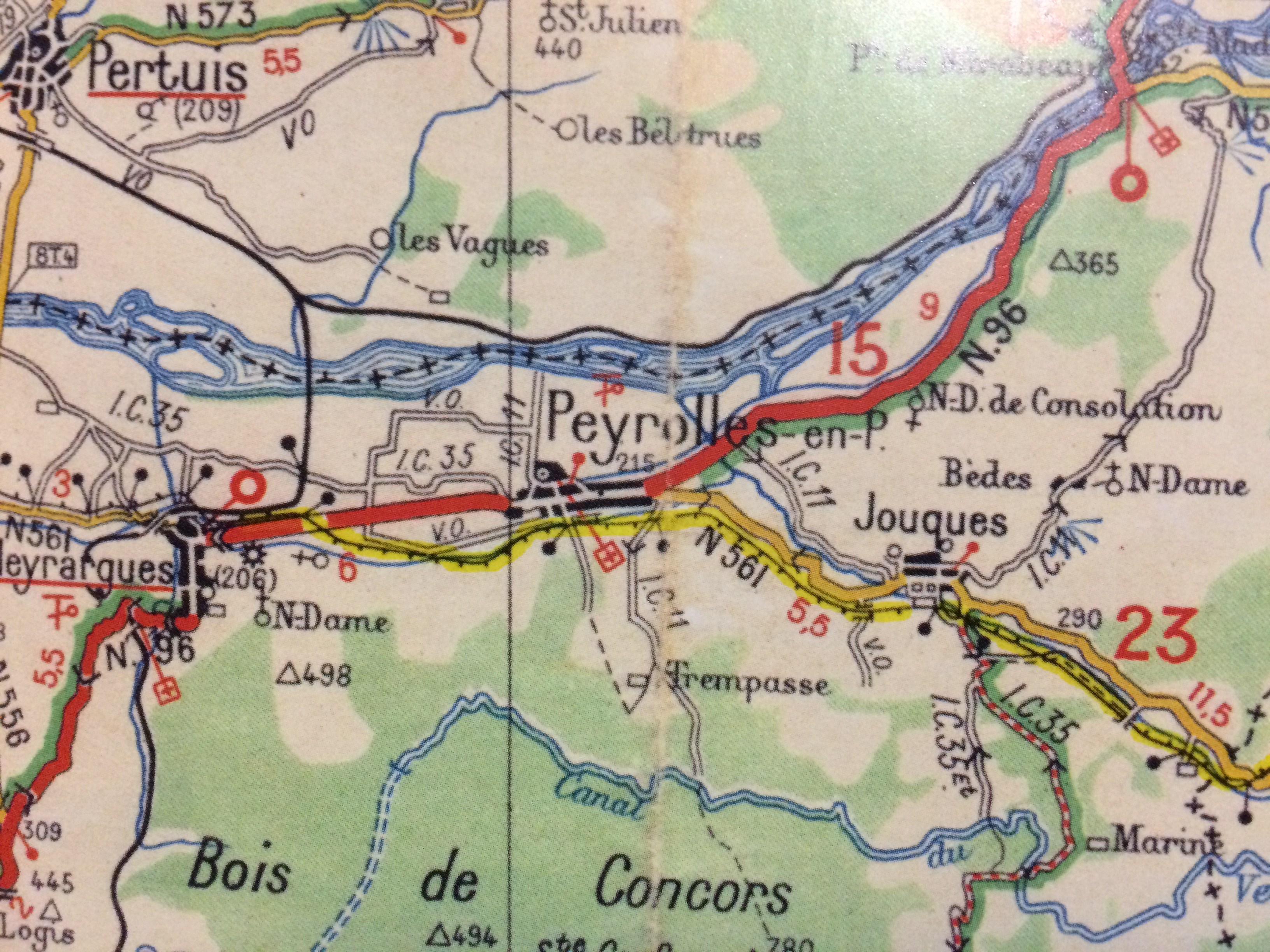
It appears that the line followed the route of the canal for a few hundred metres before deviating into Peyrolles. The exact line is difficult to decipher, however, the 1934 Michelin map shows the line a good distance below the N96 (now D96) and the N561 (now D561) roads as they meet East of the centre of Peyrolles.

The red line on the satellite image above is the route of the line as indicated on the add-in to Google Earth. The green-line is the much more likely route and the green box highlights the location of Peyrolles Station.

Leaving the station the route curves round to the South West, tightly following the line of a smaller older canal (Canal de Peyrolles) which runs on the North-side of the modern canal. The green line approximates to the route on the image below. It follows what is now called Boulevard Courdeloi before crossing the Canal de Peyrolles to join the Route du Plan.

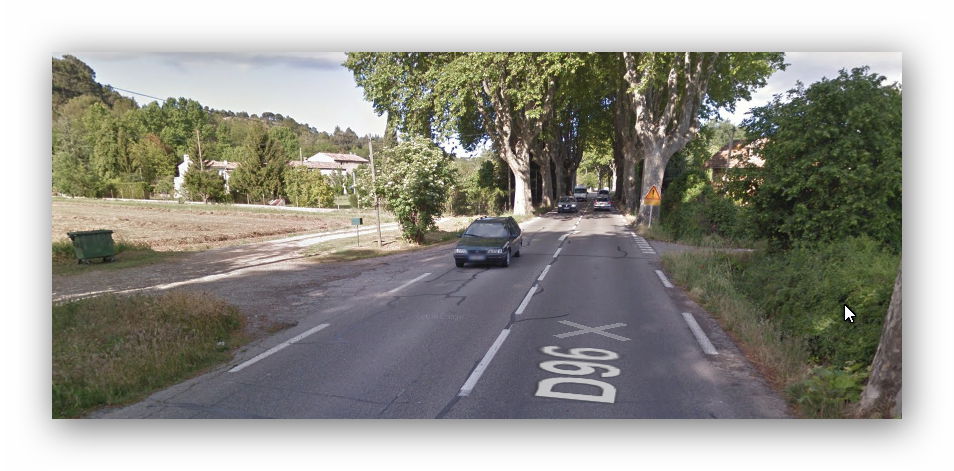
The Route de Plan and the rail alignment cross the D96 at level and the road name changes to La Grange. The alignment then turns to a more Westerly rather than North-westerly direction and runs parallel to the old PLM line towards Meyrargues. The red line below seems to travel passed the station an on along another railway. More about this below.

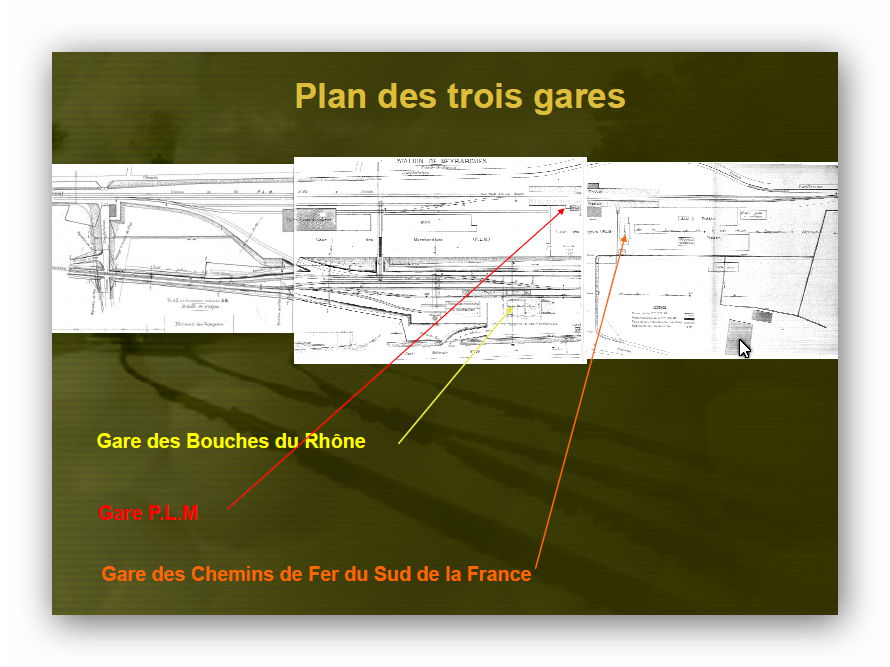
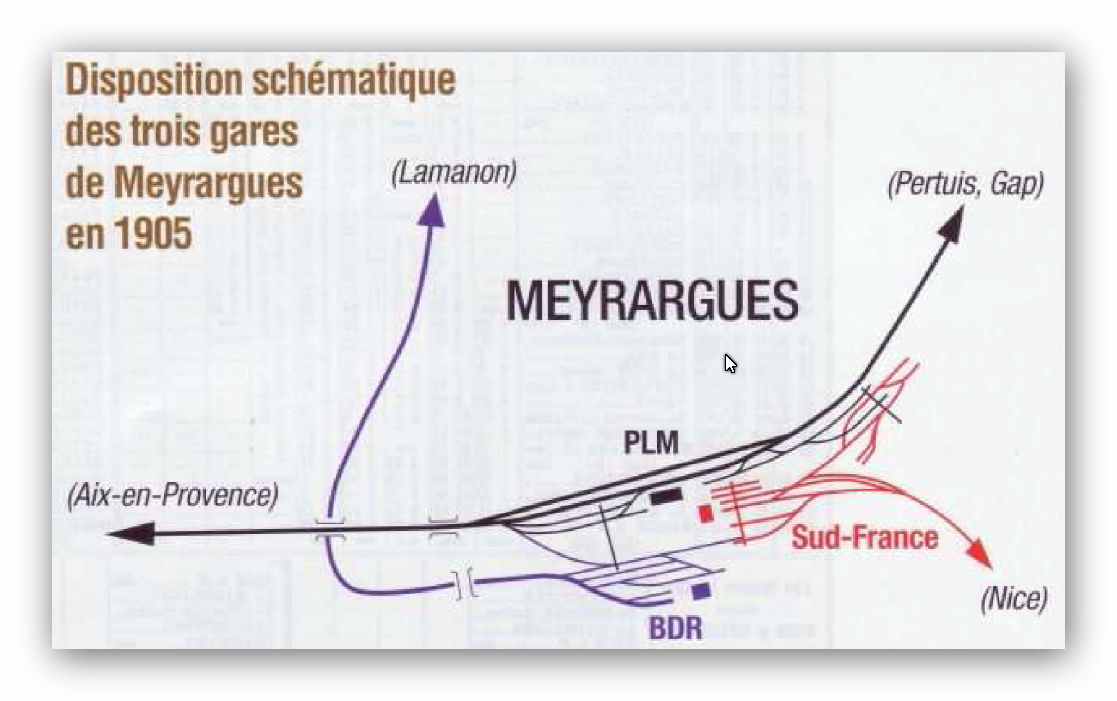
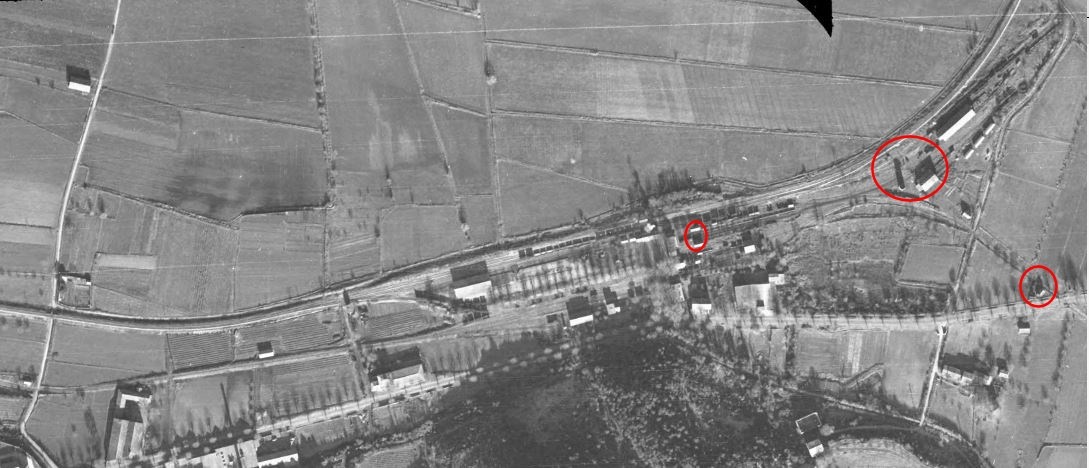
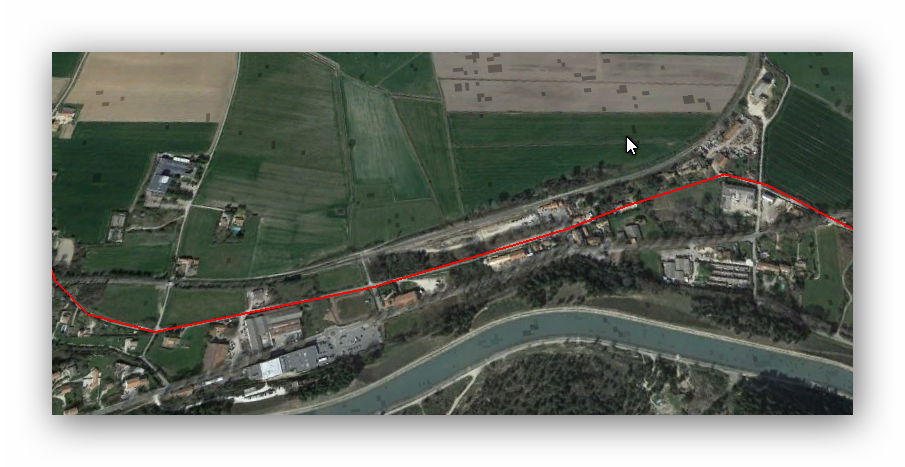
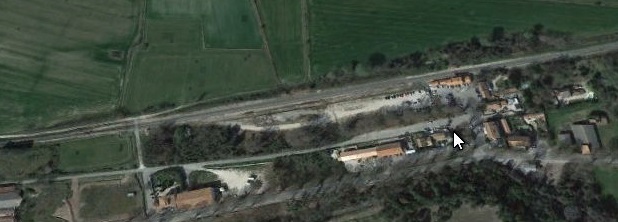
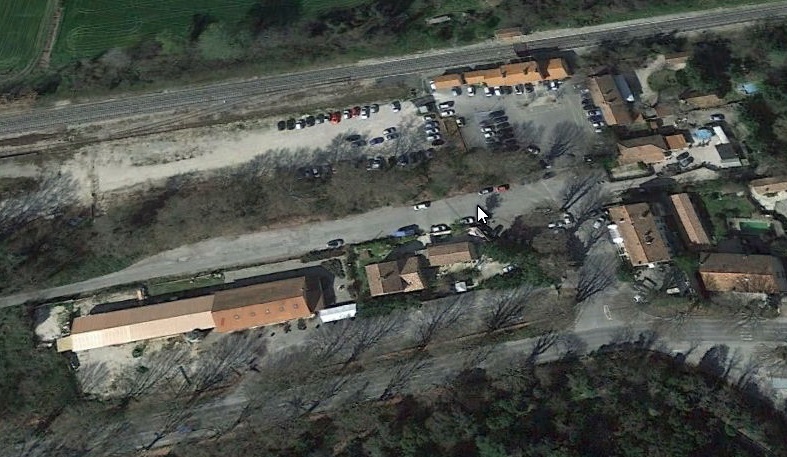
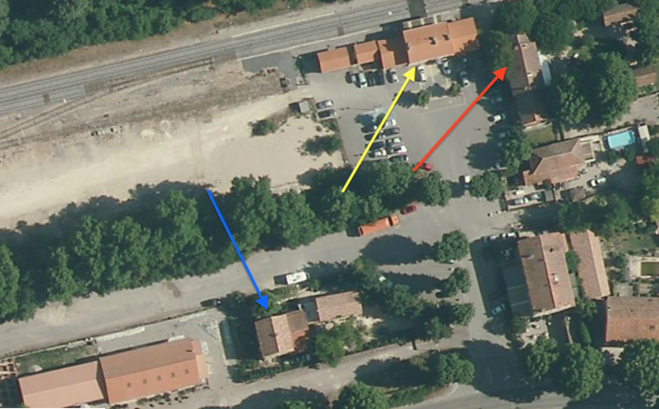
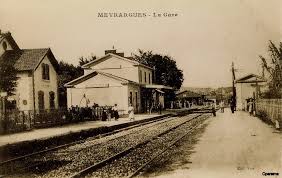
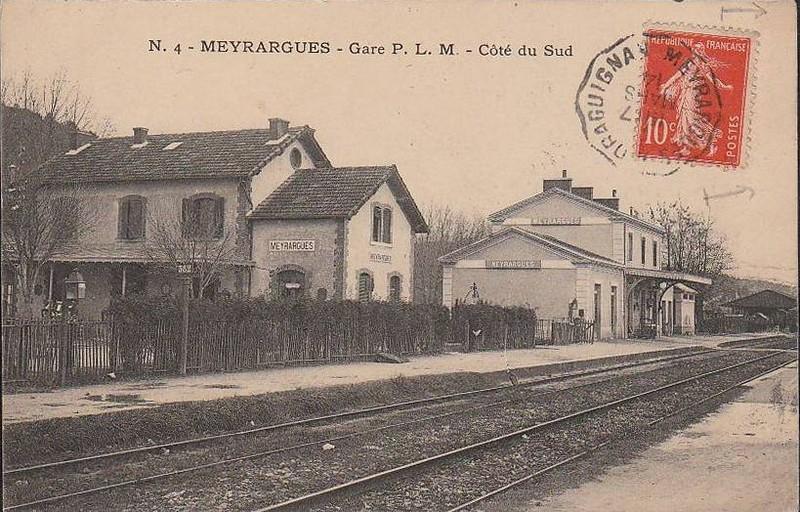
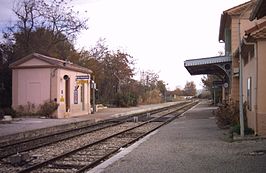
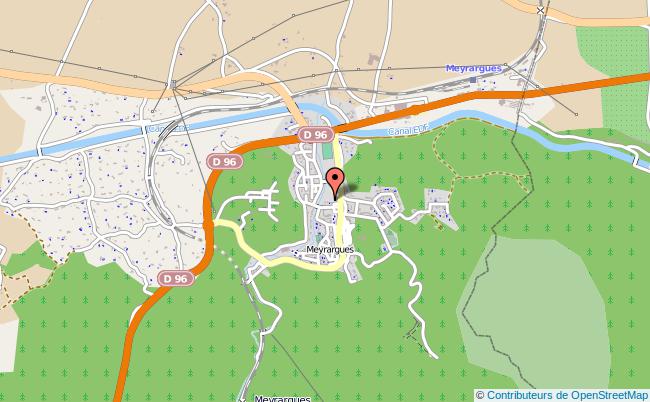
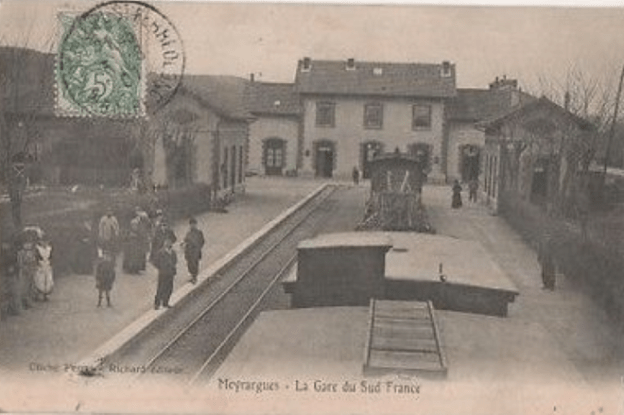
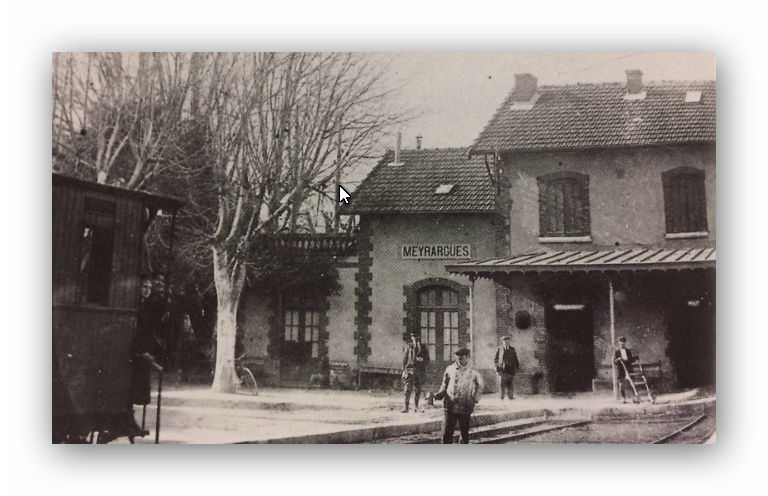
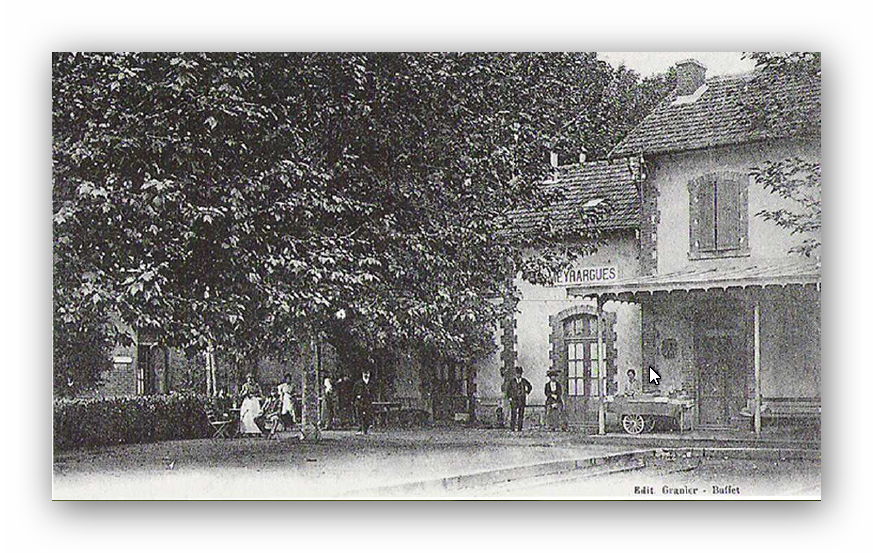
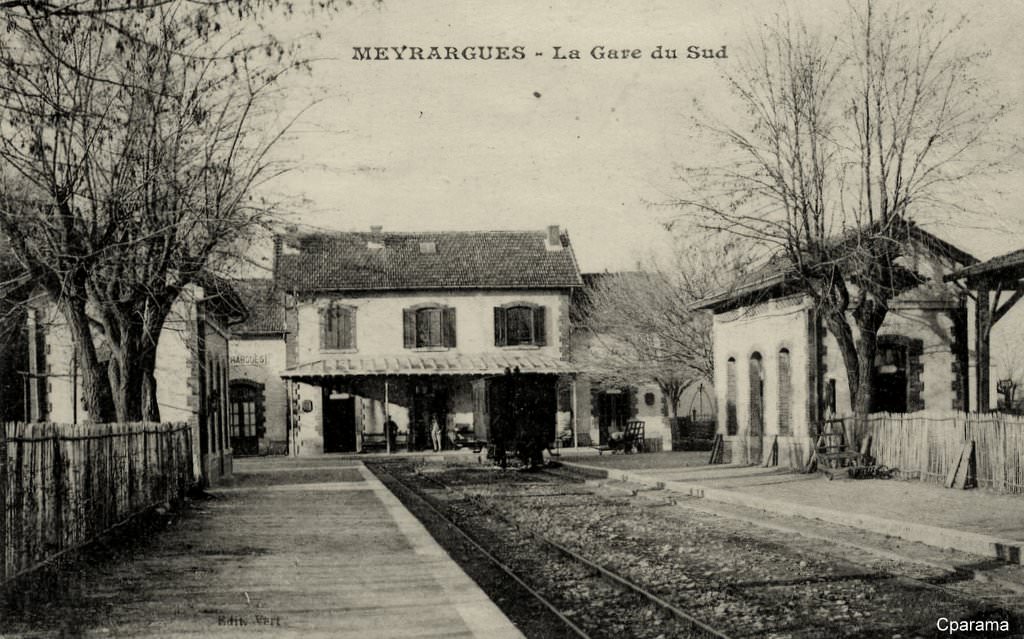
The three satellite images show the shared location of stations on three different railway lines. The most northerly station marked on the final satellite image in yellow is the PLM Station on the old line between Paris and Marseilles. The red arrow points to the passenger station buildings of the terminus of the Chemin de Fer du Sud de la France Central-Var line. The blue arrow points to the passenger facilities of the terminus of the standard gauge line to Salon-de-Provence and Arles which was run by the department of Bouches-du-Rhône.

It is this third line which has been picked out by the red line through the station site on the first satellite image immediately above and following this third line is a story for another occasion.

The PLM Station In Meyrargues

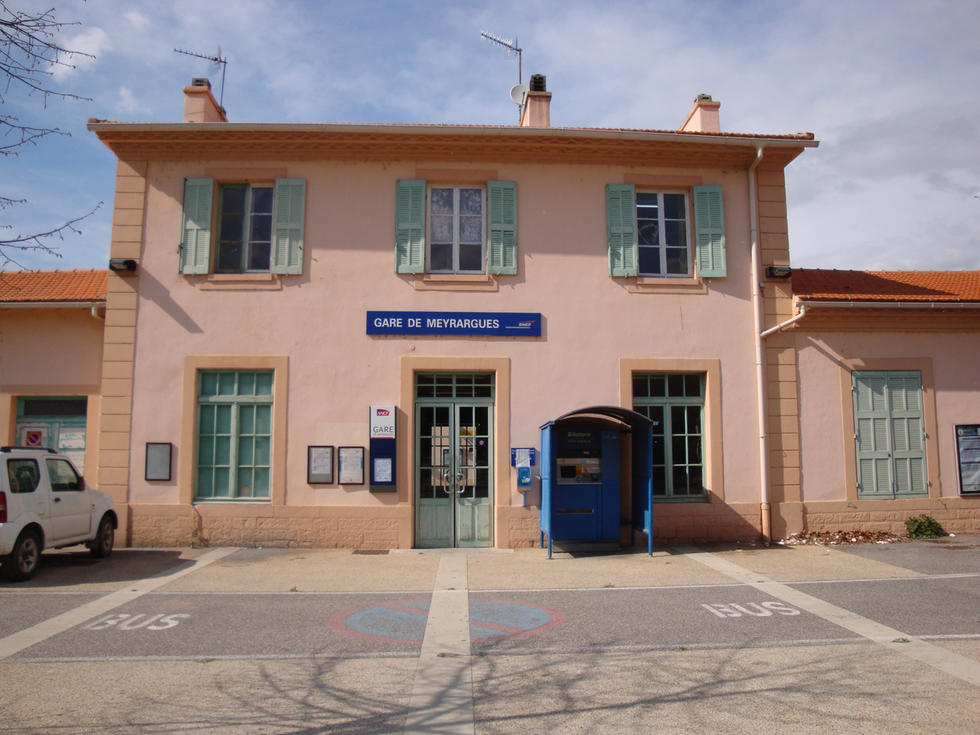
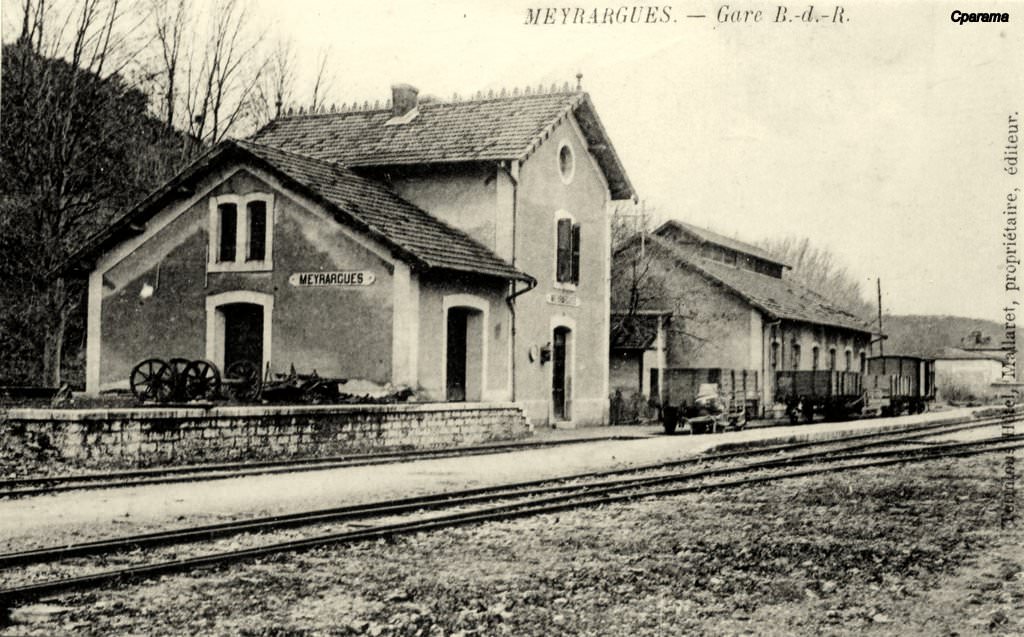
This station was constructed in the 1850s and remains open today. The PLM line circled round the West side of Meyrargues and entered a short tunnel before reappearing to the South-east of the town. The alignment can be seen on the map at the end of the next sequence of photos.

Once clear of Meyrargures the line travelled south to Marseilles.

The Bouches-de-Rhône Departmental Railway

This standard railway had its terminus in Meyrargues and travelled via Lamanon and Eyguières to Arles and Salon-de Provence


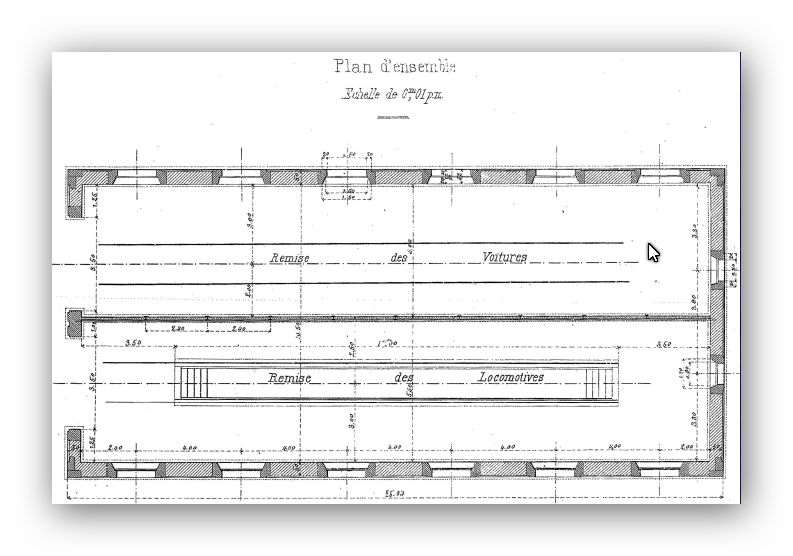
The good shed visible beyond the passenger station building is now in use as a perfumery and they have kept records of the drawings of the building.

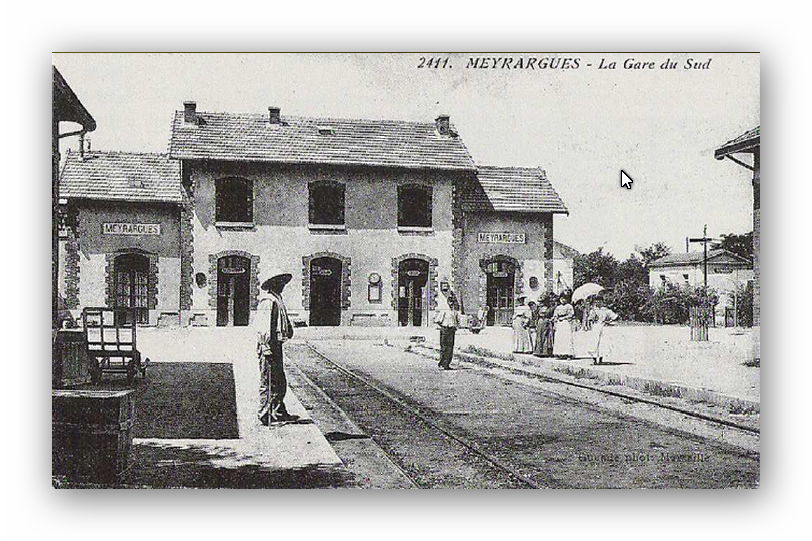
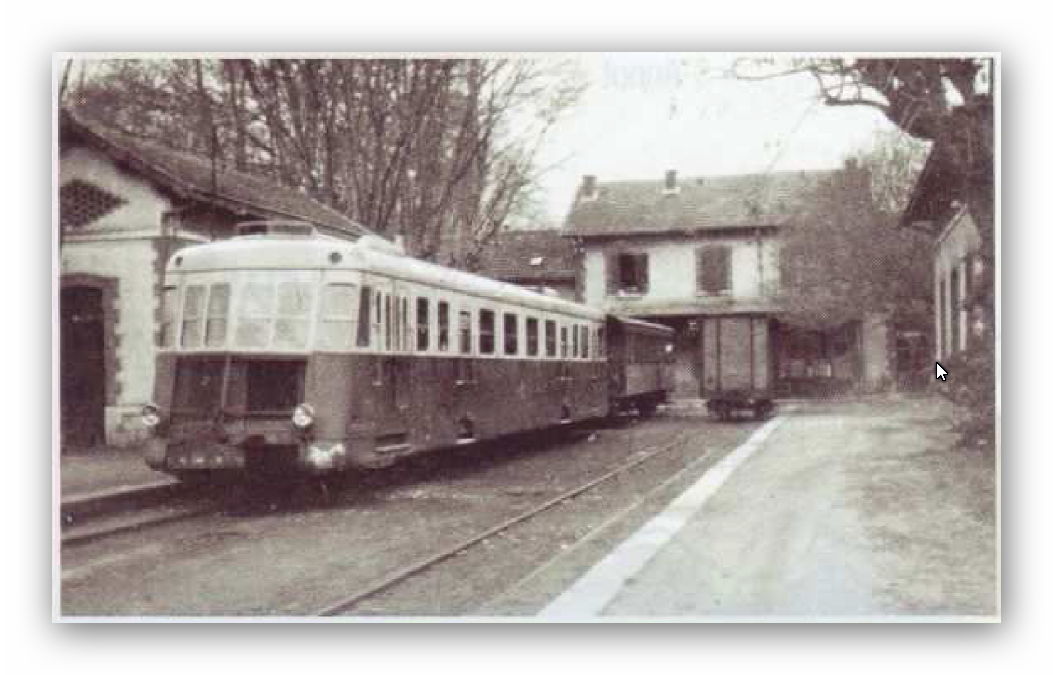
The Chemin de Fer du Sud de la France Station

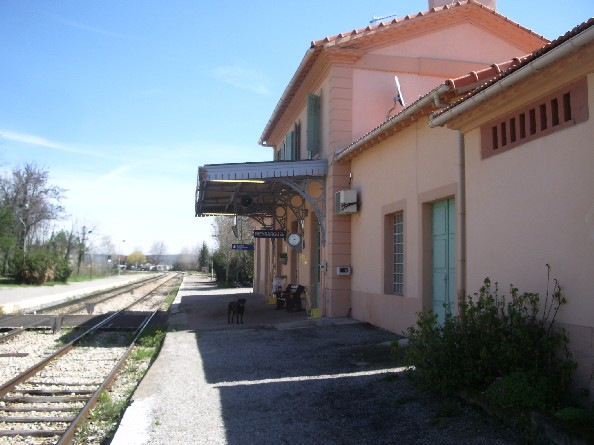
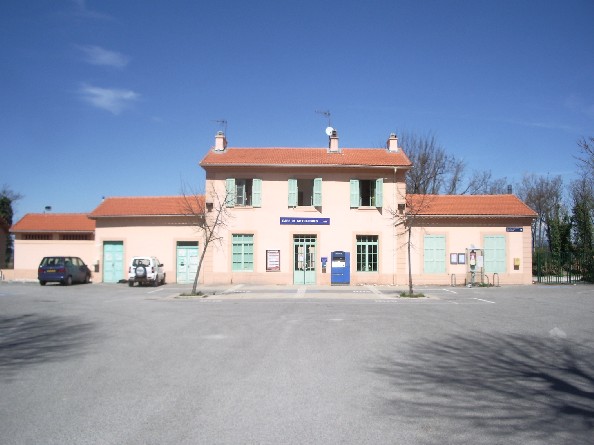
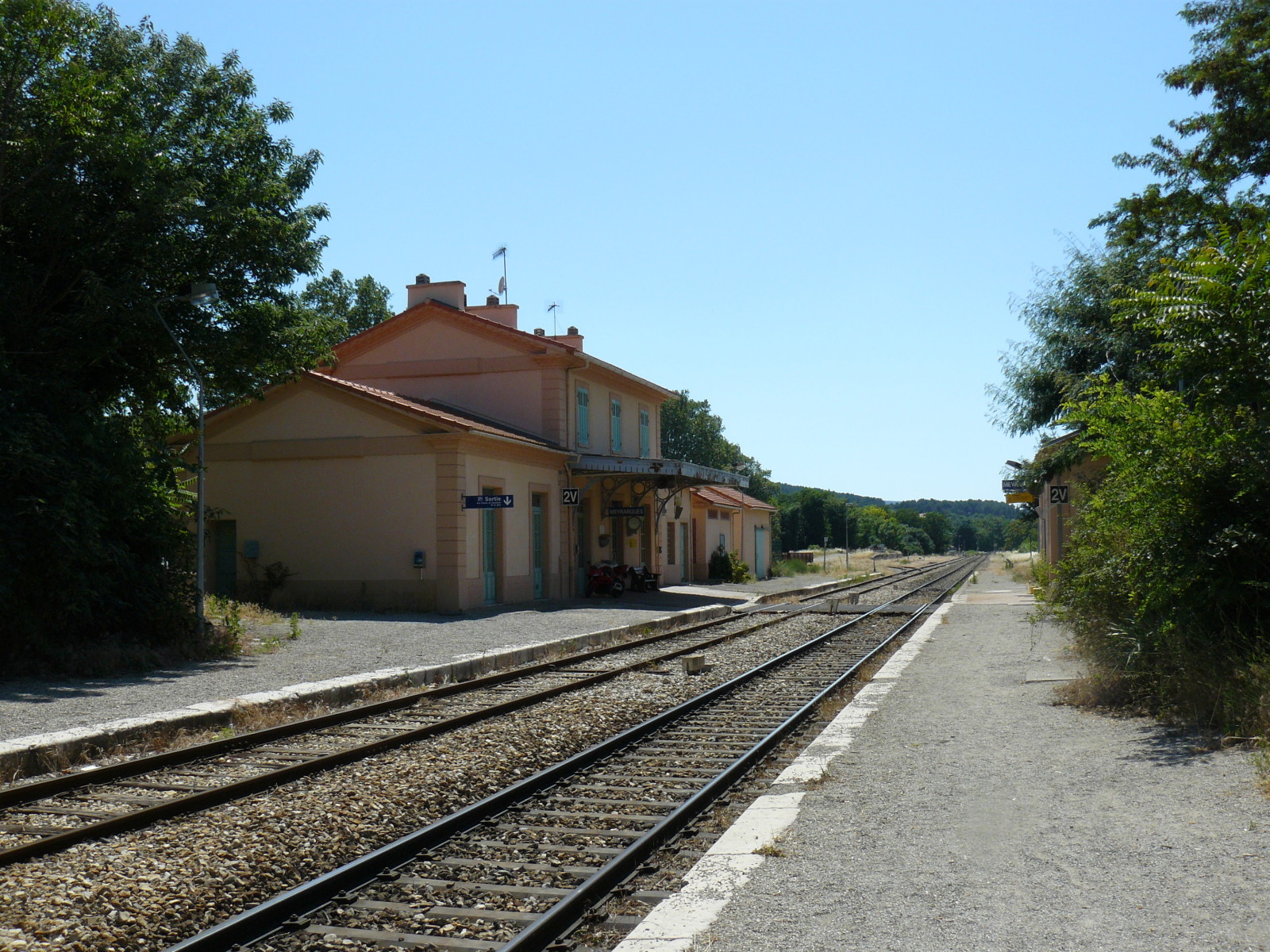
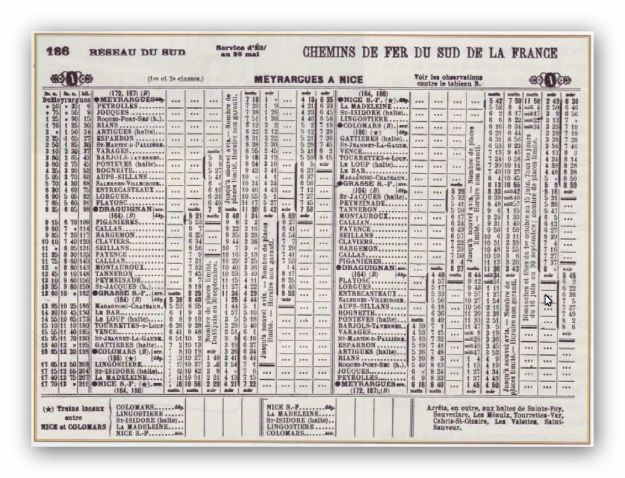
Our journey terminates in this station. There is just time top provide you with the timetable if you want to make the return journey along the line.


Ligne de Central Var – Part 14 – Barjols to Rians (Chemins de Fer de Provence 34)

Barjols to Rians


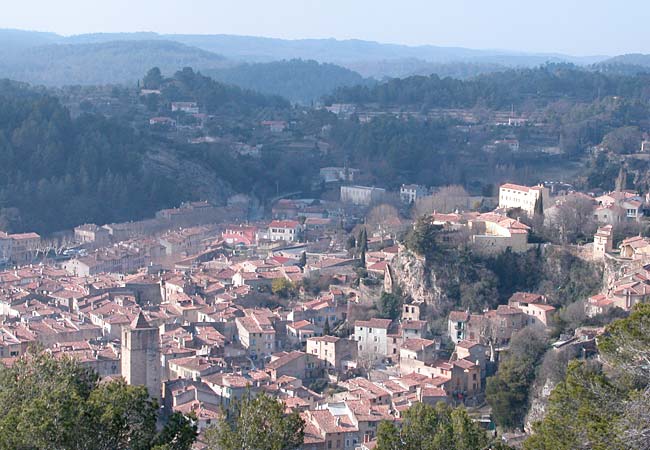
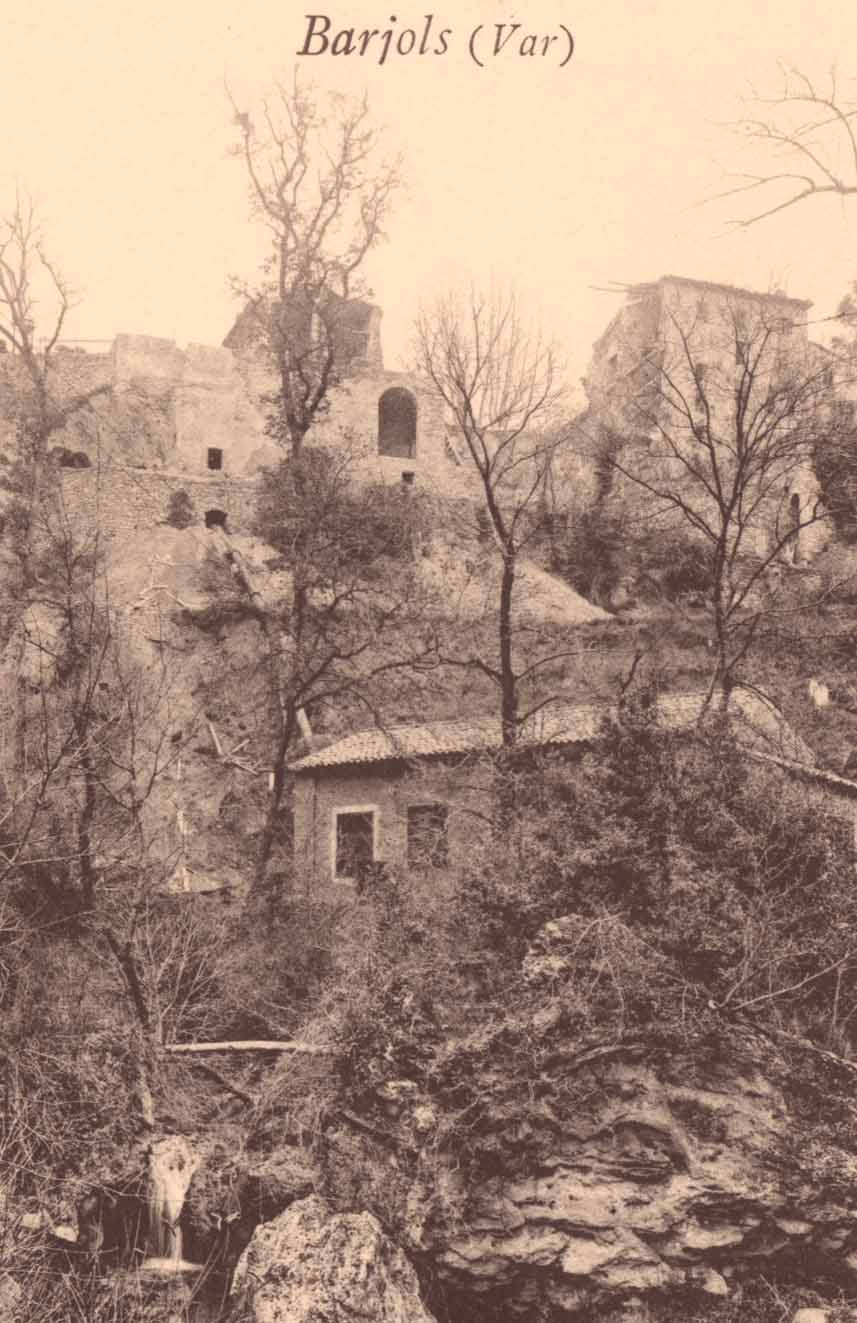
Barjols is a small town of around 3,200 inhabitants. Close to it is a small geological feature which includes a small gorge and a series of caves. The caves became home to a Carmelite Convent.

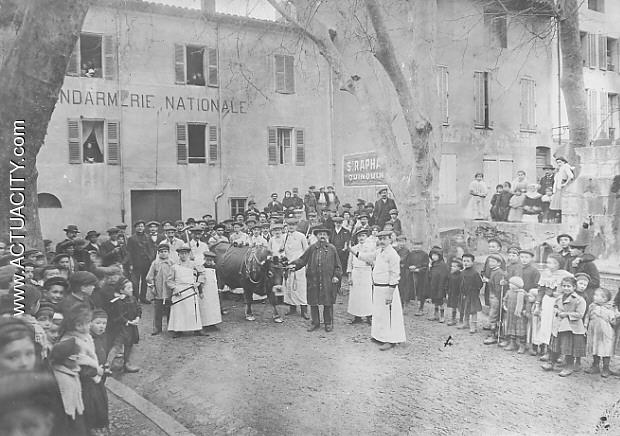
Along with much of France, Barjols experienced a period of agitation shortly before the French Revolution. In addition to the fiscal problems present for several years, the harvest of 1788 had been bad and winter 1788-1789 very cold. The election of 1789 provoked agitation and heightened a sense of class difference.  At the end of March 1789 riots and insurrection shook Provence. A food riot occured in Barjols on 26th March 26. Peasants attacked property owners seeking to force them to cancel outstanding debts. The reaction was to call out ther local constabulary, then to institute legal proceedings, but ultimately those convicted were not imprisoned. The storming of the Bastille resulted in a climate ofvfear in the region and amnesties were given in August and a civil guard was created, made up of local owners, artisans and farmers to protect against further revolt. Ultimately the revolution took place throughout  France and everything changed.

In the 1790s Barjols was chief town of the district. It was wealthy. In the XIX th  century, Barjols had become the ‘French capital of leather’. It had 24 tanneries and a sreies of 23 mills. Also, interestingly, a factory making playing cards.
In the Middle Ages, bow hunters and breeders sold or traded their skins to local artisans, most often to the shoemaker himself who tanned them. In 1608, Jean-Baptiste Vaillant installed the first tannery factory thanks to the tax benefits granted by Henri IV, a fervent advocate of industry. Barjols had 300 years of prosperty resulting from the tannery industry. There were 24 tanneries by 1782. In 1900 it wasnoited that Barjolais tanners treated so-called “exotic” skins from Africa, Asia and South America. At the beginning of the 20th century, new tanning methods appeared and revolutionized the leather industry. 

The new methods, vegetable tanning, reduced the tanning time from several months to a few weeks. However, the real revolution lay in the discovery of chrome tanning that lasted only 24 hours. Competition became significant and the number of tanneries in Barjols declined. At the time of WW2 there were only 3 larger tanneries in Barjols, but they were still employing more than 450 people and represented 5 to 7% of the total production of French tanneries by processing 5,000 tons of skins per year.

Decline set in in the 1950s and the last tannery in Barjols filed for bankruptcy in 1983. The work had primarily moved abroad, to the USA, South America and elsewhere.

Today the large tannery buildings serve as lofts or workshops for a large community of artists based in the town.

Barjols calls itself ‘the gateway to Haute Provence and the hills of Var’, near the Gorges du Verdon and the Lake of St. Croix, it is a peaceful village, set on a limestone cliff, and an inviting stop for visitors. It has 42 man made fountains, Barjols’ architecture and life have been determined for centuries by the abudance of water. 

Because of its more recent industrial past Barjols didn’t develop into a big tourist destination and so has kept many features and characters of French village life.

Having taken time to get to know Barjols we head back to thge railway station to continue our journry. As we do so we find on thge street a ticket which must have been dropped by someone.

We set off on our journey bearing this lost ticket and enjoyingvthe accommodation in 2nd Class.

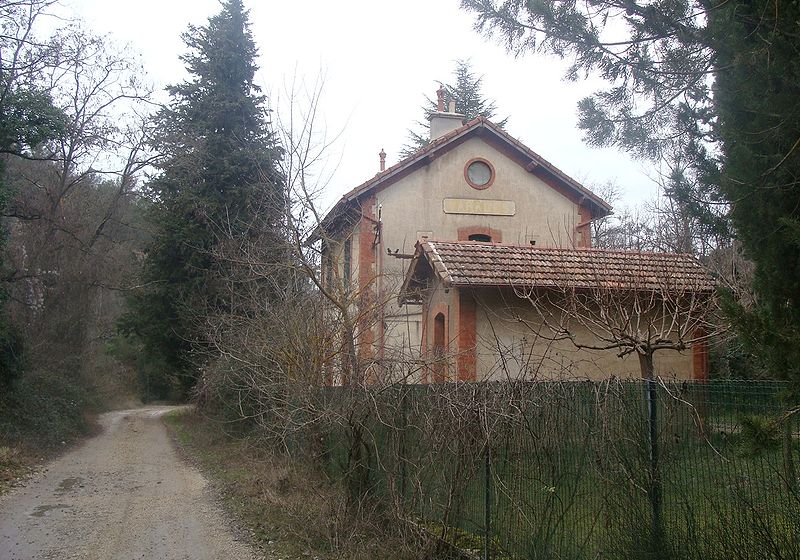
Once we leave the station travelling towards Rians we find ourselves in cutting and quickly going under a road over-bridge. The modern name for the route is HLM les Camps. The image below is from Google Streetview as is taken looking back towards Barjols Station.

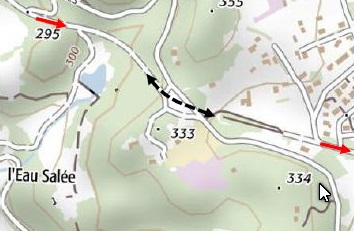
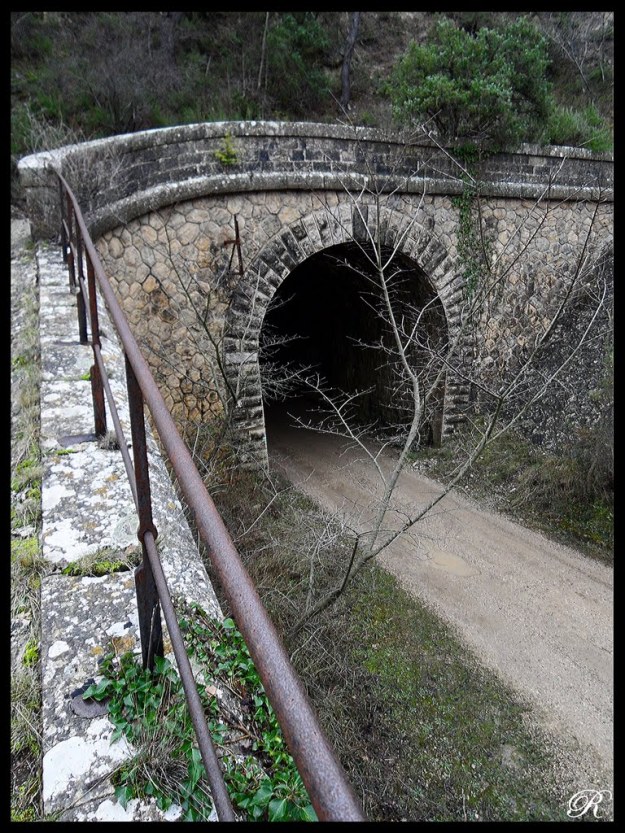
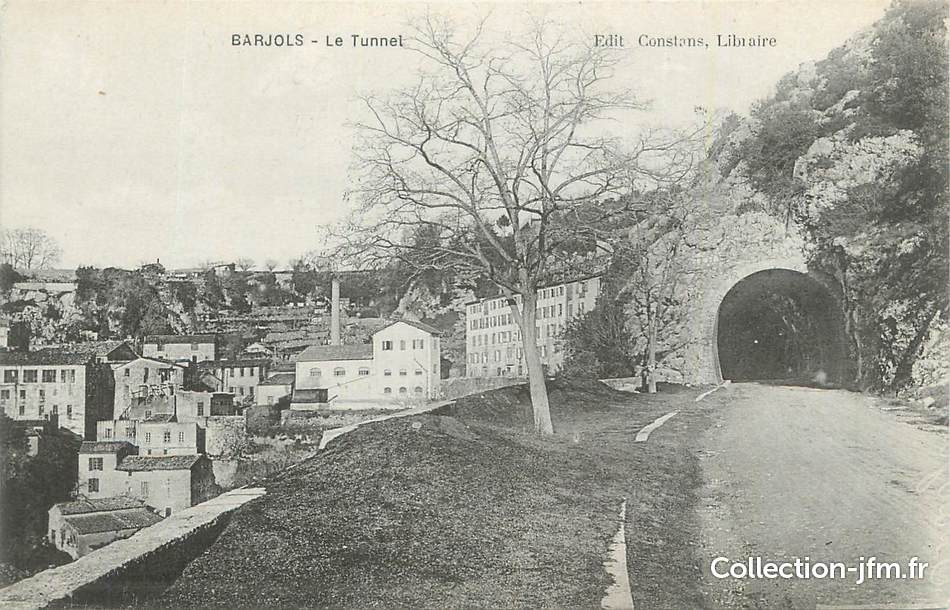
The route continues towards Varages and encounters a short tunnel. both the portals are shown below, together with a map which marks the tunnel with a black dotted line with arrowheads at each end. beyond the tunnel the line continues to follow Chemin de Varages-Pres, a gravel road based on the formation of the old line.


The aerial shot looks back down the line towards Barjols and gives a good impression of the scenery around the line. Hidden behind trees in the centre of the image is a crossing keeper’s cottage. the formation of the line is now overlain with a broken tarmac surface.

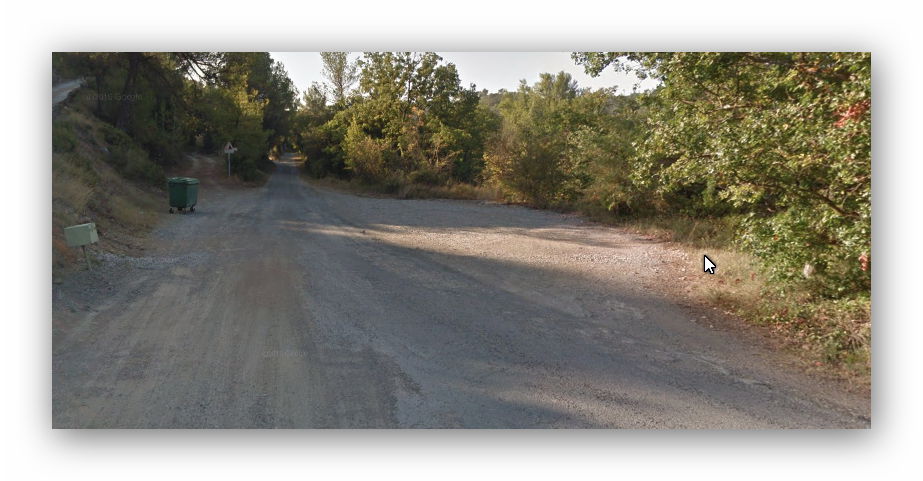
The line continues on towards Varages held high above the local road on a series of retaining walls. The road comes up to meet the railway and crosses it. There are two images below the one of the retaining wall which show the crossing, the first looking back down the line (the railway came down the track behind the green waste bin. The second image shows the formation and the road diverging again. The railway took the route on the left of the picture which is now covered in tarmac.
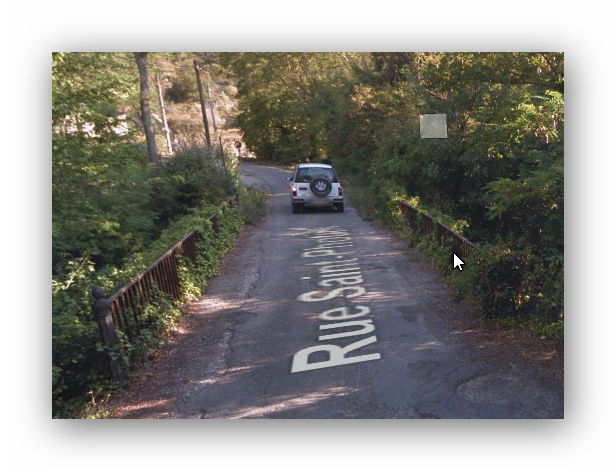
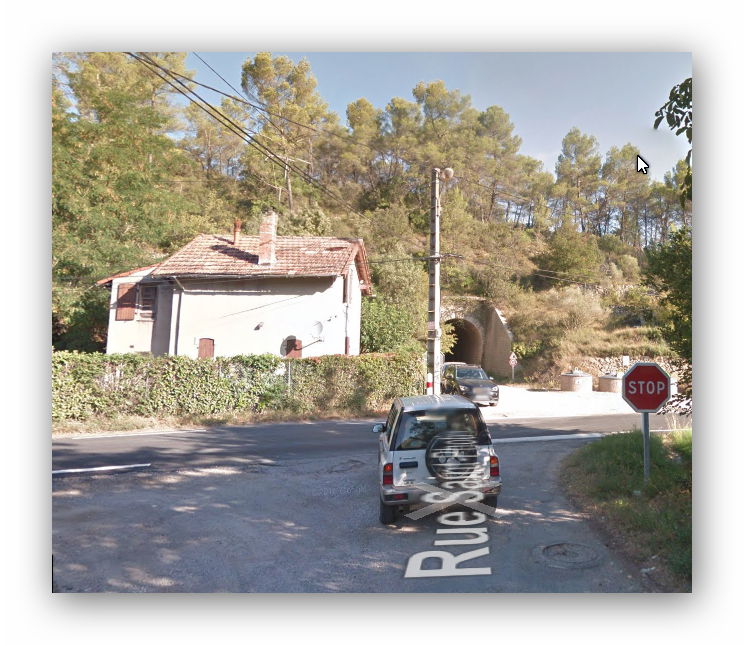
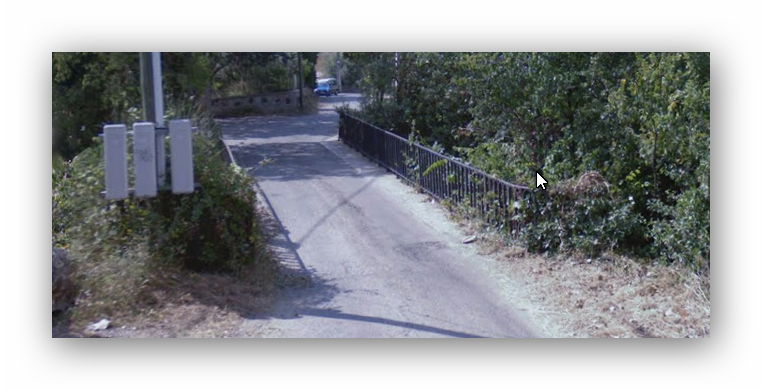
Rue Saint-Photin continues to meet the D35, crossing a river bridge en-route. The crossing keeper’s cottage can be seen at the junction, as can the portal of the tunnel beyond. The line disappeared into m a short tunnel just beyond the present D35.

The formation continues to be tarmacked and carries the road along below the village of Varages and into the old station.

Our train can just be seen now in the old postcard exiting the tunnel portal and arriving at Varages Station.


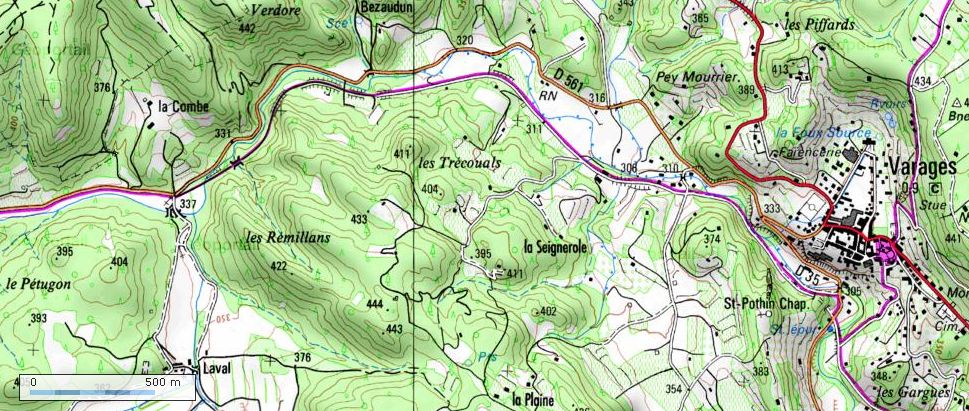
Beyond Varages, the line continues in a North-westerly direction for half a kilometre or so before diverting westward.

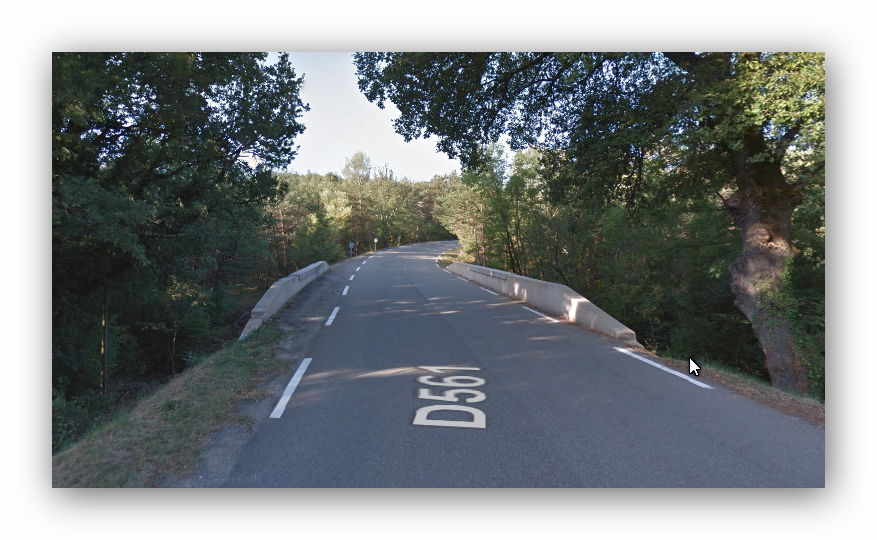
Just south of Bezaaudon and with the D561 nearby, the trackbed becomes inaccessible for a while but continues to follow the routs of the D561 but a hundred or so metres to the South.

And by the time the D561 turned south to cross the alignment, the railway was bridgeable as it was in cutting.

The D561 leaves the rail alignment here and also crosses the river, heading away southwards. The line continued along the river bank to the next station.

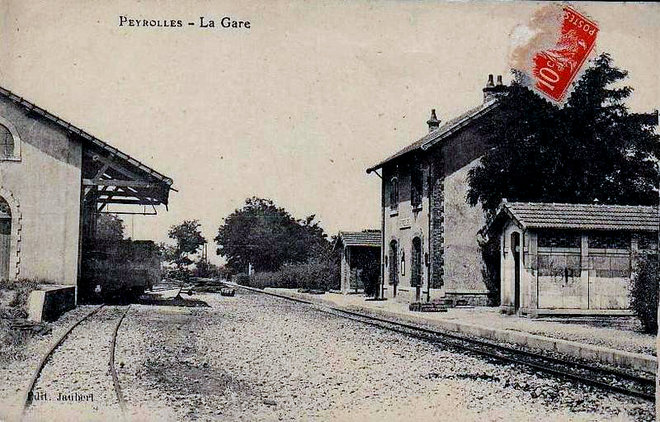
The station for the village of Saint-Martin-de-Pallières sat in open fields to the north of the village.

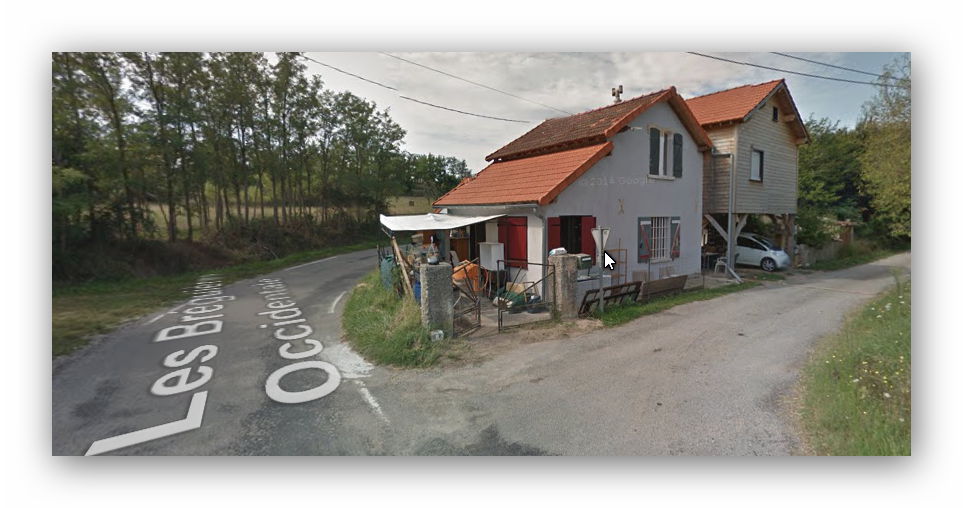
The next visible structure on the route is the crossing keeper’s cottage at Les Bréguières Occidentale, Esparron. The landscape alongside the line is now predominantly made up of flat open fields and the line itself travels along the flat landscape with cuttings or embankments. Our next stop is at Esparron Station.

The private dwelling and gardens have been nicely restored. The line travelled between the two remaining structures, the station house and the goods shed. Even part of the station platform remains visible. The D70 was crossed at grade and the line headed on to meet the D561.


On the plan above, Esparron can be picked out in the bottom right and the route of the line runs from the top right to the top left. A tarmac surface means that it is easy to follow the route in a vehicle. We did this in November 2017.

Further West the formation runs directly alongside the D561, before crossing it at grade and running on the South side of the road, hidden behind the trees in the picture below.

It joins the D561 just before reaching Rians and then follows that road up[ to a roundabout junction with the D3 which it crossed at grade. Evidence of the crossing point is hidden under the modern road layout. Although its route can be picked out just beyond the roundabout leading away to the north of the D3 and becoming Chemin des Herbes.

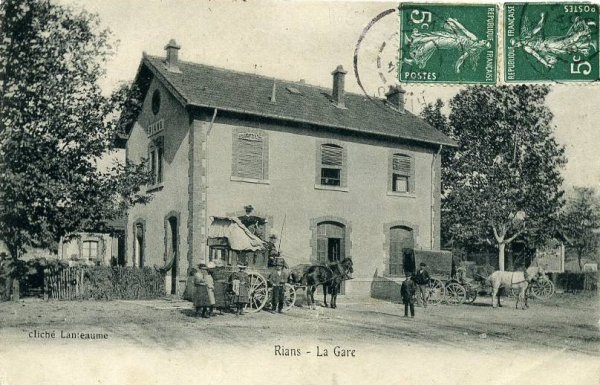
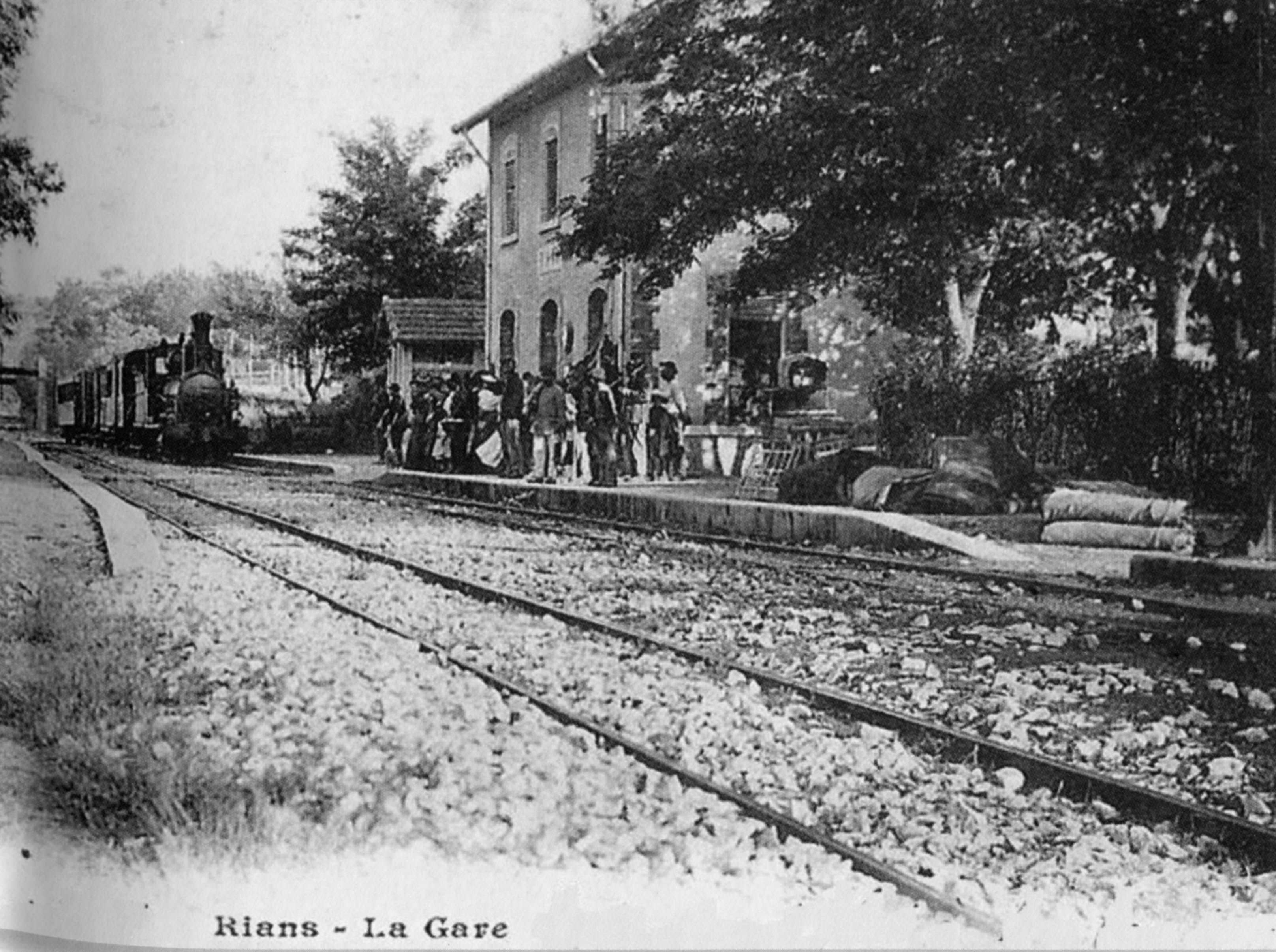
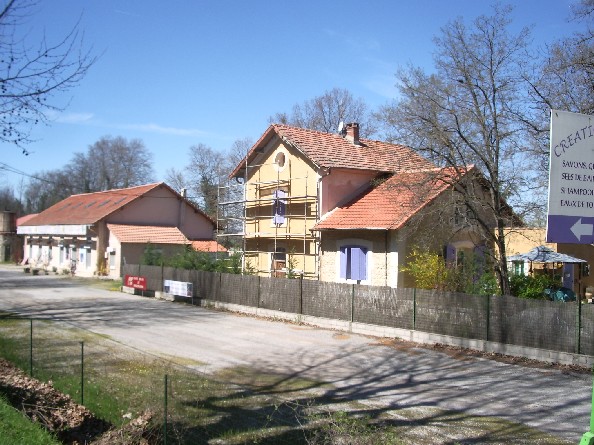
The Station at Rians was on the North side of what is now the D3. Two of the old buildings exist unaltered. The third has been converted extended to improve its use as a Wine Cooperative building.

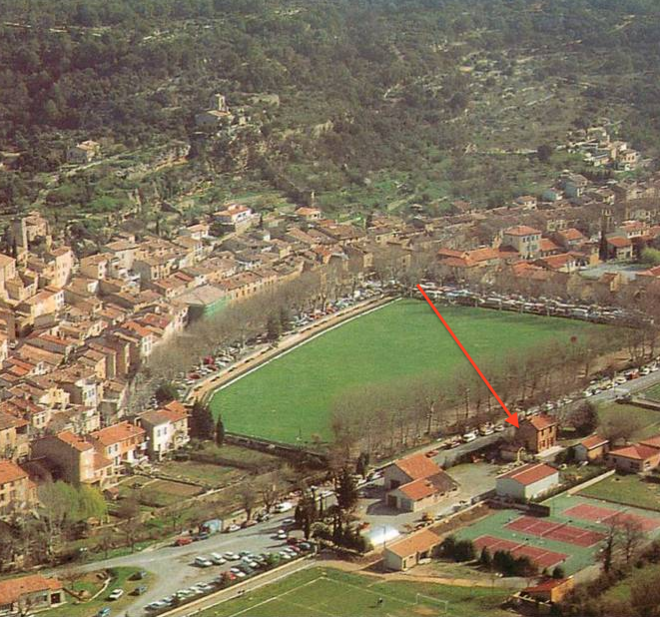
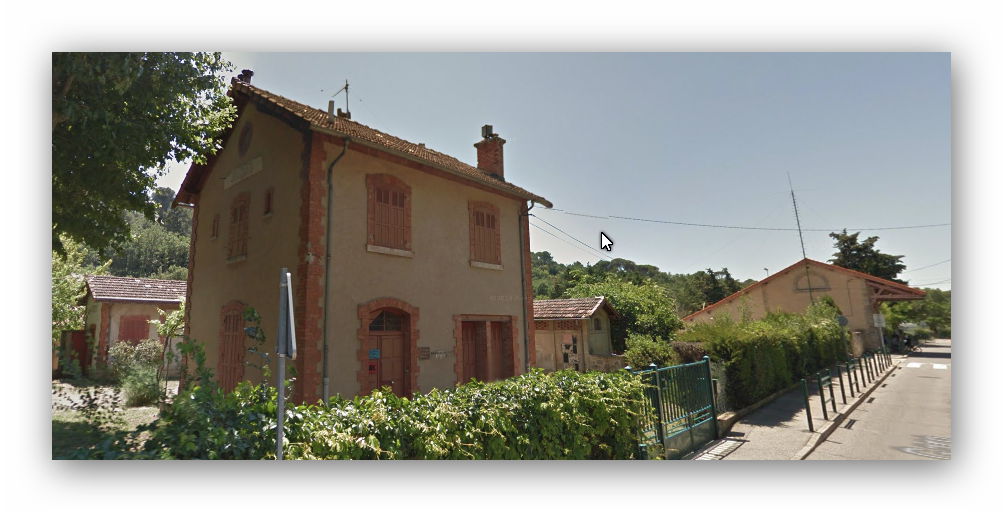
The “Rians et Artigues” winery was founded in 1922 and made use of the railway to transport its produce. I have found fiures for its operational capacity in 1979. That year it vinified 19,235 hectolitres of wine, including 574 hectolitres of AOC Coteaux d’Aix-en-Provence. It had 252 members who were then cultivating 296 hectares of vines. The building is marked with the yellow arrow. The passenger station building is marked with a red arrow and now-a-days hides behind a high hedge. The Goods Shed is marked with a blue arrow. The station site is marked with a red ellipse on the plan below.

We disembark our train here in Rians to take a break before travelling on.


Ligne de Central Var – Part 13 – Sillans la Cascade to Barjols (Chemins de Fer de Provence 33)

Sillans la Cascade to Barjols

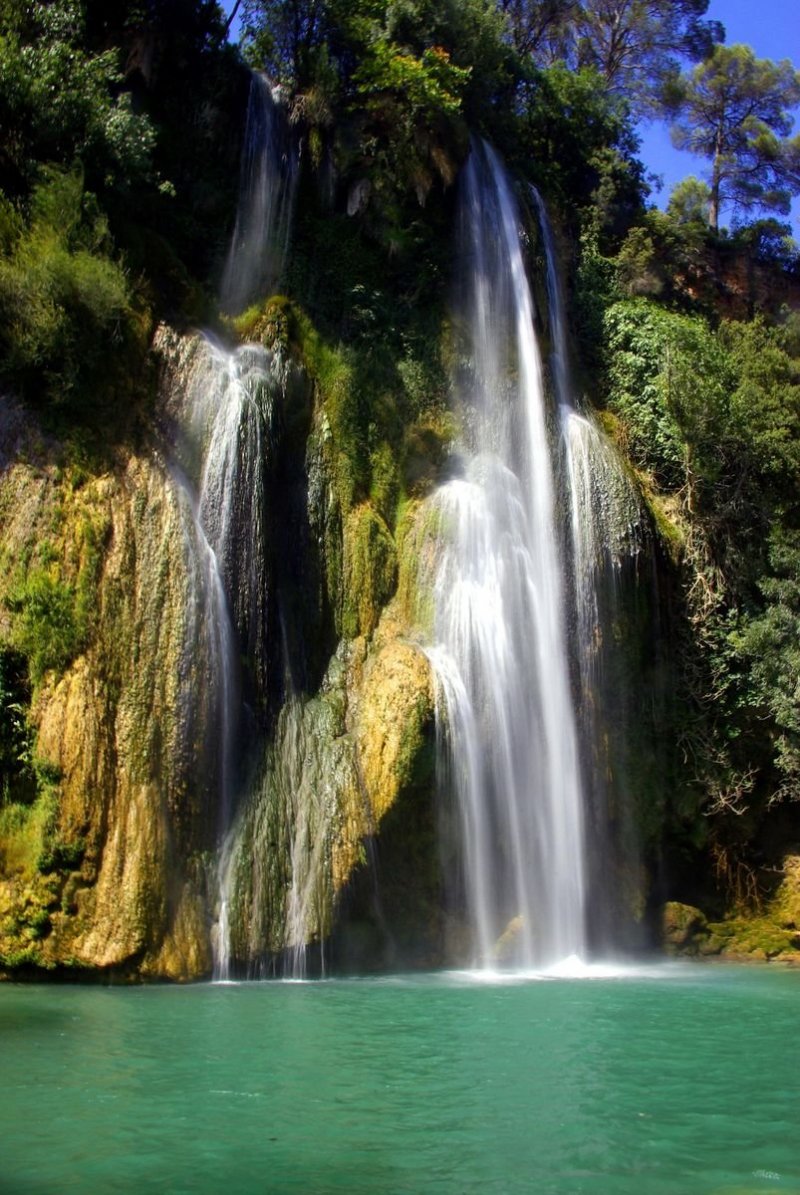
We start this part of our journey along the Chemin de Fer du Sud de la France Central Var Line by having a look round the immediate vicinity of the station and village of Sillans la Cascade. First we have pictures of the waterfall that gives the town its full name, then some postcards from the town itself.

We wander back to the station at Sillans la Cascade, crossing La Bresque on the way. At the station we continue with our journey. As we set off from the station we travel alongside La Bresque. The river provided a good defence for the village on three sides as the plan of the town above illustrates. The station was on the East of the town across the river.

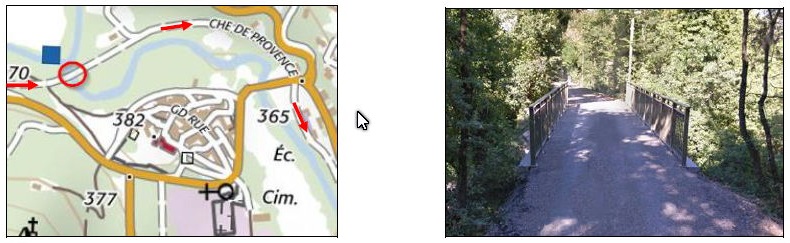
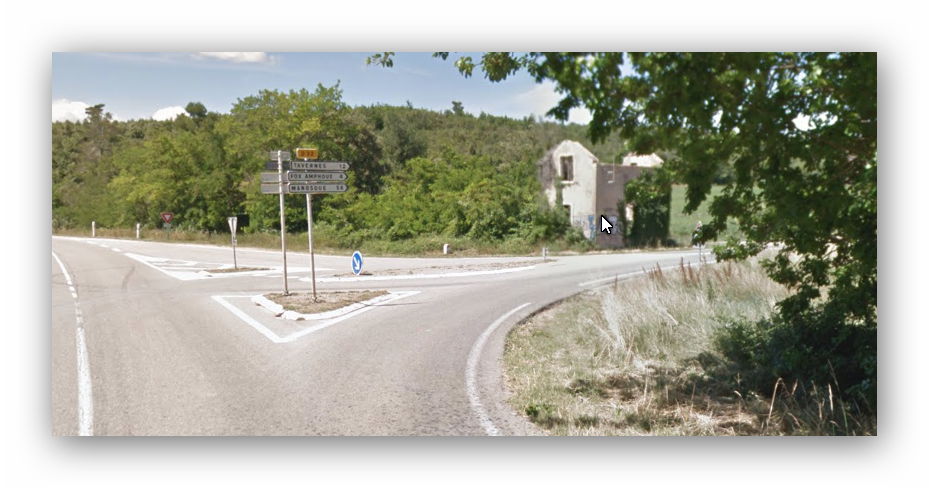
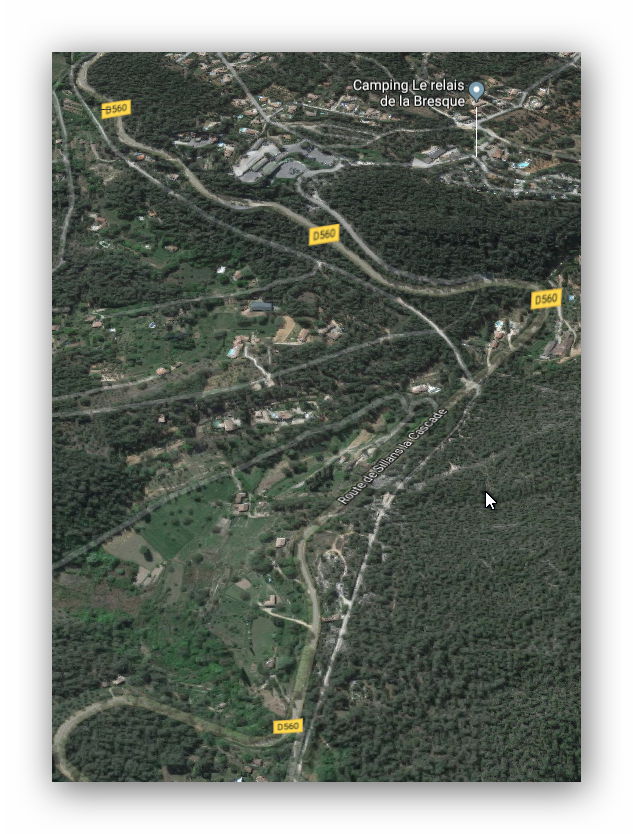
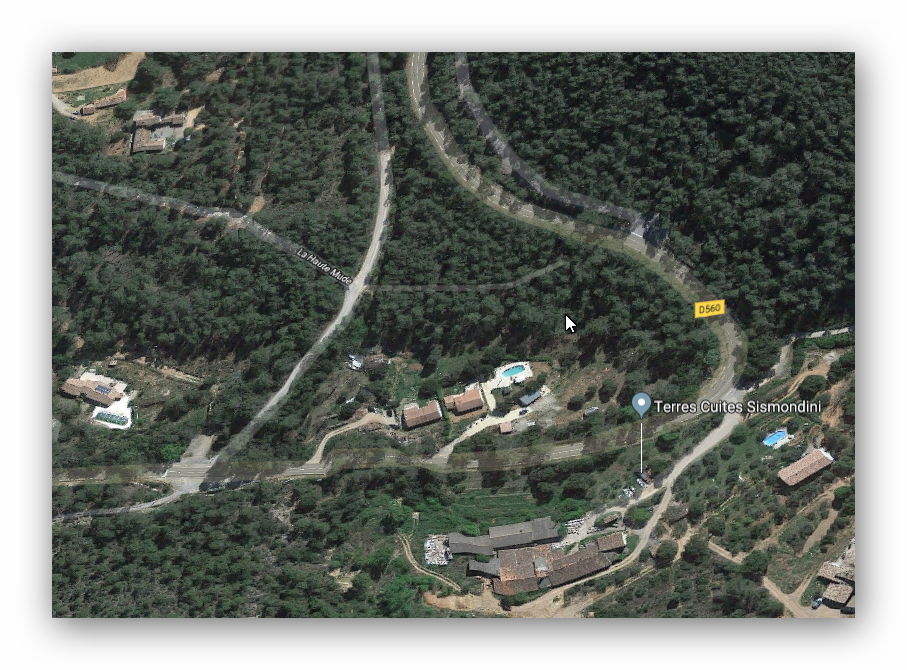
As we travel round the north side of the village we encounter the bridge over La Bresque. The river is now relatively small as can be seen in the adjacent picture. The bridge is at the point marked on the map above by a red ellipse. The route we are now following is today called Chemin de Provence and once clear of Sillans la Cascade it follows the D560 (Chemin de Fox Amphoux) closely on its north side until the road turns away westwards and the line loops round from a north-westerly direction to a more westerly direction itself . The road and the rail formation are back next to each other by the time we reach the Clinique Veterinaire de Sillans (3 Chemin du Plan, Route de Barjols, 83690 Sillans-la-Cascade, France)

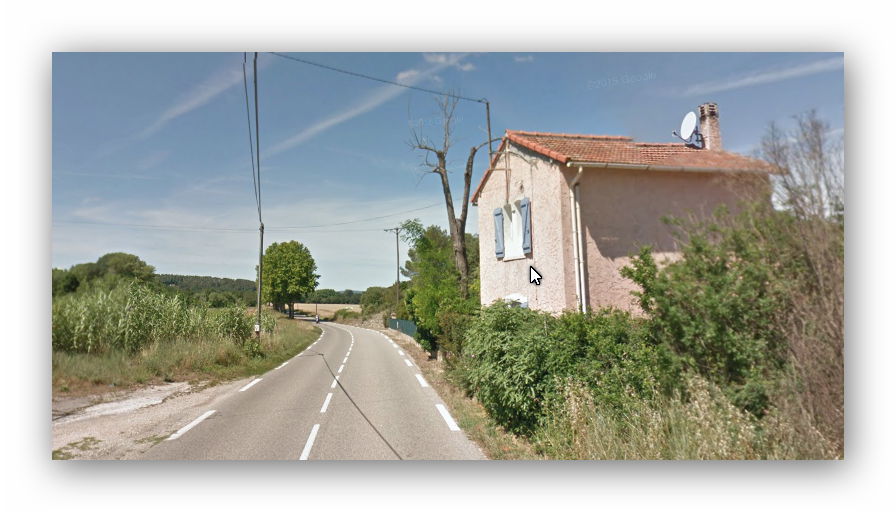
The road and the railway formation seem to come together entirely at a point just before the junction between the D560 and the D32, although the location of the abandoned crossing keeper’s cottage might suggest that the rail formation remained on the north side of the present D560.

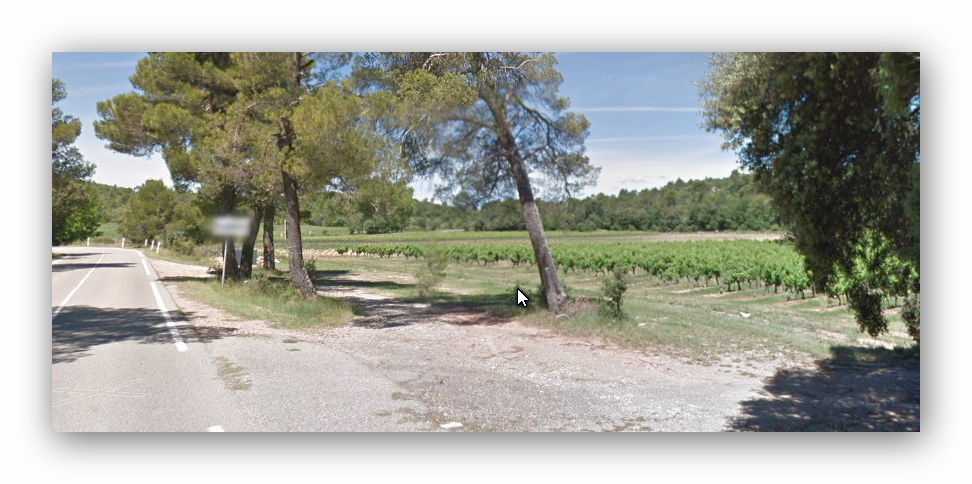
For some distance this was the case. The road and the rial formation followed each other until the road swung away towards a junction with the D13 and the railway continued in a North-westerly direction to cross the D13 some metres north of the D560’s junction with it. The divergence is in the first picture (on the left) below the route of the line is shown beside the vineyard in the second picture (on the right). the two alignments did not meet again for at least half a kilometre close to Chateau La Calisse, (http://chateau-la-calisse.fr/).

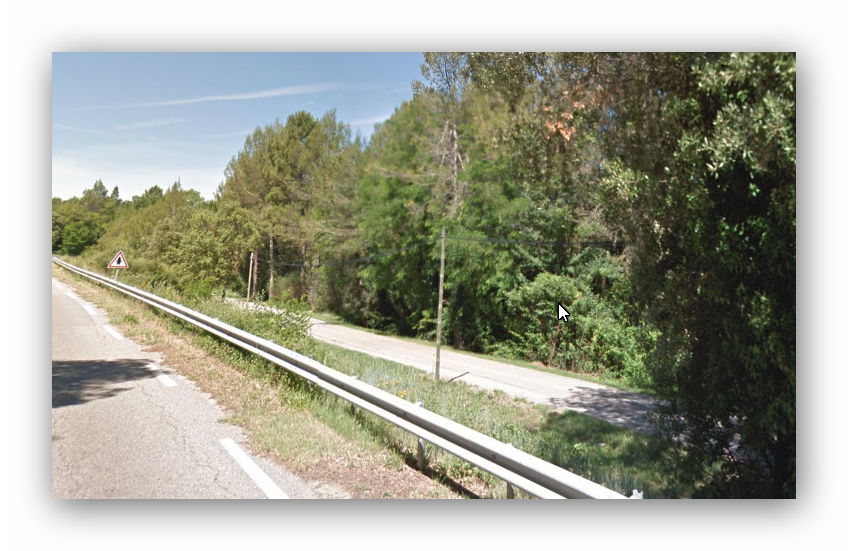
We found another crossing keeper’s cottage further along the route beyond the junction between the D560 and the D60. This must have been at a point where the road and the railway switched sides and the railway continued on the South-side of the road towards Barjols.
At the chevron sign on the adjacent photo, the road turns sharply to follow the north-side of a watercourse, the rail formation crosses the brook before turning parallel to the road and crossing a side road twice (D60) which loops into Ponteves and then out again to join the D560.

The railway continues along the South side if the stream for a few hundred metres before crossing it once again and then crossing the D560. Its line betrayed, once again by another crossing keeper’s cottage. Its crossing of the road was probably at roughly the pint where there are now metal garden gates. The road and the railway formation diverg as the road drops down into the town of Barjols and the rail route holds North of the town.
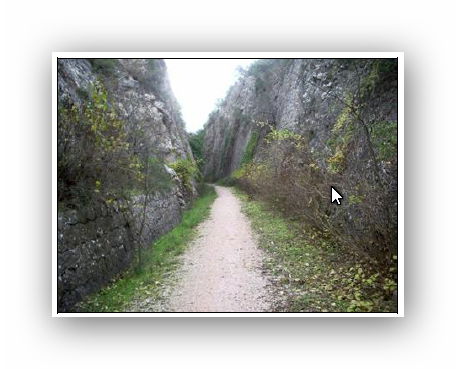
From this crossing point the railway approaches Barjols on a tight curve in a deep cutting., as the picture and map below illustrate.

The station site is further to the North-west and was reached by the line after it crossed the D554.

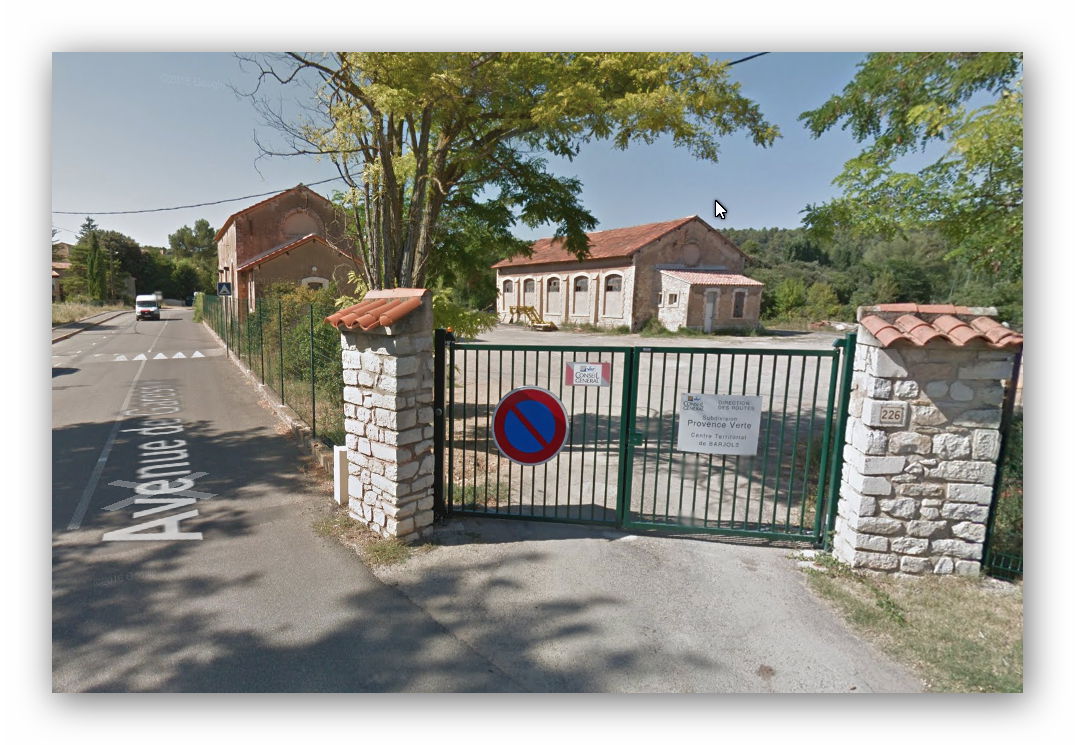
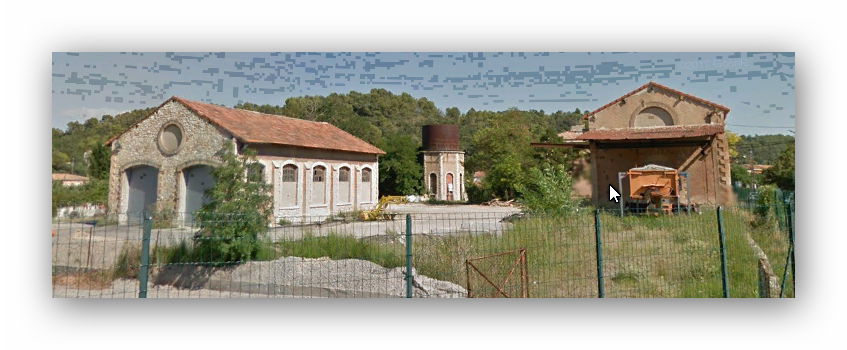
The station site was to the North side of what is now called Avenue de Garessio and is highlighted by the red ellipse. At the time these pictures were taken the whole site was for sale and many of the buildings were still visible.

Sadly the main passenger building seems to have been demolished prior to the taking of the pictures.

So we finish the next stage of our journey and look forward to exploring the small town of Barjols at the beginning of the next episode!

Ligne de Central Var – Part 12 – Lorgues to Sillans la Cascade (Chemins de Fer de Provence 32)

Lorgues to Sillans la Cascade

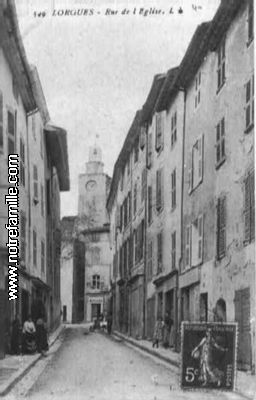
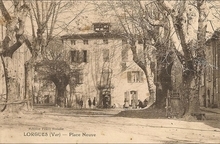
Over a short break in Lorgues we have time to look round the town before returning to the station to continue our journey.

Here are some pictures of our wander round the town.


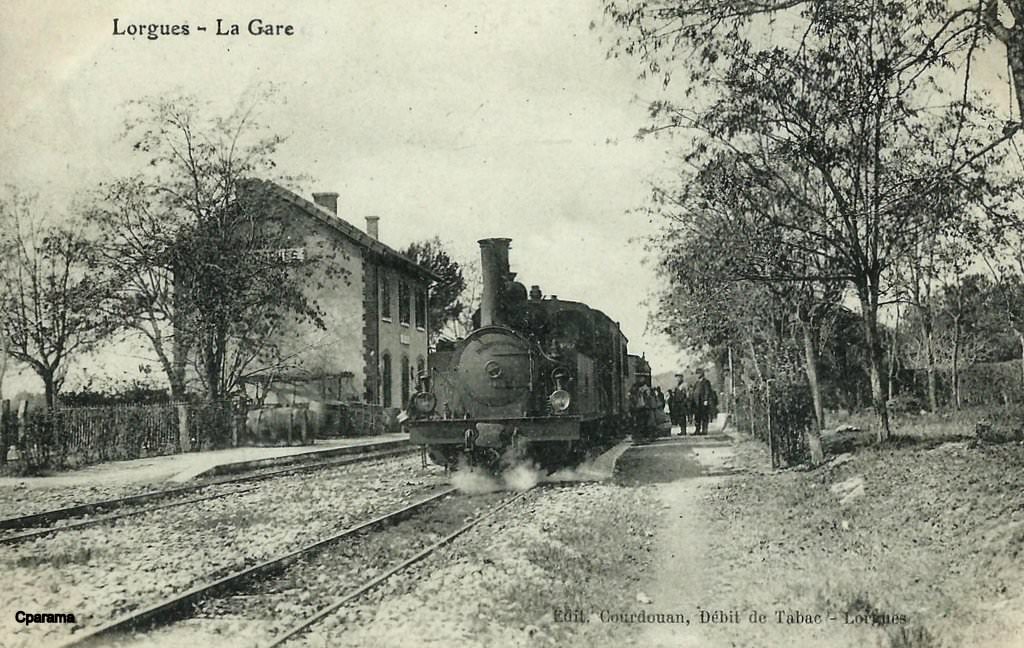
The site of Lorgues Station

We return to the station to continue our journey.

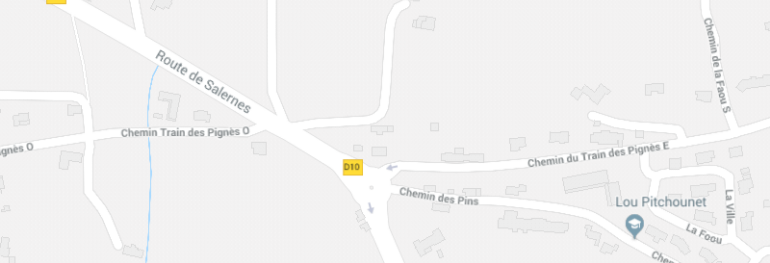
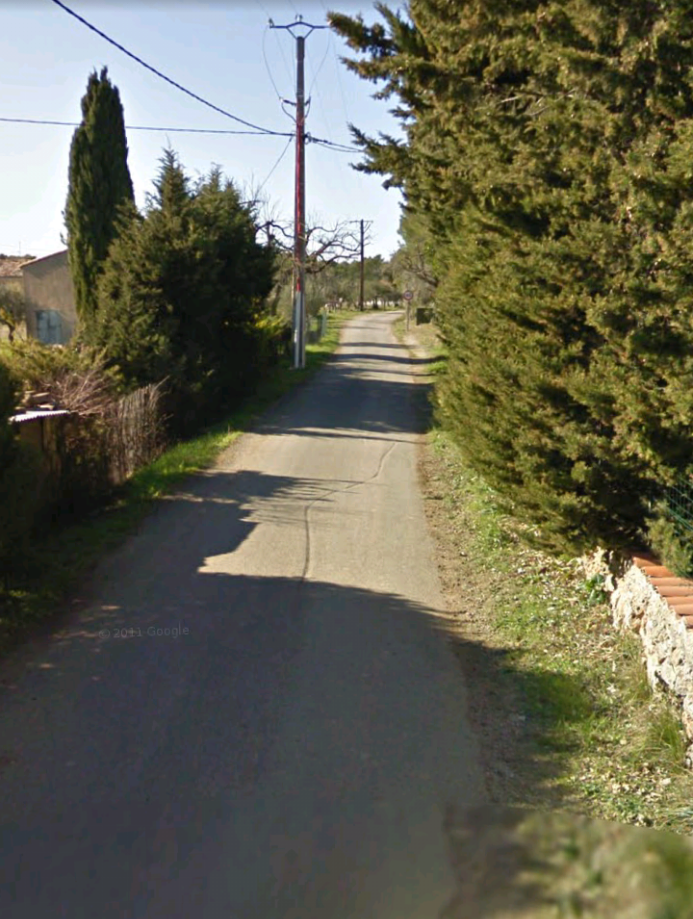
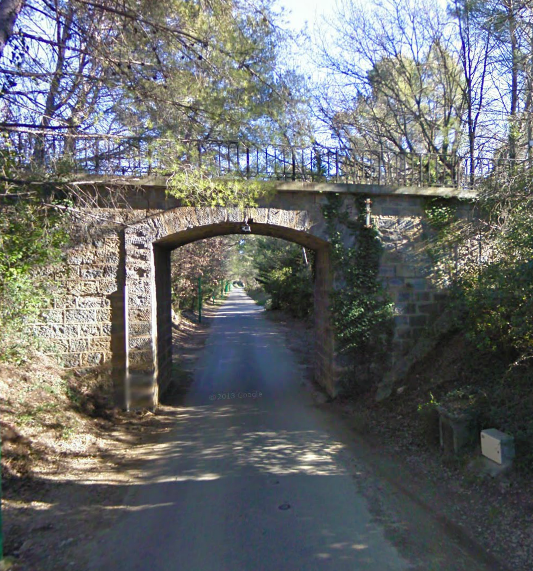
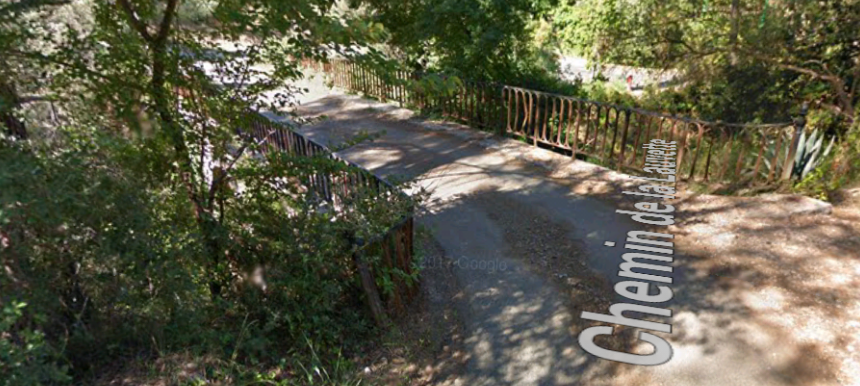
Our route takes us out of Lorgues along what is now called Chemin du Train des Pignes Ouest and on into what would have been open country but which now has a lot of well spaced residential property. Significant structures still remain extant, such as the bridge below.


The route wanders through the mixed woodland, farmland and housing of the French countryside. Increasing numbers of vineyards and lavender fields begin to make this really feel as though it is Provence!

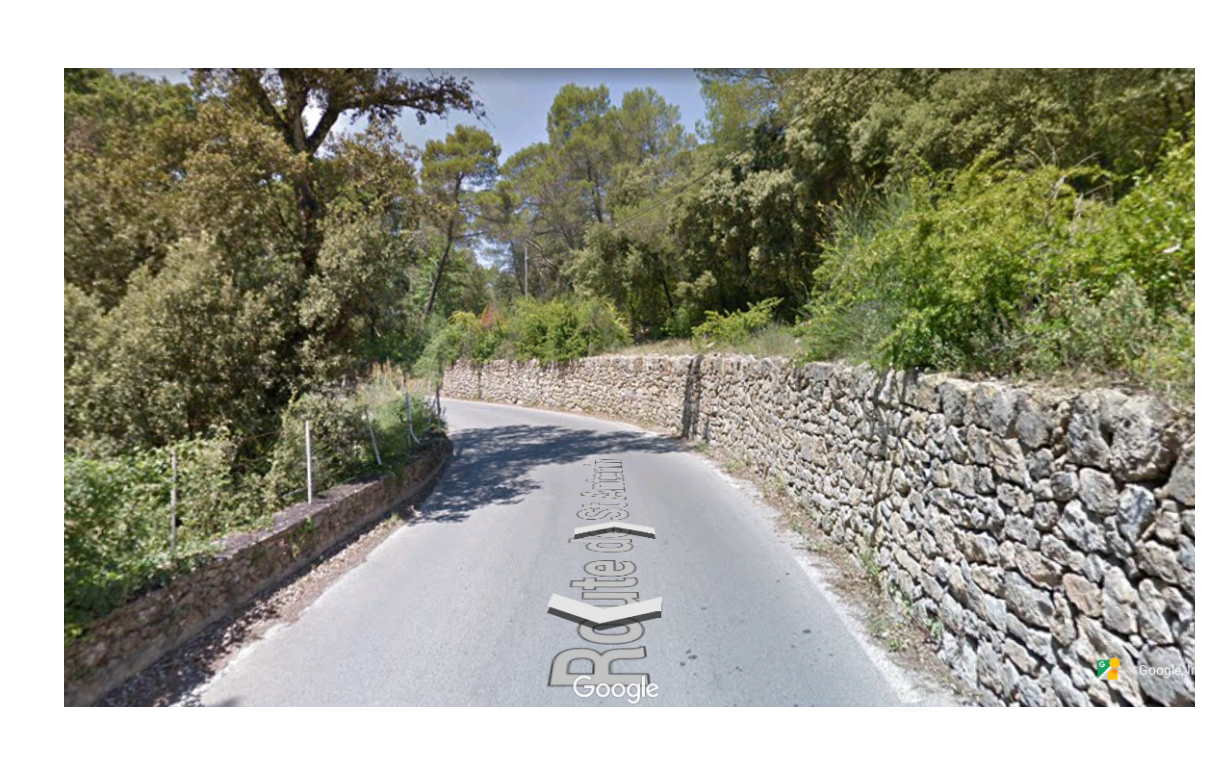
The line runs roughly parallel to the Chemin de St. Antonin (D50) and, at points, right next to it but at a slightly higher level, held there by rustic retaining walls as above. Somewhere along this length was the station for Entrecasteaux. It would not have been well used, as it was so far north of the town. There appears to be very little evidence of its location.

The road and the railway formation diverge sharply and the line continues through woodland to the valley of La Bresque where it runs close to but at a much higher level than the D31 on its way towards Salernes.

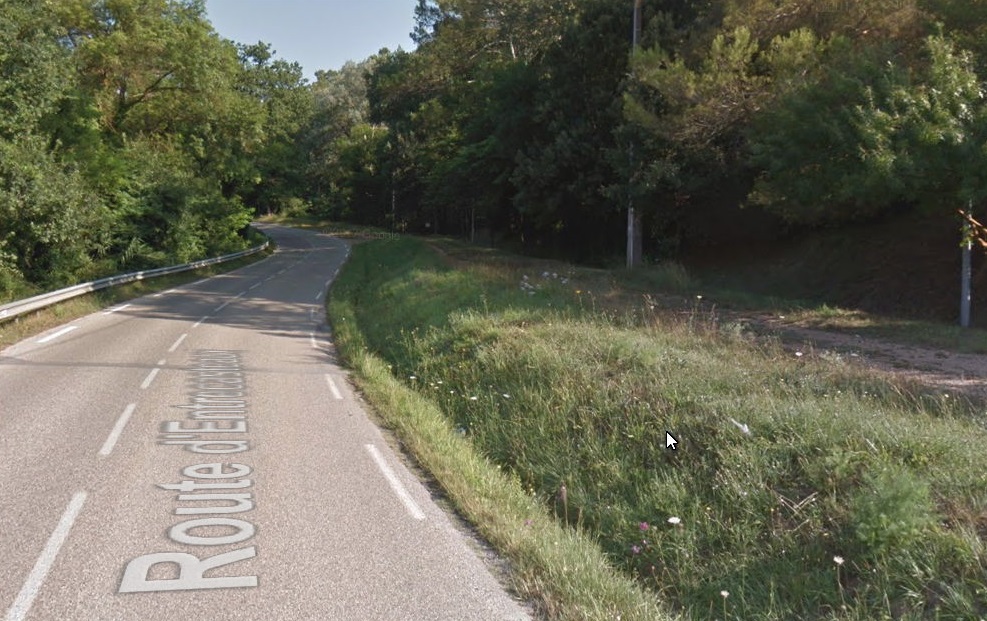
After quite a distance in the midst of farmland and forest the line once again encounters relatively low density housing in the hamlets of the valley of La Bresque, and the route once again bears a modern road name – Les Amourenes. Gradually the D31 (Route d’Entrecasteaux) and the railway formation converge. They meet as the valley begins to widen out and approach Salernes. The picture below shows the road and the old railway in very close proximity and it remains like this until close to Salernes.

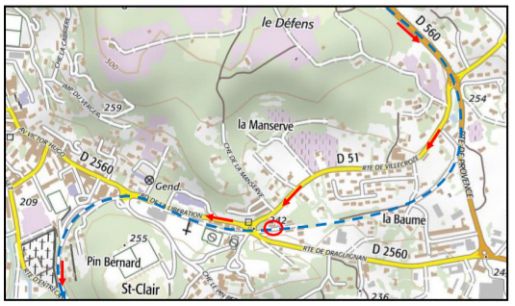
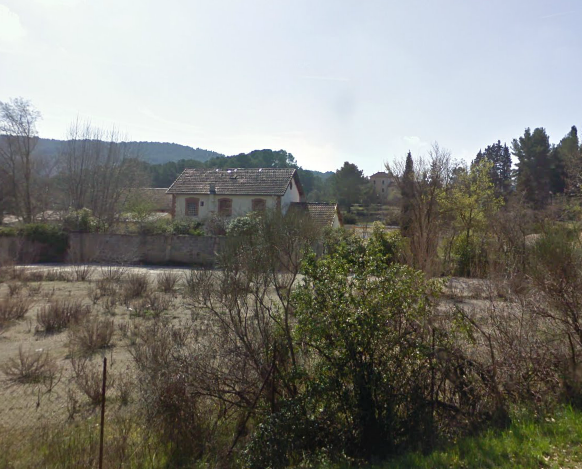
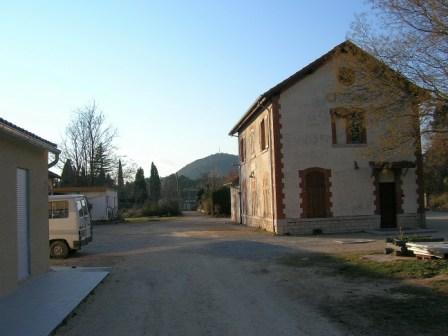
As the line approached Salernes it began to rise above the road alignment and then swung away from the D31, turning first northwards and then eastwards and aligning itself with Boulevard de la Liberation (D2560). After a short distance it left the line of the D2560 and roughly bisected the angle between the D2560 and the D51. This is the location of Salernes Station. The plan below shows this. The blue dotted line is the alignment of the railway and the red ellipse is the station site. Below the map are a number of pictures of the station site today, a few old postcard views from the early 20th Century and two aerial shots, one of the past and one from much more recent times.

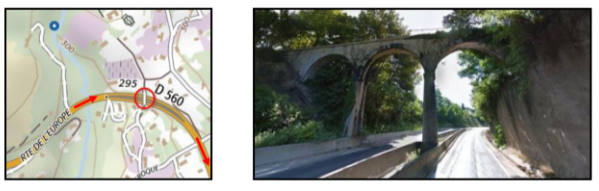
Beyond the station, the line turned back on itself to travel roughly Northwest along the D560 and then running West some distance north of Salernes but still following the route of the D560. On the way, at times it was in deep cutting. The map and picture below give a good idea of the topography and highlight one of the more significant structures on this part of the route – the bridge now carries a narrow lane linking two parts of the Commune.

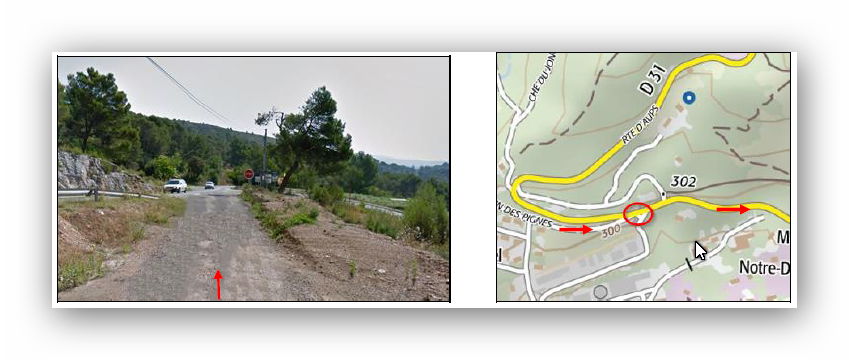
The D560 has been widened and re-profiled recently. The route of the railway has been lost in the earthworks associated with the road widening and can only be picked out easily on satellite images where its path diverted slightly from the road alignment. For example, the railway formation is visible to the North side of the road at its roundabout junction with the D31 (Route d’Aups). For a while, the line then followed the Route d’Aups (see the map below), before that road reverted to travelling East after a hairpin bend and the railway formation continued Westwards towards Sillans la Cascade.

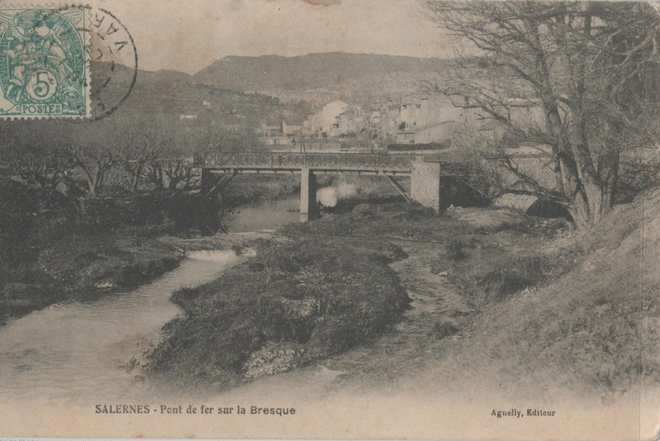
Somewhere in the vicinity of Salernes the railway crossed the la Bresque. I have not been able to identify the exact location of the bridge in this postcard. No doubt someone will be able to provide more details.
One possible location  would be just to the west of the map below, although the built area behind mitigates against this.

The line curved through the forest before returning to then line of the D560. On the way it crossed one road and the crossing keeper’s cottage for that location appears still to be in place as part of an extended house.

Once the line regains the D560 it follows it fairly closely on towards Sillans la Cascade. The two can be seen in tandem on the satellite image below. Just the tightest turns in the road were smoothed out by the engineers of the line.

The next satellite image, shows the location of the old station (now a school) and the village of Sillans la Cascade. The route of the railway runs from the top left of the image to the bottom right. We will be taking a break from our journey at Sillans la Cascade. Just two images of the stationfollwo the satellite image – an old postcard and a picture of the station house as part of the school buildings.

References

Some excellent information on this part of the line is provided by Randonnes Ferroviaires Fiche Iteneraire Chemin du central var median which can be found at: http://www.inventaires-ferroviaires.fr/hd83/83128.a.pdf.


Ligne de Central Var – Part 11 – Draguignan to Lorgues (Chemins de Fer de Provence 31)

Draguignan to Lorgues

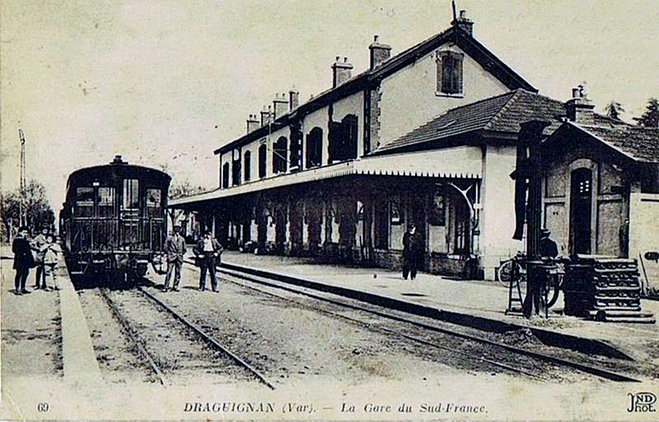
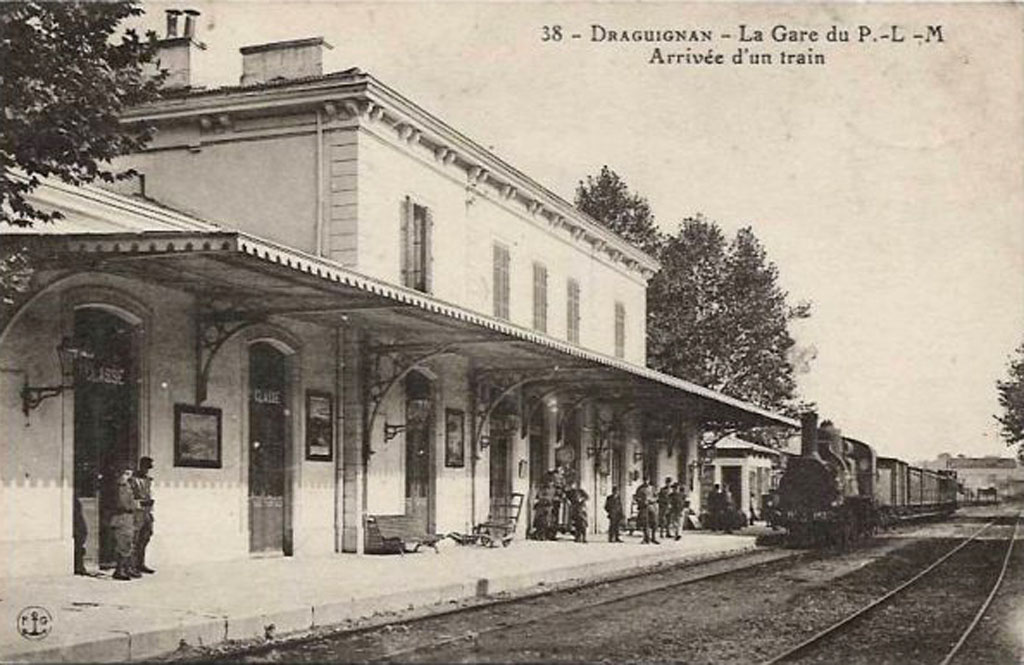
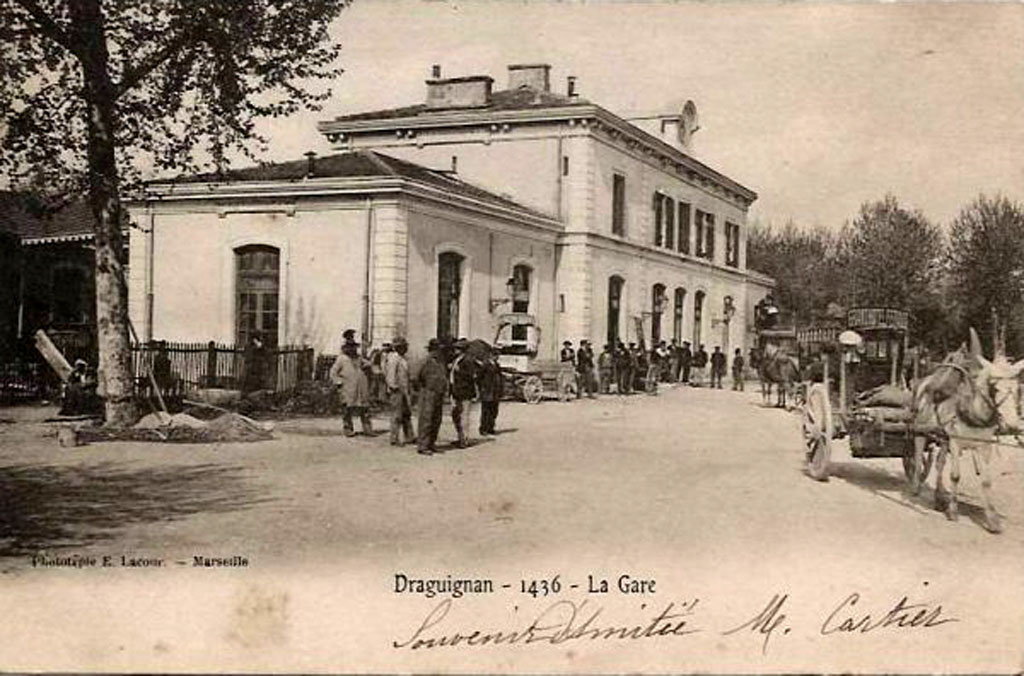
Draguignan became the defacto headquarters of the Chemin de Fer du Sud. It was the most significant town on the route from Nice to Meyrargues. The site of the station lay directly alongside the PLM Station. The PLM Station was the terminus of a branchl ine which left the PLM mainline between Toulon and Nice at Les Arcs. Construction of the line commenced in 1859 and it was formally opened in 1864. It was operated by the PLM until the SNCF was formed.


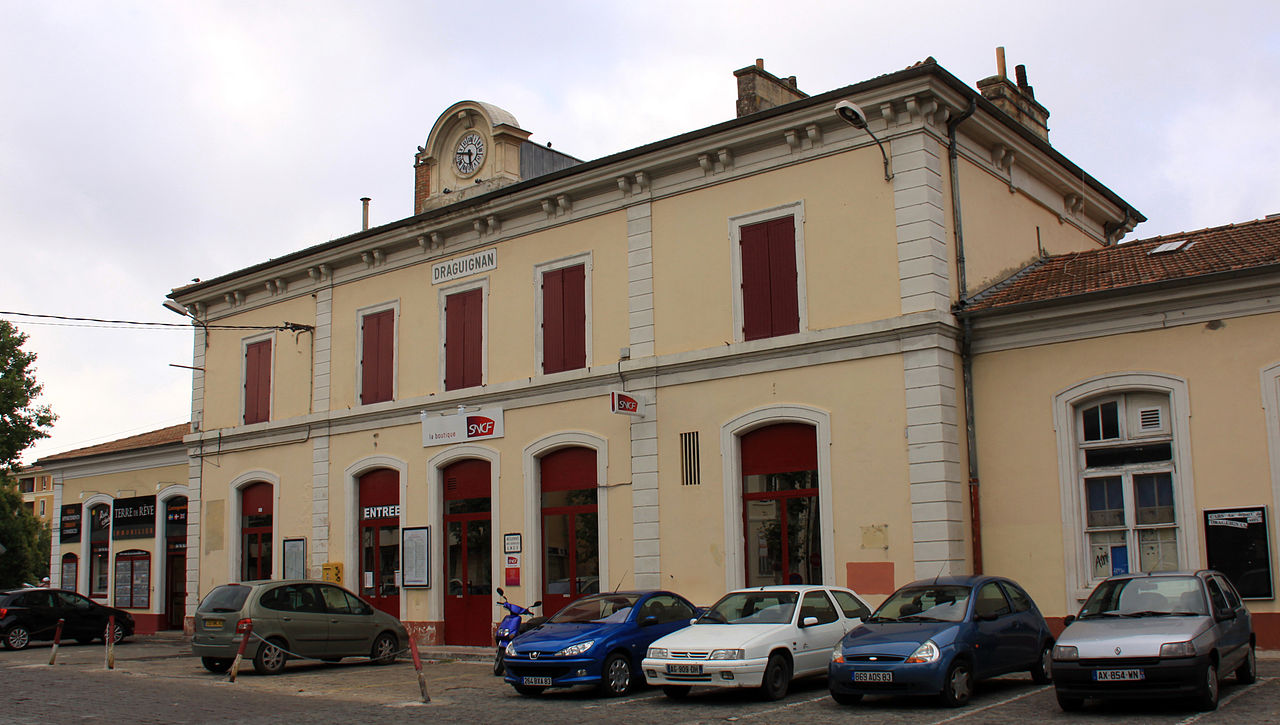
In 1981, the PLM station in Draguignan was closed to rail traffic and became a mere point of sale for tickets. A bus station was built where the tracks had once been laid. Passengers still use the old station platform but now they are waiting for buses.

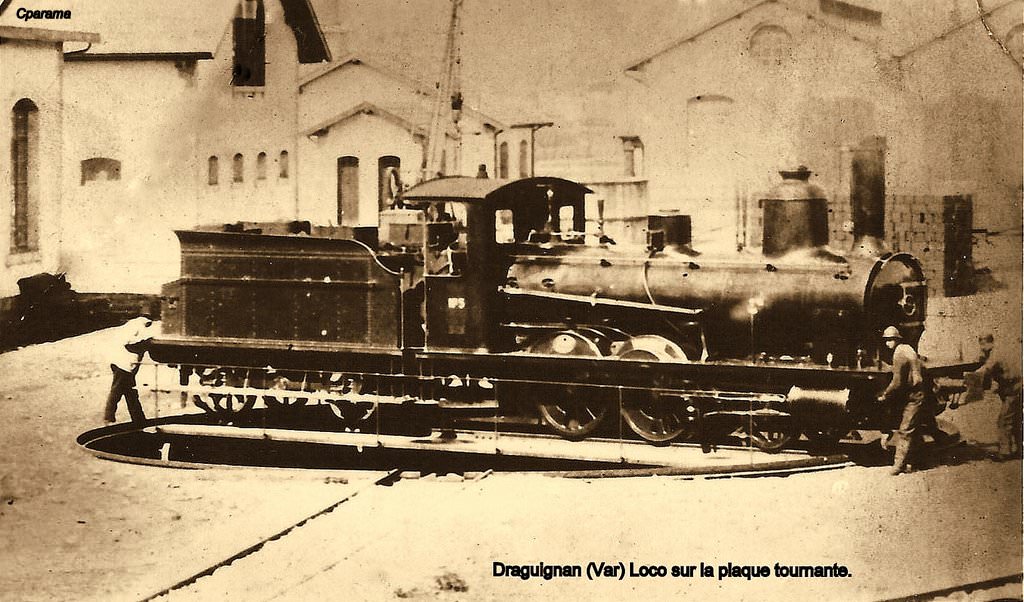
In addition to the passenger building some vestiges of the railway can be found, some buildings and the turntable pit.
The old track-bed of the line to Les Arcs has been given over either to roads or bike paths.

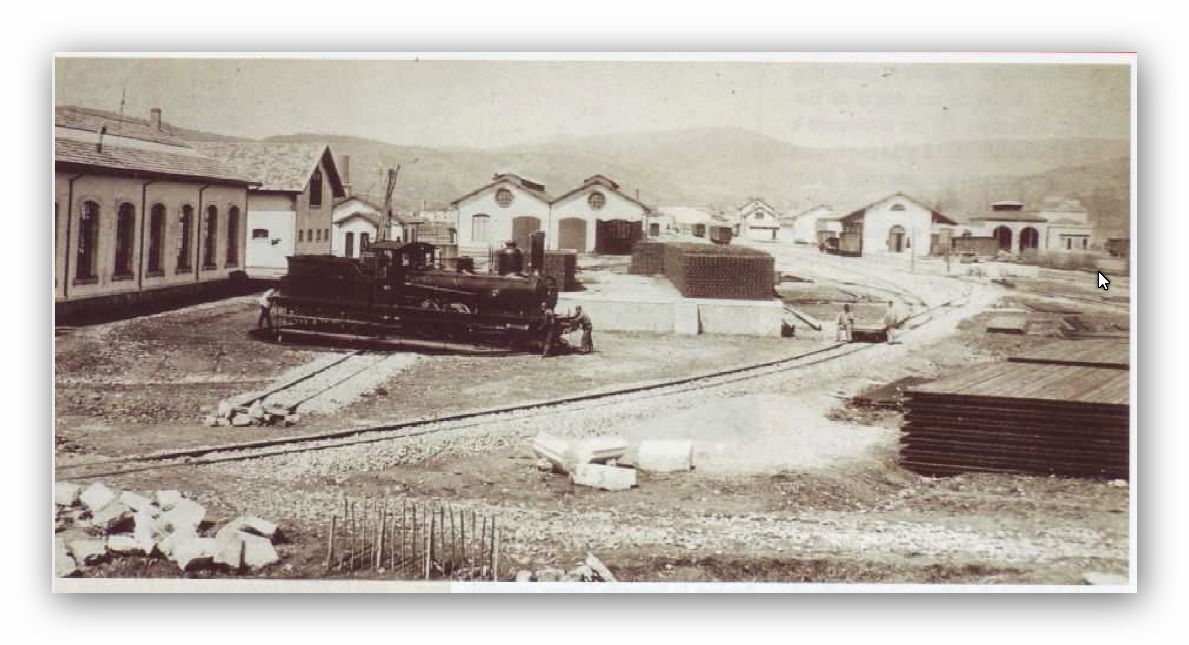
The image above shows the engine shed in Draguignan after the War. The image was taken by Pierre Virot and appears on p83 of Jose Banaudo’s book ” Le Train des Pignes.[1]

Draguignan became an increasingly significant railway hub with the creation of the Central Var Line. The formal opening of the station for the metre-gauge line took place on 25th April 1890.

The metre-gauge line with its slow speeds could not withstand competition from the road and the last train entered Draguignan station on January 2, 1950. The main station building is now converted into a school and the goods facilities have been demolished. The railway track-bed is now predominantly occupied by public roads. The square at the east end of the old train station was named Place des Train des Pignes , to commemorate this once important means of transport for the people of Draguignan.

In addition to the two station buildings there are still some platform edges and some other minor vestiges of the relatively large combined station complex. The majority of the site has been redeveloped by the town.

The route of the Chemin de Fer du Sud shown on the file on Google Earth is most probably incorrect as far as the route in Draguignan is concerned . Other sources suggest that the likely route is that suggested at the end of the last post:

https://rogerfarnworth.wordpress.com/2017/12/06/ligne-de-central-var-part-10-chemin-de-fer-de-provence-30.

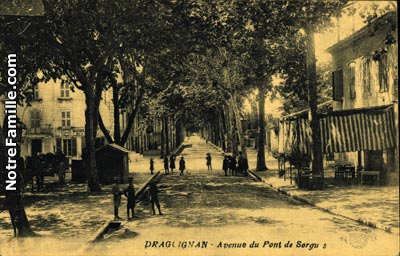
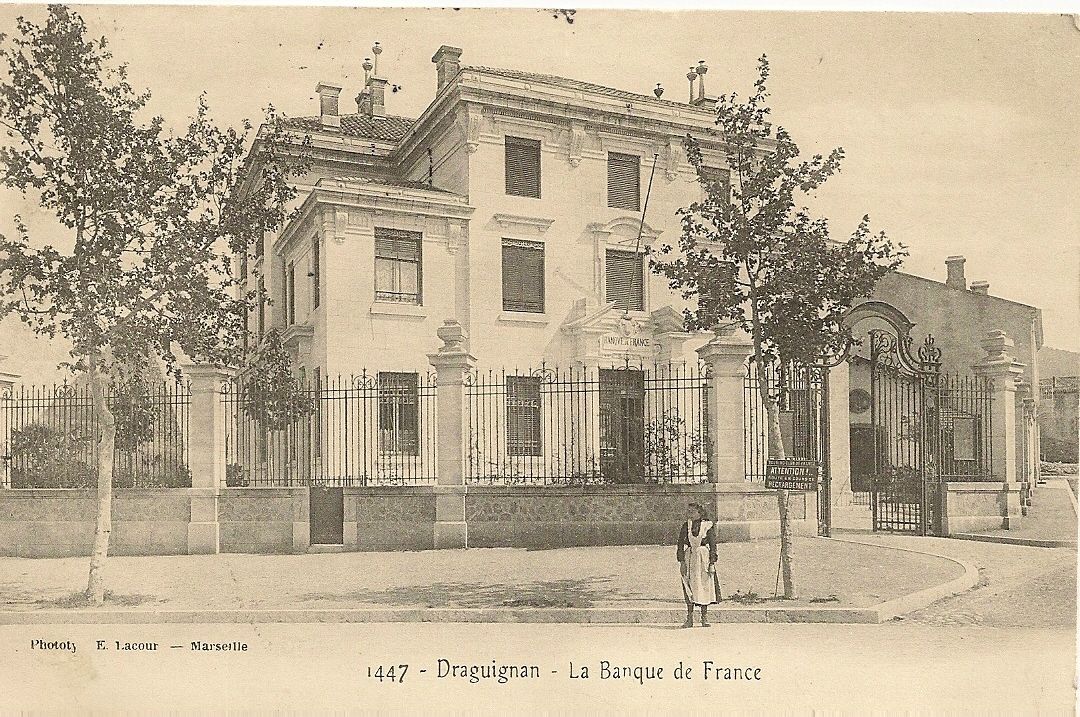
Various images from Draguignan and its station site follow:

And finally, before we set off from Draguignan a postcard image that purports to be a welcome to Draguignan but clearly, from what we know about the station buildings, bears an image that does not come from the town. It looks more as though it is an image from one of the stations on the mainlin

e nearer the coast, possibly from Les Arcs.

Perhaps as we set off from Draguignan along the Chemin de Fer du Sud we could imagine travelling behind the loco shown on the the picture below, rather than on the standard gauge train shown above!

The line towards Meyrargues sets off from the old station on Boulevard des Fleurs in an approximately Westerly direction following the line of what is now the D955 out of town towards La Garrigue. Just as the D955 reaches La Garrigue, the route bears off to the left towards Pont d’Aups, just above the road number marker in the top left of the map below.

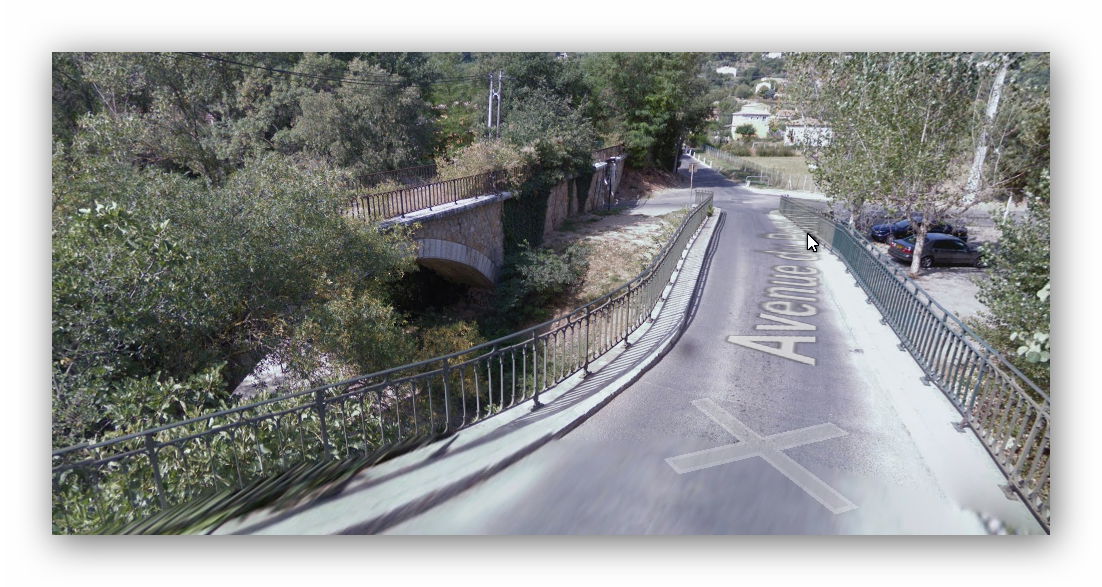
In Pont d’Aups the rail line ran alongside the road and spanned the river on a single span arch bridge before crossing over a low-headroom bridge across Avenue du Col-de l’Ange, the road south towards the village of the same name, Col-de l’Ange. On our recent visit the girders from the bridge shown on Google Streetview had been removed to allow vehicles of all heights to travel south to north and vice-versa. Research suggest that this probably happened around 6 or 7 years before our visit in 2017.

However, just 6 months before our visit, major flood protection works were undertaken at Pont d’Aups. These pictures give a good impression of the work undertaken and the .pdf file contains the publicity leaflet delivered throughout the locality. Please click on this link …..pont d’aups works

After Pont d’Aups, the route of the line followed Chemin du Seyran (on its South side) for a short distance before swinging done Southwards to join Avenue du Col-de l’Ange. The route can be easily picked out on the satellite image below.

Continuing Southwards the line meets the Avenue de Tuttlingen (D557) at a hairpin bend.

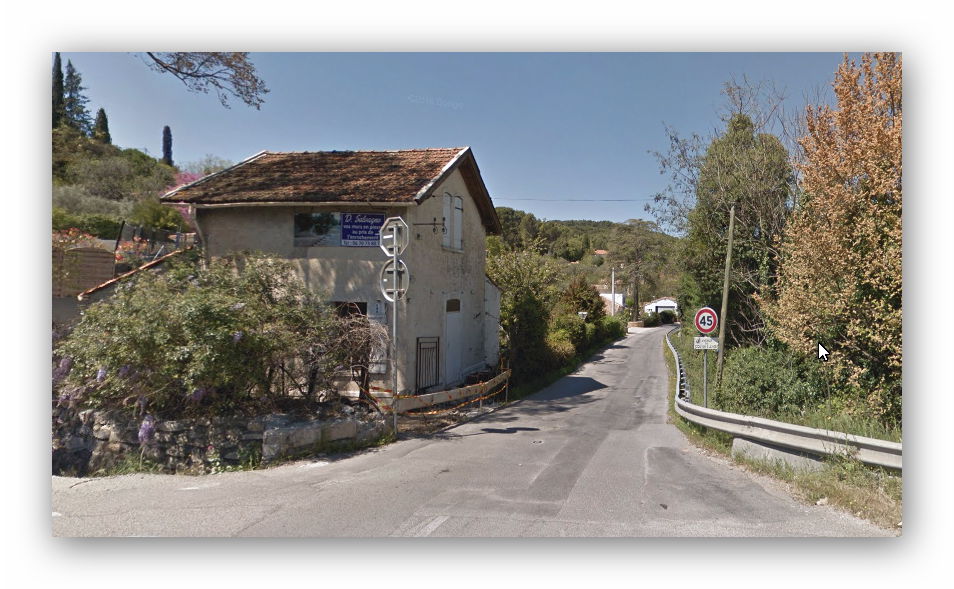
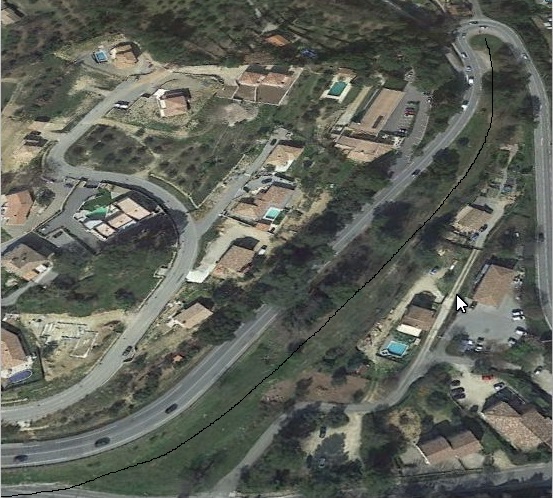
The picture above looks back down the line towards Pont d’Aups. The cottage on the left is probably the crossing keeper’s cottage. The route of the line follows the Avenue de Tuttling for the next few hundred metres as is illustrated below (the narrow black line on the image highlights the route of the line).


Its route can be picked out once again beyond the next roundabout and following the Avenue Salvador Allende (D557) in a North-westerly and then Westerly direction towards Flayosc.

It would appear that along some of this length the railway was on embankment. When we reach the road junction between the D557 and the D57 there are the vestiges of a road under-bridge evident on the route of the railway. Generally, the embankment has been leveled to tie in with the immediate topography.

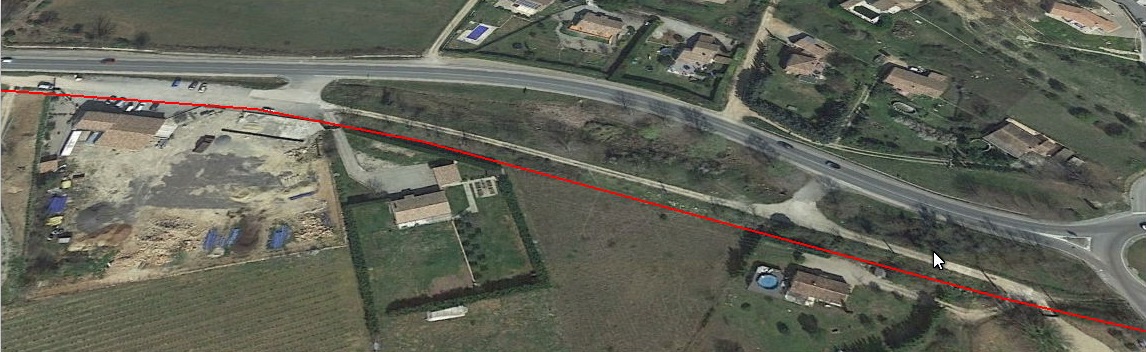
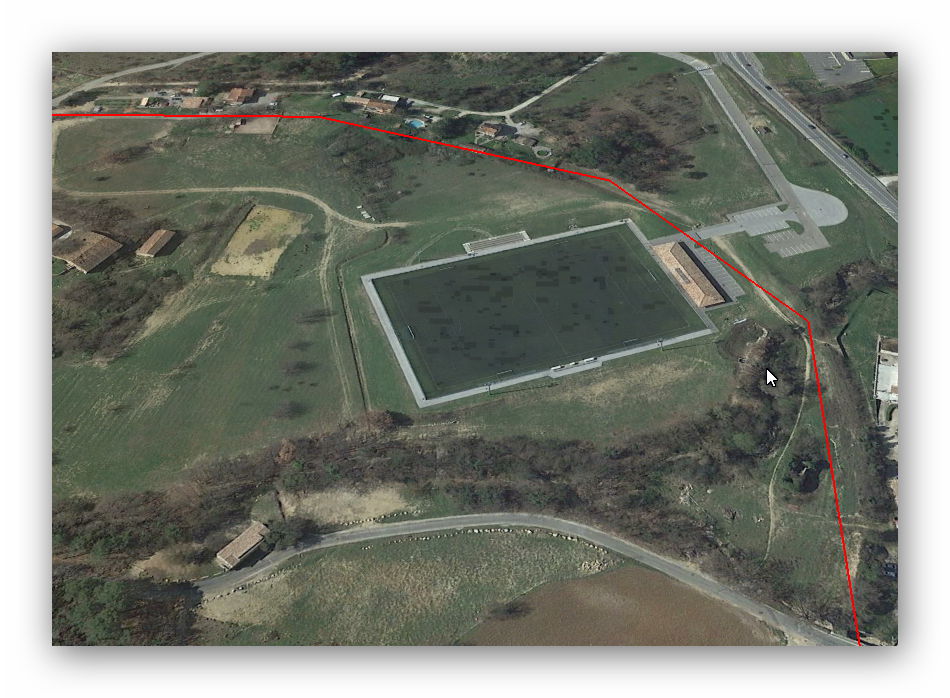
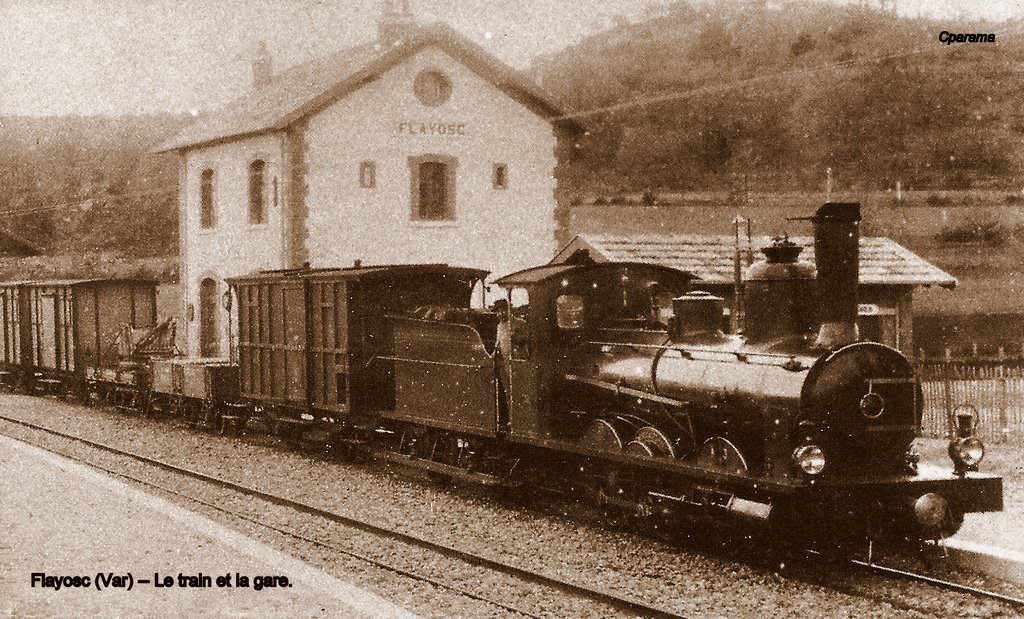
The vestiges of earthworks can be picked out on satellite views as the route of the line and the D557 separate. The route is highlighted by the red line on the satellite image. Towards the top of the picture is the location of Flayosc Station.

After Flayosc Station, the line headed off into the forest following the Vallon de Figueiret. The railway formation has once again

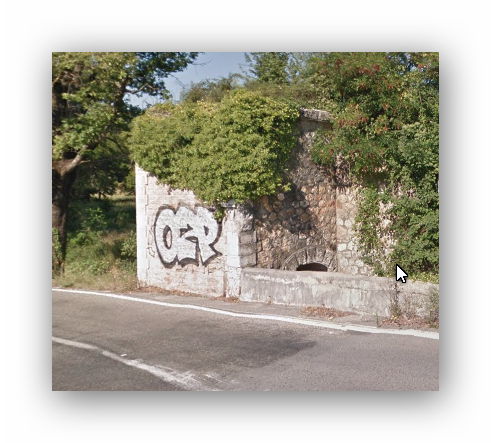
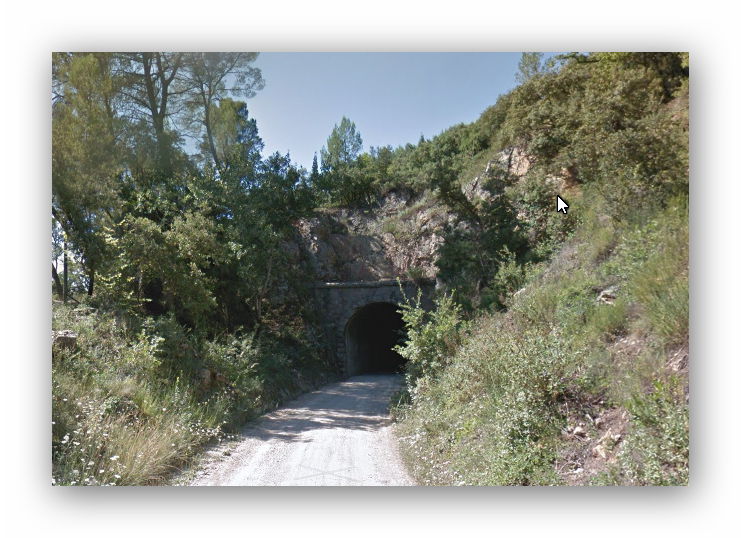
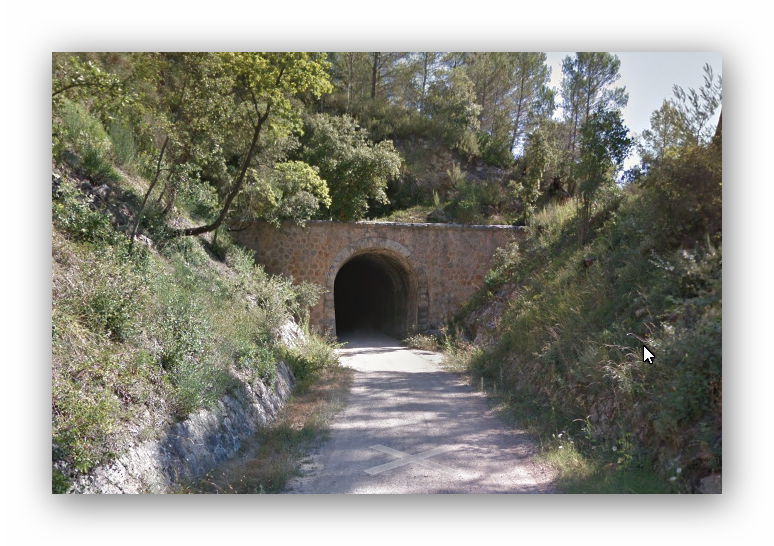
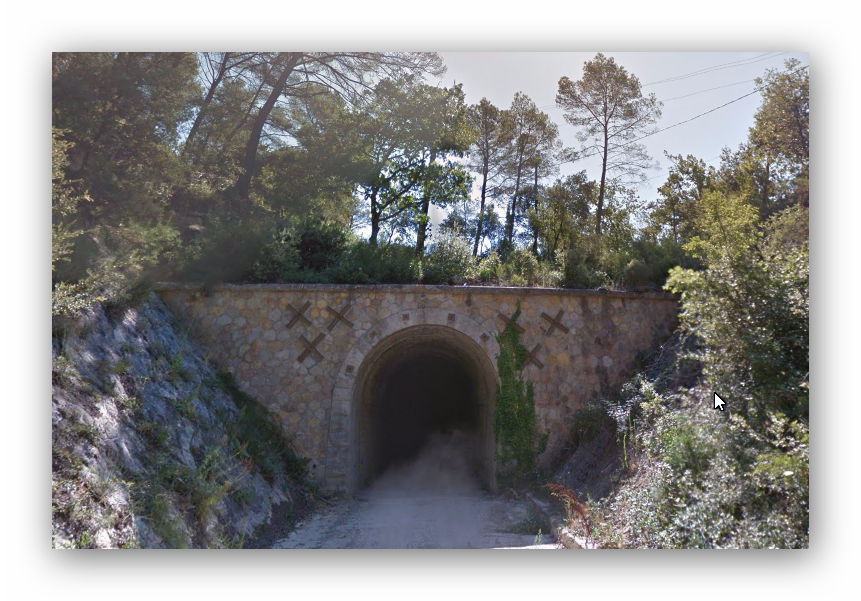
been converted into a narrow country road of which the picture below is typical. The road name is unsurprising … Chemin de l’Ancienne Voie Ferrée. The road surface is gravel and is probably little changed since the railway was lifted in the 1950s/1960s. As the line travels south around Flayosc towards Lorgues, it encounters a number of relatively short tunnels. The first is shown below. The first picture is its Northern portal facing along the line to Draguignan, the second is its Western, Lorgues portal. The tunnel is curved along its length.

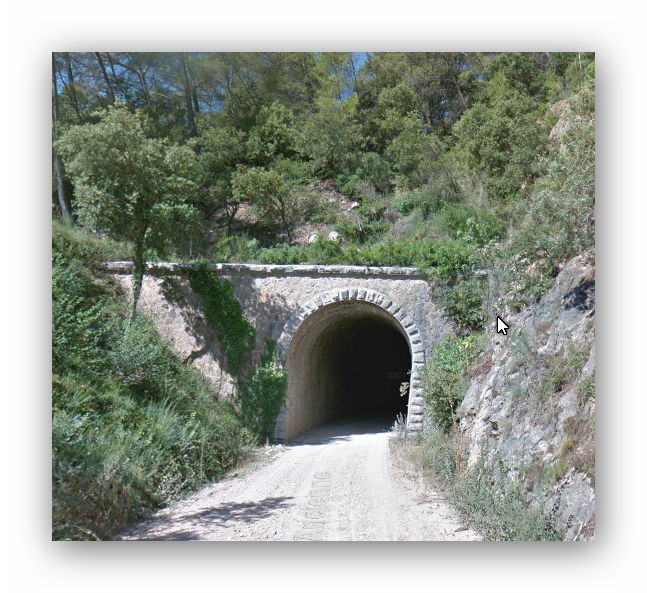
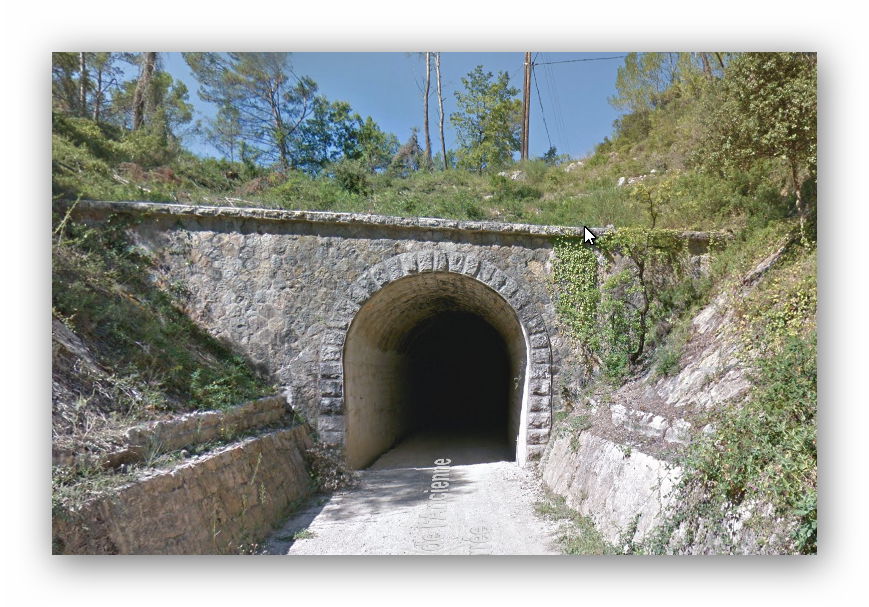
A short meandering length of formation leads to a second tunnel. Its eastern (Draguignan facing) portal (on the left) gives way to a relatively straight tunnel travelling East-West. The picture below is the West portal.

And a further short stretch of the line leads to a third short tunnel. It then winds its way on through the forest towards the small village or Sauve Clare and the next encounter with a tarmac road.

At Sauve Clare the railway passed under the village road. There was a short length of cutting and retaining walls either side of the line before a delightful bridge carried the road. The adjacent church, Chapelle Saint Augustin, is worth a photo because it shows the proximity of the church to the railway bridge.

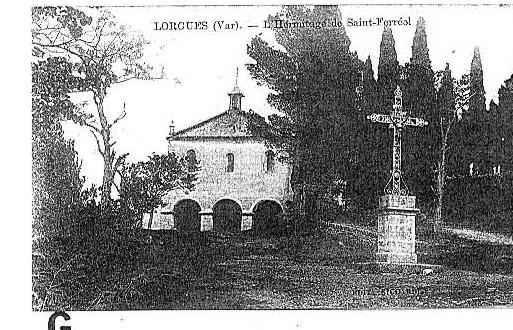
After the village of Sauve Clare, the line wandered away again into the forest heading for Lorgues. Eventually the forest road (Chemin du Train des Pignes East) that the route follows is once again properly tarred as it enters the suburbs of Lorgues close to the Hermitage de Saint Ferreol.

Another road bridge is encountered with the line once again in cutting before the landscape opens out into what is now private housing but which would probably have been farmland when the line was operational in the early 20th century. The line approaches Lorgues from the North-East and runs across the North of the town.

Another small bridge is encountered where the railway passes under Chemin de Berne before the line runs in a straight line into what was Lorgues Station.

The passenger service from Lorgues to its station to the North of the town was provided by Louis Aune with a bus of 4 to 6 seats, the cost of transport was 5 cents. Aune was famous for having a small monkey always at his side in his seat. The pick up points for the ‘bus’ in the town were located at Rue de l’Église, at the Hotel de la Poste, and at Hotel Guirandi. As time went by, Aune was replaced by Léon Icard and later by Phocion Collet.

The freight service from Lorgues to the station was provided by Louis Allary with a truck 4 wheels . He has compettion from Monsieur Rousse who provided a service between Le Thoronet and Lorgues station. Its home base was Le Thoronet but he tried to compete on the route from Lorgues, with a base on Rue du Docteur Cordovan in the Old Town.

A few photos before we take a break in Lorgues.

References

  1. Jose Banaudo, Le Train des Pignes; l’Editions du Cabri, 1999.

Ligne de Central Var – Part 10 – Figanieres to Draguignan (Chemins de Fer de Provence 30)


Figanières to Draguignan

We recommence our journey at Figanières Station which is perhaps two-thirds of a kilometre to the East of the Centre of the town. We set off facing roughly Southwards. The station is at the location marked with a red ellipse on the plan below and is now a private home as can be seen in the picture below.

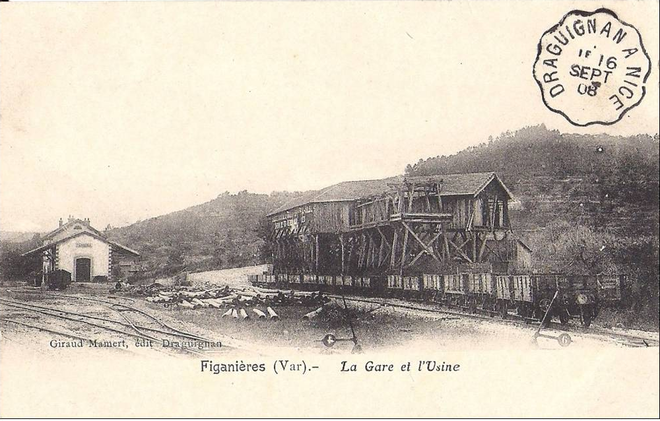
In the old postcard the station is flanked by a rather ramshackle factory building and loading stage which had a rail link and appeared to be busy, at least at the time the photograph was taken.

The line (shown in black on the adjacent map) followed the road (the D54) for a while until turning away to the South of the road, and finding the road Saint-Pons and travelling again in a near Southerly direction, before switching back to follow the alignment of the D54 but a few hundred yards distant. It then drifted towards the D562, eventually running just above a minor road on retaining wall.

The line then crossed the D562 at level and it is just possible to pick out the crossing keeper’s cottage among the trees alongside the road. The formation of the line then follows alongside the D562 but continues Southwards when the D562 turns Westward. It can be seen disappearing into the woodland below.


The formation winds its way southwards through the forest before turning West and beginning to approach the outskirts of Draguignan.

After reading the last post Andreas on Les Forums de Passions Métrique et Etroite!! commented as follows:

“Perhaps you have missed the “best” part: Between Figanières and Draguignan, the former Central Var line crosses a horrible training camp for tanks! I peacefully rode my old bicycel along the line and then realised I had entered and army camp with no visible exit (Help!). Thank God the tanks were not in action that day.” The army base referred to by Andreas, appears to be on this length of the line.”

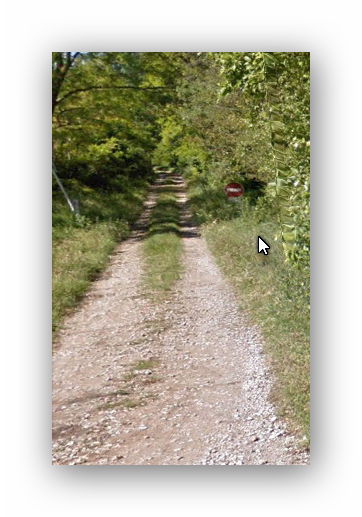
As the formation of the old railway gets closer to Draguinan, it is once again covered in tarmac. It bears the name Avenue de la Vaugine. On the way, it passes under a beautiful little accommodation bridge, and a second similar but somewhat less well-maintained structure.


The approximate line of the old railway crosses from the Avenue de la Vagine to the main D59 along roughly the line indicated by the portrait picture above.

Internet searches suggest that the line of the Chemin de Fer du Sud then heads into Draguignan along Boulevard John Kennedy (D59), Place Pasteur (D59), and Boulevard Jean Jaures, and that the narrow Rue Labat and Boulevard Marx Dormoy then took the line right into the town centre of Draguignan. This is the route favoured by the Google Earth insert plotted by Claudio Capaccio which can be found by following this link: http://ollivier.haemmerle.free.fr/LigneColomarsMeyrargues.kmz.

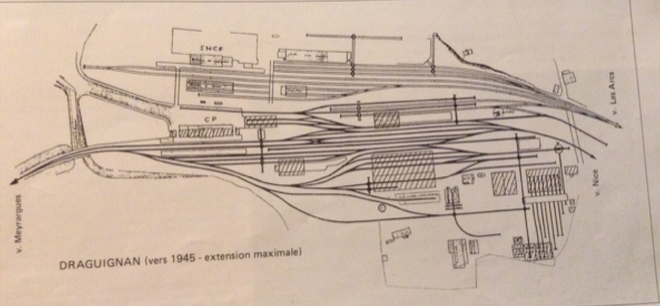
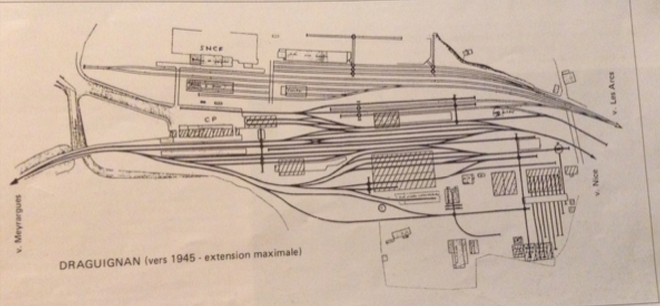
This seems to me to be highly unlikely. The layout of the railway stations in Draguignan can be ascertained from sketch plans and aerial photographs which show their position and which show the line from Nice approaching the Chemin de Fer du Sud Station from the West.

The Chemin de Fer du Sud Railway Station in Draguignan (43 ° 32 ’03 “N, 6 ° 27′ 49” E) was on
Boulevard des Fleurs. The picture immediately below shows the station in more recent times, after it had served as a school. The first postcard view below that is from 1910. The station was enlarged soon after this, as can be seen in the picture below that.

The plan above and the aerial photo  show the arrangement of the stations in Draguignan. On the plan the SNCF (PLM) Station is at the top left with the Chemin de Fer du Sud Station just below it. In the aerial photograph, the Chemin de Fer du Sud Station is at the top of the picture about one thir of the way across from the right and the PLM Station is to its right.

On the plan, the trains from Nice entered from the right, on the aerial photograph, Nice trains entered from the bottom left, on the line which curves out of the let side of the picture and which continues roughly Westward on the aerial view below.

The most likely route of approach to the station from Nice was for the old line to follow the Avenue de Verdun which curves away from the D59 and the route of the line preferred on Google Earth which is shown in red in the adjacent satellite view from Google Earth. Avenue de Verdun is the wide curved road on the left of the image.

If my route is correct, the line would have followed Avenue de Verdun which then becomes the D955 (Avenue de 15eme Corps d’Armee) and which curves round the South of the Town and provides approximately the direction of approach which is indicated by both the plan above and the aerial photographs. Indeed, this route is confirmed by accessing aerial photographs from 1928 on the website: https://remonterletemps.ign.fr

The next stage of our journey will set off from Draguignan Station after having had a good look round the Station site on any pictures which are available.


Ligne de Central Var – Part 9 – Claviers to Figanieres (Chemins de Fer de Provence 29)

Claviers to Figanieres

We continue our journey from Claviers Station, West towards Draguignan, aware that ahead of us the line will take a significant detour to the north to enable it to follow the contours and avoid significant gradients!

The old Station House at Claviers is no a private residence. It can be picked out on the top right of the photo above. A small area has been blown up to a larger scale to identify the building.

We set off from the station in a Northwesterly direction along La Font which becomes Chemin Francois Manzone. The tarmac ends and the old formation is used for an ongoing footpath/cycle route.

The line continues northwards towards Bargemon up the Western flank of Le Riou valley through Les Fournas and Roque Bouliere.

The line turns round the head of the valley towards Bargemon and then South once again. After the bridge in the photo below, the route follows Chemin de San Peyre. The station has been demolished.


The Bargemon Station was at the location highlighted with a green ellipse on the adjacent plan.

On from Bargemon Station, the route crossed the valley of La Doux and headed South towards La Colle de Boussaque and the Tunnel de Boussaque. That tunnel runs from a portal facing Bargemon at 43 ° 35 ’49 “N, 6 ° 32′ 49” E to a Western portal close to Callas at 43 ° 35 ’46 “N, 6 ° 32′ 39” E, a distance of 212 metres. The tunnel is closed.

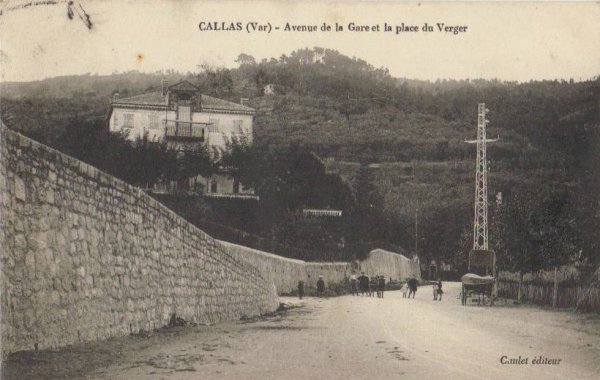
Callas Station has been demolished to make way for development. It location is indicated by the green ellipse. There is now a clinic on the site. The line immediately crosses the Bargemon Road and the enters Callas Tunnel, marked by the dotted black line and the arrowheads on the plan.


Callas Tunnel (43° 35′ 40″ N, 6° 32′ 16″ E43° 35′ 33″ N, 6° 32′ 10″ E) is 258 metres long. The tunnel mouth above is the one facing Bargemon. The one below faces Draguignan and is deep in cutting and well hidden. Just beyond that tunnel mouth the route is crossed by a road bridge and the track bed breaks out into the open.


Leaving the village of Callas in the top right of the map above, the line followed the route of what is now Le Clos then Camp de Pontreves North and Camp Redon, going under another road bridge and then crossing another road at grade. The crossing keeper’s cottage remains.


The line continues through a rural area of mixed woods and farmland with occasional steep sided valleys along Les Venes and l’Etang, before encountering the D54. The route joins the D54 and heads South-Southeast through Figanieres Station where this part of our journey ends.


Ligne de Central Var – Part 8 – Seillans to Claviers (Chemins de Fer de Provence 28)

Seillans to Claviers

We set off from La Gare de Seillans heading West towards Draguignan. If we are used to weather in the UK, we are still surprised by just how blue the sky can be in Provence, and just how warm the sun can be.

In November 2018 a postcript has been added in the form of an additional post in this series :

Ligne de Central Var – Postcript – A short walk near Seillans (Chemins de Fer de Provence 28a)

It covers a very short length of the line which was explored on foot.

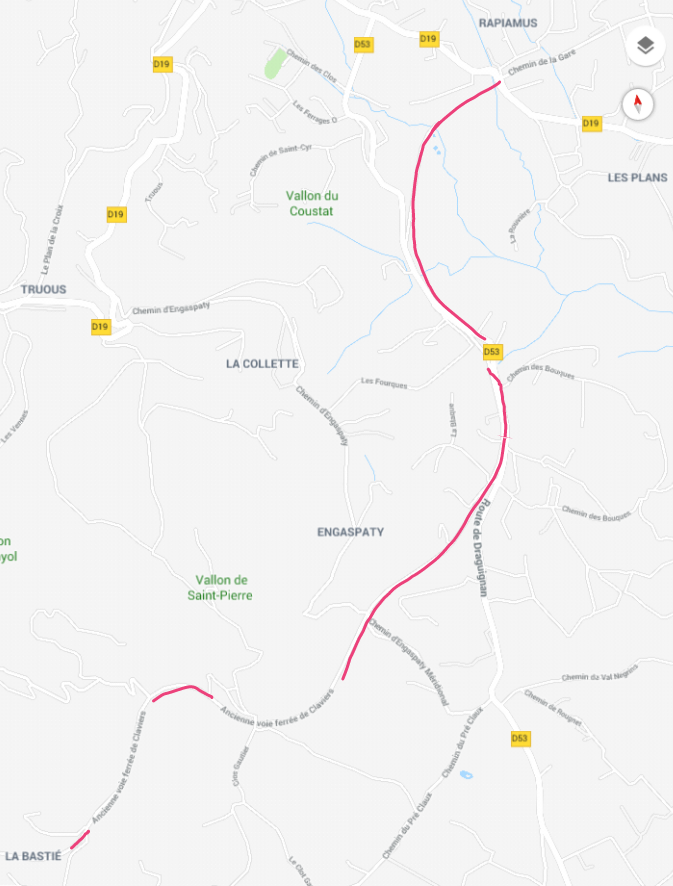
The route turns quickly to the South as can be seen in the map below. The formation is visible in the satellite images on Google Earth after crossing the D19. The route curves round to join the present D53 and in a short while leaves it on what is now called the Ancienne Voie Ferree de Claviers. For some way it travels alongside the D53 Route de Draguignan before branching off to the right to follow a more Southwesterly line. The road is otherwise known as Le Petelins.

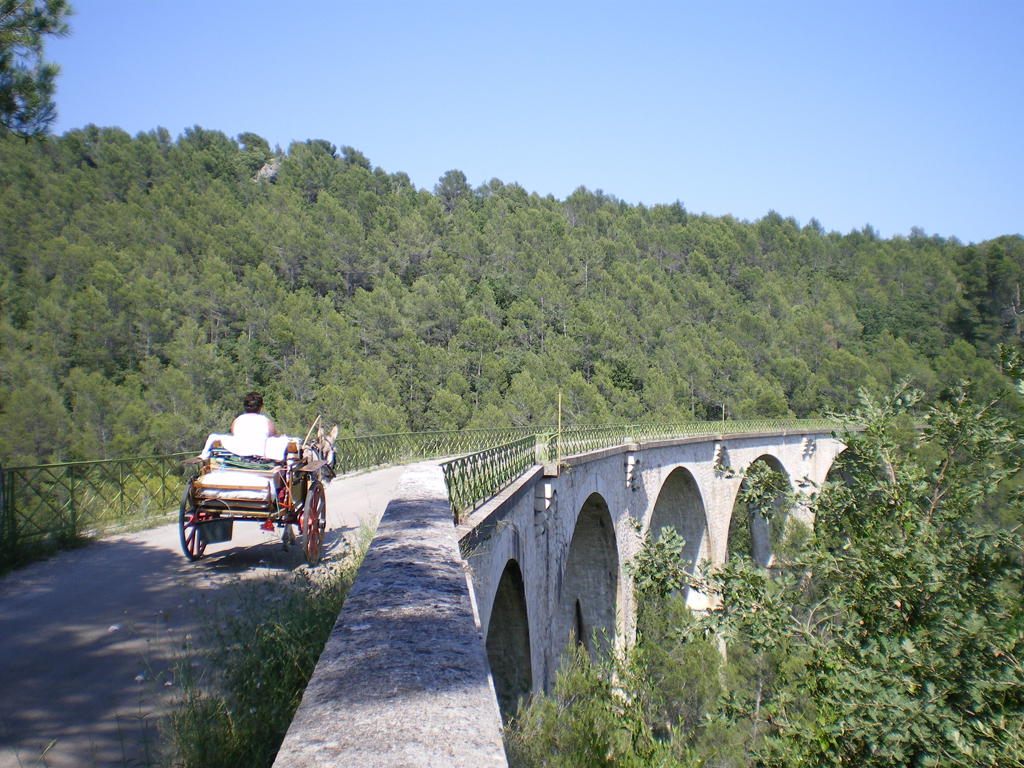
One of the most enjoyable things about parts of the route of the Ligne de Central Var is that it is possible to follow them in a car. We did this over as much of the length of the route as we could in November 2017. Encountering the Viaduct du Rayol (43 ° 36 ’53 “N, 6 ° 38′ 19” E) was one of the special moments on that journey.

The Viaduct is topped by lime green railings which seems to set it off beautifully. It is 159 metres long. When the line was operational it was not easy to access this viaduct except by train which perhaps explains the difficulty I have had in finding old postcard views of the structure.

Beyond the viaduct, the line continued on through the forest to La Bastié and Les Clots de Meaulx, where there was a small Halt which can be seen in the first two pictures after the map below.


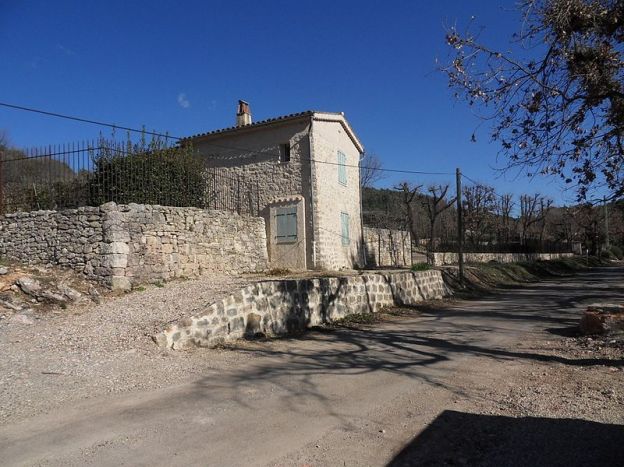
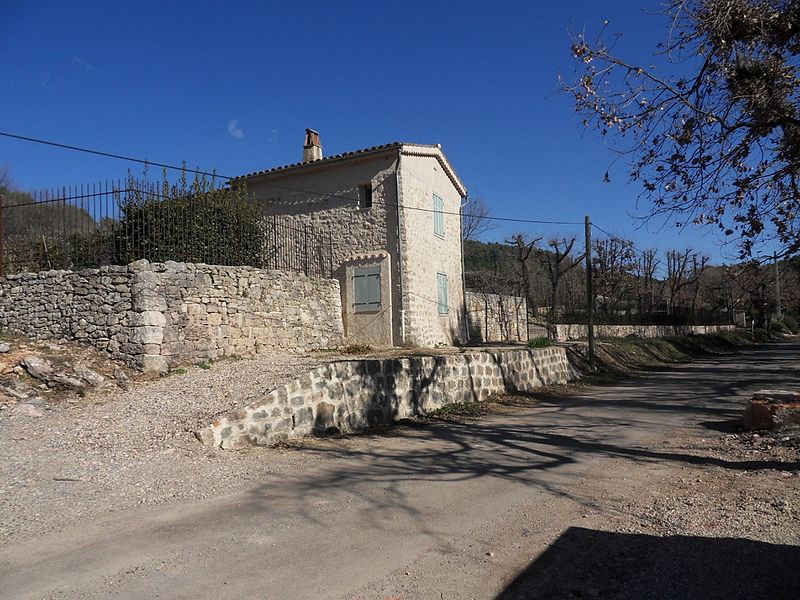
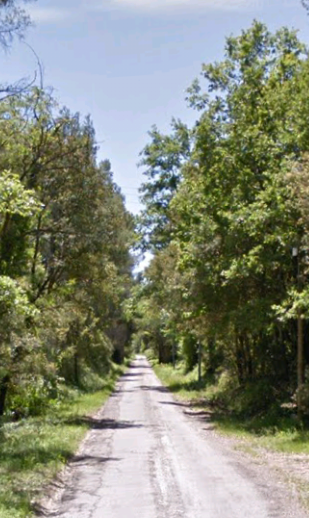
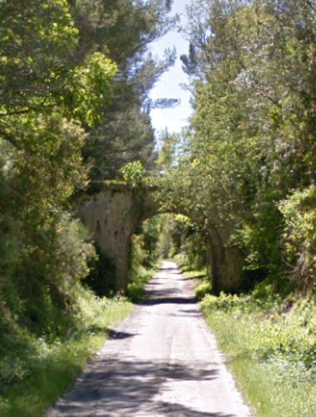
And then on towards a crossing of the D55 at the point where its name changes from La Plaine de la Serillere to La Cougnasse. After the road crossing tarmac gives way to the basic railway formation. There was a crossing keepers cottage here which is now well hidden by hedging but which can be seen in the satellite view below.

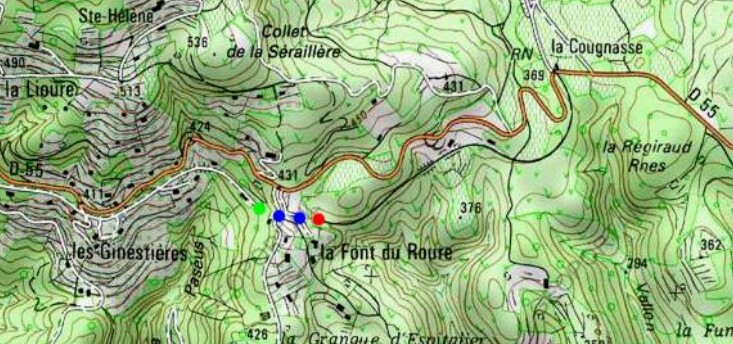
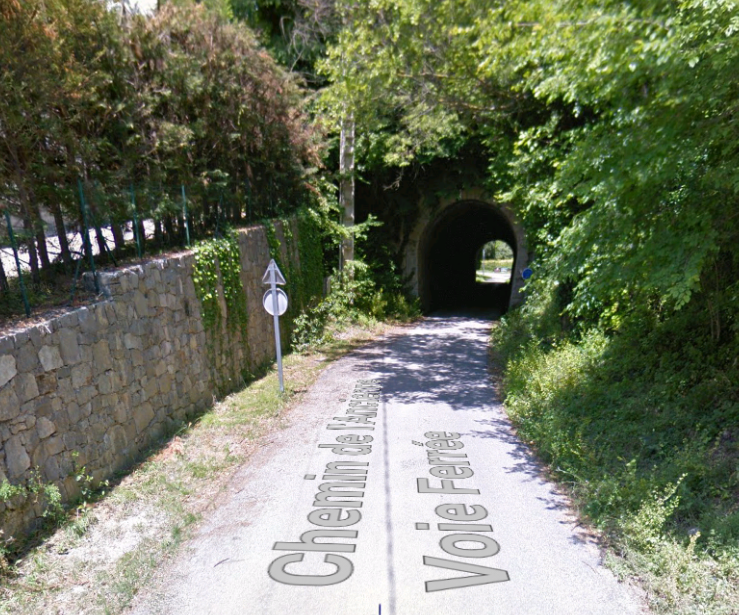
The line took a tight curve from travelling in a South-Southeast direction to a Westerly direction travelling South of the D55 (this can be seen on the map below) which went through a series of hairpin bends immediately adjacent to the road/rail crossing. The line continued towards Draguignan and entered the Tunnel Font du Roure which appears on the map below. I could find no photographs of the tunnel portals and neither is accessible by vehicle.
Beyond the tunnel the line passed to the North side of Les Giniestieres running adjacent to the D55 on its South side for the run into Calviers, returning to a tarmac formation along this route.

The track bed can just be picked out between the trees on the South side of the D55. Google Street view comes to the rescue as we passed this point too quickly in the car to pick out the alignment of the railway on the ground on November 2017.

The village of Claviers sits over the line and it passes under the village in tunnel. The Tunnel de Claviers is still in use as a road tunnel, it is just 51 metres long. The portal at the South East end is above and the North West portal below. Immediately beyond the tunnel the line entered Claviers Station. Here we rest a while as we have completed the 8th section of out journey.