Category Archives: British Isles – Railways and Tramways

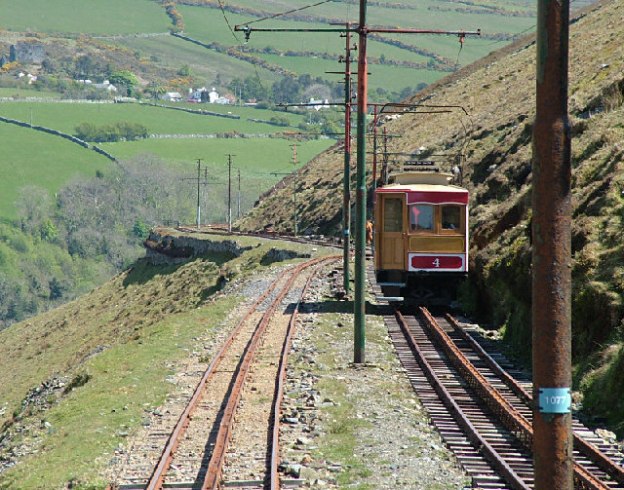
Manx Electric Railway – 1957 to 1962 – a review 5 years after nationalisation. ….

The June and July 1962 issues of ‘Modern Tramway’ included a 2-part review of the first five years of operation and maintenance of the Manx Electric Railway (MER) after nationalisation on 1st June 1957.

June 1962 marked the end of the first term of office of the MER Board. … ‘Modern Tramway’ Journal, in its June 1962 edition, begins:

“We should first explain something of how the Isle of Man Government sets about its work; day-to-day administration is in the hands of Boards of Tynwald, consisting partly of elected members of the House of Keys (the Manx House of Commons) and partly of non-Tynwald members appointed by the Governor. These Boards occupy much the same position as Ministries in the British Government, except that they serve in a part-time capacity. The M.E.R. Board, set up in 1957, has three Tynwald members and two others.

The first Manx Electric Railway Board was appointed in May, 1957. Its Chairman was Sir Ralph Stevenson, G.C.M.G., M.L.C., with Mr. R. C. Stephen, M.H.K. (a journalist), Mr. A. H. Simcocks, M.H.K. (a lawyer), Mr. T. W. Kneale, M.Eng. (a former Indian Railways civil engineer, with an expert knowledge of permanent-way) and Mr T. W. Billington (an accountant) as it’s members. … They were entrusted with the task of running the railway and reconstructing much of the permanent way, and an annual estimate of the money required was to be presented to Tynwald by 31st March of each year. No changes were made in the railway’s staff, the full-time management, as under the Company, remaining in the capable hands of Mr. J. Rowe (Secretary and Joint Manager) and Mr. J. F. Watson, M.I.E.E. (Chief Engineer and Joint Manager), who occupy the same posts today.

The new Board took over from the Company with due ceremony on 1st June, 1957, but found during their first year of office that, owing to rapidly rising costs, far more money than anticipated would be needed to reconstruct the railway at the rate intended, and to keep it running. Instead of a grant of £25,000 per year (the figure agreed upon by Tynwald), they would require £45,000, and after Tynwald had rejected both this request and their alternative proposed economies (cutting out early and late cars, and closing down in winter) the entire Board, with the exception of Mr. Kneale, resigned. A new Board then came into being, the Chairman being Mr. H. H. Radcliffe, J.P., M.H.K., with the following gentlemen as Mr. Kneale’s new colleagues: Mr. W. E. Quayle, J.P., M.H.K.. (Vice-Chairman), Lieut.-Commander J. L. Quine, M.H.K., and Mr. R. Dean, J.P. The new Board undertook to do their best to run the railway within the originally- planned subsidy of £25,000 per year, and reaffirmed that they would continue the work of reconstruction, but at a rate such as to lie within the original budget, the effect being of course that the rate of reconstruction has been somewhat slowed down and the method of financing has varied from that originally planned. The original. intention was to finance the relaying of the Douglas-Laxey section by an outright. annual grant, so that the track would enjoy. many years of debt-free life, but after the 1958 re-appraisal Tynwald reverted to the proposal of the second Advisory Committee to finance this work by a loan repayable over the 20-year life of the new track.” [1: p201-203]

A map of the MER and other rail routes. I find the hand drawn maps, which appear in the post-war to 1960s period magazines, of greater interest than the computer-aided mapping/drawings of layer years. This image should assist in placing elements of the MER referred to in the text. [1: p202]
Roughly the same area as shown on the hand-drawn map above. The light blue line is the MER. The red lines are the Isle of Man Railway. The pink line is the Groudle Glen Railway. The Green line is the Douglas Bay Horse Tramway. The Dark Blue line is the Snaefell Mountain Railway. Manx Northern Railway is shown in Yellow. []

Modern Tramway continues:

“In July, 1958, the Board was granted borrowing powers up to a maximum of £110,000, and of this the sum of £20,000 has been borrowed at 5 per cent, the usual interest and sinking funds being set up to provide for repayment. The money was used to relay 200 tons of rails, including labour, rail fastenings, sleepers and ballast. In January, 1960, however, Tynwald made a special grant of £9,000 for the next stage of the track relaying, with another grant a year later, while the traffic results from the 1960 and 1961 seasons were so good that in these two years a sizeable part of the £25,000 operating subsidy remained in hand and was able to be spent on relaying; 4,000 sleepers were bought out of the annual grant in 1961, and 100 tons of rails and 4,000 sleepers by the same means early in 1962. …

Since June, 1957, despite the overall financial stringency, quite a lot has therefore been done. Five hundred tons of new rail have been laid, and to date the Board has completely renewed about seven single-track miles of line between Douglas and Laxey. Concurrently, more than half of the 24,000 sleepers on this section have been renewed. To date, new 60 lb. per yard flat-bottom rails have been laid on the following sections: both tracks from Douglas Bay Hotel to Onchan, the northbound track from Far End to Groudle, both tracks from Groudle to Baldrine, the northbound track from Baldrine to Garwick, the southbound track from Ballagaune to Ballabeg, the north- bound one from Ballabeg towards Fairy Cottage, and the southbound track from Fairy Cottage to South Cape, plus new crossovers at Onchan Head and Groudle. Many of the new sleepers were produced on the island by the Forestry Board, but the more recent ones have been imported from Scotland since no more are available locally at present. The old ones, apart from a few sold to the Groudle Glen railway, are sent to Douglas prison and cut up there for firewood.

Since the M.E.R. Company had been living a hand-to-mouth existence for several years prior to the nationalisation, the management had lost touch with manufacturers, and had to make fresh contacts. This has had the incidental advantage of allowing them to benefit from the very latest improvements in track components, and much of the recent relaying has been done with elastic rail spikes, while to the north of Ballagaune is an experimental 200-yard length of track laid with rubber pads, giving a superb and almost noiseless ride. Modern techniques have also been adopted when relaying some of the sharp curves, with careful prior calculations to determine the correct transition and super-elevation for each, instead of the rule-of-thumb methods used in earlier days.

The permanent way renewal carried out to date represents about half the total trackage between Douglas and Laxey, including all the heavily-worn sections which in 1956 were overdue for renewal. At the time the Government took over, it was hoped to relay the entire line to Laxey within seven years, followed by the Snaefell line in the ensuing three. …

Corresponding renewals have also been made to the overhead line, using round-section trolley wire and phosphor-bronze overhead parts supplied by British Insulated Callenders’ Cables Ltd., who have undertaken to continue the manufacture of whatever components the MER. may require. With gradual change to grooved wire at Blackpool, the Manx Electric will probably be the last British user of tradi- tional round trolley wire, with its big trolley wheels and “live” trolley poles reminiscent of American interurban practice. The gradual corrosion of the overhead standards in the coastal atmosphere … has been very largely arrested by a very thorough repainting.” [1: p204-205]

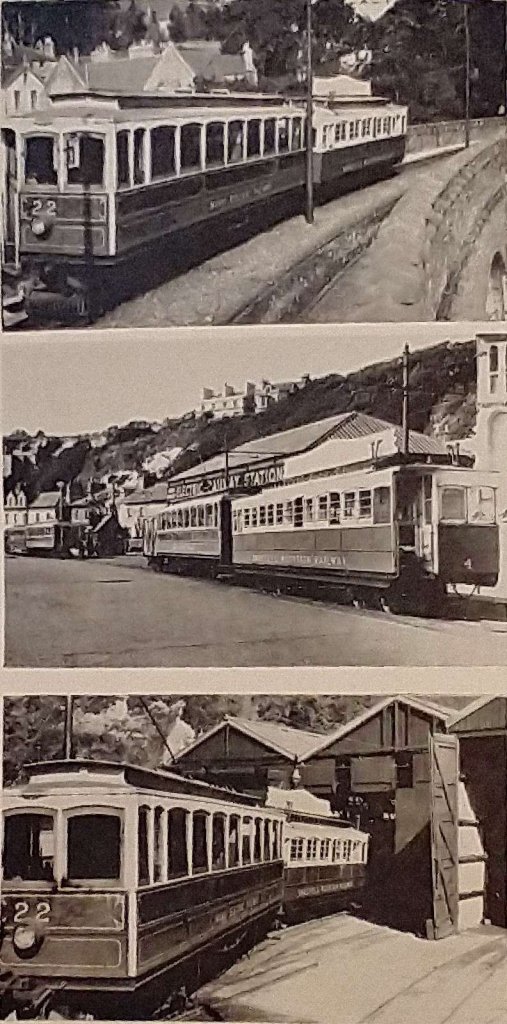
By 1962, traditional liveries had been brought back, with full ‘lining-out’ and ‘Manx Electric Railway’ logo. The two cars here are, first, winter saloon car No.19 at Laxey during the 1961 Light Railway Transport League convention, and, second, reupholstered saloon No. 57 at Derby Castle Works. Both pictures © J.H. Price. [1: p203]

Further support from the Manx Government was forthcoming during the first-year period after nationalisation under a scheme designed to offset the seasonal nature of the island’s biggest industry, tourism. £7,000/year was allocated dependent on the level of employment achieved. This funding could not be for planned major work as it covered the provision of work for those employed in the summer tourism period. It was “used for marginal rather than essential work, and the Board prepare[d] estimates of such work that could usefully be done and submit them to Tynwald for eventual adoption later on. Under these schemes, Laxey and Ramsey stations [were] resurfaced in tarmac, and the whole of the Douglas-Ramsey line and most of the Snaefell line [were] completely weeded and the fences and drainage works trimmed and cleaned, which when related to the real mileage (all double track) is a considerable achievement. … The Board, … in addition, treated the whole right-of-way with a selective weed-killer. … The chemical [was] applied by a special 6-ton wagon rebuilt as a weed-killer tank wagon, with a small petrol engine providing pressure spraying at 5 m.p.h. This unit [was] based at Laxey depot.” [1: p205]

Track maintenance formed the largest element of the Board’s expenditure. Little, other than routine maintenance, was done to rolling stock during this period. Physical deterioration to stock was reduced as a result of track improvements. As the images above show, some stock received cosmetic treatment, what might be called rebranding in the 21st century world.

Modern Tramway continues:

“The passenger stock remains at 24 cars and 24 trailers (excluding trailer 52, which is now a flat car). … With the increased amount of track work, car No. 2 has been converted each winter to a works car, with work-benches and equipment in place of its longitudinal seats, but like No. 1 it can be restored to passenger service in mid-summer if need be. Certain freight wagons not required for engineering purposes, including those lying derelict at Dhoon, have been dismantled in the general clearing-up. The average age of the present 48 cars and trailers is now 61 years, but most of them are only used in the summer and should be good for many years yet.” [1: p205]

This begs the question about the stock remained on the MER in the 21st century. …

In 2023, Wikipedia tells us that, “The Manx Electric Railway … is unique insofar as the railway still operates with its original tramcars and trailers, all of which are over one hundred years old, the latest dating from 1906. Save for a fire in 1930 in which several cars and trailers were lost, all of the line’s original rolling stock remains extant, though many items have been out of use for a number of years, largely due to the decrease in tourism on the island over the last thirty years. Despite this, members of each class are still represented on site today, though not all are in original form or in regular use.” [2]

The following list details what has happened to the full fleet of motorised trams:

No. 1: built in 1893 by G.F. Milnes & Co., Ltd is an Unvestibuled saloon and painted Red, White and Teak. It has 34 seats and is painted in the MER 1930s house style. It remains available for use.

No. 2: built in 1893 by G.F. Milnes & Co., Ltd is an Unvestibuled saloon and painted Red, White and Teak. It has 34 seats and is painted in the MER 1930s house style. It remains available for use.

Tram Car No. 2 in 2009 in a different livery, standing at the Derby Castle terminus, © Gordonastill and licenced for reuse under a GNU Free Documentation License. [8]

No. 3: lost in 1930 in a shed fire.

No. 4: lost in 1930 in a shed fire.

No. 5: built in 1894 by G.F. Milnes & Co., Ltd is a Vestibuled saloon and painted Red, White and Teak. It has 32 seats and is painted in the MER 1930s house style. It remains available for use.

No. 6: built in 1894 by G.F. Milnes & Co., Ltd is a Vestibuled saloon and painted Maroon, White and Teak. It has 36 seats and is painted in the MER late Edwardian livery. It remains available for use.

No. 7: built in 1894 by G.F. Milnes & Co., Ltd is a Vestibuled saloon and painted Blue, Ivory and Teak. It has 36 seats and is painted in the original MER livery. It was rebuilt between 2008 and 2011 and remains available for use.

No. 8: lost in 1930 in a shed fire.

No. 9: built in 1894 by G.F. Milnes & Co., Ltd is a Vestibuled saloon and painted Red, White and Teak. It has 36 seats and is painted in the standard MER livery. It is illuminated and remains available for use.

No. 10: built in 1895 by G.F. Milnes & Co., Ltd is a Vestibuled saloon, painted Grey and has no seats. It was rebuilt as a freight car and is currently stored.

No. 11: was scrapped in 1926.

No. 12: was scrapped in 1927

No. 13: was scrapped in 1957.

No. 14: was built in 1898 by G.F. Milnes & Co., Ltd is a roofed ‘toastrack’ and painted Maroon. It has 56 seats and was rebuilt/restored to original condition between 2015 and 2018 and remains available for use.

No. 15: was withdrawn from service in 1973, it is currently stored. It was originally built by G.F. Milnes & Co., Ltd in 1898 and is a roofed ‘toastrack’. It is painted Red & White and has 56 seats.

No. 16: was built in 1898 by G.F. Milnes & Co., Ltd is a roofed ‘toastrack’ and painted Red & White. It has 56 seats . The livery is described as ‘House Style’. It remains available for use.

Tramcar No.16, a roofed ‘toastrack’ car in the Nationalisation livery with an unidentified ‘toastrack’ trailer also in the Nationalisation livery. This photograph was taken in 2009, © Gordonastill and licenced for reuse under a GNU Free Documentation License. [9]

No. 17: was built in 1898 by G.F. Milnes & Co., Ltd is a roofed ‘toastrack’ and painted Red &White. It was withdrawn in 1973. It has 56 seats and is currently stored.

No. 18: was built in 1898 by G.F. Milnes & Co., Ltd is a roofed ‘toastrack’ and painted Red &White. It has 56 seats and was withdrawn to storage in 2000.

No. 19: was built in 1899 by G.F. Milnes & Co., Ltd is a winter saloon and is painted Maroon, Cream & Teak. It has 48 seats and is in its original livery. It remains available for service.

No. 20: was built in 1899 by G.F. Milnes & Co., Ltd. It is a winter saloon and painted Red, White & Teak. It has 48 seats and is in 1970s style. It remains available for service.

No. 21: was built in 1899 by G.F. Milnes & Co., Ltd. It is a winter saloon and painted Green & White. It has 48 seats and is in nationalisation livery. It remains available for service.

No. 22: was built in 1899 by G.F. Milnes & Co., Ltd. It is a winter saloon and painted Red, White & Teak. It has 48 seats and is in standard livery. It remains available for service.

No. 23: was built in 1900 by the Isle of Man T. & E.P. Co., Ltd. It is a Green & Grey Locomotive. It was withdrawn to storage in 1994.

No. 24: was lost in a shed fire in 1930.

No. 25: was built in 1898 by G.F. Milnes & Co., Ltd was a roofed ‘toastrack’ and painted Red &White. It had 56 seats and was withdrawn in 1996.

No. 26: was built in 1898 by G.F. Milnes & Co., Ltd was a roofed ‘toastrack’ and painted Red &White. It had 56 seats and was withdrawn in 2009.

No. 27: was built in 1898 by G.F. Milnes & Co., Ltd was a roofed ‘toastrack’ and painted Yellow, Red &White. It had no seats and was withdrawn in 2003.

No. 28: was built in 1898 by the Electric Railway and Tramway Carriage Co., Ltd. It was a roofed ‘toastrack’ and painted Red &White. It had 56 seats and was withdrawn in 2000.

No. 29: was built in 1904 by the Electric Railway and Tramway Carriage Co., Ltd. It is a roofed ‘toastrack’ and painted Red &White. It has 56 seats and was rebuilt between 2019 and 2021.

No. 30: was built in 1904 by the Electric Railway and Tramway Carriage Co., Ltd. It was a roofed ‘toastrack’ and painted Red &White. It had 56 seats and was withdrawn in 1971.

No. 31: was built in 1906 by the Electric Railway and Tramway Carriage Co., Ltd. It was a roofed ‘toastrack’ and painted Red &White. It had 56 seats and was withdrawn in 2002.

No. 32: was built in 1906 by the United Electric Car Co., Ltd. It is a roofed ‘toastrack’ and painted Green &White (Nationalisation livery). It has 56 seats and is still available for service.

No. 33: was built in 1906 by the United Electric Car Co., Ltd. It is a roofed ‘toastrack’ and painted Red &White (Nationalisation livery). It has 56 seats and is still available for service.

No. 34: was built in 1995 by Isle of Man Transport. It is a diesel locomotive, painted Yellow & Black.

As an aside, G.F. Milnes & Co., Ltd was initially based in Birkenhead but before the turn of the 20th century had purchased a site in Hadley, Shropshire, now part of Telford. “Production commenced at Hadley in June 1900, and the works in Birkenhead closed in 1902. There were around 700 employees and 701 tramcars were built in 1901. The business benefitted from the rush of orders when horse and steam tramway systems were converted to electric traction, but the market had begun to contract by the beginning of 1903. The Company went into receivership in September and, after some complex manoeuvering, became part of the United Electric Car Company Ltd. in June 1905.” [3]

Hadley is only a few miles away from our home in Malinslee, Telford. The Works are still referred to as the Castle Car Works.

Other rolling stock on the MER included four roofed ‘toastrack’ trailers which were lost in the 1930 fire (Nos. 34, 35, 38, & 39); two ‘toastrack’ trailers in storage (No. 50, withdrawn in 1978; and No. 55, withdrawn in 1997); two ‘toastrack’ trailers being rebuilt in 2020 (Nos. 36 & 53); nineteen available for passenger service in 2020 (Nos. 37, 40-44, 46-49, 51, 54, 56-62); and two flatbed trailers (Nos. 45 & 52). [2]

MER roofed ‘toastrack’ trailer No. 37 © Gordonastill and licenced for reuse under a GNU Free Documentation License. [6]
Flatbed trailer No. 45 © Gordonastill and licenced for reuse under a GNU Free Documentation License. [7]

In addition to ‘home-based’ stock the MER has welcomed a number of visiting vehicles over the years details of which can be found on Wikipedia. [2]

Returning to the ‘Modern Tramway’ articles: the Journal reported that, “Maintaining this picturesque but veteran fleet has brought its usual quota of problems, and in view of the age of much of the equipment the Company has installed an ultrasonic flaw-detector at Derby Castle works, which is being used very successfully to detect cracks in axles, and has also been used to test axles bought from British Railways before turning them down to size for use in trailers. This method of flaw-detection is markedly superior to the earlier method with magnetic fluid, since the latter could not reveal faults that were hidden by the wheel boss or the gear seating. The car motors are being rewound with glass fibre insulation, which is expected to cure burn-outs caused by the moisture that tends to accumulate while the cars are idle in winter, and should therefore bring longer motor life. Cars 7 and 9 have been fitted experimentally with hydraulic shock-absorbers on the bogie bolster springs to counteract excessive sideways motion, and the Brush type D bogies of car No. 2 have had their axlebox leaf-springs replaced with a system of brackets and coil-springs, allow- ing more movement in the hornways and. giving a smoother ride. The Management hope that these two modifications when combined will give a vastly superior ride on the ten cars with this type of bogie.” [1: p205]

In the second of the two articles, [4] the Journal continued to note that in 1960 further modern compressor sets were purchased from Sheffield Corporation which were fitted to cars Nos.1, 5, 6, 7, 9, 16, 25, 26, 27, 32 & 33.

For a short while after nationalisation a green and white colour scheme was employed to mark the change. It was quickly realised that the vehicles looked their best when painted and trimmed in accordance with their builders intentions. So, in 1962, the Journal noted that, “The more recent repainting of M.E.R. cars has therefore seen a reversion to varnished teak and Post Office red with white and light brown secondary colourings, and with full lining, crests and detail in pre-war style, and many visitors have expressed their pleasure at this reversion. For the open cars, the equivalent livery is red and white, in each case with the full title instead of the initials M.E.R. During the winter of 1960, saloon trailer No. 57 was splendidly re- upholstered in blue moquette, replacing the original cane rattan which dated quite unchanged from 1904, and No. 58 has undergone the same transformation during the past winter; the concurrent refurbishing of the interior woodwork is a joy to behold. The red used on these two cars is somewhat deeper than that mentioned above.” [2: p221-222]

Planned addition provision of four new saloon cars had by 1962 been deferred indefinitely. Grants being only sufficient to address trackwork concerns. And, since inflation had seen the cost of new cars rise significantly, it was likely that in future the Board would “probably be forced back on the alternatives of reconstructing existing cars or buying others second-hand, if any can be found. Unfortunately, the engineering restrictions imposed by the 3ft. gauge and the 90ft. radius curves and reduced clearances are such that none of the available second-hand cars from Continental narrow-gauge systems is acceptable, and although quotations were obtained for relatively modern cars from the Vicinal and the E.L.R.T., the Vicinal cars were too wide and the cost of the others including modifications was prohibitive. In the whole of Continental Europe, the 3ft. gauge (exact or approximate) is found on electric lines only in Majorca, Linz and Lisbon, and although Lisbon has some two-motor Brill 27G trucks that would be ideal for the MER, the Lisbon tramway staff think the world of them and have no intention of selling.” [2: p222]

The Journal also observed that “the problem of the two main-road crossings between Douglas and Laxey, … still remains unsolved, and although a quotation was obtained for installing powerful flashing lights, the Highways Board whose responsibility this is has not yet been willing to find the money. This is a pity, for 1962 will see the introduction of a car-ferry steamer from the mainland and the arrival of many motorist visitors unfamiliar with such Manx phenomena as rural electric railways. Despite the vigilance of MER drivers, accidents are likely to continue at these points until something drastic is done; in the meantime, some prominent warning boards and white letters on the road surface would be better than nothing.” [2: p222]

A quick look at Google Maps/Streetview shows that by 2023 that problem had been resolved.

The road crossing closest to Douglas is at the top-right of this extract from RailMapOnline. [5]
The view North-northeast along the A2 at the above crossing. [Google Streetview, October 2010]
The road crossing closer to Laxey. [5]
The view North along the A2 at the crossing above. [Google Streetview, October 2010]

By 2010, both crossing points were protected by standard crossing lights.

During the 5 years from 1957 to 1962 traffic, as predicted, fluctuated with the weather. It was “doubly unfortunate that the first two summers (1957 and 1958) were rather poor ones. However, the splendid weather in the summer of 1959 revitalised the railway, and the new Board was happily surprised to find that the returning popularity of the railway was sustained in 1960 and even more evident in 1961.” [2: p222]

The Journal provided a comparison of passenger numbers on a number of heritage lines on the Isle of Man and in Wales. Their table is reproduced below.

‘Modern Tramway’ cautions against making too much from the figures in this table as season are not comparable. It is clear however that the MER was performing acceptably when it’s performance was judged against its peers. [2: p222]

Throughout 1957 to 1962, the MER operated with the limits imposed by Tynwald (operating revenues plus an annual grant of £25,000, supplemented by monies allocated under employment relief schemes). A wage increase threatened to upset this equilibrium, but Tynwald responded by increasing the annual grant by £3,000 in 1961. Performance improvements meant that the sum was not actually drawn down.

References

  1. Manx Electric 1957-1962; in Modern Tramway, Volume 25, No. 294, June 1962; Light Railway Transport League and Ian Allan, Hampton Court, Surrey, p201-205
  2. https://en.m.wikipedia.org/wiki/Manx_Electric_Railway_rolling_stock, accessed on 4th August 2023.
  3. https://en.m.wikipedia.org/wiki/G.F.Milnes%26_Co., accessed on 5th August 2023.
  4. Manx Electric 1957-1962; in Modern Tramway, Volume 25, No. 295, July 1962; Light Railway Transport League and Ian Allan, Hampton Court, Surrey, p221-225.
  5. https://www.railmaponline.com/UKIEMap.php, accessed on 5th August 2023.
  6. https://commons.m.wikimedia.org/wiki/File:MER-Trailer-37.jpg#, accessed on 6th August 2023.
  7. https://en.m.wikipedia.org/wiki/Manx_Electric_Trailers_45-48, accessed on 6th August 2023.
  8. https://commons.m.wikimedia.org/wiki/File:MER-Tram-2.jpg#, accessed on 6th August 2023.
  9. https://commons.m.wikimedia.org/wiki/File:MER-Tram-16.jpg#, accessed on 6th August 2023.

The Humber Arm Canal, Tramway and Railway – East Shropshire.

The Humber Arm Railway linked an earlier canal branch (which ran from the Newport Branch of the Shropshire Union Canal at Kynnersley to a wharf at Lubstree close to The Humbers, a small hamlet North of the old LNWR mainline through Donnington and on the North side of  Venning Barracks, the base of the 11th Signal Brigade and Headquarters West Midlands, part of the British Army’s 3rd UK Division.)  with the Lilleshall Company’s private rail network. [1]

The Canal was opened to traffic in May 1844 and was initially served by a tramway which ran from Lubstree Wharf to Lodge Furnaces. Between the Canal and the tramway the distance from the Shropshire Union Canal to Lodge Furnaces was about 4 miles (1 mile of canal and 3 miles of tramway).

The canal arm was authorised by an Act of parliament in 1827. If built at that time it would have been part of the Birmingham and Liverpool Junction Canal. Its successor was the Shropshire Union Canal. It seems that the Duke of Sutherland landowner and influential partner in the Lilleshall Company built both the canal arm and the associated tramway. [2: p41]

Charles Hadfield notes that two branches were authorized from canal serving Newport, “one to Edgmond that was never built, and one, to be a cut with 7 locks or a tramroad, to Lilleshall. This, on a different line and without locks, became the Humber Arm, … leading to the Marquess of Stafford’s Lubstree wharf, which opened for business in 1844.” [29: p185]

The aqueduct used to span Kynnersley Drive and carried the Newport Branch of the Shropshire Union Canal. It has now been demolished, but it was just to the North of the junction between this canal and the The Humber Arm. This photograph was taken in © Dr. Neil Clifton and licensed for reuse under a Creative Commons Licence (CC BY-SA 2.0). [11]

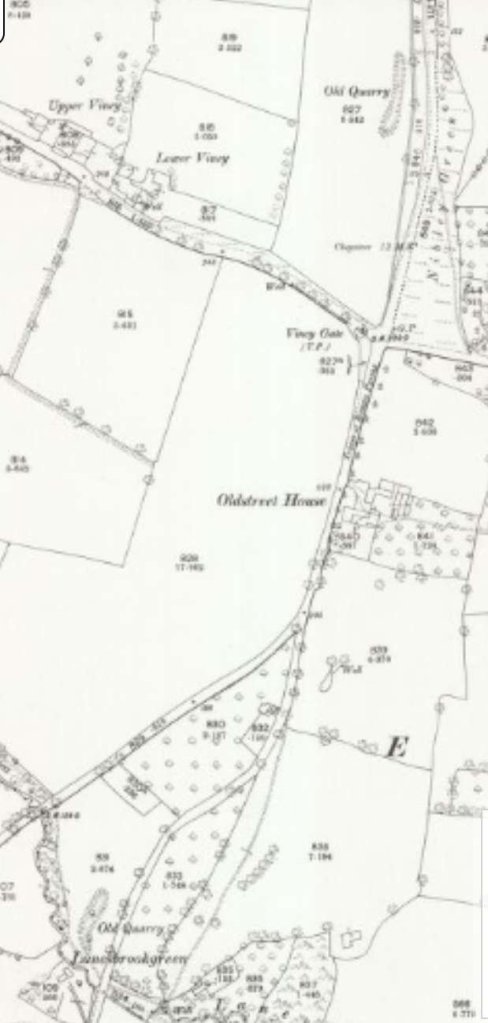
The six map extracts immediately below are mostly taken from the 25 inch Ordnance Survey of 1881/1882 and they show the full length of the canal. Traffic on the Humber Arm ended in 1922, when the fifth Duke of Sutherland closed the wharf and the railway line to Lilleshall. [3]

The junction of the Shropshire Union Canal Newport Branch and the Humber Arm which was just a few tens of metres to the South of the aqueduct shown above. The junction was to the East of Kynnersley. The Humber Arm heads Southeast from the Newport Branch. very little changed at this location from the opening to the closing of the Humber Arm. This map comes from the 1901 25″ Ordnance Survey. The following three images are extracts from the next sheet from the Ordnance Survey of 1881.[4]
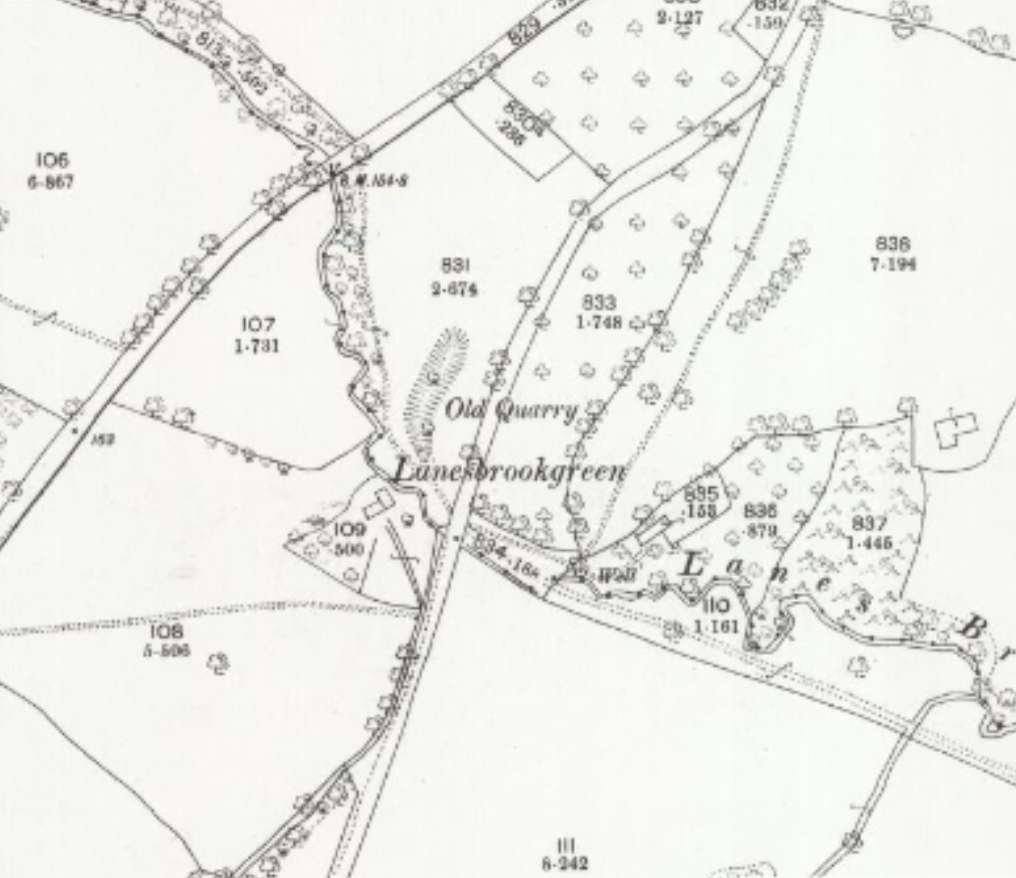
Three successive map extracts cover the length of the Humber Branch (Humber Arm of the Shropshire Union Canal) which appears to the bottom left of the relevant 1881 Ordnance Survey sheet. [5]
The remainder of the Canal Arm is on the next 25″ Ordnance Survey sheet to the South which was published in 1882. This length brings the canal to the North end of Lubstree Wharf. [6]
The Canal Wharf at Lubstree. 25″ Ordnance Survey of 1882. [6]
Approximately the same area as shown on the last map extract above as it appears on the RailMapOnline.com satellite imagery. The purple lines are the approximate line of the Mineral Railway that replaced the tramway we will following first. Satellite imagery shows nothing of the Canal Arm to the North of this image. Heading to the North from here, the line if the canal traverses open fields and then Aqueduct plantation. The trees in the plantation obscure any direct evidence of the old canal arm from above and, similarly, the location of its junction with the Shropshire Union Canal Newport Branch. [10]

While it is true that direct evidence of canal remains cannot be seen, tree growth differs along the line of the two old canals as this next satellite image from Google Maps shows.

Tree growth patterns highlight both the line of the Humber Arm and the Shropshire Union Canal Newport Branch. [Google Maps, July 2023]

Derelict structures once sat adjacent to the remaining length of canal at Lubstree Wharf.

The West elevation of the Engine Shed. [13]
The Engine Shed at the top end of the remaining length of canal close to the bridge which used to span the Humber Arm but which now forms a scenic break with no canal beyond. [18]
The view South from the ‘bridge’ alongside the Engine Shed in the mid 20th century. The remaining length of the canal alongside Lubstree Wharf was not always full of water. [19]
The view South from alongside the Engine Shed down the line of the tramway/railway which served the Wharf. [13]
The transhipment shed at Lubstree Wharf in the 20th century before major deterioration set in and the roof was lost. [16]
The transhipment shed early in the 21st century before reconstruction started. [17]
Looking North-northwest from Humber Lane the remaining length of the canal can be seen to the right of the centre if this image. The Goods Shed which appears on the map extract and satellite image above can be seen to the left of the young tree close to the camera. It appears to be being refurbished. [Google Streetview, June 2022]

The site was advertised for sale online by Barbers Rural Estate Agents with planning permission, granted on 31st January 2019. [13] At the time the above image was taken (June 2022) the old Goods Shed/transfer facility was being refurbished as a dwelling. The three images below come from the Estate Agent’s site and show what the architect planned for the Goods Shed and the Engine Shed.

The proposed dwelling built out of the remains of the Goods Shed. [13]
The computer-aided 3-D design drawings look very realistic. This image shows the planned refurbishment of the Goods Shed, the remaining length of the canal, and in the distance a refurbished Engine Shed! [13]
The proposed refurbishment of the Engine Shed adjacent to the bridge which once spanned the Canal, but which now forms a ‘scenic-break’. The is no canal to the North of the bridge. [13]

The tramway was replaced by a standard-gauge railway as part of the Lilleshall Company’s network of private railways in 1870.

The Tramway

I have not been able to find earlier maps than the 1881/1882 Ordnance Survey that would show the tramway. It is, however, reasonable to assume that, at least as far as the tunnel under the LNWR mainline, the railway was built on the formation of the old tramway. The last map extract above shows the terminus of the railway (which would have also been the tramway terminus) alongside the canal wharf, the next series of map extracts show the railway (and so also the route of the tramway),  running South to pass under the LNWR railway line.

The Humbers hamlet at the end of Lubstree Wharf. The end of the canal can be seen in the top-left of the extract. The tramway/railway crossed the lane through the hamlet at the end of the canal. The Humber Brook runs to the South side of the tramway/railway. [6]
These two extracts from RailMapOnline’s satellite imagery cover the same length of the tramway/railway as the map extract above. [10]
A wide-angle view looking West-southwest along Humber Lane. The tramway/railway crossed the lane closer to the camera than the bridge which carried Humber Lane across Humber Brook. [Google Streetview, June 2022]
The camera is just to the East of the bridge over Humber Brook and is looking Southeast. The brickwork to the right edge of the picture is the end of the parapet of the bridge carrying the lane across the brook. The tramway/railway used to run along the modern driveway, heading Southeast. [Google Streetview, June 2022]
This photograph is taken from a point further to the East along Humber Lane. The old tramway/railway ran just beyond the vegetation on the left of the image and behind the properties visible in the right of the picture. [Google Streetview, June 2022]
The old tramway/railway continued in a South-southeast direction. [6]
Again, this RailMapOnline satellite image shows roughly the same length of line as the map extract above. [10]
The old tramway/railway continued following the East bank if the Humber Brook. [6]
This satellite image shows the same length of line as the map extract above. [10]
This map extract shows the old tramway/railway turning towards the Southeast. The Humber Brook turns away to the West. An open drain crosses under the railway and runs parallel to the old tramway/railway as it heads Southeast. [6]
A similar area to that shown on the top-left of the map extract above. The purple line indicating the route of the old tramway/railway is crossed by other purple lines which mark later rails serving MOD Donnington. [10]
This RailMapOnline covers approximately the same length of line as the bottom-right quadrant of the last map extract and the top-left quadrant of the map extract below. [10]
The old tramway/railway turns once again to the South-southeast and is shadowed by one arm of the open drain. [6]
This satellite image extends just a little further to the South than the map extract above. [10]
Two map extracts showing the South-southeast trajectory of the line as it came closer to the LNWR mainline. The next map extract takes the tramway/railway on to another 25″ map sheet. [6]
The approach to the point where the LNWR line crossed the route of the tramway/railway. [7]
A series of three extracts from RailMapOnline’s satellite imagery which bring the purple line to approximately the position as the bottom of the last map extract above. The gate into MOD Donnington can be picked out under the purple line adjacent to the Babcock building. [10]
Looking North through the gates to MOD Donnington the road running North-northwest (directly ahead of the camera) from the gate follows the line of the old tramway/railway. [Google Streetview, June 2022]
Looking South-southeast from a very similar location. The bridge ahead carries the A518 over the access road to MOD Donnington. It is at the same location as the bridge which carried the old LNWR mainline over the old tramway/railway. [Google Streetview, June 2022]
This extract from the 1882 25″ Ordnance Survey shows the point at which the LNWR bridged the Lilleshall Company’s tramway/railway. It also shows the old tramway route continuing to the South-southeast and the later standard-gauge mineral curving round to the Northeast to run parallel to the LNWR main line. [7]
This final RailMapOnline satellite image shows the features noted on map extract above and shows the dramatic changes which have occurred in the immediate vicinity of the old tramway. The tramway route is not followed by RailMapOnline South-southeast of Wellington Road. [10]
Looking North-northwest towards the bridge carrying the A518 across the entrance road to MOD Donnington. As we have already noted, the bridge is at the same location as that which carried the LNWR line over the old tramway/railway. The road leading under the bridge to the site gates of MOD Donnington follows the line of the old tramway/railway. The camera is at the approximate location where the old tramway route separated from the newer mineral railway. The mineral railway curved away to the right of this image after passing under the old bridge. [Google Streetview, June 2022]

The last map extract above shows the route of the old tramway extending South-southeast from the LNWR mainline with the more modern standard-gauge mineral railway curving round after passing under the mainline and climbing on a gradient of about 1 in 77 to run alongside the LNWR line.

This image is a further extract from the 25″ 1881/1882 Ordnance Survey. It shows the route of the old tramway crossing what became Wellington Road and continuing along what became Wrekin Drive. [7]

South of this point the old tramway continued in a South-southeasterly direction. It crossed what became Wellington Road as can be seen below on the next extract from the 1881/1882 25″ Ordnance Survey. As can also be seen on the map extract, South of the road the old tramway formation was by 1882 being used as a road/track. Which ultimately became Wrekin Drive.

The next two satellite images are taken from the ESRI images provided by the National Library of Scotland. They show the long straight length of the tramway route which is followed by modern roads.

This satellite image is taken from the ESRI image set supplied by the National Library of Scotland. The road shown running North-northwest to South-southeast across the centre of the image follows the formation of the old tramway/railway. In the bottom right of the image a bridge carries the modern A518 over the road just mentioned. That bridge and the A518 are on the line of the old LNWR mainline through Donnington. The bridge is at the same location as the bridge carrying the LNWR line over the tramway/mineral railway. [8]
At the same scale as the satellite image above, this ESRI image shows the road with continues to follow the route of the old tramway. The later mineral railway turned away to the East in the top left of this image, rising to run alongside the old LNWR mainline. The smaller of the two roundabouts was built over the line of the old tramway. The road running South-southeast from the roundabout is Wrekin Drive which was also built over the line of the old tramway. [9]
Looking South-southeast across the smaller of the two roundabouts mentioned above. Wrekin Drive is the road directly ahead of the camera and it follows the line of the old tramway. [Google Streetview, June 2022]

The on-going tramway route is followed on the 25″ Map extracts below but as a smaller scale than the images above. It passed Donnington Wood Farm and crossed Queens Road and then following the route of what became St.George’s Road it crossed the Donnington Wood Canal. At this point the map extract shows that the tramway tracks remained in place to serve an old ironstone mine/shaft.

It was then only a short distance further south that the tramway met the wider network of tramways in the Donnington area.

A first smaller-scale extract from the 25″ Ordnance Survey of 1882. [7]
Following Wrekin Drive to the South on Google Streetview, the road entering the image from the left is Turreff Avenue. [Google Streetview, June 2022]
Wrekin Drive heading towards its junction with Queen Road/Oakengates Road, still on the line of the old tramway. [Google Streetview, June 2022]
This 25″ map extract from the 1882 Ordnance Survey shows (centre-top) the point at which the old tramway route crossed what is now the junction between Wrekin Drive and Queens Road/Oakengates Road. From this point on the road name changes to St. George’s Road. In the bottom-left the crossing point over the Donnington Wood Canal can be seen with tramway rails still in place to serve the Ironstone shaft which appears centre-bottom of the extract. [7]
This extract from Google Maps covers the length of the old tramway route from the North edge of the extract above to the South edge of the next map extract below. [Google Maps, July 2023]
This extract from the RailMapOnline satellite imagery shows the old tramway in turquoise overlaid on St. George’s Road and Lodge Road. [10]
The view South from Wrekin Drive onto St. George’s Road at the crossroads with Queen’s Road and Oakengates Road. [Google Streetview, June 2022]
The view South across the point where the old tramway crossed the Donnington Wood Canal. The road on the right is High Mount which follows the old canal towpath. The canal itself is long-gone. [Google Streetview, June 2022]
Further to the South, the connection is made between the tramway crossing the Canal and the wider tramway network. The road entering the bottom the extract and running Northeast toward the tramway is now St. George’s Road. Its extension to the East of the tramway is Bradley Road. The tramway curves round from what is now the South-southeast bound St. George’s Road onto what is now Lodge Road. [7]
As St. George’s Road veers to the right to meet the roundabout ahead the old tramway alignment runs through the bus stop and trees parallel to the footpath on the left of the image. [Google Streetview, June 2022]
The old tramway crossed what is now Bradley road and then turned to the left along what is now Lodge Road, joining the wider tramway network. [Google Streetview, June 2022]
The view Southeast from the roundabout along Lodge Road. The old tramway ran on the South side of the road. [Google Streetview, June 2022]
The tramway followed the South side of what became Lodge Road. [7]
The tramway and Lodge Road only just touched the top-right corner of this 25″ OS sheet published in 1882. [14]
This RailMapOnline image shows the approximate route of the tramway from the modern roundabout and across Donnington Wood Way heading towards Old Lodge Furnaces in what is now Glanville Country Park. Its Eastern edge is in approximately the same location as the Eastern edge of the OS map extract immediately above. The turquoise line running left to right across the image is the approximate line of the tramway. The 1882 OS map extracts show the line running within the carriageway, but on the South side, of Lodge Road. [10]
Lodge Road looking East. The track on the left is an arm of Lodge Road. Ahead the road is gated and now-a-days narrows to a tarmacked footpath leading towards Donnington Wood Way. [Google Streetview, July 2018]
Looking West along Lodge Road footpath from a point 30 metres or so beyond the gate. [My photograph, 27th July 2023]
Looking East along Lodge Road towards Donnington Wood Way. [My photograph, 27th July 2023]
Looking back West along Lodge Road from the pelican crossing on Donnington Wood Way. [My photograph, 27th July 2023]
Looking East across Donnington Wood Way from the same location. The bollards on the opposite side of the road mark the continuing line of Lodge Road and the old tramway. [My photograph, 27th July 2023]
Travelling further to the East and on the next OS sheet, the tramway continues East-southeast along Lodge Road which is shown as a relatively wide track. [15]
This image from RailMapOnline covers a similar length of the tramway as does the OS map extract above. [10]
Looking Southeast from Donnington Wood Way along the route of the tramway. In the past Lodge Road was a wider track, the tramway continued to run just inside the South verge of the track. [Google Streetview, June 2022]
Looking back along the line of the old tramway towards the modern Donnington Wood Way. [My photograph, 27th July 2023]
Turning through 180°, this is the view Southeast along the line of the tramway. [My photograph, 27th July 2023]
Around 100metres further to the Southeast, this is the view back towards Donnington Wood Way. [My photograph, 27th July 2023]
And again, Turning through 180°, this is the view Southeast towards Old Lodge Furnaces. [My photograph, 27th July 2023]
At the bottom-right of the satellite image above, and at the top-left of the satellite image below, this is the view along the line of the old tramway where it crosses Granville Road. The line ran through the trees ahead curving round a little towards the South but still generally on a Southeast bearing. [My photograph, 27th July 2023]
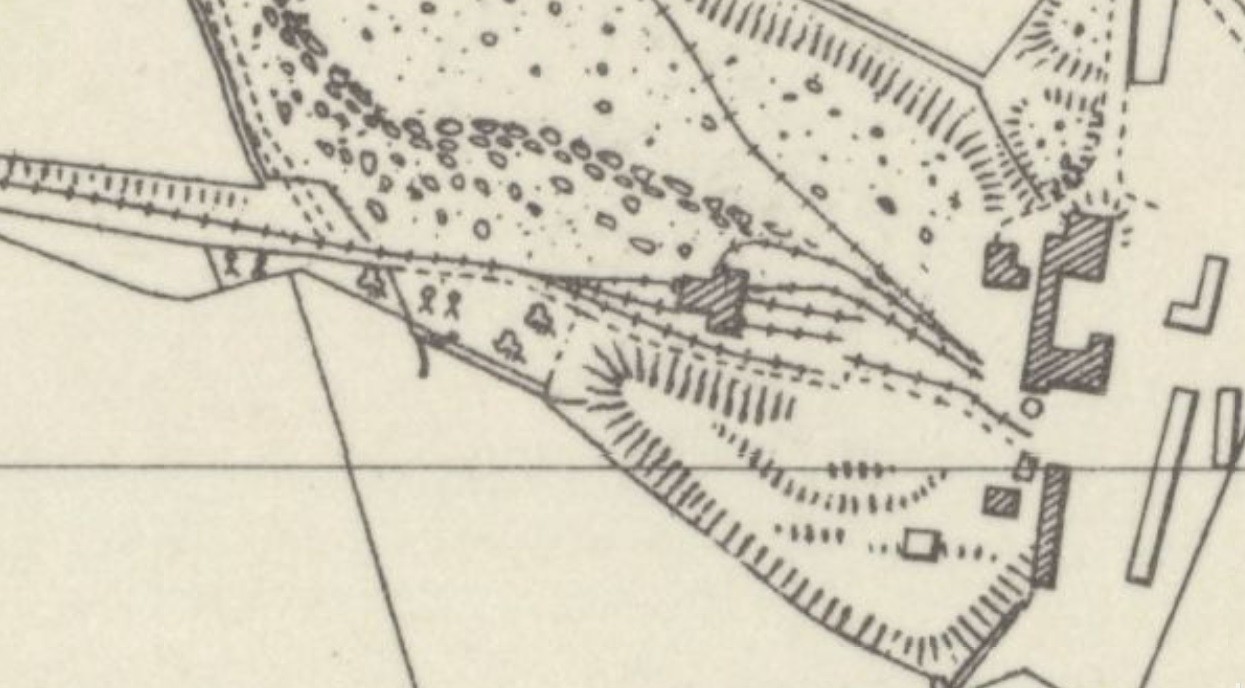
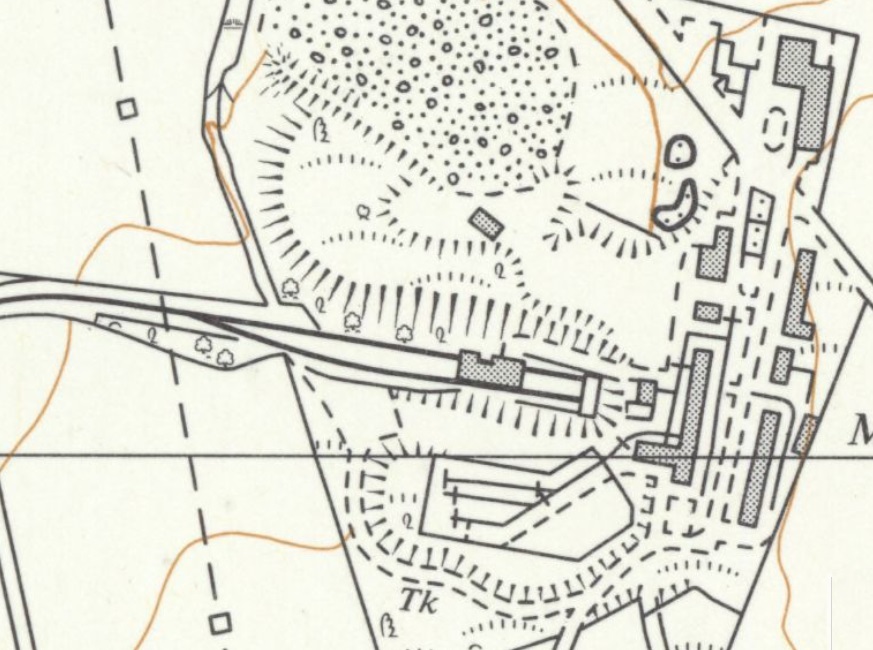
This next map extract from the 25″Ordnance Survey published in 1882 shows the line curving round to the Southeast and passing a series of spoil heaps before arriving at the site of Old Lodge Furnaces. [15]
This RailMapOnline image is approximately the same width as the map extract above. The tramway route we have been following enters top-left and runs diagonally across to the right edge of the image. Modern industry now occupied the Western part of the Old Lodge Furnaces site. [10]
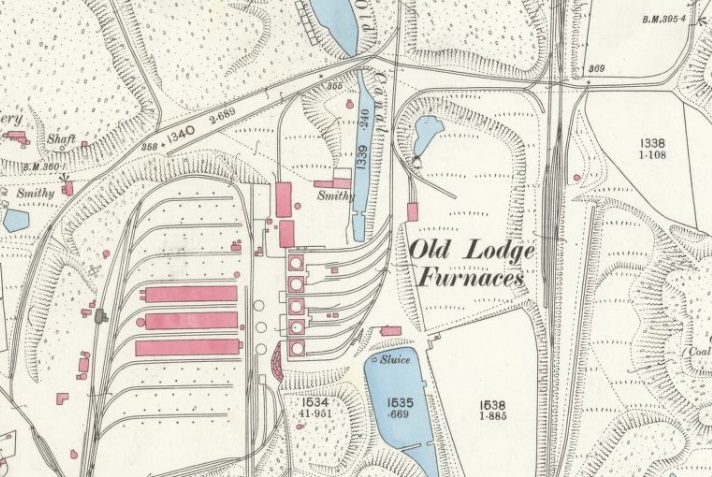
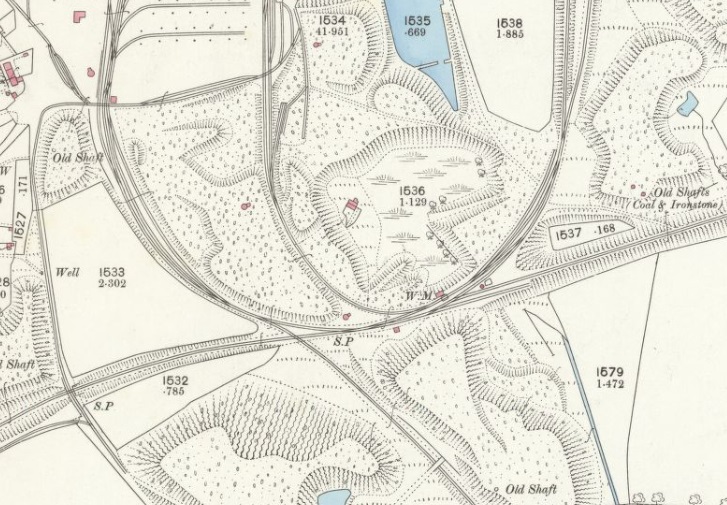
The site of Old Lodge Furnaces as it appears on the 25″Ordnance Survey of 1882. The tramway enters the site at the bottom-left of this map extract. [15]
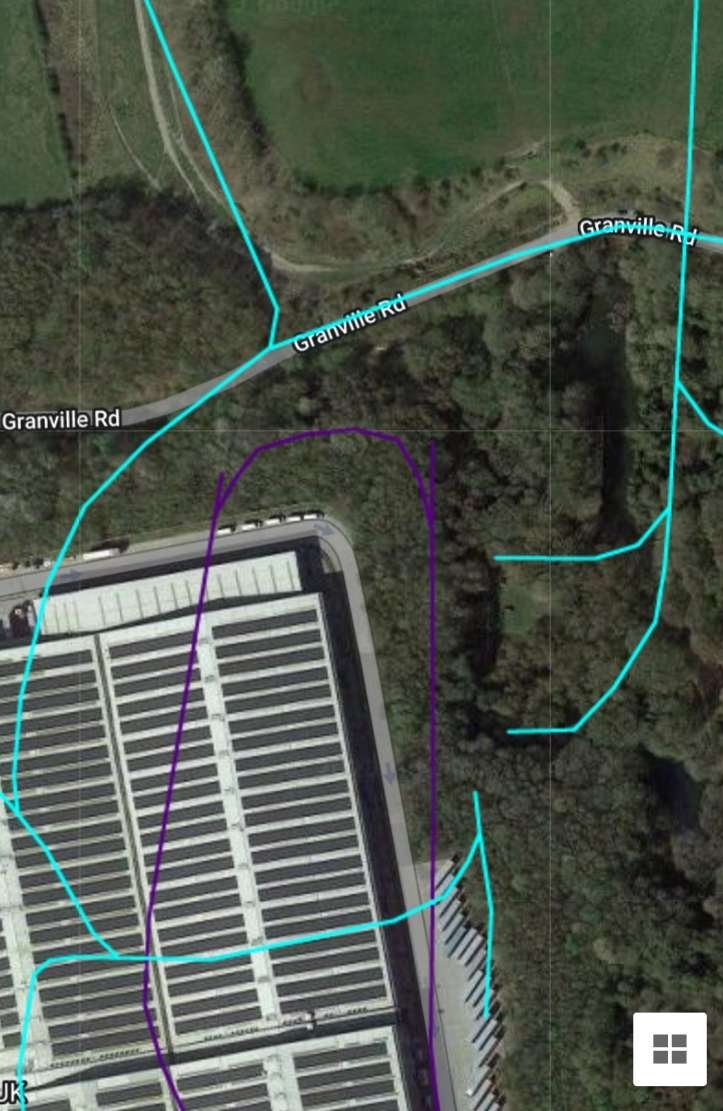
Covering approximately the same area as the map extract above, this image, from the RailMapOnline satellite imagery shows the area of Old Lodge Furnaces as it appears in the 21st century. The turquoise lines are tramways, the purple lines are the later standard-gauge Mineral Railways of the Lilleshall Company. [10]
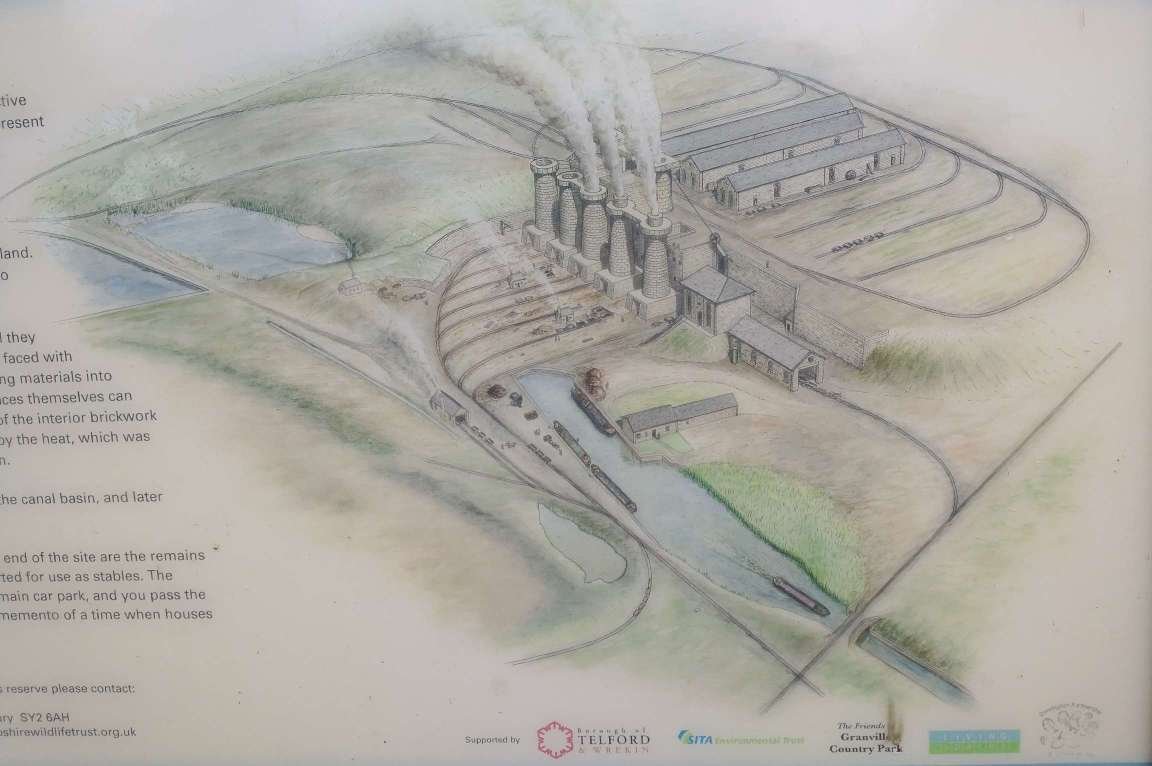
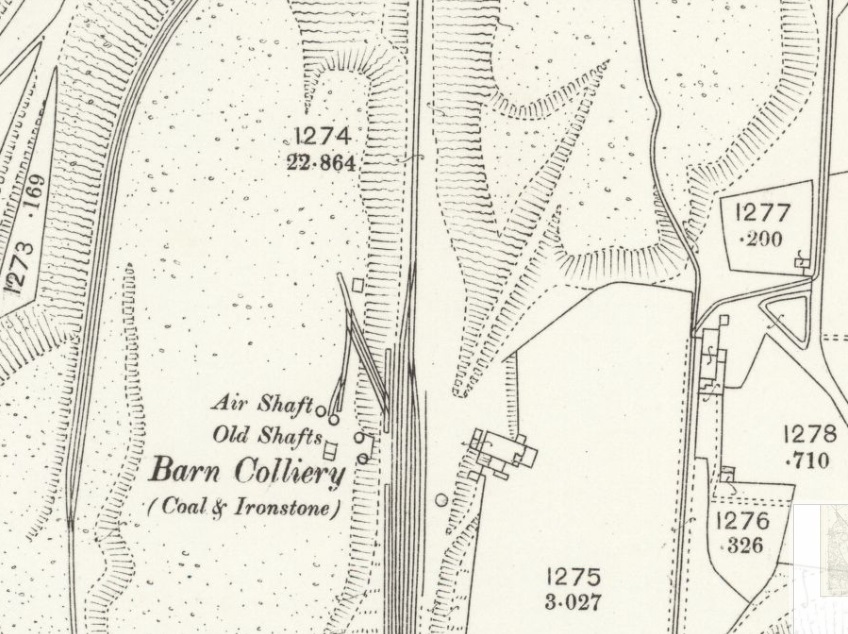
This is a close-up of part of an information board in Glanville Country Park. It shows Old Lodge Furnaces as they would have appeared when the tramways provided for their transport needs. The view is from the Northeast. [My photograph, 27th July 2023]

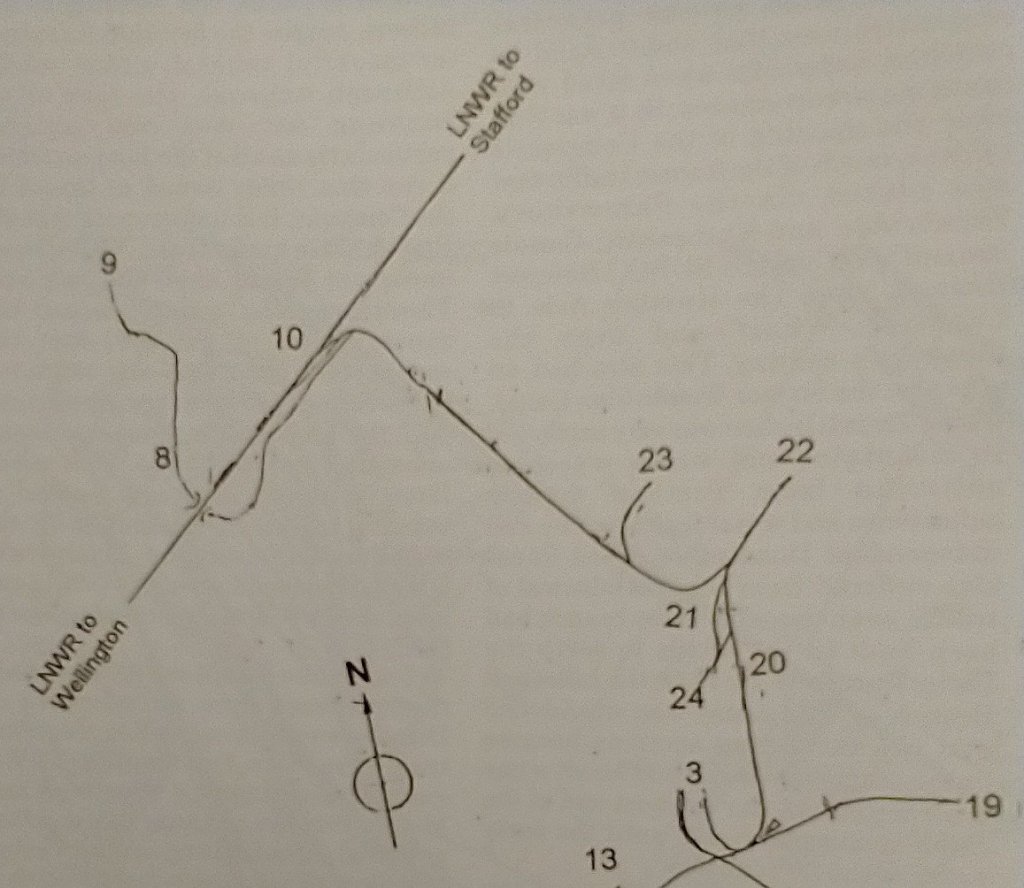
This is as far as we follow the old tramway which served the Humber Arm, as the tramways near Old Lodge Furnaces will be covered in greater detail elsewhere. It is worth noting that a significant investment was made in the transport facilities at the site which depended, while open, on a series of tramway branches to supply the furnaces and to take away the iron that they produced.

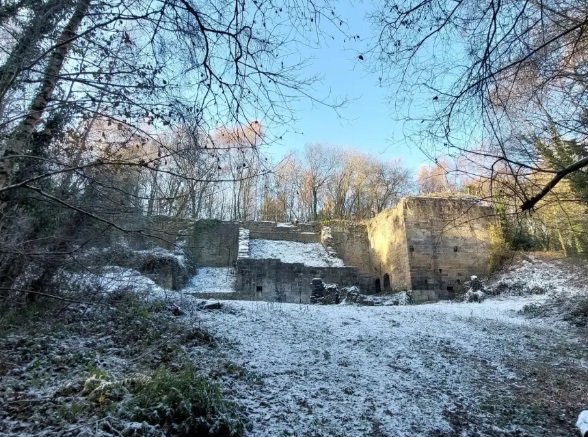
Old Lodge Furnaces. [21]

The Friends of Granville Country Park’s website provides a general introduction to the history of the Old Lodge Furnaces: … [22]

In 1824 the company brought into blast two new furnaces near the site of the Old Lodge. They were named the Old Lodge furnaces because of their proximity to the site of an old hunting lodge which was demolished in 1820. In March 1825 the Lilleshall Company paid the Coalbrookdale Company £2392 for (presumably) a Blast Engine.  George Roden, a stonemason from the Nabb, was paid £425 in 1825 and £777 and 5 shillings in 1826 for erecting loading ramps and the retaining walls. In 1830 the Donnington Wood and the Old Lodge ironworks together produced 15,110 tons. A third furnace was added in 1846 and two more in 1859.

New blast beam engines, manufactured by the Lilleshall Company, were installed in 1862 and the height of the furnaces was increased from 50 to 71 feet at about the same time. Limestone came, via the canal, from the Lilleshall quarries and the coal (coke) and iron stone from the local pits via an extensive system of tramways, some of which, were later converted to standard gauge railways. The 1882 map show this series of transport plateways to transport the materials to the top of the furnace, and remove pig iron the furnace bottom.

The Old Lodge Furnaces produced cold-blast pig iron of the finest quality, but eventually it could not compete with cheaper iron made elsewhere and in 1888 the last of the Old Lodge furnaces was blown out 1888. The furnaces were demolished in 1905 by Thomas Molineaux Jnr, including a tall chimney 140 feet high by 13 feet diameter, known locally as “The Lodge Stack”. In 1956 the stone was reused for St Mathew’s Church. Thereafter the company concentrated all its iron and steel making at Priorslee. [22]
The Mineral Railway

We return now the the overbridge which carried the LNWR over the tramway and the later mineral railway which curved round to the East after passing under the bridge. The length from Lubstree Wharf to the LNWR overbridge is covered above. Charles Hadfield explains that in 1870, anxious to save money on the Trench Incline, the Canal company “agreed to lease Lubstree wharf on the Humber Arm of the Newport branch from the Duke of Sutherland and pay a wharfage rate of 0.5d/ton, so that the coal and other traffic from Lilleshall could be shipped there. To carry it, 30 boats were taken from the company’s fleet, and others ordered to replace them. New accommodation was provided, and a railway line built from Lubstree to the Lilleshall Company’s works.” [29: p239]

However, by 1880, “the Humber Arm was only carrying fluxing stone, though two years before the iron ore toll from Ellesmere Port had been specially reduced for the Lilleshall Co. Negotiations for its better use followed, and the [canal] company agreed to take 300-400 tons a week of limestone and 100-150 tons of ore at agreed rates. The Shropshire Union also hoped for a coal trade outwards, and pig-iron to be carried for transhipment to the L.N.W.R. Business seems to have remained brisk for some time after that, for in 1891, when the wharf lease was renewed, another siding was built. In 1905 it was renewed for another fourteen years.” [29: p242]

As we noted earlier the Mineral Railway turned tightly round to the Northeast as it climbed to run alongside the LNWR mainline. This a repeat of an earlier extract from the 25″ Ordnance Survey of 1882. [7]
The mineral railway curve round to run parallel to the LNWR mainline. [7]
This RailMapOnline satellite image covers approximately the same length of the mineral railway line as the two map extracts above. [10]
This map extract takes us the very short distance to the edge of the 1882 OS map sheet. [7]
This RailMapOnline satellite image covers a similar area to the map extract above. [10]
At a smaller scale here but still the 25″ Ordnance Survey of 1882, this map extract shows the length of the mineral railway as it curves away from the LNWR mainline. There were some exchange sidings at this location and lines which accessed a Timber Yard and the Midland Ironworks site, both on the East side of the LNWR mainline. This short length of the line appears at the Southeast corner of the relevant OS map sheet. [6]
This RailMapOnline satellite image shows that the route of the old mineral railway ties in with the modern field boundary. [10]
On the curve on Donnington Sidings looking East. This is the same train as shown on the next picture. This image was shared by Carole Anne Huselbee on the Telford Memories Facebook Group on 14th September 2014. [34]
Donnington Sidings looking Northwest. A rake of empties setting off for Granville Colliery. Wellington Road Crossing is a short distance ahead of the locomotive. This photograph was shared by Carole Anne Huselbee on the Telford Memories Facebook Group on 5th October 2014. [31]
This next extract from the 25″Ordnance Survey of 1882 shows the mineral railway heading Southeast and crossing, first, what is now Wellington Road, and then running parallel to the modern Donnington Wood Way and crossing. [7]
The route of the old mineral railway runs parallel to Donnington Wood Way, approximately on the line of the footpath shown on this Google Maps extract. The red flag marker highlights its  route. [Google Maps, July 2023]
A closer view of the point where the mineral railway crossed the old Wellington Road. The photograph below shows a locomotive approaching the level-crossing from the Southeast. [10]
Wellington Road Crossing. This picture was shared by Carole Anne Huselbee on the Telford Memories Facebook Group on 5th October 2014. [36]
The Wellington Road Crossing once again. This picture was shared on the Telford Memories Facebook Group by Phil Neal on 6th August 2017. These gates were moved and now protect the entrance to Telford Steam Railways yard. [37]
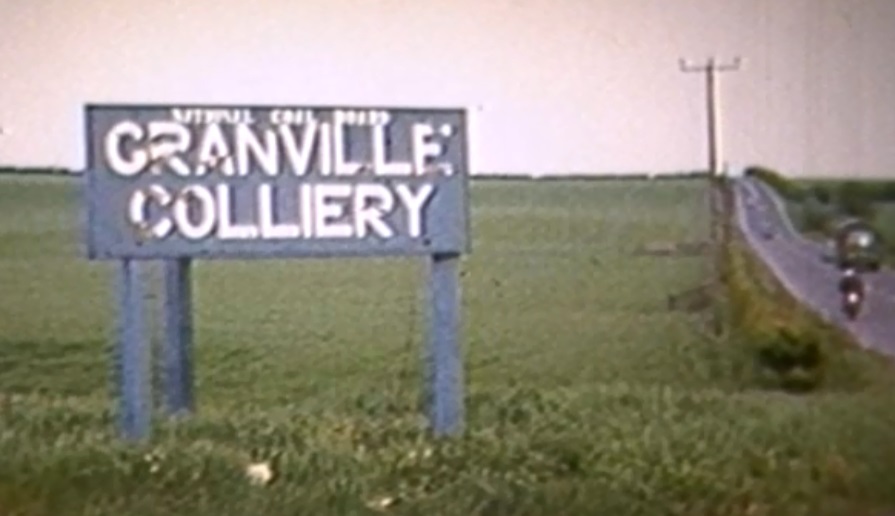
NCB loco No 10 crossing the main Telford to Newport road (A518) at Donnington in 1975 with a trip working from Granville Colliery to the exchange sidings which were just the other side of the road.
The MGR wagons would then be moved by a class 47 to Ironbridge, with run rounds at both Wellington and Madley Junction. This photo was shared by Lin Keska on the Telford Memories Facebook Group on 2nd May 2017. [32]
Taken just a few moments earlier than the picture immediately above, shows the same train waiting to cross Wellington Road. This photo was also shared by Lin Keska on the Telford Memories Facebook Group on 2nd May 2017. [32]
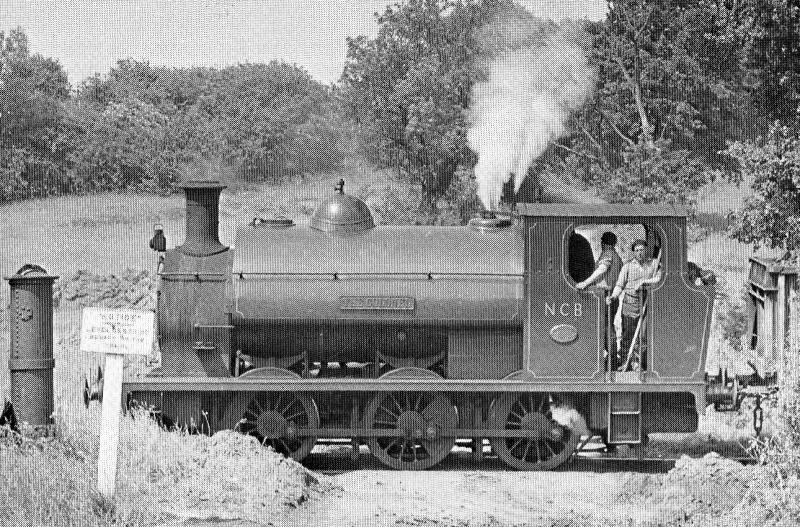
An Austerity 0-6-0ST, ‘Granville No. 5’ an industrial saddle tank, is close to Wellington Road Crossing. The building next to it is now ‘Van Beeks’ Motor Factors. The location was known as ‘Coal Wharf Corner’. The photograph was shared on the Telford Memories Facebook Group © David Clarke. David says that No.5 is in charge of a loaded train which it is pushing into the exchange sidings. He worked as a petrol pump attendant at what is now ‘Van Beeks’.[20]

David Clarke the photographer of the image above is also the author of a book about the Railways in the Telford Area published by the Crowood Press. You can find a review of the book on this link.

David Clarke; The Railways of Telford; Crowood Press, Ramsbury, Wlitshire, 2016.
We pick up the RailMapOnline.com satellite imagery again with the purple line being the Lilleshall Company’s railway. It runs parallel to Donnington Wood Way and crosses School Road. [10]
A photograph taken at the School Road Crossing, © SimonFP and shared by him as a comment on the Telford Memories Facebook Group on 5th August 2023. [30]
Another view of the School Road Crossing. This photo was shared on the Telford Memories Facebook Group by Carole Anne Huselbee on 8th September 2014. [35]
School Road Crossing again. This photograph was shared on the G
The view South East on Donnington Wood Way. The tramway route ran just beyond the hedge on the right of this image. [Google Streetview, Jun 2022]
This next length of the line is on the OS sheet to the East. This is the 25″ Ordnance Survey published in 1882. [12]
This RailMapOnline image covers the top left quadrant of the last map extract. [10]
This extract from RailMapOnline covers the right quadrant of the last map extract. [10]
This image was taken at a location towards the top of the RailMapOnline satellite image above, facing Southeast along Donnington Wood Way with the old tramway route running beyond the treeline on the right. [Google Streetview, June 2022]
This photograph was taken looking back to the Northwest on the line of the old tramway, just beyond the trees to the right of the image above. Donnington Wood Way is beyond the trees to the right of this image. [My photograph, 31st July 2023]
This photograph was taken at the same location, looking to the Southeast on the line of the old tramway. Donnington Wood Way is beyond the trees to the left of this image. A lane called The Fields is beyond the trees to the right of this image. [My photograph, 31st July 2023]
Thsi extract from the 1901 25″ Ordnance Survey shows the line continuing in a Southeasterly direction. [23]
These three extracts from RailMapOnline cover the same length of the line as the OS map extract above. In the second of these three images a pathway passes under Donnington Wood Way via a subway. [10]
Looking Southeast along the line of the old tramway. Behind the trees to the left a subway (mentioned above) passes under Donnington Wood Way and the footpath leading to it can just be made out on the centre-right of this image. It is hidden behind the slightly raised land on the left. The tramway ran straight ahead into the trees to the left of the small concrete building ahead. [My photograph, 31st July 2023]
Once again on the 25″ 1901 Ordnance Survey, the mineral railway continues in a Southeasterly direction. The line appearing on the right side of the map extract served Freehold colliery. [24]
Three more extracts from the RailMapOnline satellite imagery which cover a similar length of the Mineral Railway to that shown on the extract immediately above. Note the presence of the purple line curving in from the top-right of the last image. This represents the line serving Freehold Colliery which is shown on the OS map extract immediately below. [10]
Looking Southeast towards the roundabout on Donnington Wood Way. The purple line shows the approximate route of the old tramway. It crosses the road on an angle passing behind the roundabout road sign and then crossing Marchbrook Way very close to the roundabout. [Google Streetview, June 2022]
The mouth of Marshbrook Way at the roundabout. The purple line indicates the approximate route of the old tramway. [Google Streetview, March 2021]
Somewhere along this length of the line on 8th September 1969, this view looking Northwest shows NCB Loco No. 8 hauling empty hopper wagons towards Granville Colliery. This image was shared on Telford Memories Facebook Group by Carole Anne Huselbee on 14th September 2014. [33]
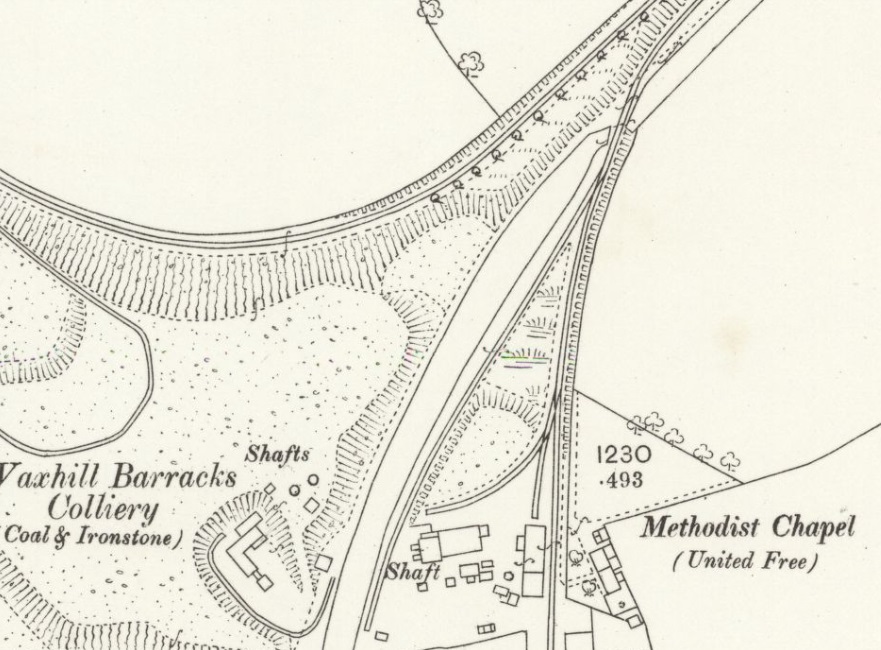
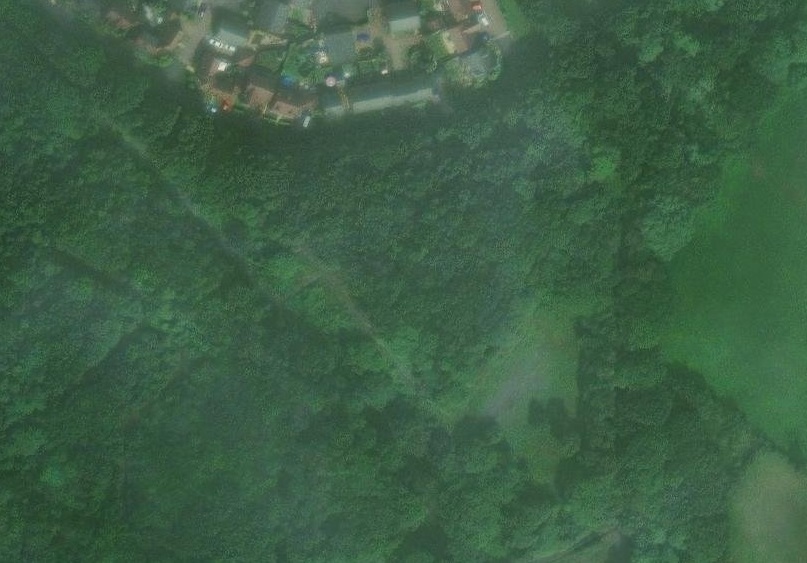
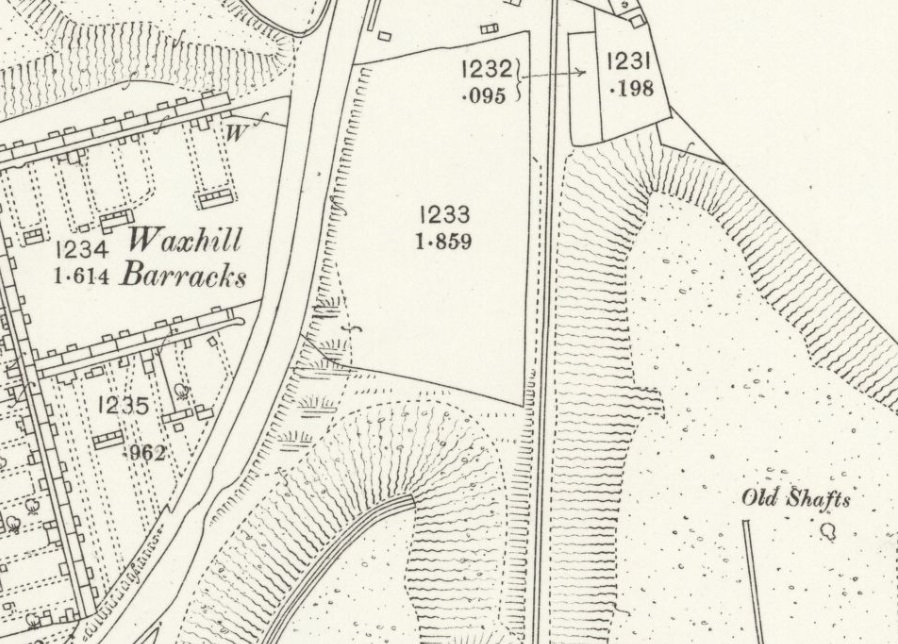
To a smaller scale, this extract from the 25″ 1881 Ordnance Survey shows the mineral railway curving round to the Northeast. Evidence of an older tramway can be seen in the Southwest quadrant of this map extract. Waxhill Barracks Colliery was just off the bottom of the extract. The line heading South approached Old Lodge Furnaces from the North. immediately to the West of that line, entering the extract from the South, the Donnington Wood Canal can be seen. It passes under the line serving Old Lodge Furnaces and continues Northeast alongside the railway. [26]

The canal route can be followed on the Captain Ahab’s Watery Tales blog, so there is no need to repeat it here. [27] The remaining length of the mineral railway to Muxton Bridge Colliery is covered below.

This sequence of 9 extracts from RailMapOnline.com show the same length of the mineral railway as covered by the Ordnance Survey extract above the sequence. [10]
Looking Southeast along Cookson Close from a point close to the roundabout on Donnington Wood Way. The old tramway ran through the trees to the right of the fence visible in this image. It ran at a higher level. [Google Streetview, June 2022]
Further Southeast, this view looks East along Cookson Close. The old tramway was at a higher level. Its route runs beyond the fence and trees at the right of this image. [Google Streetview, June 2022]
Cookson Close curves round towards the Northeast before reaching a modern development boundary. A short footpath takes us to Jarrett Walk. This photograph is taken at the point where we join Jarrett Walk and looks Northeast. The old tramway route ran at a higher level beyond the fence and trees to the right of this image. [Google Streetview, June 2022]
As we reach the far boundary of this development, Jarrett Walk turns away to the Northwest. The old tramway route continues ahead parallel to but beyond the fence to the right and at a higher level. [Google Streetview
This next extract from the 1881 25″ Ordnance Survey shows Muxtonbridge Colliery, which was served by the mineral railway, Muxtonbridge Farm and the Donnington Wood Canal arm meandering its way Northeast towards Lilleshall Grove Lilyshall Abbey and Lilyhurst Road. [26]
These last two extracts from RailMapOnline.com show the last length of the mineral railway that served Muxtonbridge Colliery. [10]

Both Waxhill Barracks Collery and Muxtonbridge Colliery closed at around the same time at the turn of the 20th century. [22] Muxtonbridge Colliery was active from 1890 to 1905. Waxhill Barracks Colliery had a longer life, 1818 to 1900.

The remains of Muxton Bridge Colliery pumping engine house is a listed ancient monument. [28]

We have now looked beyond the immediate length of the Humber Arm of the Newport Branch of the Shropshire Union Canal and the Lilleshall Company’s tramways and mineral railways in the immediate area of the canal arm. We have covered the old tramway between the Canal and Old Lodge Furnaces and a significant length of the later Mineral Railway, so as to get an impression of the area that the Lubstree Wharf served when it was active.

References

  1. https://en.m.wikipedia.org/wiki/11th_Signal_Brigade_and_Headquarters_West_Midlands, accessed on 20th July 2023.
  2. Bob Yate; The Railways and Locomotives of The Lilleshall Company; Irwell Press, Clophill, Bedfordshire, 2008.
  3. https://en.m.wikipedia.org/wiki/Shrewsbury_Canal, accessed on 20th July 2023.
  4. https://maps.nls.uk/view/121149737, accessed on 20th July 2023.
  5. https://maps.nls.uk/view/121149743, accessed on 20th July 2023.
  6. https://maps.nls.uk/view/121150199, accessed on 20th July 2023.
  7. https://maps.nls.uk/view/121150235, accessed on 20th July 2023.
  8. https://maps.nls.uk/geo/explore/#zoom=15.8&lat=52.72534&lon=-2.44627&layers=168&b=1, accessed on 20th July 2023.
  9. https://maps.nls.uk/geo/explore/#zoom=15.8&lat=52.71920&lon=-2.44018&layers=168&b=1, accessed on 20th July, 2023.
  10. https://www.railmaponline.com/UKIEMap.php, accessed on 21st July 2023.
  11. https://www.geograph.org.uk/photo/250050, accessed on 22nd July 2023.
  12. https://maps.nls.uk/view/121150244, accessed on 22nd July 2023.
  13. https://www.barbers-rural.co.uk/property-sales/lubstree-wharf, accessed on 23rd July 2023.
  14. https://maps.nls.uk/view/121150271, accessed on 24th July 2023.
  15. https://maps.nls.uk/view/121150280, accessed on 24th July 2023.
  16. https://sncanal.org.uk/canal-rail-transhipment-shed-lubstree-wharf-at-the-end-of-the, accessed on 26th July 2023.
  17. https://sncanal.org.uk/hum-pic-bui-033-2, accessed on 26th July 2023.
  18. https://sncanal.org.uk/hum-pic-bri-002-3, accessed on 26th July 2023.
  19. https://sncanal.org.uk/wp-content/uploads/2019/07/hum-pic-can-001.jpg, accessed on 26th July 2023.
  20. https://m.facebook.com/groups/674238619260811/permalink/3082152125136103, accessed on 27th July 2023.
  21. https://friendsofgranvillecountrypark.com/lodge-furnaces, accessed on 29th July 2023.
  22. https://friendsofgranvillecountrypark.com/industrial-history, accessed on 30th July 2023.
  23. https://maps.nls.uk/geo/explore/#zoom=18.0&lat=52.71799&lon=-2.42658&layers=168&b=1, accessed on 31st July 2023.
  24. https://maps.nls.uk/geo/explore/#zoom=18.0&lat=52.71607&lon=-2.42427&layers=168&b=1, accessed on 31st July 2023.
  25. https://maps.nls.uk/geo/explore/#zoom=18.0&lat=52.71758&lon=-2.42026&layers=168&b=1, accessed on 31st July 2023.
  26. https://maps.nls.uk/view/121150244, accessed on 31st July 2023.
  27. http://captainahabswaterytales.blogspot.com/2012/02/donnington-wood-canal-granville-park.html, accessed on 1st August 2023.
  28. https://ancientmonuments.uk/116670-site-of-pumping-engine-at-muxton-bridge-colliery-donnington-and-muxton/photos/1907, accessed on 1st August 2023.
  29. Charles Hadfield; The Canals of the West Midlands 2nd Edition; David & Charles, Newton Abbot, Devon, 1969.
  30. https://m.facebook.com/groups/674238619260811/permalink/10092979834053262, accessed on 6th August 2023.
  31. https://www.facebook.com/groups/674238619260811/search/?q=donnington%20sidings, accessed on 13th August 2023.
  32. https://www.facebook.com/photo/?fbid=1479767825400983&set=pcb.1638734829477847, accessed on 13th August 2023.
  33. https://www.facebook.com/photo/?fbid=350260361818673&set=gm.846144078736930, accessed on 13th August 2023.
  34. https://www.facebook.com/photo/?fbid=350106448500731&set=gm.845962032088468, accessed on 13th August 2023.
  35. https://www.facebook.com/photo/?fbid=347844735393569&set=gm.843475365670468, accessed on 13th August 2023.
  36. https://www.facebook.com/photo/?fbid=358717190972990&set=gm.857116324306372, accessed on 13th August 2023.
  37. https://www.facebook.com/photo/?fbid=10155592536724231&set=gm.1769985219686140, accessed on 13th August 2023.
  38. https://www.facebook.com/groups/granville.colliery/permalink/2469128759930137, accessed on 16th August 2023.

‘Modern Tramway’ – Blackpool: The Marton Experiment …

The ‘Modern Tramway’ reported in January & February 1963 on a relatively short lived experiment on Blackpool’s trams. The Marton route was an inland route through Blackpool which complemented the promenade route. It is route ‘C’ on the featured image above. [11]

The two articles were written by F.K. Pearson who suggested that his articles could perhaps have been entitled, ‘The Experiment That Didn’t Quite …‘ [1]

The Marton Route opened in 1901 but by 1938 it was approaching the end of it’s useful life, needing relaying and requiring a new fleet of 15 trams. A decision to undertake the work was deferred by Blackpool Town Council. War intervened and the existing trackwork was patched up to last a few more years.”By the time relaying could be considered again, technical progress had rendered the 1938 plan out of date, and the Marton route was chosen for one of Britain’s most interesting public transport experiments, the only attempt ever made to provide a tram service which by its sheer frequency, comfort and riding qualities could compete not just with the bus but with its future competitor, the private car.” [1: p14] Pearson’s article reports on that experiment, how near it came to success. and where it eventually failed.

Pearson continues:

“The story begins with the acquisition in 1945 by Crompton Parkinson Ltd. of a licence to manufacture in Britain certain equipment similar to that in the American PCC-car, the patents of which were held by the Transit Research Corporation in the USA. The experiments which followed were aimed at producing a vehicle which in silence, comfort, performance and soothness of riding would outshine any existing public service vehicle and rival that of the best private car. Blackpool already had modern trams, plenty of them, designed for the straight, open, track on the Promenade where even orthodox cars could give a smooth and quiet ride, but what was promised now was a tram with silent ‘glideaway’ performance even on grooved street track with frequent curves These route conditions, frequently met with in other towns, existed in Blackpool only on the Marton line, and Mr. Walter Luff the Transport Manager, made no secret of the fact that he hoped to persuade the Town Council to let him use the Marton route for a large-scale experiment that might have considerable repercussions on the future of tramways elsewhere in Britain; in short, to make it a show-piece.

The question of relaying the route was reopened as soon as the war ended, and the Town Council asked for comparative estimates for trams, buses and trolleybuses. Mr. Luff reported that to keep trams would cost £136,380 (£61,360 for new track £75,000 for 15 new cars), buses would cost £56,940 including road reinstatement and depot conversion, and trolleybuses would cost £87,360. He made no secret of his belief that the experiments then in progress would result in a vehicle superior to be existing tram, bus or trolleybus, and the Town Council, wishing to await the outcome of the trials, postponed a decision and asked that the track be patched up for a few more months.

The first objective of the new equipment was silent running on grooved street track. This was achieved by using resilient wheels with rubber sandwiches loaded in shear between the tyre and the wheel hub, which would absorb small-amplitude vibrations arising from irregularities in the track instead of transmitting them through the springing to the rest of the car, and in the process would achieve virtual silence. Furthermore, the resilient wheel allows slight lateral flexibility and reduced side friction between flange and rail, eliminating the usual scrub on curves and incidentally reducing flange wear to an extent which eliminated the need for re-turning the tyre profile between successive re-tyrings. These rubber-sandwich wheels could be unbolted and changed like those of a bus, necessitating a newly-designed inside-frame truck (type H.S. 44) produced by Maley & Taunton, Ltd., who also designed and supplied a “silent” air-compressor to eliminate another source of noise. The experimental trucks were placed under car No. 303, and on 26th April 1946, the B.B.C. took sound-recordings on street track on this and an older car, with the microphone only three feet from the wheels.

With the old-type car the noise was considerable but with No. 393 it was practically nil.

Another traditional source of tramcar noise is the straight spur-gear drive, and this was replaced in the new truck by a right-angle spiral bevel drive, completely silent in operation, and requiring the two motors to be placed fore-and-aft in the truck. In many towns this alone would have led to a remarkable reduction in noise level, but Blackpool also knows how to keep spur gears quiet, and one wonders whether a right-angle drive (less efficient mechanically) can be justified by noise reduction alone. However, these and similar gears had been developed to such a pitch of efficiency for motor vehicles by their manufacturers (David Brown, Ltd.) that their use in a tram presented little difficulty. The technical and metallurgical problems had long since been overcome, and the only question was that of expense.

The other main objective was complete smoothness of acceleration and braking with private-car performance, and for this experiments were carried out by Crompton Parkinson, Ltd., using Blackpool car No. 208 to which the experimental trucks were transferred from No. 303 later in 1946. All four axles were motored, giving a possible initial acceleration rate of 3.5 mph. per second, and a smooth rate of change was achieved by arranging the motors in permanent series-parallel pairs and feeding them through a resistance having 94 steps instead of the usual eight. This resistance, mounted on the roof for ease of ventilation, was built around a circular steel frame with contacts on a rotating arm, turned by a small pilot motor, and the master control was by a joystick control by which the driver could select the rate of acceleration or braking required. Acceleration was automatic, for if the lever were left in a constant position the traction motors would accelerate or decelerate at constant current, yet it could also be varied by moving the stick, which explains the trade-name “Vambac” (Variable Automatic Multi-notch Braking and Acceleration Control) used for this equipment. Although inspired by that of the American PCC-car, it differed in several important respects, notably in that it enabled the car to coast. A car with this equipment, operating at the limit of its potential, was expected to consume about 4.5 units per car per mile (about 2.5 times the Blackpool average), but provision was also made to give a lower performance comparable to that of older trams if the two had to provide a mixed service on the same route. This reduced performance later became the Blackpool standard.” [1: p14-15]

Two pages from Newnes Practical Mechanics which give details of the type H.S. 44 bogies produced by Crompton Parkinson Ltd. and Maley & Taunton, Ltd. [4]

It transpired that the complete car was ready to begin trials in December 1946, and the Town Council were very soon invited for a demonstration. The track was now in an awful condition requiring a relay or abandon decision.

“After considerable debate, the Transport Committee recommended that it be relaid, and the Town Council on 8th January, 1947, decided by the narrow margin of 25 votes to 21 to instruct the Borough Surveyor to proceed with the reconstruction of the track. Blackpool Town Council, then as now, included some shrewd business-men, and the fact that they were prepared to spend twice as much on keeping trams than would have been needed for buses is the most eloquent testimonial to car No. 208 and the impression which its revolutionary equipment and performance had made. For the first time, they realised, it was possible for a public service vehicle to offer a performance as good as the private car, and it was bound to be popular.

Work began straight away, using rail already in stock, followed by 600 tons of new rail and Edgar Allen pointwork to complete the job. Other traffic was diverted, with single-line working for the trams, and by the autumn of 1948 new Thermit-welded asphalt-paved track extended throughout the 3-mile route, save only for a short section held back until 1950 because of an anticipated new road layout. …

Meanwhile, the experiments with prototype car No. 208 continued, and by mid-1947 the car (specially equipped with fluorescent lighting) was ready for regular service, though frequently in demand for demonstration runs with visitors from other undertakings. The car was not used on Marton, for the Marton schedules were based on 78-seat instead of 48-seat cars, and for its first three years the new Marton track was traversed by the same cars that had worked the service since the mid-twenties, the gaunt, upright standard-type double-deckers, some of them with open balconies. These had no part in the Marton Experiment, and were due to disappear as soon as the heralded 15 new cars made their appearance.

At this point, compromises were made. Inflation meant that the planned new cars could no longer be obtained at anything like the estimated figure. Blackpool decided, for the sake of economy, to fit the new equipment to existing trams. Twelve surplus modern single-deckers were seen as suitable.

One of the twelve cars that were. Built cheaply in 1939 for use during the holiday season. It had a sunshine roof, secondhand electrical equipment, wooden seats, no partition between driver and passengers, the minimum of interior lighting, waste-high sliding doors, and the upper half of the windows permanently open. The twelve cars were originally built by English Electric. This photograph, which was included with Pearson’s article, shows the tram on 30th August 1939. It shows both the sunshine roof and the wooden seats to good advantage, © Fox Photos Ltd. [1: p17] The copyright of the photograph is now held by ‘Getty Images’ and a link to the original photograph can be found here.

“These cars (10 to 21) had been built cheaply in 1939 for use during the holiday season only, with second-hand electrical equipment, wooden seats, no partition between driver and passengers, the minimum of interior lighting, waist-high sliding doors, and the upper half of the windows permanently open. … Scarcely had they entered service than war intervened and they were put in store, emerging in 1942 with full-length windows, doors and cabs for use on extra workings such as troop specials.

Late in 1947, the Corporation ordered 18 sets of H.S. 44 trucks and Vambac equipment, to enable them to equip sufficient cars to work the entire Marton service, including spares. Rigby Road Works set to work rebuilding the 10-21 series into a new silent-running fleet, soon to become known as the ‘Marton Vambacs’. … Internally, the cars were given soft fluorescent lights, comfortable seats upholstered in brown moquette, new floor-coverings, and tuneful bells. The first car, No. 21, appeared in December, 1949, and its lack of noise when running was quite uncanny, the only remaining sounds being the soft buzz of the “silent” compressor, the hissing of the motor brushes, the clicking of the accelerator contacts, and the sound of the trolley wheel. Even this latter was to have been eliminated in due course, for when the Marton overhead next needed renewal the round wire was to be replaced by grooved wire suitable for use with silent-running carbon skids, of the type used on trolleybuses.” [1: p17-18]

Pearson tells us that, “Conversion of the 12 cars, took just over two years, and during this period the “new” cars could be seen side by side with the older double-deckers. In the eyes of the tramway enthusiast, the “vintage” year of the Marton route was undoubtedly 1951, when about half the service was still in the hands of the venerable but never decrepit standard cars, and mingled with these like gazelles among heavier quadrupeds (a purist might say ‘octopeds’) were the first half dozen Marton Vambacs’.” [1: p18-19]

The map of Blackpool’s trams included in Pearson’s article. [2: p54-55]

In the second installment of the story, Pearson moves on from the Autumn of 1951 to the early months of 1952, when conversion of trams No.10-21 was complete. With No. 208, this meant that there were 13 tram cars serving the Marton route which had to be supplemented at times by older double-deckers. The Council’s resources were by this time dedicated to introducing Charles Roberts cars on the Promenade.

Two of the Marton Vambac trams in Blackpool South. The nearest Vambac Railcoach No. 208 was prototype test bed for the new type of controller & inside frame bogies. Behind is one of the twelve Marton Vambac’s, rebuilt from 1939-built sun saloons. This image was shared on the History of Blackpool Facebook Group on 6th February 2021 by Pete Dumville. [5]

From 1954, when the double-deckers had been withdrawn from service. The Marton route was worked by the 13 Vambac cars and, usually, three pre-war English Electric rail coaches.

It was unfortunate that rising crew costs began to become a significant issue for the Council.

“It may perhaps have been overlooked that the success of the PCC-cars on the street routes in the USA was nearly always coupled with one-man operation. … If passengers were satisfied with the new equipment, so we’re the platform staff.

The manufacturer’s claims were fully borne out, for the automatic acceleration and the provision of simple joystick and pedal control made the cars delightfully simple to drive, reducing fatigue to a minimum and eliminating some of the finer points of instructional training, since “notching up” no longer depended on the driver’s skill. However, it was rather curious to observe the use which different drivers made of the two braking systems, due, perhaps, to the admixture of pre-war and Vambac cars. The Vambac equipment provided a smooth and reliable brake effective down to a speed of less than two miles per hour, and was intended as the main service brake, the air brake being used only for the final stop, brake-shoe life being increased accordingly. This theory can be seen in everyday application on the Promenade, with the post-war cars, yet on the Marton Vambacs many drivers seemed to prefer the familiar air brake for service use, leaving what they termed the “stick brake” in reserve for emergencies. The smoothness of braking was thus dependent once again on the skill of the driver, and the smooth automatic deceleration purchased at such expense was wasted. Other drivers would use the Vambac brake to commence deceleration but would then change to air at a speed higher than intended by the designers for the final stop, and at least one journey made by the writer was marred by the Vambac deceleration being “interrupted” each time while the driver remembered to “put on the air.” One wonders why they were so fond of the air brake, but a possible reason lies in the fact that both terminal approaches were on slight gradients, where the air brake had in any case to be applied to hold the car on the grade, unlike the flat expanses of the Promenade.” [2: p51-52]

Another factor associated with the trial was that of maintenance of the tram cars.

On the one hand, the provision of automatic acceleration and electric braking with minimum and controlled current peaks certainly eliminated the possibility of mishandling the electrical equipment, and must have reduced routine maintenance on the control gear, while the use of cardan shafts and totally-enclosed spiral bevel drives eliminated the troubles associated with the servicing of motor-suspension bearings and reduced the shopping periods. The service availability of the Vambac cars, judging from their daily appearances has been quite as high as that of the orthodox cars, and from this one can safely say that the new equipment must have been fully adequate in avoiding excessive servicing requirements. Moreover, while new and somewhat revolutionary equipment in any field has to cope with the burden of tradition on the part of older generation staff (human nature being what it is), this hurdle seems to have been surmounted with conspicuous success. On the other hand, obtaining spare parts must have been very awkward quite apart from the cost aspect for apart from Blackpool’s own 304-class cars no one else used the same equipment, despite all the hopes that were placed in it. In 1947 the potential British market for modern tramway equipment still included Leeds, Sheffield, Glasgow and Aberdeen, and anyone who had sampled the new equipment could be forgiven for seeing in it a germ of resurgence for tramways and a hope of further orders; but this was not to be. From this aspect, one begins to understand why the five extra sets of trucks and equipments were used as a source of spares rather than to equip further cars.” [2: p52, 54]

An interesting claim made for the new resilient-wheeled trucks was a saving in track costs. Although the track was abandoned before claims of a 30-year life could be tested, the track, “certainly stood up very well to 15 years’ life, and even at the end much of the track and paving was still of exhibition standard, Some of the sharper curves had been renewed, but this was only to be expected, for grooved rail generally lasts four times as long on straight track as on curves. On the sections with non-welded joints (usually) curves), there has been none of the usual deterioration of joints through hammer-blow … [found in] towns using heavy double-deck cars. The one unexpected phenomenon [was] the appearance of a few patches of corrugation.” [2: p54]

Pearson spent a short while alongside a corrugated stretch in Whitegate Drive, listening to sounds made by different types of car. He comments: “The passage of a Vambac car, even on the corrugations, was a process of exemplary quiet, but the occasional pre-war solid-wheeled car produced a roaring noise that told its own story.” [2: p54]

In his opinion, it was the “periodic traverse of the Marton tracks by these few pre-war solid-wheeled railcoaches (and by cars going to and from the Marton depot) that ha[d] given rise to the corrugations, and Whitegate. Drive residents who wrote to the papers in complaining terms can only have had these cars in mind. From the track aspect, it is therefore a pity that the original plan to equip 18 cars was not carried out, for the pre-war Blackpool cars, lacking track brakes, beget corrugations wherever they encounter solid foundations.” [2: p54-55]

A sequence of monochrome photos which were published as part of Pearson’s articles are shown below. The first four show something of the lifespan of the experiment. The following three show Marton Vambac trams at the various termini of the Marton Route.

The four pictures above span the life of the experiment (1947-1962). The top photograph, taken in 1947, shows the new outward track being laid in Whitegate Drive, with balcony car No. 144 passing on the wrong track. The second photograph shows the finished job some years later, with a Vambac car not far from the same spot, and the third shows one of the pre-war solid-wheeled cars which Pearson blamed for the Whitegate Drive corrugations – 1934 open “boat” car No. 227 on the Circular Tour duty at Marton Depot in 1959, one of the two post-war seasons in which the Department ran a genuine “Circular Tour” via Squires Gate Lane and Marton, loading in Talbot Square. The fourth view, taken only a few weeks before abandonment, shows the track and paving at Devonshire Square, still in good-as-new condition. © C. G. Stevens, R. P. Fergusson, C. E. Macleod. [2: p53]
The three pictures above show the three termini of Blackpool’s Marton route, showing 10-21 series Vambac cars. Top, No. 16 at South Pier, the point to which the service was extended in summer (until 1961). Centre, a car reverses on the crossover at Royal Oak in 1960. Bottom, the town-centre terminus at Talbot Square, © K. M. Chadbourne. [2: p52]

Pearson states that:

“From the various engineering aspects – performance, silent running, case of control, routine maintenance, track wear, and availability – the Marton Experiment was therefore a success, even though it did not induce any other tramways to invest in similar equipment. The new equipment did all that the manufacturers claimed for it, and once the teething troubles were overcome ha[d] continued to function smoothly and efficiently for more than 10 years, with no further modifications of any importance. The Crompton Parkinson/Maley & Taunton Vambac/H.S.44 combination represented the ultimate development of street tramway practice in this country.” [2: p55]

Pearson considered that the VAMBAC trams had infinitely superior qualities both in riding and silence, so far as solid track was concerned. They were popular with the public – when abandonment was first proposed there was a significant outcry from customers who said that the VAMBAC trams were the finest transport service they had known. “Marton residents organised a massive petition to the Town Council for its retention, without any prompting from tramway-enthusiasts, in fact without their even knowing of it. The campaign was headed by Alderman J. S. Richardson, now the Mayor of Blackpool, and it is a sad coincidence that in his mayoral capacity Alderman Richardson himself had to preside at the closing on 28th October, 1962.” [2: p55]

It is Pearson’s view that the main reason for the failure of the experiment and the closure of the Marton tram route was the economic impossibility of two-man operation with only 48 seats per tram. While this was the main reason, there were at least three subsidiary factors: the cost of spare parts; the high energy cost of starting from rest; awkward relationships with other road users as visiting road users were no longer used to mixing with trams in their own communities.

He notes that crew costs in the 1960s accounted for an average of about 75% of a transport budget. Tram costs were higher than buses, the only way to offset that difference was to maximise the customer load-factor (this was effective on the Promenade) or to use tramway units of higher capacity than the largest available bus, so as to bring the cost per seat-mile down to a competitive figure. Had articulated cars been available that would have addressed the issue. “The 48-seat Marton Vambacs were below the minimum economic size … and throughout the experiment the route … had to be increasingly subsidised from the receipts of others. The Marton residents … enjoyed a superb service at considerably less than cost, and were naturally loth to lose it, but any suggestion of passing on the cost by raising the fares to a scale above that of the inland bus routes (as is done in summer on the Promenade) would clearly have been politically out of the question.” [2: p56]

Pearson’s own opinion, expressed in his article, is that the 12 year experiment proved that “revolutionary new concepts in tramway engineering [could] be applied to a normal street route as well as on the special field of the Blackpool Promenade, and Marton’s disappearance [was] a sad occasion for all who [saw] in the tramcar a still only partially-exploited form of transport. Looking back, it seems a repeat of a sadly familiar pattern; the engineering profession has delivered the goods, but the confused pattern of public transport in this country has never made full use of the potential made available by the engineers, electrical and mechanical, who gave practical expression to what [was], for most of us, still a composite dream.” [2: p56]

The Blackpool Trams website tells us that, “the first VAMBAC was withdrawn in 1960 as car 10 suffered accident damage and was scrapped soon after. The second VAMBAC withdrawn was 21 in 1961, which was withdrawn as a source of spare parts for the remaining trams, while 14 was also withdrawn for use as a driver training car. The writing was on the wall for the Marton Route, which had been isolated and lost it’s summer services to South Pier following the closure of the Lytham Road route in 1961, however, the remaining VAMBACS remained in use until October 1962 when the Marton route closed, with 11, 13, 15, 17 and 18 operating on the last day. The VAMBACS remained in Marton Depot and were joined by other surplus trams for scrapping in 1963. … One VAMBAC did manage to survive however, VAMBAC 11 was requested for a tour of the remaining parts of the tramway early in 1963 and was extracted from Marton Depot and made it’s way to Rigby Road. Following the tour, 11 was eventually preserved and found its way into preservation and is now at the East Anglia transport museum, where it still sees regular use today.” [3]

One of the Martin Vambacs in service in Blackpool in the late 1950s or early 1960s. This image was shared on the History of Blackpool Facebook Group on 7th April 2017 by Tony Latham. [6]
Another Marton Vambac outside Abingdon Street Market. This photograph was shared on the History of Blackpool Facebook Group on 18th May 2023 by Jess Tulloch. [8]
The interior of Marton Vambac No. 11 in its preserved condition at the East Anglia Transport Museum near Lowestoft. This image was shared on the History of Blackpool Facebook Group on 23rd February 2023 by Col Macloud. [7]
A composite image of Marton Vambac No. 11 as used by ‘Videoscene’ in their range of transfers applied to mugs. [9]
Marton Vambac No. 11 at its present home – the East Anglia Transport Museum. [10]

References

  1. F.K. Pearson; The Marston Experiment; in Modern Tramway, Volume 26 No.301; Light Railway Transport League & Ian Allan, Hampton Court, Surrey, January 1963, p14-19.
  2. F.K. Pearson; The Marston Experiment …. ; in Modern Tramway, Volume 26 No.302; Light Railway Transport League & Ian Allan, Hampton Court, Surrey, February 1963, p51-56.
  3. https://blackpool-trams.yolasite.com/vambac-trams.php, accessed on 28th July 2023.
  4. Newnes Practical Mechanics June 1948, p290-291; via., https://www.google.com/url?sa=t&source=web&rct=j&opi=89978449&url=https://worldradiohistory.com/UK/Practical-Mechanics/40s/Practical-Mechanics-1948-06-S-OCR.pdf&ved=2ahUKEwiRjbjumbKAAxVUmFwKHYifAcUQFnoECB0QAQ&usg=AOvVaw24PI5xxITo516frkIf-ZsM, accessed on 28th July 2023.
  5. https://m.facebook.com/groups/blackpoolhistory/permalink/1632707573581243, accessed on 29th July 2023.
  6. https://m.facebook.com/groups/blackpoolhistory/permalink/691364481048895, accessed on 29th July 2023.
  7. https://m.facebook.com/groups/blackpoolhistory/permalink/2196698053848856, accessed on 29th July 2023.
  8. https://m.facebook.com/groups/2251377838346012/permalink/2713552708795187, accessed on 29th July 2023.
  9. https://www.videoscene.co.uk/blackpool-tram-mug-collection-2011-vambac-11, accessed on 29th July 2023.
  10. https://www.eatransportmuseum.co.uk/wp-content/uploads/2021/04/Leaflet2021Web.pdf, accessed on 29th July 2023.
  11. https://www.skyscrapercity.com/threads/blackpool-tram-system-u-c.572141/page-33, accessed on 29th July 2023.

A second visit to Govilon – Bailey’s Tramroad and the Heads of the Valleys line – Part 2

The featured image shows Govilon Railway Station looking East with a train approaching from Abergavenny, © R.W.A. Jones . [20]

About 9 months after my first article about Govilon, Richard Purkiss contacted me to offer a wander around the area immediately to the West of my last walk.

That first article can be found here. [1]

The location plan which appears on the information board at Govilon Railway Station. Note the red dotted line which shows the route of Bailey’s Tramroad; the location of Bailey’s Wharf and Govilon Wharf at the right side of the image; the route of the canal shown in blue; and the route of the railway in cream on the right half of the map and in green as part of one of the village trails.

In this second article we explore the route of Bailey’s Tramroad and the adjacent Railway as they are shown on the left side of the sketch map above.

The short section of the Heads of the Valley Line which is part of Govilon’s Forge and Railway Trail is a very easy stroll. Following the route of Bailey’s Tramroad is a much more difficult exercise which requires scrambling around on private land which can only be done with permission. I was very grateful to have Richard Perkiss as my guide while doing so!

The dotted line representing Bailey’s Tramroad on the plans above should be taken as a schematic representation rather than an accurate alignment. It is clear, when walking the route, that the section of the Tramroad close to Forge Car Park actually passed under the location of the viaduct and was for a very short distance on the North side of the later standard gauge line. I will try to show this in the images below which were taken on site.

We start this article back at Govilon Railway Station and looking West along the old standard gauge railway line. ….

Govilon Railway Station

Three pictures of Govilon Railway Station. The larger image shows it as it appeared in 2010, © Wikipedia. [3] The lower lefthand image is a picture of the site in 1987, © Blaenavon Railway Shop [4]. The last of these images is a picture of the station staff in the mid-1950s before the closure of the station. © John Bartlett [5]
Govilon Railway Station in 2022. [My photographs, 25th April 2022]
Govilon Railway Station: A black and white postcard showing general view of Govilon Station taken in 1958. The view looks West along the Heads of the Valleys line. Rokeby Collection Album VII Part 1 , 19a. This image has been downloaded from The People’s Collection Wales under their Creative Archive Licence. [6]
This extract from the 6″ Ordnance Survey from the turn of the 20th century shows Govilon Station and the first overbridge to its West. [
Govilon Railway Station: A view in April 2022 from approximately the same place as the picture above. The overbridge in the distance on the monochrome photograph is camouflaged by vegetation. [My photograph, 25th April 2022]

Govilon Railway Station opened on 1 October 1862, [7: p191][8: p107] a couple of days after the ceremonial opening of the first section of the railway. It was the first station beyond Abergavenny Brecon Road. [9] The 1st October was also the first day of the LNWR’s lease of the line. [10: p112] There is a possibility that Govilon was the first station opened on the line because of its proximity to Llanfoist House, the residence of Crawshay Bailey who by this time was a director of the MTAR. [11: p20]

Wikipedia notes that “Decline in local industry and the costs of working the line between Abergavenny and Merthyr led to the cessation of passenger services on 4th January 1958. [13: p139][14: p68] The last public service over the line was a Stephenson Locomotive Society railtour on 5th  January 1958 hauled by LNWR 0-8-0 No. 49121 and LNWR Coal Tank No. 58926. [13: p139][15: fig. 65] Official closure came on 6 January.” [12][7: p184][16: p55][8: p107][17: p191]

Govilon Railway Station was “situated on a steep 9-mile (14 km) climb from Abergavenny at gradients as severe as 1 in 34. [14: p68][17: p164] A gradient post showing 1 in 80 /1 in 34 was installed on one of the station platforms.” [12][13: p116]

This gradient marker is present on the wall of the old station building. It does not match the gradient marker which was originally present. The original gradient marker highlighted a change in gradient from 1 in 80 to 1 in 34. [My photograph, 25th April 2022]
Govilon Railway Station looking East along the platform for Abergavenny trains, this image was shared by Malcolm Lewis on the Abergavenny Railways History Facebook Group on 16th April 2023. [18]
Govilon looking East along the second platform, for trains for Merthyr Tydfil. Malcolm Lewis shared this photograph on the Abergavenny Railways History Facebook Group on 2nd April 2023.  [19]
The view West from Govilon station along the route of the old railway. It is just about possible to make out the road overbridge in among the trees which surround the route of the old line in the 21st century. [Google Streetview, July 2011]
Looking back towards Govilon Station along the route of the old railway. [My photograph, 5th July 2023]
Turning through 180° we see the first overbridge on this length of the old railway. [My photograph, 5th July 2023]
Looking back to the East through that first overbridge. [My photograph, 5th July 2023]
Looking back East from 100 metres further West along the old line. [My photograph, 5th July 2023]
Looking West along the footpath/cycleway which follows the Merthyr, Tredegar & Abergavenny Railway (The Heads of the Valleys Line) This winter view takes advantage of the vegetation die-back to show the bridge across the line much more clearly. The photograph was taken on 27th November 2010 and the image was shared by Gareth James on the Geograph website on the same day. It is shared here under a Creative Commons Licence (CC BY-SA 2.0). [21]
The view West over the stone parapets of bridge carrying the road over the old line. The footpath/cycleway can just be made out between the trees. [Google Streetview, October 2009]

The plan below shows this length of the Merthyr, Tredegar & Abergavenny Railway leaving the Govilon Station (on the right of the extract), and passing under the road bridge before curving towards the Southwest and then back towards the West. On the North side of the double-track mainline are the sidings at Govilon Railway Station and then further West at the left edge of the extract, the sidings used by Wildon Iron Works.

The railway Station at Govilon and the area to the West of the Station. The base map is the 6″ Ordnance Survey of 1879-1881 which was published on 1888. The steep batter on the South side of the Railway indicates that the land is rising at that point and on the next map extract it will be noted that the level difference between the Railway and the land immediately to its South is significant. The Tramway ran at a lower level than the railway and, in order to follow the postulated route from the sketch map at the Railway Station, would have required a significant grade just off to the left of the map extract had the dotted mauve line been correct. The more likely line follows the contours and so ran across what became the line of the Railway curving to the South as it leaves the extract. Outward bound from the railway station our route follows the old railway as highlighted by the bold red line. Our route of return follows the narrower mauve line where possible. [24]
The same area as included in the map extract above as shown on Google Earth. The route of the Merthyr, Tredegar & Abergavenny Railway is flanked by large trees. The route of Bailey’s Tramroad follows School Lane before running East-West to cross the line of the standard gauge railway. [Google Earth, 20th April 2023]
The standard gauge railway, again shown by the red line, crosses the valley in which Wildon Iron Works was sited. This is another extract from the 6″ Ordnance Survey of 1879-1881 which was published in 1888. Bailey’s Tramroad route is highlighted by the thin mauve line. To the immediate East of the viaduct, the Tramroad’s route was significantly disturbed by the work to construct the Heads of the Valleys Railway. It is difficult to precisely fix the line of the Tramroad over that length but it would have kept to a falling grade towards Govilon and followed the contours as closely as possible. The solid mauve line on the extract does this. The dotted line, which is an approximation to the line drawn on the information board at Govilon Railway Station, does not do so. As the earthworks for the standard gauge line indicate, there was a significant rise in ground levels to the South of the standard gauge line. [24]
The same area as included in the map extract above as shown on Google Earth. The route of the Merthyr, Tredegar & Abergavenny Railway is flanked by large trees apart from the length which ran over the viaduct close to the centre of the satellite image. Its route enters the image in the top-right, curves down through the centre of the image before running Northwest towards the top-left. The route of Bailey’s Tramroad enter from the right edge of this image, crossing the field above the mid-point of that edge of the photo. It crosses the line of the standard gauge railway, running on its North side for a short distance before following the contours of the side valley (lined by trees) and crossing a stone arch bridge before turning sharply to the North, again following the contours, crossing the standard gauge line once again and running alongside it to the North at a higher level. [Google Earth, 22nd April 2023]

The map extract above shows Bailey’s Tramroad deviating away to the South from the line of the more modern standard-gauge railway and following the contours of the valley as it sought a suitable crossing point over the stream which sustained a suitable gradient on the Tramroad. The more modern standard-gauge line crossed the stream valley on a stone viaduct.

The view Northwest across the standard-gauge line’s viaduct. The parapet can be seen easily on the right of the image. [My photograph, 5th July 2023]
A view Southeast towards Govilon Railway Station along the viaduct which carried the old railway over the site of Wildon Iron Works. The photograph was taken on 27th November 2010 and shared by Gareth James on the Geograph website on the same day. It is © Gareth James and is shared here under a Creative Commons Licence (CC BY-SA 2.0). [23]
A similar view looking back towards Govilon in 2023. [My photograph, 5th July 2023]
A view Northeast from the viaduct across the site of Wildon Ironworks. [My photograph, 5th July 2023]
The view North from a little further to the Northwest along the viaduct. [My photograph, 5th July 2023]

The standard-gauge line’s viaduct was flanked by two significant local structures, one of which remains in place, the other of which has been substantially removed.

The Tramroad Bridge is a scheduled ancient monument. It has had some work done to secure it’s future, but is again in need of remedial work if it is not soon to collapse into the stream it crosses. We will see pictures of this bridge later in this article.

Wildon Iron Works closed in the 1870’s. The remains can be viewed from the railway viaduct or, with permission, by walking over privately owned land.

The origins of the works are not documented but pre-date a 1790 entry in Bradney’s History of Monmouthshire. An 1846 map shows a number of workshops and outbuildings. Later this was expanded into a single complex. The site had a small furnace from which wire rod and nails were made from bar iron. It had its own water wheel fed from a large rectangular reservoir, and the site also housed a lime kiln. It expanded in the latter half of the nineteenth century, resulting in the stream being culverted and the addition of a number of buildings including a brick kiln. At this time it was known as Wilden Wireworks and therefore, may have been related to the wireworks of the same name in the Stour Valley, Worcestershire.” [26]

Over the road to the North of the works were 4 small cottages in front of a managers house (whose deeds date from 1675 when the owners were the Prosser family). A cottage and the managers house still remain today. Near the cottages was the works weighing machine, stables and a blacksmiths shop – now 2 private houses. An incline ran down the valley, passing Upper Mill and stopping at the canal ”dry dock”. A branch of Bailey’s tramroad was run into the works, and later this was replaced by a railway siding running from the location of the current Forge car park.” [26]

This map extract from the 1879-1881 Ordnance Survey is a repeat of one shown some distance above. It shows the tramroad arrangement in the Wildon Iron Works referred to in the text below. [24]

The 1879-1881 Ordnance Survey map some distance above is repeated immediately above. It shows the railway siding running into Wildon Iron Works. The track layout immediately adjacent to the buildings suggests that it predated the railway. The curve at the Northwest corner of the buildings it probably too tight a radius for locomotive movements. Shunting on the private siding may well have been undertaken by horses.

To the West of the standard-gauge railway’s Viaduct, the line of the Tramroad, shown on the map extract above, now considerably higher than the later railway, followed a line on the North side of the railway cutting before switching back to the South side of the railway as shown on the next map extract below.

The second overbridge is to the West of the viaduct, with the old railway heading Northwest. The photograph was taken on 27th November 2010 and shared by Gareth James on the Geograph website on the same day. As a winter image it shows the bridge to the best advantage, © Gareth James and is shared here under a Creative Commons Licence (CC BY-SA 2.0). [22]
The second overbridge seen from the East. [My photograph, 5th July 2023]
Looking back at the second overbridge. [My photograph, 5th July 2023]
The third overbridge is a girder bridge on stone abutments. This is the view of the bridge from the Southeast. [My photograph, 5th July 2023]
The same bridge viewed from the Northwest. [My photograph, 5th July 2023]
This map extract is also taken from the 6″ Ordnance Survey of 1879-1881. The Merthyr, Tredegar and Abergavenny Railway is featured prominently again curving round to the West. The route of Bailey’s Tramroad is again marked by the narrow mauve line. Siop-newydd (New Shop) was a smithy and tram workshop for Bailey’s Tramroad. A short length of branch Tramroad fed into the site from the West.
[24]
The same area as shown on the map extract above as it appears in 2023. [Google Earth, July 2023]

At its peak, up to 14 blacksmiths were employed at Siop-newydd for repairs and maintenance. This included shoeing horses used to pull the trams. The tramway sidings are clearly recognisable in the field between the lane and the railway track. [28]

The next few photographs focus on this area. …

Looking East along the old standard-gauge line from a point close to the West edge of the map extract above. [My photograph, 5th July 2023]
Crossing between the old standard-gauge line and the route of the old Tramroad, this is the view East into the land between the standard-gauge line and what was probably a Tramroad yard and possibly exchange sidings once the length of the Tramroad East was closed. [My photograph, 5th July 2023]
Looking North towards the old standard-gauge line from the line of Bailey’s Tramroad which is now a minor road. [My photograph, 5th July 2023]
The view from the gates into the land which was once the Tramroad yard. [My photograph, 5th July 2023]
Looking East along the line of Bailey’s Tramroad which ran across the front of the cottage on the left and down the minor road ahead. The Tramroad yard entrance is the greenway between the cottage and the minor road ahead. The gate(s) in the last two images are just beyond the cottage. [Google Streetview, July 2011]
Looking West along the line of Bailey’s Tramroad. The cottage on the left of the image above is now seen on the right. The access to the Tramroad yard is on the right closer to the camera. [My photograph, 5th July 2023]
Looking East from the same location as the photograph immediately above. [My photograph, 5th July 2023]
Looking West along Bailey’s Tramroad from a point 100, or so, metres to the East of the picture above. [My photograph, 5th July 2023]
Siop-newydd seen from the same location on the minor road which follows the route of Bailey’s Tramroad. [My photograph, 5th July 2023]
The Tramroad yard seen from the minor road. [My photograph, 5th July 2023]
Looking West along the line of the Tramroad. [My photograph, 5th July 2023]
Turning through 180° to look East along the line of the Tramroad. [My photograph, 5th July 2023]
Continuing East for a further 100 metres, this photograph looks along the line of the Tramroad. [My photograph, 5th July 2023]
Still looking to the East along the line of Bailey’s Tramroad. As the minor road now turns to the left to cross a bridge over the footpath/cycleway which follows the old standard-gauge railway, Bailey’s Tramroad continued directly ahead. Its line ahead is cut by the cutting made for the Merthyr, Tredegar and Abergavenny Railway. [My photograph, 5th July 2023]
The mauve line follows the route of Bailey’s Tramroad which was cut by the cutting of the Merthyr, Tredegar and Abergavenny Railway. [24]
For a short distance the formation of the old tramroad was on the North side of the standard-gauge line. It turned South looking for a suitable place to cross the stream valley. [24]
Hopefully this map will not confuse matters. It was very kindly shared with me by Richard Purkiss. On this map North is to the bottom side of the image. The map shows land ownerships after the construction of the standard-gauge railway.
The view Southwest across the road bridge over the Merthyr, Tredegar and Abergavenny Railway. The original route of Bailey’s Tramroad crossed this road on the near side of the bridge. [Google Streetview, July 2011]
Looking South along the line of the old Tramroad as it followed the contours round the stream valley. [My photograph, 18th April 2023]
The line continued, curving round towards a stone-arched bridge. [My photograph, 18th April 2023]
Hidden in the top soil are a series of stone blocks which were the ‘sleepers’ for the Tramroad. [My photographs, 18th April 2023]
The South side of the historic masonry arch which carried Bailey’s Tramroad. [My photograph, 18th April 2023]
The North side of the same arched structure. [My photograph, 18th April 2023]
Looking East along the Tramroad formation over the historic arched bridge. [My photograph, 18th April 2023]

Ancient Monuments UK, is an online database of historic monuments that are listed as being of particular archeological importance. It lists this Tramroad bridge on Bailey’s Tramroad as being scheduled on 3rd January 1980 by Cadw (Source ID: 302, Legacy ID: MM204).

The website records the structure as being to carry Bailey’s Tramroad as it “crossed the steep valley of Cwm Llanwenarth by a loop following the contour of the valley. … The tramroad bridge is a simple single arched structure of excellent quality ashlar masonry. The springings of the arch are set back from the jambs leaving a step, a feature not uncommon on early 19th century industrial structures. … The monument is of national importance for its potential to enhance our knowledge of medieval or post-medieval construction techniques and transportation systems. It retains significant archaeological potential, with a strong probability of the presence of associated archaeological features and deposits. The structure itself may be expected to contain archaeological information concerning chronology and building techniques.” [27]

To the East of the old bridge, the Tramroad turned North following the contours of the valley.

This extract from the 6″ OS mapping of 1879-1881 shows the route of the old Tramroad crossing the later railway and curving to the East. Just to the South of the Merthyr, Tredegar and Abergavenny Railway the dashed-mauve line shows the line if the Tramroad presumed by the noticeboard at Govilon station. That route is shown on the second image below which makes it clear that the gradient involved was too steep. [24]
The Tramroad formation heads North towards what became the line of the Merthyr , Tredegar and Abergavenny Railway. [My photograph, 18th April 2023]
The field-track confused with the line of Bailey’s Tramroad. The Tramroad remained at the level of the land at the left of this image. [My photograph, 18th April 2023]

We have covered much of what is possible relating to railways just to the West of Govilon, with one exception. There is a reference on the Govilon History website to “An incline ran down the valley, passing Upper Mill and stopping at the canal ”dry dock”.” [26] The route of that incline may well be the straight track shown to the North if the stream and Mill Race on the map extract below.

Another extract from the 6″ IS maps of 1879-1881. Upper Mill is close to the centre of the image. The canal can be seen top-left. It is possible that the incline followed the long straight track to the North of the Mill Race. [24]

Bailey’s Tramroad and the Merthyr, Tredegar and Abergavenny Railway West of Siop-newydd

The footpath/cycleway continues to follow the Merthyr, Tredegar and Abergavenny Railway route to the West of Siop-newydd with Bailey’s Tramroad running parallel to it to the South. The route of railway and Tramroad to the West will be the subject of future articles in this short series, as a taster, here is one photo taken further to the West.

Further ahead of this location, the line curves round once again to the West and passes through Gilwern Station some distance ahead.

This image is not strictly relevant here. It shows the last passenger service through Govilon Railway Station which continued on via Gilwern to Merthyr Tydfil. This photograph was taken from the train in January 1958 as it entered Gilwern Station, © Kevin Buck and shared by him on the Govilon and Gilwern Past Facebook Group on 16th April 2013 . [2]

References

  1. https://rogerfarnworth.com/2022/04/27/baileys-tramroad-part-1-the-monmouthshire-and-brecon-canal-and-an-introduction-to-the-heads-of-the-valley-line-or-more-succinctly-a-short-walk-at-govilon.
  2. https://m.facebook.com/groups/gandg1236mths/permalink/440164962745034, accessed on 19th April 2013.
  3. https://en.m.wikipedia.org/wiki/Govilon_railway_station, accessed on 26th April 2022
  4. This picture was a result of a Google search on 26th April 2022 (https://www.google.com/search?q=govilon+railway+station&client=ms-android-motorola-rev2&prmd=minv&sxsrf=APq-WBu4LJDnd981z48Kikjqyx97uz0X_A:1651026323274&source=lnms&tbm=isch&sa=X&ved=2ahUKEwinzY2smLP3AhXMT8AKHalNCcIQ_AUoAnoECAIQAg&biw=412&bih=726&dpr=2.63#imgrc=acn9kC5OQt_5yM) it does not however feature on the Facebook page of The Railway Shop, Blaenavon, to which the photograph is linked.
  5. John Bartlett’s father, Cyril, was Station Master in the period before the closure of Govilon Railway Station. This picture was shared by John Bartlett on the Facebook group ‘Govilon and Gilwern Past’, accessed on 26th April 2022.
  6. http://www.coflein.gov.uk/en/site/403520/images/DI2005_0544.jpg, accessed on 26th April 2022
  7. Michael Quick; Railway passenger stations in Great Britain: a chronology (4th ed.); Railway & Canal Historical Society, Oxford, 2009.
  8. R.V.J. Butt; The Directory of Railway Stations: details every public and private passenger station, halt, platform and stopping place, past and present (1st ed.); Patrick Stephens Ltd., Sparkford, 1995.
  9. https://en.m.wikipedia.org/wiki/Abergavenny_Brecon_Road_railway_station, accessed on 26th April 2022.
  10. M.C. Reed; The London & North Western Railway; Atlantic Transport, Penryn, 1996.
  11. http://www.industrialgwent.co.uk/e22-govilon/index.htm, accessed on 25th April 2022.
  12. https://en.m.wikipedia.org/wiki/Govilon_railway_station, accessed on 26th April 2022.
  13. W.W. Tasker; The Merthyr, Tredegar & Abergavenny Railway and branches; Oxford Publishing Co., Poole, 1986.
  14. Mike Hall; Lost Railways of South Wales; Countryside Books, Newbury, 2009.
  15. David Edge; Abergavenny to Merthyr including the Ebbw Vale Branch; Country Railway Routes; Middleton Press., Midhurst, 2002.
  16. C.R. Clinker; Clinker’s Register of Closed Passenger Stations and Goods Depots in England, Scotland and Wales 1830–1980 (2nd ed.); Avon-Anglia Publications & Services, Bristol, 1988.
  17. James Page; Rails in the Valleys. London: Guild Publishing, London, 1989.
  18. https://m.facebook.com/groups/505407821802279/permalink/524472699895791, accessed on 19th April 2023.
  19. https://m.facebook.com/groups/505407821802279/permalink/516785993997795, accessed on 19th April 2023.
  20. I have lost the full details of the source of this image. If you know anymore about this photograph, please let me know. If you hold copyright for this image please also make contact. As far as I know it is out of copyright but I may be wrong. It can be taken down if necessary.
  21. https://www.geograph.org.uk/photo/2177380, accessed on 19th April 2023.
  22. https://www.geograph.org.uk/photo/2177362, accessed on 19th April 2023.
  23. https://www.geograph.org.uk/photo/2177370, accessed on 19th April 2023.
  24. https://maps.nls.uk/view/101605952, accessed on 19th April 2023.
  25. https://maps.nls.uk/geo/explore/#zoom=17.2&lat=51.81665&lon=-3.06869&layers=6&b=1, accessed on 14th July 2023.
  26. https://history.govilon.com/trails/places-of-interest/ironworks, accessed on 14th July 2023.
  27. https://ancientmonuments.uk/131818-tramroad-bridge-baileys-tramroad-govilon-llanfoist-fawr, accessed on 14th July 2023.
  28. https://history.govilon.com/trails/forge-and-railway/tour, accessed on 15th July 2023.

Glasgow Tramcar No. 1005

In the 1950s, a tram Glasgow purchased some years before, a ‘one-off’, unidirectional double decker car which it numbered 1005 and which was sometimes known as the ‘Blue Devil’ for its unconventional three tone blue colour scheme, was put forward by the LIght Railway Transport League as an option for trails that the League hoped might happen in London. The tramcar sat on PCC type trucks [1] and was sleek and streamlined. It can be seen in its later standard colour scheme in the bottom-right of the featured image above (Public Domain). [6]

The link to Flickr below takes us directly to Frederick McLean’s page on Flickr which focusses on this tram. Frederick McLean’s notes say that the reverse of the photograph was stamped with the photographer and/or negative owner name C. W. Routh and with the date 25 May 1955. He notes too that, in the photograph, the tram was heading South-east at St. George’s Cross.

https://www.flickr.com/photos/fred_bear/51714105647

The next link to Frederick McLean’s Flickr feed shows Tram No. 1005 on, probably, a tram enthusiast tour, so showing a ‘Reserved’ destination blind.

https://flic.kr/p/2jCYDsr

In Washington DC a conduit system was in use, like that in London, and PCC cars were in use. The Light Railway Transport League (LRTL) proposed a trial on London’s streets of a modern PCC tram. They were even prepared to pay for the exercise.

Glasgow’s No 1005 was one of two cars considered a suitable vehicle for the trial by the LRTL. It was “equipped with up-to-date VAMBAC [3] electronic control, which promised smoother starting and braking, thus allowing higher schedule speeds with safety and comfort for passengers. In addition the trucks were fitted with improved motors, and more importantly, resilient wheels which gave a much quieter ride.” [2: p45]

Sadly the obstacles to the trial in London were too great. Harley lists these: [2: p46]

  • Single-ended cars needed turning loops. There was only one route (between Beresford Square and Well Hall Roundabout on Route No. 44) which might accommodate the trial.
  • Glasgow trams used bow collectors rather than trolley poles and we’re not fitted out for conduit working.
  • The Glasgow network was in fact a narrow-gauge network, three quarters of an inch (19mm) narrower than the standard-gauge in use in London. [5]

With a will to do so, these obstacles might have been overcome at LRTL expense, but ultimately there was no desire among the authorities in London to countenance the trial. Harley quotes the letter sent by the Operating Manager (Trams and Trolleybuses), dated 23rd March 1950: “Work on the replacement of the remaining trams is proceeding rapidly, and it is expected that the first stage of the conversion scheme will be completed before the end of the year, and that the scheme as a whole will be finished within a period of three years. You will see, therefore, that the Executive are committed to a policy of substituting oil-engined buses for the tramway system, a policy which they consider to be right and proper. In these circumstances the Executive regret that they cannot avail themselves of the offer you have made.” [2: p46]

The parallel offer of a similar trial using a, then, modern single deck Blackpool tram was also rejected by the authorities in London. Their minds were fully made up.

In Glasgow, Car No. 1005, foundered in use. Trams Today tells us that “when initially built in 1947 it featured Vambac controllers, a unique livery of three tone blue and was single ended but progressively both the livery and the control equipment had been standardised with the rest of the fleet. This still left the unusual loading arrangements which made 1005 unpopular with the general public amongst a fleet of more than a thousand more orthodox trams. Consequently it had for several years been restricted operation to use only at peak times whilst much older trams bore the brunt of all day service.” [4]

In an attempt to rectify this situation and make better use of 1005 it entered the workshops during 1955 for rebuild that dispensed with the single ended arrangement. A drivers cab and full controls were provided in the rear. …. The work was carried out on a strict budget and, although successful in making 1005 more standardised, it still saw only infrequent use when it tram, generally appearing only during rush hour period until 1962 when it was finally withdrawn and disposed of for scrap.” [4]

References

  1. PCC type bogies were first used on PCC cars in New York. The PCC car was “a revolutionary vehicle – a streamlined, single deck Tramcar which ride on superbly engineered trucks, giving a quiet and comfortable ride. When, on 1st October 1936, Mayor Fiorello H. La Guardia of New York, inaugurated service of Brooklyn and Queens Transit Car 1009, a new era in rail transportation opened. Orders followed from American and Canadian cities and eventually almost 5,000 cars rolled off the production line. This figure was augmented by the 15,000 PCC cars or vehicles built under PCC patents which appeared in Europe and Asia. The concession for England was snapped up by Crompton-Parkinson. They produced an advanced VAMBAC system (Variable Automatic Multinotch Braking and Acceleration Control), compatible with PCC technology, and 42 sets of equipment were used by London Under- ground in the late 1930s. In 1937, W Vane Morland, the Leeds manager, visited Boston to see the new design. He then returned home with the blueprints of the PCC, but the outbreak of war put paid to any more progress.” [2: p45]
  2. Robert J. Harley; London Tramway Twilight: 1949-1952; Capital Transport Publishing, Harrow Weald, Middlesex, 2000.
  3. VAMBAC was the acronym used to refer to Variable Automatic Multinotch Braking and Acceleration Control. It was in use in the UK as early as the late 1930s on London Underground. [2: p45]
  4. Trams Today Facebook Page on 9th January 2016: https://m.facebook.com/144002195699684/photos/a.733720253394539/736060386493859/?type=3, accessed on 8th July 2023.
  5. Glasgow Corporation Tramways; Wikipedia; https://en.m.wikipedia.org/wiki/Glasgow_Corporation_Tramways: “Glasgow’s tramlines had a highly unusual track gauge of 4 ft 7+3⁄4 in (1,416 mm). This was to permit 4 ft 8+1⁄2 in (1,435 mm) standard gauge railway wagons to be operated over parts of the tram system (particularly in the Govan area) using their wheel flanges running in the slots of the tram tracks. This allowed the railway wagons to be drawn along tramway streets to access some shipyards. The shipyards provided their own small electric locomotives, running on the tramway power, to pull these wagons, principally loaded with steel for shipbuilding, from local railway freight yards.”
  6. http://parkheadhistory.com/heritage-transport/images-transport-3, accessed on 8th July 2023.
  7. https://www.flickr.com/photos/fred_bear/51714105647, accessed on 8th July 2023.
  8. https://flic.kr/p/2jCYDsr, accessed on 9th July 2023.

‘The Modern Tramway’ – Part 7 – The Manx Electric Railway. …

The January 1957 edition of ‘The Modern Tramway’ reported a significant decision made by the Manx Government at the end of 1956 in respect of the future of the M.E.R. (the Manx Electric Tramway). [1]

On 12th December 1956, “the House of Keys decided by 17 votes to four that the railway, instead of being allowed to close, should be purchased by the Manx Government and run as a national tourist attraction. In addition to the purchase price of £50,000, they approved a scheme to relay the Douglas-Laxey and Snaefell track over ten years and to construct four new cars for the base service.” [1: p4]

Given the general attitude across the British Isles in the 1950s this might have seemed to be an unlikely outcome. As The Modern Tramway comments:

This is a historic decision, the first case in which the powers that be have recognised that an electric tramway, no less than a narrow-gauge or miniature railway, constitute a real tourist attraction. Again, it is perhaps the first case in which real heed has been paid to suggestions first put forward in these pages, [The Modern Tramway]. …

On 20th June [1956], the House of Keys rejected the advice of a committee that the Manx Electric Railway be allowed to close, and appointed a new committee to investigate the possibility of continuing the system. … [That committee] found that the cost of essential track renewals was the same as already quoted (£90,000 for Douglas-Laxey, £36,000 for Snaefell and £139,000 for Laxey-Ramsey) and that the only major saving would be to limit the purchase of new rolling stock to the four motor cars needed for the base service. It would however be possible to get ten more year’s life from the existing track north of Laxey and reconsider the future of the Laxey-Ramsey section later on, and they also obtained a reduction in the purchase price from £70,000 to £50,000 by leaving out two hotels and allowing the company to retain its investments. They therefore reported that the cost of taking over the railway and running it for ten years would be £50,000 for purchase, £25,000 for ten years’ trading losses and £225,000 for renewals, and the question before the Manx Parliament was whether this expenditure would be justified.”

A Future for the M.E.R.; The Modern Tramway Volume 20, No. 229, January 1957, p4. [1:p4]
Laxey in 1963: toastrack motor car 26 runs round its trailer, no.56, after terminating here on a short journey from Douglas, © Copyright Alan Murray-Rust and licensed for reuse under a Creative Commons Licence, CC BY-SA 2.0. [5]

After summarising the costs of improvements and renewal the article quoted the Committee’s Report:

We think everyone will agree that the existence of the Railway is a very great asset to the Visiting Industry. It has been at all times well patronised, and its failure would be a serious loss to the amenities of the Island as a visiting resort. Numerous letters have appeared in the local Press deploring the proposal to close the Railway and indicating the value which visitors place upon it, and the enjoyment derived from its use. Some of us feel that in any event the moral effect of closing this scenic railway which has served to supply visitors with the means of access to many of our Glens, some of which have already been purchased on behalf of the Isle of Man Government, would have a very serious effect upon the whole future of the Isle of Man and that no steps should be spared within reasonable limits to maintain it in existence.”

A Future for the M.E.R.; The Modern Tramway Volume 20, No. 229, January 1957, p4. [1:p4]

The Committee published their report in November 1956 and, in it, went on to mention the effect on the Island’s economy as regards unemployment, electricty supply, road improvements and winter work schemes, but the tourist industry naturally was their main concern. They paid tribute to the directors’ willingness to compromise which had led to the reduction in the purchase price.

A full debate took place in the Court of Tynwald on 12th December 1956 and was voted on. 17 members were in favour, four against with two abstentions.

In practice, this meant that a Board of Tynwald was set up to run the line. That Board took control of the line in 1957; and were tasked with a complete renewal of the track between Douglas and Laxey before 7 years had elapsed. After completion of that renewal, the Snaefell Mountain Railway was to be addressed in the next 3 years. In addition, purchase of 4 new cars, at an estimated cost of £8,000 each, was approved.

The Modern Tramway closes it’s article with an encouragement, first, to the Manx Tourist Board to “advertise the line as much as they can; … as a national asset the M.E.R. can and must take its proper place in the excellent handbooks and posters which the island distributes. Special guests should be taken for a trip over the line (in the directors’ saloon, of course) just as they were when it was new, and there might be a thing or two to be gleaned from the Talyllyn Railway or the R.H. & D. in the field such as selling guides, postcards and history brochures, conducting visitors round the sheds, putting together a small museum or even running a named express. Bi-lingual station name boards (as suggested by the Visiting Industry Commission) and altitude posts on the mountain railway.” [1: p5-6]

And secondly, to the Light Railway Transport League properly support the decision of the Tynwald. This, the article suggests should at least include:

  • a League visit on an annual basis,
  • a publication covering the history of the line,
  • members choosing to take their holidays on the Isle of Man,
  • regular talks about the island and it’s unique forms of transport.
Manx Electric Railway special train at Dhoon Quarry in September 1975: the train consists of the original motor car, No.1 of 1893, and ‘Royal Saloon’ no.59 of 1895, and was working an enthusiast trip. At this time No.1 was normally only used for maintenance work, and had been equipped with platforms screens to give some protection to the driver. The front dash panel can be seen to be seriously dented, and the body can be seen to be in need of attention. It was ‘rescued’ from this condition in 1979 and restored as part of the Tynwald Millennium celebrations.

Dhoon Quarry sidings, originally serving the quarry of that name, has for many years served as the main permanent way storage location. Note the large pile of new sleepers on the left, ready replace rotten ones like the pile on the right, © Copyright Alan Murray-Rust and licensed for reuse under a Creative Commons Licence, CC BY-SA 2.0. [6]

2023 sees the 130th anniversary of the opening of the M.E.R., the Company advertises its Douglas to Ramsey service, the Snaefell service and the Steam railway together. [2] The M.E.R. has, since nationalisation, had a chequered history. The Company’s website has a short history of the service which tells us that:

The new timetable introduced in June 1958 with 11 round trips to Ramsey between 10am and 6pm was met with immediate disapproval, so much that nearly the entire Board resigned. After the appointment of a new Board in July 1959, a service of 20 round trips with a winter service was the agreed replacement, allowing the mail contract to continue.

By 1965 the relaying of the Derby Castle to Laxey section and rewiring was near enough complete. Tynwald’s commitment to the M.E.R was tested in January 1967 where a short section of the wall at Bulgham collapsed, meaning temporary termini had to be set up north and south of the accident site. Reconstruction of the embankment started in May, and was finished in mid-July.

The Laxey-Ramsey section was closed after a few years of speculation in September 1975, causing the railway to lose the mail contract. Following Government debate it was decided to keep the Ramsey section closed for 1976, the railway as a result becoming the high topic at the year’s General Election!

Support for the M.E.R meant that the Laxey-Ramsey section was reopened for the 1977 season, with the amalgamation of the Steam Railway and M.E.R  under the title of Isle of Man Railways coming shortly after during 1978 (though the name of the M.E.R Board was not changed) Both railways were to be marketed jointly and timetables coordinated, working in turn with the amalgamated bus network. The M.E.R looked to be safe, with the Centenary of Electric Traction Celebrations coming to the fore in 1979.

The ‘Centenary of Electric Traction’ Celebrations were very successful for the Manx Electric Railway, with the restoration of Freight Trailer No.26 and Locomotive No.23 to display condition, the opening of the Electric Railway Museum in Ramsey Car Shed, and the Grand Cavalcade at Laxey, during which all the operational stock was exhibited to the general public. Car No.1 was also restored to operational passenger use, with Car No.2 following in Winter 1980/81.

During 1983 the Manx Electric Railway and National Transport Boards were amalgamated, to become the Isle of Man Passenger Transport Board, with Car No.6 receiving the title ‘Isle of Man Passenger Transport’ post-overhaul. During the same year, Locomotive No.23 was also restored to operational condition, receiving again trucks and equipment from Car No.33. It ran during the May 1983 and 1984 ‘Vintage Transport’ Weekends, being very popular for visiting and local enthusiasts. Further repairs were undertaken to areas of the Bulgham section of the M.E.R, with the northern section of the retaining wall (near today’s excursion platform) receiving attention.

In 1986, the Board system was scrapped and the M.E.R came under the control of the Department of Tourism and Transport (Today the Department of Community, Culture and Leisure). Following two years of planning, the ‘Year of Railways’ was launched in 1993, with the Centenary of the Manx Electric Railway being the prime focus.” [3]

Ballacannell, Manx Electric Railway, Ballabeg – 1963:
winter saloon No. 19 with trailer rounding the curve to the South of the level crossing near Laxey, © Copyright Alan Murray-Rust and licensed for reuse under a Creative Commons Licence, CC BY-SA 2.0. [7]

Wikipedia informs us that:

The section between Laxey and Ramsey was closed again in summer 2008, after a consultancy report commissioned by the Isle of Man Government exposed critical failings in the permanent way, deeming it unsuitable for passenger service in the near future. The … Tynwald, agreed to spend nearly £5 million for track replacement in July–September, allowing trams to run on a single track. … Manx authorities were considering vintage buses as a replacement during the closure. … In 2009, the full line operated continuously, and it has continued to do so during the summer season since the beginning of the 2010 season at Easter, except for [a] COVID-related suspension, with no rail-related incidents affecting services.

Until 1998, the line operated a year-round service, but since then it has run seasonally, usually between March and the beginning of November, though the dates can vary from season to season.” [4]

30 years have passed since the centenary celebrations and the Company now maintains its own website and an active social media presence.

References

  1. A Future for the M.E.R.; The Modern Tramway; Volume 20, No. 229, January 1957, p4-6.
  2. https://www.iombusandrail.im/media/2693/isle-of-man-railways-2023-timetable.pdf?fbclid=IwAR0Q2DVcvjKFmRpHqAKWSf3x4a7_fAoSXGSyYm_DhIYeD1OO_hmidJiFL54, accessed on 19th June 2023.
  3. https://manxelectricrailway.co.uk/features/history, accessed on 19th June 2023.
  4. https://en.m.wikipedia.org/wiki/Manx_Electric_Railway, accessed on 19th June 2023.
  5. https://www.geograph.org.uk/photo/6470337, accessed on 19th June 2023.
  6. https://www.geograph.org.uk/photo/6879694, accessed on 19th June 2023.
  7. https://www.geograph.org.uk/photo/6471516, accessed on 19th June 2023.

‘The Modern Tramway’ – Part 3

The featured image above is the front cover of a book by Robert J. Harley – London Tramway Twilight: 1949-1952. [1]

The AEC Regent III RT was one of the variants of the AEC Regent III. It was a double-decker bus produced jointly between AEC and London Transport. It was the standard red London bus in the 1950s and continued to outnumber the better-known Routemaster throughout the 1960s. This picture was taken in 1972, © Jimmy Baikovicius and licenced for use under a Creative Commons Licence (CC BY-SA 2.0). [2]

August 1953 saw the publication of Volume 16 No. 188 of ‘The Modern Tramway’ Its own editorial focused on another editorial. The ‘South London Press’ of 21st July 1953 which suggested that the travelling public were beginning to see the advent of buses, replacing trams, on London streets as a little less positive than was first thought. …

“It is now about a year since the last tram left South London, and that is perhaps a reasonable period in which to judge whether the change to boses has brought the anticipated relief to traffic and passengers.

No comment comes from the great majority of people so long as they set to and from home with no great hitch or discomfort. It is when something goes wrong, and the victims of an unusually long queue at the top per home full of their grievance, that the cry is heard: Why did they ever scrap the trams?

The silence of motorists is more significant. These were the road users who used to complain about the hold-ups by the juggernauts of the streets There are still traffic jams, varying from the normal to the sensational (as at the Coronations). but it is hard to single out any one class of vehicle as guilty of creating the nuisance.

A reader, Mr. C. B. Smith, has argued very reasonably in the Letters Column that, for a scheme costing £9 million, the improvement is not impressive. Queues are not shorter, and fares continue to rise, he says. Buses still cause confusion on the Victoria Embankment and – this is a newer objection – buses are held up by fog and snow far more than trams ever were.

He is supported today by another correspondent who has a newer complaint; pollution of the air by the fumes of diesel-engined buses. She has been surprised by “the look of filthy, oily, sooty air.”

We had not seen this sooty air, but anyone can smell it in the main roads. It is the reek of heavy vehicles, especially lorries, and before long the use of diesel oil may spread to cars, being cheaper than petrol.

This was probably not foreseen when buses first replaced electric trams, but it is really a separate question. When will the exhaust fumes of internal combustion engines be recognised as a danger to health?

The main reason why trams were abolished in London, was that they were in antiquated form of transport in streets too narrow for modern traffic which goes on swelling though there is no chance of widening the streets owing to the cost of the land.

The campaign by “tram lovers” against their abolition was based on this fact that they were antiquated. It was asked why London did not bring itself into line with other great cities of Britain and the Continent by introducing modern trams.

The problem was to say whether any sort of tramway system with fixed lines in the middle of the road – there was no hope of moving them to the side – was suitable for a town so jammed with traffic. First, the LCC, and then Parliament agreed that London could not now take trams of any sort.

The present generation of road users knew trams, and many remember them with affection as something we grew up with, a part of the setting of our golden youth. To get a fairer perspective on trams, imagine the next generation, which will never have known them, and see how they would react to a proposal to introduce them.

A sort of light railway running down the centre of high roads, we would say. and passengers get on and off by making their way through the motor traffic on each side. These electric coaches do not go very fast, so they would not be dangerous, but of course following traffic would be slowed down to the same speed.”

‘The Modern Tramway’, August 1953, Volume 16 No. 188, p147-148, quoting ‘The South London Press’ of 21st July 1953. [3]

Some interesting questions are raised in the editorial which appear prophetic. Particularly, the reference to the increasing use of diesel for car engines, the reality of heavy diesel pollution on city centre roads and the lack of investment in infrastructure.

I guess we now know the answer to the question of acceptance of trams by future generations. (Viz: To get a fairer perspective on trams, imagine the next generation, which will never have known them, and see how they would react to a proposal to introduce them.)

In cities where new (LRT) tram systems have been introduced, the construction phase seemed to produce significant negative responses but, in action, the trams have generally been well received.

References

  1. Robert J. Harley; London Tramway Twilight: 1949-1952;
  2. https://en.m.wikipedia.org/wiki/AEC_Regent_III_RT, accessed on 11th June 2023.
  3. The Modern Tramway Volume 16 No. 188.

‘The Modern Tramway’ – Part 1

The featured image above comes from the London Day at the East Anglian Transport Museum it shows a London trams running alongside one of the trolleybuses that ran alongside them and along with RT buses replaced them. [6]

The Modern Tramway‘ was the title of the journal of the Light Railway Transport League.

I picked up a small batch of copies of The Modern Tramway Journal which included volumes from the 1950s, 1960s and 1980s and have begun reading through them. The first Journal that I have is dated 15th July 1953. At the time of writing it is 70 years old.

Volume 16 No. 187 of July 1953 starts with an item entitled, “Tramways and the Press.” Starting with a specific instance of dubious reporting by the national dailies about tram parts being sent to Egypt, the article bemoans the way that tramways were increasingly being seen by the public, led by the press, as an outmoded form of transport.

It concludes with these words:

In working for the retention and extension of tramways, The Modern Tramway has to cope, not only with ignorance, which is to some extent forgivable, but with interests far more difficult and involved; vested interests which care not for the economy of the country or the pocket of the citizen. We believe that tramways can not only give a better, cheaper, healthier service to the public than any other form of road passenger transport, but that they will materially contribute to the economic wellbeing of the nation as a whole. We believe this is worth striving for.” [1: p132]

In the intervening years, the UK saw the removal of almost every tramway network in favour of trolley buses and ultimately in favour of bus networks which were, at the time, seen both as a more modern and a more flexible solution to local transport needs.

There are a good number of examples on the continent of places which did not chose to follow a similar path.

In the light of development at the end of the 20th century and on into the 21st century, it is interesting, if not salutary, to consider the wisdom of the quote from July 1953, particularly in the light of the approaching 70th anniversary of that particular edition of the Journal.

Tramways can not only give a better, cheaper, healthier service to the public than any other form of road passenger transport, but that they will materially contribute to the economic wellbeing of the nation as a whole. We believe this is worth striving for.” [1: p132]

We have discovered how valuable Light Rapid Transit options are within our larger conurbations and perhaps it is worth reflecting on, and appreciating, some of the prophet voices of the past!

Where would we be now if the debate which saw the removal of most of our trams had included more clearly the environmental benefits associated with those and future trams?

Also of interest on the same page of the Journal is an item about a visit by Councillor Hayward, a member of the London County Council, to Vienna for an international local government conference. Councillor Hayward praised Vienna’s local government, “with the exception of the city’s antiquated tramway system.”

Better left unsaid‘ was the title given to the editorial comment on the conference comments by the Councillor:

We wonder how a Viennese visitor to London, standing in a rush-hour queue, would describe our inefficient bus service? The Vienna tramways, although not among the most wealthy, do their job well and efficiently; the tracks are in good condition, and if ancient open-ended trailers do appear on the streets in rush hours, this is at least the sign of an honest attempt to cater for the rush hour passenger who receives such a raw deal in London. Vienna received no new tramcars between 1930 and 1944, but a start has now been made on new construction; apart from 42 modern bogie cars from the Third Avenue Transit System of New York, post-war fleet additions include 50 4-wheel motor trams and 90 trailers, and the 1953 plan envisaged 36 modern bogie cars (18 motors and 18 trailers.). In addition, 217 older cars are to be completely reconstructed and modernised.” [1: p132]

A quick look at the tramway network which still serves Vienna, illustrates how valuable the historic network has become.

Vienna Tramway Network Map © Horst Prillinger. This map is licensed under a Creative Commons Attribution-NoDerivatives 4.0 International License.[2]
Early horse trams in Vienna. [4]
Trams in Vienna. [5]

The trams in Vienna “are a vital part of the public transport system in Vienna. … In operation since 1865, with the completion of a 2 km (1.2 mi) route to industrial estates near Simmering, it reached its maximum extent of 292 km (181.4 mi) in 1942. In February 2015, … it was the fifth largest tram network in the world, at about 176.9 kilometres (109.9 mi) in total length and 1,071 stations.” [3]

References

  1. Tramways and the Press; in The Modern Tramway, Volume 16 No. 187, July 1953.
  2. https://homepage.univie.ac.at/horst.prillinger/ubahn/english/network_map_tramway.html, accessed on 7th June 2023.
  3. https://en.m.wikipedia.org/wiki/Trams_in_Vienna, accessed on 7th June 2023.
  4. An extract from an image used on https://www.onb.ac.at/museen/prunksaal/sonderausstellungen/vergangene-ausstellungen/wien-wird-weltstadt, accessed on 7th June 2023.
  5. https://www.hippostcard.com/listing/austria-wien-opera-ring-heinrichshof-old-tram-railway-station/15828038, accessed on 7th June 2023.
  6. http://caev.weebly.com/uploads/2/4/3/7/24371700/2620902_orig.jpg, accessed on 7th June 2023.

The Railways of Telford – The Coalport Branch – Part 3A

Immediately after publishing the article about the most southerly length of the Branch (Part 3), I was contacted by Ian Turpin who built a model of Coalport East Railway Station some years ago. He sent me a copy of the 1″ 1833 Ordnance Survey (revised in the second half of the 19th century to show the railways of Shropshire) which covers the Branch.

In addition, as part of his research for his model railway project he took a number of photographs in and around both Madeley Market Station and Coalport East Station in the late 1980s. This addendum catalogues the pictures that he took. My thanks to Ian for providing these photographs, some of which show scenes which have disappeared since they were taken.

At the end of this article are pictures of Ian Turpin’s layout which he kindly sent to me.

But first, a series of pictures associated with the Branch which have come to light since the three articles were completed. ….

An aerial view of Coalport (East) Railway Station extracted from a larger aerial image included by Heritage England on the Britain from Above website. The view is from the South across the River Severn in 1948, (EAW019495) [1]
This view looks to the West along the Branch from Coalport (East) Station. It emphahsises the gradients on the line. The gradient started immediately at the station throat as the gradient marker indicates. After passing under the overbridge trains encountered even steeper gradients. Looking through the bridge the increased grade can be seen. The bridge in this picture carries Coalport High Street and remains today to allow the Silkin Way and a rainwater sewer main to pass under. Pictures below show the propping required to allow the bridge to continue to carry road loading. [National Railway Museum]
A picture of Coalport East Station in 1958, only a couple of years before final closure. This view looks West under the road bridge which spanned the Station. It was shared by Metsa Vaim EdOrg on the Telford Memories Facebook Group on 9th November 2020. [2]
The dismantling of trackwork at Coalport East Station after the closure of the Branch. This picture was shared by Metsa Vaim EdOrg on the Telford Memories Facebook Group on 11th December 2021.[3]
After the removal of the Branch trackwork, the route of the old railway was commandeered to provide a route from Telford New Town to the River Severn for the rainwater drainage main sewer. During construction,. the sewer was very prominent. After construction and with landscaping in place, only short section of the sewer pipe remained visible. Much of the length is now below the Silkin Way and in earlier articles we have seen evidence of its presence. This picture was shared in a comment on the image above by Geoff Martin on 12th December 2021. [3]
A picture of the site of Coalport East Station in 1987. This view is taken from the same location as the photograph of 1958 above. It looks West under the road bridge which once spanned the Station. It was shared by Metsa Vaim EdOrg alongside the 1958 image on the Telford Memories Facebook Group on 9th November 2020. It illustrates the way in which the site has changed with the introduction of the main rainwater sewer. It precedes the pictures taken by Ian Turpin by only a year or two. [2]
This photograph from the 1930s shows Coalport Bridge in the foreground. The Carriage Shed at Coalport Station can be seen immediately above the bridge. This image was shared by Marcus Keane on the Telford Memories Facebook Group on 18th March 2014. [4]
Lin Keska shared this postcard image of Coalport Bridge in the comments about the above image on the Telford Memories Facebook Group on 26th February 2019. The passenger facilities can be seen to the left of the bridge. The carriage shed is again visible above the bridge and the high retaining wall behind the station site can be picked out to the right of the image. [4]
Lin Keska also shared this image in the comments on the same post on 26th February 2019. This picture was taken in the 1960s. The site of the passenger station is now overgrown and the Carriage Shed has also been removed. [4]
This photograph shows the front of the passenger facilities at Coalport East Station after closure of the passenger service in the 1950s. It was shared by Marcus Keane on the Telford Memories Facebook Group on 26th August 2015. [5]

Secondly, Coalport River Severn Warehouse

A close inspection of the 1881 6″ or 25″ Ordnance Survey will show a building straddling two of the sidings in the goods yard to the West of Coalport Station.

The 1881 6″ Ordnance Survey [6] shows a warehouse building alongside the River Severn to the West of the passenger facilities at Coalport East Station. This was the River Severn Warehouse noted fleetingly by Bob Yate in his description of the Branch. [7: p183]

Yate notes this warehouse in his shirt description of Coalport East Station: “Two run-around loops gave access to a small goods yard, and to the goods warehouse alongside the River.” [7: p183] By the time of the 1901 Ordnance Survey, the main warehouse element of the building had been demolished, leaving only a truncated section which acted as a good shed. The only picture that I have found of the building dates from after it had been partially removed.

This enlarged extract from a postcard photograph of Coalport Station in 1900 shows the East elevation of the truncated building that once stretched down to the river’s edge. The majority of the building was beyond the left-hand edge of that postcard view. It is also worth noting that of the two sidings shown, the one closest to the river (and leading to a short canal wharf) is much lower than the other. [7: p189, credited to Shropshire Records Office]
An extract from the 1901 6″ Ordnance Survey (published in 1903) shows the much reduced building straddling only one of the sidings in Coalport Goods Yard. The siding closest to the river has been cut back to a point just to the West of the Goods Shed/Warehouse. [8]
This photograph was taken in the late 1980s and shows the line of the siding which once ran towards the Shropshire Canal. It looks through the site of what was once the Goods Shed/Warehouse, © Ian Turpin.

Third, the relevant parts of the 1″ Ordnance Survey of 1833 (revised to show rail routes). …

This first extract from the 1″ Ordnance Survey shows the length of the Coalport Branch covered in my first article about the line, Hadley Junction to Malinslee Station.
This extract shows the length covered in Part 2 – Malinslee Station to Madeley Market Station. The thick black lines drawn on the map represent possible schemes to line the different rail routes in the immediate area.
This extract shows the length of the Branch covered by the third article, from Madeley Market Station to Coalport Station (Coalport East Station).

Fourthly, Ian Turpin’s photos of Madeley Market Station. … Madeley Market Station Building seemed a little isolated and forlorn back in the late 1980s, although it seems not to have suffered any significant vandalism. The pictures were taken with a mind to being able to recreate the facilities at Coalport in model form as the buildings were of similar construction.

Madeley Market Railway Station building viewed from the Southeast in the late 1980s © Ian Turpin. In the 21st century, the building is now fenced off from the Silkin Way and this view is somewhat restricted. The station-master’s house is the two storey element of the building behind the passenger waiting areas.
Madeley Market Railway Station building in the late 1980s, © Ian Turpin. This photograph is taken from the Southwest with the station platform beyond the single storey structure at the right of this image.
The platform elevation of Madeley Market Railway Station viewed from the North in the late 1980s. It is being encroached on by industrial units which sit on the site of the goods yard, © Ian Turpin.
The screen which enclosed the waiting area at Madeley Market Railway Station, seen from the location of the platform in the late 1980s, © Ian Turpin.
A detail of the station building which was constructed using engineering brick and detailed blue brick. The corbel detail is particularly fine, © Ian Turpin.
The North elevation of Madeley Market Railway Station. The passenger facilities run back from the left-hand end of the structure in this image, © Ian Turpin.
Madeley Market Railway Station building viewed from the West in the 1980s. The grounds are now enclosed and this view is not available in the 21st century without trespassing onto private land, © Ian Turpin.
Madeley Market Station in 1932. This photograph was shared by Marcus Keane on the Telford Memoreies Facebook Group on 28th January 2027. [10]

Fifth, The bridge over the Branch on the station approach …

Coalport High Street Bridge with intermediate supports to the beams. This is the view looking East towards the old station site. By the 1980s, Telford’s main rainwater sewer ran under the bridge. A low retaining wall allowed the Silkin Way to pass under the bridge. The area over/around the rainwater sewer had been landscaped, © Ian Turpin.
The same bridge looking West. This picture was taken on the same day as the one above, © Ian Turpin.
The same bridge viewed from a short distance to the West with the landscaping over the rainwater sewer prominent rising to a high point over the sewer, © Ian Turpin.
In this view looking at the bridge from the West from a higher level it is possible to see the rainwater sewer as it passes under the bridge and more of the intermediate supports to the bridge deck, © Ian Turpin.
Coalport High Street as it passes over the bridge. This picture was also taken in the late 1980s, © Ian Turpin.
The view East, in the late 1980s, from the road bridge along the line of the rainwater sewer. Coalport High Street is on the left and the old station yard is at a lower level to the right, © Ian Turpin.
The West face of the South abutment of Coalport High Street bridge, © Ian Turpin.

Sixth, Buildings at and around Coalport East Station. …

The terrace alongside the line. ….

This is the West end of the terrace of cottages which run alongside what was the road access to the Goods Yard. The white gate leads from the end cottage to that access road. At the rear of the picture the road ridge and rainwater sewer can be made out, © Ian Turpin.
This photograph and the following six photographs show different views of the terrace of cottages with rear elevations on the South side of the old railway and front elevations facing the access road to the Goods Yard, all © Ian Turpin.

The pub. …

The two pictures above show the Brewery Inn and its car park. The pub was on the South side of Coalport High Street the car park on the North between the road and the line of the old railway, © Ian Turpin.
Properties on Coalport High Street in the late 1980s, © Ian Turpin.
Approximately the same view in 2023. The main house appears to have been returned to a more original condition, the semi-circular bay windows have been removed and the brickwork repaired. [Google Streetview, October 2022]
Turning a little to the right, we now look along Coalport High Street to the East and the next property along the road. There are high hedges at this location in the 21st century, © Ian Turpin.
This and the next picture are two views of cottages North of the railway. They were located to the East of Coalport Bridge and North of the Carriage Shed and Engine Shed, © Ian Turpin.
The same cottages in the 21st century. [Google Streetview, October 2022]
This and the next four images show cottages in Coalport derelict and under renovation in the late 1980s, © Ian Turpin.
Cottages beside the river on the right, and the bridge Toll House on the left, in the late 1980s, © Ian Turpin.
The Bridge Toll House, Coalport, © Ian Turpin.

The Bridge Toll House at street level in the 21st century. The building originated as a warehouse (1793-1808), was in use as house by 1815 and as tollhouse from 1818, when the adjacent Coalport Bridge underwent major repairs. Shropshire County Council became owners in 1922, and it was restored after it passed to the Buildings at Risk Trust in 1994. [9]

The cottages to the North of the river and to the South of the Station site. The next two photographs show the same cottages from the North
The same cottages as shown on Google Streetview with the Bridge Toll House on the right. [Google Streetview, April 2023]

The photographs taken by Ian Turpin were all used as background material for the construction of a model railway centred on Coalport (East) Railway Station. The pictures were taken in the period before the road-bridge across the Severn was renovated.

And, before we turn to the photographs of Ian Turpin’s layout, …. two extracts from LNWR publications. The first of these shows the 1905 timetable for the Branch, the second is the LNWR working directions of 1917 for operating Motor Trains on the Branch. Both of these were forwarded to me by Ian Turpin. The working timetable shows that the Branch was worked by two engines. A two-coach motor-train worked the branch from May 1910 until sometime after the grouping with 50ft x 8ft arc roof stock (converted from ordinary non-corridor stock). The Branch was by this time rated third class only. Of the two coaches, one was LNWR No.103 (LMS No. 53450 and the other was LNWR No. 1815 (LMS No. 5338).

Ian Turpin’s layout which featured in The Railway Modeller in the 1990s.

Ian Turpin sent me the superb photographs of his excellent model below. They were taken for an article about his layout which was published in the Railway Modeller in the 1990s. He has very kindly agreed to their inclusion here.

A view East from above Coalport High Street Bridge. The roofline of the cottages which sat next to the old railway is visible in the foreground, the station buildings and road bridge over the station are in the background. The River Severn would be just off screen to the right if it was to have been modelled. The siding on the right is that which ran down to the old canal wharf, © Ian Turpin.
Looking West towards Ironbridge which is only a short distance upstream in the Severn Gorge. In the right foreground are the carriage shed and engine shed with the road bridge over the station behind them. To the left is the old toll house which sat next to Coalport Bridge over the River Severn, © Ian Turpin.
The old toll house, which sat alongside the bridge over the River Severn, with the station behind. The two storey element of the station building is visible above the parapet beams of the road bridge, © Ian Turpin.
The retaining wall alongside the station throat. The gradient marker-post sits below the tallest part of the wall. The houses above the wall are recognisable in the pictures taken by Ian Turpin. The road bridge carrying Coalport High Street appears on the left hand edge of the photograph, © Ian Turpin.
Coalport (East) Station seen from the Southeast. The road bridge leading to the River Severn Coalport Bridge is in the right foreground, © Ian Turpin.
The station building at Coalport (East) was of the same design as other stations on the Branch. This is the view from the Southwest at the entrance to the Goods Yard, © Ian Turpin.
A similar view from closer to the ‘ground’ with a four-coach Branch passenger service in the hands of an 0-6-0 locomotive waiting to depart for Wellington, © Ian Turpin.
And this time, the Branch Goods is awaiting clearance to set out up the steep gradient to Madeley and beyond, © Ian Turpin.
The terrace of cottages alongside the line with the bridge carrying Coalport High Street just visible behind, © Ian Turpin.
The station building and platform seen from the Northwest, © Ian Turpin.
Another view from the Southeast, taking in the carriage shed (on the right), the station buildings are hiding behind the road bridge, © Ian Turpin.
One of the impressive retaining walls which were needed to create space for the station alongside the River Severn. This one sat at the bottom of the steep gradient of the Branch at the point where the line levelled out to enter the station, © Ian Turpin.
Looking East towards the final buffer stops beyond the water tower, © Ian Turpin.
Looking North across the top of the water tower which sat close to the most easterly point on the Branch. The retaining wall behind the tower increased significantly in height as it passed behind the engine shed which is a short distance off to the left of this photograph, © Ian Turpin.
This final picture looks across the roof of the carriage shed and shows the old toll house which sat between the South abutment of the road bridge over the station and the bridge which spanned the River Severn.

References

  1. https://www.britainfromabove.org.uk/image/EAW019495, accessed on 9th April 2023.
  2. https://m.facebook.com/groups/674238619260811/permalink/4899782493373048, accessed on 9th April 2023.
  3. https://m.facebook.com/groups/674238619260811/permalink/6875964699088141, accessed on 9th April 2023.
  4. https://m.facebook.com/groups/674238619260811/permalink/746637048687634, accessed on 9th April 2023.
  5. https://m.facebook.com/groups/674238619260811/permalink/1044493682235301, accessed on 9th April 2023.
  6. https://maps.nls.uk/view/101594689, accessed on 10th April 2023.
  7. Bob Yate; The Shropshire Union Railway: Stafford to Shrewsbury including the Coalport Branch; No. 129 in the Oakwood Library of Railway History; The Oakwood Press, Usk, Monmouthshire, 2003.
  8. https://maps.nls.uk/view/101594686, accessed on 10th April 2023.
  9. https://britishlistedbuildings.co.uk/101061397-coalport-bridge-toll-house-the-gorge/photos#.ZDQmdR4o_Ti, accessed on 10th April 2023.
  10. https://www.facebook.com/groups/674238619260811/permalink/1515364028481595, accessed on 10 th April 2023.

Dartmoor Tramways – Part 2 – The Zeal Tor Tramway

The Zeal Tor Tramway was “also known as Redlake Peat Tramway. Built for Messrs. Davy and Wilkin of Totnes, 1847-1850, for carrying peat from Redlake Mire to Shipley Bridge. The tramway was constructed from wooden rails bolted to granite blocks, along which the peat was transported in horse-drawn trucks. The business only continued for a few years and ended in 1850.” [1]

The men who worked in the peat-cutting at Redlake used to stay out there during the week and they built a house of sorts on Western White Barrow and lived largely on rabbits poached from nearby Huntingdon Warren.” [2]

Much of the route of the old tramway can be seen. The lower part of it was later, in 1872, used by the Brent Moor Clay Company, as also was the building at Shipley, now abandoned.” [2]

The wooden rails and granite blocks have disappeared. The track line, clean turf not overgrown, is clearly defined. From ‘the crossways’ in the north the track keeps to the west of Western Whitebarrow and continues down the south side of the hill in a south-easterly direction to the Brent parish boundary.” [2]

Wade says: “Leyson Hopkin Davy and William Wilkins of Totnes established the South Brent peat and peat charcoal works at Shipley Bridge in 1846. In order to transport raw peat to Shipley Bridge the Zeal Tor Tramway was constructed 1847. It was horse drawn, built with wooden rails bolted to granite sleeper blocks. The gauge was between 4ft 6 inch and 5ft (judged from places where sleepers still exist).” [3: p11]

The Partnership was dissolved 1850 and the tramway left to decay until 1872. “The Brent Moor Clay company was formed by Messrs Hill and Hall, who sought to produce clay. … The site was half way along and close by the course of the old tramway, to which a connection was built. The tramway was then used for transporting materials between Petre’s pit, as it became known, and the old naphtha works at Shipley Bridge which was converted to clay dries.” [3: p11-12] … However, the clay was of too poor quality for anything but pottery, and the 1870s marked a depression in the china clay industry. Petre’s pit closed and the Company abandoned works by 1880 and the tramway was … left to rot.” [3: p13]

The trackbed of the dismantled tramway provides great access to the high south moor from the car parking area at Shipley Bridge.” [4]

The Route of the Tramway

We start our exploration of the route of the old tramway in Shepley Bridge on the River Avon, which can be seen on the right of the map extract below and in the bottom-right of the satellite image from railmaponline.com which follows a little further down the article.

An extract from the 6″ Ordnance Survey of 1886. Note the hamlet of Zeal and Zeal Bridge in the bottom-right of this image. [5]

The next image is an enlarged extract for the 6″ Ordnance Survey mapping showing the site of Shepley Bridge.

Shipley Bridge, an enlarged extract from the 6″ Ordnance Survey of 1886 which shows the location of the Brent Moor China Clay Works and old clay pits. The double-dotted line entering the extract from the top-left is the line of the old tramway. [5]
A 21st century satellite image showing Shepley Bridge and the location of the of the Brent Moor China Clay Works and old clay pits. The dotted grey line in the top-left of the image shows the line of the old tramway. [Google Maps, April 2023]
Some of the remains of the Brent Moor china clay works. Situated close to the lower end of the Zeal Tor tramway and above the car park at Shipley Bridge. This picture was taken on 6th May 2008, © Copyright Guy Wareham and licensed for reuse under a Creative Commons Licence (CC BY-SA 2.0). [13]

The remains of the works at Shepley Bridge are covered in some detail on a webpage on the Dartmoor Explorations website. [27]

An extract from the 6″ Ordnance Survey of 1886 [6]
An extract from railmaponline.com which covers the same length of the route of Zeal Tor Tramway as the map extracts above. [7]
The point at which the route of the old tramway leave the modern tarmacked track. This picture was taken on 6th May 2008, © Copyright Guy Wareham and licensed for reuse under a Creative Commons Licence (CC BY-SA 2.0). [8]
The track following the formation of the Zeal Tor Tramway continues to climb away from the metalled track along the flank of Zeal Hill. This picture was taken on 19th May 2011, © Copyright Martin Bodman and licensed for reuse under a Creative Commons Licence (CC BY-SA 2.0). [9]
Looking back Southeast towards Shepley Bridge along the line of the Zeal Tor Tramway. This picture was taken on 6th August 2011, © Copyright Tony Atkin and licensed for reuse under a Creative Commons Licence (CC BY-SA 2.0). [12]
Looking Northwest along the line of the Zeal Tor Tramway. This picture was taken on 19th May 2011, © Copyright Martin Bodman and licensed for reuse under a Creative Commons Licence (CC BY-SA 2.0). [15]
The path follows the line of the old tramway as it climbs gently round Zeal Hill; Eastern White Barrow is on the skyline in the distance. This picture was taken on 6th May 2008, © Copyright Guy Wareham and licensed for reuse under a Creative Commons Licence (CC BY-SA 2.0). [10]
Looking back Southeast along the line of the Zeal Tor Tramway from approximately the same position as the last photograph. This picture was taken on 19th May 2011, © Copyright Martin Bodman and licensed for reuse under a Creative Commons Licence (CC BY-SA 2.0). [14]
The track following the formation of the Zeal Tor Tramway continues along the flank of Zeal Hill. This picture was taken on 19th May 2011, © Copyright Martin Bodman and licensed for reuse under a Creative Commons Licence (CC BY-SA 2.0). [11]
An extract from the 6″ Ordnance Survey of 1886 [6]
An extract from railmaponline.com which covers the same length of the route of Zeal Tor Tramway as the two map extracts above. [7]
Just to the north of Bala Brook as marked on the satellite image above and looking Northwest along the Tramway, some of the granite stones (sleepers) on which the tramway rails were laid can be seen at the surface. This picture was taken on 6th August 2011, © Copyright Tony Atkin and licensed for reuse under a Creative Commons Licence (CC BY-SA 2.0). [18]
At approximately the smae location and on the North side of the old tramway is this marker stone. These were originally placed at every quarter mile along the route running North to South. This picture was taken on 6th May 2008, © Copyright Guy Wareham and licensed for reuse under a Creative Commons Licence (CC BY-SA 2.0). [19]

At this location a branch tramway ran West to Petre’s Pits. There are remnants close to this location of ancient huts, [25] tin was excavated here and later clay extraction occurred for a short period. It was the clay extraction works which resulted in a link to the Zeal Tor Tramway being constructed. As we have already noted, the quality of the china clay produced was very poor and the venture did not succeed. [3: p12]

Petre’s Pits looking East along the line of the branch tramway from the Zeal Tor Tramway back to the junction between the two, © Copyright Peter Brooks. [17]
Looking West at approximately the same location as in the image above, This photo was taken on 19th November 2008, © Copyright Guy Wareham and licensed for reuse under a Creative Commons Licence (CC BY-SA 2.0). [16]
The track following the formation of the Zeal Tor Tramway looking to the North and passing the location of Petre’s Cross which can be seen on the horizon at the top of . This picture was taken on 6th August 2011, © Copyright Tony Atkin and licensed for reuse under a Creative Commons Licence (CC BY-SA 2.0). [20]

Petre’s Cross is located in the centre of the summit cairn on Western White Barrow
(O/S Grid Ref: SX/65361/65493). It was one of four crosses, erected in the 16th Century, by Sir William Petre to mark the boundary of the Manor of Brent. It is about 1.14 metres. It is about 0.36 metres wide and about 0.18 metres thick. [21]

Sir William Petre was one of the signatories to the dissolution of Buckfast Abbey in 1539, when it was valued at the sum of £464 – 11s – 2d. He then promptly went out and bought the land belonging to the former Abbey and incorporated it into his estate. This cross was one of four that he later utilised, or had erected, to mark the extended boundary of his Manor of Brent. The other three crosses were sited at Three Barrows, Lower Huntingdon Corner and Buckland Ford, although the latter is now missing.” [21]

This cross “was badly mutilated in the mid 1800’s by the nearby Redlake peat cutters who built themselves a shelter out of the stone of the summit cairn. The arms were knocked off the shaft, with one arm also taking a part of the head. The shaft was then used as a chimney support for the fire built into the shelter.” [21]

Although the shelter was later demolished and the cairn rebuilt, the outline of the house is still visible. The entrance doorway is in the east wall and the fireplace is directly opposite the door. The shaft of the cross is now set into the top of the cairn, outside the house and in an upside down position. The chamfered base of the shaft, which once fitted into it’s socket stone, is clearly visible at the top. The shaft also now bears the Ordnance Survey benchmark.” [21]

The two Barrows at White Barrow looking East-southeast. The first, Western White Barrow has Petre’s Cross at its centre. This picture was taken on 30th November 2022 by Steve Grigg and shared on the Dartmoor Public Facebook Group. [26]
Looking South along the tramway with the location of Petre’s Cross off to the left of the image. This picture was taken on 19th April 2013, © Copyright Guy Wareham and licensed for reuse under a Creative Commons Licence (CC BY-SA 2.0). [22]
Further North and also looking to the South, this image shows puddles on the line of the old Zeal Tor Tramway. Stonework on the former tramway can be made out beneath the water. This picture was taken on 15th December 2008, © Copyright Derek Harper and licensed for reuse under a Creative Commons Licence (CC BY-SA 2.0). [23]
The Zeal Tor tramway at the top edge of Brent Moor looking South. This picture was taken on 19th November 2008, © Copyright Guy Wareham and licensed for reuse under a Creative Commons Licence (CC BY-SA 2.0). [24]

North of this point the Zeal Tor Tramway route was crossed by the later Red Lake Tramway and beyond that crossing point the Zeal Tor Tramway spread out into a series of portable lines across the peat beds. [3: p13]

The view from close to the end of the Zeal Tor Tramway of the spoil heap at the Red Lake Clay workings. This picture was taken on 30th November 2022 by Steve Grigg and shared on the Dartmoor Public Facebook Group. [26]

References

  1. https://www.heritagegateway.org.uk/gateway/Results_Single.aspx?uid=MDV5158&resourceID=104, accessed on 9th April 2023.
  2. H. Harris; 1968, Industrial Archaeology of Dartmoor; 1968, p95, 109, 221; via https://www.heritagegateway.org.uk/gateway/Results_Single.aspx?uid=MDV5158&resourceID=104, accessed on 9th April 2023.
  3. E.A. Wade; The Redlake Tramway and China Clay Works, published by Twelveheads Press, Truro, 2004.
  4. https://holidayindartmoor.co.uk/south-brent/zeal-tor-tramway-dismantled-36426.html, accessed on 9th April 2023.
  5. https://maps.nls.uk/view/101445388, accessed on 8th April 2023.
  6. https://maps.nls.uk/view/101445223, accessed on 8th April 2023.
  7. https://www.railmaponline.com/UKIEMap.php, accessed on 8th April 2023.
  8. https://www.geograph.org.uk/photo/988983, accessed on 9th April 2023.
  9. https://www.geograph.org.uk/photo/2417770, accessed on 9th April 2023.
  10. https://www.geograph.org.uk/photo/988992, accessed on 9th April 2023.
  11. https://www.geograph.org.uk/photo/2417797, accessed on 9th April 2023.
  12. https://www.geograph.org.uk/photo/2840449, accessed on 9th April 2023.
  13. https://www.geograph.org.uk/photo/988968, accessed on 9th April 2023.
  14. https://www.geograph.org.uk/photo/2417784, accessed on 9th April 2023.
  15. https://www.geograph.org.uk/photo/2417801, accessed on 9th April 2023.
  16. https://www.geograph.org.uk/photo/1052297, accessed on 11th April 2023.
  17. https://dartefacts.co.uk/dartefact/petres-pits, accessed on 11th April 2023.
  18. https://www.geograph.org.uk/photo/2840493, accessed on 11th April 2023.
  19. https://www.geograph.org.uk/photo/791621, accessed on 11th April 2023.
  20. https://www.geograph.org.uk/photo/2840548, accessed on 11th April 2023.
  21. http://www.dartmoor-crosses.org.uk/petre’s.htm, accessed on 11th April 2023.
  22. https://www.geograph.org.uk/photo/3419270, accessed on 11th April 2023.
  23. https://www.geograph.org.uk/photo/1088697, accessed on 11th April 2023.
  24. https://www.geograph.org.uk/photo/1052325, accessed on 11th April 2023.
  25. https://historicengland.org.uk/listing/the-list/list-entry/1004557, accessed on 11th April 2023.
  26. https://www.facebook.com/groups/370152633365720/permalink/1798788957168740, accessed on 11th April 2023.
  27. https://dartmoorexplorations.co.uk/shipley-bridge-between-the-c-county-stones, accessed on 11th April 2023.