A Beautiful raiway being overtaken by progress! A slow train being overtaken by fast cars? I wonder whether the journey is more important than the destination?
BBC News – The Himalayan tea train that’s running out of steam http://t.co/HipFYXEdxo


A Beautiful raiway being overtaken by progress! A slow train being overtaken by fast cars? I wonder whether the journey is more important than the destination?
BBC News – The Himalayan tea train that’s running out of steam http://t.co/HipFYXEdxo
 On 1st Sunday after Trinity this year the lectionary asks churches to read Mark 3:20-35 as the Gospel reading. This is a difficult reading, full of quite strange concepts and ideas. How should we read a passage like this?
How are we to understand the accusation of the pharisees/scribes? What on earth is a sin against the Holy Spirit? Why do Jesus family think that he has gone mad? Why does Jesus seem to reject his family in favour of his followers?
I’m not sure that a direct answer to some of these questions is possible. Trying to answer them all would mean a very lengthy post. However, I think we can engage with some of the issues raised. To help, please read the following passage from Bishop Tom Wright in his book ‘Mark for Everyone’ published by SPCK in 2001 (ISBN: 0-281-05300-6), p36-38:
“From the safety of my armchair, I watched the mass demonstration on the TV news. It started peacefully, at least on the surface. Banners and placards gave out a strong message, but the crowd seemed relaxed enough. The police were standing well back, watching for trouble but quite cheerful. Some even joked with the marchers as they went by. … Suddenly everything changed. A whole section of the crowd stopped marching and started shouting at the police. Some threw bottles. The police charged the demonstrators swinging batons at random. The battle quickly spread up and down the street, shops were smashed and hundreds were arrested.
Close up TV shots and recordings made at the time, made it clear what had happened. The police had decided that the demonstrators were ‘scum’. The demonstrators had decided that the police were ‘pigs’. Once they had labelled them like that, they could do what they liked. They were no longer dealing with humans, but with animals and dirty ones at that Raise the stakes, stick a label on people and then it does not matter what you do or who you hurt.
That’s what seems to be going on as word about Jesus spreads to Jerusalem. …… This passage is a powerful witness to the remarkable things Jesus was doing. The early church certainly didn’t make up the story about people thinking Jesus was mad or in league with the devil. People only say that kind of thing when the stakes are raised, when something is happening for which there is no other explanation. ….The scribes don’t like what Jesus is doing because it does not fit into their categories. Jesus isn’t accredited. He must therefore be sidelined. He must be labelled in such a way that people will no longer take him seriously.. He must, they say be in league with the archdemon Beelzebul. … That would explain it; and it would also justify them doing anything they wanted to control him, to contain him, perhaps to silence him for ever.
So, what are we to make of this passage in Mark?
Jesus does not lash back in anger against the scribes and Pharisees. He doe not stigmatise them or label them. Rather, he points out the error in their thinking. Jesus claims that in what he is doing, God’s kingdom is arriving.
It is so easy to stereotype and to categorise. It is so easy to be prejudiced.
When we stigmatise others for living in a particular place, or for the colour of their skin, or for their faith, our society has crossed a rubicon. The same rubicon crossed by Hitler and the Nazi party when it stigmatised Jews. The same rubicon we cross if we lump people from the Indian subcontinent into one group and start calling them names or blaming them for the ills around us.
Once the Pharisees/scribes had demonised Jesus, they were free to do anything, even to kill him. They could justify murder or collusion in murder. Jesus says that this is the worst of sins, unforgiveable in a way that nothing else is, because it takes what is good and calls it evil. Its ultimate end is what happened to Jesus – his death at the jealous hands of the authorities. This demonising, categorising, stereotyping is a sin against the Holy Spirit.
Jesus actions were good, but because he had been given a category and a name, those good actions were only seen through prejudiced eyes. So he was killed by those he came to save.
We need to beware our own prejudices. They are the most destructive and evil of our instincts. When we persist in them, and choose to continue to think within them, we cannot be forgiven. To receive forgiveness, however, all we need to do is repent. We need to turn away fromour prejudices and ask God’s help to begin to relate to all people as human beings.
 Today is often a day when clergy seek to try to explain the Trinity. Usually we end up struggling to avoid heresy as we look for images which aid understanding. It seems to me that perhaps the most important part of the doctrine of the Trinity is that the Godhead is made up of three persons in eternal relationship. A relationship that has been broken only once, at the cross. Three persons, one God, eternally united by love. So it seems good that one of the readings set for today is the quintessential passage about the love of God explained by Jesus to Nicodemus – John 3:1-17.
What would your favourite phrase about love be?
What about……. ‘Love covers a multitude of sins’. ‘Love changes everything’? … Any suggestions? ………….
I came across this story sometime ago now:
A technician was preparing a photograph of a beautiful woman for a reprint. He found this inscription on the back of the original:
“My dearest Tommy: I love you with all my heart. I love you more and more each day. I will love you for ever and ever. I am yours for all eternity.” …………………. PS: “If we should ever break up, I want this picture back.”
This story, while it might make us smile, is actually quite sad – for in our society today ‘Love’ sometimes seems to be something temporary. We talk of ‘romance’; about falling in love, and falling out of love. Love is – taking her out for dinner, love is – bringing him chocolates. Love is – about red roses, and pink Valentine cards; about moonlit walks, and about good feelings. But broken relationships seem now to be almost normal, and so many of us need healing from the pain that relationships cause.
We long for relationships where we are accepted just as we are. No questions asked. Yet, it’s really hard work to stay with someone whose habits annoy you; when at times arguments seem to be the norm. Love inevitably has to move beyond romance – it has to be about commitment. We need to be able to learn to say: “I promised to love you and cherish you, and I really do – despite the difficulties we sometimes face.”
Christians talk about ‘fellowship’ or ‘brotherly/sisterly love’. And when we experience that love from other Christians it is special. But even Christian love is never perfect – and we can still be demanding and self-serving.
The truth is, that whether we talk of fellowship, or of romantic love – however good our relationships are – we are often left hurt and disappointed in our relationships.
John 3:16 says:
“For God so loved the world that he gave his one and only Son, that whoever believes in him shall not perish but have eternal life.”
This verse tells us that it was God’s love that caused God the Father to send hGod the Son into the world, to live alongside us and ultimately to die for us. It tells us something of the depth and the scope of God’s love. It finishes by emphasising the need for us to respond:
“Whoever believes in him shall not perish but have eternal life.”
The depth and breadth of God’s love cannot but provoke a response. It is the Cross that provides the central focus of that love. The death of God’s Son. The place where the Godhead – Father, Son and Holy Spirit – is torn apart for love of us. The place where God takes into God’s very self all the pain and evil of our world.
It is the Cross which defines our faith. For at the Cross, the God we believe in chose vulnerability over invincibility. At the Cross, God the Son emptied himself of all power and authority – as St. Paul writes in Philippians:
‘Christ Jesus, though he was in the form of God, did not regard equality with God as something to be exploited, but emptied himself taking the form of a slave, being born in human likeness, he humbled himself and became obedient to the point of death – even death on a cross.’
Our salvation, our relationship with God was secured not by an exercise of power, but by an exercise of submission. Christ first identified with our humanity and by doing so hallowed this world and all human existence and then submitted himself to destruction through human jealousy and rage. Love which suffered everything so that we might be drawn back within God=s loving arms of mercy. The mystery of the Cross is that there Love died so that love might live and triumph. And it is also the image of the Love that we are called to show – where we are prepared to be vulnerable rather than seeking power and control in our relationships.
At the Cross, God’s self giving love is expressed more clearly than anywhere else. ‘This is love’, says the Bible, ‘not that we loved God, but that he loved us and sent his Son to die for us’. This is love that has sacrificed all for us, love that holds us fast and sure when we struggle with doubt and fear. But more than that, this is love that gently calls us to love, that encourages us to give of ourselves vulnerably to others, love which calls us to identify with the world around us, love which gently suggests that no sacrifice that we can make is too great. For the true measure of sacrificial love is not that shown by our neighbour, but that shown at the Cross.
So when we share Communion together we take the opportunity again to identify with Christ’s suffering. We take into ourselves the symbols of his love, the bread – his body broken, the wine – his blood shed. And we recognise that at the Cross we find love in its fullness, love beyond description:
“For God so loved the world that he gave his one and only Son, that whoever believes in him shall not perish but have eternal life.”
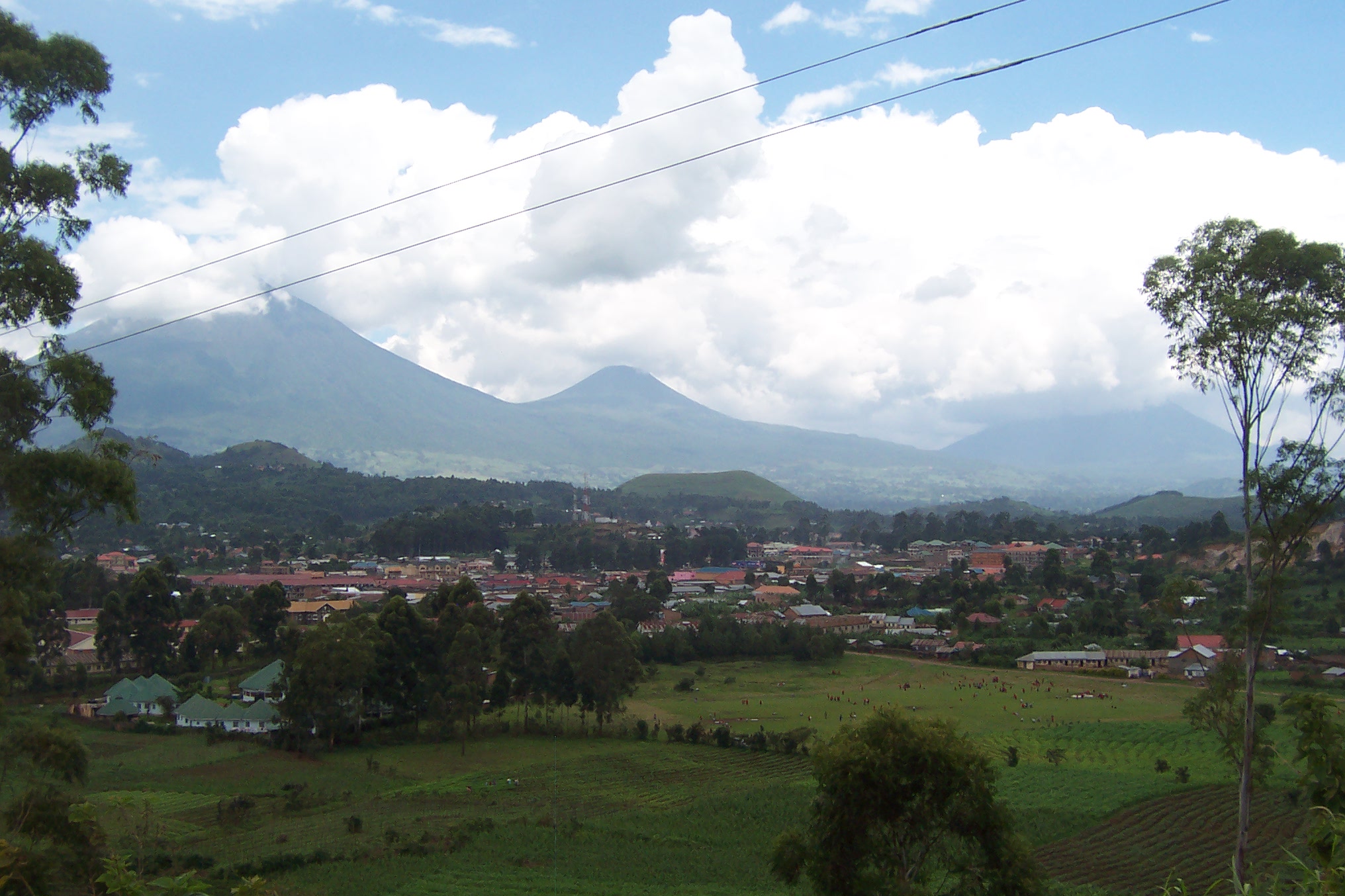 Kisoro in South West Uganda is dominated by a chain of Volcanoes – The Virunga Mountains. The closest is Mt Muhabura and it gives its name to the Church of Uganda Diocese that I visited in April – Muhabura Diocese. Of theses 7 volcanoes only one seems to be anything other than completely dormant.
Over the millennia, what were once deep valleys have been filled with the lava flows from these volcanoes, leaving small hills of sand stone in the area which once would have been high hills. The pumice stone which fills the valleys is very porous and allows water to flow below ground.
This means that in the wet season the area is lush and green but in the 3 month long dry season all the water in the area disappears underground, only to be seen at locations where springs come to the surface.
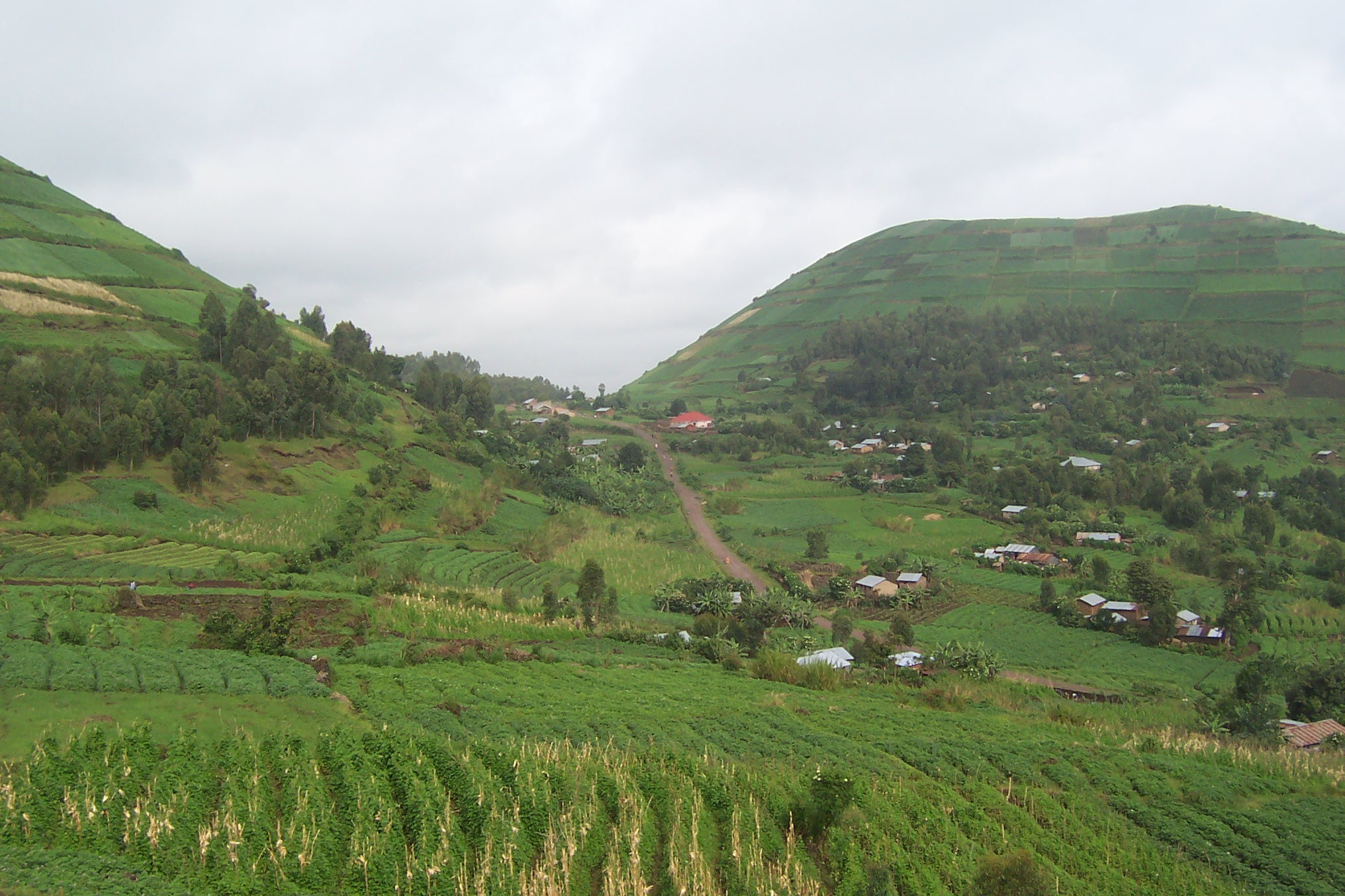 The village of Nyakimanga (pronounced Nyachimanga with a hard ‘g’) in lush and green in the wet season. but dry as a bone in the dry season. These two photos show the difference. The first was taken in April this year. The second was taken in September 2013. For three months of each year the children, usually the girls, of Nyakimanga have to set aside their education to collect water. They walk around 5 km to the nearest springs
 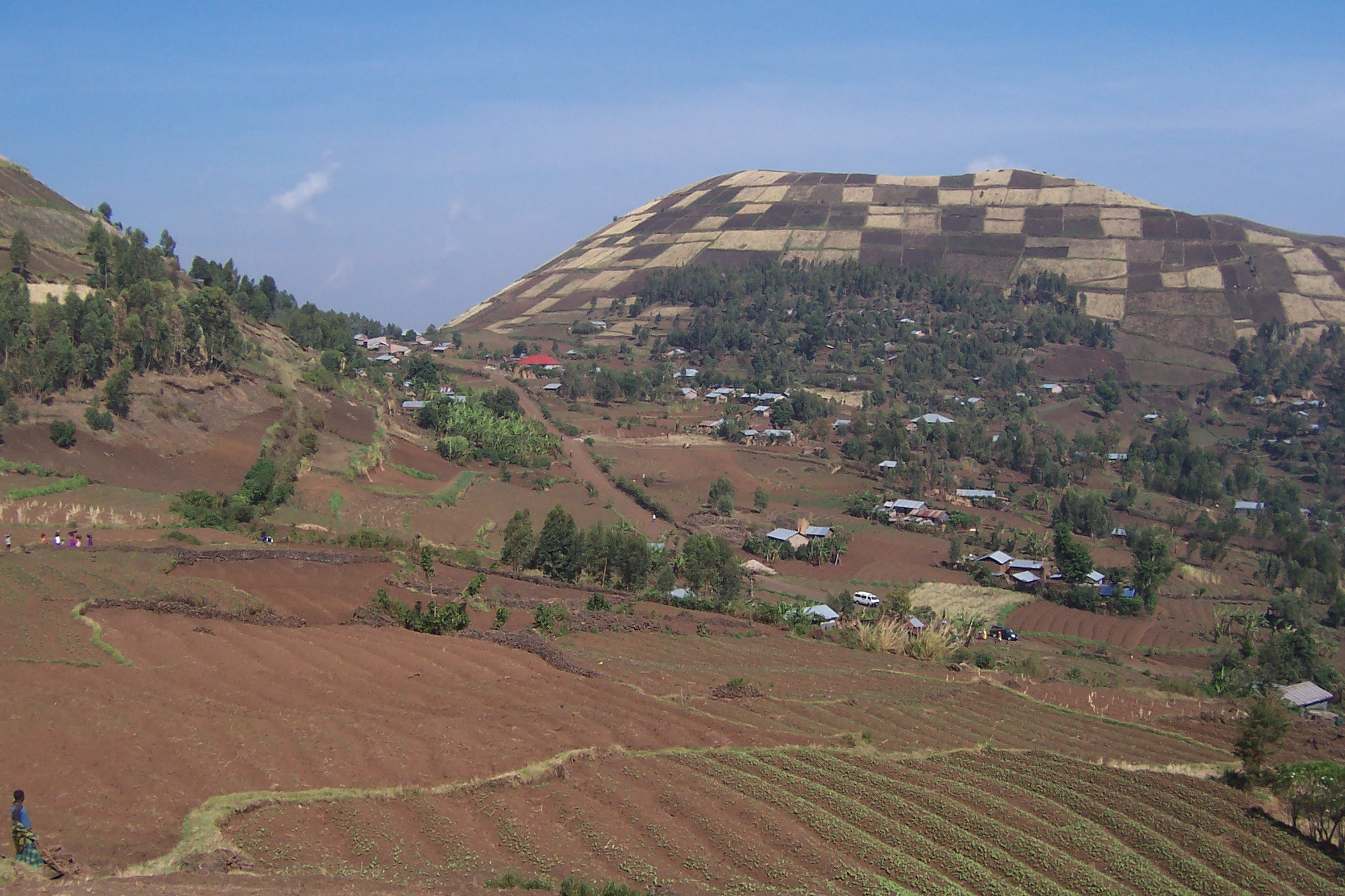 and then carry back heavy jerry cans full of water. It is a hard life.
I am delighted that St. Martin, Droylsden, The Good Shepherd, Ashton and a number of local Church of England schools raised enough money at Harvest 2014 to provide Nyakimanga with a water tank.
The money reached the village at around  Christmas time and they formed a committee led by the local church leader and they have decided together on the size and construction of the tank. They have employed local contractors and the tank has been built. When I was in Uganda in April, they had completed the reinforced floor of the tank and were well on with the constriction of the walls.
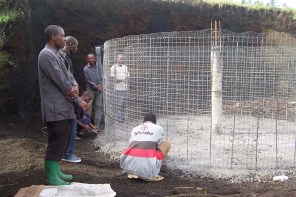 Once the tank is completed it will be fed from the roof of the church and one of the local houses and it will hold enough for very basic use by villagers throughout the dry season.
They are overwhelmingly grateful to people in the UK who have given so generously.

Written on the flight home, early on 23rd April – St. George’s Day.
My first visit to Uganda in 1994 started with a train journey from Mombasa. So it is perhaps fitting to end with a short piece about what is happening to the railways of Uganda now. The first line from Mombasa through Nairobi and on to Kampala and then Kasese was built well over a hundred years ago and is of a narrow gauge construction. There is to be a new line from Mombasa through to Kampala provided a current dispute between the Chinese contractors and the Ugandan government can be resolved.
I read this piece in the Railway Magazine on the flight home ….
“Uganda set for rail revival? …. Freight traffic in Uganda is slowly increasing, although long-term prospects probably depend on the completion of the proposed standard gauge line from Mombasa, in Kenya, to Kampala, in Uganda. The line is being built by Chinese contractors and is now the subject of disputes between the Ugandan government and the contractors.”
This new line will be to standard gauge and there will be transhipment issues between different parts of the network.


The passenger service I enjoyed in the 1990s is long gone. New Vision in Uganda carried a story about the decline of the railways.
http://www.newvision.co.ug/news/629156-How-Uganda-Railway-collapsed.html
I did a little bit of research on the way home.
The government is considering developing commuter services for Kampala:
www.railwaygazette.com/news/…/kampala-passenger–service-planned.html
Two wikipedia articles are interesting, giving some good background information:
en.wikipedia.org/wiki/Uganda_Railway
en.wikipedia.org/wiki/Uganda_Railways_Corporation

RVR (Rift Valley Railways) is the new franchise holder for the railways and is beginning to undertake some development work.
http://www.raillynews.com/2013/gulu-railway-re-opens-20-years
One good indication of the difference between cultures is how we engage in hospitality. Jayson Georges posted about his experiences early in 2015 in on his blog. The story revolves around Russian New Year and also includes some pink slippers!

http://honorshame.com/guest-well/#more-1811
How we give and receive hospitality is of great importance to the building of relationships, no more so than in cultures where honour and shame are important dynamics..
I fly from Entebbe airport this evening arriving back in the UK after a short stopover in Amsterdam in the early morning. Jo and I then head off on holiday. I’ve enjoyed doing quite a bit of theological reading over the past 2 or 3 days and you can have a look at some of the issues I’ve been reading and reflecting on under the pull-down menu ‘Shame the Gospel and the Cross’ on my blog.
I thought it would be good to leave you with a series of different images.
First a variety of different images from Kampala which show the contrasts between rich and poor and which also show something of it’s beauty.
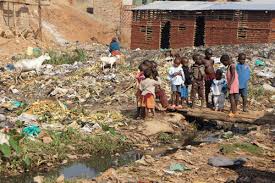
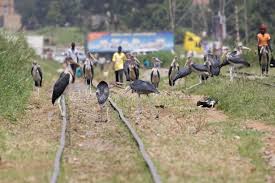

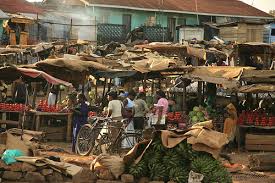


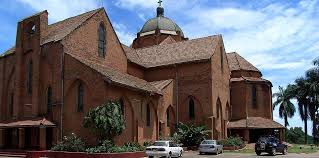
I also wanted to let you see where Jo and I will be on holiday – so here are a few photos to finish the post.
The Cottage is called Tigh SgeirGael and it is sited a kilometre or so from any other building immediately above the sea under the cliffs of Gribun on the Isle of Mull.






A Culture Test has been developed by Jayson George which he hopes will provide some objective statistical cultural analysis. Every culture has a wide range of ways of relating and making judgements. No one culture can be described as having only one particular dynamic. The research seems to support this, but at present it is based only on a relatively small number of respondents.
It is also interesting that the largest number of respondents are from and Asian background!

 Before you click on the link below it is worth stopping for a moment to ask yourself one question: “How important to me is the number of Facebook ‘friends’ I have?”
Jayson Georges suggests that when we seek our self-worth and value through the following that we have on social media we are placing status above relationship, which ultimately is a pursuit of selfishness!
http://www.christianitytoday.com/edstetzer/2015/march/our-new-virtual-face.html
I have been working on a book for some time now about Shame, Grace and the Cross. I recently asked one of my college lecturers to review the work I have done. He came back to me with a lot of very helpful comments.
One of those comments asked me to reflect on how broad the consensus is between majority world theologians on matters of Honour and Shame and the Gospel. He could see a plethora of references in my draft to theologians from the Far East, but nothing significant from Africa or India and only minimal references to work from the Americas.
In the light of this I echo Jayson Georges’ question: … What resources are available, particularly from Africa but also from India and the Americas?
http://honorshame.com/honor-shame-in-africa


