Ashton Old Baths have been comprehensively refurbished as a result of some significant grant funding. The building now provides some amazing meeting and office space.

Ashton Old Baths
Leave a reply

Ashton Old Baths have been comprehensively refurbished as a result of some significant grant funding. The building now provides some amazing meeting and office space.
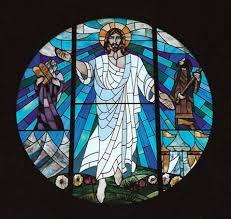
 Today at St. Peter’s we will baptise two lovely Christian young women from the Middle East, refugees who are making their home in Ashton-under-Lyne. This will be a special occasion for all of us at St. Peter’s Church in Ashton-under-Lyne but an overwhelmingly special time for those being baptised. It is a big step for them on what has already been a long journey. This will be a glimpse of glory, a moment when heaven intrudes into our lives on earth. I have written about this already:
Reading the story of the transfiguration from Luke (Luke 9:28-36) I am always taken back to a moment spent on the shore of Lake Buttermere when for just that short time everything seemed right with the world and I had the strongest of senses that God loved me and that everything would be OK.
Perhaps we have had those special moments when God seems present in a special way – when we feel something of his glory, his majesty, his closeness, his love. Perhaps not just in good times, maybe in the saddest of times too – God breaks into our fear, confusion or depression, our grief or loneliness and reveals his love or a way out of the mess we feel we are in. Times when we gained a new perspective on our lives. Moments when everything fell into place. Defining moments in our lives.
But moments like these are elusive. Times when God seems so close, are moments that we cannot manufacture – we can’t make them happen. We want them to last for ever, but they don’t. They’re ‘mountain top’ experiences. And ‘mountain top’ experiences cannot last. They slip from our fingers. Just as suddenly as we have encountered them, they’re gone. They’re part of the past – good memories to reflect on.
For Peter the transfiguration of Jesus was one such moment. Just a few verses before our Gospel reading in Luke 9, Peter made a strident assertion of his belief that Jesus was the Messiah – the Christ. And now, in the transfiguration, he is granted a vision – he sees Jesus as he really is – the thin veil between earth and heaven is drawn aside and he sees – he really sees.
Peter is overcome. He’s terrified. His confident assertion has been confirmed. He now knows – he really knows – that Jesus is the Christ. He speaks almost without thinking, ‘This is a moment to die for. It must be captured. We must build churches or shrines.’
Peter wants to cling onto the experience. And to cap it all God speaks. God confirms what Peter has seen.
Then suddenly, like a cloud crossing the sun – it is gone. Everything is just as it was before. Peter is on the top of a normal mountain with Jesus and his two friends James and John. And he has to get on with the real business of being a disciple.
If we read beyond the immediate story of the transfiguration we see just how quickly this feeling of God’s closeness dissipates as Peter and the others are faced with the realities of life. As soon as they came down from the mountain, Jesus’ disciples tried and failed to heal a sick boy.
‘Mountain top’ experiences – times when faith is easier, when God seems very close; times when doubt seems irrelevant are not the normal experience of our lives. The majority of our lives are spent plodding on, aware of God somewhere in the background but without that intensity of feeling that we experience on those special occasions. … But special times can fuel our continued faithful walk as disciples of Jesus.
Memories can be a great asset, but they can also be one of our greatest problems. Churches are good at remembering! Looking back to the days when God was really at work in our community! We remind ourselves of God’s goodness in the past. Memories like these fuel our ongoing community life. Our belief that God will continue to work today. They give us courage to go on believing. To take risks in serving God in our community.
But memories can also be our greatest problem. Our danger is that we interpret the past or even the present – whatever it is like – as the way things should be. And when God speaks to move us on – we don’t hear. Or we chose not to hear. We all do it. We cling onto the ‘mountain top’ experiences of the past or even the more mundane life of the present; when God actually wants us to move on; to face the challenges and uncertainties of the future. …………. Very few of us like change and if we’re not careful we retreat into our memories they become our bastion against the world. And as a result our churches become little more than museums or places of nostalgia.
God is speaking to people in his world. These times when for a moment it seems like the clouds have been drawn back – when God seems to be there. These times are the common experience of all of us – not just those of us who come to church. God often makes himself known outside of our church buildings – the Church of England does not have a monopoly on God. He is present in and through the whole of life.
It is so easy to slip into the habit of thinking that we have God under our thumb. We know how he works. And that he works through us, here, in our church building. When actually he’s alive in the experience of the whole of our community – he’s there all the time – we don’t take him with us when we leave this building into a hopeless and Godless world. Rather, when we leave our church buildings we need to go out expecting to meet him in the lives of those we encounter each day. Ready, together with them, to try to make sense, not only of the mundane and normal, but of moments of illumination – the joy over the birth of a child; the strange insights which suddenly overcome us; the recognition of the beauty of creation. In all these things God is there speaking words of hope, words of love, drawing us back into relationship with him, in his Son, Jesus.
So many people now-a-days have no framework in which to place these experiences. God is no longer easily recognised. He’s the stranger who needs an introduction. We need to be on hand ready to help others hear God speaking.
So, next time you experience one of those special moments. Moments of transfiguration. Listen carefully for the voice of God – it’ll be the one bringing new perspective, challenge and hope; the one speaking words of love, but at the same time drawing you on into the adventure of life as a follower his Son.
And as you share in other people’s joy – help them too to hear God’s voice calling them back .
“This is my Son, my Chosen; listen to him!”
I wonder whether you recognise these statements as you read them …. could tell me where these words come from?
“Britain only succeeds when working people succeed. We plan to reward hard work, share prosperity and build a better Britain.”
“Strong Leadership, a Clear Economic Plan a Brighter and more Secure Future.”
They come respectively from the 2015 Labour and Tory Manifestos.
Who first spoke these words?
“The Spirit of the Lord is on me, because he has anointed me to preach good news to the poor. He has sent me to proclaim freedom for the prisoners and recovery of sight for the blind, to release the oppressed, to proclaim the year of the Lord’s favour, the day of vengeance of our God.”
It wasn’t Jesus, but the prophet Isaiah!
These words come from the latter part of the book of Isaiah. They are the prophet=s manifesto for his ministry among the people after the exile in Israel. A place of hope and new life. They follow the passages that we know as those of the suffering servant. The one who Isaiah sees as taking the sins and problems of the people onto his own shoulders.
In our Gospel passage Jesus speaks out these same words as his own manifesto. In hearing those words read, people listening to him will immediately have recognised their context in the scroll of Isaiah. They should have understood that in claiming these verses as his own manifesto, Jesus was not only taking the place of the suffering servant of Isaiah but also the predicted and long awaited Servant of the Lord.
His own kith and kin in Nazareth listened to him as he spoke but singularly failed to hear what he was really saying. They were impressed with how he spoke. However, their failure to understand what he was really saying is obvious. They knew him so well, “this local boy made good!” At least they thought they did. You might be able to imagine their response – the knowing nudges, the delighted smiles as they turned to one another and said, “Is not this Joseph’s son?”
And we heard Jesus response. He immediately sets about correcting their wrong perceptions. It is as though he says; “No, no, a million times no! This is not the son of Joseph but the Son of God.”
They can only see him in the setting of their own village, they want him to do here in Nazareth just what he has done in Capernaum. Their vision cannot see beyond the confines of their own village. “Listen,” says Jesus, “I have come with a message of good news not for Nazareth only, but for all Galilee, indeed for all Israel, and – although this will scandalise you – if Israel turns out to be as blinkered as narrow-minded as you people of Nazareth, then Israel will forfeit the good news, while the rest of the world will receive it.”
The praiseworthy words of Jesus’ manifesto suddenly seem to be anathema to the people of Nazareth. Their pride in their local son, turns to rage; “Who on earth does he think he is. What right does he have to speak in this way? Not only is he rebuking us but he is also challenging the very tennets of our faith. The Messiah, saviour of the whole world – heresy, blasphemy, the devil’s work.”
Admiration turns to fury. They determine to kill Jesus.
The Gospel is good news not only for the Jews but for the whole world. This is the message that Luke continues to develop throughout his gospel. Good news for us! And it is good to give time to hearing once again the message that God’s grace extends to us here on the very edge of Europe, far from the places Jesus knew and loved in Palestine.
It’s true, this is a message of grace and hope. There are no buts, ifs or maybes associated with the breadth of God’s love. None at all.
However, this story itself carries a but, a very big but. … You see now, today, here, the story expects us not to stand on the sidelines watching the action but to ask who we should most identify with.
It would be lovely to be able to say; “O, we are the Gentiles Jesus’ refers to – isn’t it good to be included in God’s love!”
Clearly, however, Luke does not just intend us to have a warm fuzzy feeling as we read his gospel. He wants to challenge us. Luke intends that we, the people of God, identify ourselves with the people of Nazareth, the ones who want to domesticate Jesus …. Christ is ours, he is one of us, we have grown up with him, we have seen him at work.
Luke wants to challenge us to move us on.. He, and Jesus, wants us to join him in implementing Christ’s manifesto.
 You see, Jesus sees us not as voters but as members of his party, he expects us to be activists, he expects us to share his values. To understand that ministry for Jesus is not just about feeling safe and secure in our faith. To understand that ministry is about: “preaching good news to the poor; proclaiming freedom for the prisoners and recovery of sight for the blind; releasing the oppressed, and proclaiming the Lord’s favour.” To understand that we have to work to make God’s kingdom a reality here where we live and work.
And sadly, if we are not prepared to move forward with Jesus, to work with his manifesto, he will find those who are willing to do so. He will move on. Just as he walked through the crowd at the top of the hill he will refuse our agenda and pursue his own.
So let’s listen again to Jesus’ manifesto and as I read it out, let’s commit ourselves again to serving him in our own community.
“The Spirit of the Lord is on me, because he has anointed me to preach good news to the poor. He has sent me to proclaim freedom for the prisoners and recovery of sight for the blind, to release the oppressed, to proclaim the year of the Lord’s favour.”


ISAIAH 43:1-7 & LUKE 3:15-17, 21-22
Please take a moment or two with me, if you will – to imagine what it was like to be the nation of Israel at the time of the prophet Isaiah. …
To the south is Egypt a major power, still striving to keep its place in the world. To the north and east, Assyria, seemingly at the height of its power – a particularly vicious nation who pursued a policy of ethnic cleansing – completely devastating conquered lands, killing many and dispersing the rest around its empire, destroying any sense of national cohesion, minimising the possibility of rebellion. But Assyria was fragile, it had expanded too quickly and was itself on the brink of being overrun by a rival empire from further east – the Babylonians.
So what was it like to be Israel, or Judah, trapped between these mighty forces, sitting slap bang in the middle of the main trade routes between the powers; placed right on the main military roads?
Can you imagine the sense of fear, of terror, at the forces ranged on each side of them? Can you feel the uncertainty of Israel’s leaders as they try to evaluate who will win? Which side should they make a treaty with? Which side can be trusted? Can any of these powers be trusted?
Can you see the sense of dread on the faces of the ordinary people as they watch army after army moving back and forward across their land? Hoping against hope that the army will have moved through the territory before it chooses to stop. For when an army stops, it eats. And where does its food come from? From the farms, the fertile valleys, the families near where it stops. And ancient armies never paid for their food, they raped and pillaged – not only the land but the people.
What was it like for Israel to be caught in the middle of forces over which it had no control? Tossed hither and thither by the events of the day? ….
It is into this kind of situation that Isaiah speaks God’s words:
 Do not fear for I have redeemed you; I have called you by name, you are mine. When you pass through the waters, I will be with you; and through rivers they shall not overwhelm you; when you walk through the fire you shall not be burned, and the flame shall not consume you. For I am the Lord your God, the Holy One of Israel, your Saviour.
What do these words mean to Israel?
They were already feeling swamped and overcome. These words are not a promise that everything will be fine. They are rather a promise that whatever Israel suffers God will be with them. Whatever difficulties they face God will walk through those difficulties with Israel.
Do not fear for I have redeemed you; I have called you by name, you are mine. When you pass through the waters, I will be with you.
What does God want to say to us today through these words? What does God want to say to us on the Sunday when the Church of England asks us to remember that Christ went through the waters of Baptism? What does God want to say to us, at the beginning of a New Year?
Adult baptism by full immersion is a graphic picture of death and resurrection. … Christ’s own baptism prefigures his death & resurrection. It points forward to the time when he passed through the waters of death & in doing so experienced the desolation of being deserted by his Father. The time when the Godhead was rent asunder for love of us. … Christ’s Baptism & his death are the greatest evidence that he has experienced the worst that life can throw at us. That as we pass through the turbulent waters of life, God will be with us. “Do not fear,” says God to each of us. “Do not fear,” says God to us as communities of Christian believers, as churches in Ashton, Tameside and the UK.
Do not fear for I have redeemed you; I have called you by name, you are mine. When you pass through the waters, I will be with you.
God does not promise us exemption from the struggles of life, the difficulties that others face. Rather, God promises to be with us through the experiences of life. And it is grasping the truth of this which the Bible calls faith. It is what sustained ancient Israel. It is what can sustain each of us as we embark upon the journey of another year with all that it may bring.
Do not fear for I have redeemed you; I have called you by name, you are mine.
These are words that each of us needs to hear for ourselves.
We can dismiss God’s words in our Gospel reading. We can say that God meant them only for his special Son. Although I think they were meant for all of God’s children: “You are my Son, my Daughter, the Beloved; with you I am well pleased.” They are just the words we each need to hear.
But we can dismiss them, we can disbelieve them, if we choose to, because God said them to Jesus and he was a special case, wasn’t he? And so we don’t hear that the words spoken to us as well!
We cannot, however, so easily dismiss the words of our OT passage. They were spoken to God’s servant Israel, to God’s people. They are words for us, promises to hold onto in the most difficult of times. Words for us today as stand at the start of a new year:
Do not fear for I have redeemed you; I have called you by name, you are mine. When you pass through the waters, I will be with you; and through rivers they shall not overwhelm you; when you walk through the fire you shall not be burned, and the flame shall not consume you. For I am the Lord your God, the Holy One of Israel, your Saviour.
The first Christians were Jews. They came from a small backwater in the Roman Empire. A seemingly irrelevant outpost in a bustling and cosmopolitan world. They faced a big question. How could they help people throughout the Greek speaking Roman world engage with Christian faith? How could a faith which was initially expressed in the framework of the Jewish culture be comprehended by people of very different cultures? Throughout the book of Acts we see people like Paul, Peter, Silas Barnabas, Timothy, James and others struggling with these questions – they knew what Christian faith looked like for a Jew living in Palestine, but what should it be like for a Greek intellectual in Athens?
Their situation mirrors our own. Just like they did, we wonder how we can make what we believe intelligible to people in today’s world who have little or no experience of Church and who see Christian faith as largely irrelevant, who enjoy Christmas as a traditional event but who believe little of the content of the story.
Our Gospel reading today is the gospel writers= attempt – at the beginning of John’s Gospel to relate his Christian story to a world that was alien to it. A world which was culturally very different from that of the gospel writers. How could they convey the Gospel to the Roman and Greek world – the good news which was so bound up with Jesus’ divinity and humanity. They had experienced Jesus as both divine and human. How could they explain to others that a divine being became human? How could they help people understand? As they reflected on this they realised that their scriptures – the Old Testament had at least a couple of ideas that would help them.
We meet the first idea that they used in Genesis – in the story of Creation – God spoke and something happened. God only needed to say a few words and a whole world and universe came into being. Words for God were not just things to say, concepts to express or write down. Words were effective, they achieved something. God’s Word was God at work in the world.
The second idea came in other parts of the Old Testament. There they found passages about Wisdom. In parts of their bible, our Old Testament, “Wisdom” is spoken of as a personality, a person, who existed before the worlds were created. Wisdom at God’s side as he created. Wisdom as the craftsperson moulding creation and delighting in what was made.
Listen to these words from Proverbs:
“Does not wisdom call, and does not understanding raise her voice? … The Lord created me at the beginning of his work, the first of his acts long ago. … Before the mountains had been shaped, before the hills, I was brought forth. …When he established the heavens, I was there, … when he marked out the foundations of the earth, then I was beside him, like a master worker” (Proverbs 8)
As Jewish Christians were asked about Jesus by their Greek neighbours. As the first theologians tried to explain the events of the first Christmas, how God could be born as a baby in Bethlehem. They saw something in the Greek culture that would help them to explain better to Greek and Roman people, just what they meant by Jesus being the Word and Wisdom of God, both divine and human.
The word for “Word” in Greek is “logos”. Greek  philosophers used that word “logos” in a special way – by the time of Christ – they used it to refer to the ordering principle of the universe. Sometimes they used “nature” and “logos” interchangeably. What they meant was that there was an organising principle behind all of nature. The principle by which life held together – perhaps “wisdom.” And as Greek philosophers talked of “logos” they almost gave it a personality.
Christians realised that here was a way of explaining to Greek and Roman people just who Jesus was – and the first verses of John’s Gospel were born. John gives the “Word,” the “logos,” a central place. He describes the “logos” as God, the Creative Word, who took on flesh in the man Jesus Christ. … “God active in the created world” = “logos.” … God’s Word expressed as a human being. However difficult it is for us to understand today, those Christians successfully managed to translate the story of the incarnation into a form that Greek and Roman people understood.
The challenge to us is similar. … To find ways of expressing what we believe, in ways that people in today’s world will understand. We cannot just say, it worked in the past so it will work again. We cannot just do the things we have always done. We cannot continue to use only the words that we understand. We cannot continue to be just the church we have always been. Words and customs move on. Meanings change, hopes and fears change. The world is shrinking and ideas from the four corners of the world now influence the values of every society.
You only need to think of the way that the meanings of words have changed.
‘Comfort’ – what does that mean now? But on the Bayeux Tapestry it means something completely different. …. There is a picture of Bishop Odo ‘comforting’ his troops, so the legend says at the bottom of the tapestry. The picture does not show a team huddle like we sometimes see on a sports field, rather it shows Bishop Odo with a spear behind his troops urging them forward as he pushes the spear into their rear ends – really comforting!
‘Organic’ – until very recently that was a group of chemicals which contained Carbon – a mixture of different substances both noxious and benign. Now we use it to mean wholesome food, untainted by many of the chemicals which would naturally have fallen into the ‘organic’ grouping.
You’ll know many other words which have changed their meaning over the years. Those changes are like small snapshots on what has been happening in society – a process of change which is accelerating not slowing. And if we don’t change we will be increasingly misunderstood and become increasingly less and less relevant – having little or nothing intelligible to say to people who need to know the love of God.
As we participate in a process of change we do just what Jesus did ….. The Word, Jesus, became flesh and dwelt among us full of grace and truth. God changed, God became human, God learnt new things, expressed himself in different ways, felt tired for the first time, experienced limitations for the first time. God changed so as to bring his love to his creation. The early church changed its rules, expressed itself in new and different ways, so that its mission to the Roman world might be effective. And we are called to do the same to look for new ways to communicate the Gospel to those who live around us but who have none of the history of Church involvement that we have.
 The English language is full of great figures of speech and metaphorical language. Metaphors and similes are used to express concepts that might be too complex for the English language. In other words, a specific word may not exist to represent a feeling/emotion.
Describing ideas using similes and metaphors provides an opportunity to conjure a range of emotions when explaining a particular idea. People have a simile or metaphor for almost everything. Colourful colloquial language is common in many parts of the UK. There are a few examples on my previous post …
https://rogerfarnworth.wordpress.com/2015/12/27/metaphor-symbol-and-simile/
Yet when we want to be more formal, we drop the similes and metaphors, we favour clear, propositional language over more colourful metaphorical language. The English legal system is dependent on the letter of the law, our legal documentation is very carefully worded to avoid as much ambiguity as possible.
 So, when it comes to communicating the truth, Westerners prefer propositions rather than ‘fluffy words’.
“Because we are somewhat uncomfortable with the ambiguity of metaphors, we tend to distil propositions out of them. We want to know what they mean, in categorical terms. A philosophical description of God (“omni-present”) is better than an anthropomorphic one (“his eyes roam to and fro throughout the land”). Or so we think. This is why books on Jesus often talk more about the facts of his life than his parables. To us, things like metaphors and parables sometimes seem like unnecessarily frilly packages for a hard truth. We want to get past the packaging to the content; we want to know what it means.”[1]
This propensity to prefer propositional language over metaphors and similes leaves us at something of a loss when we read the Bible. Bible authors record important truths in similes, metaphors, parables and other, possibly ambiguous, language.
Different types of literature have different ‘rules’, so we expect different things when we read poetry rather than prose. Historical narrative is likely to use a different style to the telling of a parable or story. These distinctions are easiest to recognise in our own language. We can easily tell the difference between poetry and prose. It is a lot harder to make these distinctions when we are reading texts from another culture and from many centuries ago.
Some forms of literature are completely alien to us. Some books of the Bible are ‘apocalyptic’ in style, books such as Revelation and parts of Daniel. We have nothing in our own culture with which to compare these. “Such books reveal or unveil the mysteries of God about the future and make heavy use of symbolism, often involving numbers and animals. The present time is described as dire, and just when it appears things cannot get worse, God intervenes and rescues his people for a glorious future. While we may understand the big picture, the details are very confusing for those unfamiliar with this genre. We struggle to make sense of horsemen and bowls of wrath and strange hybrid animal creatures. Right in the middle of a natural disaster, a guy rides by on a horse. What’s up with that? This genre is foreign to us.”[2]
In this case, we know we don’t know, so we are prepared, or should be prepared to be careful in the way in which we approach the text. It is less easy to make these distinctions elsewhere in the Bible. The danger with making distinctions, is that we follow our instincts and relegate metaphorical language to a secondary place, we search out the more concrete statements and rely on them as primary. It makes the most sense to us to do so. Or we transpose metaphorical language into propositional language.
Biblical writers “often preferred to speak about spiritual things metaphorically. And this made earlier interpreters nervous because ancient readers of the Bible knew that there was a lot at stake in a metaphor. The original Hebrew text of Exodus 15:3 reads, “The Lord is a warrior.” The context is the Song of Moses. The Israelites have just filed through the Red Sea to safety and Pharaoh’s army has drowned in the tide. The Lord, Moses implies, is a more powerful soldier than all the battalions of Egypt. But the Greek translators of Exodus were uncomfortable with this image. So they did just what we tend to do: they translated the verse as a proposition. In the Septuagint, the verse reads, “The Lord . . . shatters wars” or “bring[s] wars to naught.’ Instead of portraying Yahweh as an armed and bloodied soldier, they highlighted a particular implication of his prowess. While they might be right—perhaps the best soldier is the one who brings war to an end—the Septuagint interpretation narrows the meaning of the text. Resolving the tension of the metaphor actually diminishes the breadth and application of the text. “[3]
Metaphors and other artistic expressions can also say more with less. Just a couple of examples:
He had a broken heart.
She had cold feet.
When we hear these phrases we know not to take them literally and they carry with them a wealth of meaning, if we were try to be more ‘factual’ in our description of how these people are feeling we would either miss something of the breadth of meaning intended or focus down onto just part of what the metaphor invokes.
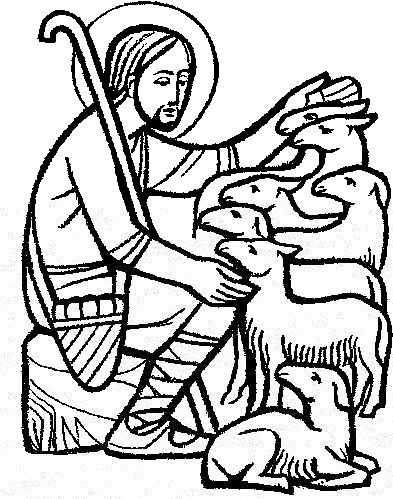
In addition, the use of metaphors often connects central truths in Scripture. Our parish in Ashton-under-Lyne is called the Parish of the Good Shepherd.
The concept of God as shepherd runs throughout the Bible. No one believes that God is actually a shepherd, we use the concept as a useful metaphor. For many of us it is a very significant one. We love Psalm 23. In Ezekiel 34, God describes himself as the Good Shepherd and the people’s leaders as bad shepherds. So, when Jesus claims, “I am the good shepherd” (John 10:14), what is he saying?
Perhaps first he is identifying other as ‘not good’! But the reference back to Ezekiel is unmistakeable. His audience realised this straightaway. Jesus uses the metaphor to identify himself with God and his listeners pick up rocks to stone him “for blasphemy, because you, a mere man, claim to be God” (John 10:33).
In Scripture, these connections between metaphors are significant. “It was Abel, the shepherd, whose offering pleased God. Saul was a bad king—and called a bad shepherd—but King David was a good king who shepherded the people of Israel (1 Chronicles 11:2). If we simply distil the propositions out of each of these accounts (“The Lord provides everything I need”; “Jesus lays down his life for us”; “Saul was a bad king”; “David was a good king”), we miss the connection. The metaphor is not just a frilly package. In this case, the package is actually the bridge connecting all these ideas. Real misunderstanding is at stake.”[4]
Biblical scholars in the 19th century argued that Jesus never made any claim to be divine. Their problem was that they ignored Jesus’ use of metaphorical language. “What went without being said in Jesus’ time is that metaphors bring with them the whole weight of the biblical witness—Torah, Wisdom and the Prophets.” [5] … Jesus’ listeners recognise immediately that he is drawing together a series of different strands of Scripture and they react accordingly.
————————————————————————
[1] E. Randolph Richards and Brandon J. O’Brien; “Misreading Scripture with Western Eyes”; IVP, Downers Grove, Illinois, 2012: p84.
[2] Ibid: p85.
[3] Ibid: p86.
[4] Ibid: p87.
[5] Ibid: p88.
The realm of faith is a world of symbolism, metaphor and simile. It is almost impossible to speak of God without recourse to pictures and story. Our western world likes to be systematic and propositional but when we try to speak of God in these terms we so often struggle.
In a future post I want to make use of ideas about metaphor, symbol and simile, so I thought it would be good to set out some ideas about what they are first ….
As Westerners one of our most used questions when we read the bible and particularly the stories and parables it contains is: “What does it mean?” We think parables are like fables: “there has to be a moral or a meaning that can be defined so that we all know what it is about.”
Other cultures can sit a little looser to meaning and read the text for what it is worth. This general difference between the Western cultures, to which we belong, and many other cultures in the world is important to grasp! Why? Because the text of scripture was written down in cultures that focussed more on story than on specific meaning. Perhaps this is why the Bible is a little resistant our attempts at Systematic Theology!
When Jesus tells us a parable he is not trying to convey a single meaning – if he were, why tell us a parable. What Jesus wants, I think, is that those listening to him hear the story and go away to ponder what it might mean. In their pondering the Holy Spirit is able to guide their thinking and develop a meaning for them. The story permits a range of applications or meanings and by doing so becomes the Word of God to each individual or group that listens to it.
This, very simplistically, is the theory behind Liberation Theology, which encourages groups of people, often the marginalised and the poor, to read the text of Scripture in their own context and expect it to speak directly into that context.
So, faith and religion cannot be distilled into a series of propositions which can be ‘proved’, they are about an alternate form of knowing. What is then really surprising is that, while we are often quite comfortable with the use of metaphors, similes and symbols in our daily lives, we can be uncomfortable with them in the context of faith.
We use metaphors in our speech without pause for thought: her home was like a prison; life is like a journey; the snow was a white blanket over everything; her voice was music to his ears; all the world is a stage; the cast on his broken leg felt like a plaster shackle; her ambitions are as fragile as a house of cards; he is a night owl; the lake was like a mirror; he was like a pig at dinner-time; thank you, you are an angel; the clouds are balls of cotton …..
A metaphor is a figure of speech in which a term/phrase is applied to something to which it is not literally applicable so as to suggest a resemblance, as in “A mighty fortress is our God.” However, when we read metaphors in scripture we risk seeking to turn them into factual statements. Perhaps the most significant metaphor is that “God is our Father”. This is, of course, a metaphor. God is not human, God has no gender, God is not male, God is not physically a father; however the best attributes of fatherhood and the best of fathers help us to understand something of the relationship God has with us, and also God becomes an exemplar for fathers. Fathers who seek to love their families with the depth of love God shows to us are seeking to be the best of fathers. The metaphor is powerful, dynamic and effective in our language. So powerful, that we perceive it as fact.
Many parables function like metaphors, they provide a story which helps us to engage with deep realities. The story of ‘The Prodigal’ in Luke’s Gospel, perhaps better titled ‘The Loving Father’, or even ‘The Grumpy Brother’, is a metaphor for our relationship with God.
Symbols can 
 help us engage with deeper meanings as well. They can be as simple as pictures which represent things beyond themselves and which carry a weight of meaning that can be difficult to express in a few words. So … a set of scales is a symbol for justice, a dove and olive branch is a symbol of peace. Other examples of effective and accepted symbols include the logos of particular organisations, coats of arms.

 Every religion has symbols of some nature, in Christianity the cross or a crucifix carry significant meaning and point to the importance of Jesus death.
The bread and wine which Christians share are also symbols which carry significant meaning. In a way that we find difficult to articulate and with different shades of meaning for each Christian community, they feed our faith, emphasise our unity, and identify us with the death of Christ. Baptism expresses a connection with death and resurrection. Symbols can express the invisible or intangible in ways that words fail to do.
A simile is usually a figure of speech which pairs two things which are different to make a description more emphatic or vivid (e.g. as brave as a lion). Similes add depth to our language and are very similar to metaphors. Other examples include: ‘cute as a kitten’, ‘as busy as a bee’, ‘snug as a bug in a rug’ ‘blind as a bat’. Similies are used to enrich the text of scripture as well, to help us imagine what is meant. Examples include:
Proverbs 25:11 ‘A word fitly spoken is like apples of gold in pictures of silver’;
Matthew 10:16 ‘Behold, I send you forth as sheep in the midst of wolves: be ye therefore wise as serpents, and harmless as doves’;
Matthew 13:44 ‘The kingdom of heaven is like treasure hidden in a field’;
Matthew 23:27 ‘Woe to you, teachers of the law and Pharisees, you hypocrites! You are like whitewashed tombs, which look beautiful on the outside but on the inside are full of dead men’s bones and everything unclean’;
1 Thessalonians 5:2 ‘The day of the Lord will come just like a thief in the night’.
By using simile, the bible authors add depth to their statements and anchor abstract ideas with comparisons that provide a reference point for our senses. Similes draw us into the text in a way that a bald statement would not.
 How are you doing with the presents? Got them all wrapped yet?
What a job! Trying to hold three different bits of paper together at the same time as cutting the sellotape; sticking the sellotape onto one finger and trying to fold everything back up, only to discover that a bit of the tape has stuck to the paper and ripped it! Then there’s the present which turns out to be just a little too big for the largest sheet or roll of wrapping paper you could find. Wrapping presents is a real bind!
 And when you have wrapped everything, you sit back a look at your endeavours and it’s still pretty obvious what most things are – it isn’t easy to disguise the shirt with the collar which sticks up above the rest of the pack, a tennis racket is a tennis racket even inside Christmas wrapping, a bottle of wine is a bottle of wine however you try to wrap it – and a
mountain bike – well what else could it be?
It is a wonder that anyone is surprised by the presents that they get. And yet we are, aren’t we. There is always something that comes as a complete surprise – even if we’ve given everyone a list of what we want, we still get that present or presents which are impossible to guess from their wrapping. We look at them and wonder what they might be.
Often the surprise is fantastic. Something really special. But sometimes the surprise is negative. …
As a teenager in the 1970s, I set my sights on a lovely pair of cowboy boots that had good 3” high heels and platform soles. I think that they were bright orange in colour. I told my parents about them and they assured me (suprisingly) that my boots would be waiting for me on Christmas morning.
As teenagers are wont to do, I slithered downstairs on Christmas morning, trying not to betray my excitement. Mum and Dad had always said no to the clothes I wanted before.
When we started opening the presents, I was immediately aware that I was probably going to be disappointed. There were no presents large enough. Still I maintained a slim hope that perhaps the boot calves had been folded over to get them into a smaller box. But no, when I opened the present from Mum and Dad, there were a pair of boots, ankle-height elasticised slip-on boots with half inch heels. It felt like they had reinterpreted my request to suit themselves! I don’t think I wore those boots more than once. I was deeply disappointed!
As Israel waited for its Messiah it had a very definite idea in mind what that Messiah would be like. The trouble was that when that Messiah arrived he did not fit their idea of a Messiah. God’s gift to Israel was not what it wanted.
Israel had chosen to listen to the bits of the bible it wanted to hear. It created a concept of a Messiah who was a powerful and dynamic king. A Messiah who would rid them of the oppressor, a military Messiah, a powerful leader who would free them from the yoke of oppression. ‘No,’ says Jesus, ‘I am here to inaugurate a different kingdom, a kingdom built on justice for all, and peace and healing for the oppressed.’
The thing with God is … that we can never pin God down. We think we have listened. We form our ideas of what God wants, or what God is doing. And then, hey presto, God does something different. We’ve tried to understand what he wants and yet again we’ve been trapped by our own ideas and our limited understanding of God.
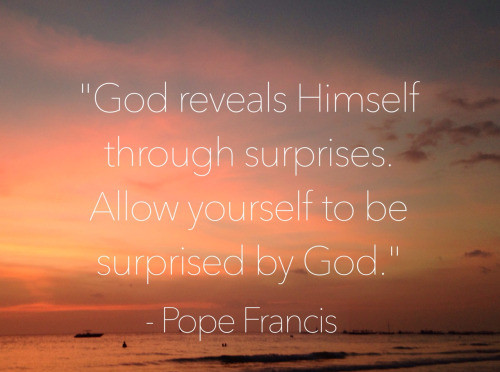
It is wonderful when God surprises us with something new, something different. … The incarnation of Jesus, was one of those occasions – perhaps the most important of them.
In Jesus’ life and death he turned convention on its head, he disturbed the status quo, and out of a shameful death brought new life and hope to the world.
Jesus is God’s present to us this Christmas. But don’t go thinking that you’ll necessarily get the present you’ve asked for! Jesus at work in our lives is more disturbing, more exciting, more wonderful than we can anticipate. If this baby was a surprise and a shock for those waiting for a Messiah, his life was even more so, and the manner of his death was the final shocking surprise.
When Jesus came in his glory, it wasn’t as a king robed in finery on a golden throne. It was naked, dying, with a cross as his throne. In Jesus’ death shame became glory. We look back with gratitude and celebrate a king born as a baby who is finally crowned king with thorns and with a cross for a throne.
I was disappointed with my boots back in the 1970s, but I have never been disappointed with Jesus. Occasionally confused, sometimes disturbed, sometimes bewildered, but following his lead has taken me all over the place, and he continues to change and challenge me.
We can look back with gratitude to those days when Christ was here on earth; we can express our love of our Lord. But for those who lived  through those days, weeks and months of Jesus’ ministry and the week surrounding his death, they were full of shocks and surprises.
Our God is a God of
surprises. He wants to surprise each of us with his presence this Christmas time.

I like the article below.
I guess it reflects the approach that many of us have to Christmas and to the Anglican Church (C of E). Tim Lott seems to have caught something of our British psyche in a very short article.
However, just to be clear about what I am saying: I believe in the Virgin birth, and in miracles, … the Christian faith is everything to me and I do believe that Jesus really is God’s Son, both divine and human. So, I am like the Vicar in Tim’s article.
Yes, I am a Vicar, so I should believe!?! But as Tim Lott points out, one of the endearing realities of the C of E is that while I and many others really do believe these things, we don’t feel constrained to force our beliefs on others. We really do believe that it is possible for God to do the talking.
It really is great when we see people in church at Christmas time!!!!
It is good that there remains a strong sense of goodwill towards all this stuff among the wider population, even if people are a little circumspect about whether they really believe it or not.
I hope that, in encountering a story once again – a story that is so tied up with our national identity – our hearts are warmed, our desire to be at peace and to work with others is increased, and that, just possibly, there is room for God to meet with us and speak to us in a way which each of us can hear, and to which we might just respond!!!!
Great article Tim!
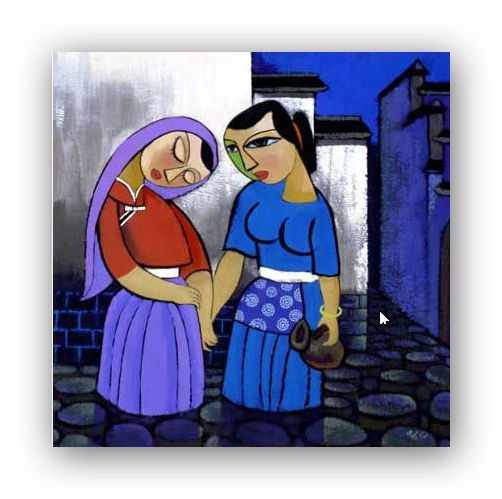
 Mary’s Journey
I have spent time living in South West Uganda and I have returned there on a few occasions. Since 1994 when I first travelled to Uganda, I have been to Kisoro, right on the border with Rwanda and the Democratic Republic of Congo 5 times. and I am delighted to name their current Bishop as an important personal friend.
The Christmas story seems to be full of journeys – starting, seemingly with Joseph and Mary travelling to Bethlehem with a donkey, the journeys of shepherd and wise men follow before the Holy Family travel as Syrian refugees to Egypt to avoid persecution.
Today’s gospel focuses on another journey that is perhaps often overlooked … but more of that later. ….
People in Kisoro and the districts around spend a lot of their waking hours travelling. Here, below, are two of the journeys they make on a regular basis. ….
The first is to get to church.
Most of us rely on clocks or watches to sort out when to leave for church – in the past we relied on bells to tell us that the service was due to start. And in those days most of us would have walked to church – perhaps a few hundred yards at the most. …… In Kisoro, 10 minutes before the service starts drums begin to play under a tree outside the cathedral.
In 1994 virtually no one had a watch and people would start walking to the cathedral when they heard the drums.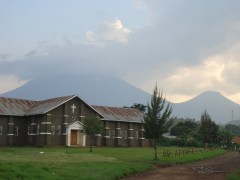
At the start of the service there would be perhaps 30 or 40 people in church – the services would last perhaps 2 to 22 hours and by the time the sermon was well underway (usually something that lasted at least 3/4 hour) the congregation would have swelled to over 700. Most people had heard the drums and then had a 45 minute to an hour walk to get to church.
That is quite a journey for a Sunday morning. ……….. However, it is nothign compared with the journey that many children and women still have to make in the territory around Kisoro. …… A journey to fulfil a more basic need – the need for water.
In 1994, for the first time, I met children who had to walk a 12km round trip each day before going to school – the outward 6km was relatively easy for the jerry cans were empty – the return journey was more arduous – up hill with full 5 gallon jerry cans. As churches in Ashton-u nder-Lyne, we’ve been able to be part of a continuing process of making this a thing of the past, but there are still today children and adults that make that kind of journey each day to collect water. It is still shocking!
What’s the worst journey you’ve ever experienced?
Was it a long car journey and did you get stuck in traffic? Was it a train journey that seemed never ending. Since being in Uganda my attitude to what counts as inconvenient in my travel arrangements has changed. But I still manage to get impatient. Many of us will be travelling this Christmas to see friends and family. Some of us, long distances.
Luke reminds us that Mary travelled with haste to spend time with her relatives. She’d just been visited by the Angel Gabriel. She’d accepted a role which could only mean that she would be ostracised by her community, a role which might mean the loss of her fiancée – being pregnant when Joseph knew that the baby was not his.
Was she afraid? You bet she was. Where did she turn? To someone she thought might understand. Someone who was also having a child in strange circumstances.
Can you imagine how she was feeling? This journey she took from Nazareth to the hill country of Judaea would have been a long one. 50 to 60 miles – a pregnant woman travelling alone – not even a railway system to take the strain. Can you imagine what it was like, walking all that way? How long would the journey have taken on foot? What dangers would she have faced? Why did she leave Nazareth in haste? Had people found out? Was she at risk of being stoned (for that was the punishment for women who had sex outside wedlock)? What would she have been thinking during the days that she was travelling?
How will I be received? Will they understand? Will they too condemn me? … So much time to think!
What must it have felt like to hear Elizabeth’s welcome: “Blessed are you among women, and blessed is the fruit of your womb?”
The immense sense of relief – someone understands.
We know the story so well that we can easily miss the strength of the different emotions that Mary must have felt – fear of what others might say and do, joy at Elizabeth’s acceptance and love.
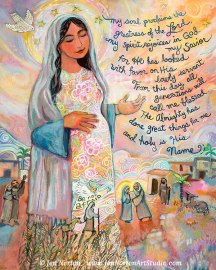 Is it surprising that she bursts into song? One of the most enduring songs of worship.
My soul proclaims the greatness of the Lord, my spirit rejoices in God my
Saviour; he has looked with favour on his lowly servant.
From this day all generations will call me blessed; the Almighty has done great things for me, and holy is his name.
There are many journeys in the Bible – many have this element of fear attached to them, with questions in the mind of the traveller about how they will be received.
Do you remember Jacob wrestling with God because he does not want to face his brother who is ahead of him on the road?
Or what about the Prodigal Son – wandering home wondering how he would be received?
In both cases the welcome they received far exceeded their expectations.
We’re often told that we can look on our lives as a journey. Its particularly true at Christmas time – whether in reality when we visit friends and relatives, or in our minds and hearts as we revisit significant events in our lives.
For some, Christmas holds out the promise of joy or the promise of renewal; for others, the journey through our memories is long and arduous, and like those Ugandan children we carry heavy loads. The journey brings back feelings of loneliness, of loved ones who have died, relationships which have gone sour. The journey through this Christmas period can be both light and dark, a mixture of joy and sorrow.
As Mary travelled the difficult road south to Judaea, she discovered not the blackness of despair but the joy of acceptance. Elizabeth shared her experiences and rejoiced with her in God’s involvement in her life.
Both Elizabeth and Mary can be models for us this Christmas – Elizabeth offering love and acceptance, offering hospitality, challenges us to make our homes ones of welcome – places were the weary and heavy laden traveller – the one struggling with life or the burden of unwanted memories – can find a resting place of love and care.
Mary encourages those of us struggling with this season to take risks in sharing our fears, our hurts, the loneliness of our journey, with others who will understand. Mary encourages us, perhaps above all, to know that however long or tortuous our journey, just like those Ugandan Christians at the cathedral in Kisoro, when we approach
the communion table we receive God’s loving welcome – we are at home.

