Author Archives: Roger Farnworth

Unknown's avatar

About Roger Farnworth

A retired Civil Engineer and Priest

John 7 and 8

In the story of the woman caught in adultery, “Jesus is accosted in public by a group of Temple leaders. … They point to the place in the law where stoning is required for such women. They attribute this requirement to the authority of Moses. They demand that Jesus say what should be done. (There was a double trap in this situation. The Romans had prohibited the Sanhedrin from imposing capital punishment for any violation of religious codes; therefore, for Jesus to assent to stoning would be to place himself at odds with Roman policies; on the other hand, to treat the woman’s alleged offense lightly would reveal Jesus as being “soft” on the law. Their question to him was meant to be a source of consternation and embarrassment to him, leading to a public affirmation of the charges that he set aside important aspects of the law.)”[1]

In this story Jesus is being shamed by the potential exposes of his ‘laxness’ with regard to the law, and the woman is being shamed by the public exposure of her alleged sexual misconduct.

James Fowler comments: “Jesus’ response initially reflects his shame for the accusers and for the woman. He averts his eyes, looks and bends downward where he begins to write with his fingers on the ground, refusing to credit their questions. When they persist in demanding a response, he ‘straightens up’ meets their gaze, and says to them, ‘Let anyone among you who is without sin be the first to throw a stone at her’. Eye to eye, straightforwardly, he throws the shame, directed at her and himself, back upon them. Then he kneels down again, resuming his writing on the ground. ‘The crowd melts away, led by the elders, leaving him alone with the woman. When they have gone he stands again, looking at her, and asks, ‘Woman, where are they? Has no one condemned you?’ She says, ‘No one, sir’. And he says, ‘Neither do I condemn you. Go your way, and from now on do not sin again’.”[2]

Jesus does not ignore the woman’s guilt, but he focuses on “dealing with her shame and her misuse at the hands of those who would have entrapped them both.”[3]


[1] Fowler; “Faithful Change;” Abingdon Press, Nashville Tennessee, 1996: p142.

[2] Ibid., p142-143.

[3] Ibid., p143.

Luke 15

“In the teaching of Jesus, both guilt and shame play important roles in understanding how we are affected by sin. Conversely, both forgiveness and honor occupy central roles in understanding the nature of God’s gracious work in our lives.”[1]

The parable of the prodigal son is not only about the son’s receiving forgiveness for his incurred guilt (Luke 15:18, 21), but also about his shame being removed, about him being restored to a place of honour as a son. “The son sought forgiveness for his guilt by confessing his sin and asking to be made like a hired servant. The father could have forgiven his son, cleansed him of any guilt, and then made him like one of his hired servants. However, the father not only forgave him for his sins, but also restored him to the place of honor as a son by kissing his face (Luke 15:20), clothing him with a robe, and putting a ring on his finger and sandals on his feet (Luke 15:22). He honored him further by ordering that the fattened calf be killed and a great celebration be held in his son’s honor (Luke 15:23). The text does not indicate that the older son was angry because the father forgave his younger brother. The actual wording of the text makes it clear that he was angry because his younger brother had been shown honor, despite his having brought shame on the family, while he who had never brought shame on the family had never been so honored (Luke 15:28-31)”[2]


[1] Tennent;“Theology in the Context of World Christianity: How the Global Church is Influencing the Way We Think About and Discuss Theology;” Zondervan, Grand Rapids, Michigan, 2007: p87.

[2] Ibid., p88. A more in-depth discussion of the dynamic of ‘shame’ in the passage can be found in Kenneth Bailey; “Poet and Peasant“; Eerdmans, Grand Rapids, Michigan, 1983, p119-133, cf. Stockitt; op.cit., p114 and Appendix 1.2 – . Bailey:”Poet…”:1983:p119-33; Stockitt:p114; Musk:p163; Nouwen:p36.

Luke 10

In Luke 10:38-42, Martha is doing the expected work of a woman in her culture; Mary is sitting at the feet of Jesus and learning from him.

Using the lens of honor and shame, Werner Mischke points out that  “ Mary sat at the Lord’s feet. She physically expressed her recognition of the honor of Jesus. In the economy of honor and shame, feet have a particular meaning. Feet are among the least honorable parts of the human body—in contrast, for example, to the right hand. This honor/shame contrast may be observed in Psalm 110:1—“The LORD says to my Lord: Sit at my right hand, until I make your enemies your footstool.” The meaning in Mary’s action of sitting at Christ’s feet was profound and plain in their honor-shame culture—and surely was clear to Martha.”[1]

In addition, Mary was listening, she gave honour to Jesus by doing nothing except listening in humility. “Martha was distracted with much serving.” Martha was getting things done. She became preoccupied with herself. Mischke asks: “could it be that Martha’s service was a smokescreen for her preoccupation with herself? No wonder Jesus said, ‘Mary has chosen the good portion’.”[2]

Ultimately, Mary gave honour to Jesus by her humility and was praised by him. “This overturns one of the classic features of the honor and shame culture, namely, that honor and shame is a “limited good.” … Here in the story of Mary and Martha, it is Mary who willingly ‘loses’ self-honor by giving honor to Jesus – and yet, in the end, instead of losing, she gains a compliment from Jesus; Mary gains honor from the Lord.”[3] Rather than trying to impress Jesus by her service, Mary gave immense honor to him by sitting at his feet.


[2] Ibid., p23

[3] Ibid., p23-24

Shame in Luke

James Fowler provides us some examples of the prevalence of shame mainly in Luke’s Gospel. These are examples of Jesus’ interaction with people experiencing personal or social shame. “Among these one can point to the woman with an issue of blood (Luke 8:43-48), the story of the Pharisee and the tax collector praying (Luke 18:9-14), Jesus and the Samaritan woman at the well (John 4:7-42), and the story of Jesus’ gracious initiation of relationship with the tax collector Zacchaeus when he invites himself to the little man’s home and, by eating with him, conveys a profound acceptance that opens the way for his seeking forgiveness and a new life (Luke 19:1-10). In every case, Jesus breaks through ethnic or religious taboos that govern relations and build barriers between persons and groups. In every case, Jesus offers a quality of really seeing each of these persons and conveying such acceptance and regard that they find a new relation to him, to God, and to the communities of which they are part.”[1]

Other commentators direct us to other passages in Luke. In a previous post, we noted that Halvor Moxnes refers to Luke 13:10-17. Moxnes also wants us to notice, “how important the genealogy of Jesus is to the claim to status made for him”[2] (Luke 3:23–38; cf. Matt. 1:1–17.).  Genealogy gave status and honour to an individual and placed them securely in people’s minds at their appropriate level of honour, their station in life.


[1] James Fowler; “Faithful Change;” Abingdon Press, Nashville Tennessee, 1996: p143-144.

[2] Halvor Moxnes; “Honor and Shame,” in The Social Sciences and New Testament Interpretation, R. L. Rohrbaugh, ed. Peabody, Mass.: Hendrickson, 1996: p28, cf. Jackson Wu; “Authority in a Collectivist Church: Identifying Critical Concerns for a Chinese Ecclesiology;” Contemporary Practice of www.GlobalMissiology.org , October 2011; Web, available through http://beautyofpartnership.org/about/free  at http://wernermischke.org/wp-content/uploads/2012/10/authority-in-a-collectivist-church-global-missiology-oct-2011.pdf; 21st November 2103, p15.

N Gauge Loft Layout – Hereford – 7

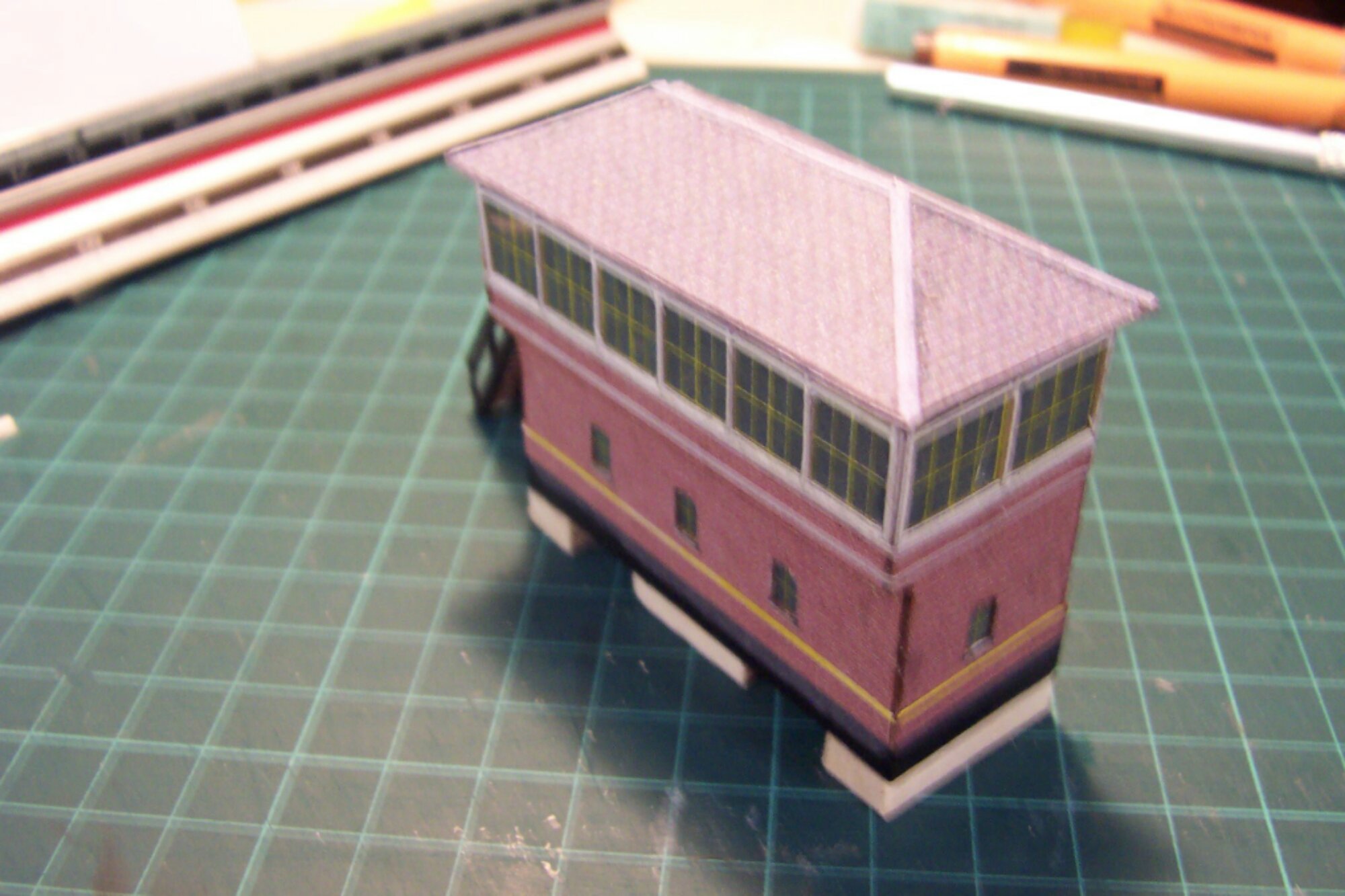
Another card model is the footbridge that spans the tracks at Barrs Court Station, made using layers of card to build up the different steel and timber frames which made up the footbridge as shown in this photo by D. J. Norton (see http://www.photobydjnorton.com/Stations/Hereford.html).

The footbridge took absolutely ages to make. It was drawn on the computer using ‘Paint’ as a series of layers which were then printed onto card and carefully cut out before building the layers up using PVA glue. The last photo shows the footbridge in position on the layout.

100_2088

100_2085100_2426

Mark 11

In Mark 11:27-33 (cf. Matt 21:23-27; Luke 20:1-8), Jesus is confronted in the temple by the scribes, the chief priests, and the elders.

They challenge Jesus to declare the source of his authority Jesus ripostes by turning the question to John the Baptist: “Did the baptism of John come from heaven, or was it of human origin?” The question stumps the authorities: they cannot say it was from heaven or that it was mere human authority. It is certain that no one in the crowd has the status of the scribes, chief priests, and elders, and yet these elites are rendered powerless by public opinion (Mark 11:32).

This is a classic example of challenge and riposte. In the end those watching have the final say “the artisan Jesus shames his elite challengers” because those watching acknowledge it .[1]


[1] Zeba Cook; “Honor , Shame, and Social Status Revisited;” in Journal of Biblical Literature Vol. 128. No. 3 (Fall 2009), p601.

Mark 7: 24-30 and Matthew 15

A really interesting example of the dynamics of shame and honour, challenge and riposte, is highlighted by Zeba Cook. In the middle of a discussion about the place of women in public life she relates the story of Jesus and the Syrophoenician/Canaanite woman (Mark 7:24-30 and Matt 15:22-28, respectively).

Mark and Matthew agree on the general outline: “Jesus is in Gentile territory when a woman approaches him and begs that he heal her daughter, who has a demon. In Matthew, Jesus initially ignores the woman. … The woman re-issues the challenge, and Jesus ripostes again. In Matthew, Jesus’ first riposte is dismissive, while the second escalates to insult. In Mark, both components are contained in the one riposte: “Let the children be fed first, for it is not fair to take the children’s food and throw it to the dogs?” But the challenge and riposte exchange does not end there. The woman’s final challenge ends the exchange: “Yes, Lord, yet even the dogs eat the crumbs that fall from their masters’ table” (Matt 15:26). In a clever retort, the woman accepts the insult “dog” and turns it back on Jesus, thereby outwitting him. Having been outwitted, Jesus is obligated to give the woman what she wants; she has bested him.” [1]


[1] Zeba Cook; “Honor, Shame, and Social Status Revisited;” p608-609. She notes that Malina and Rohrbaugh comment on these passages, but do not address the challenge and riposte in the story (Social-Science Commentary on the Synoptic Gospels).

Herefordshire Railways 2

The above image comes from the site:

http://chasewaterstuff.wordpress.com/2012/01/13/some-early-lines-railways-around-titley/ it carries the following heading and attribution: 1420 at Titley Junction after a trip up the Presteigne branch in August 1964.  B.J.Ashworth.

Here are some further sites of interest if you want to find out more about railways in Herefordshire:

http://www.photobydjnorton.com

http://www.railbrit.co.uk/location.php?photographer=&loc=Worcester%20and%20Hereford%20Railway&offset=0

http://www.railbrit.co.uk/location.php?loc=Hereford

http://www.britainfromabove.org.uk/groups/hereford

http://www.miac.org.uk/herefordline.html

http://www.geograph.org.uk/gridref/SO5140 other grid references may provide other photos.

https://www.google.co.uk/search?q=photos+of+hereford+railways&espv=210&es_sm=93&source=lnms&tbm=isch&sa=X&ei=XP-7Us7PEcarhAepuIDIAQ&ved=0CAcQ_AUoATge&biw=1280&bih=916


Mark 7: 1-16

In Mark 7:1-16, Jesus’ disciples eat their food without performing a ritual purification of their hands and the Pharisees take the opportunity to challenge Jesus’ honour.

“What kind of teacher can he be if his disciples transgress the revered “tradition of the elders” (that was attaining a status equal to the written Torah)? Jesus responds … with a counterchallenge. He challenges the Pharisees’ honor as followers of Torah, citing an instance where their tradition stands in contradiction to the written Torah (7:9-13), indeed, one of the Ten Commandments, allowing him even to apply a devastating quotation from Isaiah in his riposte. (7:6-7)”[1]

David deSilva comments that “the reader is reminded of the public nature of this exchange as Jesus addresses his last comment to the crowd (Mark 7:16). Presumably Jesus has successfully warded off the challenge and even caused his opponents to lose face with the counterchallenge. In telling these stories, moreover, the Gospel writers make the Christian readers into the public that witnesses the exchanges and gives its own verdict on who won and who lost. Their own positive estimation of Jesus (as an honorable person and as a reliable teacher of the way to please God) is confirmed as they read these challenge-riposte stories actively and appraisingly.”[2]


[1] David A. deSilva; “Honor, Patronage, Kinship, and Purity;” IVP, Downers Grove IL, 2000, p30.

[2] Ibid., p30.