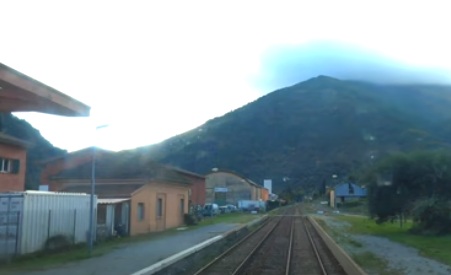
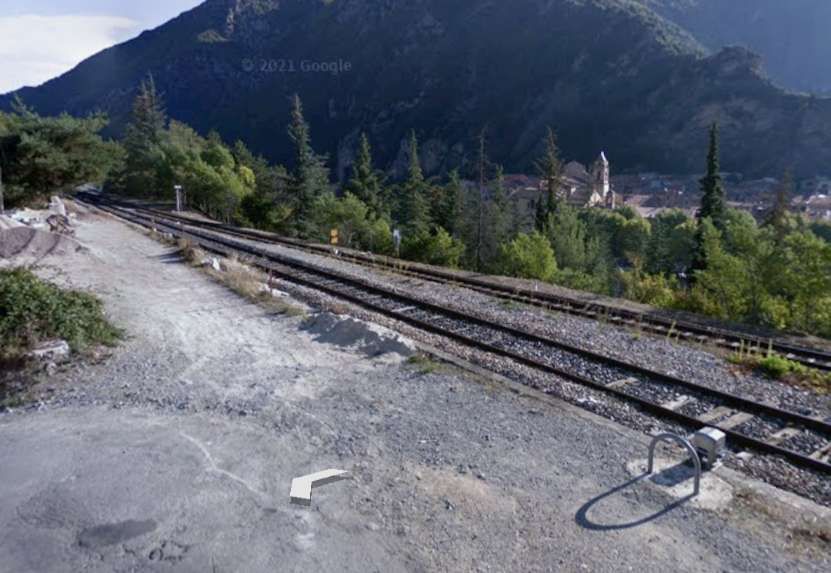
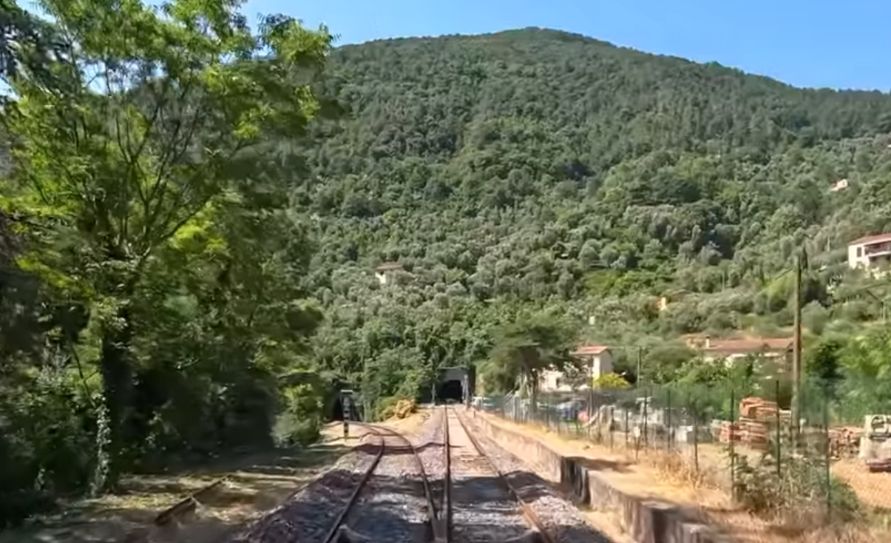
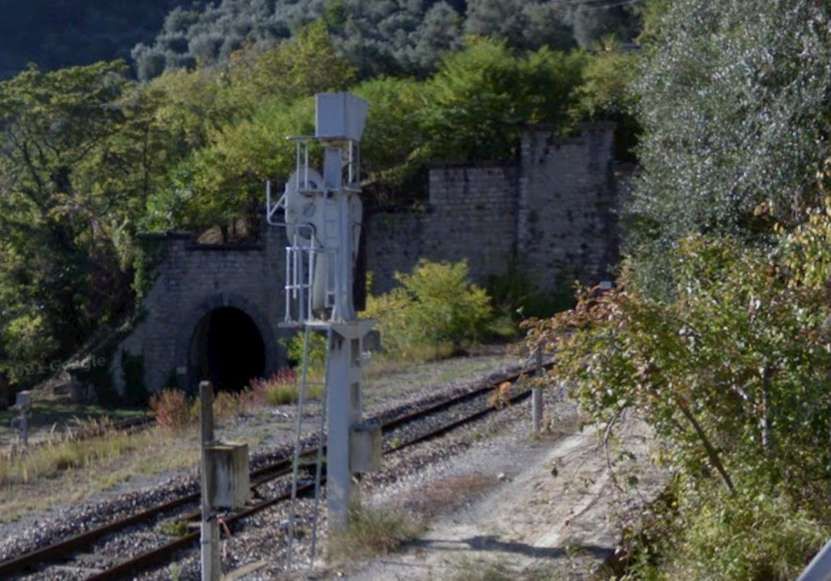
Tag Archives: Sospel

The Railway between Nice, Tende and Cuneo – Part 6 – Breil-sur-Roya to L’Escarene.

The featured image above shows an unidentified steam locomotive crossing the highly unusual Viaduc de Bevera. The train is heading toward Sospel.

In the first five articles about the line from Cuneo to the sea we covered the length of the line from Cuneo to Breil-sur-Roya and then to Ventimiglia. These articles can be found here, [9]  here [10] here, [11] here, [12] and here [13]

I want to acknowledge that a series of stills from a video of the train journey from Breil-sur-Roya to Nice have been used in this article. The video can be seen here. [4]

This article begins the journey from Breil-sur-Roya to Nice.

South of Breil-sur-Roya a junction allows direct access to Ventimiglia and to Nice. The map below shows the two routes as they existed prior to the alteration of the border between France and Italy after the Second World War.
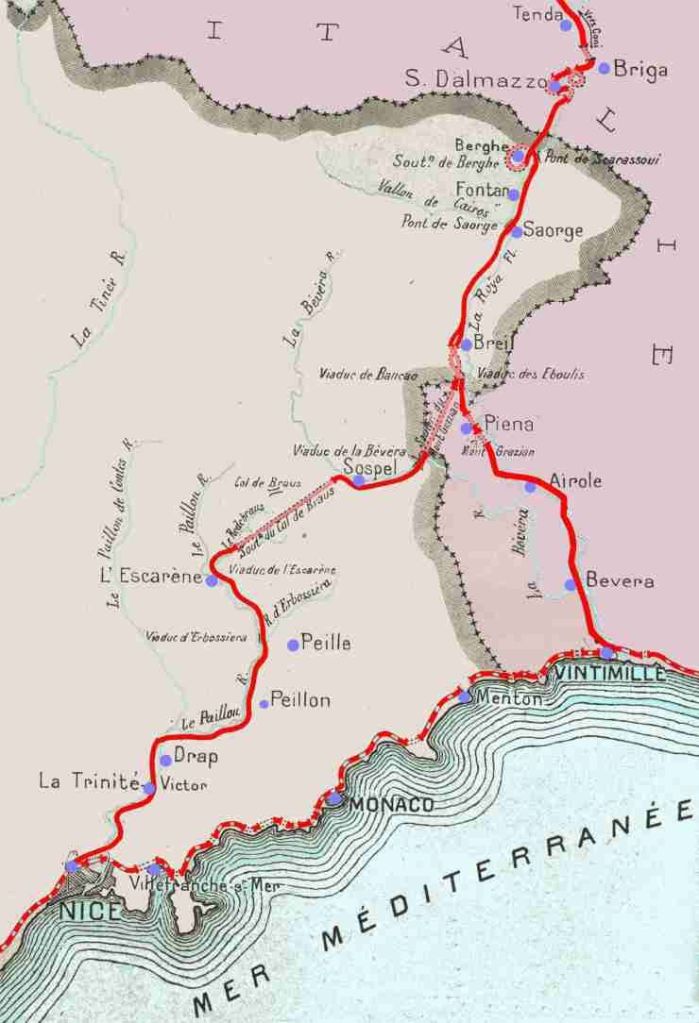
The lines Nice to Tende and Ventimiglia to Tende in the period from 1928 to the Second World War, before the annexation, in 1947, of St-Dalmas de Tende and Piene to France. [40]

The project was finally agreed by the PLM on 7th January 1907 but various portions of the work would be delayed by disputes relating to the transfer of land. “Acquisitions began in the suburbs of Nice in May 1907, at Saint-Roch … and Roccabiliera, where the PLM had decided to build a vast facility with a goods station, marshalling yard and engine depot to relieve congestion at Nice central station, whose rights of way, enclosed in the urban fabric, could no longer expand. This program for the redesign of Nice’s railway facilities also provided for a 3,610 m connection between the new Saint-Roch station, Riquier station and the port.  In the hinterland, events also began to take shape and in December 1908, a section of engineers set up in Fontan and undertook the first work along the Roya the following January.” [1: p90]

Banaudo et al continue: “In 1909, Chief Engineer Paul Séjourné (1851-1939), then fifty-eight years old and already renowned for his original designs for civil engineering structures, took over the direction of the construction department. The line from Nice to the Italian border would give him the opportunity to exercise his talent in the design of structures that were as daring as they were harmoniously integrated into the landscape.” [1: p90]

In this series of articles, we have already seen Séjourné‘s Scarassoui Viaduct spanning La Roya to the North of Breil-sur-Roya.
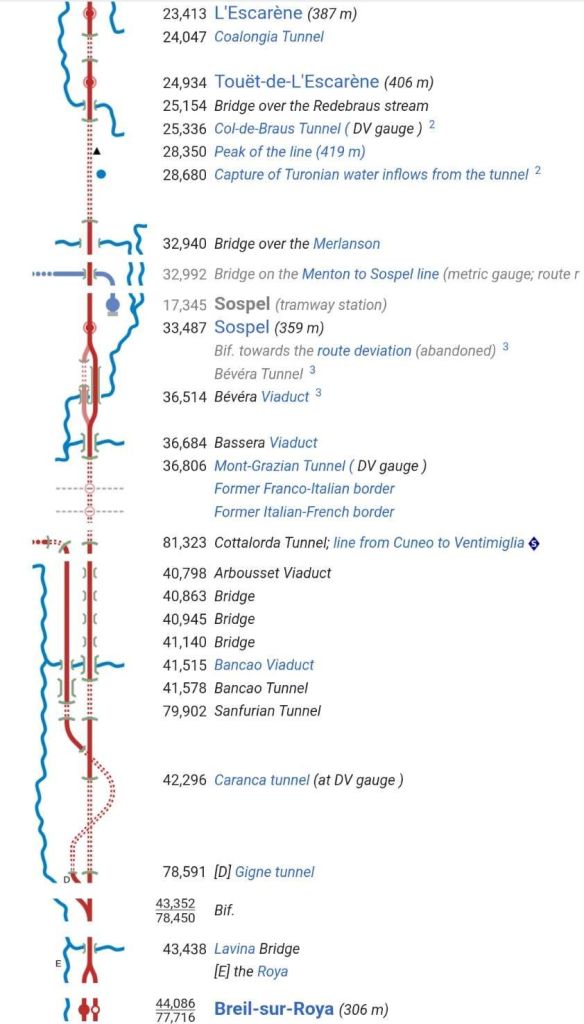
The line from Breil-sur-Roya to l’Escarene. [

This article follows the line South from Breil-sur-Roya to l’Escarene in two parts. The first from Breil to Sospel and the second from Sospel to l’Escarene.

1. The Line South from Breil-sur Roya to Sospel

Banaudo et al tell us that, “In December 1912, tranches 8 and 9 were awarded in turn for a length of 10,500 m from Sospel to Breil to the François Mercier company, of Moulins-sur-Allier.  The work included three tunnels with a combined length of 5,307 m, including the Mont Grazian and Caranca structures established at double-track gauge and equipped with defensive devices, as well as seven bridges and viaducts representing twenty-five masonry arches and two metal spans. Among them, the exceptional structure of the Bévéra viaduct. There were also three culverts and three level crossings in this section.” [1: p102-103]

Banaudo et al take up a significant part of Volume 1 of the story of the line with an album of photographs of the construction work on the French side of the border. [2: p152-331] A superb record of the work undertaken.

On the Sospel-Breil section of the line the contract works were gradually completed. By the end of 1921, the Bancao and Caranca tunnels were completed. The Mont Grazian tunnel was finished in 1923. The Bévéra viaduct’s abutments and masonry arch were ready by then and only awaited the delivery of the metalwork of the decking. [1: p141]
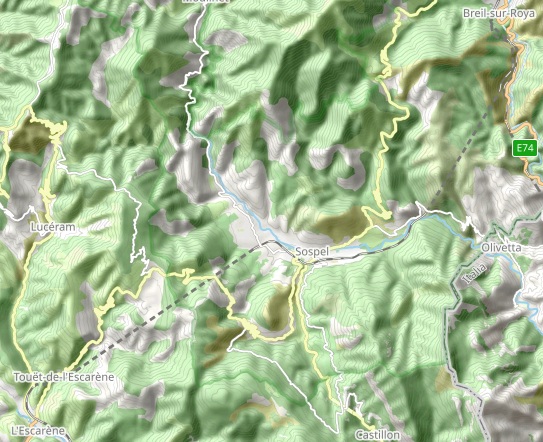
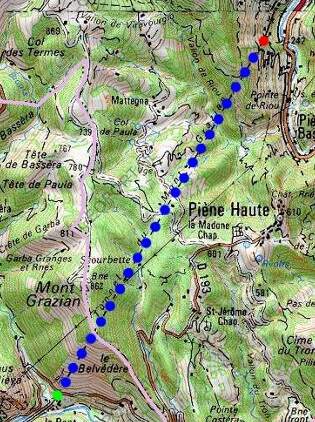
The length of the lien from Breil-sur-Roya (top-right) to l’Escarene (bottom-left). [8]

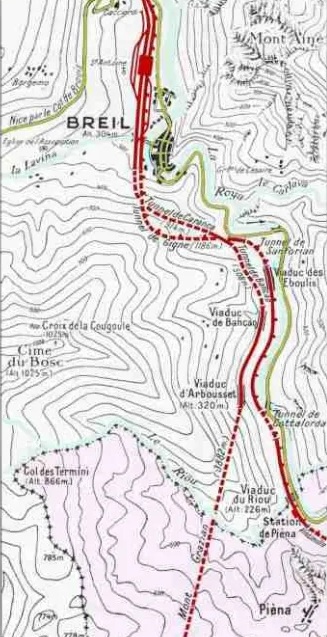
This drawing/map shows the two routes heading South from Breil-sur-Roya. [40]

As with the line immediately to the North of Breil-sur-Roya, the works to the South and Southwest were constructed by the French. Both of the lines heading South from Breil-sur-Roya entered tunnels just a short distance South of Breil.

The first length of the line South of Breil-sur-Roya is common with the line to Ventimiglia. The two lines separate at the Lavina bridge.
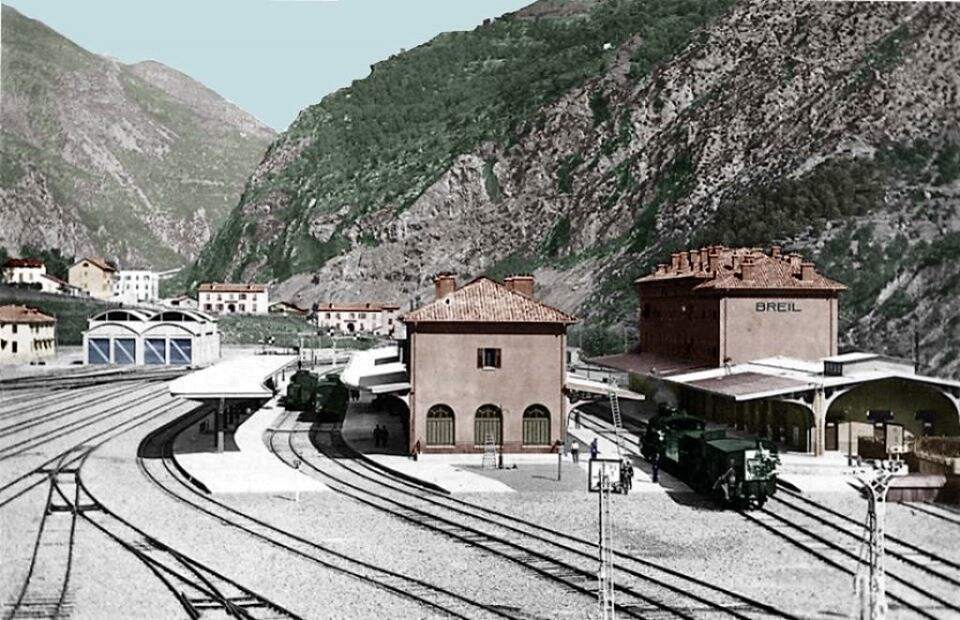
A colourised postcard view of Breil-Sur Roya Railway Station looking North through the station site in advance of the official opening in 1928. This colourised image was shared on the Stura-Cuneo Facebook Page on 20th February 2020, (c) Public Domain. [29]
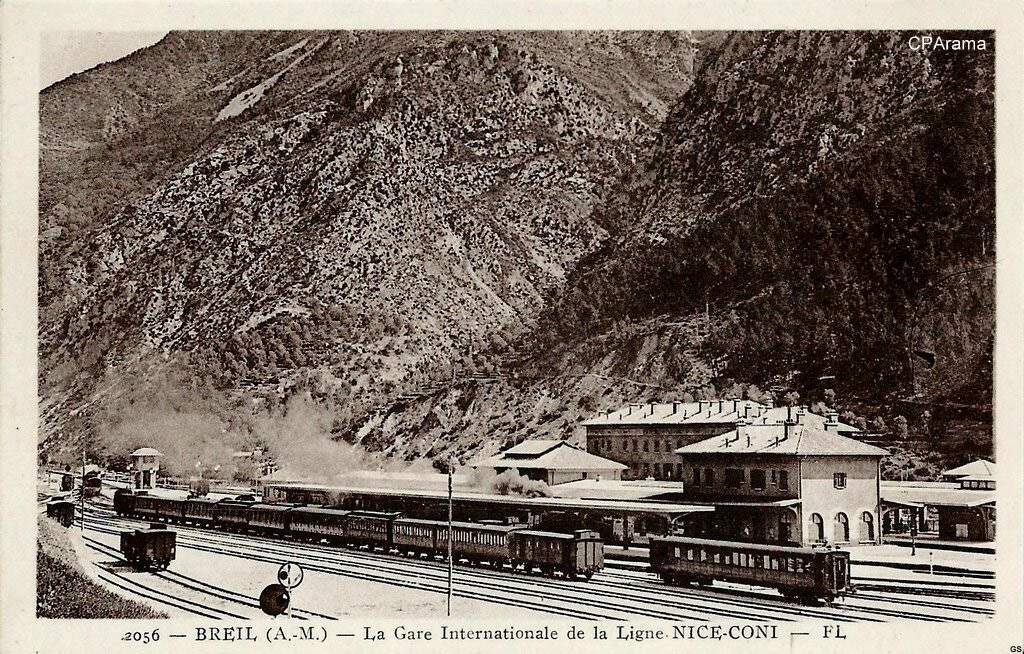
Breil-sur-Roya station during its very early operation (1928-35), before electrification, with numerous passenger carriages standing idle. The passenger building is in the background; in the foreground are the buildings on the second platform, the only ones today significantly reduced in height and length, publisher Frédéric Laugier, (c) Public Domain. [30]
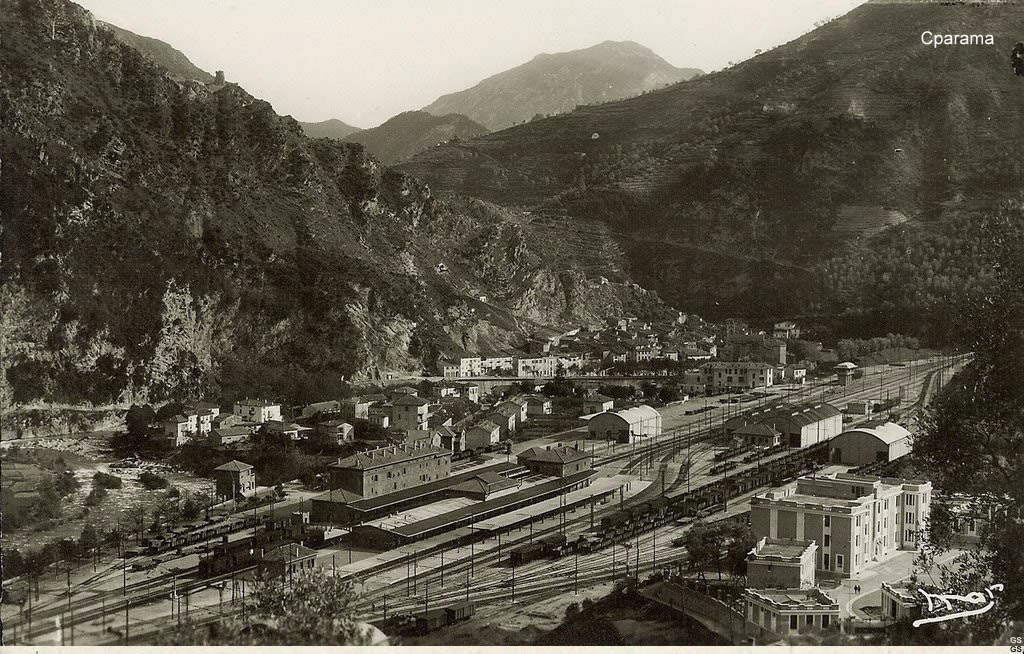
Breil-sur-Roya Railway Station at the height of its development, with electrification completed (1935), with the passenger building, the large freight yard filled with wagons, and the concrete sheds with arched vaults. Those in the background still exist but are used for non-railway purposes. The Breil Ecomuseum is now located on the north side, half-hidden by the foliage of the tree in the foreground. The photograph was taken from the hillside to the Northwest of the station site and faces Southeast, (c) Public Domain. [30]
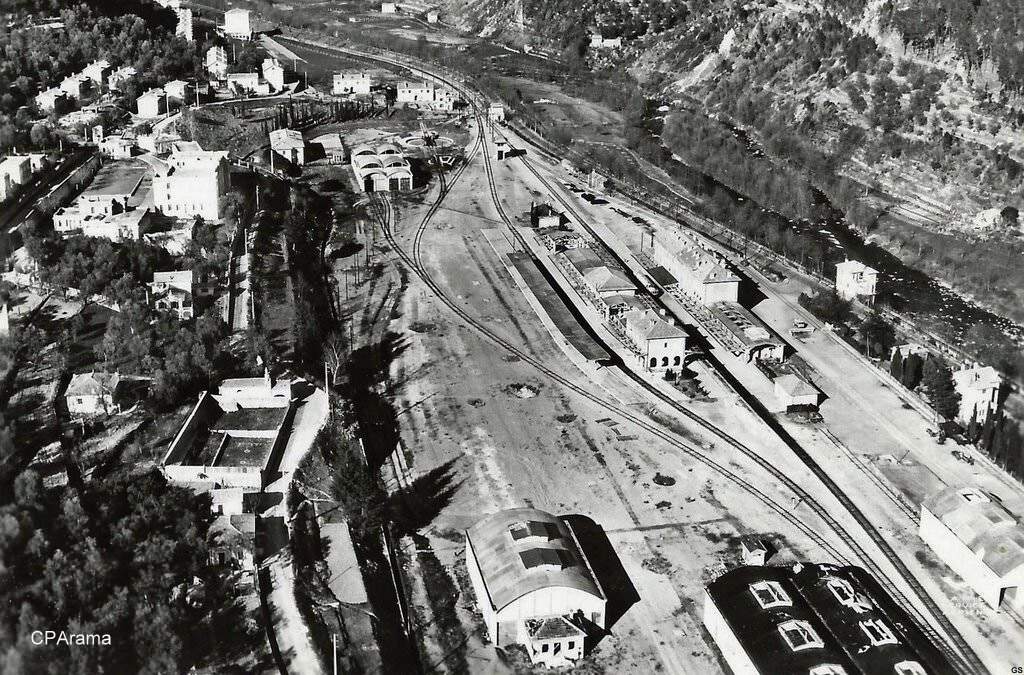
After the war, the line to Nice was reopened in 1947, but the station, reduced to the simple terminus of a secondary section, was greatly simplified, removing almost all the sidings (the long straight lines of which can still be made out). In the background, the line to Fontan still features the electrification poles (removed from the rest of the station), but it was naturally abandoned and remained there until its reconstruction in the 1970s. In the 21st century, platform 2, which had been removed at the time, has been restored, the buildings on the second platform have been scaled down, and the third platform has been eliminated. The turntable, which still exists, is part of the Ecomusée, publisher Lapie à Saint-Maur, 1955, (c) Public Domain.[31]
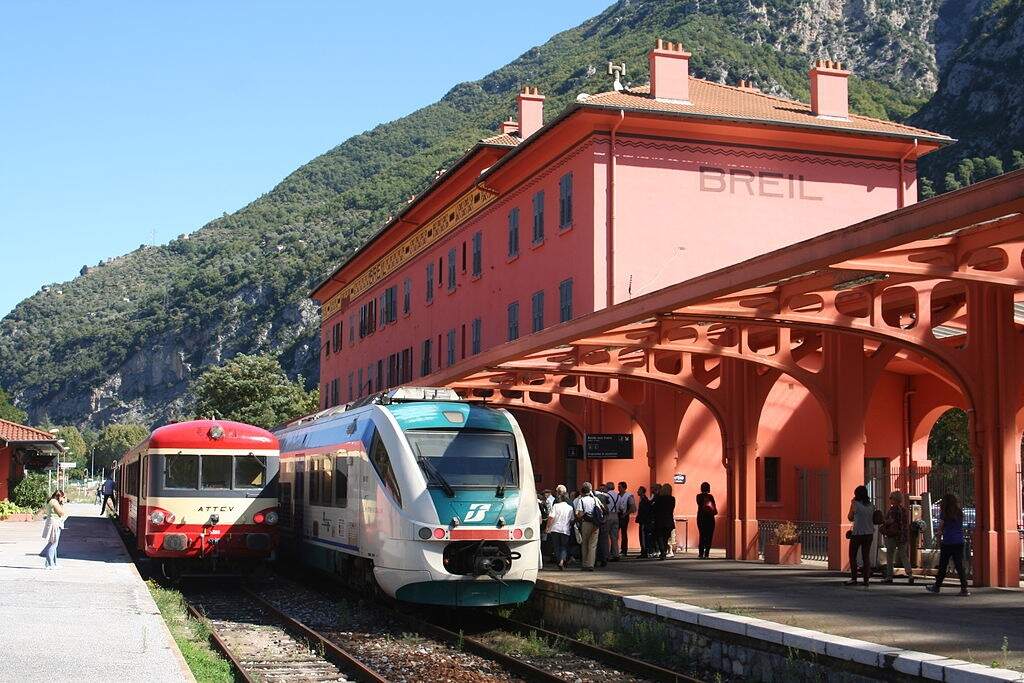
Breil-sur-Roya Railway Station in 2013, (c) Gilles Tagadaand licenced for reuse under a Creative Commons Licence (CC BY-SA 3.0). [32]
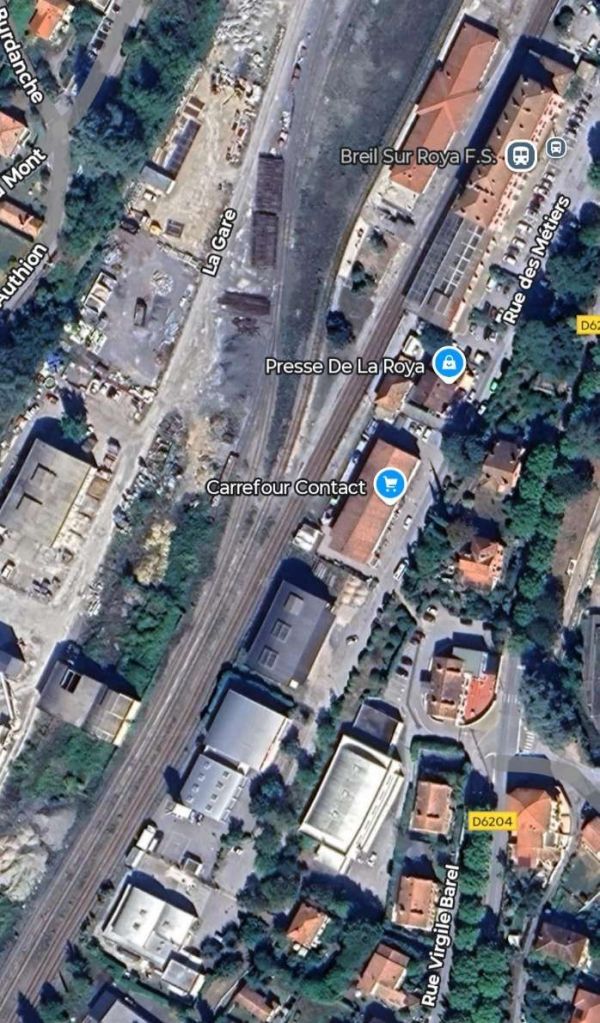
The southern end of the railway station site in Breil-sur-Roya. Two lines leave the station heading South-southwest. [Google Maps, August 2025]

The view from the cab of a Nice-bound service waiting to set off from Breil-sur-Roya. [4]

South of the station adjacent parallel bridges cross the Voie de la Première Dfl and Vallon de la Lavina (the Lavina Bridge).
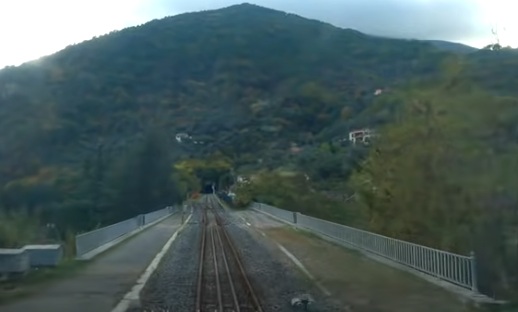
Lavina Bridge seen at rail-level from the cab of the Nice-bound train. [4]
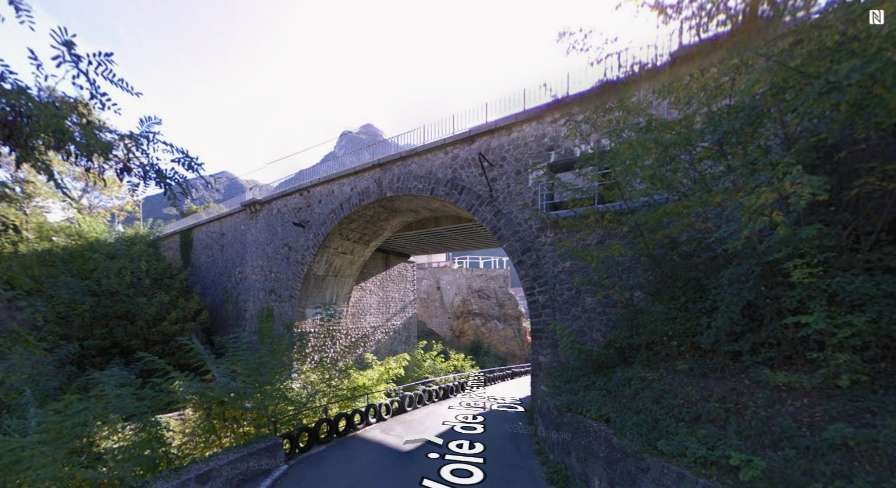
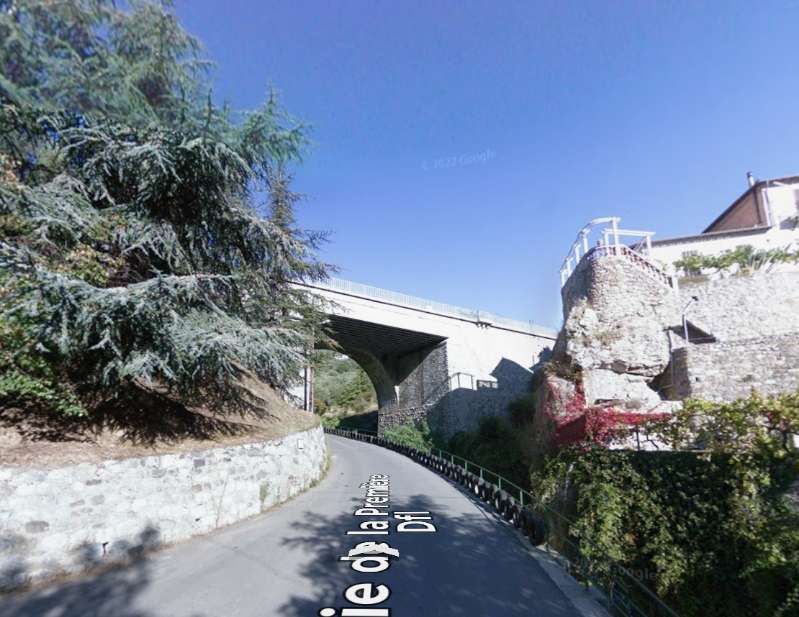
Looking East under the railway bridges (the Lavina Bridge) along Voie de la Première Dfl. [Google Streetview, October 2008]
Looking West under the railway bridges (the Lavina Bridge)along Voie de la Première Dfl. [Google Streetview, October 2008]

A short distance to the South the two lines can be seen to be separating both geographically and in level. This view looks Northeast with the station off to the left. [Google Streetview, October 2008]
The view South from the cab of a Ventimiglia-bound train. Again, the separation in level is quite marked. [55]

At the same location, this view looks Southeast. Both lines enter  a tunnel just to the South. One tunnel mouth is visible on the left of the image at a lower level. The other tunnel mouth is behind the vegetation on the right of this image. [Google Streetview, October 2008]

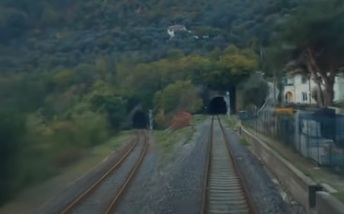
The two tunnel mouths seen from the cab of a Nice-bound service. [4]
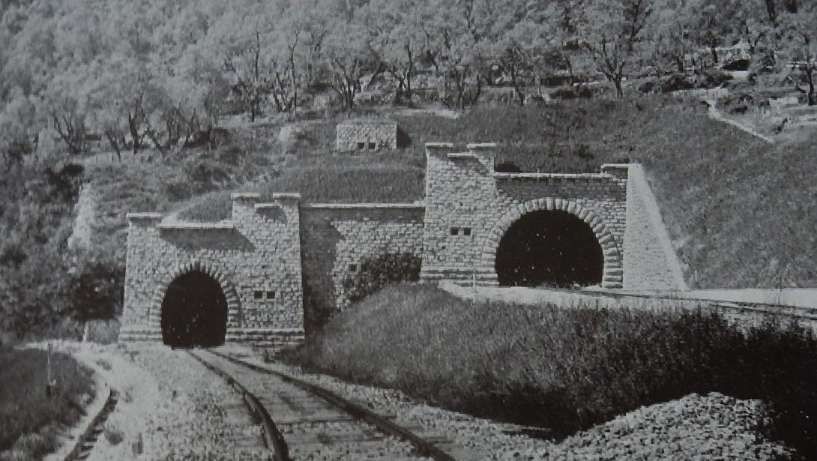
The two tunnel mouths. On the left, that of Gigne Tunnel, on the right, that of Caranca Tunnel. Left for Ventimiglia, right for Nice! The whole structure is provided with a series of small openings to facilitate the holding of the tunnels in the event of war. [17]

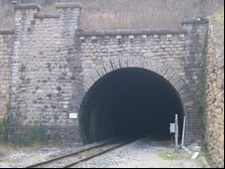
Caranca Tunnel North Portal prior to vegetation growth. The tunnel was built to accommodate double-track to allow for possible future growth in traffic. [20]
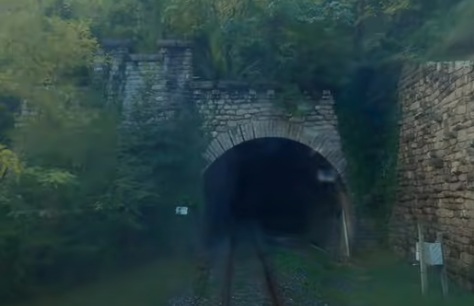
The North portal of Caranca Tunnel in the 21st century (915 metres long). [4]
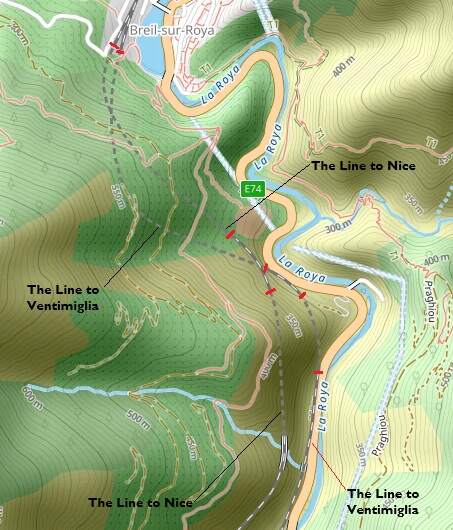
This extract from the OpenStreetMap mapping shows the close correlation of the two different routes over the first fe kilometres. The short red lines are the locations of tunnel mouths. [14]

The route of Caranca Tunnel crosses twice over the Gigne Tunnel which is on the Ventimiglia line. The lines to both Nice and Ventimiglia are shown as dotted lines when in tunnel. [1: p126]
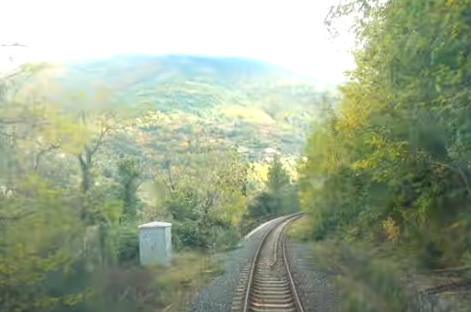
Nice-bound trains exit Caranca Tunnel heading Southeast. This is the view from the cab of a Nice-bound train. [4]
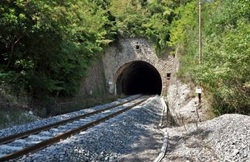
Turning round to face the Tunnel portal, this is the Southeast portal of Caranca Tunnel. [20]
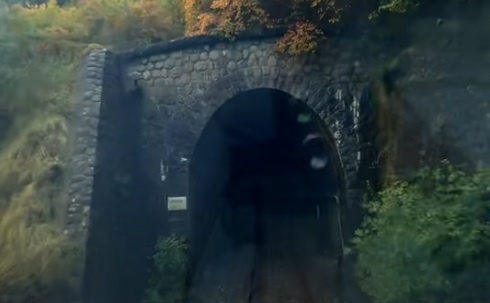
The next tunnel is Tunnel de Bancao (508 metres long). This is the North portal of the tunnel. [4]
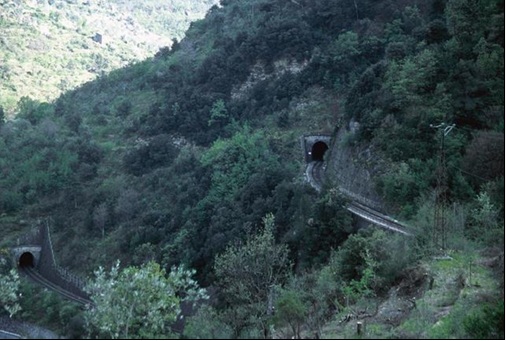
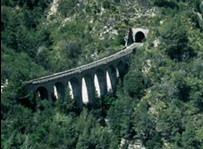
The North Portal of Bancao Tunnel is at the higher level. the lower tunnel mouth is that o Sanfurian Tunnel. [19]

The South portal of Bancao Tunnel gives way onto Viaduc Bancao. [19]
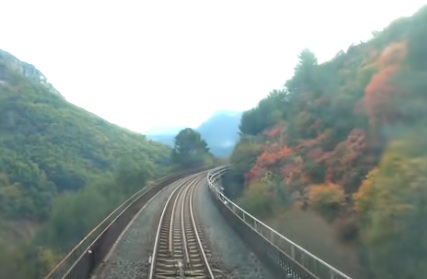
The line leaves Bancao Tunnel and immediately crosses Bancao Viaduct. [4]
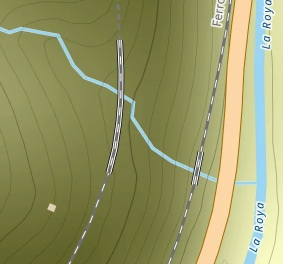
Bancao Viaduct on the line from Breil-sur-Roya to Ventimiglia is a single span arch close to the D6204 on this extract from OpenStreetMap. The line to the West is the line we are now following from Breil-sur-Roya to Nice which is at a much higher level and its viaduct is a multi-span structure. [15]
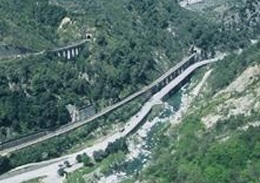
Both the Nice line and the Ventimiglia line can be seen in this image. That to Nice is at the higher level. The longer viaduct at the lower level is Viaduc Eboulis. Viaduc Bancao is at the higher level. [18]
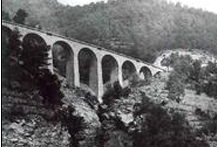
An earlier monochrome view of Viaduc Bancao. The viaduct has eight 9 metre arches. [18]
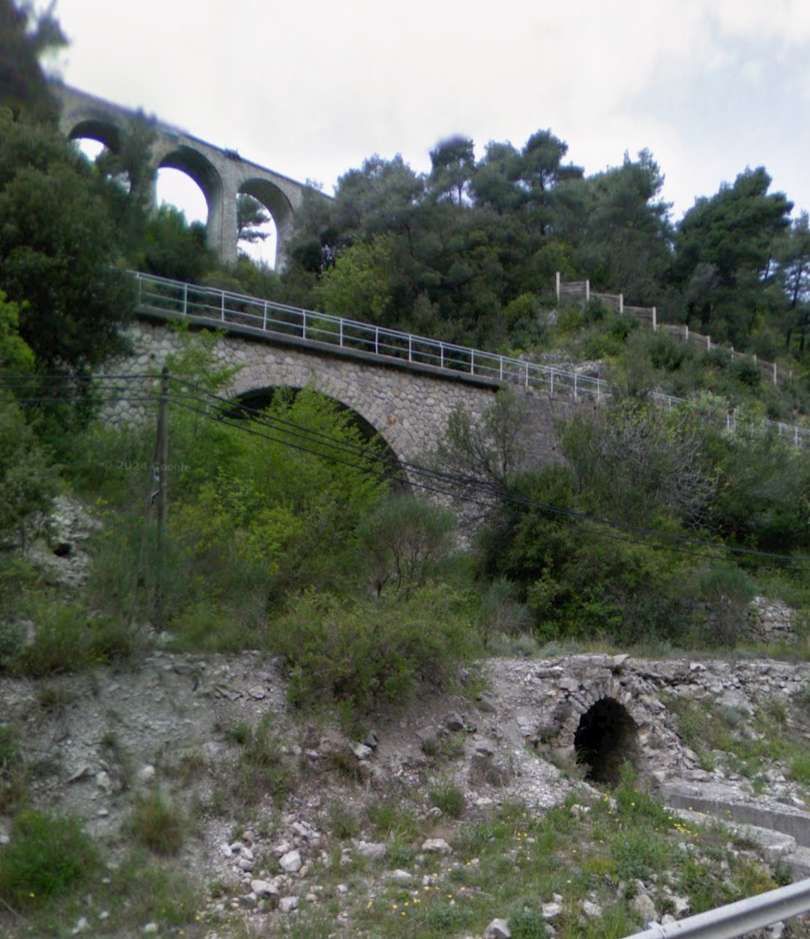
Looking West from the D6204/E74, a small culvert close to the road is dwarfed by the bridge carrying the line to Ventimiglia which in turn is dwarfed by the viaduct carrying the line to Nice. [Google Streetview, April 2008]

Viaduc de Bancao on the Nice to Breil-sur-Roya line appears, in part, at the top of this image.

The two rail lines are still running in parallel, only beginning to separate significantly at the bottom of this extract from Open StreetMap.

The line we are following enters the Mont Grazian Tunnel, bottom right of this OpenStreetMap extract. [16]

Before the Tunnel three structures are crossed – two 10 metre-span arched bridges and then Viaduc d’Arbousset none of the three are marked on this map extract. The Viaduct sits at the point where the line which has been curving round to the South begins to turn to the Southwest, just before entering Mont Grazian Tunnel. [16]
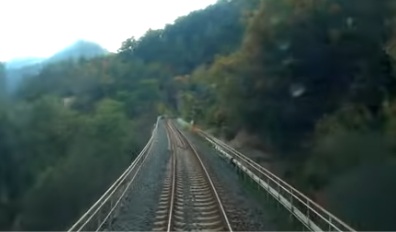
Viaduc d’Arbousset (63 metres long with three 7 metre arches). Ahead the line curves to the right and enters Mont Grazian Tunnel. [4]

The Northeast portal of the Tunnel de Mont Grazian, seen from the cab of a Nice-boud train. [4]

The Mont Grazian Tunnel was built wide enough to accommodate double-track to allow for possible future traffic growth. “It was lined with defensive measures at both ends, a precaution imposed by the major strategic importance of this structure, which connects the Roya and Bévéra valleys.” [1: p94] Details of the defensive measures can be found here. [27]
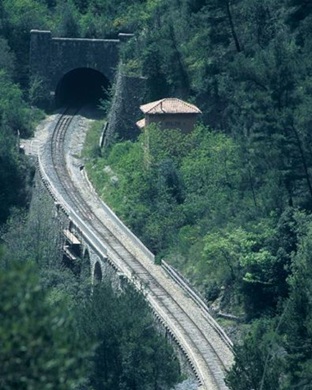
The Northeast portal of Tunnel de Mont Grazian. This view from above shows the Viaduc d’Arbousset and the high retaining wall on the right of the mouth of the tunnel. [27]
Tunnel de Mont Grazian is 3891 metres in length. [27]
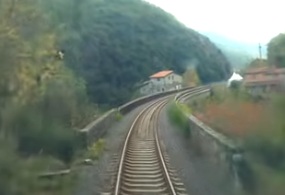
The view Southeast from the cab of the Nice-bound service as it leaves the tunnel mouth. A very short distance beyond the tunnel mouth the line crosses Viaduc de Bassera. [4]
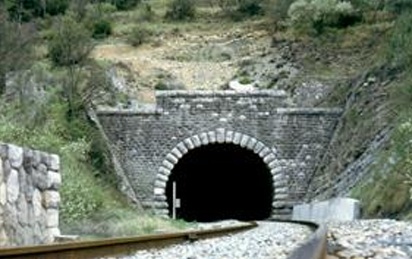
Turning through 180, the Southwest portal of the Tunnel de Mont Grazian. [27]
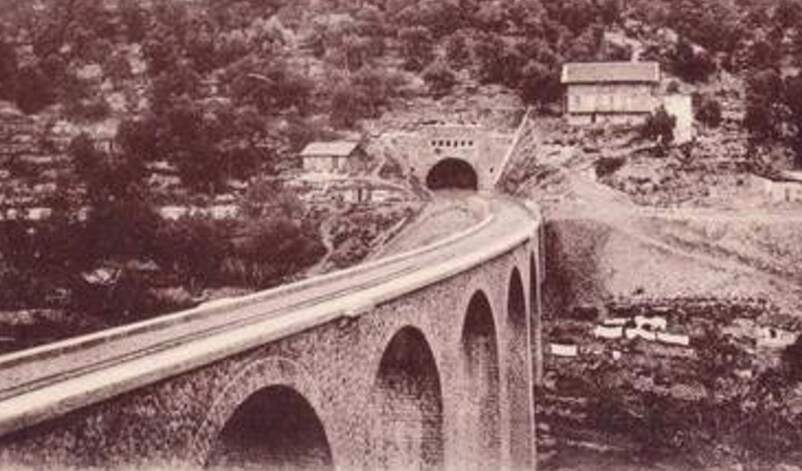
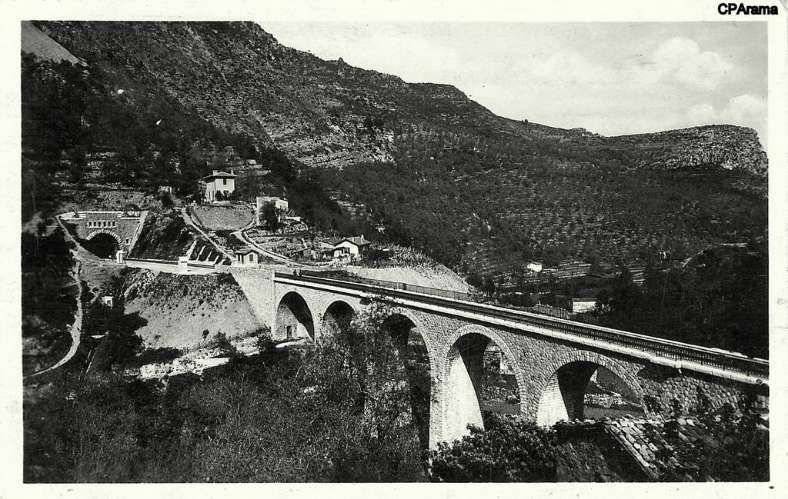
The Southeast portal of the Mont Grazian Tunnel before the opening of the line in 1928. Viaduc de Bassera is in the foreground. There are detailed differences between the appearance of the tunnel entrance in this view and the photograph of the entrance above. As part of the Maginot strategic defence plan for the SFAM (Alpes Maritimes Fortified Sector) the Southeast portal of Mount Grazian Tunnel had fortified side chambers with loopholes overlooking the tunnel to guard against enemy incursion. More details can be found here. [27]
A different postcard view of the Bassera Viaduct and the tunnel mouth of the Mont Grazian Tunnel. [46]

The Bassera Viaduct is curved with seven 12-metre arches and crosses the Basséra River.
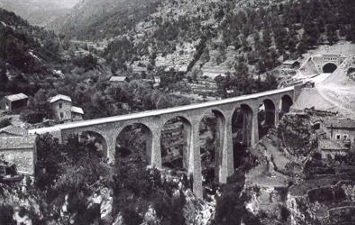
A broader view of the Viaduc de Bassera at the time of its construction, (c) Public Domain. [23]
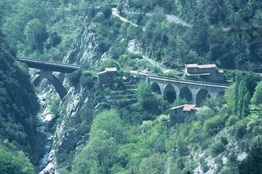
In this image, Viaduc de Bassera is on the right and Viaduc Cai (over the River Bevera) is on the left. [23]
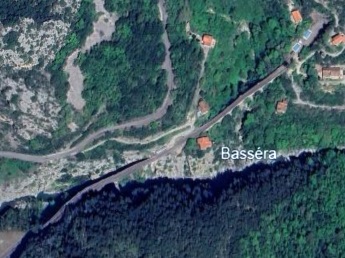
The two bridges as seen on Google Earth. [Google Earth, August 2025]

The original bridge over the Bevera (Pont de Cai) which was built in time for the opening of the line in 1928. More details can be found here. [24]
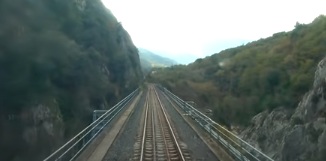
A very short distance beyond the end of Viaduc de Bassera, the line crosses the River Bevera on another viaduct – Viaduc Cai. [4]
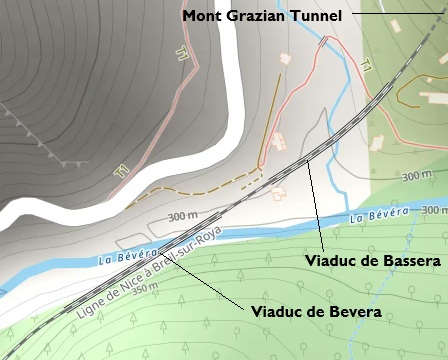
This extract from OpenStreetMap illustrates the proximity of the two viaducts and Mont Grazian Tunnel. [22]
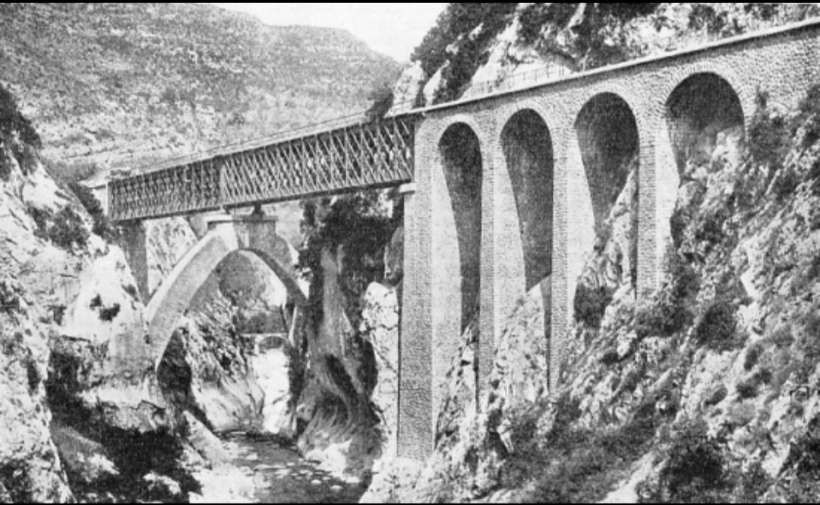
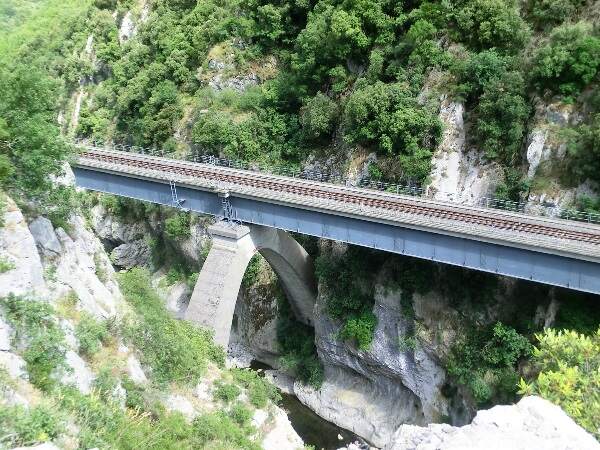
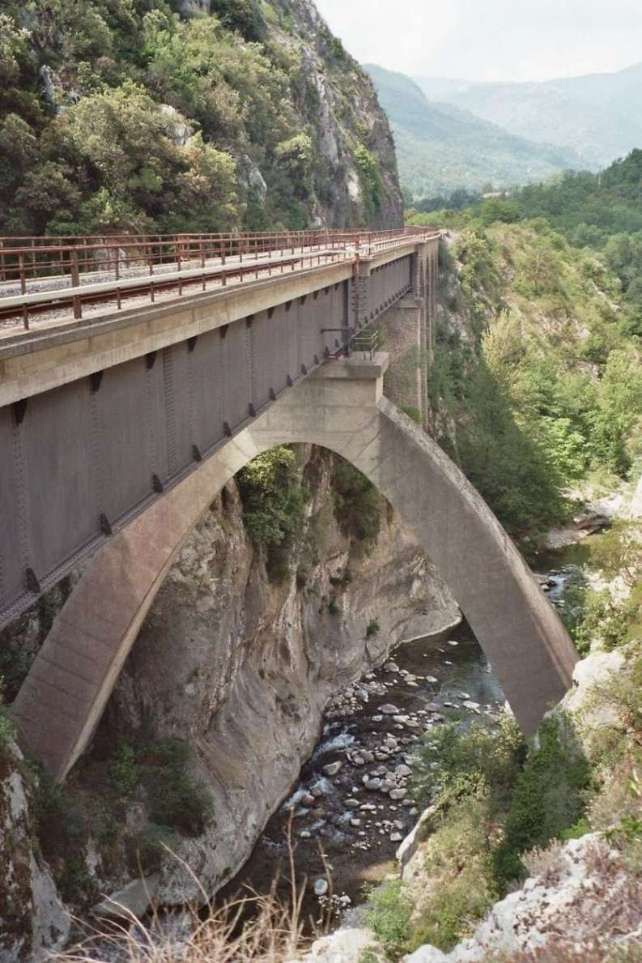
The Bevera viaduct was of unusual construction. It consisted of four masonry arches, each of 26 ft span, and of two steel girder spans, each 150 ft long. These steel girders are, as can be seen, supported in the centre by a single masonry arch set at right angles to the axis of the bridge, and crossing the gorge. [25]
The Bevera Viaduct was rebuilt in the 1960s. [ID: 355520] Bévera Viaduct (Pont de Caï) (© Eugenio Merzagora, 25 June 2021, Structurae License (non-commercial use). [21]

The Bevera Viaduct was an ingenious design solution to the need to thread the line through the narrow Bevera Gorge to the East of Sospel. Engineer: Paul Séjourné, © Markus Schweiss and licenced for reuse under a Creative Commons Licence (CC BY-SA 3.0). [26]
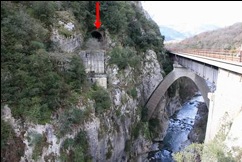
Due to its proximity to the Italian border, this unused tunnel (marked with a red arrow) was built for strategic reasons as part of the Maginot Plan for the defense of the SFAM (Fortified Sector of the Alpes Maritimes). [28]

It was intended to provide an emergency route in the event that the large neighboring Caï viaduct needed to be destroyed, and to store the metal spans of a replacement viaduct. [28]
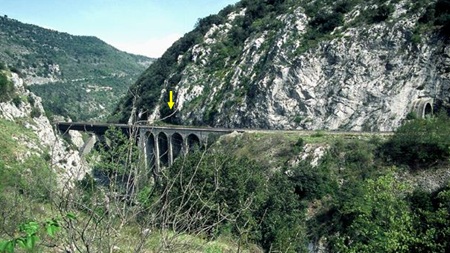
Halfway along its length, on the left wall, it has an annex gallery (tunnel window – marked by the yellow arrow) which opens onto the western abutment of the Caï viaduct. More information can be found here. [28]

The Bevera River flows West to East (its confluence with La Roya (Roia) is adjacent to the village of Bevera which sits on the North bank of the Bevera River). Once across the Bevera River on the Cai Viaduct, the line heads up a gradient of 17 mm/m to Sospel Railway Station.

The route of the line between Breil-sur-Roya and Sospel was determined by the military. The military authorities dictated that the line should be routed to ensure that it could “be easily intercepted by the artillery of The Barbonnet fort, above Sospel, in the event of an infiltration attempt from the Roya valley.” [1: p92 & 94]

The Cai or Bevera Viaduct “crosses the river at a very acute angle. [This] inspired an original arrangement by Paul Séjourné: the deck, formed of two metal spans of 45.30 m, framed by four masonry arches of 8 m, rests 30 m above the river on a perpendicular arch of 25 m opening and egg-like in shape, resting transversely on the walls of the gorge.” [1: p94]

The line follows the valley side to the South of the Bevera rising, as we have already noted at a gradient of 17 mm/m. It crosses a minor road by means of a level crossing (Route de Suez).
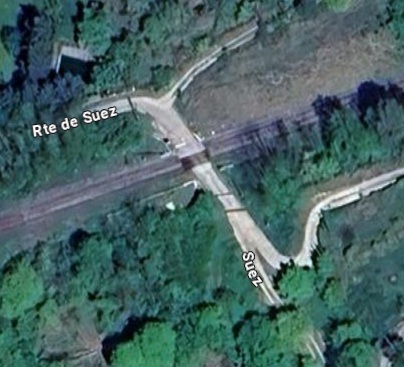
The level crossing at Route de Suez, seen from above. [Google Maps, August 2025]
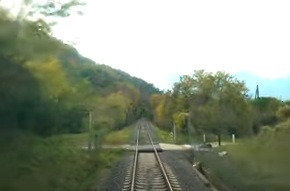
The level crossing at Route de Suez seen from the cab of a West-bound train. [4]
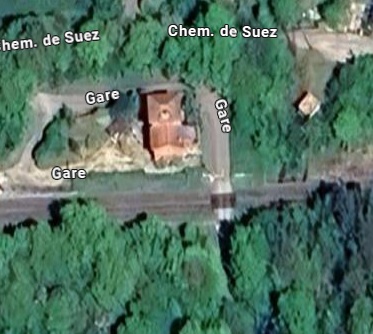
The next level crossing on the line is immediately at the East end of Sospel Railway Station site. [Google Maps, August 2025
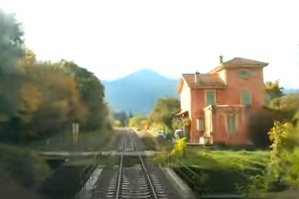
The same crossing seen from the cab of the Westbound train approaching Sospel Railway Station. [4]
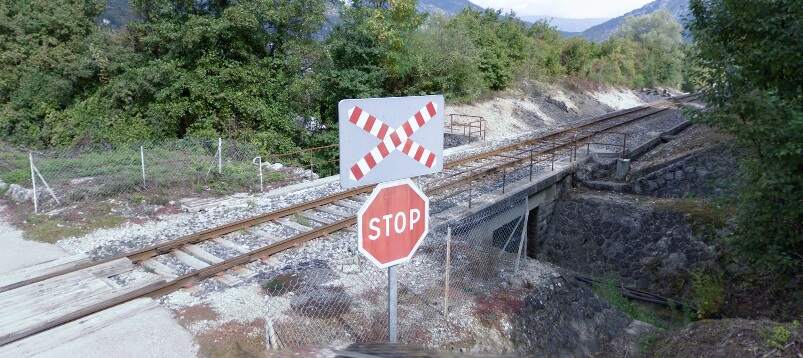
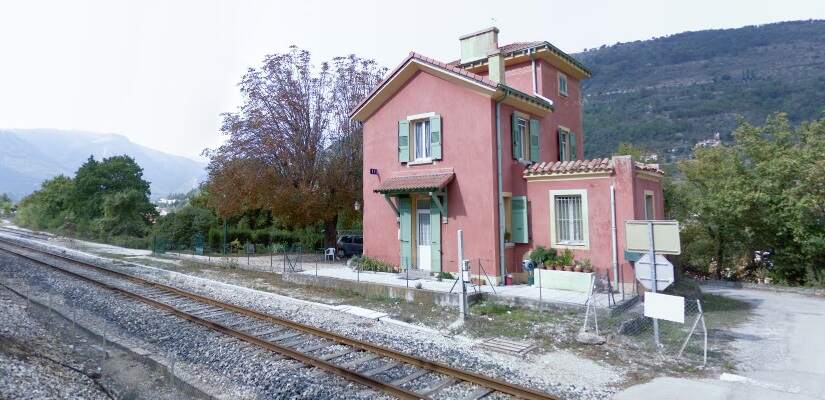
The road crossing of the line (seen from the South) is on the left of this image. The track to the right heads back towards the Viaduc de Cai. A small culvert can be seen alongside the road at this location. [Google Streetview, October 2008]
The road crossing of the line (also seen from the South) is on the right of the image. The track to the left heads into Sospel Railway Station. [Google Streetview, October 2008]

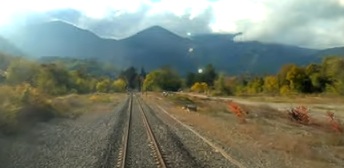
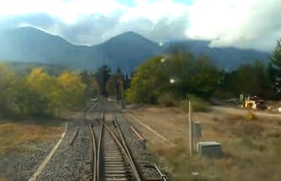
Further West and fully within what was the station site but which in the 21st century is an open plateau of unused land. [4]
The station passing loop seen at its eastern end from the cab of the Westbound train. [4]
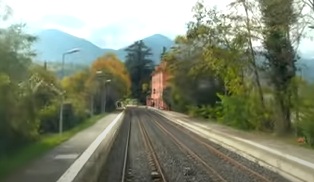
The final approach to Sospel railway Station from the East. [4]
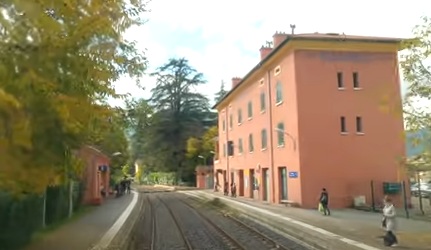
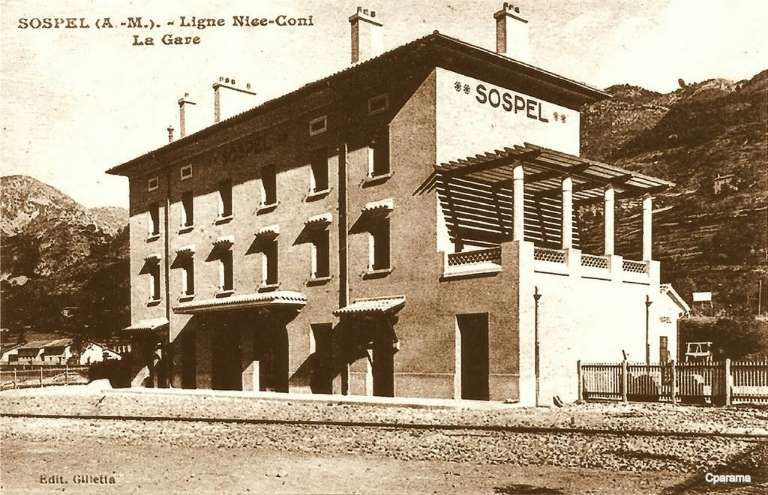
Sospel Railway Station. [4]
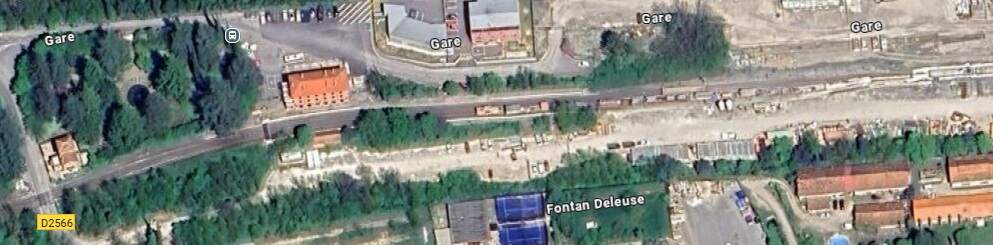
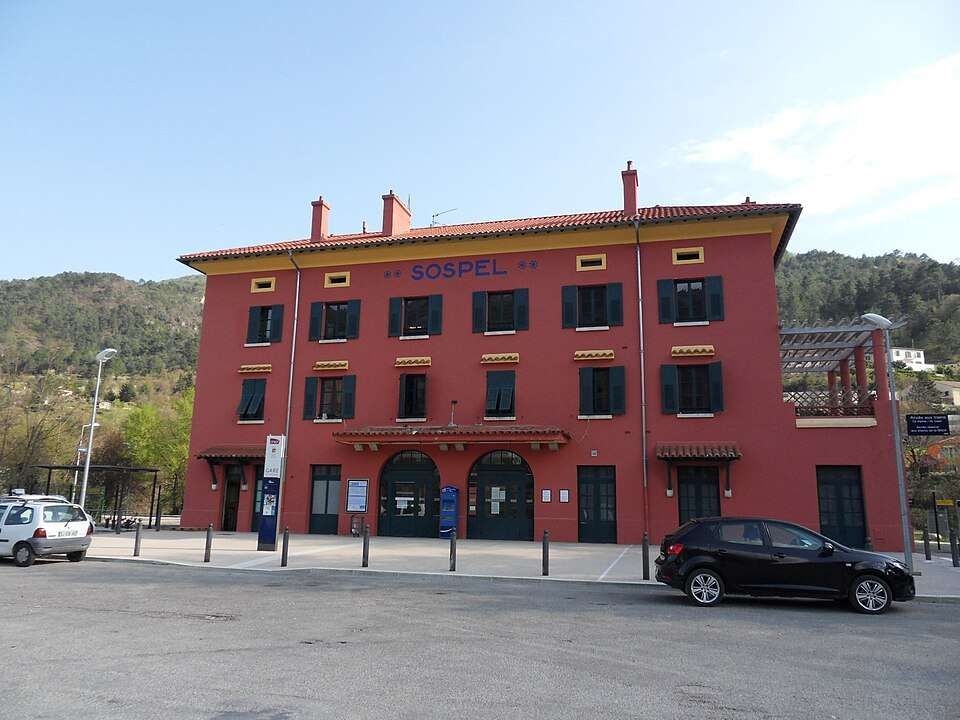
Sospel Railway Station, seen from above. [Google Maps, August 2025]
The station and forecourt at Sospel, © G CHP and licenced for reuse under a Creative Commons Licence (CC BY-SA 2.5). [29]
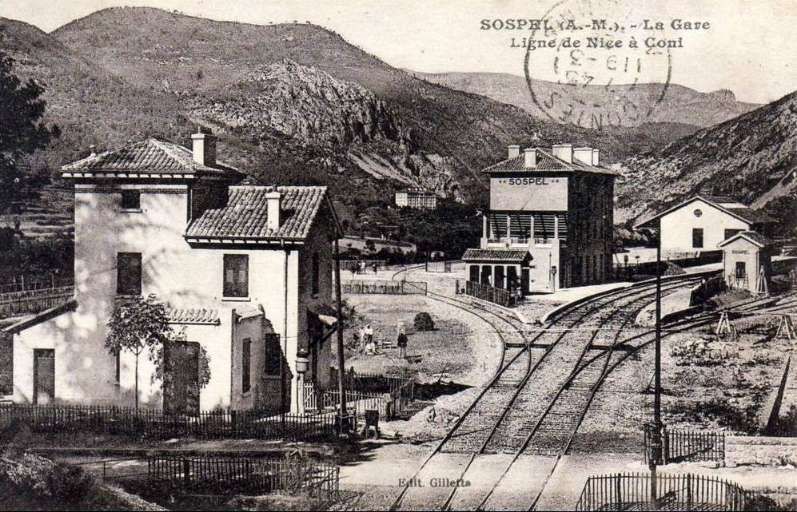
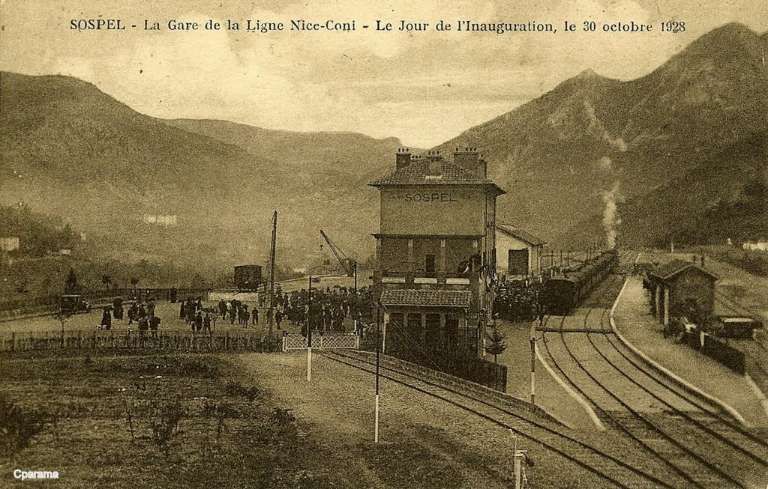
A similar view from the early 20th century, of the station building at Sospel. [45]

Sospel Railway Station was to be a station “with substantial facilities which would allow the reception of military convoys in the event of conflict with neighboring Italy.” [1: p92] Arriving on Sospel, trains from Breil-sur-Roya pass through a large flat open area which was designed to accommodate the needs of the military.

The town was, in the middle of the 19th century, the second city of the County of Nice. “The location of Sospel … in … a basin where the Bévéra Valley widens, is very unique. From wherever one arrives from France, one must cross a pass: the Braus pass coming from Nice, the Castillon pass towards Menton, the Brouis pass towards Breil and La Roya, and the Turini pass towards La Bollène and La Vésubie. Towards Italy, the Vescavo Pass road connects Piena and Olivetta, while downstream, the Bévéra flows in impassable gorges where one could only venture on foot.” [1: p101-102]

The year 1912 was quite momentous in the history of Sospel not only was construction work getting underway but on 15th April 1912 the Compagnie des Tramways de Nice et du Littoral (TNL) opened its Menton-Sospel tramway. More about the tramway can be found here, [36] here [37] and here. [38]
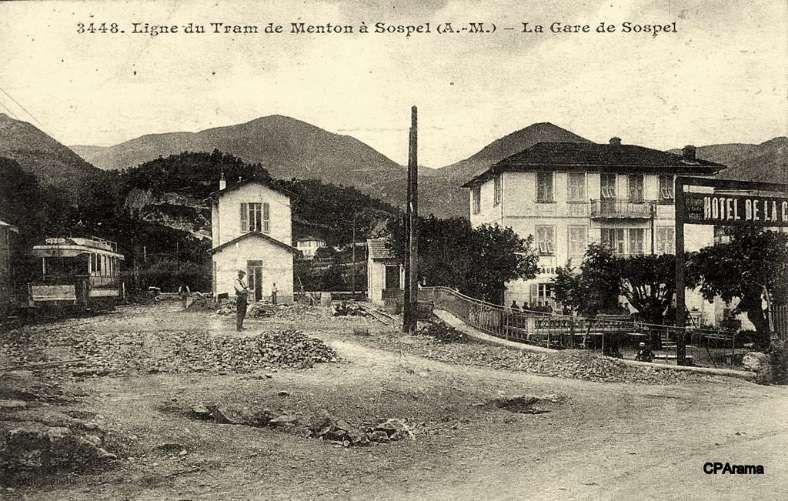
Closer to the centre of Sospel, this is the terminus of the Menton-Sospel Tramway. [46]

Banaudo et al comment that “The Gianotti company immediately took advantage of this opportunity to transport the tools and equipment from Nice that would be used for the construction of the Braus tunnel. … In the initial stages of the construction, the Gianotti brothers used a network of portable 0.60 m gauge railways, on which Decauville dump trucks pulled by horses ran.  Later, one-metre gauge tracks were laid, on which steam locomotives pulled larger capacity trains, consisting of Koppel wagons with a load of 6 m³ or wooden-bodied wagons with a capacity of 3 m³. Several locomotives from the contractor were brought to site via the tramway, coupled to a ‘mortrice electrique’ (an electric tram engine) as a safety measure on the steeply graded tramway.” [1: p102]

In the early months of 1913, the Mercier company got to work and obtained permission from the TNL company to open a special branch line at each end of the Menton-Sospel tramway line. The construction site’s supplies then provided the tramway with more than half of its freight traffic. In July 1913, two to three round trips ran daily, and in October, Mercier received 745 tons of materials in Sospel. In May 1914, the Gianotti brothers opened their own branch line in the Careï Valley in Menton, but soon, the saturation of the small freight yard and insufficient equipment forced the TNL to limit shipments to five wagons per day.” [1: p103]

2. Sospel to l’Escarene

The journey from Sospel to l’Escarene takes the line through and under the mountains of the Col de Braus.

The line climbs through a series of embankments and cuttings on a gradient of 9.5 mm/m and enters the Tunnel de Braus.It continues to climb within the tunnel to a high point of 420 metres above sea level. Within the tunnel the gradient then changes to a 2 mm/m downward grade towards l’Escarene. The tunnel was double-track both to aid ventilation and to allow for possible expansion of services if demand required it. At the insistence of the military defensive fortifications surrounded the two tunnel mouths. [1: p92]

Of the 12 tranches of contract work on the French side of the international border, two tranches covered the 9.7 km length between Sospel and l’Escarene – lots 6 and 7. The work was awarded in December 1911 and April 1912 to Jean and Antonin Gianotti. Banaudo et al tell us  that the work included over 6.4 km of tunnel. “As well as a few secondary structures: three culverts, four level crossings, two underpasses and six overpasses, most of which were built using the new reinforced concrete technique.” [1: p101]

After waiting for a Breil-sur-Roya-bound service to clear the line ahead, we set off in a Westerly direction from the station at Sospel.
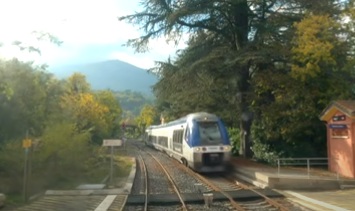
A Nice to Breil-sur-Roya service arriving at Sospel. [4]
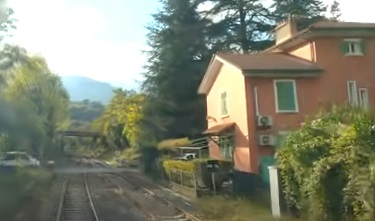
As the Nice-bound train sets off from Sospel Station it crosses Rte d’Erc at a level-crossing. [4]
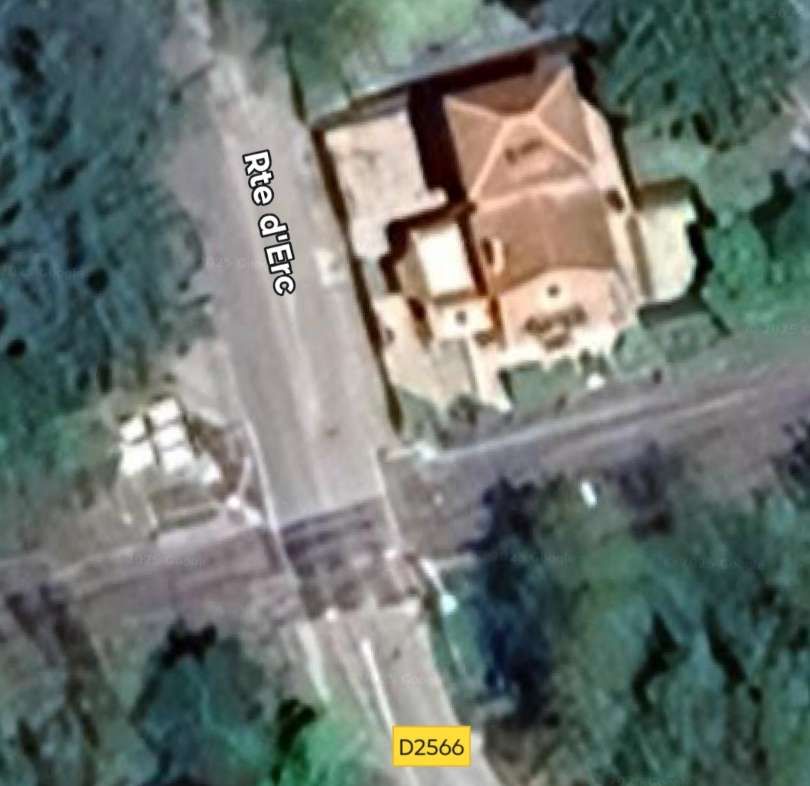
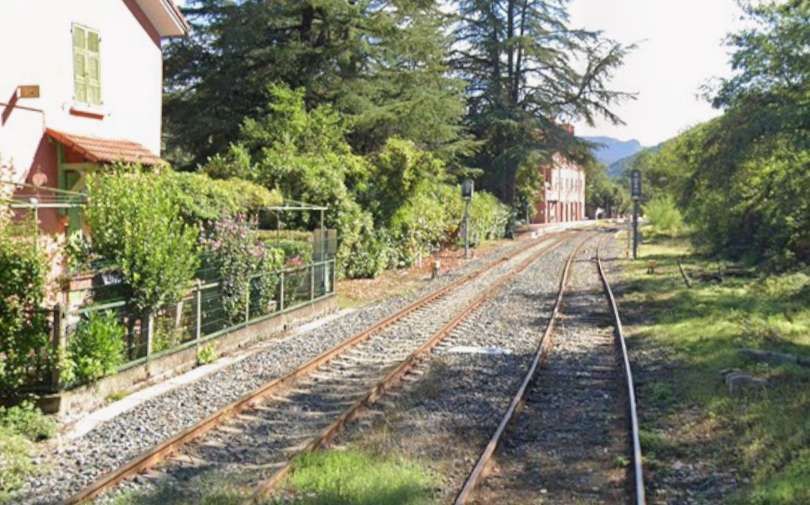
Rte d’Erc crosses the railway at the West end of the Sospel Station site. [Google Maps, August 2025]
Looking back East towards Sospel Railway Station. [Google streetview, August 2022]
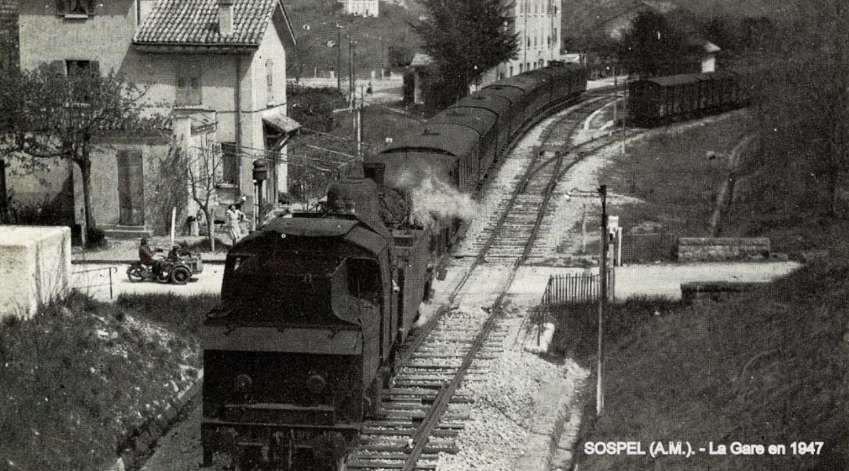
A departure for Nice in 1947. The steam locomotive has just crossed the level-crossing over Rte d’Erc. [47]
A similar view looking back East towards Sospel Railway Station from close to the level crossing featured above. [44]
A view from the railway house which sits beside the level-crossing which shows Sospel Railway Station in very early days! [45]
Looking ahead along the railway towards l’Escarene (on the left of this post and image), the town of Sospel is laid out in front of the camera. In the text of this article we mention the use of concrete on the line. Two bridges of reinforced concrete construction can be seen on the left of this image. [46]
Looking West towards the bridge carrying Mnt des Capuchins over the railway. The station passing loop ends just to the West of the Rte d’Erc level crossing. [Google Streetview, August 2022]

A closer view of the bridge carrying Mnt des Capuchins. [4]
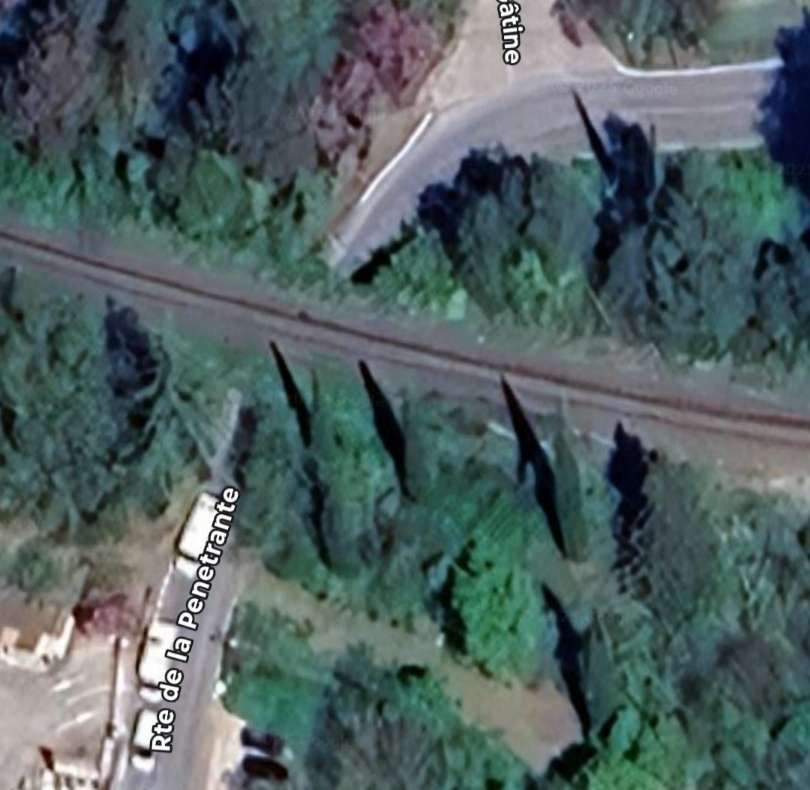
Rte de la Penetrante passes under the railway. [Google Maps, August 2025]
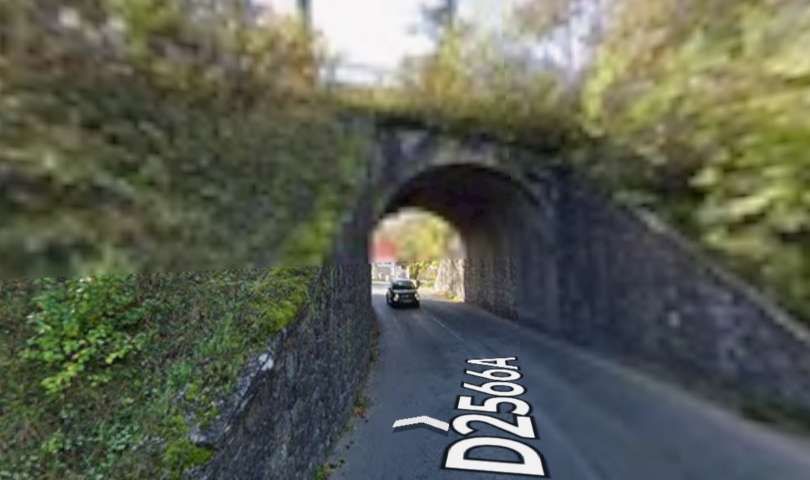
Rte de la Penetrante (D2566A) is crossed by means of a stone arch bridge. This is the North elevation of the structure. [Google Streetview, October 2022]
The South elevation of the same structure. [Google Streetview, October 2022]
Chemin de la Saint-Roch bridges the line a short distance further West. [Google Maps, August 2025]

The bridge carrying Chemin de la Saint-Roch over the line as seen from the cab of a Nice-bound train. [4]
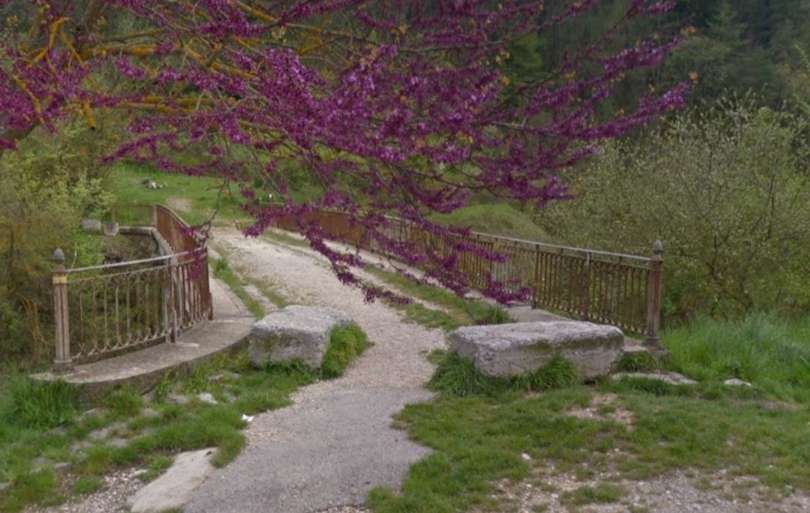
The overbridge carrying Chemin de la Saint-Roch, seen from the North. [Google Streetview, April 2013]
Looking back along the line towards Sospel Railway Station. [39]

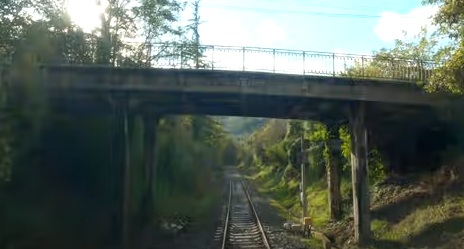
The next overbridge carries the D2204 (boulevard de l’Egalite over the line. [4]
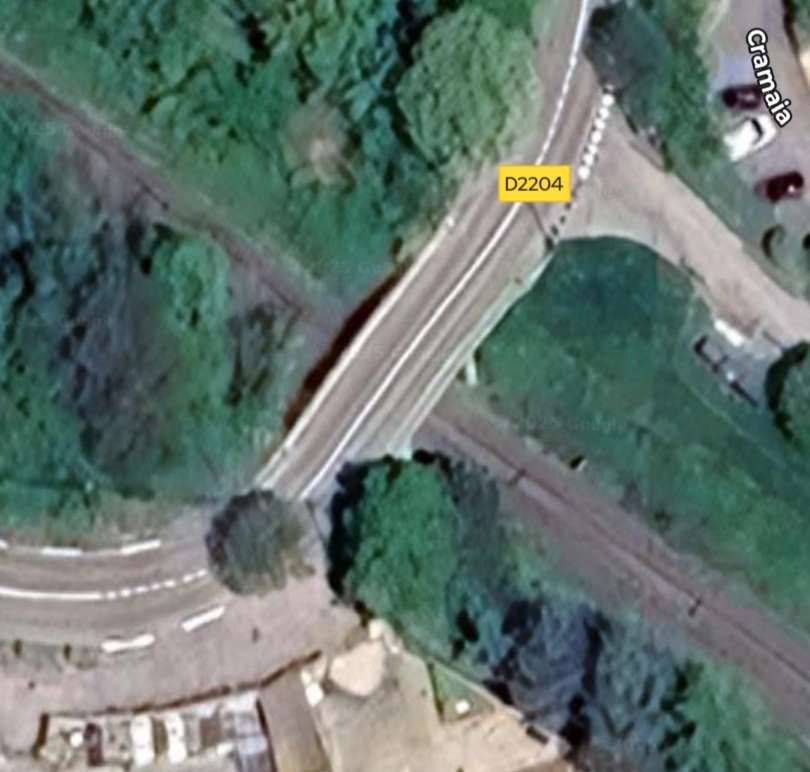
Boulevard de l’Egalite (D2204) bridges the line a short distance further West. [Google Maps, August 2025]
Looking Souttheast from Boulevard de l’Egalite towards Sospel Railway Station. [Google Streetview, October 2022]
Looking Northwest from Boulevard de l’Egalite. [Google Streetview, October 2022]

The next structure visible form the cab of the Nice-bound train is an accommodation bridge which carries a driveway to a larger property running Northeast from La Condamine. [4]
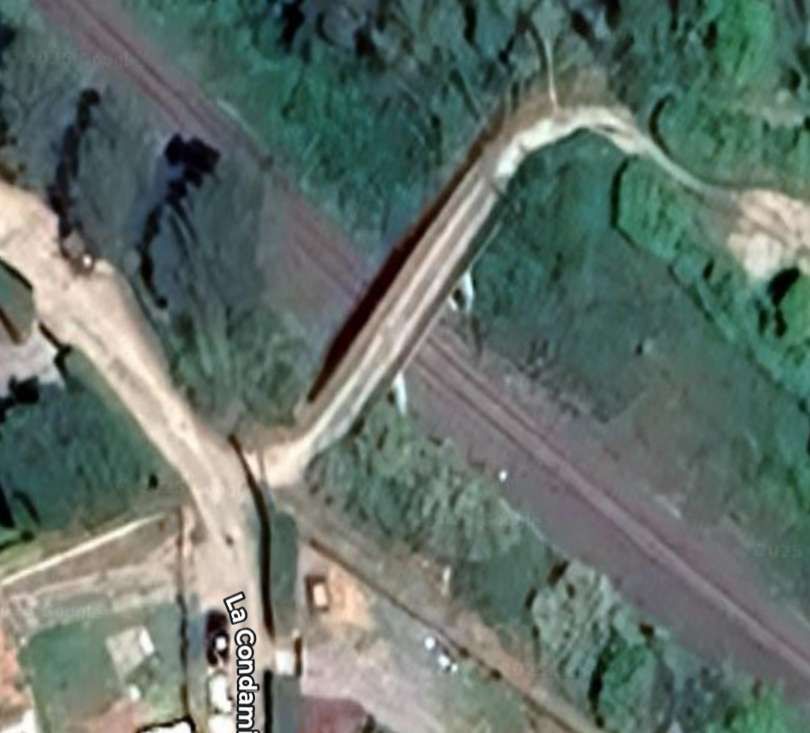
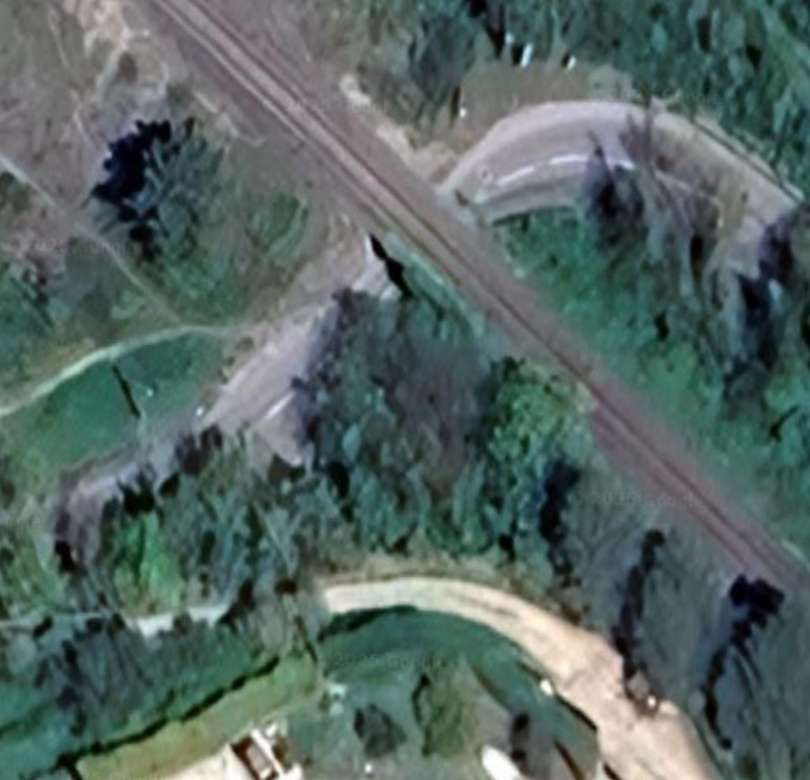
An accommodation bridge carries a driveway from La Condamine over the line. [Google Maps, August 2025]
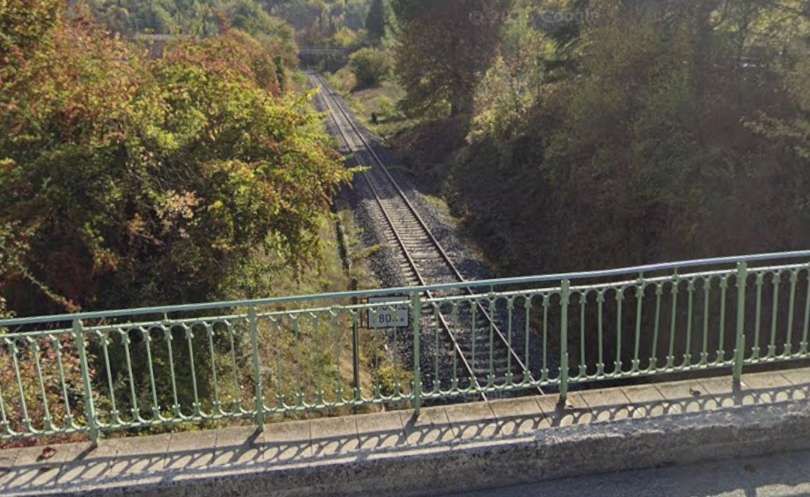
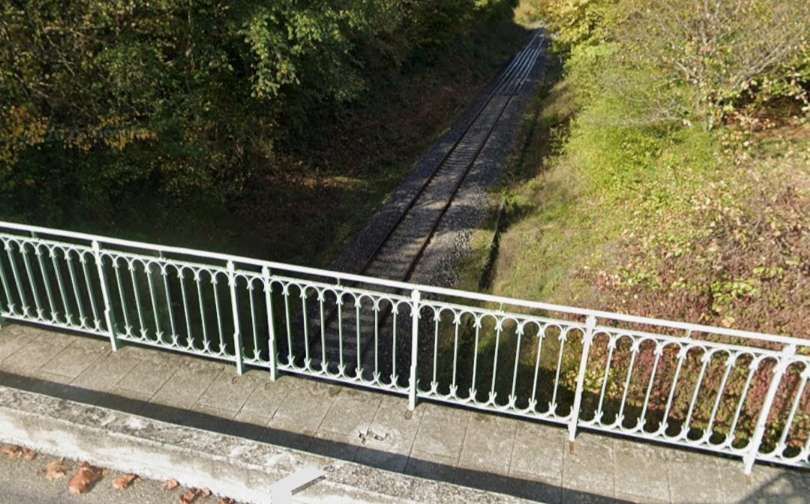
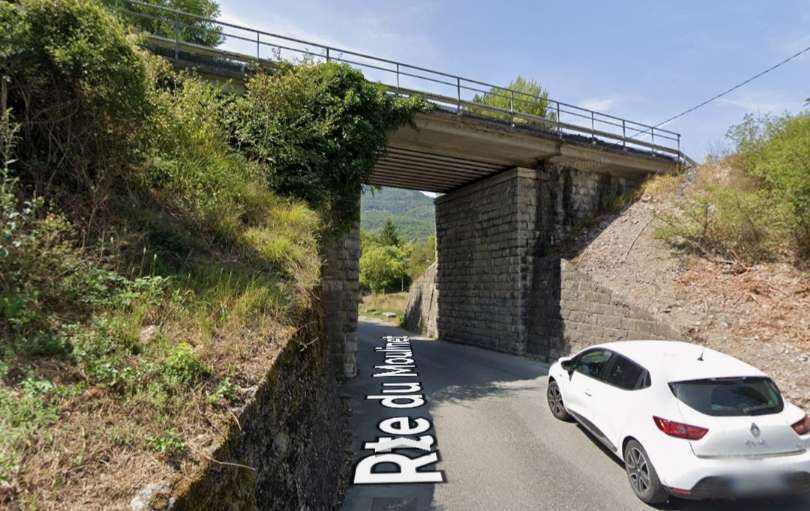
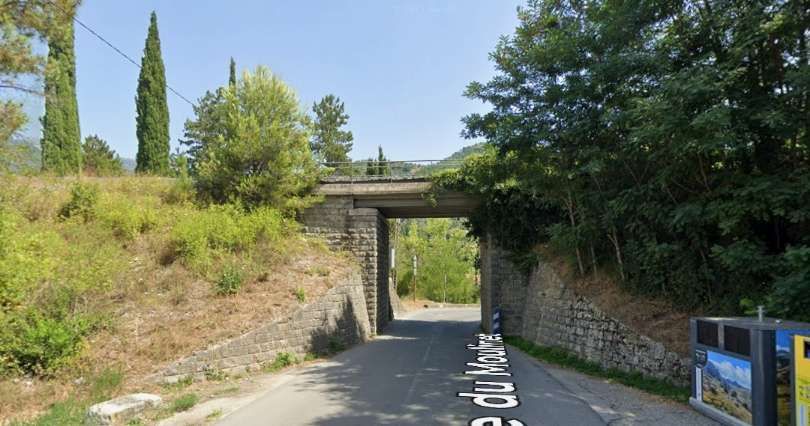
Rte du Moulinet (D2566) passes under the railway. [Google Maps, August 2025]

Just a short distance to the Northwest from the bridge above. The bridge over Rte du Moulinet is seen here from the Northeast. [Google Streetview, August 2021]
The same structure, seen from the Southwest on the D2566. [Google Streetview, August 2021]

A short distance further West the line crosses Rte Sant-Antoine by means of a level-crossing. [4]
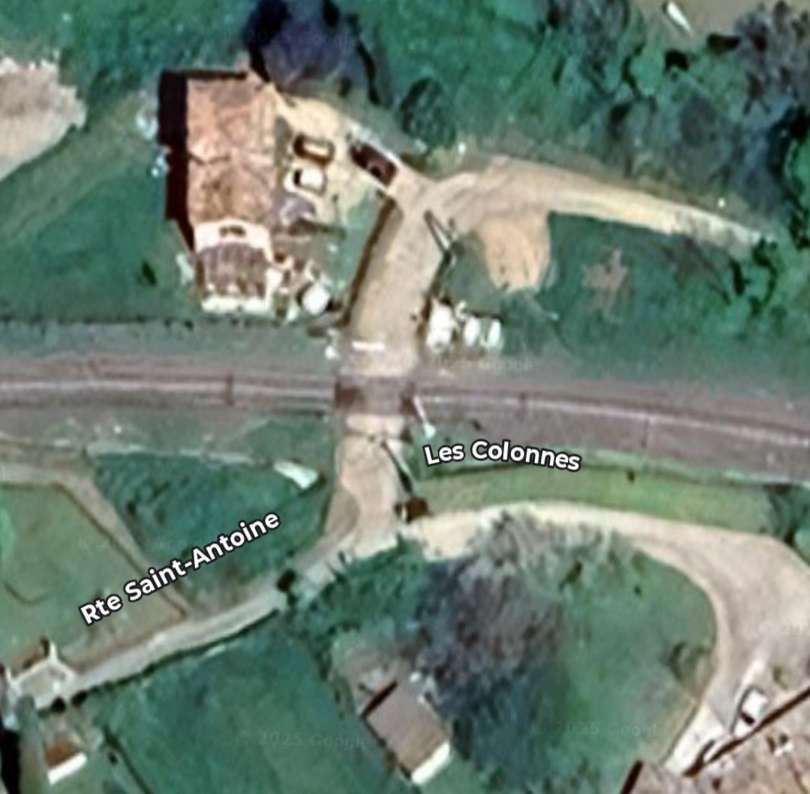
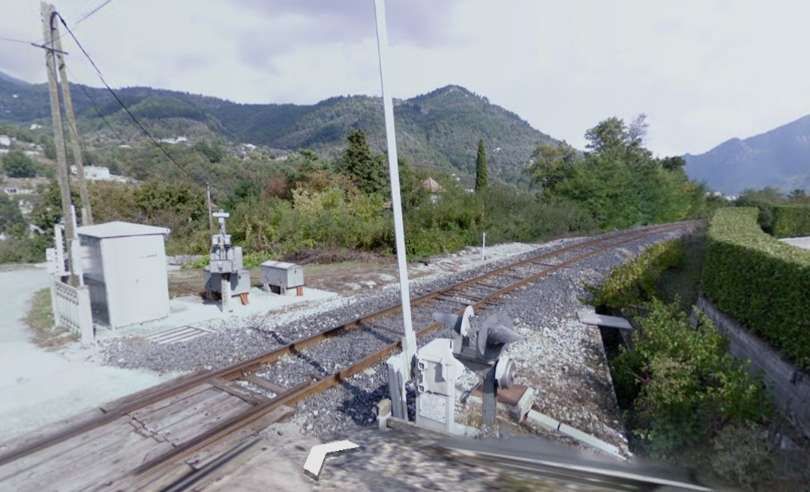
Rte Saint-Antoine crosses the line at level a little further to the West. [Google Maps, August 2025]
Looking East from Rte Saint-Antoine towards Sospel. [Google Streetview, October 2008]
Looking West from Rte Saint-Antoine. [Google Streetview, October 2008]

The D2566 crosses the line (heading North-northwest) with the line travelling in a southwesterly direction. [4]
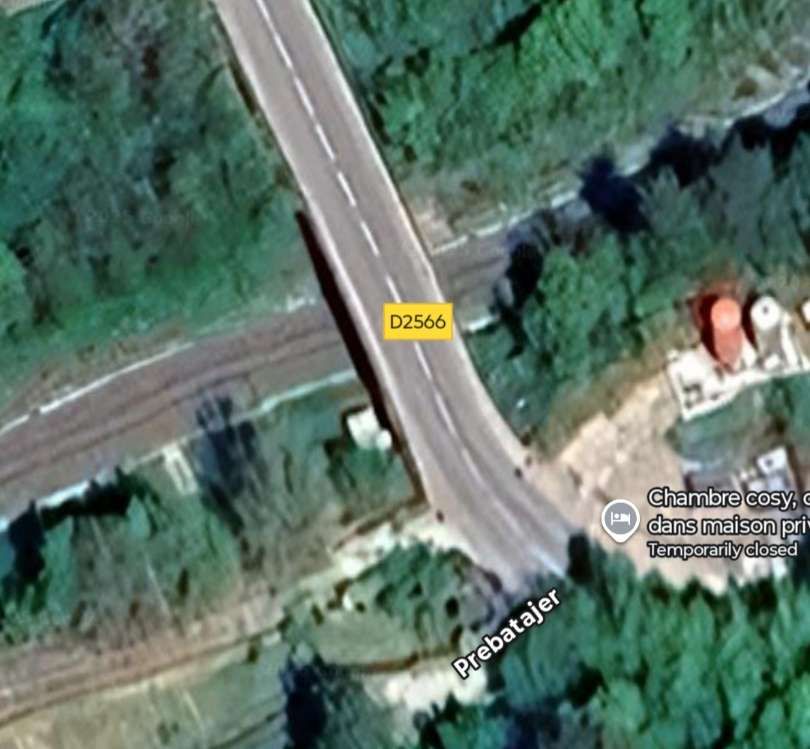
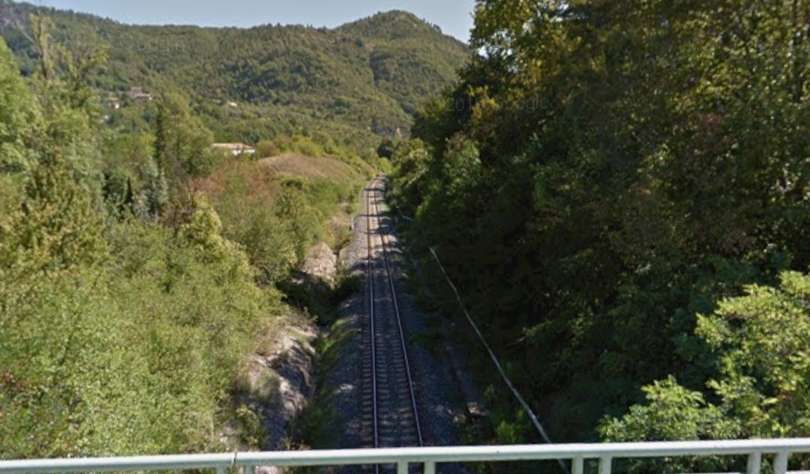
Rte de Moulinet (D2566) crosses the line again. [Google Maps, August 2025]
Looking Northeast from Rte du Moulinet towards Sospel. [Google Streetview, August 2016]
Looking Southeast towards l’Escarene from the same bridge over the line. [Google Streetview, August 2016]

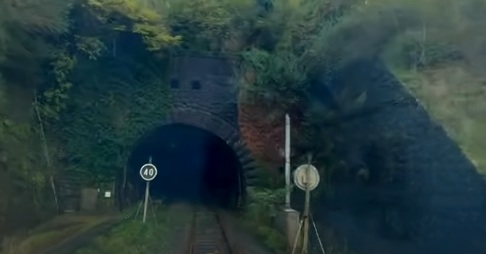
In deep shade, this is the mouth of Tunnel de Braus, seen from the cab of an approaching Nice-bound train.[4]
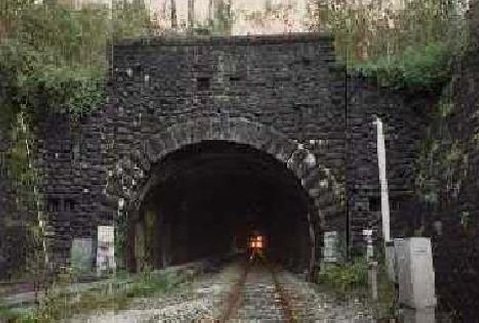
The same tunnel mouth in better light. [31]
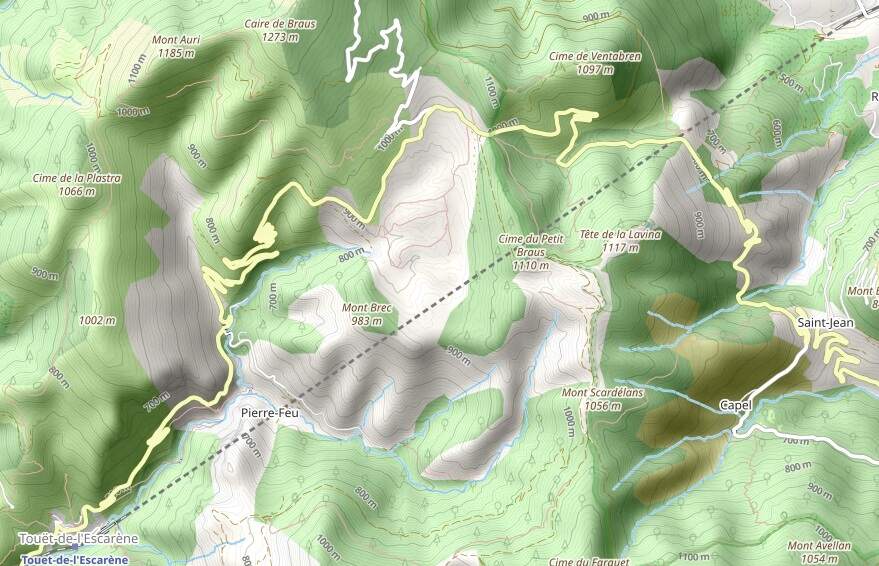
The full length of Tunnel de Braus (5.94 km long), as it appears on OpenStreetMap. [30]
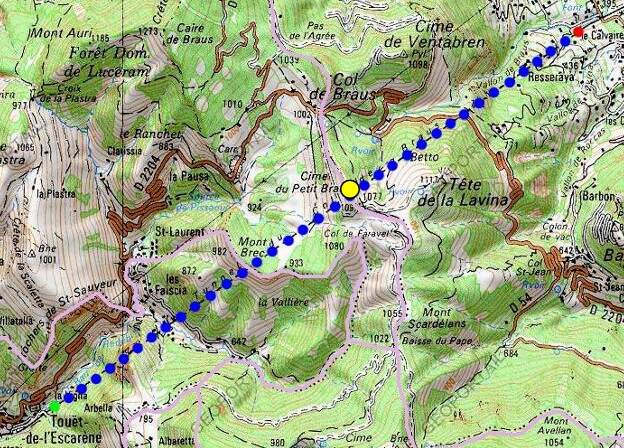
The full length of Tunnel de Braus as it is recorded in the French Inventory of Tunnels. The yellow dot marks the approximate location of a significant water flow intersected by the construction work which required significant remedial works before the construction of the tunnel could proceed. More information and drawings can be found here. [31]

As we have already noted, both the tunnel portals were fortified at the insistence of the military. … Completing the tunnels also required significant additional work to deal with a very high level of water ingress during construction.
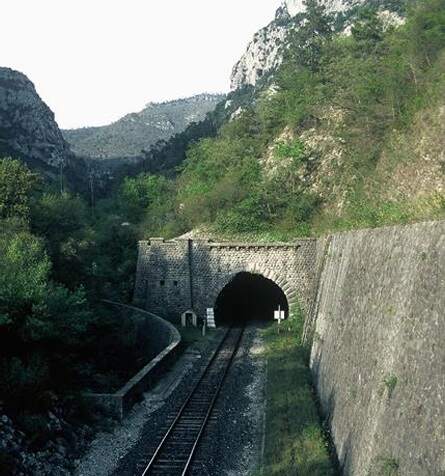
The Southwest portal of Tunnel de Braus is flanked to the Southeast by a very high retaining wall and to the Northwest by a water channel created for the Ruisseau de Redebraus. [31]

The Tunnel de Braus was built to accommodate a double-track line to allow for possible future growth in traffic.
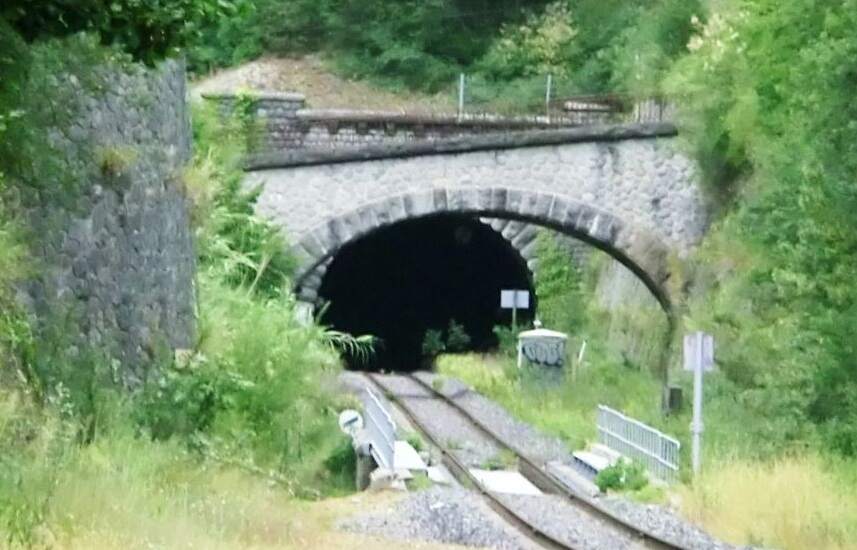
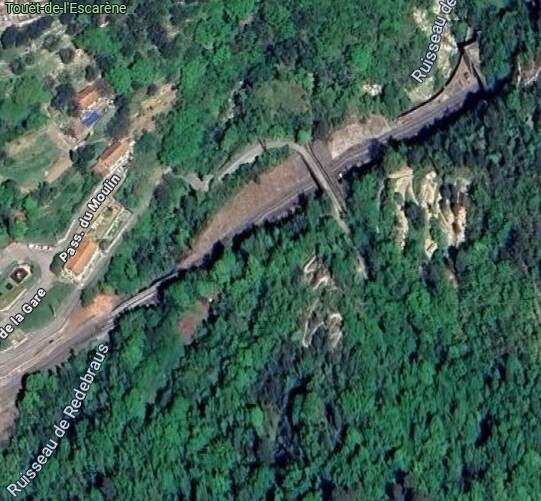
This image shows the Southwest tunnel mouth of Tunnel de Braus, an accommodation bridge Southwest of the tunnel portal and a bridge which carries the railway over the Ruisseau de Redebraus [ID: 324493] Col-de-Braus Tunnel western portal (© Eugenio Merzagora, 9 July 2019, Structurae License (non-commercial use)). [33]

This extract from Google’s satellite imagery shows the various structures from above – the river bridge is towards the bottom-left of the image with the tunnel mouth in the top-right. [Google Maps, August 2025]
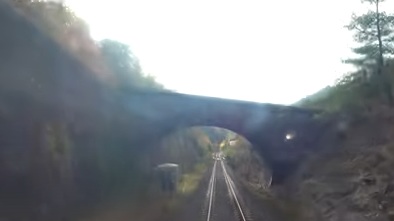
The view from the cab of the Nice-bound train as it leaves the tunnel behind. [4] The first couple of hundred metres beyond the tunnel portal are within a narrow, damp and dark defile.
The bridge over the Ruisseau de Redebraus. [4]
The Nice-bound train approaches the halt at Touët-de-l’Escarène. [4]
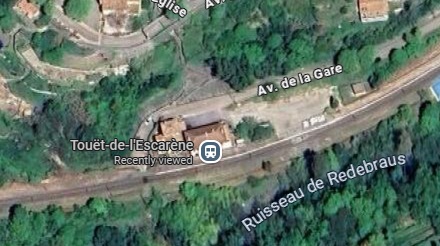
Touët-de-l’Escarène Railway Station (Halt). The village is to the North of the Station. [Google Maps, August 2025]
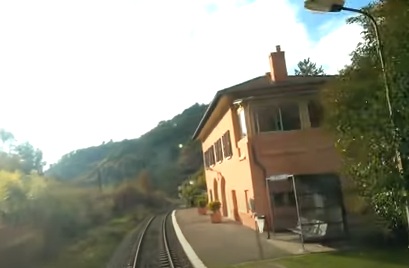
Touët-de-l’Escarène Railway Station. [4]

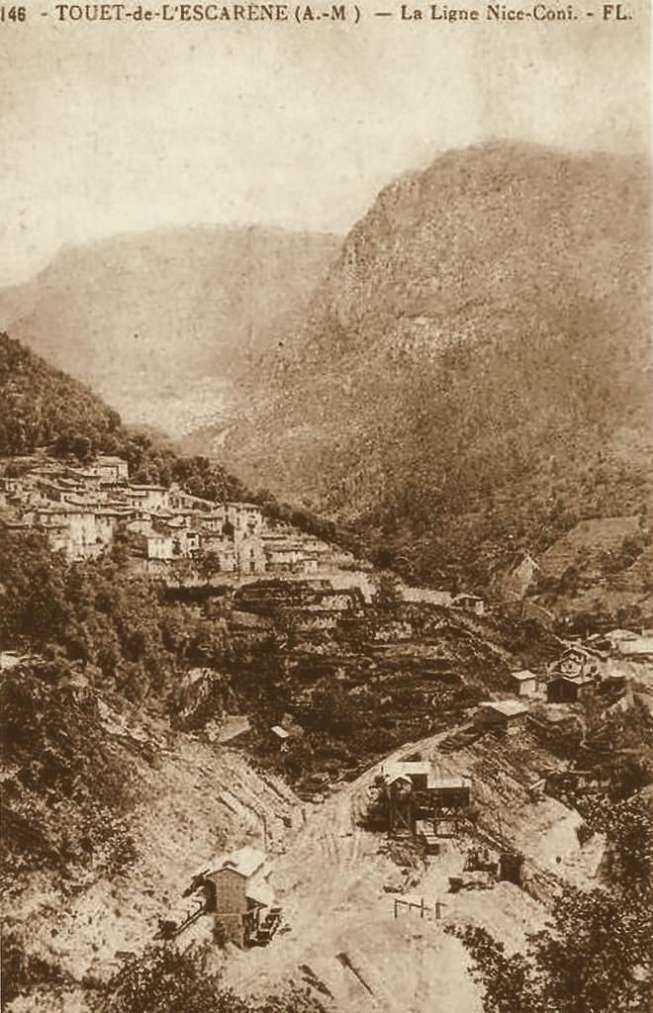
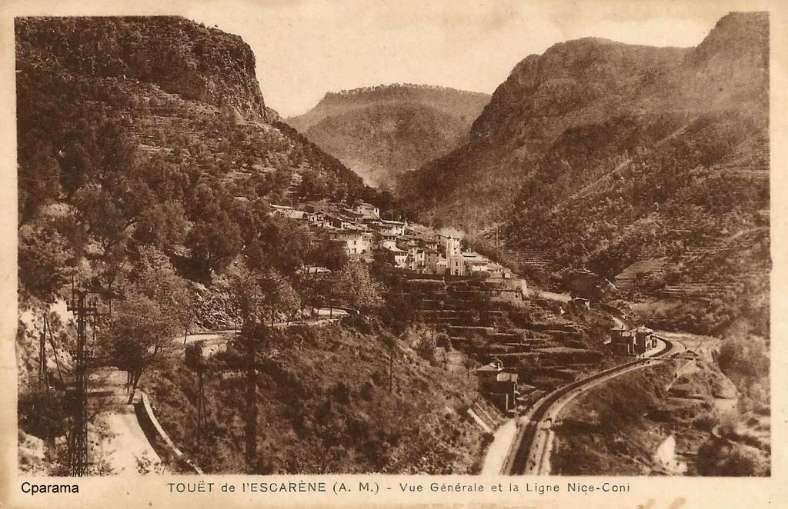
Three older images of Touët-de-l’Escarène follow.  Two while the station was under construction. …
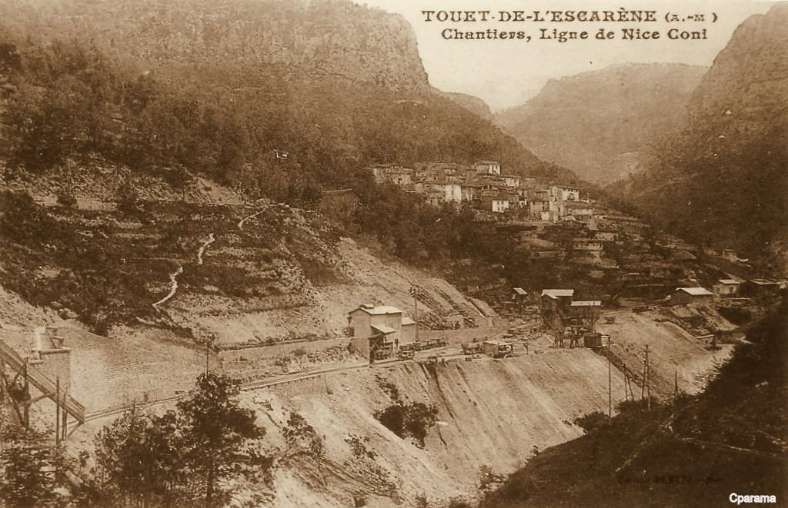
Touët-de-l’Escarène Railway Station, seen from the South and under construction, seen from the Southwest.  [49]
Touët-de-l’Escarène also under construction, seen from the West. [49]
Touët-de-l’Escarène, the completed line, seen heading away towards the Tunnel de Mont Grazian. [49]

The line beyond Touët-de-l’Escarène continues West along the North side of the Ruisseau de Redebraus towards the next tunnel. …
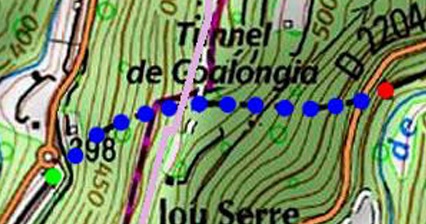
The next tunnel is Tunnel de l’Escarène or Tunnel de Coalongia (527 metres in length). [34]
The East portal of the Tunnel de l’Escarène. [4]
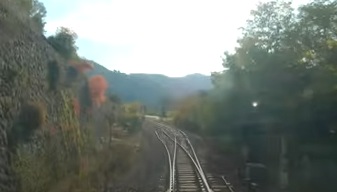
The view from the cab of a Nice-bound train as it leaves l’Escarene Tunnel. The points which provide the passing loop at l’Escarene Railway Station sit just outside the tunnel mouth. [4]
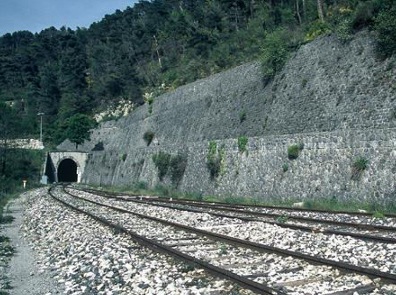
The West portal of the Tunnel de l’Escarène. [34]

Within the tunnel the line has begun to turn towards the South and the relatively tight curve continues until between the platforms at Sospel Station the line is on a North-South axis.
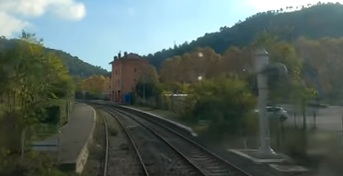
The final approach to l’Escarene Railway Station. [4]
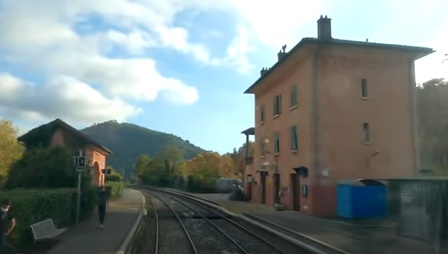
L’Escarene Railway Station. [4]
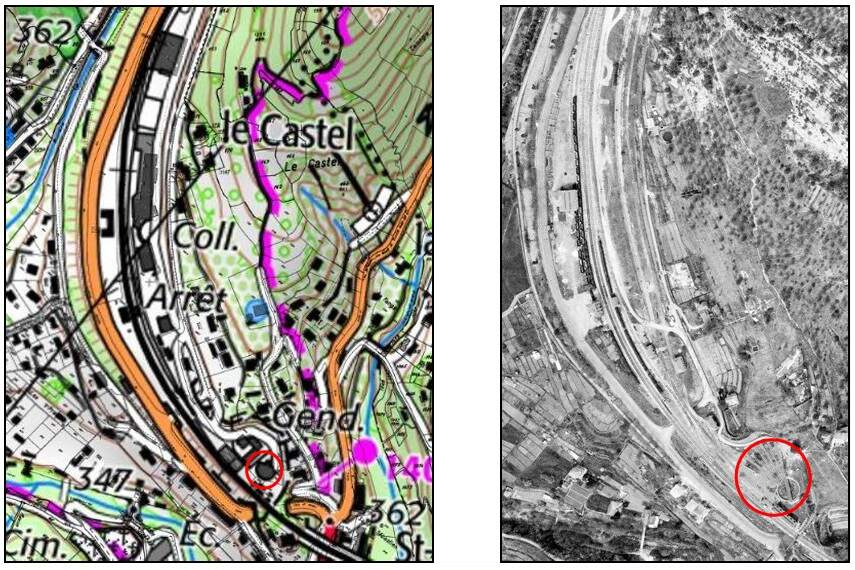
These two images show the Station site from above. The red ring highlights the location of the station turntable which, in the 21st century, is the location of the town’s fire station. [35]]

L’Escarene sits at the top of a long climb from Nice. We will follow the line through to Nice in the next two articles in this series. (The next article can be found here. [5]) Like Sospel, l’Escarene Railway Station had substantial facilities on a wide open plateau designed to allow the reception of military convoys in the event of conflict with neighboring Italy. [1: p92]

References

  1. Jose Banaudo, Michel Braun and Gerard de Santos; Les Trains du Col de Tende Volume 1: 1858-1928; FACS Patrimoine Ferroviaire, Les Editions du Cabri, 2018.
  2. Jose Banaudo, Michel Braun and Gerard de Santos; Les Trains du Col de Tende Volume 2: 1929-1974; FACS Patrimoine Ferroviaire, Les Editions du Cabri, 2018.
  3. Jose Banaudo, Michel Braun and Gerard de Santos; Les Trains du Col de Tende Volume 3: 1975-1986; FACS Patrimoine Ferroviaire, Les Editions du Cabri, 2018.
  4. https://youtu.be/rLXAEz-n4mM?si=RLQC31jynGeM_lQR, accessed on 26th August 2025. Permission to use still images from this video has been sought via YouTube.
  5. https://rogerfarnworth.com/2025/09/26/the-railway-between-nice-tende-and-cuneo-part-7-lescarene-to-drap-cantaron-railway-station/
  6. Not used.
  7. Not used.
  8. Not used
  9. https://www.openstreetmap.org/#map=12/43.8804/7.4395&layers=P, accessed on 26th August 2025.
  10. https://rogerfarnworth.com/2025/07/22/the-railway-from-nice-to-tende-and-cuneo-part-1.
  11. https://rogerfarnworth.com/2025/07/26/the-railway-from-nice-to-tende-and-cuneo-part-2.
  12. https://rogerfarnworth.com/2025/08/06/the-railway-from-nice-to-tende-and-cuneo-part-3-vievola-to-st-dalmas-de-tende
  13. https://rogerfarnworth.com/2025/08/16/the-railway-between-nice-tende-and-cuneo-part-4-st-dalmas-de-tende-to-breil-sur-roya
  14. https://rogerfarnworth.com/2025/08/25/the-railway-between-nice-tende-and-cuneo-part-5-breil-sur-roya-to-ventimiglia
  15. https://www.openstreetmap.org/#map=15/43.93077/7.51647&layers=P, accessed on 18th August 2025.
  16. https://www.openstreetmap.org/#map=17/43.923820/7.520512&layers=P, accessed on 19th August 2025.
  17. https://www.openstreetmap.org/#map=16/43.91950/7.51623&layers=P, accessed on 20th August 2025.
  18. F. Honore; Le Rail a Travers Les Alpes: De Nice a Coni par la Voie Ferrée; L’Illustration, No. 4470, 3rd November 1928, p499.
  19. https://www.inventaires-ferroviaires.fr/mx06/06023.04D.pdf, accessed on 26th August 2025.
  20. https://www.inventaires-ferroviaires.fr/tu06/06023.1.pdf, accessed on 26th August 2025.
  21. https://www.inventaires-ferroviaires.fr/tu06/06023.2.pdf, accessed on 26th August 2025.
  22. https://structurae.net/en/structures/bevera-viaduct-1962, accessed on 26th August 2025.
  23. https://www.openstreetmap.org/#map=17/43.886948/7.487220&layers=P, accessed on 26th August 2025.
  24. https://www.inventaires-ferroviaires.fr/mx06/06136.03Y.pdf, accessed on 26th August 2025.
  25. https://www.inventaires-ferroviaires.fr/kc06/06136.04W.pdf, accessed on 26th August 2025.
  26. https://www.railwaywondersoftheworld.com/link-mediterranean.html, accessed on 26th August 2025
  27. https://commons.m.wikimedia.org/wiki/File:Viaduc_de_Bevera01.jpg, accessed on 26th August 2025
  28. https://www.inventaires-ferroviaires.fr/tu06/06136.2.pdf, accessed on 27th August 2025.
  29. https://www.inventaires-ferroviaires.fr/tu06/06136.1.pdf, accessed on 27th August 2025.
  30. https://commons.m.wikimedia.org/wiki/File:Gare_de_Sospel.JPG, accessed on 28th August 2025.
  31. https://www.openstreetmap.org/#map=14/43.86371/7.40071&layers=P, accessed on 28th August 2025.
  32. https://www.inventaires-ferroviaires.fr/tu06/06142.1.pdf, accessed on 28th August 2025.
  33. https://www.ebay.co.uk/itm/144697687618, accessed on 28th August 2025.
  34. https://structurae.net/en/structures/col-de-braus-tunnel, accessed on 28th August 2025.
  35. https://www.inventaires-ferroviaires.fr/tu06/06057.2.pdf, accessed on 28th August 2025.
  36. https://www.inventaires-ferroviaires.fr/pt06/06057-02U.pdf, accessed on 28th August 2025.
  37. https://rogerfarnworth.com/2013/12/10/sospel-to-menton-tramway
  38. https://rogerfarnworth.com/2018/02/23/the-sospel-to-menton-tramway-revisited-chemins-de-fer-de-provence-51
  39. https://rogerfarnworth.com/2018/06/08/the-menton-to-sospel-tramway-revisited-again-chemins-de-fer-de-provence-61
  40. https://ebay.us/m/GvQ7Pv, accessed on 29th August 2025.
  41. Franco Collidà, Max Gallo & Aldo A. Mola; CUNEO-NIZZA History of a Railway; Cassa di Risparmio di Cuneo, Cuneo (CN), July 1982.
  42. Franco Collidà; 1845-1979: the Cuneo-Nice line year by year; in Rassegna – Quarterly magazine of the Cassa di Risparmio di Cuneo; No. 7, September 1979, pp. 12-18.
  43. Stefano Garzaro & Nico Molino; THE TENDA RAILWAY From Cuneo to Nice, the last great Alpine crossing; Editrice di Storia dei Trasporti, Colleferro (RM), EST, July 1982.
  44. SNCF Region de Marseille; Line: Coni – Breil sur Roya – Vintimille. Reconstruction et équipement de la section de ligne située en territoire Français; Imprimerie St-Victor, Marseille (F), 1980.
  45. https://www.geneanet.org/cartes-postales/view/194490#0, accessed on 29th August 2025.
  46. https://www.cparama.com/forum/viewtopic.php?t=898, accessed on 29th August 2025.
  47. https://www.cparama.com/forum/sospel-t898-20.html, accessed on 29th August 2025.
  48. https://www.cparama.com/forum/viewtopic.php?t=898&start=40, accessed on 29th August 2025.
  49. https://www.cparama.com/forum/viewtopic.php?f=11&t=24506 , 29th August 2025.
  50. https://www.cparama.com/forum/viewtopic.php?f=11&t=24506, 29th August 2025.
  51. https://fr.m.wikipedia.org/wiki/Sch%C3%A9ma_de_la_ligne_de_Nice_%C3%A0_Breil-sur-Roya, 15th September 2025
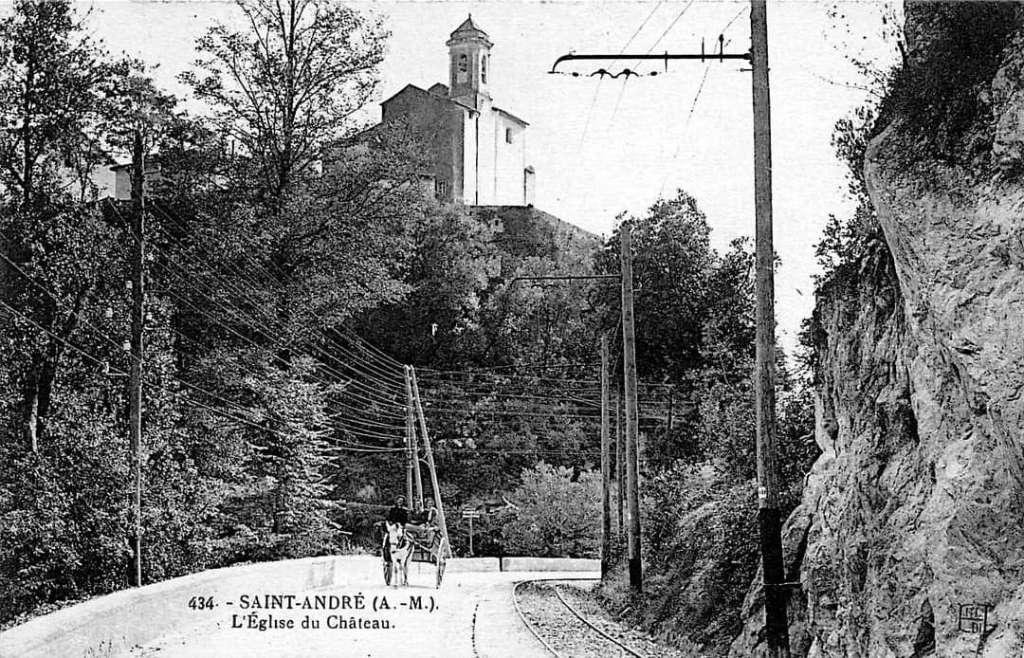
The Tramways of Nice:- Les Lignes de l’Arriere-Pays (The Lines of the Hinterland) Part 1 – First Generation Electric Tramways to Levens and Sospel – (Chemins de Fer de Provence/Alpes-Maritimes No. 94)

The TNL (Tramways de Nice et du Littoral) had four lines which ran some distance inland from the coast. Three ran out from Nice, serving: Levens, Bendejun, and La-Grave-de-Peille. All followed valleys of the Paillon and its tributaries. As well as the line to La-Grave-de-Peille, the line to Contes and Bendejun was to have had another Branch to l’Escarene. Major work was undertaken on that line but it was never brought into use.

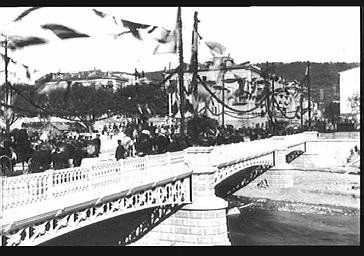
The fourth significant line operated by the TNL ran from Menton to Sospel. This line required some significant feats of engineering. The featured image above (public domain) shows one of the structures on this line.

You will find earlier articles about two of these lines on this website. They can be found by following these links:

Levens

Two earlier articles, the second of which involves some flights of fancy on my part – looking at a possible alternative routes for the tramway. As we will see below, those thoughts are not without merit given the discussions which took place around the best way for the tram network to serve Levens village.

The Nice to Levens Tramway – Part 1 (Chemins de Fer de Provence 55)

The Nice to Levens Tramway – Part 2 (Chemins de Fer de Provence 56)

Menton to Sospel

Three articles written at different times. In chronological order, these are:

Sospel to Menton Tramway

The Sospel to Menton Tramway Revisited (Chemins de Fer de Provence 51)

The Menton to Sospel Tramway Revisited Again! (Chemins de Fer de Provence 61)

Bendejun, and La-Grave-de-Peille

Bendejun and La-Grave-de-Peille will be covered in a future article. This article focusses on updating earlier articles about the tramways between Nice and Levens, and between Menton and Sospel. ……

Further notes on the Nice to Levens Tramway

The full length of the line from Place Masséna to Levens was just over 23 km of which a little less than 6km were part of Nice’s urban network (between Place Masséna and St. André).

Apart from the articles mentioned above, the first 6 km are covered in another, recent article (which also covers a number of lines which were part of Nice’s urban network), and can be read by following this link:

The First Generation Electric Tramways of Nice again. Five more lines. (Chemins de Fer de Provence/Alpes-Maritimes No. 89) …

These new notes are based around a section of José Banaudo’s French text: ‘Nice au fils de Tram, Volume 2: Les Hommes, Les Techniques‘ [1] Direct quotes are referenced.

In the main, the length of the line covered here is that from St. André to Levens (as built), and a section just over 1km in length which would have served the centre of Levens, Levens-Village but which was not completed because of the advent of WW1.

There was, however, a short length of tramway used by the Levens trams which did not follow the route of the urban trams to St. André. This detour followed the left bank of the River Paillon through Place Garibaldi, Rue de la République then Rue Barla and the Barla bridge, before rejoining the urban line of St. André on the right bank.

In addition, we need to note the significant impact of bad weather in the construction of the line in the area now known as ‘Pasteur’. Banaudo speaks of very significant storms during the winter 1907-1908. In particular, storms occurred on: 29th September; 3rd, 15th and 30th October; 3rd November; 10th and 27th December. Eventually work could recommence on 20th January and was finished on 27th March. Banaudo comments that “The additional work and necessary consolidations of the Paillon embankment ultimately increased the cost of the first construction contract for the Nice – Levens line by a third, compared to initial forecasts.” [1: p66]

Banaudo tells us that the maximum gradient on the whole line was 63mm/m and that less than 2 km of the line were level, having no gradient. At Place Masséna the line was only 9 metres above sea level, at Levens it reached 538 metres above sea level. [1: p62]

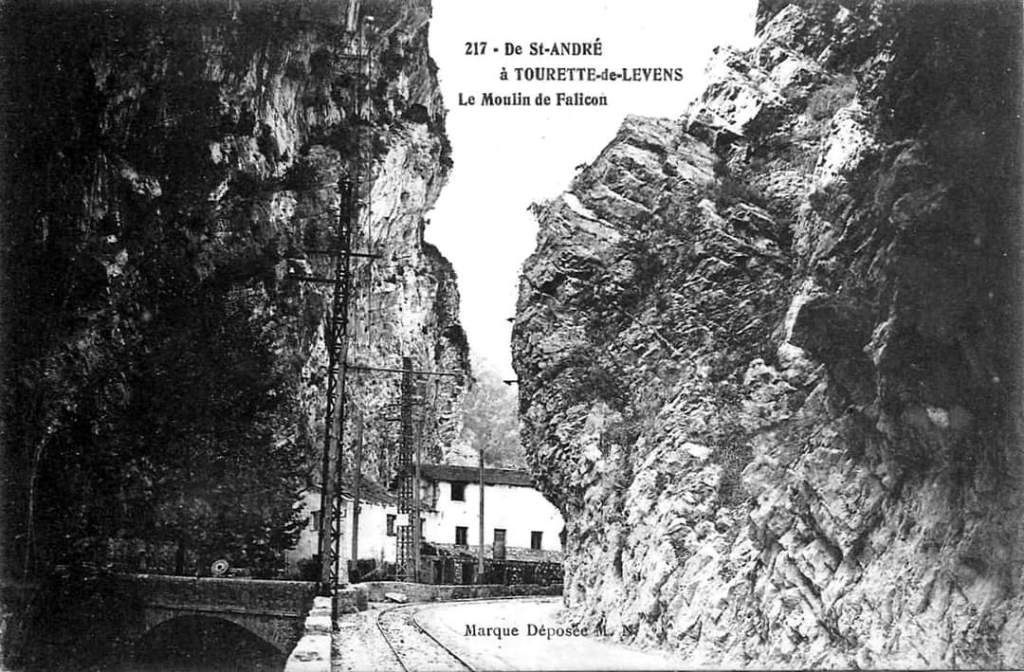
The St. André tram stop was the terminus of urban services. Banaudo tells us that “Beyond St. André, the tramway went up the valley of the Banquière or Gahre, right bank tributary of Paillon.  It passed several caves and two mills nestled at the bottom of deep gorges between the heights of Falicon and L’Ahadie.  Upstream of the Tinon bridge, the pass became so narrow that the tramway, hitherto on the shoulder, had to be embedded in the roadway with which it crossed the valley on several occasions. After the place called Les Clues, the valley widened a little and a tram stop served the hamlet of Moulin-de-Tourrette.” [1: p62]

Les Gorges de St. André de la Roche looking South towards Nice. The tramway can be seen on the right of the road. This image was shared on the Comte de Nice et son Histoire Facebook Group by Roland Coccoli on 26th September 2023. [6]
The tight Gorges de St. André looking towards Tourrette-Levens. The tramway is on the left of the road. This image was shared on the Comte de Nice et son Histoire Facebook Group by Alain Nissim on 3rd October 2022. [7]

From this point trams followed their own route a little removed from the main road for about 3 km, “punctuated by the curved Rio-Sec Viaduct and a short tunnel. The route overlooked the road, moved away from it, then finally rejoined it at the foot of the old village of Tourrette-Levens, renowned for its ancient castle. This locality, the most important encountered on the route. was served by a station established in the Quartier du Plan,” [1: p62] at the foot of the road serving the old village.

As noted above, a sequence of photographs of this separated tram route can be found here. [5]

Beyond Tourrette Levens, trams continued to climb through the Western slopes of the Mont Ferion range, “the line encountered two other passing places: at a place called Lava where a siding allowed wood to be loaded, and at the hamlet of Ste. Claire. The highest point of the line was reached on the plateau which forms the Grands Prés de Levens where festivals, sporting events and horse races are organized. The Levens terminus was located at a place called Les Traverses, where a wooden building housed a buffet enjoyed by travellers before the final climb on foot” [1: p62] to the village of Levens which is perched on a hillock at an altitude of 570 m above sea-level. “A superb site with both a Mediterranean and alpine appearance with the high peaks of the Vésubie valley in the background. In order to get closer to the center, a steep ramp extension including a curved line on its own site was undertaken to reach the current Lov Roux esplanade at the entrance to the village. Unfortunately, the war interrupted the work and this extension was never put into service.” [1: p62] Some further notes about the planned extension can be found after the review of key structures on the route.

Structures on the route included:

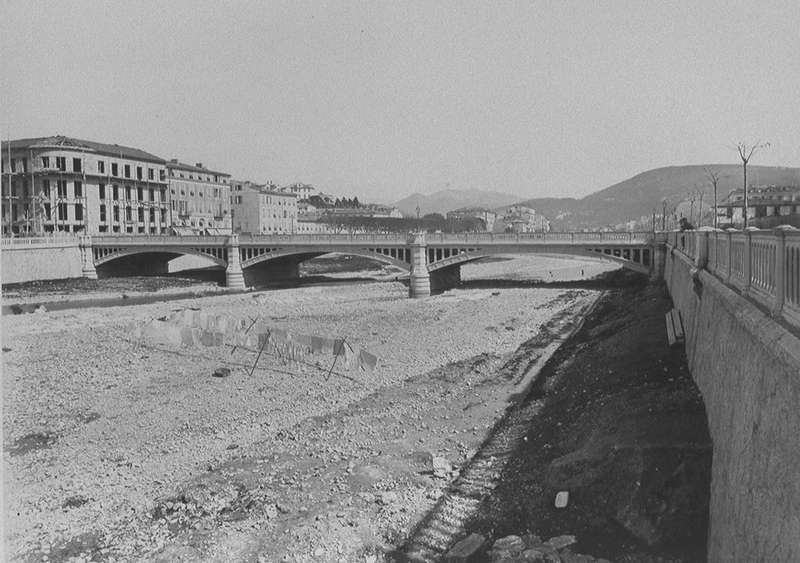
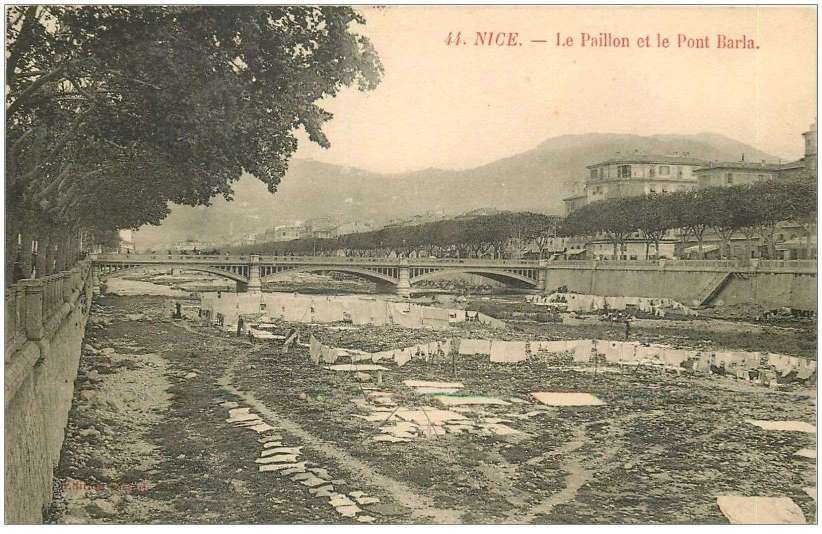
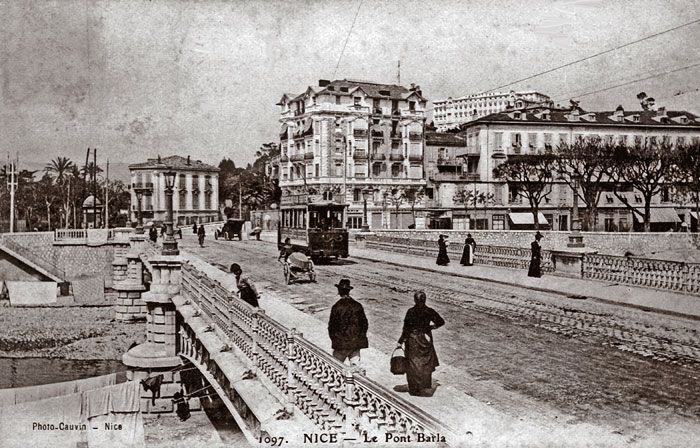
A. the Garibaldi and Barla bridges over the River Paillon (each made up of three cast iron arches);

This anonymous photograph (perhaps by Jean Walburg de Bray, 1839-1901), shows the Garibaldi Bridge and the right bank of the River Paillon. The view looks from southeast to northwest and is dated 1877. [2]

Three views of Pont Barla over the River Paillon in Nice, one even has a tram travelling over it! [3]

15th April 1912 – the line from Villa Caserta to Sospel was opened to passengers and the short branch to the PLM Station in Menton was closed.

B. the Tinon, Falicon and Clues bridges over the River Banquière (each a single masonry arch);

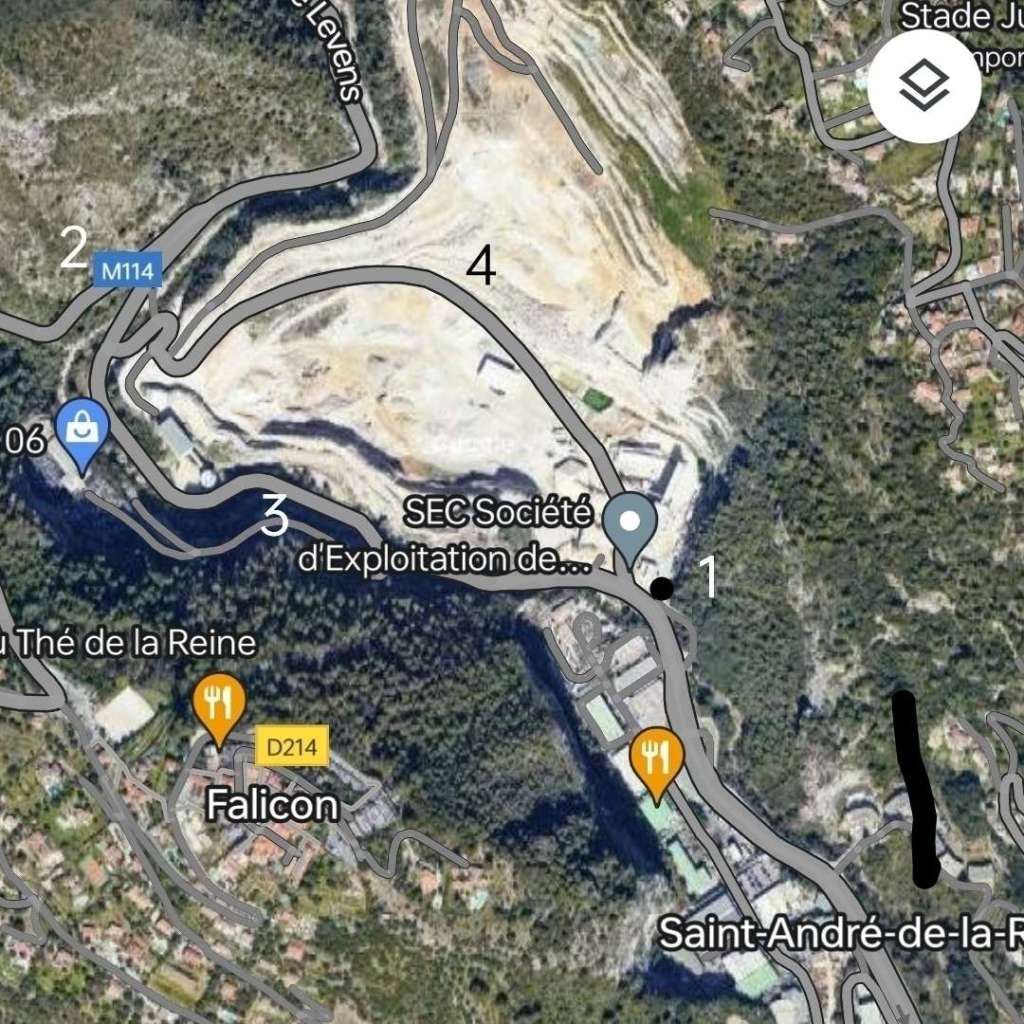
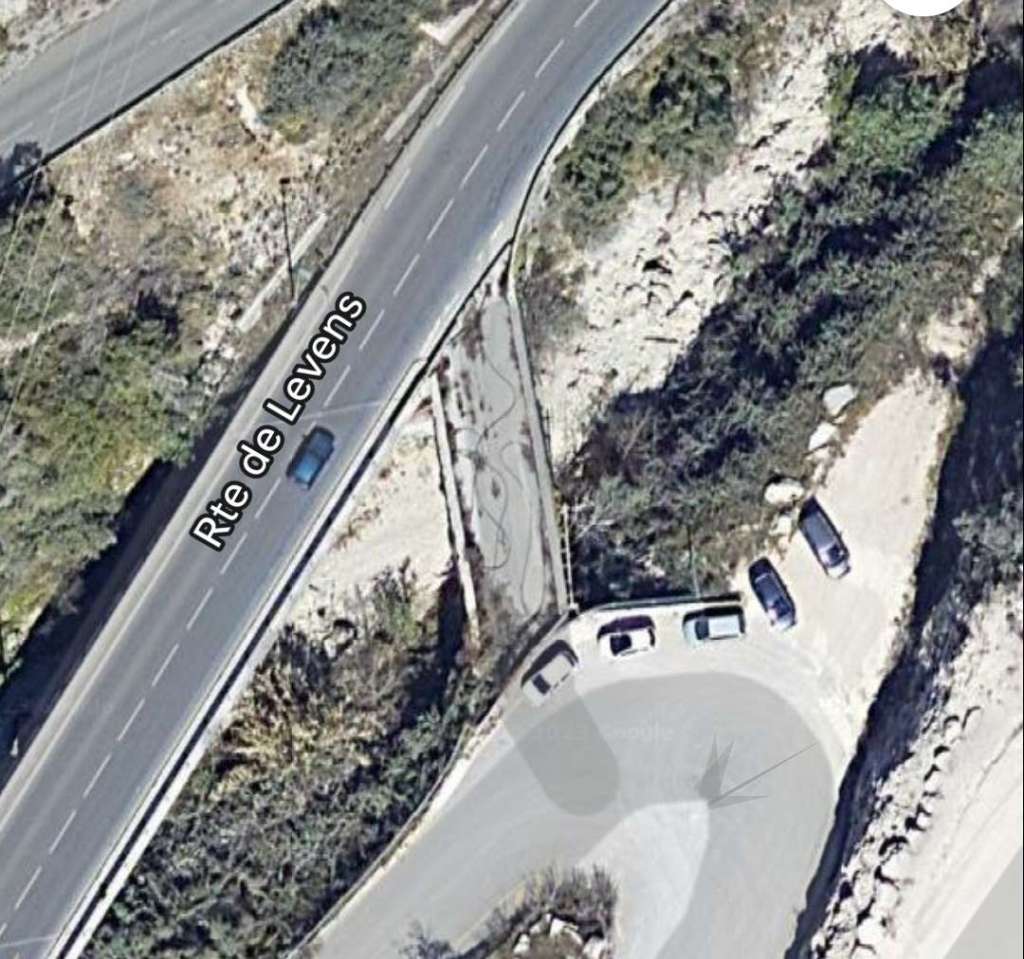
This extract from Google Maps shows the length of the M19 (Route de Levens) as it appears in November 2023. This area has experienced what might be termed some ‘remodeling’ as the quarrying works have expanded. The numbers superimposed on the satellite image are: 1: the location of an old road bridge across the River Banquière which also carried the tramway, referred to by José Banaudo as the bridge at Falicon; 2: the location of another old bridge spanning the river which, I believe, is that referred to by Banaudo as the bridge at Les Cles; 3: the present route of the M19 which appears to have once been the line of the old tramway; the line of the M19 before quarrying work expanded. The locations ‘1’ and ‘2’ are down in more detail below. The routes of the M19 denoted ‘3’ and ‘4’ are further illustrated by the map immediately below. [Google Maps, November 2023]
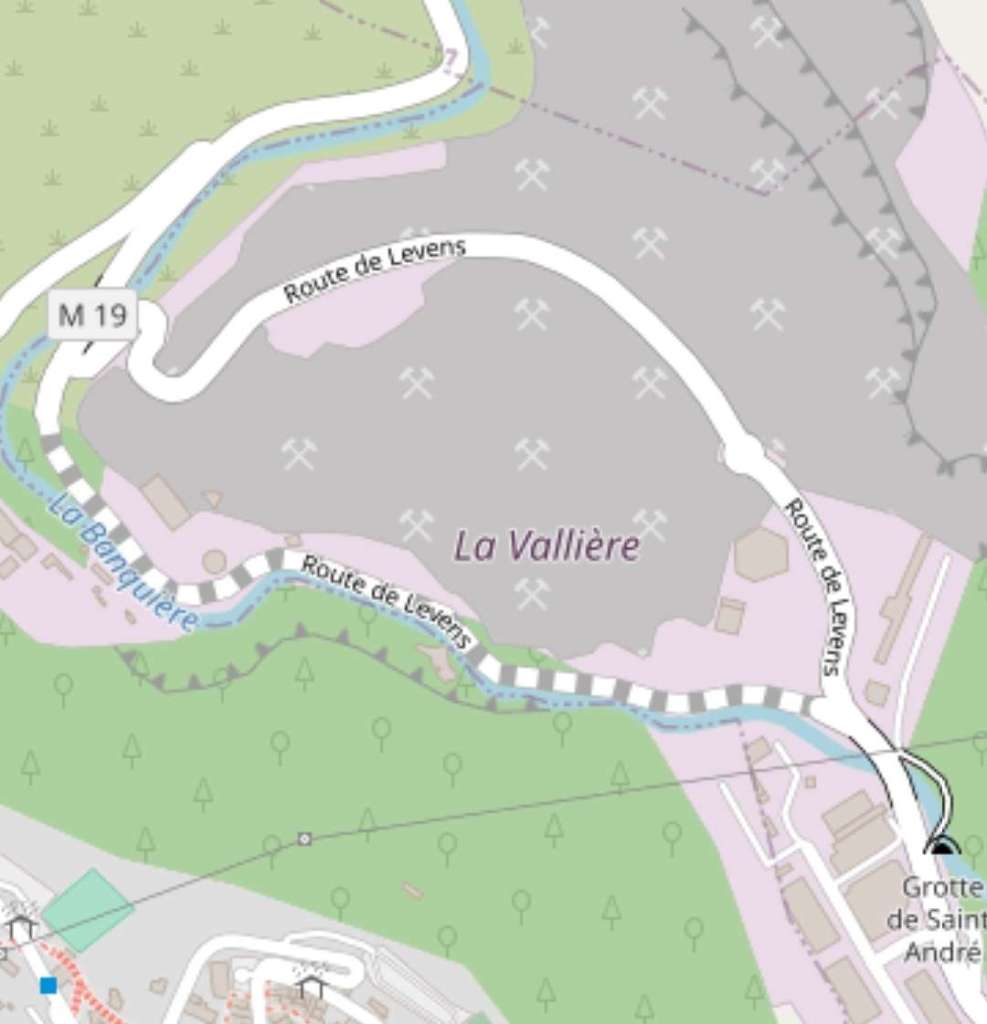
An extract from the mapping of http://www.mapsof.net. Location ‘1’ on the satellite image is bottom-right in this image. A narrow older road is shown and the bridge over the Banquière is hidden by the symbol for the Grottoes de Saint Andre de la Roche. The old tram route then followed the north bank of the river along the route indicated by grey/white dashes. It appears that the M19 ran to the North of this as shown and rejoined the valley of the river via two hairpin bends. The second bridge is at the top-left under the ‘M19’ indicator. [4]
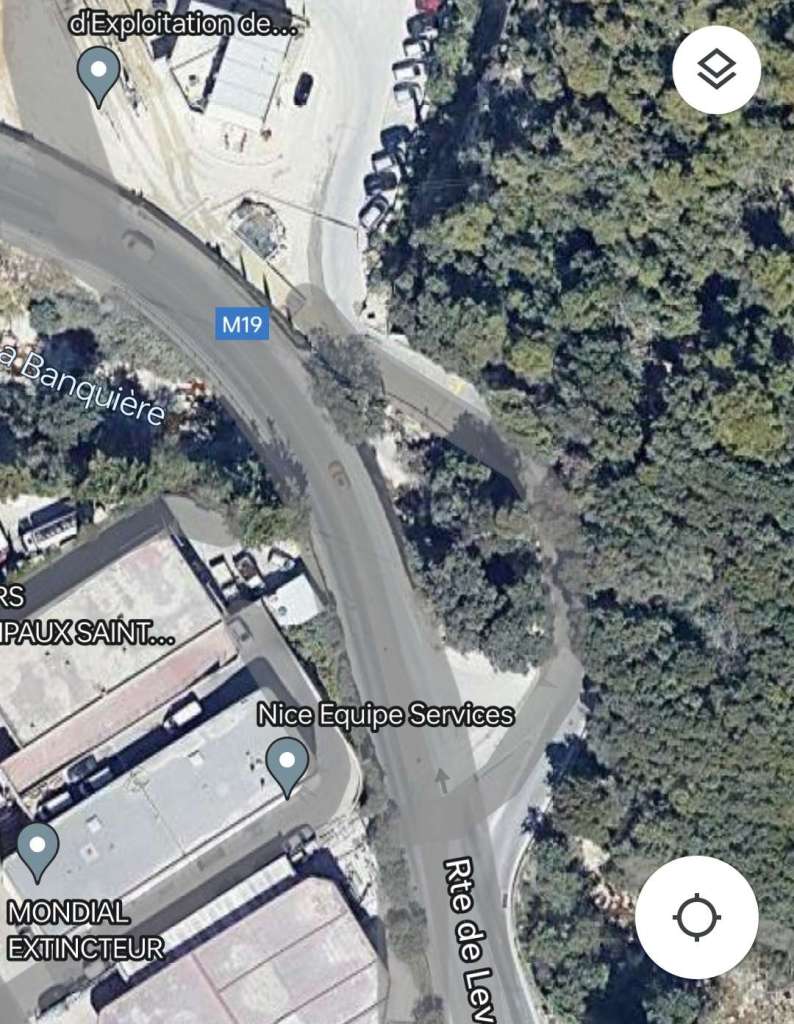
A closer view on Google Maps of the location of the Falicon Bridge Location ‘1’ above. The new road bridge can easily be made out. The older bridge sits to the right of the Route de Levens close to the word ‘Services’. [Google Maps, November 2023]
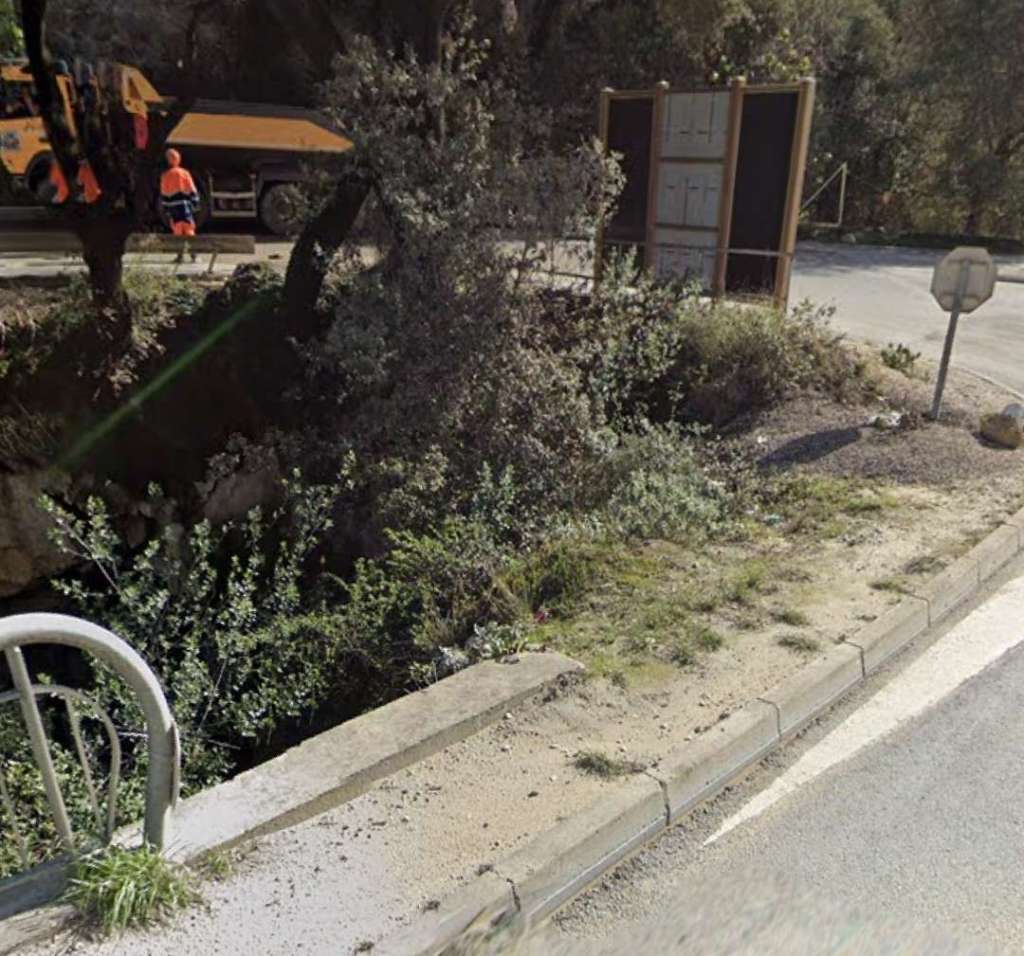
Looking Southeast from the abutment of the new bridge at the location of the old structure. [Google Streetview, November 2022]
This is location ‘2’ above. One of the hairpin bends on the older M19 stands guard over the arch bridge which carried the older road over the River Banquière. The modern bridge is to its left. I think this is the bridge referred to by Banaudo as the bridge at Les Cles. [Google Maps, November 2023]
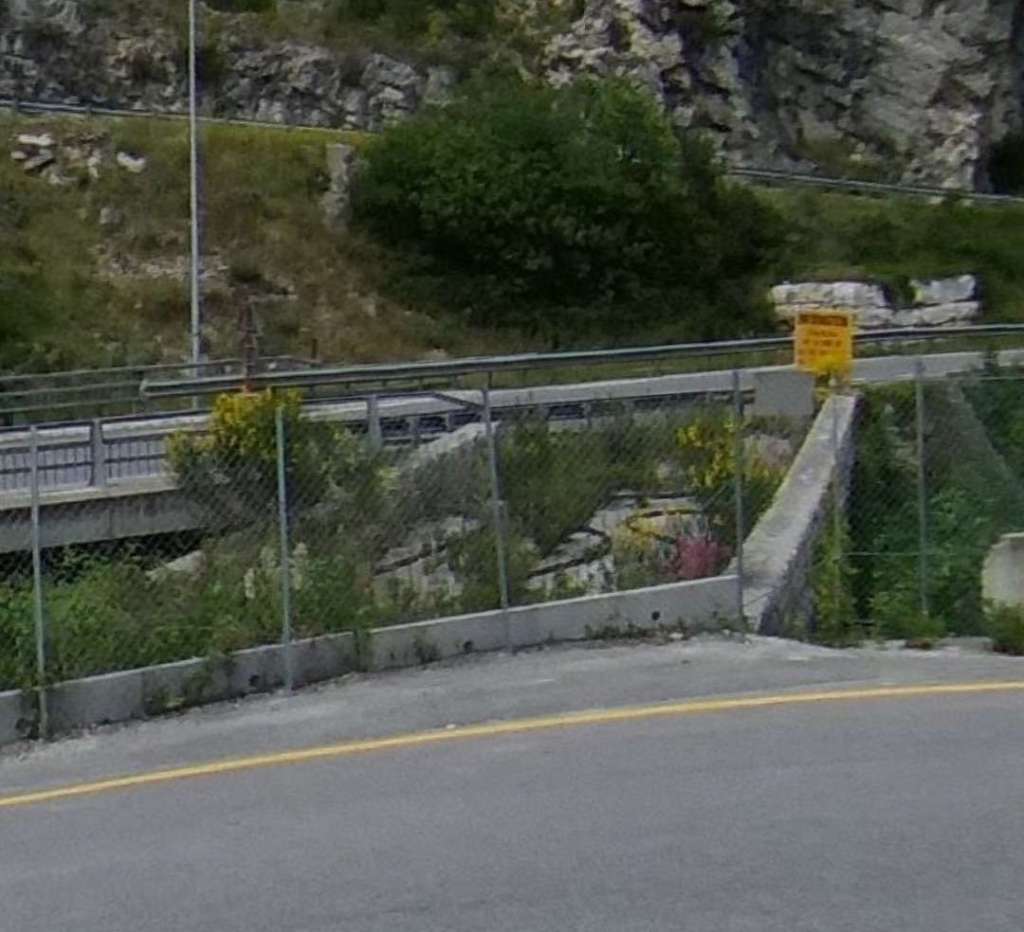
Looking from the hairpin bend in the image above across the old arch bridge. [Google Streetview, October 2022]
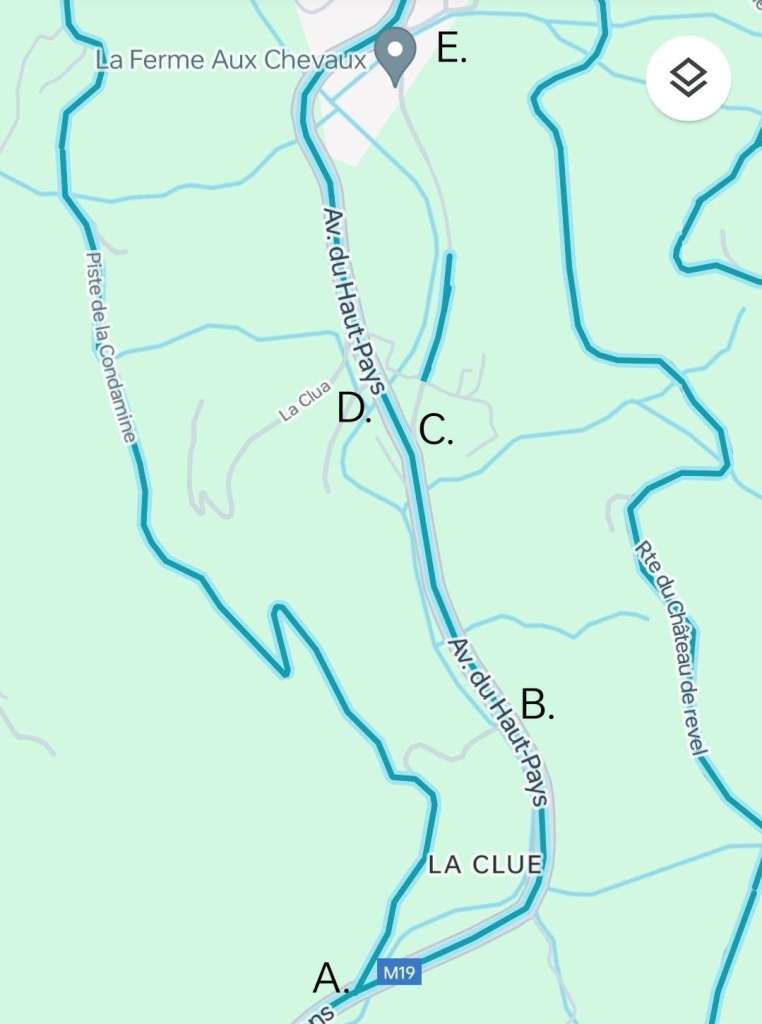
The next section of the M19 heading North. It crosses the River Banquière close to ‘A’ at the bottom of this extract from Google Maps, and again at D’. At location ‘A’ there is an older bridge across the Banquière which is probably the bridge referred to by Banaudo as the Tinon Bridge. This location is shown below.

Banaudo tells us that the tramway was remote from the main road on its own formation over this length for around 3 km “punctuated by the curved Rio-Sec Viaduct and a short tunnel.” [1: p62] That length of tramway commences at ‘C’ and continues through ‘E’ and onwards to Tourette-Levens. Some details of that length appear below but a fuller series of photographs can be found at https://rogerfarnworth.com/2018/03/20/the-nice-to-levens-tramway-part-1-chemins-de-fer-de-provence-54.
Location ‘A’ showing the modern M19 and the older road bridge over the Banquière. [Google Streetview, April 2023]
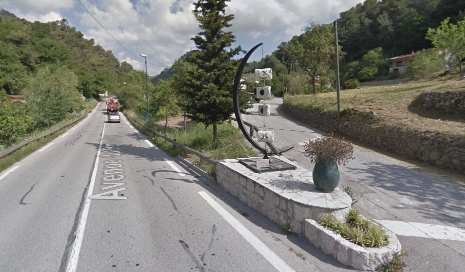
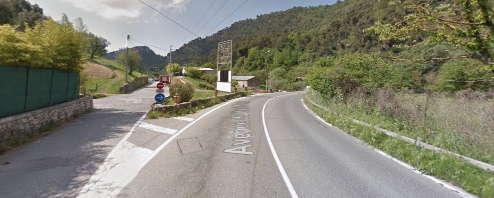
At location ‘C’ the tramway separated from the road and followed its own route to ‘E’. [Google Streetview, April 2023]
Looking South at ‘E’ the old tramway rejoined the M19 but only for a very short distance. [Google Streetview, April 2023]

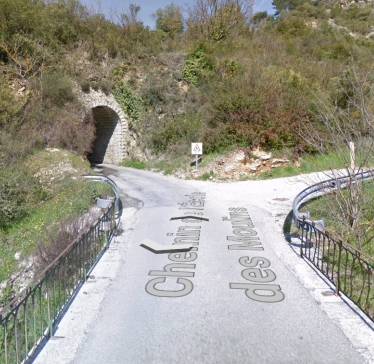
C. the Rio-Sec Viaduct (a single curved masonry arch) and the Moulins tunnel (40 m) which were on an independent formation a short distance to the East of the M19;

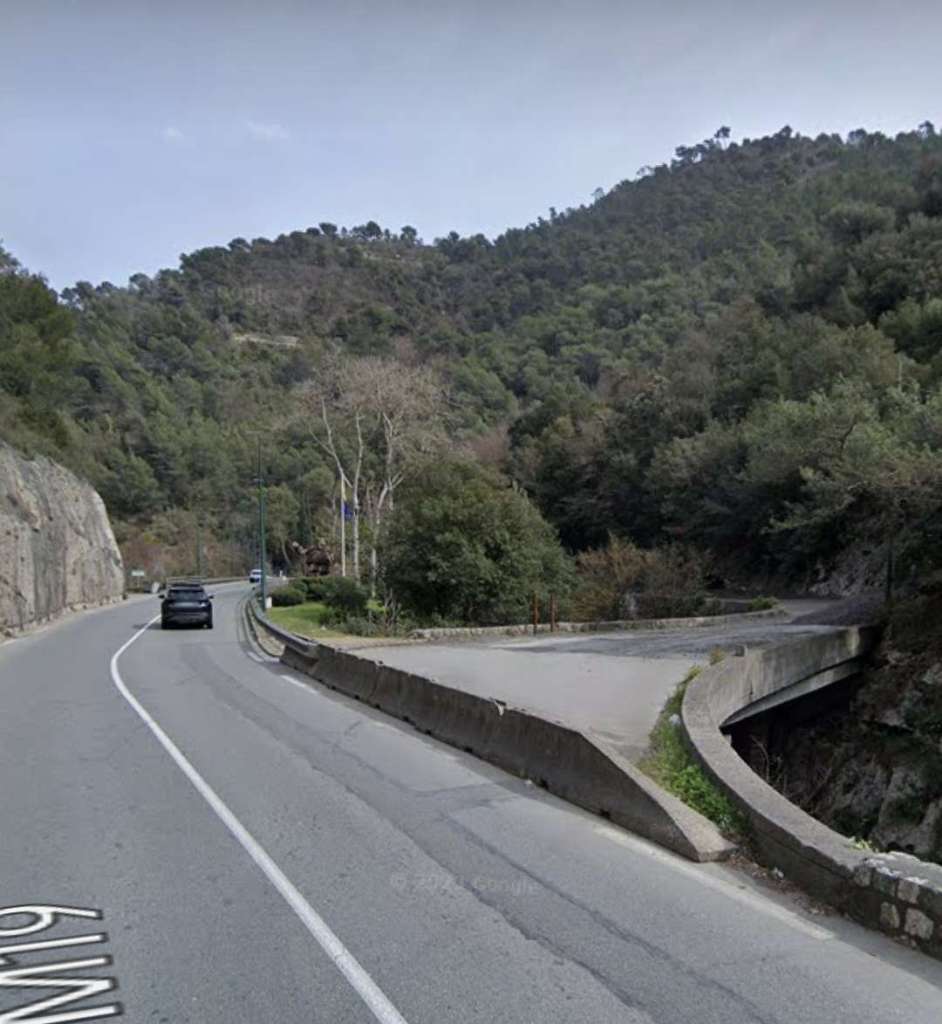
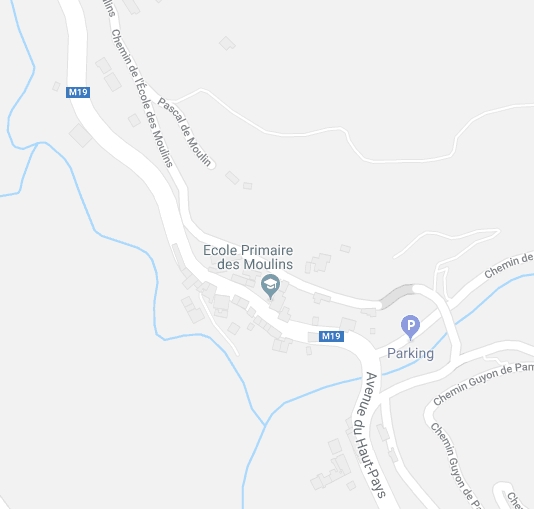
The Rio-Sec Viaduct curves round the East side of the area marked ‘P’ for Parking. The Tunnel des Moulins is the shaded length of road to the North of the parking area. [Google Maps, 2018]
Almost as soon as trams began running alongside the road again, they separated onto their own route once more. This dedicated formation took trams over the Viaduc de Rio-Sec and through the Moulins tunnel. [Google Streetview, April 2023]
The Rio-Sec Viaduct, seen from the East. [Google Streetview, 2018
The Tramway formation over the Rio-Sec Viaduct. [Google Streetview]
The approach to the Moulins tunnel over the Rio-Sec Viaduct. [Google Streetview, 2018]
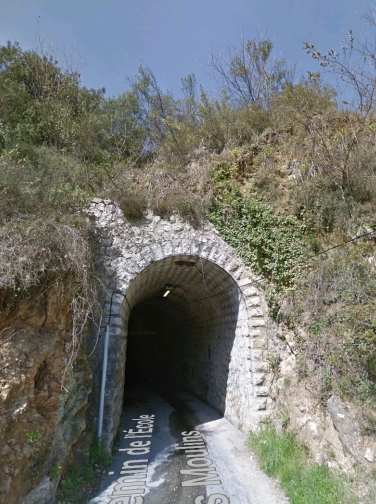
The Moulins Tunnel South portal. [Google Streetview, 2018]

D. the Levens tunnel (95 m, on the section built but not opened and now in use as a vehicular route into the centre of the village).
Some further observations ……..

Banaudo tells us that the process of agreeing the TNL tramway route serving Levens was different than for other routes (which were primarily dictated by the terrain and the orientation of the valleys). Early studies led to some elected officials recommending “linking Nice to St. Martin-Vésubie via the traditional stagecoach route via Tourrette, Levens, Duranus and St. Jean-la-Rivière.” [1: p66]
When the project took shape in 1904, three routes were considered:

  1. One extended the Cimiez line in the direction of Rimiez, L’Aire St. Michel, and Gairaut, from where it skirted the Mont Chauve massif to the west to serve the hilltop villages of Aspremont, Castagniers and St. Blaise, before arriving at Levens. This extremely picturesque cornice route would have served a well-populated area, but the travel time to Levens would have been prohibitive.
  2. Another left the Paillon valley in St. André and climbed in switchbacks to the village of Falicon, then it joined the previous route in Gairaut. This route would have been even longer and more tortuous!
  3. The last also left from St. André, but it went up the Gorges de la Banquière towards Tourrette, Ste. Claire and Levens. It served a smaller population than the previous ones, but had the advantage of being more direct route.

The third option was chosen and built between 1907 and 1909!

Banaudo continues to explain that the Compagnie du Sud [which ran the TAM tram network] applied for the concession of the Nice – Levens line, in the hope that, should an extension from Levens to St. Jean-la-Rivière be built it would connect with its own line in the Vésubie valley. But the chief engineer of bridges and roads decided to allocate the route to the TNL. His decision meant that the usage figures for the TNL network were reduced by this lightly populated route and as a result greater the line attracted greater subsidies from the State. [1: p66]

After the completion of construction in 1909, the commune of Levens lobbied for an extension into the village. Banaudo tells us that a route had already been considered by the Bridges and Roads Department which took the form of a long loop to keep gradients as low as possible. Initially a sizeable cutting was proposed which ultimately was superseded by a tunnel. [1: p66]

A contract was awarded and work started early in 1914. Work continued through to 1916-1917 slowed by the shortage of labour during the War. After the war, work restarted but disagreements over the financing of station facilities held up the works. Finally, the general council decided in 1926 to postpone the completion of the line and then, in 1929, proposed converting the route into a motorable road. It is in use as a road under traffic-light control in the 21st century. [1: p66]

Further notes on the Menton to Sospel line

Banaudo tells us that the total length of this line was close to 17.4 km of which the TNL saw the length from Place St. Roch along Rue Partouneaux to Villa-Caserta (2.4 km) and the short stub to Menton Railway Station (0.15 km) as part of its coastal network. The remaining length from Villa Caserta to Sospel (14.9 km) was deemed part of their departmental network. [1: p77]

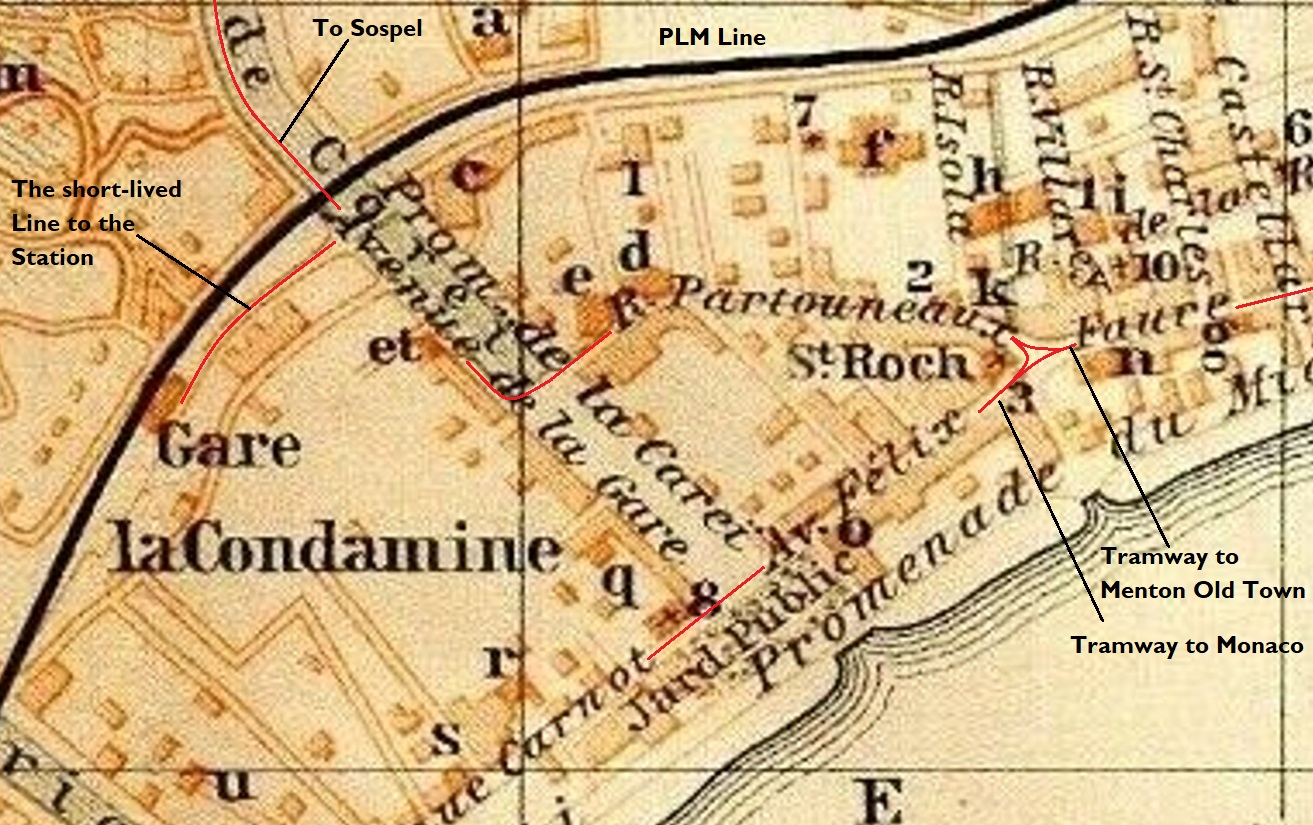
This Baedeker map of Menton in the early 20th century (1902) has been annotated to show tram routes in red. The line from Monaco to Menton ran along Avenue Carno and Avenue Felix Faure. At Place St. Roch the line to Sospel left the coastal route and ran along Rue Partouneaux as far as Avenue de la Gare and then Northwest alongside the River Carei. A short branch left the line to serve the Railway Station, but was only in use for a few years. [21]

The line originated in Place Saint Roch and ran first along Rue Partouneaux.

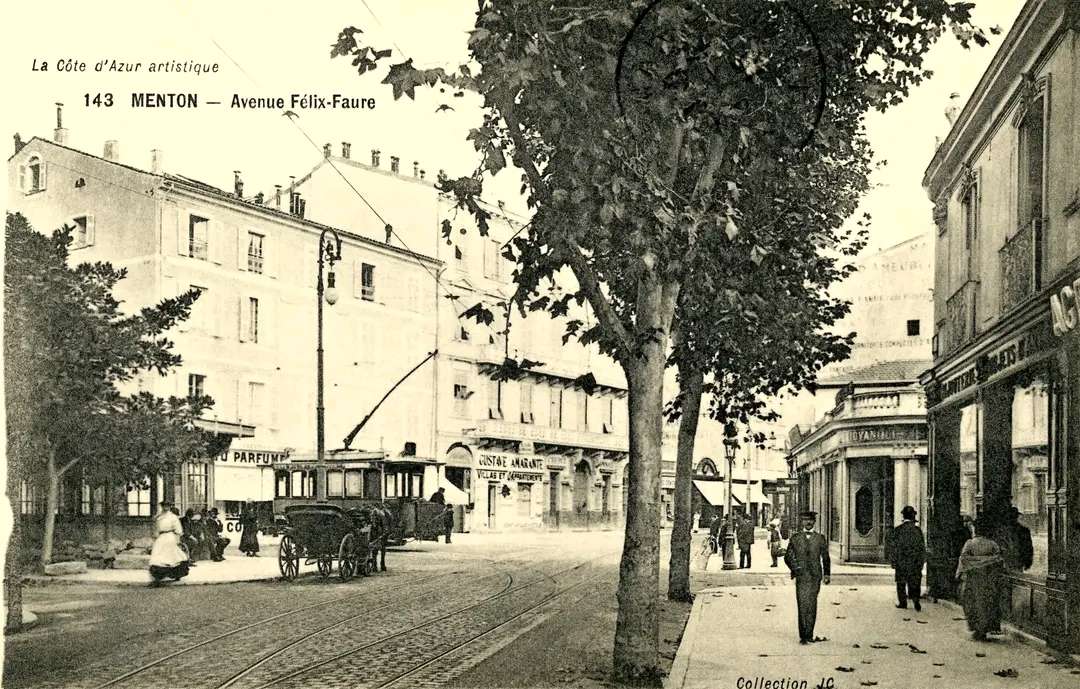
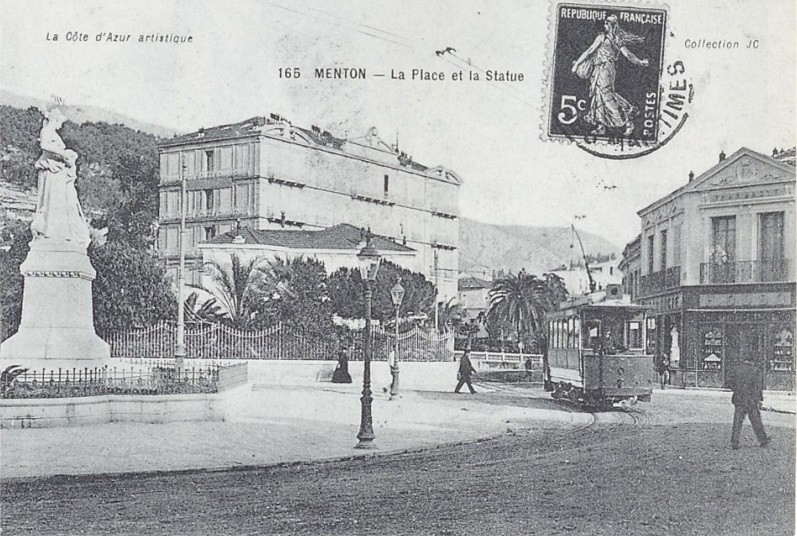
Avenue Felix-Faure/Place St. Roch, Menton, looking Northeast. On the left we can see the waiting kiosk of the TNL tram urban lines. There is a tram waiting at the stop which will leave along Rue Partouneaux to the Careï valley which exits the photograph to the left. It will possibly stop at the Villa Caserta terminus, or it will continue towards Monti, Castllon, the valley of Bévéra and the Sospel terminus. This image was shared by Jean-Paul Bascul on the Monaco4Ever Facebook Group on 28th September 2023 (Collection privée J-Paul Bascoul). [15]
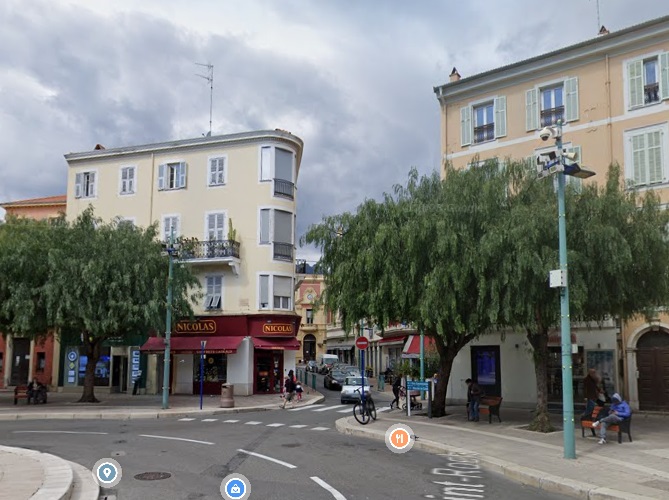
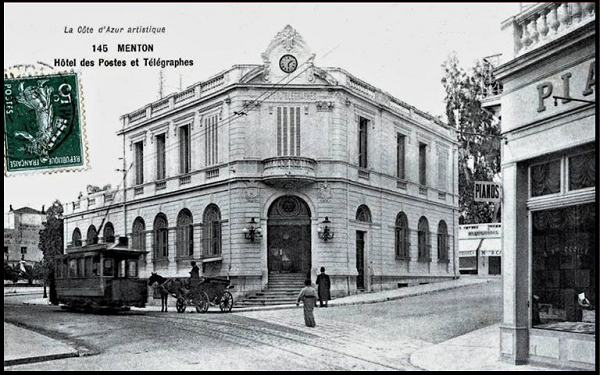
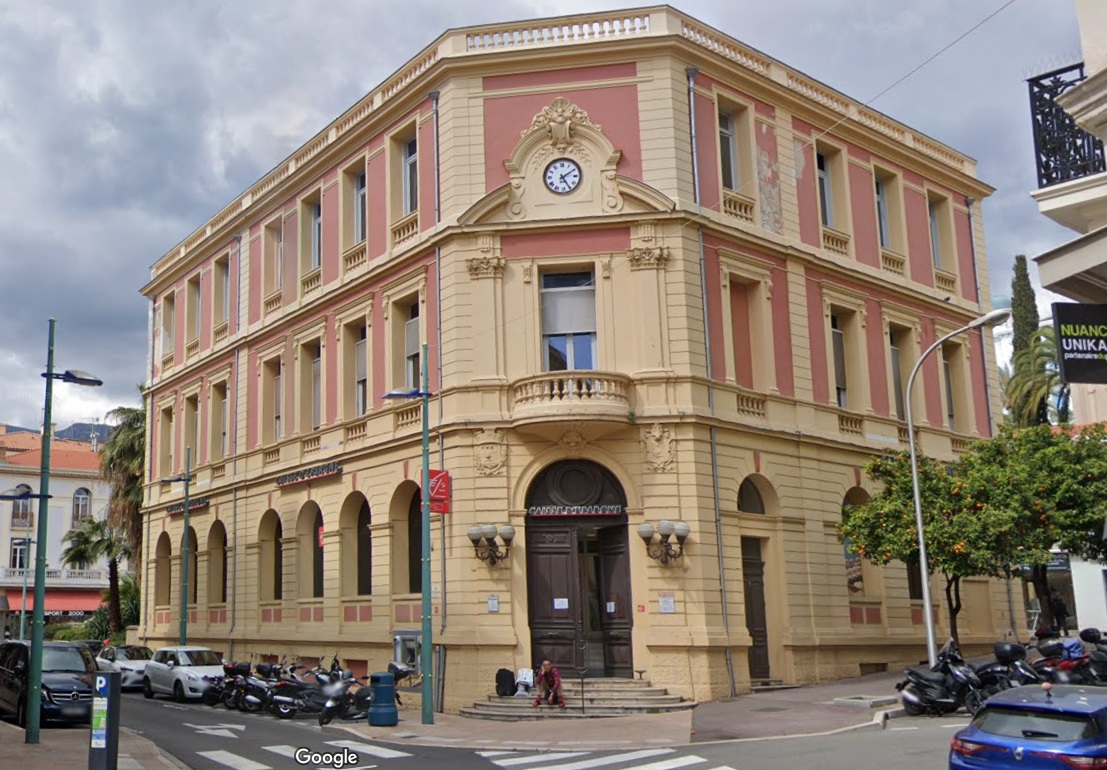
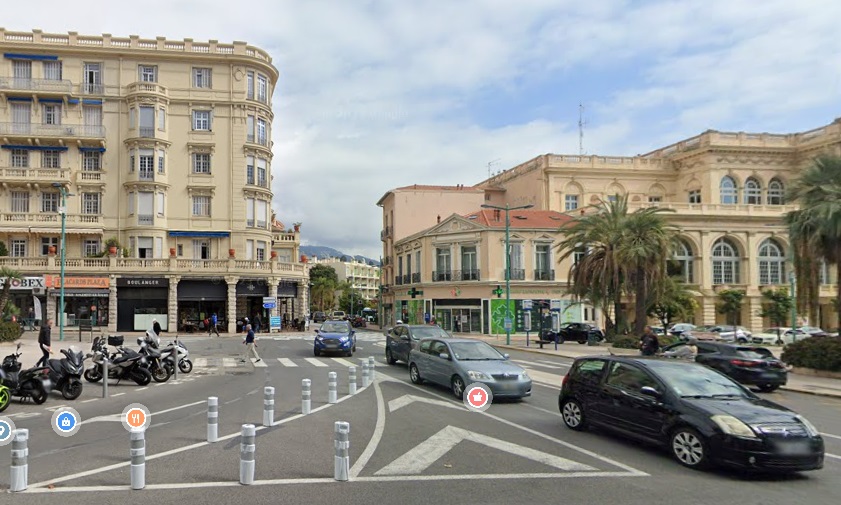
Looking into Rur Partouneaux from Place St. Roch. The Hotel des Postes is visible at the first junction down Rue Partouneaux. Note that it has an extra storey in the modern image. [Google Streetview, April 2023] This view is surprisingly similar to an early 20th century view which can be found on the Maonaco4Ever Facebook page on this link: https://www.facebook.com/MentonDuPasseAuPresent/photos/a.635924896587645/904791879700944/?__cft__[0]=AZX5F8XW__jQPAyygfwvR03xmeAlwW_69beRs7RwlwE6xsjQfZ63F76O9fVpVPdM1BJs7Sko4cCH399fbkWwRbZM3L9NxeGF889CfcQ1_7n1krmUaygG3KAdo2h7ZHbuHUUryowX6X5bDwpFxz0OAGE5IBIgQ4UTuX_U-hOLi7R9JLmGRwSgl8bz-28sshkfnjk&__tn__=EH-R . [20]
The view from close to Place St. Roch along Rue Partouneaux. The Hotel des Postes et Telegraphes is seen on the corner of the next junction. A tram travelling towards Les Jardins Biovès is seen immediately outside the building. [17]
A similar view in April 2023. The building has the additional storey noted above. [Google Streetview, April 2023]
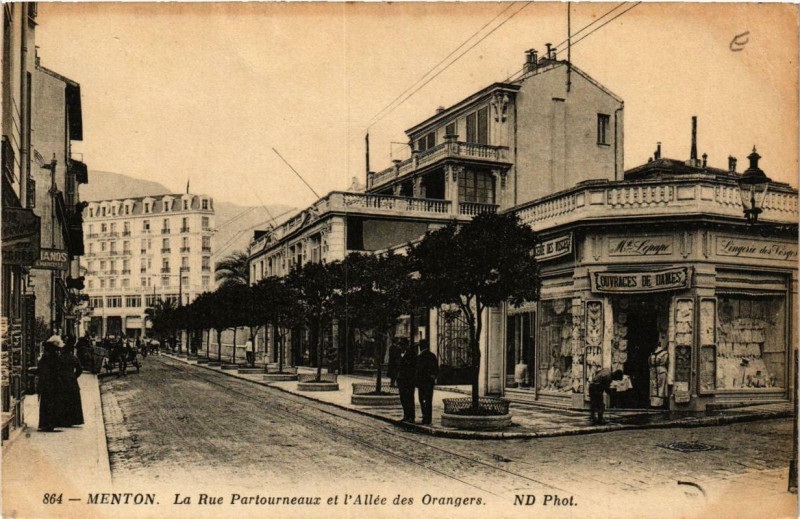
Further Northwest along Rue Partouneaux. This old postcard view shows the road as it runs toward Les Jardins Biovès. The trees on the right of the road were Orange Trees. [18]
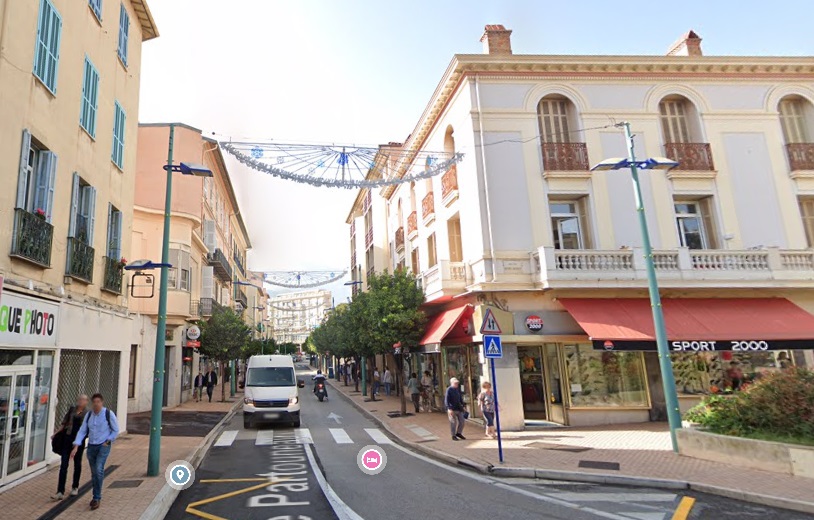
This is the same location in the 21st century. Rue Partouneaux runs towards what were Les Jardins Biovès. [Google Streetview, October 2022]
A tram leaving Rue Partnouneaux and about to turn North alongside Les Jardins Biovès. [19: p5]
The same location in the 21st century. Rue Partouneaux is directly ahead of the camera. The old tramway curved round to the North. Its route approximated to the curved line of bollards. [Google Streetview, March 2023]

The maximum gradient on the line was 68mm/m, only 0.144 km of the line was on a level formation. The line started in Place St. Roch at 3 metres above sea level and reached a maximum altitude of 572 metres above sea level at the Castillon tunnel. In all, trams had to negotiate 482 curves as they travelled the line of which 143 had a radius less than 40m. [1: p77]

Over 75% of the route was independent of the road between Menton and Sospel, now the D2566/D2566A. With its tight curves, “its imposing structures and its stations with spacious buildings, the Menton – Sospel line appeared much like a real  mountain railway.  In this way, it was more similar to the daring branches of the TAM network than to the other TNL lines in the Nice hinterland which retained the appearance of urban tramways.” [1: p77]

Banaudo tells us that “the line was entirely single track.  It met the coastal artery at a triangular connection on Place St. Roch, at the entrance to the old town of Menton.  The tram left from the western branch of the triangle, along which a wooden kiosk housed travelers and company agents.  Via Rue Partouneaux, trams accessed the Biovès public garden which occupies an esplanade created by covering the River Careï. At the top of Avenue de la Gare (today Verdun) there was a short branch of 147 m on a ramp of 40 mm/m which ended in a dead end at the entrance to the courtyard of Menton PLM station. [That branch] served as a terminus for urban shuttles from Place St. Roch.” [1: p77] The branch lineline was brief both in length and life since, “after only operating from 1903 to 1912, it was abandoned during the First World War.” [1: p77]

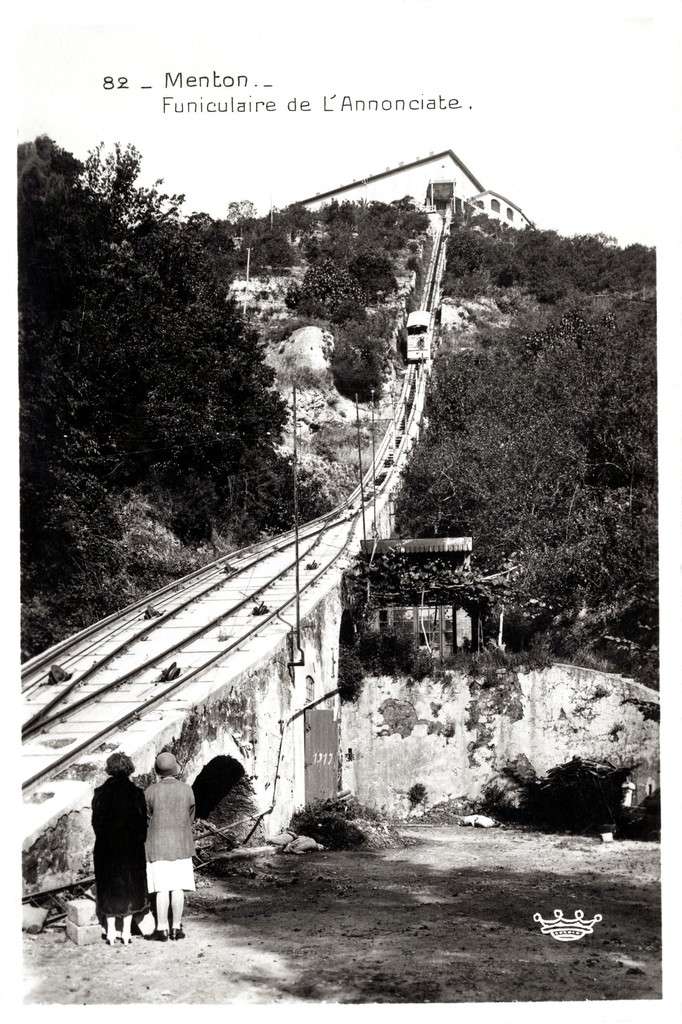
Immediately beyond the station branch, the tramway passed under the bridge of the PLM Nice – Ventimiglia line then continued up the right bank of the River Careï where there was a goods station. Banaudo says that, “the line passed at the foot of the L’Annonciade Hill, where a funicular served a hotel and a monastery.” [1: p77]

The Funiculaire de L’Annonciate served a hotel and Monetary at the summit of L’Annonciade Hill in 1919. The funicular railway opened in 1914 and closed circa. 1939. [8]

Continuing North, three passing-loops were provided at “Villa-Beau-Séjour, at the Gioan-Bosio property Ans at l’Octroi-due Careï. Soon after, “the Villa-Caserta tram stop marked the terminus of urban services. Upstream and downstream of this point, two dedicated branch lines allowed the Mercier and Gianotti companies to load materials to be sent to Sospel for the construction of the PLM Nice – Cuneo line.” [1: p77]

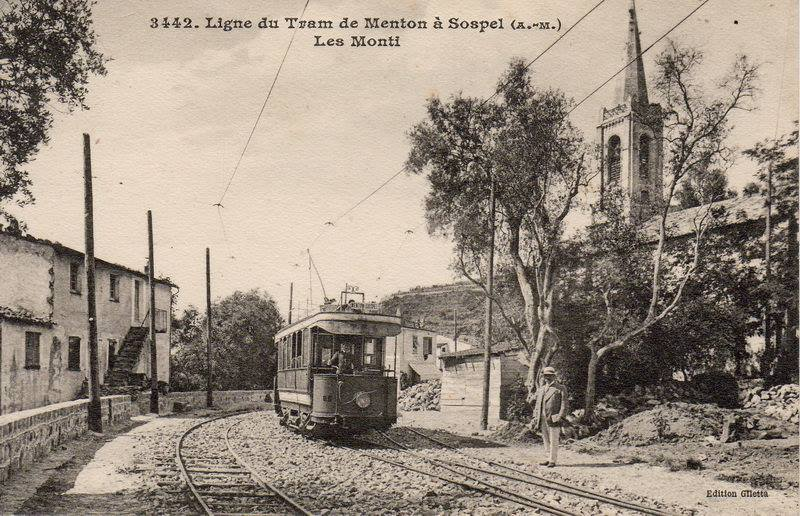
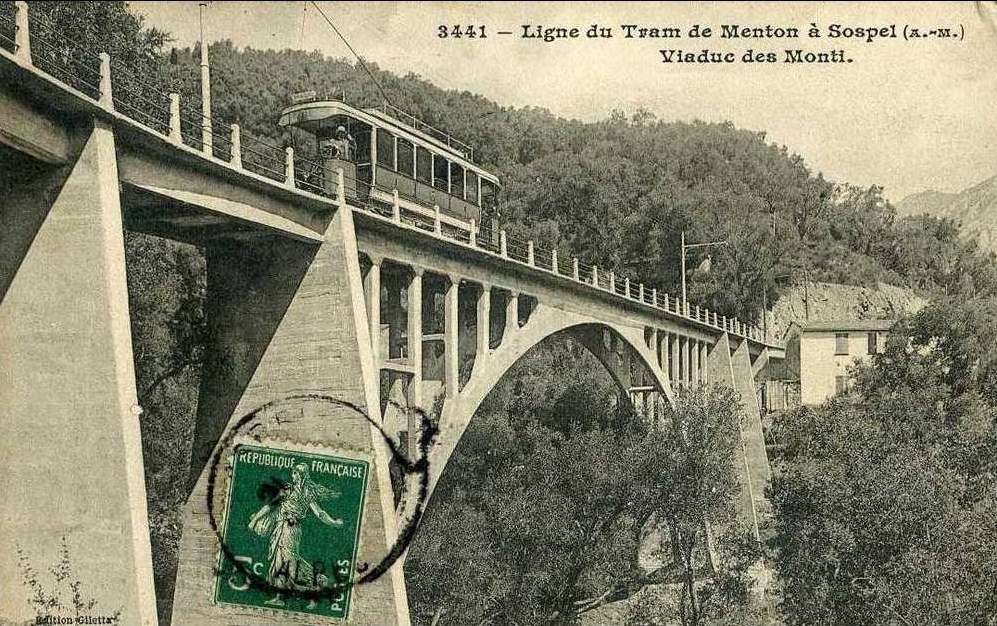
The route continued North along what is now the D2566 avoiding one tight bend by following its own course for approximately 450 metres. The hamlet of Monti had its own tram stop and was the location of a reinforced concrete viaduct which spanned both a ravine and the road. Pictures of this structure can be seen further down this article.

The tramstop and passing loop at Monti. [16]
A similar location in 2023. Both views look South from a point just to the South of Viaduc de Monti. [Google Streetview, March 2023]

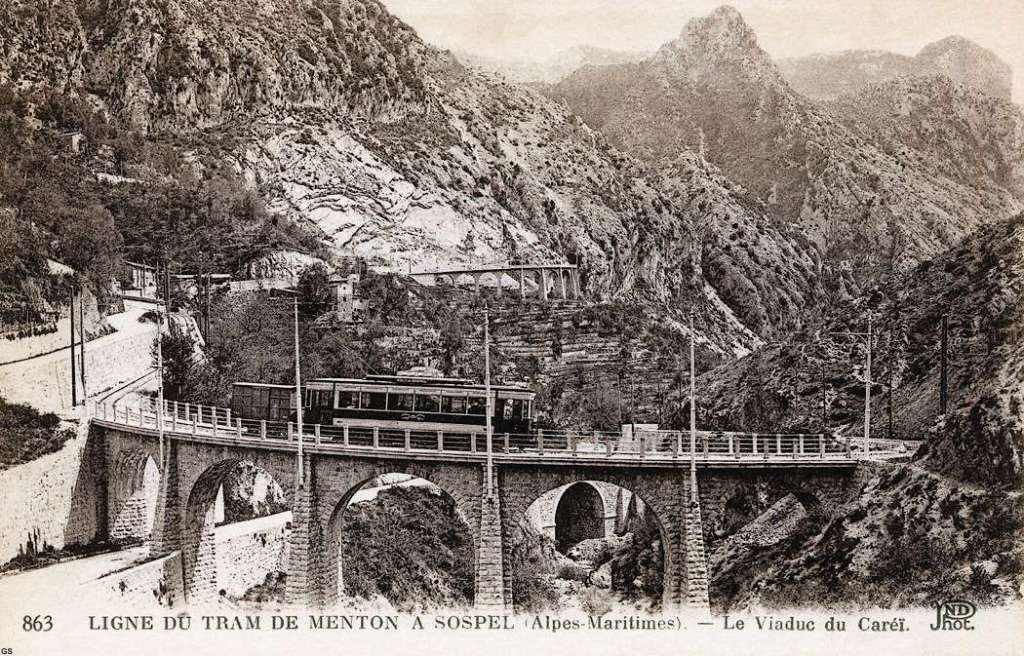
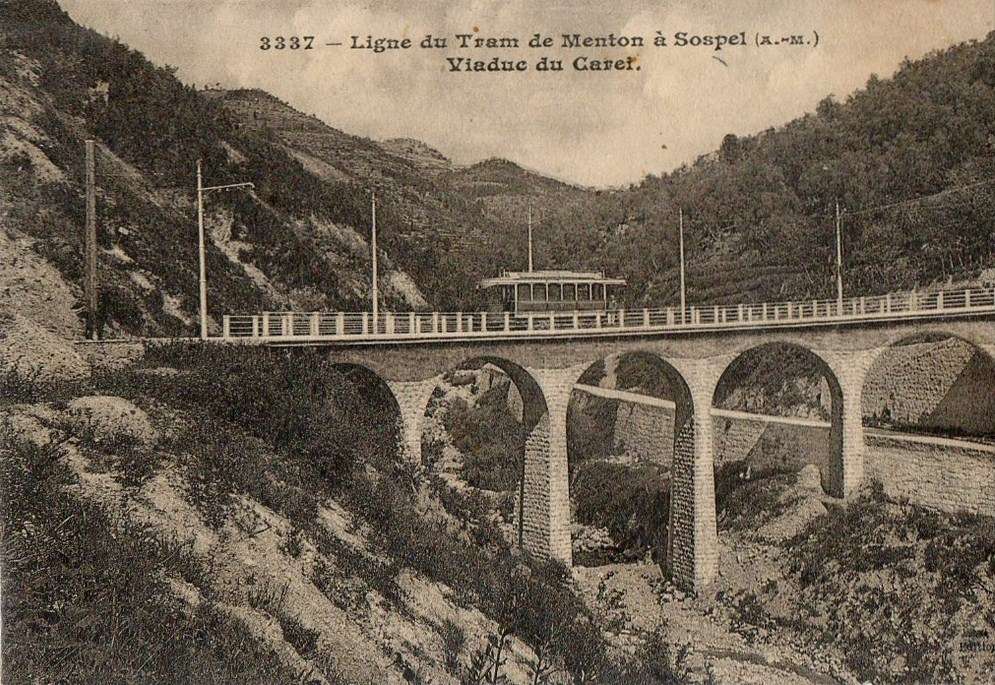
Now running on its own formation, the tramway climbed above the road for 2.3 km. Banaudo explains that the road climbed to meet the tramway “at the Ubac-Foran forest house.  Arriving at a point where the valley narrows sharply and where the gradient becomes steeper, the track ran again on its own formation to span the road and the River Careï on the curved Careï viaduct, with five masonry arches.” [1:p77]

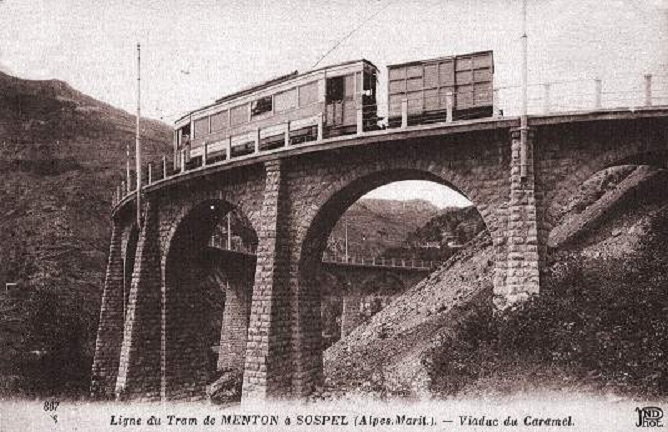
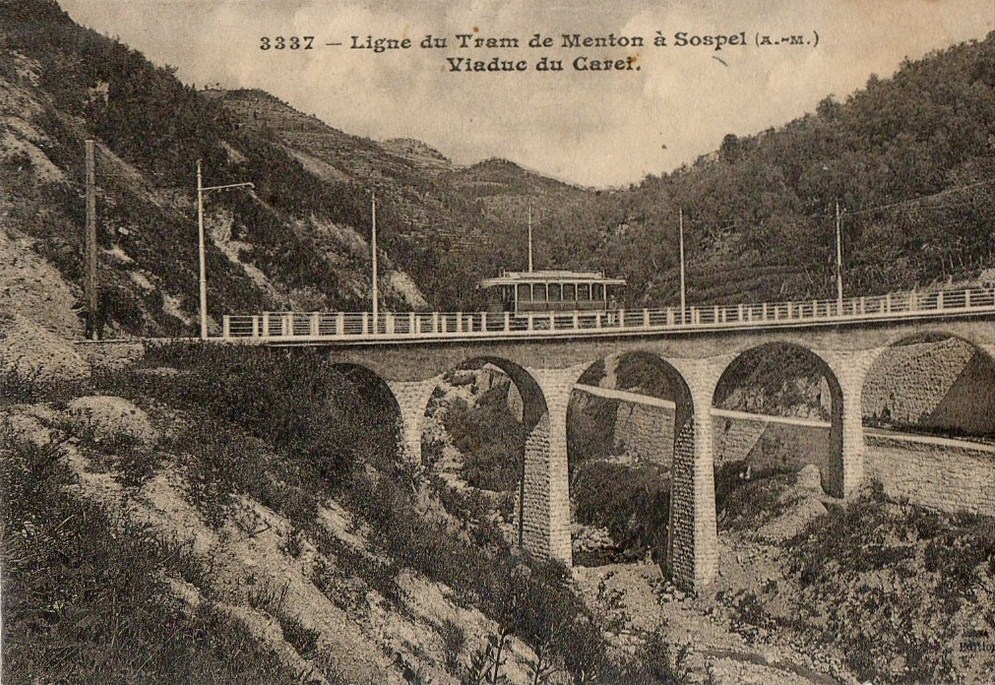
Over the River Careï the tramway continued climbing steeply in a Southeasterly direction to the location of the Caramel viaduct, “whose bold silhouette had already been visible for several minutes standing out against the mountainside.  This major [structure] on the line had thirteen arches with a total length of 120 m, which were part of an omega-shaped loop below the road.” [1: p77] To the Northwest of the Viaduct, two dead-end tracks were provided, one to serve a quarry, the other to stop trams whose brakes had failed before they ran out onto the viaduct.

Continuing its ascent, the tramway again left the road and approached the bottom of the valley where the Castillon tram stop was located. “It was in a damp and isolated site below the village and the pass of the same name. A substation incorporated into the station building provided the line’s electrical supply. This was also the location of the southern portal of the 763 m tunnel under the Col de Castillon, the longest structure of this type drilled for a tramway in the Alpes-Maritimes.” [1: p77]

At its Northern portal, the tunnel opened into the green valley of Merlanson at an altitude of 572 m, the highest point on the TNL network. “From there, the line descended on its own formation for 4900 m on the right bank of the river. To the west stands Mount Barbonnet crowned with a fort while in the background, at the foot of the amphitheater formed by the mountains of the Authion massif, the Bévéra valley widens to form the basin where the town of Sospel is located.” [1: p77]

Approaching Sospel, the tramway ran under the embankment of the PLM Nice – Cuneo line then ended its journey at the entrance to the town where a station was built with a passenger and goods facilities and a motor shed. Banaudo tells us that during the years of construction of the PLM railway, “the track extended to the platform of the future PLM station, where the materials could be supplied by the Mercier and Gianotti companies.” [1:p77]

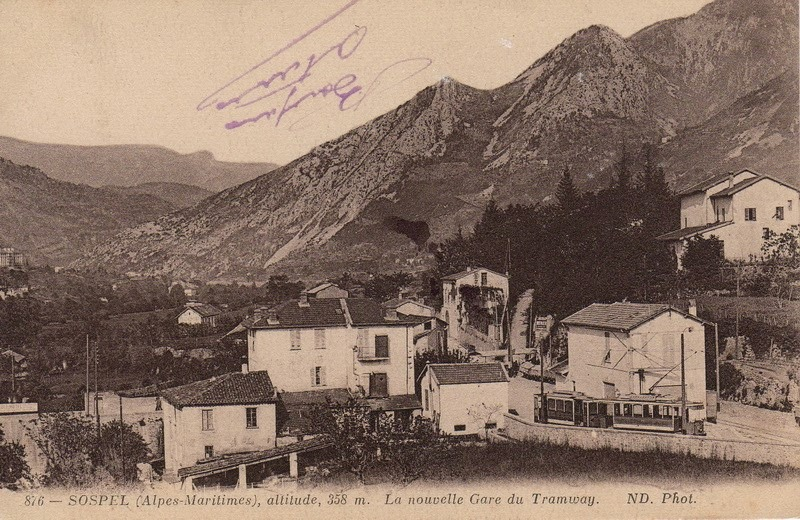
Sospel showing the tram stop/station centre-left and the PLM station top-right. This is an enlarged part of a photograph taken after the completion of the construction of the PLM railway line. It was shared on the Comte de Nice et son Histoire Facebook Group on 15th March 2017 by Pierre Richert. [12]
Sospel tram station. This image was shared on the Comte de Nice et son Histoire Facebook Group by Roland Ciccoli on 11th September 2017. [13]
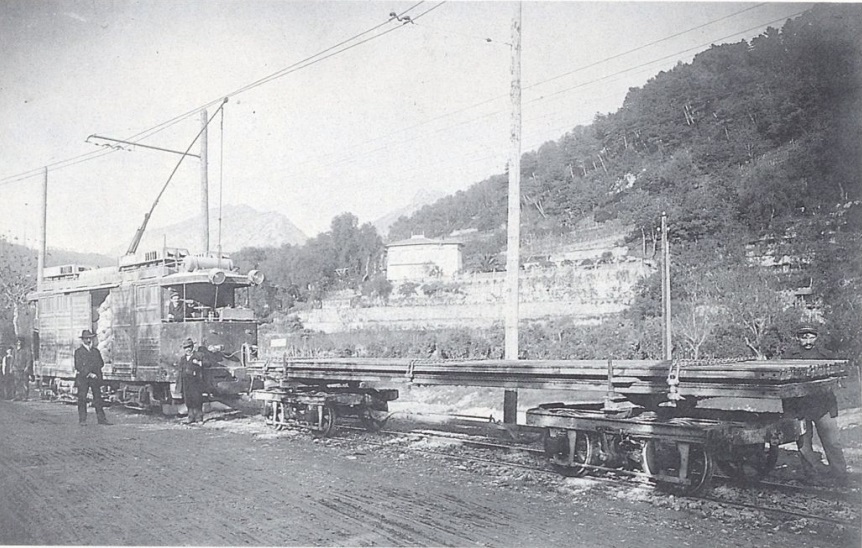
TNL Tram No. 13 is heavily laden with bags of cement and in charge of a long load affixed to two short, flat wagons. The photograph is taken close to Sospel with the works underway on the PLM Nice to Cuneo line. [19: p6]

Key Dates

Banaudo provides details of dates relating to the life of the whole line. [1: p78] The more significant of these are: 1903 (the line between Place St. Roch and the PLM Railway Station was opened to traffic); 1911 (the route between Avenue de la Gare, Menton and Villa Caserta was opened); 1912 (a courier service between Menton and Sospel was opened); 1913 (the goods service between Menton and Sospel was inaugurated); 1923 (the new numbering system was put in place: No. 45 was given to the urban service between Menton and Villa Caserta; No. 46 TP the interurban service Menton to Sospel); 1927 (the urban service (No. 45) was extended to Route-de-Monti); 1931 (trams on Ligne No. 46 were replaced by buses and the tram service (Ligne No. 45) between Villa Caserta and Route de Monti ceased); January 1932 (trams on Ligne No 45 between Avenue de la Gare and Villa Caserta were replaced by a bus service); March 1932 (the remaining length of the line between Place St. Roch and Avenue de la Gare was closed). In the summer of 1933 the full length of the line was decommissioned.

The full service between Menton and Sospel was active for less than 20 years!

The Main Structures on the Line

These were: the Peïrola Ravine Bridge; the Monti Viaduct (1 concrete arch of 36 m, total length 79 m); the Ture Ravine bridge; the Pian Ravine Bridge; the Careï Viaduct (5 arches of 8 m); the Caramel viaduct (13 arches of 8 m, length 120 m); and the Castillon Tunnel (763 m).

Structurae.net provides a number of photographs of the Viaduc de Monti which remains standing in the 21st century. These images can be found here. [9]

Viaduc de Monti in the early 20th century, probably 1910. [10] Banaudo tells us that this was chosen from five design submissions. The structure was designed by François Hennebique was selected in 1907 by the deputy chief engineer Amaud who judged it to be the most economical (38,000 francs), the most advantageous and the most satisfactory in appearance. [1: p81]
The Viaduc du Monti again. One of the very few times that steam was seen on TNL lines. We see the same consist at Viaduc du Caramel a little further down this article. [19: p7]
A tram crosses Viaduc de Careï having run down the gradient from the Viaduct du Caramel which can be seen in the distance. The tramway can be seen running below the road on the left of this image.
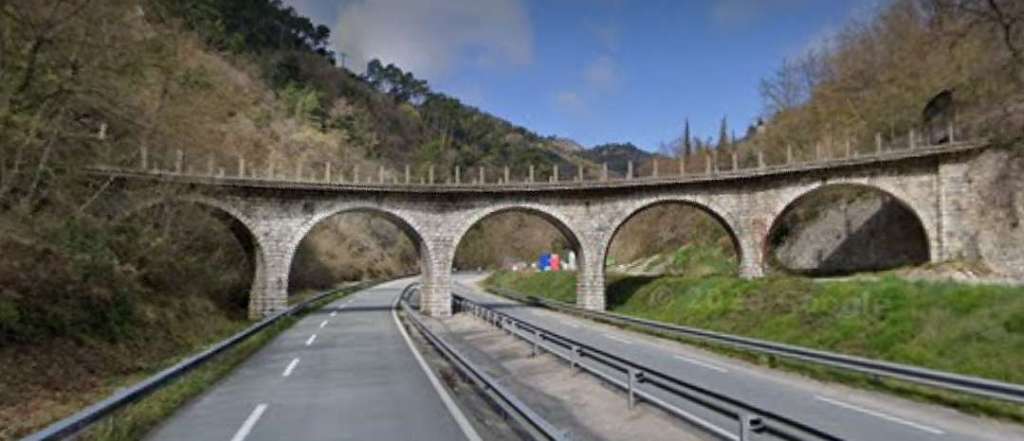
Viaduc de Careï seen from the hillside to the South. In the 21st century the viaduct looks very different as the D2566 has been widened and realigned. [11]
A photograph from a similar location showing the way in which the valley has been remodelled, realigning and lifting the road, so that the piers of the viaduct seem much shorter. [Google Streetview, April 2023]
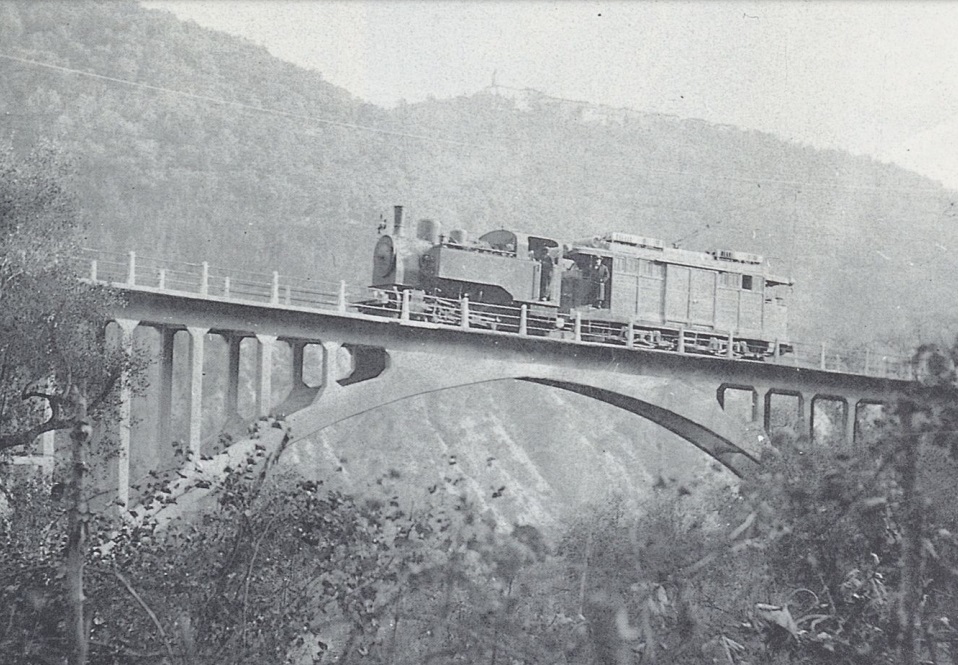
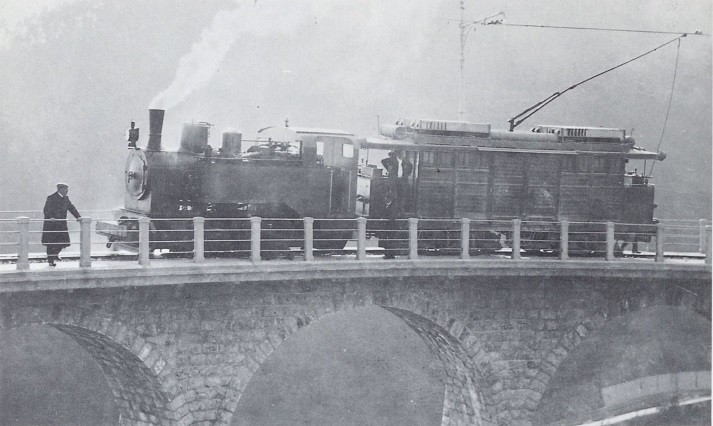
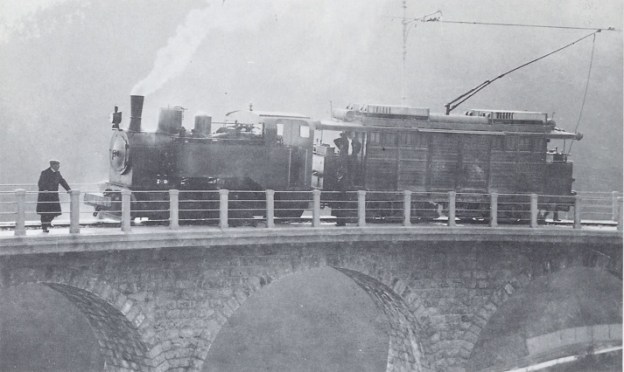
This is an evocative photograph which pictures a small steam engine travelling up the Menton to Sospel tramway. The location is the Viaduc du Caramel and the photo is taken from the carriageway of what will become the D2566. The 0-6-0T locomotive is in-steam but the tram (TNL No. 13, which we have seen in an image earlier in this article) also has it supply pole raised and in contact with the overhead lines. It is positioned behind the locomotive presumably to give some tractive effort and perhaps also as a fail-safe needed because of the gradient of the line. The locomotive is being moved to work on the PLM railway line between Nice and Cuneo (Nice – Sospel – Breil-sur-Roya – Cuneo). [19: p4]
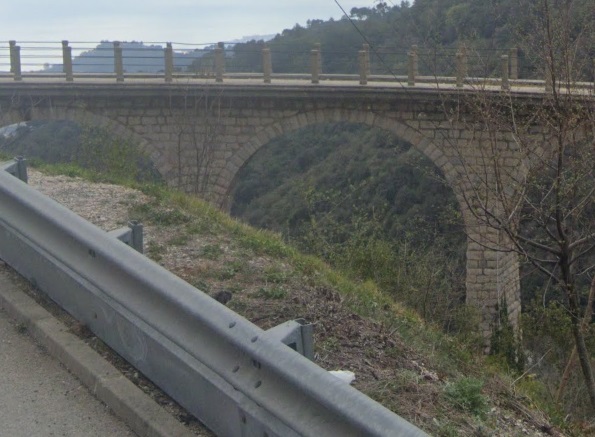
A view of the Viaduc du Caramel in March 2023, taken from a similar position as the monochrome image above. [Google Streetview, March 2023]
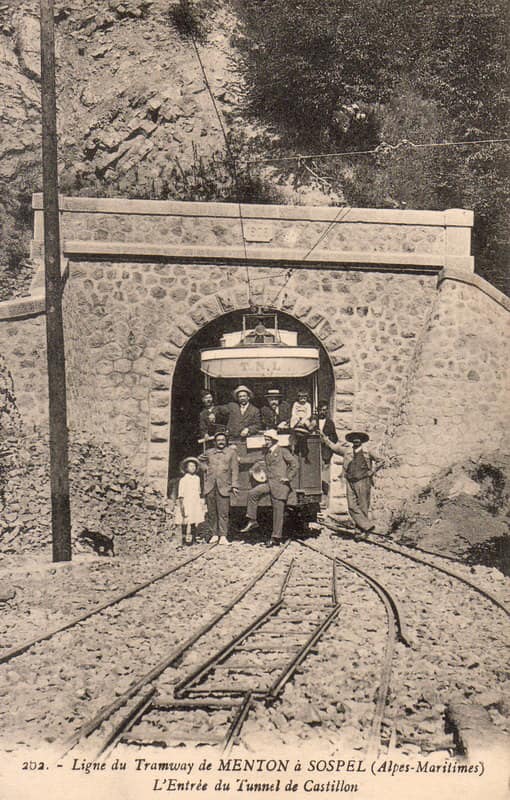
The approach to the Castillon Tunnel from the South in around 1920 with a tram heading for Menton. The hamlet of Castillon sits more than 130 metres above the tram stop. This image was shared on the Comte de Nice et son Histoire Facebook Group on 6th August 2021 by Alain Nissim. [14]
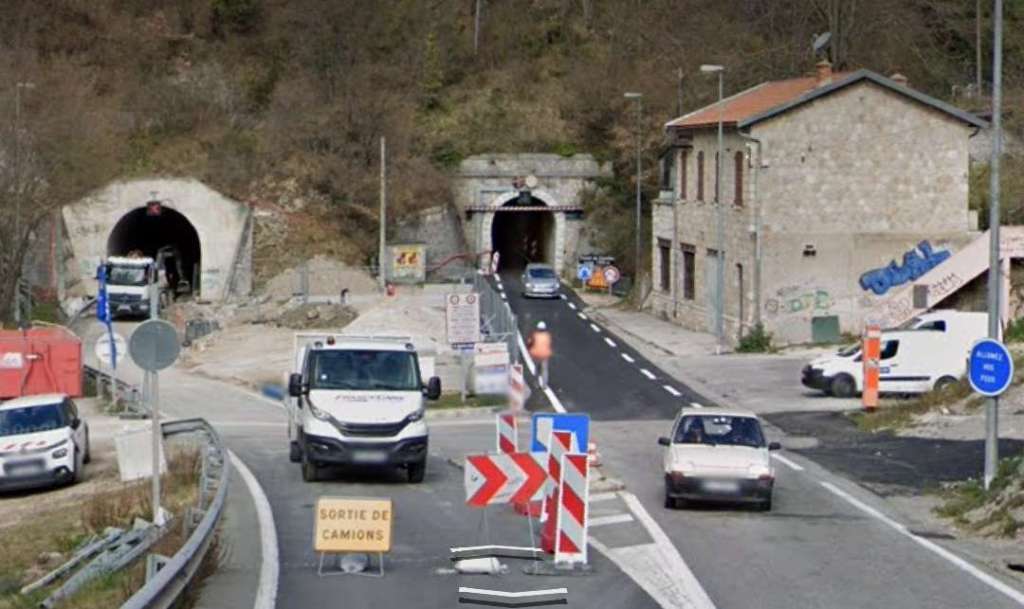
A modern view of the old tramway tunnel. The original bore is on the right. The new bore is on the left. The modern road is the D2566A which follows the line of the old tramway. The works underway in March 2023 were still being undertaken in November 2023 when we followed the route by car on the way from Sospel to Nice. [Google Streetview, March 2023]
The southern portal of Tunnel de Castillon (public domain). [22]
A closer view of the southern portal of the old tunnel in 2023. [Google Streetview, March 2023]
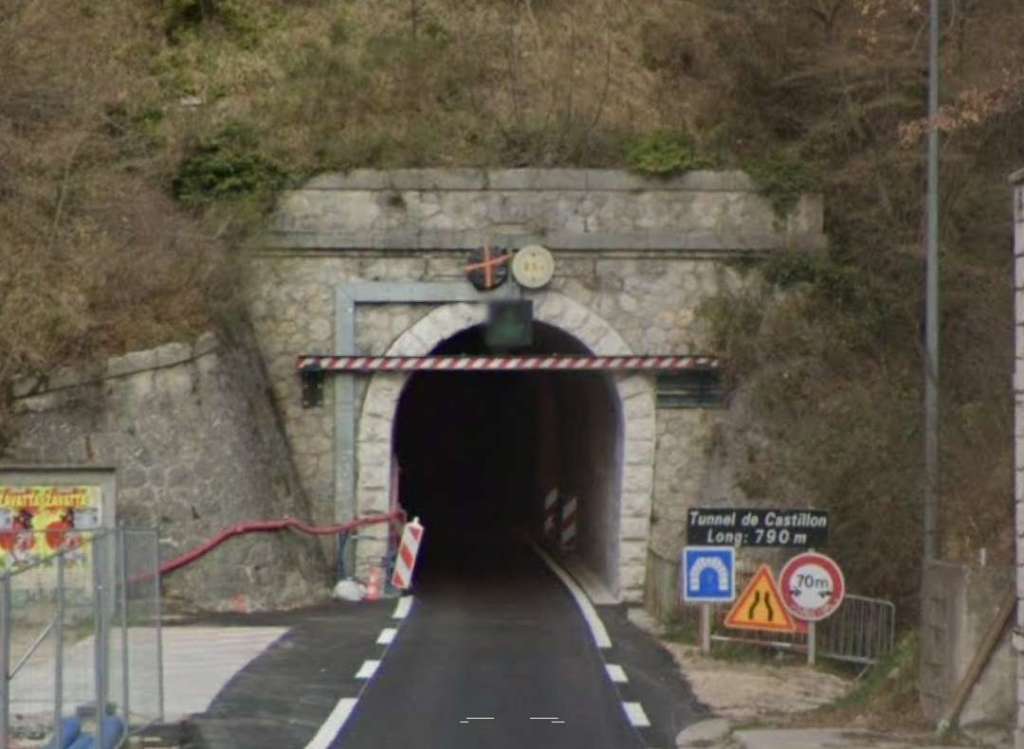
The northern portals of the two tunnels in 2023. [Google Streetview, March 2023.

The Tunnel de Castillon was an essential element of the scheme, the additional climb to the village would have required a significant series of loops either side of the pass and severe gradients. Structurae.net provides a number of photographs of the Tunnel which remains standing in the 21st century and is in use as a road tunnel. These images can be found here. [24]

Steep Gradients on the Menton to Sospel Tramway and the wider tram network

Banaudo’s book has a short feature relating to the exceptional gradients on the Menton to Sospel line and throughout the TNL and TAM networks. [1: p81]

99% of the Monton to Sospel tramway was on a gradient. The average gradient between Menton and the summit of the line at the North end of the Tunnel de Castillon was 46mm/m over almost 12.4 km. This was unique in the Alpes-Maritimes and “assez exceptionelles (quite exceptional) en France.” [1: p81]

Over 7.7 km was graded between 46mm/m and 60 mm/m. 60 mm/m was specified as the steepest grade permitted, but during construction it became obvious that complying with the specification would unduly lengthen the line. Ultimately, the Department of Bridges and Roads permitted over 4.1 km to be built with steeper grades (between 61 and 68 mm/m), mainly in the Careï valley.

Banaudo points out that at “the same time, in Switzerland, Italy and Austria, such lines were put into service with vehicles equipped with specifically adapted traction and braking mechanisms, the Departement des Alpes-Maritimes and concessionaires (the TNL on Menton-Sospel and the Sud-France on the entire TAM network) did not seem to appreciate the level of risk involved in such operations.” [1: p81]

The TNL had been successfully running 168 hp bogie trams equipped with compressed air brakes on the Contes and Levens lines. However, trials on the Menton-Sospel line demonstrated that their electrical equipment could not sustain the stresses imposed by such long and steep gradients. “As soon as sustained effort was required, the entire circuit was at best overheated, the circuit breaker tripped and the fuses blew, the wheels of the trolleys could melt, the controller would start to smoke, and soldered connections could melt and cables ignite. It was therefore decided to modify these trams and equip them with more powerful motors. But pressure from the Departement to put the Sospel line into service, meant that the service was opened in the spring of 1912 with two standard type T2 passenger trams and one self-propelled goods van. These two-axle vehicles only had a power limit of 70 and 84 hp which did not even allow for the lightest of wagons to be towed. The handbrake was supplemented by (un freinage rheostatique) rheostaic braking. No air-brake was provided!” [1: p81]

Banaudo goes on to explain that, “The inadequacy of this equipment was tragically brought to light on 11th September 1912, when a train carrying gravel for finishing work on the line ran down the steepest slope: The handbrake was unable to hold it and the power pole separated from the overhead supply, rendering rheostatic braking inoperative. The convoy ended up derailing and crashing at the foot of the Monti viaduct, killing the driver and the conductor.” [1: p81]

Sadly, just two weeks later the first of the modified bogie power cars Nos. 214 to 216 entered service (on 23rd September 1912). These were equipped with “hand, air and rheostatic brakes, developing a power of 240 hp, these tramcars proved to be better adapted and could tow two passenger trailers or three goods wagons on the steepest slopes. In June 1913, two self-propelled goods vehicles were modified in the same way and moved to the Sospel line, which ensured regular freight traffic from summer onwards. A third ‘tracteur’ of a similar design was put into service the following year.” [1: p81]

In the meantime a derailment of a train on the TAM line between Cagnes-sur-Mer and Grasse occurred on 17th September 1913 at the Viaduc de Cloteirol near Villeneuve-Loubet. “This disaster caused many deaths and the commission formed following this accident to improve the safety of the departmental network covered all the lines, including that of Sospel on 29th January 1914. Following its conclusions, the Department of Bridges & Roads limited tram speeds to 16 km/h uphill and 12 km/h downhill as well as when crossing viaducts. Four safety stops were established for descending convoys at points located at the top of steep slopes: above the Viaduc du Caramel viaduct, at l’Ubac-Foran, above the Pont de Monti and at km 3,350 between this hamlet and the stop at Villa Caserta. The first two stops, where the tramway could leave and pick up passengers, were equipped with a point directing an out-of-control convoy into a dead-end siding with a strong contrary slope. … In Villa-Caserta, a similar device was provided to stop any runaway of vehicles parked at the terminus of the urban service.” [1:p81]

References

  1. José Banaudo; Nice au fil de Tram, Volume 2: Les Hommes, Les Techniques; Les Editions de Cabri, Breil-sur-Roya, France, 2005.
  2. https://artplastoc.blogspot.com/2023/02/1292-nice-la-passerelle-et-le-pont.html?m=1, accessed on 21st November 2023.
  3. https://twitter.com/actualites_nrv/status/990903681389400064?t=rpQXwAb7jIlpMfdfM8RoIg&s=19, accessed on 21st November 2023.
  4. https://www.mapsof.net/saint-andre-de-la-roche-fr, accessed on 22nd November 2023.
  5. https://rogerfarnworth.com/2018/03/20/the-nice-to-levens-tramway-part-1-chemins-de-fer-de-provence-54.
  6. https://m.facebook.com/groups/ciccoli/permalink/3231219313790582, accessed on 23rd November 2023.
  7. https://m.facebook.com/groups/ciccoli/permalink/3504633499782494, accessed on 23rd November 2023.
  8. https://cronobook.com/pic/1e977519-3f4c-427f-9bdb-ba67e3c07054, accessed on 27th November 2023.
  9. https://structurae.net/en/structures/monti-viaduct, accessed on 27th November 2023.
  10. https://commons.m.wikimedia.org/wiki/File:Viaduc_de_Monti_(1910).jpg, accessed on 27th November 2023.
  11. https://upload.wikimedia.org/wikipedia/commons/1/1d/Viaduc_du_Carr%C3%A9i_%281910%29_Ouest.jpg, accessed on 27th November 2023.
  12. https://www.facebook.com/photo/?fbid=10210534413814255&set=a.10210534255570299, accessed on 28th November 2023.
  13. https://www.facebook.com/photo/?fbid=472351886472746&set=pcb.2011981832381009, accessed on 28th November 2023.
  14. https://m.facebook.com/groups/ciccoli/permalink/3158590614386786, accessed on 28th November 2023.
  15. https://www.facebook.com/groups/1389253567814679/permalink/9979281115478505/?mibextid=rS40aB7S9Ucbxw6v, accessed on 14th March 2023.
  16. https://m.facebook.com/franckasfaux06/photos/a.1412935558990256/1412939378989874/?type=3 accessed on 30th November 2023.
  17. http://dofusleguide.com/2019/12/photos-et-cartes-postales-anciennes-de-menton-06500.html, accessed on 30th November 2023.
  18. https://cartorum.fr/carte-postale/204383/menton-menton-la-rue-partourneaux-et-lallee-des-orangers, accessed on 5th December 2023.
  19. https://excerpts.numilog.com/books/9782903310608.pdf, accessed on 30th November 2023.
  20. https://www.facebook.com/MentonDuPasseAuPresent/photos/a.635924896587645/904791879700944/?__cft__[0]=AZX5F8XW__jQPAyygfwvR03xmeAlwW_69beRs7RwlwE6xsjQfZ63F76O9fVpVPdM1BJs7Sko4cCH399fbkWwRbZM3L9NxeGF889CfcQ1_7n1krmUaygG3KAdo2h7ZHbuHUUryowX6X5bDwpFxz0OAGE5IBIgQ4UTuX_U-hOLi7R9JLmGRwSgl8bz-28sshkfnjk&__tn__=EH-R, accessed on 20th November 2023.
  21. https://www.ebay.co.uk/itm/203526019792, accessed on 5th December 2023.
  22. https://commons.m.wikimedia.org/wiki/File:Ligne_du_tramway_de_Menton_%C3%A1_Sospel,_Tunnel_de_Castillon.jpg, accessed on 7th December 2023.
  23. https://structurae.net/en/structures/castillon-tunnel, accessed on 7th December 2023.

The Menton to Sospel Tramway Revisited Again! (Chemins de Fer de Provence 61)

The headline image above shows a steam engine on the Viaduc du Caramel – in steam. [3]

My wife purchased two books for me as a birthday present a while back. They are written in French by Jose Banaudo. They cover the tramway network of the TNL, the Tramways de Nice et du Littoral. In the first volume there is a section about the tramways which meandered into the hills behind the Coast, one of which was the tramway from Menton to Sospel.

Among a whole series of different pictures, mainly old postcards, were some pictures of the line showing the operation of steam locomotives on the line and others of goods wagons in use between Menton and Sospel, particularly to deliver material to the construction work on the PLM Nice-Cuneo line..

One shows a small 0-4-0T No. 212. The manufacturer and the owner are not known. The locomotive is pulling a bogie truck and a wagon. Another photograph shows one of several locomotives destined for the construction sites of the PLM Nice-Cuneo line which were transported by tram to Sospel. It shows a German-built 0-6-0T which was partly deconstructed to be transported on a TNL wagon in September 1912.

A further photograph was taken in 1914. In this image the 0-6-0T Orenstein & Koppel steam locomotive No. 6871 of the Francois Mercier Company is about to leave the goods station at Carei in Menton, coupled with the shunter No. 13 of the TNL. This loco was photographed on a number of occasions by Engineer Jacques Schopfer coupled with the shunter No. 13 of the TNL on numerous occasions in 1914 – on the Viaduc de Monti, on the approaches to the Viaduc du Caramel, and stationary on the viaduct.

The Menton-Sospel tramway was used for the transport of material for the construction of the PLM line from Nice to Cuneo. In other pictures in Banaudo’s book we can see shunter No. 7 with a load of tubes on a flat wagon at the goods station at Carel in Menton and shunter No. 13 with a load of rails on two wagons before the stop at Villa Caserta.

The bogie motor-trams of the 213-216 sub-series with more powerful engines and braking systems were also used for goods traffic on the Sospel line: two pictures in the book show: one with a wagon loaded with a small steam locomotive at Castillan; and another with a load of long poles on the Caramel viaduct, from the collections of André Arutur & Jean-Jacques Stefanazzi.


This postcard dates from around 1914 and shows the Caramel Viaduct, with one of the bogie trams pulling a goods van. [2]

Goods trains were a feature of the line from the start, but there was a serious runaway of a goods service at Monti on 12th September 1912 which destroyed tractor 4 and killed its two crewmen. From 16th June 1913 a new service was started with two tractors 6, 7 (and 13 added in 1914) in the form of motorised box cars (known as fourgons in French), which were fitted with the same powerful equipment and brakes as the bogie passenger cars, and which pulled a variety of goods wagons.

Banaudo also tells us that in 1914, four passenger trips and three or four goods trips were made on the line each day, but like the rest of the T.N.L. network traffic fell off in the 1920s. During the building of the P.L.M. main line railway from Nice to Breil via Sospel, the line had a boost of goods traffic carrying many construction materials, but once complete in 1928 there was a huge drop in traffic.

References

  1. Jose Banaudo; Nice au fil du tram Vol.1 published by Les Editions du Cabri, 2004, p59-61.
  2. http://www.tramwayinfo.com/Tramframe.htm?http://www.tramwayinfo.com/Cards/Postc58.htm, accessed on 8th June 2018.
  3. https://excerpts.numilog.com/books/9782903310608.pdf, accessed on 30th November 2023.