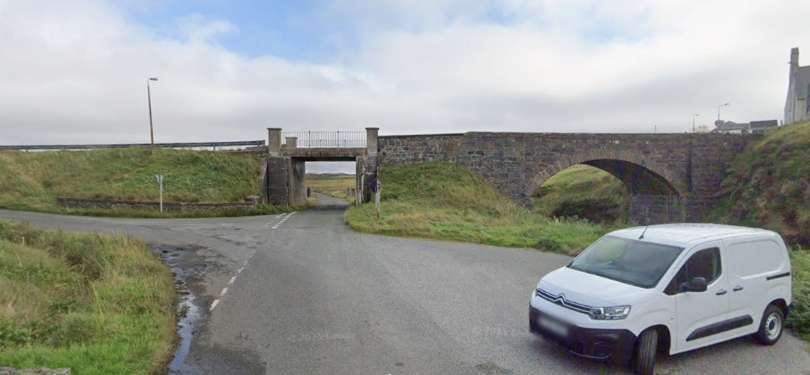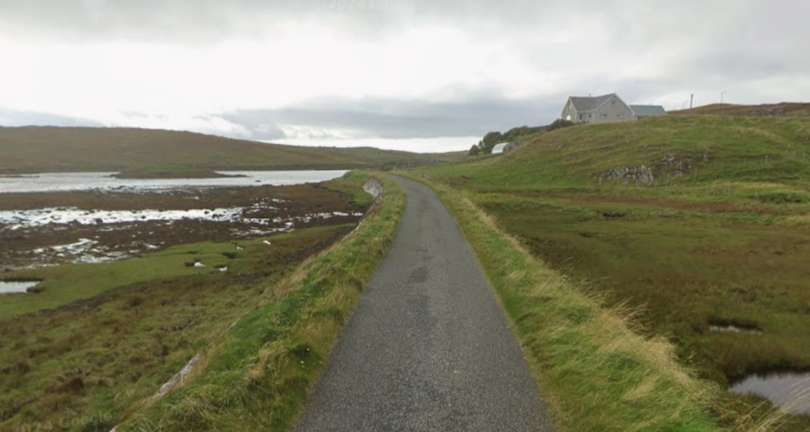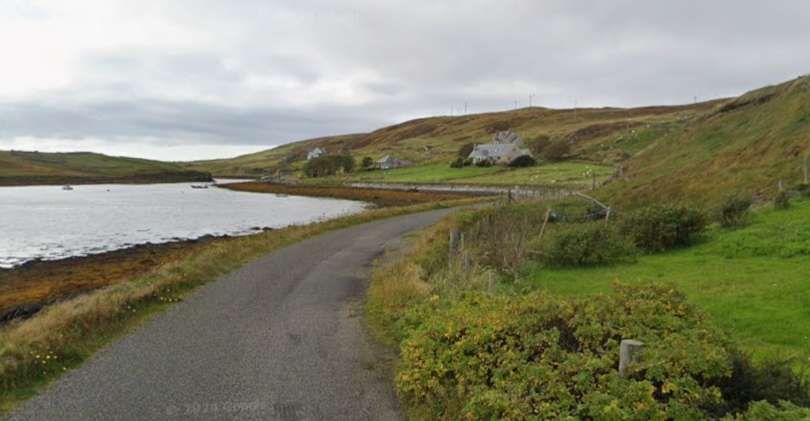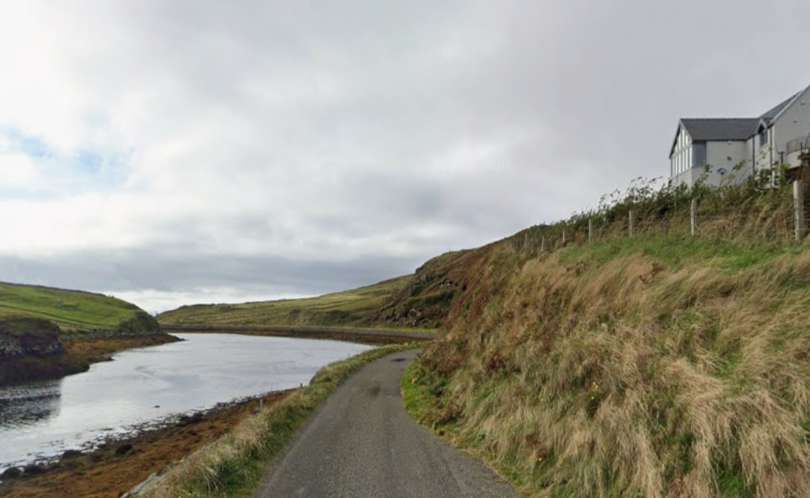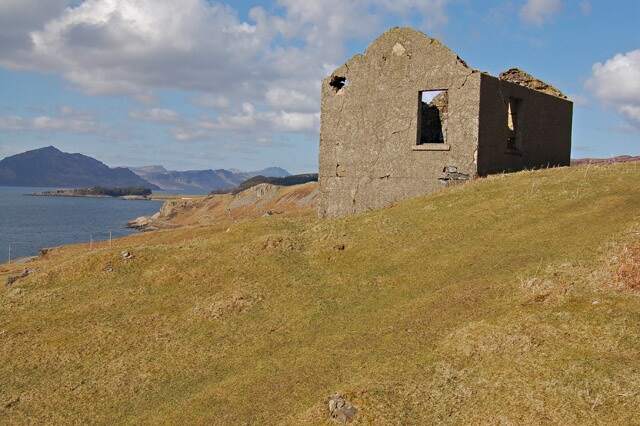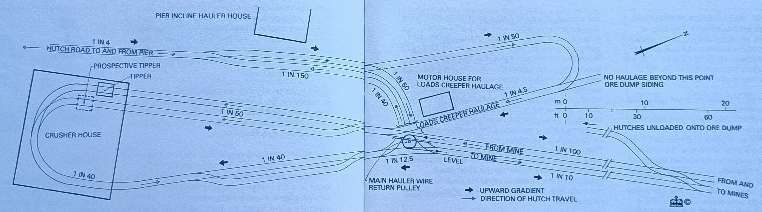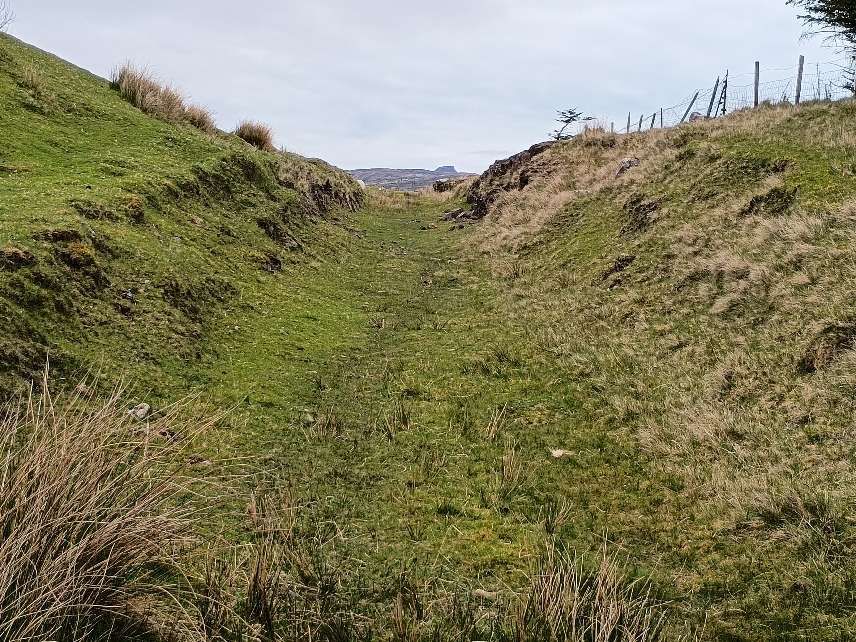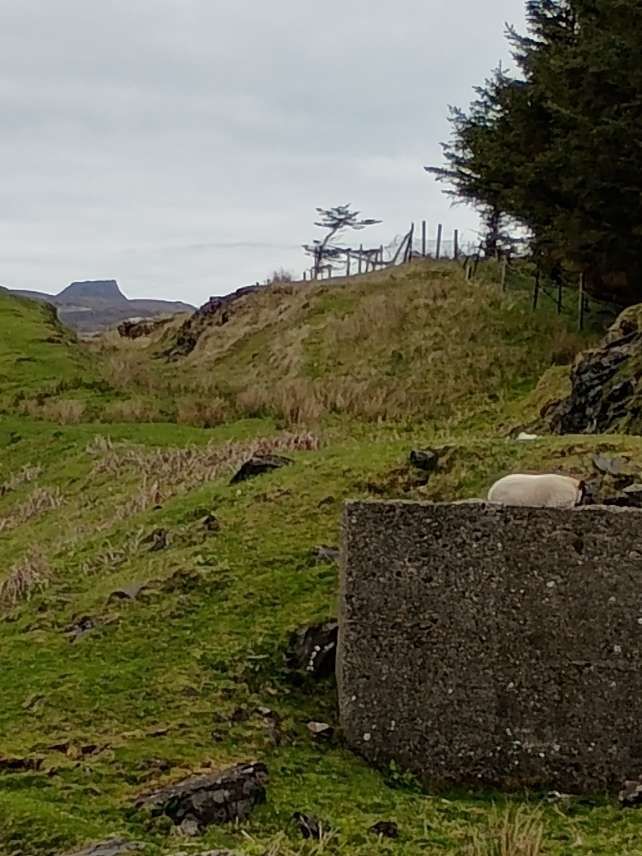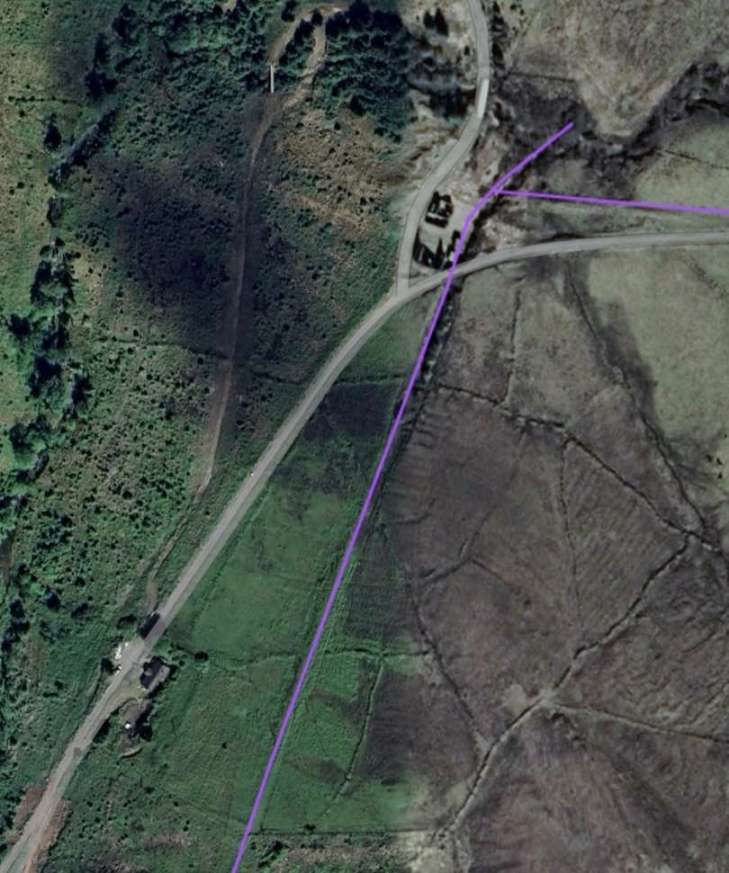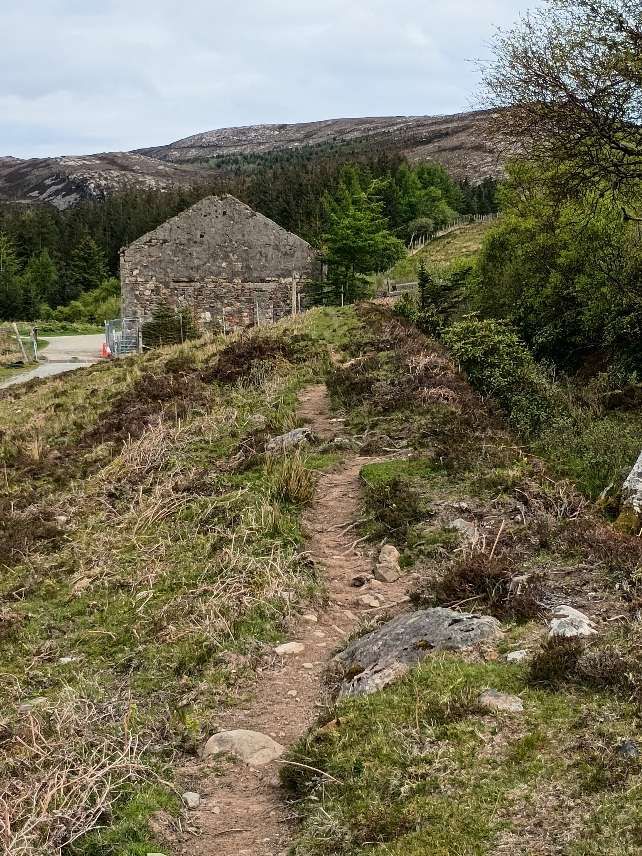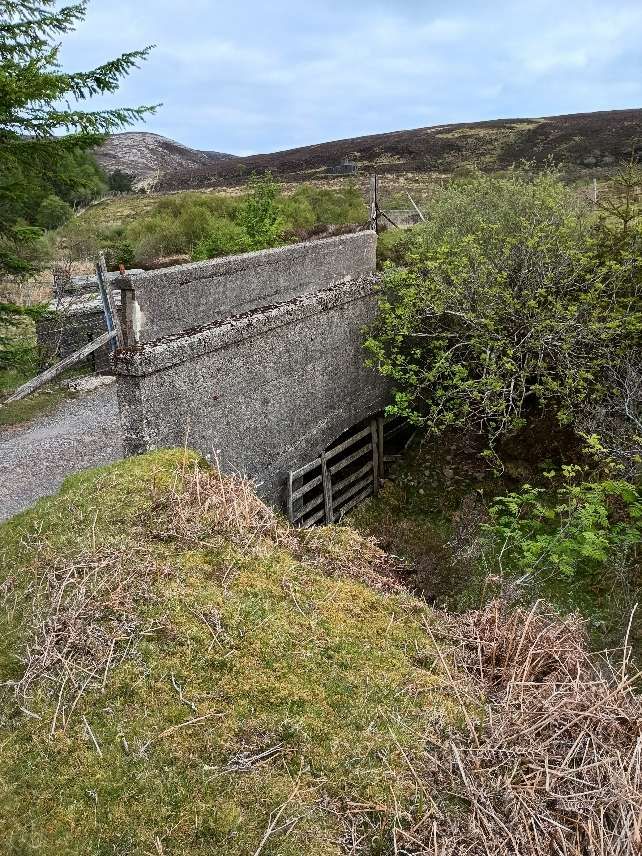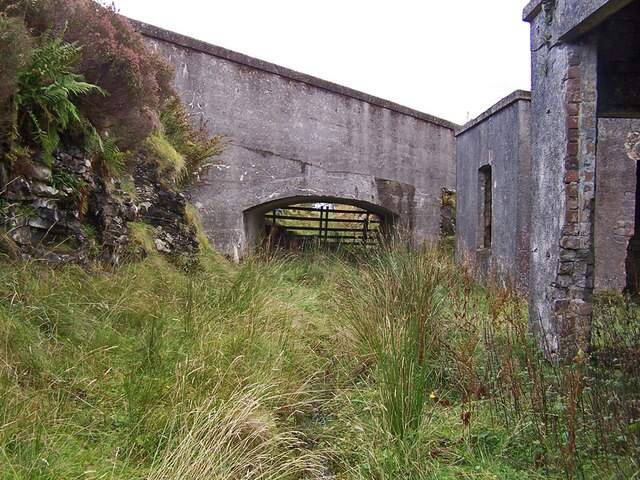
Tag Archives: Skye

Lewis, Harris and Skye – “The Soap Man,” and some other railways (1890s to 1920s). …

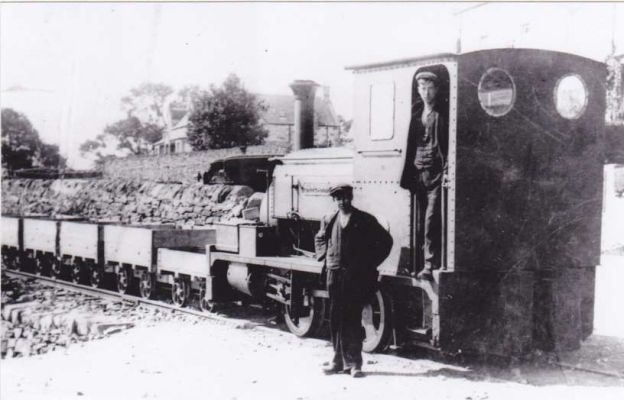
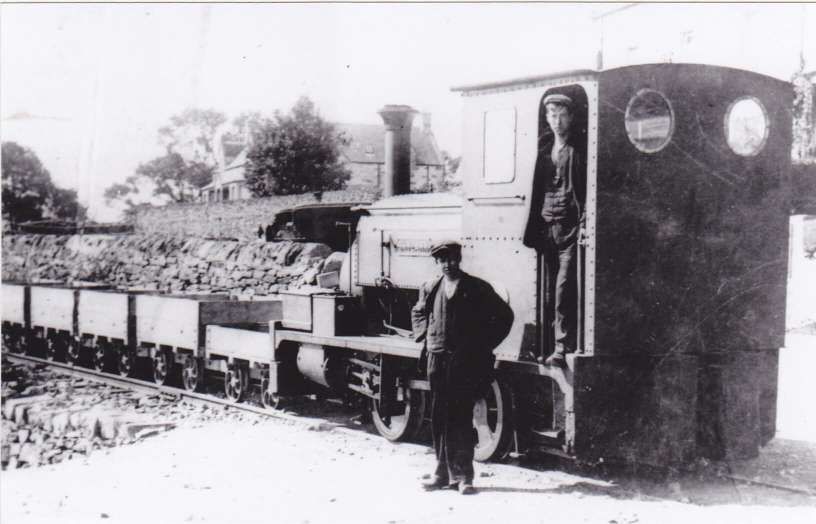
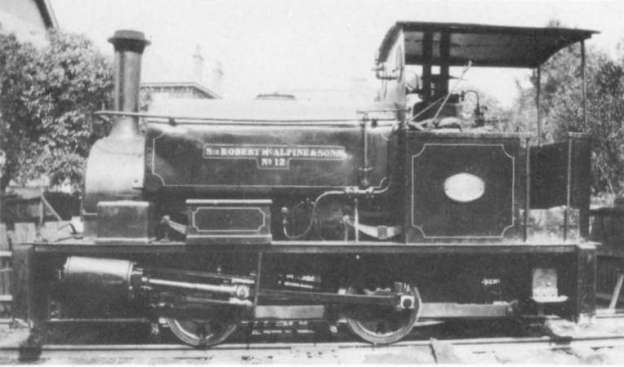
The featured image is a steam locomotive that was gainfully employed on Lewis on a contract fulfilled by Sir Robert McAlpine & Co. The Branahuie Railway (3ft-gauge) was a temporary line used in the construction of a Canning Factory, roads and houses for Lord Leverhulme. (Sir Robert McAlpine & Sons No. 12, one of the two Hudswell Clarke locos ( 1037/1913) used on the contract, © Public Domain courtesy of the collection of J. A. Peden. [15: p13]

Roger Hutchinson tells the story of Lord Leverhulme’s interest in Lewis, Harris and (to a much lesser extent) Skye, in the years following the First World War.  Lord Leverhulme purchased Lewis and later Harris with a view to developing the islands.

Mingled in with the story are Lord Leverhulme’s plans for transport infrastructure and particularly railways. Hutchinson first introduces railway plans in comments attributed to Thomas Mawson who wrote about Lord Leverhulme’s plans in the Manchester Guardian. Late in 1918, Mawson wrote: “before any … industry can be a success [on Lewis] it will be necessary to provide better transit facilities by sea and land. Safe harbours are the first essential of all economic developments. Engineers are accordingly at work making preliminary surveys for railways which will connect the principle harbours of the island with Stornoway, their natural base. We may soon have a railway on the east coast, connecting Port of Ness, another railway connecting with Callernish on the west, and possibly a third to Loch Seaforth, connecting the Isle of Harris directly with Stornoway. As supplementary to these the main roads are likely to be further improved and motor routes created as feeders to the railways. … A natural corollary to the introduction of railways and harbour facilities will be an increase in the number and size of the steamers trading with the mainland. A trawling fleet, too, is bound to appear as an arm to the fishing industry. Ice factories, cold storage, and canneries for the curing and treatment of fish for export are already planned, and the work of construction will soon begin.” [1: p91]

Hutchinson goes on to comment: “The idea of giving Lewis a couple of branch railway lines was neither original nor utterly ridiculous. Just twenty years previously, in 1897 and 1898, two separate private enterprises, the Highland Railway Company and the Highland Light Railway Company, had surveyed and proposed small-gauge lines between Stornoway and Tarbert in Harris and between Stornoway and Breasclete and Carloway on the west coast. The £500,000 schemes had collapsed when the amount of capital required to be raised by private subscription – £290,000 – was not forthcoming.” [1: p93-94]

Also, “Lewis did have railways, around the turn of the 19th/20th century. There was a railway from the quarry at Bennadrove to Stornoway. Posts related to this track can still be found in the Castle Grounds, opposite the Caberfeidh Hotel.” [5] …

It seems that under Lord Leverhulme’s tenure, “a trackbed was laid near Garrabost in Point, but a railway was never built. The same fate befell the track, linking Carloway to Stornoway along what is now the Pentland Road.” [5]

Very little other evidence exists of his proposed railways, and it is entirely possible that the remains referred to in the last paragraph could relate to much earlier railway proposals. [8]

Lord Leverhulme “planned to develop several smaller fishing harbours around the island’s coast that would be linked by new [his proposed] railways and roads to Stornoway, which would be transformed into a huge fish-processing centre. There was also to be a cannery, an ice-making factory, and a plant to make glue, animal feed and fertiliser from the offal.” [2]

“A chemical industry would also be developed to process the plentiful seaweed around the island; peat would be used in large scale power stations; and unproductive land would be transformed  into forests, or fruit or dairy farms. Lewis would grow to become an island of up to 200,000 people. … He had prominent architects and town planners produce a vision of a future Stornoway in 1920. There was to be a town hall and art gallery, a bridge to connect the town to the Castle grounds, long avenues and a railway station, with a war-memorial on South Beach. None of these were constructed although he did give the town a gas supply, and he also intended to use electricity to light the streets.” [2]

For all Lord Leverhulme’s grandiose plans, he was unable to stay the course. His plans “failed in Lewis partly from trying to force the people into too rapid and too fundamental change; he was used to a totally different lifestyle and he tried to define progress on his own terms.” [2]

He faced determined resistance from the local population whose overwhelming desire was for croft land and the freedom to choose what work to undertake. As a result, they did not take to the idea of industrial jobs centred in Stornoway and, in fact, regarded that kind of work, even though salaried, as effective slavery.

Despite the growing tensions, Leverhulme spent over £1 million in Lewis. Two model housing schemes were built in Stornoway, one on Matheson Road and another on Anderson Road, to house Leverhulme’s managers and employees. New roads were built in Lewis: a concrete bridge, now known as the Bridge to Nowhere, was constructed in Tolsta as part of a scheme to create a coastal road linking Tolsta to Ness at the north tip of the island. The road was never completed.” [3]

Lord Leverhulme’s failure to understand the basic, even visceral, connection between the people and the land was significant.

His proposals centred on his perception of a significant fishery in the waters around Lewis which would sustain industrialised fishing and canning. In reality the stocks were not as great as he believed and the postwar demand for canned fish deteriorated (partly because of barriers to trade with Russia imposed by the UK after the Russian revolution) and as more and more fresh fish from other sources became available. He saw the sale value of fish reduced by 90%.

Lord Leverhulme believed that his offer of good housing and allotments close to Stornoway would ultimately be more attractive than a hand-to-mouth crofting lifestyle. He could not have been more wrong. “What the crofters most needed was casual work to supplement their subsistence farming; what was proposed was regular employment in an industrial process. They did not want to be dependent on any landlord, even a millionaire philanthropist, for their livelihood, and most preferred to take control of their own destiny.” [3]

He stubbornly refused crofters access to good farmland in favour of his desire to see the island self-sufficient in milk, which could anyway be cheaply be imported from Aberdeenshire. As a consequence many men of Lewis raided those farm lands, began building and setting up crofts.

Only a matter of a few short years after the conclusion of the war, Lord Leverhulme had decided that his project was over.

A young doctor, Halliday Sutherland arrived in Stornoway in 1923 “a half-built factory on which work had been abandoned, a derelict small-gauge railway, and thousands of pounds’ worth of machinery rusting on the shore.’ Anxious to uncover the reasons for such a depressing scene, Sutherland approached what was presented in his later transcription as a bellicose old man working a croft in the Back district. The man had no desire, Sutherland said, ‘to answer a whistle at six in the morning and work for wages in Lever’s factory. No damn fear. Poor as I am, I’m master here, and could order you off this croft. … Why did some of us raid his pasture-land? A dairy farm for the island it was to be. I’ve another name for that a monopoly in milk. No damn fear. We are poorer now than we were. Why? Because the line-fishing in the spring has failed. Why? Because of these damned trawlers that spoil the spawn, and half of them are Lever’s English trawlers. He makes us poor, and then wants us to work for him.'” [1: p169][4]

Had Lord Leverhulme’s grandiose plans for Lewis and Harris resulted in lasting changes, there would probably have been some significant changes on Skye. Not the least of these changes may have been the provision of some form of railway from Kyle of Lochalsh onto Skye and through Broadford and Portree to Dunvegan inthe North of the Isle of Skye.
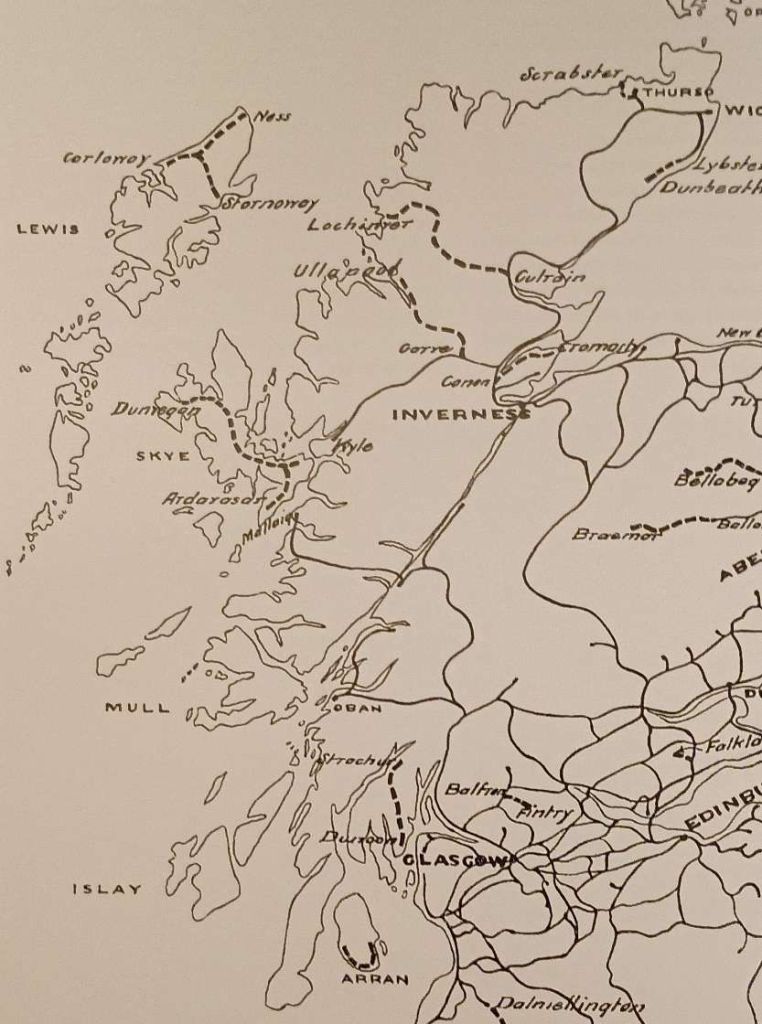
David Spaven & Julian Holland provide a map of proposed railway lines in Scotland. This map shows these proposed but unbuilt railways as dotted lines. Of particular relevance here are the lines on Lewis and on Skye. Although it should be noted that the routes marked predated Lord Leverhulm’s interest in Lewis and Harris by some considerable time.  [7: p166 – extract from larger map]

Spaven and Holland’s map does not tell anything like the full story of the planned railways for Lewis and Harris. The map below, provided by Ian B. Jolly shows considerably more detail. It is included in an article in The Narrow Gauge magazine. [15]
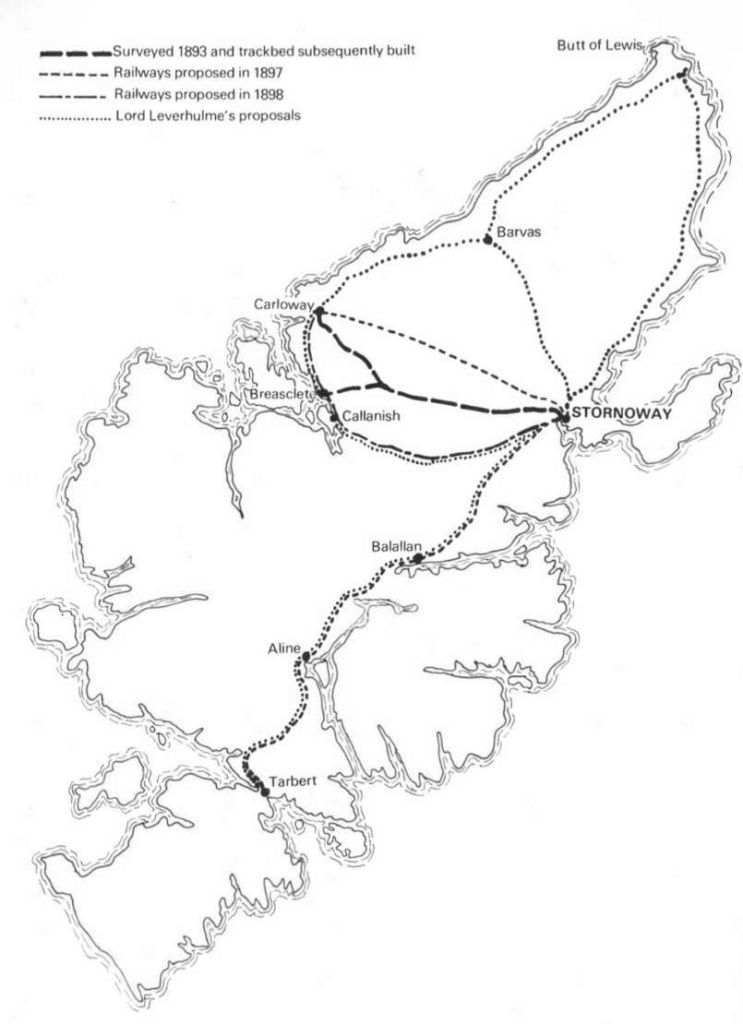
Proposed railways on Lewis/Harris. [15: p10]

The Napier Commission’s report on crofting published in 1884 proposed the use of light railways on Lewis and Skye. As a result, The Hebridean Light Railway Co. was formed to promote 130 miles of railway in Skye and Lewis. This led to surveys being undertaken by Alex MacDonald, Engineer, of a possible railway linking Stornoway to Breasclete and Carloway. The survey report was dated 1st June 1893.

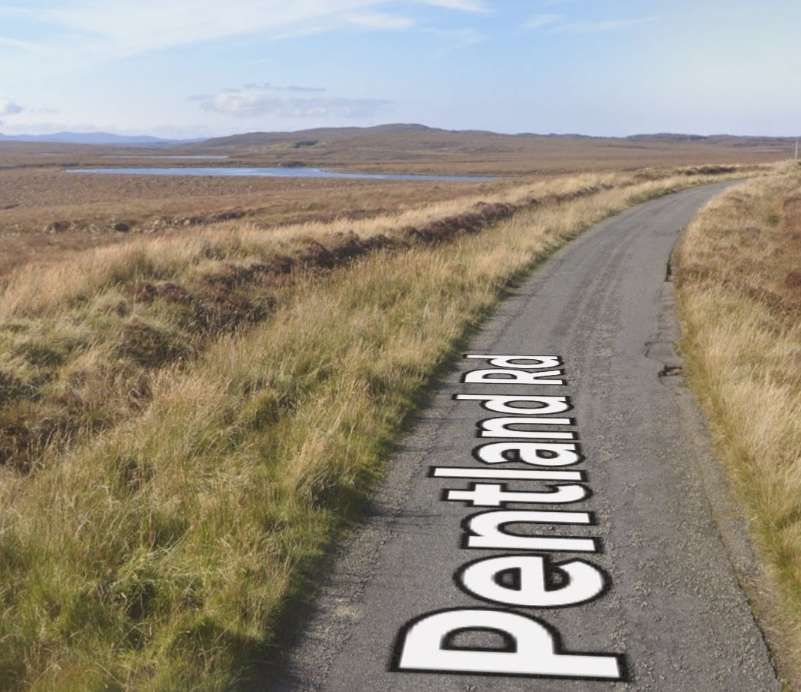
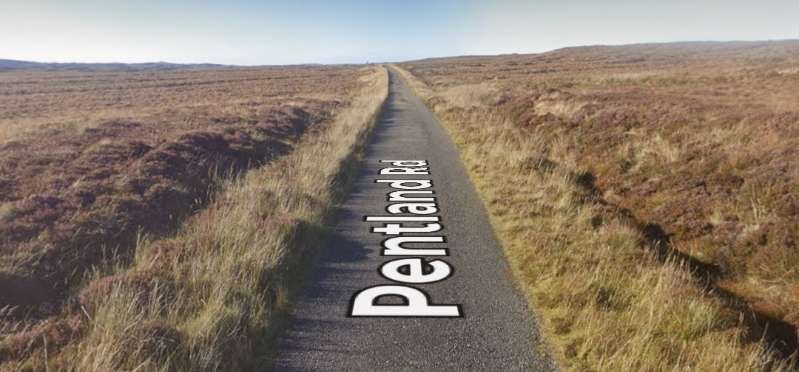
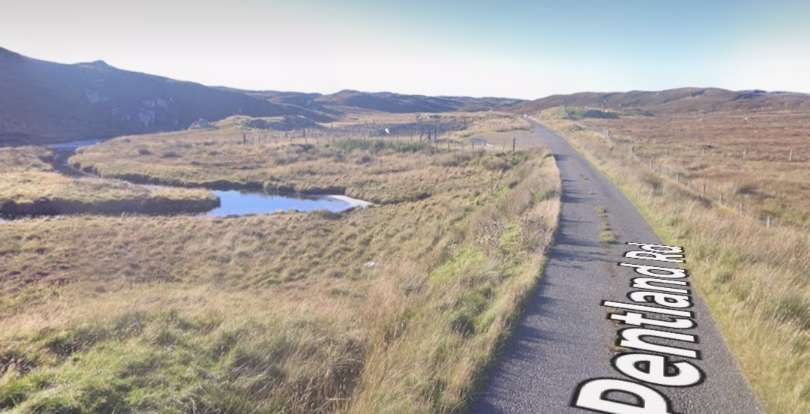
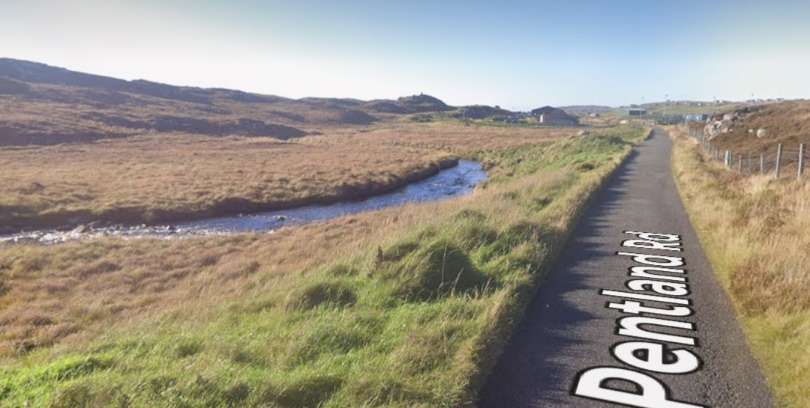
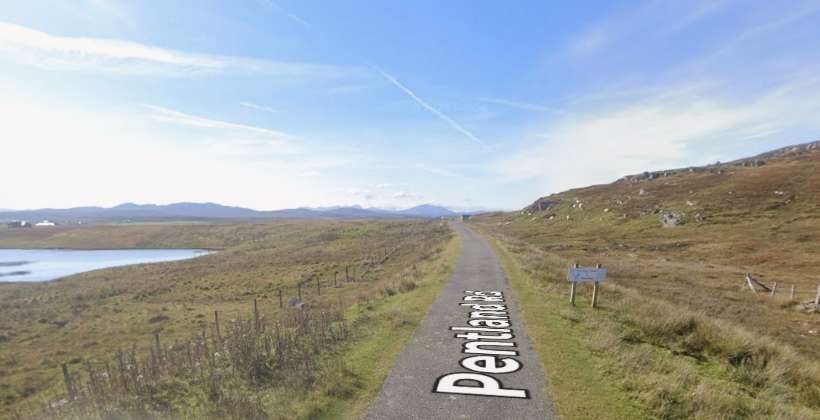
Ian Jolly reports that “the trackbed of this line was constructed and, for the first two or three miles out of Stornoway now forms the A858 road, while the rest of the route is an unclassified road to Breasclete.” [15: p12] The unclassified road is the ‘Pentland Road’ which has two arms, one to Carloway and one to Breasclete.

Jolly also notes that O’Dell and Walton, include in their book, ‘Highlands and Islands of Scotland’, a map showing projected railways for Lewis and Skye in 1897 and 1898. In fact, this is just a small part of a map covering the whole of Scotland and are at best schematic in nature. [15: p12][16: p206]
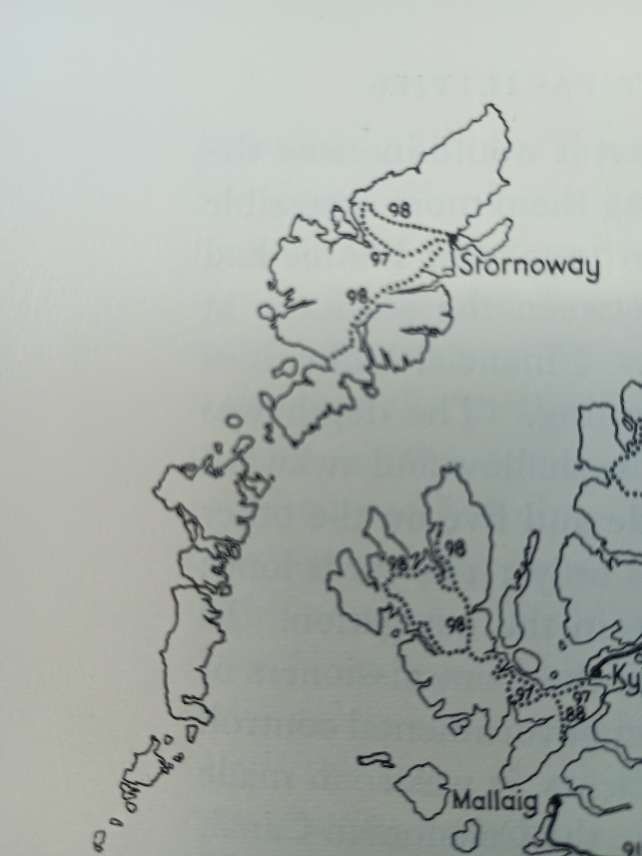
The Outer Hebrides and Skye, showing various schemes which did not come to fruition in the later years of the 19th century and mark with the year in which the schemes would have been constructed. The lines drawn are no more than indicative of the routes proposed. There is no indication of schemes proposed in the 20th century. [16: p206]

One further map is worth noting. This map is provided in a paper by John and Margaret Gold and shows Lord Leverhulme’s development plan for Lewis and Harris. …
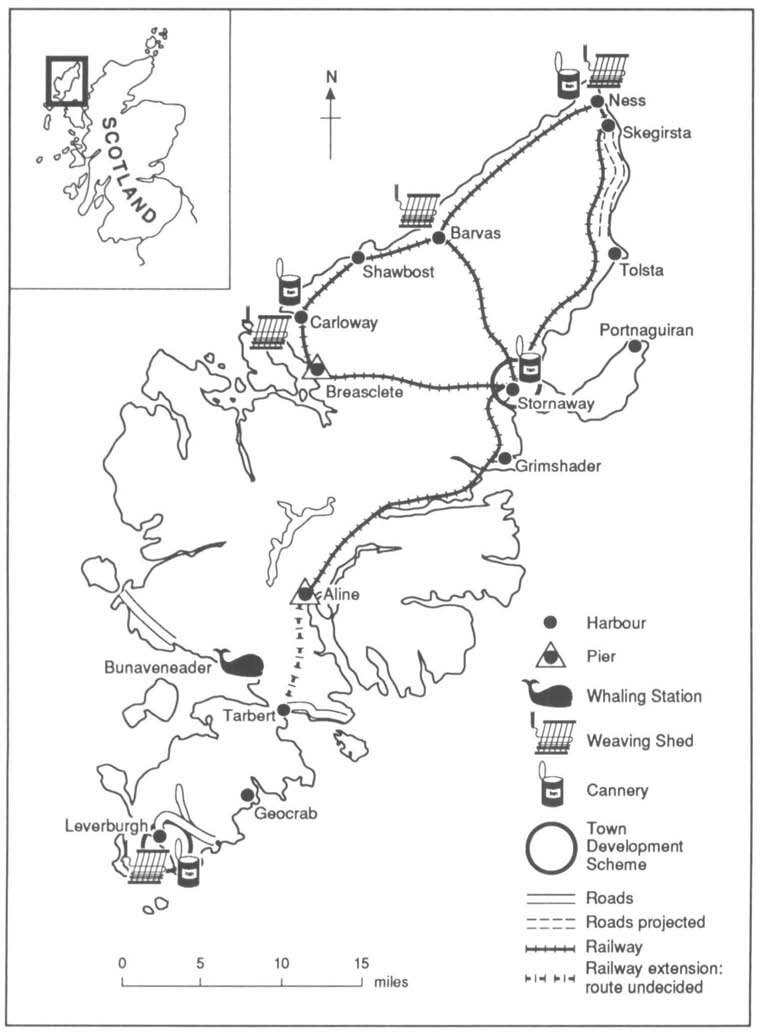
Lord Leverhulme’s Development Plan: this gives a good idea of the scope of Lord Leverhulme’s imagination. His ideas were built on the assumption that the fishery around Lewis and Harris was likely to sustain yields over many years. His plans were well-developed. [45: p197]

Later, in April 1919, Jolly says, there were proposals (elsewhere reported as being considered during the first world war) put to a meeting at Staffin, in the north-east of Skye, when representations were made to the Secretary of State, Ministry of Transport and the Highland Reconstruction Committee for a system of light railways on the East side of Skye. There was a similar meeting at Uig, also on Skye, in September 1920 when representations were made to the Ministry of Transport for a light railway connecting Uig to Kyleakin via Portree. Both these meetings were reported in the local press at the time.. [15: p12]

Jolly mentions a comment by Lord Leverhulme which was reported the Highland News, 17th May 1919, that the new harbour at Stornoway should come before the light railway.

Nigel Nicolson, in Lord of the Isles, notes that in a relatively short time (circa. 1920) Lord Leverhulme was looking seriously at light railway schemes on Lewis and had marked out their courses. Leverhulme’s scheme would have had a terminus at Stornoway and three lines:

1) A line South through Balallan to Aline with later extension to Tarbert.

2) A line West, then North to Callanish and Carloway and return to Stornoway via Barvas; and

3) A Branch North from Barvas to serve townships near the Butt of Lewis and return down the east coast through Tolsta to Stornoway.

The total track mileage would have been about 100 miles. The gauge was to be 3ft using WDLR rails being sold as surplus. Lines to be steam worked but Leverhulme wanted electric working! [15: p12] [17: p110-111]

None of these schemes came to fruition.

Photographs and further information can be found in a copy of The Narrow Gauge which is available online. [15]

The Stornoway, Breasclete and Carloway Route

We noted above that construction work did commence on the lines surveyed in 1893, specifically that the trackbed was constructed “and, for the first two or three miles out of Stornoway now forms the A858 road, while the rest of the route is an unclassified road to Breasclete.” [15: p12] It should be noted that the unclassified road follows the planned railway to Carloway as well as to Breasclete and is known as the Pentland Road.

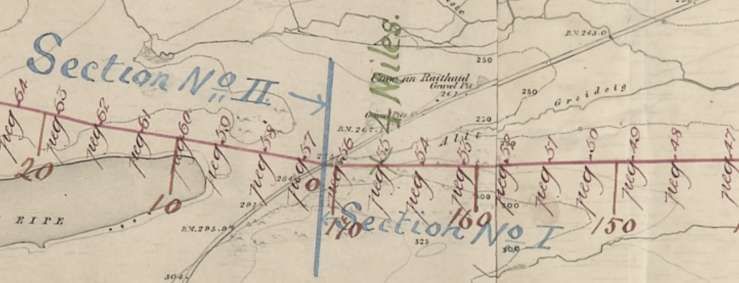
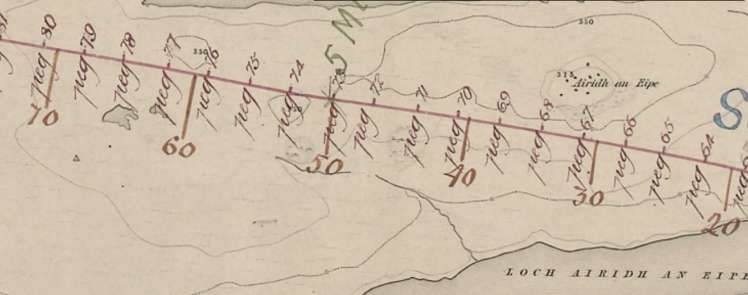
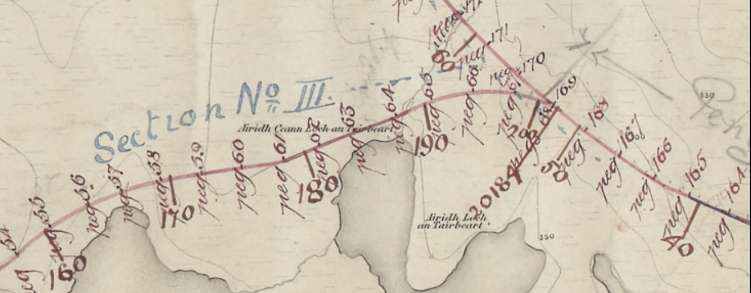
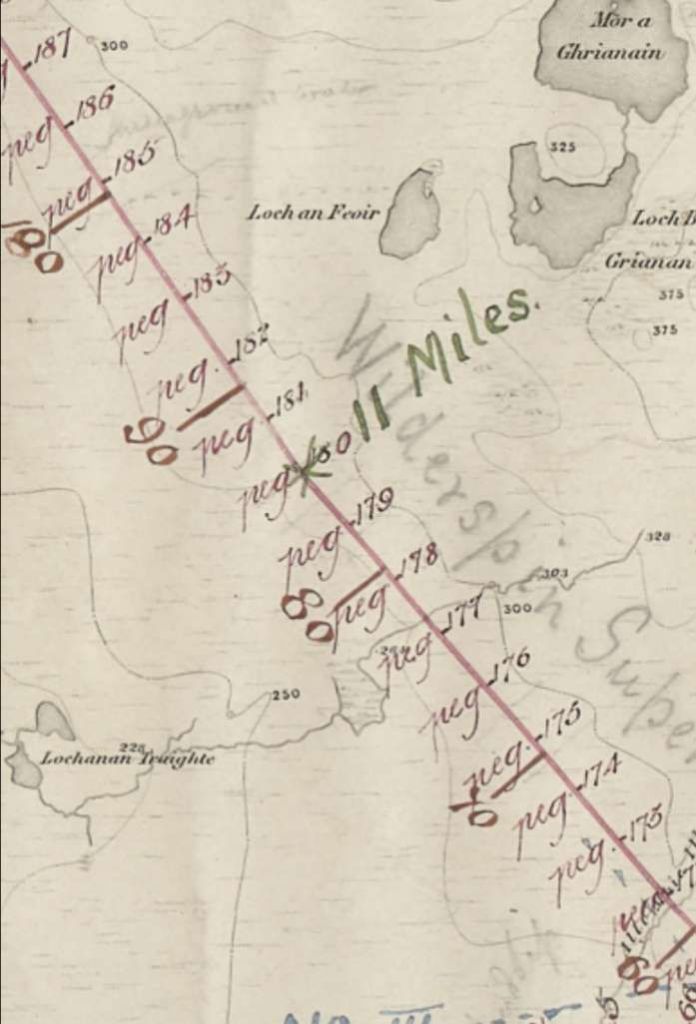
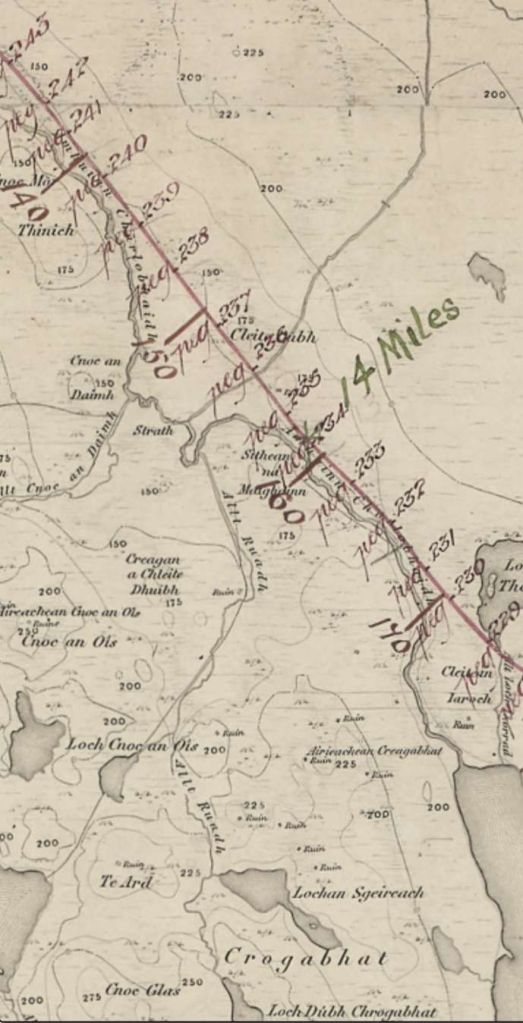
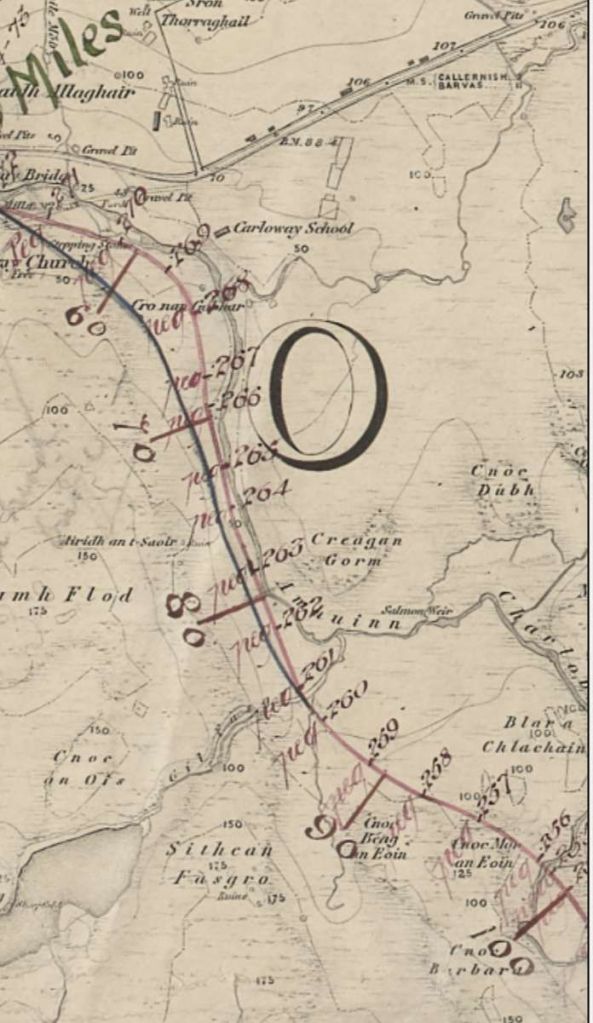
It is nigh impossible to establish the location of the Stornoway terminus from this limited information. Given that modern roads follow the formation of the planned railway route it is quite easy to follow the routes to Breasclete and Carloway. There is, however, a specific, relevant resource held at Stornoway Public Library. It comprises 4 sheets from the 1″ Ordnance Survey 1st Edition mapping from the 1850s, that have been stuck together, with the route itself annotated on top. A digital version of this map has been made available by the National Library of Scotland (NLS). [18] Please note that after navigating to the correct webpage, it will be necessary to scroll down to find the annotated map.

The proposed railway “was planned to connect Carloway and Breasclete on the west coast with Stornoway. Work began on the scheme, but ran into economic and legal problems. Although the railway was never constructed, the ‘Pentland Road’, largely followed the same route, and was built instead by 1912. The road was named after John Sinclair, better known as Lord Pentland who was the Secretary for Scotland between 1905 and 1912 and who helped to secure funding for the completion of the road.” [18]

The map is made up of “four original Ordnance Survey first edition six-inch to the mile maps from the 1850s that have been stuck together, with the route itself annotated on top. … Near Carloway, there is an additional Blue line shewing route originally surveyed changed to avoid damaging arable land.” [18]

Carloway and Breasclete were the western termini of the network with the line to Breasclete appearing to be a branch line.

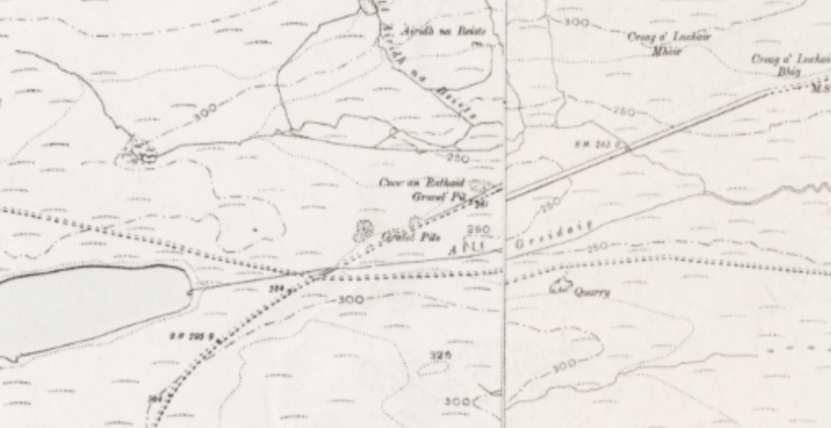
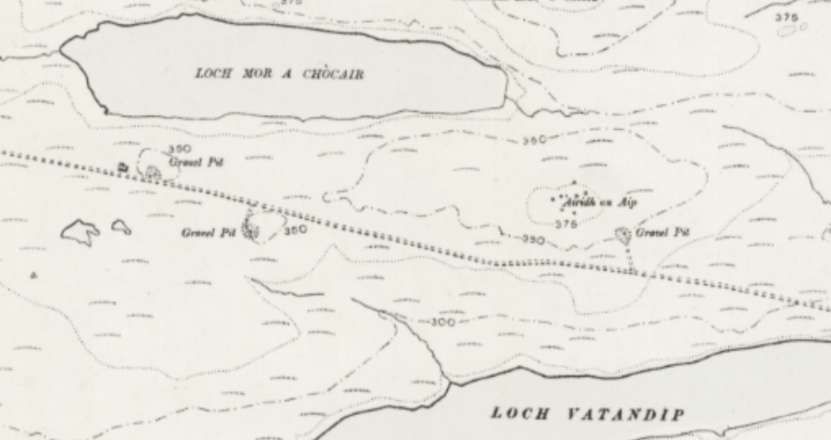
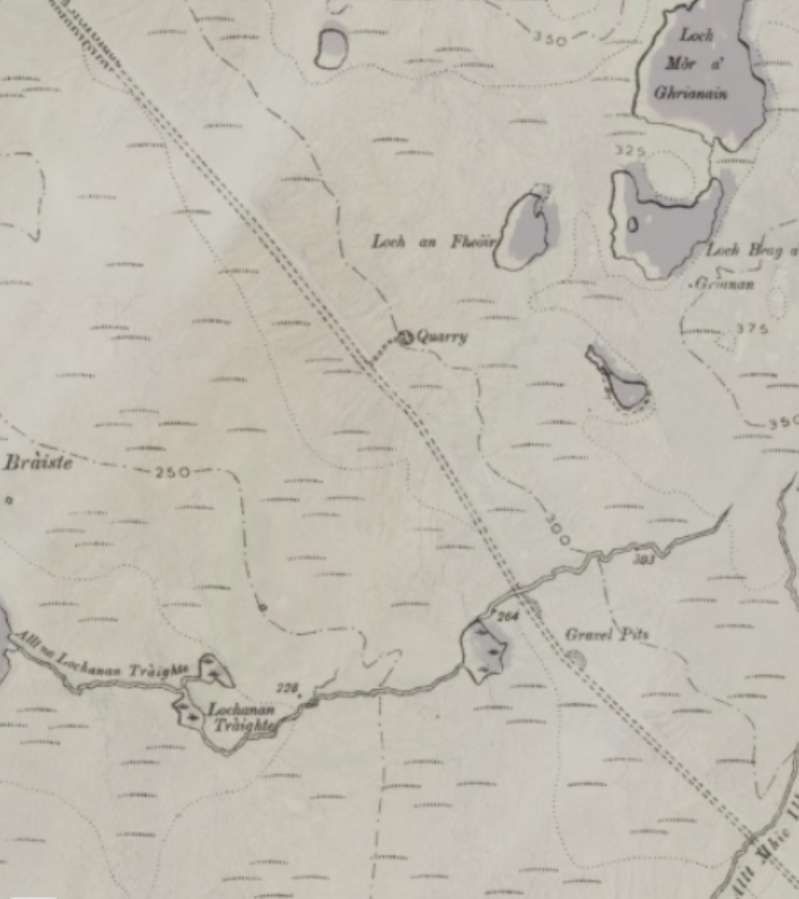
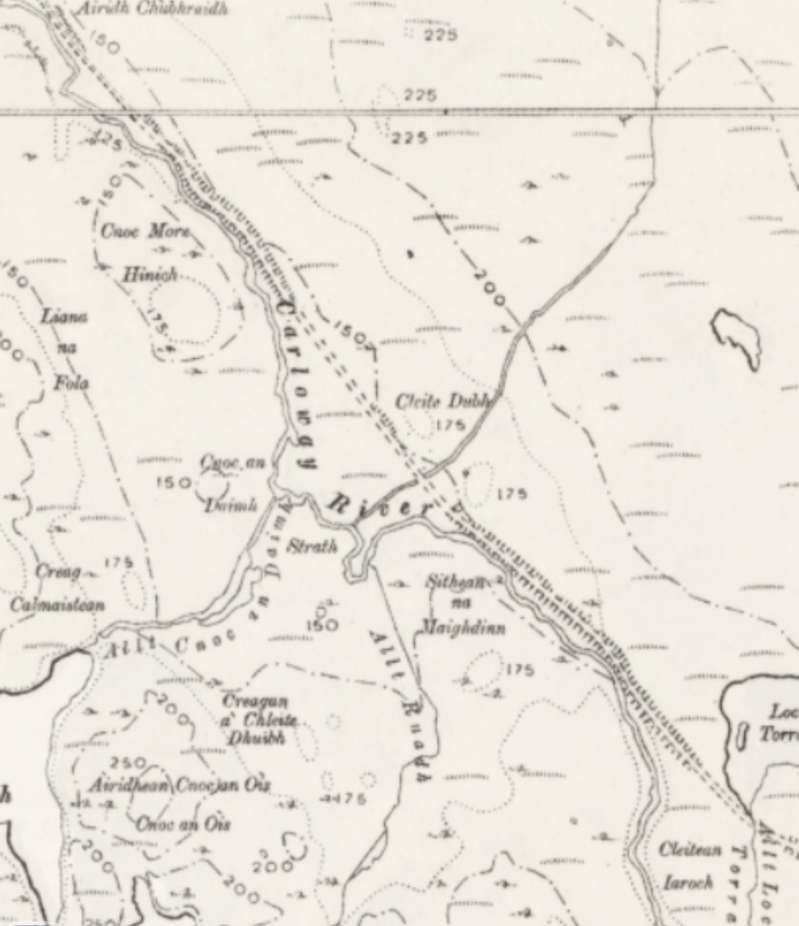
The extracts from the annotated 1″ Ordnance Survey of the 1850s run in sequence from Stornoway to Carloway and then from the junction to Breasclete. They are the sepia coloured map extracts. Beneath each extract from the 1″ Ordnance Survey is the 2nd Edition 6″ Ordnance Survey from around the turn of the 20th century. These extracts precede the construction of the Pentland Road but show the route the road(s) will take as a dotted track.

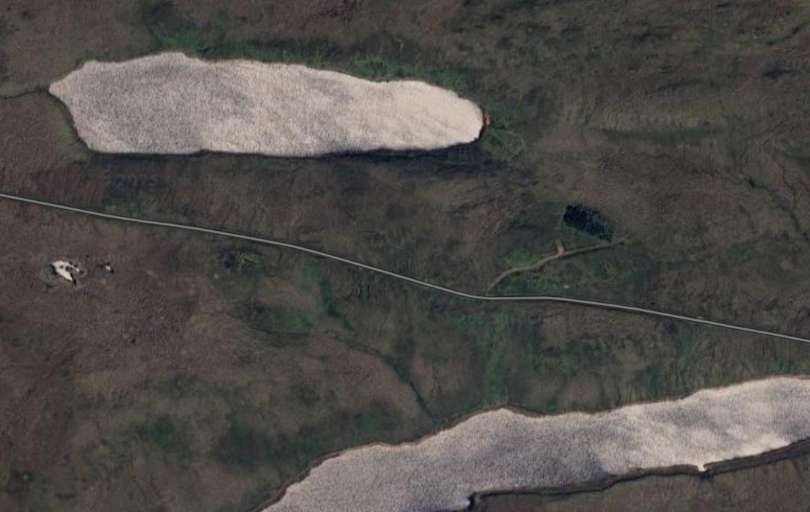
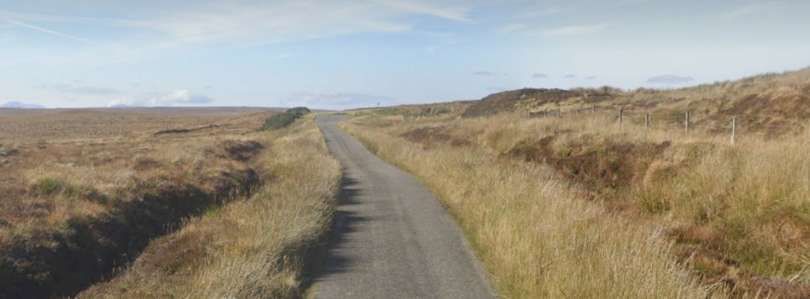
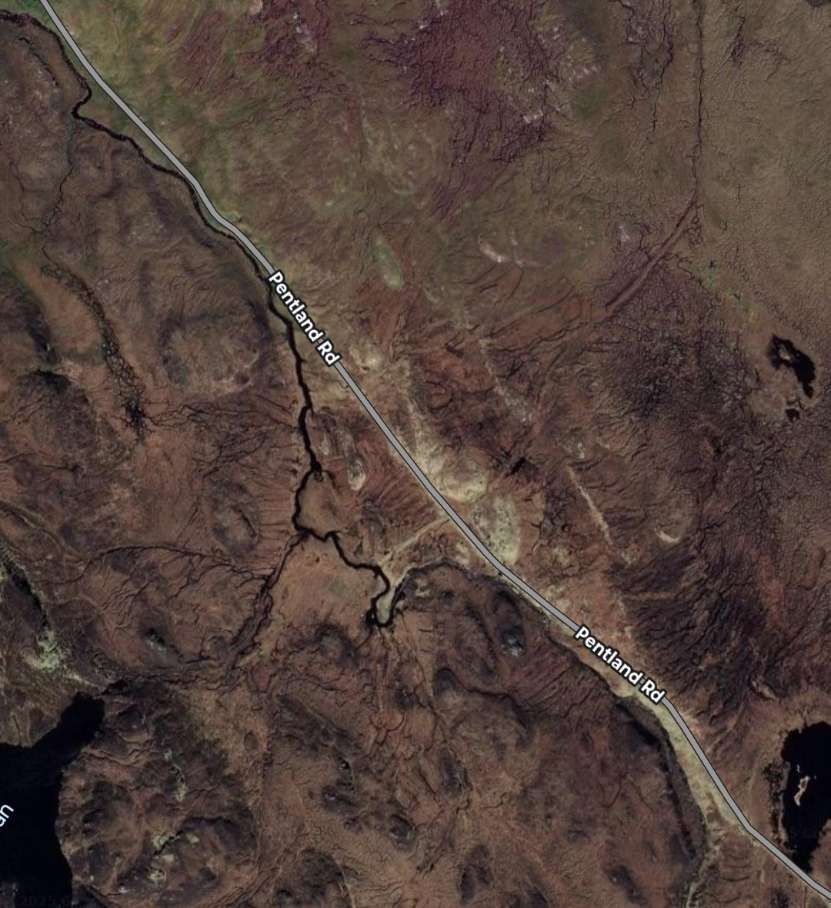
Modern satellite imagery is then provided alongside some Streetview images to show the built roads which were completed in 1912 and which are still in use in the 21st century.

There is some doubt over the route of the line approaching and entering Stornoway. Two possibilities with supporting drawings start our look at the line. …

Stornoway to Carloway

Close to Stornoway the alignment of the planned, but never built, railway is not certain. The first possibility is shown immediately below. This takes the mapping provided by the NLS. … [18] The second alternative was discovered by ‘Tom’ in the National Archives at Kew and highlighted on his blog. [53][54]

First, the NLS supplied drawings from the Stornoway Public Library. …
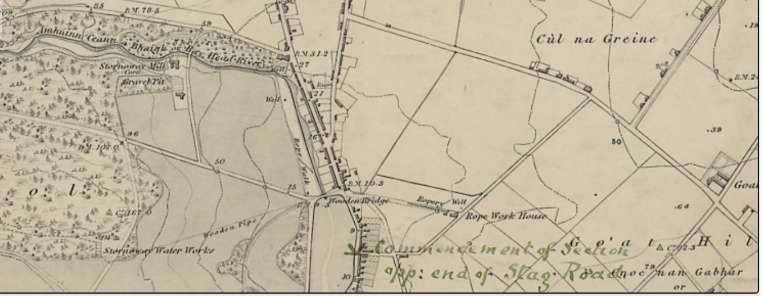
The most easterly length of the proposed railway is shown turning South into Stornoway but no indication is given of the planned terminus. [18]
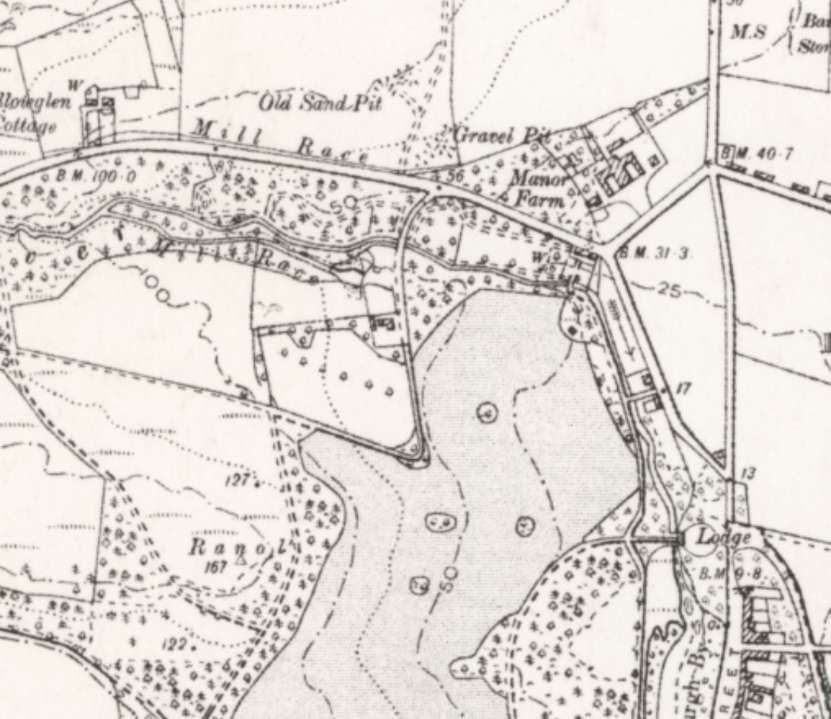
A closer focus from the 6″ OS mapping shows a road following the line of the proposed railway. That road appears to predate the planned railway and it is possible that the line would have run within the road width or on the verge. [19]
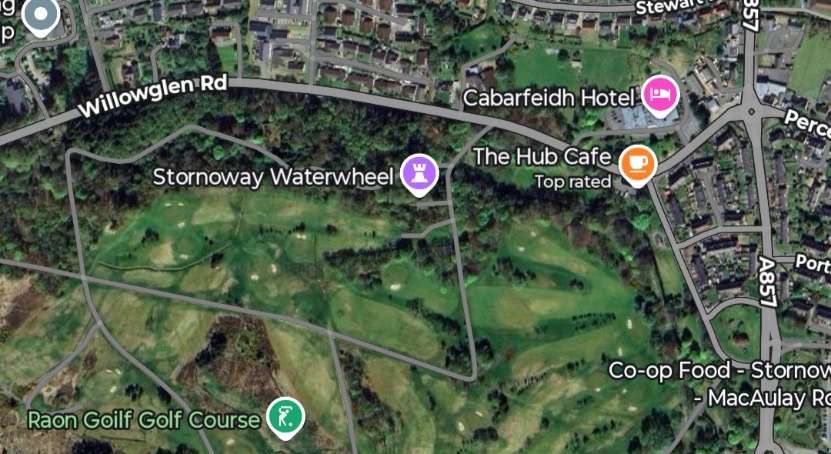
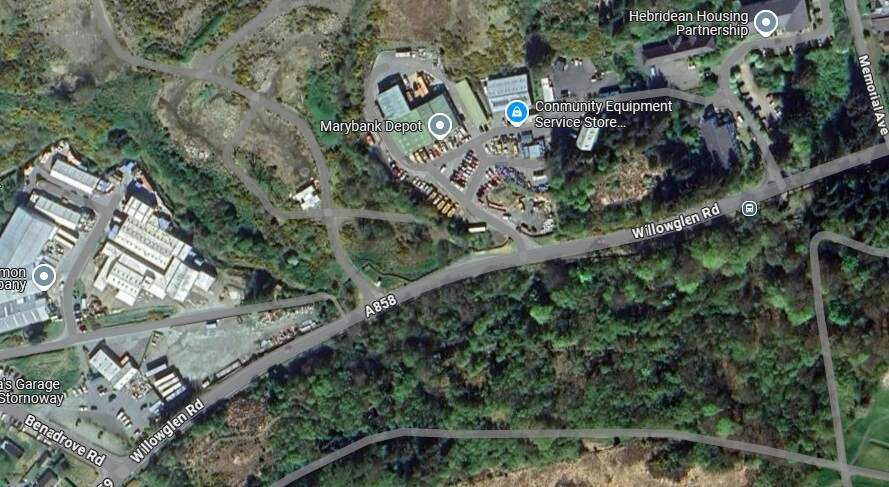
Willowglen Road first runs North-northwest, then turns through Northwest and West before leaving Stornoway in a West-southwest direction. It is not clear where the Stornoway terminus of the line was expected to be, perhaps to the West of the modern A857 on the portion of Willowglen Road which runs North-northwest from its junction with the A857? [Google Maps, July 2025]
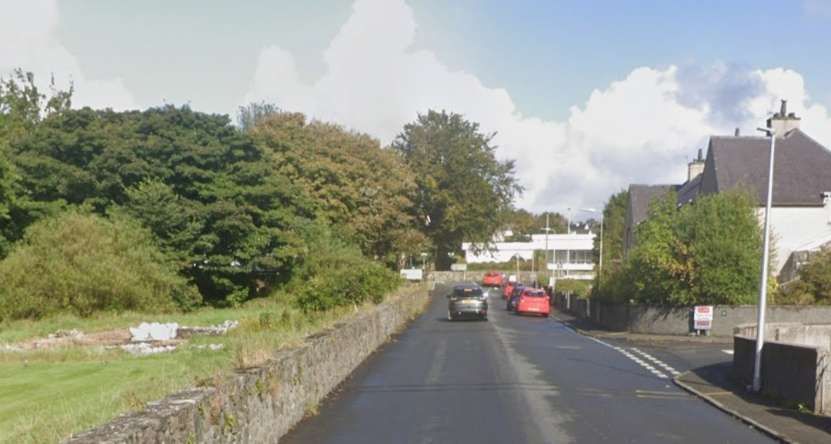
Looking North-northwest along Willowglen Road. Rather than this road being built on the line of the planned railway it is likely that the line would have run on the verge of what may well have been a narrower highway at the end of the 19th century. [Google Streetview, September 2024]
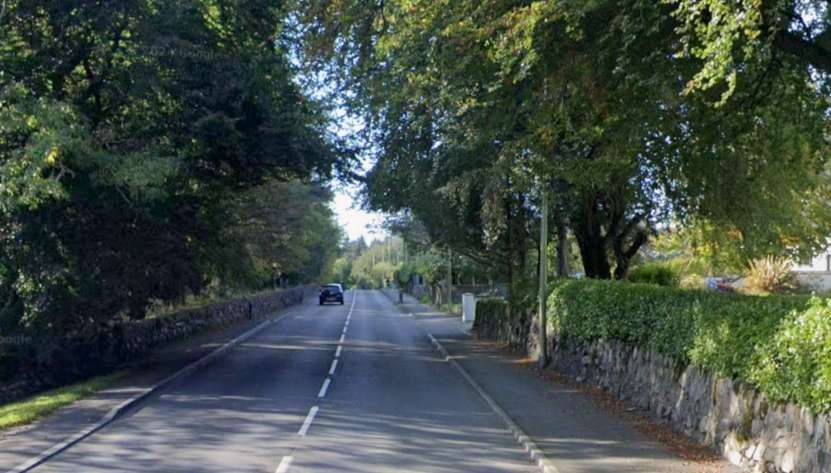
Now heading West-northwest, the width of the modern Willowglen Road accommodates the planned railway route. [Google Streetview, September 2024]
Further West with Willowglen Road now heading in a West-southwest direction. The older road may well have been narrower than the modern road and could have accommodated a railway on its verge. [Google Streetview, September 2024]

Second, the alternative alignment for the East end of the line which appears in documents at the National Archives. [53][54]
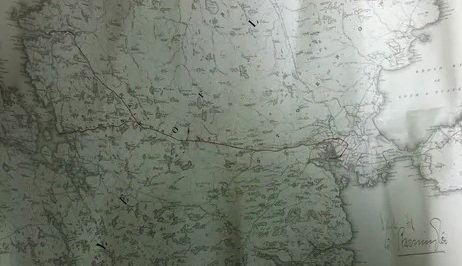
The Hebridean Light Railway Company, a blog by ‘Tom’ includes this photograph of a plan from the National Archive at Kew.This plan matches the plan provided by the NLS throughout the length of the line with the exception of the eastern end of the line. [54]
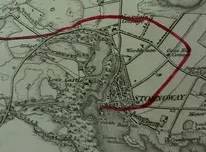
This image shows the eastern end of the line at Stornoway. The route takes a line to the North of what is now Willowglen Road, and to the North of what was Manor Farm, now the Cabarfeidh Hotel, then swinging in a wide arc round the East side of Stornoway before running across the South of the town. [54]

The superimposed red line is a diagrammatic representation of the route, but it does have some resonance with the later temporary railway built by Robert McAlpine & Co. which is covered towards the end of this article. It does however match with other papers in the bundle which ‘Tom’ discovered in the National Archives. …
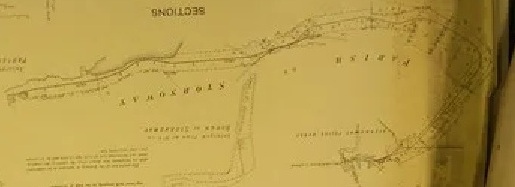
A very low resolution photograph of the plan of the proposed railway around Stornoway. This is a match for the red line shown above. [54]
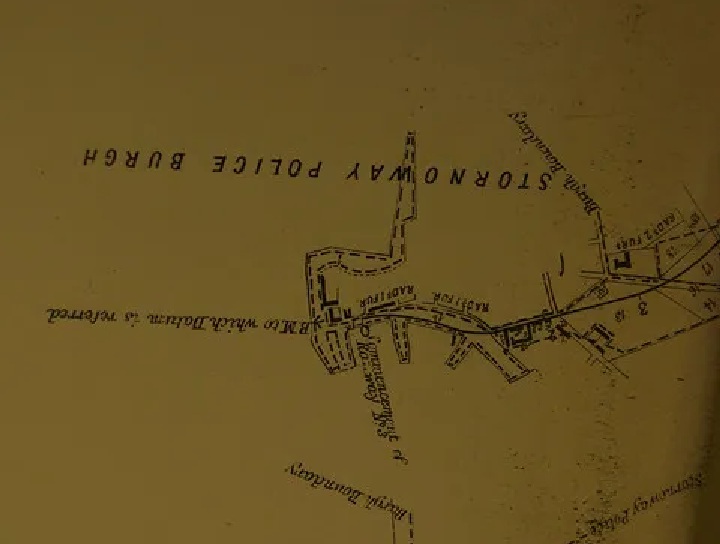
A closer view of the last portion of the proposed line on the South side of Stornoway. This compares well with the 6″ Ordnance Survey extract below. It shows that the plan was for the line to terminate at the West end of South Beach Quay. [54]
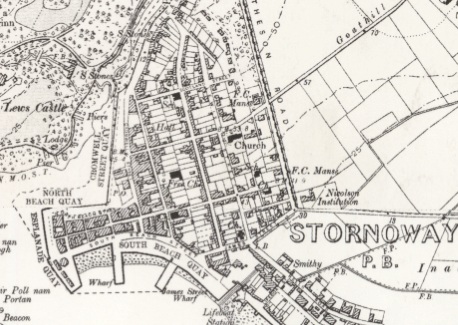
An extract from the 6″ Ordnance Survey of 1895, published 1899. [55]

The remainder of the route to the West of Stornoway. …..
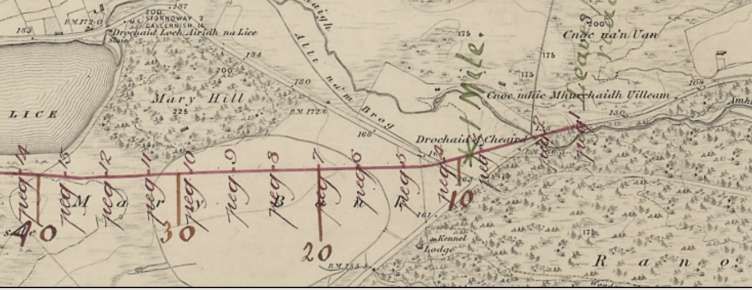
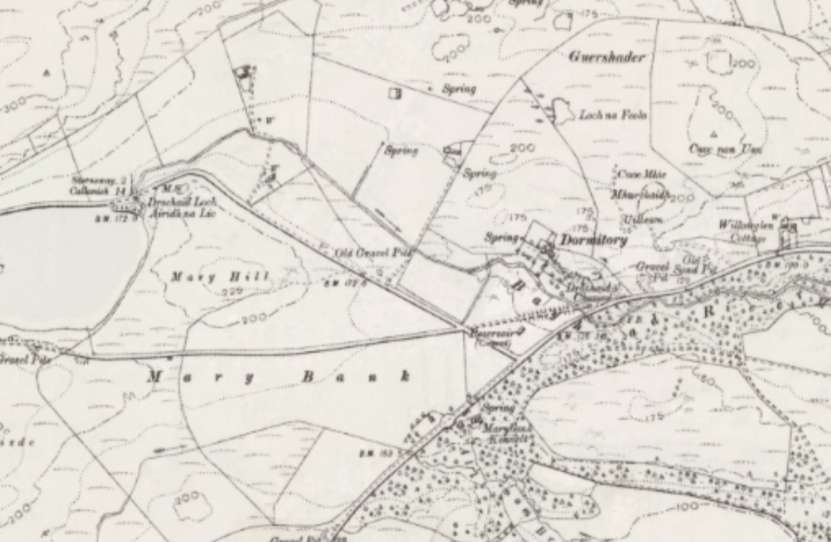
The red line is the line of the 1893 survey. [18]
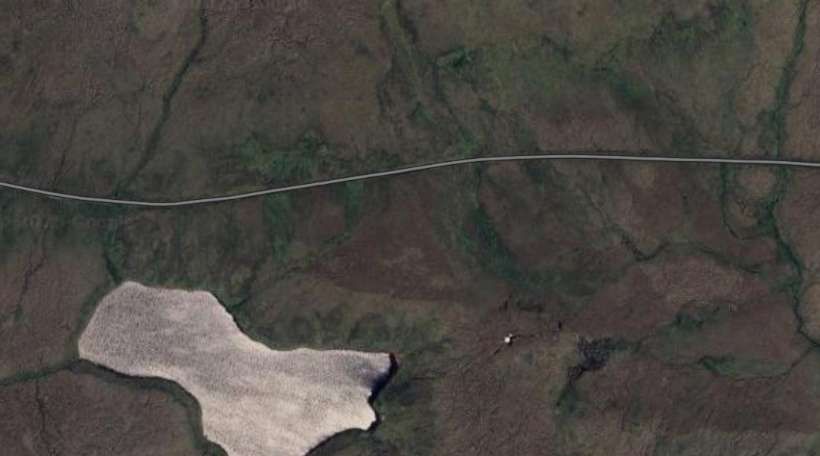
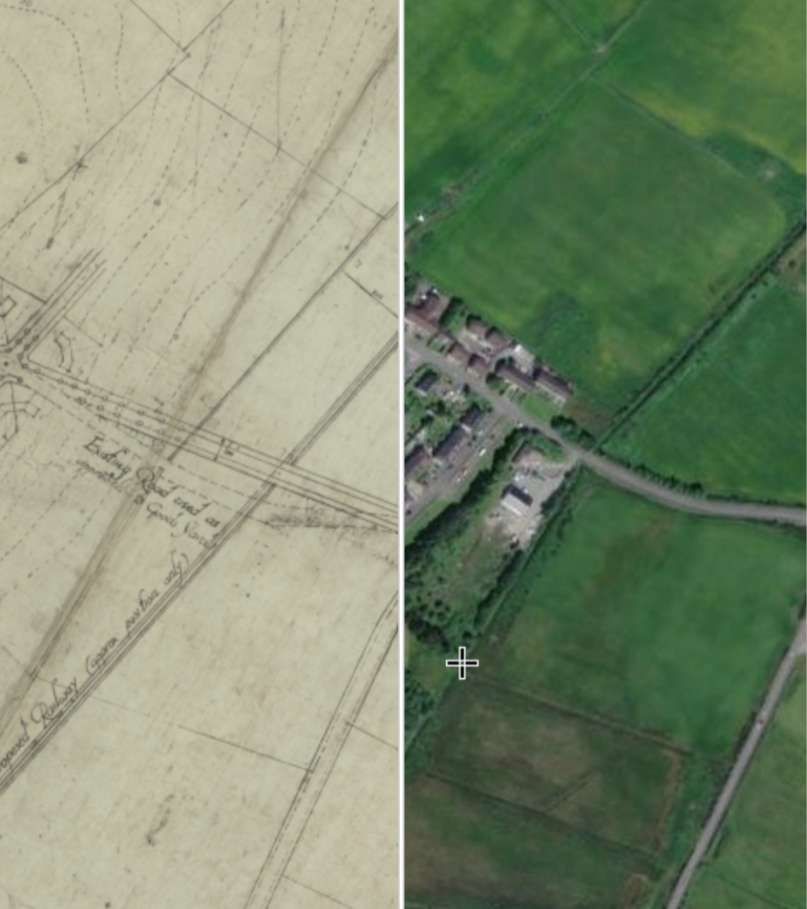
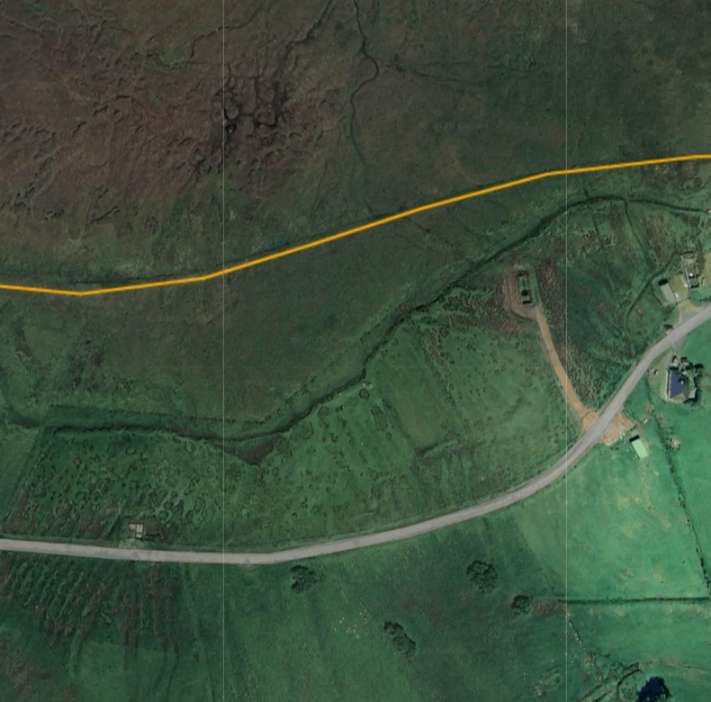
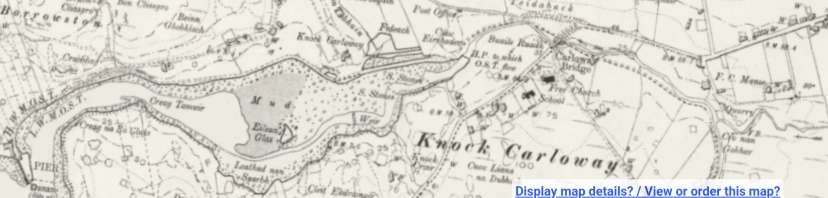
There is a short section – the hypotenuse of a triangle formed by two roads – at the surveyed line which at the turn of the century was no more than a track along the line of the planned railway. There was then a section of road to the South of Mary Hill before the surveyed route separated from existing roads at the East end of Loch Airidh na Lic. [20]
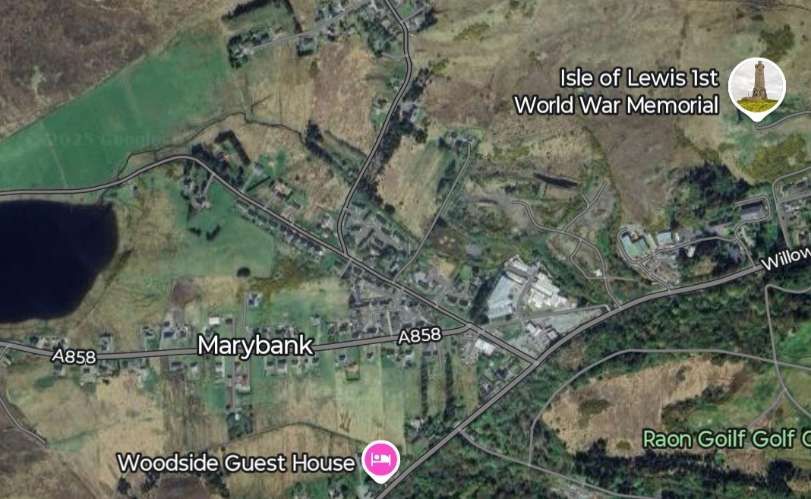
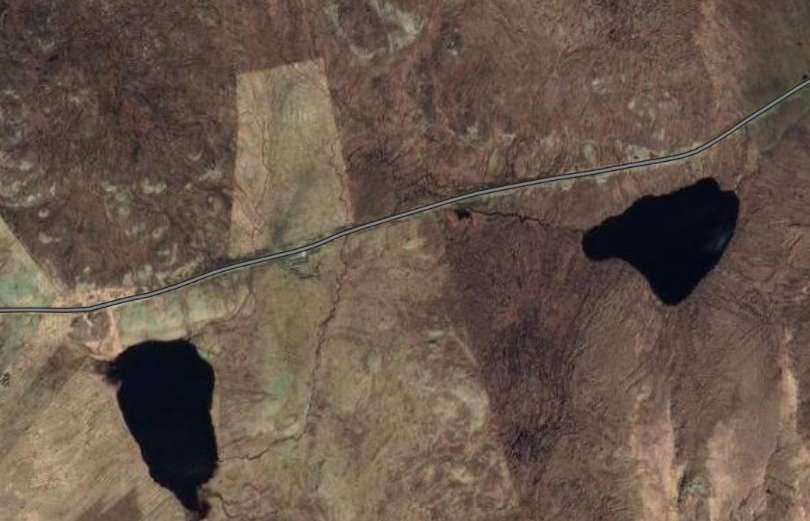
The same area as shown in the map extracts above. [Google Maps, July 2025]
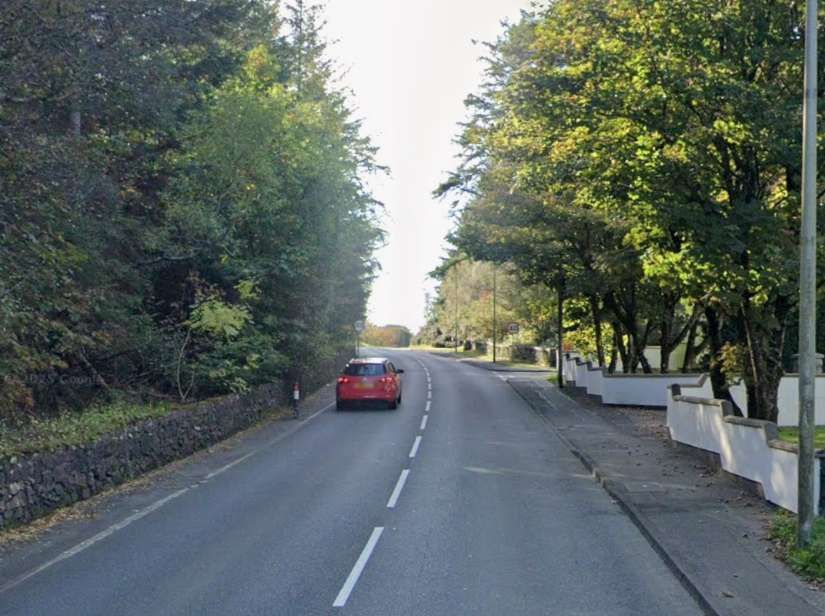
This photograph looks from Willowglen Road down the first length of the planned railway route which was independent of existing roads. The planned railway would have run ahead down the centre of the image. A lane can be seen to the right side of Willowglen Road which leads onto the old railway route as shown below. [Google Streetview, September 2024]
The first length of road built over the line of the planned railway making use of the civil engineering work undertaken before the railway scheme was abandoned. [Google Streetview, September 2024]
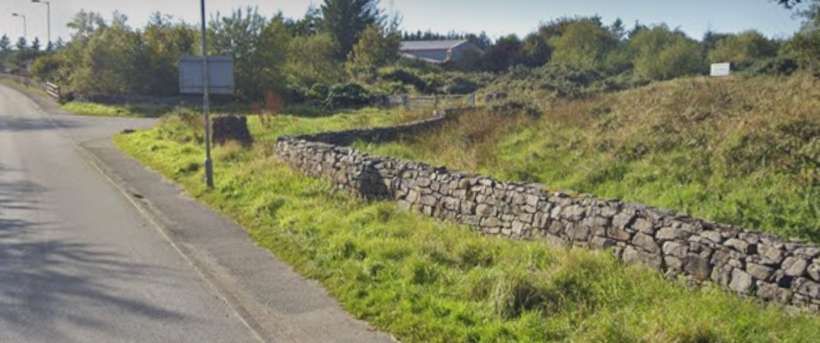
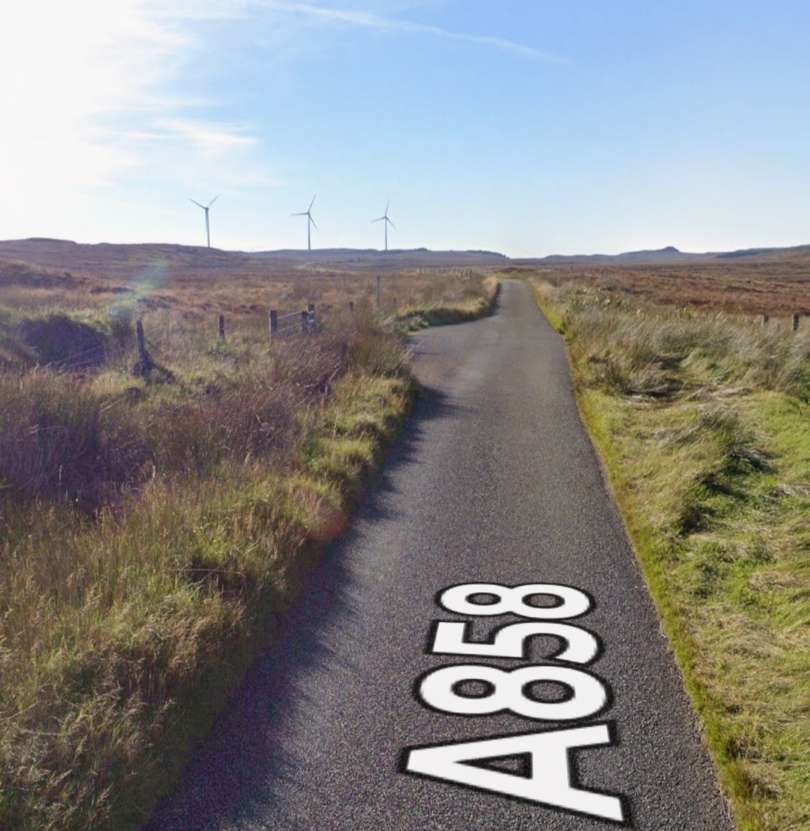
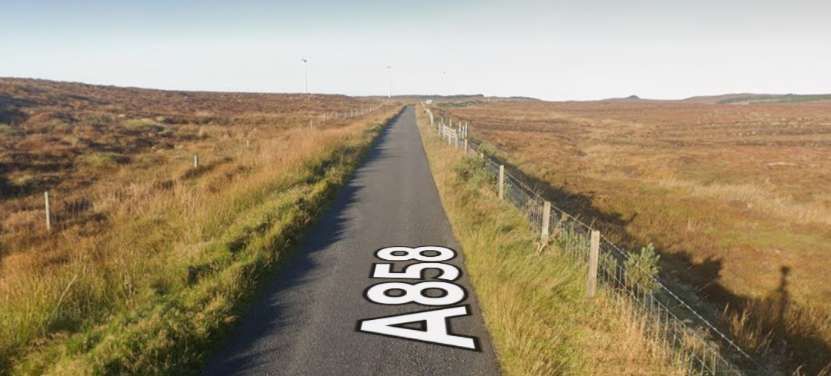
The A858 enters this photograph from the left and turns left to run directly ahead of the camera. From this point onwards the road which is now the A858 was built over the line of the railway which was not completed. [Google Streetview, September 2024]
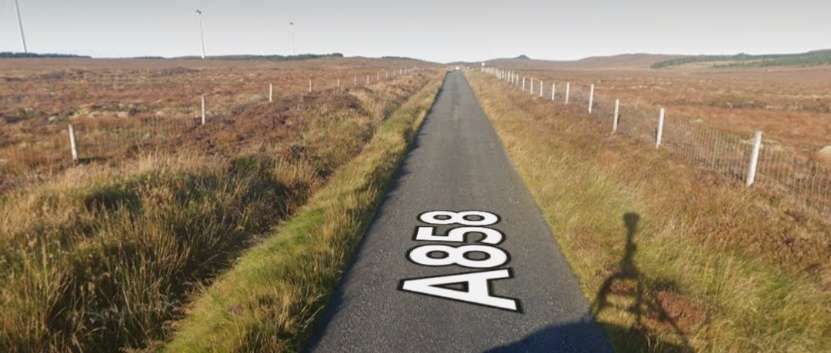
The view West along the A858 and therefore also along the line of the intended railway. [Google Streetview, September 2024]
Further West, another West-facing view along the lines of the planned railway. [Google Streetview, September
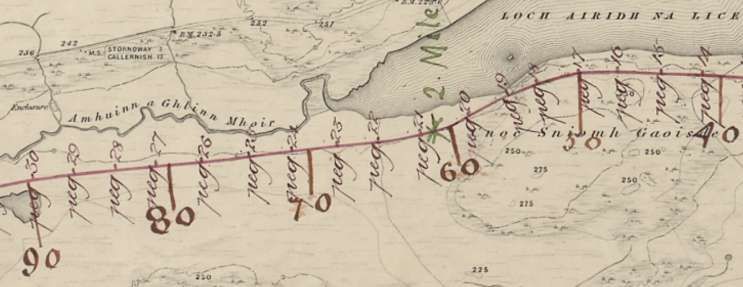
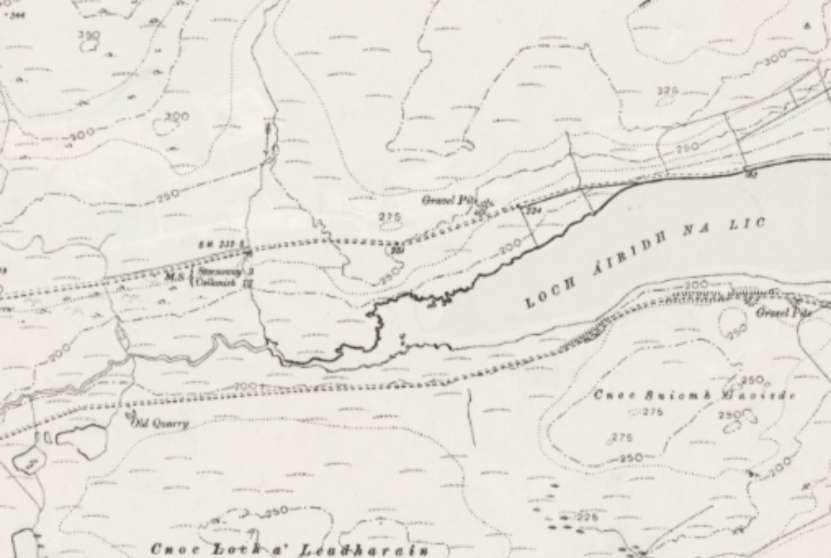
The route of the planned railway ran along the South shore of Loch Airidh na Luv. [18]
The formation for the planned railway can be seen following the surveyed route. [21]
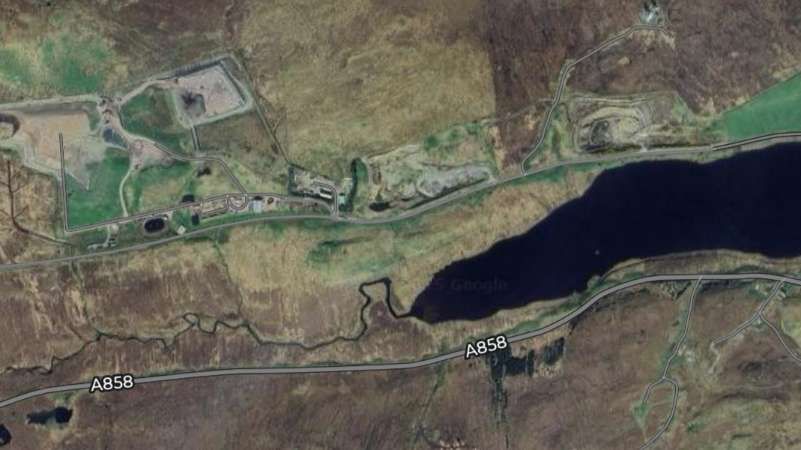
The same area as it appears on Google Maps. [Google Maps, July 2025]
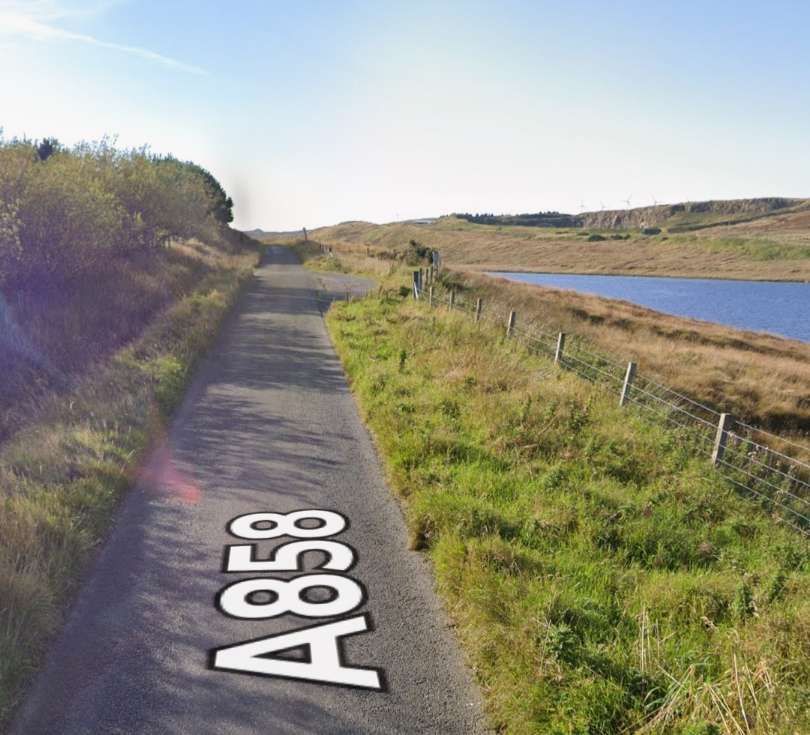
Looking West along the A858 which is built on the line of the planned railway. Loch Airidh na Luv is on the right of the photograph. [Google Streetview, September 2024]
Further West along the A858, also looking West. [Google Streetview, September 2024]
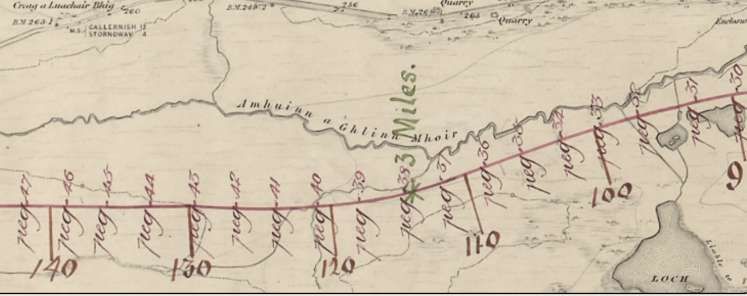
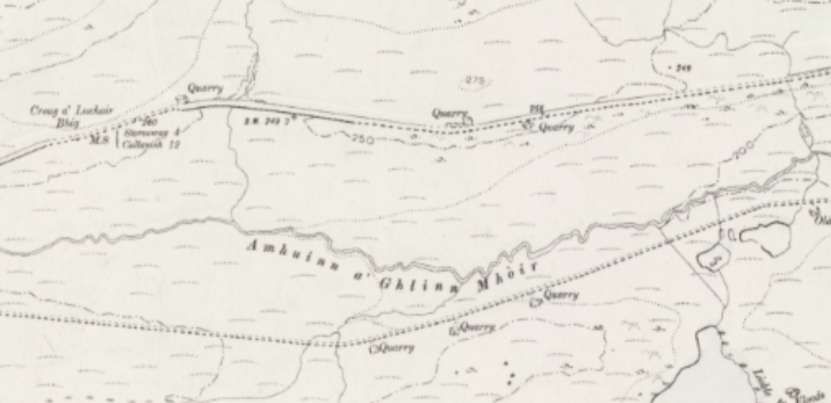
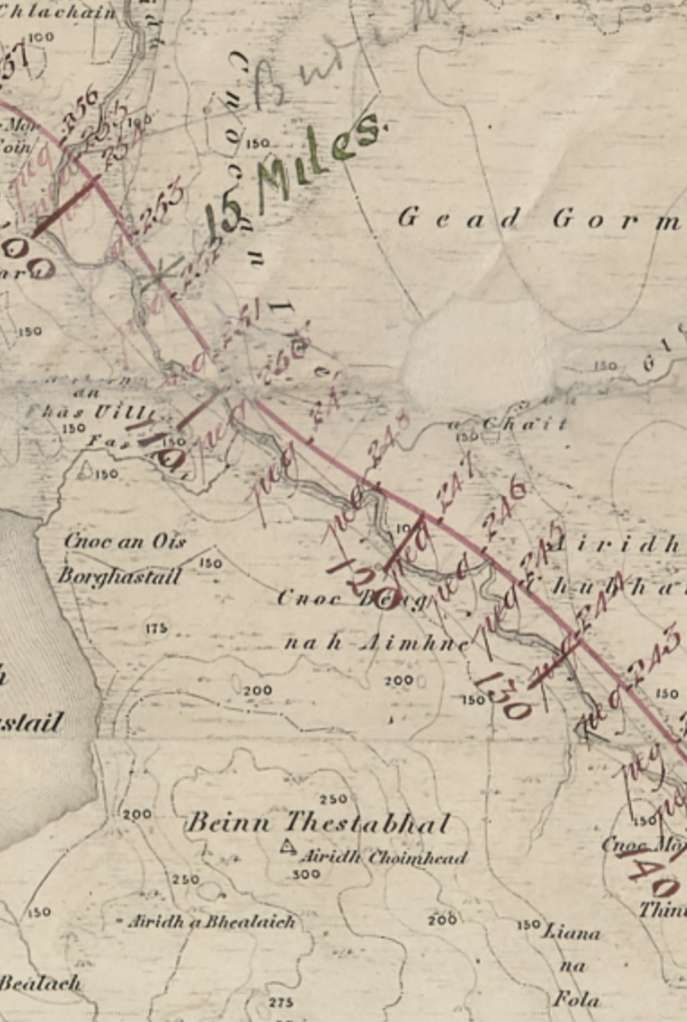
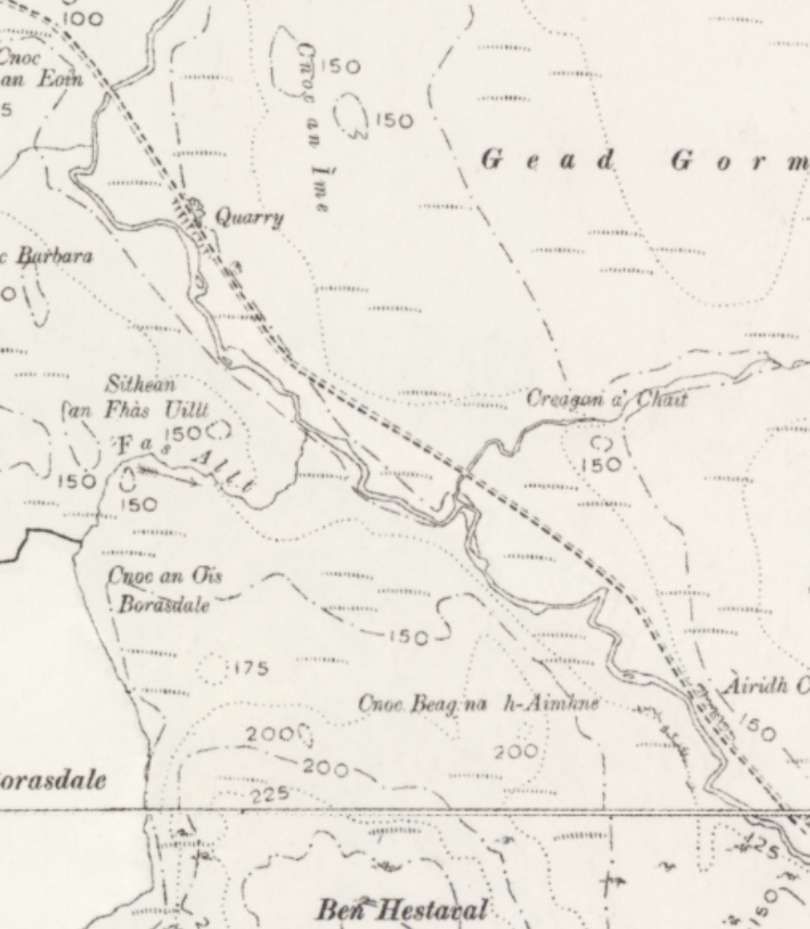
The route surveyed continued West along the South side of Amhuinn a’ Ghlinn Mhoir. [18]
The formation follows the surveyed route. [22]
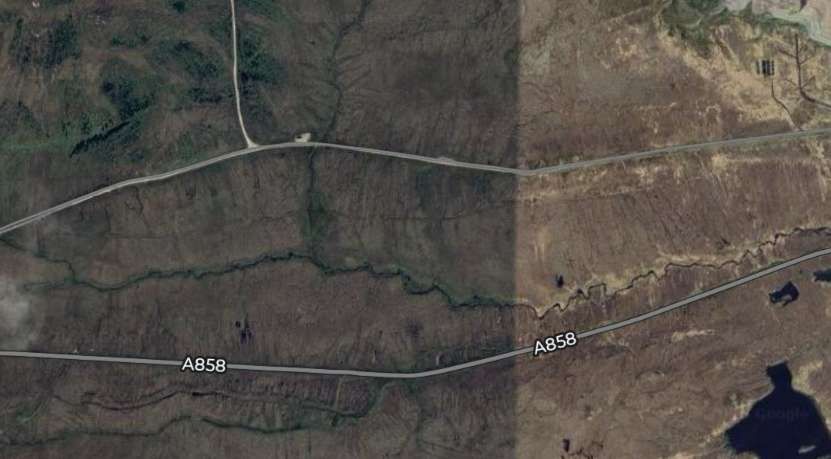
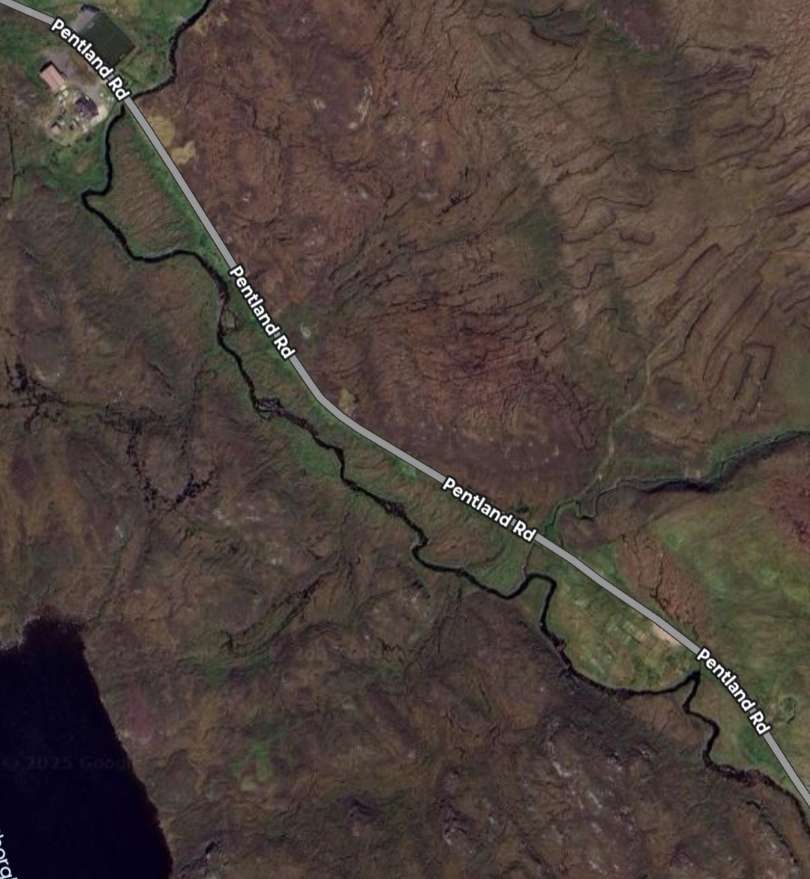
The same area as it appears on 21st century satellite imagery. [Google Maps, July 2025]
Looking West at the third point from the right of the satellite image above. [Google Streetview, September 2024]
The surveyed route then switches to the North shore of Loch Vatandip. [18]
The track follows the surveyed route, bridging Allt Greidaig just East of Loch Vatandip. [23]
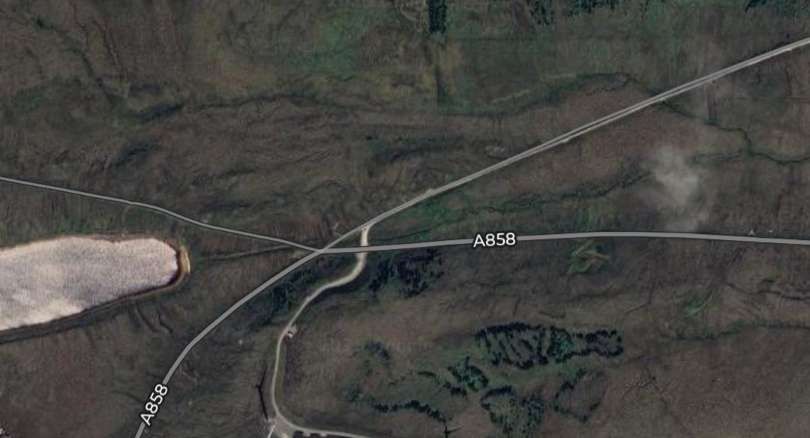
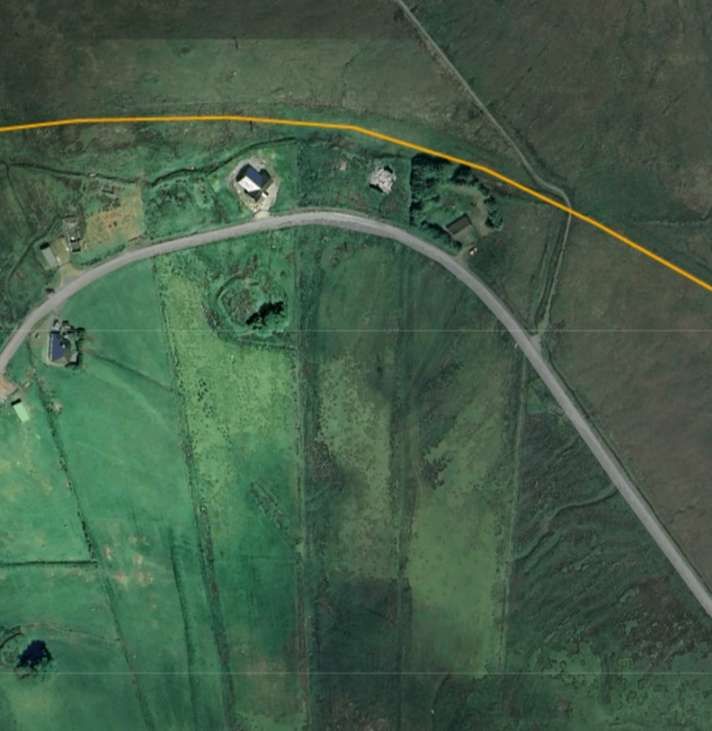
The same area in the 21st century. The A858 turns away from the surveyed line of the railway and the Pentland Road begins. [Google Maps, July 2025]
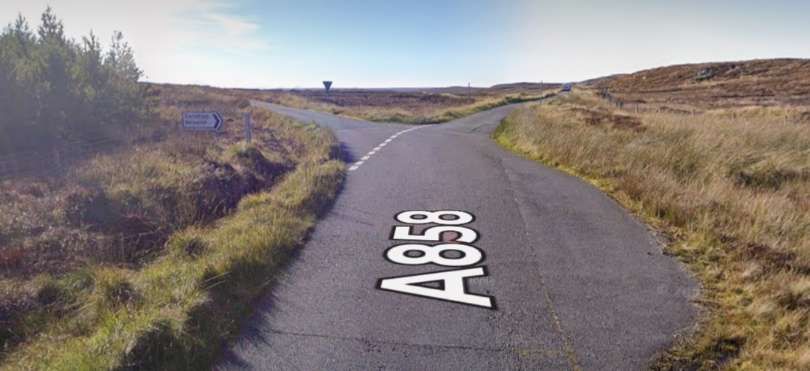
Looking West at the road junction the images above. The A858 bears away to the left, the Pentland Road continues ahead and bears to the right. [Google Streetview, September 2025]
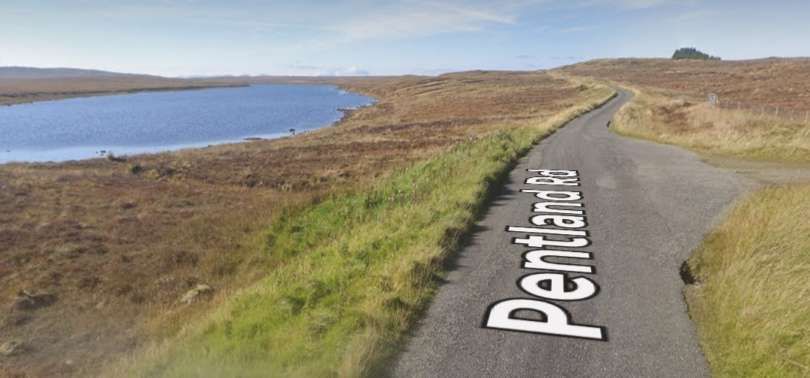
The loch on the left is Loch Vatandip. [Google Streetview, September 2024]
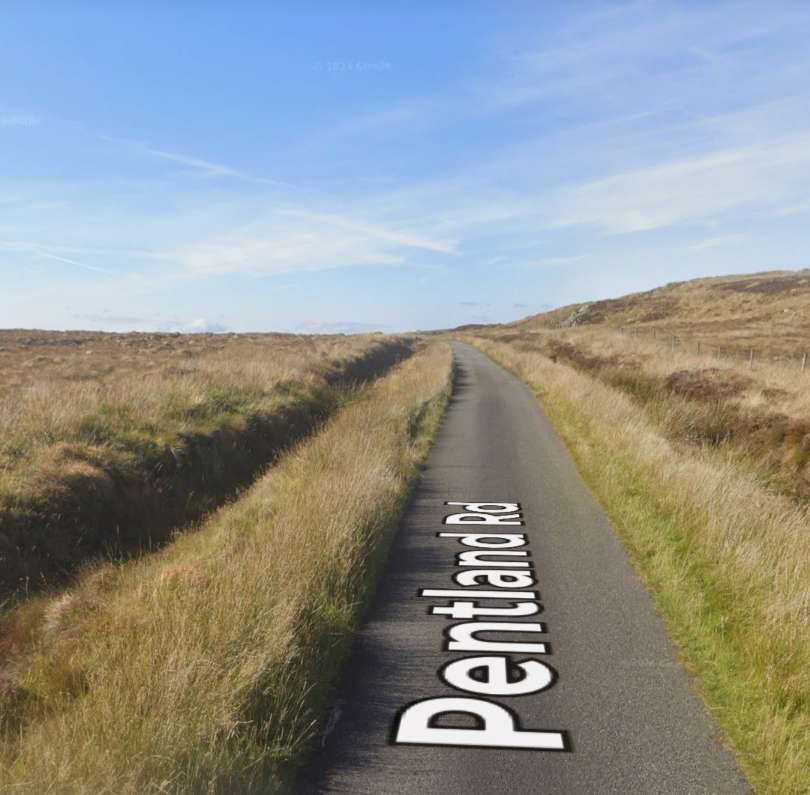
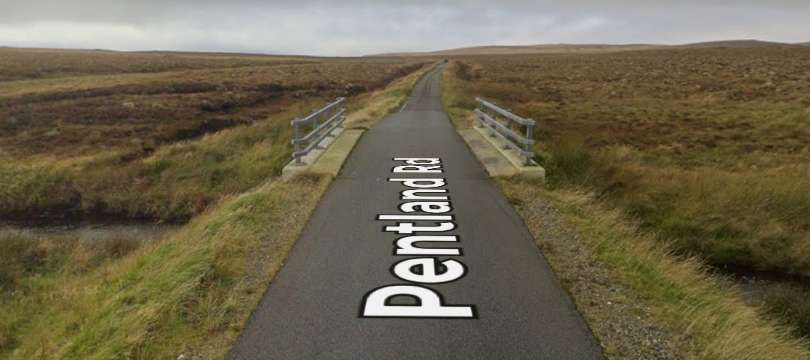
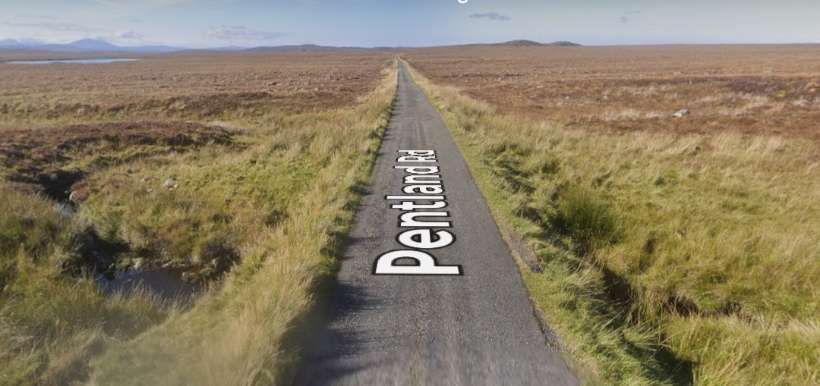
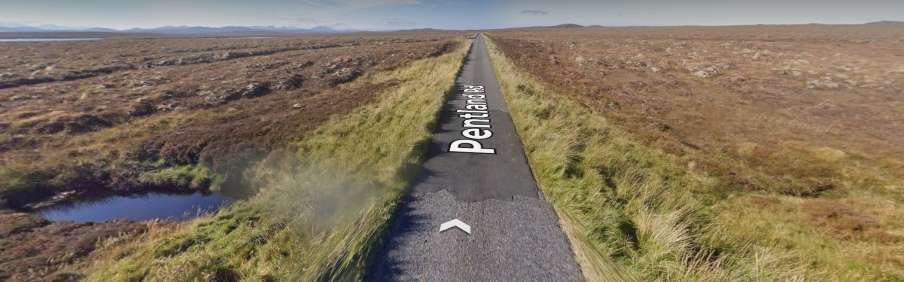
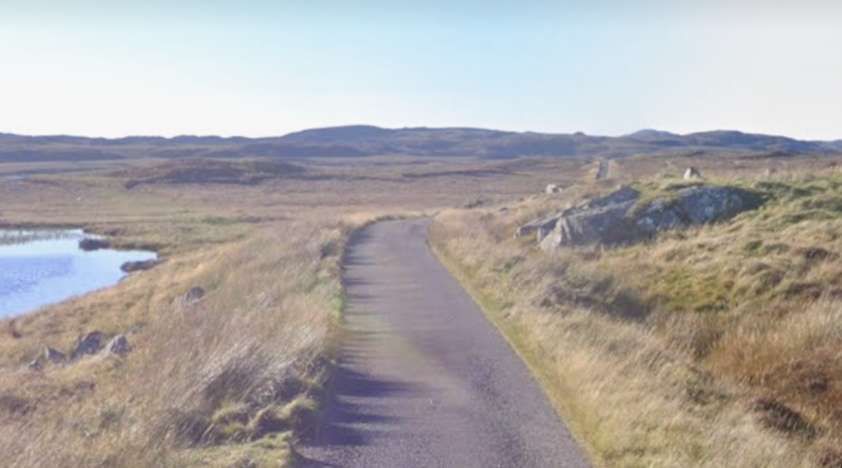
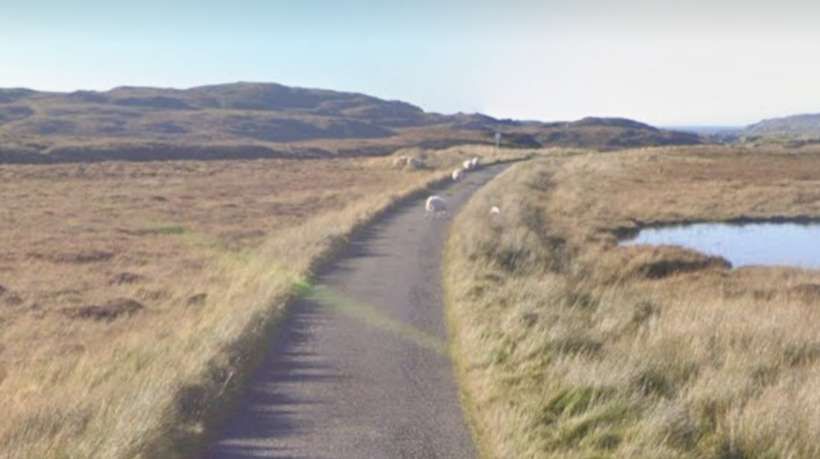
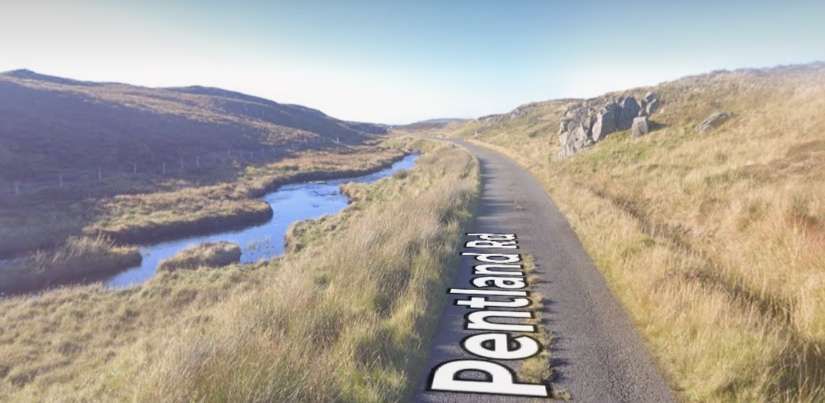
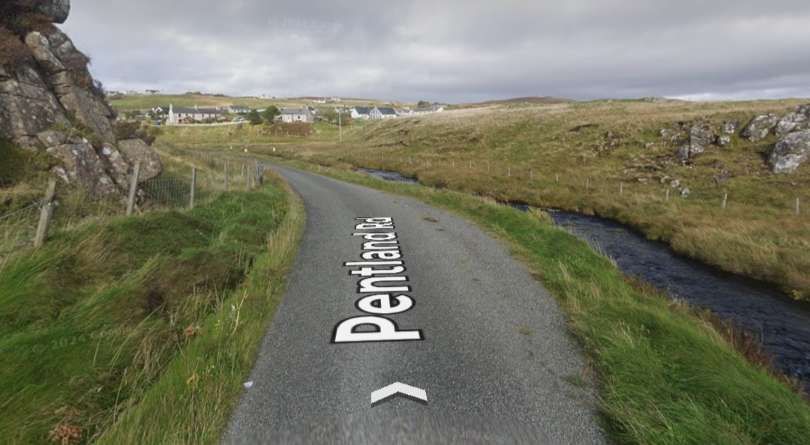
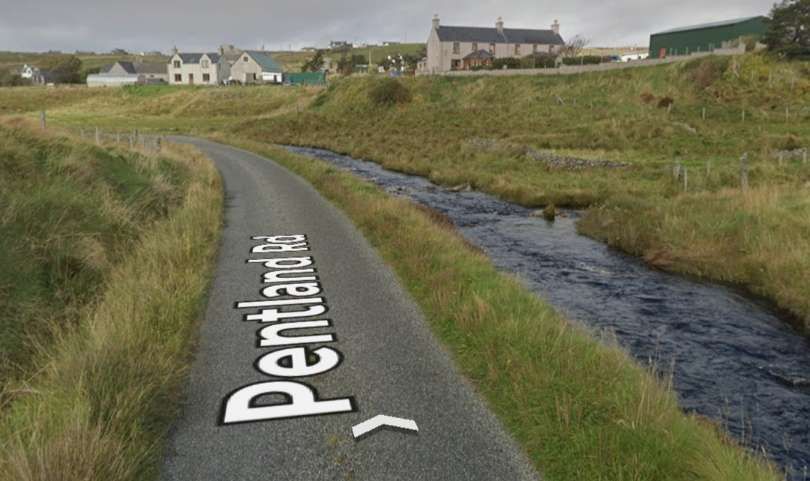
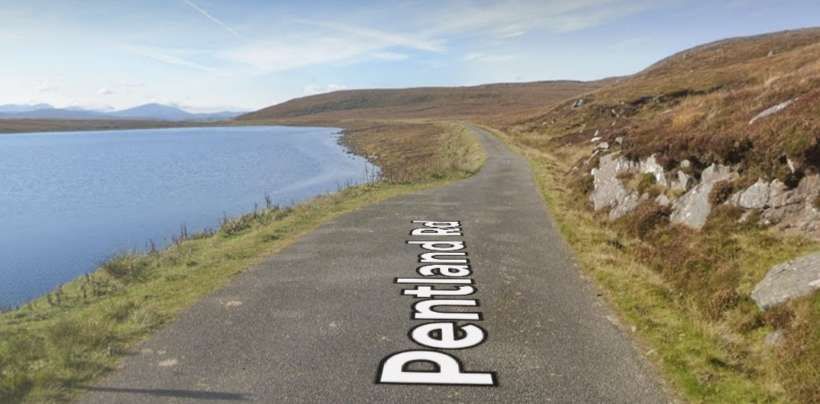
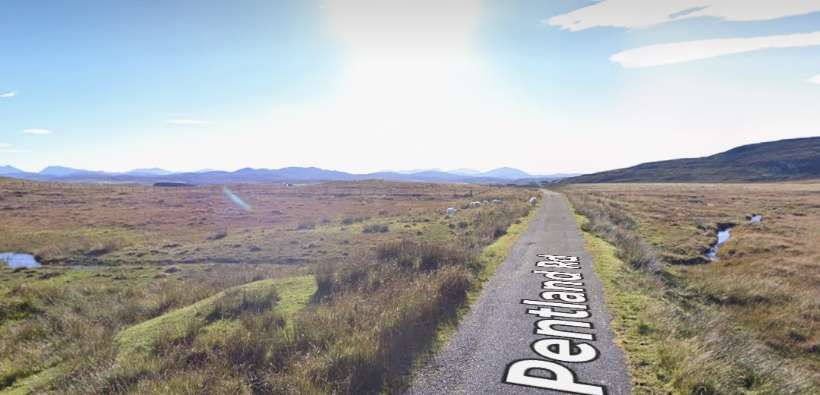
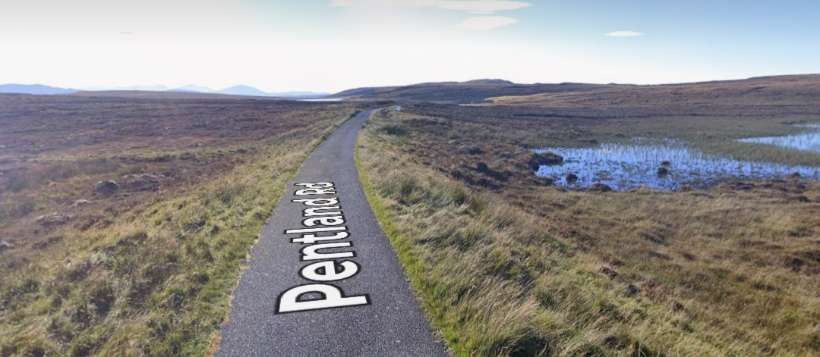
Further West along the single track Pentland Road, looking West. [Google Streetview, September 2024]
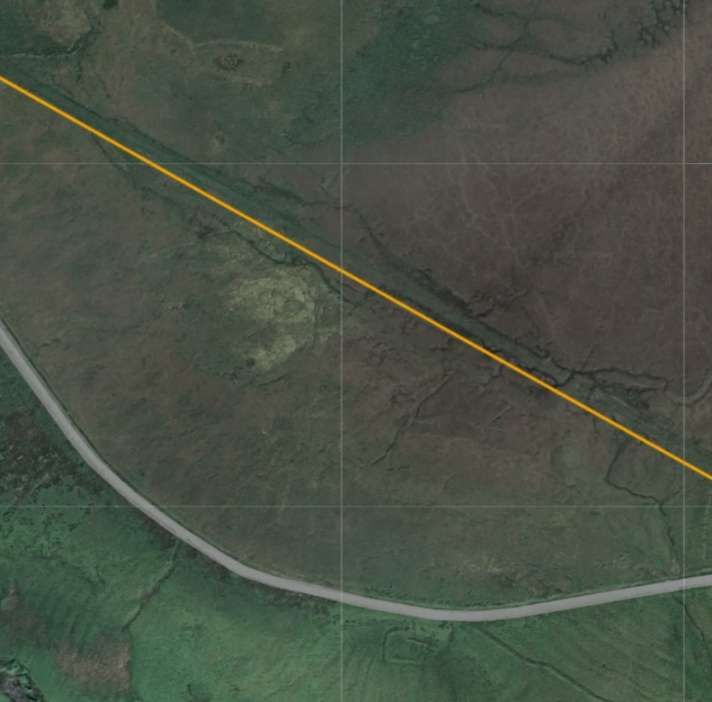
The surveyed route ran West-northwest  above the North shore of the loch. [18]
While the surveyed line is straight on the map extract above, the line of the track shows a minor deviation as it heads West-northwest between Loch Vatandip and Loch Mor a Chocair. [24]
The same area in the 21st century, the same minor deviation in the alignment of the Pentland Road. [Google Maps, July 2025]
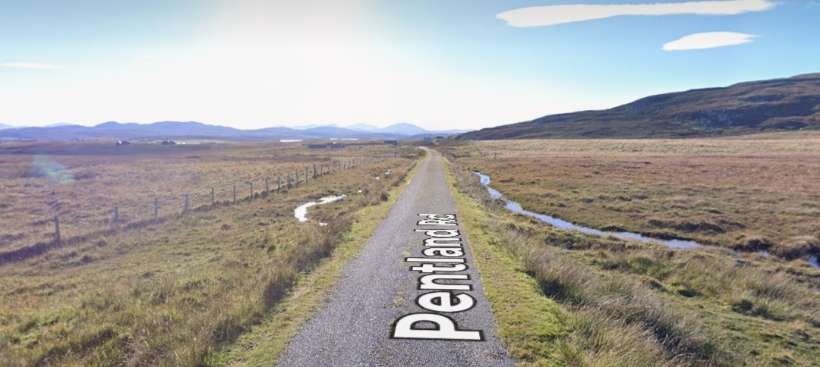
The same minor deviation in the road alignment seen from the East. [Google Streetview, September 2024]
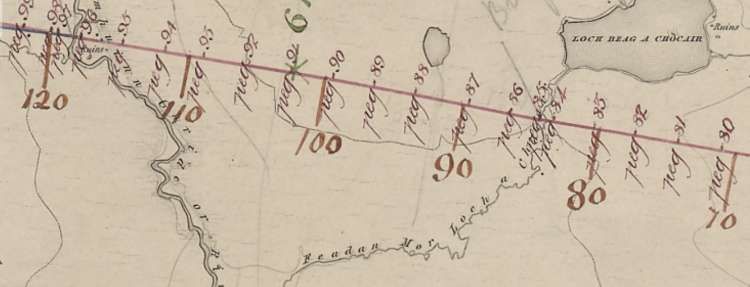
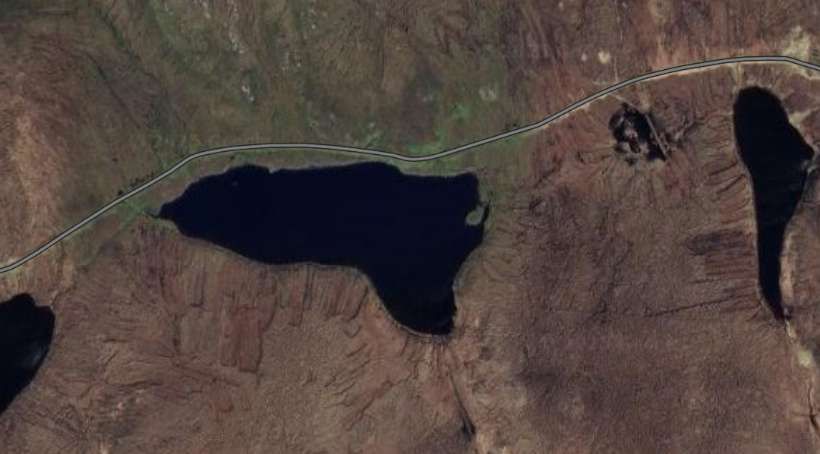
The surveyed route continues on the same bearing. [18]
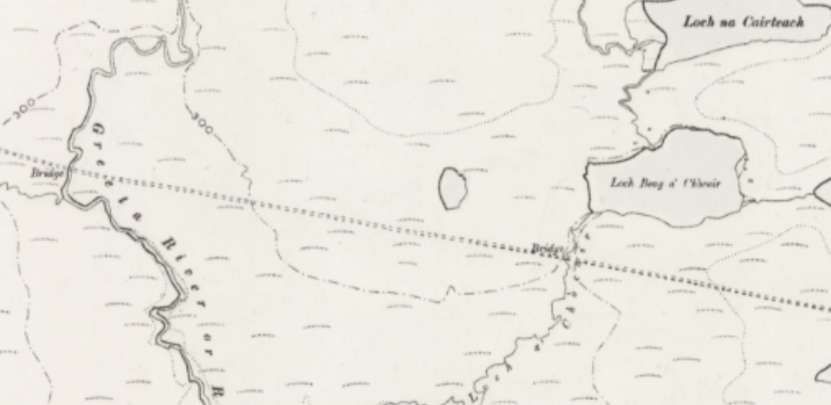
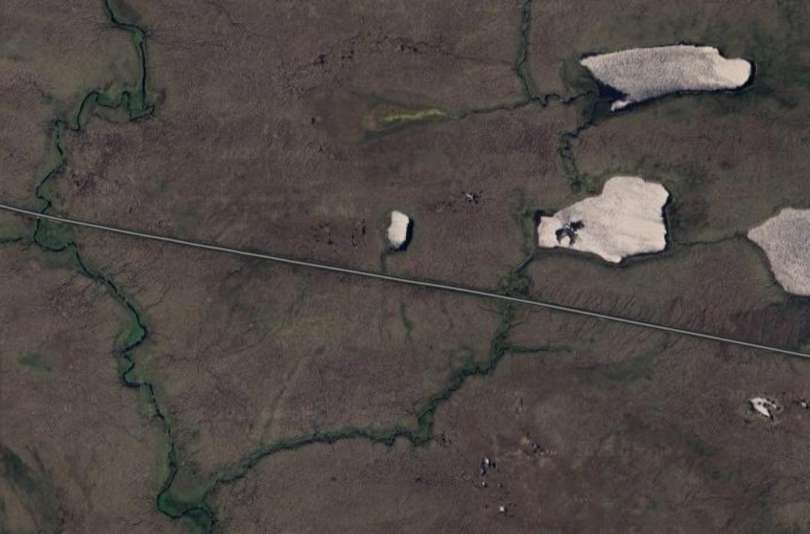
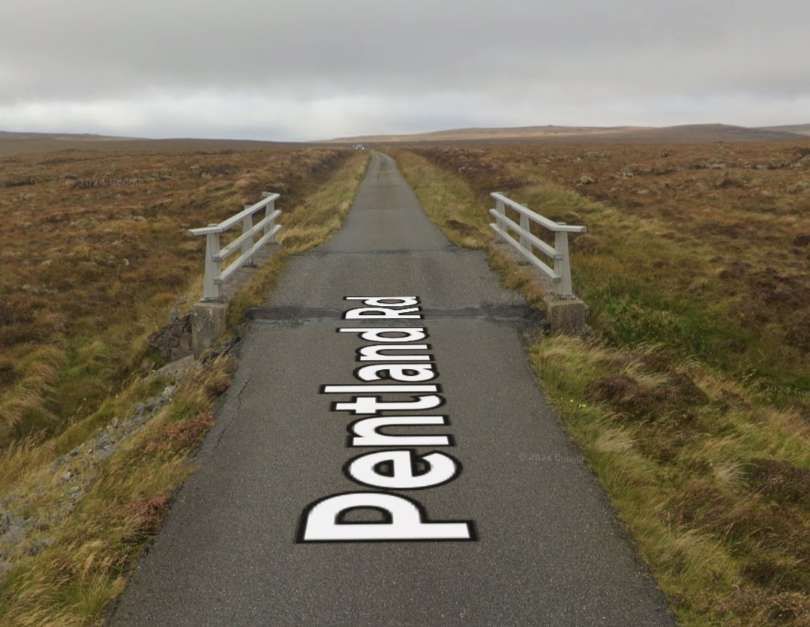
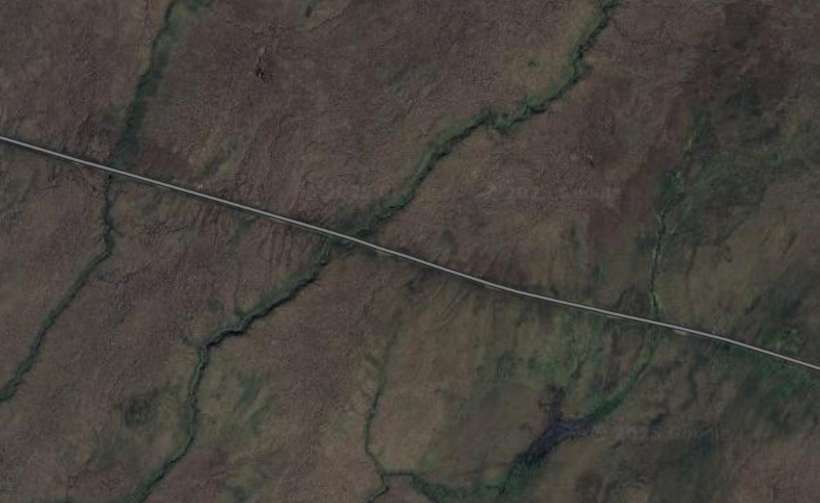
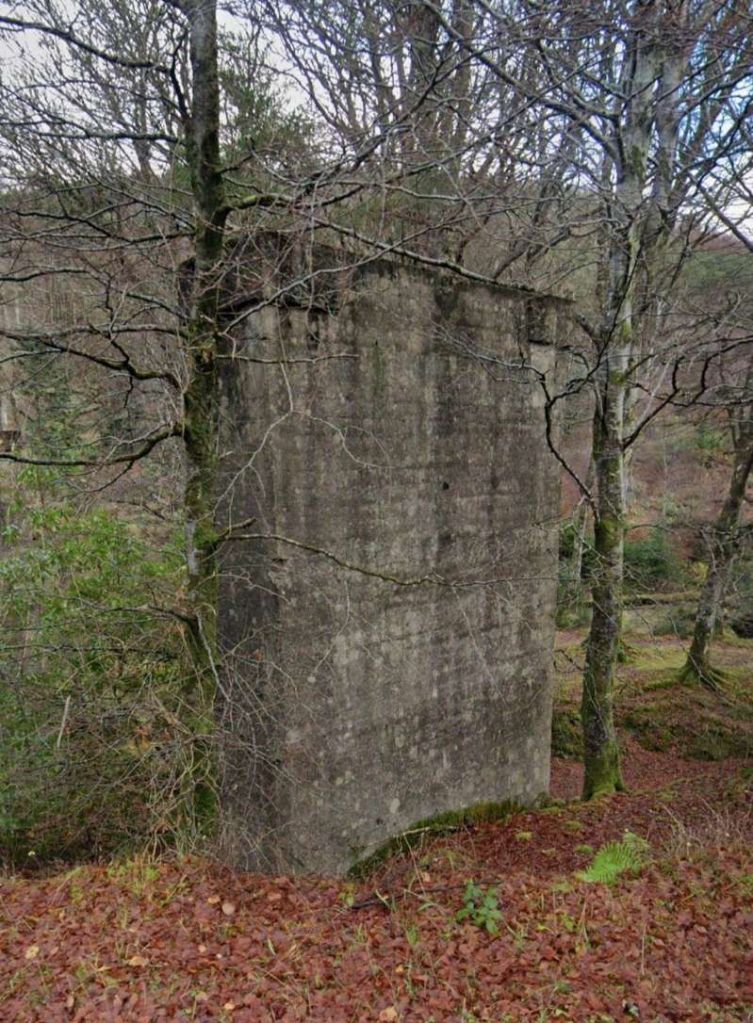
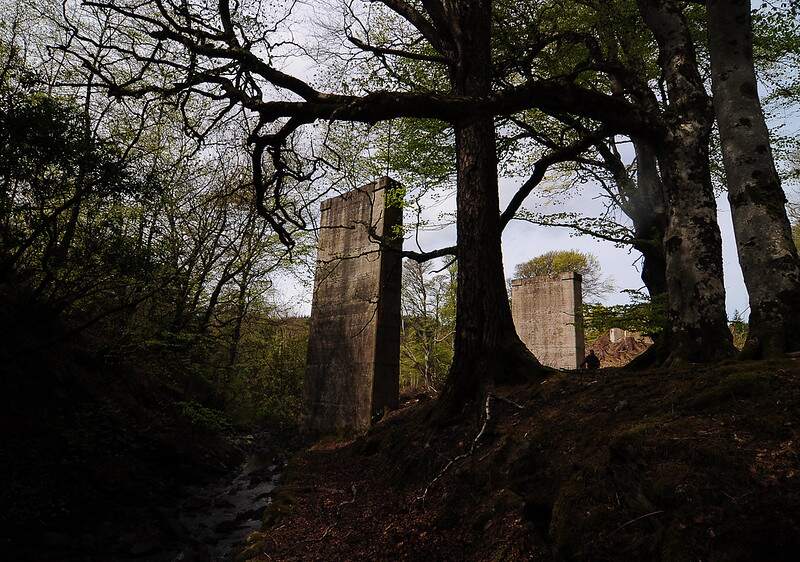
The track on the formation of the proposed railway matches the survey, passing to the South of Loch Beig a Chocair and bridging two streams – Loch a Chocair and the Greta River (or the River Creed). It seems that work on the railway extended to the construction of bridges ready for the final addition of the rails.  [25]
The same length of road in the 21st century. [Google Maps, July 2025]
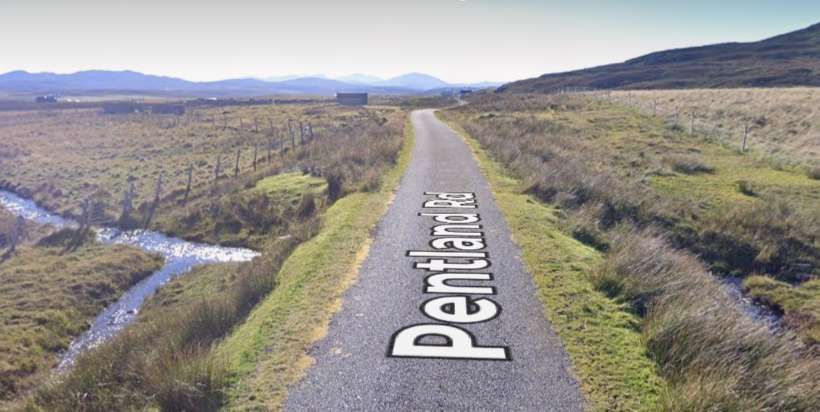
The first of two bridges on this length of road, built for the railway that never arrived! [Google Streetview, September 2024]
The second of those bridges, also seen from the East. [Google Streetview, September 2024]
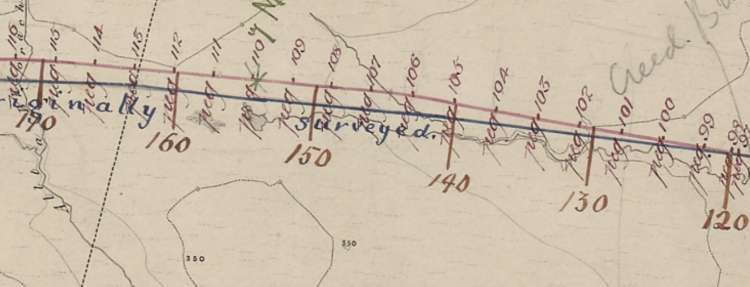
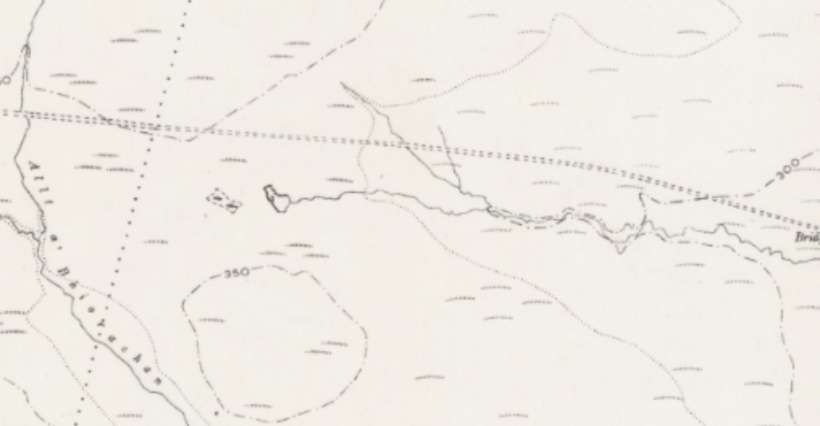
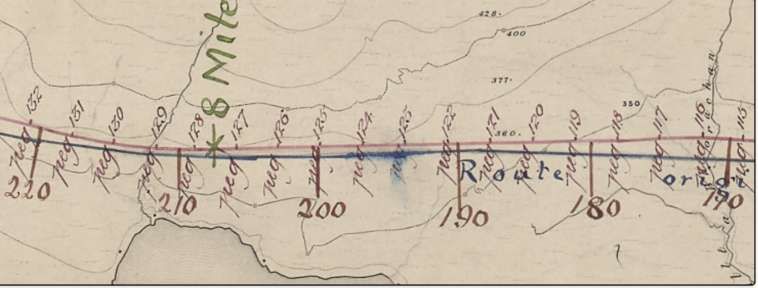
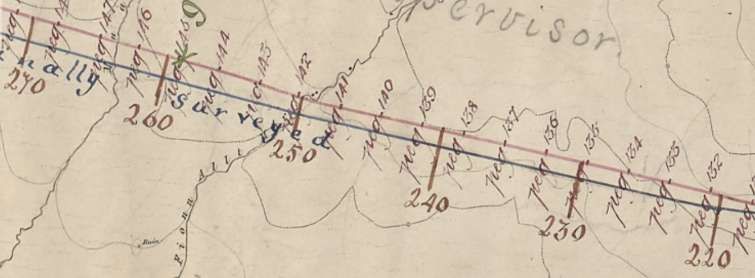
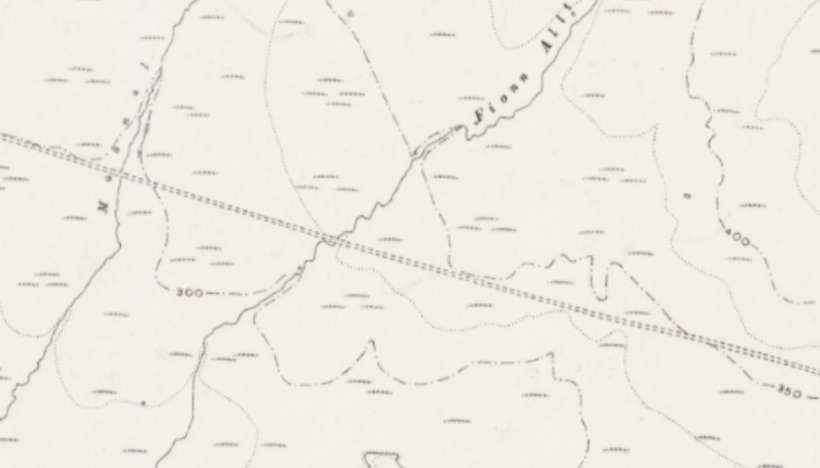
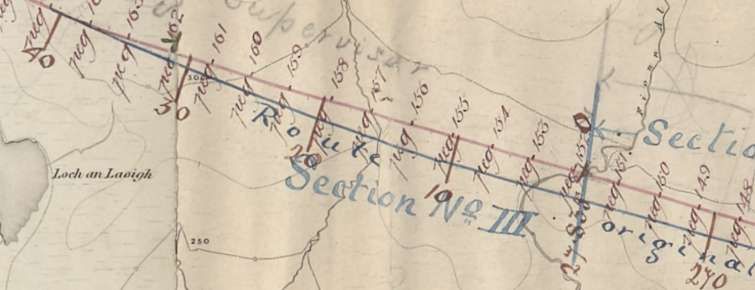
This is the first of four map extracts where the original survey route is shown in blue. The red line being that which was used. No reason for this alteration is provided. [18]
Small culverts or pipes are not marked on the OS mapping but there must be one over Allt a’ Bhiorachan at the left of this map extract and possibly two other smaller culverts or pipes close to the centre of the extract. [26]
Having checked each of the three locations where streams run under the surveyed route which is now a road, there is no visible structure, so there is probably no more than a drainage pipe at each location. [Google Maps, July 2025]
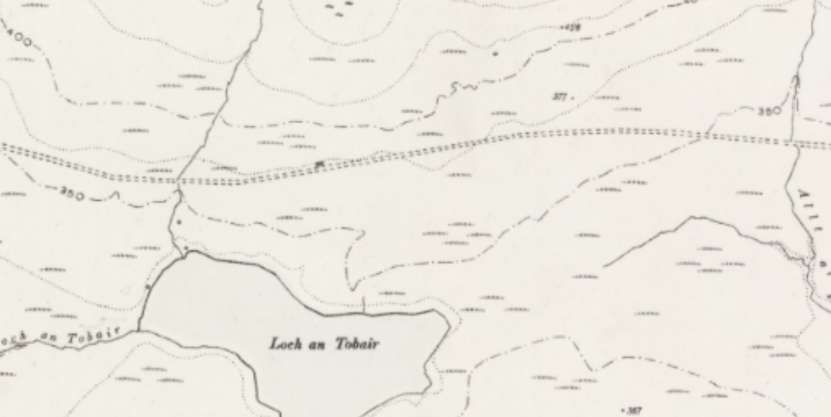
The surveyed route has now turned slightly to run East-West, before turning West-northwest again to the North of Loch an Tobair. [18]
It seems that the final alignment of the earthworks prepared for the railway was, over the first half of this extract, North of either of the marked survey lines. A further culvert/pipe must have been provided for the stream flowing South into Loch an Tobair. [27]
The same area in the 21st century. [Google Maps, July 2025]
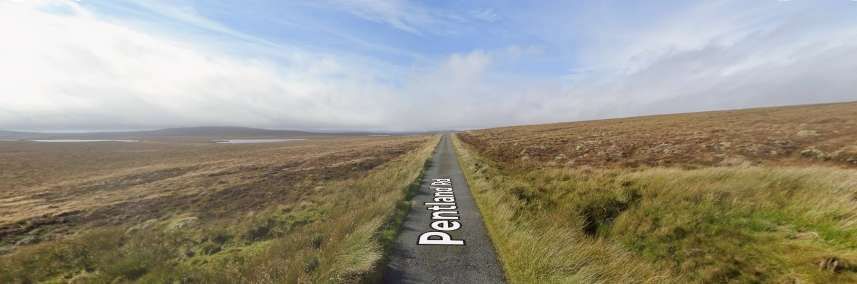
No sign of a structure at the point where the feed to Loch an Tobair passes under the road so a drainage pipe must suffice. The wide open skies on Lewis are amazing! [Google Streetview, September 2024]
Now back on an West-northwest alignment, the original survey line (blue) and that deemed to have actually been used (red) run in parallel. [18]
The same length as it appears on the 6″ OS mapping at the turn of the 20th century. No bridges are marked at the crossing point of the two streams which suggests that smaller culverts or drainage pipes were used. [28]
The same area in the 21st century. [Google Maps, July 2025]
The first (most easterly) drainage ditch crosses the line at this location, a pipe of some sort must pass under the road. [Google Streetview September 2024]
At the second (more westerly) location, standing water is visible to the South of the road, drainage from North to South must be by a pipe. [Google Streetview, September 2024]
The two surveyed routes come together again North of the East end of Loch an Laoigh. [18]
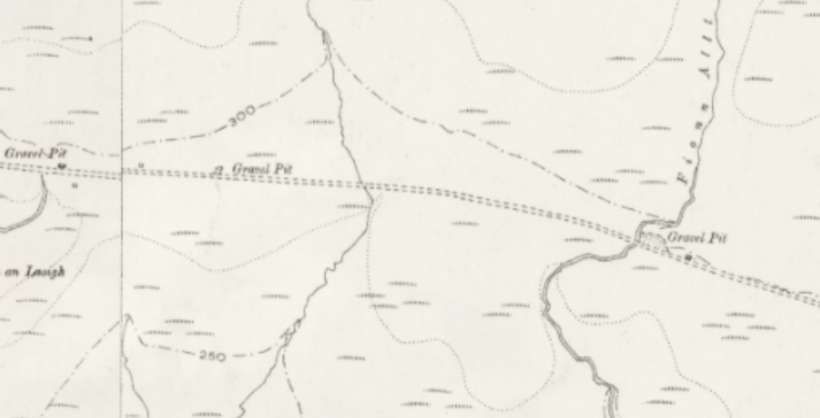
Three gravel pits are marked along this length of the formation. No bridges are marked so culverts must have been employed for the two watercourses. The track appears to run a little to the North of the surveyed alignment. [29]
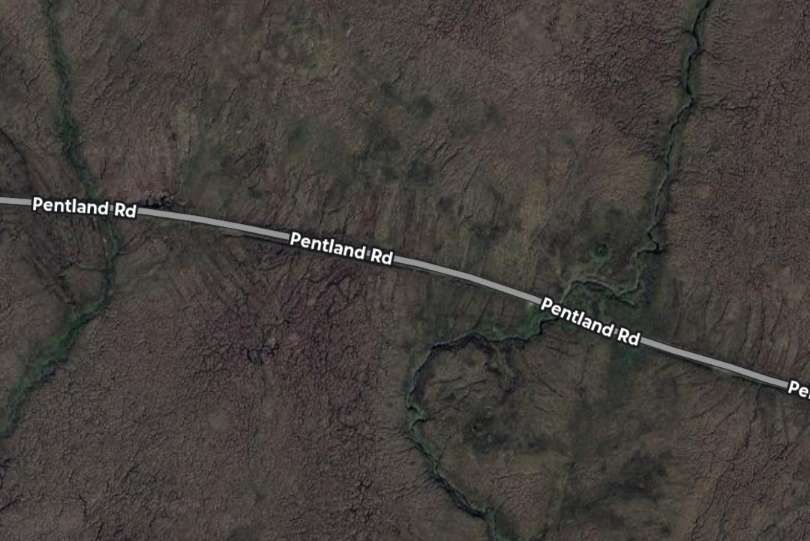
The two streams shown on the map extracts above. Both show water downstream of the road, one appears to have a corrugated plastic pipe under the road. [Google Maps, July 2025]
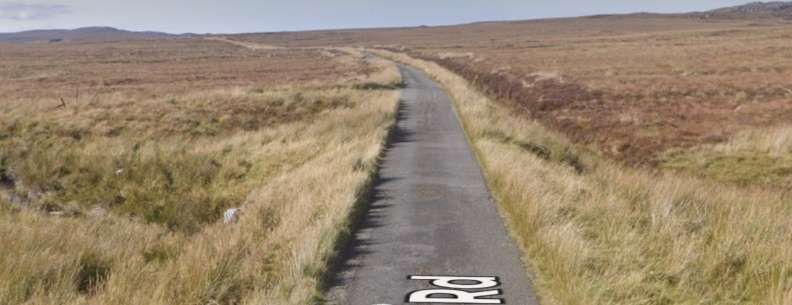
The location of the more easterly watercourse seen looking West: a plastic pipe can be seen to the left of the road. [Google Streetview, September 2024]
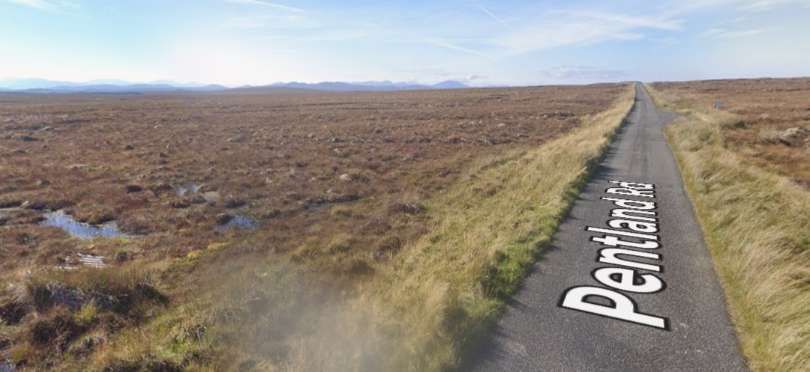
Drainage water can be seen to the left of the road in this West-facing view at the location of the more westerly watercourse. No drainage pipe is visible from the road. [
The proposed junction with the line to Breasclete heading West-southwest and that to Carloway heading Northwest. [18]
The linto Carloway heads Northwest and crosses Allt Mhic Ille Chetheir. [30]
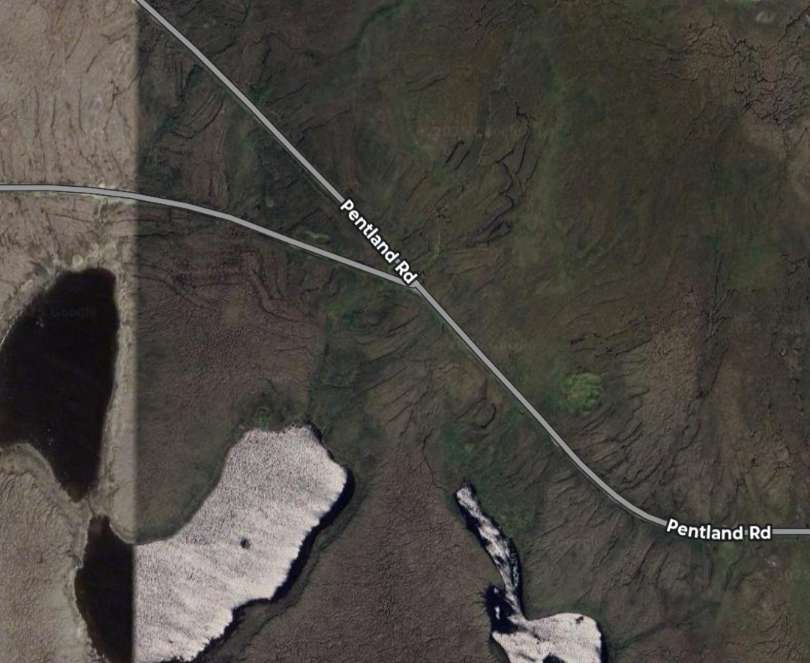
The junction: Breasclete is to the East and Carloway to the Northwest. [Google Maps, July 2025]
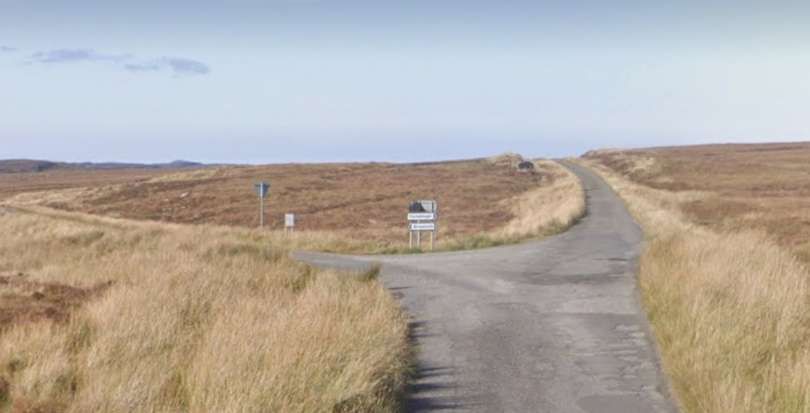
The junction seen from the Southeast. [Google Streetview, September 2024]
The road to Carloway: both arms of the road are called Pentland Road. [Google Streetview, September 2024]
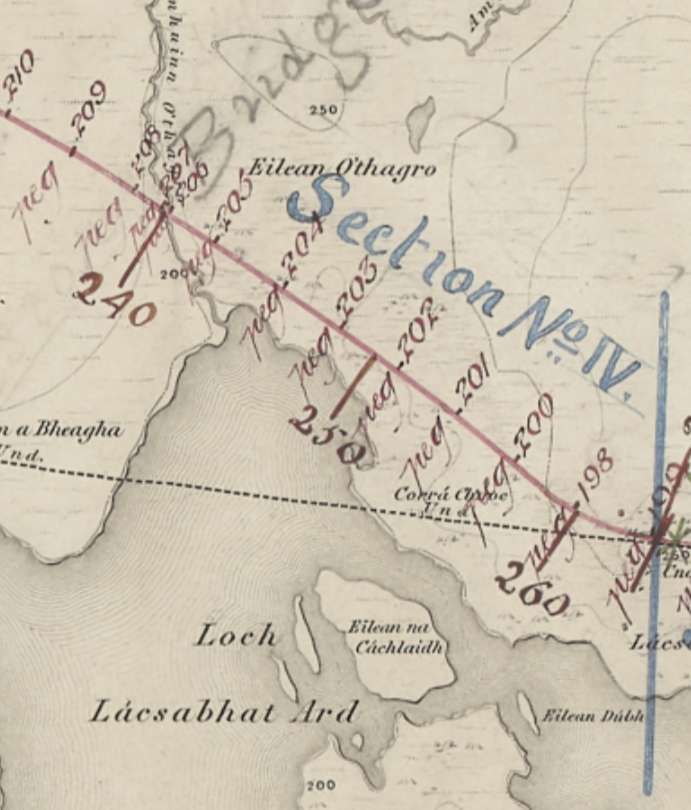
The proposed line ran to the West of a group of three lochans – Loch Mor a Ghrianain, Loch Beag a Ghrianain and Loch an Fheoir. [18]
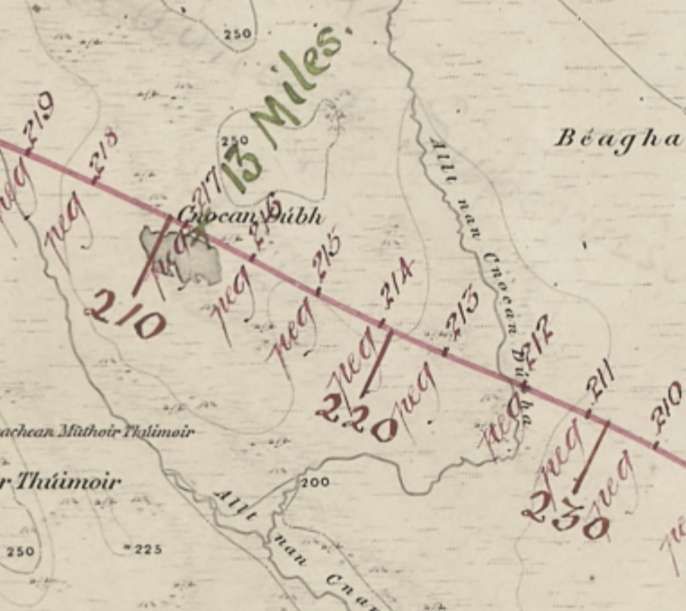
Continuing Northwest the planned line to Carloway crossed Allt nan Lochanan Traighte and ran passed a small quarry which was not marked on the 1″ mapping of the 1850s. [31]
The modern road continues to follow the planned railway route. Google Maps, July 2025]
The road travels on a causeway with drainage ditches on each shoulder. [Google Streetview, September 2024]
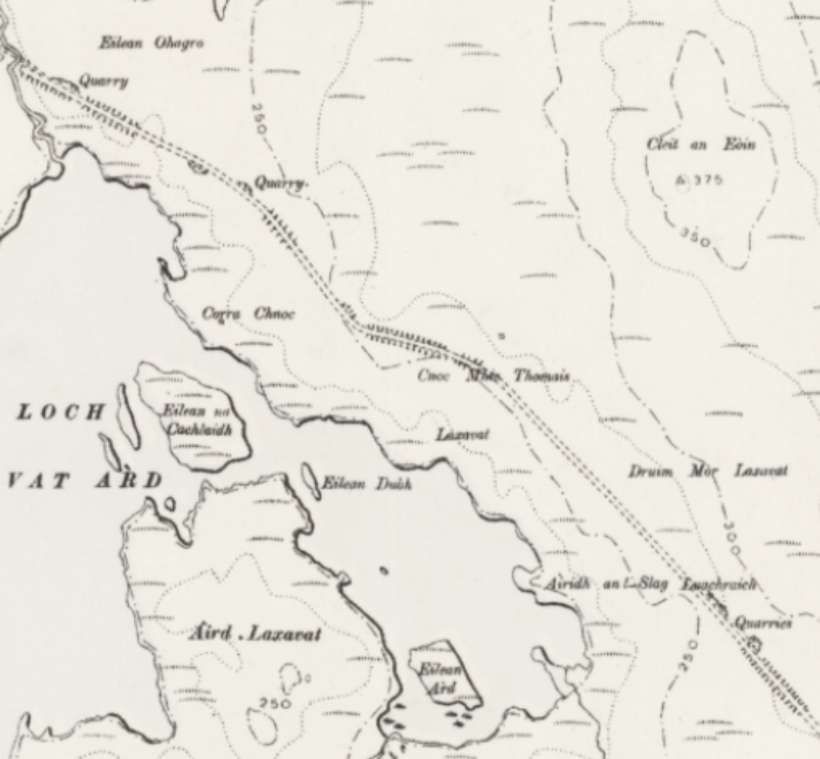
The surveyed route curves around the top of Loch Laxavat (Lacsabhat) Ard. [18]
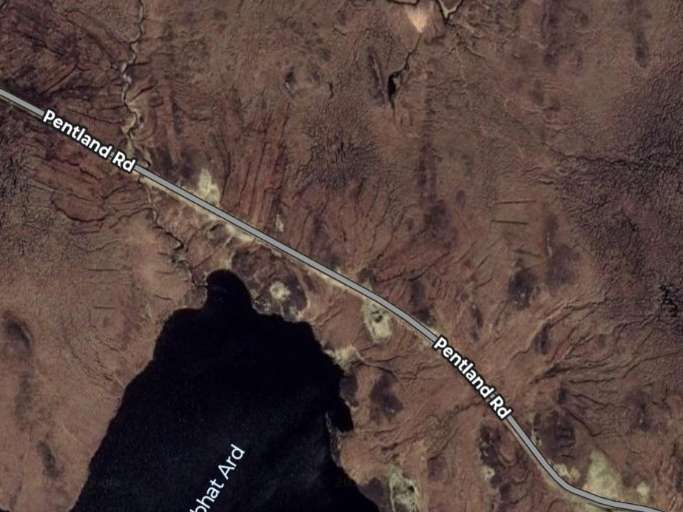
A larger area than shown on the survey sheet above which shows clearly a relatively tight curve on the alignment of the railway formation to the Northeast of the Loch. [32]
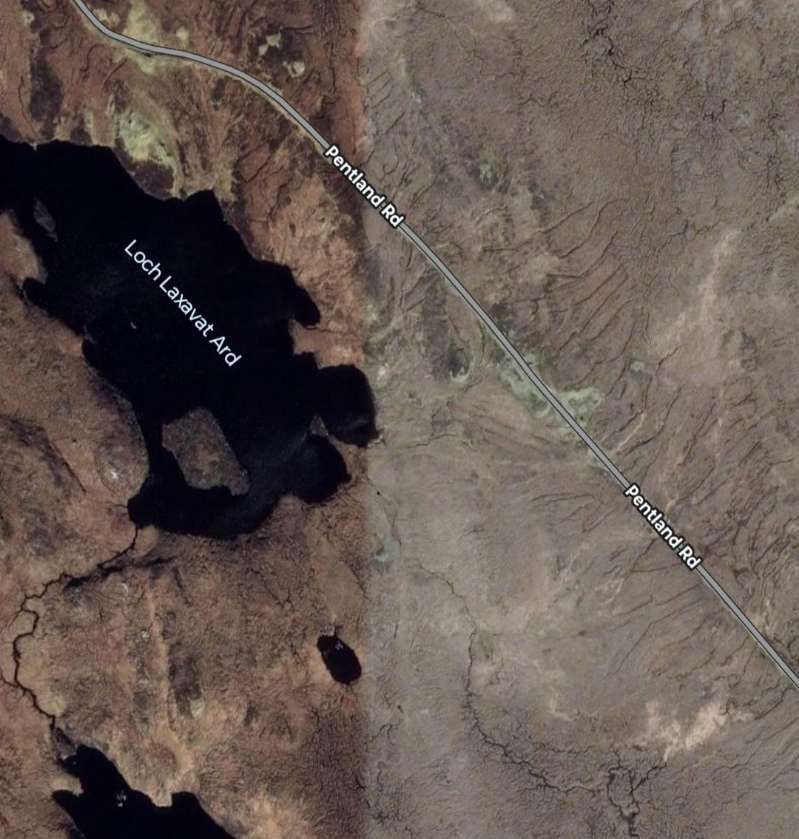
This satellite image matches the area shown on the extract from the 1″ Ordnance Survey of the 1850s. [Google Maps, July 2025]
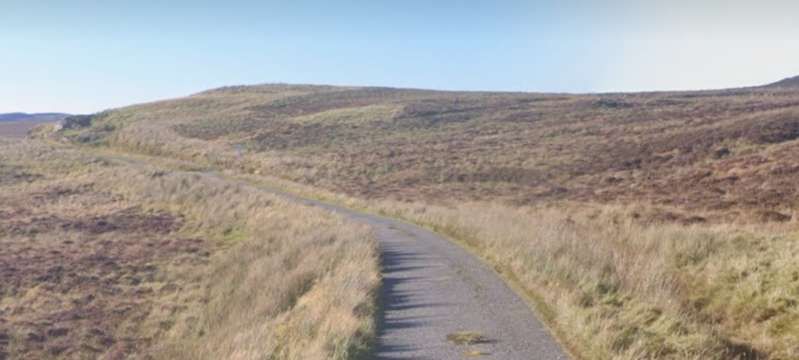
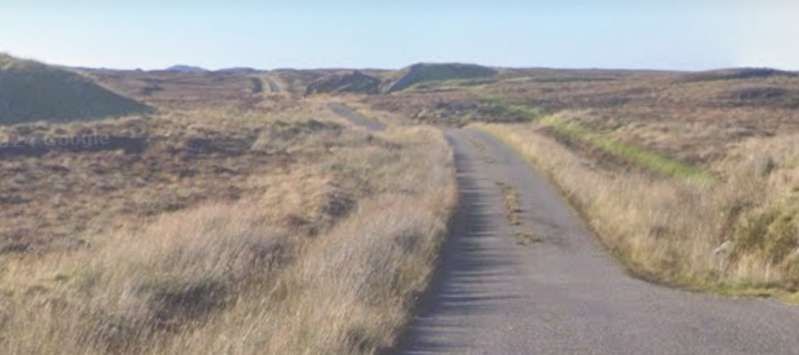
The road follows the planned railway route curving to the left to avoid higher ground. [Google Streetview, September 2024]
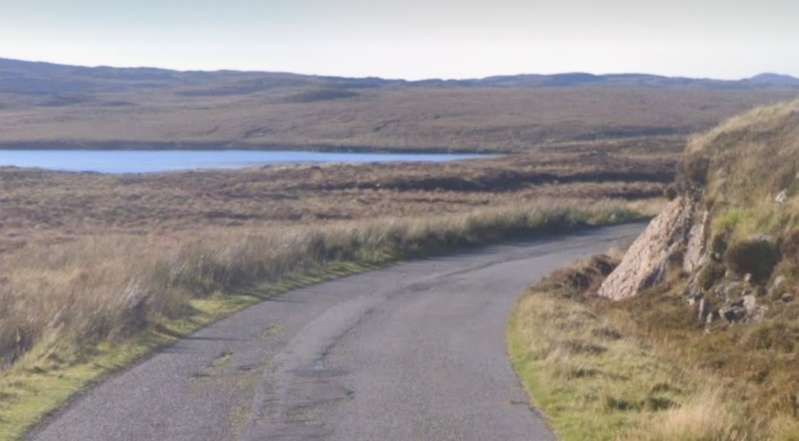
Then curving to the right around a rock outcrop. [Google Streetview, September 2024]
The tight curve mentioned in the notes about the extract from the 6″ OS mapping above appears towards the bottom-right of this extract from the survey plans. [18]
This 6″ OS extract takes the line to a point just to the West of the River Ohagro which feeds onto the North of Loch Laxavat Ard. It will be noted that there is a break in the embankments built for the proposed railway where a bridge would have been placed over the river. A short diversion provides access by means of a ford across the river. The ‘as built’ looks NE of embankments do not follow the survey to the East of the River Ohagro. [33]
A similar area to that shown on the 6″ Ordnance Survey. [Google Maps, July 2025]
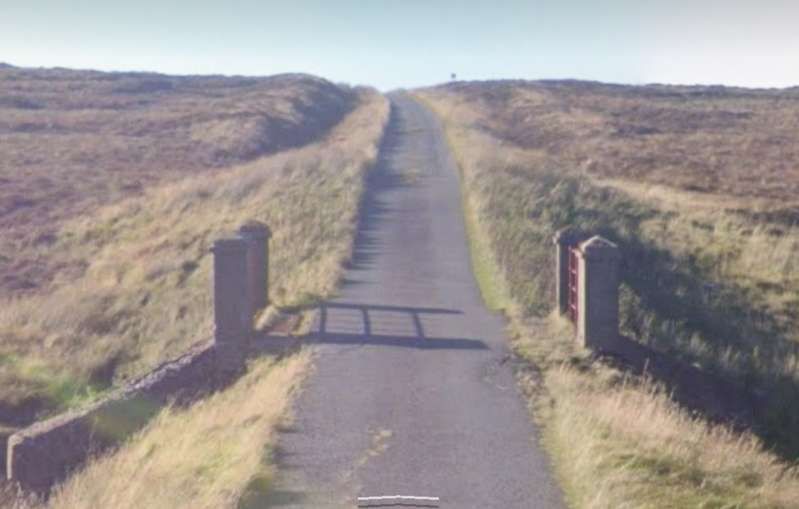
The road can be seen undulating ahead, possibly foreshortening exaggerates this effect. The 6″Ordnance Survey shows that embankments were constructed at the end of the 19th century. [Google Streetview, September 2024]
The bridge over the River Ohagro which feeds into Loch Laxavat Ard. This bridge was not constructed as part of the railway contact and had to be built as part of the construction of the Pentland Road early in the 1910s. [Google Streetview, September 2024]
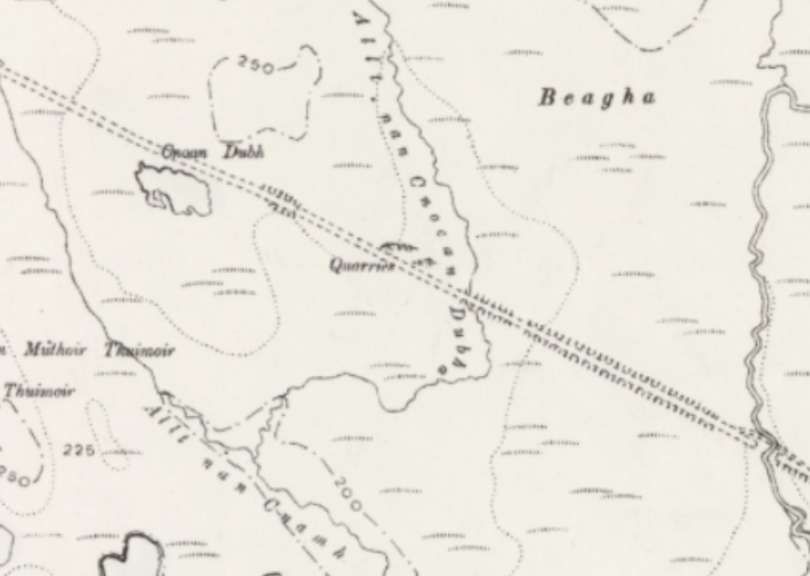
Another culvert takes the line over the Allt nan Cnocan Dubh. [18]
This next extract from the 6″ Ordnance Survey takes the track beyond Conan Dubh to approximately the same point on the surveyed line as the 1″ extract above. [34]
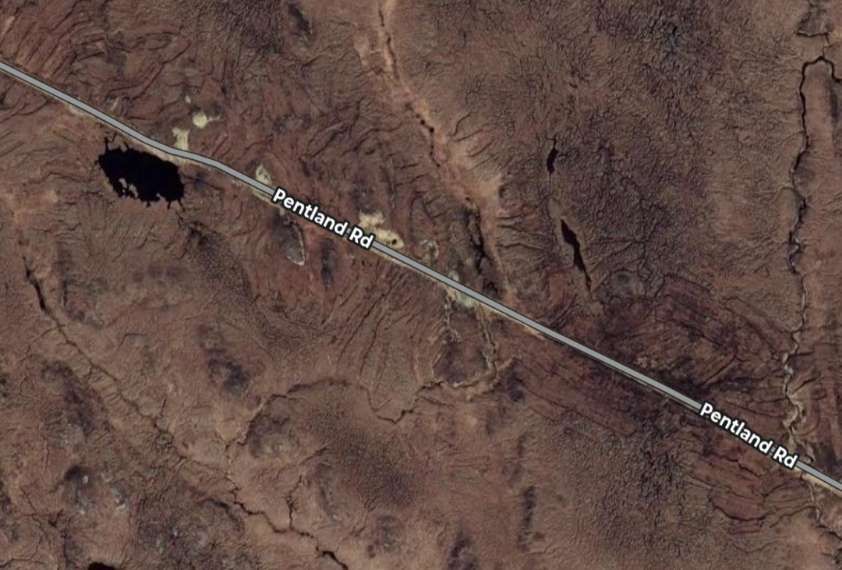
A very similar length of the road as shown in the map extracts above. [Google Maps, July 2025]
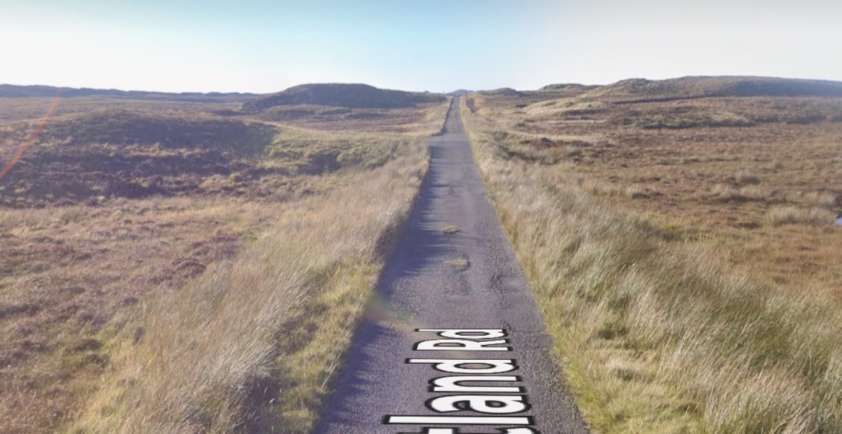
Looking Northwest along the Pentland Road at the centre of the satellite image above. [Google Streetview, September 2024]
Further West the road curves round a rick outcrop on the North side of Conan Dubh. [Google Streetview, September 2024]
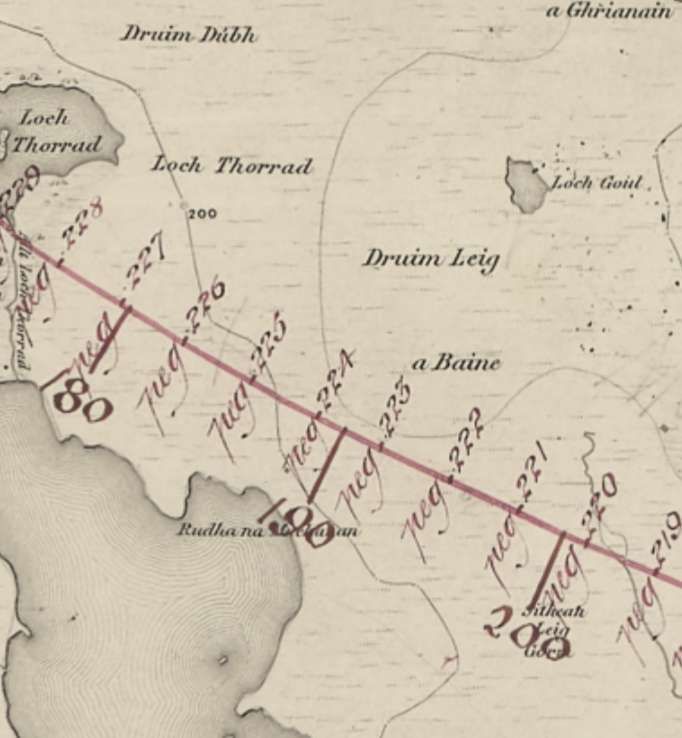
This next length of the survey takes the proposed line as far as Loch Thorrad. [18]
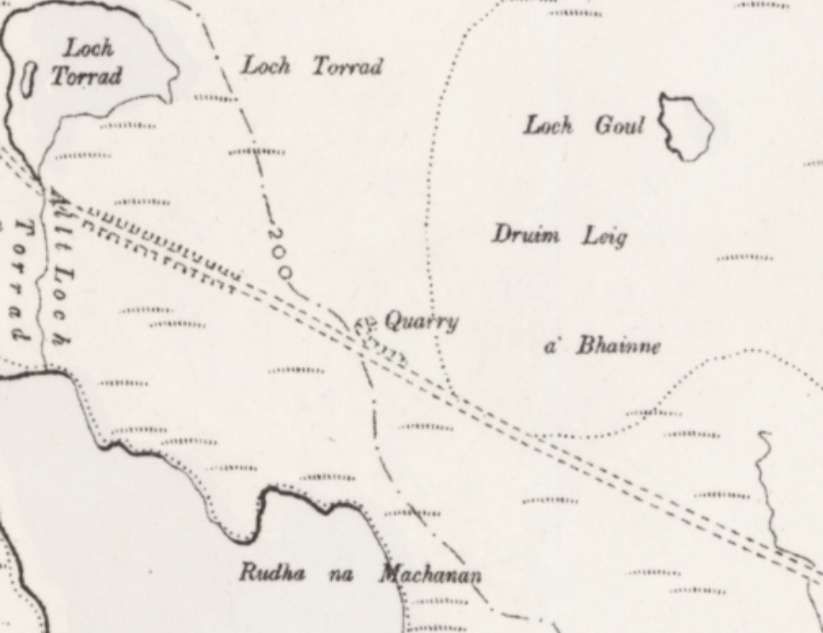
No obvious provision is made for the proposed line to cross the Allt Loch Thorrad, so a culvert or drainage pipe must be presumed. [35]
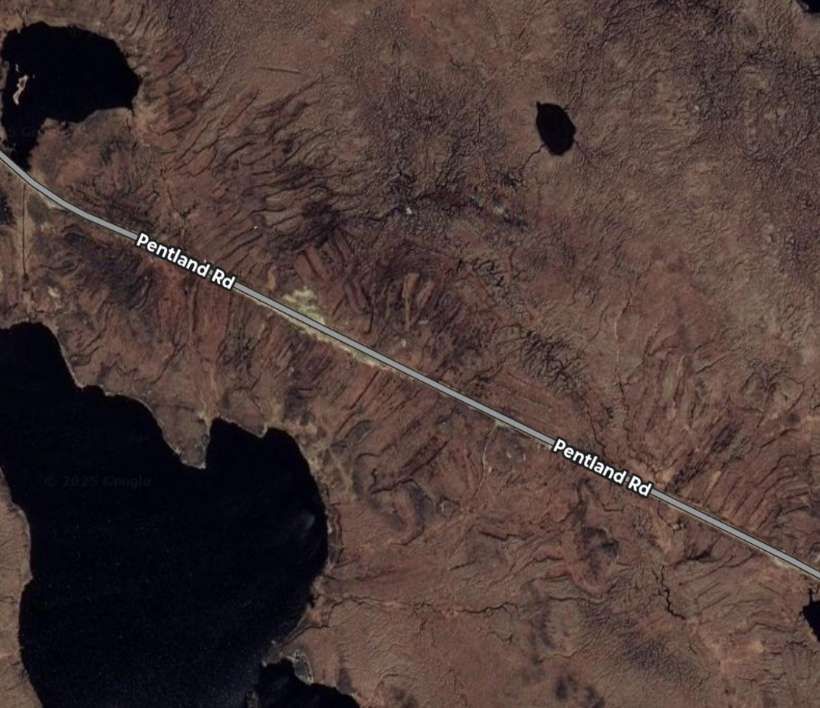
This satellite image takes us as far as Loch Thorrad (which can be seen on the North side of the road at the left side of the image. [Google Maps, July 2025]
Loch Thorrad is to the right of the road as it curves a little to the Northwest. [Google Streetview, September 2024]
From Allt Loch Thorrad onwards the line heads Northwest. [18]
After crossing the Allt Loch Thorrad the earthworks got the planned railway stay to the Northeast of the Carloway River. One tributary to the Carloway is crossed as the proposed line headed Northwest. [36]
The road now follows the valley of the River Carloway. [Google Maps, July 2025]
This and the next image show the road following the planned railway route alongside the River Carloway. [Google Streetview, September 2024]
The road picks its way between rock outcrops and the river. [Google Streetview, September 2024]
The earthworks remain on the Northeast side of the Carloway River for most of this length. [18]
The same length of the proposed railway. The Carloway River stays on the Southwest side of the river until the top-left of this extract, where the line crosses the River. One stream is culverted under the railway. [37]
We are relatively close to Carloway: the road follows the Northwest bank of Carloway River before the river passes under the road near the top-left of this satellite image. [Google Maps, July 2025]
This and the next image are two photographs showing the Carloway River meandering around close to the road. [Google Streetview, September 2024]
Buildings at the edge of the village of Carloway can just now be picked out in the distance e. [Google Streetview, September 2024]
Looking Northwest along the Pentland Road over the bridge carrying the road over the Carloway River which flows left to right under the bridge. [Google Streetview, September 2024]
Two alternative alignments for the proposed railway appear again close to Carloway. The original surveyed route is shown by the blue line. The planned route was moved so as to avoid the better farmland. [18]
Track which follows the formation of the planned railway crosses Gil Fasgro and runs immediately adjacent to the Carloway River. [38]
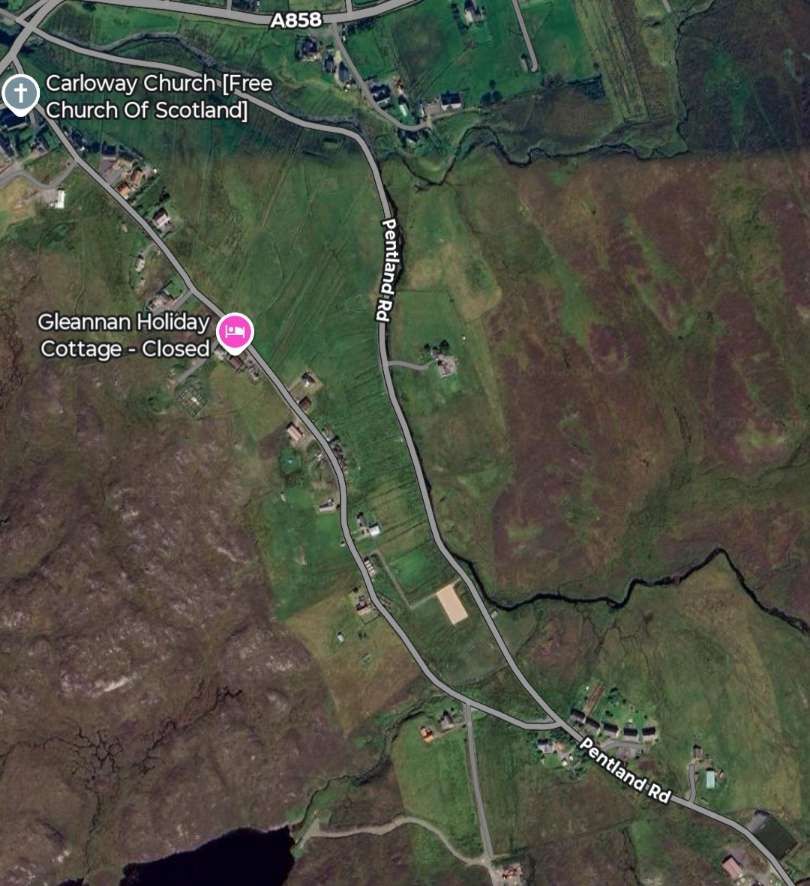
The Pentland Road runs down towards Carloway following approximately the red line from the survey. Google Maps, July 2025]
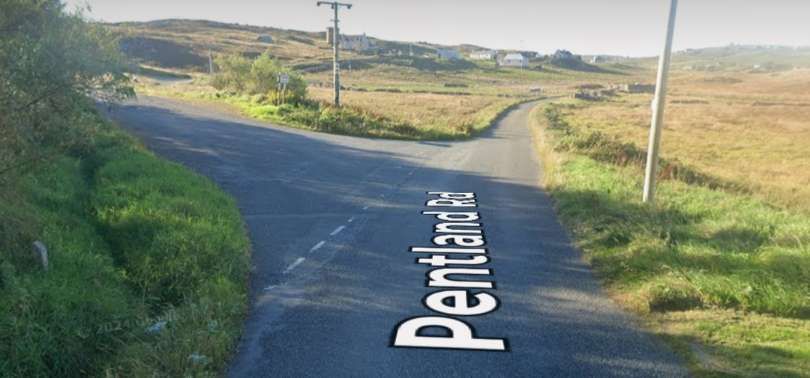
At the junction in the bottom-right of the satellite image the Pentland Road heads North following the river valley. [Google Streetview, September 2024]
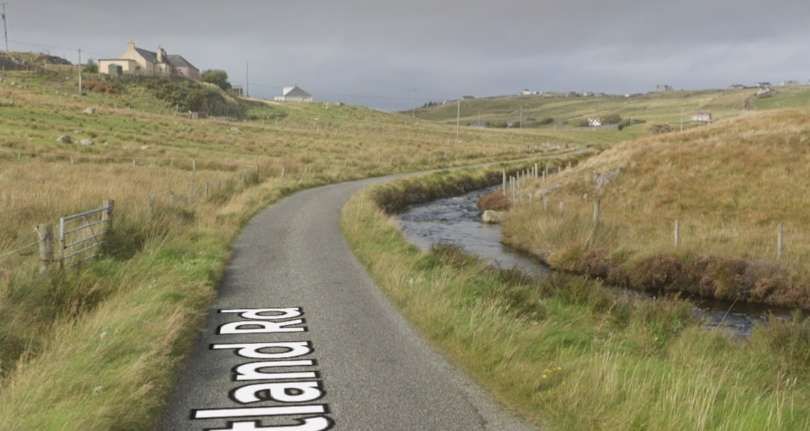
The Pentland Road runs alongside the Carloway River. [Google Streetview, September 2024]
Closer to Carloway and still alongside the River. [Google Streetview, September 2024]
On the right of the image the Heidagul River joins the Carloway River and from this point on the combined stream is known as the Heidagul River. Google Streetview, September 2024]
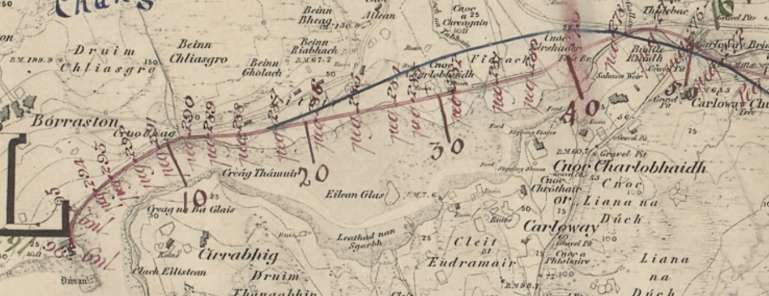
The final length of the survey shows the revised alignment (in red) close to the river and crossing the Carloway River close to Carloway Bridge. The surveyed route extends as far as the pier a Borraston, Dunan Pier. [18]
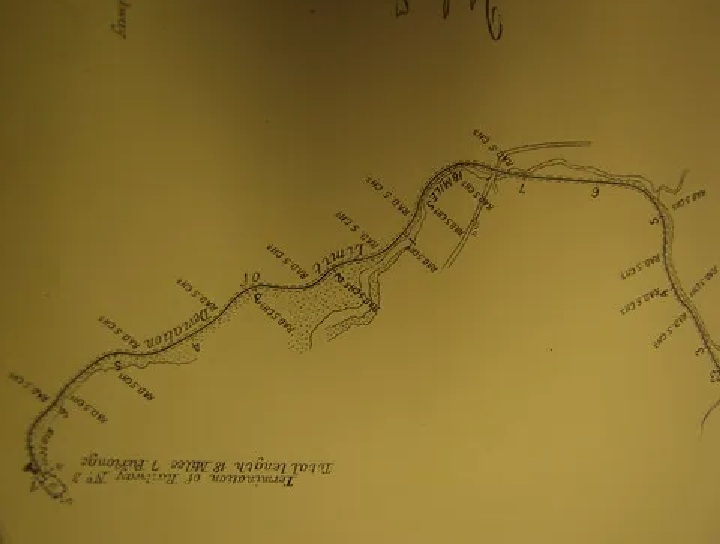
The last length of the Carolway line as recorded in the bundle from the National Archives that ‘Tom’ discovered and wrote about on his blog. [54]
This extract from the 6″ Ordnance Survey of the turn of the 20th century covers a similar area as the 1″ map extract above. The pier can be seen bottom-left. The line of the planned railway is less clear from the 6″ OS in Carloway but becomes much clearer on Google Streetview images as it follows the North shore of the estuary. [39]
The 21st century satellite imagery highlights.more clearly the route of the planned railway and what became the Pentland Road through to the Dunan Pier near Borraston. Of particular interest is the arrangement of structures close to Carloway Bridge. A bridge over the Heidagul River and a bridge which now carries road over road will both have been built as part of the aborted railway works. [Google Maps, July 2025]
This view shows the two structures noted above. The masonry arch structure is Carloway Bridge which carries the modern A858. The bridge over the river in the foreground was built for the railway as was the bridge which carries the A858 over Pentland Road. [Google Streetview, September 2024]
The bridge over the Heidagul River built for the planned railway, seen from Carloway Bridge. [Google Streetview, September 2024]
A closer view from the East of the bridge built to carry the road over the railway that never was! [Google Streetview, September 2024]
Looking back East towards the two bridges carrying the A858 in Carloway. [Google Streetview, September 2024]

The next seven images form a sequence showing the last length of the route to the pier at Borraston. Note the causeway in the third image which will have been built for the railway. …
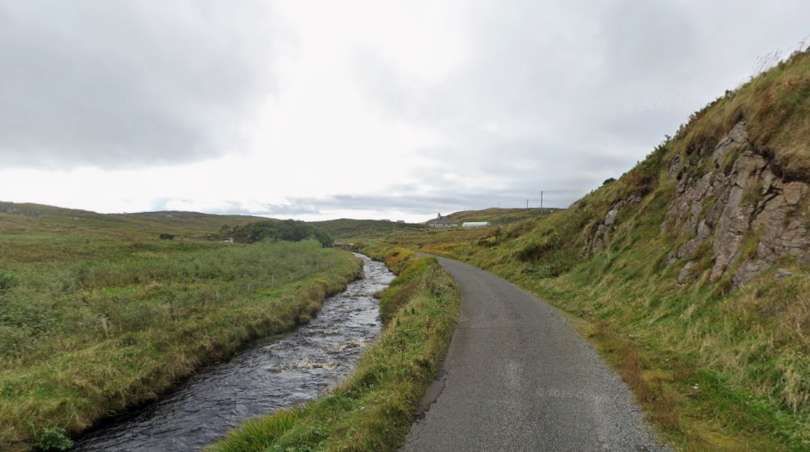
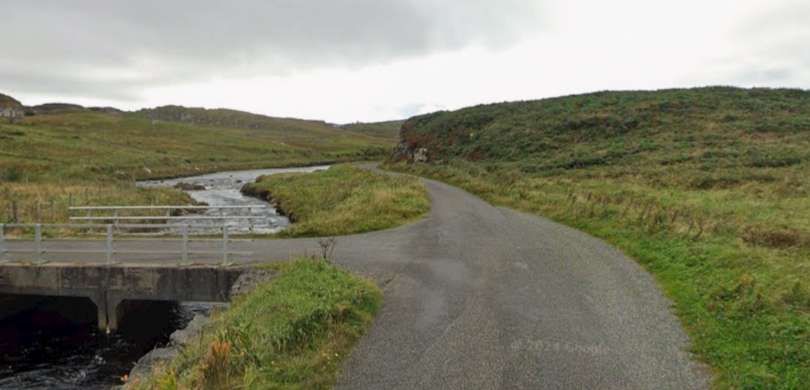
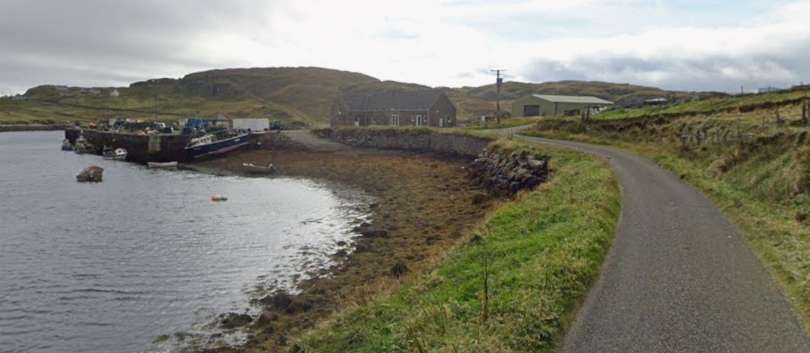
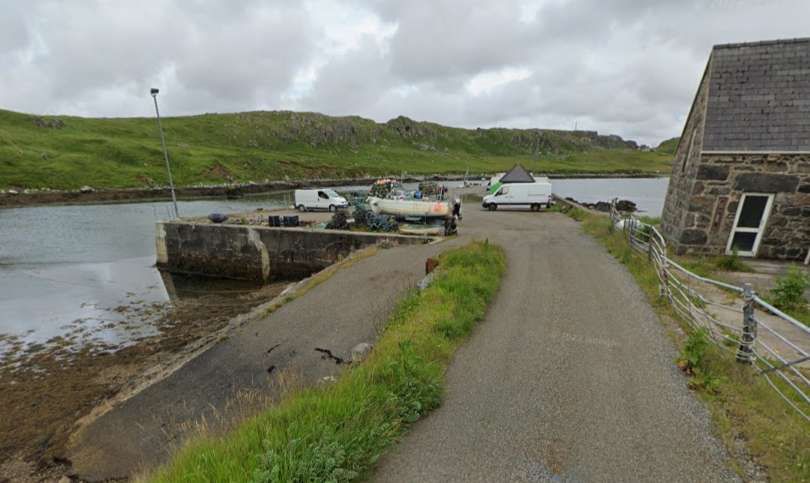
The pier at Dunan near Borraston. [All seven images: Google Streetview, September 2024]
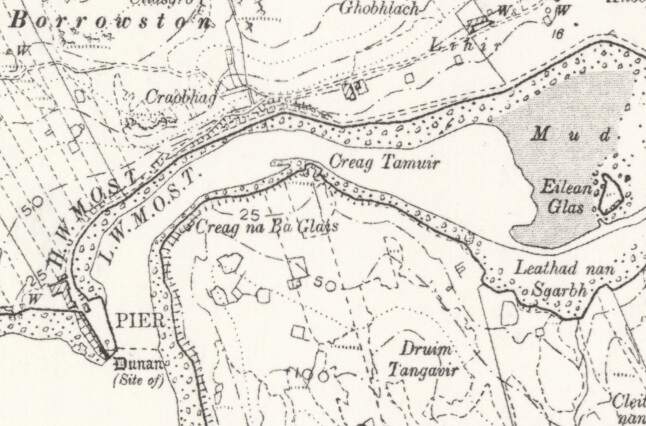
Dunan Pier was the end of the line: shown here in an extract from the 6″ Ordnance Survey 2nd Edition from the end of the 19th century. [49]

The Junction to Breasclete
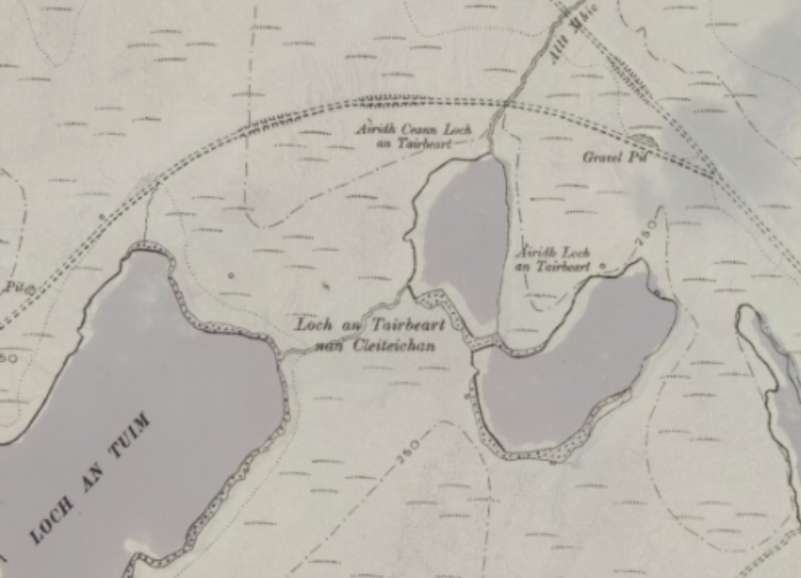
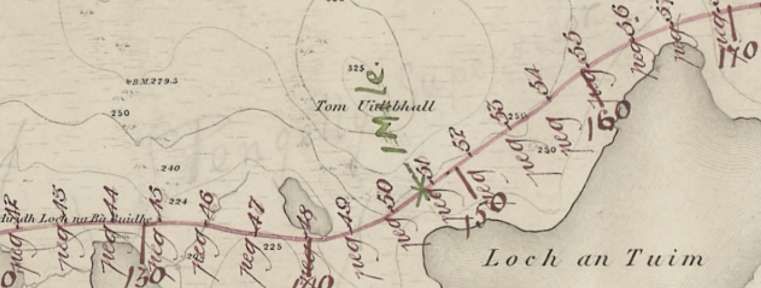
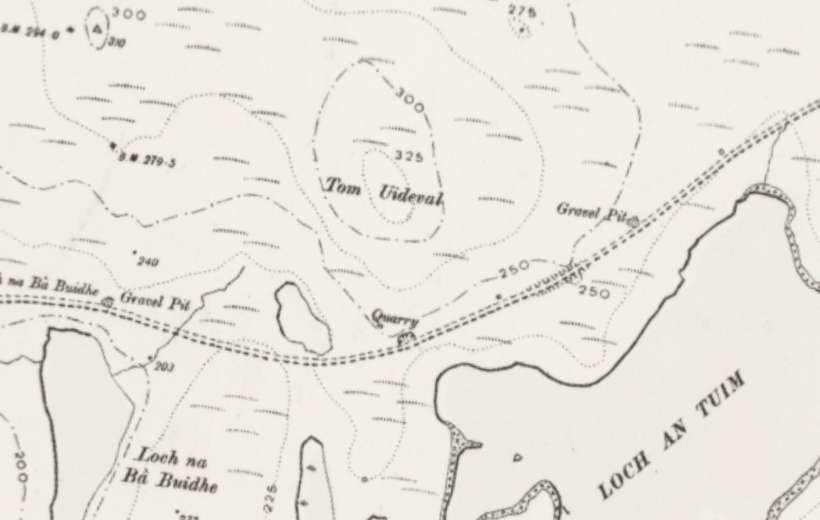
The surveyed route of the branch line to Breasclete curved round the North side of Loch an Tairbeart nan Cleiteichan and Loch an Tuim. [18]
The track which appears on the 6″ OS mapping from the turn of the 20th century takes a single radius curve a little to the North of the surveyed alignment. [30]
The single track road built on the earthworks of the abortive railway project curves round the North side of Loch an Tairbeart nan Cleiteichan and Loch an Tuim. It is a smooth curve as shown on the 6″ Ordnance Survey from the turn of the 20th century. [Google Maps, July 2025]
The road to Breasclete is also called Pentland Road. It heads away to the left of th. [Google Streetview, September 2024]
The surveyed route then turns to a Westerly alignment South of an unnamed lochan and across the North end of Loch na Ba Buidhe. [18]
Another small quarry sits on the North side of the track. Presumably the small quarries at intervals along each of the planned railway routes were used to supply stone for embankments along the formation. [40]
The same length of the road. [Google Maps, July 2025]
The view West from the centre of the satellite image above. [Google Streetview, September 2024]
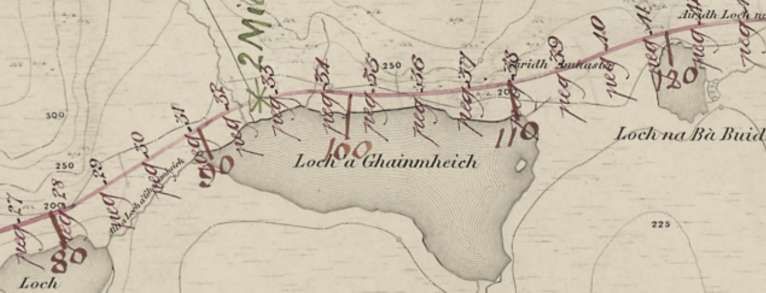
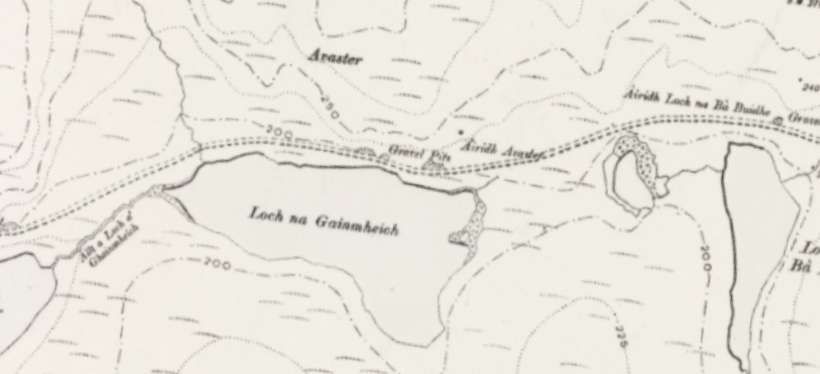
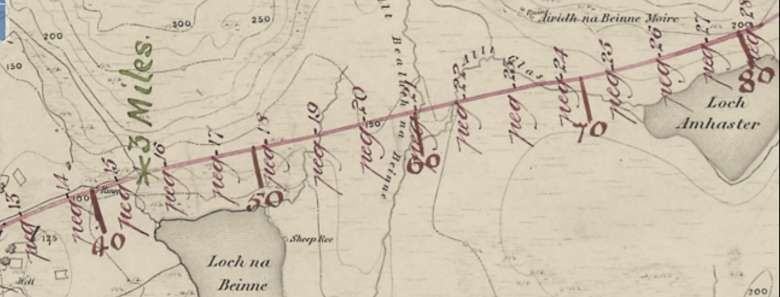
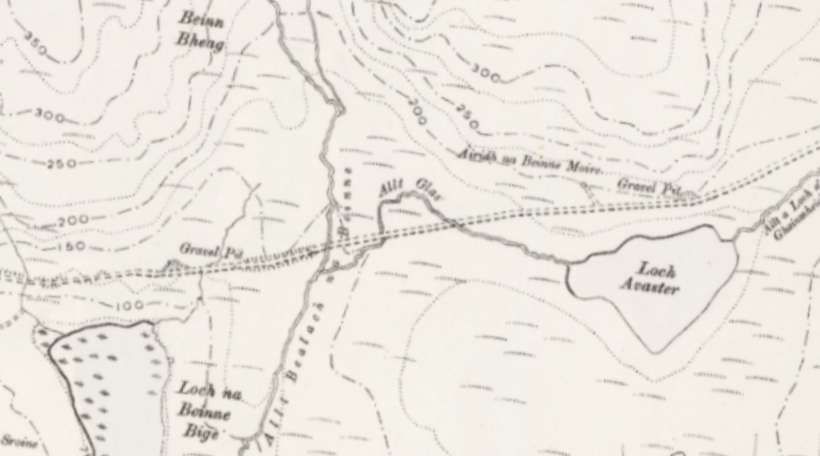
The surveyed route ran across the North side of Loch na Ba Buidhe, Loch a Ghainmheich and Loch Avaster (Amhaster), turning to head West-southwest. [18]
The same area as it appears on the 6″ Ordnance Survey from the turn of the 20th century. [41]
The same area in the 21st century. [Google Maps, July 2025]
Looking West from the centre of the satellite image above. Loch a Ghainmheich is on the left . [Google Streetview, September 2024]
Continuing in a Southwesterly direction, the surveyed route ran on the North side of Loch na Beinne Bige. [18]
A similar area as it appeared at the end of the 19th century. The track following the built formation for the railway follows the surveyed alignment closely but turns away from it to the left of this map extract. [42]
The same area as shown on the 6″ Ordnance Survey extract above. [Google Maps, July 2025]
Allt Glas flows under the road, presumably in a drainage pipe, twice the first of these locations is shown here. [Google Streetview, September 2024]
Allt Glas flows under the road again although it appears to both pass under the road and to have found a path on the North side of the road. [Google Streetview, September 2024]
Allt Bealach na Beinne also passes under the road, Allt Glas joins it on the left of this photograph. [Google Streetview, September 2024]
Looking West-southwest along Pentland Road, Loch Na Beinne Bige is on the left. [Google Streetview, September 2024]
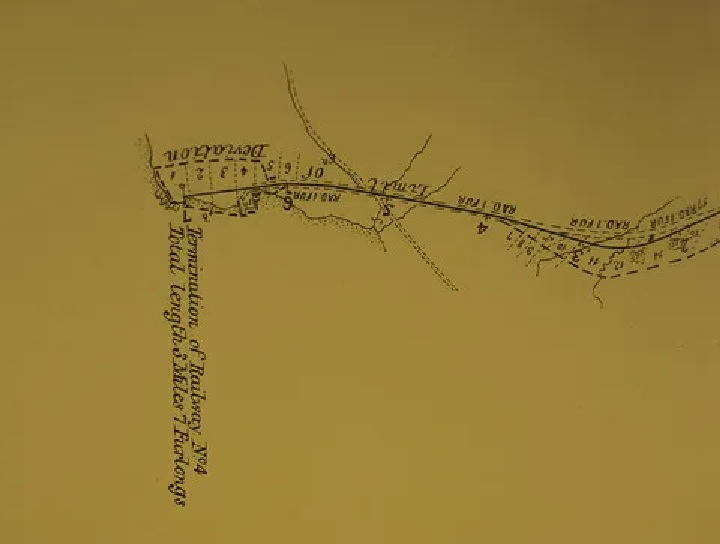
The final length of the surveyed route for the planned railway. Two alignments are shown, the original (in blue), the revised (in red). [18]
This extract comes form the documents held by the National Archives and photographed by ‘Tom’ for his blog as noted below. [54]
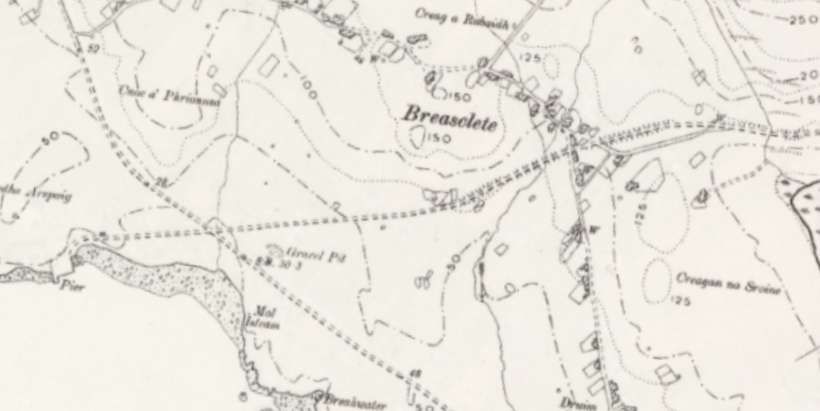
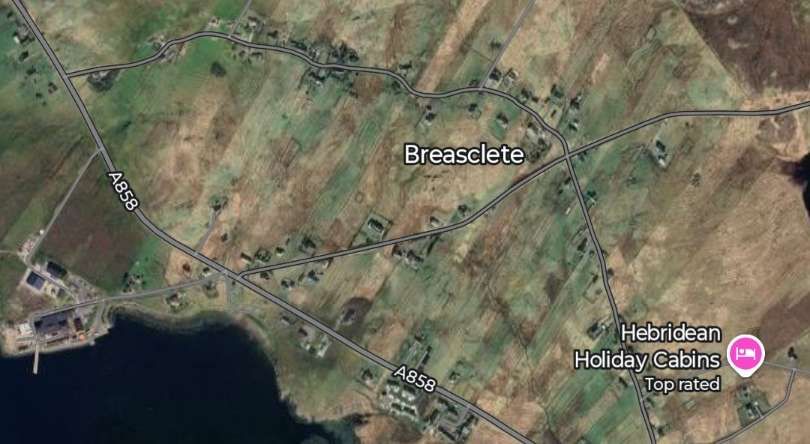
The track which follows the prepared formation for the planned railway passes to the North of both of the surveyed routes as it runs through the village of Breasclete, regaining the red surveyed alignment to the West of the village and running through to the pier. [43]
A very similar area to that shown on the 6″ OS map extract above. [Google Maps, July 2025]
Facing West-southwest approaching the crossroads in Breasclete. [Google Streetview, September 2024]
Continuing West-southwest along Pentland Road towards the pier at Breasclete. #[Google Streetview, September 2024]
The second crossroads in Breasclete. [Google Streetview, September 2024]
Approaching the pier at Breasclete. [Google Streetview, September 2024]

We have followed the two lines that almost got built on Lewis. sadly, lack of funding resulted in a project that was quite well advanced, being abandoned. As noted, the earthworks were later (1912) used to create the single track Pentland Road which appears in many of the modern images above. There remains some uncertainty over whether the early construction works were designed first for a railway or were just designed as an easily graded public road. [50] It is possible that some construction work for a road was undertaken but the National Archives hold plans for a railway dated to the same period, predating the construction of the Pentland Road which was not completed until 1912. [53]
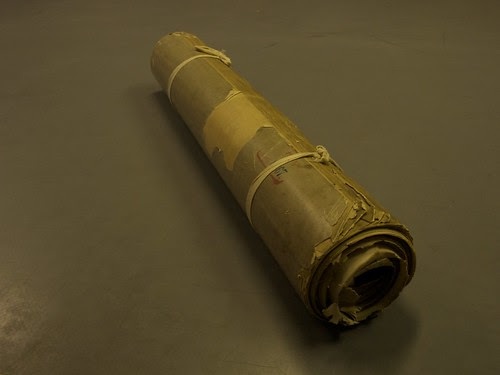
The plans, which include proposals for railways on Skye and on Lewis were accessed by ‘Tom’ in preparing for a modelling project centred on these intended railways. This image comes from an early blog. [53] The images relating to Lewis come from a later blog. [54]

Lord Leverhulme’s Planned Railway Station, Stornoway

Lord Leverhulme was very interested in town planning, The National Library of Scotland has on its website, a town plan of Stornoway drafted by James Lomax-Simpson, Leverhulme’s godson and also his chief architect at Port Sunlight. The plan is entitled, ‘Port Sunlight plan of Stornoway, showing proposed lay-out’ and is dated 16th July 1919. It is 710 mm x 710 mm in size. The plan is included on the website, courtesy of The Stornoway Trust. [44]

Simpson took charge of the Architectural Department of Lever Brothers from 1910 and he was made a director in 1917. In his role as Company Architect, he worked in over twenty-five different countries around the World, but he also carried out much work for Lever himself, including alterations and additions to Lews Castle. The plan also illustrates part of Leverhulme’s ambitious ideas for redeveloping Stornoway along garden city lines, with new suburbs, broad avenues, circuses, and open spaces. The new planned railways, that were part of the wider plans for the economic transformation of Lewis, curve in and down to the Harbour on the eastern side of the town. Existing roads are shown with dashed lines. In places, ‘Parlour Cottages’ were planned, which had been constructed at Port Sunlight, as larger ‘Arts and Crafts’ residences for working families with a parlour at ground-floor level. Although visionary and ambitious, some of the new planned streets would have demolished much of the original old town. Over time, the plans were subsequently altered, shown as annotations on top of the original plan. Some construction began along these lines in the 1920s, but economic difficulties and considerable opposition to Leverhulme’s plans by the islanders curtailed developments, and the schemes were largely abandoned by 1923.” [44]

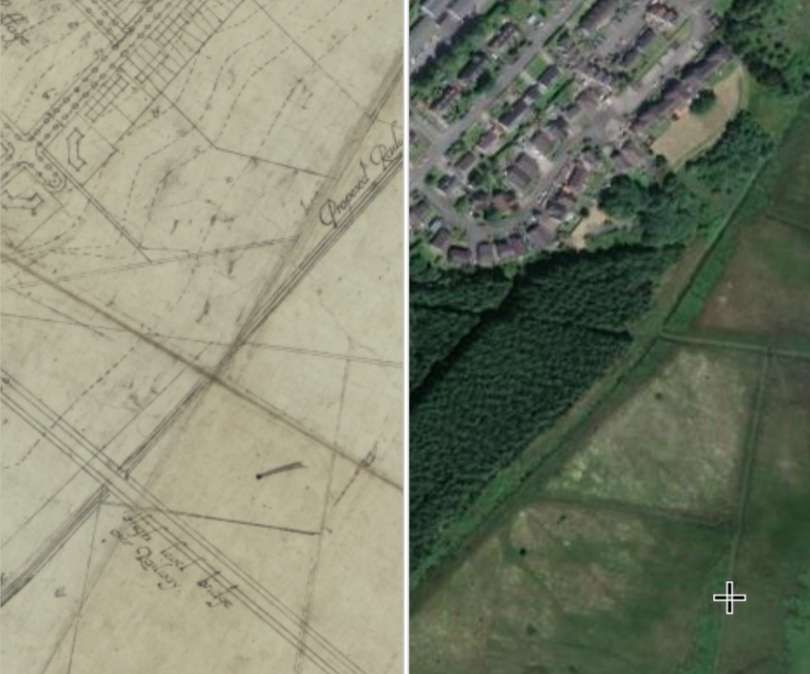
Small extracts from the plan are included here. They show a proposed railway station close to the Harbour on the East side of the town. Each of the three extracts is paired with the ESRI satellite imagery provided by the NLS. …
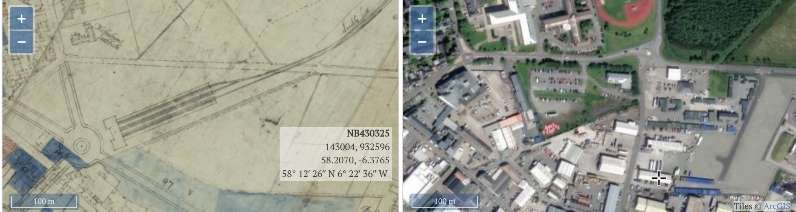
The proposed station location with the main station building facing out onto a circus/roundabout close to the harbour. [44]
A double track line was planned Northeast from the station. [44]
The detail becomes more sparse further Northeast. [44]

These plans did not see the light of day!

Goat Island

Lord Leverhulme’s plans included the construction of a causeway to link Goat Island to the mainland and the provision of additional quays on the West side of the island. He expected to provide a light railway along the causeway to link his Cannery and associated industries to the quays. John & Margaret Gold provide a plan showing Leverhulme’s intentions for Stornoway and Goat Island. [45: p200]

John & Margaret Gold comment that in Leverhulme’s Plan: “An industrial area was located in the east of the town. Goat Island would act as home base for the MacLine Drifters and Trawler fleet and was joined to the mainland by a causeway. The ice plant and cannery were situated inland near the site of the existing fish-oil and guano works. A light railway would connect them with the quays. There were tweed mills, electricity generating plant, a laundry and a dairy to take the increased output from the east coast farms. Between the industrial area and the residential districts was the railway station serving both freight and passenger purposes.” [45: p200]
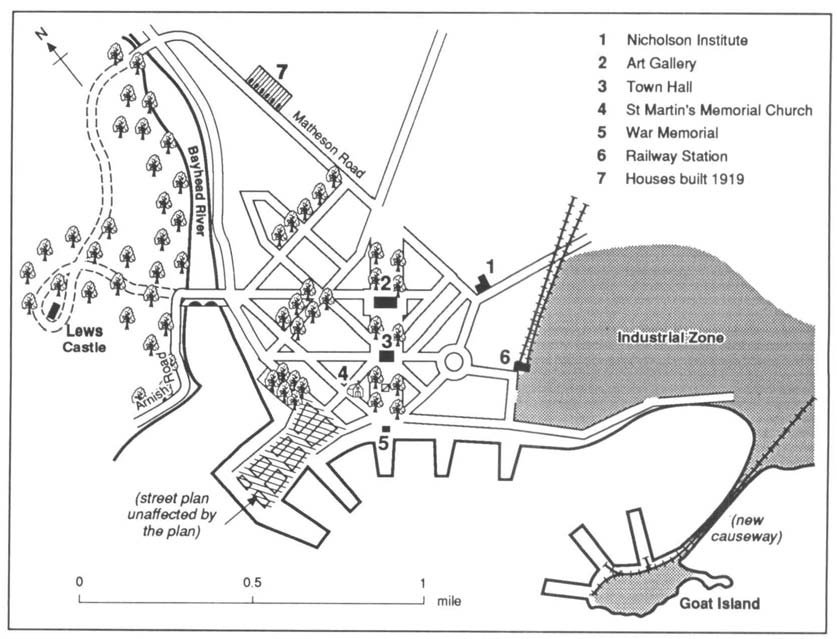
Lord Leverhulme’s Development Plan for Stornoway: the railway line noted in the paragraphs about Stornoway’s railway station can be seen to the right of centre. The light railway planned to serve Goat Island is shown in the bottom-right of this map. [45: p200]
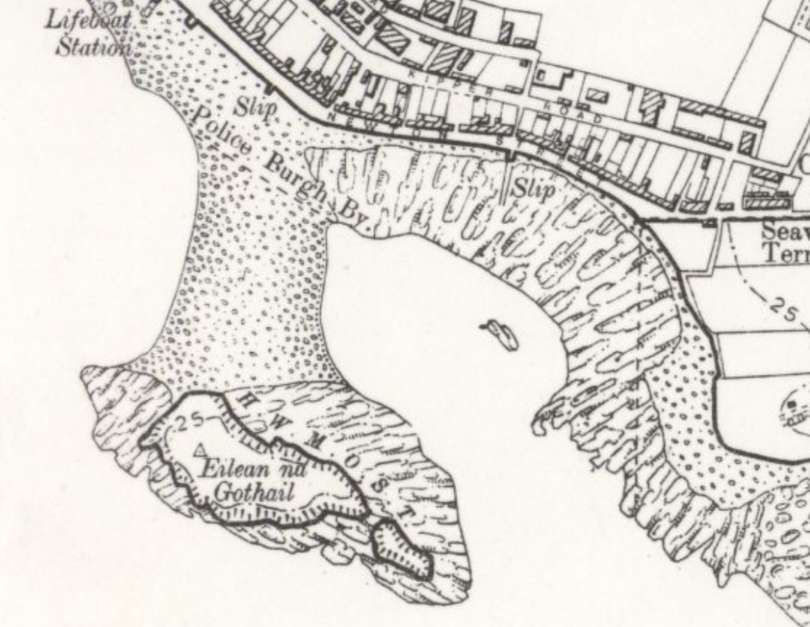
Goat Island in 1895 as it appeared on the 6″ Ordnance Survey of 1895, published in 1899. [46]

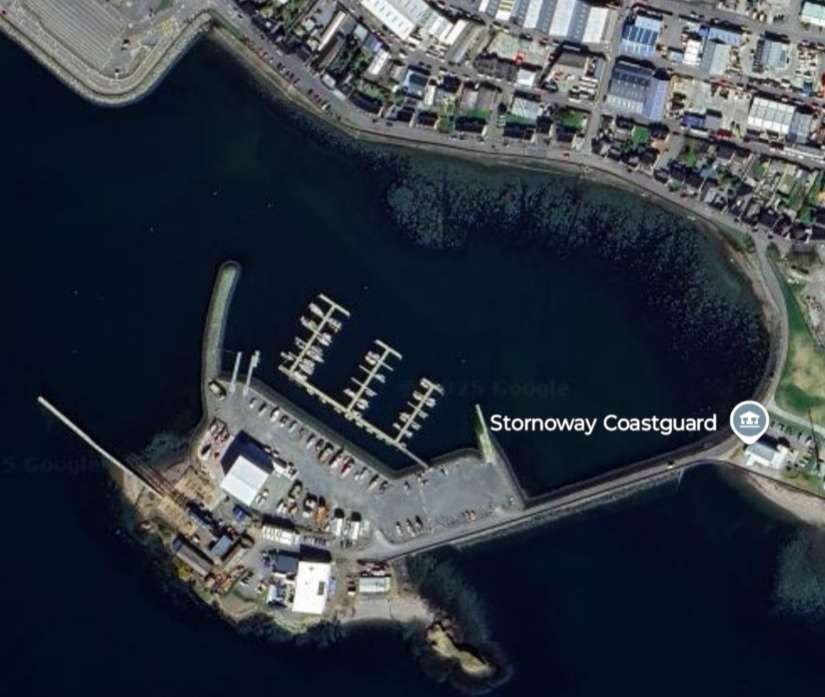
It would not be until after the Second World War, in 1947, that the causeway was built. It was 2,030 feet in length. Work undertaken that year also included the construction of an embankment to the south of the causeway; the construction of the Slipway and a jetty at Goat Island; the demolition of No. 3 Pier. The work was authorised by The Stornoway Harbour Order Confirmation Act, 1947. [48]
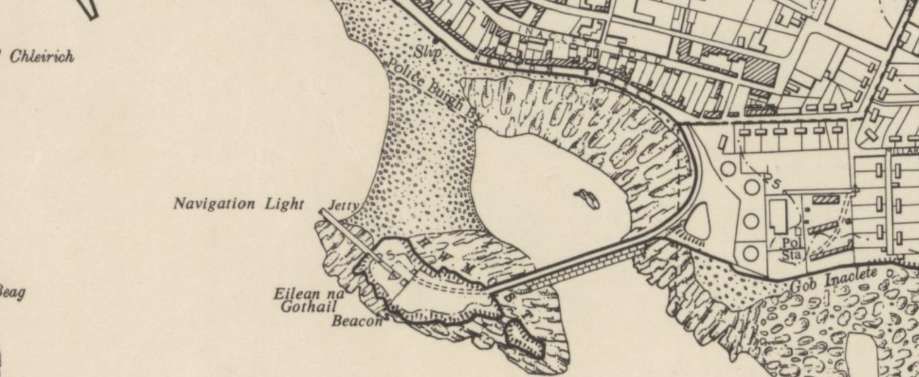
Goat Island and causeway  as they appeared on the 6″ Ordnance Survey of 1958. [47]
Goat Island and Causeway in the 21st century. [Google Earth, July 2025]
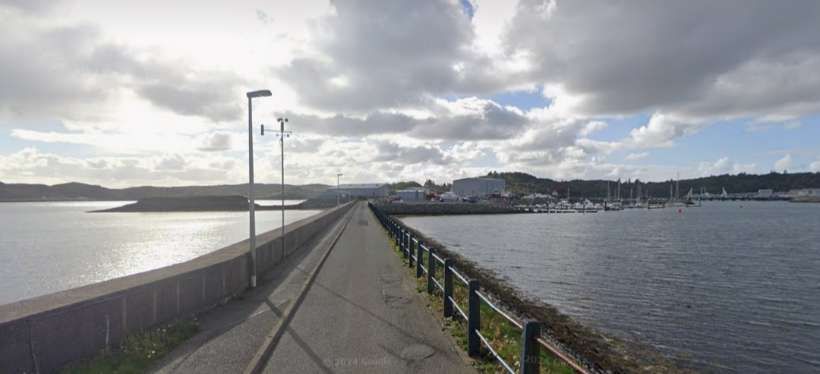
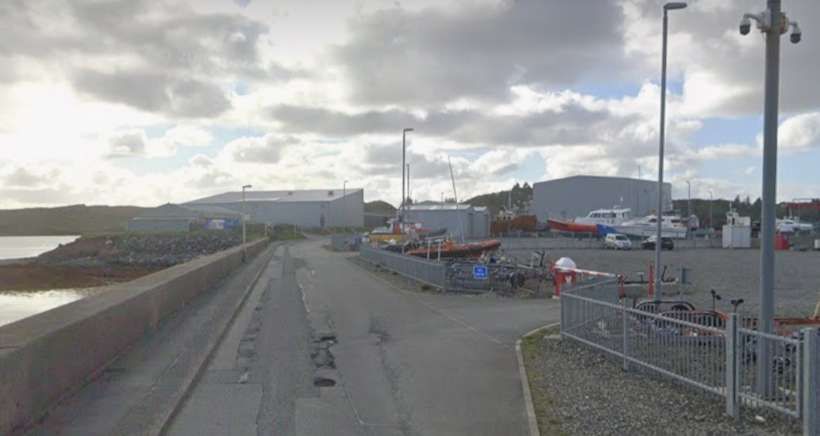
The causeway to Goat Island. [Google Streetview, September 2024]
Goat Island seen from the causeway. [Google Streetview, September 2024]

While the causeway was built, the railways were not!

The Branahuie Railway (3ft-gauge)

One line that did get built on Lewis in Lord Leverhulme’s time was a 3ft-gauge line built by “Sir Robert McAlpine and Co. for the Harris & Lewis Welfare Development Co. Ltd. (a company owned by Lord Leverhulme) – part of a £345,000 contract to build the canning factory, roads and houses. … [It] was in operation by 1920 when the first loco arrived – [that] was McAlpine’s Loco No 34, an 0-4-0ST built by Hudswell Clarke (Works No 1037) in 1913 and delivered to McAlpine’s Pontstycill Reservoir contract near Merthyr Tydfil in South Wales. It carried the plant number 778 when it arrived but that had changed to 606 by the time it left in 1923 moving to the Maentwrog reservoir contract in North Wales. It then worked on other contracts until it was sold for scrap to George Brothers in 1956. The second loco to work on the line was another 0-4-0ST built by Hudswell Clarke in 1901 (Works No 597). It was new to Newcastle & Gateshead Water Co Ltd at Whittledean reservoir carrying the name ‘PONT’. It was sold back to Hudswell Clarke who resold it to McAlpines in 1906 on their Culter reservoir contract. It arrived at Stornoway as Plant No 1780 in 1920 leaving on 25th May 1923 as Plant No 813. Last recorded as being for sale at McAlpine’s Ellesmere Port depot in 1929.” [8]

A first reference was made to the Branahuie line in the Highland News on 15th May 1919 when Sir Robert MacAlpine & Son wrote to the Council seeking permission to lay a light railway from Manor Farm to Goathill Road crossing public roads at three different places. Gates and fences were included in the scheme which received Council permission. In June 1919, MacAlpine applied for permission to lay a water main at Manor Farm to supply water to engines. This was agreed at charge of £5 per annum. [15: p12]
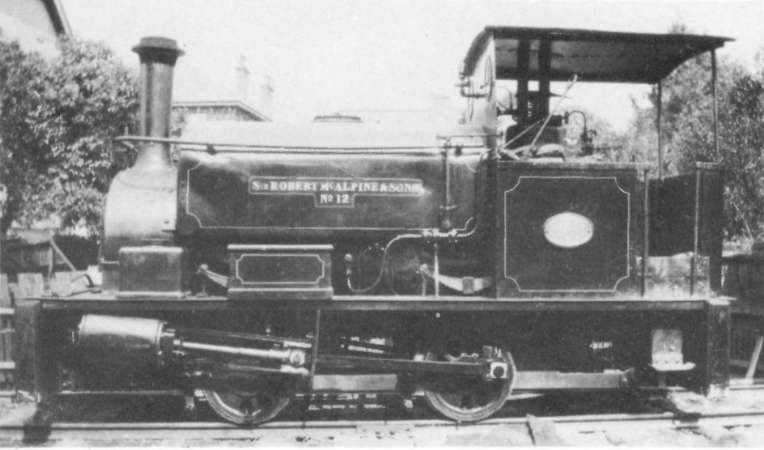
One of two steam locomotives that was gainfully employed on the Branahuie Railway. Sir Robert McAlpine & Sons No. 12, © Public Domain courtesy of the collection of J. A. Peden. [15: p13]

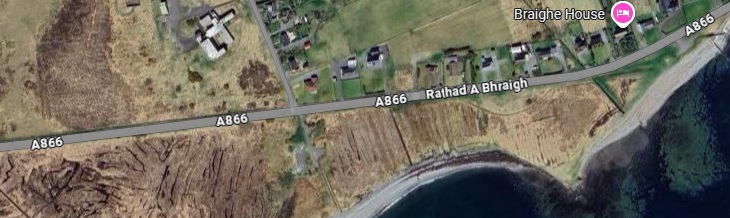
Jolly records these details: “The line was some five miles long and was used for the construction of Leverhulme’s Cannery, from where it ran northwards past Goathill and Manor Farm (Coulregrein), where there was a watering point, to the Town Council’s Dormitory Quarry beneath the War Memorial. This line ran around the then outskirts of the town and much has been built over. Another line ran south from the cannery to the locomotive shed (also now built over). From here another line ran eastwards across the fields to Sandwick, then for 2.5/3 miles beside the A866 to the beach at Branahuie. The evenly graded trackbed is very distinct alongside the undulating road on this section. A shallow cutting can also be seen on the northern line. … At least two steam locos were used on the contract by MacAlpines.” (15: p12]
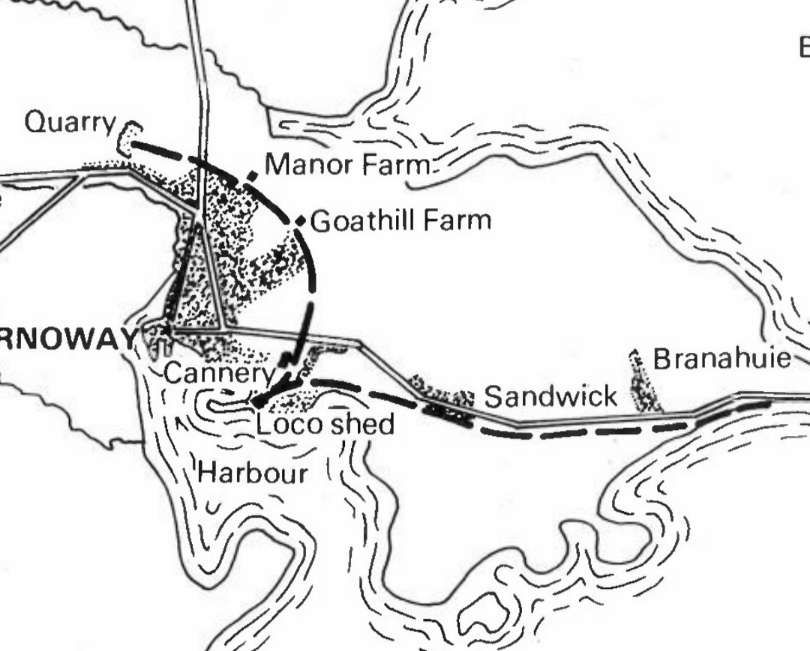
Jolly provides this drawing of the route of the 3ft-gauge contractor’s railway. It is schematic in nature and not to scale. Manor Farm and Goat Hill Farm appear to the Northeast of Stornoway and of the line. The Cannery is marked, as is the Loco Shed. The line to Branahuie is also shown. I have not been able to find any greater detail as to the route of the line than the text description of the route above. [15: p9]

Jolly continues: “The cannery was completed in late 1921 or early 1922, and at the end of May 1922, the “Contract Journal carried an advertisement: ‘For sale-railway track and plant inc. two 3ft gauge locos Hudswell Clarke, … built 1901 and 1913, and 59 wagons 3ft gauge, 34 wagons 2ft gauge. Plant will be handed over to purchasers FAS (free aboard ship) Glasgow-Lewis & Harris Welfare & Development Co., Bebington, Nr. Birkenhead’. Only two locomotives fit this description: Hudswell Clarke 597/1901 was delivered new to the Newcastle & Gateshead Water Co, and was later used by McAlpine on the Motherwell Corporation Culter Waterworks contract between 1903 and 1906. Its later history is not known for certain. The later machine, Hudswell Clarke 1037/1913, was supplied to McAlpine for work on the Pontstycil reservoir between 1913 and 1917. It was subsequently used on the Maentwrog Hydro-Electric reservoir contract, near Ffestiniog, from 1924-28, and must therefore have been retained by McAlpine.” [15: p12-13]

The Route

Lord Leverhulme’s Cannery sat to the East of Stornoway town centre. Appropriately, its address was Cannery Road. The building was never used as a cannery and later became a Harris Tweed Factory.

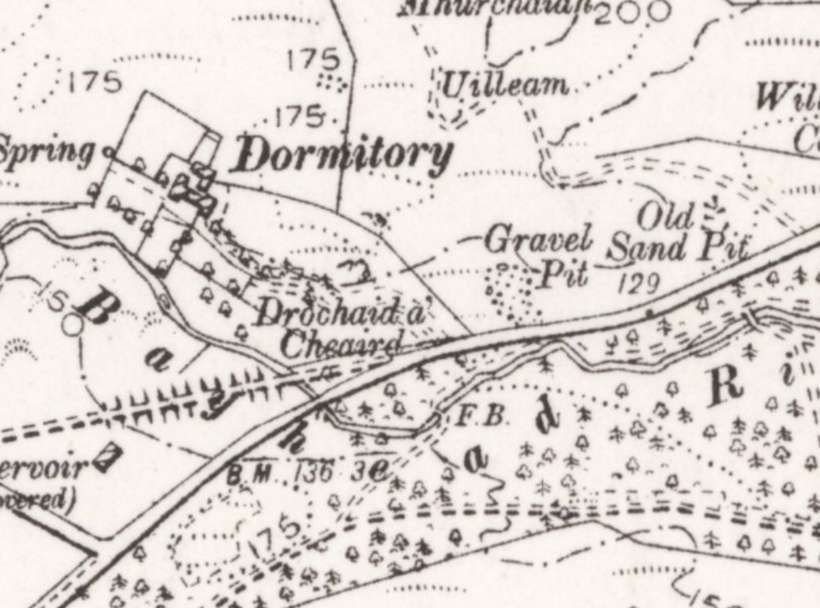
As Jolly mentions, material for the construction contract was excavated at a quarry at Dormitory which was to the West of the War Memorial (itself to the North of the town). Jolly also mentions that the temporary railway line ran close to Manor Farm (in the 21st century the Caber feidh Hotel occupies this site). His sketch map above shows the line running to the South of Manor Farm. This suggests that the line ran close to Willowglen Road, on its North side. Assuming that this is the case then the Contractor’s railway would have crossed Percival Road South close to its junction with Willowglen Road.

There has been mention of an incline leading from a point close to the War Memorial into Stornoway which may be a remnant of the line. [8]
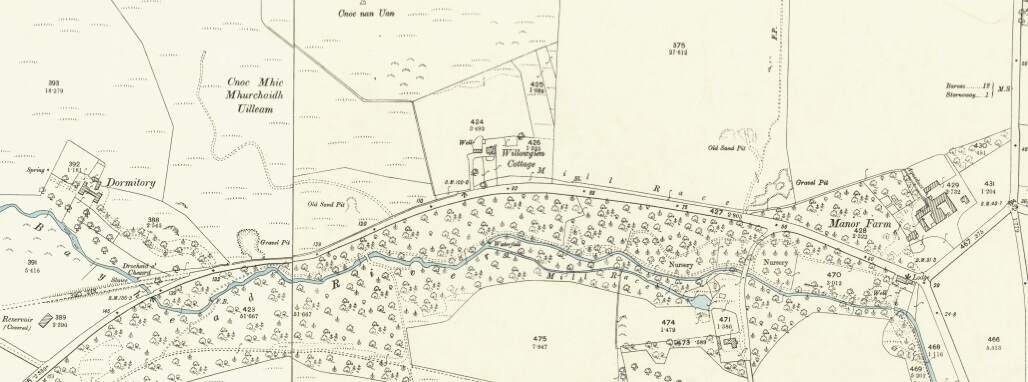
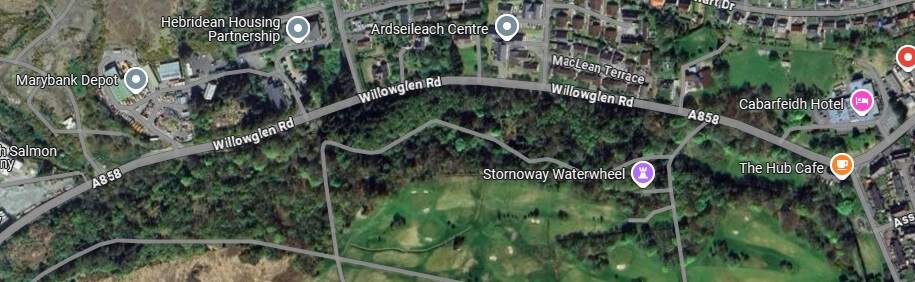
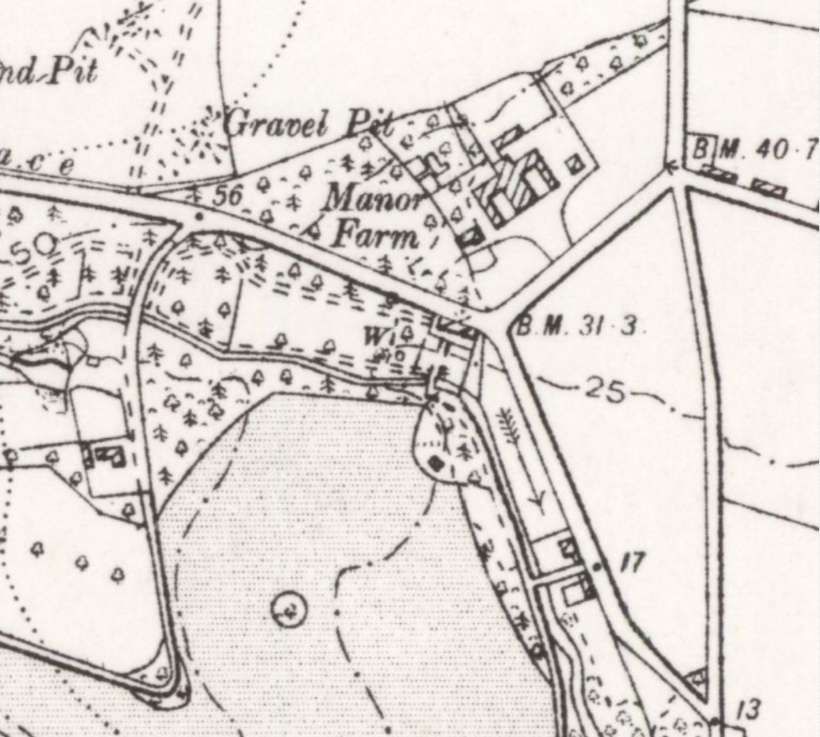
The area from Dormitory to Manor Farm as shown on the 6″ Ordnance Survey Second Edition. [51]
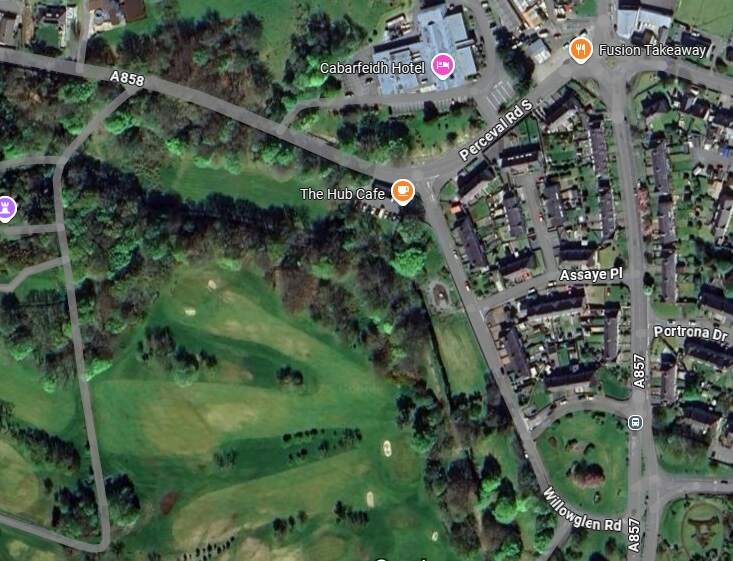
Pretty much the same area as it appears on Google Maps. [Google Maps, July 2025]
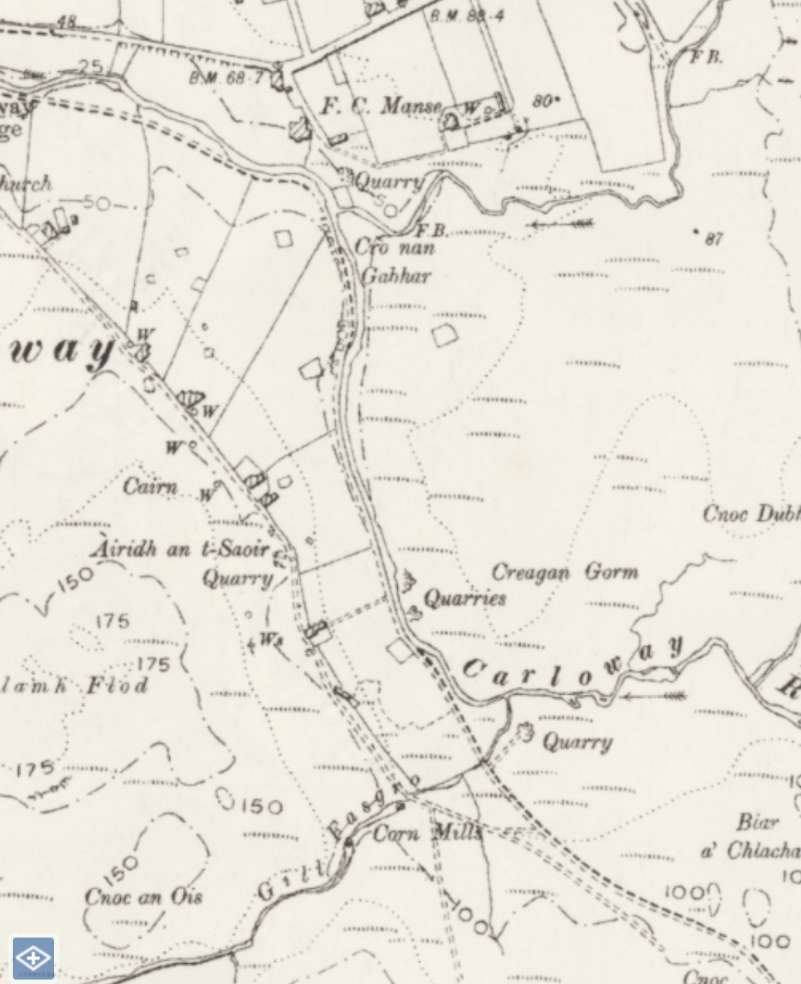
A closer view of the area around Dormitory as it appears on the 6″ Ordnance Survey from the end of the 19th century. The contractor’s railway would have run East from the quarries close to Dormitory, probably parallel to and on the North side of what would eventually become the A858 (Willowglen Road). [52]
A similar area in the 21st century. [Google Maps, July 2025]
A closer view of the area around Manor Farm as it appears on the 6″ Ordnance Survey from the end of the 19th century. The contractor’s railway would have run West-East, probably parallel to and on the North side of what would eventually become the A858 (Willowglen Road). [52]
Much the same area in the 21st century. [Google Maps, July 2025]

After crossing what is now called Percival Road South, the line crossed Macaulay Road and curved round through Goat Hill, passing the Poor House and the Hospital, running close to the pre-existing Fish Oil Works (adjacent to which Leverhulme’s Cannery was to be built). The Locomotive Shed was South and West of that location, as was a junction between the line from the quarry and the line East to Branahuie.
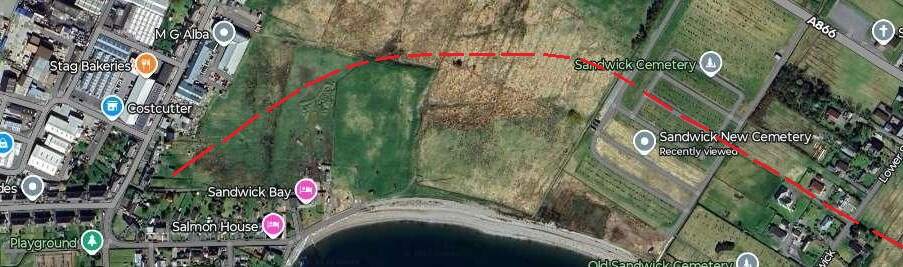
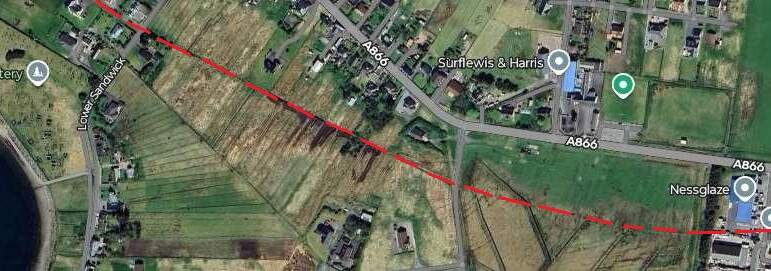
The line of the contractor’s railway heading East is not clear. The red-dotted line gives an idea of the possible alignment. Initially over open fields it has then been covered, by the extended cemetery at Sandwick and by housing developments. [Google Maps, July 2025]
Some field boundaries support the assumed route but there is no guarantee that this is the actual line of the contractor’s railway. At the right side of this image the line has once agin been built over. [Google Maps, July 2025]
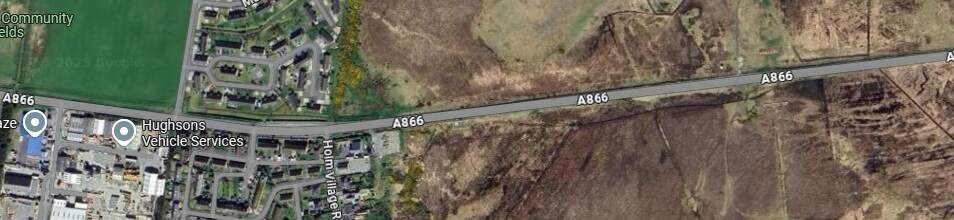
The only indication as to the route of the line to the East of the built up area that I have been able to find is Jolly’s comment that the line ran alongside the A866. He says (above) that the line of the old railway is level while that of the road undulates. [Google Maps, July 2025]
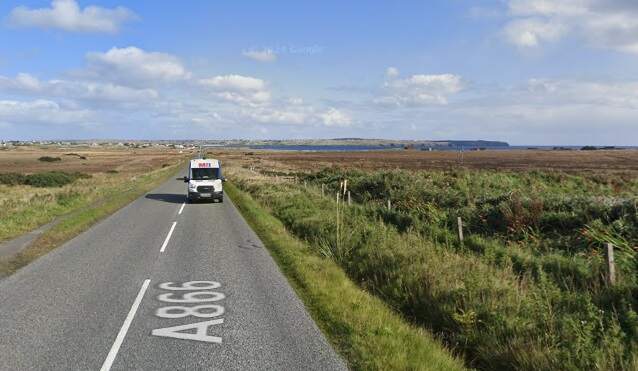
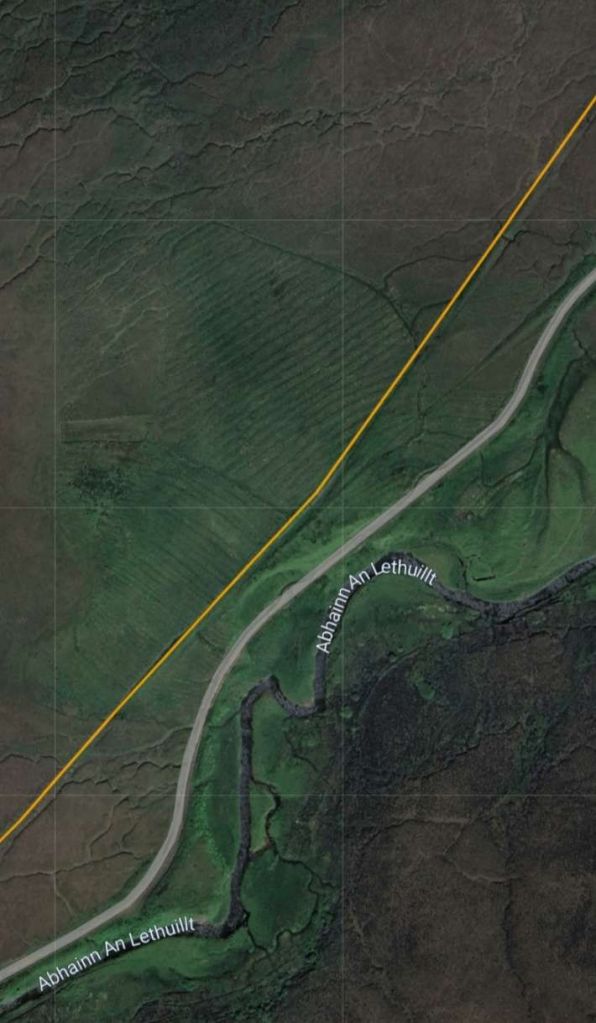
This view East along the A866 is taken from a point a little to the East of the end of the development visible at the left of the satellite image immediately above. It is not beyond the bounds of possibility that the land immediately to the right of the road was the route of the contractor’s railway, but it does not appear as though the highway undulates as much as Jolly suggests. [Google Streetview, September 2024]
Further to the East, a relatively slight gradient is evident in the road but there is little evidence of an old railway formation alongside the road. [Google Streetview, September 2024]
Jolly has the remaining length of the contractor’s railway to Branahuie continuing along the South side of the A866. [Google Maps, July 2025]

It is entirely possible that the road now evident in the 21st century is not that which was present in the 1920s. It is very likely that the road to Branahuie was a single track road in the 1920s and that the widening of the road has covered the formation from the contractor’s railway line.

Stornoway Waterworks Railway (2ft-gauge)

Since the 1870s Stornoway’s water supply had come from Loch Airigh na Lic, about two miles west of the town, but by the mid-1930s this was proving insufficient for the population of around 5000 which was swelled by four or five hundred herring drifters operating out of the port during the season. Loch Mor an Stairr, five miles north-west of the town, was chosen to augment the supply as it was free from pollution and some distance from public roads. The exit from the Loch was between peat banks some 65ft apart, and it was across this that a concrete dam, 92ft long, was constructed. Pipes led at different levels to a small valve house on the north bank of the outlet stream, and a 9inch main then connect[ed] to the filter houses beside the main road.” [15: p8]
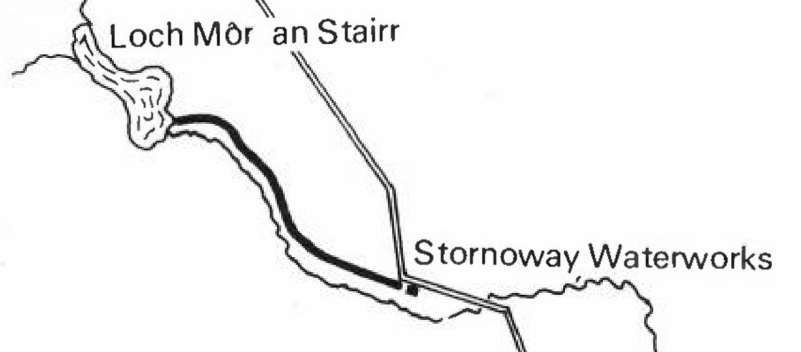
The Waterworks Railway. Another small extract  [15: p9]

The work was facilitated by the construction of a 2ft-gauge railway line.

A Simplex locomotive was used on the Stornoway Waterworks Railway. This locomotive was a 20hp model built by Motor Rail Ltd. It operated on the 2-foot gauge line that served the Stornoway Waterworks. Its Works No. is not known. One source suggests No. 110U082 but the records at the Apedale Valley Light Railway have that works number attributed to a 3ft-gauge locomotive at the Bo’ness & Kinneil Rly. [10] It is worth noting that the Almond Valley Light Railway has a 2ft 6in-gauge example. [11]

The Stornoway Waterworks Railway was built in the 1930s and ran for approximately 1.5 miles between Stornoway Waterworks and Loch Mòr an Stàirr. It was used to transport materials during the conversion of the loch into a reservoir for the waterworks and for subsequent maintenance works. It was closed by the 1960s. [12][13]

Writing about the locomotive and the construction work in 1982, Ian B. Jolly states: “The Contractor for the dam and pipeline was G. Mackay & Son. of Edinburgh, who started work on the dam in 1935. Their work was completed mid-1936 when the pipeline was connected direct to the town’s mains – the filter house and covered reservoirs were completed within the next few years. … A locomotive-worked narrow gauge tramway was used by MacKay & Son to construct the dam. Rock was excavated and crushed in a small quarry east of the main road. across which it was transferred by lorry to the tramway terminus. Stone and other materials were then carried by rail to the site of the dam. The railway was left in-situ and used by Stornoway Town Council for maintenance of the dam for many years. The loco, a 20 h.p. bow-framed model built by the Motor Rail & Tramcar Company of Bedford, was in use until at least 1940 when Mr Alex Macleod, the fitter who maintained it. was called up for military service. By 1943 the engine had been removed and it had been reduced to a frame and wheels. in which form it is believed to have been in use, pushed by hand, until the early 1960’s as the line’s only item of rolling stock. The loco frame is now [1982] very delapidated and derailed about half a mile from the filter house. It was originally fitted with a Dorman 2JO two-cylinder petrol engine; not the later, but similar 2JOR engine. The axleboxes have ‘W D 1918’ cast on them. whilst the loco had been fitted with the narrow pattern of brake column. This suggests that it was built during late 1918 for the War Department Light Railways, but sold directly as Government Surplus. Motor Rail’s records throw no light on its identity – the only locomotives credited to G. Mackay & Son of Edinburgh are two 40 h.p. ‘protected’ machines: LR3057 4wPM MR 1336/1918 and LR3088 4wPM MR 1367/1918. Both were in the service of MacKay by 21st June 1924. MR 1336 was later with Inns & Co Ltd, Moor Mill Pits. Colney St, Herts. and MR 1367 was with Thomson & Brown Bros Ltd, of Edinburgh by 16th February 1933. There is no mention of a 20 h.p. loco but MacKay was obviously no stranger to Motor Rail & Tramcar Company products.” [15: p9]

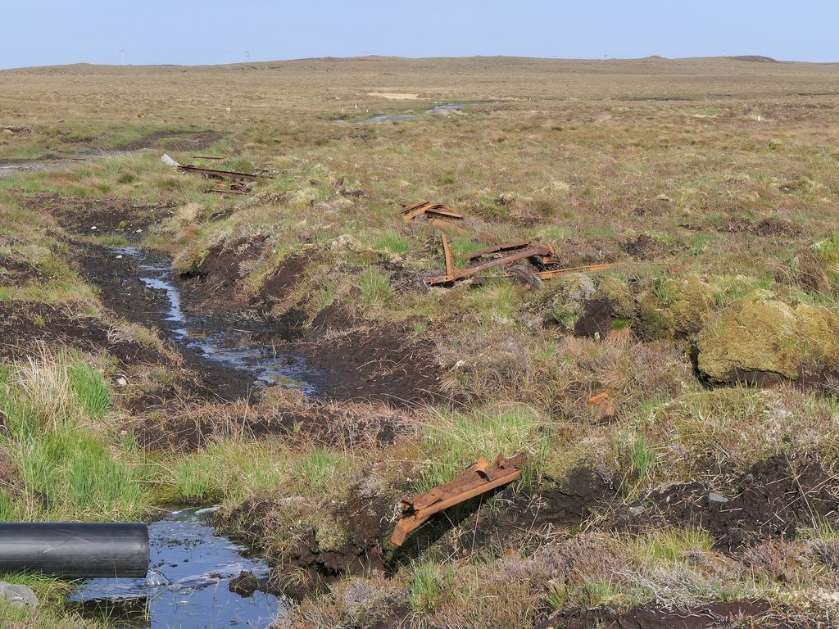
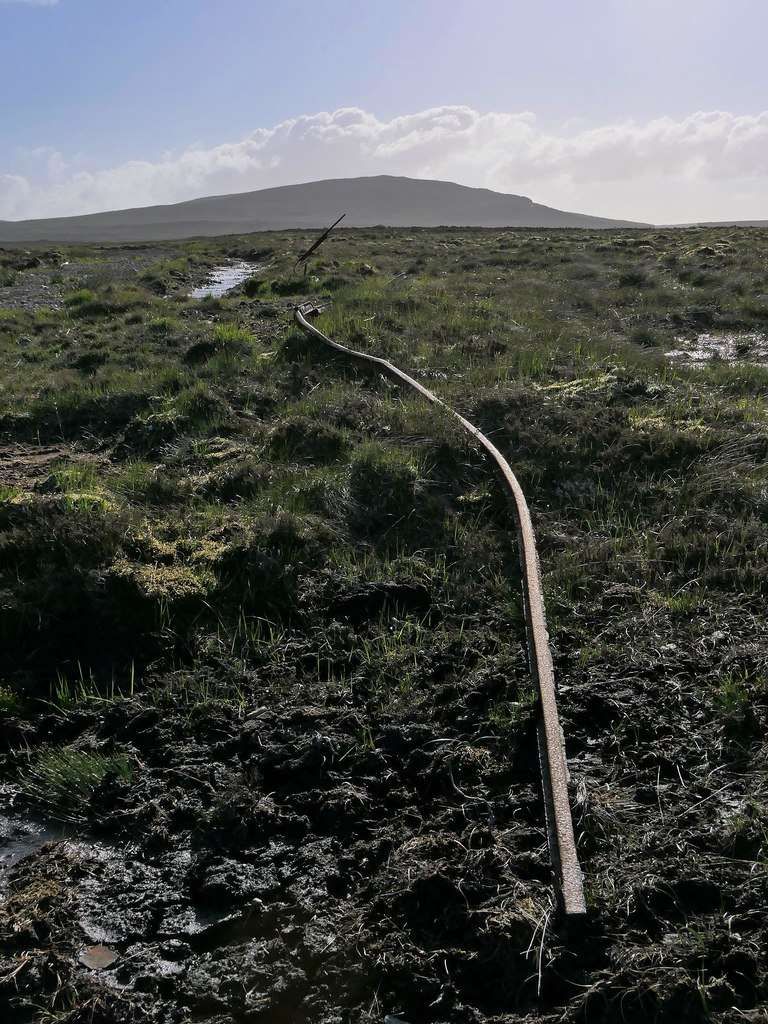
Jolly further notes that “Rolling stock on the line at the time of the dam construction consisted of nine one-cubic-yard skips, a mixture of side and end tippers. The derelict remains of several [could in 1982] be seen at the foot of the bank beneath the filter house, one being a single end tipper. The axle boxes [were] marked ‘Du Croo & Brauns’ – the Dutch firm of railway equipment suppliers. … Most of the track from the roadside terminus to just beyond the loco [had by 1982] been removed without authority – probably for fencing posts! However, the track layout [could] be traced because the turnouts [had in 1982] been left in place. These [were] rivetted to corrugated steel sleepers, whilst the remaining track [was] spiked to wooden sleepers or clipped to corrugated steel sleepers.” [15: p11]

Of further interest, is the significant variation in rail cross-section and weight (between 14lb and 20lb per yard).  Jolly also notes that, “On the lengths of prefabricated track where the rails [were tied accurately to gauge, three distinct gauges [could] be measured – 2ft, 60cm (1ft 11.5/8in) and 1ft 11½ in! The loco wheels [were] set to 60cm gauge.” [15: p11]

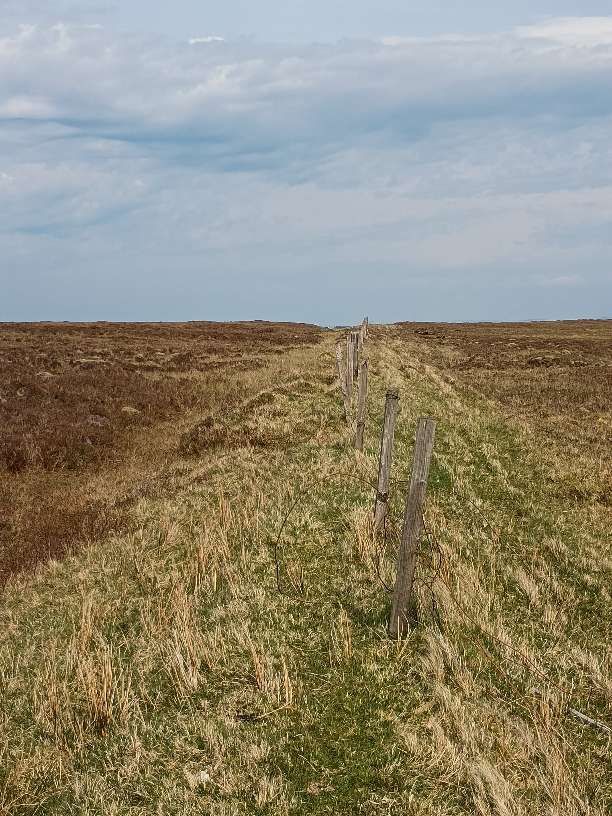
In 1982, only minimal earthworks were evident, with track following the undulation of the land but, says Jolly, “there is a rise of just over 25 feet from one end of the line to the other. The track terminates near the dam without so much as a buffer stop or siding. The remains of the loco and line will probably survive for many years to come, as scrapmen are unknown in the Outer Hebrides.” [15: p11]
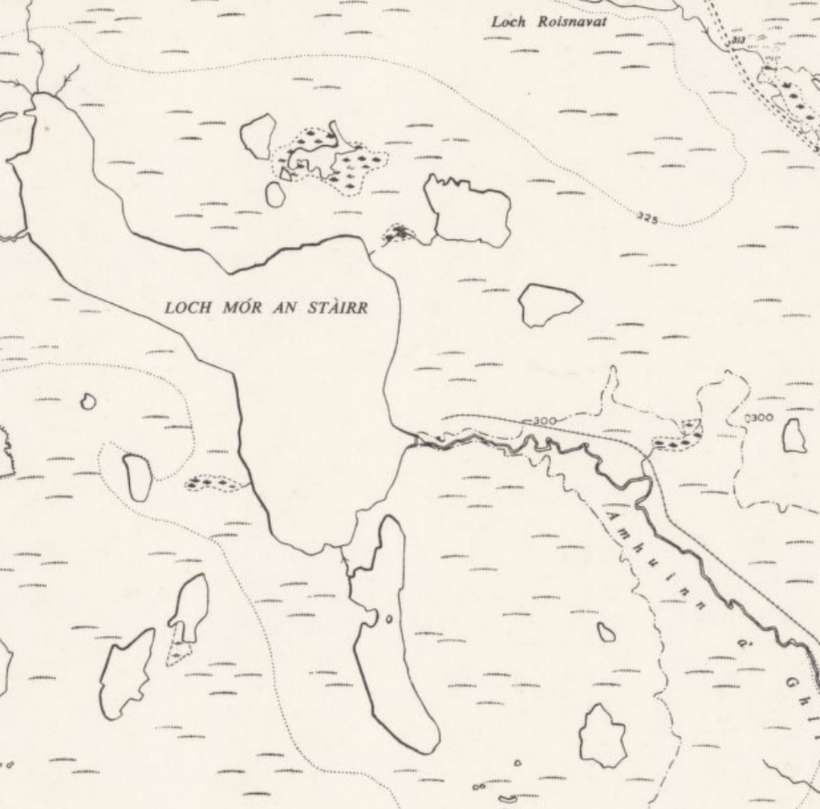
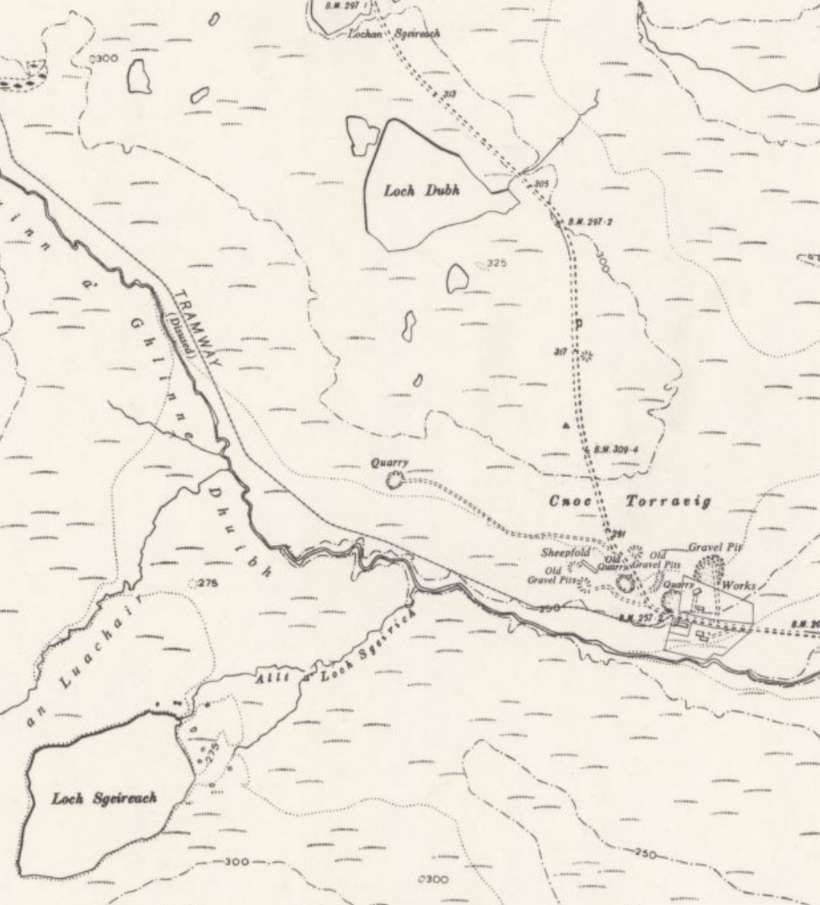
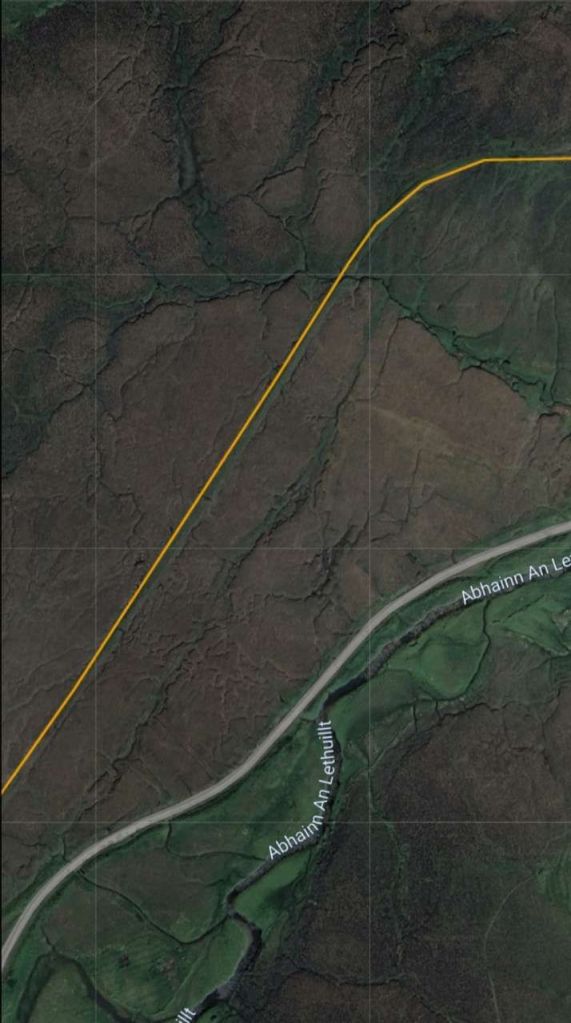
Loch Mòr an Stàirr as shown on the 6″ Ordnance Survey of 1960. The railway/tramway is shown on the North side of the Amhuinn a’ Ghlinne watercourse, approaching the loch from the Southeast. [9]
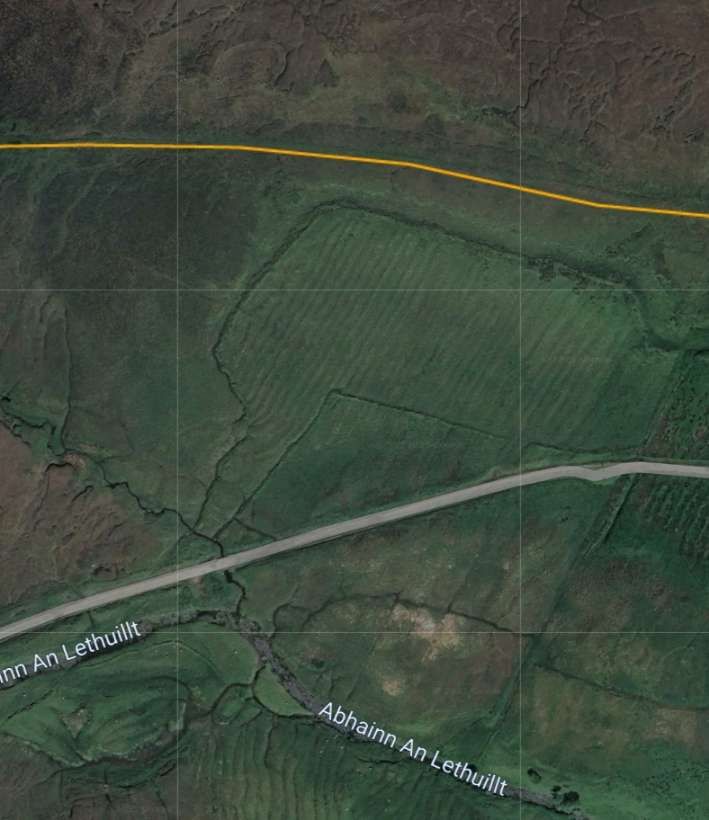
This next extract from the Ordnance Survey of 1960 shows the tramway/railway approaching the Waterworks. [9]
This photograph was taken on the line of the Waterworks Railway, © Claire Pegrum and licenced for reuse under a Creative Commons Licence (CC BY-SA 2.0). [12]
This photograph was also taken on the line of the Waterworks Railway, © Claire Pegrum and licenced for reuse under a Creative Commons Licence (CC BY-SA 2.0). [13]

Another photograph which shows remains of point work close to the Waterworks can be seen on the Railscot.co.uk website. [14]

Other Railways?

Jolly comments: “There appear to have been three other industrial railways in Lewis, lain D.A. Frew referred to the horse-worked system on the outskirts of Stornoway. This served the factory of the Lewis Chemical Co, promoted in the late nineteenth century to extract paraffin-oil from peat by a patent process. Garrabost Brickworks, about 8 miles east of Stornoway) is reputed to have had a short line. The brickworks is shown on the 1852 6in map but no railway, and the 1897 edition shows the works as ‘disused claypit. We were also told of Marybank Quarry, west of Stornoway, where there was a hand worked line from the rockface about 100 yards to the crusher. The quarry was operated in the few years before the last war by William Tawse of Aberdeen.” [15]

Other lines are referred to in a blog about the island accessed through the BBC website. The blog is entitled ‘Arnish Lighthouse’ and includes these words. … “Lewis did have railways, around the turn of the 19th/20th century. There was a railway from the quarry at Bennadrove to Stornoway. Posts related to this track can still be found in the Castle Grounds, opposite the Caberfeidh Hotel. … A trackbed was laid near Garrabost in Point, but a railway was never built.” [56]

I have not yet been able to find anything further about any of these short lines. There is an active quarry at Bennadrove. This is not far from Marybank

This final satellite image shows the relative locations of Marybank and Bennadrove to the West of Stornoway. It also encompasses most of the different line referred to in the immediate vicinity of Stornoway. [Google Maps, July 2025]

Records

Plans illustrating the surveyed railway routes proposed by Lord Leverhulme can be accessed at Tasglann nan Eilean Siar, the Hebridean Archives. [6]

References

  1. Roger Hutchinson; The Soap Man: Lewis, Harris and Lord Leverhulme; Birlinn, Edinburgh, 2003 (latest reprint 2017).
  2. https://stornowayfacilities.weebly.com/lord-leverhulmes-tenure-and-legacy-1918-1923.html, accessed on 19th June 2025.
  3. https://www.designingbuildings.co.uk/wiki/Lord_Leverhulme_on_Lewis_and_Harris, accessed on 19th June 2025.
  4. Halliday Sutherland; Arches of the Years; Geoffrey Bles, London, 1933.
  5. https://www.bbc.co.uk/scotland/islandblogging/blogs/005132/0000008950.shtml, accessed on 19th June 2025.
  6. http://ica-atom.tasglann.org.uk/index.php/map-of-lewis-and-north-harris-with-fishing-estates-around-garynahine-to-carloway-marked-in-colour-and-surveyed-railway-system, accessed on 19th June 2025.
  7. David Spaven & Julian Holland; Mapping the Railways; Times Books, London, 2012.
  8. https://hlrco.wordpress.com/scottish-narrow-gauge/proposed-lines/leverburgh-branahuie-railway, accessed on 20th June 2025. (See the comments made by Ian Jolly on 24th September 2013)
  9. https://maps.nls.uk/view/76344155, accessed on 29th June 2025.
  10. https://www.simplex.avlr.org.uk/existing%20simplexes.htm, accessed on 29th June 2025.
  11. https://en.m.wikipedia.org/wiki/Almond_Valley_Light_Railway, accessed on 29th June 2025.
  12. https://www.geograph.org.uk/photo/6217818, accessed on 29th June 2025.
  13. https://www.geograph.org.uk/photo/6217804, accessed on 29th June 2025.
  14. https://railscot.co.uk/img/35/600, accessed on 29th June 2025.
  15. Ian B. Jolly; Hebridean Adventure; The Narrow Gauge No. 97, Autumn 1982, p8-14; via https://www.ngrs.org/downloads/TNG.1-100/tng97-autumn-1982.pdf, accessed on 29th June 2025.
  16. A. C. O’Dell & Kenneth Walton; Highlands and Islands of Scotland; Thomas Nelson & Sons, London, 1963.
  17. Nigel Nicolson; Lord of the Isles; Weidenfeld and Nicolson, London, 1960, (published in paperback by Acair Ltd., Stornoway, 2005).
  18. https://maps.nls.uk/projects/stornoway/index-en.html#layer=9, accessed on 1st July 2025.
  19. https://maps.nls.uk/geo/explore/#zoom=15.6&lat=58.21875&lon=-6.39236&layers=6&b=ESRIWorld&o=93, accessed on 1st July 2025.
  20. https://maps.nls.uk/geo/explore/#zoom=14.4&lat=58.22270&lon=-6.40823&layers=6&b=ESRIWorld&o=93, accessed on 1st July 2025.
  21. https://maps.nls.uk/geo/explore/#zoom=14.4&lat=58.22136&lon=-6.43868&layers=6&b=ESRIWorld&o=93, accessed on 1st July 2025.
  22. https://maps.nls.uk/geo/explore/#zoom=14.4&lat=58.21899&lon=-6.46359&layers=6&b=ESRIWorld&o=93, accessed on 1st July 2025.
  23. https://maps.nls.uk/geo/explore/#zoom=14.4&lat=58.21559&lon=-6.48359&layers=6&b=ESRIWorld&o=93, accessed on 1st July 2025.
  24. https://maps.nls.uk/geo/explore/#zoom=14.4&lat=58.21435&lon=-6.51529&layers=6&b=ESRIWorld&o=93, accessed on 1st July 2025.
  25. https://maps.nls.uk/geo/explore/#zoom=14.4&lat=58.22152&lon=-6.53815&layers=6&b=ESRIWorld&o=93, accessed on 1st July 2025.
  26. https://maps.nls.uk/geo/explore/#zoom=14.7&lat=58.22122&lon=-6.56470&layers=6&b=ESRIWorld&o=93, accessed on 1st July 2025.
  27. https://maps.nls.uk/geo/explore/#zoom=14.6&lat=58.22118&lon=-6.59031&layers=6&b=ESRIWorld&o=93, accessed on 1st July 2025.
  28. https://maps.nls.uk/geo/explore/#zoom=14.6&lat=58.22295&lon=-6.61322&layers=6&b=ESRIWorld&o=93, accessed on 1st July 2025.
  29. https://maps.nls.uk/geo/explore/#zoom=14.8&lat=58.22739&lon=-6.63937&layers=6&b=ESRIWorld&o=93, accessed on 2nd July 2025.
  30. https://maps.nls.uk/geo/explore/#zoom=15.2&lat=58.23321&lon=-6.66554&layers=6&b=ESRIWorld&o=64, accessed on 2nd July 2025.
  31. https://maps.nls.uk/geo/explore/#zoom=15.2&lat=58.23920&lon=-6.67022&layers=6&b=ESRIWorld&o=64, accessed on 2nd July 2025
  32. https://maps.nls.uk/geo/explore/#zoom=15.0&lat=58.24937&lon=-6.68719&layers=6&b=ESRIWorld&o=95, accessed on 2nd July 2025.
  33. https://maps.nls.uk/geo/explore/#zoom=16.1&lat=58.24991&lon=-6.69284&layers=6&b=ESRIWorld&o=95, accessed on 2nd July 2025.
  34. https://maps.nls.uk/geo/explore/#zoom=15.3&lat=58.25347&lon=-6.70561&layers=6&b=ESRIWorld&o=95, accessed on 2nd July 2025.
  35. https://maps.nls.uk/geo/explore/#zoom=15.6&lat=58.25864&lon=-6.72145&layers=6&b=ESRIWorld&o=95 , accessed on 2nd July 2025.
  36. https://maps.nls.uk/geo/explore/#zoom=15.3&lat=58.26459&lon=-6.73542&layers=6&b=ESRIWorld&o=95, accessed on 2nd July 2025.
  37. https://maps.nls.uk/geo/explore/#zoom=15.6&lat=58.27161&lon=-6.74811&layers=6&b=ESRIWorld&o=95, accessed on 2nd July 2025.
  38. https://maps.nls.uk/geo/explore/#zoom=15.6&lat=58.28025&lon=-6.76040&layers=6&b=ESRIWorld&o=95, accessed on 2nd July 2025.
  39. https://maps.nls.uk/geo/explore/#zoom=14.9&lat=58.28236&lon=-6.77484&layers=6&b=ESRIWorld&o=95, accessed on 2nd July 2025.
  40. https://maps.nls.uk/geo/explore/#zoom=15.0&lat=58.22770&lon=-6.68319&layers=6&b=ESRIWorld&o=95, accessed on 2nd July 2025.
  41. https://maps.nls.uk/geo/explore/#zoom=14.7&lat=58.22450&lon=-6.70241&layers=6&b=ESRIWorld&o=95, accessed on 2nd July 2025.
  42. https://maps.nls.uk/geo/explore/#zoom=14.9&lat=58.22126&lon=-6.72278&layers=6&b=ESRIWorld&o=95, accessed on 2nd July 2025.
  43. https://maps.nls.uk/geo/explore/#zoom=14.8&lat=58.21871&lon=-6.74460&layers=6&b=ESRIWorld&o=95, accessed on 2nd July 2025.
  44. https://maps.nls.uk/projects/stornoway/geo-en.html#zoom=13.0&lat=58.21500&lon=-6.37000&layer=10, accessed on 3rd July 2025. (Once on the correct webpage, please scroll down to the relevant map, dated 1919).
  45. John R. Gold & Margaret M. Gold; To Be Free and Independent: Crofting, Popular Protest and Lord Leverhulme’s Hebridean Development Projects, 1917-25; in Rural History Volume 7 No. 2, 1996, p191-206; via https://acrobat.adobe.com/id/urn:aaid:sc:EU:f5cf9740-225f-4de0-ae7d-cdf4bf13d22f, accessed on 4th July 2025.
  46. https://maps.nls.uk/view/76344950, accessed on 4th July 2025.
  47. https://maps.nls.uk/view/76344944, accessed on 4th July 2025.
  48. https://www.stornowayportauthority.com/about-us/our-history, accessed on 5th July 2025.
  49. https://maps.nls.uk/geo/explore/#zoom=16.0&lat=58.28010&lon=-6.78611&layers=6&b=ESRIWorld&o=100, accessed on 6th July 2025.
  50. https://www.virtualheb.co.uk/phentland-road-isle-of-lewis-western-isles, accessed on 6th July 2025.
  51. https://maps.nls.uk/geo/explore/#zoom=16.0&lat=58.22062&lon=-6.39641&layers=168&b=ESRIWorld&o=100, accessed on 5th July 2025.
  52. https://maps.nls.uk/view/76344158, accessed on 5th July 2025.
  53. https://portnacailliche.blogspot.com/2010/09/post-kew-excitement.html, accessed on 6th July 2025.
  54. https://wp.me/p153uL-81, accessed on 6th July 2025.
  55. https://maps.nls.uk/geo/explore/#zoom=15.0&lat=58.21120&lon=-6.38465&layers=6&b=ESRIWorld&o=100, accessed on 6th July 2025.
  56. https://www.bbc.co.uk/scotland/islandblogging/blogs/005132/0000008950.shtml, accessed on 5th July 2025.
The Railways of Skye and Adjacent Islands – An Overview

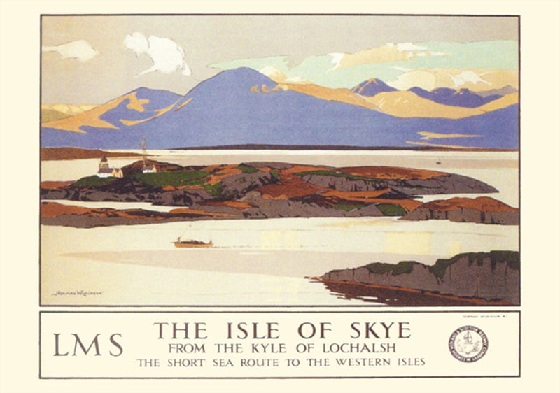
There was a 19th century proposal for a public railway to Dunvegan and Portree which never came to fruition. A later proposal was the Hebridean Light Railway which was promulgated by the Hebridean Light Railway Company. It intended to operate on the Scottish islands of Skye and Lewis. [8] The Skye line was to have connected the port of Isleornsay (for ferries from Mallaig on the Scottish mainland) and the port of Uig on the north-west coast of the island, from where ferries would have sailed to Stornoway on Lewis. Another line was then proposed to link Stornoway to Carloway, the second settlement of Lewis. Branch lines were also proposed to Breasclete [9] and Dunvegan. [10]

The line was proposed in 1898, but was never completed. Records of the proposals are held in the National Archives at Kew. [11]

Although these schemes never came to fruition, at least six industrial railways have existed on Skye and adjacent islands at one time or another. These include:

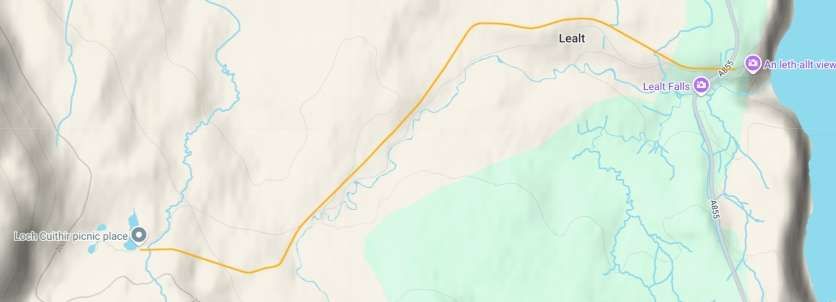
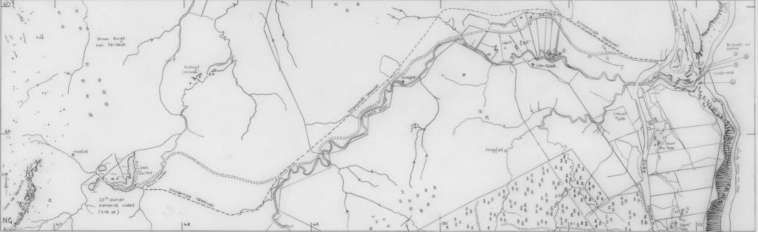
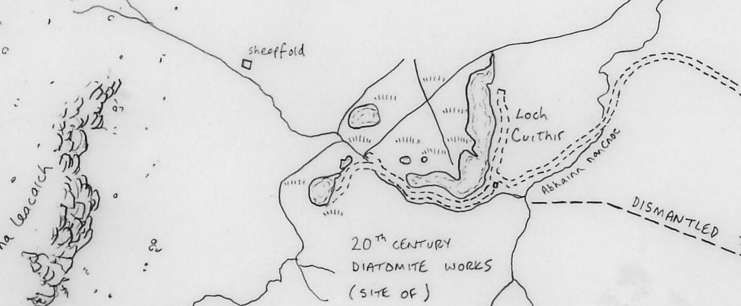
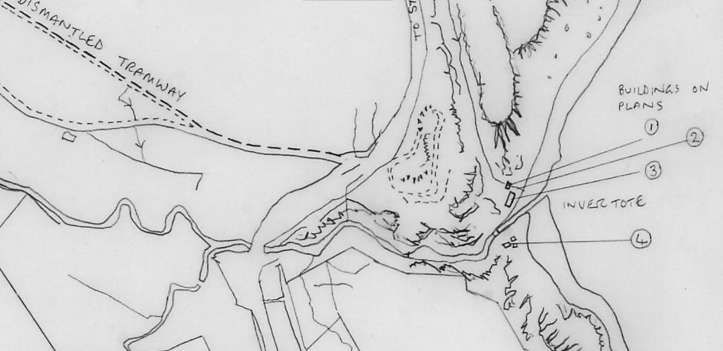
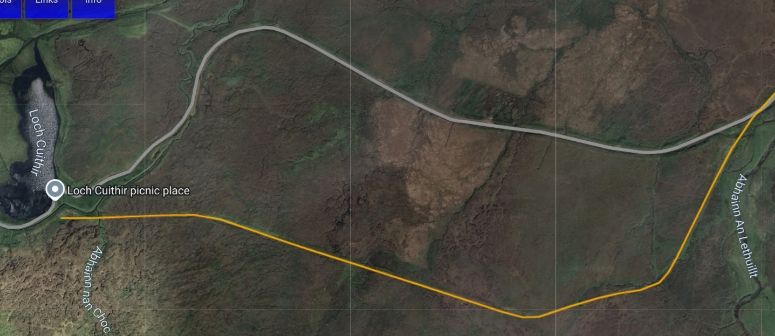
The Loch Cuithir to Lealt Diatomite Railway – Details of this line can be found here. [5]

The Talisker Distillery Tramway – This short 23″-gauge tramway opened in 1900 and closed in 1948. Details can be found here. [6]

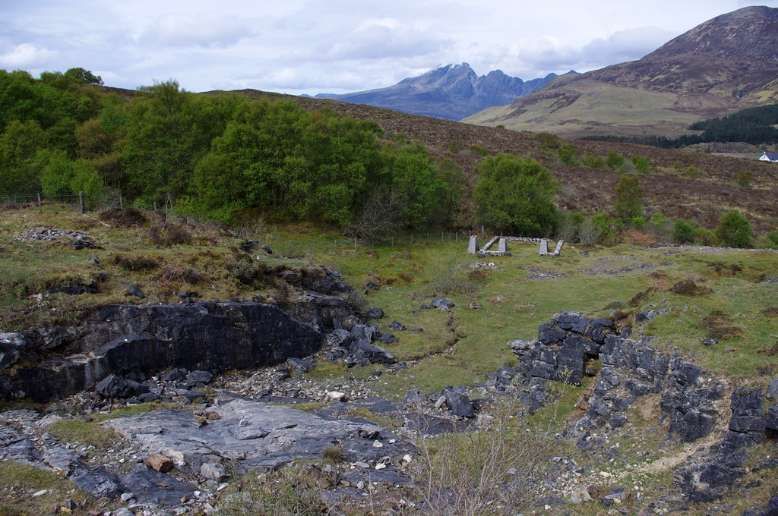
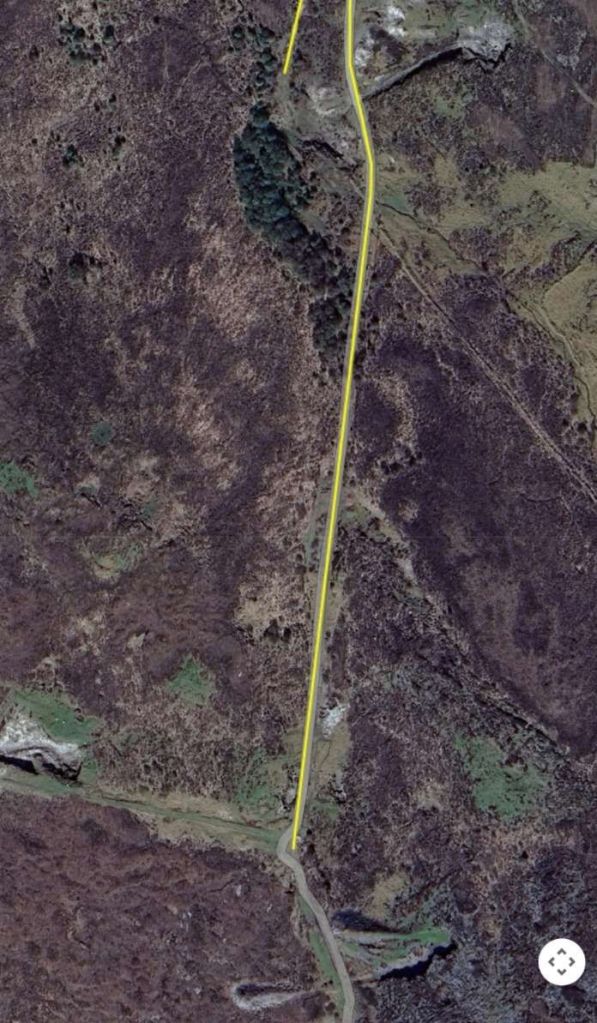
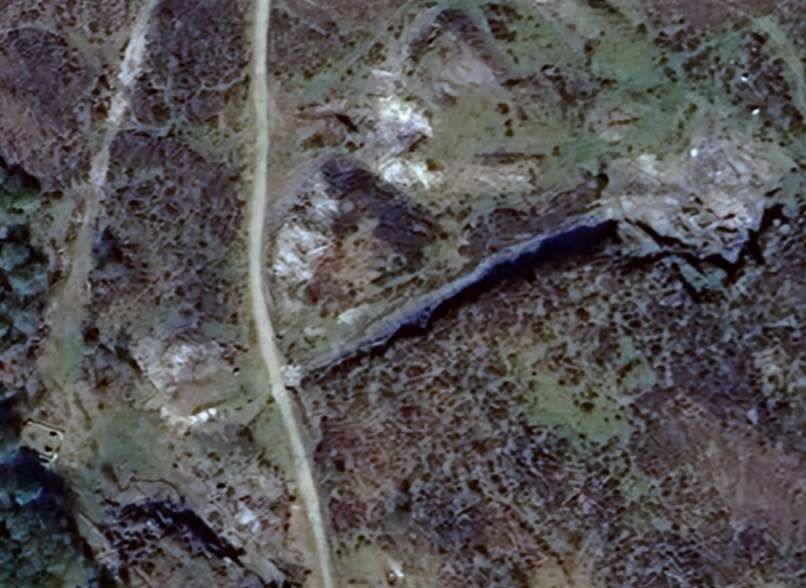
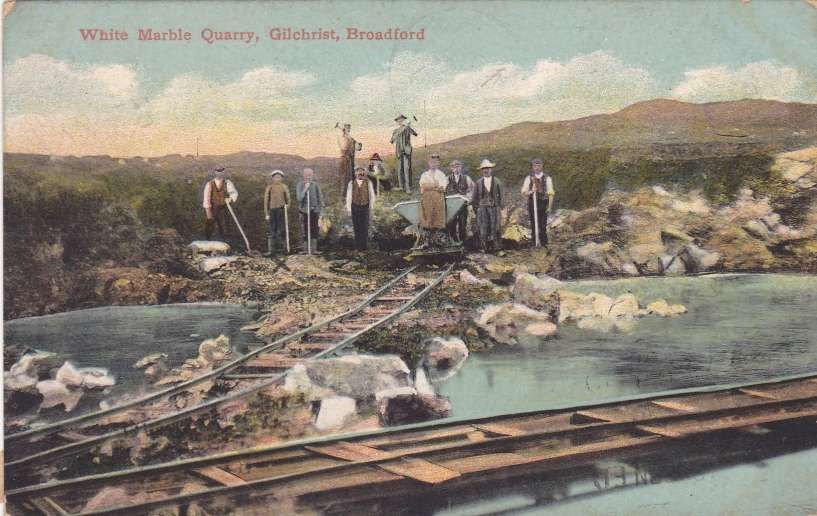
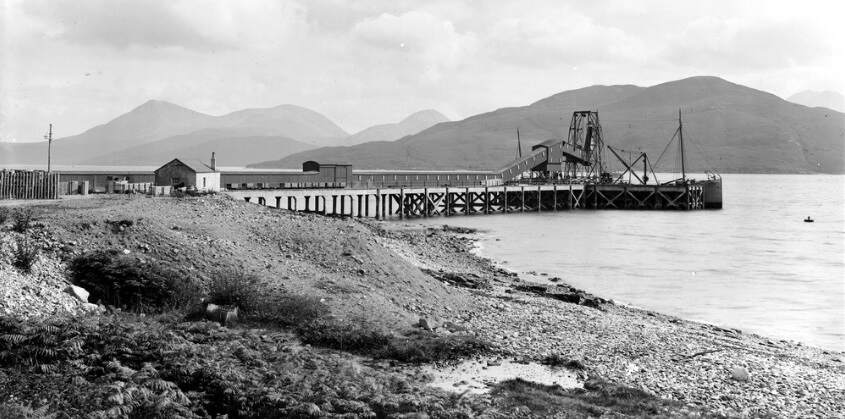
The Skye Marble Railway – Soon after the turn of the 20th century a line was opened between the Kichrist Quarries in Strath Suardal and Broadford Pier/Quay. Different sources say that this was initially either and aerial ropeway or a horse-worked tramway. Whatever form the initial arrangements took, by the end of the first decade of the 20th century, it was operating as a steam-hauled 3ft-gauge railway which for a short while (certainly no more than 4 years) employed a Hunslet 0-4-0ST, originally built in 1892 and previously used on the construction of the County Donegal Railway and various other contractors projects. This line is covered in more detail in the article which can be found here. [7]

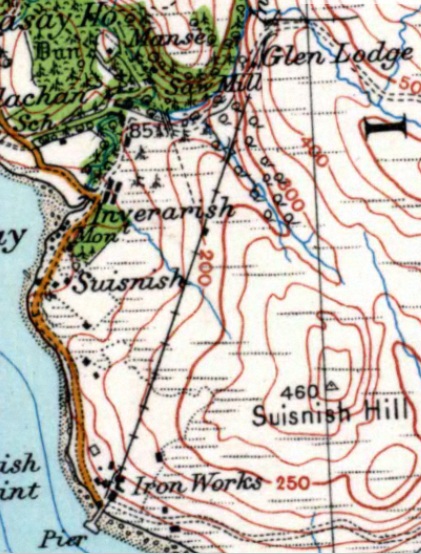
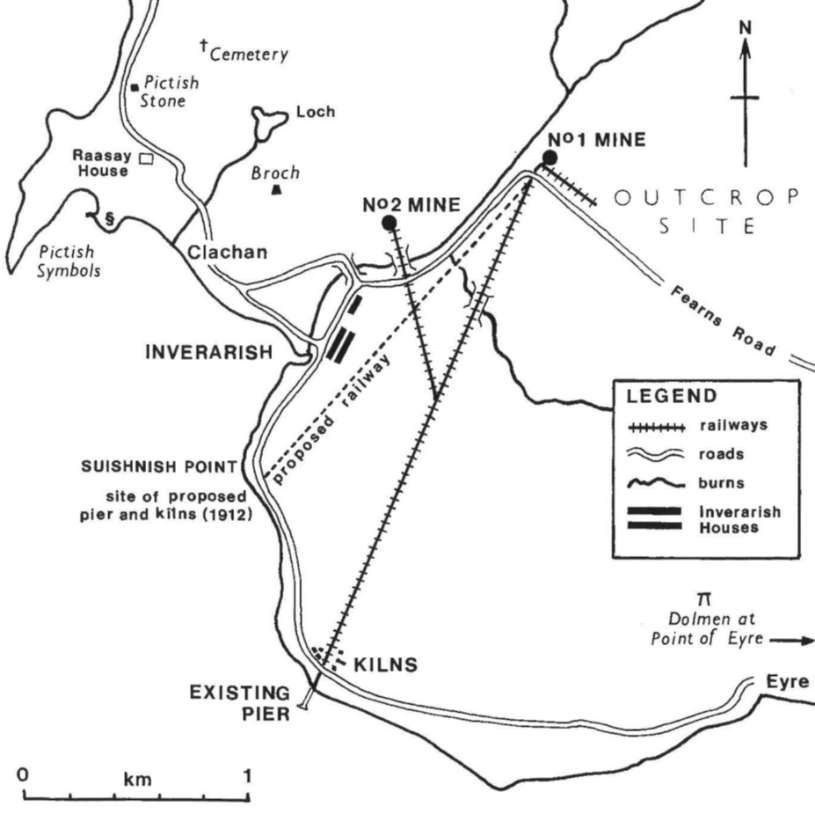
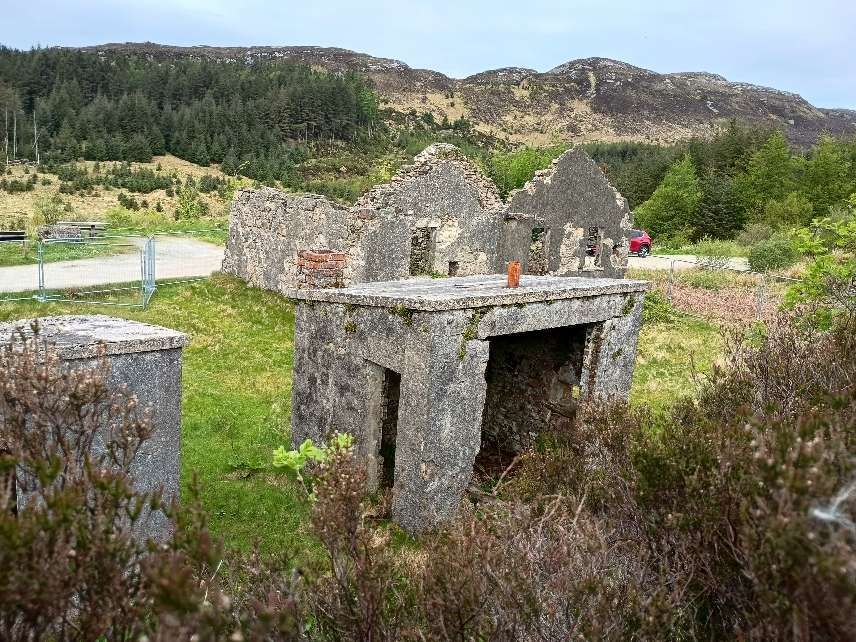
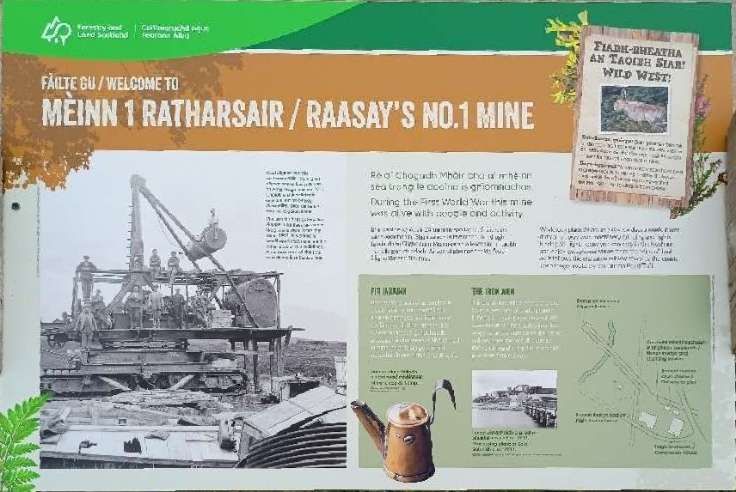
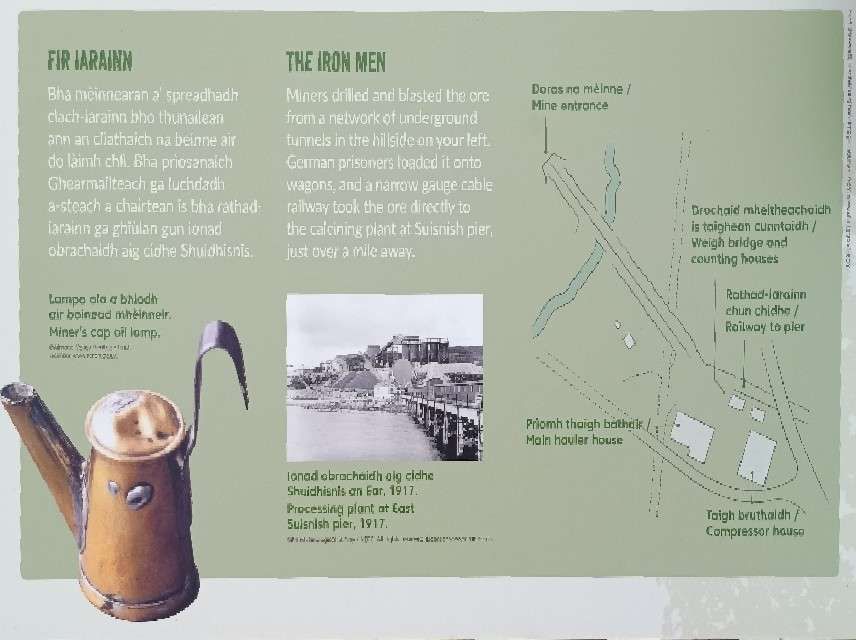
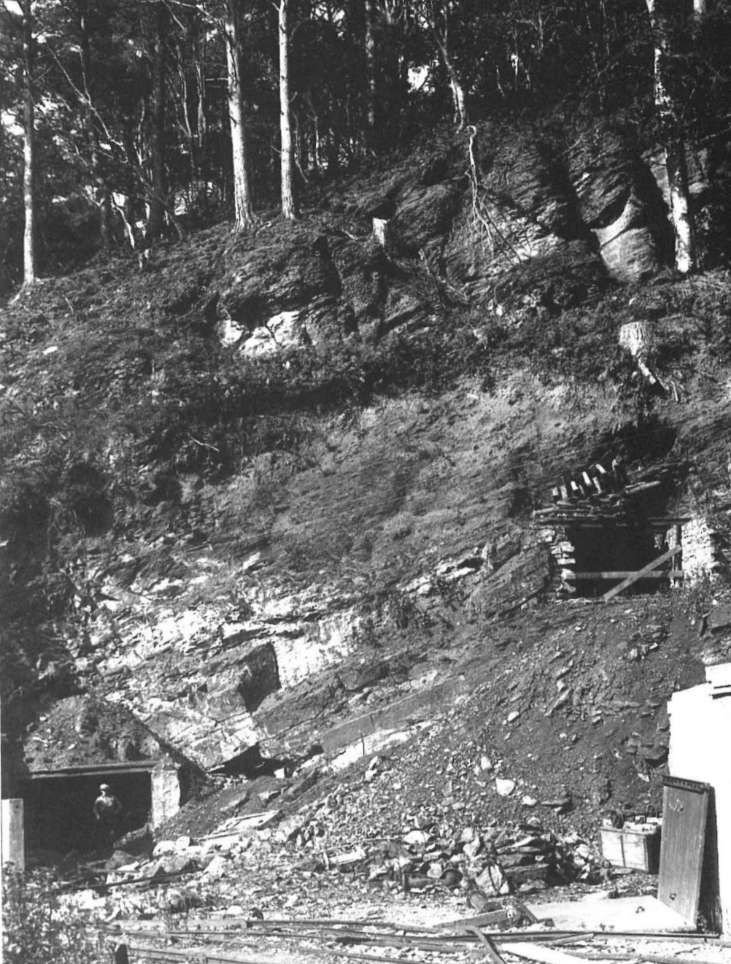
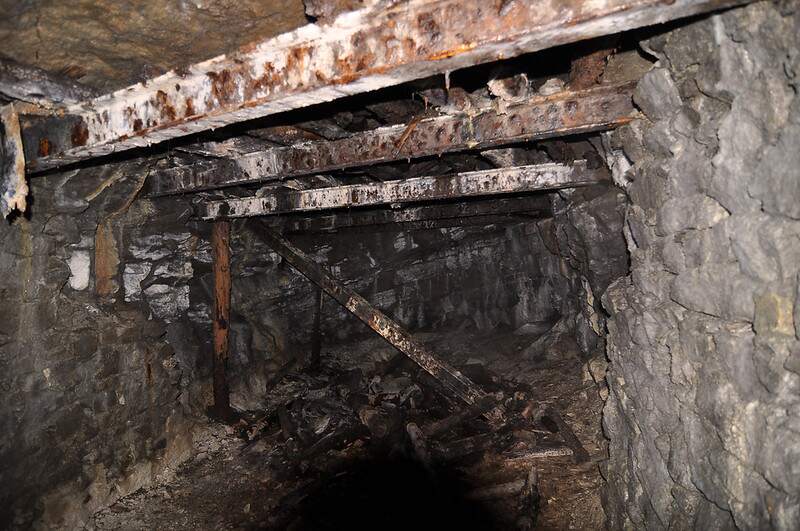
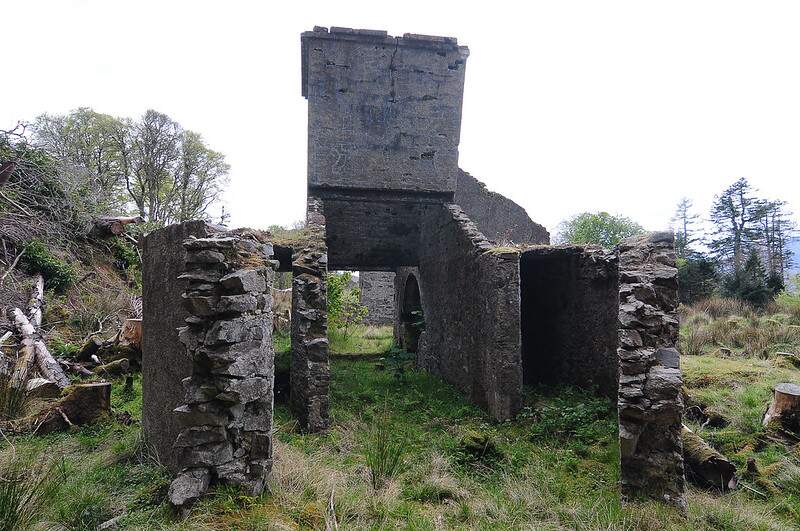
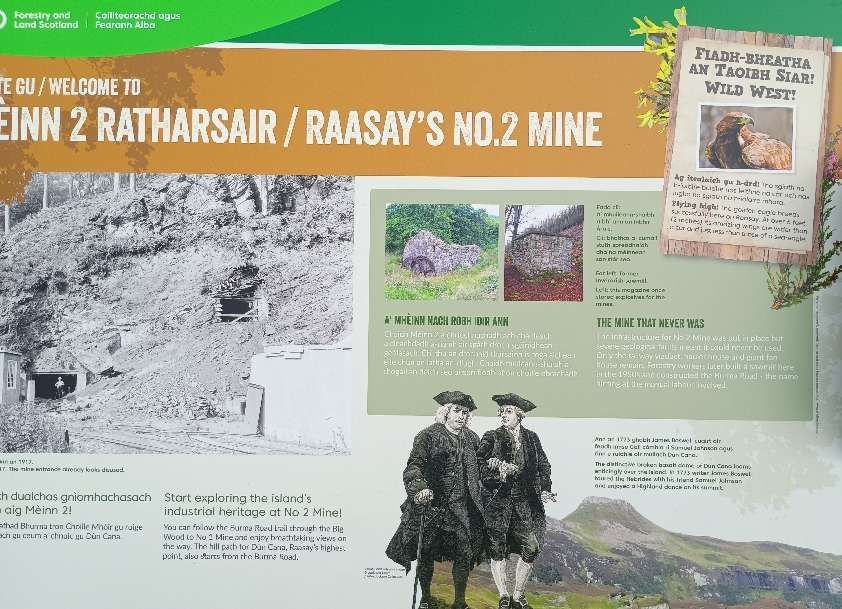
The Raasay Iron Ore Mines and Their Railway – the railway operated from 1913 to 1919. [1][2]

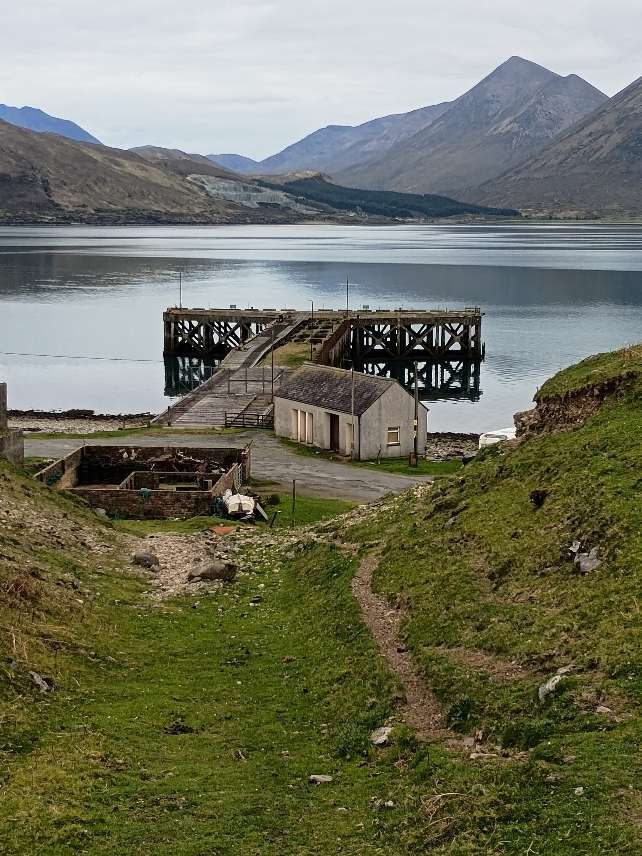
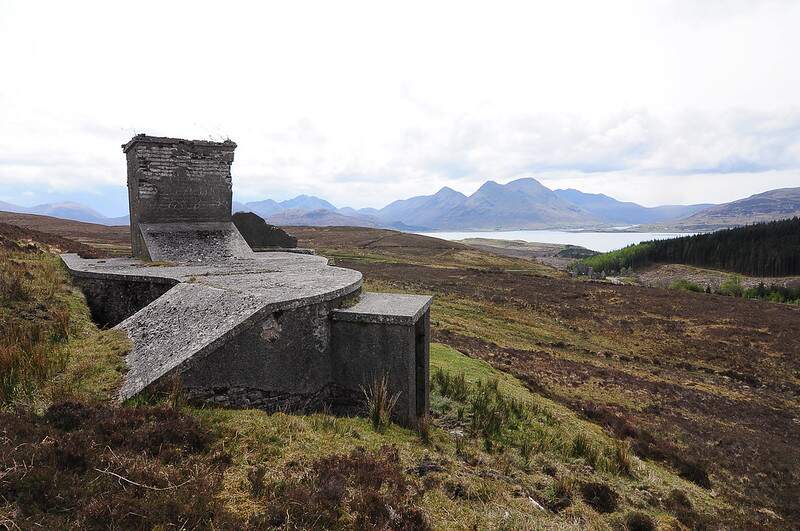
Susinish (Suishnish) Pier. [3]
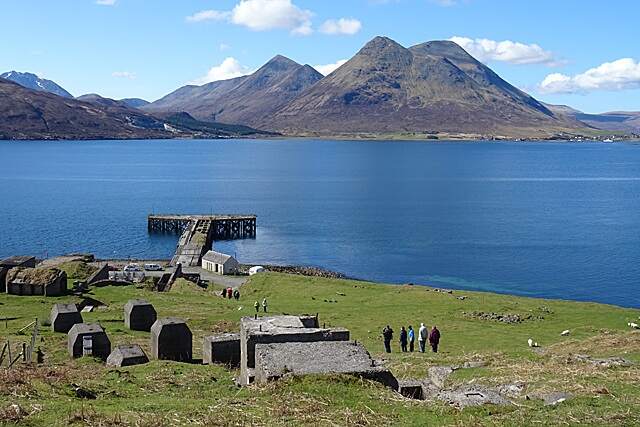
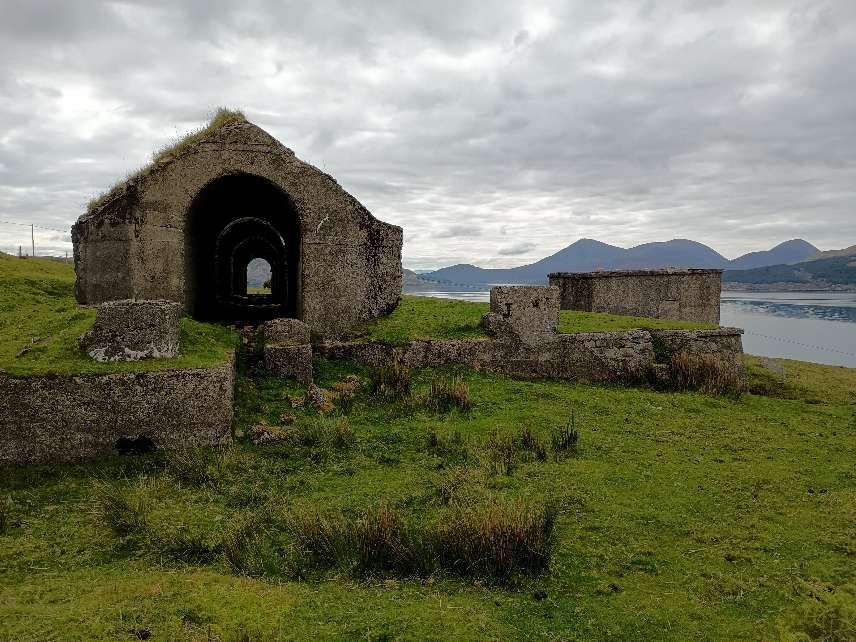
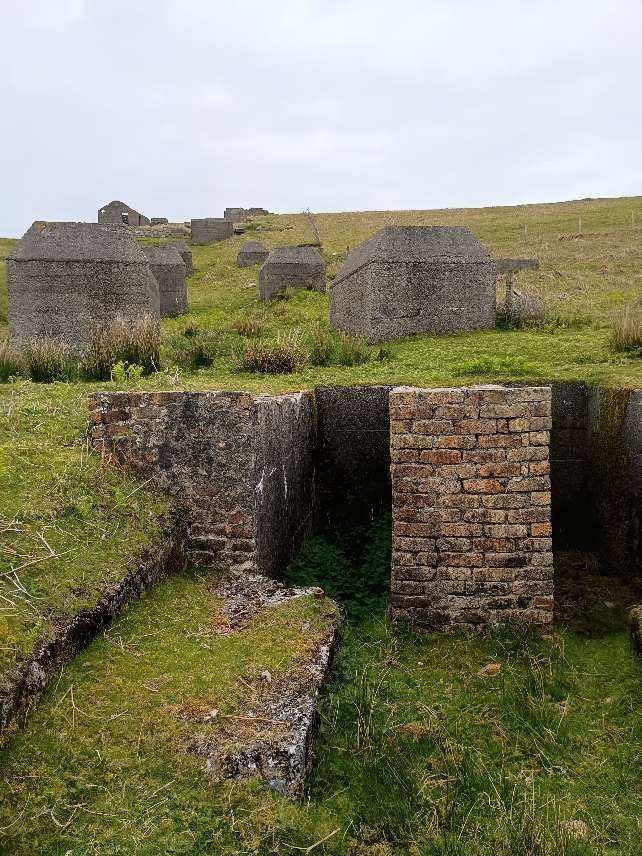
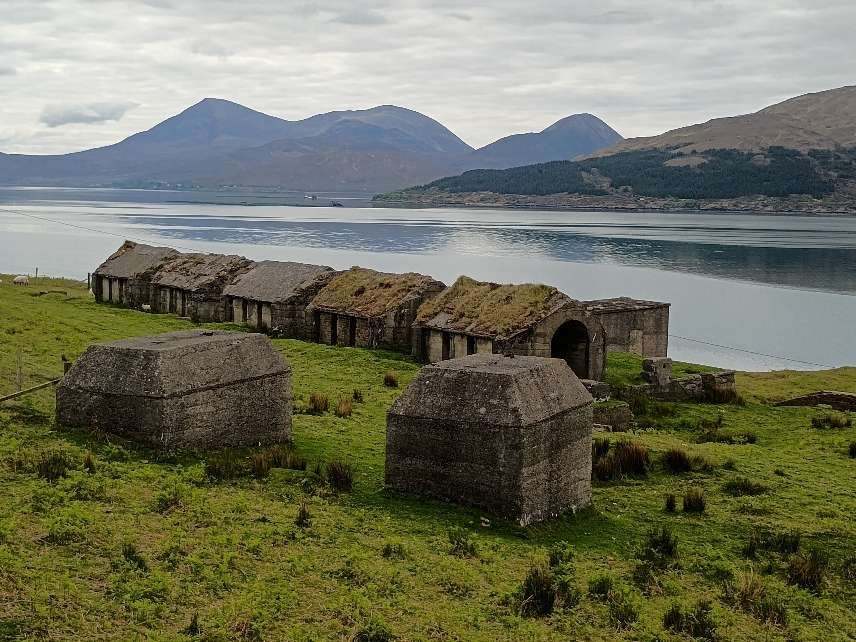
Looking down from the former railway over the remains of the iron works and the pier from which the iron was shipped to Ravenscraig in Lanarkshire. Between 1912 and 1916 iron ore was extracted from ironstones that outcrop in the southern part of the Isle of Raasay. Extensive ruins of the workings and associated buildings continue to disfigure the landscape of the island, © Anne Burgess and licensed for reuse under a Creative Commons Licence (CC BY-SA 2.0). [4]

More can be discovered about Raasay’s railway here. [12]

The Quartzite Quarry at Ord (opened in 1945) was equipped with a 3ft-gauge railway along which wagons were pushed by hand to a loading embankment. A short article can be found here. [13]

Storr Lochs Hydroelectric Power Station (opened in 1952) which included a standard gauge electric cable railway which still routinely carries spares and supplies down a 1 in 2 gradient. Another short article can be found here. [14]

Other railways on Skye or on adjacent islands? One source commented that Skye had thirteen different railways/tramways open at one time or another. I have only been able, so far, to identify the ones listed here. Should others be aware of more historic rail sites on Skye, I would be interested to hear. Maybe that source intended their list to include the abortive schemes mentioned at the head of this article? One particular proposal, which never came to fruition, has imaginatively been taken as the basis for the story of the fictitious Highland Light Railway Company. [15]

References

  1. https://www.isbuc.co.uk/Sights/Rail.php, accessed on 13th April 2025.
  2. https://www.hows.org.uk/personal/rail/incline/sky.htm, accessed on 13th April 2025.
  3. https://geoscenic.bgs.ac.uk/asset-bank/action/browseItems?categoryId=1118&categoryTypeId=1, accessed on 13th April 2025.
  4. https://www.geograph.org.uk/photo/5761169, accessed on 13th April 2025.
  5. https://rogerfarnworth.com/2025/05/01/the-railways-of-skye-part-1-loch-cuithir-to-lealt
  6. https://rogerfarnworth.com/2025/05/03/the-railways-of-skye-part-2-the-talisker-distillery-tramway
  7. https://rogerfarnworth.com/2025/06/02/the-railways-of-skye-adjacent-islands-part-3-the-skye-marble-railway
  8. Direcleit; a’spaidsearachd agus a’meòrachadh: Hebridean Light Railway Company; on Direcleit.blogspot.com; via https://direcleit.blogspot.com/2010/11/hebridean-light-railway-company.html?m=1, accessed on 23rd April 2025.
  9. Tom ………; Railways of Lewis & Harris | Isle Ornsay; on Hlrco.wordpress.com. 5 October 2010; via https://wp.me/p153uL-81, accessed on 23rd April 2025.
  10. Tom ……….; Isle Ornsay | General ramblings of the Hebridean Light Railway Company; via https://hlrco.wordpress.com, accessed on 23rd April 2025.
  11. https://discovery.nationalarchives.gov.uk/details/record?catid=5230967&catln=6, accessed on 23rd April 2025.
  12. https://rogerfarnworth.com/2025/05/27/the-railways-of-skye-adjacent-islands-part-4-the-raasay-iron-mine-railway
  13. https://rogerfarnworth.com/2025/06/03/the-railways-of-skye-and-adjacent-islands-part-5-the-quartzite-silica-quarry-tramway-at-ord
  14. https://rogerfarnworth.com/2025/06/04/the-railways-of-skye-and-adjacent-islands-part-6-storr-lochs-hydroelectric-power-station
  15. https://hlrco.wordpress.com/history, accessed on 1st June 2025.

The Railways of Skye and Adjacent Islands – Part 6 – Storr Lochs Hydroelectric Power Station

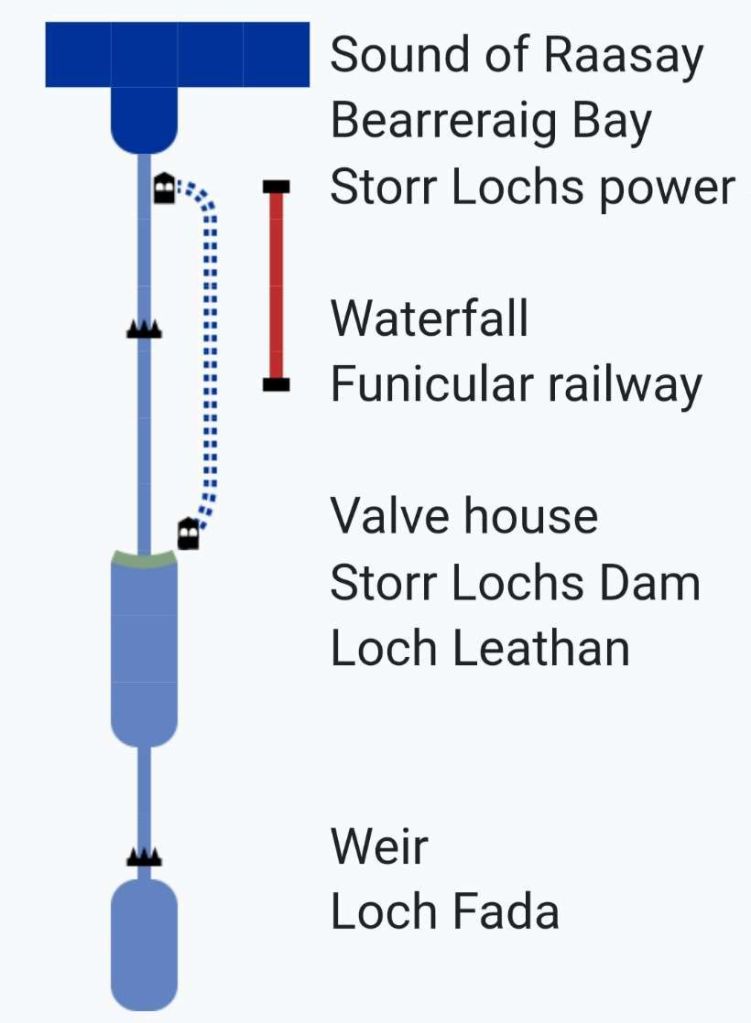
Storr Lochs hydro-electric power station was commissioned in 1952. It was built by the North of Scotland Hydro-Electric Board, and used water from Lochs Leathan and Fada, to provide the first general supply of electricity to the island. The power station has a total output of 2.40 MW. Because the location of the turbine house was not easily accessible, it was (and continues to be) served by a standard-gauge electric funicular railway. [1]

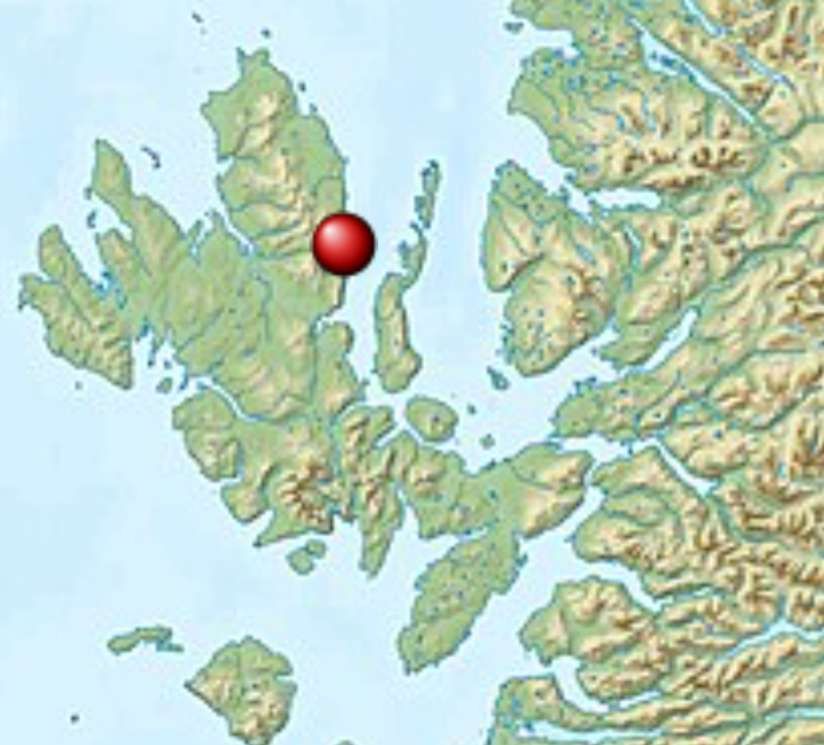
The location of Storr Lochs Hydroelectric Power Station in the Northeast of the Isle of Skye. [1]

The funicular is the only working railway on the Isle of Skye. It is below the spectacular stacks and landslips of The Storr on the Trotternish Peninsula, a few kilometres north of Portree.

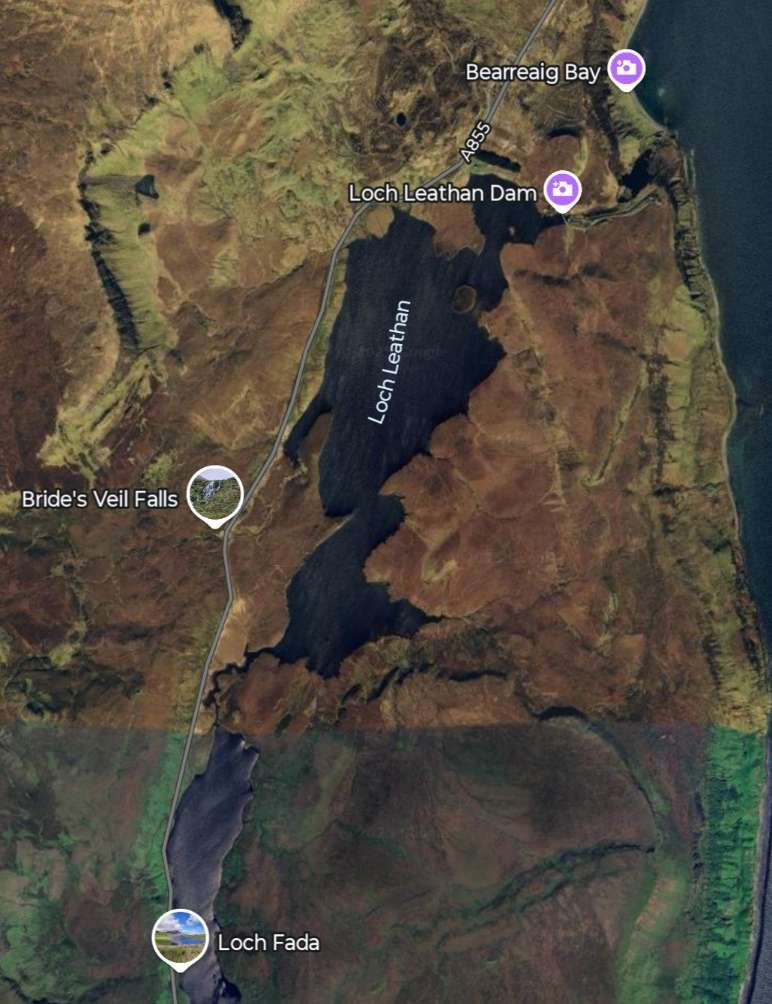
Loch Leathan and Loch Fada adjacent to the A855 provide the water used in the hydroelectric scheme. [Google Maps, June 2025]
The hydroelectric scheme at Storr Lochs. [1]
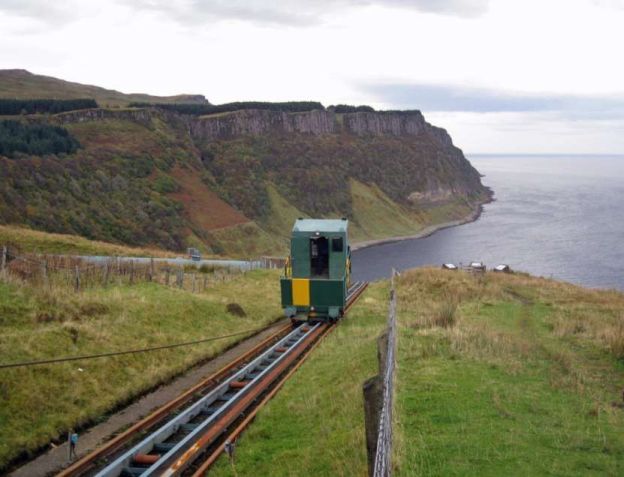
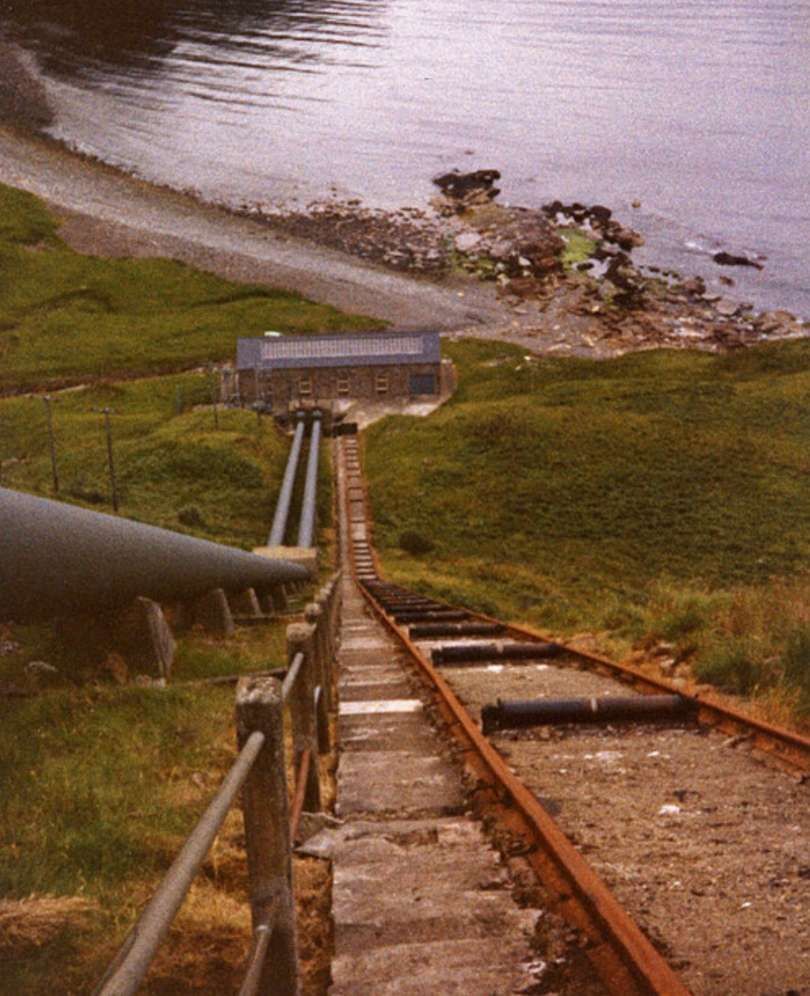
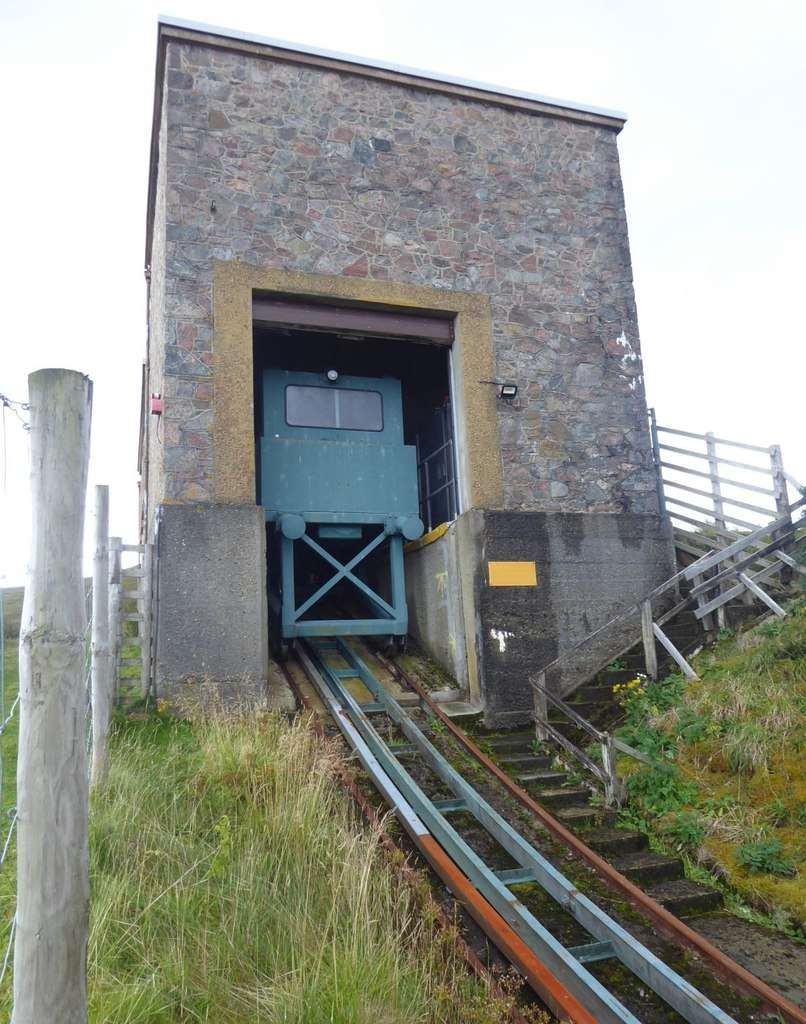
The railway alongside the penstock pipes is described as a funicular which is not really the right description as it is a single car steel rope worked system. A funicular would usually have two cars which ass each other at the mid-point of the line. This photograph was taken in 1983, © wfmillar and licensed for reuse under a Creative Commons Licence (CC BY-SA 2.0). [2]
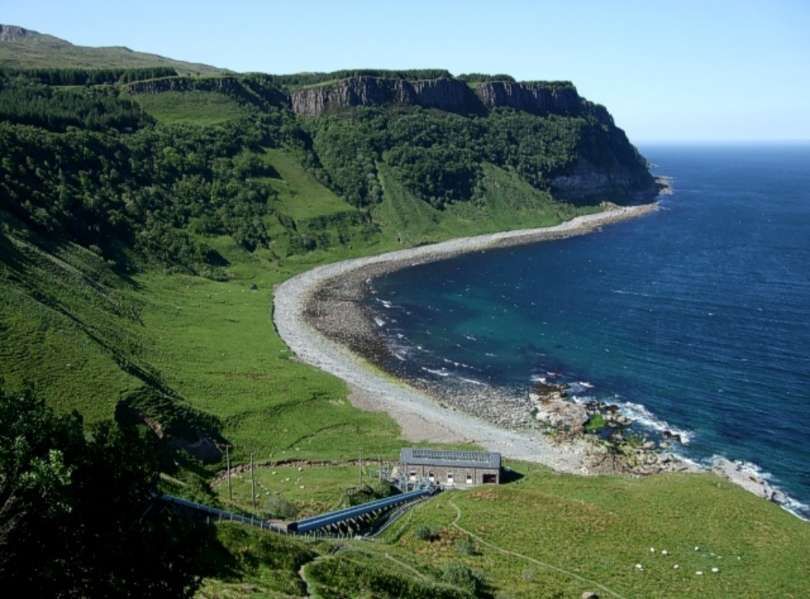
The hydroelectric power station is fed by water from the Storr Lochs which cascades down to the turbines via the penstock pipes seen bottom left. There is a cable railway running alongside the pipes. Beyond the power station can be seen the sweep of Bearreraig Bay with the cliffs of Rubha Sùghar beyond that, © Rob Farrow and licensed for reuse under a Creative Commons Licence. [3]
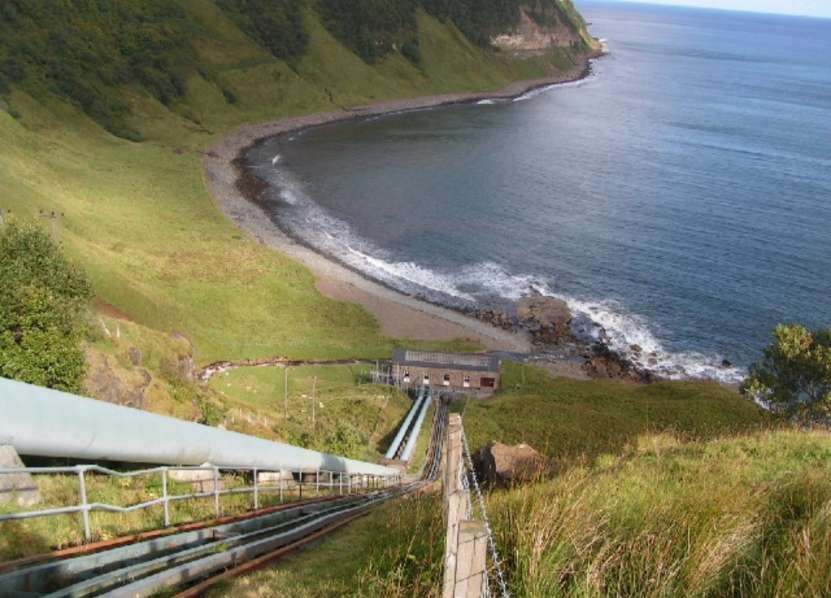
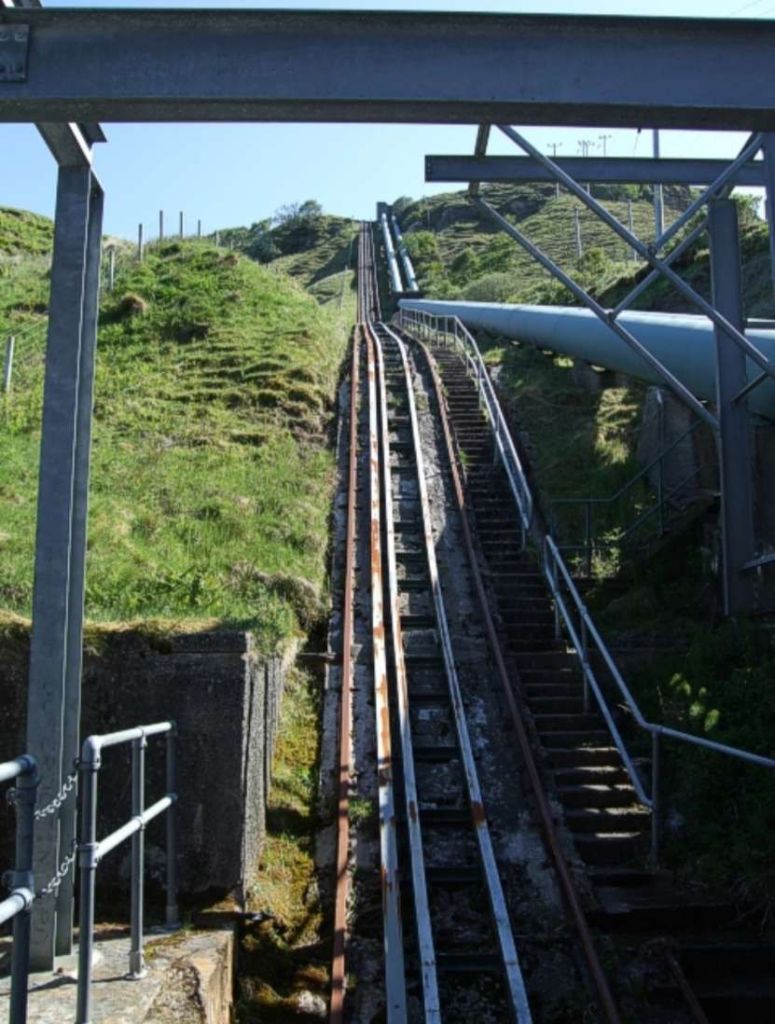
The power station is some 500ft below the lochs and accessed now by a path, but previously by nearly 700 steps alongside the cable, © Norrie Adamson and licensed for reuse under a Creative Commons Licence (CC BY-SA 2.0). [4]
The upper terminus/station and winch house of the cliff railway, © Russel Wills and licensed for reuse under a Creative Commons Licence, (CC BY-SA 2.0). [8]
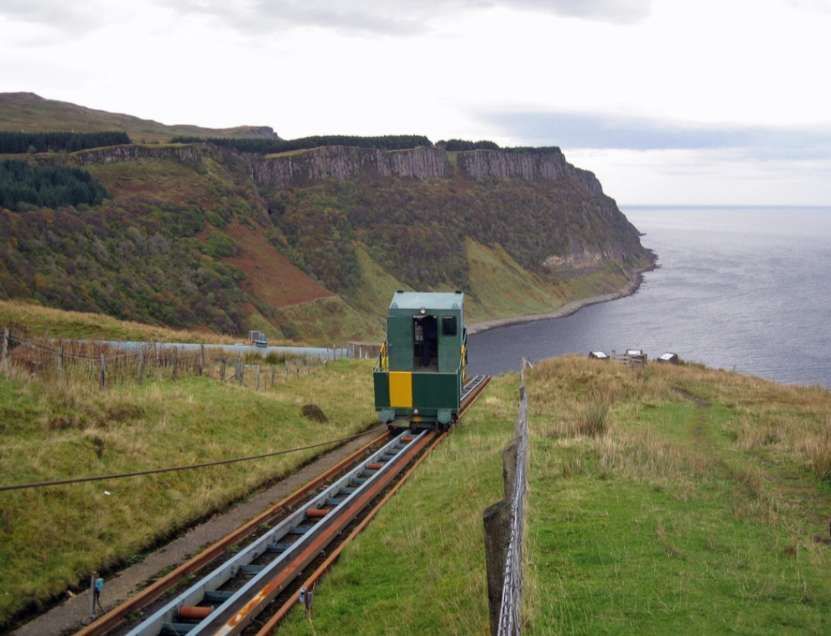
The single car ‘train’ is descending the cable railway which connects the Storr Lochs Dam to the Bearreraig hydro power station on the shore of Bearreraig Bay below. The top of the railway, seen here, is less steep than the longer lower section. The three small structures on the cliff edge on the right are information boards at a viewpoint, © Richard Dorrell and licensed for reuse under a Creative Commons Licence. [5]
The cable railway descends the hillside alongside the pipes carrying the water from the Storrs Reservoirs down to the power station, © Rob Farrow and licensed for reuse under a Creative Commons Licence. [6]

The cable railway was built early in construction of the power scheme, and used to carry materials and equipment to the shores of Loch Bearreraig. In the concrete foundation of the railway over 600 rough steps were built. The first pipeline was constructed for the 1952 opening, and the second pipeline, running parallel added in 1956. [7] The maximum gradient on the railway is 1 in 2. [9]

Photographs of the construction of the scheme can be found here. [10]

Other pictures of this site can be seen here. [11]

References

  1. https://en.m.wikipedia.org/wiki/Storr_Lochs_Hydro-Electric_Scheme, accessed on 3rd June 2025.
  2. https://www.geograph.org.uk/photo/1275950 accessed on 3rd June 2025.
  3. https://www.geograph.org.uk/photo/829150, accessed on 3rd June 2025.
  4. https://www.geograph.org.uk/photo/107735, accessed on 3rd June 2025.
  5. https://www.geograph.org.uk/photo/2667791, accessed on 3rd June 2025.
  6. https://www.geograph.org.uk/photo/830640, accessed on 3rd June 2025.
  7. https://www.ambaile.org.uk/asset/8915, accessed on 3rd June 2025.
  8. https://www.geograph.org.uk/photo/6613950, accessed on 3rd June 2025.
  9. https://www.railscot.co.uk/img/51/33, accessed on 3rd June 2025.
  10. https://www.ambaile.org.uk/search/?searchQuery=Storr+dam, accessed on 4th June 2025.
  11. https://www.ambaile.org.uk/search/?searchQuery=Storr+power, accessed on 4th June 2025.

The Railways of Skye & Adjacent Islands – Part 3 – The Skye Marble Railway

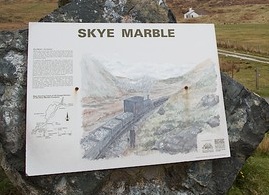
The featured image for this article is the only photograph I have been able to find of ‘Skylark’, the locomotive which for a matter of only a few years operated on the Skye Marble Railway. Further notes about the locomotive can be found in this article. This information board across the road from Kilchrist Church, features Skylark at the head of a train of wagons. [5]

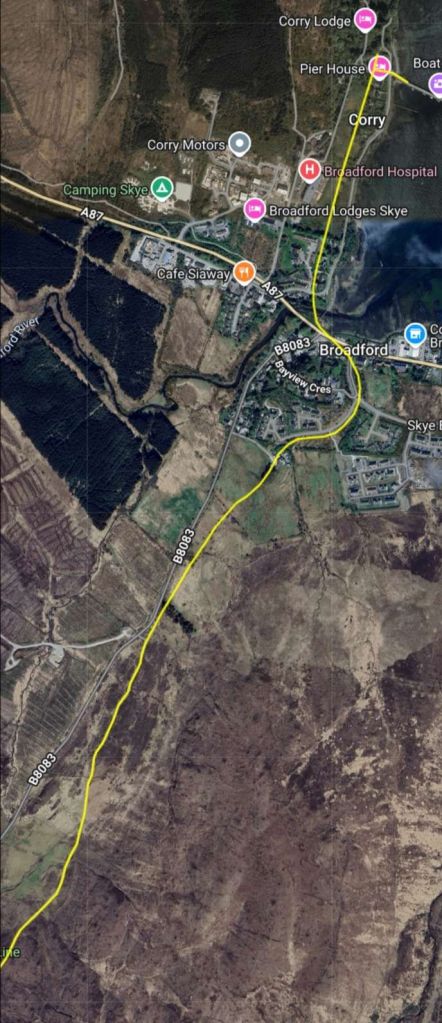
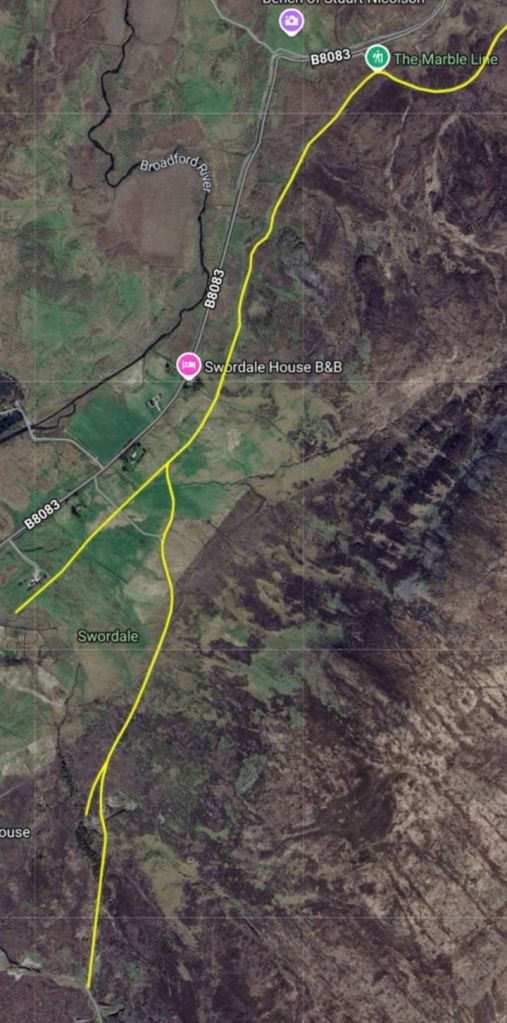
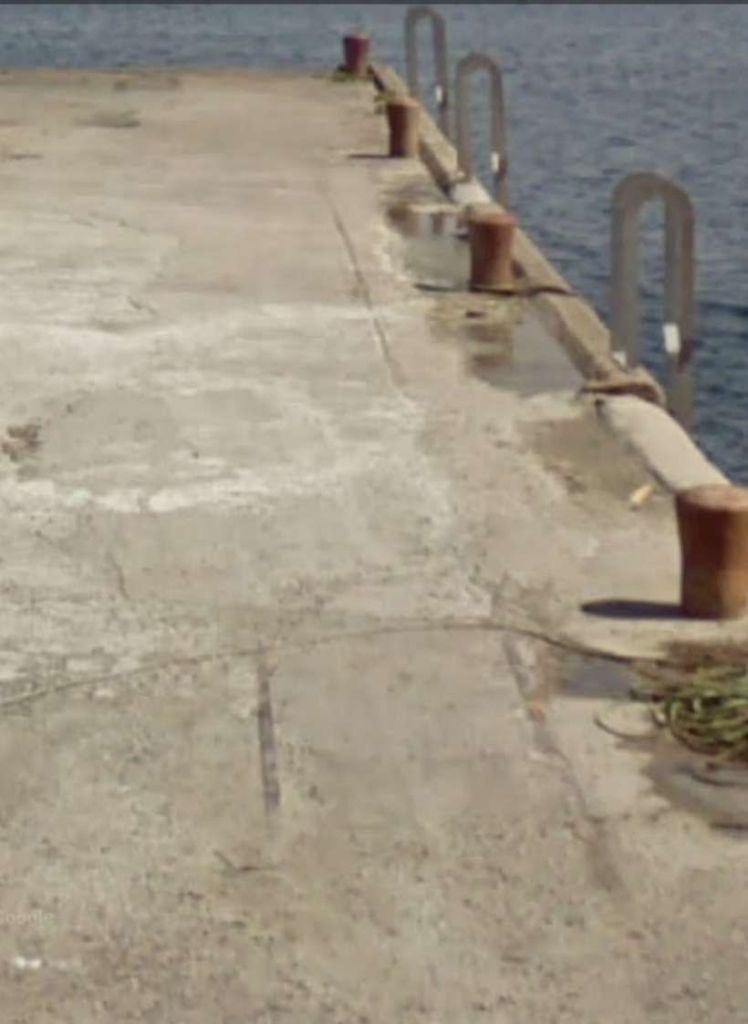
Some sources say that in 1904, an aerial ropeway was constructed to transport marble to Broadford Pier from Kilchrist Quarries (alternatively known as Kilbride Quarries or Strath Suardal). The quarries were used to excavate marble. [1][2] Other sources talk of the line being worked first by horses. [14] There was an incline between the upper and lower Quarries at Kilchrist which appears to have been rope-worked. It is most likely, given the length of line from Kilchrist to the quay at Broadford and the relatively shallow gradients, that the line from the marble works down to Broadford was worked by horses, but it is entirely possible that an aerial ropeway was employed. Nothing remains of the line beyond the formation which now carries a footpath once South of Broadford, and, as will be seen below, some rails in the surface of the pier at Broadford.

The main length of the line was converted to a tramway/railway in 1910. It was, in total, over 6 km in length. [4] Some sources quote 3.5km [viz. 2] and probably take that length from the length of the footpath which follows the route of the old railway. The Skye Marble Railway was a 3 ft (914 mm) narrow gauge [5] line which only operated from circa. 1910 to 1912/1913. [6][7]

The Northern half of the Skye Marble Railway as shown on railmaponline.com’s satellite imagery. [8]
The Southern half of the Skye Marble Railway as shown on railmaponline.com’s satellite imagery. [8]

A closer look at the line

We start at the pier/quay at Broadford.

Remnants of the old railway can be seen in the road surface at the East end of the pier at Broadford. [Google Streetview, 2012]
Looking West from the same location towards the landward end of the pier a short section of rail can be seen in the bottom-left of the photograph. The alignment of the railway shown on railmaponline.com’s satellite imagery above suggests that the railway ran uphill from the pier to a point beyond the houses shown on the left of this image before then turning South. It seems more likely to me that the old railway turned South immediately at the end of the pier. [Google Streetview, 2012]
Looking West from the West end of the pier the gradient ahead is more evident. Railmaponline.com shows the old railway turning South close to the boat which can be seen at the end of the tarmac ahead. It is this route that appears in the video at the conclusion of this article. I could find no clear evidence of the route taken by the railway but it seems to me that it is more likely that the railway ran immediately adjacent to the shore as it travelled South. If so, then there is a footpath which follows the old railway. This can be seen in the bottom-left of this image. [Google Streetview, 2012]
The footpath adjacent to the seashore which probably follows the line of the old railway. The footpath runs from this location as far as the mouth of the River Broadford. [Google Streetview, 2012]
The steam locomotive ‘Skylark’ which was used to transfer marble from the Kilchrist quarries to Broadford. The locomotive is probably standing close to the landward end of the pier at Broadford. ‘Skylark’ was a Hunslet Engine Company 0-4-0ST locomotive (manufacturer’s No. 564) which was built in 1892. It was acquired second-hand from Ireland where it had been used in construction of the County Donegal Railway and various contractors projects. It was finally scrapped in 1925 after having been owned by two further contracting companies. [4][5] This image was shared on the Elgol and Torrin Historical Society Facebook Page on 27th May 2024, © Public Domain. [14]

It seems appropriate at this point to take a break from our journey along the line to find out as much as possible about the locomotive which was used on the Skye Marble Railway for a short time in the early 20th century. The website of the Industrial Railway Society (IRS) has some more information about this locomotive which the Skye Marble Company knew as ‘Skylark’. … The engine was first known as ‘Bruckless’, the notes which follow come from the IRS archives and were pulled together by D. Cole in 1965, in part from work undertaken by Dr. Iain D. O. Frew: “Delivered to T.S. Dixon in May 1892 through the agency of Josiah Buggins as ‘Bruckless’ for the Donegal-Killybegs contract of the County Donegal Railways, it was sold in 1894 after the completion of the contract and later worked for the Preston Corporation Waterworks Department on the construction of the Spade Mill No.1 Reservoir at Longridge. There it was named ‘Skylark’. Subsequently, in 1907, it went … to the Skye Marble Company and was used firstly by a contractor in building the Company’s railway from Torrin to Broadford, and then, from 1909, to work the railway itself. In 1913, following the failure of the quarries, the line was lifted and the locomotive sold to W.N. Jackson, a Glasgow metal merchant. He in turn sold it to J. Mackay, contractor for the Roundwood Reservoir in County Wicklow. This contract passed to H. & J. Martin Ltd. in 1915, and after its completion in 1925 the locomotive was scrapped.” [15]

D. Cole undertook further research into Hunslett’s records and was able to ascertain that “from July 1897 – the date from which the earliest detailed Hunslet spares records have survived – to March 1905 spares were sent to the Newcastle & Gateshead Waterworks. Delivery was sometimes to Otterburn, and the name of the locomotive was frequently quoted as ‘Bruckless’. No name was quoted by Preston Corporation when ordering spares between March 1907 and March 1910.” [15]

Cole was also able to confirm that:

  • from November 1910, spares were sent to W.R. Herring with the locomotives name quoted as ‘Dilworth’; [15]
  • in January 1911 and May 1911, spares were sent to Skye Marble Ltd. but no name was quoted; [15]
  • in August 1913, spares were ordered for the locomotive named ‘Skylark’ by W.H. Jackson, Glasgow, but sent to Mr. Easter, Skye Marble Cottages, Broadford, Isle of Skye; [15]
  • from May 1914 to May 1916, spares were sent to John Mackay, Dublin Waterworks, Roundwood, Co. Wicklow; [15] and
  • the last spares of all were sent out in January 1921 to H. & J. Martin Ltd., Roundwood Reservoir. – K.P.P. [15]

We now continue the journey along the old railway route. …

This view looking South towards the village of Broadford shows the footpath below the road (to the left beyond the dwarf wall) which probably follows the line of the old railway. [Google Streetview, December 2021]

The alignment of the railway which I have proposed here is supported by Railscot. On their page about the railway the alignment is shown adjacent to the shore rather on the higher ground to the West. [7]

The probable route of the old railway continues along the seashore. [Google Streetview, December 2021]
As can be seen in this image, while the road gains height on its way towards the village, the presumed route of the old railway keeps its place and level close to the water. [Google Streetview, December 2021]
The footpath following the line of the old railway can be seen at the centre of this image. [Google Streetview, December 2021]
It curves round between the road to the pier and the water’s edge. [Google Streetview, December 2022]
And runs away from the road towards its bridge over the River Broadford. [Google Streetview, December 2021]
The descriptive sign close to the footbridge in Broadford during its construction in 2010, © Richard Dorrell and licensed for reuse under a Creative Commons Licence {CC BY-SA 2.0). [9]
The footbridge under construction in 2010, the Skye Marble Railway bridge was on this site. One of the abut.rnts of the railway bridge remained in position. It can be seen on the right side of this image, just above the water line, © John Allan and licensed for reuse under a Creative Commons Licence. (CC BY-SA 2.0). [10]
The completed footbridge, seen in December 2012, which sits on the line of the Skye Marble Railway at the same location as the railway bridge, © Richard Dorrell and licensed for reuse under a Creative Commons Licence {CC BY-SA 2.0). [11]

The yellow-brick abutment on the Northside of the river is original, the modern footbridge sits on that abutment but is on a different alignment to the old railway. There is no remaining abutment on the South side of the river, so a new smaller abutment was constructed to support the footbridge. A comparison is made and pictures are provided, on this site. [5] The photographs towards the bottom of that webpage give an idea of the alignment of the old railway bridge. Which crossed from the North abutment to a point on the South bank of the River Broadford marked by the young tree in the image below.

The modern footbridge sits on one of the abutments of the old railway bridge beyond the river in this picture. The old railway bridge spanned the river on a line between the North abutment and the young tree, in leaf, at the centre of this image which looks North from the A87. [Google Streetview, May 2022]

From the South bank of the river and running South the line shown on railmaponline.com’s satellite imagery seems to be realistic, following, as it does, a curved route to the East of the location pictured above. …

Crossing the modern A87, the old railway ran Southeast crossing the modern Glen Road (which did not exist at the time the railway was operating) close to Broadford (Church of Scotland) Church and then curved round to the East of Strath Suardal Way (which also did not exist when the railway was working). [8]

The next two images show the formation of the old railway on a low embankment on the East side of Strath Suardal Way.

This photograph was taken at the roundabout looking South-southwest along Strath Suardal Way. The low embankment runs behind the street lighting. [Google Streetview, December 2021]
Further along Strath Suardal Way and looking Southwest, the low embankment is again visible blue beyond the street lighting columns. [Google Streetview, December 2021]
Towards the end of Strath Suardal Way the line of the old railway turned away to the Southwest. [8]
The old Railway’s route runs through the evergreen trees on the left side of this West-southwest facing photograph. [Google Streetview, December 2021]
The line then ran over open moorland to the East of the road to Elgol (the modern B8083). [8]
Initially the route of the old railway and the modern B8083 converge as they head South-southwest. [8]
The footpath access to the line of the old railway can be seen just as the old railway route and the B8083 begin to diverge. [8]
The footpath access to the line of the old railway as seen from the B8083. Just beyond the second gate the footpath turns to the right and follows the old railway formation. The first length of the footpath runs through a protected plantation of young trees. [Google Streetview, December 2021]

The four photographs immediately below show the first few hundred metres of the footpath along the old railway – as far as the plantation boundary fence which can be seen beyond the two low gateposts in the fourth photograph.

This series of four photographs (above) show the first few hundred yards of the path along the line of the old railway. [My photographs, 5th May 2025]
The next length of the line continues to the Southwest. [8]
Looking back along the line of the old railway towards the plantation area. [My photograph, 5th May 2025]
Looking ahead along the line of the old railway – it can be seen curving round along the flank of the hillside as shown on the next railmaponline.com satellite image below. [My photograph, 5th May 2025]
A few hundred metres Southwest along the line of the old railway. [My photograph, 5th May 2025]
Looking back round the curve of the old railway towards Broadford. [My photograph, 5th May 2025]
And the line curved to the West towards the B8083 running along the flank of the hillside on a steady climbing grade. [8]
Heading West on the line of the old railway. [My photograph, 5th May 2025]
Close to the point where the line curved round to the Southwest again, at the left edge of the satellite image above, © David Medcalf and licensed for reuse under a Creative Commons Licence (CC BY-SA 2.0). [12]
Back on a Southwesterly heading, the old railway continued its gradual climb [8]
Close to the top of the satellite image immediately above, this is the view Southwest along the old railway formation. [My photograph, 5th May 2025]
Continuing on a Southwesterly course, railmaponline.com shows the old line continuing up the valley. [8]
Close to the top of the satellite image immediately above, this view looks Southwest along the line of the old railway. [My photograph, 5th May 2025]
A few hundred metres further Southwest, and continuing to look Southwest along the old railway formation. [5th May 2025]
The building visible on the last few Southwesterly facing photographs is Swardale House B&B. [My photograph, 5th May 2025]
The view Northeast from the same location as the picture immediately above. [My photograph, 5th May 2025]
Again looking Southwest, Swardale B&B is on the right edge of this photograph, with the old line running ahead. [My photograph, 5th May 2025]
Looking back towards Broadford from the same location with the B8083 on the left. [My photograph, 5th May 2025]
The first junction on the old railway saw a line branch off the main line to the quarries, to serve the Marble Works. The extent of what was once railway land is still evident on the satellite images from railmaponline.com. The main line to the quarries curves away to the South. [8]

When marble was discovered near Kilchrist in Strath Suardal on the slopes of Ben Suardal about 3 miles (5 kilometres) Southwest of Broadford, a large factory was built near the quarry for cutting and polishing the quarried blocks. The Marble was formed by the heating of limestone by igneous intrusions in the Tertiary Era. It appears that small scale workings were active as early as the 18th century, developing throughout the 19th century. [14]

“On level ground by the South side of the Broadford to Torrin road are the remains of an industrial complex belonging to the old marble quarries. The remains consist of a ruinous concrete shed/warehouse 60m long, a railway platform, traces of the railway line and sidings, and four brick-built circular bases 2.4m in diameter.” [17]

The branch to the Marble Works as shown on railmaponline.com’s satellite imagery. I am not sure of the source of the mapping of the old railway. The yellow line superimposed by railmaponline.com onto the Google satellite imagery does not take account of the island platform which can be seen on the Northwest side of the Marble Works. It doe however follow the boundary lines evident on the satellite imagery. [8]
Pulling out somewhat to look at a larger area round the works, and removing a length of railmaponline.com’s superimposed yellow line, there appears to be a whole series of man-made markings on the landscape. It is possible to imagine a series of sidings at this location. Clearly there was some sort of connection between the platform to the Northwest of the main Works’ building and the line to the site which seems most probably to have run along the Southeast side of the Works. [Google Maps, June 2025]
A much closer view of the remains of the Marble Works and railway platform at Kilchrist. The edges of the platform are clearly visible in the top-left of the satellite image. The Southeast wall of the main building remains forming a shelter for a small modern yard. [Google Maps, June 2025]
The platform as it appears on Google Earth and Streetview. [Google Streetview, December 2021]
The platform edge at the Skye Marble Works near Kilchrist Quarries in the hills above Broadford, © Lesbardd and licensed for reuse under a Creative Commons Licence (CC BY-SA 4.0). [13]
The Southeast wall of the abandoned Marble Works. [Google Streetview, December 2021]
Associated structural remains. [Google Streetview, December 2021]

Sadly, very little detail about the layout of the site and its railways appears to have survived.

We return to the junction to follow the line up to the quarries which deviates sharply from the line to the Marble Works.

The line to the quarries heads South from the line to the Marble Works. We might imagine that ‘Skylark’ managed its train down from the quarries sitting to the North end of a train of wagons, before reversing back down the line to the Marble Works. [8]
Beyond a single gate, the line to the quarries ran across open farmland towards the quarries. [My photograph, 5th May 2025]
Looking East from the line to the quarries towards the erstwhile Marble Works. [My photograph, 5th May 2025]
Further South along the line to the quarries. [My photograph, 5th May, 2025
Further South again. [My photograph, 5th May 2025]
Further along the flank of the hills to the South. [My photograph, 5th May 2025]
Looking back along the old line again towards Broadford. [My photograph, 5th May 2025]
This next extract from the railmaponline.com’s satellite imagery shows the line closing in on the quarries at the end of the line. A very short branch served the lowest level, with the line continuing through the lower quarries on to an incline which was rope-worked and served the upper quarry. [8]
The junction shown on the satellite image extract above. The lower line on the right served the crusher location and some earlier earthworks. The climbing main line headed on through the quarries as it continued South. [My photograph, 5th May 2025]
Further down the short branch towards the crusher, looking South. [My photograph, 5th May 2025]
Turning round to look North along that short branch. [My photograph, 5th May 2025]
The view West, down through the lower quarry towards the crusher and earlier workings, © Ian Taylor and licensed for reuse under a Creative Commons Licence (CC BY-SA 2.0). [16]
The line continued South beyond the lower quarry as a rope-worked incline. [8]
The location of the lower quarry which appears at the top of the last satellite image. [Google Earth, June 2025]
Postcard image of the marble quarry at Kilchrist. One of the wagons used on the railway can be seen at the centre of the image. The rail tracks were 3ft gauge. This image was shared on the Elgol and Torrin Historical Society Facebook Page on 27th May 2024, © Public Domain. [18]
The crusher sat in the midst of dramatic scenery! [My photograph, 5th May 2025]

From adjacent to the lower quarry, with its own branch, spoil heaps and concrete bases, [22] the line continued South but as a rope-worked incline.

Looking South up the incline towards the upper quarry. [My photograph, 5th May 2025]
The view South up the incline to the upper quarry. This image is embedded from here. [19]. Clicking on the image takes you directly to the original image which is one of a series of photographs of the route of the old railway can be found here. [5]

In a rocky cleft immediately to the East of the track to Boreraig, are the remains of two former dynamite stores, one within the other. The older, larger building with walls of rubble construction, envelopes a smaller concrete blockhouse. Close to these are the remains of the ot for the winding wheel for the rope-worked incline.

The winding wheel pit at the top of the rope-worked incline that linked the upper and lower Kilchrist quarries, © Sheila (swanscot.wordpress.com) and used by kind permission. [23]

Also located at the upper quarry (but of which I did not get photographs) are two machinery stands:

  1. 2m square with 11 bolts protruding
  2. 6.5m by 5.2m with 4 stanchions protruding.

The Demise of the Line

The operation was not a commercial success. The railway line was abandoned by 1914 when the operating company became bankrupt. The line was offered for sale as part of the liquidation of the business. The sale comprised a 9½-in, 4-wheeled locomotive, 500 tons of 35 pounds (16 kg) and 56 pounds (25 kg) flat-bottomed rail and 9,000 6-foot creosoted sleepers. [4][20]

Extracting the marble proved difficult and expensive and quarrying finally ended here in 1939. [21]

A short video about the line. [24]

References

  1. https://canmore.org.uk/site/75416/skye-broadford-kilchrist-quarries, accessed on 4th May 2025.
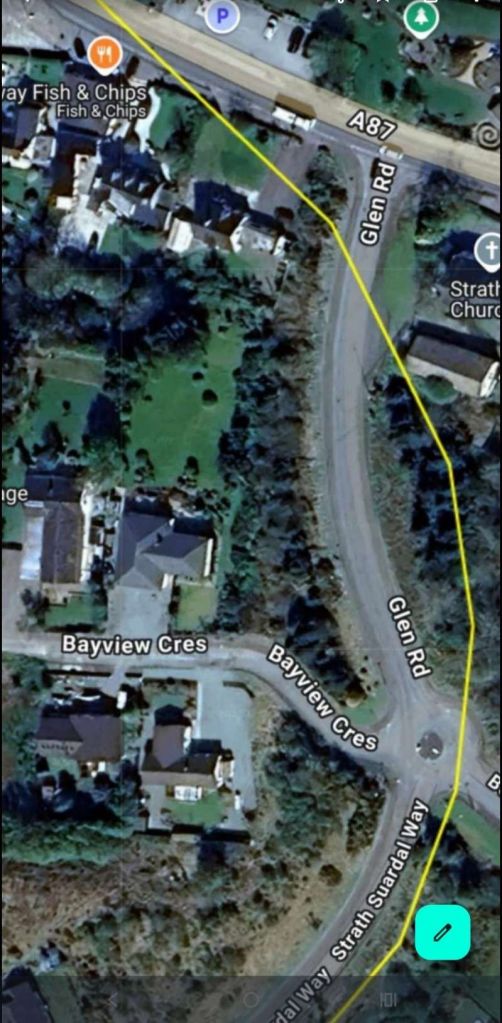
  2. https://www.isbuc.co.uk/Sights/Rail.php, accessed on 4th May 2025.
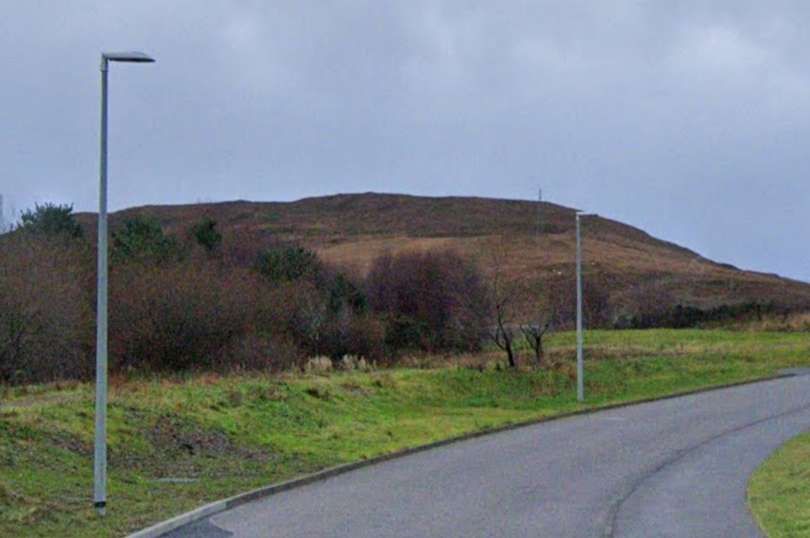
  3. https://www.hows.org.uk/personal/rail/incline/sky.htm, accessed on 4th May 2025.
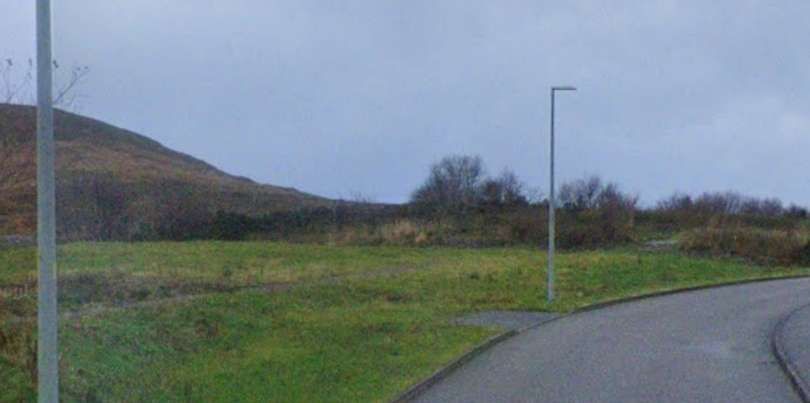
  4. https://en.m.wikipedia.org/wiki/Skye_Marble_Railway, accessed on 5th May 2025.
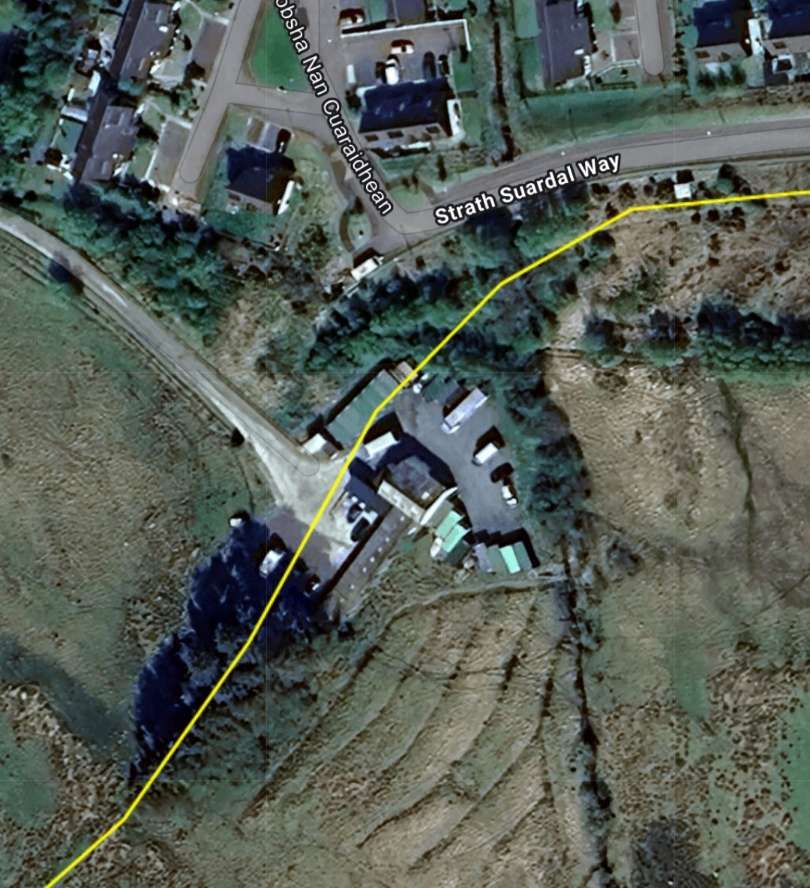
  5. https://hlrco.wordpress.com/scottish-narrow-gauge/constructed-lines/skye-marble-railway, accessed on 5th May 2025.
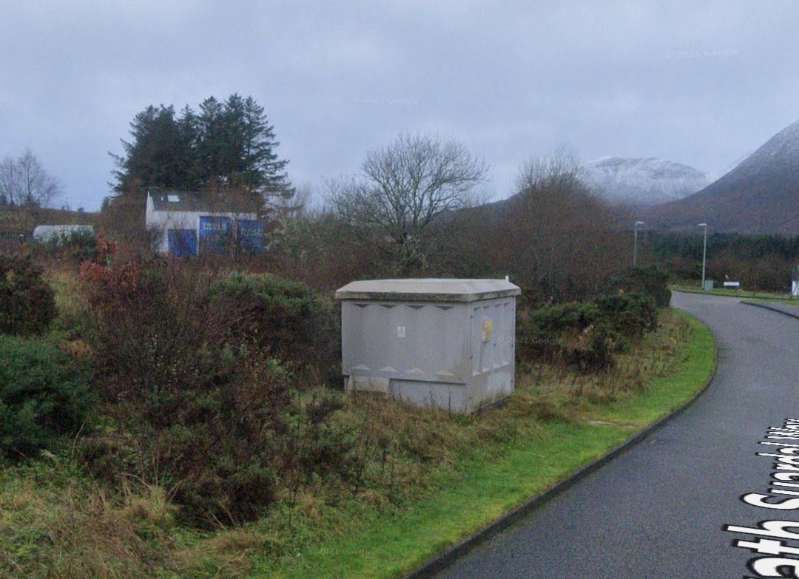
  6. https://web.archive.org/web/20120307102020/http://www.ambaile.org.uk/en/item/item_writtenword.jsp?item_id=15980, accessed on 5th May 2025.
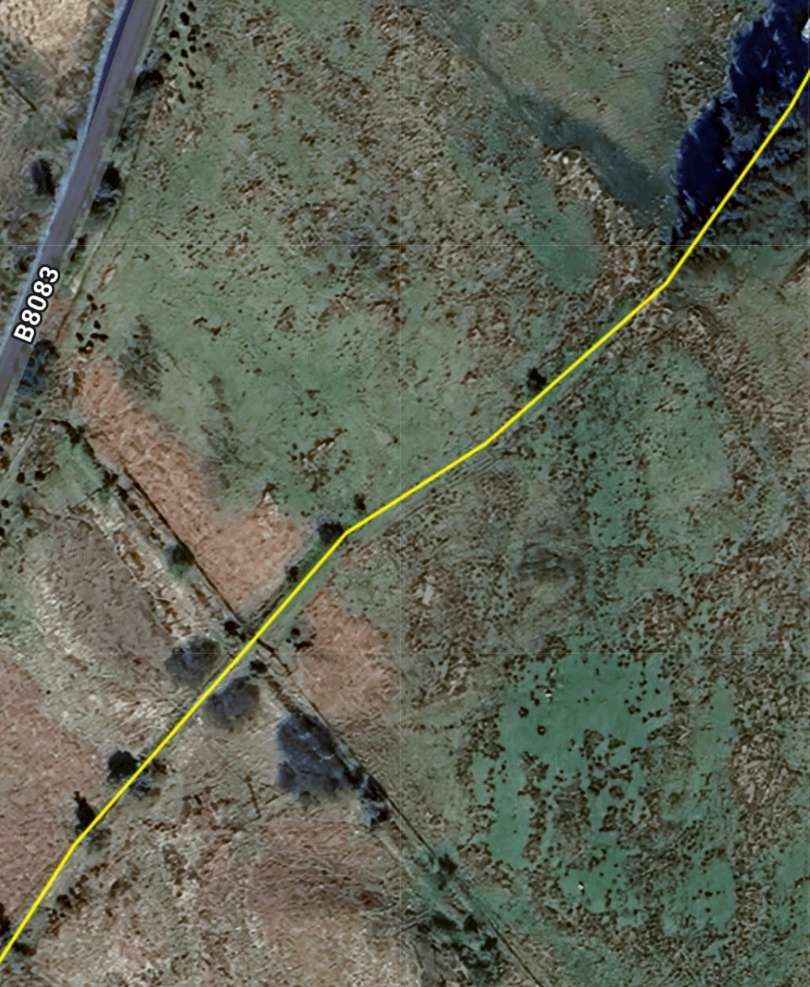
  7. https://www.railscot.co.uk/companies/B/Broadford_Marble_Quarry_Railway, accessed on 5th May 2025.
  8. https://www.railmaponline.com/UKIEMap.php, accessed on 5th May 2025.
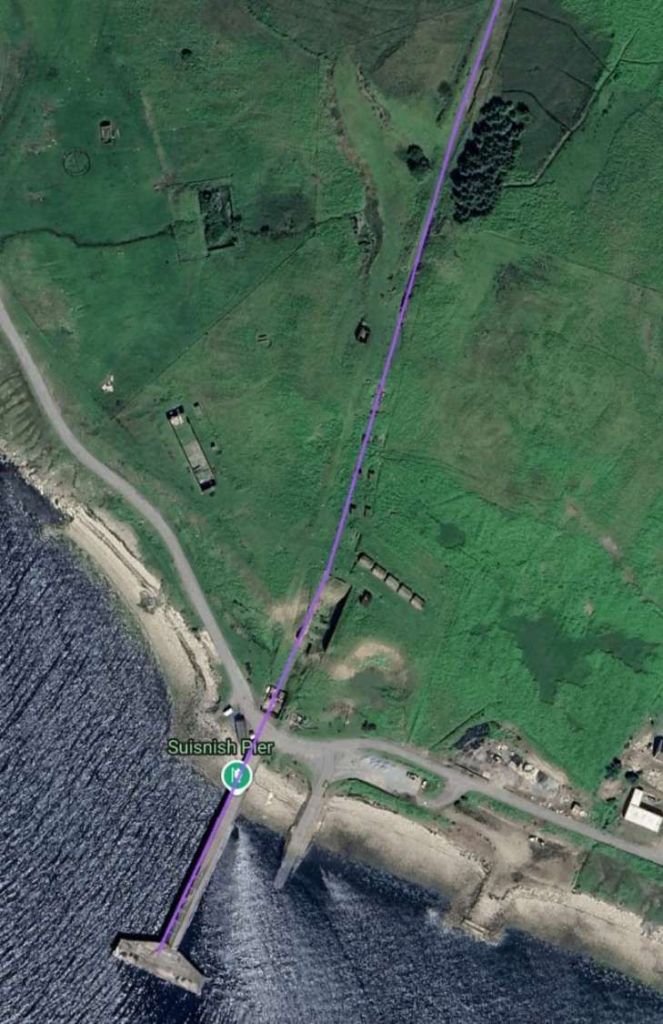
  9. https://www.geograph.org.uk/photo/1956455, accessed on 6th May 2025.
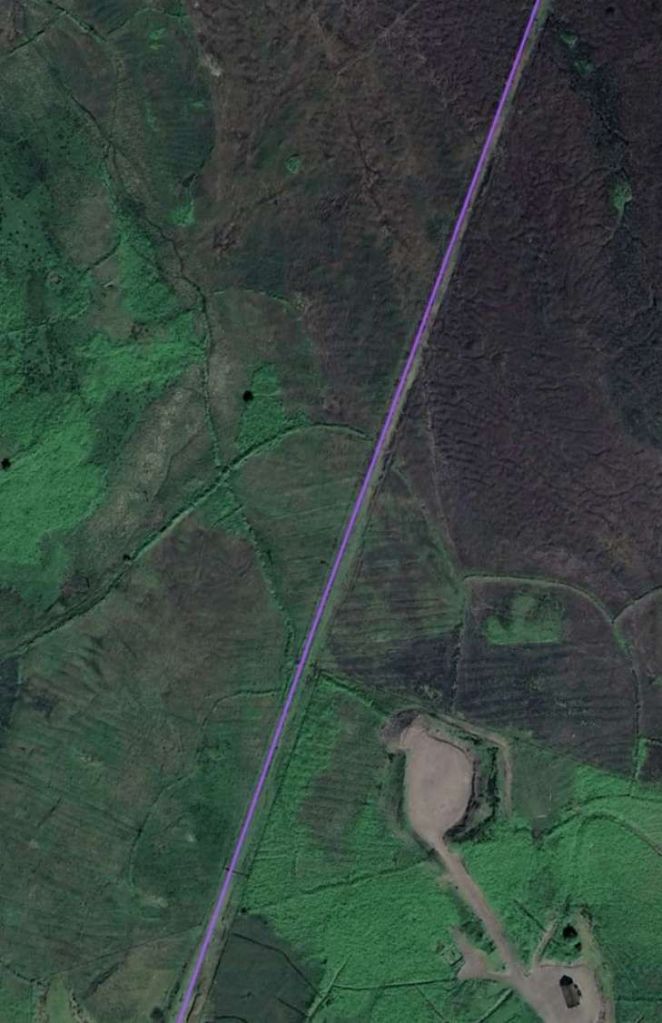
  10. https://www.geograph.org.uk/photo/1944765, accessed on 6th May 2025.
  11. https://www.geograph.org.uk/photo/2732942, accessed on 6th May 2025.
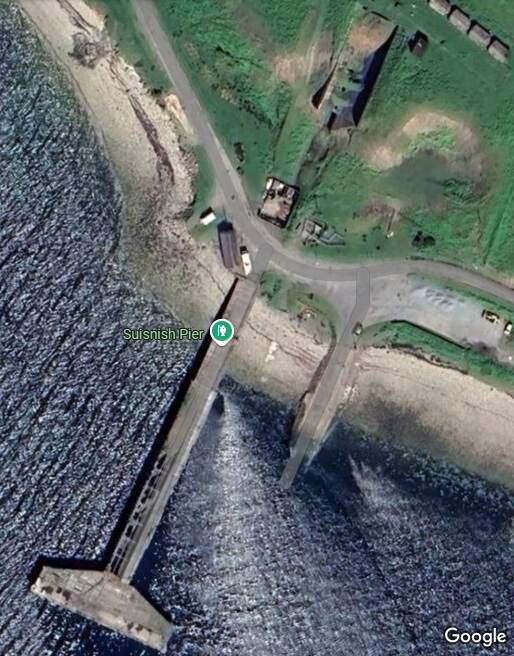
  12. https://www.geograph.org.uk/photo/7490601, accessed on 1st June 2025.
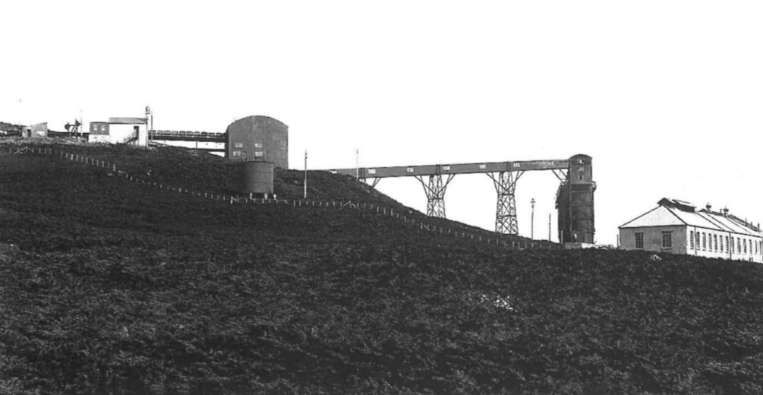
  13. https://commons.m.wikimedia.org/wiki/File:Marbleplatform.jpg, accessed on 5th May 2025.
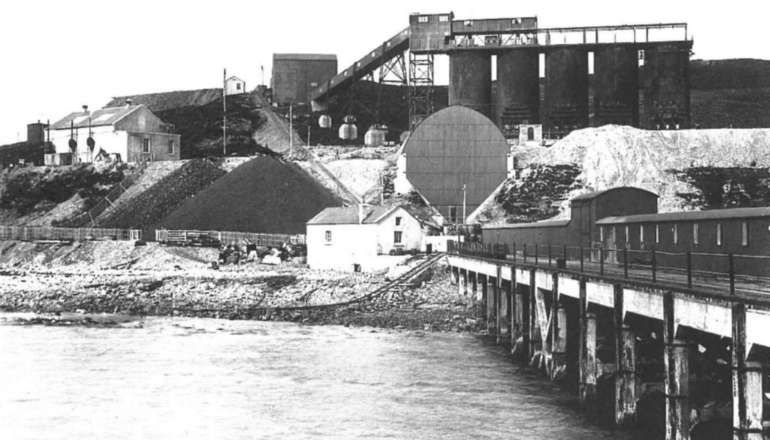
  14. https://www.facebook.com/share/p/18nfSEb5Tz, accessed on 1st June 2025.
  15. https://www.irsociety.co.uk/Archives/8/ireland.htm, accessed on 2nd June 2025.
  16. https://www.geograph.org.uk/photo/6174399, accessed on 2nd June 2025.
  17. https://her.highland.gov.uk/api/LibraryLink5WebServiceProxy/FetchResourceFromStub/1-2-3-6-5-8_bbb88b186fd2f2b-123658_cfeb7c1add15a5b.pdf, accessed on 1st June 2025.
  18. https://www.facebook.com/share/1G4ECRkrPn, accessed on 1st June 2025.
  19. https://farm8.staticflickr.com/7410/8725631309_1419a300d2.jpg, accessed on 2nd June 2025.
  20. https://www.britishnewspaperarchive.co.uk/viewer/bl/0000540/19130628/370/0003, paid subscription required (3rd June 2025).
  21. https://www.scottish-places.info/towns/townfirst9418.html, accessed on 3rd June 2025.
  22. https://canmore.org.uk/site/74987/skye-kilchrist-lower-quarry, accessed on 3rd June 2025.
  23. https://wp.me/pusRh-Qj, accessed on 5th May 2025
  24. https://youtu.be/EA_XhkwQwNc, accessed on 13th April 2025.

The Railways of Skye & Adjacent Islands – Part 4 – The Raasay Iron Mine Railway

There is an excellent book by Laurence & Pamela Draper, which they self-published in 1990, entitled “The Raasay Iron Mine: Where Enemies Became Friends.” I picked up a copy second-hand from an online sales site. That book covers the operation on Raasay in some detail. This article looks at the railways involved.

An extract from the Ordnance Survey 1″ Mapping of 1930 (Sheet 25) shows the line of the railway running North-northeast from the pier at Suisnish to Mine No. 1. A dotted line represents the line to Mine No. 2. [8]

Raasay Iron Mine

L. & P. Draper tell us that “Just before the First World War the Scottish coal and iron-ore mining, and iron-smelting, firm of William Baird and Company opened up an iron-ore mine on the Island of Raasay in the Inner Hebrides. … In association with the mine, Baird’s built several kilometres of narrow-gauge railway, a crusher, five calcining kilns, a huge ore hopper and a reinforced concrete pier. Many aspects of the installation, such as this pier, diesel-electric power generation and the provision of powerful external electric lighting, were very advanced for their time.” [1: pV][3: p146]

The BBC tells us that “William Baird and Co. Ltd … owned the Raasay estate and initiated the mine’s operations. The mine was developed just before the war and was crucial in providing iron ore for the British war effort, with the ore being transported to Ravenscraig for smelting.” [2]

Because most of the local men had been called up, Baird’s arranged for German Prisoners of War to work the installation from 1916 onwards. In permitting this, the British Government probably “contravened the Hague Convention which specifically banned the employment of Prisoners of War on munitions production; in 1920 the British Government attempted to destroy all relevant records, and was largely, but not entirely, successful. To enable prisoners to be used, the project was effectively nationalised (although that word was not actually used), with Baird’s operating it as agents for the Government; this was a standard system of management in the First World War. … Prisoners and local people worked in harmony together as colleagues, but relationships between Baird’s and the Ministry of Munitions were at times hostile. At the end of 1917 the local men, who were badly paid compared with men doing similar work elsewhere, went on strike, and there were allegations in Parliament that German Prisoners of War were being used as strike breakers, with a result that Winston Churchill himself made statements in response; these allegations were at best only half truths.” [1: pV][3: p146]

This map was reproduced in an article written by the Drapers for Der Anschnitt in 1999. It shows Baird’s initial plans for a railway were altered to move the kilns away from Suishnish House (modern spelling Suishnish). [1: p2]]3: p150]

A probable total of almost 200,000 tons of raw iron ore was produced over the life of the mines, which in the first instance ran until six months after the end of the First World War. “Everything was maintained in full working order, [but] almost the only further iron to be yielded, in the Second World War, came out as scrap from the dismantled installation itself.” [1: pV][3: p146]

L. & P. Draper tell us that, “After hostilities ceased on 11th November 1918 there was a rapid fall in demand for iron, and on 21st December 1918 the Government stated that it wished to terminate its agreement with Baird’s, asking: … do you want the prisoners after about the end of January 1919? … Baird’s said that it did, for a while, if the Ministry could take the output; otherwise the prisoners were not needed. … The Ministry was anxious that the whole installation should be shut down by 31st March 1919.” [1: p30]

It appears that there was probably no resolution between Baird’s and the government over ownership of remaining stocks of iron ore at the mine when it closed but L. & P. Draper note that in the years after the war, whenever a full load of coal was delivered to Raasay, the steamers involved left Raasay with a full hold of iron ore. [1: p31-32]

Soon after the war ended there was unrest on the island, partly because the fisheries had failed and partly because many of the veterans returned expecting that their interpretation of promises which had been made to them, that they would be re-located on more fertile ground, would be honoured. Following the example of many other Hebridean islanders since the latter years of the nineteenth century, they forcibly took over the south end of the island and some men served terms of imprisonment as a consequence. However, Baird’s sold the estate to the Scottish Board of Agriculture during the 1921-22 post-war crisis and many islanders were re-settled on land which they had coveted.” [3: p155-156]

ln the mid nineteen thirties, twenty years after its heyday, the installation was still in good working order as Baird’s had placed the works on a care and maintenance basis and employed a full-time 3-to-5 man crew … who kept the machinery in perfect working order. They painted the ironwork, including the large expanse of the end of the calcined-ore hopper, with red Iead, and ran the installation once each week. lt was capable of being started at relatively short notice at a time of national emergency. However, this was not to be, probably because of the cost of winning the relatively low grade ore, and after the onset of the Second World War the only iron to come from the site was the installation itself as scrap. lt is not clear whether the formal abandonment on 15th May 1941 was the beginning of dismantling, or just the date on which the
plan was drawn. … Three, if not all, of the kilns were taken to Lingdale, in Cleveland, Yorkshire where three were re-erected . They continued in intermittent production until about 1962. lt is not known which ones were rebuilt, but it seems likely that they were Nos 3, 4 and 5 which had been unused on Raasay.” [3: p156]

Raasay Iron Ore Mines Railways

No 1 Mine was connected to the pier at Suishnish by a virtually straight railway. A short steeply-inclined spur to the outcrop site left the main line at the entrance to No 1 Mine; No 2 Mine was connected by a spur from the main line. The railway led directly from the mines to the top of the crusher, on the hill overlooking the pier. Just below the crusher stood the kilns. An inclined railway connected the area just above the crusher down to the pier; this is also the route by which the coal was taken from the pier up to the crusher. Coal and iron ore were mixed in the crusher and taken by conveyor belt to charge the kilns. Below the kilns, more belts took the calcined ore to a hopper, from whence it was ultimately loaded onto ships at the seaward end of the pier.” [1: p33][3: p151]

Prior to the construction of the 4 ft. 6 in. railway the first output from the iron ore mine was transported by horse and cart down the narrow lane through Inverarish. [5: p78] But before the completion of the facilities near East Suishnish Pier, the incline was already bringing iron ore down from Mine No. 1 and the Outcrop Site.

We focus first on the railway infrastructure at the southern end of the line where the processing plant and pier were sited. The drawing below shows the layout of the site.

This hand-drawn map illustrated the arrangements at the Southern end of the operation on Raasay. It shows the layout of the various rail lines which served that part of the site. The main incline enters at the top of the sketch map. It brought the raw iron ore from the mine to the crushing plant. The crushed ore then was taken by an enclosed conveyor to the kilns where calcination took place. [4] It is of interest to note that the construction of the reinforced concrete pier was undertaken by Robert McAlpine and Sons, pioneers of the Glenfinnan and other concrete viaducts on the Mallaig railway line opened in 1901. [1: p33 and 35]
A first length of the line as shown on the satellite imagery provided by railmaponline.com. [10]
A second length of the line as shown on the satellite imagery from railmaponloline.com. [10]
Suisnish Pier appears at the bottom of this extract from Google Maps which allows us to see the line of the old railway without a superimposed purple line. As can be seen, the line of the old railway is still very evident in the landscape. The building shell to the West of the incline was a series of offices, from the Southeast these were a general office, a store (With a boiler underneath), a joiner’s workshop, a blacksmith’s workshop and an engineer’s workshop. To the right of the large hopper, the series of stone/brick structures are all that remains of the kilns. [Google Maps, May 2025]
East Suishnish (Suisnish) Pier in operation, note the wagons lined up on the pier. This T-shaped pier constructed of hand-mixed and reinforced concrete is 380 feet long and 25 feet wide. The pier frontage is 150 feet. The ore conveyor runs the length of the pier from the hopper to the 50 feet high ore conveyor loading-tower on the pierhead. The pier was designed by F.A. MacDonald and Partners, C.E. Glasgow and built by Robert McAlpine and Sons with teams of Irish labourers. [6][British Geological Survey: BGS C 2185]
Looking down from the former railway over the remains of the iron works and the pier from which the iron was shipped to Ravenscraig in Lanarkshire, © Anne Burgess and licensed for reuse under a Creative Commons Licence (CC BY-SA 2.0). [7]
This satellite image shows the area pictured in the photograph above. The pier extends from the bottom-left of the image towards its centre. The remains of the giant calcined-ore storage hopper are at the top of this image. At the top-right are some of the remains of the kilns. [Google Maps, May 2025]
Buildings adjacent to the incline, probably summer 1917; left to right: Ioads creeper hauler house (probably); pier incline hauler house; crusher (with circular oil storage tank); gantry; kilns; workshops and office. [3: p151][British Geological Survey: BGS C 2184]
The processing plant from the pier, probably in the summer of 1917. The giant calcined-ore storage hopper is just to the right of the centre of the image. It appears incongruous with its vertical iron face – looking much like a giant table-tennis bat! The concrete bases to the support gantries for the covered conveyor stand out to the left of the hopper, indicating that the plant was in a very new condition when the photograph was taken. [3: p151][British Geological Survey. BGS C 2183]

Two enlarged details from the image immediately above, show parts of the rail infrastructure on the site.

This first enlargement shows the steeply inclined line which ran down the side of the crusher to the pier. [3: p151][British Geological Survey: BGS C 2183]
This second enlarged extract shows the rail line running out onto the reinforced concrete pier. A short train of open wagons appears to be sitting on the rail line. [3: p151][British Geological Survey: BGS C 2183]

A third and a fourth extract, this time from photographs provided by the Munro Daughters for L. & P. Draper’s book, show the incline in use while the calcined-ore storage hopper was being constructed. …

This image is an enlarged extract from a photograph taken early during the construction of the calcined-ore storage hopper (1912?). The incline down towards the pier is already in use at this time and two short trains of wagons can be seen at the bottom. The line still.has to be extended out onto the pier, © Public Domain, courtesy of the Munro Daughters. [1: p35]
At a later date (1913/1914?), pier construction is well advanced by this time. Wagons can be seen again on the incline. This photograph shows the contractors railway lines running from close to the hopper to the end of the pier. There is an additional temporary line leaving that line and running towards the left side of the hopper, © Public Domain, courtesy of the Munro Daughters. [1: p38]

Perhaps it is worth noting here that the wagons used on the network were known as ‘hutches’. They were 5ft long overall, the body being 4ft long x 3ft wide and 2ft in height. Wheels were 1ft in diameter (1ft 2in over the flanges) and the axles were centred 1ft 6in apart. The overall height was 3ft 7in above rail height. [1: p65]

The hutches “were assembled from kits in the top of the crusher. They were pushed by hand initially, and were stiff until they were greased. …  4 wheels and 2 axles weighed 1 hundredweight 1 quarter 14 pounds (70kg). 200 sets were ordered on 28.4.13 and a further 100 on 5.6.14, so the mine must have had at least 300 hutches.” [1: p66]

Looking Southeast along the coast of Raasay at Suishnish showing the reinforced concrete pier with the hills of Skye and Scalpay, and perhaps the Scottish mainland beyond. [My photograph, 7th May 2025]
A view of Skye from the landward end of the Suisnish Pier. [Google Streetview, November 2021]
Looking North-northeast from the landward end of the pier. The large Calcined ore hopper remains are just to the right of centre. The offices and workshops are to the left of the image. Just above the hopper the line of kiln remains can be seen (camouflaged by the lie of the land. [Google Streetview 2021]
Looking North-northeast from the base of the incline, the route of which can clearly be made out, © Anne Burgess and licensed for reuse under a Creative Commons Licence (CC BY-SA 2.0). [9]
A view of the ironworks site and pier from the Northeast. [Google Streetview, June 2009]
A view across the reinforced concrete pier from the incline towards Skye. [My photograph, 7th May 2025]
The offices and workshops seen from the incline. From left to right these were: a general office; a store (With a boiler underneath); a joiner’s workshop; a blacksmith’s workshop; and an engineer’s workshop. [My photograph, 7th May 2025]
Looking Southeast from the incline, through the remaining bases of the kilns. [My photograph, 7th May 2025]
Just to the East of the incline looking North through the concrete foundations of the conveyor gantry. [My photograph, 7th May 2025]
From a point a little further North on the incline, the two concrete blocks in the foreground are two of the bases on which the enclosed gantry and conveyor were built. Beyond the blocks are the bases of the kilns. [My photograph, 7th May 2025]
At the North end of the series of concrete foundation blocks looking North, uphill into the remains of the crusher house. [My photograph, 7th May 2025]
The Hauler House at the top of the lower incline, seen from the incline, © John Alan and licensed for reuse under a Creative Commons Licence (CC BY-SA 2.0). [11]

The Pier Haulage Road was in 3 sections. The lower one, at a gradient of about 1 in 4.5, extended for 67 metres, the middle one at about 1 in 10 for 25 metres, and the upper one at about 1 in 4 for 83 metres. At the bottom of this incline the track was diverted around a huge L-shaped concrete block designed to catch runaways. … The hauler house … was used solely for haulage on the incline above the pier.” [1: p63]

The railway was, apart from the lower section, the Pier Haulage Road, largely double track. It was multi-level in the vicinity of the processing plant and the incline to the Outcrop Site was single track. Rails were 30lbs/yard, spiked into sleepers. Where there was traffic across the rails an inverted U-shaped bridging rail was used. [1: p65]

The track plan of the rails around the processing plant provided by the Drapers shows a complex arrangement with some very tight radius curves. It is not surprising that the ‘hutches’ needed to have a short wheelbase.

Track layout in the vicinity of the Crusher House. [1: p66-67]
The same building, the Hauler House, seen from further North on the second incline. The mountains of Skye sit beyond the Sound of Raasay. [My photograph, 7th May 2025]

L. & P. Draper tell us that the extensive system of narrow gauge lines were 2ft 3in gauge. The main line “extended in a straight line … from the pier root up an incline, the ‘Pier Haulage Road’, to a level ore storage area above the crusher and on to the No 1 Mine entrance at a distance of 2.6 kilometres. … At a distance of 1.4 kilometres from the pier a straight spur, 0.9 kilometre in length, left the main line … to No 2 Mine. … The junction layout is shown [below].” [1: p63]

The incline climbs to the North. [My photograph, 7th May 2025]
This telephoto shot shows the incline continuing to the North and shortens the distance to the mountain in the distance, which is Dunn Cana (Caan). [My photograph, 7th May 2025]
Looking back towards Skye from within the shallow cutting in the previous pictures. [My photograph, 7th May 2025]
Further North and looking North, the incline remains relatively clear of vegetation. [My photograph, 7th May 2025]
Railmaponline.com shows the line continuing North. [10]
Continuing North. [My photograph, 7th May 2025]
And again, further North and looking North. Dun Caan has dropped below the horizon as we continue the climb. [My photograph, 7th May 2025]
Railmaponline.com shows the location of the junction between the lines toMine No.1 to the North and Mine No. 2 to the Northwest. Just to the South of the junction, the remains of the Hauler House for the line to Mine No. 2 can be seen. [10]
Approaching the location of the junction from the South: the remains of the Hauler House sit close to the centre of the image. [My photograph, 7th May 2025]
The railway junction between the line to/from Mine No. 2 and the main line which ran between the pier and Mine No. 1. [1: p40]
Looking Southeast along the line of the railway built to serve Mine No. 2. The line passed under that serving Mine No. 1. The bridge was between the camera and the Hauler House. [My photograph, 7th May 2025]

Heading North from the junction, the route of line to Mine No. 1 now runs through a protected area where deciduous native trees have been planted among sparce examples of older trees.

The route of the incline is a waymarked path. For the most part it is a relatively easy walk. A section of the line crosses what is now a plantation protected from deer to allow newly planted native trees to mature. [My photograph, 7th May 2025]
The route of the old railway continues North through the plantation. [My photograph, 7th May 2025]
Railmaponline.com’s satellite imagery shows the line serving Mine No. 1 continuing North-northeast on the same alignment as the line South of the junction. The planted area can be made out at the bottom of this image. It is also possible to make out the line of the stream valley that the line had to cross. It runs diagonally from the bottom-centre of the image to the left side of the picture. [10]
The line continued North towards the location of the viaduct. [My photograph, 7th May 2025]
The remains of the viaduct come into view as the land begins to drop away. [My photograph, 7th May 2025]
The Southern abutment of the three span viaduct which carried the line to Mine No. 1 over the valley of a tributary of the Inverarish Burn.
A view North from the top of the Southern side of the valley. The two tall concrete columns remain in place but the bridge deck is long gone. Note the steep, stepped path on the North side of the valley. [My photograph, 7th May 2025]
The Northern abutment of the viaduct remains in place but it has lost the westernmost pilaster. [My photograph, 7th May 2025]

Apart from minor cuttings and embankments to maintain the design gradient on the incline and the structures immediately  around the junction, there were only two significant structures. Both were viaducts: that on the main line carried it over a ravine formed by a tributary of Inverarish Burn, that on the line to Mine No. 2 carried it over Inverarish Burn and Fearns Road. The Drapers tell us that these viaducts were “of iron girders with a decking of timbers measuring 12in x 6in in section. They had iron railings on each side, and the one to No. 2 Mine had steel-plate sides to prevent ore accidentally falling onto the road below.” [1: p65]

This photograph of the viaduct carrying the line to Mine No. 1 appears in L&P Draper’s book courtesy of John MacLeod. [1: p64]

North of the viaduct on the line serving Mine No. 1, the railway continued in a North-northwest direction towards the mine, continuing to climb towards the mine buildings.

North of the Viaduct the line continued in a North-northeast direction. Leaving the plantation area on its way North. [My photograph, 7th May 2025]
The old mine buildings can now ne made out ahead. A narrow lane converges on the line of the old railway, this is the road to Fearns. [My photograph, 7th May 2025]
Looking down to Raasay Sound from the upper reaches of the incline. The ferry can be seen on the right of the image. [My photograph, 7th May 2025]
Railmaponline.com’s satellite imagery shows the remaining mine buildings towards the top-right of this extract. The line heading Northeast from the remains of the mine buildings enters the mine. That running approximately East is a separate single-track incline which links the outcrop of the iron ore at the surface back to the mine buildings. [10]
The final approach to the mine buildings at Mine No. 1. The last length of the railway incline was in cutting. [My photograph, 7th May 2025]
The bridge carrying the narrow road to Fearns over the old railway. The entrance to the mine can just be made out to the immediate right of the bridge parapets. [My photograph, 7th May 2025]
The bridge carrying Fearns Road, seen this time from the North with the mine buildings on the right, © Richard Dorrell and licensed for reuse under a Creative Commons Licence (CC BY-SA 2.0). [13]

At the northern end of the railway incline, the line from the pier extended into the mine entrance of No. 1 Mine. It first passed under the road to Fearns before also passing under a separate incline which connected the facilities at the mine entrance to the surface workings where the iron bearing strata was exposed at ground level – the outcrop site. L. & P. Draper produced the drawing below which is based on the historic Ordnance Survey mapping.

Mine No. 1 and the Outcrop Site. [1: p46]
This extract from the railmaponline.com satellite imagery shows the full length of the single track incline notes above. [10]

The arrangement of the two rail lines is illustrated in the photograph below. …

The entrance to Mine No. 1. Two rail lines can be seen entering the mine. One of these lines has what appears to be a loaded wagon (hutch) sitting just outside the mine entrance. The bridge built to carry the incline serving the Outcrop Site can be seen in the foreground. The construction of that line has clearly only recently reached the tracklaying stage (the rails are incomplete). The diagonal line on the right of the image is a blemish/fold on the original. Towards the top of the fold it partially obscures the mine’s fan house. [1: p50][British Geological Survey: BGS C 2178]
Mine buildings: the two visible in this photograph are the checker’s office and the Compressor House. The road overbridge is just off the picture to the left. [My photograph, 7th May 2025]
Further mine buildings: on the left, the Checker’s Office; in the centre, the Weighbridge Office; and behind, the Hauler House [7th May 2025]
Mine No. 1’s fan house, high on the hill above the mine buildings and mine entrance, © Public Domain. [b3tarev3, 7th May 2012][12]
One of two information boards at Mine No. 1. [My photograph, 7th May 2025]
A closer view of the panel in the bottom-right of the above image. [My photograph, 7th May 2025]
The left side of the information board shows what is claimed on the board to be the world’s first caterpillar digger. This machinery was used at the Outcrop where minerals could be accessed from the surface without the need for a mining adit. This Bucyrus steam dragline was imported from the USA and arrived on Raasay in 1917. [My photograph, 7th May 2025]
The interior of Mine No. 1, © Public Domain. [b3tarev3, 6th May 2012][12]

Having covered the full length of the main line to Mine No. 1, we turn to the branch line serving Mine No. 2.

We did not walk the route of the line which served Mine No. 2: the first part of.  its route is shown on this extract from railmaponline.com’s satellite imagery. The purple line on this map extract stops short of Fearns Road and Inverarish Burn. The line continued North-northwest across the road and the burn on a three span viaduct. The abutment of the viaduct remains but the bridge decking was removed for scrap some decades back. The viaduct was of the same design as that on the line to Mine No. 1 with additional steel panels attached to the deck parapets over Fearns Road to prevent accidental spillage onto people using the road. [10]
This extract from railmaponline.com’s satellite imagery extends the lilac line across the valley of the Inverarish Burn to a terminus at the location of Mine No. 2. Fearns Road is shown running across the image with the Burn at its North. The Valley was crossed by a three-span viaduct to a very similar design to the viaduct on the line to Mine No. 1. Its location is marked by the three parallel lilac line. [10]

Only the abutments and piers of the viaduct carrying the line serving Mine No. 2 remain. The  four images below show this remains.

The southern abutment of the viaduct. [Google Streetview, November 2021]
The first pier to the North of Fearns Road. [Google Streetview, November 2021]
The second pier. [Google Streetview, November 2021]
The northern abutment, the camera lens has a drop of water just at the critical location! [Google Streetview, November 2021]
Another view of the piers of the viaduct on the line to Mine No. 2, © Public Domain. [b3tarev3, 7th May 2012][12]

Mine No. 2 only saw very limited use and closed relatively quickly after it opened.  L. & P. Draper are of the opinion that, “because of severe faulting there was virtually no production from No 2 Mine, which must have been an expensive white elephant considering the cost of constructing the high viaduct, hauler house and other mine-head buildings. However, it was not entirely unused, as Baird’s built a sawmill by No 2 Mine, and all timbers used in the mine, for pit props, railway sleepers, power poles and other purposes were sawn there and transported by rail.” [3: p153]

The two entrances to Mine No. 2, circa 1917, as sho0wn on the information board at the location of Mine No. 2, © Public Domain. [My photograph, 7th May 2025][British Geological Survey: BGS C 21…]
The interior of Mine No. 2, © Public Domain. [b3tarev3, 7th May 2012][12]
The fan house for Mine No. 2, © Public Domain. [b3tarev3, 7th May 2012][12]
Part of the public information board at Mine No. 2. [My photograph, 7th May 2025]
A closer shot of part of the information board. Mine No. 2 was the ‘mine that never was’: The infrastructure for Mine No. 2 was put in place but severe geological faults meant it could never be used. Only the railway viaduct, hauler house and giant fan house remain. Forestry workers later built a sawmill on the site in the 1950s. [My photograph, 7th May 2025]
The remains of the sawmill which was built at the location of Mine No. 2. [My photograph, an extract from the public information board. 7th May 2025]
The view into the site of Mine No. 2 from the public road. The information board can be made out near the centre of the image. [Google Streetview, November 2021]

References

  1. Laurence Draper & Pamela Draper; The Raasay Iron Mine: Where Enemies Became Friends; L. & P. Draper, Culbokie, Dingwall, Ross-shire, 1990.
  2. https://www.bbc.co.uk/programmes/p029zg20#:~:text=Listen%20now-,Isle%20of%20Raasay%2C%20Scotland:%20Raasay%20Iron%20Ore%20Mine,majority%20returned%20to%20their%20homeland, accessed on 7th May 2025.
  3. Laurence Draper & Pamela Draper; The Iron Ore Mine on the Hebridean Island of Raasay, North West Scotland: Where the labour force consisted largely of German prisoners
    of the First World War [PDF]; Der Anschnitt 51, 1999, H4, p146-156; via https://www.bergbaumuseum.de/fileadmin/forschung/zeitschriften/der-anschnitt/1999/1999-04/anschnitt-4-1999-laurence-draper-pamela-draper-the-iron-ore-mine-on-the-hebridean-island-of-raasay.pdf, accessed on 7th May 2025.
  4. Calcination is a process which involves a controlled burn of crushed ore mixed with imported coal. It is specifically designed to draw off water and unwanted minerals from the iron ore but without heating it to a temperature which would result in the production of metallic iron.
  5. Alexander Nicolson; Handbook to the Isle of Skye and Adjacent Islands; Archibald Sinclair, Celtic Press, Glasgow, 1936.
  6. https://geoscenic.bgs.ac.uk/asset-bank/action/browseItems?categoryId=1118&categoryTypeId=1, accessed on 13th April 2025.
  7. https://www.geograph.org.uk/photo/5761169, accessed on 13th April 2025.
  8. https://maps.nls.uk/view/74400582, accessed on 18th May 2025.
  9. https://www.geograph.org.uk/photo/5759597, accessed on 18th May 2025.
  10. https://www.railmaponline.com/UKIEMap.php, accessed on 19th May 2025.
  11. https://www.geograph.org.uk/photo/746790, accessed on 20th May 2025.
  12. https://www.flickr.com/photos/b3tarev3/albums/72157629614668258/with/7165934136, accessed on 27th May 2025.
  13. https://www.geograph.org.uk/photo/2097118, accessed on 27th May 2025.
  14. Not used.
  15. https://www.flickr.com/photos/b3tarev3/albums/72157629614668258/with/7165952142, accessed on 8th May 2025.

The Railways of Skye & Adjacent Islands – Part 1 – Loch Cuithir to Lealt

Derived from the remains of microscopic fossilized sea or freshwater algaes, diatomite is a naturally occurring, versatile mineral used in an array of applications from cosmetics to filtration. [4] It was harvested by drag line from Loch Cuithir in the late 19th century and the first half of the 20th century.

This unique form of silica has an elaborate honeycomb structure, peppered with thousands of tiny holes ranging from a few microns to submicron diameters. No other silica source, be it mined or artificially produced, presents such a structure. Some diatomite deposits are saltwater but most are from freshwater sources. … When ground, this profusion of shapes results in an extremely low-density powder known as ‘diatomaceous earth’ (DE) which has excellent absorption properties that are highly prized for filtration, agriculture, paints, plastics, cosmetics, and pharmaceuticals application.” [4]

Diatomite was also used in the production of dynamite. [2][3]

The route of the tramway/railway as recorded on railmaponline.com’s mapping. [5]
Sketch Map showing the extraction point at Loch Cuithir (on the left), the route of the tramway and the factory site (on the right). [6]
A closer view of loch Cuiithir, a drag-line was used here to extract diatomite. [6]
The tramway brought diatomite down to the processing plant on the seashore which is at the right of this expanded view. [6]
Loch Cuiithir seen from the West. Looking down from close to the summit of Flasvein onto the remnants of Loch Cuithir. From this high vantage point the outline of the original loch can be picked out. It was drained to these three shallow pools during the excavation of diatomite in three separate periods between the late 19th century and the 1960s. The deposits were up to 45ft deep and extended to over 20 acres, © John Allan and licensed for reuse under a Creative Commons Licence (CC BY-SA 2.0). [10]

Possibly as early as 1885 [1] but certainly by 1889, [2][3] work was underway at this site. A 2ft [2][3] or 2ft 6in [1] gauge tramway was being constructed in 1889 from the drag-line at Loch Cuithir to Lealt. The tramway followed the River Lealt down to its mouth at Invertote. When first opened the line was worked by gravity and manpower. Apparently, later in the life of the line a small steam locomotive was in use. [2][3]

At the “Western end of the line … at Loch Cuithir, … diatomite – known locally as Cailc (Scottish Gaelic for chalk) – was taken out from the loch bed and dried on wire nets. The seaward terminus had warehouses on the cliff-top at Invertote. At the base of the cliff was a factory where the diatomite was kiln dried, ground and calcined. [A] line … extended from the factory onto a pier into the Sound of Raasay.” [2][3]

Diatomite was also gotten from Loch Valerain and transported by aerial ropeway to Staffin Bay and on along the coast to Invertote Apparently, “during its existence, the Skye Diatomite Company extracted 2000 tons of diatomite. … From Invertote, the diatomite was transferred by skiff, onto puffer boats, waiting in the bay, and shipped across to the mainland. The diatomite was turned into kieselguhr which was mixed with nitroglycerine by Nobel Industries, at Ardeer, to make dynamite.” [2][3]

Stornoway Gazette described the operation as follows:

Over the years, the mine saw periods of inactivity, but when up and running operations made use of the large industrial works at the area – a large factory building, a railway with embankment cuttings, and a rolling stock traversing three miles of landscape, including an aerial ropeway. The light railway was used to transport the Loch Culthir Diatomite to the shores at Invertote for a final drying and grinding, and a large building containing a furnace, grinding machine and storage space was constructed there for this purpose. Such modernised business works were quite remarkable for this part of the world at the time. In those days there was no road between Staffin and Portree, so a puffer boat would anchor in the bay at Lealt, and local skiffs were used to transport the finished Diatomite from shore to boat, ready for shipping to the mainland. There were around 40 to 50 people steadily employed at Lealt, yet on days that the boat came in this total rose to as many as 80 workers.” [7]

Perhaps one of the most intriguing aspects of the mine’s history comes from the ownership of the drying factory at Invertote by Germans. Although closed during the period of the Great War, surprisingly the now enemy foreign residents were allowed to stay on. Shortly afterwards a rumour began to circulate that the area was haunted and that the ghost of a recent tragic death at the Lealt falls had appeared at the factory. As the local story goes, (the rumour was actually started by the Germans) with the intent of keeping locals away. It turned out that the resident Germans were spies and that, almost unbelievable to the community, the area was being used as a German base with submarines surfacing in the sea bay!” [7]

Moving on, the year 1950 saw the next development in the mining of Diatomite from Loch Cuithir. As the loch was one and a half miles up the moor, through peat bogs and rivers, the Department of Agriculture and Fisheries for Scotland (DAFS) decided that a road should be built, with the intention of extracting the Diatomite by digger, and then taking it to the Lealt road end above Invertote. The road took around a year and a half to build, during which the mine was put out of operation. Yet, when production started again, the new method of extraction did not reach the high standard of quality which was achieved when extracted manually by spades. The mechanical extraction resulted in the Diatomite being less pure, and full of unwanted dirt. Drying the substance is, in fact, the problem of the process, for it is obvious that in a damp climate like Skye, the diatomite does not lose its moisture quickly. The problems which began after the construction of the 1950s road were further highlighted and compounded six years later. A new factory was built at Uig (the site where the Cal Mac offices are now situated), far from the mining site at Loch Cuithir, and it may be said that this move was the ruining of the entire Diatomite industry upon Skye. As Diatomite was no longer dried at Invertote it now had to be transported by road, wet, for the much-needed drying process to Uig, 23 miles away. A vehicle may have left Loch Cuithir carrying five tonnes of Diatomite, yet only producing one tonne of the finished product after drying had taken place – a finished product which was also not as pure as it ought to be for the specialised work it had to do in various products. A lot of money was wasted on travelling, and within the factory itself, inefficiency was also present, with machinery often breaking down due to the damp state of the Diatomite. Outside the factory, the scenic communities of Trotternish also began to suffer. When the factory was working, it poured out a fine white dust which covered every house in the area. Grass became chalky in colour and after dry spells in the weather, the road-sides from Staffin to Uig would turn white with Diatomite – Uig was constantly under a cloud of dust. With complaints of insubstantial profits and bad management, the factory was finally closed to production for the last time in 1960. Yet, although the Diatomite mining industry on Skye came to an abrupt ending, it was still regarded by many locals as a blessing at the time. Following from World War One, the industrial works provided employment for many returning men who could not find work elsewhere in the island. And at peak production, around 1955/56, 50 to 60 men were paid good wages to work at the factory.” [7]

Bell & Harris tell us that “Loch Cuithir is located upon landslipped material, which overlies Upper Jurassic strata. Only parts of these diatomite workings remain. Some of the brick buildings, together with the line of the tramway used to transport the diatomite to the coast, are still obvious. The diatomite occurred as a 3–6m-thick horizon below a 1m covering of peat. The loch had an original area of 60 hectares (24 acres) and was drained in order to extract the diatomite. Ditches, around the perimeter of the loch, were excavated and the water was drained through a man-made outlet at the northern end of the loch, thus allowing removal of the peat and extraction of the diatomite. East of the drainage outlet are spoil-heaps, mostly of plateau lava boulders, presumably removed from the workings during excavation. The diatomite from this deposit was very pure, with little or no interlayered silt or mud. Macadam (1920) notes that the calcined (heat treated) diatomite contains over 96% [Silicon Dioxide](reported in Anderson and Dunham 1966), whilst Strahan et al. (1917) gave a value of 98.78%. According to Macadam (1920), the absorptive value of the material from Loch Cuithir was over 3.56 (a good diatomite would have an absorptive value in excess of 4.0).

Some excellent photographs of the derelict factory at Invertote can be seen here. [8]

The Route of the Tramway/Railway

From Loch Cuithir, the railway ran in a Southeasterly direction over boggy ground. Minimal earthworks were undertaken placing the railway at a level just above surrounding ground.

The orange line on this extract from railmaponline.com’s satellite imagery is the route of the old railway. The white line shows the route of the road built to provide access to Loch Cuithir from Lealt. [5]
Remnants of a brick structure close to Loch Cuithir. [My photograph, 30th April 2025]
The line of the old railway to the South of the access road. The abutments of a bridge over a stream mark its route. [My photograph 30th April 2025]
The location of another bridge with just the stone abutments remaining. This photograph was taken back in 2013, © Gordon Brown and licensed for reuse under a Creative Commons Licence (CC BY-SA 2.0). [11]
Looking back along the route of the old railway towards Loch Cuithir which some distance off to the right of this image. Running from the Loch, the line enters this image from the right and curves round towards the foreground. Its route is defined by the light green corridor through the heather. [My photograph, 30th April 2025]
Still looking approximately to the Southwest, this view shows the route of the railway as it approached the track to the loch. [My photograph, 30th April 2025]
Much closer now to the road crossing, this photograph was taken back in 2013, © Gordon Brown and licensed for reuse under a Creative Commons Licence (CC BY-SA 2.0). [12]
The next length of the line. At the bottom left, the point at which it crossed the line of the track can be seen. A long straight length running Northeast follows. [5]
Looking Northeast across the point at which the road crosses the line of the old railway. [My photograph, 30th April 2025]
Just beyond the crossing point and looking Northeast along the line of the railway. [My photograph, 30th April 2025]
The old railway route runs Northeast as the road turns East. [My photograph, 30th April 2025]
The railway ran on a relatively straight path while the road seeks to follow the contours alongside the River Lealt. [5]
The line continues in a Northeasterly direction. [5]
Further Northeast along the line of the railway. [My photograph, 30th April 2025]
While some distance from the road the railway formation turns to the East. [5]
Evidence of historic cultivation alongside the line can be seen South of the line. These were lazy beds, a method of arable cultivation where parallel banks of ridge and furrow were dug by spade. [5]
Continuing generally in an Easterly direct the route of line passes to the North of modern housing in Lealt. [5]
The line ran to the North (the right) of the building in this view. [My photograph 30th April 2025]
It ran Southeast towards Invertote. [5]
Across open moorland. [My photograph, 30th April 2025]
The road from Loch Cuithir is on the left the railway runs from the centre distance towards the camera. [My photograph, 30th April 2025]
The old railway alignment and the modern road converge as they head East. [5]
Looking West the old railway formation joins the modern road from the right. [My photograph, 30th April 2025]
The road sits on the old railway formation approaching the present A855. [My photograph, 30th April 2025]
The road drops off the old railway formation to run down to its junction with the A855. [My photograph, 30th April 2025]
The railway terminated at the cliff top. Loads may have been transported by aerial ropeway down to the factory which sat just above sea level. [5]
The remains of the Diatomite Factory can still be seen just above the beach at the mouth of the river. [5]

The Canmore National Record of the Historic Environment profiles these notes:

One of the greatest causes of interest in Skye Diatomite was its potential use as a substitute for Kieselghur by Alfred Nobel in the production of Dynamite in Nobel’s new Scottish factory at Ardeer in Ayrshire during the 1880s. Nobel eventually found a better source of material, but the Extraction of Diatomite nevertheless began in Skye at Loch Cuithir in 1886. The Diatomite was transported by tramway to be processed at Invertote, production continuing until 1913. The industry was briefly revived between 1950 and 1961, using road transport.” [13]

The principal remains of the Invertote works are a large, rubble-built, rectangular-plan roofless building (NG5201 6049). It has been entirely gutted, but fragmentary remains include a large cast-iron flywheel from a steam engine, and a cast-iron wall-mounted bearing box. The other surviving structure is a kiln (NG5201 6052), comprising a lower chanber or firebox built from Scottish firebricks (produced at the Star Works, Glenboig, Lanarkshire, and Etna Works, Armadale, West Lothian), onto which has been constructed a circular-section fireclay-brick column encased by an outer layer of sheet steel. The exact functions of the processing building and the kiln are uncertain, but it is likely that the latter was used for drying purposes.” [13]

References

  1. https://www.isbuc.co.uk/Sights/Rail.php, accessed on 13th April 2025.
  2. https://en.wikipedia.org/wiki/Lealt_Valley_Diatomite_Railway, accessed on 13th April 2025.
  3. https://web.archive.org/web/20080513044619/http://www.stornowaygazette.co.uk/back-in-the-day/SKYE-DIATOMITE-A-LOST-INDUSTRY.3847089.jp, accessed on 13th April 2025.
  4. https://www.imerys.com/minerals/diatomite, accessed on 1st May 2025.
  5. https://www.railmaponline.com/UKIEMap.php, accessed on 1st May 2025.
  6. https://canmore.org.uk/collection/1017056, accessed on 1st May 2025.
  7. Stornoway Gazette, 5th March 2008; via https://www.scottishbrickhistory.co.uk/diatomite-mines-isle-of-skye, accessed on 1st May 2025
  8. https://www.28dayslater.co.uk/threads/lealt-valley-diatomite-factory-skye-june-2021.129161, accessed on 1st May 2025.
  9. B. R. Bell & J.W. Harris; An excursion guide to the geology of the Isle of Skye; Geological Society of Glasgow, 1986; via https://earthwise.bgs.ac.uk/index.php/The_Loch_Cuithir_diatomite_deposits,_Skye_-_an_excursion, accessed on 1st May 2025.
  10. https://www.geograph.org.uk/photo/748488, accessed on 1st May 2025.
  11. https://www.geograph.org.uk/photo/3481387, accessed on 1st May 2025.
  12. https://www.geograph.org.uk/photo/3481377, accessed on 1st May 2025.
  13. https://canmore.org.uk/event/835753, accessed on 1st May 2025.