
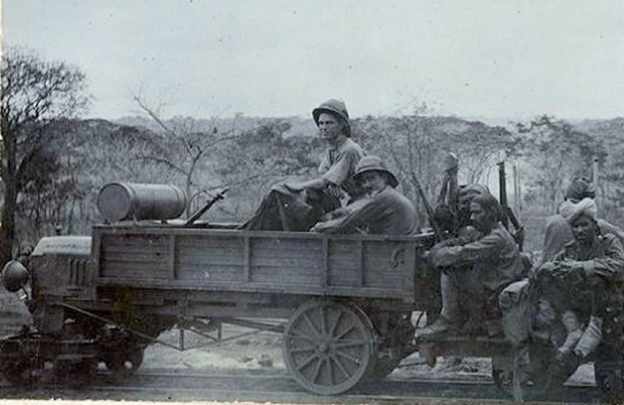
600 mm gauge trolley lines (often known as Feldbahnen or “field railways”) played a crucial role in the East African Campaign of World War I, particularly in German East Africa (GEA) where they were used for both industrial and military logistics. These narrow-gauge systems were used to connect coastal areas, plantations, and interior supply depots to the main standard-gauge (1,000 mm) railways, or directly to the frontline.
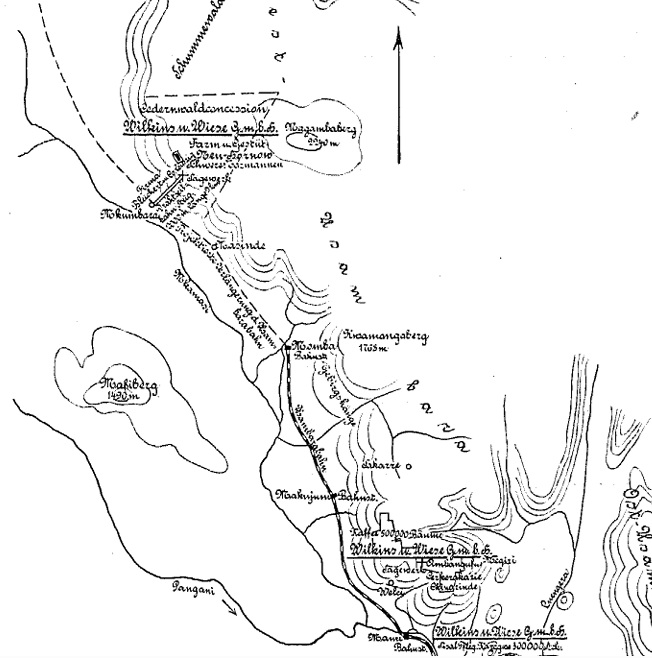
Numerous privately owned 600 mm gauge Sisal Plantation Railways operated throughout the coastal and Tanga regions of German East Africa. These lines linked the plantations to factories and ultimately to the port at Tanga. During the first world war these were adapted for military use and transported troops, supplies and weapons.
In 1917, the Lukuledi Valley Line, a 600 mm trolley line in the Lukuledi Valley was extensively used to supply the German forces in the south of GEA and to evacuate their casualties to Lindi.
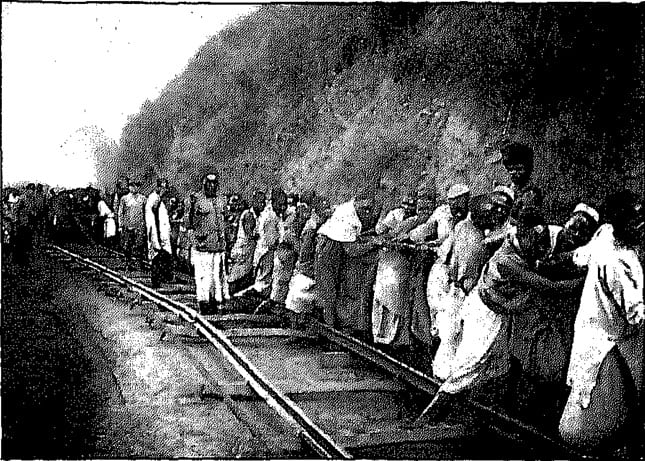
These light railways allowed the German Schutztruppe, led by Lieutenant Colonel von Lettow, to move heavy loads (such as artillery pieces from the sunken cruiser Königsberg) across difficult terrain without relying on limited road infrastructure. The lines often used prefabricated track segments. Trolleys were frequently moved by hand-pushing by local porters or workers, though sometimes small locomotives or tractors were used.
As British forces moved South into German East Africa from early 1916 onwards they were able to make extensive use of these 600mm lines, and built their own 600 mm light railways particularly in the later stages of the campaign as they pushed deeper inland where transport infrastructure was non-existent. The British made use of some small locomotives which had been in use on Sisal plantations before the war but also tractors designed for use on these lines.
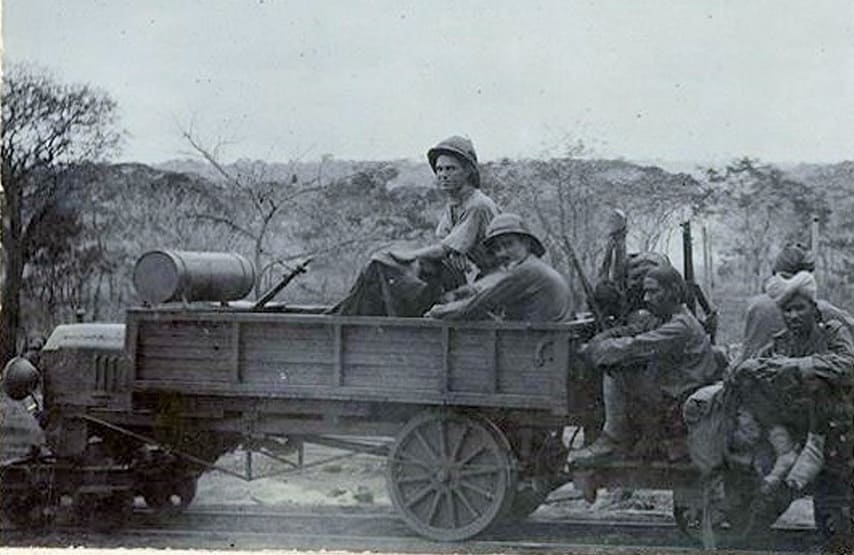
A number of these 600 mm lines are referred to by Harry Fecitt in an article entitled “The Indian Railway Corps East African Expeditionary Force, 1914-1919” the majority of which is is reproduced in Appendix A below.
Fecitt describes the work of the Indian Railway Corps as part of the advance Southwards into German East Africa by British forces. He notes that from Mombo station as far as Handeni the Germans had built a hand-powered field railway (trolley line) of 600 mm gauge to “Handeni, 65 kilometres to the south. The 25th Railway Company assisted the Royal Engineers in restoring this line as it had been partially destroyed, and on completion this trolley line was very useful for moving supplies in support of General Smuts’ advance to Morogoro.” [1: p8]
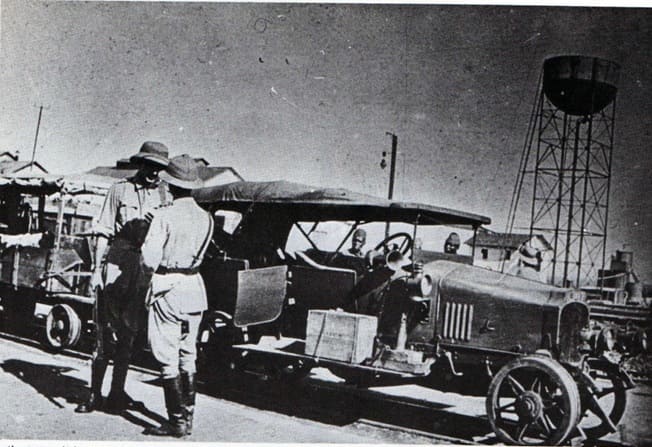
He notes also that a similar 600 mm gauge line had been constructed by the Germans from “Korogwe … towards Handeni. The materials for this line came from abandoned German farms and plantations and the locomotion came from adapted Ford cars used as tractors and operated by the East Africa Motor Transport Corps.” [1: p9]
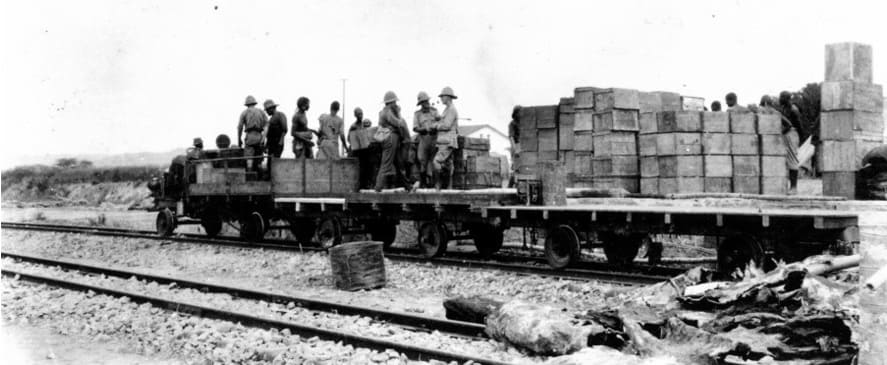
In British hands, these lines were very short-lived. Fecitt talks of the construction by the British of another 600 mm line as they moved South through German East Africa. The British “developed Kilwa Kisinjane as a port where men and supplies could be landed. Commencing in November 1916 a 600 mm tramway was built by the Corps from the ocean to Kilwa Kivinje, a distance of 26 kilometres, and then onwards for a further 24 kilometres. The construction material was produced by stripping the trolley lines previously built from Mombo and Korogwe. Motor tractors were again used and a driver company and a supporting maintenance company were formed from mechanical transport personnel; these companies became sub-units in the Railway Corps.” [1: p13]
Apparently, “the driving of tractors on railway lines, especially around curves, was not as easy as many potential drivers thought and de-railings with consequent damage were frequent. Sixty more tractors were ordered from India and 50 more from South Africa; these were all converted Ford cars with bogie trucks in place of the front axle and with heavier back axles and box bodies. The first 16 kilometres of track was duplicated but in broader gauge and steam trains ran along it, allowing swifter movement of men from the port to the first camp site where water was available. In July 1917 further construction was authorised at Kilwa and the 600 mm line was extended to Lungo, Mile 84, by November. On this line, which had a slight gradient, each box-body tractor pulled two trailers with a total load of up to 2.72 metric tonnes (3 tons).” [1: p13-14]
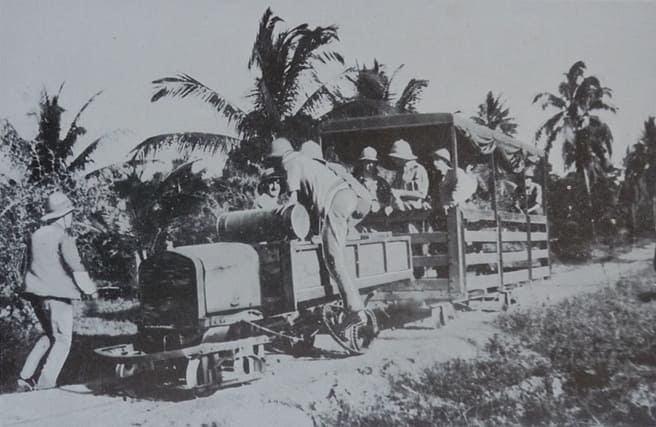
Further to the South, and inland from the port at Lindi which was 110 km South of Kilwa, there was an existing trolley line running from a jetty on the Lukuledi River which ran into Lindi Harbour, to former German plantations. The line had also been used by the German military. It was estimated that 30 kilometres of track could be recovered from the German line. A British line was then constructed heading inland from Lindi, using recovered materials where possible, by the 25th Railway Company. “On 27th August the line was open to Mtua and proved to be very useful in quickly evacuating wounded men as well as in carrying forward supplies. In this month, the 27th Railway Company arrived at Lindi, and support was provided by the South African Pioneers and the 61st (King George’s Own) Pioneers. Unskilled labour was badly needed and this problem had to be solved by moving down large labour gangs from the Usumbara and Central Railways. A few small steam engines were found on various plantations and put to use on the line. When the tractors from India arrived it was found that their axles had been made from inferior steel and they broke at the rate of two or three a day. This problem was compounded by severe rates of sickness that affected most of the Corps. At the beginning of November only 9 tractors out of 36 were working and only two mechanics were manning the workshops.” [1: p15]
“Later in the month the Kilwa line was closed down and personnel were redeployed to Lindi where the Corps base was relocated, however the movement of badly needed materials and plant was delayed by shipping shortages. Railhead reached Ndanda, Mile 62, on 27th February 1918 and the decision was made to stop the line there.” [1: p15]
In November 1917, the Lindi line was still in use, with Army Service Corps men driving supplies from railhead into Portugese East Africa (PEA).
Much further North in Nairobi, a 13 km line was constructed from the town to the vast King’s African Rifles (KAR) Depot Camp at Mbagathi; the running of this line was handed over to the KAR.
In September 1918, “as the Germans in PEA were observed to be moving northwards, the Lindi line was ordered to be extended 30 kilometres to Massasi. The 28th Railway Company which was stood-by to sail for India quickly returned to Ndanda and started the work. Concurrently permission was obtained to raise an African Pioneer Company to replace the 28th Company. Suitable men were recruited from maintenance gangs on the Central Railway and from labour that had worked on the Mbagathi trolley line. The Lindi line reached Massasi in mid-November just as General von Lettow … still undefeated and then in Northern Rhodesia, now Zambia, accepted the Armistice terms decided in Europe and agreed to surrender. The 28th Railway Company sailed for India.” [1: p16]
References
- Harry Fecitt; The Indian Railway Corps East African Expeditionary Force, 1914-1919; via https://gweaa.com/wp-content/uploads/2012/02/The-Indian-Railway-Corps-East-African-Expeditionary-Force_1.pdf, 16th March 2026.
Appendix A – The Indian Railway Corps East African Expeditionary Force, 1914-1919
Introduction
In early August 1914 India was tasked with providing Indian Expeditionary Forces (IEFs) ‘B’ and ‘C’ for service in East Africa, and the provision of a Railway Corps was included in the organisation of IEF ‘B’ that was destined for German East Africa (GEA). The 25th and 26th Railway Companies, Sappers & Miners, under Majors C.F. Anderson and C.W. Wilkinson, both Royal Engineers, along with the Traffic and Locomotive Reserve of the two companies were mobilised at Sialkot and Quetta. Each company was around 300 men strong; an accompanying Coolie Corps of 300 men was raised mostly from the relatives of the company personnel. The officers were nearly all civilian railway officers of the Indian State Railways or Royal Engineer officers employed under the Indian Railway Board. The skills included survey, construction and operation. Major Anderson was medically repatriated soon after arrival and Lieutenant H.L. Woodhouse, Royal Engineers, then commanded the 25th Railway Company. Sir William Johns CIE was appointed Director of Railways.
The Indian Railway Board provided equipment sufficient for the repair and running of a section of the German East Africa railway. This equipment included 10 miles (16 kilometres) of 50-pound track, a large surplus of sleepers, 15 locomotives, nearly 200 trucks, a large number of pine baulks, a number of 20-foot and 40-foot bridge spans, cranes, pile drivers, machine tools, hand tools of all sorts, survey instruments, tents and office necessities. The companies brought out their own telegraph equipment but this was later handed over to the Indian Telegraph unit that carried out all the telegraph work of the railways and tramways.
Initial Employment in British East Africa
The Railway Corps arrived in two ships at Tanga in GEA where IEF ‘B’ was scheduled to land. Tanga was the Indian Ocean terminal of the German Usambara Railway that ran to Moshi near Mount Kilimanjaro; the British later named this line The Northern Railway. IEF ‘B’ failed to defeat the German force at Tanga and re-embarked; the Railway Corps stayed on its ships throughout the Tanga fight. IEF ‘B’ then steamed up to Kilindini, the port at Mombasa in British East Africa (BEA). Mombasa was the ocean terminal for the British Uganda Railway that ran up to Lake Victoria. IEF ‘B’ disembarked at Kilindini on 9th November 1914 and merged with IEF ‘C’ that had arrived in BEA in September.
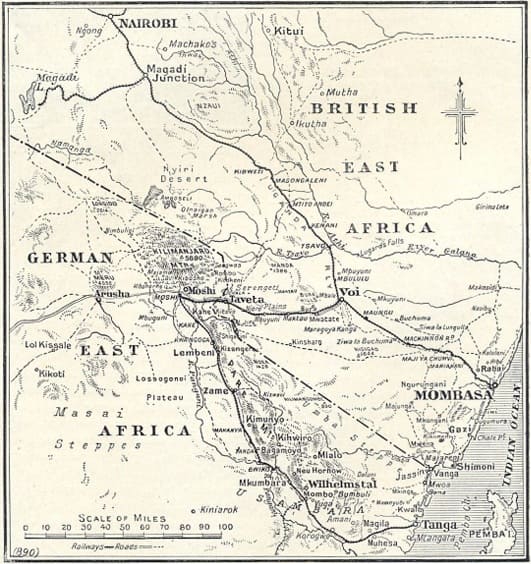
A Railway Corps survey party commenced delineating a route for a military railway from Voi on the Uganda Railway westwards towards Moshi in GEA. The Railway Companies took over the defence of the Uganda Railway, sections of which were under threat from enemy raiding parties from GEA. Once all the stores had been landed it was decided to return most of the locomotive and traffic staff and the civilian officers to India, from where they could be easily recalled. In late December the two companies were moved from railway defence to construction work on the Kajiado to Longido road; better use was now made of their technical expertise and qualifications in the construction of roads, fortified posts and water supplies. The 25th Company went to Namanga and Longido and the 26th Company was based at Bissel.
Railway Construction
In February 1915 the decision was made to construct the first 40 miles (65 kilometres) of the one metre-guage military line from Voi towards Moshi in order to connect the military posts at Bura and Maktau. Twenty five miles of track were sent from India, 5 Miles were borrowed from the Uganda Railway, and the Corps already possessed 10 miles. The Railway Board in India continued its excellent support to the Corps by delivering to site the 25 miles of track only seven weeks after receiving the indent in India. The specialists were recalled from India and the companies were moved to Voi; material was moved up from Kilindini.
The construction method used was that one company laid track whilst the other worked ahead building the next bridge. Local labour for bush-cutting and earthworks was recruited from the Wataita tribe with the help of the District Commissioner and a missionary of the Church Missionary Society. The Wataita proved to be intelligent men who were quick learners. The 61st (King George’s Own) Pioneers had also landed with IEF ‘B’ and it had recently been employed in prolonging the Coonoor Railway to Ootacamund; when not tasked elsewhere the Pioneers provided useful support to the Corps. As the railhead advanced the Coolie Corps took over the maintenance of the track.
The Voi River was crossed and the first station opened at Mile 6.5 on 16th April. Heavy monsoon rains set in during May delaying the movement forward of supplies as the line needed constant repair and maintenance. On 31st May the bridge and station at Bura were opened at Mile 22. From now on the railway had to carry troops, supplies and water between Voi and Bura as well as construction material. The first section of the line was completed to Maktau on 23rd June. Whilst the railhead was advancing a big effort had been put into making Voi a suitable terminus for the military line. A workshop had been constructed, engines and rolling stock were brought up from Kilindini, a large store yard was established and an armoured train was built.
An unescorted Wataita earthwork gang was fired on by a German patrol and four men were wounded on 9th June; the Wataita were undeterred and asked if they could bring their bows and arrows to the worksite in future. The military line was blown up for the first time five days later, and after that the Germans blew the line every week, usually at around 2000 hours. This suited the repair gangs as they could make overnight repairs before the first morning train was run. The German demolitions were never very effective. On one occasion a train carrying the 130th (King George’s Own) Baluchis (Jacob’s Rifles) was pushing a truck loaded with sepoys’ kits ahead of it when an enemy mine detonated under the truck. A gap 0.75 metres in length was blown out of one of the rails but the complete train successfully passed over the gap and proceeded, with passenger and cargo damage being confined to some of the sepoys’ kits. The Germans had more success when attacking the Uganda Railway as that line often ran through desolate country and could be approached more easily.
A British attack at Mbuyuni, west of Maktau, failed on 14th July and that failure halted extension of the line. During this halt the companies constructed field works and defences and put in crossing stations and sidings on the Uganda Railway. A regular train service was introduced between Voi and Maktau and a Train Control System was installed. A second indent for 30 miles of track was sent to India and it arrived two months later. On November 13th 1915 the Director of Railways was placed in control of the Uganda Railway. This was done in order to ensure intimate cooperation between the Uganda Railway and the military line during the planned British offensive in early 1916. Officers and men of the Railway Corps were posted to the Uganda Railway whose operations were effectively militarised.
Platelaying began again in January 1916 and Mbuyuni, Mile 53.25, was reached on the 25th of that month, the Germans having withdrawn from the location two days earlier without fighting. Thousands of South African, British, Rhodesian, Indian and African troops were now being housed in camps along the military line and the supply of water in railway travelling tanks to these camps was a vital task for the Corps. Some relief was obtained when the engineers ran a pipeline from Bura, where the water was sourced, to Maktau. The British attacked Salaita Hill, west of Mbuyuni, on 12th February but the attack failed, the enemy counter-attacking to the railhead at Lanjoro, Mile 60.
Moving into German East Africa
The Germans withdrew from Salaita Hill and moved to defend the Latema-Reata hills just west of Taveta on the GEA and BEA border. The Corps pushed the military line westwards through dense bush, following up the advancing British troops. From drafts arriving from India and from within the existing Railway Companies the 27th Railway Company, Sappers & Miners, was formed; the Company Commander was Captain R.E. Gordon, Royal Engineers. This allowed the Corps to continue platelaying in dangerous territory whilst providing its own security. The Lumi River was crossed and Taveta reached, Mile 75, on 23rd March. After a tough fight the Germans had withdrawn from the Latema-Reata position on 12th March, allowing the Corps to lay track over a saddle between the two hills.
The enemy was demolishing the Usambara Railway line as he withdrew down it and once Moshi was in British hands a half-company of the Corps repaired the track from Moshi to the Ruvu River. Meanwhile the railhead was advanced over what was the toughest stretch on the entire military line. The monsoon rains again fell heavily but three rivers were crossed and a dense forest penetrated; the soil was black-cotton and quickly became marsh resulting in platelaying being achieved under water. A junction with the Usambara line was made 20 kilometres below Moshi and 40 kilometres from Taveta on 25th April. This was just in time for the British troops in Moshi who had lost their road from Taveta to the monsoon rains and floods, and who now relied upon supplies arriving by train.
The South African General J.L. Van Deventer was tasked by the British theatre commander, General J.C. Smuts, to advance south-westwards through Arusha and Kondoa Irangi to the German Central Railway line that ran from Dar Es Salaam on the Indian Ocean coast to Lake Tanganyika in the interior. To assist the supply columns supporting the South Africans in getting across a large number of bad drifts on the initial stage of the road the Railway Corps was tasked with pushing a line westwards from Moshi over the Garanga River to Sanja, Mile 21 on this new short line. Sanja was reached by the end of June. At this time the 28th Railway Company, Sappers & Miners, arrived from India commanded by Captain. E. St.G. Kirke, Royal Engineers, raising the establishment of the Railway Companies to that of a battalion. Lieutenant Colonel C.W. Wilkinson, Royal Engineers, was appointed Commandant of the Railway Battalion which became a unit in the Railway Corps.
Reconstructing the Usambara Railway
On 14th May reconstruction of the Usambara Railway south of Ruvu commenced; the Germans had demolished the Ruvu bridge but the Corps 7 erected an 18-metre girder bridge on 20th May. From then onwards on the 320 kilometres of track leading to Tanga every bridge had been destroyed. However the demolitions had been hasty and planned ineffectively and the Corps could quickly make track diversions or re-build bridges. In many places the track had been torn up and the fastenings thrown into the bush, in other places the fastenings only had been removed, and elsewhere each alternate rail joint had been blown up. The track was repaired through Lembeni, Same, Makania, Hedaru and ‘German Bridge’ stations, the latter being reached on 20th June. ‘German Bridge’ was the last suitable crossing point over the Pangani River until Maurui is reached 80 kilometres further on. The Germans had started building a bridge here and the British completed the construction.
Just beyond ‘German Bridge’ is Buiko, 180 kilometres from Tanga and the mid-point in the line. Mombo station, Mile 75, was opened on 29th June; from here the Germans had built a hand-powered field railway (trolley line) of 60 centimetres gauge to Handeni, 65 kilometres to the south. 25th Railway Company assisted the Royal Engineers in restoring this line as it also had been partially destroyed, and on completion this trolley line was very useful for moving supplies in support of General Smuts’ advance to Morogoro.
Fighting in the Infantry Role
On 4th July, railhead reached the Pangani River near Maurui and by the end of the month had reached Korogwe. However the German theatre commander, Colonel Paul von Lettow, had early in July tasked 500 or more of his troops as a ‘stay behind’ group to harass the British lines of communication in the area between Tanga, Maurui and Handeni. This enemy group successfully made a nuisance of itself by attacking convoys, mining roads, cutting telegraph and telephone lines and sniping from the bush. An attack by 170 German troops with a light gun had been repulsed at Zugunatto Bridge by the Jind Infantry on 13th July; the soldiers from the Princely State of Jind were amongst the best of the British troops. General Smuts ordered his Inspector General of Communications Brigadier General W.F.S. Edwards, a former BEA policeman, to resolve this problem. As Edwards had no spare infantry he decided to use the 25th and 26th Railway Companies, Indian Sappers and Miners, along with a few infantrymen, and reported this to General Smuts who made no comment. But Edwards did not confer with the Director of Railways who badly needed those two companies to stay on the job of railway restoration in order to alleviate supply problems. After dark on 13th July the two companies with 100 Jind Infantry, 50 British other ranks and 100 sepoys, moved out from Korogwe tasked with attacking Segera Hill and Mfumbile. Captain E. St.G. Kirke, Royal Engineers, commanded the companies and Lieutenant Colonel Wilkinson commanded the force.
The Railway Companies did well on Segera Hill, getting up to a machine gun, killing the German NCO in charge and capturing the gun in a bayonet assault. The German force withdrew hurriedly but counterattacked next day. The companies were up to their new task and broke the enemy assault. Lt Col Wilkinson now moved across country to deal with an enemy force at Hale, found that it had withdrawn to Kwa Mugwe, moved there and drove the enemy rear-guard away and then repelled another German counter-attack on 19th July. In these operations the machine guns of the accompanying Jind Infantry gave the Railway Companies the supporting firepower that they needed. The companies then returned to their railway duties, having taken a few casualties but doubtless with many war stories to tell. On 18th August Tanga was reached and the port and railway came into use for moving supplies from Kilindini to Korogwe where another 60-centimetre trolley line was constructed towards Handeni. The materials for this line came from abandoned German farms and plantations and the locomotion came from adapted Ford cars used as tractors and operated by the East Africa Motor Transport Corps.
Incidents on the Central Railway
The Royal Navy along with infantry units advancing from Bagamoyo seized Dar Es Salaam, the GEA capital, on 4th September. A reconnaissance of the Central Railway between Morogoro and Dar Es Salaam showed that all bridges were down. Two Railway Companies were shipped to Dar Es Salaam to start repairing the track from that end and the other two were shipped to Bagamoyo; from Bagamoyo they moved overland to the dropped bridges over the Ruwu River which urgently needed reconstruction. The line was repaired for light use to Morogoro and mechanical transport units converted a selection of lorries to rail tractors, allowing the South African Pioneers to run a supply service westwards to Dodoma, 240 kilometres from Morogoro. Each tractor could pull 15 tons of trucks and freight. Further work was needed before the heavier steam trains could use the line but Dodoma was being supplied from Dar Es Salaam by steam trains on 1st January 1917. The South African Water Supply Corps gave constant support to the Railway Corps whenever a water supply point or a pumping station needed to be established, and large numbers of labourers from the South African Native Labour Corps were supplied to support the Corps; unfortunately many of these Africans succumbed to tropical diseases.
The Germans had destroyed many engines and trucks on the line but again their demolition work was unsatisfactory and did not greatly hinder the Corps. Troops from the Belgian Congo, now the Democratic Republic of the Congo, had crossed Lake Tanganyika and fought their way to Tabora, where 40 engines and 200 trucks were found basically undamaged. These were shared with the Belgians. The Railway Corps moved its base from BEA to Dar Es Salaam but immediately had to support the engineers restoring the docks there; Corps cranes were used to unload ships and the companies constructed jetties and slipways. In January 1917 Major L.N. Malan, Royal Engineers, took over command of the Railway Battalion from Colonel Wilkinson who became Deputy Director of the Railway Corps.
In April 1917 a branch line was constructed from Dodoma on the Central Railway southwards towards the Ruaha River. 26th, 27th and 28th Railway Companies were involved in the work which lasted until August, when railhead reached Matikira, Mile 28. The country was very difficult to cross and the lack of shipping to bring down sleepers from Kilindini caused delay. As soon as this short line was no longer needed the rails were recovered and used elsewhere.
A bad accident occurred on the Central Railway on 5th May when a re-built bridge at Mkata collapsed at night in heavy rain, due to an original German pier proving to have insufficient foundations. Sixteen gunners from 24th (Hazara) Mountain Battery (Frontier Force) and four Askari from the King’s African Rifles were drowned when their cattle trucks fell into the swollen river. Many other men were badly injured when they were flung against weapons and stores in the trucks. 26th Railway Company was deployed to restore the damaged line.
On 29th August 1917 the station at Kahe, where the military line from Voi joined the Usambara Railway from Moshi, was unexpectedly attacked by enemy troops, causing consternation amongst rear-echelon elements in Nairobi. An enemy raiding party had broken away from the German forces in southern GEA and had advanced northwards across the Central Railway, attacking British and Belgian locations; former German Askari enthusiastically joined the raiders. Elements of the party got up to Lake Victoria and one small group attacked Kahe. Two trains were captured as they approached the station, then looted and burned. Three British officers were taken prisoner, the Station Master was mortally wounded and a number of porters and labourers were killed. Before withdrawing the Germans started one of the two trains and let it run towards Taveta, but an Indian engine driver who had escaped into the bush jumped into one of the two engines on the train and brought it under control. When the train was at a safe distance from Kahe the driver disconnected the carriages and drove the engines to Taveta, where he was given a prompt military award.
A Trolley Line in the Kilwa Area
Moving south the British now developed Kilwa Kisinjane as a port where men and supplies could be landed. Commencing in November 1916 a 60centimetre tramway was built by the Corps from the ocean to Kilwa Kivinje, a distance of 26 kilometres, and then onwards for a further 24 kilometres. The construction material was produced by stripping the trolley lines previously built from Mombo and Korogwe. Motor tractors were again used and a driver company and a supporting maintenance company were formed from mechanical transport personnel; these companies became sub-units in the Railway Corps.
However tropical diseases and ailments such as malignant malaria were now affecting the Corps badly and often far more men of all trades were sick than were at work. Also the driving of tractors on railway lines, especially around curves, was not as easy as many potential drivers thought and de-railings with consequent damage were frequent. Sixty more tractors were ordered from India and 50 more from South Africa; these were all converted Ford cars with bogie trucks in place of the front axle and with heavier back axles and box bodies. The first 16 kilometres of track was duplicated but in broader guage and steam trains ran along it, allowing swifter movement of men from the port to the first camp site where water was available. In July 1917 further construction was authorised at Kilwa and the 60-centimetre line was extended to Lungo, Mile 84, by November. On this line, which had a slight gradient, each box-body tractor pulled two trailers with a total load of up to 2.72 metric tonnes (3 tons).
Construction activities at Lindi
A hundred and ten kilometres south of Kilwa more port facilities were developed at Lindi, which had a fine natural harbour. A British force was moving into the interior and needed a railway to follow it. Steam trains were ruled out because shipping was not available to move the necessary materials and rolling stock from Dar Es Salaam and Kilindini, so another 60-centimetre tractor line was started. This was helped by the fact that an existing trolley line led from several former German plantations to a jetty on the river running into Lindi Harbour; it was estimated that 30 kilometres of track could be recovered from the German line.
The 25th Railway Company deployed to Lindi in June and commenced work, following the British advance. Survey work on both the Lindi and Kilwa lines was sometimes interrupted the appearance of both lions, rhinoceros and elephants, and occasionally by the approach of enemy patrols who were engaged and driven off. On 27th August the line was open to Mtua and proved to be very useful in quickly evacuating wounded men as well as in carrying forward supplies. In this month the 27th Railway Company arrived at Lindi, and support was provided by the South African Pioneers and the 61st (King George’s Own) Pioneers. Unskilled labour was badly needed and this problem had to be solved by moving down large labour gangs from the Usumbara and Central Railways. A few small steam engines were found on various plantations and put to use on the line. When the tractors from India arrived it was found that their axles had been made from inferior steel and they broke at the rate of two or three a day. This problem was compounded by severe rates of sickness that affected most of the Corps. At the beginning of November only 9 tractors out of 36 were working and only two mechanics were manning the workshops.
Later in the month the Kilwa line was closed down and personnel were redeployed to Lindi where the Corps base was relocated, however the movement of badly needed materials and plant was delayed by shipping shortages. Railhead reached Ndanda, Mile 62, on 27th February 1918 and the decision was made to stop the line there. By then General, as he now was, von Lettow … and his slimmed-down German army were moving deeper into Portuguese East Africa (PEA), now Mozambique.
The Run-down of the Indian Railway Corps in East Africa
By November 1917 the 25th Railway Company was medically unfit for work with its strength at less than 40 fit men, and it was returned to India in March 1918. The 26th and 27th Railway Companies were in a similar condition and in May they also returned to India. 28th Railway Company remained in the field and all recent arrivals and returnees from leave were posted into that company. The Lindi line continued to be used and Army Service Corps men drove supplies from railhead into PEA; sadly many of these European drivers succumbed to tropical diseases and are buried in East Africa. As the East African Force was slimmed down Directorates were abolished and in March Sir William Johns left the theatre after handing over the Railway Corps to Colonel Wilkinson.
Up in Nairobi a tramway 13 kilometres long was constructed from the town to the vast King’s African Rifles (KAR) Depot Camp at Mbagathi; the running of this line was handed over to the KAR. The line from Voi to Tanga was practically on a peace footing and the Central Railway was being converted to commercial use. The arrival of 100 new tractors from South Africa, the increased use of steam traction, and a big improvement in the health of the personnel meant that soon the Lindi line was running very efficiently.
In September, as the Germans in PEA were observed to be moving northwards, the Lindi line was ordered to be extended 30 kilometres to Massasi. The 28th Railway Company which was stood-by to sail for India quickly returned to Ndanda and started the work. Concurrently permission was obtained to raise an African Pioneer Company to replace the 28th Company. Suitable men were recruited from maintenance gangs on the Central Railway and from labour that had worked on the Mbagathi trolley line. The Lindi line reached Massasi in mid-November just as General von Lettow-Vorbeck, still undefeated and then in Northern Rhodesia, now Zambia, accepted the Armistice terms decided in Europe and agreed to surrender. The 28th Railway Company sailed for India.
The Indian Railway Corps retained responsibility for railways in East Africa until January 1919, when civilian direction and personnel replaced it. The Corps had done an excellent job, tackling the diverse and serious challenges that East Africa presented in a most professional manner. Credit for the performance of the Corps must be attributed to the support provided by the Indian Railways Board and the Corps of Royal Engineers, but above all else to the skill, adaptability and perseverance of the men of the Railway Companies, Sappers & Miners. Shabash!
 Roger Farnworth
