
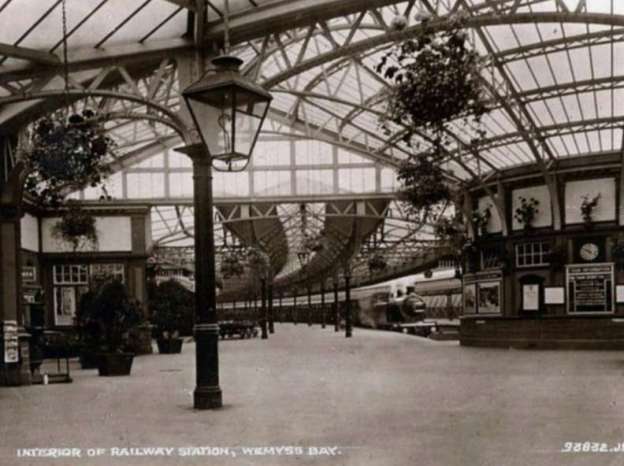
We enjoyed a visit to Wemyss Bay Railway Station in early May, while we were waiting for the ferry to the Isle of Bute.
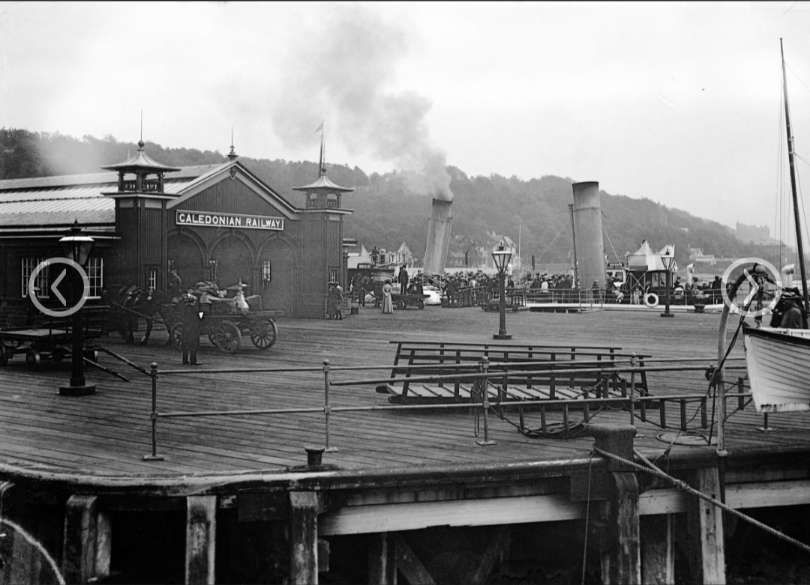
The featured image for this article shows Wemyss Bay Railway Station from the covered walkway to the pier. A steam-powered service from Glasgow has just arrived, © Public Domain. [29]
“Wemyss Bay was formerly part of a large landed estate centred on the 15th century Kelly Castle. By the mid-19th century it had been split in two distinct areas, Wemyss and Kelly. The Wemyss [estate] was bought by Charles Wilsone Brown who built Castle Wemyss, and sold off plots … and developed a marine village.” [13]
“In 1860, [Castle Wemyss] was bought by John Burns, a partner in the Cunard Steamship Company, who would later become Lord Inverclyde. The Inverclyde family held the estate until 1957, after which it was developed for housing.” [13]
“In 1867, the Kelly estate was bought by Dr James (Paraffin) Young, friend of Dr David Livingstone, and then in 1899 by Alexander Stephen of Linthouse, who rebuilt the third version of Kelly House on a higher site. Sadly, it was destroyed by fire in 1913, and demolished. [In the 21st century], the site is a … holiday park.” [13]
In 1812, “‘Comet’, the world’s first seagoing, passenger steamship was launched at Port Glasgow. … The resulting development of the Clyde steamers was the start of a transport revolution. As the Victorian era developed, the Clyde became lined with docks and shipyards handling Scotland’s growing world trade. Glasgow became known as the ‘second city of the Empire’ and expanded rapidly.” [13]
In order to “escape the grime and congestion of the city, its wealthy merchants and industrialists began to build holiday homes along the Clyde coast.” [13] Partially as a result of these developments along the Clyde coast, the Glasgow, Paisley and Greenock Railway opened a railway line. “At the time, the River Clyde was heavily used by Clyde steamers, but it was impassable for larger sea-going vessels, which anchored at the Tail of the Bank for transshipment at Greenock, and transfer of passengers.” [3]
The railway soon attracted considerable goods and passenger traffic. “In particular passenger traffic grew considerably. The traffic to resort locations on the Firth of Clyde and other coastal places, was especially encouraging, and the steamer trade became lucrative.” [3]
At the time, total journey time — rail and ship— “was considered critical. As a pioneer railway, the Greenock company had not given thought to this, but slowly the disadvantage of the Greenock station became more prominent. The walk from the railway station to the Quay was through squalid streets, and the steamer transit to the lower Clyde involved a circuit round Kempock Point and Cloch Point to reach the seaway.” [3]
By 1851, the Glasgow, Paisley and Greenock Railway had been taken over by the Caledonian Railway.
A different company, the Greenock and Wemyss Bay Railway obtained an Act in 1862 which permitted it to “form a junction with the Greenock line a short distance West of Port Glasgow station; it would then climb and run round to the South of Greenock, then following the valley of the Spango Burn to a station on the hillside above Inverkip, then turning South to a pier station at Wemyss Bay.” [3]
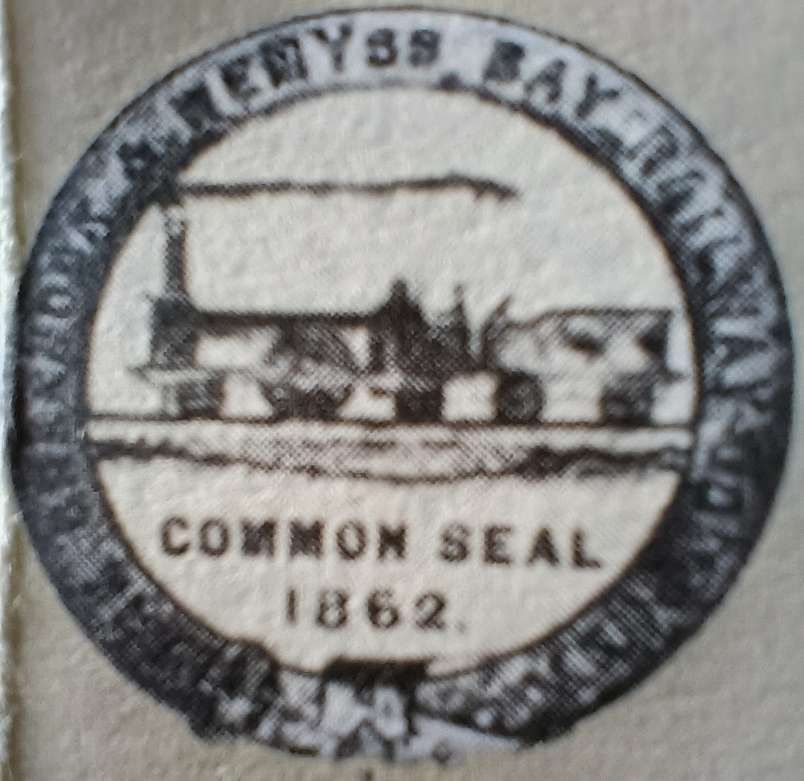
The line was opened to traffic on 15th May 1865, but the early years after opening were challenging for the Company. Its railway was operated for it by the Caledonian Railway. An independent ‘Wemyss Bay Steamboat Company Limited’ operated steamers in connection with the trains. However this meant that the railway company was completely dependent on two other concerns for the conduct of its business, and reliability problems on the railway and in operating the steamers led to a poor reputation. “After four years, the Wemyss Bay Steamboat Company failed (in 1869), and the Rothesay connections, on which the Wemyss Bay Railway relied, were made by other steamer operators as part of their wider network of routes. …To add to the difficulties, the industrial development confidently expected at Upper Greenock failed to materialise, and the lands acquired there were sold off at a loss.” [3]
The Friends of Wemyss Bay Station note that, “The fare for a return first class ticket to Wemyss Bay was 3/6d, a third class return, 2/9d. (18p and 14p). The first class return to Rothesay, with cabin, was 3/9d (19p); third class with cabin was 3/-(15p), according to a Glasgow Herald newspaper advert in May 1865. That was almost two days’ pay for an unskilled labourer. Places served by the steamers included Rothesay, Largs, Millport and Ardrishaig. Largs did not have its own railway until 1885. The original station was designed in the style of a Victorian villa, to be in keeping with the substantial houses being built in the area.” [13]
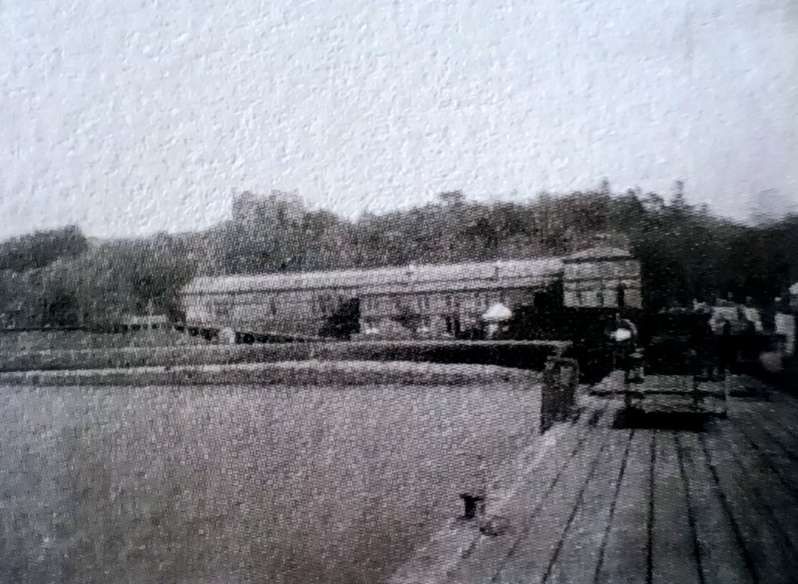
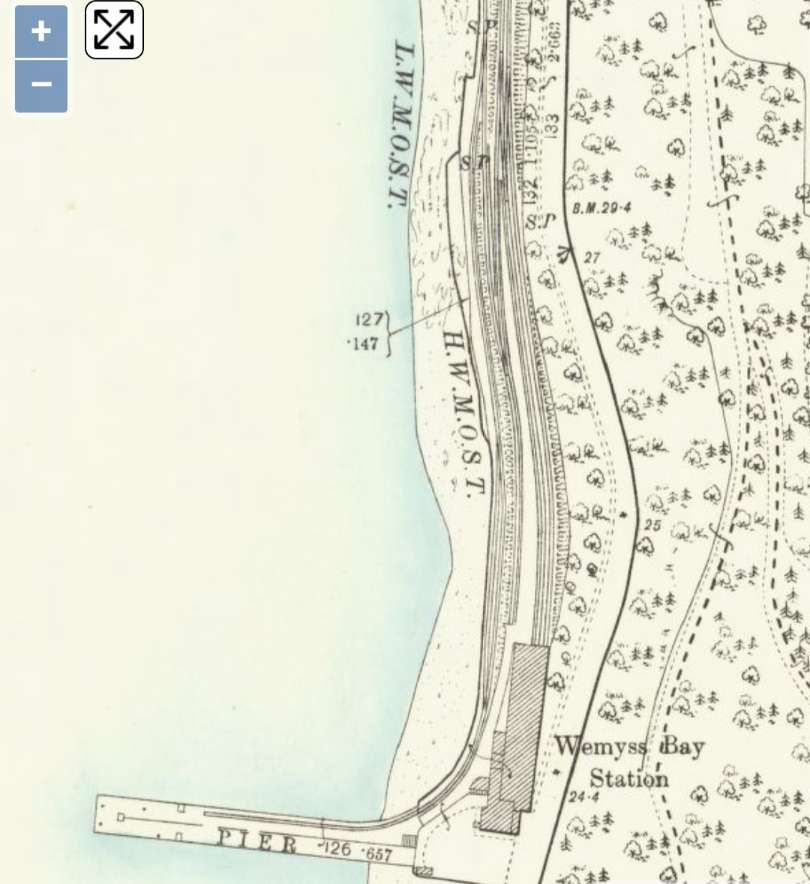
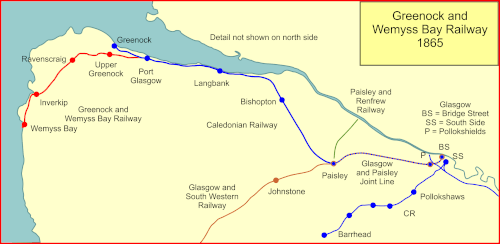
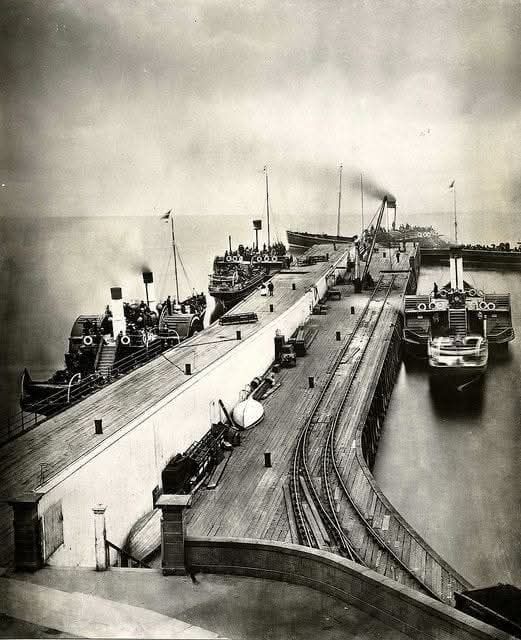
Originally the train shed at the station housed only a single platform, a second platform was added in 1872. The Friends of Wemyss Bay Station note that, “As well as the steamer traffic, the railway was attracting significant development in Wemyss Bay and Skelmorlie.” [13]
Things began to improve significantly for the Greenock and Wemyss Bay Railway when the Caledonian Railway’s plans to extend its line to Gourock were frustrated. Wemyss Bay became an attractive route. “The Greenock and Wemyss Bay Railway was able to pay its first dividend, a remarkable 5½%, in 1878.” [3]
The more stable financial situation, heralded by the first dividend payment by the Greenock and Wemyss Bay Railway, “enabled more harmonious working, and the disadvantageous circumstances of the Caledonian’s operation at Greenock made the Wemyss Bay route more attractive to them. Widespread talk of amalgamation was put into effect: in August 1899 the ‘Glasgow Herald’ announced that the Wemyss Bay company was to be absorbed. In fact the announcement was premature, but the agreement to amalgamate had been finalised, and from this time the two companies co-operated more fully. The actual amalgamation was authorised by an Act of Parliament on 27th July 1893, [5] and took effect on 1st August 1893.” [8: p78-79][9]
“For some years the relationship between the Wemyss Bay company and the Caledonian had been prickly, the smaller company believing that its interests were not being taken into account. In January 1887, the Wemyss Bay company applied to the Railway and Canal Commissioners to compel the Caledonian to transfer their trains to Glasgow Central station: at that time they were still using the less convenient (to the public) Bridge Street; but the application failed. [5] (Bridge Street continued to be used for Caledonian operations from the Paisley direction until 1905.)” [3][6] However, the Friends of Wemyss Bay Station note that in 1890, “Trains from Wemyss Bay started running to Glasgow Central Station. [Also in 1890,] the Caledonian Steam Packet Company took over operation of the steamers from Wemyss Bay.” [13]
In 1893, “The Caledonian Railway Company took ownership of the Wemyss Bay line and soon drew up plans for improvements. … The old station and pier had become quite inadequate for the number of people using them. Trips on the steamers to the Clyde coast were very popular. Holidays had become a real possibility for many people, transforming quiet towns, such as Millport and Rothesay, into coastal resorts. … Hydropathics and hotels were built for the use of the wealthy; the less well-off rented a room elsewhere. Many well-to-do families spent the summer in their handsome stone-built villas on the coast, with the head of the household travelling by steamer and train to business in Glasgow.” [13]
“In 1901 the extension of Wemyss Bay pier was completed. The new pier was twice the size of the old one and could accommodate five steamers.” [13]
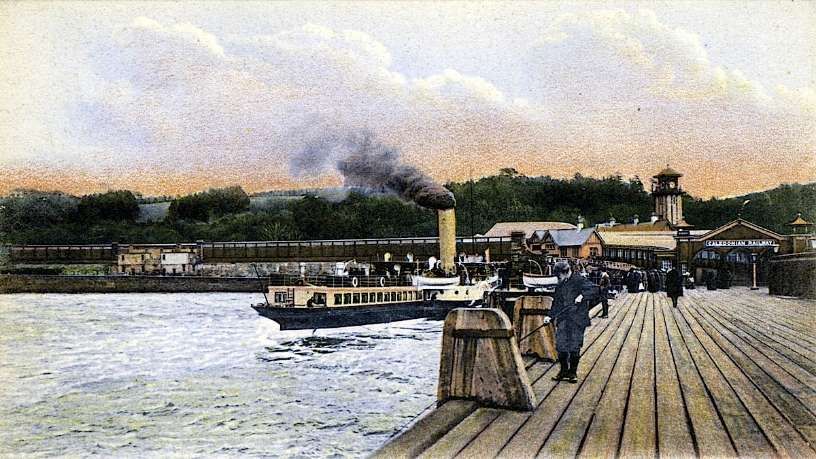
Planned improvements to the line included not only the rebuilding of Wemyss Bay station, but also those at Inverkip and Upper Greenock.
The Friends of Wemyss Bay Station included in their timeline a number of photographs of the construction work undertaken in 1903: [13]
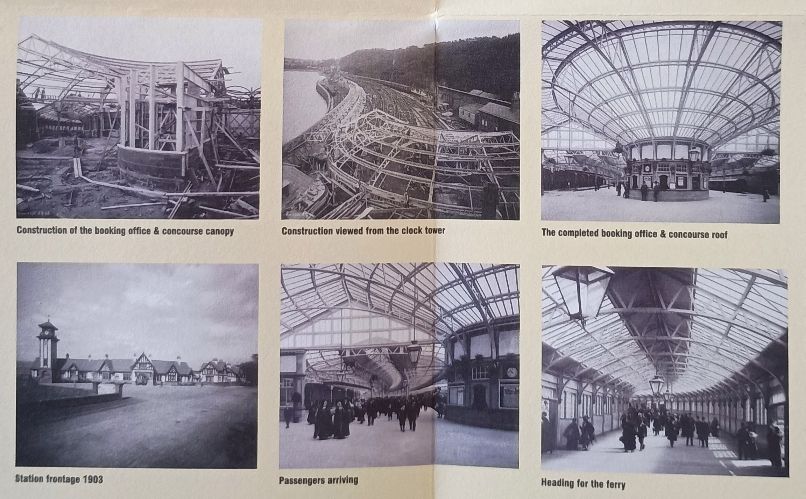
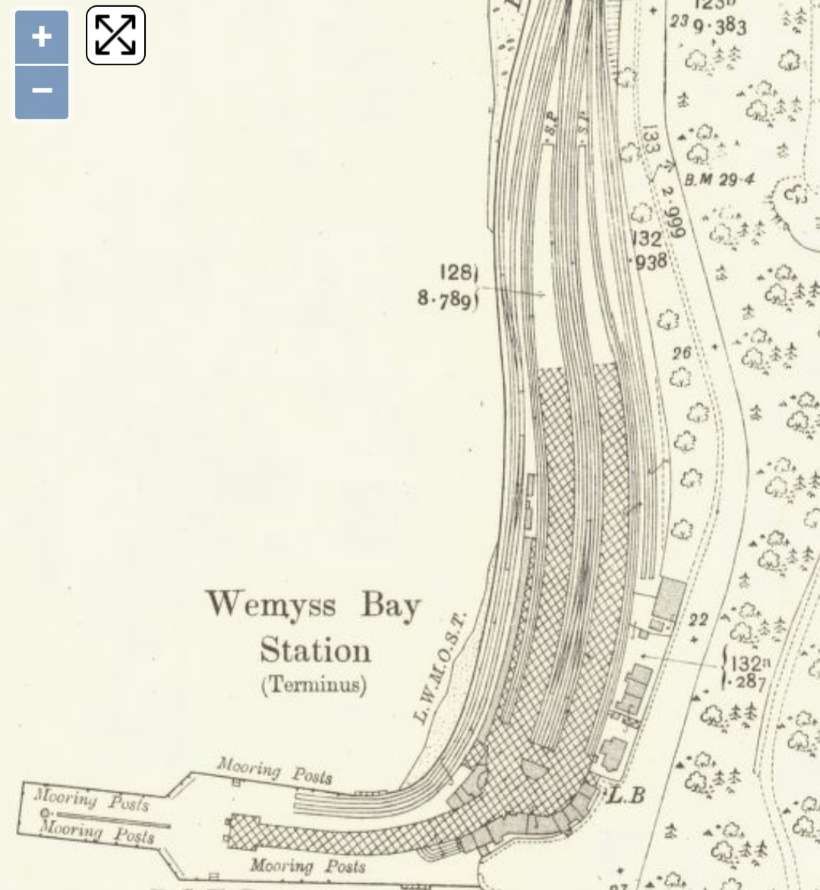
O. S. Nock observes that the station was rebuilt to an exceptionally pleasing design with a light glass canopy to the circulating area; the pier could accommodate five steamers at once. He continues:
“At Wemyss Bay … quite apart from the beauty of the station itself, the traffic facilities provided in the reconstruction … are remarkable in themselves. The enterprising timetables of the day required that a train and a steamer should arrive simultaneously, and exchange passengers. Although the changeover did not need to be done at the lightning speed demanded by the most competitive services at Gourock, there was to be no dawdling about. The station platforms, and the approach ways to the steamer berths, were therefore made exceptionally wide, so that two opposing streams of pedestrians could pass without interference. From the railway point of view, while the two long island platforms provided four platform faces for trains, a third line was laid in between the two island platforms to enable locomotives of incoming trains to be released immediately on arrival, and ‘run round’ their trains.” [10: p76, 77, & 82]
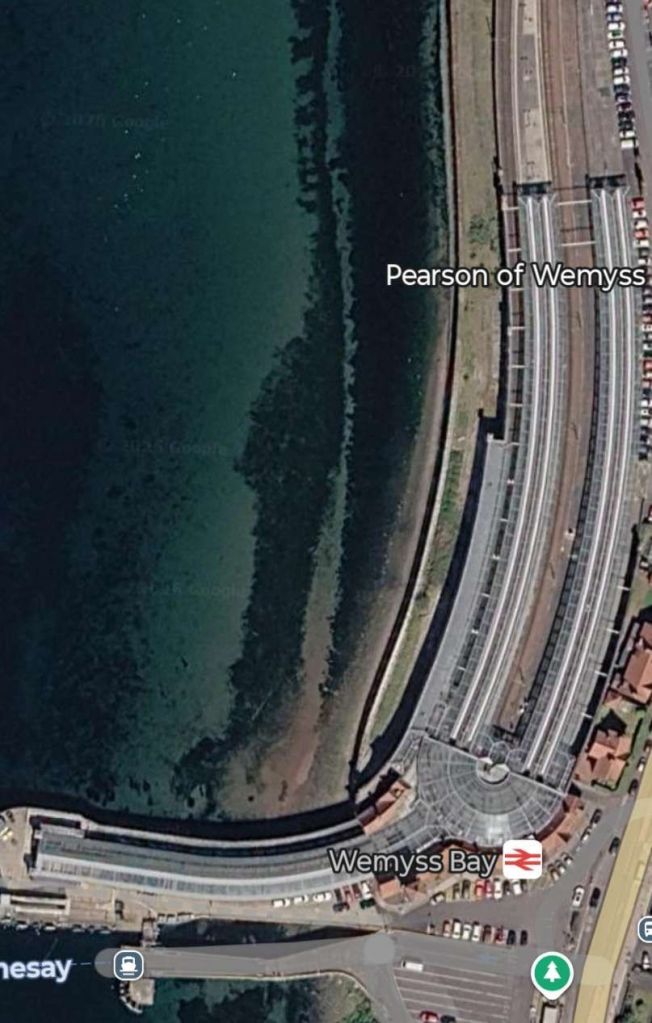
The station had a purely decorative italianate clock tower and a significant, unique concourse. It opened on 7th December 1903.
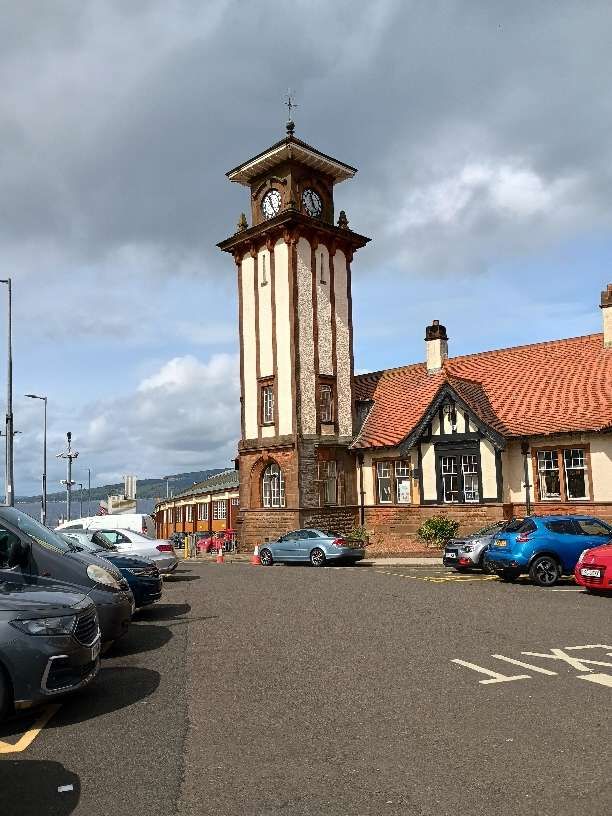
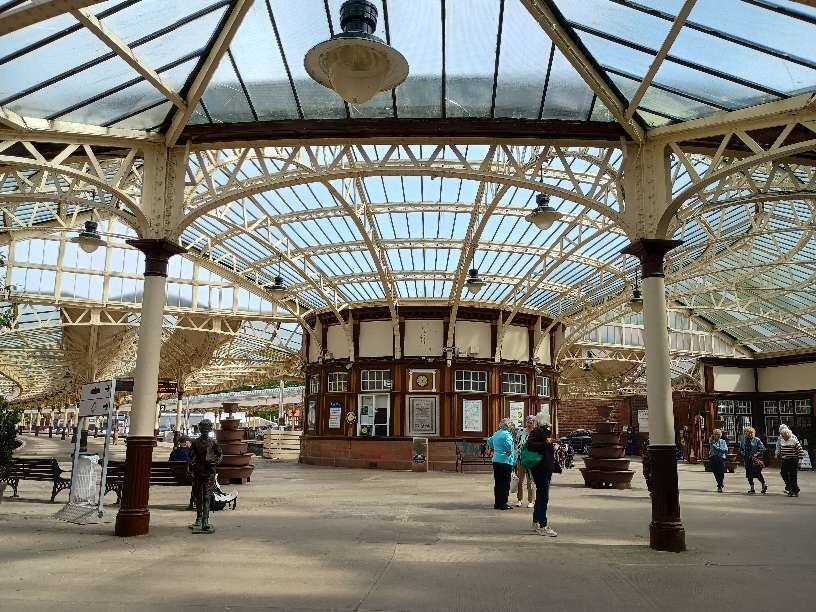
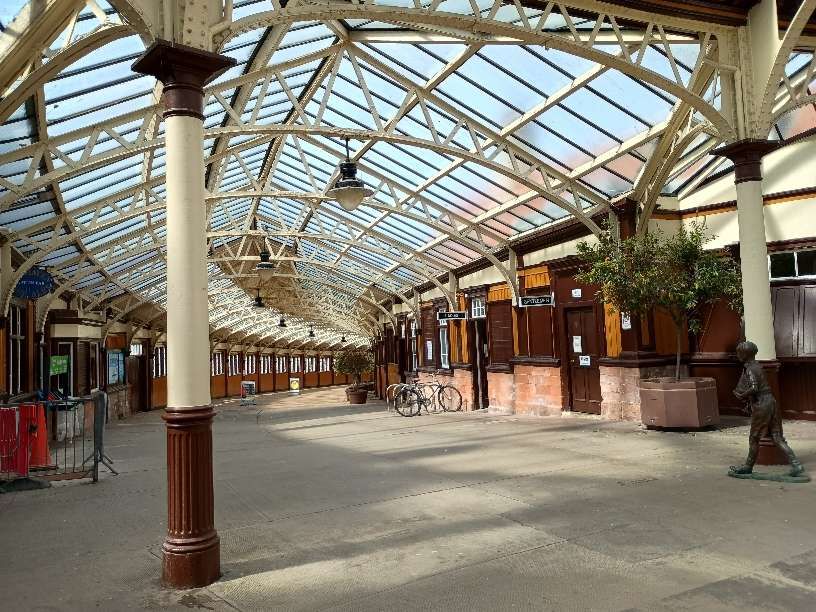
The station’s architect was the Caledonian Railway’s architect, James Miller. [11] He worked in consultation with Donald Matheson, Chief Engineer of the Caledonian Railway Company [11] The improvement works undertaken on the line between 1898 and 1907 cost the Caledonian Railway more than £267,000. [5]
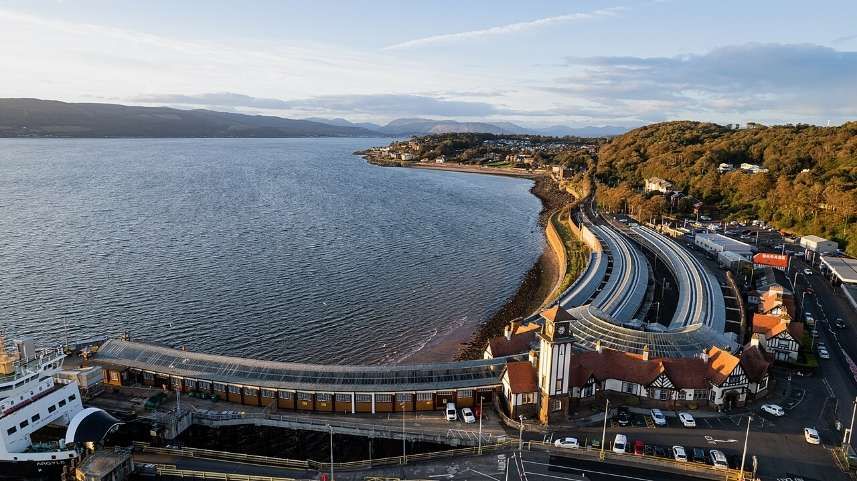
Wemyss Bay Railway Station building is regarded as an Edwardian masterpiece. It was the first of the Clyde railway piers to be built, and is now the last one remaining. It well deserves its Category A architectural listing, with its sinuous, graceful curves, and elegant glass canopies, still protecting passengers coming off the trains and heading down for the boat connection to Rothesay on the Isle of Bute.
The station is remarkable in its use of glass and steel curves. Although it is one of Scotland’s finest railway buildings, it suffered serious neglect until “a major refurbishment scheme [costing more than £5 million] carried out jointly by Network Rail, Inverclyde Council and the Scottish Government from June 2014 to the spring of 2016 [saw] the station buildings and adjacent ferry terminal fully restored.” [12]
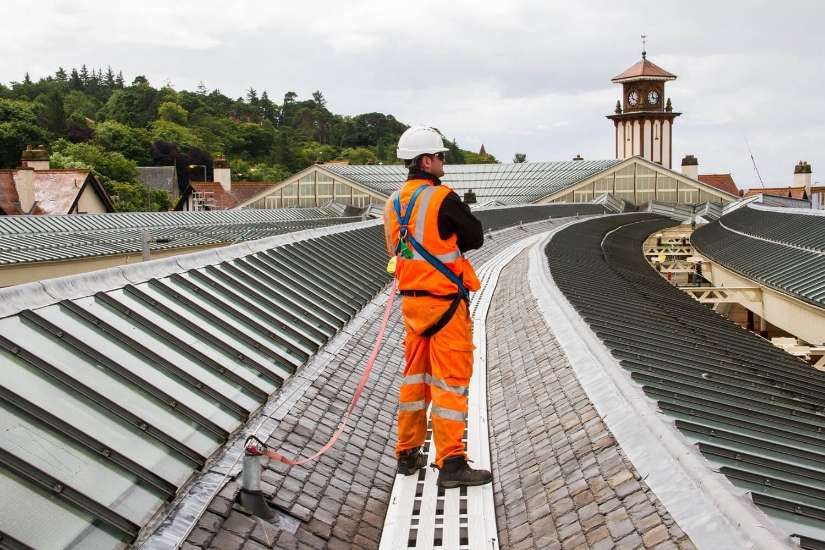
The work was undertaken by the Spencer Group. [13] The Spencer Group say:
“The project was originally to be delivered over two financial years to take advantage of two summer periods and ensure tools could be downed during the winter periods which, due to the station’s location, would be particularly harsh. … However, following the initial works on the site, it soon became clear that the completion date was unrealistic, as more and more issues with the structure were discovered. … The problems stemmed from the age of the building materials, such as the Georgian wire over the canopies and the paint used, and the inability of these old technologies to handle the station’s coastal location, with water ingress and rust causing significant damage. Further to this, the lack of access to many parts of the station building led much of it to fall into disrepair, as maintenance works had been impossible.
“Almost all of the station’s existing roof slates were classified as unsuitable for the coastal environment, needing a total of 1,434m2 of replacement tiles. A post-contract-award of the structural assessment also revealed significant overstressing to the existing structural elements, requiring substantial strengthening with 3.5 tonnes of steel.“Several problems with the paint on the station’s steel beams, including rust and the use of lead-based paint, meant that nearly 4,000 litres of new paint was used in the refurbishment works in total. … The delay these unexpected issues should have caused was lessened by working through the winter, which required the implementation of extra measures to stop seasonal bad weather, such as February’s storms, from causing further delay. … The final stages of the work involved installing new access systems to the canopies to prevent the previous issues of access difficulty leading to disrepair, refurbishing the concourse roof with a total of 165.5 sq. m of new glass panes, and other miscellaneous finishing tasks.” [25]
“Wemyss Bay was the first combined rail and ferry terminal on the Clyde coast.” [13] It has survived to be the last operating combined rail and ferry terminal.
“The glass-roofed complex, with its ‘Queen Anne’ styled half-timbered frontage finished with roughcast and red sandstone, is dominated by a four-sided sixty-foot high clock tower. A truly majestic building.” [2]
Returning to the early years of the 20th century and specifically to the 1910s. …
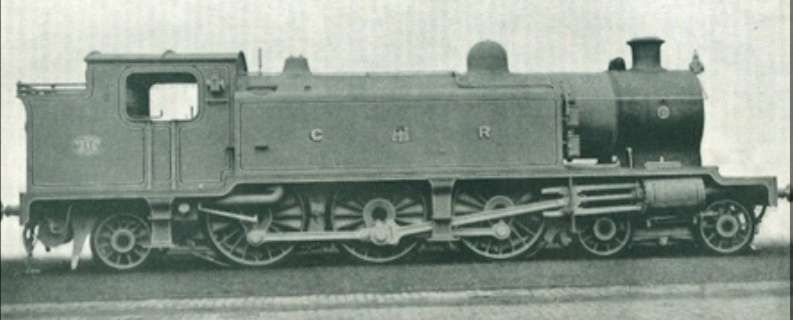
At that time, the Caledonian Railway invested in a series of new heavy duty tank locomotives designed specifically for the line from Glasgow to Wemyss Bay.
After the First World War, the station passed into the ownership of the LMS and throughout the interwar years, “large crowds continued to flock to the Clyde coast. … Due to austerity, and particularly petrol rationing, following the Second World War most people continued to take holidays close to home. For many that meant the train to Wemyss Bay and a steamer to Roth say, Millport or Arran.” [13]
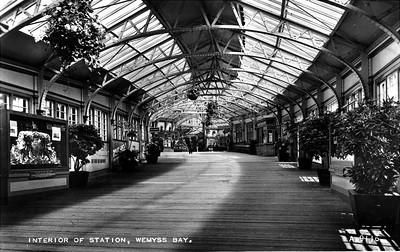
Looking along the pier walkway in the 1930s, note the crests from various paddle-steamers which used to be displayed in glass cases either side of the wide walkway. These were lost at the time of fire-damage to the pier in the late 1970s, © Public Domain. [19]
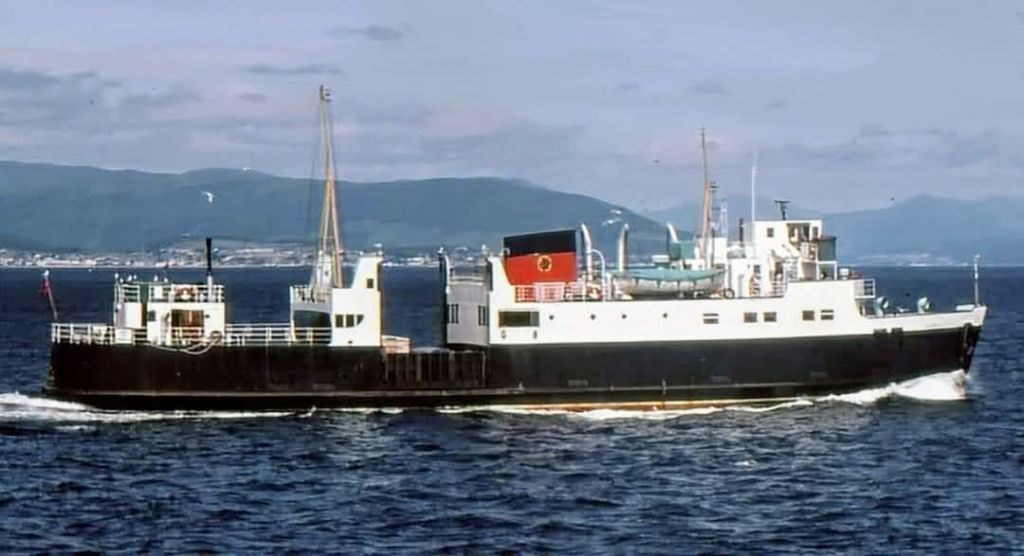
As with many coastal holiday destinations in the UK, during the 1950s, the number of passengers on the steamers dwindled. With increasing car ownership in the 1950s, a car ferry was introduced between Wemyss Bay and Rothesay (although vehicle loading and unloading was a time consuming affair, with vehicles loaded through the side of the vessel and taken down to the car deck on a lift).
These car ferries included the 1954 pioneer, MV Cowal, which served on the Firth of Clyde for more than 24 years.
The 1960s were a time of great change for the railways. Many delightful and/or significant station buildings were demolished because they were thought to be uneconomic and maintenance liability. It is surprising that Wemyss Bay Railway Station survived this period. It did do so, however, and gained protection as a listed building. The railway saw a significant change in motive power, with steam being displaced by electric multiple units (EMUs)
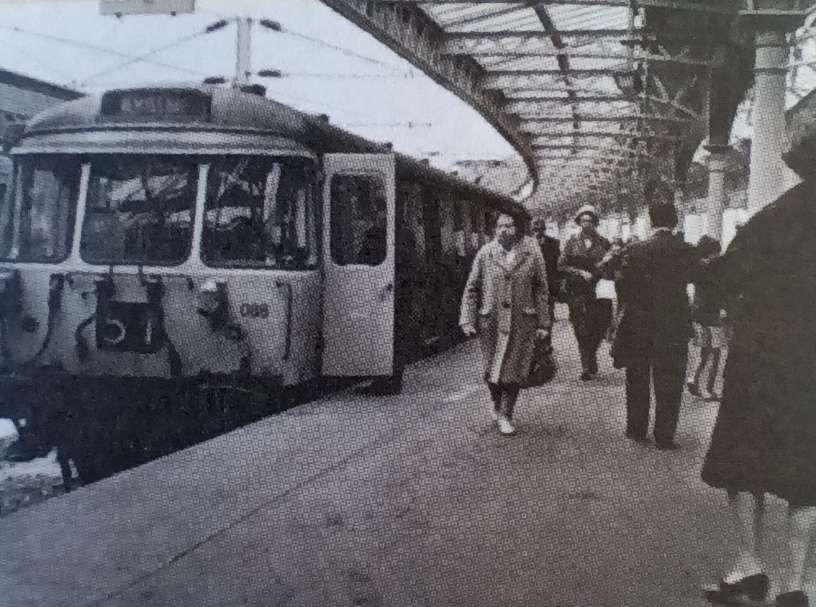
In the 1970s, the ferry service to Innellan ceased after the 1972 summer season. The Caledonian Steam Packet Co. was amalgamated with David MacBrayne Ltd. to form Caledonian MacBrayne Ltd. in 1973. In 1977, the “linkspan came into use at Wemyss Bay, allowing vehicles to drive on and off the ferry. In connection with this, the pier was shortened.” [13]
1977 was also “the last year in which there were cruises from Wemyss Bay, and since then the only regular service has been that to Rothesay.” [13]
The late 1970s saw extensive fire damage to Wemyss Bay pier. Different comments/publications from the Friends of Wemyss Bay Station have the date of fire damage in 1977 [19] or 1978. [13]
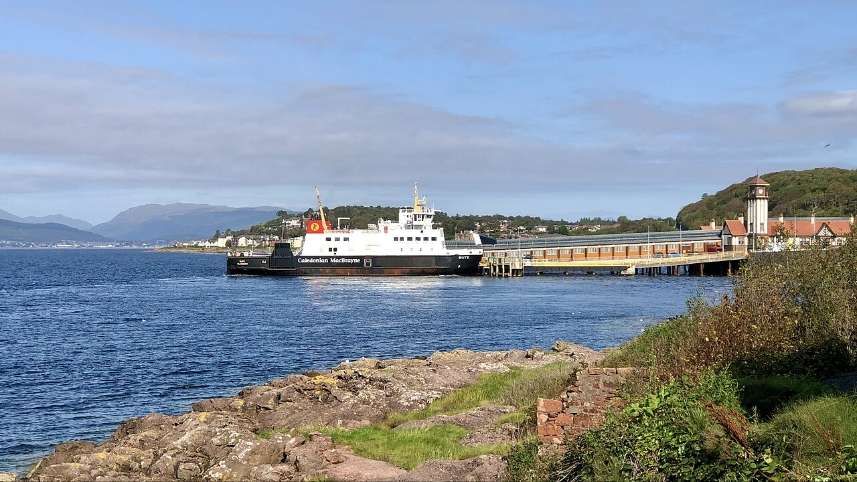
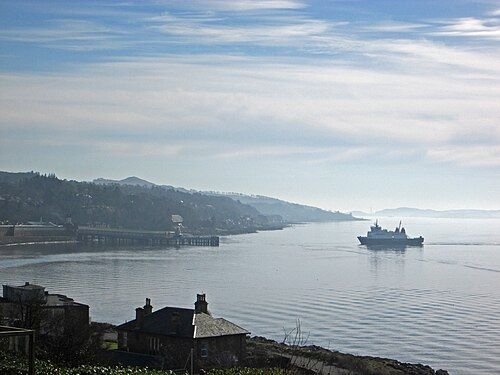
Also Wemyss Bay: this view looks South from Cliff Terrace Road, with MV Bute approaching Wemyss Bay railway station and pier, © Dave Souza and licenced for reuse under a Creative Commons licence (CC BY-SA 3.0). [18]
The late 1970s also saw a new fleet of Class 314 EMUs introduced to the Wemyss Bay Railway service.
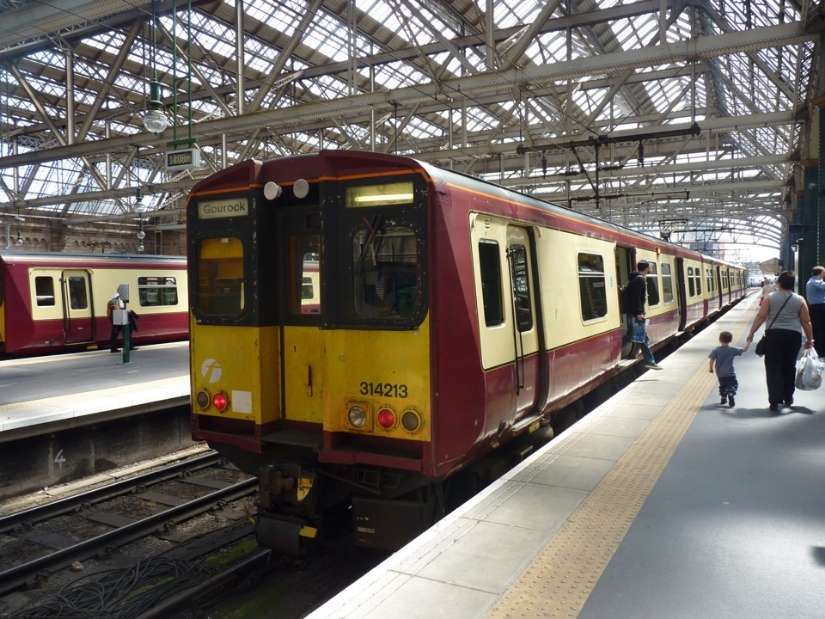
Wemyss Bay Pier was rebuilt in 1987-1988 and was shortened further. The clocktower was also restored at that time.
During 1993-1994, “the station was very extensively renovated by ScotRail, A plaque on the concourse records the completion of this work. … Under railway privatisation in 1997, operation of the trains was taken over by National Express. … Subsequent franchisees have included First Group and Abellio, a subsidiary of the Netherlands State Railway.” [13]
Class 318 EMUs “were introduced into passenger service on 29th September 1986, between Glasgow Central and Ayr/Ardrossan. Eventually they operated to Largs when electrification was complete. A few years later they started to operate services to Gourock and Wemyss Bay, which saw most services from 1000 to 1500 through Paisley Gilmour Street operated by 3 car Class 318s.” [22]
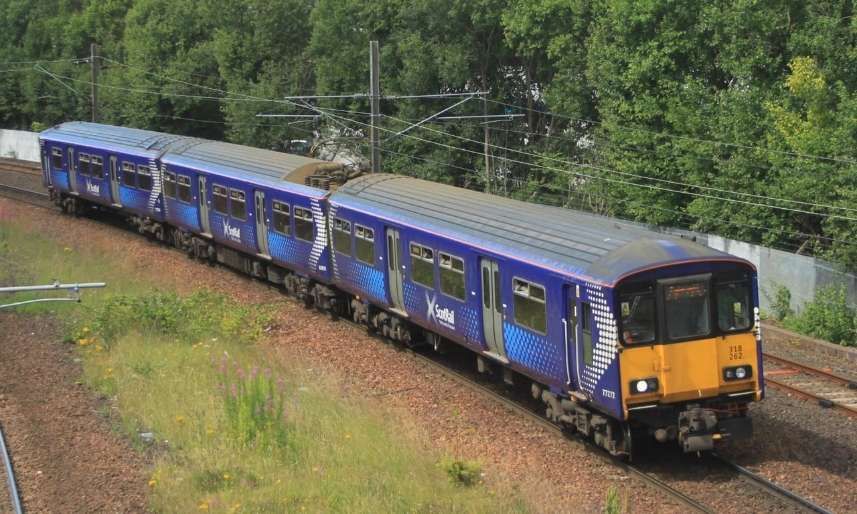
In 2009, “as part of ScotRail’s Adopt a Station scheme ‘Friends of Wemyss Bay Station’ was formed as a support group of volunteers, with a particular interest in reinstating the floral displays which had been a special feature for many years. … The Friends also operate a secondhand bookshop in former waiting rooms on the concourse, and provide historical information about the station.” [13]
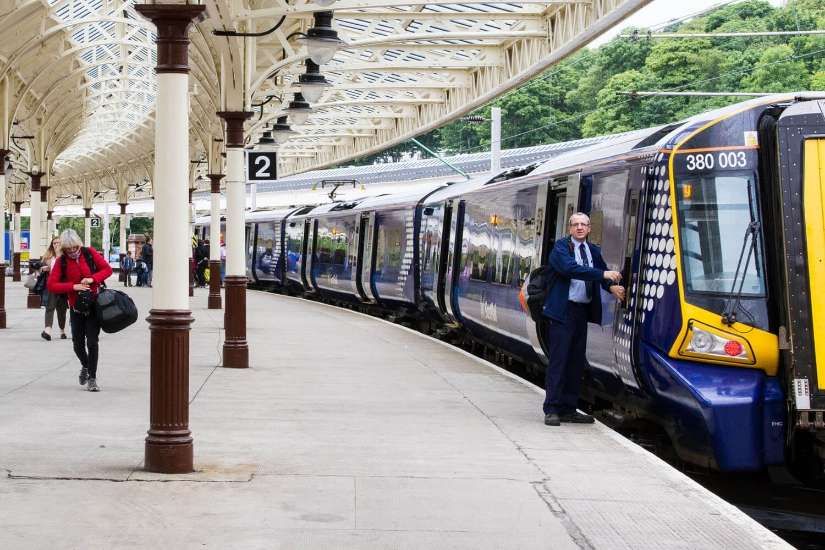
In the early 2010s, the Class 314 and 318 EMUs were supplemented on ScotRail’s network by three-car and four-car Class 380 EMUs which were built by Siemens. these Class 380s were not initially intended for use on the line to Wemyss Bay.
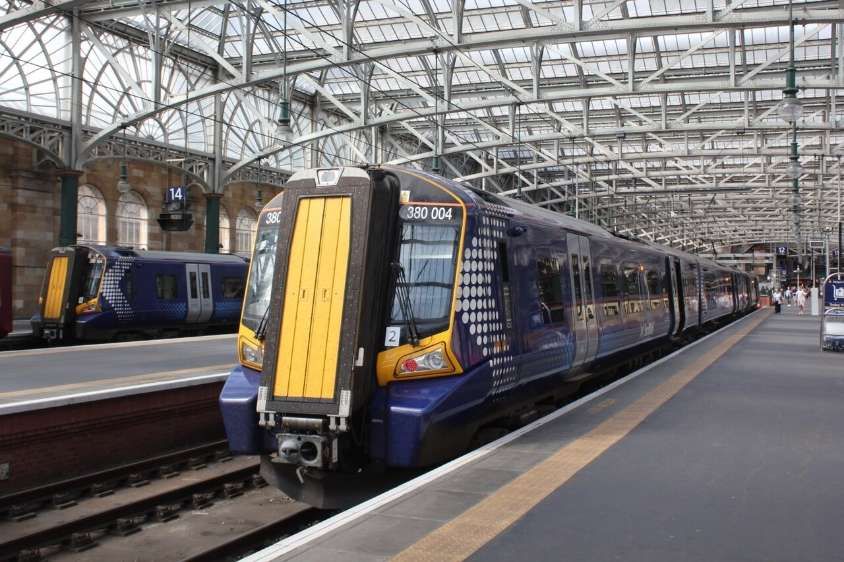
As noted above, in 2015-2016, “the station and pier were again the subject of a programme of considerable renovation by Network Rail and Caledonian Maritime Assets Limited, which returned them both to the original Caledonian Railway colour scheme.” [13]
In 2017, the station was described by Sir Simon Jenkins as ‘Britain’s loveliest station’. [20]
In February 2018, Rail Magazine reported that the veteran Class 314 EMUs were due to be retired with, initially, additional Class 318 sets cascaded down to the Wemyss Bay route.
This was enabled by Hitachi Rail Europe Class 385s being brought into service on ScotRail, releasing ‘380s’ for other routes. This in turn made more 318s available for routes such as Wemyss Bay. [21]
to be used on these routes instead, alongside the Hitachi-built EMUs when more are delivered. A further five Class 320/4s are also on their way to SR in the near future, allowing Class 318s to also be used on these routes.
Eventually Class 380s began to provide services to Wemyss Bay.
References
- https://friendsofwemyssbaystation.co.uk, accessed on 8th May 2026.
- https://friendsofwemyssbaystation.co.uk/centennial-history, accessed on 8th May 2026.
- https://en.wikipedia.org/wiki/Greenock_and_Wemyss_Bay_Railway, accessed on 8th May 2026.
- https://en.wikipedia.org/wiki/Greenock_and_Wemyss_Bay_Railway#/media/File%3AWemyss_Bay_Rly_1865.gif, accessed on 8th May 2026.
- David Ross; The Caledonian—Scotland’s Imperial Railway—A History; Stenlake Publishing Ltd, Catrine, 2013.
- M E Quick; Railway Passenger Stations in England Scotland and Wales — A Chronology; The Railway and Canal Historical Society, 2002.
- https://www.facebook.com/share/p/1AtnALNWsb, accessed on 8th May 2026.
- C. V. Awdry; Encyclopaedia of British Railway Companies; Guild Publishing, 1990.
- John Thomas revised J S Paterson; A Regional History of the Railways of Great Britain: Volume 6, Scotland, the Lowlands and the Borders; David and Charles, Newton Abbot, 1984.
- O S Nock; The Caledonian Railway; Ian Allan Limited, London, 1961.
- James Miller FRSE FRIBA FRIAS RSA (1860–1947) was recognised for his commercial architecture in Glasgow and for his Scottish railway stations. Notable among these are the American-influenced Union Bank building at 110–120 St Vincent Street, while acknowledging Richard McLoud Morrison Gunn as the bank’s chief designer; his 1901–1905 extensions to Glasgow Central railway station; and Wemyss Bay railway station on the Firth of Clyde. His lengthy career resulted in a wide range of building types, and, with the assistance of skilled draughtsmen such as Richard M Gunn, he adapted his designs to changing tastes and new architectural materials and technologies. https://en.wikipedia.org/wiki/James_Miller_(architect), accessed on 8th May 2026.
- https://en.wikipedia.org/wiki/Wemyss_Bay_railway_station, accessed on 8th May 2026.
- Wemyss Bay Railway Station Timeline; The Friends of Wemyss Bay Station, 2019.
- https://en.wikipedia.org/wiki/Wemyss_Bay_railway_station#/media/File%3AInverclyde_-_Wemyss_Bay_railway_station_-_2025-09-24_21-57-28_001.jpg, accessed on 9th May 2026.
- https://modelengineeringwebsite.com/Caledonian_4-6-2.html, accessed on 9th May 2026.
- https://www.facebook.com/share/p/1CkFvVyxoJ, accessed on 9th May 2026.
- https://commons.wikimedia.org/wiki/File:Wemyss_Bay_pier_from_Skelmorlie.jpg, accessed on 10th May 2026.
- https://commons.wikimedia.org/wiki/File:20140311_Wemyss_Bay_from_Cliff_Terrace_Rd.jpg, accessed on 10th May 2026.
- https://www.largsandmillportnews.com/news/23550179.wemyss-bay-station-1977-blaze-caused-loss-paddle-box-covers, accessed on 10th May 2026.
- Simon Jenkins; Britain’s best 100 railway stations; Penguin Books, London, 2017.
- https://www.railmagazine.com/news/fleet/withdrawal-of-scottish-veteran-emus-relies-on-stock-cascades, accessed on 10th May 2026.
- http://www.scot-rail.co.uk/page/Class+318, accessed on 10th May 2026.
- https://en.wikipedia.org/wiki/British_Rail_Class_318, accessed on 10th May 2026.
- https://en.wikipedia.org/wiki/British_Rail_Class_380#/media/File%3AGlasgow_Central_-_Abellio_380004_and_380104.JPG, accessed on 10th May 2026.
- https://thespencergroup.co.uk/spencer-group-completes-100-year-old-station-refurbishment-at-wemyss-bay, accessed on 10th May 2026.
- https://www.wemyssbay.net/historical-photos/album/various-historical-photos, accessed on 10th May 2026.
- https://www.dalmadan.com/?page_id=25, accessed on 10th May 2026.
- https://www.wemyssbay.net/historical-photos/album/various-historical-photos, accessed on 10th May 2026.
- https://pin.it/21dMVoIRv, accessed on 10th May 2026.
- https://maps.nls.uk/view/82900413, accessed on 10th May 2026.
- https://maps.nls.uk/view/82900416, accessed on 10th May 2026.


