Category Archives: Ireland

Co. Donegal Railways, Ireland – Part 5 – Strabane to Letterkenny (Part B – Raphoe to Convoy)

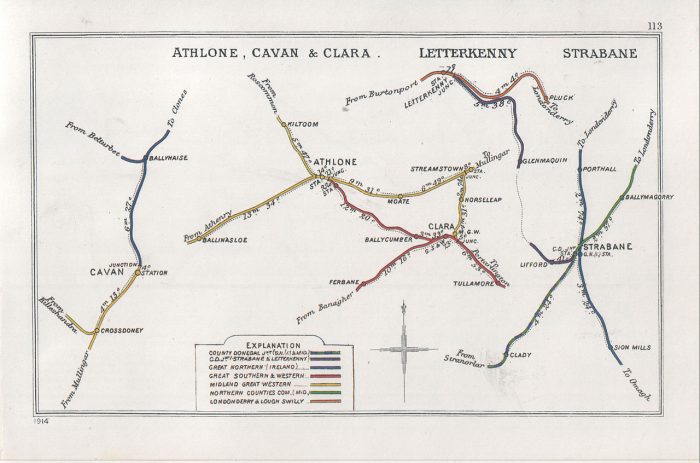
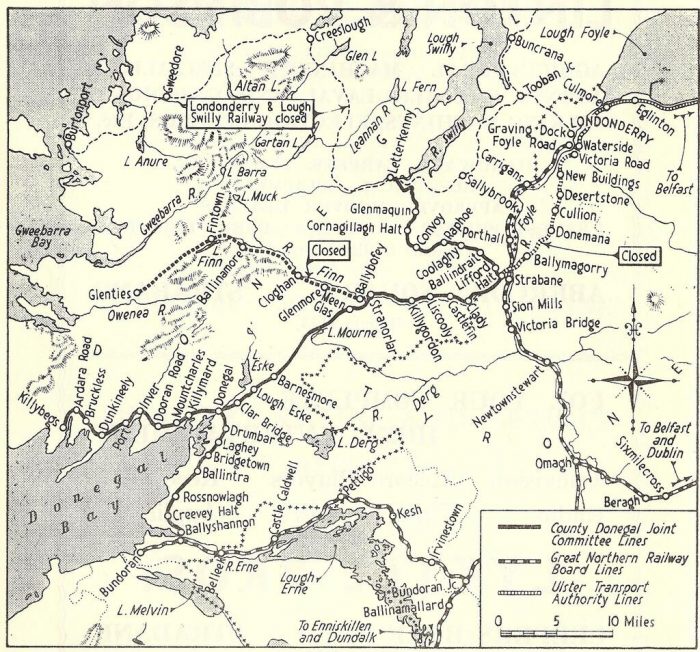
As we noted at the start of the previous article about this line, Wikipedia gives us a very short history of the line from Strabane to Letterkenny and provides a single image – the Railway Clearing House map with stations in Strabane and Letterkenny:

The Railway Clearing House map with stations in Strabane and Letterkenny. [3]

This series of articles seeks to expand our understanding of the route of the various Co. Donegal Railways through combining old images and modern views. Satellite images also give us a good understanding of what remains of the infrastructure of these lines.

A Journey Along the Line – Strabane to Letterkenny – Part B – Raphoe to Convoy

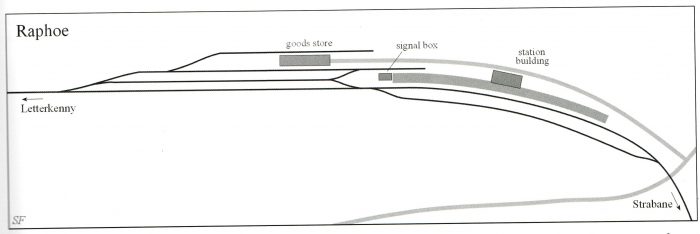
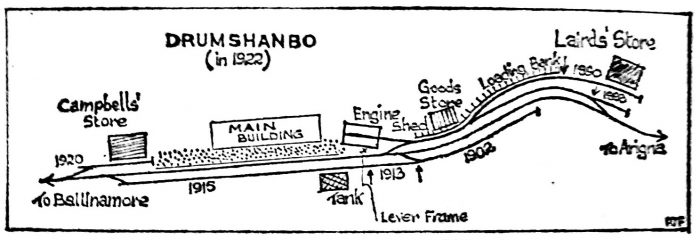
A sketch plan of Raphoe Railway Station by Steve Flanders from the book ‘The County Donegal Railways’ [1: p43] This drawing is included by kind permission of Steve Flanders.


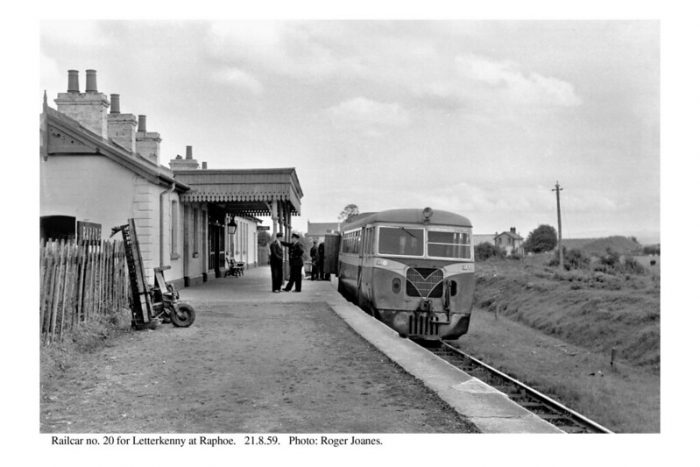
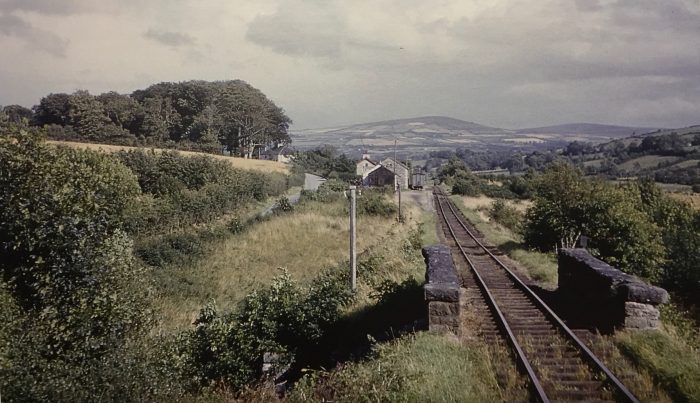
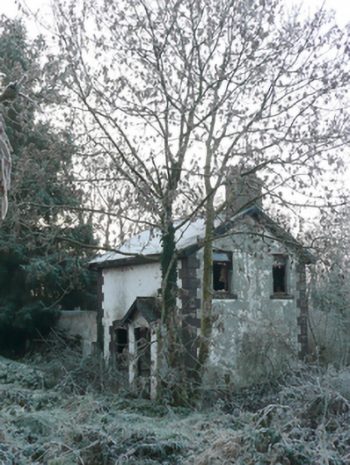
Railcar No. 20 at Raphoe Station, heading for Letterkenny in 1959 (c) Roger Joanes (CC BY-NC-ND 2.0) The Crossing-keepers cottage at the level-crossing to the East of the Station can be picked out to the right of the railcar. By this time, the passing loop shown in Steve Flanders sketch plan above had been lifted. [7]

Having enjoyed a stopover in Raphoe, we start the next stage of this journey back at the Railway Station at Raphoe and pick up the last image (above) from the previous article about the line:

Co. Donegal Railways, Ireland – Part 4 – Strabane to Letterkenny (Part A – Strabane to Raphoe)

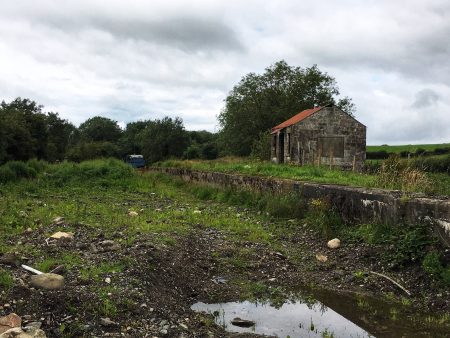
Before we climb aboard Railcar No. 20 as it sets off for Letterkenny we look at the condition of the station site in the 21st century. The two pictures immediately below were taken relatively recently by Kerry Doherty. The first shows the location of the old station platform, the second looks from the West through the station site.

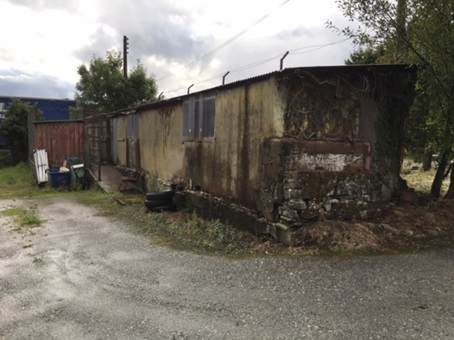
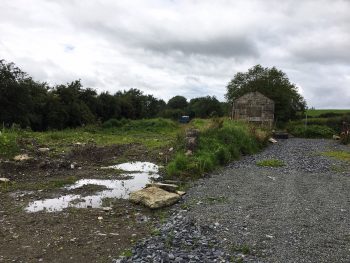
All that remains of the platform of Raphoe station. You can clearly see this shed is built on top of it (c) Kerry Doherty. [6]


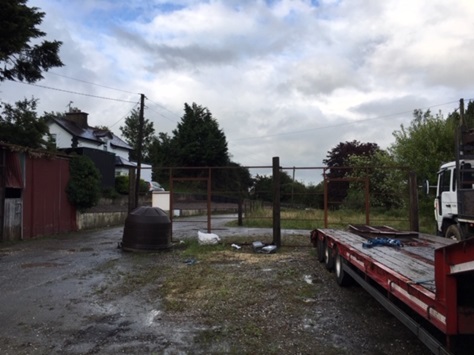
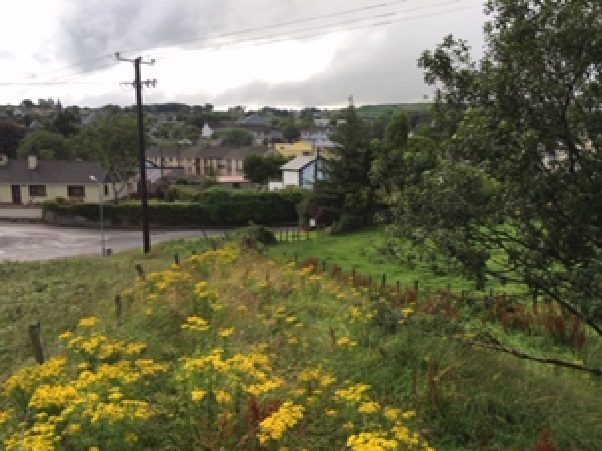
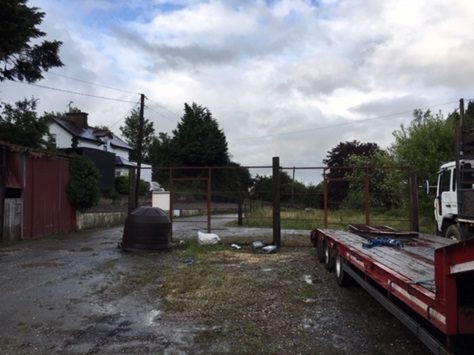
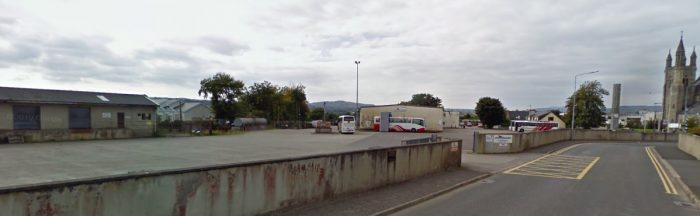
This picture appeared at the end of the last article about this line. It shows the site of Raphoe Station in 21st century taken from a similar position to the Roger Joanes image above. The Station Master’s House on the left is the only building remaining on the site. Kerry Doherty comments that ‘it was difficult to get a photo of the site as many lorries now occupy the yard’, (c) Kerry Doherty. [6]

There are also two excellent photographs of Raphoe in Anthony Burges Album of the line. [8: p32-33]

Now we set off towards Convoy from Raphoe Railway Station. …….


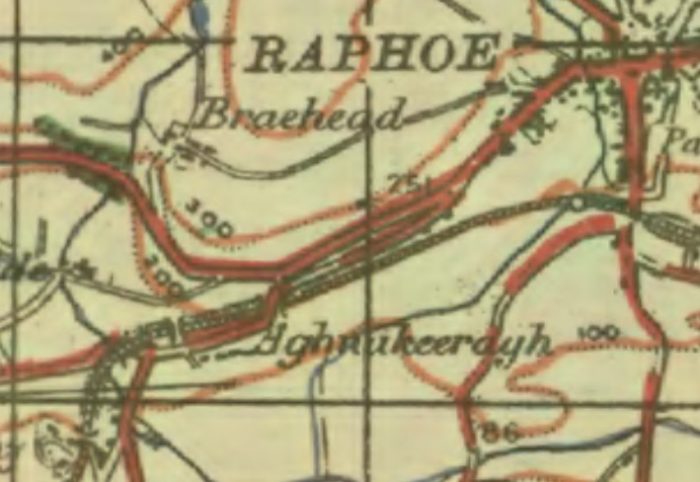
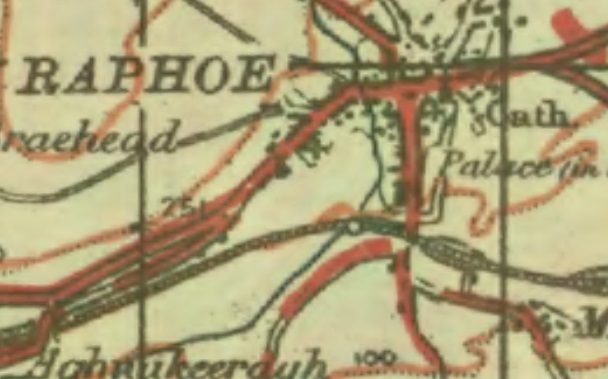
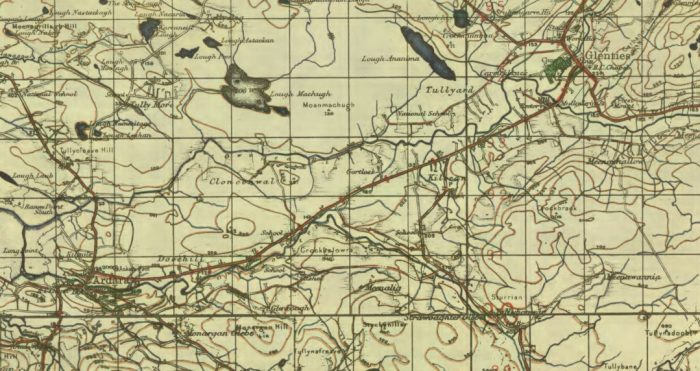
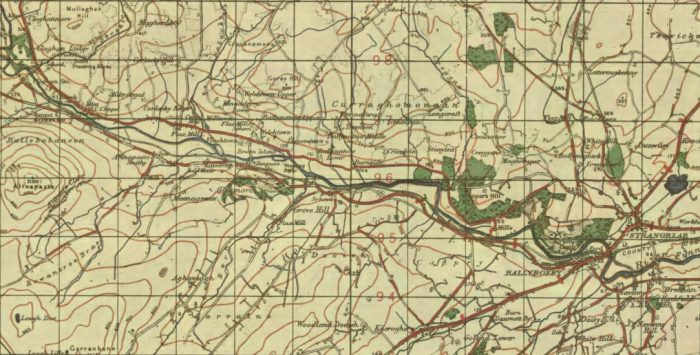
GSGS 1940s Map of Raphoe and its Southwestern approaches. [2]


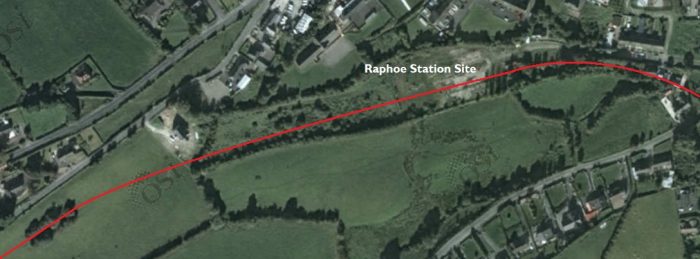
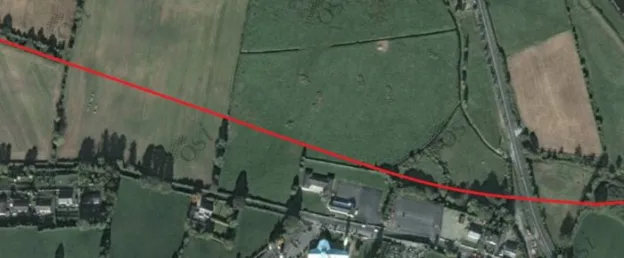
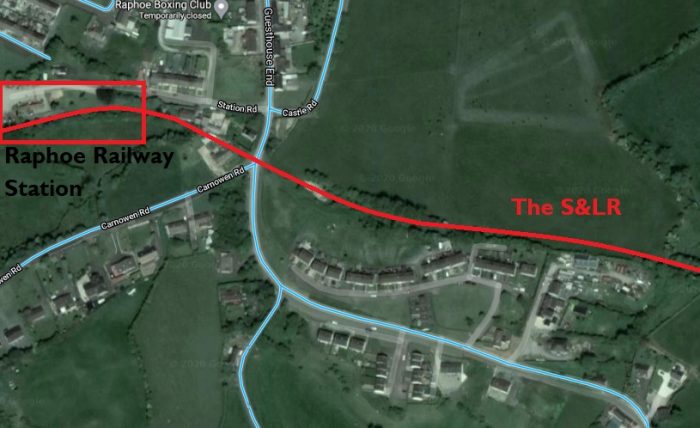
The site of Raphoe Railway Station in the 21st century. [4]


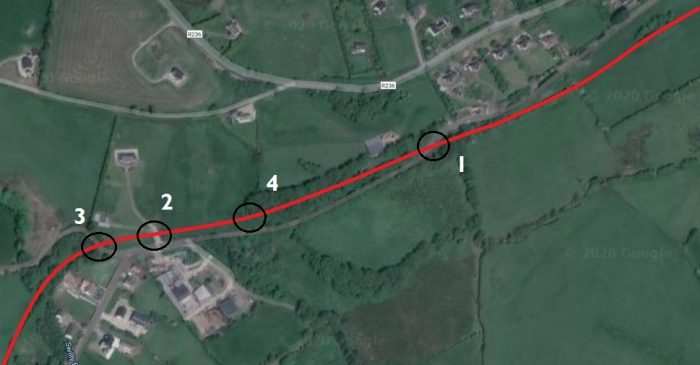
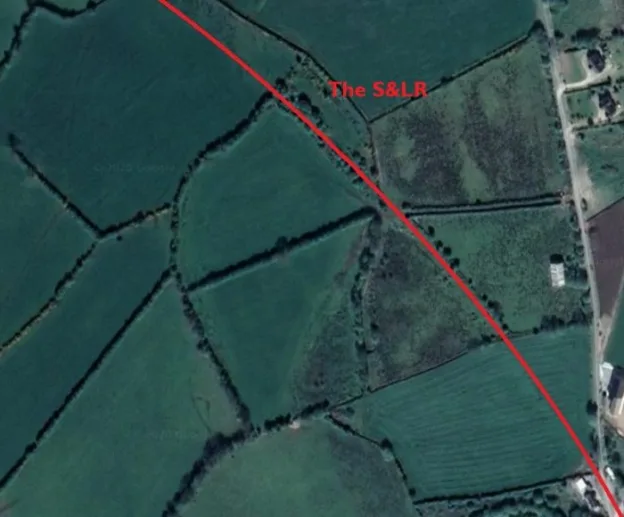
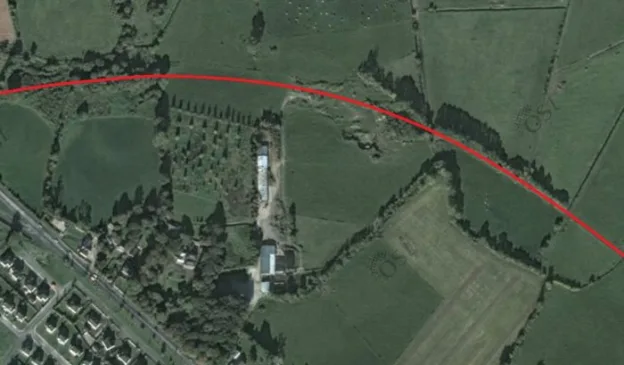
The route continues through Aughnakeeragh (Google Maps).
The three images immediately above show that the line began, gradually, to curve round to a Southwesterly direction as it left Raphoe Railway Station, before turning almost directly South at Aughnakeeragh.
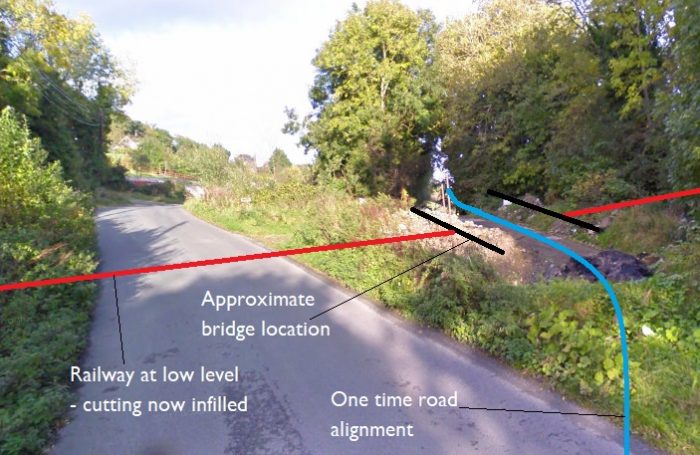
At location ‘1’ on the map immediately above, the road turned sharply to the south so as to cross the railway on a bridge.


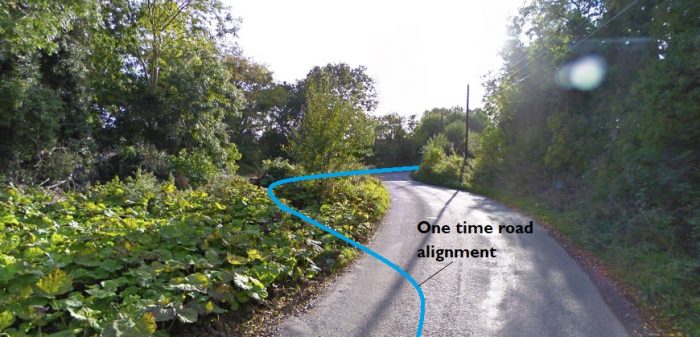
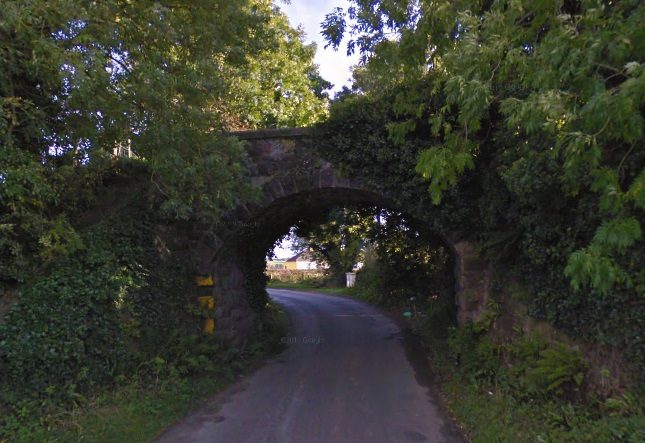
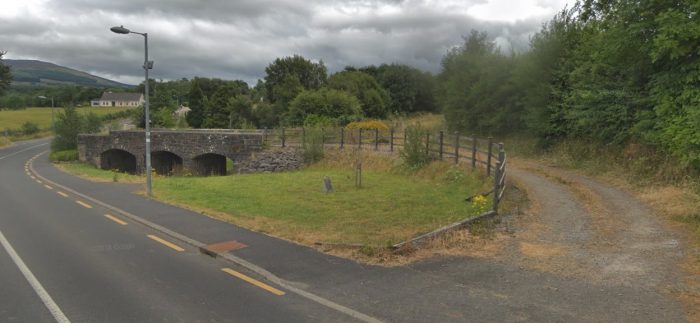
The narrow road crossed the old railway on a stone arch bridge. The railway cutting has now been infilled and the road alignment marginally improved (Google Streetview). This view shows the approach from Raphoe.


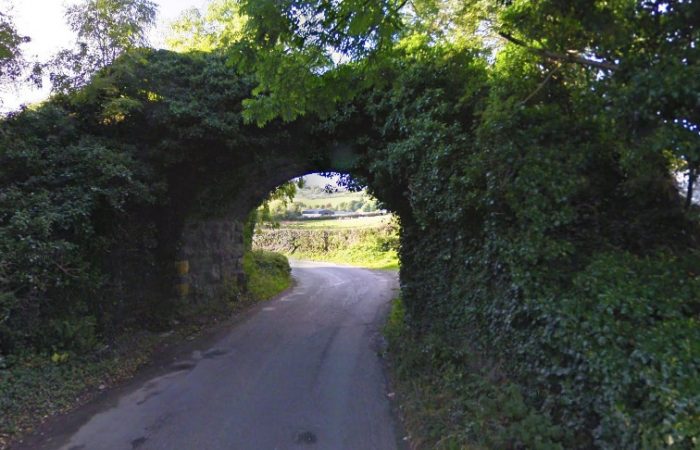
Crossing the bridge location and turning to look back towards Raphoe, this is the view (Google Streetview)

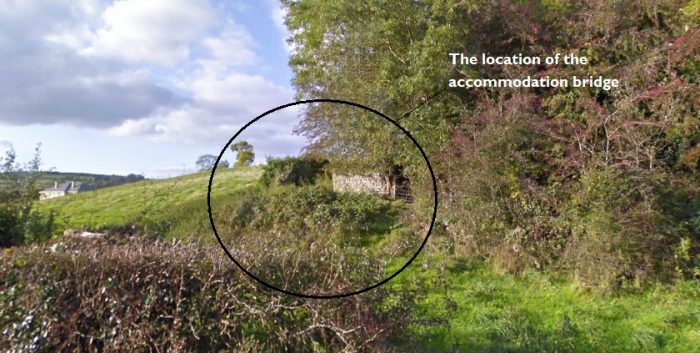
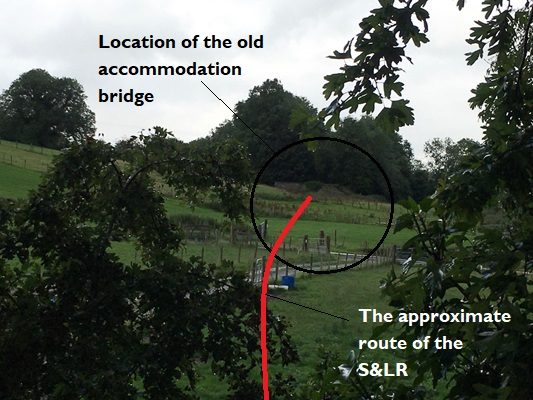
At location ‘4’, an accommodation bridge provided access across the old line.

The location of the old bridge is difficult to pick out on this image from Google Streetview.

This image, taken by Kerry Doherty from the top of the bridge at location ‘3’ above gives a better impression of the remains of the old bridge. The S&LR was in cutting at the bridge but the land drops away towards the foreground and at the point of the modern access road in the middle of the picture, the line went from being in cutting to being on an embankment, (c) Kerry Doherty [6]

As noted under the picture above, at location ‘2’, the old railway was almost at the same level as the surrounding land with cutting to the East and embankment developing to the West.


A modern farm access road crosses the old line at the approximate location when natural land levels and the formation of the S&LR matched (Google Streetview).

At location ‘3’, close to Aughnakeeragh, the railway was carried over a road on a stone arch bridge.


This Google Streetview image shows the bridge viewed from the Southeast.

\n Convoy Railway Station


The Google Streetview image of the bridge taken from the Northwest shows it heavily overgrown by ivy.


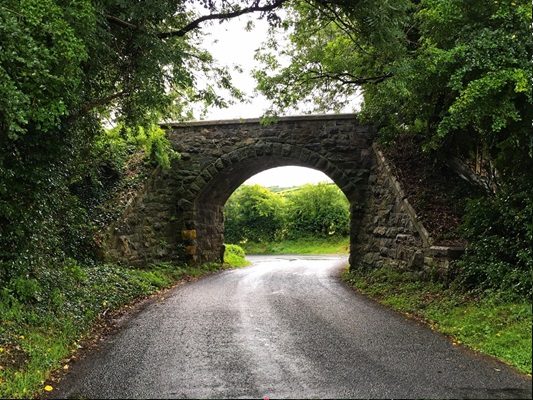
In this recent photograph, the bridge has been stripped of vegetation and is much more clearly visible, (c) Kerry Doherty. [6]


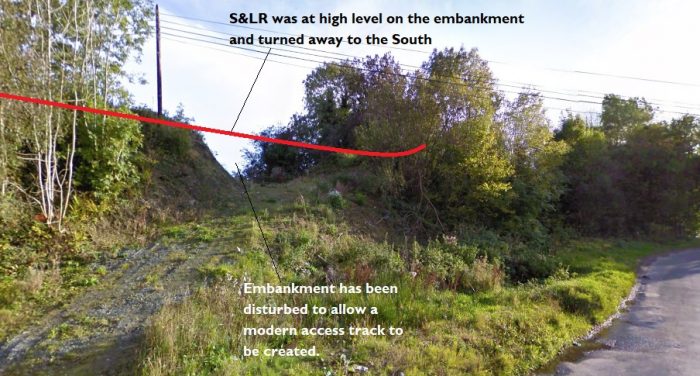
This Google Streetview image is taken from the road on the North side of the line, immediately to the West of the above bridge and shows the Railway embankment disturbed to allow vehicles to access land to the South.


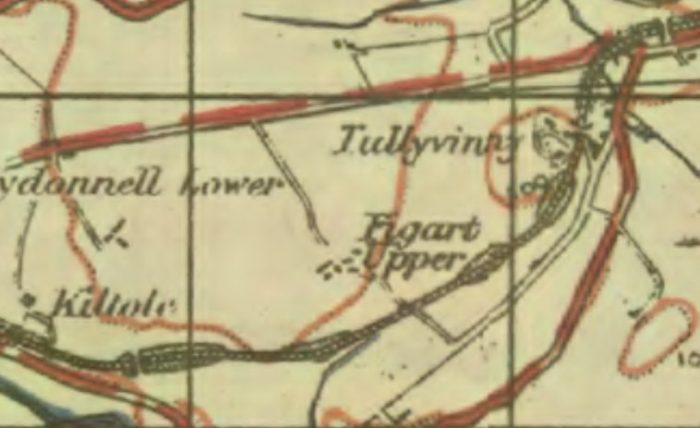
The next extract from the GSGS 1940s series of Maps shows the line to the West of Aughnakeeragh. [9]

After passing immediately to the West of Aughnakeeragh the line headed South for a Short distance before curving to the West once again.

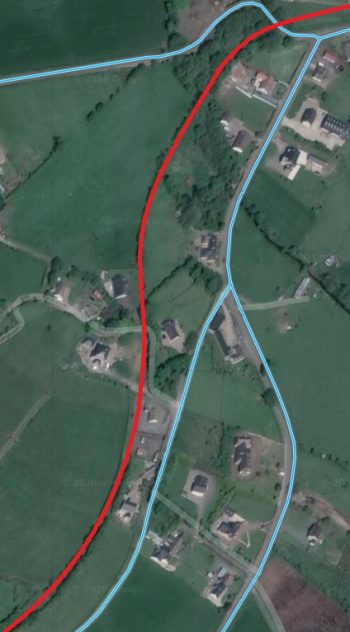
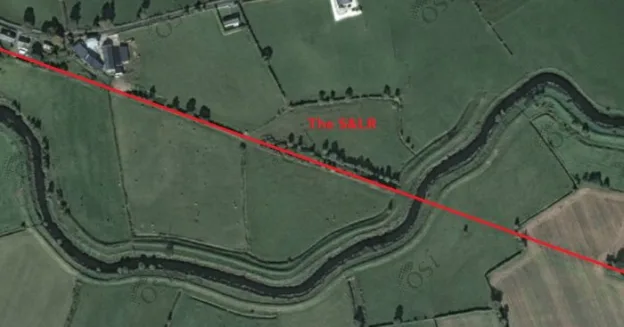
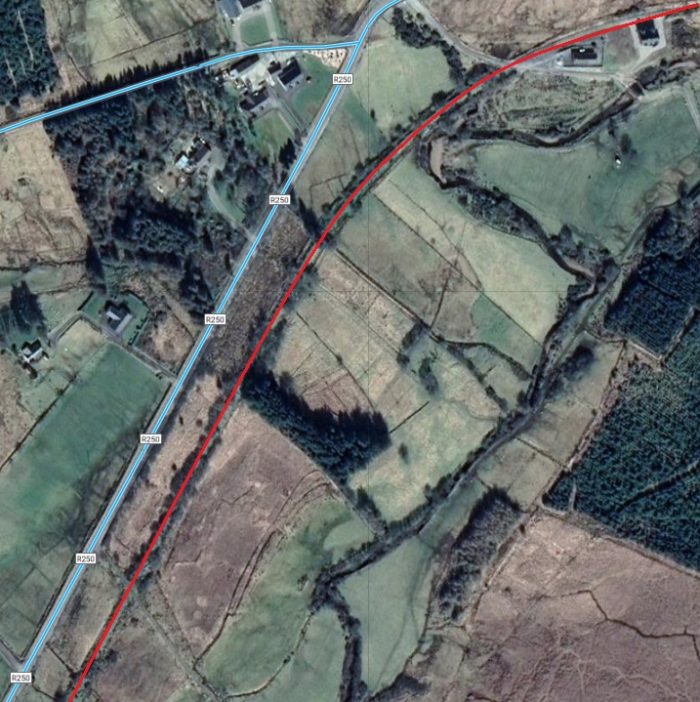
There was an accommodation bridge which carried a lane across the S&LR at Tullyvinny. The location appears on the adjacent Google Maps extract to the Southwest of the road junction at the centre of the satellite image. The lane ran parallel to the S&LR for a short distance on the East side of the railway cutting before turning West across the line. The closest we can get on Google Streetview is shown in the first image below.

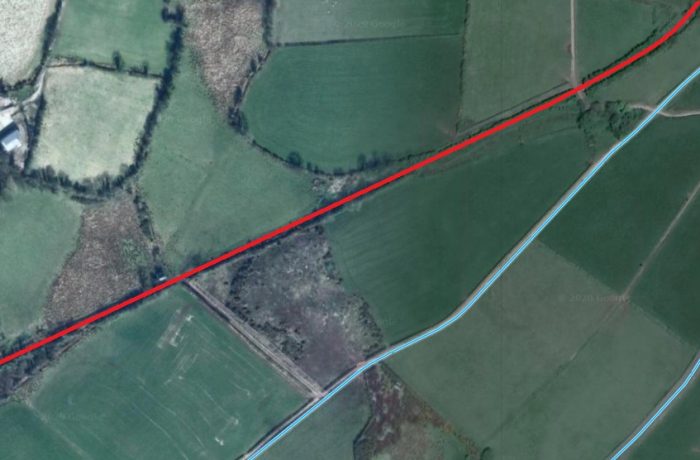
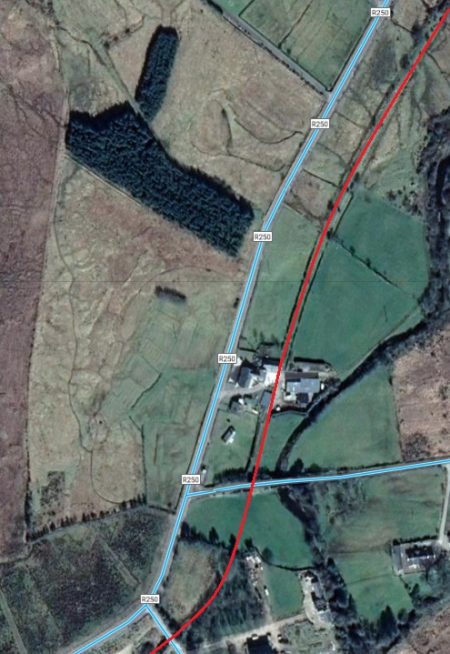
The next track to cross the line was that leading to Figart Upper Farm. The Lane appears in the bottom third, on the left-hand side of the next Google Maps satellite image below. The farm is on the left-hand side of the image close to the top.

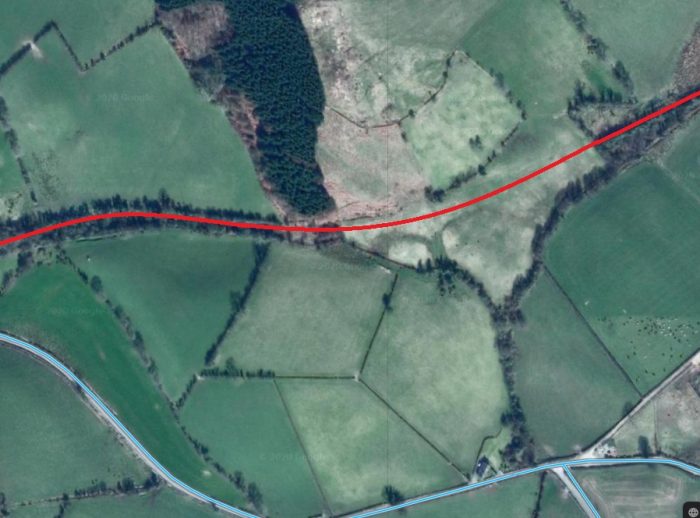
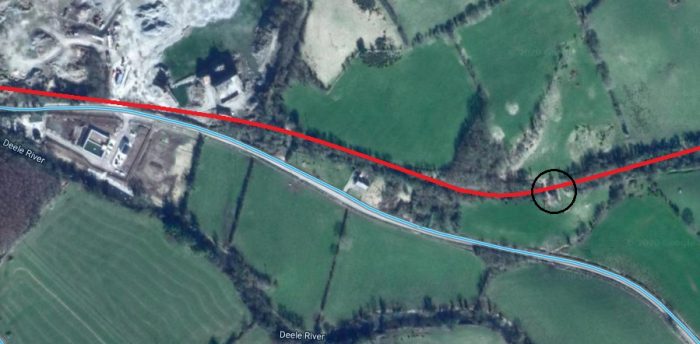
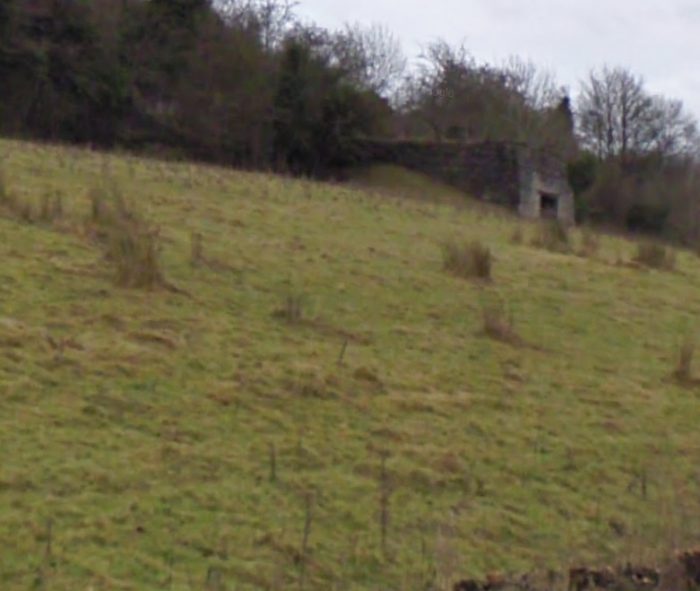
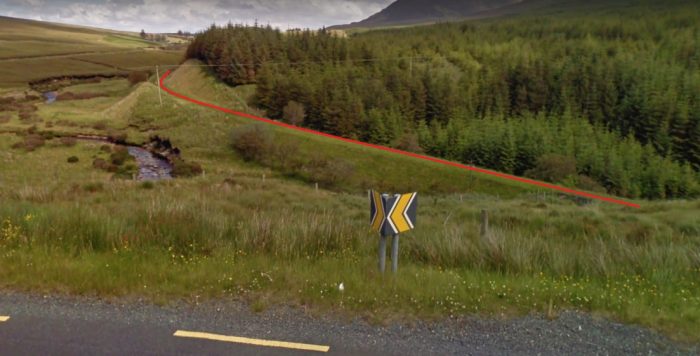
From Figart Upper Farm to Kiltole the old line was alternately in cutting and at the same level as the surrounding land but on the hill above the road which ran parallel to it to the South. An accommodate bridge over the line is marked by the black circle on the above plan and appears to relate to another structure which can be seen on the Goggle Streetview photograph below and which is taken from the road a little to the West of the accommodation bridge.


A lime kiln adjacent to the accommodation bridge referred to above. It seems as though the bridge permitted access to the lime kiln. (Google Streetview).

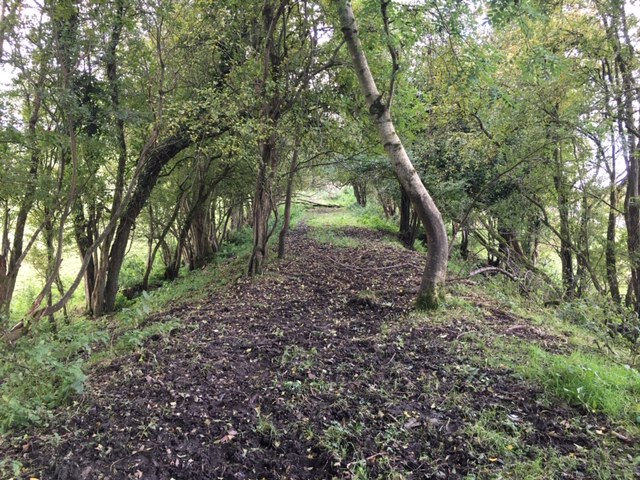
Very kindly, when I first asked about this structure in very early October 2020, Kerry Doherty offered to investigate. He took his camera with him as he endeavoured to walk the line from the West. He gained access to the old line through a field adjacent to the Kiltole Quarry . His first photograph shows the formation to the East of the quarry.

The formation of the Strabane and Letterkenny Railway to the East of Kiltole Quarry, (c) Kerry Doherty [6]

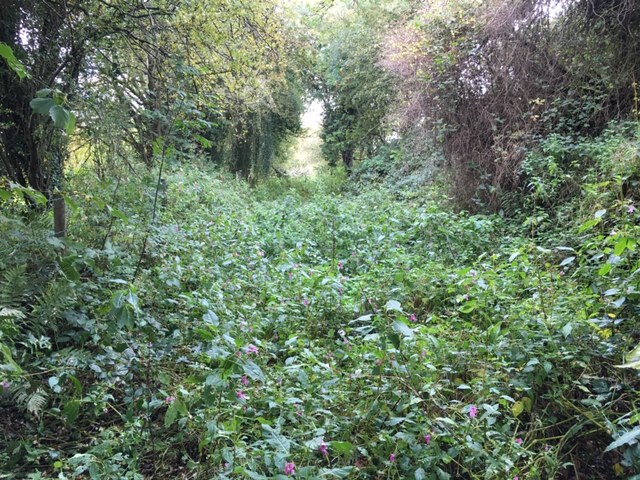
Kerry’s trek along the line increasingly required him to struggle through bushes, small trees and thick under growth. The next picture is taken looking West from close to the lime-kiln and its bridge.

Looking West towards Convoy close to the Limekiln, (c) Kerry Doherty. [6]


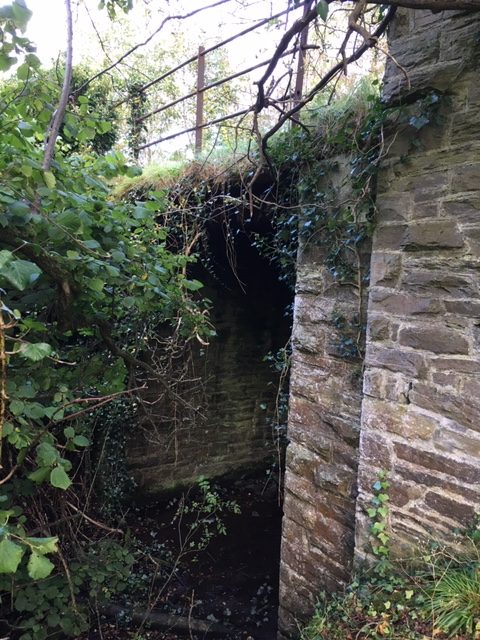
Kerry Doherty says: “It got almost impassable approaching the bridge beside the lime kiln. The bridge pillars can just be seen through the trees,” (c) Kerry Doherty. [6]


Kerry says: “I climbed the cutting to get a better shot of the bridge,” (c) Kerry Doherty. [6]


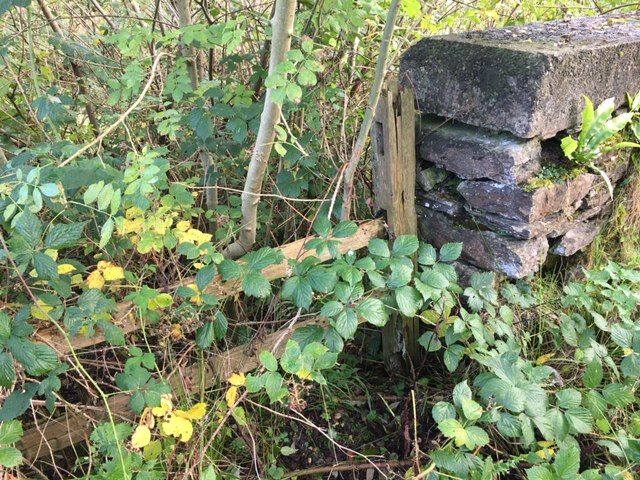
Some original boundary fencing adjacent to the bridge parapet, (c) Kerry Doherty. [6]


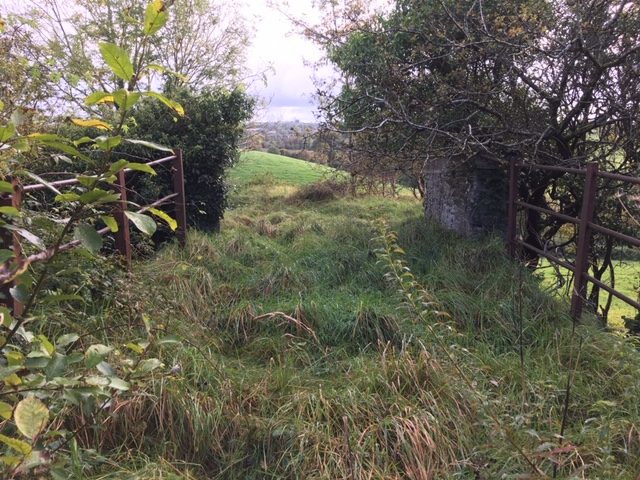
Looking across the accommodation bridge and then across the Lime Kiln to the South, (c) Kerry Doherty. [6]


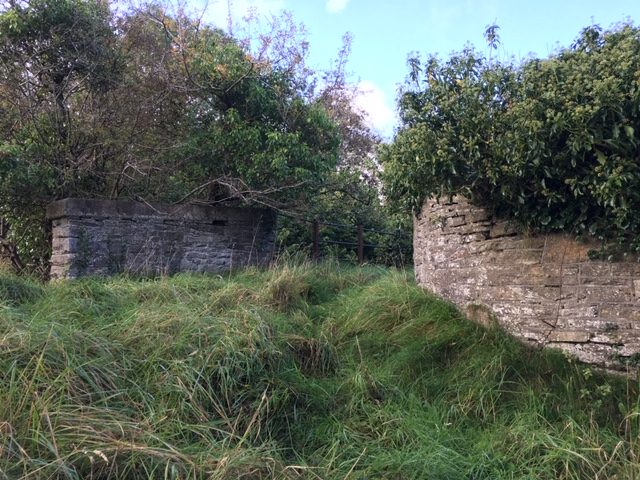
Adjacent to the Lime Kiln the two approach walls to the bridge parapet railing can be seen. That to the East is curved in plan, (c) Kerry Doherty. [6]

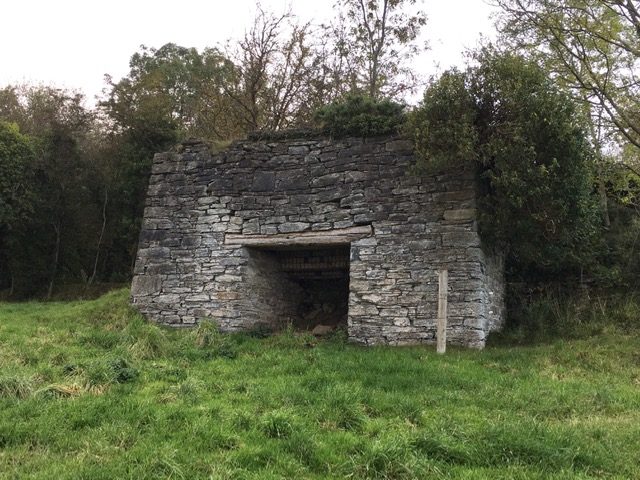
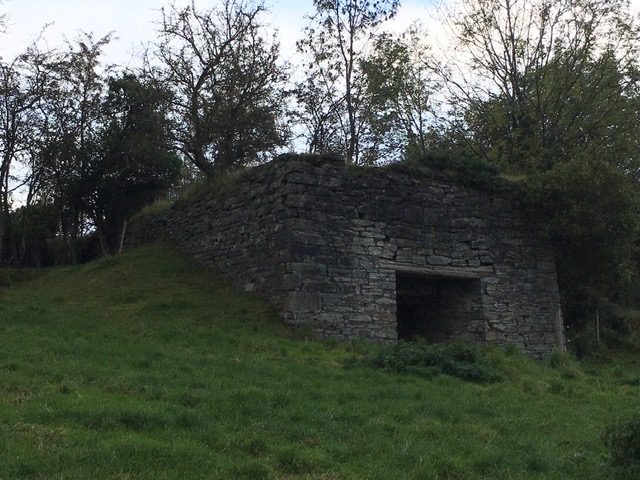
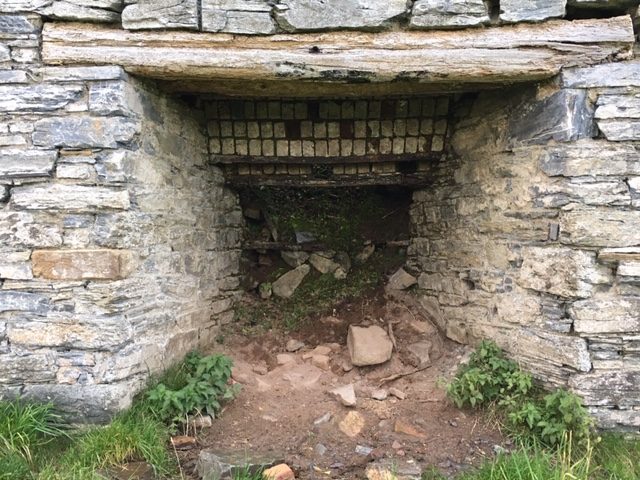
Three pictures of the Lime Kiln follow. All again taken by Kerry Doherty:


The Lime Kiln from the South, (c) Kerry Doherty. [6]


The view from the Southwest, (c) Kerry Doherty. [6]


A close-up shot of the mouth of the Kiln, (c) Kerry Doherty. [6]

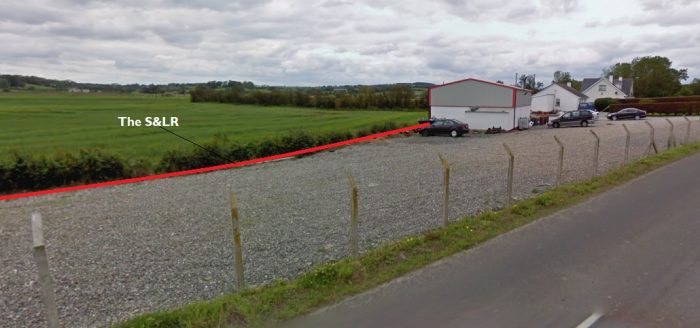
Immediately to the west, the road and old railway ran close together. This can be seen in this next Google Streetview image.


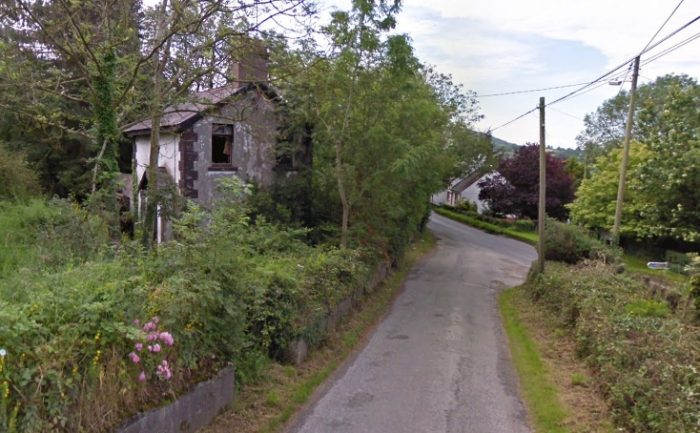
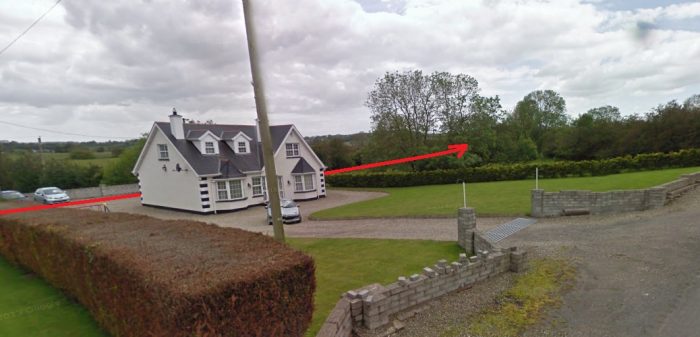
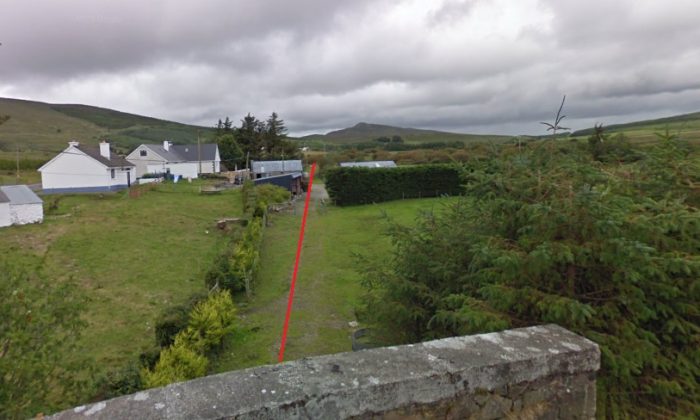
In this picture the formation of the S&LR can be seen in the trees immediately at the back of the land belonging to this bungalow (Google Streetview).

The line ahead now approaches Convoy. Although the formation is completely lost as it crossed the site of the now defunct Kiltole Quarry. The railway station was in the part of Convoy referred to as Milltown (to the East of Convoy itself), sited just to the North of the old mills.


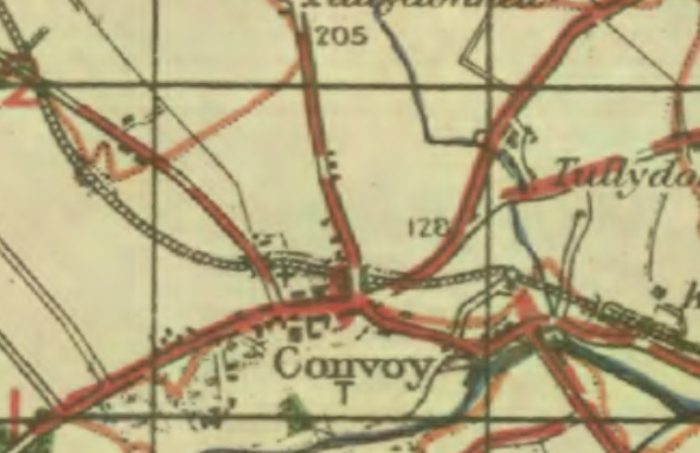
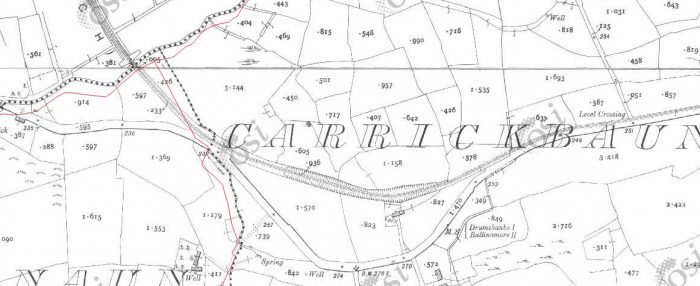
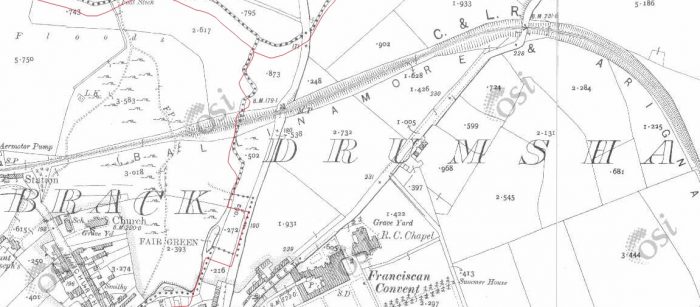
The Village/Town of Convoy (Milltown) on the GSGS 1940s Series of Maps. [10]

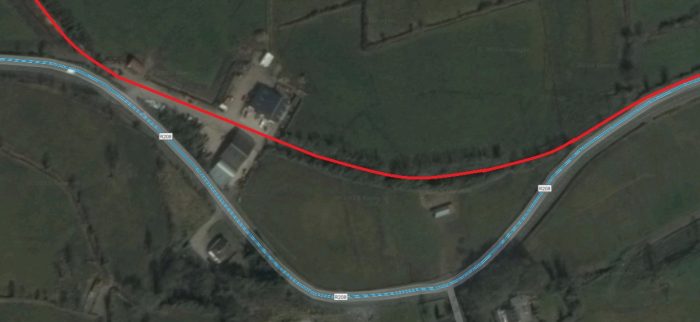
Convoy on the Header National Townland and Historical Map Viewer. The route of the old railway has been imposed on the map as a thin red line. [11]


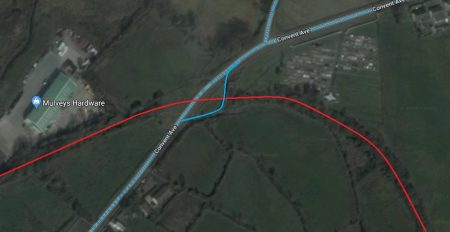
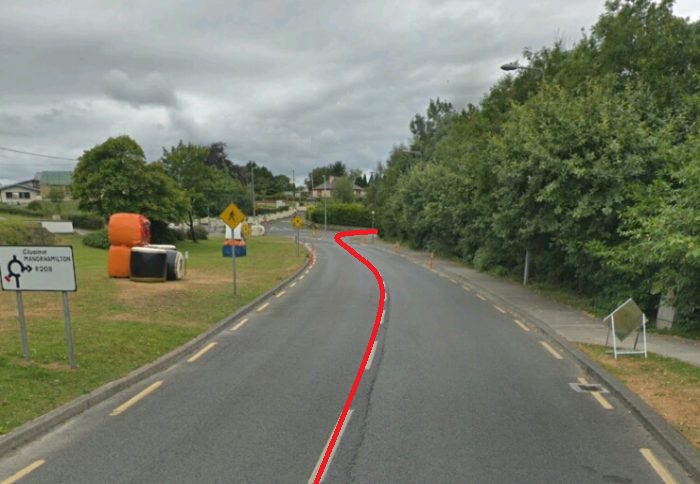
The approximate route of the old line through Convoy (Google Maps). The locations of the Gatehouse and the two road over rail bridges are marked.

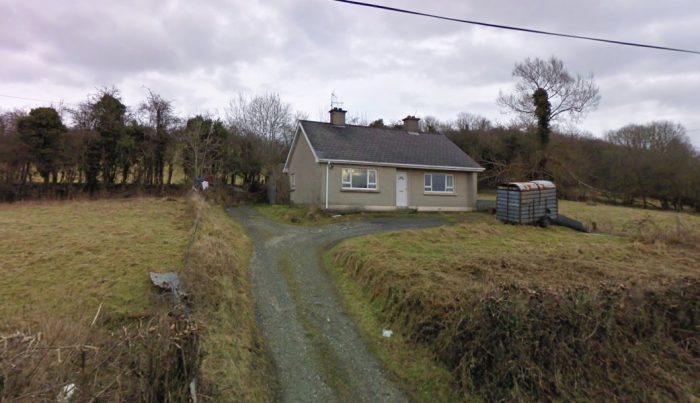
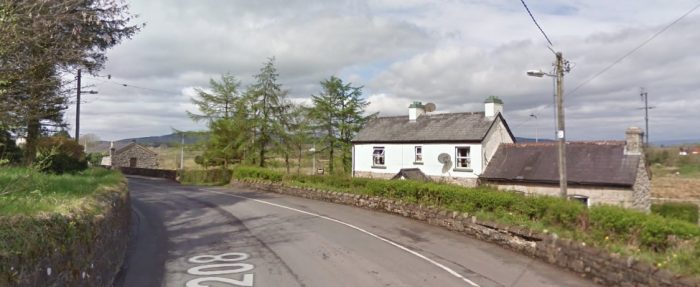
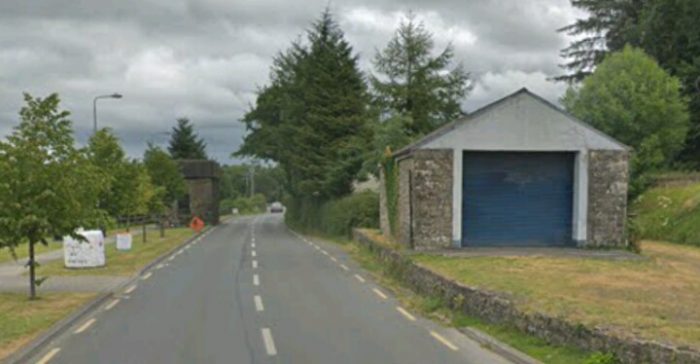
The closest view of the Railway Station site at Convey that is available on Google Streetview. The last remaining structure on the site is the goods shed.

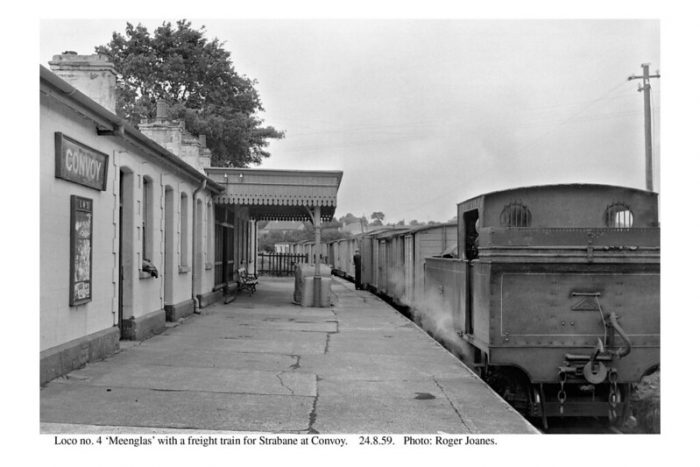
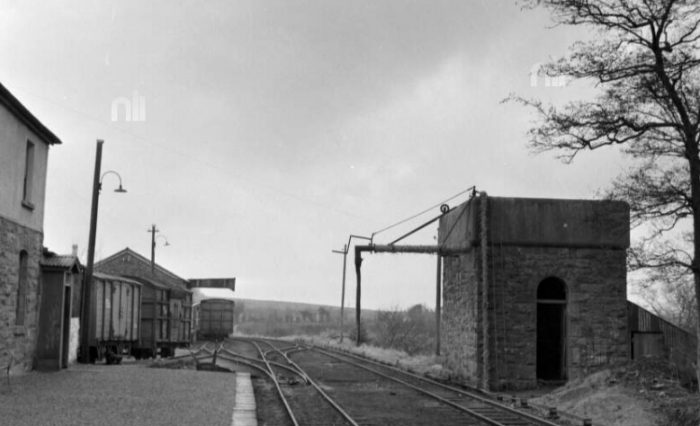
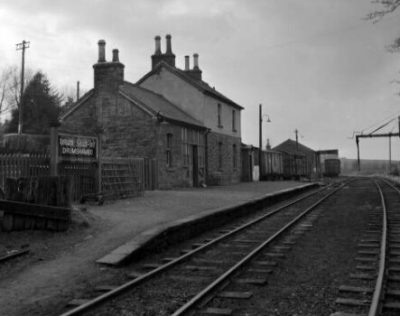
Convoy Railway Station 1959 (c) Roger Joanes, (CC BY-NC-ND 2.0).

This second length of the Strabane to Letterkenny line finishes here at Convoy, the remainder of the line to Letterkenny will follow in another post.

References

  1. Edward M Patterson (original author), Joe Begley & Steve Flanders (authors of additional material in the Revised Edition); The County Donegal Railways; Colourpoint Books, Newtownards, Co. Down 2014. As noted in my first article about the Co. Donegal Railways this was to have been my holiday reading while walking different parts of the network, but 2020 has been a strange year!
  2. https://maps.nls.uk/geo/explore/#zoom=15&lat=54.87036&lon=-7.61772&layers=14&b=1, accessed on 25th July 2020.
  3. https://commons.wikimedia.org/wiki/File:Athlone,_Cavan_%26_Clara._LetterKenny_Strabane_RJD_113.jpg#/media/File:Athlone,_Cavan_&_Clara._LetterKenny_Strabane_RJD_113.jpg, accessed on 14th July 2020.
  4. http://geohive.maps.arcgis.com/apps/webappviewer/index.html?id=9def898f708b47f19a8d8b7088a100c4, accessed on 25th July 2020.
  5. Edward M Patterson (original author), Joe Begley & Steve Flanders (authors of additional material in the Revised Edition); The Lough Swilly Railway; Colourpoint Books, Newtownards, Co. Down 2017. This was also to have been part of my holiday reading, but 2020 has been a strange year!
  6. Kerry Doherty of Ballindrait very kindly sent me a series of pictures of the Strabane and Letterkenny Railway route. Each of these, in this article, bears the reference number [6] Later, and also referenced [6] Kerry scrambled through the undergrowth along the old line to find evidence of the accommodation bridge and the rear of the lime kiln.
  7. https://www.flickr.com/photos/110691393@N07/11364546546/in/photolist-ijfgKG-ijfnbj, accessed on 22nd July 2020.
  8. Anthony Burges; The Swilly and the Wee Donegal; Colourpoint Books, Newtownards, Co. Down, Second Impression, 2010.
  9. https://maps.nls.uk/geo/explore/#zoom=15&lat=54.86372&lon=-7.63776&layers=14&b=1, accessed on 8th August 2020.
  10. https://maps.nls.uk/geo/explore/#zoom=15&lat=54.86396&lon=-7.65969&layers=14&b=1, accessed on 9th August 2020.
  11. https://www.flickr.com/photos/110691393@N07/11371005014/in/photolist-ijf23V-ijPnCA, accessed on 5th October 2020.

Co. Donegal Railways, Ireland – Part 4 – Strabane to Letterkenny (Part A – Strabane to Raphoe)

Wikipedia gives us a very short history of the line from Strabane to Letterkenny and provides a single image – the Railway Clearing House map with stations in Strabane and Letterkenny:

The Railway Clearing House map with stations in Strabane and Letterkenny. [3]

“The County Donegal Railways Joint Committee (CDRJC) constructed the Strabane and Letterkenny Railway. It opened for public service on 1 January 1909 with a route length of 19.25 miles. It was the last railway constructed by the CDRJC bringing the network operated by this company to 121 miles. The company pioneered the use of diesel operated railcars, but despite this innovation, closure came at the end of 1959, and the railway was shut on 1 January 1960.” [2]

 This history must be worth expanding! It gives so little detail!

Wikipedia tells us that Letterkenny was already rail-served in 1909. “‘The Londonderry and Lough Swilly Railway Company’ (The L&LSR, the Swilly) was an Irish public transport and freight company that operated in parts of County Londonderry and County Donegal between 1853 and 2014.” [4] Incorporated in June 1853, [5] “it once operated 99 miles of railways. … It closed its last railway line in July 1953 but continued to operate bus services under the name Lough Swilly Bus Company until April 2014, becoming the oldest railway company established in the Victorian era to continue trading as a commercial concern into the 21st century. Following a High Court petition by HM Revenue and Customs, the company went into liquidation and operated its final bus services on 19 April 2014.” [4][7][8]

The first railway station in Letterkenny opened on 30th June 1883. The line out of Derry started out as the “Londonderry and Buncrana Railway” and was absorbed into the L&LSR in 1887. [9] That line is not the subject of this article but it is important to note that Letterkenny had been rail-served for many years before the branch from Strabane arrived in the town.

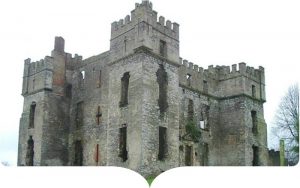
Raphoe Bishop’s Palace. [10]
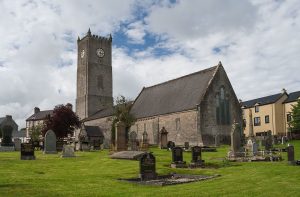
Raphoe Cathedral. [11]
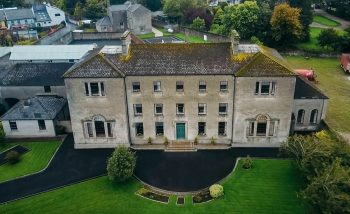
Raphoe Royal and Prior School in 21st century. [12]

Patterson et al [1: p41] explain that the Co. Donegal Railways from Strabane to Stranolar – which were accessed from Londonderry over either the Great Northern Railway (along the valley of the River Foyle) to Strabane or the more tortuous route owned by the Co. Donegal Railways which passed over the higher ground to the East of the River Foyle, through New Buildings, Collion, Donemana, Ballyheather and Ballymagorry and on to Strabane – ran to the South of an area which included the small towns of Raphoe and Convoy. The L&LSR ran to the North of this area. “At the end of the 19th century, Raphoe had a population of around 700, …. centred around a cathedral, a ruined bishop’s palace and a Royal School. Convoy, only about a third he size of Raphoe, was a manufacturing village with a reputation for woolen textile manufacture. By Donegal standards, the people living there felt they ought to have a railway.” [1: p41]

That sense of entitlement built on endeavours which began as early as 1860 but which foundered on more powerful interests. It wasn’t until around 25 years later that a light railway/tramway was planned between Strabane and Drumcairn and it became more likely that the area would be rail served. However, that scheme also foundered for lack of money. [1: p41]

It was 1902 when a new version of the scheme was proposed at an estimated cost of £100,000 which ran between Strabane and Letterkenny via Lifford, Ballindrait, Convoy and Raphoe. The scheme was the subject of a bill submitted to Parliament in the winter of 1902-3. [1: p41-42] That application failed to achieve its key objective of reaching Letterkenny. The Act only allowed a line from Strabane to Convoy. A further submission was made in 1904 and was successful. The promoters called the line the Strabane and Letterkenny Railway (S&LR)  and within no more than a year it had effectively been taken over by the Great Northern Railway in advance of their takeover of the Co. Donegal Railway. [1: p42-43]. Work started on building the line in 1906. Robert McAlpine and Sons were the principal contractor. The line was eventually opened to traffic on New Year’s Day 1909. [1: p43-44]

Patterson et al comment that “since much of the share capital of the S&L had been provided by the Midland and the Great Northern, owners of the CDRJC since 1906, it was natural that the Joint Committee should take over the operation of the line and work it as a branch. ” {1: p44-45]

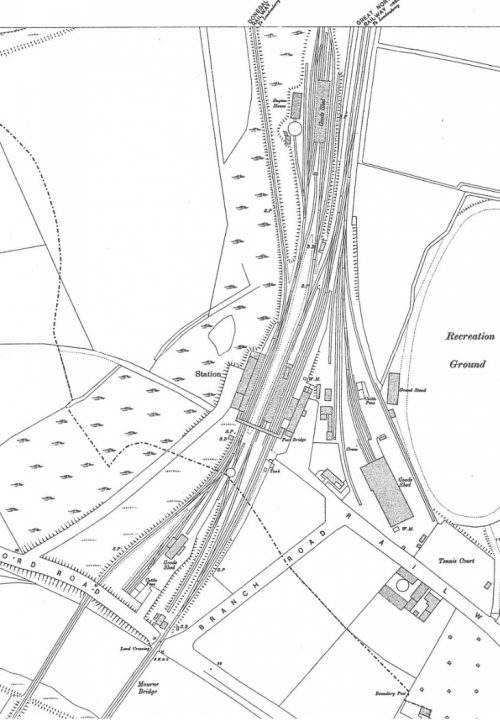
1905 Ordnance Survey Map. [14]

Strabane Railway Station was first opened in 1847 on the Great Northern Irish standard-gauge line. It expanded to include the narrow-gauge Co. Donegal lines in 1894 when the new narrow gauge crossed the river into the southern end of the station.

Prior to the narrow-gauge, the Finn Valley railway shared the southern approach to the railway station with the Irish North Western Railway – the predecessor of the GNR. The Finn Valley Railway was held to ransom for access into Strabane Railway Station. The advent in Ireland of the new 3ft gauge railways encouraged the directors of the West Donegal Railway  (WDR) to choose that gauge for their new railway in the late 1870s. After a period of mixed gauge use of Stranorlar Railway Station, Parliament sanctioned the amalgamation of the  Finn Valley  with the WDR in 1892 and in 1893 powers were obtained for a change of gauge between Stranorlar and Strabane and for the construction of a new narrow-gauge link from the old Finn Valley junction with the GNR into Strabane Railway Station. [1: p19-28] That link appears on the 1905 Ordnance Survey Map above. The map was drawn only a few years before the construction of the S&LR.

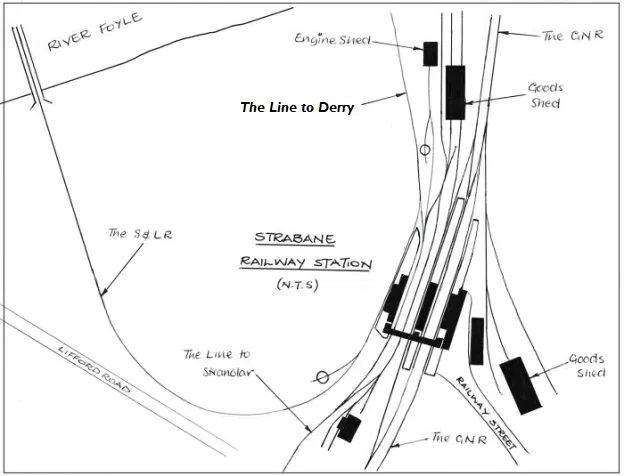
My sketch below shows the layout of Strabane Railway Station in the years following the construction of the S&LR. Strabane Railway Station in the 1930s (c) Roger Farnworth

A Journey Along the Line – Strabane to Letterkenny – Part A – Strabane to Raphoe

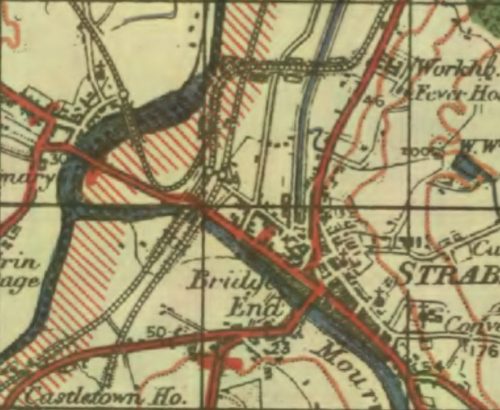
Strabane on the GSGS Map from the 1940s. The GNR runs roughly North-South the Co. Donegal runs from the top right to the bottom left with the branch to Letterkenny returning to the North edge of the map having passed through the Railway Station at Lifford. The station at Strabane is marked by the linked roundels near to the centre of the map. [13]

On the GSGS 1940s OS Map, the Strabane to Letterkenny branch is shown leaving the  Co. Donegal mainline just to the North of Strabane Railway Station.  My sketch above shows the actual arrangement. It was difficult to fairly represent the track arrangement at the station at the scale the GSGS Maps were drfated. Letterkenny trains left Strabane Railway Station at the station platforms and then turned sharply round to the Northwest before crossing the River Foyle and entering Lifford Railway Station.

Recently, I have been consulting with Chris Amundson. The link immediately below shows what is known about the layout of Strabane Railway Station in different eras:

https://www.flickr.com/gp/spw45/mFAX44

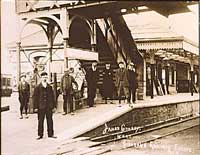
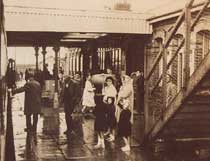
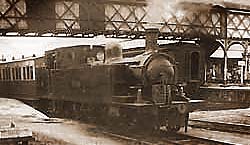
The next few pictures show the footbridge at Strabane Station. The first three  are relatively low resolution images posted on the BBC Northern Ireland Your Place and Mine website. [15]

These first three images are taken looking North through the Station. The first is taken from just South of the Western station platform. On the far left of the image the S&LR platform can be glimpsed. The second shows the main station buildings with the footbridge steps to the right of the image. The third looks Northeast under the footbridge towards the main station buildings.

The fourth picture was found on both Sepiatown [16] and OldStrabane webpages [17] It shows the station footbridge, again looking North, from the GNR side of the station. (I have been unable to contact both of the two sites to get permission to share photographs, postcard images, etc., here. Email links, where they exist, no longer function. Should the site owners wish me to remove the images credited to those sites then I will do so and replace them with the links referred to in the references at the end of this article.)

The first colour image shows the station footbridge again, also looking Northeast, this time from close to the Co. Donegal lines turntable. County Donegal Railway No 11 “ERNE” is moving vans in May 1957. [17][18]

The second colour image shows the same engine (No. 11 ERNE Class 4, 4-6-4 ‘Baltic’ tank), heading away, light engine, from Strabane Railway Station on the Letterkenny line in March 1958. The CDR signal box, and station footbridge are shown in the background. [17][19]

The following image shows a Goods Train approaching Strabane from Lifford, presumably having travelled from Letterkenny. The photographer is looking Southwest from a point near the Signal Box at Strabane. [17][20]

As noted above, these superb images can be found on two sites, http://www.sepiatown.com and oldstrabane.blogspot.com. Each image is individually referenced on the http://www.sepiatown.com website. I have only been able to provide a general reference for the same images on the  oldstrabane.blogspot.com website.

Those on the http://www.sepiatown.com website are geographically referenced for their location around the station site.

A train prepares to depart for Letterkenny. Platform 5 at Strabane Railway Station. [17][24]
Diesel Shunter Phoenix at Strabane Station looking Southwest from Platform 5 – the platform used by the Strabane to Letterkenny services The signal box can be made out beyond the end of the platform. [17][22]
Railcar  No. 14 at Strabane Railway Station on 20th August 1959, preparing to leave Platform 5 for Letterkenny. [17][23]
he Strabane & Letterkenny Railway closed on 1st January 1960. This photograph was taken sometime after the closure (probably in 1965). The rail track has been removed and replaced by a road. The building on the right nearest to the camera is the Co. Donegal Railways signal box. [17][21]
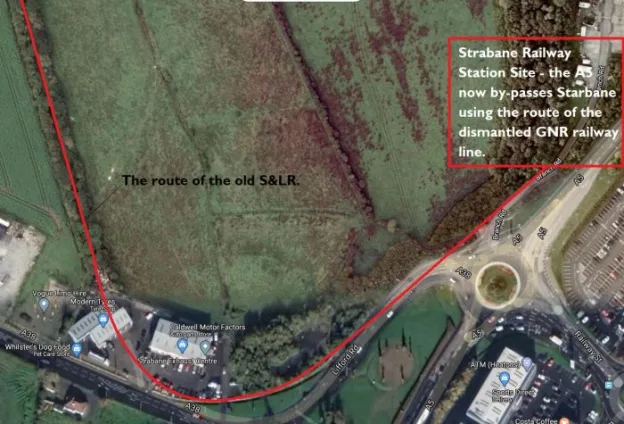
he route of the old S&LR is marked by the double row of trees heading North from the modern A38 (Google Maps).
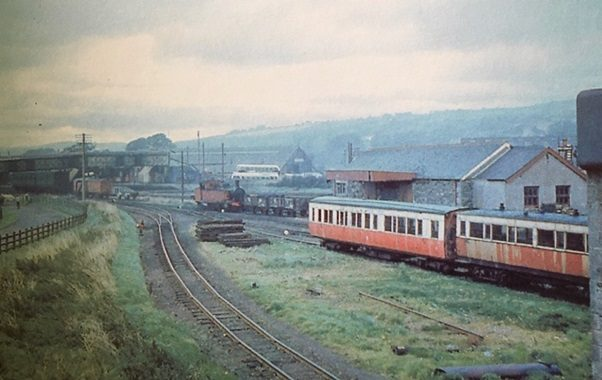
Kerry Doherty supplied this photograph for comparison with the one above. It shows Strabane Railway Station and is taken from the “camels hump” bridge. He comments that ‘This site has been much filled in and raised quite a bit.’ Photograph supplied by Kerry Doherty. [45]
Kerry Doherty supplied this photograph for comparison with the one above. It shows Strabane Railway Station and is taken from the “camels hump” bridge. He comments that ‘This site has been much filled in and raised quite a bit.’  The line in the centre foreground is the S&LR. Photograph supplied by Kerry Doherty. [45]
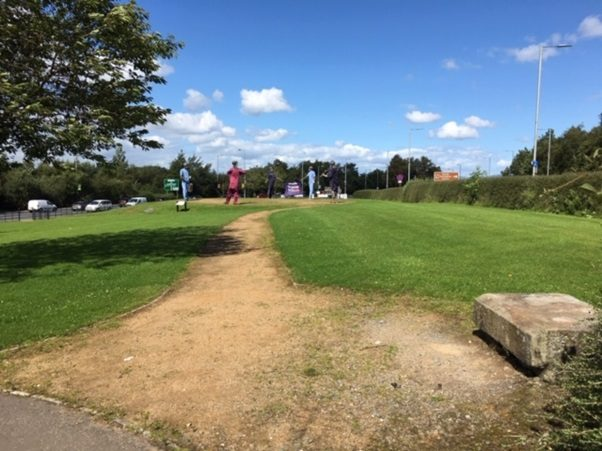
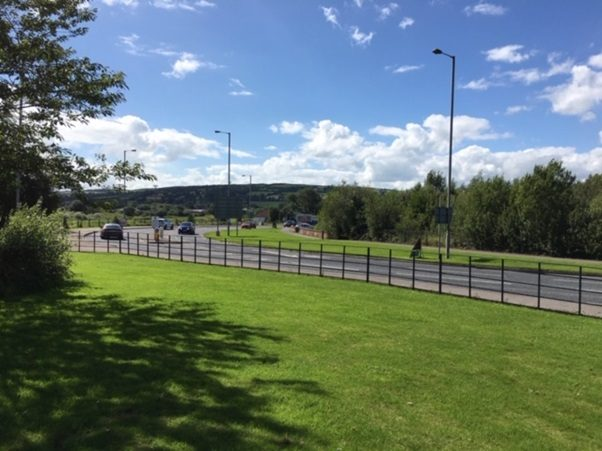
Turning through 180 degrees, we are now looking in the direction of Lifford, the Letterkenny line trackbed would have been where the grass is on the far side of the road. Curving off sharply to the right (c) Kenny Doherty. [45]

Trains for Letterkenny used the most westerly platform at Strabane Railway Station – Platform No. 5. Trains traversed a very tight curve round to the Northwest, followed a short straight-alignment before crossing the River Foyle.

As we have noted, there was a sharp curve in the line out of out of Strabane. THis image shows the trackbed after the curve, looking towards Lifford. Kerry Doherty comments: ‘It’s interesting to note that when the line was lifted in January 1960, this was tarred and the railway bridge used for buses and lorries and the road bridge was being replaced. The tar is still under the moss underfoot,’ (c) Kerry Doherty. [45]
Looking across the River Foyle at the location of Lifford Station which is in the trees, (c) Kerry Doherty [45]
The magnificent stone abutment of the bridge. This is the southern bridge abutment, (c) Kerry Doherty. [45]
The location of Lifford Bridge, (c) Kerry Doherty. [45]
Lifford Bridge. Photo by John Langford, supplied for inclusion here by Kerry Doherty. The picture is taken from approximately the same angle as the more modern image above. Lifford Station Halt can be seen on the right side of this image. Kerry Doherty Collection. [45]
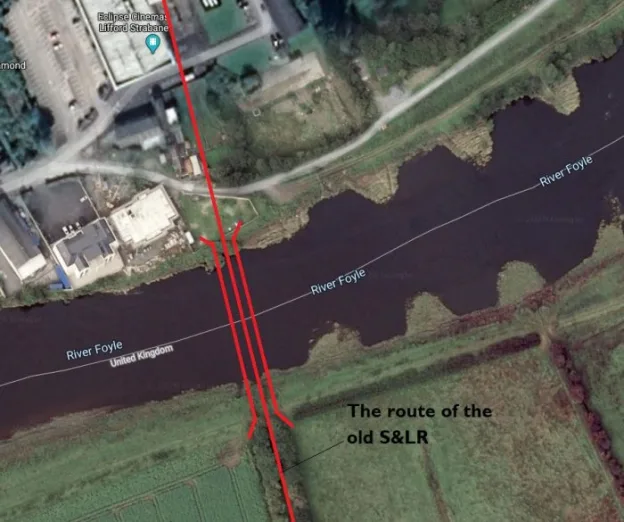
The location of the old Strabane/Liffor Railway Bridge across the River Foyle. (Google Maps)
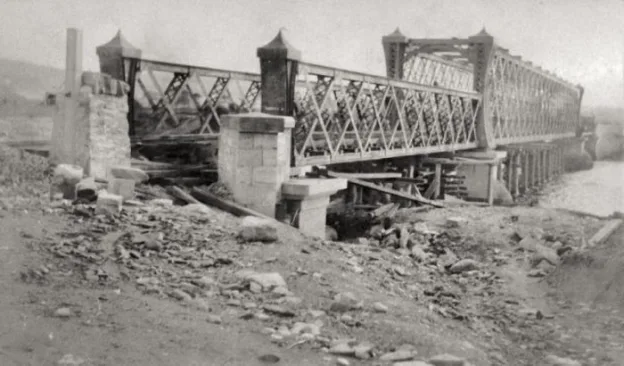
he Construction of Lifford Railway Bridge. The photographer is on the West side of the River Foyle, looking SE towards Strabane Station on the Strabane-Letterkenny line. The picture was taken in 1908. [17][25]
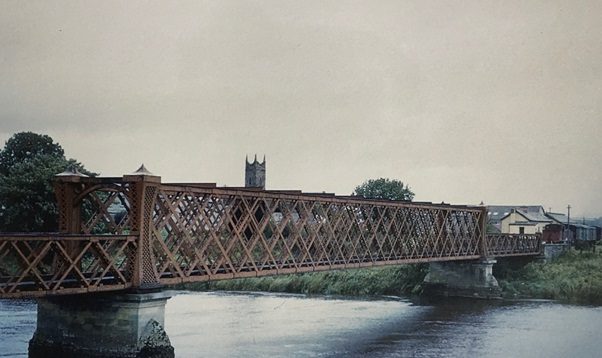
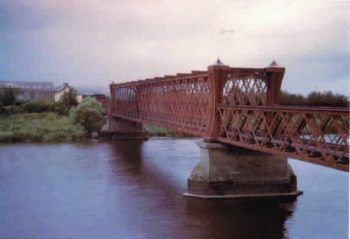
A much later image of the Strabane/Lifford Railway Bridge (c) Margaret (Blee) Fisher. [26]

The Strabane/Lifford Railway Bridge over the River Foyle is shown during construction above and much later, probably not long before demolition, in the adjacent photograph.

All that remained in the latter 20th century was the bridge foundations. By the early 21st century, these also were gone.

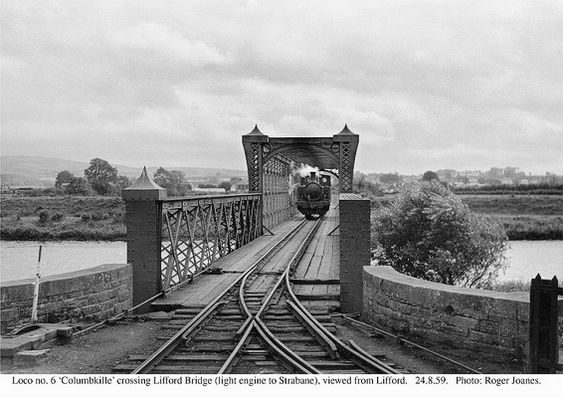
The same bridge in 1959. This photograph is taken from the end of the platform at Lifford Halt (c) Roger Joanes (CC BY-NC-ND 2.0). [29]

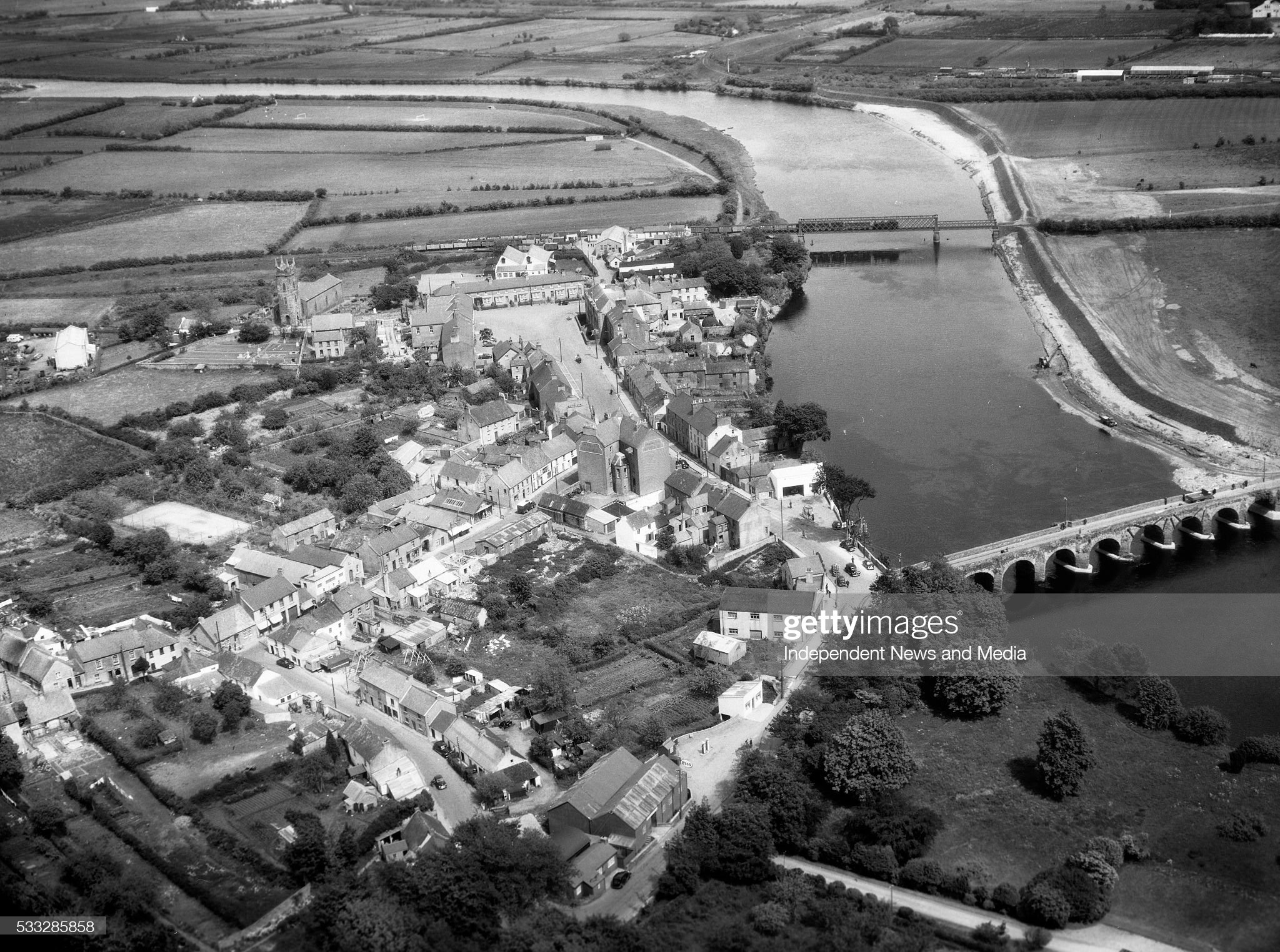
The S&LR bridge can be seen towards the top of this image. Lifford Halt Station is just to the left pf the bridge. This image is embedded with permission from http://www.gettyimages.co.uk. An unidentified Co. Donegal steam locomotive is crossing the bridge in charge of a long goods from Letterkenny. [30]

Lifford Station and Railway on the S&LR. [27]
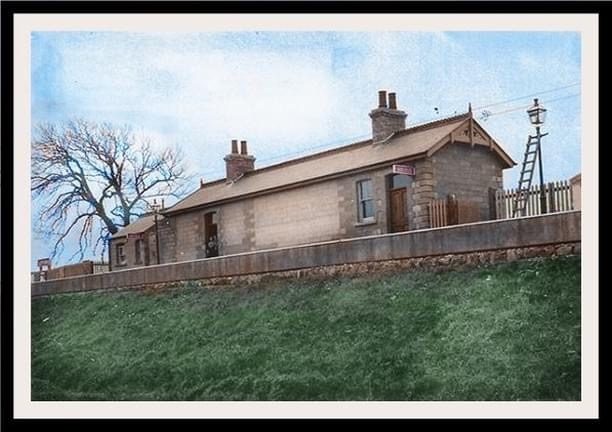
Lifford Halt Station Builing, a colourised monochrome image. The photograph was taken by William Lawrence included here courtesy of Kerry Doherty. [43]
Lifford Station (from behind), the platform was on the other side of the building. This picture was taken some years ago as the building has been modified and is now surrounded, as can be seen below, by a high fence. The images below show the building as it is now, owned by two different people. The track-side elevation is much better kept and in recent years was the post office, (c) Kerry Doherty. [45]
Lifford Halt Station Building (Google Streetview).
Lifford Halt Station (Google Streetview).

The photo above appears on the Donegal Heritage Centre Facebook page and is embedded here with permission. [31] There is also  an excellent photograph of the station and platform in Anthony Burges book, The Swilly and the Wee Donegal. [44: p30] The satellite image below shows the S&LR just North of the location of the old station.

The S&LR (Google Maps)
The S&LR [31]
The S&LR [31]
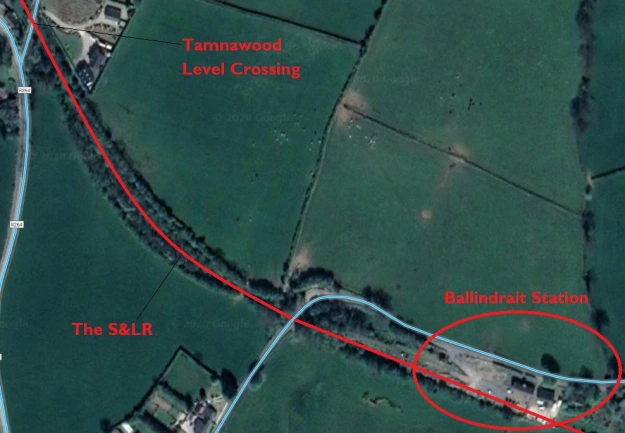
The approximate alignment of the S&LR approaching Ballindrait Station which is just off the satellite image to the West. [31]
The approximate line of the S&LR in the 21st century. [27]
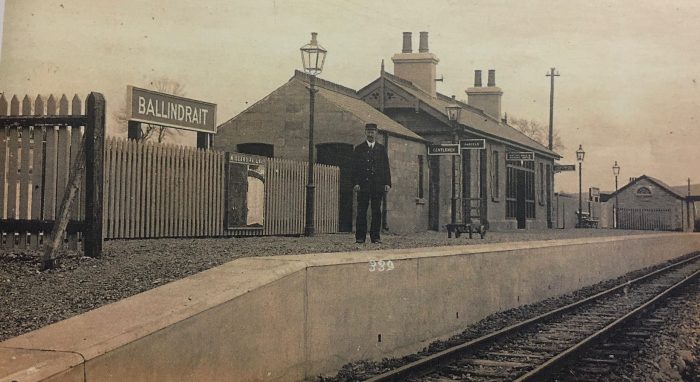
Ballindrait Railway Station as first built. This picture is an old postcard view taken by William Lawrence and provided courtesy of Kerry Docherty. [43]
Ballindrait Station in 21st century viewed from the West along the access road from the village (Google Streetview). The building on the right is the old passenger building with the platform beyond.

Ballindrait Railway Station was to the Northeast of the village on the North side of the Deele River.

The Goods Shed (Google Streetview).
Ballindrait Goods Shed, looking towards Lifford (c) Kerry Doherty. [43]

There is a bungalow on the site of the old station, close to the old station house, but many of the buildings associated with the station are also still present. A sequence of views are adjacent to this text, three of which are views on Google Streetview.

The two wintry views are from the Irish National Inventory of Architectural Heritage. [32]

Ballindrait Goods Shed from the Southwest. [32]
The Station Master’s House (Google Streetview)

There are also some pictures taken recently by Kerry Doherty which show the site from the alignment of the old railway (these make an excellent comparison with one of the images in the book, The Swilly and the Wee Donegal, by Anthony Burges . [44: p31])

Kerry Doherty’s photos include one of the old goods shed looking towards Lifford.

The Station Master’s House from the Southeast. [32]

The station buildings are in a surprisingly good condition having seen little or no maintenance over the years since the closure of the S&LR.

Ballindrait platform shelter and platform remains, looking towards Coolaghy (c) Kerry Doherty. [43]

I am particularly grateful to Kerry Doherty for the modern images which appear to be more up-to-date than the Google Streetview images.

Leaving the station, the railway travelled only a short distance due West before crossing the station access road leading up from Ballindrait village on a steel girder bridge.

Ballindrait platform shelter and platform remains, looking towards Coolaghy (c) Kerry Doherty. [43]

The bridge deck has been removed and the abutments, if they still exist, are completely obscured by vegetation.

Beyond Ballindrait the S&LR followed the route of the R264 closely. The picture below looks back towards Ballindrait railway station in the year before closure of the line.

Leaving Ballindrait the line followed a relatively straight course for a short distance. This view looks back towards the station from just beyond the road under bridge which took the station access road into Ballindrait. [45]

Initially crossing a side road on the level at Tamnawood Crossing. The crossing keeper’s cottage still stands in the early 21st century and is shown below in two images, the first comes from the Irish National Inventory of Architectural Heritage. [33] The second from Google Streetview.

Tamnawood Crossing-keeper’s Cottage [33]
Tamnawood Crossing-keeper’s Cottage (Google Streetview)
The S&LR [Google Maps]

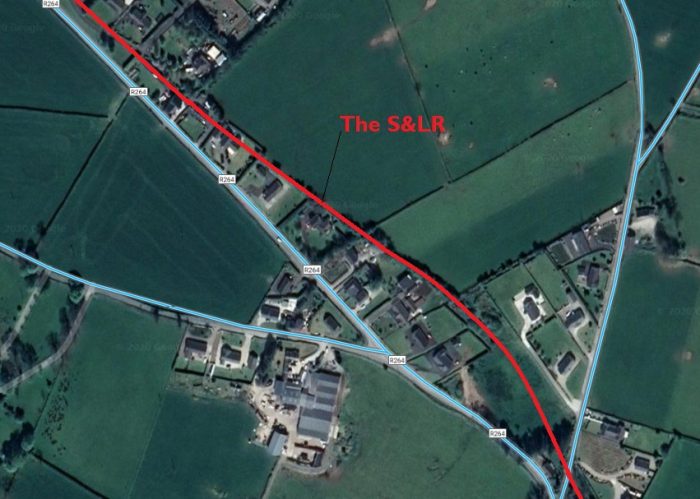
At first it ran along the North side of the road. Modern develop obscures its route. The first two Google Satellite images below show that modern development.

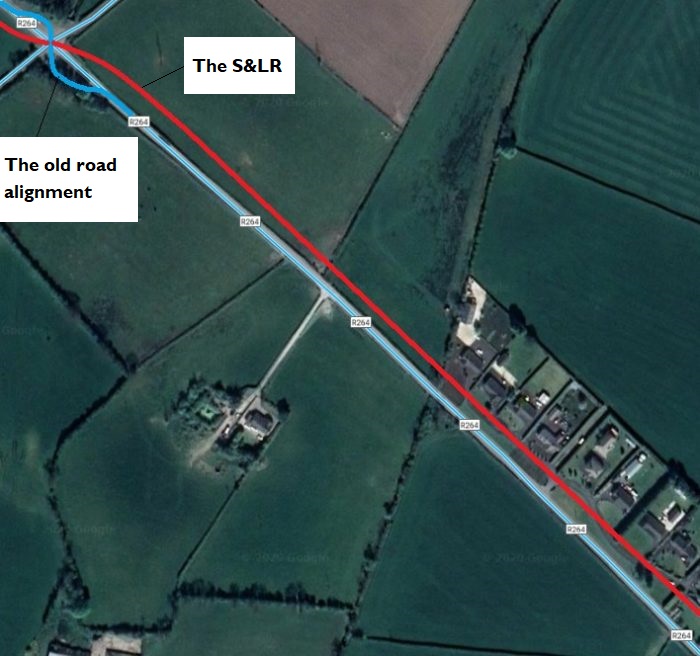
After a few more hundreds of metres, line crossed the R264 on the level. The old road has been realigned at this point. The location can be picked out on the GSGS Map below but is more easily picked out on the larger scale extract provided after the two satellite images.

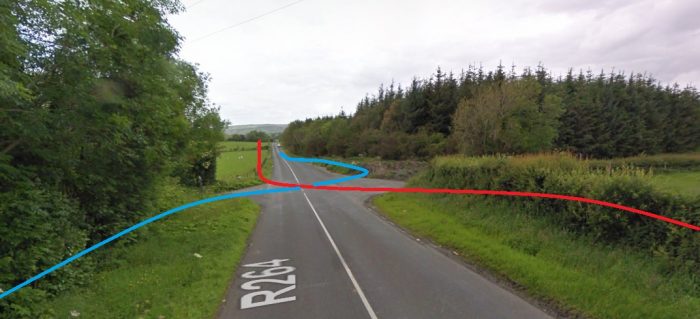
The approximate alignment of road and rail is illustrated on the Google Streetview photograph below the larger scale map extract.

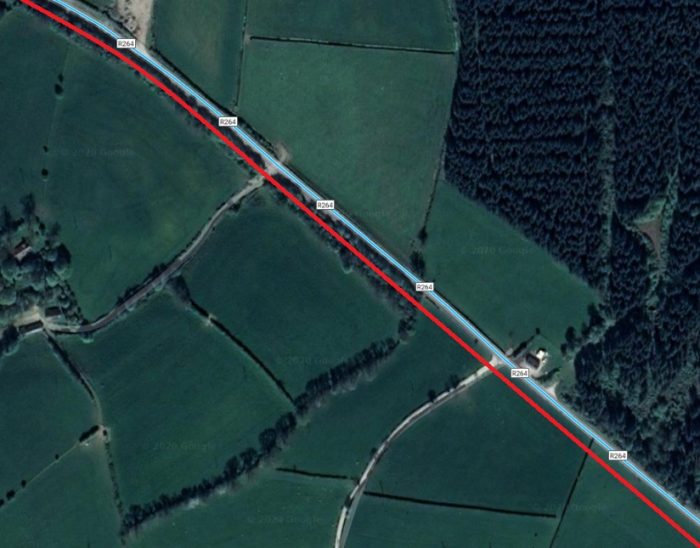
Beyond the road crossing the S&LR followed the South side of the R264, only a few metres away from the carriageway, until it reach Coolaghy Halt where it turned away Southwest from the road.

The route as far as Coolaghy Halt is illustrated on the Google Sateliite images below.GSGS Map from 1941 shows the route of the Strabane to Letterkenny Railway following the route of the Ballindrait to Raphoe Raod (R264). [34]GSGS Map from 1941 shows the point at which the S&LR crossed the R264. [34]The R264 looking Northwest towards Raphoe showing the approximate alignments of the old road and the S&LR (Google Streetview).

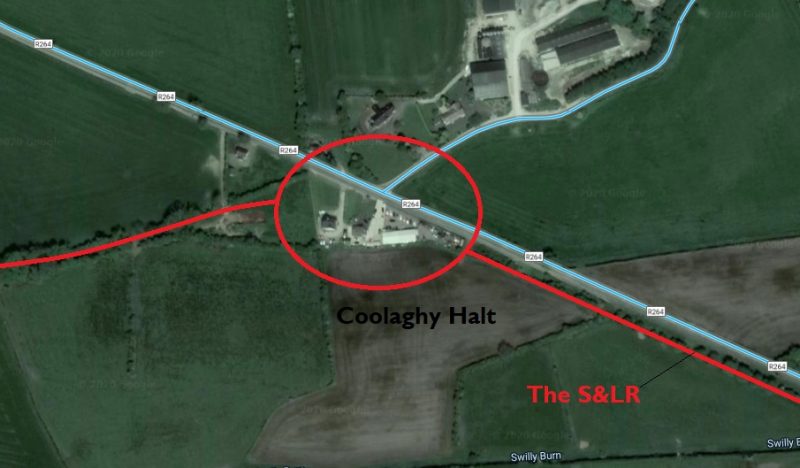
The location of Coolaghy Halt (Google Maps)

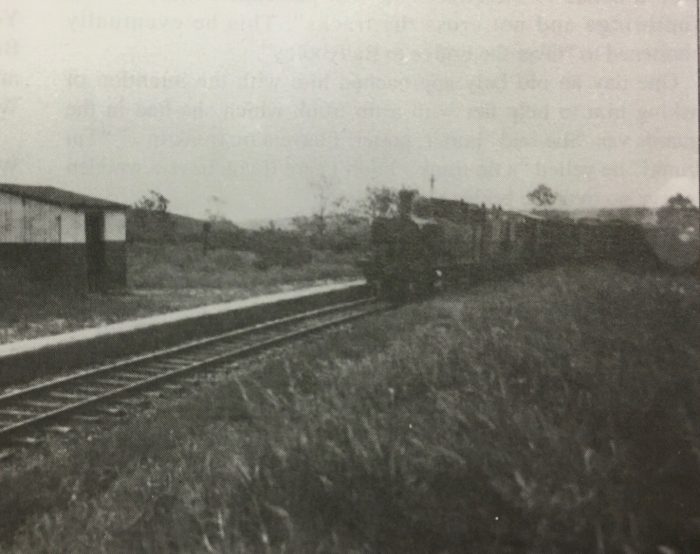
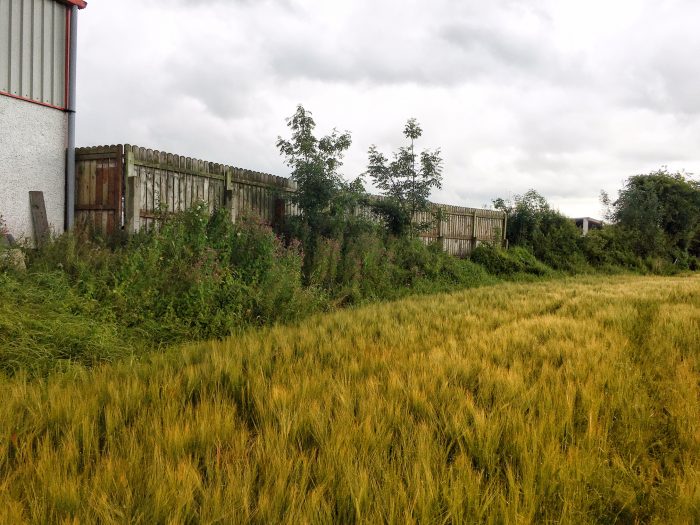
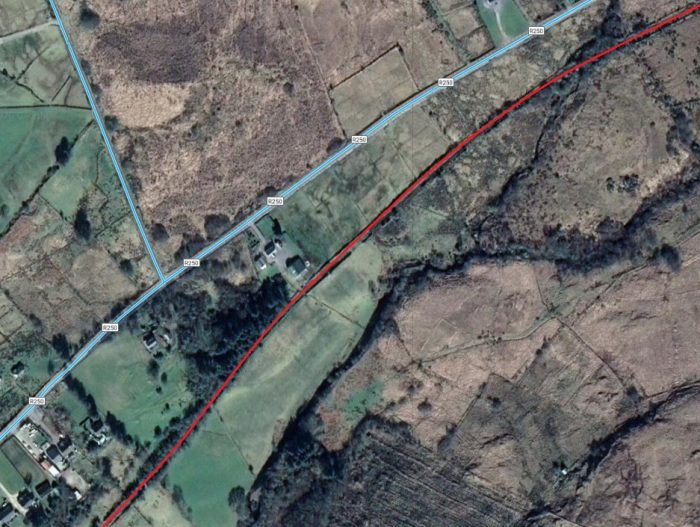
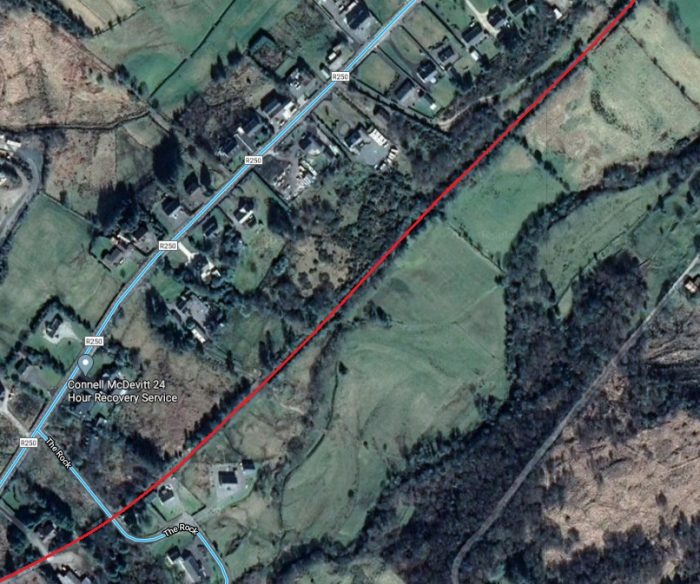
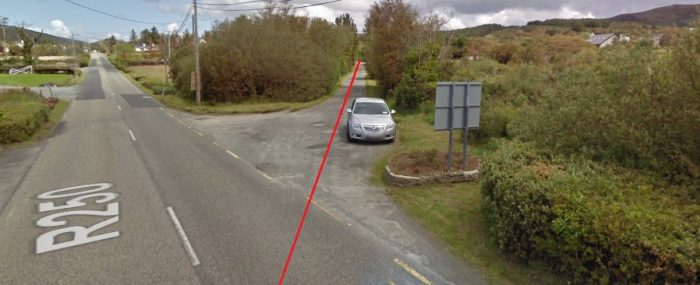
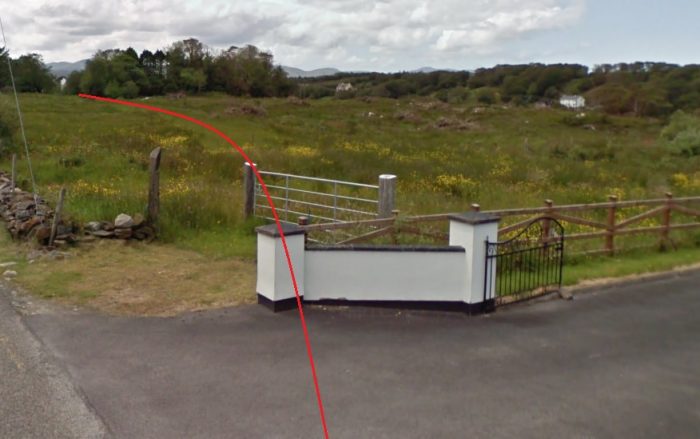
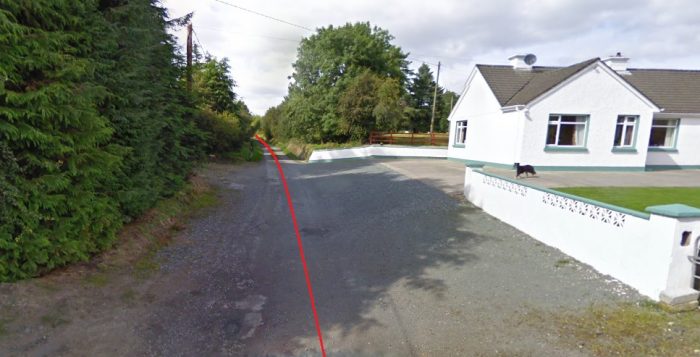
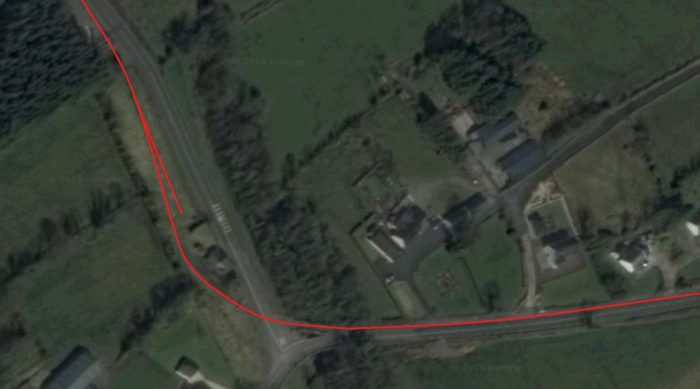
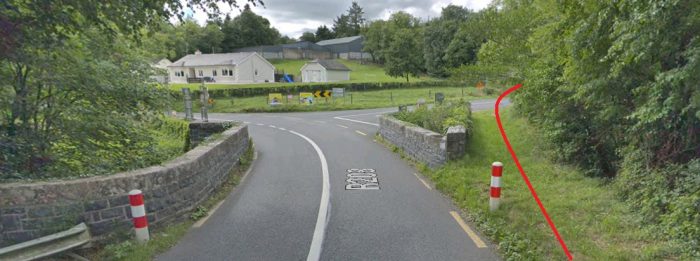
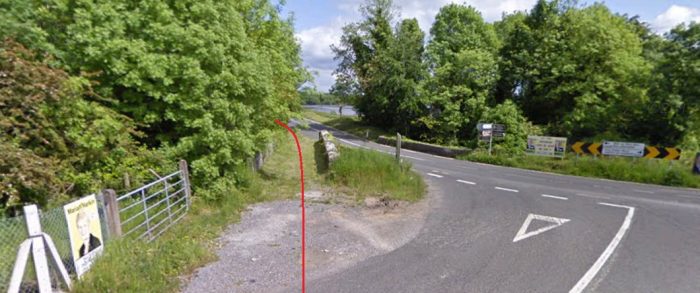
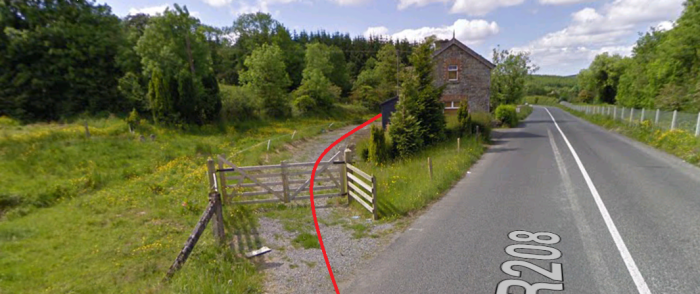
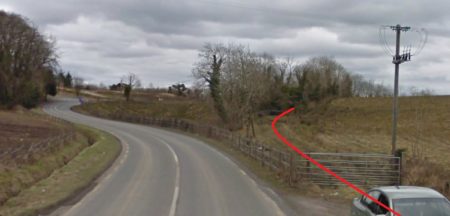
Coolaghy Halt was the first point for some distance that the railway left the side of the old road. The route of the S&LR is still easily picked out as a line of trees and shrubs running West-southwest away from the R264.Coolaghy Halt in 1942 from the Tom P. McDevitte Collection courtesy of Kerry Doherty, the image is also reproduced in ‘Railway Days in Strabane’. [43]Coolaghy Halt’s location in the 21st century. The platform was where the fence sits today. Photograph by Kerry Doherty. [43]The location of Coolaghy Halt (Google Streetview)A side road from the Northeast met the R264 at the location of the Halt which was on the South side of the road. The red line on these two Google Streetview images shows the approximate alignment of the old S&LR at this point (Google Streetview).

Onward from Coolaghy Halt, the S&LR was only away from the R264 for a few hundred metres, running behind what is now P Connolly Car Sales and Repairs before drifting back towards the road and roughly following its alignment for a few hundred metres before turning away to the Southwest again en-route to what was Raphoe Railway Station.Raphoe Railway Station sat on the South side of the town. [35]

A view from above the cutting just before crossing the road into the Raphoe Station site, you can see the gap where it crossed the road, (c) Kerry Doherty. [45].

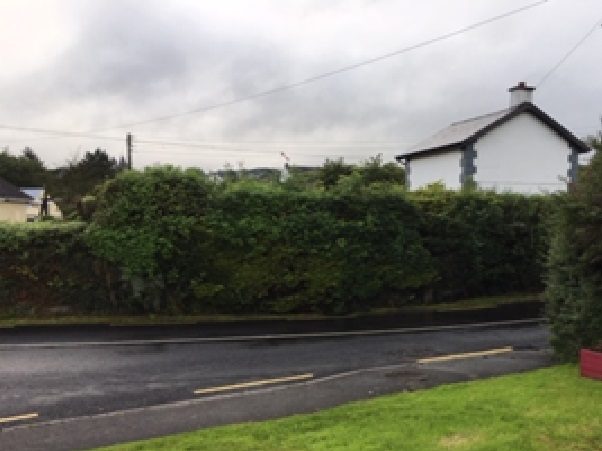
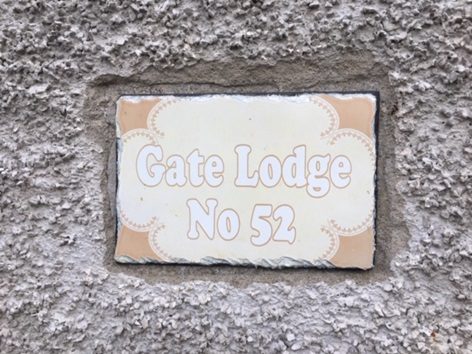
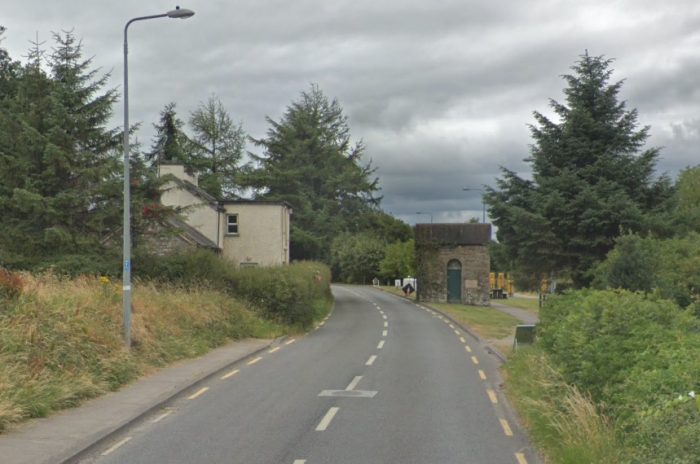
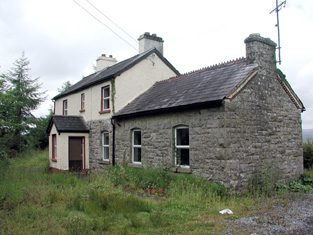
The Crossing-keeper’s cottage, Gate House 52, in the early 21st century, The photographer is standing on the track-bed, (c) Kerry Doherty. [45]A nice acknowledgement to the railway past, (c) Kerry Doherty. [45]
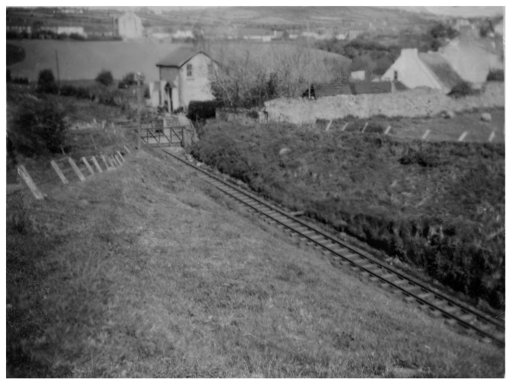
The approach from the East to the level-crossing at Raphoe. This picture matches the more modern one above and is also taken from above the cutting on the route from Strabane and looks toward Raphoe station, © Copyright James Chambers, the gate-keeper at Raphoe crossing. He developed his own images. This image is included here by kind permission of his grandson Nigel Simon. [37]
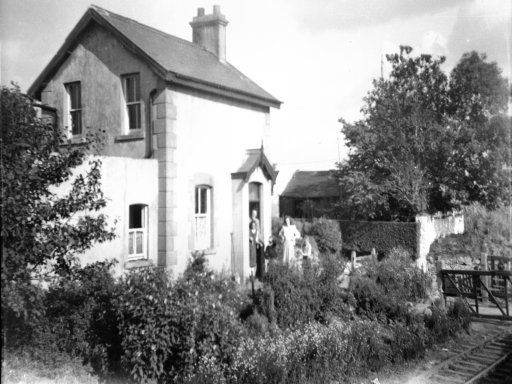
Raphoe Crossing-keeper’s Cottage just after closure of the line, © Copyright James Chambers, the gate-keeper at Raphoe crossing. He developed his own images. This image is included here by kind permission of his grandson Nigel Simon. [38]
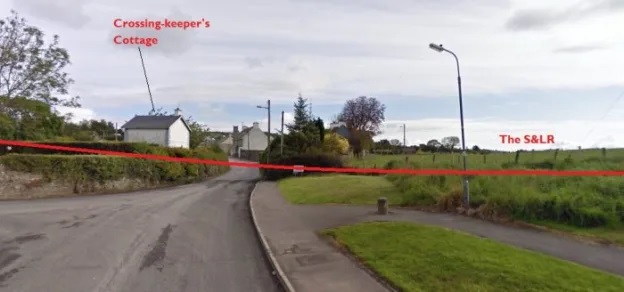
The Level-crossing location in the 21st century. The Crossing-keeper’s cottage remains (Google Streetview)
Looking forward from Raphoe gates into the station site, © Copyright James Chambers, the gate-keeper at Raphoe crossing. He developed his own images. This image is included here by kind permission of his grandson Nigel Simon. [42]

There is an excellent view of the station complex available in Ernie’s Railway Archive on Flickr … https://flic.kr/p/2iRSdWW … That image is best seen as part of that album of photographs on Flickr. [40] The next few pictures show the station while the line was in operation.

Erne at Raphoe Railway Station in 1959 (c) Douglas Robinson, used with permission from the Co. Donegal Railway Heritage Centre. [36]
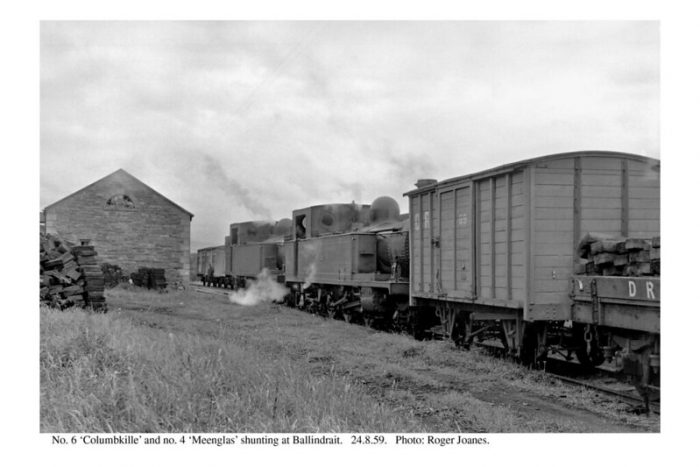
Shunting at Ballindrait in 1959 (c) Roger Joanes (CC BY-NC-ND 2.0) [41]
Railcar No. at Rahoe Station (c) Roger Joanes (CC BY-NC-ND 2.0) [39]
A view of Raphoe Station from the West (c) Roger Joanes (CC BY-NC-ND 2.0) [38]
The site of Raphoe Station in 21st century taken from a similar position to the last Roger Joanes image above. The Station Master’s House on the left is the only building remaining on the site. Kerry Doherty comments that ‘it was difficult to get a photo of the site as many lorries now occupy the yard’, (c) Kerry Doherty. [45]

We complete the first stage of the journey along the Strabane to Letterkenny Railway at Raphoe. As we noted at the start of this article, this is a place with a long history and it is worth the stopover to see the town!! There are two superb pictures of the station in Anthony Burges book, The Swilly and the Wee Donegal. [44: p32 &33]

References

  1. Edward M Patterson (original author), Joe Begley & Steve Flanders (authors of additional material in the Revised Edition); The County Donegal Railways; Colourpoint Books, Newtownards, Co. Down 2014. As noted in my first article about the Co. Donegal Railways this was to have been my holiday reading while walking different parts of the network, but 2020 has been a strange year!
  2. https://en.wikipedia.org/wiki/Strabane_and_Letterkenny_Railway#:~:text=The%20County%20Donegal%20Railways%20Joint,this%20company%20to%20121%20miles., accessed on 14th July 2020.
  3. https://commons.wikimedia.org/wiki/File:Athlone,_Cavan_%26_Clara._LetterKenny_Strabane_RJD_113.jpg#/media/File:Athlone,_Cavan_&_Clara._LetterKenny_Strabane_RJD_113.jpg, accessed on 14th July 2020.
  4. https://en.wikipedia.org/wiki/Londonderry_and_Lough_Swilly_Railway, accessed on 14th July 2020.
  5. Steve Flanders & Hugh Dougherty, The Londonderry and Lough Swilly Railway; Midland Publishing, 1997.
  6. Edward M Patterson (original author), Joe Begley & Steve Flanders (authors of additional material in the Revised Edition); The Lough Swilly Railway; Colourpoint Books, Newtownards, Co. Down 2017. This was to have been part of my holiday reading, but 2020 has been a strange year!
  7. https://donegalnews.com/2014/04/famous-lough-swilly-bus-company-to-close-within-days, accessed on 14th July 2020.
  8. https://www.independent.ie/irish-news/bus-company-closes-30190034.html, accessed on 14th July 2020.
  9. https://www.stationhouseletterkenny.com/things-to-do-letterkenny/history-letterkenny-donegal, accessed on 14th July 2020.
  10. https://www.antaisce.org/buildingsatrisk/bishops-palace-raphoe, accessed on 14th July 2020.
  11. https://en.wikipedia.org/wiki/St_Eunan%27s_Cathedral,_Raphoe, accessed on 14th July 2020.
  12. https://twitter.com/rsh_raphoe/status/928058579046883330, accessed on 14th July 2020.
  13. https://maps.nls.uk/geo/explore/#zoom=15&lat=54.83082&lon=-7.47324&layers=14&b=1, accessed on 14th July 2020.
  14. http://oldstrabane.blogspot.com/2010/09/1905-ordnance-survey.html, accessed on 14th July 2020.
  15. https://www.bbc.co.uk/northernireland/yourplaceandmine/tyrone/A716690.shtml, accessed on 18th July 2020.
  16. http://www.sepiatown.com/812264-Strabane-Railway-Station, accessed on 18th July 2020.
  17. http://oldstrabane.blogspot.com/2010/10/strabane-railway-station-1930-1959.html, accessed on 18th July 2020.
  18. http://www.sepiatown.com/813662-Strabane-Railway-Station, accessed on 18th July 2020.
  19. http://www.sepiatown.com/813665-Strabane-Railway-Station, accessed on 18th July 2020.
  20. http://www.sepiatown.com/814730-Strabane-Railway-Station, accessed on 19th July 2020.
  21. http://www.sepiatown.com/814448-Strabane-Railway-Station, accessed on 19th July 2020.
  22. http://www.sepiatown.com/814729-Strabane-Railway-Station, accessed on 19th July 2020.
  23. http://www.sepiatown.com/813674-Strabane-Railway-Station, accessed on 19th July 2020.
  24. http://www.sepiatown.com/814723-Strabane-Railway-Station, accessed on 19th July 2020.
  25. http://www.sepiatown.com/814657-Strabane-Railway-Station, accessed on 19th July 2020.
  26. https://cotyrone.com/towns/index.html, accessed on 19th July 2020 and used on a not-for-profit basis as per the copyright notice on the website.
  27. http://geohive.maps.arcgis.com/apps/webappviewer/index.html?id=9def898f708b47f19a8d8b7088a100c4, accessed on 19th July 2020.
  28. https://www.buildingsofireland.ie/buildings-search/building/40835005/station-road-lifford-lifford-co-donegal, accessed on 19th July 2020.
  29. https://www.flickr.com/photos/110691393@N07/11370970966, accessed on 19th July 2020.
  30. https://www.gettyimages.co.uk/detail/news-photo/lifford-the-centre-of-co-donegal-with-tyrone-on-the-other-news-photo/533285858, accessed on 19th July 2020.
  31. https://www.facebook.com/DonegalRailwayHeritageCentre/photos/a.1230417866994452/2723764270993130/?type=3&theater, accessed on 19th July 2020 – embedded here with permission..
  32. https://www.buildingsofireland.ie/buildings-search/building/40834011/ballindrait-railway-station-ballindrait-ballindrait-county-donegal, accessed on 19th July 2020.
  33. https://www.buildingsofireland.ie/buildings-search/building/40834014/tamnawood-ballindrait-county-donegal, accessed on 20th July 2020.
  34. https://maps.nls.uk/geo/explore/#zoom=14&lat=54.85980&lon=-7.56551&layers=14&b=1, accessed on 20th July 2020.
  35. https://maps.nls.uk/geo/explore/#zoom=15&lat=54.87162&lon=-7.60309&layers=14&b=1, accessed on 22nd July 2020.
  36. https://m.facebook.com/story.php?story_fbid=3010690898967131&id=1223882780981294, accessed on 22nd July 2020.
  37. http://www.incony.org/History/StartPage.html, accessed on 22nd July 2020 – embedded directly from the website.
  38. http://www.incony.org/History/StartPage.html, accessed on 20th July 2020 – embedded directly from the website.
  39. https://www.flickr.com/photos/110691393@N07/11364546546/in/photolist-ijfgKG-ijfnbj, accessed on 22nd July 2020 – permission to use here has been sought and a response is awaited.
  40. https://flic.kr/p/2iRSdWW, accessed on 23rd July 2020.
  41. https://www.flickr.com/photos/110691393@N07/11370944925/in/photolist-ijP4Lz, accessed on 23rd July 2020.
  42. http://www.incony.org/History/StartPage.html, accessed on 22nd July 2020 – embedded directly from the website.
  43. Kerry Doherty of Ballindrait, Co. Donegal. provided a series of images from his collection of photographs for use in this article.
  44. Anthony Burges; The Swilly and the Wee Donegal; Colourpoint, Newtownards, Second Impression, 2010.
  45. After first publishing this article, Kerry Doherty of Ballindrait very kindly sent me a series of pictures which needed to be included in the article. Each of these bears the reference number [45].

The Guinness Brewery Railways, Dublin, again. ….

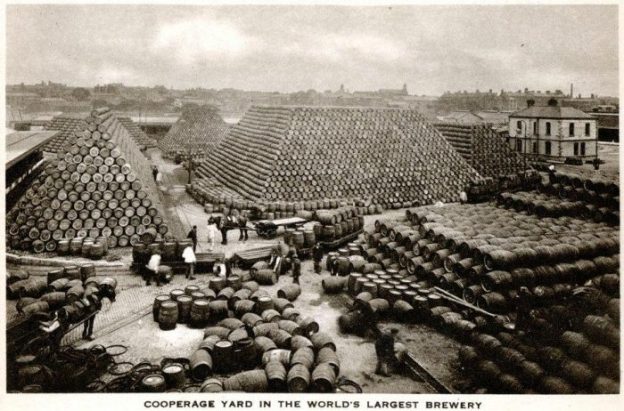
The featured image above shows a staggering number of barrels at the Guinness Brewery in Dublin! [3]

This very short article results from some recent reading about the railways on the Guinness Brewery site in Dublin.

  • An article in ‘Narrow Gauge & Industrial Railway Modelling Review’ Issue 60 Volume 8, October 2004, p134-142; [1] and
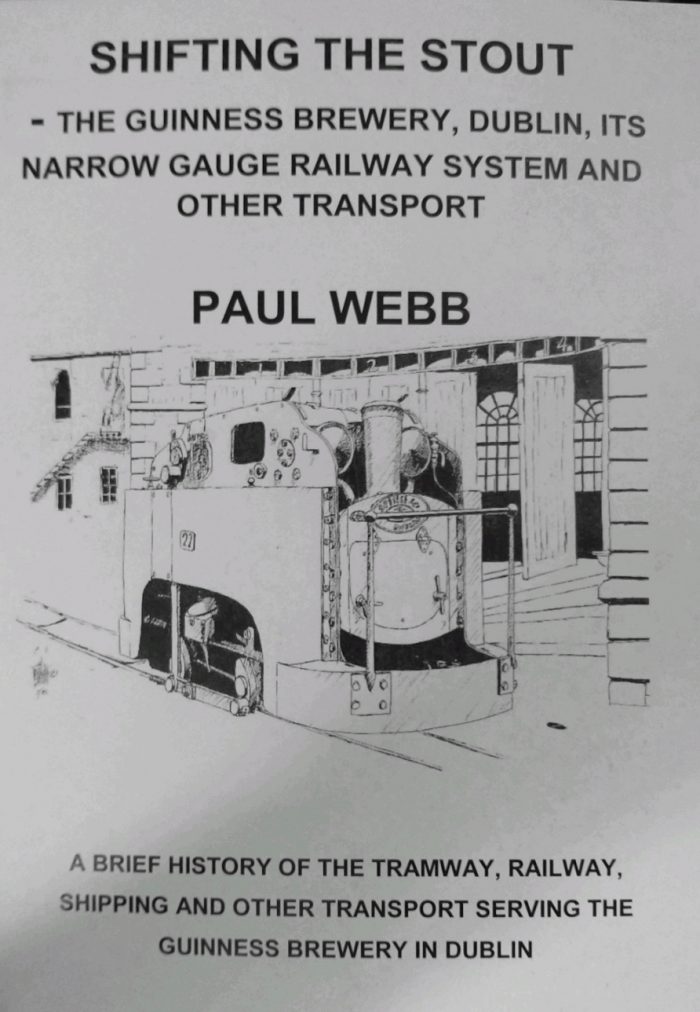
  • Paul Webb, ‘Shifting the Stout’, The Moseley Trust, Apedale, Newcastle-under-Lyme, Staffordshire. [2]

The Brewery in St James’s Gate, Dublin was founded by Arthur Guinness in 1759, one of dozens based on the pure water available from the River Liffey. Guinness outlasted and outgrew all its competitors to become one of the greatest brewing empires in the world. 

Between 1868 and 1886 Guinness spent over £1 million on capital projects. As part of these developments, two rail systems were created within the expanded brewery site. I have covered these in some depth in an earlier article about the brewery railways. ….

The Guinness Brewery Railways, Dublin

Instrumental in much of the development of the brewery site was Samuel Geoghegan who was Engineer to the Brewery.

The article in Narrow Gauge & Industrial Railway Modelling Review is archive material, courtesy of ‘Engineering’ magazine and the Greenwich & District NGRS. It consists primarily of a transcript of an illustrated presentation by Samuel Geoghegan which was carried by ‘Engineering’ Magazine in September and October 1888. It includes detailed drawings, engravings and photographs. Back copies of the magazine are available from Roy C. Link, Cambrian Forge, Garndolbenmaen, Gwynedd, LL51 9RX.

Paul Webb’s book is an A4 no-frills publication in basic green card cover and printed on standard copier paper but it contains a wealth of illustrations and detailed text about the Brewery and the various forms of transport, road, rail and water, that served it. Well worth the £8.50 plus postage that it cost, especially knowing that any profit from the sale supports the Moseley Railway Trust.

There are also some excellent YouTube offerings which focus on the brewery and the different modes of transport it employed. …. For example: [4]

References

  1. Samuel Geohegan; Tramways and Rolling Stock at Guinness’s Brewery; Narrow Gauge & Industrial Railway Modelling Review, Issue 60 Volume 8, October 2004, p134-142 (https://narrowgaugeandindustrial.co.uk, accessed on 22nd July 2020.)
  2. Paul Webb, Shifting the Stout; The Moseley Trust, Apedale, Newcastle-under-Lyme, Staffordshire. (https://avlr.org.uk/moseley-railway-trust, accessed on 22nd July 2020.)
  3. This image is available from a variety of online sources including: https://www.lizcovart.com/blog/guinness-storehouse?format=amp, accessed on 22nd July 2020; https://www.pinterest.co.uk/pin/323133341987983419/?%24ios_deeplink_path=pinterest%3A%2F%2Fpin%2F323133341987983419&%24android_deeplink_path=pinterest%3A%2F%2Fpin%2F323133341987983419&amp_client_id=amp-q7GRAwBYyhpqAMkTd7nxbg&utm_source=168&utm_medium=2160&current_page_url=https%3A%2F%2Fwww.pinterest.co.uk%2Famp%2Fpin%2F323133341987983419%2F&install_id=ac61f0899ae3492288c7cff241bd5a0c&%24fallback_url=https%3A%2F%2Fwww.pinterest.co.uk%2Fpin%2F323133341987983419%2F%23details&amp_url=https%3A%2F%2Fwww.pinterest.co.uk%2Famp%2Fpin%2F323133341987983419%2F&_branch_match_id=814525083296268811#details, accessed on 22nd July 2020
  4. https://youtu.be/Dacn58a1x5s, accessed on 22nd July 2020.

Co. Donegal Railways, Ireland – Part 2 – The Glenties Branch – Ballinamore to Glenties

This article covers the Western length of the Glenties Branch of the Co. Donegal Railways. The Eastern length of the branch is covered in the first article in this series about the Co. Donegal Railways which can be found at:

Co. Donegal Railways, Ireland – Part 1 – The Glenties Branch – Stranorlar to Ballinamore

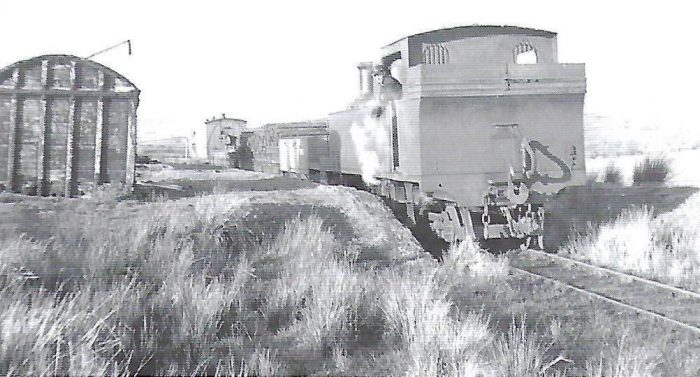
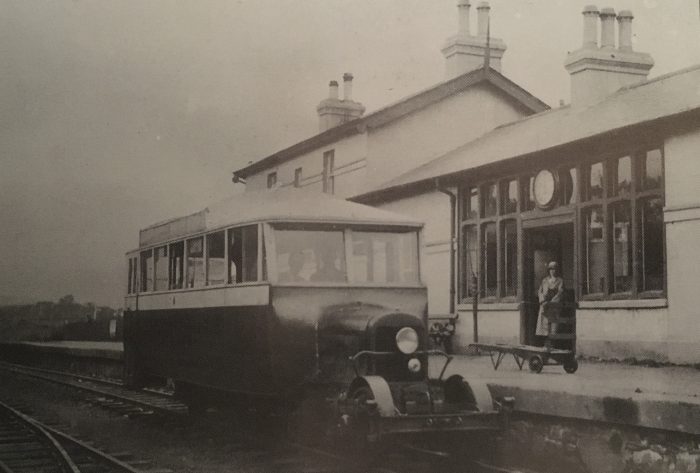
An extract from a larger picture (Scanned slide) (c) G Sludge (Attribution-ShareAlike 2.0 Generic (CC BY-SA 2.0)). [2]

At the end of the first article we got off the train at Ballinamore station (which serves the village community of Bellanamore) and were surprised to see how spartan the accommodation in the passenger facilities was. We were even more surprised to discover that the main station building, such as it was, managed to survive into the 21st century.

We return to Ballinamore station to catch the next train looking forward to visiting the next station on the line at Fintown!

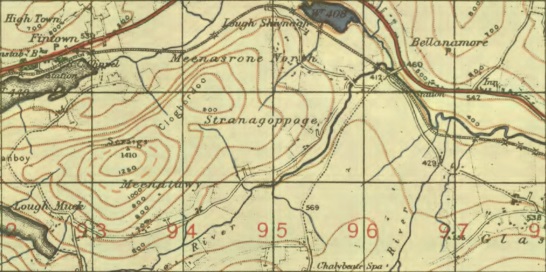
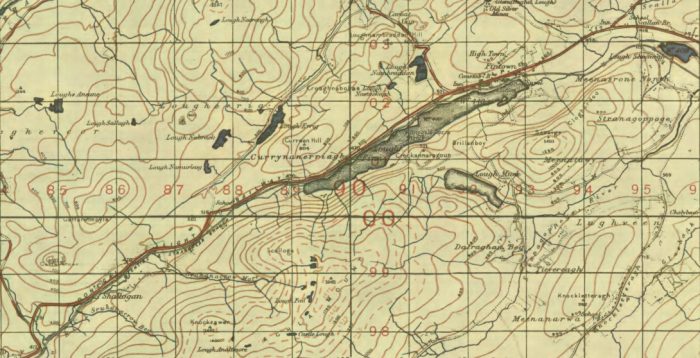
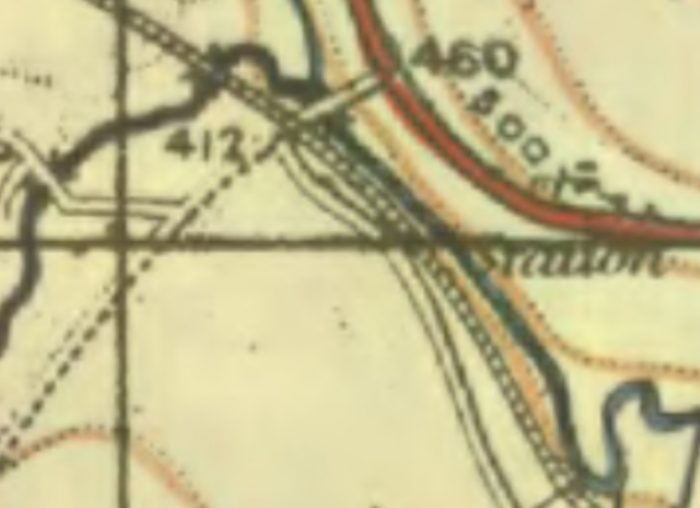
A photograph of the ‘lifting’ train at Ballinamore. After closure the line was ‘lifted’ and removed leaving in most places no more than the formation. [32]An extract from the GSGS Map from the early 1940s showing the route of the Glenties Branch from Ballinamore to Fintown. Ballinamore Station is in the second map sqaure form the right at the top of the image, to the southeast of the bridge over the River Finn. [1]

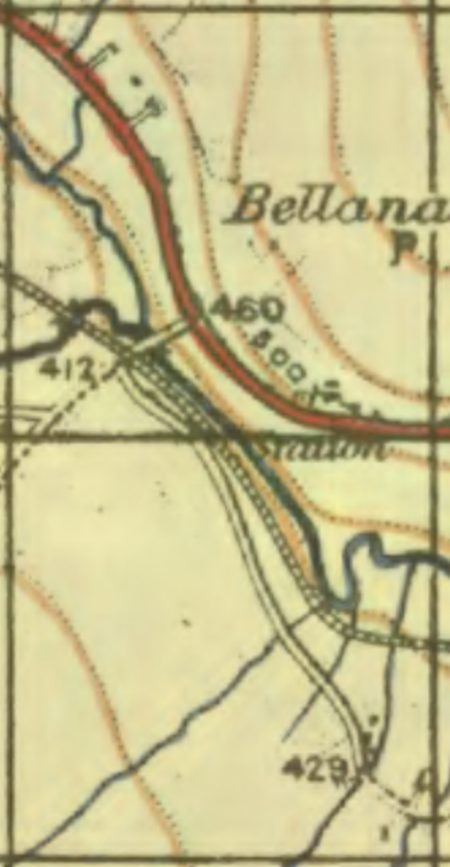
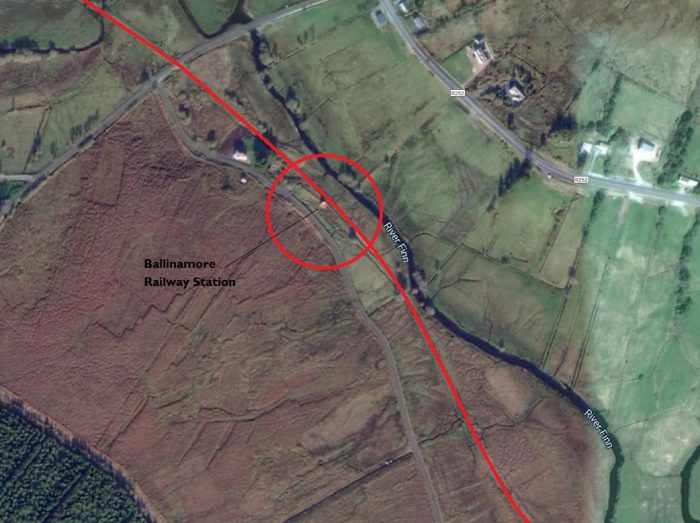
A larger scale view of the station location at Ballinamore. [1]

We can imagine hopping onto Railcar No. 6 heading for Fintown. … As we leave the ‘station’ behind we look to our left and see the station master’s house. Not large, but certainly bigger than the station facilities we have just enjoyed!

On the adjacent map extract the location of the station house can be picked out as a very slight bump on the side of the road just Northwest of the Station.

The Station House has survived and is now a holiday rental property which in 2020 has recently been refurbished.

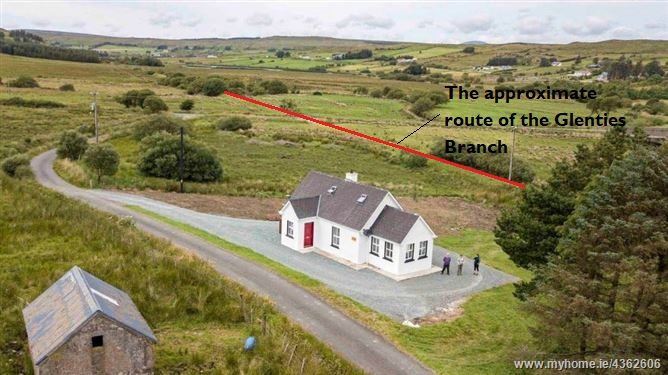
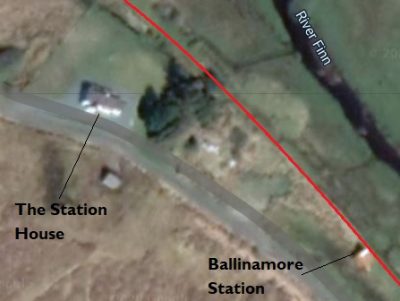
The first picture below shows the Station House in 2020 with the old railway formation marked in red behind it. The second image is the Google Earth satellite image of the site.

The Station House at Ballinamore. [4]

Ballinamore Station House ( Google Maps).

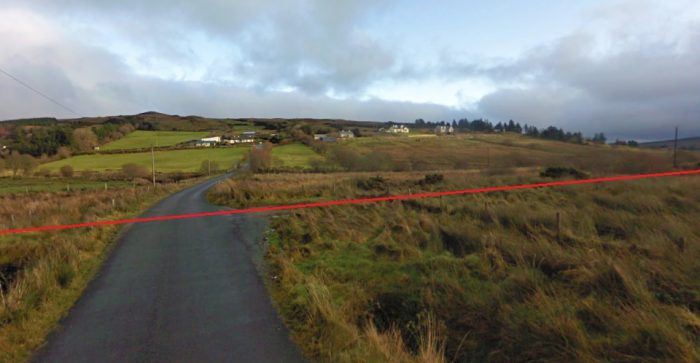
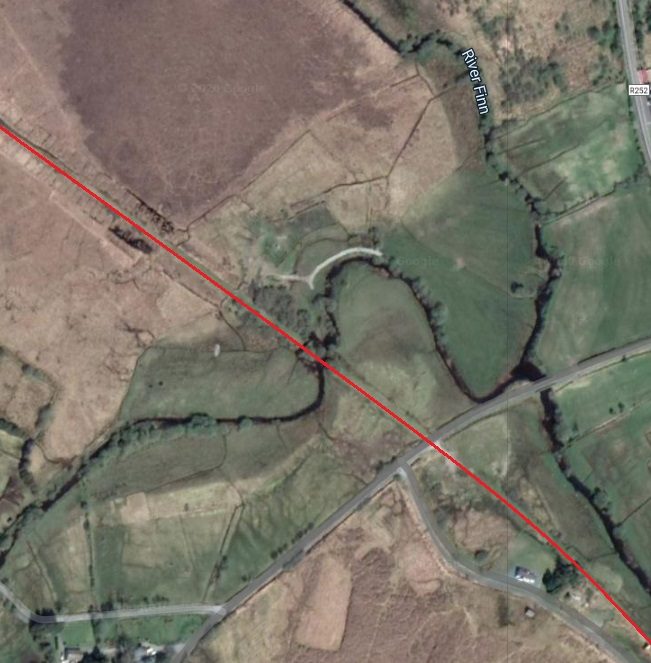
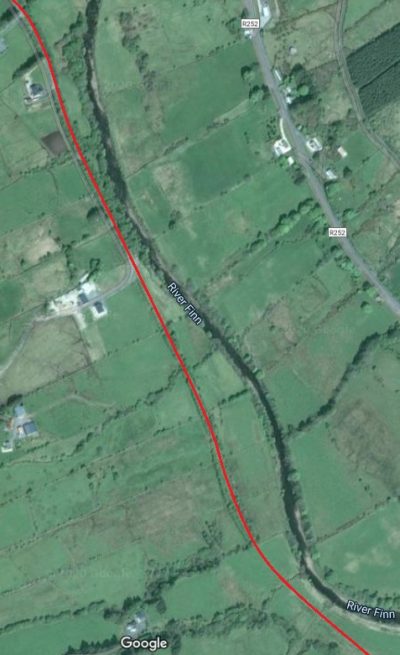
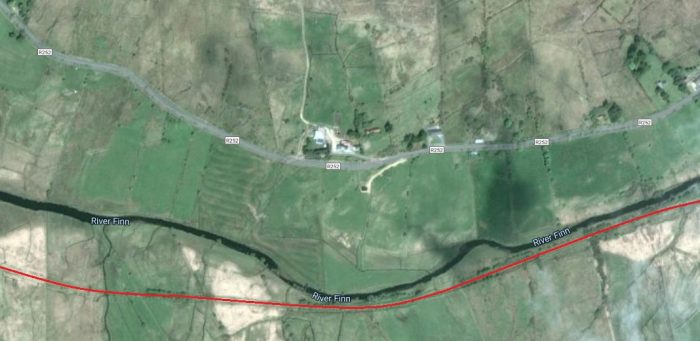
The line continued Northwest across the road from the station to the R252 and Bellanamore Village. The image below shows that the crossing was at grade. Traffic flows were so small that it is very likely that this was an un-gated crossing.

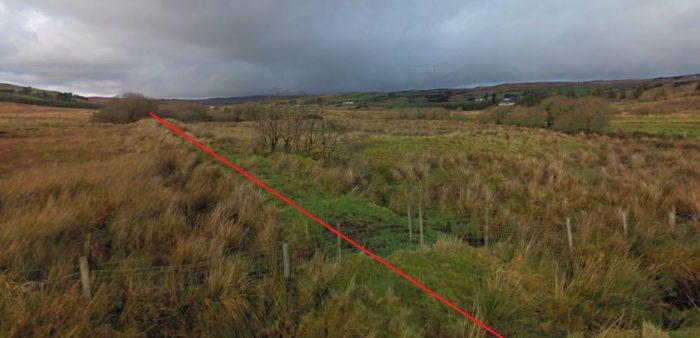
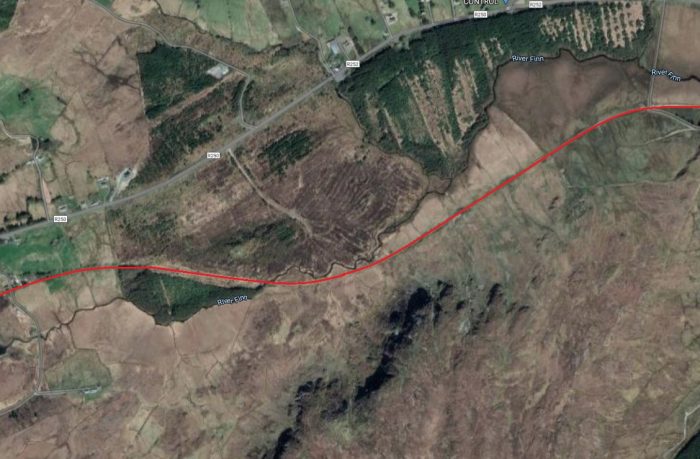
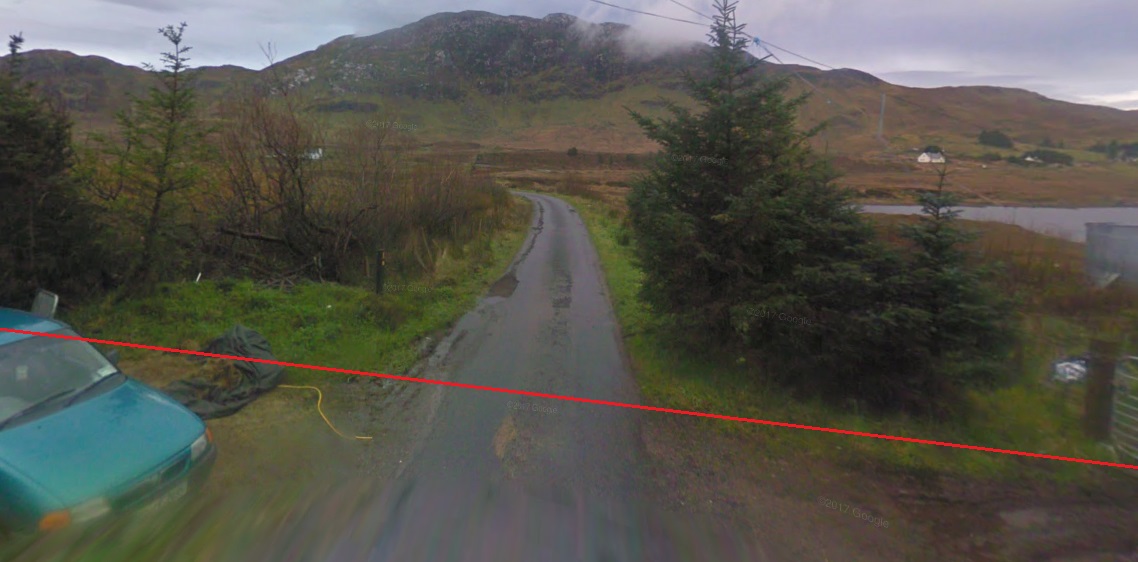
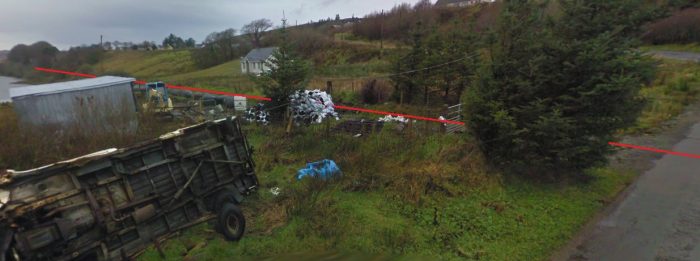
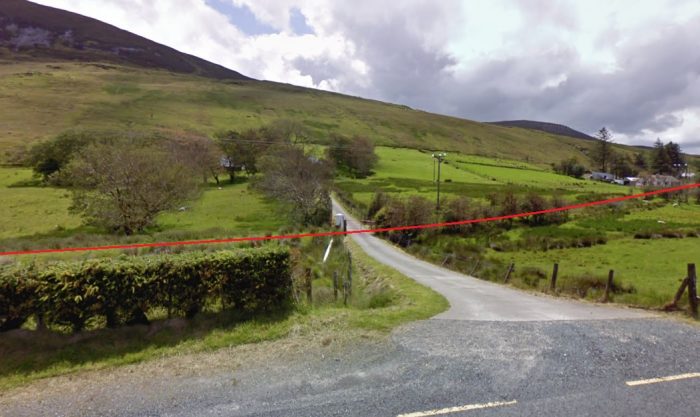
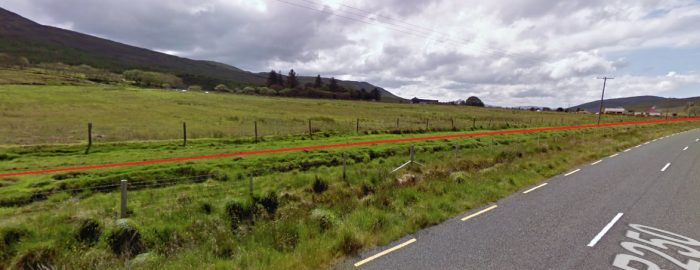
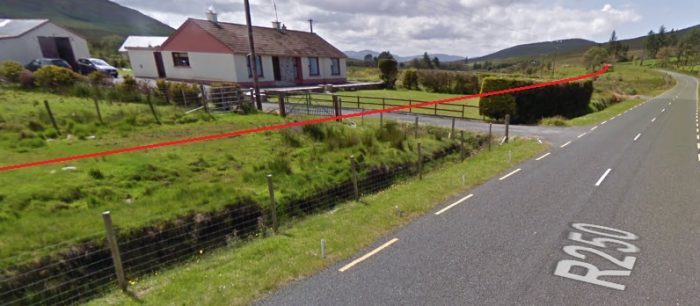
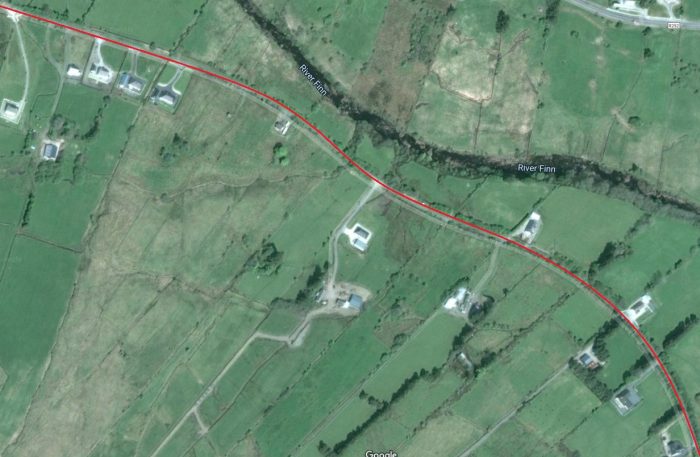
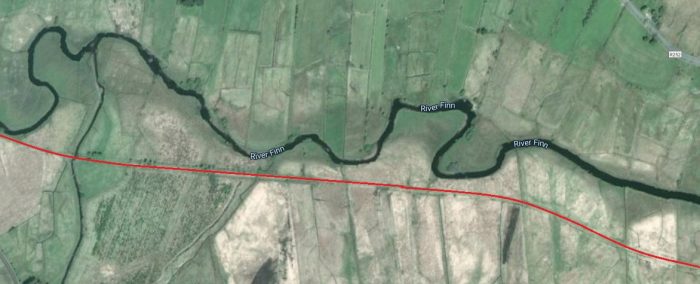
The next satellite image shows the line heading way towards Fintown. It is followed by a Google Streetview image of the line leaving the level-crossing behind. Earthworks were minimal and its embankment was no more than a couple of feet above the surrounding land!Bellanamore Village from the South West looking across the line of the Glenties Branch which is marked in red (Google Streetview).The Glenties Branch heading Northwest from Ballinamore Station Halt (Google Maps).The line northwest of the level-crossing was on a very shallow embankment which lifted it above the boggy ground (Google Streetview). The trees in the distance mark the location of the Stranagoppoge River.

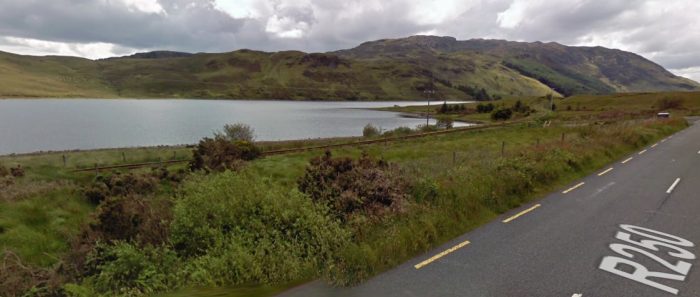
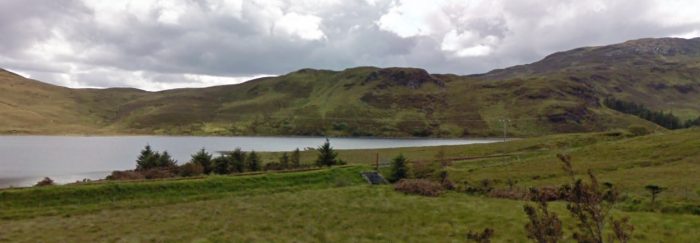
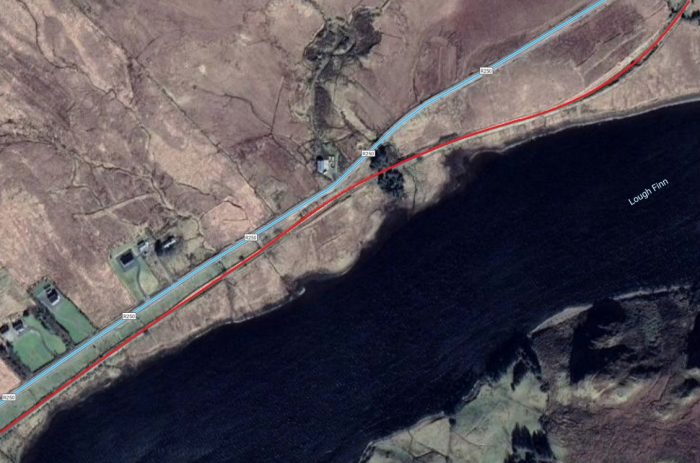
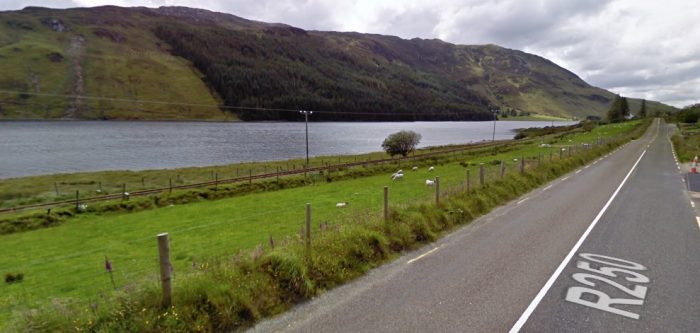
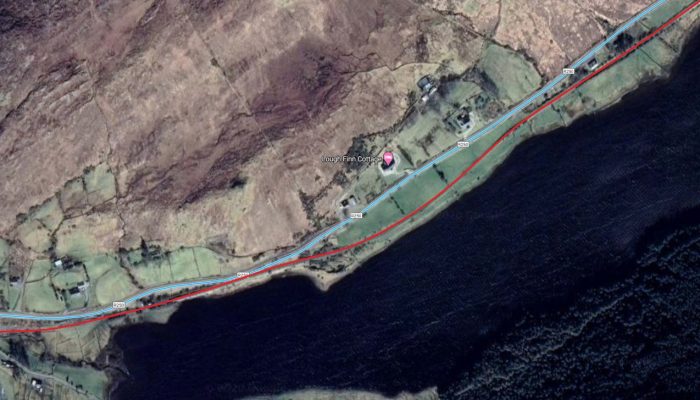
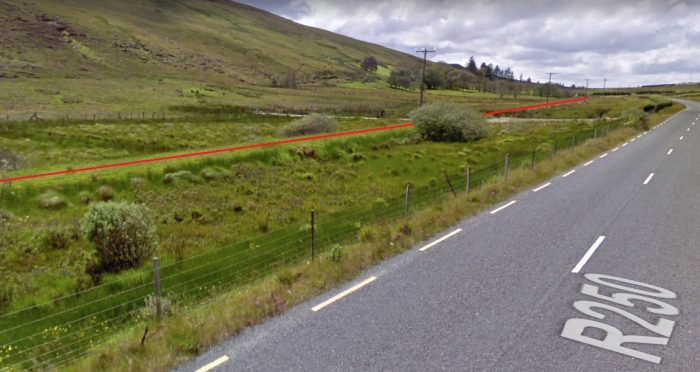
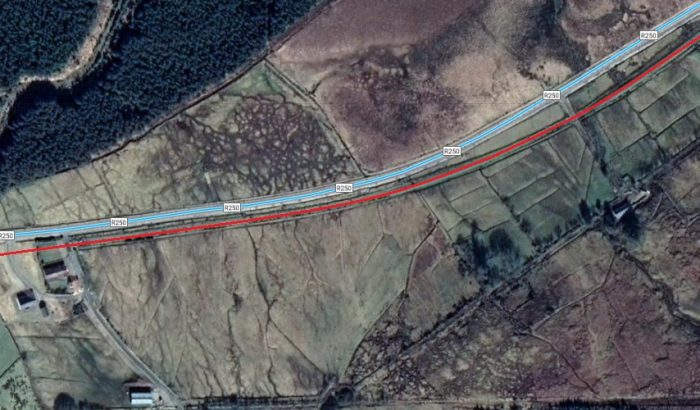
Road (R250), Rail (The Glenties Branch) and Lough Finn’s North shore rune roughly parallel (Google Streetview).

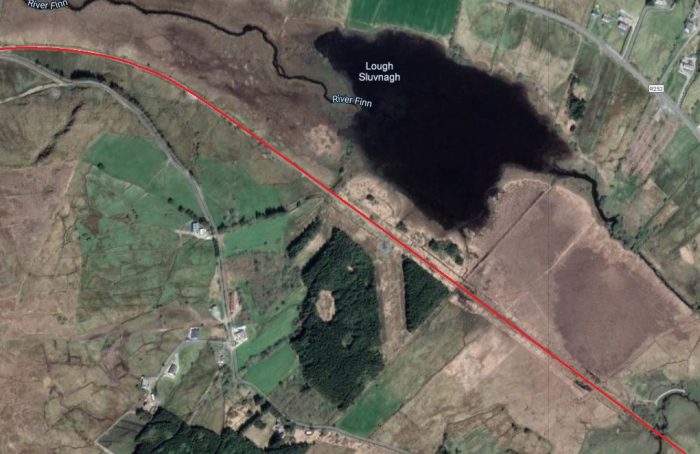
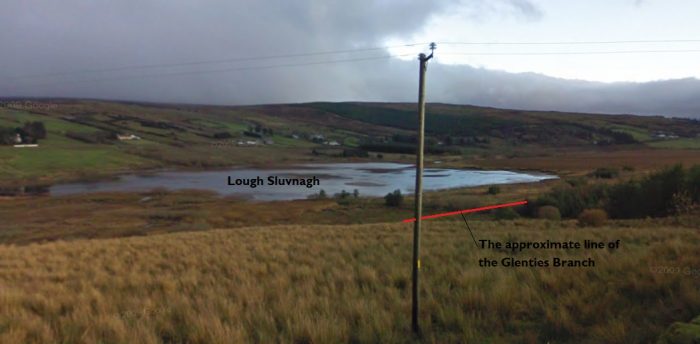
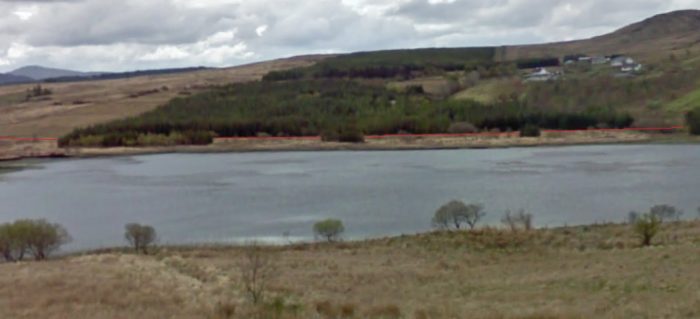
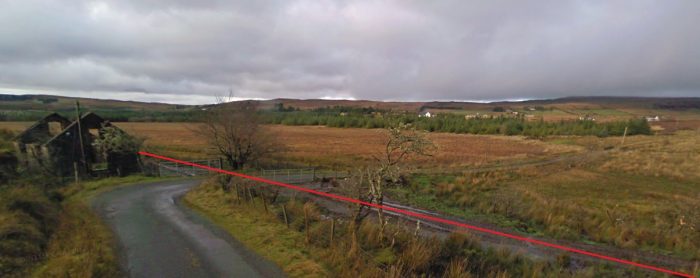
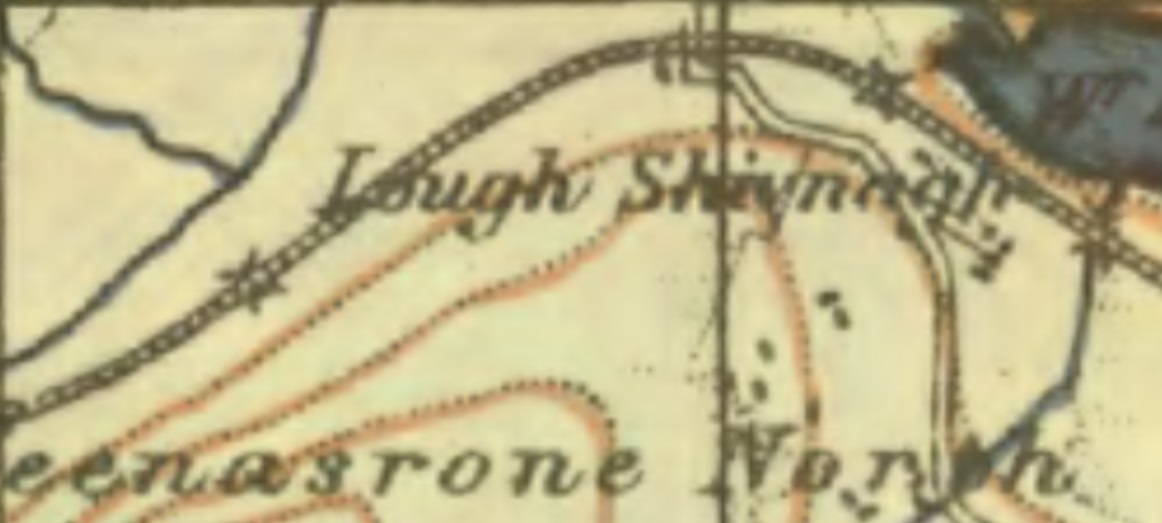
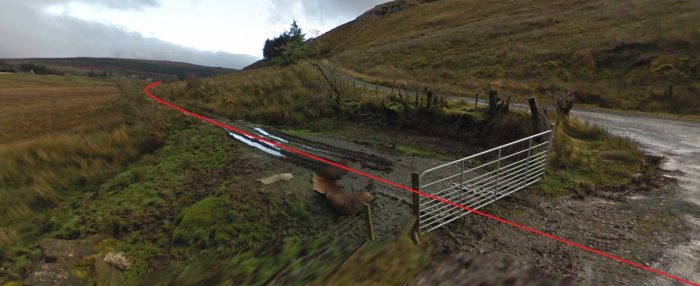
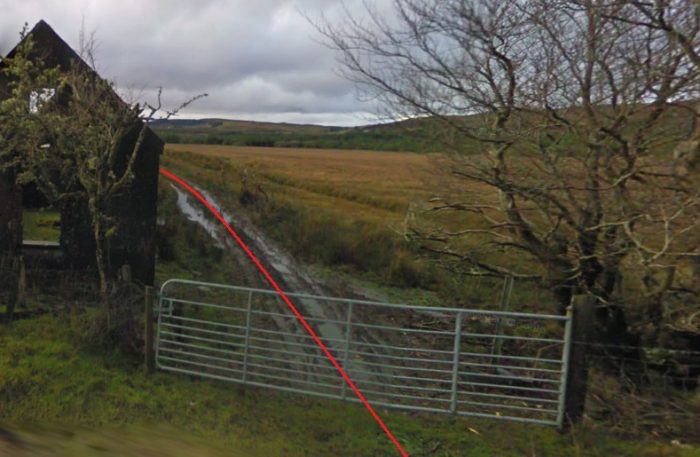
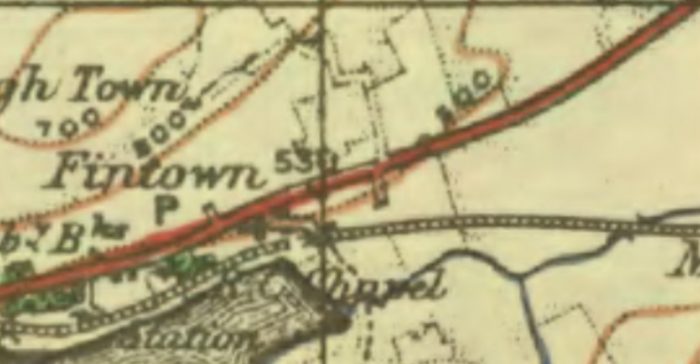
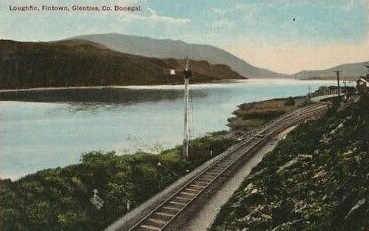
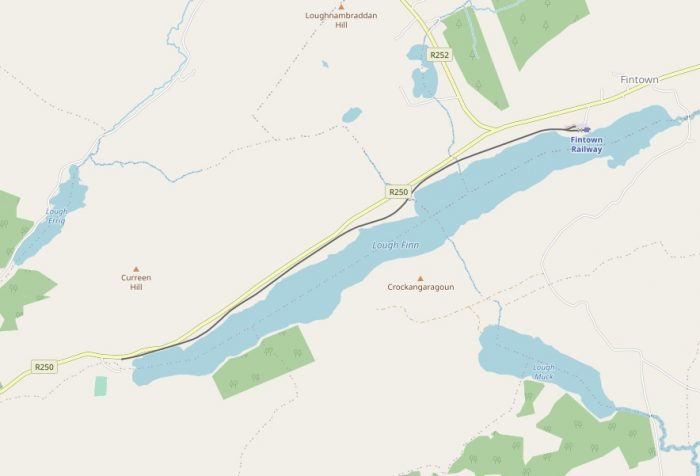
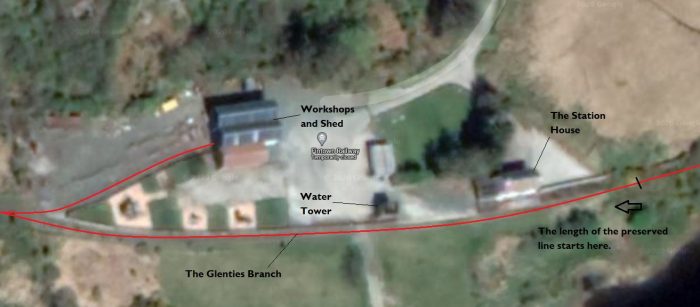
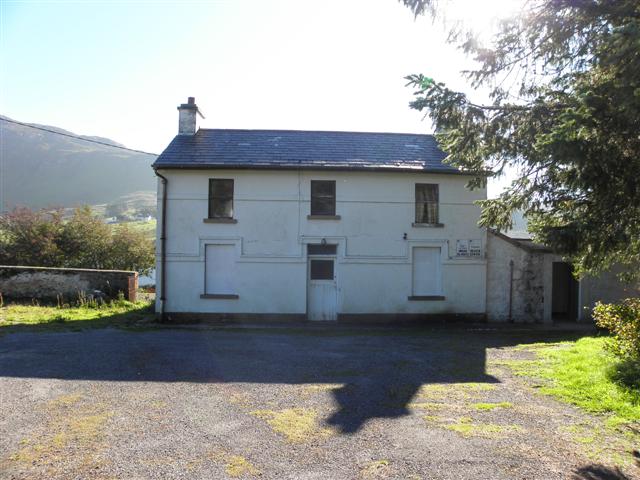
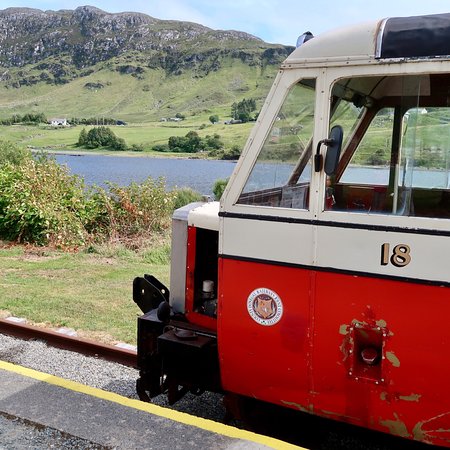
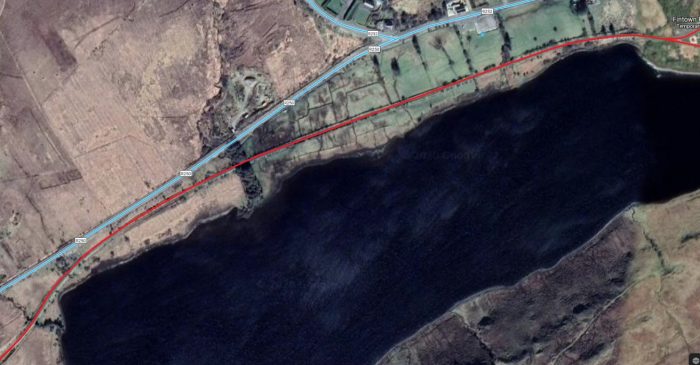
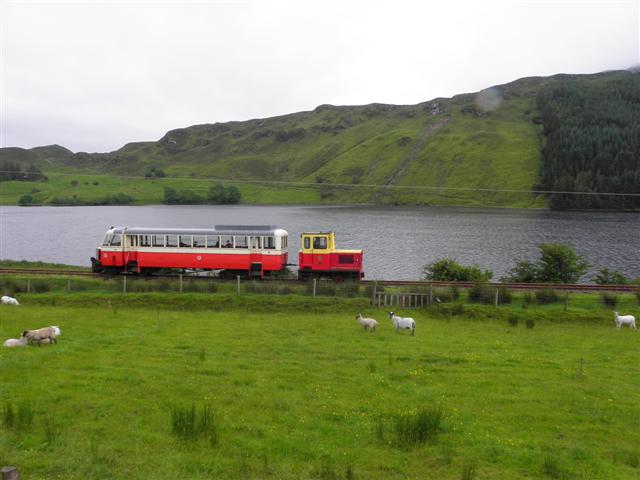
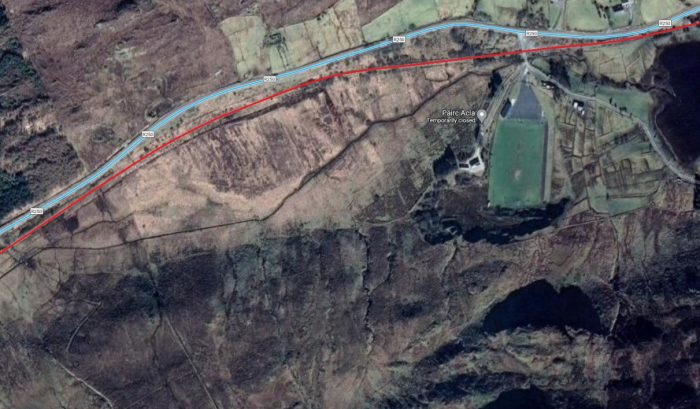
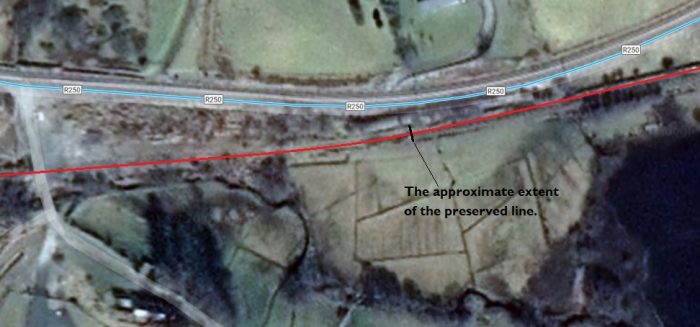
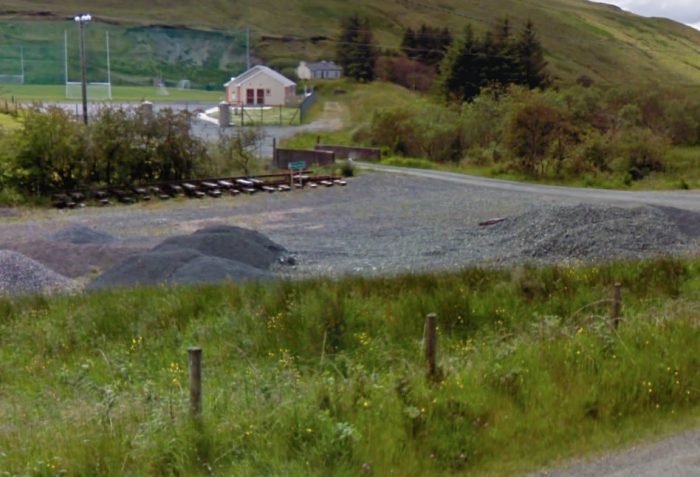
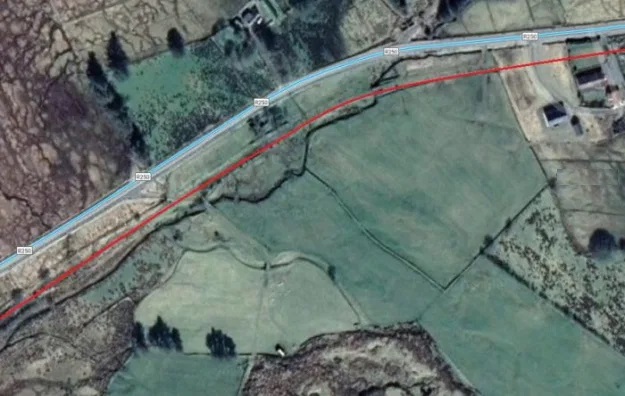
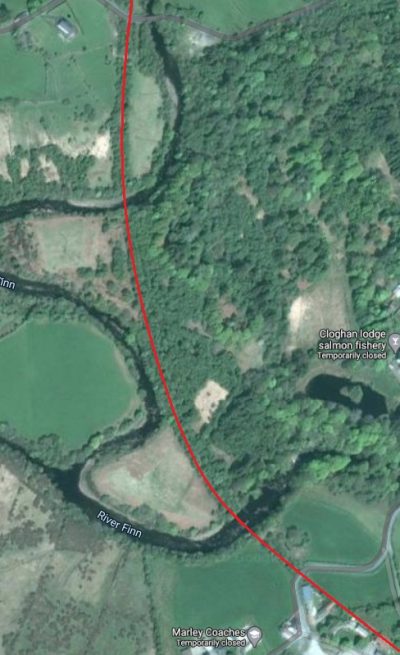
Just a short distance further along the line, trains crossed the Stranagoppoge River, a tributary of the River Finn is perhaps one of the lesser known of its tributaries and is part of the Cloghan Lodge Estate. I have been unable to ascertain what the structure of the bridge was like. The line then passed close to the South West shore of Lough Sluvnagh before beginning to turn towards the West, heading for Fintown.The Glenties Branch as it passed Lough Sluvnagh (Google Maps).Lough Sluvnagh and the route of the old railway (Google Streetview). This photograph is taken from the road South of the line.The view across Lough Sluvnagh from the R252 showing the line of the old railway (Google Streetview). I have shown the line of the railway using a very narrow red line.The location of the next road crossing to the West of Lough Sluvnagh (Google Streetview).The Glenties Line to the West of Lough Sluvnagh shown on the GSGS Map of the early 1940s. The crossing in the image above is shown just to the left of the grid line on the map. [5]Looking back along the old Glenties Branch towards Lough Sluvnagh from the road crossing (Google Streetview).Looking West along the line of the Branch. The shell of a building which was probably the crossing-keepers cottage is in the left foreground (Google Streetview).A satellite image of the approach to Fintown and its Lake (Google Maps).The road-crossing on the approach to Fintown. It appears at the extreme left of the satelite image above. This view is taken facing South across what was the old crossing (Google Streetview).The line ahead towards Fintown. This view looks from the road to the south of the crossing in a westerly direction (Google Streetview).A short distance further West the line approached Fintown and its station. This extract from the GSGS Maps of the early 1940s shows both the Lake and the town with the station sitting alongside the lake. [6]The Approach to Fintown Station. [25]The Fintown Railway. [7]Fintown Station (Google Maps).Fintown Railway Station House (c) Kenneth Allen (CC BY-SA 2.0). [13]The Eastern end of the preserved Fintown Railway in 2010 (c) Kenneth Allen (CC BY-SA 2.0) [8]The Water Tower at Fintown Station in 2010, a reminder that once the station was served by steam locomotive power (c) Kenneth Allen (CC BY-SA 2.0). [9]Fintown Station in 2007 (c) Kenneth Allen (CC BY-SA 2.0) [10]The old Goods shed and workshop at Fintown Station in 2010, viewed from the platform (c) Kenneth Allen (CC BY-SA 2.0). [11]Another view of the workshops at Fintown Station (c) Kenneth Allen (CC BY-SA 2.0). [12]Railcar No. 18 at Fintown Station Platform. [14]Fintown Railway’s Railcar approaches the station throat at Fintown Station, heading East into the station [14]The old line followed the Northern shore of the Lough along its full length. The preserved line follows the same route (Google Maps)The journey along the lakeside begins. [15]The ‘modern’ service runs between the road and Lough Finn along the full length of the Lough. This picture was taken in 2012 (c) Kenneth Allen (CC BY-SA 2.0). [16]A view of the line towards the Western end of Lough Finn taken from the R250. Just visible in this photograph is the style which appears in the following photograph (Google Streetview).Railcar No. 18 again in 2012 (c) Kenneth Allen (CC BY-SA 2.0). [17]Another view of the line from the R250. The style is now in the left foreground (Google Streetview).The R250 and the railway run parallel for quitea while alongside the Lough (Google Streetview).Road and Rail closely followed the Lough shore (Google Maps)Over halfway along the Lough now, also in 2012 (c) Kenneth Allen (CC BY-SA 2.0). [18]Another view of the line and the Lough from the R250 (Google Streetview).The end of the Lough approaches (Google Maps).With the West end of the Lough in view the R250, the railway and the Lough seem to get compressed together (Google Streetview).The Glenties Branch West-Southwest of Lough Finn (Google Maps).A larger scale extract from the above satellite image showing the end of the Lough and the approximate extent of the Fintown Railway in 2020 (Google Maps).This view is taken a little to the West of the end of the Lough and the end of the Fintown Railway. The side road visible here is the road to the right-hand side of the satellite image aboveOne the satellite image above. It is taken looking South from the R250 across the route of the old line towards a modern Multi-Use Games Area. The route of the line was in cutting and the parapets of a bridge remain into the 21st century. A couple of track panels have been stored here. (Google Streetview).

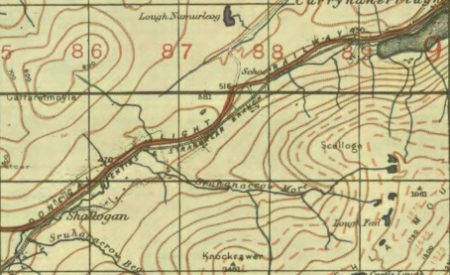
West of Lough Finn, the Glenties Branch continued in a Southwesterly direction to wards Shallogan. The route of the old line is shown on the next extract from the GSGS Maps of the early 1940s which is reproduced below. The whole of the Fintown to Sahallogan length of the line is shown on the first image below. The Glenties Branch between Fintown and Shallogan. [19]The second of the two map extracts above shows the length of the line from the West end of Lough Finn to Shallogan. [20] As can be seen the line remained on the South side of the R250 along this full length. Along the length from a point a few hundred metes West of Lough Finn to Shallogan the line was on a downward grade. As the next image shows, the line was raised on a very shallow embankment in places. At other places there were shallow cuttings. Both cutting and embankments were no more than a few feet in depth or height.. and ran close to the road for much of the distance.The Glenties Branch Southwest of Lough Finn (Google Streetview).The Glenties Branch a little further Southwest (Google Streetview).The length of the Glenties Branch covered in the pictures above (Google Maps).The Glenties Branch continues in a Southwesterly direction (Google Maps)In a very short distance the R250 rejoins the route of the old railway, running just to the North (Google Maps).The Glenties Branch ran on a shallow embankment as indicated by the red line above (Google Streetview).At times road and rail were immediately next to each other (Google Maps).The fence-posts delineating the line of the railway still remain in places (Google Streetview).The final approaches to the hamlet of Shallogan (Google Maps).The first property in Shallogan viewed from the R250 (Google Streetview).Shallogan: there was a halt here which was the last formal stop before Glenties. That did not mean that you could not wave down the railcar passing you and get one anywhere along the line (Google Maps).Railway Culvert at Shallogan (Googl;e Streetview).South West of Shallogan road and rail separated once again (Google Maps).Looking East back along the line of the branch at the point where the line began to diverge from the route of the R250 and where the line crossed the River Shallogan twice in very short succession (Google Streetview).Looking Southwest from the same location. The old line can be seen curving away to the Southwest while the R250 urn further to the West (Google Streetview).The GSGS Map of the length of the line between Shallogan and GlentiesThe route of the Glenties Branch continues Southwest and will soon be met once again by the R250 (Google Maps). Just above the wooded area the first of two remaining bridges over the River Shallogan can be seen on the satellite image.The second of these two bridges is visible in the top-right of this next satellite image (Google Maps).Looking back to the Northeast along the old railway line. At this locaTion the formation is most clearly visible with significant cutting and embankments (Google Streetview).The line continues towards Glenties (Google Maps). Along this length the formation of the old railway is hidden from the road by  bushes and scrubland.

We are now on the final approach to Glenties and the old railway was travelling South-Southwest alongside the R250. The adjacent satellite image shows its course cut by a farmyard and then a road. The road crossed the line of the railway on a bridge. The first image below shows the view Northeast from the bridge looking through the farmyard back towards Fintown and Shallogan.

The second image looks forward towards Glenties. It is less easy to establish the route of the railway in this image, but it runs to the  western edge of the copse of trees.

A view Northeast along the old railway formation from a road overbridge (Google Streetview).Looking towards Glenties (Google Streetview).

Flickr has two images of this bridge taken from the fields either side of the road. [28][29]

After this the old line began to curve round to the towards the Southwest again. It encountered another road which is crossed at ground level.Looking North by Northeast along the old line towards Shallogan (Google Streetview).Looking towards Glenties at the road-crossing. The crossing-keepers house is still standing (Google Streetview).On towards Glenties (Google Maps). The formation of the old line is lost in scrub land to the South side of the R250 and cannot easily be picked out on Google Streetview.The outskirts of Glenties (Google Maps).The final few hundred metres to the railway station are covered on this satellite image and the next (Google Maps).

Level crossing with the R250 on the approach to Glenties Station. This view looks Northeast along the line (Google Streetview).Glenties Station is just ahead beyond the tree-line. This view is taken at the level-crossing location on the R250.Glenties Railway Station Building viewed from the R250 (Google Streetview).

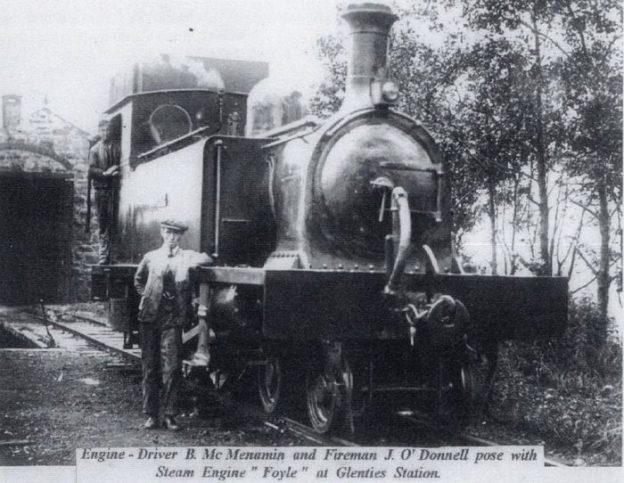
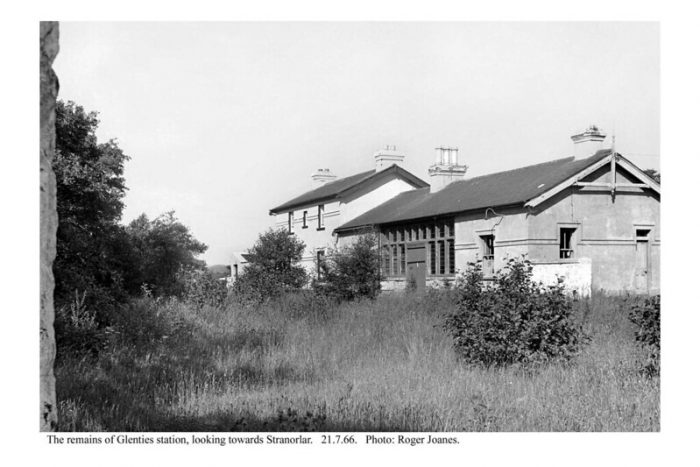
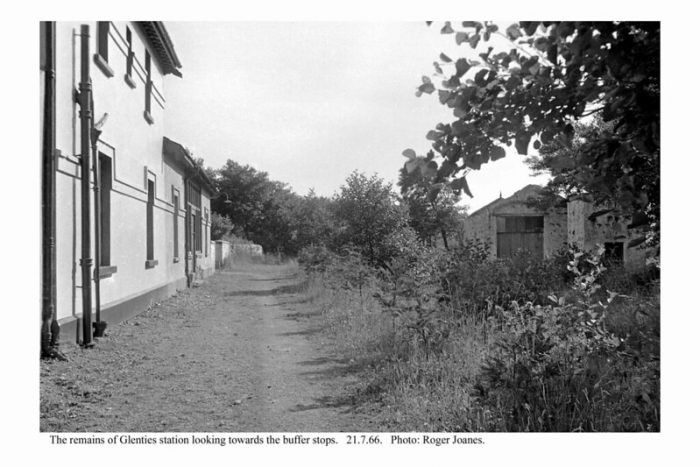
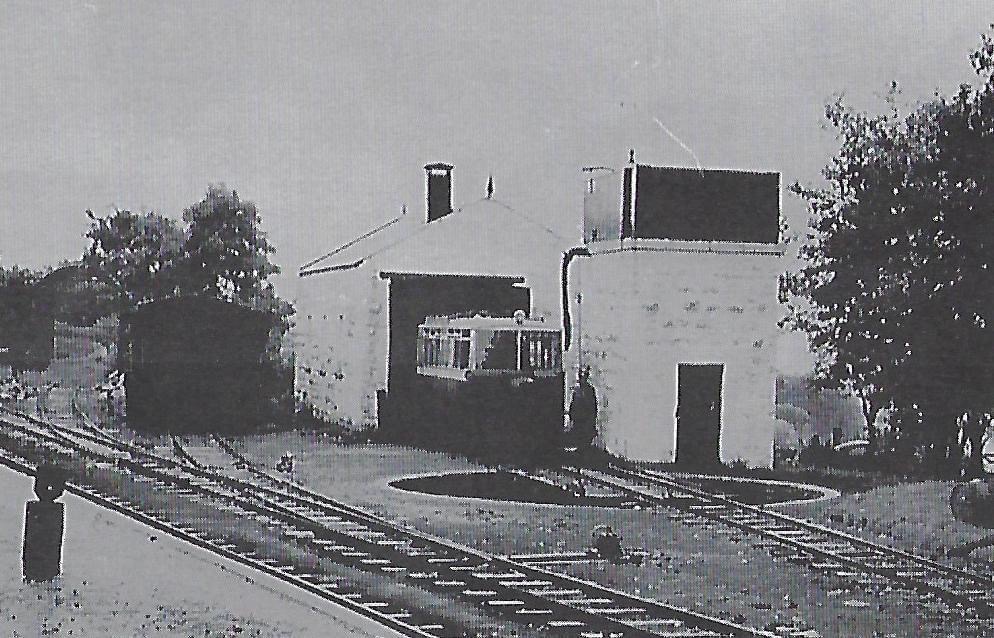
Glenties Railway Station in 1966, (c) Roger Joanes (CC BY-NC-ND 2.0). [26]Glenties Railway Station looking towards the buffer-stops in 1966, (c) Roger Joanes (CC BY-NC-ND 2.0). [27]Locomotive “Foyle” at Glenties Station with Engine Driver B. McMenamin and Fireman J. O’Donnell. Photograph “From the Wilds of Donegal”, used with permission from the Donegal Railway Heritage Centre and found on their Facebook page. [31]A very grainy image showing one of the Co. Donegal Railcars on shed at Glenties, with thanks to Kerry Doherty. [32]Co. Donegal Railways Railcar 6 at Glenties, with thanks to Kerry Doherty. [32]

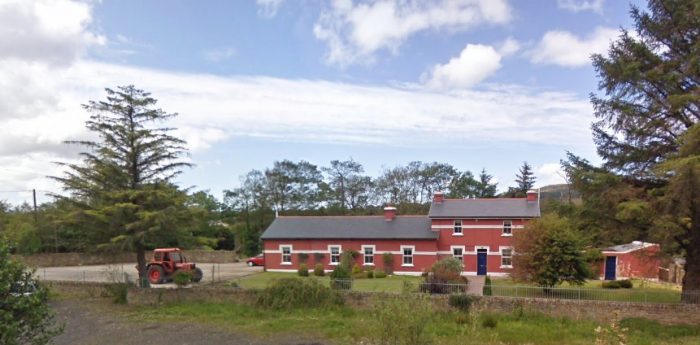
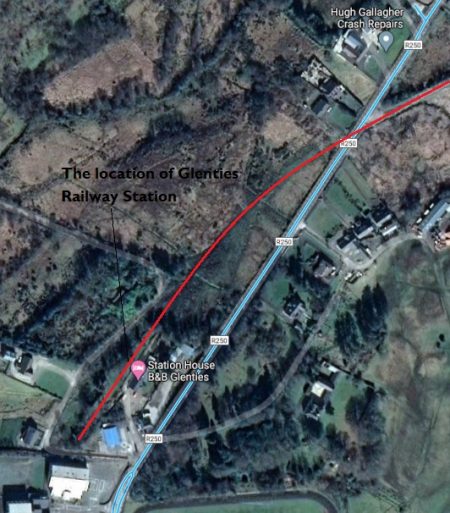
The location of Glenties railway Station. The station building is a B&B in the 21st century (Google Maps).

The adjacent satellite image brings our journey along the Glenties Branch to an end.

There are a few pictures of the station to follow below and a note too about an attempt to take the line on the Ardara.

The Fintown Railway has ambitions to bring its preservation line along the old trackbed to Glenties. I imagine that the events of 2020 may well have made that a more remote possibility than it was.

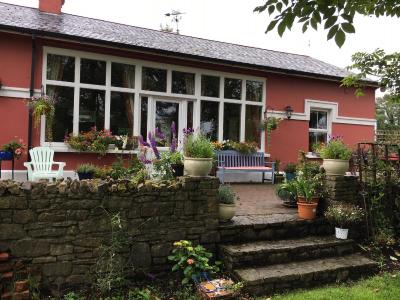
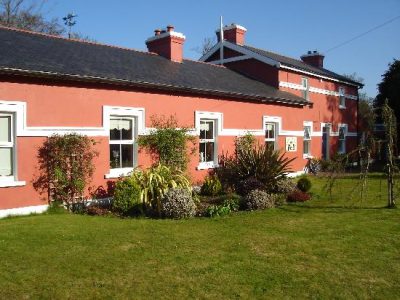
Glenties Railway Station Building in the 21st century. The property is now a B&B. This view is from the track-side of the station building. [21]

Glenties Station Building in the 21st century. [22]

A view along the line of the platform in 2020. [22]

The extension of the Glenties Branch to Ardara

There was once a plan to extend the line. It was a sensible plan as it would have taken the line close to the coast and to a basic harbour. It might have given the line a new lease of life. But it failed to get off the ground. [23: p38-41][24]

Ardara was 6 miles West of Glenties and had a small population of around 500 people. There had been government funding for a number of railway extensions around the turn of the 20th century. These included extensions to Burtonport and to Cardonagh. The people of Ardara felt encouraged to try to gain their own railway extension.

A vpetition was sent to the directors of the railway in 1903, which was acknowledge but then left on a shelf. After the 1906 takeover of the Company, Ardara renewed their pressure for their own extension. The reaction was lukewarm. The directors did say that if funding could be found through Parliament they would consent to run the line. After some vacillation and some minor successes in seeking funding. A grand total of £2,000 was raised!

Henry Forbes reviewed the possible extension and suggested that it might be built for around £5,000 per mile – around £30,000 overall. This meant that the promoters would need to raise around £28,000 which was far beyond their means.

Glenties to Ardara on the GSGS Map of the early 1940s. []

Nonetheless the promoters continued to pursue their goal. Patterson et al. intimate that negotiations were reopened in 1919 and again in 1922, but to no avail. The matter was raised again in 1936 when there was a possibility of peat extraction taking place using the extension for transport. This also failed to materialise. And finally, amid the post war fuel crisis. an extension was once more considered but the imminent closure of the whole branch put paid to this and any further efforts to open an extension to Ardara. [23: p40-41]

References

  1. https://maps.nls.uk/geo/explore/#zoom=14&lat=54.86691&lon=-8.06504&layers=14&b=1, accessed on 29th May 2020.
  2. https://www.flickr.com/photos/sludgeulper/3611611930, accessed on 29th May 2020.
  3. https://www.myhome.ie/holiday-homes/brochure/1840-station-cottage-ballinamore-co-donegal/4362606, accessed on 13th June 2020.
  4. https://www.myhome.ie/holiday-homes/brochure/1840-station-cottage-ballinamore-co-donegal/4362606, accessed on 12th June 2020.
  5. https://maps.nls.uk/geo/explore/#zoom=16&lat=54.87258&lon=-8.08333&layers=14&b=1, accessed on 29th May 2020.
  6. https://maps.nls.uk/geo/explore/#zoom=16&lat=54.87233&lon=-8.10876&layers=14&b=1, accessed on 29th May 2020.
  7. https://www.openstreetmap.org/#map=14/54.8556/-8.1584, accessed on 14th June 2020.
  8. https://www.geograph.ie/photo/2108929, accessed on 14th June 2020.
  9. https://www.geograph.ie/photo/2108924, accessed on 14th June 2020.
  10. https://www.geograph.ie/photo/500483, accessed on 14th June 2020.
  11. https://www.geograph.ie/photo/2108932, accessed on 14th June 2020.
  12. https://www.geograph.ie/photo/2108939, accessed on 14th June 2020.
  13. https://www.geograph.ie/photo/2108930, accessed on 14th June 2020.
  14. https://www.tripadvisor.co.za/LocationPhotoDirectLink-g315868-d2534086-i328548871-Fintown_Railway-Dungloe_County_Donegal.html, accessed on 14th June 2020.
  15. https://www.donegal.ie/venue-and-organization/fintown-railway-mhuc-dhubh, accessed on 14th June 2020.
  16. https://www.geograph.ie/photo/3024750, accessed on 14th June 2020.
  17. https://www.geograph.ie/photo/3024752, accessed on 14th June 2020.
  18. https://www.geograph.ie/photo/3025114, accessed on 14th June 2020.
  19. https://maps.nls.uk/geo/explore/#zoom=13&lat=54.85843&lon=-8.17073&layers=14&b=1, accessed on 29th May 2020.
  20. https://maps.nls.uk/geo/explore/#zoom=14&lat=54.84582&lon=-8.18676&layers=14&b=1, accessed on 15th June 2020.
  21. https://www.chambres-hotes.fr/chambres-hotes_station-house-glenties_glenties_h3551007_en.htm, accessed on 21st June 2020.
  22. https://www.tripadvisor.co.uk/Hotel_Review-g551498-d1123597-Reviews-Station_House_B_B-Glenties_County_Donegal.html, accessed on 22nd June 2020.
  23. Edward M Patterson (original author), Joe Begley & Steve Flanders (authors of additional material in the Revised Edition); The County Donegal Railways; Colourpoint Books, Newtownards, Co. Down 2014. As noted in my first article about the Co. Donegal Railways this was to have been my holiday reading while walking different parts of the network, but 2020 has been a strange year!
  24. https://www.cotyroneireland.com/misc/forbes.html, accessed on 22nd June 2020.
  25. https://picclick.co.uk/Ireland-Loughfin-Fintown-Glenties-CoDonegal-Postcard-392799311859.html, accessed on 22nd June 2020.
  26. https://www.flickr.com/photos/110691393@N07/14073602795/in/photolist-nrCTN4-nrmxoe-2fLCaHg-BreD5t-hP4yK, accessed on 22nd June 2020.
  27. https://www.flickr.com/photos/110691393@N07/14070412341/in/photolist-nrCTN4-nrmxoe-2fLCaHg-BreD5t-hP4yK, accessed on 22nd June 2020.
  28. https://www.flickr.com/photos/salmix_ie/45425127672/in/photolist-9vw2zP-98hSXt-BreD5t-fFRsP7-b5fzTX-b5fyxp-xAiiVm-b3Mn9e-fKj8Va-wW6FtZ-7PQzGV-aqbePh-hP4yK-2eAeb55-nrCTN4-7ACBjM-6v9spd-nrmxoe-98m2VS-oeABN1-ovSLNG-b5fxbB-b5fEZ4-b5fDBP-7yNQh2-n9rxTD-fFRsMm-2aTR4fT-NwqqjH-b5fCAV-xWUWxx-oxQDEe-2cd4DSq-9MQt9S-2aTR4tP-4A9shm-7ySAMW-oxQxyX-oxR58x-ow5Pvn-7ySB1U-dwfarN-dwfbef-oezMFE-U3xnLw-7ySBo5-7yNQw4-2iniuW4-ow5NZc-oeA2we, accessed on 22nd June 2020.
  29. https://www.flickr.com/photos/salmix_ie/44562616945/in/photolist-9vw2zP-98hSXt-BreD5t-fFRsP7-b5fzTX-b5fyxp-xAiiVm-b3Mn9e-fKj8Va-wW6FtZ-7PQzGV-aqbePh-hP4yK-2eAeb55-nrCTN4-7ACBjM-6v9spd-nrmxoe-98m2VS-oeABN1-ovSLNG-b5fxbB-b5fEZ4-b5fDBP-7yNQh2-n9rxTD-fFRsMm-2aTR4fT-NwqqjH-b5fCAV-xWUWxx-oxQDEe-2cd4DSq-9MQt9S-2aTR4tP-4A9shm-7ySAMW-oxQxyX-oxR58x-ow5Pvn-7ySB1U-dwfarN-dwfbef-oezMFE-U3xnLw-7ySBo5-7yNQw4-2iniuW4-ow5NZc-oeA2we, accessed on 22nd June 2020.
  30. https://maps.nls.uk/geo/explore/#zoom=12&lat=54.79727&lon=-8.33694&layers=14&b=1, accessed on 29th May 2020.
  31. https://www.facebook.com/DonegalRailwayHeritageCentre/photos/a.1230417866994452/2946661428703412/?type=3&theater, accessed on 24th June 2020.
  32. After completing the first version of this article I was offered three images by Kerry Doherty of Ballindrait, Co. Donegal.

Co. Donegal Railways, Ireland – Part 3 – Petrol Railmotors

The Co. Donegal Railways were early adopters of modern technology, First, in the early 1900s, it was petrol railmotors with which they flirted. Later, they were the quickest narrow-gauge lines in the British Isles to adopt diesel railcars. This post looks at the Co. Donegal’s use of petrol railmotors! I have generally called the petrol-powered vehicles ‘railmotors’ and when I get round to looking at the later vehicles starting with No. 7, I will call them ‘railcars’!

When W.R. Lawson retired in 1910, Henry Forbes was appointed as Secretary and Traffic Manager. Forbes was an innovator. He realised very quickly that an increase in the number of stopping places would result in increased usage of the network. He introduced a number of new halts. He also introduced a number of improvements in many of the more established stations. And in a very short time he started to allow the railmotors and railcars he bought to stop anywhere on the network, not just at stations and halts. [1: p61-62]

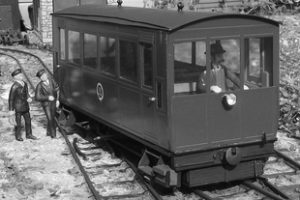
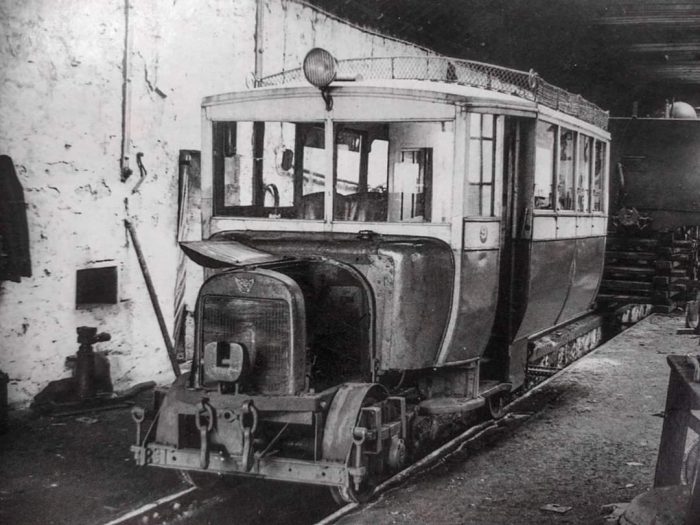
A few years prior to his appointment, a tiny 4-wheeled railmotor had been purchased. It was just 6ft high and originally had a 10hp petrol engine. Its capacity was only 10 passengers. Because of its diminutive size, it was only infrequently used to cover passenger duties. Its main functions were the carriage of post and serving as a maintenance vehicle. [1: p60] There is an excellent study of this railmotor sitting in Stranorlar Station which was taken by H.C. Casserley. Peterson et al reproduce it in their book. [1: p114]

The Donegal Railway Heritage Centre posted a picture of the railmotor on Facebook,a long with the description beneath. [3]

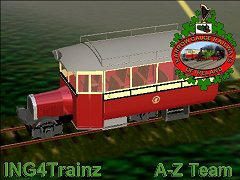
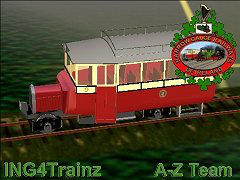
”Even if this original … Railmotor … was used spasmodically, it had yielded valuable experience. In 1926, with the balance sheet insisting on lowered operating costs, Forbes decided that the time was ripe to show that his railway could give as flexible a service as the road omnibuses and a faster one withal.” [1: p60, cf. p114] It was preserved in its final version and is now housed at the Ulster Transport Museum. [4]Co. Donegal Railways Railmotor No. 1, (c) Ulster Transport Museum, used under a Creative Commons Attribution-Share Alike 4.0 International. [5] The YouTube video below shows pictures of this railmotor in the museum at Cultra and a computer simulation of the railmotor in action on the Trainz simulation software produced by ‘ing4trainz’. [21]

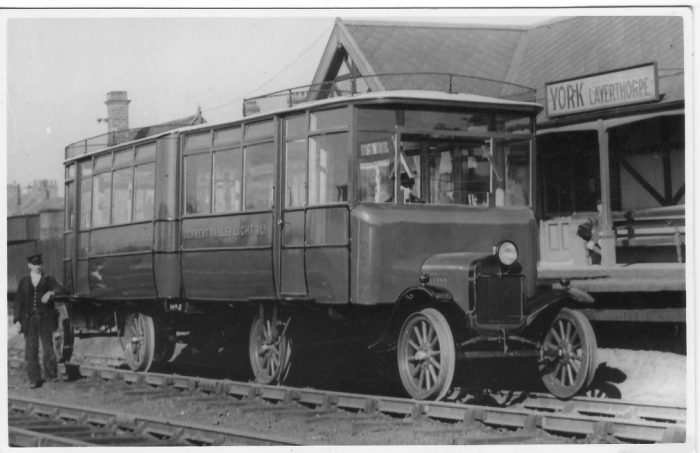
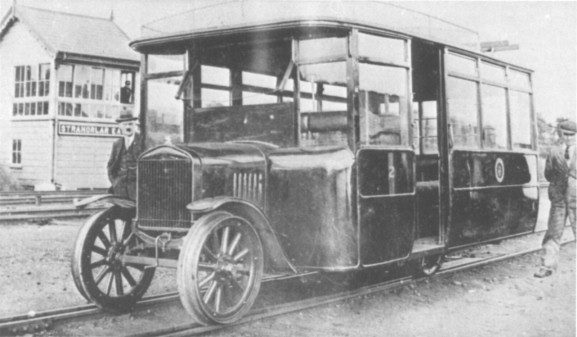
Railmotors Nos. 2 & 3 which came from the DVLR. [22]

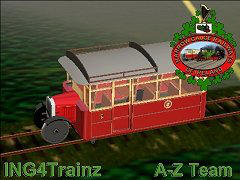
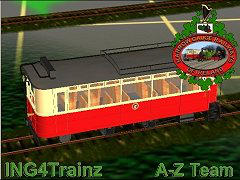
Railmotor No. 1 – A simulation by ING4Trainz. [22]

Given his experiences with the diminutive Railmotor No. 1, Forbes took a chance on a pair of Ford petrol-engined railcars. They came from the standard-gauge Derwent Valley Light Railway (DVLR) near York. They had been purchased by the DVLR in May 1924 at a total cost of £1070 with the intention of keeping the costs of transporting passengers to a minimum. “Each was built on a Ford 1‑ton truck chassis with bodywork by C.H. Roe Ltd of Leeds. Rated at 22hp, they weighed 2 tons 7 cwts, and were fitted with 17 seats.” [2] They were not popular with passengers on DVLR and were soon up for sale. Forbes bought them in June 1926 for a total of £480. By August 1926 the pair of railmotors were in Londonderry being converted to 3ft-gauge! [2]

There were a number of these railmotors, from a number of different manufacturers, in use on Light Railways around England at the time. A review of their use on the Colonel Stephens’ family of Light Railways can be found on the following link:

Ford Railmotors on Colonel Stephens’ lines in general and on the S&MLR

It is worth noting that Colonel Stephens took an interest in the two DVLR railmotors when they were put on the market. It seems likely that his expressed interest prevented Forbes negotiating a lower price for the vehicles. [1: p115]

These railmotors were usually used in pairs, back-to-back, but on the Co. Donegal Lines they were often used singly. (Although initially on the DVLR, they had been used as a pair, small turntables were installed at Layerthorpe and Skipwith in order to allow the units to be used singly.) Once available on the Co. Donegal Railways, these vehicles were “reasonably successful and lasted until 1934 when they were withdrawn from service.” [2]

Patterson et al. comment: “On the DVLR they had run in tandem, … but on the Donegal lines they were run separately. From the start, they operated regular passenger services: by modern standards they were noisy and subjected the passengers to considerable vibration, but their ability to stop anywhere was deservedly popular in a country of small farms and isolated cottages. Futhermore, the operating costs were only a fraction of those of orthodox steam trains:” [1: p60]  3.25d per mile rather than 11.25d per mile. It appears that Patterson et al were unaware of the use of small turntables on the DVLR.

I have managed to find one old photograph of this par of railmotors while in use on the DVLR at York – Layerthorpe Station. They look to be in as new condition. It has beenn impossible to establish the provenance of this photograph. [6]DVLR Railmotors in use at Layertorpe Sation near York. [6] These railmotors became Railmotors No. 2 and 3 on the County  Donegal railways.It is interesting that this photograph of one of the two railmotors (No. 2) after conversion for the Co. Donegal Railways is shown on the IRS website in an article from 1973 and it is credited to Dr. E.M. Patterson, [2] but the picture does not appear in the Book about the Co. Donegal Railways from Patterson et al. [1] … The changes are self-evident. The re-gauging to 3ft-gauge would have left the centre of gravity of the vehicle too high and as a result the body was lowered on the chassis which created a very different look. The rear wheels were almost hidden inside the bodywork.

Petrol Railmotors No. 2 and 3 were a success. Not an unqualified one, but nonetheless they resulted in a significant change of direction for the management of the Co. Donegal Railways. The future would be in the use of railcars rather than in the continued development of steam traction.

Patterson et al. comment that the alterations to the railmotors before they saw service on the Co. Donegal Railways took place at Dundalk rather than in the Northwest. They were ready for use in the Autumn of 1926. They did have some axle problems and during their lifetime saw their axles strengthened to be more in line with usual railway practice. [1: p117] But they served well until 1933 when they were beginning to be rather tired.Railcar/Railmotor No. 4 with the loco shed, water tower and carriage shed in Donegal Town, 1931. This picture was found on the Facebook group associated with the Donegal Railway Heritage Centre. (c) Sam Carse and held in the collection of the Donegal Railway Heritage Centre. [20]

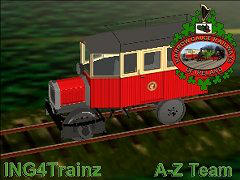
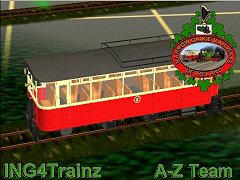
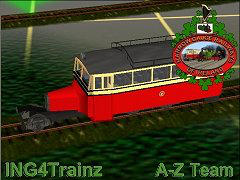
Railmotor/Railcar No. 4 – a simulation produced by ING4Trainz. [22]

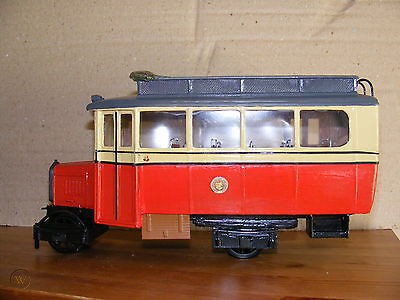
County Donegal Railcar/Railmotor No. 4, 16mm scale model for use on 45mm-gauge track, recently for sale on an internet-based sales platform. [18]

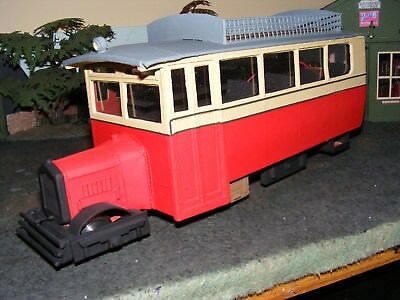
Co. Donegal Railmotor No. 4 – Model of the body shell which was for sale relatively recently on a internet-based sales platform. [15]

In 1928 they were joined by Railcar/Railmotor No. 4 which was also fueled by petrol. It was a significantly larger beast, based on a 30-cwt Ford chassis. Its size meant that it could not operate with a rigid chassis if it was to negotiate the tight curves on the network. It was therefore given a pony truck for the from axle. The vehicle was fully assembled by October 1928. Apart from some problems with its axles, the vehicle was again a success and lasted in service throughout the Second World War only being scrapped in 1947 after 19 years service. [1: p118]. There is a small scale drawing of this railmotor in Appendix 11 E.M. Patterson et al. [1: p173]

Appendix 8 of ‘The County Donegal Railways’ tells us that the petrol powered railmotors gradually gave way to diesel powered units but petrol continued to be a power source until the late 1940s. [1: p165]

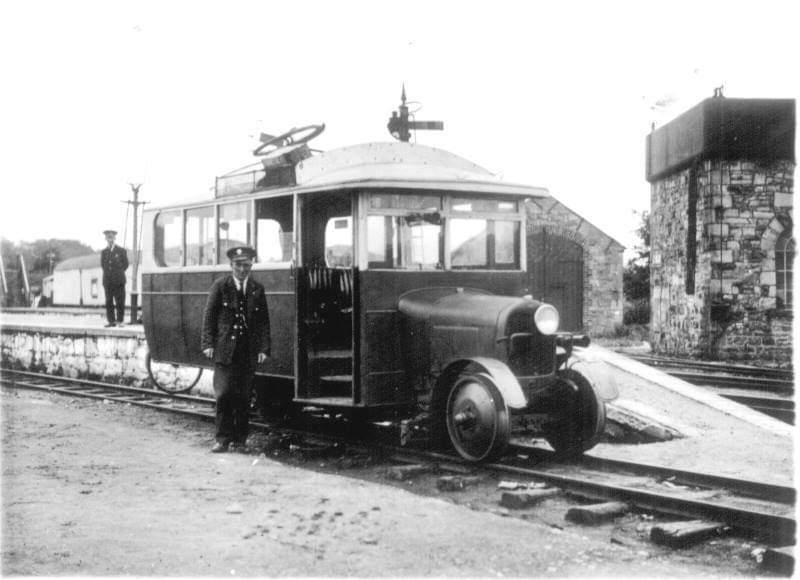
We have already noted that Railmotor No. 1 was not scrapped but was eventually preserved at Cultra. Railmotors No. 2 and 3 were scrapped in 1934. They were replaced by two other units which were given the same designation. The new No. 2 was of a similar power to the one’s scrapped and arrived in 1934. It had a 22-hp engine but carried 30 rather than 17 people. It  came second-hand from the Castlederg & Victoria Bridge Tramway and remained in service until 1944 when it was converted to a trailer. It was not sold until 1961 when it was removed to Mountcharles in the South of Co. Donegal. The new No. 2 was a 24-seat railcar with a Fordson paraffin engine built in 1925 at Castlederg and referred to in the Wikipedia article about that line. [7] Although basic in design, that vehicle was capable of being driven from either end and the driver also sold the tickets.

I have not been able to find the drawings for the new No. 2, although I believe that they are included in E.M. Patterson’s book about the Castlederg and Victoria Bridge Tramway (C&VBT). [8] ING4Trainz do not appear to have produced a simulation for this railcar/railmotor either in its C&VBT guise or its CDR livery days. There is however a model of the railcar running on a layout which depicts the Castlederg terminus of the old Tramway which closed in 1933. It is a kit-built model from a Worsley Works kit, built by  Andy Cundick. [9],[10] The scale is OOn3.

Railmotor/Railcar No. 3 (new) which came from the D&BST – a simulation by ING4Trainz [22]

The new No. 3 came from the Dublin & Blessington Steam Tramway (D&BST) in 1934. It was also a larger vehicle than the old No. 3 with a passenger capacity of 40 and a 35-hp engine. The vehicle was built by the Drewry Car Co. Ltd. It arrived on the Dublin and Blessington Steam Tramway in 1926. It had two driving axles and two pony axles, and could be driven from either end. On that tramway it ran on a track gauge of 5ft 3in and so had to be converted to 3ft gauge. It operated successful on the Co. Donegal until 19….. when it was converted into a trailer and continued in active use until 19…….. “It is now the sole surviving vehicle from the old Dublin & Blessington Steam Tramway, residing at the transport museum at Cultra.” [11]

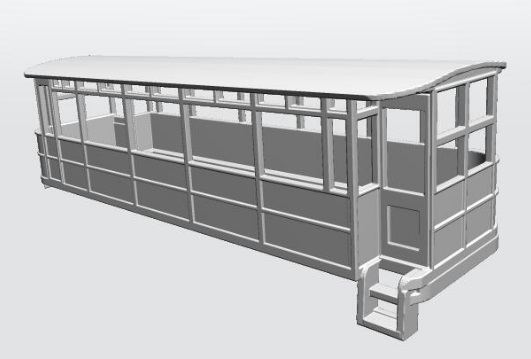
Shapways 3D-printed model of Drewry Railcar No. 3 [12]

A number of other pictures are available across the internet. There is an excellent study at https://transportsofdelight.smugmug.com. [13] Some discussion about detailing of models of this vehicle can be found on the Irish Railway Modellers Forum. [14]

Railcar/Railmotor Trailer No. 5 ( and No. 2). A simulation by ING4Trainz. [22]

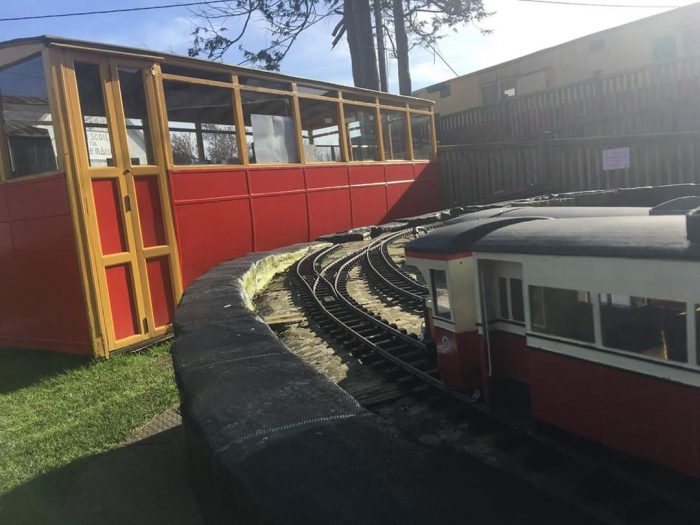
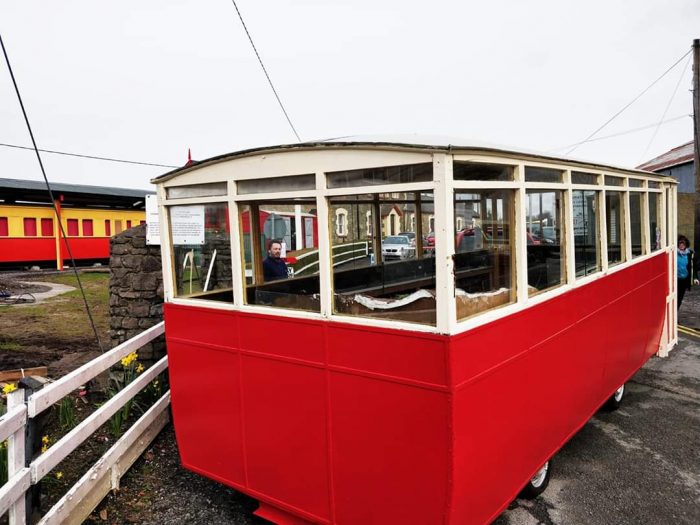
No. 5 in the series is a slight anomaly. The designation was given to the railmotor/railcar trailer which was purpose-built for that role. it had a 9ft wheelbase and was designed by the drawing office in Dundalk. A software simulation of the trailer has been produced by ING4Trainz. [22] The chassis was constructed by Knutsford Motors Ltd and the body by O’Doherty at Strabane. It weighed 3 ton 4.5-cwt and had sufficient room for 28 passengers. E.M. Patterson et al. say that the “trailer survived until the end of service on the CDR and was sold at auction in 1961 to Donegal Town football club, where its body was used as a cash-office. It was subsequently photographed in use as a holiday chalet in Rossnowlagh in 1965.” [1: p118] After an interesting ‘life’ out in the country it was brought down to Donegal Town Station and restored during the mid 1990s as part of exhibits at the Donegal Railway Heritage Centre. It was discovered by the local photographer, the late Conor Sinclair at Doochary, near Fintown. [16]

Trailer No. 5 in the garden of the Donegal Railway Heritage Centre. [17]

It was originally believed that Trailer No. 5 had been scrapped in the mid seventies but it had actually been towed to Doochary for use as a holiday home. It received a full body restoration at the Railway Preservation Society of Ireland premises in Whitehead, Antrim. This included new roof timbers and felting to make it watertight. The doors have been remade using the original patterns. The restoration effort was financed with the help of an Interreg IIIA European cross-border grant. [17]Trailer No. 5 in the process of being prepared to travel through the streets of Donegal on the St. Patrick’s Day Parade in 2019. [19]

Railmotor/Railcar no. 6. [23]

No. 6 was also a petrol railmotor, although exactly which vehicles were railmotors and which were railcars is difficult to determine as often all of them were referred to as railcars. No. 6 was built  by Great Northern and O’Doherty and came into use in 1930. It had a 32hp petrol engine and weighed 5-ton 11-cwt.  It cost £900 when new and carried a maximum of 32 seated passengers. It was rebuilt as a 4-wheeled trailer in 1945 and then sold into private owenrship in 1958 and removed to Inver. [1: p165]

Patterson et al., say that “it ran on a front radial truck, arranged for side-play of 4.5 in. to take the worst curves on the system and on a rear driving bogie. … It mainly served on the Glenties and Ballyshannon lines.” [1: p119]

Railmotors/Railcars No. 9 and 10. [23]

No. 6 was the last purpose built petrol-powered railmotor/ railcar. After it, only two further petrol powered vehicles were commissioned for the network. They were No. 9 and No.10, both were converted road vehicles. They had seen service for 3 years on the demanding roads of West Donegal and were converted at Stranolarto run on the 3ft rails of the Co. Donegal railways. They were similar in appearance to No. 4 and were powered by 36hp  Ford petrol engines. Both had a seating capacity of 20. [1: p121] No. p lasted 16 years in service and was scrapped in 1949. No. 10 was destroyed in a fire at Ballshannon shed in 1939. [1: p165] They were distinguished from No.4 by having a short body panel in front of the access doors. This can be seen on the ING4Trainz simulation above and in the picture immediately below.Railcar No 9 in the shops at Stranorlar. In 1930 the CDR acquired four Reo buses second hand from the GNR. A few years on the Donegal’s poor roads reduced them to wreaks but Henry Forbes had the two in the best condition converted to Railcars. They had 20-seat bodies and were powered by 36hp petrol engines. No.10 was destroyed in an accidental fire in 1939 but No. 9 seen here lasted until 1949. This picture was found on the Facebook group associated with the Donegal Railway Heritage Centre. (c) Sam Carse and held in the collection of the Donegal Railway Heritage Centre. [24]

References

  1. Edward M Patterson (original author), Joe Begley & Steve Flanders (authors of additional material in the Revised Edition); The County Donegal Railways; Colourpoint Books, Newtownards, Co. Down 2014. As noted in my first article about the Co. Donegal Railways this was to have been my holiday reading while walking different parts of the network, but 2020 has been a strange year!
  2. R.R. Darsley; The Derwent Valley Railway 60 Years On; The Industrial Railway Record No. 51, p129-146;  https//www.irsociety.co.uk/Archives/51/Derwent.htm, accessed on 28th May 2020.
  3. https://www.facebook.com/DonegalRailwayHeritageCentre/photos/a.1230417866994452/1832504963452403/?type=3&eid=ARBj6M4J6PfuqfYLVcSJZ5ufR_YqF2sXMHfcMcOjpq-f5tf8ZGMBueJQkt-VyBaN9mGz88PfJRCNOpz9&__xts__%5B0%5D=68.ARAKlX23JjRvdKk7EUdXx3eF6aPtBWzsYqhPy15b7oEg5gX2uGc6ejt_ear_e9A4wooDnJiwOc38LCp6my7VW1SslaIFGrnG2DjrQk07K9AzfXFobC-Lx3Y0s0uHUCKOri18xqNUr1zftJNQYwGJ2YOc70li-jigqFkqBVKMd5j4pUaSuZ10WunvIBDoVCb2jA69bgxMjZ6TvCsuP_9E8_N2zT0aXMRBrfFm8G_uUry-n4ZSRKb22rdeyNNbGk9YPCx8A1PDDHl-yG-SBZ-g2rV6iaCnVavfP2z5pK4YfeZ7Pg6_jayE1uTs2D5rKB_TyZshJkbS7vzYJPwAOGqAj6hoB4S-&__tn__=EHH-R, accessed on 29th May 2020.
  4. https://www.nmni.com/our-museums/Ulster-Transport-Museum/Home.aspx, accessed on 29th May 2020.
  5. https://commons.wikimedia.org/wiki/File:Ulster_Transport_Museum,_Cultra,_County_Donega_Railways_Joint_Committee_Railcar_No_1_(03).jpg, accessd on 29th May 2020.
  6. http://www.mtfca.com/discus/messages/179374/185052.html?1296125299, accessed on 1st June 2020. I have tied to establish copyright ownership of the image but have not be successful. The source of the image on the forum is Peter Kable, Kiama, Australia. He is no longer active on the forum. The image was posted on 26th January 2011.
  7. https://en.wikipedia.org/wiki/Castlederg_and_Victoria_Bridge_Tramway, accessed on 2nd June 2020.
  8. E.M. Patterson; The Castlederg and Victoria Bridge Tramway;  Colourpoint, 1998.
  9. https://glostransporthistory.visit-gloucestershire.co.uk/gloucester-model-railway-exhibition-2016, accessed on 2nd June 2020.
  10. http://www.worsleyworks.co.uk/NG/NG_Irish_CVBT.htm, accessed on 2nd June 2020.
  11. http://gofree.indigo.ie/~nigelo/rollingstock.htm, accessed on 3rd June 2020.
  12. https://www.shapeways.com/product/MSG4MEWNL/o-152fs-dublin-blessington-drewry-railcar?optionId=99464677&li=marketplace
  13. https://transportsofdelight.smugmug.com/RAILWAYS/IRISH-RAILWAYS/COUNTY-DONEGAL-RAILWAYS-JOINT-COMMITTEE/i-29Hdbpq/A, accessed on 3rd June 2020.
  14. https://irishrailwaymodeller.com/topic/5699-dampbcounty-donegal-drewry-railcar-interior-query/page/2, accessed on 3rd June 2020.
  15. https://picclick.co.uk/County-Donegal-Railway-Railcar-No-4-45mm-162936012780.html, 3rd June 2020.
  16. http://donegalrailway.com, accessed on 4th June 2020.
  17. https://m.facebook.com/DonegalRailwayHeritageCentre/photos/a.1230417866994452/1249883518381220/?type=3, accessed on 4th June 2020.
  18. https://www.worthpoint.com/worthopedia/county-donegal-narrow-gauge-railcar-539348090, accessed on 4th June 2020.
  19. https://www.facebook.com/DonegalRailwayHeritageCentre/photos/a.1224552917580947/2035019939867570/?type=3&theater, accessed on 4th June 2020.
  20. https://youtu.be/3XrG6X9q52Q, accessed on 5th June 2020. cf. https://www.jatws.org/ing4trainz/cdr.htm.
  21. https://www.jatws.org/ing4trainz/cdr.htm, accessed on 12th June 2020.
  22. https://www.facebook.com/DonegalRailwayHeritageCentre/photos/a.1224552917580947/2144853775550852/?type=3&theater, accessed on 5th June 2020.


Co. Donegal Railways, Ireland – Part 1 – The Glenties Branch – Stranorlar to Ballinamore

My wife and I were due to take our annual holidays in 2020 in April and May. We would have been staying in Co. Donegal in Ireland and would, among other things, have explored some parts of the old 3ft gauge railways which served Co. Donegal.

Map of the Co. Donegal 3ft-gauge railway network. [25]

I have been reading through the 1948 editions of The Railway Magazine and on 16th May 2020, I found this short paragraph in the ‘Notes and News’ section of the May and June 1948 edition. Volume 94 No. 575. …

Closing of the Glenties Branch, County Donegal Railways Joint Committee

Passenger services were withdrawn on 13th December 1947, from the Stranorlar-Glenties branch of the County Donegal Railways Joint Committee in Ireland. The stations affected were Glenmore, Cloghan, Ballinamore, Fintown, Shallogans and Glenties. The branch of 3ft-gauge and 24.5 miles in length was constructed under the Light Railways (Ireland) Act of 1889, and opened on 23rd June 1894.

This seems to be far too short an obituary to the Glenties Branch. So, it seemed to me that I should start looking at the Co. Donegal Railways by looking at the Glenties Branch.

As part of my holiday reading, I had set aside the updated version of E.M. Patterson’s book about the Co. Donegal railways (which I first read as a teenager). That 2014 book has been a companion over a couple of weeks of lockdown in 2020. [3]

The Glenties Branch ran through a very rural part of Co. Donegal and seemingly stopped short of what could be considered a ‘sensible’ destination – the Atlantic Coast. Indeed it seems as though there were quite a few people in Ardara on the coast who thought that way. There was a concerted campaign over many years to get a short extension built between Glenties and Ardara. [3] But more of that later!

Grace’s Guide tells us that the line between Stranorlar and Glenties was 24 miles (38 km) long and that It opened in 1895. [2] Stranorlar and Ballybofey (located on the other side of the River Finn) together, form the “Twin Towns.” [5] It might interest you to know that there are no schools or churches in the town of Ballybofey itself, all these amenities were governed by laws during plantation times when certain Catholic buildings were not allowed within a specified range of Protestant towns. Times have changed a little now as Stranorlar has both a Roman Catholic and a Church of Ireland church. Both of the Twin Towns have their own railway station.

Stranorlar Railway Station was a junction Station with the line to Glenties branching off the Donegal to Strabane line. Ballybofey Railway Station was on the other side of the River Finn. Ballybofey Railway Station opened on 3rd June 1895 and closed on 15th December 1947 along with the rest of the Glenties branch.

Wikipedia tells us that Stranorlar Railway Station was built by the Finn Valley Railway and opened on 7th September 1863 and finally closed on 6th February 1960. “The old railway station was demolished to make way for a new bus garage owned and run by Bus Éireann. To celebrate the millennium, the old clock from the railway station was restored and installed in a new clock tower which sits at the old pedestrian entrance to the railway station yard. The town remains the main depot for Bus Éireann within County Donegal.” [5]

When first built, the station was the terminus of an Irish standard-gauge (5ft 3in – 1600mm) line which ran from Strabane to Stranorlar. It served in this form for a number of years.In 1880 work commenced on the West Donegal Railway which was built to 3ft-gauge and for a time Stranolar served in this new mixed-gauge era.In 1892, the Finn Valley Railway merged with the West Donegal Railway to form a new company, the Donegal Railway Company. The line from Stranorlar to Strabane was then reconstructed to (3 ft – 914mm) gauge. [6] Conversion took very little time as it only required the moving of a single rail and respiking of the railchairs on the smae sleepers that had been used for the 5ft 3in gauge line. As we have already noted the branch to Glenties opened in 1895.

The story of all machinations which eventually brought all these lines into the same fold is told well by Patterson, Begley and Flanders and does not need repeating here. [3]

An extract from the Ireland GSGS one inch OS Map Series of the early 1940s [4]

The station building in Stranorlar taken from the station forecourt. This image is shared with the kind permission of David Parks. It appears on his blog: Irish Postcards: irishpostcards.wordpress.com. [8]

Stranorlar Railway Station in 1948 (c) Wlater Dendy CC BY-SA 2.0. [7]

There are a number of excellent monochrome photographs of Stranorlar Railway Station available on Flickr on the Photostream “Ernies Railway Archive” [9] You might want to check out the links to a sample of the different images available which are included in the notes. [10-24]

The image above looks into the site of Stranorlar Railway Station from the direction of Strabane. I found it on the Irish Railway Modeller’s Forum. [27] The contributor had found it on Facebook.Railcar No 8 arrives at Stanorlar from Glenties sometime in the 1930’s. These railcars had a single front axle and a chain-driven rear bogie, and did not provide the most comfortable rides, (c) John Langford. This image was found on the Donegal Railway Heritage Centre’s Facebook page and is used by kind permission. [40]

I have recently been given access to some station plans from the Co. Donegal Railways produced by Chris Amundson. The link immediately below shows what is known about the layout of Stranorlar Railway Station in different eras.

https://www.flickr.com/gp/spw45/J3354A

Stranorlar, based on Ordnance Survey and numerous photographs, (c) Chris Amundson (CC BY-SA 2.0), included by kind permission . [41]

The next two images show Stranorlar in the mid-1950s and come from the blog, “Hyde Park Now!” and are, in turn, sourced by that site from elsewhere. [25] In giving permission to use these two images, londonblogger expresses concern that it is easy for the historic content of blogs to be lost or dissipated in the sharing of images. The two blogs from ” Hyde Park Now! are very much worth a visit and give a great overall context to this post which focuses on one part of the whole network. These are the relevant links:

https://hydeparknow.uk/2019/12/31/the-county-donegal-railways [25]

https://hydeparknow.uk/2020/01/14/the-county-donegal-railways-2 [26]

Stranolar was effectively the headquarters of the Co. Donegal Railways. ‘londonblogger’ on the blog ‘Hyde Park Now!’ notes that it had “an extensive works for the maintenance of rolling stock.” [25] In the first of the two pictures above the maintenance facility is shown to really good advantage. Railcars were serviced in the buildings to the left of the image and steam locomotives to the right.The site of Stranorlar Railway Station as it appeared in 2009 – it functions as Bus Eireann’s Stranorlar Depot. None of the railway infrastructure and buildings remain. (Google Streetview).

Stranorlar to Clohan, GSGS Map of the early 1940s. [30]

The Glenties Branch set off West from Stranorlar Station with the line to Donegal bearing away to the Southwest. In a very short distance the branch crossed the River Finn.This image shows just how short the distance was from the end of the station platform, used by the Glenties Branch trains, to the bridge over the River Finn at Stanorlar. The village of Ballybofey can be seen at the top of this image. It had its own station. The image is used by kind permission from of David Parks. It appears on his blog: Irish Postcards: irishpostcards.wordpress.com. It was first published by ‘Aero-Views’, Dublin.  [28]

The Glenties branch can be seen crossing the bridge over the River Finn and then cuvidn around the North side of Ballybofey after having been crossed by the main road (N15) on a single-span stone-arch bridge. [28]

The Glenties Brach crossed the River Finn on a large-span truss girder bridge which sat on stone abutments.

Those abutments remain in the 21st century and can be glimpsed from the N15 as it approaches and then crosses the River Finn on its stone-arch viaduct. On the Stranorlar bank of the river, the line first passed over a narrow lane serving the river side on a girder-bridge before crossing the river. The remains of that bridge and the East abutment of the bridge can be seen on the first colour image below. You can just pick out the River Finn in the greenery to the right of the image. The stonework to the bottom right is a length of coping from the road-bridge parapet.

The Glenties Branch Bridge over the River Finn, east abutment. The picture was taken in June 2018 (Google Streetview).It is impossible to pick out the stone abutment to the West of the River Finn among the greenery on the river banks. This picture was also taken in June 2018. (Google Streetview).The view back into Stranorlar across the River Finn from Ballyfoley. The Glenties Branch Railway Bridge over the River Finn can be seen on the right of this picture [33]A postcard view of the Bridge over the River Finn (The Linen Hall Library Collection – available for sharing) [35]

The River Finn Railway bridge at Stranorlar/Ballybofey during construction of the line. The superstructure sits alongside the railway awaiting being moved into position across the river. The image is from the geocache webpage for this location. [36]


A postcard view looking back across the River Finn from Ballybofey towards Stranorlar Railway Station. Both of the river bridges are in the photograph, as is the bridge wingwall of the stone arch bridge which carried the road over the Glenties Branch. [37]

The adjacent small image shows the two River Finn Bridges (road and rail) in use. Sadly the rail bridge is only partially visible on the right of the photograph. The image is from the Facebook page ‘Ballybofey Stranorlar’. [34]

The route of the old branch-line to the Northwest of the N15 is now hidden by redevelopment. The early 1940s GSGS One-inch Map shows the railway crossing Back Road on an overbridge and then running alongside the river into Ballybofey Railway Station. [29]The approximate line of the old railway which ran across the North side of the village of Ballybofey, lifted from the GSGS Map of the early 1940s. [29]The site of Ballybofey Railway Station. This picture was taken in 2010 (Google Streetview)

At the West end of Ballybofey Station the line crossed what is now Railway Road/Beechwood Avenue on the level and then ran between Beechwood Avenue and Glenfin Street/Road (R252) parallel to the River Finn. The first length is now buried under domestic dwellings.

After a short distance the R252 (Glenfin Road) crossed the old line on an over-bridge. With the closure of the line, it became possible for a small road improvement scheme to straighten out the line of the roadas shown below.

The Glenties Branch West of Ballybofey. [31]After passing under an accommodation bridge the line continued in a westerly direction with the R252 once agin dog-legging to cross it close to the River Finn (Google Earth).

Glenmore Railway Station opened on 3rd June 1895. [32] There is no evidence of its existence in the early 21st century. The church which is marked on the GSGS Map of the early 1940s is still standing to the West of the old road junction. The railway passed to the South of the Church between it and the R253. I have shown the location ringed in red on the satellite image immediately above. The R252 curves through what would have been the station site. there would have been a level-crossing and the point above where the line crossed the old road (marked with a break in the red line).Looking East from the R253 adjacent to the churchyard at Glenmore in July 2011 (Google Streetview).The line of the old railway is so much easier to determine when the boundary walls still remain in place. This view looks to the West from the old road junction, again in July 2011. Glenmore Church can be seen on the right (Google Streetview).Cloghan Railway Station was a couple of kilometres South of the Village with the same name. The old railway turned gradually to the Northwest as it approached the station, still following the River Finn. The old station building retains the designation Station House although it is in the Townland of Gortiness. It has been extended along the line of the old platform tp the Southeast.This postcard view of Cloghan Station is a colourised monochrome image. It is taken from the Southeast. The station building can be seen on the left of the image and the road bridge can be seen beyond the platform. Permission to include this image was very kindly given by David Parks. It appears on his blog: Irish Postcards: irishpostcards.wordpress.com. [8]This view shows the old Station House which is in cream at the centre of the picture. It is taken from the road bridge shown in the postcard view, looking Southeast along the route of the old railway line. The line is marked by the line of bushes running towards the Station House (Google Streetview).The old Station House at Cloghan Railway Station. The image comes from June 2011. The first three windows from the left on the 1st floor were part of the original building. The extension is on the right (Google Streetview).

From Cloghan Railway Station the Glenties Branch turned North, crossing the River Finn twice as shown on the adjacent extract from the GSGS 1940s Map and continued up the Finn Valley. The next three photographs show the route of the line at the road bridge marked at the top of the map extract which was about a kilometre South of the village of Cloghan.

The first is a view on Google Streetview which is taken from just to the West of the the River Finn road bridge at the top of the adjacent map extract. The road alignment on the extract needs verifying. It seems as though the position of the railway was a little closer to the river.

The second image is a close up satellite view from Google Maps which has had the old railway route at its centre.The old road alignment is marked by the cartographers who have provided the road overlay to the satellite images associated with Google Maps. Teh road used to turn sharply to the South after crossing the river to a point where crossing the line was possible. It is not clear whether this was a bridge or a level-crossing.

I have been unable to find photographs of the two bridges over the River Finn. Nor are there any photos of the road crossing point near the top of the satellite image.

The next image shows the Glenties Branch alignment through this area. The red line, again, show the route of the railway.

The next map extract is at a smaller scale and shows the route of the old line to Ballinamore. The valley of the River Finn turns once again to the West after passing Cloghan village and the railway remained on the West and then South side of the river.

These next two satellite images follow the old railway route along the West side of the River Finn before it turns to the West again.

The first runs across open fields alongside the River Finn. The second continues in the same vein. At around the half-point of the satellite image extract a farm access track now uses the old railway formation as it travels North.

The first landscape image below is another satellite image which shows the gradual change of direction of the old line as it swung round towards the West. The next, illustrates the condition of the railway formation in 2009, At that time the gravel surface had newly been relaid. Further to the North the track shows up as having been tarmacked in 2009.

A sequence of photographs from Google Streetview covers the next few kilometres of the old railway. Various dwellings have been built since the closure of the line which have the old railway formation as their only access route.

A good number of these homes appear to have been constructed since the turn of the 21st century.

Eventually the tarmacked length of the old formation ends where the old railway crossed another road. A satellite image follows the Google Streetview photographs and again picks up the line close to that road crossing.The last Streetview photograph above shows the point at which the old railway formation meets what is now a local road. If the road had been present during the life of the Glenties Branch, this would have been a level crossing probably without gates. However the GSGS map (see below) does not show a road at this location in the early 1940s. The Glenties Branch continued westward on the South side of the River Finn. There was a need for a significant number of culverts to allow land drainage to reach the river. They show up particularly well of the extract from the GSGS map above.Ballinamore Station Building in 2010 seen from the R252. It is difficult to imagine a more remote location for a Station Halt nor a more run-down, but still standing, corrugated iron building. As we can see in the last picture of this article, the platform face still remains! (Google Streetview)Ballinamore Station Building! It was still standing in 2020 as can be seen on the Satellite image above. This picture was taken in 2009 (Google Streetview).

Ballinamore Railway Station opened in June 1895 and closed in December 1947. [38]

Former Ballinamore County Donegal Railway Station, June 1990 – The photographer says, “Miles from anywhere, not a house or tree in sight. Once the haunt of snub-nosed diesel railbuses. Ballinamore station, opened in 1895 was about half way between Glenties and Stranorlar on the CDR County Donegal Railway.” (Scanned slide) (c) G Sludge (Attribution-ShareAlike 2.0 Generic (CC BY-SA 2.0)). [39]

The location appears for a few seconds in “Off The Beaten Track – Stranorlar to Glenties in Donegal.” www.youtube.com/watch?v=7wclzaSSzWQ&t=13m20s

We have reached the end of this first part of the journey from Stranorlar to Glenties. It is hard to think of a worse place to stop and we only do so because it is roughly at the half-way point on the journey to Glenties.

References

  1. The Railway Magazine: ‘Notes and News’; May & June 1948 edition. Volume 94 No. 575, p202.
  2. https://www.gracesguide.co.uk/County_Donegal_Railways_Joint_Committee, accessed on 21st May 2020.
  3. Edward M Patterson (original author), Joe Begley & Steve Flanders (authors of additional material in the Revised Edition); The County Donegal Railways; Colourpoint Books, Newtownards, Co. Down 2014.
  4. https://maps.nls.uk/geo/explore/#zoom=15&lat=54.80218&lon=-7.77993&layers=14&b=1, accessed on 21st May 2020.
  5. https://en.wikipedia.org/wiki/Stranorlar, accessed on 21st May 2020.
  6. https://en.wikipedia.org/wiki/Finn_Valley_Railway, accessed on 21st May 2020.
  7. https://en.wikipedia.org/wiki/Stranorlar_railway_station#/media/File:Stranorlar_station,_County_Donegal_Railways_Joint_Committee,_1948_(geograph_5307210).jpg, accessed on 21st May 2020.
  8. https://irishpostcards.wordpress.com/transport, accessed on 23rd May 2020.
  9. https://www.flickr.com/photos/irishswissernie, accessed on 23rd May 2020.
  10. https://www.flickr.com/photos/irishswissernie/23589146660/in/album-72157662649694575 – CDRJC Stranorlar, goods entering from Strabane 1958 (c) Henry Emeleus/ARPT, accessed on 23rd May 2020.
  11. https://www.flickr.com/photos/irishswissernie/16492159115 – Stranorlar 1957, accessed on 23rd May 2020.
  12. https://www.flickr.com/photos/irishswissernie/23256677994 – CDRJC Stranorlar Railcar No. 19, 1958 (c) Henry Emeleus/ARPT, accessed on 23rd May 2020.
  13. https://www.flickr.com/photos/irishswissernie/6180278429/in/album-72157662649694575 – CDRJC Stranorlar just after closure 1960, taken from the Eastern approach from Strabane, accessed on 23rd May 2020.
  14. https://www.flickr.com/photos/irishswissernie/23858764346/in/album-72157662649694575 – CDRJC ‘Erne’ on shed at Stranorlar in 1958 (c) Henry Emeleus/ARPT, accessed on 23rd May 2020.
  15. https://www.flickr.com/photos/irishswissernie/41879605651/in/album-72157662649694575 – Class 5 on shed at Stranorlar in 1958, accessed on 23rd May 2020.
  16. https://www.flickr.com/photos/irishswissernie/23258058353/in/album-72157662649694575 – CDRJC Stranorlar in 1958 (c) Henry Emeleus/ARPT, accessed on 23rd May 2020.
  17. https://www.flickr.com/photos/irishswissernie/23539544992/in/album-72157662649694575 –  0956-3 Railcar Stranolar station (c) J W Armstrong/ARPT, accessed on 23rd May 2020.
  18. https://www.flickr.com/photos/irishswissernie/23258060463/in/album-72157662649694575 – CDRJC Stranorlar station, Railcar No. 19 arrives from Donegal in 1958. The former Glenties platform is in foreground (c) Henry Emeleus/ARPT, accessed on 23rd May 2020.
  19. https://www.flickr.com/photos/irishswissernie/15872003843/in/album-72157662649694575 – goods wagons outside the General Store at Stranorlar Railway Station in 1957, accessed on 23rd May 2020.
  20. https://www.flickr.com/photos/irishswissernie/16304711660/in/album-72157662649694575 – close-up of the plaform canopy columns at Stranorlar Railway Station in 1957, accessed on 23rd May 2020.
  21. https://www.flickr.com/photos/irishswissernie/6180266037/in/album-72157662649694575 –  CDRJC Stanorlar Railcar No. 19 on Killybegs service on 8th July 1956 (b726), accessed on 23rd May 2020.
  22. https://www.flickr.com/photos/irishswissernie/6180279023/in/album-72157662649694575 – colour image of Stranorlar Railway Station in 1958, taken from the Southwest, accessed on 23rd May 2020.
  23. https://www.flickr.com/photos/irishswissernie/6180277183/in/album-72157662649694575 – CDRJC_Stranorlar: Railcar No. 18 on the turntable in 1958, accessed on 23rd May 2020.
  24. https://www.flickr.com/photos/irishswissernie/6180272243/in/album-72157662649694575 – Stranorlar Railway Station Footbridge. Picture taken in May 1963 after closure of the line, accessed on 23rd May 2020.
  25. https://hydeparknow.uk/2019/12/31/the-county-donegal-railways, accessed on 23rd May 2020. The map of the network was in turn sourced from Twitter: https://twitter.com/velvetninja1/status/1188118651536314369
  26. https://hydeparknow.uk/2020/01/14/the-county-donegal-railways-2, accessed on 23rd May 2020.
  27. https://irishrailwaymodeller.com/topic/7262-donegal-railway/page/2, accessed on 23rd May 2020.
  28. https://irishpostcards.wordpress.com/aerial-cards, accessed on 24th May 2020.
  29. https://maps.nls.uk/geo/explore/side-by-side/#zoom=17&lat=54.80016&lon=-7.78155&layers=14&right=BingHyb, accessed on 24th May 2020.
  30. https://maps.nls.uk/geo/explore/#zoom=13&lat=54.81900&lon=-7.84274&layers=14&b=1, accessed on 21st May 2020.
  31. https://maps.nls.uk/geo/explore/side-by-side/#zoom=16&lat=54.79994&lon=-7.79374&layers=14&right=BingHyb, accessed on 26th May 2020.
  32. https://en.wikipedia.org/wiki/Glenmore_railway_station, accessed on 26th May 2020.
  33. https://www.heritageweek.ie/whats-on/event/past-times-photograph-exhibition, accessed on 26th May 2020.
  34. https://m.facebook.com/TheTwinTownsDonegal, accessed on 26th May 2020.
  35. https://www.postcardsireland.com/postcard/roman-catholic-church-and-road-and-rail-bridges-ballybofey, accessed on 24th May 2020.
  36. https://www.geocaching.com/geocache/GC27NQG_finn-valley-bridges-ballybofey-bridge?guid=0e6f9849-1b77-432e-bc57-a34712885176, accessed on 26th May 2020.
  37. http://ballybofeyandstranorlar.com, accessed on 26th May 2020. (A subsequent internet search to find this image only produced a similar but watermarked version of the photograph.)
  38. https://en.wikipedia.org/wiki/Ballinamore_railway_station, accessed on 28th May 2020.
  39. https://www.flickr.com/photos/sludgeulper/3611611930, accessed on 29th May 2020.
  40. https://www.facebook.com/DonegalRailwayHeritageCentre/photos/a.1230417866994452/2944521065584115/?type=3&theater, accessed on 15th July 2020.
  41. Chris Amundson has been working on a series of large scale map plans of the Co. Donegal Railway Stations. He has very kindly allowed me to link to that work. (https://www.flickr.com/gp/spw45/y49162)

The West Clare Railway – Part 8 – A Miscellany

One Person’s Identification with Miltown Malbay

A friend has sent me a copy of an old book by Gabriel Vaughan entitled ‘My Affair with Malbay’. [10] It is an anecdotal history of the western part of Co. Clare centred on the life and times of a series of generations of The Vaughan family. It has one chapter devoted to the West Clare Railway. [10:p26-36]

Gabriel Vaughan’s father, Paddy Vaughan, worked on the railway. Family life revolved around the station at Miltown Malbay. Gabriel Vaughan says:

“It was almost impossible for me to miss the train at 8.56 a.m. when going to school in Ennistymon every morning. Dad knew the benefit of the proverbial saying “Go to work or school on an egg.” A good breakfast was sacrosanct and I also had to be in time for the train. So often the refrain would go like this: “hurry up, take your time, and eat enough”. Sometimes the train would be held for me for a minute or two until I had safely boarded the train. Other times, I was put into the guard’s van with a mug of tea and a few slices of bread. No way was I going to miss school. Thanks Dad!

On one or two occasions when the porter Tommy Honan was absent and my Dad had slept it out, the train, after passing the Flag Road gates, could be heard from a distance, whistle blowing urgently, alerting the station master to have the gates across the line opened.

The train approaching Miltown in the morning carried a lot of girls from Doonbeg and Quilty going to work in The Malbay Knitwear Factory and was called “The Glamour Express”.

I had a privileged ticket because my father worked for the West Clare Railway Company and I travelled first class to school. Often the only other passenger with me was the local Protestant Minister, Rev. Cannon Elliot travelling up to Ennistymon to greet his flock there. Although he was a kind gentleman, I did not find it easy to converse with him.

Jackie Fox together with his horse called Friday, was the local carrier of goods from the railway station to the town. Every young boy in the town rode on his cart from time to time. A low sized good-humoured fellow was he and strong as an ox. Flour was then delivered in sacks weighing 280 lbs but this enormous weight proved no obstacle to Jackie as each sack was deftly swung onto his cart. I remember walking with Dad down Cloonboney way, when for the first time I heard peals of thunder. This noise, strange to my ears, was explained to me by my father, as Jackie unloading firkins of Guinness for subsequent delivery. Guinness was then delivered in wooden casks, the iron or aluminium lung had not yet arrived on the scene.” [10:p26]

“The railway station was a centre where the youth of the town gathered to play. The boys playing cops and robbers would split into two groups. One group had to seek the other in different hiding places throughout the station and lock them up in prison, cattle wagons being our “Mountjoy”. The hero was the lad who surprised the prison guards and released the prisoners, thus the game lasted longer. In the station yard we had a large flat concrete area, a disused cattle pen and we erected a tennis net made up of two poles and a rope. Mo Connolly, the American tennis star was our idol of the time.

When my father went fishing in the evening, we had a “swimming gala” in the water tank perched 20 feet on top of the engine shed. The tank was about 30 feet long by 12 feet wide and held about 10,000 gallons of water which was pumped up from Cloonboney river just 500 yards beyond the distant signal on the line to Lahinch. Needless to say there were wigs on the green when my father found out what was happening in his absence.

As well as tennis and swimming, other sports such as, running, jumping, golf and baseball were organised in the environs during the summer holidays. A novelty for us was playing baseball and this was made possible by Richard McMahon’s ball and bat sent to him by relatives in America. Paddy Griffin who lived on the Lahinch road near the White Strand, fell down between two wagons and managed to rip a bad gash in his thigh.

One day my brother Michael was heard screaming way down town by the local Garda Sergeant who post haste got on his bicycle and went to the station to investigate. Michael had been sitting on the track when Tommy Honan changed the points to be ready for the evening train. Luckily for Michael his position was about 2 yards from the tip of the points so no damage was done. It could have been very serious, as it was, he escaped with only a bruised backside.

I can remember one fatal accident that occurred on Sunday the 25th August 1946. The unfortunate train driver Patrick O’Neill was killed. Early that day he was the driver on a “Special” to Lahinch, probably for Garland Sunday, a locally observed former pagan festival, now extinct. The light engine … was driven on its own to Miltown to be turned on the turntable for the return journey to Ennis later that evening from Lahinch. Patrick O’Neill who came from Limerick may not have been familiar with the layout of Miltown railway yard. When reversing past the points to drive off to the turntable, he had his head out the right hand cab window, not realising there was only 8 inches clearance between the engine cab and the goods store wall. He was squashed between the engine and the goods store gable wall. It was a horrific accident. Dad had gone to Ennistymon for the day not being on duty, and was immediately summoned by the Gardai to deal with the horrible stiuation.” [10:p27]

“As it happened, Tom Reidy, another driver was a passenger to Lachich that day and he was contacted and brought by road to Miltown to act as relief driver.” [10:p28]

Vaughan goes on to discuss some of the history of the line which we have dealt with elsewhere. He makes reference too to the Percy French song ‘Are Ye Right There, Michael?’ and then goes on to say:

“Why the line, one of the best loved of all the distinctive Irish narrow gauge railways, should have closed is a mystery. It’s chronic unreliability, perpetuated by Percy French’s song was a myth. In fact the line by today’s standard, was as well engineered as any in Ireland. It was well maintained by the staff, with no rubbish strewn about the line. Unfortunately, it lost money and in 1960 losses amounted to £23,000. In all my years travelling on The West Clare Railway, I have to say, it may have been colourful for all the wrong reasons, but it mostly ran on time.

In the summertime they put tourist or saloon coaches on the line, these were panoramic coaches with large glass windows to allow for maximum viewing of the scenery. They are now all the rage with European railways … The West Clare tourist coaches, of which were four, were all constructed on six wheel bogies, in Ennis between the years 1905 and 1906. Each coach had seating for 32 passengers.

I remember early morning “specials” leaving Miltown at about 7.30am. These “specials” transported hundreds of matchgoers to Ennis, and pilgrims to Knock and to Croagh Patrick, who of course transferred at Ennis to the Great Southern Railway Company to finish out their journey.

Some say it’s a pity that the line wasn’t constructed in standard gauge instead of narrow gauge. This would have done away with the necessity of trans-shipment of goods at Ennis. The Swiss who are acknowledged expert rail builders have no problem conforming with both gauges. Their solution is to transfer the narrow gauge wagons, intact onto broad gauge bogies. Imagine all the work involved in transferring beet from one wagon to another at Ennis, for trans-shipment to the Tuam or Carlow sugar factories. A proposal was made in 1936 to widen the gauge from 3 feet to the standard 5 feet 3 inches, but this came to nothing despite much debate which carried on until the 1940’s. I think £23,000 of a loss in the 60’s was not an enormous loss to bear.

The fact that C.I.E. scheduled buses to leave Kilrush and Ennis at the same time as the train, did not help either. The door to door deliveries by ever increasing numbers of lorries, owned by the manufacturers of goods and providers of services, seemed more efficient than deliveries by train and horse cart by the local carrier. The outcome of all these changing trends, was that the business community did not give enough support to their railway.” [10: p31]

“At this time it was normal practice for maintenance at the stations to be carried our by a pool of C.I.E. tradesmen based in Limerick or Ennis. Picture the scenario, a burst pipe in Miltown has to be repaired. A plumber would leave Limerick at 9 a.m. and connect with the 11 a.m. West Clare at Ennis, arriving at Miltown at noon. After a long and slow trip from Limerick, tea is first the order of the day naturally. Work would begin at 1.30pm and cease at 3.30pm in order to wash and shave for the trip home on the 4 o’clock train. Of course if it were a big job the trades men stayed over- night in the town. Economy how are you? I could not understand the logic of it. For years my Dad tried to rectify this wastage of time and money by C.I.E., by getting this maintenance done by local tradesmen. It worked eventually when they saw light at the end of the “tunnel.” Actually we had no “tunnels” on the West Clare line! There is no use in crying over spilt milk!

Because Miltown was once a terminal station on the West Clare Railway, provision was made for engine drivers to sleep over- night at the station and so a bedroom and kitchen was provided for them. During my Dad’s term at Miltown there was no need for this facility, the line having been extended as far as Kilkee and Kilrush. The kitchen continued to be used to make that extraordinary, wonderful sweet tea in a billy-can by various tradesmen. A small double-sided tin containing on the one side tea and on the other side sugar was emptied into the boiling water in the billy-can together with milk. The ensuing beverage was out of this world to us as youngsters. Potatoes were often half boiled by us also in the billy-can and with a pinch of salt and lump of butter, those potatoes tasted far superior to anything cooked at home.

The bedroom, which at this stage was rough and ready was used to store the turf which came from Shragh bog. The wagon of turf arrived at Miltown station on the up-line on the 3.35 p.m. goods train. All hands were on the platform in a mad scramble to get the wagon emptied of it’s fuel before the passenger train’s arrival at 5.30pm.

The Shragh bog yielded sods of turf that were really massive, some were 4 inches square by 14 inches long and had to be broken with a hatchet in order to fit into the grate of the stanley range. In a way it was like the steam engine, as one had to have a really hot fire going, to get enough heat in the oven for baking, so you had to be a good stoker as well as a good cook. This breaking of the turf was one of the Saturday morning chores to be done by either my brother Michael or myself.

During and immediately after the 2nd World War, spare parts for the engines as well as fuel were in short supply. The steam locomotives were “rag order” for want of spending a bit of money on them. About this time saw anthracite for the first time being used on the locomotives. We called them “duck eggs” because of their shape.” [10:p32]

“In 1945, C.I.E. had taken over responsibility for The West Clare Line from The Great Southern Railway Company. A report first published in 1948 (Milne Report)  gave the hint of possible closure of the West Clare branch of C.I.E. The closure was postponed and it was decided to modernise the roIling stock by dieselisation. This took place between the years 1952-1955. First to appear were 4 diesel rail-cars which resembled buses on railway wheels, and these were augmented by 3 diesel locomotive for goods haul. Thus, the West Clare was the only narrow-gauge railway in Britain or Ireland to be fully under diesel power.” [10:p32-33]

“I remember going for a trial run on the first railcar that was delivered. The railcar was driven by an engineer from Dublin, a Mr Curran whom Dad thought was going to derail the “blasted” thing it was going so fast. It handled very well and did not derail. About the age of ten or twelve, I often  stood in the cab of the goods engine when the fireman, Joe Carmody was shunting and I remember the driver, John Hartney taking a break for his cup of tea. On the railway line down to Clonbony river having passed the distant signal, I would turn the wheel for reverse, ease the regulator gently forward to open and so begin shunting. Of course I threw the few shovels of coal into the firebox as well as helping to take on water, for they were all thirsty “old ladies” as locomotives were called.

I “worked” with Micko Conway and his gang of permanent way men, picking weeds and general cleaning up for a period of a few months after school in the evenings. Every Friday, I queued with the men for my wages. Dad had my name pencilled into the wages book, and paid me the wage of 6d a week, for which I was very grateful. I honestly believed I would not get any “wages” if I did not put in my stint with the men.

Generally the trains ran on time but from time to time the odd cow straying onto the line delayed us. It was deemed necessary to monitor wind speed in areas exposed to Atlantic gales. An anemometer was erected at Quilty for the purpose of measuring the wind velocity. If it exceeded 60 miles an hour, only stock that was ballasted could run. If winds were over 80 miles per hour, the trains were stopped. Ballasting took the form of large concrete slabs placed under the seats to weigh down the carriages. A gale of 112 mph was reportedly recorded here in January 1927.” [10:p33]

One evening, the 5.30 p.m. train approached the spot now occupied by the Rinseen Ambush Monument, a carriage door opened and a baby left on the floor near the door tumbled out. The distraught mother had to endure the next five minutes until the halt of the train on its arrival at Miltown station, where she reported the accident, was comforted by fellow passengers as she waited in agony for Dad and his search party to return. An hour elapsed and the party returned with the baby. As luck would have it, the baby, having fallen into a clump of bushes, luckily escaped with only minor superficial scratches and was re-united to the loving arms of its mother, no doubt to be minded and cosseted for the rest of its life after such a scare.” [10:p33-34]

“Amongst the droves of boys who went to “The Brothers” by train in Ennistymon for their daily dose of education, admittedly there were some adventurers in the bunch. I recall Eugene who could change carriages by walking on the running board outside the carriage while the train was in motion. Invariably this would happen on leaving the station at Ennistymon before the train had time to pick up speed. To the best of my memory none of the school-going boys had an accident except Paddy Griffin whom I previously mentioned.

One day I had the desire to be as good as the big boys and try my hand at smoking. I bought ten Woodbines to smoke on the way home on the train. Knowing I had about half an hour to experience the joy of being grown up, like the big boys, but there was one snag, I had to have them all smoked before I got home. In the process I got violently sick having almost “eaten the packet.” That experience cured me of the desire to smoke and thankfully I have never smoked since.

Dad was well liked by the travelling public and went out of his way to accommodate everybody especially those with sparse means. One old lady who travelled to Ennistymon to visit the dispensary and collect her pension used to sleep in one of the waiting rooms overnight because she was afraid of missing the train. A breakfast of tea and bread was often provided for her by Dad.

The senior schoolboys when they got good jobs on leaving school, were often canvassed later by Dad for private insurance. I remember being told after landing my first job to take out life cover but not to stretch myself. That I did, taking out a policy for £300 over a period of 30 years, a princely sum no doubt. The insurance inspectors who came from the Norwich Union Head Office in Galway were always remarking on Dad’s knowledge of the whereabouts of every man, woman and child and even the animals. They would jokingly say, that if he did not know where two bonhams (baby pigs) came from, he knew what creel they came from.” [10: p34]

“Michael Tynan, father of Maureen Ryan (nee Tynan), Ennis, and my father both worked in the Limerick Goods Department of G.S.R. and both applied for the position of Station Master in Miltown. My father got the position, but shortly after Michael Tynan was appointed to Kilkee.” [10: p34-35]

“Miltown Station, in common with all other stations on the West Flare did not have a telephone line to the outside world. Telephone communication only existed between stations, and only very important calls were made to Kingsbridge as this entailed making a trip to the local post office, which was run by Mrs Hynes.” [10: p35]

Gabriel Vaughan concludes:

“On January 31st 1961 the last train returned to Ennis, driven by Paddy Hanrahan whom at the time was I think one of the younger drivers on the line and so ended a history of 76 years. It was a very sad day for all Clare people and is looked back on with great regret. The much loved West Clare had a very short life and was mourned by many. It served its people well and I, like many others, retain many happy and much cherished memories of the West Clare. What a tourist attraction even a section of the restored line would be today!. Full marks to the Moyasta group headed up by Joe Taylor who intends restoring a section of the line.

It was sad indeed to come back from Switzerland in January 1961 to witness the end of an era – the closure of The West Clare Railway after 76 years.” [10: p35]

In reality, all of these rural lines had no long-term future once the motor-car and larger road-going vehicles began to hold sway. Co. Clare was still losing population and emigration was increasing. There was just not enough traffic and the line was eventually and inevitably closed on January 31st, 1961. [18]

Locomotives and Rolling Stock

The original estimated cost of the West Clare Railway was £176,000 which included £23,000 for rolling stock and repair shops. The Grand Jury allocated £170,000 and the Board of Works reduced the element for rolling stock and repair shops to £21,000. At ratepayers insistence the Privy Council then reduced the overall budget to £163,500.

The original estimate for the South Clare Railway was £127,300 which included £10,000 for rolling stock and repair shops. The Grand Jury and then the Privy Council whittled the principal sum down to £120,000. [1]

The net effect of this pairing back of the budget was the need for the board of the company to cut back investment on the infrastructure and rolling stock.

The issue was further exacerbated by some of the financial constraints placed on the operating company by the legislation under which the lines were built. The two companies ” were not allowed to issue fresh capital or to borrow money not form a reserve fund and carry forward from one half year to another. If a profit was made in one half year and a loss in the second half of the year they were not allowed to put profit of one against loss on the other. Expenditure incurred in increase to rolling stock, renewals or improved facilities at stations had to be charged to working expenses of the half year in which they were effected. This finally led to such an absurd position that the Treasury saw the force of objections to it and they agreed to a certain sum being put aside each year towards renewals. A further provision and the one that caused the most controversy was that each year was divided into two portions and returns had to be made for the half years ending on 30th April and 31st October and the profits, if any, divided equally between the Treasury and the Company. If, however, there was a loss in any half year’s working although there may have been a profit in the other half year, the Treasury was not liable for their share of the loss and unfortunately for both railways there was what was termed a fat half year and a lean half year.” [1]

When assessed by the Railway Commission (1906-10), net receipts since the opening of the line were about £24,200, net expenses were about £20,300. A balance of around £3,900 should have gone to the relief of the guarantee, but owing to the provisions above, the Treasury receive a figure of £12,000 and the County Council carried a debt of £8,000. [1]

These factors meant that the amount of rolling stock needed for the effective operation of the line had to be significantly reduced. The planned repair depot had to be abandoned and repairs had to be undertaken elsewhere. The result was a 25% increase in repair costs and a much longer period of downtime associated with each repair. The effect of all this was an over use of stock and reduced life-spans for locos and rolling stock. [4]

It was originally intended to purchase totals of rolling stock across the two companies of:

18 third class coaches
8 composite coaches
3 first class coaches
6 brake vans
2 horse boxes
28 open wagons
43 covered goods
40 cattle wagons
17 ballast wagons
3 timber wagons

This level of provision was not actually reached until 1913. [5]

Until then, wagons were in short supply which led to a loss of revenue in the conveyance of turf, slates, kelp and livestock. There were also disputes with various individuals over the deterioration of goods left too long awaiting transport. [5]

Carriages were also in short supply particularly for excursion traffic in the summer months.

Passenger traffic in the first year of operation of the South Clare Railway, across the two companies was about 177,800. Five years later it was 201,000 and by the turn of the century it was around 211,000. The gradual increase in traffic volumes continued to a peak in 1908 of close to 236,300. After the war traffic levels were much lower averaging around 100,000. Numbers declined significantly in the GSR era and only saw an increase when the CIE adopted diesel working in 1952. [5]

In the year immediately prior to the introduction of diesel traction only 41,000 people were carried. By 1960, this has risen to around 120,000. [6]

Goods and minerals traffic reached its peak in the 5 years before the Great War, averaging, in those years, around 45,000 tons. Livestock carried peaked in the first 10 years of the 20th century at an average of over 40,000 tons. [7]

Steam Locomotives: There were a total of nineteen steam locomotives which worked on the West and South Flare Railways between 1886 and 1956. “Twelve were purchased by the West Clare Railway, four by the South Clare Railway, two came under CIE auspices from the Tralee & Dingle section, and one was a contractor’s engine.” [12] Loco 3C, Ennistymon, ex-Works. [19]
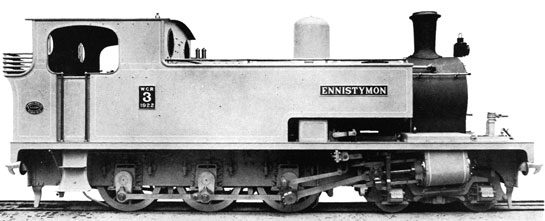
When writing in 1994, Patrick Taylor continued: “The average age of the steam locomotives when withdrawn was 40 years, but one had a very short life of only 13 years, and another lasted only one year longer. Two were still working after 64 years, when the system changed over to diesel. All were six-coupled tank engines, and with but two exceptions, originally carried both number and name. One has been preserved at Ennis.” [12] It remained at Ennis until 1996.Above, locomotive Slieve Callan on a plinth at Ennis Station. In 1996, in dramatic circumstances, the 40-tonne Slieve Callan was lifted off this plinth at Ennis railway station despite the efforts of protesters and taken to Moyasta in West Clare. [16][17]
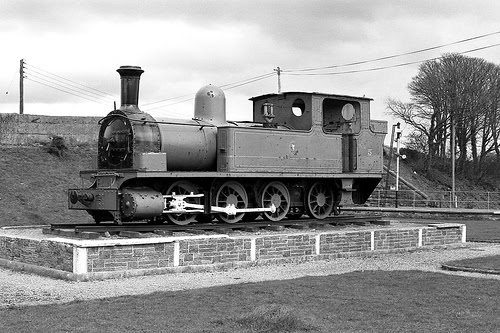
Adjacent, locomotive No. 2C at Ennistymon in 1940. [20]

It appears that a contractor’s engine was not a six-coupled but a four-coupled engine. ‘Sponden’ was owned by Murphy’s contractors. It was built in 1878 at the Hunslet works in Leeds. Its original owners were Benton & Woodrow Contractors of Audenshaw, Manchester. This is a local connection for me, writing as I am at the moment in Ashton-under-Lyne. This loco arrived as deck cargo at Kilrush on 26 the April 1891, to assist on the construction of the South Clare line. previously, Murphy had been using one of the West Clare Bagnalls and continued to do so occasionally throughout the construction of the South Clare. [14]

Chapter 7 of Taylor’s book on the West Clare Railway [13] describes the locomotives on the West Clare in great detail. It would not be appropriate to reproduce that detailed work here, the book is easily purchased secondhand via a variety of sources.

Diesel and Other Traction: It has been suggested that the “West Clare had a self-propelled inspection car. However, the Great Southern Railway introduced one in 1925, and followed this with two passenger carrying railcars in 1927.” [12] It was the early 1950s which saw a major change in traction on the West Clare – three diesel locomotives and four diesel railcars were purchased by the CIE. These were:

3386 diesel railcar by Walkers of Wigan 1952.

3387 diesel railcar by Walkers of Wigan 1952.

3388 diesel railcar by Walkers of Wigan 1952.

3389 diesel railcar by Walkers of Wigan 1952.

F501 Bo-Bo diesel locomotive by Walkers of Wigan 1955.

F502 Bo-Bo diesel locomotive by Walkers of Wigan 1955.

F503 Bo-Bo diesel locomotive by Walkers of Wigan 1955. [3]

Before focussing on diesel traction it is worth giving some thought to petrol! Proposals were considered in West Clare days to make use of ‘motors’. These came to nothing, although late in January 1907 estimates were obtained for a motor and parcels van. In 1927 the GSR authorised the purchaseof two petrol cars for the West Clare section. They initially intended these to be 25-30hp but this was increased after advice from their builder to 40-45hp because of the gradients on the line. The cars were ordered from the Drewery Car Company Limited (Order No. 2800 of 20th April 1927), but were made by Baguley Engineers Limited of Burton-on-Trent, through a working agreement between the two Companies. These four-wheel cars were numbered 395 and 396. [15]The Drury Petrol Railcars (above) entered service for the GSR in October 1927 and ran the Kilkee branch services on the West Clare section until they were both withdrawn in 1936. They were transferred to the GSR works at Inchicore in 1939 and scrapped in 1943. [21] No. 396 is shown above at Kilkee in around 1930. The crew are Frank O’Brien and M. Jinan © A.W. Croughton, Real Photographs. [28]  The adjacent image shows the excellent model made by Dirk Shrapnel for the Trawbreaga Bay Light Railway. [21]
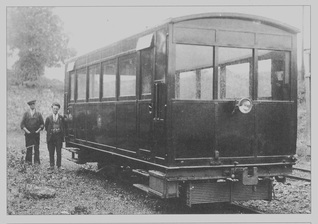
The Walker Bo-Bo Diesel locos: These locos became the standard motive power for goods trains in the last years of the West Clare Railway and could also be seen at the head of mixed/passenger services. “These Córas Iompair Éireann (CIE) 501 Class locomotives were built in 1955 by Walker Brothers Limited of Wigan, Lancashire for use on the narrow gauge (3 ft or 914 mm) lines on the West Clare section of CIÉ. They were small diesel mechanical locomotives, of 0-4-0+0-4-0 wheel arrangement. Controlled from a central cab the locomotives had two Gardner engines of 224 hp (167 kW), one under each end casing, driving through a fluid coupling and Wilson gear box the inner axle of the opposite bogie, through a spiral-bevel-reverse and reduction gear box. Unusually the locomotives were driven from a seat mounted sideways to the direction of travel giving a clear field of vision both ways by a mere turn of the head. The locomotives were fitted with vacuum brakes, emergency braking coming from a “deadman’s” pedal, one at the driving position and two others, one mounted on each side of the cab. When used on freight services their maximum speed was 40 kilometres per hour (25 mph), but with an overdrive fitted, released by a key, this was raised to 51 kilometres per hour (32 mph) for passenger trains.” [22]The F501-503 Bo-Bo series built by Walker Bros of Wigan. The drawing was undertaken by Ian Beattie and first produced in the Railway Modeller Magazine, (c) Peco Publications Ltd. [30]
“They were originally numbered C31-C33 in the West Clare steam locomotive series, but were subsequently renumbered into the diesel locomotive series as F501-F503. They were withdrawn in 1961 when the West Clare lines were closed and stored at Inchicore Works for seven years. The Isle of Man Railway made an offer for the locomotives which was rejected by CIÉ who subsequently made less money by selling them for scrap in 1968.” [22]Above, F502 at Ennis in 1962. [22]
Adjacent, F503 (c) Colour-Rail. [23]

Below right, all three locos F501 to F503 at Inchicore in 1966. They were broken up in 1968. (c )Peter Excell.[24]

J. Scarisbrick Walker and Brothers of Pagefield Ironworks, Wigan were iron-founders and general engineers. The company was founded by J.S. Walker in the 1870s and later joined with his two brothers, T.A. & E.R. Walker to form Walker Bros. (Wigan) Ltd in 1880.

About twenty steam locomotives were built. The company subsequently manufactured diesel railcars. [26]4mm model of Walker Diesel as used on the West Clare Railway built from a Worsley Works NG kit by Robin Winter. [8]A similar model of F501. [23]
The “three diesel locomotives were put into service to haul goods,turf, beet and livestock trains, and finally eliminate working. When passenger traffic was heavy, as on Fair days for example, they were also employed on passenger and excursion trains, and a small fleet of locomotive hauled coaches were retained for this purpose.” [31]

Walker Railcars: The four railcars in use on the West Clare were designed and built by Walker Bros (Wigan) Ltd. The same company supplied railcars/railmotors in a variety of gauges around the world. These included 40 railmotors supplied to Victorian Railways in Australia. [27]On 24th June 1959, two diesel railcars sit at the junction station at Moyasta. The one on the left has travelled from Kilrush, that on the right from Kilkee [11] Railcar 3389 at Moyasta in 1960 (c) Roger Joanes. [24]
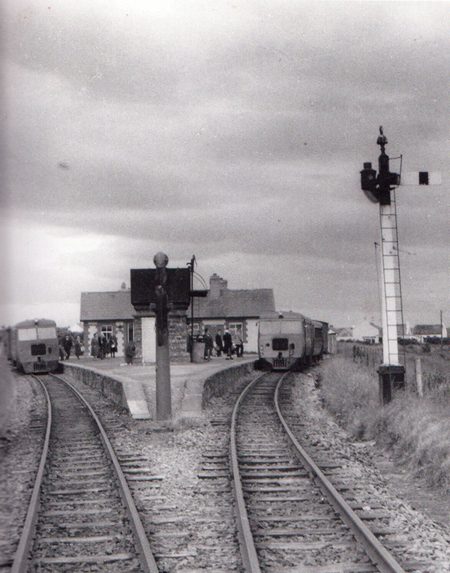
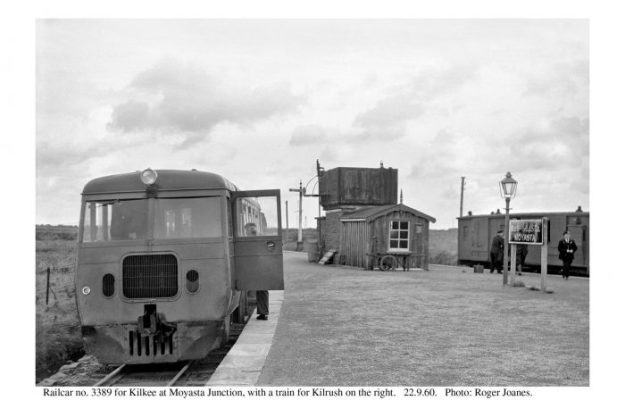
The railcars were powered by “a Gardner 6LW diesel engine, driving through a ‘Don-Flex’ plate clutch, four speed Meadows gearbox, and thence through a Hardy-Spicer propeller shaft, to a Meadows worm gear final drive gearbox, on the rear axle of the bogie, the two pairs of wheels being coupled by conventional coupling rods. The bogies had inside frames.” [29]

“Each car had a maximum speed of 38.5 mph in top, 23.8 in third, 14.2 in second and 8.3 in first gear, the engines developing 107 bhp at 1700 rpm. Except at very slow speed (7 mph), the cars would work forwards only.” [29] New turntables had to be installed to turn the railcars. “Heating was from the engine cooling system, and this was the first time West Clare passengers had anything better than simple footwarmers. The cars weighed 11 tons in working order, and were capable of hauling, when necessary, a standard passenger coach, and a lightly constructed four wheel luggage car.” [29]Walker diesel railcar No. 286 – renumbered 3386 before entering service. The picture was taken during the final preparations for the railcar to be shipped from Inchicore to Ennis (c) Patrick Taylor. [29]
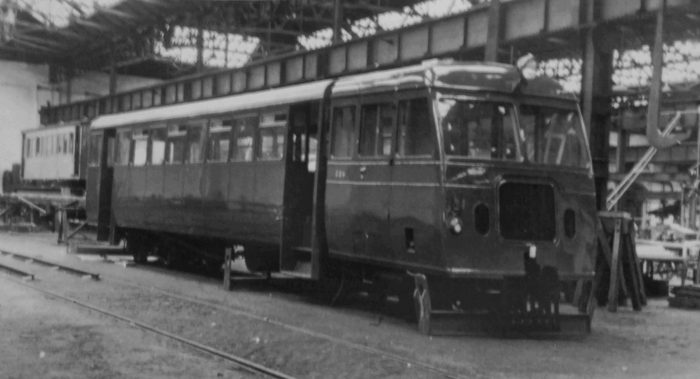
Carriages: for the opening of the West Clare Railway, “thirteen … coaching stock vehicles were purchased from the Bristol wagon & Carriage Works Company of Lawrence Hill, Bristol oder, which in its entirety was left in the hands of William Martin Murphy, as had been the case with the locomotives, consisted of three composites, six thirds and four brake vans. The original passenger carrying  coaches were six-wheelers, 30ft long and of James Cleminson’s patient, with the three sets of wheels and axles mounted on separate trucks, the central one of which was given considerable side play, being mounted slides. This truck was connected to its outer sisters by radius rods, themselves being pivoted about their centre. … There were only three other narrow gauge railways in Ireland that used the principle, the Ballycastle, West Donegal and the Londonderry & Lough Swilly, and only the latter continued to purchase such vehicles after the West Clare; doing so as late as 1899. After 1894, although continuing the use of six-wheelers, the West Clare abandoned building on the ‘Cleminson’ principle.” [32]

“The livery of the coach sides was green and the roofs white, the West Clare heraldic device being displayed in gold leaf on the second and fifth doors of the thirds, and the second and fourth of the composites, and on each door the class was clearly denoted. On the panelling between the roof, and the doors and windows, immediately under the cant rail, the words West Clare Railway appeared.” [32]

Of the four brake vans, two were 30ft long with an under-carriage to match the six-wheel coaches, and two were four-wheelers.

As the latter years of the 19th century unfolded, it became clear that the passenger stock needed to be augmented. Eight additional items were ordered. Five arrived before the South Clare was opened, three after. The first five consisted of two thirds, one composite and two brake vans. The remaining three were two composite coaches and one third.

For the South Clare, six more carriages were purchased. All coaches came from the Bristol company and apart from their lettering were almost identical to those built for the West Clare.

About the turn of the century, around the time Grand Juries gave way to County Councils, there were complaints about inadequate provision for excursion traffic. The Metropolitan Carriage & Wagon Company were commissioned to build two coaches. These were the last ordered from outside contractors.

In 1904, the Company workshops in Ennis were commissioned to build a brake-third and one third class coach. In 1905, a further three coaches, two thirds and a first, were commissioned. Ennis completed all five coaches in a little under 15 months. [33]

In 1909, Ennis built another six-wheel brake van, this time for use on ballast trains. In 1910, two more brake-third were built. “In addition, … two service vehicles were built at Ennis. … In 1905, four wheeled brake van No. 12 was rebuilt as a cattle wagon, taking a new number, No. 93, in the wagon list. A new No. 12 in the coaching stock list was built at Ennis. … In 1908, the other four wheeled brake van No. 2, was rebuilt as another wagon, and took the No. 143 in the wagon list. The new No. 2, also a four wheeler, … was a Directors Inspection Saloon.” [34]

“For the remainder of it independent existence, the railway had 38 coaching stock vehicles, but it was common practice at times of heavy demand, race meetings and the like, to provide additional seating in the brake compartments, and sets of forms were kept for this purpose.” [35]

When the Tralee and Dingle closed to passenger traffic in 1939, the GSR moved 12 bogie coaches to the West Clare. They were number 39C to 50C respectively. The bulk were third class coaches.

In 1951, when CIE introduced diesel railcars, three coaches, Nos 46C, 47C and 48C were converted at Inchicore into railcar trailers. They were given old omnibus bodies and had electric lighting fed from a 12V battery. Three four wheel light weight luggage vans were also built for use with the railcars. These were given Nos 187C, 188C and 190C. [35]

In 1953, the Tralee & Dingle closed completely and two brakevans arrived on the West Clare from the Tralee & Dingle. In 1954, two West Clare coaches were transferred to the Cavan and Leitrim (Nos. 42C and 52C. In 1957, 18 vehicles were withdrawn. In 1958 brake vans Nos 38C and 41C were withdrawn. In 1959, three four wheel vehicles and brake No. 36C were withdrawn. Further minor changes occurred before full closure of the West Clare in 1961, specifically including the transfer of two coaches from the Cavan & Leitrim (one of which was 42C). [36]6-wheel tourist coach No. 35 [9]1:22.5 model of West Clare Railway Brake Van 17c. [2]1:22.5 model of West Clare Railway Bogie- Coach No. 42c. [2]
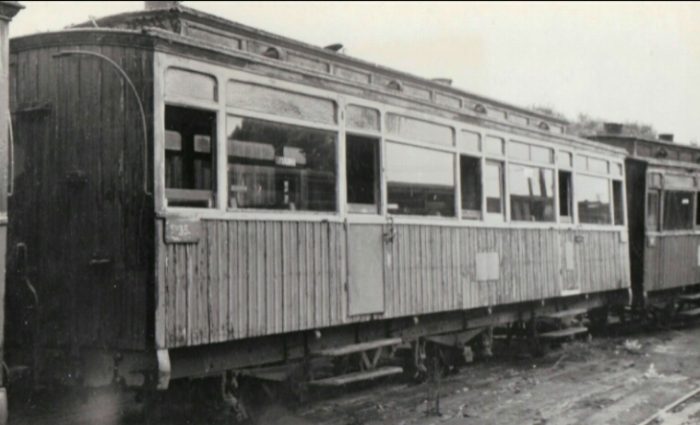
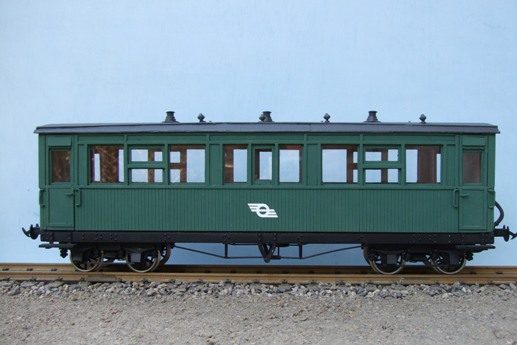
Wagons: The wagon stock for the opening of the line was also ordered by Murphy and supplied by the Bristol Company. [36] 65 wagons were ordered (15 low side open, 25 covered, 10 covered cattle, 12 ballast and 3 flats). Ten wagons were ‘convertible’ which meant that they had an open centre-portion to the roof which could be covered by canvas.

For the opening of the South Clare in 1892, the Bristol Company supplied a further 21 wagons (6 convertible and 15 cattle). [36]

The next increase in stock came in 1899, when 10 covered wagons were supplied by the Bristol Company. With the opening of the workshops at Ennis, wagon construction started. The first wagons were built in 1902 (6 large open wagons suitable for cattle and turf. In 1904, a further 17 wagons  were built for the cattle traffic. Then, one covered cattle wagon in 1905 and two large open wagons in 1907. In 1908, six luggage vans were built for passenger trains and a further cattle wagon was provided. In 1911, another six covered goods wagons were built. Then six open coal wagons in 1912 and a further 5 covered wagons. In 1913, the last batch of wagons was built while the Company was independent – 10 covered cattle wagons.  [37]At Ennistymon on 28 July 1952, locomotive No 9C is on the 9:58 am goods from Kilrush with a typical rake of wagons. The loco is taking water. Driver Tom Reidy is on the engine, (c) C.L. Fry. [38] 1:22.5 model of West Clare Horsebox No.28c. [2] 1:22.5 model of West Clare Railway open Wagon 134c. [2]1:22.5 model of West Clare Railway open Cattle Wagon 79c. [2]
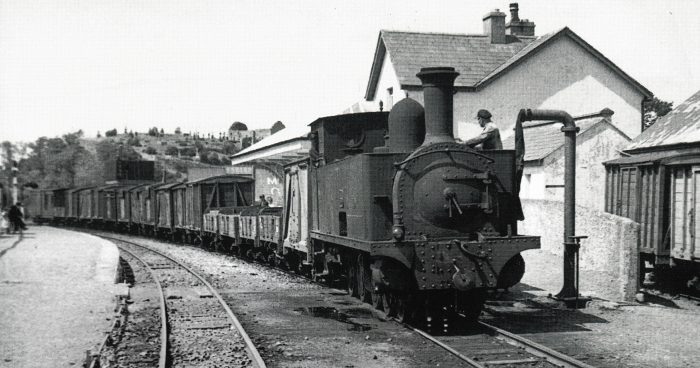
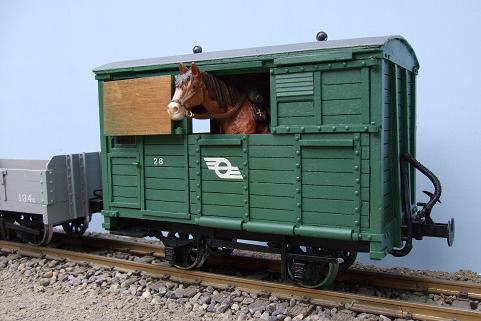
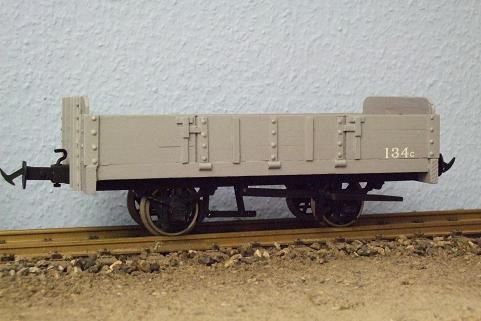
The GSR closed the Ennis workshops soon after it took over the West Clare. Between 1925 and 1929, 46 wagons were withdrawn (15 covered, 10 cattle, 19 open, 1 flat and 1 timber). 50 new wagons commissioned from Inchicore started to arrive on the West Clare in April 1929. These were 17 covered, 15 cattle and 18 open wagons. After the closure of the Cork & Muskerry in 1934 13 open goods wagons were transferred to the West Clare – the first foreigners! These had non-standard couplings and so were semi-permanently coupled in rakes. [39]

On closure of the Cavan & Leitrim in 1959, 25 wagons arrived on the West Clare, 18 open and 7 covered. All surviving wagons were scrapped on closure of the West Clare, with the exception of a few sold to Bord na Mona. [39]

References

  1. Patrick Taylor; The West Clare Railway; Plateway Press, 1994, p53.
  2. https://largescaleworld.hpage.com/west-clare-railway-ireland.html, accessed on 10th July 2019.
  3. http://www.narrowgaugerailwaymuseum.org.uk/collections/public-carriers/west-clare-railway, accessed on 10th July 2019.
  4. Patrick Taylor; op.cit., p55
  5. Ibid., p57.
  6. Ibid., p58
  7. Ibid., p59.
  8. http://www.worsleyworks.co.uk/Image-Pages/Image_NG_Irish_WCR2.htm, accessed on 10th July 2019.
  9. https://www.ebay.co.uk/itm/fg-irish-ireland-plain-back-postcard-6-wheel-tourist-coach-west-clare-railway-/401499456892, accessed on 10th July 2019.
  10. Gabriel Vaughan; My Affair with Malbay; ColourBooks Ltd, 2000.
  11. http://forum.e-train.fr/viewtopic.php?f=5&t=88663, accessed on 10th July 2019.
  12. Patrick Taylor; op.cit., p77.
  13. Ibid., p77-122.
  14. Ibid., p107.
  15. Ibid., p111.
  16. http://www.skibbereeneagle.ie/ireland/west-clare-railway, accessed on 12th July 2019.
  17. https://www.irishtimes.com/news/restored-steam-engine-back-on-the-tracks-after-57-years-1.691033 (2nd July 2009), accessed on 12th July 2019.
  18. http://www.westclarerailway.ie/about/history, accessed on 12th July 2019.
  19. https://orion.math.iastate.edu/jdhsmith/term/sleiwcr.htm, accessed on 12th July 2019.
  20. https://www.ebay.co.uk/itm/362292119376, accessed on 13th July 2019.
  21. http://www.trawbreagabaylightrailway.com/railcars.html, accessed on 16th July 2019.
  22. https://en.wikipedia.org/wiki/CIE_501_Class, accessed on 16th July 2019.
  23. http://www.stephenjohnsonrailways.co.uk/F501%20Class.htm, accessed on 16th July 2019.
  24. https://www.flickr.com/photos/110691393@N07, accessed on 5th May 2019.
  25. http://www.irishtractiongroup.com/withdrawn.html, accessed on 16th July 2019.
  26. https://www.gracesguide.co.uk/J._Scarisbrick_Walker_and_Brothers, accessed on 16th July 2019.
  27. https://en.wikipedia.org/wiki/Walker_railmotor, accessed on 16th July 2019.
  28. Taylor: op.cit., p111.
  29. Ibid., p124.
  30. Ibid., p119.
  31. Ibid., p117.
  32. Ibid., p123.
  33. Ibid., p128.
  34. Ibid., p132.
  35. Ibid., p134.
  36. Ibid., p139.
  37. Ibid., p143.
  38. Ibid., p60.
  39. Ibid., p148.
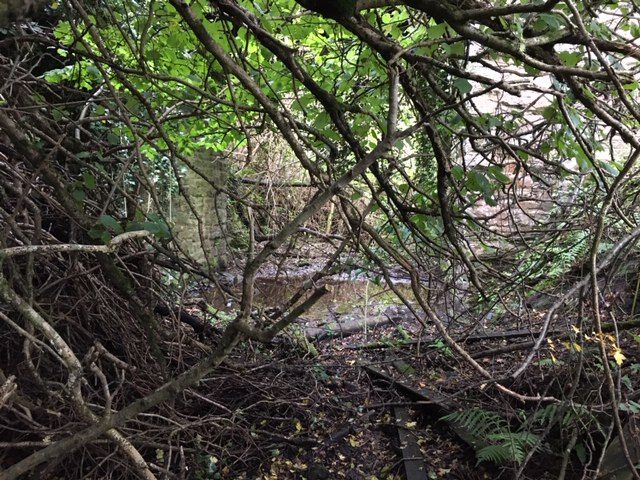
The West Clare Railway – Part 7 – Moyasta to Kilrush and Cappagh Pier

The Line of the West Clare Railway from Moyasta to Kilkee

Moyasta was a junction station. The two lines which left to the south and to the west served Kilrush and Kilkee respectively. The two routes feature on the adjacent map. This post focusses on the line to Kilrush and on to Cappagh Pier.Before we set off, we note two things, as we did in the last post, about the station at Moyasta. First, the presence, in the 21st century, of a preservation line based at the station; and second, the layout of the junction at Moyasta. Although a direct line was provided to allow trains to travel between Kilkee and Kilrush. In practice it was little used in later years as trains tended to enter Moyasta station from either of the two villages and the set off from the station for the other village. This required some manoeuvrings in the station area!

However, when the pier was in use at Cappagh, “the Loop … was extremely useful for allowing a direct passage to through traffic, especially from Cappagh to Kilkee.” [2]

We spent time in the last post in this series looking at the preservation line. The link to that post is: https://rogerfarnworth.com/2019/05/09/the-west-clare-railway-part-6-moyasta-to-kilkee

We also considered the loop line in the same post and we will not repeat what was said in that post about the link that made direct services between Kilkee and Kilrush/Cappagh Pier possible.There were four road-crossings at Moyasta, all within a radius of 200 yards of the station-house. By the late 1980s, Lenihan observed that, “as at most other such places, there was nothing, for at Moyasta, just as at Knockdrumniagh, near Ennistymon, road widening has changed utterly the lie of the land.” [2] The plan is taken from Patrick Taylor’s book. [1] 

We allow our two guides, Edmund Lenihan and Patrick Taylor to take us out of the station and its environs and on to Kilrush and Cappagh Pier. The presence of the preservation railway means that the locations of the crossings shown above are easier to define in the early 21st century than they might otherwise have been.Moyasta No. 1 Crossing (above).

The adjacent image is taken at Moyasta No. 2 Crossing looking back towards No. 1.

The picture below is also taken  at the No. 2 Crossing looking towards Kilrush. The Shannon estuary can be seen in the distance.

The Line to Kilrush

Edmund Lenihan comments in the late 1980s that the line from the station beyond Moyasta Crossing No. 1 was so overgrown as to be impassable. [3][7] The forty-third milepost was at Crossing No. 2. This crossing was the site of a serious accident “when a young boy, trying to save the gates from an oncoming trail, was knocked down and killed.” [4]

From the road to the junction with the loop is only a relatively short distance.Moyasta junction with the Kilkee/Kilrush loop on the left. The railcar has left Moyasta Station which is of the extreme right of the picture with a service to Kilrush. As we have already noted, there were few non-stop workings between Kilrush and Kilkee. Trains from one or other village used to enter the relevant platform at Moyasta and then propel backwards before using the loop to head on to the other village.

The line continues from the crossing in a wide, graceful sweep along the edge of the bay no more that 300 mm above the high-water level. Effectively the line was on causeway as there is evidence of the sea invading the land beyond the line.Continuing on into the townland of Carrowncalla North the embankment of the old line acts as a breakwater. After a length of straight track, the line curved southwards again. Soon the next road crossing was encountered, Carrowncalla No. 1. In the late 1980s the crossing-keeper’s cottage was intact but seemingly unoccupied. [5] Later, in a return visit in 2008, Lenihan noted that the cottage had been renovated but was still not lived in. [6] 150 yards to the West of the crossing, the road bridged a boat channel. The crossing is shown on the OS Map extract and satellite images below. [7]The narrow neck of land to the west of the boat channel continued on and came to a head at Ilaunalea, 500 metres distant. This can be seen easily on the satellite image above. “From here in 1863 it was proposed to build an embankment across the mouth of Poulnasherry, by way of Black Island and Ilaunbeg, to Kilnagalliagh, on the western shore. It was a daring plan and probably would have succeeded but for the ill-advised attempt to close the mouth of the bay in the face of winter tides.” [5] By the 1980s, only eroded, scattered remains  were visible, and that only at low tide. The blue line on the satellite image above shows the route of the West Clare Railway. The orange line shows the route of the planned but eventually incomplete railway crossing the mouth of Poulnasherry. The orange line could have been extended in a northwesterly direction and looking at satellite image shows the old formation still evident to the Northwest. The importance of the line drawn on the image above to to show its route across the tidal estuary.  The embankments show clearly on the OS Map extract from the 1950s, immediately above. [7]


Immediately south of the point where the orange and blue lines diverge/meet (and just off the satellite image above is the location of an un-named accommodation crossing there was then a straight length of track before Carrowncalla No. 2 Crossing. Lenihan diverted a way from the West Clare for a time to explore the coast line and the older earthworks before heading back to the West Clare at the point of this level crossing. [8]

Between the unnamed crossing and Carrowncalla No. 2, the line ran in a straight South-southeasterly direction. In the 21st Century, it is in use as an access road for much of that length. Lenihan visited the level-crossing location again in 2008 and commented that the house had been fully renovated and was now lived in. [6]Looking North-northwest along the formation of the West Clare Railway (marked by the blue line) from Carrowncalla Crossing No. 2. The Crossing-keeper’s cottage has been extended to make an excellent modern home. (Google Streetview).Above, looking South-southwest from the same location. (Google Streetview). The image below comes from Taylor’s book and is taken on the North side of the crossing. [16]

South of Carrowncalla Crossing No. 2 the line curved a little towards the Southeast and ran for a short while alongside a small bay before crossing Brew’s Bridge. The location of Brew’s bridge can just be picked out at the bottom right of the adjacent satellite image.The extract from the OS Maps shows the location clearly, just to the Southeast of the bay. Lenihan has a lot to say about this location. [9]
The northern abutment of Brew’s Bridge in 2009. (Google Streetview).The more southerly of the two bridge abutment  in 2009 with the house alongside the old formation as mentioned by Lenihan. (Google Streetview).

Beyond Brew’s Bridge the line gradually turned Eastward. The going was relatively easy.The next crossing was Leadmore No. 1 which was south of the Shanakyle Graveyard. The Crossing-keeper’s cottage here has also been renovated and is lived in. [6][7]

In the 1980s, Lenihan commented that “to enter Leadmore no. 1 cottage was to get a brief glimpse of the past, for the interior of the house was quite unchanged from how it would have looked in West Clare days. An old railway clock, the open fireplace, a drawing of engine no. 5 from 1892, all testified to a lingering regard for old times, though the owner was quite adamant that she had no regrets over the passing away of the railway.” [10]Leadmore Crossing No. 1 with the old keepers cottage to the right and the line back towards Moyasta shown by the blue line. (Google Streetview).Looking ahead along the line to the East and towards Kilrush from the smae location, (Google Streetview).From Leadmore Crossing No. 1, the line heads East-northeast into Kilrush.En-route to Kilrush the old line passed through Leadmore village. [7]

One length of the line en-route to Kilrush was close enough to the water to need a revetment constructing to protect the line. That location can be seen above on the left of the OS Map extract. The school shown on the right of the extract is now the location of L&M Keating (Maritime) Ltd. We are actually now very close to Kilrush station. The OS Map extract below shows the first part of the station site which was to the West of the Level Crossing.Taylor comments: “The line from the down home signal, where a short steep decline at 1 in 72 commenced, continued past the two road carriage shed, and one road engine shed on the up side, until Leadmore No. 2 level crossing was reached before entering the yard at Kilrush. This crossing, whcih was built on a curve, was protected by up and down signals.” [16]This view looks back along the old line towards Moyasta. The renovated Crossing-keeper’s cottage is on the right. The crossing gates were relatively narrow and the stone pilasters which supported the gate are still evident. (Google Streetview). To the left of the line behind the cottage were two buildings which were rail-served. The engine shed and carriage shed. The engine shed was the smaller building closer to the cottages.From the same location (Google Streetview), looking into the station yard which in 2009 was now grassland. The station building can be seen in the distance immediately to the left of the blue line.The station site at Kilrush taken from the East. (Google Streetview in 2011). The station building and platform edge are still visible. The goods shed has been replaced by a corrugated steel roofed structure.The station site at Kilrush also taken from the East. (Google Streetview). The station building is shown to greater advantage. The old Merchants’ Quay which is on the left of the image, is now (2011) the access route to Kilrush Marina.An early (circa. 1890) picture of Kilrush Station taken from the West. [11] The next four pictures are closer looks at this image.This image shows the view across the station site to the docks/Merchant’s Quay and Leadmore. The old goods shed can be seen in the centre of the picture. [12]This view of the harbour at Kilrush shows the station building and goods shed, centre-right. A signal and ground-frame hut can be seen centre-left. [12] The image below is an excellent period photograph of the station building. [12]The access road to Kilrush Marina has been improved and is now (2018) metalled and Merchant’s Quay has been refurbished. It provides a good location to take a picture of the station building(s) and Glynn’s Mill building(s) as they appear in the first quarter of the 21st Century. [12]

Taylor describes Kilrush as “the self-styled ‘Capital of West Clare'” [16]Taylor provides a number of important photographs of the Kilrush station site – the first of these shows the engine shed and carriage shed in 1958. [16]Also taken by D.F. Russell, this picture looks back towards the engine and carriage sheds from the middle of the station yard. [17]The station in the 1950s viewed from the Goods platform, (c) IRRS No. 10748. [18]
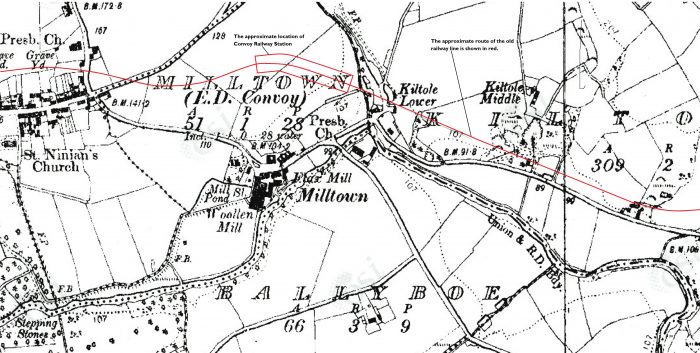
Edmund Lenihan, writing in the late 1980s, having just explored the station site, said:

“Uncomfortable, even dangerous, though it was to have to pick our way through this wasteland, we did it, still hopeful of finding something. We might as well have gone by the road; there were no wonderful discoveries, no magical ending, only the station-house, standing, as always, just across the road from Glynn’s mills and round the corner from Merchants’ Row and Frances Street.” [13]

The station building has been significantly refurbished as the modern photos above show. In 1999, Lenihan wrote:

“In the years since I last visited [Kilrush] a great deal has changed, and for the better, particularly at the station end. Gone is the rubbish dump that defaced the area beside Leadmore no. 2 level-crossing cottage (p.249). It is now as clean and level as a town park, and an unimpeded view of the station is possible from several hundred yards away. ‘Crush marina, which was then only in its planning stage, is now in full operation and has brought life back to the creek, though hardly to the same extent as when Turf Quay, Customs Quay and Merchants’ Quay were in their heyday. Close by, a Scattery Island interpretative centre has been opened, and across the creek, beside Doherty’s timber yard and the site of the removed railway bridge (p. 256), is a new activity centre.” [14]

Writing in 2008, Lenihan describes the station site again:

“The station-house is there, certainly, and is once more a dwelling, for two families now. Its eastern gable, which was disfigured by a large door during the building’s days as a truck garage, has been restored. But the fine triangle of clear ground between it, the marina and Leadmore no. 2, which common sense might suggest should be preserved as a public amenity, is now under pressure of commercial development, despite the fact that the future of some of the similar recent developments in the town is uncertain because of the deflation of the property bubble.” [15]


The sketch plan above shows Kilrush station in its heyday. It is provided by Patrick Taylor. [1]

The adjacent OS Map extract shows the West Clare railway continuing beyond Kilrush Station. It turns through 180 degrees on a tight radius curve. The bridge over the tidal channel is Bridge No. 68 shown on the sketch plan above.[7]

The railway then continued in a Southwesterly direction on the South side of Kilrush Creek, as shown in the OS Map further below. [7]The way ahead to Cappagh Pier. Bridge No. 68 has been removed and replaced with a footbridge, (c) D.F. Russell. [21]The approximate line of the old railway to Cappagh Pier is shown by the blue line (Google Streetview – 2011). The footbridge is at approximately the location of the old railway bridge.Looking West down Kilrush Creek in 2011 (Google Streetview). The station is visible on the right of the picture the railway embankment and bridge abutment are right of centre. In this picture from 2011 (Google Streetview) the road which used to turn through a very sharp right-angle bend has been diverted to run directly alongside what was the alignment of the railway.As can be seen in the OS Map extract below the road and rail drift apart on their way westward.Passing Bleak House on their left, trains from Kilrush then curved round to the South east before entering Cappagh Pier Station close to Cappagh House. Just prior to the station a gravel extraction pit was passed on the right. Beyond the station there was a short gated stub line with a turntable. The turntable gave access to Cappagh Pier and the line ran out to the end of the pier and a Goods Store. [7]

Taylor’s sketch plan of the station and pier is shown below. [1]

Historically there were two platforms at Cappagh Pier Station and each had canopies. Taylor’s comments about the station appear below.The gravel pit in the OS Map extract is now the site of the RNLI station (Google Streetview).From this point road and rail run immediately parallel to each other into Cappagh Pier Station (Google Streetview).The turntable location is marked in the paving at the site of the station and pier at Cappagh, (Google Streetview).This satellite image shows the full extent of the old line in the vicinity of Kilrush and Cappagh. [19]The terminus at Cappagh in 1953, (c) IRRS No. 10439. [20]Turning 90 degrees to the left from the above photograph, this is the view down the pier at Cappagh. The turntable is in the foreground and the Good Store is visible at the end of the pier. [21]

Taylor writes: “On the last mile of line from Kilrush to Cappa Pier, after passing through the level crossing gates at 47 m.p., and over the Ballykett stream bridge No.68, past Doherty’s timber yard (where a private siding ran into the yard on the up side) the line veered sharply to the right and ran along the opposite bank of Steamers Quay passing Supples crossing before turning left into Cappa. The line continued through a gate on to a small turntable 9’6″ long which turned wagons singly to the right and on to the pier which was provided with two sidings running parallel. The second siding was installed by the G.S.R. in 1933 for the quick turn round of wagons. Cappa was provided with two running roads and two platforms. The Platforms had overhead concrete roofs and entrance was gained to them at the pier end. The roofs and the down platform were removed by the G.S.R., possibly also in 1933.” [21]

This brings us to the end of our survey of the West Clare Railway. What remains is to look at locomotives and rolling stock in a future post.

References

  1. Patrick Taylor; The West Clare Railway; Plateway Press, 1994, p48.
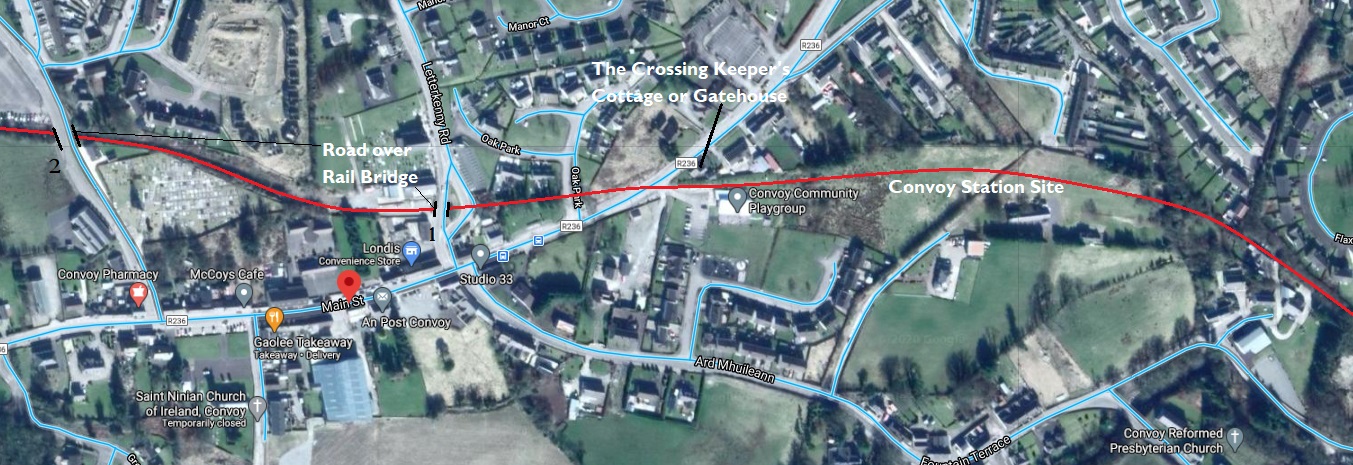
  2. Edmund Lenihan; In the Tracks if the West Clare Railway; Mercier Press, Dec. 2008, p228.
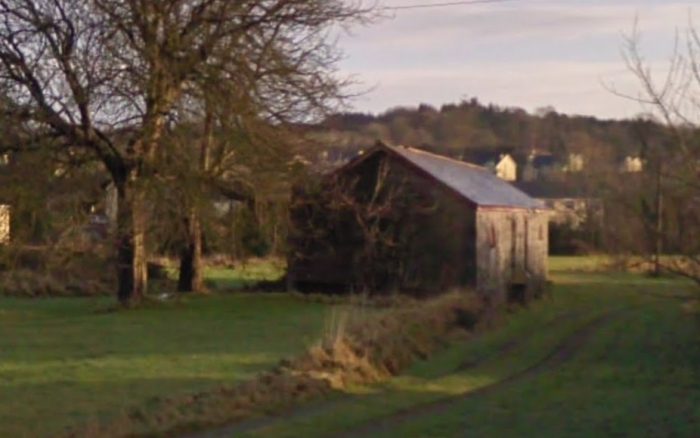
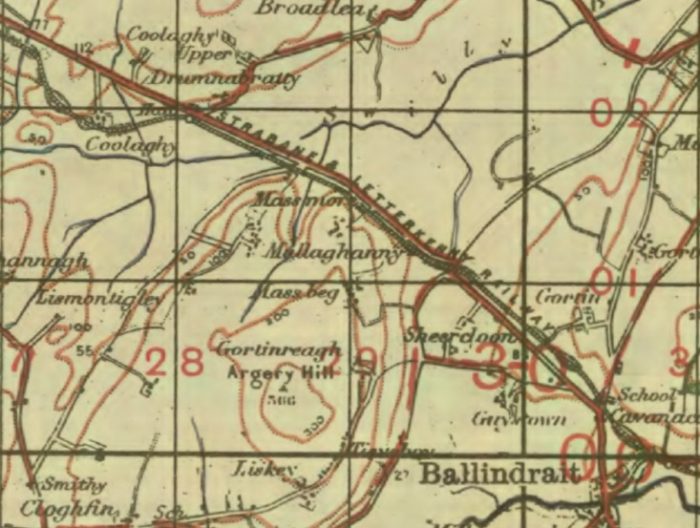
  3. Ibid., p230.
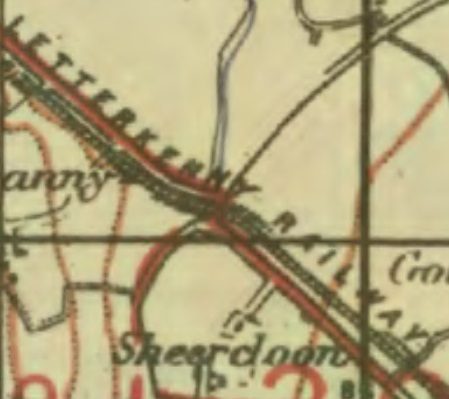
  4. Ibid., p231.
  5. Ibid., p234.
  6. Ibid., p304.
  7. http://geohive.maps.arcgis.com/apps/webappviewer/index.html?id=9def898f708b47f19a8d8b7088a100c4, accessed on 2nd July 2019.
  8. Lenihan, op.cit., p238.
  9. Ibid., p241.
  10. Ibid., p245.
  11. https://www.facebook.com/kilrushcu/posts/railway-station-kilrush-co-clare-circa-1890/1200065626698858, accessed on 4th July 2019.
  12. https://docplayer.net/58337136-A-tribute-to-kilrush-in-the-great-war-by-ger-browne.html, accessed on 4th July 2019.
  13. Lenihan, op.cit., p250-251.
  14. Ibid., p293.
  15. Ibid., p305.
  16. Taylor, op.cit., p49.
  17. Ibid., p50.
  18. Lenihan, op.cit., p253.
  19. http://www.railmaponline.com/UKIEMap.php, accessed on 5th July 2019.
  20. Lenihan, op.cit., p258.
  21. Taylor, op.cit., p52.

The Cavan and Leitrim Railway – A Miscellany.

A. ‘The Cavan and Leitrim Railway’ at Dromod:   is the preservation society hoping to create a line between Mohill and Dromod along the C&L’s old route. Over the years, that society has seen some great successes. Most recently, the bringing back to steam of the locomotive ‘Nancy’. The preservation society asked me to include the adjacent pictures in this post.

The first view shows the station in the late 1950s, (c) J.P. O’Dea. [4]

The second is taken  after the station buildings had been renovated in the early 1990s, (c) C&L 1992. [5]

That below shows the station from the West, (c) Jonathon Clinton 2019. [5]One early success, alongside the renovation of the station building, was the rescue of the engine shed and water tower. This picture shows …….. (c) Philip Bedford March 28th 2019. [5]‘Nancy’ beside the water tower, (c) D. Connolly. [5]‘Nancy’ at Dromod Station platform, (c) Jonathon Clinton 2019. [5]

Wikipedia says: “The privately owned Cavan & Leitrim Railway is based in the former Dromod Station, in Co. Leitrim. There is a transport museum, with narrow-gauge trains of several gauges, buses, planes, fire engines and artillery guns from World War I and World War II. …….. With the help of volunteers trains are run on a short section of line. The Avonside steam locomotive “Nancy” was rebuilt at Alan Keef in Wales where it first steamed on 23 March 2019 after twenty years of restoration work. [6] The locomotive was shipped to Dromod where it now resides.” [7]
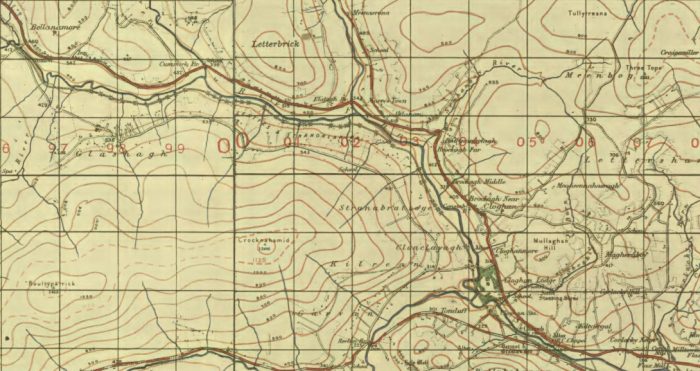
Best contact details:   

Address:      Clooncolry, Drumod, Co. Leitrim
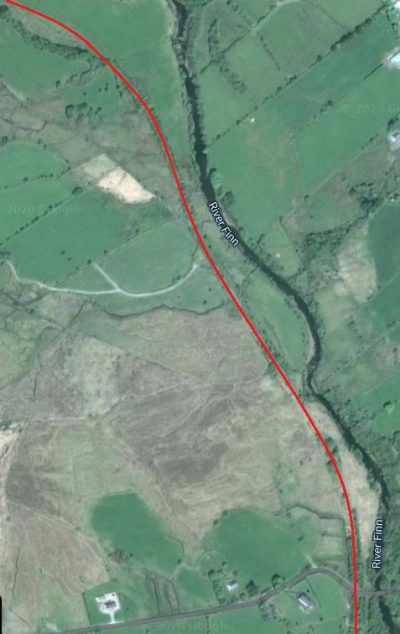
Tel:                071 963 8599

Website:       https://cavanandleitrim.wixsite.com/home

Facebook:     https://www.facebook.com/cavanandleitrimrailway


B. Belturbet Heritage Railway:  the heritage centre in Belturbet sits at what was an interchange between the Cavan and Leitrim Narrow Gauge Railway (3ft) and the Great Northern Railway which was Irish standard gauge (5ft 3ins). The Great Northern (GNR) branch connected to Ballyhaise on the Clones to Cavan line. The Cavan and Leitrim (C&L), at Dromod, connected to the Midland Great Western Railway (MGWR) mainline from Dublin to Sligo. The line was extended to Arigna in 1920 in the form of a roadside tramway. [3]

The centre was once Belturbet Station and shared by the C&L and the GNR. It has been significantly refurbished from an overgrown and dilapidated state in the 1990s to a modern well equipped centre in the 2010s.[3]

The station buildings lay derelict for almost 40 years until the Belturbet Community Development Association purchased the entire 10 acre site in 1995. The buildings had during that time served as farmyard buildings and had been subjected to the effects of weather, fire and theft. They were subsequently refurbished to the original state with great attention to detail gained by reference to original plans drawn on silk. [3]
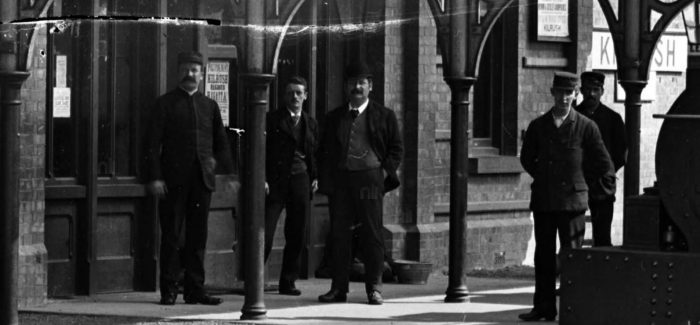
The original/restored Station Buildings include:

  • Main Station Building and Station Master’s House
  • Platform (Roof totally replaced)
  • Great Northern Railway Goods Shed (Extension added to the original building. Attempts had been made to remove part of the original building for safety reasons prior to restoration)
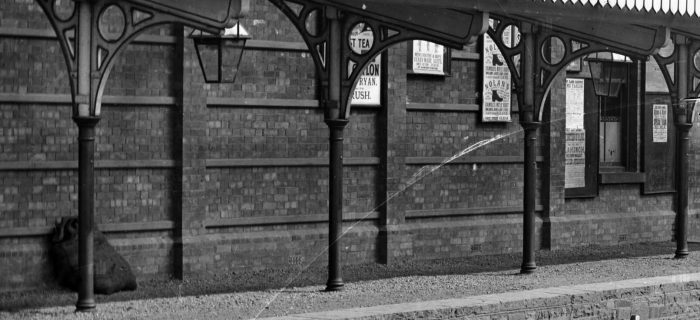
  • Cavan and Leitrim Railway Goods Shed (Effectively no restoration needed)
  • Engine Shed
  • Water Tower
  • Transhipment Shed

The Main Station Building contains a museum hosting an interesting collection of railway memorabilia and audiovisual footage of the Cavan and Leitrim railway and the restoration of the station itself. [3]The Great Northern Railway Goods Shed serves as a 120 person capacity conference hall and is used for business, social, sport, leisure and educational/training purposes. The Goods Store/Visitor Centre has  meeting & conference room facilities for rent. [3]The refurbished Station-house is on the right. The main GNR station building is directly ahead of the camera. [8]

Contact Details:     

Address:    Railway Road, Belturbet, County Cavan

Tel:      086 069 9749

Web:    https://belturbetheritagerailway.com


C. Locomotives

An order was placed with Robert Stephenson & Sons of Newcastle-upon-Tyne in 1886 for 6 railway engines. The order was later extended to 8 locomotives. Four of these engines were fitted with condensing apparatus and modified for working on the tramway. The original order valued the locos at £1,100 each. The modifications cost £38 per engine. [1: p81]

“The first of the eight was delivered at Belturbet specially early, in May 1887, for the use of the contractor. With the exception of the second engine (which came to Dromod in June) all the engines reached the C&L via the GNR, the deliveries continuing until early in 1888.” [1: p81]

All the engines were 4-4-0Ts with stovepipe chimneys. The firebox crown sloped down towards the back of the engine to avoid the danger of uncovering on steep banks. The cabs had round front spectacles and rectangular ones at the back. The back also had an opening door to a height of 2ft 11ins which was used for coaling. Cowcatchers were provided and each engine carried as large headlamp. Probably all originally had a sloping cover below the smokebox door (as retained by No 3 till 1925) which was removed early on to make room for jacks and tool-boxes. [1: p82-83]

All the engines had the same dimensions. They weighed in excess of 25 tons and had makers’ numbers 2612-2619 in order. The last four were intended for use on the tramway and were externally quite different. Skirts were fitted over the wheels to 4in above rail height and extending the full length oif the frame. The back weather boards on the cxab were cut away arvthge csides and the forward facing spectacles could be opened. [1: p83]

Unusually, the tramway engines had a set of duplicate driving gear. This meantvthat the driver had full control of the engine while always being able to watch the road ahead. Flanagan says that “this provision of two sets of controls was unique, on Irish railways at any rate. As supplied, the tramway engines had the cowcatcher and the head-lamp at the back end and when the makers chose to photograph one of these as a mainline engine the catcher and the lamp were reversed and the U-pipe and exhaust-vent of the condensing gear, as well as the skirts, were removed. All engines ran in conflict with the 1884 Order in Council which specified a maximum axle-loading of eight tons.” [1: p83]The two different incarnations of the tramway engines. In the first picture we see the manufacturers photograph of No. 5, ‘Gertrude’ fitted as a mainline engine in 1887. It was then converted back so as to be supplied to work on the tramway. The tramway version is shown in the second picture above and has the cowcatcher and headlamp fitted behind, or in effect in front of, the cab. These engines were designed to be driven cab first. [1: between p100 & p101]Loco No. 8, Queen Victoria) heads an up coal special past Drumcong Post Office in 1957. A very photogenic location! [1: between p100 & p101]No. 3, Lady Edith in 1903. [1: in between p100 & p101]

The engines were named after the company directors’ daughters with the exception of one engine which was named for Queen Victoria. A variety of modifications were made to these engines over the years. These are all detailed by Flanagan [1: p84-89] and those details do not need to be repeated here. Nonetheless, despite modification,these engines struggled to cope with the heaviest livestock and excursion traffic of the early 1900s and by January 1904 the C&L was looking for a more powerful loco. The specification called for an 0-6-4T locomotive. Robert Stephenson and Sons tendered the lowest price of £1750 and promised delivery within 18 weeks. They were given the work. The order was placed on 7th July and the engine was tried on the line in steam on 28th October of the same year. [1: p89]

As soon as No. 9,’King Edward’, arrived it became the pride of the C&L fleet. It was considerably more powerful than the rest of the fleet, being able to take 24 wagons of cattle to market. However, it became a ‘white-elephant’ because its long rigid wheel-base tended to spread the running rails. A variety of different things were tried to address this but the ‘King’ continued to spread rails on tight curves. Eventually, it came to only be used in exceptional circumstances. “in December 1922, the board decided to offer it for sale. However, it was reported in 1923 that nobody was interested, and after that the ‘big engine’ spent most of its time at Ballinamore, leaving only for a very occasional jaunt on the main line. ” [1: p91]0-6-4T locomotive No. 9, ‘King Edward’ in ex-shop condition in 1904. [1: between p100 & p101]

The company considered buying other locos but it was some time before other engines were employed on the network. “The next ones to run on the line were ‘foreigners’ the tow hired by the Ministry of Transport in April 1920 for use in the conrtuction and working of the Arigna Valley Railway. Transferred temporarily to the C&L, they were originally Nos. 1 and 2 of the Ballymena, Cushendall & Red Bay Railway. Built at Black Hawthorn in 1874 and 1875 respectively, they were renumbered on various occasions, becoming 101A and 102A of the Northern Counties Committee in February 1920. … These little engines were very popular on the C&L and were amazingly sturdy machines. Probably as a result of excessive use on the C&L, their condition in June 1921 was poor and it was ordered that they be returned to the NCC at the end of Control. They returned north in November 1921 and were not used again. ” [1: p94-95]One of the two foreigners , No. 101A from the NCC was originally a Ballymena, Cushendall and Red Bay Railway engine. [1: between p100 & p101]

By the summer of 1924, No. 8 was no longer Queen Victoria. The name had become synonymous with colonial rule and after one false start the name plate was removed and destroyed. [1: p97]No. 8, Queen Victoria without her nameplates, pictured in 1924. [1: between p100 & p101]

Engine Livery: the basic C&L livery was dark green with lining consisting of “a three-quarter inch band with a much thinner line inside. The band was generally red and the line white but, depending on the taste of the locomotive superintendent or the painter, there were variations. For example, No. 7 had a red band but a black line, while the band on No.8 was yellow and the line light blue. Lined parts of the engine were the front and side of the tanks, the cab panels and back, and the sides of the cylinders. The smoke-box and the cover over the cylinders were in variably black.” [1: p97-98]No. 2, Kathleen in 1933 prior to its regular use on the Arigna Tramway. Flanagan says: “The engine has the flat Hunslett dome cover and is fitted with smoke-box lubricators.” [1: between p100 & p101] Two views of a model of No. 2, Kathleen in 00n3. This model was produced from a kit from Backwoods Miniatures which has been modified including a scratch-built rear cab sheet as the one in the kit was for the era prior to Kathleen being fitted out to run on the Arigna tramway. The original loco still exists at Cultra. These pictures were found on the website of Chester Model Railway Club. [16]A typical Arigna Coal train modelled in 00n3 with Kathleen at the head, also . [16]No. 4, Violet in 1932. Flanagan says: “The step on the [front of] the side tanks was a feature of this engine for a long time.” [1: between p100 & p101]This image of No. 1, Isobel is taken in 1931 at Dromod MPD and mirrors pictures above from the preservation era. [1: between p100 & p101]

At the amalgamation heavy excursion traffic was a thing of the past and the border between Northern Ireland and Ireland  was depleting the cattle traffic. However, the Arigna Coal traffic was substantial and growing steadily. Modifications were first made to the remaining members of the existing fleet of locomotive (1925). Heavy repairs were undertaken at Ballinamore until around 1932, after which such repairs were undertaken at Inchicore Works. Regular repairs kept 4 of the original 8 locos in use but their overall condition was deteriorating gradually and by 1951 no further havey repairs were undertaken. Flanagan says that “At the closure, the four remaining C&L engines were very run down. As the line was lifted, No. 8 was cut up in the shops in Ballinamore. The lifting of the Dromod line was done with Nos. 2 & 4, and in February 1960, No. 4 was cut up at Dromod. After a long wait, No. 2 was brought by road to the Belfast Transport Museum, where it no rests. The remaining engine, No. 3, was shipped to America by the Lady Edith Society.” [1: p116-117]No. 2, Kathleen at the Ulster Transport Museum, (c) Skimann . [9] Three shots, video stills of Lady Edith on shed at Pine Creek Railroad, New Jersey in 2017. [10]

The Lady Edith Society was a consortium of New York area railroad enthusiasts–Edgar T. Mead, Jr., Oliver Jensen and Roger E.M. “Frimbo” Whitaker. They pooled their money and in 1959 shipped to the U.S. the Lady Edith, a second locomotive, a passenger carriage from the Cavan and Leitrim, and later they were joined by a goods van and a brake van from the West Claire Railway. First displayed at Pleasure Island Amusement Park in Boston, Massachusetts, the equipment was moved to Freehold, NJ, then to Allaire in 1965. Lady Edith first steamed on 16th June 1966. It was serviceable up until around the millenium when it became apparent that the front flue sheet was too thin for safe operation. An $11,000 repair was put on hold when New Jersey adopted new regulations. [11]

The second locomotive was the former Cavan & Leitrim, ex-Great Southern Railway, nee-Tralee & Dingle 2-6-2T No. 5, which was brought over in 1959 to go to Edaville. Instead, it went to the Steamtown collection in 1961. It remained part of the Steamtown collection until 1986. In that year, it was purchased from the Steamtown Foundation and repatriated to Ireland by the Great Southern Railway Preservation Society, Ltd. It operated for a time on a restored section of the T&D between Tralee and Blennerville. [11] However, that heritage line is currently not operational and No. 5 sits unused on the Tralee & Blennerville Railway. It has not worked for some years now.Above, Loco No. 5T is at Creagh on the afternoon Arigna train. [1: between p100 & p101].

In the adjacent image, which was frequently seen on postcards, No. 3T sits at Creagh on another Arigna bound train. [3]

Locomotives from Down South!

The Cork, Blackrock & Passage Railway (CBPR) closed in 1932. Four of its engines, built in 1900 by Neilson and Company, were 2-4-2T locos. They had maker’s numbers 5561-5564 and CBPR Nos. 4-7. By the middle of 1934 all four engines had been repaired either at Cork or Inchicore. The locos were renumbered Nos. 10L – 13L respectively and  arrived at the C&L in August and September of 1934. No. 11L did not last long and was scrapped in 1939 at Inchicore. After experimentation it was determined that these locos were not suited to the Arigna Extension. No. 13L was laid up at Inchicore in 1951 and scrapped in 1954. The two remaining CBPR locos lasted until the end of the C&L and were cut up in 1959. [1: p117-119]

The GSR considered supplementing C&L motive power with locomotives from  the Tralee & Dingle Line, the West Clare Line and the Schull & Skibbereen Line. All would have been within the loading gauge and turntable lengths. The most suitable proved to be those from the Tralee & Dingle Line. Four engines were sent from the Tralee & Dingle Railway (T&D) to the C&L. They came in numerical order over a period of 16 years.

“The first to come were Nos 3T and 4T in late 1941. The former was a Hunslett 2-6-0T of 1889 (maker’s number 479) and was one of the original T&D engines, having been delivered early to Robert Worthington for use in construction work. … This endine (and all other T&D engines except No. 4) was fitted with Walschaert’s valve gear. … The second engine to come in 1941, No. 4T, was … built by Kerr, Stuart & Company (No. 836) in 1903. it was a 2-6-0T to a standard maker’s design and resembled other engines supplied to various overseas railways. … It was not until 1949 that No. 5T went to Inchicore Works, … en-route to the C&L. On 10th November the following year, it was sent to Ballinamore to begin a nine-year spell of heavy duty. … Generally similar to No. 3T, it was a larger engine – a 2-6-2T – with longer boiler and firebox. Made by Hunslet in 1892, its number was 555. … No. 5T has a cow-catcher but this gradually worked loose and had a tendency to stick on the points. When this … happened one day in Drumshanbo yard the catcher was … removed for good. … The last of the Dingle engines, No. 6T, was identical with No. 3T in everything except age. However, as built (in 1898, Hunslet No. 677) it had no tramway fittings. … No. 6T … came to Inchicore and was condemned in March 1957 but was immediately reprieved  for the C&L coal traffic and went into service shortly afterwards. It ran the greatest mileage of all on coal specials, 1,312 miles in four weeks of April-Mat 1958.” [1: p120-122]

“On closure of the C&L, Nos 3T and 4T (with 10L) were used on the Belturbet lifting and were cut up on completion of the task; 6T (and 12L) went to the Dromod end and were also scrapped. 5T alone survived, being shipped to America.” [1: p122]

6T was the last steam locomotive in steam on the original C&L. 6T went on to haul lifting trains into 1960 and was scrapped in March. It seems as though 5T did operate at Blennerville in the States but is currently in pieces having not steamed in 10 years. [28]

D. Rolling Stock

Carriages: In 1886 the Company instructed the engineer to prepare specifications 8 composite, four third-class carriages and 6 brake vans. The carriages were to be long bogie vehicles. Automatic vacuum brakes were to be used.

In January 1887 the tender from the Metropolitan Carriage & Wagon Company in the sum of £10,554 was accepted and the chosen carriages were 40ft in length by 7ft in width and ran on two four-wheel bogies with 2ft diameter wheels.

The seating arrangement was “longitudinal, slatted, wooden seats in all third-class sections, and similar, black, leather-upholstered seats in the small central smoking first-class sections of the composites. The non-smoking firsts had swivel armchairs on one side and fixed armchairs on the other, dark blue upholstery being used. The accommodation was fifty in the thirds, thirty-four third class and fourteen first-class (six smoking) in the composites. The carriages weighed 7 tons 12cwt.” [1:p148-149]

Externally, “the overall painting was red-brown and there was a fine red line around the windows and panelling. Midway along the waist panel there was a gold transfer of the letters ‘C.L.& R.Ry’ and below was the number. They had open platforms at the ends, though the roof extended the full length of the frame. Protection was afforded by railings. … Lighting was by oil, with four lamps in each third and five in each composite, and the windows were fitted with blinds. No permanent form of heating was provided and in December 1887 two-dozen copper foot warmers were ordered. … In the early days … the foot-warmers were filled from large iron kettles … purchased by the traffic manager in January 1888.” [1: p149]C&L Loco. No. 5 on a board inspection train at Belturbet in the early 1900s. I guess that the bogie coach at the rear of the train would at least have had some first class accommodation! [1: between p100 & p101]

“The first coach, a composite, was delivered in July 1887. … The chief complaint made was that rain had freely found its way inside the coach and the locomotive superintendent was instructed to make a thorough inspection. He reported that the workmanship might have been a bit better in some respects but that, on the whole, the coach was fairly satisfactory. ” [1: p149]

Steam heating of the coaches was considered on a number of occasions but was not fitted. Internal alterations saw the removal of swivel chairs and their replacement with longitudinal bench seating in 1903. It was soon realised that the original coaches had a surfeit of first-class accommodation. It was decided in 1891 to convert two composites to thirds, however the work was not carried out until mid-1899. A third conversion was made in 1907. The possibility of adding a lavatory to No. 11, which was then being modified, was considered and rejected because the cost of £35 6s 6d was considered to be far too high.

“As traffic built up over the years, the carriage stock proved insufficient for the heavy demands made on it. Things came to a head in 1909 and it was then proposed that two new carriages be bought, but the plan had to be withdrawn  in the face of opposition from the council directors.” [1: p150] Further please were made at intervals for an increase in the number of carriages, but to no avail. The C&L made no further additions to is carriage stock.

“Very shortly after the formation of the GSR, plans were drawn up for a standard coach for all the acquired narrow-gauge lines. It would have been 40 ft long and 6ft 11 ins wide with longitudinal seating for 34 third-class passengers. There were to be two four-seater first-class compartments, the central one for smokers. Electric light was planned and entrance would be gained from inward-opening side doors at each end.” [1:p151] These plans came to nothing.

After an attempt at re-panelling of two C&L coaches both deteriorated rapidly, one was scrapped, the other was return with a replacement body made up of “two ‘N’-class single-decker bus bodies joined together in the middle, the original bus entrances being kept and new, similar ones provided opposite. … In appearance, the bus-coach was quite smart at first but it had some very distinct disadvantages. The roof leaked badly, there was no heating, … and although battery lighting was provided it was necessary to send the batteries to the Broadstone to for recharging.” [1: p152]Coach No. 7 of the C&L was re-bodied with a pair of bus bodies shunted together. [14]

Of the remaining two untouched coaches, the first was allowed to rot away until closure, the other, “a composite, was hauled into Ballinamore shops in 1958 and given a completely new body. It was second-class only and extended the full length of the frame, the familiar end platforms disappearing and inward-opening doors being provided instead. The edns were blocked off and there was no access from the next vehicle.” [1: p152]

“In 1954, the CIE made an effort to relieve the situation by giving the line its first ‘foreign’ coaches – two from the West Clare, though originally of Tralee & Dingle origin.” [1: p152]

Flanagan provides a full list of all the C&L carriages: [1:p153-154]

No I Composite: Derelict in GSR livery in Ballinamore to 1958. Then rebuilt in C&L shops as all-second. Transferred to West Clare in June 1959 and used in traffic and later as P.W. sleeping-car on lifting train. Body sold to Bord na Mona in Bellacorick, Co Mayo.

No 2 Composite: Converted to third 1900-07; written off 1950.

No 3 Composite: Converted to third 1900-07; written off 1950.

No 4 Composite: Sent by GSR to Inchicore for repairs; came back with ‘cardboard’ sides. Very little used on return. Frame again sent to Inchicore 1951 but scrapped there.

No 5 Composite: Converted to brake-composite 1945-6 and painted green. Panelling later covered with painted sheet aluminium. On closure sent to Dromod and later brought to Belfast Transport Museum.

No 6 Composite: Converted to brake-composite 1950. Little used at end (No 5 was regular tramway carriage). Body sold to Gaelic Athletic Association 1959 and now in use as changing-room at sports-field in Ballinamore.

No 7 Composite: Sent to Inchicore with No 4 by GSR. Also little used on return. Frame also sent to Inchicore 1951 for new body. Returned December 1953 as `bus-coach’. New body all-second. On closure, sent to Dromod and fittings removed. Sold to Bord na Mona in Lanesboro’, Co Longford.

No 8 Composite: Converted to third 1899; written off 1943.

No 9 Third: Written off 1943.

No 10 Third: Written off 1950.

No 11 Third: Lasted till closure (then scrapped) but, although used in 1949-50 period on tramway, had been derelict for years.

No 12 Third: Written off 1943.

Coach No. 12 was a third class coach. It is shown here newly repainted in 1931. [1: between p100 & p101]

In 2019, Flanagan’s list needs to be reviewed in the light of 50 years of further developments ….

Coach No. 1: Flanagan says that this was on the West Clare Railway for a short while. I have not been able to follow up on the subsequent history and demise of the coach. Worsley Works makes a kit of this coach and carry a picture of it circa 1959 in West Clare colours.Model of Coach No. 1, kit by Worsley Works, built by Simon Starr. [15]

Coach No. 5 (‘6’):  is shown in this early postcard from what was the Belfast Transport Museum. The card was part of a restoration appeal in the early 1960s. Have they got the number wrong? Or did Flanagan?cl-belfast-transport-museum-appeal-pcIn the days before the new Irish Transport Galleries were built at the Ulster Folk & Transport Museum in Cultra, the collection was housed in a cramped old warehouse in Witham Street, Belfast. The carriage featured in this early 1960s card of Witham Street has since been fully restored and is on show at Cultra. [12] Further investigation suggests that the correct designation for the coach under renovation in Belfast was No. ‘5’. The Ulster Folk & Transport Museum now lists it as such. [13]Model of Coach No. 5, kit by Worsley Works, built by Simon Starr. [15]This image shows either Coach No. 5 or Coach No. 6 after conversion to a brake-composite. [1]The image above shows either Coach No. 5 or Coach No. 6 after conversion to a brake-composite, at Ballinamore. [17]

The adjacent image shows Coach No. 5 at the Ulster Folk & Transport Museum and was found on the Chester Model Railway Club website. [18]

Below, there are two images of the interior of Coach No. 5, also sourced from the Chester Model Railway Club website. [18]

The first shows the interior of the 1st Class compartment. The second shows the interior of the 3rd Class compartment. Despite being more plush, the 1st Class compartment was no warmer than the 3rd Class compartment – neither had steam heating! [18]

Coach No. 6:  Was used as a changing room at Ballinamore. I have been unable to verify its life at Ballinamore after the closure of the C&L, nor have I found details of its demise.

Coach No. 7: Flanagan indicates that this coach was passed to the Bord na Mona Railways in Lanesboro’, Co Longford. This picture shows Coach 7L dumped at BnM Mountdillon Works near Lanesborough in 1970, © A. Wilson. [29]The carriage was purchased as a chassis minus it’s body by the Irish Steam Preservation Society in 1972 and moved to Stradbally where it was shortened and the bogie centres relocated to shorted it to 20ft and allow it negotiate the curves of the line, © Ernie Shepherd. [29]7L in 2018 at Stradbally Railway Works it’s 1973 body still going strong and 1887 underframe and bogies with CL&RR axleboxes retained. [29]

Other Coaching Stock: The C&L had 6 brake vans which measured 15ft 6ins in length and 7ft in width. Panelling on the brake vans originally matched that on the coaching stock. As built they had a birdcage lookout at one side. Once refurbished the birdcage lookout was lost and the sides were panelled in Aluminium.Brake Van no 17L after cladding with aluminium, also at Ballinamore. [17]

There were just two horse boxes and high were numbered 19 and 20. They carried a dark blue livery with white lettering.The two horse boxes were number 19 and 20. This is No. 20. The picture was taken in 1949. [1: between p100 & p101]

The C&L had two milk vans to cater for creamery traffic. They were also in dark blue livery but we’re also fitted as brake vans and could often be seen acting in that capacity.This image shows a model in 00n3 of one of the milk vans in its later livery with CIE. The image comes from the Chester Model railway Club website. [16]

Timber trucks were provided, just 2, which also were designated as coaching stock.

“At its peak, the C&L coaching stock comprised twenty-five vehicles, if which half were carriages.” [1: p155]

Foreign Coaches: vehicles were transferred from the Tralee & Single. There were two, numbered 21L and 22L. The former was a 30ft. composite coach, the latter was originally a brake third but converted to a van in 1940. 21L was renovated internally on arrival at Ballinamore and again in 1959, when it was sent to the West Clare for further use. [1: p155]This picture comes from the Chester Model Railway Club website [16] and shows, to the right, vehicle 22L referred to above, modelled in 00n3 scale. In addition, the picture includes two wagons used on the C&L which are referred to below.

Wagons: The C&L first considered wagons in October 1886. The order which was finally placed with Metropolitan [20] was for “forty open, forty covered and twenty cattle wagons. In addition, two timber trucks were obtained. Of the covered wagons, half were close-roofed and the rest were ‘convertibles’, that is, they had an open centre portion in the roof and could be used for cattle. When used formgoods, tarpaulin covers were employed. The original numbers were  1-40 open; 41-80 goods; 81-100 cattle; 101-102, timber.” [1: p156]Convertible Wagons at Dromod. [19]

Later, in 1888, six ballast wagons were purchased from the Bristol Carriage & Wagon Co. [22] This number was insufficient. The traffic manager asked for 20 more. The board decided on seven, which were purchased in 1889 from Metropolitan. [20] By 1893, the traffic manager was again asking for an increase in allocated stock. The board chose to take no action. It was not until the C&L began building it’s own wagons at Ballinamore that the stock was increased. The first wagon out-shopped from Ballinamore was an open wagon which was in use by 1899. This was followed by two convertibles. [1: p156]

In 1903, an order for a further 20 convertibles was placed with R & Y Pickering of Glasgow. [24] This was followed, in 1911, by a further order for 10 open and 10 covered wagons from the same supplier. (The traffic manager had requested 50 of each type!) This was the last significant sized order to placed outside the company and indeed the only new wagons after this date are listed by Flanagan as: “one open wagon, … built in 1913, a second in 1917, and two timber trucks (to supplement the original pair for the Dromod-Bawnboy timber traffic) in 1918; all were built at Ballinamore.” [1: p157]

Flanagan also provides general details of all of the wagon types and of various re-numberings which took place. The wagon livery was grey with black ironwork. Lettering and numbering were in white. The ballast wagons were the only exceptions, having a special yellow livery of their own; lettering was in black.” [1: p158] All wagons were 15ft 6ins long and 7ft wide. They had a 7ft wheelbase with 2ft diameter wheels.

As the years progressed a series of ‘foreign’ wagons arrived at the C&L. twenty were borrowed from the NCC by the Ministry of Transport, arriving in 1920. In 1934, thirty-eight open wagons were transferred to the C&L, all but six came from the Passage line. The remaining six appear to have been built new at Inchicore, although it is actually more likely that they were new bodies on old Cork & Muskerry wagons. With the wagons came two goods brake vans of Passage origin.

In 1942, a further 12 wagons came to the C&L from the Clogher Valley Railway, 8 open and 4 covered. No further wagons were added until 1953 when the Tralee & Dingle closed and three ballast wagons were transferred to the C&L. Finally, in 1957, a total of 10 wagons (8 Muskerry and 2 Clogher Valley) were sent to Ballinamore from the West Clare. Many of the wagons transferred in the latter years of the C&L saw little use as they had coupling problems and/or were in poor condition. [1: p159-162]

Other Stock: The C&L had two locomotive department service vehicles – a hand operated accident crane (ex Cowan & Sheldon) [25] which arrived in 1887 and a wooden four-wheeled bogie which was used for moving equipment around the Ballinamore yard and for moving coal to Corgar. [1: p163]

References

  1. Patrick J. Flanagan; The Cavan & Leitrim Railway; Pan Books, London, 1972.
  2. https://www.ebay.co.uk/itm/Cavan-Leitrim-NG-Railway-3-different-Sets-of-10-6×4-Black-White-photo-prints-/292954701892, accessed on 5th June 2019.
  3. https://belturbetheritagerailway.com, accessed on 7th June 2019.
  4. http://catalogue.nli.ie, accessed on 8th June 2019.
  5. The series of images was sent to me by Darragh Connolly of the C&L. Those not credited to others are C&L copyright.
  6.  “Industrial Notes and News”. Bulletin. 1031. – Industrial Railway Society. accessed in May 2019. p. 13.
  7. https://en.wikipedia.org/wiki/Cavan_and_Leitrim_Railway, accessed on 5th June 2019.
  8. http://discovertheshannon.com/listings/belturbet-railway-station, accessed on 6th June 2019.
  9. https://commons.wikimedia.org/wiki/File:C%26LR_4-4-0T_2_”KATHLEEN”.jpg, accessed on 22nd June 2019.
  10. https://youtu.be/b3ZsG-4pFWg, accessed on 22nd June 2019 and shown beneath these references.
  11. http://www.rypn.org/forums/viewtopic.php?f=1&t=4246, accessed on 22nd June 2019.
  12. https://irishpostcards.wordpress.com/transport, accessed on 25th June 2019.
  13. https://en.wikipedia.org/wiki/Ulster_Folk_and_Transport_Museum, accessed on 25th June 2019.
  14. http://homepage.eircom.net/~yarpie/clr/archive/11.html, accessed on 25th June 2019.
  15. http://www.worsleyworks.co.uk/Image-Pages/Image_NG_Irish_C&L_4mm.htm, accessed on 25th June 2019.
  16. http://www.chestermodelrailwayclub.com/stock.htm, accessed on 26th June 2019.
  17. https://picclick.co.uk/Cavan-Leitrim-NG-Railway-3-different-292954701892.html, accessed on 26th June 2019.
  18. http://www.chestermodelrailwayclub.com/Cultra.htm, accessed on 26th June 2019.
  19. http://homepage.eircom.net/~yarpie/clr/archive/10.html, accessed on 26th June 2019.
  20. The Metropolitan Railway Carriage and Wagon Co. of Saltley Works, Birmingham was registered in 1862 by Joseph Wright and Sons with a nominal capital of £100,000. In 1864, that share capital was increased to £200,000. In 1902, it was incorporated into the Metropolitan Amalgamated Railway Carriage and Wagon Co. Eventually, in 1929 the next successor company, Metropolitan Carriage, Wagon and Finance Co was merged with the railway business of Cammell, Laird and Co to form Metropolitan Cammell Carriage, Wagon and Finance Co better known as Metro Cammell. [21]
  21. https://www.gracesguide.co.uk/Metropolitan_Railway_Carriage_and_Wagon_Co, accessed on 30th June 2019.
  22. The name “Bristol Wagon & Carriage Company”  was applied to a company on Lawrence Hill, Bristol. Prior to 1889 its name was the Bristol Wagon Works Co. By 1905 the company was also producing road vehicles. It produced a stationary internal combustion engine – ‘The Victoria Engine’ – from 1906 to around 1920. During that time around 3,500 were built. By 1915, it was one of 15 established companies involved in manufacture and hiring-out of railway rolling stock. It was acquired in 1920 by the Leeds Forge Co. [23]
  23. https://www.gracesguide.co.uk/Bristol_Wagon_and_Carriage_Works_Co., accessed on 30th June 2019.
  24. R. Y. Pickering and Co. of Wishaw were manufacturers of railway carriages, wagons and rails and were established in 1864. Around 1900 they produced a few steam railcars but by 1911 they were primarily a manufacturer of Carriages and Wagons for the Railways. Later they diversified and then refocussed so that by 1961 they were general engineers and fabricators, producing welded marine engine fabrications, ship and barge hatch covers, ships welded sternframes and rudders; welded tanks; machine tool fabrications; screening equipment; foundry plant; winches; oil drilling masts and substructures; forgings and drop stampings; sheet metal work and had 600 employees. [26]
  25. Cowans, Sheldon and Co, crane makers, of Carlisle began in a small way at Woodbank near Upperby. John Cowans and Edward Pattinson Sheldon had been apprentices to Robert Stephenson & Co. on Tyneside. There they had been friendly with a William Bouch from Thursby, and it was his younger brother, Thomas, who eventually found the premises at Woodbank, which had been a calico works. In 1866, the company built their first railway recovery crane. They made cranes for the railways, heavy lifting gear which could be used to return locomotives that had gone off the rails to the right track. Cowans Sheldon’s fate was tied to the fate of the railways and the British engineering industry. Britain stopped being the workshop of the world. The postwar years saw increased competition. In 1961, the 450 employees found themselves working for the Glasgow firm of Clyde Crane and Booth and in 1982 the firm became Cowans-Boyd. Five years later, manufacturing ceased and only the design office team was retained in Carlisle. The giant sheds were demolished and beefburgers are now fried where once some of the world’s greatest cranes were made. [27]
  26. https://www.gracesguide.co.uk/R._Y._Pickering_and_Co., accessed on 1st July 2019.
  27. https://www.gracesguide.co.uk/Cowans,_Sheldon_and_Co., accessed on 1st July 2019.
  28. Helpful comments made by Darragh Connolly of the C&L at Dromod on 4th July 2019.
  29. Sean Cain, https://m.facebook.com/groups/2016302075275558?view=permalink&id=2311590155746747, accessed on 5th July 2019.

The Cavan and Leitrim Railway – The Arigna Tramway

Ballinamore to Arigna

We re-start our journey back at Ballinamore Railway Station again. The plan below is a repeat of one provided in an earlier post. It is helpful in orienting ourselves once again. [1: p132] This first picture looks southwest from the throat of the motive power depot towards Cannaboe level-crossing. [4]The photographer has stepped out into the permanent way to take this picture, it also looks towards Cannaboe level-crossing. [4] Walking Northeast, someway along the platform opposite the station building brings us to this somewhat overexposed view. The footbridge is missing from the image because it is overexposed. [4]This view looks northeast from the footbridge. [4]Two photographs taken at platform level. [4]Three images taken in the MPD at Ballinamore. [4]Cavan & Leitrim 4-4-0T 4L in front of the pair of Cork Blackrock 2-4-2Ts 21st March 1959, (c) Martin Cowgill. [5]An array of filthy motive power on shed at Ballinamore. From left to right: C&L 4-4-0T 4L in front of the pair of Cork Blackrock 2-4-2Ts, 10L & 12L, and Kerr Stuart 2-6-0T 4T by the water tower on 21st March 1959, (c) Martin Cowgill. [5]One of the line’s original locomotives, No 8 in the shed at Ballinamore on 21st March 1959
Formerly named Queen Victoria, No 8 retained it’s original chimney and dome cover. The cutaway cab sheet dates from the locomotive’s time as an Arigna Tramway locomotive, (c) Martin Cowgill. [5]Tucked away out of use was C&L No 2, the former Kathleen, No 2 is the sole survivor of the line’s locomotives in Ireland, being preserved at the Ulster Folk & Transport Museum. Tralee & Dingle No 5 spent time on the line and also survives in working order on it’s original line, 21st March 1959, (c) Martin Cowgill. [5] Ballinamore Station building pictured from Railway Road in 2009 on Google Streetview. Looking Northwest from the approximate location of the station footbridge, also from 2009.Looking Southeast from the location of the station footbridge, again in 2009.

The tramway line to Arigna ran alongside the main line as far as Tully gates and then turned to the right on a five-chain curve and a downgrade of 1:33 to pass the Lower Town gates.

These three images are provided by two different mapping services. The first two are extracts from historical maps held by the OS of Ireland which can be accessed via ‘GeoHive’ [6]

The third is provided by RailMap On-line [7] and is based on the Google satellite mapping service. Lower Main Street level Crossing was adjacent to the Canal and from that point the Tramway levelled and ran alongside the old canal. Two images of the location of Lower Main Street Level-Crossing taken in 2018. Both views are adapted from Google Streetview. The first looks East back towards the Station the second looks Northwest along the line heading for Arigna. The canal can be seen in both pictures.

Flanagan says: “About a quarter of a mile past the gates of Lower Main Street Crossing, on the right, was the site of Stradermot Quarry siding. From here on the line wound tortuously right and left through low-lying ground often flooded by the canal and sometimes made impassable to trains. After a fairly level run, the halt at Ballyduff (3 miles) was reached. The cottage and gravelled passenger space were on the left, past the gates which were protected by one of the few signals on the tramway. There was a water tank at the halt up to about 1893 and a replacement, filled by a ram, was erected in 1901, although the site chosen was actually on the Ballinamore side, not far from Lock 7 on the canal. However, the tank’s capacity was insufficient and a second one on the same base was added in 1904. Both were out of use by 1919 and at least one was loaned to the Board of Works for the construction of the extension. No water facilities were provided after 1919. The halt had a telephone and was used as a temporary block post..” [1: p141-142]Looking back along the line of the tramway towards Ballinamore from a point close to Ballyduff.

The old road at the level-crossing immediately before Ballyduff Halt used to follow the line shown in blue, as can be seen on the OS Map extract above. That road has now been diverted along the line of the railway in red. Ballyduff Halt was encountered straight after the crossing.Almost immediately beyond Ballyduff there was a four-chain right-hand curve, and then the line met a road coming in on the left. That road is now the R208 on the above satellite image. The tramway followed the north shoulder of what is now the R208. It’s route is shown on the OSI Map extracts below. [6]Flanagan asserts: “The cheap construction of the line was obvious from here on, as it faithfully reflected every hump and dip in the county road. Short, steep gradients followed one another in quick succession, the steepest yet encountered being a drop at 1:28 to the ‘4’ milepost. Just beyond, the road veered briefly to the left and the intervening space was the site of the down, facing Dromkeen Wood siding, at the bottom of the ‘Long Bank’. The siding was the standard six wagon-lengths and lasted from March 1918 to January 1919, being installed for the removal of timber for sleepers.” [1: p142]I believe that this is the place referred to above by Flanagan where the road and tramway separated to allow room for a siding. [6] Within a short distance and a few ungated crossings Cornabrone Halt was reached, it appears towards the left of the map extract above. [6]

Going on towards Cornabrone, the line continued to meander and passed the ‘4.25’ milepost before, Flanagan says, it encountered a  grade of “1:29 on a four-chain left-hand curve. It rose steadily to the ‘5’ mile-post and then descended with another four-chain twist to 5.5 miles, after which it rose slightly to Cornabrone Halt (5.75 miles).” [1: p142]

Cornaborne Halt is shown in the adjacent colour image from the 1950s. Cavan & Leitrim 3T (HE479/1889) is at Cornabrone halt with an Arigna-bound mixed train. [8]

The halt was the first of the three well-known roadside stopping-places and, like the others, consisted solely of an enamelled nameboard which nestled in the hedge on the far side of the county road. There were requests for a siding here in 1901 but they were refused, as was an earlier one in 1898. There were never any facilities whatsoever at these halts.” [1: p142]The location of Cornabrone Halt in 2018 (Google Streetview).

Once past Cornabrone, “the line descended sharply at 1:29 and continued to fall until, after a brief downgrade of 1:32, it crossed the Aughacashlaun River and reached Aughacashlaun ballast siding (6.5 miles). It was an up, trailing siding which had the points in the middle and extended east almost to the river bridge. Although the contractor had a siding here, the C&L one dated from 1896, when the Board of Trade ceased to object, and lasted till 1952. The siding points gave the C&L men a lot of headaches as, although they were protected by an Annett’s lock, the local people had found a way of opening them by interfering with the rodding. In 1926, drivers were warned to proceed with caution and later the points were officially immobilized though the siding was left. It was again brought into use about 1936, when repairs were being carried out to the bridge, and was afterwards left intact; it was infrequently used up to 1946 for sand traffic.” [1: p142-143]Aghacashlaun Siding and Bridge. [6]Looking West this view of the R208 in 2018, shows the location of the siding marked in red just beyond the Aghacahlaun Bridge (Google Streetview).

Flanagan continues: “After more humps and curves, though not so sharp as before, the line fell at 1:32 to Annadale (7.5 miles), another roadside halt. A full station was proposed in 1889 and there was also a plan for a refuge siding for heavy trains in 1896. A final idea was for the transfer of Kiltubrid siding to here in 1903 to make the place a crossing point. Annadale was the stop for the historic Lough Scur and for Driney, though special excursionists for the latter place alighted at Driney Curve itself, half a mile farther on.” [1: p143]This indistinct image is a still from a video taken int he late 1950s and shows the location of Annadale Halt. [13]The location of Annadale Halt in 2018.The image above shows the length of tramway between Annadale Halt and Kiltubrid. [13]
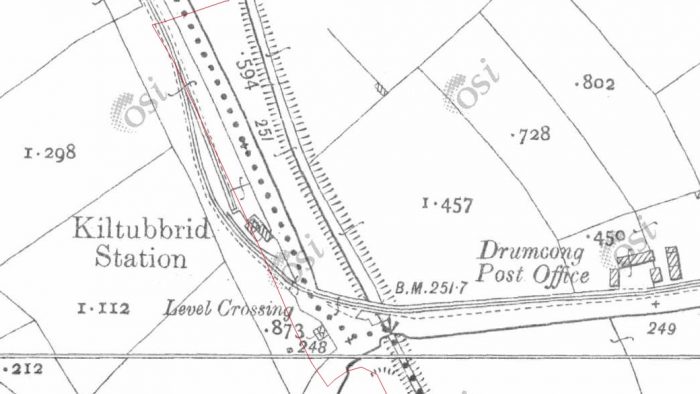
Just beyond the ‘8.5’ milepost, the line curved right at 1:37 and made an oblique crossing of a river and the Drumshanbo road as shown in the adjacent image which looks back towards Ballinamore. [9]

The combination of road junction, bridge and level crossing made this place, which was right beside Kiltubrid halt (8.75 miles), very dangerous.

The next image shows a locomotive heading into Kiltubrid Halt from Ballinamore. [3]

The halt consisted of a house, shelter, and platform on the right-hand side, nicely situated on a four-chain curve. Behind the station-house, and entered from the Drumshanbo end, was the goods siding which dated from the opening of the line. It had its own disc signal, erected in April 1888. As there had been no crossing place on the tramway so far, it was proposed in 1897 that a loop be installed here and some land was bought. However, in December 1901 the engineer stated he was unable to buy all the land he required and put forward a plan for the more economic use of the existing space. This was agreed to in February 1902, but in May of the following year it was decided that Annadale be the crossing point; in the event, no change was made to either place. Kiltubrid also boasted a telephone, being a temporary block post.” [1:p143]

Kiltubrid Halt. [6]Google Earth shows that the alignment of the tramway can still be picked out. The approach from Ballinamore (Google Streetview).Looking back towards Ballinamore – the old tramway bridge is still standing! (Google Streetview)Looking forward from the crossing into the small station site (Google Streetview).In 2018, the small station building still exists and is in use as a private dwelling (Google Streetview).This still from a video shows Kiltubrid Station from an Arigna-bound train. The short siding is visble of the right side of the image. [13]Leaving the Halt at Kiltubrid the line drifted back to run along the verge of the road. The left-hand red line is the siding alignment.

A little past the halt, the line began to climb for a quarter-mile at 1:28.  “Then,” says Flanagan, “it swung sharply across the road by an un-gated crossing and remained to the right of the road for the rest of the way to Drumshanbo. The worst banks of all were in this section, though the steepest were mercifully short. At 9.25 miles there was a short fall and a little farther on a climb at 1:26. The line then undulated until it finally rose at 1:25 to reach the roadside stop at Creagh (10.25 miles).” [1: p143]Cornaleck Crossing was the point at which the tramway crossed back over the Drumshanbo Road. [6]The tramway swung across the road on a curve at an un-gated crossing (Google Streetview). The tramway continued from this point on the north side of the road towards Drumshanbo.This video still is taken looking towards Ballinamore at Cornaleck Crossing. [13]Creagh (Crey) Halt. [6]Approaching Creagh from Ballinamore. [13]

There was a short section of tramway where, in order to make the curvature manageable for trains the road and tramway separated for a few tens of metres as shown below. [6]This 2011 satellite image shows the route of the old road highlighted in blue with the route of the C&L in red. The modern R208 follows the red line and the sharp meander of the old road has been abandoned.The same location looking towards Drumshanbo along the R208 in 2010.

Flanagan says that, “from there to Drumshanbo the run was mostly downhill, the chief point being a hump (1:33) at the ‘11.25’ post. At this point the road veered away to the left and the line had its own right of way through Fallon’s Cutting, over the Priest’s Bog, past the Three Arch Bridge and down the 1:32/1:41 Drumshanbo bank.2 [1: p143-144]To the east of Drumshanbo a train heads for Ballinamore. [10]Fallon’s Cutting. [6]The old railway leaves the line of the new road (above) and heads north, running across the North side of Drumshanbo to the Station. After  Fallon’s cutting road and rail converge and then diverge as shown above.
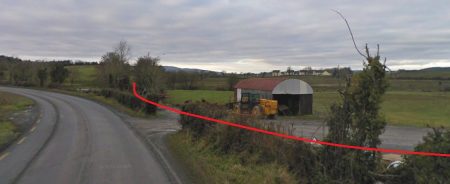
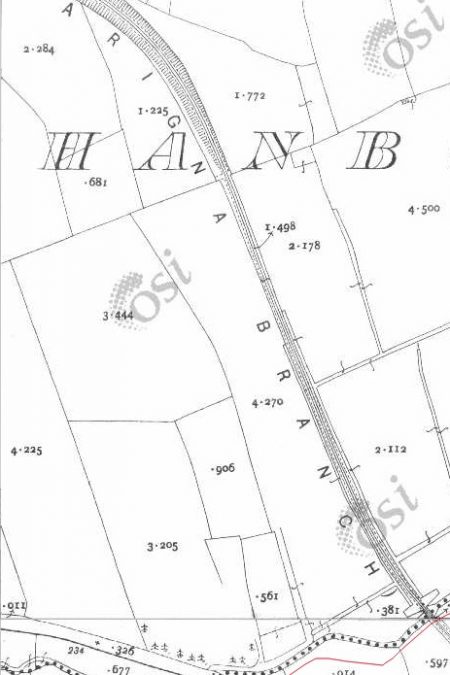
As the two transport modes diverged, the railway began to cross a bog.

The route across the bog is shown on the next OSI map extract. As the railway curved round from a northerly to a westerly direction it was in cutting once again [6]

The road from Drunsanbo (Convent Avenue) to the East doglegged in order to cross the cutting roughly on the square.

The line ran under ‘Three Arch Bridge’ which is still in place in the early part of the 21st century. The route of the old road can still be picked out as it swings to cross the bridge, both on the satellite image and in the Streetview picture below.

The railway cutting has been infilled to allow the new road (Covent Avenue) to cross its line. This can also be seen easily in the picture of the bridge below.

Beyond Three Arch Bridge the C&L descended Drumshanbo Bank and entered the Station which can just be picked out on the left side of the OSI Map extract above. [6]The approach to the site of Drumshanbo Station in 2018. This road is numbered R208.
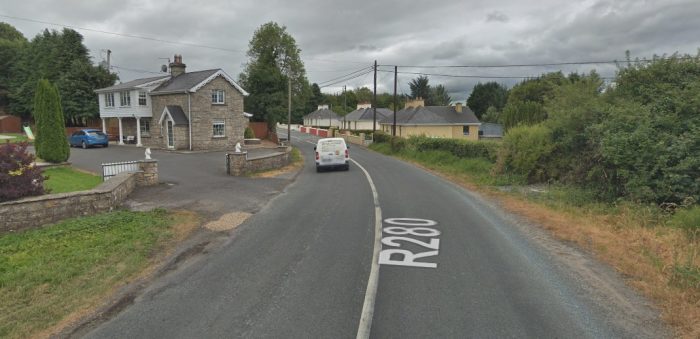
“Drumshanho was yet another place where the C&L got its names wrong and the GSR did not improve matters by introducing an Irish error in the bilingual nameboard. The station (12.25 miles; Class 20 had one platform on the down side. The main buildings originally had one storey but the agent’s house was enlarged in 1914 when another floor was added at a cost of £70 2s 9d. A ground frame at the Arigna end of the platform controlled the yard. Behind the frame was the very short engine shed road. A temporary shed was built in 1888, and lasted until the 1900s. A new one was erected in 1908 at a cost of £77 10s and was a wooden structure which, surprisingly, was not burnt down till about 1923, after which engines were left out overnight, as at Belturbet. For some odd reason no shed ever existed at Arigna and no engine was regularly stabled there, apart from No 6 during the making of the extension.” [1: p144] Flanagan’s sketch map of Drumshanbo Station. I am not too sure why he has chosen to invert the usual practice of the North point being at the top of the image. [1: p144]The OSI Map extract above has north to the north! Sadly the word Carricknabrack sits over the plan of the station area. [6]

The photo above shows the route of the line through the old station.

The station building is shown on the adjacent image as it was in the early 21st century. It is a detached five-bay one- and two-storey former railway station, built c.1885. It is now used as a house. Set in its own grounds. Pitched slate and tiled roofs with stone and rendered chimney-stacks. Terracotta ridge cresting and cast-iron rainwater goods. Roughly dressed random coursed limestone and pebble-dashed walls with gable-fronted porch with slated roof. Brick dressings to gable eaves. Replacement uPVC windows with segmental heads and stone sills. Timber door to projecting porch. [12]

This former station building is one of a few structures associated with the railway at Drumshanbo that remain. Its fine stonework and brick detailing are typical of Victorian architecture. Today this house stands as a reminder of the Ballinamore, Arigna and Aughabehy Line, which served the area until 1959. [12]

The water tower also remains. It  is now disused. Its construction is of random coursed limestone walls with round-arched openings and surmounted by cast-iron water tank. It has a timber battened door with overlight and window with cast-iron frame. It was built as part of a well-designed complex of structures and is of architectural and technical merit. [14]

The Goods shed still stands in the early 21st century. It is a detached single-bay single-storey former goods shed, in use for storage. It has a pitched slate roof with brick chimney-stack. It is of roughly dressed random coursed limestone walls with brick dressings to gable eaves. There is a fixed window with stone sill to segmental-headed window opening. A modern opening has been provided to the south gable and blocked square-headed opening to west elevation. There is a limestone former station platform to north with a section of railway track. It has been altered to meet modern day needs. However it has retained much of its original fabric. Brick dressings to the gables enhance the coursed stone elevations, resulting in a structure of architectural merit. The surviving railway platform contributes to the setting of the shed. [15]Drumshanbo Station seen from the West in the 1950s. [21]

Another picture at almost exactly the same location. This is a video still from the late 1950s. [13]A video still showing shunting in Drumshanbo Station with the Station building in shadow on the right. [13]Drumshanbo Stationhouse to the right and the goods shed, to the left, taken from another arm of the R208. [7]Two 1950s image looking West along the line towards Arigna for the National Library of Ireland. [16]

Flanagan says: “Opposite the station-house, two road-widths from the platform, stood the 5,000-gallon water tank. For many years it was filled by a windmill just to the west of it but the mill was very troublesome and it was often necessary to call on the permanent-way gang to hand-pump the water. To remedy the situation an arrangement was made with Mr Laird, a mill-owner from the town, whereby he supplied the water from his mill. This reputedly cost the company £80 a year and in 1918 it was decided to reduce costs by installing an oil-engined pump. Unfortunately, the pump, which cost £197, was a failure, and the old arrangements were reverted to in 1922. In January 1923 it was ordered that the pump be removed and the hand-pumping gang reduced in number. About this time, too, the windmill was taken down. Later, the town supply was used.” [1: p144-145] The water tower is shown behind the station ground frame in the image adjacent/immediately above. [16]
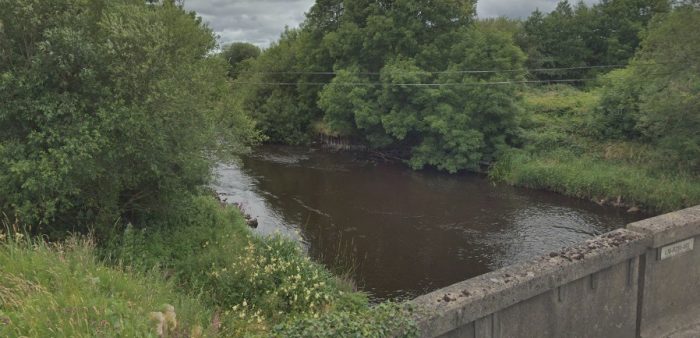
Originally, Drumshanbo was neither a staff nor a crossing station but from 1892 it became both, although the loop used was near the goods store and not opposite the platform. The line at the latter point was merely a goods loop (being protected by traps) and was not laid till 1915. At the Ballinamore end of the station a short line diverged on the left to serve Campbells’ hardware store; the line was built in 1920 and was worked by hand points before being connected to the ground frame in later years. Other sidings were laid in 1890, 1902 and 1913. The goods store and loading bank were on the left on a curve and the private Lairds’ Store was at the end of the store road. The goods sidings, and the running line in between, curved both left and right in turn, within the station boundaries, and working could be quite complicated, especially if it was necessary to run round via one of the sidings.” [1: p145] Looking East through Drumshanbo Station site in 2018 towards Ballinamore.Looking West from beside the goods shed (Google Streetview).

The adjacent monochrome image shows a view looking back to the station from alongside the sidings shown on the OSI Map extract above. [16]
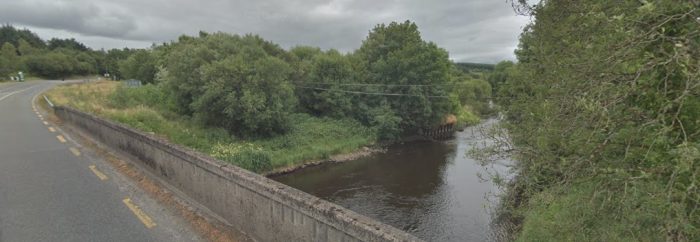
Flanagan continues: “Outside the station, the line met the un-gated road-crossing at Carrignabrack. It was on a four-chain reverse curve and a few yards beyond it was a second similar crossing. Once more on the right of the road the line crossed the Lough Allen Canal and then passed through a pleasantly-wooded section on a low stone embankment.” [1: p145]This OSI Map extract shows the tramway crossing the road on two occasions, leaving the tramway on the left of the road when it crossed the canal. [6]

The adjacent image shows the level-crossing just prior to the Lough Allen Canal Bridge. [16]Immediately after crossing the canal the tramway crossed the road again and continued on the north side – the right side of the road heading for Arigna. [6]The route to the West (Google Streetview) 2018. The Lough Allen Canal as it appears on the North side of the R208 (Google Streetview) 2018.The OSI Map Extract shows the line curving gradual towards the Northwest and the road (in the bottom right corner heading Southwest. The Mahanagh Crossing and the Shannon Bridge are near the top left of the extract. [6]This satellite image shows the old railway alignment which was on its own right of way and the modern R208 which follows the same alignment until it curves away to give room for a junction with the R280. [7]
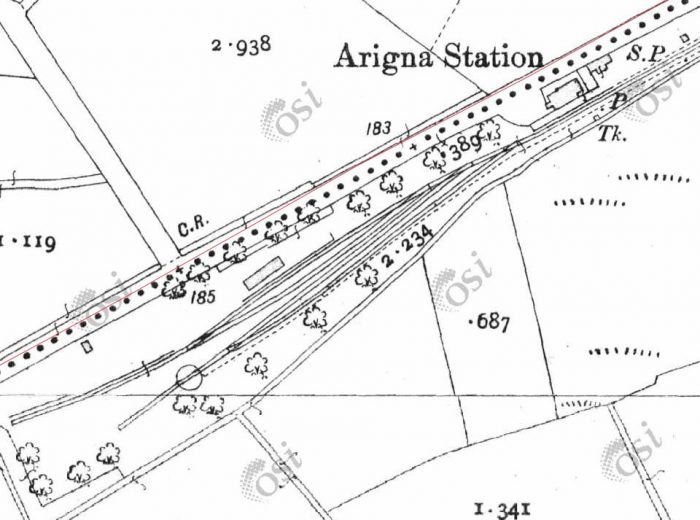
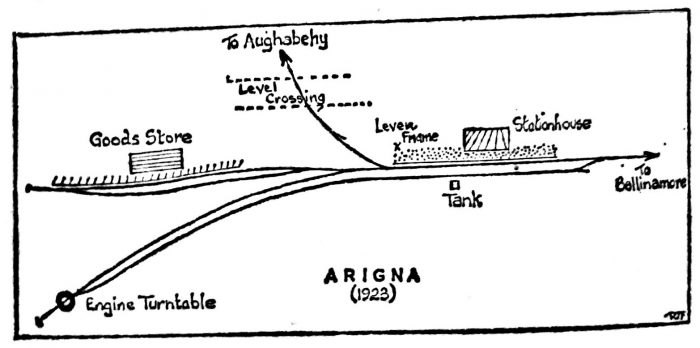
“There was a short fall at 1:28 at the ‘12.75’ milepost, where the road swung to the left and made a U-turn to recross the line again at Mahanagh gates (13.25 miles). A little beyond the crossing the line rose slightly to cross the single-span girder Shannon Bridge.” [1: p145]Mahanagh Level Crossing looking back from a train of empty coal wagons towards Drumshanbo. [13]Shannon Bridge looking back from the same train of empty coal wagons towards Drumshanbo. [13]The Map extract shows Mahanagh Crossing to the bottom right. The crossing cottage only just edges into the extract. Shannon bridge is towards the top of the extract with the road bridge (Galley Bridge) alongside. [6]The Crossing keeper’s cottage at Mahanagh has been extended significantly. The line passed on the near side of the cottage not far from the location of the access gates to the cottage in 2018 (Google Streetview). Two images above of the River Shannon looking to the south side of the R208. The location of the railway bridge abutments on each bank can just be seen, (Google Streetview). The adjacent image shows the railway bridge from the southwest with the road bridge behind. [11]

“The tramway was now in Co. Roscommon and just past the river it rejoined the road, remaining on the left of it for most of the run to Arigna. The section rose slightly at 1:193 and was dead straight for over half a mile before leaving the road for good and curving left to run into Arigna station (14.75 miles).” [1: p145]The end of the line at Arigna before the construction of the extension. [6]A closer image. The layout is not the same as below as re-modelling took place as the extension was built. [6]Flanagan’s sketch plan of Arigna Station. [1: p146]

For details of the Extension, please follow this link: https://rogerfarnworth.com/2019/04/26/the-cavan-leitrim-railway-arigna-valley-railway.

The Arigna station, as shown in the adjacent National Library of Ireland image, [18] “was delightfully situated in a glade of tall alder trees, and had a very elongated layout. The station-house was on the one platform on the right, with the ground frame at the west end. The Arigna station-house was always the odd man out on the C&L. In latter days it was of concrete block construction, [adjacent, [19]] the building dating from 1923-4. The original was also non-standard, being a single-storey, red, corrugated-iron structure. A more solid building was not possible as a firm foundation could not be obtained. Light as the original was, there were reports of it sinking in December 1890, though the engineer managed to cure this trouble. The new house was much more solid, and had as foundation 100 wagon-loads of material from the pit at Ballyheady.” [1: p146]

The run-round loop was at first beyond the platform and it curved left, ending some little distance from the station at the 24ft turntable. Off it, to the right, a goods loop diverged, upon which were a loading bank and store. Past the latter, the loop closed into a single line which served another loading bank, authorized in November 1888.” [1: p146]

The Arigna yard seen from close to the passenger station building. the line curving away to the right is the Extension. [20]

“After the opening of the extension, the layout was changed and the run-round loop was ex-tended to the Ballinamore end of the platform. The first line then to diverge right was the extension itself, the other being the lengthened goods loop. The goods store was of corrugated  iron with a high gabled roof, and it survived until about 1940.” [1: p146-147]Arigna Station viewed from the East – 2-6-0T locomotive No.3T sits at the platform. [17]The station building in the early 21st century, also taken from the East, (Google Streetview).

“Arigna station was the only Class 4 one on the C&L but the £45 allowance was augmented by the Arigna Mining Company, which also paid for the 1892 ballasting of the station-yard and used to share the other general expenses of the station. There was a stable for cart-horses in the yard and, for some six years after its opening, a carriage shed, situated opposite the goods store. This was another Rogers building but the smallest on the line, its dimensions of 60ft X 12ft X 10ft being only just enough for the single branch coach; it was transferred to Ballinamore in 1894. A water tank, erected in 1889 and replaced in 1892, was built on a crate of sleepers opposite the station-house. The second tank was also positioned there and, although officially unrecognized, Arigna had water till the end. It was pumped by hand and was used only when drivers were trying to coax leaky engines. A cart weighbridge, for the coal traffic, was provided early on and replacements were installed on two occasions though none survived to the closure. [1:p147]Turning the locomotive at Arigna was a very exacting task as the locomotive turntable was short for the Tralee and Dingle engines. The locomotive had to be properly balanced on the pivot otherwise the fireman would not be able to move the engine. The driver is pushing from the rear. [17]

References

  1. Patrick J. Flanagan; The Cavan & Leitrim Railway; Pan Books, London, 1972.
  2. https://maps.nls.uk, accessed on 22nd May 2019.
  3. http://railthing.blogspot.com/2015/10/?m=1, accessed on 25th May 2019.
  4. https://www.ebay.co.uk/itm/Cavan-Leitrim-NG-Railway-3-different-Sets-of-10-6×4-Black-White-photo-prints-/292954701892, accessed on 11th June 2019
  5. http://www.cowgill.org.uk/CLR/index0001.html
  6. http://geohive.maps.arcgis.com/apps/webappviewer/index.html?id=9def898f708b47f19a8d8b7088a100c4, accessed on 11th June 2019.
  7. http://www.railmaponline.com/UKIEMap.php, accessed on 11th June 2019.
  8. https://picclick.co.uk/Cavan-Leitrim-NG-Railway-3-different-292954701892.html, accessed on 11th June 2019.
  9. https://www.pinterest.co.uk/53Stapleton/ireland-co-leitrim, accessed on 11th June 2019.
  10. https://picclick.co.uk/fg-irish-plain-back-postcard-ireland-leitrim-railway-401505238559.html, accessed on 24th May 2019.
  11. https://www.northernsound.ie/podcast-off-beaten-track-narrow-gauge-railway-belturbet-dromod, accessed on 14th June 2019.
  12. http://www.buildingsofireland.ie/niah/search.jsp?type=record&county=LE&regno=30808003, accessed on 13th June 2019.
  13. https://www.youtube.com/watch?v=Uvg1qAQ9THQ, accessed on 13th June 2019.
  14. http://www.buildingsofireland.ie/niah/search.jsp?type=record&county=LE&regno=30808002, accessed on 13th June 2019.
  15. http://www.buildingsofireland.ie/niah/search.jsp?type=record&county=LE&regno=30808001, accessed on 13th June 2019.
  16. http://catalogue.nli.ie/Search/Results?lookfor=Drumshanbo&type=AllFields&submit=FIND, accessed on 13th June 2019.
  17. https://chasewaterstuff.wordpress.com/2014/06/12/some-early-lines-ireland-arigna-cavan-and-leitrim-railway, accessed on 15th June 2019.
  18. http://catalogue.nli.ie/Record/vtls000304124 ((c) James P. O’Dea), accessed on 15th June 2019.
  19. http://catalogue.nli.ie/Record/vtls000304126 ((c) James P. O’Dea), accessed on 15th June 2019.
  20. http://catalogue.nli.ie/Record/vtls000304127 ((c) James P. O’Dea), accessed on 15th June 2019.
  21. https://www.ebay.ie/itm/EIRE29-1950s-ARIGNA-STEAM-RAILWAY-TRAIN-CARRIAGE-at-STATION-Photo-IRELAND-/122769139155?hash=item1c959c65d3, accessed on 15th June 2019