Category Archives: Uganda and Kenya Railways

Various posts about railways in East Africa

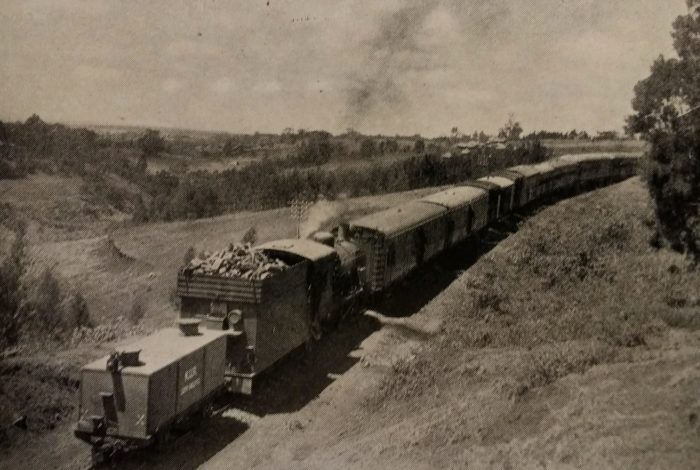
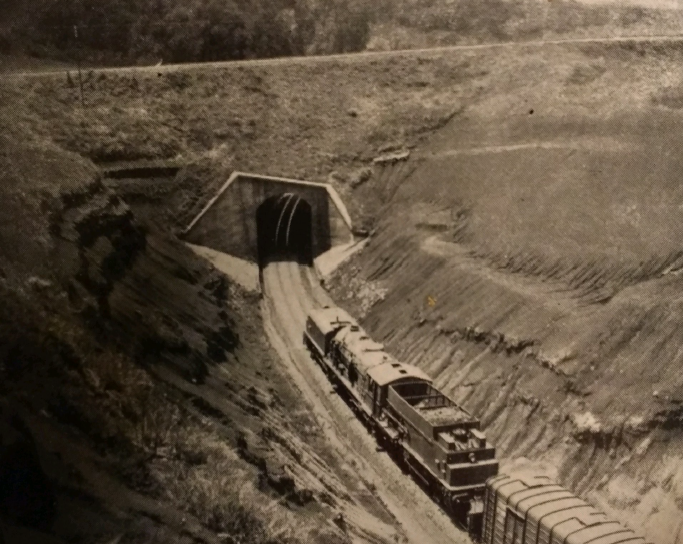
The Uganda Railway – Part 10A – West of Nakuru – Sugar Factory Branches on the approach to Kisumu.

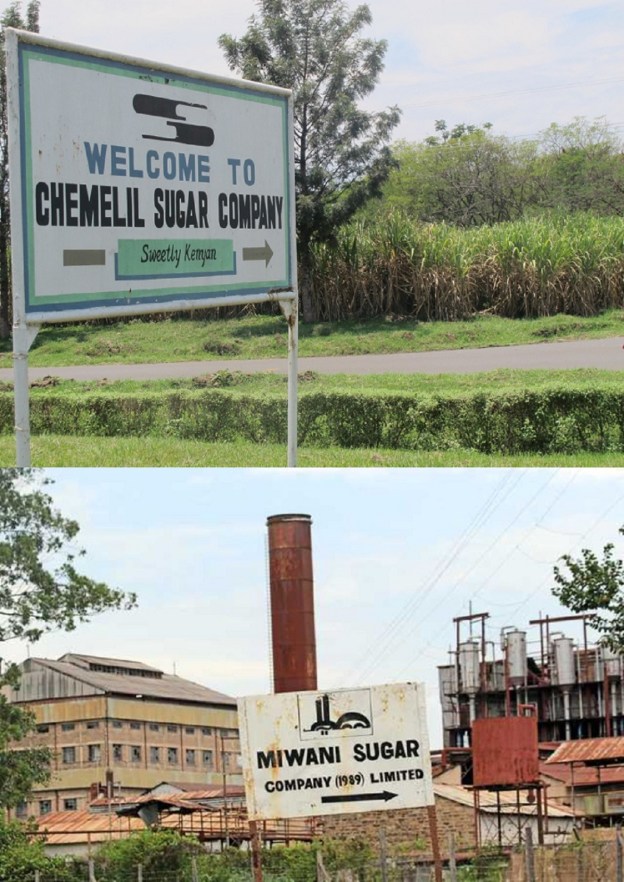
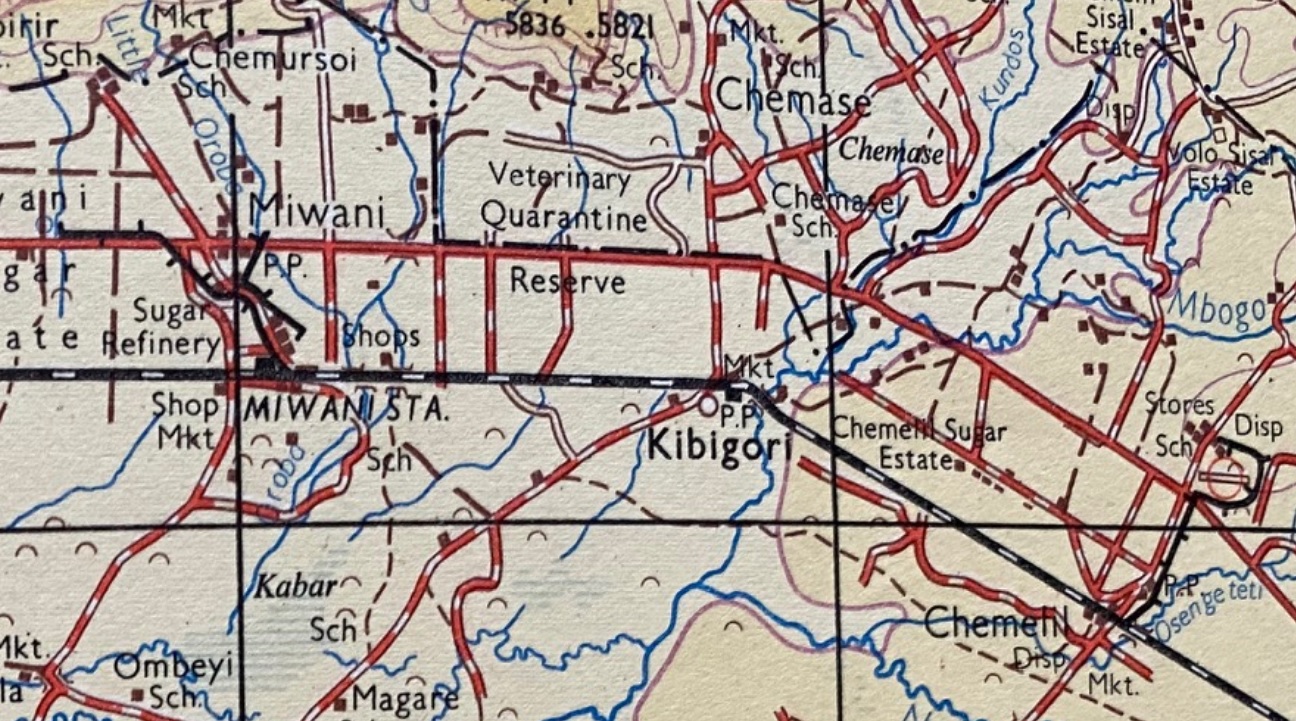
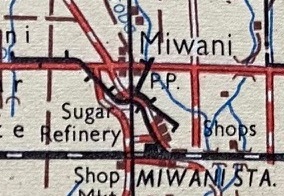
On the final approaches to Kisumu the line passed through a significant sugar cane growing region. Sugar processing factories were set up in two locations along the line – Chemelil and Miwani. Both these locations were provided with short branch-line connections to the main Nakuru to Kisumu line. Both of these branch-lines are shown on the 1:250,000 OS Maps from the second half of the 20th Century. [1] The extract below is taken from an image file very kindly sent to me by James Waite.

a

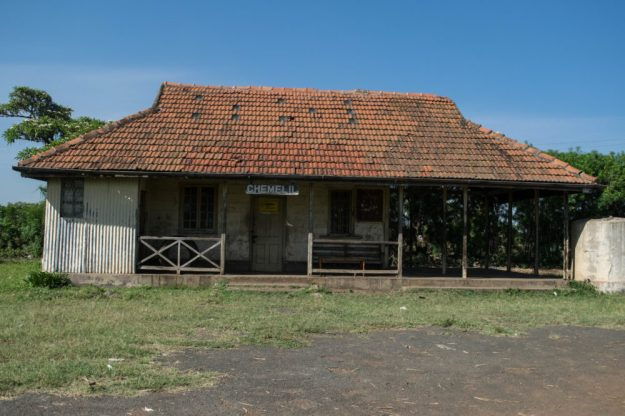
Chemelil Railway Station was 26 miles East of Kisumu and was mentioned in Part 10 of the main series of articles about the Uganda Railway which can be found on this link:

https://wordpress.com/post/rogerfarnworth.com/8058

chemilil-railway-station-25-03-2016-e1484401060558Chemelil Railway Station. [2]

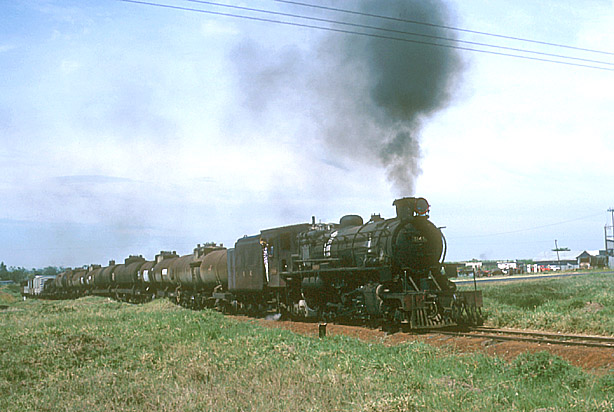
Chemelil in the mid-1950s. A double headed passenger train arrives at Chemelil, 26 miles from Kisumu .  The pilot engine is 2445  (c) Ron Bullock. [3][4]

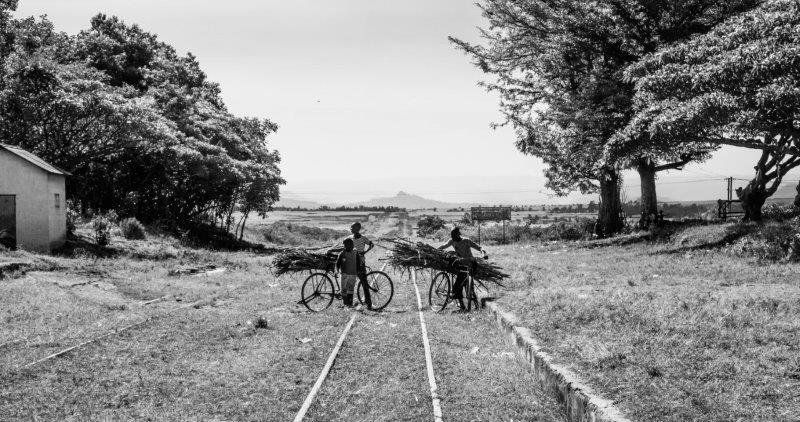
Children cross the tracks at Chemelil. [2]

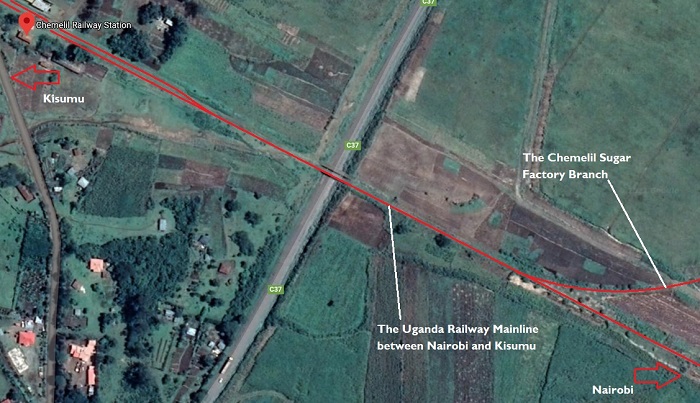
The short branch-line to Chemelil Sugar Factory left the mainline just to the Southeast of the Station beyond the C37 road. The next image shows a trip-working on the branch-line in the 1970s.

_rdky086

Although the condition of the locomotives running on the mainline freight service dictated the need for a double-header, the short branch to the sugar mill at Chemelil was out of bounds to heavier of the two locomotives in charge of the train, No. 2924. This meant that No. 3145 had to make the trip along the branch-line on its own. This picture is (c) Rob Dickinson and used by kind permission. [8]

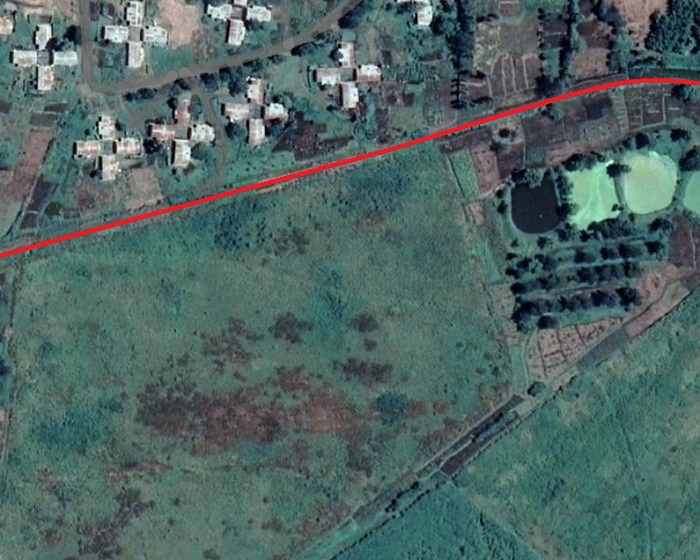
The branch travelled over relatively flat land, its junction with the mainline is shown on the first satellite image below it is followed by a series of satellite images which follow the line of the branch.

Chemelil 1

The branch junction at Chemelil was sited to the Southeast of the C37 road (Google Maps).

Chemelil 2

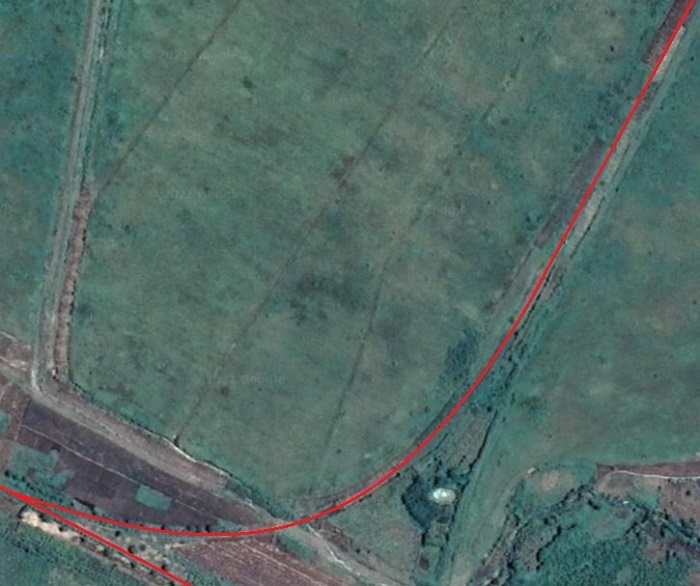
The branch travelled North East away from the mainline (Google Maps).

Chemelil 3

The C37 and the route of the branch-line soon converged (Google Maps).

Chemelil 4

Road and rail ran parallel to each other for a short while (Google Maps).

Chemelil 4a

Road and Rail ran parallel to each other just a few metres apart (Google Streetview)

Chemelil 6

As the C37 approaches a large roundabout, the branch turns gradually away form the road (Google Maps).

Chemelil 7

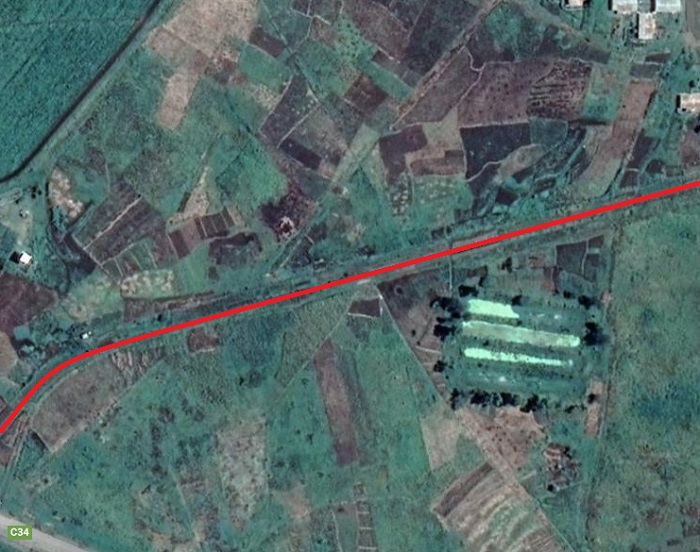
Just Southeast of the large roundabout junction between the C37 and the C34 the route of the line crossed the C34 and turned further round towards the East (Google Maps).

Chemelil 8

And across the southern side of the workers village at the Sugar Factory (Google Maps).

Chemelil 9

The line continues across the South side of the Factory workers village (Google Maps)

Chemelil 10

Before swinging away to the South (Google Maps)

Chemelil 11

And then round to the North along the West side of the settlement (Google Maps).

Chemelil 12

Then back around to the West as it approached its terminus in the industrial complex (Google Maps).

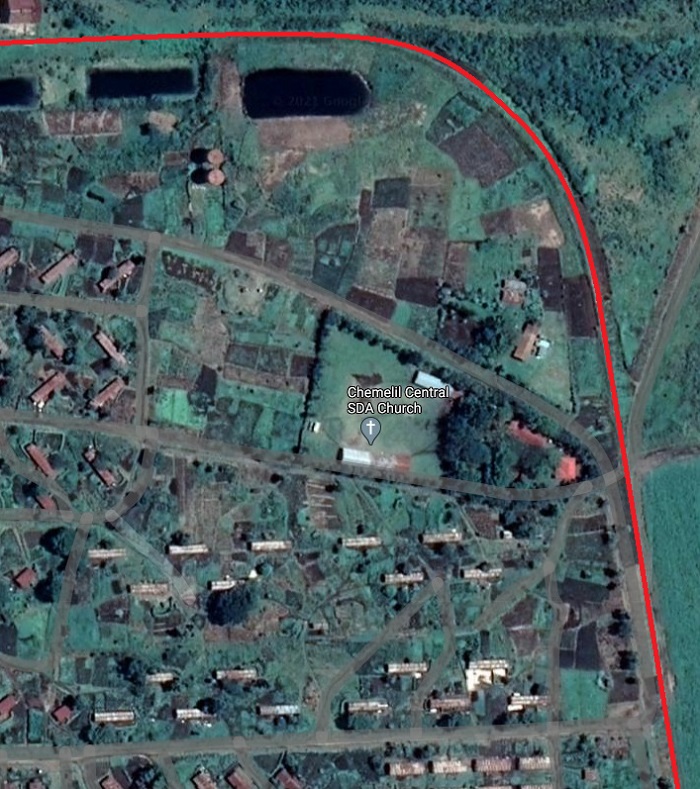
Chemelil 13

Chemelil Sugar Factory from above (Google Maps).

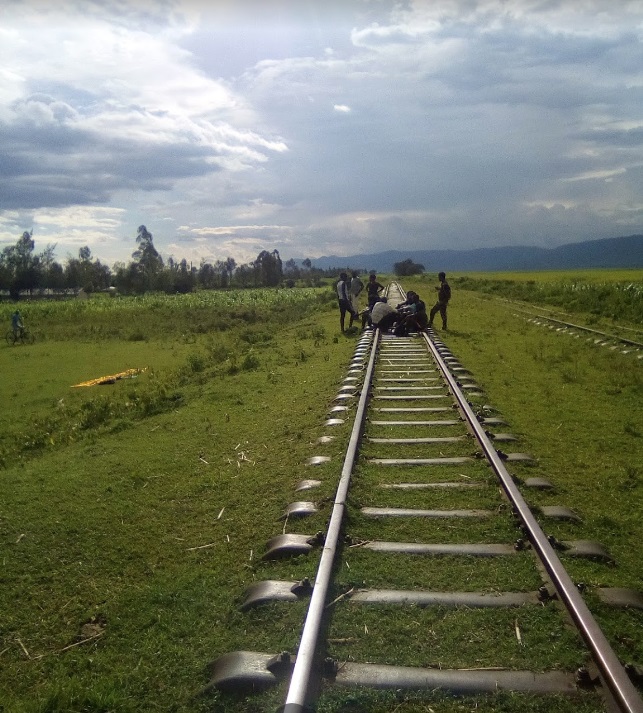
The Mainline to Kisumu travelling Northwest from Chemelil Railway Station followed a straight line to Kibigori. The next two images are taken just a short distance to the Northwest of Chemelil Station.

Chemelil 1A - (c) Joshua Obera - April 2018

Looking Southeast towards the Chemelil Railway Station (c) Joshua Obera – April 2018. [9]


Chemelil 1B - (c) Joshua Obera - April 2018

Looking Northwest towards Kibigori, from the same location (c) Joshua Obera – April 2018 [9]


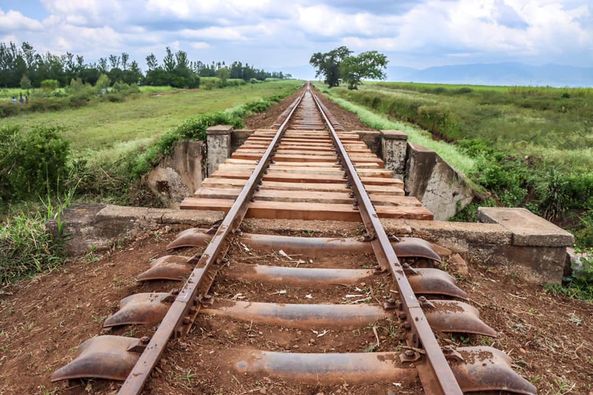
139464266_3961245250574828_1601926355108115922_n

Rehabilitated bridge at km 174 on the Chemelil – Kibigori Section (c) Kenya Railways January 2021. [5]

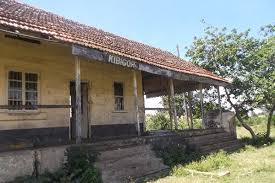
Kibigori Railway Station was only a short distance Northwest along the mainline beyond the Nyando River. The adjacent photograph shows the station building. [6]

Leaving Kibigori, the line now travels due West to Miwani and then on to Kisumu.

Kibigori Station 1

Kibigori Railway Station (Google Maps)


Miwani 1

The Miwani Sugar Factory branch-line. [1]

Miwani Station building is shown below, the Sugar Factory branch-line left the mainline just to the East of the station and ran directly to the Sugar Factory. Subsidiary lines spread out at the factory to serve close-by cane fields. It is interesting to note that there were also a series of more temporary light tramway lines in use, as explained below.Miwani Railway Station Building. [7]

The route of the branch-line is shown on the satellite images that follow:

Miwani Station 1

Trains from the East were able to access the branch on a facing turnout/point (Google Maps).

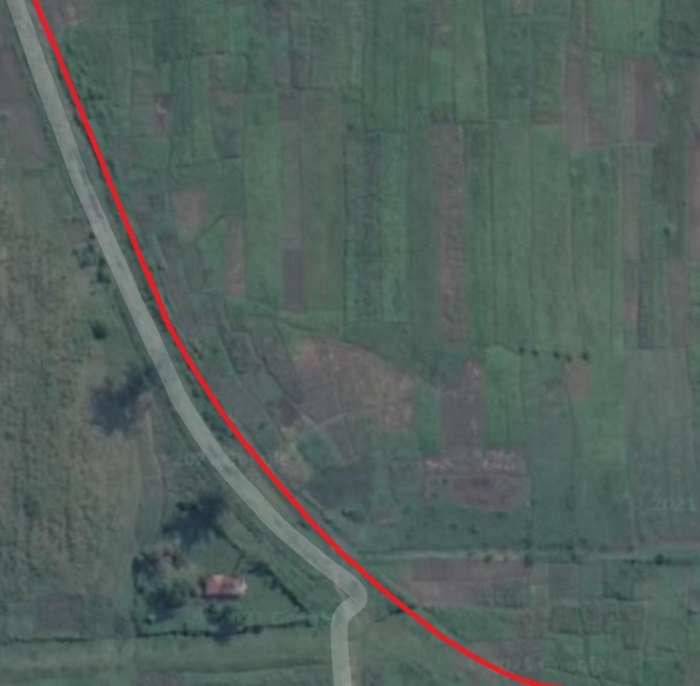
Miwani Branch 2

The branch ran alongside the railway station approach road from the Sugar Factory and the C34 to the North, almost all the way to the Factory. The full length is not shown in these satellite images (Google Maps).

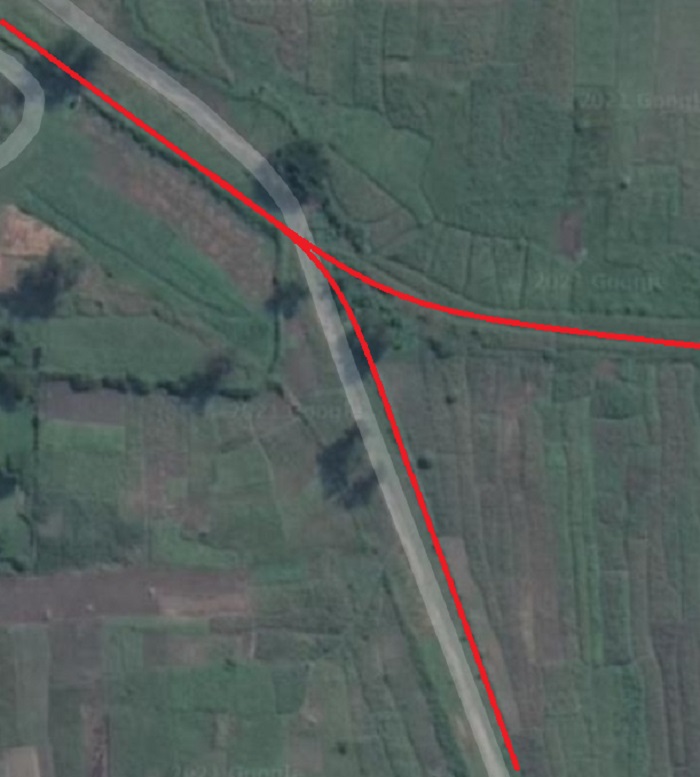
Miwani Branch 6

Immediately before reaching the factory sidings the line crossed the access road while turning towards the Northwest and was joined by one of the distribution lines from/to the cane fields (Google Maps)

Miwani Branch 7

The Miwani Sugar Factory. Its sidings were on its Northeast flank (Google Maps).

Miwani Branch 8

The approximate layout of the feeder lines to the Factory. These were supplemented by lighter tramways which are explained below (Google Maps).

Miwani Sugar Factory was once named the Victoria Nyanza Sugar Company and was one of the earliest plants of its kind in Kenya. The notes which follow are gleaned from a paper written by Godriver A. N. Wanga Odhiambo, “Colonial Sugar Production in Nyanza: (Kibos-Muhoroni) The Asian Initiative, The Genesis, and
Development of Kenya’s Sugar Industry, 1903-1963.” [10]

Given the problems of transporting sugar cane along relatively poor roads The Victoria Nyanza Sugar Company set up an alternative means of transport to the raods and the heavier metre-gauge lines. Large-wheeled metal containers were moved around the sugar cane estates on the Company’s own trolley or tramway lines. This network required its own ordinance, (the Victoria Tramway Ordinance No.1 of 1922). This ordinance was introduced specifically to enable the company to convey sugarcane from the neighboring farms to the factory on trolley lines which were drawn by small locomotives. [10: p205]

Wanga Odhiambo says that “a tramway was built in 1923 by the Victoria Nyanza Sugar Company, starting on its own estate and running along a line of a public road, and terminating at the Kibos railway station.” Wanga Odhiambo [10: p206] If this is correct, the trolley way would have followed the line of the C34 road which appears in the satellite images above and would probably have been an extension to the short length of line that appears on the satellite image above.

Wanga Odhiambo also comments that: “According to the agreement between the Victoria Nyanza Sugar Company and the railway, the company was allowed the use of the railway siding line from Miwani railway station to the company’s nearby sidings. This was meant to be used for light trolley conveyance; thus the railway provided the engine for use of the trolley.” [10: p206]

“Farmers were expected to allow feeder lines to be laid and maintained in their fields for transport of cane from the adjoining farms by extension of the feeder line. Farmers also had access to portable tramlines which were connected to the nearest mainline and when not in use these were removed and returned to the nearest mainline. This arrangement by the Kenya-Uganda Railway facilitated the transportation of cane from the farms to the factory, but again it could only help those farmers whose farms were near the railway line, since the feeder lines were not very long.” [10: p207] 

The cost of using the mainline was high and only 8 wagons were provided by the Uganda Railway per day for moving cane along the mainline. The result was quite an extended network of trolley lines being created to enable  cane to be transported to Miwani from as far away as Chemelil.

The majority of these tramways/trolleyways have left little evidence of their existence, they were light and easily moved and they were often moved to suit the needs of farmers.

References

  1. Modern versions of the 1:250,000 Map of Kenya can be sourced from a variety of online sales sites. This extract can be found on Map No. SA-36-04. 
  2. http://www.savetherailway.com/scenes, accessed on 24th May 2018.
  3. https://www.pinterest.com/pin/554083560377608216, accessed on 25th May 2018.
  4. http://www.mccrow.org.uk/eastafrica/eastafricanrailways/NairobiKisumu.htm, accessed on 22nd March 2021.
  5. https://www.facebook.com/permalink.php?id=248578828508174&story_fbid=3961245473908139, accessed on 24th March 2021.
  6. https://nation.africa/kenya/life-and-style/saturday-magazine/bitter-sweet-railway-tales-920850, accessed on 22nd March 2021
  7. http://lastdanceinkaloleni.co.ke/save-the-railway-exhbition/kenya-miwani-railway-station-1-of-1-4, accessed on 22nd March 2021.
  8. https://www.internationalsteam.co.uk/safari/kenya314.htm, accessed on 22nd March 2021.
  9. https://www.google.co.uk/maps/place/Chemelil+Railway+Station/@-0.1059847,35.111779,3a,75y,90t/data=!3m8!1e2!3m6!1sAF1QipOswTA_nt0PRTN_1v6oYXNZrtHhPp95MV0Ifcm4!2e10!3e12!6shttps:%2F%2Flh5.googleusercontent.com%2Fp%2FAF1QipOswTA_nt0PRTN_1v6oYXNZrtHhPp95MV0Ifcm4%3Dw203-h270-k-no!7i1920!8i2560!4m5!3m4!1s0x182a85c2400ef241:0x40029cd4350e8b0a!8m2!3d-0.1059847!4d35.111779, accessed on 23rd March 2021.
  10. Godriver A. N. Wanga Odhiambo; Colonial Sugar Production in Nyanza: (Kibos-Muhoroni) The Asian Initiative, The Genesis, and Development of Kenya’s Sugar Industry, 1903-1963; West Virginia University; Chapter 5 p199-228; accessed via https://researchrepository.wvu.edu/cgi/viewcontent.cgi?article=4567&context=etd, on 24th March 2021.

The Kenya and Uganda Railways and Harbours – The Great Depression and Years of Argument

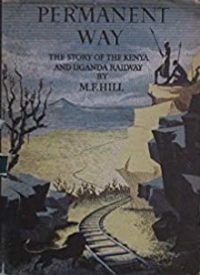
I recently picked up a copy of each of the two volumes of ‘Permanent Way‘ written by M.F. Hill and published in 1949. The first volume [1] is a history of ‘The Uganda Railway’ written in the 1940s when the railway company was known as ‘The Kenya and Uganda Railways and Harbours’ and published at the end of that decade under the jurisdiction of the new ‘East African Railways and Harbours’ which was formed to formally include the infrastructure in the modern country of Tanzania.

Hill’s first volume provides a detailed history of the Uganda Railway until just after the end of World War II.

Previous articles in this series based on Hill’s 1949 book are:

Uganda at the end of 19th century and the events leading up to the construction of the Uganda Railway.

The Uganda Railway at the beginning of 20th century.

The Uganda Railway during the First World War

The Uganda Railway in the first 5 years after World War 1

The Uganda Railway: the Gilded Years 1924-1928

The Great Depression and the Pre-War Years

This article covers the final period between WW1 and WW2. Despite the title of this chapter in Hill’s book which refers to years of argument, these notes focus on the railway rather than on the political machinations of the time.

“Towards the end of 1928, the representatives of the Kenya and Uganda Railways and Harbours and of the Tanganyika Railways met in Nairobi to consider ways and means of securing an assimilation of the traffic of the two systems.” [1: p 476]

The two railway systems abandoned preferential rates for local produce [1: p476] and arranged for the through booking of passengers and goods [1: p477]

Throughout 1928 and 1928, the development and improvement of the railway made good steady progress. Twelve Mikado engines, pictured below, arrived, along with 3 modified corridor coaches. [1: p477]

The East African Railways and Harbours Magazine carried a single page article on the Class 28 locos in 1955. [4]

Mombasa to Nairobi replacement of rails was completed in February 1929. Between M’bulamuti and Namasagali two additional sleepers per length of rail were added to permit the use of larger locomotives. At Kilindini further improvements were made and a new tug was purchased. [1: p477]

Railway construction was progressing well:

  • Gilgil to Thomson’s Falls: started January 1928. – 48 miles completed by 31st August 1929.
  • Tororo to Soroti was completed in September 1929.
  • Jinja, Uganda – The Bridge Over the Nile. The completeion of the bridge and its opening in January 1931 saw the completion of the route from Mombasa to Kampala. [2]

    Kisumu to Yala was delayed by heavy rains and only completed  in November 1930.
  • Naro Moro to Nanyuki was completed by October 1930.
  • Jinja to Kampala started in 1929 and other than the bridge over the Nile was completed in January 1930. The bridge was opened to traffic in January 1931. [1: p478]

Further extensions West from Kampala were under consideration. Survey parties looked at possible routes to the border with the Belgian Congo – South of Ruwenzori and South of Lake Albert. [1: p478] Revenue estimates were not possible without a clear commitment from the Belgian authorities. [1: p479]

“By the end of 1930 the days of inflation, the years of heavy loan expenditure and of soaring revenues were finished, and the railway was struggling to balance its budget by drastic economies which, in effect, added to the havoc of a vicious deflation. At that time, the total route mileage of open lines had increased to 1.557 miles and the route mileage on the Lakes to 3,246 miles. The railway’s expenditure on capital account amounted to £21,463,704 of which £13,097,160 was interest-bearing capital. … The annual loan charges borne by the railway amounted to £690,181 and they were still rising.” [1: p481]

From Autumn 1928 to the end of 1931 two plagues of locust devastated the East African economy. [1: p481/482] In tandem, the stock market collapse at the end of 1929 in New York led to international problems with deflation. There was a startling drop in the value of primary products on world markets. [1: p482]

East Africa was particularly susceptible to the combined problems of drought, locusts and economic disruption:

  • Maize dropped in value to around 1/3rd of its 1928 price;
  • Sisal dropped to around a quarter of its 1928 value;
  • Butter to around 1/3rd;
  • Wattlebark to around 1/5th (Wattle is the same as ‘Acacia’)
  • Hides in Narok fell to 1/5th of their former price;
  • Ghee fell by 66%; and
  • Beans and Wimbi (finger millet) fell by 50%. [1: p483]

The value of Uganda’s exports at the ports fell from £4.3 million to £2.1 million in 1930. It was estimated that the fall in value of Uganda’s exports reduced railway revenue by around £400,000. [1: p483]

The situation in Kenya initially appeared different, heavy rains contributed to a sharp increase in the colony’s domestic exports by around £677,000, but by the following year they had fallen by over £1 million and they continued to drop. They’d sunk to £1,910,000 by 1931. Uganda’s exports had fallen in value to below £2 million. [1: p483]

Early in 1930, the important reduction of the 2% grade on the main line between Makupa and Mazeras to 1.5% was started. It was complete by November 1930 and included the provision of a spiral which lengthened  the line by 3/4 mile. [1: p501]

Nairobi-bound trains pass under the higher level of the spiral before then crossing over the lower line. Malcolm McCrow provides a few images from 1970s. [3]

In 1931, the combined earnings of the railways and harbours declined to £2,246,837, and in 1932, to £2,172,946. [1: p502] By 1934, the combined earnings of the railways and harbours were £265,270 less than in 1929 but ordinary working expenditure had been reduced by £543,120 as a result of reductions and efficiencies made by the railways. The nett surplus was £344,654. The countrywide  reduction in the transport of lower value crops meant that traffic reduced but was focussed on higher value traffic. [1: p517-518]

In 1935, the surplus increased to £362,391. A succession of good cotton crops in Uganda contributed to the restoration of the railways finances. [1: p518]

In 1936, the surplus improved again, to £415,048 even though the railway authorities had applied some rate reductions for the transport of goods at the end of 1935. [1: p518-519]

In 1937, gross earnings of the railways and harbours reached a peak of £3.35 million and the surplus was £584,326, of which only £105,196 was carried forward, the remainder was committed to Betterment, the General Reserve, the Pensions Reserve, and depreciation. Hill provides a table which shows that 1937 compared well with 1929: [1: p524]

Year                                                                           1929                            1937

Railway Revenue (excluding Harbours)     £2,448,960                  £2,715,524

Railway ton/miles                                           385,708,364                504,274,001

Railway Working Cost                                     £1,445,070                  £1,261,278

The Great Depression was described by the General manager as a “blessing in disguise, in so far as it had imposed new standards of efficiency and economy. During 1937, rate reductions estimated to cost £155,000 were introduced and further reductions estimated to cost £146,200 came into force on 1st January 1938.” [1: p524]

In 1938, the railway surplus was £285,796. In order to assist coffee producers through a period of low international prices, rates for them were reduced in both 1938 and 1939.

Planned railway improvements included regrading the main line between Uplands and Nakuru at an estimated cost of £446,000. Work started between Uplands and Gilgil but the remaining length to Nakuru was delayed by negotiations with farmers over transport rates. The advent of WW2 put the argument and the improvements into abeyance. [1: p525]

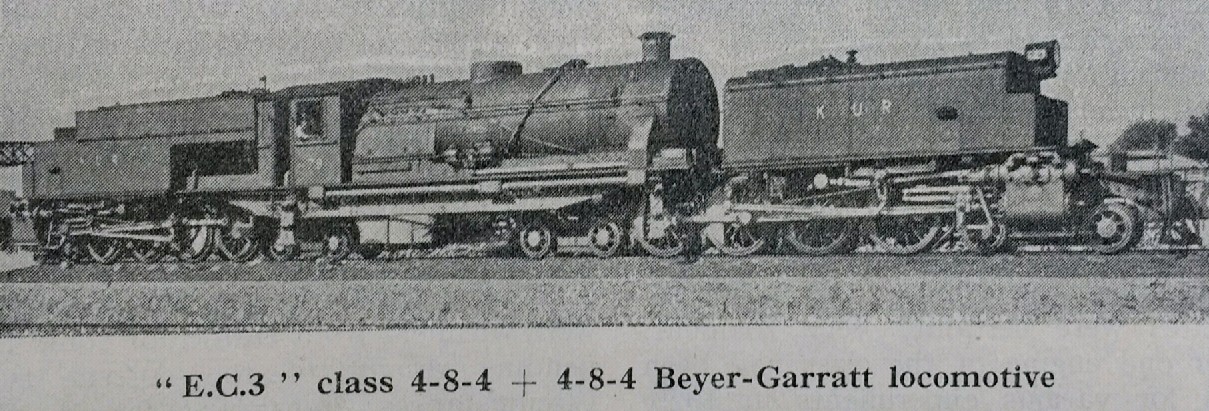
Throughout 1938 and 1939 railway policy was influenced by a growing recognition that another world war was inevitable. In September 1939, the General Manager wrote that “the railways and harbours had never been in a better position than they were in the September of 1939 to meet all the demands that might be made on them. In 1938 and 1939, the railway received a substantial reinforcement of new rolling stock, including 193 covered goods wagons,b115 open trucks and 35 third-class corridor coaches which were to prove invaluable for troop movements. Six new Garratt [EC3 Class] engines, built to specifications worked out by Mr. K.C. Strahan, the Chief Mechanical Engineer, and his staff, arrived in 1939 and proved a great advance on earlier types. The railway workshops were well equipped and the general stores position was satisfactory. In consequence, the railway was able to play an indispensable part towards the victory of the East African campaign and the maintenance of Kenya and Uganda’s economy,” during World War 2. [1: p526]

The KUR EC3 class, later known as the EAR 57 class, was a class of 4-8-4+4-8-4 Garratt-type articulated steam locomotives. The twelve members of the class were built by Beyer, Peacock & Co. in Manchester, England, for the Kenya-Uganda Railway (KUR). They entered service between 1939 and 1941, and were later operated by the KUR’s successor, the East African Railways (EAR) [5]

References

  1. M.F. Hill; Permanent Way – The Story of the Kenya and Uganda Railway – Volume 1; Hazel, Watson & Viney Ltd, Aylesbury & London, 1949.
  2. https://www.pinterest.co.uk/pin/347269821240026671, accessed on 18th February 2021.
  3. McCrow.org.ukhttp://www.mccrow.org.uk/EastAfrica/EastAfricanRailways/NairobiMombasa.htm, accessed 14th May 2018.
  4. Staff writer (April 1955). “”28″ Class Locomotive” (PDF). East African Railways and Harbours Magazine. East African Railways and Harbours. Volume 2(2): p57. Accessed on 17th June 2018.
  5. https://en.m.wikipedia.org/wiki/KUR_EC3_class, accessed on 19th June 2018.

The Uganda Railway: the Gilded Years 1924-1928

Great advances in the development of East Africa occurred during these years. A serious attempt was made to unify the East African Territories. “Kenya became a playground for wealthy sportsmen who came to shoot, or to photograph, big game, and they spent much money on their sport.” [1: p443]

The following Earnings/Working Profits are recorded in or estimated from Hill’s narrative:

Year           Earnings        Working Profits

1924          £1,635,189       £756,722            [1: p447]

1925          £1,993,509       £903,438            [1: p456]

1926          £2058,710        £841,937            [1: p459]

1927       £2,257,403       £1,030,000           estimated [1: p463/4]

1928       £2,511,227               –                     [1: p475] working profit not recorded by Hill

1929       £2,825,310               –                     [1: p475] working profit not recorded by Hill

The 1924 the working profit was reduced by £149,004 of loan charges.£165,579 was credited to the Renewals Fund and £438,139 to the Betterment Fund. Together with other sums, the result was that in 1925, £750,000 was put to a programme of renewals/betterment. There was also heavy expenditure on port development, new lines, rolling-stock and equipment. East Africa’s transport needs were expanding rapidly. [1: p447]

A search on Facebook produced this composite image on the Baringo New Channel [2]

Image

Twitter carries this image of a railway bridge on the metre-gauge line in hilly Timboroa [3]

By the end of 1924, the Uasin-Gishu line had reached Timboroa; the Thika line had been extended to the Tana River. The Solai branch and the Kitole branch were under construction.

During 1925, the Thika line was expected to reach Nyeri, and the Uasin-Gishu line beyond Timboroa, through Turbo into Eastern Uganda was being funded by a £3.5 million loan. It was required – there had been a very rapid increase in traffic which was causing significant connection at the ports on Lake Victoria and at Mombasa. [1: p448/9]

At the end of 1924, 30 miles of the Mombasa to Nairobi mainline had been relayed with 80-lb rails. Work continued slowly through 1925. [1: p450]

On 3rd February 1926, the Kenya & Uganda (Transport) Order in Council was promulgated. The name of the railway was changed from the ‘Uganda Railway’ to the ‘Kenya & Uganda Railway’. [1: p453] At this time the Inter-Colonial Railway Council held its last meeting. The railways were placed under the command of the High Commissioner who was also Governor of Kenya and a new ‘Kenya & Uganda Railway Advisory Council’ held its first meeting in February 1926 at Entebbe. [1: p453/4] It decided that the most pressing need was for there to be negotiations with the Tanganyika authorities to ensure that the two railway systems collaborated, rather than competed, with each other for custom. [1: p454]

There was continued criticism of congestion at ports and in Uganda, [1: p457] with goods delayed and damaged in transit. Criticism failed to take account of a significant increase in demand for railway services, nor of problems at ports which were outside of the control of the railway authorities.

By 1926, the mainline rail replacement programme had reached Makindu, 207 miles from Mombasa. New Central railway offices were under construction in Nairobi. The Uganda extension has reached the Eastern edges of the M’pologoma Swamp but the length heading East was over 10 months behind schedule due to supply problems across Lake Victoria. [1: p462]

In 1927, a commission to review the possibility of uniting the three East African Territories was set up. When it reported in 1929, it suggested that the two railway systems of East Africa must eventually be amalgamated under one management. “Meanwhile … there was much that could be done in the direction of assimilation of rates, the standardisation of engines, rolling stock, equipment and rules and regulations, all of which would greatly facilitate amalgamation in due course.” [1: p467]

In September 1927, Felling, a strong supporter of ‘Closer Union’ spoke his mind in the Legislative Council. As part of his comments he stressed that one management of the Kenya and Uganda Railway and the Tanganyika Railway must “come in due course, but there [was] no urgent need for amalgamation of management’s; and anyway, such an amalgamation would be very difficult to arrange until there  [was] a definite railway link connecting the two territories.” [1: p468]

Further, he said, on the same occasion, that “it [was] clear that it [was] necessary for the general development of this part of the Empire that there should be rail communication between Kenya and the Central Tanganyika line, also a steady programme of railway construction to connect the Tanganyika Railway with Northern Rhodesia and Nyasaland …  [and] perhaps two lines, to the Congo.” [1: p468]

He argued that “railway development in East Africa should not be looked upon so much as an East African investment as a sound Imperial investment, as in the interests of the people of Great Britain even more than in the interests of the native inhabitants of the territories concerned.” [1: p469] He also argued for the rapid completion of a rail link from Jinja to Kampala.

In 1927, developments in the railways brought the advent of corridor coaches and dining cars. These were essential to a satisfactory timetable. 6 No. Mikado (2-8-2) locos were put to work on the 89-lb rails between Mombasa and Makindu. [1: p470/1]

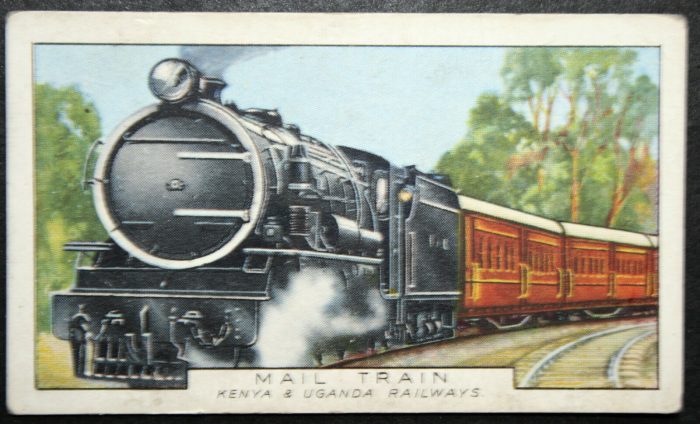
Kenya & Uganda Railways Mail Train 1930’s Vintage Card. [4]

Kenya & Uganda Railways Mail Train 1930’s Vintage Card. [5]

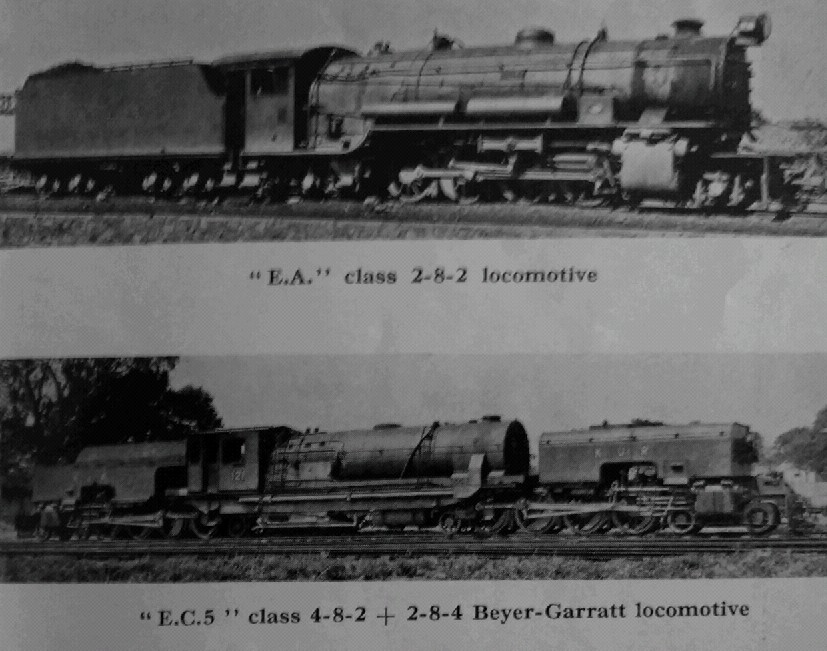
The KUR EA class, later known as the EAR 28 class, was a class of 1,000 mm (3 ft 3 3⁄8 in) gauge 2-8-2 steam locomotives. The six members of the class were built in 1928 for the Kenya-Uganda Railway (KUR) by Robert Stephenson and Company. Builder’s numbers were 3921-3926. They were numbered 2801-2806 on the Kenya & Uganda Railway. [6]

A road and railway causeway/bridge between Mombasa Island and the mainland was commenced in June 1927.

In addition to the Uganda extension, building of branch lines continued:

  • On 1st November the Nyeri branch reached lnaro Moru.
  • In Uganda, work commenced on the Tororo, Mbale, Soroti branch in February 1927.
  • A branch from Fulfil to Thomson Falls was approved.
  • A line from Kisumu towards Mumias was proposed.
  • A preliminary survey for a branch from Turi to Sotik was completed. [1: p471]

The Kenya & Uganda Railways & Harbours Logo, (c) Martin Greave, 2003 [7][8][9]

The railway’s name was changed by Order in Council on 20th December 1927, to the ‘Kenya and Uganda Railway and Harbours’. [1: p472]

On 15th January 1928, the final section of the Uganda Extension from Broderick Falls to M’Bulamuti opened to traffic. Within 9 months Christian Felling had died as a result of a severe attack of malaria.

The figures listed above show impressive growth in the years to 1929. The figures fr the following period fell just as rapidly as we will see. Hills says that “although it was not yet apparent, the railway, in common with Kenya and Uganda and the greater part of the civilised world, had come near to the end of the gilded years of prosperity.” [1: p475]

References

  1. M.F. Hill; Permanent Way – The Story of the Kenya and Uganda Railway – Volume 1; Hazel, Watson & Viney Ltd, Aylesbury & London, 1949.
  2. https://www.facebook.com/BaringoNews/photos/a.695797717132551/1628337577211889/?__cft__%5B0%5D=AZXJTt5l44WKBwkc0OGOfdIBXJh5I0bMPcuQteTC_Me64OsopQKfjMESZy7PrPzOAchw-FVc0KdGd_asD0vB0qxFYfXPjx9uZ5ZJuAzio6UEu7EiKntyV2sqAzLkwPgR33qQ1HSeBZ77yIYr-80TACI2&__tn__=EH-R, accessed on 6th February 2021.
  3. https://twitter.com/kresearcher/status/417357022041227266, accessed on 6th February 2021.
  4. https://www.ebay.co.uk/itm/Kenya-Uganda-Railways-Mail-Train-1930s-Vintage-Card-VGC-/383704927668, accessed on 6th February 2021.
  5. https://www.pinterest.co.uk/pin/319614904809896703, accessed on 6th February 2021.
  6. https://wikivisually.com/wiki/KUR_EA_class, accessed on 6th February 2021.
  7. https://www.fotw.info/images/e/eaf)kur.gif, accessed on 6th February 2021.
  8. https://en.wikipedia.org/wiki/Kenya_and_Uganda_Railways_and_Harbours, accessed on 6th February 2021.
  9. https://www.worldcat.org/title/story-of-a-railway-adapted-from-permanent-way-the-story-of-the-kenya-and-uganda-railway/oclc/11895232, accessed on 6th February 2021.

The Uganda Railway in the first 5 years after World War 1

I recently picked up a copy of each of the two volumes of ‘Permanent Way‘ written by M.F. Hill and published in 1949. The first volume [1] is a history of ‘The Uganda Railway’ written in the 1940s when the railway company was known as ‘The Kenya and Uganda Railways and Harbours’ and published at the end of that decade under the jurisdiction of the new ‘East African Railways and Harbours’ which was formed to formally include the infrastructure in the modern country of Tanzania.

Hill’s first volume provides a detailed history of the Uganda Railway until just after the end of World War II. This article covers the period between WW1 and WW2.

In the years immediately after WW1, further European settlement was encouraged and ‘European’ electoral areas were set up. By 1921, the Census revealed the European population of the EAP to be 9,651 and the Indian population to be 22,822. [1: p379]

No effective provision was made in the 1919 Ordinance which established the European franchise, for Indian elected representatives. This was a cause of Indian resentment [1: p379f] Changes in India led to a greater Indian interest in politics in what, in 1920, became the Kenya Colony. The annexation of the EAP took place in June 2020, only the area lease from the Sultan of Zanzibar were excluded (a 10 mile wide costal strip).

In addition to the Indian issue, political turmoil/controversy revolved round issues which had an ill-effect on the new colony’s economy. These included:

  • the virtual bankruptcy of The Uganda Railway;
  • the need for drastic reorganisation;
  • the lack of aboriginal contribution to the colony’s economy – the native population was producing little of value on world markets;
  • the Indian community had yet to make a net contribution to the economy of the Colony.

The number of ex-pat European farmers was only 1,339, most in financial difficulty because of lack of experience, falling prices and a “disastrous currency conversion.” [1: p381] …… The rising value of the Indian Rupee against the pound resulted in a dramatic increase in the sterling value of all local services and commodities. The European settler in 1919 received 850 rupees for £100 instead of the rate before the War of 1500 Rupees for £100. If the £3 million loan first discussed in 1913 had been raised in 1919 its value would have been a third less than in 1913. The farmer also received far fewer Rupees for his sterling exports – he had to sell twice as much produce to meet his liabilities. [1: p382]

After much debate and extensive negotiation the sterling value of the East African Rupee was fixed at 2 Shillings. This was relative parity with the Indian Rupee at the time, but within 6 months the exchange rate in India settled back to historic levels of around 15 Rupees to the pound. [2: p384f]

Settlers costs were as a result fixed at a very high level, their income was held down and then they had to watch as Government salaries were increased by 50% to maintain the value of salaries at an equivalent sterling value. All government related costs charged to settlers where increased by more than 50%. [1: p385f]

Pressure to revert to a conversion rate of 15 Rupees to the pound was resisted by HM Government, the 2 Shilling (Florin) of the Rupee was maintained. However, a local review highlighted a need to create a lower standard denomination and this was eventually accepted. The order came into force on 1sr January 1922 and the Shilling became the standard currency its value set at 20 Shillings to one pound sterling. [1: p388]

The new currency maintained the high exchange rate and as a result local costs had to be reduced. Native labour lost 33% of the increase which came from the high exchange rate although, in practice, this meant that their buying power returned to historic levels.

Hill comments that another effect was the greater pressure placed on the aboriginal/indigenous populations in the reserves to take up paid employment outside the reserves. The terms on which this occured were seen by Mission Societies and the Aboriginal Protection Society. Hill says that this was an ill-informed response, however the parallel scheme in Uganda was more onorous. “In Uganda a native could be called out to work, by compulsion and with no pay, for thirty days a year,band for a greater variety of communal purposes than in Kenya.” [1: p392]

Hill says that by 1920, Kenya was planning to extend the line across the Uasin-Gishu Plateau towards Uganda and the Thika Line to Nyeri. The lack of local labour resulted in the Kenyan authorities it arrangements for forced labour into line with Uganda which inevitably drew more criticism. [1: p392]

Hill tells of a significant debate over the relative merits of the settler’s need for labour and the protection of the rights of indigenous labourers. By 1921, Winston Churchill, who had just inherited the role of Secretary of State ensured that the Kenyan Government would only use forced labour when it was absolutely necessary. In 1922, this became a statute at the time when it also became a requirement to seek HM Government approval for the use of compulsory labour. In 1923, Uganda followed suit. [1: p393]

Between 1919 and 1939, compulsory labour was only once called upon to work for the State. “In 1925 the Secretary of State agreed that compulsory labour should be employed on the extension of the Uasin Gishu Railway and on the line from Thika to Nyeri. In each case the need was urgent, because construction was severely retarded – with heavy financial loss – by a lack of labour. The largest number of compulsory labour employed in any one month was 1,500 on the Uasin Gishu line and 1,300 on the Thika-Nyeri line.” [1: p394]

Hill notes that as of the end of March 1920 the outstanding grant and loan balances available to improve the railway were £1,301,033. The settlement of the rupee-shilling conversion in 1921 enabled the colony to raise a loan of  £5 million of which over £4.2 million was designated for use on the railway.

In May 1921 it was decided at a meeting in London that the financial year of the Kenya Colony should become the same as the calendar year.

Over the next few years, the recall of the Military Governor, Sir Edward Northey, led to a significant change in direction for the colony. Northey had worked to the dictum that European interests were paramount and that Indian interests should not be ignored [1: p397ff] The new commitment of HM Government is described by Hill, quoting from the Devonshire White Paper: [2]

“The general policy underlying any decision that may be taken on the questions at issue must first be determined. It is a matter for satisfaction that, however irreconcilable the views of the European and Indian communities in Kenya on many points may be, there is one point on which both are agreed, namely, the importance of safeguarding the interests of the African natives. …” [1: p399]
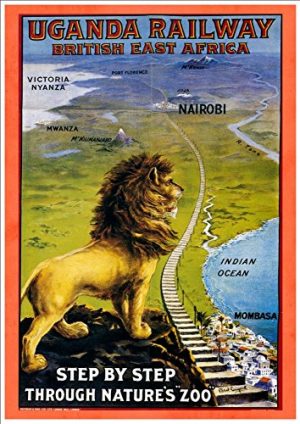
This policy change was significant. Hill says that HM Government now regarded “themselves as exercising a trust on behalf of the African population, … the object of which may be defined as the protection and advancement of the native races.” [1: p400]

Whether Hill interprets the situation correctly may be open to interpretation, certainly the Wikipedia article about the White Paper suggests a slightly different motivation. [2] However, it does seem to be the case that the net result was Kenya avoiding the route that was pursued in South Africa and Southern Rhodesia. [2]

Returning to focus more directly on The Uganda Railway. … The Working Profit of the Railway, even when enhanced by some creative accounting was much lower immediately after WW1 than in earlier years. The figures from within Hill’s account are:

1919-1920         £62,582        [1: p402]

1920-1921      £155,916        [1: p404]

1921                  £15,883        [1: p407]   –   only 9 months and in the midst of a worldwide depression.

1922                  £56,785        [1: p436]

1923                £300,910        [1: p439]

34 No. ‘G’ Class locomotives were delivered by the North British Locomotive Co. and 17 of these were in service by the end of March 1920. At that time, two more were on order from Nasmyth, Wilson & Co. Ltd. A daily service once again became possible along the full line. However, of the 36 new locomotives, 21 were intended for the Magadi Line traffic. [1: p402]

It was as late as 1st April 1921 that the Secretary of State finally rules that the working profit of the railway was no longer to be regarded as available for general colonial revenue purposes and that any surplus generated was to be used:

  • first, for renewals, upkeep and betterment of the railway;
  • second, for meeting loan charges on future development costs;
  • third, for a reduction in railway rates. [1: p404]
Hill notes that the general improvement in the economy brought significant pressure to bear on the railway – the numbers of engines, carriages and goods wagons available  for use was short, it seemed, on what demand required. Despite night-shift working in the maintenance facilities, 24 engines were in the year awaiting overhaul in August 1920. [1: p405] These problems were mitigated by using 17 locomotives and 108 covered wagons intended for the Magadi Line, as anticipated traffic did not arise from the Soda Works until 1921. [1: p406]

At the end of 1920, Lieut.-Colonel F.D. Hammond was appointed by the Secretary of State as Special Commissioner for Railways, Eastern Africa. He arrived in Kenya on 20th January 2021 and left on 24th August 2021 after completing his tour of investigation. His report brought about a new era in the history of The Uganda Railway [1: p409,410]

Meanwhile, Hill writes, there was a significant debate being played out over the route of the Uasin0Gishu Line. An argument had been put forward for a revised alignment which left the existing main line  on the Mau Plateau rather than at Nakuru. There would have been significant initial cost savings if proponents of this route were to prevail. However, given the increasing levels of traffic from Uganda, major improvements on the existing line between Nakuru and Mau Summit would inevitably be necessary in the relative near future. The ruling grade would have needed to be improved from 2% to 1.5% and concomitant improvements to structures would also be required if transportation costs were to be kept as low as possible. The originally surveyed route from Nakuru would, while costing more initially, would result in lower transportation costs. [1: p410-414]

Hill comments: “There is no doubt that the conclusion reached … in favour of the Nakuru route was sound, although much of the financial argument could not be sustained. … The line took far longer to build than was expected, it proved exceedingly expensive and, during the building, there was persistent friction between … the Chief Engineer … and the senior representative in Kenya of the contractors.! [1: p141]

Hammond, says Hill, reported in May 1921 that he was in full agreement with the Nakuru route “being economically the proper one to choose.” [1: p415] He strongly urged acceptance of that route. Hill goes on to say that while this debate was raging, “Hammond was devising a plan for the complete reorganisation of the railway.” [1: p415]

A new ‘Inter-Colonial Railway Council’ was set up with terms of reference provided by Lord Milner, the Secretary of State, which made that Council the effective administration authroity for the railway and all auxiliary services. Hill says that they were “to be administered as a single instrument for the benefit of Kenya and Uganda by a body of men who, with the expection of the Chairman (Hammond was in the Chair at first) were unlikely to have much experience of railway policy or practice.” [1: p419]

When Hammond left Kenya in August 1921 the position of General Manager of the railway was decreed by the Secretary of State as including the role of Chair of the Council. [1: p422]

Hill goes on to discuss the Hammond report – the main points raised were that there:

  • had been gross inefficiencies in freight transport – goods from Kisumu to Mombasa were taking close to 8 days to travel a distance for which the working timetables allowed 2.5 days. Goods from Mombasa to Nairobi were taking as much as 12.5 days to cover the scheduled running time of 1.33 days. Hammond estimated that the efficient running of the network would result in an 11% surplus capacity with the existing availability of goods wagons at the heaviest envisaged traffic levels (including for Magadi’s output). [1: p422-423]
  • was a need for a marked improvement of the telegraph system to ensure safe operating of the railway; [1: p 423]
  • was a need  a better cleaning regime, particularly of passenger stock; [1: p 423]
  • was too much centralisation of maintenance and no progress in developing maintenance facilities, particularly for locomotives; [1: p 423-424]
  • were huge stocks of coal; [1: p 424]
  • was major work required to maintain/replace machinery in teh worskshops; [1: p 424]
  • were ineffective financial controls in the workshops and in the Chief Mechanical Engineer’s Department; [1: p 424]
  • was a major need for investment in replacement of time served timber buildings; [1: p 424-425]
  • was undue pressure on the General Manager from the Protectorate Government to minimise expenditure on the railway; [1: p 425]
  • was no programme for replacement of railway structures.  Although properly maintained, structures would not be adequate for the axle loads of the next generation of locomotives; [1: p 426]
  • was an over-provision of steamers on the Lakes with no possibility of sale to others; [1: p 426]
  • was no possibility of improving the capacity of Lakes steamers as Kisumu Port could not be developed to accommodate ships with a greater draught; [1: p 426-427]
  • were significant losses on the Busoga Railway and the Port Bell-Kampala line caused by a failure of the Railway to properly credit income to those lines. Thos losses were then being born by the Uganda Government; [1: p 427]
  • was a need to focus on generating traffic from Uganda and the Belgian Congo [1: p427]
  • was work to do to address expensive, slow and cumbersome systems in the Stores and Accounts Departments.
  • were too many staff drawn from India rather than from a wider pool and very little intention to employ local staff to do anything other than manual roles. [1: p427] This meant that the railway was entirely dependent on the economic and political circumstances which might arise in India. [1: p428]
  • had been a failure over 20 years to train local technical staff especially when compared to the situation pertaining in Tanganyika which had been in the German sphere of influence. [1: p428]

Hammond placed the highest priority for action on creating a comprehensive technical training scheme for local staff. He proposed the diversion of capital from the £300,000 fund set aside for the provision of additional rolling stock.

He instituted, with Railway Council agreement, a new goods tarrif system which focussed on maximising revenue. It had a tapering system of rates dependent on volumes carried and a far simpler classification of goods. The system was uniform across the network and ensured that “no transport be done at less than cost price.”[1: p429]

He also insisted that the General Manager should place a high priority on public relations and must “be directly represented on Chambers of Commerce and other local associations.” [1: p429]

Hammond estimated that the required annual contribution to a Renewals Fund should be around £280,000 and that there should also be:

  • a three-year programme to replace worn out plant/machinery at a cost of about £24,000/annum; and
  • a five-year programme of building replacement costing £112,000/annum. [1: p 430]

He emphasised the paramount importance of separating colony and railway finances, and suggested that capital costs for the development of the railway were for the colony to bear, withe the railway being tasked with the operating of the network. [1: p431]

Hammond also stipulated that, to ensure fair-dealing with Uganda, Kenya and Uganda should be placed under one Governor-General or High Commissioner to whom the railway would be responsible. [1: p432]

As a final matter, he looked into the status of the Voi-Kahe branch built during WW1. His recommendation was that “the last 57 miles of track at the Modi end of the Tanga line be picked up and used for the betterment of the costal section [in Tanganyika] and that the Voi-Kahe line be retained, regraded and realigned. He considered that the cost of the reconstruction of the Voi-Kahe line should fall upon Tanganyika as the chief benefactor, and he devised a financial arrangement whereby the Territory would bear all loss and collect all profit derived from the line. [1: p433]

Implementation of Hammond’s report was delayed by political issues. There was major controversy over the probable impact of his recommendations and implementation was delayed “pending further negotiations and discussions.” [1: p434]

The railway concentrated on reform of its own administration. The Railway Council pressed for urgent action where economies could be immediately effected. [1: p434-435]

In January 1922, the Council considered the reduction of coal stocks. It decided that the General Manager had acted in the best interests of the railway in purchasing the coal but considered that the information given to him “as to the state of the home markets at the time in question left much to be desired.” [1: p435] It was resolved to sell surplus coal stocks at the best prices obtainable.

At the end of 1922, a new General Manager was appointed. Within 3weeks or arriving, C. L. N. Felling, ” had devised a scheme for the control of the railway. It was discussed for nearly two years, but the eventual Order in Council differed little from Felling’s original draft. [1: p435]

After considerable debate, a final decision over the Voi- Moshi line was made. It was resolved to keep the line open. [1: p437-439] “Within a few years the line was paying its way, and it later became the first section of any railway in British Africa where the engines were driven by Africans, who also provided the bulk of the signal and station staff.” [1: p439]

At the end of 1923, the General Manager’s report announced a significant programme of new construction which included  the extension of the Uasin-Gishu line to meet the Busoga Railway in Uganda. “Considerable extensions and improvements to the mechanical workshops were carried out during the year and the repair of locomotives … was up to date. During 1823, thirty-seven engines were thoroughly overhauled, five were scrapped, … and twenty new engines were erected.” [1: p441]
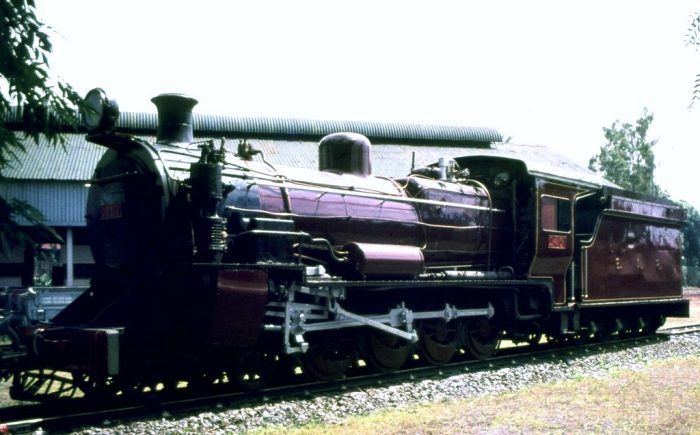
A Uganda Railway GD Class 4-8-0 Locomotive. The first of these was built in 1923 by the Vulcan Foundry of Nasmyth, Wilson and Co. They were numbered 162 to 217 and layer became Class 24 Locomotives as The Uganda Railway developed. [6]

Hill comments: “Within a year, Christian Felling had created an amazing improvement in the working of the railway. The financial position and prospect had changed for the better beyond the most optimistic prediction. It was only the start of great achievement: in the next 4 years he was to transform the railway and it’s finances.” [1: p442]


References

  1. M.F. Hill; Permanent Way – The Story of the Kenya and Uganda Railway – Volume 1; Hazel, Watson & Viney Ltd, Aylesbury & London, 1949.
  2. Wikipedia notes: This document was intended to create “a compromise between Indian interests and those of the Europeans, despite its affirmation of African paramountcy. [3] Nevertheless, the Paper allowed for the (slow) improvement of African conditions, such as the establishment of technical schools for Africans by a 1924 Education Ordinance, as well as the appointment of Eliud Mathu to the Legislative Council, the first African to hold a seat. It also allowed for the formation of an African party, the Kikuyu Central Association, which presented African grievances to the colonial government. Although the Indians were prevented from settling in the White Highlands, they were granted five seats on the Legislative Council and immigration restrictions imposed on them by the white settlers were removed. [4] The White Paper was used by the British government to retain control over the Kenya Colony, and is cited as one reason why Kenya did not develop as a white minority ruled country, as South Africa and Southern Rhodesia did.” [5] https://en.wikipedia.org/wiki/Devonshire_White_Paper; accessed on 3rd January 2021.
  3. Robert M. Maxon; The Devonshire Declaration: The Myth of Missionary Intervention; History in Africa Volume 18,1991, p259–270.
  4. History and Government Form 2 Teachers Guide. East African Publishers. p91–92
  5. Robert M. Maxon; Struggle for Kenya: The Loss and Reassertion of Imperial Initiative, 1912-1923. Fairleigh Dickinson Univ Press, 1993, p270–279.
  6. https://en.m.wikipedia.org/wiki/UR_GD_class, accessed on 8th January 2021.

The Uganda Railway during the First World War

I recently picked up a copy of each of the two volumes of ‘Permanent Way‘ written by M.F. Hill and published in 1949. The first volume [1] is a history of ‘The Uganda Railway’ written in the 1940s when the railway company was known as ‘The Kenya and Uganda Railways and Harbours’ and published at the end of that decade under the jurisdiction of the new ‘East African Railways and Harbours’ which was formed to formally include the infrastructure in the modern country of Tanzania.

Hill’s first volume provides a detailed history of the Uganda Railway until just after the end of World War II. This article covers the period of WW1.

Hill provides, at least as far as I can tell, what appears to be a very fair compilation of activity throughout the East Africa Protectorate (EAP) and the Uganda Protectorate UP) during the War. [1: p344ff] There was significant unrest in the EAP contributed to by a range of incompetencies exhibited by the EAP Government based in Nairobi, during the first year of the War. He highlights the importance of a meeting of Settlers in September 2015, which pressed on the Government the need for effective organisation and which resulted in the first elected representation for the Settlers onto a War Council.

Hill says that organisation improved markedly from this time on, although there were still significant losses in the community and the forces particularly due to fever. The German resistance throughout the War is noted by Hill as being one of “courage, endurance and astounding ingenuity” before it surrendered eventually on 25th November 1918. [1: p354]

Hill’s summary of the EAP campaign says: “The most ardent advocate of the East African campaign cannot maintain that it contributed to the ultimate to the ultimate defeat of Germany. The most caustic critic cannot deny that the story of the campaign is an epic of human endurance in the face of terrible trials. Fever, disease and starvation, through the breakdown of a suicidal system of supply, were von Lettow’s [2] allies, and they caused far more casualties than his soldiers.” [1: p354]

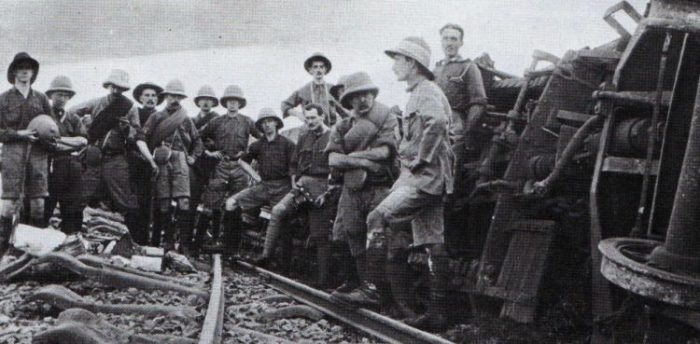
British troops after their train has run over a German mine. [3][4]

Hill points to the War Office record which states that, “during the campaign, 976 officers and 17,650 other ranks were killed, died or missing. Those figures covered the East African, South African, West African, British and Indian troops engaged in the campaign. In addition, 44,572 African porters were killed or died of disease. The maximum strength employed at any time was 24,156 combatants and 187,369 non-combatants. Altogether 112,000 fighting troops and 261,000 non-combatants took part in the campaign. Of the vast army of African porters, on which the transport and supply of the troops in the field mainly depended, nearly 60,000 were recruited in Uganda and the great majority of the remainder came from the Native tribes of the East Africa Protectorate. They were called upon to pay a terrible price in human life and misery because the First German War overspilt from Europe into Africa ” [1: p355]

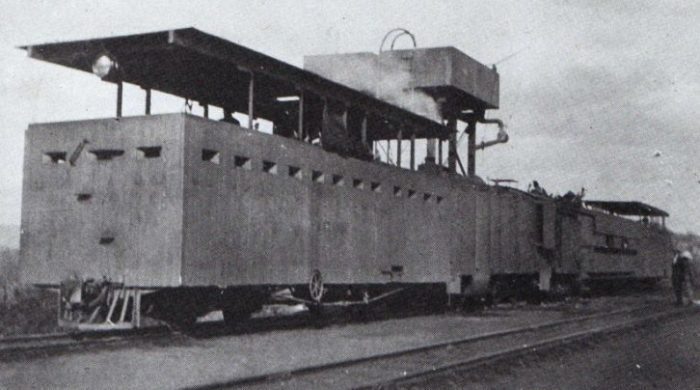
H.M. armoured train, ‘Simba’ was built in the workshops at Nairobi to counteract the German mounted patrols that carried out nuisance raids on the railway during the War. [3][4] It was destroyed by a mine.

He goes on to talk about ‘The Uganda Railway’. Throughout the text of the chapter on the War, Hill again provides details of the working profit each year:

1914-1915     –      £180,600     [1: p355]

1915-1916     –      £287,300     [1: p360]

1916-1917     –      £351,815     [1: p364]

1917-1918     –      £208,986     [1: p368]

1918-1919     –      £152,255     [1: p370]

During 1915, Parliament approved a loan of £1.868 million for further expenditure at Kilindini Harbour, for railway improvements and for roads and bridges. Only a fraction of the loan was spent until the end of the War. Survey work onthe line from Nakuru across the Uasinn Gishu Plateau did continue. Oil storage at Kilindini and at Kisumu was increased along with work to piers at several ports and Harbours associated with trade on Lake Victoria. One new ship, the ‘Rusunga’, was launched on the lake. [1: p355f]

Hill highlights locomotive developments in 1915: 3 new tank engines were put into service; seven ‘G’ class engines were erected but not out into service until 1817 for lack of flangeless tyres for the leading powered axle/wheel set.

Twenty-nine of the ‘F’ class locos were still working. By the start of the War, the annual engine mileage was 1,862,453 of which the ‘F’ class locos were doing about 50%. The Mallets (18 No.) were doing good work, hauling satisfactory loads, but we’re proving very expensive to maintain. [1: p356]

The Magadi Line opened on 14th January 1915, the Thika Line was still passenger only and already paying its way. The Busoga Railway was crippled by the major drop in export and import traffic. It had also been realised that the costs associated with making Lake Kioga navigable would be exorbitant.

Towards the end of 1915 it was decided to build a new branch line from Voi to Maktau to solve supply problems for the proposed offensive into German East Africa. In due course this line would be extended to Kahe and so would link The Uganda Railway with the line from Tanga to the foothills of Kilimanjaro. [1: p358]

At around this time the military took control of The Uganda Railway. [1: p358f]

By June 1915,1,166 vehicles were being dispatched  monthly from Kilindini. In January 1916 this had increased to 2,994 vehicles. Before the end of March 1916, 25 engines and 200 ten ton covered wagons had been imported from India, mainly for the Voi-Maktau line, but also to receive pressure on the main line. Further wagons were purchased from the contractors for the Magadi Line. [1: p359]

A working profit of £287,000 was achieved in the 1915/1916 financial year but there was no significant allowance made for necessary maintenance and a renewals fund had still not been created. The survey of the line across the Uasin-Gishu Plateau was completed and the first mention appeared in an Annual Report of the General Manager of this route becoming the start of a trunk line through Uganda to the Congo. [1: p361]

In November 1915, the Port at Kilindini was taken over by the Royal Navy and closed to civilian traffic. The inadequate Old Port at Mombasa had to be used for all exports.

The March 1817 report if the General Manager drew attention to the wretched state of engines and rolling stock.

Little had changed by March 1919. The General Manager’s report was a repetition of the difficulties of previous years:

“Little had been done to remedy a chronic decay, the difficulties had, inevitably, become more critical. Several engines had been taken out of service either for lack of spares or as not worth repairing. In February 1919, fifteen new ‘G’ class engines were ordered, but they were not expected to arrive before the end of the year. Meanwhile, of the railway’s ninety-two engines, only seventy-seven were in working order and many of those were in bad shape. Most of the railway’s original rolling-stock particularly the second- and third-class carriages, was virtually beyond repair except at great and uneconomic cost. The majority of the machines in the workshops were worn out and incapable of turning out accurate work.” [1: p371]

All the subsidiary lines were also showing a loss and it was recognised that the two lines in Uganda (Busoga and Port Bell) were too small to be operated effectively as separate systems. [1: p372]

“For years the Treasury of the EAP had pillaged the railway in order to balance its budget. Now the Treasury had extended the field of pillage to Uganda. By this time the state of the railway was so derelict and critical that some radical reorganisation could not long be avoided. The surcharge, and the protests of Uganda, proved to be the last straws. Undoubtedly they impelled the series of events and the design of policy which eventually placed the railway on a sounder constitutional basis and a very much sounder financial basis. Unfortunately, this ill-advised surcharge, following upon the long struggle to secure to Uganda a fair allocation of the customs revenue derived from its imports via Kilindini, left a legacy of suspicion and resentment which exercised an unhappy influence on relations between the two territories for many years.” [1: p373]

References

  1. M.F. Hill; Permanent Way – The Story of the Kenya and Uganda Railway – Volume 1; Hazel, Watson & Viney Ltd, Aylesbury & London, 1949.
  2. Lieut.-Colonel (later General) von Lettow-Vorbeck was the German commander-in-chief in East Africa and remained so throughout the conflict until the end of November 2018 when surrender became inevitable.
  3. http://www.kaiserscross.com/188001/293122.html, accessed on 28th December 2020.
  4. Lieutenant Colonel Charles Hordern; Military Operations East Africa August 1914 – September 1916; Battery Press, Nashville, Tennesse, 1990.
  5. The featured Image at the start of this article comes from http://ww1blog.osborneink.com/?p=10064, accessed on 28th December 2020

The Uganda Railway at the beginning of 20th century.

I recently picked up a copy of each of the two volumes of ‘Permanent Way‘ written by M.F. Hill and published in 1949. The first volume [1] is a history of ‘The Uganda Railway’ written in the 1940s when the railway company was known as ‘The Kenya and Uganda Railways and Harbours’ and published at the end of that decade under the jurisdiction of the new ‘East African Railways and Harbours’ which was formed to formally include the infrastructure in the modern country of Tanzania.

Hill’s first volume provides a detailed history of the Uganda Railway until just after the end of World War II. This article covers the period from the beginning of the 20th century up to WW1.

The railway was handed over to the administration of the East Africa Protectorate on 1st October 1903. [1: p236] Before that date, the line was in use  first, until 1901, primarily as a construction line. The period from the beginning of 1902 until 31st March 1903 was treated as one accounting year. In that first ‘year’, the working deficit of the line was £49.690. This figure excludes interest on the capital  cost of the line. [1: p236]

The actual capital cost was assessed as £5,502,592 which had been financed by annuities by HM Treasury. An annual payment of £319,112 [1: p242] serviced these annuities. When they were finally discharged in November 1925, the Uganda Railway had cost the British taxpayer just under £7,909,295. [1: p243]

In the years following its opening a working deficit was converted into a working profit. Yearly figures are provided by Hill within the narrative of following chapters of his book.

1903/1904       –      -£60,101      [1: p280]

1904/1905       –         £2,639      [1: p280]

1905/1906       –       £56,678      [1: p290]

1906/1907       –       £76,763      [1: p293]

1907/1908       –       £64,713      [1: p300]

1908/1909       –       £64,838      [1: p304]

1909/1910       –       figures not provided by Hill

1910/1911       –       £98,519      [1: p308]

1911/1912       –     £131,373      [1: p320]

1912/1913       –     £209,046      [1: p330]

1913/1914       –     £213,484      [1: p337]

Hill provides a snapshot of the situation on the Uganda Railway on 31st March 1905: “the staff of the railway consisted of 53 Europeans, 176 Eurasians, 1,254 Indians and 3,050 Africans. … The railway had 70 engines, 209 units of coaching stock and 947 units of good stock. The engines consisted of the 34 English-built Class F and 36 American-built Class B, which had all been used on construction.” [1: p290]

The profit margins quoted above were struck “without making provision for the renewal of wasting assets, without any charge for interest on the capital cost, and it accrued not to the railway, but to the Treasury of the East Africa Protectorate.” [1: p280] This was done so as to meet the debt owed to the British taxpayer both resulting from grant-aid and the loans made to cover the costs of building the railway. The grant-aid to the East Africa Protectorate was £2,843,383. The charge on the capital cost, as noted above, was £319,112 per annum. [1: p281]

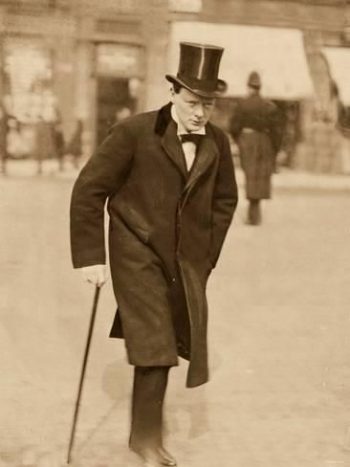
Winston Churchill in 1907, taken in London close to the time of his African Safari. [4]

Winston Churchill visited Uganda in 1907. Speaking about that time he commented that the Uganda Railway was “one of the most romantic and wonderful railways in the world.” [2: p3]

He writes: “Short has been the life, many the vicissitudes, of the Uganda Railway. The adventurous enterprise of a Liberal Government, it was soon exposed, disowned, to the merciless criticism of its parents. Adopted as a cherished foundling by the Conservative party, it almost perished from mismanagement in their hands. Nearly ten thousand pounds a mile were expended upon its construction; and so eager were all parties to be done with it and its expense that, instead of pursuing its proper and natural route across the plateau to the deep waters of Port Victoria, it fell by the way into the shallow gulf of Kavirondo, lucky to get so far. It is easy to censure, it is impossible not to criticize, the administrative mistakes and miscalculations which tarnished and nearly marred a brilliant conception. But it is still more easy, as one traverses in forty-eight hours countries which ten years ago would have baffled the toilsome marches of many weeks, to underrate the difficulties in which unavoidable ignorance and astonishing conditions plunged the pioneers. The British art of “muddling through” is here seen in one of its finest expositions. Through everything—through the forests, through the ravines, 5through troops of marauding lions, through famine, through war, through five years of excoriating Parliamentary debate, muddled and marched the railway; and here at last, in some more or less effective fashion, is it arrived at its goal.” [2: p4-5]

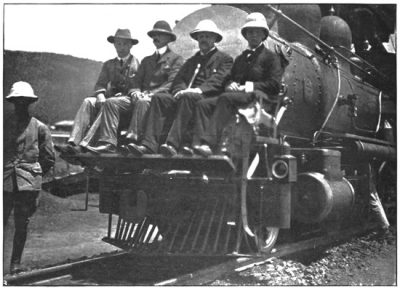
On the Cow-catcher. (Mr. Currie, Mr. Marsh, Col. Wilson, Sir J. Hayes-Sadler, Mr. Churchill.) [2: p7]

Churchill continues: “The Uganda Railway is already doing what it was never expected within any reasonable period to do. It is paying its way. It is beginning to yield a profit—albeit a small profit—upon its capital charge. Projected solely as a political railway to reach Uganda, and to secure British predominance upon the Upper Nile, it has already achieved a commercial value. Instead of the annual deficits upon working expenses which were regularly anticipated by those most competent to judge, there is already a substantial profit of nearly eighty thousand pounds a year. And this is but the beginning, and an imperfect beginning; for at present the line is only a trunk, without its necessary limbs and feeders, without its deep-water head at Kilindini, without its full tale of steamers on the lake; above all, without its natural and necessary extension to the Albert Nyanza.” [2: p6]

Winston Churchill was clearly impressed with the line, in the state that he found it, in 1907.

It was under the tenure of Sir Percy Girouard as Governor that serious thought was first given to real development of the railway and other transport infrastructure – railway, roads, hospitals and schools, and agricultural, veterinary and social services. “The railway needed a deep water quay, or pier, at Kilindini, and branch lines to bring traffic from potentially productive areas, remote from the main line.” [1: p307]

Sir Percy decided that a branch line North from Nairobi through coffee and sisal plantations and on into Kikuyuland was needed, with the hope that later on it could be extended towards Mt. Kenya. This did not receive support from the Treasury until the plan was revised to request permission to build a ‘tramway’ thirty miles long from Nairobi to Thinks. [1: p307]

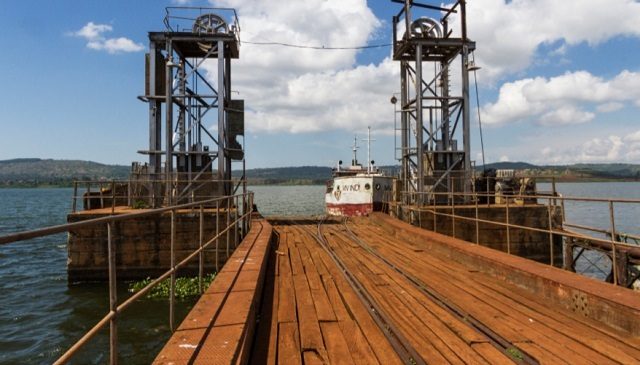
The Jinja Pier was built in 1912, it once served as the main export gate for Uganda. The the railway tracks can still be seen in the timber planking of the deck. [3]

Winston Churchill was a significant player in a decision to build a line from Jinja to Kakindi (the Busoga Railway) which was reviewed in 1911 as the port facilities developed were inadequate. A decision was taken to extend the line to Namasagali where better quay/port facilities could be developed. An amount of close to £170,000 was allowed for this line which could become a longer route to Lake Albert, a project put forward by Churchill which would have cost around £1.25 million. [1: p309-310]

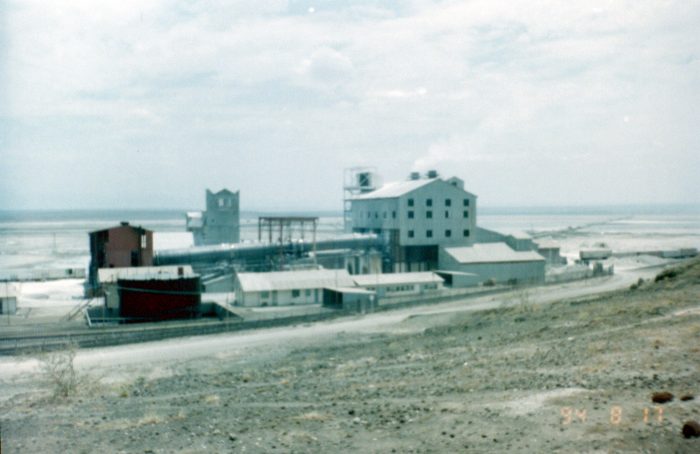
Magadi Soda Works in 1994 (my photograph).

At a similar time, negotiations were ongoing with the Magadi Soda Company, a new venture, which was given a site at Kilindini to erect godowns and a pier for the storage and shipment of its products. The plan was to build a 106 mile branch line to Lake Magadi to permit economic transport of soda products to the coast. Capital of about £1.3 million was set aside for the whole project on the founding of the company. The Treasury agreed to £350,000 of expenditure on the mail line to upgrade buildings, locomotive fleet and rolling stock. [1: p311]

In order to expedite the development of facilities at Kilindini, the Railway took over responsibility for the port in August 1911.

In 1912 David Lloyd-George, then Chancellor of the Exchequer, pushed a bill through parliament in the UK which allocated a loan £500,000 for the development of the port at Kilindini. In addition a series of smaller sums were agreed to cover the cost of: the line to Namasagali; the branch line to Thika; and the main line improvement to facilitate the branch to Lake Magadi. [1: p322]

However, the story of these years before the beginning of WW1 was one of inadequate stock and locomotives, with investment never quite keeping pace with demand. [1: p322ff]

In Uganda in 1912, “In addition to the loan of £170,000 for the building of the Busoga Railway, His Majesty’s Government granted a loan of £125,000 … for the improvement of communications in the Eastern province of the protectorate and the building of a short railway from Kampala to Port Bell on Lake Victoria.” [1: p327]

By March 1913, the Locomotive Superintendent reported: “With the power on order, there will be some 100 engines on the line, eighteen of which will be Mallet engines, equalling 36 ordinary type engines.” [1: p332] Of these Mallets, two were already in service and seemed, after some initial problems with the lack of familiarity of staff with the the locomotives, to be giving effective service. By the middle of 1913, eight Mallet engines had been delivered along with three further shunting engines.

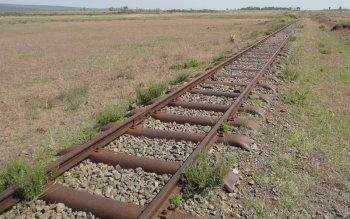
The original Thika Railway tracks before the upgrading and refurbishment in the 21st century. [5]

Major Taylor, the General Manager, reported in March 1913, that the 6 mile long Port Bell railway was under construction and that the Thika line would be open to traffic by the end of October. [1: p333] His promise came to fruition with the opening of the line and in the same month a daily passenger service was inaugurated between Nairobi and Mombasa. [1: p337]

At the end of 1912, the Magadi Railway had reached Lake Magadi. However, it was not until 1914 that the Magadi Works was ready to start production. In the spring of the same year Parliament approved another loan to the East Africa Protectorate – a sum of £3 million of which £610,000 was allocated to Kilindini harbour, £957,000 to railway improvements. There remained £90,000 available from the previous loan associated with the harbour. This meant £700,000 could be spent on the renewed works at Kilindini. [1: p340-341]

Part of the main line improvement was the construction of 18 new crossing stations which would greatly increase the frequency of trains and the strengthening of bridges and viaducts to allow for a maxim.axle load of 15 tons. [1: p335, p337] Also of paramount importance was the strengthening of the rails from 50lb to 80lb and the replacememt of the sleepers with 109lb steel. The old 50lb rail was to be use for the branch lines. [1: p337]

By 1914, “the European population of the East Africa Protectorate was few more than 3,000. Of the 2,321 men of fighting age – including civil servants, missionaries and aliens – 1,987 served in the armed forces of the Crown, some for part of the war and some throughout the war.” [1: p342] The barest minimum of expatriates remained in the Protectorate throughout WW1.

References

  1. M.F. Hill; Permanent Way – The Story of the Kenya and Uganda Railway – Volume 1; Hazel, Watson & Viney Ltd, Aylesbury & London, 1949.
  2. Winston Churchill; My African Journey; William Briggs, Toronto, 1909.
  3. https://www.independent.co.ug/falling-in-love-with-ugandas-fading-glory/3, accessed on 26th December 2020.
  4. https://images.app.goo.gl/pDAJDzhSpxPmERfc8 accessed on 26th December 2020.
  5. https://www.pd.co.ke, accessed on 26th December 2020.

Uganda at the end of 19th century and the events leading up to the construction of the Uganda Railway.

It has been some time since I last posted about the Uganda Railway. I have very recently picked up a copy of each of the two volumes of ‘Permanent Way’ written by M.F. Hill in 1949. The first volume [1] is a history of ‘The Uganda Railway’ written in the 1940s when the railway company was known as ‘The Kenya and Uganda Railways and Harbours’ and published at the end of that decade under the jurisdiction of the new ‘East African Railways and Harbours’ which was formed to formally include the infrastructure in the modern country of Tanzania.

In order to provide the context for the construction of the Uganda Railway, M.F. Hill saw it as imperative in his book to provide a social and economic history of the East African region. It is impossible for me to judge the veracity of what he writes, but it clearly is written from a British Colonial perspective. In addition to covering the strife between the European powers who sought to increase their influence in the Great  Lakes region of the continent of Africa, Hill provides extensive quotes from leading British figures in the region about the Uganda that they knew before the coming of the railway.

It must be acknowledged that the perspective is essentially that of those who were seeking to enhance British influence and eventually to establish Colonial rule, however, it also has to be said that these men (and it was always men) sought, within their own Colonial and paternalistic terms of reference, to be a benign civilizing force. The picture which develops, as one reads M.F. Hill’s book, is, on the one hand, one of competition for influence between Germany, Britain and to some extent, France and Belgium, but on the other hand, a significant and seemingly quite unhealthy competition between three main religious groups, Roman Catholics, Protestants and followers of Islam.

Within the sphere of the Buganda ‘nation’, the influence of the two forms of Christianity was very significant, with adherents to the Muslim faith being a significant minority. The conflict between these groups has to be seen as one of the major influences on the choices made by Colonial emissaries. Yes, there was also an urgent consideration of competition with Germany for control over the Great Lakes region but it is significant that much of the focus of those who were leaders in the development of the British sphere of influence seems to be on the internal tribal conflicts in the region which seemingly were fueled by the rivalry between Protest and Catholic leaders.

Sir Gerald Portal, who led an overland expedition to Uganda in the early months of 1893 at the insistence of the 5th Earl of Rosebery (Secretary of State for Foreign Affairs in the 4th Gladstone administration) commented in a despatch to Lord Rosebury on the situation he discovered on his arrival in Uganda in March 1893, “he emphasised both the evils of the native system of administration and the curse of the religious conflict which largely arose from political causes.” [1: p103]

The decisions being made about the possible/probable construction of ‘The Uganda Railway’  were equally focussed on the possibility of these tribal/faith conflicts flaring up as they were on firmly establishing British interests over-and-against those of Germany.

In this light, it is worth quoting directly from Hill who is himself predominantly quoting Portal:

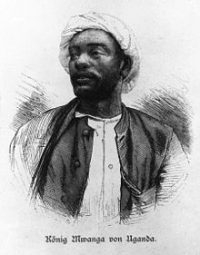
Portal described Uganda as a ‘whited sepulchre’, and traced the country’s tragic story from the bloody despotism of Mutesa, and the early years of Mwanga’s reign, when the condition of Uganda had been scarcely rivalled by the horrible records of Dahomey.

“The form of government in Uganda,” he wrote, “is nominally a despotic monarchy, and in the days of the late Mutesa it was really so; but his successors, and notably the present King Mwanga, have been unable to maintain either the prestige or the power of the Crown. . . . At the time when I arrived, the whole population of Uganda was divided into three semi-religious parties, two of which acknowledge no authority on the part either of Mwanga or his Council. Uganda is divided into ten provinces, each of which is under the nominal governorship of a chief. Under these governors again are an immense number of minor chiefs, one below the other, in a complicated system of transmitted authority. . . . In theory, at first sight, this organisation would appear to be not a bad one; in practice, it has proved to be the cause of a vast system of oppression and robbery. The unfortunate peasantry are forced to toil for the support and glory of an immense number of useless and idle petty chieftains who would think it beneath their dignity to do a stroke of any sort of work from one end of the year to another. In recent times, even the small chiefs had powers of life and death over the peasants, and although this has been stopped, there can still be no doubt that cruelty and oppression in various forms are rife throughout the provinces. Economically, the present system is as bad a one as could be devised; certain taxes in kind have to be paid to the King from each province; these taxes are levied solely from the lowest classes, but as they have to pass through the hands of a long gradation of chiefs, the amount which ultimately reaches the King does not represent more than a fifth part of what has been paid by the villagers.”

Portal pointed out that this administrative system accounted for the importance attached by the Bishops and the political leaders of the opposing parties to the possession, on their side, of certain chieftainships or provincial governorships. The acceptance by a great chief of the Protestant creed might mean the addition of a thousand fighting men to the Protestant cause, whilst the appointment of a Catholic governor to the command of a province might mean that every chief, sub-chief and villager in the province had to make up his mind quickly between embracing the same faith, or being forthwith turned adrift and deprived of his house, dignity and position.

The miserable history of Uganda during the previous few years had shown how inextricably religion and politics were interwoven. The three great parties, Mohammedans, Catholics and Protestants, were nominally divided only by religious tenets, but in fact they were adverse and jealous political factions, two of which were led, to all intents and purposes, by European missionaries. [1: p103-104]

Portal went on to say:

“That the missionaries, on both sides, are the veritable political leaders of their respective factions there can be no doubt whatever. As regards the Catholics, Mgr. Hirth and the Fathers would probably be the first to admit this to be the case. On the Protestant side, it is not, I believe, admitted, but the fact unfortunately remains. . . . The present state of affairs is that the natives on both sides have acquired the habit of appealing to their respective missionaries on every possible question, whether it be a personal quarrel with one of the opposite faction, an assault case, an eviction from a plantation, a murder, a decree from the King, or a decision or order from Her Majesty’s Commissioner. There has thus grown up a sort of dual or even triple system of government, which adds very seriously to the difficulties of administration. It will from this be readily understood that the race for converts, now being carried on by the Catholics and Protestants in Uganda, is synonymous with a race for political power. To-day the Protestants are the strongest, and the most numerous, party; to-morrow a successful battle might place the Catholics in a dominant position and, in such case, that religion would gain on the second day many thousands of converts, from among those who are now reckoned as belonging to the Protestant party. Catholics and Protestants here seem to look upon each other as natural enemies; no doctrine of toleration, if it has been taught on either side, appears to have been received by the native Christians; the fear of English officers and of the Nubian soldiers at the Fort may keep them from overt acts of hostility towards one another while this control remains here, but as soon as it is withdrawn, the war of extermination will at once be renewed. It is this feeling which, through the introduction of the two forms of Christianity into Uganda, has cost so many hundreds of lives, and has thrown the country fifty years back in its advance towards prosperity. It is deeply to be regretted that the avowedly great influence of missionaries in Uganda is not used to introduce a spirit of tolerance and peace even at the risk of the loss to the party of some political power of a few wealthy chieftainships.” [1: p104]

Hill continues:

The Mohammedan party was weaker in numbers, wealth and arms than either of the two Christian parties. In the event of the withdrawal of British control, the strength of the Mohammedans lay in their power to hold the balance between the two Christian factions. When it became known that the Company proposed to withdraw from Uganda, overtures to the Mohammedans were made, almost simultaneously, by the Catholics and by the Protestants. Portal realised that the Mohammedan influence in Uganda was inevitably doomed. If civil war again broke out, whichever party gained the Mohammedans’ affiance would certainly win the day—and then turn upon and annihilate the allies who had assured their victory. If peace continued, the Mohammedan party would inevitably be wrecked on the same rock which destroyed the power of so many Mussulman states—that of slavery. [1: p104-105]

Mwanga II was kabaka in Buganda from 1884 – 1888 & 1889 – 1897. He died aged 34 or 35 in 1903. There are notes about his reign below the references at the end of this article.

In retrospect it seems as though there is ample evidence in the story told here for a rejection of all religious influence in matters of state/politics. However, the world is not such a simple place. Portal did not regard all the Christian converts in Uganda as animated solely by political or material motives. He knew that only “a proportion of the so-called Catholic and Protestant parties could truly be called Christians, but Christianity had undoubtedly gained a firm hold in the country. Mwanga’s persecutions, [2] a few years previously, had proved that there were a considerable number of sincere-Christians prepared to die for their faith.” [1: p105] In addition, politics is a descriptive term for all interactions between differing groups of people. Where people exist, politics will occur. It is to be sincerely regretted that denominational loyalties in the West were imported into the Great Lakes region of Africa in such a way as to promote conflict rather than tolerance and understanding! The level of trust between the principal Christian denominations was not high in Europe at this same time.

The primacy of religious leaders in the politics of the time meant that one of Portal’s first tasks was to seek an accommodation between Bishop Tucker, the Protestant Bishop of East Equatorial Africa and Mgr. Hirth, the Rpam Catholic Bishop of Thereste and Vicar Apostolic of Nyanza. Careful negotiation brought reluctant agreement to the partition of provinces between Catholic and Protestant factions.

On 8th April 1893, 40 Protestant Chiefs signed a statement agreeing to release all their slaves. On 29th May, Mwanga also signed an agreement which accepted British authority. On that same day, Portal left for the coast.

By late 1893, Portal’s health was failing and he made his last report to his masters in London before setting off for the UK himself, where he died very early in 1894. Much of the report had to do with the management of British interests in the Great Lakes region. As [part of that report he strongly recommended the building of a railway from the coast to Kikuyu, not to Lake Victoria Nyanza, but including a significant enhancement of the British fleet on the Lake. That report was considered, after his death, by Parliament in London.

In June 1894, the British government was still hedging its bets and not making a commitment to the construction of a railway, although a decision was taken to declare a Protectorate over Uganda. This move was proclaimed in Uganda in August 1894 and was heartily welcomed. A further Protectorate covering the area from Uganda to the coast was proclaimed in 1896 – the ‘East African Protectorate’.

The Report of the Committee on Railway Communication with Uganda was submitted in April 1895, by the end of June 1895, Lord Rosebery’s Government had fallen and the new Tory administration under Lord Salisbury lost no time in deciding that the railway should be built. It was seen as essential to the life of the Uganda Protectorate. Preliminary expense were granted in the sum of £20,000 in August 1895. And the decision was taken to construct the full length of the railway from the coast at Mombasa to Lake Victoria Nyanza – a distance of 650 miles. Through choosing a reduced gauge and a lighter rail, the cost estimate for the work was set at about £2,700 per mile – a reduction from £3,409 per mile in the early estimates of cost. However in April 1896, a Government committee recommended that the gauge should be increased to one metre and the rail weight restored to that originally recommended – 50lb per yard.

The engineering team arrived in Mombasa in late 1895 but the empowering Act was not to achieve its passage through Parliament until August 1896 with a budget of £3 million.

Earlier posts in my series on the Uganda Railway cover the line and its construction. That story starts with the following article on this site:

The Uganda Railway – Part 1

Hill continues with the story of the building of the line. [1: p139-244] Given that this series is meant to be primarily about the Uganda Railway, this article has been something of a diversion.

As I am an Anglican priest it seems worthwhile to me to  return to the religious issues mentioned above. These will, in due course, be the subject of a further article in this series.

To restore the balance in favour of the railway itself. I will finish this post with some images directly associated with the railway which come from the pages of Hill’s book. [1]

Sir George Whitehouse KCB., the first Chief Engineer and General Manager of the Uganda Railway. [1: facing p144]

Rope Inclines on the Eastern face of the Rift Valley during construction in March 1900. [1: facing p179]

Kilindini in 1900. [1: facing p208]

Nairobi Railway Station in 1900. [1: facing p228]

Nairobi in 1900. [1: facing p228]

Uganda Railway – Class G 0-4-2 steam locomotive Nr. 101 and passenger train (Hawthorn 1746/1878). This locomotive was a one-off import from India, ex South Indian Railway. This image was posted recently on a French language site associated with the LRPresse Magazine(s), rather than coming from Hill’s book [3]

British East Africa in 1910. The Uganda Railway from Mombasa to Victoria Nyanza. Also included on the LR Presse forum. [3]

References

  1. M.F. Hill; Permanent Way – The Story of the Kenya and Uganda Railway – Volume 1; Hazel, Watson & Viney Ltd, Aylesbry & London, 1949.
  2. https://en.wikipedia.org/wiki/Mwanga_II_of_Buganda, accessed on 17th December 2020. Part of the text of this Wikipedia page is reproduced in italics below.
  3. https://forum.e-train.fr/viewtopic.php?f=5&t=87849&p=2255445&hilit=Ouganda#p2255445; accessed on 19th December 2020.

Mwanga came to the throne at the age of 16. He increasingly regarded the greatest threat to his rule coming from the Christian missionaries who had gradually penetrated Buganda . His father had played-off the three religions, Catholics, Protestants and Muslims, against each other and thus balanced the influence of the European colonial powers that were backing each group in order to extend their reach into Africa. Mwanga II took a much more aggressive approach, expelling missionaries and insisting that Christian converts abandon their faith or face death. A year after becoming king he executed Yusufu Rugarama, Makko Kakumba, and Nuuwa Sserwanga, who had converted to Christianity. On 29th October 1885, he had the incoming archbishop James Hannington assassinated on the eastern border of his kingdom.

For Mwanga, the ultimate humiliation was the insolence he received from the (male) pages of his harem when they resisted his sexual advances. According to old tradition the king was the centre of power and authority, and he could dispense with any life as he felt. It was unheard of for mere pages to reject the wishes of a king. Given those conflicting values Mwanga was determined to rid his kingdom of the new teaching and its followers. Mwanga therefore precipitated a showdown in May 1886 by ordering converts in his court to choose between their new faith and complete obedience to his orders and kingdom.

It is believed that at least 30 Catholic and Protestant neophytes went to their deaths. Twenty-two of the men, who had converted to Catholicism, were burned alive at Namugongo in 1886 and later became known as the Uganda Martyrs. Among those executed were two Christians who held the court position of Master of the Pages, Joseph Mukasa Balikuddembe and Charles Lwanga. They had repeatedly defied the king by rescuing royal pages in their care from sexual exploitation by Mwanga which they believed contrary to Christian teaching.

These murders and Mwanga’s continued resistance alarmed the British, who backed a rebellion by Christian and Muslim groups who supported Mwanga’s half brother and defeated Mwanga at Mengo in 1888. Mwanga’s brother, Kiweewa Nnyonyintono, was elevated to the throne. He lasted exactly one month and was replaced on the throne by another brother, Kabaka Kalema Muguluma. However, Mwanga escaped and negotiated with the British. In exchange for handing over some of his sovereignty to the British East Africa Company, the British changed their backing to Mwanga, who swiftly removed Kalema from the throne in 1889. He later converted to Christianity and was baptised.

A Monorail in Kampala?

Charles Ewing who was based in India designed a monorail system. It was a single rail tramway arrangement. [1] His invention was a success. By 1899 a number of his design of lines had been laid in India. These included a twenty-two mile line at the Scottish firm of Messrs. Finlay, Muir and Co.’s tea estates in the Travancore Hills. [2]

In 1902, the Madras (now Chennai) Government approved the construction of a Ewing type monorail tramway in the environs of Madras, in the Chingleput (now Chengalpattu) District which was about 56km south west of madras. [3]

Ewing type monorail tramways became popular. In Patiala State, one connected Sunam to Patiala via Bhawanigarh. [4] An earlier line connected Sirhind to Morinda via Bassi and Alampur. [5] In the Punjab a line was constructed between Morinoa and Karar. [6] In Kerala, a similar monorail was constructed between Munnar and Top Station [13] in the Kundala Valley. [14]

Patiala State Monorail Trainways (PSMT) was a unique rail-guided, partially road-borne railway system running in Patiala from 1907 to 1927. [9]. PSMT was the second monorail system in India, after the Kundala Valley Railway [10] and the only operational locomotive-hauled railway system built using the Ewing System in the world. [11]. The Kundala Valley Railway pre-dated this, also using the Ewing system between 1902 and 1908, although this only used bullocks for haulage. Following the conversion of the Kundala Valley Railway from a monorail to a narrow gauge railway in 1908. [12] PSMT was the only monorail system in India until its closure in 1927.

Uganda – Of great interest to me, given my personal interest in the Country of Uganda, is the fact that Ewing’s system spread outside the sub-continent of India. “In 1907, Winston Churchill visited Uganda and discussed with the authorities ways of improving transport between Port Kampala, known then as Luzira, and Kampala town. Amongst those consulted was a Mr Watts who had experience of the Ewing system in India. The environment and transport needs were considered to be similar and the Ewing system was subsequently adopted.” [7][8] The rolling stock was pulled by bullocks throughout the majority of its life.There was however at least a trial of a steam locomotive on the line as a picture taken on, probably, 22nd April 1908 indicates. [17]

The short article in the ‘Uganda Journal’ in 1969. [8]

The Encyclopedia Britannica of 1911 notes the presence of the monorail between Kampala and the port: “Some 7.5 m. S. by E. of Kampala, and connected with it by monorail, is Kampala Port, on Victoria Nyanza.” [15]

It was a short-lived experiment, because by 1913 when a metre-gauge railway was being constructed, the monorail was not in a sufficiently usable state to serve as a construction line. [8]

Cambridge University Library has a small collection of items which relate to this ‘monorail’ these include:

A 85 x 78 mm view looking along the monorail track towards the jetties on the shore of the lake; [16] and

A 99 x 73 mm view showing the steam engine and carriages leaving Port Bell for Kampala. This ‘monorail’ was ordered (at a cost of about £3000) by Sir Henry Hesketh Bell and was intended for use until proper road and rail facilities could be established. The monorail was first tested on 22nd April 1908 and this photograph may well have been taken on its trial run. [17]

References

  1. Adrian S. Garner; Monorails of the 19th Century; Lightmoor Press, Lydney 2011; p226
  2. Ibid.; p227.
  3. Ibid.; p227.
  4. Ibid.; p230.
  5. Ibid.; p229.
  6. Ibid.; p233.
  7. Ibid.; p233.
  8. W.J. Peal & J. Crompton; ‘The Luzira-Kampala Monorail’; Uganda Journal, Volume 33, Part 1, 1969, p88-89; accessed via https://www.wdl.org/en/item/13781/view/1/96, on 27th February 2019.
  9. The Imperial Gazetteer of India. Volume 20, p44; accessed via https://dsal.uchicago.edu, on 27th February 2019.
  10. Mumbai gawks as train chugs overhead; https://m.telegraphindia.com/india/mumbai-gawks-as-train-chugs-overhead-september-start-on-track-for-indias-first-monorail/cid/332693#.UT3OENZgfSg, 19th February 2013, accessed on 27th February 2019.
  11. https://en.m.wikipedia.org/wiki/Patiala_State_Monorail_Trainways, quoting Cassell’s Railways of the World By Frederick Arthur Ambrose Talbot, 1924 edition; accessed on 28th February 2019.
  12. https://en.m.wikipedia.org/wiki/Patiala_State_Monorail_Trainways, quoting “Sands of Time” (PDF). Newsletter of Tata Central Archives. Tata. V (1): 5–6th January 2006. Archived from the original (PDF) on 19th July 2008; accessed on 28th February 2019.
  13. https://en.wikipedia.org/wiki/Top_Station, accessed on 28th February 2019.
  14. https://pazhayathu.blogspot.com/2009/11/1924-single-railmonorail-railway-at.html, accessed on 28th February 2019.
  15. https://en.wikisource.org/wiki/1911_Encyclop%C3%A6dia_Britannica/Uganda, accessed on 28th February 2019.
  16. The Monorail from Port Bell to Kampala, 1906 – 1909, GBR/0115/RCS/Y3011G/5. Cambridge University Library. https://archivesearch.lib.cam.ac.uk/repositories/2/archival_objects/205595, accessed December 17, 2022.
  17. Tractor and monorail leaving Port Bell from Kampala, 1908-04-22, GBR/0115/RCS/Y3045C/18. Cambridge University Library. https://archivesearch.lib.cam.ac.uk/repositories/2/archival_objects/177108, accessed December 17, 2022.

The Uganda Railway – Part 30 – The Railway Magazine 1950 – June 1950

Reading through old copies of The Railway Magazine, I came across this article in the June 1950 copy. I thought it might be of interest alongside my earlier post about traction on the East African Railways:

The Uganda Railway – Part 25 – Locomotives and Rolling Stock – Part C (Steam – 1948 to 1977)

and my previous (most recent) post in this series ….

The Uganda Railway – Part 29 – The Railway Magazine 1950 – April 1950

The article was entitled: Kenya and Uganda Railway Locomotives and was written by G. Gibson CME, E.A.R.&H. [1] It included a number of photographs of early locomotives on what was once called the Uganda Railway

Class F 0-6-0 Locomotive. [2]

Class B 2-6-0 Locomotive. [2]

Class N 2-6-0 Locomotive, introduced in 1896. [1]

Two locomotives were imported from India to commence construction work

Gibson states, “There appears to be no detailed description of the locomotives available today, nor is it certain that they were both of the same type, as both ” A ” and ” E ” class engines are mentioned in early papers. They were certainly very small, and the Chief Engineer reported them as being incapable of hauling more than two wagons on a 1 in 30 grade.”

The ‘N’ class locomotives are the first for which details available. Eight were started work in 1896, and a further eight in 1899.  Gibson states that  some were fitted with, “Joy’s valve gear and the balance with Walschaerts link motion. These engines suffered from one serious defect, in that they continually derailed.”

To strengthen the roster and  provide more reliable motive power than the than the ‘N’ class, eight ‘F’ class engines were delivered in 1897 and a further 26 followed in due course. In the latter part of 1897, orders were placed with Baldwins for 36 engines, known as the ‘B’ class; 20 were came in 1899 and the balance in 1900. “They proved reliable in service, but more expensive to maintain than the ‘F’ class. They were typical of American design at that time, with bar frames, and sand box mounted on the boiler top.”

By 1910 both these classes were in poor shape. They were kept in service druing the Great War and were not finally written off until 1931. Several of them were destroyed by mines laid by enemy raiding parties. “In April and May, 1915, some 50 attempts were made on the railway by such parties, often resulting in fatal casualties among train crews.”

By 1910, more power was essential. Orders were placed with the North British Locomotive Company, in 1911 for 18 Mallet-type compound locomotives which arrived in 1913/14. They were marginally re-designed locally which improves things but they remained unpopular with drivers. Failures continued to happen often and they were scrapped in 1930.

Also in around 1910, “three side-tank engines were ordered from Nasmyth, Wilson, known locally as the ‘E.D.’ class, and placed in service in 1913. They proved successful and were employed on main line traffic … but with fuel consumptions equal to the older engines. They were scrapped in 1938.”Class E.D. 2-6-2 Locomotive. [4]

Seven ‘E.B.’ class engines were put into service at the outbreak of the Great War. Thirty four further ‘E.B.’ class locos were purchased. They had minor design differences and so were classes ‘E.B.1’. Seventeen started work in 1920 and seventeen in 1921. The first E.B. locomotives were disposed of in 1934 as were the majority of if the E.B.1’s. six were still in use when the Railway Magazine article was written.

“The ‘E.B.’ class were built by Nasmyth, Wilson & Co. Ltd., and the ‘E.B.1’ class by the North British Locomotive Co. Ltd. Oil fuel equipment was first tried out in the colony on one of these engines.”

The history of the different locomotive types is continued with reference to the ‘ Class E.E’ which was supplied by Nasmyth, Wilson & Co. Ltd. They were placed in service in 1913 and 1914. It had been expected that they would be withdrawn in 1939 but the advent of the Second World War changed things and they were still in use in 1950 when the Railway Magazine article was written. They were similar to the ‘E.D.’s  but by adding a trailing bogie in place of the pony, water capacity was increased by a half to 1200 gallons and fuel capacity by 2/3rds to 2.5 tonnes .

Superheaters  were trialed in 1921, Nasmyth, Wilson, produced two locos with similar specs.  to the ‘E.B.’ and ‘EAU’ Locomotives with Robinson superheaters fitted, they were known as the ‘E.B.2’ Class. They served well and were disposed of in 1934 after being very heavily worked. Those trials resulted in the purchase of  62 No. ‘E.B.3′ Class engines, all of which  were still in service in 1950. Class EB3 Locomotive. [3]

By 1950 they had been relegated to branch-line and pick-up traffic because more powerful locomotive were now in play.

In the late 1920s, 21 ‘E.E.’ CLass shunters with 2-4-2 wheel arrangements were employed and they were followed by a further 6 of the Class in the 1930s. The late 1920 saw thw arrival of the first Beyer-Garratt type engines, “which later were to become the mainstay of the railway’s motive power. An initial order for four ‘E.C.’ class was received and they were put into service immediately. The wheel arrangement and the motion was based on the ‘E.B.3’ type, with slightly smaller cylinders, and the axle-load limited to 10 tons to enable the engines to be used on the 50-lb track of branch lines.”Class EC3 4-8-4+4-8-4 Beyer-Garratt Locomotive. [4]

In 1939, these four engines, with two of a later class, were sold to Indo-China to make room for six engines of a heavier type.

I have posted about these locomotives in another article:

Beyer-Garratts to IndoChina-Yunnan Railways

The success of these first Garratt’s led to an order for a further 12 Garratt type locos from Beyer, Peacock & Co. Ltd. Minor modifications meant that these were designated as the ‘E.C.1’ class. The adhesive weight was increased to 83.85 tons; total weight to 134.6 tons; water capacity to 5,250 gallons; and fuel to 10 tons.

“In 1931, ten ” E.C.2 ” class Garratt locomotives, made by the North British Locomotive Co. Ltd., were imported. They [were] a little heavier than the ” E.C.1 ” class, having an adhesive weight of 87.95 tons and a total weight in working order of 142.1 tons. In all other leading particulars they are identical although there are a few differences in detail where infringement of established patents might occur.”

Six 2-8-2 engines were also ordered and arrived in the colony in 1925, but were not placed in service until 1927-28. They were designated as the ‘E.A.’ class.. They performed really well but by 1950 had been relegated to “long distance through goods traffic between the capital and Mombasa, being limited by their 17.5 tons of axle load to this section, which until recently (1950) was the only line laid with 80-lb. rails.” Class EA and EC5 Locomotives. [3]

IN 1950, plans were afoot to refurbish the ‘E.A.’ Class.

After 1930, all locomotives purchased were of the Beyer-Garratt type:

  • 1939: 6 No. ‘E.C.3’ engines.
  • 1940: 2 No.  further ‘E.C.3’ locomotives.
  • 1941: 4 No.  further ‘E.C.3’ locomotives.

“They recorded large mileages during the late war, when traffic demands were the heaviest in the history of the railway. One engine covered 243,000 miles between shopping for heavy repairs, while several ran over 200,000. The boilers are fitted with arch tubes and thermic syphons. The maximum axleload (was) 11.75 tons, which limit(ed) their use to anything but main line traffic, where they (were) used on mail and through freight trains, hauling loads of up to 575 tons on 2% grades.”

  • 1944: 7 No. ‘E.C.4’ Class Garratts came from the War Department. By 1950, they were still the most powerful locomotives on the network. 
  • 1945: 2 No. ‘E.C.5’ Class ‘Burma Type’ locomotives. These moved south to Tanganyika in 1949.
  • 1949: 6 No. ‘E.C.6’ locomotives almost identical in design to the ‘Burma Type’.

In 1950 further Beyer-Garratt type locomotives were on order.

1. G. Gibson; Kenya & Uganda Railway Locomotives; The Railway Magazine, Volume 96, No. 590, p401-405.

2. The Railway Magazine, Volume 96, No. 590, p398.

3. The Railway Magazine, Volume 96, No. 590, p399.

4.The Railway Magazine, Volume 96, No. 590, p404.

5. The Railway Magazine, Volume 96, No. 590, p402-403.

The Uganda Railway – Part 29 – The Railway Magazine 1950 – April 1950

I have been looking through old railway magazines over the Christmas break in 2018 and came across articles in the 1950 editions of the Railway Magazine which relate to this series of posts. The first is in the April 1950 edition of the magazine. ……..

The April 1950 edition of The Railway Magazine [1] contains the first of these articles written by Thomas H. Cobb.

He begins with a relatively short description of the route of the line, first focussing on the route via Kisumu (Port Florence) and Port Bell to Kampala and then on the route via Tororo.

He comments: “These lines have always been state railways, though they are administered as a separate department.”

Cobb goes on to describe a journey on the line. He notes: “There is practically no difference between first and second class, except that the former have a fan and bed-reading lamps, and are slightly less crowded. Third class carriages have wooden seats and centre corridors; they are always crammed to bursting point. Hire of bedding, and food in the restaurant cars is cheap, and passengers are officially encouraged not to tip company servants – but they do. Speed is never high; the up mail train covers the first 30 miles out of Mombasa in 100 min., including two stops. All trains stop at all stations, with the exception of a few ‘local’ stations neat Mombasa and an odd flag stop or two usually missed by the mails.”

The Uganda Mail heading for Lake Victoria in the Kikuyu Hills, banked by 4-8-0 Locomotive No. 69. [2]

An EC3 at the spiral close to Timboroa Station. [2]

He concludes with some trivia:

  • from Mbulamuti to Jinja the east-west main line runs distinctly eastwards for about 20 miles.
  • The curves on the line have the inner edge of the outer rail oiled by hand twice a week.
  • The two summits of 8,322 and 9,136 ft. on the Kisumu and Kampala lines respectively are only 20 miles apart, but on quite separate lines, yet they have each pursued an independent course of over 60 miles from their divergence at Nakuru.
  • The only racial discrimination on the railway is against Europeans, as they are not issued with tickets below second class, even for trains which consist of third class carriages only.

References

  1. Thomas H. Cobb; The Kenya-Uganda Railway; in The Railway Magazine No. 588 Vol. 96 April 1950, p262-267.
  2. The Railway Magazine April 1950, p250.