

A thought or two for St. James’ Saint’s Day and for Sunday 26th July ….

St John and St James’ mother recommending her children to Jesus, panel of altar of St James, by Leonardo di Ser Giovanni (active 1358-1371), silver foil with embossed decoration, Chapel of Crucifix, Cathedral of St Zeno, Pistoia, Italy, 14th century
Matthew 20:17-34
Matthew 20:17-34 provides some interesting contrasts: first Jesus talks of the death he must die – his passion, his glory, his enthronement, his coming into his kingdom through death and resurrection!
Then, immediately after he says these words, James and John’s mother asks him a favour for her sons – it is as though she just has not been listening to what Jesus said. She sees him as the Messiah, she has fixed ideas of what he will do as Messiah, and so she seeks preferment for her sons. “When you come into your kingdom grant that my sons will sit one on your right and one on your left!”
Jesus response: “You don’t know what you are asking!” is telling. For the places reserved either side of him when he came into his kingdom were for two thieves and brigands. James and John and their mother had no idea what they were asking for – and ironically they made the request immediately after Jesus had made it very clear what his enthronement would be like.
James and John and their mother are contrasted for us in our reading with two groups of two other men.
The first contrast is with the thieves on the cross. Jesus chosen supporters when he came into his kingdom were from outside his band of followers, people who we would say were completely undeserving. Yet one of those thieves was the first into the kingdom of heaven as Jesus promised that he would be with him in paradise. The first into the kingdom of heaven was a thief, possibly even a murderer. But one who recognised his need of salvation.
That’s one contrast – between righteous disciples of Jesus who don’t listen and renegades, one of whom encountered Jesus and whose life was transformed even in the midst of death.
But that isn’t the only contrast that is made for us. At the end of our reading two other men are mentioned. Not two good disciples, but two people who cannot see. Two blind people. Two people who should not have been able to recognise who Jesus was. Yet two people who really did see him for who he was: “Lord, Son of David, have mercy on us!”
James and John, faithful but perhaps self-righteous disciples, could not see for looking. They were so focussed on what they wanted and on what they believed, that they did not listen to Jesus.
James and John are contrasted with two blind men and two brigands. Brigands who had no right to assume God’s love for them, blind men who could not be expected to see clearly. And in the comparison it is very clearly James and John, the supposedly faithful disciples, who come off worst, who look foolish and grasping. Who appear foolish!
Matthew’s challenge to his first readers and to us who listen to his Gospel is really quite clear. Are we so wrapped up in our own concerns, our own ideas, however much they might be about Jesus, that we fail to hear him speak? Have we got our preconceived ideas about what he is like, so much so that we are just completely unable to hear him speak when he shakes those assumptions?
We are Jesus disciples, just like James and John. … Will we remain open to listen to what God is saying to us, will we remain open to be changed? John and James had to suffer not only Jesus rebuke, but the rebuke that came from their own eyes as first they saw two blind men respond to Jesus and then, quite a while later began to understand that it was on the Cross that Jesus was glorified rather than an ornate throne of gold. How foolish they must have felt as they began to grasp what God was really doing among them – nothing like the assumptions that they first made!
So this is Matthew’s challenge to us. Are we likely to be caught out? So caught up in our own understanding of faith or in our own issues that we miss what God is actually doing right in front of our eyes?

 Jo and I met with Bishop Cramer and Hope Mugisha in Didsbury on Friday. It was lovely to see them again. They were able to provide an update on what has been happening about the water tanks funded by churches in Ashton Deanery. Bishop Cranmer writes: ‘Dear partners in mission, we thank God for the work done constructing water tanks in the Diocese of Muhabura with your support. We commissioned and handed over the water tanks in Nyakimanga and at Sesame Girl’s school recently. I was able to officiate at the commissioning and handover of the water tanks.’
 In August 2014, I wrote a very short blog which mentioned Graham Turnbull. In 2015, I had a call from a Daily Mail journalist asking me about Graham. His death in the 1990s had been linked with the arrest in June 2015 of Karenzi Karake, Rwanda’s intelligence chief on a European Arrest Warrant. Karake was wanted in Spain for war crimes. He was accused of ordering massacres while head of military intelligence in the wake of the 1994 Rwanda genocide. Later in 2015 he was released from custody in the UK.
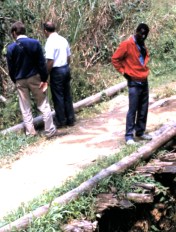 I can only find this picture of him taken in 1994 on a trip out to inspect some of the main road bridges in Kisoro District. Graham is facing away from the camera in the blue top.
 he latest news from Ashton-under-Lyne includes the forthcoming sale of the Arcades Centre. Anyone got a spare £25 million to invest?
 ark 6, the disciples are beginning a new phase in their ministry, in their relationship with Jesus. And Jesus gives them instructions and advice as he sends them out to work for him.
 eard it said that Islam is a violent religion. I have been told that the Qur’an legitimises violence and that the interpretation put on the message of the Qur’an by those called Islamic terrorists does not distort the message of the Qur’an.
 Interruptions can be really irritating. … I always tried, when I worked for Stockport Council to maintain an open door policy for the people who worked for me. However, it did not stop me feeling aggrieved every time my concentration was interrupted!
 We can’t do everything but even if we just do something, we make a difference. There is a story of someone who watched a man walking along a beach where for some reason thousands of starfish had become stranded above the usual tide line – they covered the beach. The man was picking up individual starfish and throwing them back into the ocean one by one. This person asked the man why he bothered – you can’t possibly save them all….. the reply was “But I can save these ones from dying in some shell hunter’s collection.” It clearly wasn’t possible for him to retrieve them all, but he was giving a precious few another chance to live. We see this same thing in Jesus; unable to respond personally to everyone in the crowd, he helped some – and made a difference.
 The readings set for Sunday 21st June in the Anglican lectionary are Mark 4:35-41, Job 38:1-11 and 2 Corinthians 6:1-13. The passage from Mark 4 reads:
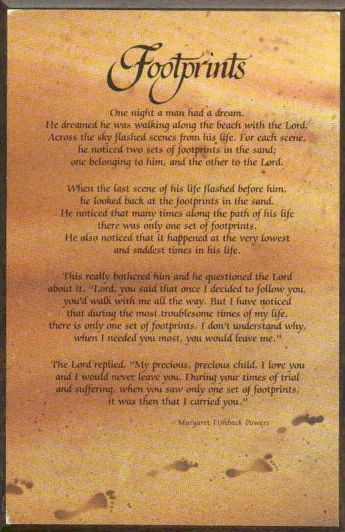 God does not deal with us in predictable ways. We want to feel his presence all the time. When actually what we may need is to begin to grow in faith, to grow in our confidence that God is there with us even when it doesn’t seem to be the case. God wants us to grow to be strong in faith. And so will be times when we need to remind ourselves that God is intimately concerned with us, with me, giving me life, giving me purpose and giving me hope for the future.
 ter seed on the ground, and would sleep and rise night and day, and the seed would sprout and grow, he does not know how. The earth produces of itself, first the stalk, then the head, then the full grain in the head. But when the grain is ripe, at once he goes in with his sickle, because the harvest has come.”
 He also said, “With what can we compare the kingdom of God, or what parable will we use for it? It is like a mustard seed, which, when sown upon the ground, is the smallest of all the seeds on earth; yet when it is sown it grows up and becomes the greatest of all shrubs, and puts forth large branches, so that the birds of the air can make nests in its shade.”
 Roger Farnworth