
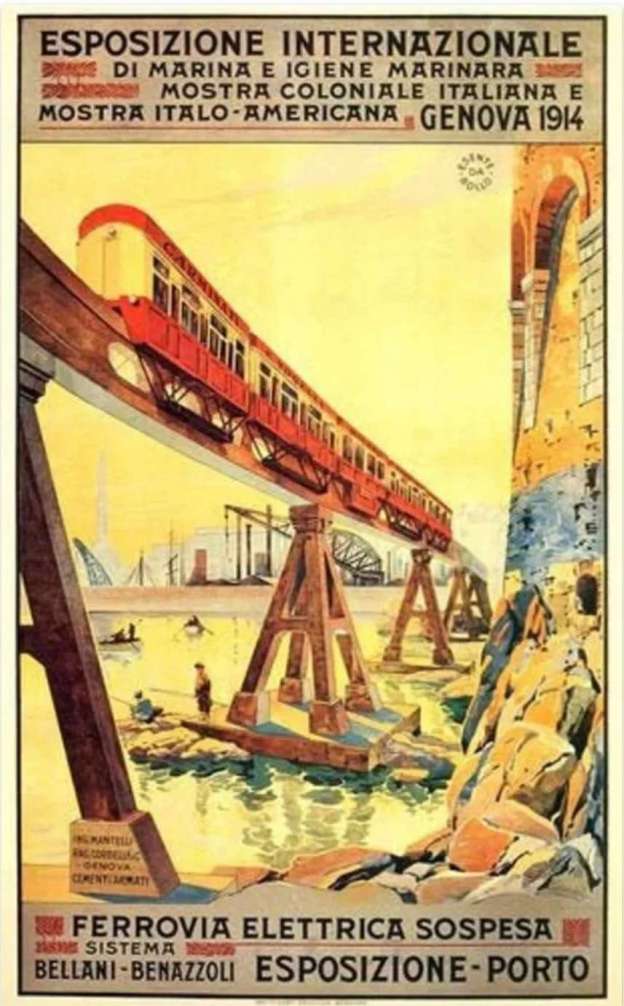
For a very short time Genoa had a Telfer.
‘Telfer’ or ‘Telfere elettrico’, was a monorail railway line built in Genoa in 1914, the first of its kind built in Italy. The name was derived from the English term ‘telpher’. [1]
In this case, the ‘Telfer’ was a monorail. Examples of telphers in the UK include one at Manchester Victoria Railway Station which is described here. [6]
The term has more normally been used for the moving element of a beam crane used in warehouses or other industrial settings. [6]
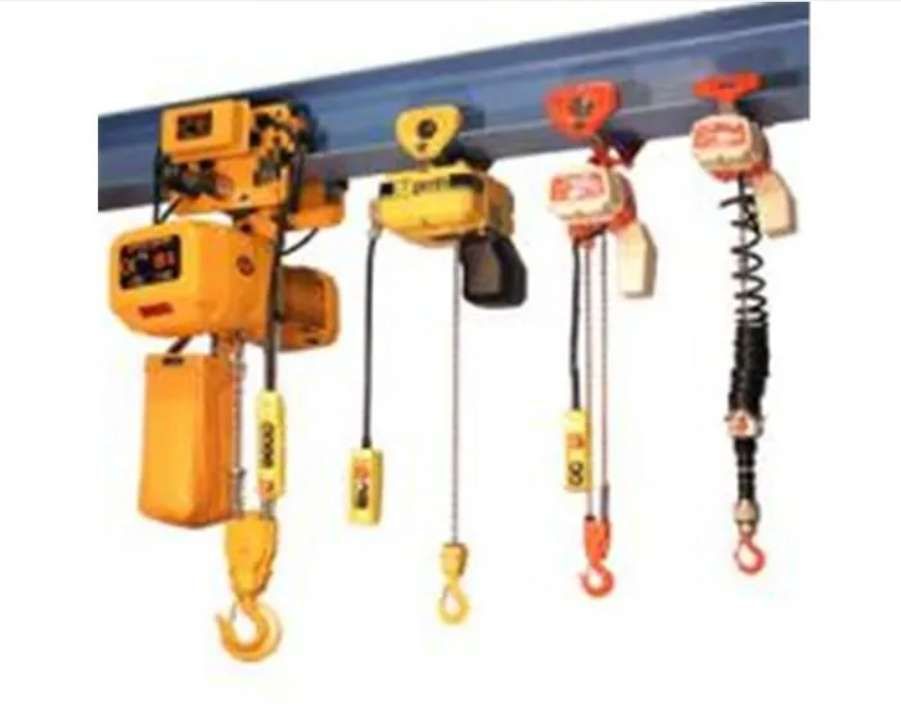
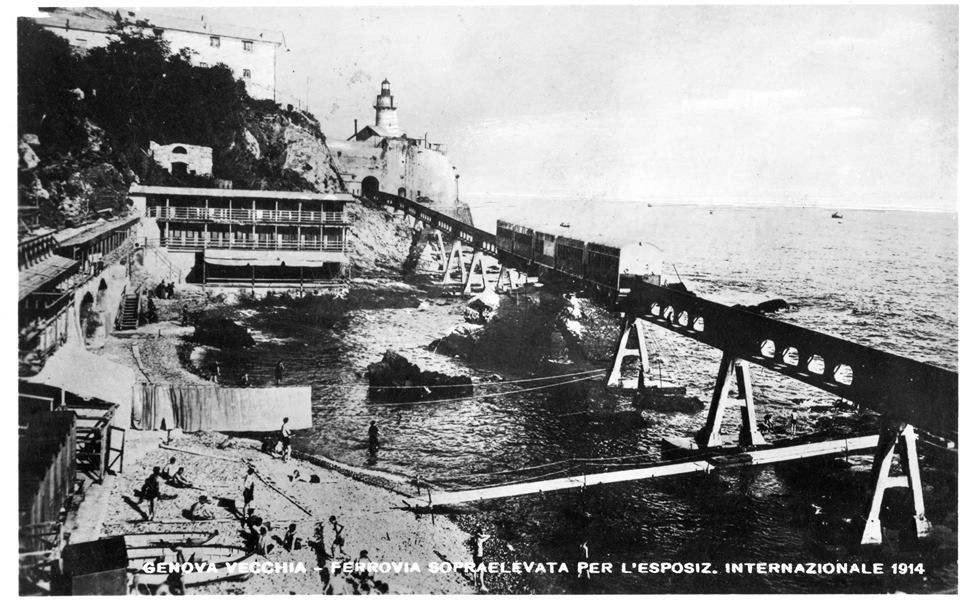
Given the Telfer’s link to the English word ‘Telpher’ then strictly speaking ‘Telfer’ should be assumed to apply to the moving element of this short term transport solution in Genoa which could itself, perhaps, be considered to be a monorail.
The Telfer was installed for the Italian Colonial International Exhibition of Marine and Marine Hygiene which opened in May 1914 and closed in November of the same year. [7]
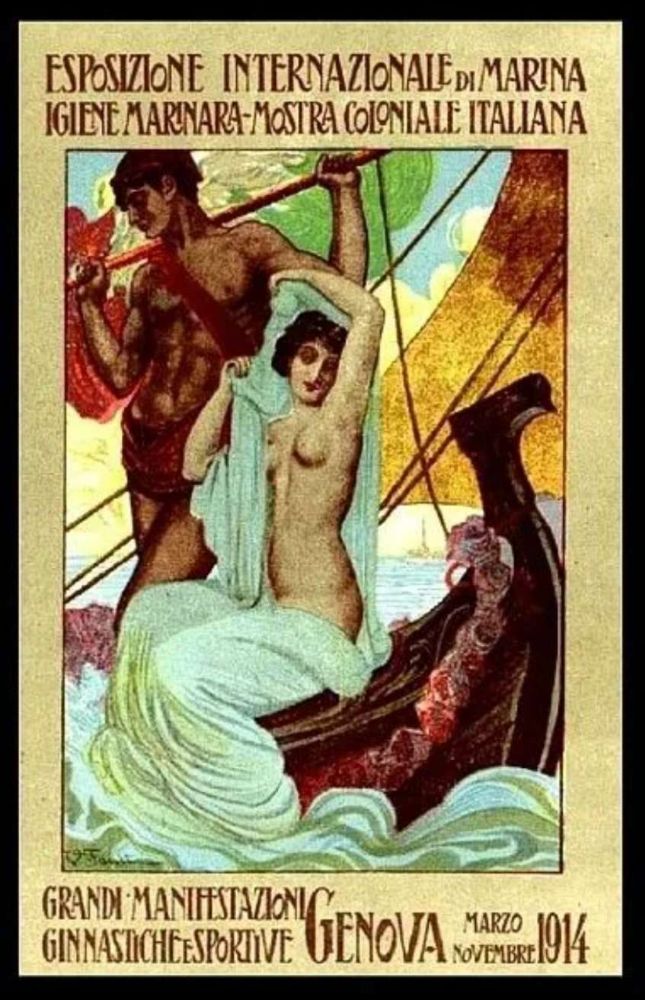
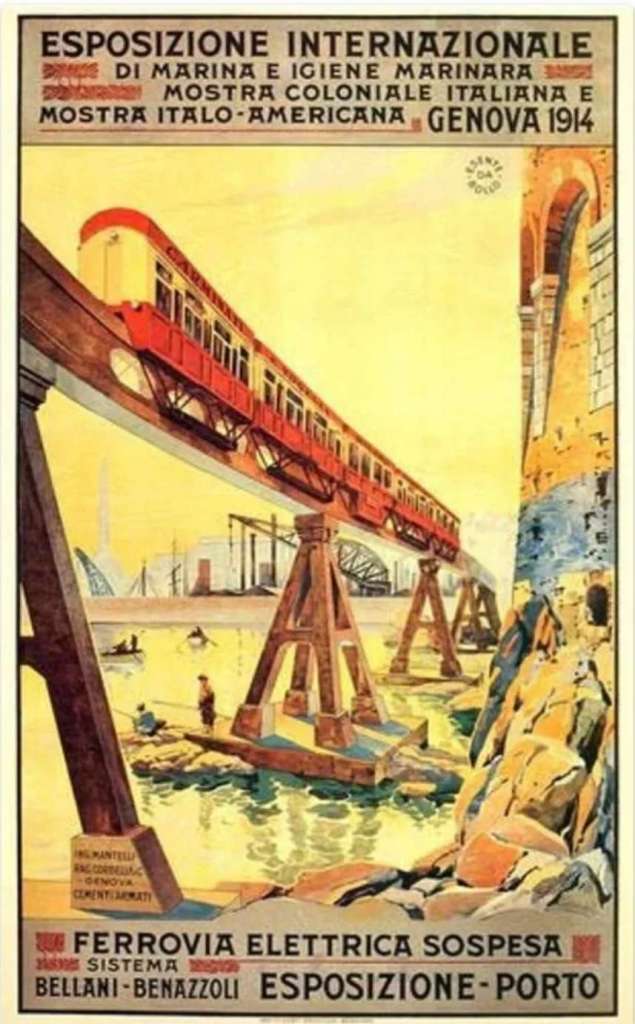
In an historical period when European powers were involved in colonial expansion. The stated aim of the Exhibition was to show the developments in the sectors of hygiene and maritime trade, but ultimately it was an opportunity for Italy to celebrate its colonial conquests! [7]
The Telfer connected Piazza di Francia (the south-eastern part of the current Piazza della Vittoria) to the Giano pier of the port, near the new Harbour Master’s Office. It was managed by UITE (Società Unione Italiana Tramways Elettrici).
The Telfer was originally intended for Milan, to connect Milan with the residential area of Milanino, approximately 8 km from the city. That project never came to fruition.
Instead, a shorter version was built in just 100 days for the Exhibition in Genoa. The Telfer entered service on 18th June 1914 and served throughout the time of the exhibition. It was later modified for the transport of goods, in particular coal, from the port to the factories located along the Bisagno. It continued to function throughout the period of the First World War but was dismantled in 1918.
Italian patents for the system were held by BBB (the Badoni Bellani Benazzoli Company of Milan). [4]
The Italian Wikipedia tells us that “the line was traversed by a single, symmetrical train, which ran on its own track formed by a beam raised from the ground, with a running rail at the top and two lateral ones for support and guidance. For the support piers, reinforced concrete was used. … The monorail beams were of an inverted T section, 85 cm wide at the base and 190 cm in height, over which Vignoles 36 kg/m rail was fixed on oak stringers. … Along the lower edges of the inverted T beams, two guides for the horizontal wheels were provided, made from L-shaped bars. … The items of rolling-stock sat astride the beam and were supported by hooded double-edged central wheels. They had lateral appendages extended downwards for the guide rollers.” [1]
“Seats were arranged in four longitudinal rows, two on each side, stacked in steps, with the backrests on the inside. Each ‘carriage’ had 38 seats and 12 standing places, or with the seats folded down a standing capacity of 80 passengers could be achieved. There were three access doors on each side. … The ‘locomotive’ had four 700 mm wheels, all powered, each connected to an AEG Thomson-Houston 40 hp 500 V engine regulated by controller as used for electric trams. The brake was compressed air with a double shoe for each wheel.” [1]
“As the driver’s position in the train was at the centre of the convoy (the locomotive was at the centre of the train), automatic safety devices were placed to stop the train at the station. The entire convoy when fully loaded carried about 350 people and weighed 80 tons. All the rolling stock was built by Carminati & Toselli of Milan.” [1]
The Route of the Telfer Monorail
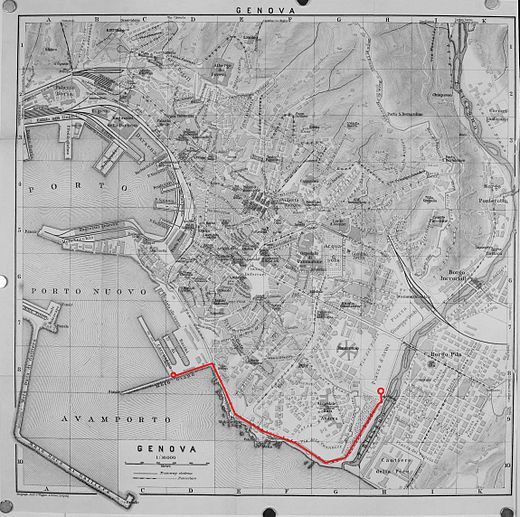
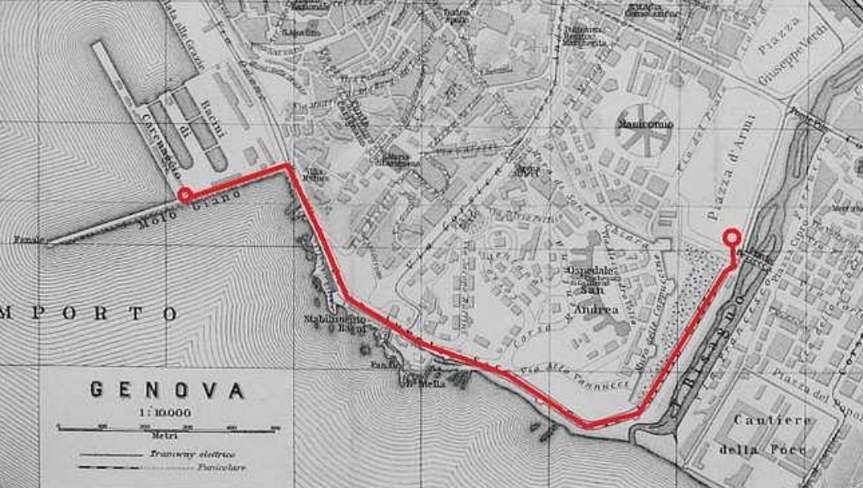
A map from around 1914 (shown in full above) shows the route of the line. Segments of the line follow together with appropriate supporting images.
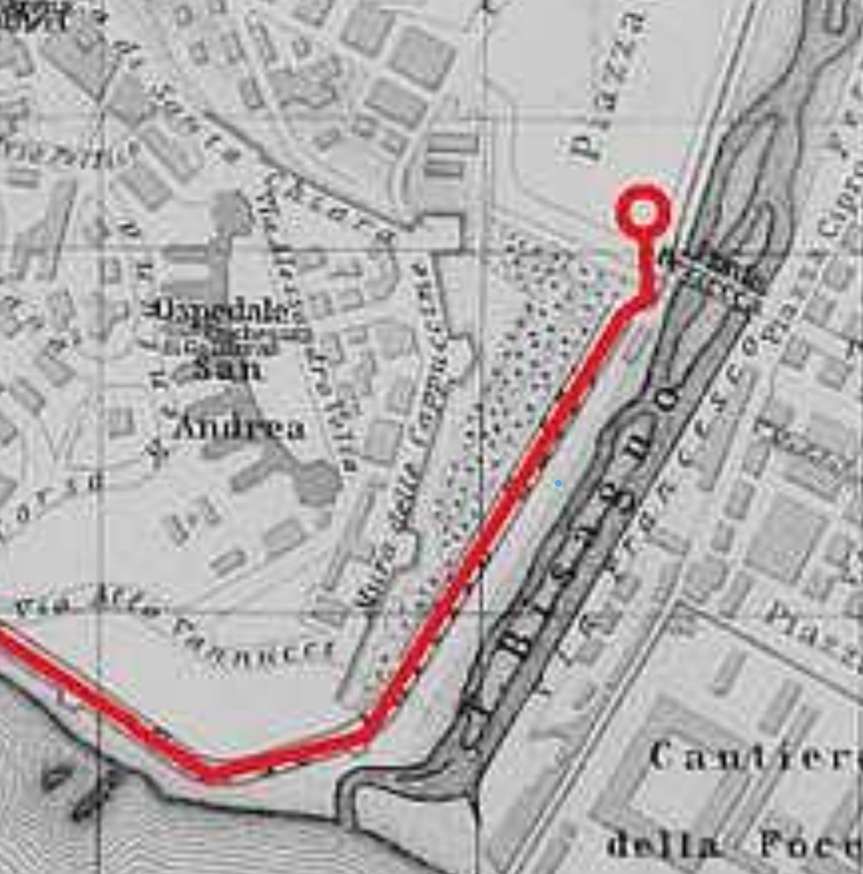
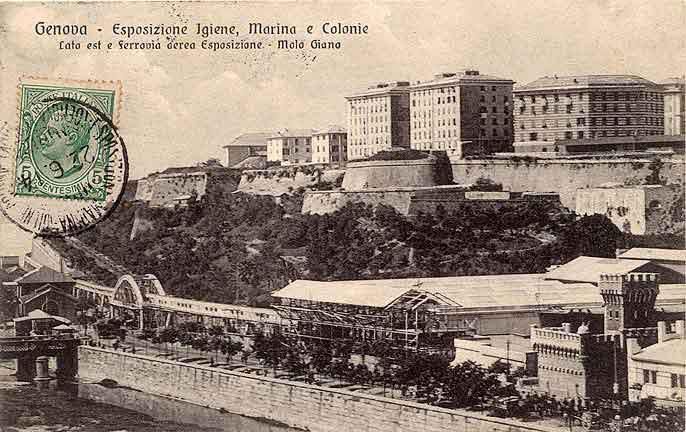
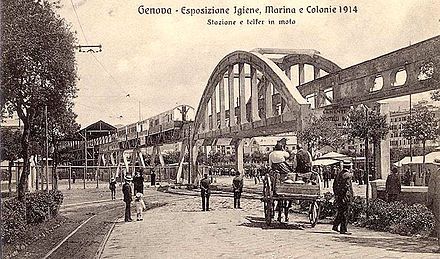
The Telfer’s Northeast terminus was in the southern corner of Piazza d’Armi above the River (Torrent) Bisagno, close to the Bezzecca Bridge which at the time was the first structure spanning the river North of its outfall into the Mediterranean. Piazza d’Armi became Piazza di Francia and later Piazza Della Vittoria.
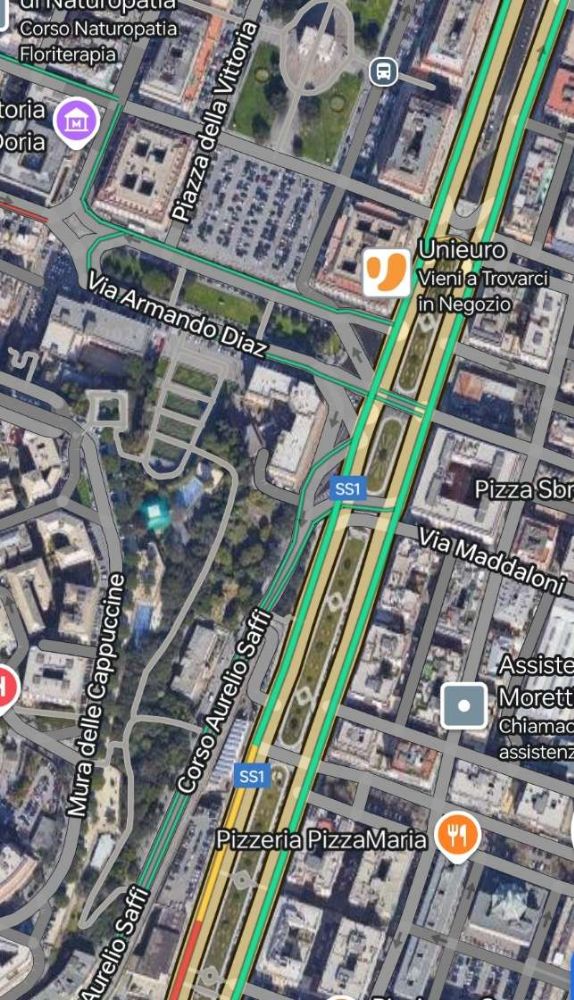
The route crossed the Corso Aurelio Saffi by means of a 26 metre span skew bowstring concrete arch bridge and ran straight down the West side of the river channel on the road known as Via del Feritore at that time. The line hugged the base of the high retaining wall and, in doing so, curved round to the West.
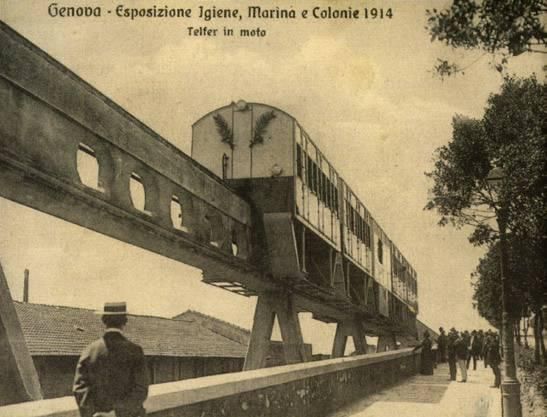
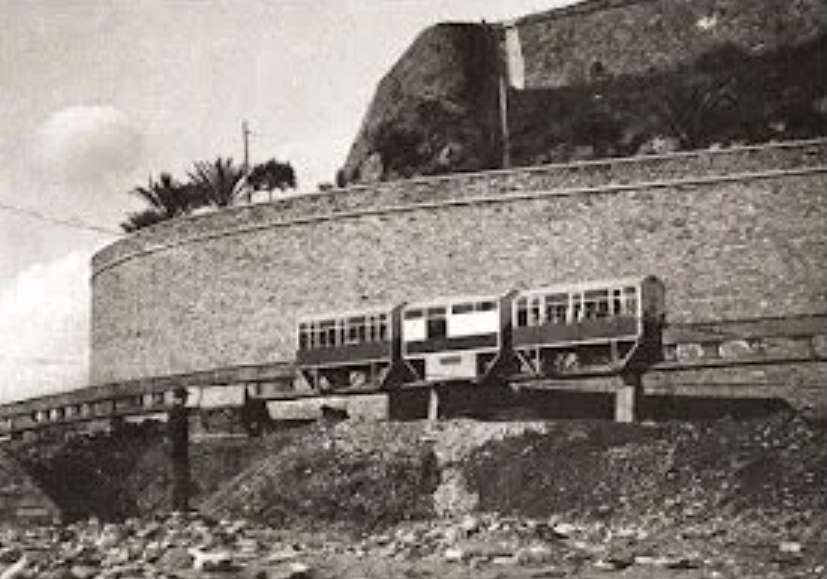

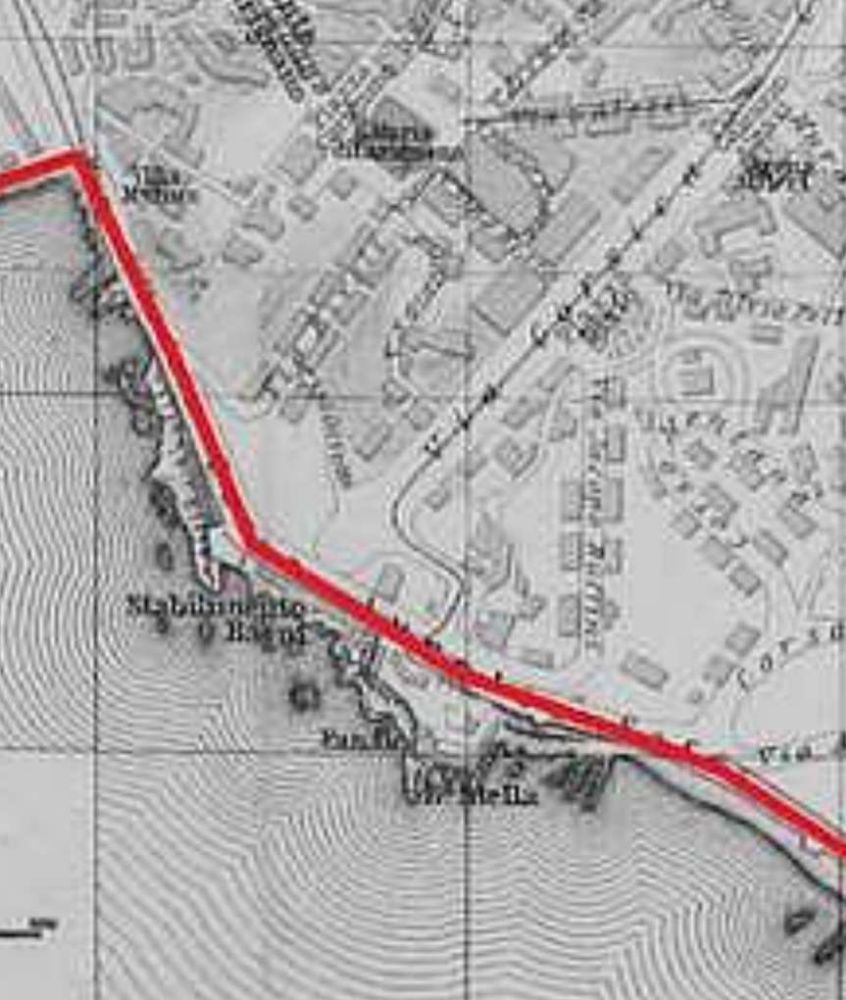
The line continued above the water’s edge clinging to the base of the retaining wall before passing above Strega swimming baths.
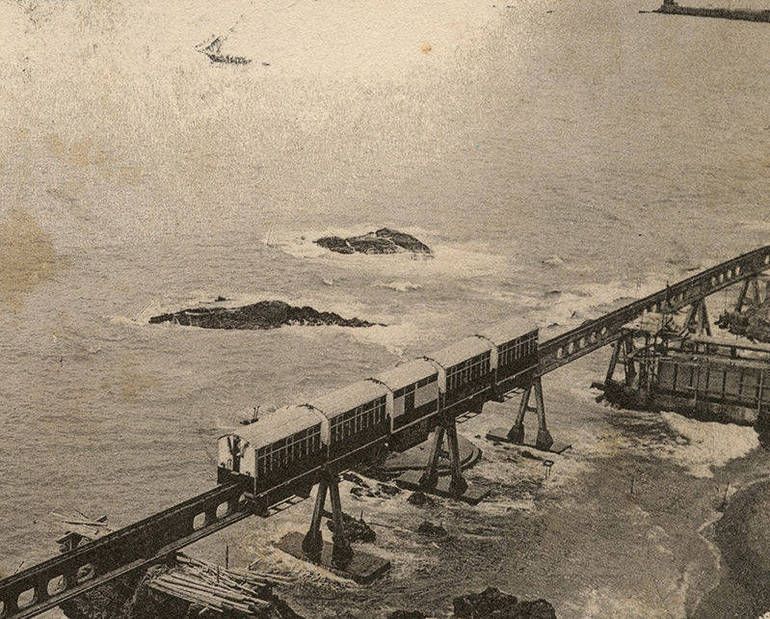
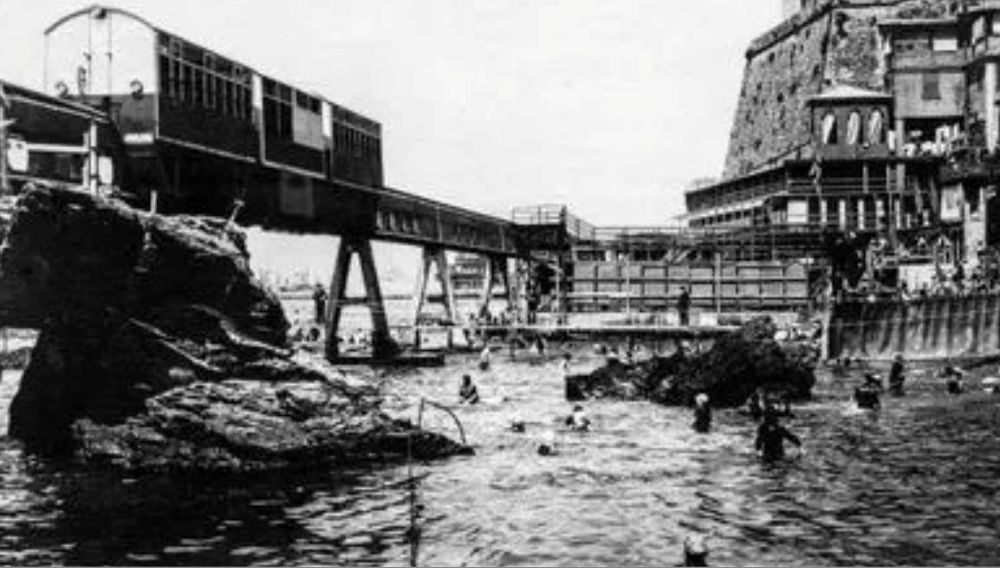
The Telpher/monorail then described a wide arc as it approached the historic Stella battery. [1][3: p103]
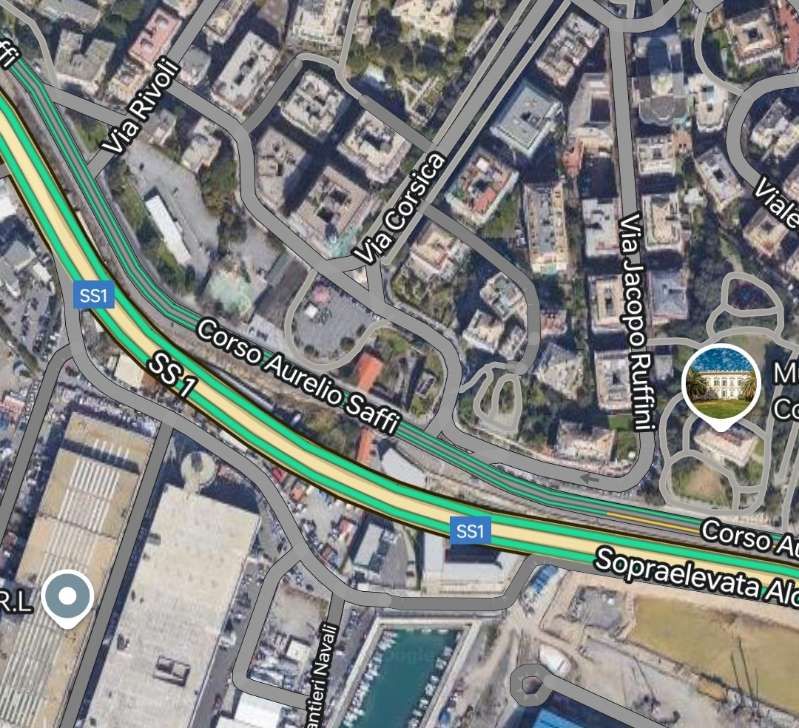
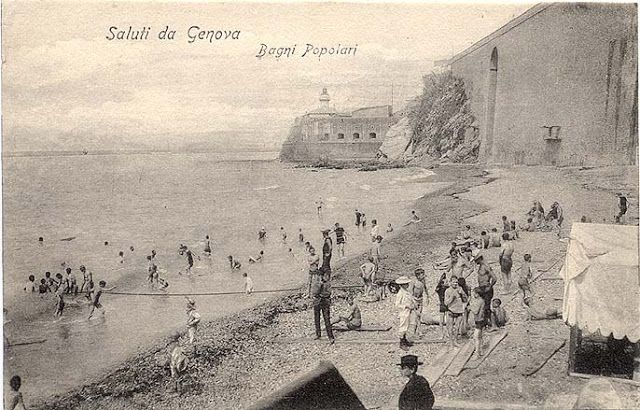
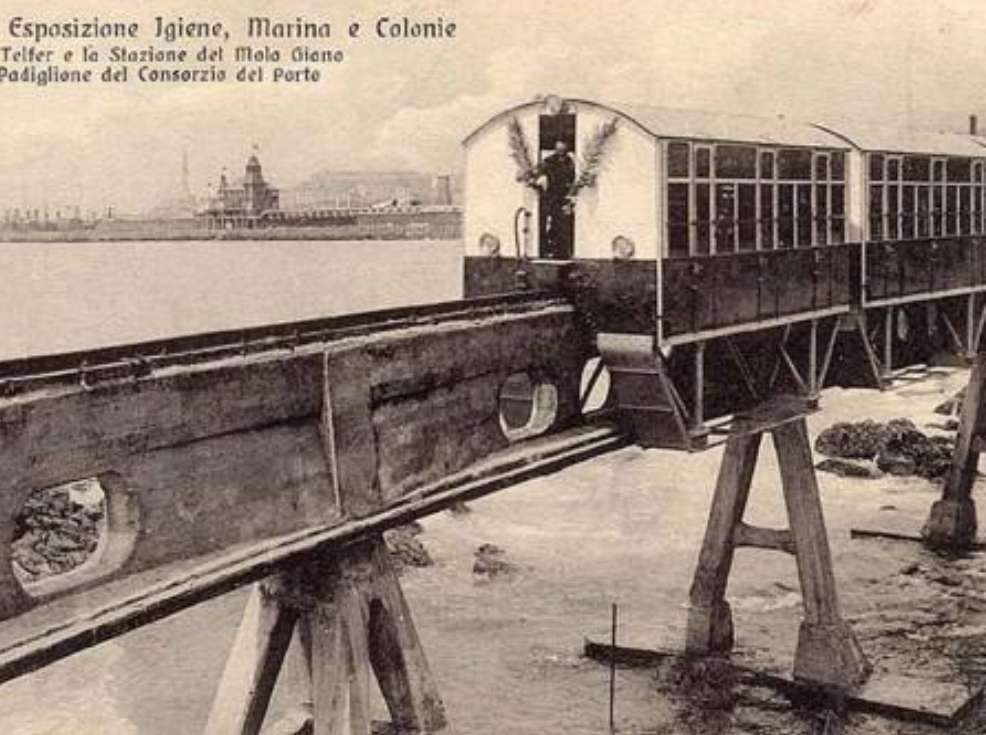
The Telfer passed through the Stella Batterie by means of widened windows. [1][3: p103]

The line then ran straight to the landward end of Pier Giano, cutting across the stretch of water in front of the Cava baths like a viaduct. A curve as tight as 50 metre radius took the Telpher onto the pier and the line continued for some 370 metres. [1]
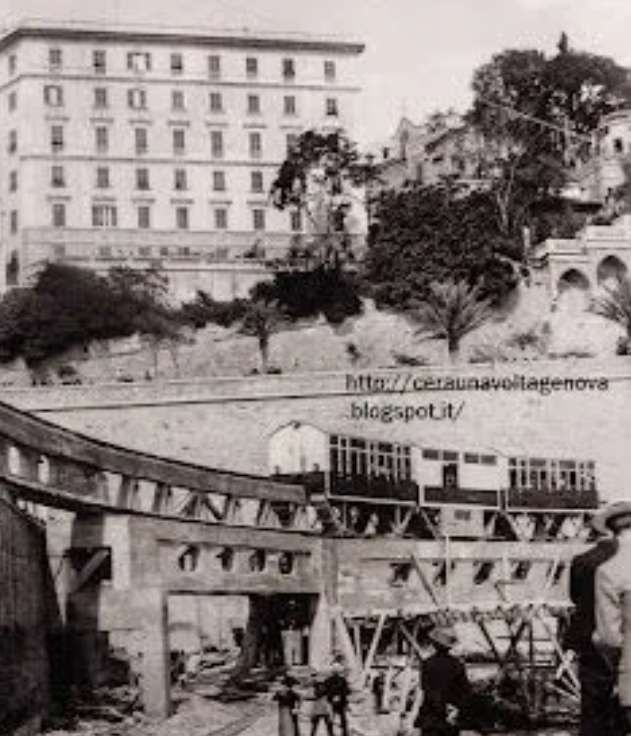

The terminus of the line was close to the pilots’ tower, 370 metres from the tight curve that brought the Telfer onto the pier.
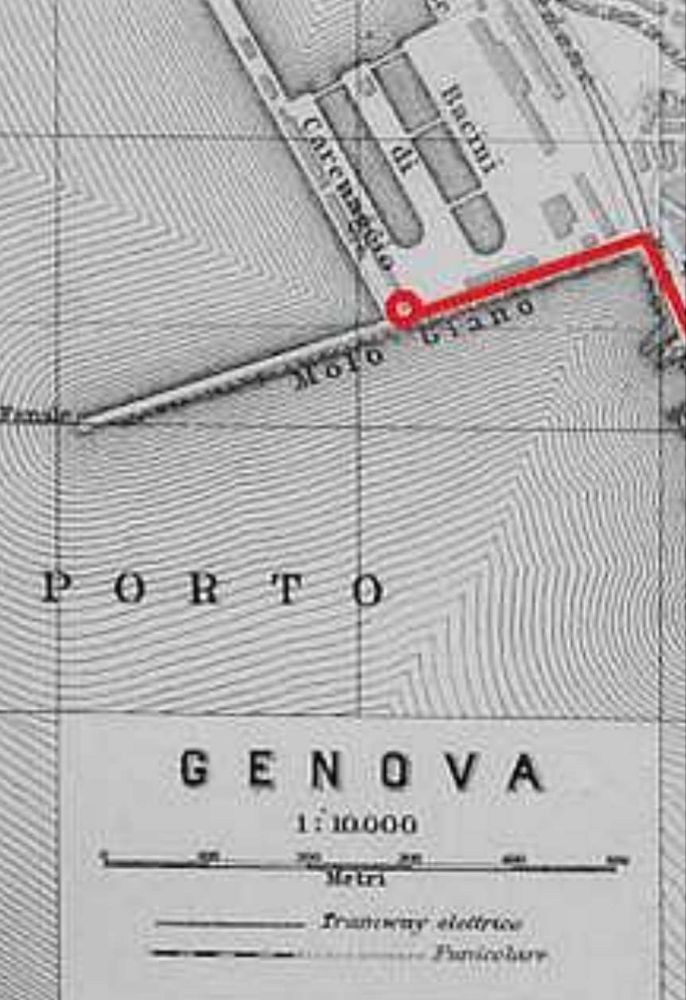
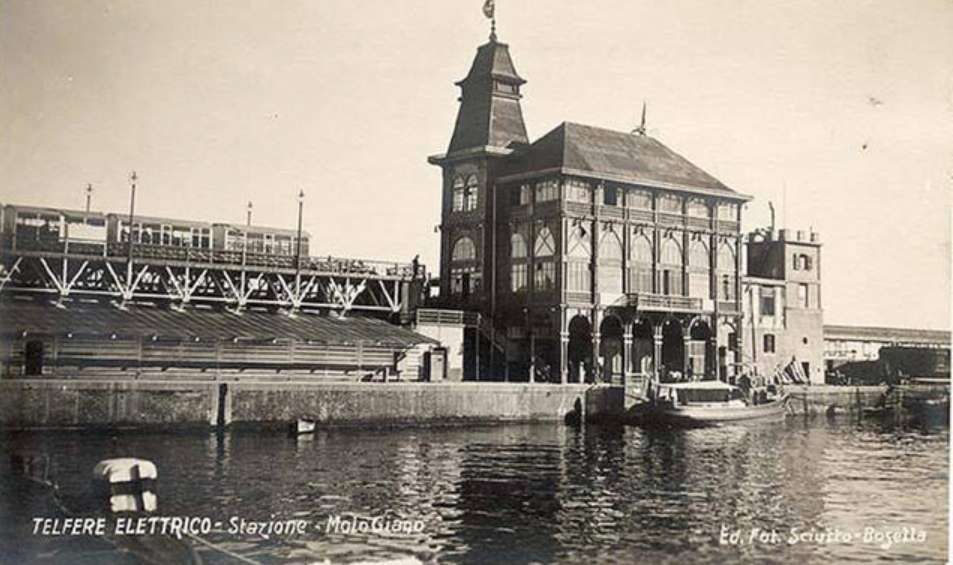
The entire route was just over 2.2 km in length, with an average height above ground of 4 m. Except for the short stretch on the Giano pier, which was made of wood, the route was fabricated in reinforced concrete and was supported on a total of 72 piers. A third of the piers sat directly in the sea. [1]
The route was travelled at a speed of 20-30 km/h and was completed in about seven minutes. [3] The train ran every half hour from 9:00 to 24:00, A single ticket cost 1.00 lire (about 3.70 euros today), a return ticket 1.50 lire (about 5.50 euros today), there were concessions for shareholders, military personnel, children and groups. [1][3: p99]
References
- https://it.m.wikipedia.org/wiki/Telfer_(monorotaia), translated from Italianand accessed on 10th November 2024.
- https://www.meer.com/it/10565-sospesi-sullabisso, accessed on 10th November 2024.
- Massimo Minella; The Telfer, a monorail on the water; in 1914 – The International Exhibition of Genoa; De Ferrari, Genoa, 2014, pp. 99–111.
- Let’s talk about Badoni , in
I Treni , No. 215, May 2000, pp. 22-25. - https://web.archive.org/web/20140503133000/http://fotoalbum.virgilio.it/lucaboggio/vecchia-genova/esposizioneigienema/telferdicollegament-2.html, accessed on 10th November 2024.
- https://rogerfarnworth.com/2018/12/07/manchester-victorias-telpher
- https://it.m.wikipedia.org/wiki/Esposizione_internazionale_di_marina_e_igiene_marinara_-_Mostra_coloniale_italiana, accessed on 14th November 2024.
- https://picryl.com/media/telfer-genoa-1914-1918-942c06, accessed on 14th November 2024.
- https://www.infogenova.info/conoscigenova/curiosita/209-monorotaia, accessed on 14th November 2024.
- https://www.etsy.com/listing/843011848/vintage-1914-genoa-italy-exposition, accessed on 14th November 2024.
- https://ceraunavoltagenova.blogspot.com/2017/12/telfer.html?m=1, accessed on 14th November 2024.
- https://www.ilcittadino.ge.it/Cultura/Expo-Genova-1914-mostra-a-Palazzo-San-Giorgio, accessed on 14th November 2024
- https://www.ilsecoloxix.it/video/2019/05/21/video/quando_genova_aveva_la_funivia_e_la_monorotaia-9553479, accessed on 14th November 2024.
- https://www.alamy.com/stock-photo/telfer.html, accessed on 14th November 2024.
- https://www.industritorget.se/objekt/elektriska+telfrar/15290/#mobileAnchor, accessed on 14th November 2024.
- https://www.marklinfan.com/f/topic.asp?TOPIC_ID=1028, accessed on 14th November 2024.
- https://www.amezena.net/tag/batteria-della-stella, accessed on 14th November 2024.
- http://www.uwrbancenter.comune.genova.it/sites/default/files/quaderno_arch_2011_03_21.pdf, accessed on 16th November 2024, p17. …..”The first monorail in Europe: On 14th June 1914, the first monorail built in Europe was inaugurated in Genoa. It was built for the International Exhibition that occupied the area of the current Piazza della Vittoria and Via Diaze hosted numerous exhibitions set up inside pavilions designed largely by the architect Coppedè. The “Telfer elettrico” (or “suspended or aerial railway”) connected the “aerial” station, located inside the Exhibition, to the port, at Molo Giano, where the exhibition pavilion of the Consorzio Autonomo del Porto was located. The Telfer was 2227 m long and followed, approximately, the route of the current Viale Brigate Partigiane and part of the current Aldo Moro flyover: to cross the final part of Corso Aurelio Saffi a parabolic bridge with a span of 28 m was built, a true “work of art”. The Telfer consisted of a monorail suspended on wooden or concrete beams resting on triangular-shaped supports and an electric traction train that moved in both directions, placed astride the beam and composed of a central locomotive that drove two or four carriages. The carriages had a capacity of 46 seats or, alternatively, 80 standing places. The Telfer reached a maximum speed of between 20 and 30 km/h and took eight minutes to complete the entire journey. It was built in one hundred and fifty days of actual work and had seen the employment of more than six hundred workers. It could have been used, after the closing of the exhibition, for the transport of people or goods, but unfortunately the war events imposed the dismantling of the monorail and the partial reuse of the materials.”
Bibliography
- Enrico Pieri, Il “Telfer” di Genova, in Strade Ferrate , n. 16, ottobre 1983, pp. 22-27.
- Marco Marchisio, Il Telfer di Genova, in Tutto treno & storia, n. 14, novembre 2005, pp. 30-43.
- Lorenzo Bortolin, TELFER, la monorotaia di Genova, in I Treni Oggi, n. 16, gennaio 1982, pp. 20–21.
- Cornolò Ogliari, Si viaggia anche … così, Milano, Arcipelago edizioni, 2002, ISBN 88-7695-228-4.
- Stefano Percivale (da un progetto di), Genova com’era Genova com’è, Genova, Fratelli Frilli Editori, 2008.
- Franco Rebagliati, Franco Dell’Amico, Giovanni Gallotti e Magno Di Murro, Il Telfer, in In tram da Savona a Vado 1912-1948, L. Editrice, 2012, pp. 68–71, ISBN 978-88-95955-73-5.
- Massimo Minella, Il Telfer, una monorotaia sull’acqua, in 1914 – L’Esposizione Internazionale di Genova, De Ferrari, Genova, 2014, pp. 99–111. ISBN 978-88-6405-564-0.
 Roger Farnworth
As interesting as ever, Roger. I had no previous knowledge of this system.
One interesting feature, which you fail to comment on, is the fact that ‘The Telfer’ appears in the photos, in both 5 and 3 car configurations. Why might that be, I wonder? Adding and removing a carriage, from both ends of the unit, must have been a cumbersome and time consuming chore. As there does not appear to be a servicing depot on the system, I can only assume that the unit was shortened by uncoupling a car at both terminal stations! But why?
Good question Stuart. My guess would be that a carriage could be left at each terminus. Presumably during the exhibition opening times saw higher traffic than out-of-hours operations required?
Pingback: Genoa’s Metro | Roger Farnworth
Pingback: An outrageous claim and the rabbit hole that followed – Forsyth's Compendium of Curious Contraptions