In April 1920, a couple of paragraphs in The Railway Magazine focussed on a new experimental Railmotor constructed by New South Wales Railways. [1]
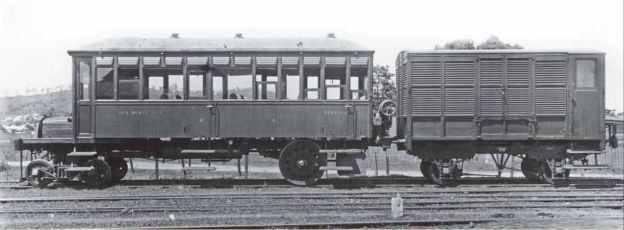
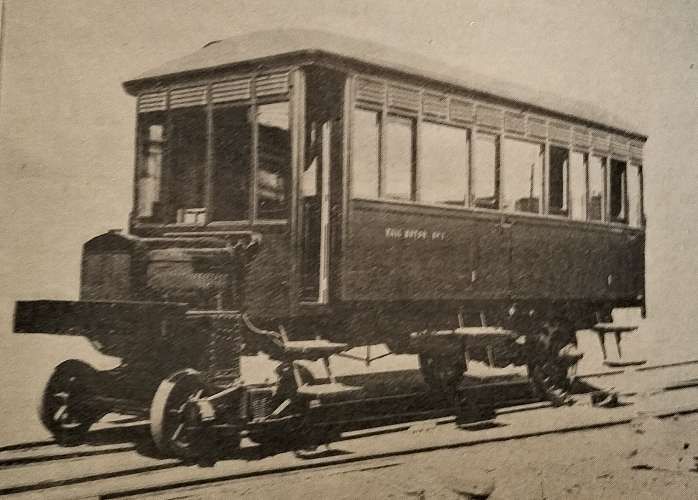
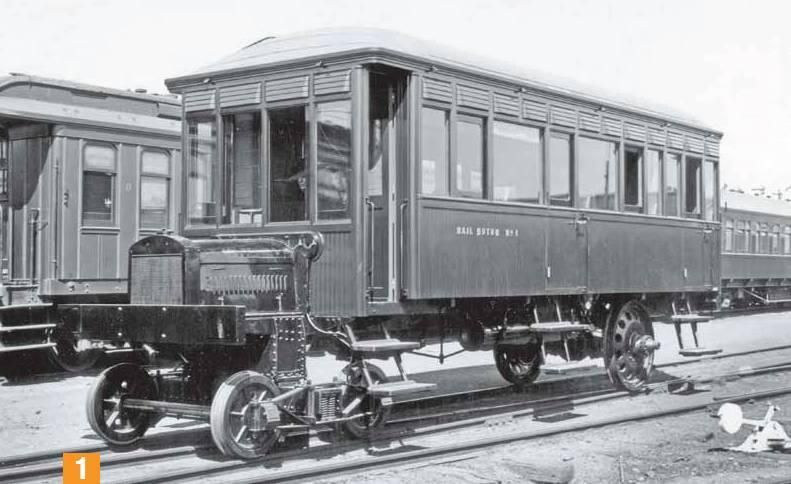
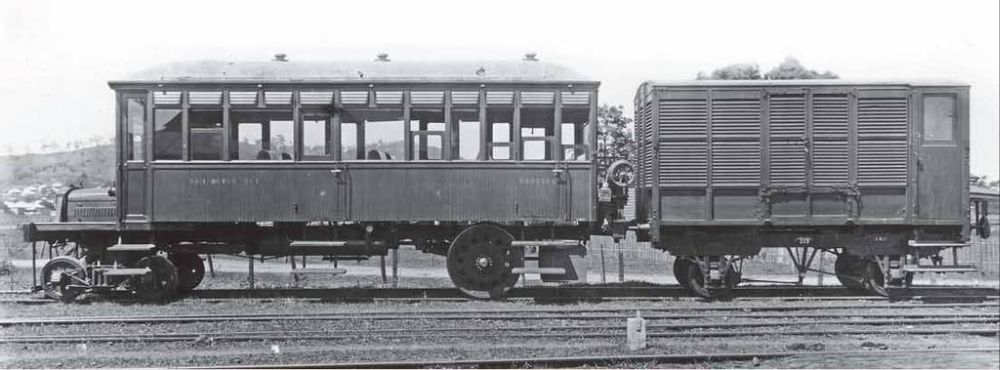
Railmotor No. 1
In April 1920, The Railway Magazine reported that New South Wales’ Railway Commissioners introduced a railmotor service on the Lismore line, an isolated section on the North Coast. The railmotor car was provided by converting and lengthening to 8 ft. 6 in. the chassis of a five-ton Moreland motor lorry. The front pair of wheels were also replaced by a four-wheeled bogie. The railmotor provided seating accommodation for 33 passengers, and was designed and constructed at the carriage and wagon shops of the system at Eveleigh, Sydney. [1]
Before being placed in service, a severe trial run was made, and proved in every way to be most successful; a I in 40 grade being taken at a speed of 18 m.p.h. The time-table was arranged for speeds up to 25 mph. The Railway Magazine noted that if found satisfactory in continued service similar rail-motor services would be introduced on other branch lines. [1]
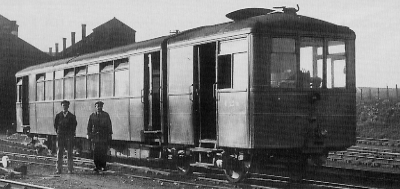
NSW Railmotor No. 1 was powered by a 42 hp 4-cylinder American Waukesha petrol engine. This engine was later replaced by a 40 hp British Thornycroft 4-cylinder petrol engine. This vehicle proved a success on the line between Lismore and Grafton. [3]
“The wooden body … was finished in narrow tongue and groove boards. It was divided into three separate sections, accommodating 33 passengers and 2 crew. The first section was the cab, which accommodated the train crew (the driver and the guard). The second section (the forward compartment) accommodated 23 passengers and the third section (the rear compartment) was a smoking area and accommodated 10 passengers. The two passenger compartments were fitted with transverse seats and drop type windows, and each compartment had two doors, which opened outwards. There was no interconnection between the three compartments. Steps were fitted under each of the doors to allow passengers to alight from the vehicle to ground level.” [3]
“The Railmotor was designed to run in one direction only and draw-gear was fitted to the trailing end so that a trailer could be attached for hauling light goods and parcels. A collapsible tricycle (trike) was also carried for the train crew’s use in case of an emergency or breakdown in the section. This was carried on the back of the Railmotor.” [3]
“In November 1925, after six years of reliable service, [this vehicle] was withdrawn from passenger traffic and it took on a new role as the Signal Engineer’s inspection car. It subsequently lost its title of Railmotor No.1 as this was re-allocated to one the newly designed 42-foot Railmotors in November 1926.” [3]
“No. 1 was finally withdrawn from railway service in 1930. The body was sold and it began a new life as a house in the Coffs Harbour region, while the chassis was scrapped.” [3]
As we have already noted, one drawback with Railmotor No.1 was that it was only single ended and needed to be turned at the terminus for the return journey. Therefore double-ended operation was to be provided in the next prototype vehicle, Railmotor No.2, built in 1921. [3] Both trial vehicles were sufficiently successful to mean that the railway company went on to use a number of Railmotors.
Railmotor No. 2
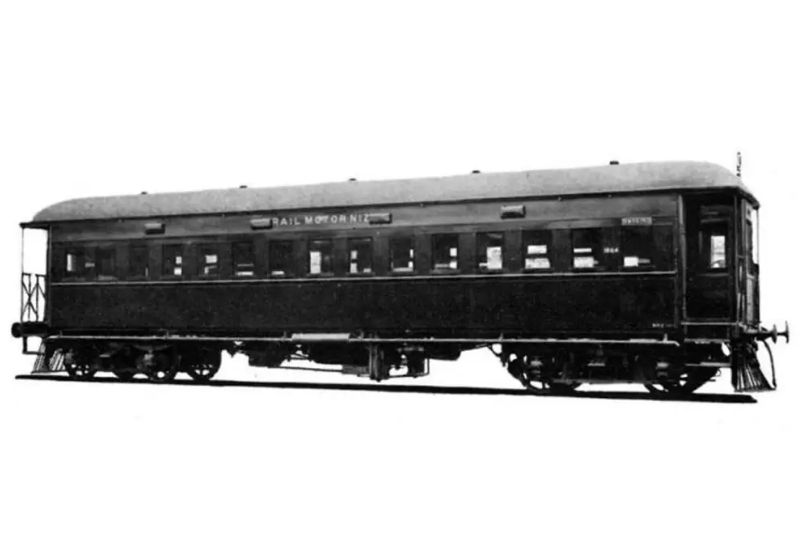
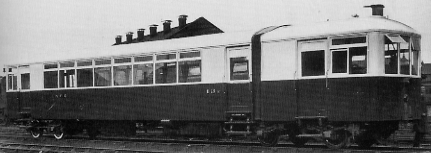
Railmotor No. 2 (Kathleen)! “An end-platform suburban type carriage, FA 1864, was chosen for this experimental vehicle. Eveleigh Carriage Works converted this carriage to a Railmotor while its mechanical parts and the petrol engine were designed and built in Eveleigh Locomotive Works.” [3]
Configured as a railmotor, Kathleen (never its official name) “was divided into 4 sections, accommodating 53 passengers and 2 crew. [A] driving [cab was] positioned at each end. The First Class section accommodated 16 passengers, while the Second Class section accommodated 37 passengers. … Driving cabs were mounted in the centre of the end platforms at each end of the vehicle. Entry to the cab was gained through a back door that opened into the passenger compartment. The driving controls were arranged to allow the vehicle to be driven from either end and this meant the vehicle did not have to be turned for the return journey.” [3]
The first class section of the Railmotor “occupied one third of the vehicle’s length and the second class area occupied the remaining two thirds. Access to either area was gained through a door contained in a wall separating the two compartments. The engine protruded through the floor of the second class area and was covered by a padded fixture providing seating for an additional 5 passengers. This fixture measured 10′ 6″ x 3′ 6″. Battery boxes were also located in this central area and these to were covered with padded seats providing seating for 12 passengers.” [3]
“Railmotor No. 2 was powered by a 6-cylinder 100 hp (@1,000 rpm) petrol engine manufactured in the Eveleigh Railway Workshops. This engine was regarded as a fine piece of engineering, as it was reversible. That is, it could be turned in either direction and it contained features such as coil ignition, seven bearing crankshaft, together with overhead valves and camshaft. To make the engine turn in the opposite direction a camshaft containing two sets of cams was slid into position by means of compressed air. This engine weighed 22 cwt. A three-speed gearbox was coupled by cardan-shaft to both axles on one bogie. The vehicle was geared to give a road speed of 40 mph (@1,425 rpm) in top gear. Total weight of the vehicle of 26 tons 7 cwt 2 qtr.” [4]
“As the Railmotor could run in either direction, buffers, cowcatchers and standard screw drawgear were mounted on headstocks at either end and electric headlights were mounted above each of the driver’s windscreens. Electric lighting was used for the cab and compartment areas.” [4]
“Railmotor No.2 ran trials between Tamworth and Barraba on the 29th April, 1921. On the 15th October, 1922, the public timetable officially showed the railmotor, which provided a faster daily service (except Sundays) in place of the three times weekly mixed train service.” [4]
“No.2 failed to complete about two thirds of its allotted mileage during the first twelve months of operation and this poor performance was put down to undulating grades on the Barraba branch. The unit was eventually withdrawn from this working in November 1924. The unit proved a little more successful when it was trialled on the easier graded Burren Junction to Pokataroo branch during 1925.” [4]
It was withdrawn from service “in November 1925 and reverted to its original role as a suburban carriage number FA 1864. The engine that powered No.2 found a new life driving a water pump at Armidale and later at Valley Heights. … A proposal to construct another five cars similar to Kathleen but with an increased seating capacity lapsed. New designs proceeded and the standard 42-foot railmotor emerged.” [4]
References
Petrol Railmotor Car: New South Wales Government Railways; in The Railway Magazine, April 1920, p230.
The Railway Magazine of September 1922 carried two short articles about new petrol Railmotors. …
North Eastern Railway (NER) – Petrol Rail Motor Bus
The first short article was about an experimental vehicle used by the NER.
On certain portions of the NER network, the company realised that “there was room for a service conducted on lines as nearly as possible identical with those of motor buses on the roads. With the view of ascertaining, without much initial expenditure, whether the scheme is likely to prove financially successful, they have converted one of their ‘Leyland’ road motor ‘buses, formerly running on the road services in the vicinity of Durham, so as to make it suitable for running on the railway.” [1: p234]
The war resulted in a significant increase in railway working expenses which made it impossible to provide a train unit on some of the country branches, where the number of people travelling was small, “sufficiently cheap to cover its working expenses out of the small revenue available,” [1: p234]
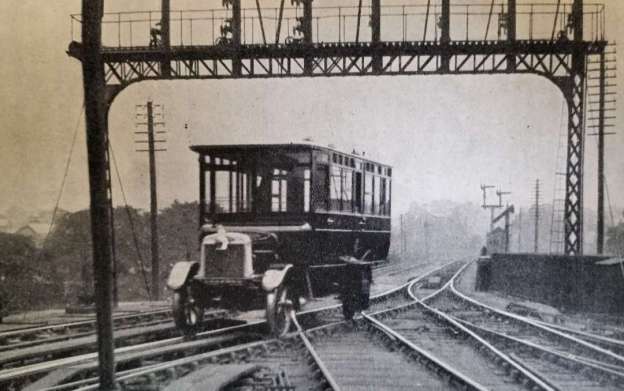
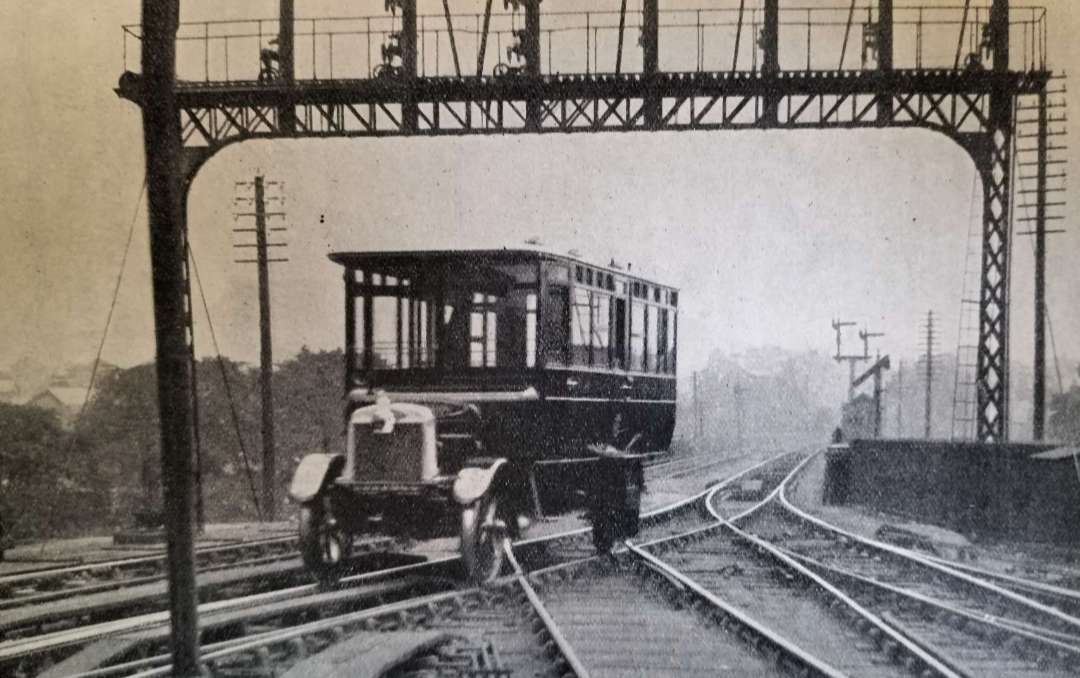
NER Rail Motor [1: p235]
The NER needed to devise a cheaper form of rail transport. As a first step, it decided to convert one of its own fleet of petrol-powered road buses. The company’s intention was to undertake a trial at low cost before developing a design specifically tailored to rail use.
The experimental unit entered service on 19th July 1922. If “the results of the working of this vehicle are encouraging, the company intend[ed] to build vehicles [capable of] carrying up to 40 passengers, and maintaining an average speed of approximately 30 m.p.h.” [1: p236]
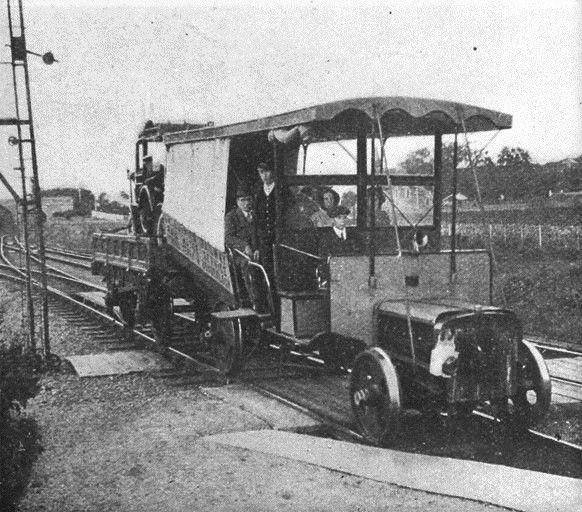
The railmotor operated between Copmanthorpe, York, Strensall and Earswick, and was “manned by a motorman and a conductor exactly in the same way as if it were running on the highway. Single journey tickets [were] issued on board, so that passengers [did not have] the trouble of going to the booking office. It [had] accommodation for 26 passengers. It [ could] be driven from both ends, and run in either direction, and the motive power consist[ed] of a 35-h.p. Leyland engine of the standard type, supplied by the builders for their ordinary commercial road vehicles.” [1: p236]
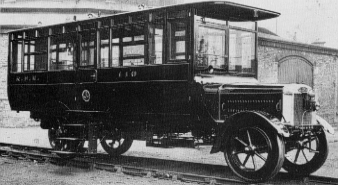
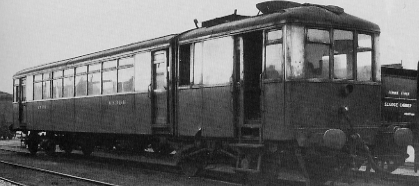
The donor vehicle was one of three Leyland Motor Co. buses that the NER purchased on 21st July 1921. “With a long bonnet and a overhanging roof at the front, it was a typical design for that time. The conversion was completed at York Carriage Works. Initially No. 110 in the Road Vehicle fleet, it was renumbered as No. 130Y shortly after conversion because No. 110 was already occupied in the Coaching Stock list.” [2]
An “additional radiator and an additional driving position were located at the rear of the vehicle. Central passenger doors were fitted to both sides of the saloon. …. Folding steps were also added to allow access from rail level. These were later replaced with fixed steps, and eventually removed altogether. An electric headlamp was also fitted.” [2]
The LNER website continues: “the initial York duty involved a service to Haxby, Strensall, Earswick, and Copmanthorpe. NER Petrol Autocar No. 2105 took over this duty on 9th July 1923, and No. 130 was transferred to Selby. At Selby, No. 130 operated daily return trips to Straddlethorpe, York, Goole, Catleford, Goole, Market Weighton, Cawood, and Hemingborough. This resulted in a full timetable that started at 6:52am and finished at 7:44pm. No. 130 took part in the Stockton & Darlington Centenary celebrations, but continued these Selby duties until November 1926.” [2]
Railmotor No. 110, later No. 130. The fold-down steps can be seen clearly in this image. [2]
On 11th November 1926 the railmotor/railbus “caught fire whilst being filled up with petrol at Selby shed. The entire bus was reportedly gutted within 15 minutes. Reports also suggest that someone used a naked paraffin lamp to check the level of the petrol tank. Only the chassis remained, and it was eventually decided not to rebuild or replace the bus. No. 130 was officially withdrawn from stock on 9th April 1927.” [2]
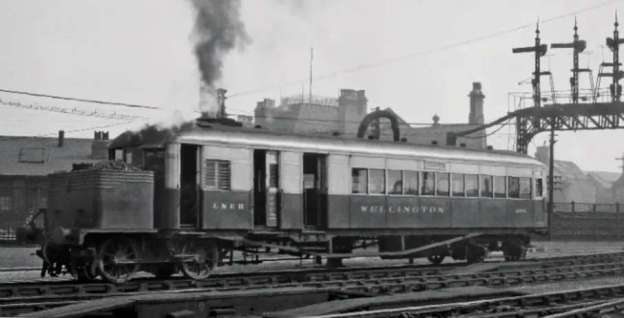
It seems as though the initial experiment was successful enough to allow the NER to authorise the building of a further experimental petrol railmotor (No. 2105) in September 1922. A Daimler engine was purchased in October and “the remainder of the vehicle was built at York Carriage Works and was completed in July 1923. By this time, Grouping had occurred, and the autocar was given the LNER number 2105Y. It was later renumbered as No. 22105 in August 1926.” [3]
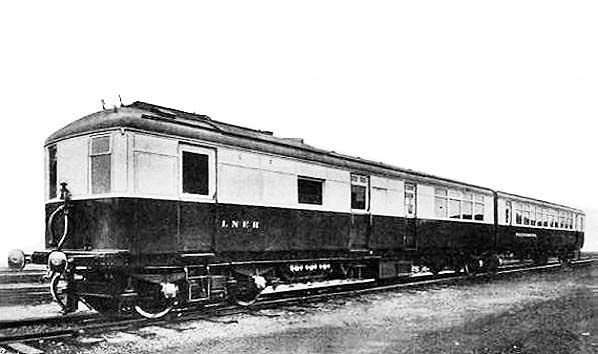
Railmotor No. 2105 (later renumbered 22105) [3]
It seated 40 in third class accommodation, seats were in pairs either side of a central gangway. “The distinctive wheel arrangement had a two axle bogie at the engine end, and a single fixed axle at the other end. The single fixed axle was powered from the motor via a clutch, three-speed gearbox, and propeller shaft with two universal joints. 40mph was reportedly possible. Radiators were fitted to both ends.” [3]
This Railmotor took over the service provided by No. 130 and continued to operate local services in and around York until 1930. By 1930, it had been renumbered 22105.Closure of a series of local stations that year led to it being reassigned to the Hull area. It is “known to have been given an extensive timetable in the Hull area from 1st May to 17th July 1932 when it worked a 14 hour timetable including Beverley, Thorne North, Brough, Willerby & Kirk Ella, and Hull. Reports suggest it was unreliable during this period and was often replaced by a Sentinel steam railcar.” [3]
Over the next two years, No. 22105 did not work any revenue-earning services. It was withdrawn from service on 19th May 1934.
What is perhaps surprising is that these two experimental vehicles were not the first ones used on the NER network. The NER had experimented with petrol railmotors just after the turn of the 20th century. Two examples are worthy of note.
A. Petrol-electric Railmotors/Autocars
The NER were reviewing their operation of suburban passenger services on Tyneside. Alongside the introduction of electric trains on an urban network of lines which would later develop into the Tyne and Wear Metro, the NER ordered two experimental railcars/railmotors to work other, non-electrified, parts of the network.
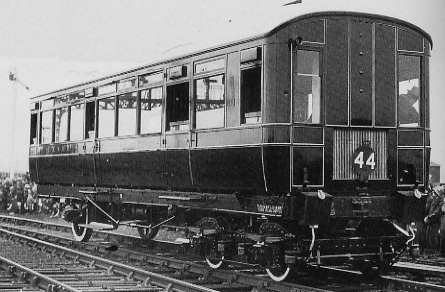
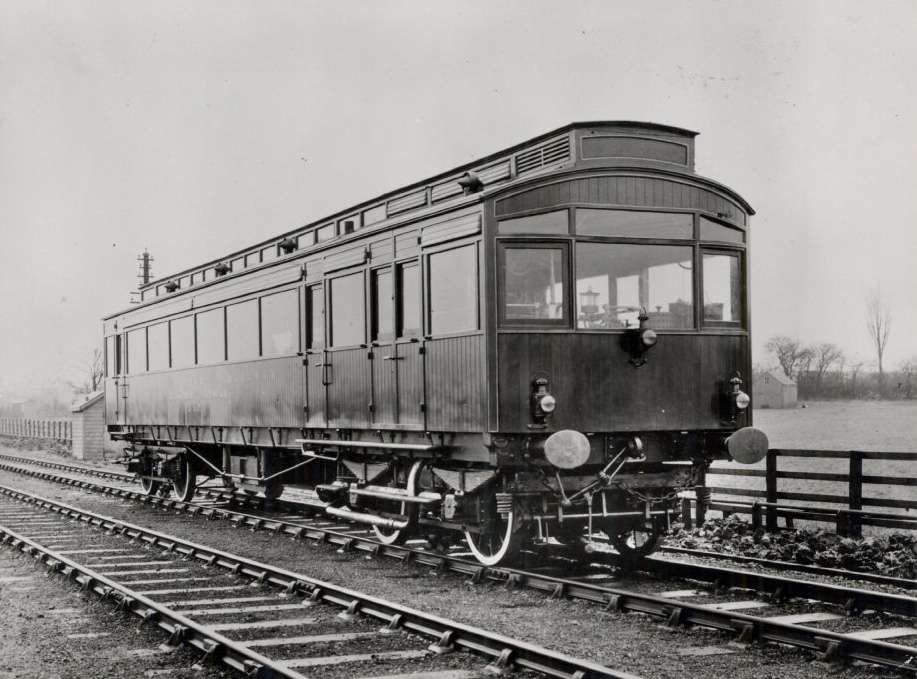
“Both railcars were built at the York Carriage Works, together with the original Tyneside electric stock, in 1902-3 and numbered 3170 and 3171. They were 53.5 feet long and weighed around 35 tons. They had clerestory roofs, bow ends, large windows and matchboard sides. There were four compartments inside, the engine room with the principal driving position, a vestibule, the passenger saloon and a driving compartment. There was no guard’s compartment. The passenger saloon had 52 seats. These were reversible and upholstered in standard NER pattern. With curtains at the windows, radiators between the seats and electric lighting, the passenger accommodation was described as ‘cosy’ and seems to have been very popular with the travelling public.” [4]
These two railmotors were referred to as ‘autocars’ after the steam push/pull autotrain services already operated by the NER.
The Embassy & Bolton Abbey Railway comments: “These NER railcars were the first in the world to use petrol-electric technology. At that time, diesel engines were less advanced and not as reliable as their petrol counterparts. The concept of using internal combustion engines to power electric traction motors would later be developed into the diesel electric technology used to power many of BR’s ‘diesel’ locos.” [4]
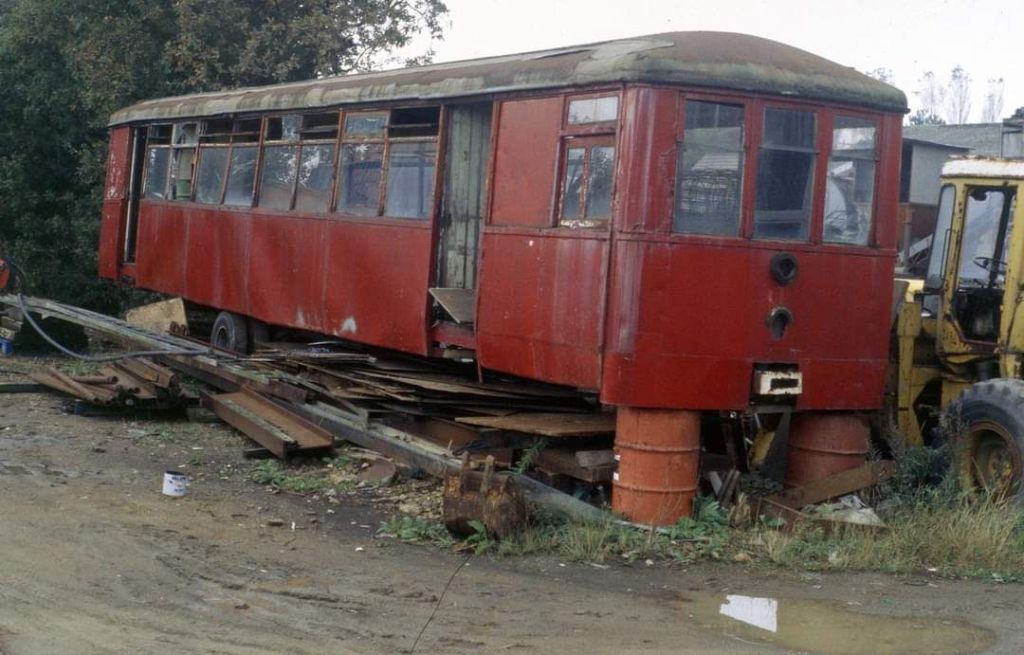
One of the two NER petrol-electric railmotors. [5]
Initially the railmotors/autocars saw service “between West Hartlepool and Hartlepool stations (in direct competition with electric tramcars) and Scarborough to Filey (as a replacement of a steam service). Later, the autocars were transferred to the Selby – Cawood branchline to work the passenger services there. In 1923, no.3170 was fitted with a larger engine and new generator giving it sufficient power to pull a conventional carriage, thus increasing passenger capacity. It worked in the Harrogate area for a while before rejoining its twin on the Cawood branch. No. 3171 was withdrawn in 1930 and No. 3170 in 1931.” [5]
These vehicles had a petrol engine and a generator in their engine rooms, producing electricity for two Westinghouse 55HP traction motors which were mounted on the bogie underneath. A series of different petrol engines were used during the life of these vehicles. “In 1923, no. 3170 was given a third engine, a 225HP 6 cylinder ex-WD engine rumoured to come from a First World War tank. This new engine gave 3170 more torque and enough power to haul an autocoach as a trailer, though it seems not to have affected the maximum speed.” [5]
The LNER showed an interest in these vehicles and went on to test Armstrong diesel-electric railcars in the 1930s, but by then Sentinel steam railcars had been introduced. “These were not as reliable or popular, they had more seats and fitted better into the contemporary infrastructure.” [4]
No. 3171 was dismantled when withdrawn. When No. 3170 was withdrawn on the 4th April 1931 it was transported to Kirkbymoorside near Pickering, where the body became a holiday home. “Fitted with a tin roof and veranda it was well protected from the weather and survived there until September 2003 when it was sold to carriage restorer Stephen Middleton who moved it to the Embsay and Bolton Abbey Steam Railway.” [5]
B. A Petrol Directors’ Vehicle
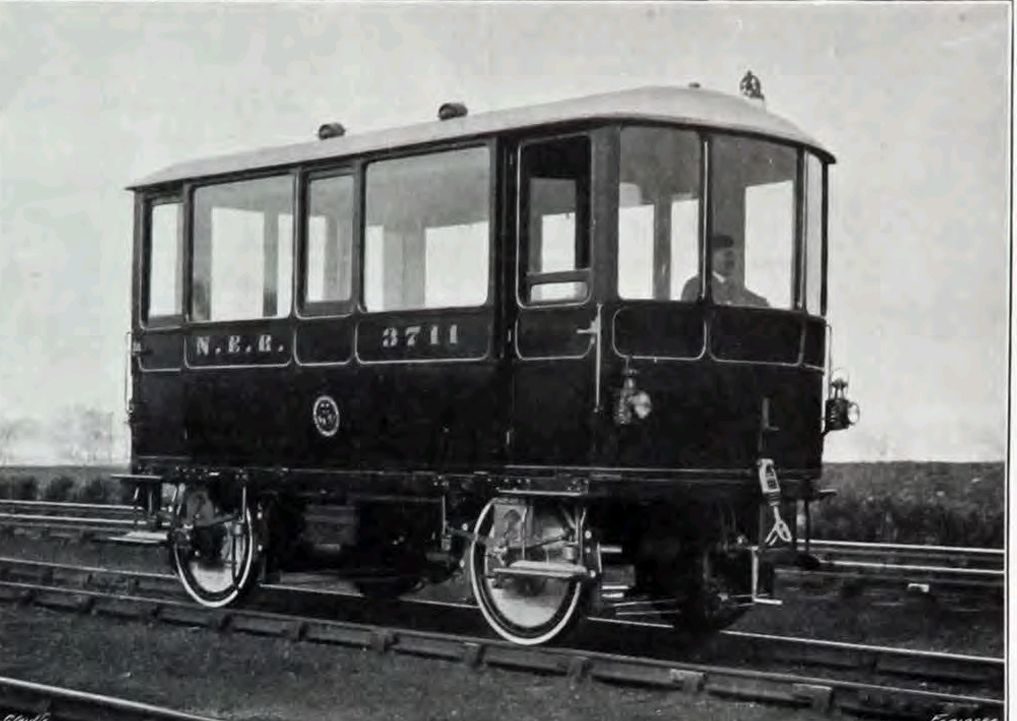
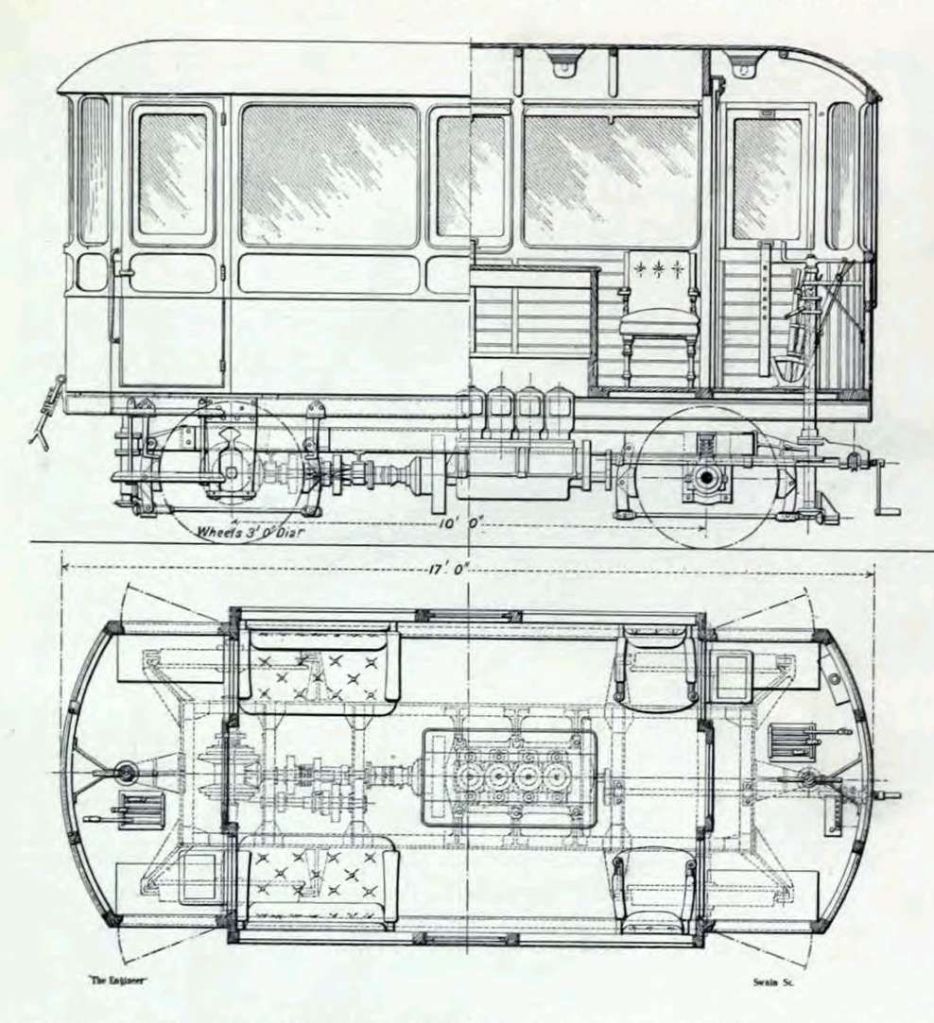
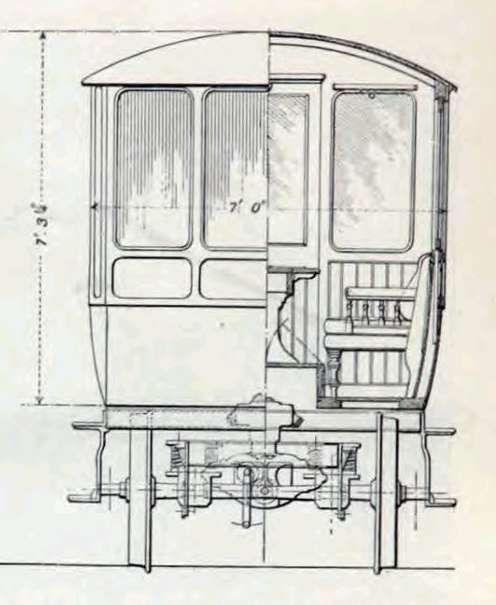
NER Directors’ Inspection Car [8: p358]Side elevation and Plan of NER Inspection Car [8: p460]End elevation of NER Inspection Car. [8: p460]
The Engineer reported in early 1908 that “The North-Eastern Railway Company [had] recently built at its York carriage works and introduced into service a petrol rail motor inspection car designed for the use of its executive officers. The car [was] 17 ft in length by 7 ft in width, with a wheel base of 10 ft. It [was] arranged with a driver’s compartment at each end, and with an open saloon 10 ft. long in the middle. The saloon [was] entered through either of the driver’s compartments, and there [was] a permanent seating accommodation for six passengers, whilst two extra seats [were] provided on camp stools.” [8: p358]
It seems reasonable to ask why, with the experience gleaned in the very early years of the 20th century, the NER felt the need in 1922 to commission further experimental vehicles. Was it because the technology had developed significantly? Had the early experiments been less than satisfactory?
Weston, Cleveland & Portishead Light Railway
The second short piece in The Railway Magazine of September 1922 related to a Railmotor constructed by the Drewry Car Company Limited (Works No. 1252), to the instructions of Colonel H.F. Stephens, who, along with other roles, was Engineer and General Manager of the Weston, Clevedon and Portishead Light Railway.
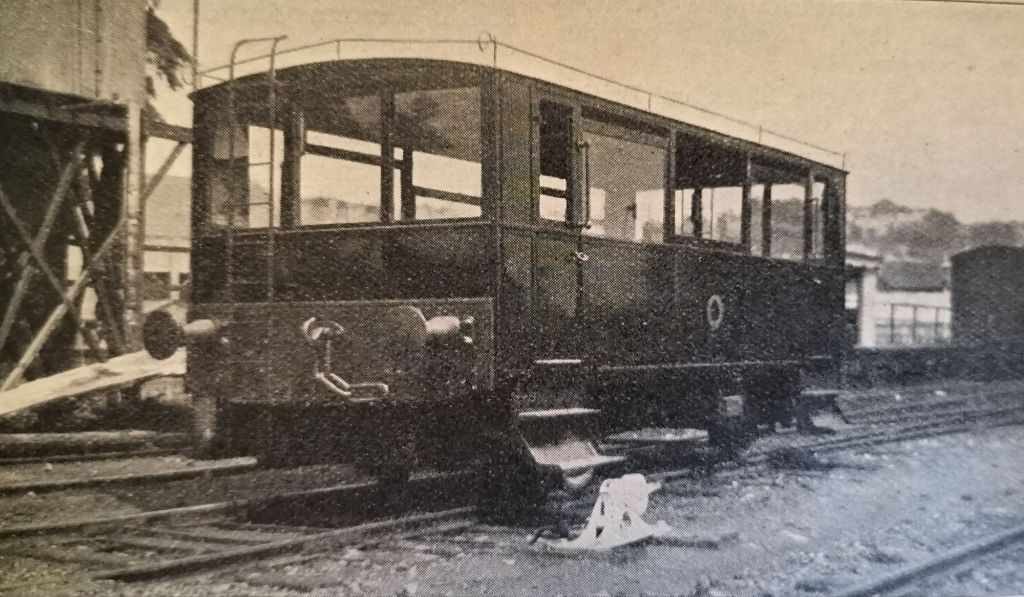
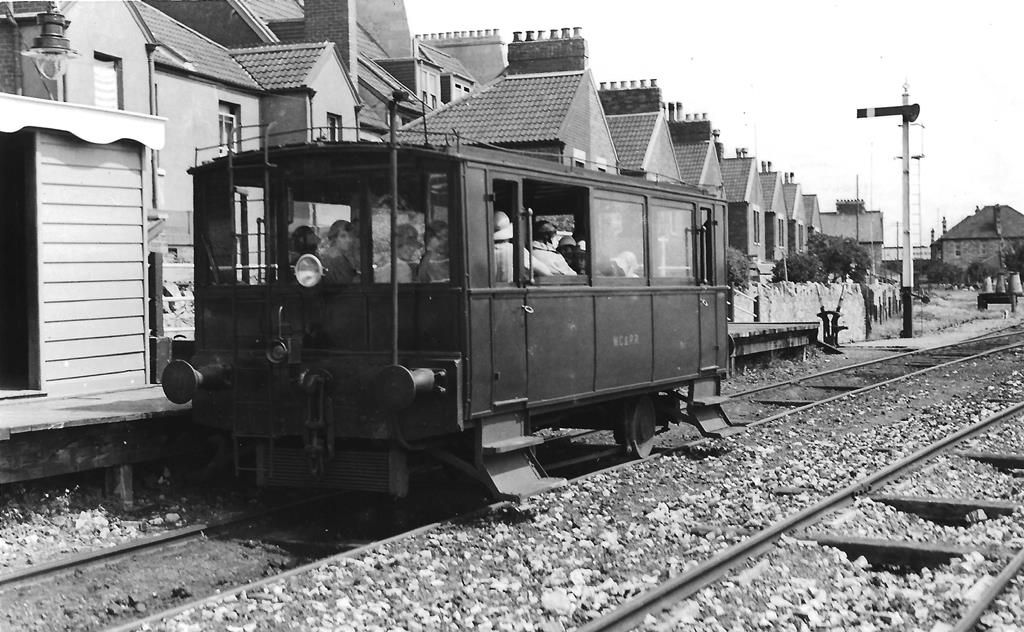
The railmotor was powered by a 4-cylinder Baguley 35 hp petrol engine with a 3-speed gearbox and its oil consumption, on easy gradients, [was] 16 miles to the gallon. It had a maximum speed of 25 mph. It was 19ft long and driven by a chain drive from either end. It had 2ft diameter wheels. [1: p239][6]
A Drewry Railmotor at the Weston, Cleveland & Portishead Light Railway. [1: p239]
The vehicle had full visibility all round. Glazed throughout above waist height. Side widows were openable. The panels below the windows were of steel. Acetylene lighting was provided for travel after-dark. The unit carried a maximum of “42 passengers – 30 sitting and 12 standing. The car [was] provided with rails round the roof to enable light luggage and market produce to be carried outside, thus giving the passengers more accommodation.” [1: p239]
Colonel Stephens “was a pioneer of petrol traction. The WC&PR was the first of his railways to introduce railcars. … Due to low running costs [the Drewry Railmotor] was relatively profitable. … Originally the petrol tank was fitted inside the railcar together with spare cans of petrol. As smoking was then common, it was later realised that this was a hazard and a cylindrical horizontal petrol tank was fitted at one end above the buffer beam.” [6]
“A light four-wheel wagon built by Cranes was bought in 1925 for the railcar to carry extra luggage or milk churns.” [6]
In June 2024, I picked up a few copies of the Railway Magazine from the early 20th century.
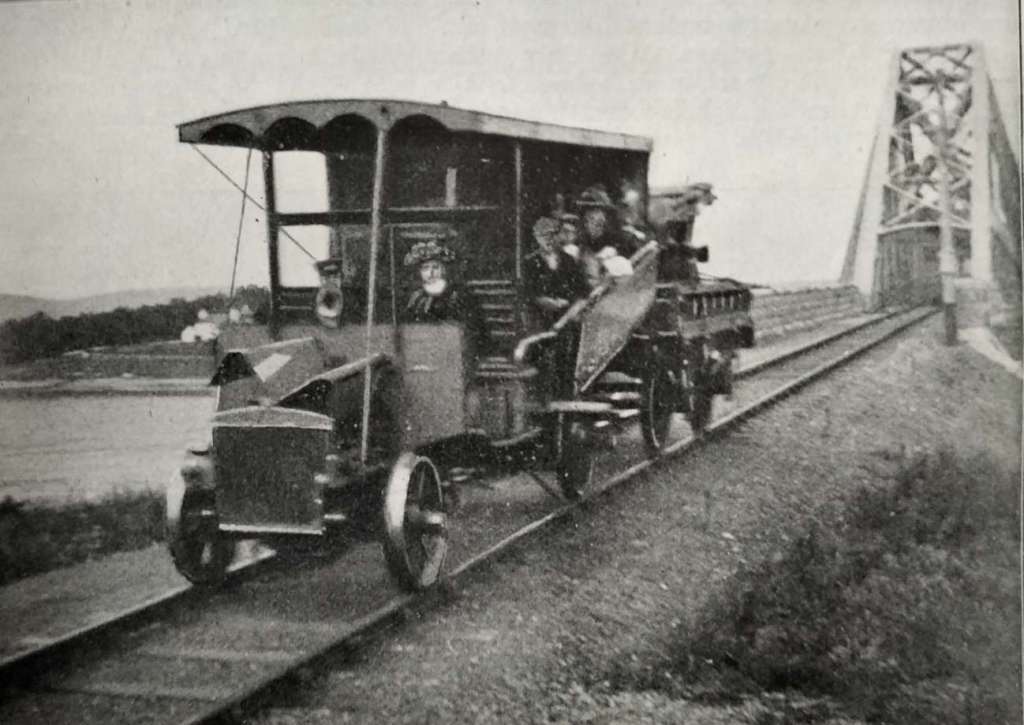
In July 1909, the Railway Magazine noted that the Caledonian Railway had inaugurated a motor car service on its rails. Just a short journey was involved crossing the Connel Ferry Bridge and running from Connel Ferry to either North Connel or Benderloch.
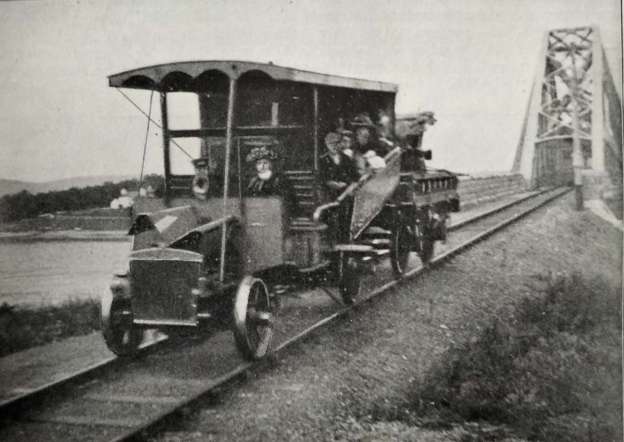
In September 1909 the Railway Magazine carried a photograph of the rail-motor car.
The Caledonian Railway rail-motor car, with wagon attached. The wagon is carrying a road-motor car. It has just left the Connel Ferry Bridge. [1]
“The Caledonian Railway purchased an ordinary road-motor car, and under the superintendence of Mr. J. F. McIntosh, this was converted, at St Rollox Works, into the rail-motor car. … The car performs, daily, several journeys from Connel Ferry across the bridge to North Connel, and four of these trips in each direction are extended an additional 2.25 miles beyond North Connel to Benderloch, and it is on these longer journeys that road motor cars are conveyed on the carriage truck provided for the purpose, which is attached as a trailer to the rail-motor car.” [1]
The vehicle was a Durham-Churchill Charabanc. It originally operated as a road vehicle between Clarkston railway station and Eaglesham. It was converted to rail use in 1909 at the cost of £126!
The journey from Connel Ferry to North Connel took 5 minutes and the trip to Benderloch, 15 minutes in total.
Sunday trains were few and far between in Scotland but an exception was made for this service with 5 crossings of the bridge in each direction. Surprisingly more often than on weekdays!
The Railway Magazine notes that, “in the past, this portion of Argyllshire [was] somewhat of a closed district to motorists, owing to the long arms of the sea which intersect the land and the numerous ferries that have in consequence to be crossed. Access to the very charming district that lies between Loch Etive and Lochleven, has been particularly difficult, as the ferries have become unserviceable since the opening of the Ballachulish Railway, whilst the comparative infrequency of the trains upon the Ballachulish line, and the restrictions on the conveyance of motor cars by the ordinary trains made crossing at Connel Ferry both inconvenient and unreliable.” [1]
Motorists either avoided the area altogether or had to make a long journey via Tyndrum and Glencoe.
The charge for conveying motors across Loch Etive was 15 shillings.
Another view of the same vehicle and wagon. The rail-motor car was more of a charabanc having a number of rows of seats. [2]This view shows the rail-motor car only offered passengers very rudimentary protection from the weather. The vehicle is entering one of the stations it served. Is this Connel Ferry, North Connel or Benderloch Railway Station? [3]
The Ballachulish Branch of the Caledonian Railway which crossed the Bridge at Connel Ferry is covered in other WordPress articles:
The new companies which came into existence with the grouping in 1923 addressed once again the best way to serve lightly populated rural communities. The options available to them centred on various forms of light railcars. Two forms of propulsion were available, the internal combustion engine and the steam engine. Electricity, in many cases required too large an investment for the likely traffic on the intermediate routes in rural areas.
Given, the lack of success of the steam railmotor experiment in the first two decades of the 20th century, it must have seemed unlikely that steam railcars/railmotors woul prove to be a success in the inter-war years. But the LNER’s persistence and the arrival of a new articulated “form of steam railcar developed by the Sentinel Waggon Works Ltd. in association Cammell Laird & Co. Ltd. [brought about] a renewed assessment of the role of the railcar.” [1: p46]
Jenkinson and Lane say that rather than simply using railcars to replace existing services, the aim became one of enhancement of services. A greater frequency of service would reduce the need for unsuitable powered units to pull trailers. Higher speeds would shorten journey times.
But, to do this “in the steam context … meant using a vehicle which, owing to its lightness and simplicity, needed a smaller and less complicated power unit than was offered by the conventional locomotive style of construction. … A tricky balancing act … because railway vehicles need to be much stronger than the road equivalent, … but the Sentinel-Cammell steam railcars were a very fine attempt.” [1: p46]
The LNER Sentinel Steam Railcars
The “Sentinel Waggon Works of Shrewsbury built their first steam railcar in 1923 for the narrow gauge Jersey Railways & Tramways Ltd. This used coachwork constructed by Cammell Laird & Co. of Nottingham, and was reportedly successful.” [2] This partnership with Cammell Laird continued when Cammell Laird became a part of Metropolitan-Cammell Carriage, Wagon & Finance Co. Ltd (‘Metro-Cammell’) in February 1929.
The first narrow-gauge railcar on Jersey plied its trade on the line between St. Hellier and St. Aubin. [4][2] The remains of a later steam railcar is shown below, It was supplied to Jersey as a standard-gauge railcar.
The remains of Sentinel railcar ‘Brittany’ as it appeared in 1997. It was possibly one of a pair supplied by Sentinel in 1923 which ran on the 3ft 6in gauge lines on the Island of Jersey between St. Hellier and Corbiere. Were the pair articulated? Essery and Warburton say that the total weight of each original unit “was 15 tons 3 cwt 2 quarters … The engine was totally enclosed with 6.25inch diameter cylinder with a 9inch stroke having poppet valves and mounted horizontally above the floor of the engine room. The drive from the crankshaft was by roller chain to an intermediate shaft then by separate chains to each axle of the 7’ 0” wheelbase bogie. The Sentinel vertical boiler with cross water tubes and super-heater supplied steam at 230lbs/sq. inch. Coal consumption was 5.37 lb per mile.” [12: p4]
Essery and Warburton note 3 such vehicles being employed on the narrow-gauge. [12: p7] These vehicles were probably re-gauged to standard-gauge when the narrow-gauge line closed. They also note a later purchase of 2 standard-gauge units. Although they give a date of 1924 for the later units [12: p7] which, given that this unit appears not to be articulated, is quite early. Is this, perhaps, actually one of the later rigid-bodied units? If so it would perhaps have been supplied to Jersey between 1927 and 1932.
This image was shared on the Narrow Gauge Enthusiasts Facebook Group on 20th December 2018 by John Carter, permission to include this image here is awaited. [3]
Sentinel exhibited a railcar at the British Empire Exhibition in 1924, which was noticed by Gresley. “The LNER was in need of vehicles that were cheaper than steam trains but with better carrying capacity than that of the petrol rail bus and autocar on trial in the North East (NE) Area. Hence Chief General Manager Wedgwood informed the Joint Traffic and Locomotive Committees on 31st July 1924 that a railcar would be loaned from Sentinel for a fortnight. If successful, this would be followed by the purchase of two railcars. The trial took place from 17th to 31st August 1924 in the NE Area.” [2]
The successful trial resulted in the purchase of eighty Sentinel steam railcars from 1925 to 1932.[2] (Essery & Warburton suggest that the very early Sentinel railcars were rigid-bodied units with later versions being articulated vehicles. [12: p4] This does not seem to have been the case. Early Sentinels were, in fact, articulated. There was a period when Sentinel railcars were rigid-bodied, Jenkinson and Lane talk of rigid-bodied Sentinel railcars being delivered in the years from 1927 up to 1932, [1: p54] which may have been a response to competition from Clayton. Clayton’s steam Railcars are covered below.)
In addition to the LNER’s own railcars, the Cheshire Lines railcars (4 No.) were maintained by the LNER and the Axholme Joint Railway (AJR) railcar No. 44 was transferred to the LNER when the AJR ceased serving passengers in 1933.
The first two Sentinel railcars purchased by the LNER were set to work in “East Anglia to operate between Norwich and Lowestoft and from King’s Lynn to Hunstanton.” [1: p46]
The East Anglian pair of railmotors “were considered to be lightweight. Later LNER Sentinel railcars were more substantial and included drawgear and buffers. Both railcars were withdrawn from traffic in November 1929 and sent to Metro-Cammell to be rebuilt into heavier railcars.” [2]
Sentinel offered two options. “One scheme was to rebuild the cars so that they resembled the later cars as closely as possible. The LNER chose to rebuild railcar No. 12E to this scheme, and was described as Diagram 153. The second scheme was to rebuild the railcars to the minimum necessary to meet the requirements. No. 13E was rebuilt to this scheme, and was described by Diagram 152.” [2]
Initially No. 13E was rebuilt without conventional drawgear and buffers. This was corrected within a few months of re-entering LNER service in 1930. [1: 46-47][2].
“No. 13E was renumbered as No. 43307 in April 1932 and withdrawn in January 1940 with a mileage of 269,345 miles.” [2]
No. 12E was subject to an almost complete rebuild. It returned to the LNER by Metro-Cammell on 29th May 1930 and started trials at Colwick. After repainting at Doncaster in late June, it entered traffic on 26th September 1930. The body was raised by just over 10 inches and a third step was added below the doors. Drawgear and buffers were fitted before it re-entered service on the LNER network. [2]
“No. 12E was renumbered as No. 43306 in November 1931, and was withdrawn in April 1940 with a mileage of 232,462 miles.” [2]
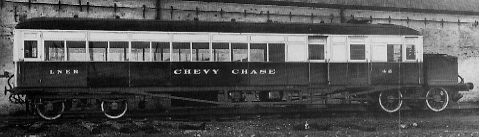
The RCTS tells us that, “The majority of the Sentinel railcars were named after former horse-drawn mail and stage coaches. The exceptions were the two original cars, Nos. 12E and 13E, No.51915 taken over from the Axholme Joint Railway and Nos. 600-3 on the Cheshire Lines which were all nameless. In addition the two 1927 cars, Nos. 21 and 22, ran without names for a while, before becoming Valliant (sic) and Brilliant respectively. The named cars had a descriptive notice inside detailing what was known about the running of the mail coach from which the car took its name and offering a reward for additional information.” [5: p13]
The story of the various Sentinel Railcars is covered in some detail in the LNER online Encyclopedia here. [2] If greater detail is required, then the RCTS’s Locomotives of the LNER Part 10B considers the Sentinel Railcars in greater depth. This can be found here. [5]
Sentinel produced their steam railcars for the LNER in a series of relatively small batches. Each batch varied in detailed design.
Rigid-bodied railcars were supplied by Sentinel in the period from 1927. The last rigid-bodied units being delivered in 1932. [1: p54,56] The first was an experimental unit which was in use on LNER lines in 1927 but not purchased until June 1928. [1: p58] A further 49 rigid-bodied Sentinels were ordered in 1928, 12 in 1929, 2 in 1930 [1: p56] and 3 further in 1932 [1: p54]
Jenkinson and Lane tell us that a solitary twin unit, LNER Sentinel No. 2291 ‘Phenomena‘, was developed in 1930. The rear bogie on the powered unit was shared with the trailer. They explain that the articulation between the coaches “allowed the individual unit lengths to be reduced compared with a single unit car. A more than doubled carrying capacity was achieved with only a 25% increase in tare weight.” [1: p64]
‘Phenomena’ was an articulated twin, the powered unit had much in common with the rigid-bodied Sentinel Railmotors. This image was carried by ‘The Engineer Journal of November 1930. [17]
As the number of Railcars on the LNER network increased the company felt that it would be prudent to undertake a review of the performance of all its railcars in use on its network. This review covered the year ending 30th September 1934. The best Sentinel steam railcars out-performed others on the network (particularly those of Armstrong-Whitworth). The fleet of “Sentinel railcars recorded over 2.25 million miles in the year, with railcar mileages often exceeding 30,000 miles.” [2].
“With the exception of No. 220 ‘Waterwitch’ which was wrecked in 1929, all of the Sentinel steam railcars were withdrawn between 1939 and 1948.” [2]
The LNER Armstrong-Whitworth Diesel-Electric Railcars
As a quick aside, the Armstrong Whitworth Railcars were direct competitors for the Sentinel Steam Railcars. They were early diesel-electric cars, diesel-powered precursors of what, from different manufacturers, became the dominant form of power source for railcars as the steam railmotors were retired; although what became the dominant form of diesel railcar was to use direct drive rather than traction motors. [1: p71] What became the GWR railcars were privately developed by Hardy Motors Ltd., AEC Ltd., and Park Royal Coachworks Ltd. [1: p72-73] The story of the GWR diesel railcars is not the focus of this article, but the Armstrong Whitworth Diesel-Electric railcars were direct competitors for the Sentinel railcars and, as such, worth noting here.
In September 1919, Armstrong Whitworth became a Sulzer diesel engine licensee. During 1929 the board of Armstrong Whitworth approved the decision to enter the field of diesel rail traction and obtained a license from Sulzer Brothers for the use of their engines in these rail vehicles.
In 1931, Armstrong Whitworth began construction of “three heavy diesel electric railcars [for the LNER] which operated under the names of ‘Tyneside Venturer’, ‘Lady Hamilton’ & ‘Northumbrian’. They were powered by an Armstrong-Sulzer six cylinder 250hp four stroke diesel engine coupled to GEC electrical equipment. The vehicles were 60 feet long with a cab at each end and a compartment for the engine. They weighed 42tons 10cwt, could carry sixty passengers and luggage at 65mph. The bodywork was provided by Craven Railway Carriage & Wagon Co of Sheffield. The body was of sheet steel panels riveted together. Operating costs were expected to be half those of a steam service of similar capacity.” [8]
As well as running singly the railcars could haul a trailer coach.
“A fourth Armstrong-Whitworth diesel-electric vehicle entered service with the LNER in 1933. This was the un-named No. 294 lightweight railbus. Completed in May 1933, it performed six months of trials before entering regular services in the Newcastle area in September 1933. It was not taken into official LNER stock until August 1934, and is believed to have only been kept as a standby for one of the larger railcars.” [9][cf: 1: p70]
All of the Armstrong Whitworth railcars gave their best performances during the initial trials. “During regular operation, the Armstrong Whitworth diesel-electric railcars suffered from gradually declining performance. This was probably partly due to relatively poor maintenance on what was still a steam railway.” [9]
Ultimately, these units retired relatively early in April, May and December 1939. [9]
The LNER Clayton Steam Railcars and Trailers
The LNER on-line Encyclopedia comments that, “Clayton Wagons Ltd of Lincoln started to build steam railcars in 1927. The LNER purchased a total of eleven between 1927 and 1928.” [10]
Jenkinson and Lane note an earlier date for Clayton Wagons Ltd’s entry into the market. They say that the Clayton cars originated in 1925, originally for use in New Zealand.
These cars were handicapped by the financial instability of Clayton Wagons Ltd. [10][1: p50] The LNER at times had to manufacture parts which were not available from suppliers. The first was withdrawn in July 1932. “With increasing maintenance problems, and a shortage of less strenuous short mileage work, the remainder were withdrawn between April 1936 and February 1937. Due to their short lives and persistent problems, none of the Clayton railcars clocked up significant mileages.” [10] Final mileages ranged from 72,774 to 174,691.
Trailer cars were supplied to the LNER by Clayton Wagons Ltd. The trailers were 4-wheeled with very basic accommodation. Their 4-wheel chassis may well have affected their riding quality. [1: p65] They were “classed as ‘Trailer Brake Thirds’, eight only were built and never seem to have very popular. Pictures of them in use are somewhat rare and little is on record of their working life; they were all withdrawn between March 1948 and March 1949.” [1: p55]
Three photographs can be found in Jenkinson and Jane’s book, one external and two internal views. [1:p 65]
The LMS Steam Railcars
In parallel with the LNER, the LMS had its own programme trials of Sentinel railcars. Jenkinson & Lane tell us that trials were carried out in 1925, “with a hired prototype on the Ripley Branch and a fleet of thirteen cars (the prototype plus a production batch of twelve) was put in service during 1926-7, a year or so ahead of the main LNER order. The LMS cars were all of lightweight low-slung design with less of the working parts exposed below the frames and no conventional drawgear. They were unnamed and finished in standard crimson-lake livery.” [1: p49]
In many respects these railcars were very similar to the two early lightweight LNER vehicles. Differences were minor: “the LMS cars had only 44 seats and a slightly over 21T tare weight whereas the LNER lightweights were quoted with 52 seats at 17T tare. … The later … LNER … cars were almost 26T except for the 1927 pair (just over 23T).” [1: p49]
Essery and Warburton say that, “The thirteen LMS Sentinel/Cammell vehicles were authorized by LMS Traffic Minute 1040 dated 28th July 1926 at a cost of £3800 each and were allotted Diagram D1779 and ordered as Lot 312. The numbers first allocated are not known except one that was number 2232 with the 1932/3 renumbering scheme allocating numbers 29900-12 with all receiving the LMS standard coach livery in the first instance. … These early models suffered from poor riding qualities and so in 1928 a gear driven 100 hp vehicle was designed. The boiler was on the mainframe and the vertical two cylinder engine was mounted over the rear axle of the power bogie with the axle driven through gearing. The LNER purchased the only one built (named ‘Integrity’) that suffered from severe vibration.” [12: p4]
Essery and Warburton also provide more detail about the Axholme Joint Railway (AJR) Sentinel railcar. The line was jointly owned by the LMS and LNER “with the motive power supplied initially by the LYR and then the LMS after the grouping. The LMS supplied one of the thirteen steam railcars purchased in 1926/7 to the AJR. In February 1930 a larger car was ordered from Sentinels numbered 44 in the LMS carriage list and carried a green/cream livery carrying the name “Axholme Joint Railway” on each side. On 15th July 1933 the passenger service ceased. The car having done 53,786 miles was then purchased by the LNER and numbered 51915.” [12: p4] It seems as though the AJR railcar was rigid-bodied. [1: p62] Which suggests that the full series of LMS railcars were rigid-bodied. The illustration of the AJR railcar provided by Jenkinson and Lane shows it with drawgear and buffers which must have been added after it’s transfer from the LMS.
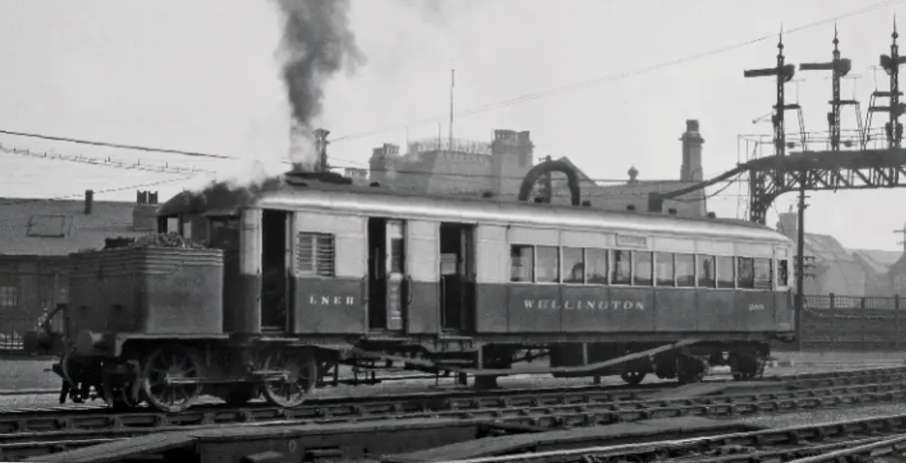
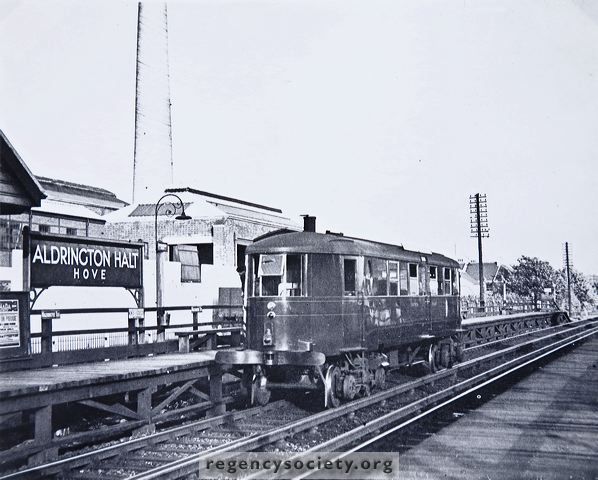
The last steam railcar to be devised for use in the UK was an unusual unit supplied by Sentinel to run on the Southern Railway’s steeply graded branch line from Hove to Devil’s Dyke. Its design was signed off by Richard Maunsell at much the same time as the SR was introducing its new electric services to Brighton in 1933. [1: p67]
The unit was a lightweight Sentinel-Cammell railcar. It was numbered No 6 and had wooden wheel centres to reduce noise but this created problems with track circuit operation on the main line and necessitated the provision of lorry-type brake drums. [13][14][15]
Jenkinson and Lane do not have much that is positive to say about this railcar. They talk of, “the strange ‘torpedo’ shape of the solitary Southern Railway Sentinel … that … was designed for one man operation: the Devil’s Dyke branch was very short and the nature of the machinery was such as to make it possible to stoke up for a complete trip at the start of each journey.” [1: p66]
“Instead of using one of the well-proved LNER type cars (or even the lighter weight LMS alternatives), the whole operation was made the excuse for creating a new sort of one-man operated bus unit … [with] a fashionably streamlined ‘Zeppelin’ type body which seemed to be perched on top [of the chassis] as an afterthought.” [1: p67]
References
David Jenkinson & Barry C. Lane; British Railcars: 1900-1950; Pendragon Partnership and Atlantic Transport Publishers, Penryn, Cornwall, 1996.
This illustration appeared in ‘The Engineer’ of 28th November 1930. It was included in the third page about Cambridge in the era of the Big Four on the Disused Stations website: http://www.disused-stations.org.uk/c/cambridge/index6.shtml, accessed on 25th June 2024.


 Roger Farnworth
