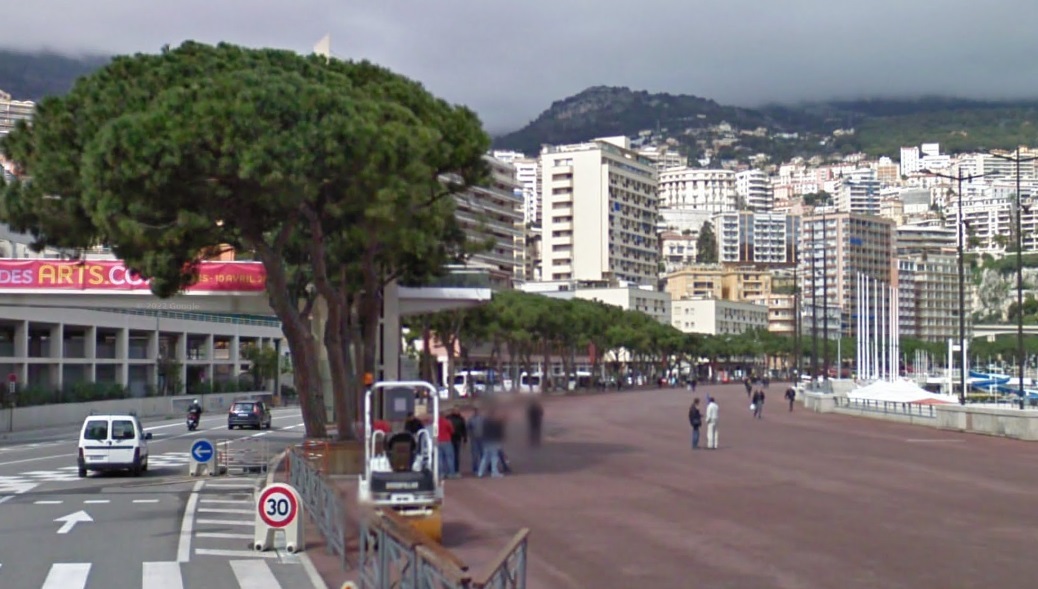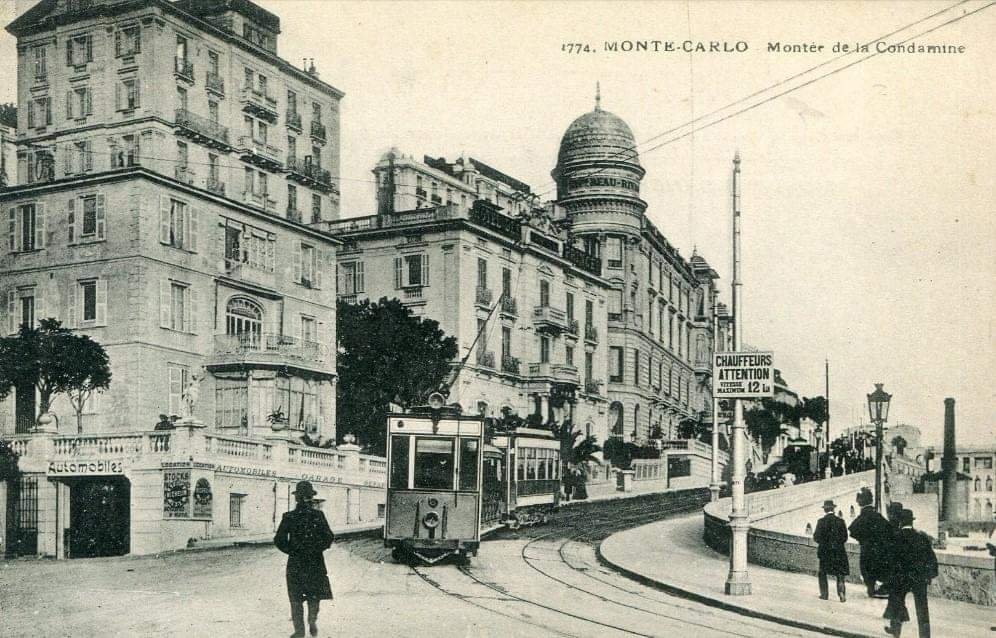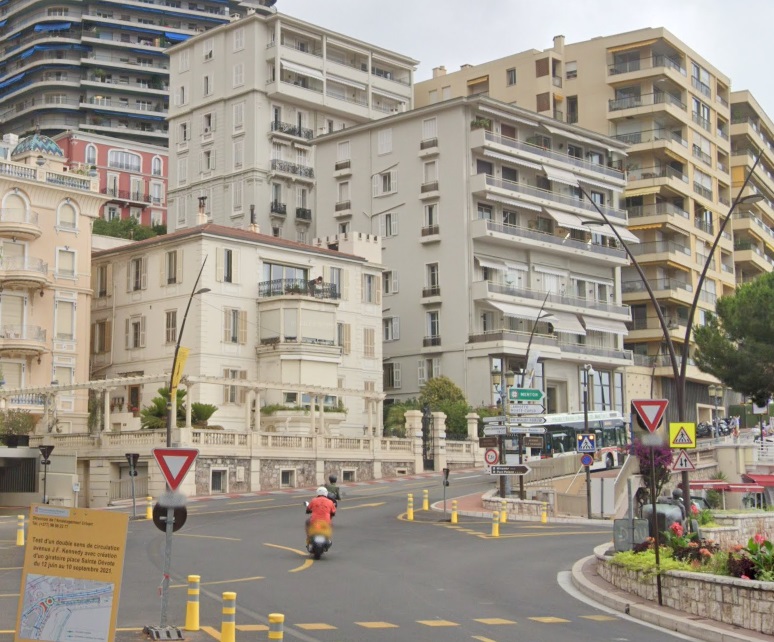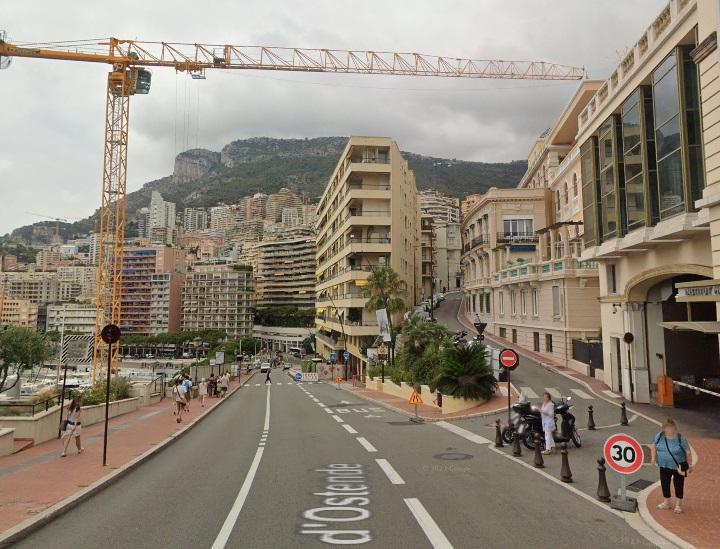
Tag Archives: Monte Carlo

Monte-Carlo to Menton – La Ligne du Littoral et ses Antennes, First Generation Electric Tramways – (Chemins de Fer de Provence/Alpes-Maritimes No. 93).

This post covers the line from the Port of Monaco and Monte-Carlo to its terminus in Menton. A short article about this length of tramway was included in the French-language ‘Tram Magazine‘ of 1980 [7], and it is covered by José Banaudo in his book ‘Nice au fil du Tram, Volume 2‘ [1]

Earlier articles in this series can be found by following these links:

Nice to Antibes:

La Ligne du Littoral et ses Antennes, First Generation Electric Tramways – Nice-Cap d’Antibes (Chemins de Fer de Provence/Alpes-Maritimes No. 90) …

Nice to Monaco:

La Ligne du Littoral et ses Antennes, First Generation Electric Tramways – Nice-Monte Carlo (Chemins de Fer de Provence/Alpes-Maritimes No. 91) …

Branch-lines between Nice and Monaco:

Nice to Monte-Carlo Branch Lines – La Ligne du Littoral et ses Antennes, First Generation Electric Tramways – (Chemins de Fer de Provence/Alpes-Maritimes No. 92) …

Other articles about railways and tramways in and around Nice can be found here:

https://rogerfarnworth.com/category/railways-and-tramways-blog/french-railways-and-tramways/railways-and-tramways-around-nice/

A project for a steam tramway linking the principality of Monaco to Menton via the Basse Corniche dates back to 1892 but seems that it may have encountered opposition from the various communes along the route. It is possible that this opposition centred on the use of steam as the  power-source chosen.  [7]

However, the Monaco Tribune suggests that it was clear that the capacity of steam engines to pull adequate loads on the gradients needed to serve the principality was always in doubt. The Triune comments: “At the start of the 1890s, there was a project for a Nice-Menton tramway line which would run through Monte Carlo. Following the example of French towns that were opening up tramway networks, horse-drawn at first, then with mechanical traction and finally electric-powered, the Principality eventually accepted the necessity of a line crossing Monaco, from Le Rocher to Saint-Roman, passing through Monte-Carlo and serving the Casino. The Principality’s topography was an issue: horse-drawn and steam trams were not an option. Electric trams had to be developed.” [6]

The Monaco tramways had three lines:

  • Place d’Armes – Saint Roman, opened on 14 May 1898.
  • Gare de Monaco – Place du Gouvernement, opened on 11 March 1899.
  • Casino – Gare de Monte-Carlo, opened on 3 May 1900. [8]

In 1897, the TNL (Tramways de Nice et du Littoral) obtained the concession for a metre-gauge coastal line between Cagnes, Nice, Monaco and Menton.

The main difficulty encountered in establishing this route was crossing the principality of Monaco, where in 1898 a local company opened an urban tramway powered by underground electric cables. [7]

While waiting for the establishment of an agreement to allow the passage of their trams through the principality, the TNL transported part of their fleet of by rail to Menton and opened a section of tramway from Garavan to Cap-Martin on 20th December 1902. One year later, this isolated section was linked to the rest of the network with the commissioning  of the complete section from Monaco to Menton on 28th December 1903. [7]

In 1910, the TNL bought out the Monaco Tramways concession but continued to operate a split operation with connections in the principality between the Nice and Menton lines.  During the Great War, the TNL’s tramway experienced heavy passenger and goods traffic, with the PLM line being reserved primarily for strategic transport. [7]

After the war, the Monaco to Menton line was designated Ligne No. 43 in the TNL’s new operating plan.  But very quickly, road competition and the narrowness of the Basse Corniche roadway made sharing the road with lorries, vans and cars almost impossible. [7]

On 26th January 1931, the Nice to Monaco line was closed, followed a few months later by the departmental connection Menton (Villa Caserta) – Sospel.  As during its first years of operation, the Menton tramway found itself isolated from the rest of the network and continued for a few months with reduced service to Monaco Garavan and Menton Villa Caserta, with the equipment based at the small Carnolès depot.  This reprieve was only short-lived, because these lines were in turn closed in January 1932. [7]
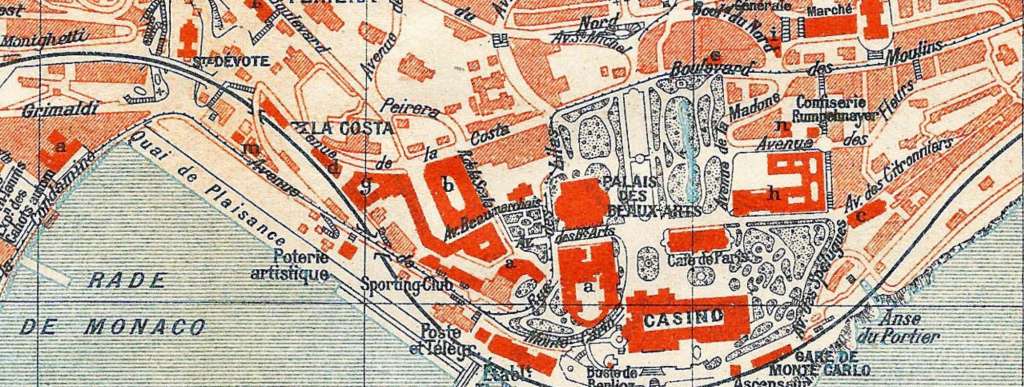
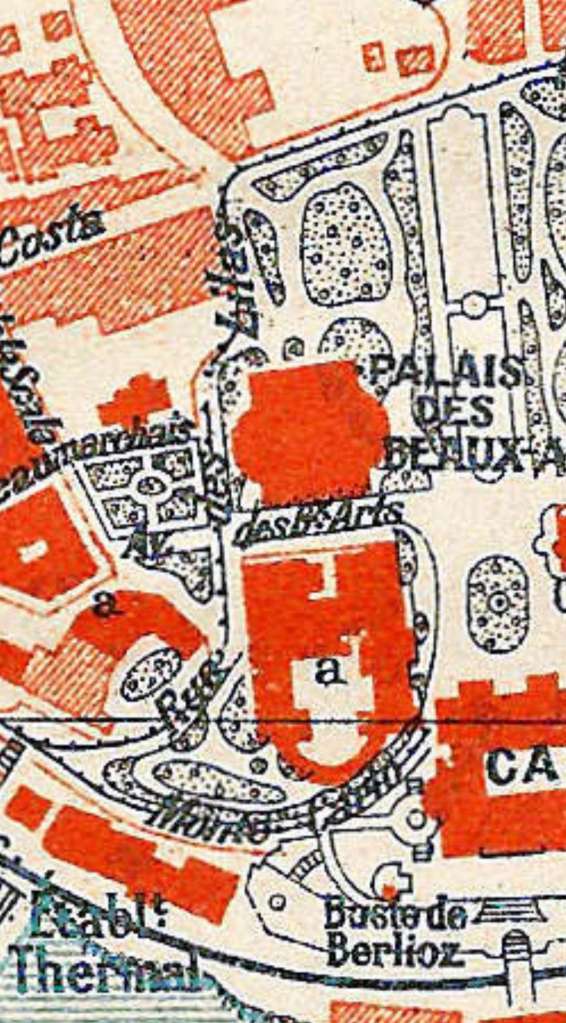
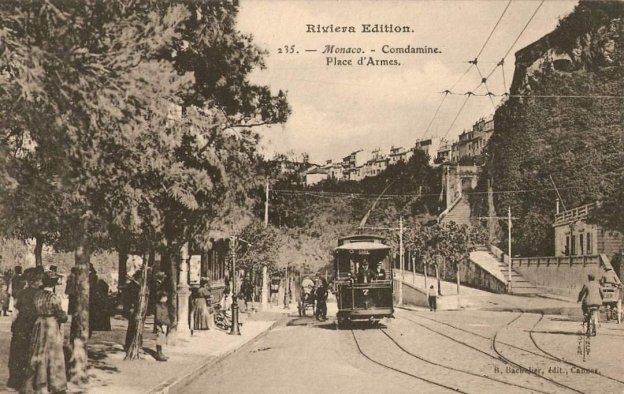
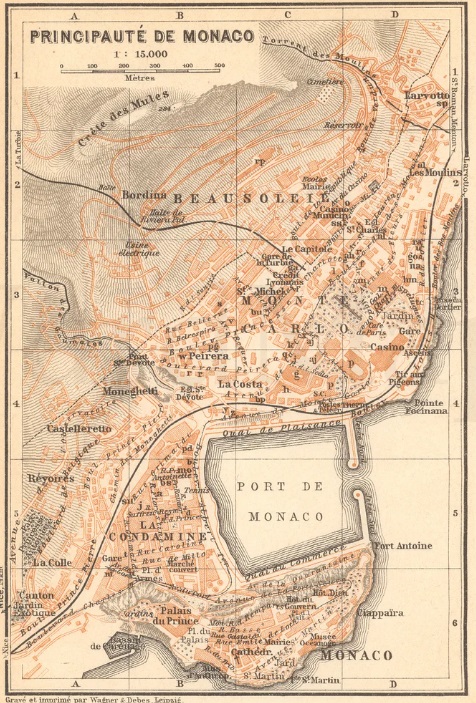
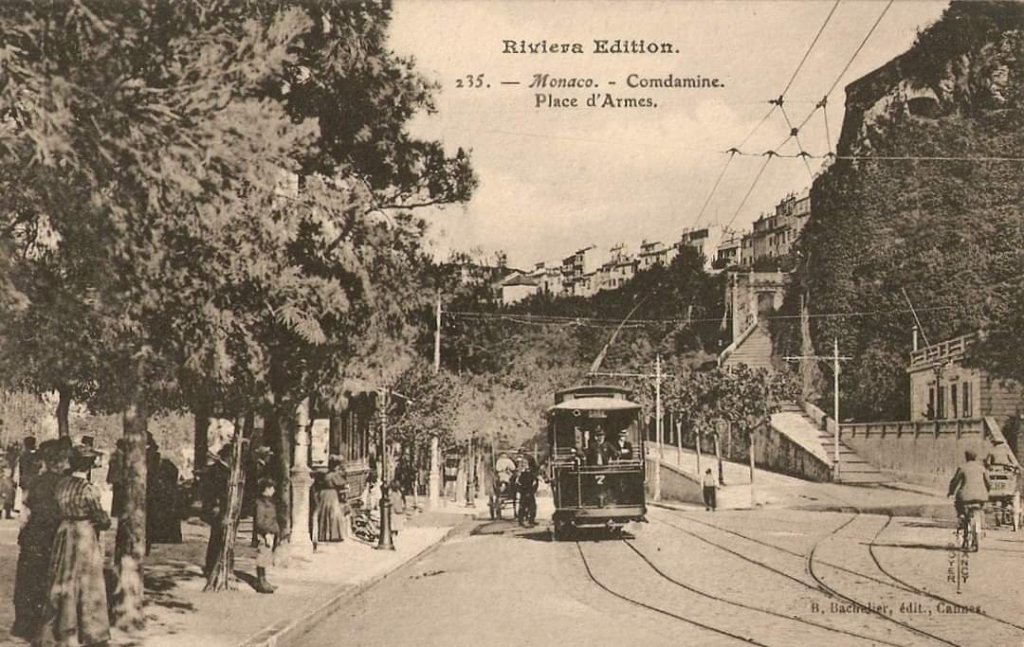
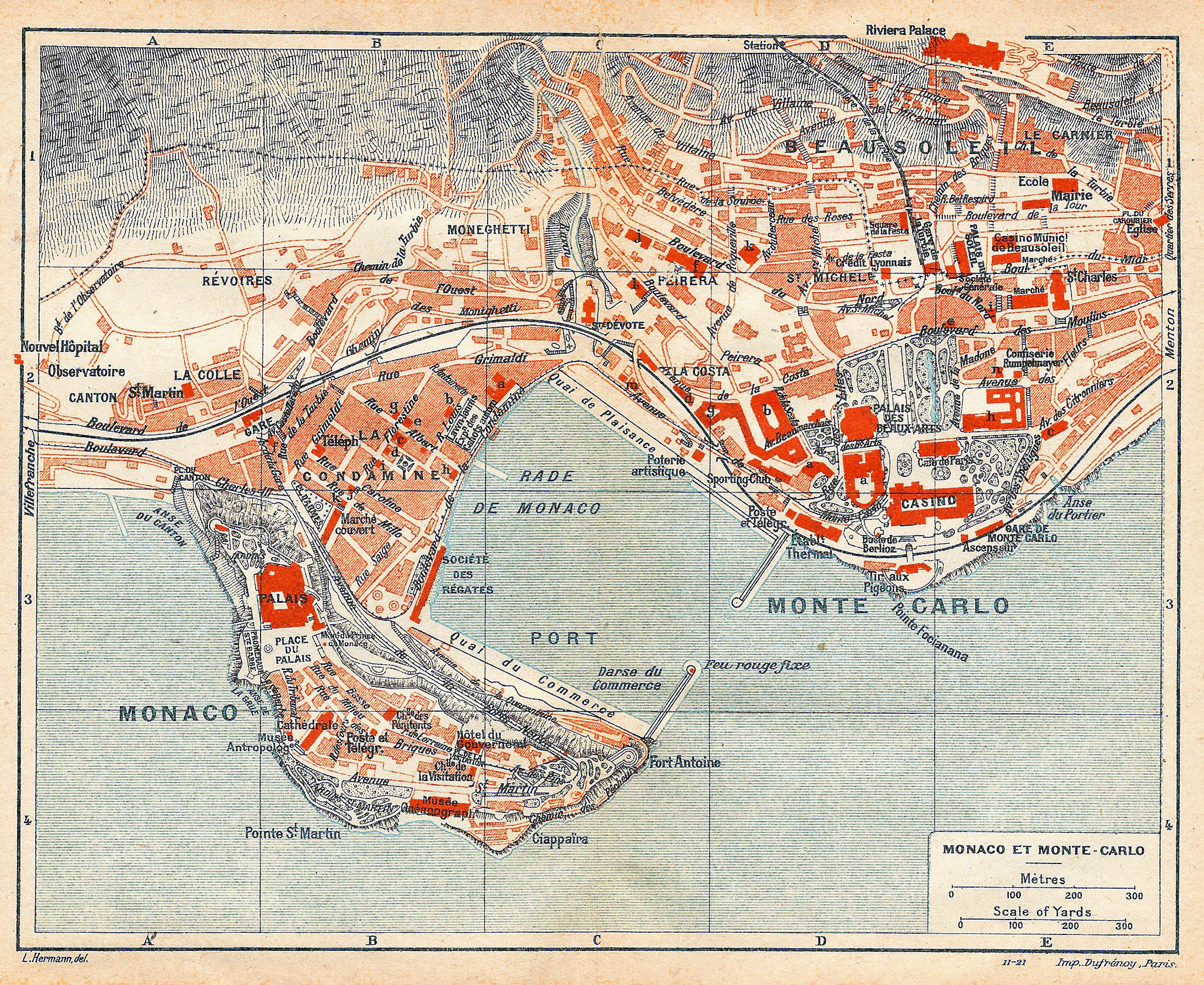
This extract from the 1914 plan of Monaco shows the tramway running along the Condamine on the West side of the port before heading up the Avenue de Monte-Carlo. For a time there was a junction at the top of the gradient with trams for Menton turning North. [2]
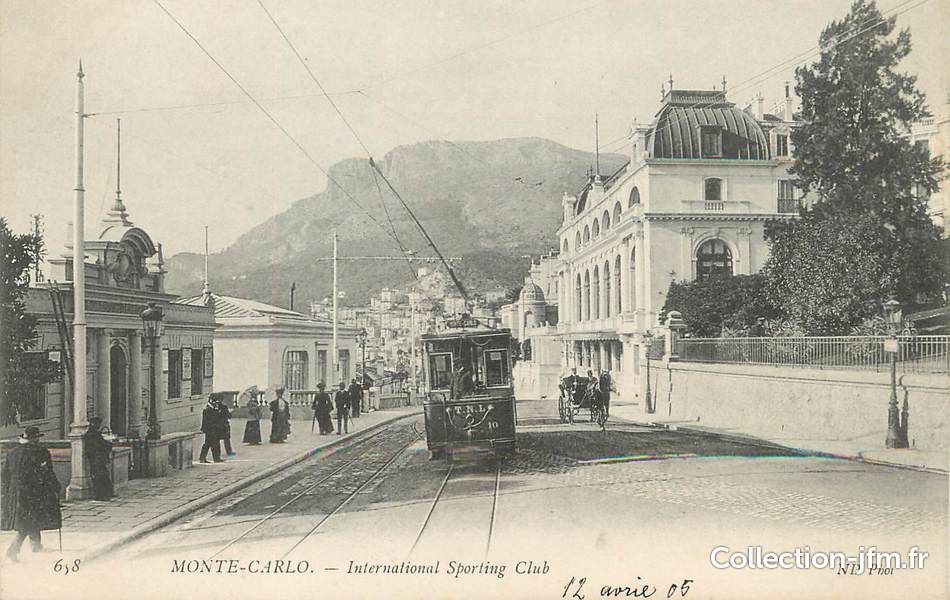
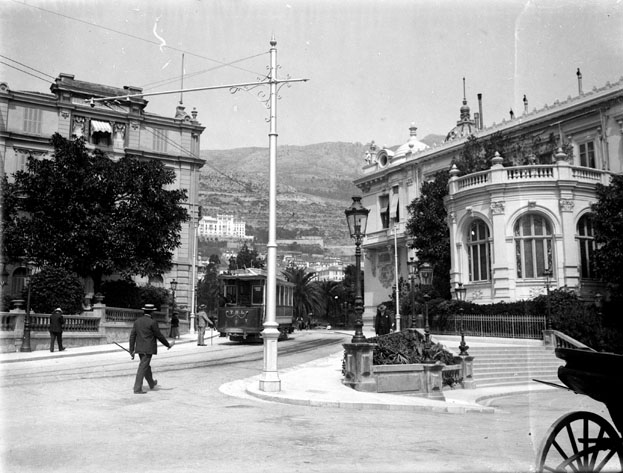
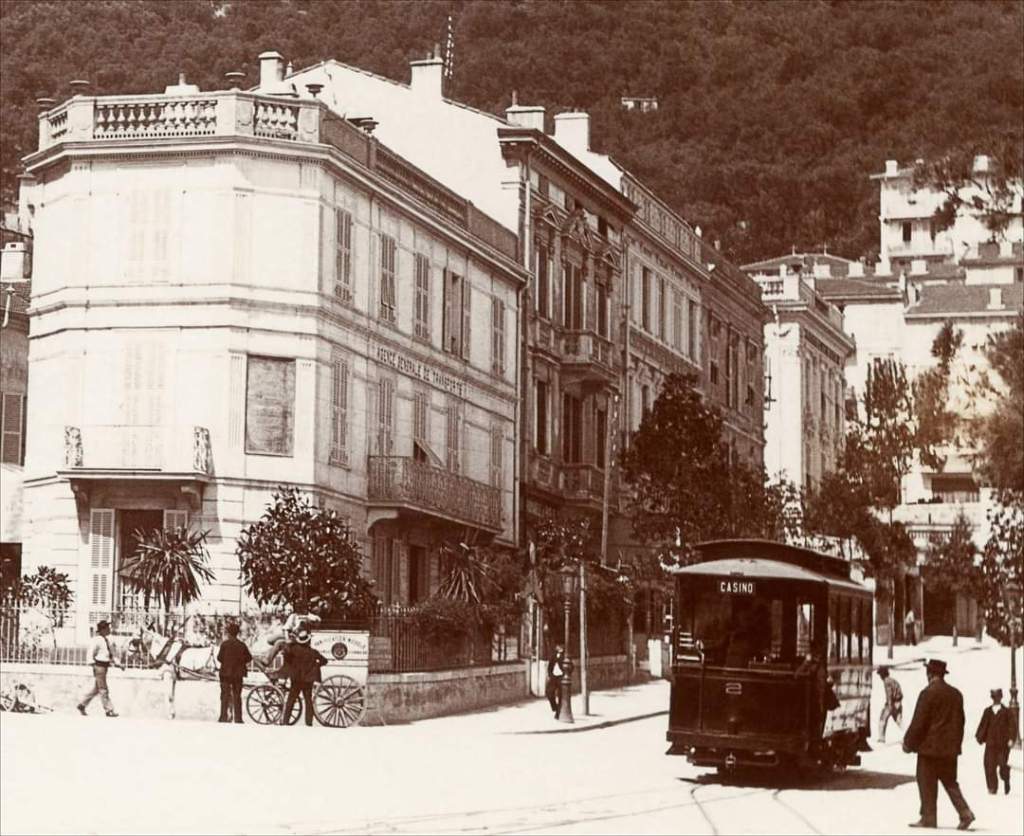
Tram outside Monte Carlo International Sporting Club. The position of the pole shows that this tram is heading down hill to the Port. [9]
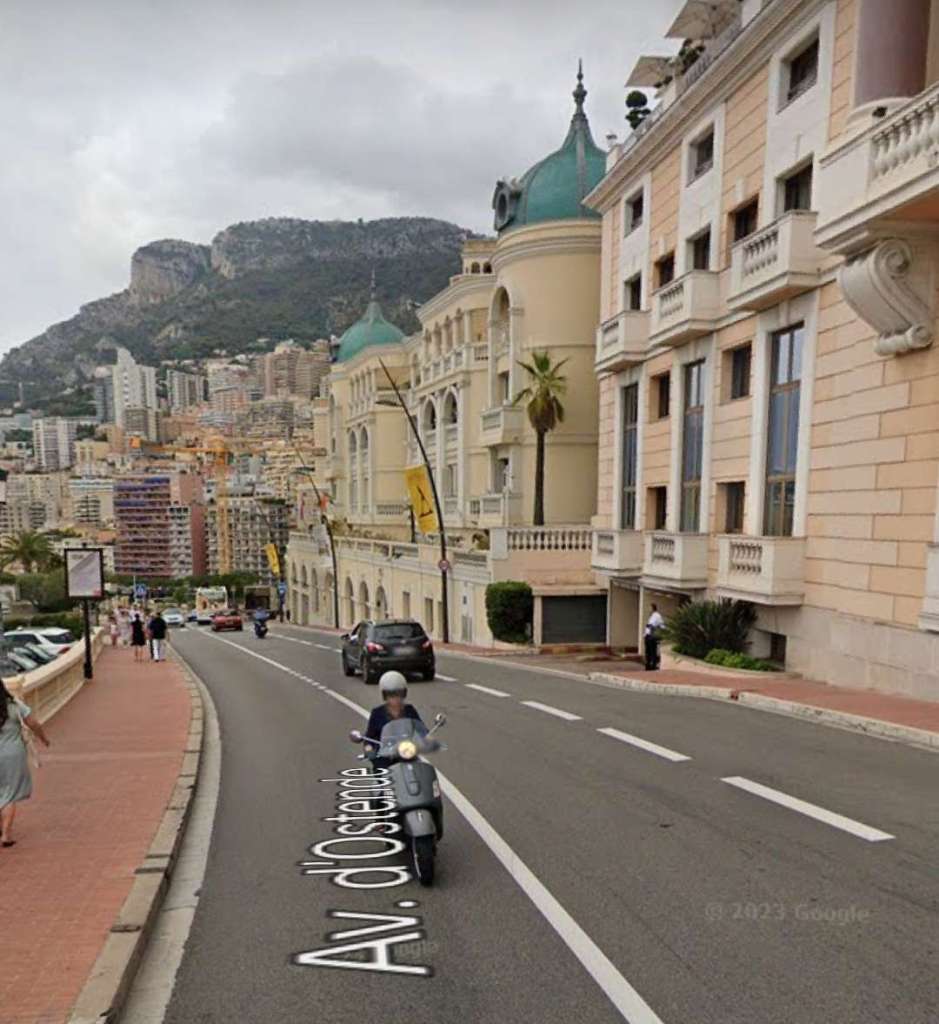
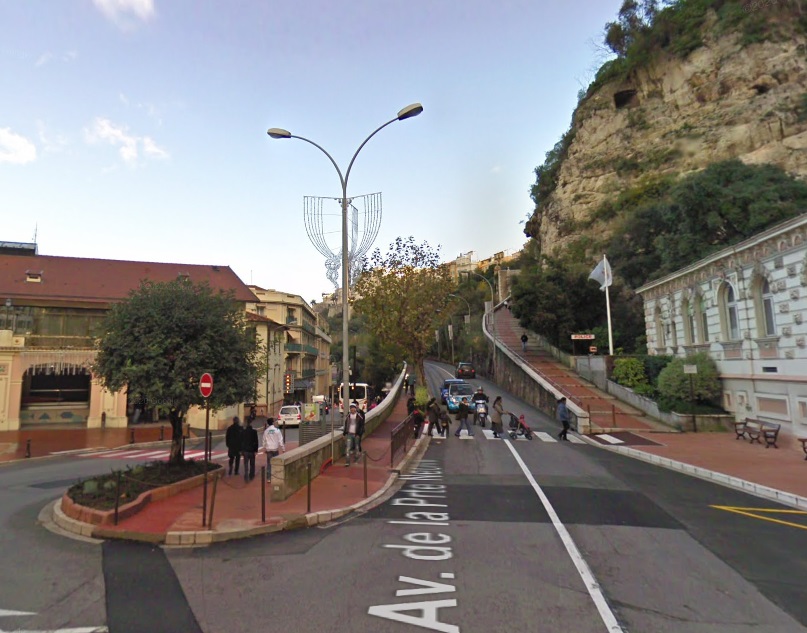
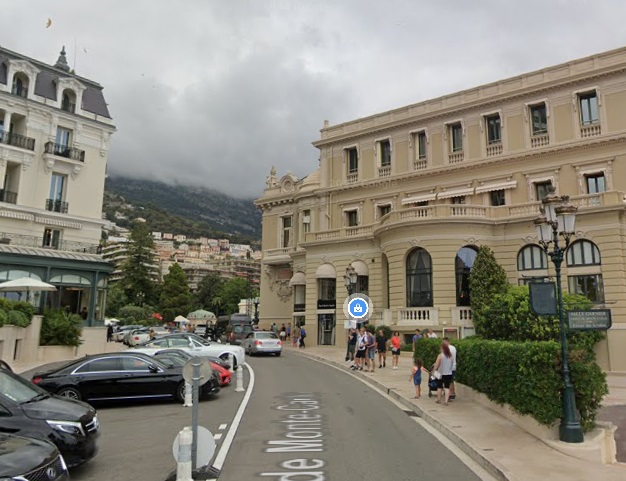
A similar view in 2011 looking down Avenue d’Ostende towards the Port. [Google Streetview, March 2011]
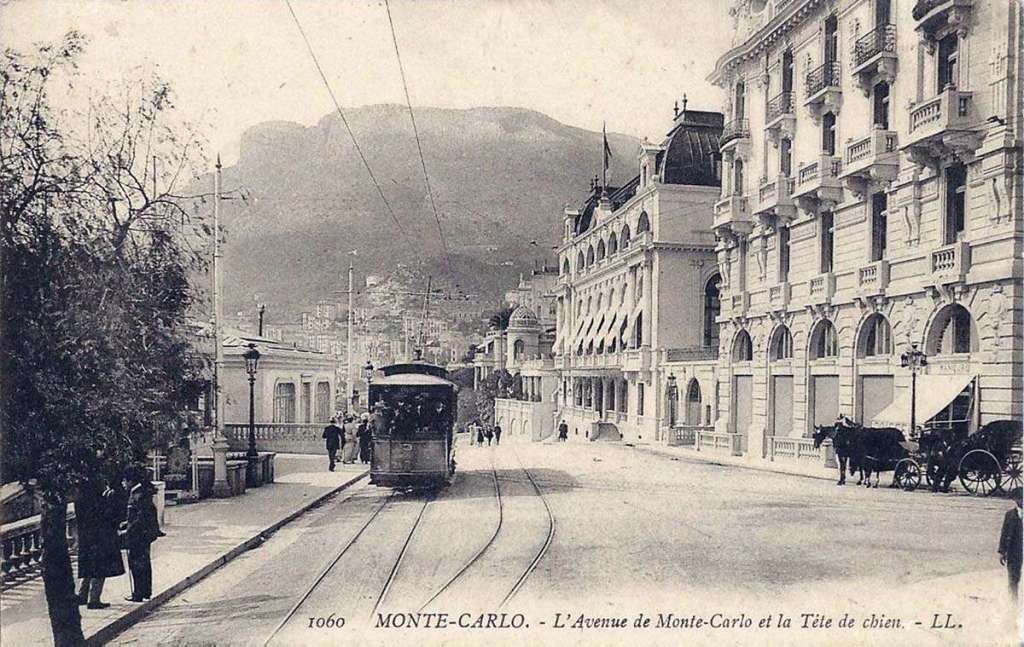
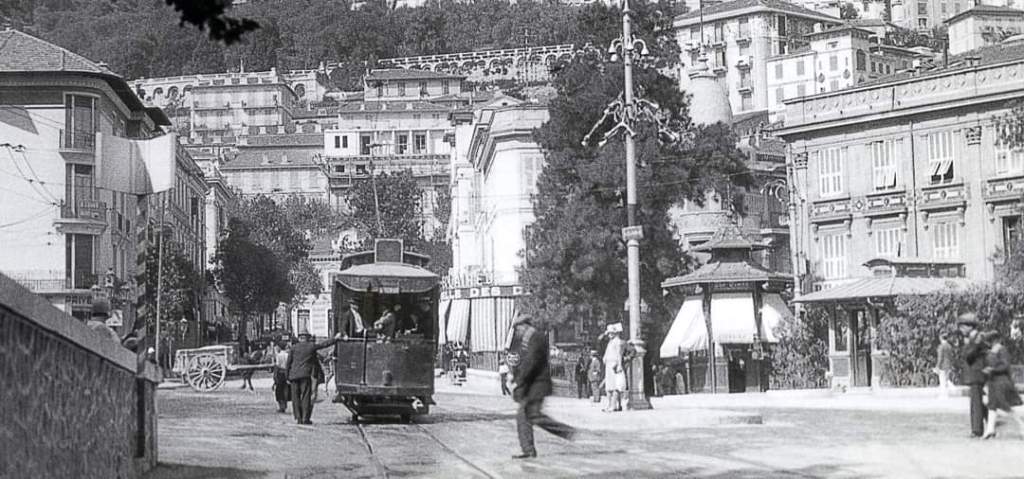
A later image showing a tram just a little further up l’Avenue de Monte-Carlo (now Avenue d’Ostende), but on the other tramline heading up hill towards the Casino. [11]
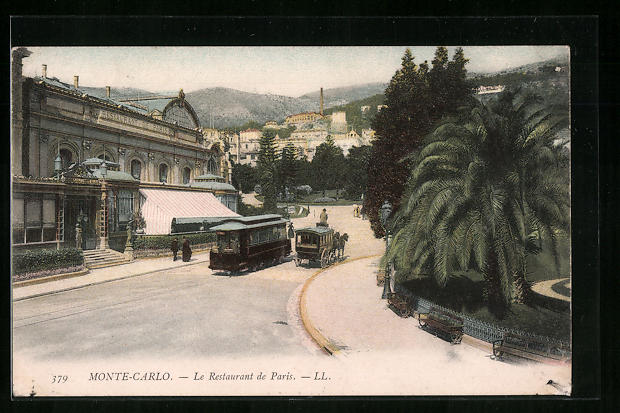
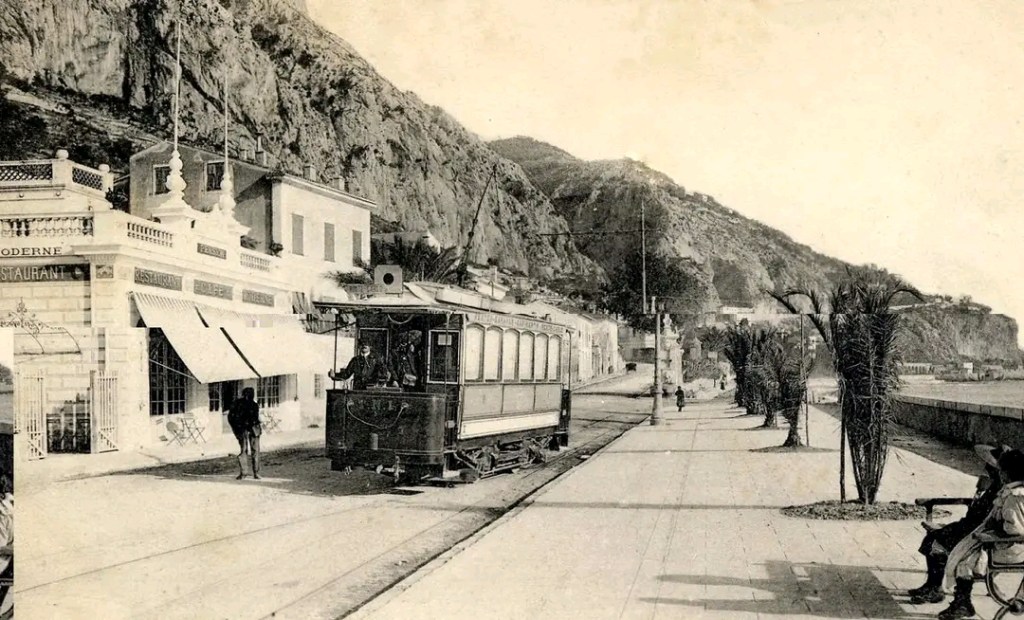
Tram outside Le Restaurant de Paris, Monte-Carlo. [10]
The  tram tracks outside Restaurant/Cafe de Paris. Apparently these tracks were only in use for a very short time around 1902/1903. This picture was shared by Jean-Paul Bascoul on the Monaco4Ever Facebook Group on 19th July 2023. (Collection privée J-Paul Bascoul). [12]
Trams heading for Menton turned Northwest on Rue des Lilas (now Avenue Princesse Alice). For a short while in the very early 20th century a short branch continued up towards the Casino. Trams for Menton turned right at the top of Rue des Lilas onto Avenue de la Costa. [2]
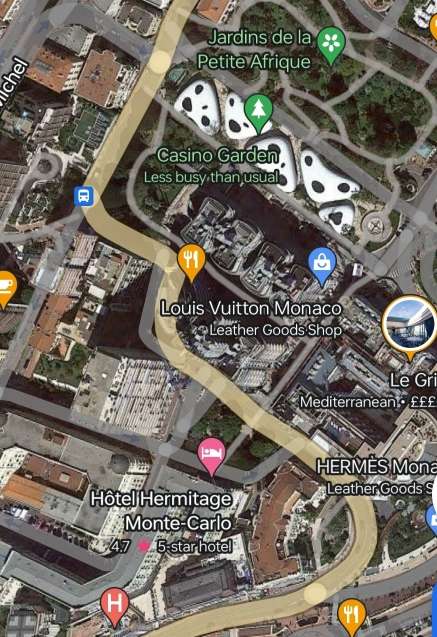
This extract from Google Maps shows the route of the tramway as the primrose yellow line snaking from the bottom to the top of the image. A little confusing because the North point of the 1914 map extract above is not the same as Google Maps. The tram route enters at the bottom of this extract along Avenue d’Ostende. It then turns through more than 90° to run along Avenue Princesse Alice, executing a reverse curve along the way and then turning onto Avenue de la Costa. [Google Maps, November 2023]
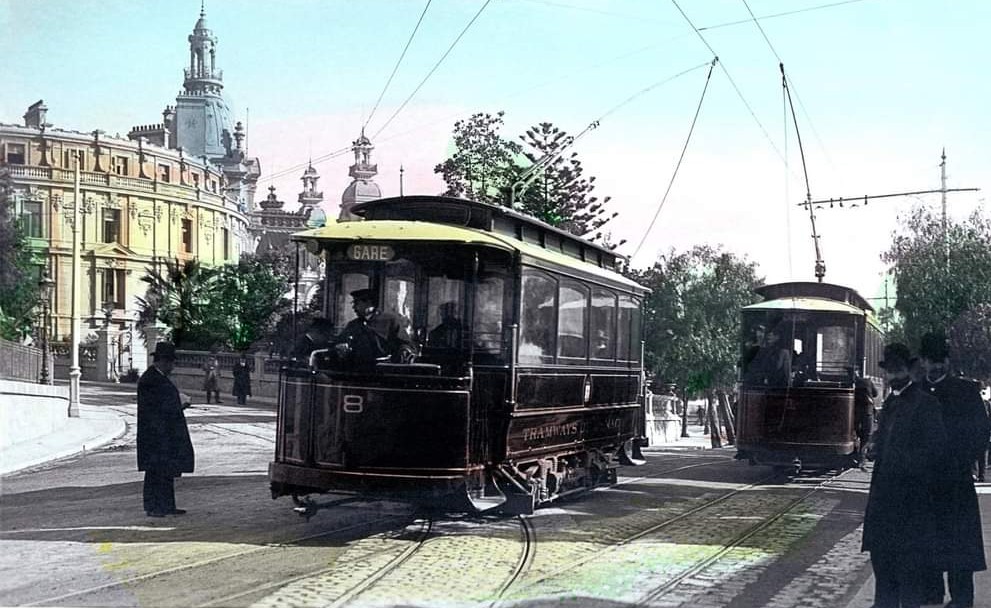
These trams sit at the junction of the line to Menton (turning away to the left) and that to the Casino. They sit directly in front of the old Office de Poste et Telegraph. This image was shared on the Monaco4Ever Facebook Group by Jean-Paul Bascoul on 7th July 2017. (Collection privée J-Paul Bascoul). [21]
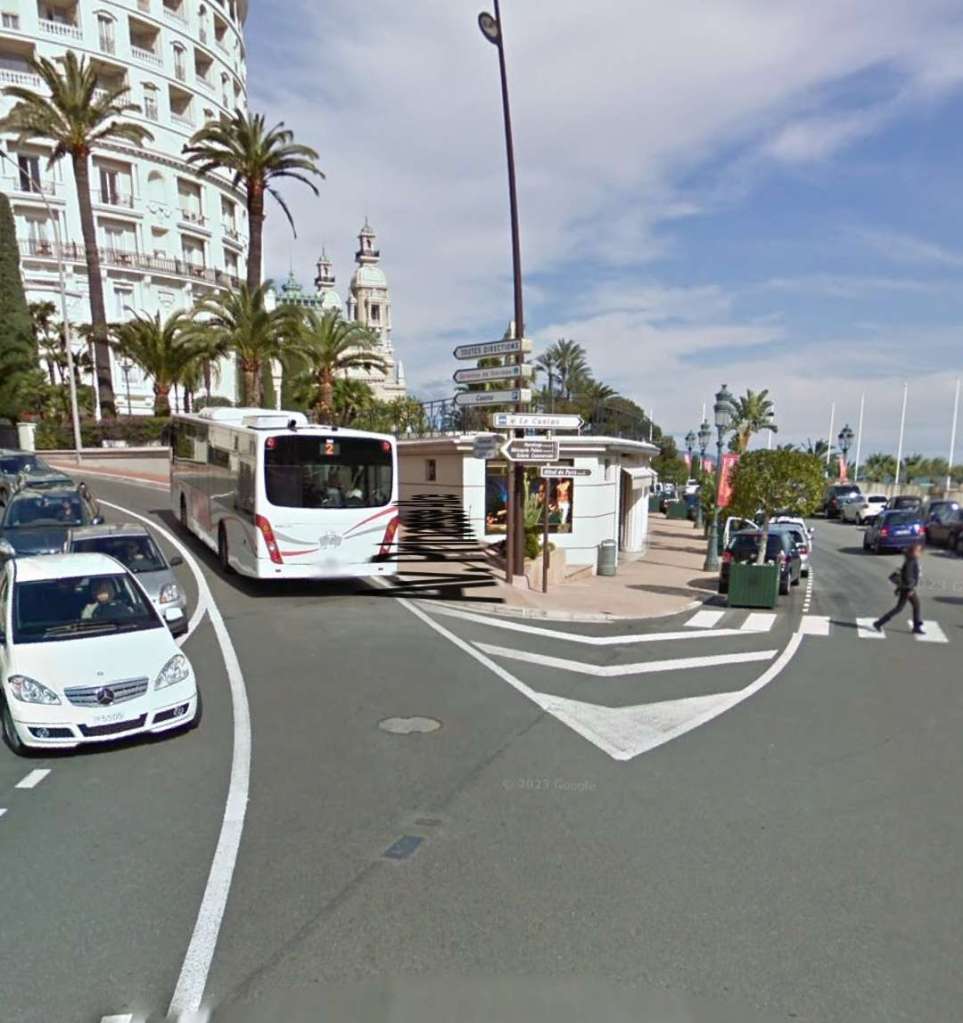
The same location as appears in the colourised postcard view immediately above. This is the point at which the tramway turned Northwards from Avenue de Monte-Carlo onto what was Rue des Lilas (now Avenue Princesse Alice). Access to the Casino is along the road to the right which for a time carried a branch tramway serving Monte-Carlo Casino. [Google Streetview March 2011]
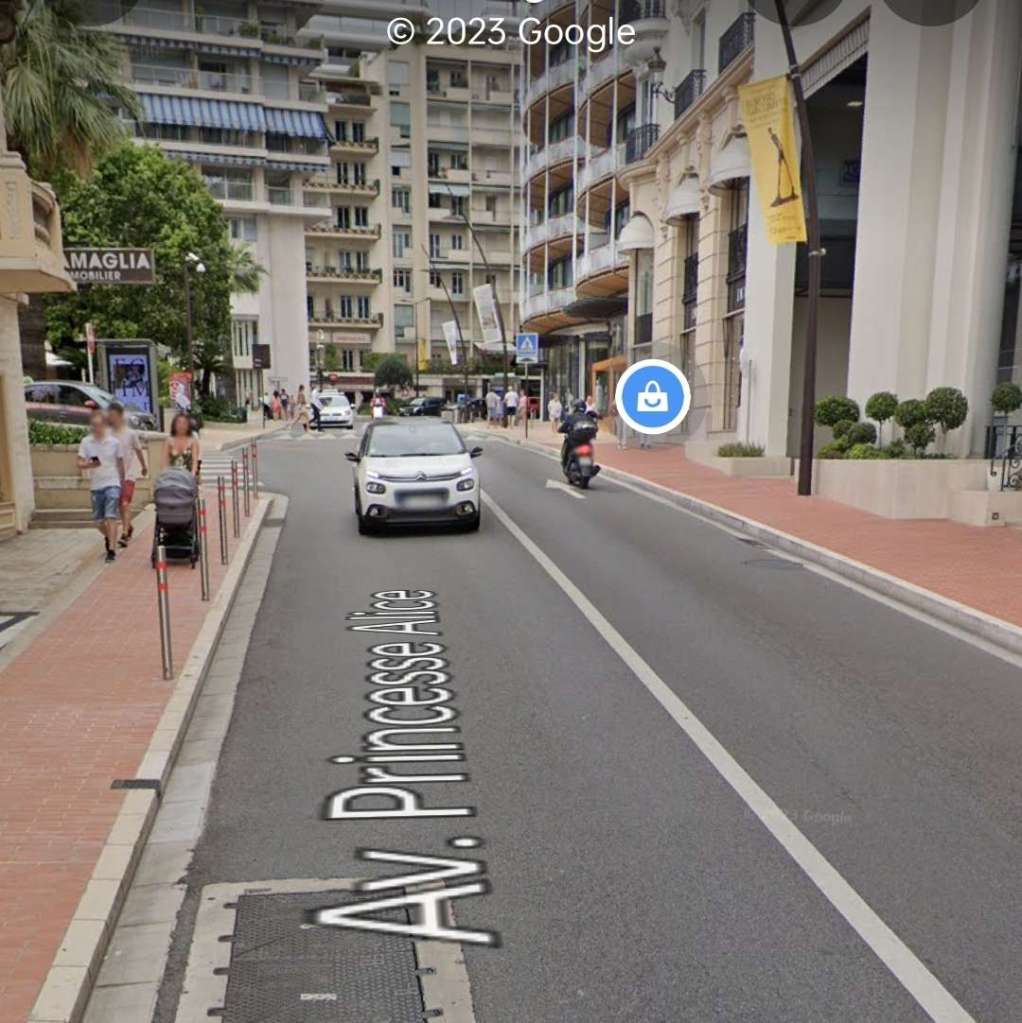
The trams for Menton followed Rue des Lilas (now Avenue Princesse Alice). This image looks Northwest from the Southern end of the Avenue in 2021, [Google Streetview, July 2021]
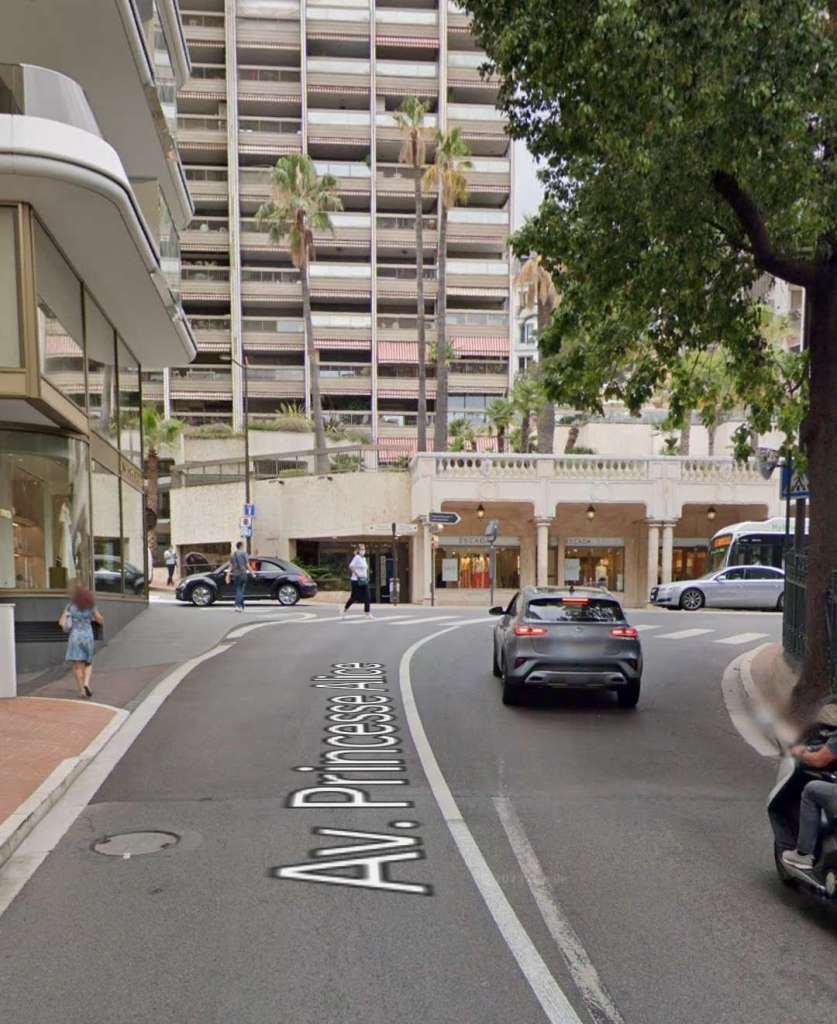
At the North end of Rue des Lilas (now Avenue Princesse Alice), trams turned right onto Avenue de la Costa. [Google Streetview, July 2021]
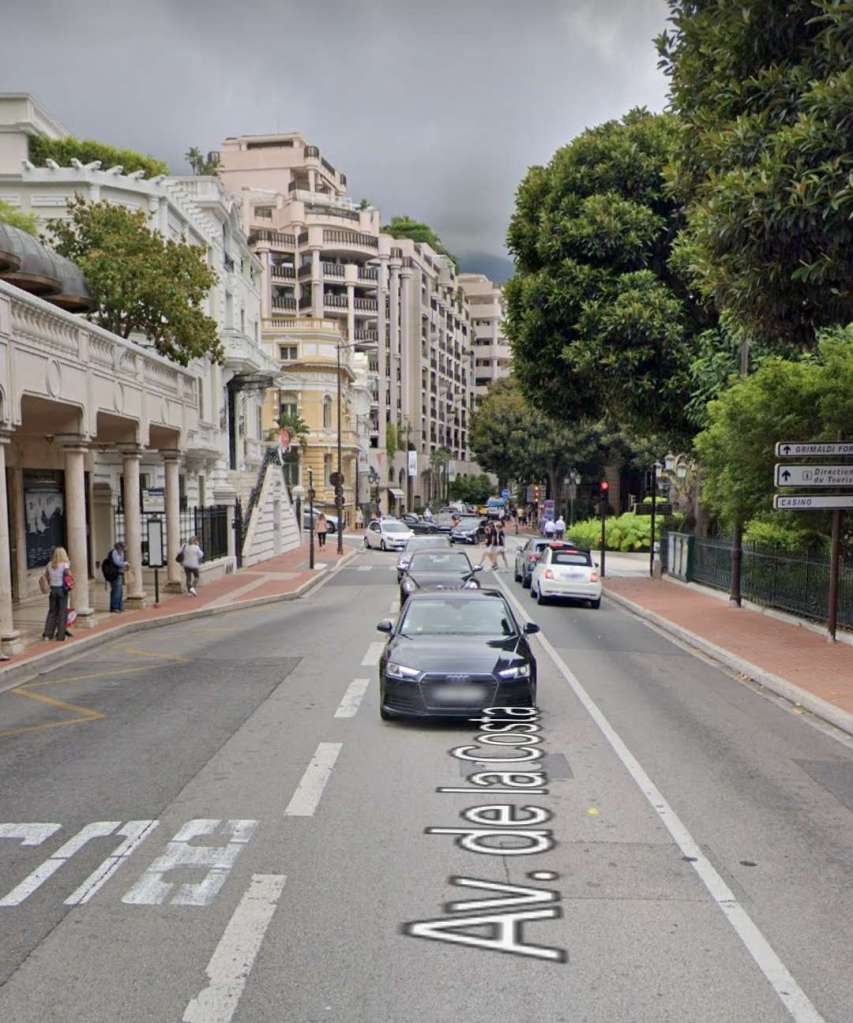
Looking Northeast along Avenue de la Costa in 2021, towards Boulevard des Moulins. [Google Streetview, July 2021]
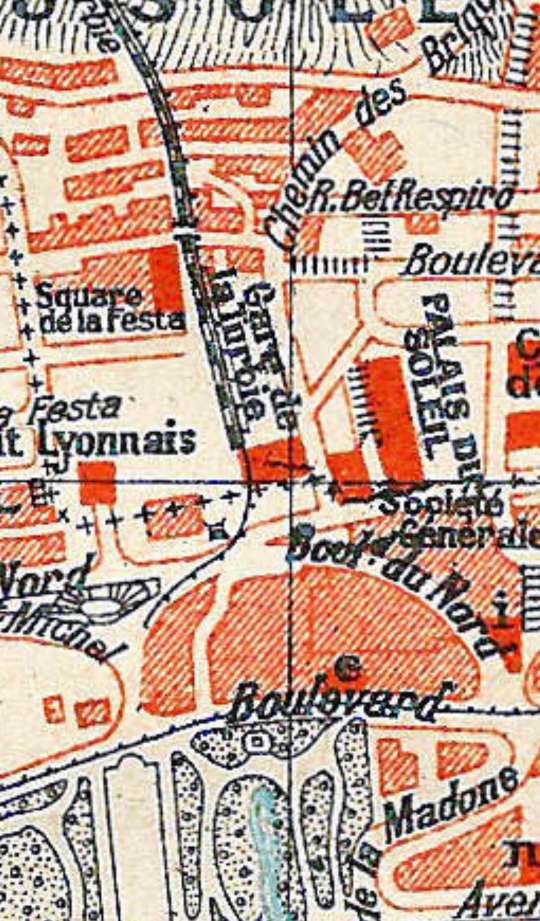
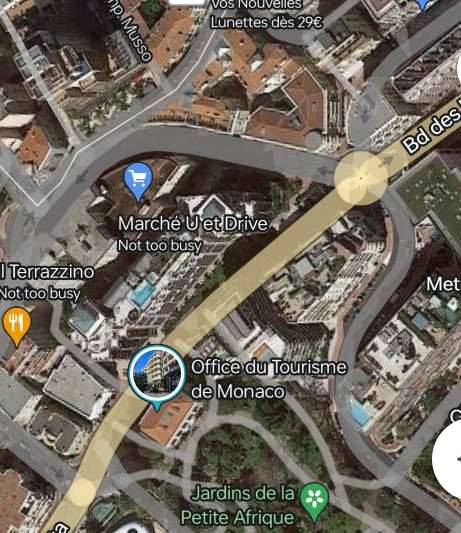
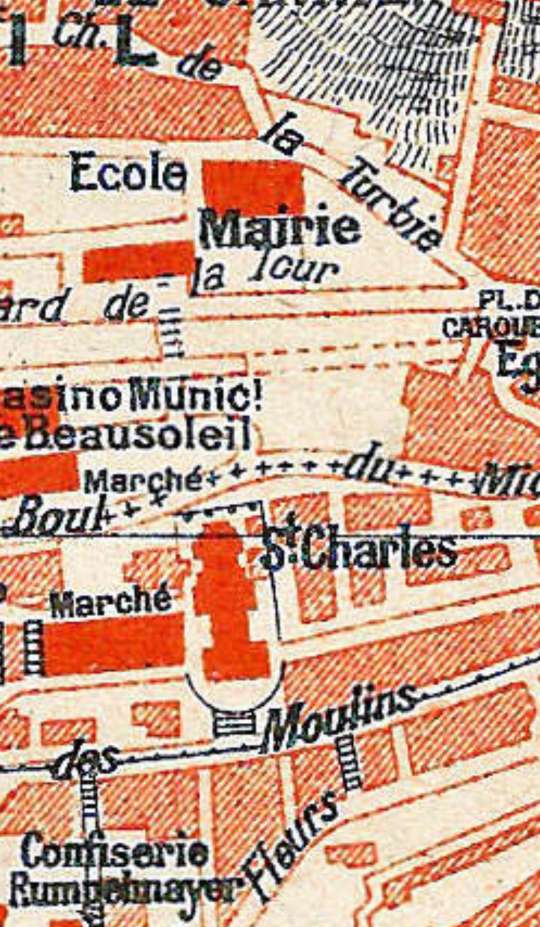
Avenue de la Costa, after a short distance, led  straight onto Boulevard des Moulins. It was only a short walk from this point to access the funicular railway to La Turbie. The terminus can be seen at the top of this map extract. [2]
The primrose yellow line again indicates the line of the old tramway heading Northeast along Avenue de la Costa and then Boulvard des Moulins. [Google Maps, November 2023]
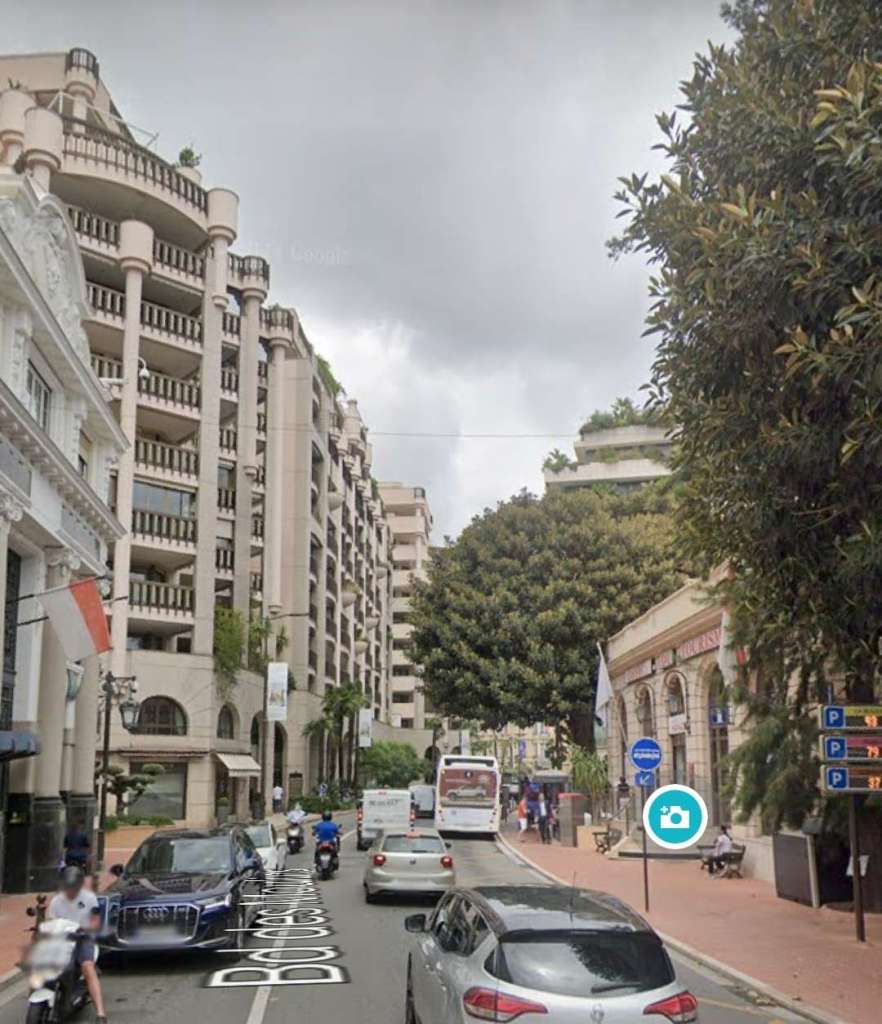
Looking Northeast from the bottom of Boulevard des Moulins in 2021. The Office de Tourism can be seen on the right of this image. [Google Streetview, July 2021]
Boulevard des Moulins continued in northeasterly direction towards Menton. Again, please don’t be fooled by the orientation of the North point on this 1914 map. [2]
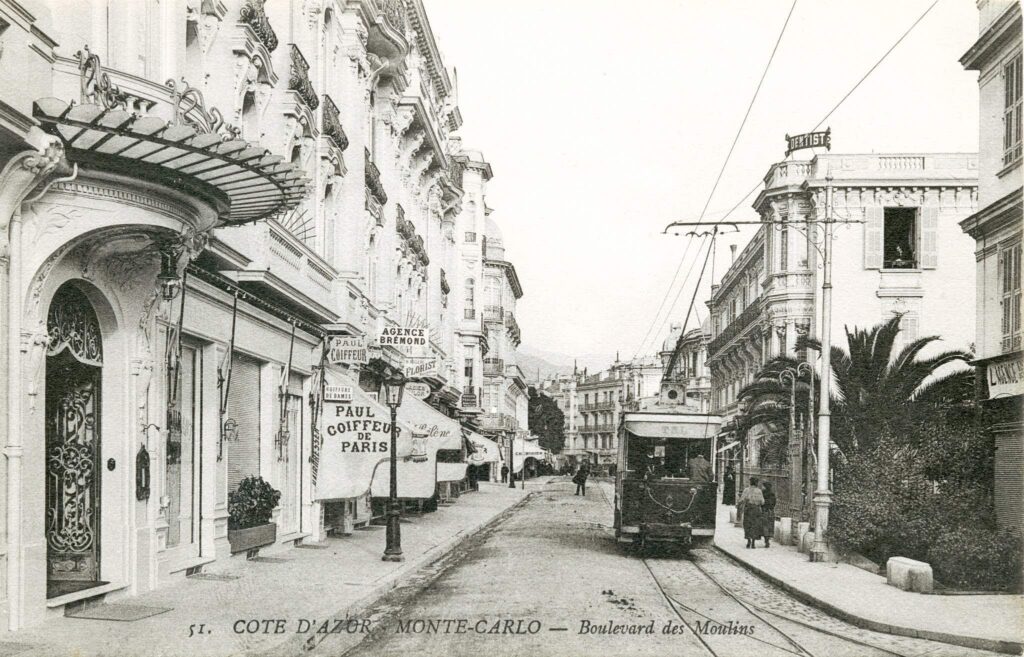
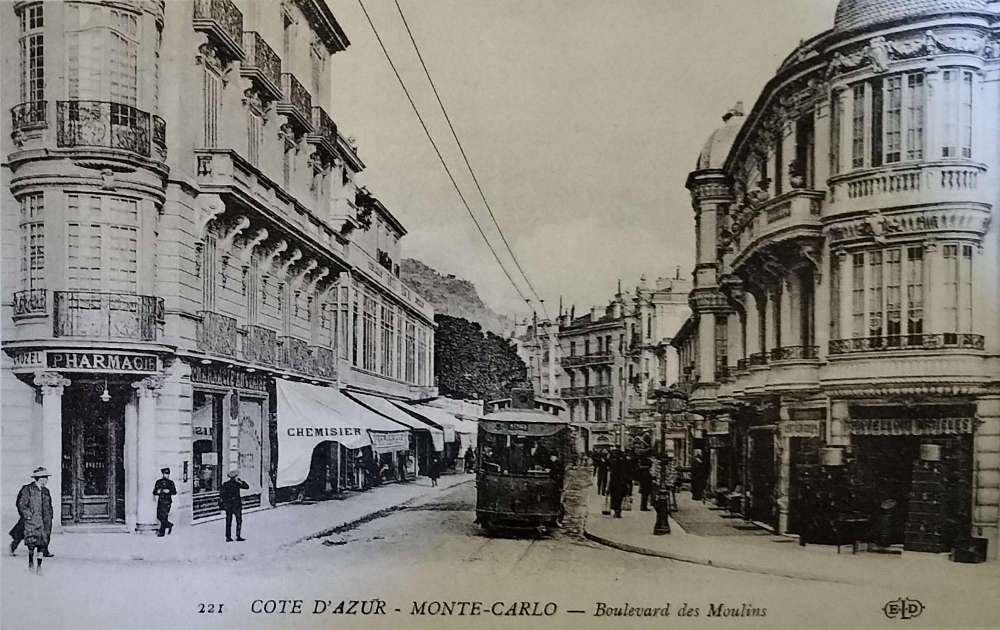
A tram on Boulevard des Moulins heading Northeast. This image was included in a Monaco Tribune article about Monaco’s trams (Collection privée J-Paul Bascoul). It also appears in José Banaudo’s book where he notes the change to a single track line from a double-track length which ran from Avenue des Beaux-Arts to the edge of the St. Roman dustrict of the principality. He describes the dual length of track elsewhere as running from Credit Lyonnaise to Hotel du Littoral. Banaudo tells us that the tram in this image is TNL No. 27, a Thompson-built tram providing a Monte-Carlo to Menton service. [6][1: p57]
This postcard view of a tram on Boulevard des Moulins also appears in José Banaudo’s book. He notes that this tram is providing an urban service in Monaco and travelling Northeast on Boulevard des Moulins. [1:p57]
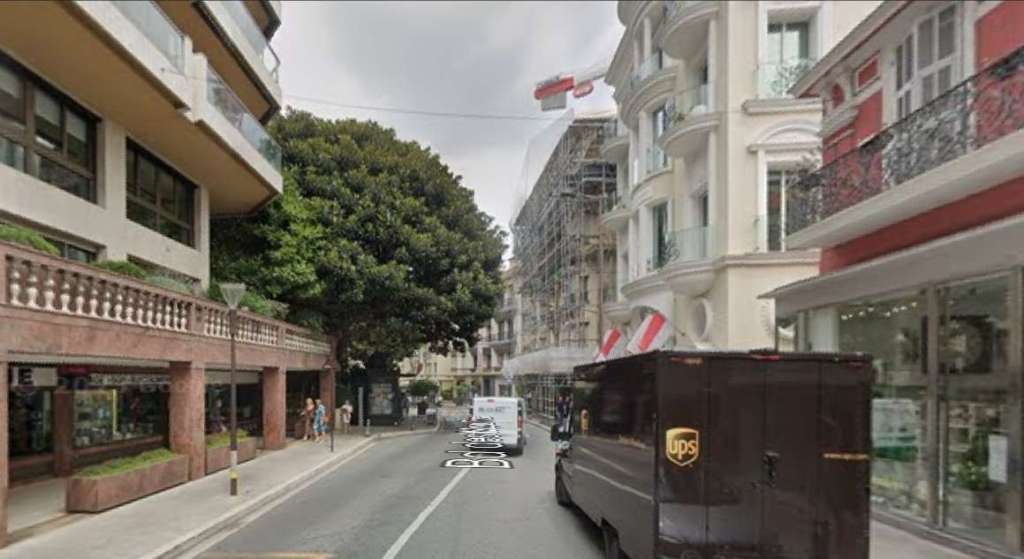
So much has changed. Much of Boulevard des Moulins would be unrecognisable to those who knew it in the early 20th century. This is a similar view looking Northeast along Boulevard des Moulins. It is possible that the tree, visible in each of the monochrome images above, is that which appears in this image. The building immediately beyond the tree, where the street curves away to the left seems to be common to all three images. [Google Streetview, July 2021]

Boulevard des Moulins led directly onto Boulevard d’Italie. Banaudo tells us that “the line became single track in the Boulevard d’Italie, where two sidings allowed the cars of the coastal line to pass those providing the urban service. The latter’s terminus was established in the St. Roman district where the three-track TM depot-workshop was also located, just before the border between the principality of Monaco and the French commune of Roquebrune.” [1: p56]
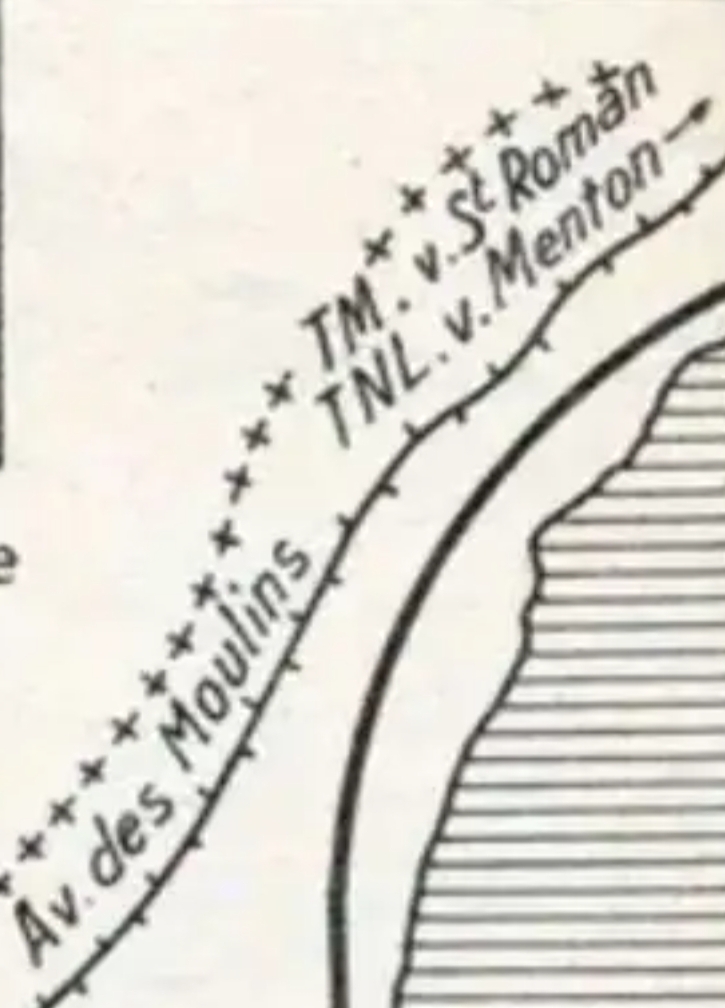
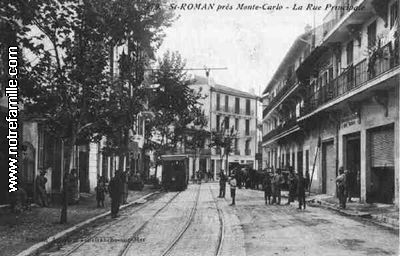
This extract from a map shared in an earlier article shows the tramway heading on from Avenue des Moulins along Boulevard d’Italie into St. Roman. The article from which this image was taken was shared on the Monaco4Ever Facebook Group by Jean-Paul Bascoul on 17th May 2015. [24]
A tram on Avenue d’Italie in St. Roman. [27]

After leaving the principality, Banaudo tells us that the road and the tramway ran through picturesque even grandiose scenery as they run through “Cabbé cove, bounded to the east by the tip of Cape Martin. Since leaving the principality, five passing loops and sections of double track of varying lengths followed one another on this route where the Basse, Moyenne and Grande Corniche come together below the picturesque medieval village of Roquebrune.” [1: p56]
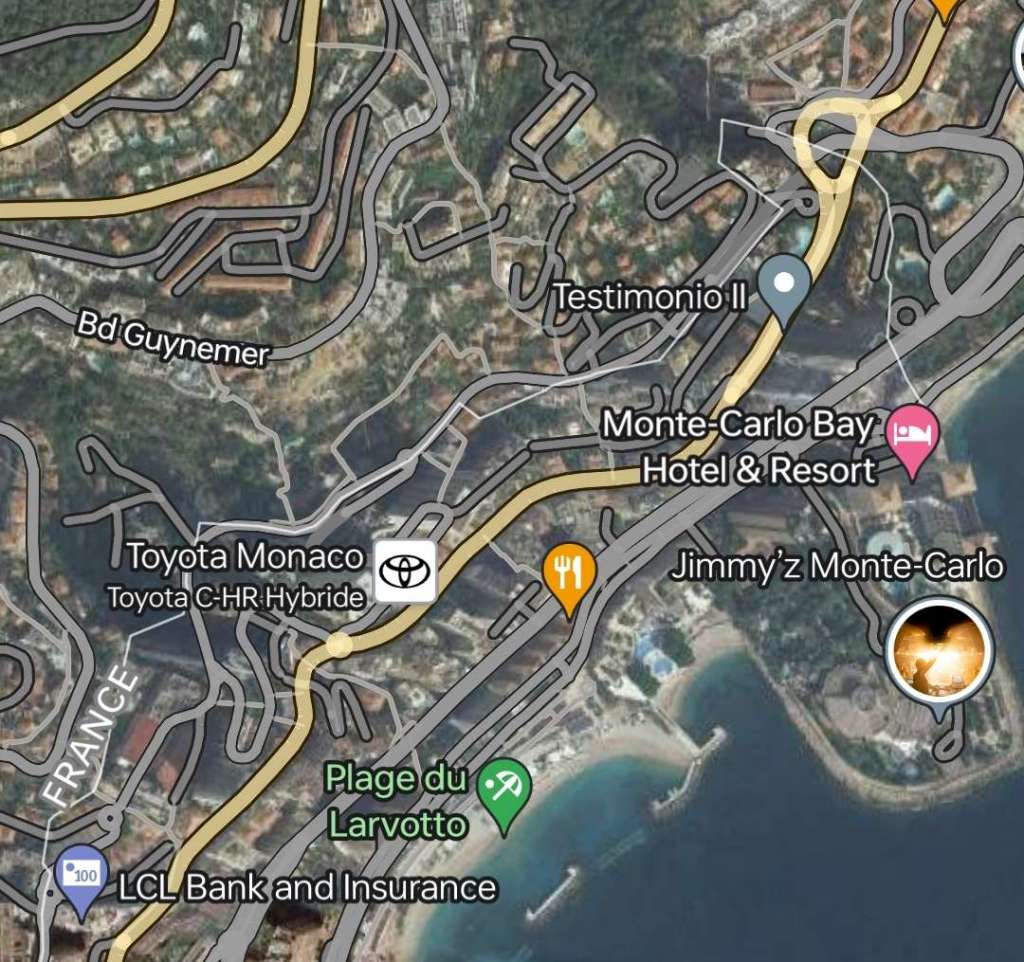
Boulevard des Moulins finishes just at the bottom-left of this Google Maps satellite image. Avenue d’Italie runs diagonally from the bottom-left of the image to the top-right. The road is marked by the primrose yellow line. This was the route of the TNL tramway.close to the top right of the image the Avenue d’Italie gives way to the Avenue de France at the gyratory. [Google Maps, November 2023]
The primrose yellow line closest to the sea in this satellite image marks the route of the old tramway (now the D6098). Avenue de France gives way to Avenue Jean-Jaures towards the top right of the image. [Google Maps, November 2023]
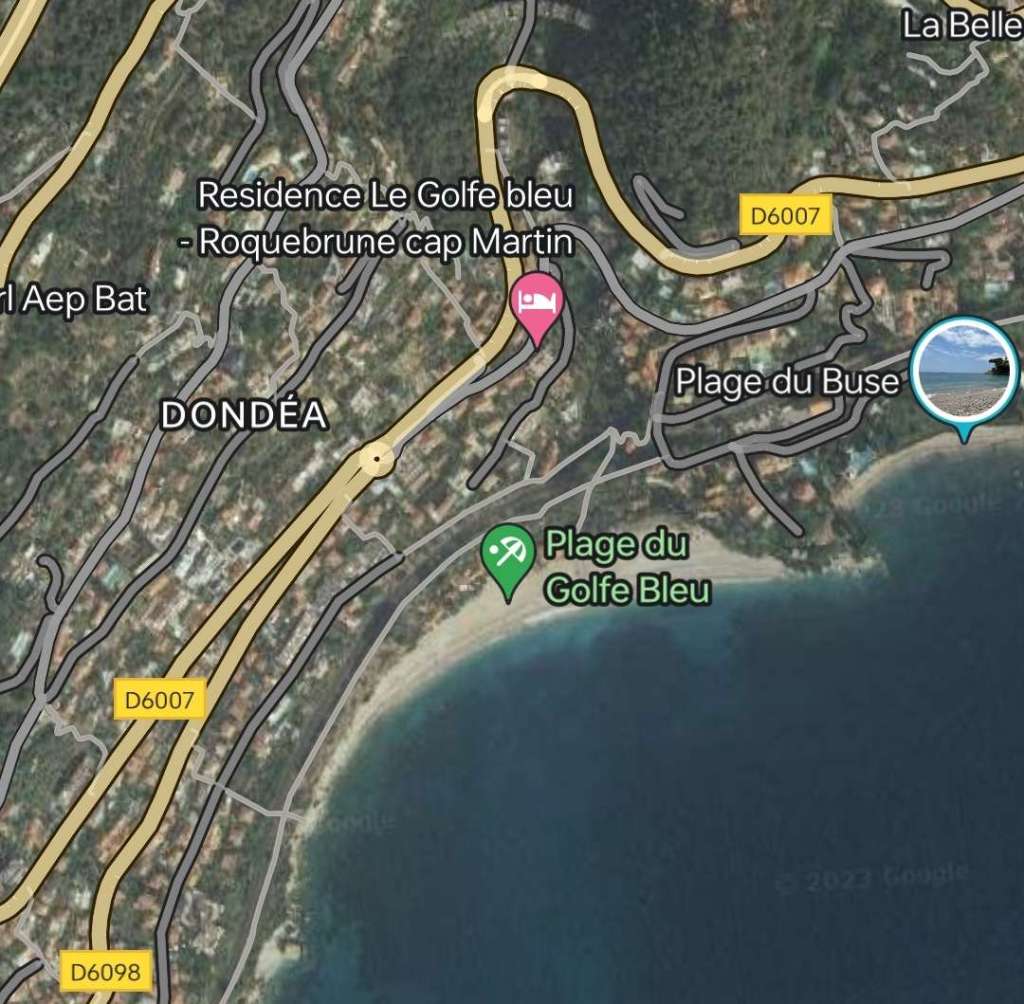
The route of the old tramway continues along the present D6098 (Avenue Jean-Jaures) until it joins the D6007 (Avenue de la Cote d’Azur) and then curves around the valley at Cabbe.  [Google Maps, November 2023]
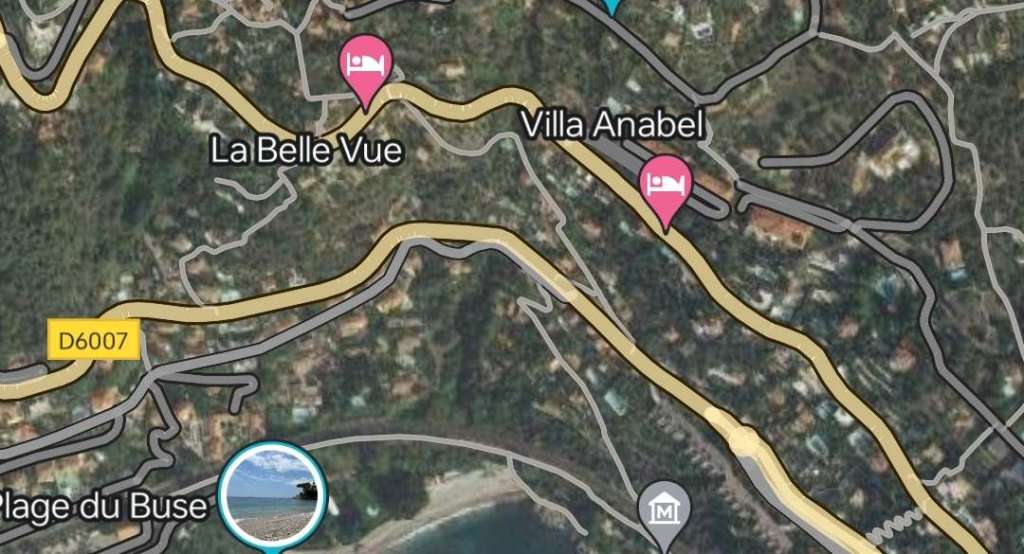
The route of the old tramway continues along the Avenue Cote d’Azur (A6007). [Google Maps, November 2023]


Shortly after the location where the Basse, Moyenne and Grand Corniches meet, the “national road 7 describes a series of tight turns on a steep slope to cut across the base of Cap-Martin.  In order to follow a more favorable route, the tramway penetrated quite far into the pine forest of the cape for approximately 1600 m on an independent platform.  Here it served housing estates, vast properties and villas, some of which were not yet connected to motorable roads.” [1: p57]
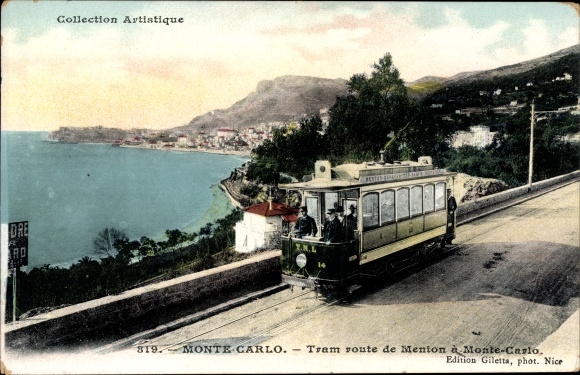
A tram runs along the highway, some distance above sea-level, having passed through the district of St. Roman. [23]
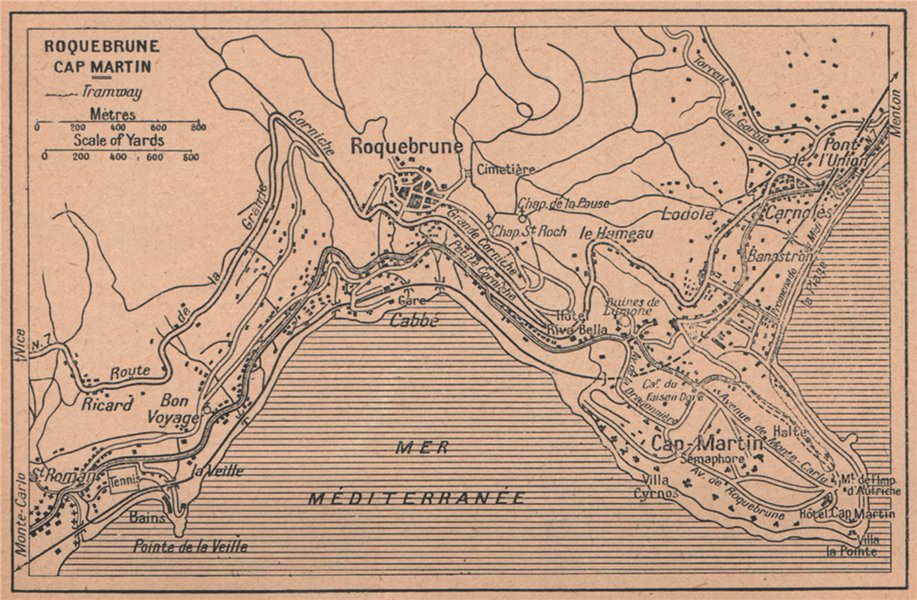
The tramway through Roquebrune and Cap-Martin was remote from the highway for about 1.6km. On careful inspection its route can be seen on this map. The pictures below show the length of tramway described by José Banaudo, which ran on its own formation for some distance. [17]
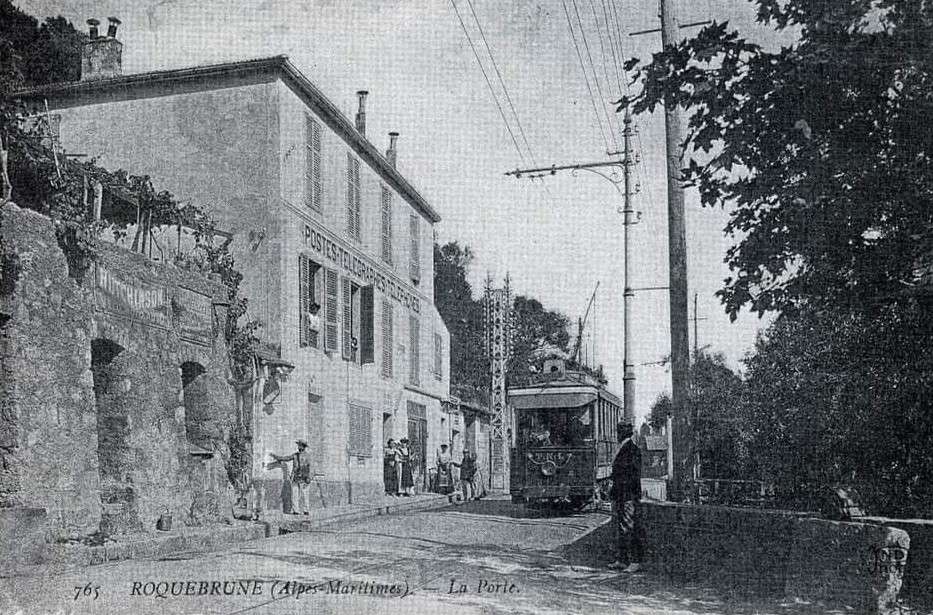
A Thomson TNL tram passes in front of the Roquebrune post office, in the Cabbé district. The tram is heading for Monaco. I have struggled to locate this image in relation to modern maps of the area. [7]

Banaudo continues to describe the route followed by the tramway. He says that the old tramway ran out onto the Cap-Martin peninsula where it “described a long hairpin loop at the bottom of which was a 108 m tunnel, in a curve with a radius of 35 m and a slope of 70 mm/m. From the Cap-Martin stop, located at the exit of the tunnel, the single track was subsequently doubled to facilitate crossings in this hilly sector. The descent on the eastern slope of the cape then offered a vast panorama of the town of Menton and the Ligurian Riviera. Since entering [Cap-Martin], the line had lost around sixty metres in altitude when it reached the seashore at the Victoria Hotel, not far from which the Cap-Martin depot was located.” [1: p57]
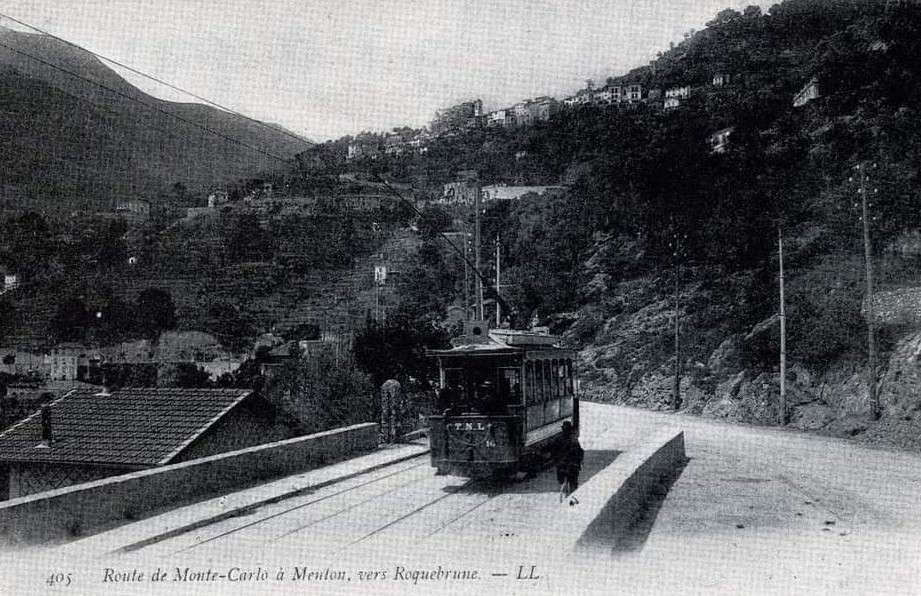
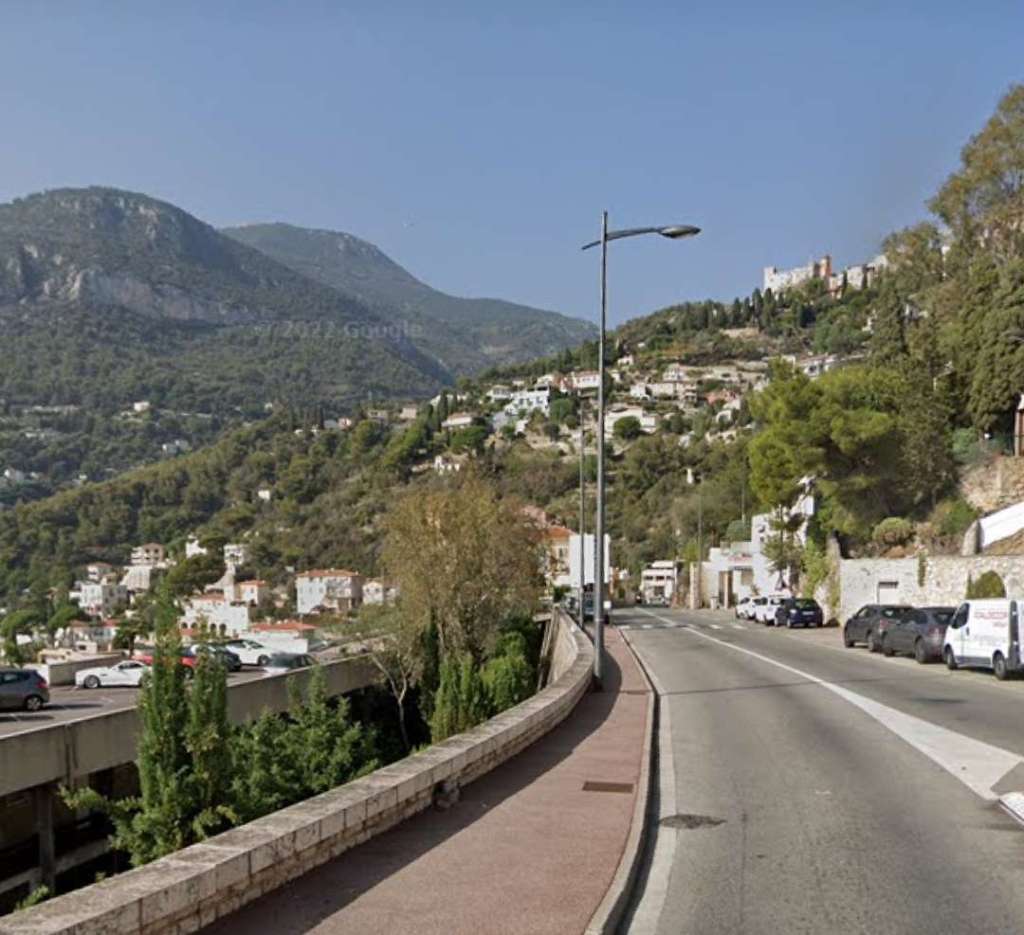
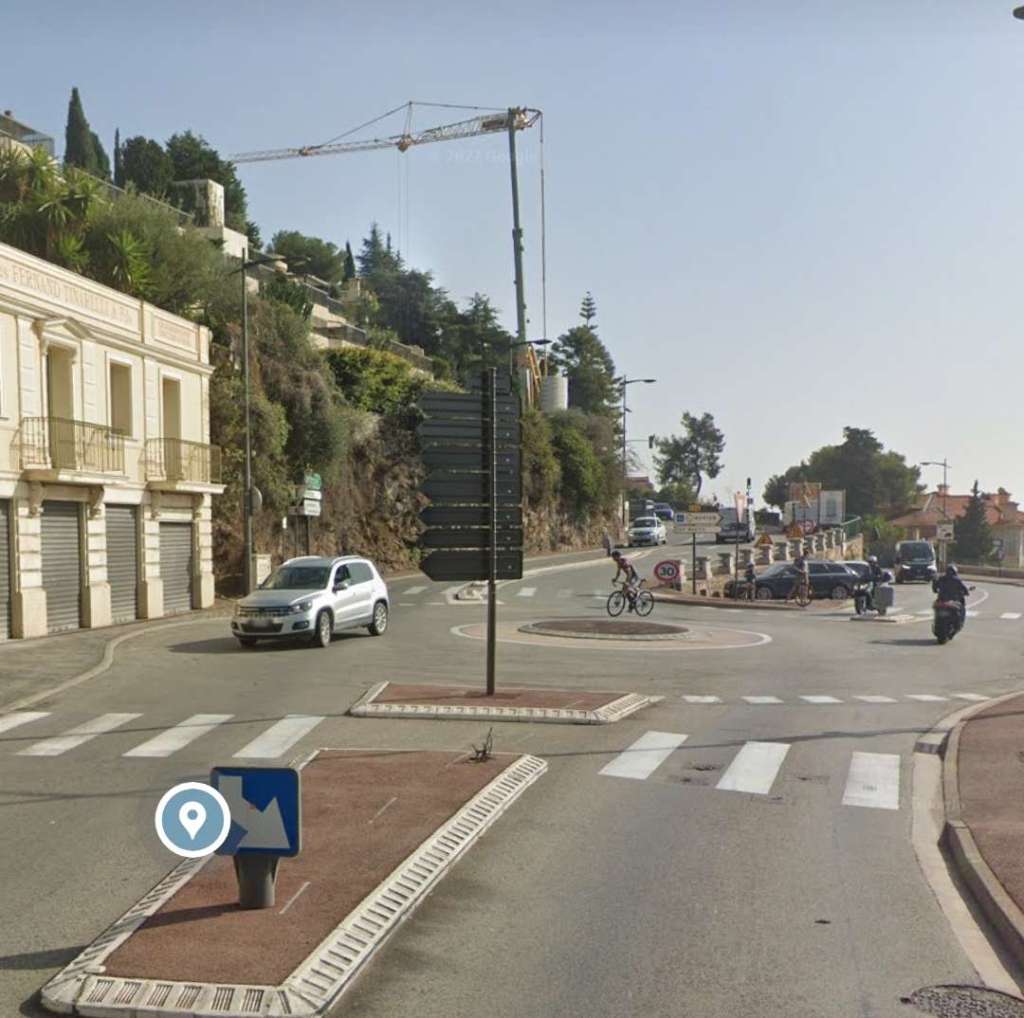
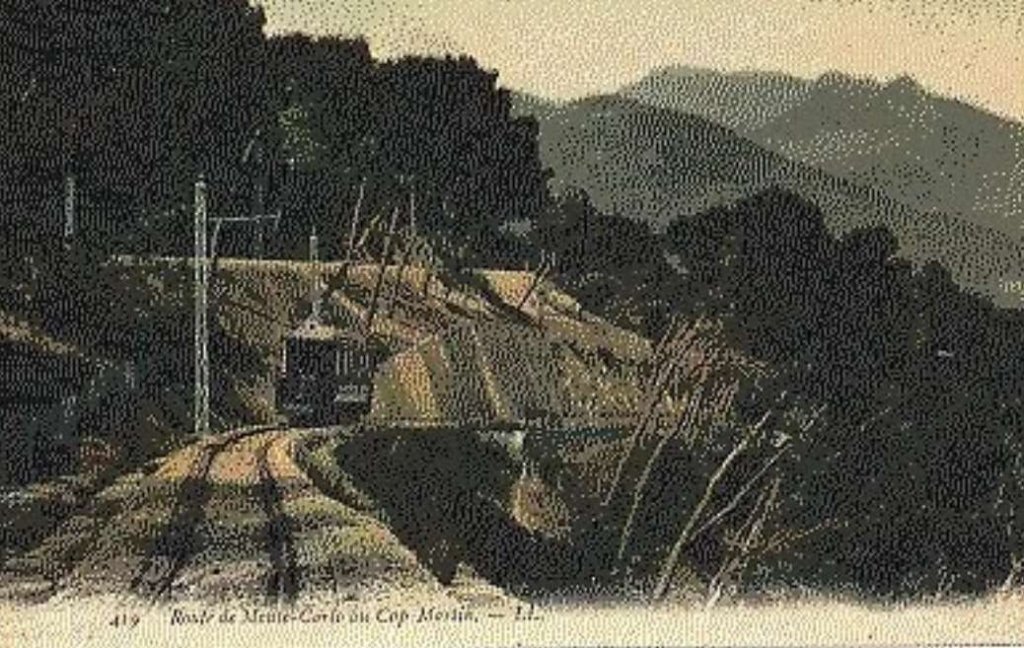
Close to Roquebrune, trams left the main road to follow a dedicated formation. The highway had a series of tight curves and significant gradients which were not suitable for trams. From this point, the trams travelled out onto Cap-Martin while gradually descending almost to sea-level. [16]
Approximately the same location as that shown in the photograph above, as it appears in the 21st century. [Google Streetview, October 2022]
Looking Southeast, the old mainroad followed the route on the left trams ran on a separate route which has been transformed to Avenue Paul Doumer, which appears on the right side of this photograph. [Google Streetview, October 2022]

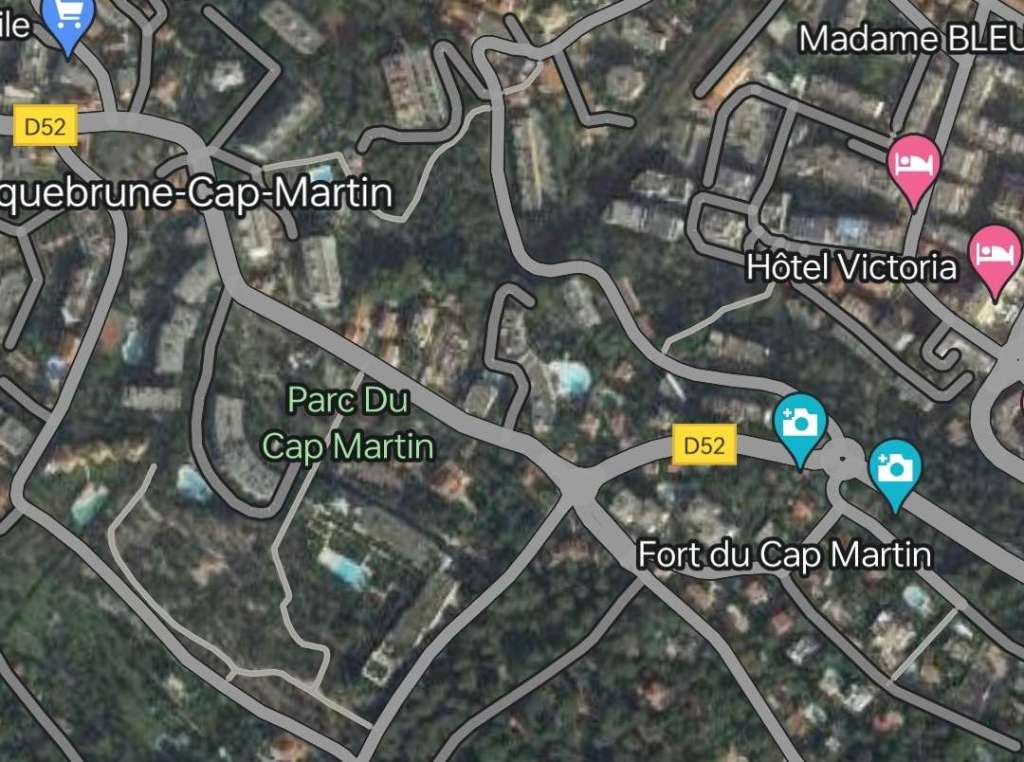
Today, Avenue Paul Doumer (D52) follows the route of the old tramway fairly faithfully as it heads out onto Cap-Martin. Avenue Paul Doumer gives way to Avenue Sylvio de Monleon which follows the old tramway to and through the location of the tramway tunnel which has been supplanted by a road tunnel on the same alignment.
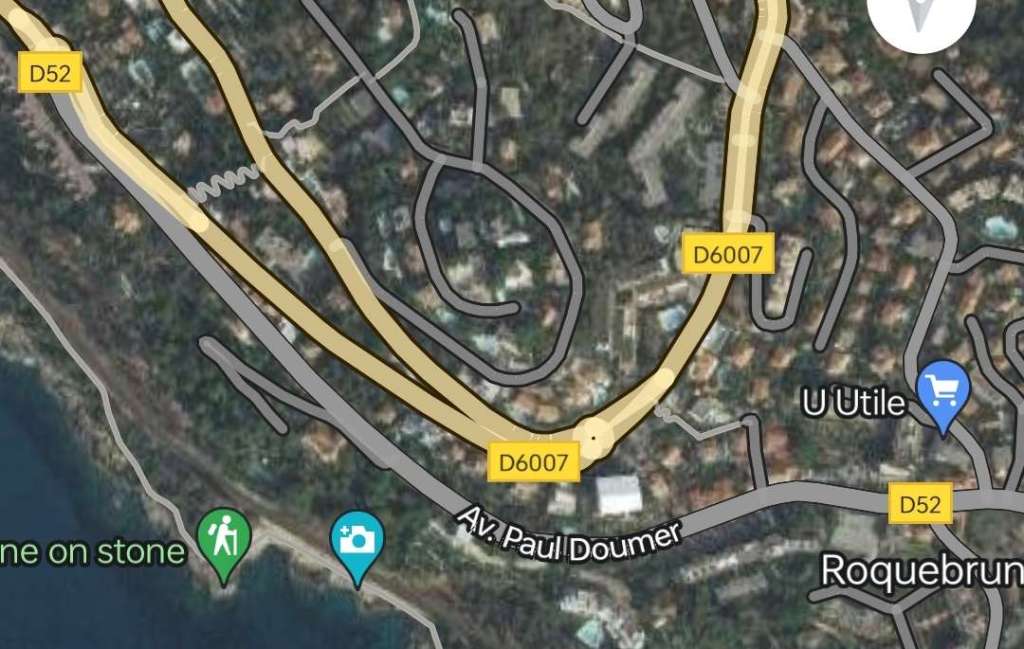
Avenue Paul.Doumer (D52) shown in grey follows the route of the old tramway. [Google Maps, November 2023]
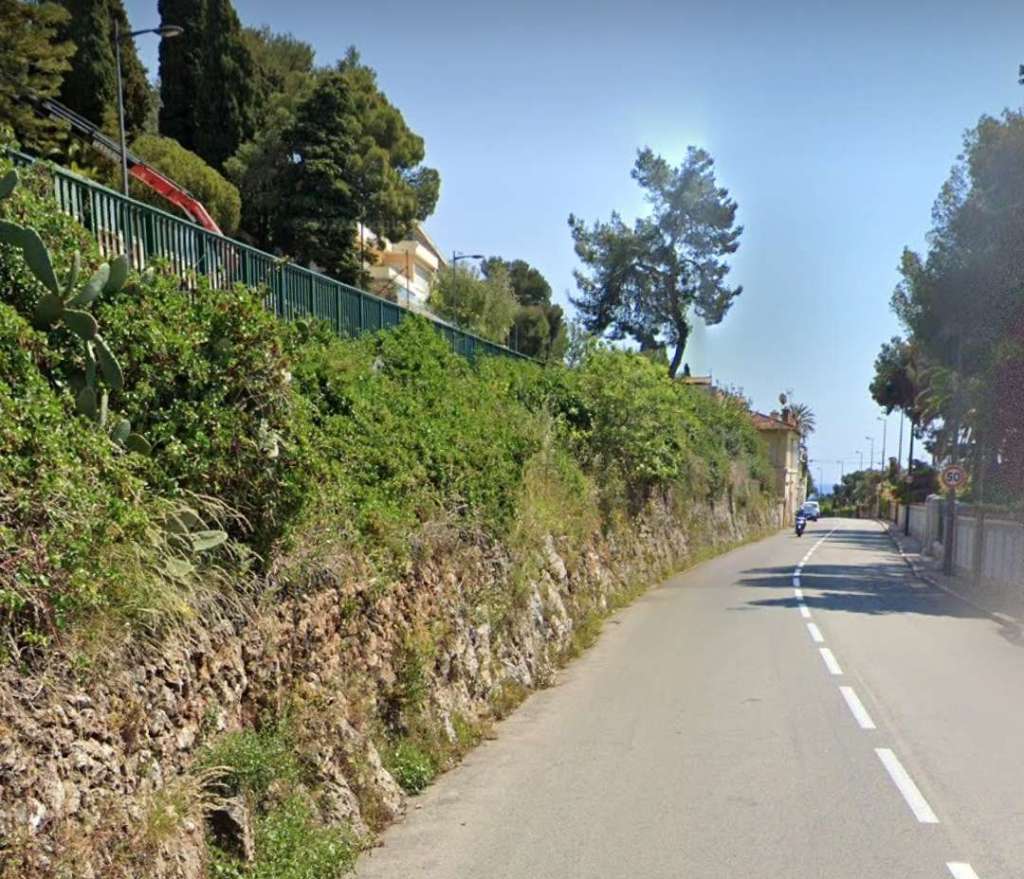
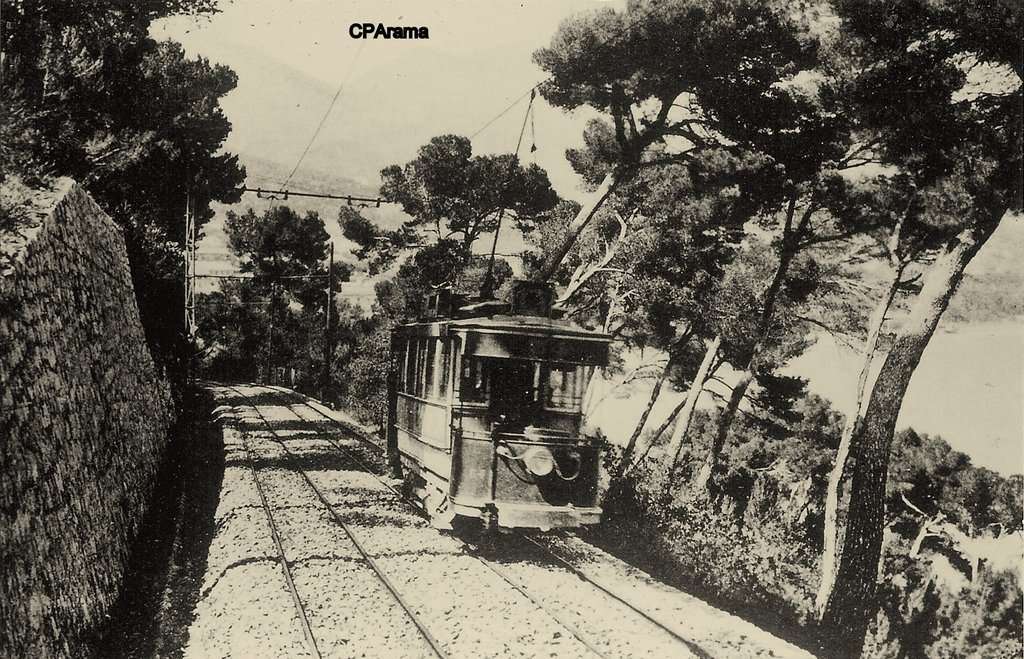
The tram in this photograph is heading towards Roquebrune and then Menton. The single-track line is on its own formation, separated from the road both horizontally and vertically. [15]
Looking Southeast on Avenue Paul Doumer. The main road is marked by the green railings at a higher level. This is approximately the same location as that shown in the postcard view immediately above. [Google Streetview, March 2023]
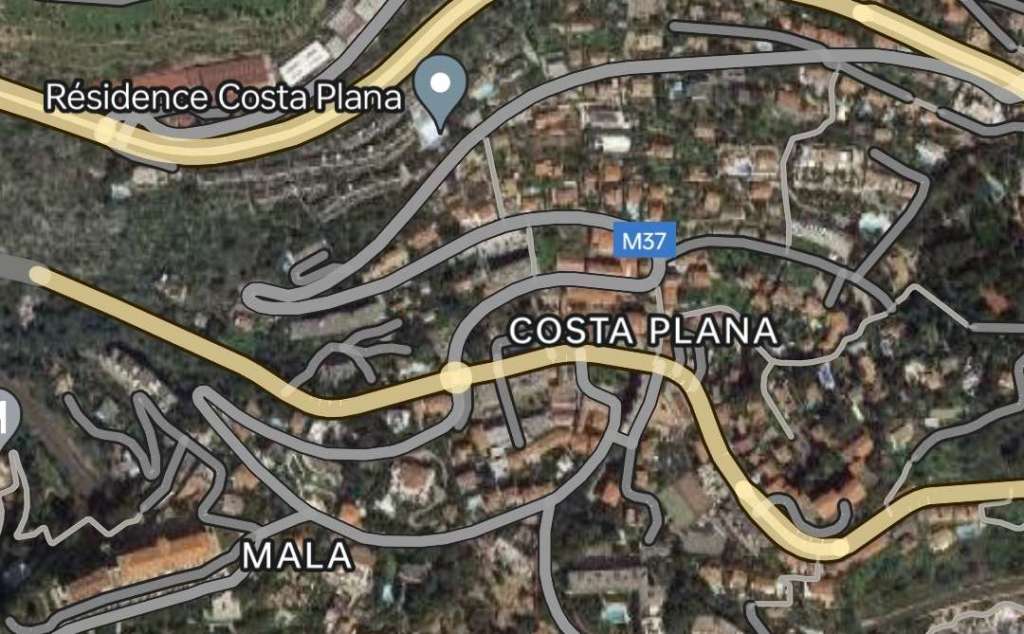
The D52 continues to follow the old tramway route, although it takes the new name of Avenue Sylvio de Monleon on the right third of this extract from Google Maps. [Google Maps, November 2023]
The old tramway turned through a tight hairpin bend , the first part of which was in tunnel. [Google Maps, November 2023]
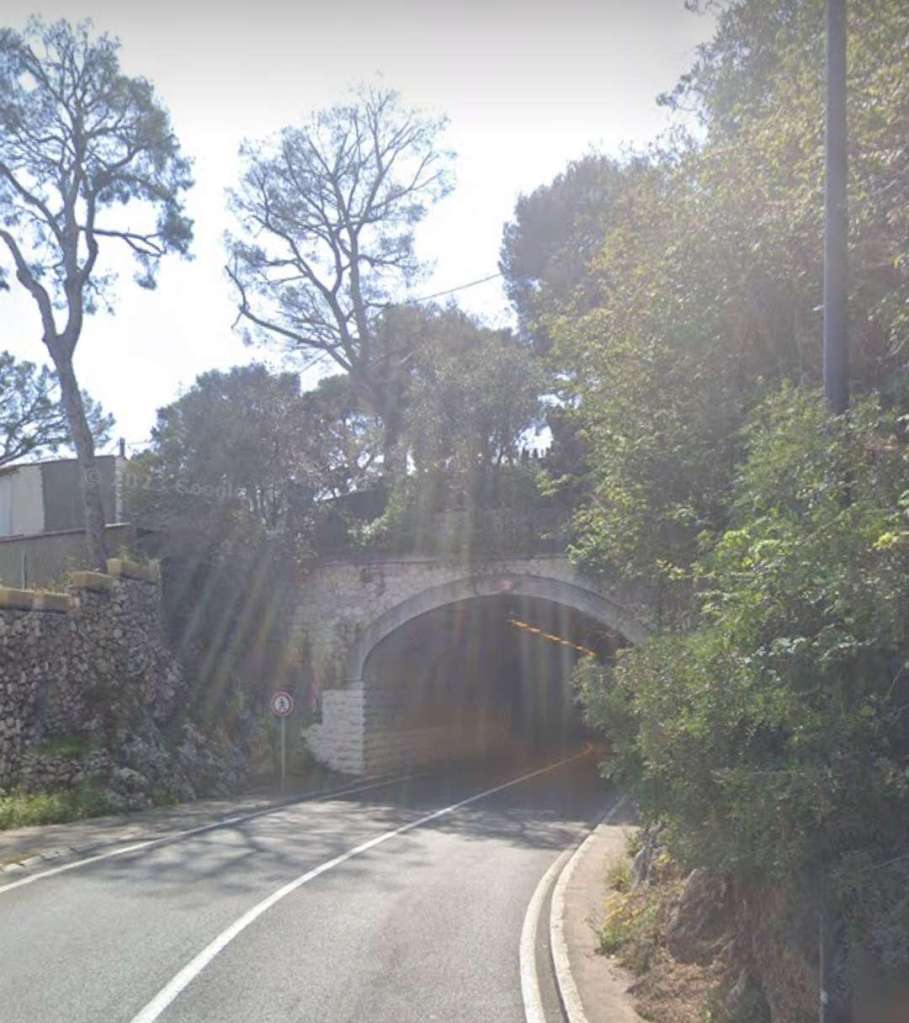
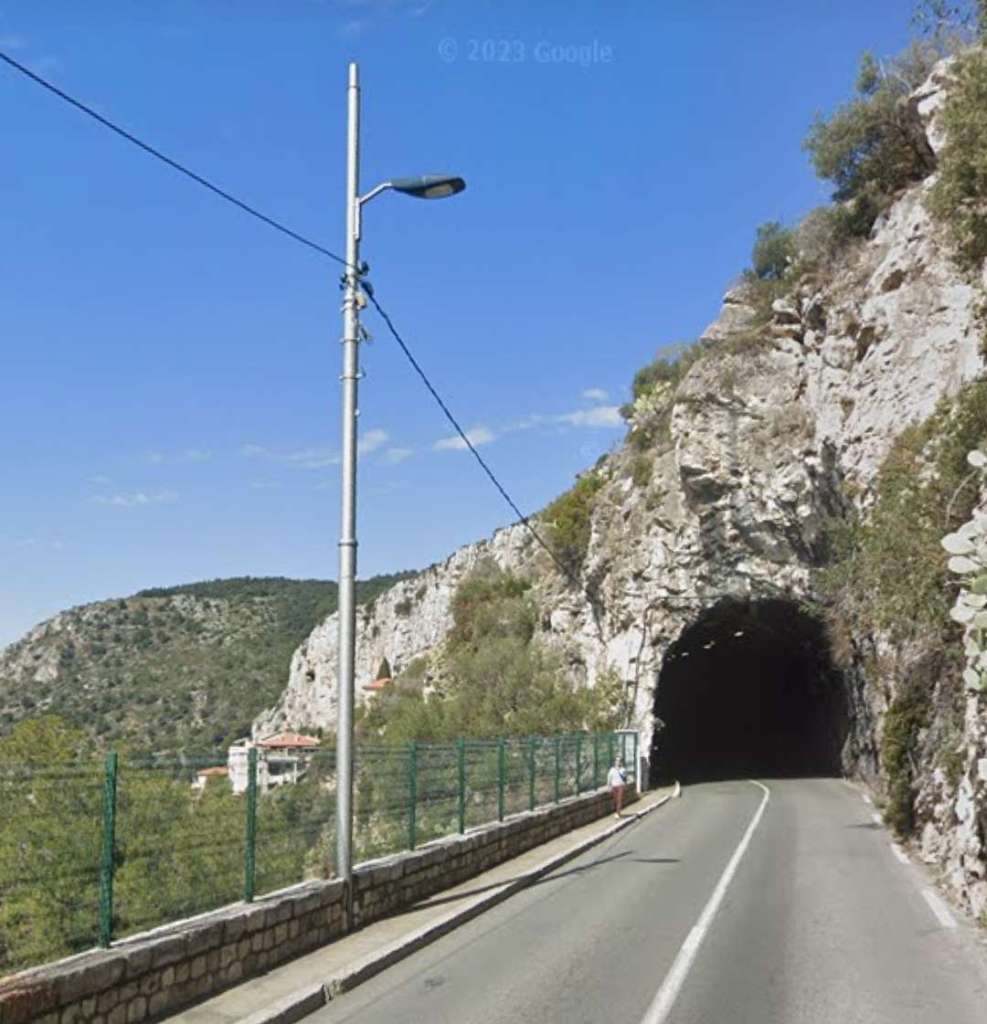
The road tunnel that replaced the narrower tramway tunnel. [Google Streetview, March 2023]
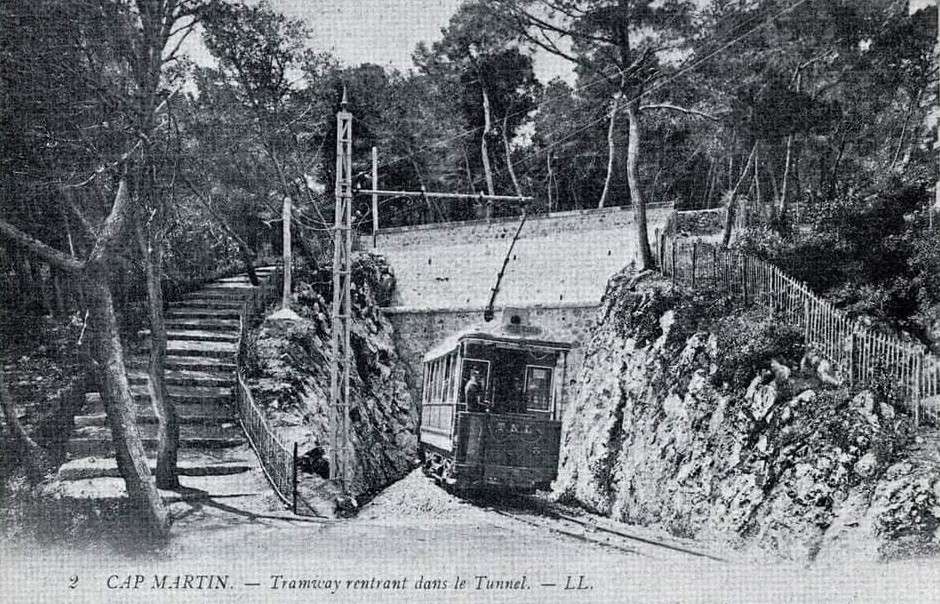
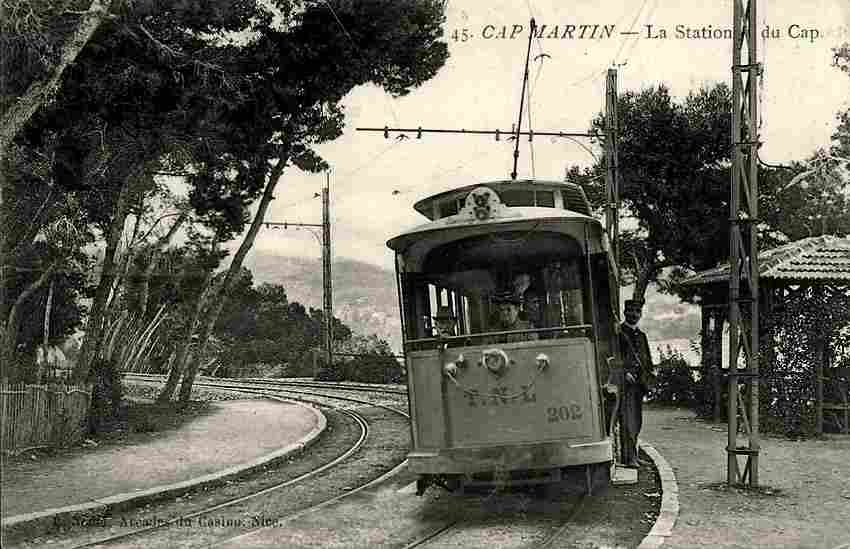
A tram leaves the tunnel on Cap-Martin and approaches the tram stop. The pedestrian access to the tram stop appears to the left of the tram in this image. [14]
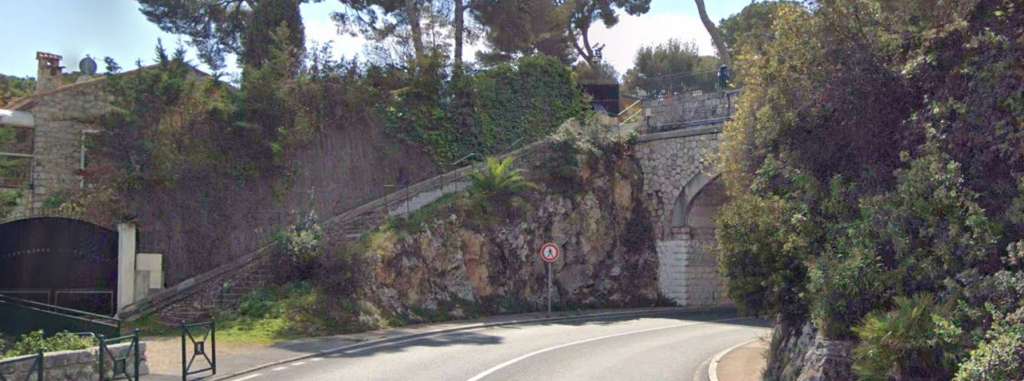
From a slightly different angle, the modern tunnel portal close to the old tram stop is visible in this image. The image shows that the steps which provided access to the tram stop are mirrored by similar steps in the 21st century. [Google Streetview, March 2023]
The tram stop on Cap-Martin. The tram is heading for Monaco. [16]
This image shows the same location today. [Google Streetview, March 2023]
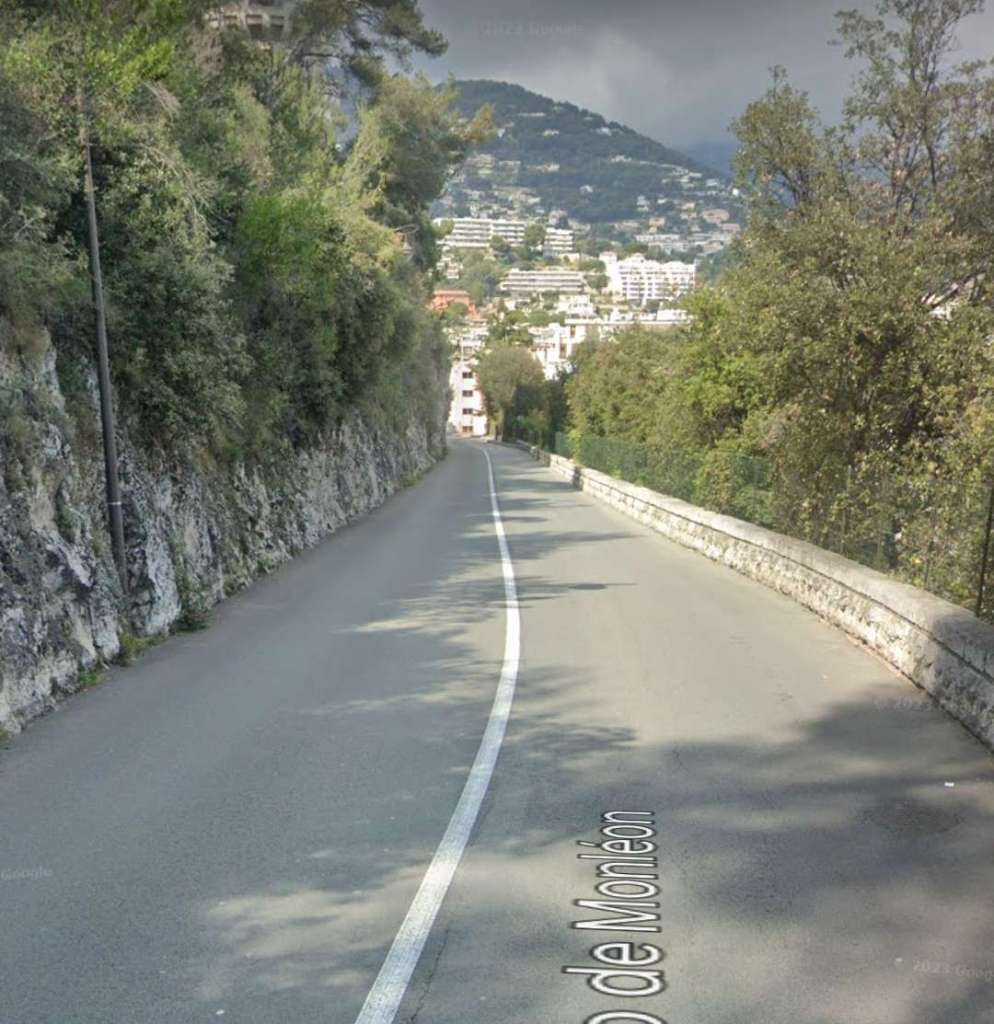
A tram running downhill towards the Plage de Carnoles. [26]
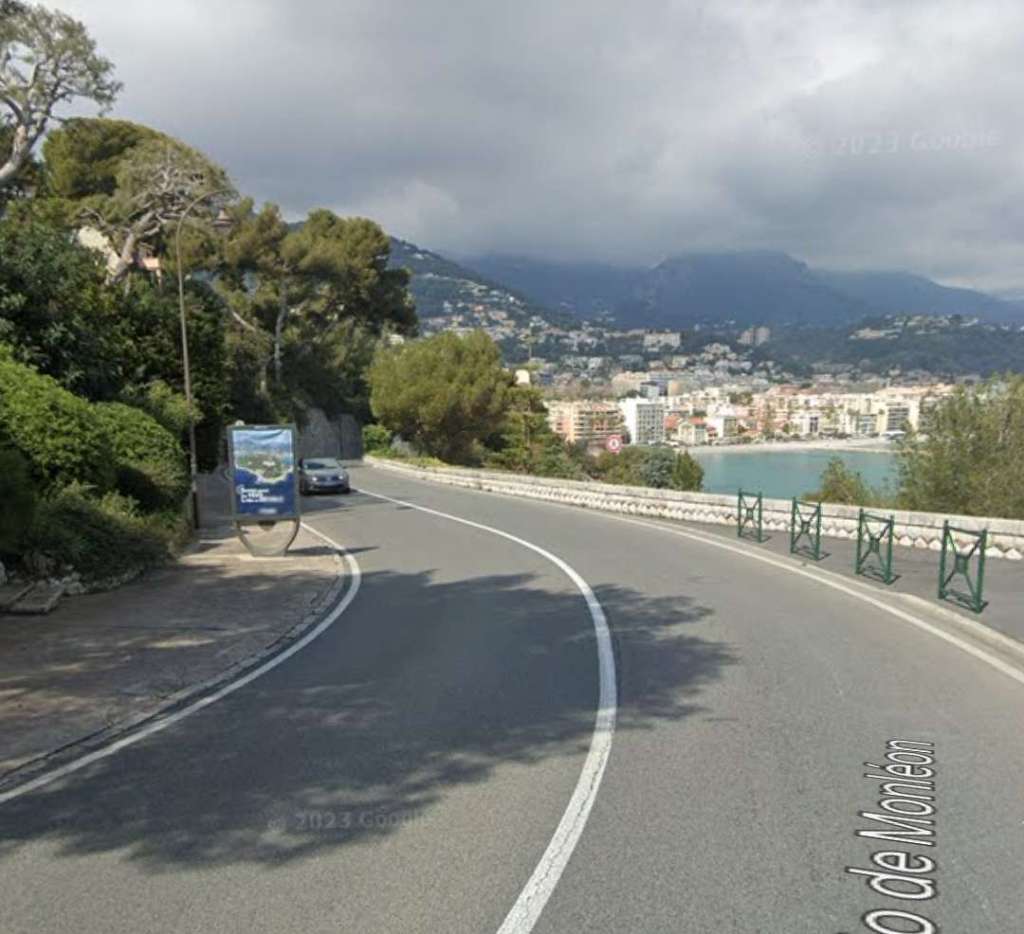
A similar location in the 21st century, looking down Avenue Sylvio de Monleon towards the Plage de Carnoles. [Google Streetview, April 2023]
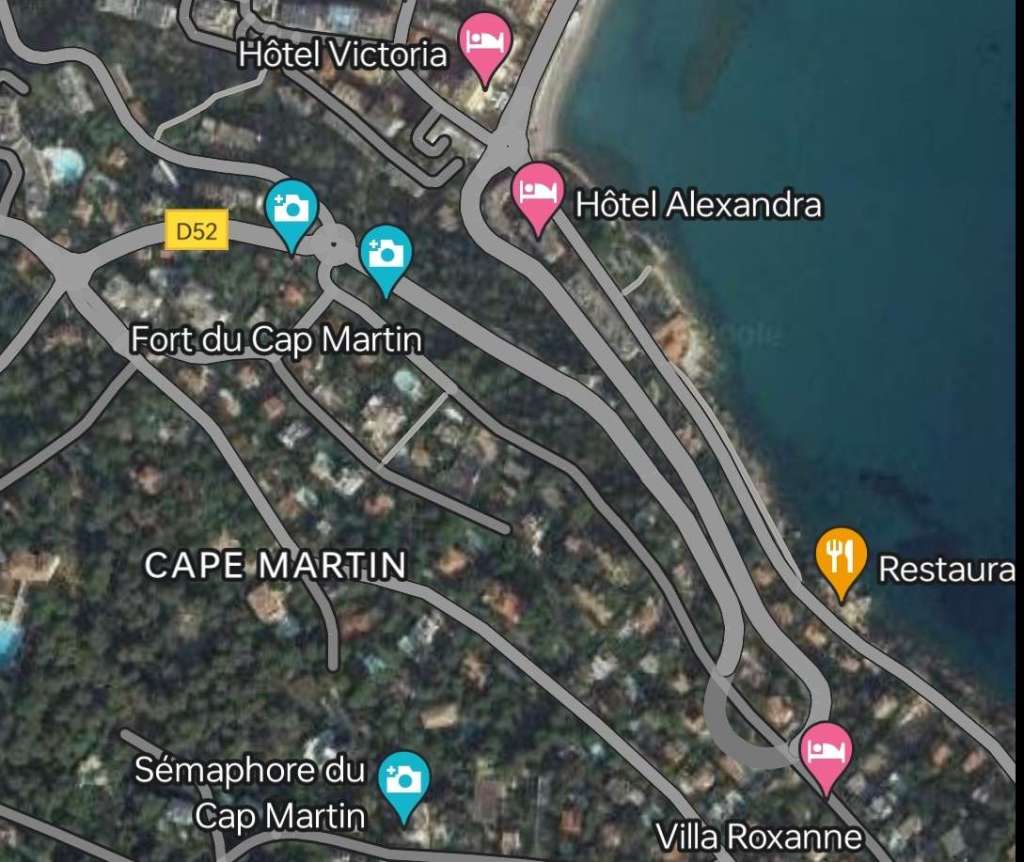
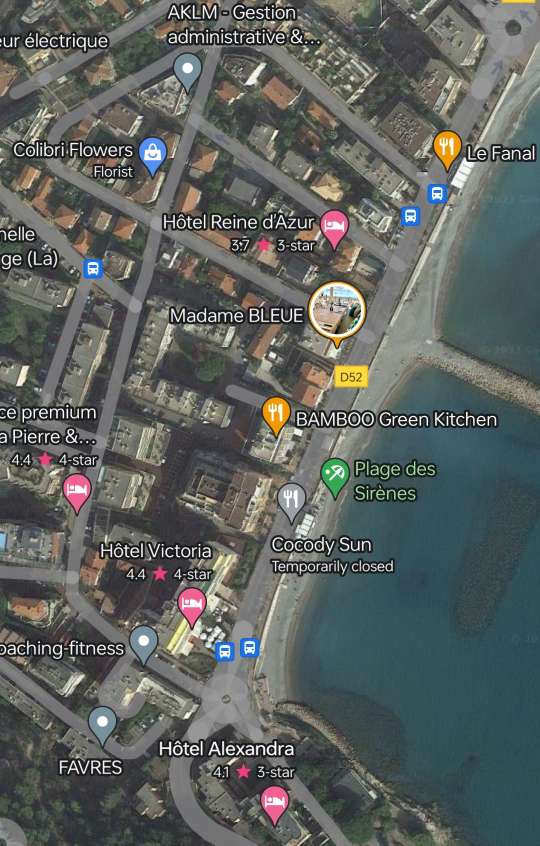
Banaudo mentioned Hotel Victoria in his description of the tram route. In the 21st century it remains at the same location as in the early 20th century. It features at the bottom of this extract from Google Maps. South of the Hotel Victoria a block of flats can be seen adjacent to the tight curve on the D52. Those flats sit on the site of an old chapel – Chapelle du Cap-Martin. [Google Maps, November 2023]
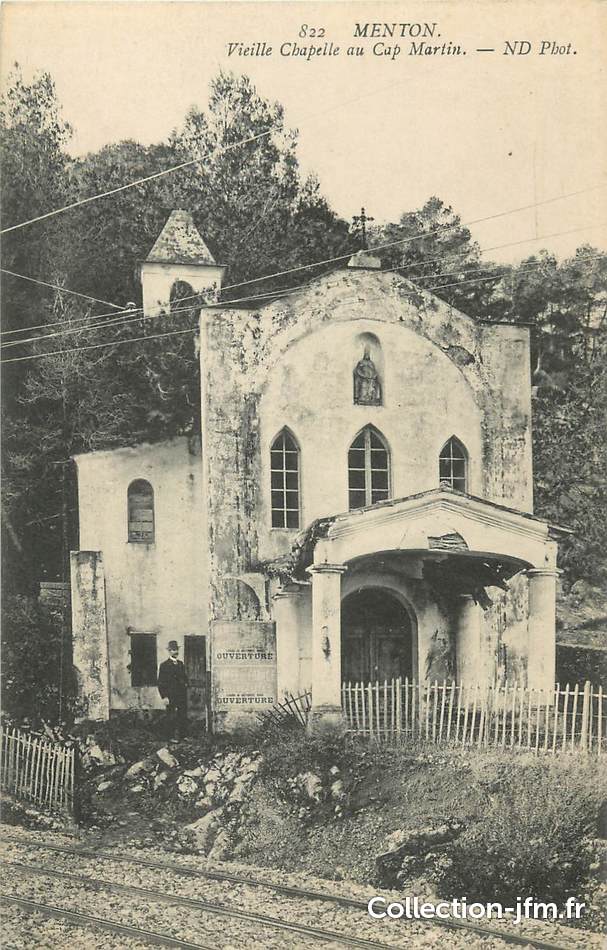
The ruins of the Chapelle du Cap-Martin with dual tram tracks running close to its doors. [22]
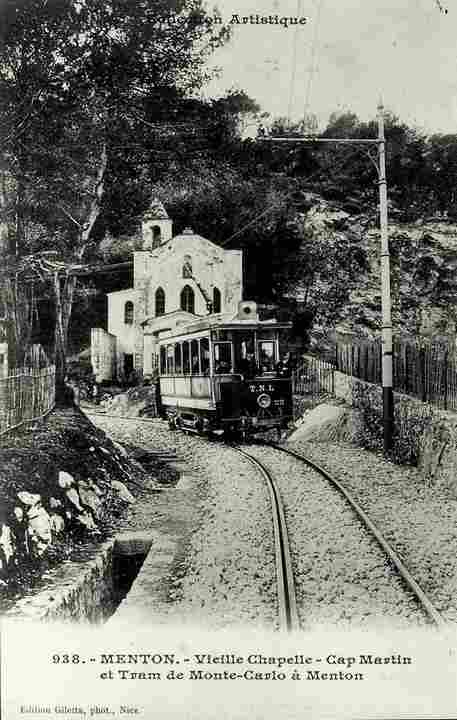
A early postcard view showing a TNL tram running past the Chapel towards Menton. [34]
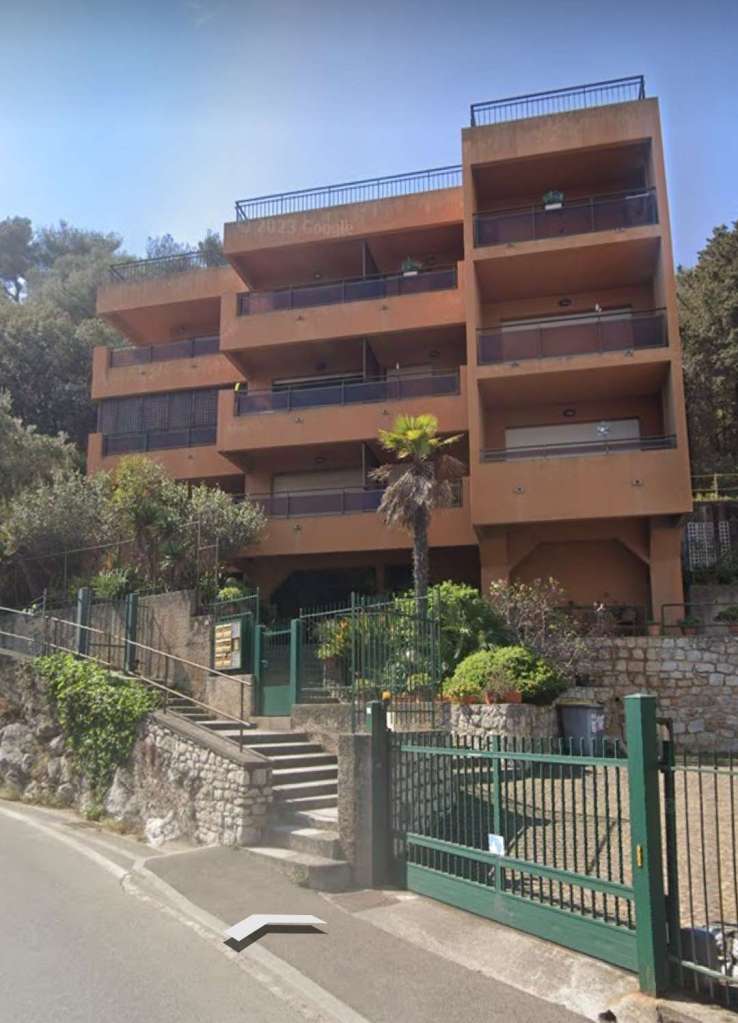
The same location in 2023. [Google Streetview, April 2023]
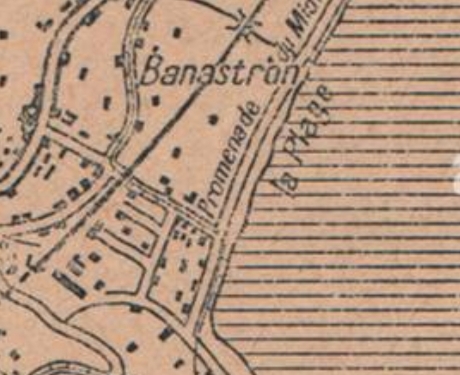
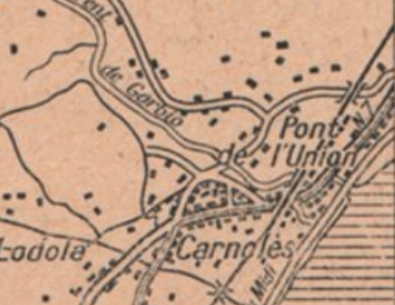
This extract from the map seen earlier in this article shows the tram route entering bottom-centre, close to what would have been the Chapelle du Cap-Martin, and running for just a short distance along Promenade du Midi before turning inland to pass under the PLM mainline. [17]
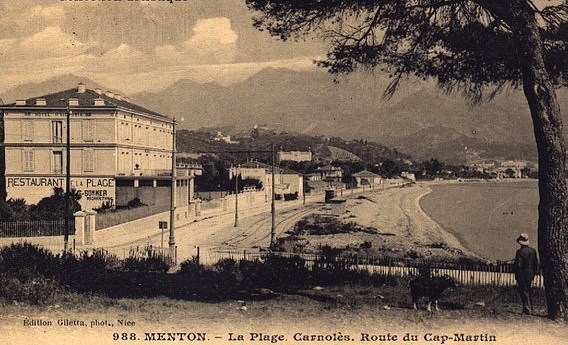
An early postcard view of La Plage de Carnoles, looking East from Cap-Martin. Tram tracks are clearly visible on the beach and a tram appears to be heading for Menton. [45]
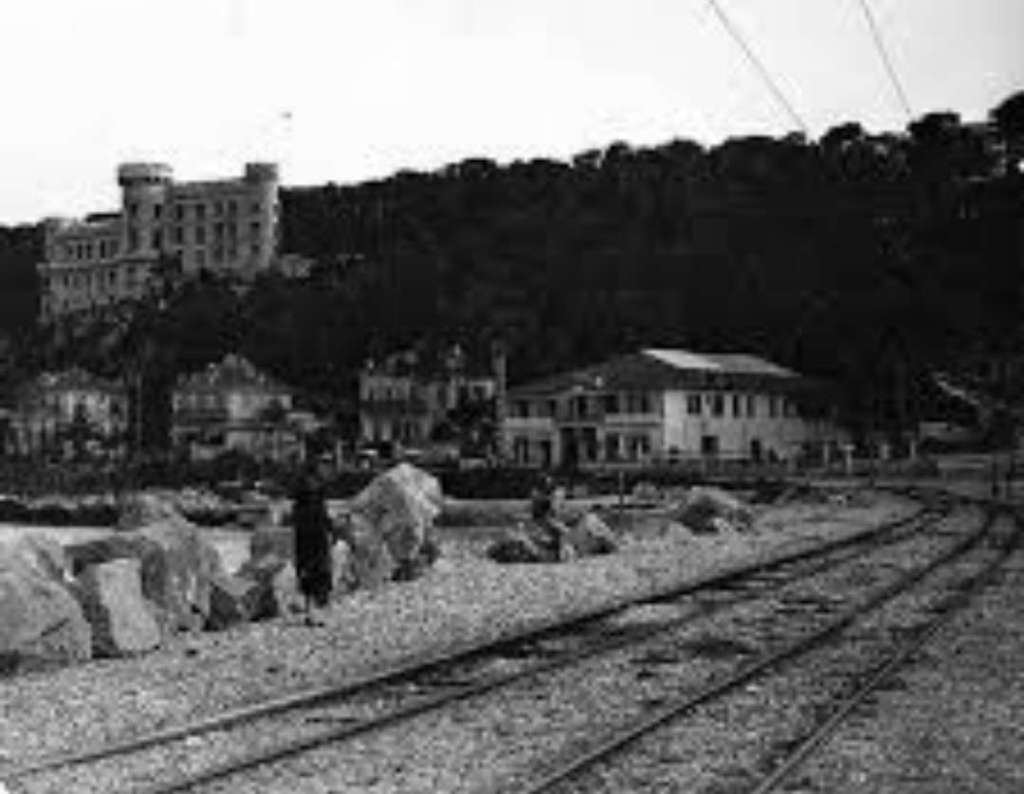
Looking Southwest in 1910 towards Cap-Martin from La Plage de Carnoles. Banaudo notes that at the time it was built, the tramway sat on the beach. [25]
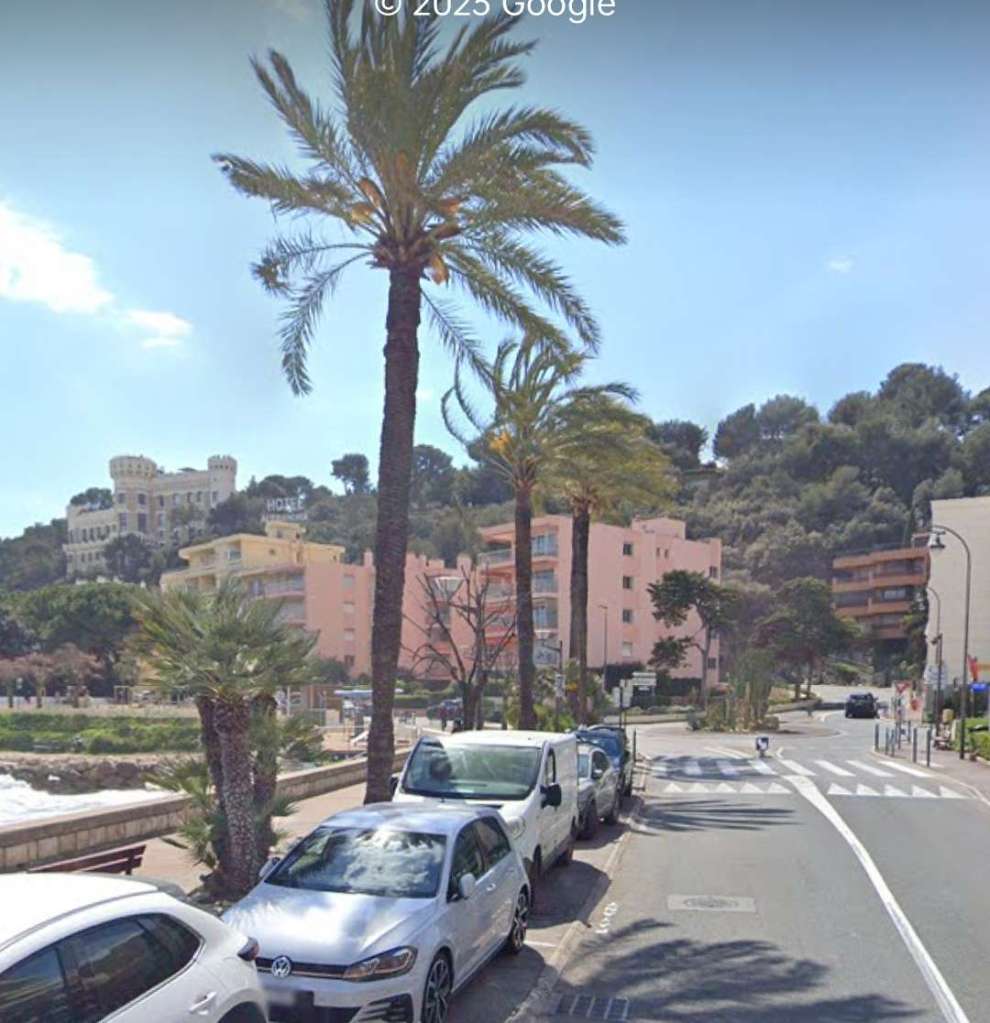
A similar view in the 21st century. [Google Streetview, April 2023]
This image shows a tram running along the edge of the beach in Carnoles. Just to the right of this image trams turned away from the beach. [7]

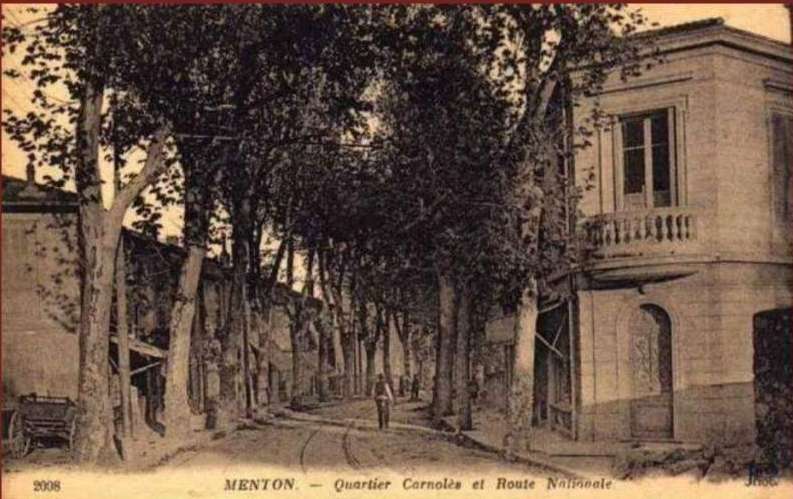
After running past the Chapelle du Cap-Martin trams ran alongside the beach for a short distance. The route they took has since become the Promenade du Midi. They turned inland at what is now Avenue Francois de Monleon and ran under the PLM mainline before turning to the right along Avenue Julia, a road which appears to no longer exist, and following the curve of that road as far as its junction with what is now the D6007. The length before that junction was along what is now Avenue du Marechal Foch.
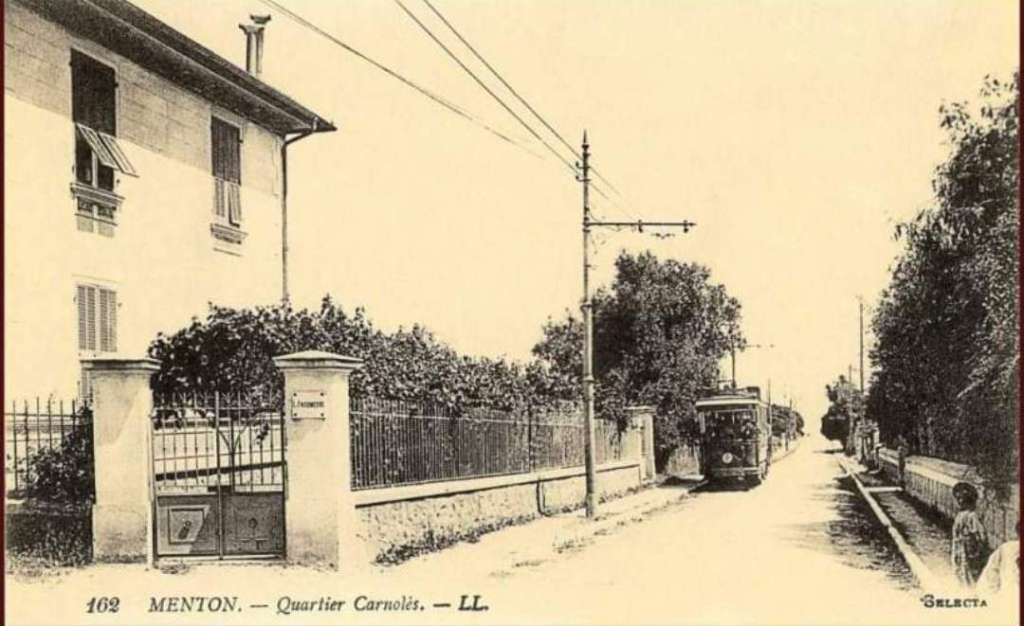
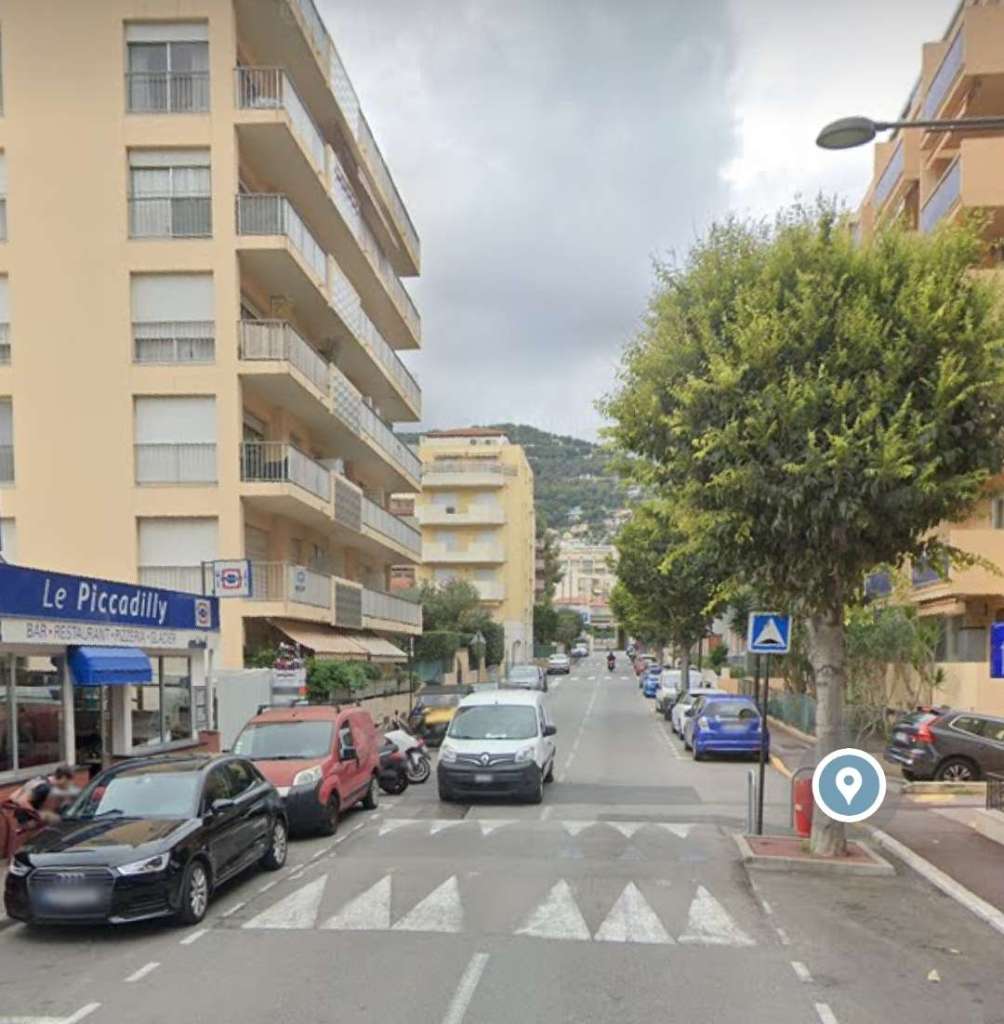
This old post card image shows a tram on Avenue François de Monleon. It was shared on the Menton du Passé au Present Facebook Page on 3rd December 2017. [35]
Avenue François de Monleon in the 21st century at a similar location to the monochrome image above. [Google Streetview, November 2023]
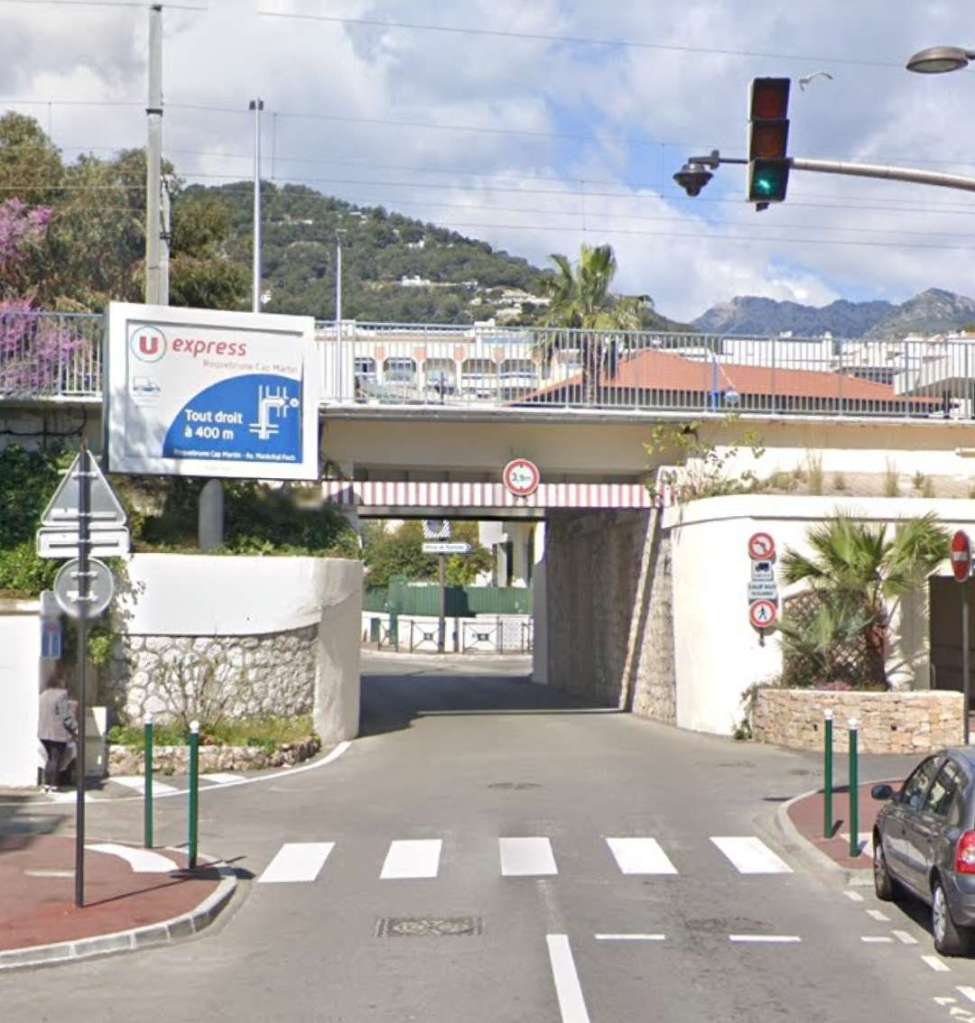
Trams ran Northwest along Avenue François de Monleon passing under the PLM mainline through the bridge shown here. [Google Streetview, April 2023]
Running Northeast the tramway met the N7 (now the D6007) and then turned right along it towards the PLM mainline and the beach along what is now Avenue Aristide Briand. [17]
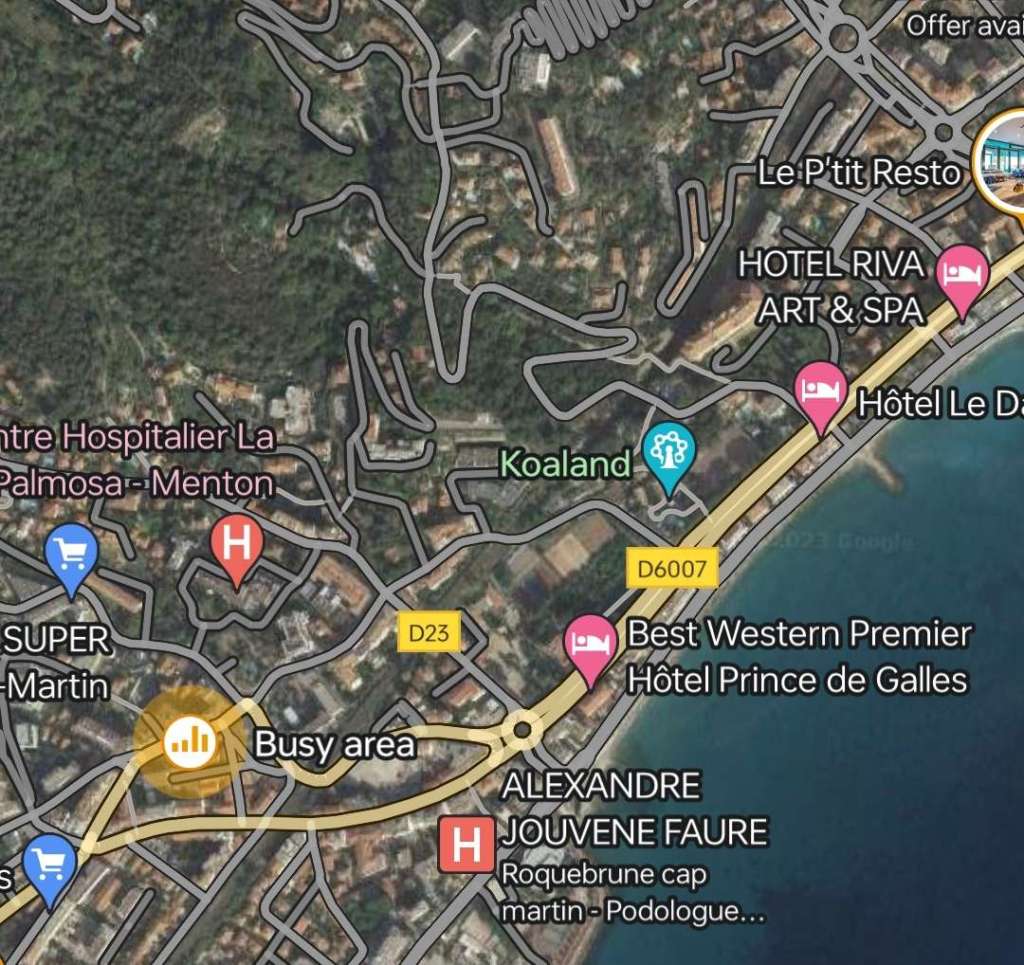
The primrose yellow D6007 shows the route of the old tramway. [Google Maps, November 2023]
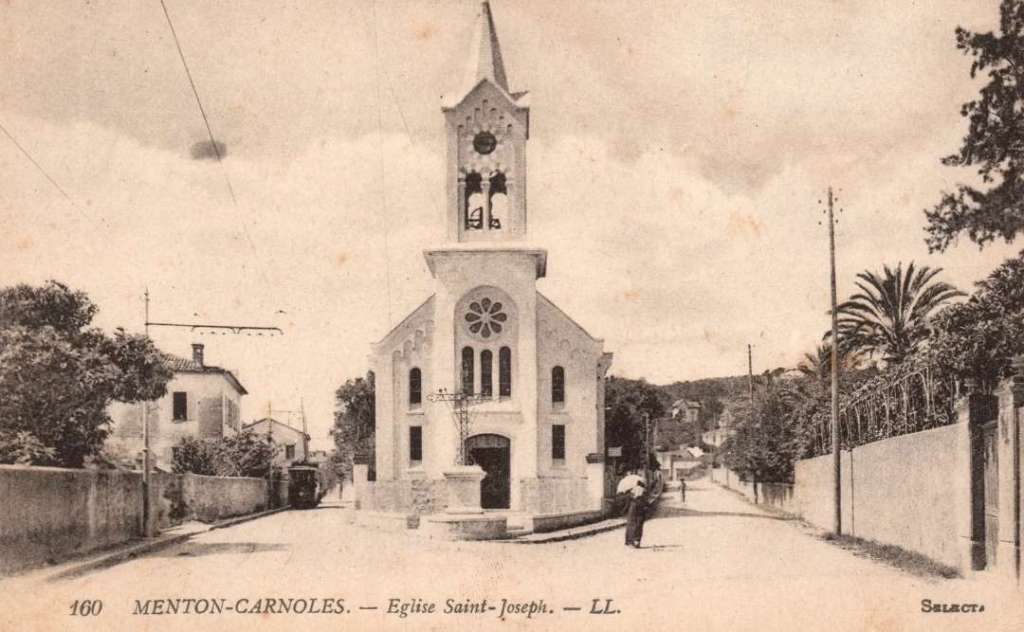
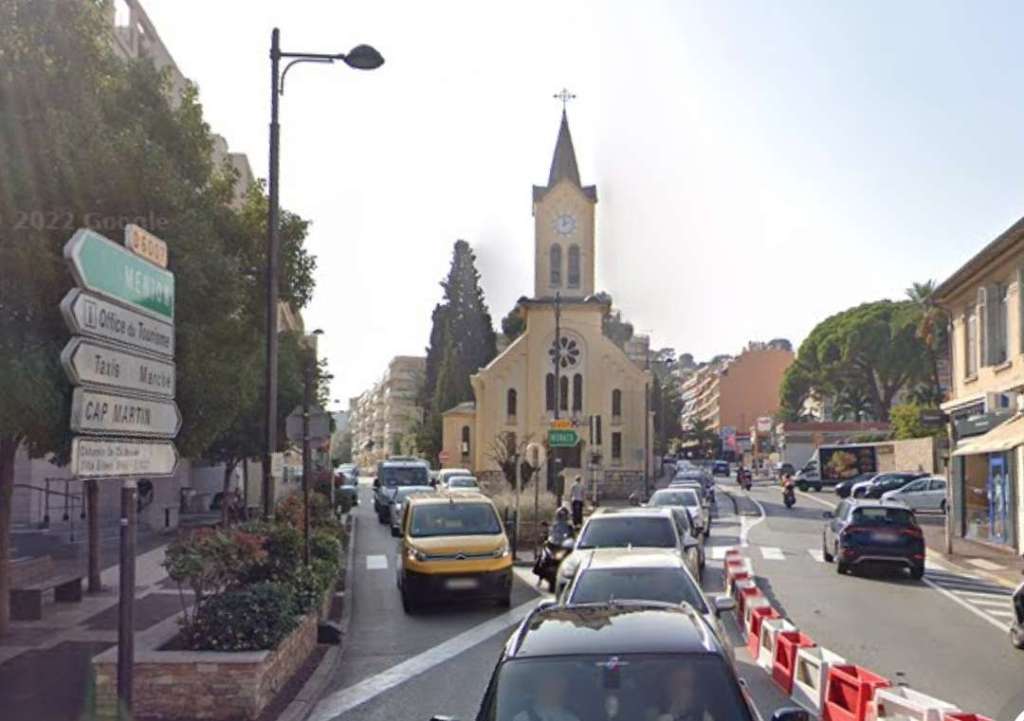
This monochrome image shows a tram on Avenue Julia (now Avenue du Marechal Foch) adjacent to St. Joseph’s Catholic Church in Carnoles. The road on the right of the image is Route National 7 (RN7). [19]
This modern image shows approximately the same location in the 21st century. Google Streetview, October 2022]
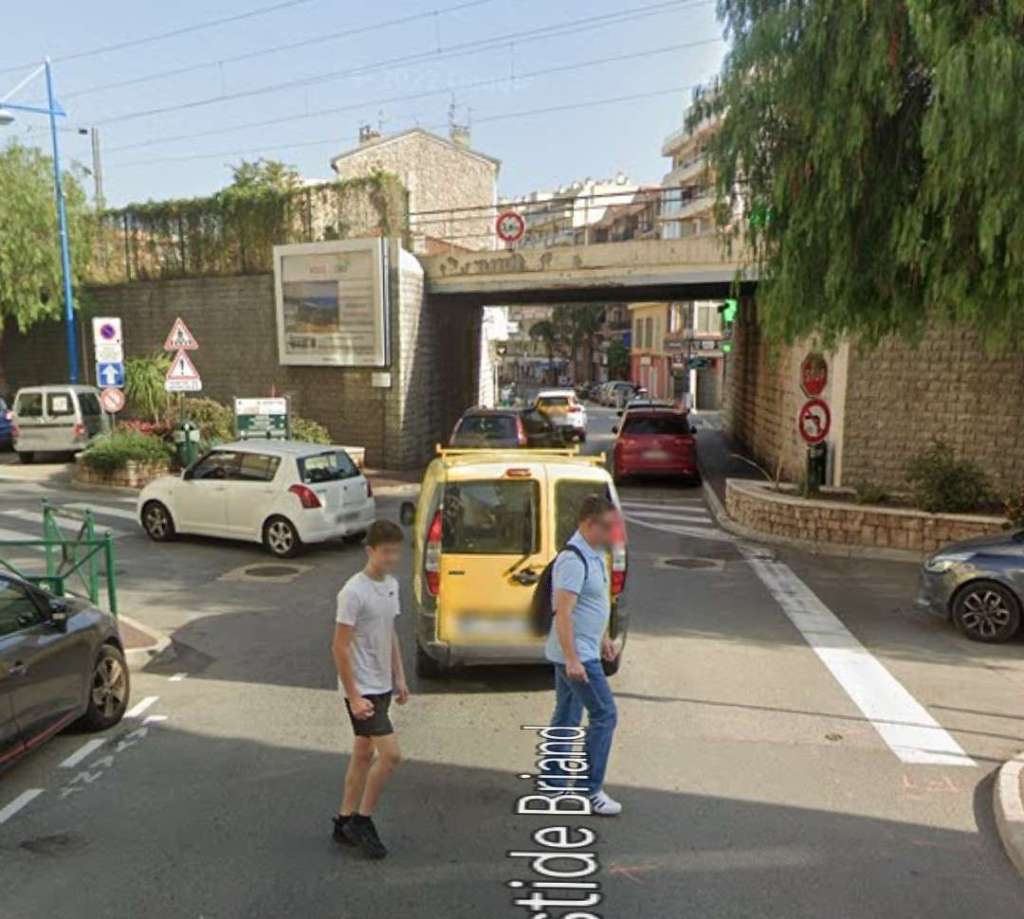
Turning through about 120°, this view looks down Avenue Aristide Briand towards the railway bridge which is shown below. The tram tracks are clearly visible in the road surface. This old postcard image was shared on the Menton du Passé au Present Facebook Page on 9th August 2017. [18]
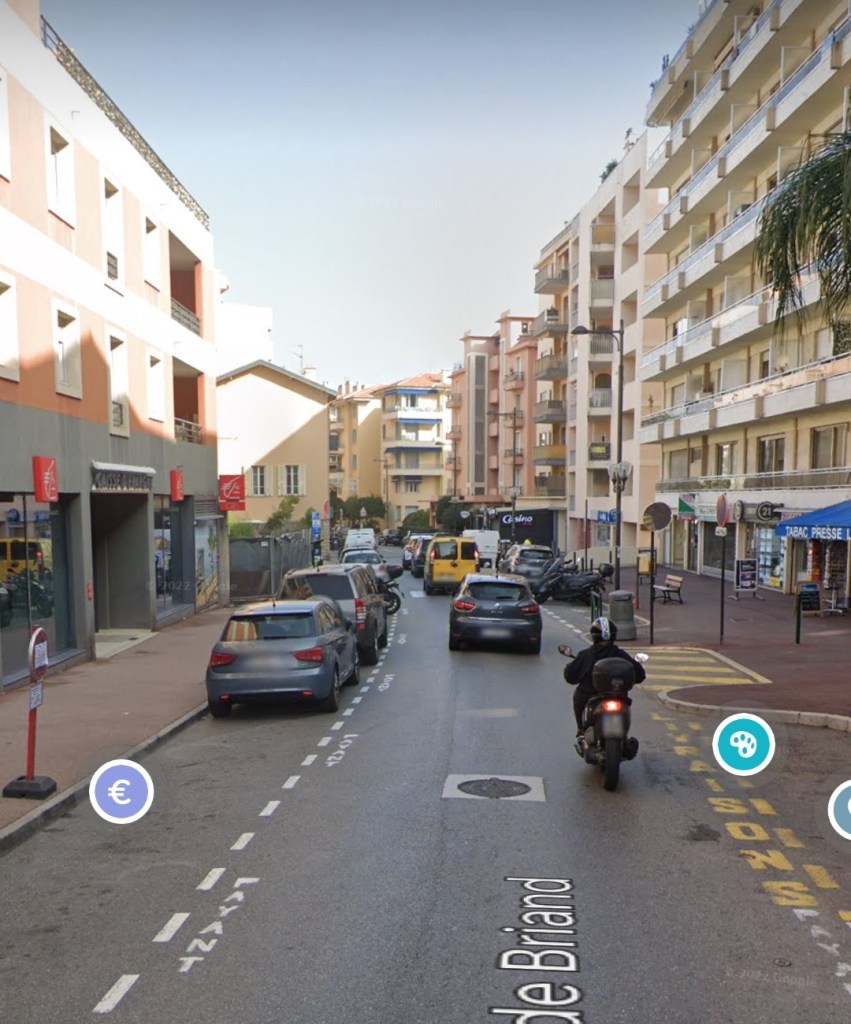
Trams once ran along what is now Avenue Aristide Briand (D6007) and passed through this railway bridge before running Northeast closer to the sea. [Google Streetview, October 2022]
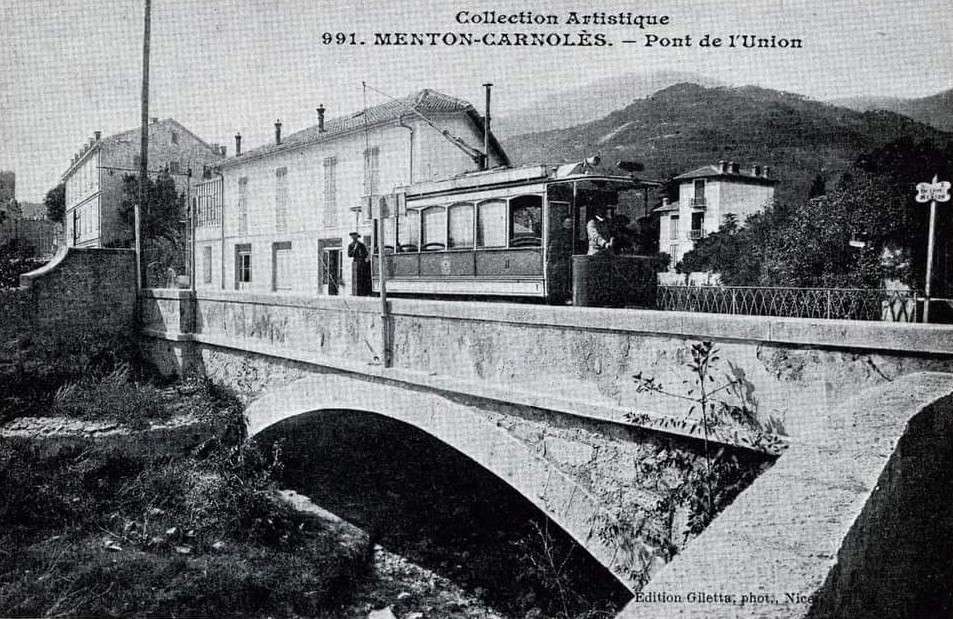
Pont de l’Union sat at the boundary between Carnoles and Menton. This image is an early 20th century postcard view of Pont de l’Union. It looks East. The overbridge carrying the PLM line is directly ahead at the extreme left of this image. It is not possible to show a modern version of this image as the photograph is taken from a point inside one of the more modern buildings on Avenue Aristide Briand. [7]
The view East-northeast east along Avenue Aristide Briand which is the route being travelled by the tram in the monochrome image above. [Google Streetview, October 2022]

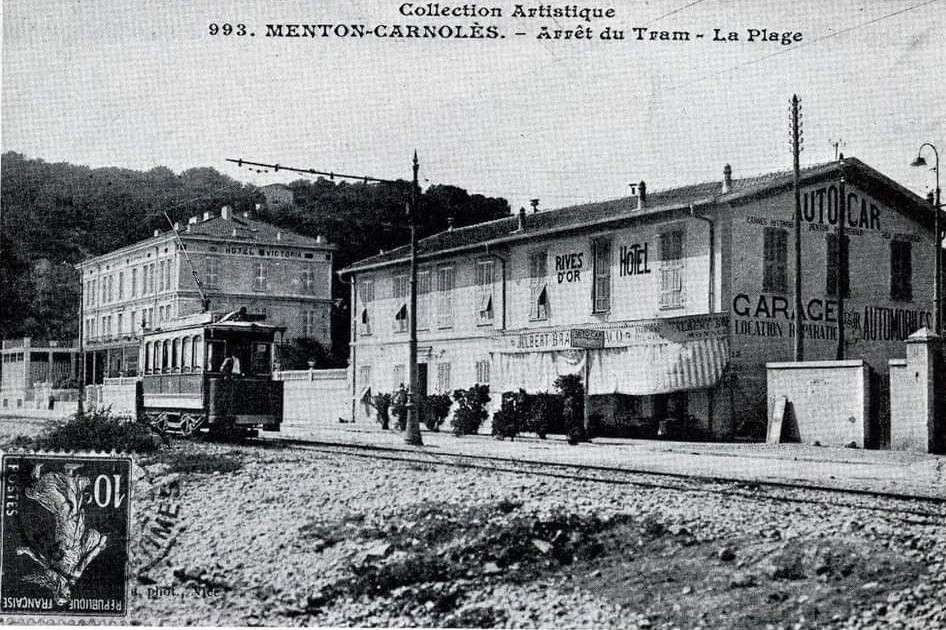
The TNL had a depot at Carnolès-plage from 1902 to 1932. [20] Banaudo notes that the tramway passed twice under the PLM Nice to Ventimiglia line. After “the second underbridge, the Union bridge over the Gorbio valley demarcated the territories of the communes of Roquebrune and Menton.” [1: p57]

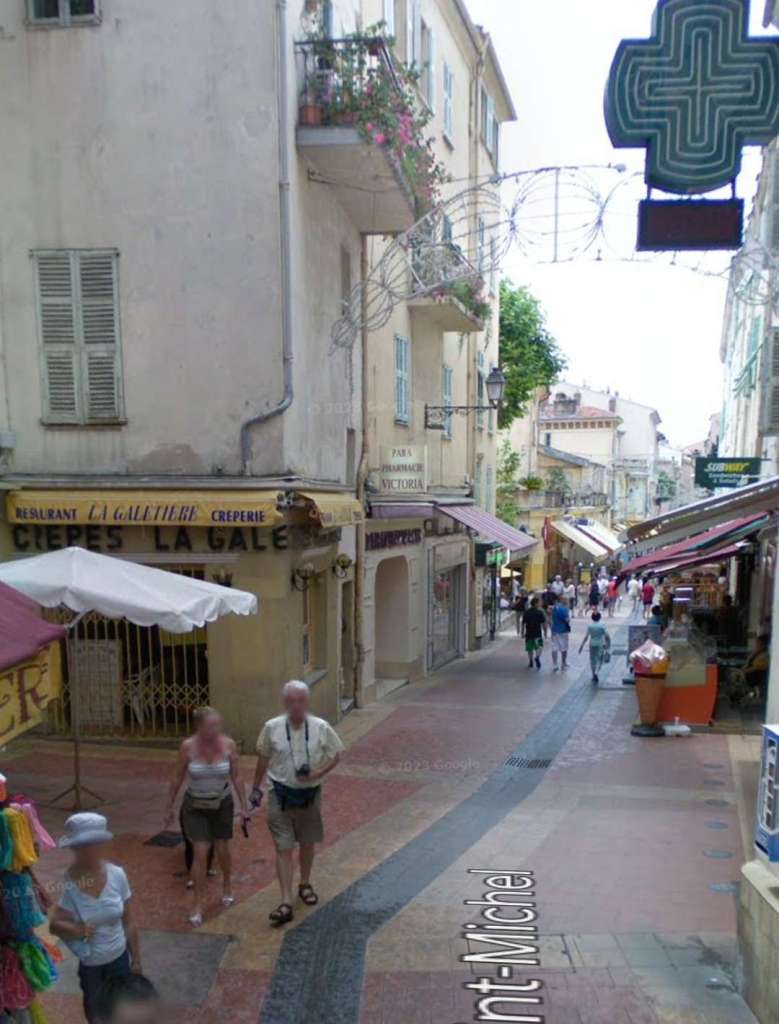
Banaudo keeps his comments on the remainder of the old tramway route succinct. On entering the commune if Menton, he says, “the tram followed the Avenue de la Madone (today Général De Gaulle), the Borrigo Bridge, the Avenue Carnot, the Biovès garden which covers the Careï torrent then the Avenue Felix Faure.  Place St. Roch, where the Sospel line branched off, marked the entry into the old town of Menton. Here, the single track made its way through the very narrow Rue St. Michel then entered the port where it  followed the Quai Bonaparte.  The tramway entered Garavan beach then ended its course near the Hanbury fountain, a few hundred metres from the Italian border at that time.” [1: p57]

We will try to unpack Banaudo’s description with images that show the route through Menton. Trams entered Menton on the RN7 (now D6007). Until the mid-20th century people were expected to leave the tram at the boundary between Roquebrune Cap-Martin and Menton to declare the goods they were carrying. The Octroi, shown below, was the ‘custom point’.
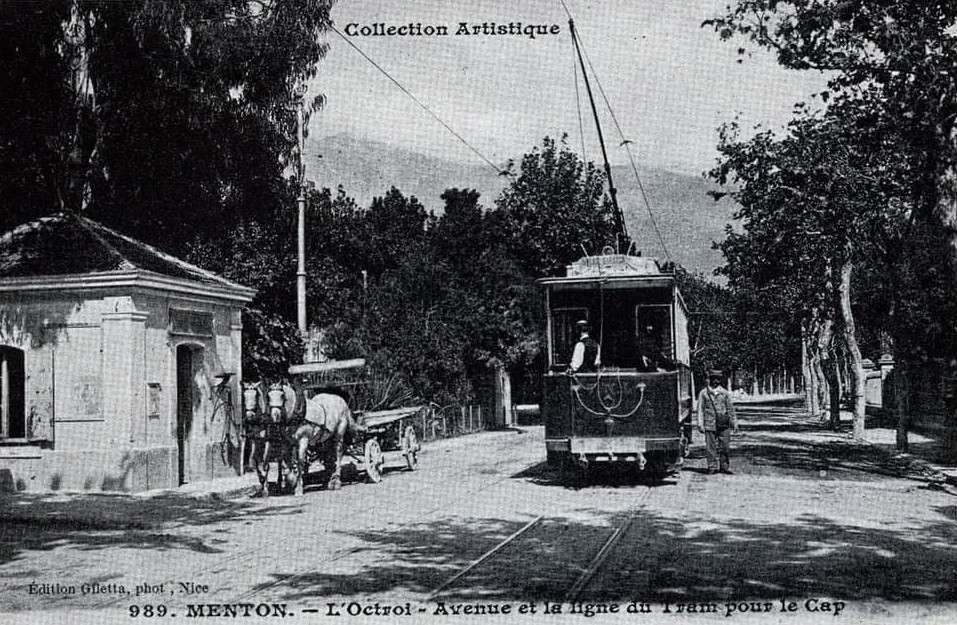
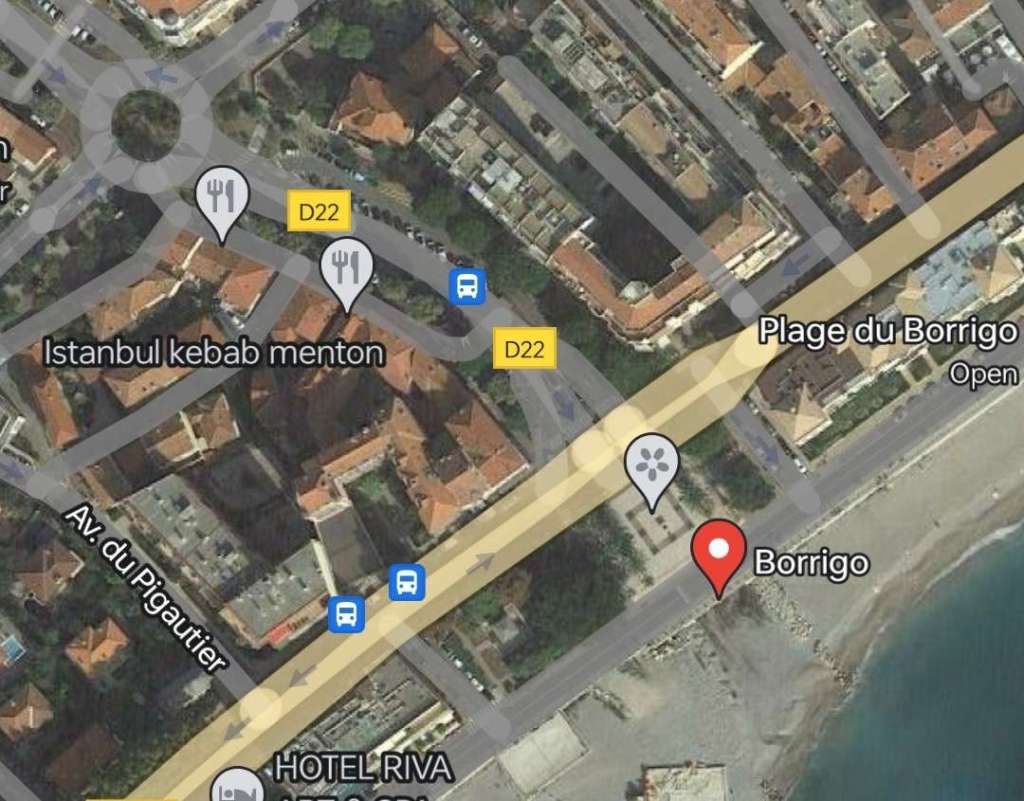
Everyone crossing into Menton was expected to declare taxable goods at the ‘border’ of the commune. [7]
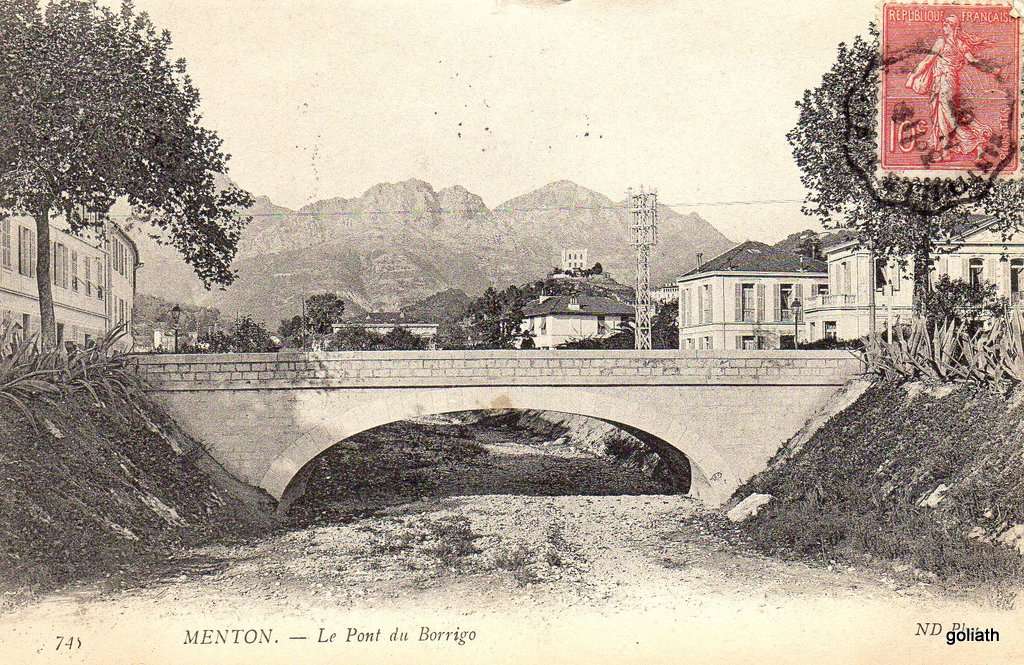
The location of le Pont de Borrigo at the point where Avenue Cernuschi met the RN7 (D6007). [Google Maps, November 2023]
Le Pont de Burrigo close to the beach on the road into Menton. The road over the bridge carried the tramway. [49]
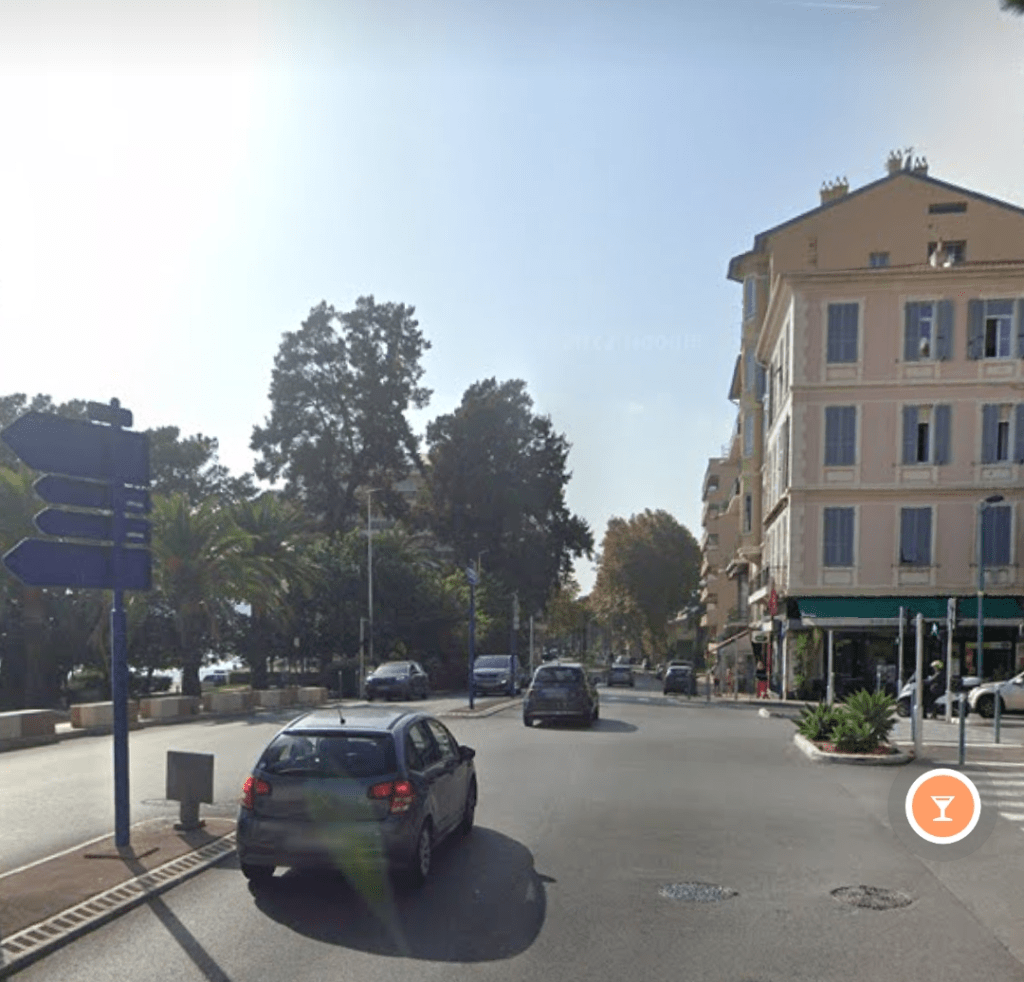
A view West back across the location of Pont de Burrigo. [Google Streetview, October 2022]
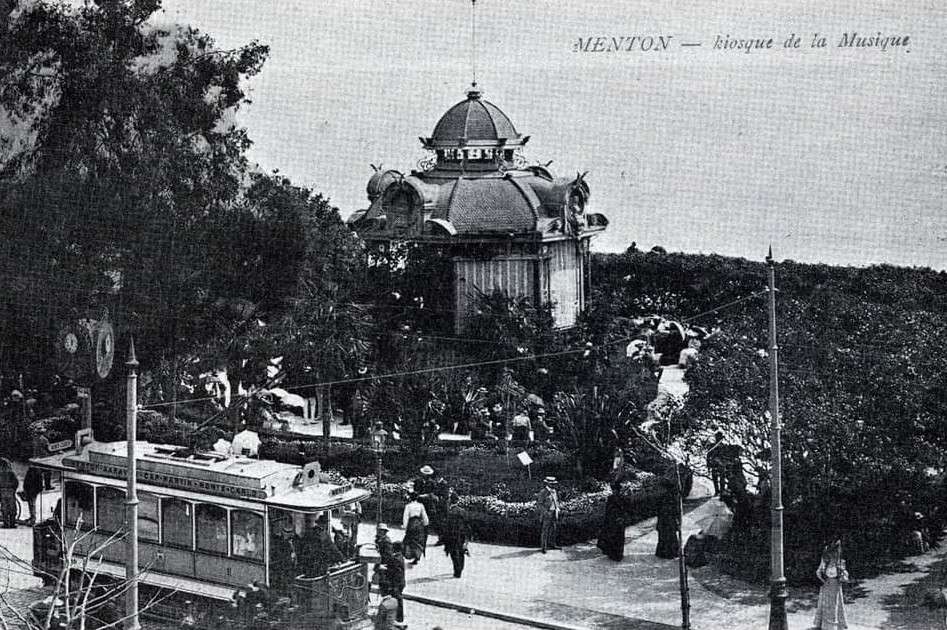
The tram has stopped on Avenue Carnot next to Le Kiosque de Musique (Bandstand) in the gardens alongside the Promenade de Midi. [7]
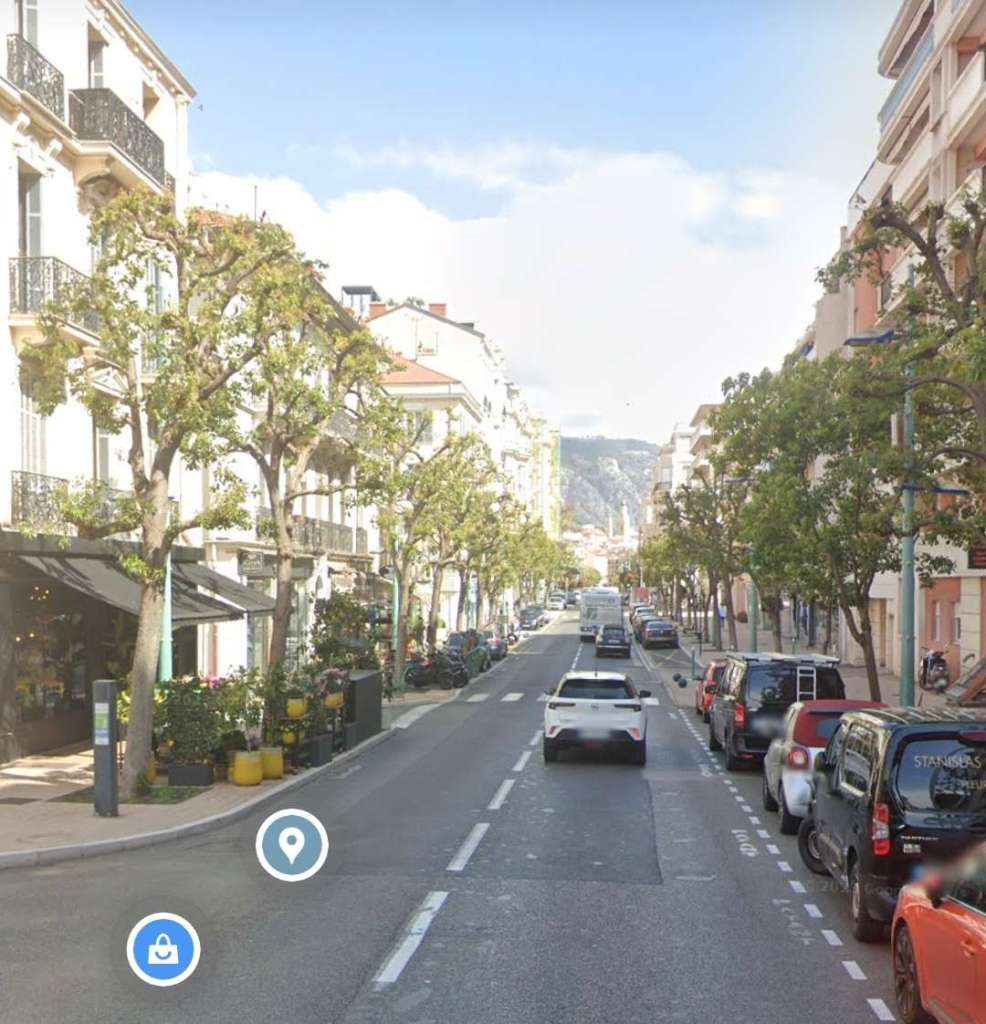
Looking East along Avenue de Carnot, approaching the centre of Menton. This was the route taken by the tram. [Google Streetview, April 2023]

Trams continued along Avenue Carnot past l’Eglise Anglais and onto Avenue Felix Faure.
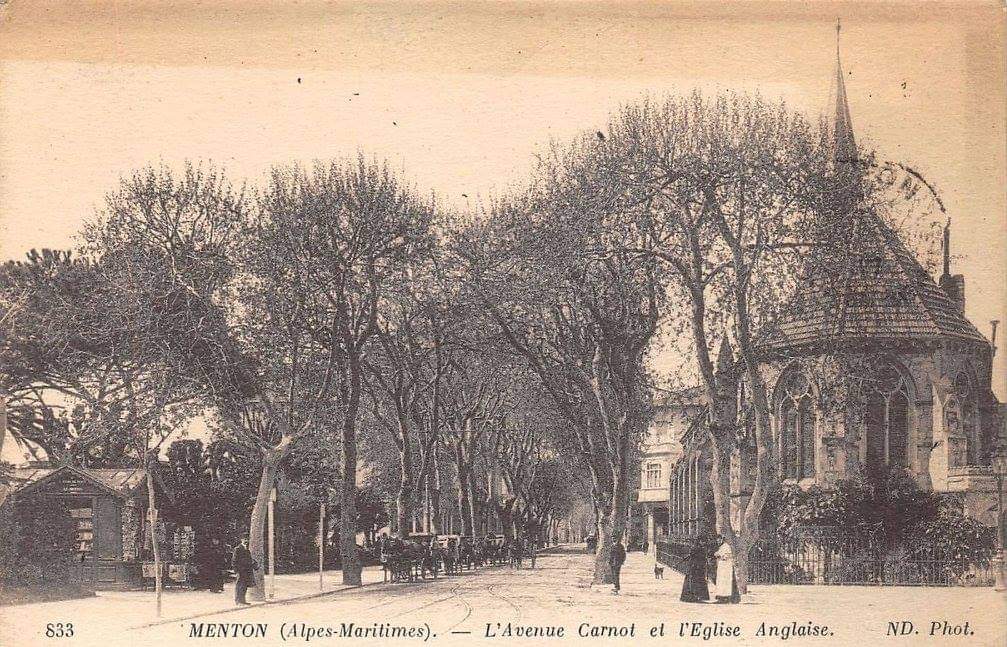
Avenue Carnot runs past St. John’s Church in Menton  (the Anglican Church). Tram tracks can be seen on the road surface in this image which was shared on the Comte de Nice et son Histoire Facebook Group by Pierre Richert on 8th January 2018. [37]
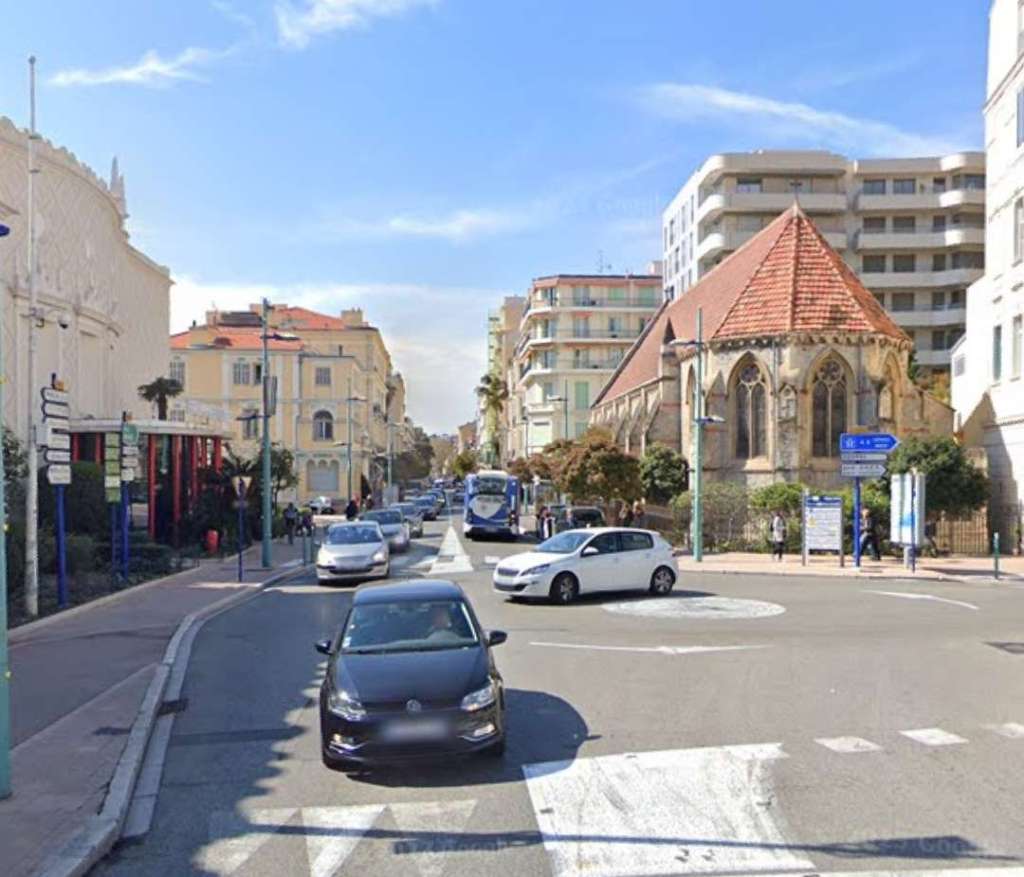
L’Avenue Carnot and St. John’s Anglican Church in 2023. [Google Streetview, March 2023]
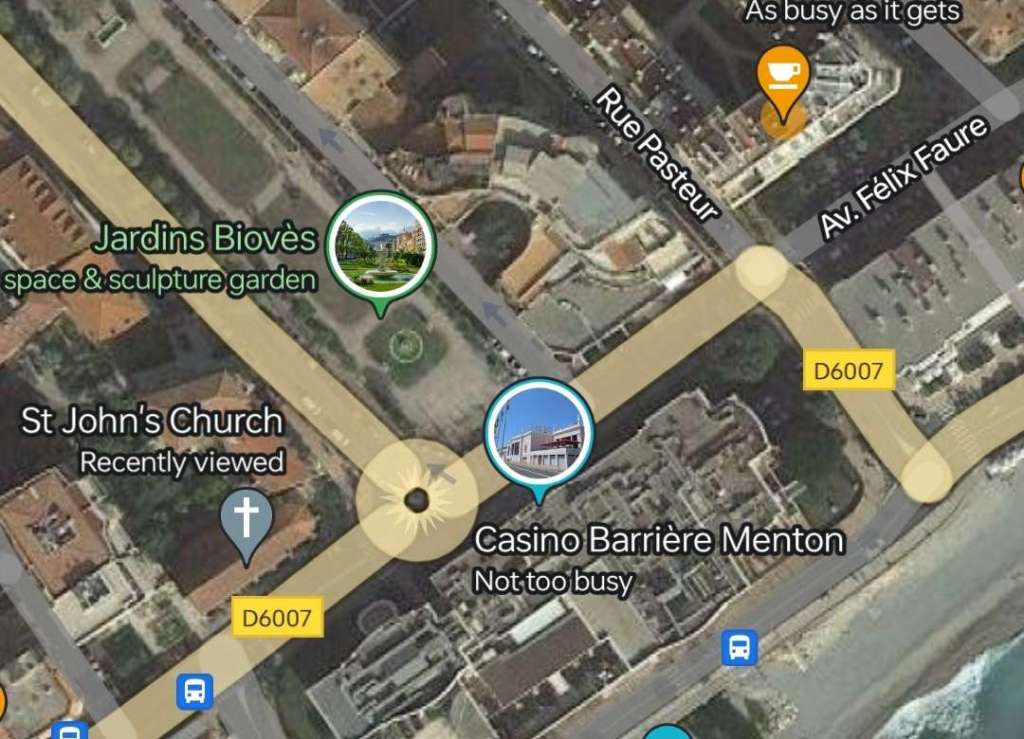
St. John’s Church is shown on this extract from Google Maps with Avenue de Carnot on its South side. The D6007 turns right and then left to run along the Promenade. The old tramway ran straight ahead onto Avenue Felix Faure. [Google Maps, November 2013]
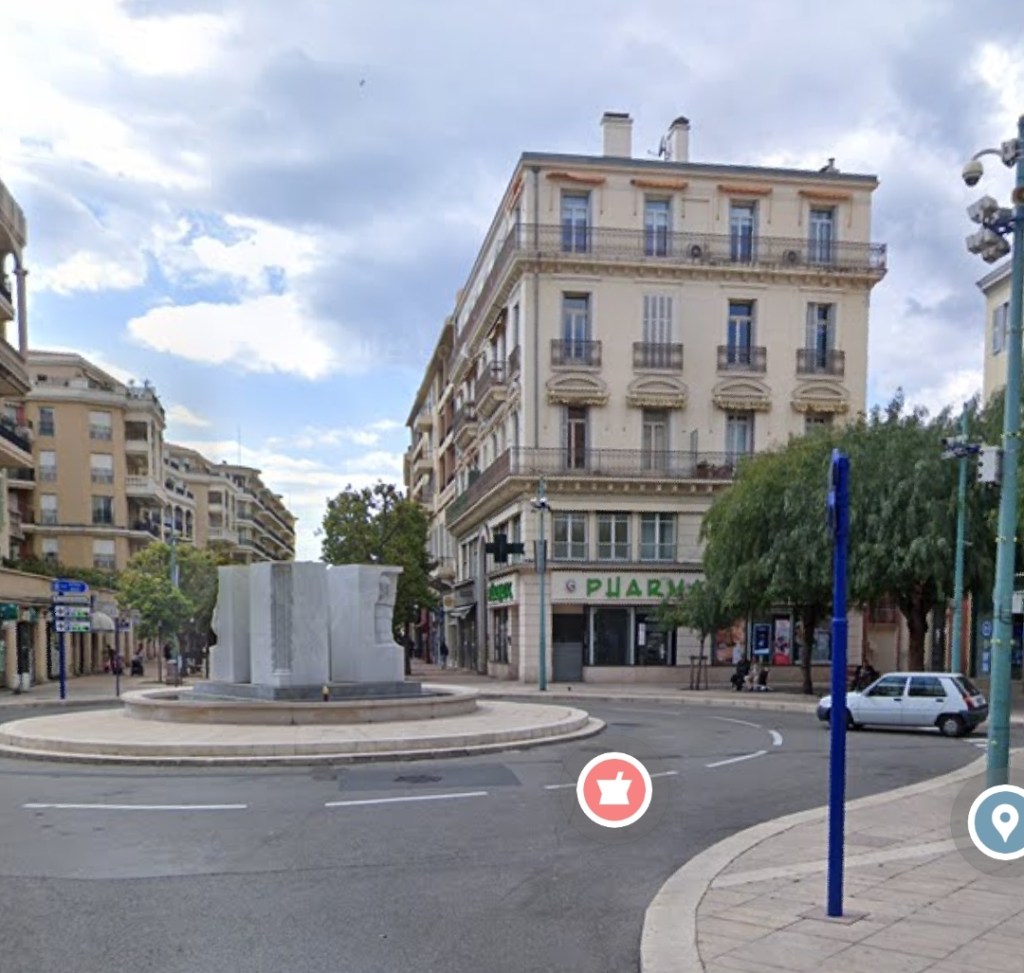
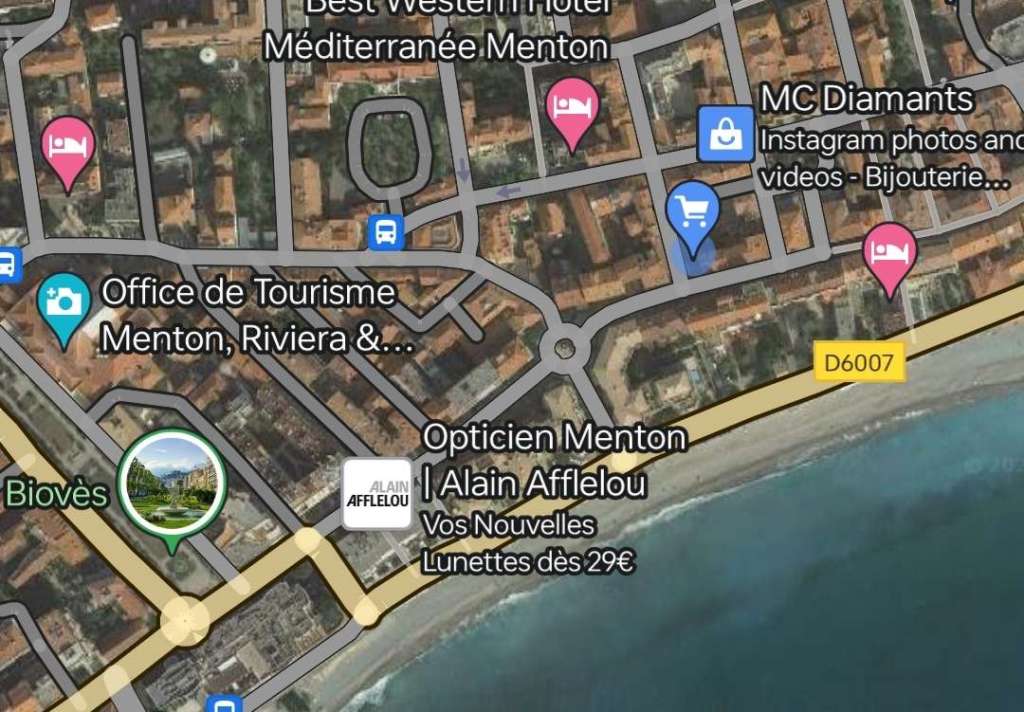
St. John’s Church can be seen in the bottom-left of this image. Avenue Felix Faure runs Northeast from St. John’s Church. It is the grey line, one block back from the Promenade. [Google Maps, November 2023]
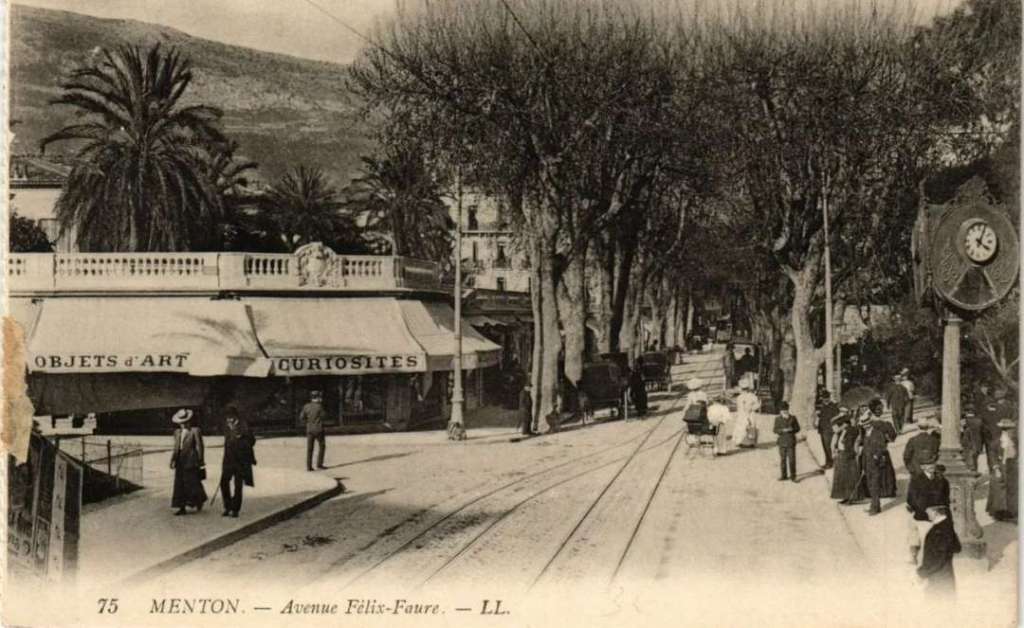
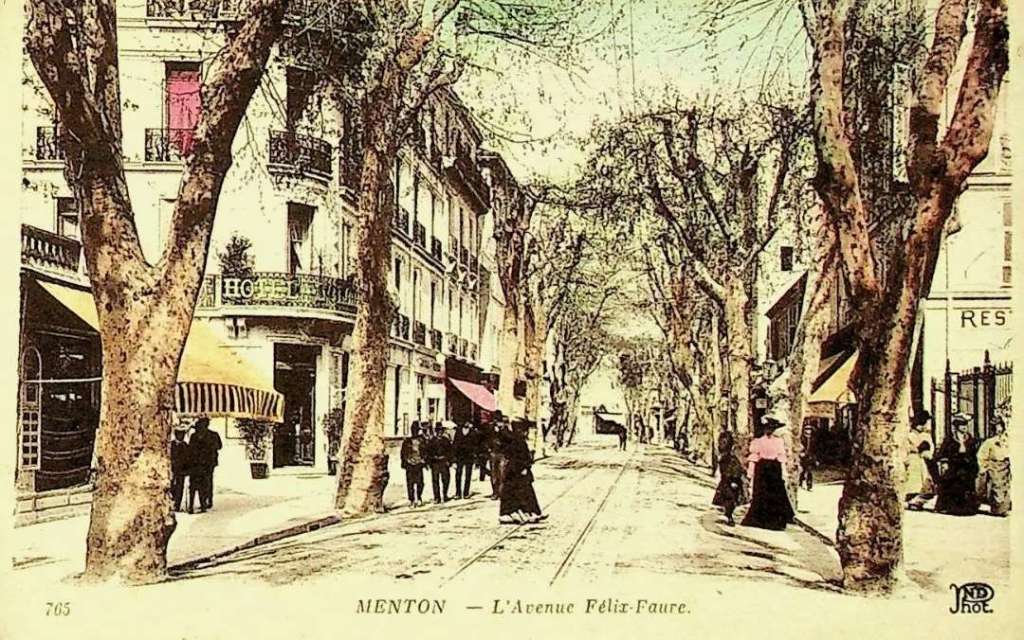
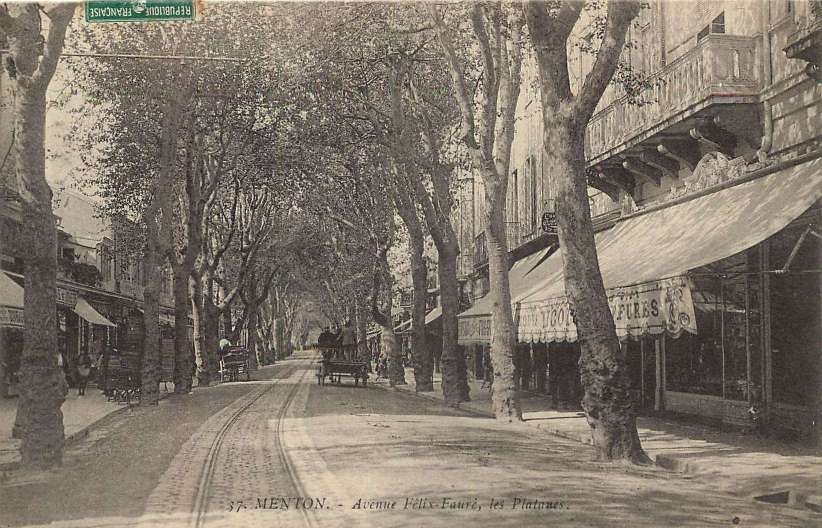
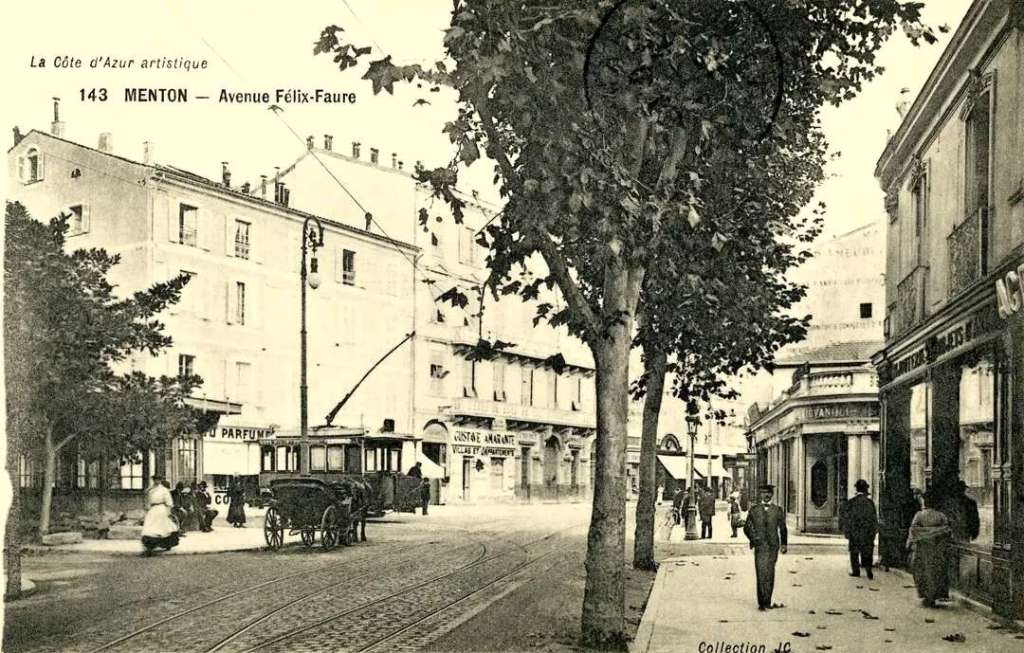
Avenue Felix Faure, Menton, in the early 20th century, looking towards the old town. Tram tracks are visible in the road surface. [38]
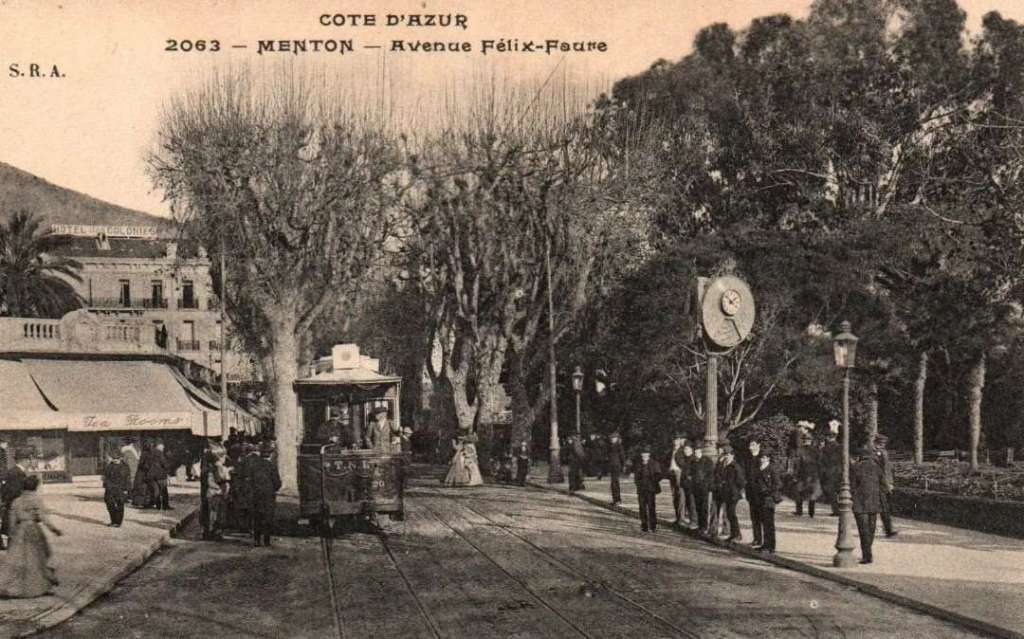
Avenue Felix Faure in the early 20th century. This is a view from a very similar location as the image above, this time a tram can be seen heading out of the old town towards Monaco. [40]
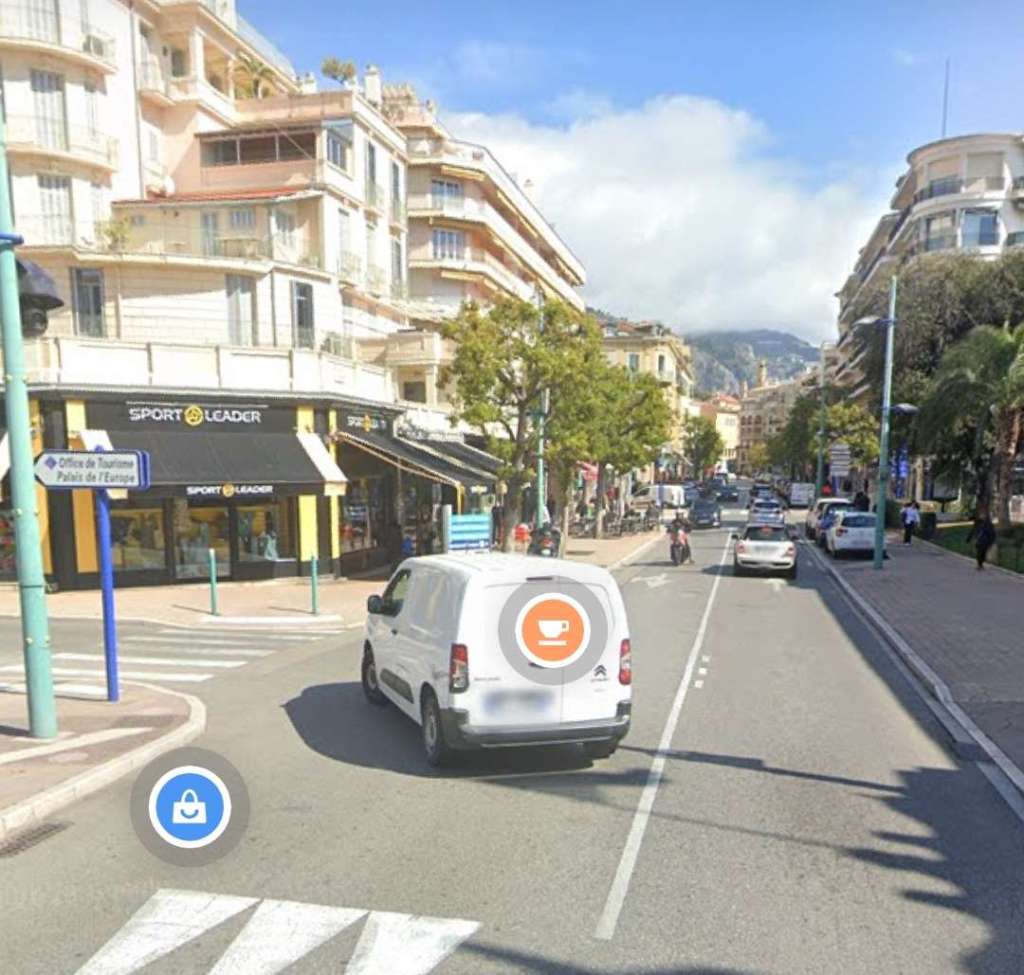
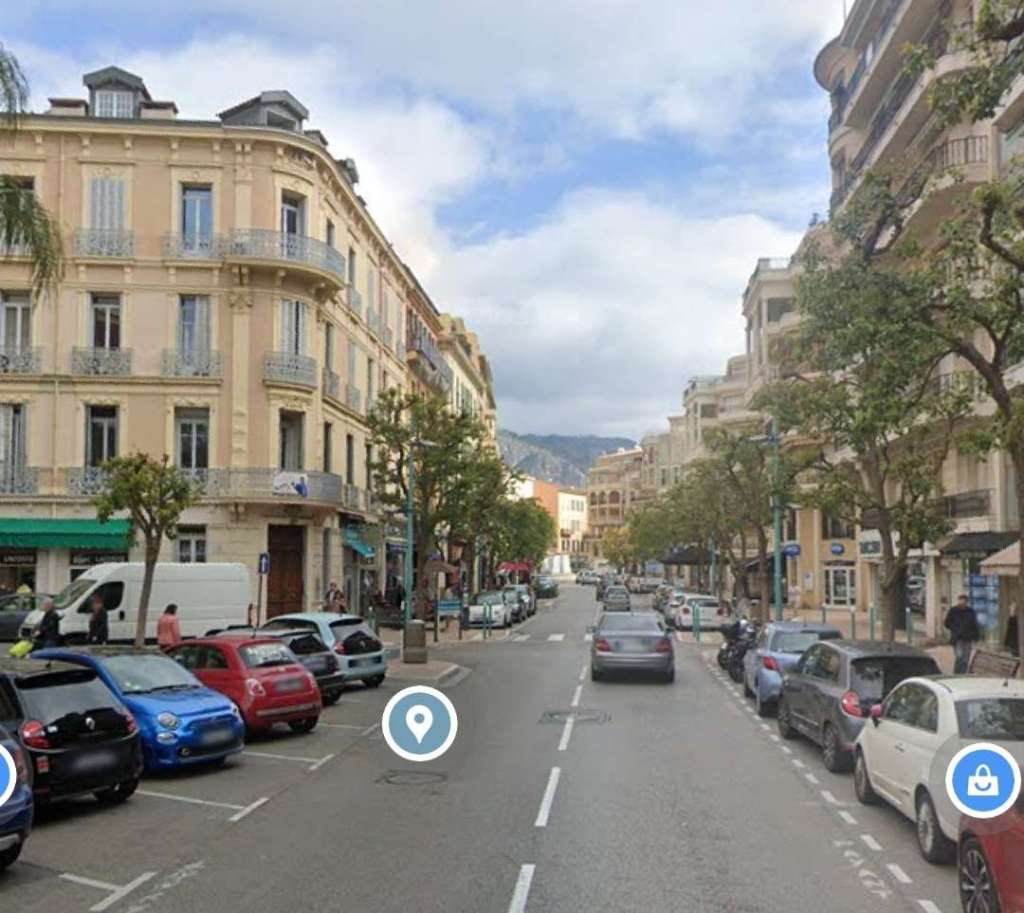
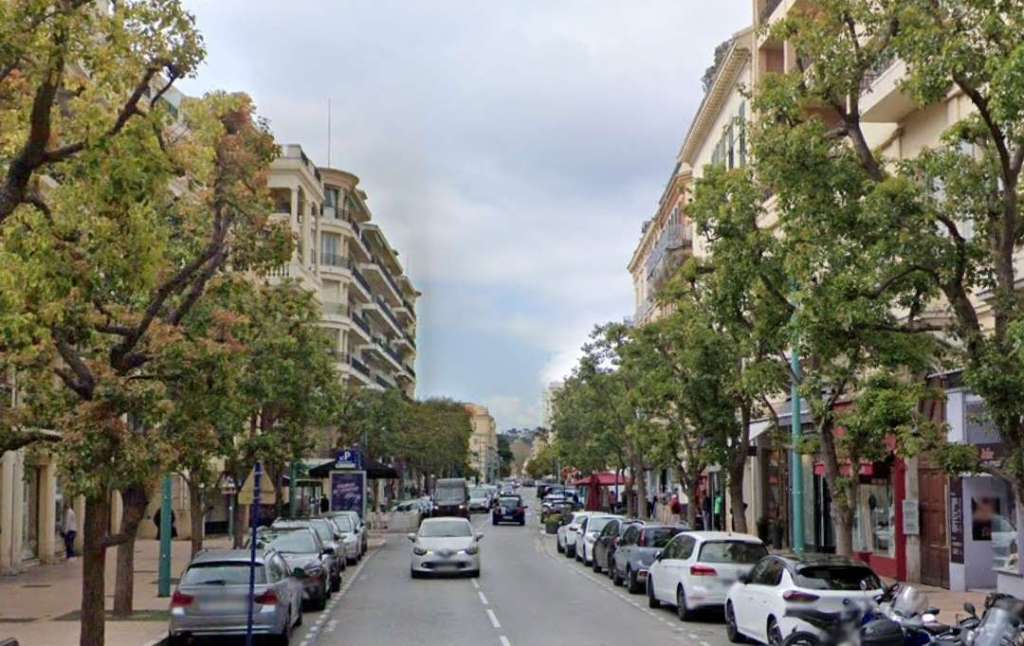
The same location that appears in the two monochrome images above, as it appears in the 21st century. [Google Streetview, April 2023]
One street corner along Avenue Felix Faure, looking Northeast. The only thing in common with the present is the Hotel des Colonies building, which you can see on the left of image. [51]
Approximately the same view in the 21st century. [Google Streetview March 2023]
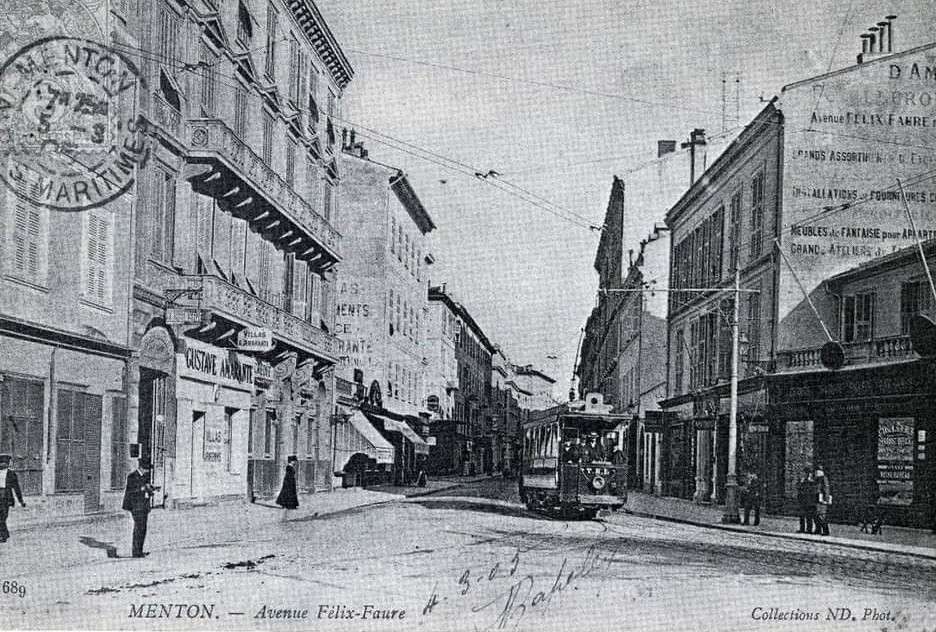
Avenue Felix Faure, looking Southwest from a point close to Place St. Roch. [50]
A similar view in the 21st century, looking Southwest. [Google Streetview April 2023]
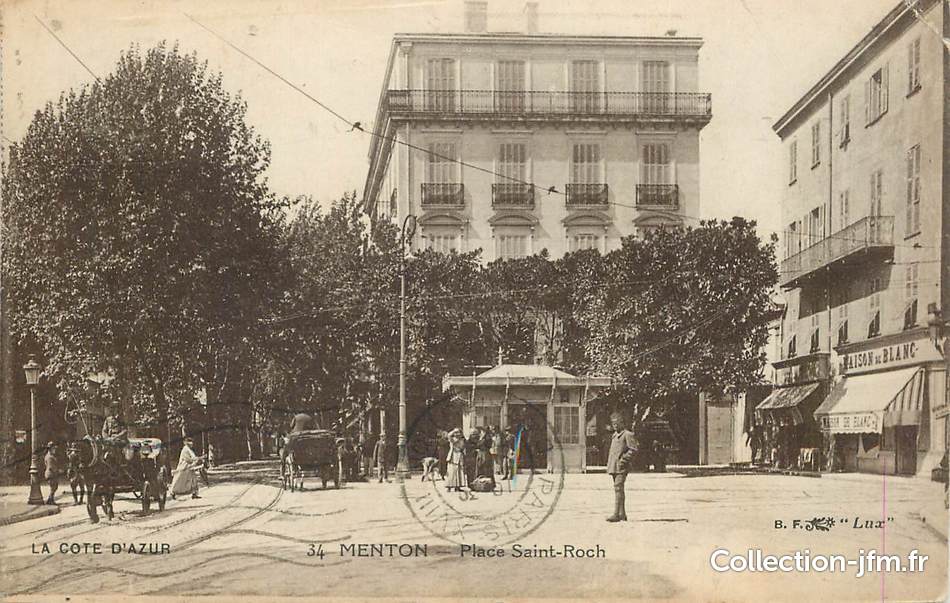
This old postcard image shows Avenue Felix Faure entering Place St. Roch. It looks Southwest from Place St. Roch. Overhead tramway cables can be seen running in two directions, ahead into Avenue Felix Faure and right into Rue Partouneaux. The tram tracks leading into Avenue Felix Faure can be seen to the left of the photograph. Note the publisher shelter close to the centre of the image. [53]
A similar view to the one immediately above. A statue now sits in front of the building. [52]
A similar modern view looking across Place St. Roch towards the Southwest and Avenue Felix Faure. [Google Streetview, March 2023]

Rue Partouneaux on the North side of Place St. Roch was followed by trams for Sospel which set off from or terminated at the mouth of Rue St. Michel at Place St. Roch. This route is covered elsewhere in this series about trams in and around Nice:

Three articles written at different times, in chronological order are as below:

Sospel to Menton Tramway

The Sospel to Menton Tramway Revisited (Chemins de Fer de Provence 51)

The Menton to Sospel Tramway Revisited Again! (Chemins de Fer de Provence 61)
Avenue Felix-Faure in Menton, seen from Place St. Roch, looking Northeast. On the left we can see the waiting kiosk of the TNL tram urban lines. There is a tram waiting at the stop but rather than following the main route between Monaco and Menton it will leave along Rue Partouneaux to the Careï valley. It will possibly stop at the Villa Caserta terminus, or it will continue towards Monti, Castllon, the valley of Bévéra and the Sospel terminus. This image was shared by Jean-Paul Bascul on the Monaco4Ever Facebook Group on 28th September 2023 (Collection privée J-Paul Bascoul). [5]
A similar view, looking Northeast in the 21st century from Place St. Roch. [Google Streetview, April 2023]
Looking East from Place St. Roch along the most easterly length of Avenue Felix Faure, we see a tram heading West, although it is not clear whether it will head for Monaco or bear round in front of the camera onto Rue Partouneaux to the Carei Valley. [7]
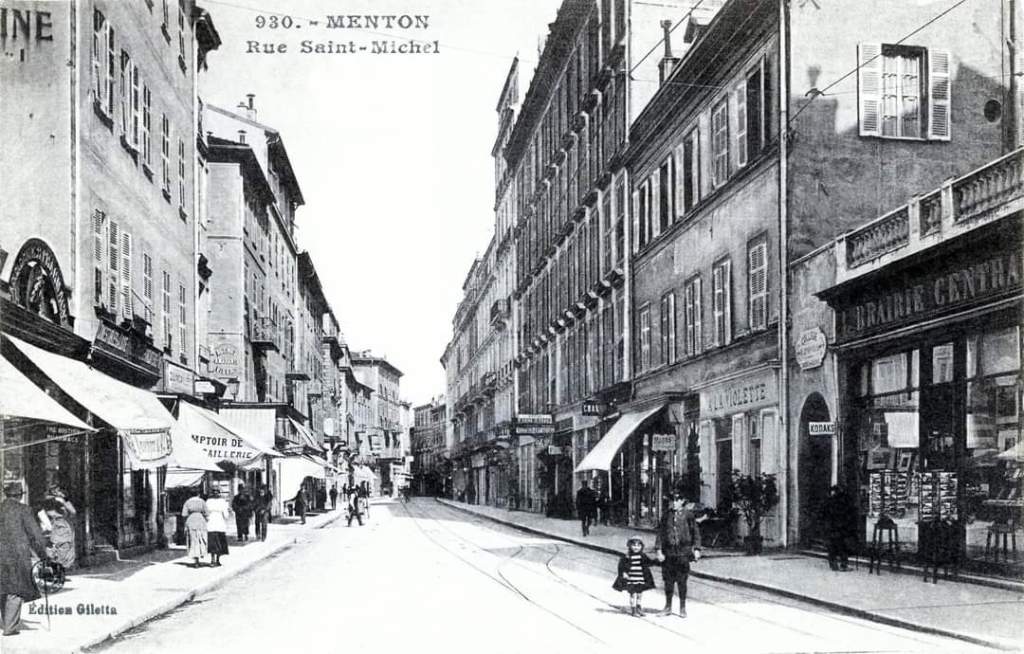
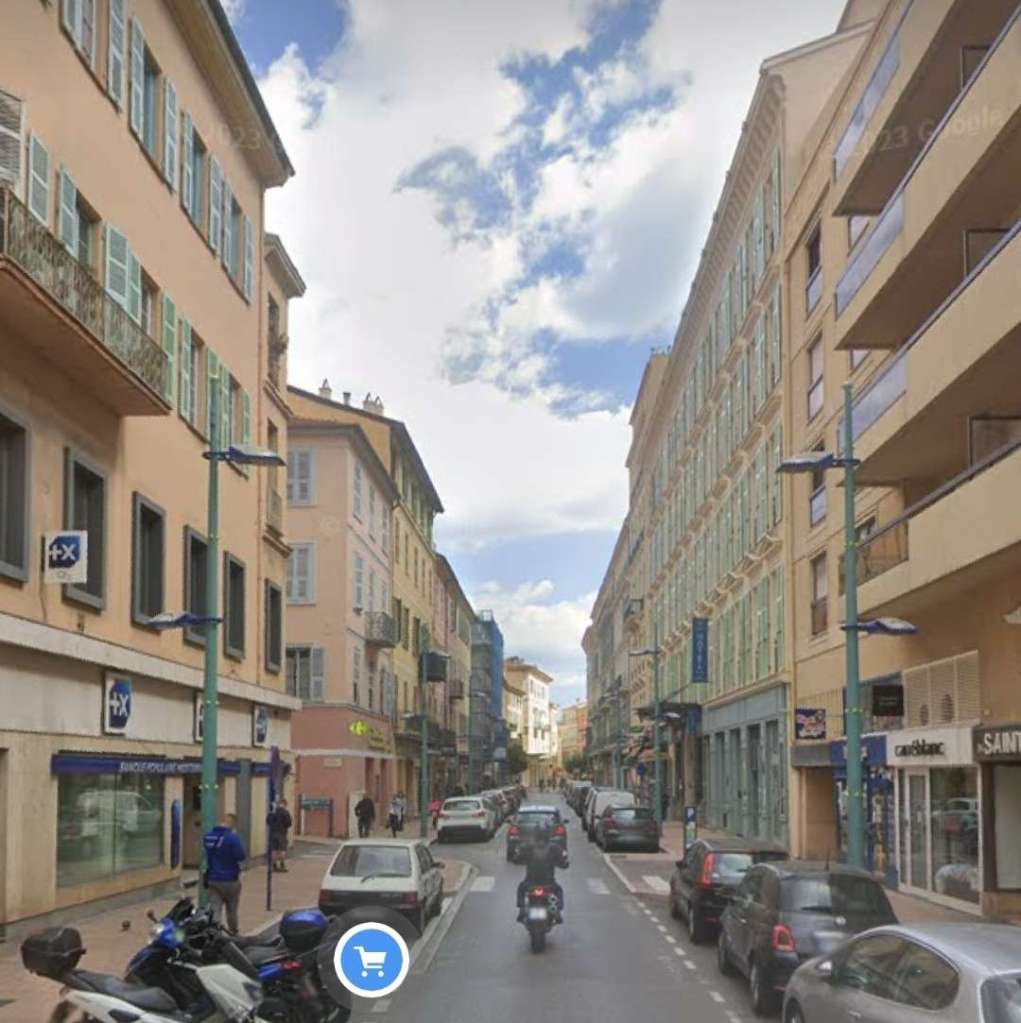
An early 20th century postcard image of Rue St. Michel/Avenue Felix Faure, looking East, Tram tracks are visible in the road surface. [29]
The same location in the 21st century. [Google Streetview, April 2008]
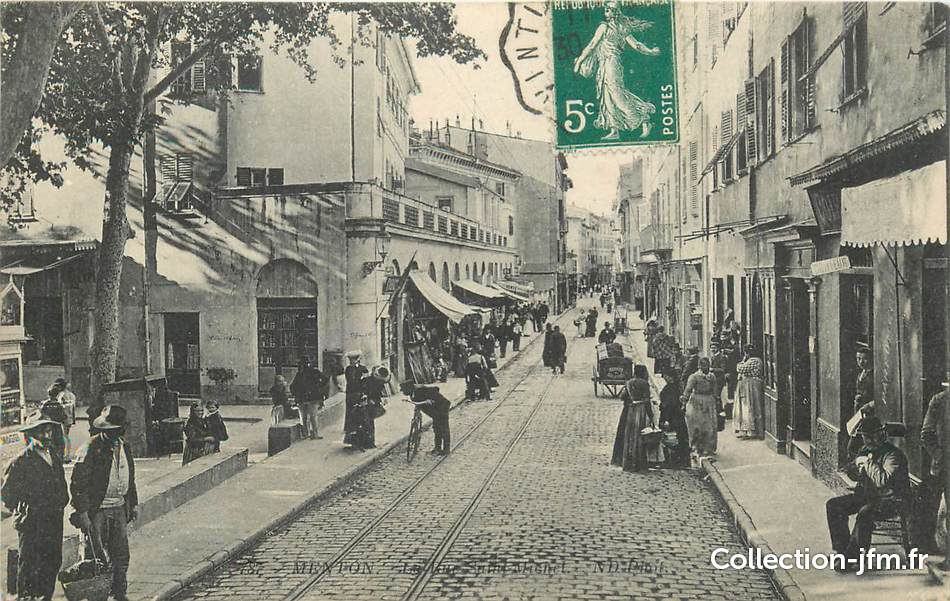
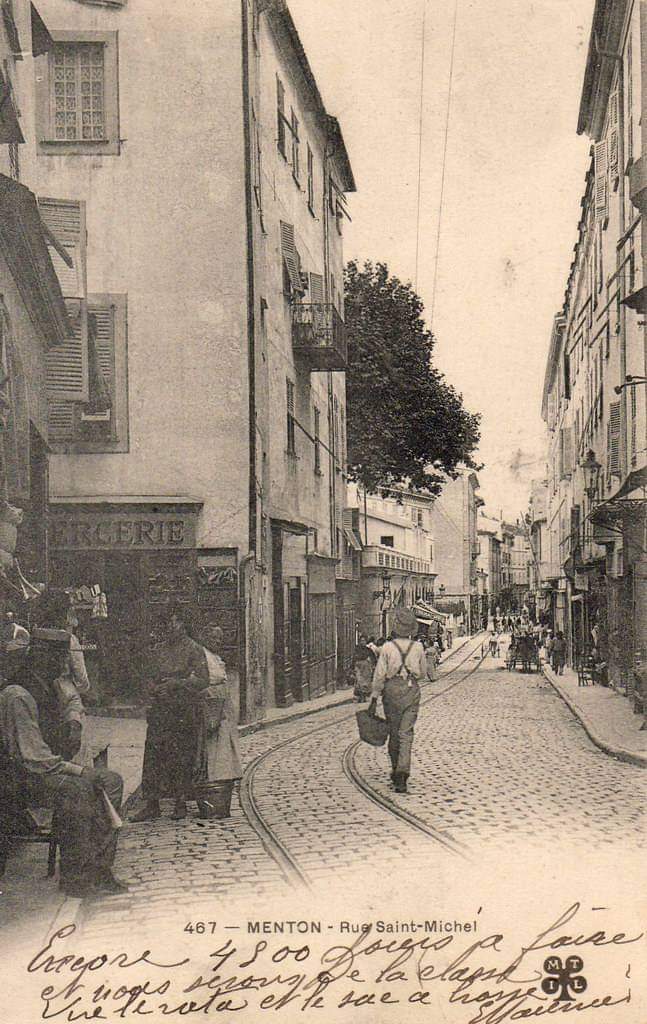
An early postcard view of Rue St. Michel, looking West. [39]
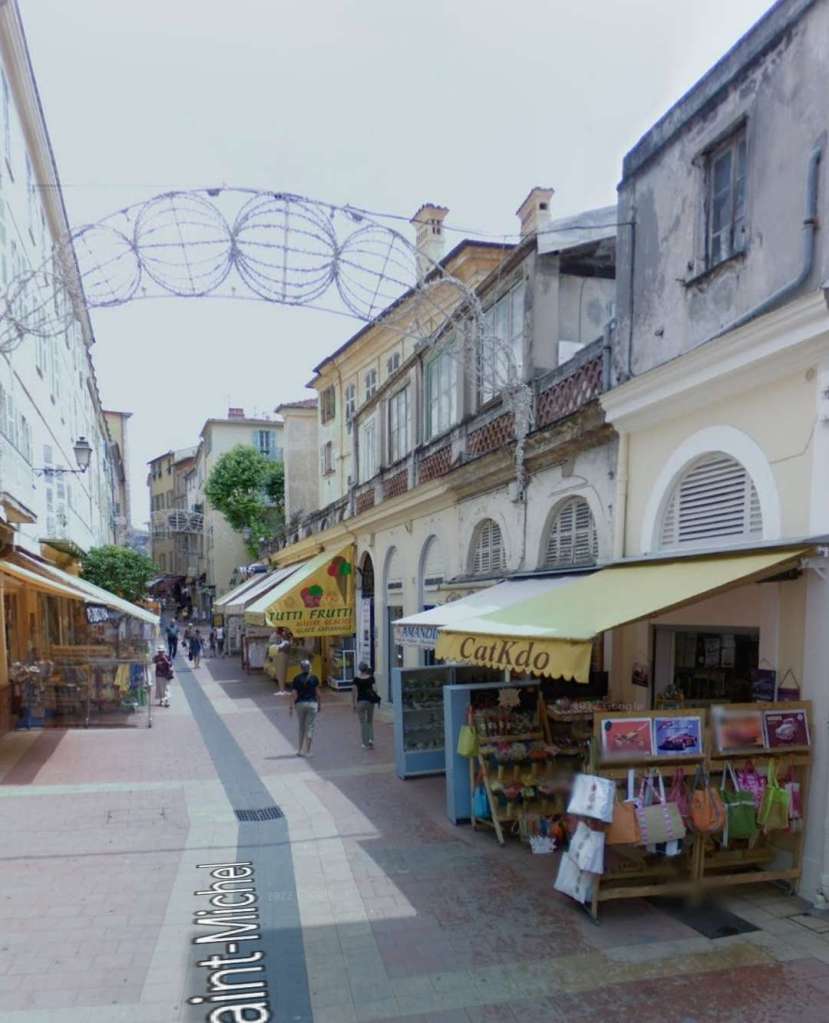
Rue St. Michel in 2008 looking West at approximately the same location as in the postcard image above. [Google Streetview, December 2008]
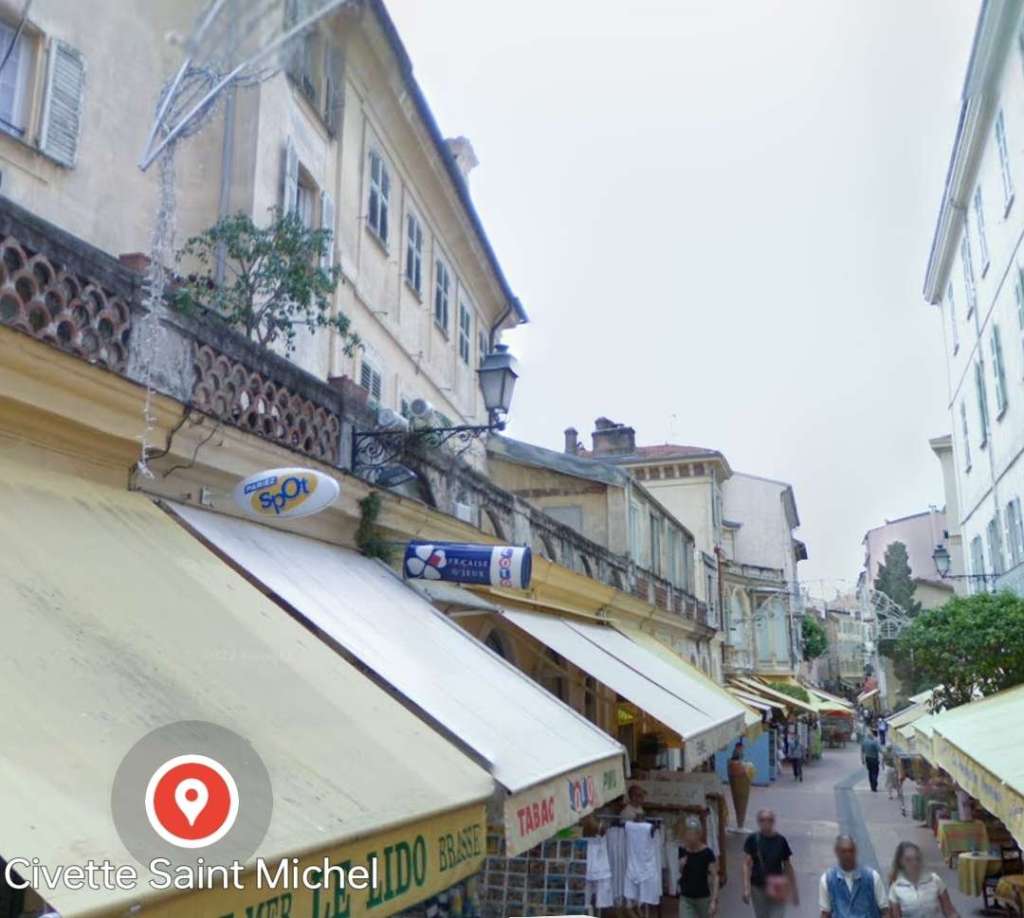
Rue St. Michel in 2008 looking East. [Google Streetview, December 2008]
A powered car and trailer stopped at Place aux Herbes in the 1920s. This image was shared on the Monaco4Ever Facebook Group on 23rd March 2022 by Jean-Paul Bascoul. (Collection privée J-Paul Bascoul). [3]
The same location in the 21st century. [Google Streetview, 2021]
Rue St. Michel looking West in the early 20th century. The tramway track is easily seen in the cobbled road surface, the overhead cables in the sky! [46]
The same location, close to the eastern end of Rue St. Michel in the 21st century. [Google Streetview, 2008]
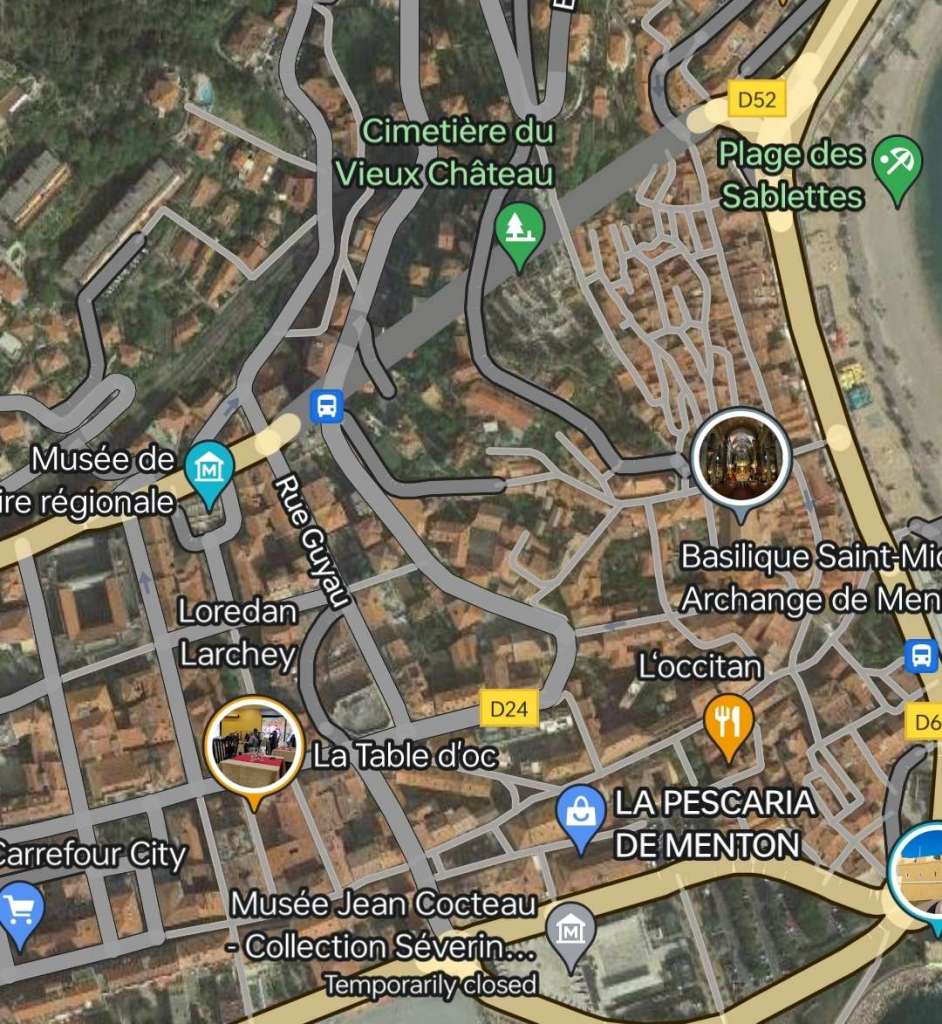
A further extract from Google Maps. The tramway ran along Rue St. Michel which enters this image just beneath the Carrefour City blue flag to the bottom-left of the image and runs in an approximately straight line East-northeast to meet the present D6007 (Quai Bonaparte). Here trams turned North along the D6007 before heading East towards Garavan. [Google Maps, November 2023]

Trams left the East end of Rue St. Michel and crossed Place du Cap before running out onto Quai Bonaparte.
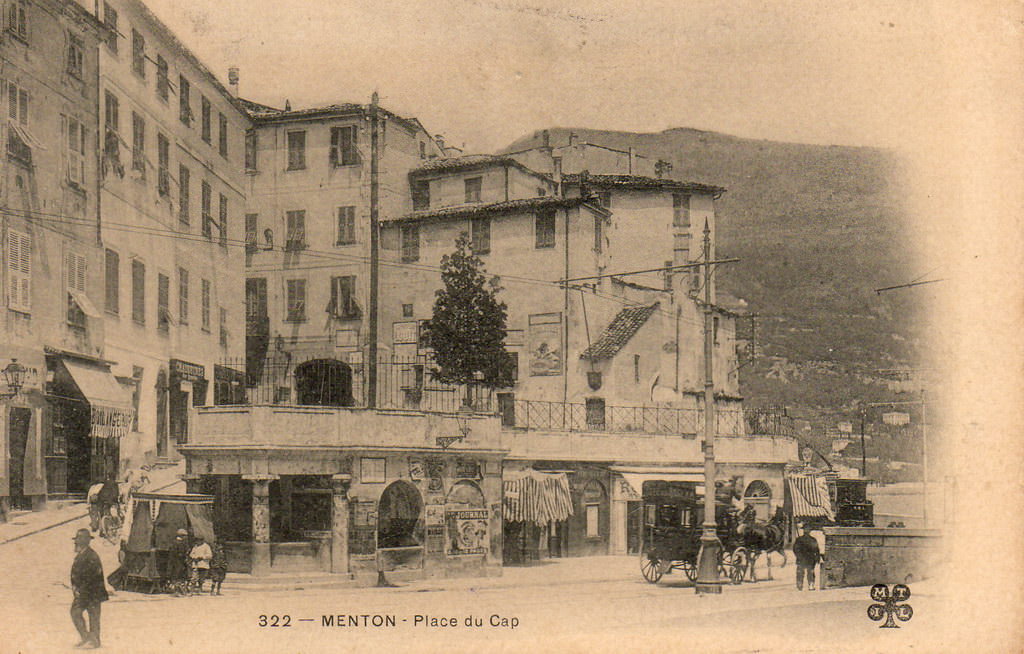
An early 20th century postcard image of Place du Cap, Menton. Overhead wires for the trams cross the image and, to the right side of the image a tram can be seen turning into Place du Cap from Quai Bonaparte. [32]
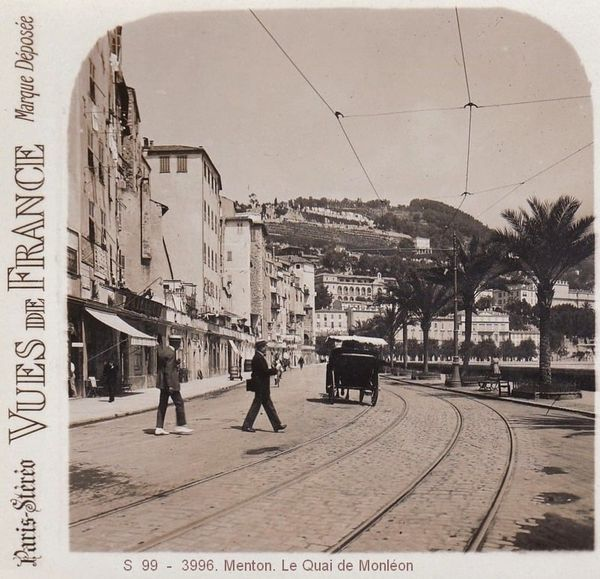
This image was shared by Jean Claude Volpi on the Entraide Menton Monaco Roquebrune Cap Martin et sa région Facebook Group on 17th September 2021. It shows the tramway leaving Place du Cap. It refers to the Quai as ‘Quai de Monleon’. [48]
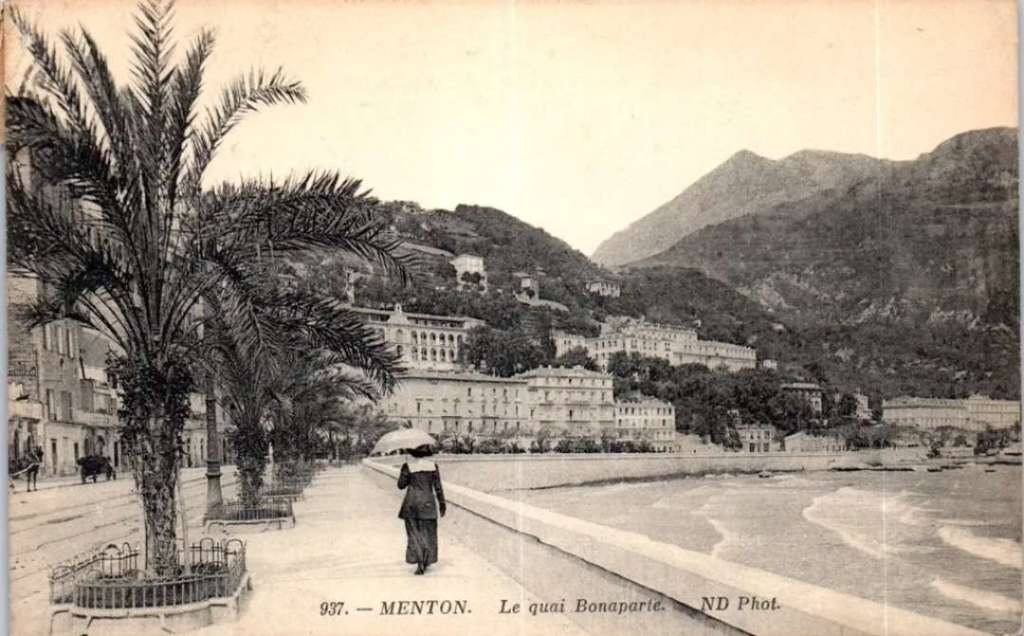
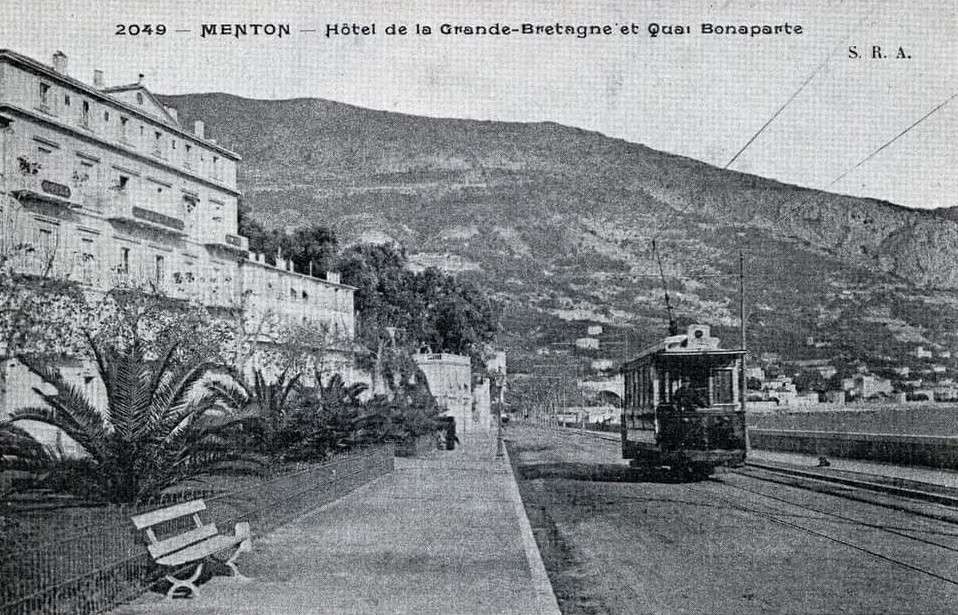
The old postcard image refers to the Quai as ‘Quai Boneparte. The camera is situated a little further to the North than the camera in the image above. [31]
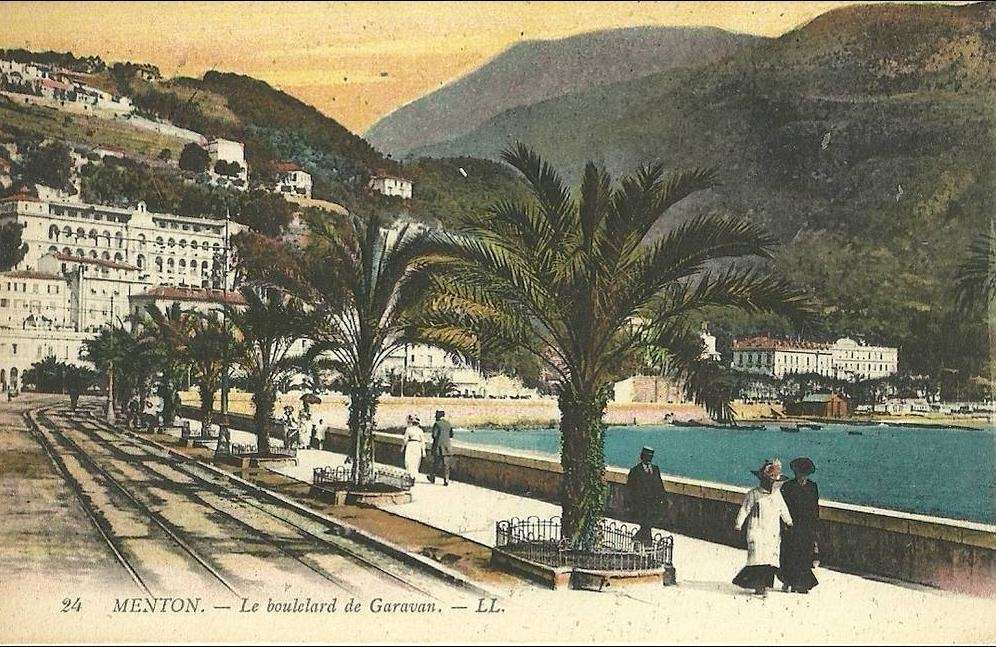
A short distance to the North again, this old postcard image is annotated ‘Le Boulevard de Garavan’. Literally only a couple of hundred metres along the shore from the last postcard image. This colourised image comes from the early 20th century. [30]
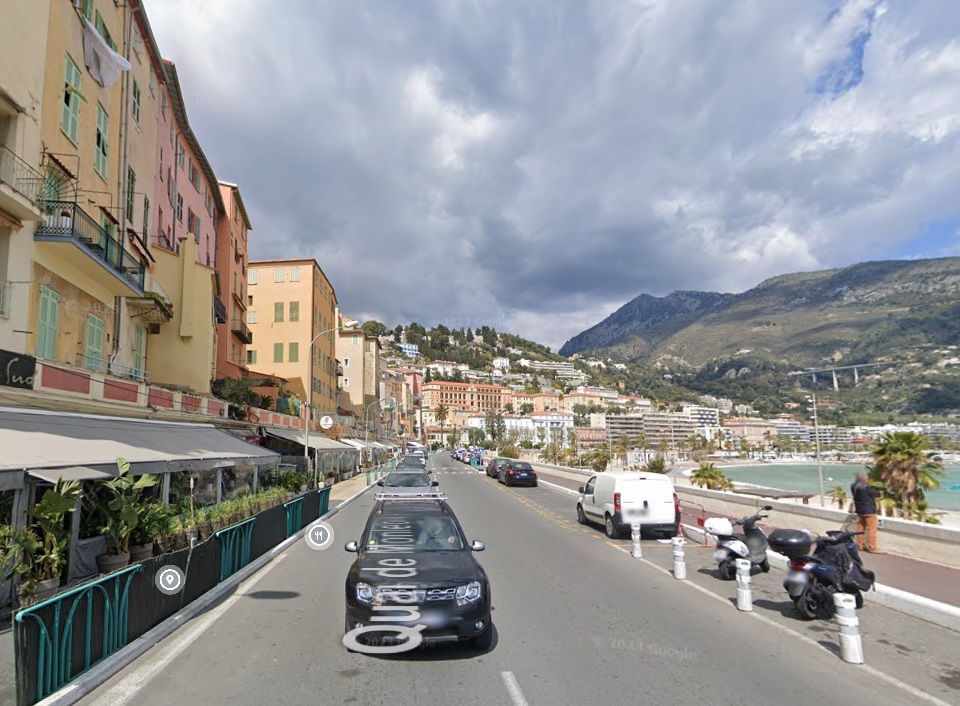
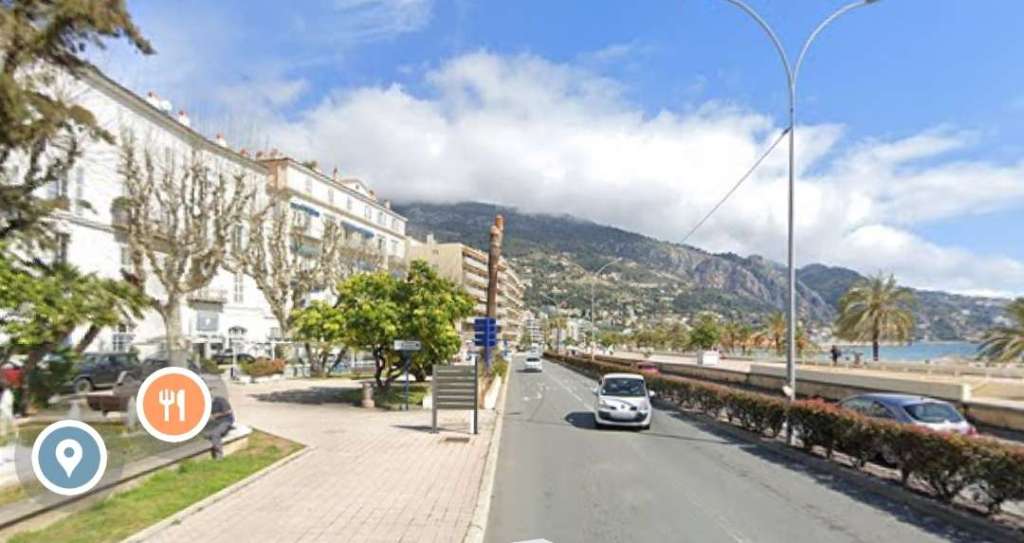
The modern D6007 now follows the Quai Bonaparte/Quai de Monleon. A constant feature is the large building at the centre of this image which seems to have a central gable. In the 21st century this is the Menton campus of Sciences Po Paris. [Google Streetview, April 2023]
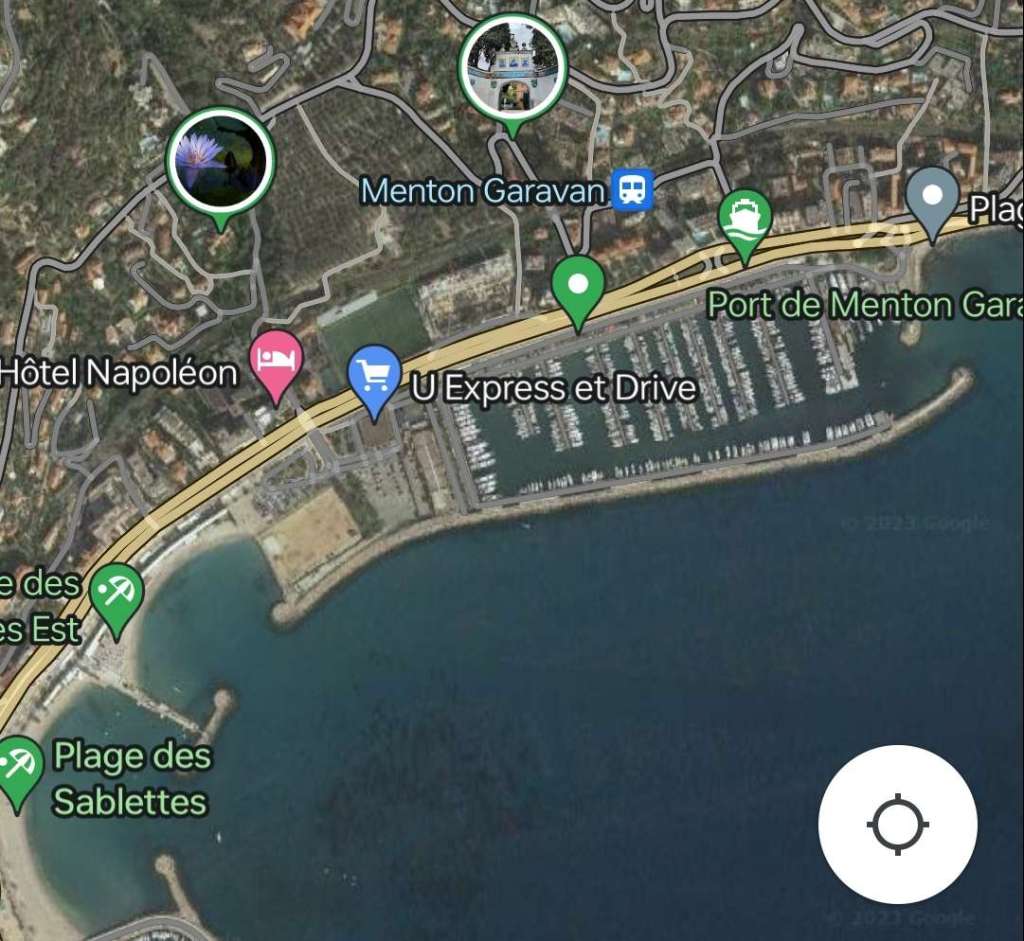
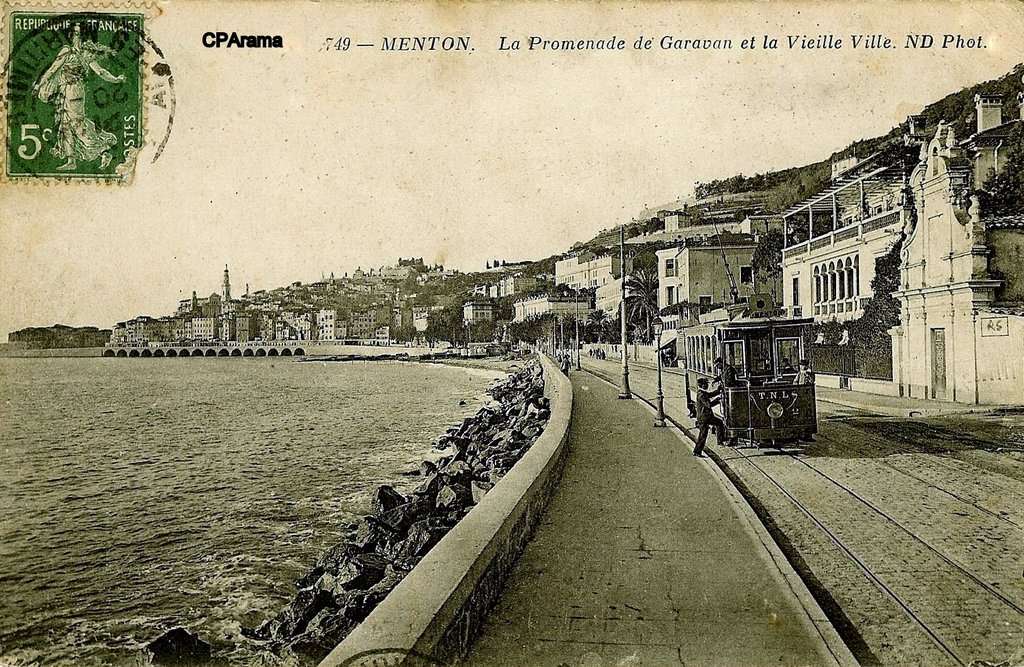
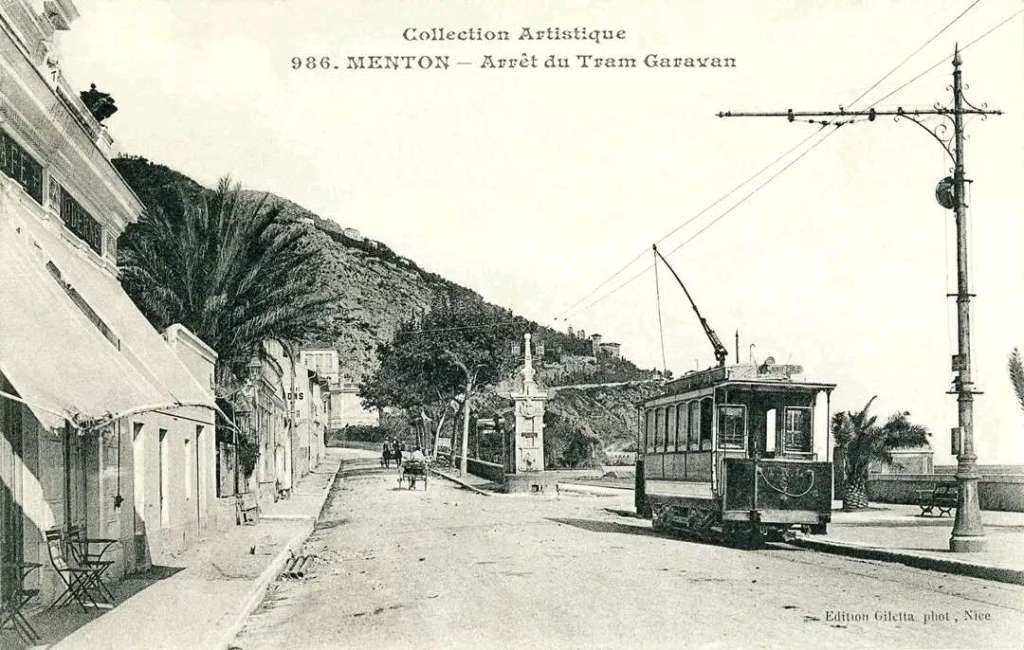
This last extract from Google Maps shows the remaining length of the old tramway. The line followed the Promenade de Garavan and is shown in primrose yellow. It was on the seaward side of the RN7 (D6007). The terminus was close to the grey flag at the right side of this image. It was adjacent to La Fontaine de la Frontiere. [Google Maps November 2020]
A tram heads towards Menton old town along Boulevard de Garavan. [7]
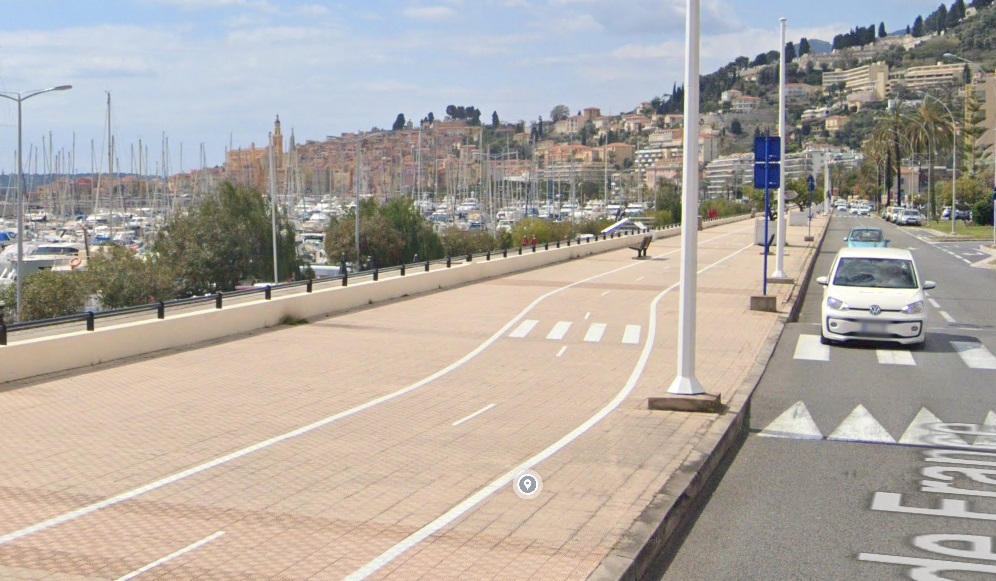
The view from a very similar location in the 21st century. [Google Streetview, March 2023]
A tram stopped on La Promenade de Garavan. Menton’s old town can be seen in the distance. [26]
A similar view from Porte de France in 2023. [Google Streetview, April 2023]
The terminus of the line is some distance ahead in this view. The tram is heading towards the terminus of the line. [26]
This image was shared on the Monaco4Ever Facebook Group on 23rd March 2022 by Jean-Paul Bascoul. Looking East, it shows a tram at the extreme Eastern end of the TNL network, about to set off for Nice. [4]
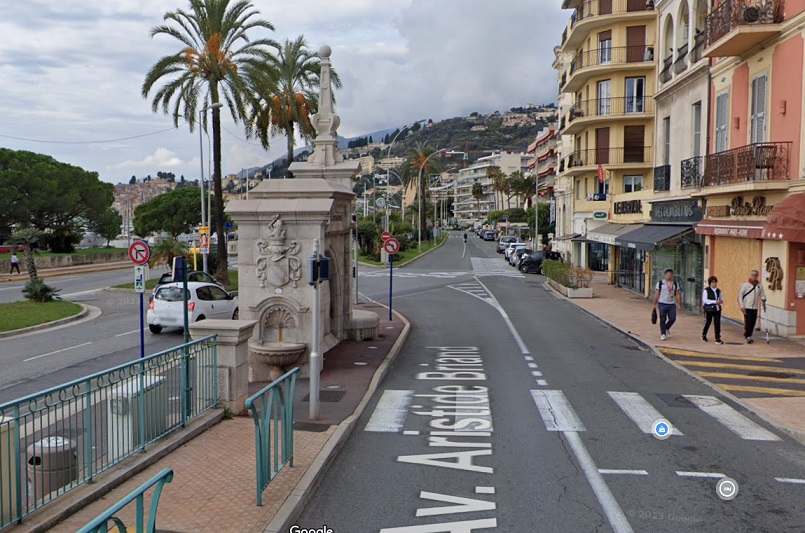
As can be seen close to the centre of this view looking East, the Fontaine de la Frontiere still stands in its historical location, although the Italian border has moved further East! [Google Streetview, March 2023]

The terminus of the TNL network was on La Promenade de Garavan, immediately West of the Fontaine de la Frontiere which itself was very close to the then Italian border.
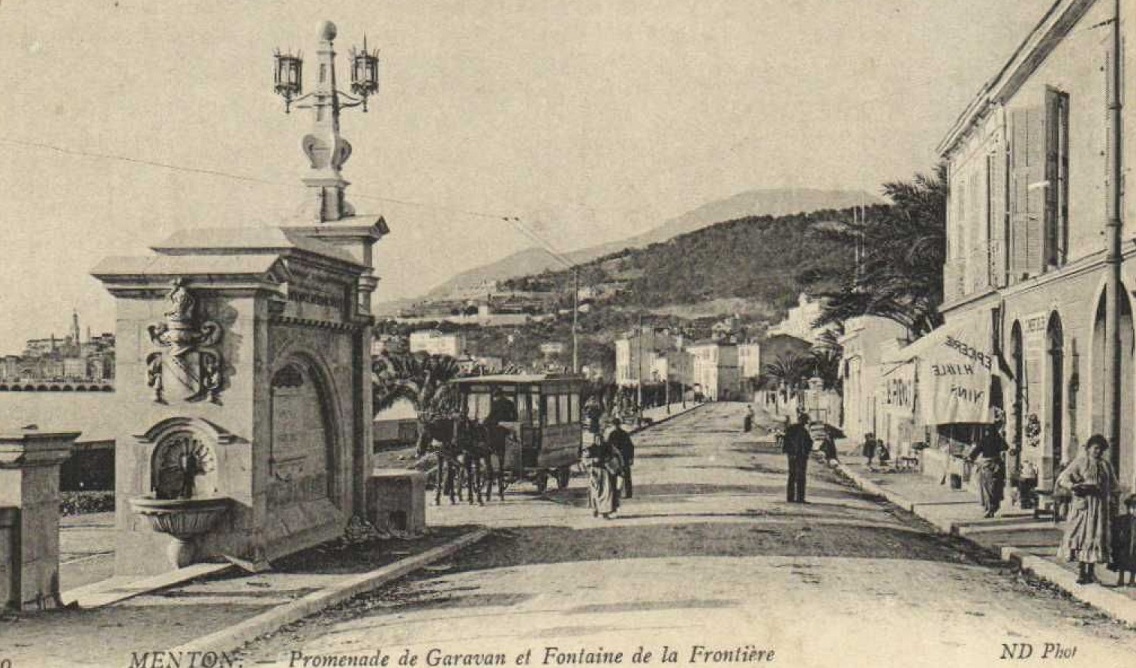
The tram terminus was just to the West of the Fontaine de la Frontiere in almost exactly the same location as the earlier horse-drawn tram in this old postcard image. [47]
The Fontaine de la Frontiere in 2023. At one time the border with Italy was a little to the East of the fountain. [Google Streeview, November 2022]

Images in this article credited to Jean-Paul Bascoul can be found on his blog: Monaco 4Ever.blogspot.com.

References

  1. José Banaudo; Nice au fil du Tram, Volume 2: Les Hommes, Les Techniques; Les Editions de Cabri, Breil-sur-Roya, France, 2005.
  2. http://www.vidiani.com/maps/maps_of_europe/maps_of_monaco/large_detailed_old_map_of_Monaco_Monte_Carlo_1921.jpg, accessed on 13th November 2023.
  3. https://www.facebook.com/groups/1389253567814679/permalink/6968696949870285/?app=fbl, accessegraphs wered on 14th November 2023.
  4. https://www.facebook.com/groups/1389253567814679/permalink/7097087640364548/?mibextid=rS40aB7S9Ucbxw6v, accessed on 14th November 2023.
  5. https://www.facebook.com/groups/1389253567814679/permalink/9979281115478505/?mibextid=rS40aB7S9Ucbxw6v, accessed on 14th March 2023.
  6. https://www.monaco-tribune.com/2023/03/lancien-tramway-de-monaco, accessed on 14th November 2023.
  7. https://www.facebook.com/groups/1389253567814679/permalink/9166984710041487/?mibextid=rS40aB7S9Ucbxw6v, accessed on 14th November 2023.
  8. https://en.m.wikipedia.org/wiki/Trams_in_Monaco, accessed on 15th November 2023.
  9. https://collection-jfm.fr/p/cpa-monaco-monte-carlo-international-sporting-club-tramway-52606, accessed on 15th November 2023.
  10. https://www.ansichtskartenversand.com/ak/90-carte-postale-ancienne/34051-Monaco/11423949-CPA-Monte-Carlo-Le-Restaurant-de-Paris-tramway, accessed on 15th November 2023.
  11. https://fotonail.com/europa/monaco/monte-carlo/monte-carlo-avenue-tramway-horse-cart.html, accessed on 15th November 2023.
  12. https://m.facebook.com/groups/1389253567814679/permalink/9547920741947880, accessed on 15th November 2023.
  13. https://www.delcampe.net/fr/collections/cartes-postales/france/roquebrune-cap-martin/cpa-roquebrune-cap-martin-le-tram-de-menton-a-monte-carlo-transport-chemins-de-fer-tramway-giletta-946-461482676.html, accessed on 17th November 2023.
  14. http://transporturbain.canalblog.com/pages/les-tramways-de-nice—de-l-apogee-au-declin/31975780.html, accessed on 17th November 2023.
  15. https://www.ebay.co.uk/itm/253323731414?mkcid=16&mkevt=1&mkrid=711-127632-2357-0&ssspo=7-GeZfqtTnS&sssrc=4429486&ssuid=afQhrar7TGK&var=&widget_ver=artemis&media=MORE, accessed on 17th November 2023.
  16. http://www.en-noir-et-blanc.com/roquebrune-cap-martin-p1-813.html, accessed on 17th November 2023.
  17. https://www.antiquemapsandprints.com/categories/maps-by-cartographer/guides-bleus-hachette/product/roquebrune-cap-martin-vintage-town-ville-city-plan-alpes-maritimes-1930-map/P-6-070870~P-6-070870, accessed on 17th November 2023.
  18. https://m.facebook.com/story.php?story_fbid=pfbid02cEoY2Gk9V3e73notFARJaZR99QMhQmUgrKjiH1Uyd1yDhxgCAJnqMwcCKaWKFcKDl&id=635920043254797, accessed on 17th November 2023.
  19. https://www.ebay.co.uk/itm/204509560244?mkcid=16&mkevt=1&mkrid=711-127632-2357-0&ssspo=cTk_hvhSRfe&sssrc=4429486&ssuid=afQhrar7TGK&var=&widget_ver=artemis&media=COPY, accessed on 30th November 2023.
  20. https://m.facebook.com/groups/rcmentraide/permalink/1282944575478897, accessed on 17th November 2023.
  21. https://www.facebook.com/groups/1389253567814679/permalink/9478220598917895/?app=fbl, accessed on 17th November 2023.
  22. https://collection-jfm.fr/p/cpa-france-06-menton-saint-jean-vielle-chapelle-au-cap-martin-92913, accessed on 2nd December 2023.
  23. https://www.akpool.fr/cartes-postales/26659024-carte-postale-monte-carlo-monaco-tram-route-de-menton-monte-carlo-strassenbahn-panorama-vom-ort, accessed on 17th November 2023.
  24. https://www.facebook.com/groups/1389253567814679/permalink/9166981643375127/?app=fbl, accessed on 13th November 2023.
  25. https://images.app.goo.gl/PViRS5rGcYE3NVLg6, accessed on 18th November 2023.
  26. https://www.cparama.com/forum/viewtopic.php?p=52777, accessed on 19th November 2023.
  27. https://www.communes.com/cartes-postales-anciennes-roquebrune-cap-martin, accessed on 19th November 2023.
  28. https://m.facebook.com/story.php?story_fbid=pfbid028EjRwQCxRmB89rEsCt2h8YR32nMKhMhypGPSzF3CAAQc8H4wjmHSq3QRjiTzMGhHl&id=100064481811741, accessed on 19th November 2023.
  29. https://m.facebook.com/groups/1389253567814679/permalink/3565973976809283, accessed on 3rd December 2023.
  30. https://www.geneanet.org/cartes-postales/view/5938184#0, accessed on 3rd December 2023.
  31. https://www.ebay.co.uk/itm/196013394405?mkcid=16&mkevt=1&mkrid=711-127632-2357-0&ssspo=W9cRBoodQSO&sssrc=4429486&ssuid=afQhrar7TGK&var=&widget_ver=artemis&media=COPY, accessed on 3rd December 2023.
  32. https://www.cparama.com/forum/menton-t979.html, accessed on 3rd December 2023.
  33. Not used.
  34. http://www.en-noir-et-blanc.com/le-cap-martin-p1-2800.html, accessed on 2nd December 2023.
  35. https://m.facebook.com/story.php?story_fbid=pfbid028tjj9vrXVrhWDqtANF258PK7v3kCQKj5ePhuGN1QcsPL1qESvtW6c5BTopfn3LaWl&id=635920043254797, accessed on 20th November 2023.
  36. https://www.facebook.com/635920043254797/posts/pfbid0c9zVgpCcdqRCBhGj8tXT6kiiCNsmFDTTo7ASaxgFv5TFhaXcN845gT98PtXwof3yl/?app=fbl, accessed on 20th November 2023.
  37. https://m.facebook.com/groups/ciccoli/permalink/2071367206442471, accessed on 2nd December 2023.
  38. https://www.ebay.co.uk/itm/314237843895?mkcid=16&mkevt=1&mkrid=711-127632-2357-0&ssspo=nU4A5jgeRzm&sssrc=4429486&ssuid=afQhrar7TGK&var=&widget_ver=artemis&media=COPY, accessed on 2nd December 2023.
  39. https://collection-jfm.fr/p/cpa-france-06-menton-la-rue-saint-michel-223828, accessed on 3rd December 2023.
  40. https://www.ebay.co.uk/itm/186145306141?mkcid=16&mkevt=1&mkrid=711-127632-2357-0&ssspo=iaKZOZUrQmi&sssrc=4429486&ssuid=afQhrar7TGK&var=&widget_ver=artemis&media=COPY, accessed on 2nd December 2023.
  41. https://m.facebook.com/story.php?story_fbid=pfbid0UYtiYEptwyNi1Jw3dZWz9ZABkcPs8JRS6CATMHY1XYRyiM753KXLPM9CfsZ7AiKbl&id=635920043254797, accessed on 20th November 2023.
  42. Not used.
  43. Not used.
  44. Not used.
  45. https://www.geneanet.org/cartes-postales/view/186292#0, 23rd November 2023.
  46. https://m.facebook.com/story.php?story_fbid=275995965894297&substory_index=2275002982660242&id=274116476082246,  23rd November 2023.
  47. https://www.delcampe.net/en_US/collectibles/postcards/france/menton/menton-promenade-de-garavan-et-fontaine-de-la-frontiere-tram-a-chevaux-1911374856.html, accessed on 4th December 2023.
  48. https://m.facebook.com/groups/172267109778338/permalink/1524067927931576/, accessed on 30th November 2023.
  49. https://www.cparama.com/forum/viewtopic.php?p=2581, accessed on 2nd December 2023.
  50. https://www.fortunapost.com/menton/63773-06-menton-les-platanes-avenue-felix-faure-1914.html, accessed on 2nd December 2023.
  51. https://www.ebay.co.uk/itm/134689074112?mkcid=16&mkevt=1&mkrid=711-127632-2357-0&ssspo=_o2CiTs1S5m&sssrc=4429486&ssuid=afQhrar7TGK&var=&widget_ver=artemis&media=COPY, accessed on 2nd December 2023.
  52. https://www.communes.com/cartes-postales-anciennes-menton, accessed on 2nd December 2023.
  53. https://collection-jfm.fr/p/cpa-france-06-menton-la-place-saint-roch-102274, accessed on 3rd December 2023.
Nice to Monte-Carlo Branch Lines – La Ligne du Littoral et ses Antennes, First Generation Electric Tramways – (Chemins de Fer de Provence/Alpes-Maritimes No. 92) …

There were two branch lines worth noting between Nice and Monte Carlo: one from Pont-St. Jean to St. Jean-Cap Ferrat; one from Monaco-Gare to Monaco-Ville.

The tram route from Nice to Monte-Carlo is covered in an article which can be found by following this link:

La Ligne du Littoral et ses Antennes, First Generation Electric Tramways – Nice-Monte Carlo (Chemins de Fer de Provence/Alpes-Maritimes No. 91) …

Pont-St. Jean – St. Jean-Cap Ferrat

This branch line was just under 2 km in length and ran between Pont-St. Jean at 27 m above sea-level to a terminus in St. Jean-Cap Ferrat at 3 m above sea-level.

Construction of the line started in June 1906 and it was open to traffic by 7th December 1907.

Along with the rest of the network it received a line number on 1st January 1923 – No. 22. It remained in service as a tramway until 9th March 1931, when it was replaced by a bus service. Rails were lifted by 20th June 1933.

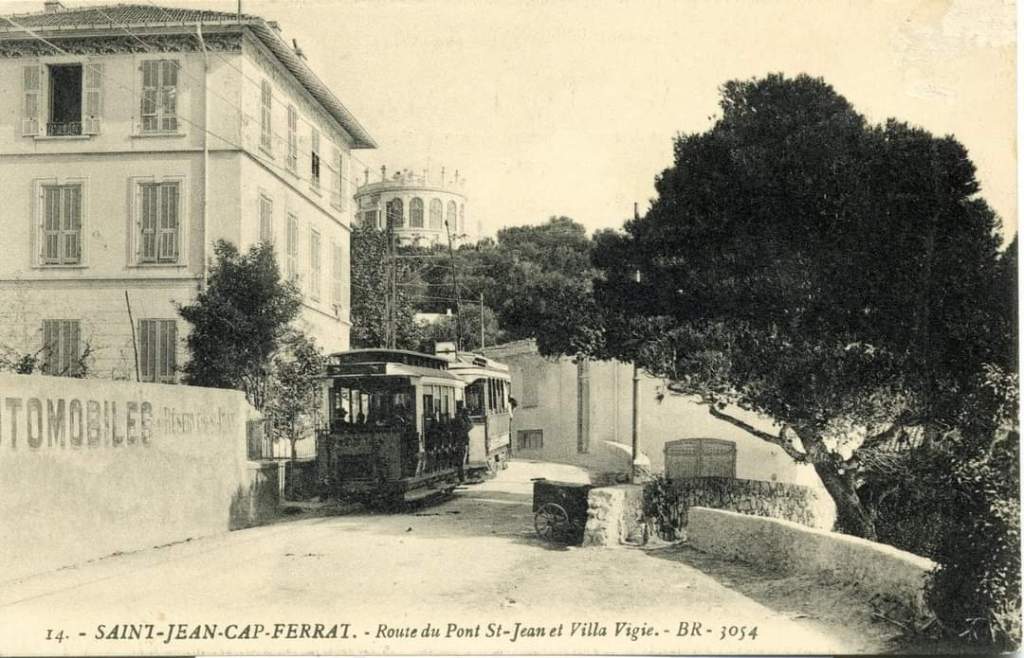
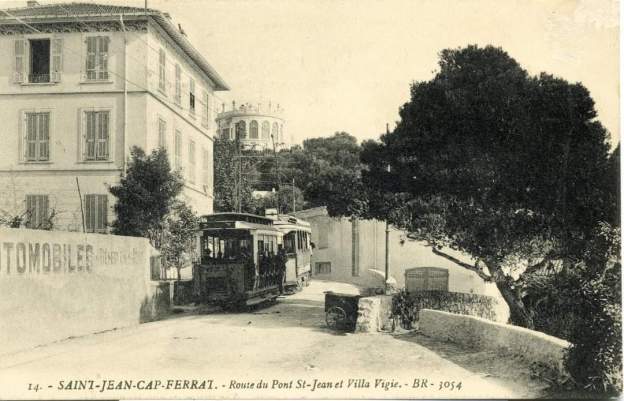
A postcard photograph of Pont St. Jean with a tram approaching from the terminus on St. Jean Cap Ferrat, the photograph was shared on the Comte de Nice et son Histoire Facebook Group by Laurent Mannu on 20th April 2022. Travelling the opposite direction a tram would almost immediately stop at l’Octroi. [6]
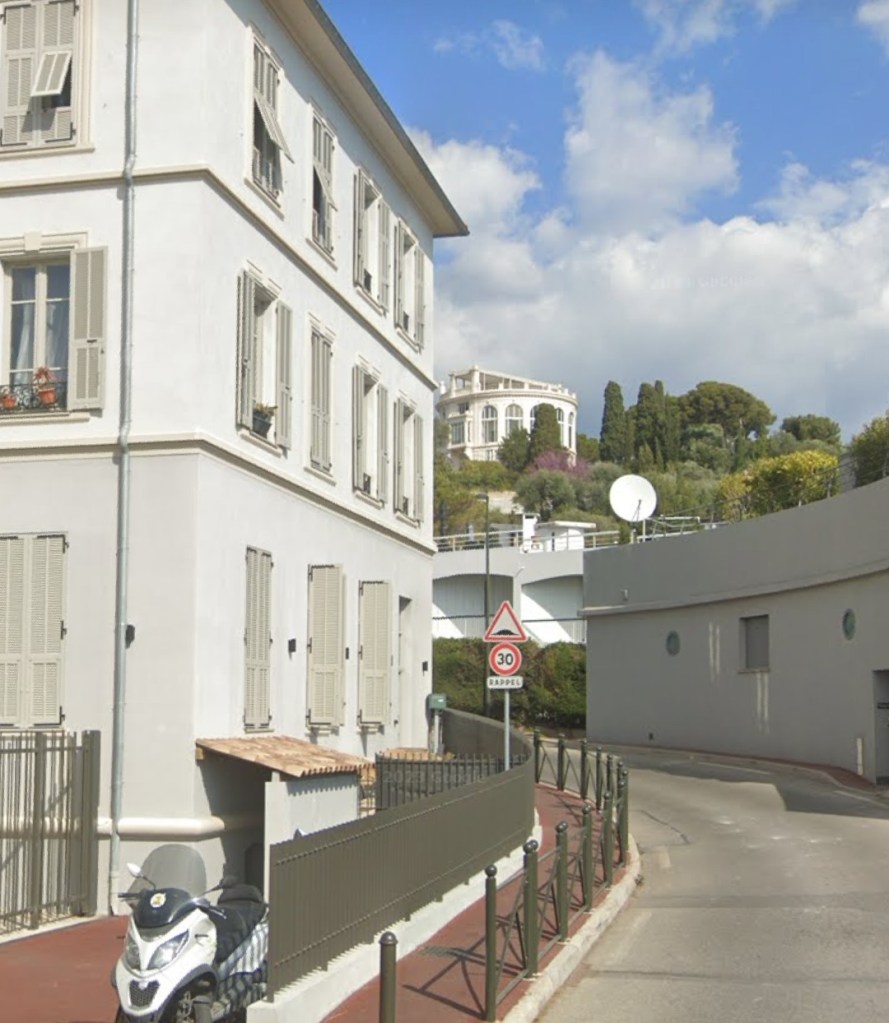
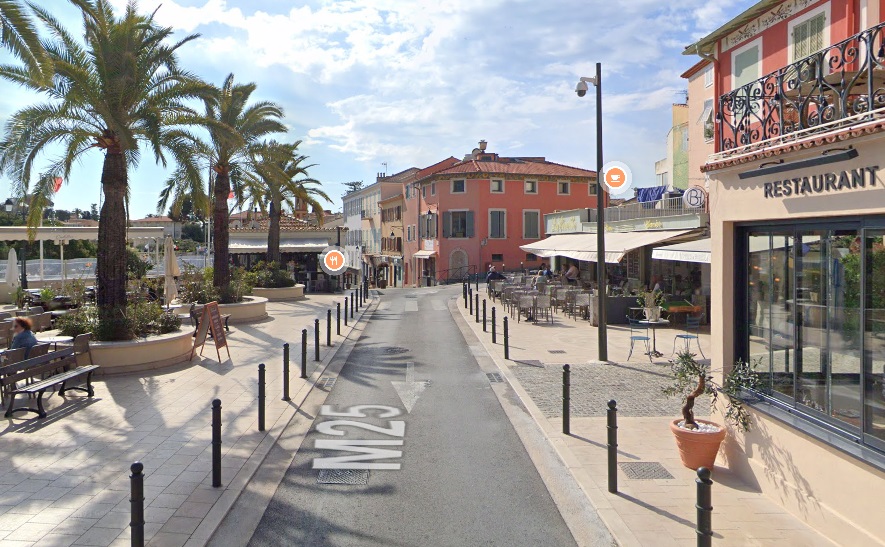
A very similar view in 2023. [Google Streetview, March 2023]

The line was single-track throughout with two intermediate passing places.  It left the mainline between Nice and Monte-Carlo at Pont-St. Jean which sat at the point where the communes of Villefranche and Beaulieu shared a common border and at the point where the PLM line between Nice and Ventimille was bridged to provide access to the coastline. This was also close to the Octroi de St. Jean which, as we have noted elsewhere, was a building which housed  municipal tax collectors and allowed them to control and tax goods transported by travellers.

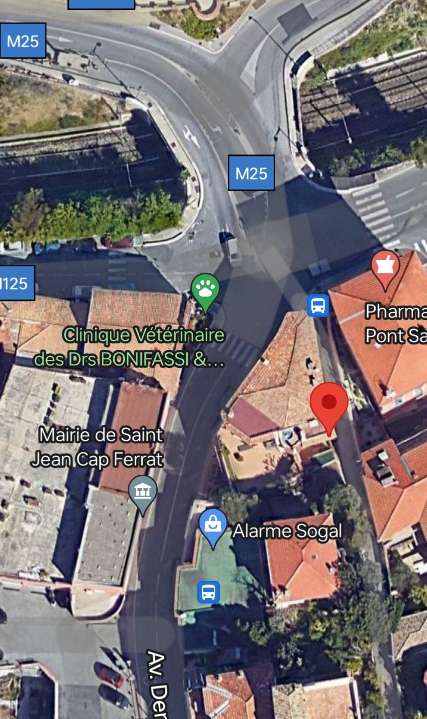
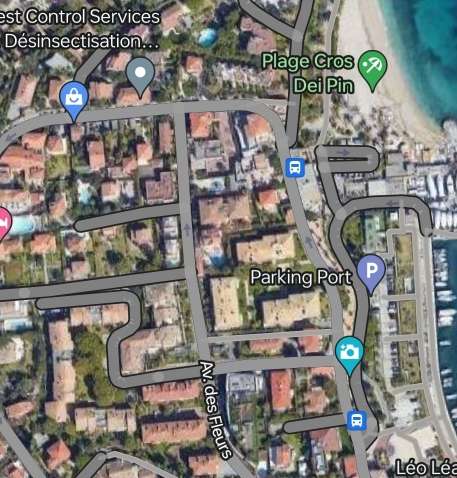
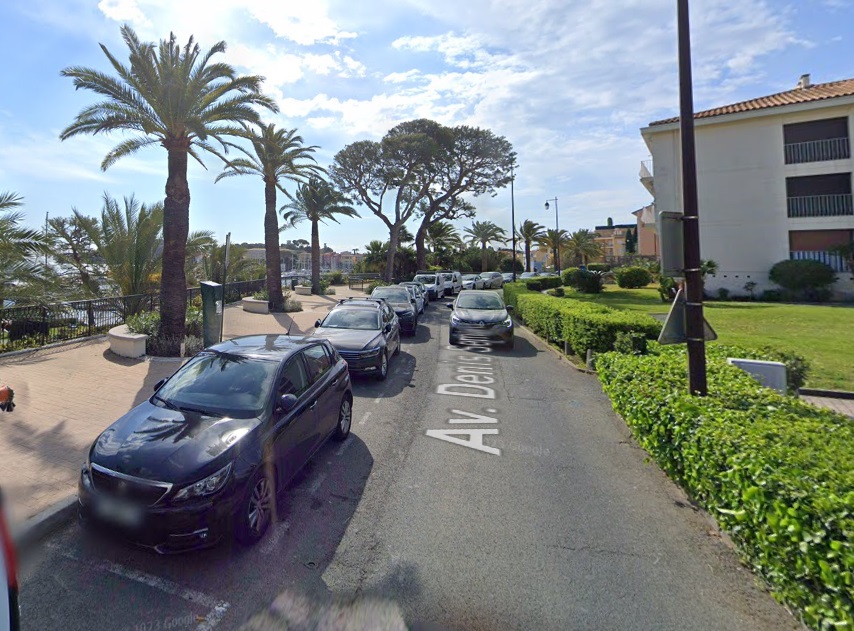
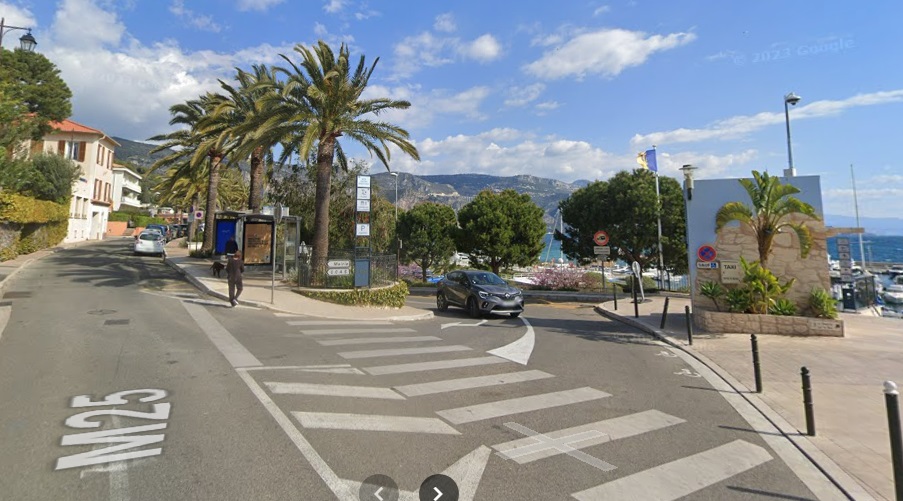
After crossing the railway line trams headed down Avenue Denis Semaria (M25) out onto the peninsula. The ‘new’ road, M125, can be seen heading West alongside the railway line. [Google Maps, November 2023]

The peninsula was an attractive area to build a home and the Tramway found its way through villas and gardens set among pine trees.

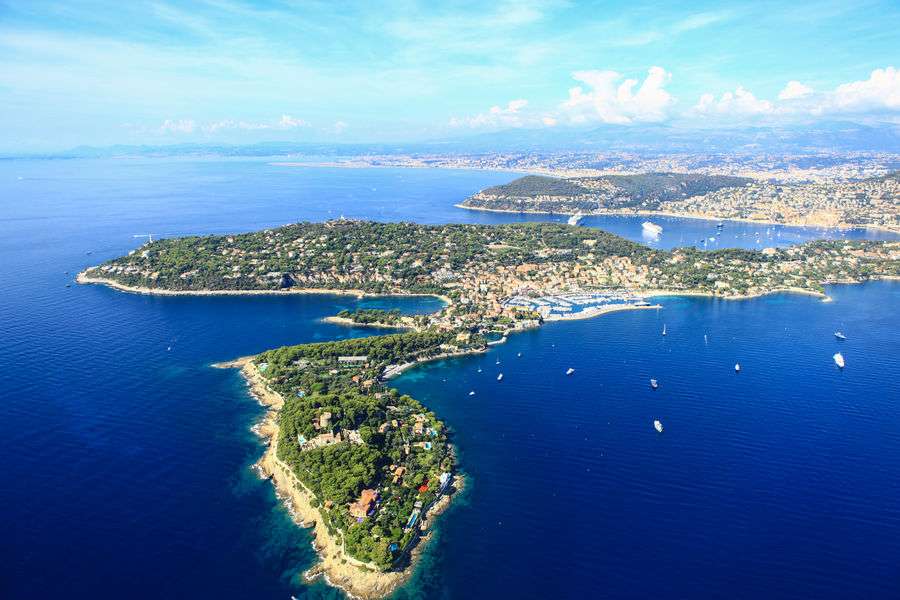
St. Jean Cap Ferrat – a beautiful place! [2]
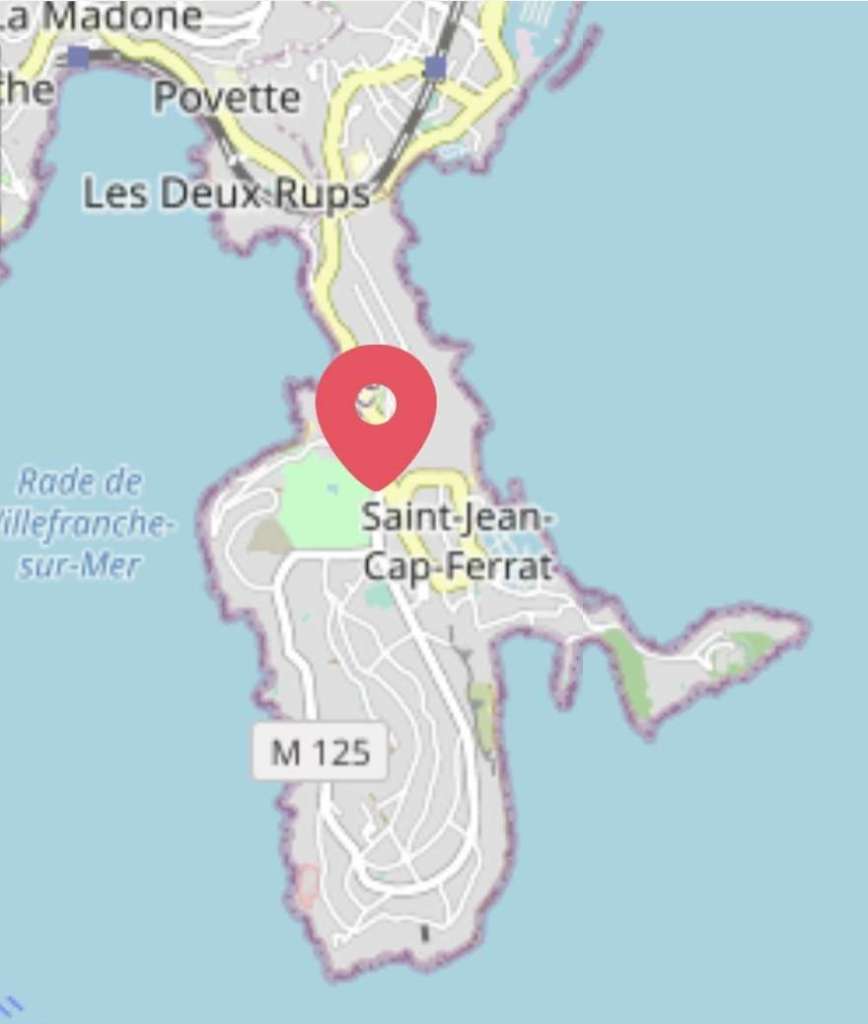
St. Jean Cap Ferrat, the primrose yellow road out onto the peninsula is route M25. The loop of road to the South is the M125, © OpenStreetMap made available under a Creative Commons Attribution-ShareAlike 2.0 license (CC BY-SA 2.0). [3]
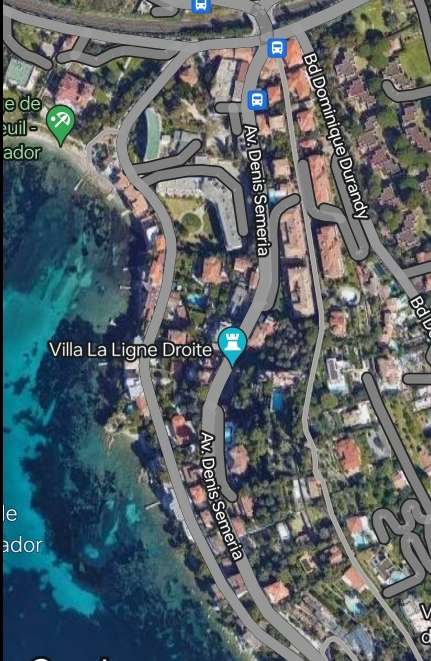
The tramway ran along Avenue Denis Semeria, curving round Villa La Ligne Droit. [Google Maps, November 2023]
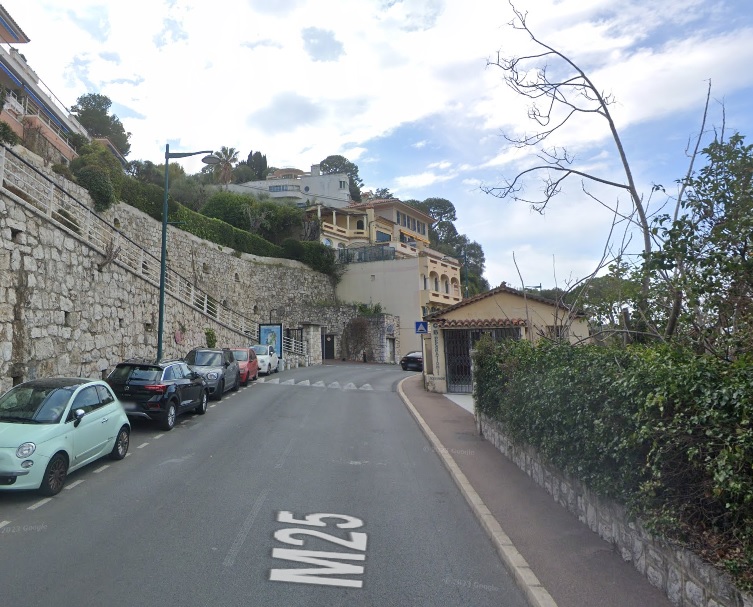
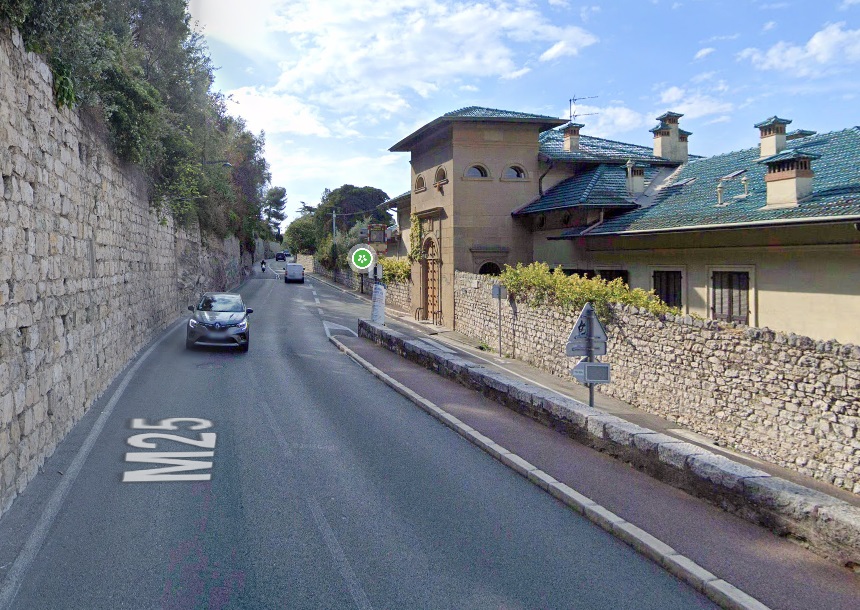
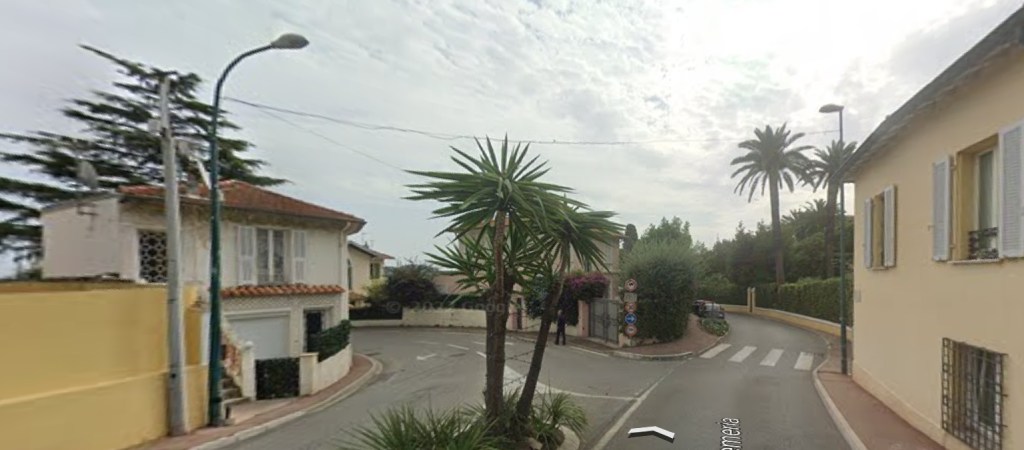
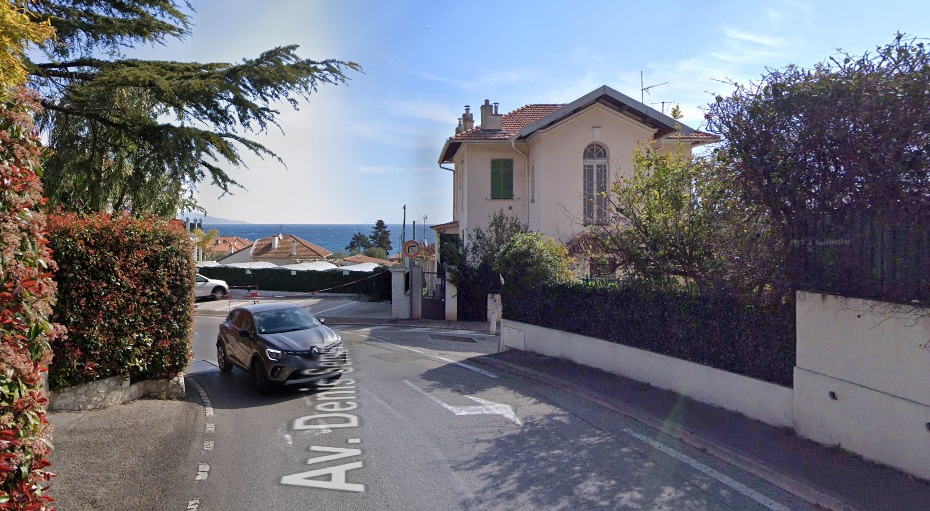
The route of the old tramway, approaching Villa La Ligne Droit. [Google Streetview, April 2023]
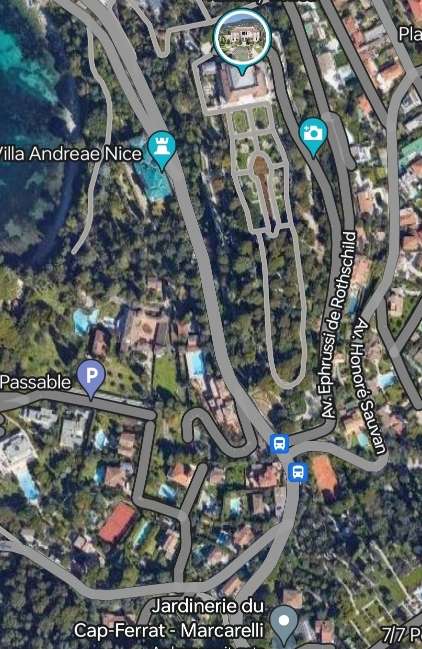
Villa Ephrussi de Rothschild sat to the East of the tramroad and Villa Andreae Nice to the West. [Google Maps, November 2023]

The M25 had to be rebuilt in to the West of and in parallel to its original route which was too narrow to accommodate both trams and other traffic. 

The Gardens of Ephrussi de Rothschild sat above the tramroad to the East and Villa Andreae Nice to the West was to the right. [Google Streetview, April 2023]

After a passing-loop close to the chapel of St. François in the middle of the peninsula, the line descended eastwards to reach its terminus located at the port of St. Jean-Cap-Ferrat. 

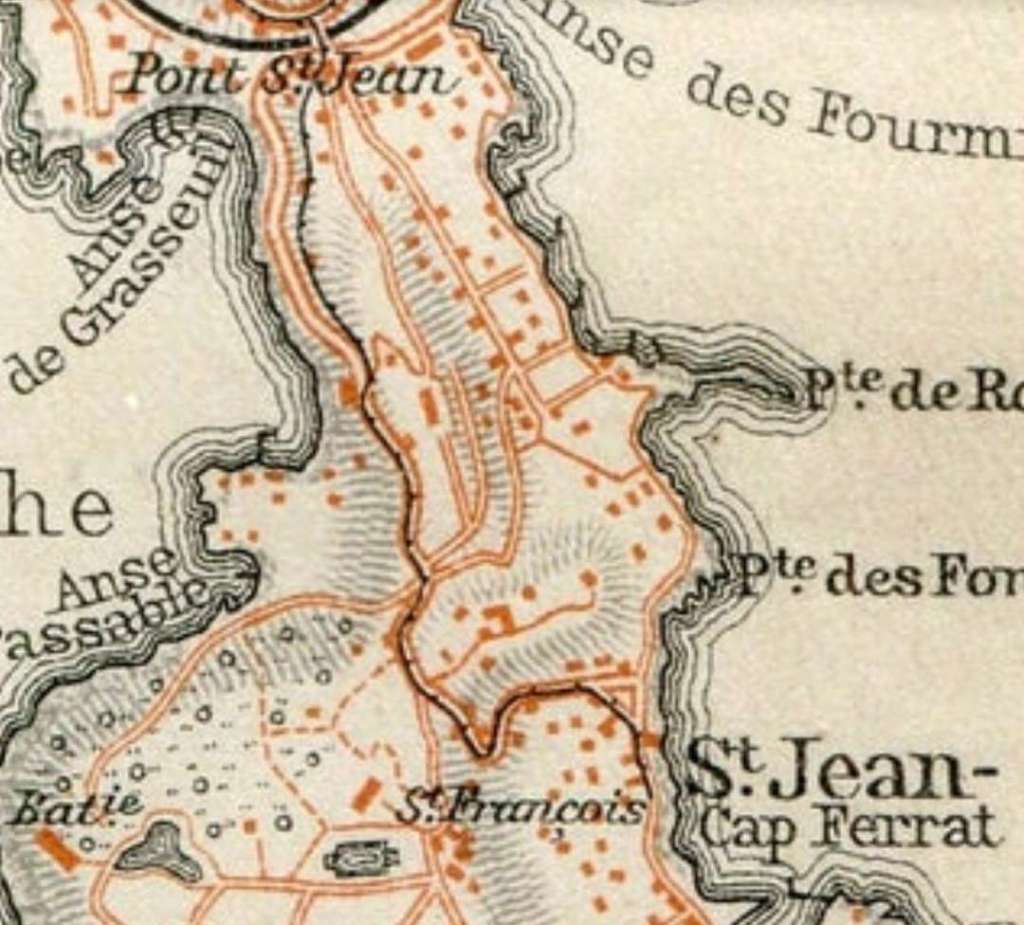
The tram route, as shown on a map of the area around Nice in 1914. [10]
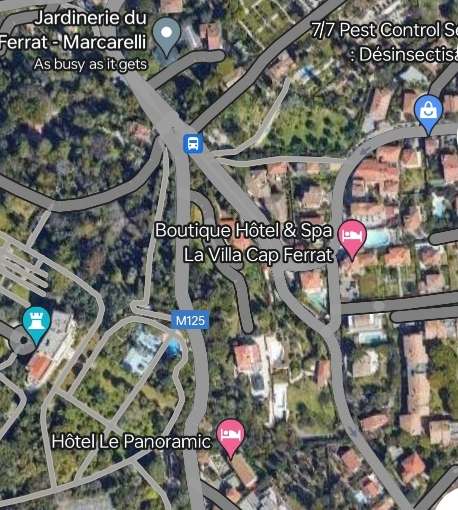
The tramway continued along Avenue Denis Semaria close to Jardinerie du Cap-Ferrat Marcarelli. [Google Maps, November 2023]
The route continued to follow Avenue Denis Semaria and began to head down towards [Google Streetview, October 2022]
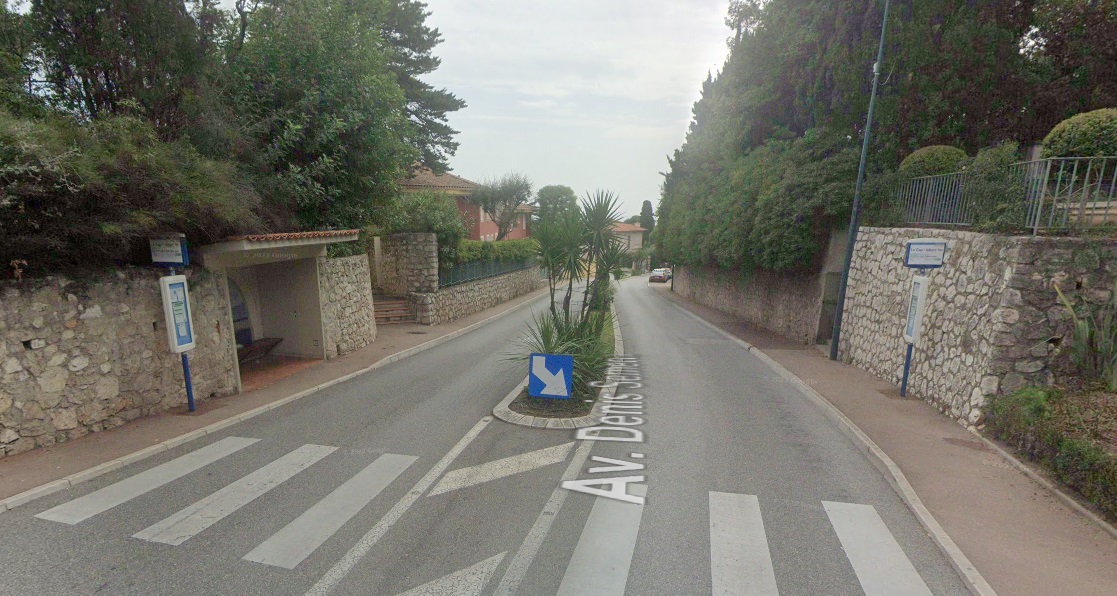
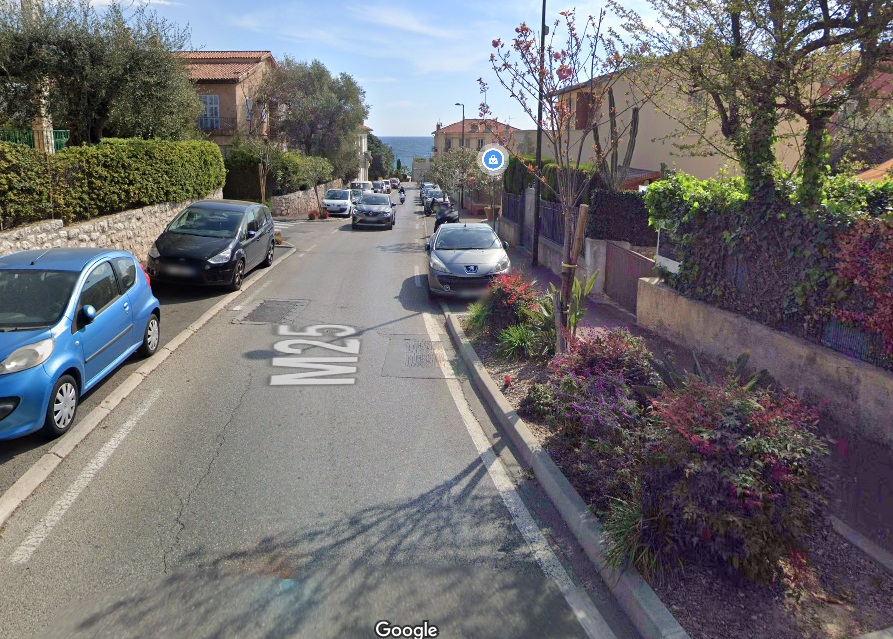
The tramway turned away from one arm of Avenue Denis Semaria to head down to the Port along another arm of the same named road and following the route number M25. [Google Streetview, October 2022]
The tramway continued round the curve on Avenue Denis Semaria. [Google Streetview, April 2023]

Avenue Denis Semaria runs first due East and then turns round to the South as it approaches the Port and the location of the tramway terminus. [Google Maps, November 2023]
Now heading due East on Avenue Denis Semaria (M25) and approaching the East coast of the peninsula. [Google Streetview, April 2023]
A tram en-route from Pont-St. Jean down to the Port curving down along Avenue Denis Semaria not far from the Port. This image was shared on the Monaco4Ever Facebook Group on 1st September 2014 by Jean-Paul Bascoul. (Collection privée J-Paul Bascoul). [11]
A very similar view in 2023. [Google Streetview, April 2023]
Turning through 180°, this is the view along Avenue Denis Semaria towards the Port. [Google Streetview, April 2023]
The bus terminus at Port-St. Jean. The tram terminus was a few hundred metres South , behind the camera. [Google Streetview, April 2023]
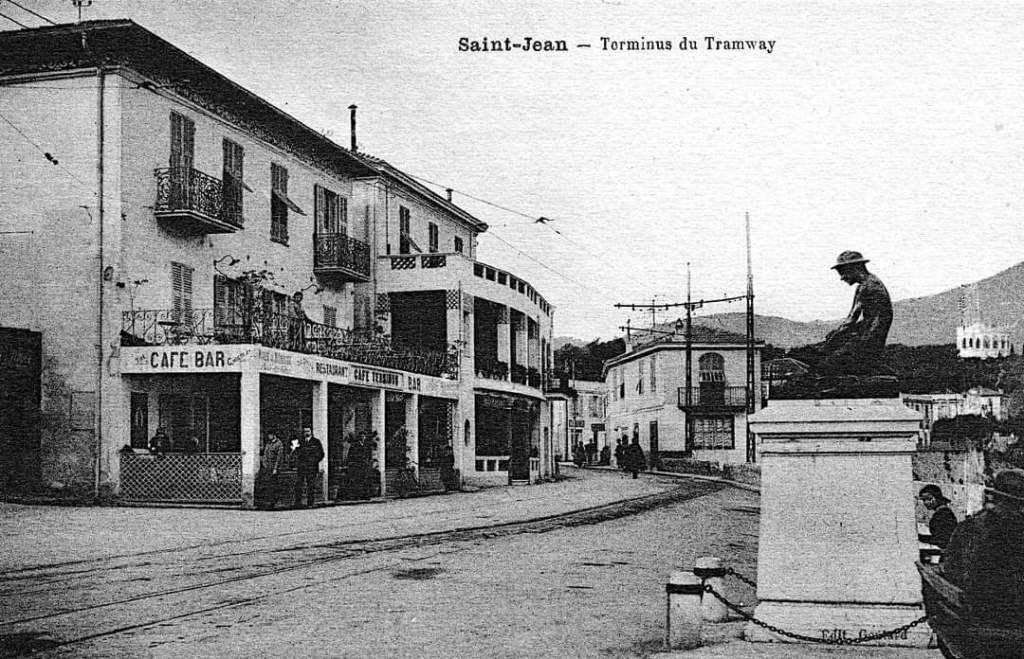
The tram terminus was established at the port of St. Jean-Cap-Ferrat, Place du Centenaire, near the statue of the Fisherman, the work of Claude Vignon-Rouvier, wife of the politician Maurice Rouvier. Around 1910. The tram in the picture is made up of a powered car and a trailer. [4]
A later view without a tram present. The buildings on the left have seen some significant work undertaken. The first is now a three-storey building and both that and the adjacent property have been extended towards the street. This image was shared on the Comte de Nice et son Histoire Facebook Group on 28th February 2022 by Alain Nissim. [5]
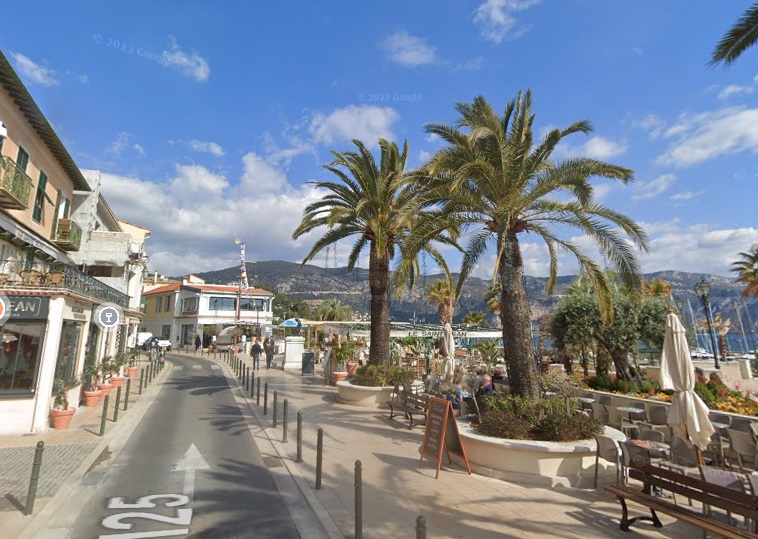
A similar view in 2023 looking through the location of the tramway terminus to the North. [Google Streetview, April 2023]
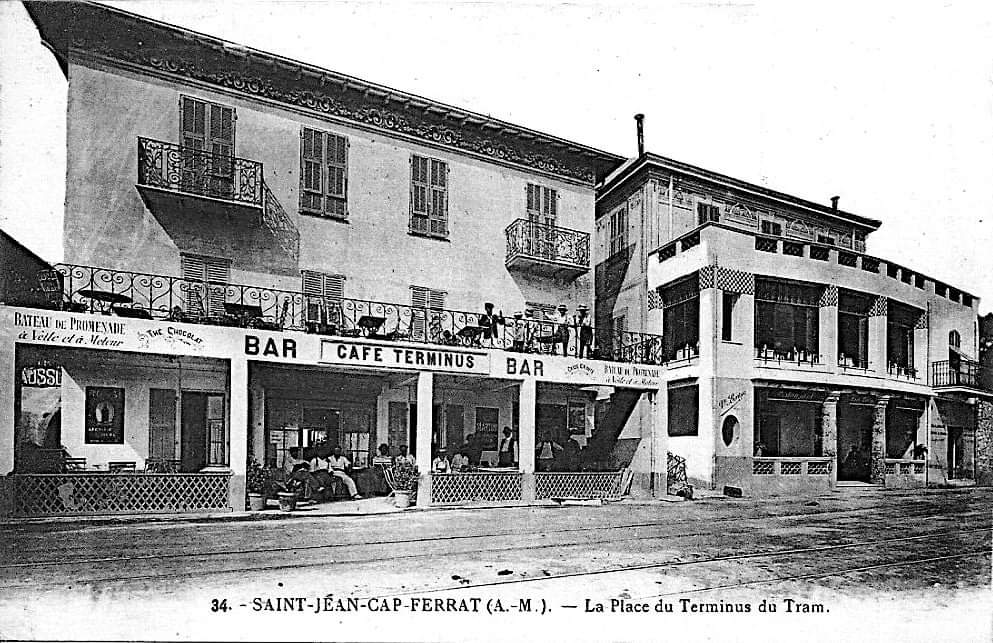
The cafe at the terminus of the tramway. The image was shared on the Comte de Nice et son Histoire Facebook Group by Alain Nissim on 18th February 2022. [9]
A postcard view of Saint-Jean-Cap-Ferrat – Place du Centenaire – Tram Stop – Publisher: Giletta N°830. The photograph was taken sometime around 1920 and shows a powered car running round its trailer ready for the journey back to Pont-St. Jean. [4]
A similar view in 2023 looking through the location of the tramway terminus to the South. [Google Streetview, April 2023]
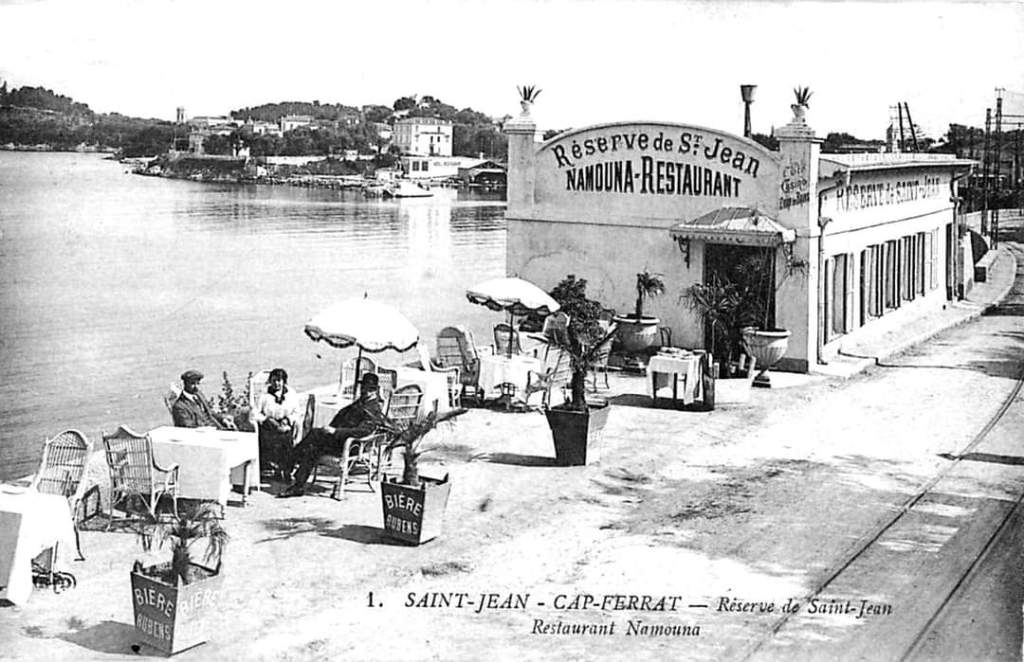
The Namuoma Restaurant at St. Jean-Cap Ferrat, with the tramway tracks visible to the bottom right of the photograph. This image was shared on the Comte de Nice et son Histoire Facebook Group by Alain Nissim on 16th August 2023. [7]
Another view of the terminus. This image was shared on the Comte de Nice et son Histoire Facebook Group by Alain Nissim on 5th July 2021. [8]
A similar view in 2023 looking through the location of the tramway terminus to the South. [Google Streetview, April 2023]

Monaco-Gare – Monaco-Ville

This line was marginally over 1 km in length. It low point was at Place d’Armes, just 19 metres above sea-level, its high point was at 59metres above sea-level at Place de la Visitation. It was single track over its entire length with no passing places . It also did not have passing loops at its two termini as it only used powered cars with no trailers.

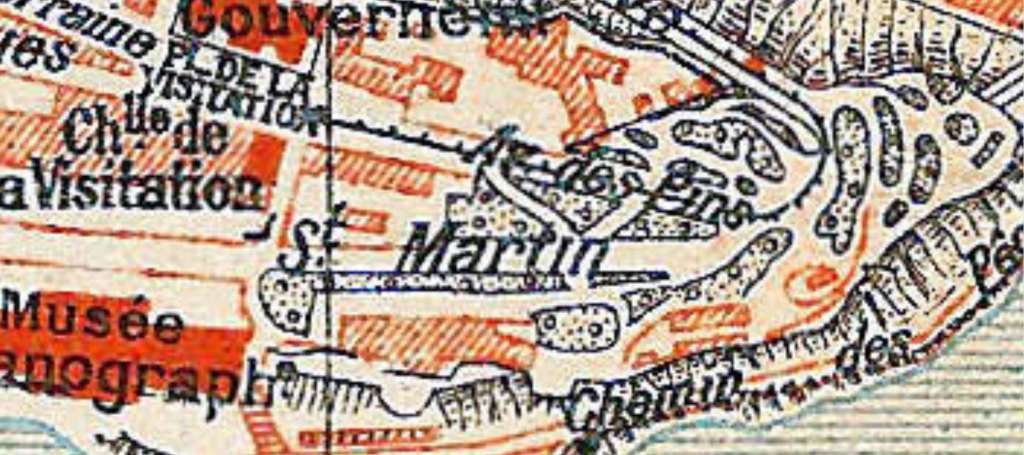
Banaudo tells us that, “Starting from the PLM station square, it went down Avenue de la Gare for 101 m to Place d’Armes. This node in the Monegasque network formed a connection point with the TNL line towards Nice and the TM line towards Monte Carlo and St. Roman. Crossing this, the single track climbed by a long ramp of 77 mm/m the Avenue de la Porte-Neuve to the end of the Rocher dominating Fort Antoine, then a sharp bend brought the line back into the Avenue des Pins. The terminus sat at the entrance to the old town of Monaco, on the Place de la Visitation where the government palace stands.” [1: p54]

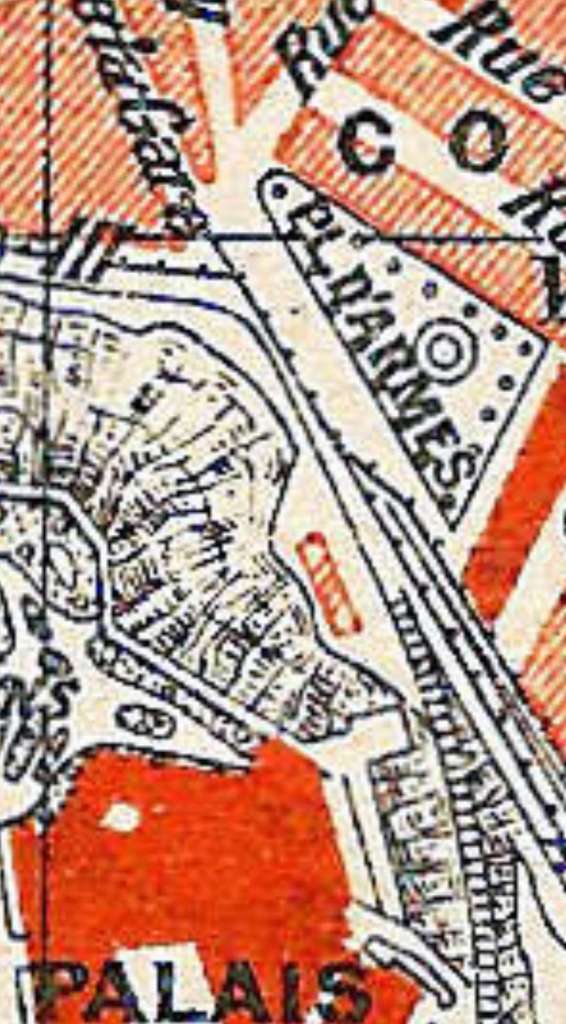
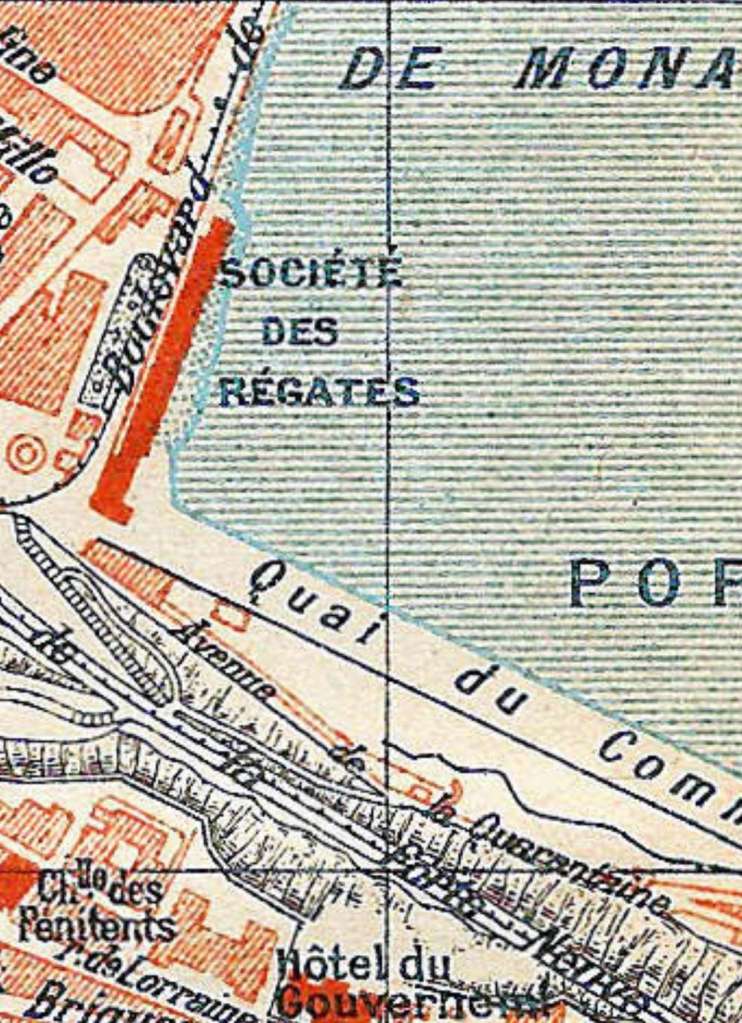
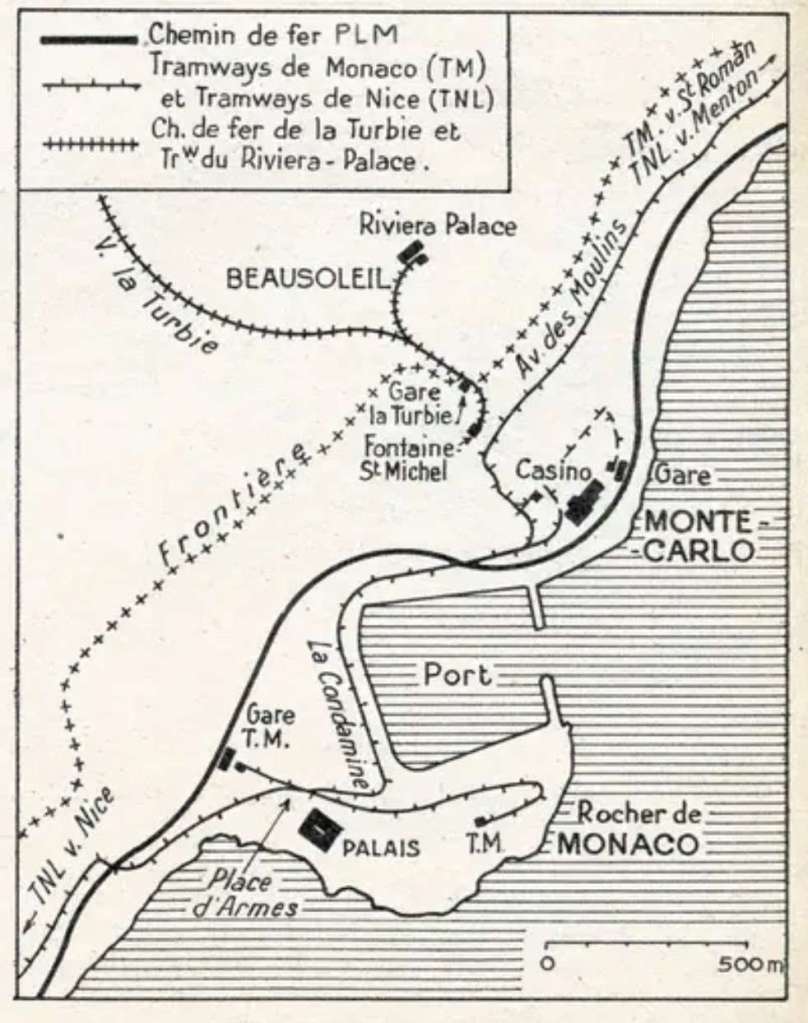
A plan of the different tram and train lines in Monaco and Monte-Carlo in the early 20th century. The article from which this image was taken was shared on the Monaco4Ever Facebook Group by Jean-Paul Bascoul on 17th May 2015. The line between the station and the Place de la Visitation runs left to right at the bottom of the map. [15]
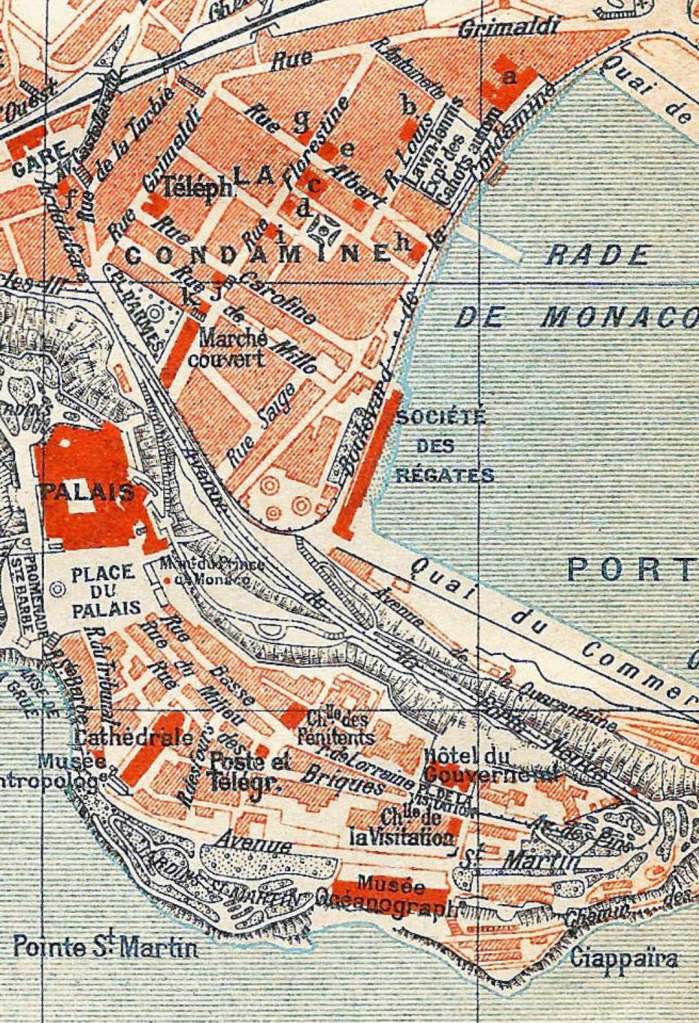
This map shows This branch line tramway ran from Monaco-Gare at the Northwest corner of this map extract through Place d’Armes and then along Avenue de la Porte Neuve before swinging sharply round to the West along Avenue des Pins, to terminate in Place de la Visitation. [16]
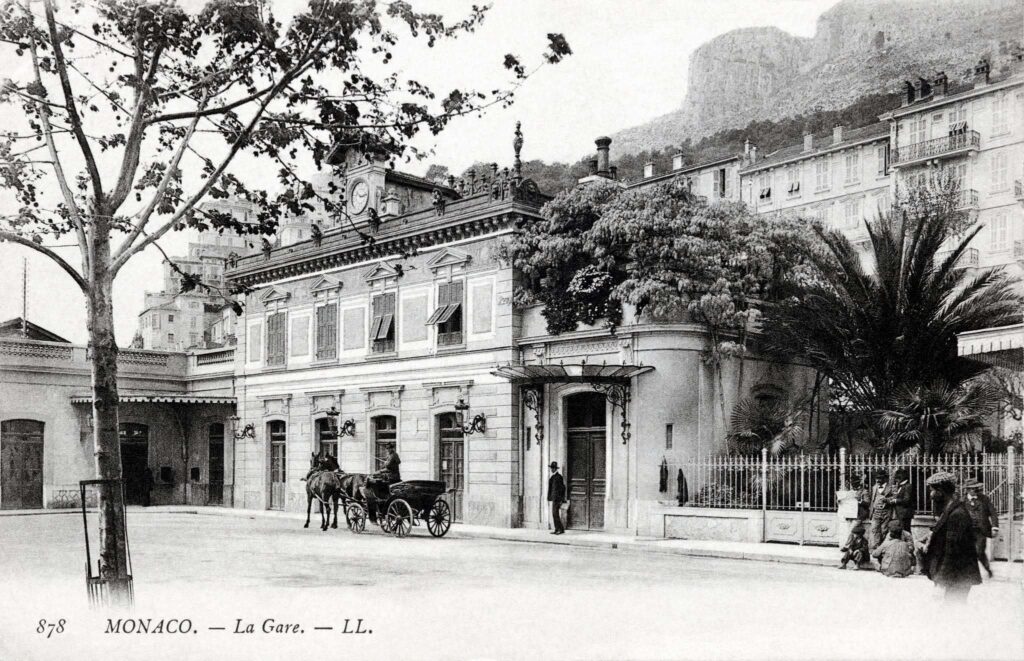
Monaco Railway Station in the early 20th century. [19]
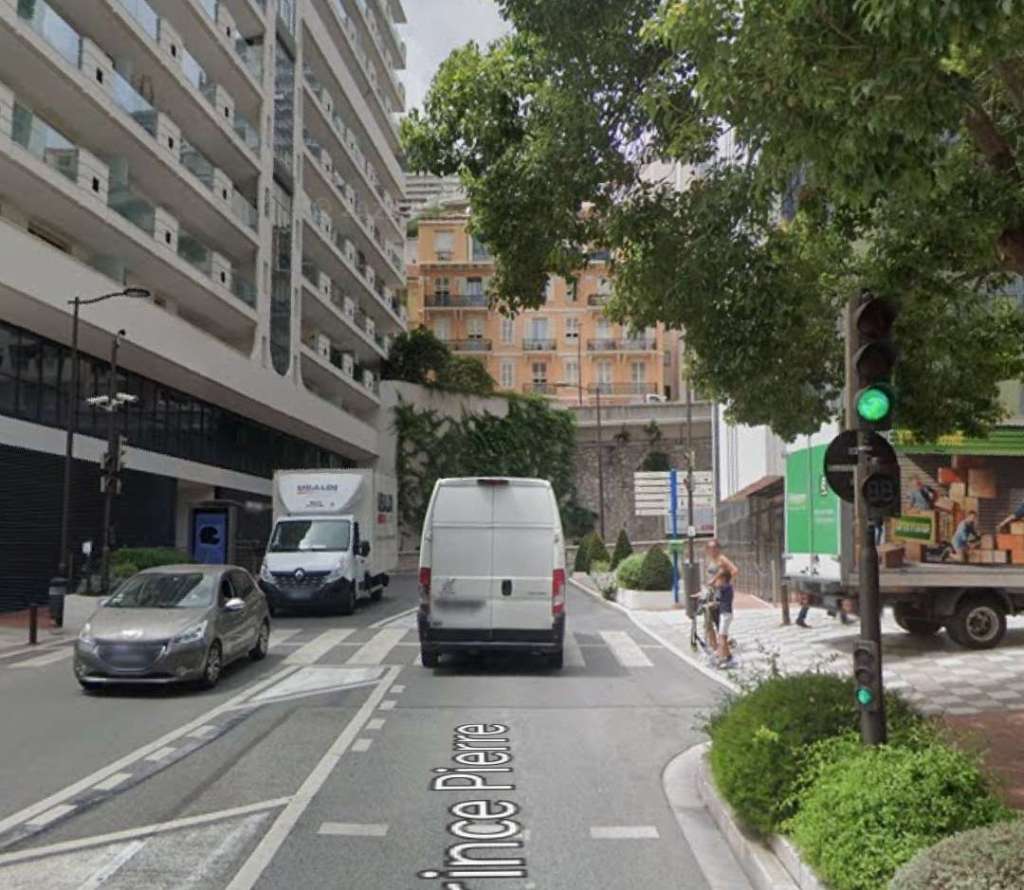
Looking Northwest along Avenue Prince Pierre towards the location of Monaco Railway Station. [Google Streetview, July 2021]
Looking along Avenue Prince Pierre into Place d’Armes. [Google Streetview, July 2022]
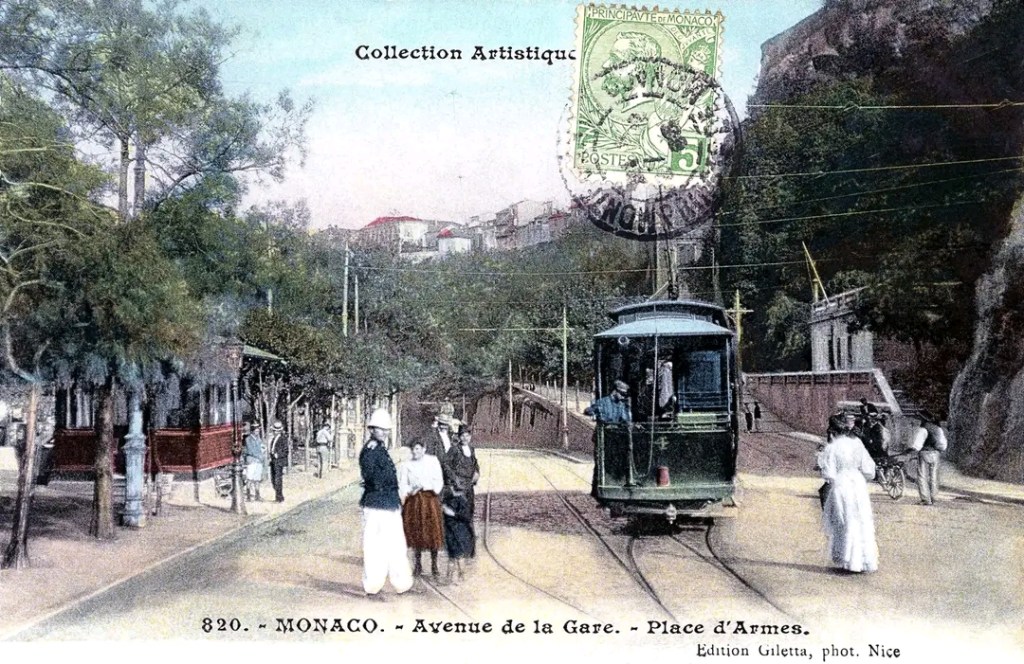
The junction of Avenue de la Gare with Place d’Armes looking towards the railway station. This image was shared by Jean-Paul Bascoul on the Monaco4Ever Facebook Group on 23rd June 2017. (Collection privée J-Paul Bascoul). [13]
A tram on Place d’Armes in the 1920s. This image was shared by Jean-Paul Bascoul on the Monaco4Ever Facebook Group on 20th June 2020. (Collection privée J-Paul Bascoul). [14]
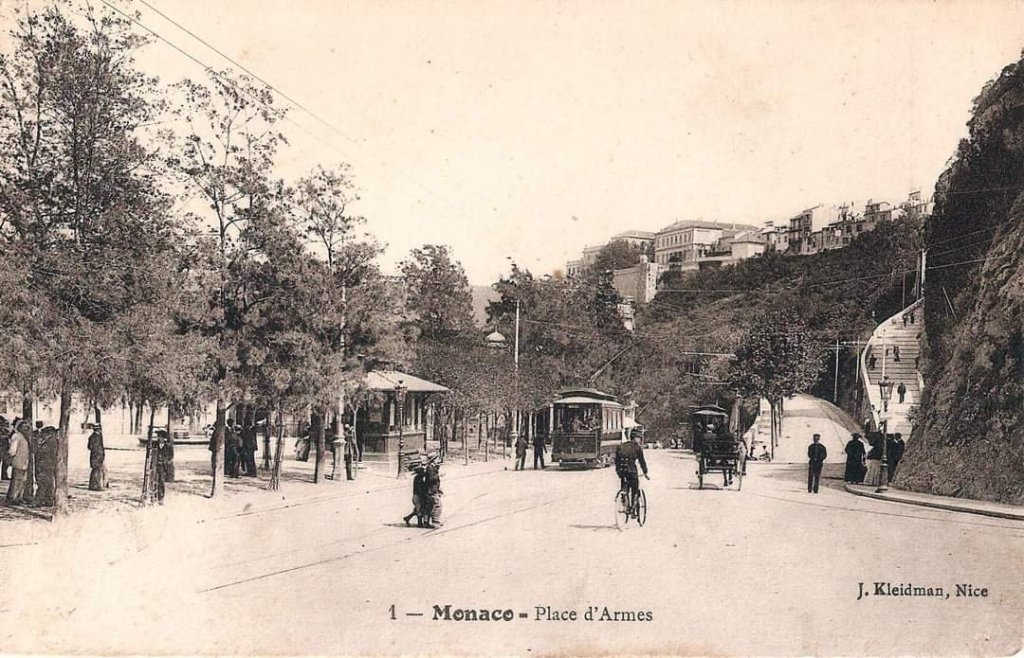
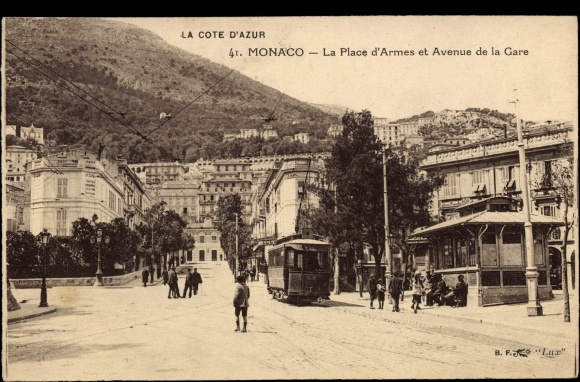
La Place d’Armes looking towards Monaco Railway Station which sits at the far end of Avenue de la Gare (now Avenue Prince Pierre). [12]
A colourised postcard view of the junction between Avenue de la Gare (now Avenue Prince Pierre) and Place d’Armes. [17]
Place d’Armes sat below the Palace of Monaco. It was the point at which trams from the railway station crossed the Nice to Monte-Carlo line and then headed up onto the rock. [16]
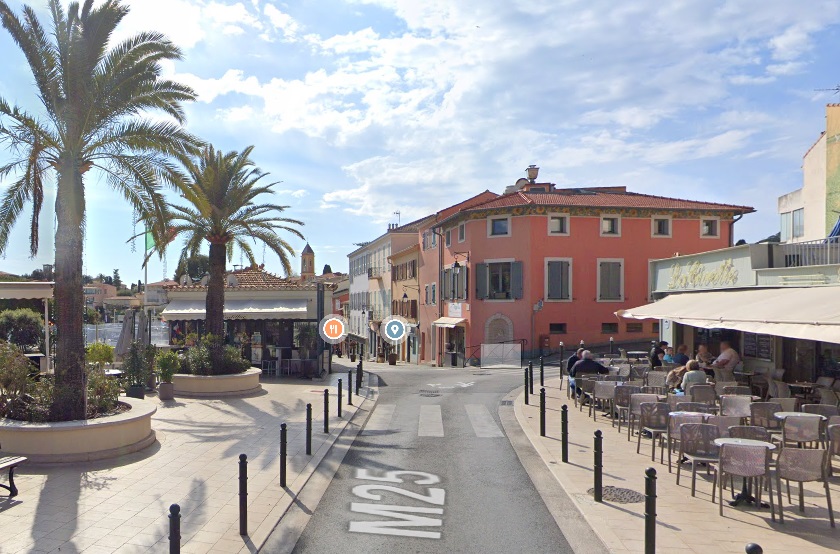
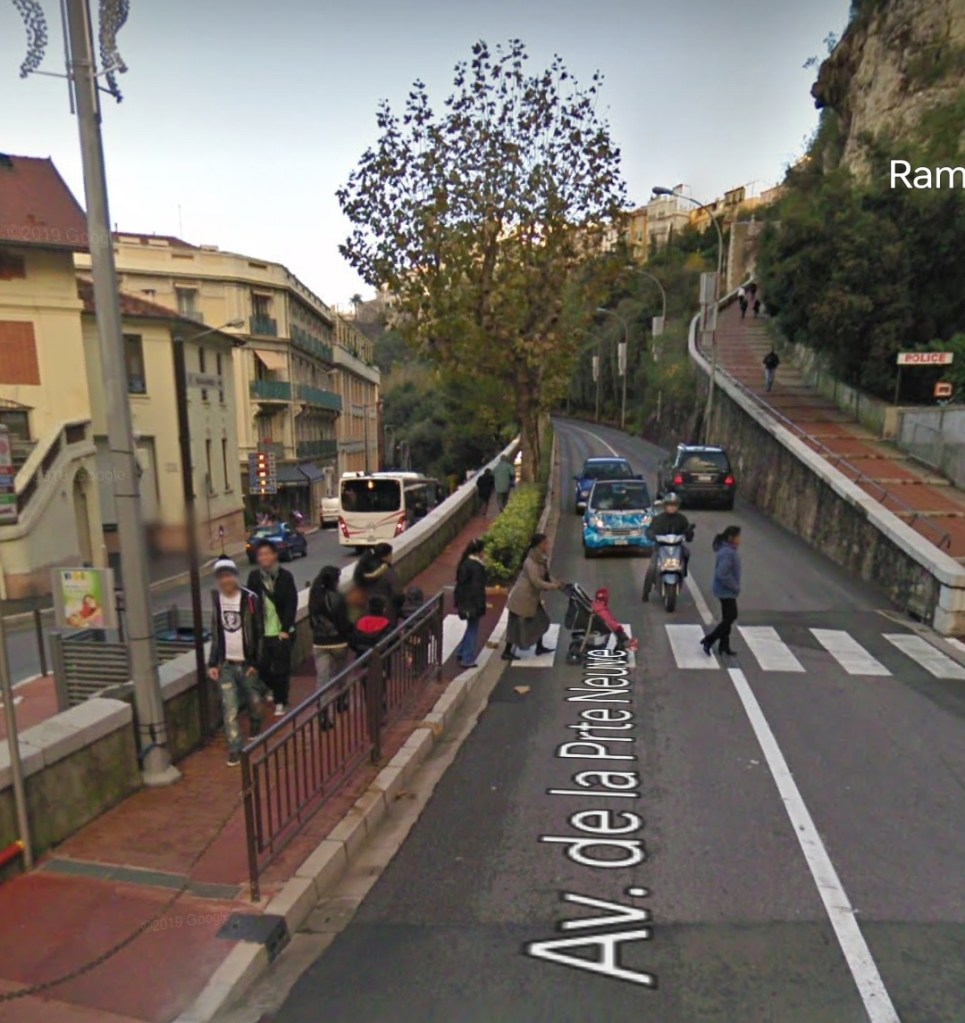
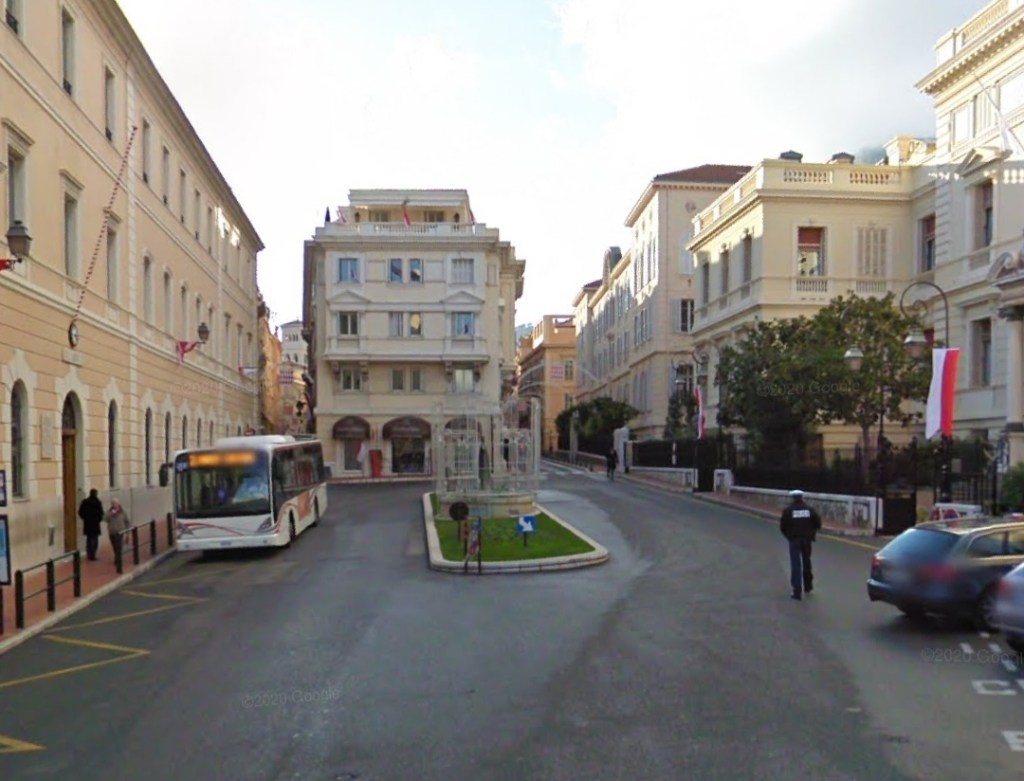
The tramway up onto the Rock followed Avenue de la Porte Neuve. The tramway to the casino (and on to Menton) followed the parallel Avenue du Port. [Google Streetview, 2011]
The tramway to the Casino and then on to Menton ran up the West side of the port. The tramway up onto the Rock via the Avenue de la Porte Neuve. [16]
The tramway turned from the Avenue de la Porte Neuve into the Avenue des Pins and heads to its terminus at Place de la Visitation. [16]
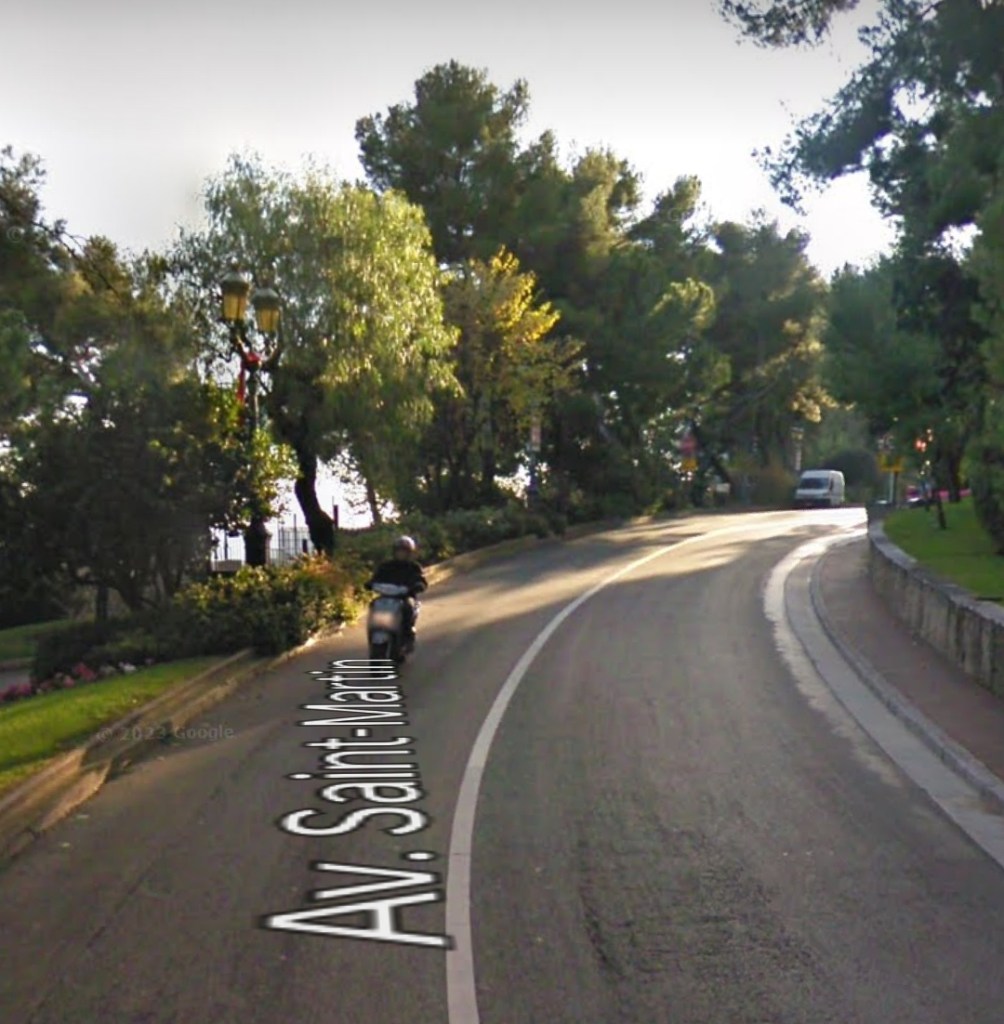
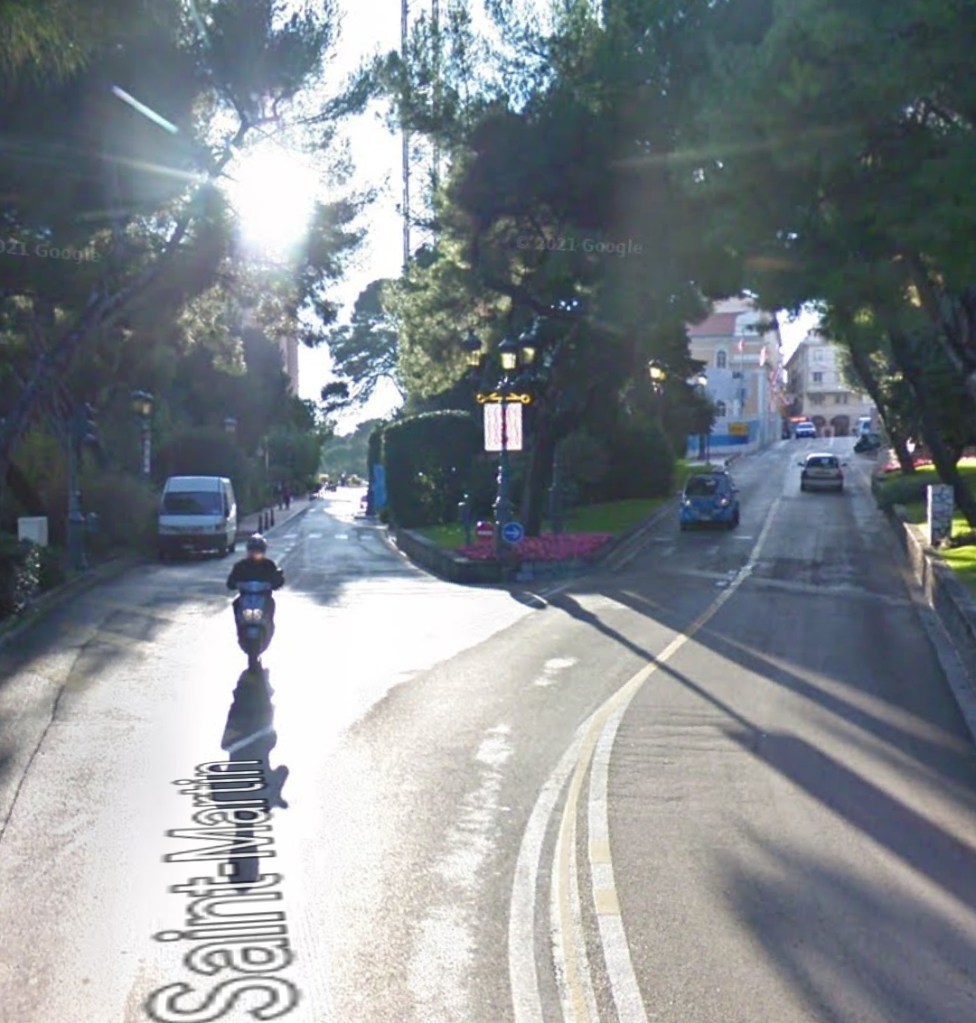
The tight curve of Avenue Saint-Martin leads round towards Avenue des Pins. [Google Streetview, 2011]
The tramway followed Avenue des Pins heading off to the right leading towards Place de la Visitation. [Google Streetview, 2011]
Place de la Visitation at the top of Avenue des Pins was the terminus of the tramway. [Google Streetview, 2011]

Images in this article accredited to Jean-Paul Bascoul come from his blog – Monaco4ever.blogspot.com.

References

  1. José Banaudo; Nice au fil du Tram, Volume 2: Les Hommes, Les Techniques; Les Editions de Cabri, Breil-sur-Roya, France, 2005.
  2. https://www.explorenicecotedazur.com/en/info/saint-jean-cap-ferrat-en, accessed on 11th November 2023.
  3. https://www.openstreetmap.org/#map=14/43.6881/7.3294, accessed on 11th November 2023.
  4. https://www.cparama.com/forum/saint-jean-cap-ferrat-t9821.html, accessed on 11th November 2023.
  5. https://m.facebook.com/groups/ciccoli/permalink/3325276507718195, accessed on 11th November 2023.
  6. https://m.facebook.com/groups/ciccoli/permalink/3372278223018023, accessed on 11th November 2023.
  7. https://m.facebook.com/groups/ciccoli/permalink/3745256885720153, accessed on 11th November 2023.
  8. https://m.facebook.com/groups/ciccoli/permalink/3132401830338998, accessed on 11th November 2023.
  9. https://m.facebook.com/groups/ciccoli/permalink/3325276507718195, accessed on 11th November 2023.
  10. https://theoldmapshop.com/products/1914-nice-south-of-france-town-plan-antique-baedeker-map-print-st-jean-cap-ferrat-villefranche-sur-mer, accessed on 12th November 2023.
  11. https://m.facebook.com/groups/1389253567814679/permalink/9801785099894775, accessed on 13th November 2023.
  12. https://www.akpool.fr/cartes-postales/24373465-carte-postale-monaco-la-cote-dazur-la-place-darmes-et-avenue-de-la-gare-strassenbahn, accessed on 13th November 2023.
  13. https://m.facebook.com/groups/1389253567814679/permalink/9397633530309936, accessed on 13th November 2023.
  14. https://www.facebook.com/groups/1389253567814679/permalink/5583715751701752/?app=fbl, accessed on 13thbNovember 2023
  15. https://www.facebook.com/groups/1389253567814679/permalink/9166981643375127/?app=fbl, accessed on 13th November 2023.
  16. http://www.vidiani.com/maps/maps_of_europe/maps_of_monaco/large_detailed_old_map_of_Monaco_Monte_Carlo_1921.jpg, accessed on 13th November 2023.
  17. https://www.facebook.com/groups/1389253567814679/permalink/8938416852898275/?app=fbl, accessed on 13th November 2023.
  18. https://www.facebook.com/groups/1389253567814679/permalink/8938416852898275/?app=fbl, accessed on 13th November 2023.
  19. https://www.monaco-tribune.com/2023/02/un-decor-de-carte-postale-la-gare-de-monaco-monte-carlo, accessed on 13th November 2023.
La Ligne du Littoral et ses Antennes, First Generation Electric Tramways – Nice-Monte Carlo (Chemins de Fer de Provence/Alpes-Maritimes No. 91) …

The line between Nice and Monte Carlo opened in a series of stages. First from Monaco to Place d’Armes in Monte Carlo on 14th May 1898; then from Place Massena in Nice to Villefranche, on 1st February 1900; Villefranche to Beaulieu on 3rd November 1900; TNL trams were permitted to run on Monaco’s tramways from 28th May 1903; and the remaining length, Beaulieu to Monaco Place d’Armes opened on 7th November 1903. Over the next few years some single track lengths were doubled.

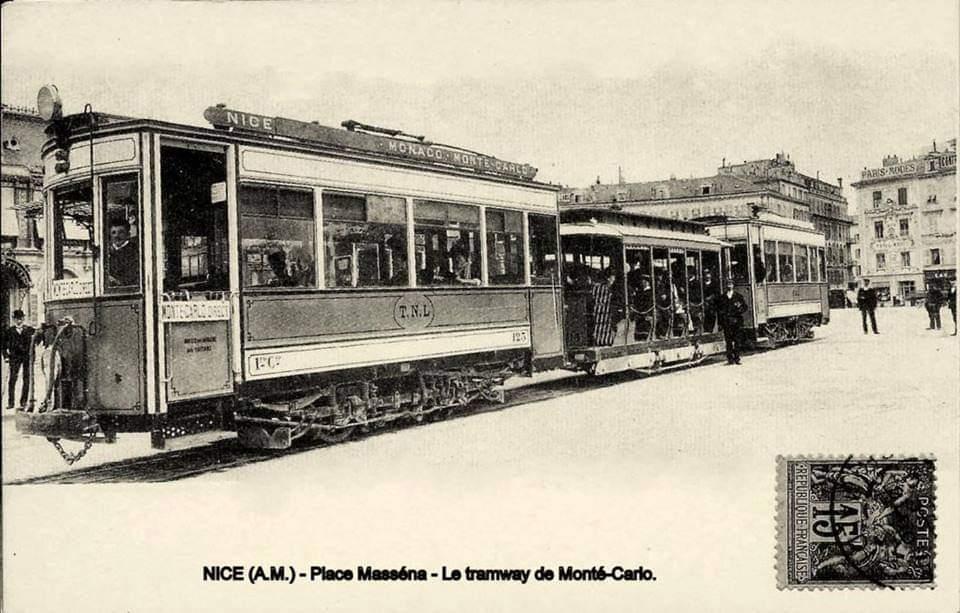
Trams for Monte Carlo began their journey in Nice a Place Massena. This postcard image was shared on the Comte de Nice et son Histoire Facebook Group by Roland Ciccoli on 10th March 2016. [34]

Trams to Villefranche, Beaulieu and Monte-Carlo left the TNL station at Place Masséna and entered Rue Gioffredo sharing the double track with the urban lines to Gendarmerie and St. Pons.  At Rue Defly, the route branched off to the right to cross the River Paillon to Place Garibaldi. The right bank lines to the Boulevard du Pont-Vieux and Abattoirs were crossed there. The line then ran along Rue Cassini to Place Cassini (today Ile-de-Beauté) where several urban lines serving the port terminated.

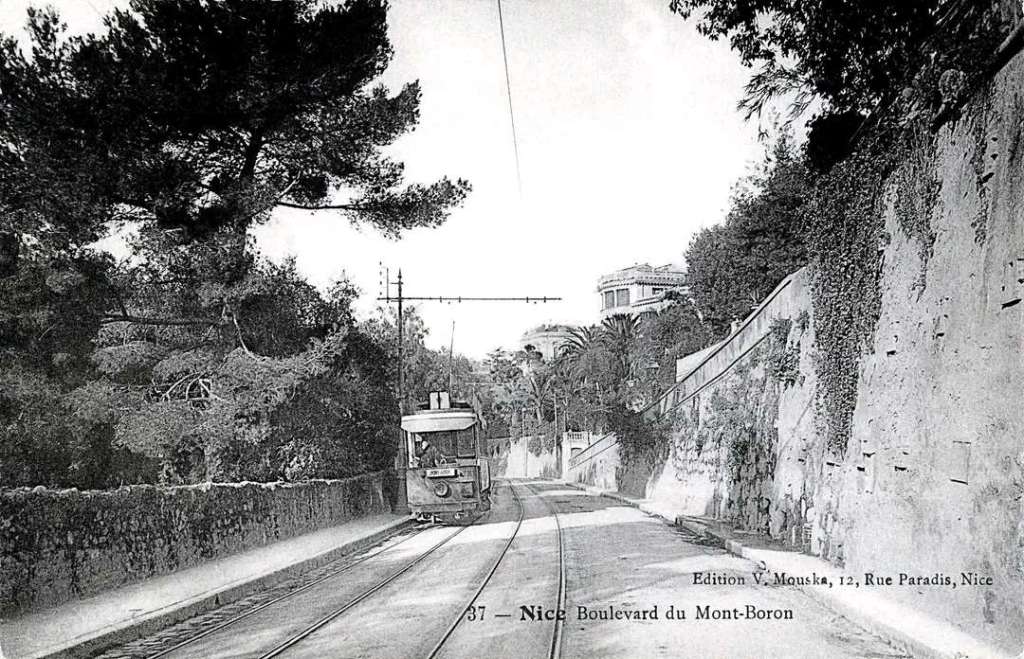
After leaving the port, trams headed towards Papacino and Deux-Emmanuel quays. With the Riquier line heading up Rue Arson, the Monte-Carlo trams began a steep climb along Boulevard Carnot on the western slope of Mont Boron.  

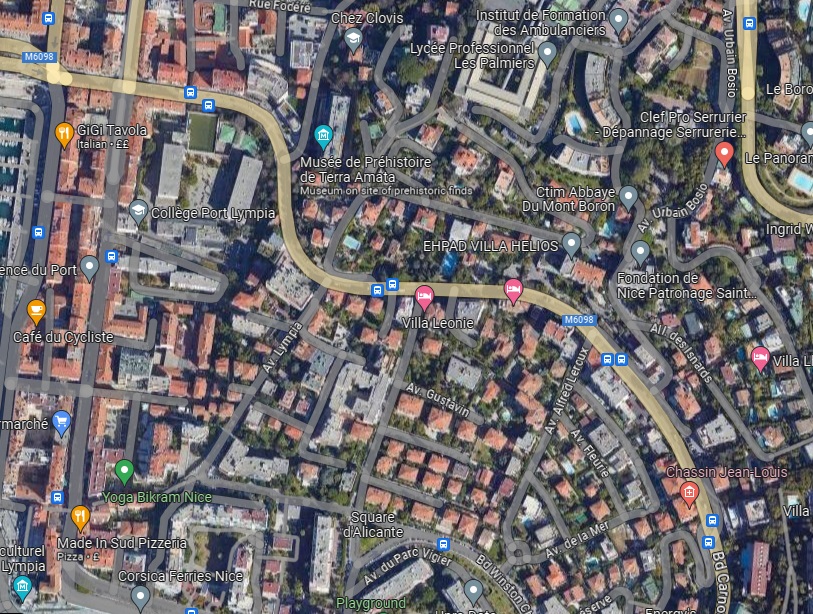
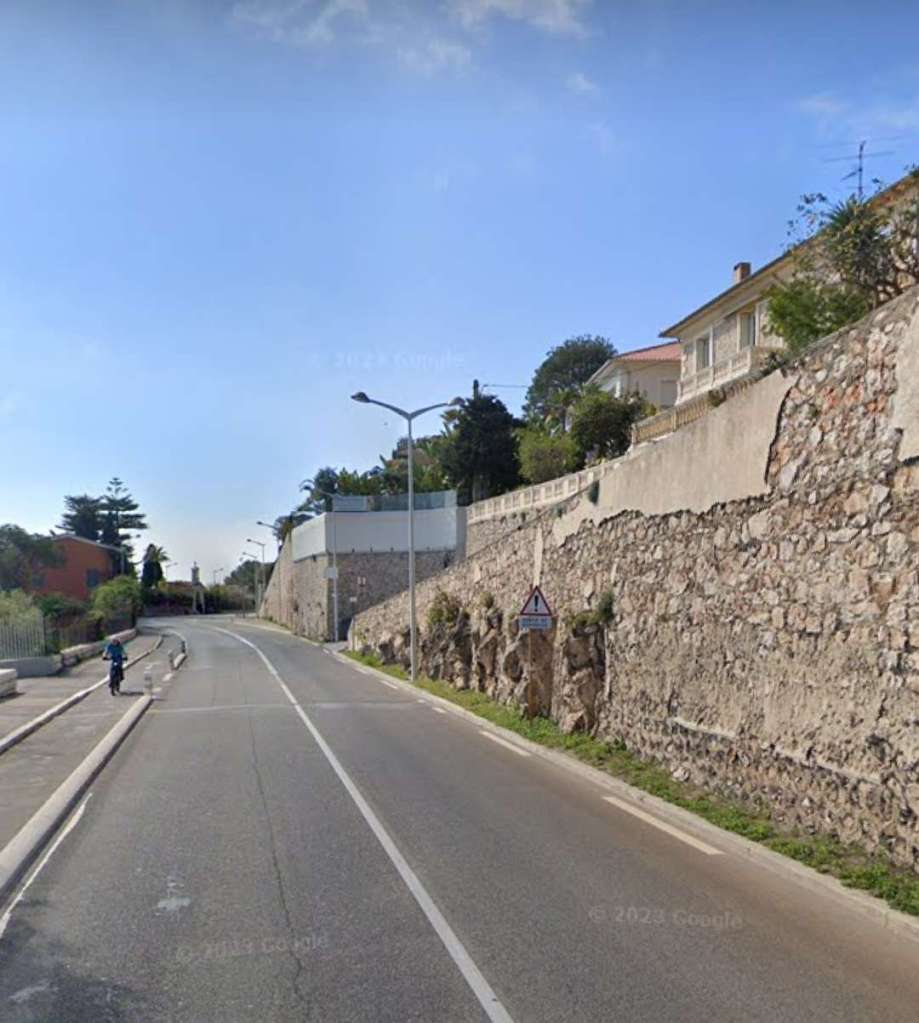
Boulevard Carnot leaves the Port area of Nice and winds its way up the western side of Mont Boron. Trams followed this road towards Monte Carlo. [Google Maps, October 2023]
Much the same location in 2022 as shown in the postcard above. [Google Streetview, October 2022]
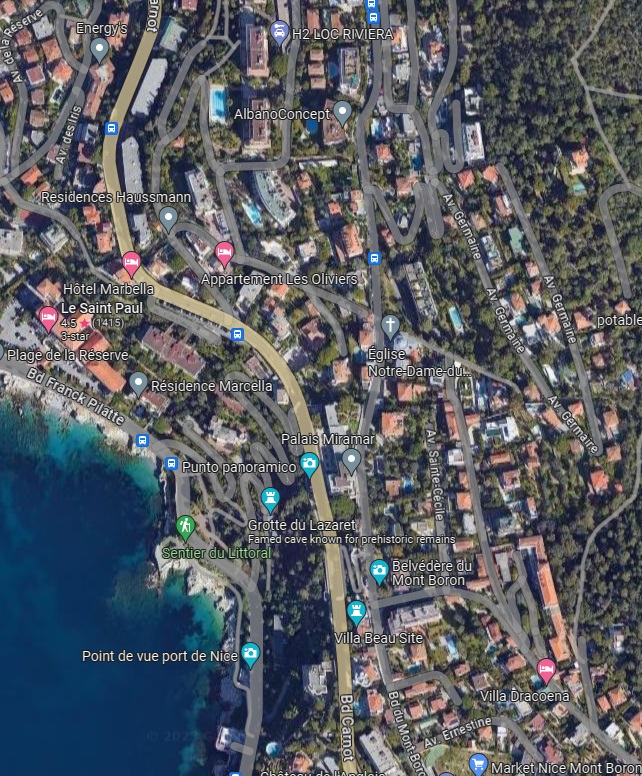
Boulevard Carnot continues South along the western side of Mont Boron. [Google Maps, October 2023]
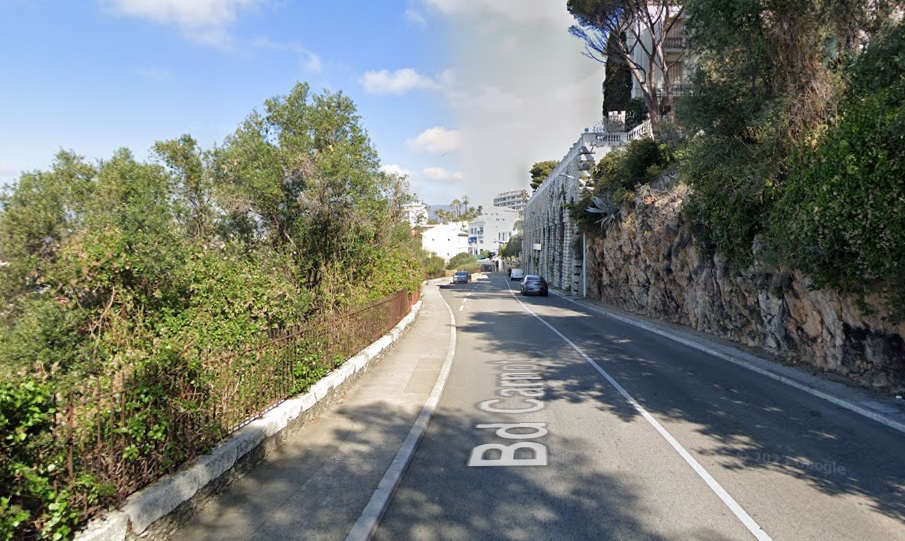
A similar view North along Boulevard Carnot in 2023. The retaining wall on the right of the road fixes the location. [Google Streetview, March 2023]
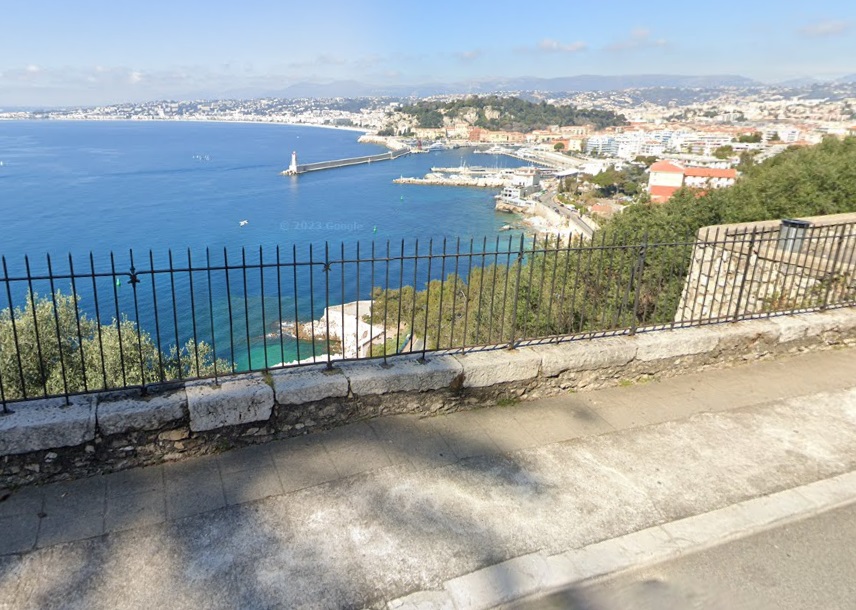
A view across Nice in March 2023 from the approximate location of the tram in the monochrome image above. [Google Streetview, March 2023]
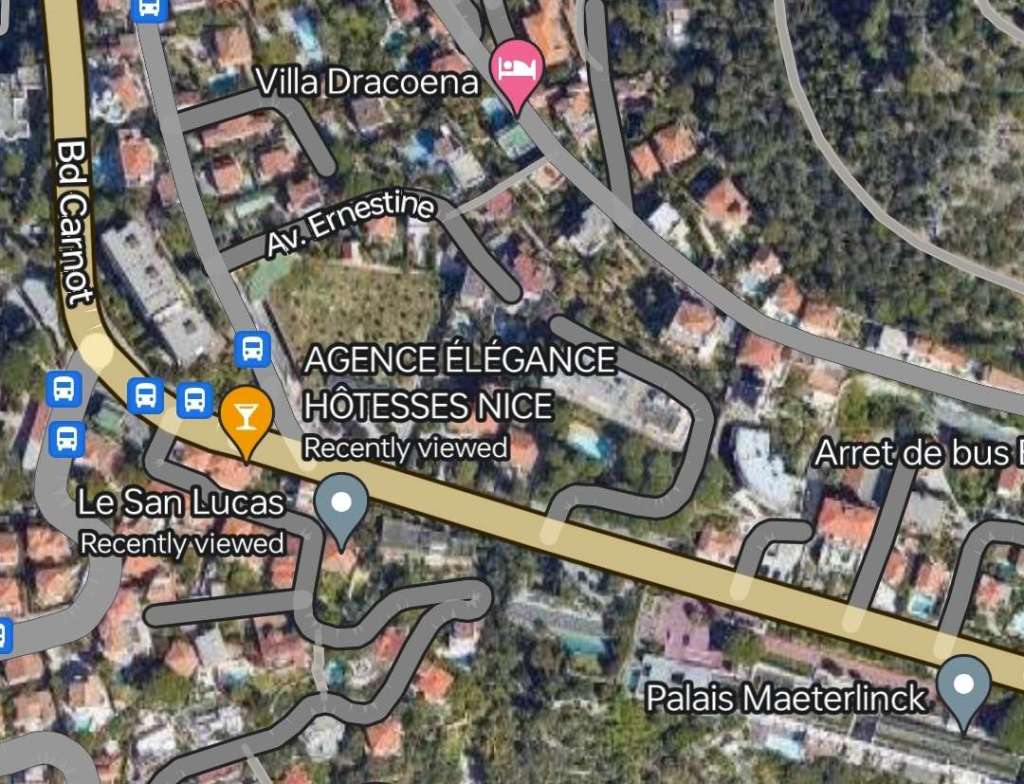
Boulevard Carnot and Boulvard Maurice Maeterlinck. [Google Maps, October 2023]
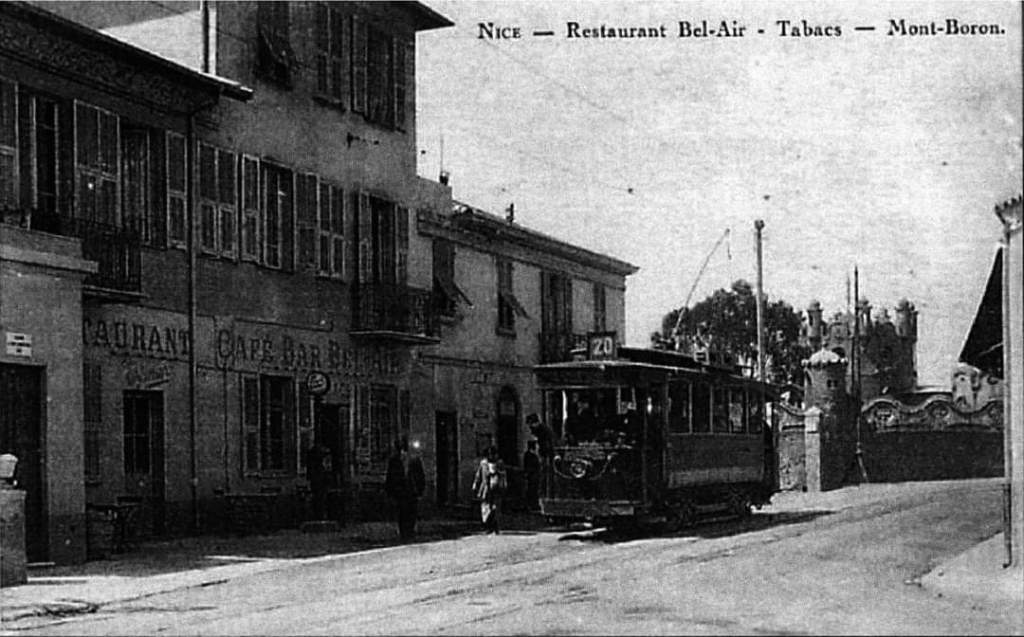
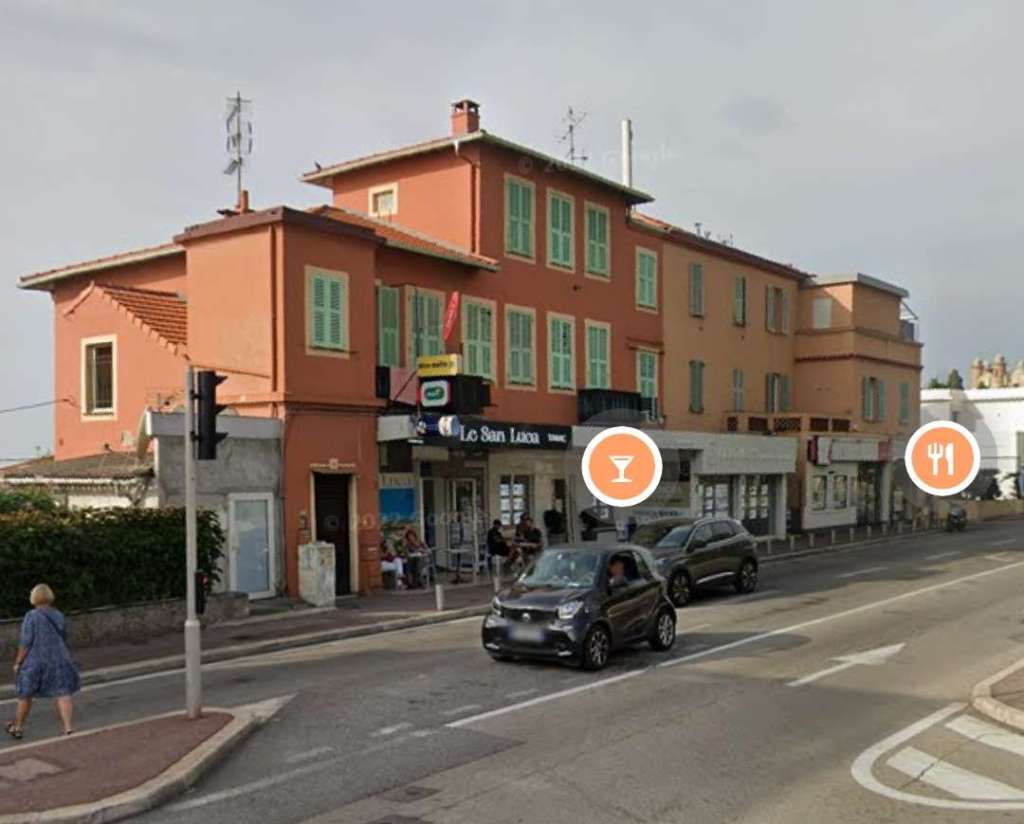
The tram in front of the restaurant Bel-Air – Tabacs (today’s Bar-Tabacs San Luca). The restaurant was at the beginning of Boulevard Maurice Maeterlinck, © Yves Nissart Premier. This image was shared on the Comte de Nice et son Histoire Facebook Group by Pierre Richert and Roland Coccoli in June 2023. [3]
The same location in 2022. [Google Streetview, October 2022]
Boulevard Maeterlinck close to Boulevard Carnot. Note the tram tracks in the road surface. © Yves Nissart Premier. This image was shared on the Comte de Nice et son Histoire Facebook Group by Pierre Richert and Roland Coccoli in June 2023. [3]
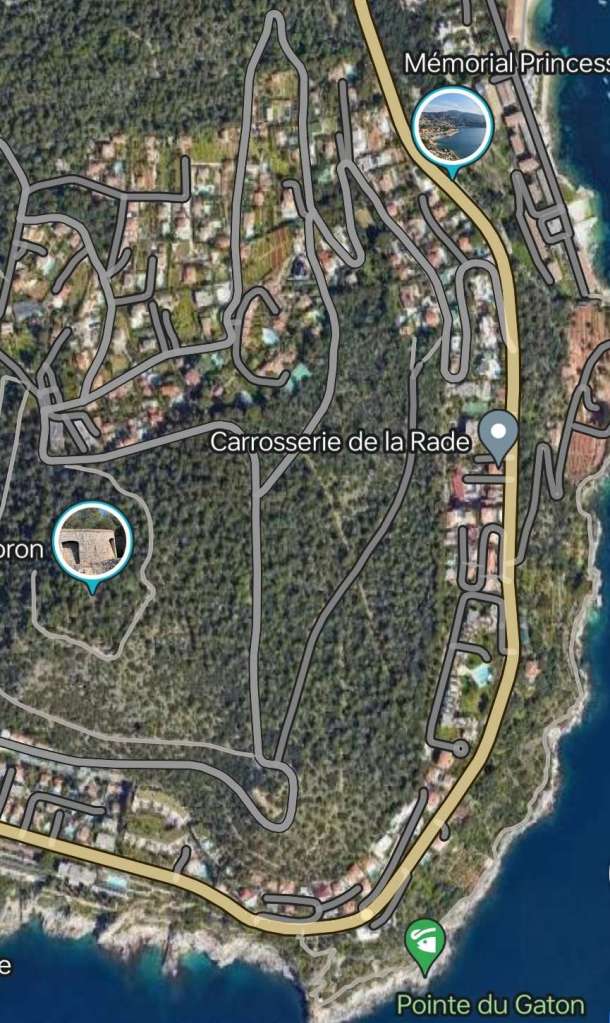
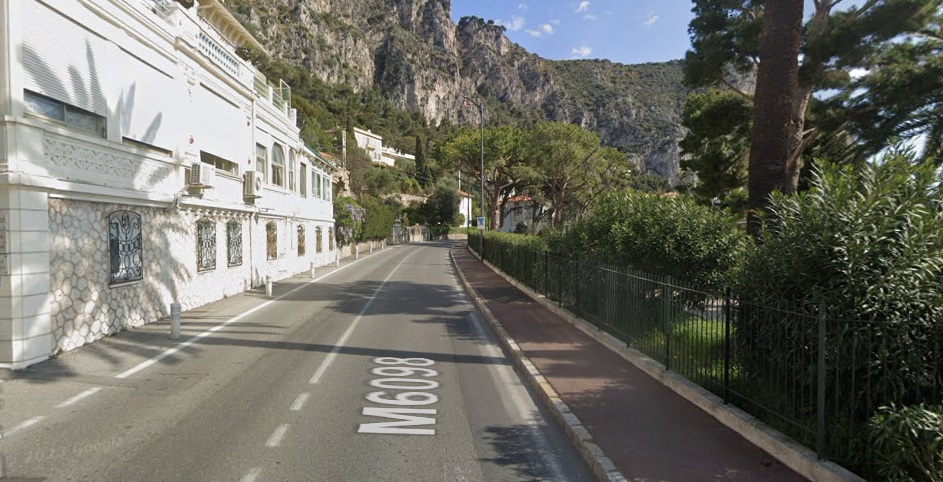
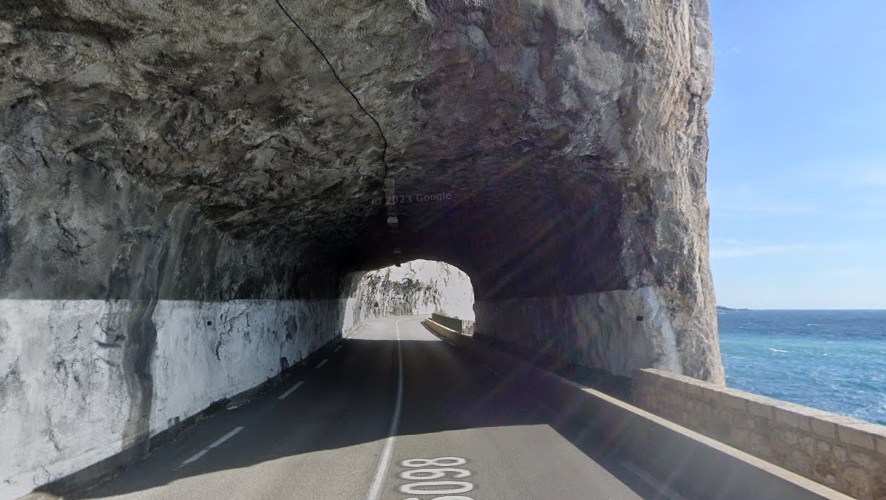
The tramway followed what was the RN7 (today’s M6098) towards Villefranche-sur-Mer. [Google Maps, October 2023]
A tram on Boulevard du Mont Boron (today’s Boulvard Princess Grace de Monaco) This image was shared on the Comte de Nice et son Histoire Facebook Group on 19th June 2016 by Jean-Paul Bascoul. The tram is a T2 powered car providing an extended urban service as far as l’Octroi du Mont-Boron on the Monte-Carlo line, [5]
The same location in 2023. [Google Streetview, March 2023]
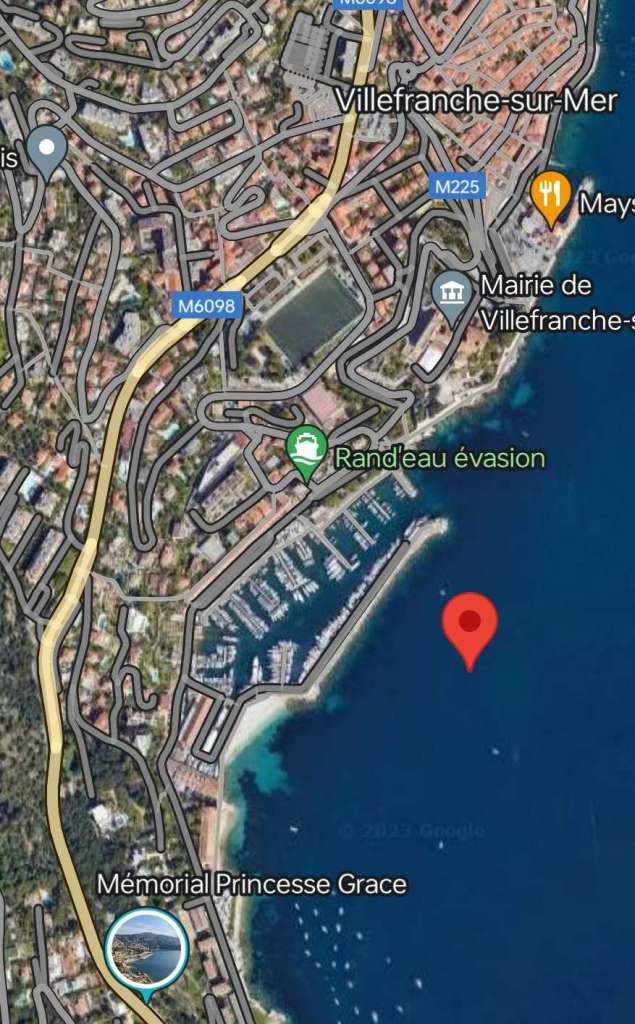
The route of the tramway down into Villefranche. [Google Maps, October 2023]
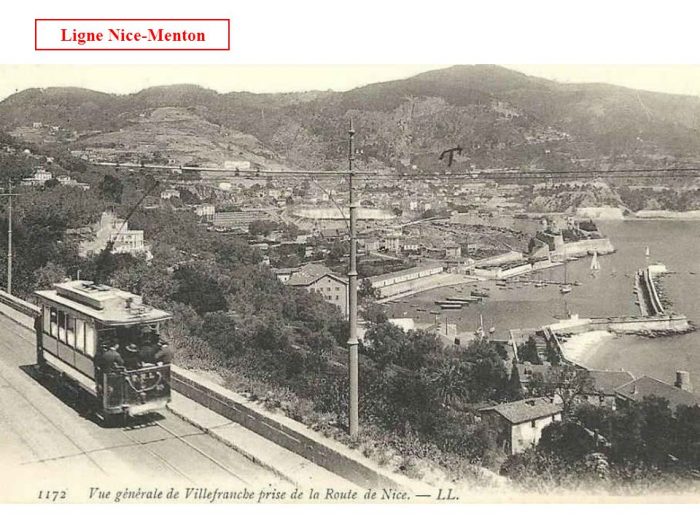
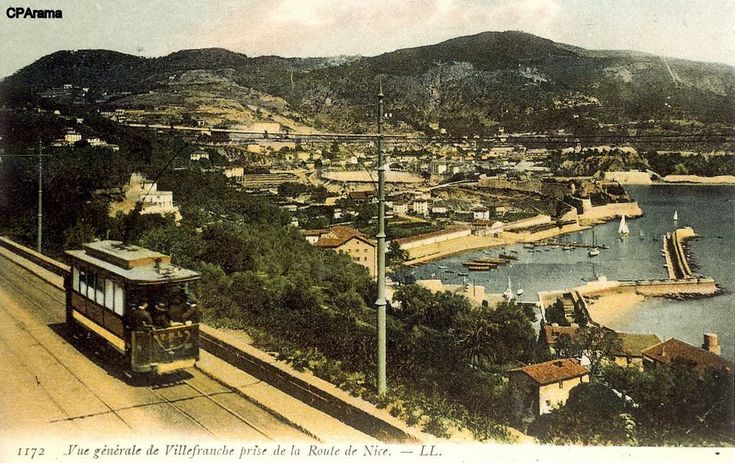
A tram approaching Villefranche on a service from Nice. The harbour is visible to the right of the picture. The town can be seen in the centre of the image. [6]
The same view, colourised, [7]
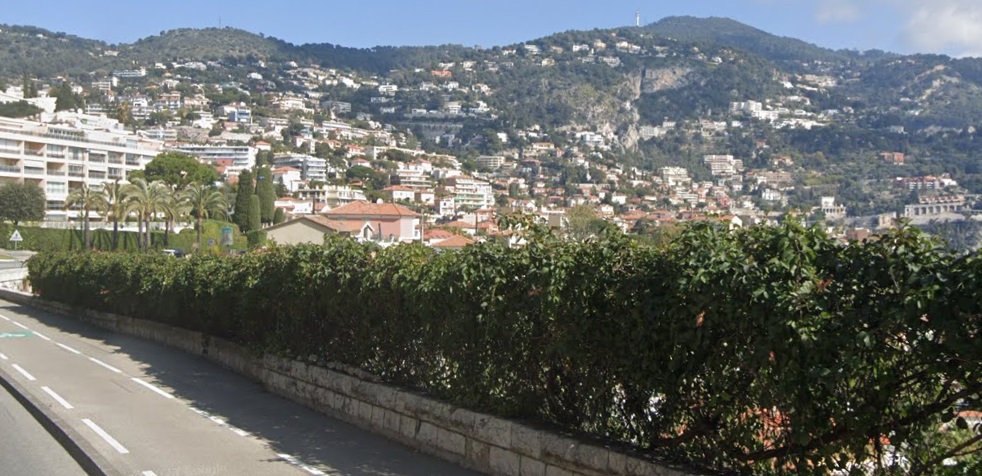
Approximately the same location in the 21st century. [Google Streetview, March 2023]
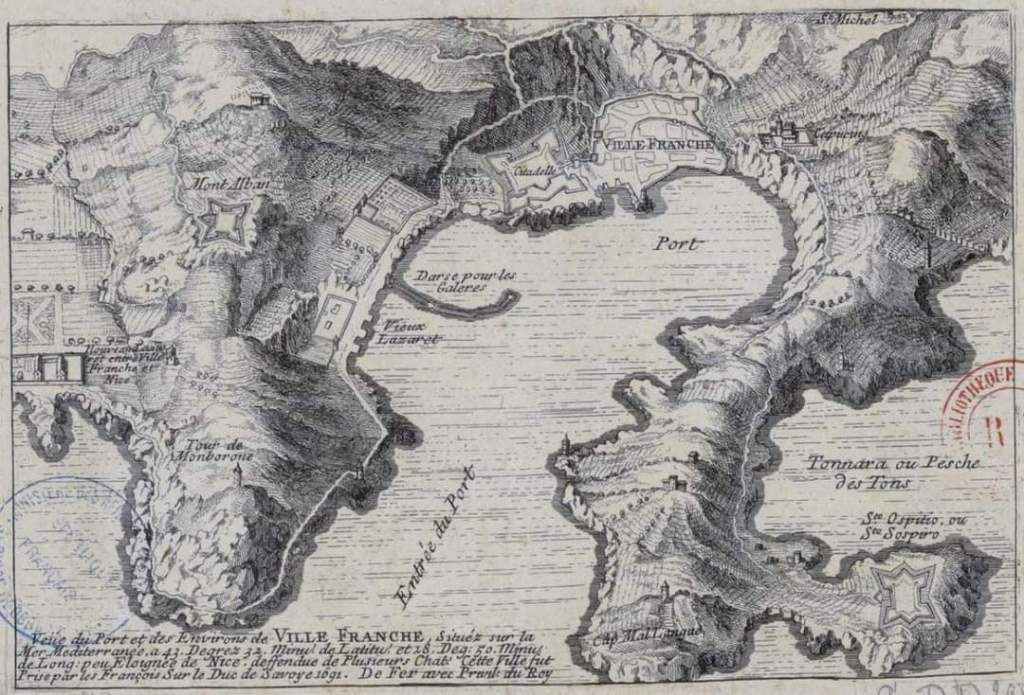
An early map of Villefranche-sur-Mer with Mont Boron on the left of the image and St. John Cap Ferrat on the right. (1699 by De Fer). [4]
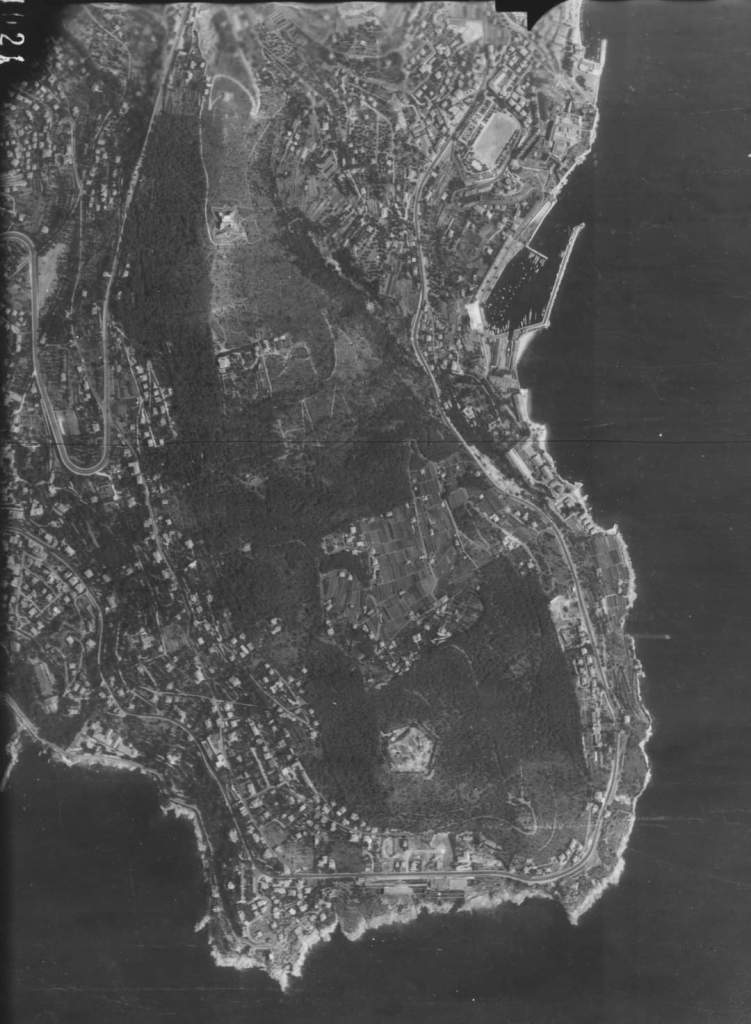
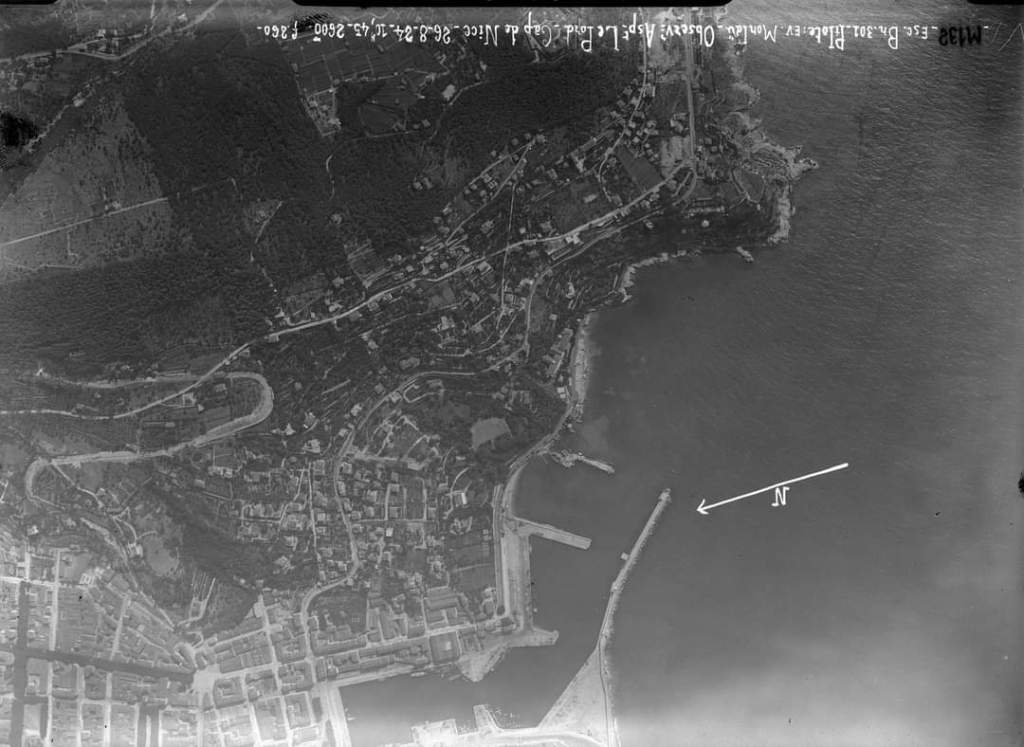
Mont Boron and the route to Villefranche-sur-Mer as seen on an IGN aerial photograph of 1943. [4]
An IGN aerial view of 1924 with the Moyenne Corniche under construction. Both this and the image above were shared by Pierre Richert on the Comte de Nice et son Histoire Facebook Group on 1st October 2022. [4]

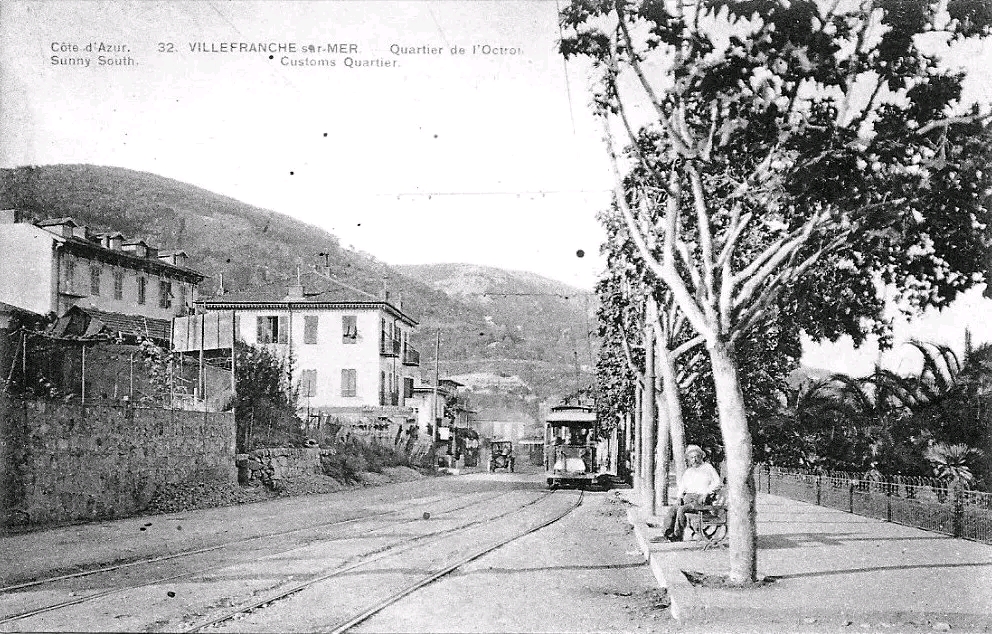
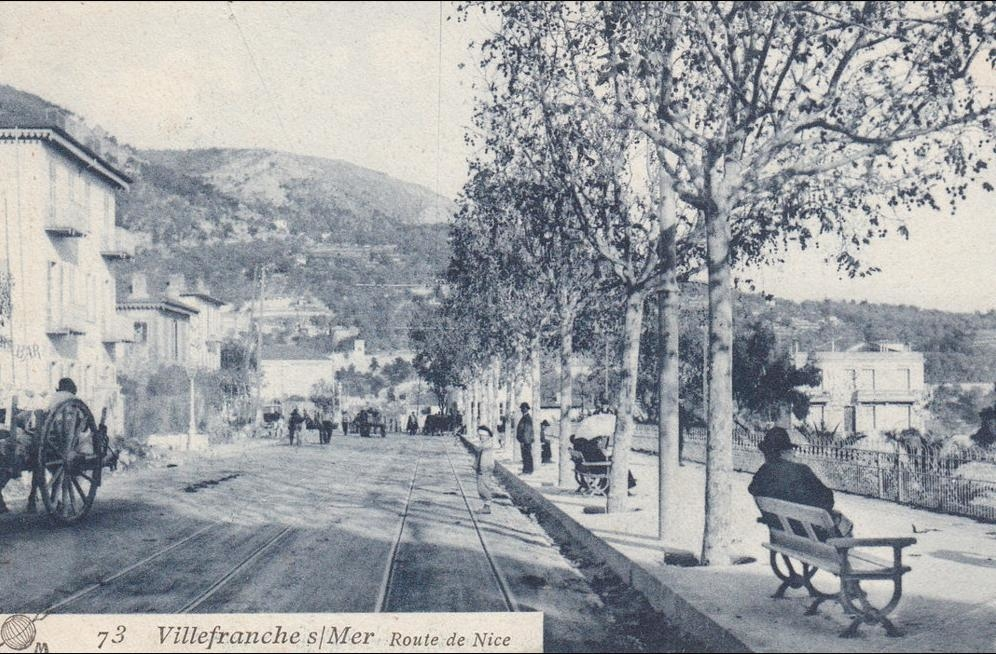
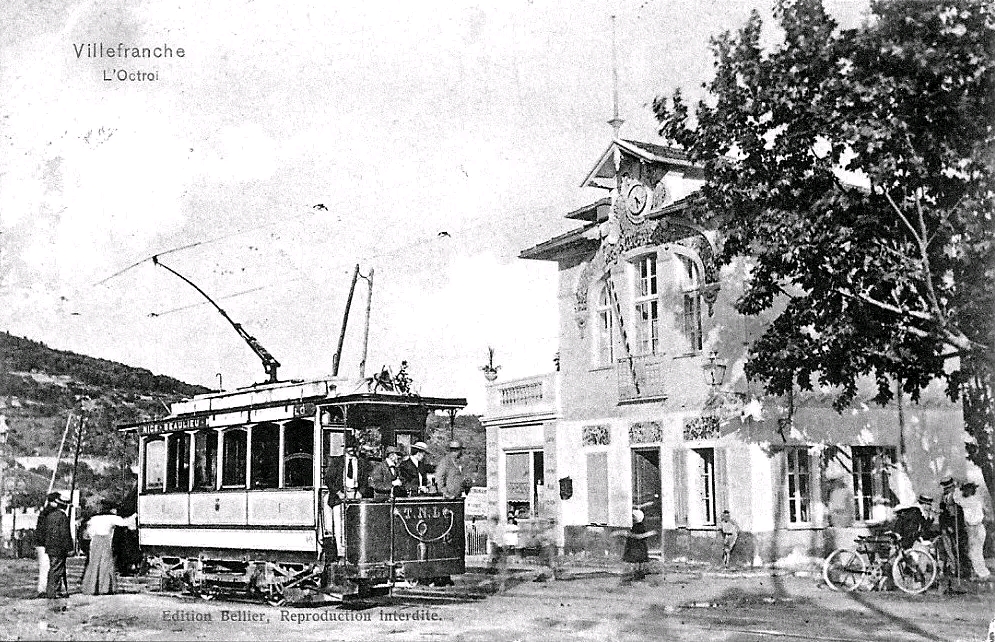
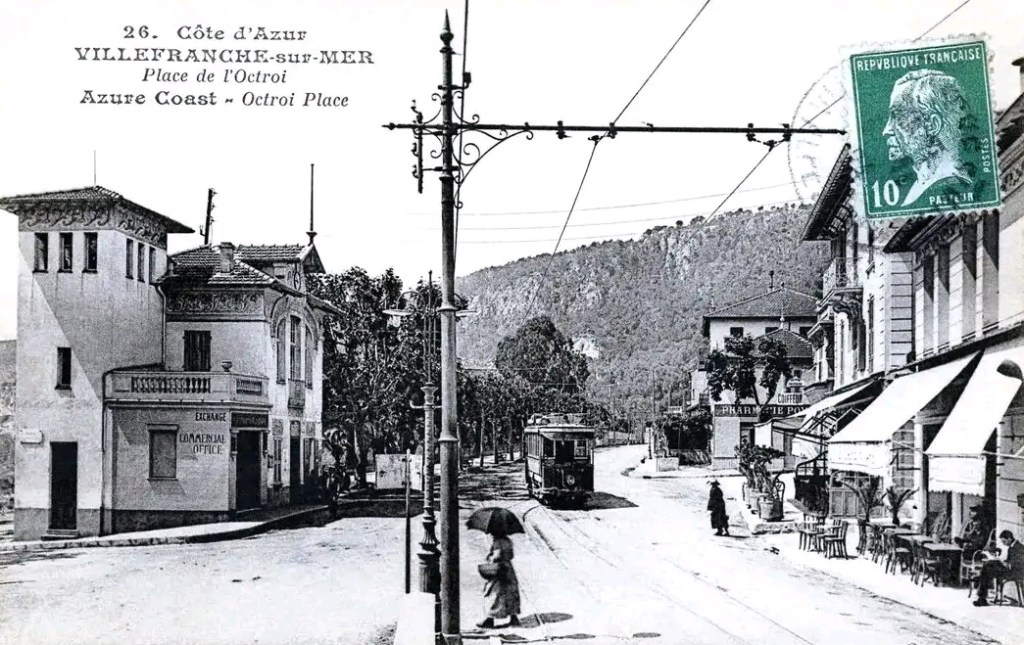
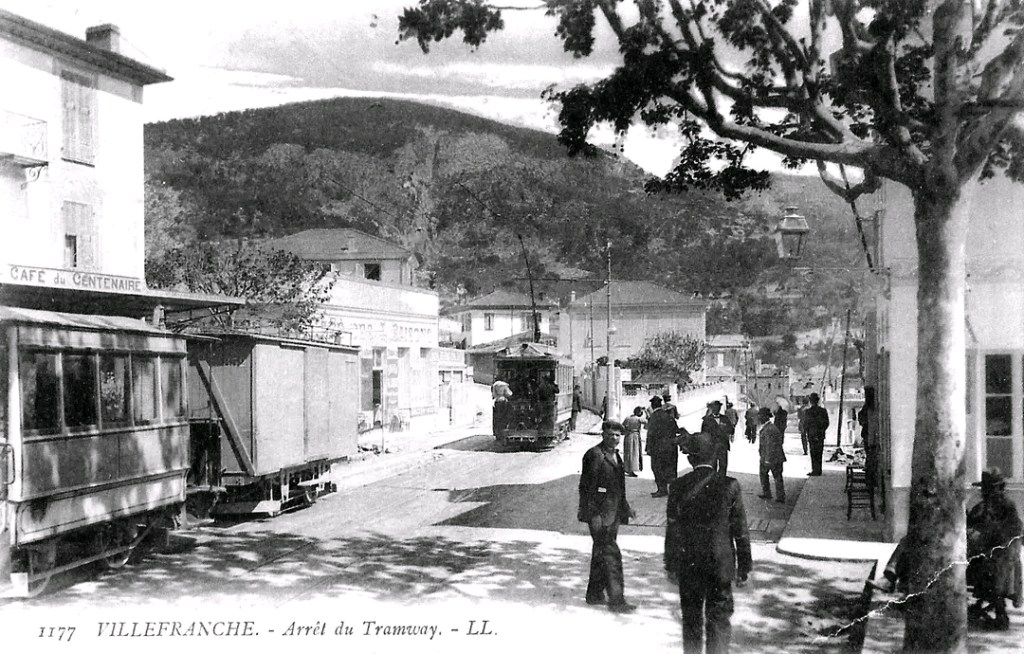
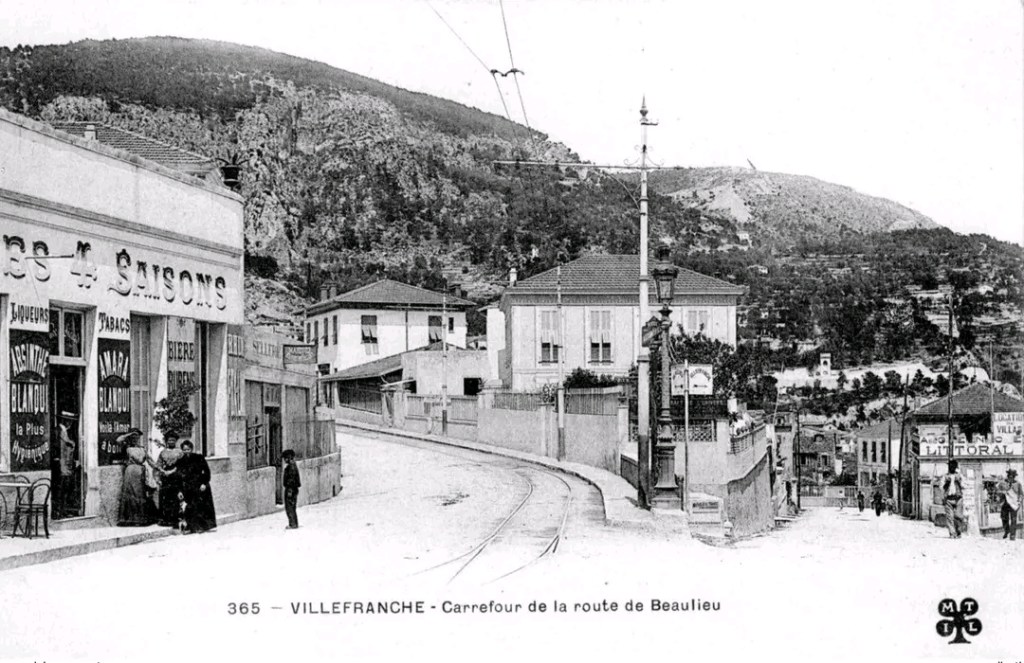
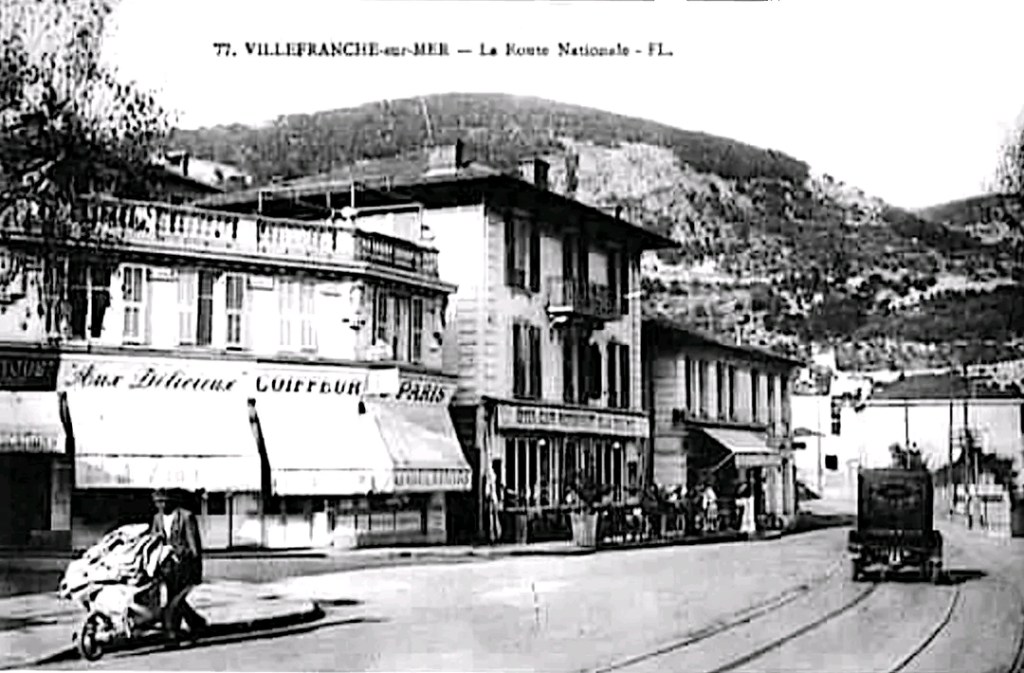
Trams then headed down into Villefranche, which Banaudo reminds us, was the “military port of the House of Savoy and always a popular stopover for cruise and warships.  The tramway passed above the dock and the citadel, … crossed ‘l’octroi’ and reached the Villefranche station located in the upper part of the town.” [1: p41]  ‘L’octroi’ was the point where visas were granted and taxes were collected. According to the “Petit Robert de la Langue Française,” an ‘octroi’ was, historically, an “indirect contribution collected by a municipality on goods for local consumption (entrance fees).” [2]

This is the first of a sequence of 5 postcard views shared on the Comte de Nice et son Histoire Facebook Group by Alain Nissim on 10th July 2023, which show the approach to Villefranche and it’s customs house (l’Octroi), the entrance to the old town and the first 100 metres or so, of the RN7 heading East. [13]
A little closer to Villefranche. [20]
The approach to l’Octroi from Nice with a tram standing in front of the building. [13]
Looking towards Nice, this view shows the Place de l’Octroi. The building on the left is l’Octroi, the road to the old town leaves past the photographer on the left of the picture. The RN7 and the tram route leave bottom-right. [13]
Looking towards Beaulieu and Monte Carlo, the RN7 curves away from the tram stop in Villefranche. The road to the old town drops away to the right. [13]
A closer view of the junction. [13]
Turning a little to the left from the last image. [13]
This picture shows approximately the same location as the last three monochrome images above. [Google Streetview, March 2023]

At Villefranche station, according to Banaudo, “certain partial services had their terminus and a particular branch served a building materials warehouse, (un entrepot de materiaux de construction).” [1: p40]

Villefranche-sur-mer again. The road shown pale yellow on this image is the route of the old tramway. [Google Maps, October 2023]
St. Jean-Cap-Ferrat runs south from the bottom of this image, which shows Beaulieu-sur-mer. The road shown pale yellow on this image is the route of the old tramway. Beaulieu’s port is top-right. [Google Maps, October 2023]
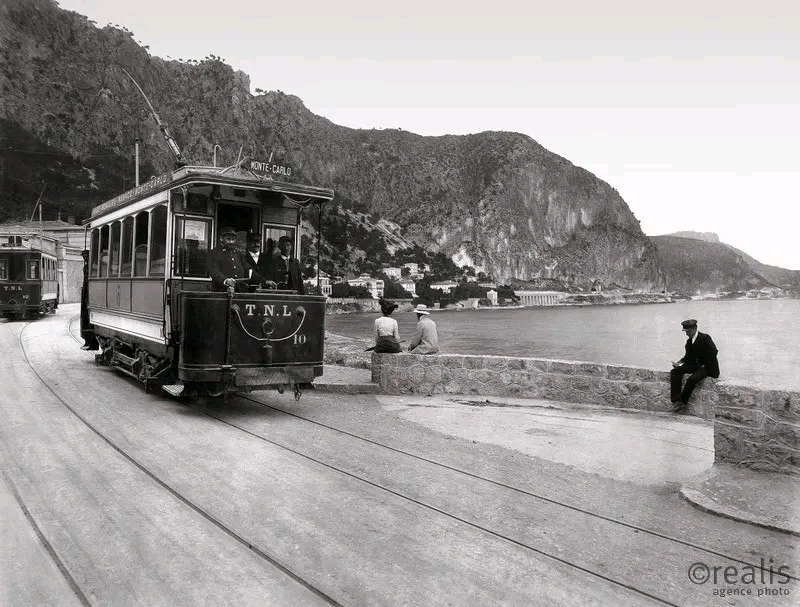
Thomson TNL tram Nº 10 heads East from Villefranche towards Beaulieu, with the Mont Alban fort in the background. [8]
Approximately the same location in the 21st century. [Google Streetview, May 2023]

To accommodate the trams, the RN7, the Basse Corniche, was widened using large retaining walls. The tramway, “skirted the bottom of Villefranche harbour and approached the base of Cap Ferrat. ” [1: p41]

The tramway junction where trams for St. Jean Cap Ferrat left the line to Monte Carlo. [12]
The same locatiuon in the 21st century. [Google Streetview, October 2022]

At the Pont-St. Jean, where the St. Jean-Cap-Ferrat branch turned away, [trams] arrived in the town of Beaulieu, where a centuries-old olive tree marked the entrance adjacent to l’octroi pavilion.  Following modifications made during the First World War, the double track ended … shortly after [l’Octroi] stop.  Crossing Beaulieu, the line followed Boulevard Félix-Faure (today Maréchal-Joffre), passed under the PLM Nice – Ventimiglia artery near the station then went down towards the seaside where it ran alongside the town hall,  the church and the port.” [1: p41]

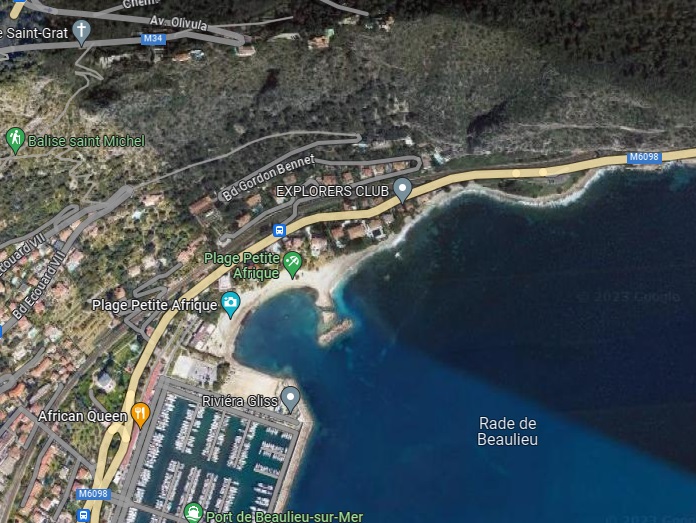
The old tramway continued to follow the Basse Corniche through Petite Afrique and on twards Cap Roux. [Google Maps, October 2023]
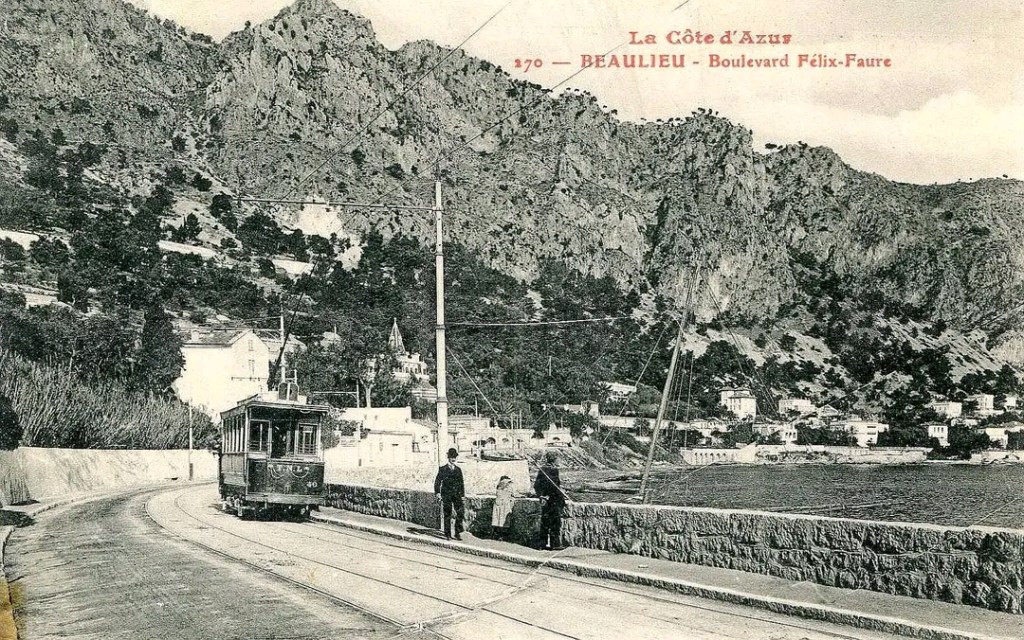
Beaulieu-sur-mer, Boulevard Felix-Faure. This photo was shared on the Comte de Nice et son Histoire Facebook Group on 4th October 2019 by Laurant Mannu. [11]
Beaulieu-sur-mer, la Petite Afrique in 1903. This image was shared on the Comte de Nice et son Histoire Facebook Group by Roland Coccoli on 31st March 2017. [10]
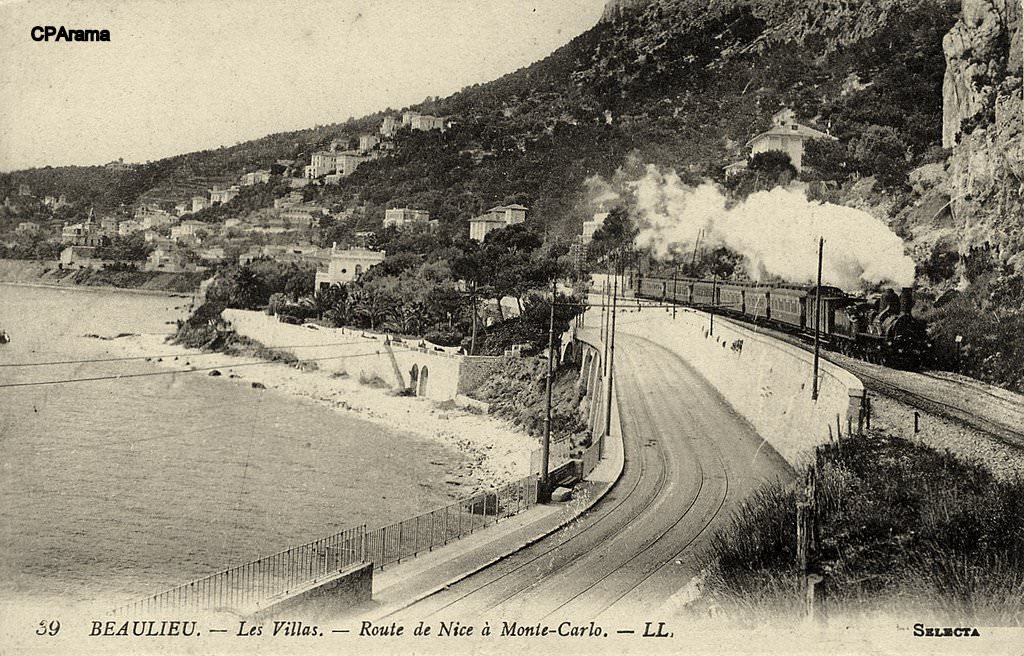
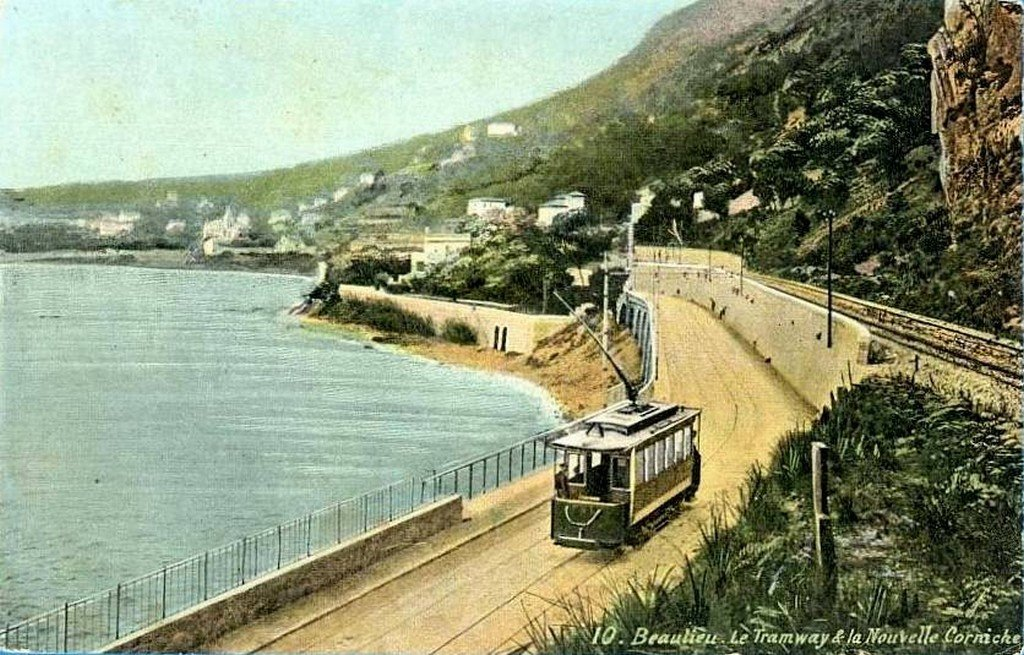
Looking East along the promenade in Beaulieu-sur-mer. East of Beaulieu the line heading to Monte Carlo faced significant obstacles. Cliffs falling directly down to the water’s edge required significant civil engineering works to widen the Basse Corniche to make room for vehicles and the tramway. [9]
A similar location to the view shown in the monochrome image immediately above. [Google Streetview, April 2023]
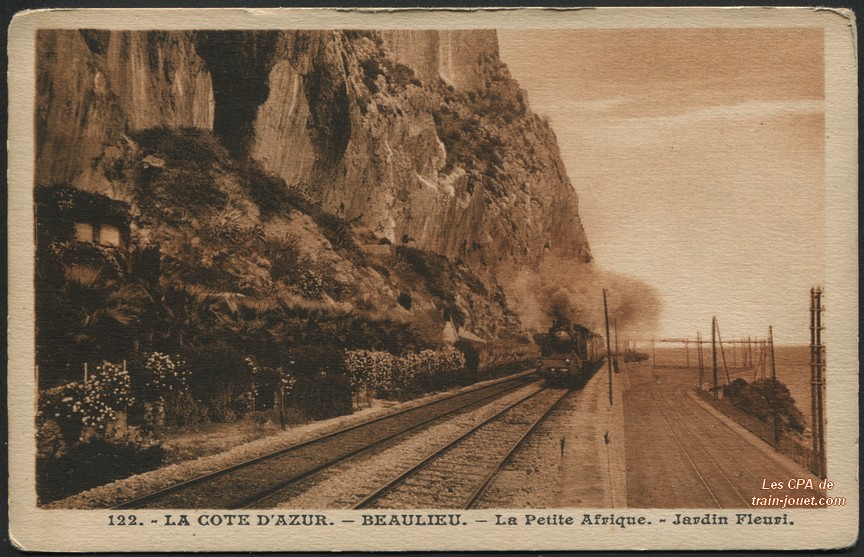
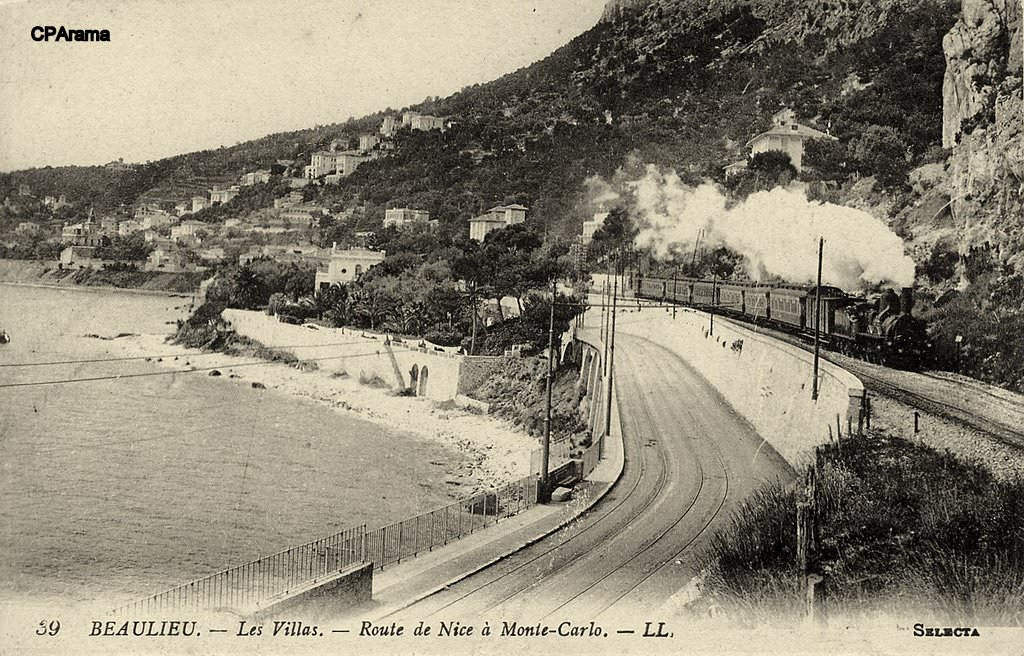
The Basse Corniche ran below the PLM railway through Petite Afrique. [26]
A similar view in the 21st century to the sepia postcard image above. [Google Streetview, April 2023]
Looking back West towards Beaulieu. [22]
This colourised postcard view was taken at almost the same location as the image above. [25]

Leaving the town, a siding at the foot of the railway embankment constituted an intermediate terminus in the residential district of ‘Petit Afrique’, “where,” Banaudo tells us, “a micro-climate favours the blossoming of luxuriant vegetation among Moorish and exotic villas.” [1: p41]

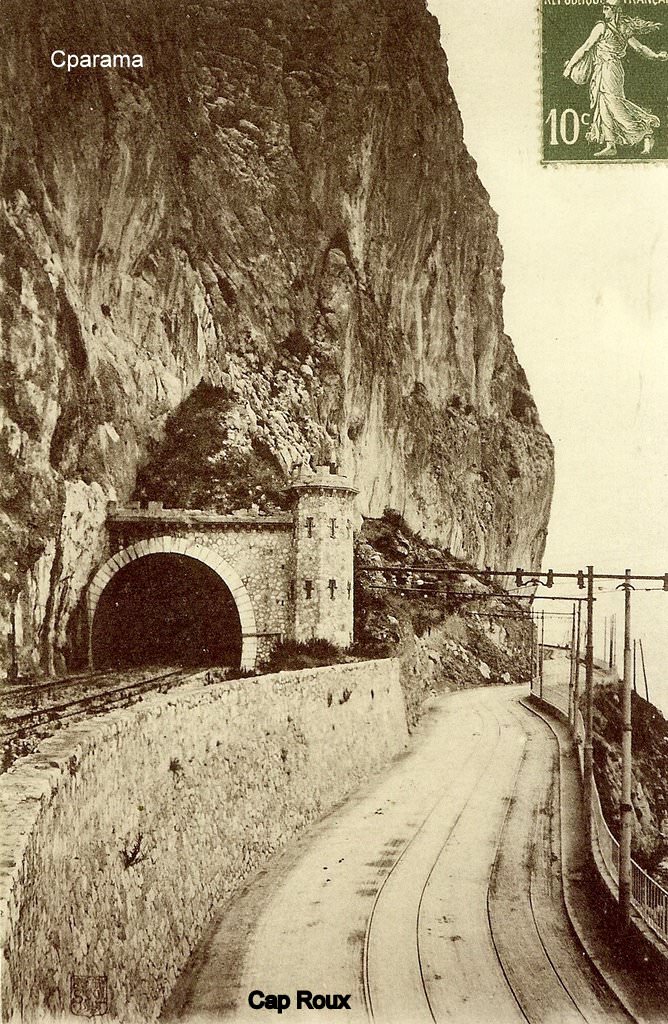
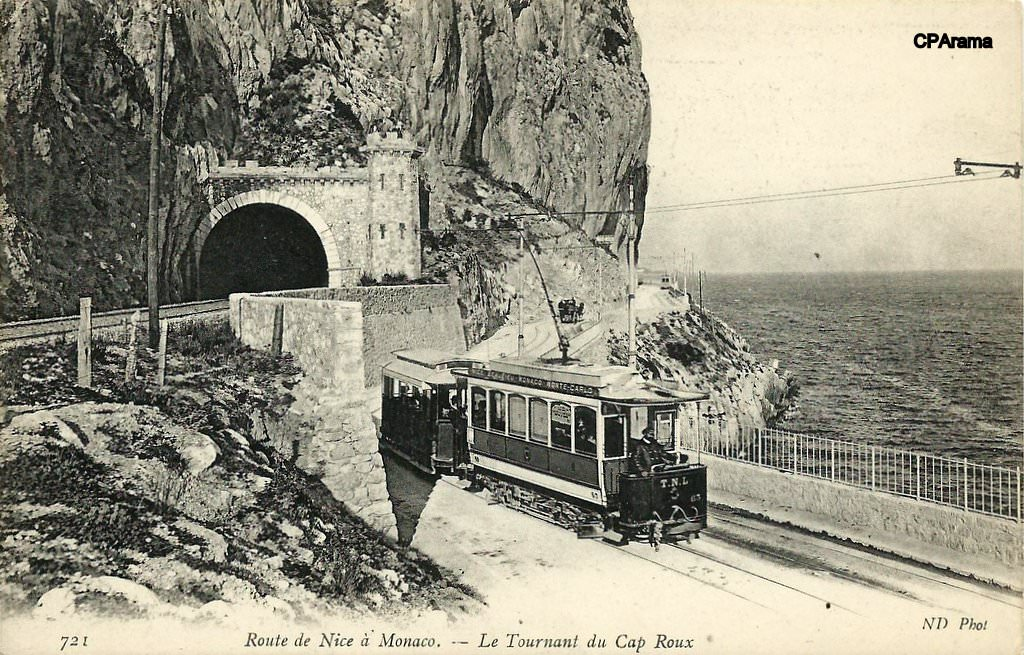
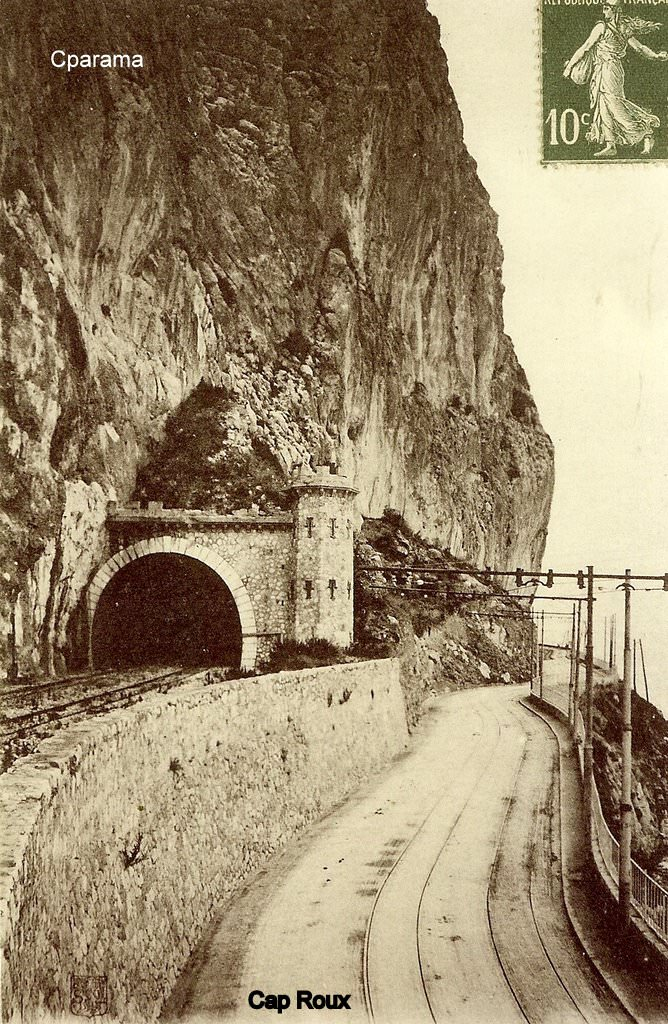
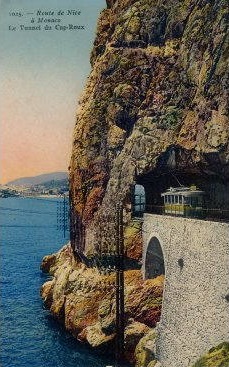
The railway tunnel at Cap Roux with the road and tramway at the base of the cliffs. [14]
A closer view of the tunnel mouth. [15]
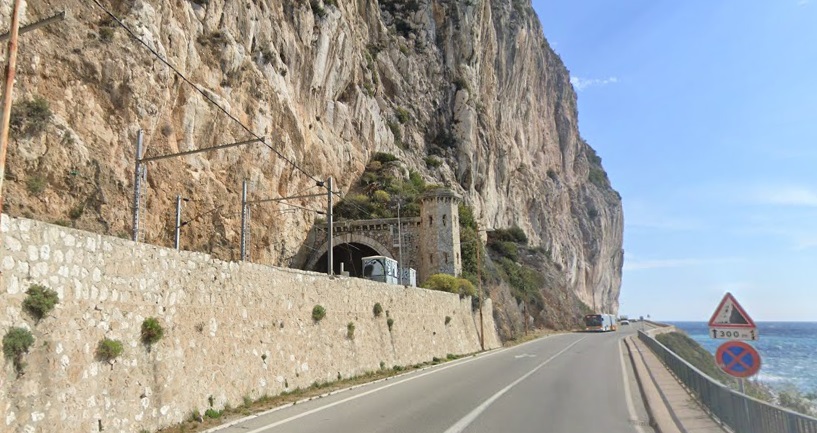
The tunnel mouth at Cap Roux in 21st century. [Google Streetview, April 2023]

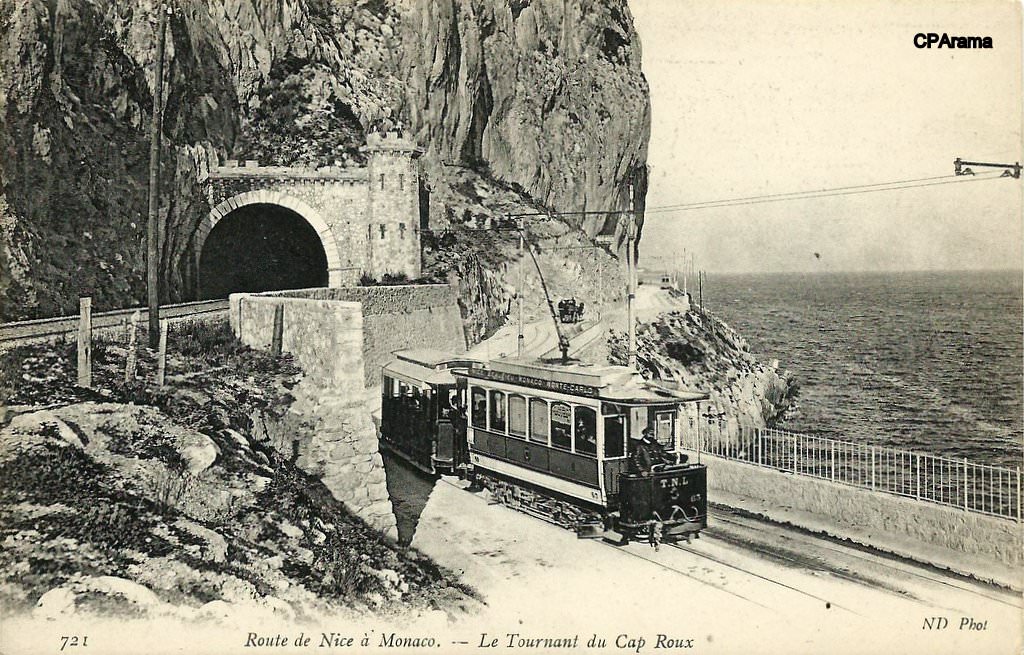
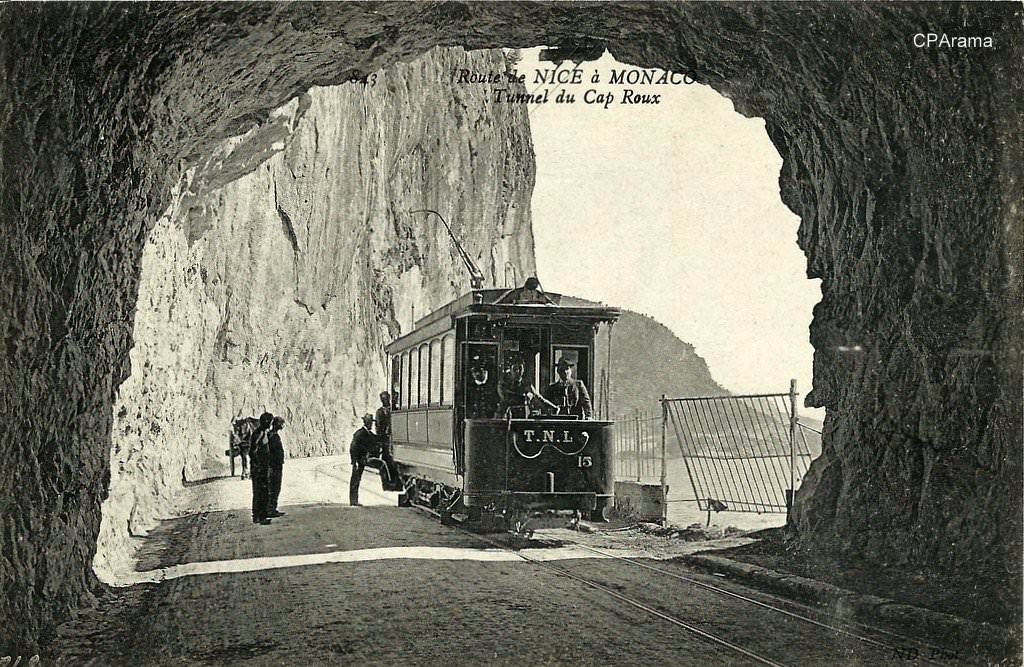
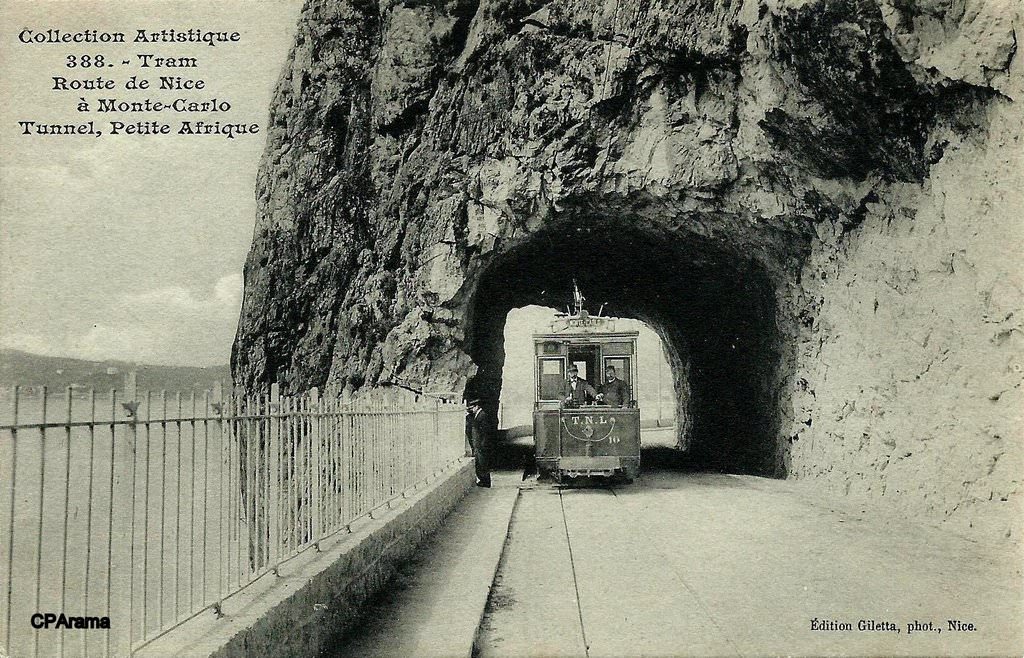
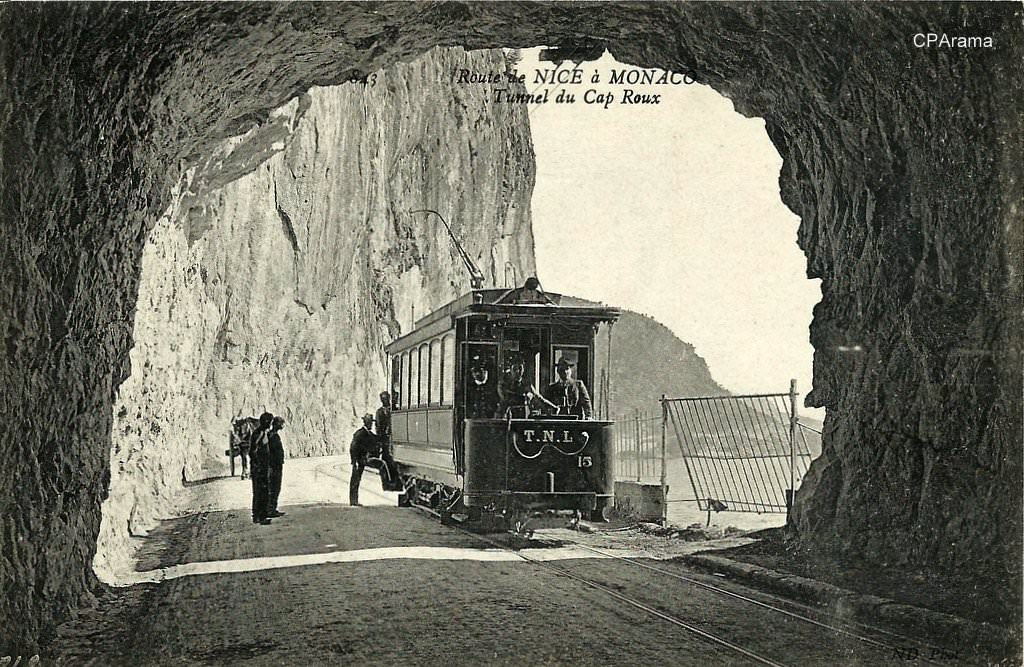
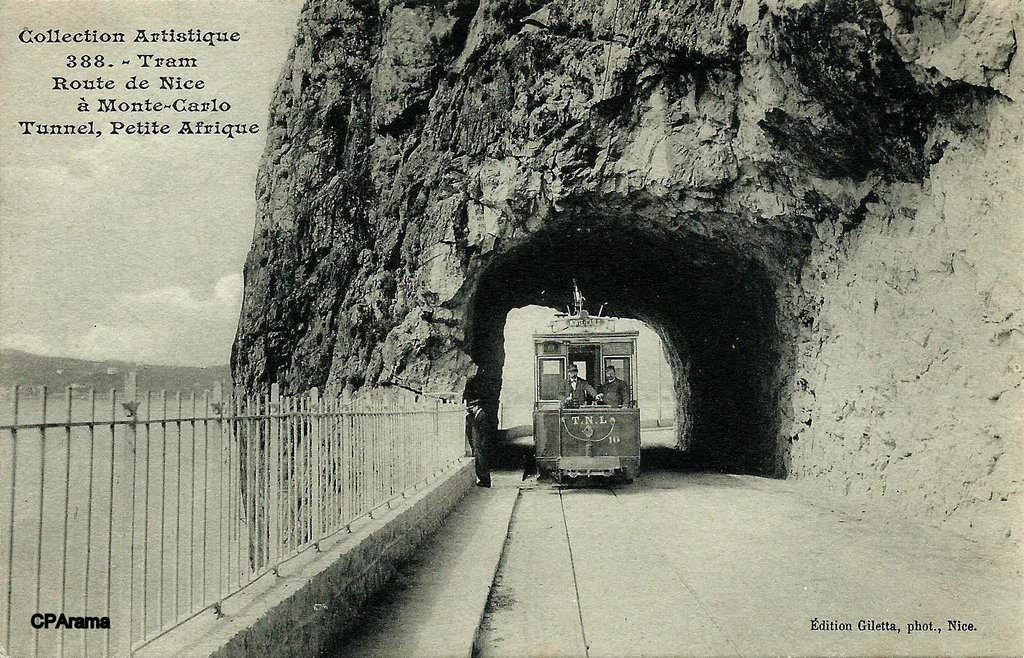
As Banaudo comments: “Shortly after, the high limestone cliffs of Cap Roux fall directly into the sea and form an apparently impassable obstacle to communications on the coast.  The PLM line crossed this location via a 419 m tunnel decorated with a superb fortified portal, while a short tunnel cut directly into rock provided for the road and the tramway.  It had to be widened when the latter was made double track.” [1: p41] 

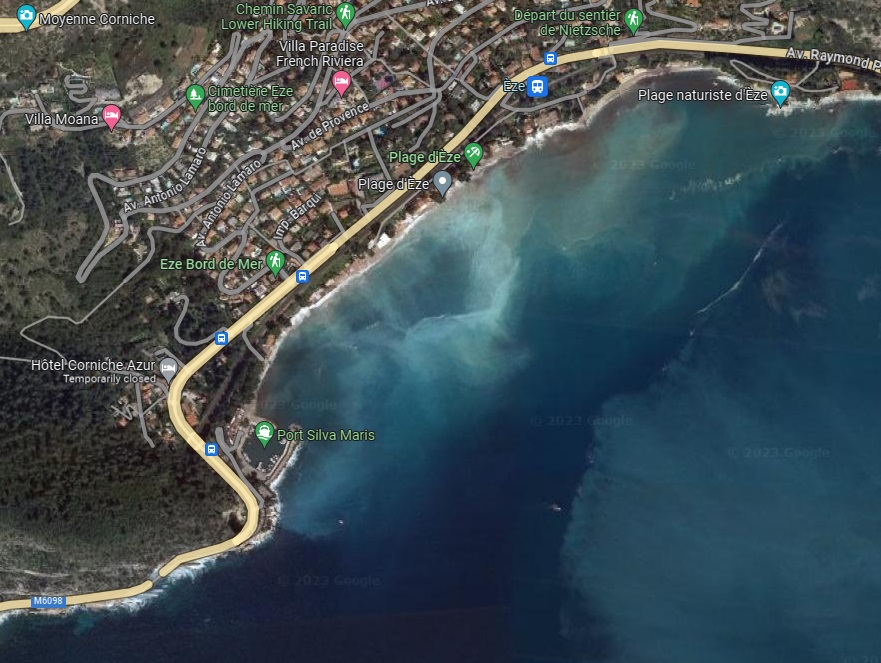
The road/tramway continue to be shown by the pale yellow line on this next extract from Google Maps. The tunnel at Cap Roux appears at the bottom-left of this extract which shows the Baie d’Eze. [Google Maps, October 2023]
A View East from inside the tunnel at Cap Roux. [16]
The tunnel at Cap Roux has been widened to accommodate the modern carriageway. [Google Streetview, April 2023]
A view West towards the tunnel at Cap Roux. [23]
Another postcard image showing the tunnel at Cap Roux, again looking West. [17]
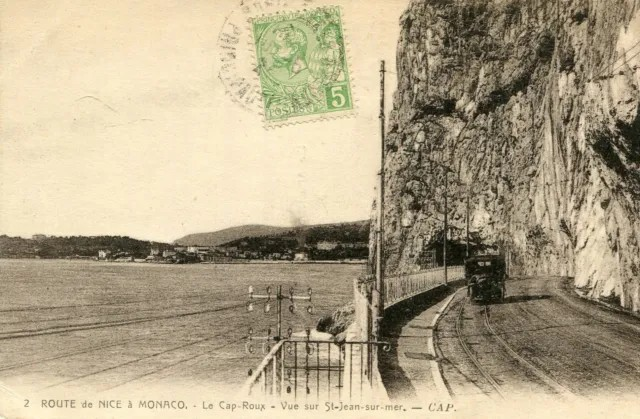
A 100 metres or so East from the tunnel, this view looks West and includes part of St. Jean-Cap Ferrat and Beaulieu. [18]

At the point where the PLM line emerged from the Cap Roux, the tramway passed above it on the road bridge and ran along the verge through the location of Eze station.  Banaudo tells us that, “In this residential area, the villas are spread out between a well-sheltered beach at the bottom of a bay and the foot of the mountain where the medieval village of Eze perches, at an altitude of 427 m.” 1: p41]

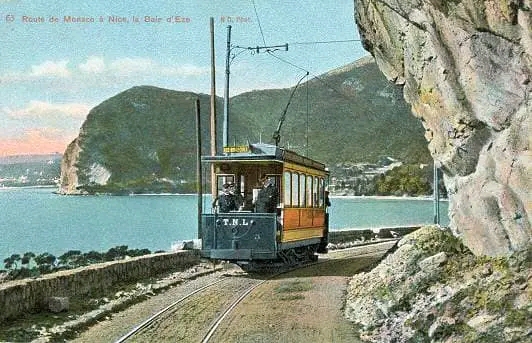
TNL Tram Car No. 3 at Baie d’Eze in around 1906. This image was shared on the Comte de Nice et son Histoire Facebook Group by Alan Rozier on 19th September 2019. Cap Roux is prominent to the left of the tram. [8]

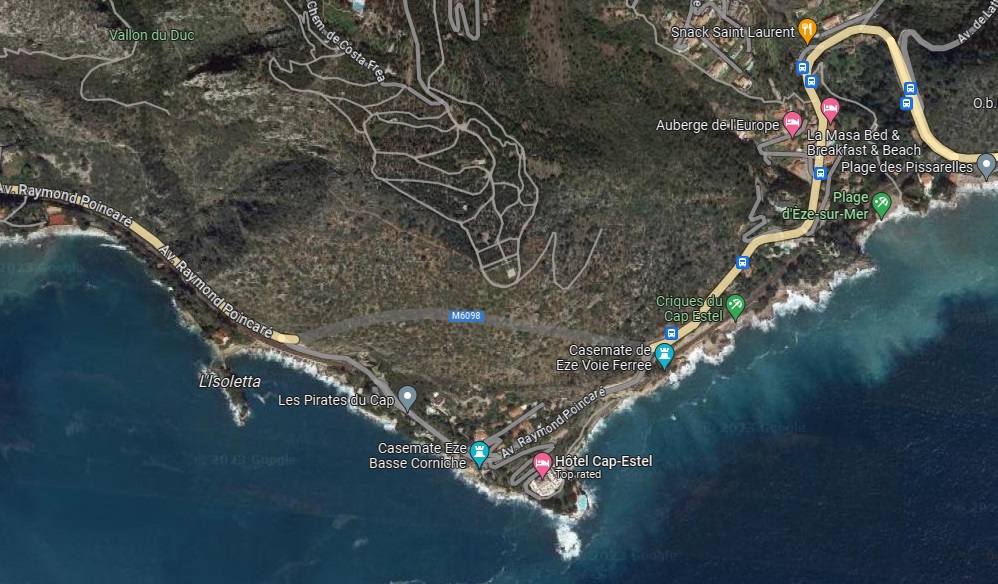
From this point, the terrain along the coast became increasingly steep and the Basse Corniche and the tramway track had to gain height again, passing above Point de L’Isoletta and through Pointe de Cabéel and Cape Estelle, (today, Estel).

This next extract from Google Maps shows Point de L’Isoletta towards the bottom-left. Through traffic on the modern M6098 now passes in tunnel behind Cap-Estel. [Google Maps, October 2023]
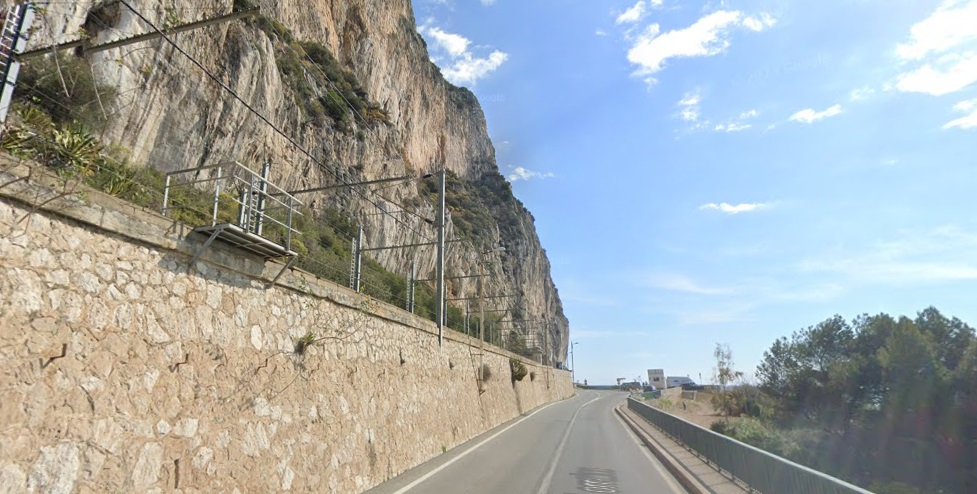
Looking East along the Basse Corniche in 2023. [Google Streetview, April 2023]
Looking West along the old tram route on the old Basse Corniche from Cap-Estel. [Google Streetview, April 2023]

The route rose up from the coast and looped inland below the hamlet of St. Laurent d’Eze. The line soon reached 85m above sea level (its highest point) near the passing loop in the Pissarelles district.

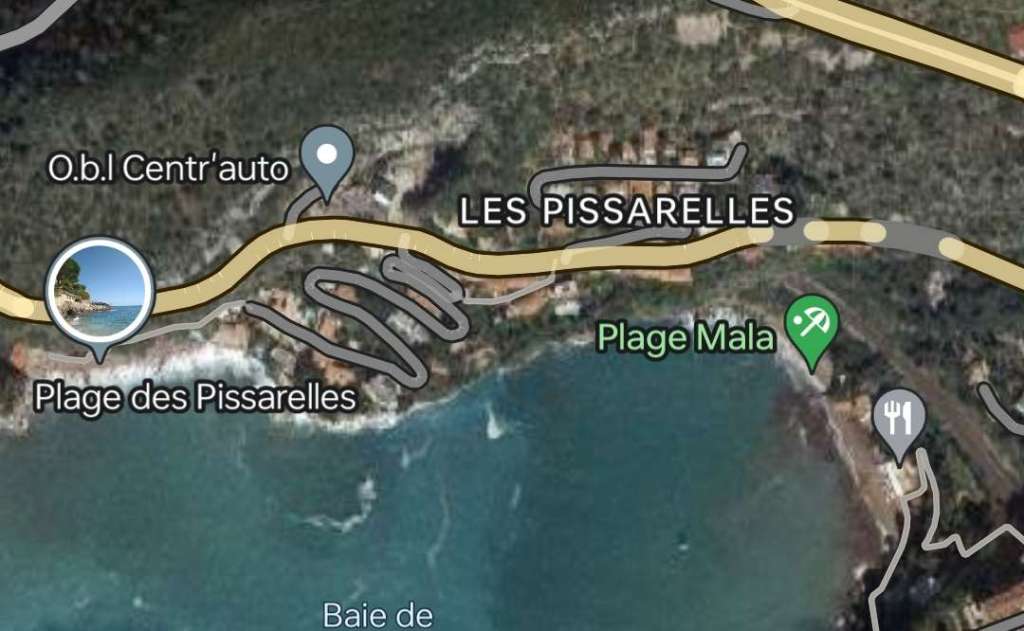
Trams passed through two very short tunnels close the Plage Mala. These appear on the right side of this extract from Google Maps. [Google Maps, October 2023]

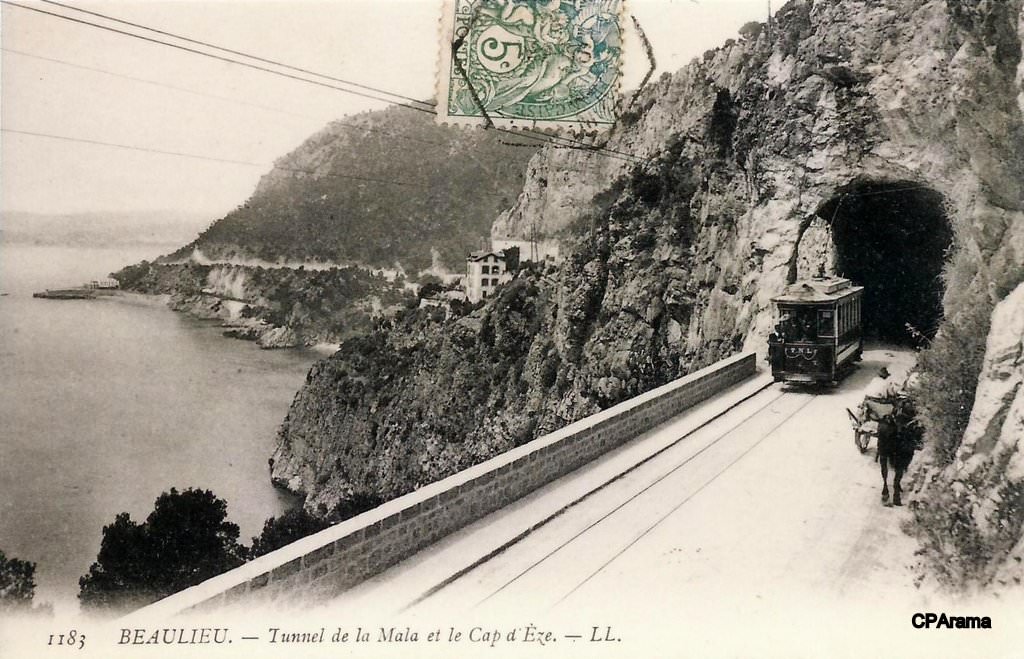
Two tunnels cut into the cliff above Plage Mala preceded the start of the descent to Cap-d’Ail. Both of these tunnels remain and continue to carry the Basse Corniche. Banaudo tells us that this was in “the former coastal district of La Turbie which obtained its municipal autonomy in 1908.” [1: p42]

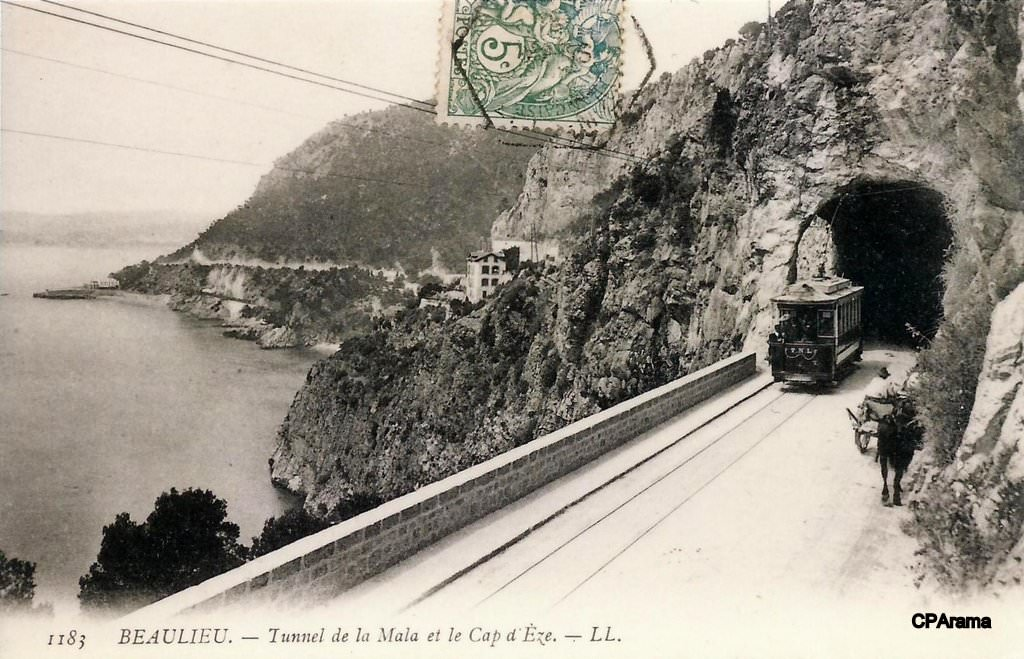
East of St. Laurent d’Eze the Basse Corniche and the trams ran round the Cap-d’Eze, passing through two short tunnels. This is the first viewed from the East. [24]
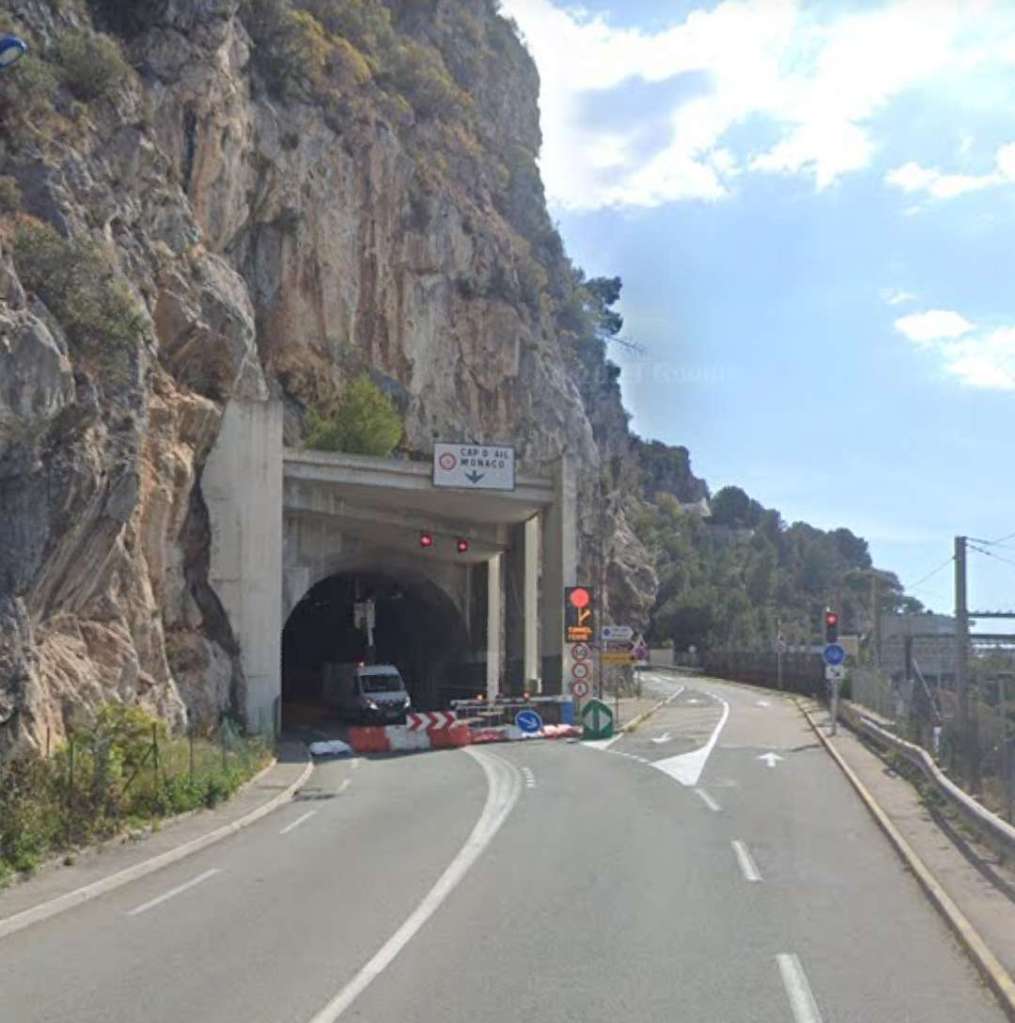
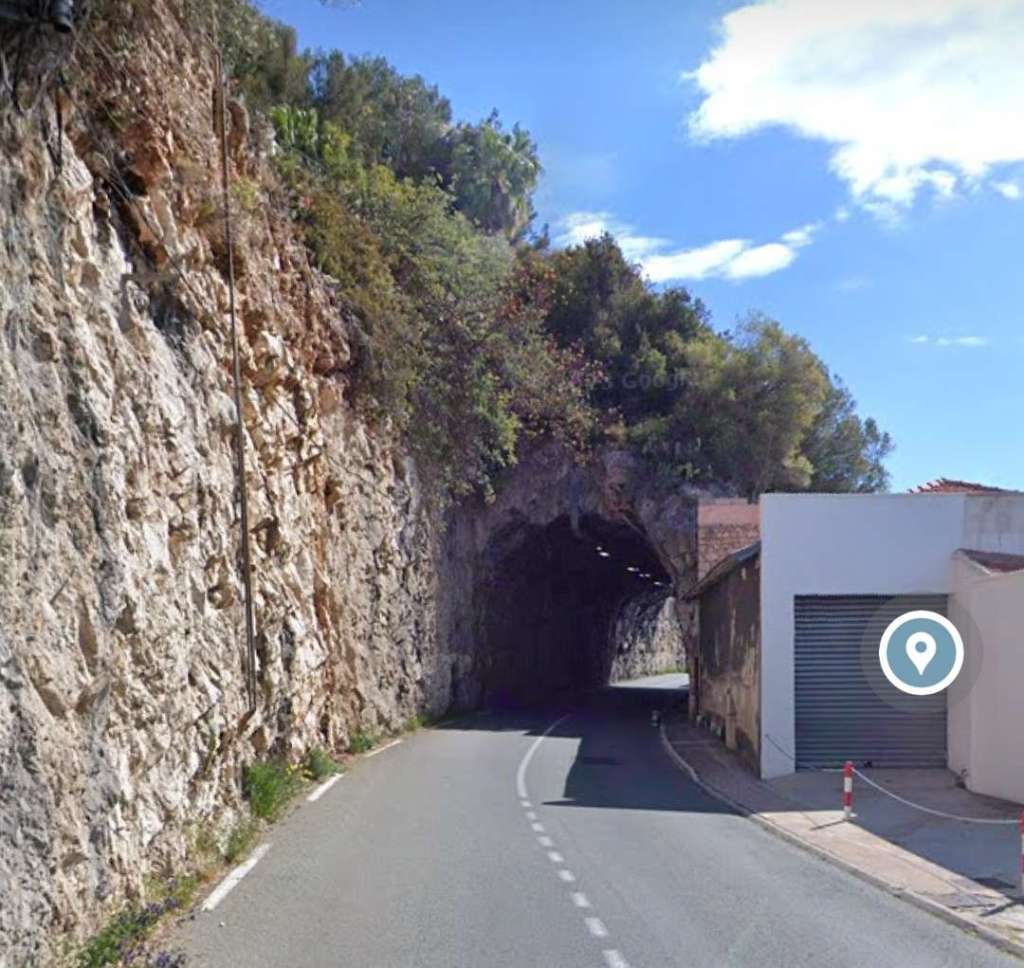
The first of two short tunnels above Plage Mala. This view looks East into the tunnel. [Google Streetview, April 2023]
The second tunnel viewed from the West. [Google Streetview, April 2023]
The second tunnel viewed from the East. [Google Streetview April 2023]
The second Mala tunnel sits at the extreme left of this next extract from Google Maps. [Google Maps, October 2023]
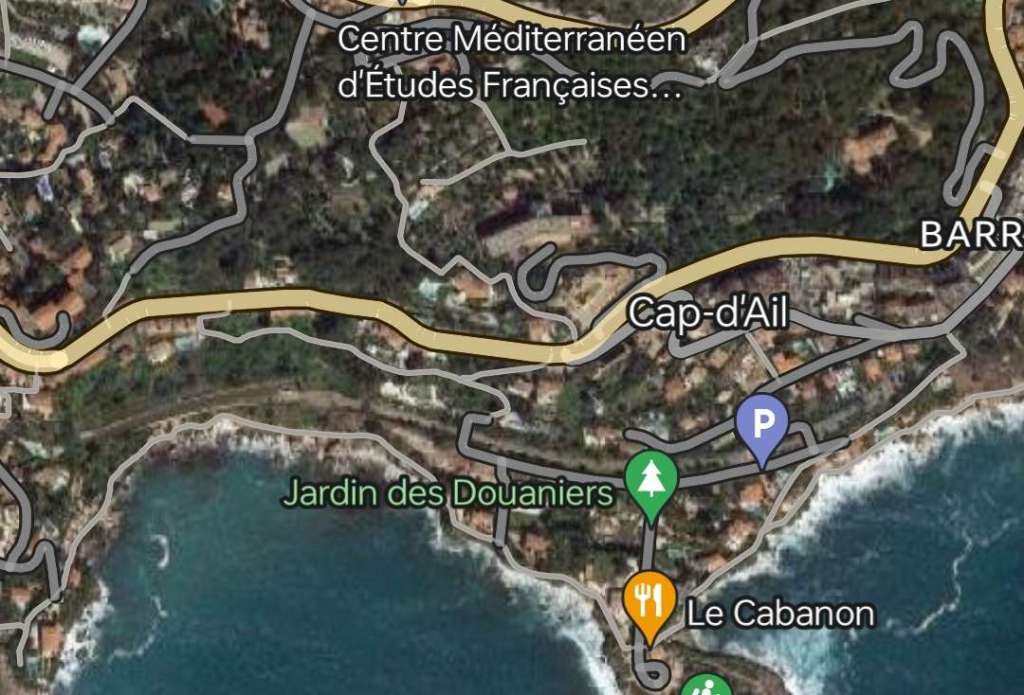
The Basse Corniche and the tramway continued down through Cap-d’Ail. [Google Maps, October 2023]
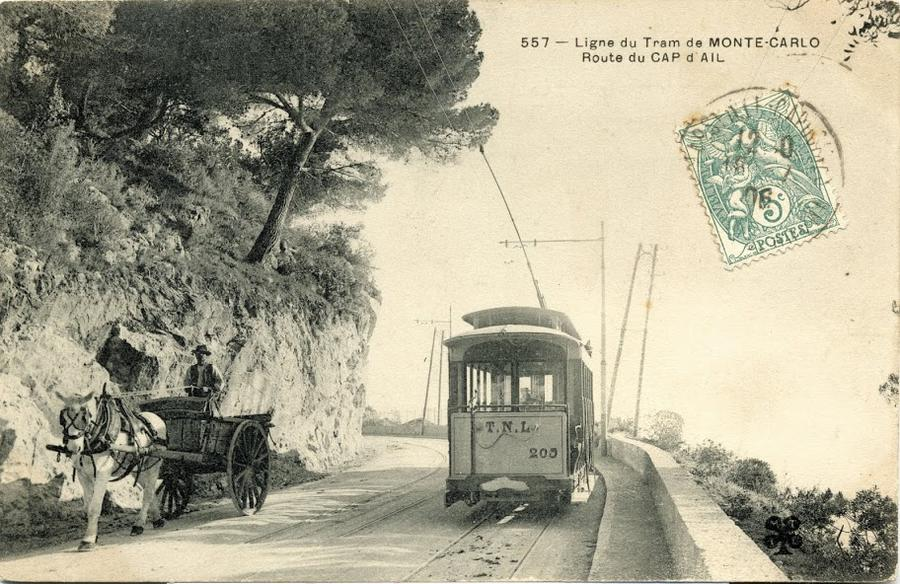
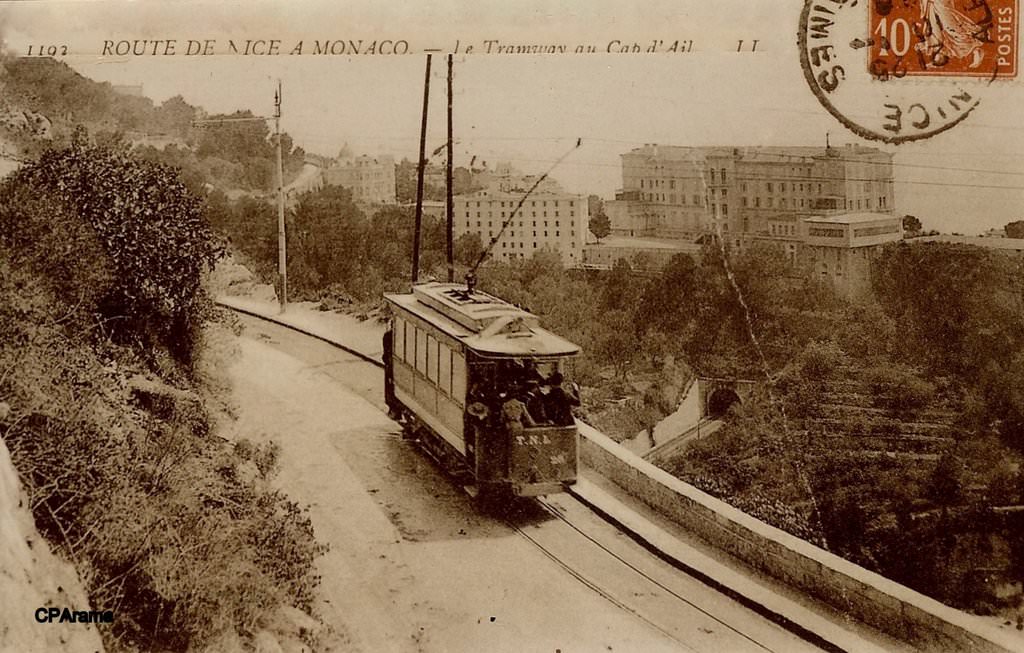
The descent toward Cap-d’Ai. The tram car is a trailer, part of a two car train heading for Monte Carlo. The double-track tramway takes up much of the highway on the Basse Corniche! [30]

The tramway then ran down past customs barracks and crossed the border into the principality of Monaco. The extract below shows the route of the tramway as it approached the border, which is just off the top of the map extract.

The village of Cap-d’Ail is at the bottom-left of this next extract from Google Maps. The tramway continued to follow the Basse Corniche from Cap d’ Ail in a Northeasterly direction. [Google Maps, October 2023]
The descent along the Basse Corniche continued. [21]
This next extract from Google Maps shows the centre of Monaco. The border between France and Monaco crossed the old tram route at the location of the roundabout in the bottom-left of this extract, West of the Stade Louis II. [Google Maps, October 2023]
The descent into Monaco. This colourised postcard view looks across the TNL tram route towards the Palace. [27]
Monaco in 1900. The promontary in the colourised image above is shown towards the bottom of this map with the PLM railway station at its landward (West) end. [31]
Monaco 1930. The route of the tramway is shown on this image, crossing the PLM railway line in the bottom left of the map on the Wurttemberg Bridge and then running along Boulevard Charles III towards the port, turning right onto Avenue du Port and then running North alongside the port on Boulevard Albert 1er. [32]

A warehouse of materials and fuels was located on the border itself in the St. Antoine district.” [1: p42] The tramway then passed under the PLM tracks at the Württemberg bridge, where a passing loop was created in 1913. 

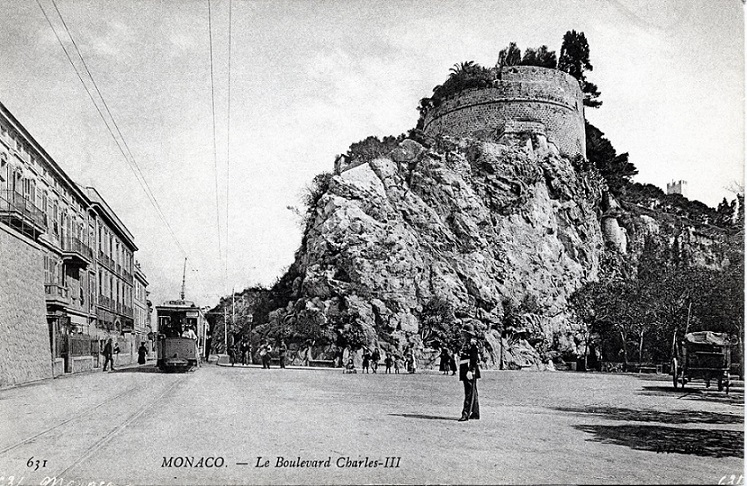
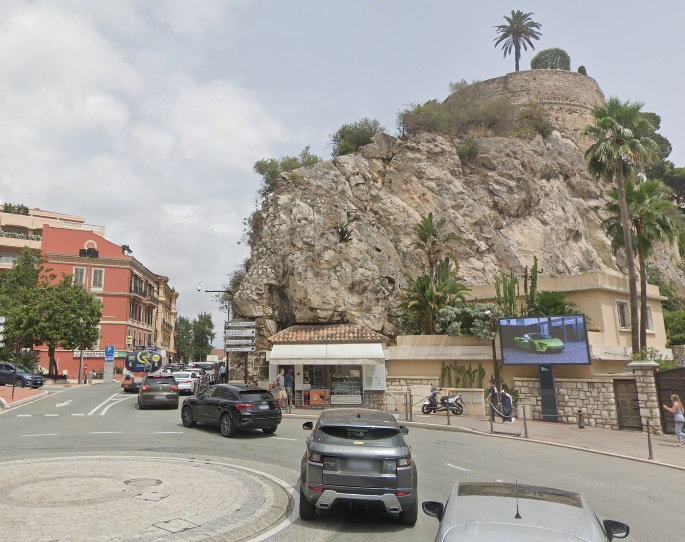
Le Boulevard Charles III, very early in the 20th century [40]
A simialr view in the 21st century. [Google Streetview, July 2021]

The tramway then followed Boulevard Charles III to Place du Canton where a siding was established at the foot of the bastion at the western end of the rock which supported the palace.  Banaudo continues: “Industrialists in the Fontvieille district (brewery, chocolate factory and pasta factory) used this siding for unloading and shipping their goods.” [1: p42]

These two postcard views show Place d’Armes. On the second the tramway to Place de la Visitation can clearly be seen on the right. [43]
Approximately the same view in the 21st century. [Google Streetview, December 2010]

The TNL line joined the urban network of Monaco on the Place d’Armes, where two branch lines left the route: on the left towards the PLM station; and on the right towards Place de la Visitation, on the Rock.  The tramway ran along Avenue du Port on a “brief double-track section, then arrived at the gasometer bend, it ran alongside the port by going down Boulevard de la Condamine (today Albert 1er).  On Place Ste. Devote, the double track resumed to climb Avenue de Monte-Carlo, whose inclination constituted an absolute record for the entire TNL network: 80 mm/m average over 415 m, including a “peak” at  93 mm/m over 41 m! A bridge spanned the PLM line below ‘l’Hotel Ermitage’, then the tramway left the urban line at la Poste to reach le Plateau de Spélugues, where the terminus was located between ‘l’Hotel de Paris’ and l’e Casino de Monte-Carlo‘.” [1: p42]

Banaudo also highlights a number of structures along the route from Nice to Monaco: “In Nice: Garibaldi bridge over the Paillon (3 cast iron arches).  Between Beaulieu and Eze: Cap-Roux tunnel (26 m) and bridge on the PLM Nice – Ventimiglia line.  Between Eze and Cap-d’Ail: La Mala 1 (30 m) and La Mala 2 (50 m) tunnels.  In Monte-Carlo: L’Ermitage bridge on the PLM Nice – Ventimiglia line.” [1: p43]

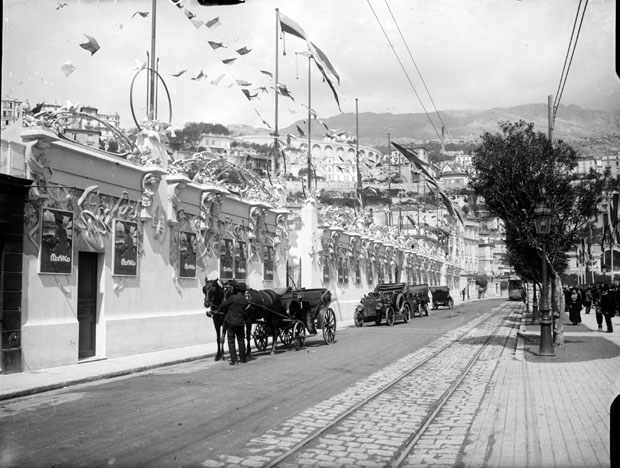
La Condamine, now Albert Premier. [29]
A view along Boulevard Albert Premier in the 21st century. [Google Streetview, March 2011]
A tram runs down La Rampe on La Condamine, now Avenue d’Ostende. [42]
A similar view in the 21st century. [Google Streetview, July 2021]
A 21st century view along Avenue d’Ostende at approximately the same location as the two postcard views above. [Google Streetview, July 2021]
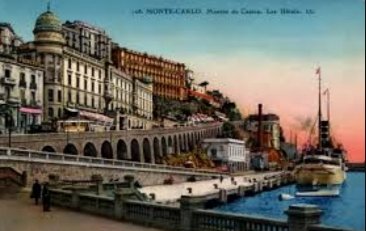
This low resolution colourised postcard view shows a tram climbing La Rampe (now Avenue de i’Ostende) towards the Casino, passing a series of Hotels. [41]
A tram alongside the Casino. [28]
A similar location to the monochrome image above. [Google Streetview, July 2021]
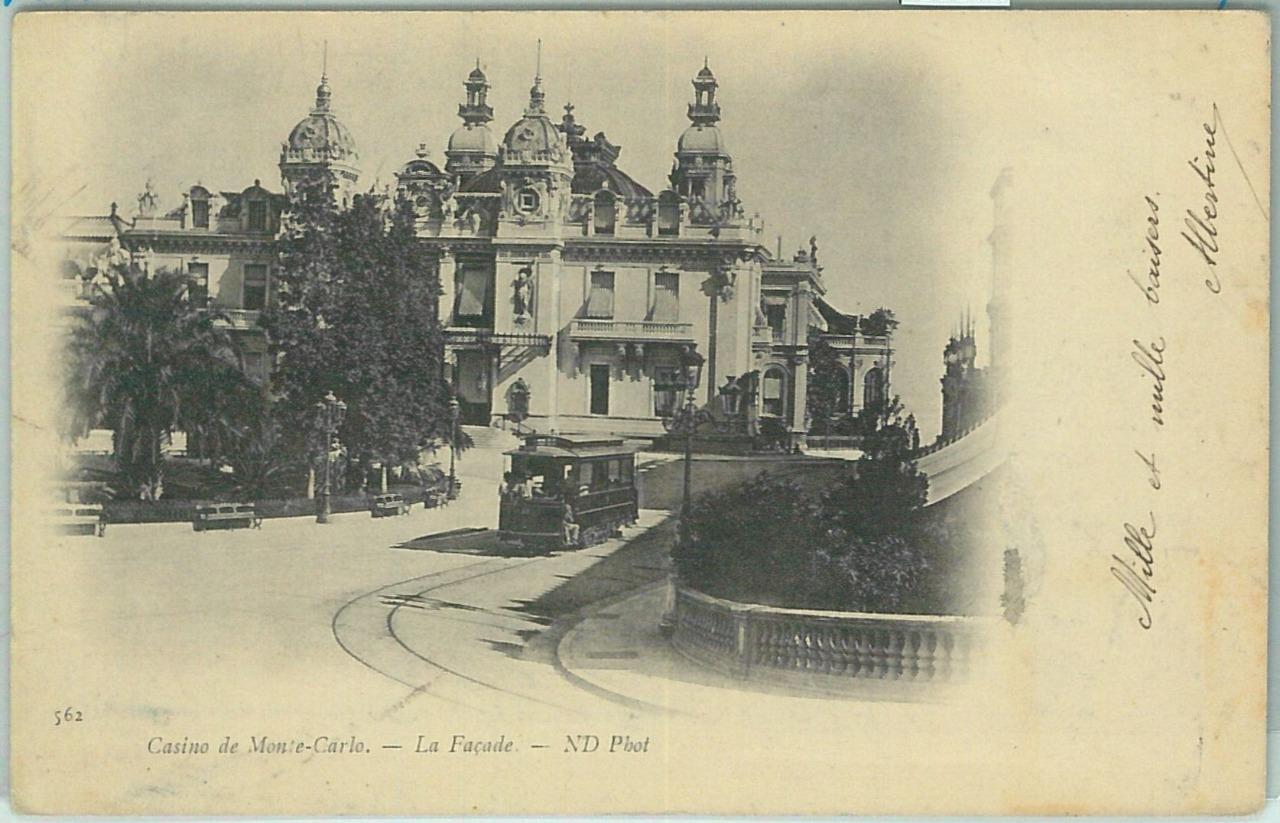
This 1903 postcard shows a tram close to the Casino. [35]
A similar view in the 21st century. [Google Streetview, October 2010]

Two branch lines left the main tramway between Nice and Monte Carlo. These were:

  • Pont-St. Jean to St. Jean-Cap-Ferrat
  • Monaco-Gare to Monaco-Ville (Place d’Armes to Place de la Visitation on the Rock).

These will be the subject of future article(s), as will be the length of the line from Monte Carlo to Menton.

References

  1. José Banaudo; Nice au fil du Tram, Volume No. 2: Les Hommes, Les Techniques; Les Editions de Cabri, Breil-sur-Roya, France, 2005.
  2. https://dictionnaire.lerobert.com/definition/octroi, accessed on 14th October 2023.pwe
  3. https://www.facebook.com/groups/ciccoli/permalink/3705752563003919, accessed on 20th October 2023.
  4. https://m.facebook.com/groups/ciccoli/permalink/3693480434231132, accessed on 20th October 2023.
  5. https://m.facebook.com/groups/ciccoli/permalink/3726228004289708, accessed on 20th October 2023.
  6. https://slideplayer.fr/slide/3703631, accessed on 11th April 2019.
  7. https://i.pinimg.com/736x/59/3a/b4/593ab4398089380e93e36f57e3986208.jpg, accessed on 20th October 2023.
  8. http://transporturbain.canalblog.com/pages/les-tramways-de-nice—de-l-apogee-au-declin/31975780.html, accessed on 20th October 2023.
  9. https://m.facebook.com/groups/ciccoli/permalink/3478397479072763, accessed on 21st October 2023.
  10. https://www.facebook.com/groups/ciccoli/permalink/1917168321862361, accessed on 21st October 2023.
  11. https://m.facebook.com/groups/ciccoli/permalink/2545681792344341, accessed on 21st October 2023.
  12. https://m.facebook.com/groups/ciccoli/permalink/3372278223018023, accessed on 21st October 2023.
  13. https://www.facebook.com/groups/ciccoli/permalink/3720422128203629, accessed on 21st October 2023.
  14. https://www.cparama.com/forum/cartes2013a/1367699129-721.jpg, accessed on 21st October 2023.
  15. https://www.cparama.com/forum/cartes2013a/1367700498-06-Eze-t.du-Cap-Roux.jpg, accessed on 21st October 2023.
  16. https://www.cparama.com/forum/cartes2013a/1367699408-843.jpg, accessed on 21st October 2023.
  17. https://octo-puces.com/20713-large_default/vichy.jpg, accessed on 21st October 2023.
  18. https://picclick.fr/Carte-Route-de-Nice-%C3%A0-Monaco-Le-Cap-266462066907.html, accessed on 21st October 2023.
  19. https://www.geneanet.org/cartes-postales/view/7748918#0, accessed on 21st October 2023.
  20. https://www.geneanet.org/cartes-postales/view/5253150#0, accessed on 21st October 2023.
  21. https://www.cparama.com/forum/cartes2013a/1367698172-06-Cap-d-Ail-tram.jpg, accessed on 21st October 2023.
  22. https://www.cparama.com/forum/cartes2013a/1367694969-06-Beaulieu-39-001.jpg, accessed on 21st October 2023.
  23. https://www.cparama.com/forum/cartes2013a/1367695565-06-Beaulieu-388-.jpg, accessed on 21st October 2023.
  24. https://www.cparama.com/forum/cartes2013a/1367695792-06-Beaulieu-1183-.jpg, accessed on 21st October 2023.
  25. https://www.cparama.com/forum/download/file.php?id=71728, accessed on 21st October 2023.
  26. https://www.train-jouet.com/PA/Vente-CPA-Ferroviaire/Train-06/TR3719-2.jpg, accessed on 21st October 2023.
  27. https://www.geneanet.org/cartes-postales/view/7700125#0, accessed on 21st October 2023.
  28. https://upload.wikimedia.org/wikipedia/commons/b/b7/Station_des_tramways_au_casino%2C_Monte-Carlo%2C_avril_1905_%285686522389%29.jpg, accessed on 21st October 2023.
  29. https://upload.wikimedia.org/wikipedia/commons/2/2a/Exposition_des_canots_autos%2C_Monaco%2C_avril_1905_%285619067954%29.jpg, accessed on 21st October 2023.
  30. https://www.google.com/search?q=monaco+trams+cartes+postales+ancienne&tbm=isch&ved=2ahUKEwi22qipp4SCAxXvWaQEHUO_CVsQ2-cCegQIABAD&oq=monaco+trams+cartes+postales+ancienne&gs_lcp=ChJtb2JpbGUtZ3dzLXdpei1pbWcQAzIFCAAQogQ6BAgjECc6BAgeEApQ7w5YziNgtTJoAHAAeACAAaQBiAHcCZIBAzIuOJgBAKABAcABAQ&sclient=mobile-gws-wiz-img&ei=m0cyZfagNe-zkdUPw_6m2AU&bih=664&biw=360&client=ms-android-oppo-rvo3&hl=en#imgrc=2d6uTfkjSefGVM, accessed on 21st October 2023.
  31. https://www.detaille.mc/en/hier, accessed on 23rd October 2023.
  32. https://wardmapsgifts.com/products/monaco-1930, accessed on 23rd October 2023.
  33. https://www.facebook.com/groups/ciccoli/permalink/3790242024554972, accessed on 25th October 2023.
  34. https://m.facebook.com/groups/ciccoli/permalink/1729856960593499, accessed on 26th October 2023.
  35. https://www.ebay.co.uk/itm/304773417554?mkcid=16&mkevt=1&mkrid=711-127632-2357-0&ssspo=ngW_GOApSZS&sssrc=4429486&ssuid=afQhrar7TGK&var=&widget_ver=artemis&media=MORE, accessed on 26th October 2023.
  36. https://www.monaco-tribune.com/2023/03/lancien-tramway-de-monaco, accessed on 26th October 2023.
  37. https://www.delcampe.net/en_GB/collectables/postcards/monaco/harbor/monte-carlo-le-boulevard-de-la-condamine-935509054.html, accessed on 26th October 2023.
  38. https://www.fortunapost.com/monaco/56820-monaco-la-condamine-et-l-avenue-de-la-costa-a-monte-carlo-vers-1905.html, accessed on 26th October 2023.
  39. https://www.etsy.com/hk-en/listing/962449177/monte-carlo-vintage-postcard-set-four, accessed on 26th October 2023
  40. https://cronobook.com/pic/317b6f78-4763-4f52-b8a6-bc625f310c79, accessed on 26th October 2023.
  41. https://picclick.fr/Monaco-Monte-Carlo-Mont%C3%A9e-Du-Casino-Les-H%C3%B4tels-266021428207.html, accessed on 28th October 2023.
  42. https://m.facebook.com/story.php?story_fbid=pfbid037Agoz1RnVkMM6FYgqS999TT5pM1brTsYaKoX8V6TXtMfRovpbYUMepmzxSpTZLqfl&id=100066989205256, accessed on 28th October 2023.
  43. https://m.facebook.com/story.php?story_fbid=pfbid034LetSqTPvanReBnsQi4NbvfNRU5vXtfnjSnCRP1hXApywdEB5Ko9KKhTraEYDqR5l&id=100066989205256, accessed on 28th October 2023.

Monaco to La Turbie Rack Railway (Chemins de Fer de Provence 15)

The first railway in Monaco was completed in 1869 by the French PLM railway company as part of an international route between France and Italy. There were two stations, Monaco and Monte Carlo. The PLM company became part of SNCF in 1938.

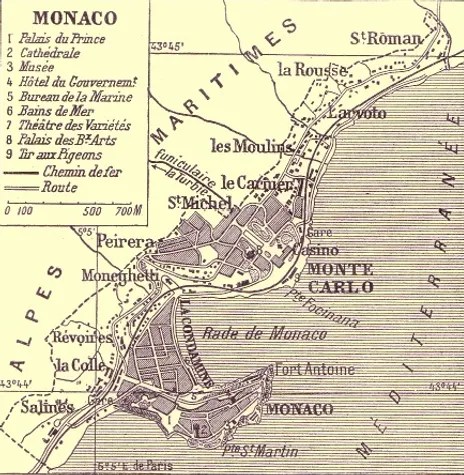
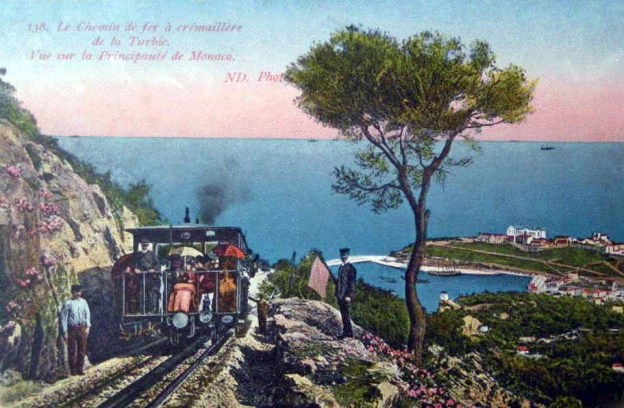
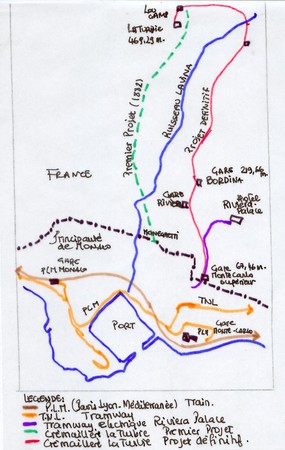
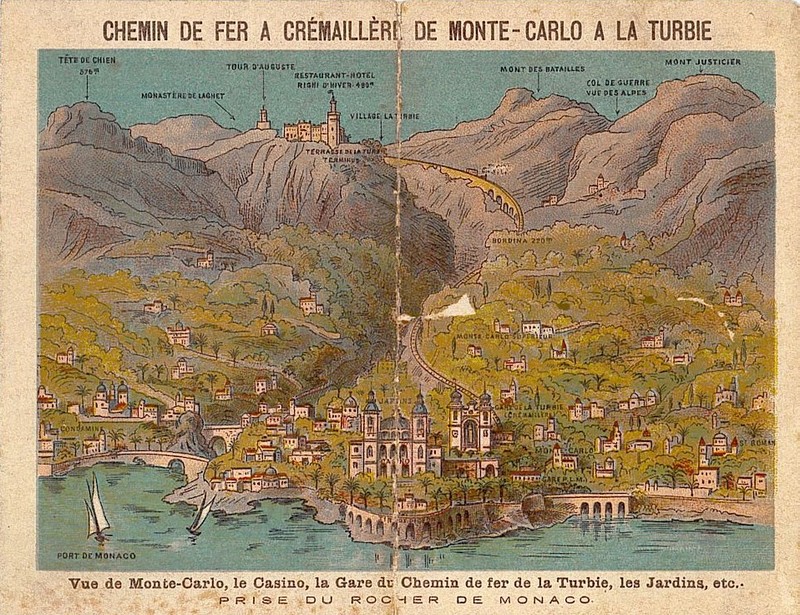
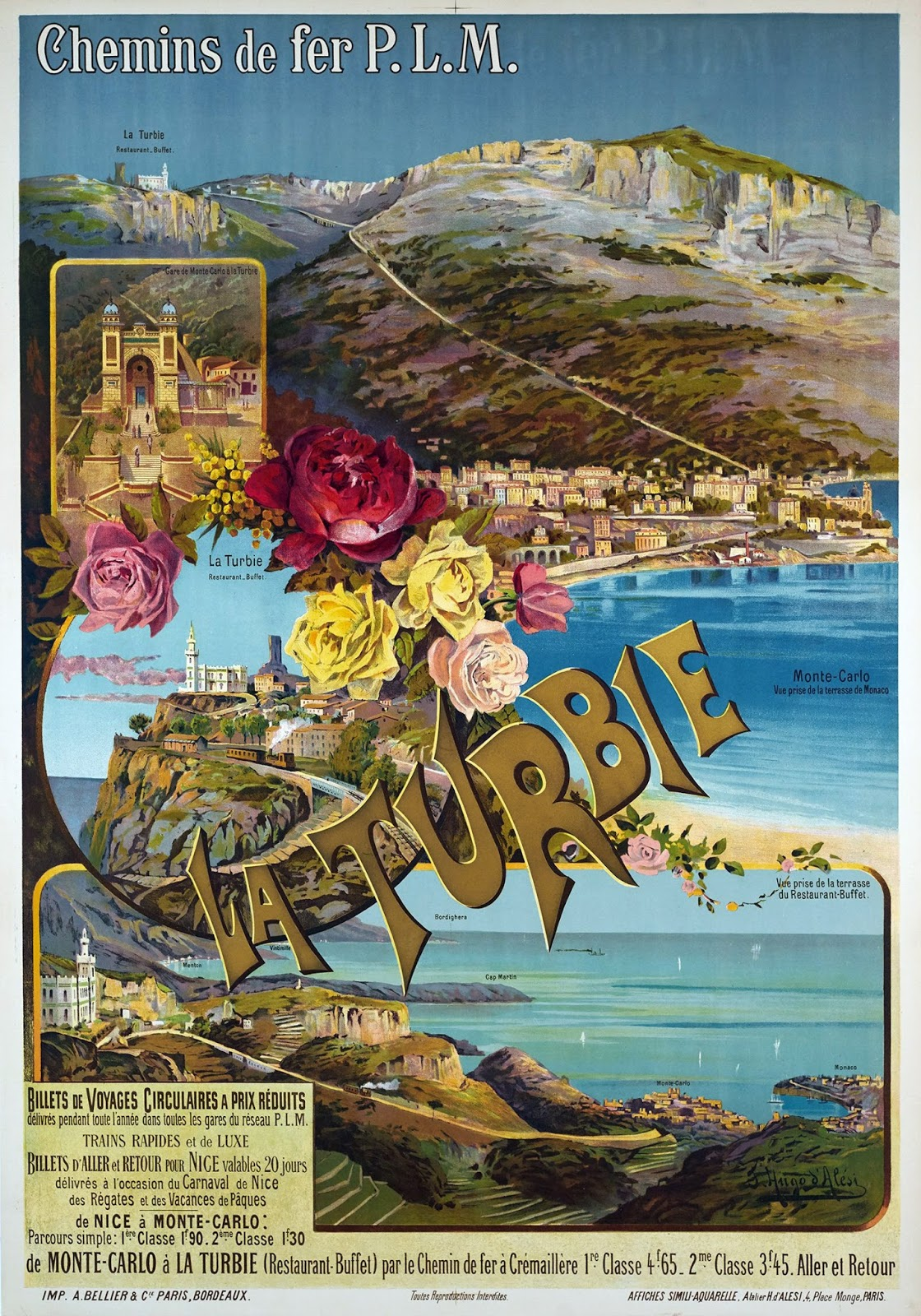
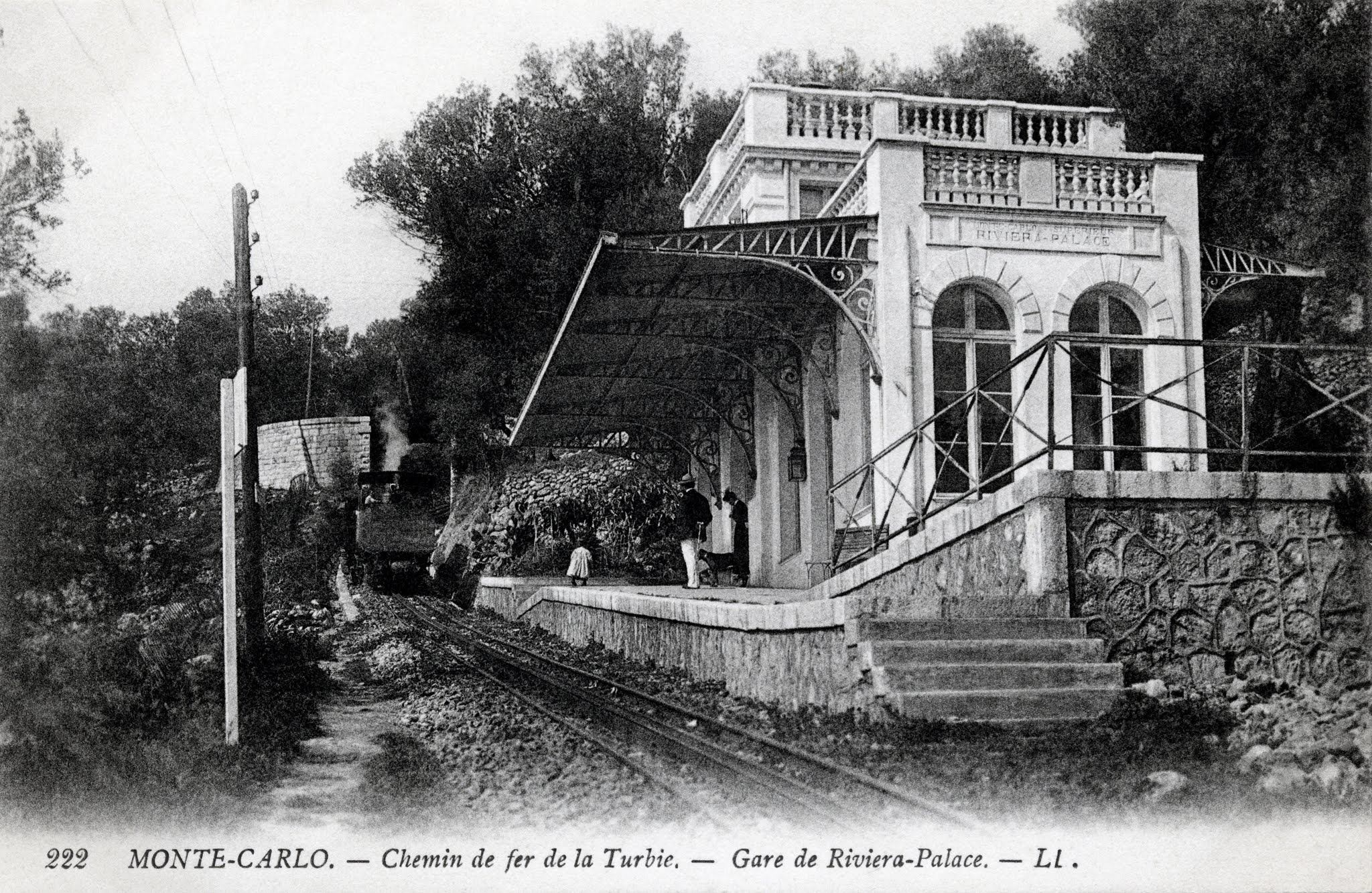
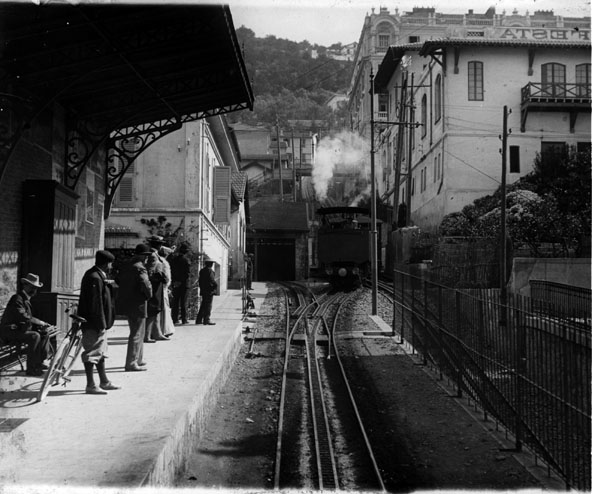
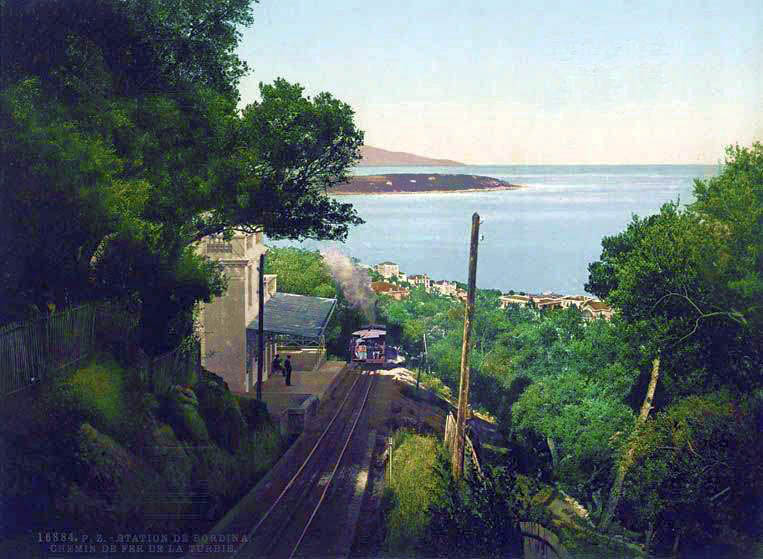
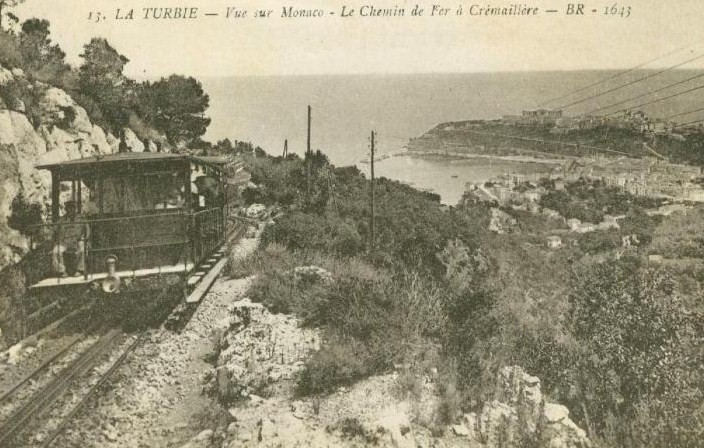
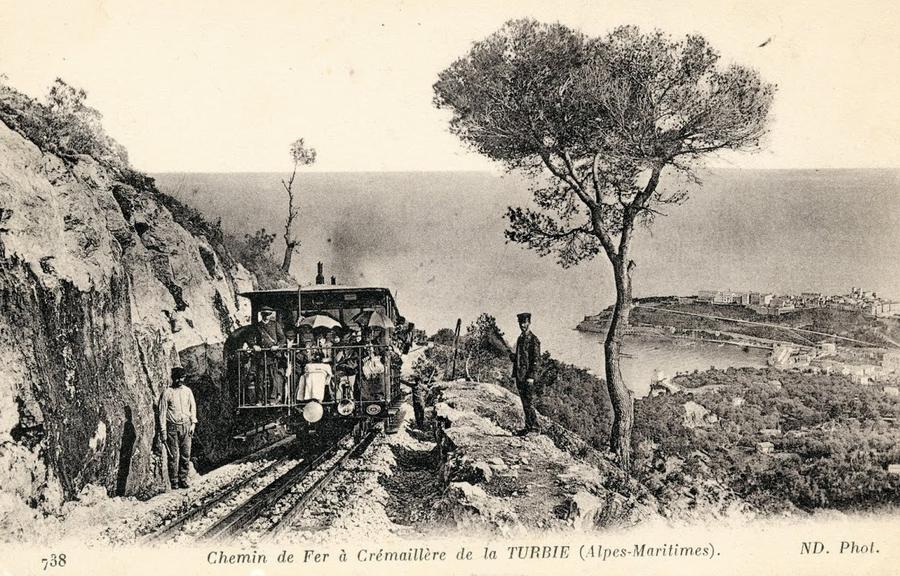
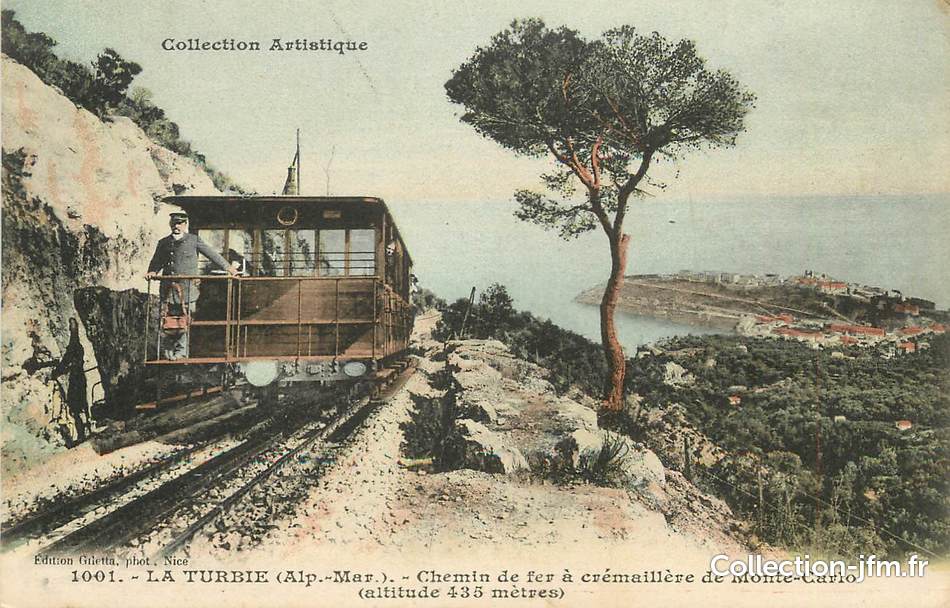
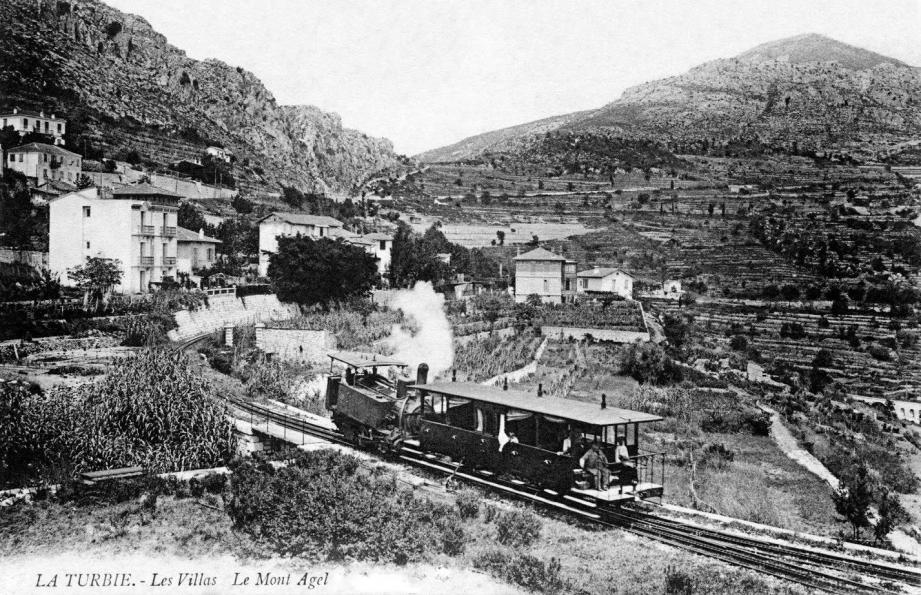
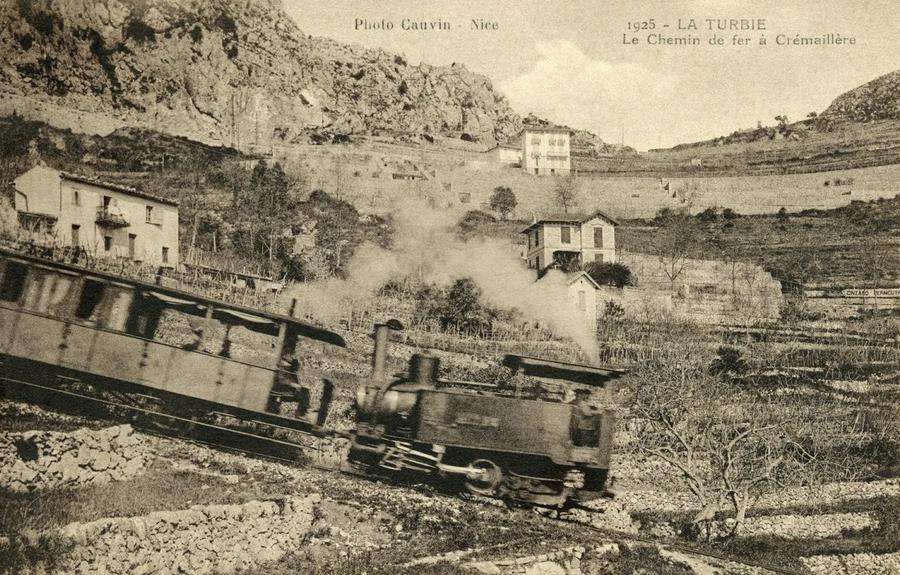
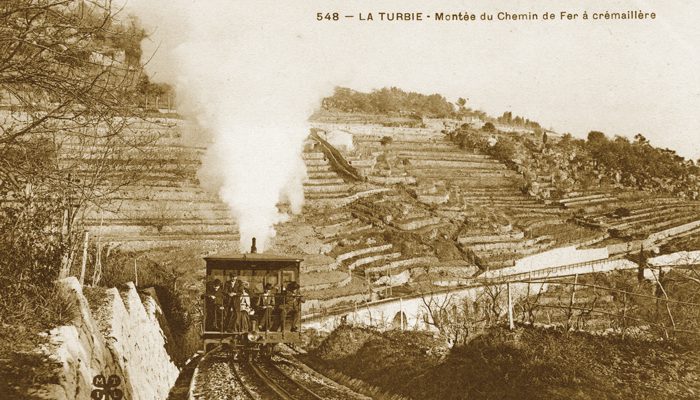
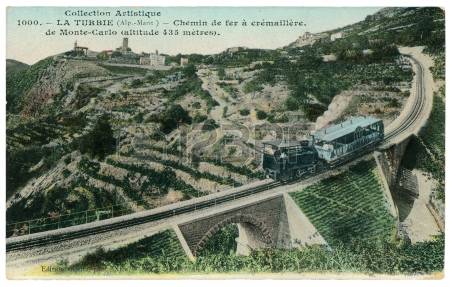
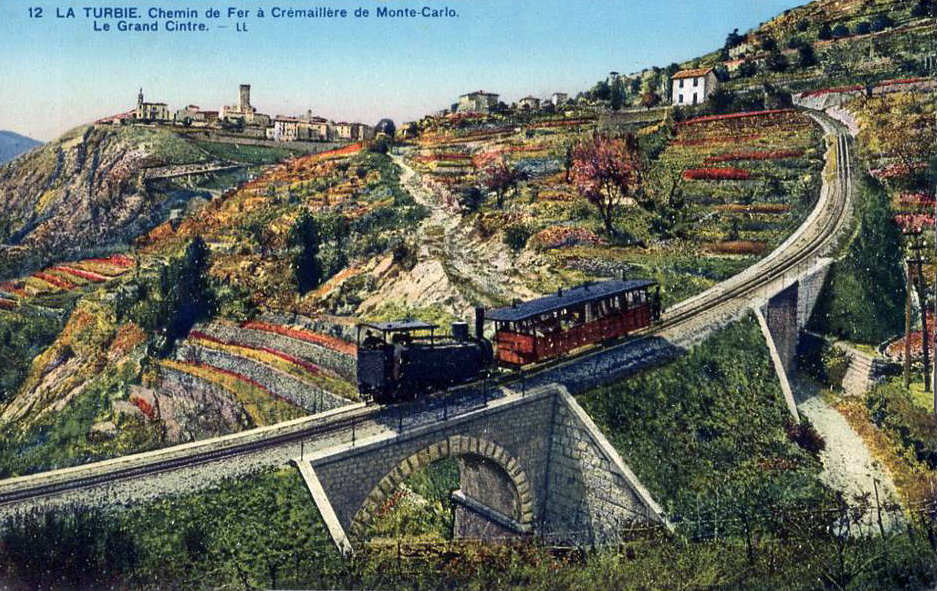
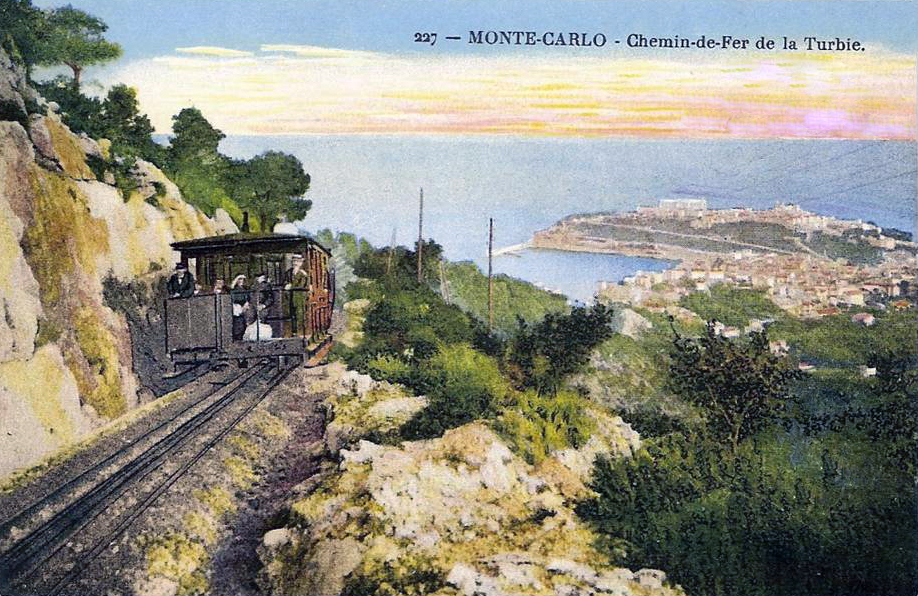
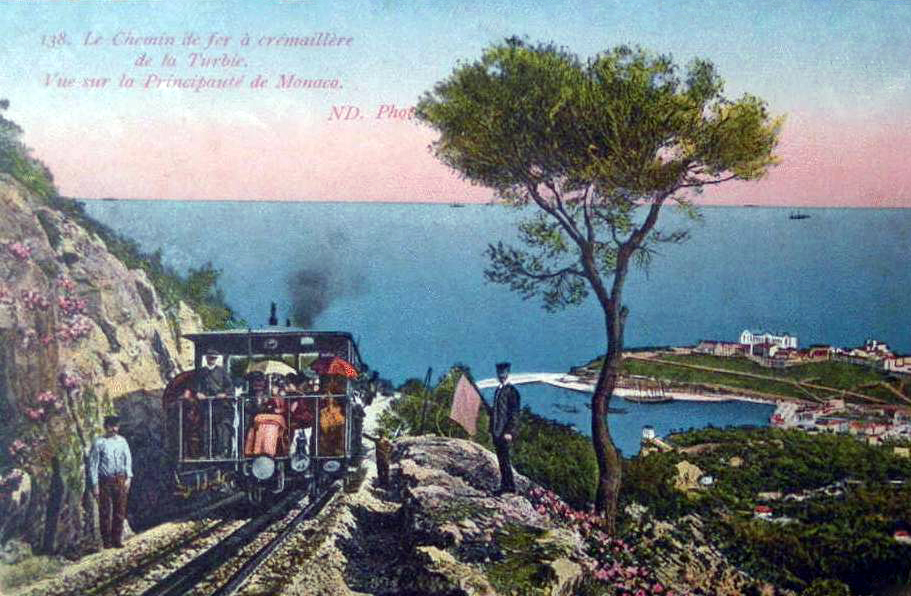
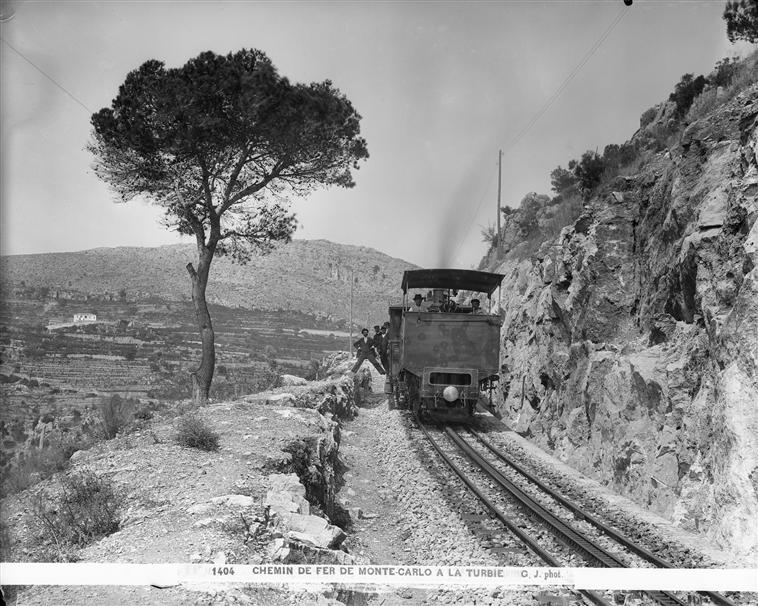
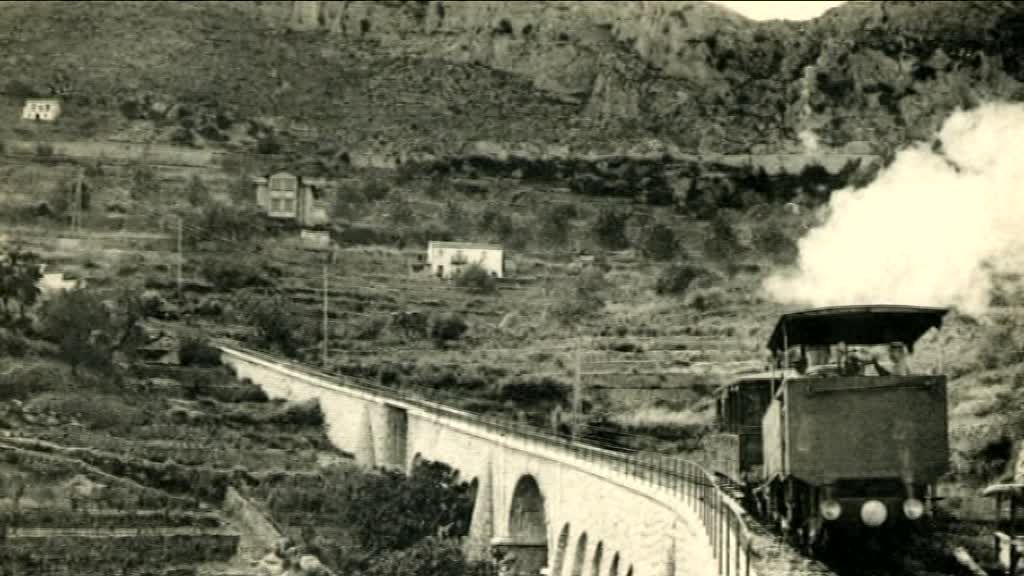
In 1893, a metre-gauge rack railway was constructed to connect Monaco with La Turbie, a medieval village perched on the hills above Monaco. There were a number of different schemes considered before the final version was agreed. These can be seen on the sketch plan which has been provided on http://cremallierturbie.canalblog.com%5B1%5D.

The first scheme was proposed in 1882. The line was promoted by Amédée Brousseau with financial backing from a Parisian banker, Eugene Hubert. The planned line left Moneghetti district on the northern border of the principality and travelled straight up the valley of Sainte-Dévote, with a stop at Le Cros. It would have been 1,860 metres long with one tunnel of 100 metres in length and a viaduct of 60 metres in length (with 5, ten-metre arches), crossing the valley at a height of 8 to 10 m . The costs were estimated at 950,000/1,000,000 francs.[1]

The mayor loved the scheme and it was accepted at the end of 1882 by the local authorities. On 11th April 1883, a public inquiry was ordered.On 16th July 1883 the municipality of La Turbie granted a concession to the Compagnie du Chemin de Fer à crémaillère d’intérêt local de Moneghetti-Monte Carlo à la Haute-Turbie. However, the military authorities opposed the rout and suggested an alternative on the left bank of the River Sainte-Dévote which was 500 metres longer.

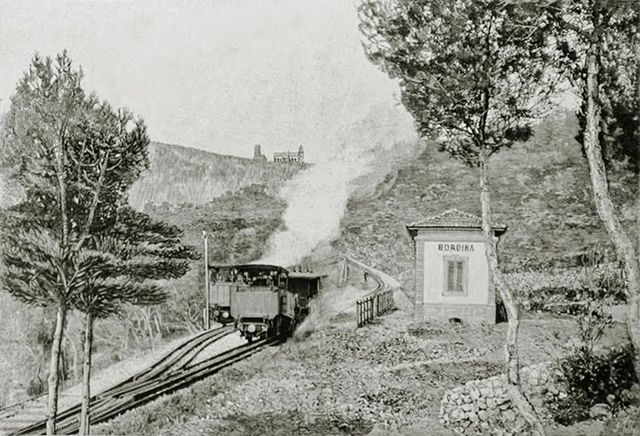
The project was reviewed, and in 1884 a second project was proposed, leaving Monegasque and running along the Carnier plateau, along the side of the Mont des Mules, with a halt at Bordina to end 250 metres east of La Turbie. Teh costs were considerably higher: 1,600,000 francs. This route was agreed on 30th July 1884 and the concession was granted on 31st May 1885.  Before work commenced, the banker, Eugene Hubert went bankrupt.

His partner, Brosseau, contacted a new banker, Abel Neveu and the new company (Compagnie du chemin de fer d’intérêt local à crémaillère de La Turbie ou le Righi d’hiver) was formed with statutes being deposited on 22nd December 1886. The company was based in Basel. The board was made up of Swiss and Alsatian financiers and industrialists including the locomotive manufacturer Koechlin, and the Swiss engineer Nicolas Riggenbach who invented the rack railway traction system.

The new company was beset with problems, not the least of these being a series of disputes between Brosseau and the other directors. In 1889, before any work commenced, Brosseau withdrew from the company. On 21st June 1889, the company was dissolved and stripped of its concession.[1]

The saga continued. On 13th February 1891 the engineer, Charles Lornier requested a concession, but the Municipality of La Turbie favoured the earlier applicants and on 9th March 1891 a new company was formed by former shareholders, Compagnie du chemin de fer d’intérêt local à crémaillère de La Turbie (Righi d’hiver). Its head office was in La Turbie and it succeeded in getting a public inquiry started on 20th November 1891.

In 1892, a Swiss engineer, Mr. Stockalper plotted a new route for a metre- gauge Riggenbach rack-rail line. The specification, including all rails, gradients, locomotives, coaches and wagons was drawn up.The project cost was estimated at 1,400,000 francs – 200,000 francs less than the 1884 project.

Finally, in 1893, the local authorities approved the project and the line was declared of public utility. The engineer for the works was Chatelanat and the contractors were Mombelli, Thus and Crovetto. In December 1893, the first two locomotives, manufactured in the workshops of the Société Alsacienne de Constructions Mécaniques in Belfort, were delivered.[1]

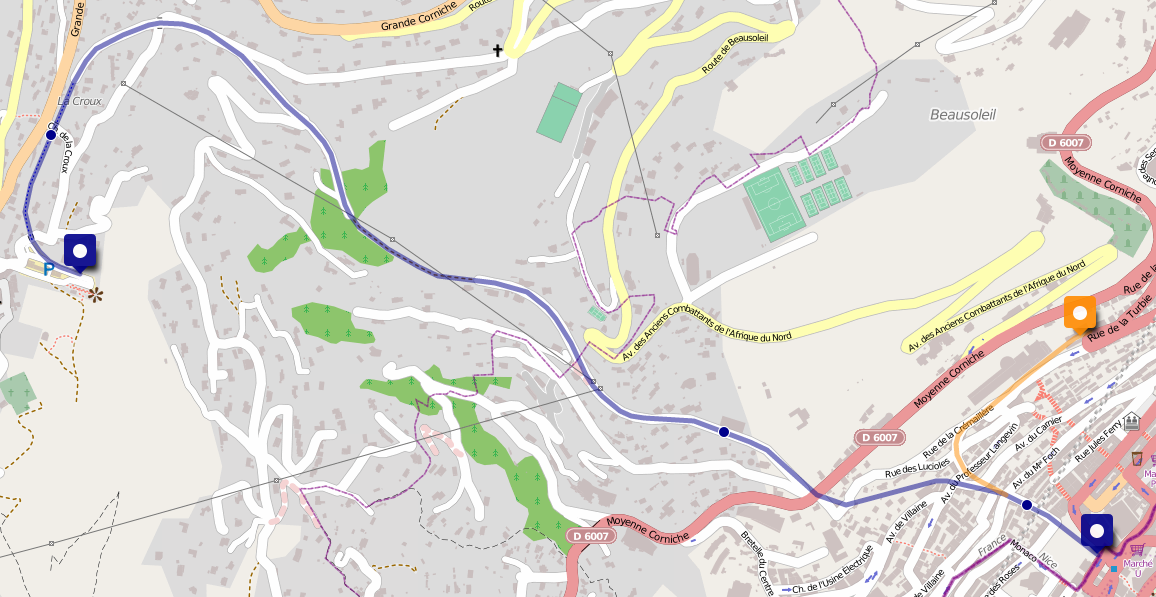
The final route is shown on the map below [2]. The line did not enter the Principality , it terminated on French soil in the suburb of Beausoleil.

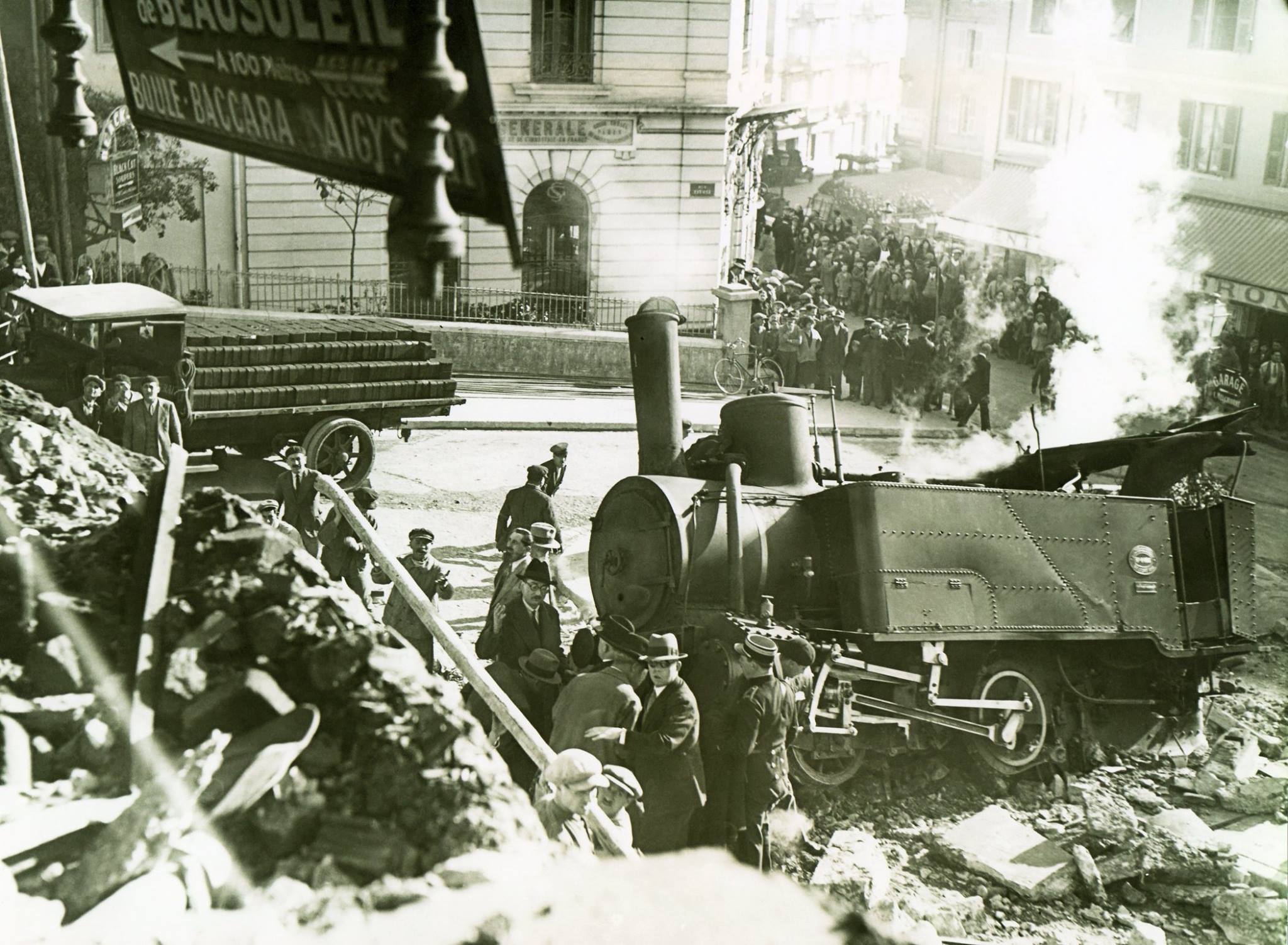
At 7.00am on 10th February 1894, the line was opened to its first travellers.[3] Traffic grew steadily until 1920. [4, 5, 6, 7] Electrification projects were envisaged in 1926 and 1929 but they did not come to fruition.[8, 9] The line closed in 1932.

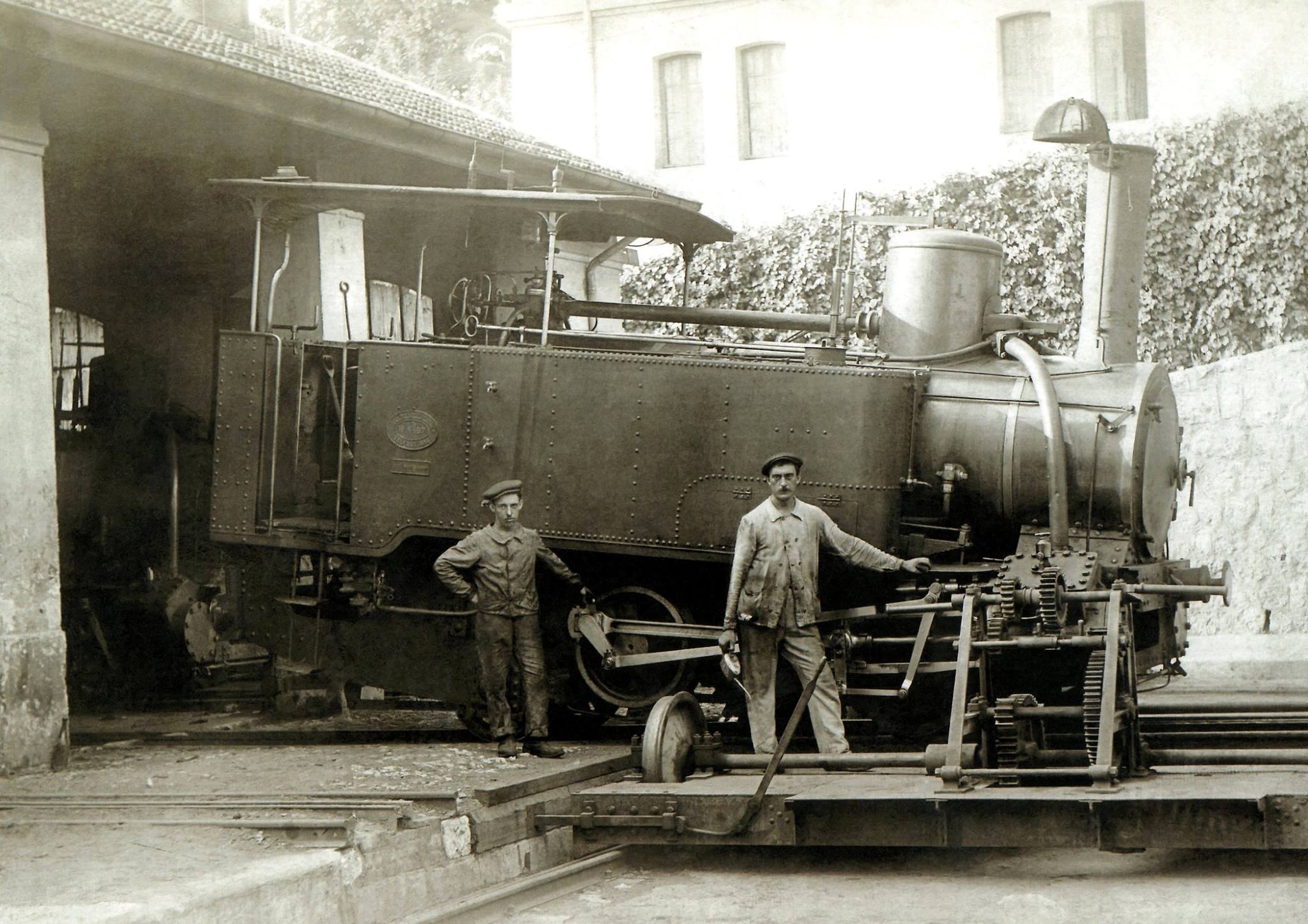
The Company had the following equipment:[10]

  • four 020T steam locomotives , the main feature of which was their design that countered the slope;
  • five passenger cars with 60 seats to 2 classes;
  • two goods wagons.

All items were manufactured in Belfort by Société Alsacienne de Constructions Mécaniques (SACM) [11] and delivered in December 1893.

This blog has a series of pictures of the line at the end of the text, below the poster.

We note for completeness that electric trams came to Monaco in 1898 with a line from the Place d’Armes to Saint Roman. Several other lines followed within the Principality. In 1900, the tram system was connected to that of Nice and in 1903 extended to Menton. It has also been pointed out to me (19th March 2018 by BG1000 on the Passions Metrique et Etroite Forum) that there was a short-lived tramway which used the route of the Funicular.

At the beginning of the 20th century an electric tram service connected the Rue des Iris in Monte-Carlo to the Riviera-Palace Hotel. The lifespan of the service was short – just 10 years from 1903 to 1913. The service became redundant as auto-bus and car usage rose in the period before the Great War. The Riviera-Palace Hotel and the tramway that served it are the subject of a book by Jean-Paul Bacscoul and Jean-Claude Volpi entitled: “Le Riviera Palace: 1897-1904, La Turbie, 1904-1936, Monte-Carlo Superieur- Beausoleil.”[12]

The last trams ran in Monte Carlo and the principality in 1931.

There was a main line station on coast but pressure of land use in the Principality has always been a problem, and in the 1950s a new tunnel was built from the original Monaco station, through the hills behind Monte Carlo, bypassing Monte Carlo station. The latter station was closed and the land occupied by it and the railway released for other uses. In the 1990s, a similar exercise was performed replacing the remaining line through the original Monaco station with a new line and station entirely underground.

There are some great postcard images of the Monte-Carlo to La-Turbie Railway below, after a poster for the La Turbie Line.

As a late addendum: Yves of the Passions Metrique and Etroite! Forum[13] provided this link:

https://photos.google.com/share/AF1QipN1FvO322HUemoyzNSRc5UVwfyKyiRpAzo7Q3Z3XhW3SFg_bYu1sdzVlUznOgns1Q?key=M2RPeFh3SV9WRl9KMTQ3WXlCSDVZV29jVjh1UDRB

There are a lot more images and text relating to the Monaco-La Trurbie line.

References

  1. Un Train de Legende: La Cremaillere de La Turbie; http://cremallierturbie.canalblog.com, accessed 18th March 2018.
  2.  Chemin de fer à crémaillère de La Turbie à Monte-Carlo; Wikipedia; https://fr.wikipedia.org/wiki/Chemin_de_fer_%C3%A0_cr%C3%A9maill%C3%A8re_de_La_Turbie_%C3%A0_Monte-Carlo, accessed 19th March 2018.
  3. Journal des Mines No. 7, 25th February 1894, p6.
  4. Rapports et délibérations : Conseil général des Alpes-Maritimes, Nice, Conseil général des Alpes-Maritimes; September 1914 2nd Ed. p132.
  5. Rapports et délibérations : Conseil général des Alpes-Maritimes, Nice, Conseil général des Alpes-Maritimes, 1916, 2nd Ed. p73.
  6. Rapports et délibérations : Conseil général des Alpes-Maritimes, Nice, Conseil général des Alpes-Maritimes, 1917, 2nd Ed. p74.
  7. Rapports et délibérations : Conseil général des Alpes-Maritimes, Nice, Conseil général des Alpes-Maritimes, 1918, 2nd Ed. p59.
  8. Le Temps Financier; Le Temps, no 259,‎ 2nd May 1932, p2.
  9. Rapports et délibérations : Conseil général des Alpes-Maritimes, Nice, Conseil général des Alpes-Maritimes, 1920, 1st Ed. p149, p211.
  10. Annuaire des Chemins de fer et des Tramways (ancien Marchal) : Édition des réseaux français, Paris, 1928, 43rd Ed. p1334.
  11. Bulletin des lois de la République française, t. 31, Paris, Imprimerie nationale, 1885 “Chemins de fer” p657, p1073-1080, p1980.
  12. Jean-Paul Bacscoul & Jean-Claude Volpi; Le Riviera Palace: 1897-1904, La Turbie, 1904-1936, Monte-Carlo Superieur- Beausoleil.
  13.  See: http://www.passion-metrique.net/forums/viewtopic.php?p=414373#p414373, accessed 22nd March 2018.