
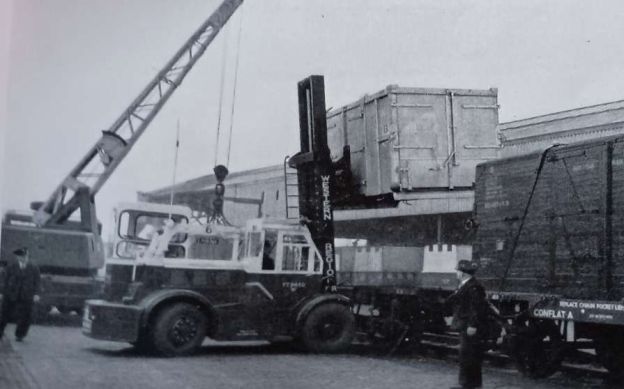
A, then, recent exhibition at Battersea Wharf Goods Depot of British Railways and British Road Services freight vehicles and handling equipment prompted a review in The Railway Magazine of January 1959, [1] of developments in the handling of freight. The emphasis of the exhibition was on the improvement of door-to-door services. It was part of the broader Modernisation and Re-Equipment of the British Railways plan launched in 1954, which sought to modernize and improve freight services in the late 1950s and early 1960s.
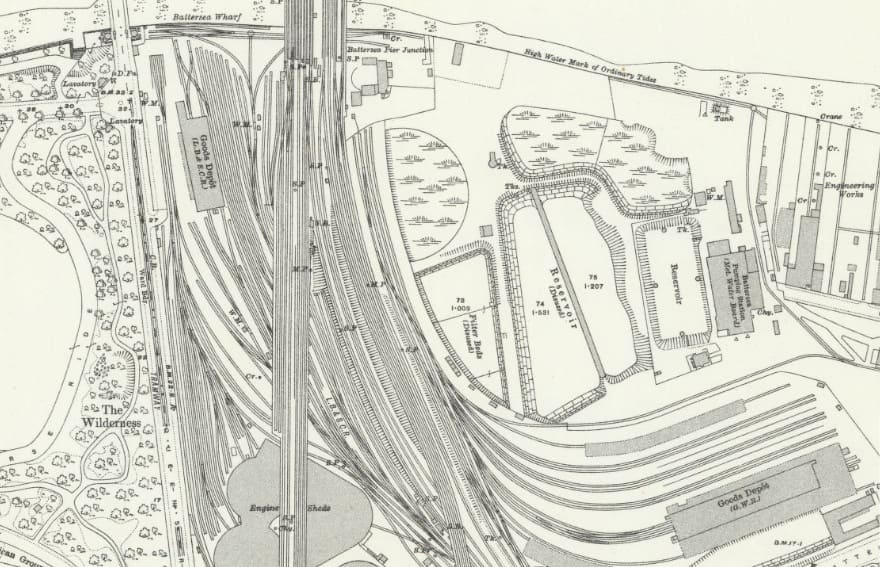
The Freight Transport Exhibition at Battersea Wharf Goods Depot in London was held from 28th–30th October 1958. It was a major showcase organized by the British Transport Commission.
The exhibition highlighted initiatives to streamline freight transport, including the increased use of containers, modern cranes for lifting heavy containers, and the transition from traditional to motorized handling. A major goal of the exhibition was to demonstrate to traders and manufacturers the efficiency of using both rail and road services to move goods directly from factory to destination, aiming to recapture traffic lost to road transport.
Battersea Wharf Goods Depot, near Chelsea Bridge, was an area with significant railway goods activity in the 1950s.
Displays included mobile cranes lifting heavy containers, emphasizing the faster, safer, and more reliable methods for moving freight. The exhibition also featured, among other things: bulk cement wagons with compressed air unloading; the ‘Penman‘ ramp; numerous types of pallets and containers; and automatic coupling of wagons.
Wikipedia tells us that the Modernisation Plan failed to successfully redefine “what the purpose of the railways was. British Railways remained bound by the Railway and Canal Traffic Acts that obligated it to provide carriage for virtually any type of goods, regardless of quantity (large or small) between any two stations on the network, at set and published rates. This legislation dated back to the 19th century to prevent the railways abusing their monopoly as the sole practical long-distance transport provider for much of the country, but the growth of road transport had left the railways locked into a highly disadvantageous position. Road freight operators had no legal restrictions and could turn down work that was uneconomic, which BR could not, and could easily undercut BR’s carriage rates which the railway could not alter without legal consent.” [2]
“The Railway and Canal Traffic Acts also saddled BR with the necessity to maintain thousands of goods yards and other facilities, plus rolling stock and staff to service them, even when there was ever-decreasing demand for those services and such traffic as did exist was rarely profitable. This issue had been identified during the Great Depression, and the Big Four had campaigned for repeal of the Railway and Canal Traffic Acts as a ‘Fair Deal’ during the 1930s. However, this did not happen until the Transport Act 1962 gave BR freedom of contract, and until then the Modernisation Plan had to commission locomotives, rolling stock and facilities to manage the ever-declining but legally required wagonload freight traffic.” [2]
“The timing of the Modernisation Plan was also unfortunate, as just months after its publication the train drivers’ trade union, ASLEF, called a strike that lasted for 17 days, causing major disruption to the network. Many of BR’s long-standing freight customers – especially smaller business and industrial users which provided much of the remaining wagonload and less than carload freight traffic – were forced by necessity to start using road transport and never returned to the railways, which hastened the decline in railway freight traffic and rapidly undermined the logic and business case for the Plan’s renewal and expansion of large marshalling yards.” [2]
The exhibition in 1958 was an attempt to recover some of the freight movements lost road transport.
The Railway Magazine reported that in recent years “considerable progress [had] been made in extending and improving the service offered by British Railways to the trader and industrialist for the movement of freight of all kinds. Many of the major developments concerned with freight in the modernisation plan [were] of a long-term character: though they [were] being pushed forward with vigour, their full benefits [would] not be realised for some time. In many directions, however, other lesser but nevertheless important projects which [had] been completed [were] producing results … and [were] enabling the railways to provide freight services of growing reliability and speed.” [1: p47]
“Main policy developments [lay] in the direction of speedier movement of bulk supplies over long distances on trunk routes; extending door-to-door services; more economical handling of small loads; more detailed planning to meet customers’ requirements and the introduction of new vehicles, rolling stock and other equipment to meet changing conditions.” [1: p47]
“The relationship between rail and road [was] being thought of more and more in terms of co-operative arrangements designed to combine the best features of each in the common interest of the customer and the transport undertaking.” [1: p47]
The ‘Penman’ Ramp
The Penman Ramp was an intriguing device designed to enhance the transfer of containers by which the motion of the rail or road vehicle lifts the container from one on to the other. The Penman ramp was being used experimentally by British Railways.
The Railway Magazine reported that the Penman Ramp, “consists of two raised rails with inclined sections at either end which are positioned one at each side of a siding. The containers have pull-out metal skids near each corner and, as the vehicle moves between the raised rails, the skids engage with the inclined sections at the rail ends, and the container is raised from the vehicle. When the rail or road vehicle to which it is being transferred is moved into position between the raised rails, a hinged flap under the container engages with a batten on the vehicle floor and the container is pushed along the rails and down the inclined sections, to settle gently on the lorry or wagon. With this system, there are few costs; the equipment is robust and the mechanics are simple.” [1: p47,49]
Online archive material from the Commercial Motor magazine similarly reports that:
“The Penman ramp is being experimentally used. This simple device is designed to ease the task of transferring containers between rail and road vehicles in the railway siding. It consists of two raised rails with inclined end sections which are set up on each side of the railway line. The containers are provided with pull-out skids at each corner and these engage with the guide rails as the vehicle moves between them.
“Thus, a railway conflat wagon can he driven between the guide rails, the skids are rolled up the incline and the container is left in the elevated position while the wagon is removed and replaced by the lorry. In the reverse motion, a hingedt flap under the container engages with a batten on the floor of the vehicle, the motion of which draws the container gently downwards on to the platform.
“Perhaps the greatest factor in reducing handling costs is the use of the unit load, either in a container or on a pallet. Containers are available in a large number of types and sizes, for both rail and road use. They are, howeVer, expensive consignments when travelling empty. An effective solution of this problem lies in the collapsible container, an example of which has been developed for the railways by T.I. (Group Services), Ltd.” [3]
The ‘Freightlifter’ Fork-lift Truck
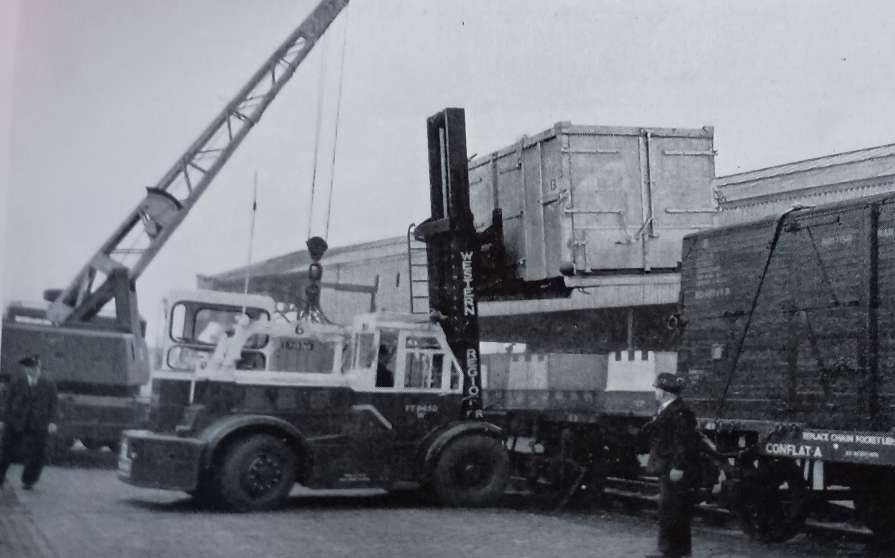
The Railway Magazine reported that a heavy duty fork-lift truck had been developed which could lift over 8 tons as a fork-lift and which could act as a mobile crane capable of lifting 6.75 tons, and which, with a lifting frame could handle containers of up to 7.25 tons in weight. The report continued: “It can also be converted into a searcher crane for removing articles weighing up to a ton from the corners of covered wagons. It has alternative driving positions, and can be driven on the road.” [1: p49] By the beginning of 1959, some fifty Freightlifters were in use in British Transport facilities.
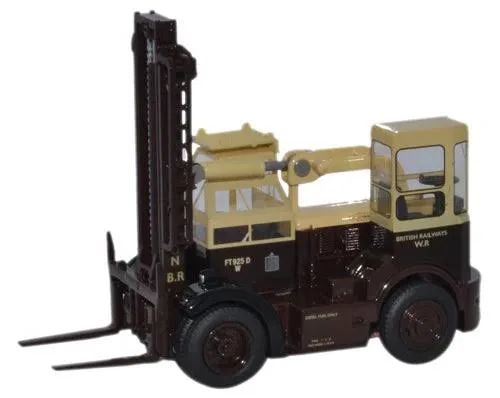
A model produced by Oxford Diecast of a Shelvoke & Drewry Freightlifter operated by British Railways. This is an N Scale model of a 1957 Shelvoke and Drewry Dualdrive Model 100 Freightlifter Forklift from Oxford Diecast featuring a metal body, window glazing and realistic decoration. [4]
The Freightlifters purchased by British Railways were of the ‘Dualdrive’ version. They could “be driven like a normal truck between sites at 22 m.p.h. and then controlled from a separate cabin. It was developed after the magistrates, at Slough, convicted British Railways for using a vehicle on the road in which the driver’s vision was obscured by a ‘jungle of steel’. This example could lift 18,000 lbs and carried special container lifting equipment.” [5]
Shelvoke & Drewry were based in Letchworth in Hertfordshire. Shelvoke & Drewry Ltd was formed in October 1922 by Harry Shelvoke (1878 – 1962) and James Drewry (1883 – 1952) who were employed by the Lacre Company that moved to Letchworth Garden City in 1910.
Mr. Shelvoke was General Manager, and Mr. Drewry was Chief Engineer.
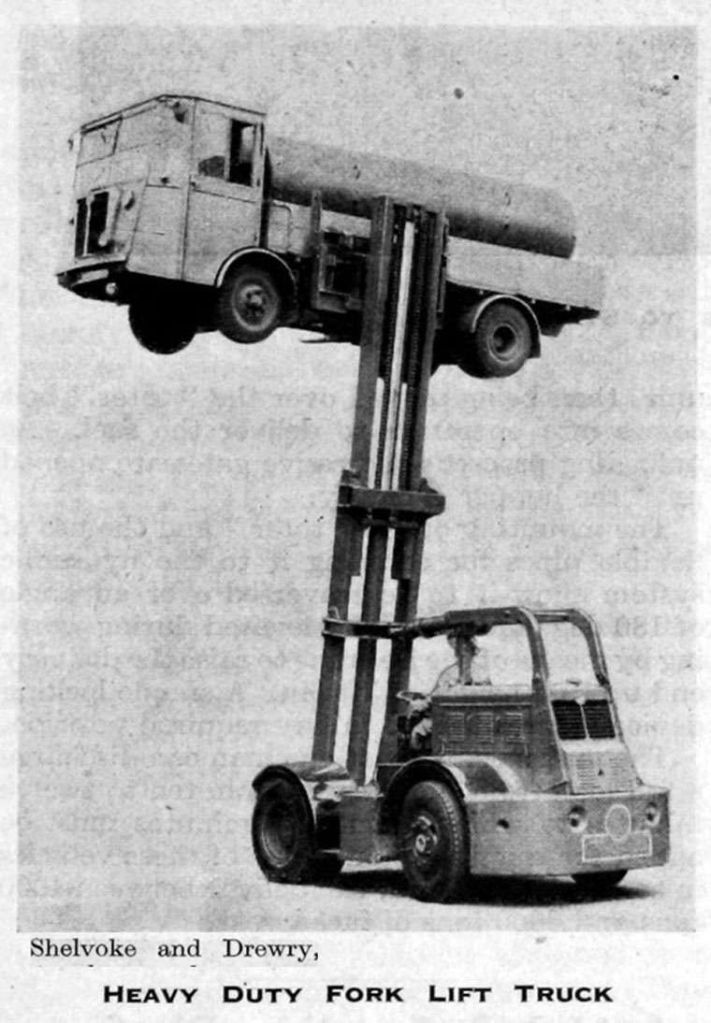
Initially, they produced a low loadbed, smaller vehicle called the ‘Freighter’. “Early customers included the L.M.S. Railway, Carter Paterson, Express Dairy and J. Lyons. But the municipal potential was soon realised and by the end of 1924, when the hundredth vehicle had been built, there were 35 freighters in municipal service. The first order being from Deptford in September 1923.” [5]
The company became known for a range of refuse disposal vehicles and also, after a request from the London Brick Company, for the Freightlifter range of forklift trucks (which first came off their production line in 1952). The Company fulfilled 170 orders from London Brick where some of the vehicles were in service for 21 years. The Company built forklift trucks until 1974. [5][6] The ‘Dualdrive’ version was produced from 1957.
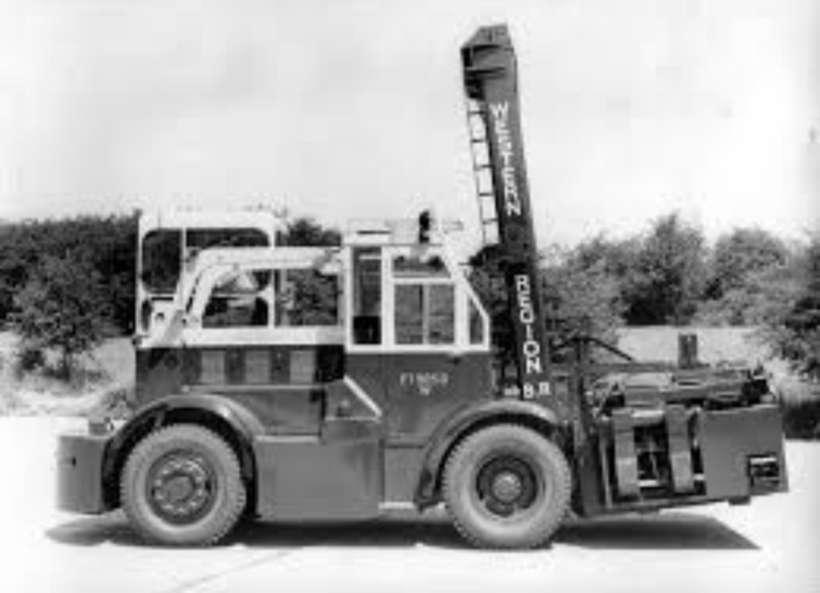
The ‘Dualdrive’ forklift known as a ‘Freightlifter’ [7]
Freightliners
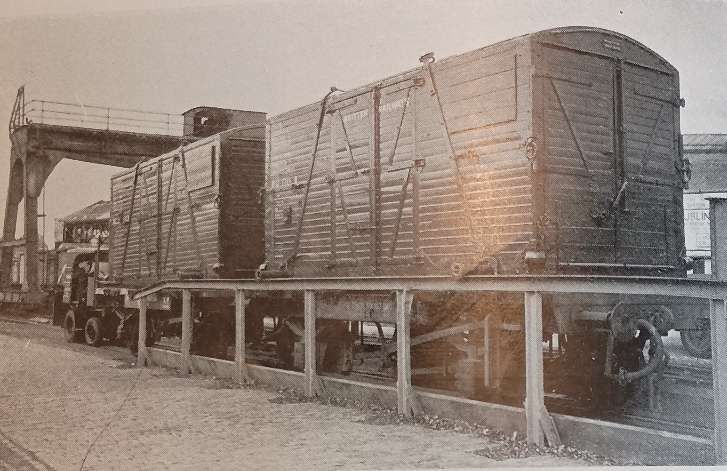
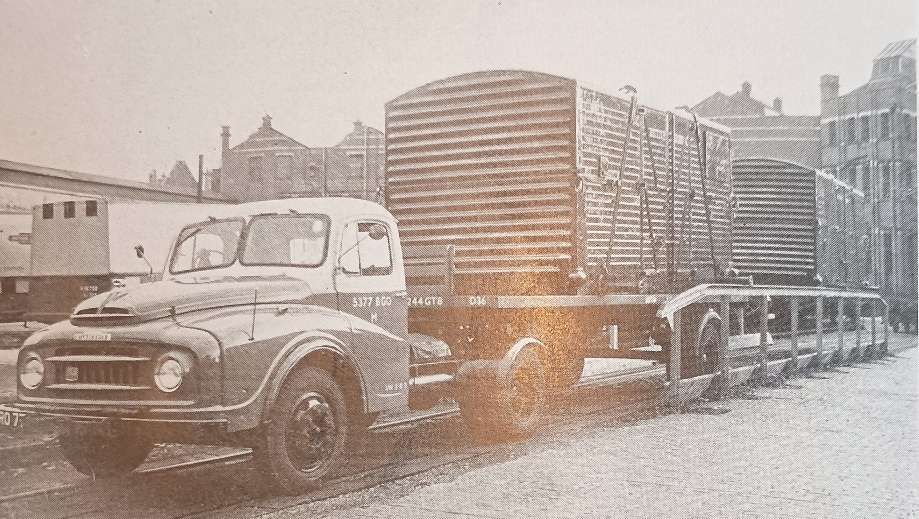
The Railway Magazine also reported on British Railways plans for Freightliner trains. Two wagons with containers were on display at the show. The Railway Magazine noted that British Railways were “shortly to run in an entirely new experimental service [which] consists of flat-top wagons permanently kept together. The rake [would] run to a regular timetable between main centres at high speeds. Freightlifters or cranes [would] remove or load containers at stopping places.” [1: p49]
The Railway Magazine noted that in January 1959 there were “over 44,000 containers in service on British Railways alone, and many more [were] being produced. They [varied] from what [was] virtually an open box, adaptable for the conveyance of a wide variety of goods, to specialised highly-insulated types for ice-cream and quick-frozen foods. Sizes [ranged] from the large B.R.S. container, 24 ft. long, to a British Railways small wheel container that can be pushed by hand. Experimental collapsible containers, and ones made of light alloy, [were]being tested.” [1: p49]
In March 1959, British Railways introduced the Condor service, a pioneering overnight container train operating between London and Glasgow. Known as a precursor to the modern ‘Freightliner’ concept, it offered door-to-door container service using roller-bearing flat wagons and was often hauled by Metro-Vic Co-Bo diesel locomotives.” [8]
In the end the ‘Feightliner’ service did not commence until November 1965. “Initially, the new Freightliner service was intended for the domestic movement of freight in containers between points in Great Britain, with 16 terminals in operation in 1968, and Southampton and Tilbury under construction. However, in 1968 a London to Paris working was started which relied upon the Dover to Dunquerke train ferry, and by 1969, the service was linked into ports with a short-sea and a deep-sea service to other countries. By the end of the 1960s, liner trains (united transport) were carrying 12,900,000 tonnes (14,200,000 tons) per year. By the end of 1978, this average was 39,300,000 tonnes (43,300,000 tons). In 1969, British Rail transferred ownership of Freightliner to the National Freight Corporation, but with BR supplying the wagons and locomotives. It was returned to BR in 1978.” [9]
“By 1981, Freightliner was operating to 43 terminals, 25 of their own and 18 privately used locations. In 1982, the Port of Felixstowe was despatching three daily freight trains with containers on. In 1983, a second terminal opened (Felixstowe North), and between the two terminals, the amount of containers transhipped to and from rail was about 80,000 per year. … When a third terminal was opened in 2013 (named Felixstowe North, with the previous one being renamed Felixstowe Central), over 40 million TEUs (twenty-foot equivalent units) with 36 daily departures carrying containers were being handled. In 1986 and 1987, several terminals were closed, including four in Scotland (Aberdeen, Clydeport [Greenock], Dundee and Edinburgh) despite the potential for long-distance services from these terminals. British Rail deemed it more efficient to load containers at Coatbridge in Glasgow, and use electric traction south on the West Coast Main Line. Before the closures, Freightliner operated 35 terminals, including ports, compared with 19 under privatisation.” [9]
More on the history of freightliner intermodal services can be found here. [9]
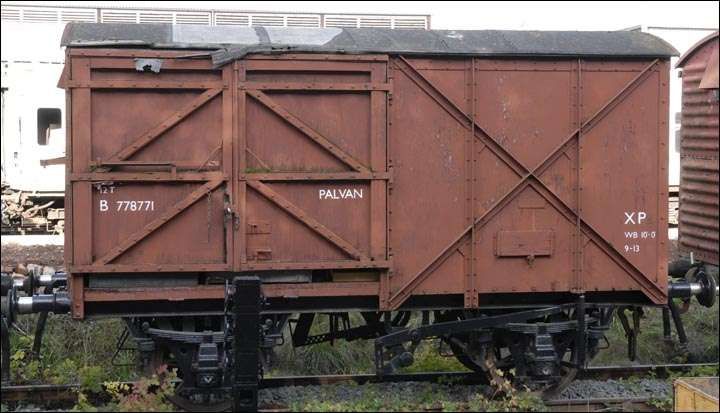
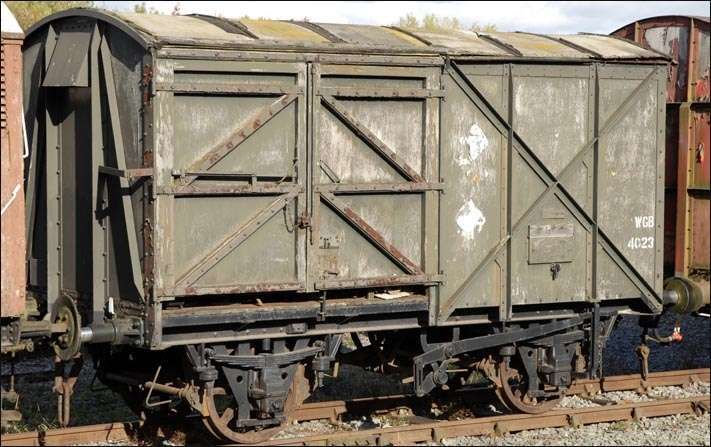
Pallet Vans (Palvans, Diagram 1/211)
First procured in 1952, by January 1959 “nearly 1,500 specially-built railway pallet vans [were] in service and many more [were] on order for the exclusive conveyance of palletised loads. The typical example shown at Battersea [had] extra wide doors for easy access by mechanical handling equipment. It was built to accommodate the most common sizes of pallets, but [could] be adapted for any size by removable partitions and shields which also prevent movement during the journey. There [were] also over 1,200 pallet brick wagons used for the conveyance of refractory bricks.” [1: p49-50]
Ultimately, “BR built a total of 2388 Palvans with heavy doors at diagonal corners using two distinctive brake riggings. Although all had auxiliary suspension they rode poorly causing accidents so most were withdrawn by the mid 1960s, with a few surviving with UIC suspension. Note that some, in internal use with plain bearings, may have been built with roller bearings which were swapped out before allocation as internal user.” [10]
Two typical pallet vans are shown immediately below. …
Transformer Wagons
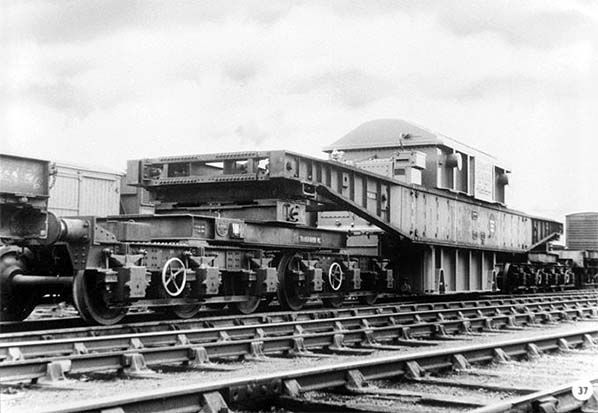
Also exhibited at Battersea Good Depot was a specially designed “British Railways transformer wagon. … It [had] 24 wheels, [was] 92 ft. long, and [could] carry electric transformers weighing up to 135 tons. The wagon [was] equipped with traversing mechanism which enables an exceptionally wide load to be slewed sideways to avoid obstructions. The side girders [were] removed to load the vehicle.” [1: p50]
The Variety and Number of Wagons
One object of the exhibition at Battersea Goods Depot was to show that the bulk-carrying capacity of British Railways and British Road Services was being continuously expanded. In a, then, “recent year British Railways produced over 33,000 all-steel 16-ton mineral wagons, 4,500 hopper wagons of 21-tons capacity, 1,300 25½-ton iron-ore hopper wagons, and 530 of 33-ton capacity. The 16-ton mineral wagon [was] the general wagon for bulk cargoes, but a great volume of coal and other minerals [was] carried daily in 21-ton hopper wagons of which there are now 36,000. There [were] also some 10,000 21-ton flat-bottomed mineral wagons, many of which [ran] in block trains direct from the collieries to merchants in main industrial and residential centres. The largest hopper wagon in service [was] the 56-ton bogie ore vehicle. A train of nine of these vehicles [could] carry 500 tons and the unloading time, through power-operated doors, [was] less than 60 sec. for the complete train.” [1: p50]
Wagons Requiring Specialised Equipment
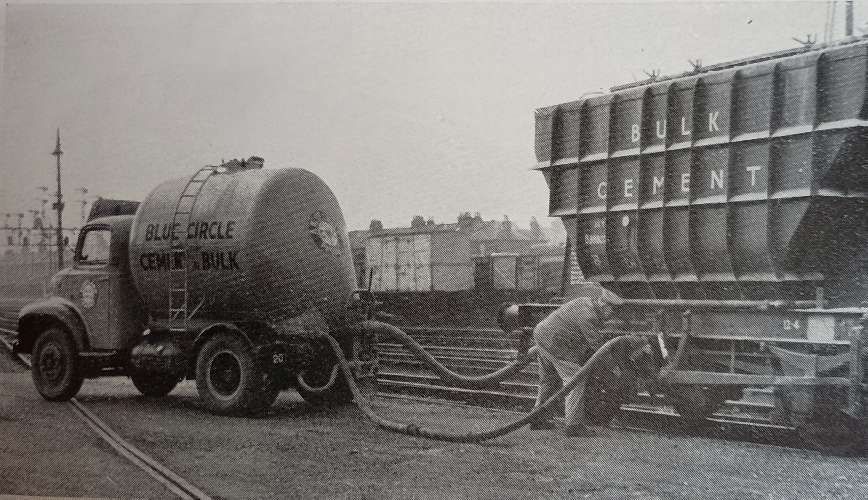
“Of wagons for commodities which require specialised equipment, a cement wagon was shown. This special 20-ton all-steel enclosed wagon, which [could] be pressurised with air for pneumatic discharge through a flexible pipe to a road vehicle, or to a storage silo, overcame many difficulties. It [was] also suitable for alumina, salt, fuller’s-earth, powdered lime, pulverised fuel, and slate dust.” [1: p50]
Bulk Liquid Carriers
“The exhibition also included a selection of rail and road vehicles designed for carrying liquids in bulk. There were tanks which [were] fixed to a railway chassis and [could] carry 10,000 gal. at a time; others which are demountable and can be placed on a road vehicle; and some road trailers designed to be carried ‘piggy-back‘.” [1: p50]
Bulk liquid transport on British Railways featured a transition from the end of the 1950s from traditional four-wheelers to larger, high-capacity bogie tankers. Key vehicles included Class A and B tankers for oil/petrol, TTA two-axle tank wagons for various liquids, and specialized containers for milk, chemicals (like chlorine), and beer. TTA Wagons were used extensively for industrial hot tar, agricultural cold milk, and high-octane aviation fuel.
Interfrigo and Transfesa Wagons
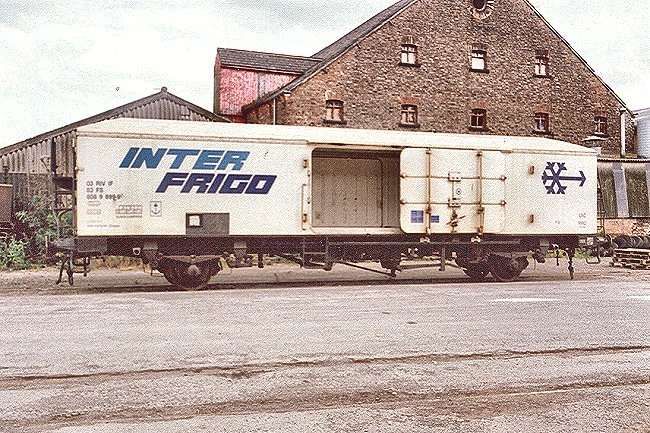
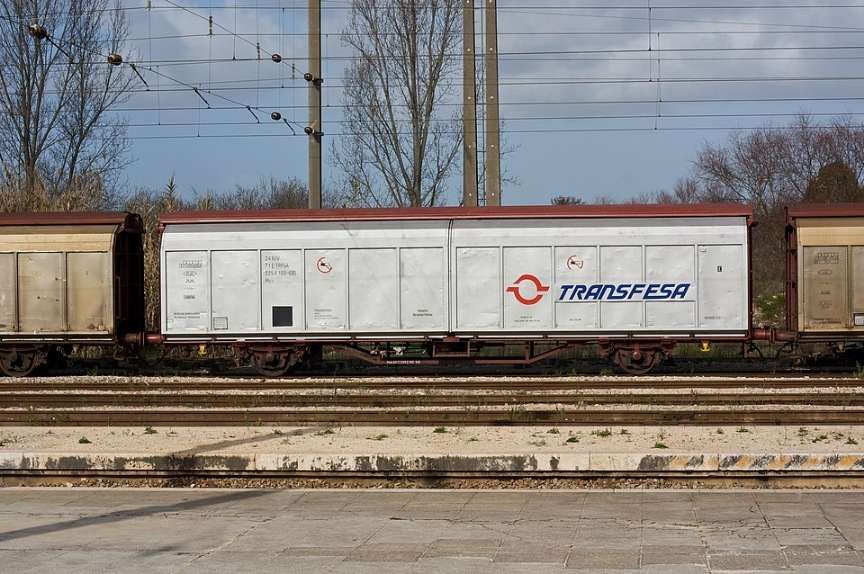
“Among wagons shown at Battersea, which are used in international traffic to and from the Continent by the train ferry services, was the ‘Interfrigo’, fitted with electrical ventilation, and the ‘Transfesa’, a large-capacity wagon some 40 ft. long, used for transporting citrus fruit and other perishables from Spain, returning with export machinery. The axles of the latter vehicle can be changed to enable it to travel on both the wide-gauge Spanish railways and standard-gauge lines in Europe.” [1: p51]
“Intercontainer was established, originally, as a not for profit cooperative partnership between principal European rail companies, in 1967. In 1993 the business acquired and operations were pushed together with those of another not for profit cooperative partnership called Interfrigo which had been founded in 1949 and specialised in timely refrigerated rail transport of high volume goods, notably bananas carried from the port of Rotterdam to principal European markets such as Germany and Switzerland. The resulting combination now became known as Intercontainer-Interfrigo. In 2003 the company was converted into an ‘Aktiengesellschaft’ (a form of Joint-stock company) as defined under Belgian law.” [13]
“On 26th November 2010 the owners placed the business in liquidation with the stated intention of minimizing disruption to customers by transferring operation of the company’s 145 or so weekly trains to the rail companies themselves.” [13]
“Transfesa was founded in 1943, early operations were centered around the domestic transport of livestock. During 1952, it received its first freight wagons to be constructed with interchangeable axles, permitting freight movements between Spain and the rest of Europe without the need from transhipment, thus accelerating service speeds and lowering costs. Throughout the 1950s and 1960s, international traffic grew based around the carriage of fruit exports to western Europe using company’s own ventilated wagons.” [14]
“During the 1960s and 1970s, Transfesa opened numerous branches across Europe, such as in Germany and Switzerland.[2] In 1972, it expanded into the British market as well.[3] During the 1970s and 1980s, the company found new business in the automotive sector, transporting complete cars by rail to dealerships throughout the continent, as well as parts between manufacturing sites. In the 1990s, Transfesa branched out into ancillary activities such as rolling stock maintenance and terminal management services.” [14]
More can be discovered about Transfesa here. [14]
“An experimental automatic coupler manufactured by Dowty Hydraulic Units Limited also was demonstrated. It incorporate[d] the vacuum brake pipe, and [would] engage and lock in a wide range of track curvature and gradient conditions; uncoupling is achieved simply by operating a lever mounted on either side of each wagon. When coupling wagons not fitted with automatic couplers, the unit can be swung through 90 deg. to present a standard draw hook. It is interchangeable with conventional draft gear without modifications having to be made to the wagon.” [1: p51]
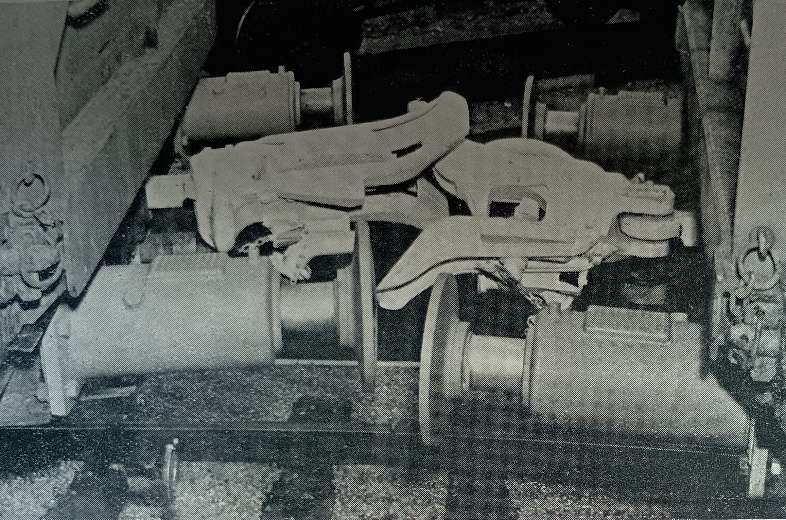
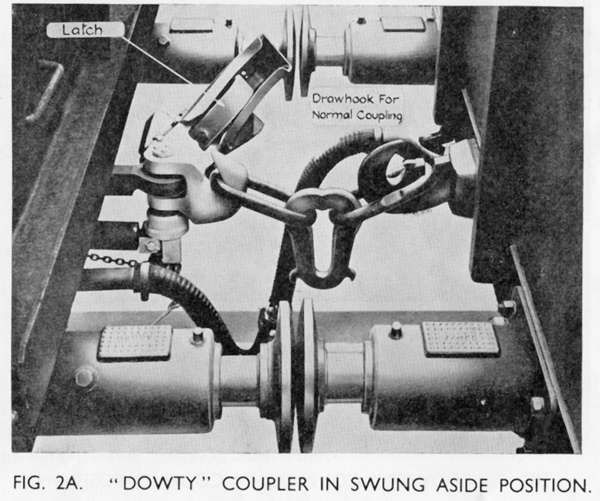
This final image shows the Dowty Coupler not in active use or, as in the image title, in swung aside position. [16]
References
- Developments in Freight Transport; in The Railway Magazine January 1959; Tothill Press, London, 1959, p47-51.
- https://en.wikipedia.org/wiki/History_of_rail_transport_in_Great_Britain_1948, accessed on 20th March 2026.
- https://archive-uat.commercialmotor.com/article/7th-november-1958/92/btc-ain, accessed on 20th March 2026.
- https://www.themodelcentre.com/nsdf001-oxford-diecast-n-gauge-shelvoke-drewry-freightlifter-british-rail-western, accessed on 20th March 2026.
- https://shelvoke-drewry.co.uk, accessed on 20th March 2026.
- https://www.gracesguide.co.uk/Shelvoke_and_Drewry, accessed on 20th March 2026.
- https://shelvoke-drewry.co.uk/assets/files/Issue20.pdfhttps://shelvoke-drewry.co.uk/assets/files/Issue20.pdf, accessed on 20th March 2026.
- https://en.wikipedia.org/wiki/Condor_(train), accessed on 20th March 2026.
- https://en.wikipedia.org/wiki/Intermodal_railfreight_in_Great_Britain, accessed on 20th March 2026.
- https://paulbartlett.zenfolio.com/brpalvan, accessed on 20th March 2026.
- http://ukrailways1970tilltoday.me.uk/wagons_GCR_Nottigham_covered_Wagons.html, accessed on 20th March 2026.
- http://disused-stations.org.uk/features/marchwood_military_railway/index.shtml, accessed on 20th March 2026.
- https://en.wikipedia.org/wiki/Intercontainer-Interfrigo, accessed on 20th March 2026.
- https://en.wikipedia.org/wiki/Transfesa, accessed on 20th March 2026.
- http://www.railalbum.co.uk/railway-wagons/ferry/italy-interfrigo-van-1.htm, accessed on 20th March 2026.
- https://www.dowtyheritage.org.uk/content/dowty-group/dowty-hydraulics/british-railways-dowty-automatic-couplers, accessed on 20th March 2026.
- https://maps.nls.uk/view/103313384, accessed on 20th March 2026.
 Roger Farnworth