Tag Archives: Beyer Peacock

Three Beyer-Garratts in East Africa in the 1950s

The December 1958 issue of The Railway Magazine featured three photographs of Beyer Garrett locomotives at work in East Africa. These were giants of the metre-gauge that grappled with long loads on steep inclines and at times sharply curved track radii. [1]

1. EAR Class ’55’ Garratt No. 5504 at Diva River
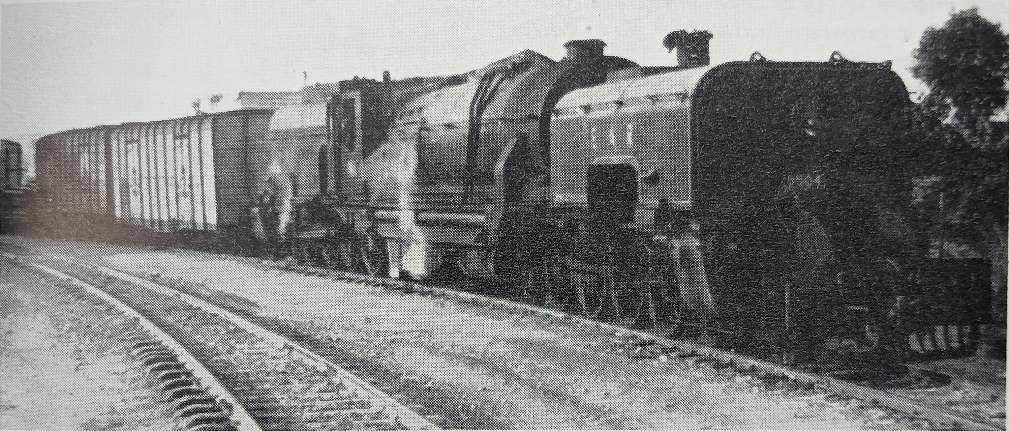
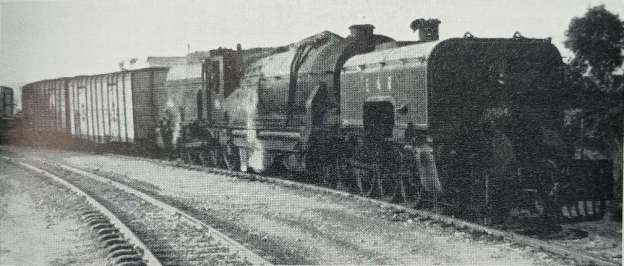
Class ’55’ Garratt No. 5504 on the up mixed train at Dura River. [1: p849]

The KUR EC5 class was a class of 1,000 mm (3 ft 3 3⁄8 in) gauge 4-8-2+2-8-4 Garratt-type articulated steam locomotives built during the latter stages of World War II by Beyer, Peacock & Co. in Gorton, Manchester for the War Department of the United Kingdom. The two members of the class entered service on the Kenya-Uganda Railway (KUR) in 1945. They were part of a batch of 20 locomotives, the rest of which were sent to either India or Burma. [2: p64]

The following year, 1946, four locomotives from that batch were acquired by the Tanganyika Railway (TR) from Burma. They entered service on the TR as the TR GB class. [2: p64]

In 1949, upon the merger of the KUR and the TR to form the East African Railways (EAR), the EC5 and GB classes were combined as the EAR 55 class. In 1952, the EAR acquired five more of the War Department batch of 20 from Burma, where they had been Burma Railways class GD; these five locomotives were then added to the EAR 55 class, bringing the total number of that class to 11 units. [2: p64]

This locomotive was Works No. 7151, War Department No. 74235, War Department India No. 423. It was one of the two that went to Burma Railways (their No. 852) from where it was purchased by Tanganyika Railways in 1946 and became their No. 751. It came to the EAR in 1949 and received the No. 5504. [3]

Sister locomotives in Class 55 can be seen here [7] and here. [8]

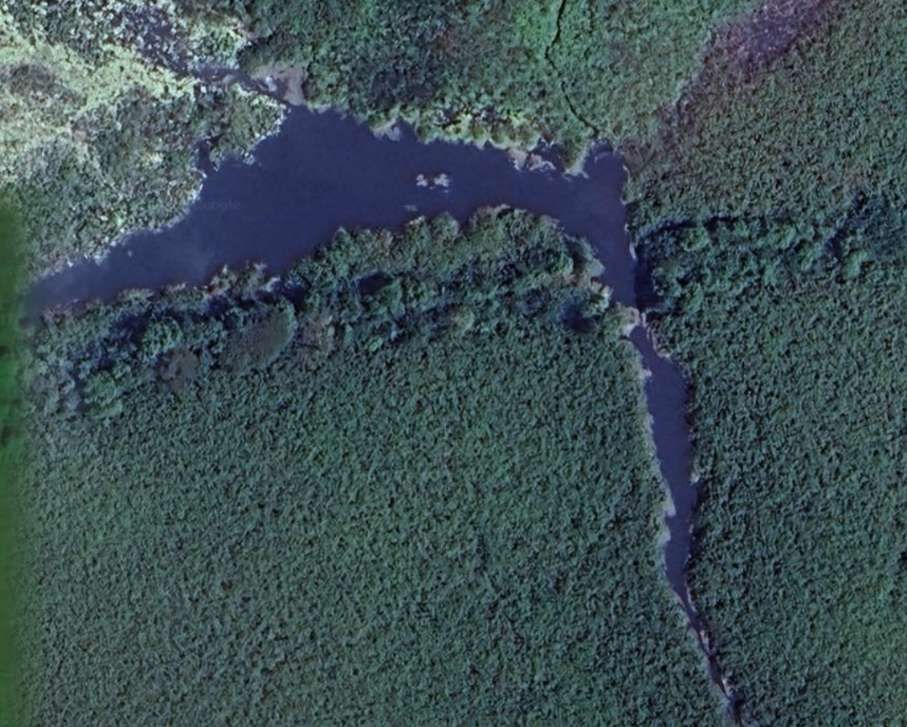
Dura River was the last station on the Western Extension before the end of the line at Kasese, Uganda. The River flowed North to South towards Lake George and was crossed by the railway at the Eastern edge of the Queen Elizabeth National Park. Mapping and satellite imagery in the area are not highly detailed – the following images are the best I can provide. …
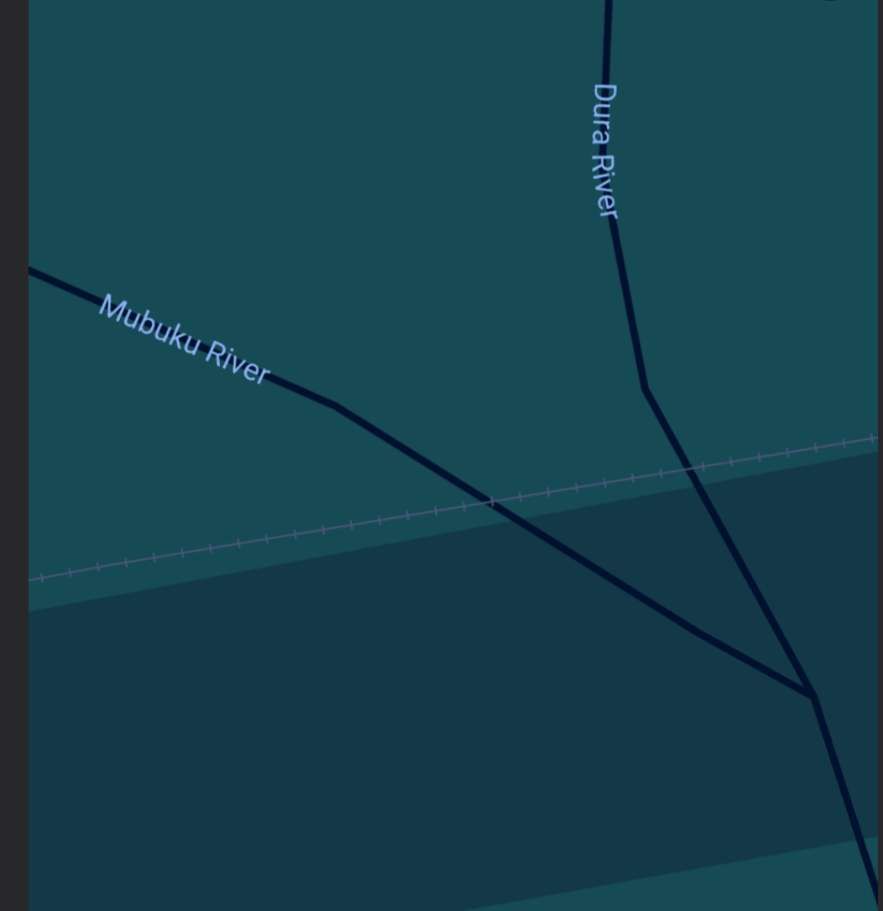
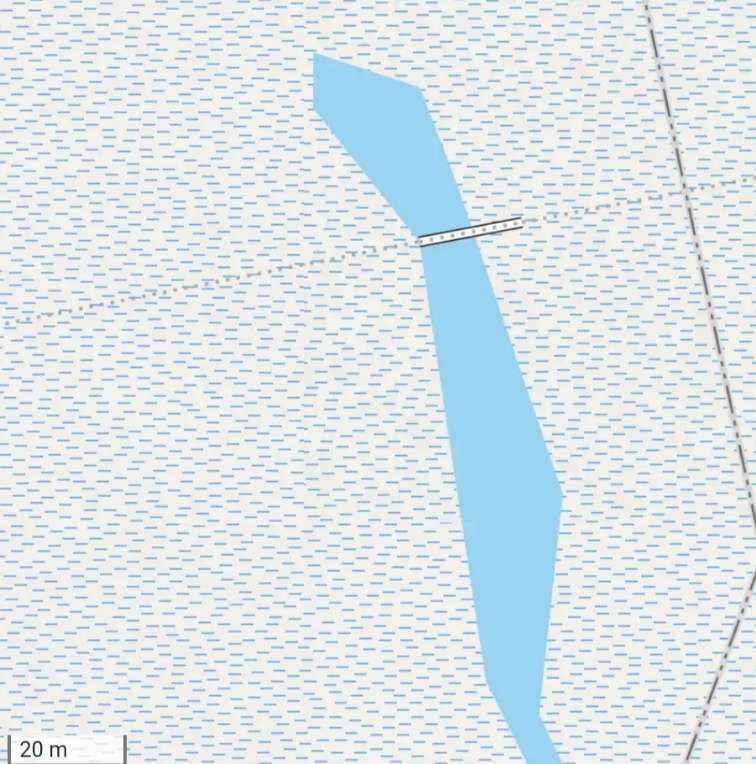
The mapping which appears on the Google search engine when searching for the National Park. This enlarged extract focuses on the railway bridges which cross the Mubuku and Dura rivers. The line of the railway is shown in grey. [4]
The OpenStreetMap view of the same location, highlighting the bridge over the river. [5]
Google Maps satellite imagery focussed on the same location. The line of trees which sit above the swampy ground mark the line of the railway embankment. [Google Maps, July 2025]
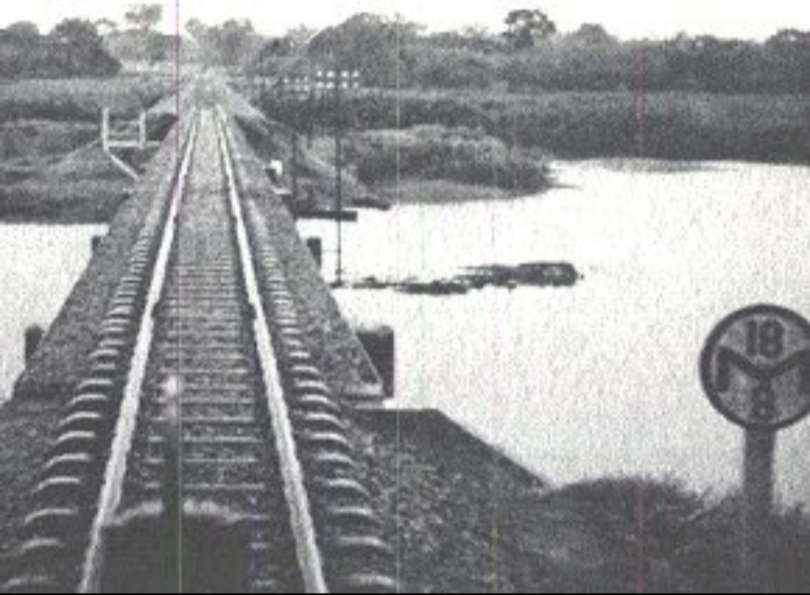
Crossing the Dura River/Swamp. The sign is a Momentum Board, which refers to the opposing gradient being steeper than the ruling gradient. The figures mean that the driver should achieve a speed of 18 mph at a distance of 4 furlongs (8 half furlongs) from the sign. The train’s maximum speed was 25 mph, © Geoffrey Parsons. [6]

2. EAR Class ’58’ Garratt No. 5804 near Kikuyu
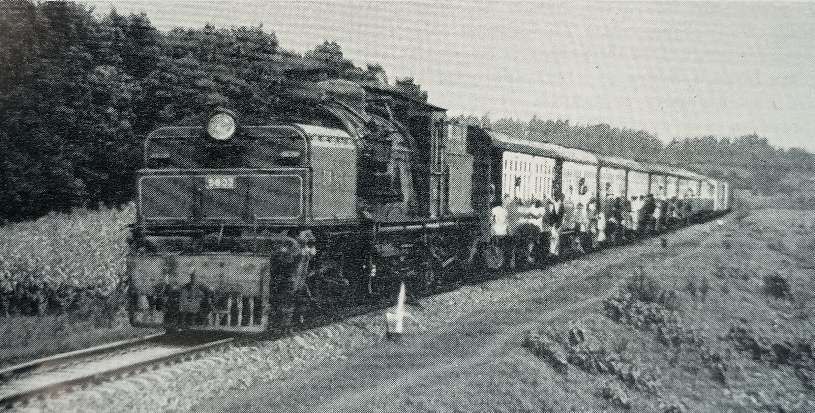
Nairobi-Kisumu train near Kikuyu with a ’58’ class Garratt No. 5804, © C. W. Stuart. [1: p849]

The EAR 58 class was a class of 1,000 mm (3 ft 3 3⁄8 in) gauge, 4-8-4+4-8-4 Garratt-type articulated steam locomotives built by Beyer, Peacock & Co. in Manchester, England, in 1949. [9]
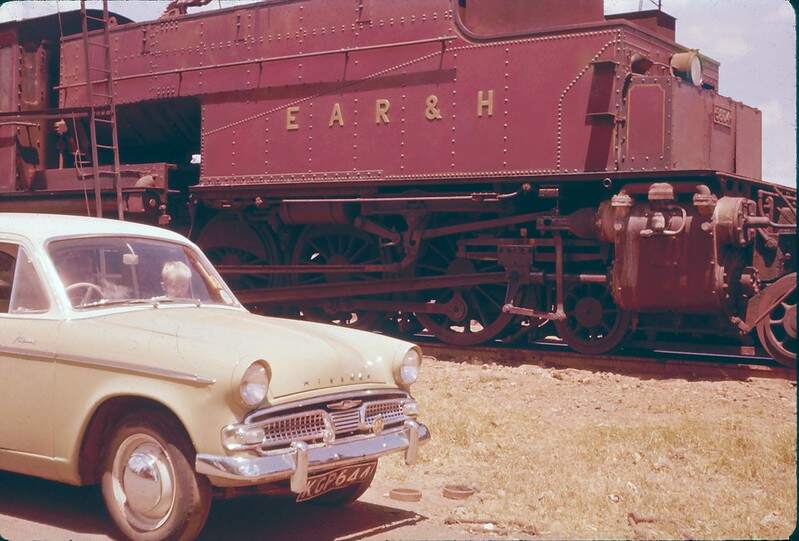
Another view of No. 5804, apparently it was the only one of the class to bear the lettering ‘EAR&H’, all others in the class bore ‘EAR’, © gruntie916 and licenced for reuse under a Creative Commons licence (CC BY 2.0). [10]

The eighteen members of the class were ordered by the Kenya-Uganda Railway (KUR) immediately after World War II, and were a slightly modified, oil-burning version of the KUR’s existing coal-fired EC3 class. By the time the new locomotives were built and entered service, the KUR had been succeeded by the East African Railways (EAR), which designated the coal-fired EC3s as its 57 class, and the new, oil-burning EC3s as its 58 class. [2: p66][9]

No. 5804 was built in 1949 (Works No. 7293) and originally given the KUR No. 92. Its sister locomotive No. 5808 (Works No. 7297, given KUR No. 96 but never carried that number) was the first to enter service with the EAR. [9]
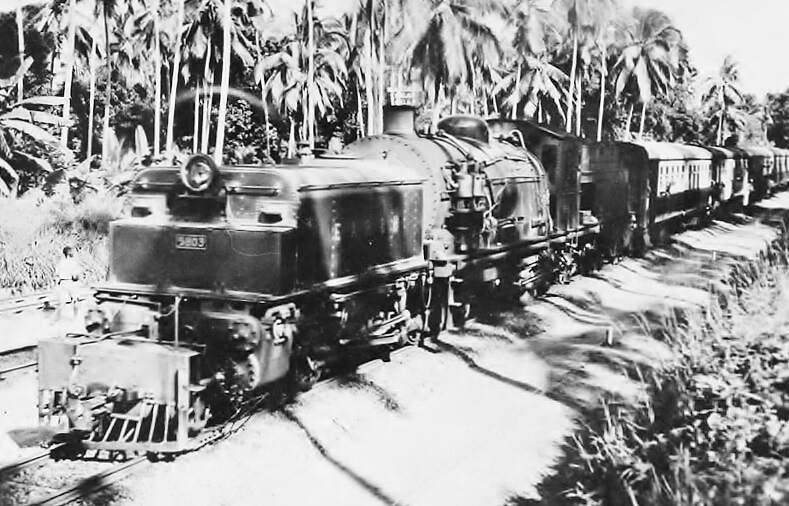
EAR ‘Class 58’ Locomotive No. 5803 (a sister to 5804) is seen here at Changamwe, Kenya, with the Mombasa–Kampala mail train, circa 1950-51. [9]

Other locomotives in the class can be seen here, [11] here, [12] and here. [13]

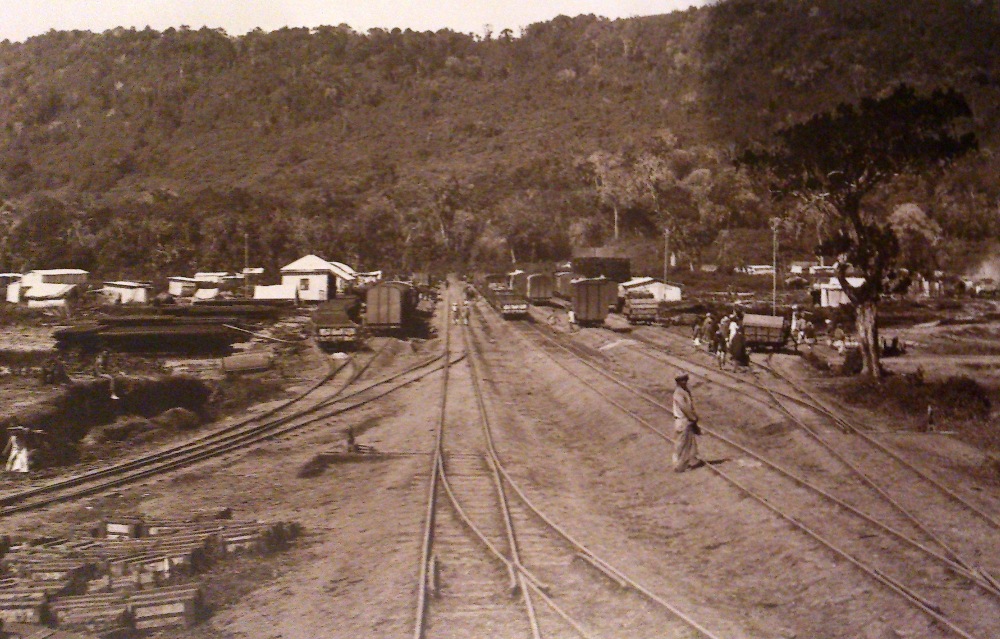
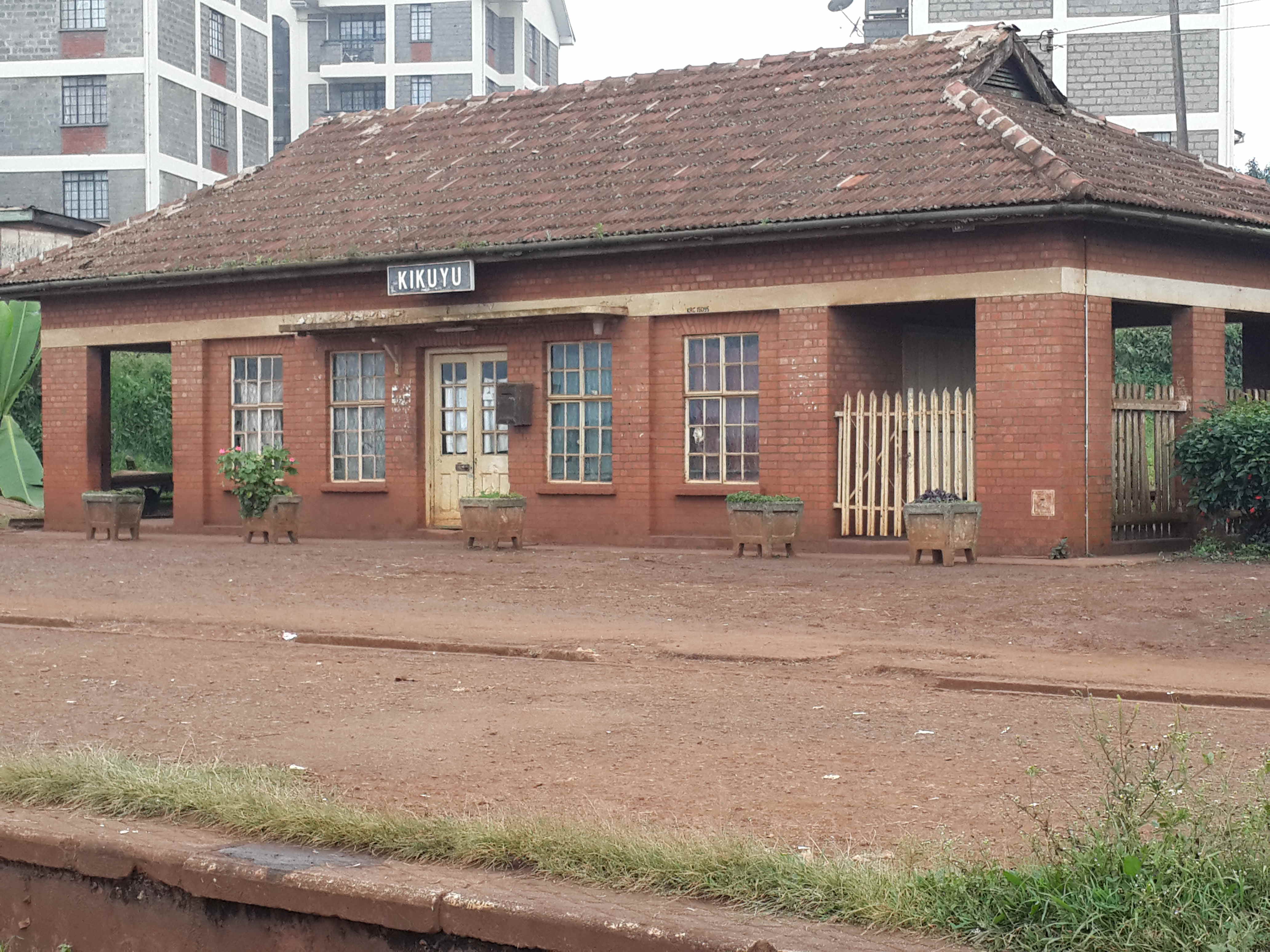
Kikuyu Station is 20 kilometres or so from Nairobi, during construction of the railway, railway officers established a temporary base in Kikuyu while they supervised work on the laying of the track down at the rift valley escarpment.
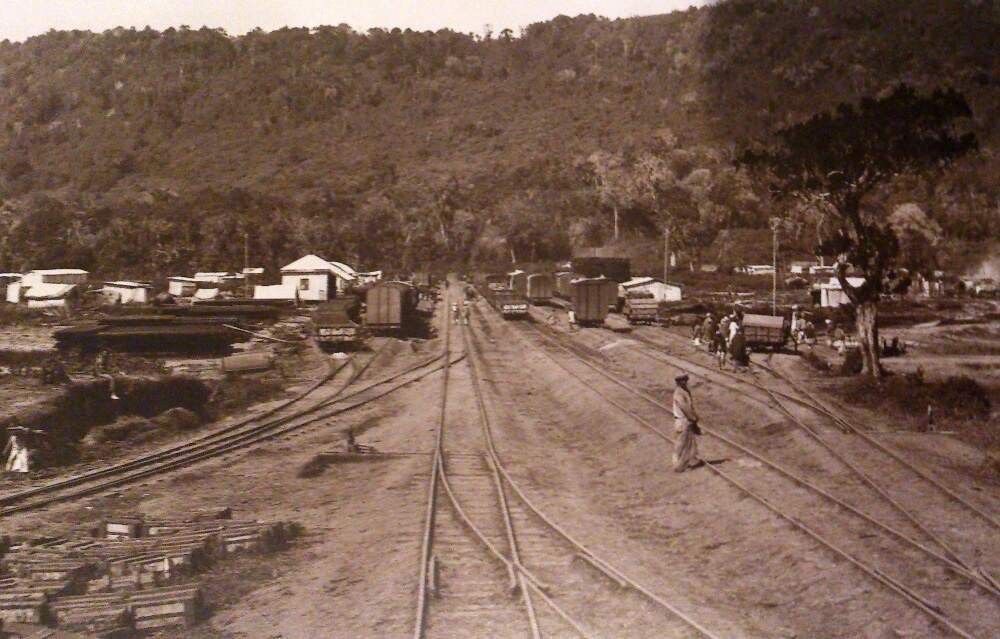
Kikuyu Railway Station while construction in the Rift Valley was ongoing, © Public Domain. [14]
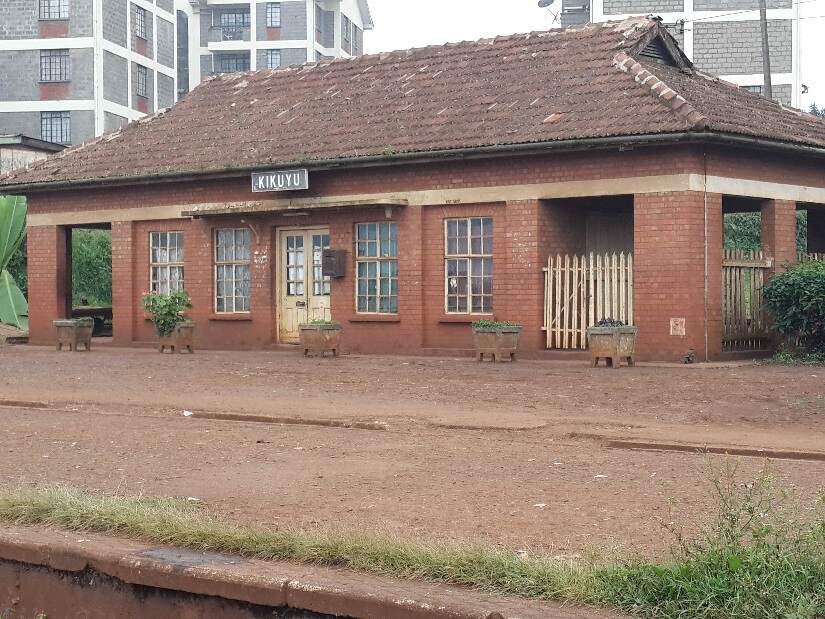
Kikuyu Railway Station in modern times, © Unknown. [15]

3. EAR Class ’60’ Garratt No. 6021 at Kasese
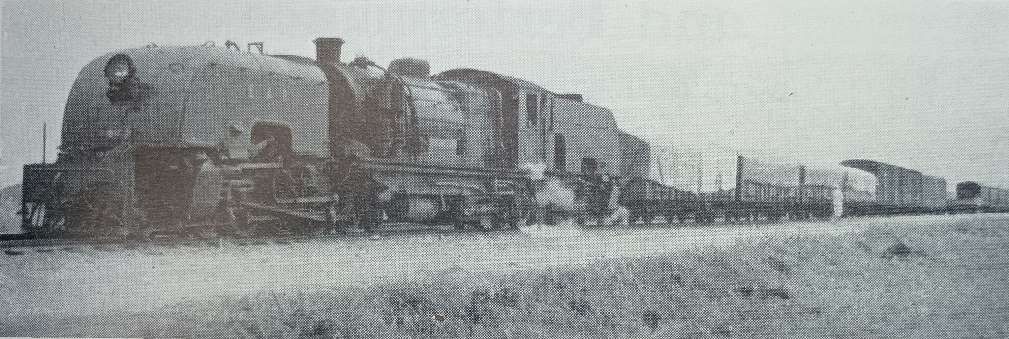
Daily mixed train, headed by class ’60’ Beyer-Garratt locomotive No. 6021, Sir William Gowers,” about to leave Kasese, terminus of the East African Railways & Harbours Western Extension in Uganda. [1: p849]

The EAR 60 class, also known as the Governor class, was a 1,000 mm (3 ft 3 3⁄8 in) gauge 4-8-2+2-8-4 Garratt-type articulated steam locomotives built for the East African Railways as a development of the EAR’s existing 56 class. [2: p77]

The 29 members of the 60 class were ordered by the EAR from Beyer, Peacock & Co. The first 12 of them were built by sub-contractors Société Franco-Belge in Raismes (Valenciennes), France, and the rest were built by Beyer, Peacock in Gorton. The class entered service in 1953-54. [2: p77]

Initially, all members of the class carried the name of a Governor (or equivalent) of Kenya, Tanganyika or Uganda, but later all of the Governor nameplates were removed. [2: p77]

No. 6021 was built by Beyer Peacock (Works No. 7663). It was not one of the class built by sub-contractors Société Franco-Belge. It was given the name ‘Sir William Gowers’ when first put into service, losing the name along with other members of the class in the 1960s after independence. …
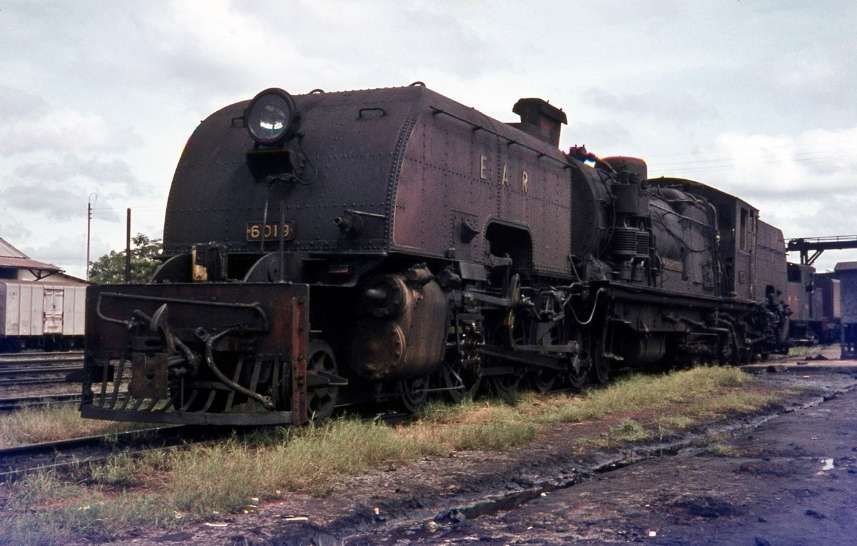
Sister locomotive, EAR Class 60 locomotive No. 6019 at Tabora Depot in Tanzania, © Basil Roberts and licenced for reuse under a Creative Commons Licence (CC BY-SA 4.0). [16]

Other members of the class can be seen here, [17] here, [18] and here. [19]

Kasese Station only became part of the rail network in Uganda in 1956. The construction costs of the whole line from Kampala were very greatly affected by the difficult nature of the country in the final forty miles before Kasese. Severe problems were presented by the descent of the escarpment, which involves a spiral at one point, while from the foot there is an 18-mile crossing of papyrus swamp through which a causeway had to be built, entailing a vast amount of labour. The extension to Kasese was built primarily to serve the Kilembe copper mines. Construction of the line from Kampala to Kasese took approximately five years. [21]
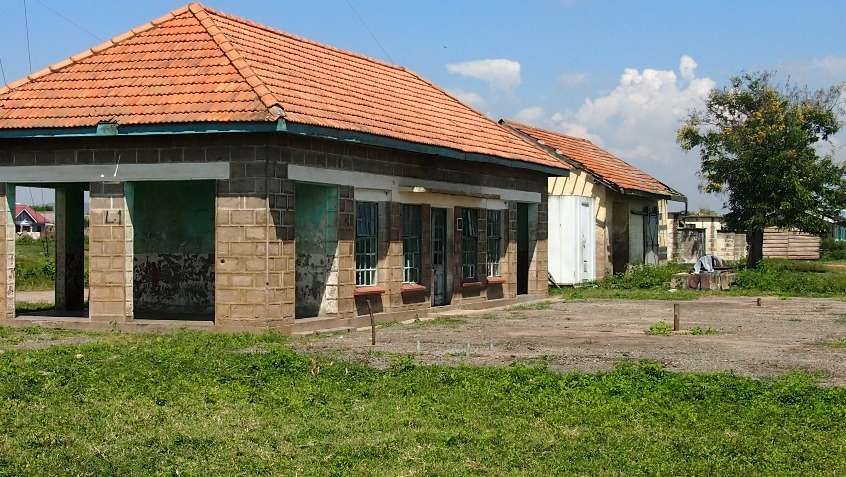
The station building at Kasese in the 21st century, © Michael Branz and authorised for reuse under a Creative Commons Licence (CC BY-SA 2.0). [20]
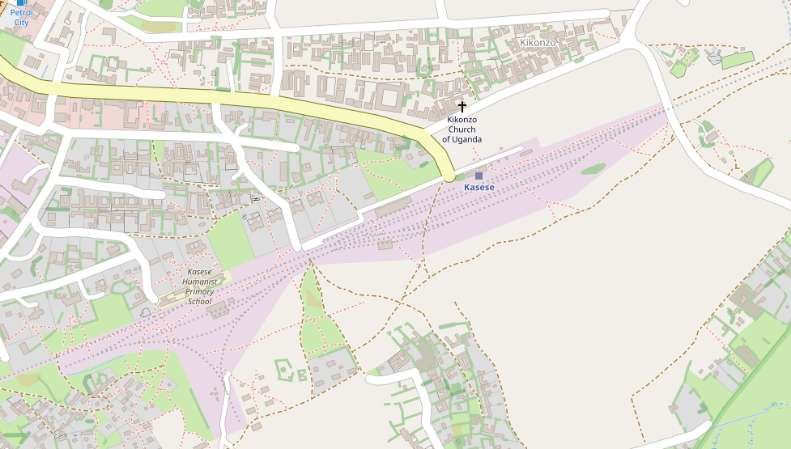
An extract from OpenStreetMap’s mapping showing Kasese Railway Station and turning triangle. The station was not the end of the line as it continued a short distance to the Kilembe Mines that it was built to serve. [21]

References

  1. Garratts in East Africa; in The Railway Magazine Volume 104 No. 692, December 1958, p849.
  2. Roel Ramaer; Steam Locomotives of the East African Railways. David & Charles Locomotive Studies; David & Charles, Newton Abbot, 1974.
  3. https://en.m.wikipedia.org/wiki/KUR_EC5_class, accessed on 7th July 2025.
  4. https://www.google.com/search?q=queen+elizabth+yganda&oq=queen+elizabth+yganda&gs_lcrp=EgZjaHJvbWUyBggAEEUYOTIJCAEQABgNGIAEMgkIAhAAGA0YgAQyCAgDEAAYFhgeMggIBBAAGBYYHjIICAUQABgWGB4yCggGEAAYCBgNGB4yCggHEAAYCBgNGB4yCggIEAAYCBgNGB4yCggJEAAYCBgNGB4yCggKEAAYCBgNGB4yCggLEAAYCBgNGB4yCggMEAAYCBgNGB4yCggNEAAYCBgNGB4yCggOEAAYCBgNGB7SAQkxMzQ4NmowajmoAg6wAgHxBe8kU7h2wyh58QXvJFO4dsMoeQ&client=ms-android-motorola-rvo3&sourceid=chrome-mobile&ie=UTF-8#ebo=0, accessed on 8th July 2025.
  5. https://www.openstreetmap.org/relation/192796#map=19/0.228157/30.289528&layers=P, accessed on 8th July 2025.
  6. http://mccrow.org.uk/EastAfrica/EastAfricanRailways/UgandaBranches.htm, accessed on 1st June 2018.
  7. https://www.flickr.com/photos/124446949@N06/32890286408, accessed on 8th July 2025.
  8. https://www.flickr.com/photos/124446949@N06/48996173961, accessed on 8th July 2025.
  9. https://en.wikipedia.org/wiki/EAR_58_class, accessed on 8th July 2025.
  10. https://commons.wikimedia.org/wiki/File:Engine_unit_of_East_African_Railways_and_Harbours_Corporation_(EAR%26HC)_58_class_Garratt_locomotive_no_5804.png, accessed on 8th July 2025.
  11. https://www.world-railways.co.uk/general-photo-408, accessed on 8th July 2025.
  12. https://www.flickr.com/photos/124446949@N06/29100559308, accessed on 8th July 2025.
  13. https://www.flickr.com/photos/124446949@N06/47072893354, accessed on 8th July 2025.
  14. https://rogerfarnworth.com/wp-content/uploads/2018/05/kikuyu-station.jpg
  15. https://rogerfarnworth.com/wp-content/uploads/2018/05/kikuyu-railway-station.jpg
  16. https://commons.m.wikimedia.org/wiki/File:Basil_Roberts_(680730_EAR).jpg, accessed on 8th July 2025.
  17. https://www.flickr.com/photos/124446949@N06/51744782399, accessed on 8th July 2025.
  18. https://www.world-railways.co.uk/general-photo-667, accessed on 8th July 2025.
  19. https://www.flickr.com/photos/124446949@N06/31824271347, accessed on 8th July 2025.
  20. https://commons.m.wikimedia.org/wiki/File:Old_Kasese_Train_Station.jpg, accessed on 8th July 2025.
  21. https://rogerfarnworth.com/2018/06/11/uganda-railways-part-21-kampala-to-kasese.
‘Modern Tramway’ in the early- to mid-1960s – February 1963 – The Strange Tale of No. 2

As part of a batch of magazines from the 1950s and 1960s I picked up a number of editions of ‘Modern Tramway’ from 1963 into 1964. ‘The Modern Tramway’ was the journal of the Light Railway Transport League (LRTL). By 1963 it had dropped the ‘The’ and was published jointly by Ian Allan and the LRTL. Its formal title was ‘Modern Tramway and Light Railway Review’.

The February 1963 edition of the journal was priced at 2s 6d.

Among a number of articles in the journal was a piece by G. Hyde, The Strange Tale of No. 2.

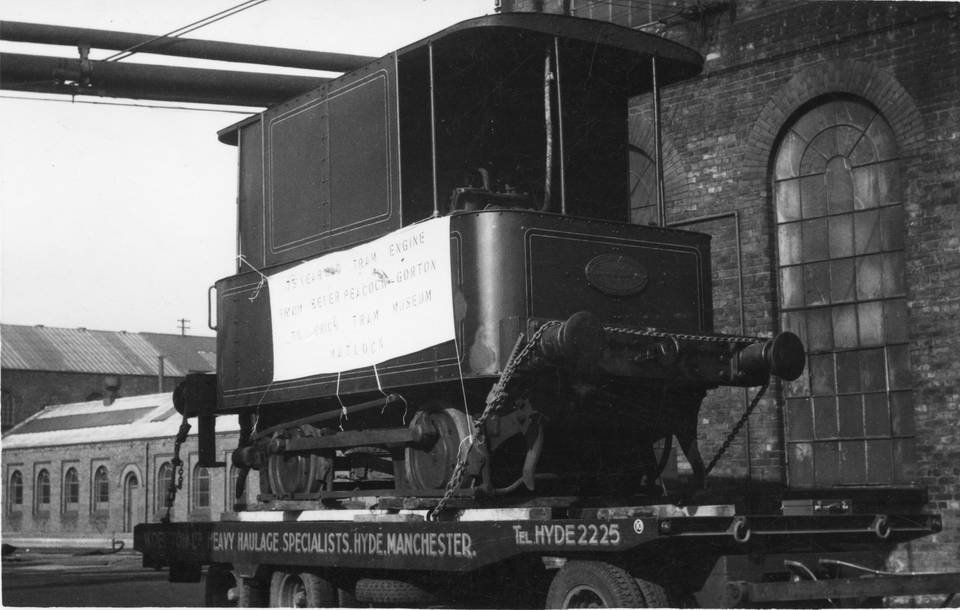
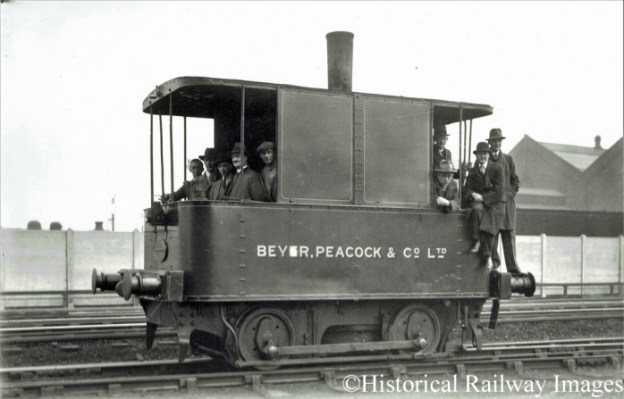
This No. 2 was Beyer Peacock steam tram engine No. 2. It is shown in the featured image above in which it is seen at Beyer Peacock’s works in Gorton, Manchester. [2]

It was originally built to a Wilkinson patent for the New South Wales Government tramways in 1885 and shipped to Australia in April of that year. It made several trial runs on the Redfern Station line of the Sydney steam tramways, but it evidently did not compare favourably with the Baldwin locomotives then in use there. Hyde says that, “It was reputed to have a heavy fuel consumption. and Beyer Peacock’s received complaints about the difficulties in maintaining a sufficient head of steam, but the engine hardly had a fair trial as only short runs were made with it, and the drivers’ inexperience may have contributed to its shortcomings. The trials were invariably carried out after midnight so no photographs were taken of the engine in service; neither was it ever incorporated into the Sydney tramway stock, consequently it never had a fleet number. Whilst in Australia it was referred to as ‘John Bull’.” [1: p48]

After its short unsuccessful trials in Sydney, John Bull was shipped to the small port of Wollongong and worked the isolated Wollongong-Clifton section of the New South Wales Government railways. It stayed there until the section was connected to the main coastal line in 1886.

Hyde commented that at this point “John Bull” disappeared. “Nothing further is known about it until it turned up again at Manchester in 1890, when it featured in Beyer Peacock’s stock list as yard engine No. 2. The mystery of this missing four years is heightened by the fact that Beyer Peacock’s records refer to the engine as having been salvaged, and returned to their works. This led to the rumour which persists in the Gorton works that No. 2 fell into the sea at one point during its travels round the world.” [1: p48]

In 1890 the loco was modified, the duplicate controls were removed, as also were the wheel curtains, then railway type buffers and drawgear were fitted.

In 1915 a steam brake was fitted, then in 1930 a new boiler was installed and in 1958 a new steam dryer was fitted. It was ultimately withdrawn from service in early 1959.

Hyde asserted that No. 2 was “certainly the biggest tramway engine ever built to Wilkinson’s patent, and was one of the most powerful steam tramway engines ever to be built in this country Its gross working weight of 16 tons compares with the 12 tons of the heavy 83-86 class Wilkinson engines of the Manchester, Bury, Rochdale & Oldham tramway, one of which is being kept by the British Transport Commission.” [1: p49]

Hyde provided detailed information about No. 2. … It had two simple cylinders, 9.5 in. diameter by 12 in. stroke. The crank axle had a pinion in the centre with 20 teeth geared to a spur wheel on the driving axle having 33 teeth, thus having a ratio of 1.65 to 1. It was fitted with a Stephenson type link motion. The four coupled driving wheels were of 30 in. diameter, with a wheelbase of 6 ft. 8 in. The water capacity was 225 gallons and there was a fuel space of 11 cubic feet. The vertical boiler was of the Field type, and had 121 tubes, each with an outside diameter of 2.13 in. The tubes, which project down into the firebox, were between 19 and 27 inches long, and had fitted concentric open-ended internal tubes known as circulating tubes. The working pressure is 150 lb. per sq. in., and the total heating area was about 184 sq. ft. with a total fire grate area of 10.8 sq. ft. The engine has an overall length of 13 ft 6 in. and an overall width of 7 ft.

“For close on 70 years, No. 2 trundled round the Gorton works of Beyer Peacock’s being affectionately known there as Old Coffeepot,” and it is hoped that it will now see many more years of active life at the Crich Tramway Museum. In the erecting shops at Beyer Peacock’s the wheels were re-tyred and the new tyres turned down to tramway standards. Then, after boiler inspection and insurance formalities had been completed, it was despatched to join the T.M.S. fleet at Crich as the only working British steam tram engine.” [1: p49]

Hyde noted that “Project Steam Tram” would involve the Tramway Museum Society in some heavy capital outlay, and that the Society was appealing to tramway enthusiasts to take an interest in the project and support it with donations. [1: p49-50]

More recent research has filled in some of the unknowns which Hyde commented on in 1963. It was Beyer Peacock Works No. 2464 and carried an operational number of 47 in Australia. In the missing years the locomotive is thought to have spent time working in Illawarra between 1887 and 1888 prior to returning to the UK in 1889. That it was at Illawarra may be a reference to its work on the Wollongong-Clifton section of the New South Wales Government railways. If so then it remained in New South Wales longer than the article in ‘Modern Tramway‘ suggested. [2][3]

As a works shunter, the tram operated in the firm’s large works complex towing huge Beyer-Garrett locomotives from one shed to another.

No. 2 in 1962 at Gorton Works just prior to its journey to the Crich Tramway Museum, © Crich TMS Archives. [3]

After arriving at Crich in 1962, No. 2 “was operated under steam for some years from 1966. A period of off-site storage between 1971 and 1978 was followed by a return to steam in the 1980s, during which it even performed on the Santa specials. However, the work involved in firing it up, supplying it with coal and clearing away the ash helped to explain why steam traction gave way to electricity on Britain’s tramways in the early years of the twentieth century.” [3]

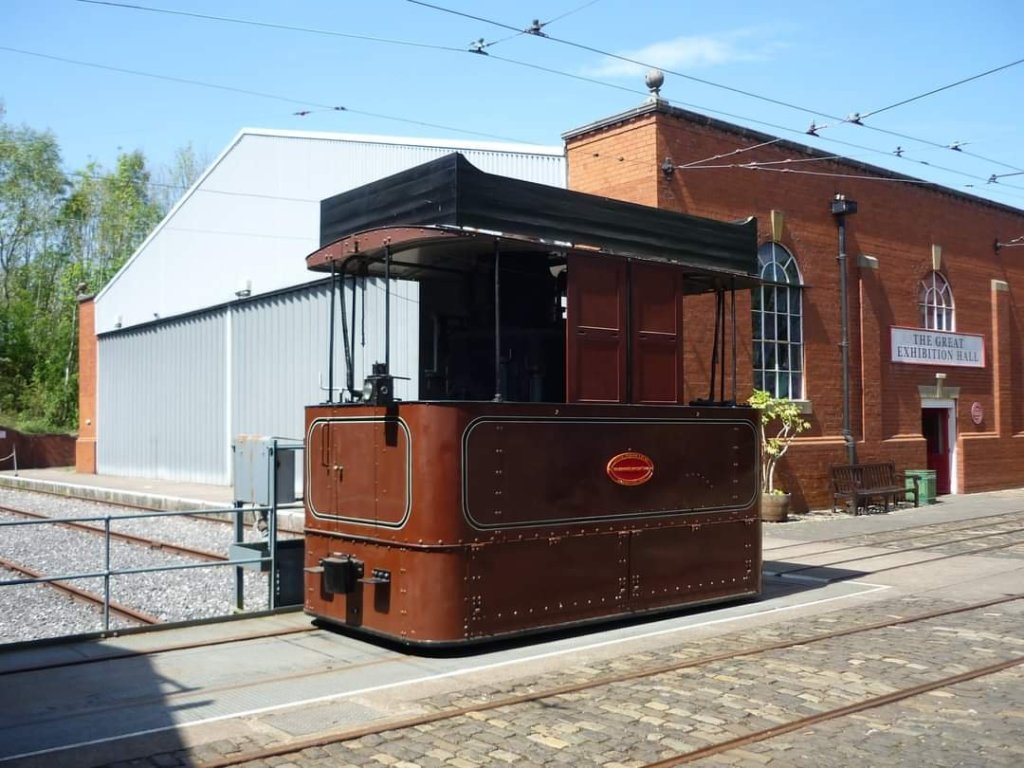
Beyer Peacock steam tram No. 2, New South Wales Government Steam Tram No. 47 at the Crich Tramway Village, © John Huddlestone and shared by him on The Tramway and Light Railway Society Facebook Group on 15th May 2022. [4]

Crich Tramway Museum’s website tells us that, “because it was destined for export and as it was expected to be pulling much heavier loads it was much larger than those built for the home market. With 30 inch driving wheels and weighing almost 16 tons it was a true giant of a tram engine, though it did boast a number of features in common with other road-going locomotives including the fully enclosed wheels and a mechanism – in this case a “Wilkinson Patent” exhaust superheater – that was designed to reduce the amount of smoke emitted.” [3]

References

  1. G. Hyde; The Strange Tale of No. 2; in Modern Tramway Volume 26 No. 302, LRTL  and Ian Allan, Hampton Court, Surrey; February 1963, p48-50.
  2. https://preservedbritishsteamlocomotives.com/beyer-peacock-company-works-no-2464-no-47-john-bull-0-4-0vb-tram, accessed on 26th July 2023.
  3. https://www.tramway.co.uk/trams/new-south-wales-47, accessed on 26th July 2023.
  4. https://m.facebook.com/groups/www.tlrs.info/permalink/557174155756970, accessed on 26th July 2023.