
In June 2024, I picked up a few copies of the Railway Magazine from the early 20th century.
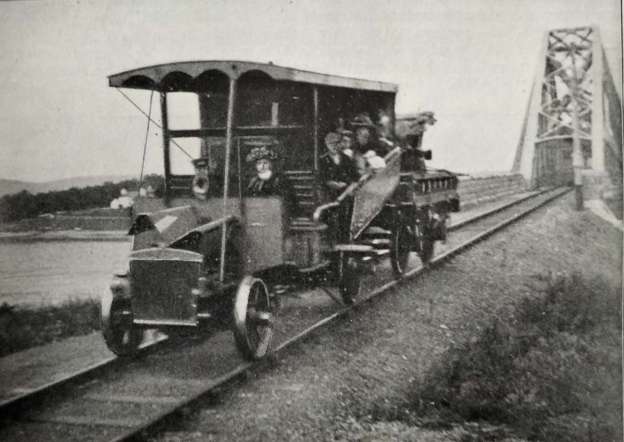
In July 1909, the Railway Magazine noted that the Caledonian Railway had inaugurated a motor car service on its rails. Just a short journey was involved crossing the Connel Ferry Bridge and running from Connel Ferry to either North Connel or Benderloch.
In September 1909 the Railway Magazine carried a photograph of the rail-motor car.
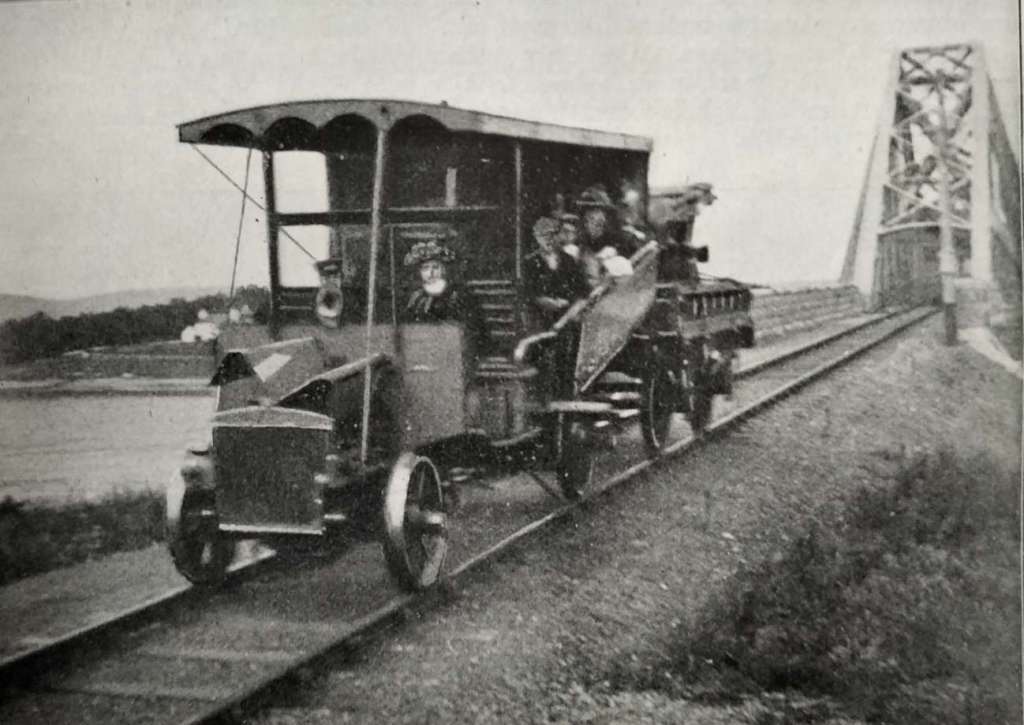
“The Caledonian Railway purchased an ordinary road-motor car, and under the superintendence of Mr. J. F. McIntosh, this was converted, at St Rollox Works, into the rail-motor car. … The car performs, daily, several journeys from Connel Ferry across the bridge to North Connel, and four of these trips in each direction are extended an additional 2.25 miles beyond North Connel to Benderloch, and it is on these longer journeys that road motor cars are conveyed on the carriage truck provided for the purpose, which is attached as a trailer to the rail-motor car.” [1]
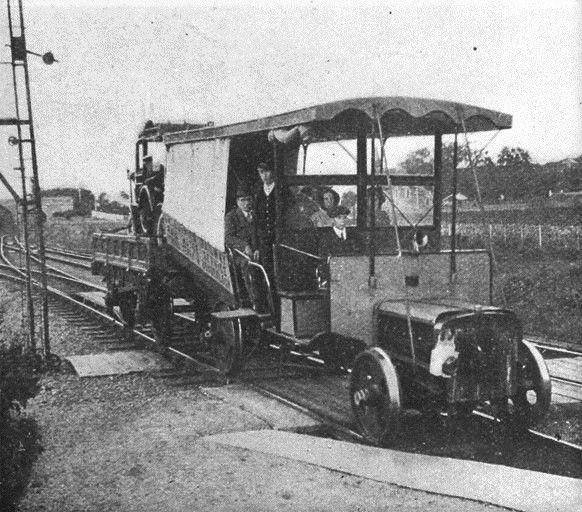
The vehicle was a Durham-Churchill Charabanc. It originally operated as a road vehicle between Clarkston railway station and Eaglesham. It was converted to rail use in 1909 at the cost of £126!
The journey from Connel Ferry to North Connel took 5 minutes and the trip to Benderloch, 15 minutes in total.
Sunday trains were few and far between in Scotland but an exception was made for this service with 5 crossings of the bridge in each direction. Surprisingly more often than on weekdays!
The Railway Magazine notes that, “in the past, this portion of Argyllshire [was] somewhat of a closed district to motorists, owing to the long arms of the sea which intersect the land and the numerous ferries that have in consequence to be crossed. Access to the very charming district that lies between Loch Etive and Lochleven, has been particularly difficult, as the ferries have become unserviceable since the opening of the Ballachulish Railway, whilst the comparative infrequency of the trains upon the Ballachulish line, and the restrictions on the conveyance of motor cars by the ordinary trains made crossing at Connel Ferry both inconvenient and unreliable.” [1]
Motorists either avoided the area altogether or had to make a long journey via Tyndrum and Glencoe.
The charge for conveying motors across Loch Etive was 15 shillings.

The Ballachulish Branch of the Caledonian Railway which crossed the Bridge at Connel Ferry is covered in other WordPress articles:
The Ballachulish Railway Line – Part 1
The Ballachulish Railway Line – Part 2
The Ballachulish Railway Line – Part 3
Revisiting the ballachulish railway………
References
- Novel Traffic on the Caledonian Railway; in The Railway Magazine, September 1909, p195.
- https://x.com/MrTimDunn/status/1042859151192477702?t=5hla6WJtvo1DnfZLPHflAw&s=19, accessed on 16th July 2024.
- https://x.com/TurnipRail/status/1400768455012388865?t=W3rRakfcxeS6GIsPsfNayQ&s=19, accessed on 16th July 2024.
 Roger Farnworth