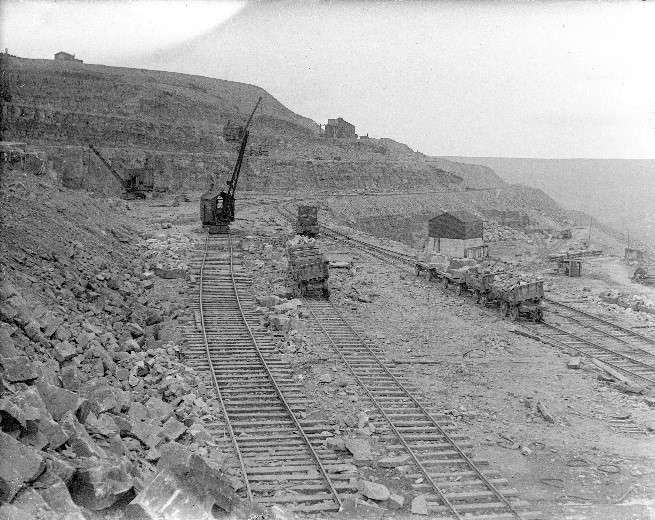
Tag Archives: 2ft 6in gauge

The Nidd Valley Light Railway

The short paragraph immediately below appeared in the February 1952 edition of The Railway Magazine in reply to a question submitted by G. T. Kaye.

The Nidd Valley branch of the former North Eastern Railway (which was closed to passengers on 31st March 1951) terminated at Pateley Bridge, 14 miles from Harrogate. In 1900, a Light Railway Order was obtained for a 2 ft. 6 in. gauge line from Pateley Bridge to Lofthouse-in-Nidderdale, six miles further up the valley, but the promoters had difficulty in finding the necessary capital. At that time, the Bradford Corporation was about to undertake the construction of reservoirs in the Nidd Valley, and a railway was required to carry materials to the sites. The Corporation took over the powers for the light railway, and extended it for a further 6 miles, from Lofthouse to Angram. The railway was laid to the standard-gauge, and was opened to passengers between Pateley Bridge and Lofthouse on 1st May 1907. The remainder of the line did not carry public traffic. The line was worked by two 4-4-0 tank engines and passenger coaches purchased from the Metropolitan Railway. The passenger services were withdrawn on 31st December 1929, and the line was closed completely some months later.” [1: p143]

It appeared close to the back of the magazine in the section called, “The Why and the Wherefore”. It seemed like a good idea to explore what further information there is available about the Nidd Valley Light Railway. …….

The Website ‘WalkingintheYorksireDales.co.uk’ has a page dedicated to the railway which can be found here. [2]

A number of images relating to the line can be found here. [13]

The Oakwood Press published a book by D. J. Croft about the line. [3: p3]

Croft wrote: “The valley of the River Nidd, in the West Riding of Yorkshire, is nearly 55 miles long, beginning at Great Whernside, and ending at Nun Monkton where the Nidd flows into the River Ouse. However, the area known as Nidderdale extends for only about a half of the length, and forms a compact geographical region of its own. Despite this length, and great scenic beauty, it remains to this day one of the forgotten valleys of the Yorkshire Dales.” [3: p3]

The area of Nidderdale can be divided into roughly two equal sec tions, with the market town of Pateley Bridge between the two. The first substantial historical accounts of Nidderdale appeared in Domesday Book of 1086. However, some of the local lead mines were worked in the time of the Brigantes, whilst several surrounding localities suggest Roman occupation.” [3: p3]

Nidderdale has several industries, notably quarrying and lead mining. and a small textile industry. There is also a small slate quarry, a marble quarry, and a long, thin ironstone vein stretching along the valley. Through-out the ages, however, Nidderdale has had prosperity alternating with decline. As the early mining industry began to decline, so textiles became important around the thirteenth century. This too tended to decline by the seventeenth century, and mining became important once more. Unfortunately, the prosperity of the lead mining era passed, and so too did the prosperity of Nidderdale.” [3: p3]

This period of decline lasted until 1862, when the North Eastern Railway opened its line from Harrogate to Pateley Bridge, thus opening this remote valley to the outside world. Prior to this, the only roads out of the dale had been to Grassington, Riponand Kirkby Malzeard, and the only regular connection with the outside world had been the Nidderdale Omnibus, a double-deck horse bus, linking Pateley Bridge with trains of the Leeds & Thirsk Railway at Ripley. This operated from 1st August 1849, until the opening of the railway, and ran twice daily.” [3: p3]

The approach of the 20th century brought a new prosperity to the valley, which was to last for the next thirty years or perhaps a little longer. Thid was the period when the Nidd Valley Light Railway was active.

The story of the line is the story of the thirteen or so miles between Pateley Bridge and the head of the valley, for it was there “that the Nidd Valley Light Railway was conceived, constructed and closed. All this happened within a period of less than forty years.” [3: p3]

The Story of the Line

Wikipedia tells us that the origins of a railway in the upper Nidd Valley “can be traced back to 1887–88, when Bradford Corporation began to investigate the valley as a source for the public water supply. … Alexander Binnie, who was the Waterworks Engineer for Bradford at the time, and Professor Alexander Henry Green, a geologist from Oxford, visited the area, and Green advised Binnie that the valley was suitable for the construction of large dams. The Bradford Corporation Water Act 1890 was obtained on 14th August 1890, authorising the construction of four dams. … A second Act of Parliament was obtained on 27th June 1892, by which time the four reservoirs were Angram, Haden Carr, High Woodale and Gouthwaite. Gouthwaite Reservoir was designed as a compensation reservoir, to maintain flows in the Nidd further down the valley.” [4][5: p76-77]

The first reservoir, Haden Carr, was completed in 1899, together with a 32-mile (51 km) pipeline (the Nidd Aqueduct) to deliver water to Chellow Heights reservoir on the outskirts of Bradford. [4][5: p79] “Gouthwaite reservoir was built … between 1893 and 1901.” [5: p84-85] The activity in the valley attracted attention from outside the region and a company from London, Power & Traction Ltd applied for a Light Railway Order “to construct a line from the terminus of the Nidd Valley Railway at Pateley Bridge to Lofthouse. …  Following a hearing at Harrogate on 9th October 1900, the Light Railway Commissioners awarded an order to Power & Traction for a 2 ft 6 in (762 mm) gauge railway.” [4] Negotiations with Bradford Corporation over a possible £2,000 investment in the scheme ultimately failed. [5: p86]

In 1903, Bradford invited tenders for the construction of Angram Reservoir, and … reached provisional agreement with the Nidd Valley Light Railway Company to purchase the powers awarded to them to build the light railway. … Bradford wanted to ask the Light Railway Commissioners for permission to increase [the track gauge] to 3 ft (914 mm). … They also wanted to ensure that they bought enough land to allow a standard gauge railway to be constructed ‘at any future time’. The North Eastern Railway, owners of the Nidd Valley Railway, argued that it should be standard gauge from the outset, since they were running excursions to Pateley Bridge twice a week, and these could continue over the Nidd Valley Light Railway. It would also remove the necessity of transshipping goods.” [5: p86]

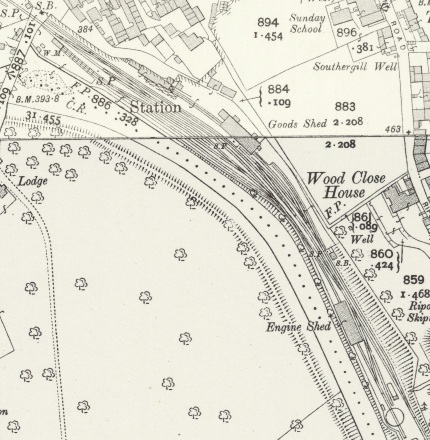
Then next three map extracts show the railway facilities in Pateley Bridge while the Nidd Valley Light Railway was active. …
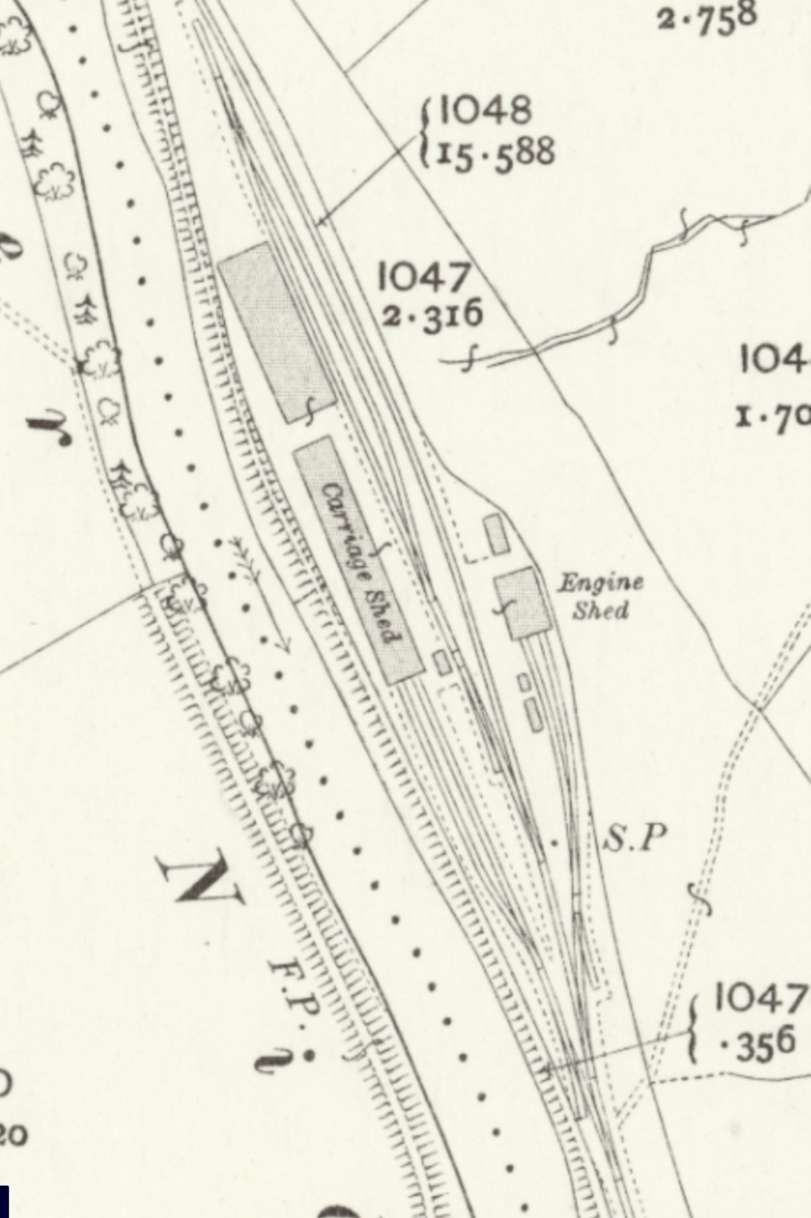
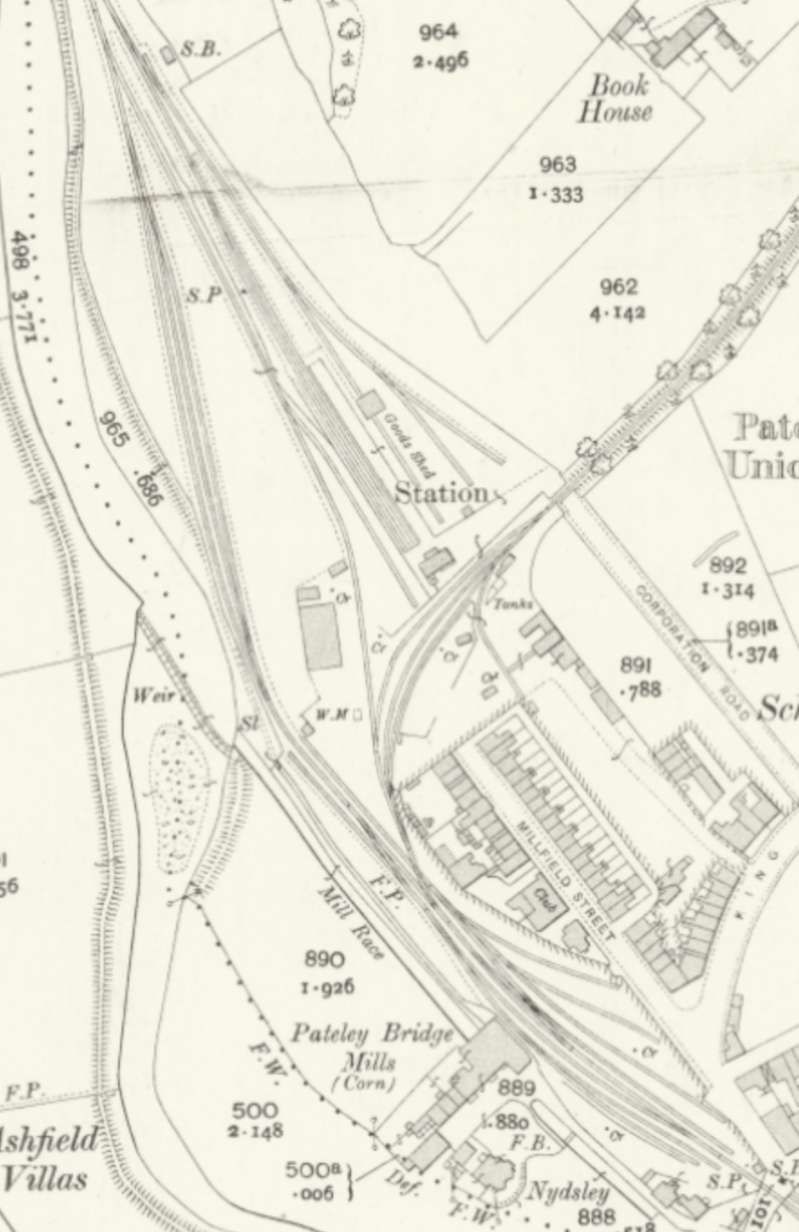
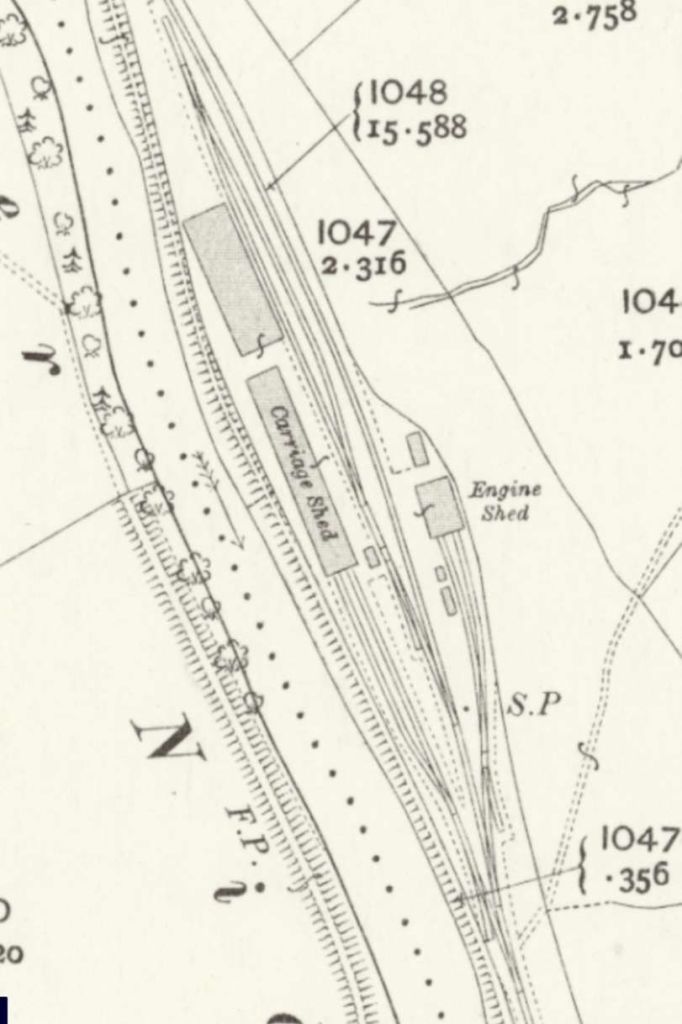
The Nidd Valley Light Railway Pateley Bridge Carriage and Engine Shed which were to the North of the railway’s terminus. 25″ Ordnance Survey of 1907/08, published in 1908. [9]
The Nidd Valley Light Railway Pateley Bridge Terminus which was connected to the North Eastern Railway Station by a single line which joined the main line before it crossed the High Street on the level. 25″ Ordnance Survey of 1907/08, published in 1908. [9]
The North Easter Railway Station at Pateley Bridge. [9]
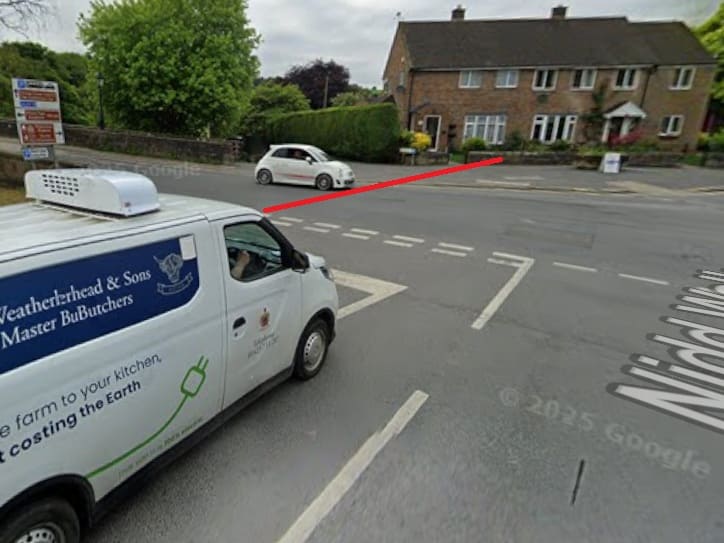
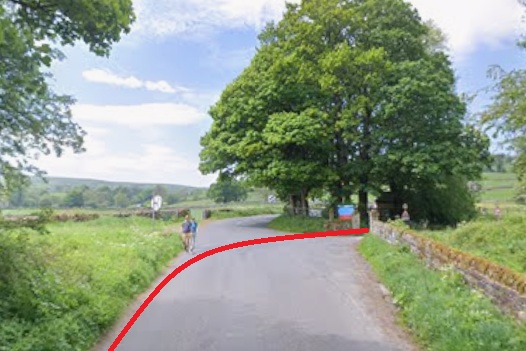
The red line approximates t the line of the railway which left Pateley Bridge Station (behind the camera) to cross High Street and run between Pateley Bridge Mills and Millfield Street to connect with The Nidd Valley Light Railway. [Google Streetview, May 2024]
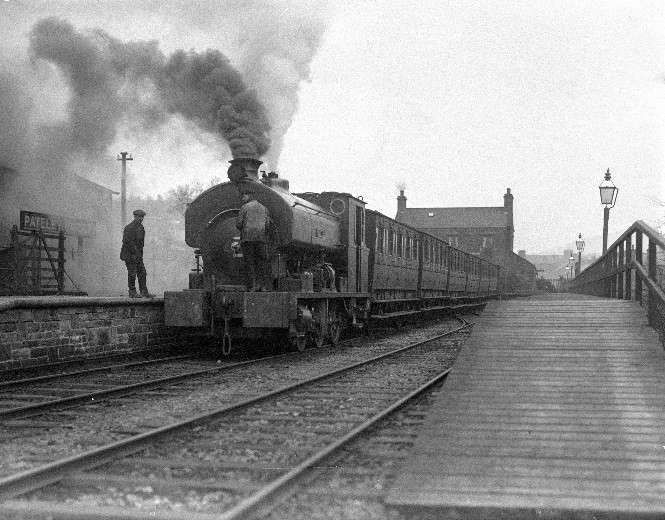
0-6-0ST locomotive ‘Blythe’, with a passenger train at Pateley Bridge. Humphrey Household collection (1996-7886_529 DS160108), © National Science Museum and licenced for reuse under a Creative Commons Attribution-Noncommercial-ShareAlike (CC BY-NC-SA 4.0) licence. [10]

A transfer order was eventually granted, “with powers to borrow up to £30,000 to fund the project. In May 1904, the Board of Trade agreed to a change to standard gauge, and borrowing powers were increased to £66,000 in 1908, because of the extra costs of building the wider formation. The document was signed by Winston Churchill, the President of the Board of Trade.” The contractor working on the Anagram reservoir, John Best, “was awarded a contract to build the light railway to Lofthouse for £23,000, and a tramway from Lofthouse to Angram for £5,385.” [5: p86-87]

Then the intrigue began! A contract had been awarded in April 1902 to Holme and King for the construction of a road from Lofthouse to Angram. Bradford Council “had purchased enough land to allow the light railway to be built beside the road, and although Best was awarded a contact for the railway in 1903, it appears that Holme and King built a 3 ft (914 mm) gauge contractor’s railway beside part or all of the road. They had two locomotives on site, both 0-4-0 saddle tanks, one bought second hand some years earlier and moved to the site in spring 1902, after working on several other projects, [5: p87] and the second bought new for delivery to Pateley Bridge. [5: p89] By mid-1904, there was a 6.5-mile (10.5 km) line from Angram, which crossed the River Nidd on a 20-foot (6.1 m) bridge just before it reached Lofthouse.” [4]

So, Best began extending the line towards Pateley Bridge from the River Nidd rather than starting the work again! Wikipedia tells us that “by 13th July 1904, it had reached a level crossing at Sykes Bank, 0.5 miles (0.8 km) below Lofthouse, and work had commenced at several other sites. On that date, a party of 150 members of Bradford City Council, with invited guests, arrived by train at Pateley Bridge, and were transported to Gouthwaite Dam in carriages. Here there was a ceremony in which the Lord Major cut the first sod for the Nidd Valley Light Railway.” [4] The party “proceeded to Sykes Bank, where a train was waiting, which consisted of 15 wagons fitted with makeshift seats, and two locomotives, one of which was Holme and King’s Xit and the other was Best’s Angram. It took about an hour to reach Angram, where there were presentations, and Alderman Holdsworth cut the first sod for the dam. Refreshments were then served and the party returned to Lofthouse by train and to Pateley Bridge by carriage.” [4][5: p90-91]

The narrow gauge had hardly reached Pateley Bridge and Angram begun its regular duties along the line when standard gauge rails began to be laid starting at Lofthouse and working both up and down the line from there. “When the first standard gauge locomotive arrived, it was towed along the road to Sykes Bank by a Foden steam lorry, its flanged wheels making a mess of the road surface. The main line and sidings became mixed gauge for a while, although the third rail was gradually removed from 1906.” [5: p91 & 93] There was a veritable network of rail lines at the Angram Dam site where, as well as a village built for the workers, “the railway terminated in several sidings, which included a locomotive shed. The sidings were at a similar level to the crest of the dam. A branch left the main line and descended to the valley floor, where there was a cement mixing plant and more sidings. This line included a winch-operated incline which descended on a gradient of 1 in 15 (6.7%). Another incline, of 3 ft (914 mm) gauge, ascended the far side of the valley, giving access to Nidd sluice and lodge. A third incline brought rock down to the main line from a quarry, some 2 miles (3.2 km) below the terminus.” [4][5: p93 & 97]
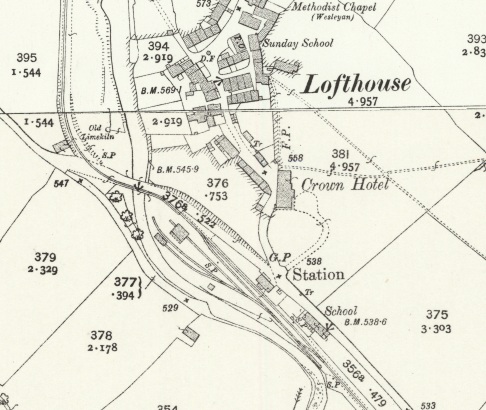
The village of Lofthouse and its railway station as it appears on the 25″Ordnance Survey of 1907, published in 1909. [6]
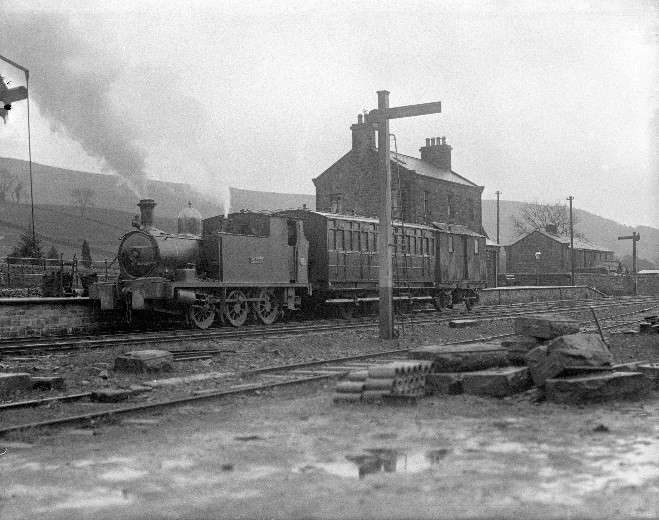
0-6-0 side tank steam locomotive ‘Milner’ with a carriage and van at Lofthouse-in-Nidderdale station, ready to leave for Scar House. Humphrey Household collection (1996-7886_531 DS160110), © National Science Museum and licenced for reuse under a Creative Commons Attribution-Noncommercial-ShareAlike (CC BY-NC-SA 4.0) licence. [10]
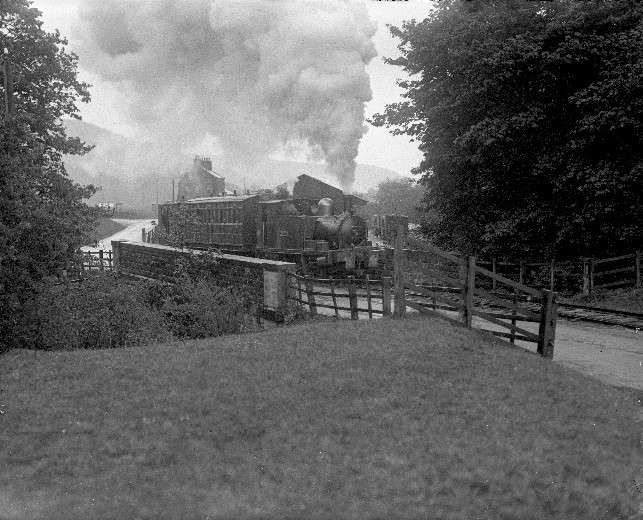
‘Milner’ crossing the bridge above Lofthouse-in-Nidderdale station and beginning the steep climb alongside the road on the private section to Scar House. It is likely that this was taken soon after the previous photograph. Humphrey Household collection (1996-7886_523 DS160104), © National Science Museum and licenced for reuse under a Creative Commons Attribution-Noncommercial-ShareAlike (CC BY-NC-SA 4.0) licence. [10]

At the other end of the Light Railway, “at Pateley Bridge, the Nidd Valley Light Railway station was to the north west of the North Eastern Railway’s Pateley Bridge railway station, close to the River Nidd. The two were connected by a single track which crossed a level crossing. There were a series of sidings immediately after the level crossing, with the station and more sidings beyond that. A carriage shed and a locomotive shed were located a little further along the valley of the Nidd.” [4]
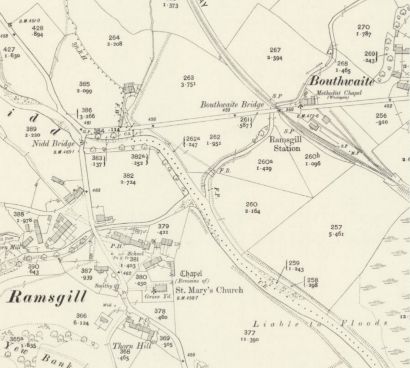
Ramsgill Village was served by a stationary Bouthwaite which sat on the opposite side of the River Nidd. This map extract comes from the 25″ Ordnance Survey of 1907, published in 1909. [7]

Best built two-storey stone buildings for the stations at Pateley Bridge, Wath, Ramsgill and Lofthouse. He built a signal box at Pateley Bridge, with the other stations having ground frames and simple signalling. Operation of the line was controlled by the Tyer’s Electric Train Tablet system, and six machines were ordered at a cost of £360. [5: p101] Both intermediate stations had goods sidings on the eastern side of the main track, while Lofthouse had a passing loop and sidings to the west.” [4]
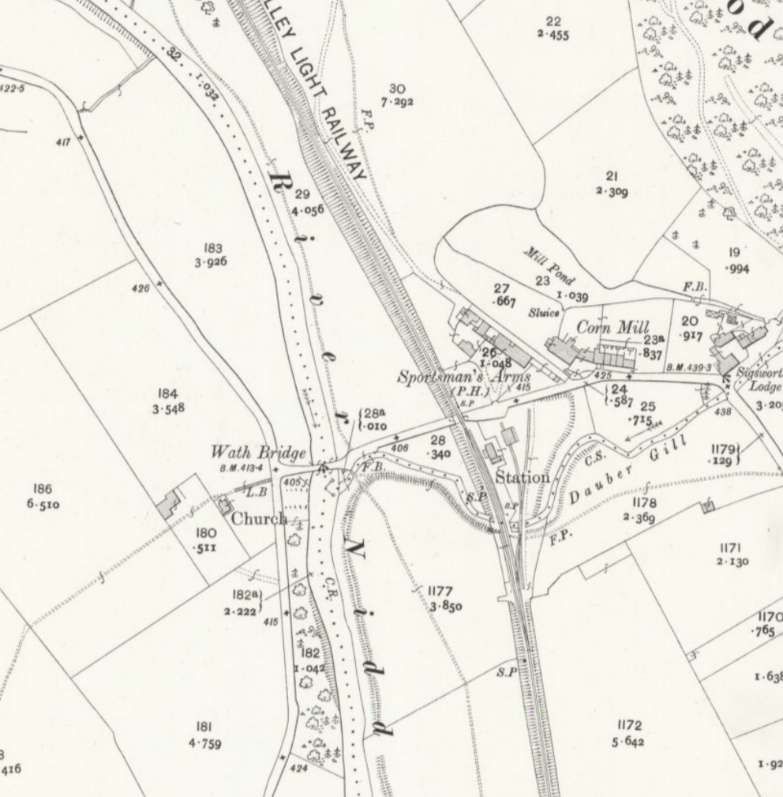
The Station at Wath sat between the village and the River Nidd. The 25″ Ordnance Survey of 1907/1908 and published in 1909. [8]

Best had a number of locomotives, both 3 ft (914 mm) gauge and standard gauge, which operated over the entire line from Pateley Bridge to Angram during the construction phase. For the opening of the Nidd Valley Light Railway proper, the 6.5 miles (10.5 km) from Pateley Bridge to Lofthouse, Bradford Corporation ordered six open wagons and two brake vans from Hurst Nelson of Motherwell. Locomotives and carriages were obtained second-hand from the Metropolitan Railway in London. These consisted of ten 4-wheeled coaches and two 4-4-0 Beyer Peacock side tank locomotives. All had become surplus to requirements, as electrification of the line had been completed in 1905. The locomotives were fitted with condensing equipment, for working in the tunnels under London, but the price of £1,350 for the pair included removal of this, and the fitting of cabs. All twelve vehicles arrived at Pateley Bridge, with one engine in steam … The locomotives were named ‘Holdsworth’ and ‘Milner’ after two Aldermen who had served Bradford Waterworks since 1898.” [4][5: p101, 102]

An official opening took place on 11th September 1907, when a train consisting of three carriages and the Corporation saloon were hauled by ‘Holdsworth’ from Pateley Bridge to Lofthouse, with stops at Wath and Gouthwaite reservoir. At Lofthouse the engine was replaced by one of Best’s engines, and continued to Angram where luncheon was served in the village reading room.” [4][5: p102, 105]

The two locomotives were much too heavy to comply with the Light Railway Order, which specified a maximum axle loading of 6.5 tons. They weighed 46.6 tons in working order, with 36.7 tons carried by the two driving axles. The Corporation applied for an increase in the axle loading, specifying the weight as “over 42 tons”. Milner, the newest of the two locomotives, dating from 1879, [5: p102] did not perform well, and was replaced by a Hudswell Clarke 0-6-0 side tank, also named Milner in May 1909. The original Milner was sold to the North Wales Granite Company at Conwy in 1914. [5: p102, 111] Following discussions with the Board of Trade in 1906, the Corporation and the North Eastern Railway had obtained permission for three passenger trains per week to pass over the goods yard and sidings at Pateley Bridge, so that excursions could continue up to Lofthouse between June and September only. Despite the agreement, when the first excursion was due to make the journey on 14th September 1907, the NER decided not to allow their stock to pass onto the Nidd Valley Light Railway, nor to allow the Corporation engine and carriages to come to their station, and so the passengers had to walk between the two stations. [5: p110] In order to avoid confusion for parcels traffic, Lofthouse station became Lofthouse-in-Nidderdale on 12th December 1907, and Wath became Wath-in-Nidderdale in February 1908 for similar reasons.” [4][5: p107-108]

Work on Angram reservoir was finally completed in 1916. “Bradford Corporation had already obtained an Act in 1913, allowing them to abandon their plans for a reservoir at High Woodale, and instead to build a much larger one at Scar House. It would submerge the site of Haden Carr reservoir, and the Act allowed them to start construction “when appropriate”. The cost of the new works was estimated at £2,161,500, and although three tenders were received, they decided on 14th May 1920 to build it themselves, using direct labour. Scar village was built between 1920 and 1921, consisting of ten hostels for a total of 640 men, a school, canteen, recreation room, concert hall, mission church and some bungalows.” [4][5: p115]
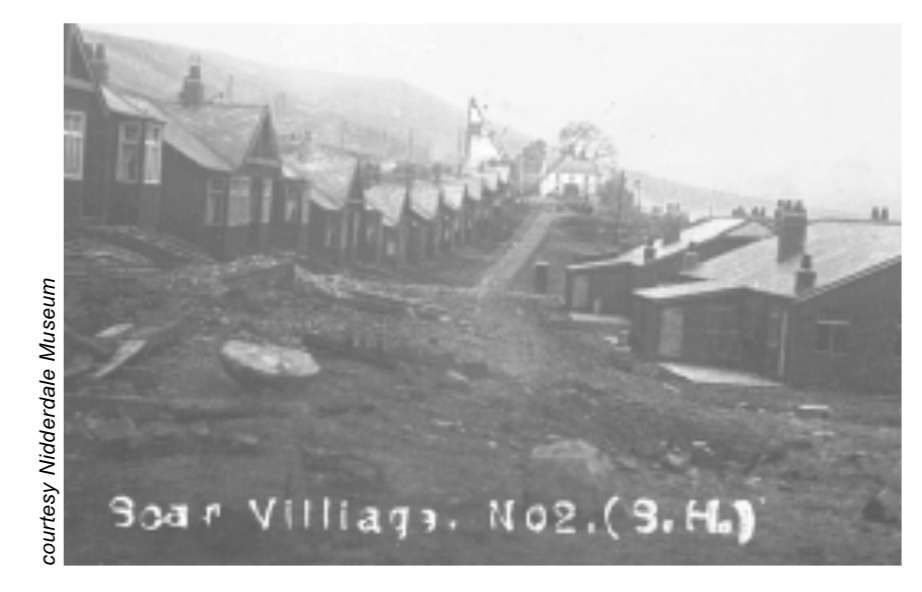
Scar Village © Nidderdale Museum, courtesy of the RealYorkshireBlog.com. [11]

Plans to electrify the railway using hydro-electric power, were considered in March 1920, but rejected as being too expensive. uneconomic. Holdsworth, was taken out of service in 1866 because it was too heavy for the line, but when no buyers could be found, it was used as a stationary steam supply for another 14 years. There were plans to overhaul Milner, to obtain another lighter engine, and to purchase two railmotor cars. Only one railmotor (‘Hill’) was eventually purchased in 1921. It can be seen in the two images immediately below.
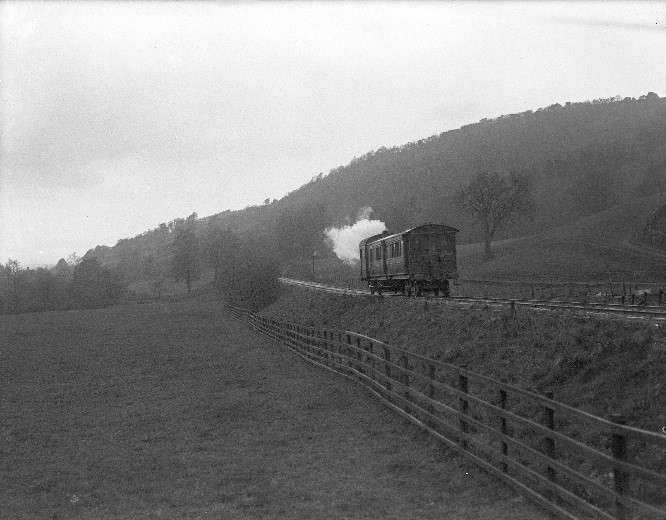
Steam railmotor car ‘Hill’ approaching Wath station on the descent from Ramsgill. It worked the Pateley Bridge to Lofthouse public passenger service. Humphrey Household collection (1996-7886_522 DS160103), © National Science Museum and licenced for reuse under a Creative Commons Attribution-Noncommercial-ShareAlike (CC BY-NC-SA 4.0) licence. [10]
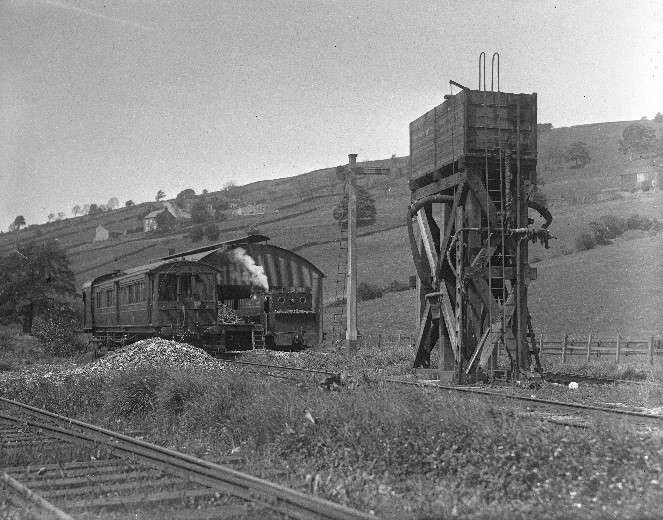
Pateley Bridge locomotive shed and water tower, showing steam railmotor ‘Hill’ beside the shed and 0-6-0 steam locomotive ‘Blythe’ at the entrance. Humphrey Household collection (1996-7886_521 DS160102), © National Science Museum and licenced for reuse under a Creative Commons Attribution-Noncommercial-ShareAlike (CC BY-NC-SA 4.0) licence. [10]

From August 1920, work was carried out to improve the line between Lofthouse and Angram. This included easing the alignment on many of the curves, the addition of loops near Lofthouse and at Woodale, just below the Scar House site, and the construction of a 180-yard (160 m) tunnel near Goyden Pot, which was used by up trains only.” [4][5: p119-122]. “The line at Angram was extended to a small quarry in 1921, along the trackbed of Best’s 3 ft (914 mm) gauge line beyond the dam. Stone was extracted for remedial work, caused by wind and wave erosion of the southern bank of the reservoir near the dam.” [4][5: p123]
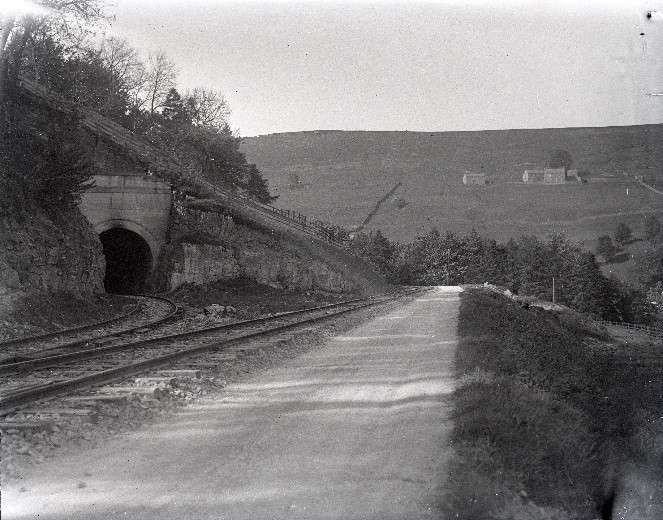
The entrance at the lower end of Goyden tunnel. The nature of the terrain was challenging, as is evident in this picture, and downhill trains used the original line, which can be seen alongside the road. Humphrey Household collection (1996-7886_527 DS160107)), © National Science Museum and licenced for reuse under a Creative Commons Attribution-Noncommercial-ShareAlike (CC BY-NC-SA 4.0) licence. [10]

Close to the Scar House dam site, “a network of sidings were constructed, zig-zagging down to the Nidd, and back up the other side of the valley. A double track self-acting incline provided access to the Carle Fell Quarry, to the north of the reservoir, and as the quarry was worked, two further inclines were constructed. One was single track, with a winding engine at the top, and around 1930, an incline worked by locomotives was added. Above the later quarry face, a Simplex petrol locomotive worked on a 2 ft (610 mm) track, removing overburden.” [4][5: p118]
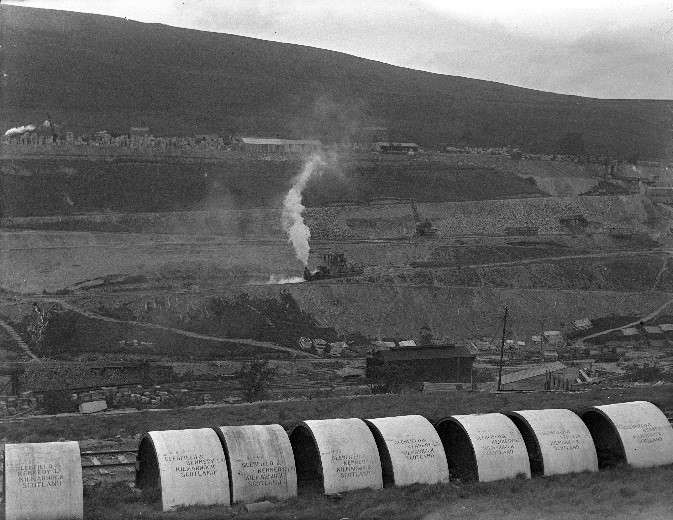
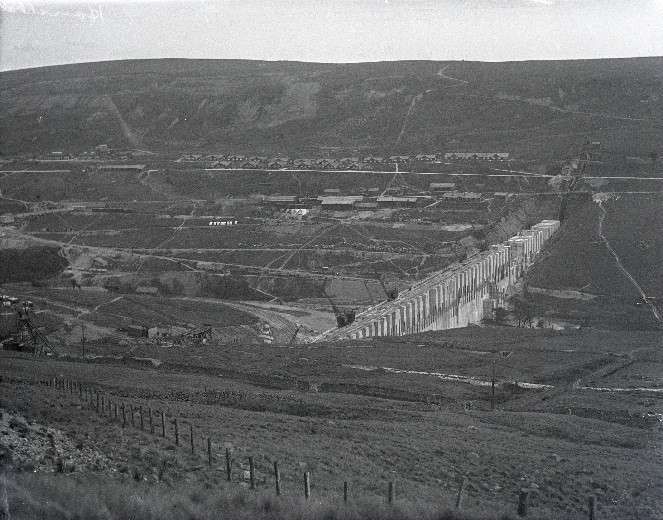
The Scar House dam construction site viewed across the valley from the south. The zigzag tracks linking the site with the quarries and stoneyard can be seen, with a locomotive in steam with three trucks in the centre of the picture. Beyond is the extensive stoneyard. In the foreground is a row of new large pipe sections manufactured by Glenfield & Kennedy Ltd of Kilmarnock, Scotland. Humphrey Household collection (1996-7886_537 DS160116)), © National Science Museum and licenced for reuse under a Creative Commons Attribution-Noncommercial-ShareAlike (CC BY-NC-SA 4.0) licence. [10]
A general view of Carle Fell quarry above the Scar House dam construction site, showing several railway tracks with two steam cranes, a locomotive and a number of trucks. Humphrey Household collection (1996-7886_539 DS160119)), © National Science Museum and licenced for reuse under a Creative Commons Attribution-Noncommercial-ShareAlike (CC BY-NC-SA 4.0) licence. [10]

Power for the works “was generated using water from Angram reservoir, which was discharged into Haden Carr reservoir. A 4,775-foot (1,455 m) pipeline supplied the turbines. This was later supplemented by a steam generating station. [5: p123-124] Two locomotive sheds were built, one near the village and another on the north side of the River Nidd, with a further two at Carle Fell Quarry. All had two tracks. Twelve four-wheeled carriages were bought from the Maryport and Carlisle Railway, to provide transport for the workers and their families from Scar House to Lofthouse, and a two-track carriage shed was built to the east of the main complex.” [4][5: p125]
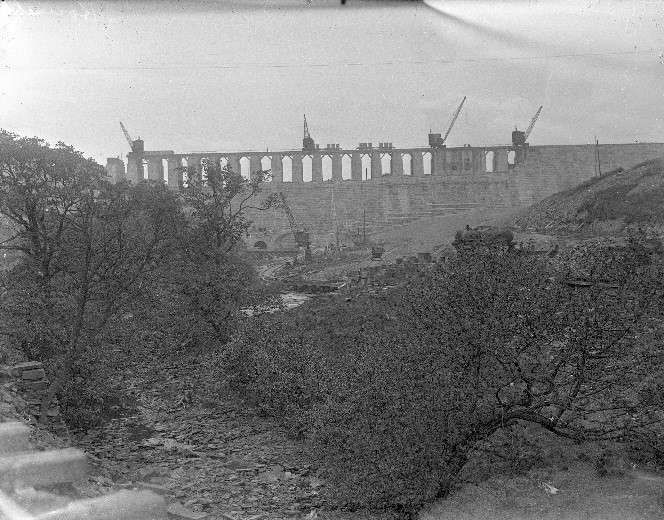
Scar House dam under construction, showing the full length of the structure viewed from a distance down in the valley. Four steam cranes are seen on top of the dam, and another one below it alongside railway tracks, a truck, a water tank, and a stack of large stone blocks. Humphrey Household collection (1996-7886_535 DS160114)), © National Science Museum and licenced for reuse under a Creative Commons Attribution-Noncommercial-ShareAlike (CC BY-NC-SA 4.0) licence. [10]

Six locomotives worked in the quarry. Allenby, Beatty, Haig and Trotter were based at the shed at the top of the main self-acting incline, while Ian Hamilton and Stringer were based in a shed at a higher level. Three steam navvies were used to load stone into the railway wagons, and there were nineteen or twenty steam cranes, all of which were self-propelled and ran on the tracks either in the quarry or on top of the dam.” [4][5: p129]
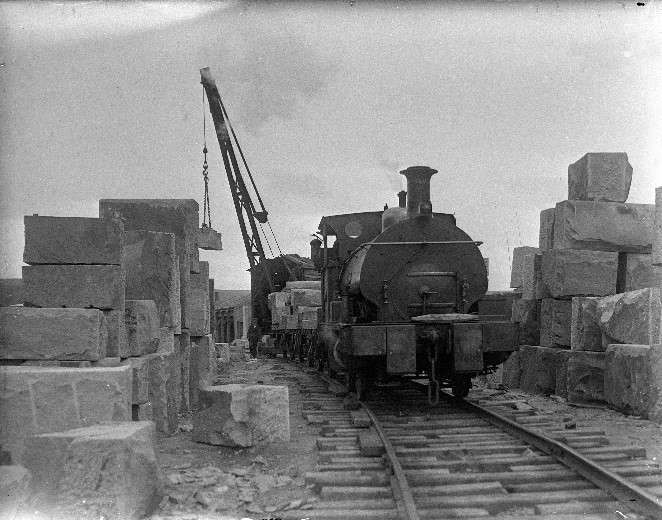
The masons’ yard above the Scar House dam construction site, with 0-4-0 saddle tank steam locomotive ‘Craven’ and a steam crane lifting blocks of stone. Humphrey Household collection (1996-7886_540 DS160118). Craven does not appear in Bowtell’s list of locomotives above), © National Science Museum and licenced for reuse under a Creative Commons Attribution-Noncommercial-ShareAlike (CC BY-NC-SA 4.0) licence. [10]
A wide view of the Scar House dam construction site across the valley from the quarries high up on the north side, showing the dam below and looking across to the buildings of Scar village, where the workers lived. The zigzag rail tracks linking the construction site with the quarries and stoneyard are clearly visible. Humphrey Household collection (1996-7886_538 DS160117)), © National Science Museum and licenced for reuse under a Creative Commons Attribution-Noncommercial-ShareAlike (CC BY-NC-SA 4.0) licence. [10]

The main engineering work at Scar House reservoir closed to completion in September 1931 but it was not until July 1935 that filling of the reservoir commenced. “The official opening was on 7th September 1936. Scar House, which gave its name to the reservoir, was demolished. A new Scar House was built, at the foot of the incline from Carle Fell Quarry, which provided a home for the reservoir keeper, and a boardroom for official visits. [5: p130-131] A project to re-route the waters from Armathwaite Gill and Howstean Beck through a tunnel and into the reservoir began in May 1929. A 2 ft (610 mm) gauge line was laid, on which two battery-electric locomotives and twelve wagons ran.” [4][5: p131]
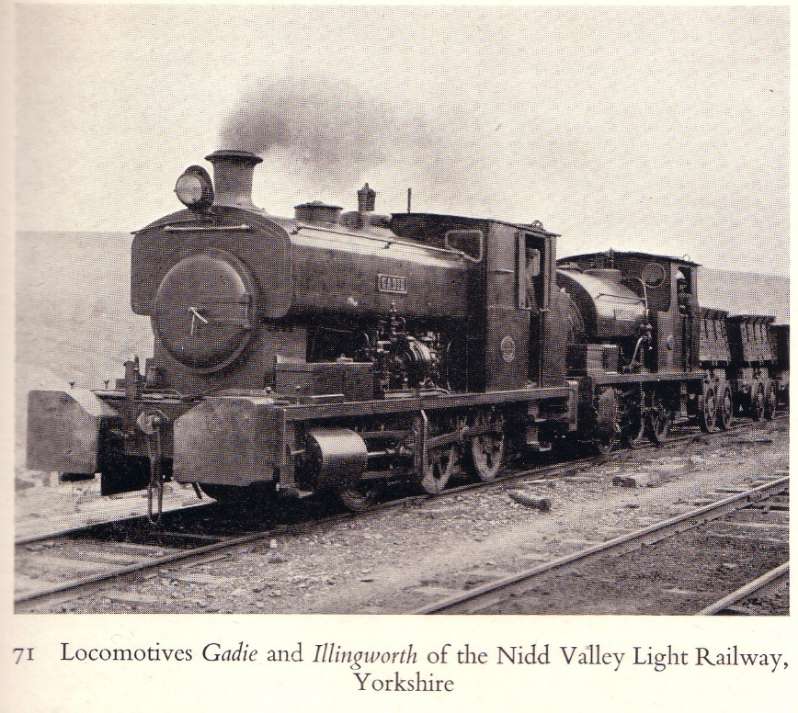
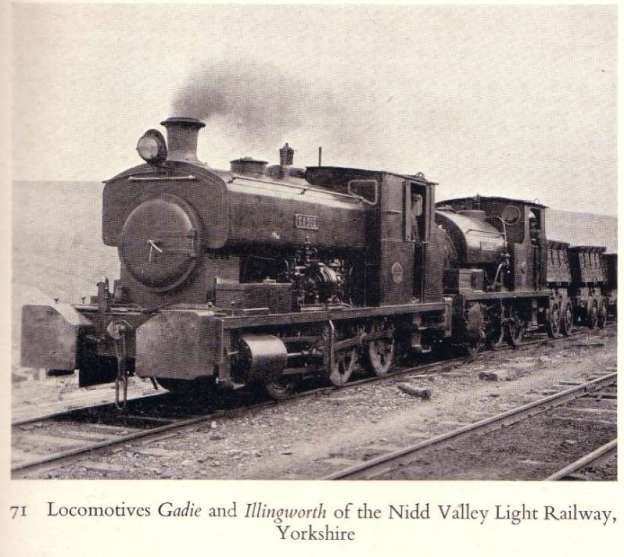
Two 0-6-0ST locomotives ‘Gadie’ and ‘Illingworth’, head a goods train on the line. [12]

Decline

The start of work on Scar House Reservoir led to an overhaul of existing stock. Seven of the original Metropolitan Railway coaches were upholstered and repainted, while the remaining five were used for the workmen.  [The] steam railmotor [Hill] … obtained in 1921, … had previously been owned by the Great Western Railway. It … was fitted with electric lights in 1923. It worked on the public section of the railway, and never travelled beyond Lofthouse. Numerous new and secondhand locomotives were purchased, most for use on construction work, but two, Blythe and Gadie, were fitted with vacuum brakes, and so worked goods trains from Pateley Bridge to Scar House, as well as passenger trains between Scar House and Lofthouse and sometimes Pateley Bridge.” [4][5: p133]

Passenger trains for the residents of Scar village ran on Tuesdays, Thursdays and Saturdays, the mid-week ones connecting with ‘Hill’ at Lofthouse, and the Saturday ones running through to Pateley Bridge. The 1927 printed timetable showed five trains a day between Pateley Bridge and Lofthouse, but also showed the trains onwards to Scar Village, with a note that these were for exclusive use of residents. Saturday trains were hauled by Blythe or Gadie, but were banked at the rear by another engine above Lofthouse because of the steep gradients.” [4][5: p134]
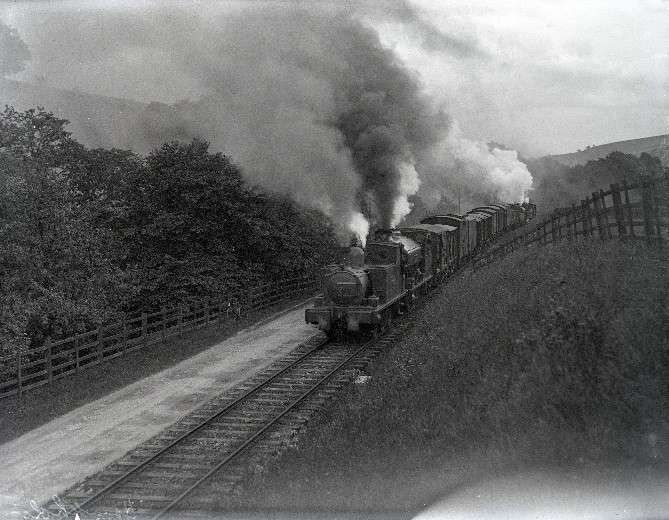
The ‘Scar House special’, 0-6-0T locomotives ‘Milner’ and ‘Blythe’ with a goods train, banked in the rear by two other locomotives for the steep climb alongside the road towards Scar House. This was possibly a more substantial train than usual as it required 4 locomotives rather than the 3 mentioned above. Humphrey Household collection (1996-7886_526 DS160106), © National Science Museum and licenced for reuse under a Creative Commons Attribution-Noncommercial-ShareAlike (CC BY-NC-SA 4.0) licence. [10]


Traffic returns showed 106,216 journeys by workmen in 1921, and 41,051 by ordinary passengers. The figure for workmen was not declared after 1922, as the accommodation at Scar Village was available. The peak year for journeys was 1923, with 63,020, after which there was a gradual decline, with 24,906 journeys for the final nine months before closure. The line made a total operating loss of £36,435 between 1908 and 1924, and then made a modest profit until 1929. Fares were cut by one third in early 1929, in the face of competition from motor buses, and a decision was taken to close the line in April 1929.” [4][5: p

An approach to the London and North Eastern Railway to take over the railway was unsuccessful, and on 31st December 1929, the railway closed to public passenger and goods services. The sections below and above Lofthouse continued to be run as a private railway. [5: p135] The Saturday train to Pateley Bridge for the residents of Scar Village continued until 1932.” [4][5: p133]

The line to Angram was severed by the works at Scar House in 1933. “By 1936, with construction completed, the railway was lifted, and a sale was held at Pateley Bridge on 1st March 1937, where everything was sold as a single lot. … At its peak, the Scar House reservoir project had employed about 780 men, and the population of Scar Village had been 1,135. By 1936, there were just eight houses occupied, and seven pupils at the school, which closed on 31st January 1938.” [4][5: p130 & 138]

A Journey along the Line

The railway began in Pateley Bridge, close to the River Nidd, with the goods yard just to the north of the B6265 road. The passenger station was a little further north, and is now occupied by a road called ‘The Sidings’.” [4]
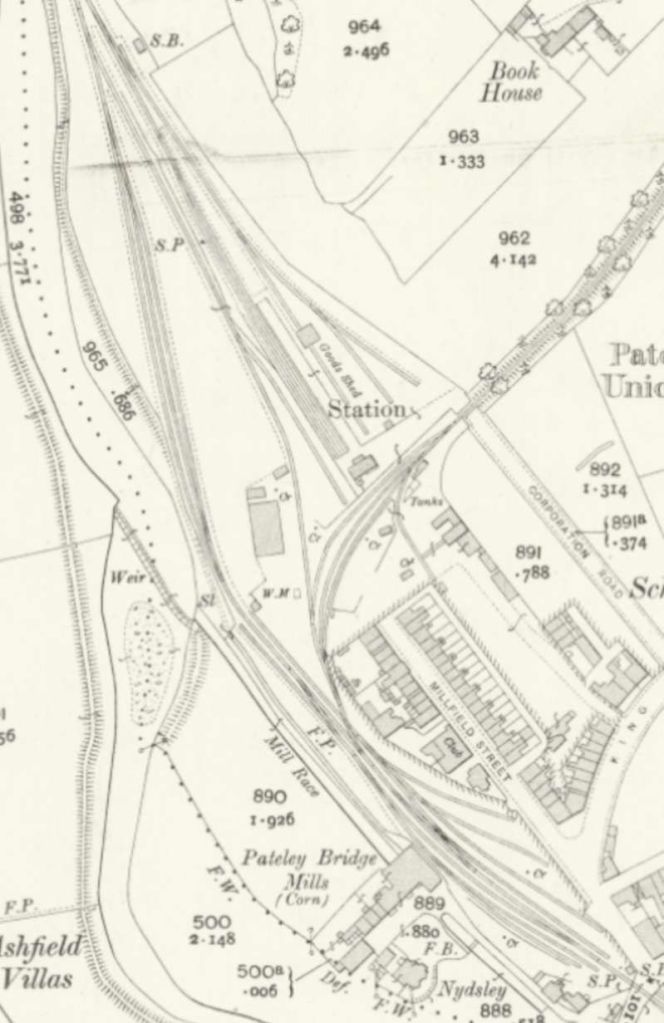
The Nidd Valley Light Railway Station, Transshipment Yard and Goods Yard at Pateley Bridge. 25″ Ordnance Survey of 1907/08, published in 1908. [9]
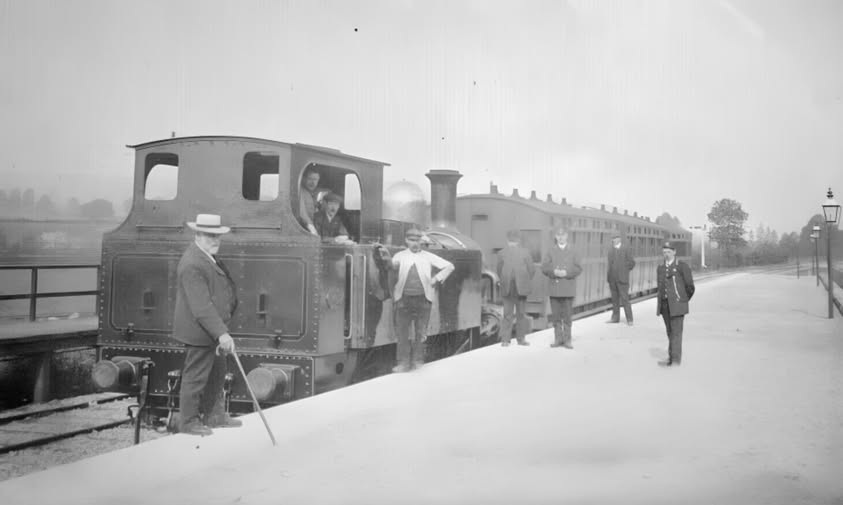
The Nidd Valley Light Railway Station Platform at Pateley Bridge in 1907. This image was shared on the Railways Around Harrogate & Yorkshire Facebook Group on 18th January 2024 by Ian McGregor, (c) Public Domain. [17]
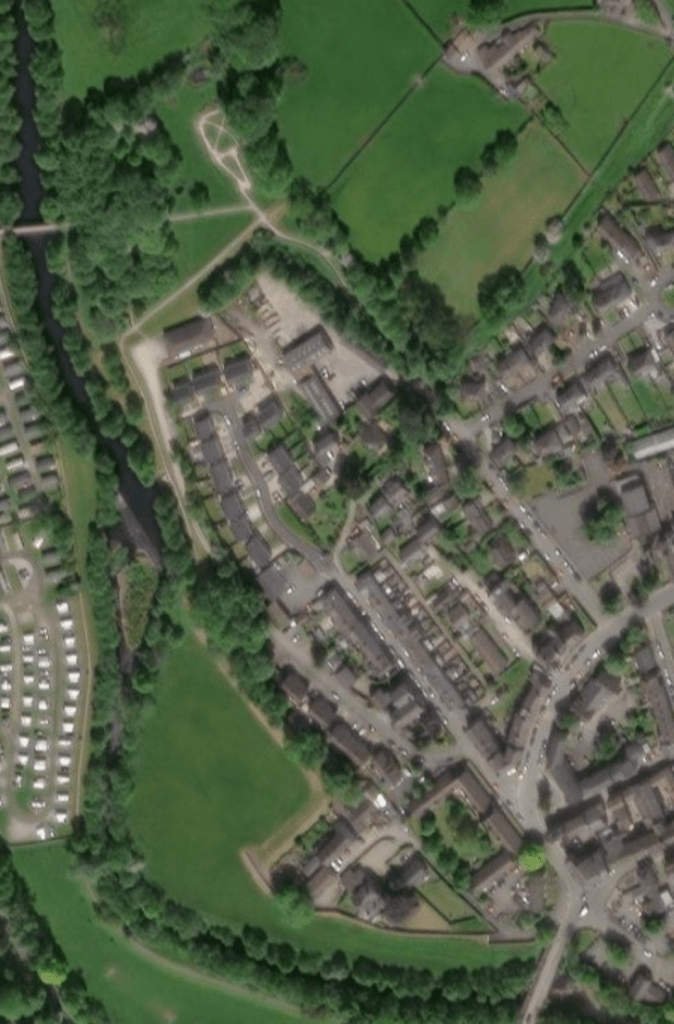
The same area in the 21st century. ‘The Sidings’ is the cul-de-sac directly above the centre-bottom of the image. The new build further to the North is an extension to Millfield Street. [9]
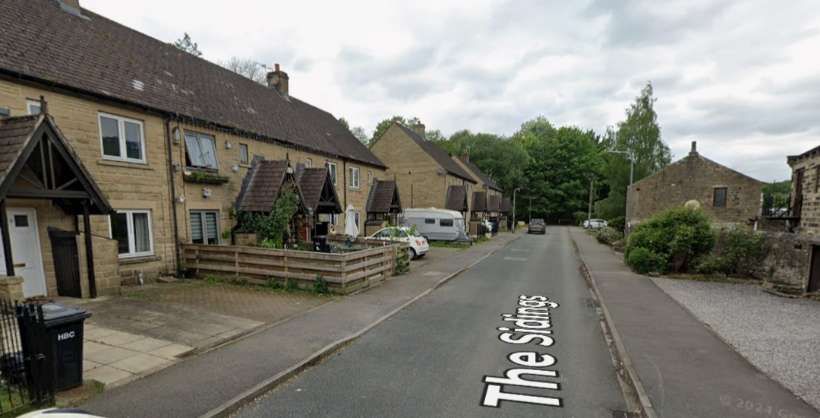
The Sidings. [Google Street view, May 2024]
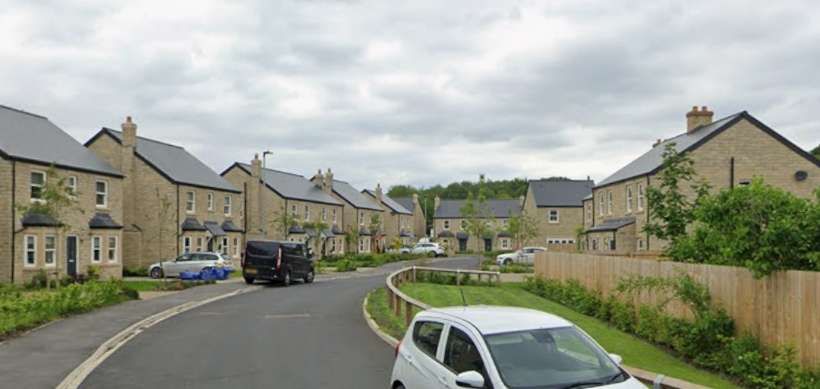
The extension to Millfield Street. [Google Streetview, May 2024]
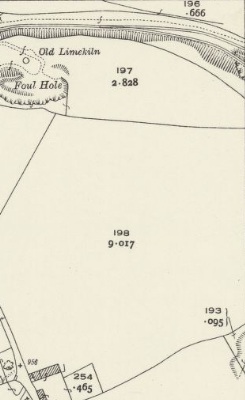
The line’s Carriage Shed and Engine Shed sat to the North of the Station. 25″ Ordnance Survey of 1907/08, published in 1908. [9]
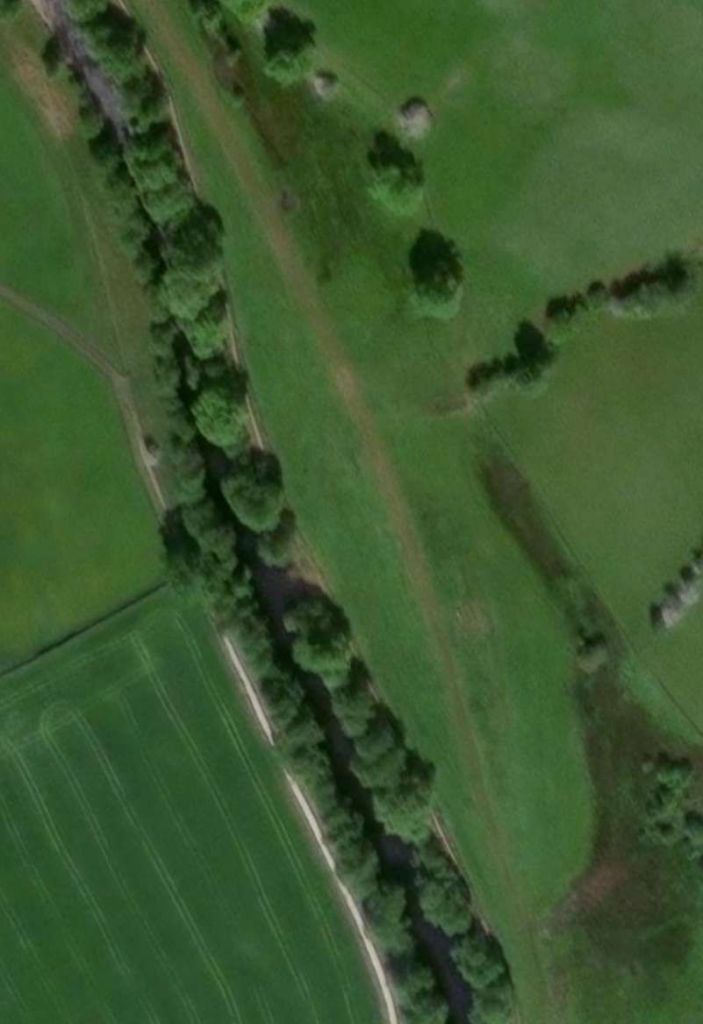
The same area in the 21st century. The area of the Carriage and Engine Sheds has now reverted to farmland. [9]

The line headed North “along the east bank of the river, and this section of it now forms part of the Nidderdale Way, a long-distance footpath. Wath station was just to the south of the minor road that crosses Wath Bridge, and had two sidings.” [4]
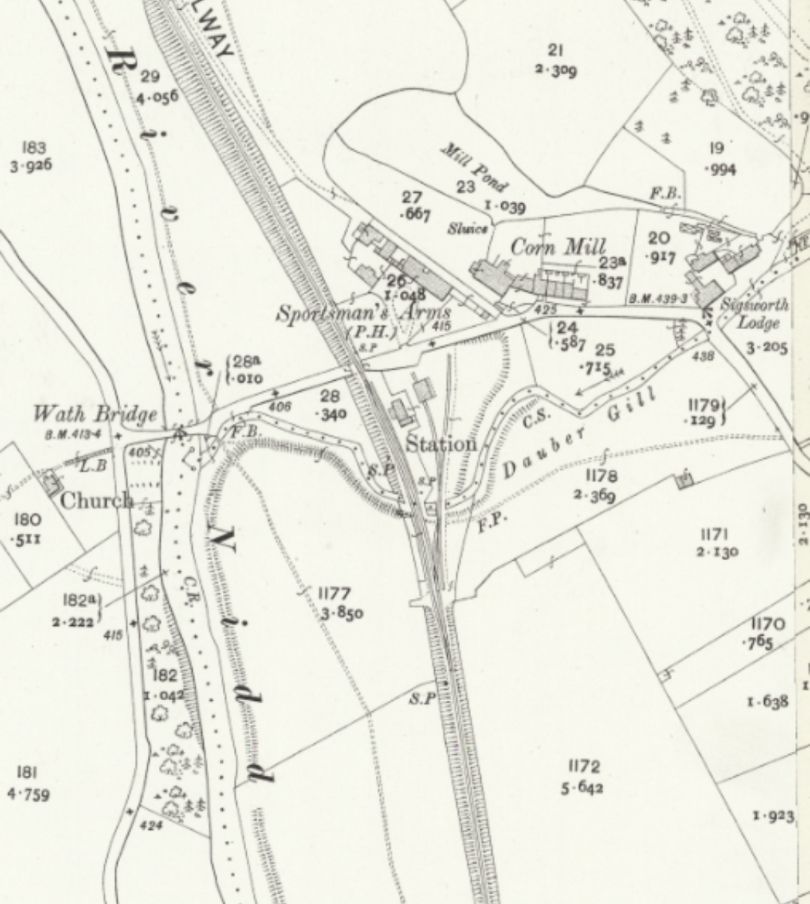
Wath Railway Station was on the South side of the road between the Corn Mill and Wath Bridge. 25″ Ordnance Survey of 1907/08, published in 1908. [14]
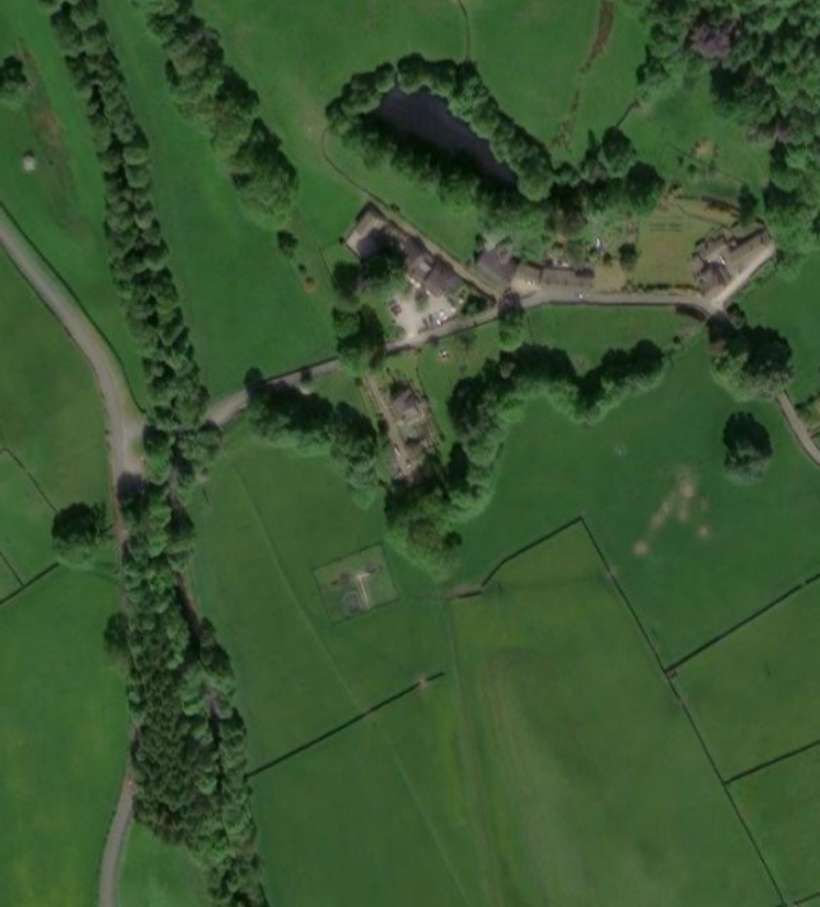
The same area in the 21st century. ESRI satellite imagery provided by the National Library of Scotland. [14]
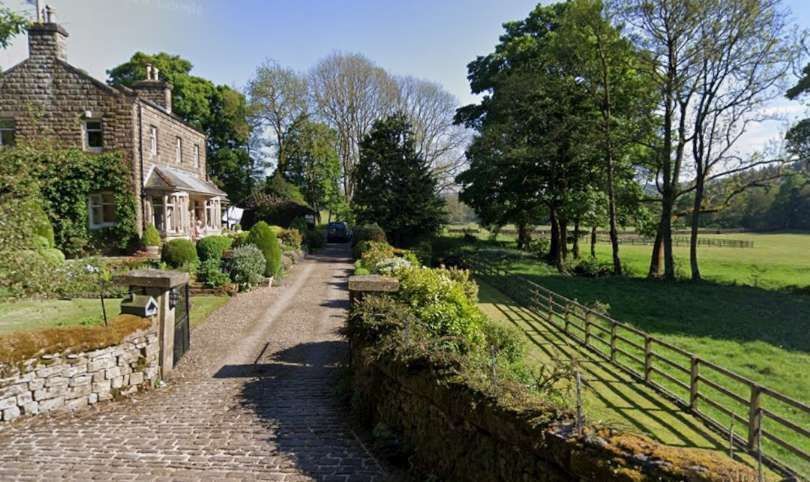
Looking South from the minor road into the site of Wath Station. The station building is now a private home. [Google Streetview, May 2024]
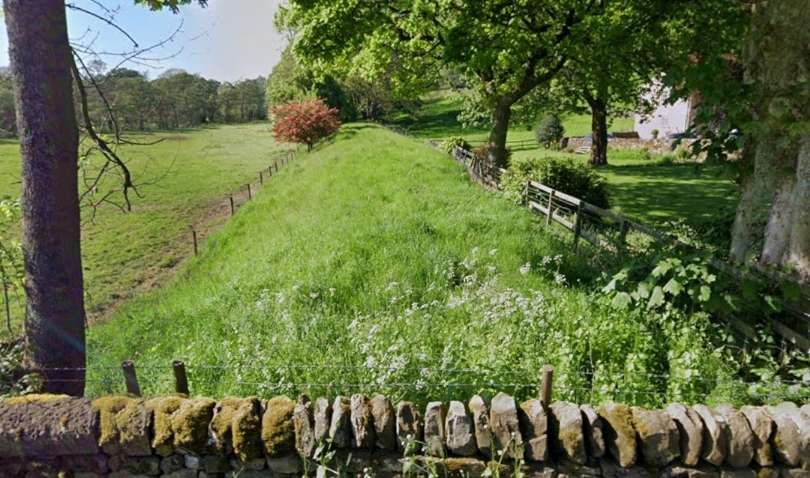
The line North of the minor road was on a low embankment. [Google Streetview, May 2024]

The footpath leaves the course of the railway before the station, and follows the bank of the river, crossing over the railway trackbed by Gouthwaite Dam.” [4]
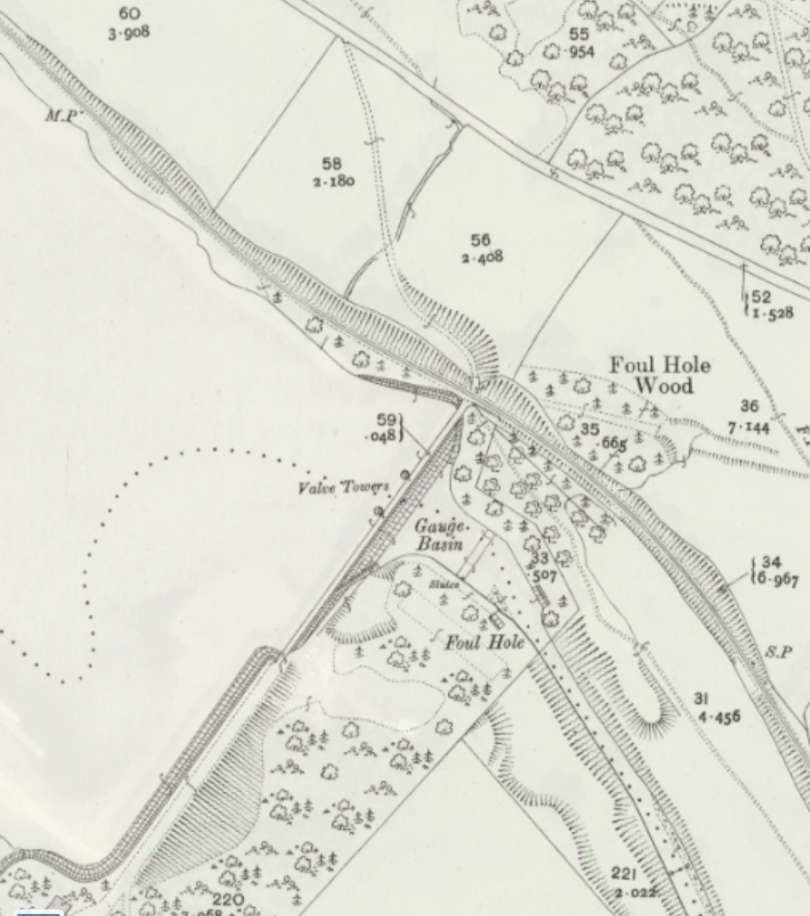
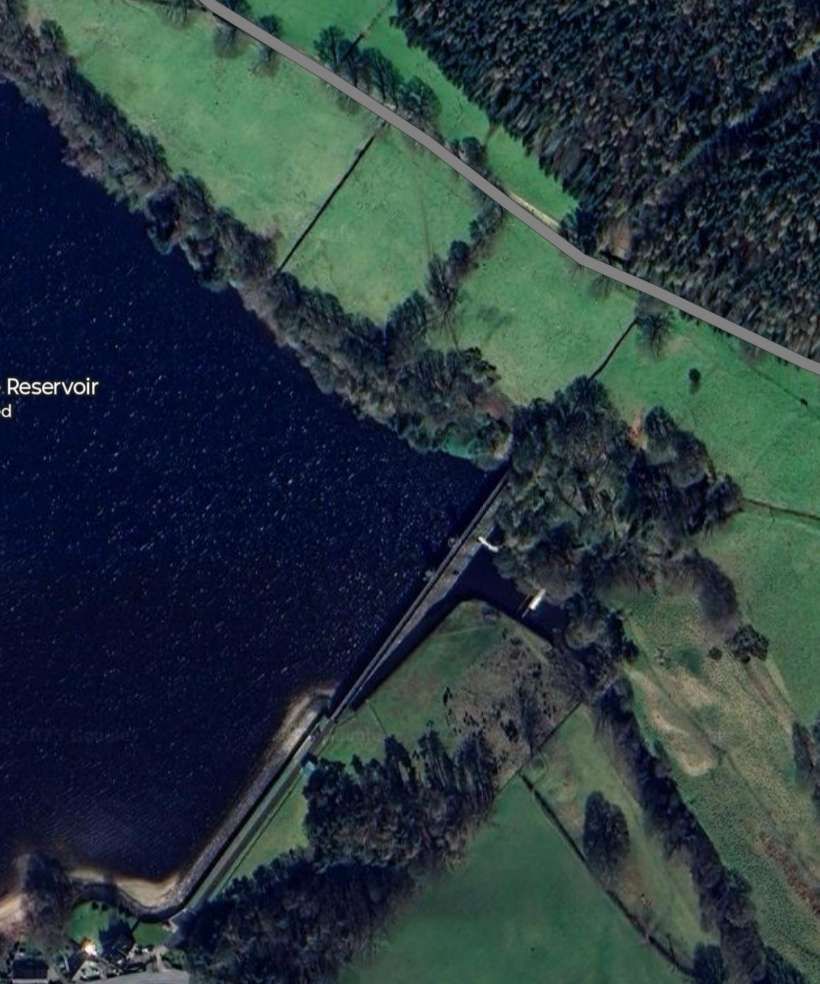
The line passed close to the Northeast end of Gouthwaite Dam. 25″ Ordnance Survey of 1907/08, published in 1908. [15]
A very similar area in the 21st century. [Google Maps, October 2025]
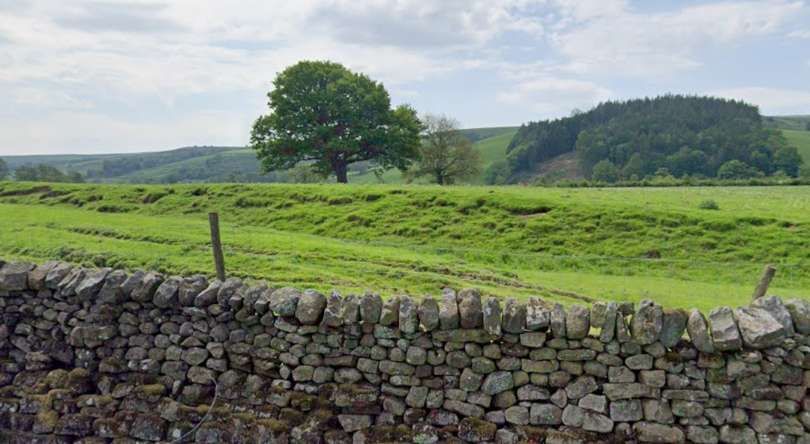
Beyond the North end of Gouthwaite Reservoir, the route of the old railway can be seen from the minor road which links Coville House Farm to Bouthwaite. This view looks South from the road. The route of the old line is beyond the drystone wall in a shallow cutting. [Google Streetview, May 2024]
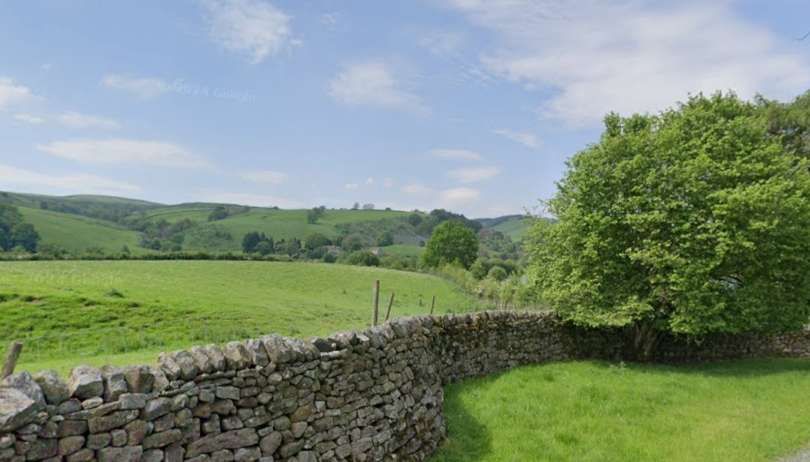
Turning through 90° to face West, the end of the cutting can be seen on the left of this image, the line ran on beyond the tree at the right side of the photograph. [Google Streetview, May 2024]
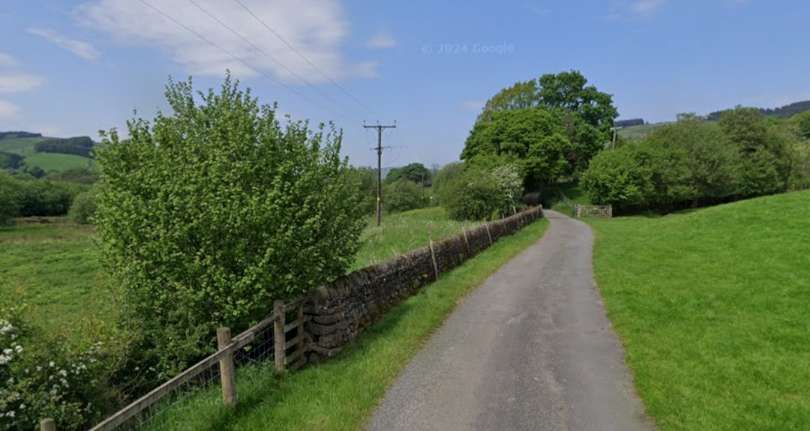
Further North along the same minor road, the old railway ran to the left of the drystone wall, between it and the electricity pole. [Google Streetview, May 2024]

The trackbed was close to the shore of the reservoir, and the footpath rejoins it after a deviation to the north west. Ramsgill Station was at Bouthwaite, rather than Ramsgill, just to the south of Bouthwaite Bridge, where the Ramsgill to Bouthwaite road crosses Lul Beck.” [4]
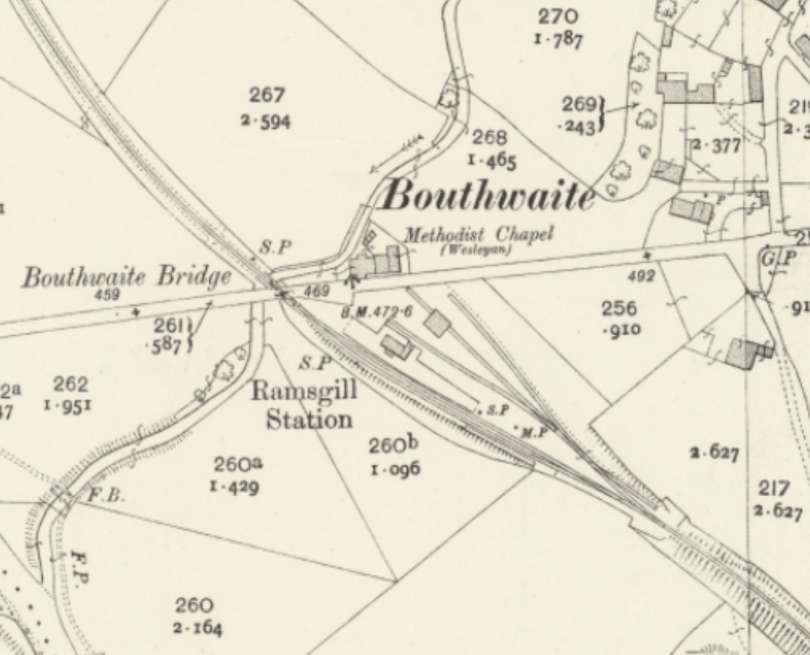
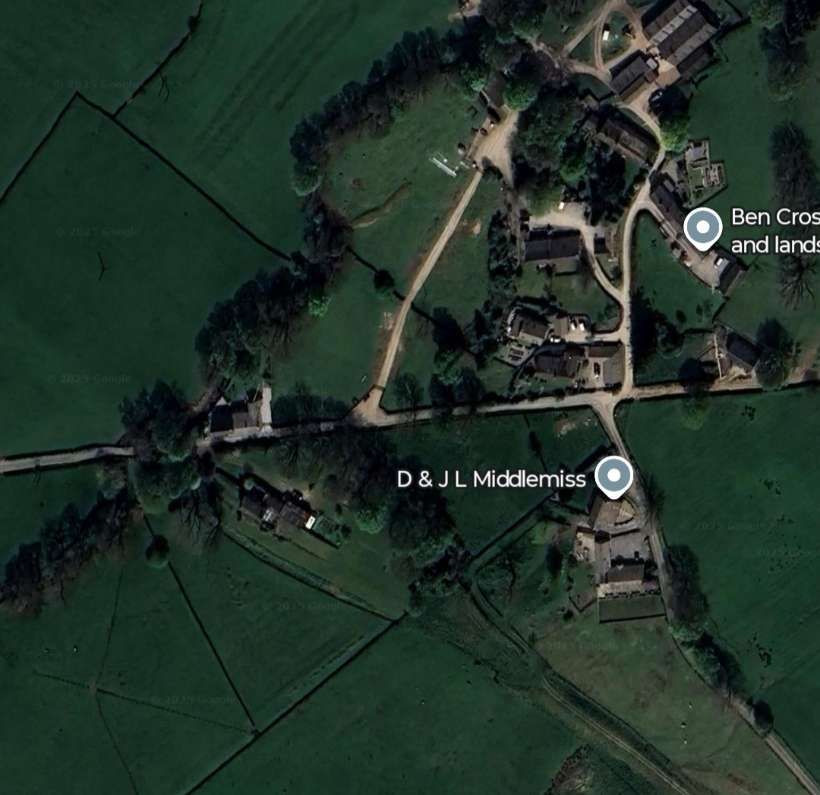
Ramsgill Railway Station at Bouthwaite. 25″ Ordnance Survey of 1907/08, published in 1908. [16]
Approximately the same area as it appears on 21st century satellite imagery. The line can easily be picked out close to the bottom-right of this image, to the West of the minor road. The station area remains quite distinct! The route of the line continues Northwest on the North side of the minor road which enters centre-left. [Google Maps, October. 2025]
The Station Building at Ramsgill Railway Station in Bouthwaite, the main running line was to the right of the building and crossed the road to the right of the camera. [Google Streetview, May 2924]
Looking Northwest from approximately the same place these trees sit on the line of the old railway. Just North of the road, the line bridged the stream running through the village. [Google Streetview, May 2924]

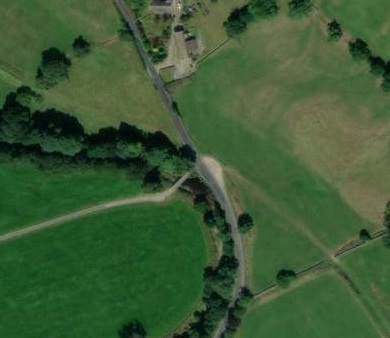
The footpath rejoins the trackbed briefly at Low Sikes, where there was a level crossing over the Ramsgill to Lofthouse road.” [4]
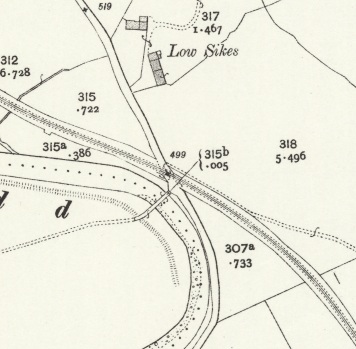
The level crossing adjacent to the River Nidd at Low Sikes. 25″ Ordnance Survey of 1907/08, published in 1908. [18]
The same location in the 21st century. Note the gap in the drystone wall bottom-right which sits on the line of the old railway. [18]
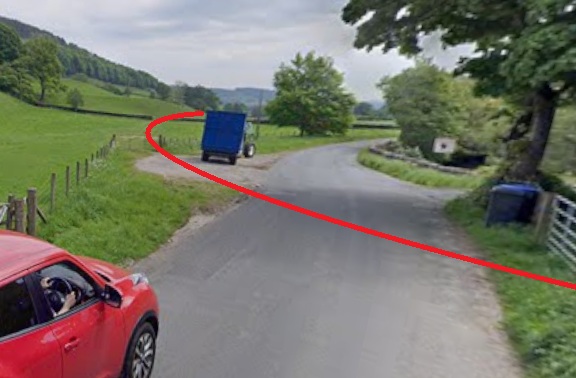
Looking Southeast along Nidderdale at Low Sikes. The redline approximates to the line of the old railway in the photograph. Foreshortening of the image significantly tightens the curve of the line. [Google Streetview, May 2024]
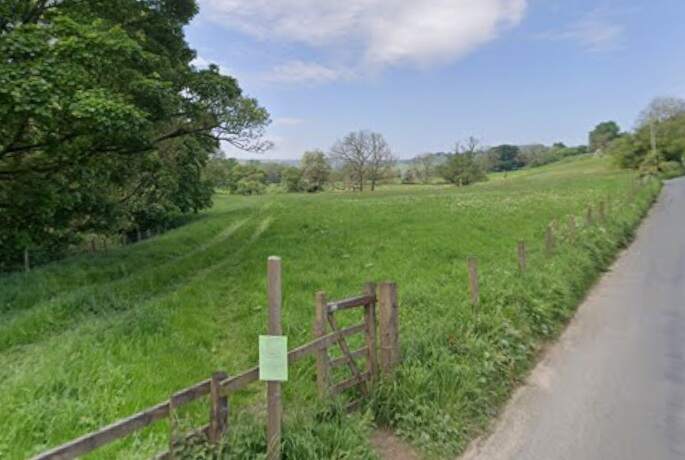
Looking Northwest alongside the River Nidd from Low Sikes. The line ran approximately straight ahead from the sign post in the foreground. [Google Streetview, May 2024]

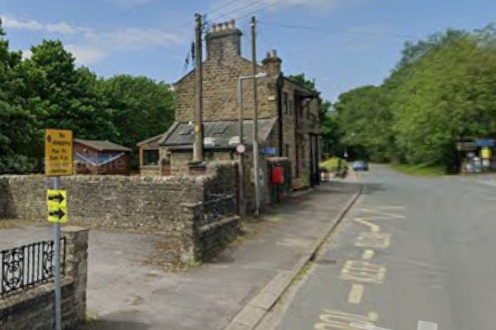
The next significant location along the line was Lofthouse Station which sat on the South side of the village of Lofthouse, between the road and the river.
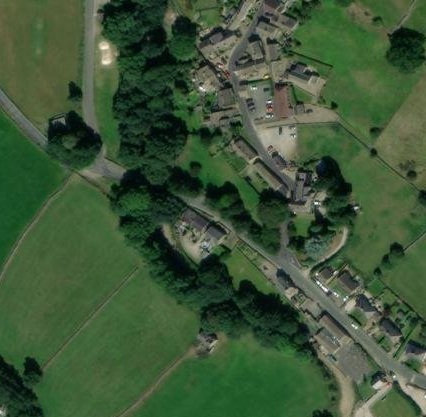
Lofthouse Railway Station sat on the Northeast bank of the River Nidd. The railway crossed the River Nidd on a bridge shared with the highway. [6]
A similar area in the 21st century. [6]
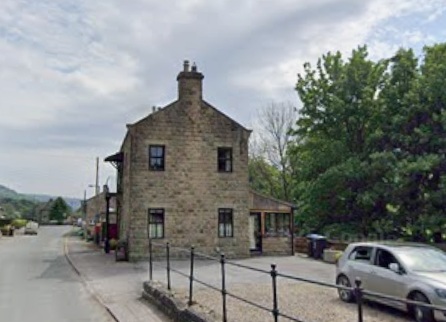
Lofthouse Railway Station building in 21st century, seen from the Southeast. [Google Streetview, May 2024]
Lofthouse Railway Station building in 21st century, seen from the Northwest. The railway and platform were on the right of the building. [Google Streetview, May 2024]
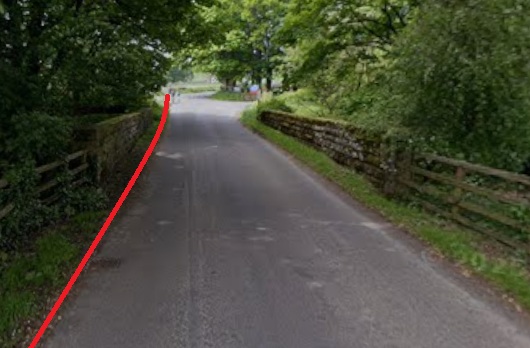
This road bridge over the River Nidd was once shared with the light railway, the red line shows the route of the line. [Google Streetview, May 2024]
Once across the river the line turned sharply to the North to follow the road to Scar House. It followed the West shoulder of the road with the River Nidd off to the East of the road. [Google Streetview, May 2024]

The metalled road is owned by Yorkshire Water but open to the public. The line continued North remaining on the West shoulder of the road.
The entrance at the lower end of Goyden tunnel. The nature of the terrain was challenging, as is evident in this picture, and downhill trains used the original line, which can be seen alongside the road. Humphrey Household collection (1996-7886_527 DS160107)), © National Science Museum and licenced for reuse under a Creative Commons Attribution-Noncommercial-ShareAlike (CC BY-NC-SA 4.0) licence. [10]
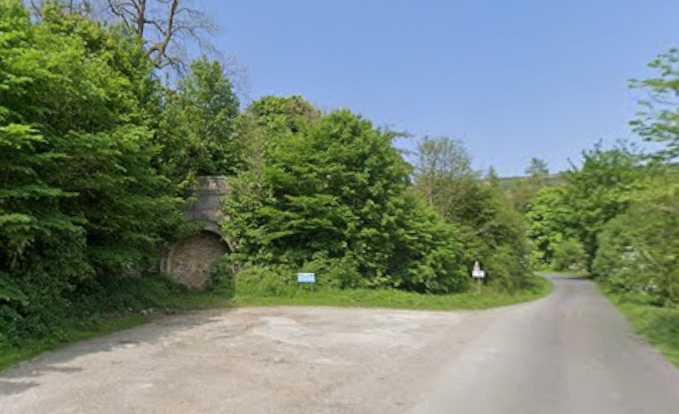
The same location in the 21st century. This bricked up tunnel was designed to avoid possible accidents. Northbound trains used the tunnel, Southbound trains used the original railway alignment which included a sharp bend just North of this location. [Google Streetview, May 2024]

The bricked up tunnel can be seen about 2 miles (3.2 km) from Lofthouse, where the road and river turn sharply west. There is a picnic spot near the southern portal of the tunnel.” [4]
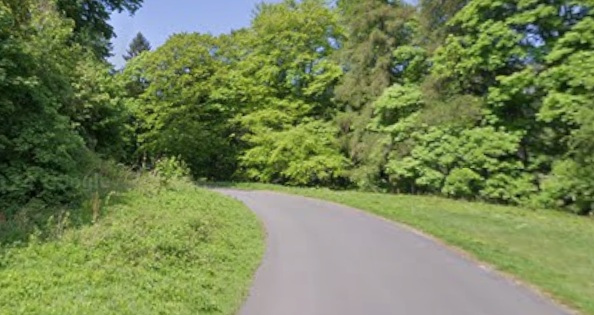
Beyond Goyden Tunnel the original line (still used by Southbound trains after the tunnel was built) bears sharply to the West. [Google Streetview, May 2024]
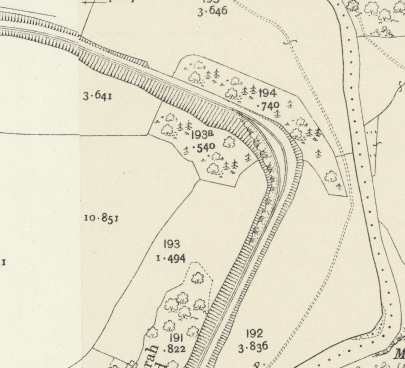
Before the tunnel was constructed a short passing loop was provided on the sharp bend. It was not long enough to allow any significant trains to pass but it mitigated the risk of collision! [19]

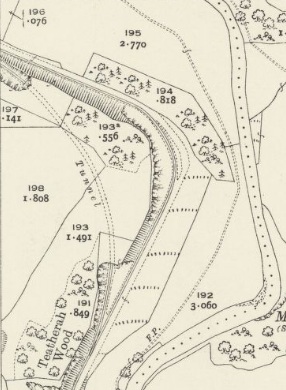
Images from two different OS sheets surveyed in the late 1920s show the tunnel noted above. [20]
The line from this point on travelled in a westerly direction. Originally the railway ran through the site of Scar House Reservoir as far as Angram Reservoir. Travellers on the railway would have been able to look down and see a small reservoir formed to secure the intake of the pipeline which served Bradford. Its Dam was called the Nidd Intake Dam.

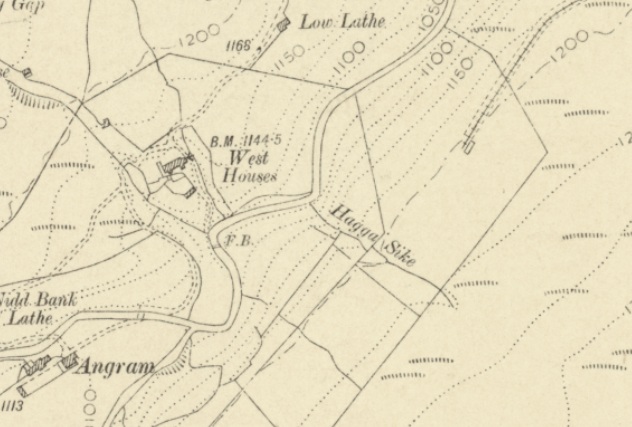
The Nidd Intake Dam and Reservoir. 25″ Ordnance Survey of 1907/08, published in 1908. This reservoir was swamped by the later Scar House Reservoir. [22]
This map extract comes from the 6″ Ordnance Survey of 1907 which was published in 1910. The Light Railway has been built but there is no sign of construction work on the Angram Reservoir. [23]
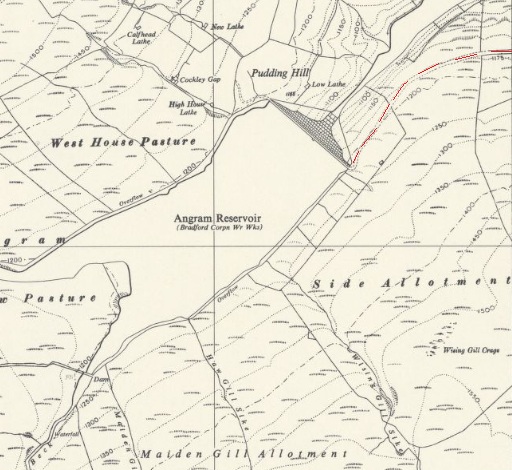
A much later OS Map (1956) showing Angram Reservoir with the route of the old railway marked by red dashes. Note that Scar House Reservoir intrudes at the top-right of this map extract. [24]

At Scar Village there is another picnic spot and a car park. The railway followed the most northerly of the two tracks at this point.
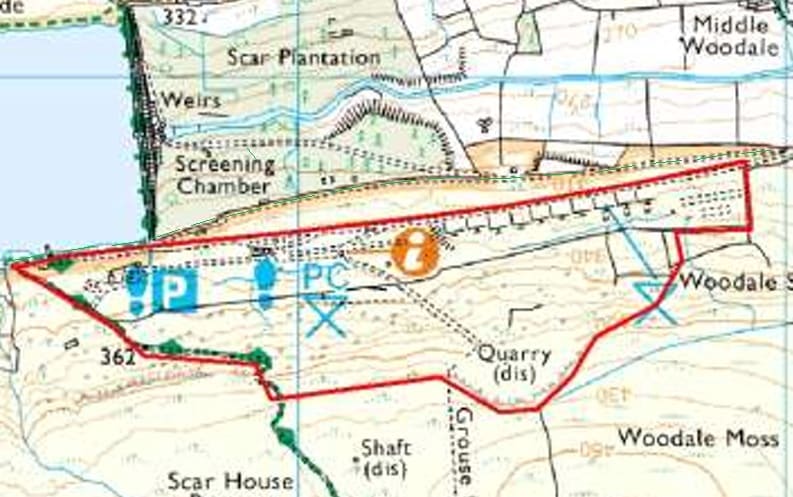
A relatively low grade image showing the area close to Scar House Reservoir on which Scar Village was built. The original line of the railway in the track on the northside of the site of the village. The village historical survey report from which this image has been taken provides details (In some depth) of the site of the village and can be found here. [25]

At Scar Village there is [a] picnic spot and a car park. The railway followed the most northerly of the two tracks at this point. Another track down to the weirs follows the course of one of the zig-zag tracks across the valley. A footpath crosses the dam to the north side of the lake, where the incline to the quarry is still clearly visible. Another road, open to the public on foot, follows the trackbed along the southern edge of Scar House Reservoir, to reach Angram dam. The course of the railway is clearly visible on the modern 1:25,000 Ordnance Survey map for almost the entire length of the railway.”[4]

A short video about Scar Village and the work on Scar House Dam. [21]

References

  1. The Why and the Wherefore; in The Railway Magazine, February 1952; Tothill Press, Westminster, London, p142-144.
  2. https://www.walkingintheyorkshiredales.co.uk/Nidd%20Valley%20Light%20Railway.htm, accessed on 8th October 2025.
  3. D. J. Croft; The Nidd Valley Railway, Locomotion Papers No. 55 (Revised); Oakwood Press, 1987.
  4. https://en.wikipedia.org/wiki/Nidd_Valley_Light_Railway, accessed on 8th October 2025.
  5. Harold Bowtell; Lesser Railways of the Yorkshire Dales; Plateway Press, Gainsborough, 1991.
  6. https://maps.nls.uk/geo/explore/#zoom=17.0&lat=54.15660&lon=-1.84733&layers=168&b=ESRIWorld&o=100, accessed on 9th October 2025.
  7. https://maps.nls.uk/view/125631997, accessed on 10th October 2025.
  8. https://maps.nls.uk/view/125632021, accessed on 10th October 2025.
  9. https://maps.nls.uk/geo/explore/#zoom=16.0&lat=54.09027&lon=-1.76397&layers=168&b=ESRIWorld&o=100, accessed on 10th October 2025.
  10. https://blog.railwaymuseum.org.uk/in-pictures-constructing-the-scar-house-dam, accessed on 11th October 2025.
  11. https://www.realyorkshireblog.com/post/the-story-of-scar-house-reservoir-the-pop-up-village-of-scar-and-the-lost-village-of-lodge, accessed on 11th October 2025.
  12. https://chasewaterstuff.wordpress.com/tag/pateley-bridge, accessed on 11th October 2025.
  13. https://transportsofdelight.smugmug.com/RAILWAYS/RALWAYS-EXCLUDED-FROM-THE-1923-GROUPING/NIDD-VALLEY-RAILWAY, accessed on 11th October 2025.
  14. https://maps.nls.uk/geo/explore/#zoom=16.8&lat=54.10586&lon=-1.77865&layers=168&b=ESRIWorld&o=0, accessed on 12th October 2025.
  15. https://maps.nls.uk/geo/explore/#zoom=16.5&lat=54.11162&lon=-1.78536&layers=168&b=ESRIWorld&o=92, accessed on 12th October 2025.
  16. https://maps.nls.uk/geo/explore/#zoom=17.1&lat=54.13617&lon=-1.81524&layers=168&b=ESRIWorld&o=100, accessed on 12th October 2025.
  17. https://www.facebook.com/photo/?fbid=7478382078862607&set=gm.1030871587986998&idorvanity=371639250576905, accessed on 13th October 2025.
  18. https://maps.nls.uk/geo/explore/#zoom=17.0&lat=54.14957&lon=-1.83232&layers=168&b=ESRIWorld&o=100, accessed on 13th October 2025.
  19. https://maps.nls.uk/geo/explore/#zoom=17.0&lat=54.18475&lon=-1.85057&layers=168&b=ESRIWorld&o=100, accessed on 13th October 2025.
  20. https://maps.nls.uk/view/125630530 & https://maps.nls.uk/view/125630539, accessed on 13th October 2025.
  21. https://youtu.be/8K0yOBaESSo, accessed on 13th October 2025.
  22. https://maps.nls.uk/geo/explore/#zoom=16.0&lat=54.18780&lon=-1.90902&layers=168&b=ESRIWorld&o=100, accessed on 13th October 2025.
  23. https://maps.nls.uk/geo/explore/#zoom=16.2&lat=54.18299&lon=-1.93299&layers=6&b=ESRIWorld&o=100, accessed on 13th October 2025.
  24. https://maps.nls.uk/view/189181725, accessed on 13th October 2025.
  25. http://uppernidderdale.org.uk/wp-content/uploads/2015/10/Scar-Village-Historic-Environment-Survey-Report.pdf, accessed on 13th October 2025.

The Khushalgarh-Kohat-Thal Railway in Pakistan

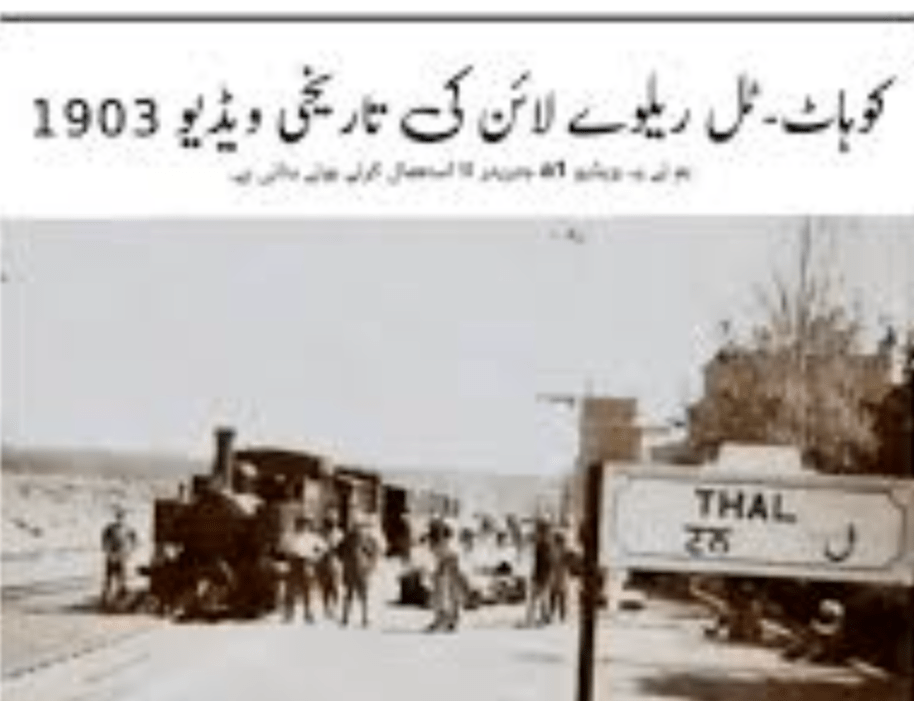
The featured image above is an early view of Thal Railway Station, possibly as early as 1903. [17]

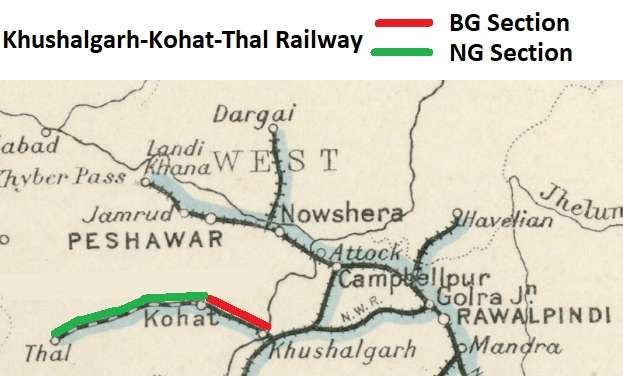
The route of the Khushalgarh-Kohat-Thal Railway. The length from Khushalgarh to Kohat was initially built to the 2ft 6in narrow gauge in 1902 but converted to broad gauge (5ft 6in) at the same time as the River Indus was bridged, reopening in 1908. The line from Kohat to Thal was built to the narrow gauge (2ft 6in) and opened in stages from 1901 to 1903. [5]

Khushalgarh-Kohat-Thal Railway was worked by North Western Railway. [11] It was a military railway which ran close to the border with Afghanistan, linking the border town of Thal with the wider network at Khushalgarh.

By 1881, Khushalgarh had been connected by a short 7 mile (11 kilometre) broad gauge spur to Jand the North Western Railway main line. [1]

A line from Khushalghar to Kohat was first surveyed in April 1899. In 1901, it was decided to that to bridge the Indus would be too expensive. Instead, a ropeway was built over the river and a 2ft 6in (762mm) narrow gauge line was constructed from the right bank of the Indus facing Khushalgarh to Kohat, a distance of about 30 miles (48 kilometres) and opened in May 1902. [1]

The 62 mile (100 kilometre) line from Kohat to Thal ran from Kohat through the Kohat Pass and up the Miranzai Valley to Thal near the Afghan border. It opened in stages from Mar 1901 reaching Thal in Apr 1903. [2] 

An intriguing haulage experiment is recorded by Simon Darvill. It took place in March 1902 on the trackbed of the line to Thal. A section of John Fowler [6] portable tramway was laid and a passenger carriage and two wagons were hauled by both a mule and a pair of bullocks. [3] The purpose and outcome of these experiments is not known. [5]

An on-line search of the India Office Records records held at the British Library relating to this line gives several entries, the most relevant being L/MIL/7/14848; “Collection 335/15 Railway construction: Loi Shilman, Kohat-Thal, Thal-Parachinar lines.”; 1908. [5]

The line closed sometime in the 1990s. Steam was still in use in 1989 as photographs here bear witness. [

Locomotives

An excellent discussion about various Bagnall supplied locomotives used on this line can be found in Allan C. Baker’s article in The Narrow Gauge No. 293 of March 2025. [12] Baker’s article is about the deployment of a series of Bagnall 2-4-2T locomotives built between 1901 and 1906 at the Castle Engine Works in Stafford (UK).

An early view of Thal Railway Station. [17]

The Route of the Railway – Jand to Thal

Google Earth/Google Maps allows us to view the line from above, but no Streetview images are available in this part of Pakistan as of September 2025. Ground-level photography is only available at a number of specific locations.
Jand

As we have noted the first stretch of the line was built in 1881, linking Jand to Khushalgarh.

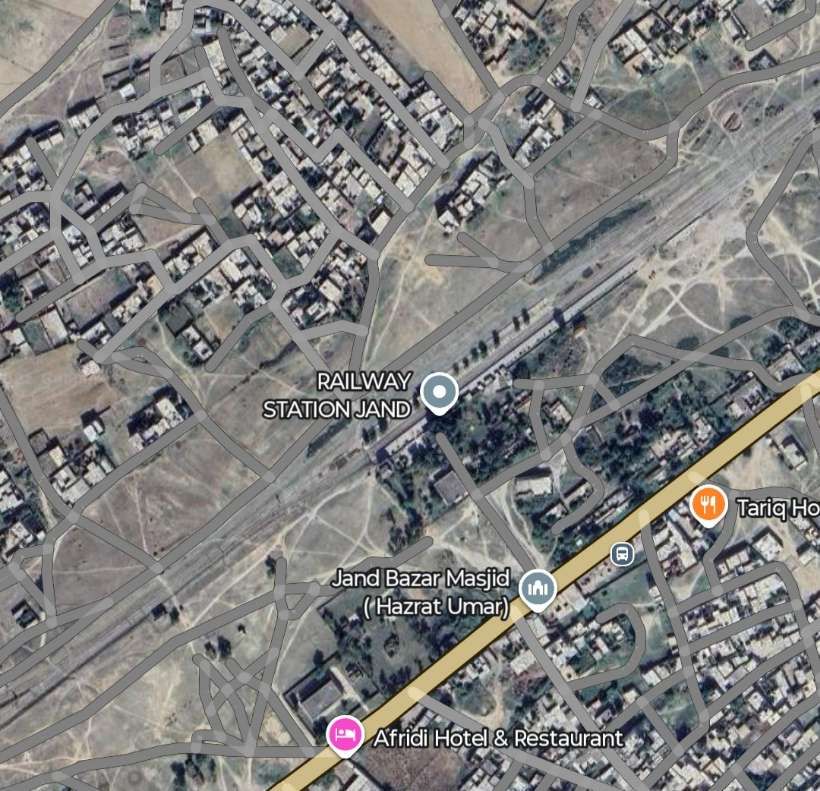
The location of Jand Railway Station. [Google Maps, September 2025]
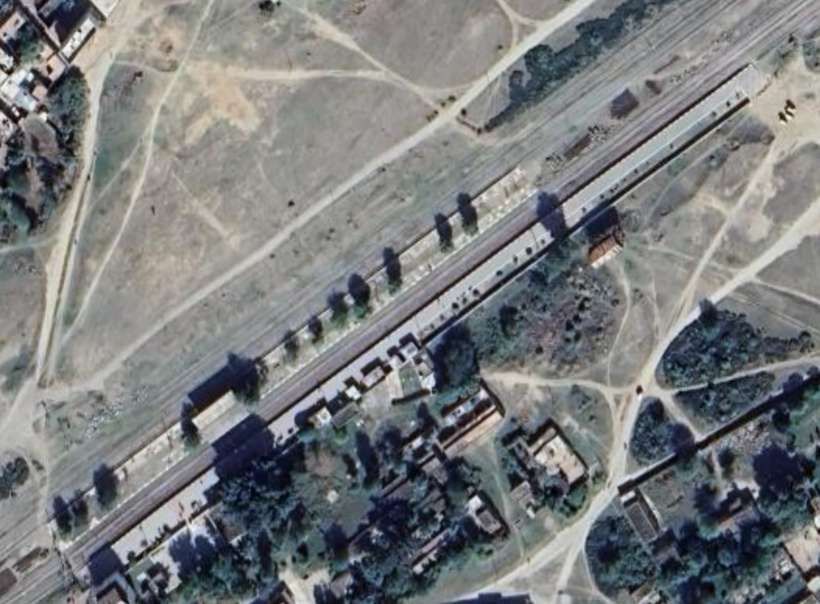
A closer view of the station. [Google Earth, September 2025]
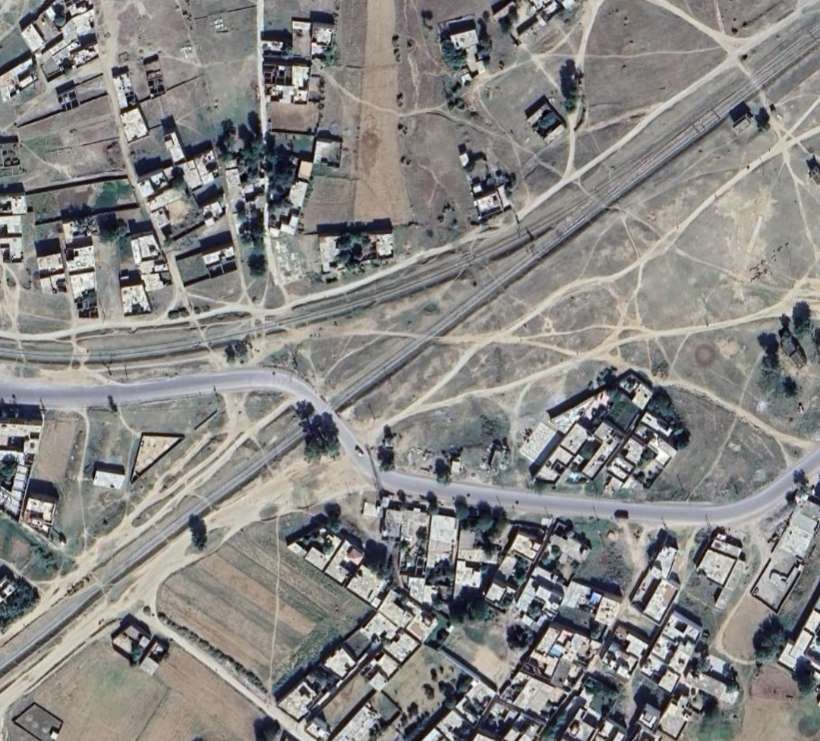
Khushalgarh Junction in Jand. The main line heads Southwest, the branch to Kohat heads West through Khushalgarh.  [Google Earth, September 2025]

The line used to stop short of the River Indus. It did so from 1881 until the bridge opened in 1908. Khushalgarh could only be accessed by rope-worked boat across the Indus.

The Indus River Crossing

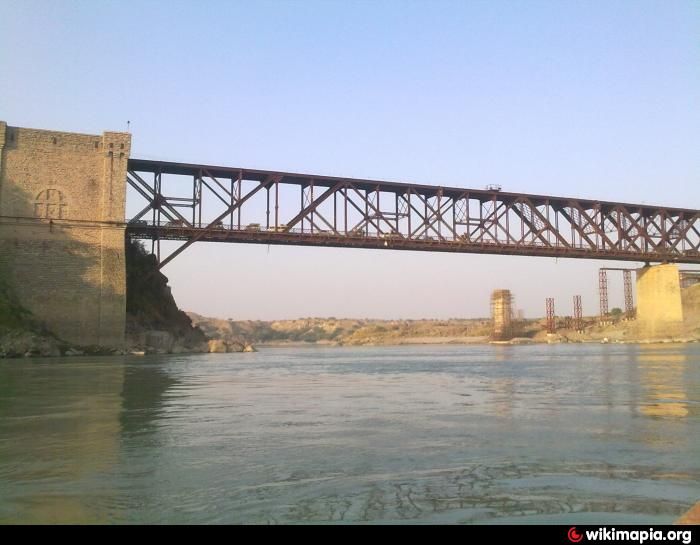
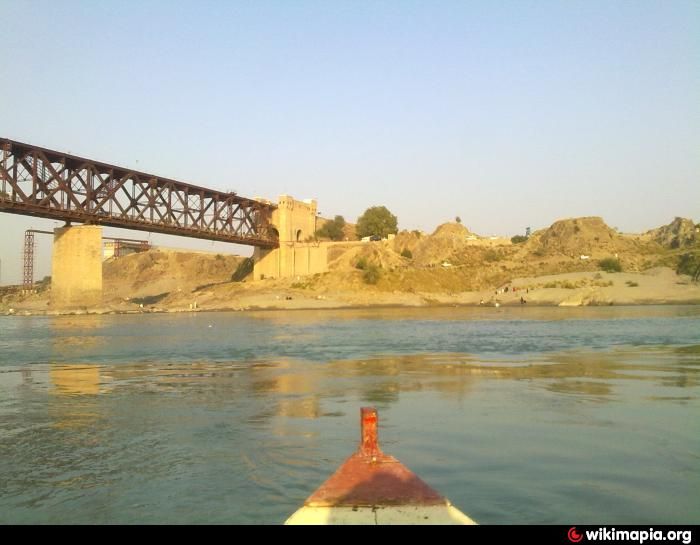
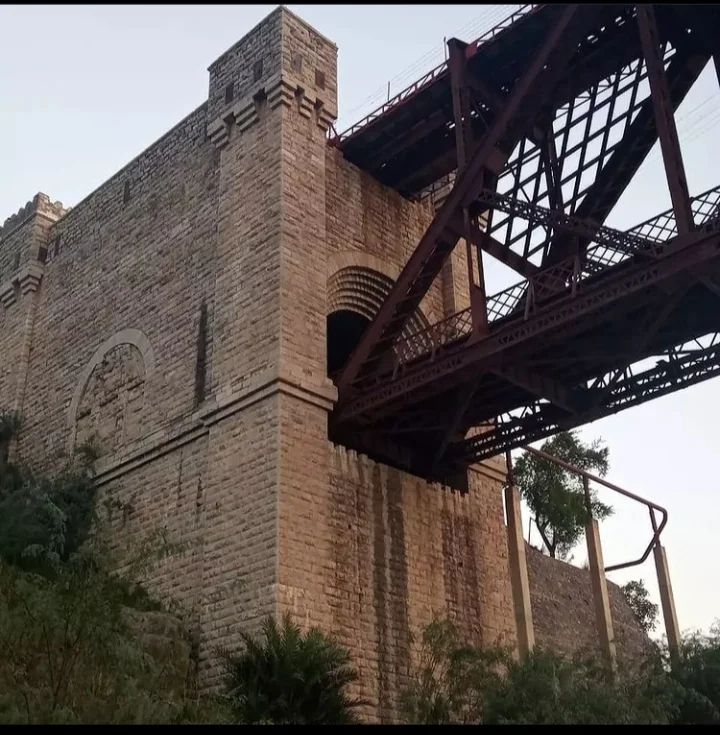
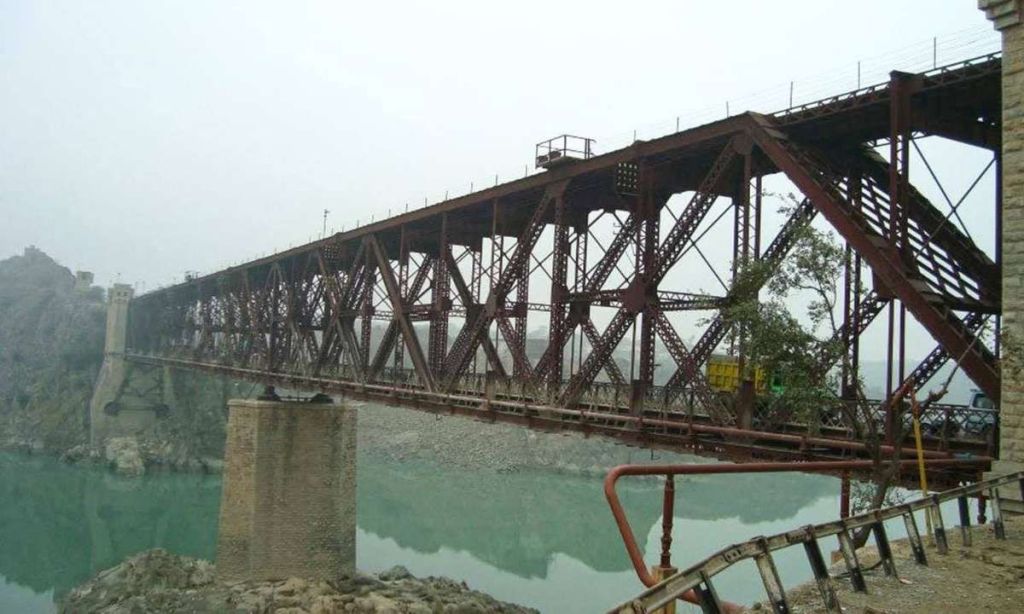
In 1903 an accident closed the ropeway over the Indus River and a boat bridge replaced it. Eventually the decision was made to construct the Khushal Garh Bridge [4] crossing the Indus river and, at the same time, to convert the  line to Thal from narrow gauge to broad gauge. The length of the line to Kohat was converted by 1908 but conversion of the line to Thal was never completed.

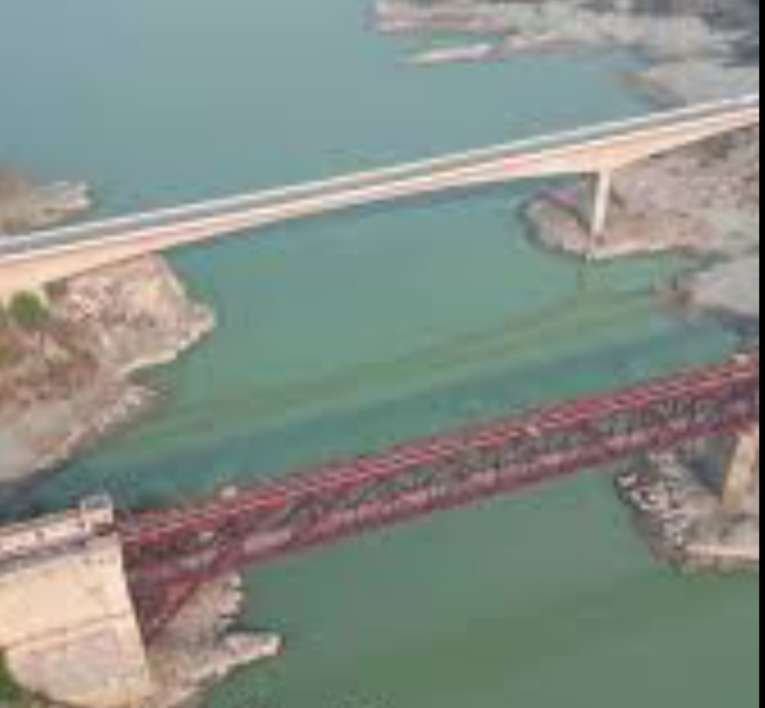
The bridge is reported to have been constructed by a Mr Robertson and is the shortest bridge over Indus River. [7]

On this bridge the train track and vehicles road for vehicles are constructed together. The upper side is used for trains and lower one for general traffic. [8]

The two photographs above were taken from the same location on the banks of the Indus River and show the original  Khushal Garh Bridge © Unknown. [8]. A new structure sits alongside this bridge and carries the road.

One of the abutments of the 1908 bridge, © Usman Joiya. [9]
Another view of Khushal Garh Bridge, © Unknown. This image was added to the North West Frontier Facebook Album by Kissa Khwani on 18th January 2020. [13]
The two bridges, side-by-side, © Ahsan Nawaz (@imahsanawaz). [10]

Khushalgarh

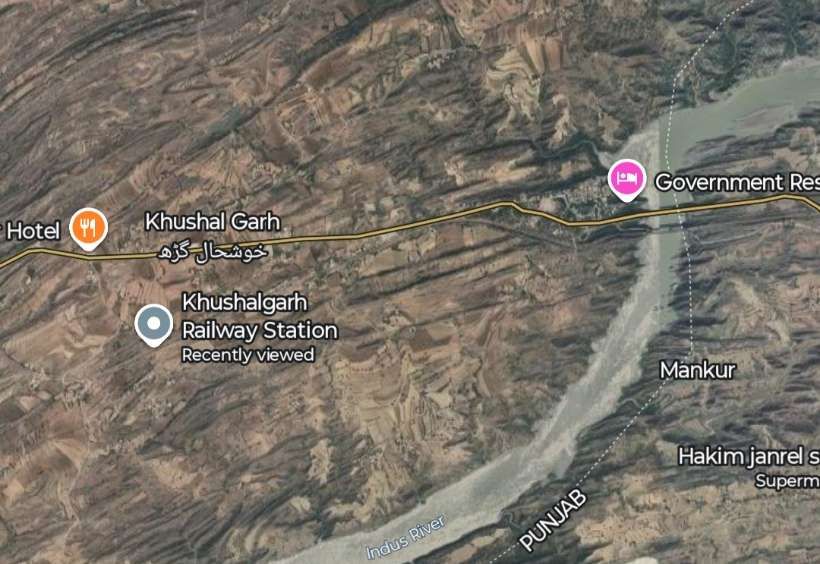
Khushalgarh on the West side of the River Indus. Originally passengers from Jand had to leave the broad-gauge train on the East side of the river and use the ferry to cross to Khushalgarh where onward travel was possible on the narrow-gauge line.

Wikipedia tells us that Kushalgarh is a village in the Kohat District of Khyber Pakhtunkhwa. [14] The modern railway station is some distance from the river.

Khushalgarh Railway Station is about 5 kilometres from the Indus along the line of the present railway and about 2 kilometres by road from the village of Khushalgarh. [Google Maps, September 2025]

The line West from Khushalgarh was initially 2ft 6in narrow-gauge. As noted above work commenced on its construction in 1901, opening as far as Kohat in 1902. The decision not to build a bridge over the river was shortsighted and by 1908 the bridge over the river had been built and the line West of the river was re-gauged, providing a broad-gauge service as far as Kohat.

Kohat

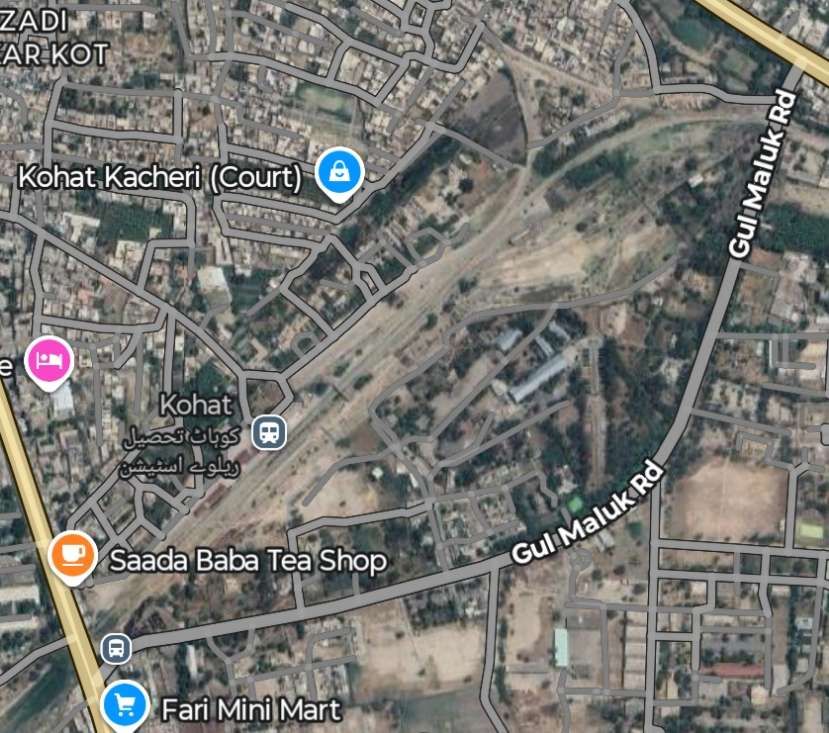
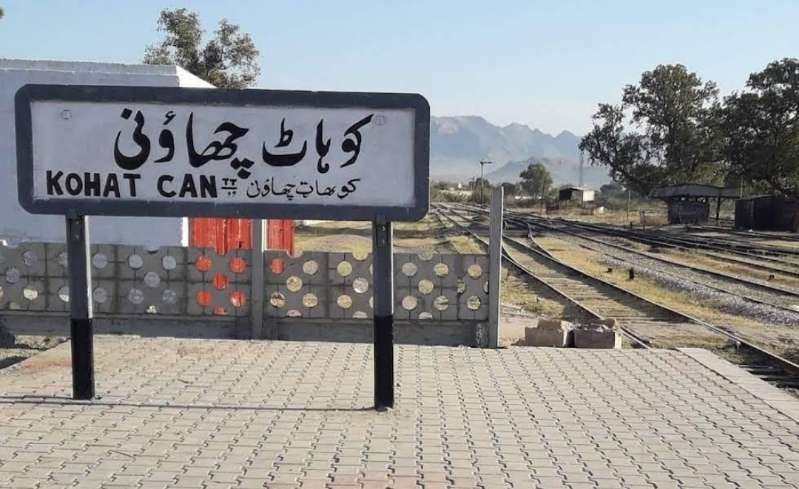
The location of Kohat Railway Station. [Google Maps, September 2025]
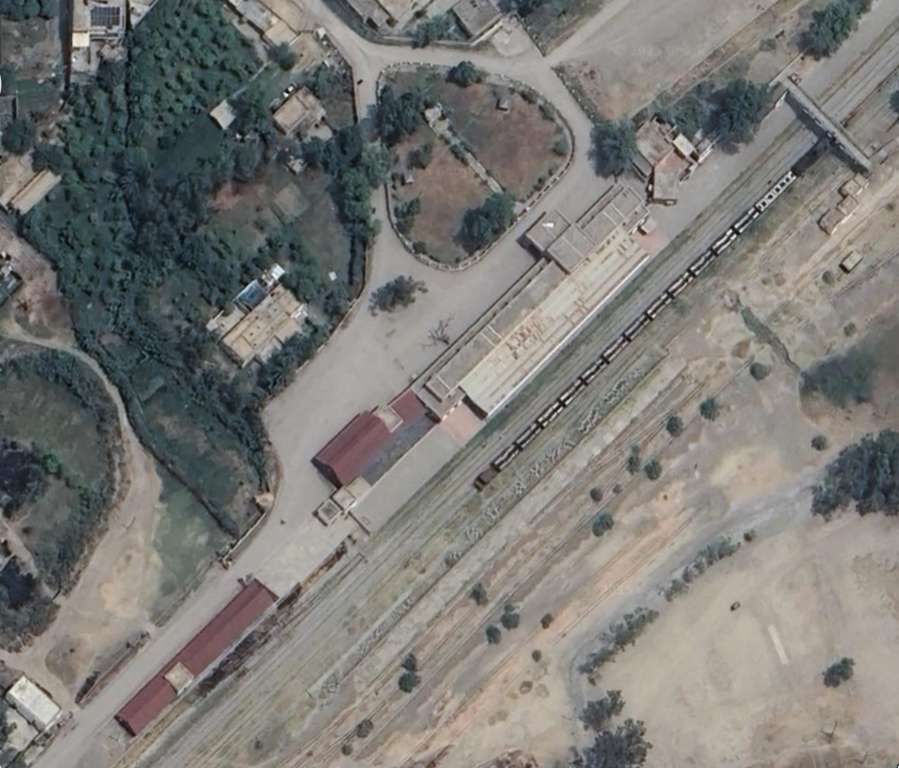
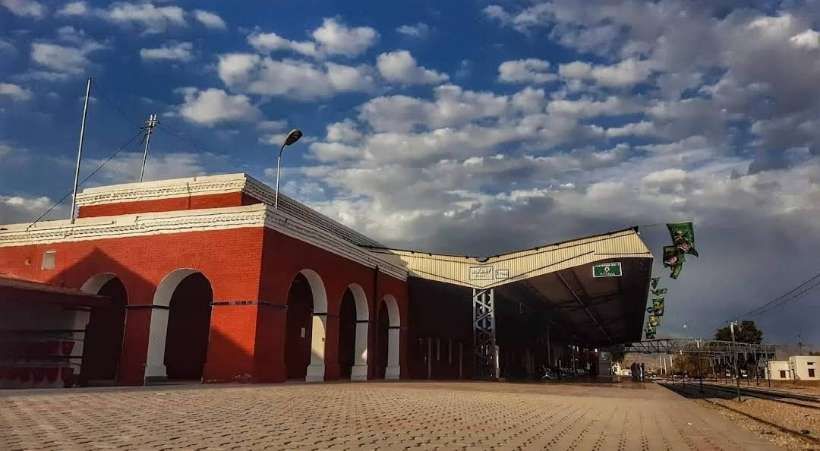
The main buildings and footbridge at Kohat Railway Station. [Google Earth, September 2025]
The view Northeast from the end of the station platform at Kohat, © Haider Ali (2023). [Google Maps, September 2025]
Kohat Railway Station building seen from the South, © Muhammad Harris (2023). [Google Maps, September 2025]

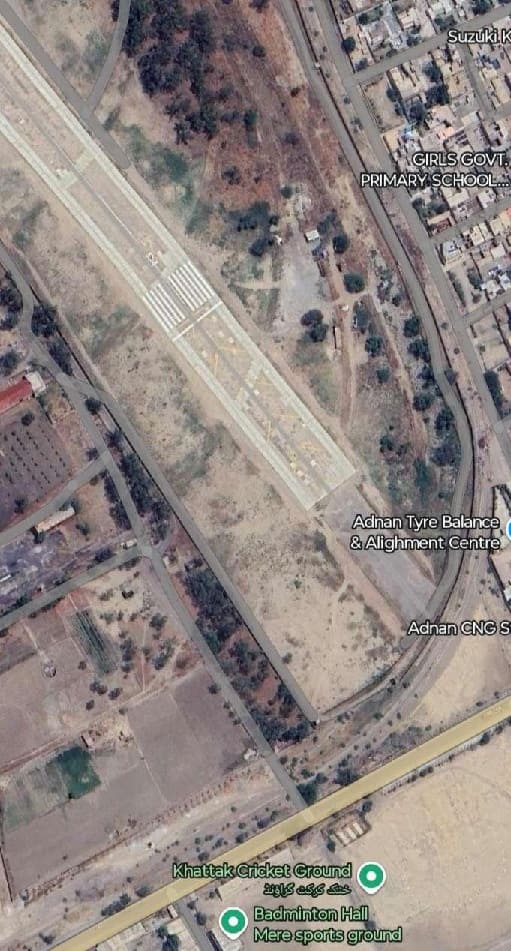
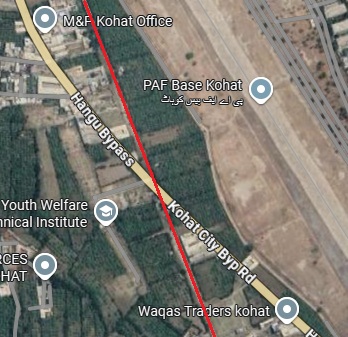
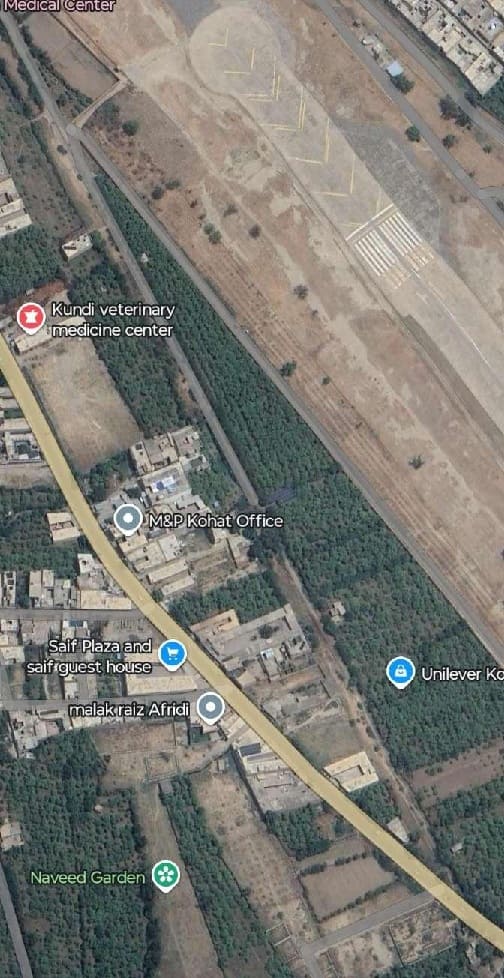
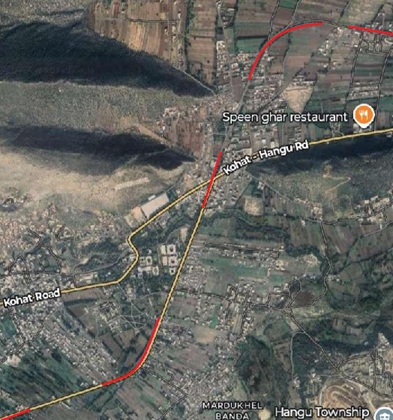
Kohat Railway Station is now the terminus for passenger services. To the Southwest, there are a number of what appear to be industrial sidings. The line of the 2ft 6in gauge railway to Thal is apparently crossed by the runway of a Pakistan Air Force Base. Following the line of the old railway back from Hangu, it appears that the line runs round the South end of the Airbase runway. Possibly it was diverted when the runway was built.

It is possible to follow the line of the old railway to the terminus at Thal. The following images do this, file sizes have been kept to a minimum which means that image resolution is not great, but the whole route can be followed on Google Maps if a higher resolution is important.

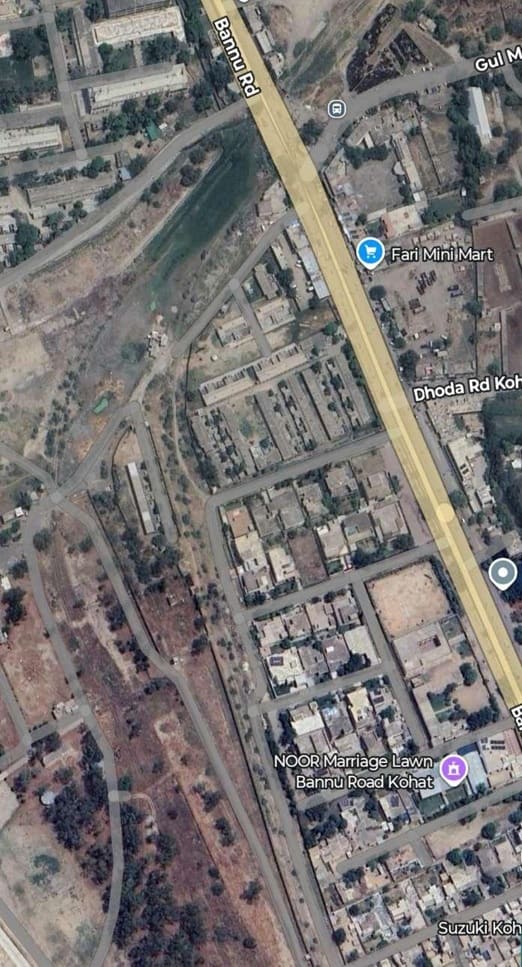
The old railway left Kohat Railway Station at its Southwest end. The route of the railway crosses Bannu Road and turns South to run parallel to Bannu Road and the runway to the West. [Google Maps, September 2025]

Continuing South-southeast the route of the old line reaches the South end of the runway and curves through South to Southwest. [Google Maps, September 2025]

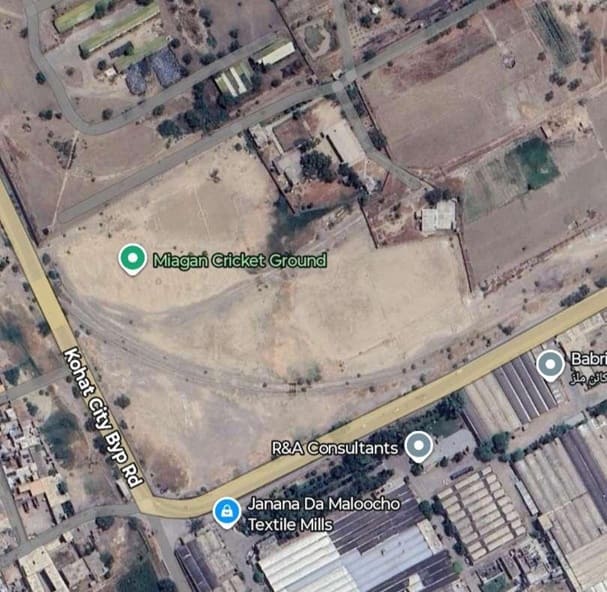
On this next extract from Google’s Satellite imagery the route of the old line can be seen curving round (South of the Green Flag marking Miagan Cricket Ground) towards the Northwest and crossing Kohat City Bypass Road. Google Maps, September 2025]

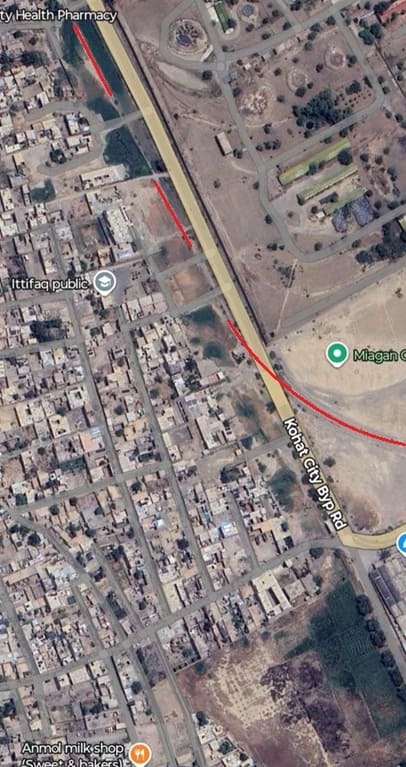
The route of the old line is visible to the point where it crosses Kohat City Bypass. To the West of the road the route of the old railway heads Northwest gradually separating from the line of the road. {Google Maps, September 2025]

The line of the old railway continues Northwest as the road turns to the North. The old railway formation is under a modern road at this point. [Google Maps, September 2025]

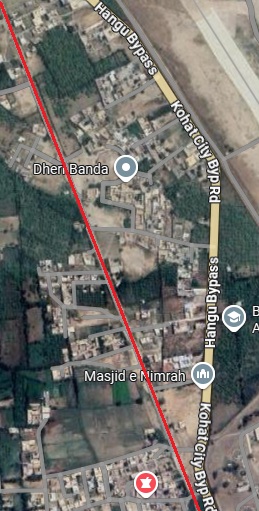
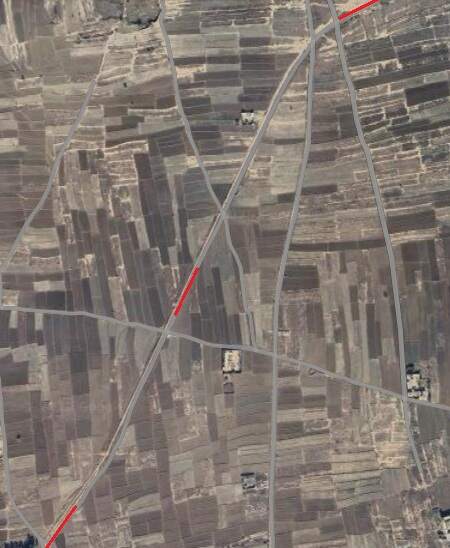
The old railway continued on the same bearing. The Kohat City Bypass crosses the route of the old line as shown here. [Google Maps, September 2025]

The North-northeast trajectory continues – the road following the route of the old line only appears in grey on this extract from Google’s satellite imagery. [Google Maps, September 2025]

The route of the old line continues to be followed by a modern road. [Google Maps, September 2025]

The route of the old line continues to be followed by a modern road. [Google Maps, September 2025]

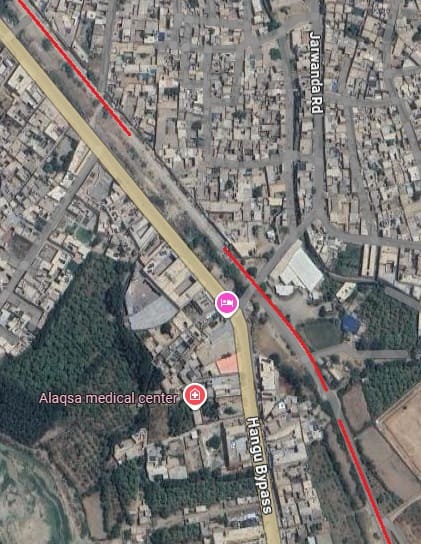
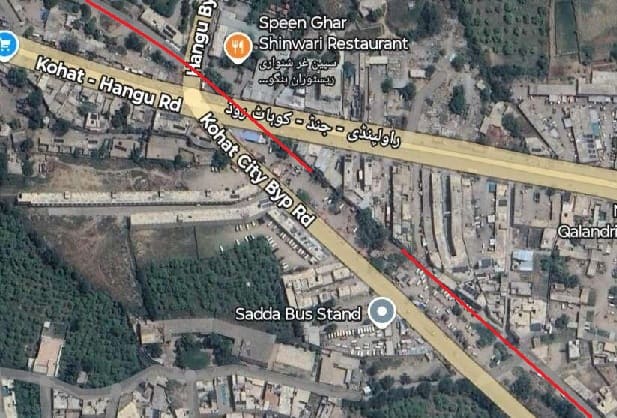
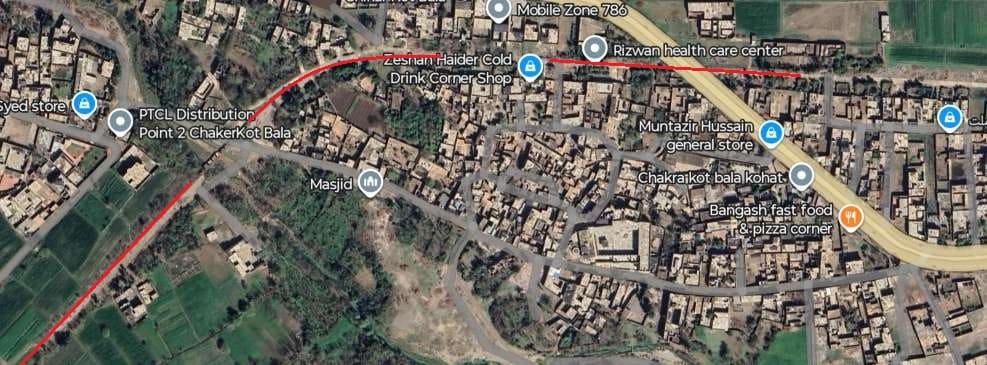
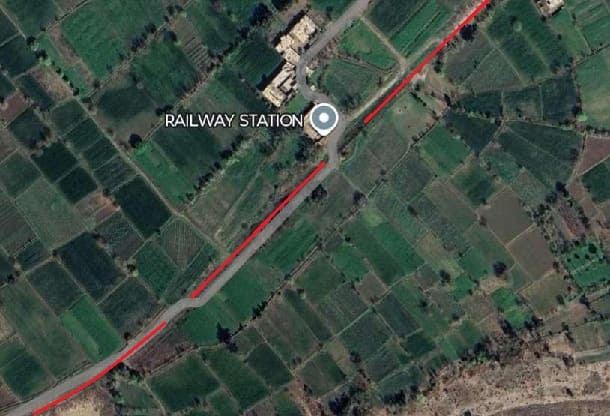
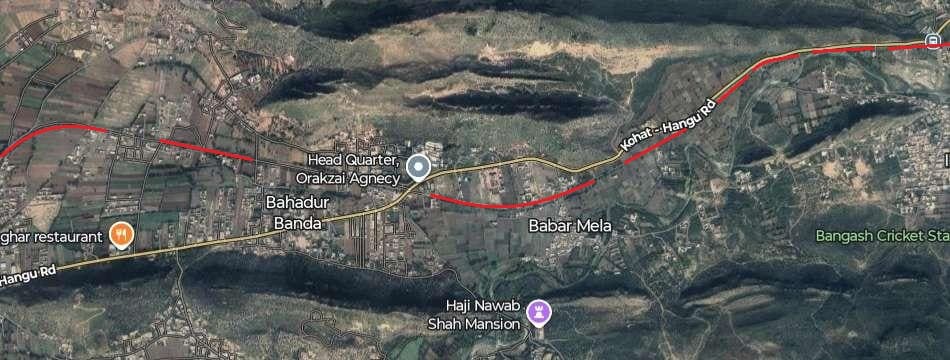
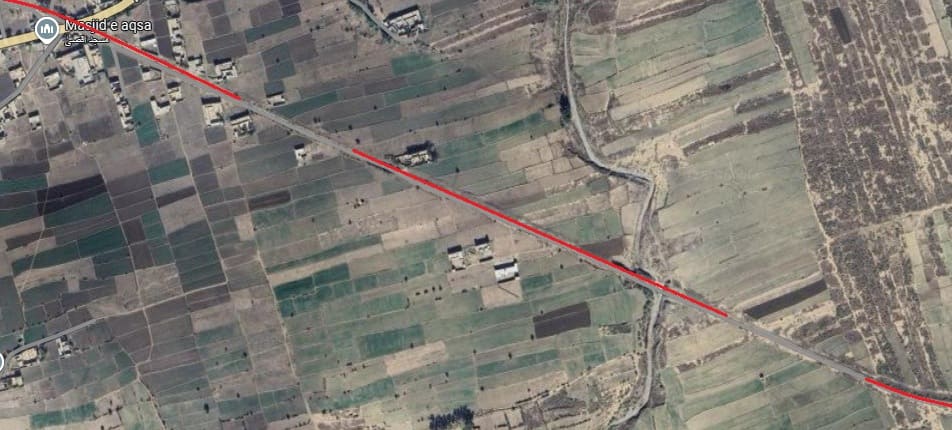
The route of the old line Appears to sit between Hangu Bypass and a local road. [Google Maps, September 2025]

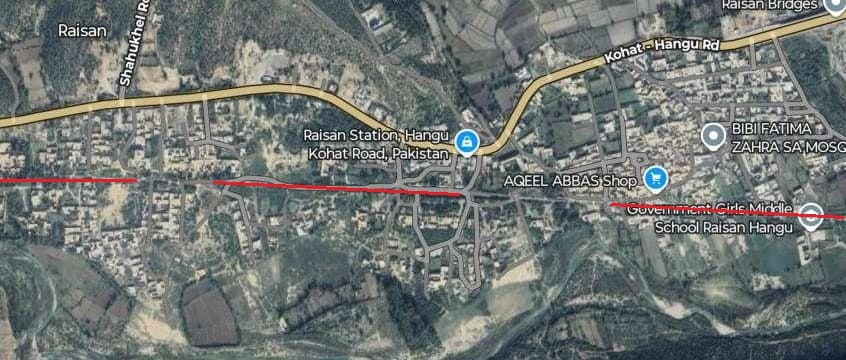
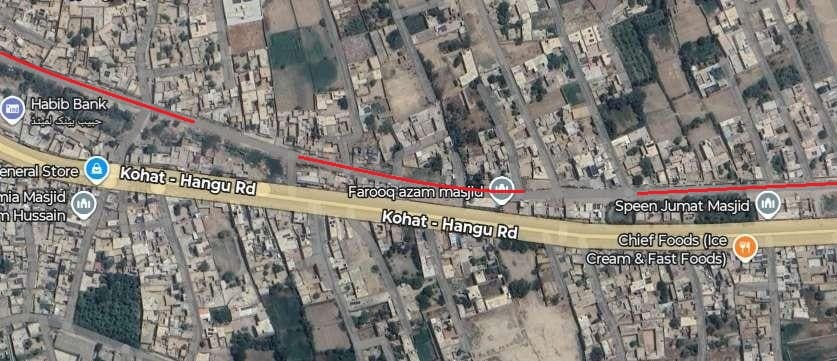
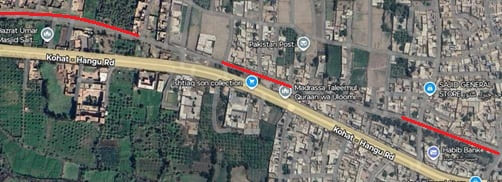
The route of the old line crosses the Kohat-Hangu Road and turns to shadow it. [Google Maps, September 2025]

The route of the old line follows a modern road. [Google Maps, September 2025]

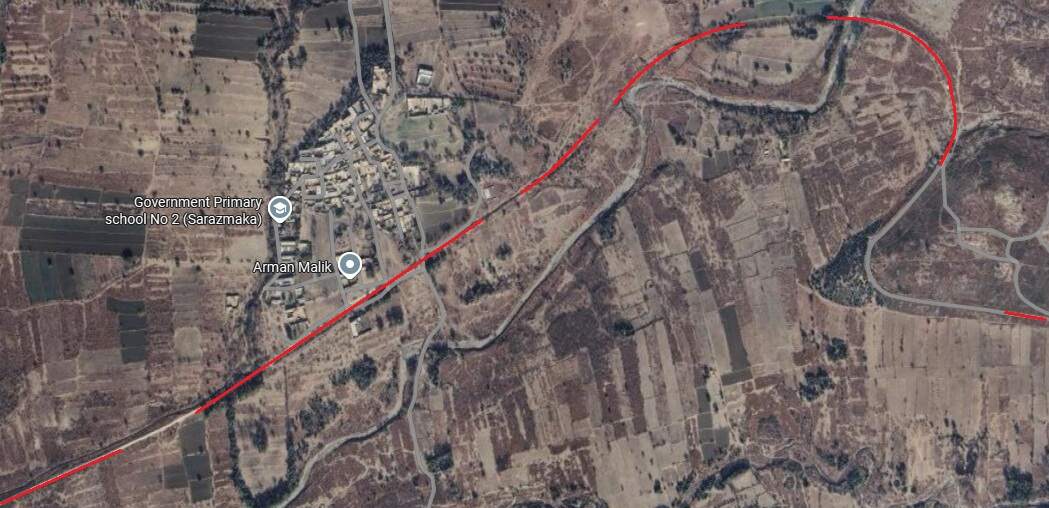
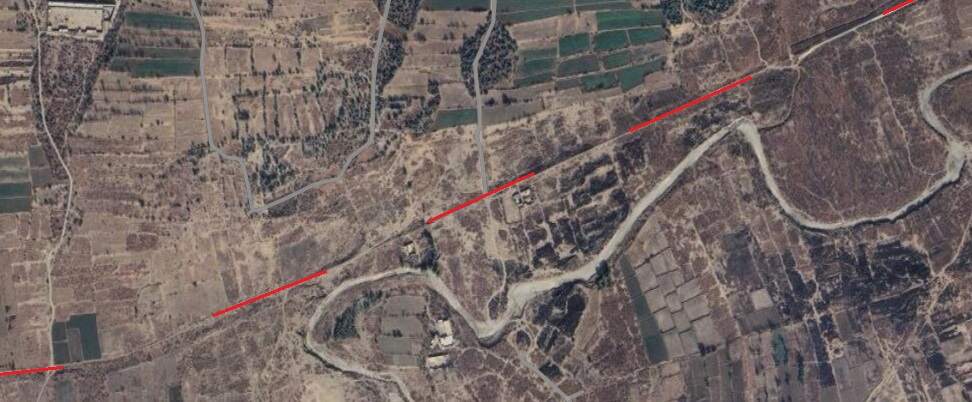
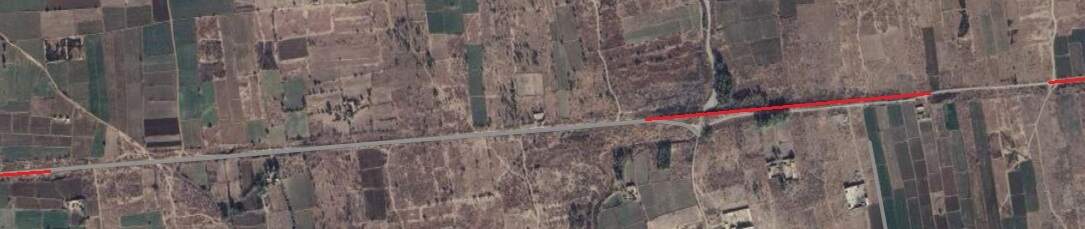
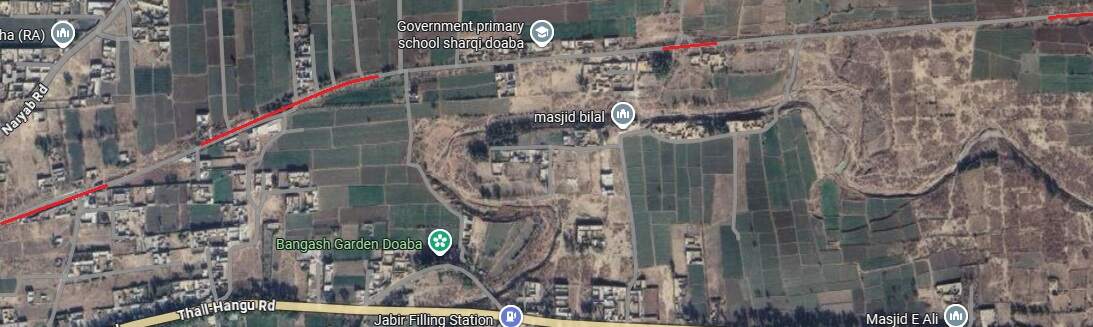
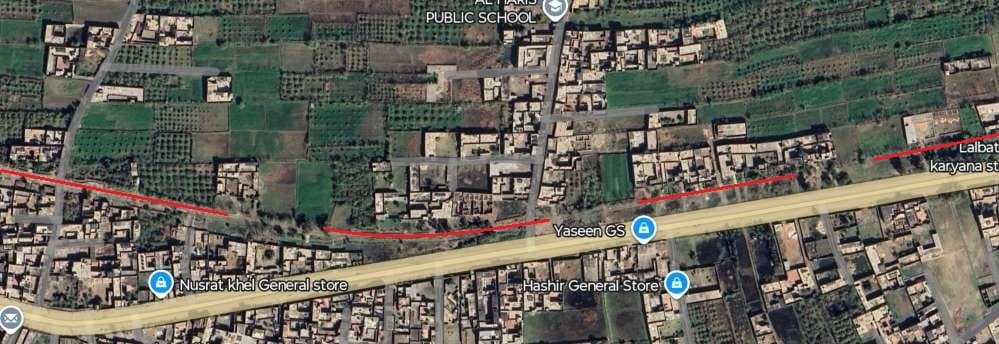
The route of the old line continues to be followed by modern roads with occasional lengths more like footpaths. [Google Maps, September 2025]

The route of the old line continues to be followed by a modern road. [Google Maps, September 2025]

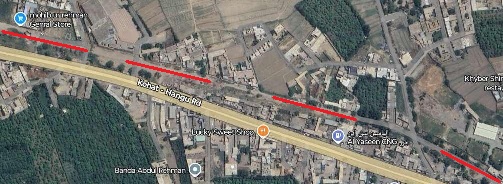
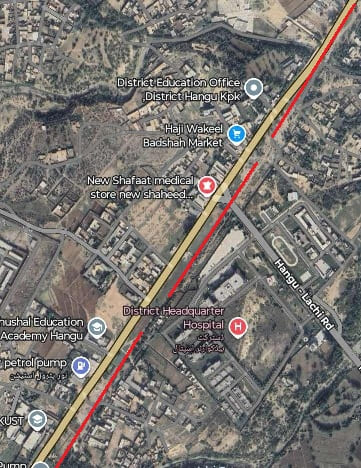
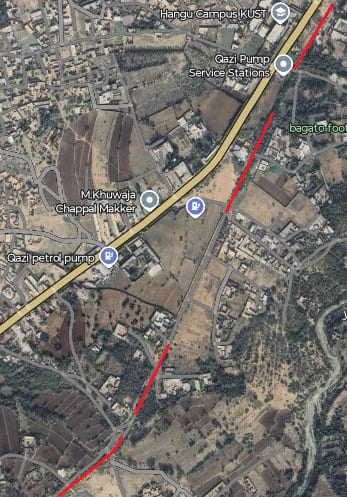
The route of the old line continues on the North side of the Kohat-Hangu Road. [Google Maps, September 2025]

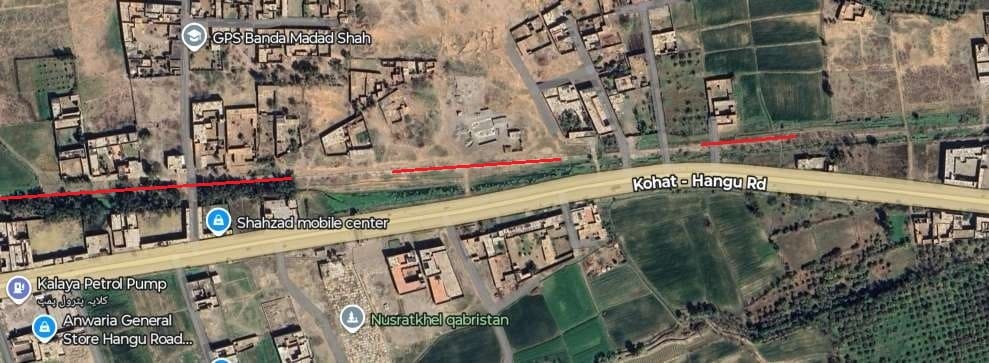
The route of the old line continues on the North side of the Kohat-Hangu Road. [Google Maps, September 2025]

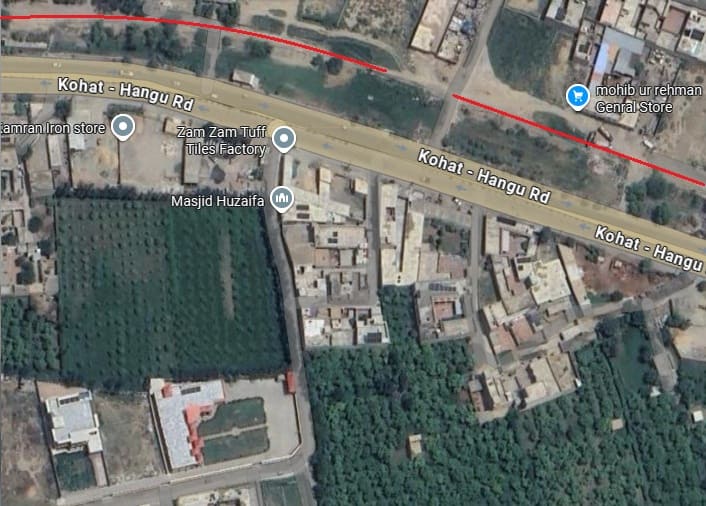
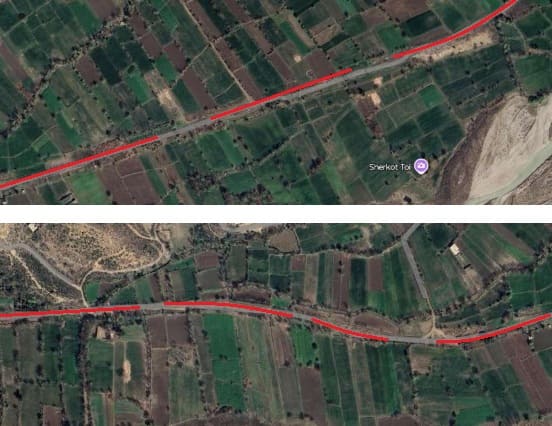
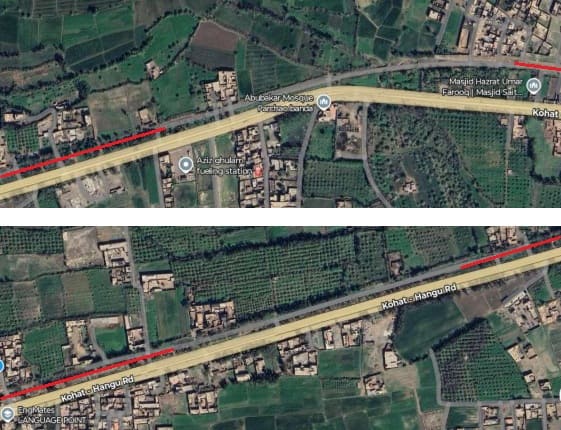
The route of the old line continues on the North side of the Kohat-Hangu Road on both of these extracts from Google’s satellite imagery. [Google Maps, September 2025]

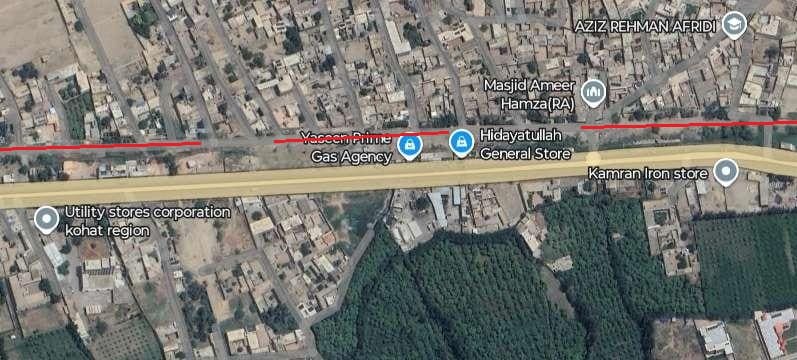
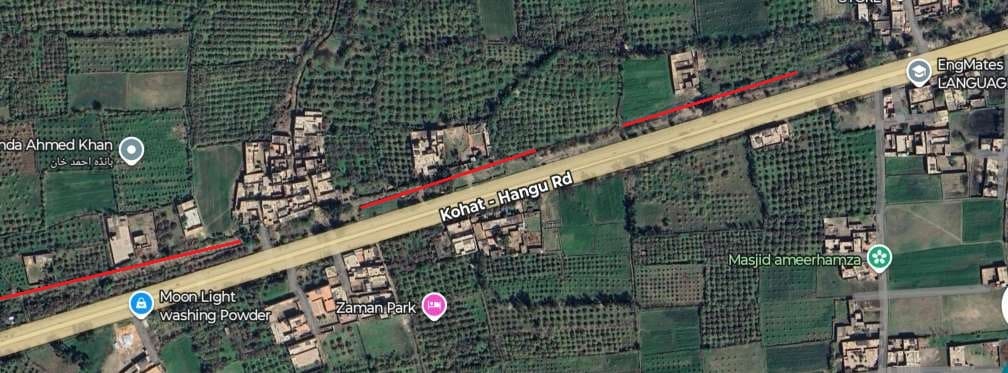
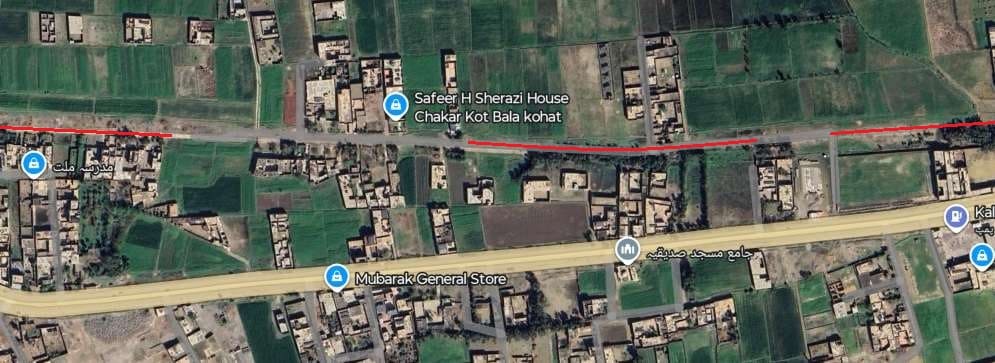
The route is still on the North side of the Kohat-Hangu Road. [Google Maps, September 2025]

The route remains on the North side of the Kohat-Hangu Road. [Google Maps, September 2025]

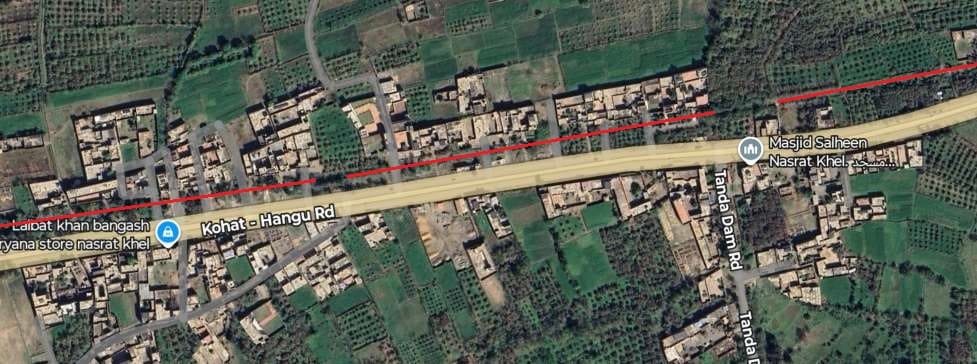
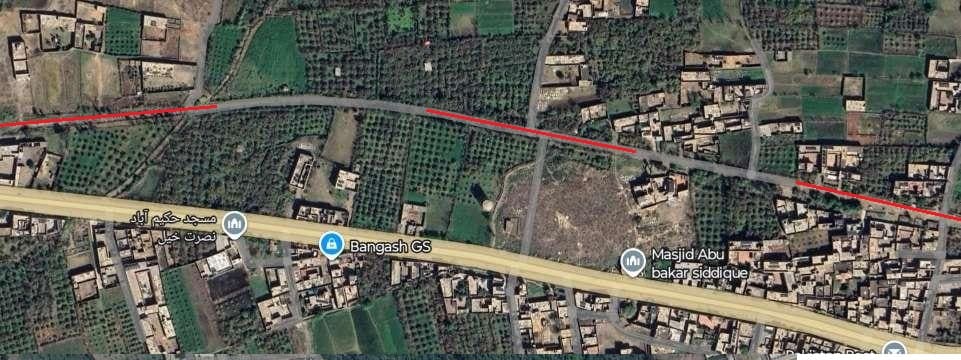
The route separates a little from the Kohat-Hangu Road. [Google Maps, September 2025]

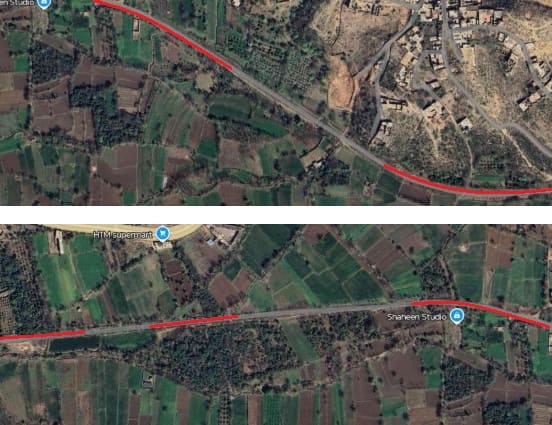
But returns relative soon to sit close to the road. [Google Maps, September 2025]

The route continues on the North side of the road. [Google Maps, September 2025]

The route continues on the North side of the road. [Google Maps, September 2025]

A significant change in direction of the road results in the route switching to the South of the road.

For a while the route of the old line runs a number of fields away from the Kohat-Hangu Road.

On both these extracts the route of the old line remains remote from the main road.

A modern access road follows the route of the old line.

The same applies for these next two extracts. [Google Maps, September 2025]

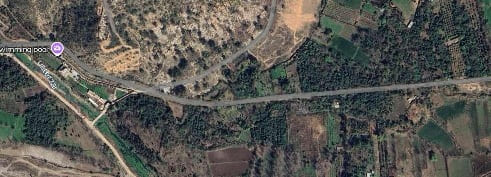
This section of the old line has not been annotated by red lines. It is clear that its route is now used as a highway. [Google Maps, September 2025]
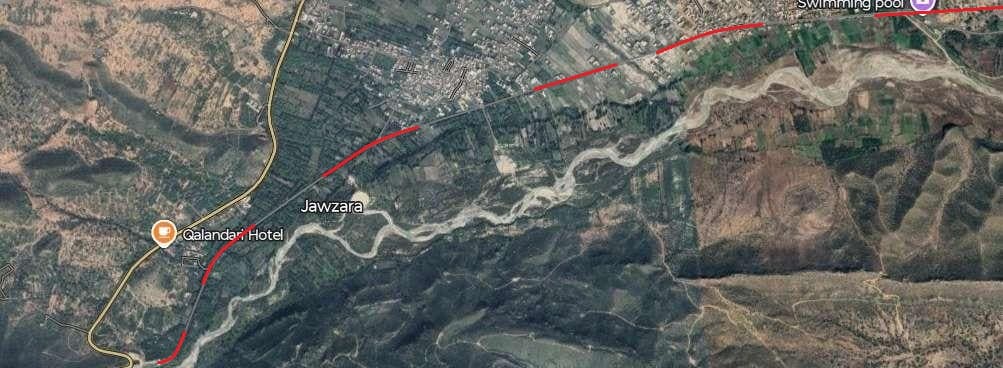
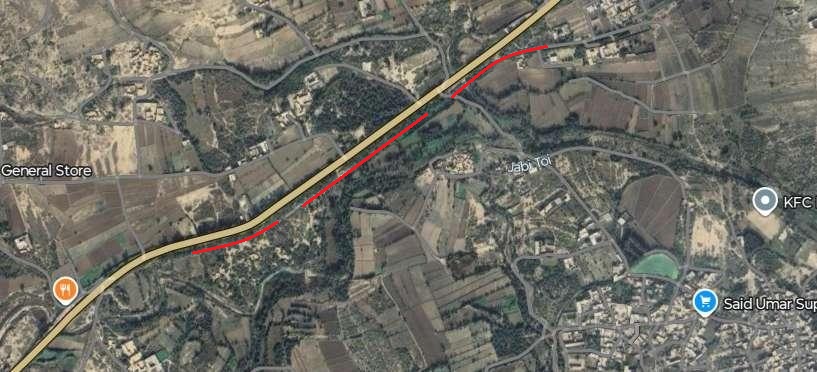
A further length of the old line follows a path remote from the modern road and much closer to the Jabi Toi River. The Kohat-Hangu Road takes up closer order with the route of the old railway towards to right of this image. [Google Maps, September 2025]

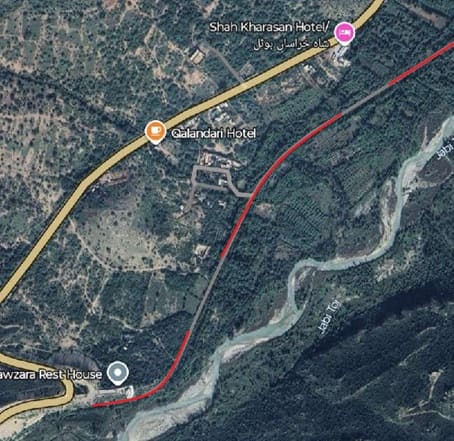
An enlarged view of the left side of the above image which shows the main road much closer to the line of the old railway. [Google Maps, September 2025]

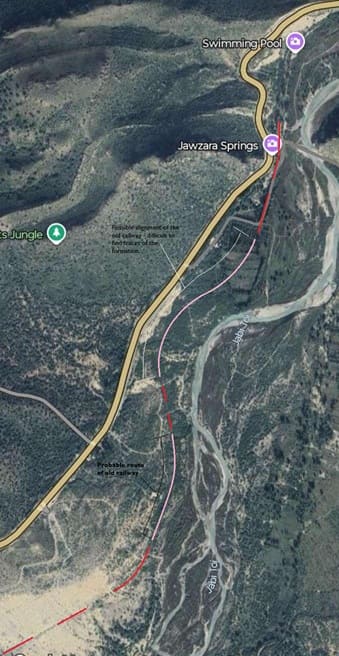
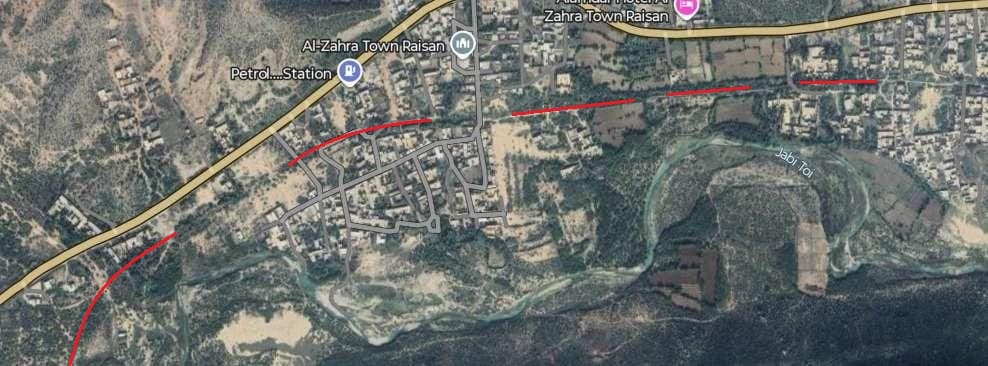
The alignment of the old railway over this next length i more difficult to determine. It appears to curve around the North side of the swimming pool flagged at the top-right of the image and runs close to the Jawzara Springs. The lengths shown pink are surmised rather than certain. The route of the line is clearer once again towards the bottom of the image where it approaches a bridge over the Kohat Toi River, a tributary of the Jabi Toi River. [Google Maps, September 2025]

The redundant railway bridge over the Kohat Toi River remains standing. It is located just off the bottom-left of the satellite image above. [Google Maps, September 2025]

The bridge above is just off the right side of this satellite image. [Google Maps, September 2025]

The route of the old line continues on the South side of the main road.

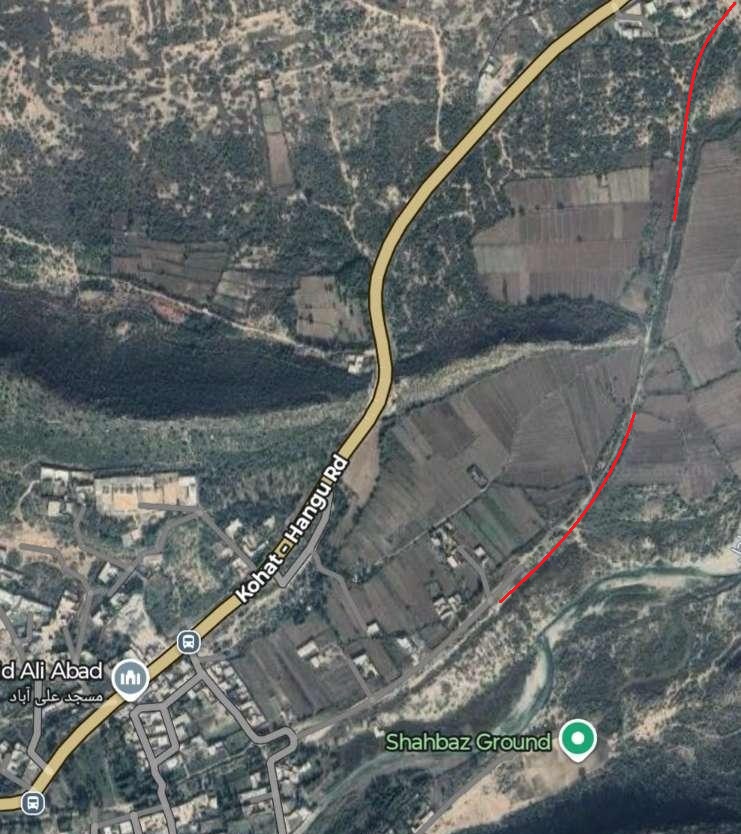
The line continues Southwest avoiding the high ground which the road crosses and curves round to meet the Kohat-Hangu Road at the bottom-left of this extract, adjacent to the bus-stop shown bottom-left on the satellite image

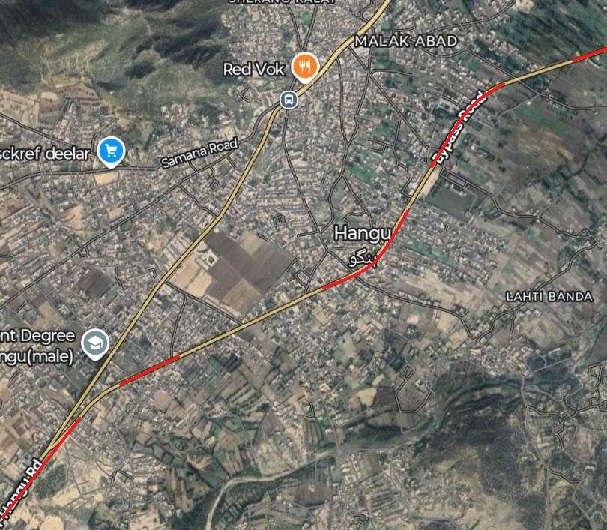
The route of the old line runs on The South side of the road before curving West-Northwest and crossing he road.

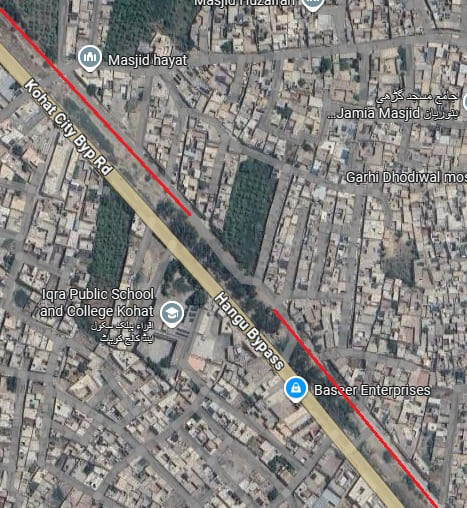
A relatively tight curve takes the route of the old line back across the modern road. At the centre of this image, Hangu Bypass now follows the route of the old railway.[Google Maps, September 2025]

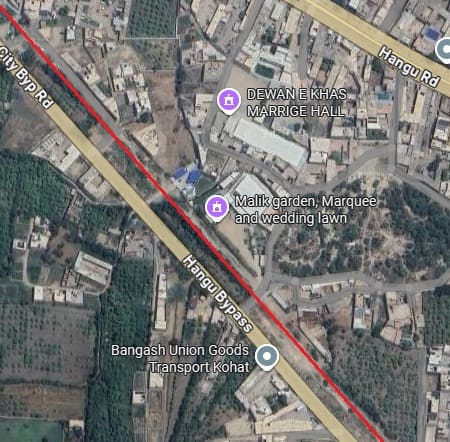
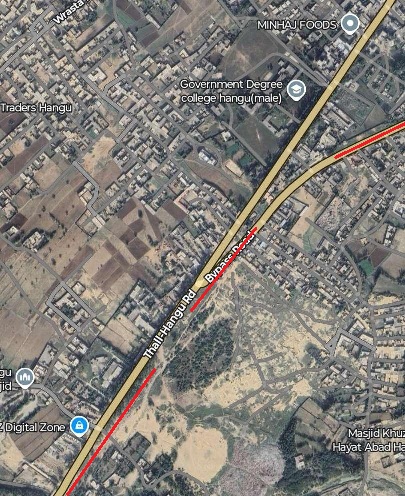
Hangu Bypass continues to follow the lie of the old railway on the Southeast side of the city and does so until the Bypass meets the Thall-Hangu Road. [Google Maps, September 2025]

A closer view of the road junction shows the route of the old railway running immediately alongside the Thall-Hangu Road. [Google Maps, September 2025]

The route of the old line continues running parallel to the main road. [Google Maps, September 2025]

The two separate somewhat as the route of the old line continues South-southwest and then turns to the Southwest. [Google Maps, September 2025]

The route of the old line continues Southwest. [Google Maps, September 2025]

Further Southwest the route of the old line returns to the shoulder of the modern road.

It runs immediately alongside the road for a short distance, before turning away to the South.

The change od direction can be seen at the bottom-left of the last image and appears more clearly on this extract. Its route is followed by a minor road.

The old line continued Southwest before turning to the West. [Google Maps, September 2025]
The old line ran West before turning to the Northwest. [Google Maps, September 2025]
Heading Northwest, the line eventually crosses the Thall-Hangu Road. [Google Maps, September 2025]
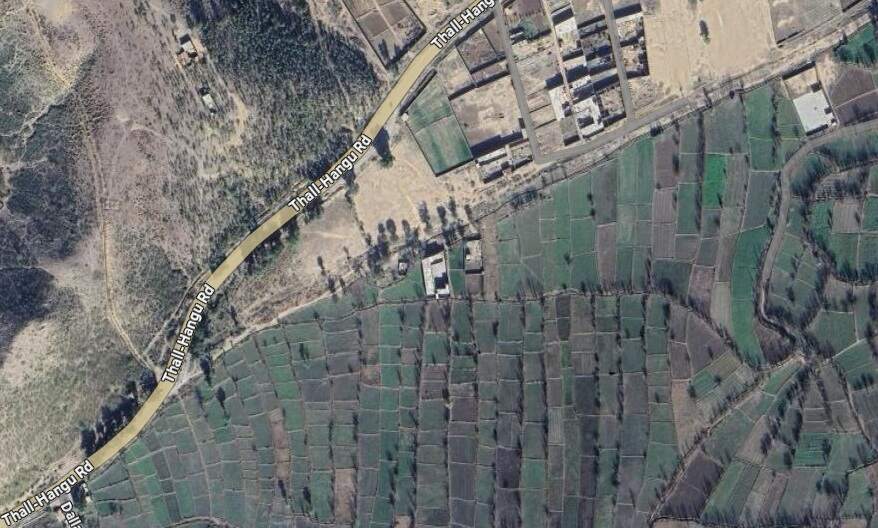
It then turned West to run along the North side of the Thall-Hangu Road, before starting to drift away to the North of the road. [Google Maps, September 2025]
The line headed Northwest and then West-northwest. [Google Maps, September 2025]
The old railway crossed the river bed at the bottom left of this extract from Google’s satellite imagery, turning first to the Northwest and then generally to the West. [Google Maps, September 2025]

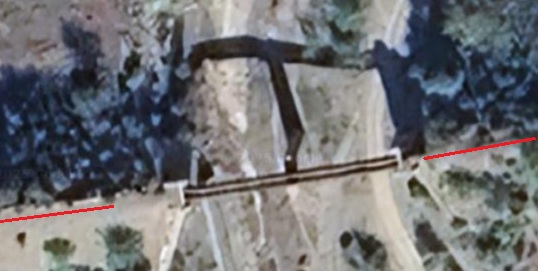
Bottom-right on the image above the old railway bridged a dry river bed on a two-span girder bridge which is still standing in the 21st century. [Google Maps, September 2025]

This next length of the line ran South-southwest before curving a little to the Southwest, and then, as can be seen on the next extract from Google’s satellite imagery, towards the West-southwest to run parallel to the Thall-Hangu Road. [Google Maps, September 2025]

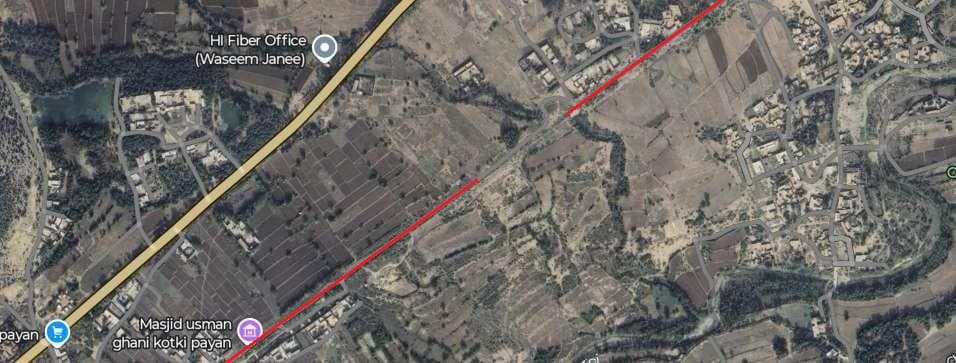
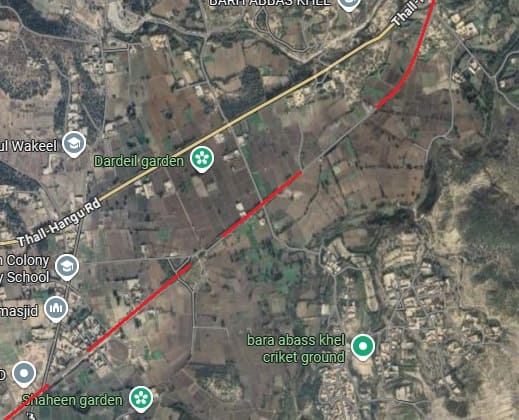
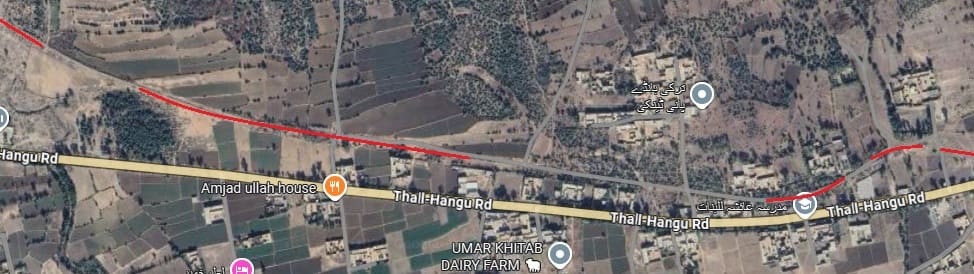
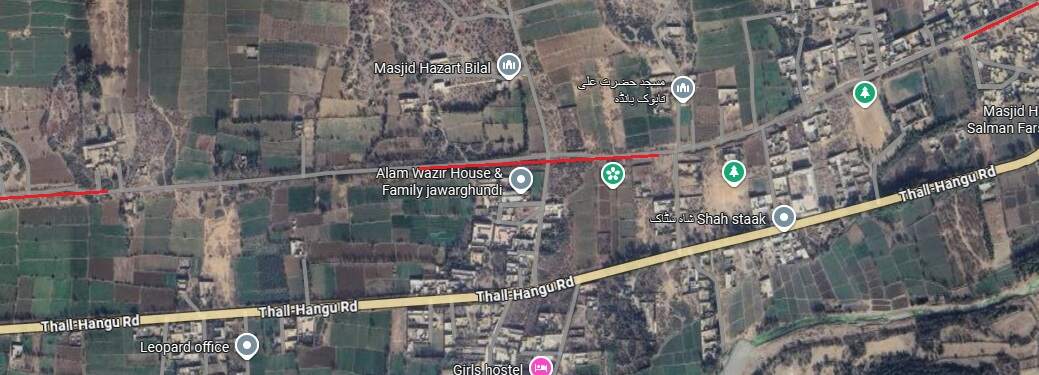
The route of the old line runs on the North side of the Thall-Hangu Road. [Google Maps, September 2025]
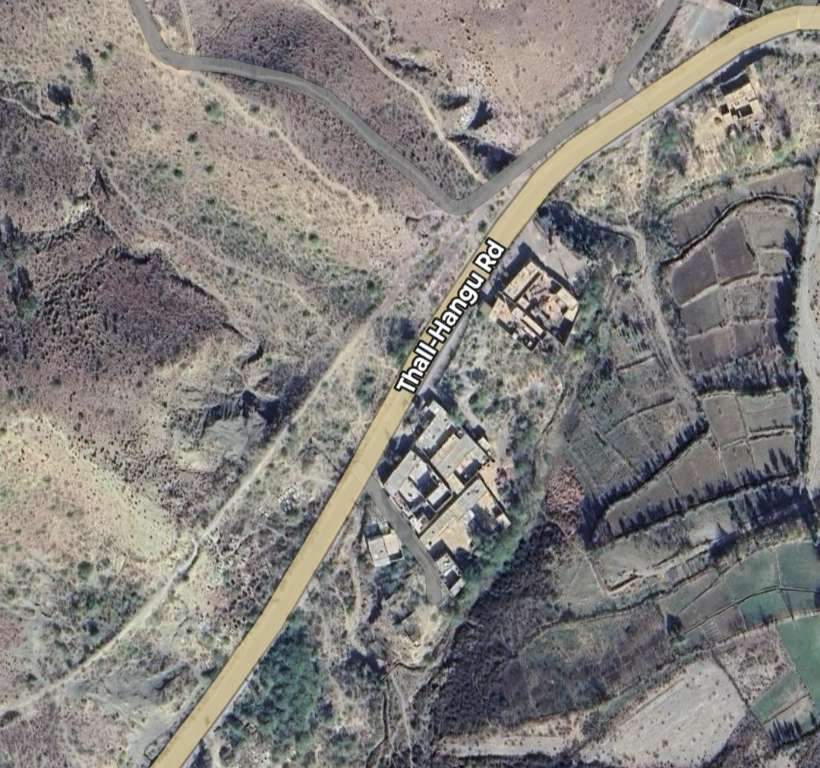
The route of the old line drifts away from the Thall-Hangu Road. [Google Maps, September 2025]
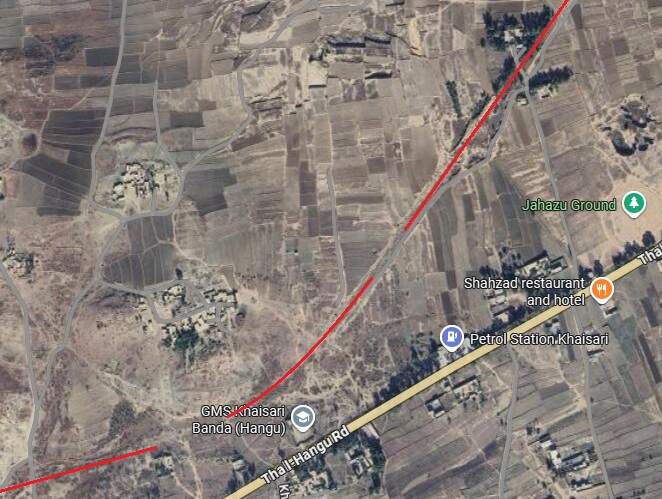
Topography dictated that the line took a circuitous route first turning to the Northeast before swinging round to the Southwest. [Google Maps, September 2025]
After a length running Southwest the line turned West. [Google Maps, September 2025]
It continued in a westerly direction. [Google Maps, September 2025]
Before turning Southwest. [Google Maps, September 2025]
After a short deviation to the Northwest the route of the old railway closes towards the Thall-Hangu Road. [Google Maps, September 2025]
And runs parallel to it on its North side. [Google Maps, September 2025]
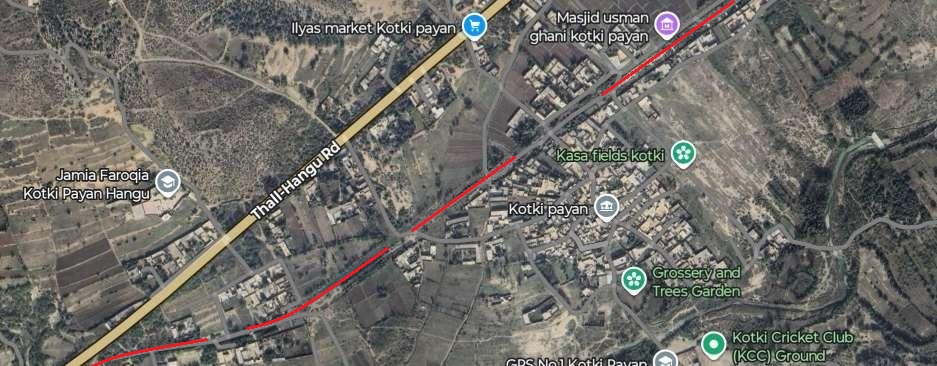
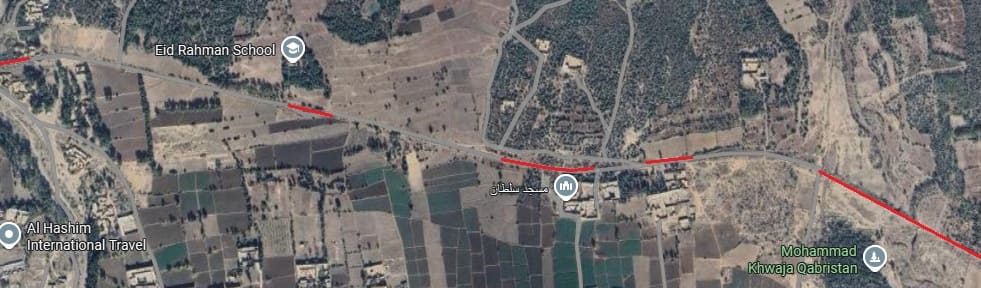
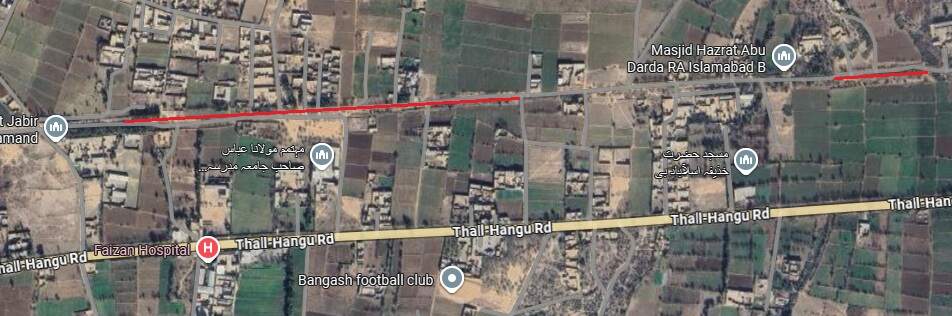
The route of the old railway is generally under the alignment a road as marked on Google Maps. [Google Maps, September 2025]
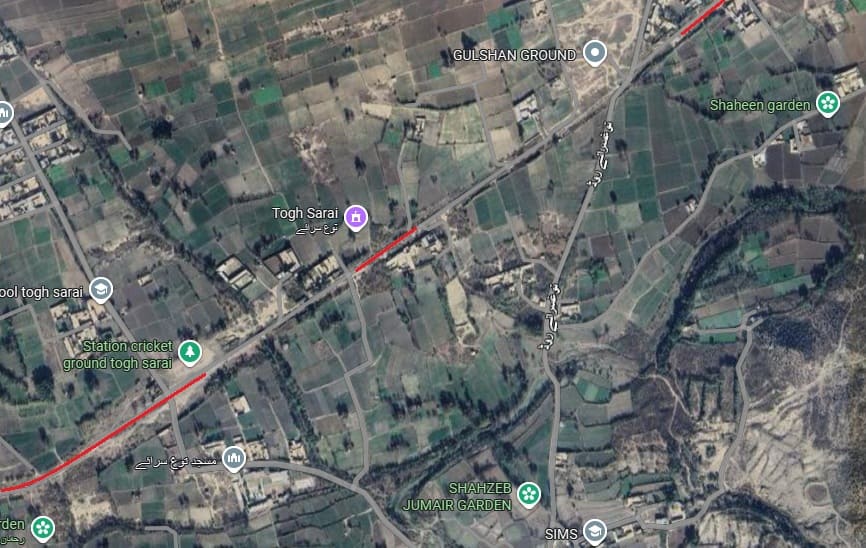
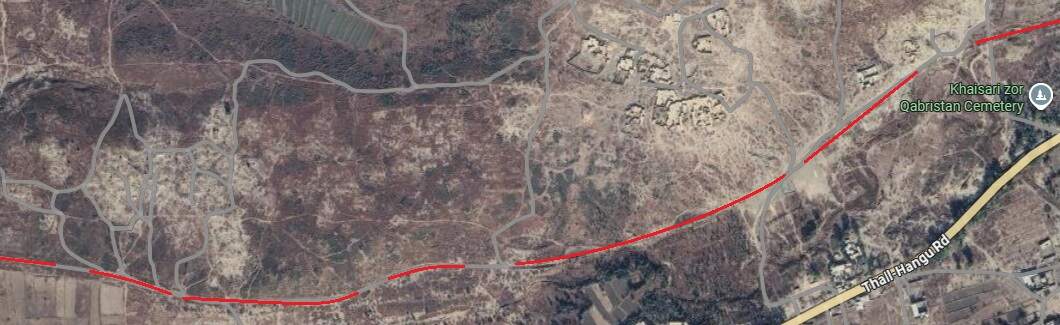
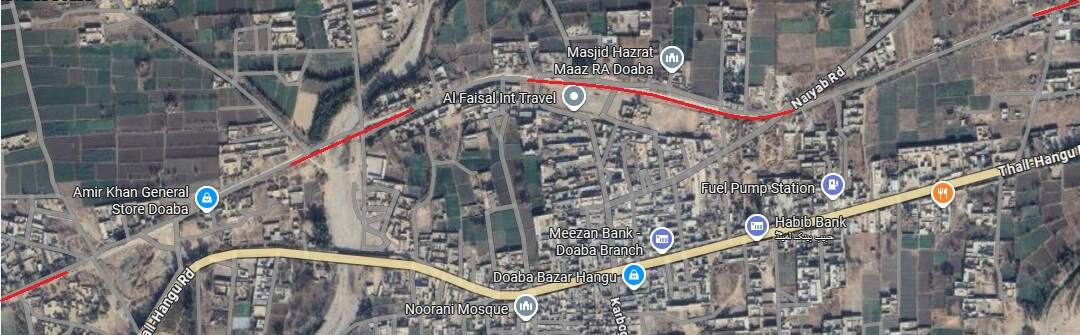
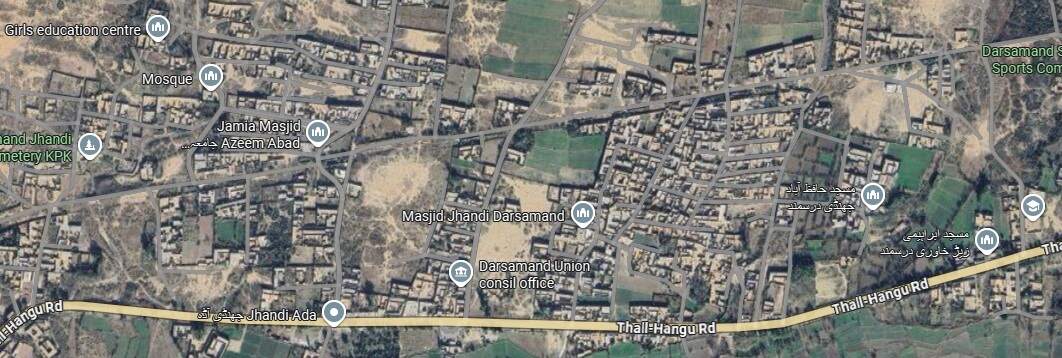
Lengths of the old line on the approach to Darsamend are under tarmac with the route marked out by read lines. [Google Maps, September 2025]
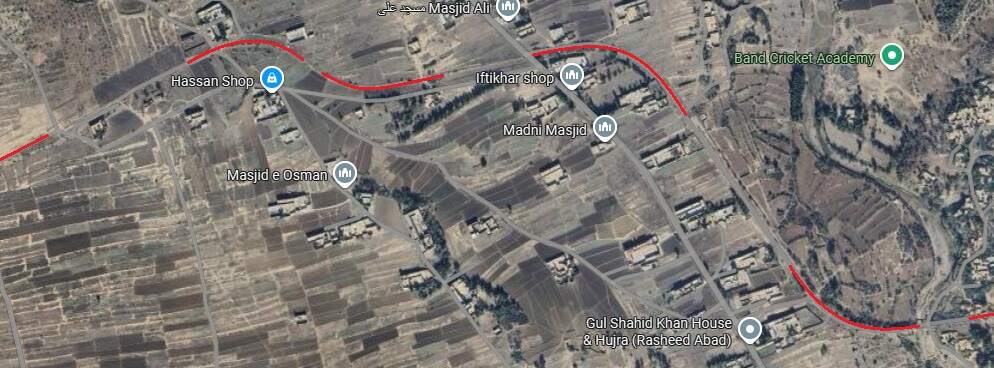
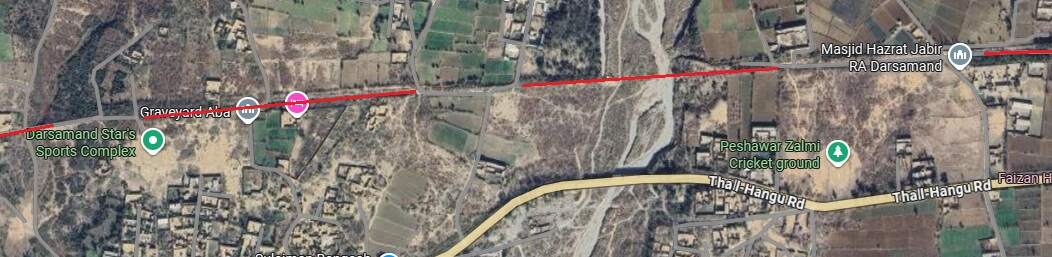
The route of the old railway runs into Darsamend, running from the top-right corner of this satellite image to the middle left. The formation is under a road for the majority of its length. [Google Maps, September 2025]
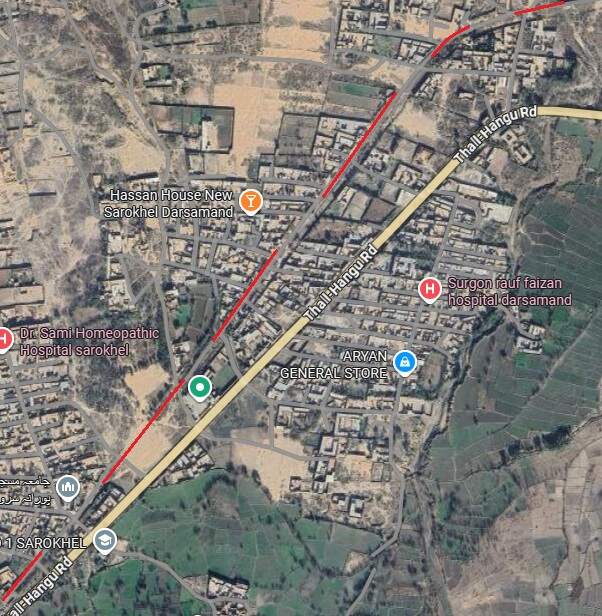
The route of the old line continues through Darsamend turning to the Southwest. A road follows the formation over the majority of this length. [Google Maps, September 2025]
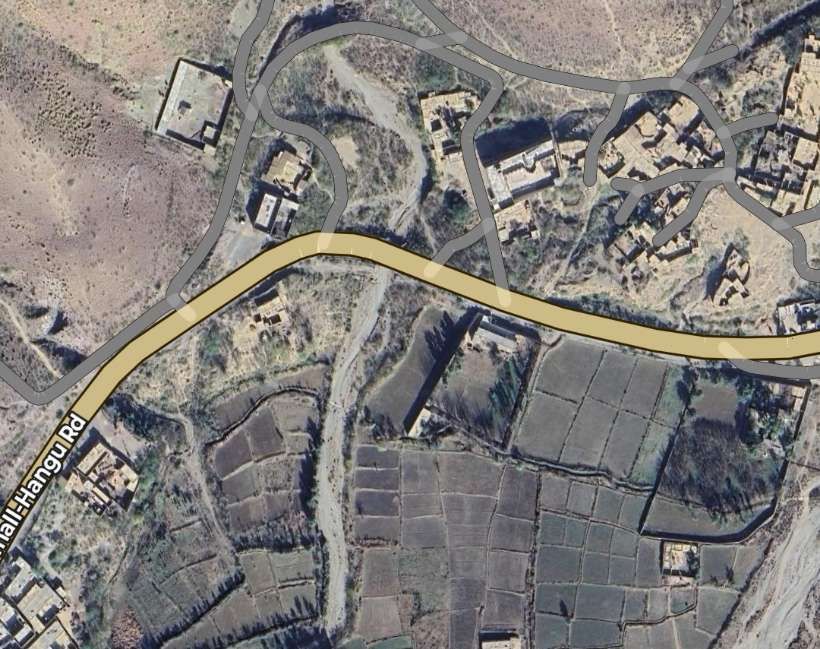
Still in Darsamend, the approximate route of the old railway crosses the Thall-Hangu Road at a shallow angle. [Google Maps, September 2025]
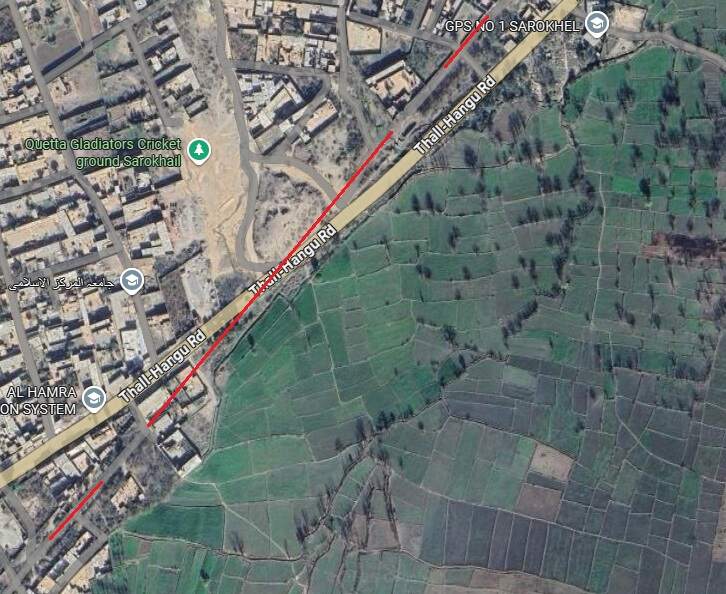
The railway bridge still stands (close to the centre of this image with the old railway running Northeast to Southwest and now used as a road. [Google Maps, September 2025]
The old railway route can be seen to the South of the Thall-Hangu Road running from the top-right corner of this image, crossing the Thall-Hangu Road close to the bottom-left of the image and running on the North shoulder of the road to the bottom-left corner of the image. [Google Maps, September 2025]
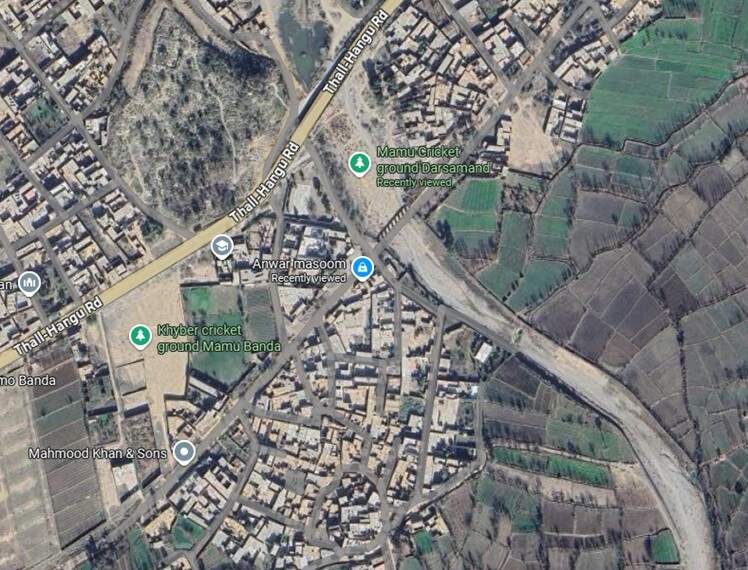
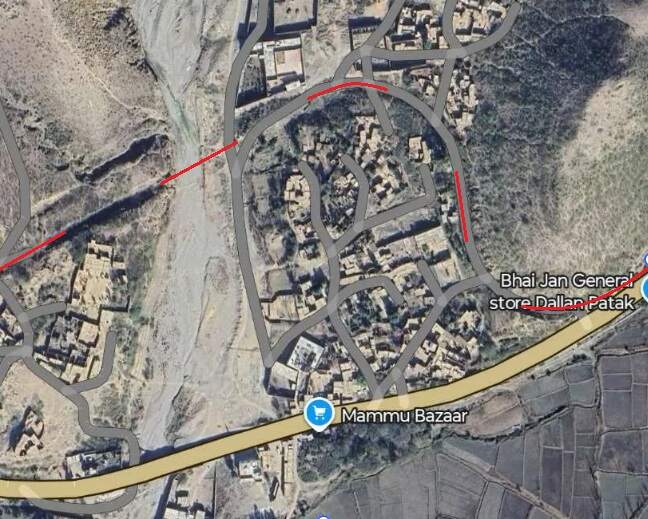
The red dashes mark the line of the railway through Mammu and over a dry river bed. The bridge no longer exists and the route of the line through the village has been converted into a road. [Google Maps, September 2025]
The route of the old railway runs from the cutting at the top-right of this satellite image,m West along what is now a road before turning South towards the Thall-Hangu Road. It leaves this image just to the North of the Thall-Hangu Road. [Google Maps, September 2025]
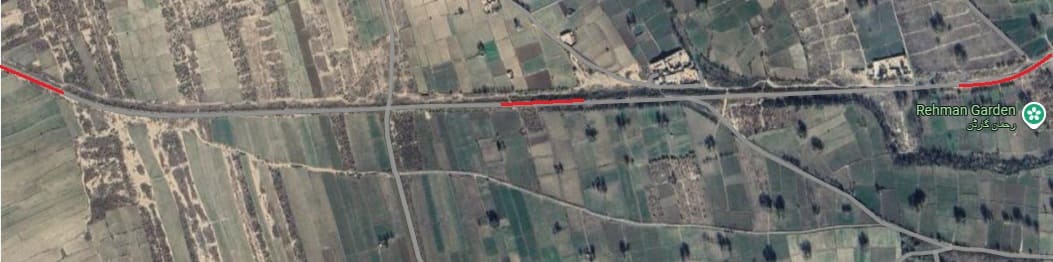
There is an overlap between the last satellite image and this image the line of the old railway can be followed, first along the grey road on the North side of the Thall-Hangu Road and then as a paler line running through the landscape towards the bottom-left corner of this image. [Google Maps, September 2025]
Again the route of the old railway appears as a paler line heading West away from the Thall-Hangu Road on this next satellite image. [Google Maps, September 2025]
Heading West from the road at the left of the image above the line then turned to the Southwest and its route again appears relatively clearly running from the top-right to the road at the bottom-left of this satellite image. [Google Maps, September 2025]
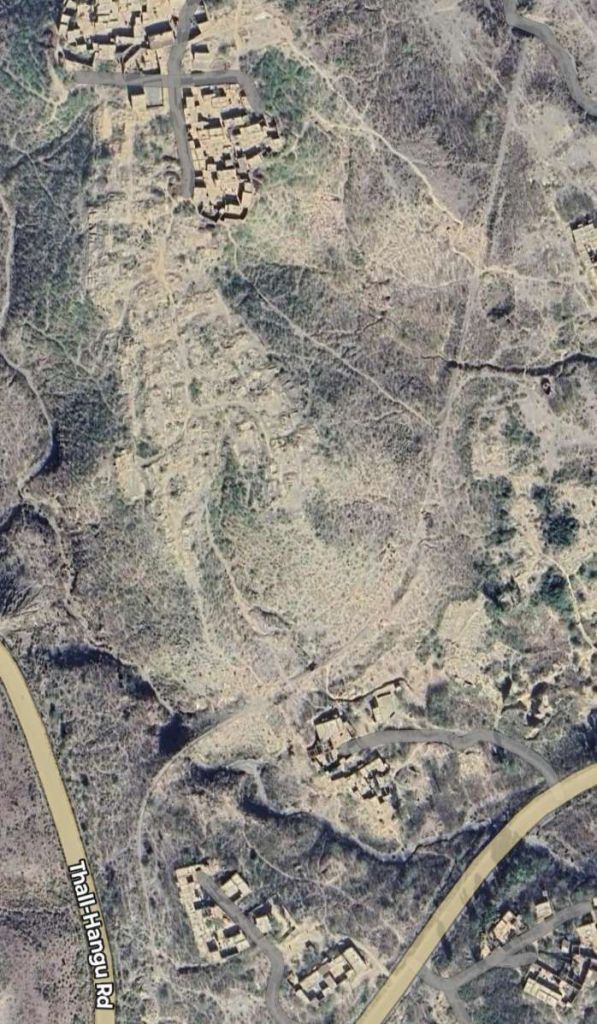
The route of the old railway is defined by the narrow paler line which runs from the road at the top-right of this satellite image (which is the same as that in the bottom-left of the image above) in a South-southwest direction before curving sinuously toward the Thall-Hangua Road at the bottom left of the image and running South for a short distance to the East of the road. [Google Streetview, September 2025]
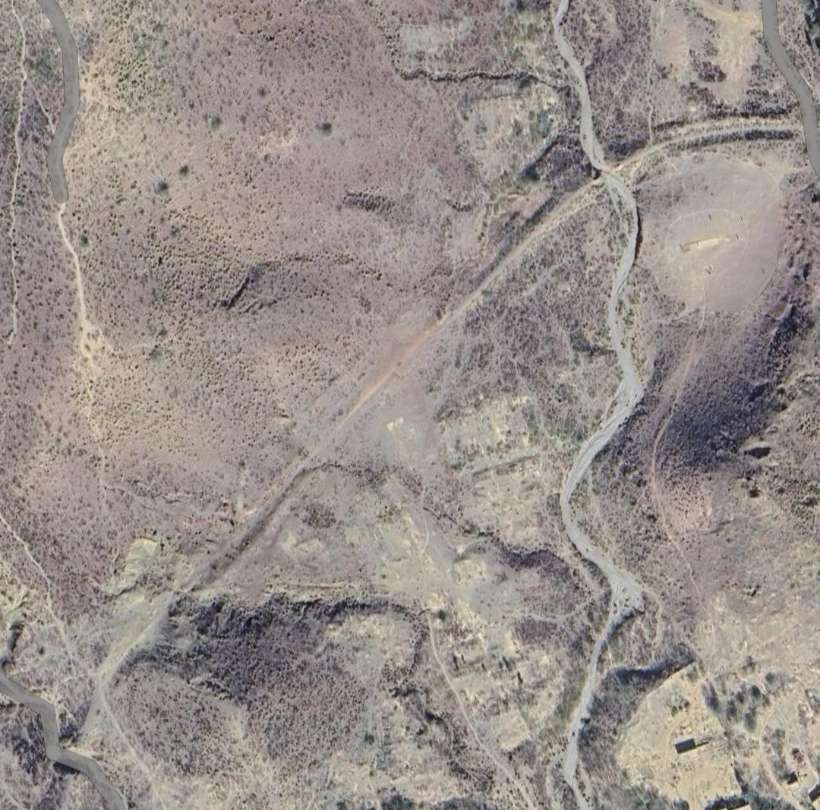
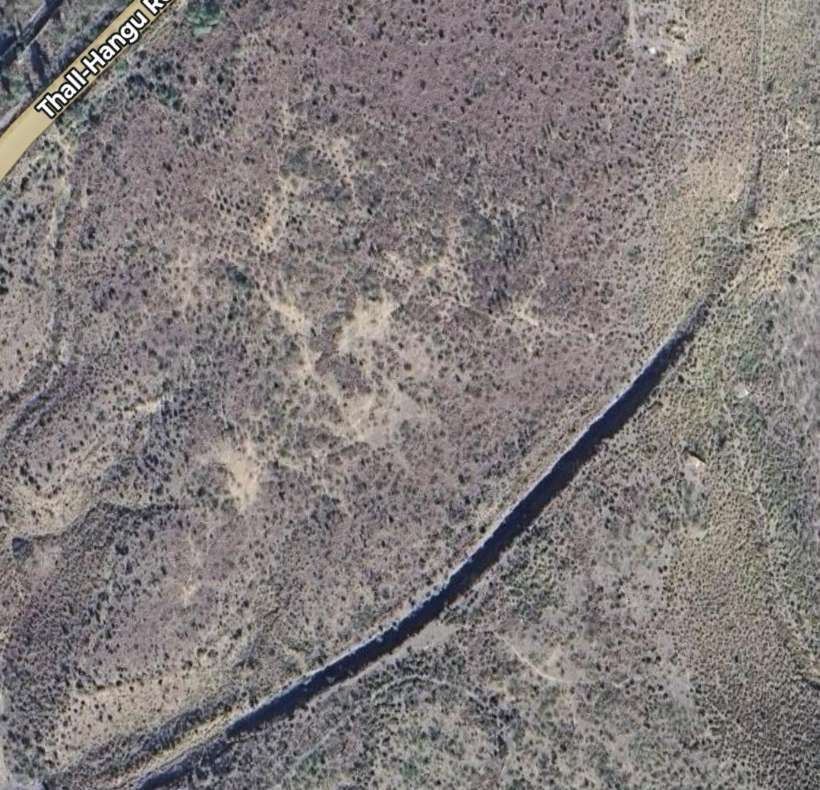
The exact point at which the railway crossed the line of the road is not obvious, but we can see the line of the railway crossing the land between two arms of the Thall-Hangu Road. It appears as a shallow cutting curving gently towards the Southwest, to the North of a more significant defile. [Google Maps, September 2025]
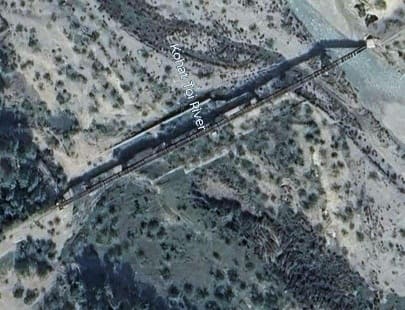
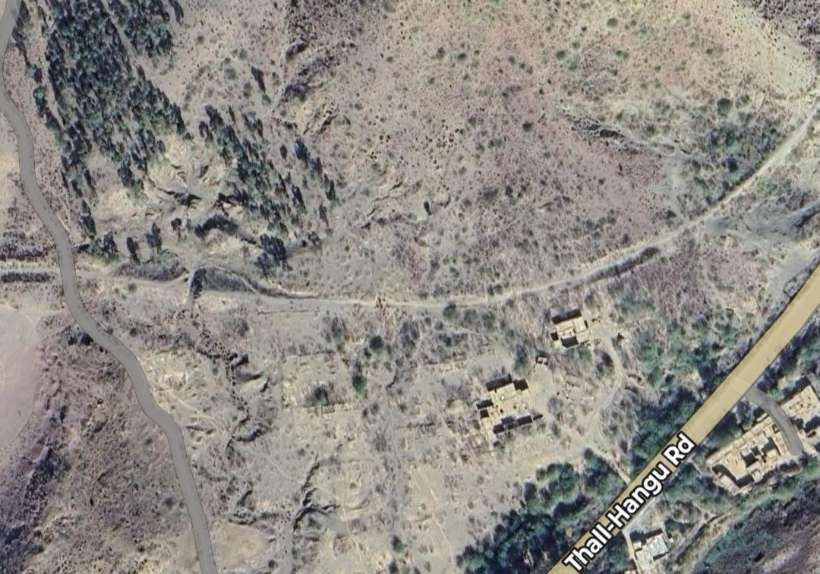
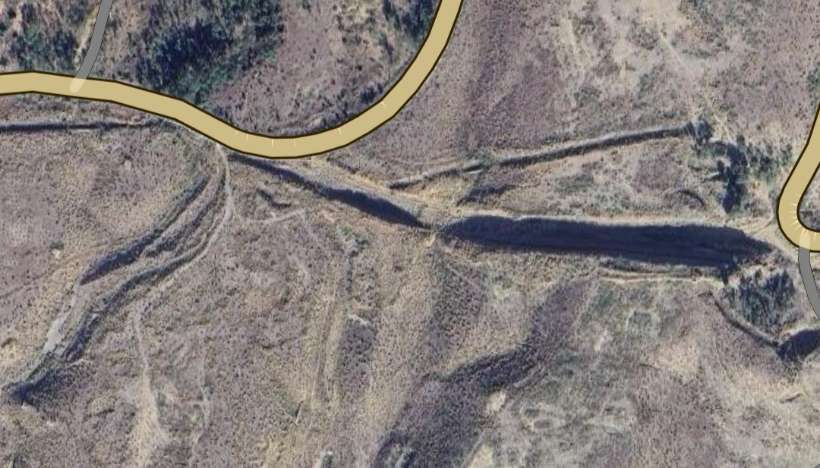
The approach to Thal Railway Station no longer is easy to identify. The last length of the line which can be ascertained easily is this apparently deep cutting. [Google Maps, September 2025]

Thal

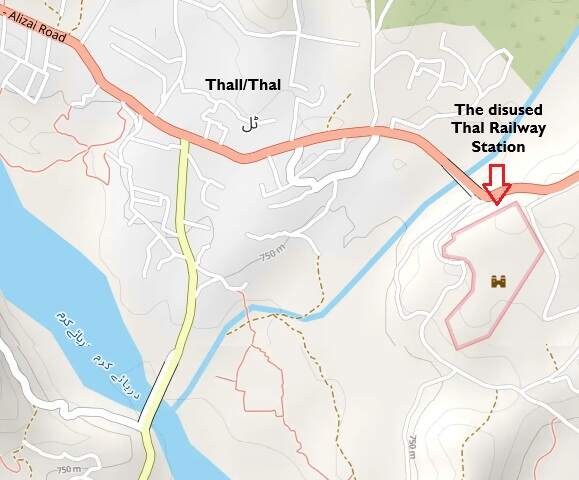
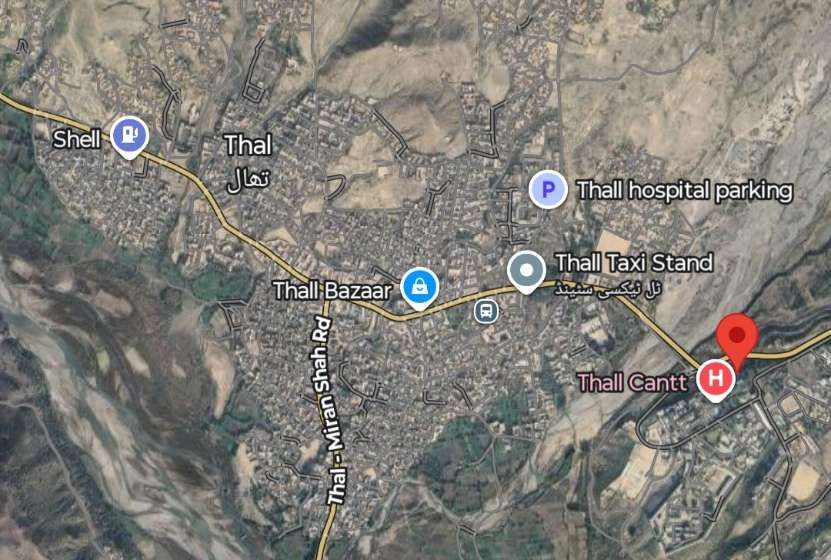
The erstwhile railway station at Thal sat on the opposite (East) side of a tributary to the Kurram River looking West across the town/city.

Thal sits on the banks of the Kurram River. The old railway Station sat to the East of a tributary to the River Kurram. [15]

Thal, with the location of the old railway station marked by the red flag (on the right of the satellite image. [Google Maps, September 2025]

References

  1.  “Administration Report on the Railways in India – corrected up to 31st March 1918”; Superintendent of Government Printing, Calcutta; page 107; accessed on 20th September 2025.
  2.  “Administration Report on the Railways in India – corrected up to 31st March 1918”; Superintendent of Government Printing, Calcutta; page 128; accessed on 29th September 2025.
  3.  Simon Darvill; Industrial Railways and Locomotives of India and South Asia; The Industrial Railway Society, 2013. Available at http://irsshop.co.uk/India.
  4. https://wiki.fibis.org/w/Khushal_Garh_Bridge, accessed on 20th September 2025.
  5. https://wiki.fibis.org/w/Khushalgarh-Kohat-Thal_Railway, accessed on 20th September 2025.
  6. https://wiki.fibis.org/w/John_Fowler_%26_Company_Ltd, accessed on 20th September 2025.
  7. https://pakistanrail.tripod.com/bridges.html, accessed on 20th September 2025.
  8. https://wikimapia.org/13993700/Khushal-Garh-Bridge, accessed on 20th September 2025.
  9. https://lh3.googleusercontent.com/gps-cs-s/AC9h4nqhc1tS7hXAJfKdQVGbIeMYbf-RGjQgs5G2B48_6WolAPEhNPmJ_Bef27W_TfH68_mmzP0chuixfO3JpY0-Usvplpa6v2vr143xaVC_4WT_h474H1k49I_vZyVsoHP4p0HP2y9R=s2036-w1016-h2036-rw, accessed on 20th September 2025.
  10. https://www.google.com/search?client=ms-android-motorola-rvo3&sca_esv=45db0090f0b5312b&sxsrf=AE3TifPt4Si5jsOiubF6-_y2iveQLNC5ug:1758356645643&q=khushal+garh+bridge+photos&uds=AOm0WdHzyYX3jsGClkjewtzSeR2sJ-1g6txAY2oFEVHAjQRcwsDbdv-vgcQuFuhyd_0fugGlX58xlo7j-_-RezG3t16nAeZB_3bzptjBve0mCHa0uDmIYUpHlM8pgaYsrTBOTfU0FaWT_re64BdTOHCRo_S0s6T5vpbn6azUzguRWXhR2foPywZHYo6fNtJ-_7BRPEW6RHrccWpjS1QAiz8L_Ar6xFF5a5ZVr09woxtFIHTqE6lYbCP1lSsPeMGrHxSdZ0kRN40JoWSg3cMFel_uolTfzuZYJMURCNnd93XMF8j0_XLBafwsSrCzrDRJw_dndf4Vkzki2SQ2xqZPqaxQMOHWPxBk7g&si=AMgyJEtnXabvb9Bq8u4Xf1H4V_vNXLBtfJ_awnuzAD8AOp3CykDncve52uFxc0ac3nW9LpQBbJzR-Rxi7uR32z1Hk0DNjR8L3yHnvGq-QIsZOkRl6aCjpt4qpAHS5QLLPbw82IHW0f1OHaSmGm9oTMux9dCUlPG5_Q%3D%3D&sa=X&sqi=2&ved=2ahUKEwj27oH69OaPAxWp1gIHHW1uOUgQk8gLegQIIxAB&ictx=1#vhid=JppReWtb5p77JM&vssid=l&ebo=1&lpg=cid:CgIgAQ%3D%3D, accessed on 20th September 2025.
  11. The North Western Railway (NWR) was a major railway system in British India that served the North-West Frontier region. After the 1947 partition, it was split, with the majority of its lines becoming the foundation for Pakistan Railways and a smaller portion forming the Eastern Punjab Railway in India. The NWR was headquartered in Lahore and extended from Karachi to Delhi and into the frontier regions, a crucial infrastructure for both civilian transport and British strategic planning. See: https://en.m.wikipedia.org/wiki/North_Western_State_Railway, accessed on 20th September 2025.
  12. Allan C. Baker; Bagnall Locomotives for the Indian Strategic Military Railways; in The Narrow Gauge, journal of the Narrow Gauge Railway Society, No.293, March 2025.
  13. https://www.facebook.com/share/1ZVhtMfqW6, accessed on 20th September 2025.
  14. https://en.m.wikipedia.org/wiki/Kushalgarh,_Pakistan, accessed on 20th September 2025.
  15. https://www.openstreetmap.org/#map=14/33.36412/70.55922&layers=P, accessed on 21st September 2025.
  16. https://www.world-railways.co.uk/railway-photo-11412, accessed on 25th September 2025.
  17. https://www.facebook.com/share/r/1FAo8NVsVL, the link is to an AI generated series of short videos from pictures from the railway, accessed on 25th September 2025.