
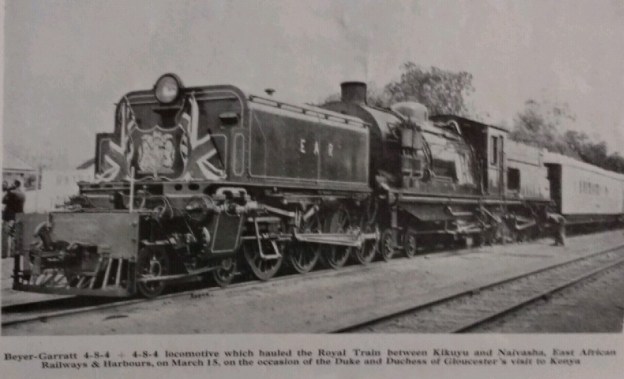
Reading through old copies of The Railway Magazine, I came across this article in the June 1950 copy. I thought it might be of interest alongside my earlier post about traction on the East African Railways:
The Uganda Railway – Part 25 – Locomotives and Rolling Stock – Part C (Steam – 1948 to 1977)
and my previous (most recent) post in this series ….
The Uganda Railway – Part 29 – The Railway Magazine 1950 – April 1950
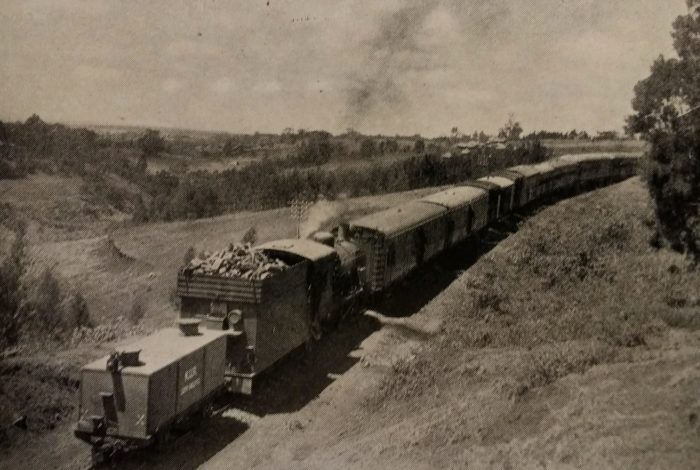
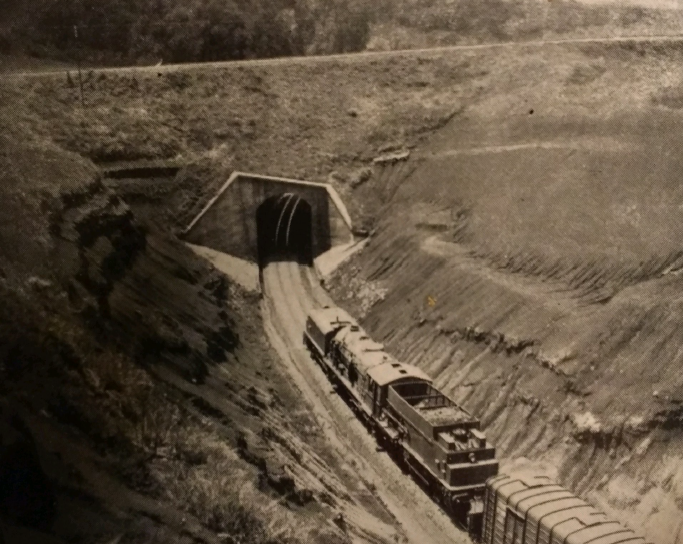
The article was entitled: Kenya and Uganda Railway Locomotives and was written by G. Gibson CME, E.A.R.&H. [1] It included a number of photographs of early locomotives on what was once called the Uganda Railway
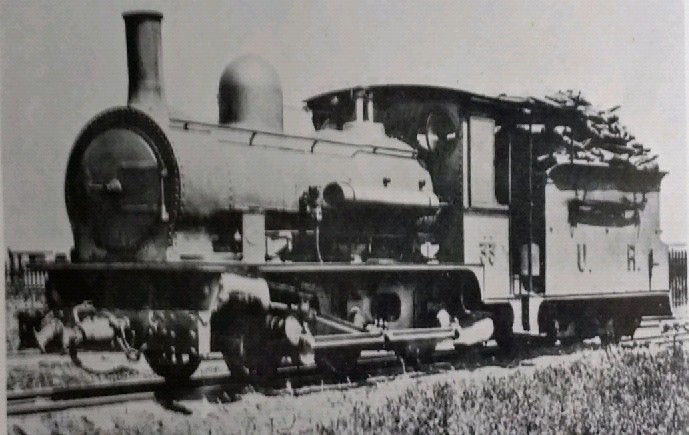 Class F 0-6-0 Locomotive. [2]
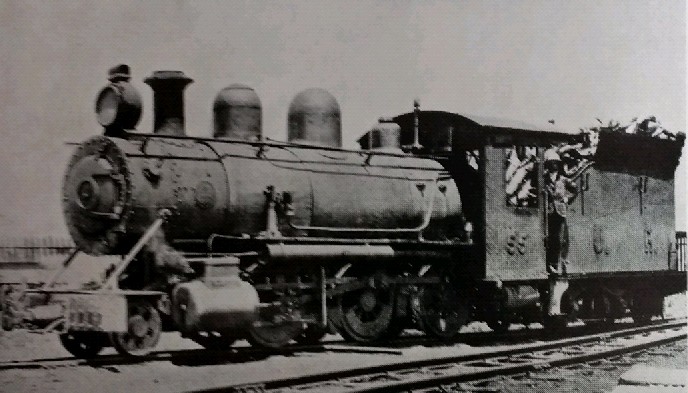 Class B 2-6-0 Locomotive. [2]
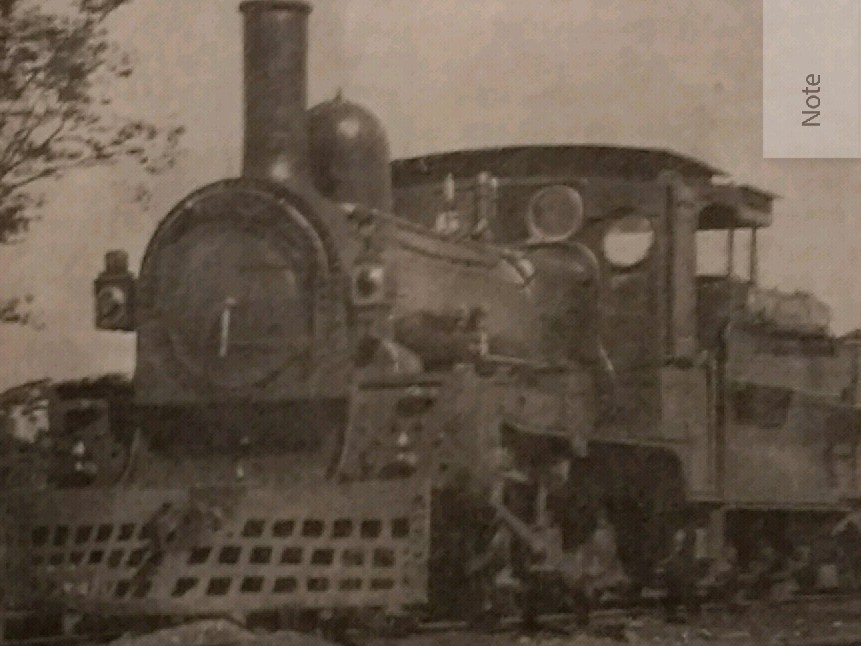 Class N 2-6-0 Locomotive, introduced in 1896. [1]
Two locomotives were imported from India to commence construction work
Gibson states, “There appears to be no detailed description of the locomotives available today, nor is it certain that they were both of the same type, as both ” A ” and ” E ” class engines are mentioned in early papers. They were certainly very small, and the Chief Engineer reported them as being incapable of hauling more than two wagons on a 1 in 30 grade.”
The ‘N’ class locomotives are the first for which details available. Eight were started work in 1896, and a further eight in 1899. Gibson states that some were fitted with, “Joy’s valve gear and the balance with Walschaerts link motion. These engines suffered from one serious defect, in that they continually derailed.”
To strengthen the roster and provide more reliable motive power than the than the ‘N’ class, eight ‘F’ class engines were delivered in 1897 and a further 26 followed in due course. In the latter part of 1897, orders were placed with Baldwins for 36 engines, known as the ‘B’ class; 20 were came in 1899 and the balance in 1900. “They proved reliable in service, but more expensive to maintain than the ‘F’ class. They were typical of American design at that time, with bar frames, and sand box mounted on the boiler top.”
By 1910 both these classes were in poor shape. They were kept in service druing the Great War and were not finally written off until 1931. Several of them were destroyed by mines laid by enemy raiding parties. “In April and May, 1915, some 50 attempts were made on the railway by such parties, often resulting in fatal casualties among train crews.”
By 1910, more power was essential. Orders were placed with the North British Locomotive Company, in 1911 for 18 Mallet-type compound locomotives which arrived in 1913/14. They were marginally re-designed locally which improves things but they remained unpopular with drivers. Failures continued to happen often and they were scrapped in 1930.
Also in around 1910, “three side-tank engines were ordered from Nasmyth, Wilson, known locally as the ‘E.D.’ class, and placed in service in 1913. They proved successful and were employed on main line traffic … but with fuel consumptions equal to the older engines. They were scrapped in 1938.”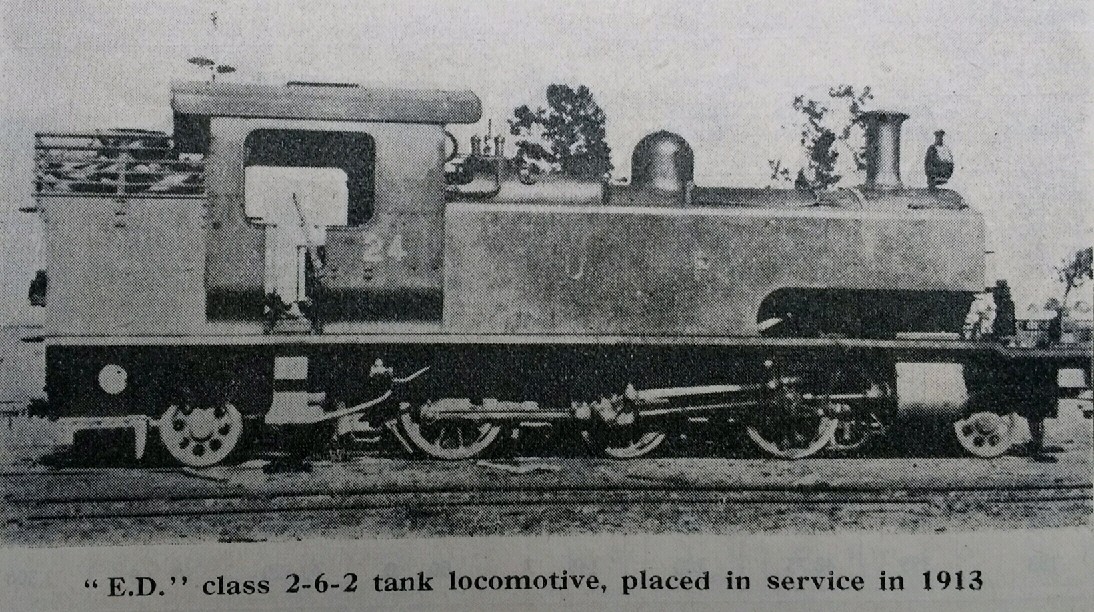 Class E.D. 2-6-2 Locomotive. [4]
Seven ‘E.B.’ class engines were put into service at the outbreak of the Great War. Thirty four further ‘E.B.’ class locos were purchased. They had minor design differences and so were classes ‘E.B.1’. Seventeen started work in 1920 and seventeen in 1921. The first E.B. locomotives were disposed of in 1934 as were the majority of if the E.B.1’s. six were still in use when the Railway Magazine article was written.
“The ‘E.B.’ class were built by Nasmyth, Wilson & Co. Ltd., and the ‘E.B.1’ class by the North British Locomotive Co. Ltd. Oil fuel equipment was first tried out in the colony on one of these engines.”
The history of the different locomotive types is continued with reference to the ‘ Class E.E’ which was supplied by Nasmyth, Wilson & Co. Ltd. They were placed in service in 1913 and 1914. It had been expected that they would be withdrawn in 1939 but the advent of the Second World War changed things and they were still in use in 1950 when the Railway Magazine article was written. They were similar to the ‘E.D.’s but by adding a trailing bogie in place of the pony, water capacity was increased by a half to 1200 gallons and fuel capacity by 2/3rds to 2.5 tonnes .
Superheaters were trialed in 1921, Nasmyth, Wilson, produced two locos with similar specs. to the ‘E.B.’ and ‘EAU’ Locomotives with Robinson superheaters fitted, they were known as the ‘E.B.2’ Class. They served well and were disposed of in 1934 after being very heavily worked. Those trials resulted in the purchase of 62 No. ‘E.B.3′ Class engines, all of which were still in service in 1950. 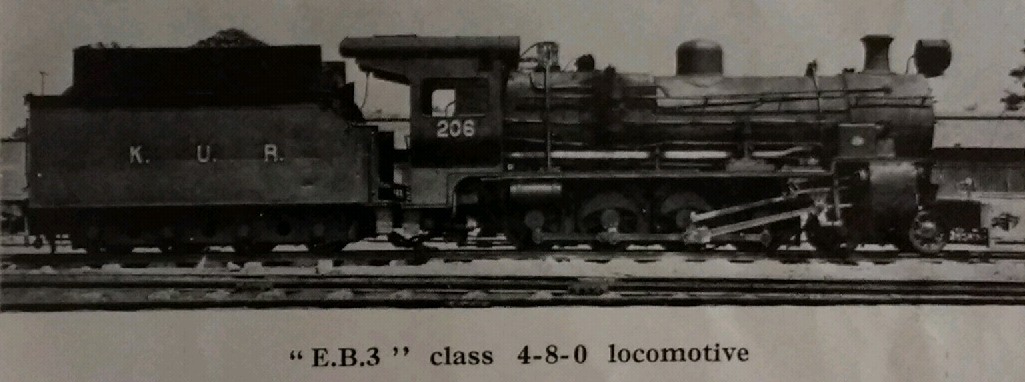 Class EB3 Locomotive. [3]
By 1950 they had been relegated to branch-line and pick-up traffic because more powerful locomotive were now in play.
In the late 1920s, 21 ‘E.E.’ CLass shunters with 2-4-2 wheel arrangements were employed and they were followed by a further 6 of the Class in the 1930s. The late 1920 saw thw arrival of the first Beyer-Garratt type engines, “which later were to become the mainstay of the railway’s motive power. An initial order for four ‘E.C.’ class was received and they were put into service immediately. The wheel arrangement and the motion was based on the ‘E.B.3’ type, with slightly smaller cylinders, and the axle-load limited to 10 tons to enable the engines to be used on the 50-lb track of branch lines.”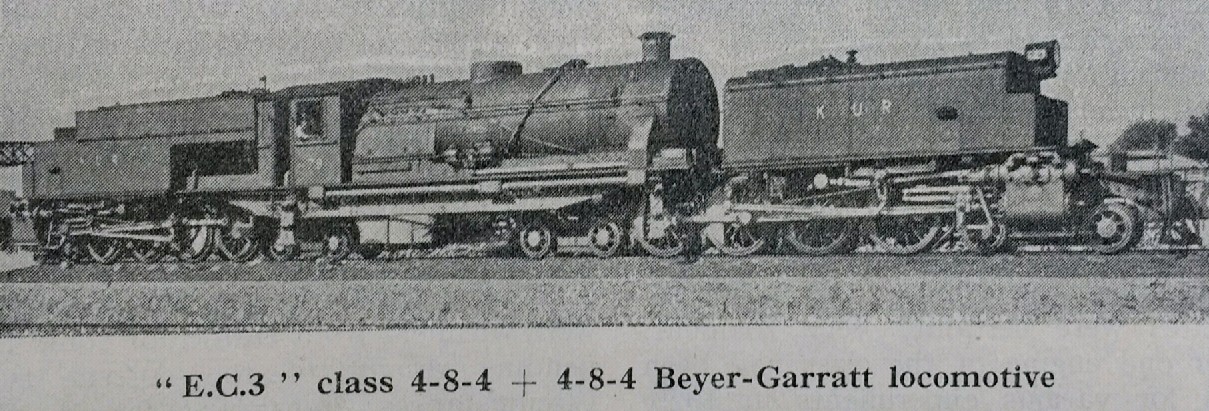 Class EC3 4-8-4+4-8-4 Beyer-Garratt Locomotive. [4]
In 1939, these four engines, with two of a later class, were sold to Indo-China to make room for six engines of a heavier type.
I have posted about these locomotives in another article:
The success of these first Garratt’s led to an order for a further 12 Garratt type locos from Beyer, Peacock & Co. Ltd. Minor modifications meant that these were designated as the ‘E.C.1’ class. The adhesive weight was increased to 83.85 tons; total weight to 134.6 tons; water capacity to 5,250 gallons; and fuel to 10 tons.
“In 1931, ten ” E.C.2 ” class Garratt locomotives, made by the North British Locomotive Co. Ltd., were imported. They [were] a little heavier than the ” E.C.1 ” class, having an adhesive weight of 87.95 tons and a total weight in working order of 142.1 tons. In all other leading particulars they are identical although there are a few differences in detail where infringement of established patents might occur.”
Six 2-8-2 engines were also ordered and arrived in the colony in 1925, but were not placed in service until 1927-28. They were designated as the ‘E.A.’ class.. They performed really well but by 1950 had been relegated to “long distance through goods traffic between the capital and Mombasa, being limited by their 17.5 tons of axle load to this section, which until recently (1950) was the only line laid with 80-lb. rails.” 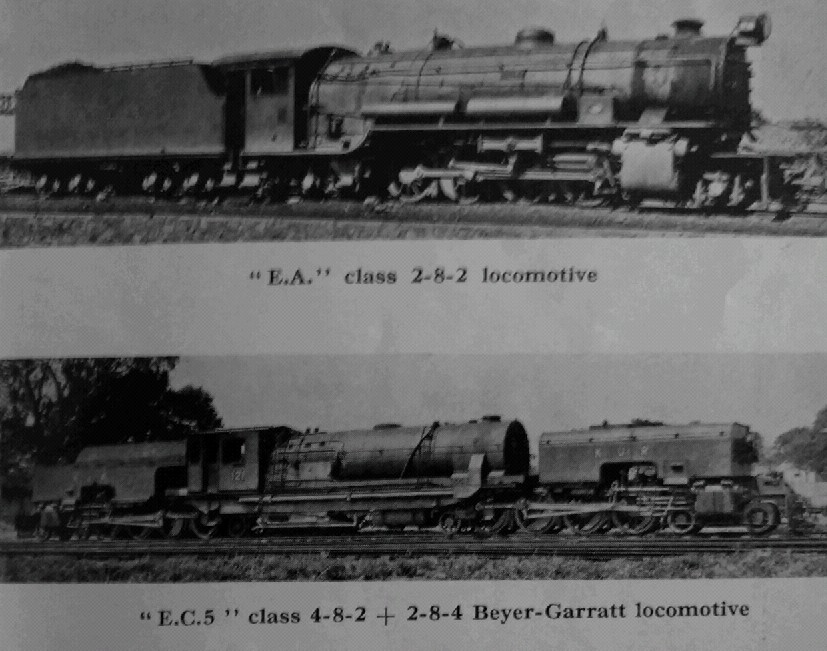 Class EA and EC5 Locomotives. [3]
IN 1950, plans were afoot to refurbish the ‘E.A.’ Class.
After 1930, all locomotives purchased were of the Beyer-Garratt type:
- 1939: 6 No. ‘E.C.3’ engines.
- 1940: 2 No. further ‘E.C.3’ locomotives.
- 1941: 4 No. further ‘E.C.3’ locomotives.
“They recorded large mileages during the late war, when traffic demands were the heaviest in the history of the railway. One engine covered 243,000 miles between shopping for heavy repairs, while several ran over 200,000. The boilers are fitted with arch tubes and thermic syphons. The maximum axleload (was) 11.75 tons, which limit(ed) their use to anything but main line traffic, where they (were) used on mail and through freight trains, hauling loads of up to 575 tons on 2% grades.”
- 1944: 7 No. ‘E.C.4’ Class Garratts came from the War Department. By 1950, they were still the most powerful locomotives on the network.
- 1945: 2 No. ‘E.C.5’ Class ‘Burma Type’ locomotives. These moved south to Tanganyika in 1949.
- 1949: 6 No. ‘E.C.6’ locomotives almost identical in design to the ‘Burma Type’.
In 1950 further Beyer-Garratt type locomotives were on order.
1. G. Gibson; Kenya & Uganda Railway Locomotives; The Railway Magazine, Volume 96, No. 590, p401-405.
2. The Railway Magazine, Volume 96, No. 590, p398.
3. The Railway Magazine, Volume 96, No. 590, p399.
4.The Railway Magazine, Volume 96, No. 590, p404.
5. The Railway Magazine, Volume 96, No. 590, p402-403.
 Roger Farnworth