Category Archives: West Clare

The West Clare Railway – Part 8 – A Miscellany

One Person’s Identification with Miltown Malbay

A friend has sent me a copy of an old book by Gabriel Vaughan entitled ‘My Affair with Malbay’. [10] It is an anecdotal history of the western part of Co. Clare centred on the life and times of a series of generations of The Vaughan family. It has one chapter devoted to the West Clare Railway. [10:p26-36]

Gabriel Vaughan’s father, Paddy Vaughan, worked on the railway. Family life revolved around the station at Miltown Malbay. Gabriel Vaughan says:

“It was almost impossible for me to miss the train at 8.56 a.m. when going to school in Ennistymon every morning. Dad knew the benefit of the proverbial saying “Go to work or school on an egg.” A good breakfast was sacrosanct and I also had to be in time for the train. So often the refrain would go like this: “hurry up, take your time, and eat enough”. Sometimes the train would be held for me for a minute or two until I had safely boarded the train. Other times, I was put into the guard’s van with a mug of tea and a few slices of bread. No way was I going to miss school. Thanks Dad!

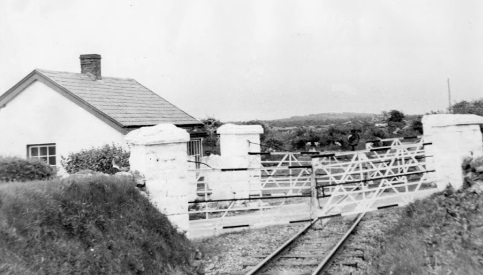
On one or two occasions when the porter Tommy Honan was absent and my Dad had slept it out, the train, after passing the Flag Road gates, could be heard from a distance, whistle blowing urgently, alerting the station master to have the gates across the line opened.

The train approaching Miltown in the morning carried a lot of girls from Doonbeg and Quilty going to work in The Malbay Knitwear Factory and was called “The Glamour Express”.

I had a privileged ticket because my father worked for the West Clare Railway Company and I travelled first class to school. Often the only other passenger with me was the local Protestant Minister, Rev. Cannon Elliot travelling up to Ennistymon to greet his flock there. Although he was a kind gentleman, I did not find it easy to converse with him.

Jackie Fox together with his horse called Friday, was the local carrier of goods from the railway station to the town. Every young boy in the town rode on his cart from time to time. A low sized good-humoured fellow was he and strong as an ox. Flour was then delivered in sacks weighing 280 lbs but this enormous weight proved no obstacle to Jackie as each sack was deftly swung onto his cart. I remember walking with Dad down Cloonboney way, when for the first time I heard peals of thunder. This noise, strange to my ears, was explained to me by my father, as Jackie unloading firkins of Guinness for subsequent delivery. Guinness was then delivered in wooden casks, the iron or aluminium lung had not yet arrived on the scene.” [10:p26]

“The railway station was a centre where the youth of the town gathered to play. The boys playing cops and robbers would split into two groups. One group had to seek the other in different hiding places throughout the station and lock them up in prison, cattle wagons being our “Mountjoy”. The hero was the lad who surprised the prison guards and released the prisoners, thus the game lasted longer. In the station yard we had a large flat concrete area, a disused cattle pen and we erected a tennis net made up of two poles and a rope. Mo Connolly, the American tennis star was our idol of the time.

When my father went fishing in the evening, we had a “swimming gala” in the water tank perched 20 feet on top of the engine shed. The tank was about 30 feet long by 12 feet wide and held about 10,000 gallons of water which was pumped up from Cloonboney river just 500 yards beyond the distant signal on the line to Lahinch. Needless to say there were wigs on the green when my father found out what was happening in his absence.

As well as tennis and swimming, other sports such as, running, jumping, golf and baseball were organised in the environs during the summer holidays. A novelty for us was playing baseball and this was made possible by Richard McMahon’s ball and bat sent to him by relatives in America. Paddy Griffin who lived on the Lahinch road near the White Strand, fell down between two wagons and managed to rip a bad gash in his thigh.

One day my brother Michael was heard screaming way down town by the local Garda Sergeant who post haste got on his bicycle and went to the station to investigate. Michael had been sitting on the track when Tommy Honan changed the points to be ready for the evening train. Luckily for Michael his position was about 2 yards from the tip of the points so no damage was done. It could have been very serious, as it was, he escaped with only a bruised backside.

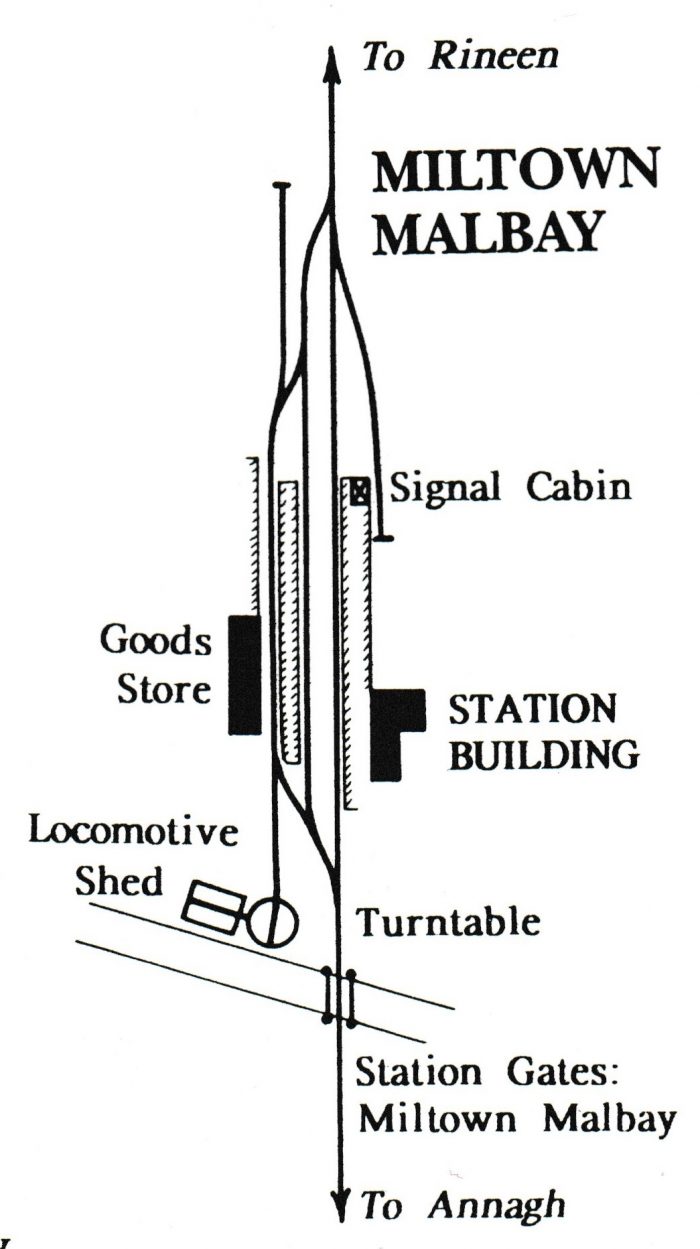
I can remember one fatal accident that occurred on Sunday the 25th August 1946. The unfortunate train driver Patrick O’Neill was killed. Early that day he was the driver on a “Special” to Lahinch, probably for Garland Sunday, a locally observed former pagan festival, now extinct. The light engine … was driven on its own to Miltown to be turned on the turntable for the return journey to Ennis later that evening from Lahinch. Patrick O’Neill who came from Limerick may not have been familiar with the layout of Miltown railway yard. When reversing past the points to drive off to the turntable, he had his head out the right hand cab window, not realising there was only 8 inches clearance between the engine cab and the goods store wall. He was squashed between the engine and the goods store gable wall. It was a horrific accident. Dad had gone to Ennistymon for the day not being on duty, and was immediately summoned by the Gardai to deal with the horrible stiuation.” [10:p27]

“As it happened, Tom Reidy, another driver was a passenger to Lachich that day and he was contacted and brought by road to Miltown to act as relief driver.” [10:p28]

Vaughan goes on to discuss some of the history of the line which we have dealt with elsewhere. He makes reference too to the Percy French song ‘Are Ye Right There, Michael?’ and then goes on to say:

“Why the line, one of the best loved of all the distinctive Irish narrow gauge railways, should have closed is a mystery. It’s chronic unreliability, perpetuated by Percy French’s song was a myth. In fact the line by today’s standard, was as well engineered as any in Ireland. It was well maintained by the staff, with no rubbish strewn about the line. Unfortunately, it lost money and in 1960 losses amounted to £23,000. In all my years travelling on The West Clare Railway, I have to say, it may have been colourful for all the wrong reasons, but it mostly ran on time.

In the summertime they put tourist or saloon coaches on the line, these were panoramic coaches with large glass windows to allow for maximum viewing of the scenery. They are now all the rage with European railways … The West Clare tourist coaches, of which were four, were all constructed on six wheel bogies, in Ennis between the years 1905 and 1906. Each coach had seating for 32 passengers.

I remember early morning “specials” leaving Miltown at about 7.30am. These “specials” transported hundreds of matchgoers to Ennis, and pilgrims to Knock and to Croagh Patrick, who of course transferred at Ennis to the Great Southern Railway Company to finish out their journey.

Some say it’s a pity that the line wasn’t constructed in standard gauge instead of narrow gauge. This would have done away with the necessity of trans-shipment of goods at Ennis. The Swiss who are acknowledged expert rail builders have no problem conforming with both gauges. Their solution is to transfer the narrow gauge wagons, intact onto broad gauge bogies. Imagine all the work involved in transferring beet from one wagon to another at Ennis, for trans-shipment to the Tuam or Carlow sugar factories. A proposal was made in 1936 to widen the gauge from 3 feet to the standard 5 feet 3 inches, but this came to nothing despite much debate which carried on until the 1940’s. I think £23,000 of a loss in the 60’s was not an enormous loss to bear.

The fact that C.I.E. scheduled buses to leave Kilrush and Ennis at the same time as the train, did not help either. The door to door deliveries by ever increasing numbers of lorries, owned by the manufacturers of goods and providers of services, seemed more efficient than deliveries by train and horse cart by the local carrier. The outcome of all these changing trends, was that the business community did not give enough support to their railway.” [10: p31]

“At this time it was normal practice for maintenance at the stations to be carried our by a pool of C.I.E. tradesmen based in Limerick or Ennis. Picture the scenario, a burst pipe in Miltown has to be repaired. A plumber would leave Limerick at 9 a.m. and connect with the 11 a.m. West Clare at Ennis, arriving at Miltown at noon. After a long and slow trip from Limerick, tea is first the order of the day naturally. Work would begin at 1.30pm and cease at 3.30pm in order to wash and shave for the trip home on the 4 o’clock train. Of course if it were a big job the trades men stayed over- night in the town. Economy how are you? I could not understand the logic of it. For years my Dad tried to rectify this wastage of time and money by C.I.E., by getting this maintenance done by local tradesmen. It worked eventually when they saw light at the end of the “tunnel.” Actually we had no “tunnels” on the West Clare line! There is no use in crying over spilt milk!

Because Miltown was once a terminal station on the West Clare Railway, provision was made for engine drivers to sleep over- night at the station and so a bedroom and kitchen was provided for them. During my Dad’s term at Miltown there was no need for this facility, the line having been extended as far as Kilkee and Kilrush. The kitchen continued to be used to make that extraordinary, wonderful sweet tea in a billy-can by various tradesmen. A small double-sided tin containing on the one side tea and on the other side sugar was emptied into the boiling water in the billy-can together with milk. The ensuing beverage was out of this world to us as youngsters. Potatoes were often half boiled by us also in the billy-can and with a pinch of salt and lump of butter, those potatoes tasted far superior to anything cooked at home.

The bedroom, which at this stage was rough and ready was used to store the turf which came from Shragh bog. The wagon of turf arrived at Miltown station on the up-line on the 3.35 p.m. goods train. All hands were on the platform in a mad scramble to get the wagon emptied of it’s fuel before the passenger train’s arrival at 5.30pm.

The Shragh bog yielded sods of turf that were really massive, some were 4 inches square by 14 inches long and had to be broken with a hatchet in order to fit into the grate of the stanley range. In a way it was like the steam engine, as one had to have a really hot fire going, to get enough heat in the oven for baking, so you had to be a good stoker as well as a good cook. This breaking of the turf was one of the Saturday morning chores to be done by either my brother Michael or myself.

During and immediately after the 2nd World War, spare parts for the engines as well as fuel were in short supply. The steam locomotives were “rag order” for want of spending a bit of money on them. About this time saw anthracite for the first time being used on the locomotives. We called them “duck eggs” because of their shape.” [10:p32]

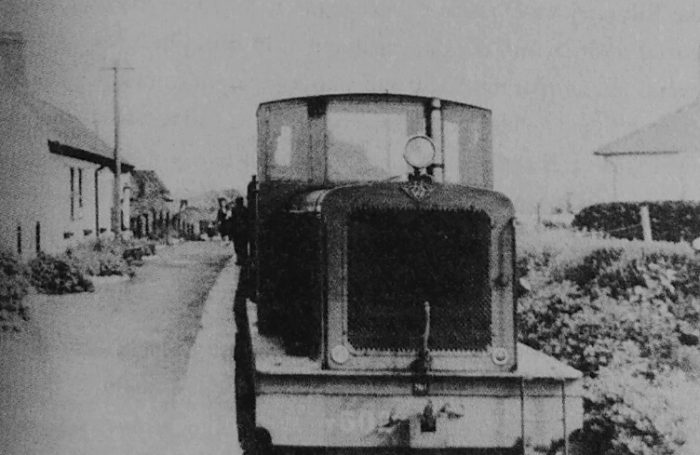
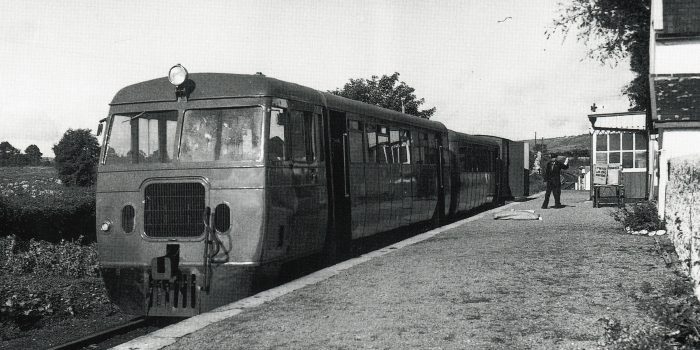
“In 1945, C.I.E. had taken over responsibility for The West Clare Line from The Great Southern Railway Company. A report first published in 1948 (Milne Report)  gave the hint of possible closure of the West Clare branch of C.I.E. The closure was postponed and it was decided to modernise the roIling stock by dieselisation. This took place between the years 1952-1955. First to appear were 4 diesel rail-cars which resembled buses on railway wheels, and these were augmented by 3 diesel locomotive for goods haul. Thus, the West Clare was the only narrow-gauge railway in Britain or Ireland to be fully under diesel power.” [10:p32-33]

“I remember going for a trial run on the first railcar that was delivered. The railcar was driven by an engineer from Dublin, a Mr Curran whom Dad thought was going to derail the “blasted” thing it was going so fast. It handled very well and did not derail. About the age of ten or twelve, I often  stood in the cab of the goods engine when the fireman, Joe Carmody was shunting and I remember the driver, John Hartney taking a break for his cup of tea. On the railway line down to Clonbony river having passed the distant signal, I would turn the wheel for reverse, ease the regulator gently forward to open and so begin shunting. Of course I threw the few shovels of coal into the firebox as well as helping to take on water, for they were all thirsty “old ladies” as locomotives were called.

I “worked” with Micko Conway and his gang of permanent way men, picking weeds and general cleaning up for a period of a few months after school in the evenings. Every Friday, I queued with the men for my wages. Dad had my name pencilled into the wages book, and paid me the wage of 6d a week, for which I was very grateful. I honestly believed I would not get any “wages” if I did not put in my stint with the men.

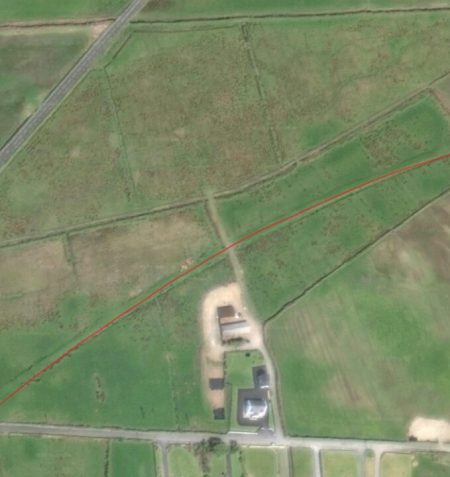
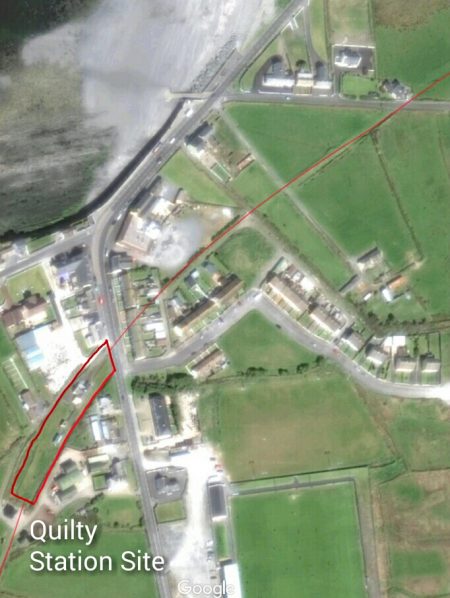
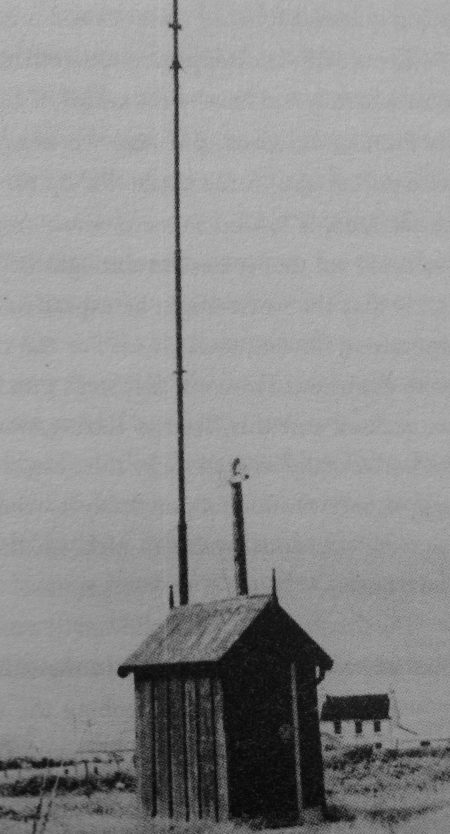
Generally the trains ran on time but from time to time the odd cow straying onto the line delayed us. It was deemed necessary to monitor wind speed in areas exposed to Atlantic gales. An anemometer was erected at Quilty for the purpose of measuring the wind velocity. If it exceeded 60 miles an hour, only stock that was ballasted could run. If winds were over 80 miles per hour, the trains were stopped. Ballasting took the form of large concrete slabs placed under the seats to weigh down the carriages. A gale of 112 mph was reportedly recorded here in January 1927.” [10:p33]

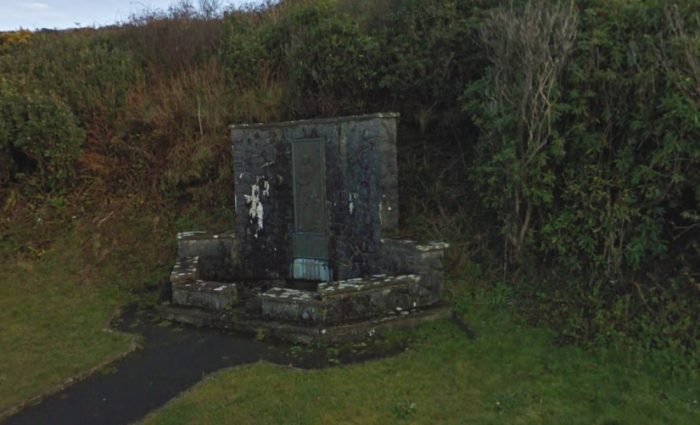
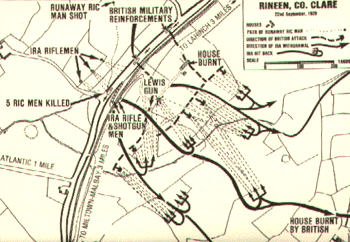
One evening, the 5.30 p.m. train approached the spot now occupied by the Rinseen Ambush Monument, a carriage door opened and a baby left on the floor near the door tumbled out. The distraught mother had to endure the next five minutes until the halt of the train on its arrival at Miltown station, where she reported the accident, was comforted by fellow passengers as she waited in agony for Dad and his search party to return. An hour elapsed and the party returned with the baby. As luck would have it, the baby, having fallen into a clump of bushes, luckily escaped with only minor superficial scratches and was re-united to the loving arms of its mother, no doubt to be minded and cosseted for the rest of its life after such a scare.” [10:p33-34]

“Amongst the droves of boys who went to “The Brothers” by train in Ennistymon for their daily dose of education, admittedly there were some adventurers in the bunch. I recall Eugene who could change carriages by walking on the running board outside the carriage while the train was in motion. Invariably this would happen on leaving the station at Ennistymon before the train had time to pick up speed. To the best of my memory none of the school-going boys had an accident except Paddy Griffin whom I previously mentioned.

One day I had the desire to be as good as the big boys and try my hand at smoking. I bought ten Woodbines to smoke on the way home on the train. Knowing I had about half an hour to experience the joy of being grown up, like the big boys, but there was one snag, I had to have them all smoked before I got home. In the process I got violently sick having almost “eaten the packet.” That experience cured me of the desire to smoke and thankfully I have never smoked since.

Dad was well liked by the travelling public and went out of his way to accommodate everybody especially those with sparse means. One old lady who travelled to Ennistymon to visit the dispensary and collect her pension used to sleep in one of the waiting rooms overnight because she was afraid of missing the train. A breakfast of tea and bread was often provided for her by Dad.

The senior schoolboys when they got good jobs on leaving school, were often canvassed later by Dad for private insurance. I remember being told after landing my first job to take out life cover but not to stretch myself. That I did, taking out a policy for £300 over a period of 30 years, a princely sum no doubt. The insurance inspectors who came from the Norwich Union Head Office in Galway were always remarking on Dad’s knowledge of the whereabouts of every man, woman and child and even the animals. They would jokingly say, that if he did not know where two bonhams (baby pigs) came from, he knew what creel they came from.” [10: p34]

“Michael Tynan, father of Maureen Ryan (nee Tynan), Ennis, and my father both worked in the Limerick Goods Department of G.S.R. and both applied for the position of Station Master in Miltown. My father got the position, but shortly after Michael Tynan was appointed to Kilkee.” [10: p34-35]

“Miltown Station, in common with all other stations on the West Flare did not have a telephone line to the outside world. Telephone communication only existed between stations, and only very important calls were made to Kingsbridge as this entailed making a trip to the local post office, which was run by Mrs Hynes.” [10: p35]

Gabriel Vaughan concludes:

“On January 31st 1961 the last train returned to Ennis, driven by Paddy Hanrahan whom at the time was I think one of the younger drivers on the line and so ended a history of 76 years. It was a very sad day for all Clare people and is looked back on with great regret. The much loved West Clare had a very short life and was mourned by many. It served its people well and I, like many others, retain many happy and much cherished memories of the West Clare. What a tourist attraction even a section of the restored line would be today!. Full marks to the Moyasta group headed up by Joe Taylor who intends restoring a section of the line.

It was sad indeed to come back from Switzerland in January 1961 to witness the end of an era – the closure of The West Clare Railway after 76 years.” [10: p35]

In reality, all of these rural lines had no long-term future once the motor-car and larger road-going vehicles began to hold sway. Co. Clare was still losing population and emigration was increasing. There was just not enough traffic and the line was eventually and inevitably closed on January 31st, 1961. [18]

Locomotives and Rolling Stock

The original estimated cost of the West Clare Railway was £176,000 which included £23,000 for rolling stock and repair shops. The Grand Jury allocated £170,000 and the Board of Works reduced the element for rolling stock and repair shops to £21,000. At ratepayers insistence the Privy Council then reduced the overall budget to £163,500.

The original estimate for the South Clare Railway was £127,300 which included £10,000 for rolling stock and repair shops. The Grand Jury and then the Privy Council whittled the principal sum down to £120,000. [1]

The net effect of this pairing back of the budget was the need for the board of the company to cut back investment on the infrastructure and rolling stock.

The issue was further exacerbated by some of the financial constraints placed on the operating company by the legislation under which the lines were built. The two companies ” were not allowed to issue fresh capital or to borrow money not form a reserve fund and carry forward from one half year to another. If a profit was made in one half year and a loss in the second half of the year they were not allowed to put profit of one against loss on the other. Expenditure incurred in increase to rolling stock, renewals or improved facilities at stations had to be charged to working expenses of the half year in which they were effected. This finally led to such an absurd position that the Treasury saw the force of objections to it and they agreed to a certain sum being put aside each year towards renewals. A further provision and the one that caused the most controversy was that each year was divided into two portions and returns had to be made for the half years ending on 30th April and 31st October and the profits, if any, divided equally between the Treasury and the Company. If, however, there was a loss in any half year’s working although there may have been a profit in the other half year, the Treasury was not liable for their share of the loss and unfortunately for both railways there was what was termed a fat half year and a lean half year.” [1]

When assessed by the Railway Commission (1906-10), net receipts since the opening of the line were about £24,200, net expenses were about £20,300. A balance of around £3,900 should have gone to the relief of the guarantee, but owing to the provisions above, the Treasury receive a figure of £12,000 and the County Council carried a debt of £8,000. [1]

These factors meant that the amount of rolling stock needed for the effective operation of the line had to be significantly reduced. The planned repair depot had to be abandoned and repairs had to be undertaken elsewhere. The result was a 25% increase in repair costs and a much longer period of downtime associated with each repair. The effect of all this was an over use of stock and reduced life-spans for locos and rolling stock. [4]

It was originally intended to purchase totals of rolling stock across the two companies of:

18 third class coaches
8 composite coaches
3 first class coaches
6 brake vans
2 horse boxes
28 open wagons
43 covered goods
40 cattle wagons
17 ballast wagons
3 timber wagons

This level of provision was not actually reached until 1913. [5]

Until then, wagons were in short supply which led to a loss of revenue in the conveyance of turf, slates, kelp and livestock. There were also disputes with various individuals over the deterioration of goods left too long awaiting transport. [5]

Carriages were also in short supply particularly for excursion traffic in the summer months.

Passenger traffic in the first year of operation of the South Clare Railway, across the two companies was about 177,800. Five years later it was 201,000 and by the turn of the century it was around 211,000. The gradual increase in traffic volumes continued to a peak in 1908 of close to 236,300. After the war traffic levels were much lower averaging around 100,000. Numbers declined significantly in the GSR era and only saw an increase when the CIE adopted diesel working in 1952. [5]

In the year immediately prior to the introduction of diesel traction only 41,000 people were carried. By 1960, this has risen to around 120,000. [6]

Goods and minerals traffic reached its peak in the 5 years before the Great War, averaging, in those years, around 45,000 tons. Livestock carried peaked in the first 10 years of the 20th century at an average of over 40,000 tons. [7]

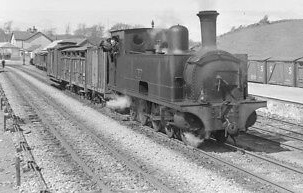
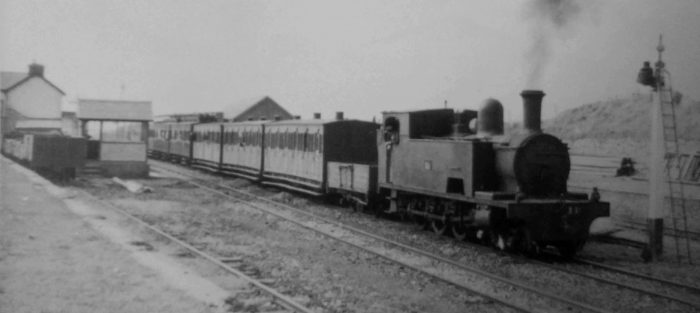
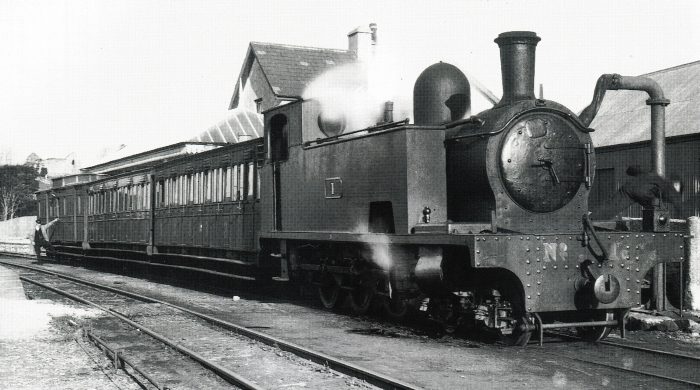
Steam Locomotives: There were a total of nineteen steam locomotives which worked on the West and South Flare Railways between 1886 and 1956. “Twelve were purchased by the West Clare Railway, four by the South Clare Railway, two came under CIE auspices from the Tralee & Dingle section, and one was a contractor’s engine.” [12] Loco 3C, Ennistymon, ex-Works. [19]
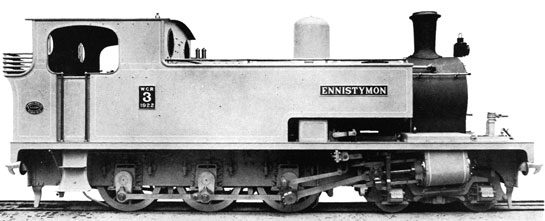
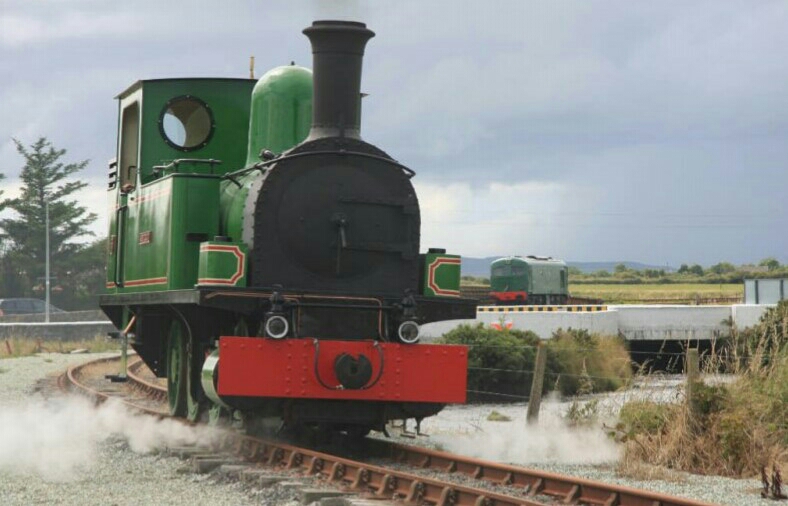
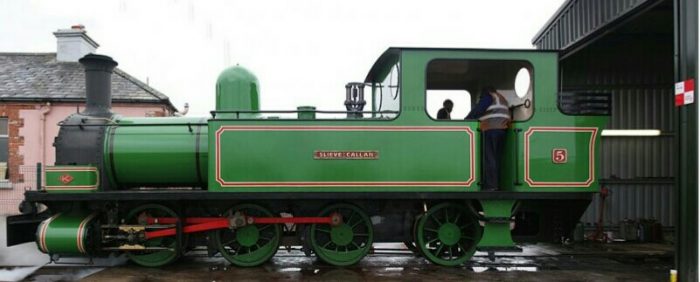
When writing in 1994, Patrick Taylor continued: “The average age of the steam locomotives when withdrawn was 40 years, but one had a very short life of only 13 years, and another lasted only one year longer. Two were still working after 64 years, when the system changed over to diesel. All were six-coupled tank engines, and with but two exceptions, originally carried both number and name. One has been preserved at Ennis.” [12] It remained at Ennis until 1996.Above, locomotive Slieve Callan on a plinth at Ennis Station. In 1996, in dramatic circumstances, the 40-tonne Slieve Callan was lifted off this plinth at Ennis railway station despite the efforts of protesters and taken to Moyasta in West Clare. [16][17]
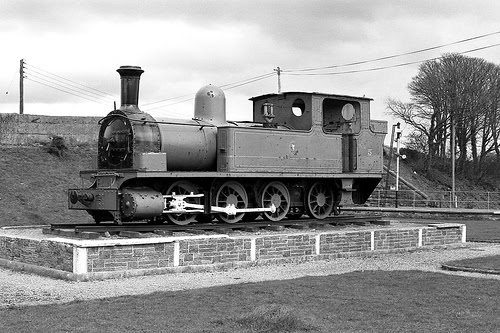
Adjacent, locomotive No. 2C at Ennistymon in 1940. [20]

It appears that a contractor’s engine was not a six-coupled but a four-coupled engine. ‘Sponden’ was owned by Murphy’s contractors. It was built in 1878 at the Hunslet works in Leeds. Its original owners were Benton & Woodrow Contractors of Audenshaw, Manchester. This is a local connection for me, writing as I am at the moment in Ashton-under-Lyne. This loco arrived as deck cargo at Kilrush on 26 the April 1891, to assist on the construction of the South Clare line. previously, Murphy had been using one of the West Clare Bagnalls and continued to do so occasionally throughout the construction of the South Clare. [14]

Chapter 7 of Taylor’s book on the West Clare Railway [13] describes the locomotives on the West Clare in great detail. It would not be appropriate to reproduce that detailed work here, the book is easily purchased secondhand via a variety of sources.

Diesel and Other Traction: It has been suggested that the “West Clare had a self-propelled inspection car. However, the Great Southern Railway introduced one in 1925, and followed this with two passenger carrying railcars in 1927.” [12] It was the early 1950s which saw a major change in traction on the West Clare – three diesel locomotives and four diesel railcars were purchased by the CIE. These were:

3386 diesel railcar by Walkers of Wigan 1952.

3387 diesel railcar by Walkers of Wigan 1952.

3388 diesel railcar by Walkers of Wigan 1952.

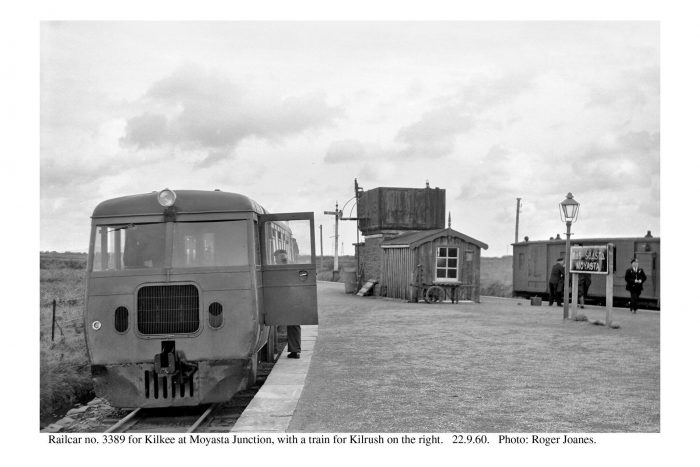
3389 diesel railcar by Walkers of Wigan 1952.

F501 Bo-Bo diesel locomotive by Walkers of Wigan 1955.

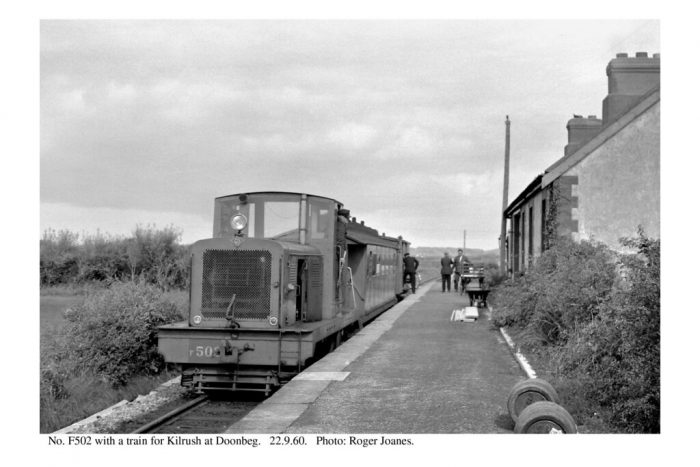
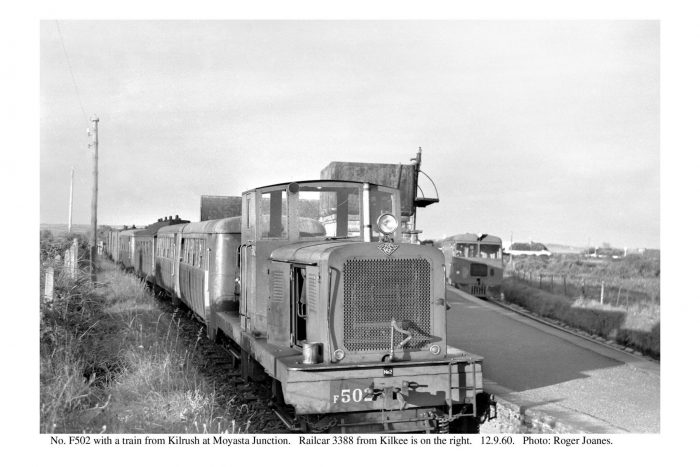
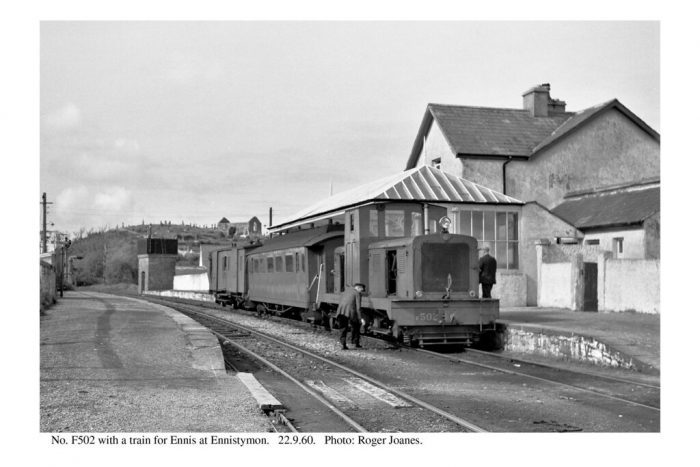
F502 Bo-Bo diesel locomotive by Walkers of Wigan 1955.

F503 Bo-Bo diesel locomotive by Walkers of Wigan 1955. [3]

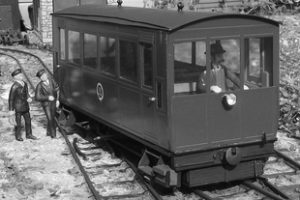
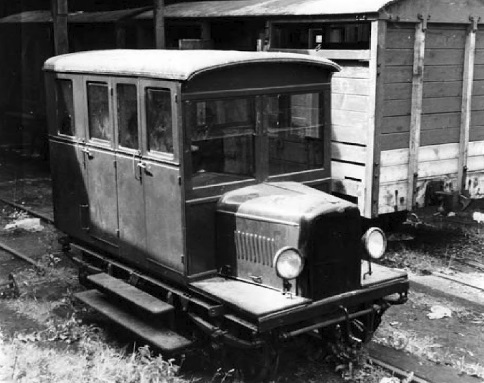
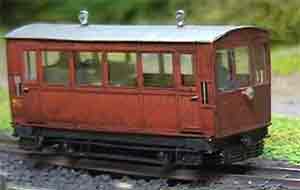
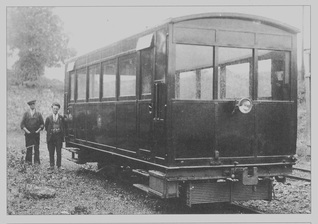
Before focussing on diesel traction it is worth giving some thought to petrol! Proposals were considered in West Clare days to make use of ‘motors’. These came to nothing, although late in January 1907 estimates were obtained for a motor and parcels van. In 1927 the GSR authorised the purchaseof two petrol cars for the West Clare section. They initially intended these to be 25-30hp but this was increased after advice from their builder to 40-45hp because of the gradients on the line. The cars were ordered from the Drewery Car Company Limited (Order No. 2800 of 20th April 1927), but were made by Baguley Engineers Limited of Burton-on-Trent, through a working agreement between the two Companies. These four-wheel cars were numbered 395 and 396. [15]The Drury Petrol Railcars (above) entered service for the GSR in October 1927 and ran the Kilkee branch services on the West Clare section until they were both withdrawn in 1936. They were transferred to the GSR works at Inchicore in 1939 and scrapped in 1943. [21] No. 396 is shown above at Kilkee in around 1930. The crew are Frank O’Brien and M. Jinan © A.W. Croughton, Real Photographs. [28]  The adjacent image shows the excellent model made by Dirk Shrapnel for the Trawbreaga Bay Light Railway. [21]
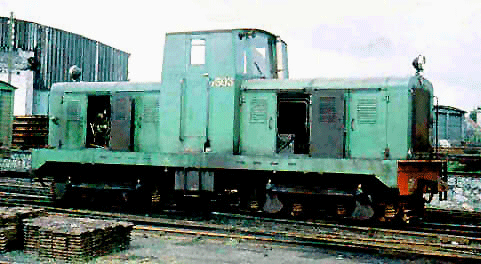
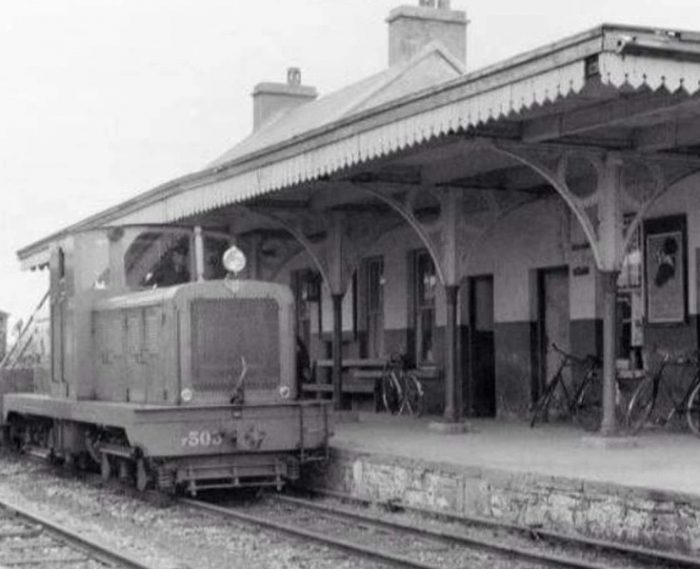
The Walker Bo-Bo Diesel locos: These locos became the standard motive power for goods trains in the last years of the West Clare Railway and could also be seen at the head of mixed/passenger services. “These Córas Iompair Éireann (CIE) 501 Class locomotives were built in 1955 by Walker Brothers Limited of Wigan, Lancashire for use on the narrow gauge (3 ft or 914 mm) lines on the West Clare section of CIÉ. They were small diesel mechanical locomotives, of 0-4-0+0-4-0 wheel arrangement. Controlled from a central cab the locomotives had two Gardner engines of 224 hp (167 kW), one under each end casing, driving through a fluid coupling and Wilson gear box the inner axle of the opposite bogie, through a spiral-bevel-reverse and reduction gear box. Unusually the locomotives were driven from a seat mounted sideways to the direction of travel giving a clear field of vision both ways by a mere turn of the head. The locomotives were fitted with vacuum brakes, emergency braking coming from a “deadman’s” pedal, one at the driving position and two others, one mounted on each side of the cab. When used on freight services their maximum speed was 40 kilometres per hour (25 mph), but with an overdrive fitted, released by a key, this was raised to 51 kilometres per hour (32 mph) for passenger trains.” [22]The F501-503 Bo-Bo series built by Walker Bros of Wigan. The drawing was undertaken by Ian Beattie and first produced in the Railway Modeller Magazine, (c) Peco Publications Ltd. [30]
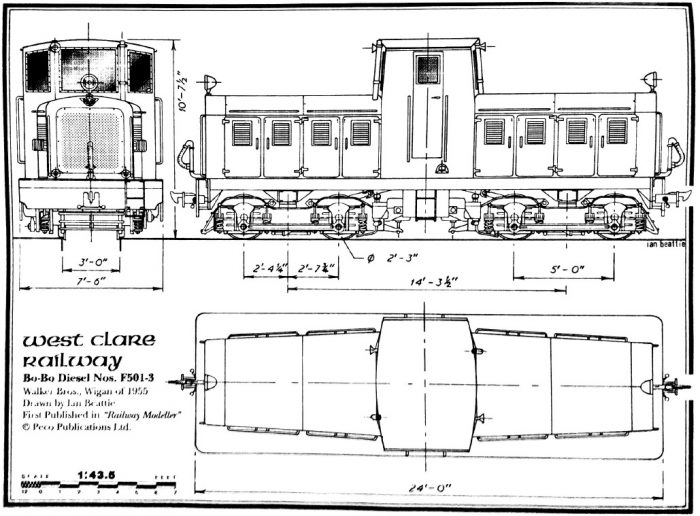
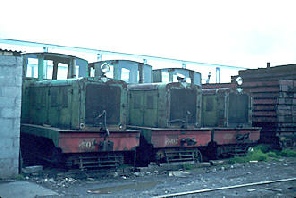
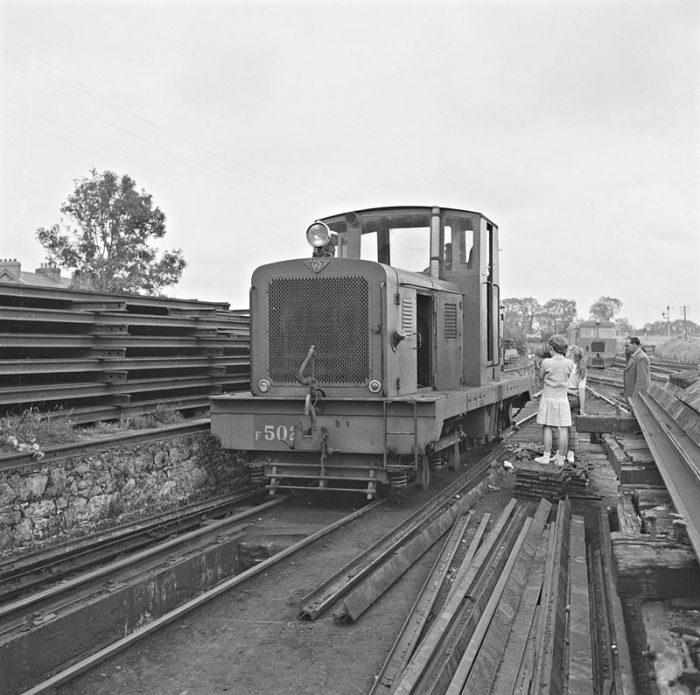
“They were originally numbered C31-C33 in the West Clare steam locomotive series, but were subsequently renumbered into the diesel locomotive series as F501-F503. They were withdrawn in 1961 when the West Clare lines were closed and stored at Inchicore Works for seven years. The Isle of Man Railway made an offer for the locomotives which was rejected by CIÉ who subsequently made less money by selling them for scrap in 1968.” [22]Above, F502 at Ennis in 1962. [22]
Adjacent, F503 (c) Colour-Rail. [23]

Below right, all three locos F501 to F503 at Inchicore in 1966. They were broken up in 1968. (c )Peter Excell.[24]

J. Scarisbrick Walker and Brothers of Pagefield Ironworks, Wigan were iron-founders and general engineers. The company was founded by J.S. Walker in the 1870s and later joined with his two brothers, T.A. & E.R. Walker to form Walker Bros. (Wigan) Ltd in 1880.

About twenty steam locomotives were built. The company subsequently manufactured diesel railcars. [26]4mm model of Walker Diesel as used on the West Clare Railway built from a Worsley Works NG kit by Robin Winter. [8]A similar model of F501. [23]
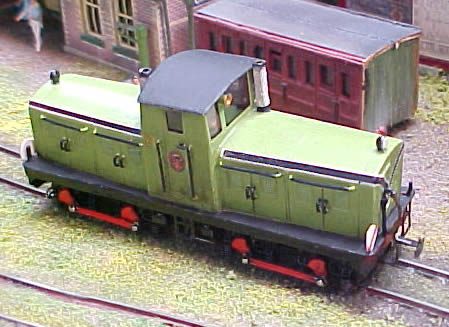
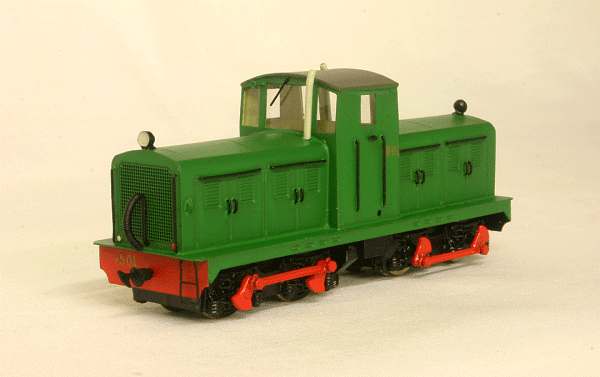
The “three diesel locomotives were put into service to haul goods,turf, beet and livestock trains, and finally eliminate working. When passenger traffic was heavy, as on Fair days for example, they were also employed on passenger and excursion trains, and a small fleet of locomotive hauled coaches were retained for this purpose.” [31]

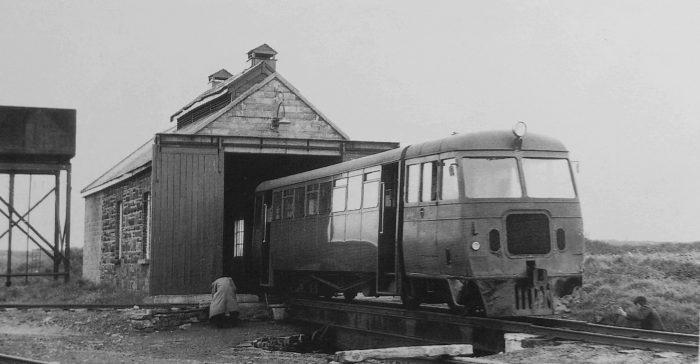
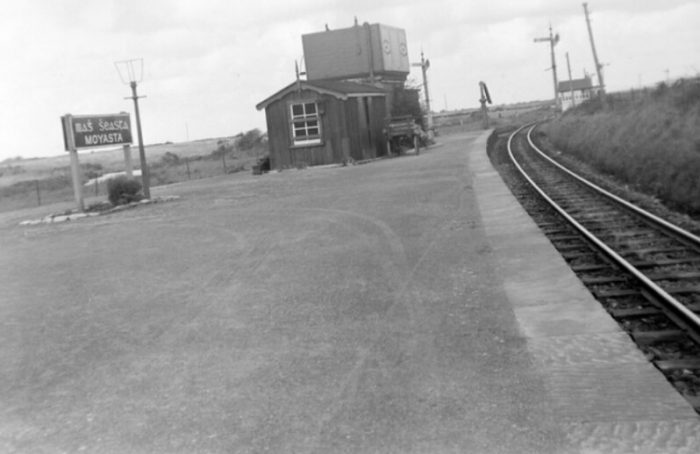
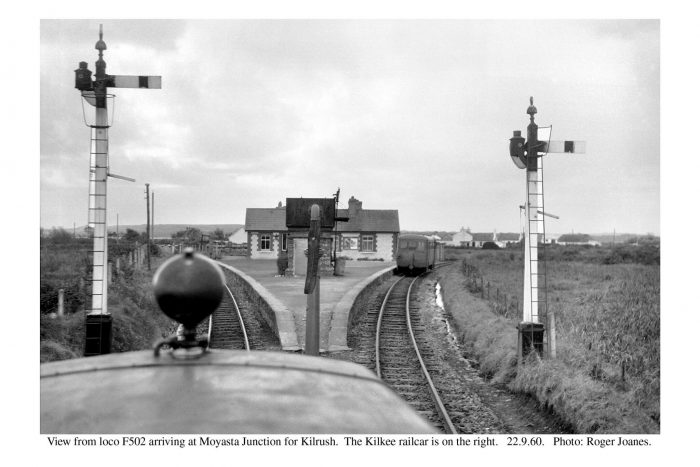
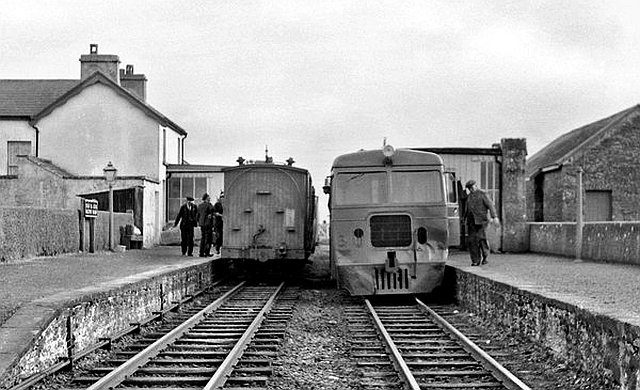
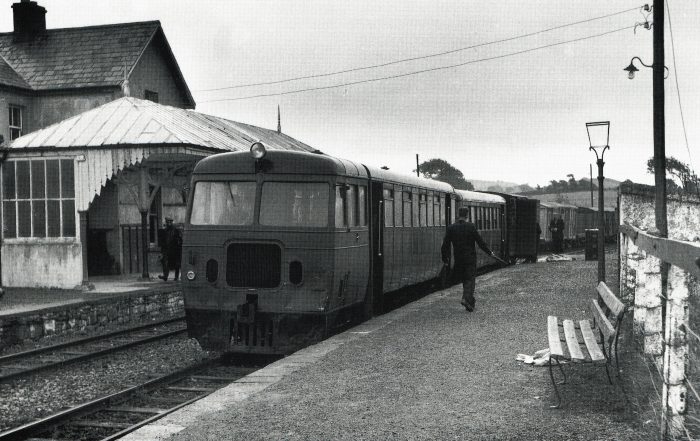
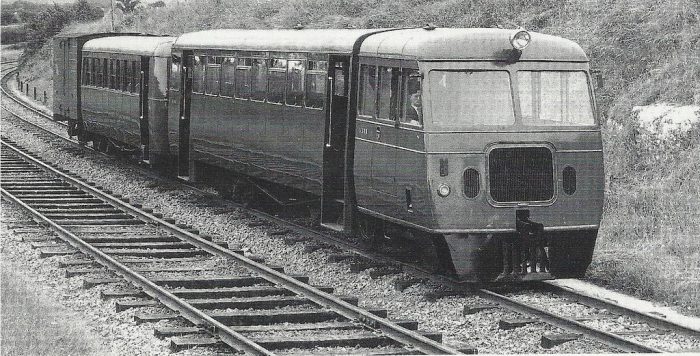
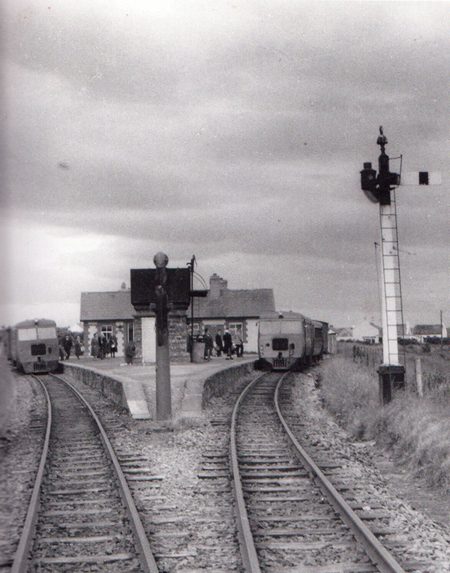
Walker Railcars: The four railcars in use on the West Clare were designed and built by Walker Bros (Wigan) Ltd. The same company supplied railcars/railmotors in a variety of gauges around the world. These included 40 railmotors supplied to Victorian Railways in Australia. [27]On 24th June 1959, two diesel railcars sit at the junction station at Moyasta. The one on the left has travelled from Kilrush, that on the right from Kilkee [11] Railcar 3389 at Moyasta in 1960 (c) Roger Joanes. [24]
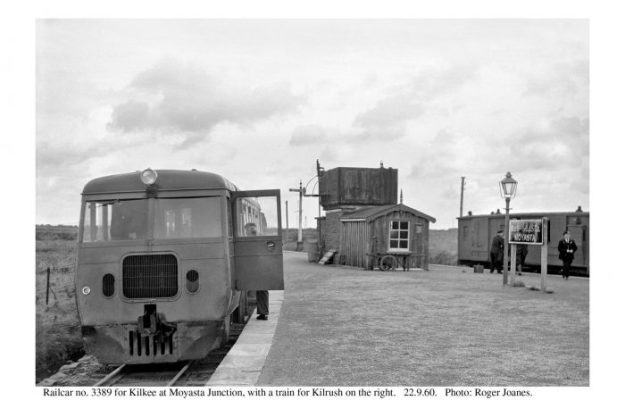
The railcars were powered by “a Gardner 6LW diesel engine, driving through a ‘Don-Flex’ plate clutch, four speed Meadows gearbox, and thence through a Hardy-Spicer propeller shaft, to a Meadows worm gear final drive gearbox, on the rear axle of the bogie, the two pairs of wheels being coupled by conventional coupling rods. The bogies had inside frames.” [29]

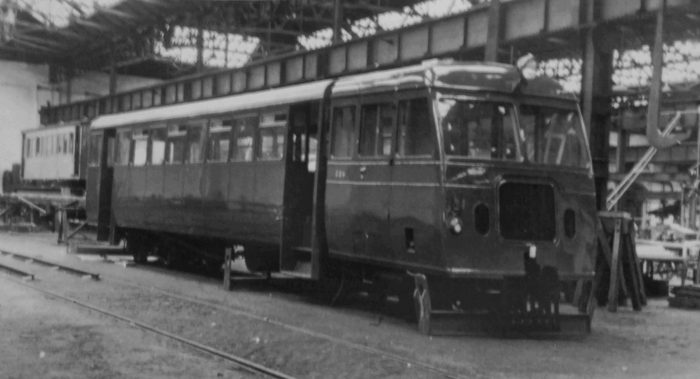
“Each car had a maximum speed of 38.5 mph in top, 23.8 in third, 14.2 in second and 8.3 in first gear, the engines developing 107 bhp at 1700 rpm. Except at very slow speed (7 mph), the cars would work forwards only.” [29] New turntables had to be installed to turn the railcars. “Heating was from the engine cooling system, and this was the first time West Clare passengers had anything better than simple footwarmers. The cars weighed 11 tons in working order, and were capable of hauling, when necessary, a standard passenger coach, and a lightly constructed four wheel luggage car.” [29]Walker diesel railcar No. 286 – renumbered 3386 before entering service. The picture was taken during the final preparations for the railcar to be shipped from Inchicore to Ennis (c) Patrick Taylor. [29]
Carriages: for the opening of the West Clare Railway, “thirteen … coaching stock vehicles were purchased from the Bristol wagon & Carriage Works Company of Lawrence Hill, Bristol oder, which in its entirety was left in the hands of William Martin Murphy, as had been the case with the locomotives, consisted of three composites, six thirds and four brake vans. The original passenger carrying  coaches were six-wheelers, 30ft long and of James Cleminson’s patient, with the three sets of wheels and axles mounted on separate trucks, the central one of which was given considerable side play, being mounted slides. This truck was connected to its outer sisters by radius rods, themselves being pivoted about their centre. … There were only three other narrow gauge railways in Ireland that used the principle, the Ballycastle, West Donegal and the Londonderry & Lough Swilly, and only the latter continued to purchase such vehicles after the West Clare; doing so as late as 1899. After 1894, although continuing the use of six-wheelers, the West Clare abandoned building on the ‘Cleminson’ principle.” [32]

“The livery of the coach sides was green and the roofs white, the West Clare heraldic device being displayed in gold leaf on the second and fifth doors of the thirds, and the second and fourth of the composites, and on each door the class was clearly denoted. On the panelling between the roof, and the doors and windows, immediately under the cant rail, the words West Clare Railway appeared.” [32]

Of the four brake vans, two were 30ft long with an under-carriage to match the six-wheel coaches, and two were four-wheelers.

As the latter years of the 19th century unfolded, it became clear that the passenger stock needed to be augmented. Eight additional items were ordered. Five arrived before the South Clare was opened, three after. The first five consisted of two thirds, one composite and two brake vans. The remaining three were two composite coaches and one third.

For the South Clare, six more carriages were purchased. All coaches came from the Bristol company and apart from their lettering were almost identical to those built for the West Clare.

About the turn of the century, around the time Grand Juries gave way to County Councils, there were complaints about inadequate provision for excursion traffic. The Metropolitan Carriage & Wagon Company were commissioned to build two coaches. These were the last ordered from outside contractors.

In 1904, the Company workshops in Ennis were commissioned to build a brake-third and one third class coach. In 1905, a further three coaches, two thirds and a first, were commissioned. Ennis completed all five coaches in a little under 15 months. [33]

In 1909, Ennis built another six-wheel brake van, this time for use on ballast trains. In 1910, two more brake-third were built. “In addition, … two service vehicles were built at Ennis. … In 1905, four wheeled brake van No. 12 was rebuilt as a cattle wagon, taking a new number, No. 93, in the wagon list. A new No. 12 in the coaching stock list was built at Ennis. … In 1908, the other four wheeled brake van No. 2, was rebuilt as another wagon, and took the No. 143 in the wagon list. The new No. 2, also a four wheeler, … was a Directors Inspection Saloon.” [34]

“For the remainder of it independent existence, the railway had 38 coaching stock vehicles, but it was common practice at times of heavy demand, race meetings and the like, to provide additional seating in the brake compartments, and sets of forms were kept for this purpose.” [35]

When the Tralee and Dingle closed to passenger traffic in 1939, the GSR moved 12 bogie coaches to the West Clare. They were number 39C to 50C respectively. The bulk were third class coaches.

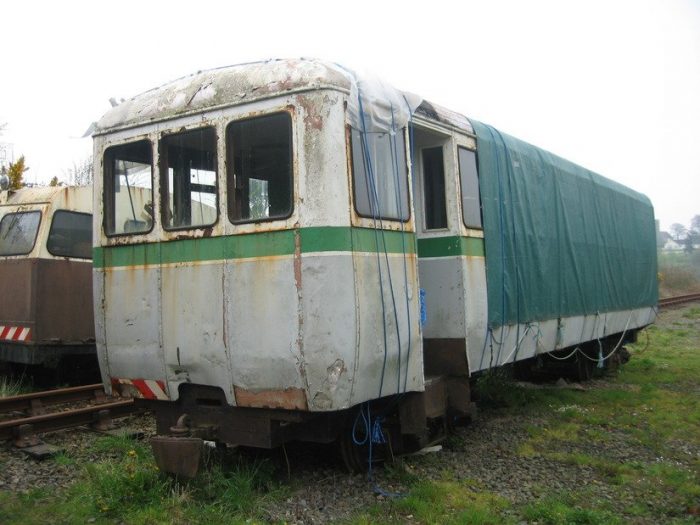
In 1951, when CIE introduced diesel railcars, three coaches, Nos 46C, 47C and 48C were converted at Inchicore into railcar trailers. They were given old omnibus bodies and had electric lighting fed from a 12V battery. Three four wheel light weight luggage vans were also built for use with the railcars. These were given Nos 187C, 188C and 190C. [35]

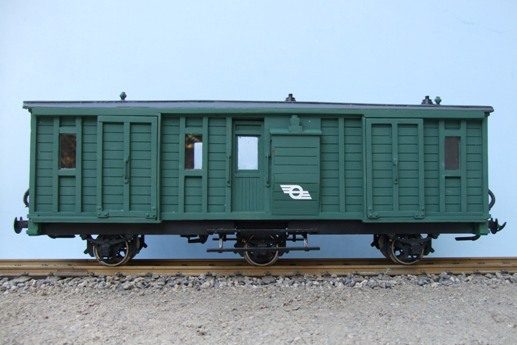
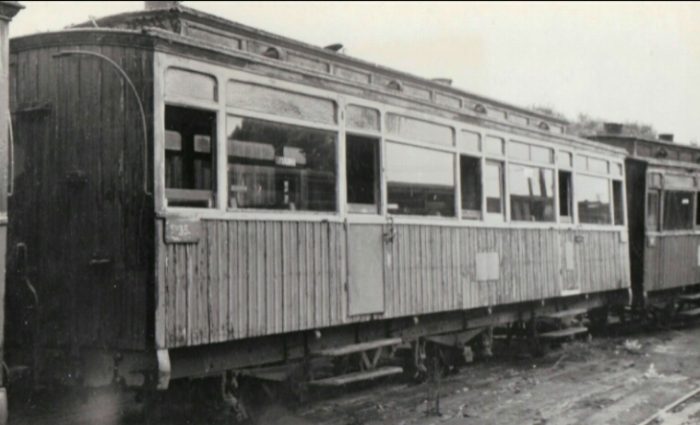
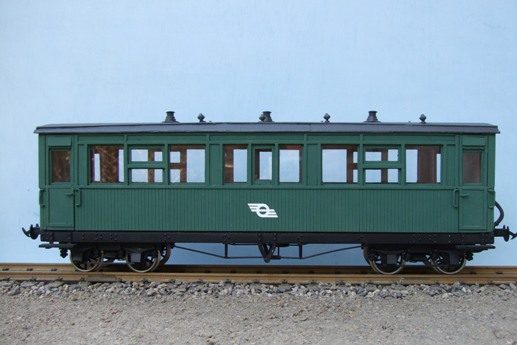
In 1953, the Tralee & Dingle closed completely and two brakevans arrived on the West Clare from the Tralee & Dingle. In 1954, two West Clare coaches were transferred to the Cavan and Leitrim (Nos. 42C and 52C. In 1957, 18 vehicles were withdrawn. In 1958 brake vans Nos 38C and 41C were withdrawn. In 1959, three four wheel vehicles and brake No. 36C were withdrawn. Further minor changes occurred before full closure of the West Clare in 1961, specifically including the transfer of two coaches from the Cavan & Leitrim (one of which was 42C). [36]6-wheel tourist coach No. 35 [9]1:22.5 model of West Clare Railway Brake Van 17c. [2]1:22.5 model of West Clare Railway Bogie- Coach No. 42c. [2]
Wagons: The wagon stock for the opening of the line was also ordered by Murphy and supplied by the Bristol Company. [36] 65 wagons were ordered (15 low side open, 25 covered, 10 covered cattle, 12 ballast and 3 flats). Ten wagons were ‘convertible’ which meant that they had an open centre-portion to the roof which could be covered by canvas.

For the opening of the South Clare in 1892, the Bristol Company supplied a further 21 wagons (6 convertible and 15 cattle). [36]

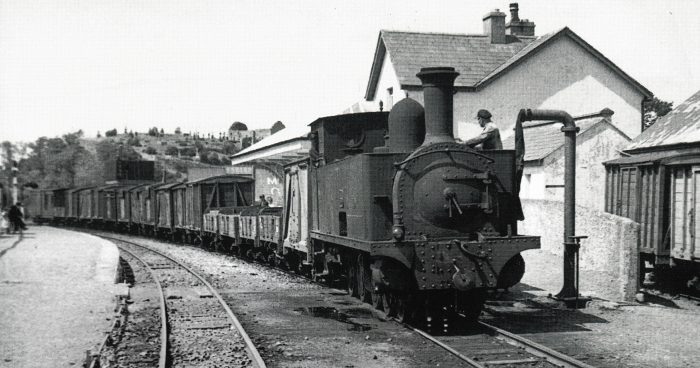
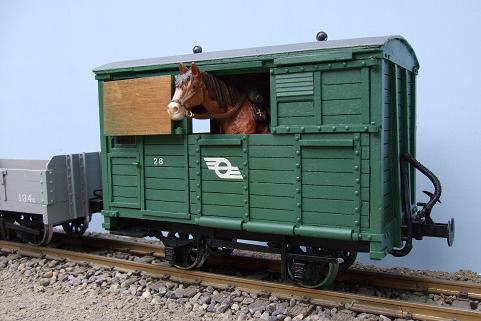
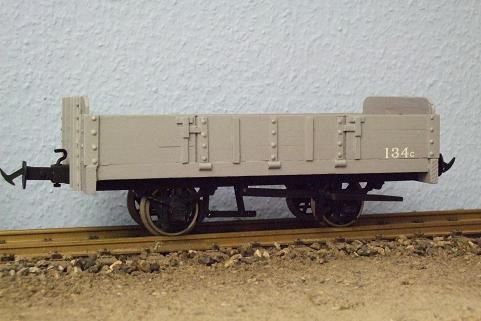
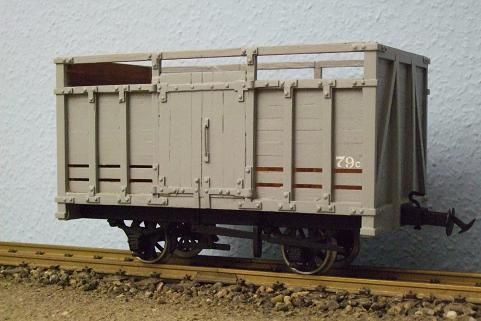
The next increase in stock came in 1899, when 10 covered wagons were supplied by the Bristol Company. With the opening of the workshops at Ennis, wagon construction started. The first wagons were built in 1902 (6 large open wagons suitable for cattle and turf. In 1904, a further 17 wagons  were built for the cattle traffic. Then, one covered cattle wagon in 1905 and two large open wagons in 1907. In 1908, six luggage vans were built for passenger trains and a further cattle wagon was provided. In 1911, another six covered goods wagons were built. Then six open coal wagons in 1912 and a further 5 covered wagons. In 1913, the last batch of wagons was built while the Company was independent – 10 covered cattle wagons.  [37]At Ennistymon on 28 July 1952, locomotive No 9C is on the 9:58 am goods from Kilrush with a typical rake of wagons. The loco is taking water. Driver Tom Reidy is on the engine, (c) C.L. Fry. [38] 1:22.5 model of West Clare Horsebox No.28c. [2] 1:22.5 model of West Clare Railway open Wagon 134c. [2]1:22.5 model of West Clare Railway open Cattle Wagon 79c. [2]
The GSR closed the Ennis workshops soon after it took over the West Clare. Between 1925 and 1929, 46 wagons were withdrawn (15 covered, 10 cattle, 19 open, 1 flat and 1 timber). 50 new wagons commissioned from Inchicore started to arrive on the West Clare in April 1929. These were 17 covered, 15 cattle and 18 open wagons. After the closure of the Cork & Muskerry in 1934 13 open goods wagons were transferred to the West Clare – the first foreigners! These had non-standard couplings and so were semi-permanently coupled in rakes. [39]

On closure of the Cavan & Leitrim in 1959, 25 wagons arrived on the West Clare, 18 open and 7 covered. All surviving wagons were scrapped on closure of the West Clare, with the exception of a few sold to Bord na Mona. [39]

References

  1. Patrick Taylor; The West Clare Railway; Plateway Press, 1994, p53.
  2. https://largescaleworld.hpage.com/west-clare-railway-ireland.html, accessed on 10th July 2019.
  3. http://www.narrowgaugerailwaymuseum.org.uk/collections/public-carriers/west-clare-railway, accessed on 10th July 2019.
  4. Patrick Taylor; op.cit., p55
  5. Ibid., p57.
  6. Ibid., p58
  7. Ibid., p59.
  8. http://www.worsleyworks.co.uk/Image-Pages/Image_NG_Irish_WCR2.htm, accessed on 10th July 2019.
  9. https://www.ebay.co.uk/itm/fg-irish-ireland-plain-back-postcard-6-wheel-tourist-coach-west-clare-railway-/401499456892, accessed on 10th July 2019.
  10. Gabriel Vaughan; My Affair with Malbay; ColourBooks Ltd, 2000.
  11. http://forum.e-train.fr/viewtopic.php?f=5&t=88663, accessed on 10th July 2019.
  12. Patrick Taylor; op.cit., p77.
  13. Ibid., p77-122.
  14. Ibid., p107.
  15. Ibid., p111.
  16. http://www.skibbereeneagle.ie/ireland/west-clare-railway, accessed on 12th July 2019.
  17. https://www.irishtimes.com/news/restored-steam-engine-back-on-the-tracks-after-57-years-1.691033 (2nd July 2009), accessed on 12th July 2019.
  18. http://www.westclarerailway.ie/about/history, accessed on 12th July 2019.
  19. https://orion.math.iastate.edu/jdhsmith/term/sleiwcr.htm, accessed on 12th July 2019.
  20. https://www.ebay.co.uk/itm/362292119376, accessed on 13th July 2019.
  21. http://www.trawbreagabaylightrailway.com/railcars.html, accessed on 16th July 2019.
  22. https://en.wikipedia.org/wiki/CIE_501_Class, accessed on 16th July 2019.
  23. http://www.stephenjohnsonrailways.co.uk/F501%20Class.htm, accessed on 16th July 2019.
  24. https://www.flickr.com/photos/110691393@N07, accessed on 5th May 2019.
  25. http://www.irishtractiongroup.com/withdrawn.html, accessed on 16th July 2019.
  26. https://www.gracesguide.co.uk/J._Scarisbrick_Walker_and_Brothers, accessed on 16th July 2019.
  27. https://en.wikipedia.org/wiki/Walker_railmotor, accessed on 16th July 2019.
  28. Taylor: op.cit., p111.
  29. Ibid., p124.
  30. Ibid., p119.
  31. Ibid., p117.
  32. Ibid., p123.
  33. Ibid., p128.
  34. Ibid., p132.
  35. Ibid., p134.
  36. Ibid., p139.
  37. Ibid., p143.
  38. Ibid., p60.
  39. Ibid., p148.
The West Clare Railway – Part 7 – Moyasta to Kilrush and Cappagh Pier

The Line of the West Clare Railway from Moyasta to Kilkee

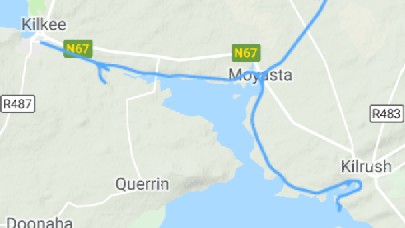
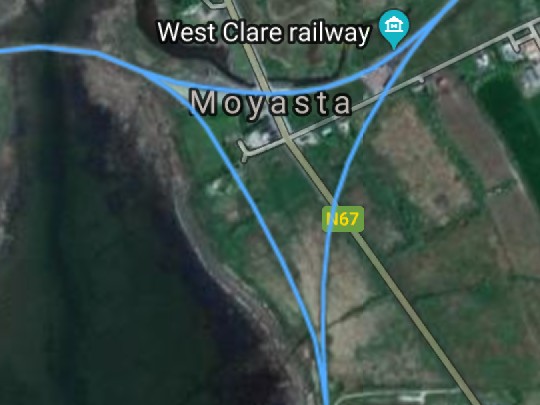
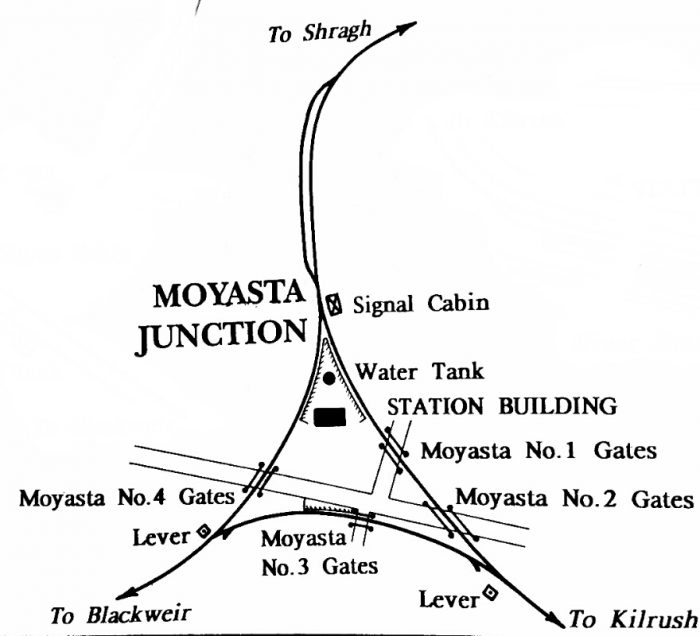
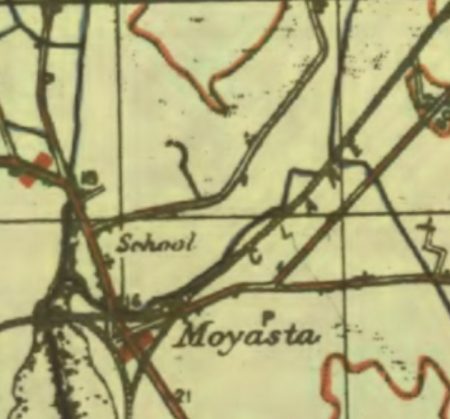
Moyasta was a junction station. The two lines which left to the south and to the west served Kilrush and Kilkee respectively. The two routes feature on the adjacent map. This post focusses on the line to Kilrush and on to Cappagh Pier.Before we set off, we note two things, as we did in the last post, about the station at Moyasta. First, the presence, in the 21st century, of a preservation line based at the station; and second, the layout of the junction at Moyasta. Although a direct line was provided to allow trains to travel between Kilkee and Kilrush. In practice it was little used in later years as trains tended to enter Moyasta station from either of the two villages and the set off from the station for the other village. This required some manoeuvrings in the station area!

However, when the pier was in use at Cappagh, “the Loop … was extremely useful for allowing a direct passage to through traffic, especially from Cappagh to Kilkee.” [2]

We spent time in the last post in this series looking at the preservation line. The link to that post is: https://rogerfarnworth.com/2019/05/09/the-west-clare-railway-part-6-moyasta-to-kilkee

We also considered the loop line in the same post and we will not repeat what was said in that post about the link that made direct services between Kilkee and Kilrush/Cappagh Pier possible.There were four road-crossings at Moyasta, all within a radius of 200 yards of the station-house. By the late 1980s, Lenihan observed that, “as at most other such places, there was nothing, for at Moyasta, just as at Knockdrumniagh, near Ennistymon, road widening has changed utterly the lie of the land.” [2] The plan is taken from Patrick Taylor’s book. [1] 

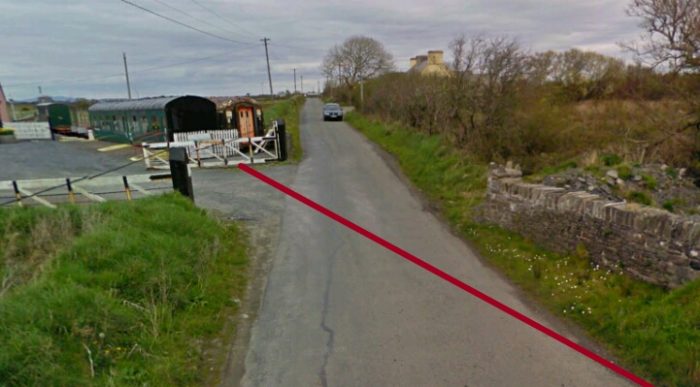
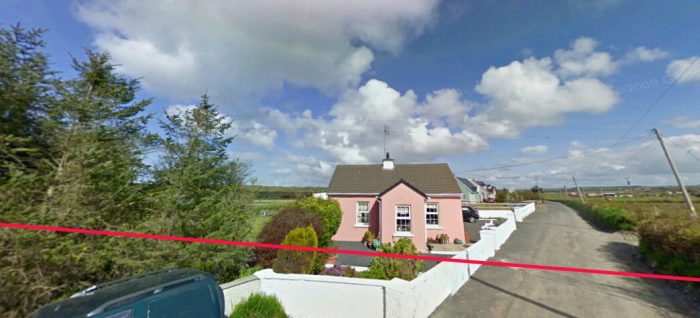
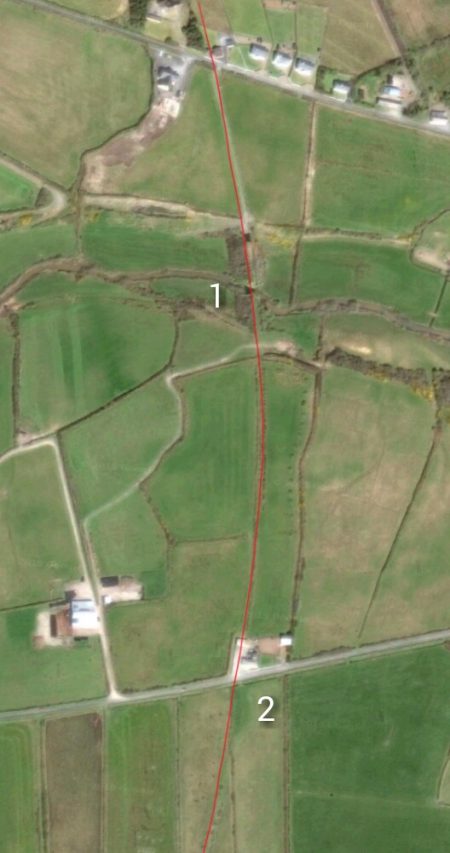
We allow our two guides, Edmund Lenihan and Patrick Taylor to take us out of the station and its environs and on to Kilrush and Cappagh Pier. The presence of the preservation railway means that the locations of the crossings shown above are easier to define in the early 21st century than they might otherwise have been.Moyasta No. 1 Crossing (above).

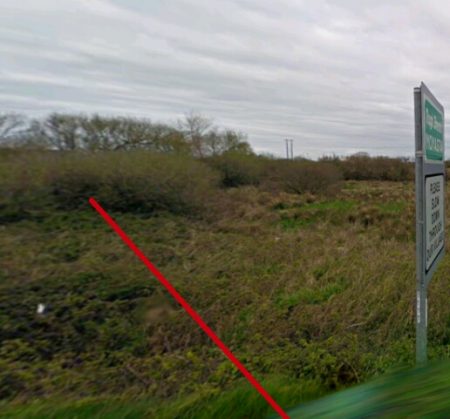
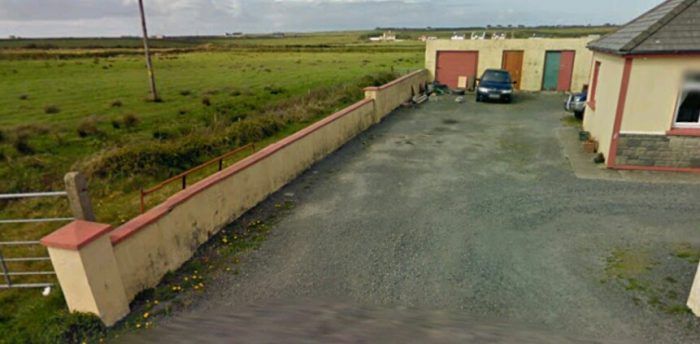
The adjacent image is taken at Moyasta No. 2 Crossing looking back towards No. 1.

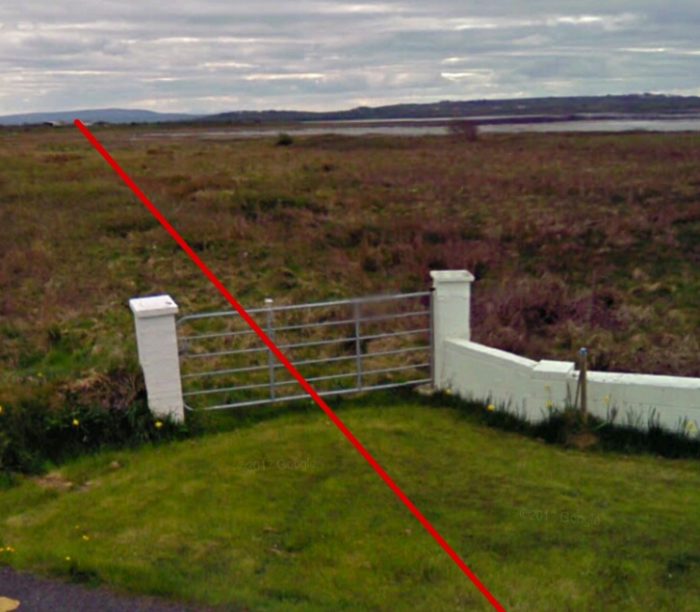
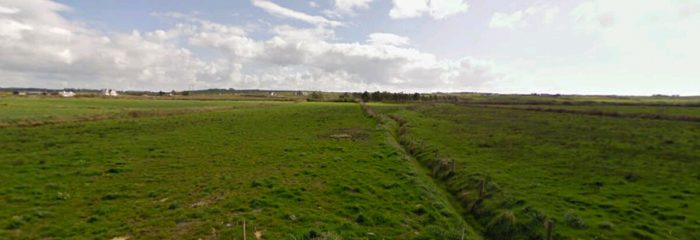
The picture below is also taken  at the No. 2 Crossing looking towards Kilrush. The Shannon estuary can be seen in the distance.

The Line to Kilrush

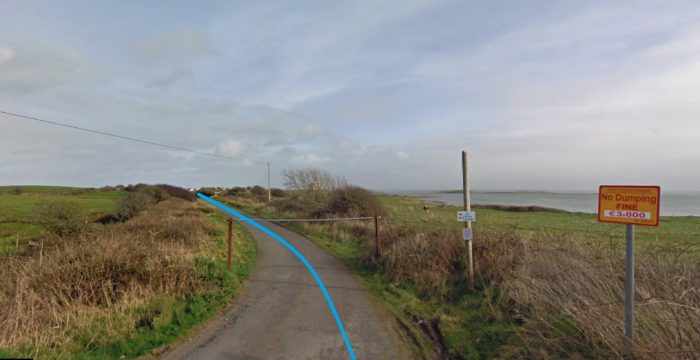
Edmund Lenihan comments in the late 1980s that the line from the station beyond Moyasta Crossing No. 1 was so overgrown as to be impassable. [3][7] The forty-third milepost was at Crossing No. 2. This crossing was the site of a serious accident “when a young boy, trying to save the gates from an oncoming trail, was knocked down and killed.” [4]

From the road to the junction with the loop is only a relatively short distance.Moyasta junction with the Kilkee/Kilrush loop on the left. The railcar has left Moyasta Station which is of the extreme right of the picture with a service to Kilrush. As we have already noted, there were few non-stop workings between Kilrush and Kilkee. Trains from one or other village used to enter the relevant platform at Moyasta and then propel backwards before using the loop to head on to the other village.

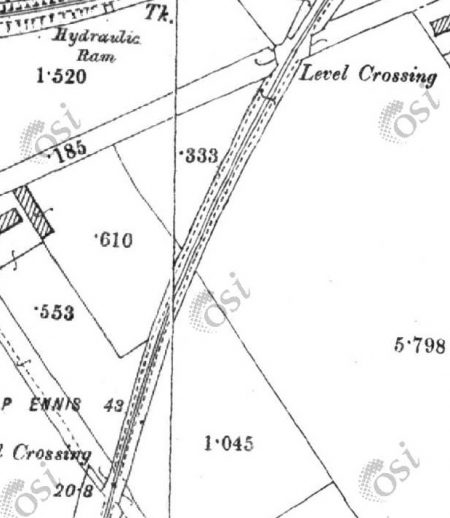
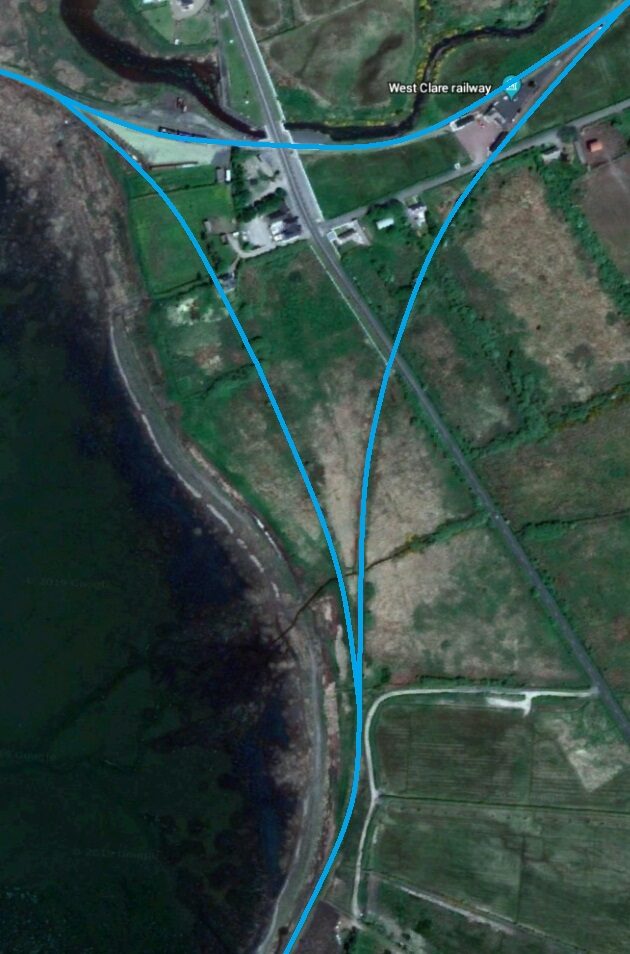
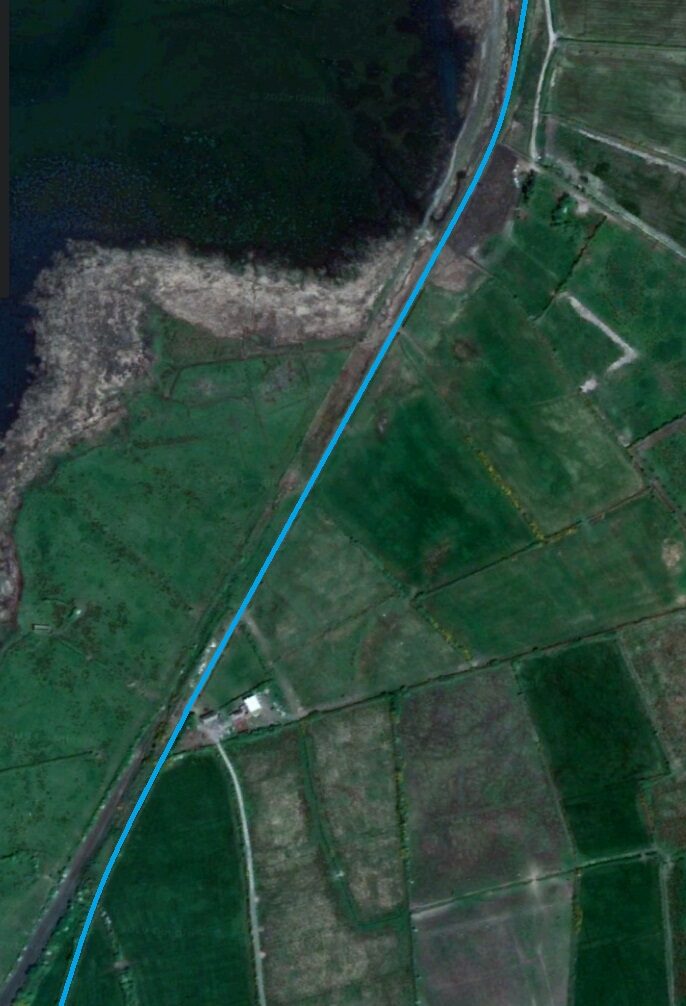
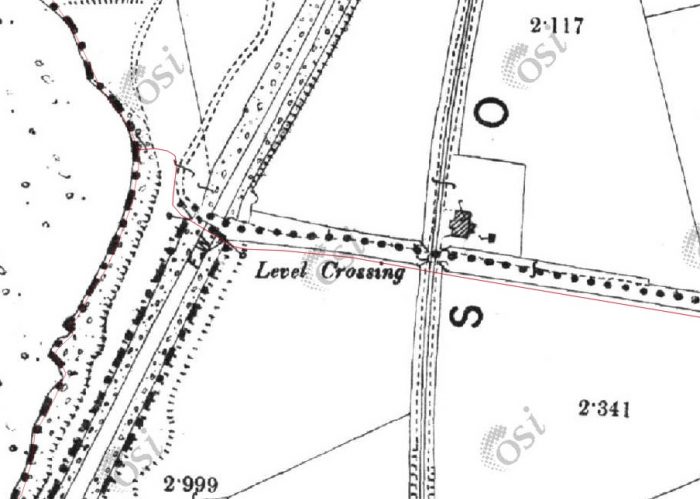
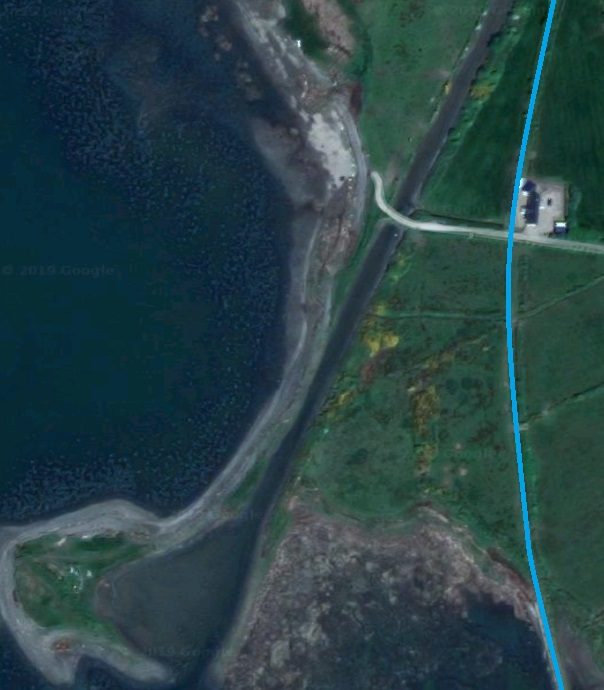
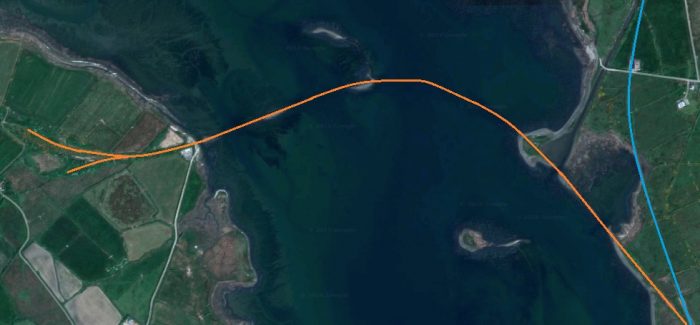
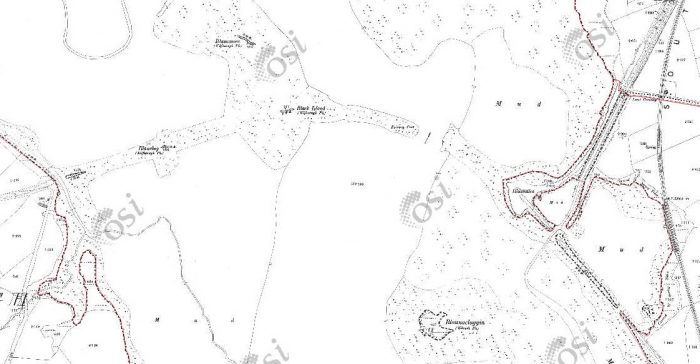
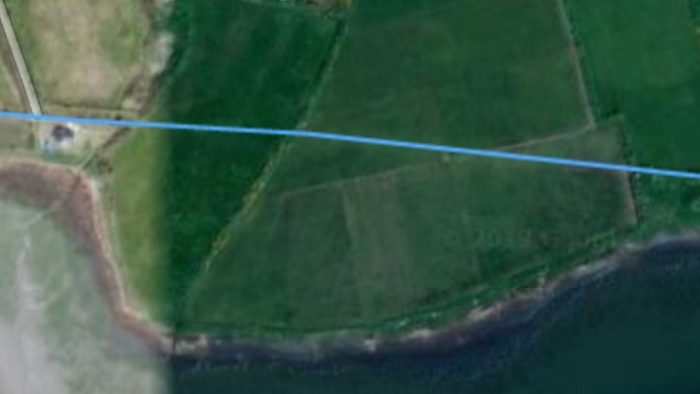
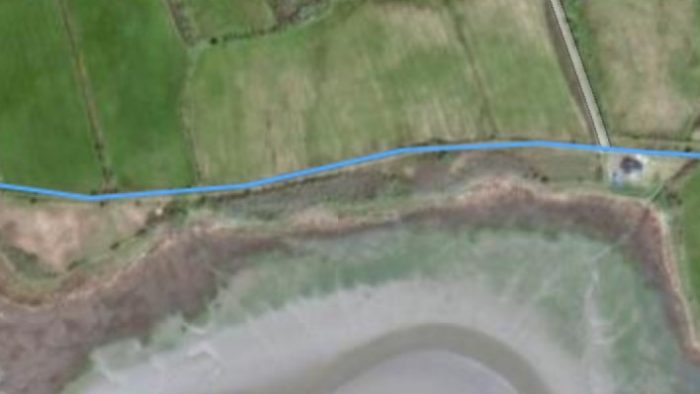
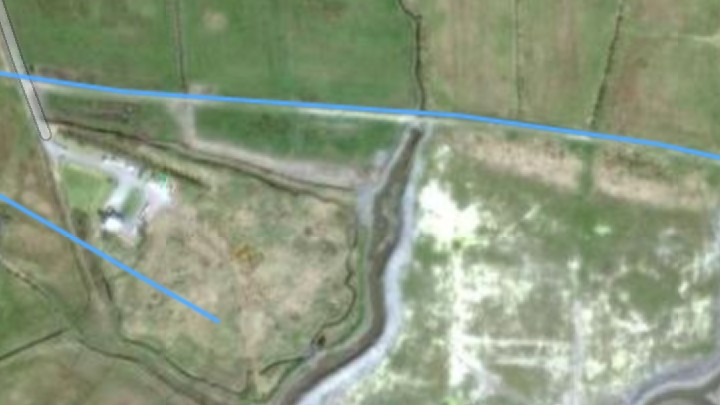
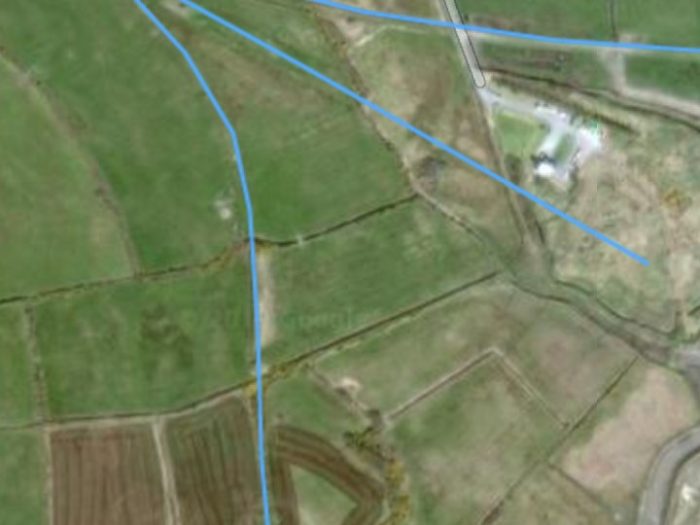
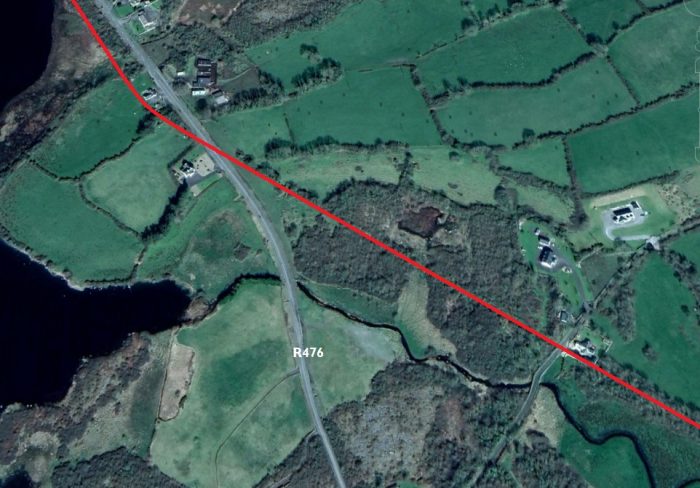
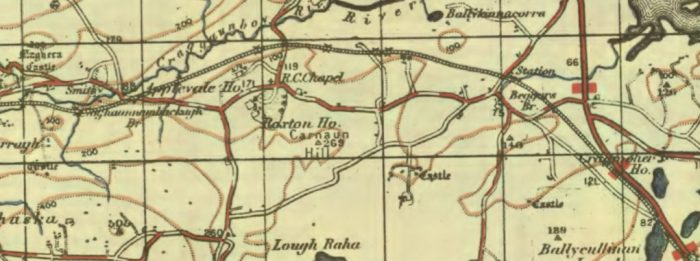
The line continues from the crossing in a wide, graceful sweep along the edge of the bay no more that 300 mm above the high-water level. Effectively the line was on causeway as there is evidence of the sea invading the land beyond the line.Continuing on into the townland of Carrowncalla North the embankment of the old line acts as a breakwater. After a length of straight track, the line curved southwards again. Soon the next road crossing was encountered, Carrowncalla No. 1. In the late 1980s the crossing-keeper’s cottage was intact but seemingly unoccupied. [5] Later, in a return visit in 2008, Lenihan noted that the cottage had been renovated but was still not lived in. [6] 150 yards to the West of the crossing, the road bridged a boat channel. The crossing is shown on the OS Map extract and satellite images below. [7]The narrow neck of land to the west of the boat channel continued on and came to a head at Ilaunalea, 500 metres distant. This can be seen easily on the satellite image above. “From here in 1863 it was proposed to build an embankment across the mouth of Poulnasherry, by way of Black Island and Ilaunbeg, to Kilnagalliagh, on the western shore. It was a daring plan and probably would have succeeded but for the ill-advised attempt to close the mouth of the bay in the face of winter tides.” [5] By the 1980s, only eroded, scattered remains  were visible, and that only at low tide. The blue line on the satellite image above shows the route of the West Clare Railway. The orange line shows the route of the planned but eventually incomplete railway crossing the mouth of Poulnasherry. The orange line could have been extended in a northwesterly direction and looking at satellite image shows the old formation still evident to the Northwest. The importance of the line drawn on the image above to to show its route across the tidal estuary.  The embankments show clearly on the OS Map extract from the 1950s, immediately above. [7]


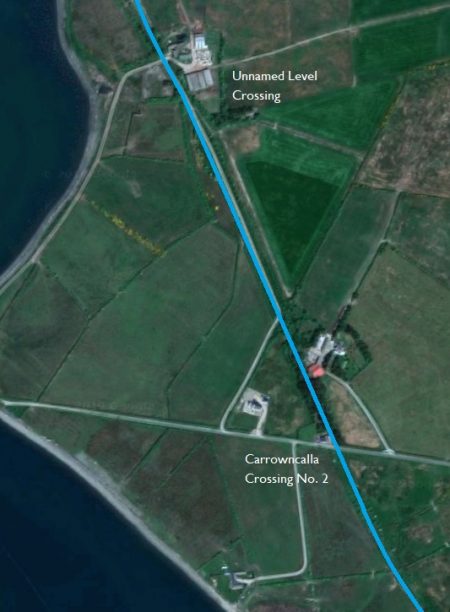
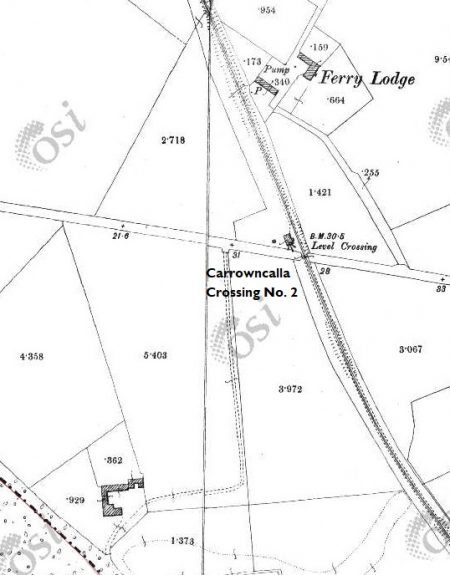
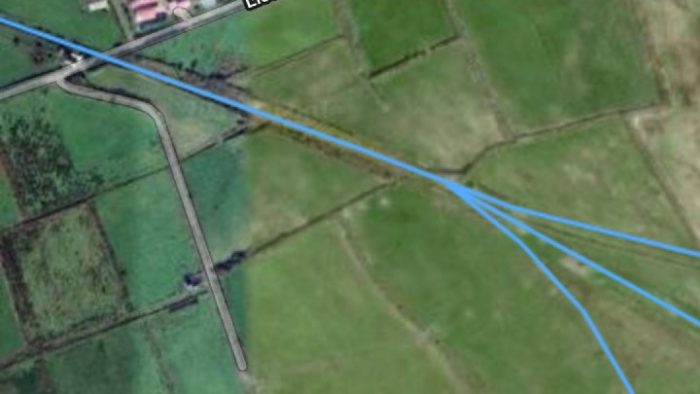
Immediately south of the point where the orange and blue lines diverge/meet (and just off the satellite image above is the location of an un-named accommodation crossing there was then a straight length of track before Carrowncalla No. 2 Crossing. Lenihan diverted a way from the West Clare for a time to explore the coast line and the older earthworks before heading back to the West Clare at the point of this level crossing. [8]

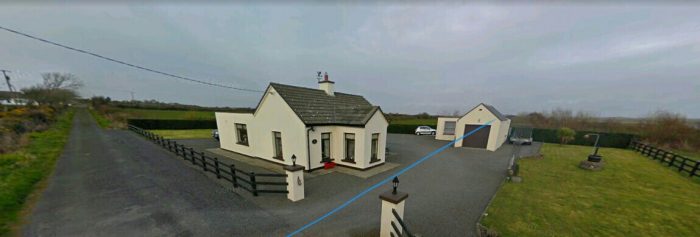
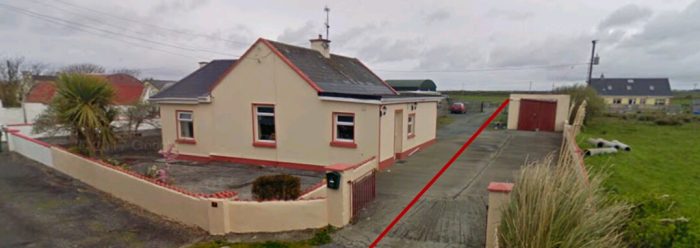
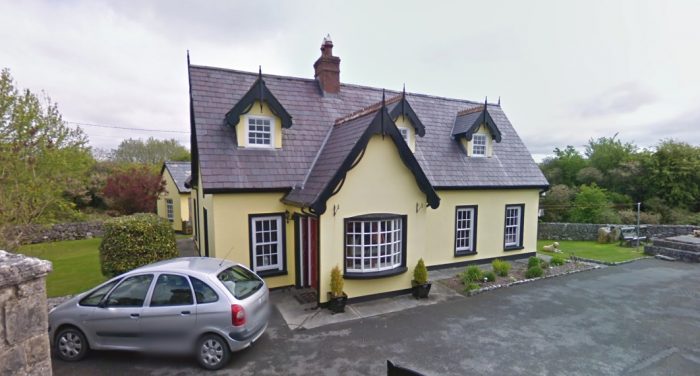
Between the unnamed crossing and Carrowncalla No. 2, the line ran in a straight South-southeasterly direction. In the 21st Century, it is in use as an access road for much of that length. Lenihan visited the level-crossing location again in 2008 and commented that the house had been fully renovated and was now lived in. [6]Looking North-northwest along the formation of the West Clare Railway (marked by the blue line) from Carrowncalla Crossing No. 2. The Crossing-keeper’s cottage has been extended to make an excellent modern home. (Google Streetview).Above, looking South-southwest from the same location. (Google Streetview). The image below comes from Taylor’s book and is taken on the North side of the crossing. [16]

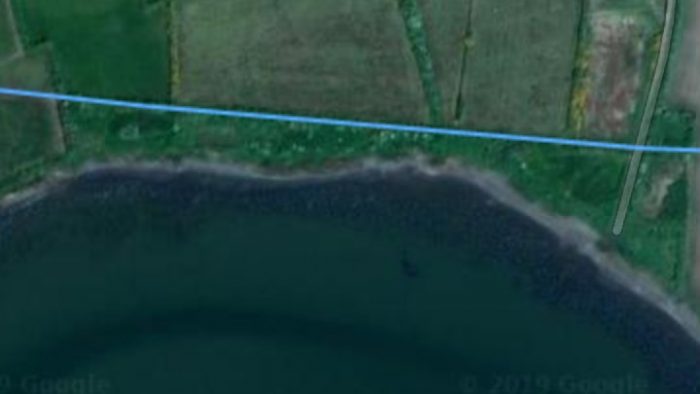
South of Carrowncalla Crossing No. 2 the line curved a little towards the Southeast and ran for a short while alongside a small bay before crossing Brew’s Bridge. The location of Brew’s bridge can just be picked out at the bottom right of the adjacent satellite image.The extract from the OS Maps shows the location clearly, just to the Southeast of the bay. Lenihan has a lot to say about this location. [9]
The northern abutment of Brew’s Bridge in 2009. (Google Streetview).The more southerly of the two bridge abutment  in 2009 with the house alongside the old formation as mentioned by Lenihan. (Google Streetview).

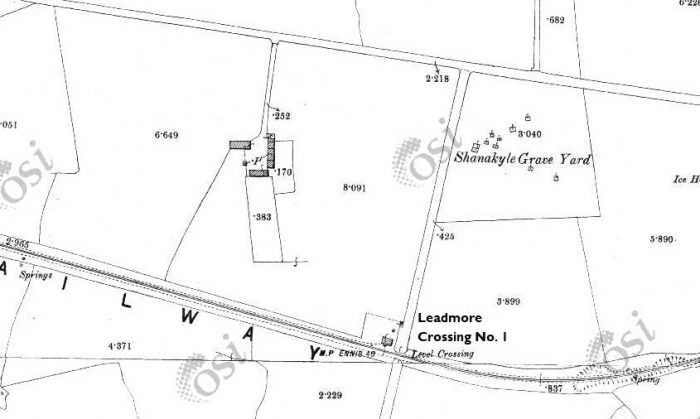
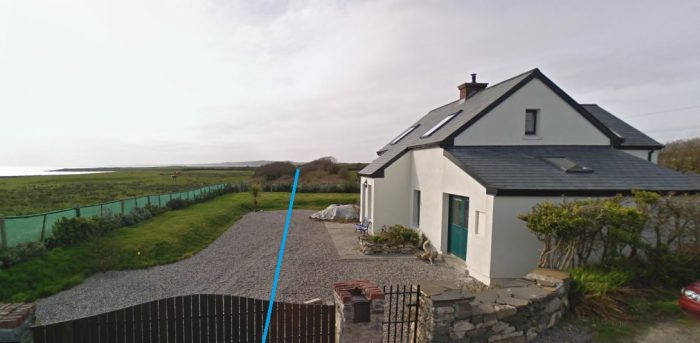
Beyond Brew’s Bridge the line gradually turned Eastward. The going was relatively easy.The next crossing was Leadmore No. 1 which was south of the Shanakyle Graveyard. The Crossing-keeper’s cottage here has also been renovated and is lived in. [6][7]

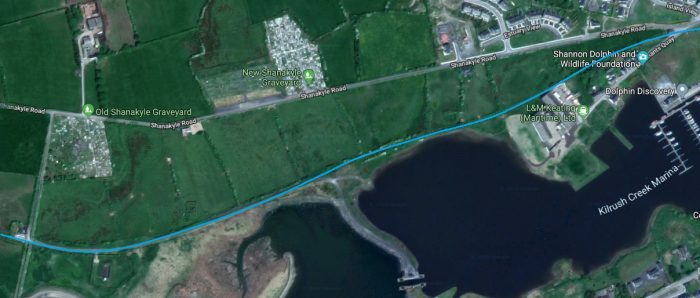
In the 1980s, Lenihan commented that “to enter Leadmore no. 1 cottage was to get a brief glimpse of the past, for the interior of the house was quite unchanged from how it would have looked in West Clare days. An old railway clock, the open fireplace, a drawing of engine no. 5 from 1892, all testified to a lingering regard for old times, though the owner was quite adamant that she had no regrets over the passing away of the railway.” [10]Leadmore Crossing No. 1 with the old keepers cottage to the right and the line back towards Moyasta shown by the blue line. (Google Streetview).Looking ahead along the line to the East and towards Kilrush from the smae location, (Google Streetview).From Leadmore Crossing No. 1, the line heads East-northeast into Kilrush.En-route to Kilrush the old line passed through Leadmore village. [7]

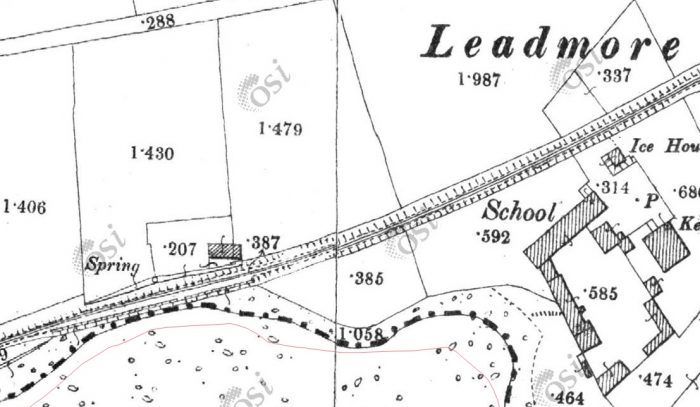
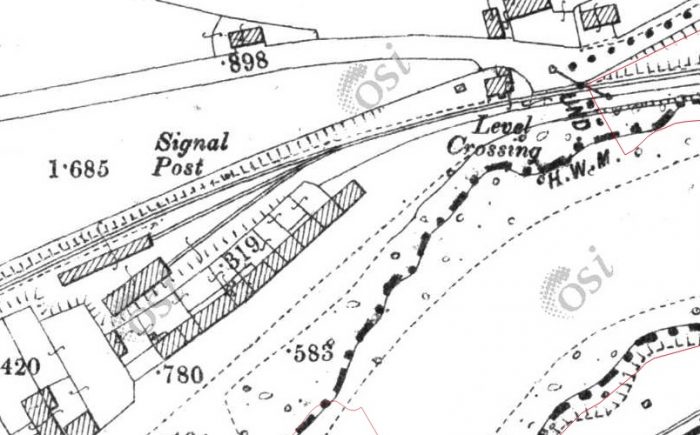
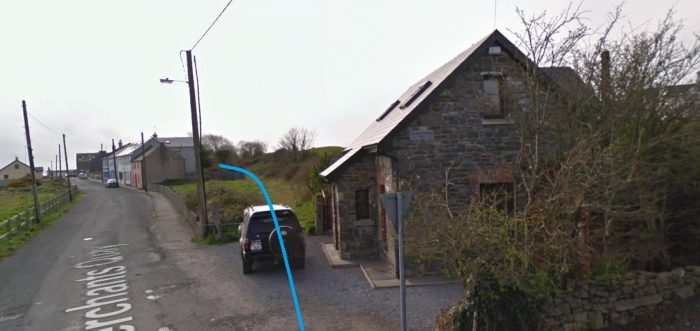
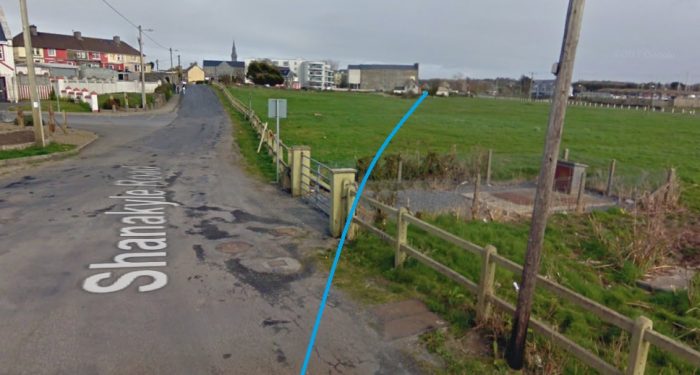
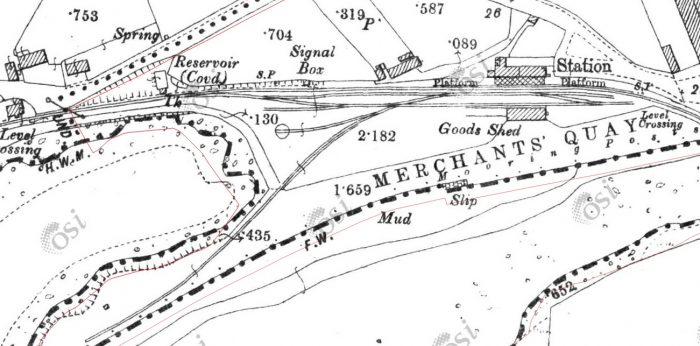
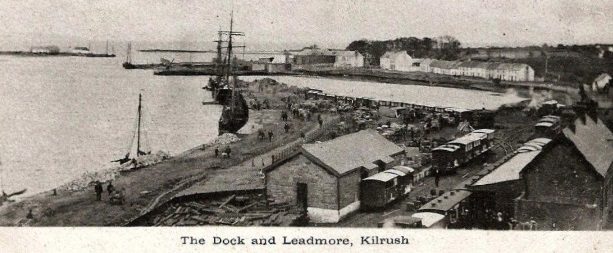
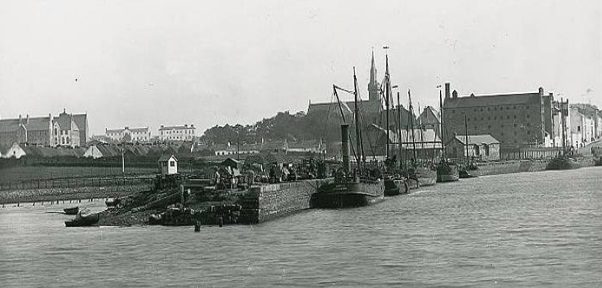
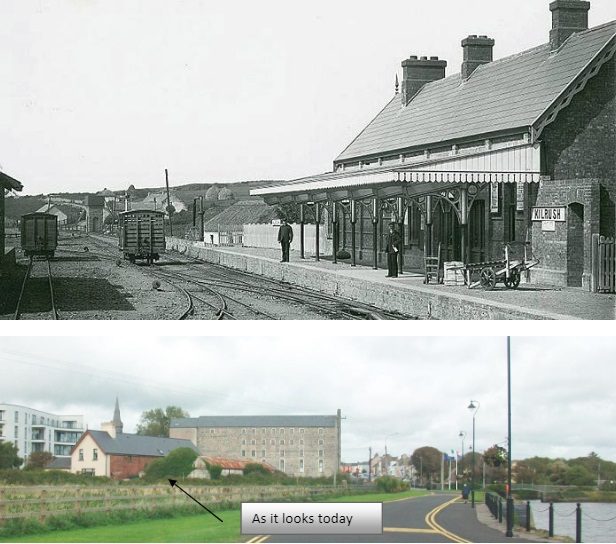
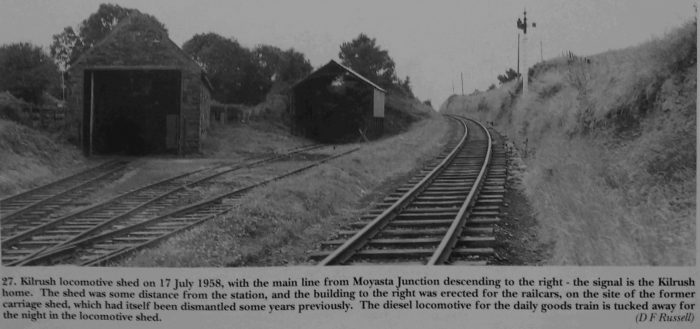
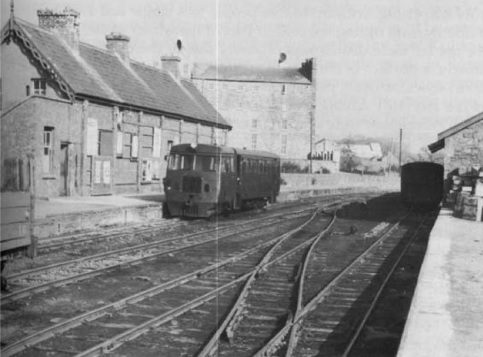
One length of the line en-route to Kilrush was close enough to the water to need a revetment constructing to protect the line. That location can be seen above on the left of the OS Map extract. The school shown on the right of the extract is now the location of L&M Keating (Maritime) Ltd. We are actually now very close to Kilrush station. The OS Map extract below shows the first part of the station site which was to the West of the Level Crossing.Taylor comments: “The line from the down home signal, where a short steep decline at 1 in 72 commenced, continued past the two road carriage shed, and one road engine shed on the up side, until Leadmore No. 2 level crossing was reached before entering the yard at Kilrush. This crossing, whcih was built on a curve, was protected by up and down signals.” [16]This view looks back along the old line towards Moyasta. The renovated Crossing-keeper’s cottage is on the right. The crossing gates were relatively narrow and the stone pilasters which supported the gate are still evident. (Google Streetview). To the left of the line behind the cottage were two buildings which were rail-served. The engine shed and carriage shed. The engine shed was the smaller building closer to the cottages.From the same location (Google Streetview), looking into the station yard which in 2009 was now grassland. The station building can be seen in the distance immediately to the left of the blue line.The station site at Kilrush taken from the East. (Google Streetview in 2011). The station building and platform edge are still visible. The goods shed has been replaced by a corrugated steel roofed structure.The station site at Kilrush also taken from the East. (Google Streetview). The station building is shown to greater advantage. The old Merchants’ Quay which is on the left of the image, is now (2011) the access route to Kilrush Marina.An early (circa. 1890) picture of Kilrush Station taken from the West. [11] The next four pictures are closer looks at this image.This image shows the view across the station site to the docks/Merchant’s Quay and Leadmore. The old goods shed can be seen in the centre of the picture. [12]This view of the harbour at Kilrush shows the station building and goods shed, centre-right. A signal and ground-frame hut can be seen centre-left. [12] The image below is an excellent period photograph of the station building. [12]The access road to Kilrush Marina has been improved and is now (2018) metalled and Merchant’s Quay has been refurbished. It provides a good location to take a picture of the station building(s) and Glynn’s Mill building(s) as they appear in the first quarter of the 21st Century. [12]

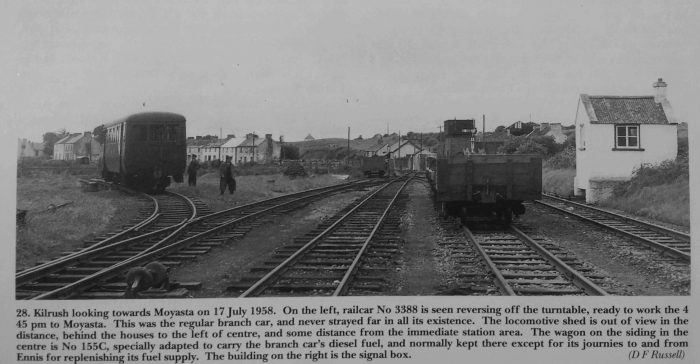
Taylor describes Kilrush as “the self-styled ‘Capital of West Clare'” [16]Taylor provides a number of important photographs of the Kilrush station site – the first of these shows the engine shed and carriage shed in 1958. [16]Also taken by D.F. Russell, this picture looks back towards the engine and carriage sheds from the middle of the station yard. [17]The station in the 1950s viewed from the Goods platform, (c) IRRS No. 10748. [18]
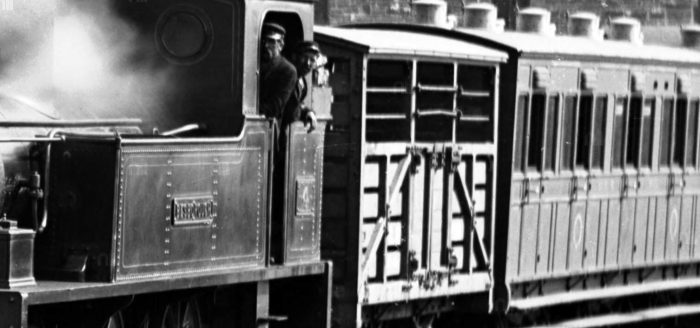
Edmund Lenihan, writing in the late 1980s, having just explored the station site, said:

“Uncomfortable, even dangerous, though it was to have to pick our way through this wasteland, we did it, still hopeful of finding something. We might as well have gone by the road; there were no wonderful discoveries, no magical ending, only the station-house, standing, as always, just across the road from Glynn’s mills and round the corner from Merchants’ Row and Frances Street.” [13]

The station building has been significantly refurbished as the modern photos above show. In 1999, Lenihan wrote:

“In the years since I last visited [Kilrush] a great deal has changed, and for the better, particularly at the station end. Gone is the rubbish dump that defaced the area beside Leadmore no. 2 level-crossing cottage (p.249). It is now as clean and level as a town park, and an unimpeded view of the station is possible from several hundred yards away. ‘Crush marina, which was then only in its planning stage, is now in full operation and has brought life back to the creek, though hardly to the same extent as when Turf Quay, Customs Quay and Merchants’ Quay were in their heyday. Close by, a Scattery Island interpretative centre has been opened, and across the creek, beside Doherty’s timber yard and the site of the removed railway bridge (p. 256), is a new activity centre.” [14]

Writing in 2008, Lenihan describes the station site again:

“The station-house is there, certainly, and is once more a dwelling, for two families now. Its eastern gable, which was disfigured by a large door during the building’s days as a truck garage, has been restored. But the fine triangle of clear ground between it, the marina and Leadmore no. 2, which common sense might suggest should be preserved as a public amenity, is now under pressure of commercial development, despite the fact that the future of some of the similar recent developments in the town is uncertain because of the deflation of the property bubble.” [15]


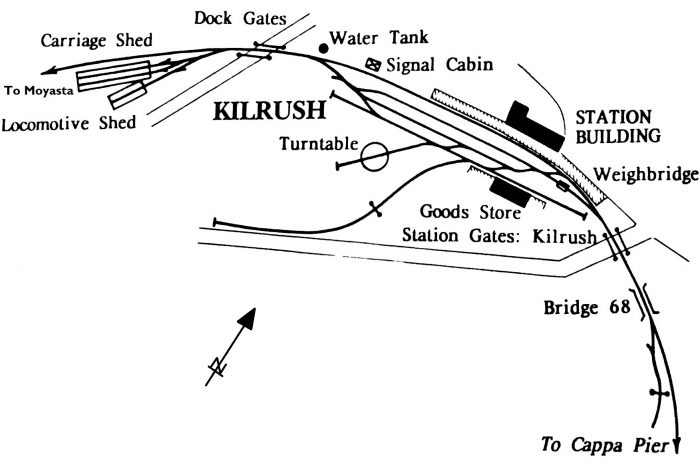
The sketch plan above shows Kilrush station in its heyday. It is provided by Patrick Taylor. [1]

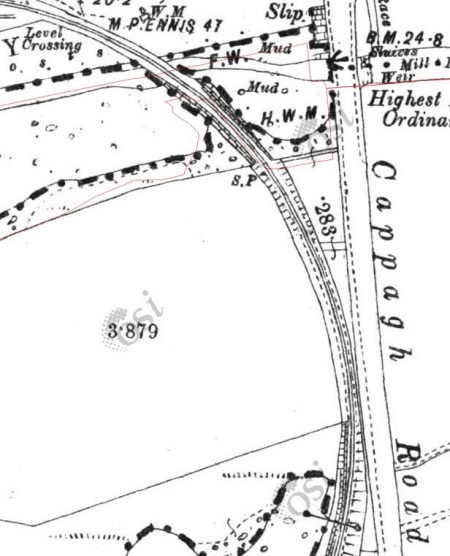
The adjacent OS Map extract shows the West Clare railway continuing beyond Kilrush Station. It turns through 180 degrees on a tight radius curve. The bridge over the tidal channel is Bridge No. 68 shown on the sketch plan above.[7]

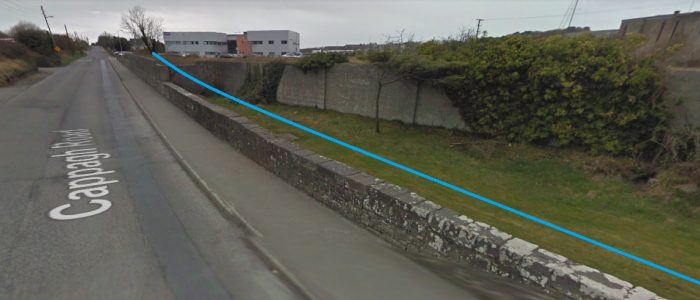
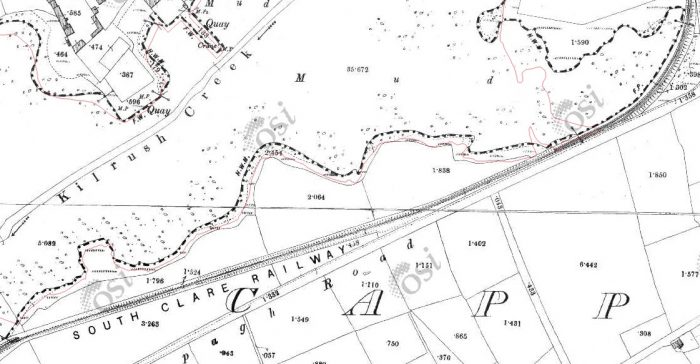
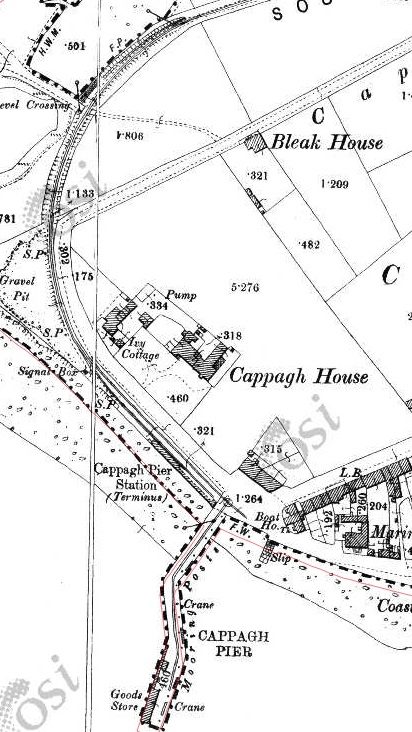
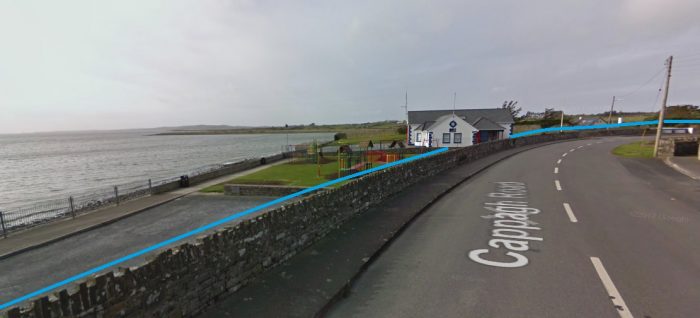
The railway then continued in a Southwesterly direction on the South side of Kilrush Creek, as shown in the OS Map further below. [7]The way ahead to Cappagh Pier. Bridge No. 68 has been removed and replaced with a footbridge, (c) D.F. Russell. [21]The approximate line of the old railway to Cappagh Pier is shown by the blue line (Google Streetview – 2011). The footbridge is at approximately the location of the old railway bridge.Looking West down Kilrush Creek in 2011 (Google Streetview). The station is visible on the right of the picture the railway embankment and bridge abutment are right of centre. In this picture from 2011 (Google Streetview) the road which used to turn through a very sharp right-angle bend has been diverted to run directly alongside what was the alignment of the railway.As can be seen in the OS Map extract below the road and rail drift apart on their way westward.Passing Bleak House on their left, trains from Kilrush then curved round to the South east before entering Cappagh Pier Station close to Cappagh House. Just prior to the station a gravel extraction pit was passed on the right. Beyond the station there was a short gated stub line with a turntable. The turntable gave access to Cappagh Pier and the line ran out to the end of the pier and a Goods Store. [7]

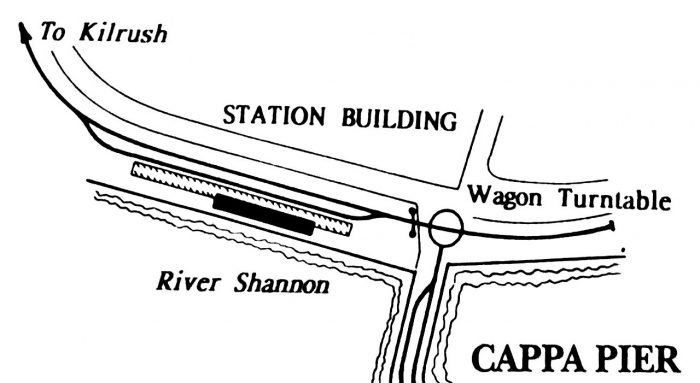
Taylor’s sketch plan of the station and pier is shown below. [1]

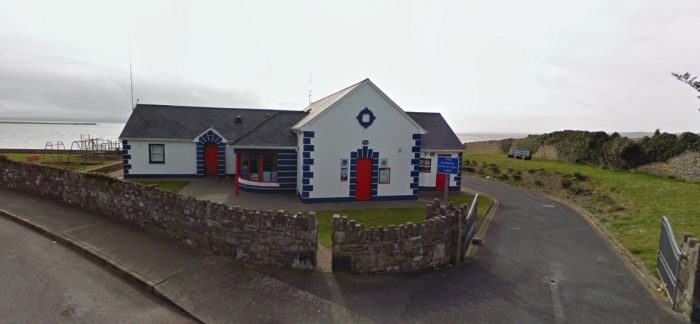
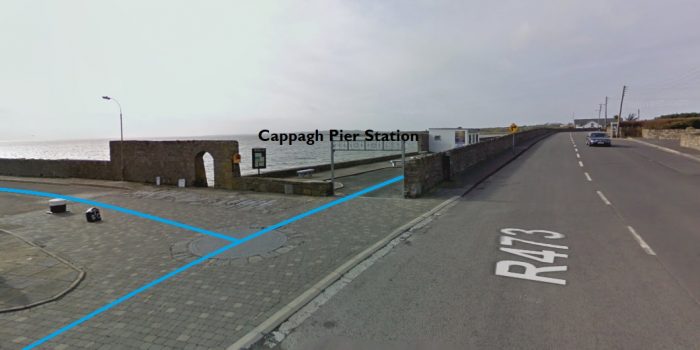
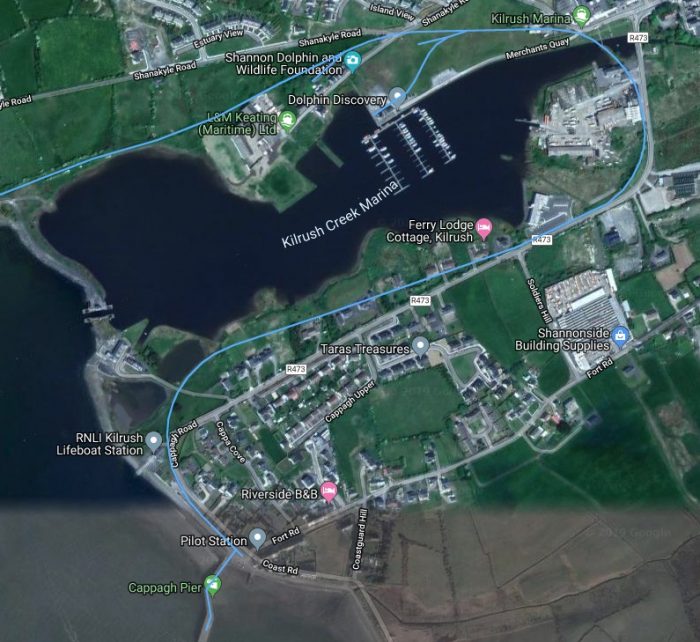
Historically there were two platforms at Cappagh Pier Station and each had canopies. Taylor’s comments about the station appear below.The gravel pit in the OS Map extract is now the site of the RNLI station (Google Streetview).From this point road and rail run immediately parallel to each other into Cappagh Pier Station (Google Streetview).The turntable location is marked in the paving at the site of the station and pier at Cappagh, (Google Streetview).This satellite image shows the full extent of the old line in the vicinity of Kilrush and Cappagh. [19]The terminus at Cappagh in 1953, (c) IRRS No. 10439. [20]Turning 90 degrees to the left from the above photograph, this is the view down the pier at Cappagh. The turntable is in the foreground and the Good Store is visible at the end of the pier. [21]

Taylor writes: “On the last mile of line from Kilrush to Cappa Pier, after passing through the level crossing gates at 47 m.p., and over the Ballykett stream bridge No.68, past Doherty’s timber yard (where a private siding ran into the yard on the up side) the line veered sharply to the right and ran along the opposite bank of Steamers Quay passing Supples crossing before turning left into Cappa. The line continued through a gate on to a small turntable 9’6″ long which turned wagons singly to the right and on to the pier which was provided with two sidings running parallel. The second siding was installed by the G.S.R. in 1933 for the quick turn round of wagons. Cappa was provided with two running roads and two platforms. The Platforms had overhead concrete roofs and entrance was gained to them at the pier end. The roofs and the down platform were removed by the G.S.R., possibly also in 1933.” [21]

This brings us to the end of our survey of the West Clare Railway. What remains is to look at locomotives and rolling stock in a future post.

References

  1. Patrick Taylor; The West Clare Railway; Plateway Press, 1994, p48.
  2. Edmund Lenihan; In the Tracks if the West Clare Railway; Mercier Press, Dec. 2008, p228.
  3. Ibid., p230.
  4. Ibid., p231.
  5. Ibid., p234.
  6. Ibid., p304.
  7. http://geohive.maps.arcgis.com/apps/webappviewer/index.html?id=9def898f708b47f19a8d8b7088a100c4, accessed on 2nd July 2019.
  8. Lenihan, op.cit., p238.
  9. Ibid., p241.
  10. Ibid., p245.
  11. https://www.facebook.com/kilrushcu/posts/railway-station-kilrush-co-clare-circa-1890/1200065626698858, accessed on 4th July 2019.
  12. https://docplayer.net/58337136-A-tribute-to-kilrush-in-the-great-war-by-ger-browne.html, accessed on 4th July 2019.
  13. Lenihan, op.cit., p250-251.
  14. Ibid., p293.
  15. Ibid., p305.
  16. Taylor, op.cit., p49.
  17. Ibid., p50.
  18. Lenihan, op.cit., p253.
  19. http://www.railmaponline.com/UKIEMap.php, accessed on 5th July 2019.
  20. Lenihan, op.cit., p258.
  21. Taylor, op.cit., p52.

The West Clare Railway – Part 6 – Moyasta to Kilkee

The Line of the West Clare Railway from Moyasta to Kilkee

Moyasta was a junction station. The two lines which left to the south and to the west served Kilrush and Kilkee respectively. The two routes feature on the adjacent map. We will focus first on the line to Kilkee on the Atlantic coast.Before we set off, we note two things about the station. First, the presence, in the 21st century, of a preservation line based at the station; and second, the layout of the junction at Moyasta. Although a direct line was provided to allow trains to travel between Kilkee and Kilrush. In practice it was little used in later years as trains tended to enter Moyasta station from either of the two villages and the set off from the station for the other village. This required some manoeuvrings in the station area!

However, when the pier was in use at Cappagh, “the Loop … was extremely useful for allowing a direct passage to through traffic, especially from Cappagh to Kilkee.” [7]

We will spend a little time looking at the preservation line and then move on out of the station and its environs and on to Kilkee. The journey will start by looking at the loop line.

The West Clare Railway [3]

It was not until the mid 1990’s that a local committee attempted to revive this treasured historical railway.

Jackie Whelan became involved when a committee for the Restoration of the West Clare Railway was created in the mid 1990’s. He initially carried out all the preparatory works for the tracks of this railway line, including all excavation works, track laying & fencing on a voluntary basis for this committee.

One objective of the committee was to include the “Slieve Callan” steam engine as part of the proposed West Clare Railway restoration project. At that time this steam engine lay dormant and on display at Ennis Railway Station. This project presented an excellent opportunity to preserve and restore this unique locomotive.

A proposal was made to C.I.E. to remove the engine from its plinth in Ennis. For any proposal to be considered it required proving a commitment to the West Clare Railway restoration, and this was obvious by the substantial preparatory work carried out in Moyasta. An agreement for the removal of the “Slieve Callan” steam engine from Ennis to Moyasta was granted to the West Clare Railway company, amid much consternation in Ennis at the time.

Unsurprisingly, the agreement had conditions, including that the engine be substantially improved or rebuilt within 3 years. This would require enormous funding. At this stage the committee involvement ceased. Jackie then became directly responsible for carrying forward and persevering with raising funds to continually update and improve this unique venture to bring to where it is today.

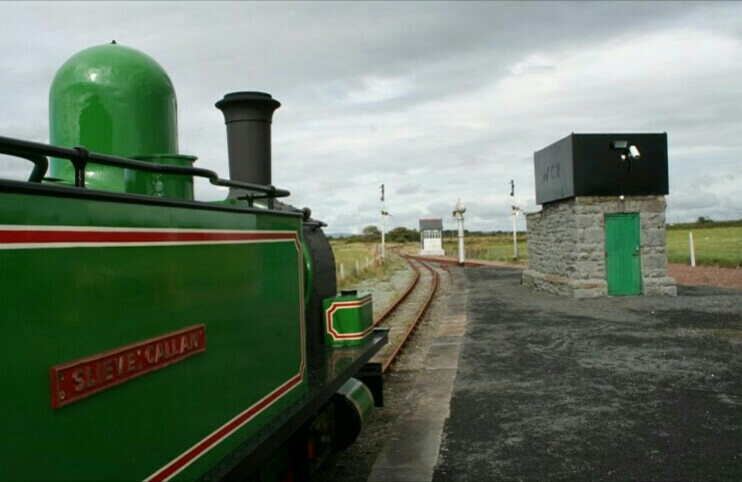
In 2009 the “Slieve Callan” returned, rebuilt and running smoothly, to Moyasta Junction. It now provides visitors and enthusiasts alike with a look into, and experience of, the fascinating railway history of Ireland, and is a fitting tribute to our heritage and to the hard work and efforts of all involved in bringing a steam locomotive back to Moyasta.

Just a few pictures to whet the appetite for more. The first few come from the West Clare Railway website. [3]

The Loop Line

Moyasta has been referred to as, “this railway ‘republic’, this ‘island state of the narrow-. gauge'” [5] Lenihan sought an opportunity, first, to look at the avoiding loop and headed from the station down a little laneway towards  the shore. “Almost at once we came to another lane at right angles to it, where stands the last of a row of twelve thatched houses that can be seen in many of the old photographs and which have vanished within the past thirty years. A sign of changing times and improvements in housing, perhaps, but also an indication of the decline in population Moyasta has suffered through the ruin first of its turf trade and finally of the railway. Beyond this lane is the only level crossing on the Loop, called in the railway manuals Moyasta no. 3. The cottage is still in use, but the little platform, on the up side, where so many thousands of Kilkee-bound passengers entrained, looks neglected and forgotten.” [2] The small platform close to Moyasta No. 3 Crossing which is mentioned by Lenihan above. [1]

A sizeable triangular-shaped inlet of the Shannon, 2 miles long by 1.5 wide, it is bounded by Moyasta on the east, Blackweir on the west and Cammoge Point to the south. “Looked at on the 6-inch map, all its shores appear to be bounded by railway, but that appearing on the southern shore is merely the trace of the ill-fated 1860s line on which rails were never laid.” [4]

Lenihan found walking along the loop line in the late 1980s impractical however as soon as they reached the main line, there “was no further difficulty. The way is clear right to Moyasta river bridge — the ‘Red Bridge’ — and beyond.” [7]

Within the Loop, around one hundred yards from the junction with the Kilrush branch Lenihan “noted traces of a second, parallel, line immediately to [the] left. Here also lay a mound of solidified tar, the sole remnant of the sleeper-tarring plant that was once sited here. In all, the Loop is approximately 600 yards in length and was extremely useful for allowing a direct passage to through traffic, especially from Cappagh to Kilkee.” [7] 

There were four road-crossings at Moyasta, all within a radius of 200 yards of the station-house. By the late 1980s, Lenihan observed that, “as at most other such places, there was nothing, for at Moyasta, just as at Knockdrumniagh, near Ennistymon, road widening has changed utterly the lie of the land.” [7] The plan is taken from Patrick Taylor’s book. [8] 

The presence of the preservation railway means that the locations of these crossings are easier to define in the early 21st century.Moyasta No. 1 Crossing (above).

The adjacent image is taken at Moyasta No. 2 Crossing looking back towards No. 1.

The picture below is also taken  at the No. 2 Crossing looking towards Kilrush. The Shannon estuary can be seen in the distance.Moyasta No. 4 Crossing was on the arm of the railway heading for Kilkee. The preservation railway has installed gates cat tyev approximate location of the crossing in the past. This image shows can view back up the Killee arm of the junction to the station house.Looking towards Kilkee in the 21st century.Moyasta junction with the Kilkee/Kilrush loop on the left. The railcar has left Moyasta Station which is of the extreme right of the picture with a service to Kilrush. As we have already noted, there were few non-stop workings between Kilrush and Kilkee. Trains from one or other village used to enter the relevant platform at Myasta and then propel backwards before using the loop to head on to the other village.

The Line to Kilkee

The most significant structure on the line to Kilkee is the ‘Red Bridge’. Its location was chosen in 1884 because the engineer, Mr. Barrington, was convinced that the foundations would be firm. [10][11] “The understanding at that time was that W.M. Murphy would build the 81/2 miles of line from Kilrush to Kilkee for £40,000 and of that sum £1,800 was to be allocated to Moyasta Bridge. Even today, it seems a ludicrously small sum for such a fine piece of work.” [12]The line of the old railway from Moyasta across the ‘Red Bridge’ is shown in blue. The route of the line to Kilkee will be shown in blue rather than red as I have found a site which shows the route superimposed onto Google Satellite images. [13]

The red bridge appears below in the early in the 21st century. [3]After the bridge, the journey to Kilkee from Moyasta “may fairly be said to divide neatly into two sections: the first, to Blackweir, being almost totally along the northern shore of Poulnasherry Bay, while the second is more inland. On neither part are there any insurmountable obstacles, though all the usual inconveniences and unpleasantnesses are plentiful. But perhaps the most singular fact about this area is the narrowness of the neck of land that separates Kilkee from the upper reaches of Poulnasherry — no more than a mile and a half at most. Without doubt, a time will come when all of the peninsula from Kilkee westwards will be an island.” [9]

The line ran on a causeway from the bridge to firmer ground and the line then curved gradually southward before settling into a westerly trajectory for its 2 mile run to Blackweir.

Patrick Taylor is as succinct as usual in his description of the line to Kilkee. He points out station layout and various items therein and goes on to say: “The line then passed over a culvert adjacent to the level crossing gates, and continued past the loop before crossing over Moyasta or the ‘Red Bridge’ (No.1) under which flowed the waters of Poulnasherry Bay. The bay was to the left of the line, which now took a semicircular course before turning right after passing Purtills accommodation crossing. In the next stretch of partially straight line three level crossings were situated. Moyasta West (No.5) at 43.75 m.p., Baurnmore at 44 m.p. Currane at 44.75 m.p., before Blackweir station at the 45.25 m.p. was reached. The station and platform here were on the down side with level crossing gates provided at the Kilkee end. In the earlier years all trains stopped at this station but at the turn or the century it was reduced to a halt and trains only stopped if required. On leaving Blackweir there was a small bridge (No.5) beyond the level crossing gates and a cattle pass beside Lisdeen bank. There was an up gradient of 1 in 64/58 for a short stretch at this point. On rounding Garveys bend the line continued through treeless turfland past two level crossings, Lisdeen adjacent to 46.75 m.p., and Dough beyond 47 m.p., to Kilkee, 48 miles from Ennis.” [14]

We could, I suppose give the last word to Patrick Taylor and save a lot of time for both you and I, but that rather defeats the object of these posts. So we will continue with a more detailed review of the line.The line curved first to the South and then back onto a westerly route. [13]

Lenihan says that, “there is scarcely anything of interest until a little causeway is reached, close to Moyasta West no. 5 crossing. Up to this point, the surface is at first smooth and firm but then deteriorates gradually into quagmire.” [12]The causeway mentioned by Lenihan is just to the right of centre in this satellite image [13]Moyasta No. 5 Crossing is on the right of this image. [13]The Crossing-Keeper’s cottage at Moyasta No. 5 Crossing has been refurbished. The blue line shows the line of the railway.

Lenihan, writing in the late 1980s commented: “The house is certainly the original building, and little changed on the exterior: The roof beams still protrude from under the eaves as they did in all the others we had seen which had not been altered. An unpleasant scene awaited us west of the road though. From a wide gateway, through which trains once passed, we could see that the large field ahead had been levelled, and that for at least 400 yards there would be no distinguishing features to guide us.” [15]

The next crossing is Bawnmore. In the late 1980s the crossing was ramshackle at best and its grounds over grown. By 2008, Lenihan was reporting that the cottage was an almost total ruin, “its remnants as well as the line here inaccessible in a wilderness of whitethorn.” [16]The location of Bawnmore Crossing is at the right side of this image. [13]The next crossing was at Garraun. Its location appears on the left of this satellite image. Its cottage was already abandoned in the late 1980s [17] and has deteriorated since. [16]Garraun Crossing location also appears on this image, this time on the right. [13]This satellite image shows the next station on the line, Blackweir Station. [13]

The station buildings at Blackweir were on the down side with a road-crossing at the west end of the station platform. As Taylor notes above, at one time this was a regular stopping point on the line, but in Later years it became a request stop. At 45.5 miles from Ennis, this was the only halt between Moyasta and Kilkee. Again, in the 1980s, Lenihan comments: “The platform still remains intact, on the down side, and the original station-building, a plain, single-storey structure, also stands, parallel to the line and now restored to its original state with only minor external alterations. A large dwelling house has been added at the Moyasta side, and the two blend together extremely well. The glowing accounts we had been hearing of it along the way were certainly borne out by this very pleasing development. Close by, a handsome five-arched stone bridge spans the upper reaches of the bay, and just off the road at its north-eastern parapet is a small quay, used extensively during the heyday of the turf trade, but now semi-derelict.” [18]Blackweir Station in 1952 (above). Since closure of the railway a house has been built at the end of the old station building closest tomtjhe camera, which enlarges the structure considerably. [19] The colour picture which follows the 1952 image shows the new building from the old crossing location, © C. Cooney. [20]Blackweir Bridge seen from what was the trackbed of the old railway.The trackbed ahead is in use as an access road.

As the journey continues, we can see the location of the halt clearly marked on the next satellite image. Access to the old line beyond this point is sufficiently difficulkt as to mean that I have not been able to find photograph of the next length of the line on the internet.The most striking feature along this length of the old line was its growing proximity to the embankment of what was meant to be the first line in County Clare. Three biue lines appear on the satellite images above. [13] The most northerly of these is the West Clare line on its way to Kilkee. The next line shows the route of one abortive attempt to connect Kilkee and Kilrush in about 1858. These two appear again on the map below, the dotted line on the north side of Poulnasherry Bay is the West Clare route as finally built. The more southerly route is the 1858 scheme.

It is worth reminding ourselves at this point of the shenanigans that took place over the possibility of creating a railway in this part of Co. Clare.

In the years after the Famine, railway fever gripped Ireland, much as it did the whole of the UK at the time. There was a tremendous upsurge in scheme proposals and construction work. In 4 decades, 1845 to 1885, a dozen schemes were promulgated for County Clare. Lenihan says that, “All these plans were similar in some vital respects: they all included as their terminus points Ennis, Kilrush and Kilkee. At that time traffic on the Shannon was considerable, and Cappagh pier had to figure large in any route that hoped to be profitable, but how Cappagh might be made accessible was the subject of widely varying proposals. Essentially, though, there were three routes: from Limerick to Foynes by rail, then to Kilrush by steamer; from Ennis via Kildysart, Kamer and Carrigaholt or Querrin to Kilkee; from Ennis via Ennistymon and Miltown Malbay, then southward.” [21]

Taylor says that, “As well as railways, there were schemes to reclaim land, and build embankments across the Poulnasherry Bay, where the Blackweir and other rivers congregate on their way into the River Shannon, and on towards the Atlantic Ocean. There were also a number of schemes for roadside tramways, as opposed to railways.” [22]

As we have noted already, maps show the most promising of these early lines as a dotted line on the south side of Poulnasherry Bay. The map below is an extract from the Irish OSM Community Map and the older near the or is can be made out to the south side of the West/South Clare Line and running on the south side of the river estuary. [24]

The earthworks associated with the third blue line can be made out curving to the south below the 1858 scheme’s embankment and then entering a narrow north-south band of woodland on the adjacent satellite image. I do not as yet have any details of this line.

Also be noted on the adjacent satellite image are two features: a rod-crossing to the right of the image and a significant cutting to the left of the picture.

The road-crossing was for a minor laneway. The cutting is Lisdeen Cutting and there is a road-crossing towards the West end of the cutting that bears the same name.

Much of the line over which we have travelled to get to Lisdeen crossing is in use in the 21st century as a series of different access tracks. This ceases at the unnamed crossing mentioned above. The three old rail routes meet. Only the most northerly ever carried passengers and goods! Lisdeen Cutting and Crossing can easily be made out with crossing in the top left of the satellite image. [13] The crossing a keeper’s cottage in the 21st Century. The line runs behind it.Looking back from Lisdeen crossing through the cutting towards Moyasta.Looking ahead towards Kilkee from the crossing. Our destination can be seen on the horizon.After the end of the cutting we encounter one more road-crossing before we enter Kilkee. Shown on the satellite image above, this was Dough Crossing, just over 47 miles from Ennis and 700 yards from the terminus. [27]Looking back along the line from Dough Crossing towards Moyasta.Looking forward towards the location of Kilkee Station from Dough Crossing.

These last two satellite images get us to the end of the line in Kilkee. [13]

The adjacent image shows Kilkee Station as it appears fptoday when approached from Moyasta. [25]

The picture below is taken from the West.No. 5, Slieve Callan is shiwn at Kilkee in 1950. No.5 has been restored and runs on the preservation line at Moyasta. [28]

Three further pictures of the station building in the early 21st century follow. [29]

The first monochrome picture below was taken in 1952 and is contained in Lenihan’s book. [30]

Lenihan describes the scene in the late 1980s: “on the up side, was the station-house itself in a well-paved yard, but surrounded by what appeared to be chalets. Old photos show that one siding led to the turntable, which was sited only yards from where we were now standing, in front of the engine shed; a second to a large building (probably the goods’ store) directly east of it; and that the main running road and passing-loop joined near the signal cabin. But, as in every other station, there is nothing to show this today. A quick inspection confirmed for us that of this terminus of the South Clare the only remnants are these two buildings, both constructed in 1891. The water-column, the 3,800-gallon tank, loading-bank, 23-foot-4-inch turntable and goods’ store have gone the way of all the others.” [30] The second and subsequent monochrome pictures of the station in use are taken from Patrick Taylor’s book. [31]

Kilkee Station in 1952, © IRRS. [30]Railcar No. 3387, waiting to leave Kilkee on the 1.45pm to Ennis on 17th June 1954. The train consists of the railcar with a railcar trailer, and one of the ex-Clogher Valley Railway wagon underframes with a Limerick body. This was the standard formation for railcar worked trains, © C.H.A. Townley. [31]Railcar No. 3388, on the turntable outside Kilkee locomotive shed on 17th July 1958, after working the 5.05pm ex Moyasta Junction, © D.F. Russell. [31]A railcar has just arrived at Kilkee in May 1958. The bus connection waits for passengers while the yard is full of wagons. The goods shed, engine shed and water tank are all visible, © A.M. Davies. [31]The East end of the station, looking towards Moyasta with the engine shed on the right and the water tank behind it, © C.L. Fry. [31]An overall view of Kilkee station looking from the East in 1933. This gives a good indication of the length of the platform! © Patrick Taylor. [31] A sketch plan of the station is shown below. [8]To complete this post we have three miscellaneous images of items of motive power or rolling stock from the West Clare Railway. We still have the line from Moyasta to Kilrush to focus on and hopefully too, some more information about rolling stock and motive power on the line.


Motive Power and Rolling Stock on the West Clare Railway (Miscellaneous Images)

Finally, just a very few images of rolling stock

An Inspection Car, taken in 1953, (c) IRRS. [33]Ex-West Clare Railcar above, converted to a coach by BnM is now stored on the Waterford & Suir Valley Railway. [34]

West Clare Drewry Railcar in 3mm Scale made by Mark Fisher. [35]

References

  1. Patrick Taylor; The West Clare Railway; Plateway Press, 1994, p44.
  2. Edmund Lenihan; In the Tracks if the West Clare Railway; Mercier Press, Dec. 2008, p226-227.
  3. http://www.westclarerailway.ie, accessed on 7th May 2019.
  4. Edmund Lenihan; op. cit., p227.
  5. Irish Times; 1st February 1961.
  6. Not used.
  7. Edmund Lenihan; op. cit., p228.
  8. Patrick Taylor; op. cit., p48.
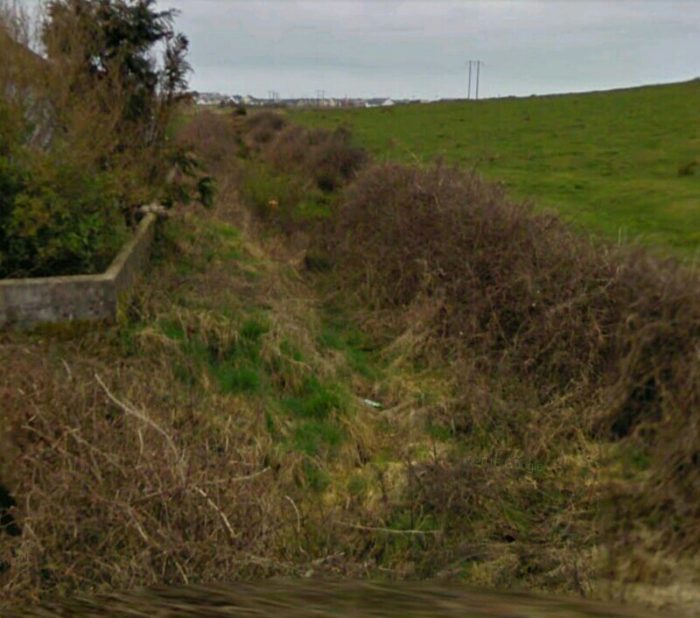
  9. Edmund Lenihan; op. cit., p260.
  10. Irish Builder;15th January 1885, p22, quoted by Lenihan; op. cit., p261-262.
  11. Lenihan; op. cit., p261-262.
  12. Ibid., p 262.
  13. http://www.railmaponline.com/UKIEMap.php?fbclid=IwAR1t7uT66nNlgLdQOfpDOP2lKzJqdua7Y8GZVS6kwbYKQ7kVDj99aA_cObM, accessed on 6th May 2019.
  14. Not used.
  15. Edmund Lenihan; op. cit., p262-263.
  16. Ibid., p303.
  17. Ibid., p268.
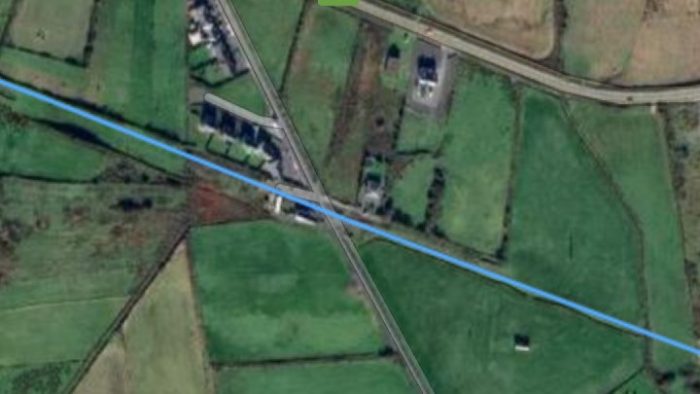
  18. Ibid., p272.
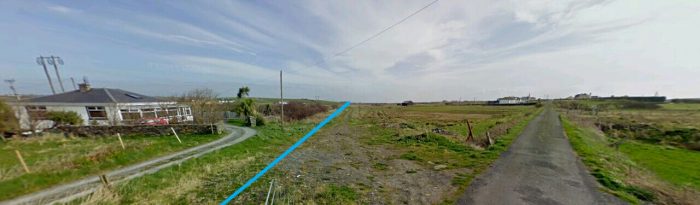
  19. Ibid., p269.
  20. http://eiretrains.com/Photo_Gallery/Railway%20Stations%20B/Blackweir/IrishRailwayStations.html, accessed on 8th May 2019.
  21. Edmund Lenihan; op. cit., p17.
  22. Patrick Taylor; op. cit., p10.
  23. Not used.
  24. http://maps.openstreetmap.ie/oocmaps.html?zoom=15&lat=52.66552755081851&lon=-9.611483168775402&layers=B0000TFFFFF, accessed on 8th May 2019.
  25. http://www.charleshornsby.com/blog, accessed on 8th May 2019.
  26. Not used.
  27. Ibid., p277.
  28. http://www.skibbereeneagle.ie/ireland/west-clare-railway, accessed on 8th May 2019.
  29. http://www.buildingsofireland.ie/niah/search.jsp?type=images&county=cl&regno=20301006, accessed on 9th May 2019.
  30. Edmund Lenihan; op. cit., p279.
  31. Patrick Taylor; op. cit., p45-47.
  32. Not used.
  33. Edmund Lenihan; op. cit., p23.
  34. https://www.narrow-gauge.co.uk/gallery/show.php?image_id=4428&cat_id=967, accessed on 9th April 2019.
  35. http://www.worsleyworks.co.uk/Image-Pages/Image_NG_Irish_WCR.htm, accessed on 9th April 2019.

The West Clare Railway – Part 5 – Quilty to Moyasta

The Line of the West Clare Railway from Quilty to Moyasta

Before setting off on the next leg of this journey South along the Atlantic Coast of Co. Clare it seems sensible to have a little look round Quilty village. The adjacent picture shows its Catholic Church and the village tavern is shown below. The village is really quite tiny but is seeing a growthnin holiday trade in the 21st century.In the 2002 census the village had a population of 234. The Co. Clare Library website says: “Quilty is a coastal village in the parish of Kilmurry Ibrickane. The origin of its name is uncertain but it may be a derivation of “coillte”, meaning woods. In this instance the woods referred to would probably have been an underwood of hazel or holly. Local tradition mentions the finding of tree stumps which indicate the existence of large woods here in ancient times. The same word “coillte” could also refer to “ruined or destroyed” and be a reference to a tragedy of long ago. This particular stretch of coast is dangerous for shipping and is constantly being eroded by the sea. Sean Spellissy, historian, believes that the name refers to the devastation caused by the tidal wave that separated Mutton Island from the mainland in 804AD, drowning 1,010 people in the process.  Quilty is set in picturesque surroundings with the Aran Islands on one side, Connemara behind and the Cliffs of Moher on another side. The Kerry mountains are visible in the distance.” [5]Quilty Station in the early 21st century taken from the N67 in Quilty looking South onto the station site.Quilty Station in the late 1950s. The picture was taken from the southern end of the station site. [3]In this 1993 aerial image of the village of Quilty the station is in the centre of the image vans the old railway route can be seen curving away inland to the south (the right side of the picture). [4]

Edmund Lenihan, writing in the late 1980s, gets us moving once again: “In the mile and a quarter to Kilmurry Station the line makes an S-shape through more or less level terrain, first looping west, then gradually east until it comes side by side with the Kilrush road at Kilmurry Bridge, and finally west again to the station gates.” [2]

The line was raised above surrounding land. On one side there was an earthen storm-bank, several feet wide at its base and tapering towards the top. Before it was built, the line was totally exposed to the elements.

The line passed through a cutting which can be seen in the two adjacent satellite images, and just to the south of the obvious rock face in these images it passed under two accommodation bridges which carried access roads before rising above the surrounding land onto a relatively high embankment. The next obstacles in the way of the line were the Ballymackea River and a minor public highway. Lenihan tells us that the river bridge is Kilmurry Bridge road bridge is called Sullivan’s Bridge. [6] In have not been able to find a photograph of Kilmurry Bridge. It is in the location shown on the first image below.The line continued south on embankment. It curved gradually back round to the Southwest as the adjacent satellite image shows.

The land and the old track-bed rise on their way to Kilmurry Station which can be seen two-thirds of the way down the adjacent image.

The first picture below is taken from the minor road close to Kilmurry Station and looks back along the old line towards Quilty.  The second picture shows Kilmurry Station in the 21st century. The third picture below shows the station in 1952, the fourth in 1960.

Kilmurry Station in 1952, © IRRS. [7]Kilmurry in September 1960, © Roger Joanes. [12]

Three hundred yards beyond Kilmurry Station is Kilmurry No. 2 Crossing which was tended from Kilmurry Station. The next two picture are taken from the location of that crossing. The first looks back towards Kilmurry Station which can be seen in the distance. The second looks ahead down the line. A deep cutting through the hill ahead can be seen on the horizon.The line curves South away from the Crossing and across open fields towards Cloonadrum School and railway cottage. The school was to the West of the line and is probably now a holiday cottage. [8] The Crossing-keeper’s cottage to the East of the line is little changed from the days of the railway. Both buildings appear below.

Edmund Lenihan  tells a story: “On 13 August 1955 an unfortunate railway accident occurred at Cloonadrum. The crossing gate, though it had been opened at the train’s approach, was loosened by the vibrations and swung closed as the guard’s van passed, splintering the planks of the little wooden outshot where Peter O’Brien was sitting and injuring him severely. Only when the train reached Craggaknock Station, a mile and a quarter away, was it noticed that anything was amiss. When he did not appear, the van was searched and he was discovered dying at his post. Two circumstances which made his death all the more tragic were that he was shortly to be married, and that he was not supposed to be on duty that week, but was standing in for a friend who was on leave.” [9]

The crossing, school and cottage all appear in the bottom right of the adjacent satellite image.

The old Cloonadrum School building.The Crossing-keeper’s cottage (above) as it is in the early 21st century. The route of the old railway is shown in red.

Cloonadrum crossing appears once again at the top of the adjacent satellite image. The feature marked ‘1’ is the site of what was the Annageragh Bridge (or Lissyneillan Bridge) over the Annageragh River.

Lenihan says that, as he and his son stood on the river bank under what used to be the bridge, “the full extent of the feat that was Annageragh Bridge instantly impressed itself on us as incomparably the most forceful structure we had yet seen on our 33- mile journey. Almost 40-feet high the stonework stands, stark now, yet beautiful. This was one of the few bridges put out of commission in 1961, when the line was being taken up — hardly surprising when one considers its height. Beside it we looked, and felt, insignificant.” [10]

The 400 yards from Annageragh Bridge to Lissyneillan Crossing (marked ‘2’ above) were initially on a high embankment but otherwise unremarkable.Looking back North from Lissyneillan Crossing towards Cloonadrum. The line of the railway has been severed by the outbuildings of the relatively modern bungalow. The Cloonadrum school and railway cottage can be seen on the horizon, to the left of the row of cottages.Looking south (above) from Lissyneillan Crossing, the line travels away into the distance in the centre of the picture. The adjacent satellite image shows its onward course.

Edmund Lenihan noted a substantial road-bridge which was becoming dangerous which had to be crossed cautiously. [11]

The next feature on the line was the Crossing and Station at Craggaknock.The view back towards Quilty from the minor road adjacent to Craggaknock Station.

Patrick Taylor is very  economical in his use of words as he describes this length of the line: On the far side of Cloonadrum, “Anaghgeragh Bridge (No. 60) over the river of the same name was reached, before passing through Lisseyneslon level crossing beyond the 33.75 milepoint and into Craggaknock flag station at 34.5 milepoint. Having passed through another set of crossing gates adjacent to the station. A small goods store and platform was provided here on the up side.” [1] Lenihan and Taylor often use alternative spellings for place names.Craggaknock Station was typical of many on the South Clare section of the network. It was situated close to crossing gates on a minor road, © IRRS. [1]Craggaknock Station in September 1960. A view from an Ennis-bound train, © Roger Joanes. [12]

The Craggaknock Station building remains in the 21st century but the line is overgrown. One of the crossing gateposts is still visible, © C. Cooney [13]

The former platform is shown in the adjacent image and the platform entry point is shown in its early 21st century incarnation in the next image below, © C. Cooney [13]

Edmund Lenihan found the station in a better condition than it is in the 21st century! [14]

Beyond Craggaknock the line headed away into open country. Lenihan comments: “Today [late 1980s] there are few houses within a mile’s radius of it, and only one of these was dignified by being named on our map. This is Craggaknock House, a plain early nineteenth-century dwelling, less than a mile to the east.” [15]

Patrick Taylor describes the route between Craggaknock and Doonbeg succinctly, in one short paragraph: “On the three and a quarter mile journey to Doonbeg the line passed through six level crossings, two situated in the townland of Clohanes and four in the townland of Caherfeenich – they were Clohanes No.1 and No.2, and Caherfeenich Nos. 1-4. Just beyond the last mentioned was Skivileen Bridge (No.63) near the Doughmore sandhills. Less than quarter of a mile on, Doonbeg Station Gates were crossed to enter Doonbeg Station” at the 37.75 mile-point. [1]

The first of a series of Crossings is Clohane crossing No. 1 which can be seen on the satellite image above and in the pictures below.Looking back from Clohanes Crossing No. 1 towards Craggaknock Station.Looking forward from Clohanes Crossing No. 1 towards Doonbeg.

Just 100 yards or so beyond Clohanes Crossing No. 1, Clohanes Crossing No. 2 was encountered. It crossed a lane which at one time was more heavily used than in the 21st Century. It was operated by the crossing keeper at Clohanes No. 1 and can be picked out on the satellite image above to the Southwest of the first crossing.

Beyond that crossing the railway encountered a falling grade as it headed South. Easier on southbound locomotives, this bank – Clahanes Bank – was “a constant trouble spot for laden steam trains from the south. The gradient here is not as obvious as at Willbrook or the Black Hill, yet it was enough to give the place some measure of notoriety.” [16]

Very interestingly on the adjacent satellite image two circles can easily be picked out alongside the line  (one on the East and one on the West) and a fainter larger circle just a little to the East of the line.

These circles are the remains of what appear to be earthen fortifications.

These are Cahers and they are a frequent occurrence in Co. Clare. There appear to have been around 2400 of them in Co. Clare alone. [17] They were homesteads rather than defensive fortifications which were known as Cashels. The name of the village close to these earthworks highlights their status … Caherfeenick. It appears on the adjacent satellite image.

As we have already noted, there are 4 Crossings in the area of Caherfeenick. Caherfeenick Crossing No. 1 was located on a little used lane way northeast of the village. Caherfeenick Crossing No. 2 had a Crossing-Keeper’s Cottage. In the 1980s, when Lenihan walked the route of the line the crossing keeper’s cottage was unaltered since the closure of the line and the last crossing-keeper still lived there. [19] It can be seen above roughly at the centre of the satellite image. In the early 21st century, little has changed. The cottage still stands with only minor changes.Caherfeenick Crossing No. 2. The route of the old line is marked in red and the crossing-keeper’s cottage still stands sentinel at the crossing location. This view looks back towards Crossing No. 1.This picture is taken from the narrow lane at Crossing No. 2 and looks forward along the route of the old line towards Crossing No. 3.Caherfeenick Crossing No. 3, looking back along the line towards Quilty.The N67 is crossed by the old line at Crossing No. 3. This view looks forward towards Doonbeg. The crossing appears at the bottom left of the satellite image above.

Edmund Lenihan describes this crossing which also appears at the top of the adjacent image as follows: “The road at no. 3 is reached through the usual fence of sleepers, and the cottage is 20 yards away, on the down side. It is as though time had stood still here, for the little house is in pristine condition, everything as it was when first it was built.” [20]

The cottage is much changed in the early 21st century. Lenihan goes on to point out that “Caherfeenick no. 3 has a more recent and cheering claim to fame: it is the home place of Michael O’Halloran, MP for Islington, London, one of the many emigrants who have achieved an eminence abroad that would almost inevitably have been denied them at home.” [20] He was, of course, writing in the late 1980s. The present incumbent of the role of MP for Islington (2019) is the current leader of the Labour Party, Jeremy Corbin.

Caherfeenick Crossing No. 4 was located at the point where the old railway encountered a T-junction of roads at the boundary of two townlands – Caherfeenick North and South. That crossing is evident on the adjacent map. The railway continued on to Doonbeg which was no more than a mile ahead. It appears in the bottom left of the adjacent OS Map from the 1940s. On the way there the railway crossed Skivileen Bridge about 300 yards from Caherfeenick No. 4.Cahirfeenick Crossing No. 4, looking back towards No.3.And looking forward towards Doonbeg.

Patrick Taylor says: “Doonbeg (Dunbeag) “The Small Fort” is said to be the longest village in Clare. It is here that the Doonbeg river enters the sea at Doonbeg Bay, and was once a fortress of the McMahons and later O’Briens, where until recent times stood a large stone castle. A short distance on one side lies Baltard Bay and on the other side Doughmore Sandhills. The station at Doonbeg, also a block post, situated on the town side was provided with a platform, car park, loading bank, goods store and a large siding all on the station side, with a two lever ground frame on the opposite side.” [1]Doonbeg in the 1950s looking towards Moyasta. [1]Doonbeg in 1960, © Roger Joanes. [22]Doonbeg Station building in the early 21st century, © C. Cooney. [21]

South of the station platform, the Goods shed was at the head of a passing loop decsribed as a siding. Taylor says: “On leaving Doonbeg yard after a slight curve the three arch Mountrivers bridge (No.64) over the Doonbeg river was crossed, and the line ran parallel with the public road for over a mile. The public road veered to the left at this point and the railway continued on a straight line to Shragh siding.” [1]

As the route of the line meets the Doonbeg River the quality of the satellite images available on Google Earth deteriorates. However, Streetview was able to provide a view of the bridge over the Doonbeg River which is a steel girder bridge, not the three-arched bridge mentioned by Taylor. Lenihan confirms that it is the road bridge which is the three-arched structure. [22]South of the river, the landscape is relatively flat and trains on the old railway would have trundled along in their own sweet way heading for Moyasta Station. The road and railway ran in parallel, as can be seen on the image below. It is taken at the point marked ’30’ on the OS Map and looks back towards Doonbeg.

The following image shows the point at which road and rail diverge. This is evident on the adjacent map.

We see the ongoing journey on the 1940s OS Maps. After leaving the road, the railway continued in a southerly direction before running parallel to another minor road as it travelled passed Moanmore Lough to the west of the line.

The Google Earth satellite image shows the the relative positions of road (blue line), old railway (red lines) and the Lough. The old railway track bed has been used in places as the formation level for private driveways to properties built over the old line.The line continues to follow (approximately) the line of the road heading to Moyasta.

Moanmore Crossing had can derelict Crossing Cottage when Edmund Lenihan first visited in the 1980s. [23] Later he notes that it had been rebuilt. [24] The next two photographs show the trackbed either side of the crossing.Looking north along the trakbed at Moanmore Crossing.And (above) looking with at the same crossing.

Moyasta Station was a junction station. Here the line separated to serve both Kilrush and Killed and allowance was also made in the form of a triangular junction for through traffic between the two. We will finish this section of the journey here at Moyasta, aware that there will be more to explore than just the history of the line and ready to do so in the next post in this series. A preservation scheme has been in operation for a good number of years in the 21st century and we will in due course explore what has been done.

We finish this post with a few images from the past.Moyasta Station lookin north in September 1950, © James P. O’Dea, National Library of Ireland. [25] Three images of Moyasta Station in 1960, © Roger Joanes. [26]A railcar on the through route from Kilrush to Kilkee in 1953, © Les Hyland. [27]The through connection between Kilkee and Kilrush is on the left. The railcar is leaving Moyasta for Kilrush. There were very few through workings between the two towns that did not also need to call at Moyasta, © A.M. Davies. [27]Branch train meets main line train at Moyasta Junction on 17th July 1947. On the left is No. 11C, with the 9.30am ex Kilrush, making connection with No. 6C, on the right, with the 9.35am from Killed through to Ennis. Interestingly, the main line engine is running bunker first -perhaps the Killed turntable was out of use for some reason. The Kilrush train, after departure of the one to Ennis, would propel back out of the platform, and then via the third side if the triangle, proceed to Kilkee, thus providing a Kilrush to Kilkee service, © C.H.A.Townley. [28]Moyasta Junction in 1952, © IRRS. [29]Engine 5C with a down goods at Moyasta, 5th February 1955, © IRRS. [29]A plan of Moyasta Station before the closure of the West Clare Railway in 1961. [30]

References

  1. Patrick Taylor; The West Clare Railway; Plateway Press, 1994, p42.
  2. Edmund Lenihan; In the Tracks if the West Clare Railway; Mercier Press, Dec. 2008, p182.
  3. http://www.milleens.net/showmedia.php?mediaID=53&medialinkID=54, accessed on 30th April 2019.
  4. http://www.clarelibrary.ie/eolas/coclare/places/quilty_arialview.htm, accessed on 30th April 2019.
  5. http://www.clarelibrary.ie/eolas/coclare/places/quilty.htm, accessed on 30th April 2019.
  6. Edmund Lenihan; op. cit., p184.
  7. Ibid., p187.
  8. Ibid., p193.
  9. Ibid., p194.
  10. Ibid., p195.
  11. Ibid., p196.
  12. http://elevation.maplogs.com/poi/doonbeg_co_clare_ireland.73139.html, accessed on 1st May 2019.
  13. http://eiretrains.com/Photo_Gallery/Railway%20Stations%20C/Craggaknock/IrishRailwayStations.html#, accessed on 3rd May 2019.
  14. Edmund Lenihan; op. cit., p198.
  15. Ibid., p198-199.
  16. Ibid., p203.
  17. Thomas J. Westropp; The Cahers of County Clare: Their Names, Features, and Bibliography;
    Proceedings of the Royal Irish Academy (1889-1901), The Royal Irish Academy Volume 6, 1900, p415-449; https://www.jstor.org/stable/20488784, accessed on 5th May 2019.
  18. http://www.clarelibrary.ie/eolas/coclare/archaeology/CL047-002—.htm, accessed on 5th May 2019.
  19. Edmund Lenihan; op. cit., p205.
  20. Ibid., p206.
  21. http://eiretrains.com/Photo_Gallery/Railway%20Stations%20D/Doonbeg/IrishRailwayStations.html, accessed on 5th May 2019.
  22. Edmund Lenihan; op. cit., p212.
  23. Ibid., p221-222.
  24. Ibid., p302.
  25. James P O’Dea Collection, National Library of Ireland, https://www.flickr.com/photos/nlireland/30230379325, accessed on 5th May 2019.
  26. https://www.flickr.com/photos/110691393@N07, accessed on 5th May 2019.
  27. Patrick Taylor; op. cit., p44.
  28. Ibid., p68.
  29. Edmund Lenihan; op. cit., p224.
  30. Patrick TaylorTaylor; op. cit., p48.

The West Clare Railway – Part 4 – Miltown-Malbay to Quilty

The Line of the West Clare Railway from Miltown-Malbay to Quilty

Before setting off on the next leg of this journey South along the Atlantic Coast of Co. Clare we take a quick look at the town of Miltown-Malbay which has only existed since about 1800 but grew rapidly: by 1821 it had a population of 600. During the Great Famine (1844 – 1848) many farmers were evicted by the unpopular landlord Moroney. In the years after the famine the (Protestant) Moroney family went on with rack renting and evictions. At one time the population had enough and started a boycott. The government did not like that and imprisoned all pub-owners and shopkeepers who refused to serve the family or their servant. So at the end of 1888 most pub-owners and shopkeepers were in jail! [9]

The Co. Clare Library says the following about the town:

Miltown Malbay or Sráid na Cathrach is at the heart of an ancient area known as Kilfarboy. Sráid na Cathrach translates into “The Street of the Fort”, deriving from the existence of an Iron Age fort (An Cathair) near the site of St. Josephs Parish Church. The earliest inhabitants of the area were likely found on the rising ground to the north and east of the present town, stretching from the fort to the monastic foundation in the townland of Kilfarboy. It is suggested by some that Miltown comes from the Irish “Meall-Bhaigh”, meaning a treacherous coast or bay. It could also have taken the name Malbay from either the tradition of the witch, Mal, being drowned in the bay, or that of the volcanic eruption which drowned 1,008 people and separated Mutton Island from the mainland in 804.

Miltown Malbay grew in part because of developments at nearby Spanish Point. Thomas Moroney built the Atlantic Hotel in the early nineteenth century and for a time it rejoiced in the title of the largest hotel in the British Isles. The seaside resort developed as a refuge for the aristocracy and some of the lodges can still be seen today although only a small portion of the hotel ruin remains.

Miltown Malbay once had five corn mills, of which the ruins of three can still be seen. In 1825 Terence MacMahon owned a corn mill and Mary MacMahon a tucking mill and the growing town was referred to as Poll a Mhuillin. This was later translated as the town of the mill or Milltown.

By 1837 Miltown Malbay contained 133 houses and 726 inhabitants. During the year of the abortive rising, 1867, the local resident magistrate wrote to the Under-Secretary at Dublin Castle because he was “seriously apprehensive of a Fenian outbreak” in the locality.

One of the greatest historical events ever witnessed in the town was the public address delivered by Charles Stewart Parnell in 1885. Although he was almost totally confining himself to parliamentary work at that stage of his career, Parnell agreed to come to Miltown due to his admiration for parish priest, Fr. Patrick White’s involvement in the land struggle. On January 26, 1885, Parnell came to Clare to turn the first sod for the West Clare Railway and later the same day came to Miltown for the meeting. Standing in front of the recently built parochial house, he addressed a crowd of over 20,000 and there were numerous bands in attendance. [10]

The town had a population of 575 according to the 2011 Census. Including the rural area around the town it counts about 1,600 inhabitants. [9]Miltown Church – St. Joseph’s [11]Miltown-Malbay regards itself as the home of traditional Irish music. [12][13][14]

The station building is sited to the Northwest of the town centre and is listed on the Irish National Inventory of Architectural Heritage as follows: “Detached former railway station complex, built 1857, comprising L-plan three-bay two-storey station master’s house with two-bay two-storey return, and four-bay single-storey station to right, having six-bay single-storey flat roof canopy over former platform. Now in use as guest house. Pitched slate roof with rendered chimneystacks. Rendered walls. Cast-iron columns to former platform. Timber sliding sash windows to former station. Replacement uPVC windows to house. Rough-cast rendered chamfered gate piers with wrought-iron gate to site. Former goods shed to site. Foundation stone of West Clare Railway laid by Charles Stewart Parnell to rear of this site.” [3]A Diesel Railcar at Mailtown-Malbay Station, seen from the North. Both the Good Shed and the Station building can be seen in this photograph. Both still stand and are now part of the complex of the guest house/hotel and apartments on the site [6]An Ennis-bound excursion train leaving Miltown Malbay on 16th August 1947, headed by Locomotive 11C. Presumably the wagon next to the engine was either vacuum braked or piped, but the reason for its use is unclear – unless to carry additional fuel for the locomotive. The first three coaches are West Clare ‘all thirds’, followed by two of the saloons. Notice the signal box. This was the last of the West Clare stations, equipped as a terminus complete with turntable and locomotive shed, and the last station with two platform faces, (c) Frank Jones. [16]

Diesel Locomotive No. F503 at Miltown-Malbay Station in 1956. [4]Loco No. F502 pulling a train for Kilrush in September 1960, (c) Roger Joanes. [8]A pickup goods in the hands of Loco 503 at Miltown-Malbay in September 1956 (c) O’Dea Photograph Collection. [7]A view South towards the N67 from under the canopy of the extended and modernised station building. [5]The station layout in its heyday is shown above. [1]

Patrick Taylor describes the station as being “the last station to have both up and down platforms both of which were provided with verandahs. A loco shed, goods store, turntable and water tank (10,000 gals) were also situated here as Miltown-Malbay was the terminus of the West Clare Railway. A staff post with the station building on the down side, it possessed pretty extensive accommo-dation. The signal cabin and a cattle bank were situated on the down side. The water tank, goods store and engine shed were to the rear of the up platform. [15]

He goes on to say that: “On passing the down home signal the up road was connected to the right and a siding veered off to the left to run onto the rear of the down platform. Another siding ran off the up road to the rear of the platform, which served the goods store loading bank and water tower. There were two connecting spurs off this siding, one running on to the turntable and engine shed at the Lahinch side. The other running on to both the up and down road adjacent to the level crossing gates on the Quilty side. The up starting signal was situated beyond the up platform on the up side and a water column was at the end of the up platform on the Lahinch end . The down starting signal and a second water column at the end of the down platform faced towards Quilty.” [15]

The onward route of the line heading South is shown first on the satellite image above and then on the adjacent 1940s OS Map. The South Clare Railway commenced at this station, and ran past three level crossings inside the first half mile. The line passed to the West of the small town of Miitown-Malbay whose centre is shown on the OS Map above.

Taylor continues: “The Lahinch-Miltown Malbay main road was crossed at the station gates and after a minor road at Flag Road No.1, the Miltown-Quilty road was crossed at. Flag Road No.2 crossing. The Miltown-Malbay up home signal was situated on the upside a short distance on the Miltown side of Flag Road No.1. Two bridges, Sextons (No.53) and St. Joseph’s Well river bridge (No. 54) were in close proximity on the next stretch after crossing Braffa level crossing at 28.57 m.p.” [15]

For a bit more detail we turn to Edmund Lenihan. He says that a short piece of shallow cutting is all that remains of the line until it reaches the Flag Road No. 1 crossing which is just 300 yards West of the town’s main crossroads. [2]Looking North from the minor road which was crossed at Flag Road No. 1 Crossing along the route of the old railway line back to the location of the Station. The shallow embankment shows the location of the old railway with Miltown Malbay away to the right of the picture. The image below is taken looking South at the same location.The next crossing was Flag Road No. 2 Crossing and the line crossed Flag Road at this point.The location of the crossing is easily established as there is a different form of boundary wall across the line. This view is taken from Flag Road and looks back towards Flag Road Crossing No. 1.Looking south from Flag Road the route of the line has been built over.

We are now at the top of the adjacent 1940s OS Map. The line is shown all the way through to Quilty on this and the next two OS Maps. The line curves gradually from a southerly trajectory to a southwesterly direction before curving south again at Quilty. The same length of the line is shown below these OS Maps in a series of satellite images from Google Earth. These are interspersed with Google Streetview images and others where available.

Edmund Lenihan spends some pages describing this part of the route. First, after the Flag Road crossings the line drifts towards Mullagh Road. Lenihan encounters two bungalows built over the line of the railway. At that point, adjacent to Mullagh Road the line was in cutting, so to build the two bungalows the cutting had to be filled. Prior to the construction of the two bungalows the cutting must have been immeidate ly adjacent to the road verge. [17]

The adjacent satellite image shows the route of the line tending towards Mullagh Road.

The next two satellite pictures show the two bungalows mentioned above. In these images, taken in around 2015, it appears that much of the railway cutting has been infilled. There are lengths close to the bungalows, both North and South of them where the cutting still appears to exist. In between the satellite images are pictures taken from Mullagh Road which show the line drifting towards the road from the North and then drifting away again to the South.

The photographs taken from Mullagh Road have the rough path of the railway line shown in red.

In the first, Miltown Malbay can be seen in the right-distance. The remaining three form a straightforward sequence with the last shown the route of the railway moving away from the road. The satellite image which folows these four oictures shows the route of the old railway from above.As we travel on towards Quilty, we note that the route of the line now runs across open fields. On the ground there ois little trace of the line. The satellite images keep us on track.

We cross a minor road at-grade. This was a gated crossing and the crossings keeper’s cottage remains in the 21st century. It is approachingvas we leave the adjacent satellite image and shows up clearly at the top of the next satellite image.

In between the two are Google Streetview pictures of the crossing and its immediate environment.A view from the East looking along the minor road. The old railway approached on the alignment shown, travelling behind the crossing-keeper’s cottage.The cottage has been extended towards the alignment of the old railway.The crossing was on a very shallow angle. This view is also taken from the East. The gate posts can still be seen at the far side of the crossing.The line continued on towards Quilty. As it does so, we listen to Edmund Lenihan’s description of the route just a little further ahead along the old line. Clearly he did not have the benefit of satellite imagery.

“We could see Miltown power station ahead and Breaffa cottage to our right, but of the line there was no trace. We reached the road, and could have saved ourselves discomfort by merely walking to the crossing and continuing from there. But instead we started across the fields towards the river, gradually correcting our line of progress as we went. We had an easier passage than we deserved, there being no more than muck and high ditches in our way, and even these we forgot as soon as we saw the Glendine River. Swirling, looping in sharp turns and little pools, it rattles along in its narrow gorge as if shepherding stones downstream to its meeting with the Annagh River. Our crossing point, Sexton’s Bridge, was intact, but since here were no parapets we hurried over it like men expecting that it might fall at any moment and with only the briefest glance of acknowledgment to the stream gushing underneath. Already, our sights were on a scene more imposing. Here, from a large valley towards which the Glendine cascades, rears a high, ivy-draped road-bridge of one main arch, with others flanking, while nearby, in the lee of Aillateriff heights, a group of mill-like buildings nestles. Over all, the power station stood out like a beacon, white against the sky. Without ever looking to the map we knew that this was Stackpoole’s Bridge and Poulawillin Mills. A few minutes’ walk and we were at Annagh No. 1 crossing, 28.75 miles from Ennis.” [18]The crossing-keeper’s cottage from Annagh No. 1 Crossing is shown above in 21st century and in the adjacent image from the 1950s © IRRS. [19] The second image is taken from south of the crossing, the first from the single-lane road that the railway crossed.The railway continued South from Annagh No. 1 Crossing. 

A few hundred yards beyond the road-crossing the railway crossed the Annagh River again. The bridge can be seenninnthe top right of the adjacent photo.

To the West of the road-crossing the road crossed the Annagh River. It was from McMahon’s corn and woollen mills in the immediate vicinity of thst road bridge that “the village of Miltown took its name in the nineteenth century, and the name of the nearby townland, Poulawillin, still preserves this memory. The bridge, at least 40-feet high, bears the inscription `Built by John Stackpoole, Esq. July 1811′, and has withstood the years with dignity.” [19] Just to the West of the bridge is St. Joseph’s well, the site of regular pilgrimages.

Once the railway crossed the Annagh for the second time it entered the townlands of Annagh. Lenihan’s says: “There was much to admire in the way the river squirmed along in a semi-circle to a huge pool at the base of the embankment close to where the twenty-ninth milepost once stood. A fine place for fishing, without doubt, but extremely deep and dangerous-looking. The current has begun to eat into the foundations of the line, and already land slippage has occurred, leaving a sheer and frightening drop.” [20] 

One thing which is a recurrent reality in Lenihan’s book is the swamp-like nature of much of the conditions underfoot and at other times, just how easy it was to loose the route of the line. This next passage from his book gives a good impression of so much of the walks he and his son undertook.

“Our troubles continued, the swamp developing into a small lake. But for the rushes at the edges of the line, we could have made no progress. We hopped along, from one to the next, a business that demanded total concentration. Then, in lightning contrast, when we squelched through a muddy gap we found ourselves faced with a huge levelled field.The line was being elusive again, and succeeded in hiding from us for most of the way to the next crossing cottage half a mile away.” [21]

The next crossing was Annagh No. 2 Crossing and was 29.5 miles from Ennis and appeared in the centre of the last satellite image above. It was opened as a halt in May 1952. The control of the line passed, at this point, out of the control of Miltown Station.Annagh No. 2 Crossing in 1954, © IRRS. The picture is taken from south of the Crossing. [21]This new-build cottage is in approximately the same position as the old Crossing-Keeper’s Cottage at Annagh No. 2 Crossing.The line ahead.

Lenihan comments that from Annagh No. 2 Crossing, “there was no difficulty in getting to Emlagh crossing, for the way is quite clear and the surface dry. But there was little of interest to be seen. … At the triple boundary, Annagh, Caherrush and Emlagh, a handsome stone culvert lined with Liscannor flags still carries the boundary stream.” [21]

The crossing keeper’s cottage at Emlagh Crossing is still present in the early 21st century and can be seen easily in the satellite image above.

In the adjacent image we see the line from the Northeast arriving at Emlagh Crossing. The image below we look Southwest passed the Cottage.We are now not so very far from Quilty. The village is in sight.

Lenihan continues his tale from the 1980s: “Ahead of us, an odd-looking fence appeared somewhat like a jump on a racecourse, surmounted as it was by a long post. When we reached it we found that it was no post, but one of the steel rails, only the second we had come upon in all the miles since leaving Ennis. A small stream once ran here, but it has been much altered enlarged by excavation, and the culvert demolished in the process. Two hundred yards farther on is another stream, this one the boundary with Quilty East. Here is a more substantial bridge, its stonework and girder facings still firmly intact.” [23]

Further ahead through muddy terrain, Lenihan encountered the stream dividing Quilty East from Quilty West  where the bridge “had met the fate of so many others, leaving a 10-foot-wide, 6-foot-deep channel, newly gouged.” [23]

After that the final quarter of a mile towards Quilty was, for Lenihan, easy going. [23]

At Quilty a small estate of houses has been built over the route of the old railway, immediately before the station itself.

Quilty station building remains recognisable in the early 21st century. The station was built on a curve at the 31.5 mile post. It “was on the upside and consisted of a platform, small siding and goods store.” [24]

We will finish this short part of our journey here near the sea. It is worth noting that an anemometer was installed at Quilty because of the ferocious nature of the Atlantic storms which hit the coast here. It was installed in 1911. When the instrument indicated gales of over 60mph, only ballasted stock could be used and when a gale of 80mph was predicted, all traffic on the line was brought to a halt. It is on record that wind of 112mph were recorded in January 1927. The anemometer hut and pole are shown in the adjacent image, © IRRS. [24][25]

Edmund Lenihan expands on these bare facts: “On 3 March 1897 several carriages of the 10.30 a.m. passenger train from Kilrush were blown off the line between Kilmurry and here, and tumbled down an embankment.That there was no serious injury to any of the two dozen passengers was, as a newspaper report put it, ‘really marvellous’. Two years later, on 12 January 1899, at Quilty cross, the 8.30 a.m. train from Ennis was derailed in similar circumstances. Again, no one was seriously injured, but rather than wait for a tragedy to occur the company began to take precautions. A high earthen bank was built at the seaward side of the line south-west of the station, and in 1911 an anemometer was installed to warn of storms. Its high mast protruded from a little wooden hut on the up side a short distance from the goods’ shed (which stood at the end of the platform), but the instrument itself was in the station-house, where two differently toned bells awaited the onset of the wind. It became part of the stationmaster’s daily duties to take wind-speed readings. .... Ballast consisted of slabs of concrete under the carriage seats.” [26]Diesel locomotive at Quilty Station just before closure, © IRRS. [27]Quilty Station just after closure. The picture was taken on 7th June 1961, © Roy Denison [27]

References

  1. Patrick Taylor; The West Clare Railway; Plateway Press, 1994, p48.
  2. Edmund Lenihan; In the Tracks if the West Clare Railway; Mercier Press, Dec. 2008, p168.
  3. http://www.buildingsofireland.ie/niah/search.jsp?type=record&county=CL&regno=20300608, accessed on 20th April 2019.
  4. https://stationhousemiltownmalbay.wordpress.com/station-house-accommodation, accessed on 20th April 2019.
  5. https://www.facebook.com/StationHouseMiltownMalbay/photos/a.259048931094658/468777630121786, accessed on 20th April 2019.
  6. https://www.hydeparknow.uk/2017/07/13/stuck-in-miltown, accessed on 20th April 2019.
  7. https://twitter.com/theclareherald, accessed on 20th April 2019.
  8. https://www.flickr.com/photos/110691393@N07/11373840335, accessed on 19th April 2019.
  9. https://en.wikipedia.org/wiki/Milltown_Malbay, accessed on 20th April 2019.
  10. http://www.clarelibrary.ie/eolas/coclare/places/miltown_history.htm, accessed on 20th April 2019.
  11. https://www.westclare.net/miltown.htm, accessed on 20th April 2019.
  12. https://www.tripadvisor.com.sg/LocationPhotoDirectLink-g635643-i94980478-Miltown_Malbay_County_Clare.html, accessed on 20th April 2019.
  13. https://www.clareecho.ie/miltown-malbay-written-off-the-map, accessed on 20th April 2019.
  14. https://www.facebook.com/clareplaces/photos/a.1121180214559064/1121180307892388, accessed on 20th April 2019.
  15. Patrick Taylor; op.cit., p41.
  16. Ibid., p66.
  17. Edmund Lenihan; op.cit., p170.
  18. Ibid., p170-171.
  19. Ibid., p171.
  20. Ibid., p174-175.
  21. Ibid., p175-176.
  22. Ibid., p177.
  23. Ibid., p179.
  24. Patrick Taylor; op. cit., p41.
  25. Edmund Lenihan; op. cit., p180-181.
  26. Ibid., p181.
  27. Ibid., p179.

The West Clare Railway – Part 3 – Lahinch to Miltown-Malbay

The Line of the West Clare Railway from Lahinch to Miltown-Malbay

We recommence our journey at Lahinch Station. The satellite image below was provided close to the end of the last post in this series.This satellite image allows the whole of the Lahinch area to be included. The area in the curved red box in the station area and is represented below in a sketch plan.Lahinch Station. [1]Lahinch Station around the turn of the 20th Century, with the village beyond. [2]A train from Kilkee waits at Lahinch on its way to Ennis. [5]Lahinch Station in 1961. [2]

As the above pictures show Lahinch Station developed over the years.

Lahinch or Lehinch (Irish: An Leacht or Irish: Leacht Uí Chonchubhair, meaning “The Memorial cairn of O’Connor”) is a small town on Liscannor Bay, on the northwest coast of County Clare, Ireland. It lies on the N67 national secondary road, between Milltown Malbay and Ennistymon, roughly 75 kilometres (47 mi) by road southwest of Galway and 68 kilometres (42 mi) northwest of Limerick. [4]

The town became a popular tourist destination on the Atlantic coast and close to the Cliffs of Moher.The Cliffs of Moher. [6]

Lahinch developed from having just a few cabins in the eighteenth century to having a population of over one thousand people in 1835. However, no significant development took place in the early nineteenth century as the sea front continued to take a severe battering from the Atlantic gales. [3] It was not until later in the century that the infrastructure of the town developed and it became a seaside resort following the opening of the West Clare Railway in 1887. In 1883, the town was struck by a severe storm which destroyed the sea wall and promenade and damaged many buildings. Local governor William Edward Ellis oversaw the repair work which followed and the construction of a new sea wall and promenade were inaugurated by the wife of the Viceroy, Lady Aberdeen, in July 1893. [14]

Lahinch’s popularity and fame depend on two features. First and foremost is the mile-long beach of golden sand stretching along in front of the village, promenade and sandhills. With the growing popularity of sea bathing and the arrival of the West Clare Railway in 1887, people began to arrive in unprecedented numbers. The village’s secondary claim to popularity is its Golf Club. [3]

There was a short ascent out of Lahinch, 1 in 193, across Gregg level crossing, just beyond Mile Post 21 and through Coffey’s Bridge (No. 41) which carried a laneway over the line. With Moy Bay on the west the line crossed over the Lahinch-Miltown Road twice, first at Major’s Bridge (No. 42) and secondly at Crag Bridge (No. 43).

South of Lahinch Station the route described above is now hidden under new development as far as Major’s Bridge (or perhaps it is Crag Bridge). This bridge is the first evidence we can see of the route of the line South of Launch. It spans the modern N67 road.The line was carried on an embankment to the South of Lahinch. Major’s Bridge (see below) has lost its superstructure but it was no doubt of very similar construction to the next structure which can be seen and the bottom of the adjacent satellite image, Crag Bridge (see below). [7]

Crag Bridge (see below) can be seen in the Google Streetview images below. The first picture is taken from the East looking towards the coast. The second photograph is taken from the West  looking back along the N67 towards Lahinch.

In both these images the bridge is far more overgrown than it would ever have been while in use before the closure of the railway line.

Patrick Taylor’s choice of names for these two bridges [7] is unlikely to be correct. Edmund Lenihan suggests that the first bridge encountered is Crag Bridge and the second, Major’s Bridge. He comments: “Quite unexpectedly we were at Crag Bridge – or rather, where it had been, for the metal deck which spanned the Milltown road is one of two that have been removed. Before climbing down to the road, we paused for another look at the panorama stretching away southward. The line, embanked all the way, loops off to the southeast like some monstrous snake on its way towards the rugged scenic area known as ‘The Major’s Wood, beyond which the ground rises into the dark ridge of Black Hill, following the coast into the distance towards Rineen.” [8]

In the North Clare Bridge Survey, the second bridge is recorded as Calluragh South Bridge as below. It’s proximity to Moy House suggests that this much have been Major’s Bridge. [11]This length of the line was exposed to the strongest Atlantic weather. So exposed that it was the scene of a derailment on 24th December 1912, caused by a freak wind. [7] Edmund Lenihan, writing in the late 1980s, says: The sizeable cutting which succeeds this long clear stretch has only one claim to fame, so far as I am aware. Here, on a (lay of fierce storm almost eighty years ago, several carriages of an unladen special from Kilrush were derailed — literally blown off the track. [12]

That cutting included Major’s Road Bridge and Major’s River Bridge over the River Moy. Edmund Lenihan comments: “Moy House, white and turreted, [is] situated on rising scenic ground overlooking the coast just west of the Moy River. Built by the Fitzgeralds, landlords of the area, in the early nineteenth century, it was later bought by Major George Studdert, whose descendants lived in it until the 1930s. He lent his title to the fine railway bridge which crosses the river a short distance away. Even yet it is known as `The Major’s Bridge’ and is, with Toloughlahan and Cullenagh, one of those that should be preserved for posterity. The view from it is spectacular. The public road dips into the wooded valley of the Moy River here, and the coincidence of road and rail bridges only yards apart makes this a memorable place.” [12]

Sadly the wooded valley of the River Moy is now choked with blackthorn and the river bridge is, in the 21st Century, seemingly inaccessible.Moy House is now a Georgian country house hotel about 3 kilometres (1.9 mi) south of Lahinch near the village of Moy. Originally set in 15 acres of woodland on the River Moy, it was built in the mid-18th century as the holiday home of Sir Augustine Fitzgerald. Later it was sold to Major Studdert, who gave his name to the bridges over the road and the river on the West Clare. The house was vacant for 10 years, but was purchased by Antoin O’Looney who undertook a three year restoration of the property. It was voted Country House of the Year by Georgina Campbell’s Ireland in 2003. [9][10]Moy House from the sea. [10]South of the second bridge, the line crosses the Moy River and curves slightly to the East before swinging  gradually round to the West. The adjacent satellite image and the one directly below show the route.

The location of the Moy River Bridge was adjacent to Major’s Road Bridge. The picture above shows that the river bridge is amidst  heavy blackthorn growth.

Both the road and the railway followed the line of least resistance as they climbed to cross Black Hill, travelling first along its flank and heading towards the sea.

Edmund Lenihan found the ground along the route from the river to Moy Bridge almost impassible in the 1980s. Moy Bridge another structure to have had its steel/wrought-iron deck removed. Headroom was no doubt the issue here. Edmund Lenihan says: “The metal deck of Moy Bridge, like the one at Crag, has been removed. Only the stone abutments remain. The reason probably is that it was a particularly low structure, with headroom of no more than 10 feet — hardly high enough to let modern cattle trucks pass. This was also known as Hanrahan’s Bridge, and was made a halt in October 1958 — the last halt, in fact, to be instituted before the closure of the system.” [13]

From Moy Bridge Lenihan talks of the line turning southwestward “more or less paralleling the Miltown road at a distance of never more than 500 yards for the next mile or more, until they swing together again halfway to Rineen school house, whence they curve round the western edge of Drummin Hill and on south to Miltown.” [13]The picture below is taken from Google Streetview and shows the line of the West Clare at the location of the first road (to the right of the image) shown on this satellite image.Miltown is a mere 2 miles from here, but there is still much to encounter on the route of the railway before Miltown is encountered. Edmund Lenihan again: “We left Moy Bridge behind, and framed by the V of the cutting beyond lay the wood we had seen from Crag Bridge as a mere smudge along the side of the hill. As we came closer we saw why it is called the Black Hill: the ‘wood’ consists almost wholly of blackthorn, flattened into the steep hillside by the sea wind, thereby giving the impression of a solid mass. The visual effect created at this time of bare branches is startling. As we passed into the townland of Moybeg, the line had almost swung under the hill, and the distance between us and the wood continued to narrow. It is rough land and very neglected-looking. Water, more than anything else, impresses itself on the eye and ear: sodden fields left and right, a hidden cascade tumbling down somewhere through the wood, and the bay off to the west beyond the road. It is no place for the fainthearted traveller. Where line and wood eventually met we found our way barred by a stout fence and beyond that a jungle. We were soon floundering in bog and marsh.” [15]The line follows the gentlest possible path rising seemingly gradually through the contours and as a result drifts back towards the line of the road as this 1940s OS Map shows. The grade was however really quite steep for the underpowered locomotives of the West Clare Railway.

Lenihan continues his late 1980s perambulation: “All this time the only constant thing was the hill, overlooking us severely to the left; the rest was a mixture of inaccessible thickets followed by the odd patch of reclaimed land. Among the stones at three different places we found chunks of yellow scorched brick and knew we were still on target. These were burned-out fire-bricks from the fire-boxes of the steam locomotives, dumped here with ash and other debris as packing for the sleepers.They were a useful guide to us on several occasions in ground that would have been otherwise featureless.” [16]

“When the line began to rise, it did so gradually at first over 500 yards or so, but then steeply. It is so straight and grown in by hazel up along the flank of the hill that we had to pause every so often in order to check our progress by looking through the branches, out towards the bay.” [17]The un-gated crossing on the minor road at the bottom left of this image is shown in the images below.The un-gated crossing close to the centre of this image is the site of the next picture looking forward along the line.Patrick Taylor’s comments about this length are more succinct than those of Edmund Lenihan: “At Mile Post 22.25 Hanrahan’s Bridge (No. 45) (or Moy Bridge in earlier days) became a railcar stopping place on 1st October 1958 (the last one created before closure). The line, already ascending at 1 in 96 steepens with sections of 1 in 63/64/55 and 52 up Rineen Bank on the flank of the Black Hill – a formidable climb in steam days. Moymore No. 1 and No. 2 level crossing were in this section – close together at Mile Post 23. and Rineen Halt was at m.p. 24.5, opened on 5th May 1952. A ballast siding was once in operation here and in the earlier days trains stopped on request. ” [7]The road and railway ran immediately next to each other for some distance  through Rinneen.Again, Patrick Taylor comments: “The line continued by the side of Rineen Hill quite adjacent to the main Lahinch-Miltown public road. which ran parallel with the railway for three miles and at some points was only separated by a stone wall. On this stretch there were two bridges, Rineen over a stream, and Downes (No. 51) which crossed the line at Ballinaphonta, before Miltown-Malbay was reached at Mile Post 27.” [7]

Lenihan takes us on towards Rineen: In the next mile or so, “to Rineen school, there is a dramatic improvement in the quality of the holdings and consequently far more houses. Most of them are just one field in from the road, which means that the railway ran by their front doors. Perhaps this is why, in May 1952, a halt was opened a few hundred yards to the Lahinch side of the school.” [18]Rineen Crossing and Halt in 1953, (c) IRRS. [18]

“Across the road from the school is as good a place as any to get an accurate impression of the condition of the line. Look back – it is there; look forward – nothing. For as far as we were able to see all had been swept away. … Under Drummin Hill, which in places falls cliff-like to the road, railway and highway were separated by only a stone wall, a short way beyond where the 25th Mile Post was located.” [19]

Below the railway along this length is a small stone monument – a plaque commemorating the Rineen ambush, one of the best-known actions of the War of Independence in Clare. From this hill, on 22nd September 1920, a party from the 4th battalion of the IRA attacked a truck bringing police from Miltown to Ennistymon. In the ensuing fight, which was soon joined by British reinforcements, six police were killed with no losses on the part of the attackers!

The consequences for Lahinch, Miltown and Ennistymon were drastic. “Tne orgy of reprisals — burnings and shootings — released against them still remains vivid in the minds of old people. At 7 p.m that night the military invaded Miltown, burning, looting and smashing windows. In the small hours of the morning, when it seemed as if the worst was over, the Tans arrived from their depredations in Ennistymon and Lahinch, and joined by the local RIC they continued the arson, theft and shooting until the following morning. It was a night’s work that destroyed for ever any shreds of confidence that the people of Kilfarboy might have retained in the forces of the Crown.” [20]

The form/layout of the ambush is illustrated in the sketch plan above. [22]

Travelling on, the line has all but been obliterated beyond the Bridge at Rineen which is shown in a sketch (c) M. Lenihan in Lenihan’s book. [21]The North Clare Bridge Survey calls this bridge Drummin (Ibrikan) Bridge. [11]The same location, above, in a Google Streetview image from December 2009.

The momument is at location ‘1’ on the adjacent satellite image, the bridge is at location ‘2’.

The bridge, says Lenihan, is the “most elegant stone-arched crossing remaining on the line today. All its facings and the underside of the eye are of West Clare stone, but it is beginning to deteriorate, probably because of damage done by machines when the bank on its southern side was being cut away. It cannot survive long even in its present condition unless some restorative action is soon taken. [21]

As can be seen on this satellite image and the OS Map from the 1940s, a little way south of the bridge the road and railway separate.

It is very difficult to pick out the line of the railway on Google Earth and it appears to have been just as difficult to follow the line in the late 1980s. Edmund Lenihan comments that a very broken section followed: “with a filled-in cutting, a house built on the line and farm sheds surrounding a second cutting.” [23]

From here, it appears that the line ran in a straight line to Miltown Station. Lenihan says: “We emerged into not only the flat prospect of Fintramore but also an unexpected blaze of wintry sunshine. It cheered us, as did a clear view of the line for over half a mile, embanked all the way across the low bare fields. Off left, the spire of Miltown Church needled the sky, showing us how near we were to the terminus of the West Clare, while a bridge ahead served as a marker of our progress. Just beyond the location of the twenty-sixth milepost, a cattle-pass, 200 yards out, is still entirely intact [location ‘4’ below], but we had eyes only for the bridge [location ‘3’ above and below] and the view around.” [23]“At the bridge, [location ‘3’] we were a little surprised to find the metal deck still in place, but this is probably only because the road which runs underneath does not lead to anywhere of great significance and traffic is not heavy. Though in the town-land of Drummin, it was known as Rineen Bridge.” [23] It is shown below in its listing on the North Clare Bridge Survey. [11]Looking back from location ‘5’ on the 1940s OS Map above, the embankment is visible in the distance under the red line showing the route of the railway. The record from the North Clare Bridge Survey below, shows the infilled bridge at location ‘5’. [11]The next image is taken from the single track road carried by Fintra More Bridge. The view looks South towards Miltown.The partially-filled cutting above clearly shows the line of the railway under the road bridge at location ‘5’. Miltown church spire can be seen on the horizon. Lenihan refers to this as Downes’ Bridge which he says is a “stone-arched span carrying a by-road over the line.” [23]
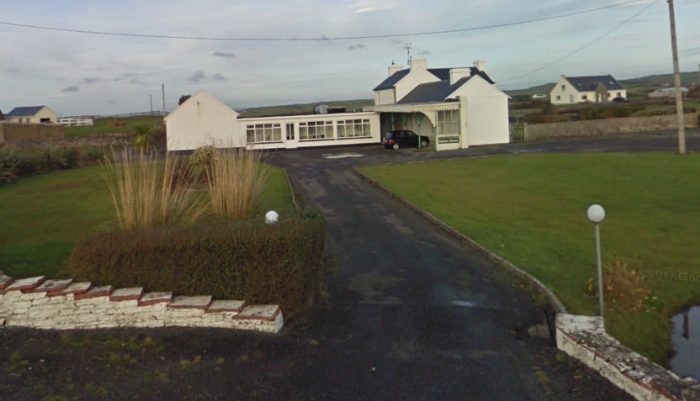
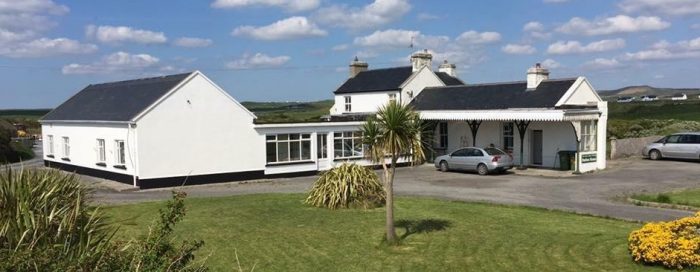
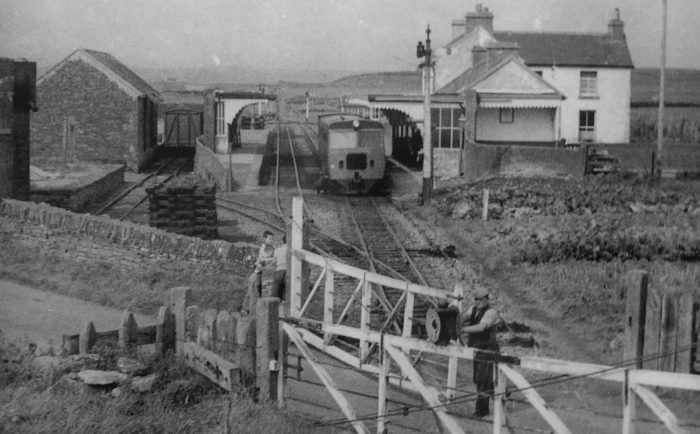
South from this point the line crossed two streams and a cattle underpass before reaching another highway. Lenihan describes one of these valleys like this: “But now occurs one of those folds in the land which in extent are not large but which possess a beauty that has nothing to do with size alone. A small river flows here a full 25 feet below the level of the surrounding little hills, and it was this space that the builders of the line had to contrive a crossing for. That they succeeded admirably is unquestionable, and far from spoiling the beauty of this secluded place, their well-proportioned embankment and bridge lend it a light touch of order and symmetry. It is well worth a visit, though I suspect that few people know about it, near and all as it is to the town.” [23]
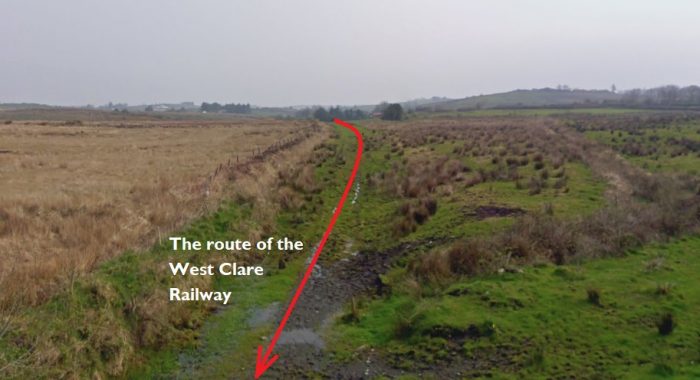
The satellite images provided by Google are relatively poor quality along this section of the line. The streams can only just be made out on the adjacent image. The highway is the erstwhile N67 which fled west from the line earlier in the journey. It is highlighted by the blue line on the satellite images – at the bottom left of the first and entering from the left on the second.

The route of the line either side of the N67 has been heavily built over. The properties built are all domestic dwellings. The OS Map from the 1940s shows road and railway crossing (below) at what appears to be an at-grade crossing rather than a bridge.

Pictures from the 21st Century seem to confirm this. The first photograph below looks back along the route of the line towards Lahinch. The private driveway is roughly along the line of the old railway.

The private house is what was once the old railway station of Miltown-Malbay. In the 21st century this has been refurbished as a home.

The station itself was on the North side of the N67. The second picture below takes a better look at the buildings and the old station canopy is clearly seen in the image.The view back towards Lahinch from the N67 in Miltown. The picture was taken from Google Streetview.The old station layout is clearer in this image. [25]The station while still in use with the road which is now the N67 in the foreground with the crossing gates being opened to allow the passage of the railcar travelling South. The station track layout is also clear in this image and is reproduced as a sketch by Patrick Taylor below. [24]The rail layout at Milotown Malbay. [1]

We finish this part of the journey here in Miltown-Malbay.

References

  1. Patrick Taylor; The West Clare Railway; Plateway Press, 1994, p48.
  2. Edmund Lenihan; In the Tracks if the West Clare Railway; Mercier Press, Dec. 2008, p130-136.
  3. http://www.clarelibrary.ie/eolas/coclare/places/lahinch_history.htm, accessed on 15th April 2019.
  4. https://en.wikipedia.org/wiki/Lahinch, accessed on 17th April 2019.
  5. http://www.schmalspur-europa.at/schmalsp_87.htm, accessed on 17th April 2019.
  6. https://www.postcardsireland.com/postcard/cliffs-moher-lahinch-co-clare-1, accessed on 17th April 2019.
  7. Patrick Taylor; op.cit., p40.
  8. Edmund Lenihan; op.cit., p144.
  9. Georgina Campbell; Georgina Campbell’s Ireland, the Best of the Best: Ireland’s Very Best Places to Eat, Drink and Stay; Georgina Campbell Guides. 2005, p. 71, accessed on 19th April 2019.
  10. https://en.wikipedia.org/wiki/Moy_House, accessed on 19th April 2019.
  11. https://www.clarecoco.ie/services/arts-recreation/publications/north-clare-road-bridge-survey-2015-22291.pdf, accessed on 12th April 2019.
  12. Edmund Lenihan; op.cit., p145.
  13. Ibid., p147.
  14. http://www.clarelibrary.ie/eolas/coclare/places/lahinch_places_interest.htm, accessed on 19th April 2019.
  15. Edmund Lenihan; op.cit., p149.
  16. Ibid., p150.
  17. Ibid., p151.
  18. Ibid., p152-153.
  19. Ibid., p155.
  20. Ibid., p156-157.
  21. Ibid., p158.
  22. http://www.clarelibrary.ie/eolas/coclare/history/rineen.htm, accessed on 19th April 2019.
  23. Edmund Lenihan; op.cit., p159-160.
  24. Patrick Taylor; op.cit., p40.
  25. https://www.booking.com/hotel/ie/miltown-malbay-station-house-accommodation.html, accessed on 20th April 2019.

The West Clare Railway – Part 2 – Corofin to Lahinch

The Line of the West Clare Railway from Corofin to Lahinch

We recommence our journey at Corofin Station with the three photos which concluded the last post about the line.


Corofin Station in June 1961, just after closure earlier inn the year, (c) IRRS. [3]Google Streetview image of Corofin Station buildings in 2009.Corofin Station in 2017. [2]Looking back from the R460 through Corofin Station towards Ennis in April 2009.This image is taken  in 1956 from a little further away form the station. Several passengers and some goods in sacks await the next train. The loop can be seen beyond the platform and careful inspection of the image shows that there is at least one wagon in the short siding beyond the station buildings. [6]Corofin Station. [25]A view showing a well loaded down goods, hauled by locomotive No 6C, waiting in the loop at Corofin in 1950. Notice that because of the length of the train, being too long for the loop proper, it has had to draw forward into the head shunt. After the other train has passed, it will have to propel back, so as to gain access to the main line. The second vehicle in the train, is horse box No 28C. As none of the South Clare stations had two platform faces, all the loops on this railway were away from the platform, so that passing passenger trains could both use the single platform, (c) Kelland Collection. [20]The Up morning service to Ennis unloading mail at Corofin on 20 August 1959. The train, consisting of one of the railcars, a railcar trailer and luggage van, waits to cross the 9:40 am down goods from Ennis. The loop at Corofin, dating from after the opening of the line, was at the Ennis end of the platform, (c) John Langford. [20]

Corofin Station was the first block post on the line and was 8.75 miles from from Ennis. It was provided with a platform and goods store, with a short siding and passing loop all on the up side. A water tank (145 gals.) was also situated here, and on the Willbrook side adjacent to the platform the railway crossed a public road and level crossing gates were provided. That road is now the R460 noted below. The line from Ennis was fairly level. After Corofin it rose continuously as the country became more hilly and there was a stiff ascent of 1 in 61 from the platform end, although it eased shortly to 1 in 169. [7]Looking ahead from the R460, West-Northwest along the West Clare towards Kilkee in April 2009.Loco. No. 6C approaches Corofin from the West with the afternoon Up goods bound for Ennis in May 1950, (c) P.B. Whitehouse. [6]The line travelled over open country.Looking back East along the line from the next road-crossing.Looking ahead towards the coast. In 2009, the crossing-keeper’s cottage was being renovated.

We are in the townland of Roxton now. Roxton level crossing was beyond the 9.75 mile point. A short platfrom existed on the up side  but it was not used after the earlier years. Roxton bridge (No.19) was under the approach embankment to the crossing.  The crossing cottage can be seen above, inhabited and, until recently, relatively unchanged from railway days, but a shed was built on the line of the old railway by the side of the cottage. Edmund Lenihan says: “Roxton crossing was once a place of more than passing interest, especially to train crews in steam days, because it marked the beginning of a 2-mile section of almost continuously rising ground. The gradient here is 1/61 and is even worse further on towards Willbrook, so it was a severe test for down trains fully laden. At least 100 pounds of steam was needed to get up here, and that this was not always forthcoming is well attested to by many stories of unscheduled stops.” [4]The old line curved round to the Southwest following the valley of the River Fergus.

This view looks West along the line in 1953 and shows the approach to the Crossing at Willbrook, (c) IRRS. [4]

Views from the at-grade crossing of the minor road in Willbrook at the bottom left of this satellite image are shown below.Willbrook Crossing, looking back towards Corofin.Willbrook Crossing, looking West towards the coast.

Near Willbrook House the Cragganbuoy River (marked as the Fergus River on Google Maps) was crossed twice (bridges No. 22 and 24). From Newton level crossing at the 10.75 mile point to Willbrook halt one mile further on, gradients at 1 in 50 to 1 in 71 had to be surmounted. An up platform was provided at Willbrook halt which opened for traffic in 1888, but was closed in 1898 It reopened in 1904 only to be closed again in 1921. It was finally reopened once again by the G.S.R. in 1929. Willbrook halt was built on a 1 in 59 gradient and it was a formidable start for heavy down trains in steam days, but the lighter diesel units had no difficulty. [7]

On the ascent from Willbrook the Craggounbuoy River was again crossed twice at Upper Willbrook (No.27) and Tullyloughan (No. 28) bridges and the sound of the waterfall here was welcome as it was just before the gradient eased at mile point 12.75. The “Square Bridge” (No. 29) carried a laneway over the line (the first over-bridge since Ennis) before Clouna Halt at mile point 14 was reached. Beyond Willbrook, the railway closely followed the line of the now much reduced River Fergus. At least that is Google Earth’s name for it. Edmund Lenihan refers to it as the Cragganbuoy River. [5]The forested area above was only small trees at the time Edmund Lenihan walked the line in the 1980s. [5]Clouna Halt, one of two stops before Ennistymon was roughly at the centre of this satellite image. [5]

Clouna Halt was a railcar stop. It opened for traffic on 4th May 1954 and was a quarter of a mile before the summit level of 250 feet above sea-level was reached at mile point 14.5. The gradient facing a down train at this point, 1 in 58 was as severe as those facing an up train on the opposite side of the hill, 1 in 62/64/58, and, in the %miler years in particular, the 0-6-0T locomotives often stalled on this section when hauling heavy trains. [7]The two pictures below show the line from location ‘1’ in the satellite image above. The first looks back towards Corofin, the second forward towards Ennistymon. North of this point is Russa Cross which leads me to suspect that the Russa Bridge referred to by Edmund Lenihan must be close to this location.It is difficult to believe that Russa Bridge was at this location (‘1’) as the road and the surrounding land suggest that there was an un-gated crossing at this location. There is certainly no sign of a bridge. However, on the OS Map from the 1940s a cutting can be seen either side of this road – see the image below. The location is to the South of Russa Lough at the right-hand side of the map.Lenihan says that the line passed through some boggy moorland with a gradual fall and under Russa Bridge (No. 31) before reaching Monreal Halt opened 14th December 1952 at the level crossing of the same name (15.75 m.p.).  The most likely location for Monreal Halt is marked by the number ‘4’ below. At this point there is a track crossing the line at an oblique angle. Sadly I cannot get a photograph at this location as the track is not covered by Google Streetview.There is an excellent description of this length of the line  from Russa Bridge through Monreal Halt and Crossing in Edmund Lenihan’s book. [8] 

Lenihan talks of the fast flowing stream in the cutting at Russa Bridge of depths of over 12 inches in the winter months which could be seen easily from the bridge deck. Russa Bridge was once a a hump-backed stone arch bridge which he says that even a Morris Minor could not negotiate ‘without getting caught amidships.’ [9] The bridge had been replaced by the 1980s with what Lenihan describes as ‘not pretty, but at least it is functional’ [9]. It seems that it has now been completely removed and the cutting infilled.

Along the length of the line in the above satellite image Monreal Halt was encountered as noted above (‘4’). In the 1980s, Lenihan and his son were welcomed by the resident in the crossing cottage and treated to tea, bread and jam. She confirmed that the kitchen in which they were sitting was in the Crossing-keeper’s cottage. The location of the crossing was, she said, defined by the fact that it was at the meeting point of the townlands of Monreal and Cullenagh. [10]On the descent to Ennistymon the Corofin-Ennistymon road was crossed at Cullenagh Bridge (No. 33), which is location ‘2’ above. It is intriguing in the early 21st Century. The bridge over the road which used to carry the railway has been retained but the embankment to the West of the bridge has been removed to allow the construction of a large modern house and landscaped gardens. The two pictures below show this location and are taken from Google Streetview.The view from the Southwest.The view from the North East. The modern house can just be seen on the right of this picture. The bridge parapets and steel beams supporting the old railway decking remain in place as doe the track-bed itself over the bridge. The line continues towards Ennistymon increasingly hemmed-in between roads. The picture below is taken from the single track lane at location ‘3’ and shows the route of the line close to the road.Two level crossings Knockdromagh No.1 and No.2 were only 100 yards apart close to the 17.5 mile post. Their location has been lost under the junction between the N85 and the Corofin to Ennistymon road.The old railway route crossed what is now the N85 road at a very shallow angle and followed the north bank of the meandering River Cullenagh into Ennistymon.A closer view showing the old road alignments and the two rail crossings.The line approaching the N85.

Lenihan comments that by the 1980s a house had been built across the line of the railway close to the N85 and the location of Knockdrummagh No. 1 level-crossing. However, he does provide a picture of the line at the crossing. [10] The picture was taken by Mrs Collins of Knockdrummagh back in the 1950s. Lenihan comments that, in the 1980s, the crossing keeper’s cottage shown in the image above was still in existence, little altered from when it was used for its original purpose. As far as I can establish, the house still exists and in a much improved condition in the 2010s. The Google Streetview image below shows it in 2018.The old railway ran to the rear of the cottage in this image.The line continues towards Ennistymon. Just to the North of the line and South of the N85 are the remains of Glan Castle, just visible in the centre of the satellite image above.Glan Castle in 2018.An old postcard of Glan Castle which was to the North of the railway line East of Ennistymon. [19]

After passing Glan Castle, the line curved round into Ennistymon staton. The location of the B&B below marks the old station building which has been much extended.Ennistymon, just over 18 miles from Ennis a was one of the largest stations on the system and the second blockpost. It was noted for its livestock fairs and butter markets. The station building was on the up platform and the station had extensive accommodation including a large yard, loading bank, goods store and car park. It was the first two platform station on the journey from Ennis. Water was supplied to cranes on each platform from a 2860 gallon tank on the up platform. This was filled by a hydraulic ram from a reservoir on Bleakeys Hill, but at times it had to be augmented by hand pumping from the river Cullenagh. There was a pump-house beside the river behind the down platform at the west end of the Station site.

Entering from Ennis, on passing the down home signal the line veered to the left for the down platform and to the right for the goods siding, with the main line continuing on to the Lahinch side of the up platform. Three further sidings on the up side were provided, one for the front of the loading bank, the second for the rear, and the third connecting with the main siding and running parallel to the main line terminating close to the down home signal on the opposite side.

On the left hand side of the down line, the up starting signal and signal cabin were situated, and past the station on the Lahinch side were the water column and down starting signal. On the up road, again at the Lahinch end was the water tank, with another water column at the Corofin end of the platform. The up home signal was placed on the up side on the Lahinch end of the river bridge. A verandah protected the up platform which was separated from the goods store by a short wall. [24]Ennistymon Station. [25] Diesel locomotive No F502, on an Ennis working at Ennistymon on 22 September 1960. Latterly, when the availability of the railcars declined, one passenger working each way was invariably formed of a locomotive and coaches, the coach here is ex Cavan & Leitrim No 1L, after rebuilding at Balinamore works, and transferred to the West Clare section in June 1959. An ex-Tralee brake van brings up the rear, and the driver, looking round his engine, is Jim Murphy., (c) Roger Joanes. [22] Two images above from 1960 taken at Ennistymon Station by Roger Joanes. [12]

The adjacent image shows Loco. No. 3C at Ennistymon. [13]At Ennistymon on 28 July 1952, locomotive No 9C is on the 9:58 am goods from Kilrush, taking water. Driver Tom Reidy is on the engine, (c) C.L. Fry. [21]Loco. No. 1C, on an Ennis working taking water at Ennistymon in 1933. The train consists of an ex West Clare third, a composite, and full brake – the latter is either No 37C or 38C – note clerestory roof (c) Patrick Taylor. [21] Railcar No. 3388, forming the 1:50pm Ennis to Kilrush, calling at Ennistymon on 17 July 1957. The up goods, which it passed here, can be seen leaving in the distance, (c) Colin Bobcock. [21]Ennistymon Station in 1953 with Glan Castle and Blackwell’s road bridge in the background. [18]The station building in the 21st Century. It has been much extended to provide a large B&B. [17]

Ennistymon has a certain notoriety as far as the history and popularity of the West Clare Railway is concerned as it is believed that the particular saga of the acrimonious relationship between Percy French and the West Clare started because river water was being used to fill the water tank at Ennistymon. The story is provided as an Appendix to this post – Appendix 1 below.

Immediately to the West of Ennistymon Station the West Clare crossed the Inagh (Cullenagh) River and the Mill Road in the townland of Ardnacullia North by a three span bridge (No. 37). Immediately beyond, the Bogbere Road crossed over the line on bridge 39. This is the “Town Bridge” and the West Clare continued through a cutting and around the flank of a hill before traversing some open country.Ennistynon Railway Bridge. [15]The North Clare Road Bridge Survey picks up a few railway bridges. This is a copy of the record relating to the railway bridge over the River Inagh at Ennistymon. [16]

The railway travelled West on the South side of the Cullenagh River and passed over Ardnaculla on a steel girder bridge. The image below in the North Clare Road Bridge Survey is taken from the South on Ardnaculla. [16]The same bridge taken from the North in 2009.At the access road to Deerpark the alignment of the railway comes very close to the N67, Ennistymon to Lachinsh road.

Just over 19 miles from Ennis the line crossed a minor road at Madigans Bridge, or Graham’s Bridge and a quarter mile further Workhouse Halt was reached. In the year 1887, a small platform was built close to the Workhouse on the down side to facilitate the guardians of Ennistymon hospital, and certain trains called here at that period. It was closed in 1925 but was reopened for diesel working on the 29th June 1953.

The Ennistymon Union Workhouse is now the Ennistymon Community Hospital. It can be seen on the satellite image above. It was rail-served in that there was a halt on the West Clare Railway next to the site. The adjacent plan shows the site in 1915 and includes the railway and level-crossing. [23]

Ennistymon Poor Law Union was formed in August 1839 and covered around 238 square miles of territory. It was overseen by an elected board of 21 guardians representing the 13 electoral divisions it served. The Workhouse was erected on a 6-acre site to the West of Ennistymon and was ready for use in July 1842. The site is shown in the image above. [23]

Edmund Lenihan write of the Workhouse: “To look at it today, a sleepy district infirmary, one could never imagine the suffering and death that were part of daily life in the years of the Famine. Originally intended to house 600 people, it quickly became grossly overcrowded, as did every other workhouse in thise years. For example, in late 1848 there were 1,150 inmates, between sick and able-bodied. Neglect and disease soon reaped their grim harvest in such conditions. Little wonder! In 1847 a mere 1/11d per week was the accepted cost of maintenance per inmate, and early in 1848 a report by the vice-guardians of the union found dirt, filth, squalor and vermin to be the norm.” [26] [27]

The alignment of the West Clare travelling West from Ennistymon is imposed on a modern image taken from the Hospital access road. There was a level-crossing just to the left of this image.Looking forward from the location of the level-crossing towards the coast. The bungalow looks modern but is either a replacement for or an extended version of the station building at Workhouse Halt.The railway ran through what is now the driveway of a modern bungalow. The high walls of the workhouse/hospital can be seen in the back ground of this view of Workhouse Halt in 1953, (c) IRRS. [26]

As we have already noted the crossing cottage or a successor is still a domestic dwelling. There is, however no sign of the little platform on the up side that was used in the early years when occasional trains stopped to facilitate the workhouse guardians. This sen ice was discontinued in 1925, and only reinstated in mid-1953, with the coming of the railcars. While it was in operation, it is doubtui whether the inmates were much facilitated by it. …. Workhouse Halt, 19.5 miles from Ennis, was the last crossing under the jurisdiction of Ennistymon block-station. [26]

The onward journey to Lahinch is shown on the OS Map from the 1940s below. The Workhouse is close to the centre of the map.It is only a short distance to the modern outskirts of Lahinch from the Hospital. Lahinch Station site is just off this satellite image at the bottom left corner. After passing two further level crossings Lahinsey No.1 and No. 2 between mile post 20 and 20.5, the Station for the seaside resort of Lahinch was reached.Looking back East towards Ennistymon.Looking ahead towards Lahinch Station.Between Lahinch and Ennistymon. facing towards Ennistymon. The switch-blade of the point at the East end of Lahinch Station just features at the bottom of this picture. [14]This satellite image is to a smaller scale which allows the whole of the Lahinch area to be included. The area in the curved red box in the station area and is represented below in a sketch plan.Lahinch Station. [25]Lahinch Station around the turn of the 20th Century. [26]Lahinch Station in 1961. [26]

There is good coastal scenery on either side of Lahinch, and inland are some pretty glens among low hills, with the Glen of the Cullinagh river particularly attractive. Lahinch possesses a beautiful golf course, ideally situated behind the beach on the northern side. The Cliffs of Moher – one of the out standing features of the country, rising sheer above the sea to nearly 700 feet and extending for about five miles along the coast, form one of the grandest stretches of Cliffs in these islands and afford magnificent views along the Atlantic coast. [29]

Lahinch station building is on the up side and as originally built had only one platform and a short siding which was situated on the Miltown-Malbay side. This siding ran on to the goods store at the end of the platform. In August 1911 the layout at this station was rearranged. A second platform was built and a new line of rail laid down turning this station into a passing place. A verandah was built on the up platform, and a signal cabin similar to Ennistymon but with only five levers was also built at the Miltown-Malbay end of the down platform. Electric staff instruments were installed and it became a block post. In August 1953 a turntable was installed which came from Kilmessan on the Clonsilla-Kingscourt branch and which was suitably converted for the turnround of diesel railcars on excursion trains. During steam days, prior to this arrangement, the engines had to run six miles to Miltown-Malbay where a turntable was provided to enable them to turn. [29]A railcar being turned at Lahinch. [26]

We end this part of our journey at Lahinch.


References

  1. P.B. Whitehouse; The West Clare Railway; in The Railway Magazine Volume No. 601, May 1951, p296-298, p320, p345.
  2. https://www.pandacoz.com/day-17—to-galway.html, accessed on 9th April 2019.
  3. Edmund Lenihan; In the Tracks if the West Clare Railway; Mercier Press, Dec. 2008, p80-85
  4. Ibid., p89-99.
  5. Ibid., p97-108.
  6. Patrick Taylor; The West Clare Railway; Plateway Press, 1994, p38.
  7. Ibid., p39.
  8. Edmund Lenihan; op.cit., p110ff.
  9. Ibid., p111.
  10. Ibid., p112.
  11. Ibid., p118.
  12. https://www.flickr.com/photos/tags/ennistymon, accessed on 13th April 2019.
  13. https://picclick.co.uk/Irish-Railway-Photograph-GSR-WCR-West-Clare-Railway-352251191994.html, accessede on 13th April 2019.
  14. https://www.activeme.ie/guides/dismantled-railway-ennis-to-lahinch, accessed on 13th April 2019.
  15. http://ie.geoview.info/abandoned_west_clare_railway_bridge_ennistymon_co_clare_ireland,10881484p, accessed on 13th April 2019.
  16. https://www.clarecoco.ie/services/arts-recreation/publications/north-clare-road-bridge-survey-2015-22291.pdf, accessed on 12th April 2019.
  17. https://book-a-bnb.com/station-house-bnb-ennistymon.html, accessed on 13th April 2019.
  18. Edmund Lenihan; op.cit., p123.
  19. https://www.irelandxo.com/ireland-xo/history-and-genealogy/buildings-database/glan-castle-ennistymon, accessed on 13th April 2019.
  20. Patrick Taylor; op.cit., p58.
  21. Ibid., p60.
  22. Ibid., p61.
  23. http://www.workhouses.org.uk/Ennistymon, accessed on 13th April 2019.
  24. Patrick Taylor; op.cit., p39.
  25. Ibid., p48.
  26. Edmund Lenihan; op.cit., p130-136.
  27. Michael Mac Manon; A History of the Parish of Rath; Clare Archaeological Society, 1979, p72.
  28. Seosamh Mac Mathuna; Kilfarboy: A History of a West Clare Parish, Milltown Mallbay; S. Mac Mathuna, 1976, p47.
  29. Patrick Taylor; op.cit., p40.
  30. Percy French; Are Ye Right There Michael. King Laoghaire: The Home of Irish Ballads and Tunes; https://www.kinglaoghaire.com/lyrics/947-are-ye-right-there-michael, accessed on 15th April 2019.
  31. http://www.clarelibrary.ie/eolas/coclare/people/percy.htm, accessed on 15th April 2019.
  32. Edmund Lenihan; op.cit., p122,124.
  33. From the evidence of Mr Hopkins, Locomotive Superintendent of the West Clare Railway, at the hearing of French -V- The West Clare Railway Company at Ennis on 15th January 1897, reported in the Irish Independent on 13th November 1975.


Appendix 1 – Percy French and the West Clare Railway

Are Ye Right There Michael? is a song by the 19th-century and early 20th-century Irish composer and musician Percy French, parodying the state of the West Clare Railway system in rural County Clare. It was inspired by an actual train journey in 1896. Because of a slow train and the decision of the driver to stop for no apparent reason, French, though having left Sligo in the early morning, arrived so late for an 8pm recital that the audience had left. The ballad caused considerable embarrassment for the rail company, which was mocked in music halls throughout Ireland and Britain because of the song. It led to an unsuccessful libel action against French. [30]

It is said that when French arrived late for the libel hearing, the judge chided him on his lateness. French reportedly responded “Your honour, I travelled by the West Clare Railway”, resulting in the case being thrown out. [31]

In 1898 Percy French sued the directors of the West Clare Railway Company for “loss of earnings” when he and his troupe of entertainers were late for a performance in Moores Hall, Kilkee. He had advertised a concert for 8 p.m. on the evening of 10th August 1896, in Kilkee. He left Dublin that morning and arrived in Ennis on time for the 12.30 train which was due to reach Kilkee at 3.30p.m. The train slowed up approaching Miltown Malbay and when it got to the station there did not go any further. Five hours elapsed before a replacement train arrived and as a result he did not get to the hall in Kilkee until 8.20 p.m. His magic lantern, which was with his luggage, did not arrive until 9.00.

When he reached the hall most of the audience had gone home and the receipts were only £3 instead of the usual £14. A railway company official explained that when the engine took on water at Ennistymon weeds got into the boiler. This became apparent after a few miles and by the time Miltown Malbay was reached the driver decided to put out the fire because of the possibility of an explosion. No further progress was possible and a replacement engine was requested.

French was awarded £10 expenses. The Railway Company appealed but the award stood. The incident led to the song “Are ye right there Michael?” which became one of the most popular numbers in his repertoire. [31] The song is produced below. [30]

Are Ye Right There Michael?

You may talk of Columbus’s sailing
Across the Atlantical Sea
But he never tried to go railing
From Ennis as far as Kilkee
You run for the train in the morning
The excursion train starting at eight
You’re there when the clock gives the warnin’
And there for an hour you’ll wait
And as you’re waiting in the train
You’ll hear the guard sing this refrain:

Are ye right there, Michael, are ye right?
Do you think that we’ll be there before the night?
Ye’ve been so long in startin’
That ye couldn’t say for certain’
Still ye might now, Michael
So ye might!

They find out where the engine’s been hiding
And it drags you to Sweet Corofin
Says the guard: Back her down on the siding
There’s a goods from Kilrush comin’ in
Perhaps it comes in two hours
Perhaps it breaks down on the way
If it does, says the guard, be the powers
We’re here for the rest of the day!

And while you sit and curse your luck
The train backs down into a truck

Are ye right there, Michael, are ye right?
Have ye got the parcel there for Mrs White?
Ye haven’t, oh begorra
Say it’s comin’ down tomorra
And well it might now, Michael
So it might

At Lahinch the sea shines like a jewel
With joy you are ready to shout
When the stoker cries out: There’s no fuel
And the fire’s tee-totally out
But hand up that bit of a log there
I’ll soon have ye out of the fix
There’s fine clamp of turf in the bog there
And the rest go a-gatherin’ sticks

And while you’re breakin’ bits of trees
You hear some wise remarks like these

Are ye right there, Michael? Are ye right?
Do ye think that you can get the fire to light?
Oh, an hour you’ll require
For the turf it might be drier
Well it might now, Michael
So it might

What are the underlying facts?

It is beyond dispute that there was a significant delay of around 5 hours  in the journey undertaken by Percy French. The delay occurred when the driver of Locomotive No. ……….. realised that something was significantly awry with his charge and decided to stop the locomotive at Milltown Mallbay rather than risk a possible boiler explosion further along the route to Kilkee.

The problem seems to have been caused by a practice, which was common at Ennistymon in time of low water supply, of taking water from the River Cullenagh. The water tank at Enisstymon was usually supplied from a reservoir on Beakey’s Mountain by gravity flow. But in very dry weather this supply was often inadequate, and men would be detailed to a little pump house to hand-pump water from the river into the tank. [32]

One old hand recalled those days: “Well, the drier summer’d come the better we’d like it. We used to love being in there. An’ often we’d keep pumping when there was plenty of water int he tank.” Under cover int he pump house they could smoke and talk to their hearts’ content, and two small holes in the walls facing the station and the bridge allowed them to keep an eye out for the supervisor. [32]

On 10th August 1896, the 12.20pm train from Ennis to Kilkee, hauled by the new 2-6-2T Locomotive No. 8, ‘Lisdoonvarna‘ took water at Ennistymon. But weeds in the water choked the boiler, and by Lahinch the driver, Michael O’Loghlin, found that he was having troble proceeding. He managed to nusre the tain to Milltown Mallbay but no futher progress was possible. [32]

Another locomotive No. 4, Besborough, was procured to haul the train to Kilkee but there was an excessive delay and the train did not reach Kilkee until 8.25pm. [33]

The West Clare Railway – Part 1 – Ennis to Corofin

Another article from The Railway Magazine in May 1951! This time we are in Ireland, specifically in County Clare.

The May 1951 edition of the magazine carried an article on the 3ft gauge light railway which ran from Ennis to Kilrush and Kilkee. The total length of the railway was about 53 miles. [1]

The Railway Magazine article only touched the surface of the story of the line. This post seeks to pull together available information and provide a survey of the line.

Edmund Lenihan, in his book, “In the Tracks of the West Clare Railway,” says: “Merely to get the first train moving took almost four decades and labyrinthine proposals, counter-proposals, false starts, politicking, bankruptcy and natural disaster. It certainly reads like a saga, and, for good measure, it was largely a family affair between the people of Clare, Catholic and Protestant, landlord and peasant, priest and layman, town and country, with a few important outsiders thrown in to lend spice to the mixture.” [8]

Many attempts were made to provide railway transport connections to West Clare but the area was just too remote for investors to take the risk of spending their money on such ventures. They could not imagine there being enough freight or people for a railway to make a profit. Then, in answer to exactly this problem in such areas of Ireland, Parliament passed an Act called “The Tramways Act” in 1883 the provisions of which included clauses to permit a narrow gauge track (thereby more than halving the building costs) and giving guaranteed returns to the investors. [5]

The 43.4 km (27 mi) West Clare Railway between Ennis and Miltown Malbay was built a few years’ earlier than the South Clare Railway. The first sod was cut on 26 January 1885 at Miltown Malbay by Charles Stewart Parnell, M.P., although actual work on the line had begun in November 1884. [4]

Although some of the list below feels like we are getting ahead of ourselves, Edmund Lenihan provides a list of the major stages in the development and life of the West Clare railway: [8]

  1. 1845: First KiIkee—Kilrush/Cappagh rail link propose(‘ by Col. Vandeleur.
  2. 1858: First scheme to reach the stage where ground was actually broken to lay a railway in west Clare.
  3. 31st July 1871: Ennis and West Clare Railway receives Act of Incorporation and is authorised to build a narrow-gauge line (the first company in Ireland to get such permission).
  4. 24th August 1883: Tramways Act passed by Parliament.
  5. 15th December 1883: West Clare Railway Company registered.
  6. 9th June 1884: South Clare Railway Company formed.
  7. 26th January 1885: First sod of West Clare Railway turned by Parnell at Miltown Malbay.
  8. 2nd July 1887: West Clare Railway opened for regular services.
  9. 9th October 1890: First sod of South Clare Railway turned by Mrs Reeves at Kilkee.
  10. 23rd December 1892: South Clare Railway opened for regular services.
  11. 1st January 1925: Amalgamation of West Clare Railway and Great Southern Railways.
  12. July 1927: ETS signalling introduced on Ennis-Miltown sections of the West Clare line.
  13. 1945: CIE takes over the West Clare line.
  14. 1948: Milne Report. First official mention of possible closure of West Clare branch of CIE.
  15. 1952-55: Dieselisation.
  16. 31st January 1961: Closure of West Clare line.

Back again to the story! The section in italics below comes from ‘In the Tracks of the West Clare Railway’ by Edmund Lenihan. [8][9]

After the Famine, railway fever gripped Ireland just as it did the rest of Great Britain at the time. In the period 1845 to 1885 at least a dozen schemes were proposed for railways in Co. Clare alone.

“The large population of the time may have justified such proposals, but much of the impetus certainly came from landlords whose travels abroad demonstrated to them the advantage of fast and comfortable transport, and emphasised the shortcomings of their own home areas. [10] …... All these plans were similar in some vital respects: they all included as their terminus points Ennis, Kilrush and Kilkee. At that time traffic on the Shannon was considerable, and Cappagh pier had to figure large in any route that hoped to be profitable, but how Cappagh might be made accessible was the subject of widely varying proposals. …. The various plans formulated in the 1840s and 1850s foundered on one common rock: finance, and this largely because they proposed crossing Poulnasherry Bay rather than going round it. Certain progress was made in each of these early schemes but all failed to reach the construction phase.” ….. [8][12]

The failure of the most promising of the schemes led to a twenty year hiatus before another scheme reached construction. In that twenty years there were

“very many meetings and proposals, both for the Kilrush—Kilkee section and for the Ennis—Miltown route, including, in 1871, one for a line from Ennis to Miltown via Corofin, Ennistymon and Lahinch — exactly the route later taken by the West Clare Railway. But practical developments had to await the passing of the Tramways Act in August of 1883, a measure that allowed the interest on capital to be guaranteed by the baronies through which a railway passed.” [8][13]

The directors appointed W.M. Murphy [8] as contractor to build the railway. (Murphy was later to become a major newspaper owner and caused the infamous worker’s lockout in Dublin in the early years of the 20th century.) [5]

Early in 1887 locomotives nos. 1 and 2 arrived, and no.3, Clifden and no. 4, Besborough, had been completed by their builder, W.G. Bagnall of Stafford, and all seemed fair for the completion of work in a short time. [8][14] In fact, various legal and other obstacles had to be overcome and the line only opened on 2nd July 1887. [4]

Whilst the West Clare was being built, a number of the directors who owned lands in the far west of the county decided to form a second company to promote a similar railway serving the towns of Kilrush and Kilkee. These towns had always been the targets for the original railway plans. However, no agreement could be found as to the direction of the railway with many believing that the line could be built across the tidal Poulnasherry Bay with the resulting land reclamation providing rental incomes which would largely defray the costs of building the line. However desirable the plan looked in theory, it was not until Murphy explained that he could not calculate the costs of making the line sea-resistant and could not guarantee the results anyway that the directors finally decided that the South Clare Railway should go to Moyasta where the necessary division of the line would take place and a line built to connect with the West Clare Railway at Miltown Malbay. [5]

Although the South Clare was formed as a Company in June 1884, it was not until 6 years later in 1890 that work started on the extension. [15] The South Clare Railway built the extension from Miltown Malbay to Kilrush, Cappagh Pier (Kilrush Pier) and Kilrush docks with a branch to Kilkee from Moyasta, with work starting on the extension in October 1890 and opening on 11 May 1892. [4] There appears, however, still to have been work to complete after the opening, as one source suggests that the South Clare was not completed until December 1892. [5] The extension was worked by the West Clare Railway and was initially dogged by poor service and time keeping, but this later improved. [4]

“The two companies worked closely together from the very start and many of the officers were common to both. Such was George Hopkins, appointed to design and supervise the rolling stock. Hopkins came to give Dubs & Co of Glasgow a specification for three locomotives the detailed design of which would be left to Dubs. The first of these was Number 5 named “Slieve Callan” which arrived in March 1892. These locomotives were designed to pull the expected loads at the timetabled speed of 25 mph over gradients as fierce as 1 in 50 along a track of 48 miles in length. They were therefore large and powerful engines built to the limits of the permitted loading gauge.” [5]

“The railway timetable for three trains each way between Ennis and Kilkee with branch line connections to Kilrush was published under the sole name of the West Clare Railway in June 1893. From then on, the railway trundled on gaining new passengers as its services became better known. It is, for example, no accident that the Lahinch golf course was laid out at this time – British Army officers could use the railway to travel to the course easily. The Lisdoonvarna Festival each September gained a new lease of life as passengers could get as near as Ennistymon from all parts of Ireland. The Burren cattle trade was enhanced by the ease of transporting the cattle away from the market. The Kilrush Horse Fair and the Lahinch Garland Day celebrations took on a new significance. Kilkee, always a popular resort, became known as the “Brighton of the West” whilst new goods and services were brought to the shops by travelling salesmen, postal services quickened by degrees and newspapers from Dublin became available on the day. By the turn of the century, the timetable was showing 5 trains each way. More than 200.000 passengers travelled the line and 80.000 tonnes of freight and livestock were carried each year with 2/3rds of the passengers travelling during the summer months.” [5]

On 1st January 1925, the rolling stock and locomotives became the property of the Great Southern Railways (GSR). Efforts were made from time to time to modernise the system, and to make it safer and more cost-effective — for example, by the introduction of ETS working in July 1927 and the purchase of two Drewry railcars in 1928. [15][20]

With control being exercised from Dublin inefficiency was no longer tolerated and local sentiment was of much less significance. “A large part of the Ennis carriage-building works and maintenance depot was closed down, and ballast ceased to be quarried locally, all supplies now coming from the GSR quarry at Newbridge, Co. Kildare. [21] The only link with tradition preserved in this regard was that the 1908 decision of the West Clare Company to ballast the line annually in May, June and October was adhered to until the time of the closure of the system in 1961. A proposal was made in 1936 to widen the gauge from 3 feet to the standard 5-foot-3-inches so as to avoid the necessity for transfer of all goods at Ennis Station, but this came to nothing in spite of a lively debate on the matter in the local press which lasted well into the 1940s. The cost would have been out of all proportion to any prospective benefits.” [15]

In subsequent years steam passenger services were replaced by railcars but the financial position did not significantly improve and closure became more and more likely. “And so it was that on 27th September 1960 the death sentence was pronounced: it was declared publicly that the line would close on 31st January 1961.” [16] The line closed on that date.

The Route of the West Clare Railway

We start our survey of the line from the station In Ennis where the West Clare Railway connected with the national railway network. The adjacent image shows the station looking to the South. [4]

The following image shows the view North from the station platform.Ennis railway station in September 1950, with the West Clare Railway carriage in the foreground. The carriage works are in the rear to the left, the engine shed in the centre and the two span Quin Road bridge to the rear right. [2]The same set of carriages, this time looking south towards the station buildings. Both pictures were taken in 1950, (c) O’Dea Photograph Collection via http://www.nli.ie. [2]The West Clare platform at Ennis Station, date unknown.Ennis Station in 1952, (c) IRRS. This picture and that below were taken from approximately the same position but 10 years apart. Just visible on the right-hand side of the picture is the West Clare Engine Shed. In the immediate vicinity of the engine shed were a turntable and carriage works. [16]Ennis Station in 1962, just a short time after the closure of the West Clare Railway. No trace remains! [6]The same location in June 2006, (c) Francoise Poncelet. [3]Ennis Station in June 2017 is shown above looking from the North, Google Streetview. The adjacent satellite image shows the station in 2017 with Quin Road to the north passing over the railway.

Ennis Railway Station is today the terminus station of the Limerick to Ennis Commuter service and a station on the Limerick to Galway intercity service. Passengers for Dublin/Cork or Waterford transfer at Limerick. The station forms part of the Western Railway Corridor, the name given to a group of lines in the west of Ireland between Limerick and Sligo. Five services pass through Ennis on the Limerick–Galway service with more just running Limerick–Ennis. [7]

In the past it was also the terminus of the 3ft-gauge West Claire Railway which ran North from the station alongside the mainline. North of Quin Road the land is shown on the adjacent 1917 OS Map as being used by a rail-served sawmill.

South of Quin Road, the grass triangle on the satellite image above provided facilities for the West Clare Railway. These included a carriage-works a turntable and an engine shed. A platform extended under the Quin Road bridge and a water tank could be found on the North side of the abutments of the bridge.

It is interesting to note that the Sawmill was rail-served by both railways with the broad-gauge having a siding crossing the 3ft-gauge lines.

The facilities shown to the South of the station buildings were those for the main-line. [29]

The adjacent map  is the best excerpt that I could find from the GSGS 1-inch map from around 1940. [17]

The map below that is an extract from the Bartholomew quarter-inch map from 1940. Which shown Ennis station and the 3ft-gauge West Clare line leaving the mainline to the North. [18]

The picture immediately below these maps shows the line of the West Clare which ran on the West side of the mainline. The West Clare is long-gone by the time this picture was taken and the mainline track layout has been streamlined

The following monochrome picture looks back through Quin Road Bridge to Ennis Station and shows the two 3ft-gauge lines passing under the bridge.

Two lines of the West Clare Railway originally passed under Quin Road Bridge and served engine shops, a goods shed, loading bays and a transfer bank with a 3-ton crane all in a compound on the North side of the bridge. [16]A diesel railcar about to leave Ennis Station on 25th July 1954, (c) IRRS. The West Clare had its own bridge span under Quin Road. That span has now been blocked off. [16] This general view of Ennis Station was taken in May 1950 by P.B. Whitehouse. The 3ft-gauge Engine Shed can just be seen on the very right of the picture. [30] Loco No. 6C is shunting in front of what is marked on the OS plan as a sawmill at Ennis. Taylor records that building as being a transshipment shed. The year is 1954 or 1955. The broad-gauge siding can be seen crossing the 3ft-gauge to access the shed. Taylor also talks of a loco-repair works being to the right of the transshipment shed, (c) L. Hyland. [31]Loco No. 3C is taking on water in the above image. This is an image from the early 1930s and the loco was less than 10 years old at the time, (c) A.W. Croughton. [31]A ‘Walker’ of Wigan railcar travels north from Ennis Station on the West Clare, alongside is the Irish standard gauge line. [27]This monochrome image shows the two railway lines running parallel across the twin bridges over the River Fergus at Clonroad, around a mile North of Ennis Station, in 1953. The picture is taken looking back towards Ennis. (c) IRRSThis map is another extract from the GSGS 1-inch map from around 1940. It shows the West Clare line leaving the mainline just to the North of the modern R352 Tulla Road which is then pictured in Google Streetview image which follows. The bridge over the Tulla Road is shown in 2017 and clearly shows a modern reinforced concrete deck spanning masonry abutments. [17]Tulla Road Railway Bridge from the West. The West Clare crossed this bridge on the near side of the mainline railway.

Over a distance of about 300 yards north of the Tulla Road the two lines curved gently to the right taking a more northerly path. As they did so they crossed a small stream on a fine stone-arched bridge. One hundred yards further on, at Corrovorrin level crossing, the old road to Ballycoree crossed the two railways. The road is now very much a minor road but was once one of the main roads out of Ennis. [19]

Just beyond this crossing the West Clare Railway diverged from the mainline. Its route is shown approximately by the red line on the satellite image above.The line curved around to travel almost due East before crossing Shaughnessy’s bridge just a stone’s throw from the boundary wall of Our Lady’s Hospital. The curving line through what is now the hosuing estate was known as Tank Curve after the huge hospital water tank.The West Clare continued in a westerly direction crossing the R458 Gort Road. The old road can be seen on the left of the above satellite image joining the alignment of the modern road at the top of the picture. The line continues West towards the River Fergus as shown below.The West Clare crossed the River Fergus on the ‘Lifford Bridge’ as it was called in the Clare Saturday Record report of 20th August 1887, which described an attempt to blow up the bridge that week. Edmund Lenihan comments: “The job was bungled, however, and the bridge still survives, though somewhat the worse for wear. All that remains is the skeleton of girders which once supported the metal deck, and these have not weathered the years well since their laying down in 1886. They are seriously corroded at many points and gave us several heart-stopping moments as we picked our way carefully across. Testing our luck and our balance, we hopped from girder to rotten girder, while under us the Fergus flowed fast and deep. No person in his sane senses would wish to fall in here, but the children of the town often thought otherwise, for on hot summer afternoons the more daredevil among them, bent on mischief, would climb onto the last carriage as the train pulled slowly away from Lifford Halt, ready themselves as it approached this bridge, and then jump off into the river as it crossed.” [19]A few hundred yards further along the old line it crossed Drumcliffe Road on a low girder bridge. The abutments still remain (above). The line then continues to curve round from west to North and crosses a narrow point on Lough Cleggan (on the satellite image below).

We arrive next at a level crossing, the first since Lifford Halt – Erinagh Crossing, in the townland of Reascaun, 3.5 miles from Ennis. The picture above shows the railway formation arriving at the Crossing.

The adjacent satellite image shows that crossing at the bottom of the extract from Google Earth.

The adjoining house no longer looks like a crossing cottage. It has been too much modernised and altered to be recognisable as such. [22]

The picture below shows the bungalow that was once the crossing-keeper’s cottage. North of the extended cottage the line crossed open fields and then, on an embankment, a boggy marsh which is evident at the top of the adjacent image and at the bottom of the satellite image below. North of the marshland the route of the line has been re-landscaped and is very indistinct on the ground and on satellite images. [22]

North of the marshland the West Clare crossed the road running Northeast from Ballygriffey at grade right next to Ballygriffey Castle and on the West side of the small stream which it had crossed on a bridge a couple of hundred yards short of the road crossing.

The monochrome image below shows Ballygriffey Castle and the minor road crossing close by.

As a gated crossing there was a crossing keeper and cottage. Once again the cottage has been so reconstructed that none of its railway features remain.

The crossing, 4.75 miles from Ennis, and we are now entering the 7-mile length to Willbrook that was once under the jurisdiction of Corofin Station. Ballygriffey Castle and railway crossing gates in 1953, (c) IRRS. [23]The extended crossing-keepers cottage is seen above from the Southwest in April 2009.

North of the cottage, a ballast siding was established in 1904 and a quarry opened alongside to supply the needs of the railway after the siding at Skagh Point near Kilrush was closed because of a dispute with the Crown over royalties. Edmund Lenihan comments: “One would be hard put now to say where the siding was, since not alone has it vanished, but the line, too. Yet if some of the survivors of the backbreaking slavery undergone here are to be believed, its obliteration is little loss to the world.To be consigned to ‘duty in Ballygriffey’ was akin to penal servitude, it seems, for even the gangers in command were more truculent here than else-where, as if the place exuded some baleful influence of its own.” [23]
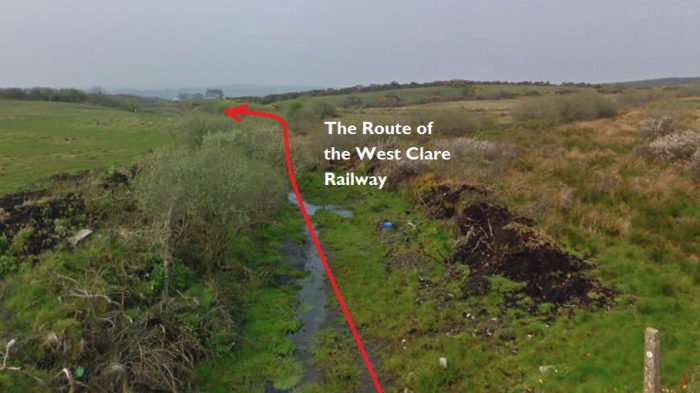
The railway gradually turned towards the Northwest as shown on the adjacent satellite image running to the East of the hamlet of Ballygriffey North and then crossing another marshy area on embankment.The railway crossed open limestone grassland on its way towards Ballycullinan Lough. On the way it crossed three roads. The first of these was the site of Ruan Station and Level-Crossing. The third is now the R476 which itself is heading for the next village on the line, Corofin. [24]Ruan Crossing Gates and Crossing-keeper’s cottage in 1953. [25]A Google Earth image of Ruan Station in the early years of the 21st Century.Looking back along the line towards Ennis in April 2009. The stone pilasters in the centre of the image are the pillars which held the crossing gates.Ruan Station Building. The picture is a Google Streetview image and was taken in April 2009.

Ruan station-house is, “resplendently restored and transformed into an elegant dwelling quite unlike the general run of modern country houses. From the boundary wall to the road, where the crossing gates once stood, the line is now a neat garden and lawn, but even more noticeable is the surrounding stonework, for much care has been taken to preserve it, especially the level-crossing piers. It is altogether a credit to its owner. Hard to believe, looking at it now, that this same building was sold by CIE in October 1962 for the princely sum of £15.” [25]

Properly speaking, this station should not have been called Ruan Station, since it is in the townland of Kilkee East, and the village of Ruan is a good 2.5 miles away. However, it would have been highly confusing, even on the West Clare, to have two destinations of the same name. So Ruan Station it had to be, and Kilkee remained the western terminus of the line.

“Ruan Station was first made a halt in 1888, but only after some rather novel persuasive tactics by the parish priest, Fr Garry. It seems that the railway company had no intention of providing even a halt at Ruan, let alone a station, so the priest (who is described as ‘a tall, powerful man and a forceful character’ who got his own way in most things) took to driving his pony and trap onto the line, forcing the train to stop. The company at last got the message; since it looked as though they would have to be constantly stopping anyway, they decided to make it official in 1888. Ten years later, however, it was closed, only to be reopened in 1904 — whether by Fr Garry’s efforts we do not know. That worthy man continued as parish priest in Ruan until 1912, and is buried there.” [25]

In 1921, the halt was closed again, and the platform removed. [25]

Heading on from Ruan, the line continued in a Northwesterly direction and met the modern D476. The crossing was at grade and at a very shallow angle as can be seen on the satellite image below.For a short distance, the road and railway ran parallel to easch other in close proximity. The road then turned North to Corofin and the railway turned gradually to the West and on the way entered Corofin Station. [24]

Corofin Station in June 1961, just after closure earlier inn the year, (c) IRRS. [28]Google Streetview image of Corofin Station buildings in 2009.Corofin Station in 2017. [26]

We complete the first part of our journey along the West Clare Railway at Corofin.

References

  1. P.B. Whitehouse; The West Clare Railway; in The Railway Magazine Volume No. 601, May 1951, p296-298, p320, p345. (Articles from back copies of the magazine can be found online using a subscription service to The Railway Magazine archives.)
  2. http://clareherald.com/2014/09/old-images-of-clare-ennis-railway-station-1950, accessed on 6th April 2019.
  3. https://commons.wikimedia.org/wiki/File:Ennis_Station_-_geograph.org.uk_-_296727.jpg, accessed on 6th April 2019.
  4. http://www.skibbereeneagle.ie/ireland/west-clare-railway, accessed on 6th April 2019.
  5. http://www.westclarerailway.ie/about/history, accessed on 6th April 2019.
  6. http://clareherald.com/2015/07/old-images-of-clare-ennis-railway-station-1962, acessed on 6th April 2019.
  7. https://en.wikipedia.org/wiki/Ennis_railway_station, accessed on 6th April 2019.
  8. Edmund Lenihan; In the Tracks of the West Clare Railway; Mercier Press, Dec. 2008, p16-19.
  9. Ignatius Murphy; The Kilrush-Kilkee Railway and Reclamation of Poulnasherry Bay; in The Other Clare, Volume 6, 1982, p16.
  10. Ibid, p17. But note also the Clare Journal of 26th March 1849, and 2nd April 1849, which berated the gentlemen of Clare for their lack oof interest in ensuring that the proposed branch line from Limerick to Galway should pass through the county, whereas their Gaway counterparts were suitably active in this matter.
  11. In July 1866 a case of traverse in the matter of Kilrush and Kilkee Railway Company came to court. A Mr. Shannon was claiming £600 compensation for land that was to be taken by the railway in Leaheen and Kilnagalliagh. The company was offering £200. See the Clare Journal,12th July 1866.
  12. Munster News; 29th May 1869 and 25th August 1883.
  13. Clare Saturday Record; 6th March 1886, and L. Hyland, Twilight of the West Clare, 1961, p1 (pamphlet distributed on the day the line closed).
  14. H. Fayle; Narrow Gauge Railways of Ireland;  Greenlake Publications Ltd., London, 1946, republished 1970, S.R. Publishers Ltd., London, p78
  15. Edmund Lenihan; In the Tracks of the West Clare Railway; Mercier Press, Dec. 2008, p21-25.
  16. Edmund Lenihan; In the Tracks of the West Clare Railway; Mercier Press, Dec. 2008, p29-32.
  17. https://maps.nls.uk/geo/explore/#zoom=7&lat=53.3993&lon=-7.9500&layers=14&b=1, accessed on 7th April 2019.
  18. https://maps.nls.uk/geo/explore/#zoom=7&lat=53.3993&lon=-7.9500&layers=13&b=1, accessed on 7th April 2019.
  19. Edmund Lenihan; In the Tracks of the West Clare Railway; Mercier Press, Dec. 2008, p40-43.
  20. H. Fayle; Narrow Gauge Railways of Ireland;  Greenlake Publications Ltd., London, 1946, republished 1970, S.R. Publishers Ltd., London, p81.  These cars, No. 395 and 396, were, in fact, found not to be powerful enough to handle the gradients on the West Clare section of the railway. They were as a reult restricted to use on the more level Kilrush to Kilkee service.
  21. Of all the carriage works, only a carpenters’ shop, employing three men, was left by 1941.
  22. Edmund Lenihan; In the Tracks of the West Clare Railway; Mercier Press, Dec. 2008, p51-54.
  23. Edmund Lenihan; In the Tracks of the West Clare Railway; Mercier Press, Dec. 2008, p57-58.
  24. https://maps.nls.uk/geo/explore/#zoom=14&lat=52.9116&lon=-9.0299&layers=14&b=1, accessed on 9th April 2019.
  25. Edmund Lenihan; In the Tracks of the West Clare Railway; Mercier Press, Dec. 2008, p63-65.
  26. https://www.pandacoz.com/day-17—to-galway.html, accessed on 9th April 2019.
  27. http://forum.modelarstwo.info/threads/wagony-motorowe-w-europie.15235/page-6#lg=post-211343&slide=5, accessed on 9th April 2019.
  28. Edmund Lenihan; In the Tracks of the West Clare Railway; Mercier Press, Dec. 2008, p80-85.
  29. Patrick Taylor; The West Clare Railway; Plateway Press, 1994, p37.
  30. Patrick Taylor; The West Clare Railway; Plateway Press, 1994, p35.
  31. Patrick Taylor; The West Clare Railway; Plateway Press, 1994, p36.