
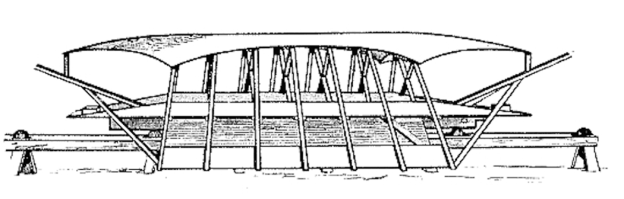
Ivan Kirillovich Elmanov (Russian: Иван Кириллович Эльманов) was a Russian inventor. During 1820, in Myachkovo, near Moscow, he built a type of monorail described as a road on pillars. [3] The single rail was made of timber balks resting above the pillars. The wheels were set on this wooden rail, while the horse-drawn carriage had a sled on its top. [3] This construction is considered to be the first known monorail in the world. [5][6] The horse-drawn carriages travelled on an elevated track. One project envisaged using them to transport salt on Crimea. [9]
Russia was a pioneer in the design and construction of monorails, from early horse-drawn models to later electrical and magnetic levitation systems. [2] Sadly, Elmanov could not find investors to fund for his project and stopped working on the monorail. In 1821, Henry Palmer patented his own (similar) monorail design in the UK. [2][3]
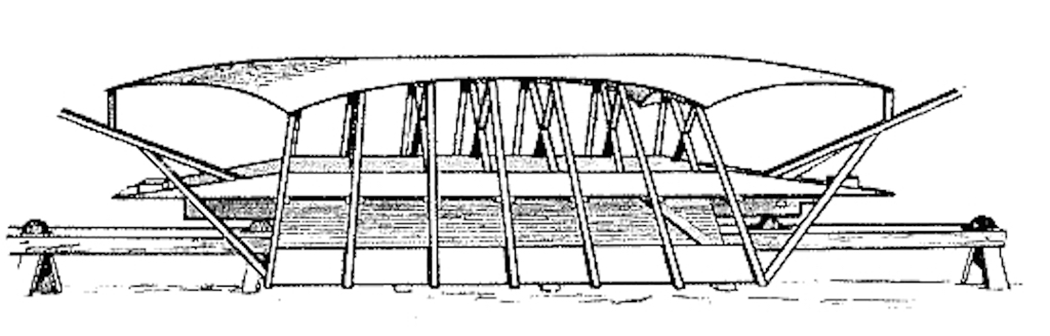
Later examples of early (pre-1900) Russian monorail proposals include:
- In 1836, Prince Beloselsky-Belozersky [8] proposed another monorail design which contained two rows of wheels on mounted on a pillar structure; [2][3]
- In 1872, a monorail designed by Lyarsky was shown at the Polytechnic Exhibition in Moscow; [2][9] (This was 4 years before the construction of a steam-powered monorail for the United States Centennial Exposition in the USA); [3]
- In 1874, Alexei Khludov [10] constructed a monorail for transporting wood; [2][9]
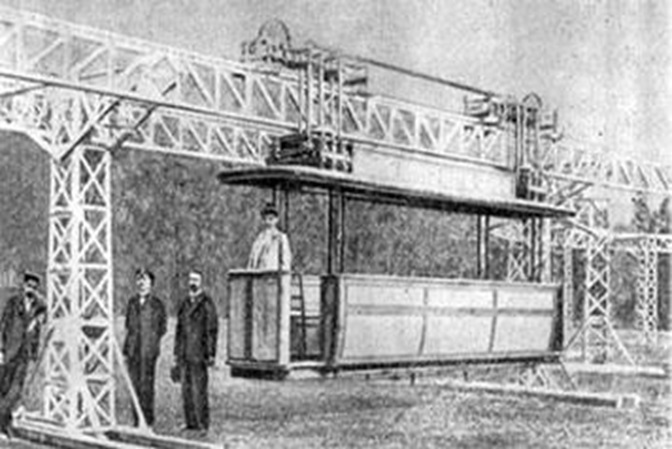
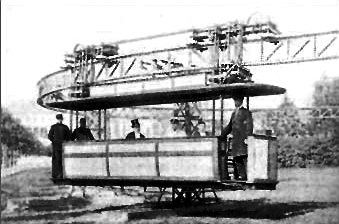
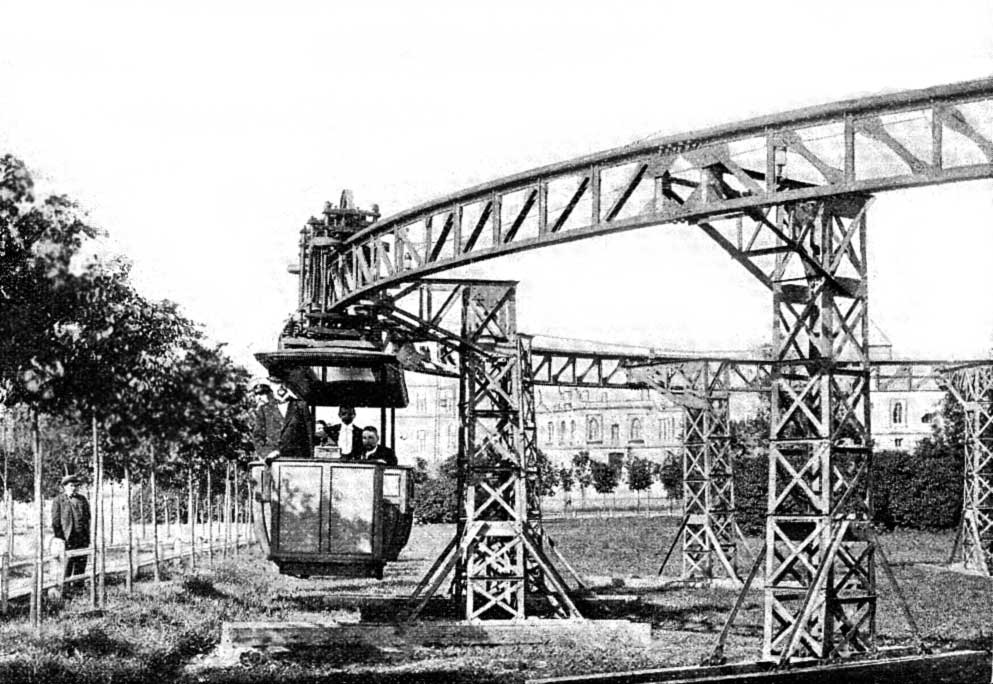
- In late 1899, Russian engineer Ippolit Romanov built a prototype of an electric monorail in Odessa, modern-day Ukraine. “In 1897, he presented a functional model of his monorail at the meeting of Russian technological society. This idea was approved by the society, and an experimental electric monorail was built in 1899. In 1900, Empress Maria Fedorovna approved the building of an 0.2 kilometres (0.12 mi) long electric monorail in Gatchina. The monorail was tested on 25th June 1900. The monorail carriage … moved at a speed of 15 kilometres per hour (9.3 mph).” [2] “The cars weighing 1600 kg were made like the trams of that time and were suspended on a truss metal overpass at a height of at least 750 mm from the ground. Based on the published photographs, it can be assumed that the overpass was temporary and rested on long beams laid on the ground. … The car bogies were two-axle, with one running wheel with a diameter of 120 mm. Each bogie also had two pairs of horizontal guides and stabilizing wheels. Two motors with a capacity of 6 kW each operated on direct current with a voltage of 100 V. The electric drive control system provided for the possibility of regenerative braking. Power was supplied from a contact wire on the beam, the beam itself served as a second wire. … On 25th June 1900 (according to V. Nikolaev – 29th June), the monorail was tested. During the tests, the monorail moved with a load of up to 3200 kg (i.e. 2 times the tare weight of the carriage), with this load the speed was 15 km/h. It was noted that the carriage moved smoothly, without jerks and jolts. … According to the journal “Zheleznodorozhnoe Delo” No. 38,1900, the Romanov system … had advantages over foreign designs known at that time. The asymmetrical suspension scheme on an open beam, on the one hand, allowed this beam to be made fairly light and cheap, and on the other hand, allowed the bogies and drive to be made reliable and easy to maintain. … Romanov also put forward the idea of automatic driving of the monorail. In the magazine “Niva” No. 30, 1900 in an article about this monorail it was written: “Since the movement is produced by electrical energy transmitted along a copper wire along the entire route, then this same energy can be used to automatically divide the entire route into sections on which only one train can be at a time. Each train can approach the one in front no more than a certain distance, for example, about 1.5-2 miles. When the distance between trains decreases to this limit, then the train behind stops, although, of course, if necessary, a special device can bring the trains closer to each other to the desired distance. Acceleration or deceleration can be done automatically, so that the inattention or carelessness of the driver is corrected independently of him.” [3]
References and Notes
- https://en.wikipedia.org/wiki/Ivan_Elmanov, accessed on 19th February 2025.
- https://en.wikipedia.org/wiki/Monorails_in_Russia, accessed on 19th February 2025.
- Oleg Izmerov; The Unknown Russian Monorail; via https://izmerov.narod.ru, accessed on 19th February 2025.
- Oleg Izmerov; The death of sensations or strange episodes in domestic monorail history; via https://semafor.narod.ru/3_2001/monor.html, accessed on 19th February 2025. This article covers later developments in Monorail technology in Russia.
- V. V. Chirkin, O. S. Petrenko, A. S. Mikhailov, Yu. M. Galonen; Passenger Monorails (in Russian); in Mashinostroenie (Mechanical Engineering), 1969, p240. [see [6] below]
- “The source (book) provides basic information on the structure and operating features of monorails. It analyzes the most typical difficulties that arise when solving problems related to transport in modern large industrial centres, developing areas with unfavorable climatic conditions, and finding transport vehicles for direct communication between the centres of large cities, cities with airports, recreation areas, etc. It examines the selection of the main parameters and determination of the technical characteristics of the rolling stock and fixed devices of monorails. It analyzes the design features of the chassis, suspension systems, and stabilization of the rolling stock of existing and designed monorails. … A comparison is made of the technical and economic indicators of monorails and other types of transport, and recommendations are given for the selection of rational areas of application of monorail transport. … The book is intended for a wide range of engineering, technical and scientific workers in urban, industrial and other types of transport, as well as workers engaged in transport engineering.” (Translated from Russian) (https://www.logistics-gr.com/index.php?option=com_content&id=23626&c-72&Itemid=99)
- https://commons.wikimedia.org/wiki/File:Monorail_by_Ippolit_W._Romanow_06.jpg, accessed on 19th February 2025.
- https://en.wikipedia.org/wiki/Belosselsky-Belozersky_family, accessed on 19th February 2025.
- https://www.urban-transport-magazine.com/en/monorails-on-the-rise, accessed on 19th February 2025.
- https://en.wikipedia.org/wiki/Aleksey_Khludov, accessed on 19th February 2025.
 Roger Farnworth
