Author Archives: Roger Farnworth

Unknown's avatar

About Roger Farnworth

A retired Civil Engineer and Priest

The Cavan and Leitrim Railway – Dromod to Mohill

Dromod to Mohill

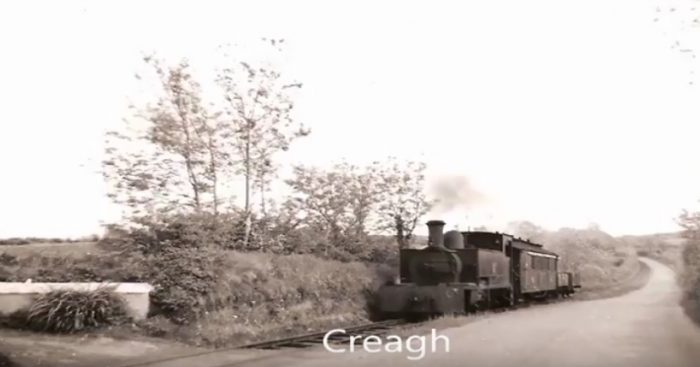
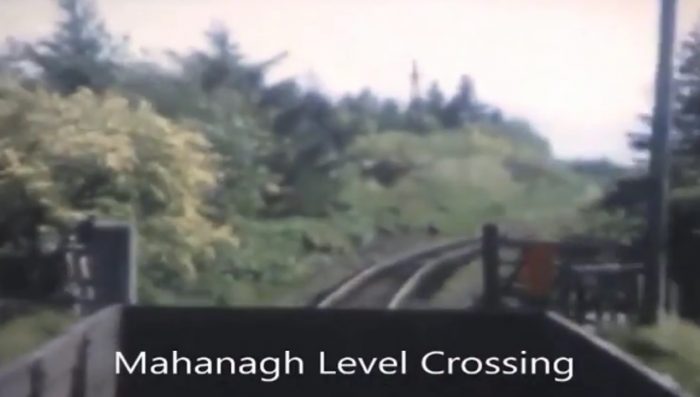
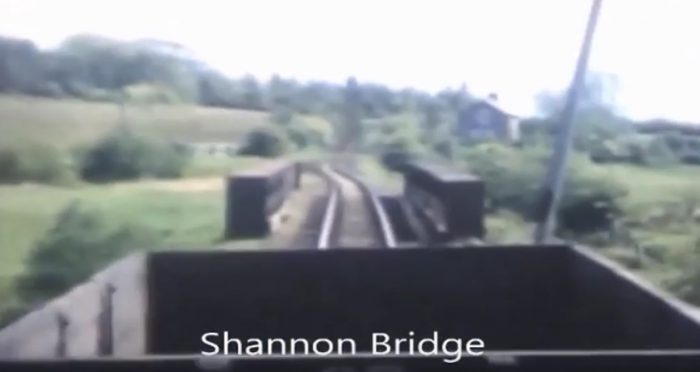
Before we consider starting this armchair journey in this blog, the Huntley Archives have provided a video of the journey out of Dromod station. [3]

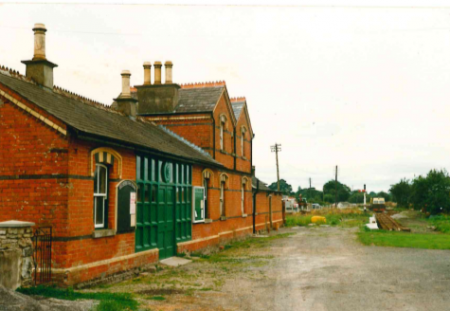
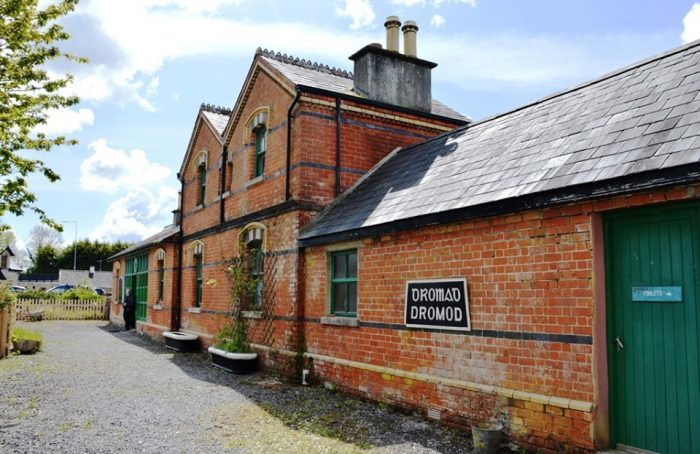
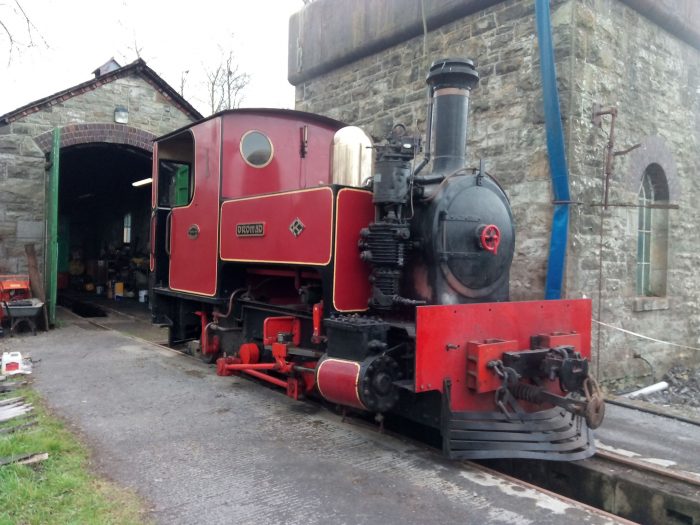
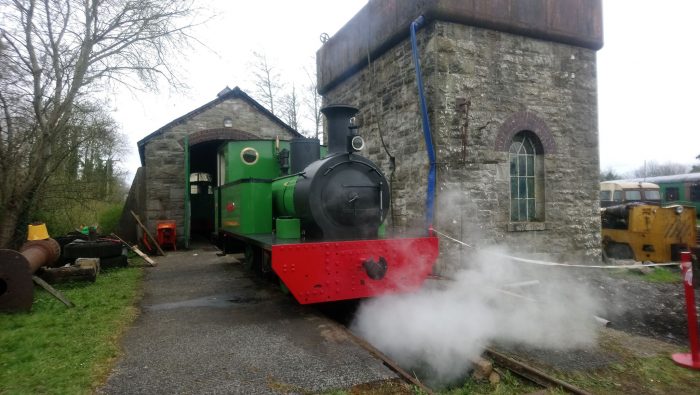
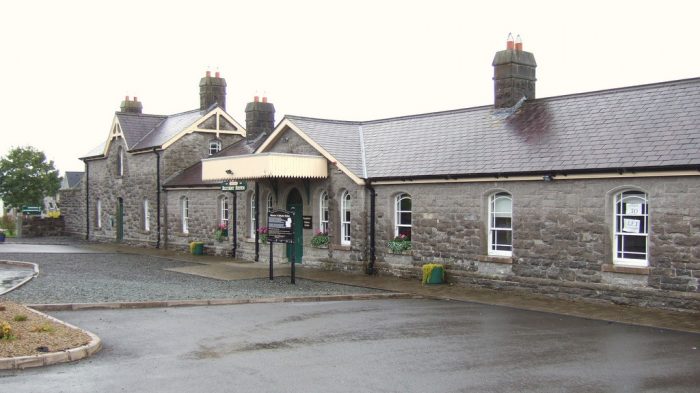
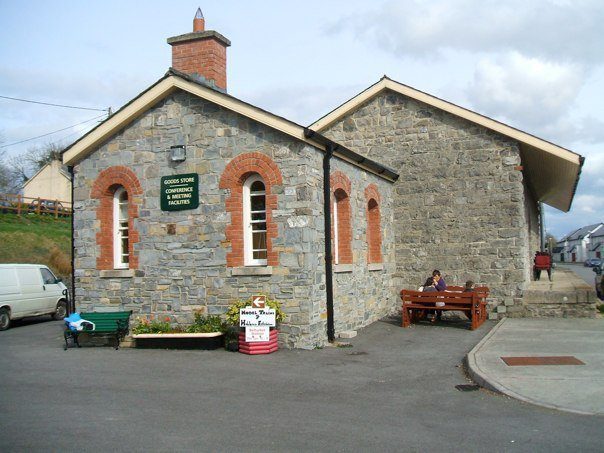
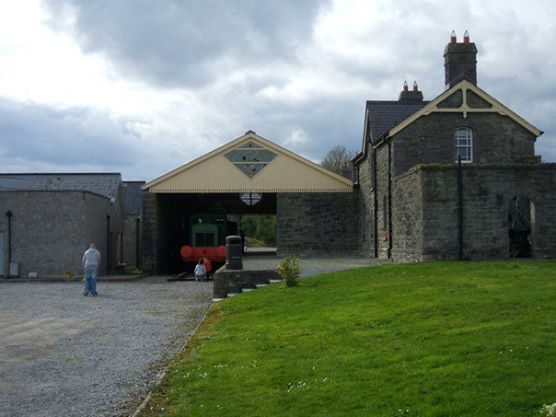
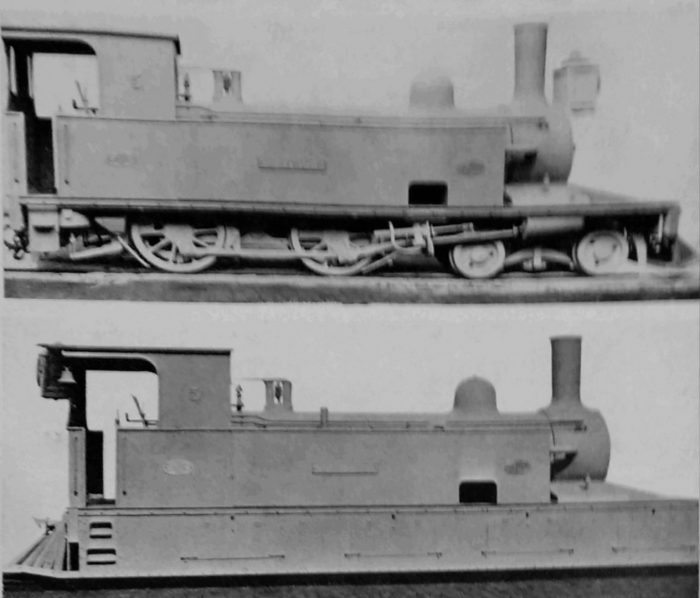
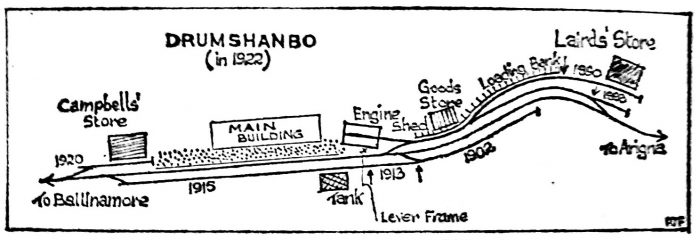
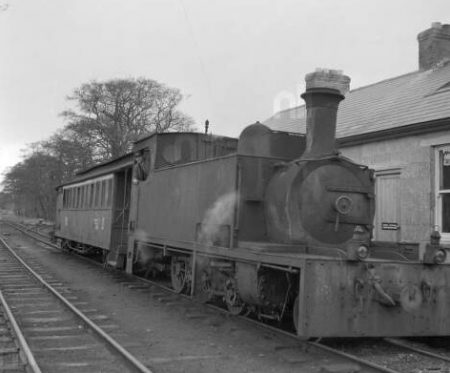
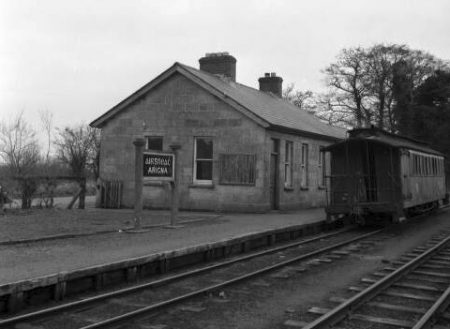
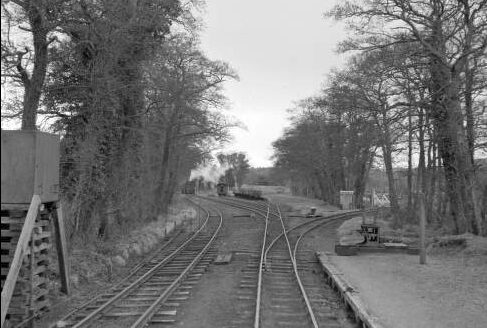
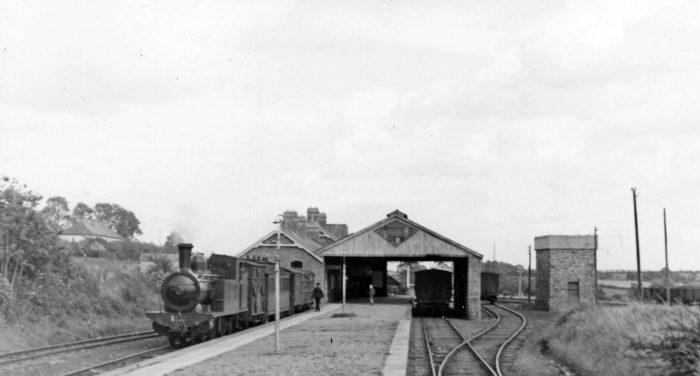
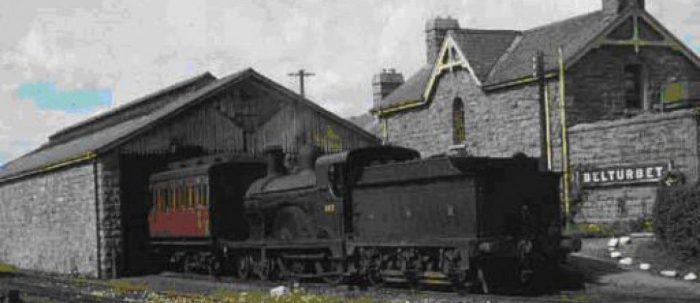
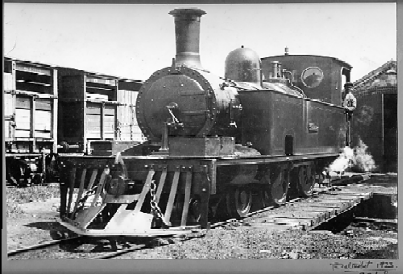
Dromod Station was across the yard from the mainline station. That station was off to the left of the sketch plan underneath the satellite image below.The station plan drawn by Patrick Flanagan. [1:p125]A short walk across the station yard from what is now the CIE station building brought potential passengers to the C&L station. This picture shows the station in 1959. When the railway was taken over by the Great Southern in 1925, booking facilities were transferred to the main line station, located behind the photographer. No tickets were sold here from 1925 until the station was restored by preservationists in the mid-1990s, (c) Hamish Stevenson. [7: p7]A view of the station at Dromod in the 1950s. The first road to the left in the foreground led to the engine shed and water tank. The siding beyond this originally served the carriage shed which was removed in the 1930s. The track on which the photographer is standing acted as a run-round loop for the single platform in the centre of the picture beside the main buildings The goods store and cattle-loading bank are on the right of the picture, (c) T.K. Widd. [7:p7]On 28th may 1953, 2-4-2T No. 121 simmers outside Dromod’s single road engine shed. The C&L continually had problems with sourcing water along its route. At Dromod, the problem was that the supply at the station was contaminated by minerals which damaged the locomotives’ boilers. After preservation, water now has to be brought to site in a preserved fire tender, (c) Neil Sprinks. [7:p8]Excellent picture of the Dromod Station building renovated in recent years. [8]

The last post in this series had a number of other photos of the old station.

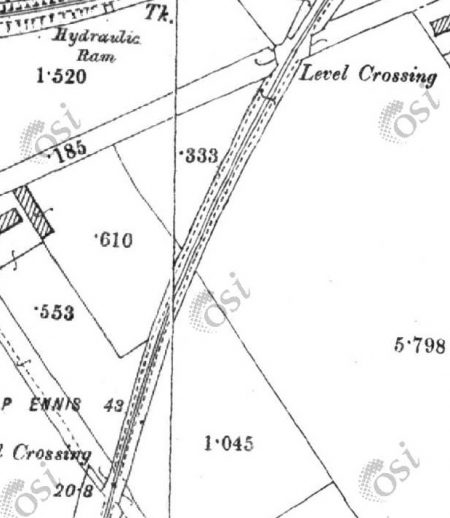
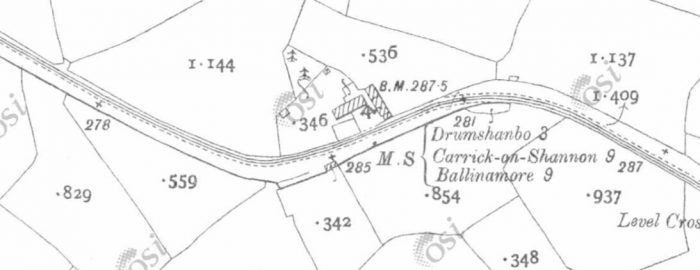
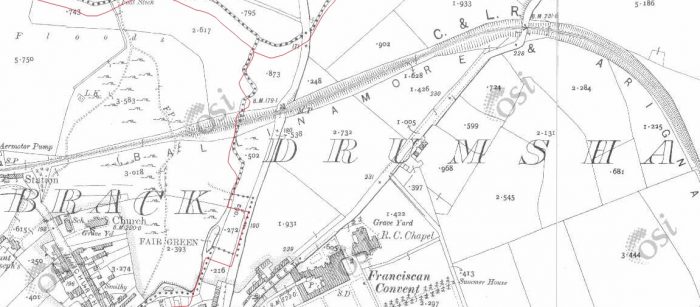
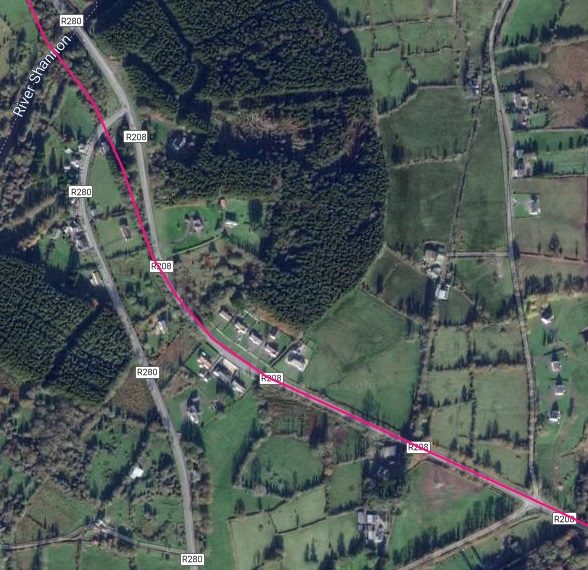
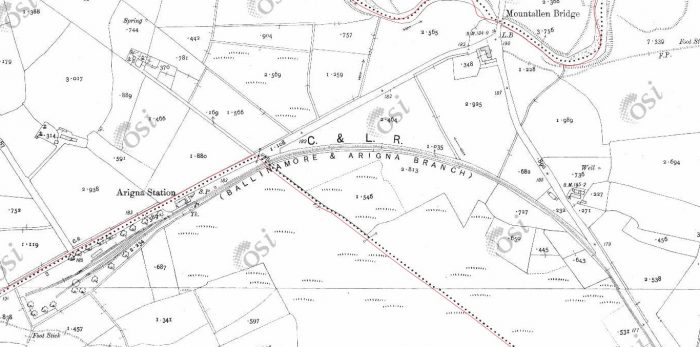
As the OS Map shows, the Cavan & Leitrim (C&L) set off North out of the station at Dromod and curved away to the East.

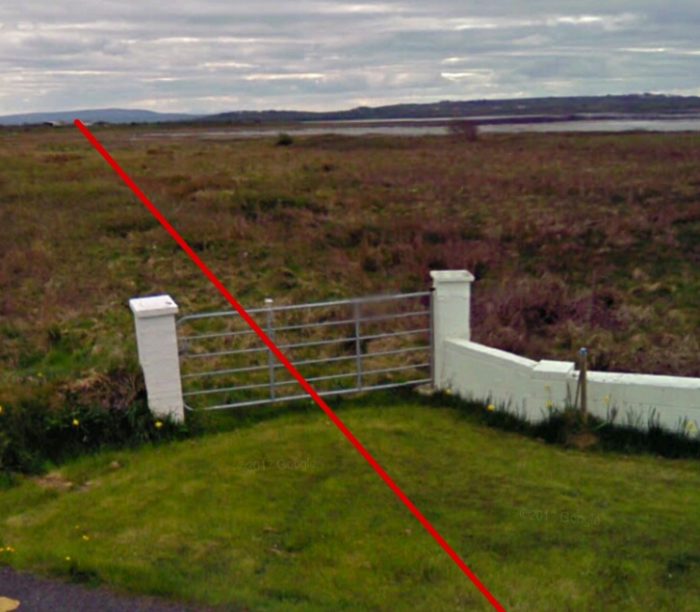
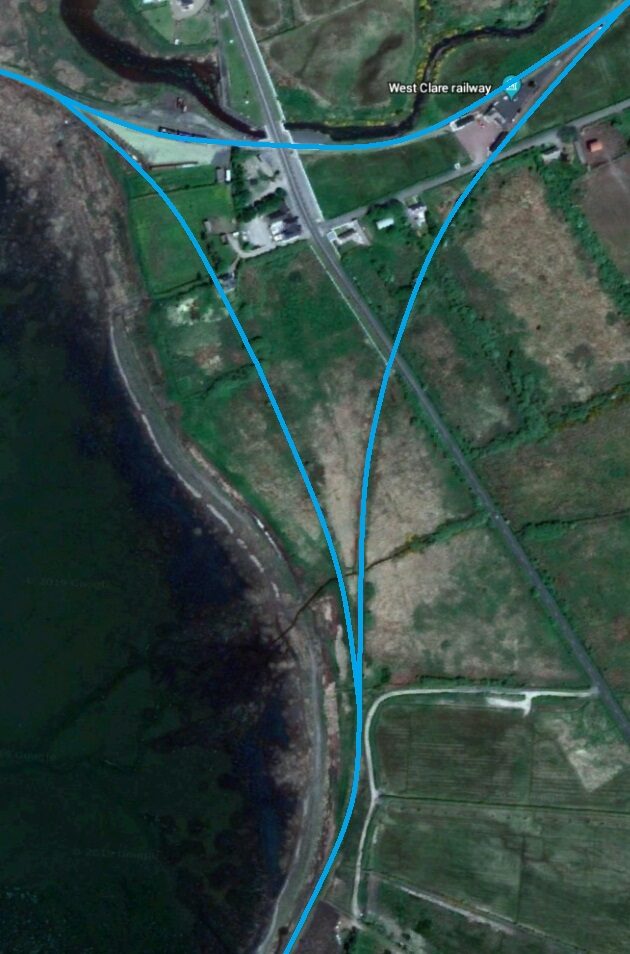
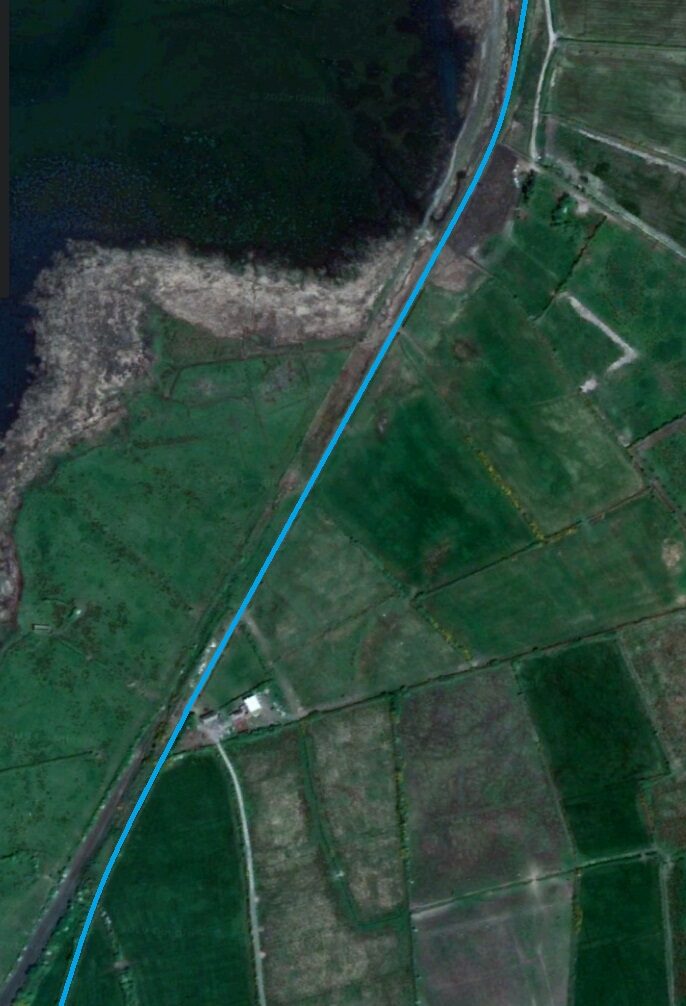
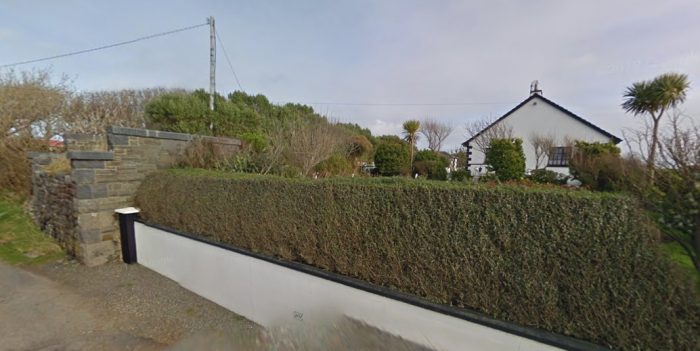
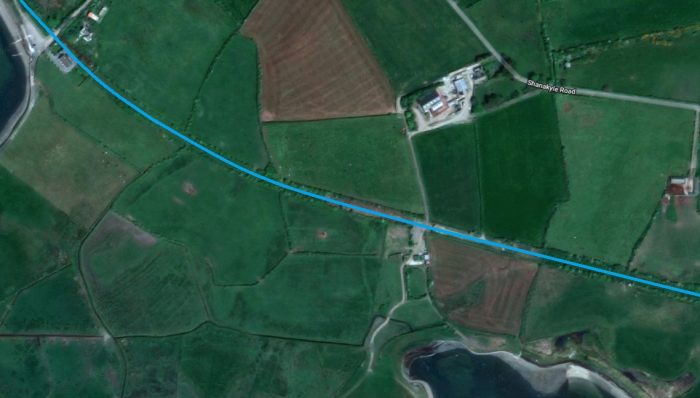
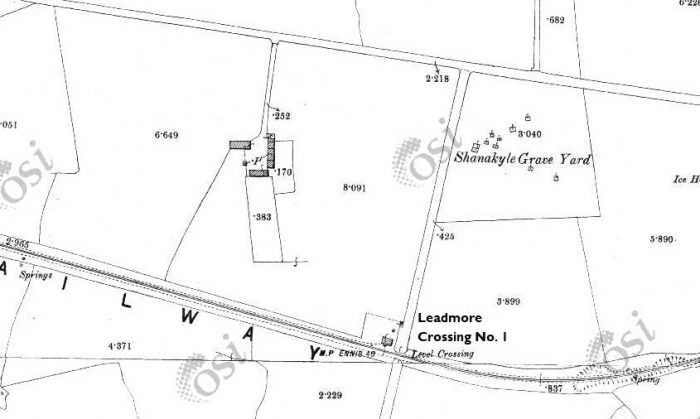
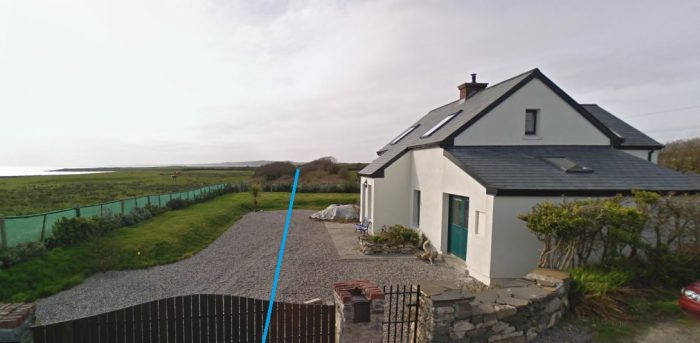
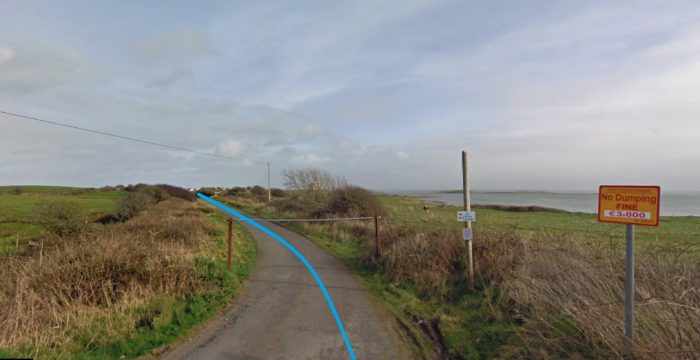
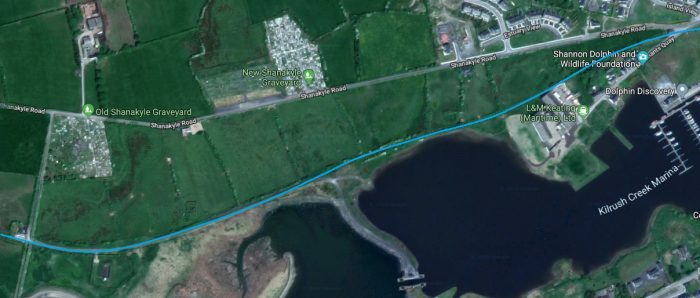
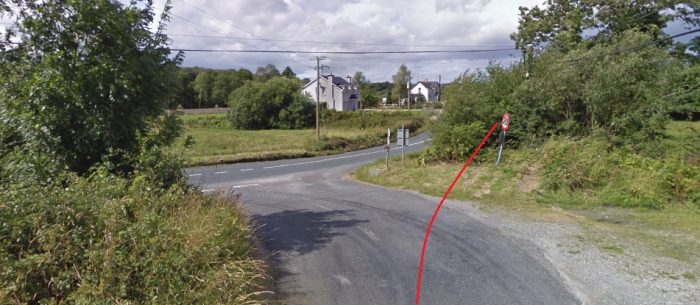
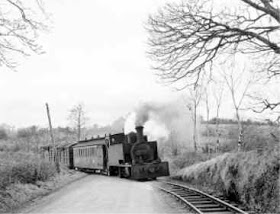
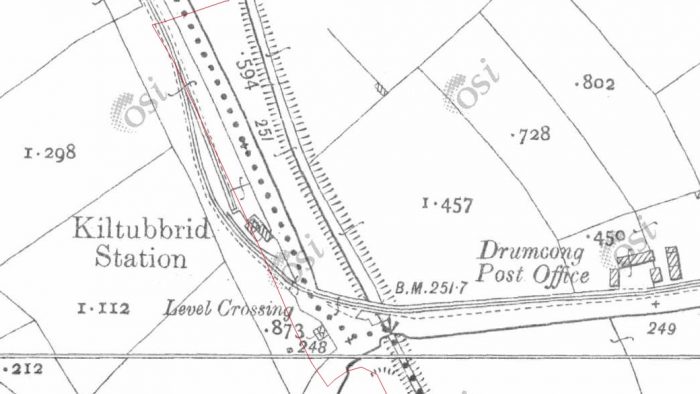
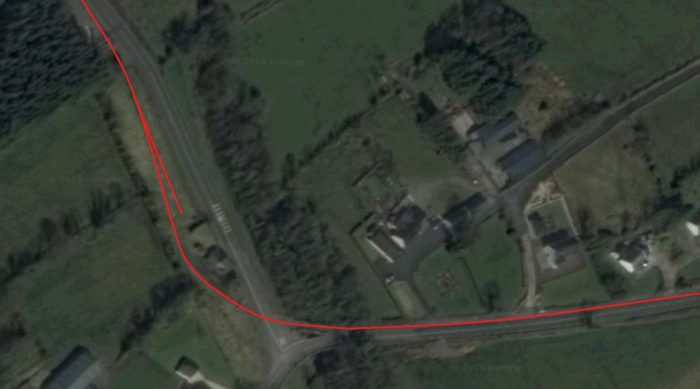
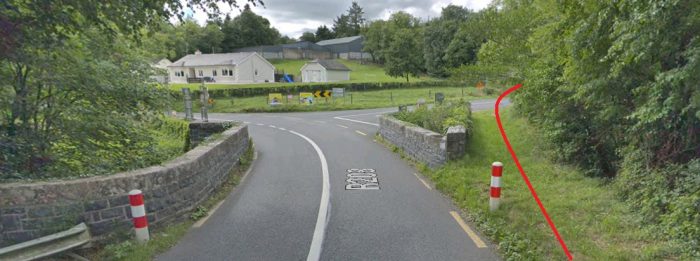
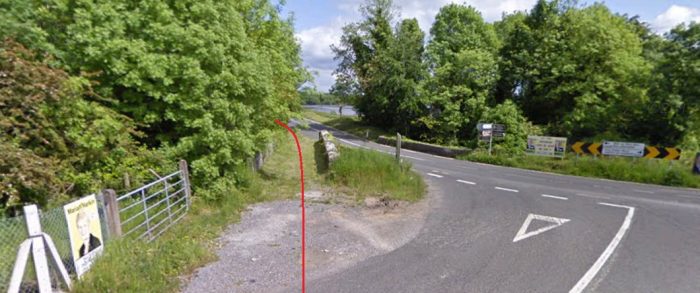
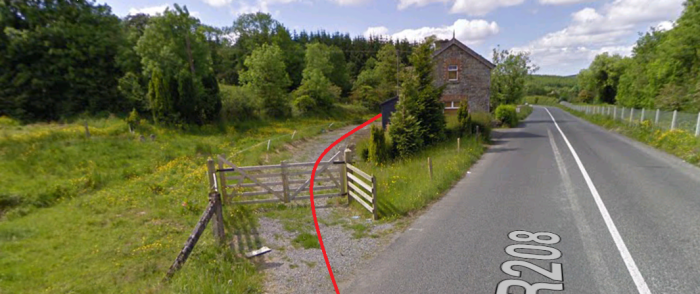
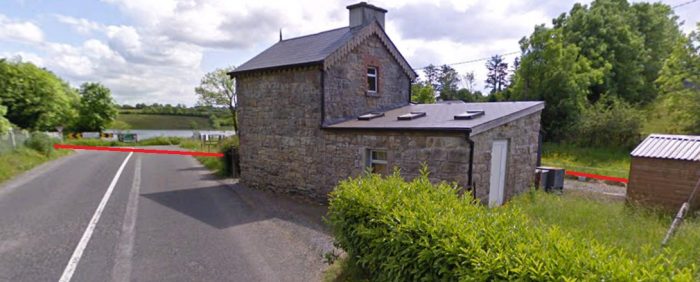
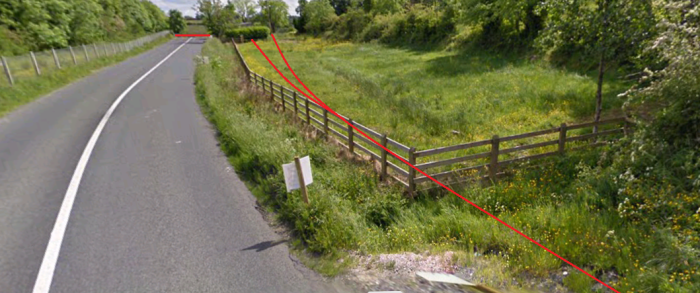
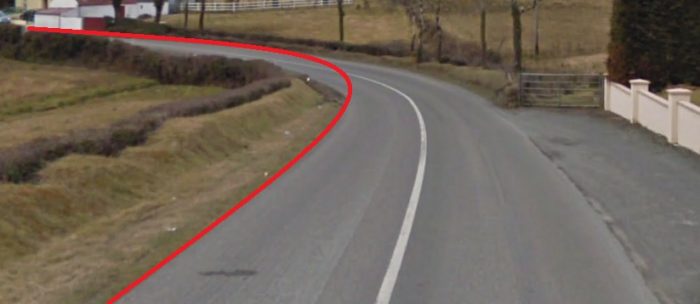
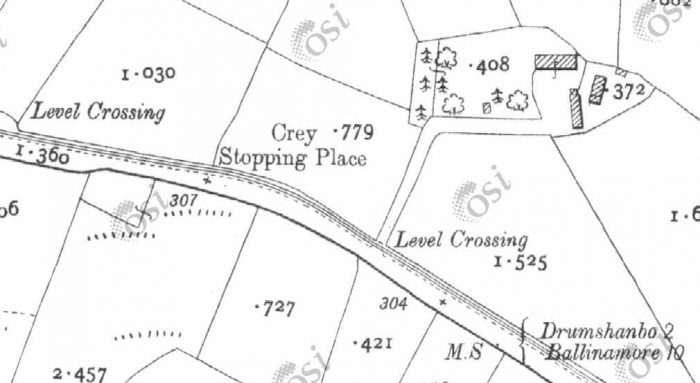
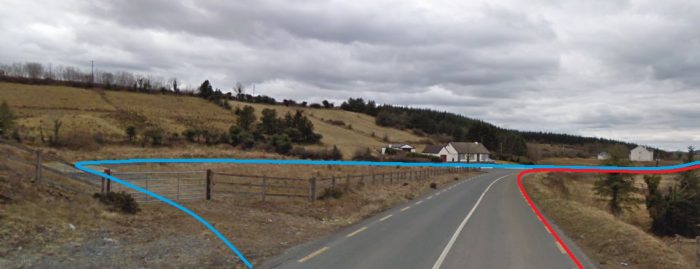
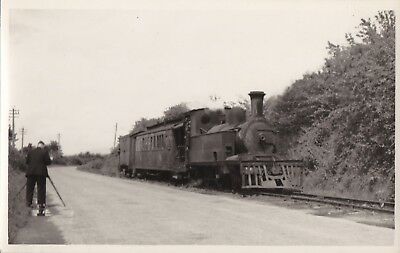
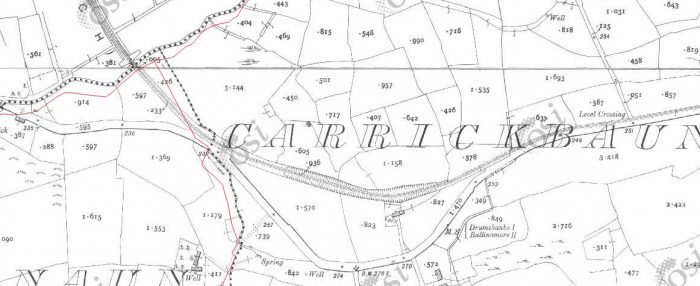
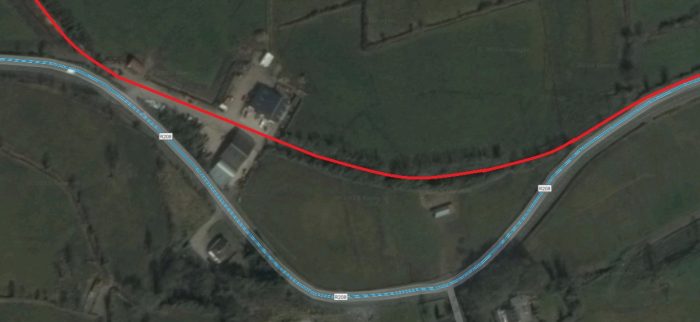
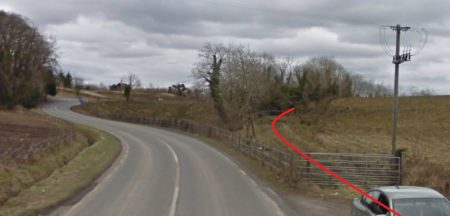
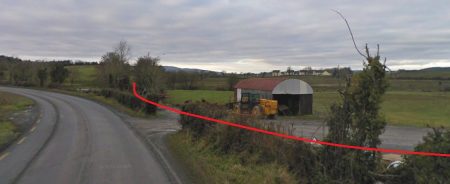
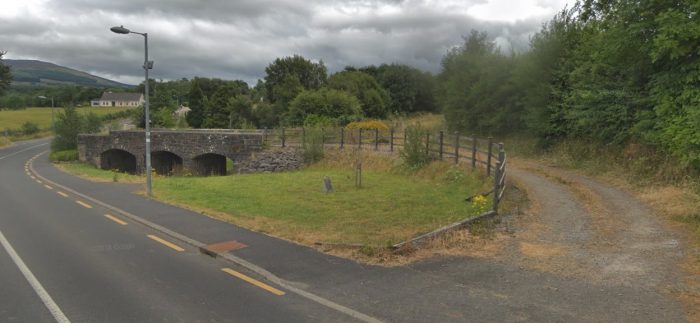
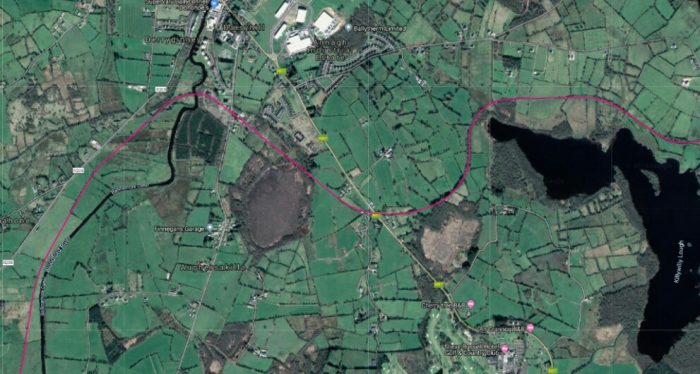
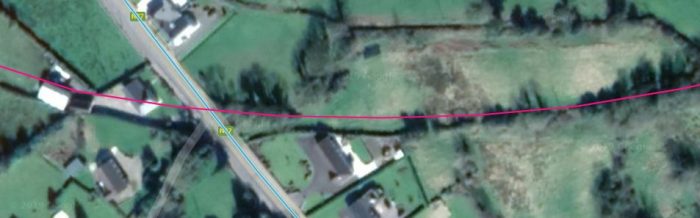
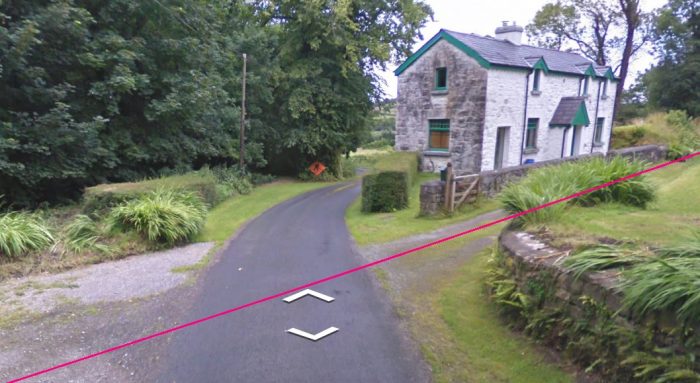
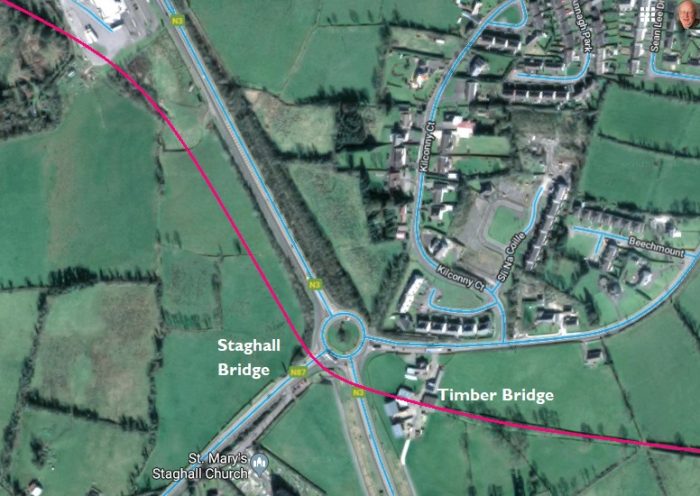
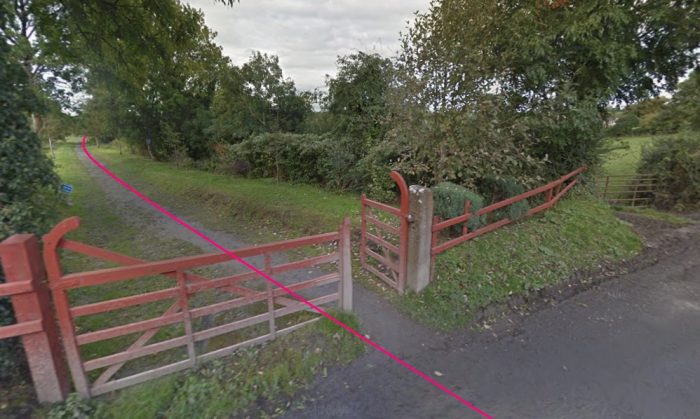
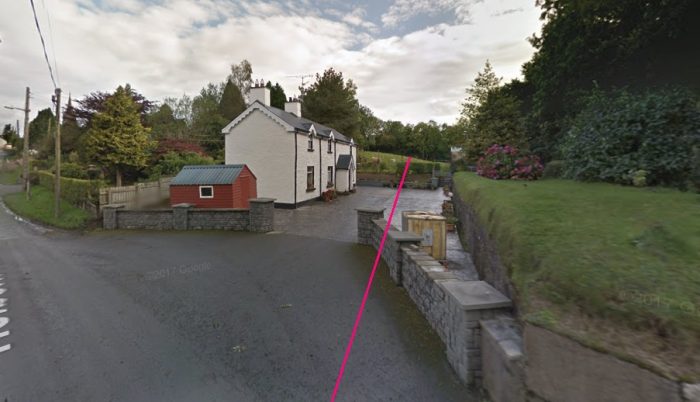
It is interesting to note on the adjacent extract from the 6″ OS Map, that there were two abattoirs close to the station. I wonder kind of smells might have been experienced by travellers waiting at the station. The present CIE line is shown in yellow below, the route of the C&L is shown in pink.A train from Ballinamore rounds the curve before entering Dromod station, © O’Dea Collection. [4]Looking back towards Dromod Station from the Level Crossing on the L1600 road in the easel 21st century. The pink line is an approximation to the line of the railway which actually curves round to the left.The crossing keeper’s cottage is now in private hands. This view is taken from the L1600. The approximate route of the line is shown by the pink line. Dromod is away to the right and the line heads on towards Mohill to the left. It runs alongsidea minor road as it travels East.The road and railway run parallel for some distance, turning to the northeast.This Google Streetview image shows the point where road and rail diverge slightly for a relatively short distance as seen on the satellite image above. The satellite images in these posts about the C&L are Google images with the route of the line super-imposed on them by railmaponline.com. [5]The old line continued on the South side of the road and crossed the road between Drumgildra and Bornacoola at level.The crossing keeper’s cottage still stands (above). This view looks back from the road in a westerly direction towards Dromod. The route of the old line is marked in ‘pink’. The view is nothing but undergrowth in the Easterly direction.

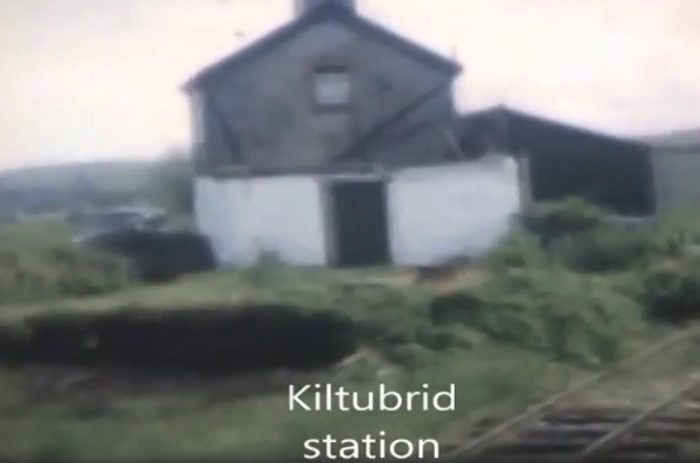
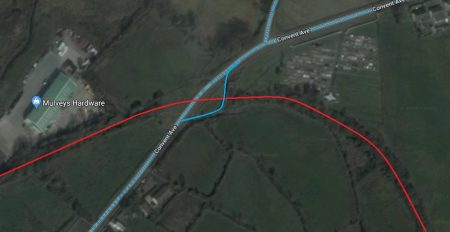
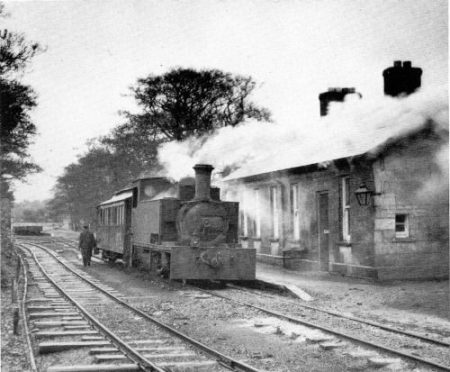
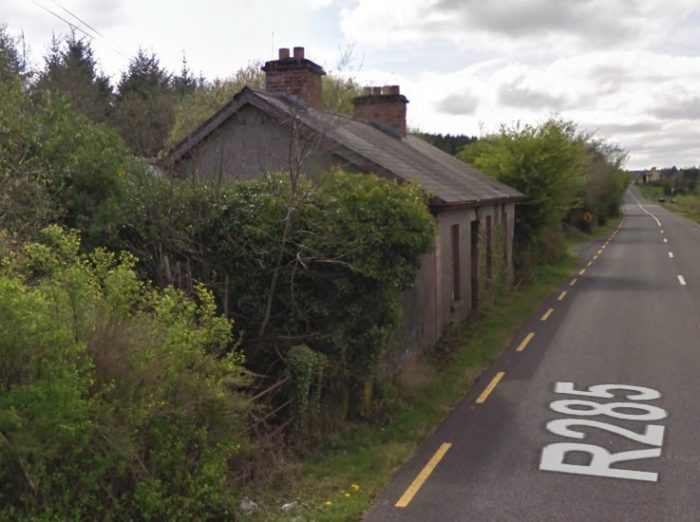
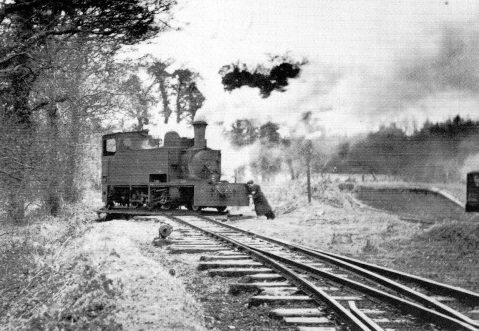
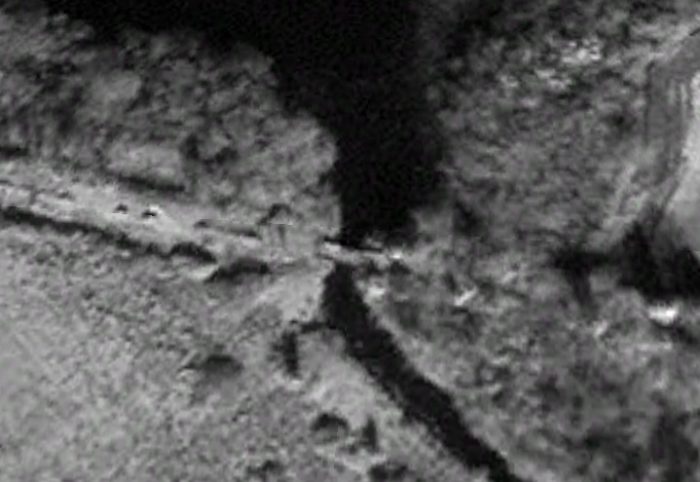
The adjacent image shows the location of the first station along the line – Derreen Station. The line has turned to the Northeast and runs straight for some distance before entering the Station complex. Derreen Station was about 2.5 miles from Dromod.Derreen Station: Locomotive No.6T pauses at the station on 24th March 1959 in the last week of the line’s operational existence with the afternoon train from Ballinamore to Dromod. The station building was on the Northwest side of the line. [7: p10]The station building stills stands, reasonably well camouflaged from the road. This view (above) from the North shows both the road and station building in the 21st century, The line ran behind the building in the photograph. Google Earth’s definition at this location is not great but the building can just be picked out among the pixels on the adjacent small satellite image!

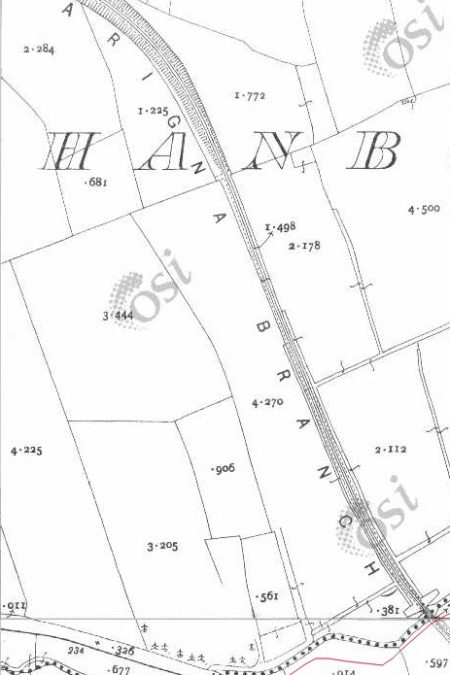
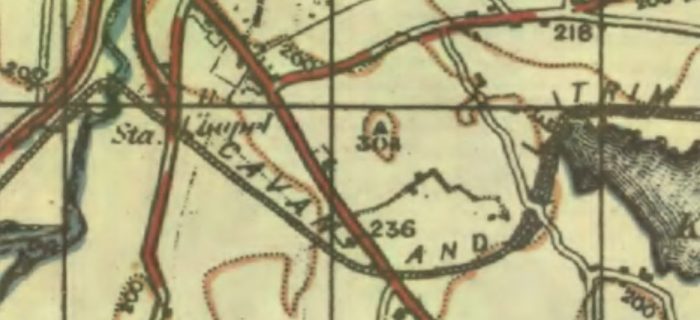
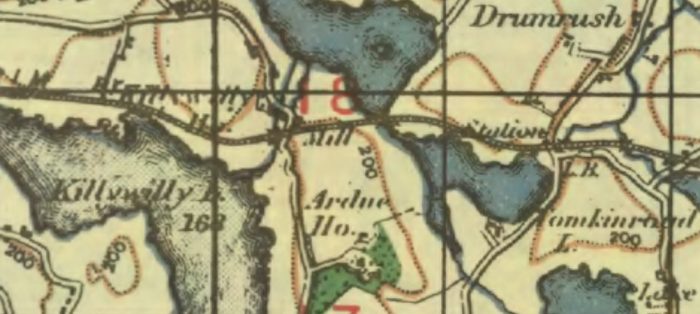
The adjacent 1940s OS Map extract (GSGS One-inch) shows the location of the station and the route of the line ahead. In a relatively short distance it turns almost due North.

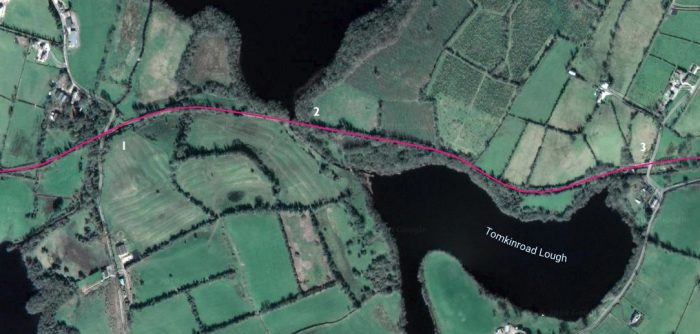
The photograph below is taken at the point where road and rail use to converge, South of  Drumard Lough on the OS Map and central to the satellite image below. The farm access road travels along the formation of the C&L at this point.

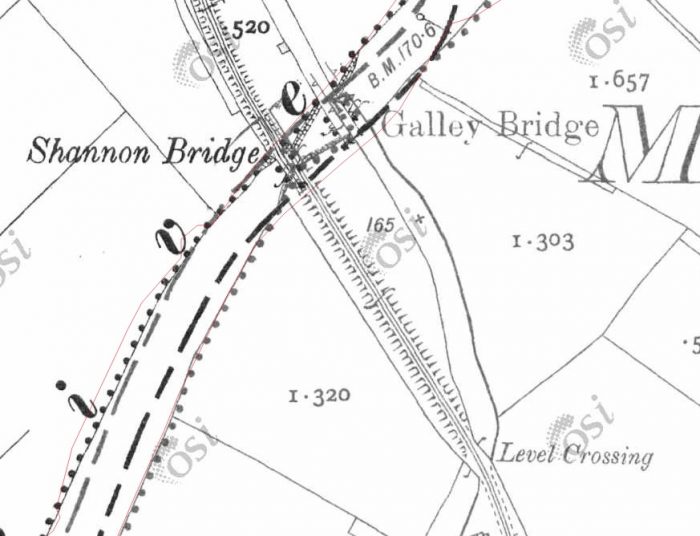
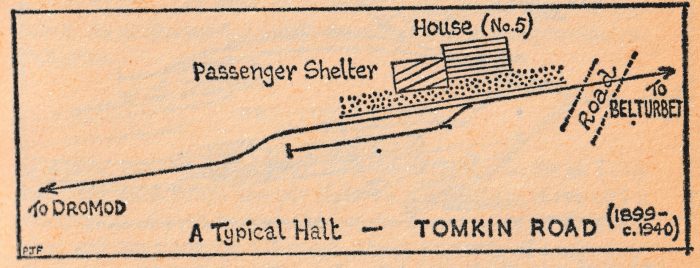
Ahead, road and old rail route diverge. The road heads away towards Rinn Lough to the East, the railway headed North. Flanagan describes the line out of Dromod as far as Mohill like this: “Leaving the station, the line took a long sweep to the north-west [actually the North-east] past Clooncolry gates. The section to Derreen (2.5 miles) undulated through poor boggy land, the only gradients of note being two short stretches of 1:41 and one of 1:60. The halt at Derreen was typical of the ‘flag stations’ in having a halt-keeper’s cottage and small passenger shelter on a low stone-faced (down side) platform. However, the shelter was not erected until about 1900 and, at the start, facilities were very primitive indeed; in August 1888, when passengers complained of the lack of a shelter, the only concession made was to improve the method of access — till then, two planks across a ditch! The halt was at first to be named ‘Lough Rhyn’ as the road which the line crossed there did, in fact, lead to Lough Rinn. Continuing, the line was more or less level all the way to Mohill, although there was a short fall from Derreen at 1:49. On the way, the line crossed Tawnaghmore Bog and passed Clooncahir, where trains stopped on demand for Mr Digges on way to meetings, before entering Mohill (5.75 miles). This is a sizeable town and the only place of importance in the region.” [1: p126-127]Clooncahir appears at the top of the adjacent OS Map extract. The line continues only a short distance further North, sinuously curveing firat towatrds the East and then back towards the North, before entering the village of Mohill.

The station at Mohill was sited on the South side of the village, adjacent to the road which approached the village from Rinn Lough. After curving to the East, the line crossed an access road on the level. No gates were provided at this location. It can be seen north of Clooncahir as the main road and the old railway came a little closer together.

From this point, as we have noted, the line curved North and entered Mohill Station.

Mohill Station still stands. The National Inventory of Architectural Heritage describes it like this: A “detached three-bay two-storey triple-pile former railway station, with five-bay single-storey block to north end and return to rear, built c.1885 by the Cavan and Leitrim Railway. … Pitched slate roofs with brick chimney-stacks, round terracotta chimney pots and ridge cresting. Red brick walls with yellow and blue-grey brick dressings and eaves course. Segmental-headed openings with yellow-brick hood mouldings and timber sash windows. Timber double doors in north block flanked by glazing. Corrugated-iron outbuilding to east with decorative bargeboards and finials. Snecked stone goods shed with pitched slate roof to north, now in use as a builders’ providers premises.” [9]Looking back down the line towards Clooncahir.Looking forward towards Mohill.One of the reasons why Mohill was so important to the network was that it had a reliable and uncontaminated water supply. Rather than risk the water at Dromod, most services were detained at Mohill to enable the locomotives to top up their tanks. 4-4-0T No. 3 pauses for replenishment at Mohill on a train bound for Dromod in 1956, (c) Patrick Flanagan. [7: p12]

The North point on both of the next maps of Mohill Station is to the right of the image. The second image was drawn by Patrick Flanagan. [6]Mohill Railway Station in the years before the closure of the line. [10]Looking South into the station area from the level-crossing at the North end of the station site.From a similar position in the 21st century.A composite ‘then and now’ image produced by Reverb Studios. [11]

These next five pictures were taken of Mohill Station on 15th May 2019 by ‘dannyboy‘ on the N Gauge Forum and are included with permission. [6]This picture shows the platform and station frontage on 15th May 2019. The picture is taekn from the north end of the platform. [6]This picture shows the forecourt side of the station building, taken from the north end as well. [6] Four images of Mohill Good Shed taken a number of years earlier. [6]

References

  1. Patrick J. Flanagan; The Cavan & Leitrim Railway; Pan Books, London, 1972.
  2. The Irish OSM Community Map; http://maps.openstreetmap.ie/oocmaps.html?zoom=15&lat=53.86144972982129&lon=-7.916875406754906&layers=B0000TFFFFF, accessed on 9th May 2019.
  3. http://www.huntleyachives.com; Film 96365, accessed on 10th May 2019.
  4. http://catalogue.nli.ie/Collection/vtls000148612/CollectionList?lookfor=&filter%5B%5D=geographic_facet%3A”Leitrim+(County)”, accessed on 9th May 2019.
  5. http://www.railmaponline.com, accessed on 6th May 2019.
  6. https://www.ngaugeforum.co.uk, accessed on 16th May 2019.
  7. Tom Ferris & Patrick Flanagan; The Cavan & Leitrim Railway – The last Decade – An Irish Railway Pictorial; Midland Publishing Ltd., Leicester, 1997.
  8. https://www.tripadvisor.com.ph/LocationPhotoDirectLink-g1184756-d3570987-i65004244-Cavan_Leitrim_Railway-Dromod_County_Leitrim_Western_Ireland.html, accessed on 19th May 2019.
  9. http://www.buildingsofireland.ie/niah/search.jsp?type=record&county=LE&regno=30816030, accessed on 19th May 2019.
  10. https://www.leitrimobserver.ie/news/home/282178/mohill-s-railway-station-will-be-turned-into-a-cinema-for-a-unique-event-this-sunday.html, accessed on 19th May 2019.
  11. https://blog.reverbstudios.ie/2018/10/05/mohill-railway-station-leitrim-then-and-now, accessed on 19th May.

The Railways of Orkney – Part 3

This is my final post about the railways of Orkney, I think. ……………

Since returning from the Orkneys, I have received a copy of Wilfred F. Simms book, “The Railways of Orkney.” It was published in 1996 and appears to be out-of-print. This copy came via an on-line sales site that we all know.

Simms’ book is a short A5-sized book and simply typeset. It is a mine of information on the railways of Orkney. Before we look as some of the historic built railways it is worth noting that Orkney had its own plans for a public railway as early as 1876 – The Kirkwall to Stromness Railway. John Buchanan assessed the feasibility of the line and advised that 3’0″ gauge should be adopted, “as in the Isle of Man, and that the ‘proposed line would commence at Kirkwall at or near The Ayre on the Peeries Sea and follow the course of the highway by Finstown and Stenness and terminate at or near the present Steamboat Quay at Stromness’. Route length would have been 14.5 miles and the line would present ‘no engineering difficulty’, intermediate stations would have been at Finstown and Stenness. Total cost of the line was estimated at £50,000.” [1: p28] it did not get built!

More recently, in 1977 a local businessman, Ronald Spiers imported a standard gauge steam loco from Scotland intending to create a tourist line near Kirkwall. Various difficul;ties arose and after time spent languishing in a field  near Kirkwall the loco was returned to Scotland. {1: p28]

A. Industrial Railways

Simms focusses first, in his book, on the industrial railways of Orkney which include a Herring Railway, lighthouse railways, shipbreaking railways and quarry railways

Herring Railways

Herring were, for a period of time, very significant to the economy of Orkney. ” Railways were often associated with the herring fishing and curing industry in both Shetland and Scandinavia: but only one such system is definitely recorded for Orkney. It is possible that narrow gauge railways were used in other Orkney fishing stations but only at Papa Steinway do actual relics remain to this day in the form of piers, sheds, railway track and trucks.” [1:p4]

The largest centre of the industry was Stromness. It became so by 1898 but was abandoned by the fleet within ten years. It may have used narrow gauge track during that time but rails were often used solely as guideways along which to roll herring barrels rather than as a railway with trucks. This practice occurred on Papa Stronsay as can be seen in one of the three sepia images below.

“Stronsay and Papa Stronsay had extensive gutting and curing sheds and new piers were  constructedto allow larger boats to berth: these ports remained the most important of the Orkney centre right up into the 1930s when the introduction of factory techniques, larger boats, depletion of stocks, and ultimately the Second World War stopped North Sea fishing.” [1:p4]

On Papa Stronsay the original stone “Bountifur pier with its wooden extension was laid with 1’8″ gauge track and a number of small four-wheel wood-framed hand-propelled trucks used to transport the fish from the moored boats to the curing sheds. A further three lightweight metal piers were constructed on the south shore to the east of the stone pier using a mixture oMf old rails and girders: these linked with a second area of curing and gutting sheds.” [1:p4]The herring fleet at Papa Stronsay! [2]The pier at Papa Stronsay, notice the stacks of Herring Barrels. [2] Workers roll barrels of salted herring down the pier to a waiting ship. [2]The rails on the quay leading to the pier, note the people at work preparing the herring and the stacks of barrels again. [2]Later in the history of the industry a calmer image from the 1930s! [3]

Lighthouse Railways

It is interesting to note that there were a number of short railways associated with the work of the Northern Lighthouse Commissioners.

Stromness Service Depot built it’s own gasworks in 1904 and installed 2’6″ gauge track of a length of 70 yards to facilitate the movement of coal by small hand-worked trucks into its store on the west side of the pier. Later, it installed a 25 yard section of standard gauge track to assist in moving large buoys on a single flat four-wheeled truck. [1: p5]The narrow gauge track at Stromness referred to above. [4]

Sule Skerry is one of a pair of small islands which lie 30 miles to the west of Orkney mainland. A lighthouse was built, commencing in 1892 and in 1894 a 2’6″ gauge inclined railway was installed between the lighthouse and the two possible landing places on the rock. A small haulage engine was installed close to the lighthouse tower so that a cable could be used to operate the two sections of the railway. Usage was dependent on prevailing weather and tides. Simms says that, “a single four-wheeled truck was used to transport heavy stores. … The railway appears to have continued in intermittent use until the 1970s. The tower has since been converted to an automatic light and all deliveries of materials are made by helicopter. The derelict railway remains in-situ slowly corroding away in the salt spray.” [1: p5]A landing at Sule Skerry, the railway track and wagon are visible in the image. [5]

Copinsay is a small island east of the Orkney mainland. Construction of a light house on this island started in 1914. Construction materials were brought by steamers and unloaded via a pier built for the purpose at the west end of the island. A railway of about three-quarters of a mile in length was installed which took supplies from the low western shores to the high cliff-top location of the lighthouse on the eastern cliffs. Steam winches were used to haul flat trucks from the pier to the construction site.The line is now long-gone and the island is a bird sanctuary. However, the course of the old railway can still be picked out as a grassy track running up the spine of the island. [1: p6] This image shows the route of the railway up from the low western area of the island in 2009, (c) Richard Evans. [6]

The Mail Boat Railway North Ronaldsay

North Ronaldsay pier is the only pier which was served by a permanent standard gauge railway. A 100 yard line linked the pier to the boat storage yard and was in use until sometime in the 1960s. [1: p6]North Ronaldsay Pier in 2007. The railway can be seen set into the pier surface. [7]

The Shipbreaking Industry

In 1924, Cox and Danks, Lyness, Hoy purchased  28 of the German naval vessels which were part of the scuttled German High Seas Fleet. The raising of these vessels would at the time been one of the worlds greatest salvage feats. In the winter of 1924, a fully equipped breakers yard was established.The Hindenburg heeling over to starboard on the first attempt at raising her in 1926. She appears to be alongside a pier and a railway is visible in the foreground. [8]The sheer scale of this operation is unimaginable without the photographic evidence! [9]

Simms says: “Little is known of the railway system in use at this time: although sections of both 2’0″ and 4’8.5″ gauge remained in-situ at the former naval base. What is clear is that at least one steam locomotive was in use on the 4’8.5″ gauge lines throughout Cox and Ranks tenure of the base.” [1: p7] When the battle cruiser Moltke was being dismantled alongside the pier, the existing standard gauge railway on the pier was “diverted by piles onto the ships hull and laid along its length. A steam locomotive hauled a small crane onto the hull and openings were cut through which heavy machinery was removed. This system was then applied in the case of the ships, Bremse, Seydlitz and Kaiser.” [1: p7]

In 1931, the Allow Company, later known as Metal Industries, Lyness, bought out Cox and Danksand continued operating from the old naval base. “It is known that the steam locomotive was still in operation in 1937 when the Friedrich der Grosse was towed south for scrap.” [1: p7] In 1939 ship-raising was abandoned as the naval base became operational once again.

Stone Quarries

Many of the stone quarries in Orkney were used for road stone and had short lengths of narrow gauge track installed to assist with moving materials from the working face to the crushing plant.

Orkney County Council Quarry Lines were generally worked on an ad-hoc basis with track and equipment being moved as required. “At all sites lightweight 2’0” gauge ‘Jubilee’ type was used with wagon turntables rather than points. Track was moved along the working dace as work progressed, and the loaded trucks pushed to the foot of a cable-operated incline leading to the crushing plant. … By the mid-1960s this system still operated in Cursiter Quarry on  Mainland, and Lythes Quarry on South Walls (Hoy).” [1: p8] Records indicate that this system was also used in the past at a number of different quarries on Mainland (Chinglebraes,Harray, Orpjir, St. Ola, Springfield and Work well) and at North School Quarry on Stronsay.

Private Quarry Lines were established at Quoys Quarry near Linkness at the northern end of Hoy and at the Witter Quarry west of The Ayre (connecting South Walls with the rest of Hoy).

B. Contractor’s Railways

Lyness Naval Base, Hoy  had been recognised as strategically important well before the outbreak of the first world war but it was not until late 1914 that work was commenced at the site. The contractor was Baldry, Yerbergh & Hutchinson. One of their sub-contractors, the Glasgow firm, Kinnear & Moodie, installed a railway to transport stone from a quarry to the main wharf construction site. This is likely to be the first locomotive-worked rail system in Orkney. It operated from 1914 to around 1920 when work on the base was suspended.

The railway was 2’0″ gauge and used two or three small German-built tank locos rated at 20hp. They brought a series of small skip wagons from the quarry.

In 1917, a standard gauge railway was installed “to assist in construction of both the main wharf and RN Fuel Depot facility by either another of the contractors … or … by the Admiralty itself. … Evidence shows large wooden-bodied side-tipping wagons in use at the base.” [1: p9]

Two standard gauge steam locomotives were operating on the site until 1920 when the operation was scaled back and abandoned. The two track gauges were probably used by Cox & Danks and definitely during WW2.

The Underground Oil Storage Tanks, Wee Fea, Hoy were situated above and behind the naval base. The need for these tanks was recognised in 1926 but construction did not start until 1938. It was September 1942 before the first storage tank was completed and August 1943 before all six were finished. [1: p10] The images below show the surface evidence of the tanks.The first image above  highlights how well disguised the oil tanks in the hillside at Wee Fea were. [10]

The second image (adjacent) shows a ventilation shaft. [10]

The third image, below, shows the main entrance route into the tunnels and tanks as it appears in the 21st century. [10]

Further below are some internal images, more of which can be seen on the Canmore (National Record of the Historic Envionment) website. [10]Spoil was removed using a 2’6″ gauge railway. Good quality rock was transported by road to assist in the construction of the Golden Wharf in Lyness. Substandard spoil was disposed of on the hillside. Two diesel locomotives were recorded as working in the project.”Eventually the railway exceeded a mile in length, and ran partway round the hillside (virtually on the 400′ contour) by means of a substantial embankment: connecting the two main adits and quarrying sites.” [1: p10] The following images show some of the interior of the underground site.

The Burray-Hunda Causeway strengthened and enlarged the natural causeway between Burry and Hunda. Initially it had been intended to use clay to undertake this work. Storms proved how inadequate this would be and as a result a 2’0″ railway was constructed from the site of the causeway to a suitable quarry on Burray. This railway was lengthened as required during the work. “‘Jubilee’ type side-tipping trucks were filled at the quarry by a Ruston-Bucyrus digger and hauled to site by small diesel locomotives, of which two were recorded in use at this location.” [1: p11]This causeway became part of an inner submarine defence stretching from Flotta via the Calf of Flotta and Hunda to Burray. A removable boom linked the Calf of Flotta to Hunda. This was perceived as necessary after the sinking of HMS Royal Oak in 1939.The Hunda Causeway seen from Burray. [11]

The Churchill Barriers were the considered long-term response to the sinking of HMS Royal Oak in 1939. The blocking ships clearly failed to prevent the access by the U-47 submarine and better defences were required.  11th May 1940 saw the start of work on the barriers when an advance party of men and equipment arrived and were conveyed by barges to Lamb Holm and Glimps Holm to set up temporary camps and construct piers. Mobilisation took time and it was not until August 1941 that construction of Barriers 1,2 and 3 (as shown on the adjacent satellite image) commenced.

Simms says:

“The magnitude of the project is not so easy to appreciate today as we now live in an era where gigantic machines can gouge out undersea tunnels: but at its time the building of the barriers was an enormous (and somewhat unproven) project. Much of the initial work was carried out using fairly simple equipments and an enormous amount of muscle power.

Wartime restrictions and the deployment of many of the contractor’s men on other projects left them very short of able-bodied men and the decision was taken to send Italian prisoners of war to the islands to assist in building the barriers – which from then on became known as causeways so as not to breach the Geneva convention. Most of the Italians had been captured in North Africa and the climatic change must have been quite a shock. … At the height of the construction period in mid-1943 about 200 contractors and 550 Italians were employed on the four causeways. The prisoners finally left the islands in Spring 1945.

Records show that the construction of the barriers used 24 cranes, 58 locomotives of 2’0″ and 3’0″ gauges, 260 wagons and 10 miles of railways. The number of locomotives quoted seems excessive and subject to some doubt when one considers that at their maximum the railways only extended to slightly over four route miles. Extensive research by railway societies and others has only resulted in about fifteen locomotives being positively identified. Many of the steam locomotives came from reservoir construction projects in the United Kingdom, some of the diesels (after overhaul and conversion from metre gauge) from the Balfour Beatty Kut Barrage contract in Iraq.

The construction method chosen was to lay barriers of stone rubble or stone in wire mesh baskets (bolsters) until water level was reached and then cement blocks were placed along either side of the rock barrier to prevent the tide from sweeping over the causeway itself. The primary construction phase was carried out by end or side tipping from railway trucks, end tipping by lorries and dumper trucks, or by use of the aerial cableways constructed across each barrier which could accurately place both rock and blocks. The barrier foundations used more than a quarter of a million tons of rock and stone, and the causeways on top used over 50000 blocks of concrete. Total length of the barriers constructed is about 11/2 miles, in places over water 59 feet deep.” [1: p12]

2’0″ gauge railways were used to remove overburden and waste at the quarries. 3’0″ gauge was used for the ‘mainlines’ which transported rock and concrete blocks. Standard or broad gauge was used for the cranes in the block yards and on the causeways.

Causeway No. 1 was completed by April 1943. Work started at the northern end. Lorries were used for delivery of quarried stone. Rail was used, both standard gauge and 3ft gauge, to link the blockyard to the West of the causeway to the causeway work site. The standard gauge was used by the stream cranes. The 3ft gauge lines were used both to bring material to the block making area and to transport completed blocks to the causeway. The block yard on the mainland closed in June 1944. [1: p13] On Lamb Holm, materials were landed at the new pier and a large quarry was excavated to the East. The quarry made use of 2ft gauge lines and a 3ft gauge line ran from the quarry “in a westerly direction past the head of Barrier No. 2 and around the island edge (past the contractor’s power station) to the south end of No. 1 barrier, it’s cableway and blockyard.” [1: p14]

Lamb Holm blockyard was established in March 1943, standard gauge track was used for the steam cranes and 3’0″ gauge served the whole complex. The yard closed after 15 months of use.

Causeway No. 2 linked Lamb Holm with Glimps Holm. It was just over 2000ft long. As elsewhere, 2’0″ gauge lines were used to remove quarry overburden with tracks being moved as required. A 3’0″ gauge line linked the new pier (constructed in 1940) with first the quarry and then the base of the cableway. Later the line was extended onto the causeway to allow wagons to be end-tipped. Earthworks for the line are still visible.Glimps Holm: a view West along the railway track bed towards the quarry, taken in 1987. [1: p16]

Simms says that ” owing to the island’s isolation, it is highly probable that diesel rather than steam locomotives were used. The railway operated from mid-1940 until October 1942.” [1: p14] By October 1942, the quality of the rock from the quarry had deteriorated and it was decided to source stone for the barrier from Lamb Holm.

Causeway No. 3 linked Glimps Holm with Burray, a distance of around 1400ft. It was effectively complete in May 1943. The most extensive railway network was to be found on Burray.

A new pier was constructed near Ward Point and a large quarry opened close to it. A blockyard was established below a workers camp at Warebanks in September 1942. A 3’0″ gauge railway was installed from the pier to Warebanks and onto barrier No. 3. The railway was then extended towards Northfield at North Links to obtain sand for the blockyard.

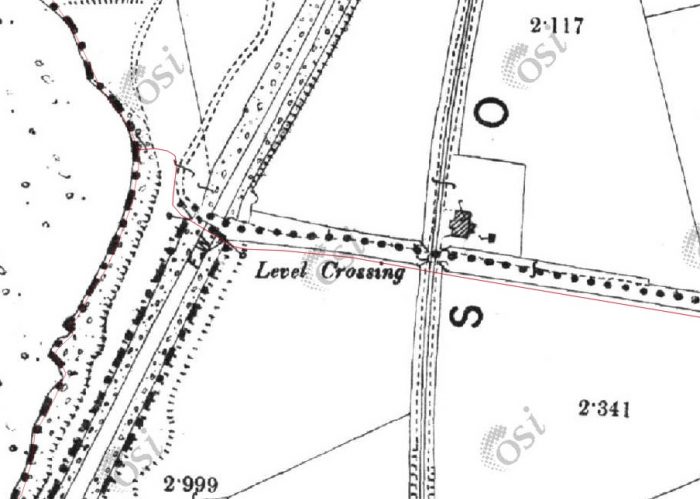
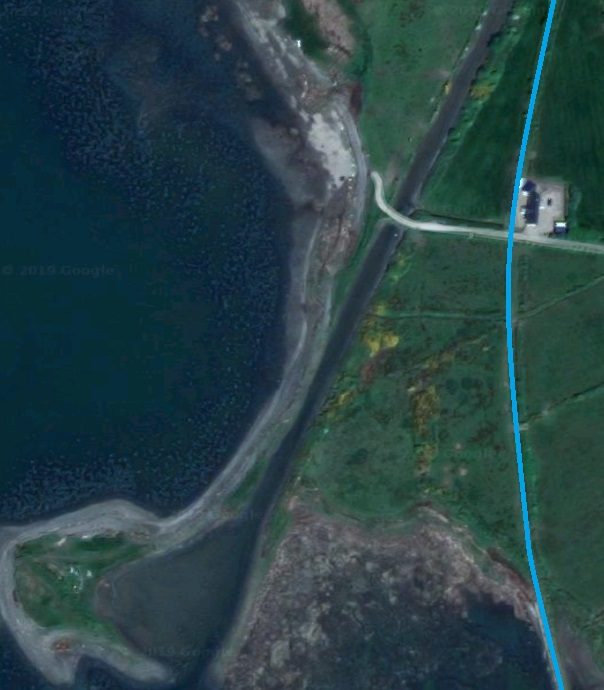
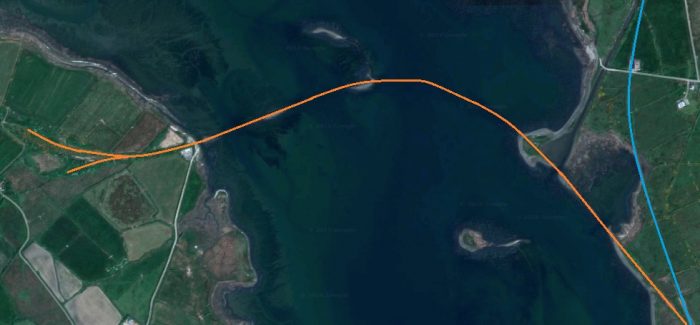
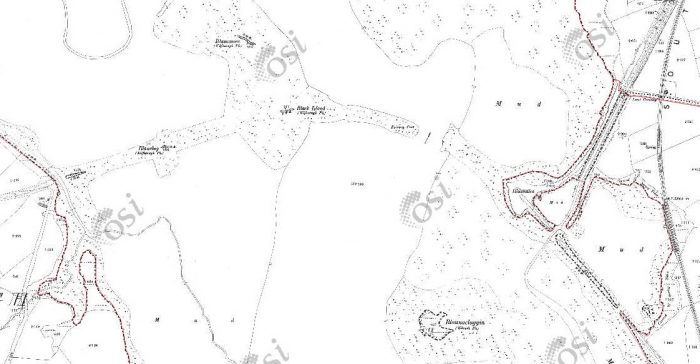
Simms commented in 1996: “Substantial relics of the line’s earthworks remain, including a deep cutting near Ward Point quarry … and the base of a locomotive shed just west of the A961.” [1: p23]The north of Burray. Ward Point quarry is to the left of the image on the coast. As far as I can tell, the red line shown on the satellite image below is the approximate line of the 3’0″ railway on the north coast of Burray.There was a further Causeway on south side of Burray, linking it with South Ronaldsay.Sketch plans of the railways on Burray and Lamb Holm. [18]

Causeway No. 4 – work on this causeway did not start until July 1942 and it was built by May 1943. It was about 2000ft long. Work started at the north end on Burray where the contractor’s power station and blockyard were situated. A 3’0″ guage railway was laid from Burray Village Pier via a reversal to the blockyard which sat above Sea Taing and Housebreck quarry (where 2’0″ gauge lines were in use). Standard gauge tracks were used for the steam cranes. The blockyard closed in June 1944.

At the South end of the causeway, Balfour beatty sublet the work to Willian Tawse & Co., a Perth based firm. Rock from the quarry on Eastside proved unsatisfactory and a new quarry was opened up at Hoxa to the West of St. Margaret’s Hope. Road vehicles brought the stone to a loading point at Carra Point. “A twin track 3’0″ gauge railway was extended forwards onto the causeway in the direction of Burray as work progressed: rapid progress was made.” [1: p23] Diesel locomotives were employed here. No relics remain at this site. Interestingly sand has built up so much on the eastern side of the barrier that it is impossible to believe that there was ever open water there. The amount involved is actually staggering! As can be seen below.The view of the newly developed sand dunes from Google Streetview, taken from the south end of the causeway!The view from the North end in 2014.

C. Military Railways

The Army was very limited in its use of railways in Orkney. Use was limited to 2’0″ lines linking storage huts at Muckle Rysa Camp on Hoy and at Houton and Stromness Camps on Mainland. There was also an inclined railway at Scad Head Battery on Hoy. [1: p24] This was “a self-acting incline about 900 yards long to serve a gun battery at Scad Head half way along the totally unpopulated section of the north-east coast of Hoy. The line ran from a camp set on top of a hill to the emplacement on the clifftop below, but it has been removed so effectively that even its gauge is now in doubt.” [18]WW2 Army building Muckle Rysa. [12]WW2 Engine House, Muckle Rysa. [13] Two images from Houton Battery on Mainland. [14]Stromness Army Camp during WW2. [15]

The Royal Airforce deployed balloons during World War 1 for observation purposes around Scapa Flow. During World War 2, unmanned barrage balloons were introduced to force enemy planes to fly higher or to damage and bring down aircraft. [1:p24]

“To defend the naval anchorage at Scapa, a special Squadron was created. The advance party arrived in Orkney in January 1940 and headquarters set up on Ore Hill above Lyness. Balloons were flown from sites on Hoy, Flotta, Fara and from trawlers moored in the Flow. [16] A second Squadron was formed in summer 1940.” [1: p24]

Ore Hill Balloon Depot, Hoy had a 40″ gauge man-powered railway to assist with moving gas cylinders which made use of a home-built wood-bodied flat wagon.

Rinningill Hydrogen Gas Factory, had a 2’0″ gauge railway installed on a newly constructed steel pier on Ore Bay which ran to an inland storage area reached by a steep incline. Eventually this small network included the factory and reach about 250 yards in extent. Simms says that in 1991, parts of the line were still visible . The pier was, by that time, in a dangerous state.

Fara Balloon Sites – Fara provided a natural protection to Lyness and was ideal for the deployment of barrage balloons. There were 6 balloon site on the island and a 2’0″ gauge railway was installed around a lot of the coastland of the island to service those sites. Gas was shipped from the Rinnigill Factory to Fara Pier and moved round the island on small flat four-wheeled trucks by a 20hp Ruston &Hornsby diesel locomotive.

Flotta Balloon Sites – at the advent of the war, Flotta was heavily fortified and used as a huge camp with an adjacent storage and supply base. A 2’0″ gauge railway was installed on the island which linked the older stone fishing pier to the new concrete ferry pier and to the base storage areas. The length was probably no more than 150yds. “By 1990, only a few corroded rails along the shore and an upturned metal truck chassis complete with wheels and axle-boxes remained, just below the high-tide mark Southwest of the fishing pier.” [1: p26] There are a few images below which show a narrow gauge line on the old pier at Flotta. [17]Loading cattle onto the Hoy Head, (c) K Desmond. [17]In this family photo, a car is being loaded from the pier onto the Hoy Head. The tracks remain visible in the pier surface. [17]Railway tracks are prominent in this picture. [17]Protective railings have now appeared on the pier. The railway is still prominent. [17]

The Royal Navy – feverishly mounted preparations in WW1 to protect Scapa Flow from enemy attack as soon as the decision had been made to make Scapa Flow the Grand Fleet Base. However, supply problems and other issues left the fleet waiting to move into their new base until April 1919 which was months after the signing of the Armistice in November 1918. This meant that almost as soon as the fleet had finally moved into its base, it went to a peace-time footing and much of the infrastructure was sold off or removed.

Lyness Naval Base – the first section of the base to become operational was the refueling facility which was completed in 1917. The remainder remained in contractor’s hands through beyond the end of the War.

” in 1936 a start was made on extensively modernising the base, new wharves were built and William Arrol & Co. constructed underground tanks on Wea Fea whilst Balfour Beatty had the contract for the surface tanks located behind the pump house. … At the start of the Second World War only 400ft of the part completed quay was ready for use and this was taken over by the Boom Defence Depot. During the War the Flow became the main base for the British Home Fleet. The quay, locally known as Golden Wharf on account of both the high cost and the lengthy period of construction was not completed until Spring 1944″. [1: p26-27]

The standard gauge railway system was deemed to have lain derelict since the Great War. In fact it had been used by Cox and Danks and later by Metal Industries. It was relaid and extended for use by the travelling cranes required for laying and recovering anti-submarine booms. Much of the track still existing at Lyness in the 1990s was from this period and the date 1937 could be seen stamped on some of the pointwork. [1: p27]

Four steam cranes were used during the War. In 1945, the base was ‘moth-balled’ and finally closed in 1956.

Lyness Torpedo Depot was established on the North side of Ore Bay in the late 1930s. Some 2’0″ gauge track was pressed into service to serve the assembly factory and later extended to the storage areas on the West. Much of the track remains but there is no record of what locomotives were used on the system [1: p27]2’0″ gauge track in evidence at Lyness on the North side of Ore Bay.Standard gauge track in evidence at the Scapa Flow Visitor Centre.

And finally. …

D. Scapa Flow Visitor Centre

The visitor centre was closed when we visited in May 2019. Pictures in my earlier posts show a little of what exists at the site (see previous posts in this series:

https://rogerfarnworth.com/2019/04/29/the-railways-of-orkney; and

The Railways of Orkney – Part 2

A short 100 metre length of metre-gauge track was constructed at the Visitor Centre in 1992. The gauge was chosen for the locomotive owned by the Centre rather for historical accuracy.

There are a number of railway exhibits at the Visitor Centre which is awaiting major works funded by Heritage Scotland. These include: [1: p29-31]

  1. A Ruston and Hornsby Diesel Mechanical Locomotive, originally owned by the Royal Navy. 30hp, 1000mm gauge and weight 4 tons.
  2. A Ruston and Hornsby Diesel Mechanical Locomotive, originally owned by the War Department. 20hp, 2’0″ gauge and weight 3 tons.
  3. A Wingrove & Rogers Battery-Electric Locomotive, originally owned by the Royal Navy. 2’6″ gauge and weight 7 tons.
  4. A Cowans Sheldon Steam Crane, originally owned by the Royal Navy. Standard gauge (a bogie steam travelling crane).
  5. 2 no. Harrison & Cammell Flat Trucks
  6. 4 No. miscellaneous railway trucks – three at 2’0″ gauge and one at standard gauge.

References

  1. Wilfred F. Simms; The Railways of Orkney; Self-published, printed by Gadds, Worthing, 1996.
  2. https://papastronsay.com/island/index.php, accessed on 14th May 2019.
  3. https://photos.orkneycommunities.co.uk/picture/number22715.asp, accessed on 14th May 2019.
  4. https://www.irsociety.co.uk/Archives/10/orcadian_railways.htm, accessed on 1st May 2019.
  5. https://en.wikipedia.org/wiki/Sule_Skerry, accessed on 14th May 2019.
  6. https://photos.orkneycommunities.co.uk/picture/number24499.asp, accessed on 14th May 2019.
  7. http://www.northronaldsaylighthousecottages.co.uk, accessed on 14th May 2019.
  8. https://www.naval-history.net/WW1z12aCox.htm, accessed on 14th May 2019.
  9. https://photos.orkneycommunities.co.uk/picture/number589.asp, accessed on 14th May 2019.
  10. https://canmore.org.uk/site/174004/hoy-wee-fea-underground-oil-fuel-tanks, accessed on 14th May 2019.
  11. https://en.wikipedia.org/wiki/Hunda, accessed on 14th May 2019.
  12. https://hoyorkney.com/attractions/hoy-history/wartime-heritage/hoy-wwii-archaeology/explore-wwii-hoy-and-walls/loc-survey-north-walls-rysa-to-pega, accessed on 18th May 2019.
  13. https://hoyorkney.com/attractions/hoy-history/wartime-heritage/hoy-wwii-archaeology/explore-wwii-hoy-and-walls/wwii-hoy-walls-rcahms-sites, accessed on 18th May 2019.
  14. https://www.northlinkferries.co.uk/orkney-blog/orkneys-wartime-history, accessed on 18th May 2019.
  15. https://www.aboutorkney.com/2019/04/21/stromness-in-wartime, accessed on 18th May 2019.
  16. http://www.crashsiteorkney.com/barrage-balloon-sites, accessed on 18th May 2019.
  17. https://lurdy.wordpress.com/2015/03/31/celebration-on-flotta-pier, accessed on 18th May 2019.
  18. https://www.irsociety.co.uk/Archives/10/orcadian_railways.htm, accessed on 25th April 2019.


The Shropshire and Montgomeryshire Light Railway and the Nesscliffe MoD Training Area and Depot – Part 1

Someone who read my post on the Bicester Military Railway challenged me to look at the railway(s) which used to serve Nesscliffe Training Area. This first post traces the life of the old branch-line which served the area and was taken over by the military. A further post should follow which looks at the military sites themselves. Apologies for the length of the title!

As I have undertaken this research I have become increasingly aware of the complex railway and tramway arrangements in the area to the West of Llanymynech which  is probably best left to another occasion rather than seeking to cover it as part of this post.

The Shropshire and Montgomeryshire Light Railway

The old Shropshire and Montgomeryshire Light Railway (S&MLR) was commandeered by the military to allow the creation of a major armaments storage facility at Nesscliffe. The main length of the old railway is highlighted in the overlay on Google Maps below. [1]

The S&MLR was often referred to at ‘The Potts Line’. It ran from Shrewsbury, England to Llanymynech, Wales, with a branch to Criggion. [2]The S&MLR opened in 1911. The company ran the reconstructed Potteries, Shrewsbury and North Wales Railway which continued to be owned by the Shropshire Railways Company, and was one of the Colonel Stephens Railways. It lost its passenger services in 1933, although some limited bank holiday services for tourists continued until 1937. [2]

The terminus of the line was at Shrewsbury Abbey station not at Shrewsbury railway station. This was because the joint operators, Great Western Railway (GWR) and the London and North Western Railway (LNWR) refused to let the smaller company have access to mainline services. After the railway closed Shrewsbury Abbey was retained as an oil depot siding connected to a stub of the Severn Valley branch. The site finally closed in 1988. A new road in the area has been named “Old Potts Way” as a reminder of what was known as ‘The Potts Railway’. [2]

A number of the stations shown in the adjacent diagram were added after the closure of the original Potteries, Shrewsbury & North Wales Railway. [2]

The Potteries, Shrewsbury & North Wales Railway

The original Potteries, Shrewsbury & North Wales Railway Company opened in 1866. Wikipedia says that it obtained “notoriety as the most expensive non-metropolitan railway then built, but was never constructed between Shrewsbury and the Potteries. The line rapidly became very run down as a result of low revenues and poor maintainace and was closed for safety reasons in June 1880, becoming one of the few railways to close in Victorian times. Attempts to re-open the line were made in the late 1880s and the 1890s by the Shropshire Railways who took over the property but these failed. After years of lying derelict, it re-opened as the Shropshire & Mongomery Light Railway in 1911.” [3]

John Speller confirms this but widens the information on the line, placing in the context of a wider network: “The Potteries, Shrewsbury and North Wales Railway (PS&NWR) or “Potts” for short was an over-ambitious plan to build a line connecting the quarries at Nantmawr and Criggion via Shrewsbury to Market Drayton and then via the North Staffordshire Railway to Stoke-on-Trent and the Potteries. The line was built through extremely difficult terrain and at the time was the most expensive railway outside London ever built. The Shrewsbury to Market Drayton section was never completed. Since the Great Western and London & North Western Railways refused to allow the Potts to use their station at Shrewsbury General, the company had its own station at Shrewsbury Abbey, just to the south-east of the main line station. The line opened in 1866. Only a small section of the line was in Wales, the rest being in Shropshire. The section from Llanymynech to Potteries Junction, Shrewsbury was originally double tracked. The line was strongly supported by the North Staffordshire Railway who had visions of eventually obtaining access to North-West Wales, although this would have involved even heavier engineering work through the mountains. The line was poorly maintained and suffered several bankruptcies.” [4]

“The section north-west of Llanymynech was taken over by Cambrian Railways in 1900, and subsequently passed to the Great Western Railway in 1922. Passenger service ended in 1951, and most freight in 1964, but freight traffic on part of the line lingered until 1988. Part of the line reopened in 2009 as a heritage railway under the auspices of the Cambrian Heritage Railways Trust.” [4] The GWR route-map immediately above shows the Western part of the PS&NWR from Llanymynech to Llangynog which became a Cambrian and then Great Western railway.

“The eastern section remained fallow until 1911 when it was taken over by Colonel Stephens as the Shropshire & Montgomeryshire Light Railway. Passenger service ceased in 1933. After abandonment by Stephens the line was taken over by the War Department in 1941, who ran it until closure in 1961.” [4]

The story is filled out a little by BBC Shropshire: “Whoever had the idea of building a railway line connecting Shrewsbury with the small village of Llanymynech, near Oswestry, wasn’t a business genius. Yet despite this, the Potts Line, as it became known, was used – on and off – for nearly a century before it finally fell into obscurity. How any of the owners ever expected to make a profit from this venture is a mystery: For a start the line didn’t go near any population centres other than Shrewsbury, and its stations were located in the middle of nowhere. For its whole life the Potts Line teetered on the brink of financial ruin, making the odd trip into the abyss. And the constant battle with the elements, especially the River Severn, didn’t help.” [6]

“Various plans had been considered for a railway between Shrewsbury and Llanymynech, but it was only when the Shrewsbury and North Wales Railway became involved in the 1860s that plans began to take shape. The venture, funded by the North Staffordshire Railway, created the Potteries, Shrewsbury and North Wales Railway – hence the nickname The Potts Line – with the idea of transporting minerals from Llanymynech, as well as carrying passengers. Unfortunately, these plans suffered a blow early in the project, when the company was refused permission to run its trains into Shrewsbury General Station: The line would have to work in isolation from the rest of the railway network.” [6]

“A terminus was built at Abbey Foregate, opposite Shrewsbury’s Abbey Church, standing on the site of the former monastery’s refectory.  Passengers arriving at the station were greeted by the sight of the 14th Century refectory pulpit, fenced off at the edge of the platform.” [6]

It and the platform are still there, and the area once occupied by the station is part of a car park.

The adjacent image shows the pulpit in 2009, (c) John S Turner. [7]Train at Shrewsbury Abbey in 1870 behind a Bury, Curtis and Kennedy 0-4-2 locomotive built for the LNWR in 1847. [4]

There are a good range of pictures of the old station on the Shrewsbury Railway Heritage Trust site. [9] Here are a few as tempters!With the Abbey in the background, the old station building looks rather forelorn. Just behind the photographer the station platform rose to be more accessible for the unloading of goods. [9]The ramp is clearly visible in this photo. [9]Looking South (above) along the platform in the 1980s. [9]

The adjacent image is probably from soon after the turn of the 20th century and shows station and Abbey together. [15]

The image below is taken from much closer to the station throat and probably shows the station in the 1950s when the station was in use by the military. [15]

The station in use before closure in 1961. [9]The renovated building in the 21st century is shown above. [10]

Another view of the station is use is shown in the adjacent image. [6]

The double track railway line left Shrewsbury in a south-easterly direction, with a station at West Meole Brace before heading out into the countryside into lightly-populated farm land and land subject to periodic heavy flooding. Its largest engineering feat was the twin track viaduct over the Severn at Shrawardine. The line first opened on 13 August 1866 and according to the Shrewsbury Chronicle, large numbers of passengers turned up at Abbey Foregate Station to try out the new service, and got out at the other end determined to explore Llanymynech. Many walked up Llanymynech Hill, but others ‘sought sport in the River Vyrnwy, as well-filled baskets testified’. Unfortunately for the Shrewsbury and North Wales Railway, the novelty wore off quickly, and passengers numbers soon dwindled. Within a few months of opening, the railway was in deep financial trouble. Debt collectors turned up at Abbey Foregate and seized a train. After rapid negotiations the train was allowed to leave, but only with a bailiff on board. After sitting in a stationary coach for a few minutes, the bailiff stuck his head out of the window – to see the rest of the train disappear into the distance! He was later told a coupling chain had broken by accident, leaving his coach behind. A likely tale?” [6]This picture comes from the Colonel Stephens website. It seems to be a flight of fancy when the accompanying text about locomotives is read. Although, the engine is one of the ex-LSWR ‘Ilfracombe Goods’ engines, the scene still has a sense of optimism and cleanliness which both seem to have been in short supply throughout the life of the line: “The railway ordered two new engines, 0-6-2 T, named ‘Pyramus’ and ‘Thisbe’. These were not a success, and were sold to the Government in 1916. The mainstay of the Railway then became three Ex LSWR ‘Ilfracombe Goods’ there were several oddities. The first loco was the minute 2-2-2 tank engine Gazelle, which served an inspection loco and then as a service loco on the Criggion branch. A Manning Wardle ‘Morous’ and an ancient 0-4-2ST ‘Severn’ (initially ‘Hecate’) of uncertain vintage completed the early roster. Three Terrier locomotives came in the 1920s but fell by the wayside in that decade and finally three ex LNWR ‘Coal Engines’ came from the LMS. A Ford railmotor set completed the roster.” [18]A ex-GWR ‘Dean Goods’ running as WD 190 as requisitioned by the War Department on shed. Note the old watertank which suggests that this picture was taken in the early days of M0D control. Thanks to Paul Moxon for these notes on this picture. [19]

As can be seen on the map below, for the first few miles the Shrewsbury and Welshpool Railway and the PS&NWR ran parallel and close to each other and Rea Brook . [8]“The company’s finances went from bad to worse, and on 21 December 1866, all services on the railway line ceased, while some of its assets were sold off. It was another two years before a train ran on the line again but services had to be reduced even further and the railway made into a single line, to cut running costs. Despite these economies, the company still found the cash to build a new branch line from Kinnerley to Criggion, with the aim of picking up revenue by transporting stone from the quarry at the foot of the Breiddon Hills.” [6] It was also intended to carry passengers, but the facilities were primitive. Apart from Melverley, all the buildings and platforms were made of timber. The branch had to cross the River Severn and it did so on a rickety timber viaduct.

“While the branch at Criggion was opened in 1871, a second branch was added between Llanymynech and Nantmawr the following year. This branch, which crossed the Cambrian Railway Company’s tracks at Llanymynech, allowed the Potts Line to take on extra freight traffic – limestone from the quarries at Nantmawr.” [6]

Despite the additional revenue, the PotteriesS&NWR continued to deteriorate. All possible economies were made, fares were even cut to encourage more passengers, but to no avail. In 1877 the company went into receivership. By 1880 the condition of the track had become so poor that a 25mph speed limit was imposed right along the line. Later that year the line closed completely. The Oswestry-based Cambrian Railway Company bought the section of the line between Llanymynech and the quarries at Nantmawr, re-opening it in 1886.

The rest of the line remained dormant until 1890, when a new company, Shropshire Railways “took over the line between Llanymynech and Shrewsbury, relaying the track. Unfortunately the cost of these line repairs ate up most of the new company’s budget and it went into receivership shortly after re-opening the line.” [6]

“For the third time in its short history, the owners of the Potts Line had gone bust, and it was to be another 17 years before trains ran along it again. All but abandoned, the station buildings and other structures, which hadn’t been in the best condition anyway, deteriorated still further, and in 1902 the wooden viaduct over the Severn at Melverley collapsed into the river.” [6]

Colonel Stephens built two lines in Shropshire: “The narrow gauge mineral railway linking the mine at Snailbeach with Pontesbury, which he took over in 1923, and the Potts Line.” [6]

“With the backing of local councils, Stephens formed the Shropshire and Montgomeryshire Light Railway company in 1907, and work began to clear the overgrown track. Once again the sleepers were replaced, the Melverley Viaduct was rebuilt and the line re-opened on April 13, 1911. But the newly-re-opened railway was hardly a success story. Traffic remained at a low level – hardly surprising given the fact that the stations were miles from anywhere, but Stephens was at least able to keep costs low with his collection of bizarre second-hand locomotives and carriages.” [6]

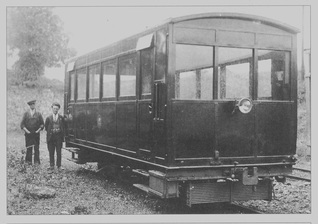
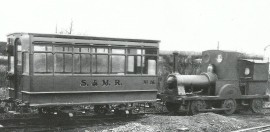
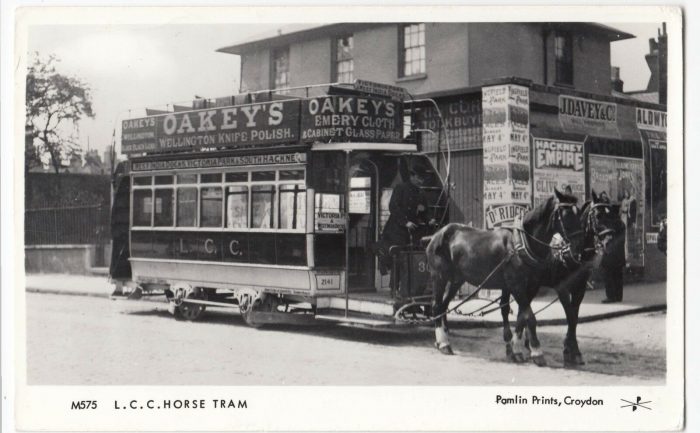
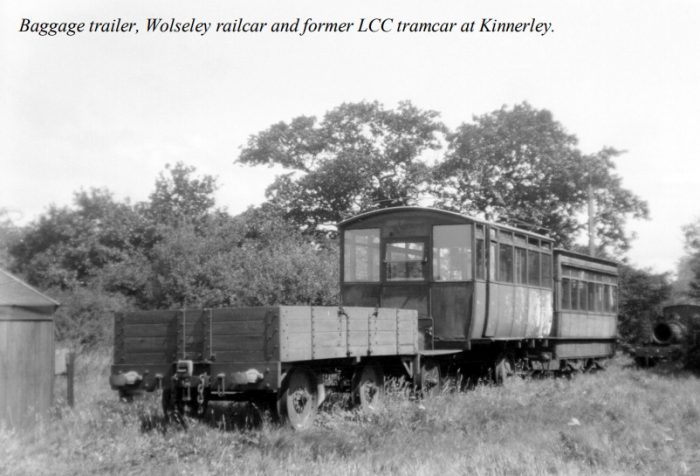
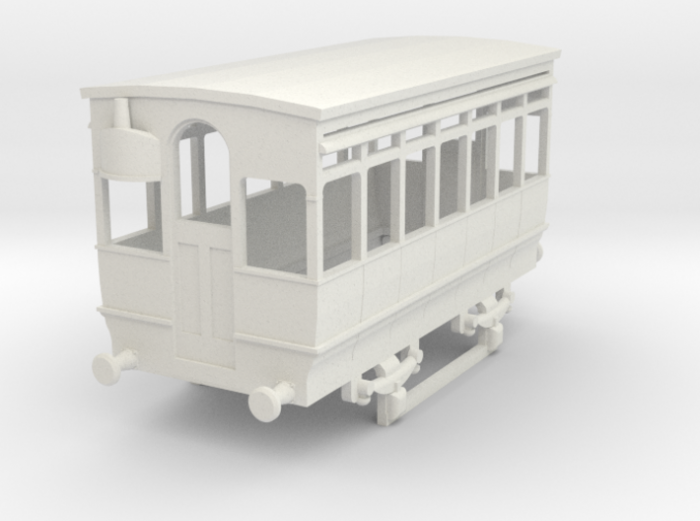
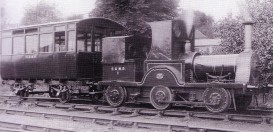
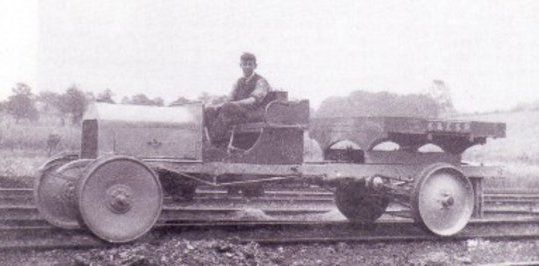
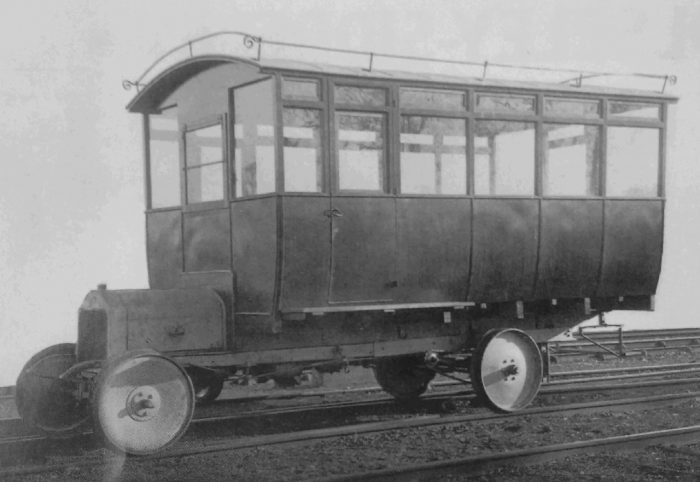
The strangest of all was called Gazelle, although its nickname, ‘the Coffee Pot’ was more descriptive. It is believed to have been the smallest locomotive ever operated on a standard gauge railway in Britain. Experimental rolling stock was the norm for the Potts Line. Economies in the 1920s saw the introduction of Ford railcars which were deeply unpopular with passengers because of the noise made by the pressed steel wheels. Then there was the double-decker tram bought by Stephens from London County Council. He modified this to run behind Gazelle by removing the top deck and the stairs. Gazelle and the tram are shown in the two small pictures above and the larger picture below. [6][18]‘Gazelle’ The one locomotive that says it all about Col. Stephens and the S&MLR. [18]

A BBC article says: “Money became tighter than ever in the 1920s as the line struggled to keep going. … All passenger traffic on the Criggion branch line ceased beyond Melverley, because once again the viaduct was inspected and considered unsafe. the S&MLR closed completely in November 1933.” [6] The BBC’s suggestion of complete closure is challenged by others. It was passenger services that ended in 1933: freight traffic continued, including on the Criggion branch (weak bridge and all), until the Army takeover. One source below mentions this.The station track layout in Shrewsbury in the 1920s. [15]The station in the 1870s. [41: p25]

In June 1941, the War Department requisitioned the line from Shrewsbury to Llanymynech, and established a vast ammunition storage dump at a secret depot in Kinnerley. There were more than 200 huge storage sheds, camouflaged and decked out with turfed roofs and each was served by a railway siding. The line was busier during the war years than it had ever been. Before long, as many as 12 locomotives – including the Gazelle ‘Coffee Pot’ – were in steam at the same time.

The War Department spared no expense in maintaining the line and its structures. It improved facilities all along the line, including building major new sidings at Hookagate, where the Potts Line joined the main line from Shrewsbury to Welshpool, and completely rebuilding the viaduct across the Severn at Shrawardine. All this renewed activity on the main part of the line allowed stone to be carried from Criggion again, although Melverley viaduct was yet again declared unsafe in 1945. Only trains hauled by Shrewsbury-built Sentinel light locomotives were allowed to use the line until the bridge was rebuilt in 1947 by the Great Western Railway. This is the bridge that remains today. [6]

Shortly after the end of the war, the Severn floods were so bad they reached the top of the embankment at Shrawardine, and a bridge over a stream at Maesbrook was washed away, stranding a locomotive at Llanymynech. In 1959 the War Department closed its last depot and stone traffic by rail from the Criggion quarry ceased. The following year the line was returned to civilian status, to be operated by British Railways. But the writing was on the wall for the branch line and operations were run down. The last scheduled train from Shrewsbury to Llanymynech ran on 26 February 1960 and three days later the line closed. [6]

In the same year, BR removed all the track apart from sidings at Shrewsbury and today little remains of the Potts Line. The site of Llanymynech station is now a coal yard and the station at Criggion is split into two houses. Hardly anything remains of the Criggion branch line, and the stations at Llandrinio Road and Crew Green, which had wooden platforms, are completely gone.

The most substantial remains of the Potts Line are at Kinnerley, where most of the ammunition storage buildings – and even the rails running through them – still survive as shelters for livestock. There are also considerable remains of the Potts Line in and around Shrewsbury, especially at Abbey Foregate station.

Much of the trackbed was used as the base for Shrewsbury’s inner ring road, called Old Potts Way. The platforms of the station are still there, and an attempt to demolish the Potts Line station building, was eventually turned down by the local council in 2003.

In October 2008, Shrewsbury and Atcham Borough Council pledged £113,000 to help build a heritage centre in the old station building. The Shrewsbury Railway Heritage Trust applied for match-funding from the Heritage Lottery Fund and the building has been refurbished.The refurbished station building in July 2018. It sits boarded up awaiting a new life.

The adjacent image shows the terminus and the Abbey viewed from the station platform in around 1910, (c) F.E. Fox-Davies. [15]

The line from Abbey Foregate to Llanymynech and Criggion

The buffers were immediately behind the dwarf wall in the image immediately above. The road in the picture is Abbey Foregate. This station must not be confused with the station that was called Abbey Foregate. That station was to the south-east of Shrewsbury station, to the east of Severn Bridge Junction, on what is today the Shrewsbury to Wolverhampton Line. Despite its name, the nearest road was Underdale Road, not Abbey Foregate! [11]Our line is shown in blue on the Railway Clearing House Junction Diagram from 1912. [12]

As we have noted above the line followed closely that of the Shrewsbury and Welshpool Railway as it left Shrewsbury. By 1955 the OS Map no longer shows two separate railway lines over the length to the north of Meole Brace (see below) even though the lines were running in parallel still.The layout of the station tracks can be seen on the OS 1:10,560, 1949-1968 series maps as in the adjacent image. The maps in this area were published in 1954. [13]

Leaving the station, the line curved westwards and shown on the map below. It crossed Rocke Street/Reabrooke Avenue which was at that time a pedestrian underpass.

The line then bridged two railways. The first was the GWR to Worcester, the second, the Shrewsbury to Hereford line.Looking back towards the station from the location of Rocke Street underpass.Looking ahead along the line towards the West.This 1954 map shows the two lines running parallel under the A5191, Hereford Road. [13]Looking East from Hereford Road showing the line of the old railway curving in under the road bridge.Looking West along the route of the line from the same bridge.The two lines to the West of the A5191 before the B4380 bridge. The signal box on the map above is visible in the centre of the image, as is the fence dividing the two lines and in the right foreground the link between the two lines. This picture appears to have been taken from the footbridge visible in the next picture. [16]This image shows the link between the two lines and the footbridge beyond. [41: p16]The two lines continue to run next to each other through Meole Brace Station. [13]Before reaching Meole Brace Station the two lines passed under the B4380. This picture looks back towards Shrewsbury.Looking ahead towards Meole Brace Station.

Meole Brace Railway Station opened in 1866 and closed in 1933. [14] The station facilities were very limited and the station only served the S&MLR. There was a wooden shed for passenger accommodation with a roof that sloped away from the platform. There was no canopy on the station building, although the passengers could use Stanley Lane bridge for shelter. Alongside the wooden building was a grounded wagon body which probably performed the function of the small goods shed. There were no sidings and no room for trains to pass.An Aberystwyth bound train passes the site of Meole Brace station, heading away from the camera. The main line here was opened as the Shrewsbury and Welshpool Railway in 1862. It was operated by the London & North Western Railway from the outset and then jointly with the Great Western Railway. Meole Brace station served the erstwhile Shropshire & Montgomeryshire Railway which ran parallel to the Shrewsbury & Welshpool (to the left of this view – under a separate span of the bridge) for about 2 miles.  The station here, an all wooden structure, probably of single carriage length, was located to the left (out of shot in this view) mostly under the Stanley Lane overbridge. The Shrewsbury and Welshpool line now forms part of the Cambrian main line from Shrewsbury to Aberystwyth/Pwllheli. In this view, ‘Cambrian’ unit No. 158830 is operating the 11:30 service from Shrewsbury to Aberystwyth, ©  John Lucas. [17]Looking back towards Shrewsbury from the Stanley Lane Overbridge. The Meole Brace station building was tucked under the bridge in the approximate location of the tree which is in the centre of this image.Also taken from Stanley Lane, the route of line can be seen heading Southwest alongside the present line to Aberystwyth.The two lines were still running next to each other as can be seen in the monochrome image above and on the OS Map. The Stanley Lane bridge is just visible to the top-right of this map extract. Two other roads cross the line on this map extract, one under (Washford Road) and one over (Longden Road) the line. [13]Washford Road underbridge, taken from the Northwest and showing the modern bridge carrying the live line and behind it an abutment from the old line.From the South East the abutments of the old line loom large and show that at one time there was a two track line running over the metal bridge.Longden Road bridge is newly reconstructed in the early 21st century. This view looks back towards Shrewsbury. The view immediately below looks Southwest along Longden Lane and shows the remains of what was the older bridge parapets.The view ahead shows the modern railway crossing over the A5 on a newly constricted bridge. The old line still ran parallel at this point but it would never have had a bridge as it was long-gone before the modern A5 was built!Longden Road runs parallel to the route of the line as it crosses the A5 and affords a good view of the modern line as well.

After the overbridge at Longden Road, the two lines took separate courses. The S&MLR diverted southwards and rose, past the site of two old quarries, to cross the Aberystwyth line on a skew bridge as shown on the map extract below.A 1930s guidebook to the line describes this section of the line as follows: “The gradient stiffens and climbing up through a charming belt of woodland the railway crosses the Welshpool line, and continues high up above the surrounding country to Hanwood.” [23]The next station on the line was Edgebold Station, sited just to the Southeast of the A488. [13]Edgebold station building was typical of most on the line, of timber construction with a roof sloping away from the platform face. It was sited on the North side of the line. The locomotive in this picture is most likely to be an ex-LNWR engine. There were goods facilities at the station which came off the line to the East of the station platform and ran behind the station building. [15]The line crossed the A488 via an overbridge. It had been on embankment for some time. The station location was among the trees at the centre of this image which is taken from the Southwest.This image taken from the Northeast shows the remaining abutment of the overbridge.The railway ran in cutting through passed Thieves Lane and on towards the B4386, Horton Lane.

The 1930s guidebook to the line says: “A straight run from Edgebold and Cruckton Halt is reached at a point where the line is carried over the Shrewsbury and Westbury main road. From here the gradient descends to Ford Station. Close by are the villages of Crossgates and Ford: Crossgates situate in a pleasant udulating country with woods here and there dipping down to the Severn. Ford lies about half-a-mile from the river, and is but a small village, though within its broad parochial bounds are many lovely nooks and delectable habitations of all degrees. The church, which stands picturesquely upon a high knoll, is an interesting and beautiful little building of red sandstone and dates back to the twelfth century.” [23]The location of the Thieves’ Lane Bridge can just be made out on the satellite image south of the woodland at the centre of the image. Thieves’ Lane can be picked out entering the image from the right but is lost after crossing the line of the railway.The railway passed close to Horton Lodge, by this time back on embankment and crossed Horton Lane via an overbridge. [13]The bridge abutments are visible in this picture taken from the Southwest. To the Northwest of the bridge, the embankment has been removed over a short distance.The line continued in a straight northwesterly direction, alternating between bing in cutting and on embankment. On its way it crossed a minor road at level at approximately the location shown below.It continued from here on embankment passed Fairfield House, shown on the map extract above, before crossing the A458 on an overbridge and entering Ford & Crossgates Station. The A458 road has been realigned relatively recently. The 1930s guide says: “At Ford the railway crosses the Shrewsbury and Welshpool road, and in a mile two goes over the Severn, affording views to the traveller of a magnificent bend in the river, backed by a big belt of woodland which runs sheer up from its right bank.” [23] The adjacent image shows that the staion had slightly better facilities than those encountered along the line so far. The timber structure has a peaked roof and appears to be more substantially built and the platform in made of dressed stone and designed to accommodate longer trains! [20]While searching the internet, I came across this computer generated image of the station which picks out the old bridge over the A458 and the grounded van body as well as the passing loop which was present at this station. The image was produced by Sketchupdezine (@sketchupdzine) and can be seen on facebook at https://www.facebook.com/sketchupdzine. [21]This closer extract from the OS Map shows both the loop and a small siding. There are no obvious signs of the railway and its overbridge where it once crossed the A458. However, just to the Northwest of that bridge a country lane passed under the old railway. Tha cane be seem at the top left of the map extract. [13]The picture above is taken from the South and shows the minor road passing under the old railway bridge in 2009.

The line continues to the Northwest and eventually begins to run alongside the River Severn as shown on the adjacent map extract. [13]

The River Severn snakes round and the line crossed it on a major structure which can be seen on the next map extract. This bridge was in the form shown on the picture below.

Sharwardine Bridge was, says the guide book, “a massive structure, and was erected at [great] expense. A pair of double lines of wrought iron girders [were] carrled over the river deep down [in] its bed on four sets of stone buttresses, and three sets of three each of iron cylindrical pillars, making it the most pretentious bridge on the whole length of the railway.” [23]Sharwardine Bridge in 1903, © F.E. Fox-Davies. [41: p33]The Railway Bridge across river Severn (1954). The river crossing of the River Severn by the former Shropshire and Montgomeryshire Light Railway is shown above. Taken during RCTS (Railway Correspondence & Travel Society) on 25th April 1954. The bridge was long ago dismantled, ©Ken Brockway. [22]

The same bridge is shown in this smaller image. [6]The bridge location (above) in the early 21st century.

The line continued only a short distance northwest before entering Sharwardine Station which, like Ford & Crossgates also had a passing loop and small siding. These can be picked out on the adjacent map excerpt. [13]

The station had a long stone-faced platform but a smaller station building than the one at Ford & Crossgates.  The adjacent image comes from the early 1900s. [15]

“Shrawardine derives its name from ‘Shire-reeve-weodine’, thus marking it as the residence of the Saxon sheriffs before the Norman Conquest. The church contains little of interest, apart from a Norman font.” [23]

The line continued in a northwesterly direction as illustrated on the map extracts adjacent and below.

The next road crossed was close to Pentre and can be seen on the third of these three maps excerpts.

Tell-tale signs exist on the satellite image above which show that the area north and west of the river was used for more than farming. Remnants of old railways exist in the form of their trackbed. We will come back to this area in a future post. Sharwardine station was in the bottom right of this satellite image at the location shown below – just after the first run of trees northwest of the River Severn.From this point to Pentre and beyond the line of the railway has been tarmacked as shown below.Looking back along the line of the railway towards Sharwardine. Nesscliffe and Pentre Station was to the right of the line between the access road and the railway.Looking ahead (above) to the northwest. There is a strong clue as to the use of the land in the bottom left of this picture.

The adjacent image makes the status of the land much clearer!Looking towards Kinnerley from Pentre in 2019, (c) Bill Lloyd‎, Disused Railway Lines of Britain. [26]The line north of Pentre. The Nesscliffe and Pentre Railway Station can just be made out in the bottom right of the OS Map extract. [13]The line passed through Edgerley Halt and on to Kinnerley Junction Station. [13]Again, north of Pentre, there are telltale signs on the satellite image of the past use of the land.

Just before reaching Kinnerley Station the line passed under a minor road. The bridge pilasters still exist today but the line of the railway has been filled in.The station bridge from the North in 2010. The station bridge from the South in 2010. Interestingly, although the bridge has been filled there remains a weight restriction. This must call into the question the quality of the infill work! Kinnerley Station road bridge, looking back towards Pentre in 2010. The cutting has been filled in and the bridge parapets replaced with wooden fencing. The route of the S&MLR is shown by the red line.Kinnerley Station was the junction station on the S&MLR. One line continued to the West to Llanymynech and the other, South towards Criggion [13]

The adjacent sketch  plan shows the track layout in the area of the station and on the branch-line. [15]

The adjacent picture shows the station looking West towards the junction. [15]

The image directly below shows the engine shed and water tower at Kinnerley in 1955. [15]

The adjacent image looks back towards Shrewsbury through the station at Kinnerley. The nearby road bridge can be seen at the end of the platform. The image below is similar. [24]This excellent picture of Kinnerley Station is taken from the Colonel Stephens Society Website. [25]Another two pictures of the engine shed at Kinnerley. [25][15]

The images immediately below are more recent. They show the engine shed and water tower in the 1990s (c) Ken Owen [15]

Further below are more recent images of the site taken in 2019, (c) Bill Lloyd‎, Disused Railway Lines of Britain. [26]

Like other stations on the line, Kinnerley station was opened in 1866 and closed in 1933. [27]. It was a mile from Kinnerley village and served as the engineering headquarters of the railway. Engine sheds and repair shops were provided, and the station site covered some acres of ground. All trains started and finished from Kinnerley. It was the working centre of the system. [23]The water tower in 2019, (c) Bill Lloyd‎, Disused Railway Lines of Britain. [26]Corrugated iron building on the station platform, (c) Bill Lloyd‎, Disused Railway Lines of Britain. [26]Kinnerley Station with the junction visible in the background. [25]Kinnerley Junction. [28]The location of Kinnerley Junction in 2019, (c) Bill Lloyd‎, Disused Railway Lines of Britain. [26]

Kinnerley to Llanymynech and beyond

The line from Kinnerley to Llanymynech travels in a straight west-northwesterly direction along the Vyrnwy Valley [23] through Wern Las Halt and Maesbrook Station before eventually turning South into Llanymynech station.There is no sign of the presence of the railway at location 1 in the satellite image above. All evidence of the bridge over the railway shown on this OS Map extract has long-gone. [13]Wern Lea Halt is shown on this map extract to the east of the minor road. The route of the line is shown below looking back towards Kinnerley. Google Streetview also provides a view looking ahead along the line to the West. The location (‘2’ above) of these two pictures is at the extreme right of the map extract below.The line continues west by northwest towards Maesbrook Station. [13]Maesbrook Station is at location ‘3’ on the satellite image above. It is shown on the OS Map excerpt at the right side of the image. [13]

The adjacent image shows the approach to the station from Kinnerley. The crossing-keeper’s house dwarfs the station building. The road ahead is crossed at grade. [15]

The next image (adjacent) shows the station during World War 2. The picture is taken looking back through the station towards Kinnerley. [15]Maesbrook station and crossing-keeper’s house in 1911, © F.E. Fox-Davies. [41: p36]Maesbrook station in 2009, showing the old platform face and station building. This picture looks back towards Kinnerley.The old station yard at Maesbrook which was on the South side of the line. This view looks to the East from the road, back towards Kinnerley.The next minor road was crossed at level. The Crossing-keeper’s cottage remains in place as the satellite image above shows. The Crossing keeper’s Cottage sits next to the minor road. The railway ran to the left of the cottage back towards Kinnerley.Taken at the same location looking West the line passed through the modern gate and on to the right of the avenue of trees.

Then next road encountered was the B4398, close to Llwyntidmon Mill not long after the line had crossed the River Morda This is location ‘4’ on the satellite image further above.The bridge is shown here looking from the Southwest.The Google Streetview image shows the route of the old line looking back towards Maesbrook. As can be seen the line has been filled in.And forward towards Llanymynech. The line travelled to the left of the buildings visible through the trees.The bridges along this length made provision for a double-track railway. This picture was taken in September 1955, © WEH-LYN collection. [41: p37]The location that we have just looked at appears on the right side of the OS Map extract above. The next road encountered was only a matter of a few hundred metres ahead close to the small hamlet of Llwyntidmon. [13]The view from the South showing the line looking back towards Llwyntimon Mill.From a similar position looking West towards Llanymynech.Llanymynech Station served as a double junction – the S&MLR arrived from the East and left towards the West, and the Cambrian Railways line serving Welshpool and Oswestry, ran roughly North-South to the East of the Village centre. [13] The layout of the lines is highlighted schematically on the satellite image below. The S&MLR in red and the Cambrian in green. the River servern flowed just to the South of the Village and can be made out on the OS Map above.Llanymynech Station became an important junction station. The village was not significant in itself but its location was defined by geography as a hub point for local mineral extraction and later industrialisation. The Cambrian Mountains at this point are made of limestone, with numerous river valleys making extraction of ores relatively easy to the point where they congregate towards the main markets in England, at Llanymynech. [29]

“The country around Llanymynech is hilly and romantic. and almonds with minerals: a large quantity of limestone is quarried, some of which is burnt into lime. Copper ore is als found here,  and [two centuries ago] valuable lead mines were In operation. The great hill called ‘Llanymynech’, which is a prominent feature, rises to a height of nearly 900 feet, and is celebrated for the beautiful and extensive views obtained from its summit. Offa’s Dyke, the historical boundary line between England and Wales, may be traced for some distance along the hill. … There is a cave on the hill known as Ogof, or the Giant’s Grave, which is supposed to have been formed by the Romans. who it is known wonted several copper, lead, and silver mines in the neighbourhood.” [23]

From the early Britons through to the Romans, Llanymynech lay on the route from the mines to the market towns of both Shropshire and Northwest England. The Weston Branch of the Ellesmere Canal from Frankton Junction, had been similarly constructed for this purpose in 1796. [29] It can be seen on the OS Map extract centred on Llanymynech village above. The village was in both the counties of Montgomery and Salop. [23]A view of Llanymynech station seen looking north from the road overbridge in the 1920s. The S&MLR platforms and station building can be seen to the right with the S&MLR curving away towards Kinnerley in the central distance. [33]The approach to Llanymynech station, © John Keylock collection. [41: p38]A similar view from the road overbridge in 2016. There is now a housing estate extending over what was the line of the S&MLR. The adjacent sketch map shows the site of the depot for the line at Llanymynech. [15]

Something of the complexity of the railways in the immediate vicinity of Llanymynech can be gauged from the OS Map extract below. The dismantled railway prominent towards the top of the extract is the former Llanfyllin Branch which crossed the Potteries, Shrewsbury and North Wales Railway which became the S&MLR, also dismantled in 1954 and visible on the left of the extract. The layout of these lines is highlighted on the older 1876 OS Map below.Travelling North from the canal the line passed Carreghofa Hall and crossed the Afon Tanat before it approached Blodwell Junction which can be seen in the monochrome image below.

Given the complexity of the various railways and tramways in the area to the West of Llanymynech, this area would warrant a separate investigation and is really beyond the scope of this post.

Nonetheless, for the sake of completeness, it may be helpful to complete the length of the line to the quarry at Nantmawr which was the target of those who planned the full length of the line in those early years.

Perhaps over this length you will be satisfied with  the extracts from the OS Maps with the hope that a further study can be undertaken in the future.

Given the aim of this and subsequent posts to provide details of the line which served the Nesscliffe area close to Kinnerley, and then the extent of the military railways in the area, this seems to me to be reasonable.

Blodwell Junction railway station was a station in Llanyblodwel, Shropshire, England. The station opened on 18 April 1870 as Llanyblodwel before being renamed in 1904. The station closed to passengers on 15 January 1951 and closed completely on 6 January 1964. There is no trace of the station today. [30]

The tracks remained in use to serve Nantmawr Quarry until 1984 when the entire line was closed by British Rail and the line was left in situ from Blodwell Junction to near Oswestry. The line has since been cleared and is now under the co-ownership of both the Cambrian Heritage Railway and the recently-reformed Tanat Valley Light Railway.

Blodwell Junction was the point at which the S&MLR met the Tanat Valley Light Railway. It is shown in the adjacent image in 1962. The picture Illustrates well the rudimentary nature of the facilities provided on the Potts line. Image © copyright Ben Brooksbank and licensed for reuse under this Creative Commons License. [4]

The railway clearing house diagram shows both the S&MLR (in green) and the Tanat Valley Light Railway (in orange).

The Tanat Valley Light Railway opened in 1904 and created the Junctions at Blodwell.

Grace’s Guide affirms that: “Part of the line, from Blodwell to Nantmawr, survived for many years as something of a forgotten part of the national network.” [5]

These two OS Map extracts  from 1954 get us to Nantmawr. [13] Which is only a very short distance North of Blodwell Junction.These maps of Nantmawr Quarry are taken from the Oswestry Borderland Heritage website. [32]

The line to Blodwell was by the Oswestry-based Cambrian Railway Society during 2004, and efforts are under way to re-open the line as a heritage railway. [5] The Tanat Valley Light Railway Society now operates at the station location. [31]

Kinnerley to CriggionIn the image above, a short train heads away from Kinnerley along the Criggion branch line. [34]

At Kinnerley, the branch to Criggion heads South from the West end of the station complex. It is about 6 miles long. The stations were Chapel Lane, Melverley, Crew Green, Llandrinio and Criggion.

The line’s guide book says: “The Criggion section, which was constructed mainly for obtaining access to the valuable stone quarries on the Breidden, was not opened for traffic for some time after the trains had recommenced running on the line between Shrewsbury and Llanymynech. The great wooden bridge which carried the railway over the Severn at Melverley had long ago disappeared, having been swept sway by the floods, and the clearing of the line and the building of a new bridge cost some £8,000, in addition to £32,000 spent on the renovation of the main line.” [23]

The line headed South, crossing a number of small drainage brooks streams or channels. [13]

The first road encountered was  Northeast of Melverley Green. It was a minor road which the line crossed, as suggested by the adjacent OS Map, at a height above the road. There is no sign of this being the case in the 21st century. [13] This suggests that there may have been an at-grade crossing at this location rather than a bridge over the road.

The picture below shows Chapel Lane, the location of the likely road crossing, the red line shows the route of the old line heading South from Kinnerley. The picture is taken from the East.The first station on the line, according to the guide book [23] was at Melverley. It can be seen on the adjacent OS Map extract from 1954. There was, however, actually a small station halt at Chapel Lane, which is the narrow lane in the picture above.

I believe that the ‘portrait’ shaped  photograph immediately below is taken from a vantage point along the line North of Melverley. It illustrates the bucholic nature of the line and was taken in the 1930s and is part of the archives at the Tate Gallery, (c) John Piper [38]

Melverley Station is shown in the landscape photograph below, I believe the image is taken from the South and from the road over-bridge. [34]

The road bridge is shown in the second, third and fourth landscape images below and the station building can be seen beyond. [15]

In 2010, nothing is visible of the station or bridge. The bridge has been removed.

The station and bridge with an army railcar on a railtour in 1958. The bridge had a weight restriction and was demolished soon after the railway was closed, © A.M. Davies. [41: p55]The brick-arched road bridge at Melverley was unusual. None of the arches had the same dimensions, © A.M. Davies collection. [41: p55]South of Melverley the line curved towards the West, and it did so it crossed the River Severn.

We have noted already that the original bridge over the River Severn fell into disrepair and was wached away by floods. When renovating the line Colonel Stephens had to construct a replacement bridge.The first Melverley Bridge! [36]

The Colonel Stephens Society Website says: [36]

“Melverley Bridge was always the Achilles heel of the Shropshire and Montgomeryshire and its predecessor companies. The Potteries Shrewsbury and North Wales’ deeply eccentric creator Richard France had crossed the Severn twice, his tortuous approaches to his quarries; and would have built another at Shrewsbury if he hadn’t run out of cash. He built a robust iron structure at Shrawardine but the branch to the Criggion quarry (in the Breidden hills) was far more cheaply built, the river being crossed by a far less substantial structure near Melverley, after which it came to be named. Like most railway bridges built in this part of the world at the time, the bridge was economically built of timber with 7 long 38ft spans, making it technically a viaduct. The spans were timber trusses sitting directly on timber piles, a common enough railway structure at the time and very similar in general form to some of Brunel’s near contemporary viaducts (described by his assistant Peter Margery as ‘Type C‘). The viaduct, like Brunel’s, looked spindly but such viaducts lasted in use for fifty years and more. However, perhaps crucially, type C viaducts were used for crossing tidal creeks only, whereas France intended the Melverley Bridge to resist the Severn’s fearsome winter flow.

The Breidden branch to Criggion quarries had been opened with, or even before, the main line in 1865/66 for mineral traffic and a limited traffic operated over its single line. By May 1870 the company felt it was ready to be opened for passengers but there was long correspondence and at least two inspections before Colonel Rich reluctantly agreed to this in his report of 17 June 1871. Although the bridge was reported by Rich as of ‘sufficient strength’ it is characteristic of all timber bridges that they need much care and maintenance. It was usual to replace main timbers about every eight years and timber bridges were usually replaced by iron in the 1880s after a life of 20-30 years. Unfortunately maintenance was notable by its absence on the bankrupt Potts so although still virtually new by railway standards the bridge was in dire trouble by 1880. Following a complaint by a Worcester doctor taking water samples from the river below on 24 April, the BoT notified the Potts Board but Albert Judd, their GM, reported the bridge satisfactory. On the basis of this they responded to the BoT on 26 May, who were very sceptical following some earlier incidents on the Potts, and ordered an inspection of the whole railway by Colonel Rich. He inspected and reported on 9 June and, no doubt properly horrified by what he saw, recommended that it was unsafe to carry traffic. He described the bridge (which he named as Crewe Green bridge) thus

‘…constructed entirely of wood, which is so much decayed that two of the tripod booms have given way. These have been supported in a temporary manner but every boom is more or less rotten and the decking and the longitudinals, which carry the rails, are quite rotten. This bridge is about 1 foot out of level and about 1 foot out of line. The Company work traffic on the Briedden Branch with a small contractors engine that weighs about 16 tons but I do not consider this Bridge safe for traffic.’

That was it. The Railway shut the Branch to passengers from Wednesday 16th June, but goods which were still scheduled continued to operate on Wednesdays and Saturdays. However In the light of further criticisms contained in the Rich’s report and the costs involved the directors closed the whole railway to all traffic on 22 June 1880. The bridge no doubt saw a certain amount of pedestrian traffic in the next few years but further deterioration set in and latterly only the most adventurous must have attempted this. France’s bridge finally seems to have been swept away by the Severn at the turn of the 20th century.”

Melverley Bridge in the 1930s. [34]The Colonel Stephens structure, which was built in Edwardian times. [36]

The Colonel Stephens Society again: [36]

“The new crossing was again a simple structure and now consisted of 8 openings, with 2 centre spans of about 37’0” over the river, 2 land spans one on each side of 37’0” and 27’ 0” respectively, and 4 flood openings, 2 on each side each of about 20’0″ span. The 2 land spans and 2 river spans consisted of plate main girders and cross girders, the flood openings being of 2, 12” x 12” timbers on top of one another. Opening for mineral traffic with the branch on 21st February 1912 it may have looked spindly but it proved cheap and serviceable. Something in excess of 1 ¼ million tons of roadstone passed over it uneventfully in the next 25 years or so.

By 1939 however the S&MLR was in a terminal state with no passenger services, little general goods and only one serviceable locomotive. If the enterprise was to have any future it could only be rescued by an upturn in the Criggion roadstone traffic. And the quarry was turning to lorries for all its local needs. Of the average of 61,000 tons produced, 35,000 was for local consumption of which only 2,700 went by rail ,with 17,000 rail borne to the wider world. This was not enough but it was the only thing keeping the line going and the River Severn was about to strike again.

Extraordinarily cold nights followed by a thaw in January 1940 brought disaster: The beginning of January was mainly dry and very cold with frosty nights.

On the 20th, the early morning temperature was 15.8 ºF (- 9°C) and the temperature during the day only reached 27.68 ºF (- 2.4°C). The next day, a very cold night over most of the country, minima were between Minus 2.2 ºF (- 19°C) and minus 7.6 ºF (-21°C) in many places, including Ambleside (Cumbria), Canterbury (Kent) and Hereford. At Rhayader on the Severn’s sister river, the Wye, the temperature fell below minus 9.4 ºF (-23°C). After a brief milder interlude, persistent rain, much of it freezing, gave nearly 1.1 inches (28mm) on the 27th. This released ice flows into the River Severn in spate and these pressed against the piles of the bridge, which was so damaged on the 27th that all Criggion branch traffic ceased.”

War time repairs were poor and the bridge was again in real trouble after the end of the Second World War. the bridge was assessed and it was determined that repair was not feasible and replacement was required. The S&MR could not finance the work but by July 1947 they persuaded the Ministry of Transport not only to accord the replacement of the bridge high priority at a time of material shortages but to loan the company the cash to do it! By this time, of course, the GWR knew that the newly nationalised railways would have to pay the bill. The new structure built in 1948. [36]Another slightly more comtemporary view of the bridge. [37]

After closure of the railway in 1960, the bridge was handed to the local authority and it now serves as a road bridge.The satellite image above clearly shows the old route of the railway and the use made of both the old railway formation and Melverley Bridge by the 1962 road improvement.The point at which the road joins the route of the old railway.Melverley Bridge in 2010! Road and railway route diverge. The red line shows the railway formation heading westwards towards Criggion. The next significant point on the line is Criggion Bridge which can be seen to the left of this map extract. At this point the old railway crossed the B4393 at a level-crossing. There was a small halt and a siding. to the West of the road.Looking back towards Melverley along the route of the line.Looking forward along the line to Criggion.It is then only a short distance to the terminus in Criggion Village. That can be seen to the bottom left of this extract. The picture above is taken from the North and shows Criggion Station location. The line originally crossed the narrow lane behind the what was the station building and continued into the brickworks and quarry to the West, as shown in the map extract below. The station opened in 1872 and closed in 1932. The brick-built station house has been enlarged and extended and now forms two private residences as shown above. [39] The station is shown in the monochrome image above when in use in the 1920s. [15] The picture immediately below was taken, probably at a similar time. [40] Both of these pictures fail to show the station house which was on the north side of the line. It is just picked up in the top left of the second image below and showen effectively on bthe picture below that.Criggion station dated 5th August 1935 showing a Ford Railcar set at the platform on a summer excursion from Kinnerley, (c) Roger Carpenter. [15]Criggion Station in 1958. [41: p57]

This OS Map extract shows the brickyard and quarry at Criggion in 1954.

The satellite image sows the same location in the 21st century (2010). The quarrying operations appear to have expanded significantly. A large part of the hill has gone!


References

  1. https://www.google.com/mymaps/viewer?mid=1BIShmepoYEAsSHxhhLvHt7WzoOU&hl=en_GB, accessed on 13th May 2019.
  2. https://en.wikipedia.org/wiki/Shropshire_and_Montgomeryshire_Railway, accessed on 13th May 2019.
  3. https://en.wikipedia.org/wiki/Potteries,_Shrewsbury_and_North_Wales_Railway, accessed on 13th May 2019.
  4. https://spellerweb.net/rhindex/UKRH/GreatWestern/Narrowgauge/Potts.html, accessed on 13th May 2019.
  5. https://www.gracesguide.co.uk/Potteries,_Shrewsbury_and_North_Wales_Railway, accessed on 13th May 2019.
  6. http://www.bbc.co.uk/shropshire/content/articles/2008/10/08/potts_line_railway_feature.shtml, accessed on 13th May 2019.
  7. https://www.geograph.org.uk/photo/1732941, accessed on 13th May 2019.
  8. http://www.npemap.org.uk/tiles/map.html#347,311,1, accessed on 13th May 2019.
  9. https://shrewsburyrailwayheritage.com/abbey-station-and-its-environs-in-regular-use, accessed on 13th May 2019.
  10. https://www.shropshirestar.com/news/transport/2013/05/17/railway-buffs-to-get-glimpse-of-the-past-at-abbey-station, accessed on 13th May 2019.
  11. https://en.wikipedia.org/wiki/Abbey_Foregate_railway_station, accessed on 13th May 2019.
  12. https://en.wikipedia.org/wiki/Shrewsbury_and_Birmingham_Railway, accessed on 13th May 2019.
  13. https://maps.nls.uk, accessed on 13th May 2019. All these 1954 maps are taken from the National Library of Scotland Website.
  14. http://shropshirehistory.com/railways/stations.htm, accessed on 14th May 2019.
  15. http://www.oswestry-borderland-heritage.co.uk/?page=115, accessed on 14th May 2019.
  16. https://www.ebay.co.uk/itm/SHROPSHIRE-MEOLE-BRACE-RAILWAY-STATION-/362556514411, accessed on 14th May 2019.
  17. https://www.geograph.org.uk/photo/5049743, accessed on 14th May 2019.
  18. http://colonelstephenssociety.co.uk/the%20colonels%20railways/shropshire%20%26%20montgomeryshire%20light%20railway/index.html, accessed on 15th May 2019.
  19. http://lightmoor.co.uk/books/the-shropshire-montgomeryshire-light-railway/L9549, accessed on 15th May 2019.
  20. https://picclick.co.uk/Vintage-Rppc-View-Of-Ford-Crossgates-Railway-173387577752.html, accessed on 15th May 2019.
  21. https://www.facebook.com/sketchupdzine/photos/ms.c.eJw1ztkJRDEMQ9GOBu~_S~_m9scJL3ebgYOSObVHi3DP7LyFYARYW5rlNVlMviumCMaO~;XG7m2nuuZdWme4Tj2dw~;sHl1vD9J2pl1zuN3U1~;LZDs~;n5P6TzWead0M8fczctgfnOXF6fIZOdxx3FRguZ1y3Z5EN5h~;ukzp9.bps.a.323588904892406/323592774892019/?type=3&theater, accessed on 15th May 2019.
  22. https://www.geograph.org.uk/photo/340064, accessed on 15th May 2019.
  23. Handbook to the Shropshire and Montgomeryshire Railway, Livesey Ltd, Shrewsbury.
  24. https://chasewaterstuff.wordpress.com/2010/10/13/the-shropshire-montgomery-light-railway, accessed on 16th May 2019.
  25. http://colonelstephenssociety.co.uk/the%20colonels%20railways/shropshire%20%26%20montgomeryshire%20light%20railway/shropshire%20%26%20m, accessed on 16th May 2019.
  26. https://www.facebook.com/groups/165646463524643, accessed on 14th May 2019.
  27. https://en.wikipedia.org/wiki/Kinnerley_Junction_railway_station, accessed on 16th May 2019.
  28. hropshire%colonelstephenssociety.co.uk/the%20colonels%20railways/s20&%20montgomeryshire%20light%20railway/shropshire%20&%20montgomeryshire%20light%20railway%20photo%20gallery.html, accessed on 16th May 2019.
  29. https://en.wikipedia.org/wiki/Llanymynech_railway_station, accessed on 17th May 2019.
  30. https://en.wikipedia.org/wiki/Blodwell_Junction_railway_station, accessed on 17th May 2019.
  31. http://www.nantmawrvisitorcentre.co.uk/tanat-valley-light-railway, accessed on 17th May 2019.
  32. http://www.oswestry-borderland-heritage.co.uk/?page=133, accessed on 17th May 2019.
  33. http://www.disused-stations.org.uk/l/llanymynech, accessed on 17th May 2019.
  34. http://colonelstephenssociety.co.uk/the%20colonels%20railways/shropshire%20&%20montgomeryshire%20light%20railway/shropshire%20&%20montgomeryshire%20light%20railway%20-%20kinnerly%20to%20criggion-8.html, accessed on 17th May 2019.
  35. https://www.tate.org.uk/art/archive/items/tga-8728-1-31-85/piper-photograph-of-a-railway-line-near-melverley-shropshire, accessed on 17th May 2019.
  36. http://colonelstephenssociety.co.uk/shropshire%20ww1/melverley%20bridge.html, accessed on 17th May 2019.
  37. http://shropshirerailways.photo-bikes.com/shrewsbury%20to%20llanymynech.htm, accessed on 17th May 2019.
  38. http://www.tate.org.uk/art/archive/TGA-8728-1-31-85-1, accessed on 17th May 2019.
  39. https://en.wikipedia.org/wiki/Criggion_railway_station, accessed on 18th May 2019.
  40. https://www.ebay.co.uk/itm/Railway-Wales-Montgomeryshire-CRIGGION-Station-1951-Photograph-/161909837293, accessed on 18th May 2019.
  41. Peter Johnson; An Illustrated History of the Shropshire and Montgomeryshire Light Railway; OPC (Ian Allan), Hersham, 2008.

Caithness Double-Track Narrow Gauge Line

Did you know? Perhaps you did, but I certainly did not!

There is a long length of metre gauge double track railway in Caithness!

Perhaps a more significant question might be what the longest thing ever to travel on a railway is. Do you know?

I think, today, that I have just discovered the answer and it is to be found in the same place in Caithness in Scotland.

If you don’t know, have a guess before reading on.

Let’s talk about the first question first. A double-track narrow-gauge line in Caithness. Are you serious? Yes, Caithness in Scotland. That’s the one. Still think I have made this up. Perhaps the two maps below will help to persuade you. They show the full length of the line.OK. So there is a map with this line on. Where exactly is it?

Just north of Wick, near where the Burn of Lyth outfalls into Sinclair’s Bay and it been there for around 41 years!

What other evidence is there for this line? Just check the references below and look on Google Earth![1][2][3][4]Google Earth shows the full length of the line!Yes, it really is a railway. It is shown here in 2014 with track relaying in progress! © Tom Hankinson. [5]

At the mid-point of the beach which borders Sinclair’s Bay, says Tom Hankinson, “there’s a major industrial plant called Subsea 7. There’s a dead straight rail line from it stretching over four and a half miles inland, and I’d had no idea of its purpose. When we crossed it the rails seemed to have been lifted, but they were obviously still working on the track’s bed, with diggers and other heavy equipment laced ready for work. Fortunately an explanation was offered by a tiny plaque on the bridge that crosses the track. It’s a manufacturing plant for underwater pipeline clusters.” [5]

The next image is taken within the factory site.Two parallel metre-gauge tracks.

The site is owned by the company Subsea 7. They have this to say about the facility: “Established in 1978, Subsea 7’s Pipeline Bundle Fabrication Site is located 6 miles north of the town of Wick, Caithness in the far North of Scotland. This unique site runs 7.8km inland, covers a total area in excess of 300,000m² and has a sheltered bay in which to launch the Pipeline Bundles.” [6]

The site is geographically situated to service the West of Shetland fields, North and Norwegian Seas. The site is 7,800 metres  in length with a total area of over 300,000m². It can produce lengths of pipeline up to 7.7km long. There are four construction tracks providing a total capacity of almost 28km for pipeline bundles and associated work.

Subsea 7 goes on to say that a pipeline bundle integrates the required flow lines, water injection, gas lift and control systems necessary for any subsea development and assembles
them within a steel carrier pipe. At each end of the pipeline, the structures, manifolds, incorporating equipment and valves, designed specifically to the requirements of the field, are attached. The fully tested system is then launched and transported to the location using the Controlled Depth Tow Method. Once installed no trenching or rock dumping is required.” [6]

There is a total of 50,000m² of pipe storage areas. The main line pipe storage area is serviced by two 10t Goliath Cranes. There are also a number of dedicated areas for the storage of project materials and consumables including, the main store and dedicated satellite stores where smaller items are contained.

The site has three Fabrication Shops utilised for the welding/fabrication of pipeline bundles. Fabrication Shops 1 and 2 contain dedicated overhead cranes. All of the facilities contain production firing lines with Fabrication Shop 2 serviced with a total of 5 firing lines which can be used simultaneously. Pipe in pipe assemblies are regularly assembled from this facility.
Fabrication Shop No. 1: 133m x 15m
Fabrication Shop No. 2: 120m x 15m
Fabrication Shop No. 3: 90m x 10m

The site has four separate railway tracks, which total 27,200m, on which dedicated
bogies run. These are used for the movement of pipes and pipeline bundles.
Track 1 length: 7,700m
Track 2 length: 7,700m
Track 3 length: 6,000m
Track 4 length: 5,800m.

“In order to move the completed Bundles from land to sea, a 240m launch way is installed to assist them on their journey to their offshore destination. The Wick site is fully equipped with vehicles/plant/heavy lift pipe layer side booms and only limited equipment is hired in as required.” [6]

The railway uses the most unusual motive power for a railway: a pair of ocean-going tugs. The pipe sections are taken to Georgemas Junction by rail, and then taken by road to the fabrication site. The pipeline is assembled on bogies and each long section is towed along the railway and into the sea, where a third tug is hitched to the other end of the pipe toprovide stability as the pipe is towed out to sea. [4]

Ian Budd explains: “This isn’t a railway in the normal sense. It’s purpose is the fabrication and launching of incredibly long sections of pipeline, manufactured by Subsea 7, for use by the oil industry under the sea. There are no carriages, locomotives or wagons, just tracks and bogies, traction being provided by a tug at launch time with a 125 tonne Capstan winch at the landward end of each of the long tracks to control back tension. The normal, metre gauge, railway tracks end at the edge of the beach, the pipeline ‘train’ crosses a recovery pit into which the bogies on which it has been rolling are released for recovery. The ‘train’ completes its journey into the water on a 240m ‘slipway’ which is like a railway track but with built-in guide rollers.” He has written an excellent short post for The Friend oif the Far North Line. [1]

Ian Budd goes on to say: “The launch process takes 12 to 36 hours, depending on the bundle length. Tugs (usually 2) with a pulling power of up to 400 tonnes are attached by cable to the leading towhead. The bundle is then towed out to sea until the trailing towhead is 1.5km from the shore. At this point the site winch is disconnected and the trailing tug hooks up to the trailing towhead cable. During the launch tidal conditions and weather are monitored, and tug positions adjusted, to ensure that the bundle remains aligned to the launchway. Whilst in transit these assemblies are the largest man-made moving objects on the planet!” [1]

So there is the answer to my second question!!! … The longest ever object moved by rail is 7.7km long!!! This is also, I believe, the only railway where the primary motive power is seaborne!!! The two images above are  taken looking North on the A99, 6 miles north of Wick.

The adjacent image looks West from the same location.

The image below looks East also at the same location on the A99.

Below that are a few images from other sources.

The fabrication site. [7]A 7km pipeline bundle is towed from its fabrication site at Wick, Scotland. The bundle integrates the required oil and gas, water injection and gas lift flow lines with the control system for a subsea development, and assembles them within a steel outer carrier-pipe. Two powerful leading tugs will tow the bundle with a tug at the rear supporting the tail-end. A guard boat will lead the convoy, accompanied by a survey vessel for checking the bundle en-route to its subsea destination, typically 200-300 km away © Subsea 7. [8]

The adjacent image shows the full length of the site. [8]A pipeline bundle in production. [9]

The final item in this post is a video of a launching from the site.

References

1. http://www.fofnl.org.uk/newsletters/18Jan/18jan21.html, accessed on 11th May 2019.

2. https://uk.railway.narkive.com/UslsTwqI/railway-at-westerloch-near-wick, accessed on 11th May 2019, sadly, apart from the streetmap link, all the links on this page no longer work.

3. http://www.streetmap.co.uk/map.srf?x=333650&y=958440&z=120&sv=333650,958440&st=4, accessed on 11th May 2019.

4. https://groups.google.com/forum/m/#!topic/uk.railway/EvemgxAjZDQ, accessed on 11th May 2019.

5. http://tomswalk.blogspot.com/2015/06/wick-to-auckengill.html, accessed on 11th May 2019.

6. https://www.subsea7.com › dam › facilities, accessed on 11th May 2019, (wick.pdf.download asset.pdf

7. https://caithness-business.co.uk/article/7976, accessed on 11th May 2019.

8. https://www.ingenia.org.uk/Ingenia/Articles/0e73afc4-8eab-49d2-a311-17d99a0ba15e, accessed on 11th May 2019.

9. https://caithness-business.co.uk/article/4273, accessed on 11th May 2019.

10. https://youtu.be/7BQpTxw7h_I, accessed 11th May 2019.

The Cavan and Leitrim Railway – A Short History, and a look at Dromod Station

The May 1951 edition of The Railway Magazine carried two articles about narrow gauge railways in the Republic of Ireland. This is the second. The Cavan & Leitrim Railway was a 3ft (914 mm) narrow gauge in the counties of Leitrim and Cavan in the northwest of Ireland. It ran from 1887 through until 1959. It survived as a result of carrying coal from the mine at Arigna. [3]

The line was built primarily to draw that coal out of the mountain in Arigna, as previously only horses and carts were available for this job. Thanks to the Cavan and Leitrim Railway, coal from Arigna was brought to homes and businesses all around Ireland, and especially during the war years, it was a vital means of ensuring that Irish homes were able to get fuel. [9]

It outlived most of the other Irish narrow-gauge lines, giving a further lease of life to some of their redundant engines. [3] In fact, it was the only one of the Irish Narrow Gauge lines to be powered by steam throughout its working life. [9]

Originally the Cavan, Leitrim and Roscommon Light Railway and Tramway Co. registered on 3rd February 1883. The first section from Dromod to Belturbet (34 miles) opened on 17th October 1887. The branch from Ballinamore to Arigna was opened on 2nd May 1888 and was often referred to as ‘the tramway’. The Company became the Cavan and Leitrim in 1895. There were 48.5 route miles in 1911. In 1920 it was extended to serve coalmines at Arigna. It was closed on 31st March 1959, the second to last narrow gauge system to go, the last being the West Clare Railway. A section of the line was reopened in 1994. [10]

Patrick Flanagan introduces us to the country through which ths 3ft gauge line was to pass: “Leitrim stretches from the River Shannon at Rooskey to the Atlantic Ocean at Tullaghan on the borders of Donegal. The population of its 600 square miles has de-creased ten per cent in as many years to a record low of 28,000  (in 1966). Lough Allen, the northern-most lake on the Shannon, effectively halves the county, and North Leitrim is both physically and psychologically different from South Leitrim. While barren tracts of mountain are the predominant features north of the lake, the land to the south is marshy and dotted with small lakes. Above all, Leitrim is known as the county of ‘little lakes and little hills’. The area has never been industrially developed and thus the population is scattered about in small agricultural communities. A ‘town’ in Leitrim may well have only 250 inhabitants; the capital, Carrick-on-Shannon, although formerly a Royal Borough, has just over a thousand people. The remaining important towns, Drumshanbo, Ballinamore and Mohill, are all much smaller than Carrick. They are in South Leitrim and there is only one town of any size north of Lough Allen, Manorhamilton.” [1]

One of the most significant things which happened in Irish history commenced in the time of James I, and particularly contined during the regime of Cromwell. During this time, Ireland was systematically ‘planted’. “The area about Leitrim was not excluded and the native tenants found themselves dispossessed by incoming ‘landlords’ of British or Continental origin. Virtually all the land was divided into estates, the best forming the new ‘owners’ demesnes and the rest, often of unspeakably poor quality, being occupied by the native Irish who remained as tenants at will, or for some fixed period.” [1]

In Leitrim (as in west Cavan and north Roscommon) the maiority of the peasant land holdings were under ten and often as low as three acres. The fragmentation was due to sub-letting among, in all probability, the membersof a family. Every inch of land was utilized to the full in order to provide the ever-increasing rents demanded by many of the unreasonable landlords. [1]

In the 1870s the harvests were poor and it is abundantly clearthat the vast majorityof people had no interest in a railway. Their subsistence lifestyles would not have had enough surplus to warrant paying for a train ticket even to the local market.

Time to think about railways was “the prerogative of the landed gentry. It is difficult to assess the reasons for the birth of the idea of a railway. Were the landlords belatedly thinking of the common good or was profit the reason? Although in after-years various treasons for building a railway were advanced, in 1883 the primary one was the existence of the mineral deposits around Lough Allen. Just to the west, in Roscommon, were the coal seams at Arigna, which had been sporadically worked for over a century. On the eastern side of the lake, north of Drumshanbo, was the fabled Slieve an Ierin — the Mountain of Iron. Although very largely unworked, tradition held that the great deposits had been worked in prehistoric times by the mythical smith, Goibniu.” [1]

“This was the ‘chosen land’. Largely undeveloped, it got its first peripheral railway communication in 1862 with the opening of the Longford—Sligo line, followed in 1885 by the construction of the branch line westwards to Belturbet. Now it was hoped that the vast central area would have a railway of its own and that the innumerable hills would echo the sounds of heavy livestock and mineral trains.” [1]

“The earliest form of public transport in Leitrim (apart from the mail coaches) was the canal. In 1817, the Lough Allen Canal had opened joining the vast expanse of the lake to the Shannon Navigation, but after a period of moderate traffic it fell out of use and by the 1850s was choked with weeds. In 1846 construction of the Ballinamore & Ballyconnell Canal began and hopes were high for the improvement of trade in central Leitrim. The final stages of construction were completed in 1859 and the canal opened the following year. Only eight boats are said to have used it and after 1868 it steadily decayed, never carrying further traffic. Meanwhile, the fortunes of the Lough Allen Canal had revived considerably and by 1870 at least two steamboats were in use carrying clay from Spencer Harbour, near Drumkeeran.” [1]

It was 1872 when a railway was first suggested by Leitrim Grand Jury. They wanted a line constructed by the Midland Great Western Railway (MGWR) to Mohill and Ballinamore. The MGWR was just not interested. Then in 1880 a similar tramway was proposed between Dromod and Mohill. That proposal failed to gain traction. The MGWR, in 1882, proposed a line to Ballinamore by Mohill and Fenagh. That failed through lack of landowner support.

Landowners found the MGWR difficult to deal with and so they organised Chen selves. A final tentative approach was made to the MGWR “asking for assistance towards the preliminary expenses and stating that, in the event of a broad-gauge line being built, substantial financing would be expected.” [2] The MGWR refused to cooperate and the local people decided to press on alone. Lord Kingston took the chair at a public meeting in Ballinamore on 14th September 1883. Definite progress was made and it was resolved: 

That a 3ft-gauge “Light Railway to connect Belturbet, Ballyconnell, Ballinamore, Mohill and Dromod with a steam Tramway upon the road from Ballinamore to Drumshanbo and Boyle, will meet the present requirements of this district and will open up the coal and iron districts of Arigna and Lough Allen. That inasmuch as a considerable outlay will be required for the preliminary expenses, a guarantee fund be formed, those subscribing to have 4.5% guaranteed shares of £10 each in the Company for the amount subscribed, and that a subscription list to same be opened.” [2]

A new company was registered on 3rd December 1883 with a capital of £300,000 in £5 sharesshares. The Cavan, Leitrim & Roscommon Light Railway (the C&L) intended to build 5 lines:

A. From Belturbetin Straheglin to Bellaheady Bridge in Crossmakelagher

B. From Bellaheady Bridge to Tully in Ballinamore.

C. From Tully to the Dromod Station of the MGWR.

D. From Tully to the Arigna Iron Works in the townland of Bodorragha in Co. Roscommon.

E. From the Arigna Iron Works to the Boyle Station of the MGWR.

The company was incorporated under the Tramways & Public Companies (Ireland) Act, 1883, and the promoters were thus relying heavily on financial guarantees from the ratepayers (see below). To whip. up enthusiasm for the project, the pro-visional committee issued a ‘Statement’ (the ‘Pamphlet’, as it was later called) in support of the C & L.

On the basis that the working expenses of the line were likely to be 50% of gross receipts, it was reckoned that the guaranteeing ratepayers of Cavan would have to pay 1.5d -2.5d in the £1, with half this burden on Leitrim and none on Roscommon. It was proposed to ask the Grand Juries concerned for a guarantee on £251,000, the capital of the lines concerned. [2]

The pamphlet included significant details of 8ron Ore flows from various parts of Britain as well as from Arigna. It was hoped that No 5 line would carry ‘a large amount of calcined iron-ore’ to Boyle for shipment to Sligo. “As further window-dressing, long lists of subscribers to the preliminary expenses of the company were appended. However, it seems that the promoters were still none too sure of their ‘customers’ and that, at some stage the ratepayers were asked to sign a preliminary guarantee. Many did so, but it was later claimed that quite a few names were forged.” [2]

Plans were lodged with the various Grand Juries and a baronial guarantee was sought at the 1884 Spring Assizes. The three Grand Juries provided the necessary presentments for a guarantee and the Sligo Grand Jury also approved the scheme for the marginal incursion into its territory. However, a year later the Roscommon Jury changed its mind. This resulted in the abandonment of the line from the Arigna Iron Works to the Boyle Station.

The final capital share issue was for £190,585. Of the amount, “£102,000 was subscribed by the Tramways Capital Guarantee Company and as difficulties were experienced in raising the rest of the money, a loan of about £67,000 on the security of the baronially-guaranteed shares was obtained from the Public Works Loan Commissioners in 1886; this money was repaid when the shares were ‘placed’. In 1886, Leitrim Grand Jury urged the speedy completion of the line to relieve ratepayers who were bearing the guarantee, but the C & L, whose organization was good, was already doing its best, though it could not bargain for unheralded difficulties.” [5]

Difficulties occurred throughout the works. “Work on the foundations of the line began in the autumn of 1885 and labour gangs were employed at Belturbet, and also at Dromod, and at the headquarters site, Ballinamore. By April 1886, some bridges were complete at the Belturbet end and a portion of the ground was ready for rails. No such progress was reported at the Dromod end, although some rails were laid in May.” [6]

However, by June, two miles of track were ready and an engine was in use, and by August rails had been laid almost the whole way from Mohill to Dromod. “Altogether, three contractors’ engines were in use on the line, Express, Victor and Deer Hill. The first two belonged to Collens and their origins are unknown. Indeed the only certain thing about them [was] their bad condition; Express, in particular, was for ever in trouble and Collens were forced to use C & L engines, the hiring continuing for some time into 1888. The third engine, Deer Hill, belonged to Lowrys and had an interesting history. It was one of the earliest three-foot-gauge engines, having been turned out by the Hunslet Engine Company of Leeds in 1871 (maker’s number 71). It was first used on construction of the Deer Hill Reservoir for Huddersfield Corporation. Later, it was sold to S. Pearson & Sons, and no more is known of its history up to its arrival on the C & L, or of its subsequent fate. The known dimensions of the engine were: cylinders 8 ins x 14 ins; driving wheels 2 ft 9 ins diameter. The fate of Collens’ engines is also uncertain, al-though it is likely that one (probably Express) remained in Ballinamore until 1902, when it was scrapped.” [6]

“By September 1886 the ballast engine was able to reach Mohill town, completion of the line to there having been de-layed by difficulty in getting a foundation for a bridge at Drumard; it was necessary to go down thirty feet into the bog. On the Belturbet side of the line, the stone cuttings were re-ported finished in August, and shortly afterwards the embankments were nearly ready and rail-laying was continuing.” [6]

In October there were problems with significant subsidence on the Belturbet line at Tomassen Lake which took time to rectify and required a realignment of the route. If the problems with construction were relatively limited others were less so. Various objectors sought to delay progress; MGWR resistance intensified as they refused to create a transshipment siding at Dromod, threatened to inaugurate a competitive cart service in the area of the C & L, at every opportunity they demonstrated the churlish attitude for which they were well-known; labour difficulties occurred regularly; litigation over a major accident caused by the reckless driving of one of the contractors’ engines. [7]

Work was almost complete by the beginning of July 1887. It’s first recorded train was an early morning run from Belturbet to Ballinamore on 26th July with representatives from different contractors. The group held a meeting at Ballinamore. [8]

On 17th October 1887 the line was opened for goods traffic and on 24th October 1887 it opened for passenger traffic. Sadly the inaugural service was much delayed by an engine failure and a slow response from a relief locomotive.Patrick Flanagan’s hand-drawn map of the Cavan & Leitrim network. [4]

Throughout the life of the C & L, it was Arigna coal which provided its major source of income and it was the building of the power station in Arigna in 1958 which sounded the death knell for the Cavan and Leitrim Railway since coal would no longer be brought out from Arigna, the power station needing all the coal the mountain could provide.

Locals were devastated at the loss of their railway whose familiar sight and sound had become synonymous with the landscape from Belturbet all the way across to Arigna. [9]

We start our survey of the line at Dromod. Patrick Flanagan notes that,”Although the official C&L direction was ‘down’ from Belturnet to Dromod, even the oldest employees regarded the line to Belturbet as the ‘down road’.” [11] So it makes sense for to follow that convention just as Flanagan chose to do in writing his book.

Dromod railway station serves the village of Dromod in County Leitrim and nearby Roosky in County Roscommon. It is a station on the Dublin Connolly to Sligo intercity service. The station is shared with the short preserved section of the Cavan and Leitrim Railway. [12] The station opened on 3 December 1862 and remains in operation, despite closing for goods services on 3 November 1975. Dromod was also the terminus of the narrow gauge Cavan and Leitrim Railway. It opened on 24 October 1887 and finally closed on 1 April 1959. A short section of narrow gauge line has been reopened at the station as part of preservation efforts. [12]The Cavan &Leitrim station building in 1959. [12]And again but from the forecourt. [21]

Dromod Main Line Station in 1993, © Ben Brookabank. [13]The Cavan & Leitrim station building, taken in 2007, © Sarah777. [14]The same building from what was rail-side, taken in 2010, © John M. [15]Another photograph of the main line station. [16]

A Cavan & Leitrim Railway museum was established in 1993, and is run entirely by volunteers. The museum is located beside the Irish Rail station in Dromod on the grounds of the old Cavan and Leitrim Railway yard. Contact details are: [29]

                    The Cavan & Leitrim Railway, Station Road, Dromod, Leitrim, Ireland

                    Email: dromodrailway@gmail.com          Tel: 00353-71-9638599

Today 0.4 kilometres of narrow gauge line has been restored and remains preserved after its closure in 1959. Following the closure, all that remained in Dromod was the Station House, the engine shed and water tower. Today they have been restored and are been preserved. One of the original locos (No. 2) and one of the original carriages are preserved and on display at the Ulster Folk Park and Transport Museum, Cultra and No. 3 “Lady Edith” is in the United States at the New Jersey Museum of Transportation. The museum has recently been working to restore ‘Nancy’ to steam. Nancy is their second steam engine. The first is ‘Dromad’, a Kerr Stewart 0-4-2ST.‘Dromad’ at Dromod. [17]

Nancy is now back at the railway after refurbishment. Follow one of these links:

https://m.facebook.com/groups/733162906774904?view=permalink&id=2149453615145819

https://m.facebook.com/story.php?story_fbid=1525796770897305&id=438598052999183&sfnsn=mo

There are moves afoot to extend the preservation line to Mohill. [17]

Before setting off on an armchair journey away from Dromod we look at a few images taken prior to the closure of the narrow gauge line.This loco is ex-CB&PR Loco No.12, shown by the water tank at Dromod in 1959, © Roger Joanes. [18] Two more Roger Joanes photos (above) both very atmospheric. The first was taken 18 months after closure of the line. The second was taken some months earlier. The second image is helpful in that it shows, on the right, the proximity of the two station buildings at Dromod. [18] The image immediately above was taken a Dromod in 1955. [20] The picture below shows Dromod sidings in 1959. [22] Those which follow were all taken in 1959. [23][24][25]The National Library of Ireland holds the O’Dea Photograph Collection which has a lot of pictures of the C&L. These next few pictures come from that collection. [26]Train from Ballinamore arrives at Dromod. [26]Shunting the yard at Dromod. [26]Two views of the yard at Dromod. [26]The transhipment sidings at Dromod. [26]Turning the engine at Dromod. [26]The engine shed, water tank and turntable at Dromod. [26]

Patrick Flanagan introduces us to the station: The station was reached a”the yard from the main-line station it consisted of a solid, red-brick, two-storey house on single down-side platform. In common with the other main C&L buildings, it bore a marked resemblance to those on the Clogher Valley line. There were agent’s quarters, waiting-rooms and offices; and, from 1903 to 1917 (while James Agnew was stationmaster) a refreshment-room. In 1923, Michael Wislev reopened the room, renting it from the C&L. He provided varied reading matter in addition to refreshments and maintained the service till the Amalgamation. At the latter time, too, all booking facilities were transferred to the MGWR building and all Dromod was under the care of one station-master.” [27]

“The station had a 24-foot turntable, near which was the small shed holding one engine. … Near the shed was the 4,750-gallon water tank, mounted on a high solid-stone base. … Near the tank was the carriage shed road, which lasted until the end although the shed itself was removed thirty years earlier. The shed was 100 ft long by 12 ft high by 10 ft wide, with timber sides and a corrugated-iron roof; it was built by Rogers of Belfast. Both the engine and carriage roads were off the run-round loop which terminated in a carriage dock (installed 1890) opposite the station buildings. A second loop served the goods store which was built by the C&L as the MGWR would not cooperate, as had been hoped, by allowing the C&L to use its store.” [28]The station plan drawn by Flanagan. [28]

We are now ready to set off to follow the old railway’s route out of Dromod. The old OS Map shows the main line running from top to bottom with the C&L curving away to the East. [19]

But we will leave following the line to the next post in this series.


References

  1. Patrick J. Flanagan; The Cavan & Leitrim Railway; Pan Books, London, 1972, p1-3.
  2. Ibid., p5-7
  3. https://en.m.wikipedia.org/wiki/Cavan_and_Leitrim_Railway, accessed on 31st March 2019.
  4. Patrick J. Flanagan; op. cit., p4.
  5. Ibid., p9.
  6. Ibid., p10.
  7. Ibid., p11-13.
  8. Ibid., p13-15.
  9. https://www.anglocelt.ie/news/roundup/articles/2012/03/07/4009414-how-the-cavan-leitrim-railway-ran-out-of-steam, accessed on 24th April 2019.
  10. https://www.irishrailwayana.com/pa204.htm, accessed on 24th April 2019.
  11. Patrick J. Flanagan; op. cit., p124.
  12. https://en.m.wikipedia.org/wiki/Dromod_railway_station, accessed on 9th May 2019.
  13. https://www.geograph.ie/photo/2238023, accessed on 9th May 2019.
  14. https://www.geograph.ie/photo/1811144, accessed on 9th May 2019.
  15. https://www.geograph.ie/photo/1945122, accessed on 9th May 2019.
  16. https://en.m.wikipedia.org/wiki/Dromod, accessed on 9th May 2019.
  17. https://www.leitrimobserver.ie/news/home/240167/re-open-narrow-gauge-railway-from-dromod-to-mohill.html, accessed on 9th May 2019.
  18. https://www.flickr.com/photos/110691393@N07, accessed on 1st May 2019.
  19. The Irish OSM Community Map; http://maps.openstreetmap.ie/oocmaps.html?zoom=15&lat=53.86144972982129&lon=-7.916875406754906&layers=B0000TFFFFF, accessed on 9th May 2019.
  20. http://homepage.eircom.net/~yarpie/clr/archive/2.html, accessed on 9th May 2019.
  21. http://homepage.eircom.net/~yarpie/clr/archive/9.html, accessed on 9th May 2019.
  22. http://homepage.eircom.net/~yarpie/clr/archive/10.html, accessed on 9th May 2019.
  23. http://homepage.eircom.net/~yarpie/clr/archive/11.html, accessed on 9th May 2019.
  24. http://homepage.eircom.net/~yarpie/clr/archive/12.html, accessed on 9th May 2019.
  25. http://homepage.eircom.net/~yarpie/clr/archive/13.html, accessed on 9th May 2019.
  26. http://catalogue.nli.ie/Collection/vtls000148612/CollectionList?lookfor=&filter%5B%5D=geographic_facet%3A”Leitrim+(County)”, accessed on 9th May 2019.
  27. Patrick J. Flanagan, op. cit., p124.
  28. Ibid., p124-125.
  29. https://sites.google.com/site/thecavanandleitrimrailway, accessed on 19th May 2019, and https://cavanandleitrim.wixsite.com/hom, accessed on 20th May 2019.

The West Clare Railway – Part 6 – Moyasta to Kilkee

The Line of the West Clare Railway from Moyasta to Kilkee

Moyasta was a junction station. The two lines which left to the south and to the west served Kilrush and Kilkee respectively. The two routes feature on the adjacent map. We will focus first on the line to Kilkee on the Atlantic coast.Before we set off, we note two things about the station. First, the presence, in the 21st century, of a preservation line based at the station; and second, the layout of the junction at Moyasta. Although a direct line was provided to allow trains to travel between Kilkee and Kilrush. In practice it was little used in later years as trains tended to enter Moyasta station from either of the two villages and the set off from the station for the other village. This required some manoeuvrings in the station area!

However, when the pier was in use at Cappagh, “the Loop … was extremely useful for allowing a direct passage to through traffic, especially from Cappagh to Kilkee.” [7]

We will spend a little time looking at the preservation line and then move on out of the station and its environs and on to Kilkee. The journey will start by looking at the loop line.

The West Clare Railway [3]

It was not until the mid 1990’s that a local committee attempted to revive this treasured historical railway.

Jackie Whelan became involved when a committee for the Restoration of the West Clare Railway was created in the mid 1990’s. He initially carried out all the preparatory works for the tracks of this railway line, including all excavation works, track laying & fencing on a voluntary basis for this committee.

One objective of the committee was to include the “Slieve Callan” steam engine as part of the proposed West Clare Railway restoration project. At that time this steam engine lay dormant and on display at Ennis Railway Station. This project presented an excellent opportunity to preserve and restore this unique locomotive.

A proposal was made to C.I.E. to remove the engine from its plinth in Ennis. For any proposal to be considered it required proving a commitment to the West Clare Railway restoration, and this was obvious by the substantial preparatory work carried out in Moyasta. An agreement for the removal of the “Slieve Callan” steam engine from Ennis to Moyasta was granted to the West Clare Railway company, amid much consternation in Ennis at the time.

Unsurprisingly, the agreement had conditions, including that the engine be substantially improved or rebuilt within 3 years. This would require enormous funding. At this stage the committee involvement ceased. Jackie then became directly responsible for carrying forward and persevering with raising funds to continually update and improve this unique venture to bring to where it is today.

In 2009 the “Slieve Callan” returned, rebuilt and running smoothly, to Moyasta Junction. It now provides visitors and enthusiasts alike with a look into, and experience of, the fascinating railway history of Ireland, and is a fitting tribute to our heritage and to the hard work and efforts of all involved in bringing a steam locomotive back to Moyasta.

Just a few pictures to whet the appetite for more. The first few come from the West Clare Railway website. [3]

The Loop Line

Moyasta has been referred to as, “this railway ‘republic’, this ‘island state of the narrow-. gauge'” [5] Lenihan sought an opportunity, first, to look at the avoiding loop and headed from the station down a little laneway towards  the shore. “Almost at once we came to another lane at right angles to it, where stands the last of a row of twelve thatched houses that can be seen in many of the old photographs and which have vanished within the past thirty years. A sign of changing times and improvements in housing, perhaps, but also an indication of the decline in population Moyasta has suffered through the ruin first of its turf trade and finally of the railway. Beyond this lane is the only level crossing on the Loop, called in the railway manuals Moyasta no. 3. The cottage is still in use, but the little platform, on the up side, where so many thousands of Kilkee-bound passengers entrained, looks neglected and forgotten.” [2] The small platform close to Moyasta No. 3 Crossing which is mentioned by Lenihan above. [1]
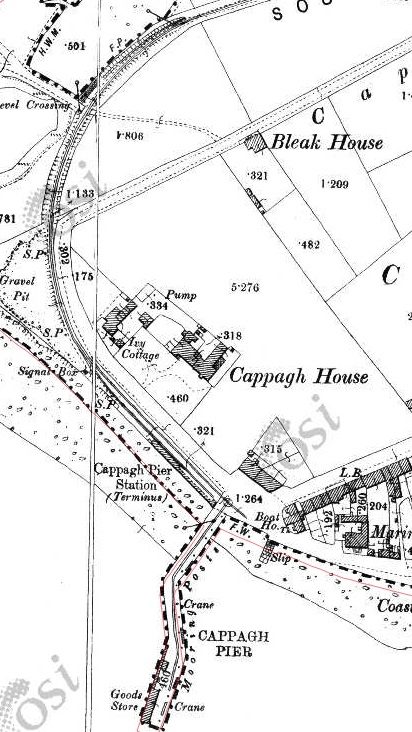
A sizeable triangular-shaped inlet of the Shannon, 2 miles long by 1.5 wide, it is bounded by Moyasta on the east, Blackweir on the west and Cammoge Point to the south. “Looked at on the 6-inch map, all its shores appear to be bounded by railway, but that appearing on the southern shore is merely the trace of the ill-fated 1860s line on which rails were never laid.” [4]

Lenihan found walking along the loop line in the late 1980s impractical however as soon as they reached the main line, there “was no further difficulty. The way is clear right to Moyasta river bridge — the ‘Red Bridge’ — and beyond.” [7]

Within the Loop, around one hundred yards from the junction with the Kilrush branch Lenihan “noted traces of a second, parallel, line immediately to [the] left. Here also lay a mound of solidified tar, the sole remnant of the sleeper-tarring plant that was once sited here. In all, the Loop is approximately 600 yards in length and was extremely useful for allowing a direct passage to through traffic, especially from Cappagh to Kilkee.” [7] 

There were four road-crossings at Moyasta, all within a radius of 200 yards of the station-house. By the late 1980s, Lenihan observed that, “as at most other such places, there was nothing, for at Moyasta, just as at Knockdrumniagh, near Ennistymon, road widening has changed utterly the lie of the land.” [7] The plan is taken from Patrick Taylor’s book. [8] 

The presence of the preservation railway means that the locations of these crossings are easier to define in the early 21st century.Moyasta No. 1 Crossing (above).

The adjacent image is taken at Moyasta No. 2 Crossing looking back towards No. 1.

The picture below is also taken  at the No. 2 Crossing looking towards Kilrush. The Shannon estuary can be seen in the distance.Moyasta No. 4 Crossing was on the arm of the railway heading for Kilkee. The preservation railway has installed gates cat tyev approximate location of the crossing in the past. This image shows can view back up the Killee arm of the junction to the station house.Looking towards Kilkee in the 21st century.Moyasta junction with the Kilkee/Kilrush loop on the left. The railcar has left Moyasta Station which is of the extreme right of the picture with a service to Kilrush. As we have already noted, there were few non-stop workings between Kilrush and Kilkee. Trains from one or other village used to enter the relevant platform at Myasta and then propel backwards before using the loop to head on to the other village.

The Line to Kilkee

The most significant structure on the line to Kilkee is the ‘Red Bridge’. Its location was chosen in 1884 because the engineer, Mr. Barrington, was convinced that the foundations would be firm. [10][11] “The understanding at that time was that W.M. Murphy would build the 81/2 miles of line from Kilrush to Kilkee for £40,000 and of that sum £1,800 was to be allocated to Moyasta Bridge. Even today, it seems a ludicrously small sum for such a fine piece of work.” [12]The line of the old railway from Moyasta across the ‘Red Bridge’ is shown in blue. The route of the line to Kilkee will be shown in blue rather than red as I have found a site which shows the route superimposed onto Google Satellite images. [13]

The red bridge appears below in the early in the 21st century. [3]After the bridge, the journey to Kilkee from Moyasta “may fairly be said to divide neatly into two sections: the first, to Blackweir, being almost totally along the northern shore of Poulnasherry Bay, while the second is more inland. On neither part are there any insurmountable obstacles, though all the usual inconveniences and unpleasantnesses are plentiful. But perhaps the most singular fact about this area is the narrowness of the neck of land that separates Kilkee from the upper reaches of Poulnasherry — no more than a mile and a half at most. Without doubt, a time will come when all of the peninsula from Kilkee westwards will be an island.” [9]

The line ran on a causeway from the bridge to firmer ground and the line then curved gradually southward before settling into a westerly trajectory for its 2 mile run to Blackweir.

Patrick Taylor is as succinct as usual in his description of the line to Kilkee. He points out station layout and various items therein and goes on to say: “The line then passed over a culvert adjacent to the level crossing gates, and continued past the loop before crossing over Moyasta or the ‘Red Bridge’ (No.1) under which flowed the waters of Poulnasherry Bay. The bay was to the left of the line, which now took a semicircular course before turning right after passing Purtills accommodation crossing. In the next stretch of partially straight line three level crossings were situated. Moyasta West (No.5) at 43.75 m.p., Baurnmore at 44 m.p. Currane at 44.75 m.p., before Blackweir station at the 45.25 m.p. was reached. The station and platform here were on the down side with level crossing gates provided at the Kilkee end. In the earlier years all trains stopped at this station but at the turn or the century it was reduced to a halt and trains only stopped if required. On leaving Blackweir there was a small bridge (No.5) beyond the level crossing gates and a cattle pass beside Lisdeen bank. There was an up gradient of 1 in 64/58 for a short stretch at this point. On rounding Garveys bend the line continued through treeless turfland past two level crossings, Lisdeen adjacent to 46.75 m.p., and Dough beyond 47 m.p., to Kilkee, 48 miles from Ennis.” [14]

We could, I suppose give the last word to Patrick Taylor and save a lot of time for both you and I, but that rather defeats the object of these posts. So we will continue with a more detailed review of the line.The line curved first to the South and then back onto a westerly route. [13]

Lenihan says that, “there is scarcely anything of interest until a little causeway is reached, close to Moyasta West no. 5 crossing. Up to this point, the surface is at first smooth and firm but then deteriorates gradually into quagmire.” [12]The causeway mentioned by Lenihan is just to the right of centre in this satellite image [13]Moyasta No. 5 Crossing is on the right of this image. [13]The Crossing-Keeper’s cottage at Moyasta No. 5 Crossing has been refurbished. The blue line shows the line of the railway.

Lenihan, writing in the late 1980s commented: “The house is certainly the original building, and little changed on the exterior: The roof beams still protrude from under the eaves as they did in all the others we had seen which had not been altered. An unpleasant scene awaited us west of the road though. From a wide gateway, through which trains once passed, we could see that the large field ahead had been levelled, and that for at least 400 yards there would be no distinguishing features to guide us.” [15]

The next crossing is Bawnmore. In the late 1980s the crossing was ramshackle at best and its grounds over grown. By 2008, Lenihan was reporting that the cottage was an almost total ruin, “its remnants as well as the line here inaccessible in a wilderness of whitethorn.” [16]The location of Bawnmore Crossing is at the right side of this image. [13]The next crossing was at Garraun. Its location appears on the left of this satellite image. Its cottage was already abandoned in the late 1980s [17] and has deteriorated since. [16]Garraun Crossing location also appears on this image, this time on the right. [13]This satellite image shows the next station on the line, Blackweir Station. [13]

The station buildings at Blackweir were on the down side with a road-crossing at the west end of the station platform. As Taylor notes above, at one time this was a regular stopping point on the line, but in Later years it became a request stop. At 45.5 miles from Ennis, this was the only halt between Moyasta and Kilkee. Again, in the 1980s, Lenihan comments: “The platform still remains intact, on the down side, and the original station-building, a plain, single-storey structure, also stands, parallel to the line and now restored to its original state with only minor external alterations. A large dwelling house has been added at the Moyasta side, and the two blend together extremely well. The glowing accounts we had been hearing of it along the way were certainly borne out by this very pleasing development. Close by, a handsome five-arched stone bridge spans the upper reaches of the bay, and just off the road at its north-eastern parapet is a small quay, used extensively during the heyday of the turf trade, but now semi-derelict.” [18]Blackweir Station in 1952 (above). Since closure of the railway a house has been built at the end of the old station building closest tomtjhe camera, which enlarges the structure considerably. [19] The colour picture which follows the 1952 image shows the new building from the old crossing location, © C. Cooney. [20]Blackweir Bridge seen from what was the trackbed of the old railway.The trackbed ahead is in use as an access road.

As the journey continues, we can see the location of the halt clearly marked on the next satellite image. Access to the old line beyond this point is sufficiently difficulkt as to mean that I have not been able to find photograph of the next length of the line on the internet.The most striking feature along this length of the old line was its growing proximity to the embankment of what was meant to be the first line in County Clare. Three biue lines appear on the satellite images above. [13] The most northerly of these is the West Clare line on its way to Kilkee. The next line shows the route of one abortive attempt to connect Kilkee and Kilrush in about 1858. These two appear again on the map below, the dotted line on the north side of Poulnasherry Bay is the West Clare route as finally built. The more southerly route is the 1858 scheme.

It is worth reminding ourselves at this point of the shenanigans that took place over the possibility of creating a railway in this part of Co. Clare.

In the years after the Famine, railway fever gripped Ireland, much as it did the whole of the UK at the time. There was a tremendous upsurge in scheme proposals and construction work. In 4 decades, 1845 to 1885, a dozen schemes were promulgated for County Clare. Lenihan says that, “All these plans were similar in some vital respects: they all included as their terminus points Ennis, Kilrush and Kilkee. At that time traffic on the Shannon was considerable, and Cappagh pier had to figure large in any route that hoped to be profitable, but how Cappagh might be made accessible was the subject of widely varying proposals. Essentially, though, there were three routes: from Limerick to Foynes by rail, then to Kilrush by steamer; from Ennis via Kildysart, Kamer and Carrigaholt or Querrin to Kilkee; from Ennis via Ennistymon and Miltown Malbay, then southward.” [21]

Taylor says that, “As well as railways, there were schemes to reclaim land, and build embankments across the Poulnasherry Bay, where the Blackweir and other rivers congregate on their way into the River Shannon, and on towards the Atlantic Ocean. There were also a number of schemes for roadside tramways, as opposed to railways.” [22]

As we have noted already, maps show the most promising of these early lines as a dotted line on the south side of Poulnasherry Bay. The map below is an extract from the Irish OSM Community Map and the older near the or is can be made out to the south side of the West/South Clare Line and running on the south side of the river estuary. [24]

The earthworks associated with the third blue line can be made out curving to the south below the 1858 scheme’s embankment and then entering a narrow north-south band of woodland on the adjacent satellite image. I do not as yet have any details of this line.

Also be noted on the adjacent satellite image are two features: a rod-crossing to the right of the image and a significant cutting to the left of the picture.

The road-crossing was for a minor laneway. The cutting is Lisdeen Cutting and there is a road-crossing towards the West end of the cutting that bears the same name.

Much of the line over which we have travelled to get to Lisdeen crossing is in use in the 21st century as a series of different access tracks. This ceases at the unnamed crossing mentioned above. The three old rail routes meet. Only the most northerly ever carried passengers and goods! Lisdeen Cutting and Crossing can easily be made out with crossing in the top left of the satellite image. [13] The crossing a keeper’s cottage in the 21st Century. The line runs behind it.Looking back from Lisdeen crossing through the cutting towards Moyasta.Looking ahead towards Kilkee from the crossing. Our destination can be seen on the horizon.After the end of the cutting we encounter one more road-crossing before we enter Kilkee. Shown on the satellite image above, this was Dough Crossing, just over 47 miles from Ennis and 700 yards from the terminus. [27]Looking back along the line from Dough Crossing towards Moyasta.Looking forward towards the location of Kilkee Station from Dough Crossing.

These last two satellite images get us to the end of the line in Kilkee. [13]

The adjacent image shows Kilkee Station as it appears fptoday when approached from Moyasta. [25]

The picture below is taken from the West.No. 5, Slieve Callan is shiwn at Kilkee in 1950. No.5 has been restored and runs on the preservation line at Moyasta. [28]

Three further pictures of the station building in the early 21st century follow. [29]

The first monochrome picture below was taken in 1952 and is contained in Lenihan’s book. [30]

Lenihan describes the scene in the late 1980s: “on the up side, was the station-house itself in a well-paved yard, but surrounded by what appeared to be chalets. Old photos show that one siding led to the turntable, which was sited only yards from where we were now standing, in front of the engine shed; a second to a large building (probably the goods’ store) directly east of it; and that the main running road and passing-loop joined near the signal cabin. But, as in every other station, there is nothing to show this today. A quick inspection confirmed for us that of this terminus of the South Clare the only remnants are these two buildings, both constructed in 1891. The water-column, the 3,800-gallon tank, loading-bank, 23-foot-4-inch turntable and goods’ store have gone the way of all the others.” [30] The second and subsequent monochrome pictures of the station in use are taken from Patrick Taylor’s book. [31]

Kilkee Station in 1952, © IRRS. [30]Railcar No. 3387, waiting to leave Kilkee on the 1.45pm to Ennis on 17th June 1954. The train consists of the railcar with a railcar trailer, and one of the ex-Clogher Valley Railway wagon underframes with a Limerick body. This was the standard formation for railcar worked trains, © C.H.A. Townley. [31]Railcar No. 3388, on the turntable outside Kilkee locomotive shed on 17th July 1958, after working the 5.05pm ex Moyasta Junction, © D.F. Russell. [31]A railcar has just arrived at Kilkee in May 1958. The bus connection waits for passengers while the yard is full of wagons. The goods shed, engine shed and water tank are all visible, © A.M. Davies. [31]The East end of the station, looking towards Moyasta with the engine shed on the right and the water tank behind it, © C.L. Fry. [31]An overall view of Kilkee station looking from the East in 1933. This gives a good indication of the length of the platform! © Patrick Taylor. [31] A sketch plan of the station is shown below. [8]To complete this post we have three miscellaneous images of items of motive power or rolling stock from the West Clare Railway. We still have the line from Moyasta to Kilrush to focus on and hopefully too, some more information about rolling stock and motive power on the line.


Motive Power and Rolling Stock on the West Clare Railway (Miscellaneous Images)

Finally, just a very few images of rolling stock

An Inspection Car, taken in 1953, (c) IRRS. [33]Ex-West Clare Railcar above, converted to a coach by BnM is now stored on the Waterford & Suir Valley Railway. [34]

West Clare Drewry Railcar in 3mm Scale made by Mark Fisher. [35]

References

  1. Patrick Taylor; The West Clare Railway; Plateway Press, 1994, p44.
  2. Edmund Lenihan; In the Tracks if the West Clare Railway; Mercier Press, Dec. 2008, p226-227.
  3. http://www.westclarerailway.ie, accessed on 7th May 2019.
  4. Edmund Lenihan; op. cit., p227.
  5. Irish Times; 1st February 1961.
  6. Not used.
  7. Edmund Lenihan; op. cit., p228.
  8. Patrick Taylor; op. cit., p48.
  9. Edmund Lenihan; op. cit., p260.
  10. Irish Builder;15th January 1885, p22, quoted by Lenihan; op. cit., p261-262.
  11. Lenihan; op. cit., p261-262.
  12. Ibid., p 262.
  13. http://www.railmaponline.com/UKIEMap.php?fbclid=IwAR1t7uT66nNlgLdQOfpDOP2lKzJqdua7Y8GZVS6kwbYKQ7kVDj99aA_cObM, accessed on 6th May 2019.
  14. Not used.
  15. Edmund Lenihan; op. cit., p262-263.
  16. Ibid., p303.
  17. Ibid., p268.
  18. Ibid., p272.
  19. Ibid., p269.
  20. http://eiretrains.com/Photo_Gallery/Railway%20Stations%20B/Blackweir/IrishRailwayStations.html, accessed on 8th May 2019.
  21. Edmund Lenihan; op. cit., p17.
  22. Patrick Taylor; op. cit., p10.
  23. Not used.
  24. http://maps.openstreetmap.ie/oocmaps.html?zoom=15&lat=52.66552755081851&lon=-9.611483168775402&layers=B0000TFFFFF, accessed on 8th May 2019.
  25. http://www.charleshornsby.com/blog, accessed on 8th May 2019.
  26. Not used.
  27. Ibid., p277.
  28. http://www.skibbereeneagle.ie/ireland/west-clare-railway, accessed on 8th May 2019.
  29. http://www.buildingsofireland.ie/niah/search.jsp?type=images&county=cl&regno=20301006, accessed on 9th May 2019.
  30. Edmund Lenihan; op. cit., p279.
  31. Patrick Taylor; op. cit., p45-47.
  32. Not used.
  33. Edmund Lenihan; op. cit., p23.
  34. https://www.narrow-gauge.co.uk/gallery/show.php?image_id=4428&cat_id=967, accessed on 9th April 2019.
  35. http://www.worsleyworks.co.uk/Image-Pages/Image_NG_Irish_WCR.htm, accessed on 9th April 2019.

The West Clare Railway – Part 5 – Quilty to Moyasta

The Line of the West Clare Railway from Quilty to Moyasta

Before setting off on the next leg of this journey South along the Atlantic Coast of Co. Clare it seems sensible to have a little look round Quilty village. The adjacent picture shows its Catholic Church and the village tavern is shown below. The village is really quite tiny but is seeing a growthnin holiday trade in the 21st century.In the 2002 census the village had a population of 234. The Co. Clare Library website says: “Quilty is a coastal village in the parish of Kilmurry Ibrickane. The origin of its name is uncertain but it may be a derivation of “coillte”, meaning woods. In this instance the woods referred to would probably have been an underwood of hazel or holly. Local tradition mentions the finding of tree stumps which indicate the existence of large woods here in ancient times. The same word “coillte” could also refer to “ruined or destroyed” and be a reference to a tragedy of long ago. This particular stretch of coast is dangerous for shipping and is constantly being eroded by the sea. Sean Spellissy, historian, believes that the name refers to the devastation caused by the tidal wave that separated Mutton Island from the mainland in 804AD, drowning 1,010 people in the process.  Quilty is set in picturesque surroundings with the Aran Islands on one side, Connemara behind and the Cliffs of Moher on another side. The Kerry mountains are visible in the distance.” [5]Quilty Station in the early 21st century taken from the N67 in Quilty looking South onto the station site.Quilty Station in the late 1950s. The picture was taken from the southern end of the station site. [3]In this 1993 aerial image of the village of Quilty the station is in the centre of the image vans the old railway route can be seen curving away inland to the south (the right side of the picture). [4]

Edmund Lenihan, writing in the late 1980s, gets us moving once again: “In the mile and a quarter to Kilmurry Station the line makes an S-shape through more or less level terrain, first looping west, then gradually east until it comes side by side with the Kilrush road at Kilmurry Bridge, and finally west again to the station gates.” [2]

The line was raised above surrounding land. On one side there was an earthen storm-bank, several feet wide at its base and tapering towards the top. Before it was built, the line was totally exposed to the elements.

The line passed through a cutting which can be seen in the two adjacent satellite images, and just to the south of the obvious rock face in these images it passed under two accommodation bridges which carried access roads before rising above the surrounding land onto a relatively high embankment. The next obstacles in the way of the line were the Ballymackea River and a minor public highway. Lenihan tells us that the river bridge is Kilmurry Bridge road bridge is called Sullivan’s Bridge. [6] In have not been able to find a photograph of Kilmurry Bridge. It is in the location shown on the first image below.The line continued south on embankment. It curved gradually back round to the Southwest as the adjacent satellite image shows.

The land and the old track-bed rise on their way to Kilmurry Station which can be seen two-thirds of the way down the adjacent image.

The first picture below is taken from the minor road close to Kilmurry Station and looks back along the old line towards Quilty.  The second picture shows Kilmurry Station in the 21st century. The third picture below shows the station in 1952, the fourth in 1960.

Kilmurry Station in 1952, © IRRS. [7]Kilmurry in September 1960, © Roger Joanes. [12]

Three hundred yards beyond Kilmurry Station is Kilmurry No. 2 Crossing which was tended from Kilmurry Station. The next two picture are taken from the location of that crossing. The first looks back towards Kilmurry Station which can be seen in the distance. The second looks ahead down the line. A deep cutting through the hill ahead can be seen on the horizon.The line curves South away from the Crossing and across open fields towards Cloonadrum School and railway cottage. The school was to the West of the line and is probably now a holiday cottage. [8] The Crossing-keeper’s cottage to the East of the line is little changed from the days of the railway. Both buildings appear below.

Edmund Lenihan  tells a story: “On 13 August 1955 an unfortunate railway accident occurred at Cloonadrum. The crossing gate, though it had been opened at the train’s approach, was loosened by the vibrations and swung closed as the guard’s van passed, splintering the planks of the little wooden outshot where Peter O’Brien was sitting and injuring him severely. Only when the train reached Craggaknock Station, a mile and a quarter away, was it noticed that anything was amiss. When he did not appear, the van was searched and he was discovered dying at his post. Two circumstances which made his death all the more tragic were that he was shortly to be married, and that he was not supposed to be on duty that week, but was standing in for a friend who was on leave.” [9]

The crossing, school and cottage all appear in the bottom right of the adjacent satellite image.

The old Cloonadrum School building.The Crossing-keeper’s cottage (above) as it is in the early 21st century. The route of the old railway is shown in red.

Cloonadrum crossing appears once again at the top of the adjacent satellite image. The feature marked ‘1’ is the site of what was the Annageragh Bridge (or Lissyneillan Bridge) over the Annageragh River.

Lenihan says that, as he and his son stood on the river bank under what used to be the bridge, “the full extent of the feat that was Annageragh Bridge instantly impressed itself on us as incomparably the most forceful structure we had yet seen on our 33- mile journey. Almost 40-feet high the stonework stands, stark now, yet beautiful. This was one of the few bridges put out of commission in 1961, when the line was being taken up — hardly surprising when one considers its height. Beside it we looked, and felt, insignificant.” [10]

The 400 yards from Annageragh Bridge to Lissyneillan Crossing (marked ‘2’ above) were initially on a high embankment but otherwise unremarkable.Looking back North from Lissyneillan Crossing towards Cloonadrum. The line of the railway has been severed by the outbuildings of the relatively modern bungalow. The Cloonadrum school and railway cottage can be seen on the horizon, to the left of the row of cottages.Looking south (above) from Lissyneillan Crossing, the line travels away into the distance in the centre of the picture. The adjacent satellite image shows its onward course.

Edmund Lenihan noted a substantial road-bridge which was becoming dangerous which had to be crossed cautiously. [11]

The next feature on the line was the Crossing and Station at Craggaknock.The view back towards Quilty from the minor road adjacent to Craggaknock Station.

Patrick Taylor is very  economical in his use of words as he describes this length of the line: On the far side of Cloonadrum, “Anaghgeragh Bridge (No. 60) over the river of the same name was reached, before passing through Lisseyneslon level crossing beyond the 33.75 milepoint and into Craggaknock flag station at 34.5 milepoint. Having passed through another set of crossing gates adjacent to the station. A small goods store and platform was provided here on the up side.” [1] Lenihan and Taylor often use alternative spellings for place names.Craggaknock Station was typical of many on the South Clare section of the network. It was situated close to crossing gates on a minor road, © IRRS. [1]Craggaknock Station in September 1960. A view from an Ennis-bound train, © Roger Joanes. [12]

The Craggaknock Station building remains in the 21st century but the line is overgrown. One of the crossing gateposts is still visible, © C. Cooney [13]

The former platform is shown in the adjacent image and the platform entry point is shown in its early 21st century incarnation in the next image below, © C. Cooney [13]

Edmund Lenihan found the station in a better condition than it is in the 21st century! [14]

Beyond Craggaknock the line headed away into open country. Lenihan comments: “Today [late 1980s] there are few houses within a mile’s radius of it, and only one of these was dignified by being named on our map. This is Craggaknock House, a plain early nineteenth-century dwelling, less than a mile to the east.” [15]

Patrick Taylor describes the route between Craggaknock and Doonbeg succinctly, in one short paragraph: “On the three and a quarter mile journey to Doonbeg the line passed through six level crossings, two situated in the townland of Clohanes and four in the townland of Caherfeenich – they were Clohanes No.1 and No.2, and Caherfeenich Nos. 1-4. Just beyond the last mentioned was Skivileen Bridge (No.63) near the Doughmore sandhills. Less than quarter of a mile on, Doonbeg Station Gates were crossed to enter Doonbeg Station” at the 37.75 mile-point. [1]
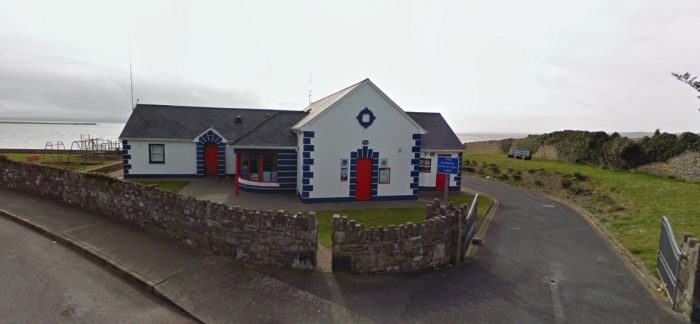
The first of a series of Crossings is Clohane crossing No. 1 which can be seen on the satellite image above and in the pictures below.Looking back from Clohanes Crossing No. 1 towards Craggaknock Station.Looking forward from Clohanes Crossing No. 1 towards Doonbeg.

Just 100 yards or so beyond Clohanes Crossing No. 1, Clohanes Crossing No. 2 was encountered. It crossed a lane which at one time was more heavily used than in the 21st Century. It was operated by the crossing keeper at Clohanes No. 1 and can be picked out on the satellite image above to the Southwest of the first crossing.

Beyond that crossing the railway encountered a falling grade as it headed South. Easier on southbound locomotives, this bank – Clahanes Bank – was “a constant trouble spot for laden steam trains from the south. The gradient here is not as obvious as at Willbrook or the Black Hill, yet it was enough to give the place some measure of notoriety.” [16]

Very interestingly on the adjacent satellite image two circles can easily be picked out alongside the line  (one on the East and one on the West) and a fainter larger circle just a little to the East of the line.

These circles are the remains of what appear to be earthen fortifications.

These are Cahers and they are a frequent occurrence in Co. Clare. There appear to have been around 2400 of them in Co. Clare alone. [17] They were homesteads rather than defensive fortifications which were known as Cashels. The name of the village close to these earthworks highlights their status … Caherfeenick. It appears on the adjacent satellite image.

As we have already noted, there are 4 Crossings in the area of Caherfeenick. Caherfeenick Crossing No. 1 was located on a little used lane way northeast of the village. Caherfeenick Crossing No. 2 had a Crossing-Keeper’s Cottage. In the 1980s, when Lenihan walked the route of the line the crossing keeper’s cottage was unaltered since the closure of the line and the last crossing-keeper still lived there. [19] It can be seen above roughly at the centre of the satellite image. In the early 21st century, little has changed. The cottage still stands with only minor changes.Caherfeenick Crossing No. 2. The route of the old line is marked in red and the crossing-keeper’s cottage still stands sentinel at the crossing location. This view looks back towards Crossing No. 1.This picture is taken from the narrow lane at Crossing No. 2 and looks forward along the route of the old line towards Crossing No. 3.Caherfeenick Crossing No. 3, looking back along the line towards Quilty.The N67 is crossed by the old line at Crossing No. 3. This view looks forward towards Doonbeg. The crossing appears at the bottom left of the satellite image above.

Edmund Lenihan describes this crossing which also appears at the top of the adjacent image as follows: “The road at no. 3 is reached through the usual fence of sleepers, and the cottage is 20 yards away, on the down side. It is as though time had stood still here, for the little house is in pristine condition, everything as it was when first it was built.” [20]

The cottage is much changed in the early 21st century. Lenihan goes on to point out that “Caherfeenick no. 3 has a more recent and cheering claim to fame: it is the home place of Michael O’Halloran, MP for Islington, London, one of the many emigrants who have achieved an eminence abroad that would almost inevitably have been denied them at home.” [20] He was, of course, writing in the late 1980s. The present incumbent of the role of MP for Islington (2019) is the current leader of the Labour Party, Jeremy Corbin.

Caherfeenick Crossing No. 4 was located at the point where the old railway encountered a T-junction of roads at the boundary of two townlands – Caherfeenick North and South. That crossing is evident on the adjacent map. The railway continued on to Doonbeg which was no more than a mile ahead. It appears in the bottom left of the adjacent OS Map from the 1940s. On the way there the railway crossed Skivileen Bridge about 300 yards from Caherfeenick No. 4.Cahirfeenick Crossing No. 4, looking back towards No.3.And looking forward towards Doonbeg.

Patrick Taylor says: “Doonbeg (Dunbeag) “The Small Fort” is said to be the longest village in Clare. It is here that the Doonbeg river enters the sea at Doonbeg Bay, and was once a fortress of the McMahons and later O’Briens, where until recent times stood a large stone castle. A short distance on one side lies Baltard Bay and on the other side Doughmore Sandhills. The station at Doonbeg, also a block post, situated on the town side was provided with a platform, car park, loading bank, goods store and a large siding all on the station side, with a two lever ground frame on the opposite side.” [1]Doonbeg in the 1950s looking towards Moyasta. [1]Doonbeg in 1960, © Roger Joanes. [22]Doonbeg Station building in the early 21st century, © C. Cooney. [21]

South of the station platform, the Goods shed was at the head of a passing loop decsribed as a siding. Taylor says: “On leaving Doonbeg yard after a slight curve the three arch Mountrivers bridge (No.64) over the Doonbeg river was crossed, and the line ran parallel with the public road for over a mile. The public road veered to the left at this point and the railway continued on a straight line to Shragh siding.” [1]
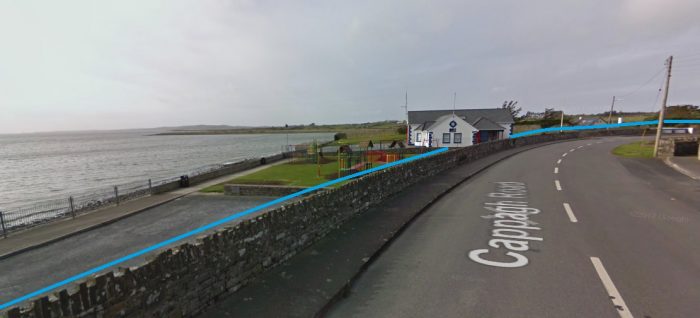
As the route of the line meets the Doonbeg River the quality of the satellite images available on Google Earth deteriorates. However, Streetview was able to provide a view of the bridge over the Doonbeg River which is a steel girder bridge, not the three-arched bridge mentioned by Taylor. Lenihan confirms that it is the road bridge which is the three-arched structure. [22]South of the river, the landscape is relatively flat and trains on the old railway would have trundled along in their own sweet way heading for Moyasta Station. The road and railway ran in parallel, as can be seen on the image below. It is taken at the point marked ’30’ on the OS Map and looks back towards Doonbeg.

The following image shows the point at which road and rail diverge. This is evident on the adjacent map.

We see the ongoing journey on the 1940s OS Maps. After leaving the road, the railway continued in a southerly direction before running parallel to another minor road as it travelled passed Moanmore Lough to the west of the line.

The Google Earth satellite image shows the the relative positions of road (blue line), old railway (red lines) and the Lough. The old railway track bed has been used in places as the formation level for private driveways to properties built over the old line.The line continues to follow (approximately) the line of the road heading to Moyasta.

Moanmore Crossing had can derelict Crossing Cottage when Edmund Lenihan first visited in the 1980s. [23] Later he notes that it had been rebuilt. [24] The next two photographs show the trackbed either side of the crossing.Looking north along the trakbed at Moanmore Crossing.And (above) looking with at the same crossing.

Moyasta Station was a junction station. Here the line separated to serve both Kilrush and Killed and allowance was also made in the form of a triangular junction for through traffic between the two. We will finish this section of the journey here at Moyasta, aware that there will be more to explore than just the history of the line and ready to do so in the next post in this series. A preservation scheme has been in operation for a good number of years in the 21st century and we will in due course explore what has been done.

We finish this post with a few images from the past.Moyasta Station lookin north in September 1950, © James P. O’Dea, National Library of Ireland. [25] Three images of Moyasta Station in 1960, © Roger Joanes. [26]A railcar on the through route from Kilrush to Kilkee in 1953, © Les Hyland. [27]The through connection between Kilkee and Kilrush is on the left. The railcar is leaving Moyasta for Kilrush. There were very few through workings between the two towns that did not also need to call at Moyasta, © A.M. Davies. [27]Branch train meets main line train at Moyasta Junction on 17th July 1947. On the left is No. 11C, with the 9.30am ex Kilrush, making connection with No. 6C, on the right, with the 9.35am from Killed through to Ennis. Interestingly, the main line engine is running bunker first -perhaps the Killed turntable was out of use for some reason. The Kilrush train, after departure of the one to Ennis, would propel back out of the platform, and then via the third side if the triangle, proceed to Kilkee, thus providing a Kilrush to Kilkee service, © C.H.A.Townley. [28]Moyasta Junction in 1952, © IRRS. [29]Engine 5C with a down goods at Moyasta, 5th February 1955, © IRRS. [29]A plan of Moyasta Station before the closure of the West Clare Railway in 1961. [30]

References

  1. Patrick Taylor; The West Clare Railway; Plateway Press, 1994, p42.
  2. Edmund Lenihan; In the Tracks if the West Clare Railway; Mercier Press, Dec. 2008, p182.
  3. http://www.milleens.net/showmedia.php?mediaID=53&medialinkID=54, accessed on 30th April 2019.
  4. http://www.clarelibrary.ie/eolas/coclare/places/quilty_arialview.htm, accessed on 30th April 2019.
  5. http://www.clarelibrary.ie/eolas/coclare/places/quilty.htm, accessed on 30th April 2019.
  6. Edmund Lenihan; op. cit., p184.
  7. Ibid., p187.
  8. Ibid., p193.
  9. Ibid., p194.
  10. Ibid., p195.
  11. Ibid., p196.
  12. http://elevation.maplogs.com/poi/doonbeg_co_clare_ireland.73139.html, accessed on 1st May 2019.
  13. http://eiretrains.com/Photo_Gallery/Railway%20Stations%20C/Craggaknock/IrishRailwayStations.html#, accessed on 3rd May 2019.
  14. Edmund Lenihan; op. cit., p198.
  15. Ibid., p198-199.
  16. Ibid., p203.
  17. Thomas J. Westropp; The Cahers of County Clare: Their Names, Features, and Bibliography;
    Proceedings of the Royal Irish Academy (1889-1901), The Royal Irish Academy Volume 6, 1900, p415-449; https://www.jstor.org/stable/20488784, accessed on 5th May 2019.
  18. http://www.clarelibrary.ie/eolas/coclare/archaeology/CL047-002—.htm, accessed on 5th May 2019.
  19. Edmund Lenihan; op. cit., p205.
  20. Ibid., p206.
  21. http://eiretrains.com/Photo_Gallery/Railway%20Stations%20D/Doonbeg/IrishRailwayStations.html, accessed on 5th May 2019.
  22. Edmund Lenihan; op. cit., p212.
  23. Ibid., p221-222.
  24. Ibid., p302.
  25. James P O’Dea Collection, National Library of Ireland, https://www.flickr.com/photos/nlireland/30230379325, accessed on 5th May 2019.
  26. https://www.flickr.com/photos/110691393@N07, accessed on 5th May 2019.
  27. Patrick Taylor; op. cit., p44.
  28. Ibid., p68.
  29. Edmund Lenihan; op. cit., p224.
  30. Patrick TaylorTaylor; op. cit., p48.

The Sheffield, Ashton-under-Lyne and Manchester Railway – 4

How a long defunct, relatively small local railway company aimed high and ultimately was responsible for the poor financial state of the Great Central Railway!

I was prompted to look again at the Sheffield Ashton-under-Lyne and Manchester Railway by reading a copy of BackTrack Magazine from May 1996 (Volume 10 No. 5) [2] which included an article about the Great Central Railway which is now, sadly, long-gone. That article was itself a response to an earlier article in BackTrack Volume 9 No. 3 (March 1995) by Messrs. Emblin, Longbone and Jackson. [1]
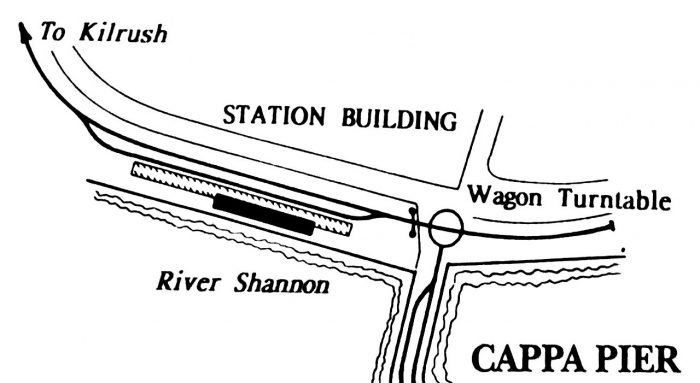
It brought to mind the connections between Ashton-under-Lyne and the Manchester, Sheffield and Lincolnshire Railway (MS&L) evidenced by the name of its predecessor, the Sheffield, Ashton-under-Lyne and Manchester Railway (SA&M). I am wary of providing links to these posts, but they do pull together quite a bit of information about that railway …… these are the links:

The Sheffield, Ashton-under-Lyne and Manchester Railway – 1

The Sheffield, Ashton-under-Lyne and Manchester Railway – 2

The Sheffield, Ashton-under-Lyne and Manchester Railway – 3

With the benefit of hindsight, the second of the above posts was not really necessary. An appendix to the third post would probably have covered the two links mentioned in the second post.

I lived in Ashton-under-Lyne at the time. The article which grabbed my attention in the old BackTrack Magazine did so because it seems to root the significant problems of the Great Central Railway (GCR) in my, then, local railway company’s own history. Hence the sub-title of this post!

The significant challenges faced by the SA&M Railway in being ahead of the game in providing rails across the northern backbone of the country led to a financial structure which seems to have dictated the future of its successors, both the MS&L and, ultimately, the GCR. Heavily reliant, leveraged, on debentures and preferential stock is was difficult for the successive companies to attract ordinary investors.

The whole history of the GCR seems to have been dictated by the way in which the heavy capital expenditure necessary to cross the Pennines/Peaks was financed.

The SA&M Railway was one of the first railways to tackle truly formidable and desolate terrain. Nowhere was the challenge more evident than at the West end of the Woodhead tunnels, seen here at the turn of the 20th century. The SA&M and its successors were encumbered with the twin problems of high construction costs and low receipts from intermediate stations over a long section of line. [2]

It should be noted that Emblin reserved a right of reply and that he chose to do so in a later edition of the BackTrack Magazine. [5]

His principal argument in that article appears to be that things were really not that bad and that the GCR managed its way out of trouble in a very effective fashion. I am not sure that this negates the reasoning of the articles referred to above, and I am sure that it does not address the particular point that the GCR faced ongoing financial problems which had their birth in the companies it succeeded.

Emblin argues strongly that Sir Alexander Henderson managed his way out of trouble by expansion. [5: p711] That seems to have been that practice of his predecessors as well. The result being that the company was highly leveraged and still not the best investment for ordinary shareholders.
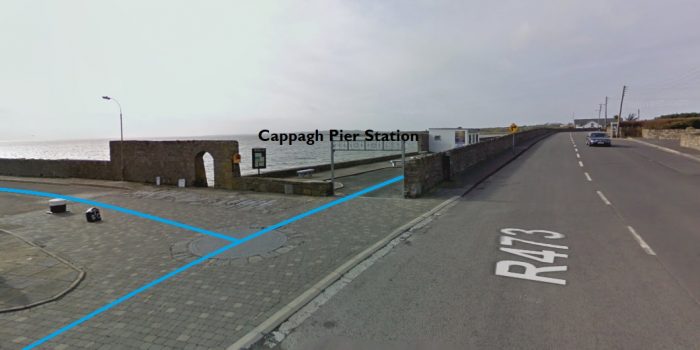
It also does not alter my opinion that my, then, local railway company had a great part to play in the issues which has to be managed by the GCR throughout its life.

References

1. Emblin, Longbone & Jackson; Money Sunk & Lost; BackTrack Magazine Vol. 9 No. 3, p129-136, notes on this article are reproduced below at Appendix 2. [3]
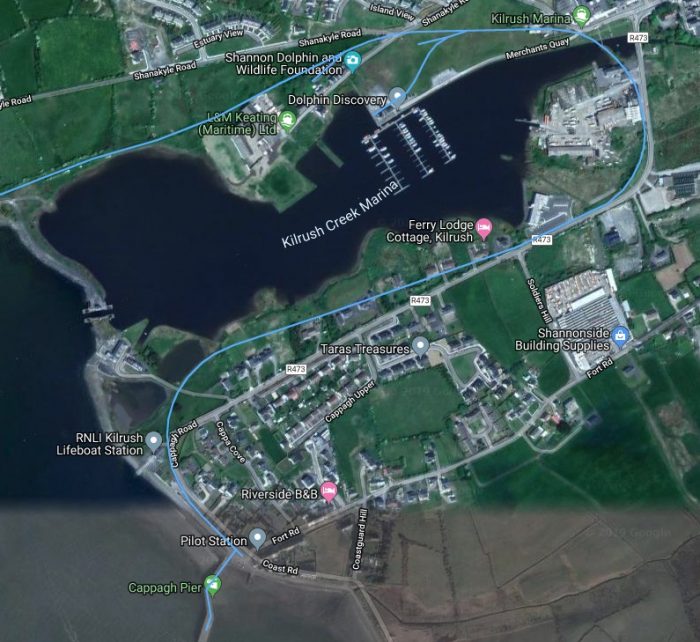
2. Blossom & Hendry; Great Central – The Real Problem; BackTrack Magazine Vol. 10 No. 5, p266-271. Notes on this article are provided at [4].

3. http://www.steamindex.com/backtrak/bt9.htm#1995-3, accessed on 4th May 2019. See below, Appendix 1.

4. http://www.steamindex.com/backtrak/bt10.htm#1996-5, accessed on 4th May 2019. See below, Appendix 2.

5. Emblin; An Edwardian Ozymandias; BackTrack Volume 15 No.12, p707-713. (see http://www.steamindex.com/backtrak/bt22.htm#654)

Appendix 1:

Money sunk and lost – The great central myth of the Great Central Railway. Robert Emblin, Bryan Longbone and David Jackson. p129-36.

The extension of the MSLR from Annesley to London created what the authors describe as a myth, namely that the Great Central Railway was financially crippled by the cost of building it. Many authors have subscribed to that myth: Langley Aldrich’s “The late GCR never paid any dividend on its Ordinary shares”; Hamilton Ellis’s ‘The London Extension was viewed with pessimism at the time of its inception; if MS&L stood for Money Sunk and Lost, GC clearly meant Gone Completely”. Jack Simmons “Great Central never paid an ordinary dividend” and “was financially ramshackle”. Harold Pollins “There were clearly some absurd schemes [including] the building of the last main line, the Great Central, in the 1890s” Michael Bonavia, referring to the grouping criteria used in defining the proto-LNER, adumbrated a poverty-stricken Great Central being carried financially on the back of the prosperous North Eastern.

The perception of GCR penury is a component in another received wisdom; that the LNER’s largest constituent, the NER, had been intended as the financial dynamo for the entire network but that because of the financial weaknesses of the other constituents the LNER finances sank when the virtual collapse of the north-east regional economy in the depressions of the 1920s and 1930s prevented the NER from bankrolling its poverty-stricken fellow constituents. These two orthodoxies provide neat and simple mutually-supporting explanations that agree with what we all know; but “what everyone knows” may not necessarily be true, or it may not be the whole story and half-truths are most effective as mis-information.

The construction costs of the London Extension had certainly been high £11.5 million, almost twice the original estimate and after it opened the GCR did not pay any dividends on its Ordinary shares nor, until 1915, on some of its Preference shares. But not only were these non-paying shares a minority of the total, the opening of the London Extension was followed by thirteen years of considerable expansion. A leading article in the Financial Times of 20th September 1913, analysing the ‘Great Central Position’ and the performance of its shares, referred to the GCR as one of the leading UK railway companies, stating that “the position of the company . . . promises well in the near future . . . traffic returns have shown continued healthy expansion” and praised ‘the exceptional prospects of this undertaking”. There is a wide discrepancy between the modern view and contemporaneous informed assessment. The £10 million for the GCR’s post-1900 expansion programmes (more than was being invested by most of its contemporaries) had to come from somewhere and the debt serviced somehow. Further, the price paid for the GCR at Grouping was marginally greater than that paid for any of the other LNER constituent companies except the NER; there is also the small and hitherto overlooked matter of the evidence on the London Extension profitability that was given by Sir Ralph Lewis Wedgwood, the LNER Chief General Manager, to the Railway Rates Tribunal in 1924/5 when he stated that it was expected that a nominal fifteen years was required for new works to fructify (that is produce a 5% return on investment and when questioned that “that new trunk lines [are] exceptionally slow to mature”. The authors forcefully state that Henderson/Faringdon had been regarded as one of the leading railway financiers.

After the London Extension opened, the GCR started a programme of widespread expansion taking over the LDECR and several small railways in North Wales and Lancashire, building a joint line with the GWR to provide a second route to Marylebone.By providing rail access into the Chilterns, the GW/GC and Met /GC joint lines opened the area for property development and generated much commuter traffic. The Wath concentration (or marshalling) yard was built to increase the handling efficiency of the South Yorkshire coal traffic, a new deep-water port was developed on a green-field site at Immingham to compete with the NER’s facilities at Hull and to complement the GCR installations at Grimsby, main line capacities were doubled in some places and new signalling systems were installed. Powerful engines of all types were designed and built to meet the ever-increasing demand for heavier and faster trains.

Most of the capital to pay for those investments was obtained by debenture issues. These are fixed interest loans with guaranteed dividends but without any voting rights. As a method of funding expansion, such issues have the advantage of raising new capital without affecting boardroom control but they incur the cost of mortgaging future earnings. Such a predominant reliance on debenture issues is nowadays considered to be a source of financial weakness, not only because it worsens the asset/debt ratio but also because the mortgage effect increases the need to maintain growth merely to service the increasing debt, thereby reducing the ability to make provision for debt repayment and/or increase dividends. There is some evidence in the share offer details that most of the contingent shares were held by non- contingent shareholders, so it may be that from 1899 on they were taking the long view, cushioned by their non-contingent dividends, in the expectation that the capital investments which the GCR was making would eventually be reflected in higher dividends.
Those were the days when investors were accustomed to financing long term projects that were not likely to return a dividend in the short term. Sir Ralph Wedgwood was quite sanguine about a 20 or 30 year period before a major new work would be expected to have ‘fructified’.
In summary, the GCR’s reputation as poverty-stricken and financially ramshackle is a modern fiction, started in error by popular writers who apparently ignored the public record and compounded by academics who discounted the distorting effect of anachronism’s parallax. The facts are that in transforming itself from a mediocre provincial cross-country goods line into a strategically- important mixed traffic main line, the GCR’s effectiveness in seeking and developing new business was such that by 1913 its revenue and profitability was comparable with that of its proto-LNER peers; the profitability of the London Extension was increasing in line with the expectations of the period; the money market was investing large sums in the GCR; its passenger trains were fast, prompt, clean and reliable; and withal industry and the general public received and positively enjoyed a comprehensive rail transport service that had dash, imagination and style. All this was constructed by Sir Alexander Henderson, Sir Sam Fay, John George Robinson and the rest of the workforce on the foundations of Sir Edward Watkin’s vision. Instead of its post-World War II reputation of Money Sunk and Lost, in the annals of British railway development and financial management the twenty-five year history of the GCR was a Glorious Catalogue of Renaissance!

This article is further illustrated by the series of articles on the construction of the London Extension Volume 10 page 424 and 617, and Volume 11 page 190. Reference should also be made to summarizing letter by Bloxsom Volume 16 page 174, and feature by Bloxsom and Hendry in Volume 10 page 266. Emblin returned to the theme of the financial status of the Great Central in Volume 22 page 654 et seq.
illus.: John George Robinson CME Chief Engineer of the Great Central from 1900 to 1922 at Marylebone; A high capacity steel wagon introduced in 1902; The Dukinfield Carriage and Wagon works near Manchester; page 131 Great Central train headed by 4-6-2T in Metroland see letter by M.J. Smith (page 278) which states that Metro-Land was created by Metropolitan Railway; Fig 1 The profitability of the LNER constituents; Fig 2 Take-over price at grouping; Keadby Bridge; An aerial view of Immingham docks basically as the Great Central built it; Consolidated London Extension accounts data; Fig 3 Expectations of revenue after grouping; Fig 4 Expectations of profit after grouping; Express Atlantic No. 362 on a London Express; Fish vans on an express passenger train at Ashby Magna; Great Central class 1 No. 425 at Nottingham Victoria not long after; Robinson’s grand finale a 9Q being built at Gorton Works.

Appendix 2:

Great Central – the real problem. Martin Bloxsom and Robert Hendry. 266-71.

Between 1900 and 1914 the GNR, GER and GWR were paying 3 to 4% dividends. The LNWR, MR and NER were paying 6% or above. The GCR was paying 0%. The costly original route and the long time to opening were deep-seated problems. In 1846 the fusion of SA&MR with three Lincolnshire companies attempted to remedy this problem, but there were very poor returns between 1848 and 1851, and it could not even pay any dividend on its Preference Shares. The Company was in serious financial difficulty by 1855. See also correspondence by Steve Banks and Keith Horne. (page 387); and on page 634 which mis-spells both of original authors, which re-questions the probable actions to have been taken by Henderson if Grouping had not taken place. KPJ: is it not possible to equate the particular dire financial state with the “misfortune” of it incorporating the GCR?. Emblin & Longbone response on page 698. Martin Bloxsom returns to this theme in a summarizing letter in Volume 16 page 174, which contrasts this approach (the harsh financial realities) with what might be termed a more optimistic line of thought espoused by Emblin (Volume 9 page 129). illus.: No 105 class 11B near Harrow; The Woodhead tunnels at the turn of the century; Manchester, Sheffield and Lincolnshire £10 preference share; Immingham Docks; No 6323 an LNER O4/3 at Rugby. Emblin returned to the theme of the financial status of the Great Central in Volume 22 page 654 et seq.

The Railways of Orkney – Part 2

So, having discovered that I cannot escape the railway bug here on Orkney. What more can I do but give in?

What more is there to discover? …

Firstly, we had the day on Hoy today (2nd May 2019) as part of a guided tour of the island by ‘Island Tours’. [2] Three of us had the pleasure of visiting much of the island over a period of 6 hours with an expert local guide.

1. Lyness on Hoy

The evidence of wartime activity is nowhere more obvious on Hoy than in Lyness. Usually, we would have been able to visit the Scapa Flow Museum and Visitor Centre but sadly it is closed until 2020 so that it can benefit from a major injection of Lottery funding.

There is a temporary exhibition in the Hoy Hotel but time, on this visit, was not in our side. However, I did get a short time to wander around the site of the Museum and Visitor Centre … and came across a few gems!

In the last post I noted that there was a short length of standard gauge track close to the museum buildings. I was unaware, before this visit, that there were other railway related items on the site. Some pictures follow. A few of my own interspersed with those taken by others. Sadly, although I did see the steam crane, I did not get the chance to photograph it.Standard gauge railway tracks at Lyness (above on 2nd May 2019). Apologies about the light. 

The adjacent photo shows a gathering of railway related items outside the Museum, © Peter Mattock. [3]Two standard gauge short wheel-base flat wagons (2nd May 2019).Another of these wagons at an earlier date on the section of track above, © Graham Adamson. [4]Rail mounted steam crane, © Chris Allen, 2005. At this time the crane needed supporting on blocks but was otherwise in a relatively complete state. [5]This later image shows the same crane without some of its superstructure and with its jib supported on an A-frame. Note the presence of rails in the concrete apron, © John Yellowlees. [1]A closer view, © Damian Entwistle. [6]Two of the cranes which operated around Lyness Pier are pictured here during the war. Behind them are the large barrel-like floats of the boom defences stacked ready for use, © Imperial War Museum. [8]Four more photographs, taken on 2nd May, of narrow gauge wagons at Lyness Museum.

Box Wagon No. 3 (above), © John Yellowlees 2016. [1]

Moving away from the museum a little, one of the old World War One piers is still standing with evidence that it was rail served.

The adjacent picture is mine, and although the image is not great, rails can be seen protruding form the still standing part of the pier, (2nd May 2019). A better picture is provided below.A better view, © Damian Entwistle. Rails can just be seen protruding from the top timber decking above the steel girders. [6]The construction of the World War 1 pier and wharf at Lyness. [8]World War 2 operations at Lyness Pier. Note the steam railway cranes and stationary cranes along the pier length. In 1916, the Worden pier shown above (in the colour pictures) was constructed and land was requisitioned later that year to construct a concrete wharf. As early as 1939 a new wharf was requested at Lyness to meet the growing demands of the Navy. It wasn’t completed until 1944 and became known locally as ‘The Golden Wharf’ on account of the time and money spent on its construction. Part of the wharf now serves as Hoy’s Ro-Ro ferry service. [8] In the interim, three piers were built in Ore Bay in 1941 and 1942.North pier (just visible at ‘5c’ on this map) was rail-served and was used for an inter-isle ferry service and landing of provisions. The remains of the WW1 pier are just visible to its left on the map. West pier was beyond the WW1 pier and is not visible here. It was also rail-served along its full length. The steel South pier was similar in design to the North Pier. It was on the far side of Ore Bay. It was used to transfer stores and particularly for the import of hydrogen for the barrage balloons. It cannot be seen on this map. Some of the rail routes which served HMS Pomona can be seen on this map.[8]

2. The Churchill Barriers

Appendix 1 is taken from the North link Ferries website. [7] It briefly tells the story of the construction of the barriers during and after the Second World War. These barriers formed a protective screen for Scapa Flow in the East durung the war. In the 21st century, they are a vital link between Mainland Orkney and the islands to the East of Scapa Flow.

The construction of the barriers was a mamouth undertaking.  The adjacent picture taken from appendix one illustrates at least three things – the use of railways in the construction, the value of the steam crane, and the scope of the precasting operation which was undertaken. [7]

There are two further images available that I am aware of which illustrate the value of railways in the construction of the barriers. Both are here courtesy of Damian Entwistle and were taken in the temporary exhibition at the Hoy Hotel.The barriers under construction. Note the presence of rails which no doubt facilitated the use of the steam crane. [6]This is a wonderful picture. Note: the dual gauge on the line in use by the steam crane; the blocks being cast in the yard and both the formers used for their construction and the A-frame overhead gantry to used to facilitate that work; and finally, to the left of the image, one of the steam locomotives in use during the construction work! [6]

We visited the barriers on 3rd May 2019 and the Italian chapel which was built by the PoWs that constructed the barriers.


3. A Model Railway Related Business

An excellent example of the way in which the internet is changing the world in which we live, is the way in which small businesses set up in remote communities have been able to vastly extend their reach. One such business is Peedie Models. [9] ‘Peedie’ is an Orcadian word which means ‘little’. Paul Tyer who runs Peedie Models lives and work at his home on Orkney. His business is primarily internet-based and supplies resin-cast and 3D-printed models mainly for the N gauge railway modelling community. His own skills extend into meeting a number of modelling commissions in various scales and genres.

So, not only have we come to a place which had at least 24 different railways in use primarily during the War years, but we are also in a place where cottage industries can thrive and where one particular business supplies the modelling fraternity throughout the Uk and further afield. Paul’s current commission is to build a large model of HMS Royal Oak ready for some of the 100th anniversary commemorations associated with the first world war which take place in Orkney over the summer.

Paul was kind enough to invite us to look round his work studio on 3rd May 2019, and we bought a number of N gauge items from him. I also asked for permission to take some photographs of the studio. …Paul owns 4 different 3D printers. This one prints in 100 micron layers and is the coarsest of his printers.Paul at work on his computer. On this occasion he is printing a bill for the items we bought. Two more of his 3D printers are visible. These print at around 25 microns and models are of a much higher quality when then are procured on the machines. He also owns a 3D laser printer which is hidden behind the cardboard protection next to the other two 3D printers.Some of Paul’s stock ready to sell.Completed resin-cast and 3D-printed items ready for careful preparation before packaging ready for sale.Paul’s current major commissioned project is the building of a model of HMS Royal Oak.

For a little more information about Paul’s business, please see Appendix 2.

References

  1. http://www.fofnl.org.uk/newsletters/16Sep/16sep01.html, accessed on 2nd May 2019.
  2. http://www.islandtourshoy.com accessed on 29th April 2019.
  3. https://www.geograph.org.uk/photo/118929, accessed on 2nd May 2019.
  4. https://www.geograph.org.uk/photo/258278, accessed on 2nd May 2019.
  5. https://www.flickr.com/photos/damiavosdamiavos, accessed on 2nd May 2019.
  6. https://www.northlinkferries.co.uk/your-holiday/guide-to-orkney/orkney-area-guide/the-churchill-barriers, accessed on 1st May 2019.
  7. Lyness; Wartime Orkney Leaflet No. 1; The Scala Flow Visitor Centre & Museum, Lyness.
  8. Paul Tyler; https://www.peediemodels.com, accessed and visited on 3rd May 2019.

Appendices

Appendix 1 – The Churchill Barriers

The Churchill Barriers are a series of four causeways linking the Orkney Mainland to the islands of Lamb Holm, Glimps Holm, Burray and South Ronaldsay with a total length of 1.5 miles. They were built in 1940 as naval defences following the sinking of The Royal Oak, but now serve as road links, carrying the A961 road from Kirkwall to Burwick.

In 1914 the Royal Navy’s Grand Fleet moved to Scapa Flow as it was one of the largest sheltered harbours in the world and was ideally located to take on a German Fleet based in the Baltic. The narrow passages between the five islands on the eastern side of Scapa Flow were defended by sinking blockships. At the start of WWII further blockships were sunk and submarine nets were deployed, but proved inadequate.

barrier-building-largeOn 14 October 1939, the German U-Boat, U-47, made it’s way past the blockships at high tide and torpedoed HMS Royal Oak which was lying at anchor in Scapa Flow. 833 members of the Royal Oak’s crew were killed. Within a month, Winston Churchill visited Orkney and ordered that work begin on the construction of four permanent barriers.

To form the bases over 250,000 tons of broken rock were dropped from overhead cableways into waters up to 59 feet deep. The bases were then covered with 66,000 concrete blocks in five-tonne and ten-tonne sizes. The five-ton blocks were laid on the core, and the ten-tonne blocks were arranged on the sides in a random pattern to act as wave-breaks. blockworks-largeMaterial was quarried on Orkney, and concrete blocks were cast on an industrial scale on the islands before being brought to the cableways by a network of railways.

Much of the 2,000 strong labour force was provided by over 1300 Italian prisoners of war. The prisoners were divided between three camps, 700 in two camps on Burray and 600 at Camp 60 on Lamb Holm. These men also contructed The Italian Chapelorkney-churchill-barriers-largeAs the use of POW labour for War Effort works is prohibited under the Geneva Convention, the works were justified as ‘improvements to communications’ to the southern Orkney Islands.

The work began in May 1940 and was completed by September 1944. The Churchill Barriers were formally opened by the first Lord of the Admiralty on 12th May 1945, four days after the end of World War II in Europe.

churchill-barrier-number-four-largeThe lasting role of the Chruchill Barriers has not been as a defence for Scapa Flow, but as a series of causeways linking the five islands together. The roads crossing them have been improved over the years and Barrier No 4, no longer looks artificial. Over the years dunes have accumulated on the eastern side to form a lovely sandy beach and as a result Burray and South Ronaldsay are no longer really separate islands.


Appendix 2 – Peedie Models

Peedie Models: Combining Craftmanship and Technology

Paul Tyer Peedie ModelsFor most people a move to Orkney embarks them on a new adventure and this is certainly what happened when Paul Tyer bought a house here complete with a model railway in the loft.

Paul  now has a growing business ‘Peedie Models‘ out in Tankerness and the story of its development illustrates the potential for economic growth in Orkney for small enterprises.

John Stewart’s model railway running the length of the house loft reignited in Paul his passion and skill for model making. From making a few bits and selling them he now has a workshop equipped with the most up to date kit. Peedie Models can do 3D modelling, casting, laser cutting and custom designs. Future planning is for a workshop at Hatston and a ride on model railway out at his property in Tankerness.

You can view another aspect of Paul’s work if you visit the Stromness Museum where his model of HMS Hampshire is on display. Computer modelled from the original specifications it is a wonderful example of skilled craftsmanship coupled with today’s technology.

Paul was also involved recently in the Channel 4 Programme ‘The Biggest Little Railway in the World’. 

“Dick Strawbridge and a team of model railway enthusiasts attempt to build the longest model railway in the world, 71 miles across Scotland, from Fort William to Inverness”

If you haven’t watched it I don’t want to give away any spoilers but I can tell you that Paul had a great time in 12 days of filming.

Peedie Models is a prime example of a small highly skilled business utilising today’s technology to successfully establish and grow in the islands.

To find out more about Peedie Models  Watch: Peedie Models

website: Peedie Models

Facebook page: Peedie Models

Reporter: Fiona Grahame

The West Clare Railway – Part 4 – Miltown-Malbay to Quilty

The Line of the West Clare Railway from Miltown-Malbay to Quilty

Before setting off on the next leg of this journey South along the Atlantic Coast of Co. Clare we take a quick look at the town of Miltown-Malbay which has only existed since about 1800 but grew rapidly: by 1821 it had a population of 600. During the Great Famine (1844 – 1848) many farmers were evicted by the unpopular landlord Moroney. In the years after the famine the (Protestant) Moroney family went on with rack renting and evictions. At one time the population had enough and started a boycott. The government did not like that and imprisoned all pub-owners and shopkeepers who refused to serve the family or their servant. So at the end of 1888 most pub-owners and shopkeepers were in jail! [9]

The Co. Clare Library says the following about the town:

Miltown Malbay or Sráid na Cathrach is at the heart of an ancient area known as Kilfarboy. Sráid na Cathrach translates into “The Street of the Fort”, deriving from the existence of an Iron Age fort (An Cathair) near the site of St. Josephs Parish Church. The earliest inhabitants of the area were likely found on the rising ground to the north and east of the present town, stretching from the fort to the monastic foundation in the townland of Kilfarboy. It is suggested by some that Miltown comes from the Irish “Meall-Bhaigh”, meaning a treacherous coast or bay. It could also have taken the name Malbay from either the tradition of the witch, Mal, being drowned in the bay, or that of the volcanic eruption which drowned 1,008 people and separated Mutton Island from the mainland in 804.

Miltown Malbay grew in part because of developments at nearby Spanish Point. Thomas Moroney built the Atlantic Hotel in the early nineteenth century and for a time it rejoiced in the title of the largest hotel in the British Isles. The seaside resort developed as a refuge for the aristocracy and some of the lodges can still be seen today although only a small portion of the hotel ruin remains.

Miltown Malbay once had five corn mills, of which the ruins of three can still be seen. In 1825 Terence MacMahon owned a corn mill and Mary MacMahon a tucking mill and the growing town was referred to as Poll a Mhuillin. This was later translated as the town of the mill or Milltown.

By 1837 Miltown Malbay contained 133 houses and 726 inhabitants. During the year of the abortive rising, 1867, the local resident magistrate wrote to the Under-Secretary at Dublin Castle because he was “seriously apprehensive of a Fenian outbreak” in the locality.

One of the greatest historical events ever witnessed in the town was the public address delivered by Charles Stewart Parnell in 1885. Although he was almost totally confining himself to parliamentary work at that stage of his career, Parnell agreed to come to Miltown due to his admiration for parish priest, Fr. Patrick White’s involvement in the land struggle. On January 26, 1885, Parnell came to Clare to turn the first sod for the West Clare Railway and later the same day came to Miltown for the meeting. Standing in front of the recently built parochial house, he addressed a crowd of over 20,000 and there were numerous bands in attendance. [10]

The town had a population of 575 according to the 2011 Census. Including the rural area around the town it counts about 1,600 inhabitants. [9]Miltown Church – St. Joseph’s [11]Miltown-Malbay regards itself as the home of traditional Irish music. [12][13][14]

The station building is sited to the Northwest of the town centre and is listed on the Irish National Inventory of Architectural Heritage as follows: “Detached former railway station complex, built 1857, comprising L-plan three-bay two-storey station master’s house with two-bay two-storey return, and four-bay single-storey station to right, having six-bay single-storey flat roof canopy over former platform. Now in use as guest house. Pitched slate roof with rendered chimneystacks. Rendered walls. Cast-iron columns to former platform. Timber sliding sash windows to former station. Replacement uPVC windows to house. Rough-cast rendered chamfered gate piers with wrought-iron gate to site. Former goods shed to site. Foundation stone of West Clare Railway laid by Charles Stewart Parnell to rear of this site.” [3]A Diesel Railcar at Mailtown-Malbay Station, seen from the North. Both the Good Shed and the Station building can be seen in this photograph. Both still stand and are now part of the complex of the guest house/hotel and apartments on the site [6]An Ennis-bound excursion train leaving Miltown Malbay on 16th August 1947, headed by Locomotive 11C. Presumably the wagon next to the engine was either vacuum braked or piped, but the reason for its use is unclear – unless to carry additional fuel for the locomotive. The first three coaches are West Clare ‘all thirds’, followed by two of the saloons. Notice the signal box. This was the last of the West Clare stations, equipped as a terminus complete with turntable and locomotive shed, and the last station with two platform faces, (c) Frank Jones. [16]

Diesel Locomotive No. F503 at Miltown-Malbay Station in 1956. [4]Loco No. F502 pulling a train for Kilrush in September 1960, (c) Roger Joanes. [8]A pickup goods in the hands of Loco 503 at Miltown-Malbay in September 1956 (c) O’Dea Photograph Collection. [7]A view South towards the N67 from under the canopy of the extended and modernised station building. [5]The station layout in its heyday is shown above. [1]
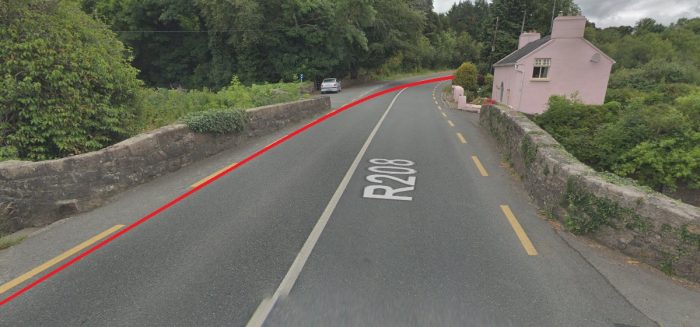
Patrick Taylor describes the station as being “the last station to have both up and down platforms both of which were provided with verandahs. A loco shed, goods store, turntable and water tank (10,000 gals) were also situated here as Miltown-Malbay was the terminus of the West Clare Railway. A staff post with the station building on the down side, it possessed pretty extensive accommo-dation. The signal cabin and a cattle bank were situated on the down side. The water tank, goods store and engine shed were to the rear of the up platform. [15]

He goes on to say that: “On passing the down home signal the up road was connected to the right and a siding veered off to the left to run onto the rear of the down platform. Another siding ran off the up road to the rear of the platform, which served the goods store loading bank and water tower. There were two connecting spurs off this siding, one running on to the turntable and engine shed at the Lahinch side. The other running on to both the up and down road adjacent to the level crossing gates on the Quilty side. The up starting signal was situated beyond the up platform on the up side and a water column was at the end of the up platform on the Lahinch end . The down starting signal and a second water column at the end of the down platform faced towards Quilty.” [15]

The onward route of the line heading South is shown first on the satellite image above and then on the adjacent 1940s OS Map. The South Clare Railway commenced at this station, and ran past three level crossings inside the first half mile. The line passed to the West of the small town of Miitown-Malbay whose centre is shown on the OS Map above.
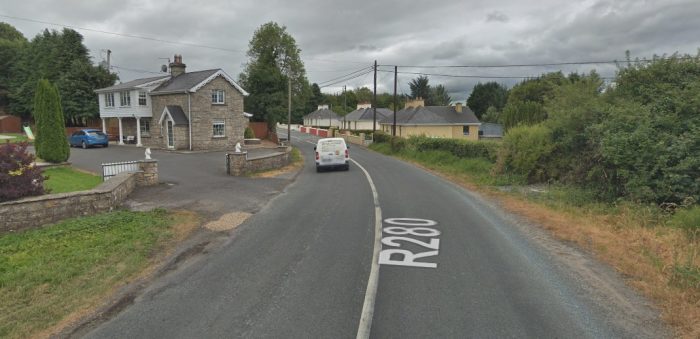
Taylor continues: “The Lahinch-Miltown Malbay main road was crossed at the station gates and after a minor road at Flag Road No.1, the Miltown-Quilty road was crossed at. Flag Road No.2 crossing. The Miltown-Malbay up home signal was situated on the upside a short distance on the Miltown side of Flag Road No.1. Two bridges, Sextons (No.53) and St. Joseph’s Well river bridge (No. 54) were in close proximity on the next stretch after crossing Braffa level crossing at 28.57 m.p.” [15]

For a bit more detail we turn to Edmund Lenihan. He says that a short piece of shallow cutting is all that remains of the line until it reaches the Flag Road No. 1 crossing which is just 300 yards West of the town’s main crossroads. [2]Looking North from the minor road which was crossed at Flag Road No. 1 Crossing along the route of the old railway line back to the location of the Station. The shallow embankment shows the location of the old railway with Miltown Malbay away to the right of the picture. The image below is taken looking South at the same location.The next crossing was Flag Road No. 2 Crossing and the line crossed Flag Road at this point.The location of the crossing is easily established as there is a different form of boundary wall across the line. This view is taken from Flag Road and looks back towards Flag Road Crossing No. 1.Looking south from Flag Road the route of the line has been built over.

We are now at the top of the adjacent 1940s OS Map. The line is shown all the way through to Quilty on this and the next two OS Maps. The line curves gradually from a southerly trajectory to a southwesterly direction before curving south again at Quilty. The same length of the line is shown below these OS Maps in a series of satellite images from Google Earth. These are interspersed with Google Streetview images and others where available.

Edmund Lenihan spends some pages describing this part of the route. First, after the Flag Road crossings the line drifts towards Mullagh Road. Lenihan encounters two bungalows built over the line of the railway. At that point, adjacent to Mullagh Road the line was in cutting, so to build the two bungalows the cutting had to be filled. Prior to the construction of the two bungalows the cutting must have been immeidate ly adjacent to the road verge. [17]

The adjacent satellite image shows the route of the line tending towards Mullagh Road.

The next two satellite pictures show the two bungalows mentioned above. In these images, taken in around 2015, it appears that much of the railway cutting has been infilled. There are lengths close to the bungalows, both North and South of them where the cutting still appears to exist. In between the satellite images are pictures taken from Mullagh Road which show the line drifting towards the road from the North and then drifting away again to the South.
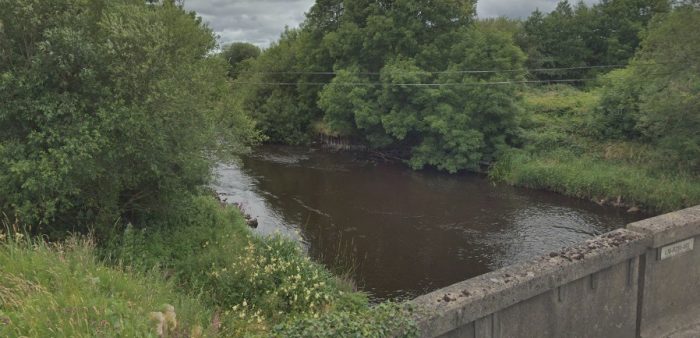
The photographs taken from Mullagh Road have the rough path of the railway line shown in red.

In the first, Miltown Malbay can be seen in the right-distance. The remaining three form a straightforward sequence with the last shown the route of the railway moving away from the road. The satellite image which folows these four oictures shows the route of the old railway from above.As we travel on towards Quilty, we note that the route of the line now runs across open fields. On the ground there ois little trace of the line. The satellite images keep us on track.

We cross a minor road at-grade. This was a gated crossing and the crossings keeper’s cottage remains in the 21st century. It is approachingvas we leave the adjacent satellite image and shows up clearly at the top of the next satellite image.

In between the two are Google Streetview pictures of the crossing and its immediate environment.A view from the East looking along the minor road. The old railway approached on the alignment shown, travelling behind the crossing-keeper’s cottage.The cottage has been extended towards the alignment of the old railway.The crossing was on a very shallow angle. This view is also taken from the East. The gate posts can still be seen at the far side of the crossing.The line continued on towards Quilty. As it does so, we listen to Edmund Lenihan’s description of the route just a little further ahead along the old line. Clearly he did not have the benefit of satellite imagery.

“We could see Miltown power station ahead and Breaffa cottage to our right, but of the line there was no trace. We reached the road, and could have saved ourselves discomfort by merely walking to the crossing and continuing from there. But instead we started across the fields towards the river, gradually correcting our line of progress as we went. We had an easier passage than we deserved, there being no more than muck and high ditches in our way, and even these we forgot as soon as we saw the Glendine River. Swirling, looping in sharp turns and little pools, it rattles along in its narrow gorge as if shepherding stones downstream to its meeting with the Annagh River. Our crossing point, Sexton’s Bridge, was intact, but since here were no parapets we hurried over it like men expecting that it might fall at any moment and with only the briefest glance of acknowledgment to the stream gushing underneath. Already, our sights were on a scene more imposing. Here, from a large valley towards which the Glendine cascades, rears a high, ivy-draped road-bridge of one main arch, with others flanking, while nearby, in the lee of Aillateriff heights, a group of mill-like buildings nestles. Over all, the power station stood out like a beacon, white against the sky. Without ever looking to the map we knew that this was Stackpoole’s Bridge and Poulawillin Mills. A few minutes’ walk and we were at Annagh No. 1 crossing, 28.75 miles from Ennis.” [18]The crossing-keeper’s cottage from Annagh No. 1 Crossing is shown above in 21st century and in the adjacent image from the 1950s © IRRS. [19] The second image is taken from south of the crossing, the first from the single-lane road that the railway crossed.The railway continued South from Annagh No. 1 Crossing. 

A few hundred yards beyond the road-crossing the railway crossed the Annagh River again. The bridge can be seenninnthe top right of the adjacent photo.

To the West of the road-crossing the road crossed the Annagh River. It was from McMahon’s corn and woollen mills in the immediate vicinity of thst road bridge that “the village of Miltown took its name in the nineteenth century, and the name of the nearby townland, Poulawillin, still preserves this memory. The bridge, at least 40-feet high, bears the inscription `Built by John Stackpoole, Esq. July 1811′, and has withstood the years with dignity.” [19] Just to the West of the bridge is St. Joseph’s well, the site of regular pilgrimages.

Once the railway crossed the Annagh for the second time it entered the townlands of Annagh. Lenihan’s says: “There was much to admire in the way the river squirmed along in a semi-circle to a huge pool at the base of the embankment close to where the twenty-ninth milepost once stood. A fine place for fishing, without doubt, but extremely deep and dangerous-looking. The current has begun to eat into the foundations of the line, and already land slippage has occurred, leaving a sheer and frightening drop.” [20] 

One thing which is a recurrent reality in Lenihan’s book is the swamp-like nature of much of the conditions underfoot and at other times, just how easy it was to loose the route of the line. This next passage from his book gives a good impression of so much of the walks he and his son undertook.

“Our troubles continued, the swamp developing into a small lake. But for the rushes at the edges of the line, we could have made no progress. We hopped along, from one to the next, a business that demanded total concentration. Then, in lightning contrast, when we squelched through a muddy gap we found ourselves faced with a huge levelled field.The line was being elusive again, and succeeded in hiding from us for most of the way to the next crossing cottage half a mile away.” [21]

The next crossing was Annagh No. 2 Crossing and was 29.5 miles from Ennis and appeared in the centre of the last satellite image above. It was opened as a halt in May 1952. The control of the line passed, at this point, out of the control of Miltown Station.Annagh No. 2 Crossing in 1954, © IRRS. The picture is taken from south of the Crossing. [21]This new-build cottage is in approximately the same position as the old Crossing-Keeper’s Cottage at Annagh No. 2 Crossing.The line ahead.
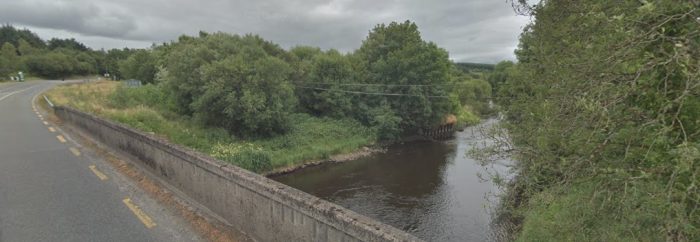
Lenihan comments that from Annagh No. 2 Crossing, “there was no difficulty in getting to Emlagh crossing, for the way is quite clear and the surface dry. But there was little of interest to be seen. … At the triple boundary, Annagh, Caherrush and Emlagh, a handsome stone culvert lined with Liscannor flags still carries the boundary stream.” [21]

The crossing keeper’s cottage at Emlagh Crossing is still present in the early 21st century and can be seen easily in the satellite image above.
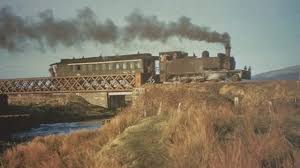
In the adjacent image we see the line from the Northeast arriving at Emlagh Crossing. The image below we look Southwest passed the Cottage.We are now not so very far from Quilty. The village is in sight.

Lenihan continues his tale from the 1980s: “Ahead of us, an odd-looking fence appeared somewhat like a jump on a racecourse, surmounted as it was by a long post. When we reached it we found that it was no post, but one of the steel rails, only the second we had come upon in all the miles since leaving Ennis. A small stream once ran here, but it has been much altered enlarged by excavation, and the culvert demolished in the process. Two hundred yards farther on is another stream, this one the boundary with Quilty East. Here is a more substantial bridge, its stonework and girder facings still firmly intact.” [23]

Further ahead through muddy terrain, Lenihan encountered the stream dividing Quilty East from Quilty West  where the bridge “had met the fate of so many others, leaving a 10-foot-wide, 6-foot-deep channel, newly gouged.” [23]

After that the final quarter of a mile towards Quilty was, for Lenihan, easy going. [23]

At Quilty a small estate of houses has been built over the route of the old railway, immediately before the station itself.

Quilty station building remains recognisable in the early 21st century. The station was built on a curve at the 31.5 mile post. It “was on the upside and consisted of a platform, small siding and goods store.” [24]

We will finish this short part of our journey here near the sea. It is worth noting that an anemometer was installed at Quilty because of the ferocious nature of the Atlantic storms which hit the coast here. It was installed in 1911. When the instrument indicated gales of over 60mph, only ballasted stock could be used and when a gale of 80mph was predicted, all traffic on the line was brought to a halt. It is on record that wind of 112mph were recorded in January 1927. The anemometer hut and pole are shown in the adjacent image, © IRRS. [24][25]
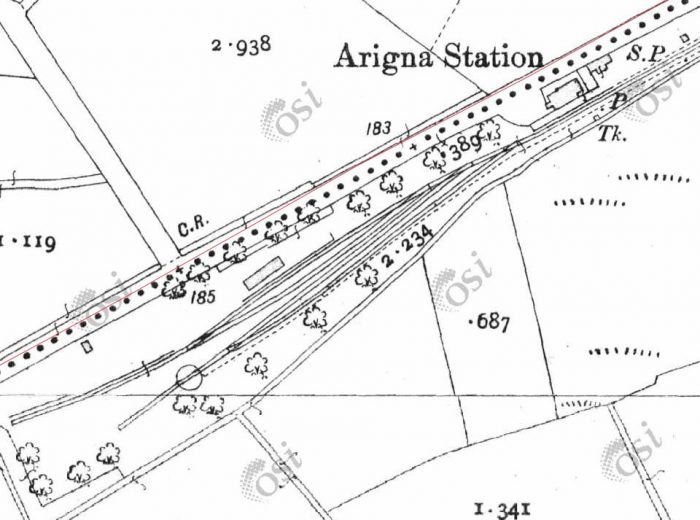
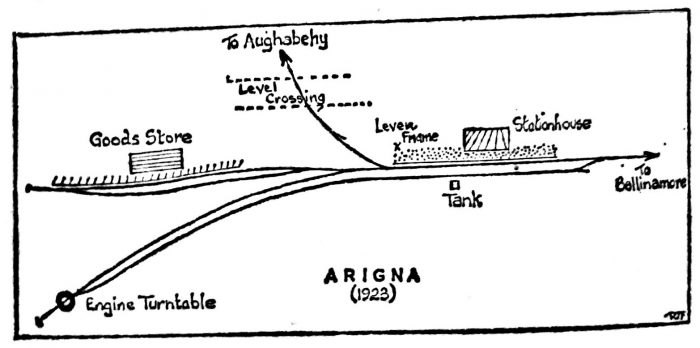
Edmund Lenihan expands on these bare facts: “On 3 March 1897 several carriages of the 10.30 a.m. passenger train from Kilrush were blown off the line between Kilmurry and here, and tumbled down an embankment.That there was no serious injury to any of the two dozen passengers was, as a newspaper report put it, ‘really marvellous’. Two years later, on 12 January 1899, at Quilty cross, the 8.30 a.m. train from Ennis was derailed in similar circumstances. Again, no one was seriously injured, but rather than wait for a tragedy to occur the company began to take precautions. A high earthen bank was built at the seaward side of the line south-west of the station, and in 1911 an anemometer was installed to warn of storms. Its high mast protruded from a little wooden hut on the up side a short distance from the goods’ shed (which stood at the end of the platform), but the instrument itself was in the station-house, where two differently toned bells awaited the onset of the wind. It became part of the stationmaster’s daily duties to take wind-speed readings. .... Ballast consisted of slabs of concrete under the carriage seats.” [26]Diesel locomotive at Quilty Station just before closure, © IRRS. [27]Quilty Station just after closure. The picture was taken on 7th June 1961, © Roy Denison [27]
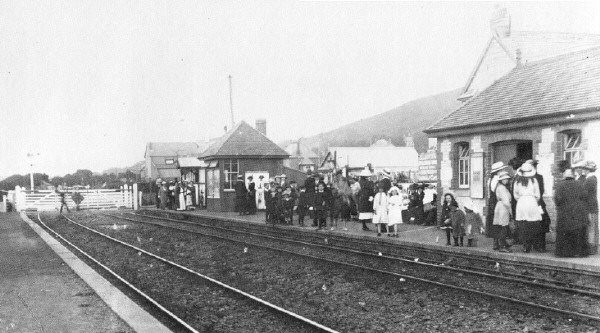
References

  1. Patrick Taylor; The West Clare Railway; Plateway Press, 1994, p48.
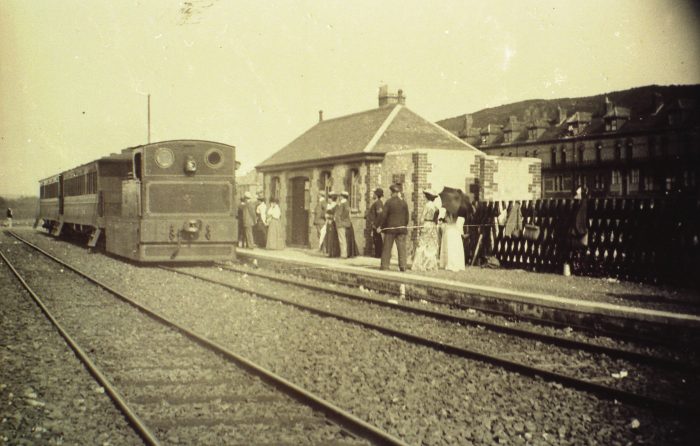
  2. Edmund Lenihan; In the Tracks if the West Clare Railway; Mercier Press, Dec. 2008, p168.
  3. http://www.buildingsofireland.ie/niah/search.jsp?type=record&county=CL&regno=20300608, accessed on 20th April 2019.
  4. https://stationhousemiltownmalbay.wordpress.com/station-house-accommodation, accessed on 20th April 2019.
  5. https://www.facebook.com/StationHouseMiltownMalbay/photos/a.259048931094658/468777630121786, accessed on 20th April 2019.
  6. https://www.hydeparknow.uk/2017/07/13/stuck-in-miltown, accessed on 20th April 2019.
  7. https://twitter.com/theclareherald, accessed on 20th April 2019.
  8. https://www.flickr.com/photos/110691393@N07/11373840335, accessed on 19th April 2019.
  9. https://en.wikipedia.org/wiki/Milltown_Malbay, accessed on 20th April 2019.
  10. http://www.clarelibrary.ie/eolas/coclare/places/miltown_history.htm, accessed on 20th April 2019.
  11. https://www.westclare.net/miltown.htm, accessed on 20th April 2019.
  12. https://www.tripadvisor.com.sg/LocationPhotoDirectLink-g635643-i94980478-Miltown_Malbay_County_Clare.html, accessed on 20th April 2019.
  13. https://www.clareecho.ie/miltown-malbay-written-off-the-map, accessed on 20th April 2019.
  14. https://www.facebook.com/clareplaces/photos/a.1121180214559064/1121180307892388, accessed on 20th April 2019.
  15. Patrick Taylor; op.cit., p41.
  16. Ibid., p66.
  17. Edmund Lenihan; op.cit., p170.
  18. Ibid., p170-171.
  19. Ibid., p171.
  20. Ibid., p174-175.
  21. Ibid., p175-176.
  22. Ibid., p177.
  23. Ibid., p179.
  24. Patrick Taylor; op. cit., p41.
  25. Edmund Lenihan; op. cit., p180-181.
  26. Ibid., p181.
  27. Ibid., p179.