Tag Archives: Scottish Railways

The Highland Railway – Part 3 – The Inverness to Aviemore Direct Line.

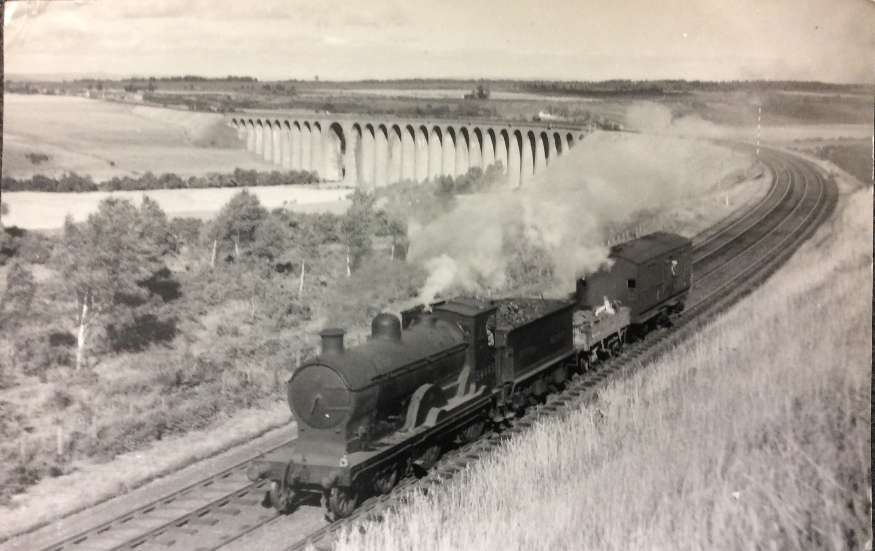
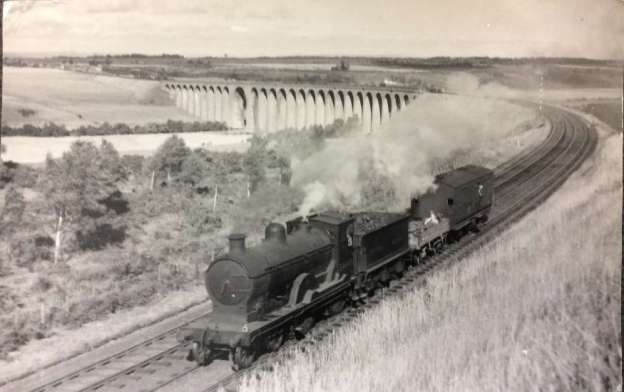
The featured image at the head of this article shows BR No. 54445 with an permanent way train passing Culloden Moor Viaduct travelling towards Aviemore. [54]

The Inverness and Aviemore Direct Railway was built by the Highland Railway to provide a shorter and more direct route between Inverness and Aviemore, carrying its main line traffic to Perth and the south.

Earlier articles about the Highland Railway can be found here, [7] here, [8] here, [9] here, [10] and here. [11]
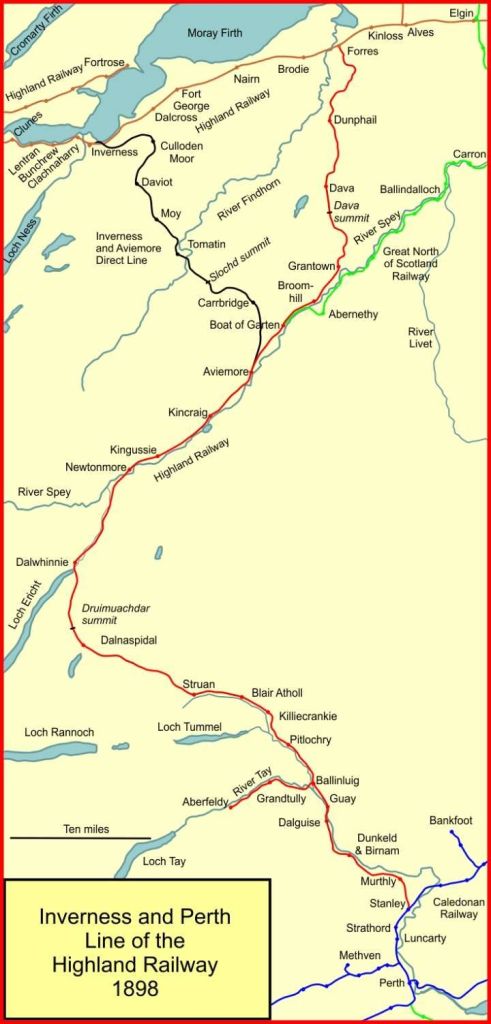
The Inverness to Aviemore Direct Railway cut a significant mileage off the journey between Inverness and Aviemore, © Afterbrunel and licenced for reuse under a Creative Commons Licence (CC BY-SA 4.0). [1]

The original route via Forres and Dava, built by the Inverness & Perth Junction Railway (I&PJR), “ran over wild and remote terrain as far as Aviemore, and then on to Dunkeld. From there trains used the Perth and Dunkeld Railway to Stanley Junction, and from there the Scottish North Eastern Railway to Perth. This was a considerable improvement [over the only previously available route via Aberdeen], although operation of the line over the mountainous route was difficult. The traffic from east of Forres proved to be lighter than anticipated, and at the same time traffic from Inverness and from the Inverness and Ross-shire Railway became increasingly dominant. The deviation to Forres before turning south was now a serious liability.” [1]

It was also clear that the Great North of Scotland Railway (GNSR) was planning its own independent line between Elgin and Inverness and the West Highland Railway was known to be considering a line along the Great Glen connecting from Fort William to Inverness. “The Highland Railway was alarmed at both of these competitive encroachments into what it considered to be its own territory. It anticipated that Parliament would look favourably on them, if it could be shown that the Highland Railway was not taking adequate steps to improve its own line and its service to passengers and goods customers.” [1][2: p44][3: p103-104]

The solution was a new line of 34 miles running directly south from Inverness, rejoining the existing Perth line at Aviemore. This became the Inverness and Aviemore Direct Railway, informally known as the Carr Bridge line, or later the Carrbridge line. Its authorising Act of Parliament was passed on 28th July 1884.” [1][3: p104][4: p175]

As Acworth noted in 1890, the Highland Railway “could never face a Parliamentary Committee and maintain that the existing facilities to Inverness were sufficient, when it had taken no steps to supply the additional accommodation whose necessity it had itself asserted only a few years before … The construction of the new road will mean to [the Highland Railway], in the first place, a capital expenditure of some hundreds of thousands of pounds; secondly the cost of working some thirty additional miles; thirdly no additional traffic whatever; and lastly, the reduction of the passenger fares by as many pence as the new road will be shorter in miles than the old.” [1][5:p74-75]

Having received the authorisation, the Highland Railway did nothing to hasten actual construction, no doubt believing that the danger of encroachment had been staved off. In any event, for the Highland Railway this was the most important development of the decade. … The cut-off was 34 1⁄2 miles of new line between Aviemore and Inverness. For six years from obtaining the necessary Act on 28 July 1884, the company managed to stave off any real action, although by 1886 agreements about land acquisition were made with proprietors. Altogether four extensions of time to complete the line were granted: two before and two during construction.” [1][2: p44][3: p103-104]

The Inverness to Aviemore Direct Railway was opened in stages: the first, from Aviemore to Carr Bridge, opened on 8th July 1892 as a branch line operated by a tank engine, and carrying very little traffic. [1][3: p103-104] The line from Carr Bridge to Daviot opened on 19th July 1897.

The route was completed for through running by the opening between Daviot and Millburn Junction, Inverness, on 1st November 1898. [1] Ot should be noted that there is some ambiguity over the dates. [1: Note 1]

In October 1897, it was decided to install double track on the as-yet unopened section between Inverness and Daviot. This involved widening some completed single-track bridges. [1][2: p8]
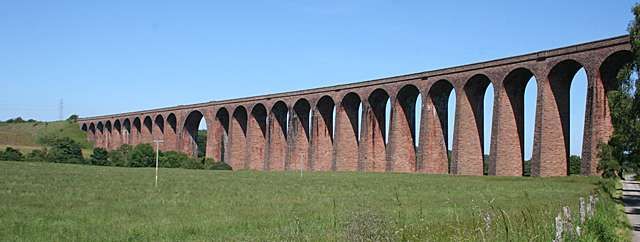
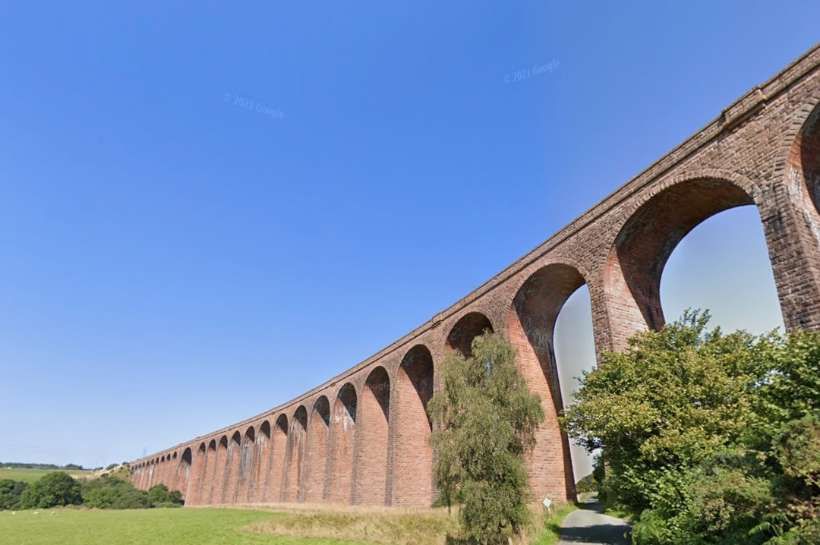
The Strathnairn Viaduct was built to carry the Highland Railway to and from Inverness across Strathnairn. The designer and engineer was Murdoch Paterson. The viaduct, built on a curve, is the longest masonry viaduct in Scotland, 549 metres (1800 feet) and has 28 arches. It has been carrying trains since first opening on 1st November 1898. It is also known as Culloden Viaduct, © Anne Burgess and licenced for reuse under a Creative Commons Licence<%(CC BY-SA 2.0). [6]

The new line incorporated the Highland Railway’s second-highest summit: Slochd at 1,315 feet. The Strathnairn Viaduct near Culloden Moor is Scotland’s longest masonry viaduct at 600 yards in length; there are 29 arches. [1][3: p133-134][4: p197] Major enlargement of the track facilities was also carried out at Millburn Junction in Inverness. The total cost of the line was almost a million pounds.” [1][2: p46]

From the opening of the direct line from Aviemore… “the traffic planners had to cater for two main lines into Inverness from the south. In the summer of 1909, seven scheduled trains ran each day between Perth and Inverness. The night train from Perth left at 12.50 a.m., with sleeping car from Glasgow, and travelled via Carrbridge, arriving at 5.10 a.m. A connecting train left Aviemore for Forres at 4.00 a.m., arriving also at 5.10 a.m. Nairn passengers went on to Inverness and changed trains there. At 5 a.m. another train left Perth, conveying sleeping cars from London and through carriages from southern railways, running via Carrbridge and arriving at Inverness at 8.35 a.m. This ran only from 1 July to 11 August. Fifteen minutes later the ‘normal’ night train from London left Perth, and arrived in Inverness at 9.08 a.m. This train was also noted as conveying Sleeping Carriages Euston to Strathpeffer.” [3: p184-185]

A Forres connection left Aviemore at 8.25 a.m., arriving at 9.35 a.m. The Mail left Perth at 6.15 a.m. and reached Aviemore at 8.33 a.m. Here it divided, the direct Inverness portion arriving at 10.10 a.m., and the Grantown portion arriving in Inverness at 11.15 a.m. A Saturdays-only train left Perth at 9.25 a.m., reaching Inverness at 1.50 p.m.; its Forres connection left Aviemore at 12.45, arriving 1.56 p.m. A train for Inverness via Forres still left Perth at 11.50 a.m., running non-stop to Newtonmore, which it reached at 1.44 p.m.; Forres was reached at 3.25, and Inverness at 4.15. Only ten minutes later, the old Parliamentary left Perth, stopping at all stations (five on request only) and reaching Inverness via Carrbridge at 4:36 p.m.” [3: p185]

The Route

Inverness Railway Station was covered in the first article in this series. [7]
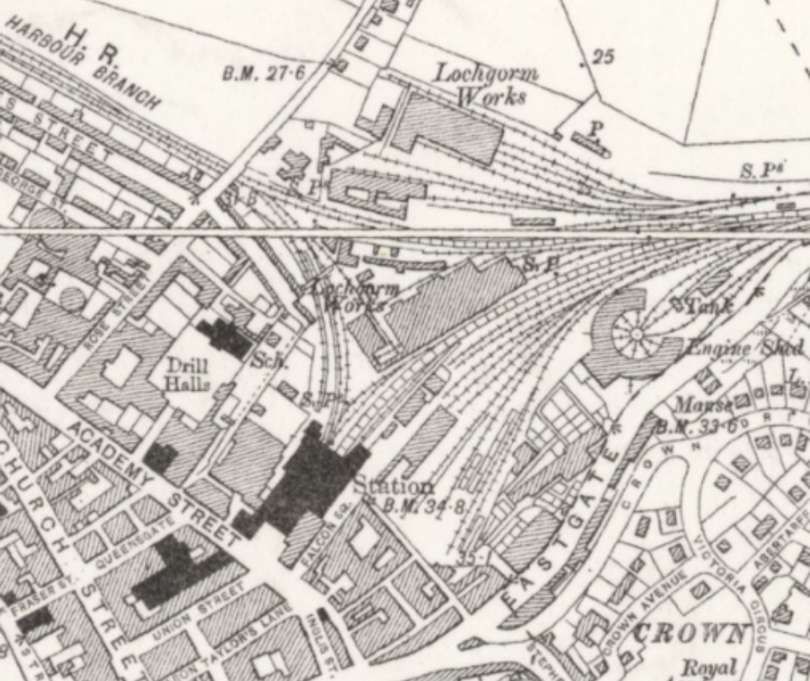
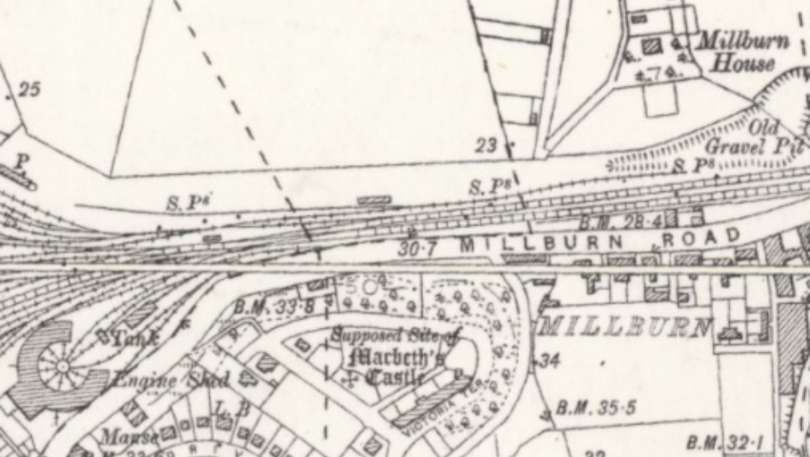
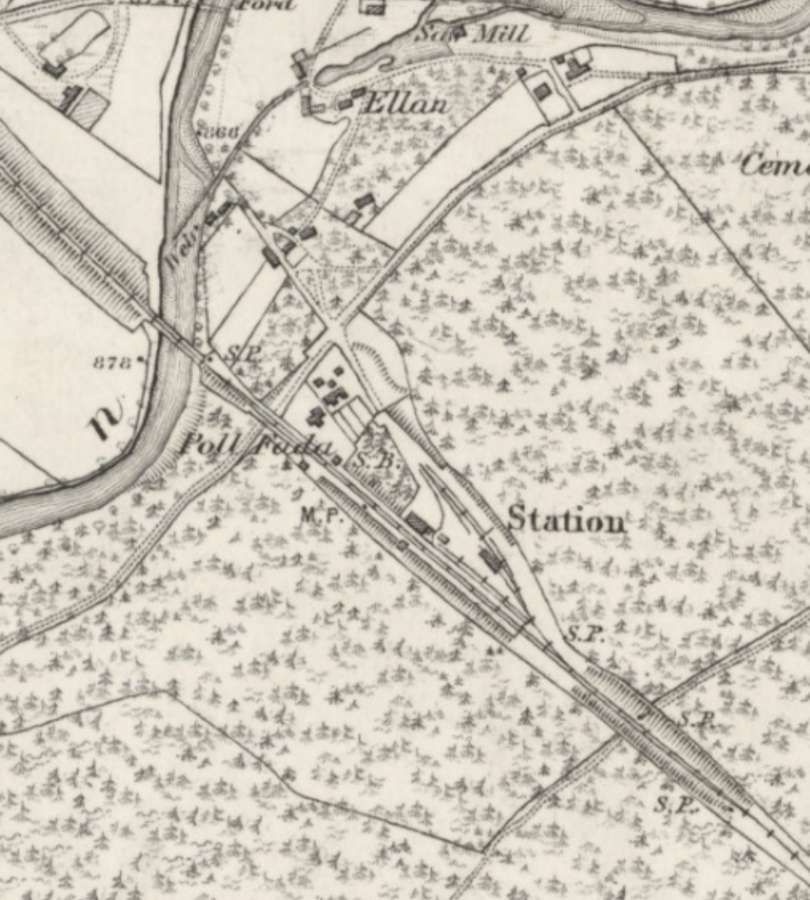
A single extract from the 6″ Ordnance Survey undertaken at the turn of the 20th century will suffice here. Note the Lochgorm Works at the top of the extract on either side of the loop which allowed East/West movements without trains needing to enter the station. The locomotive facilities centred on the roundhouse which can be seen on the right side of the extract. [12]
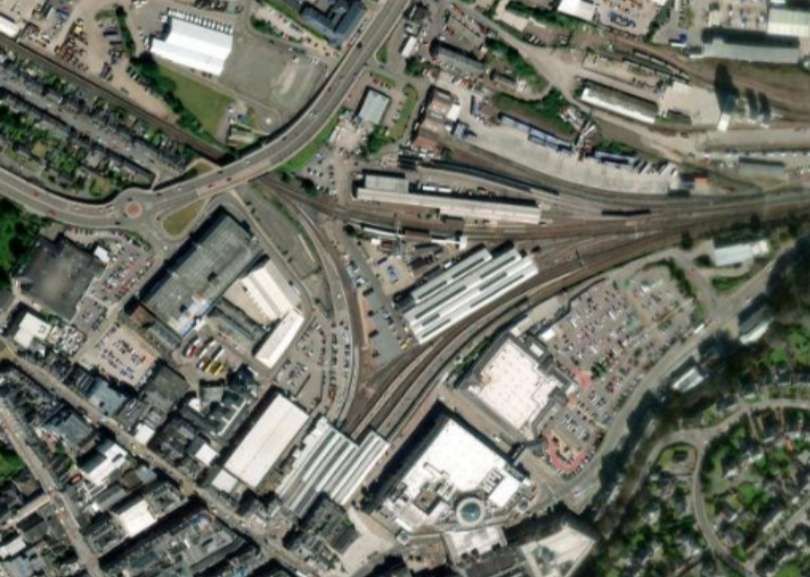
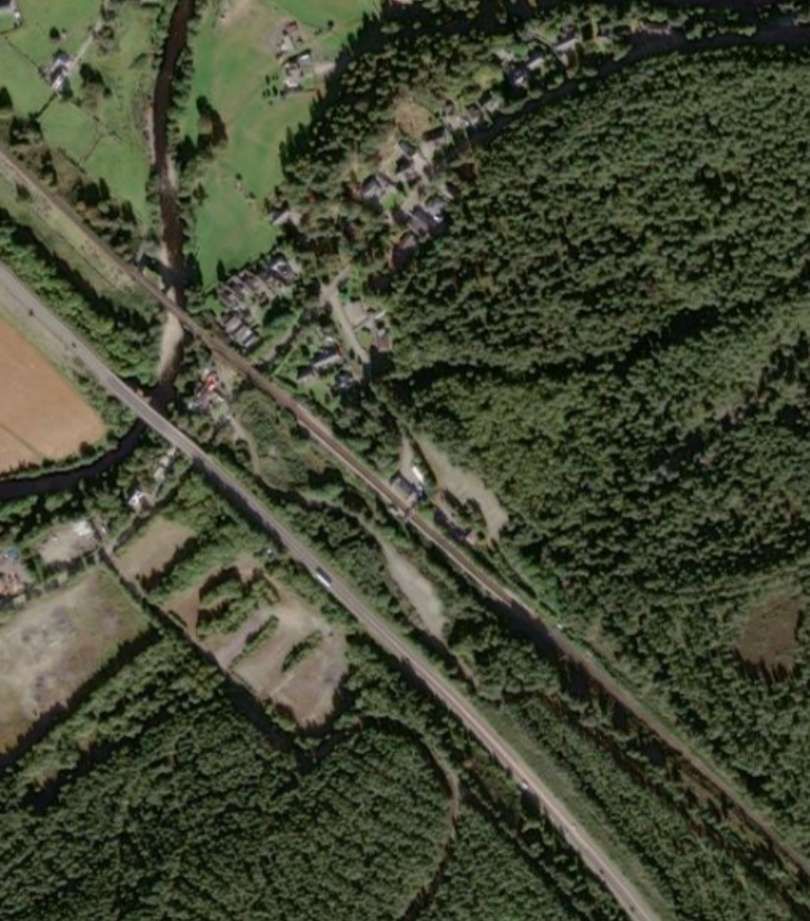
This 21st century ESRI satellite image, provided by the NLS shows that non-rail uses now sit over the site of the old locomotive shed and turntable. The basic layout of the railway infrastructure remains as does part of the Works. [12]
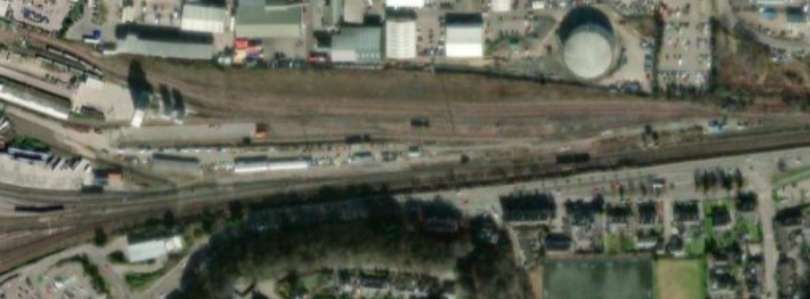
Heading East from Inverness Railway Station, two lines ran in parallel. Somewhat counter-intuitively the lines to Forres and beyond ran on the South side of the lines which will bear away South. [13]
Both lines continue to be used in the 21st century, although it is difficult to make out the detail on this extract from the  ESRI satellite imagery provided by the NLS. [13]
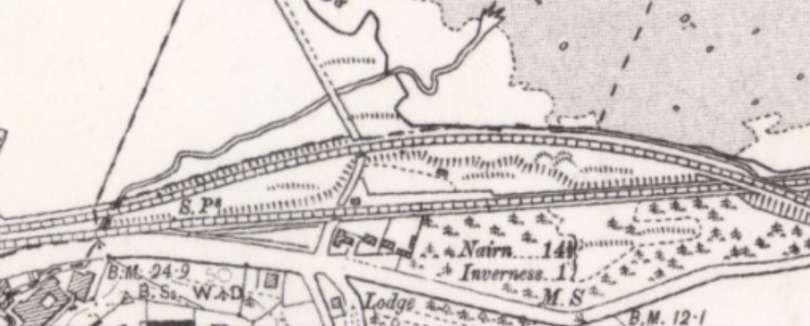
This next extract from the 6″ Ordnance Survey of 1901 shows the more northerly set of lines rising up to bridge the lines to Forres. [14]
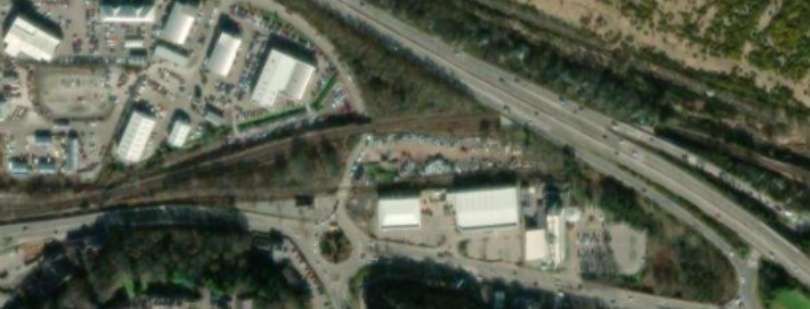
On this next extract from the ESRI satellite imagery it is slightly easier to make out the two lines. [14]
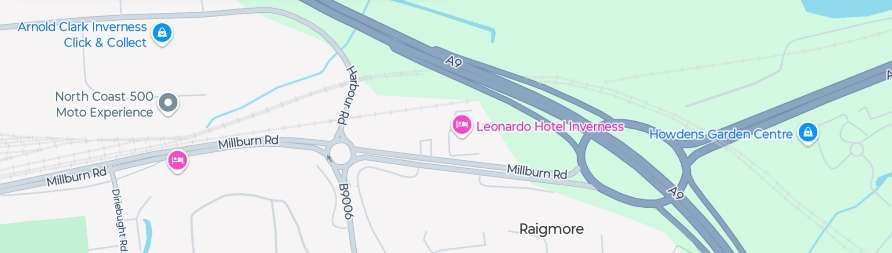
This extract from Google Maps shows the two lines crossing as they both pass under the modern A9. [Google Maps, June 2025]
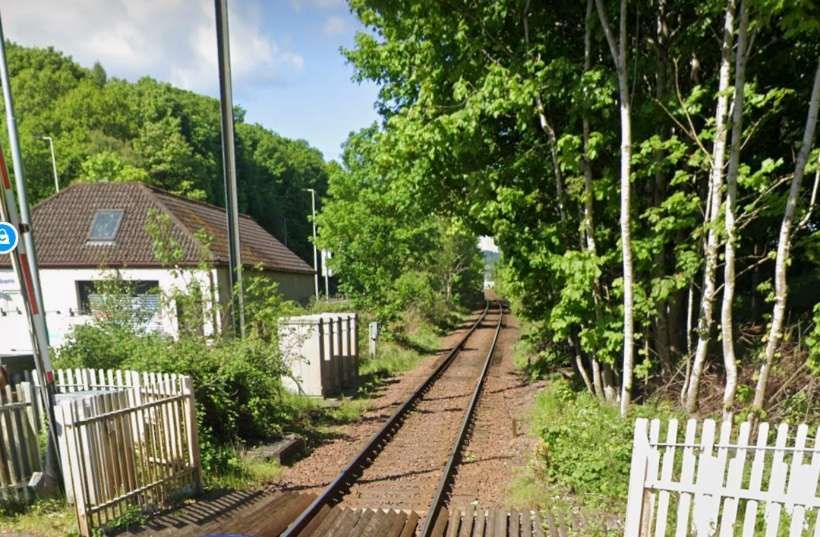
Looking West from the Harbour Road Crossing along the Forres line towards Inverness Railway Station. [Google Streetview, 2022]
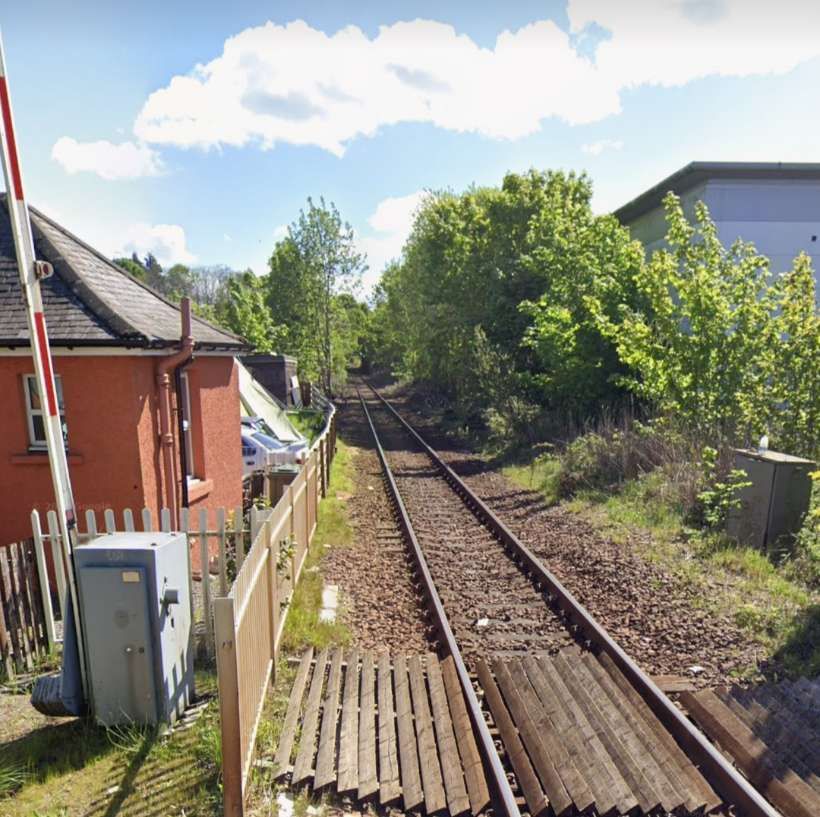
Looking East along the Forres line from the Harbour Road Crossing. [Google Streetview, 2022]
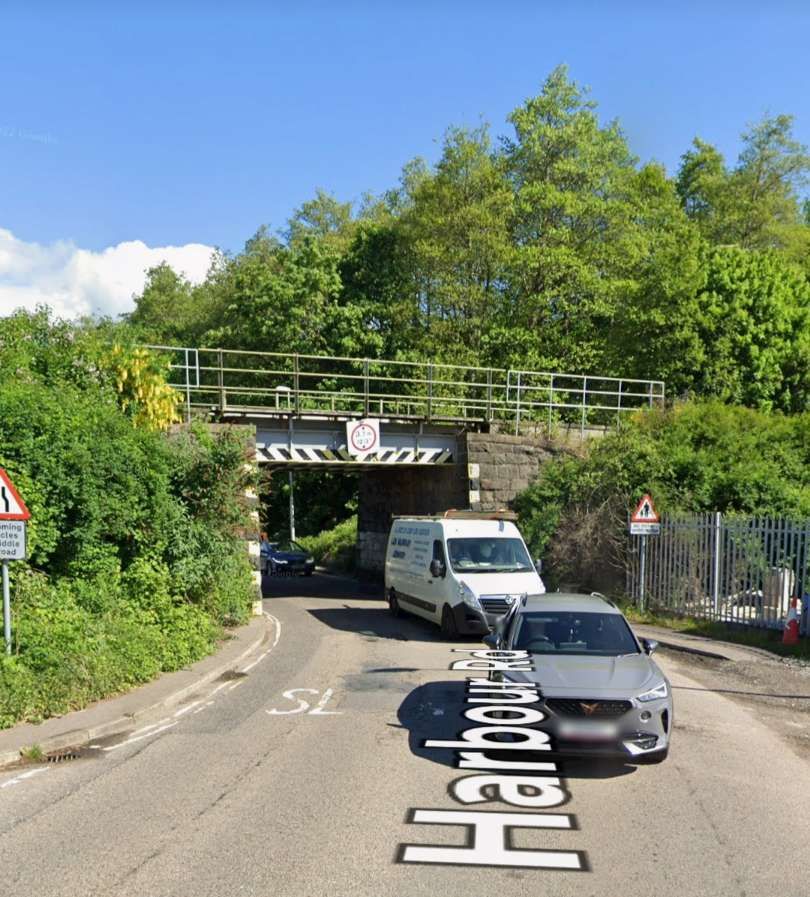
Harbour Road looking North. The Inverness to Aviemore Direct Railway is bridging the road. [Google Streetview, 2022]
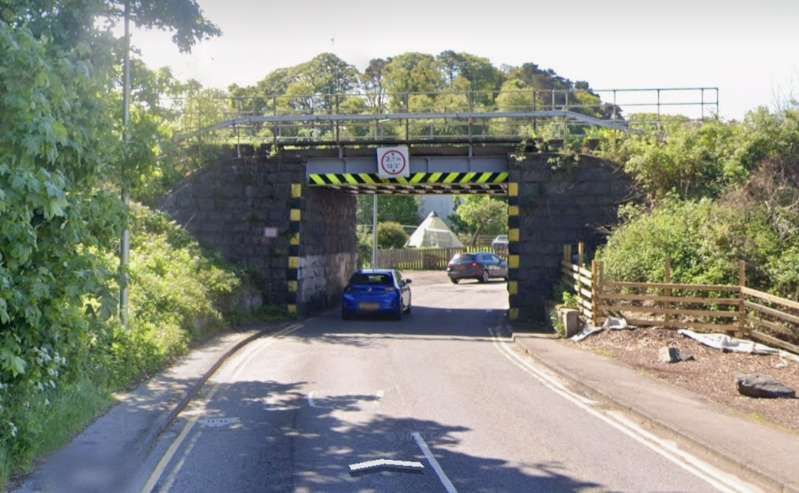
This time looking South through the bridge. [Google Streetview, 2022]

The Inverness to Aviemore Direct Railway curves round to the Southeast.
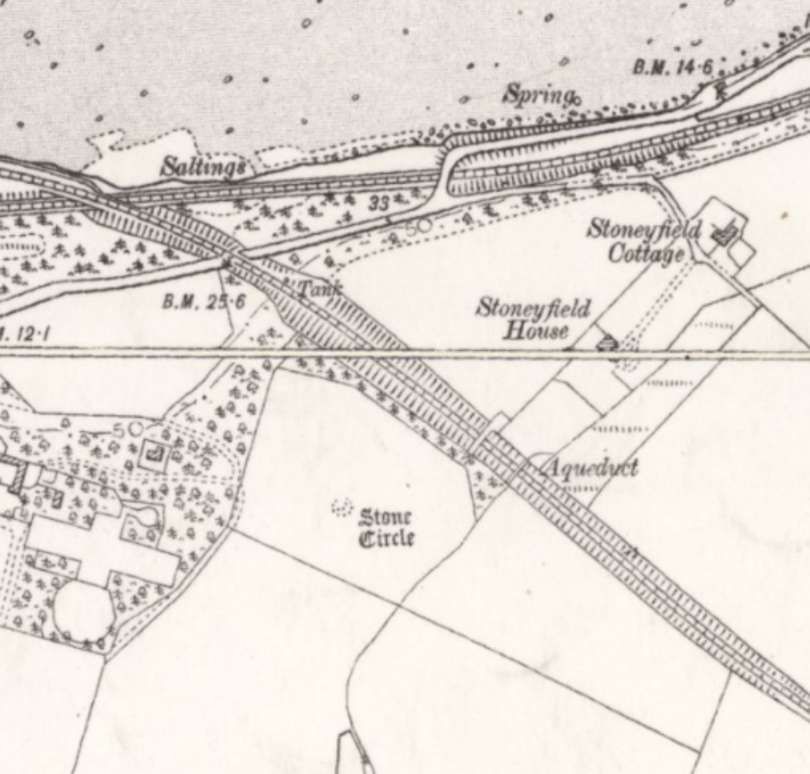
Away from the coast line, the railway is in cutting. [18]
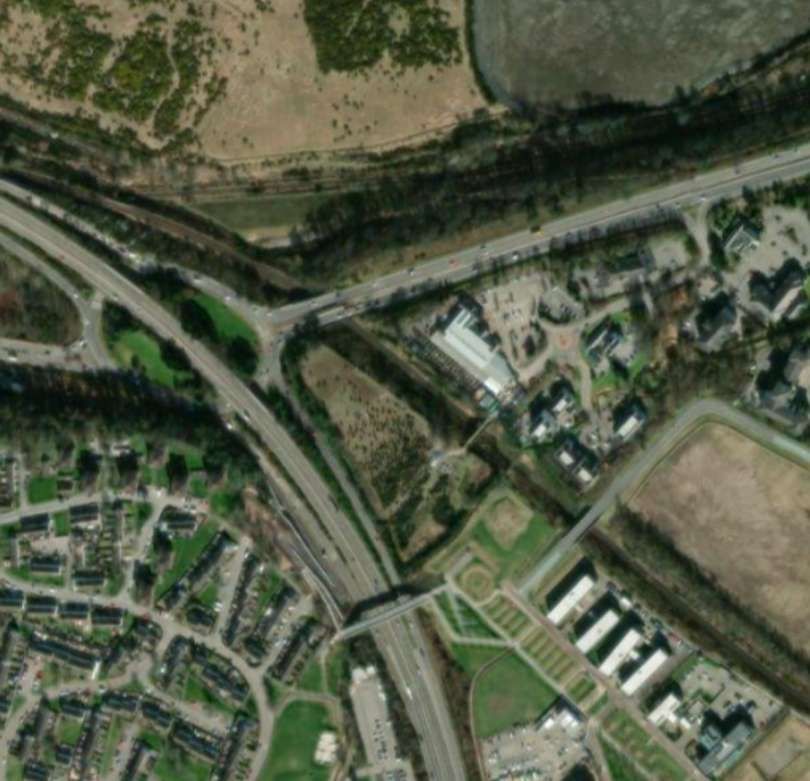
The modern satellite image illustrates the growth of Inverness. The presence of the A9 is a significant change to the landscape. [18]
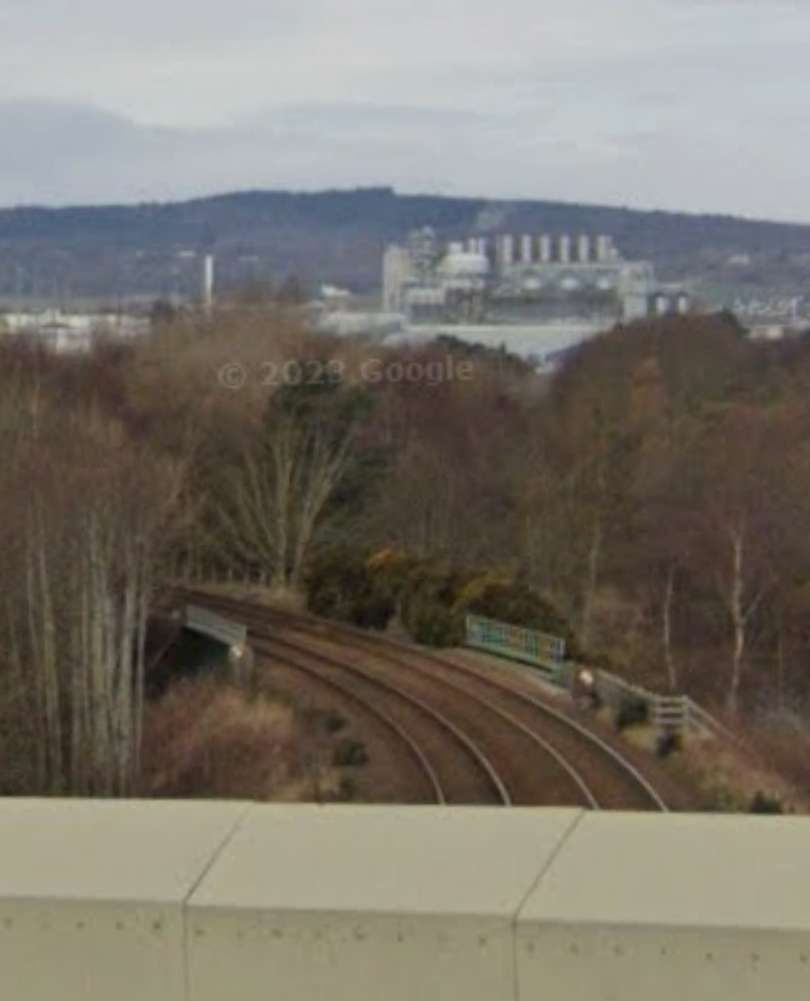
Looking back round the curve towards Inverness Railway Station from the A96. [Google Streetview, 2023]
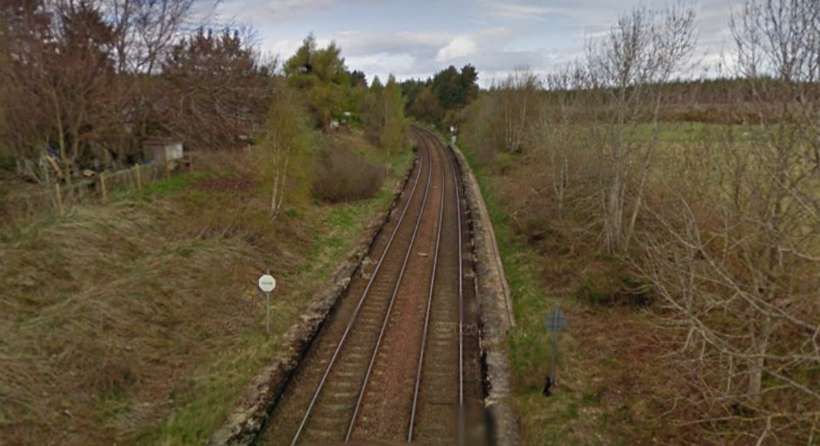
Looking ahead along the Inverness to Aviemore Direct Railway from the bridge carrying the A96 over the line. [Google Streetview, 2023]
For the first part of this journey along the line, each map extract overlaps with the previous extract. That is true for this and two further extracts. After that just discreet locations are featured. [15]
The same area in the 21st century. [15]
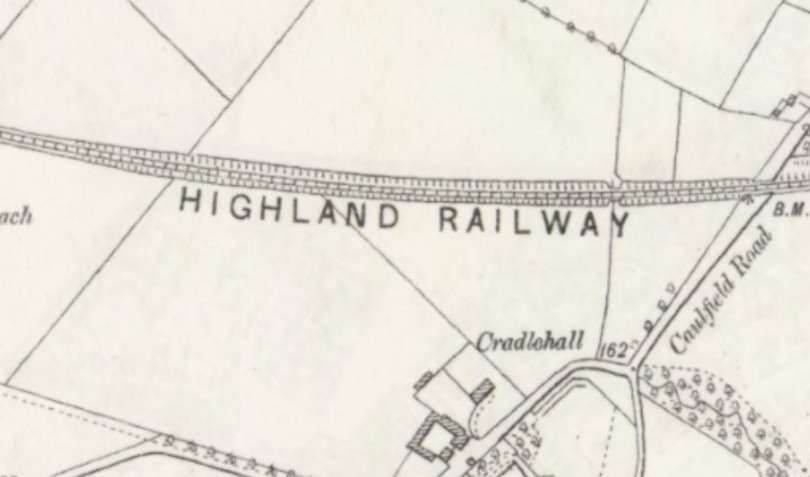
A further length of the line takes it as far as Caulfield Road North. [16]
The same length of line in the 21st century. [16]
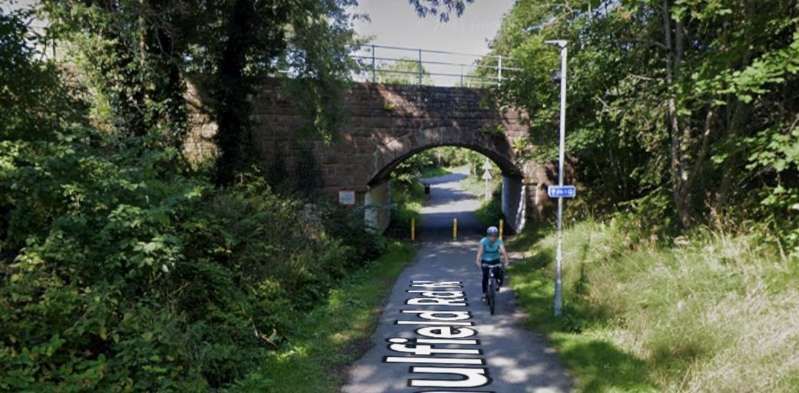
Caulfield Road North is now National Cycle Route No. 7, this view looks Northeast along the cycleway through the bridge carrying the railway. [Google Streetview, 2022]
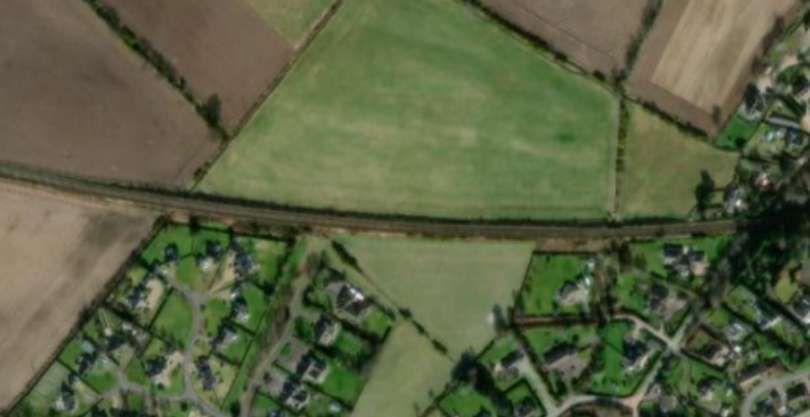
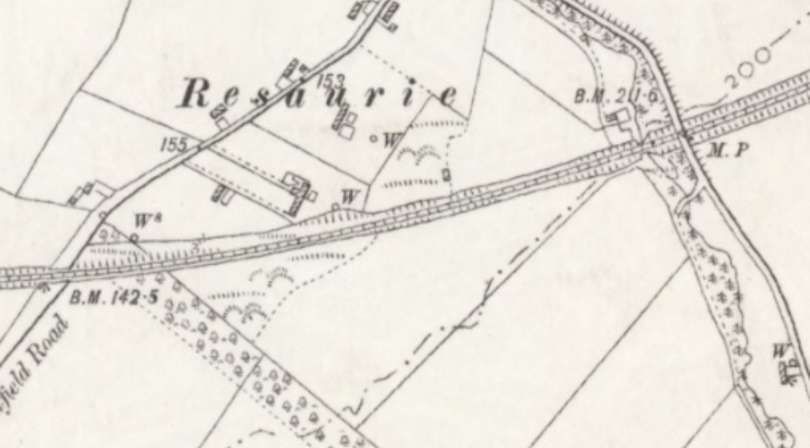
The line continues East, at the turn of the 20th century its route was through open fields. [17]
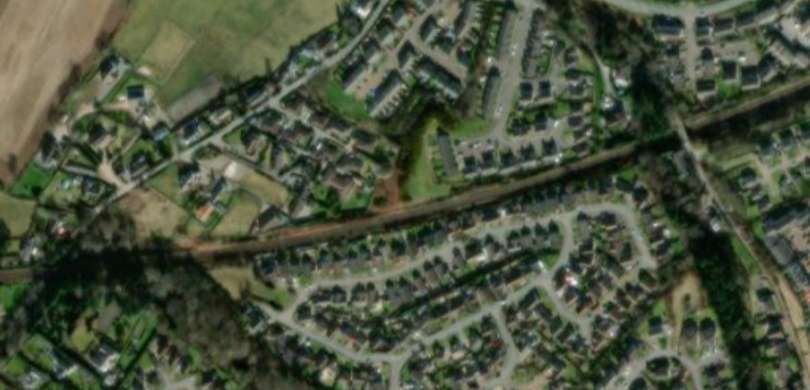
The same location in the 21st century. [17]

The line begins a wide curve round to the South to cross Culloden Moor. The line is initially in cutting, then on embankment and then in cutting on its approach to the site of Culloden Moor Railway Station.
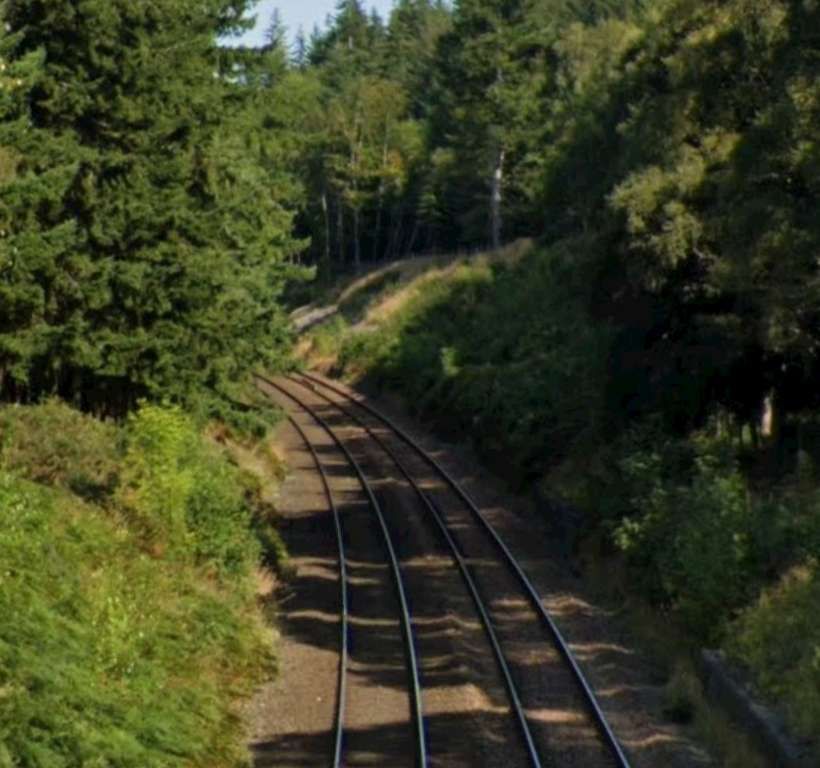
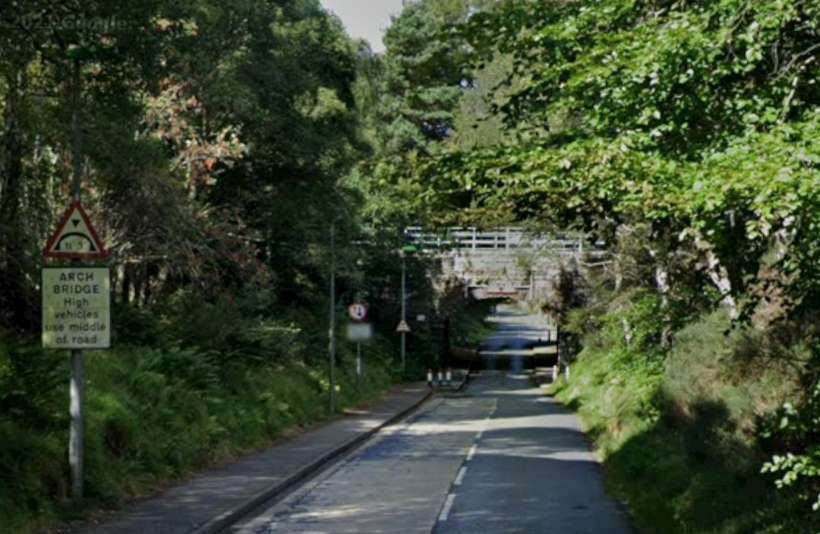
The view Northeast along the railway from the bridge carrying Tower Road. [Google Streetview, 2022]
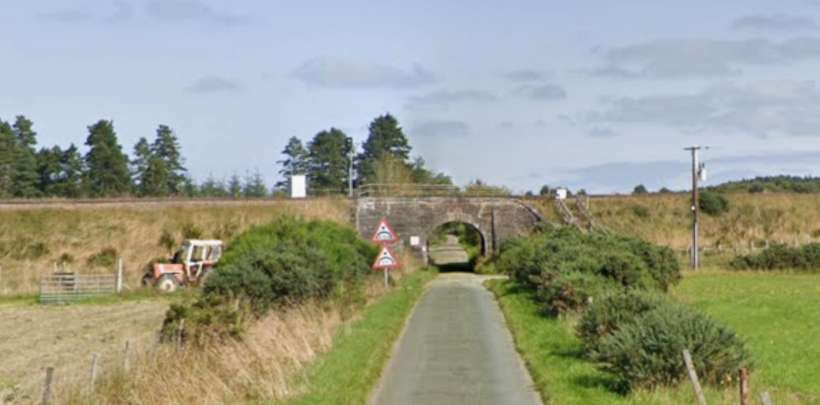
The view Northwest along Culloden Road. The railway is carried over the road on a stone arch bridge. [Google Streetview, 2022]
As the line curves around towards the Southeast it bridges a million nor road by means of another stone arch bridge.b[Google Streetview, 2022]
By the time that the line passes under the B9006 it has already run through platform faces of the old Culloden Moor Railway Station to the North side of the road. The line is, by this time, almost on a North-South alignment. This view looks back North along the line from the bridge. [Google Streetview, 2022]
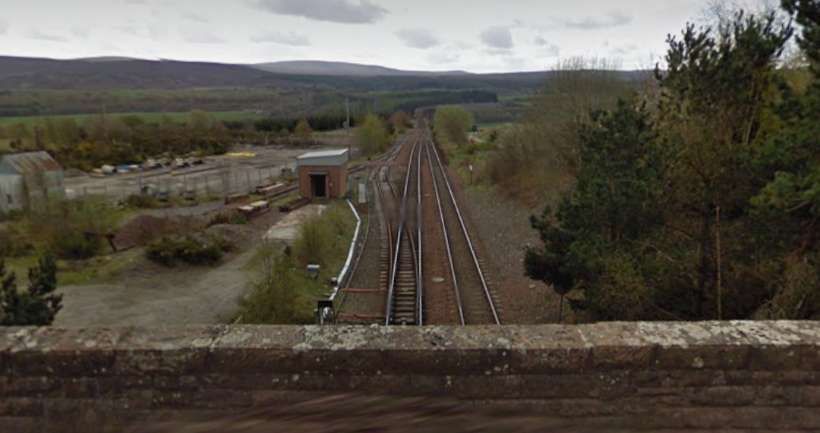
Turning through 180°, this view looks South through the old station site towards the Strathnairn Viaduct (alternatively, the Nairn Viaduct or the Culloden Viaduct). [Google Streetview, 2022]
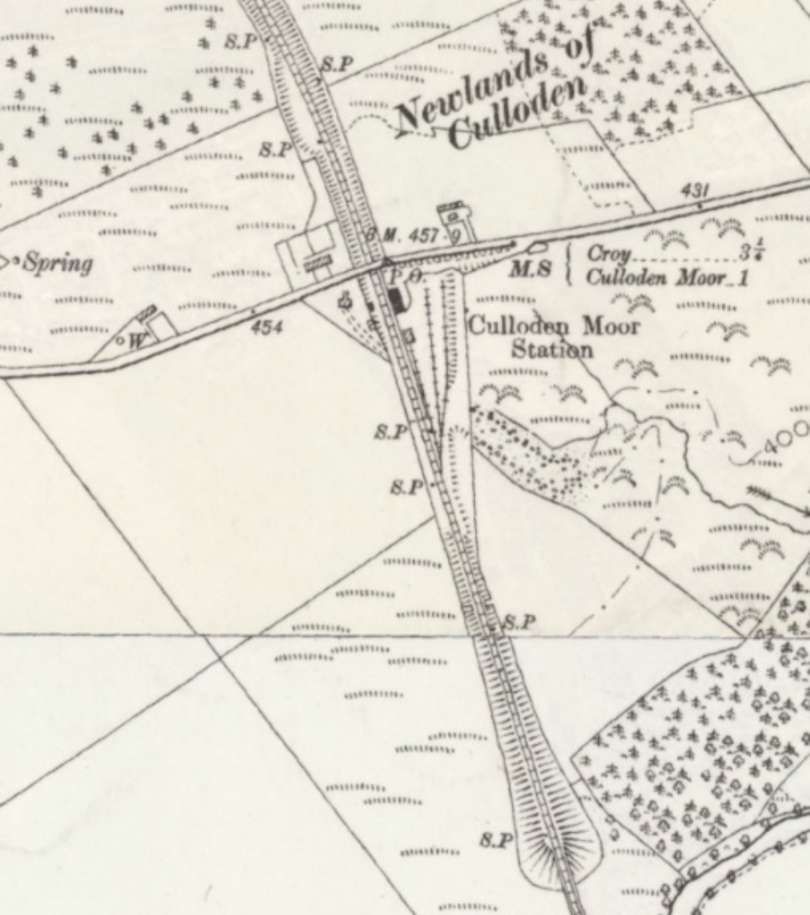
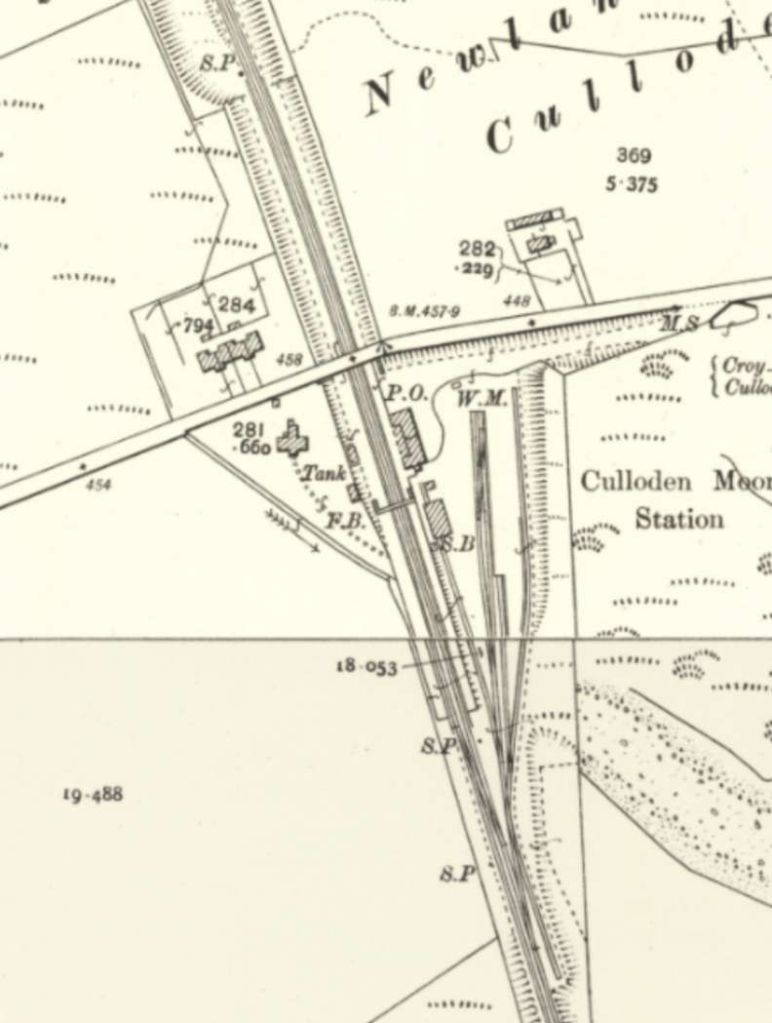
Culloden Moor Railway Station as it appears on the 6″ Ordnance Survey undertaken at the turn of the 20th century. [19]
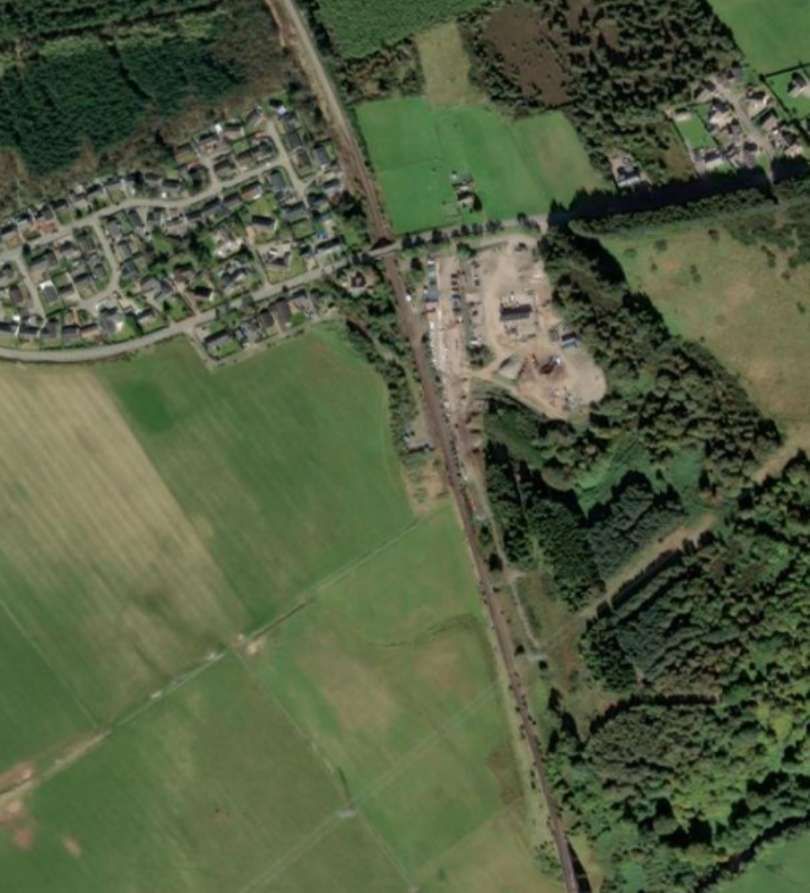
The location of Culloden Moor Railway Station in the 21st century. [19]
The 25″ Ordnance Survey from the turn of the 20th century. The footbridge was removed when it was realised that the road bridge was perfectly adequate for pedestrian access between platforms. The railway workers’ cottage and the Stationmaster’s House are on the West side of the line. [23]

Culloden Moor railway station served the village of Culloden from 1898 to 1965 (1967 for general goods). It was a two platform station just to the north of the Nairn Viaduct. Its location was closed too to the site of the Battle of Culloden. The platforms remain but the station buildings have gone.
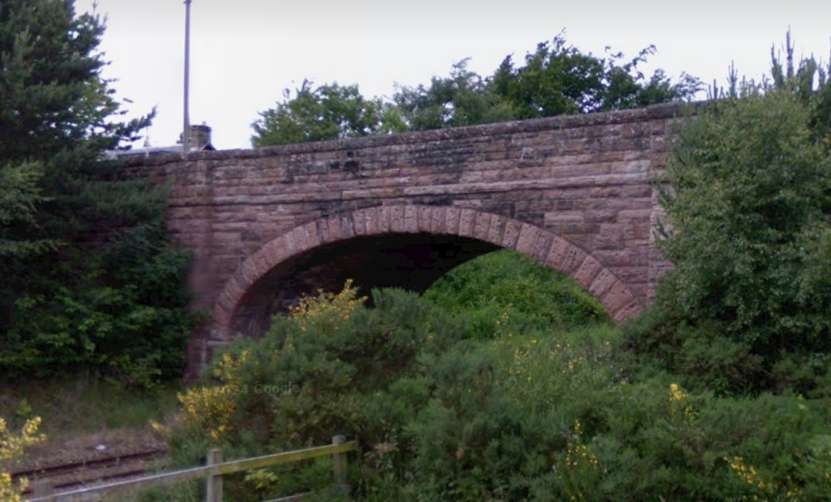
The roadbridge at Culloden Moor Railway Station site, seen from what was once the station forecourt. The site to the East of the railway is, in the 21st century, occupied by Iain Cowie Plant Hire and Groundworks Ltd. [Google Streetview, 2008]

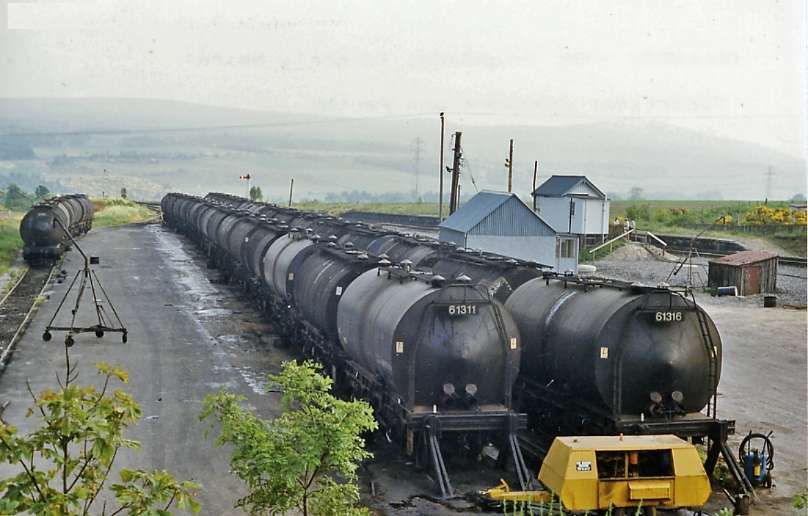
Both platforms at the station had a water column, with the water tank on the northbound platform. There was a bitumen depot adjacent to the station and in later years the goods sidings at the station could be seen filled with bitumen tank wagons. The depot closed towards the end of the 20th century. [22]
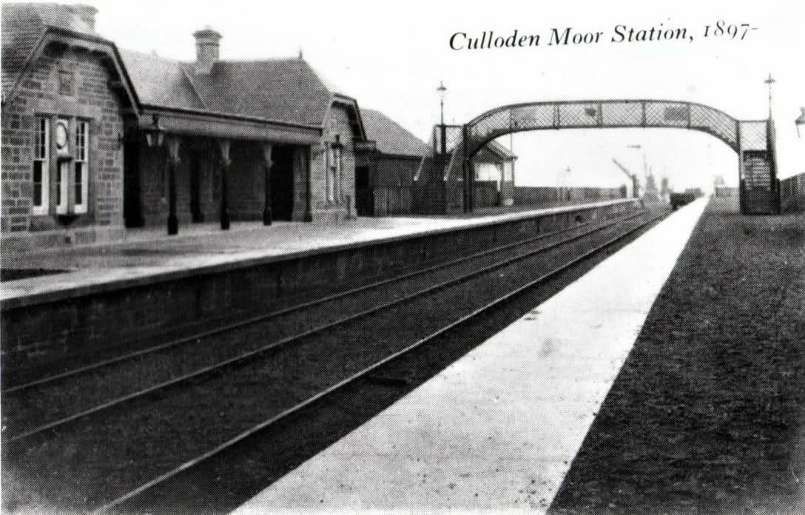
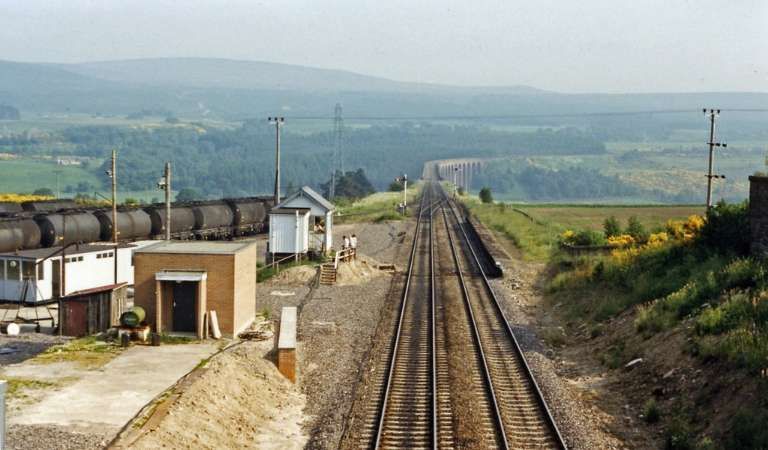
Culloden Moor Railway Station just before the turn of the 20th century. This view looks South from the Northbound platform, © Public Domain, photographer not known. This image was shared on the Disused Stations Facebook Group by Brian Prevett on 27th October 2024. [24]
Culloden Moor station (remains) and Viaduct, looking towards Aviemore, Perth and the south, © Ben Brooksbank and licenced for reuse under a Creative Commons Licence (CC BY-SA 2.0). [21]
Bitumen tank-wagons at Culloden Moor station (site), 1986.
The camera is facing Southeast, towards Aviemore. The station was closed 3rd May 1965 (and to goods on 27th February 1967). The tank-wagons and sidings belonged to Highland Bitumen of Ardrossan, © Ben Brooksbank and licenced for reuse under a Creative Commons Licence (CC BY-SA 2.0). [20]

Another photograph of the station can be seen here. [25] South facing photographs of Culloden Moor Railway Station have the Culloden Viaduct appearing in the distance.
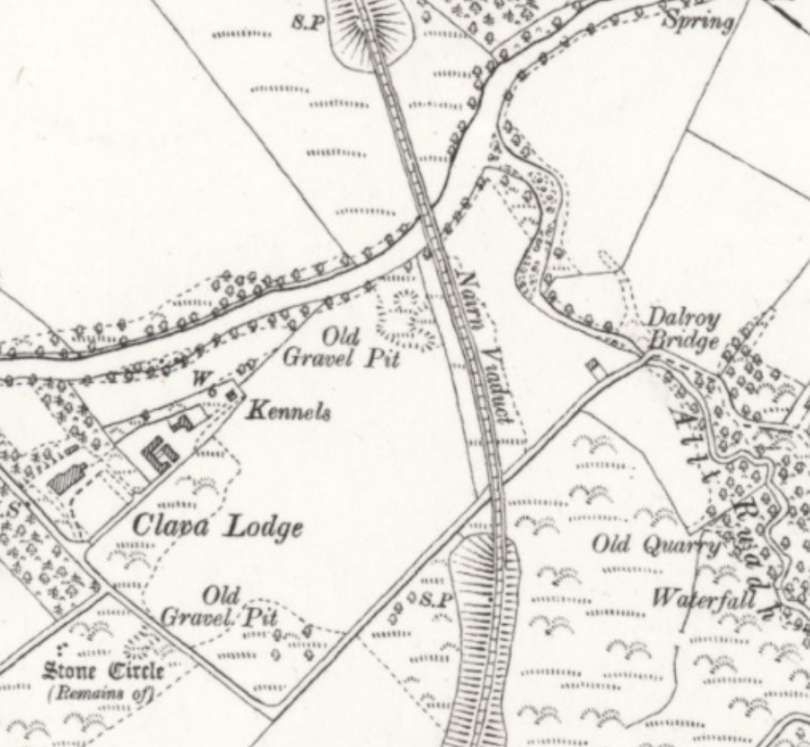
Culloden Viaduct (Nairn or Strathnairn Viaduct) as it is shown on the 6″ Ordnance Survey from the turn of the 20th century. [26]
The same viaduct as it appears on the modern ESRI satellite imagery provided by the NLS. [26]
Culloden Viaduct looking North-northwest from the minor road at the South side of the river valley. [Google Streetview, 2022]
BR steam locomotive 54445 with up permanent way train passing Culloden Moor Viaduct. It should, of course, be noted that No. 54445 was an ex-Caledonian Class 113 4-4-0 locomotive. These locomotives were classed 3P by the LMS. Introduced in 1916, these locomotives worked to a boiler pressure of 175 psi, had 20″ x 26″ cylinders and driving wheels of 6′ 6″ diameter. The locos without their tenders weighed in at 61 tons 5 cwt and produced a tractive effort of 19,833 lbs. [54][55]

The viaduct was designed by Chief Engineer Murdoch Paterson and built by The Highland Railway. Twentynine arches carry the line over the valley of the River Nairn. It opened in 1889 and it remains the longest masonry viaduct in Scotland at 1800ft (549m) long and is a Category A listed building. [27}

South of the viaduct the railway head for a short distance to the Southwest before turning Southeast as it arrives at Daviot Railway Station.

En-route the line crosses a minor road and
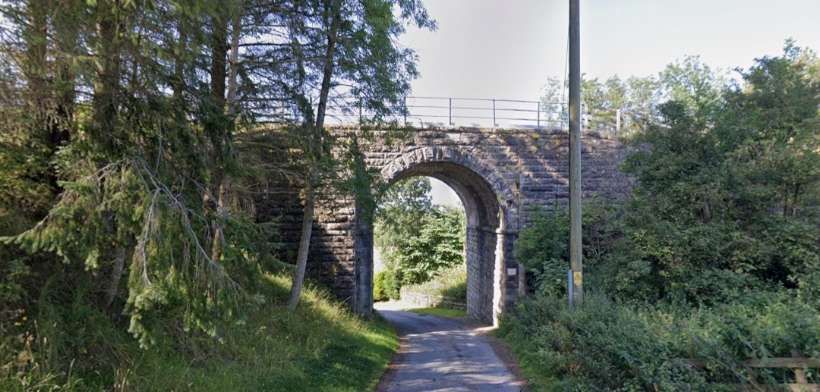
Looking Northeast along the next minor road to be bridged by the line. [Google Streetview, 2022]
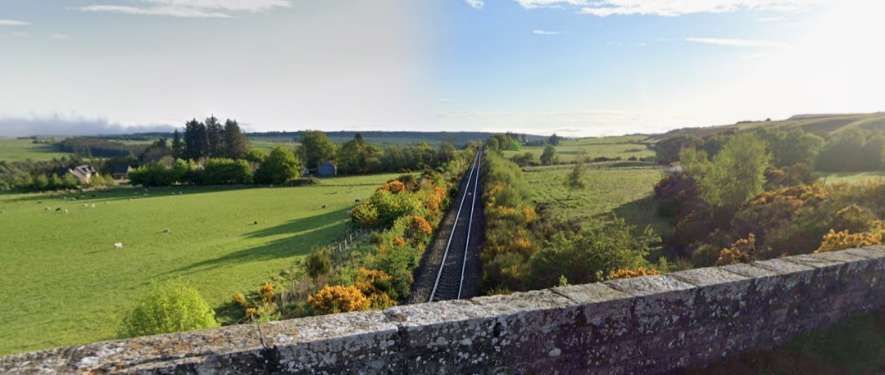
Looking back towards Culloden from a bridge carrying the National Cycle Route No. 7 over the line. [Google Streetview, 2022]
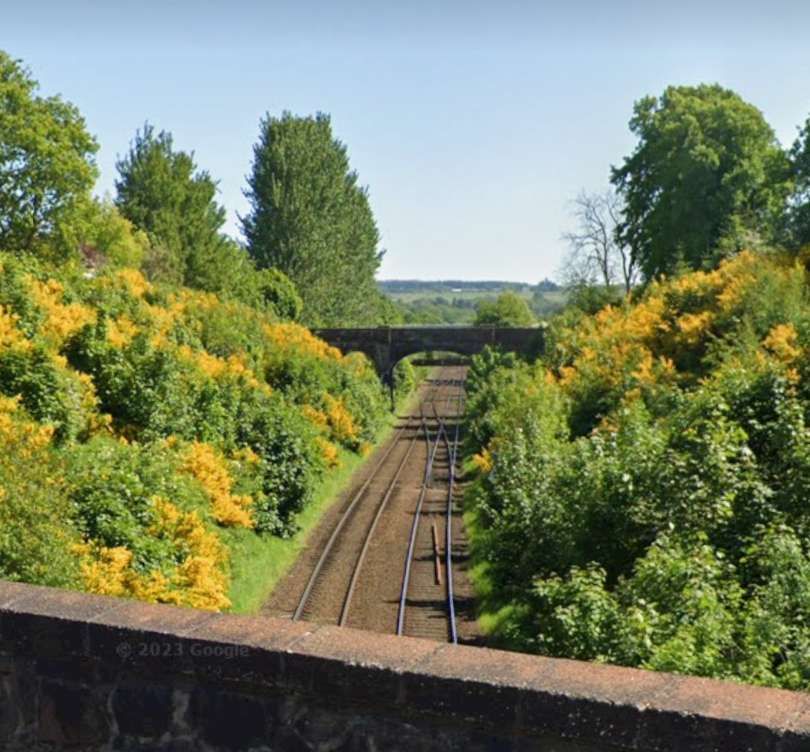
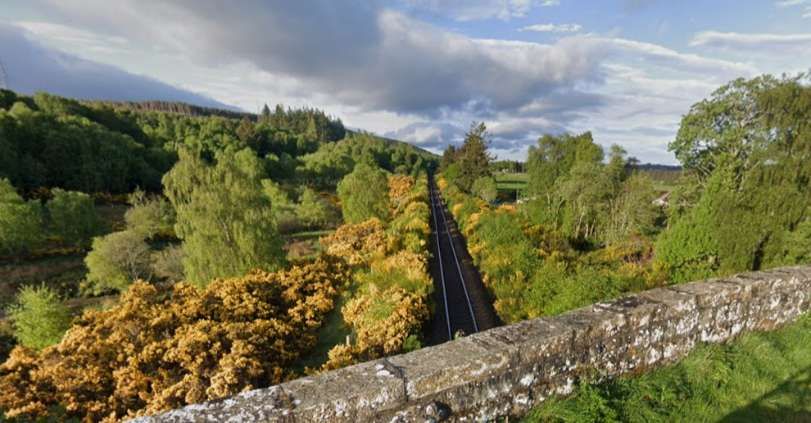
Turning through 180° and looking forward along the line towards Daviot Railway Station with the gorse in full bloom. [Google Streetview, 2022]

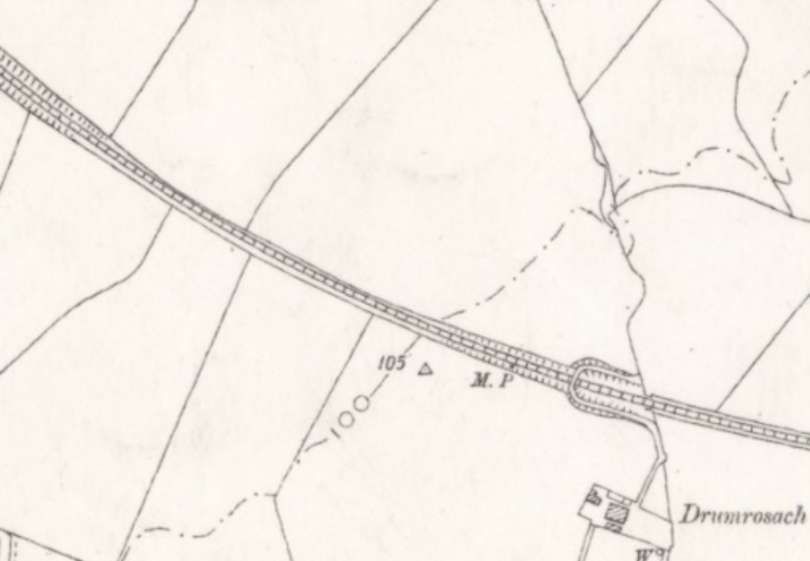
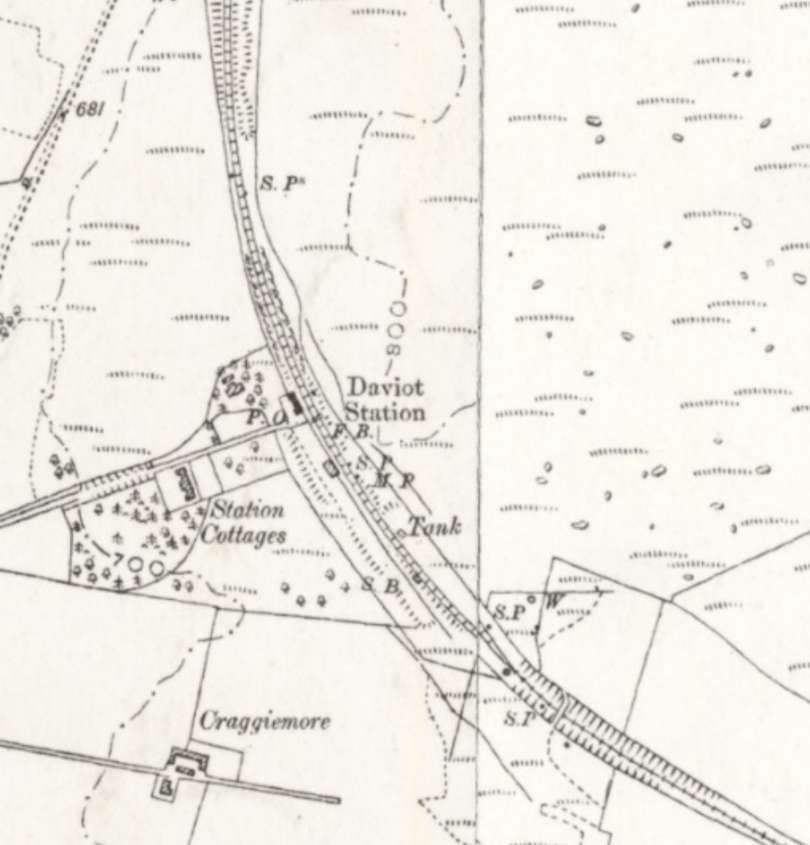
Daviot Railway Station at the turn of the 20th century. The double -track line from Inverness became a single line to the Southeast of Daviot. [28]
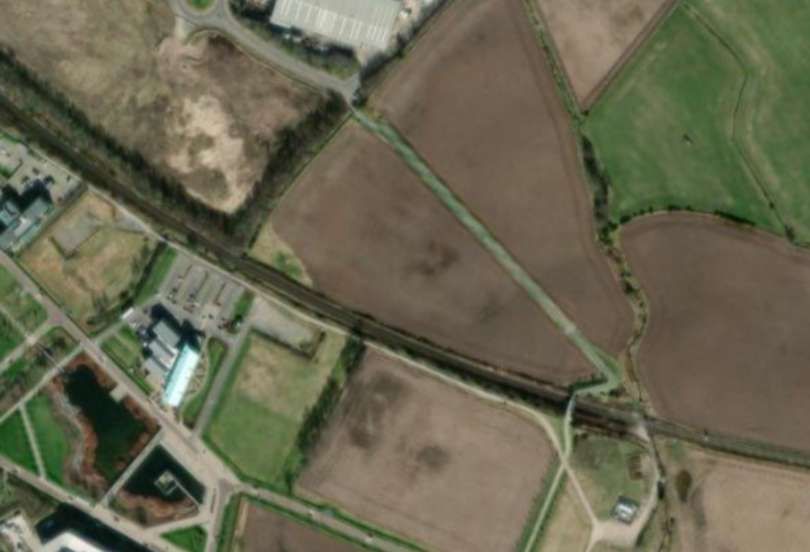
The same location in the 21st century. [28]

Daviot Railway Station opened on 19th July 1897.Ot was, for a short time the Northern terminus of the line from Aviemore until Culloden Moor Railway Station opened in 1898. Wikipedia tells us that, “on the northbound platform was the station building and to the southwest was the goods yard. There were two signal boxes: one to the north which was built, but never opened. The other signal box was to the south in between the goods sidings. It was relocated slightly to the north in 1952. The station closed on 3rd May 1965. The signal box closed in 1969. Only the platforms remain.” [29]

Ernie’s Railway Archive has an excellent photograph of the station which can be viewed here. [30]
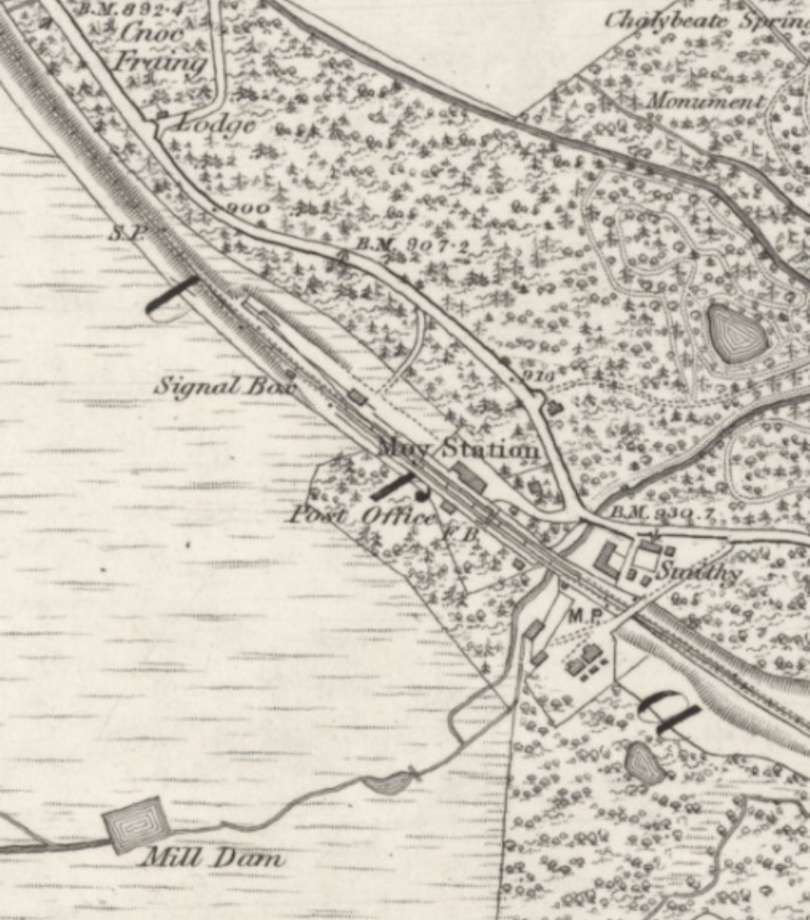
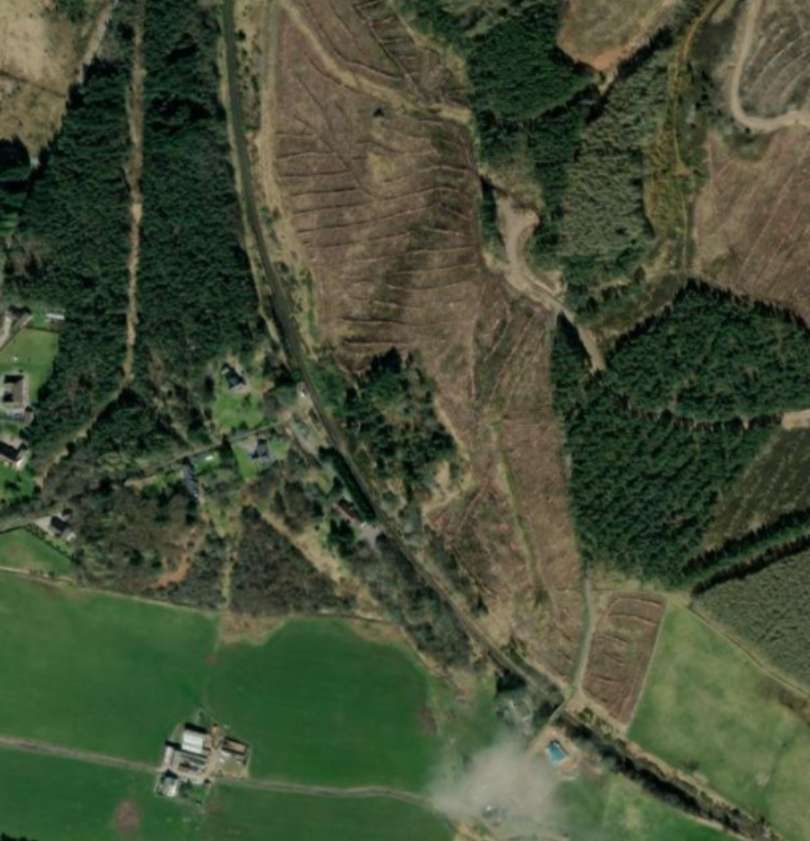
Moy Railway Station was further to the Southeast and is shown here in an extract from the 6″ Ordnance Survey from the turn of the 20th century. [31]
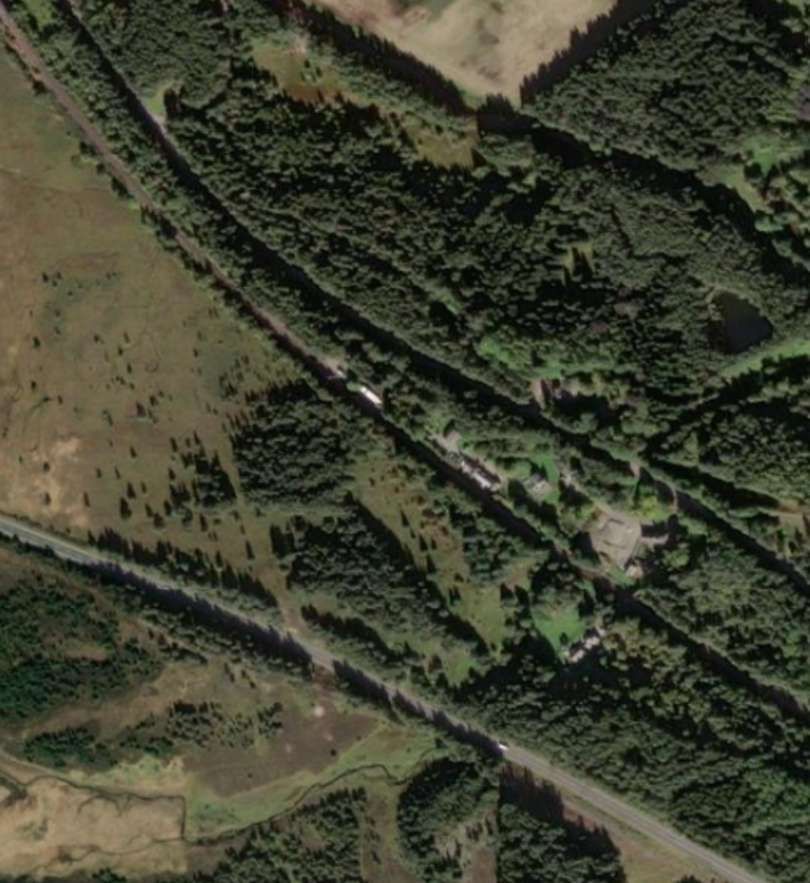
A satellite image of the same area in the 21st century. The A9 is the most significant change visible (running diagonally across the bottom third of the image). [31]

Wikipedia tells that Moy Railway Station opened on 19th July 1897. “The station building was situated on the southbound platform. Goods facilities were handled at the northeast. There were two signal boxes: north and east. Despite their names, they were both situated to the west. The station closed to both passengers and goods traffic on 3rd May 1965.” [32] The station building at Moy was of a very similar design to that at Culloden Moor and Daloit.

AmBaile has a monochrome image of the station at Moy. This image can be seen here. [34]

The modern A9 crosses the line of the railway to the East of Moy. The next two images are taken from the A9 road bridge.
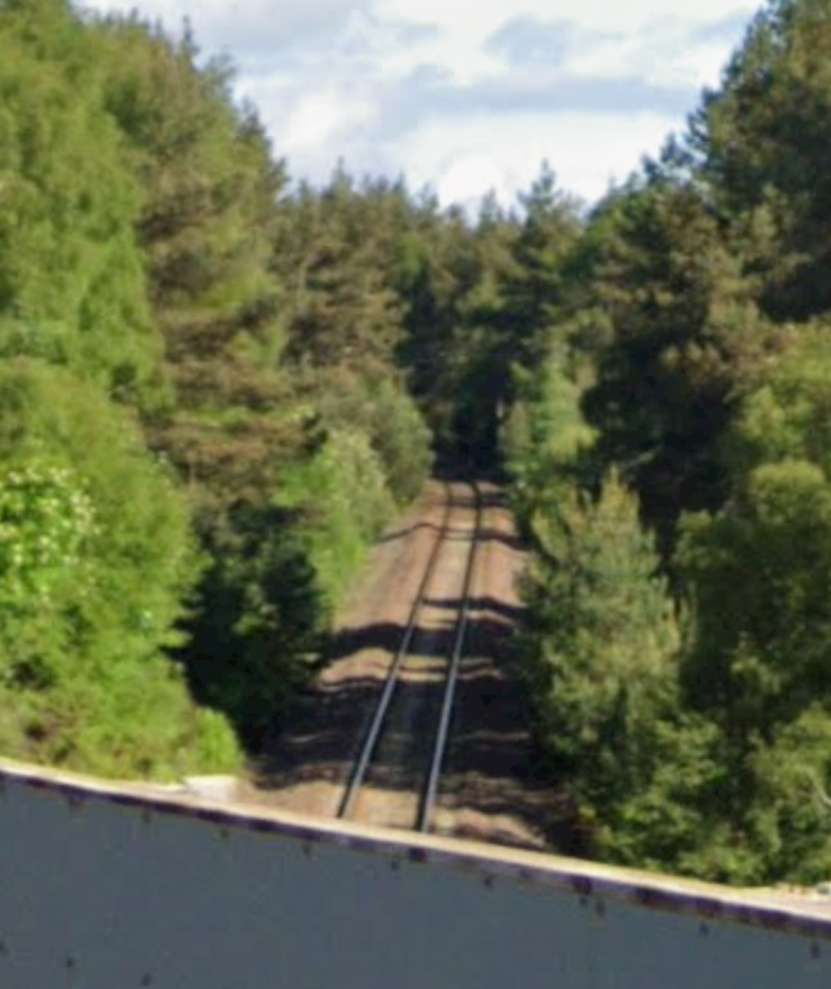
Looking back along the railway from the A9 overbridge towards Moy. [Google Streetview, June 2022]
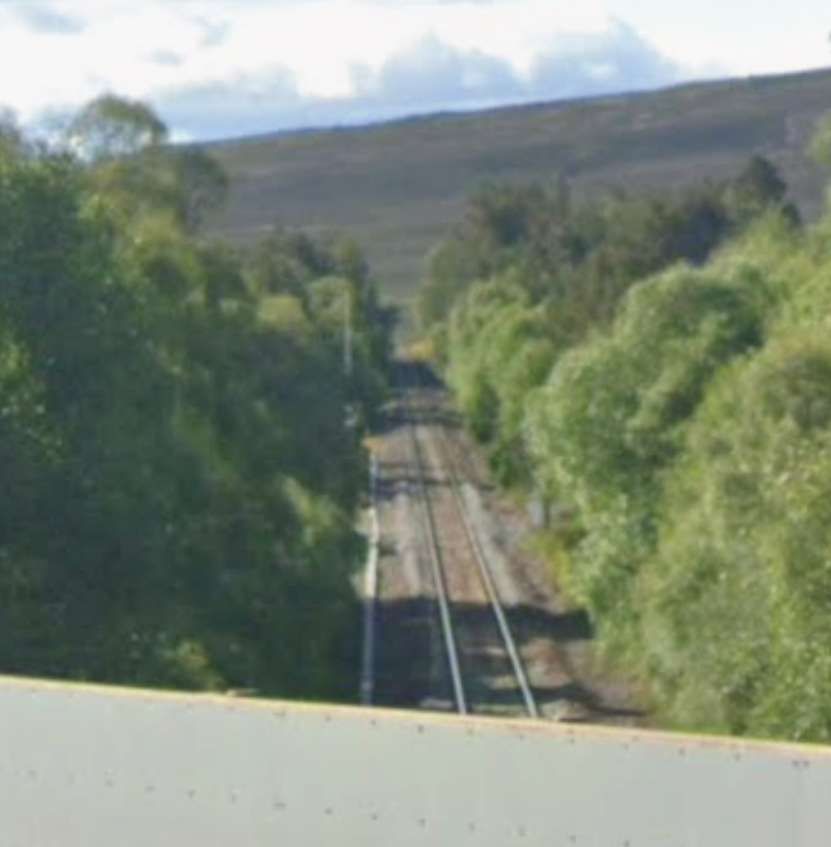
Looking forward towards Tomatin from the A9 overbridge. [Google Streetview, June 2022]

Further Southeast we teach Tomatin Railway Station. …
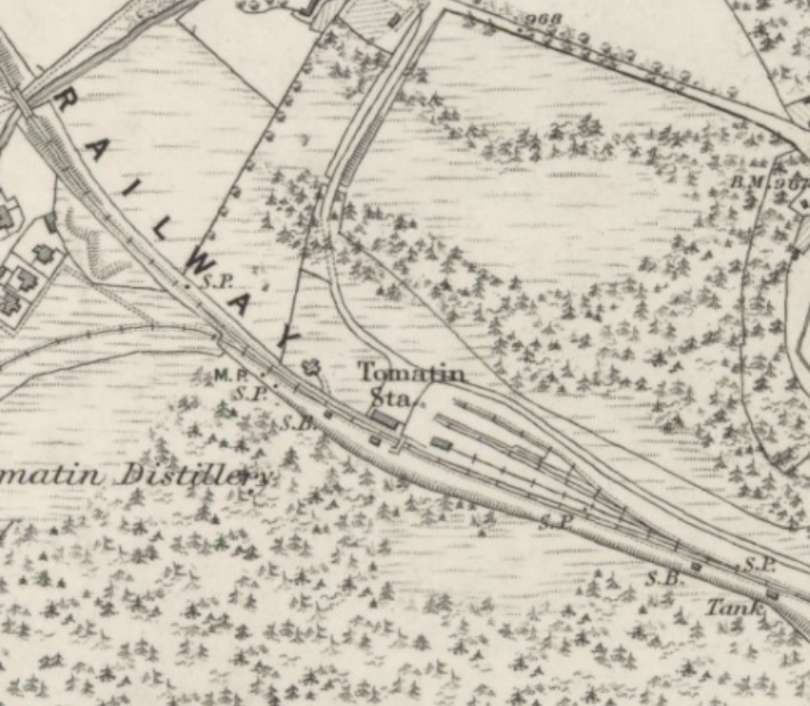
The next station along the line was Tomatin Railway Station. [33]
The same area in the 21st century. [33]

AmBaile has a few photographs of Tomatin station. These can be seen here, [35] here, [36] and here. [37]

Findhorn Viaduct is around 500 metres East of Tomatin village. …
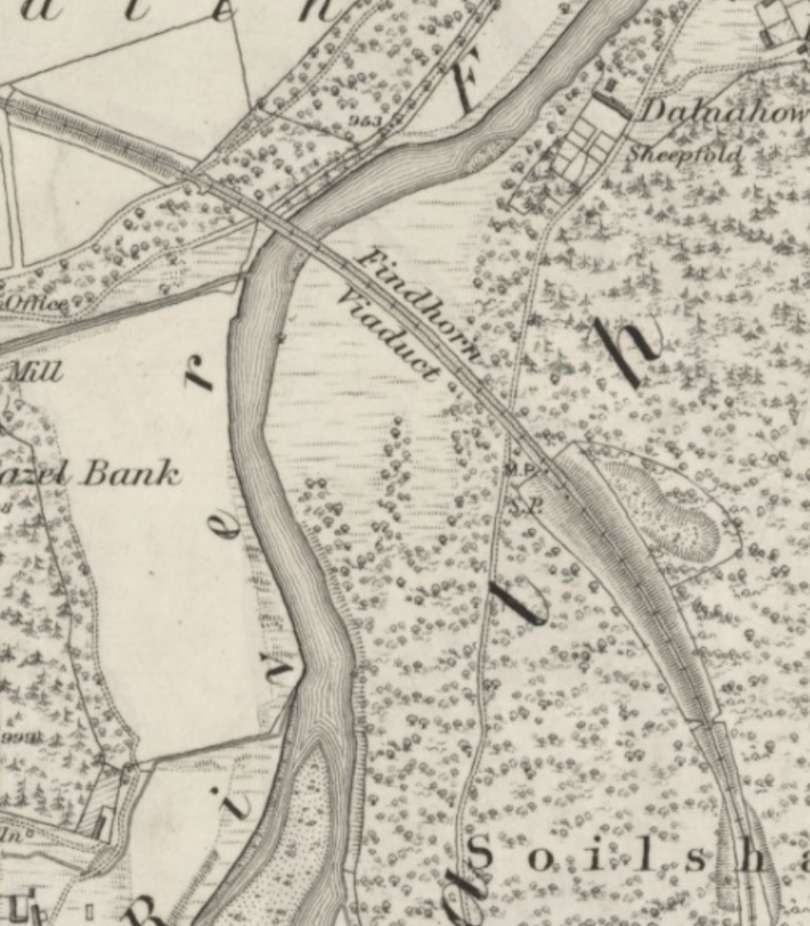
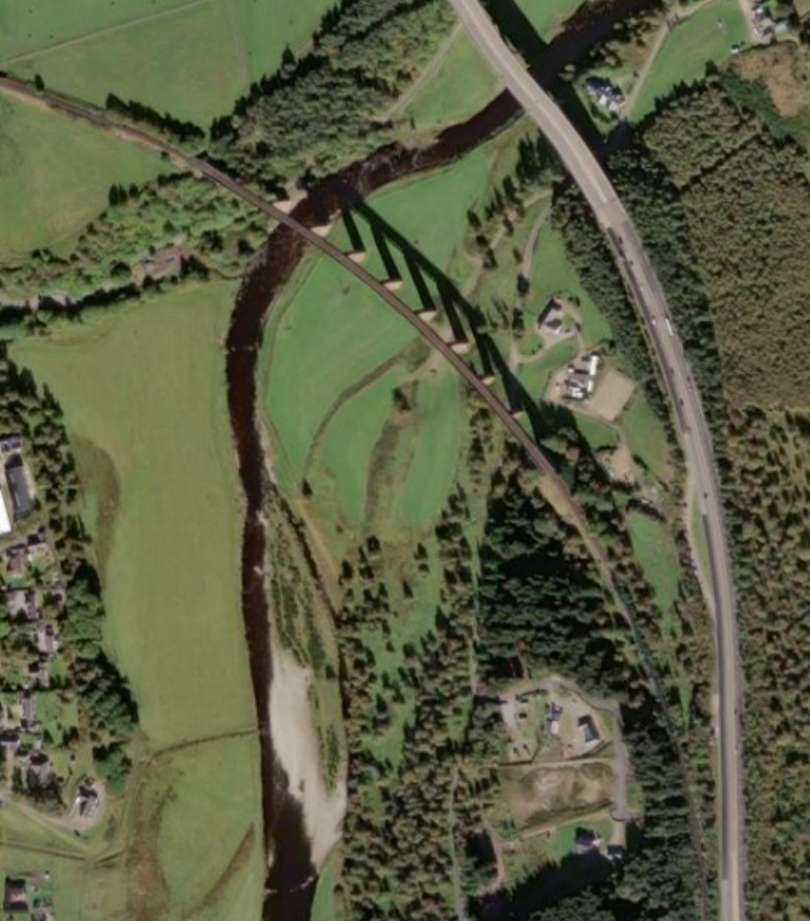
The next significant location on the line is the Findhorn Viaduct which is approximately 500 metres East of the village of Tomatin and carries the line over the valley of the River Findhorn. [38]
The same area as shown on the ESRI satellite imagery from the NLS. [38]

The Findhorn Viaduct was designed and built for the Highland Railway between 1894 and 1897 by Murdoch Paterson, their chief engineer, and John Fowler, who was the consulting engineer and who also worked on the design of the Forth Rail Bridge. The viaduct was Fowler’s suggestion in order to create a more direct route; the railway company had originally planned a more circuitous route around the valley, over a mile longer. The steel for the lattice work was supplied by the Butterley Iron Company in Derbyshire, England. The granite for the piers was supplied by Kemnay Quarry in Kemnay, Aberdeenshire, which also supplied materials for the Forth Bridge. … It was opened to traffic on 19 July 1897. The viaduct is a Category B listed building, first listed in 1971, a status which grants it legal protection.” [39]
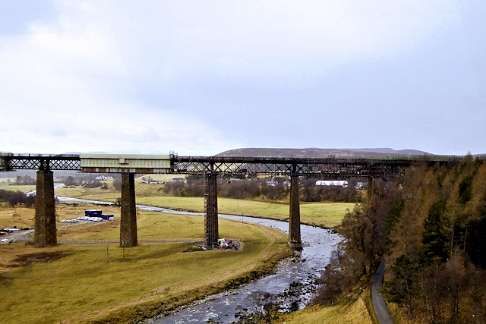
Findhorn Viaduct which was opened in 1897 by the Highland Railway, is a 407 metre-long, nine-span structure with steel trusses supported on slender masonry piers. This photograph was taken from the road bridge on the A9 which sits to the Northeast of the railway viaduct, © David Dixon and licenced for reuse under a Creative Commons Licence (CC BY-SA 2.0). [40]

The highest point on the line between Inverness and Aviemore is at Slochd. The Slochd Summit “is a mountain pass on the A9 road and the Highland Main Line Railway. It is the highest point on the line between Inverness and Aviemore. An old military road and National Cycle Network Route No. 7 also go over the summit, the latter largely following the old A9. … Both the road and the railway have signs marking the spot – the A9 is at a height of 1,328 feet (405 m), while the railway reaches 1,315 feet (401 m). The Slochd Summit is the second highest place on the route from Inverness to Perth – the Pass of Drumochter at 1,500 feet (460 m) is higher and bleaker.” [41]
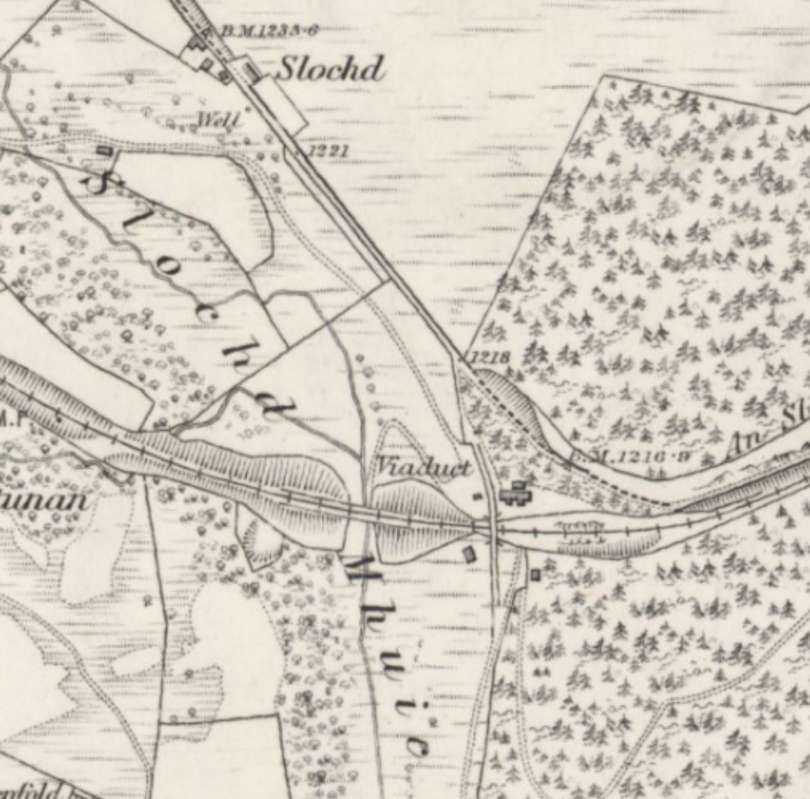
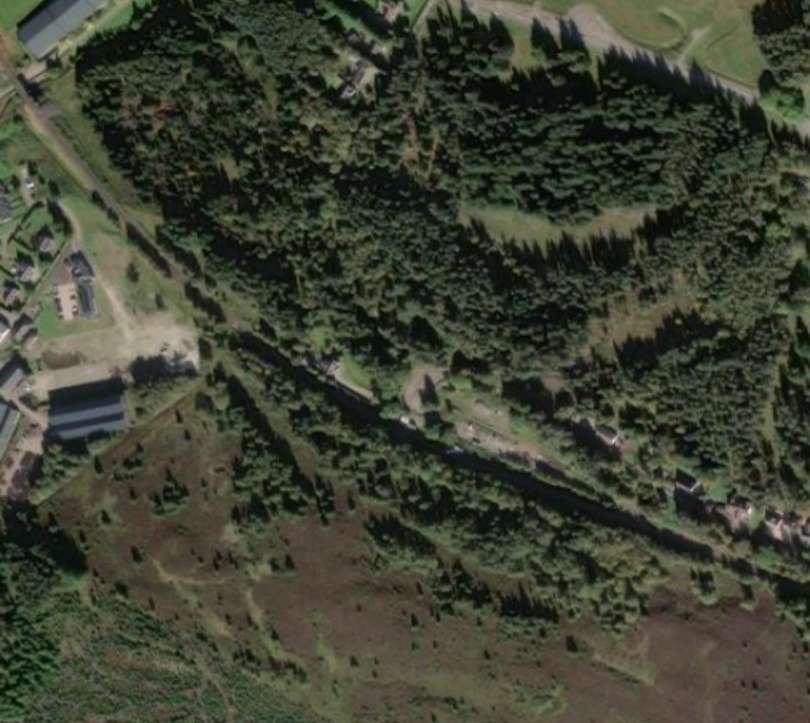
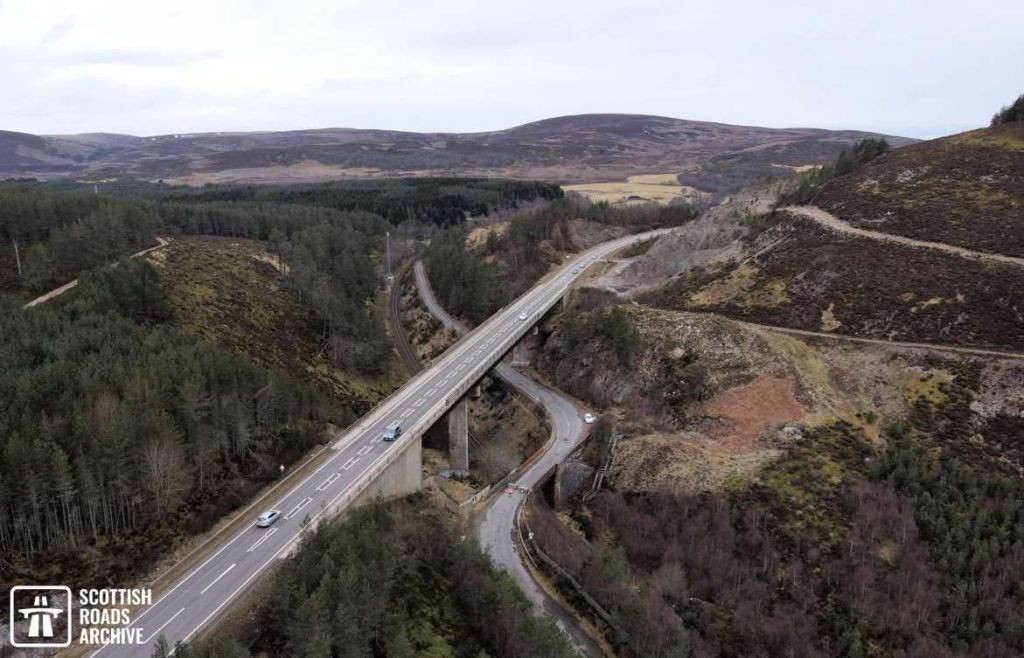
Close to Slochd the railway crosses the Allt Slochd Music on a high viaduct. [42]
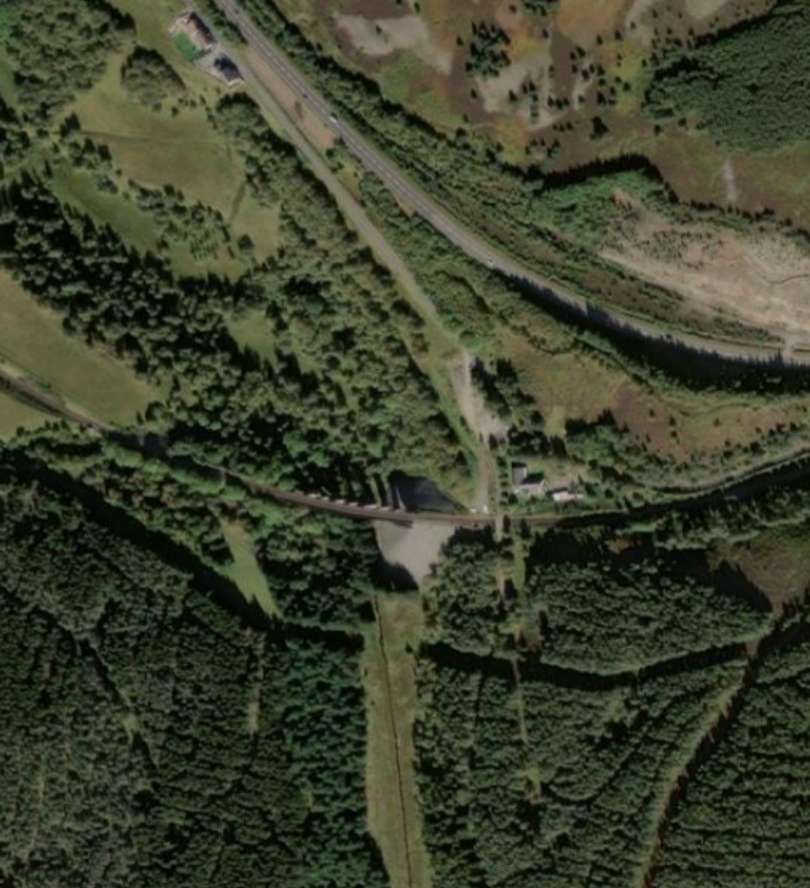
The same area in the 21st century. [42]
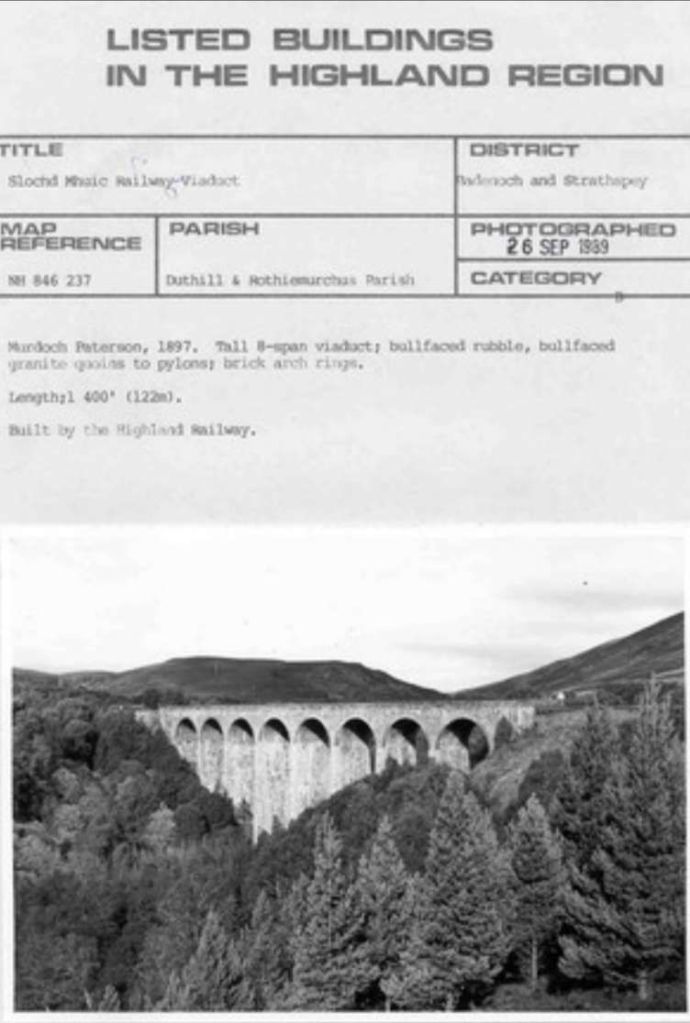
The listed building record for the Allt Slochd Music Viaduct. [43]

A very short distance to the East of Slochd, the old A9 (now National Cycle Route No. 7 crosses the old railway. …
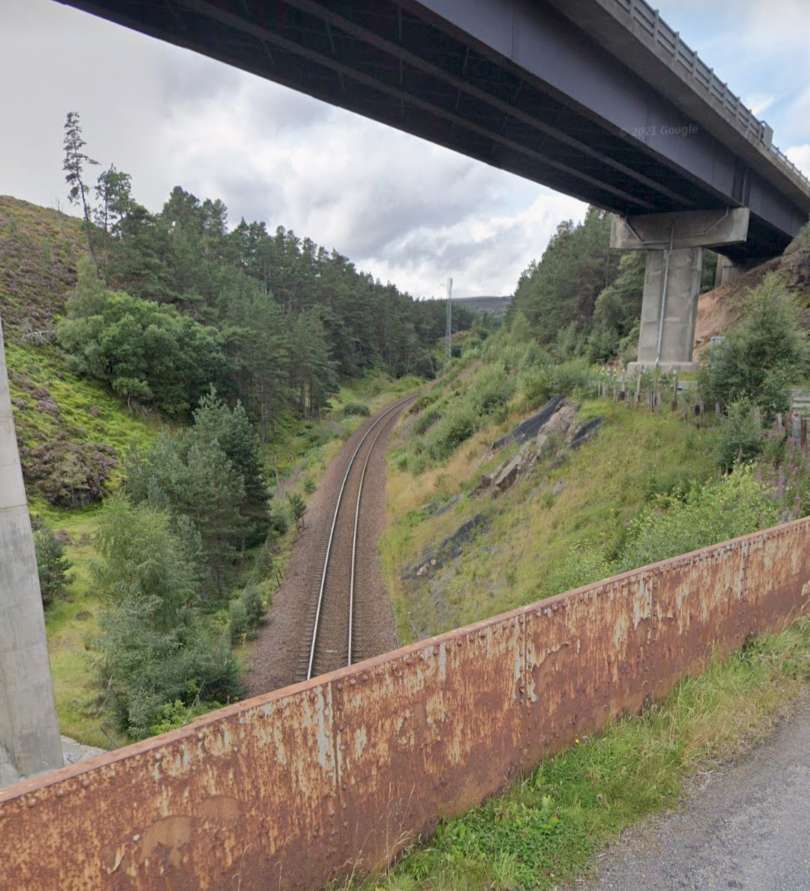
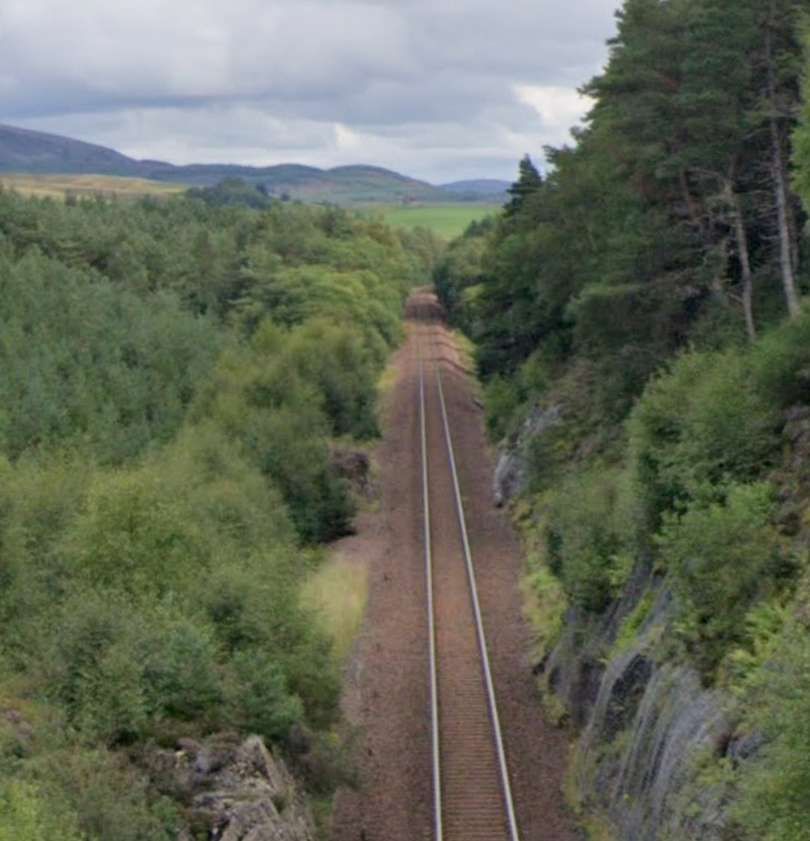
This photograph is taken from the old A9 road bridge and looks back along the railway towards Slochd. The modern A9 flyover sits above both the old road and the railway. [Google Streetview, June 2022]
Looking ahead to the Northeast and Carrbridge from the old A9 bridge. [Google Streetview, June 2022]
Bird’s eye view of the railway and old and new A9s at the same location. This image was shared on the Carr-bridge Past and Present Facebook Group by James Ross on 11th June 2024. [52]

East of the old A9 the railway curves round from a Northeasterly direction to a Southeasterly one. It runs down the valley of the Bogbain Burn crossing the stream a number of times on its descent. The modern A9 runs a little to the South of the railway. The Bogbain Burn joins the Allt nan Ceatharnuch and flows to the North of the railway before crossing under both the railway and the modern A9. It then flows into the River Dulnan to the West of the A9 and the railway.

The River Dulnan flows under the A9 and the railway and then flows down through Carrbridge. The railway station sits about 1.5 km Southwest of the village close to the river. It remains open in the 21st century.

An historical photograph of the railway bridge over the river can be seen here. [53]
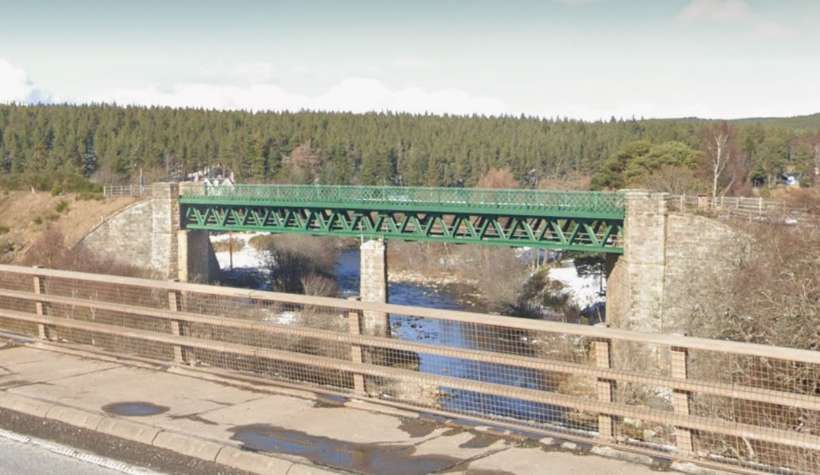
The River Dulnan Railway Bridge, seen from the A9 to the South. [Google Streetview, 2023]
Carrbridge Railway Station at the turn of the 20th century. The Dulnan River features in the top-left of the image. [44]
The same area in the 21st century. The modern A9 runs parallel to the railway rather than through Carrbridge. [44]

Carrbridge Railway Station was opened on 8th July 1892 when the Highland Railway opened the line from Aviemore. For five years Carrbridge was the terminus of the line from Aviemore.

Northbound services commenced on 8th July 1897 when the line to Daviot was opened, the line through to Inverness opened on 1st November 1898. … The station was built with a passing loop on the otherwise single track railway, a signal box (automatic token-exchange apparatus was used) and several sidings on the north side of the line. The station building is thought to be by the architect William Roberts, dating from 1898. A camping coach was positioned here by the Scottish Region from 1954 to 1965. [46]
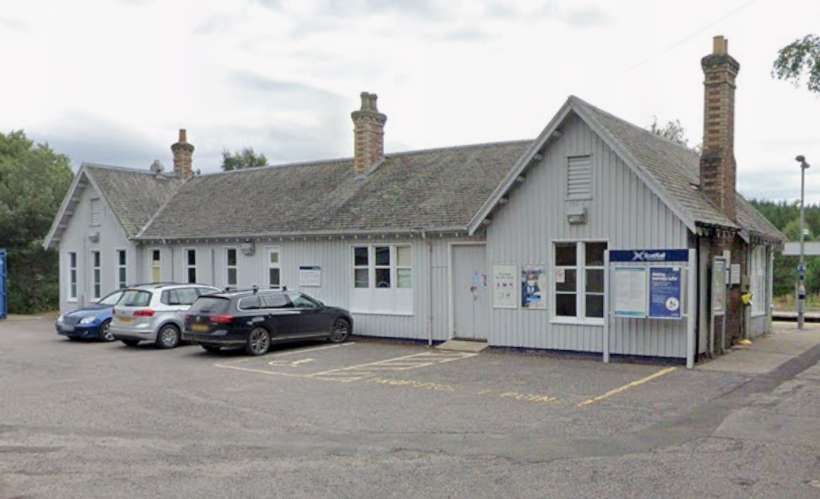
Carrbridge Railway Station forecourt seen from the North. [Google Streetview, 2022]
Carrbridge Railway Station as seen facing Northwest from the station footbridge in September 2015, © Rosser1954 and licenced for reuse under a Creative Commons Licence (CC BY-SA 4.0). [45]

Some photographs of steam at Carrbridge Station can be seen on the Carrbridge Past & Present Facebook Group. [51]

Southeast of Carrbridge Railway Station, the line curves through a heavily wooded landscape towards the South. It continues to be closely followed by the modern A9.
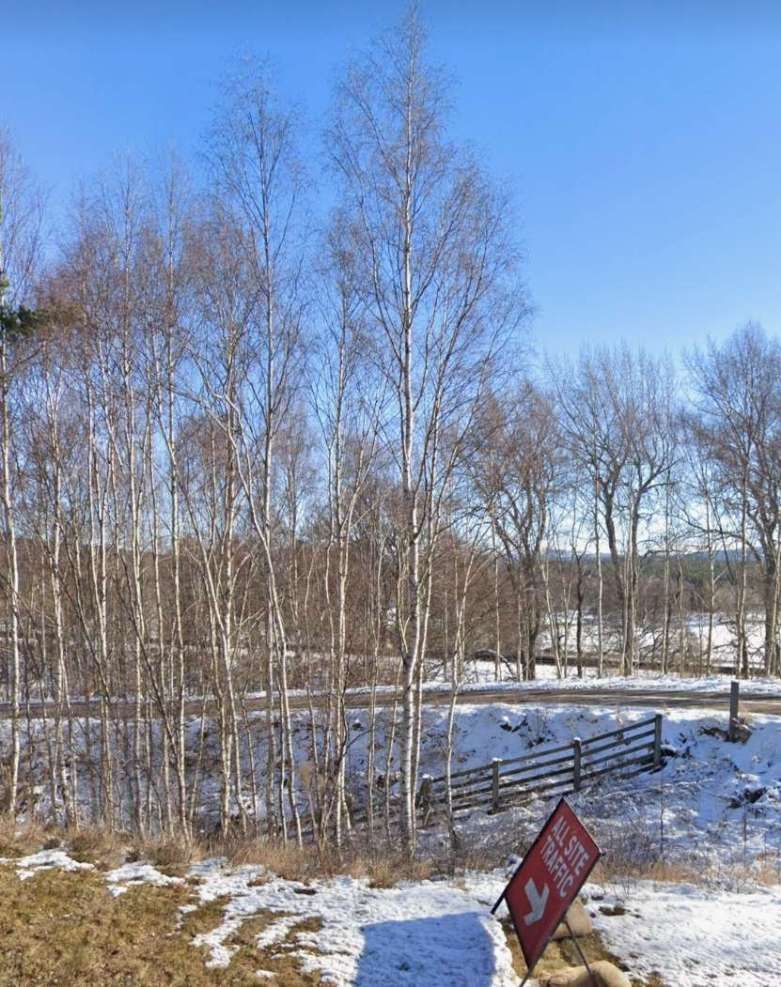
This wintery scene was recorded in March 2023 looking Northeast from the A9. The lack of foliage means that the railway can be seen close to the road. The location is the Knock of Kinveachy. The old A9 is still in use beyond the road as the B9153 and then the A95. [Google Streetview, March 2023]

The A9 begins to turn away from the railway to the South of Kinveachy. The A95 passes under the railway as it heads South, along the route of the old A9.. A new skew bridge carries the railway over the road in the 21st century.
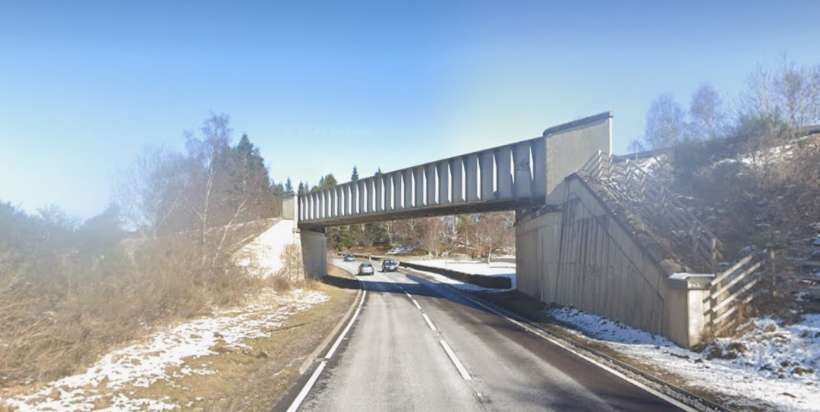
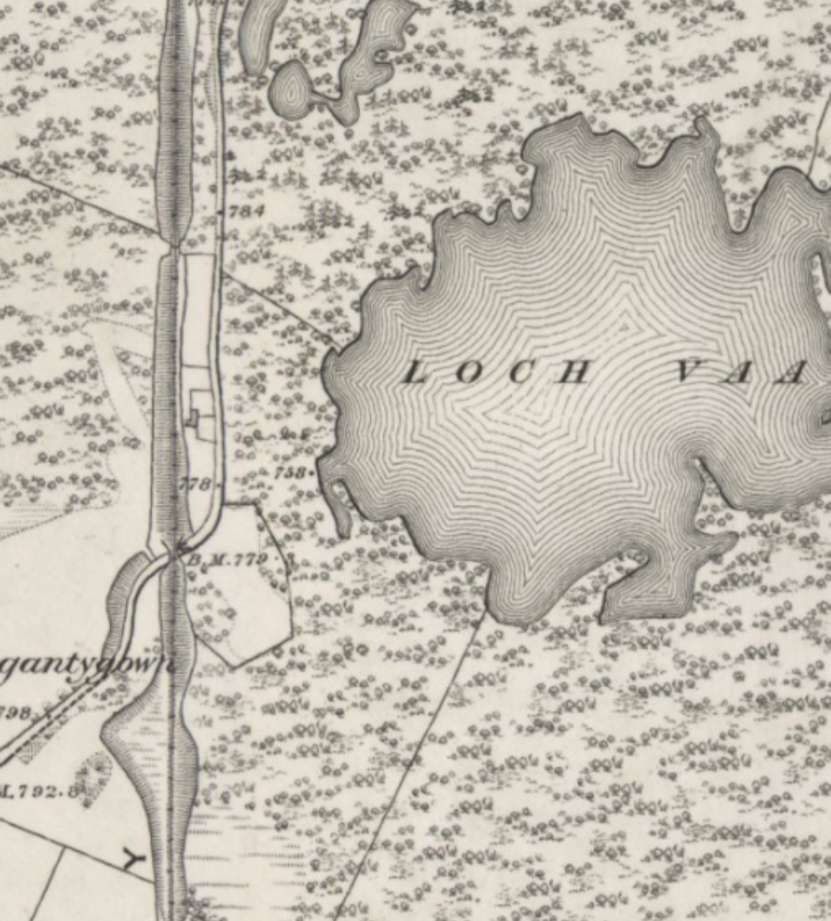
This view looks Northeast along the A95 under the railway bridge. [Google Streetview, March 2023]
The location of the old railway bridge over the A9, (the A95 in the 21st century). [47]
The same location in the 21st century: the new A9 can be seen in the top-left corner of this satellite image. The A95 (the old A9] can be seen to the right of the railway at the top of the image,then passing under the railway before leaving the image bottom-left. [47]

The railway heads due South towards Aviemore, before drifting towards the West … Three small lochans were in the path of the railway. …
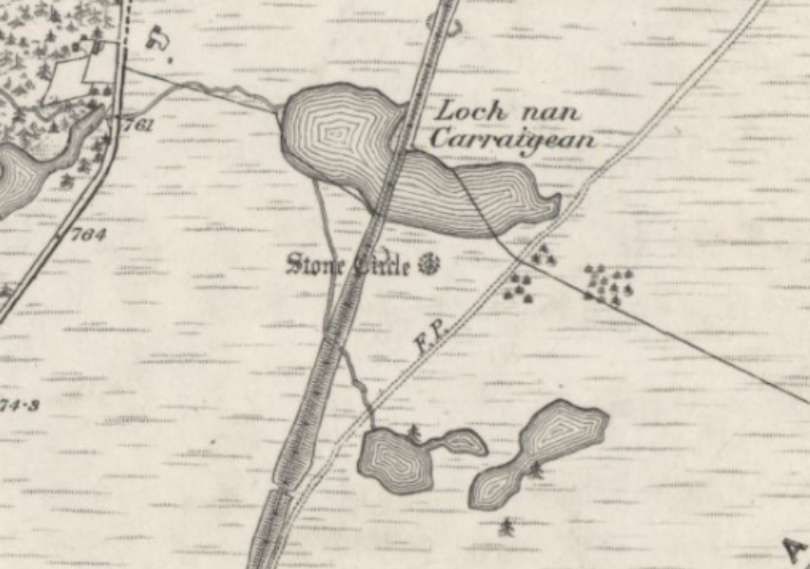
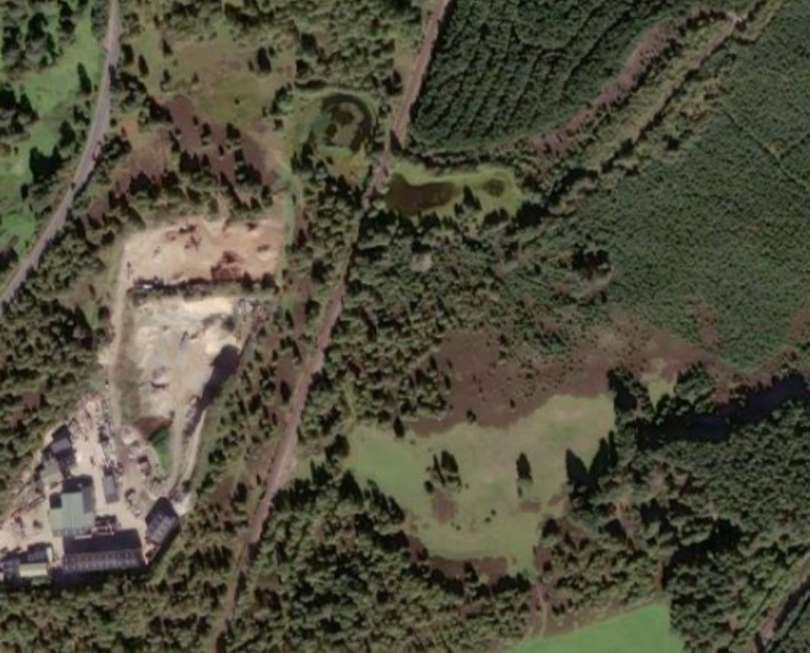
Now on the final run down to Aviemore. The old A9 can be seen on the left of this extract from the 6″ Ordnance Survey from the turn of the 20th century. The railway crosses the small Loch nan Carraigean.[48]
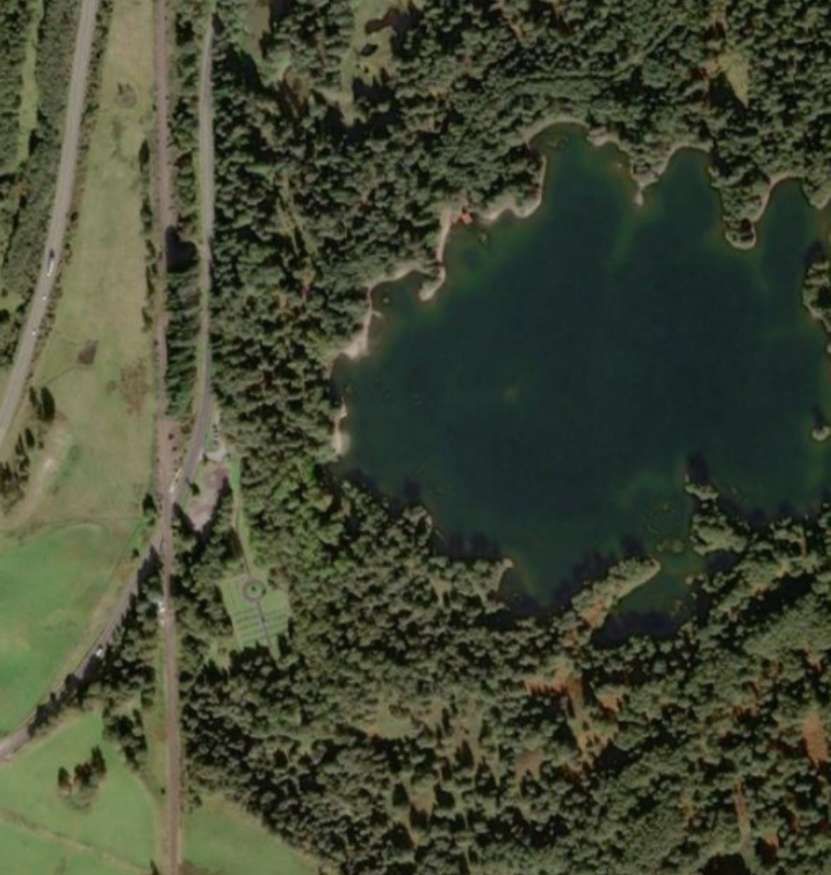
This modern image shows that by the 21st century the lochans have almost completely disappeared. Just a small pool remains at the location of Loch nan Carraigean. A quarry has been opened up between the railway and what is now the A95. [48]
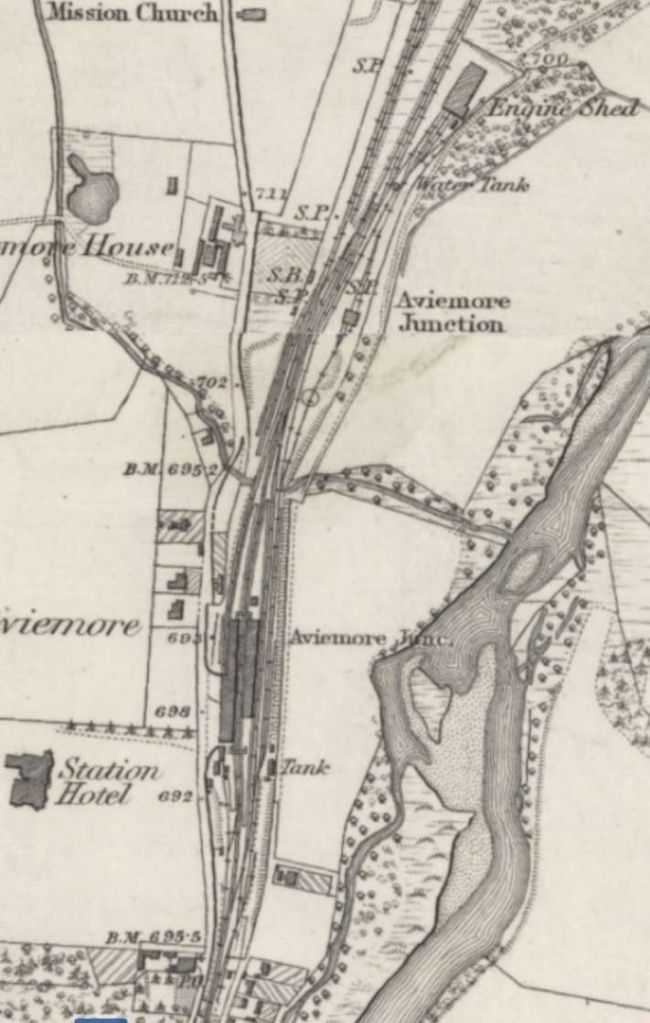
Aviemore Railway Station at the turn of the 20th century. The River is the River Spey. There was very little to Aviemore at the turn of the 20th century – the Station and Hotel and a few private dwellings. [49]
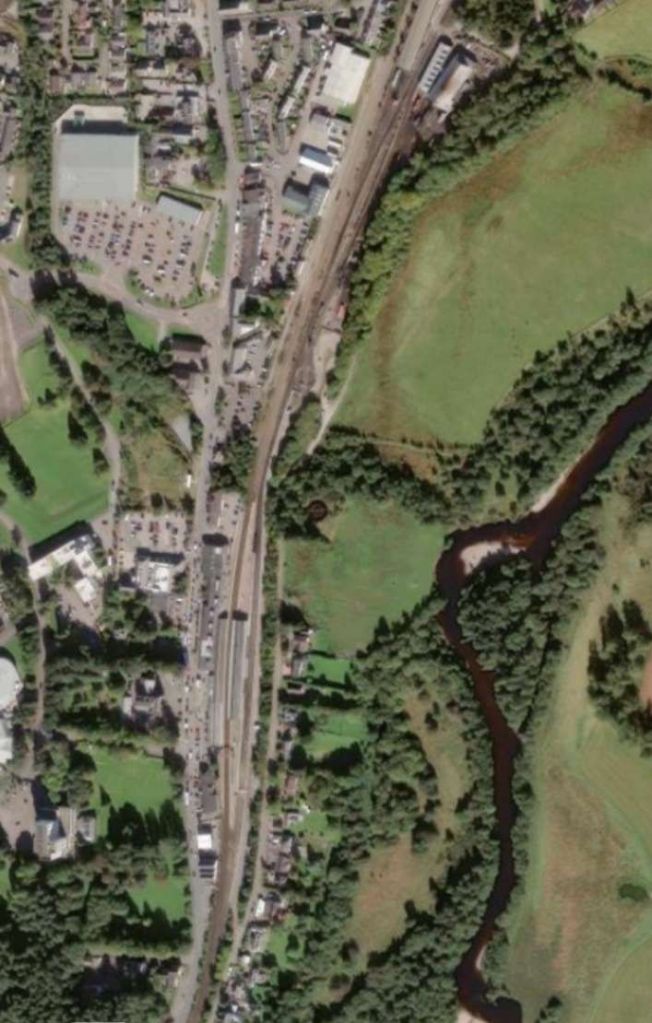
This 21st century satellite image of the same area shows a considerable amount of development to the North of the Railway Station. [49]
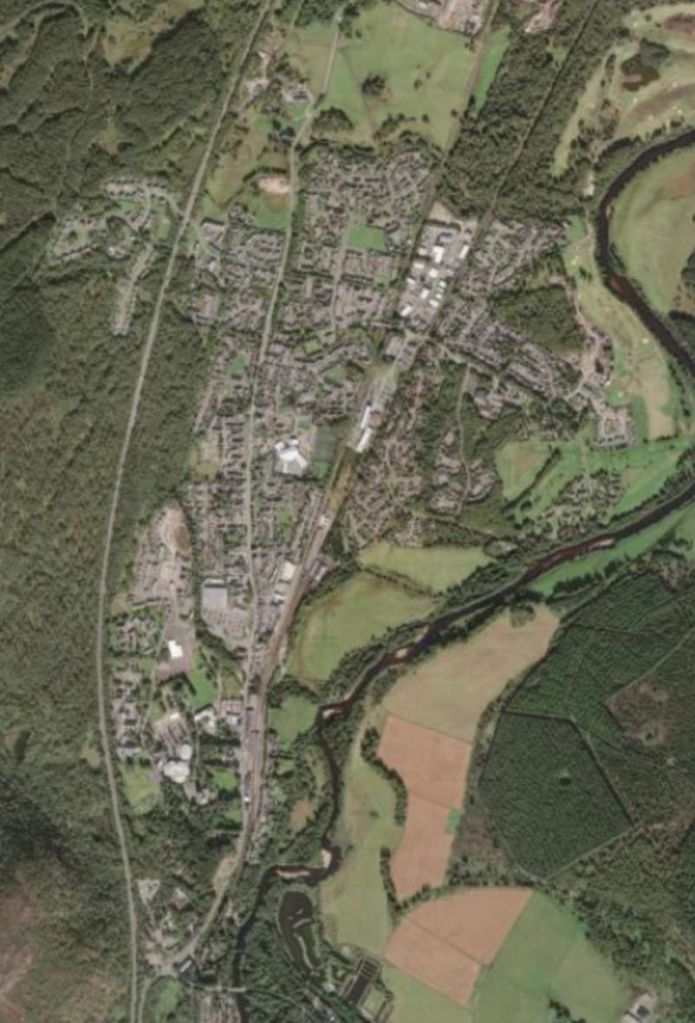
This wider view shows just how significant the development over 125 years has been. The modern A9 can be seen on the left of this image. [49]

In the 21st century the journey between Inverness and Aviemore takes less than 45 minutes. The older main line through Forres was abandoned as part of the cuts which followed the Beeching Report in the mid-1960s. As we noted when looking at the route via Forres and Dava, a preservation railway is active at the southern end of that line and shares Aviemore Railway Station with ScotRail. The line is followed by walkers and cyclists on The Dava Way. [50]

An article about the Gorres/Dava route can be found here. [8]

References

  1. https://en.m.wikipedia.org/wiki/Inverness_and_Aviemore_Direct_Railway, accessed on 28th June 2025.
  2. Neil T Sinclair; The Highland Main Line; Atlantic Publishers, Penryn, 1998.
  3. David Ross, The Highland Railway, Tempus Publishing Limited, Stroud, 2005.
  4. H. A. Vallance; The Highland Railway (2nd. Ed.); David & Charles, Dawlish, and Macdonald, London, 1963, (First edition published in 1938).
  5. W M Acworth; The Railways of Scotland: Their Present Position, with a Glance at their Past and a Forecast of Their Future; John Murray, London, 1890.
  6. https://www.geograph.org.uk/photo/2504196, accessed on 28th June 2025.
  7. https://rogerfarnworth.com/2025/05/01/the-highland-railway-part-1/
  8. https://rogerfarnworth.com/2025/06/28/the-highland-railway-part-2/
  9. https://rogerfarnworth.com/2025/03/23/the-highland-railways-strathpeffer-branch/
  10. https://rogerfarnworth.com/2025/04/01/the-highland-railways-fortrose-or-black-isle-branch/
  11. https://rogerfarnworth.com/2025/05/03/the-highland-railways-fort-george-branch/
  12. https://maps.nls.uk/geo/explore/#zoom=16.0&lat=57.48184&lon=-4.22119&layers=6&b=ESRIWorld&o=100, accessed on 28th June 2025.
  13. https://maps.nls.uk/geo/explore/#zoom=16.0&lat=57.48289&lon=-4.21033&layers=6&b=ESRIWorld&o=100, accessed on 29th June 2025.
  14. https://maps.nls.uk/geo/explore/#zoom=15.6&lat=57.48347&lon=-4.19911&layers=6&b=ESRIWorld&o=100, accessed on 29th June 2025.
  15. https://maps.nls.uk/geo/explore/#zoom=15.6&lat=57.47913&lon=-4.17733&layers=6&b=ESRIWorld&o=100, accessed on 29th June 2025.
  16. https://maps.nls.uk/geo/explore/#zoom=15.6&lat=5l7.47702&lon=-4.16526&layers=6&b=ESRIWorld&o=100, accessed on 29th June 2025.
  17. https://maps.nls.uk/geo/explore/#zoom=15.6&lat=57.47693&lon=-4.15517&layers=6&b=ESRIWorld&o=100, accessed on 29th June 2025.
  18. https://maps.nls.uk/geo/explore/#zoom=15.6&lat=57.48195&lon=-4.18791&layers=6&b=ESRIWorld&o=100, accessed on 29th June 2025.
  19. https://maps.nls.uk/geo/explore/#zoom=15.6&lat=57.48344&lon=-4.06605&layers=6&b=ESRIWorld&o=100, accessed on 29th June 2025.
  20. https://www.geograph.org.uk/photo/3345327, accessed on 28th June 2025.
  21. https://www.geograph.org.uk/photo/3092339, accessed on 28th June 2025.
  22. https://www.railscot.co.uk/locations/C/Culloden_Moor, accessed on 30th June 2025.
  23. https://maps.nls.uk/geo/explore/#zoom=16.8&lat=57.48473&lon=-4.06669&layers=168&b=ESRIWorld&o=100, accessed on 30th June 2025.
  24. https://www.facebook.com/share/p/16RLR3Py59, accessed on 30th June 2025.
  25. https://www.ambaile.org.uk/asset/27041, accessed on 30th June 2025.
  26. https://maps.nls.uk/geo/explore/#zoom=15.6&lat=57.47810&lon=-4.06291&layers=6&b=ESRIWorld&o=100, accessed on 30th June 2025.
  27. https://www.visitinvernesslochness.com/listings/culloden-viaduct, accessed on 30th June 2025.
  28. https://maps.nls.uk/geo/explore/#zoom=15.6&lat=57.43252&lon=-4.10570&layers=6&b=ESRIWorld&o=100, accessed on 30th June 2025.
  29. https://en.m.wikipedia.org/wiki/Daviot_railway_station, accessed on 30th June 2025.
  30. https://www.flickr.com/photos/irishswissernie/27794831248, accessed on 30th June 2025.
  31. https://maps.nls.uk/geo/explore/#zoom=15.6&lat=57.38462&lon=-4.05668&layers=6&b=ESRIWorld&o=100, accessed on 30th June 2025.
  32. https://en.m.wikipedia.org/wiki/Moy_railway_station, accessed on 30th June 2025.
  33. https://maps.nls.uk/geo/explore/#zoom=15.6&lat=57.34370&lon=-4.00545&layers=6&b=ESRIWorld&o=100, accessed on 30th June 2025
  34. https://www.ambaile.org.uk/asset/27752, accessed on 30th June 2025.
  35. https://www.ambaile.org.uk/asset/28019, accessed on 30th June 2025.
  36. https://www.ambaile.org.uk/asset/28013, accessed on 30th June 2025.
  37. https://www.ambaile.org.uk/asset/28005, accessed on 30th June 2025.
  38. https://maps.nls.uk/geo/explore/#zoom=15.0&lat=57.33467&lon=-3.98418&layers=6&b=ESRIWorld&o=100, 30th June 2025.
  39. https://en.m.wikipedia.org/wiki/Findhorn_Viaduct_(Tomatin), accessed on 30th June 2025.
  40. https://www.geograph.org.uk/photo/5358534, accessed on 30th June 2025.
  41. https://en.m.wikipedia.org/wiki/Slochd_Summit, accessed on 30th June 2025.
  42. https://maps.nls.uk/geo/explore/#zoom=16.0&lat=57.29157&lon=-3.91728&layers=6&b=ESRIWorld&o=100, accessed on 30th June 2025.
  43. https://www.google.com/search?client=ms-android-motorola-rvo3&sca_esv=bec2fea0dbf0b6aa&sxsrf=AE3TifOz4h8t7Z-vFtcwUUMXFezZeqPmNA:1751311886771&udm=2&fbs=AIIjpHyqq7TquKTaG7yVdtxZ2GNmhBe0Q_JZIxG_Tc7OaN4aXNPzFKPxIlJ3AYkZGNOifgdX-pEQNjXSgwJdeelzvugdImdw-Ia9Fci-vfRQ8DKySVJapl_-feH6aEqb7iLzeTILZh2bE6PfvxY8STgqPz4flnlZrmT9VVZuhkeuCPhfvy5RNeVx1c1FJwQ2_R1wSuHfqJiycwMM2xDAGJ1JxGCkz5mlTLw9v42z3Fs-1GTLsp33I8A&q=allt+slochd+mhuic+viaduct&sa=X&ved=2ahUKEwiSp5uX8ZmOAxX2ZkEAHXD6NwoQtKgLegQIDBAB&biw=508&bih=970&dpr=2.13#sv=CAMSgwUa4wQKlQIKuQEStgEKd0FMa3RfdkhPdHJWZEFIQkFLalFaT3c3X1FiMmJ4ekZOTndNNnBkbllpdzk0WnE1TmtQeXFCdnZncVlCQy1US2FvSGp0SkVQdXlicFVIbWJYNjMzd1Q2ZVdFR3VQc0ZKQXI5Q1Blcy15RUZMSVY3OTU3YmktdlhvEhdGdVppYU5IRUd2M05oYklQaEk2dXFBTRoiQUZNQUdHcUhmdmhjR1NZZHI4aVNzM1RicHg3czlDYUtwdxIDODQ5GgEzIh4KAXESGWFsbHQgc2xvY2hkIG1odWljIHZpYWR1Y3QiBwoDdGJzEgAiJgoEZXFsZBIeQ2dJSUFCQUFPZ1FJQUJBQVZSLU9NRDl0eEF2QlBnErYCCs8BEswBCowBQUxrdF92R2Q1cXkydTRtQUxsQmd0YlNlVzVEd2tablZFaDVOZ3hENk8xTklCQkVxNUt2aHlZbHJvZGdhTGhZandubmIzX3ZXSDNWUV9sTUUtT3RzckZTV1dlejdIOUFzXzd5SVhrSldJUG5hemYtcEJZaGxzS0R0cHBNTnQ3dkJHSV85VTdZbDZFeVcSF0Z1WmlhTkhFR3YzTmhiSVBoSTZ1cUFNGiJBRk1BR0dxRlhtSlc4eEd5QU1hZWYyZjh1cXVmMjVyNlZBEgQ0Njk4GgEzIhgKBmltZ2RpaRIOQk1WVFFZMEFTa2lSek0iFwoFZG9jaWQSDm5jOHFWb0pOVXVObU5NIiYKBGVxbGQSHkNnSUlBQkFBT2dRSUFCQUFWUi1PTUQ5dHhBdkJQZyoQZS1CTVZUUVkwQVNraVJ6TSAEKhcKAXMSEGUtQk1WVFFZMEFTa2lSek0YATABGAcglfr0zAUwAUAC, accessed on 30th June 2025.
  44. https://maps.nls.uk/geo/explore/#zoom=16.2&lat=57.28230&lon=-3.82902&layers=6&b=ESRIWorld&o=100, accessed on 30th June 2025.
  45. https://commons.m.wikimedia.org/wiki/File:Carrbridge_railway_station,_looking_towards_Inverness.JPG, accessed on 1st July 2025.
  46. https://en.m.wikipedia.org/wiki/Carrbridge_railway_station, accessed on 1st July 2025.
  47. https://maps.nls.uk/geo/explore/#zoom=15.8&lat=57.23529&lon=-3.80389&layers=6&b=ESRIWorld&o=96, accessed on 1st July 2025.
  48. https://maps.nls.uk/geo/explore/#zoom=16.1&lat=57.21831&lon=-3.81059&layers=6&b=ESRIWorld&o=100, accessed on 1st July 2025.
  49. https://maps.nls.uk/geo/explore/#zoom=16.0&lat=57.19099&lon=-3.82734&layers=6&b=ESRIWorld&o=100, accessed on 1st July 2025.
  50. https://davaway.org.uk, June 2025.
  51. https://www.facebook.com/share/p/16WHRJWHYz, accessed on 1st July 2025.
  52. https://www.facebook.com/share/p/1FjShBjSET, accessed on 1st July 2025.
  53. https://www.ambaile.org.uk/asset/27008, accessed on 1st July 2025.
  54. https://www.highlifehighland.com/highland-archive-centre/doors-open-day-saturday-1st-september-11-4/br-steam-locomotive-54445-with-up-permanent-way-train-passing-culloden-moor-viaduct, accessed on 1st July 2025.
  55. https://crlocomotives.livejournal.com/2566.html, accessed on 1st July 2025.
Water Troughs, Major Works, Campbeltown & Machrihanish Light Railway, Welsh Highland Railway and other snippets from The Railway Magazine, January 1934

Water Pick-Up Troughs

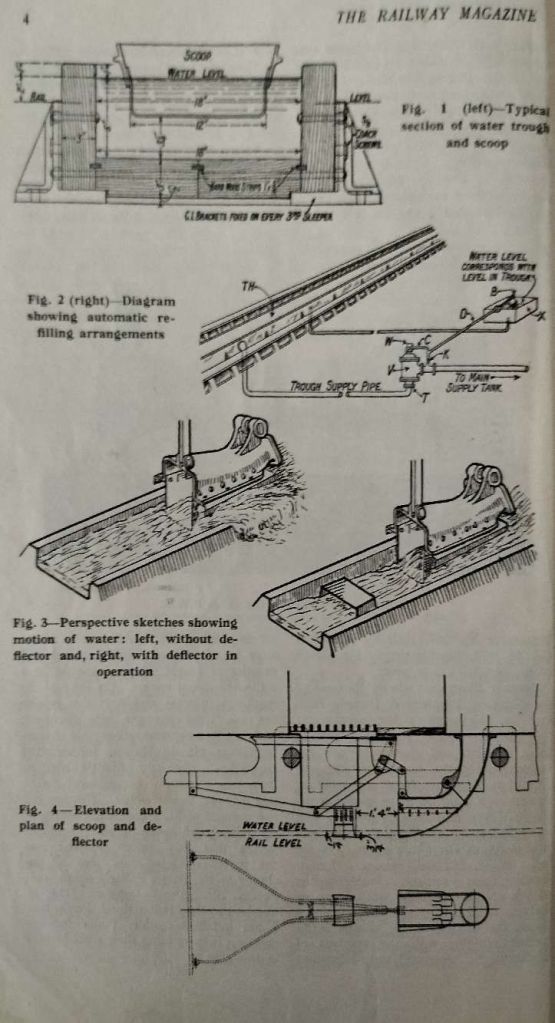
Some superb diagrams showing the operation of water troughs were included on page 4 of the January 1934 edition of The Railway Magazine.

The effective operation of water troughs. [1: p4]

The Railway Magazine commented: “Long non-stop runs necessitate either the use of large tenders, such as are used in America … or the provision of track water troughs from which the tender can be replenished while the train is travelling. As long ago as 1859, … locomotive engineer, John Ramsbottom, … designed the type then and ever since used, with but minor modifications, such as the substitution of metal for wood in their structure.” [1: p5]

Figure 1 shows a typical cross-section. The length was been 0.25 and 0.5 miles and had to be on a completely level  length of track.

Figure 2 “shows diagrammatically the arrangements made for rapidly refilling a trough after a locomotive has taken water from it. The familiar ball-valve control is used to regulate the flow from a tank alongside the track to the trough. When the water in the trough reaches the correct level, the ball valve, in a small tank at rail level, rises and cuts off the supply. Steam heating has to be used to prevent freezing in frosty weather where traffic is infrequent and the troughs are in exposed positions.” [1: p5]

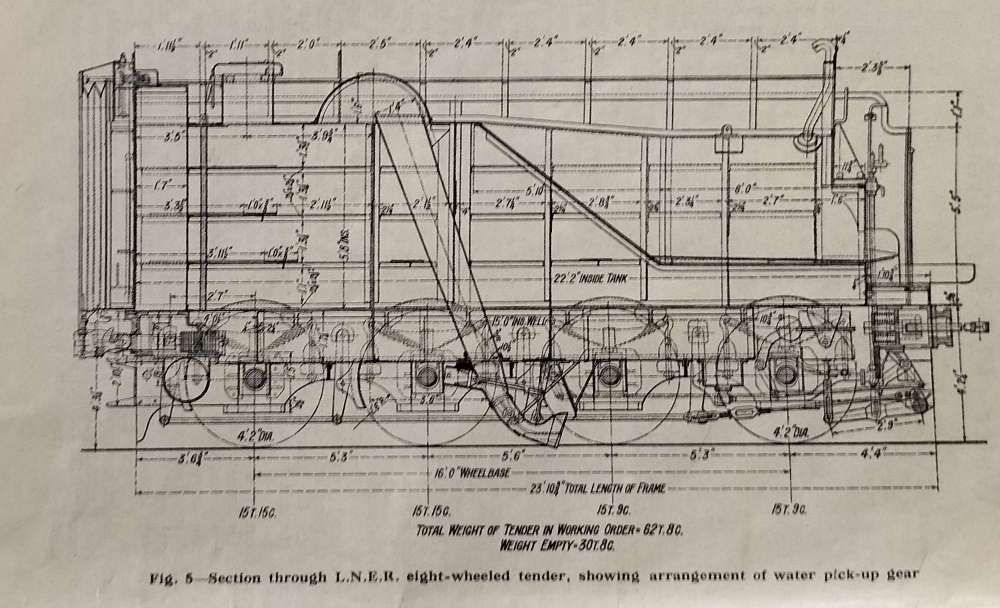
Figure 5: Section through a LNER eight-wheel tender which shows the arrangement of the water pick-up gear. [1: p6]

I love some of the diagrams in these early editions of The Railway Magazine. The one above is no exception, Figure 5 illustrates a typical form of water pick-up apparatus on a LNER eight-wheel tender. “The inclined delivery shoot will be seen to have a hinged foot-like scoop, curved to face the direction of travel and capable of being held clear of, or depressed into the troughs – which are centrally placed between the rails – by means of the system of rods, cranks and levers shown, these being under the control of the fireman. Warning boards are erected to enable him to be prepared to lower the scoop as the trough is approached, speed seldom being appreciably reduced over the troughs. The scoop is usually lowered before the trough is reached, a slight gradient being arranged in the track, by which the scoop drops below the water level, and is similarly raised at the far end of the trough, should the crew not have lifted it out earlier. To aid in raising the scoop when the tender gauge shows the tank in it to be full, steam or compressed air is often used.” [1: p5]

A speed through the toughs of 25 mph was sufficient to ensure the take-up of water, although higher speeds were more effective. But express speeds tended to waste water and could result in damage to the permanent way. Maintenance costs with the amount of flooding which occurred were high.

The LMS made use of a tender which had an observer’s compartment to study what happened at water troughs and, as a result, designed a simple device which significantly reduced the spilling of water. “Briefly, the passage of the scoop through the trough causes the water in it to pile up and overflow at each side, and to neutralise this a pair of slightly converging deflector vanes are fixed 1 ft. 4 in. in advance of the scoop, which force the water towards the centre of the trough and make it pile up there instead of at the sides (Figures 3 and 4). Some 400 gallons are saved every time these deflector vanes are used, and the quantity of water required is reduced by about 20 per cent.” [1: p5]

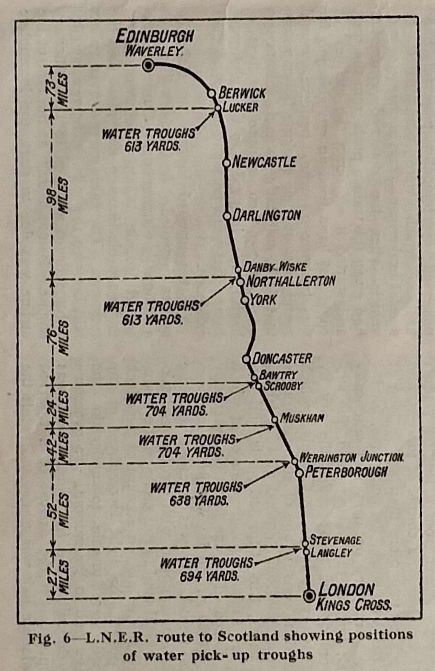
Figure 6: Water Pick-up Troughs on the East Coast Main Line (LNER) [1: p7]

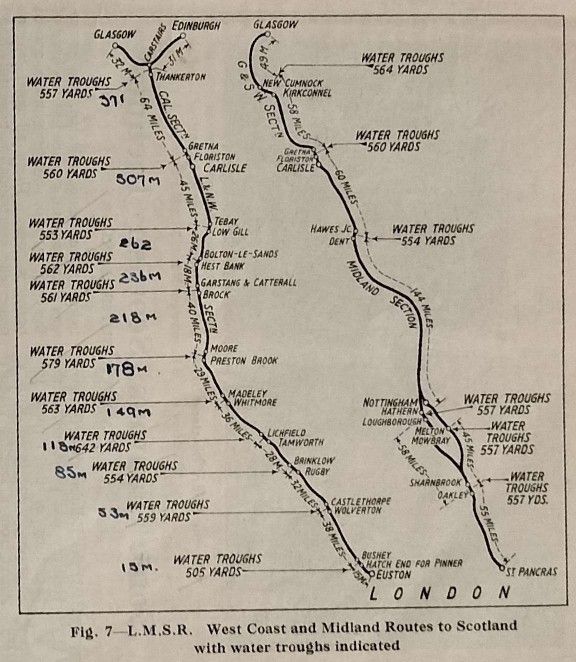
Figure 6 is a map showing the distribution of water troughs along the main LNER. route to Scotland, and Figure 7, those on the LMS, both on the LNWR (West Coast) and the Midland routes.

Figure 7:The Water Troughs on the two LMS routes to Scotland. [1: p7]

The water troughs on these long distance routes obviated the need for larger tenders and the need for time-wasting water stops. 3,500 to 5,000-gallon tenders were more than adequate.  It also appears to have been true that the use of water troughs generally meant that water purity was higher which minimised boiler maintenance and also reduced the need for water-softening plants. [1: p5]

The GWR Capital Programme

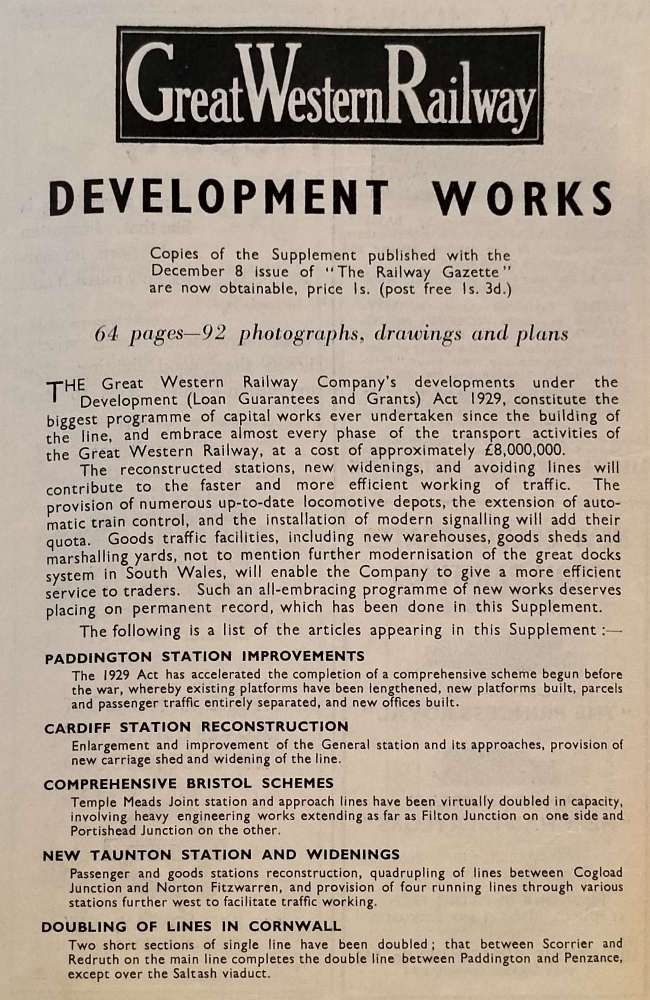
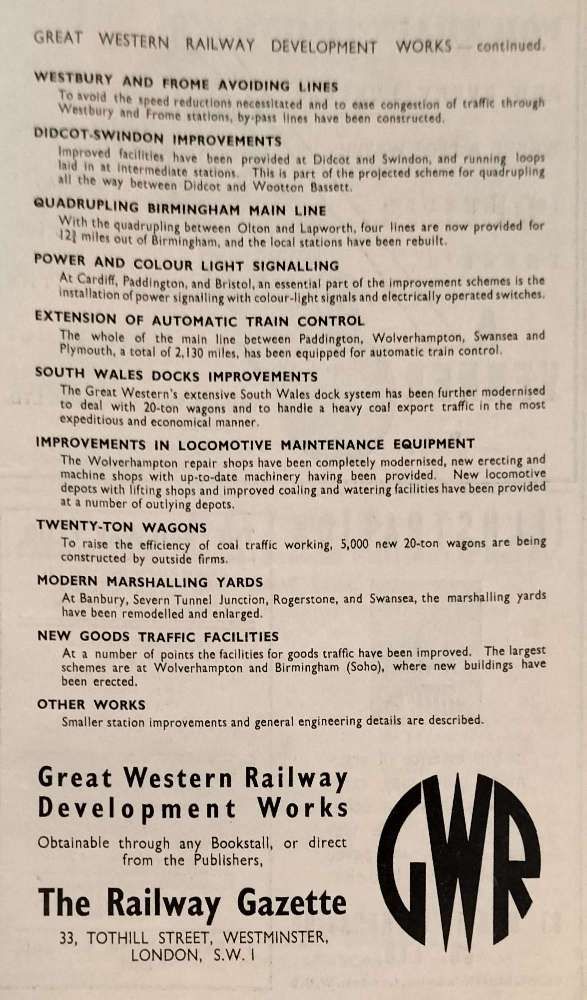
The Railway Magazine noted, “A special programme of extensions and improvements, involving a cost of over £8,000,000, was put in hand by the GWR under the Development (Loan Guarantees and Grants) Act, 1929, in anticipation of its future requirements, for the purpose of assisting in the relief of unemployment. … The Railway Gazette, issued on [8th December 1933] a profusely illustrated Special Supplement dealing comprehensively with these works. A notable feature of this supplement is the wealth of drawings, including a double-page map of the G.W.R. system, with inset detail plans of the new works.” [1: p74]

Earlier in the January 1934 edition, The Railway Magazine carried an advert over two pages from The Railway Gazette for the supplement to their magazine (which, when bought separately, cost the princely sum of 1s).

The first page of the advert about the GWR Capital works programme and the Railway Gazette supplement. [1: pXIV]
The second page of the advert about the GWR Capital works programme and the Railway Gazette supplement. [1: pXV]

The Campbeltown & Machrihanish Light Railway

The Campbeltown and Machrihanish Light Railway was one of only four 2 ft 3 in (686 mm) narrow gauge railways in the UK. The other three were/are in Wales: the Corris Railway, the short-lived Plynlimon and Hafan Tramway and the Talyllyn Railway. [3]

In its January edition, the Railway Magazine reported that “an Order dated [7th November 1933], by the Minister of Transport, appeared in The London Gazette of 7th November, declaring that the Campbeltown & Machrihanish Light Railway Company shall be wound up.” [1: p74] The line, which was closed about eighteen months earlier was 6 miles 29 chains in length and of 2ft 3in gauge. The rolling-stock comprised three locomotives, six passenger and and two goods vehicles. “The company was incorporated on 8th May 1905, and the line opened on [17th August 1906] of the following year. This isolated railway, in the Mull of Kintyre, suffered particularly severely from road motor competition,” [1: p74] and, a few years previously, an attempt was made to meet road competition with its own bus service, but that failed.

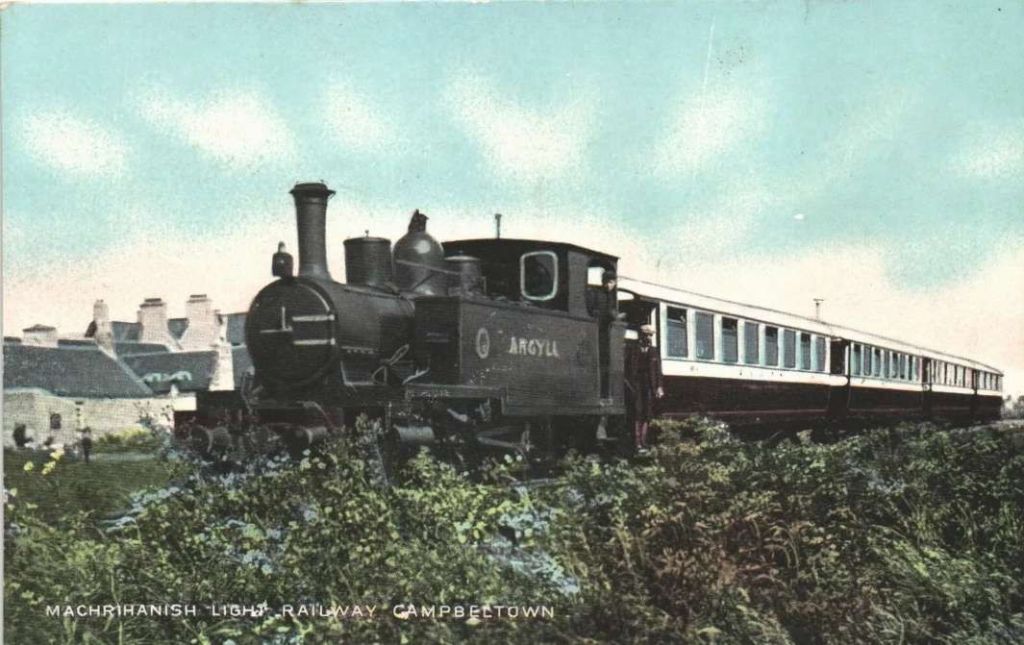
‘Atlantic’ was the last locomotive built for the Campbeltown and Machrihanish Light Railway. It was an Andrew Barclay 0-6-2T, built in 1907. Seen here in charge of a train of four coaches leaving Campbeltown for Machrihanish. [2]

A canal was first constructed to bring coal from pits close to Machrihanish to Campbeltown. It was in use from 1794. There were no locks as the canal traversed relatively flat terrain. It was three miles in length, running from Mill Dam in the West to Campbeltown. Only two barges plied its length which carried around 40 cartloads of coal each day to Campbeltown. However, “the extent to which the canal was used or cared for seems doubtful. … It had fallen into disuse and been virtually abandoned by 1856 and when, about 1875 the colliery changed hands, the new owners … found it choked with weeds and difficult to clear. … In the Company’s prospectus of 1875 it was stated that a railway was to be built.” [4: p7-8]

The new railway was a little over 4 miles in length at first, running between the pits and a coal depot on Argyle Street, Campbeltown. In 1881 the length was extended to 4.7 miles. “There were a number of level crossings, all originally gated but subsequently left open, protected only by cross trenches to keep cattle and sheep off the line.” [4: p8]

At first, only a single loco worked the line, an Andrew Barclay 0-4-0T engine named ‘Pioneer’. After the line was extended to a new colliery business “became so brisk that in 1885 a second locomotive was bought from Barclays, an [0-4-0ST initially, later altered to an 0-4-2ST] named ‘Chevalier’.” [4: p9]

In 1901 and 1902, two high-speed turbine steamers brought “increasing numbers of day trippers to Campbeltown where … many of them were conveyed to Machrihanish … by horse-drawn carriages.” [4: p11]

The railway saw significant changes as a result. Both to carry passengers and to enhance the delivery of coal to boats at the New Quay in Campbeltown, the line was extended East to New Quay and West to the Golf links at Machrihanish. A new company, the ‘Argyll Railway Company’, was formed to manage the line.

The new railway was to be close to 6.4 miles in length and was opened to passenger traffic in 1906. By “August 1913 there were seven trains each way daily. … The war naturally led to a curtailment of services, … until the early months of 1917 saw the line’s minimum service of one daily train in each direction. … After the war … the tourist trade soon picked up again and before long the summer months saw eight regular trains a day in each direction. … Although the 20s saw increasing competition from buses, the time tables continued to show eight trains daily in each direction right up until the withdrawal of services in 1931.” [4: p23]

Commenting on the closure of the line, A.D. Farr says: “When the railway finally closed the prime reason was the loss of revenue following the closure of the colliery in 1929, but a major factor was also the bus competition. To meet this second-hand buses had been bought by the railway, but the experiment was to no avail and they were soon sold to the competing road transport concern.” [4: p23]

The line owned a total of five locomotives at different times: ‘Pioneer’, a Barclay 0-4-0T; ‘Chevalier’, a Barclay 0-4-0ST which may have been converted to an 0-4-2ST; ‘Princess’, a Kerr-Stuart 0-4-2T; ‘Argyll’, a Barclay 0-6-2T; and ‘Atlantic’, another Barclay 0-6-2T. [4: p41]

Six passenger coaches were employed on the line, all built by R.Y  Pickering & Co., of Wishaw, Lanarkshire. All were bogie ‘cars’ and “were externally very attractive models of the tramways type, 43 ft 6 in long and with two 4-wheel bogies, 30 ft centre to centre carrying 1ft 11in diameter wheels. At each end was a covered platform, guarded by a wrought-iron balcony and ‘telescopic gates’, and with steps on either side to within a foot or so of the ground.” [4: p43]

The coal company owned a series of wagons which carried the ‘C.C.C’ lettering. But it seems as though the railway company owned only a heavy goods brake van and one other wagon, although little is known about that vehicle. [4: p45]

The Welsh Highland Railway

The Railway Magazine reported that the “Joint Committee representing the local authorities with investments in the Welsh Highland Railway has decided to ask the debenture-holders to close down the line. Carnarvonshire County Council has £15,000 in the venture, Portmadoc Urban District Council £5,000, and the Gwyrfai, Glaslyn and Deudraeth Rural District Councils £3,000 each. At a recent meeting of the Portmadoc Council, Mr. Oswald Thomas said it was important that if the railway were closed, the rails should not be taken up, particularly between Portmadoc and Croesor Bridge, as it was hoped before long to see quarries in the district working again. Captain Richard Jones said it might be arranged for the Portmadoc Council to take over that part of the railway.” [1: p74]

West Monkseaton Railway Station Waiting Shelter

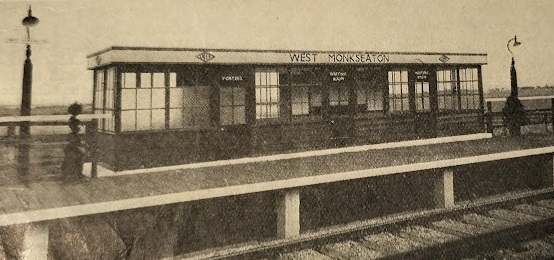
The Railway Magazine picked a rather modest platform building at West Monkseaton for praise.

West Monkseaton Railway Station, LNER – a new waiting shelter – January 1934. [1: p75]

Here is precise repetition used rhythmically; the units are a nine-light window and a half-glazed door; the rhythm is 2-door-2-door-2-door-2. The designer is to be congratulated in that he has been careful to keep the horizontal glazing bars of doors in line with those of the windows; the horizontal effect of the windows; therefore unbroken. The portions of the window panes are The proportion good, being about 5 to 3. The key-note of the design is the restful cornice band running round the structure; unpretentiously it ties in the whole composition; its horizontality is repeated by the edges of the weather-boarding under the windows, and is balanced by the white base upon which the building stands; this cornice band also sets off, and is set off, by Mr. Eric Gill’s standard LNER lettering. Thought has evidently been expended upon the design of this shelter, and it gives us pleasure to illustrate such a satisfactory and pleasing little piece of station architecture, especially when we consider what the perpetuation of railway custom might have produced.” [1: p75]

Check Rails and Ramps

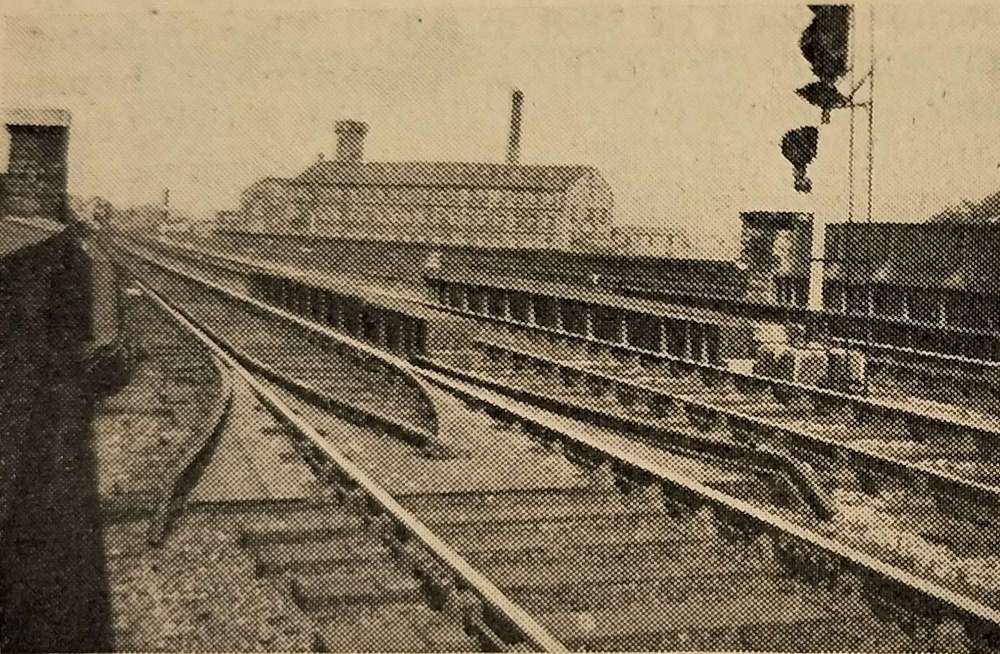
By 1934, it was common practice “to provide safety devices at viaducts and other important bridges to reduce to a minimum the risk of vehicles, which may have become derailed, falling over the edge. Special guard rails, fixed either inside or outside the running rails and usually at a slightly higher level, are laid across the viaduct, with some splayed arrangement at both ends to direct derailed vehicles from the edge toward the rails. An ingenious elaboration of this is shown in the accompanying illustration. It consists of converging rails with a steel ramp between them rising to rail level. Any derailed wheels would run up this and should automatically become re-railed at the top.” [1: p74]

The steel-ramp approach to a short viaduct at Midfield. [1: p74]

References

  1. The Railway Magazine; Westminster, London, January 1934
  2. https://www.ebay.co.uk/itm/353145047017?mkcid=16&mkevt=1&mkrid=711-127632-2357-0&ssspo=VG76xMQ6St6&sssrc=4429486&ssuid=afQhrar7TGK&var=&widget_ver=artemis&media=COPY, accessed on 6th August 2024.
  3. https://en.wikipedia.org/wiki/Campbeltown_and_Machrihanish_Light_Railway, accessed on 7th August 2024.
  4. A.D. Farr; The Campbeltown and Machrihanish Light Railway; (First Reprint) Oakwood Press, Headington, Oxford, 1987.