Tag Archives: Hartshead

The Micklehurst Loop – Part 1D – Some Miscellaneous Items relating to the area around the Staley and Millbrook Goods Yard.

The Staley and Millbrook Goods Yard in the 21st century, (Google Maps).

Since publishing the first three articles about the Micklehurst Loop. I have had a trickle feed of comments, particularly about the Staley and Millbrook Goods Yard. This short addendum to the first article seeks to bring those items together in one place. It is the fourth addendum to that first post. [1][2]

The adjacent satellite image extracted from Google Maps satellite images shows the Goods Yard and notes some of the key features still on the site in the 21st century. For more comments, please see the notes which follow.

I visited the site again on 5th March 2021 and wandered around among the trees for over an hour.

There is an excellent survey of the Staley and Millbrook Goods Yard and the Hartshead Power Station on the website http://www.28dayslater.co.uk. A number of superb photographs have been collated there. [7]

Further Images of  BEA No. 2 0-4-0ST ‘BEANO’

Gerv Wright has kindly sent me two further images of BEA No. 2 0-4-0ST at the end of its working life in 1977 being prepared for and being transported off site. ‘Beano’ was its nickname!
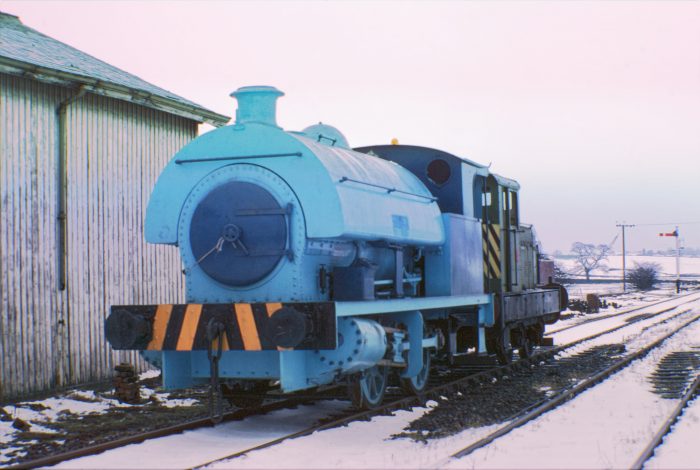
BEA No 2, Jan 1977 (c) Gerv Wright. [3]
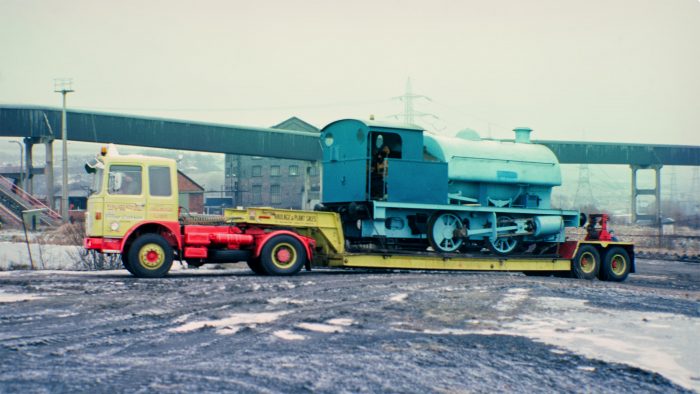
BEA No 2, Hartshead, Jan 1977 (c) Gerv Wright. Of additional interest in this picture is the backdrop. The view is taken from the Micklehurst end of the site In front of the good shed is the coal conveyor still apparently at its full extent. Also visible, to the left of the picture, is one of the lighting towers which feature later in this post. [3]

Yard Lights – Concrete Lighting Columns

An on-line acquaintance, Ben Hampson, sent me an image of the Goods Yard via a Facebook group, ‘The History of Mossley (Tameside)’. [4] That image is an excellent view across the site of the Goods Yard when it was still in use and shows three concrete lighting towers as well as the fireless loco in operation. At the back of the scene, the coal handling facilities, the conveyor and the goods shed can be seen peeking out of the gloom. Ben sourced that image via Gary Taylor on ‘The Real Mossley’ Facebook group. [10]
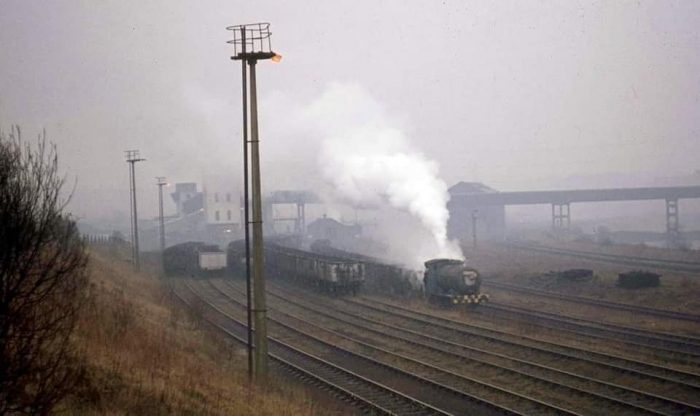
The Staley and Millbrook Goods Yard min operational days. Of interest are the lighting columns and the fireless locomotive, the goods shed, the coal handling facilities and the coal-conveyor, copyright unknown, sourced via Ben Hampson and Gary Taylor from ‘The Real Mossley’ Facebook Group. [11]

A visit to site on 6th March allowed me to see the three towers shown on the above image. These next three photographs were taken on 6th March. They show the towers and give an excellent idea of the appearance of the Yard in 2021!
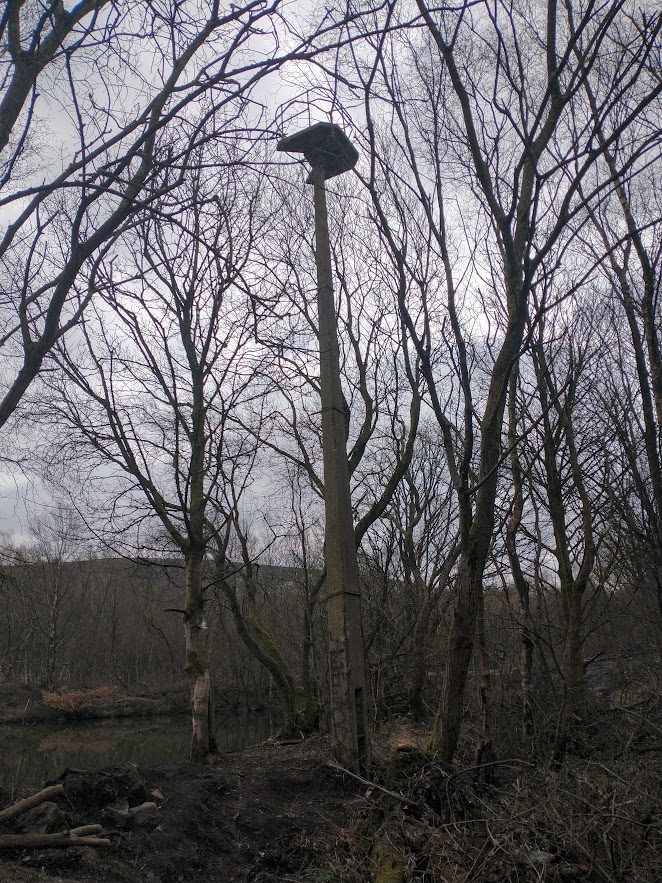
This is tower No. 1 as identified on the satellite image at the start of this post. The small body of water can be made out immediately beyond the tower. (My photograph – 6th March 2021).
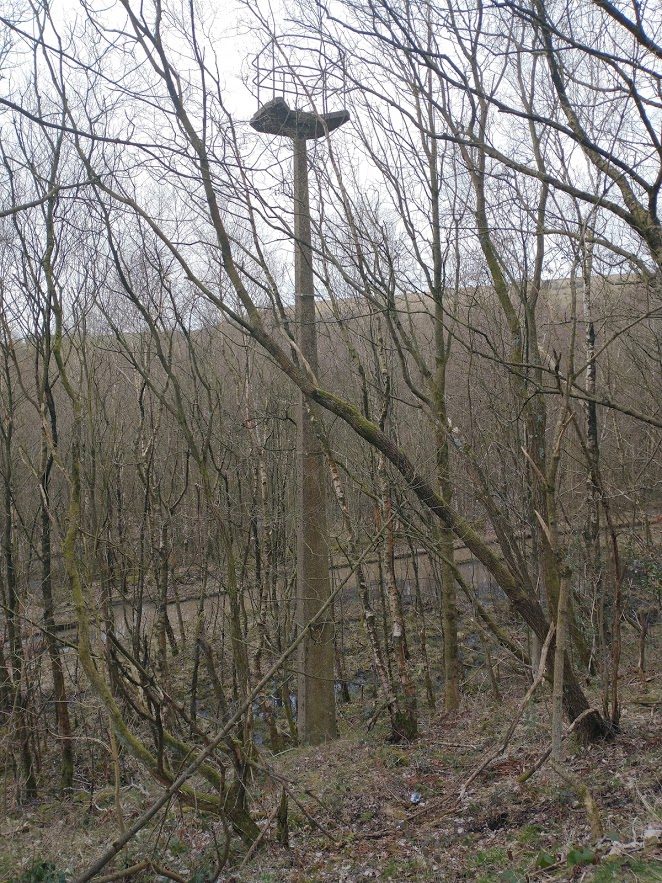
Tower No. 2 on the satellite image above. This photograph is taken from the top of the bank to the South east of the old yard and looks down on the Yard. (My photograph – 6th March 2021).
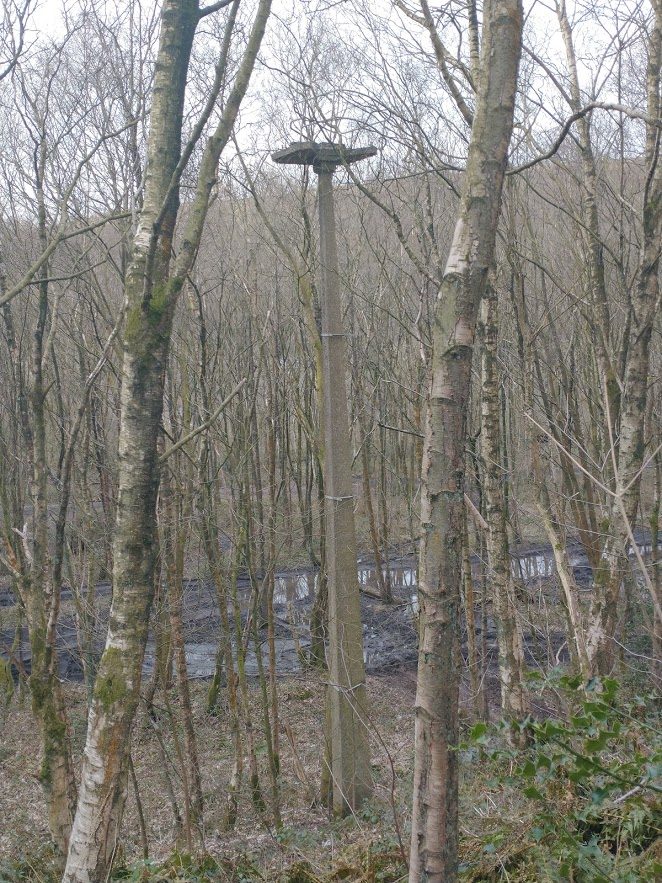
This photograph shows Tower No. 3 which is close to the remains of the engine shed. The photograph is again taken from the bank above the Yard, (My photograph – 6th March 2021).

The Engine Shed

Ben also asked why I had not included anything in previous posts about the Engine Shed which accommodated the two shunters which worked the site. My only excuse is that I walked past it without working out what it was. So, on 6th March a took a bit of time to pick it out and take photographs.

Reddit.com carries a monochrome photograph of the fireless loco exiting the engine shed, which appears to have been sourced from the Transport Library. I am not certain of the copyright position on this image, so was not planning to include it here, however, when I copy and paste the link it automatically embeds in this post. Clicking on the image takes you directly to the source. [6][8]
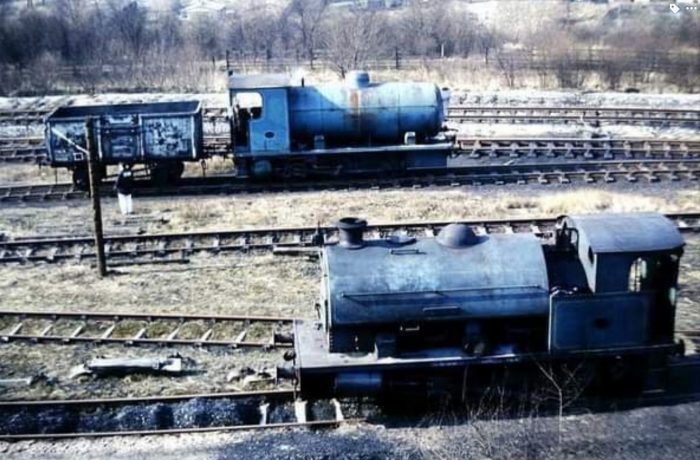
Hartshead Power Station owned two locomotives for shunting the yard accessed via the Micklehurst Loop, both are mentioned in the text above. I believe that the 0-4-0ST stands on one of the lanes giving access to the engine shed which is off this image to the left, (c) J. Sutherland. [9]

The next few images are pictures taken on 6th March 2021 which show the engine shed as it is is the 21st century.
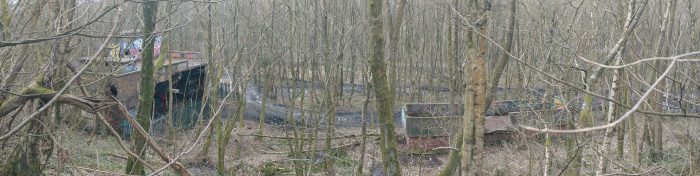
This first panorama shows the site of the engine shed from the bank above the old Goods Yard close to the lighting tower (no. 3 above), (My photograph – 6th March 2021.
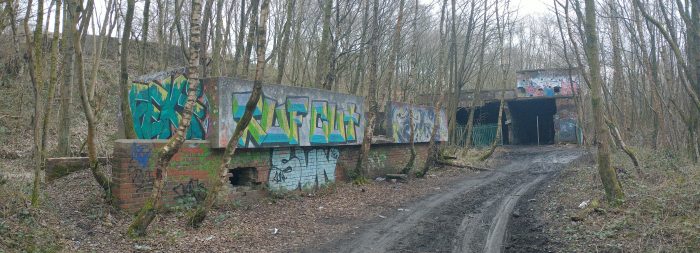
This second panorama shows the site of the engine shed from track-bed level, (My photograph – 6th March 2021).
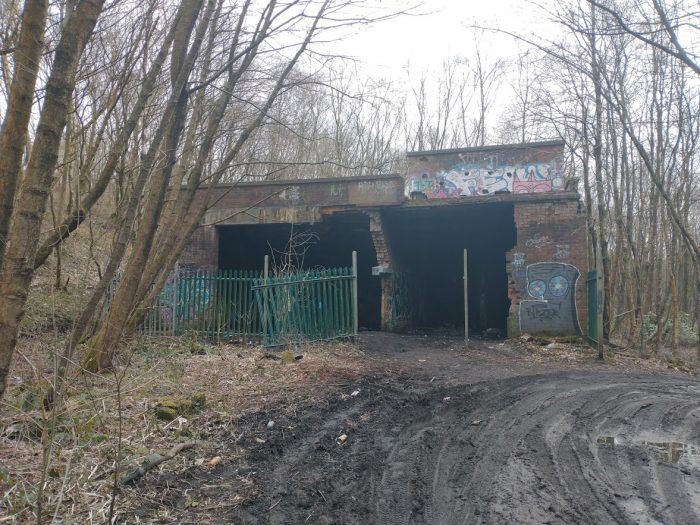
A closer shot of the Engine Shed from track-bed level. The churned ground in the foreground is typical of much of the Goods Yard site, which appears to have been used recently as an off-road vehicle playground, (My photograph – 6th March 2021).

Demolition of the Chimneys and Cooling Towers at the Power Station.

A short section of the video below (from 15 minutes to 17 minutes into the video) shows the demolition of the Cooling Towers and Chimneys of Hartshead Power Station. [12]

References

  1. Previous posts relating to the first length of the Micklehurst Loop can be found at: https://rogerfarnworth.com/2021/01/31/the-micklehurst-loop-part-1 https://rogerfarnworth.com/2021/02/05/the-micklehurst-loop-part-1a https://rogerfarnworth.com/2021/02/15/the-micklehurst-loop-part-1b https://rogerfarnworth.com/2021/02/18/the-micklehurst-loop-part-1c-including-hartshead-power-station
  2. Other articles relating to the further lengths of the Micklehurst Loop can be found at: https://rogerfarnworth.com/2021/02/21/the-micklehurst-loop-part-2 https://rogerfarnworth.com/2021/02/22/the-micklehurst-loop-part-3
  3. These images were sent by email on 25th February 2021 and are included by kind permission of Gerv Wright.
  4. https://www.facebook.com/groups/1469097430050445, accessed on 5th March 2021.
  5. https://www.facebook.com/photo.php?fbid=10157847336918314&set=p.10157847336918314&type=3, accessed on 5th March 2021.
  6. https://www.reddit.com/r/trains/comments/ieer3s/steam_locomotive_coming_out_of_an_engine_shed_at, accessed on 7th March 2021.
  7. https://www.28dayslater.co.uk/threads/hartshead-power-station-and-the-millbrook-sidings.126098, accessed on 7th March 2021.
  8. For further information on copyright issues, please see: https://rogerfarnworth.com/2019/12/16/copyright.
  9. A check on the copyright of these images on the J.W. Sutherland Collection Site (http://sutherland.davenportstation.org.uk) has been undertaken – they are free to use provided the photographer is credited.
  10. https://www.facebook.com/groups/296935657118919, accessed on 7th March 2021.
  11. https://www.facebook.com/groups/296935657118919/permalink/2508654999280296, accessed on 7th March 2021.
  12. https://m.youtube.com/watch?v=PXDtZgymfa8, accessed on 16th March 2021.
 

The Micklehurst Loop – Part 1C – Including Hartshead Power Station

Just a few days after I completed addendum 1B about the first length of The Micklehurst Loop and particularly about Staley and Millbrook Station and Goods Yard, I came across some photographs of the locomotives used at the Staley & Millbrook sidings on behalf of Hartshead power station. I found them on a Facebook post but can also be found free to share on the site set up by the Friends of Davenport Station on behalf of J.W. Sutherland’s widow (http://sutherland.davenportstation.org.uk). [3]

I was also sent two pictures by Keith Norgrove which came from a cycle ride along the Huddersfield Narrow Canal Towpath in 1963, one of which is relevant to this length of the Loop. [2]

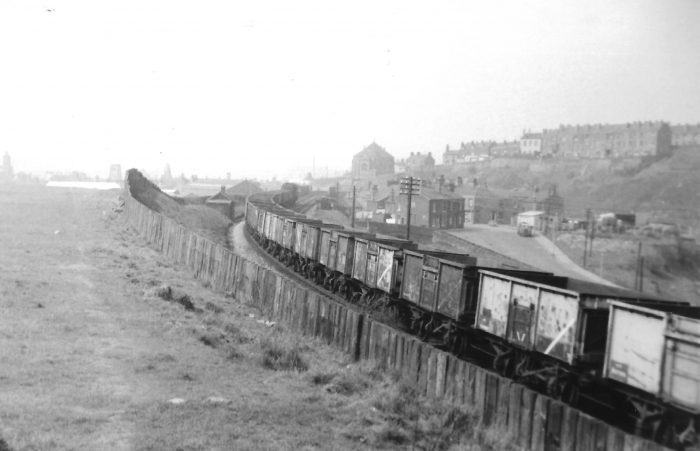
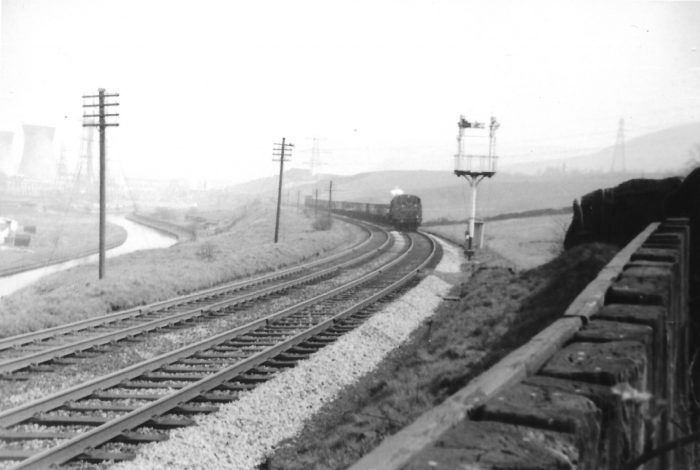
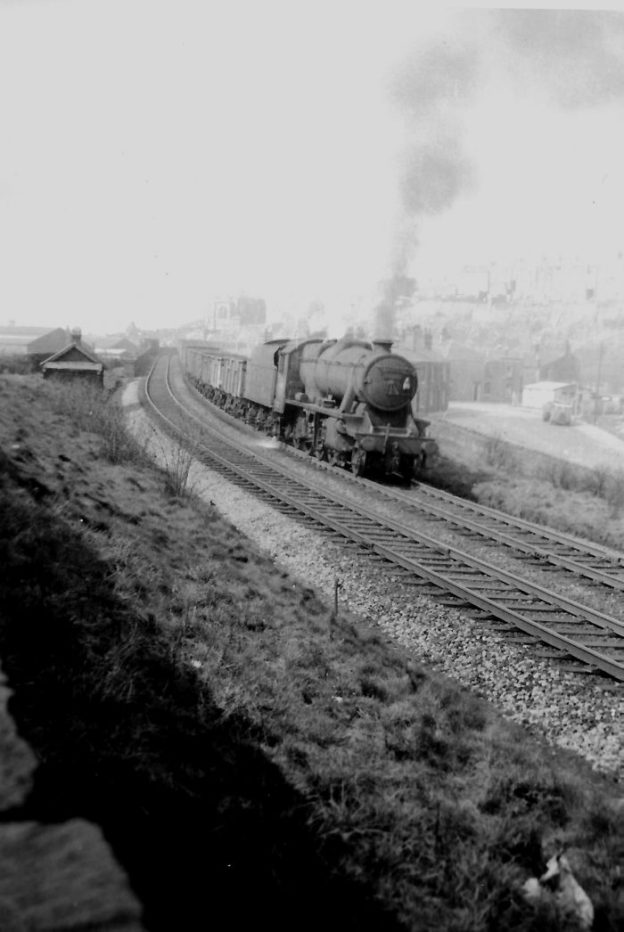
And finally, James Ward has sent me three monochrome pictures which can be found at the end of this addendum. I have included one of these pictures as the featured image for this article.

My first article on the Micklehurst Loop can be found using this link:

The Micklehurst Loop – Part 1

the first addendum, on this link:

The Micklehurst Loop – Part 1A

the second addendum, on this link:

The Micklehurst Loop – Part 1B

Huddersfield Narrow Canal Photograph of Hartshead Power Station

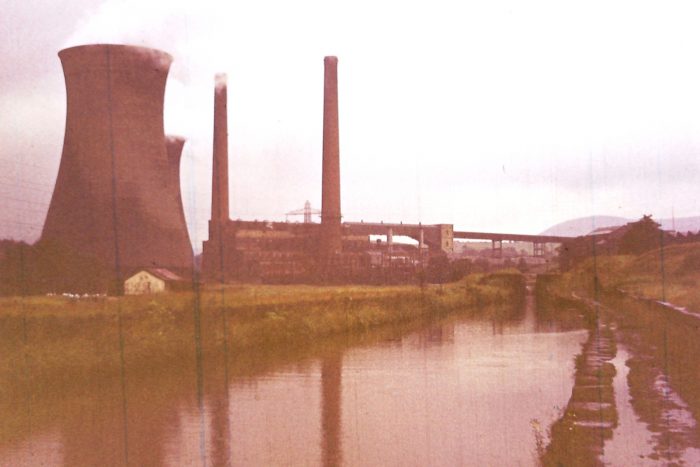
Keith Norgrove cycled the towpath of the Huddersfield Narrow Canal in 1963 and took this photograph:

This photograph is taken from the Canal towpath at a point some distance closer to Stalybridge. The coal conveyor can be seen crossing the valley from the location of the Staley & Millbrook Goods Yard. The roof of the GoodsShed is visible close to the coal conveyor. The north-light roof of Spring Grove Mill can also be picked out on the right side of the image, (c) Keith Norgrove 1963 [2]

Hartshead Power Station Locomotives

The series of three pictures below appeared on the Facebook Group ‘The History of Stalybridge’ in May 2020. I only found them on 16th February 2021. [3]

The post on the Facebook Group included the following words credited to Geoff Ward:

“Preparations for a power station at Heyrod began in 1916 when 26 acres (110,000 m2) of land were purchased. The station was opened in 1926 by the Stalybridge, Hyde, Mossley and Dukinfield Transport and Electricity Board. The station began operation with three Metropolitan-Vickers 12,500 kW turbo-alternators generating at the local SHMD supply frequency of 40 Hz. Later that year the station’s output was changed to the nationally agreed standard of 50 Hz. In 1935, a major expansion of Hartshead began with the first of three new Metropolitan-Vickers 30,000 kW generating sets being commissioned, followed by the second set in 1943 and the third set in 1950. The station’s concrete cooling towers were constructed in the 1940s.

Coal was delivered to the plant at Millbrook railway sidings on the Micklehurst Line, situated on the opposite side of the Huddersfield Narrow Canal. The sidings were built in 1932 and had space to hold up to 130 12-ton wagons. Coal was fed into a hopper underneath the sidings before being transported on an enclosed conveyor belt which emerged high above the valley to cross the River Tame and canal before entering the station at a high level. The station was closed on 29 October 1979 with a generating capacity of 64 megawatts. It was demolished during the late 1980s, although part of the site is still used as an electrical substation.” [3]

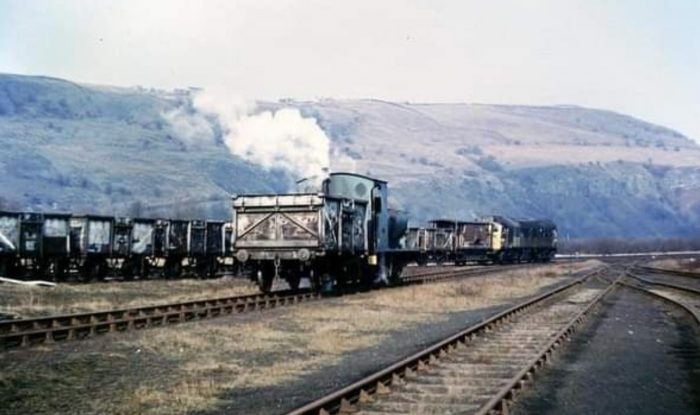
Hartshead appears to have owned two locomotives for shunting the yard accessed via the Micklehurst Loop, both are visible in this photograph of the Staley and Millbrook Goods Yard, (c) J.W. Sutherland. [3]

Lookin North from the Staley and Millbrook Yard. Coal trains entered the Yard full from the South along what was once the Micklehurst Loop and empties were returned to the South. (c) J.W. Sutherland. [3]

The Hawthorn Leslie fireless 0-6-0 (HL3805/1932) was fed with steam from the power station and was much cheaper to run that the saddle tank, (c) J.W. Sutherland. [3]

The Transport Library has 2 monochrome pictures of each of the locomotives in the images above for sale in a digital format. The pictures were taken by Horace Gamble. [5]

0-4-0ST Locomotive: BEA 2

The Saddle Tank shown in two of the photographs above was built by Robert Stephenson & Hawthorn. Its Works No. was 7661 and was numbered BEA (British Electricity Authority) No 2 in service in the yard opposite Hartshead Power Station. It was an 0-4-0ST Locomotive. It shared its duties with a large fireless locomotive which can also be seen in the photographs above.

“Because the fireless was cheap to run (there was a good supply of steam from the power station boiler), it was preferred as the working engine, and so No. 2 was used as the standby, and also whenever the power station boiler was shut down, as there would be no supply of steam for the fireless.” [4]

“The sidings were built in 1932 and had space to hold up to 130 12-ton wagons. Coal was fed into a hopper underneath the sidings before being transported on an enclosed conveyor belt which emerged high above the valley to cross the River Tame and canal before entering the station at a high level.” [4]

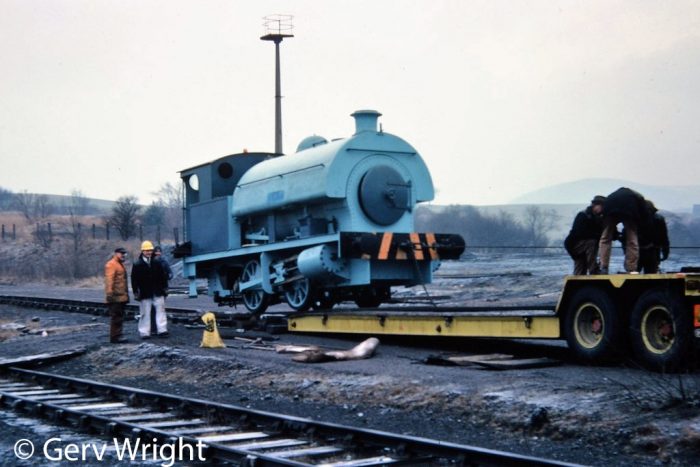
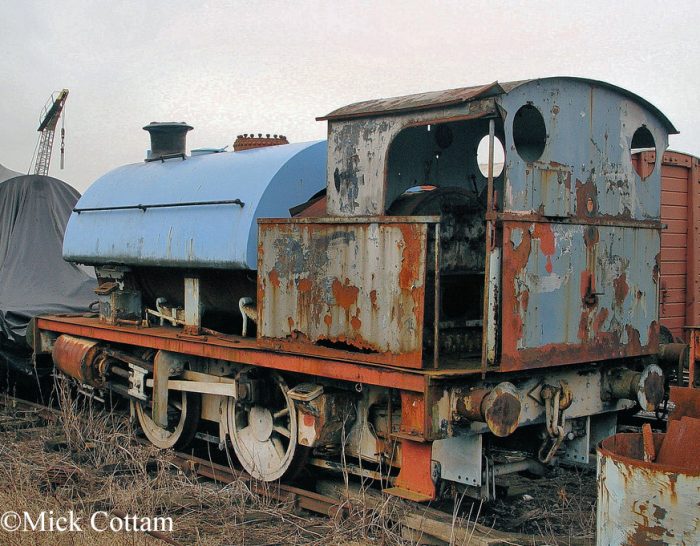
When the Micklehurst line was closed to traffic in October 1966 the short section of line between the Millbrook sidings and Stalybridge remained in use until the power station closed in 1979. At this time the locomotive was transported to the Embsay & Bolton Abbey Steam Railway where it sits awaiting restoration.

The 0-4-0ST being loaded onto a low-loader transport for the trip to the Embsay & Bolton Abbey Steam Railway in the late 1970s, included by kind permission of the photographer, © Gerv Wright. [4]

The same locomotive awaiting restoration in 2010, included by kind permission of the photographer, (c) Mick Cottam. [4]

Hartshead’s Fireless Locomotive

This locomotive can be seen in the photographs of J.W. Sutherland above. It was a Hawthorn Leslie fireless 0-6-0 (HL3805/1932). The photo of this loco for sale on the Transport Library site was taken in 1967. [5] A picture is also included in ‘Industrial Locomotives & Railways of the North West of England’ by Gordon Edgar. [6]

“A fireless locomotive  ……. uses a reciprocating engine powered from a reservoir of compressed air or steam, which is filled at intervals from an external source. They offer advantages over conventional steam locomotives of lower cost per unit, cleanliness, and decreased risk from fire or boiler explosion; these are counterbalanced by the need for a source to refill the locomotive, and by the limited range afforded by the reservoir.” [6]

They were most often used, for industrial rail yards where either:

  • a conventional locomotive was too noxious or risky, such as in a mine or a food or chemical factory; or
  • where the source of air or steam was readily available, as here at Hartshead Power Station,

“A fireless steam locomotive is similar to a conventional steam locomotive, but has a reservoir, known as a steam accumulator, instead of a boiler. This reservoir is charged with superheated water under pressure from a stationary boiler. The engine works like a conventional steam engine using the high pressure steam above the water in the accumulator. As the steam is used and pressure drops, the superheated water boils, replacing the used steam. The locomotive can work like this until the pressure has dropped to a minimum useful level or the water runs out, after which it must be recharged.” [6]

A Further 3 Photographs from James Ward

James Ward has shared three photographs with me of which he says: ” I don’t know how you would feel about including them on your website uncredited, as unfortunately, obtaining proper permission could prove impossible. My Dad thought they came from the colleague of a family friend, but when I contacted our family friend, he was struggling to recall this. If there are any further developments, I’ll let you know.” [7]

James Ward also comments that here is still a very small remnant of the unusual solid sleeper fence (shown in MLL2 and MLL3) in situ.

These photographs are shared here on the basis that James mentions. Neither he nor I can credit the photographer. Should anyone know better, please contact me and they will be properly credited or removed if the copyright holder wishes.

They appear to show a sequence of pictures of the same train leaving Stalybridge along the Micklehurst Loop most probably heading for the Staley and Millbrook Sidings for Hartshead Power Station, and then returning with the engine operating tender first, This probably means that the correct chronological sequence of the pictures would be MLL1, MLL3, MLL2

In one of the pictures the octagonal form of Old St. George’s can be made out on the horizon. I do not have a date for these images. But the smog appears thick over Stalybridge!

Photograph MLL1: provided courtesy of James Ward. James comments:  This picture is taken “looking WSW towards the centre of Stalybridge.  The Loco is an 8F according to my Dad.  The platelayers hut to the south of the line is marked on the 25″ OS Maps.  Just beyond this, the parapet of the Knowl St viaduct is visible.  St George’s Church is just about discernible above what I assume are full coal wagons, on their way to the power station.”

Photograph MLL2 provided courtesy of James Ward. James comments: “Looking SW towards the centre of Stalybridge.  Coal wagons having been emptied at the power station(?).  There is a clearer view of the Stalybridge skyline, including St George’s Church.  The railway boundary is marked by an unusual solid fence made from railway sleepers, a few sleepers-worth of which is still in situ.”

Photograph MLL3 provided courtesy of James Ward. James comments: this picture is taken “looking NE towards Millbrook.  This might well be the same train as in MLL2, and taken just before. The signal post to the SE of the line is marked on the 25″ OS Maps as ‘S.Ps’.  The picture gives a close up view of the top of the sleeper fence.  The Huddersfield Narrow Canal to the left of the railway with Hartshead Power Station cooling towers just visible as shadows on the far left of the picture.”

References

  1. https://maps.nls.uk, accessed on 2nd February 2021.
  2. Keith Norgrove is a contributor to the RMWeb Forum under the pseudonym ‘Grovenor’. Keith’s two pictures (one of which is included here) were a response to my articles about the Micklehurst Loop on that Forum: https://www.rmweb.co.uk/community/index.php?/topic/161854-the-micklehurst-loop, accessed on 15th February 2021.
  3. https://m.facebook.com/groups/405881989841095/permalink/917279782034644, accessed on 16th February 2021. (A check on the copyright of these images on the J.W. Sutherland Collection Site (http://sutherland.davenportstation.org.uk) has been undertaken – they are free to use provided the photographer is credited).
  4. https://preservedbritishsteamlocomotives.com/robert-stephenson-hawthorn-works-no-7661-bea-no-2-0-4-0st, accessed on 16th February 2021.
  5. https://thetransportlibrary.co.uk/?route=product/search&search=Hartshead+Power+Station%2C+Stalybridge&category_id=64&page=1, accessed on 16th February 2021.
  6. https://en.wikipedia.org/wiki/Fireless_locomotive, accessed on 16th February 2021.
  7. Email from James Ward on 16th February 2021