Tag Archives: Derry

The L&LSR once again – a perspective from the 19th century! – The Railway Magazine, November 1899.

The November 1899 edition of The Railway Magazine carried a short article about the L&LSR which was not heavy on technical detail. It mostly reads as though it were a holiday brochure rather than an article in a railway journal. None-the-less, the article is still of interest, particularly for the fact that it was written during the period when the L&LSR was expanding.
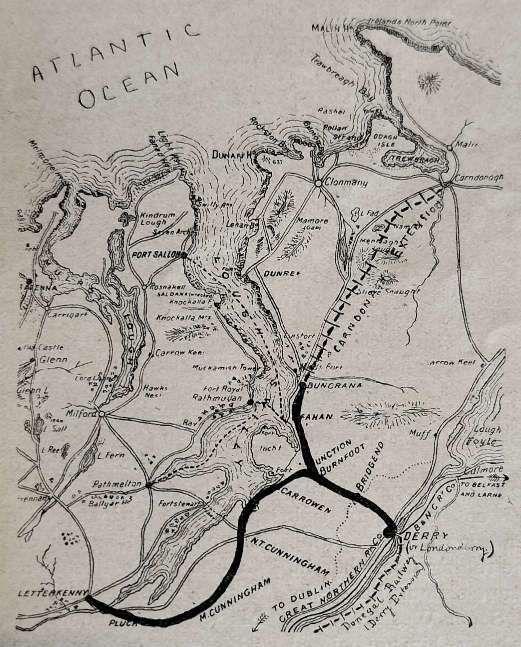
A map of the L&LS Railway in 1899, before its significant expansion. I was particularly drawn to this map as my wife and I spent our main holiday this year in Rathmullan directly across Lough Scilly from Buncrana. I have still to complete a series of articles about the L&LSR between Derry and Cardonagh. [1: p461]

Chisholm starts his article: the L&LSR “is one of those excellent little lines constructed on the narrow gange principle, which are to be found in all parts of Ireland. The country has the benefit of light rail ways It is with one of these lines that the present article is intended to deal. It is to be hoped that the following notes respecting the L&LSR will prove interesting to readers.” [1: p461-464]

Chisholm then spends a number of paragraphs explaining how best a traveller from the mainland to Derry.

I found his outline of the route from London interesting as it highlighted the number of railway companies whose rails the journey would cross. “Leaving London (Euston or St. Pancras) the passenger is taken to Carlisle, the ‘Clapham Junction of the North’. The journey is continued to Stranraer on the Portpatrick and Wigtownshire Joint Railway, owned by the London & North Western, Midland, Caledonian, Glasgow & South Western, Companies. The steamers run alongside the harbour station, Stran raer. The boats are well built, and are fitted with the latest improvements, The joint companies are financially interested in this steam boat service, as is also the Belfast and Northern Counties Railway. The time occupied in crossing is approximately two hours. Larne harbour station also adjoins the steamer pler, …  A narrow gauge train awaits the arrival of the boat, and by this train the traveller is taken to Ballymena, It is necessary to change here into the broad gauge ‘Londonderry Express’, which speedily runs to the city on the banks of the Foyle.” [1: p464-465] 

At that time, Derry “consist[ed] of two towns, one on each side of the River Foyle. The waterside station of the Belfast and Northern Counties Rail- way is on the eastern bank. The river is spanned by the stately Carlisle Bridge, a fine structure, which can truly be termed ‘[Derry’s  landmark’. … The [L&LSR’s] station was on the western bank of the river. On entering it and viewing for the first time the rolling stock therein, the Londoner’s thoughts [would] immediately fly to the London and South Western Railway. The carriages before him [were] painted almost exactly after the style of that Company’s coaching stock. In addition to this, [the L&LSR] Company paint their engines a bright grass green – another prominent ‘South Western’ feature.”

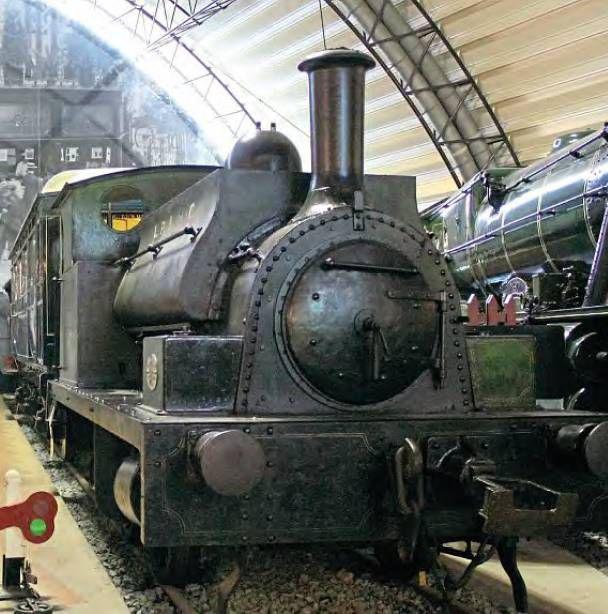
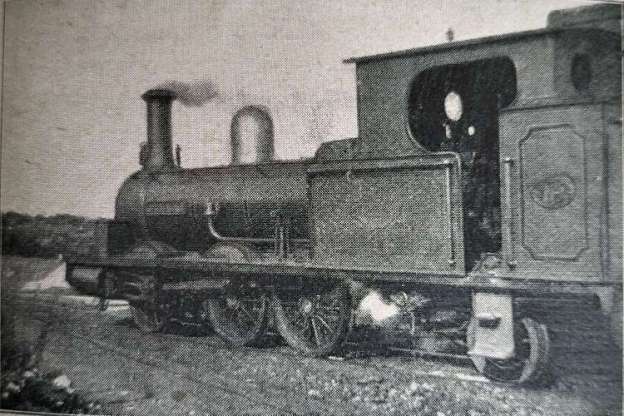
The featured image for this article shows L&LSR Locomotive No.1 J.T. Macky which was built by Black, Hawthorn & Co., of Gateshead in 1883. At the time of Chisholm’s article this locomotive was only around 6 years old. In a surprising digression from the more general nature of his article, Chisholm provides quite some detail about this locomotive. “It was named after the then Chairman of the Company. Mr. Fred. Dawson, the … General Manager of the Company, … supplied the [Chisholm] with the leading dimensions of ‘J.T. Macky’. It [was an 0-6-2T loco], a six-coupled engine with a two-wheeled pony truck at the rear. The diameter of the coupled wheels [was] 3 ft. 6 in., the diameter of the trailing wheels being 2 ft. 2 in. The gauge of the line [was] 3 ft 0 in. ‘J. T. Macky’ [had] cylinders 13 in. by 19 in.; a total heating surface of 592 square feet. …(112 tubes); a steam pressure of 140 lbs. per square inch, and a total length over the buffers of 27 ft. The total weight of the engine in working order [was] 23 tons 3 cwt.” [1: p462]
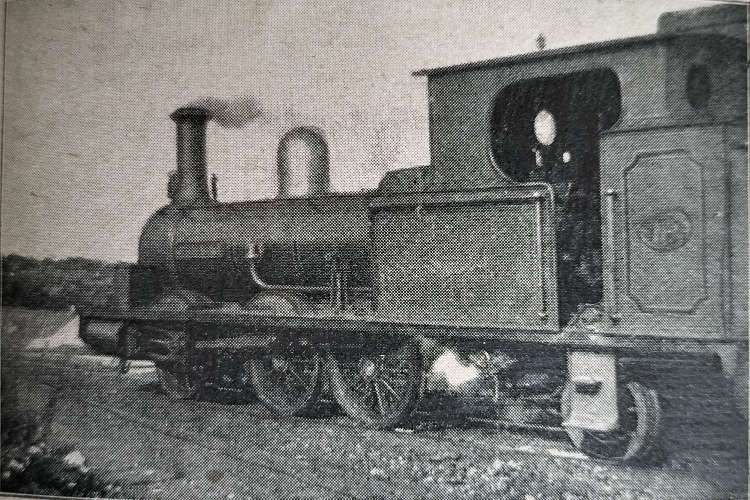
L&LSR Locomotive No. 1 ‘J.T. Macky’. [1: p463]

It is clear that Chisholm was quite taken by this locomotive: “The locomotive is extremely handsome, being painted … brought green picked out with black and white stripes. A bright brass dome is mounted on the top of the barrel.” [1: p462]

In 1899, Chisholm claimed that the L&LSR owned ten locomotives the first four named, respectively, J.T. Macky, Londonderry, Donegal and Inneshowen. The remaining engines bore numbers only. J.T. Macky, Londonderry, and Donegal were numbered ‘1’ to ‘3’ and were all 0-6-2T locomotives supplied by Black, Hawthorn & Co. Inneshowen was numbered ‘4’, supplied by the same company it was an 0-6-0T. I have only found evidence of a further four locomotives having been supplied to the L&LSR by 1899: No. 5(A) and No. 6(A), both supplied by Robert Stephenson & Co. in 1873, both 2-4-0T locomotives; and No. 5 and No. 6, both supplied by Hudswell Clarke in 1889, both 4-6-2T locomotives. [3]

Chisholm continues: The L&LSR consisted of “two branches. … The longer branch extend[ed] to Letterkenny, and the shorter to Buncrana. [At that time] the company work[ed] and own[ed] 14.5 miles of line.” [1: p462-463]

Chisholm goes on to write about the L&LSR’s expansion plans. Looking forward from the end of 1899, he says: “It aspires to greater things, … there are now being made extensions of great importance. The first of these is a line from Letterkenny to Burtonport, 49.5 miles. An extension from Buncrana northwards to Carndonagh (see map) is also now being undertaken. The latter will be 18.5 miles long. It will be seen that when these extensions are completed, the Lough Swilly Railway will be a comparatively big concern.” [1: p463]

From this point in his article, Chisholm sells the area around the L&LSR as a holiday destination. “The scenery in and around … County Donegal is exceptionally fine. … Buncrana has truly been described as a lovely spot. It is an ideal holiday resort. A fine building – the Lough Swilly Hotel – has been erected, where tourists will find excellent accommodation. The Lough Swilly Railway is fully alive to the fact that the district served by its line is essentially a resort for the tourist. With this view, [the Company] has introduced a number of facilities for holiday makers. For example, cheap tickets are issued daily between Londonderry and Buncrana – the fare for the double journey being only one shilling. The tickets are available by all trains. The passenger has not to get up at an unearthly hour in the morning to catch a special train. … There has also been introduced, …  passengers proceed by rail from Londonderry to Buncrana, thence to Fahan, by steamer from Fahan to Rathmullan, by coach from Rathmullan to Rosapenna, Dunfanaghy, Gweedore, Dungloe, Glenties, Ardara, Carrick, Killybegs, thence by rail to [Derry]. ” [1: p463]
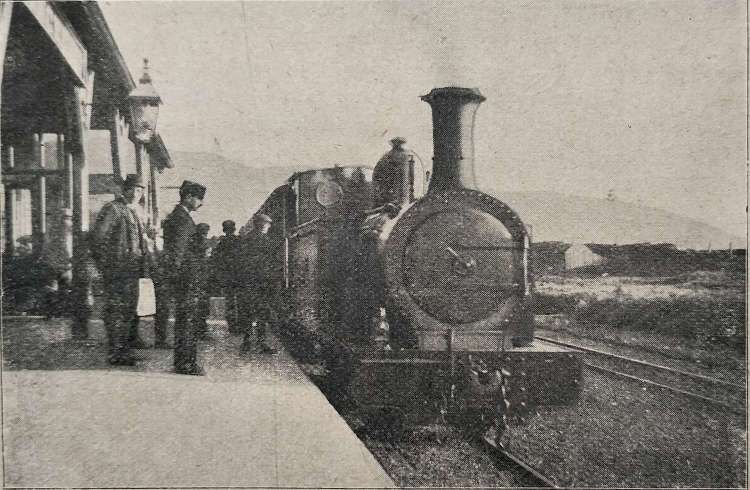
A train from Derry arrives at Buncrana. The Locomotive is L&LSR No. 4, ‘Innishowen’. [1: p464]

In Chisholm’s concluding remarks, he comments that “the railway is a thoroughly up-to-date concern. … The management is …  thoroughly enterprising. The railway … is an interesting  and well-managed line; the scenery in the district it serves can truly be described as amongst the grandest in the British Isles.” [1: p464]

References

  1. A J. Chisholm; The Londonderry & Lough Swilly Railway; in The Railway Magazine, London, November 1899, p461-464.
  2. My completed articles about the L&LSR can be found on this blog on the following links:
  3. https://en.m.wikipedia.org/wiki/Londonderry_and_Lough_Swilly_Railway, accessed on 14th September 2024.
Derry History – The Harbour Tramways/Railways

The ‘Modern Tramway’ Journal of September 1963 had a short article about the Harbour Tramways in Derry, written by J.H. Price. …

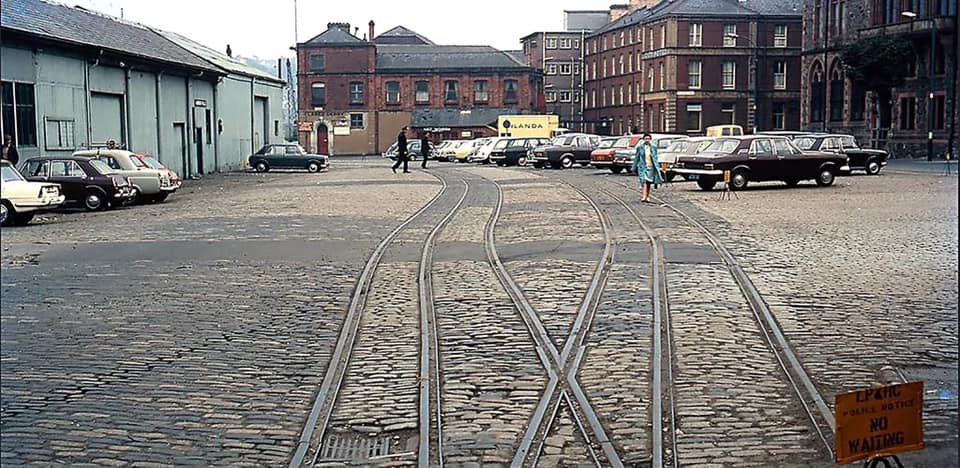
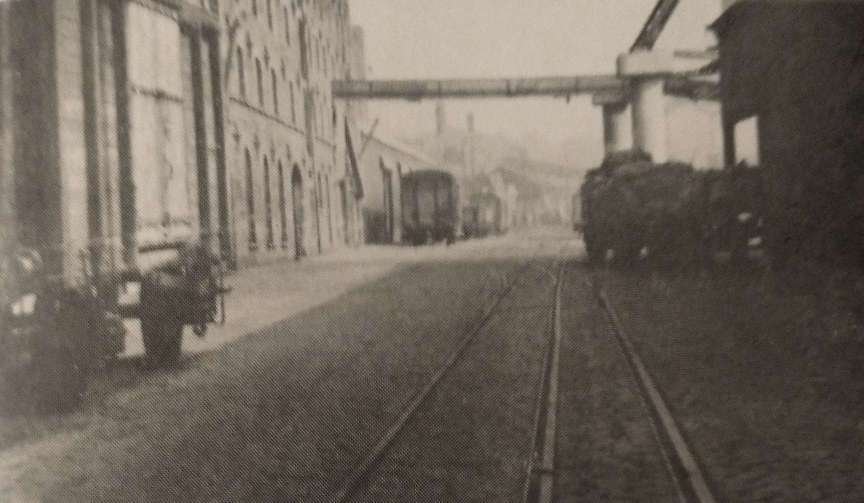
The 3-rail mixed gauge track of the dockside tramways in Derry. These were closed from 1st September 1962, © J.H. Price. [1: p315]

Friday 31st August, 1962, saw the closing of the dockside tramways of the Port and Harbour Commissioners in Derry. This was probably “a delayed outcome of the closing in 1957 of much of the hinterland railway system, which … diverted much traffic to Dublin, and since 1950 the rail traffic over the Commissioners lines has fallen from 200,000 tons to just over 10.000 tons per year. Now road transport is used for all traffic.” [1: p314]

The city of Derry was unusual in having four separate railway termini, two on each side of the River Foyle. On the western side was the Foyle Road, terminus of the Great Northern Railway’s 5ft 3jn gauge line to Omagh and Portadown, separated by nearly two miles of quays from the L&LSR’s 3 ft. gauge terminus at the Graving Dock. Across the river on the eastern shore was the Waterside terminus of the Ulster Transport Authority (ex-NCC) main line to Coleraine and Belfast, and further south on the same side was Victoria Road station, the terminus of the 3ft gauge line to Strabane owned by the Ulster Transport Authority and worked for them by the County Donegal Railway.

The narrow gauge lines were closed in 1953 and 1954 respectively, but the broad gauge lines were still in use in 1963.

To allow railway wagons to reach the town quays and the quayside warehouses, the … Port and Harbour Commissioners built from 1867 onwards a system of dock tramways worked initially by horses. Most of the lines were of three-rail mixed gauge. … In 1872 steam traction was introduced, with broad-gauge tank locomotives fitted with dual couplings so as to haul broad or narrow-gauge wagons; mixed gauge trains were not unusual.” [1: p314]

From about 1950 the Commissioners two latter-day locomotives (both 0-6-0 saddle tanks) were displaced by road tractors, but remained in their shed for another three years. Photographs of these two locomotives can be seen towards the end of this article.

For a short time in the 1880 the Lough Swilly passenger trains ran over the dock tramways as far as the Middle Quay, but this ceased in 1888, and a link for passenger traffle was provided instead from 1897 onwards by the 4ft 8in gauge horse tramway of the City of Derry Tramway Company, replaced by motor buses in 1920.” [1: p314-315]

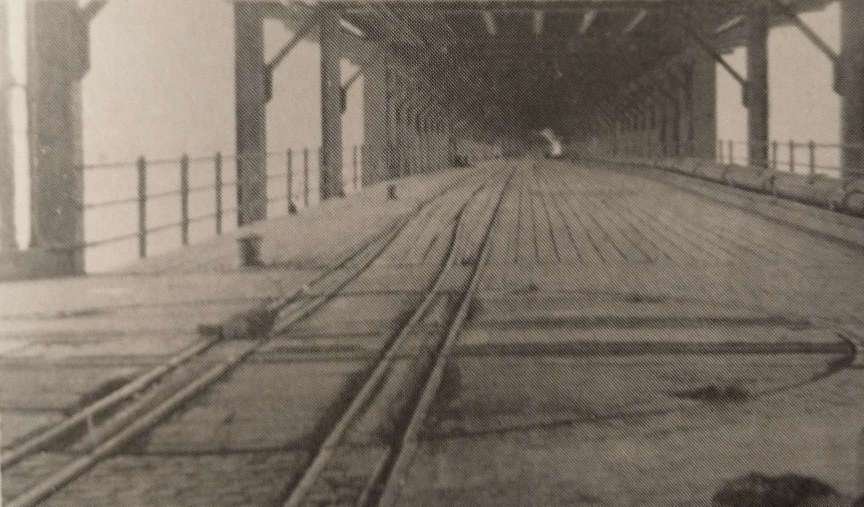
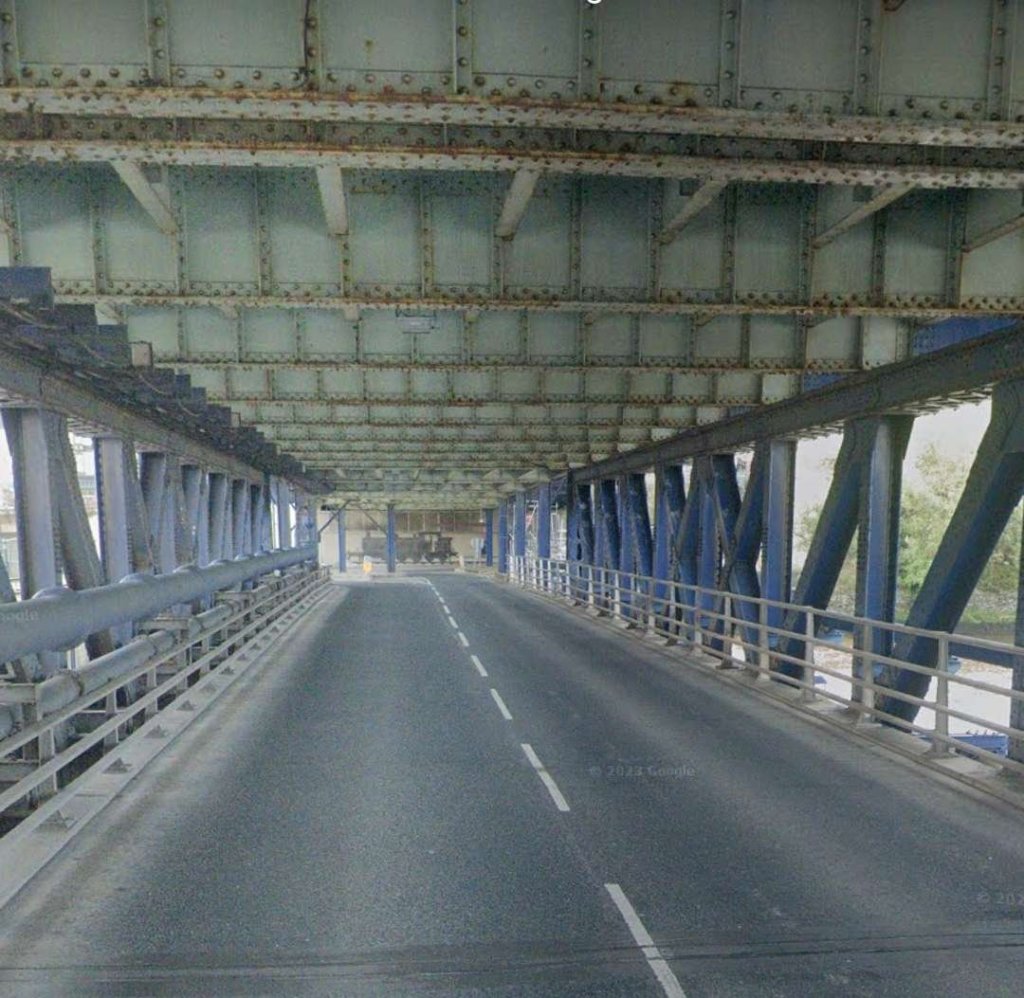
Since part of the original scheme was to allow the railways of the eastern shore an access to the quays and warehouses on the western, or town, side, the layout included a railway across the lower deck of the Carlisle Bridge, and this was continued when the bridge was reconstructed as the Craigavon Bridge in 1933. The upper deck of the bridge carrie[d] a roadway and footpaths. Locomotives were not allowed on the bridge, and for many years the wagons were moved across by rope and capstan.” [1: p315]

The lower deck of the Craigavon Bridge in Derry showing one of the mixed gauge turntables, © J.H. Price. [1: p315]
The lower deck of the Craigavon Bridge in 2023. [Google Streetview, April 2023]

This installation included two of Ireland’s few mixed-gauge turntables (the others were at Strabane, Larne Harbour and Carnlough), and to ensure that the narrow-gauge wagons were balanced correctly on the turntables, the 3 ft. gauge track was brought to the centre of the broad gauge instead of remaining at one side.

Price commented that the whole layout was distinctly unusual. He considered it likely (in 1963) that some portions of the trackwork would remain in place for years to come.

Craigavon Bridge was designed by the City Architect, Matthew A Robinson. Construction began in the late 1920s and was finished in 1933. As we have noted, the lower deck of the bridge originally carried a railway line for freight wagons, but that was replaced by a road in 1968. At each end, a silhouetted mural of a railway station stands to mark the former railway. [2]

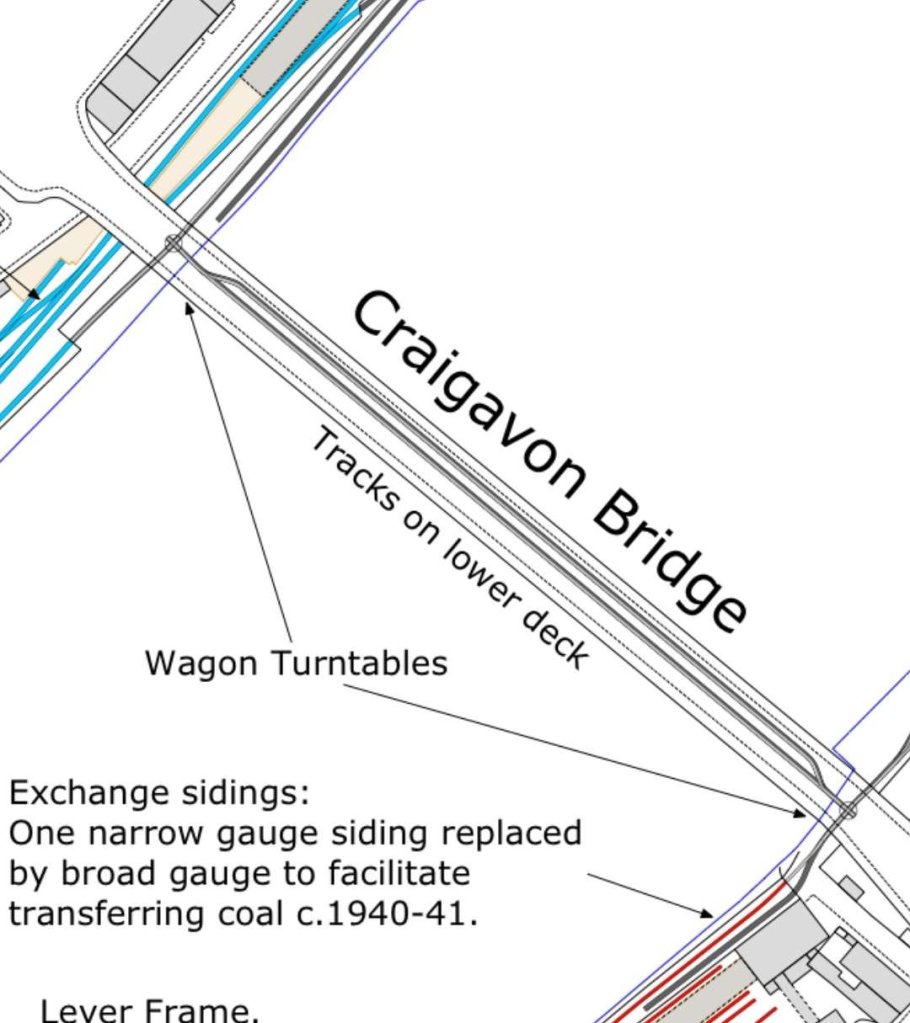
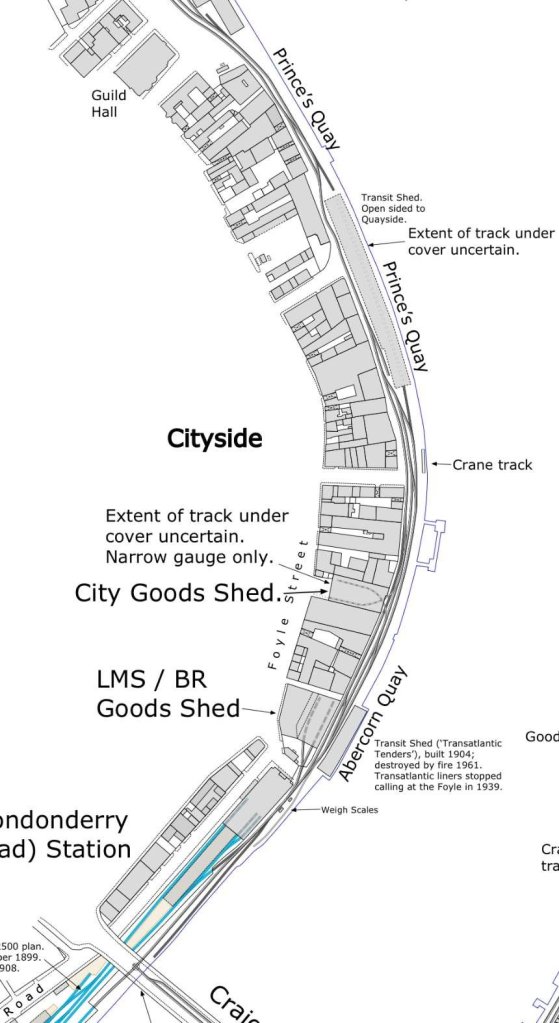
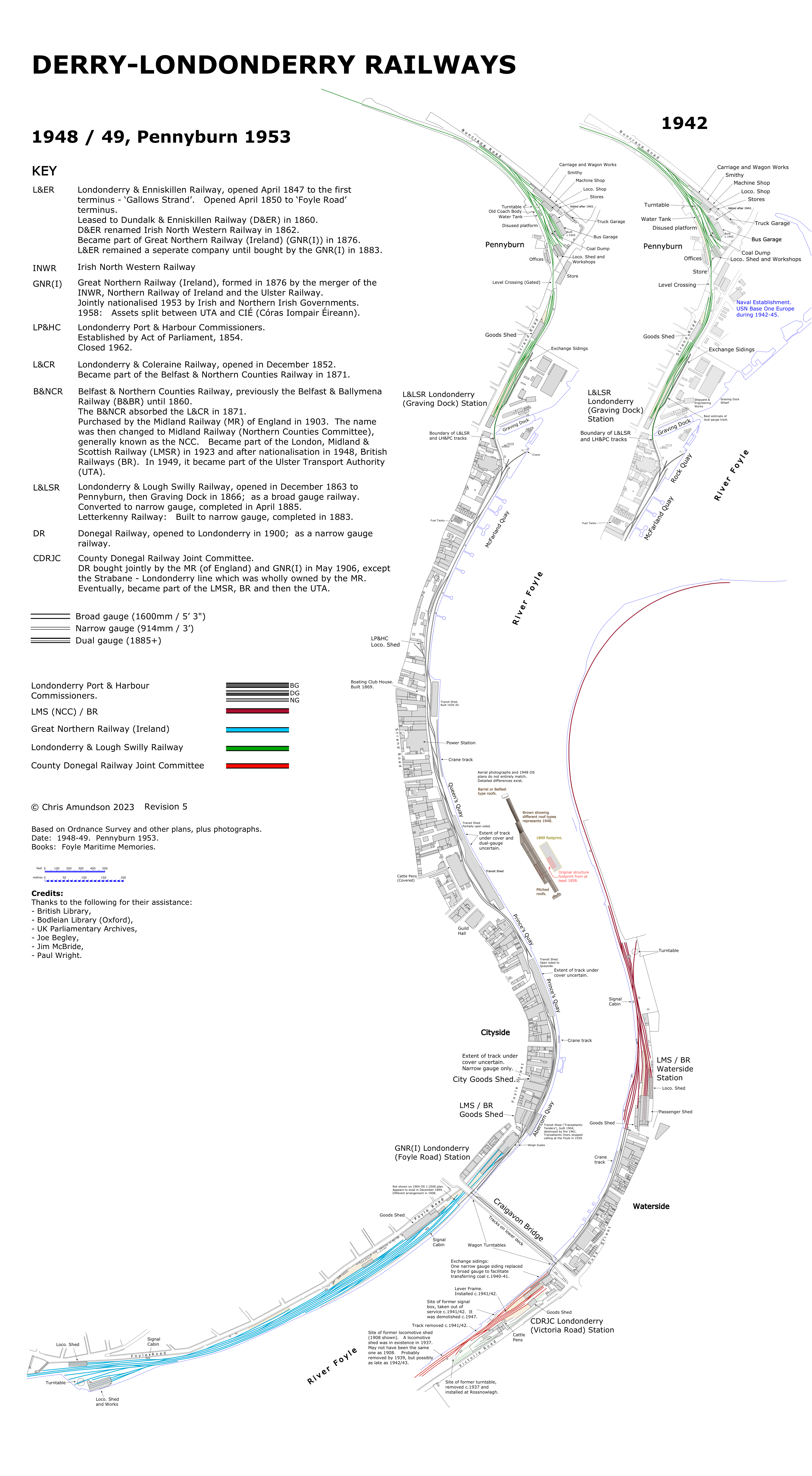
The Port and Harbour Commissioners Tramways have been carefully mapped by Chris Amundson after study of all available sources. His work covers track layouts throughout the life of railways and tramways in Derry. This is not the place to share large electronic files but his mapping can be found on the Irish Railway Modeller forum. His CAD map from the late 1940s can be found here. [3] Just a few extracts from that drawing. …….

This first extract shows the track layout close to Craigavon Bridge. The grey/black lines are those of the Port and Harbour Commissioners Tramways, the red lines are those of the County Donegal Railways Joint Committee. The turquoise blue lines are those of the Great Northern Railway (Ireland). It is worth noting the two wagon turntables, each of which sits at one end of the bridge, © Chris Amundson. [3]
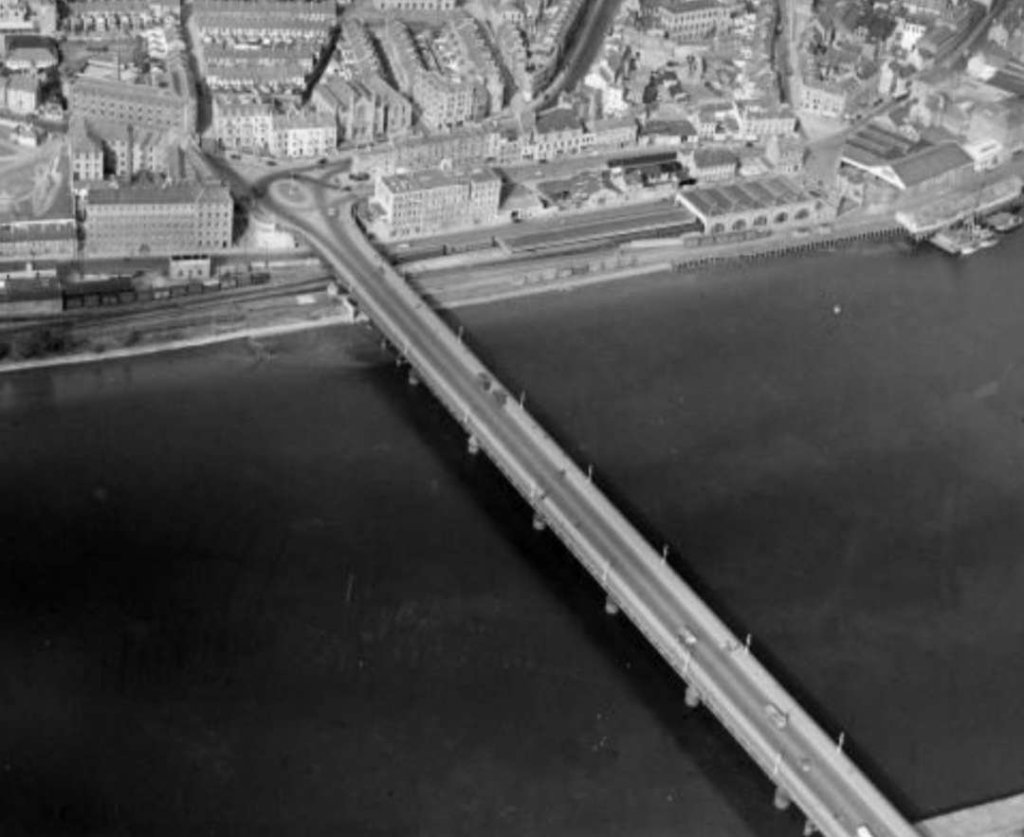
Craigavon Bridge in 1949, as seen in a Britain from Above Aerial Image (XAW027082) © Historic England. [13]
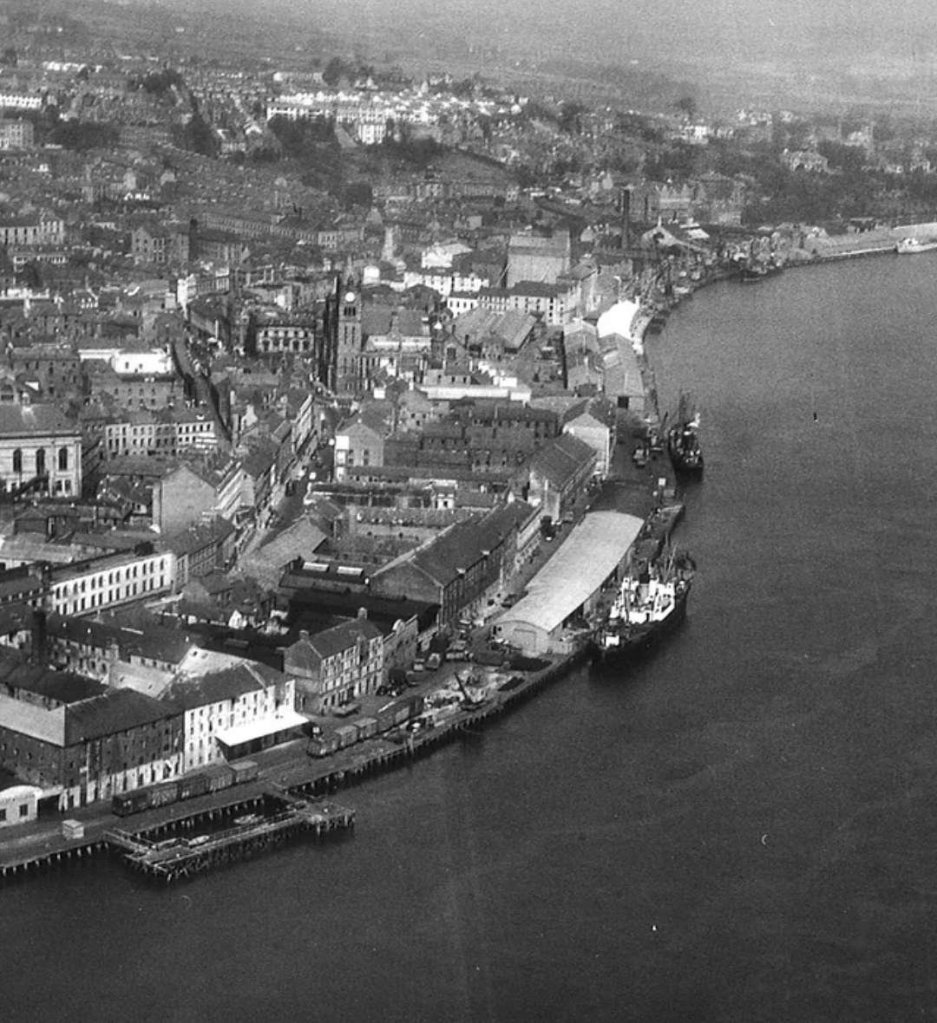
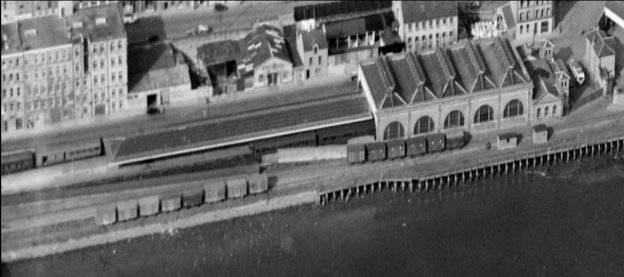
A general aerial view of the quays at Derry with the centre of the city close alongside. The light roofed building adjacent to the ship at Prince’s Quay. Further to the North are the transshipment sheds opposite the Guildhall sitting between Prince’s Quay and Queen’s Quay. [11]
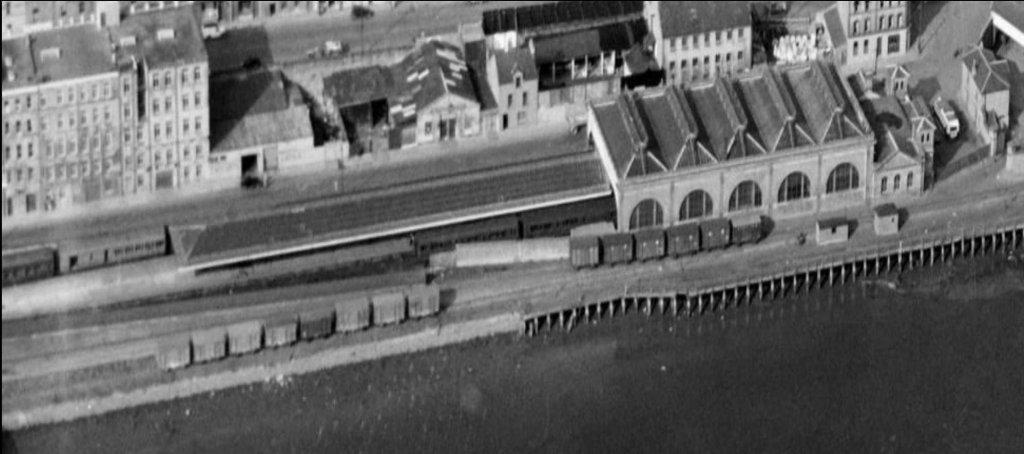
Abercorn Quay and the GNR(I) Foyle Road station with covered wagons sitting on the Port and Harbour Commissioners’ rails, on an extract from photograph XAW027081, © Historic England. [12]
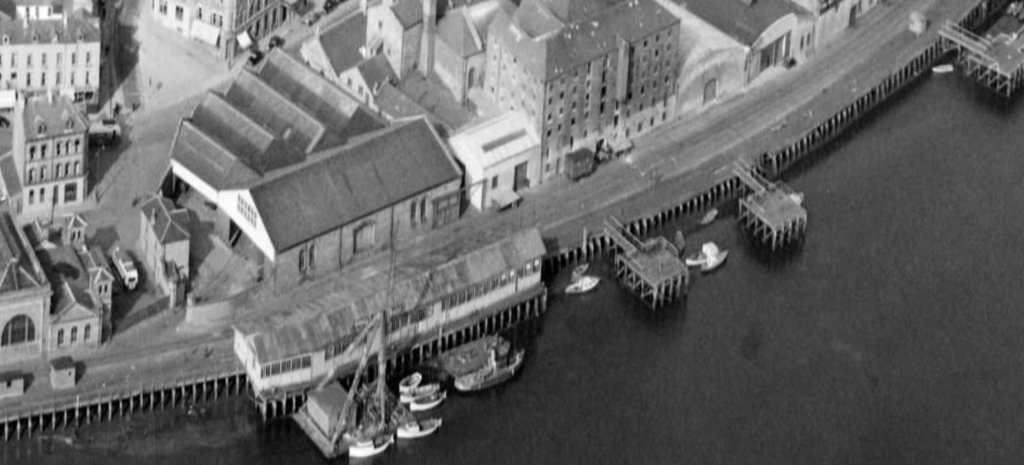
This extract from photograph XAW027081 overlaps with the one above and also shows Abercorn Quay, © Historic England. [12]
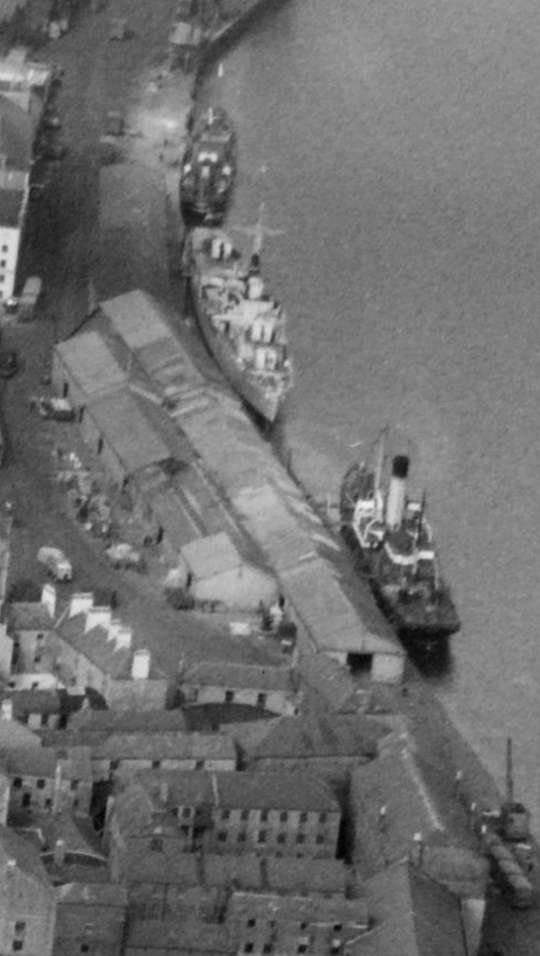
Open wagons sit on the Port and Harbour Commissioners’ rails at the South end of Prince’s Quay on an extract from photograph XAW027081, © Historic England. [12]
The transshipment shed on the quayside between Prince’s and Queen’s Quays. The Guildhall is just off the extract on the left. This extract is also taken from photograph XAW027081, © Historic England. [12]
The Port and Harbour Commissioners Tramways ran along the City side (West side) of the River Foyle. This extract shows Abercorn Quay and Prince’s Quay, © Chris Amundson. [3]
This extract shows Queen’s Quay and includes the location of the Port and Harbour Commissioners Tramways Loco. Shed, © Chris Amundson. [3]
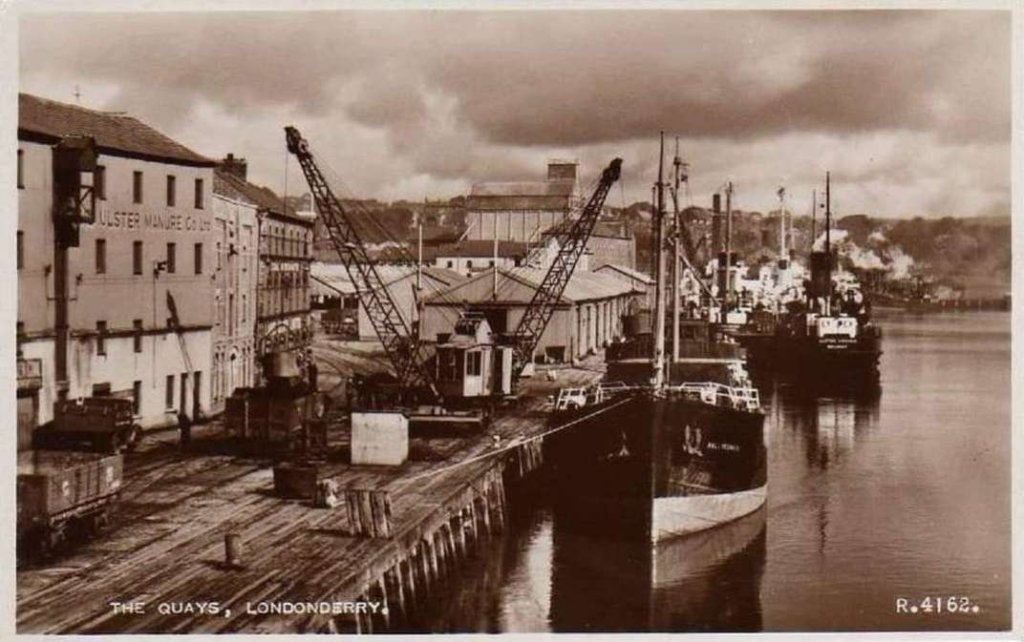
This photograph looks North from Prince’s Quay. The 2 cranes are unloading coal at Berths 12 and 13. Astern of the ship (Kelly’s ‘Ballyedward’) in the foreground are the Liverpool and Heysham berths and their transshipment sheds. The Guildhall is hidden by the buildings on the left. The large building to the left of the tip of the righthand crane is McCorkells grain store. The new City Hotel and Quayside are now on that site. The boat behind the ‘Ballyedward’ on the right is the Belfast SSCo’s ‘Ulster Drover’ which carried cattle to Glasgow until about 1958. Scrapped in 1959. This photograph was shared on the Derry of the Past Facebook Page on 22nd January 2017. [14]
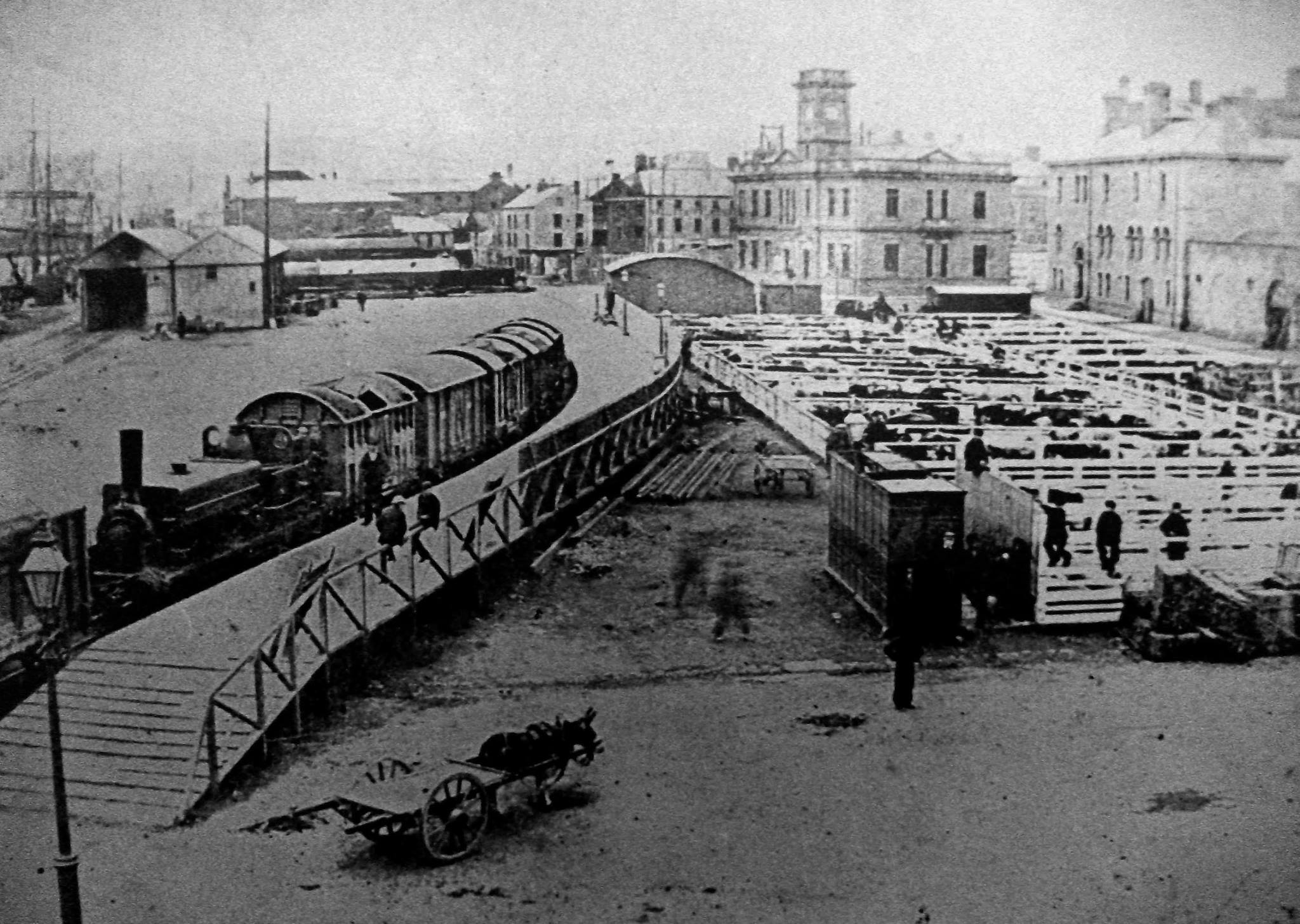
The quay, before the 1890s as the Guildhall has yet to be built. You can see Harbour House and Custom House in the image (the Guildhall would have been just behind the Harbour House). The platform in the foreground is the Lough Swilly Railway’s original Middle Quay Station. This image was shared to the Derry of the Past Facebook Page by Michael Burns & J Knox on 9th August 2016. [5]
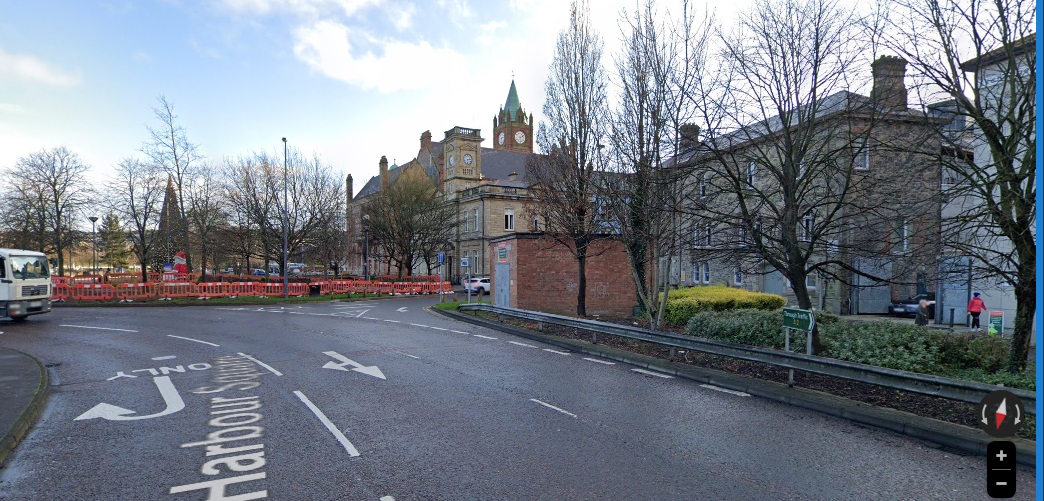
A similar view in 2020. Harbour House and Custom House are visible in this photograph which was taken when the leaves were not on the trees. The Customs House is closest to the right side of the image. The Guildhall beyond Harbour House. [Google Streetview, December 2020.
This view looks South from alongside the Transit Shed. The balconied building on the right is the Guildhall. The dual-gauge track enabled wagons of both gauges to access the various warehouses and quays along the River Foyle. This image was shared on the Irish Railways Past and Present Facebook Group by John McKegney on 9th December 2020. [5]
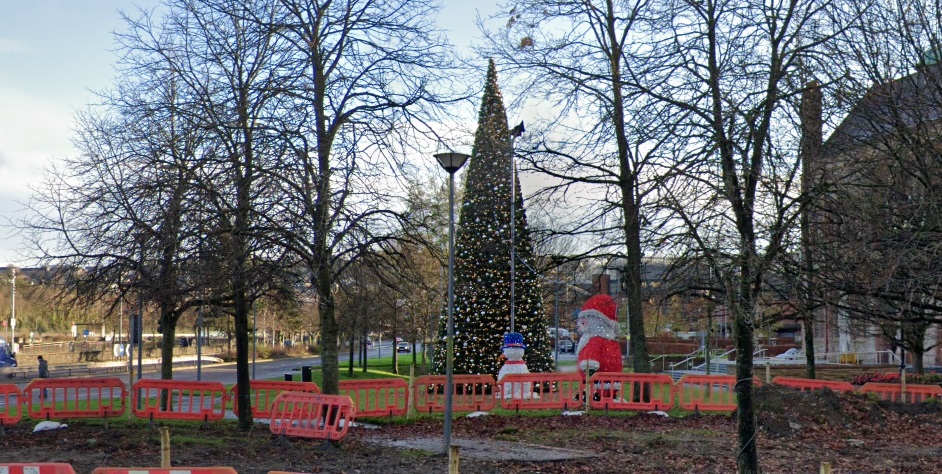
The best that we can do using Google Streetview to replicate the older image above. The Guildhall is on the right of this view camouflaged by the bare trees of winter. The Christmas tree is probably siting over the place that the old tracks in the image above would have run. [Google Streetview, December 2020]
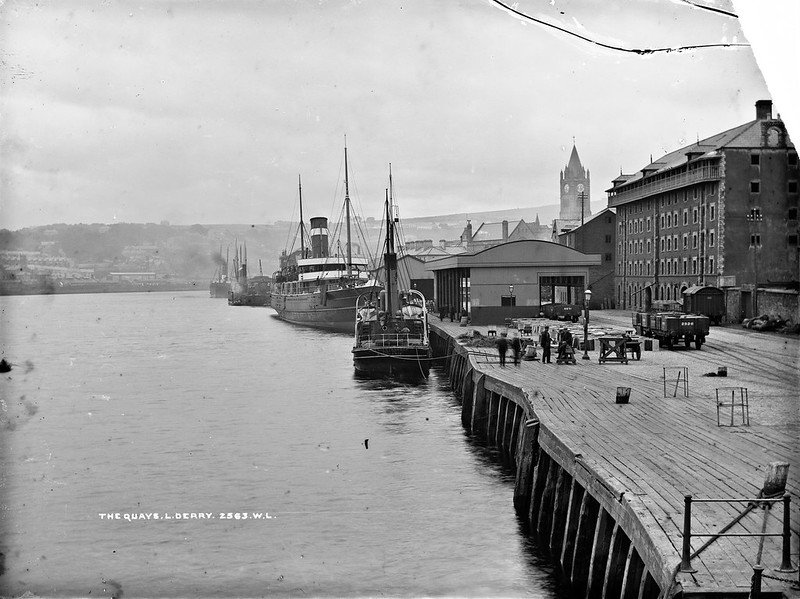
Looking South towards the Guildhall (the clock tower is clearly visible) from Queen’s Quay, probably sometime in the first decade of 20th century. The smaller vessel, nearest the photographer, is the Screw Steamer ‘Harrier’. Built in 1892, she was torpedoed in 1943 (by U-boat U181). The larger steamer, just beyond, is the Packet Steamer ‘Duke of York’. Built in 1894, she was renamed the ‘Peel Castle’ in 1911/1912, and pressed-into service as an Armoured Boarding Vessel during WWI, © Robert French, held in the Lawrence Photograph Collection of the National Library of Ireland. [15]
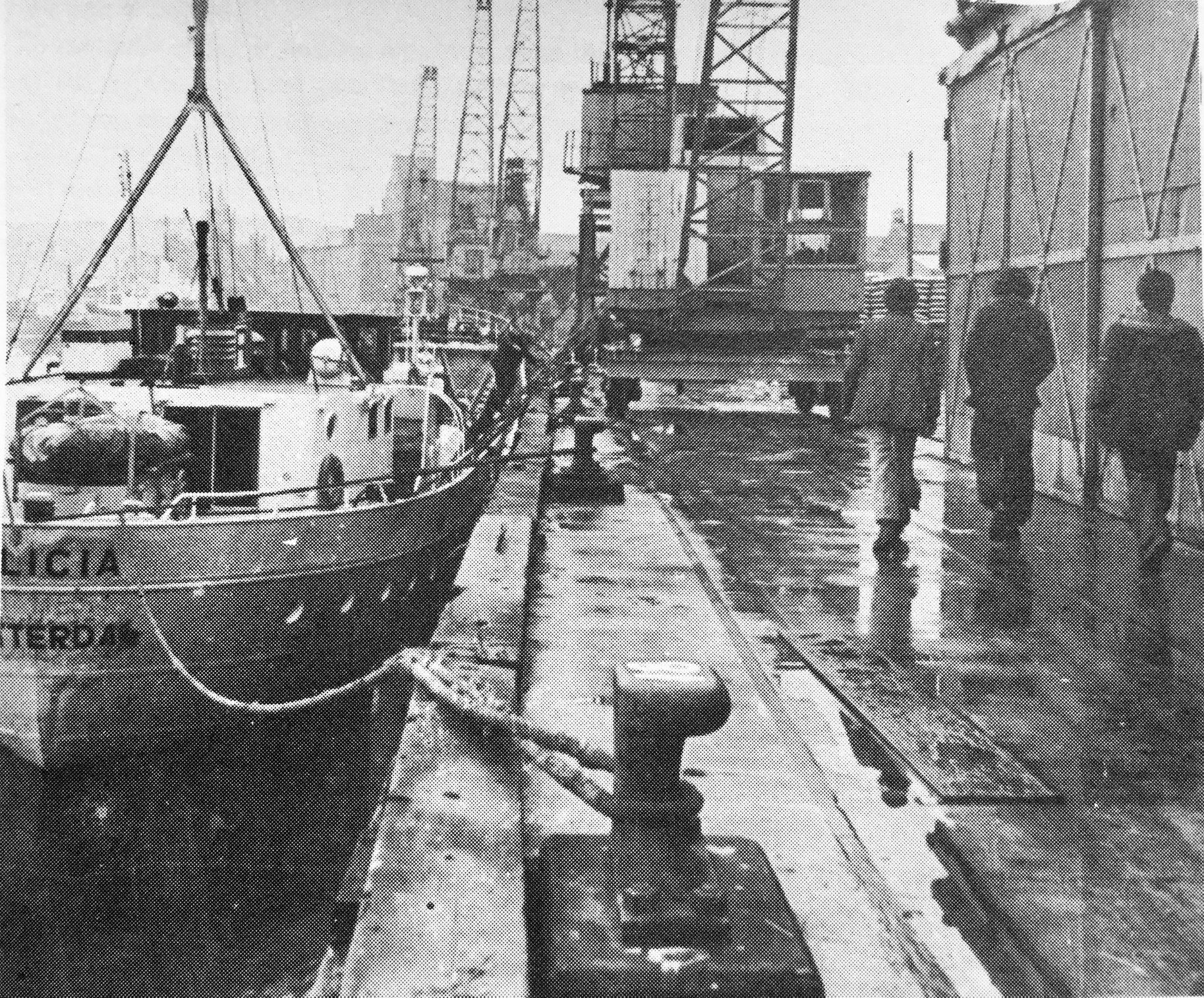
North of the Guildhall and the large transit shed but South of the Loco Shed there is a second transit shed shown on the mapping . This photograph was taken in the 1980s looking South from alongside that transit shed towards the crane tracks. The crane is sitting at the North end of the tracks. The image was shared on the Derry of the Past Facebook Page by Joseph Keys on 7th July 2020. [6]
A similar view in September 2009. [Google Streetview, September 2009]
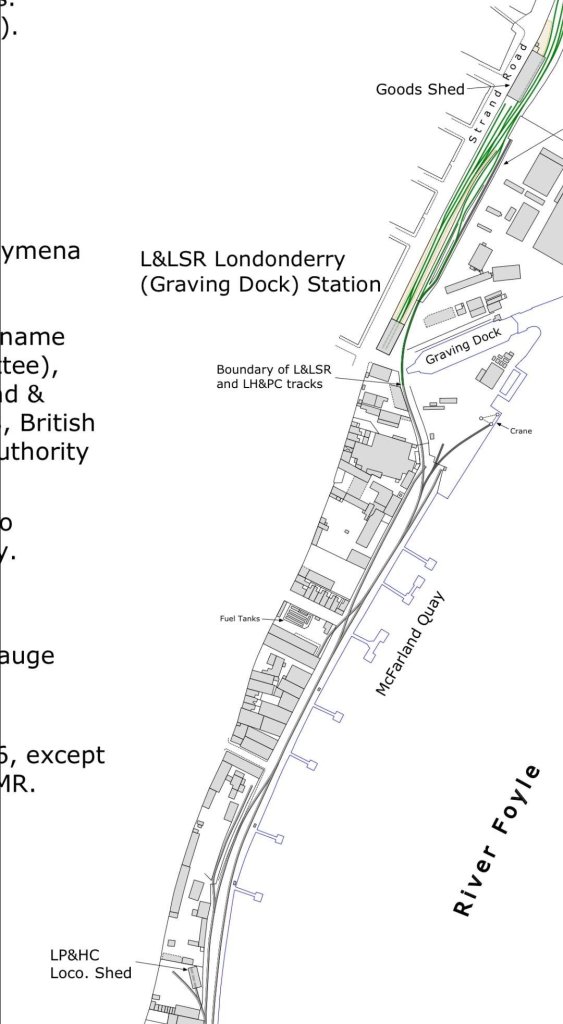
This final extract shows the northern extent of the Port and Harbour Commissioners Tramways. The Loco. Shed can be seen bottom-left. McFarland Quay and the Graving Dock appear to the South of the L&LSR Graving Dock station. The L&LSR’s tracks are shown by the green lines, © Chris Amundson. [3]

To the North of the Goods Shed and just off the North edge of the extract above the L&LSR crossed the Strand Road at level on a shallow angle.

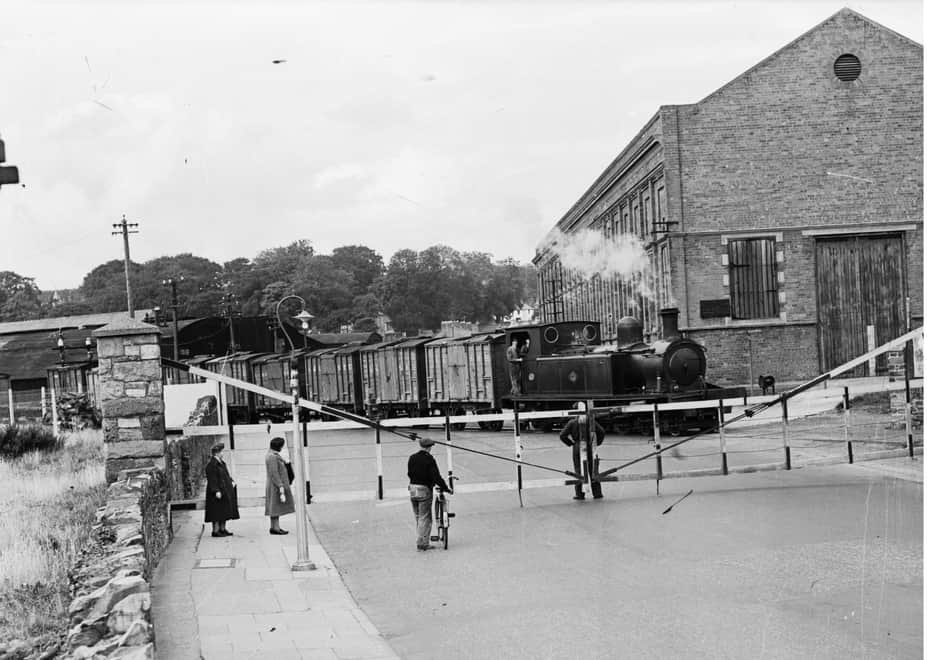
This photograph is taken looking North through the level-crossing on Strand Road. It shows the final train on the L&LSR, entering Graving Dock Station from the North, crossing Strand Road. The Crossing Gates emphasise the width of the road and the shallow angle of the crossing. [16]
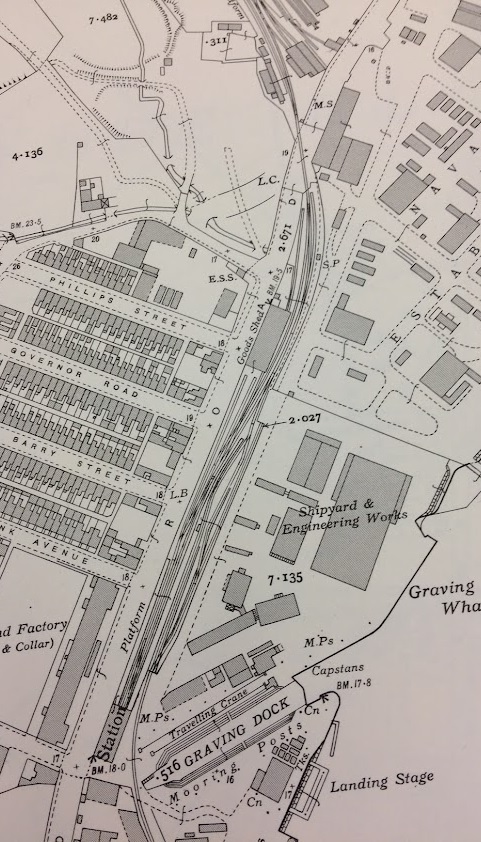
This extract from the Ordnance Survey at the turn of the 20th century shows the Graving Dock, the L&LSR Station and the Strand Road crossing. The Port and Harbour Commission’s dual-gauge tramroad enters the extract from the South and terminates alongside Graving Dock Railway Station where a connection is made with the L&LSR sidings. Ownership of the tracks switched from the Commission to the L&LSR at the Southwest end of the Graving Dock.
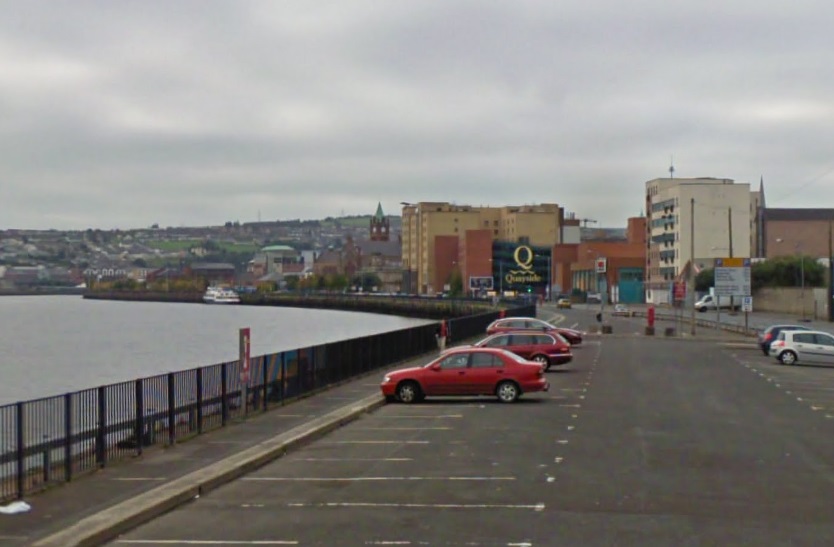
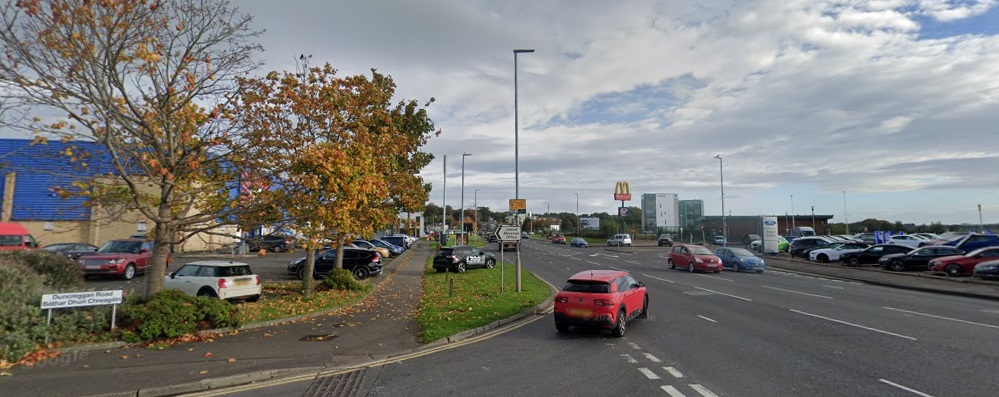
The view North from the mouth of Duncreggan Road in 2022. The western kerb of Strand Road was under the location of the car parked on the grass verge close to the centre of the picture, perhaps under the location of the offside rear wheel. The level crossing gates were perhaps a short distance to the North of the same car. [Google Streetview, October 2022]

The next two images show the Port and Harbour Commission’s Locomotive 0-6-0ST No. 1 at work on the West side of the River Foyle. Both are embedded Getty Images.

Londonderry Port & Harbour 0-6-0ST No.1. Locomotive & General Railway Photographs. Ireland, 1933.
Locomotive 0-6-0ST No. 1 in 1933, (Photo by Science & Society Picture Library/SSPL/Getty Images). [7]
Londonderry Port & Harbour 0-6-0ST No. 1
Locomotive 0-6-0ST No. 1 again, (Photo by Science & Society Picture Library/SSPL/Getty Images). [8]
Locomotive No. 1 again, this locomotive was built by Robert Stephenson & Co. (Works No 2738). It is on display in the Ulster Folk and Transport Museum at Cultra near Belfast. [9]
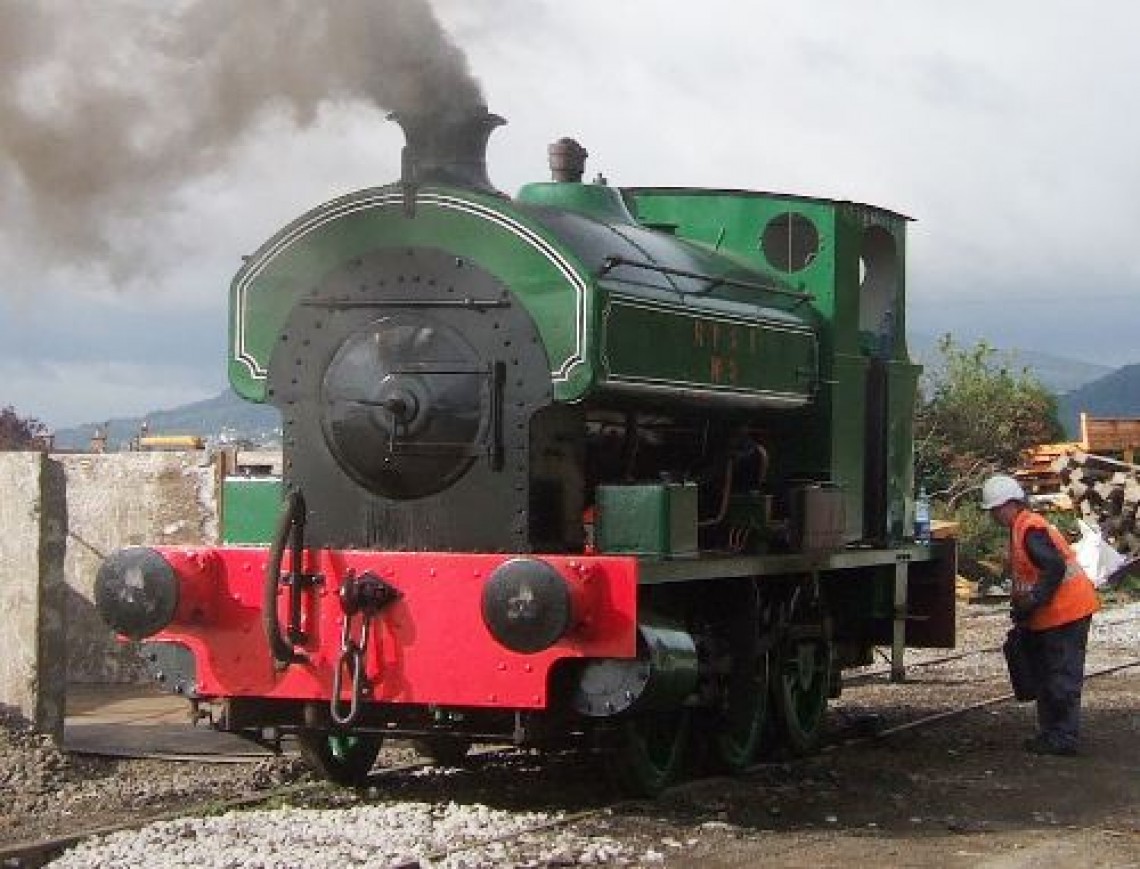
The Port and Harbour Commission’s Locomotive No. 3, ‘R.H. Smyth’. This locomotive is an Avonside Engineering Company locomotive, built in 1928, (Works No. 2021). Described as “generally similar to the B6 class 0-6-0 saddle tanks, but with a wheelbase of 9 feet and a gauge of 5 feet 3 inches”. The engine was designed to work on dual gauge track with both 5’3″ and 3′ gauge wagons, and had a pair of offset narrow gauge buffers. It was stood down from operational duties in 1959. By 1968 the engine had been out of use for several years and the Reverend L.H. Campbell decided to buy her to save her from the scrapyard. By February 1968 the engine was his, remaining for the time being in the Harbour Commissioners’ sheds. In 1972, the Reverend decided to pass the engine on to the Railway Preservation Society of Ireland so that it could be restored to working order. The handover officially took place on 1st May that year. It has an interesting history in preservation. [10]

No. 3’s story is taken up by the Railway Preservation Society of Ireland: “The little engine lay outside for many years until it became practical to overhaul her. She first steamed in preservation in summer 1977. For many years she served as yard shunting engine at Whitehead, and was a guinea pig for the inner firebox repair on No.85. Her public duties included train rides up and down the site at Whitehead, hauling early Easter Bunny and Santa trains before they became mainline trains. … In the summer of 2000 the loco was hired to contractors Henry Boot who were relaying the Bleach Green – Antrim line for NIR. A locomotive was needed to pull ballast hoppers, and as IÉ and NIR were not in a position to loan a locomotive, the RPSI was approached. The locomotive pulled over fifty thousand tons of stone from 18th June until 25th November 2000. On the latter date she returned to Whitehead and resumed her shunting duties. … By 2004 “R.H. Smyth” was in need of an overhaul, but didn’t seem likely to return to steam until the Guinness engine came out of traffic as steam shunting engine. Then the contractors relaying the Bleach Green – Whitehead line stepped in. They required an engine to haul ballast trains, just as Henry Boot had. The locomotive was given a thorough overhaul in double quick time, and was moved to Greenisland in early August 2005. After a busy five months ballasting, the engine returned home to Whitehead in December 2005. … From 2006 until 25th November 2012, when it returned to Whitehead, the engine was on loan to the Downpatrick and County Down Railway, although for the last couple of years of that stay, the locomotive was out of service awaiting a decision on boiler repairs. … In late 2019 the locomotive received a cosmetic overhaul and went on display in the Museum at the head of a mini goods train. The narrow gauge coupler has been reinstated.” [10]

References

  1. J.H. Price; The Londonderry Harbour Tramways; in Modern Tramway and Light Railway Review, Volume 26, No. 309; Light Railway Transport League and Ian Allan Hampton Court, Surrey; September 1963, p314-315.
  2. https://en.m.wikipedia.org/wiki/Craigavon_Bridge, accessed on 23rd August 2023.
  3. https://irishrailwaymodeller.com/uploads/monthly_2023_08/_com.apple.Pasteboard.nBUrho.png.5793b7e2d13018c0cf5dab48c9af4431.png, accessed on 24th August 2023.
  4. https://www.facebook.com/Derryofthepast/photos/a.1007190669332324/1210256352359087, accessed on 31st August 2023.
  5. https://www.facebook.com/photo/?fbid=10157961821301219&set=gm.1848708821949134, accessed on 31st August 2023.
  6. https://www.facebook.com/Derryofthepast/photos/a.1007190669332324/3528479063870126, accessed on 31st August 2023.
  7. https://www.gettyimages.co.uk/detail/news-photo/londonderry-port-harbour-0-6-0st-no-1-locomotive-general-news-photo/102725492?adppopup=true, accessed on 31st August 2023.
  8. https://www.gettyimages.co.uk/detail/news-photo/londonderry-port-harbour-0-6-0st-no-1-news-photo/102725493?adppopup=true, accessed on 31st August 2023.
  9. https://preservedbritishsteamlocomotives.com/1-londonderry-port-and-harbour-commissioners-0-6-0st-robert-stephenson-co-works-no-2738, accessed on 31st August 2023.
  10. https://www.steamtrainsireland.com/rpsi-collection/12/no3-rh-smyth, accessed on 31st August 2023.
  11. https://www.foyleport.com/history, accessed on 2nd September 2023.
  12. https://www.britainfromabove.org.uk/image/XAW027081, accessed on 2nd September 2023.
  13. https://www.britainfromabove.org.uk/image/XAW027082, accessed on 2nd September 2023.
  14. https://encrypted-tbn0.gstatic.com/images?q=tbn:ANd9GcR1FLJqvbOkkkChRaiNFNgSY3FWAMKYYHSyWg&usqp=CAU, accessed on 3rd September 2023.
  15. https://flic.kr/p/267Co9D, accessed on 3rd September 2023.
  16. https://www.derryjournal.com/lifestyle/travel/remembering-the-swilly-train-3330773, accessed on 10th September 2023.

The Modern Tramway – Part 4 –  Touring Ireland’s Light Railways in June 1953.

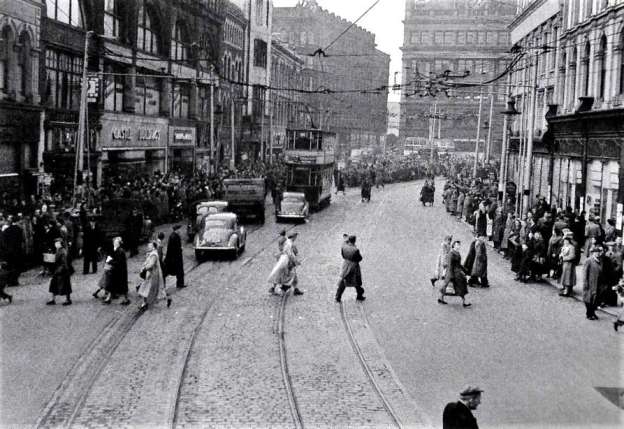
The featured image above shows one of the last tram journeys in Belfast. This tram is travelling along Castle Place on 27th February 1954, heading for Ardoyne Depot. [7]

In ‘The Modern Tramway’ of August 1953, [1] there was a report of an expedition by members of the Light Railway Transport League in June 1953 which toured a number of Ireland’s Light Railways. [1: p150-155] The visits included:

In 1953, this represented all the remaining Irish narrow gauge railways and tramways, with the exception of the derelict Schull and Skibbereen and Ballycastle lines and certain industrial lines (Guinness Brewery, British Aluminium Company, several Irish Turf Board lines and a few others) The Lough Swilly and Tralee and Dingle railways were both to close in the summer of 1953.

The tour commenced in Belfast on Saturday, 6th June and the morning was spent on the Belfast Bangor section of UTA, which was served by 3-car diesel trains. In the afternoon, a tour of Belfast  Corporation Tramways ran from the Mountpottinger Depot in an old tram (No. 340). It was noted that tramcars and track on the Belfast network were in a very poor state. Belfast had just purchased 100 surplus London buses which would hasten the closure of the tramway network.

A visit to the Hill of Howth Tramway consumed much of the next day.

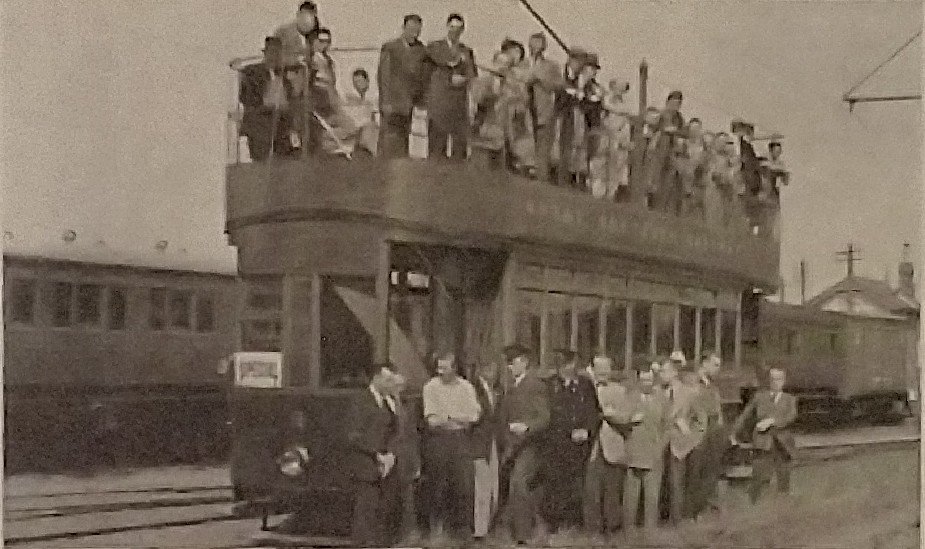
The tour party at Sutton Depot with Tram No. 9 which provided transport for the journey along the full length of the line, © J.H. Price. [1: p151]

On the Cavan and Leitrim, the tour party travelled behind 2-4-2T No. 12L. The train consisted “two open platform coaches and a sting of vans, some of which were detached and shunted at Mohill.” [1: p152] The description of the time on the Cavan & Leitrim continued: “At Ballinamore our coach was transferred to another, smaller train behind 4-4-0 tank locomotive No. 31, complete with cowcatcher for the roadside journey, to Arigna. This line is the last roadside steam tramway with passenger service in the whole of the British Isles, and is kept open by reason of the fact that it serves the Arigna coal mines. The speed is quite brisk, despite some really abrupt curves and switchback gradients, but the journey was cut short by an encounter with a road vehicle at Mahanagh (Shannon Crossing), through no fault of the train crew.” [1: p152]

After a short hiatus while a policeman from Drumshambo took everyone’s particulars the tour continued to Manorhamilton and then to Enniskillen and Fintona Junction where they enjoyed a short return journey on the newly reconditioned Fintona horse tram (G.N.R. No. 381), continuing later to Omagh and then Derry (Londonderry).

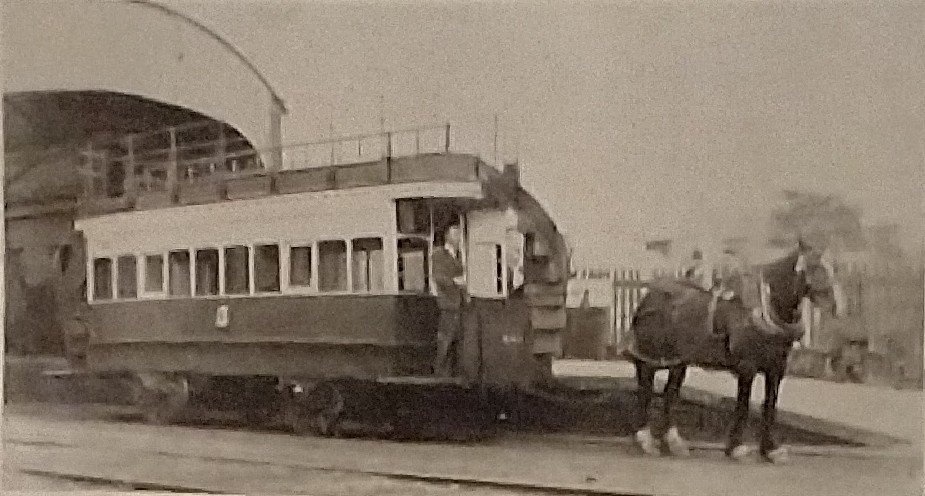
The reconditioned Fintona horse tram at Fintona Town Station, © J.H. Price. [1: p151]

From Derry, the tour party travelled to the border behind 4-6-2T No  15. This loco was replaced by 4-6-2T No. 10 for the remainder of the outward journey to Buncrana. The article continues: “The return journey from Buncrana was run as a mixed train. At Pennyburn sheds were locomotives Nos. 2, 4, 5, 6 and 8 – Nos. 5 and 6 are 4-8-4 tanks, the most powerful locomotives ever built for the Irish narrow gauge.” [1: p152]

The article reported that at the time of the visit, Derry had “four quite separate railway termini, each served by a different company and linked only by mixed gauge tracks laid along the quays and across the lower deck of the Craigavon Bridge. One railway, the 3 ft. gauge Londonderry and Lough Swilly, is to close down very shortly, and the special 3-coach passenger train provided on 9th June to take the L.R.T.L.-I.RR.S. party to Buncrana and back is likely to be the last; regular passenger service ceased in 1948.” [1: p152]

After a morning spent on the Lough Swilly, the party travelled to Strabane to explore parts of the  Co. Donegal Railways system. They were taken from Strabane to Stranorlar in Railcar No. 19 and toured the company’s workshop. They noted what at the time was “probably the oldest surviving railcar in the British Isles, a small 8-seater built as an inspection car in 1906 and fitted latterly with a Ford engine for use in pass- enger service; it [was] still in working order, and … stored at Stranorlar together with the Directors’ Saloon, which [was] still used once per year for an annual inspection by representatives of the Joint Committee. The locomotive shed housed two locomotives in startling brick-red livery as [were] the coaches and railcars.” [1: p153]

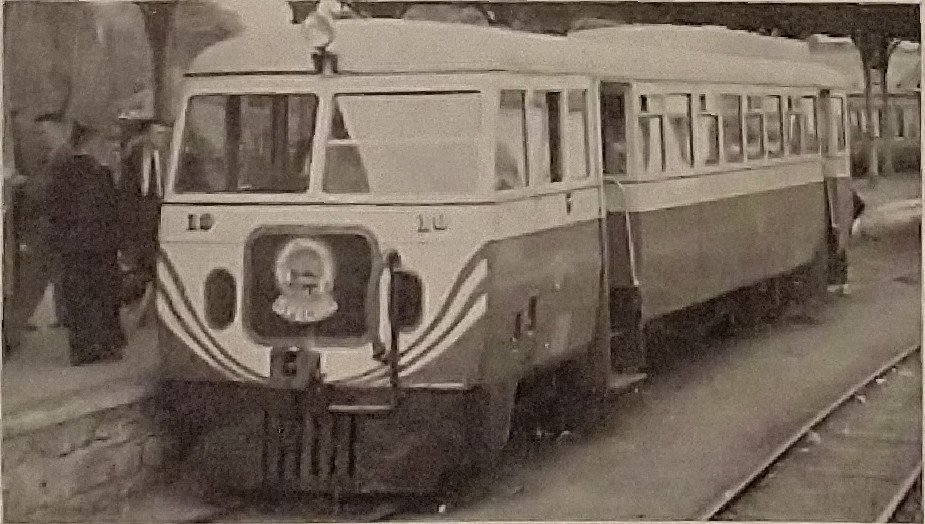
Co. Donegal Railways Railcar No. 19, © C. L. Fry. [1: p151]

From Stranorlar, Railcar No. 19 took the party non-stop through Barnesmore Gap to Donegal town, where it coupled with Railcar No. 10 and ran on to Killybegs. Returning to Donegal town the party transferred to a train of “Railbus No. 14, observation saloon No. 30 and trailer No. 1 for the last section to Ballyshannon, which ran fast to Rossnowlagh Friary halt and there picked up about 70 churchgoers from the Tuesday evening service at the Fransiscan Friary, some of whom were subsequently set down at their cottages along the line.” [1: p153]

Wednesday, 10th June started with a long cross-country journey to Ennis for a visit to the West Clare section. In 1952, the section had received 4 new railcars and a demonstration run between Ennis and Kilkee was provided for the tour group.

The following day saw the group travelling on the Tralee and Dingle Railway. By this date only monthly trains timed for the Dingle Fair were timetabled. The visit was on a Thursday and a special train was provided. 2-6-0T No. 8 took charge of two bogie vans fitted with new wooden benches and a few from the station platforms. The journey to Dingle took more than three hours and was followed by a return journey which also lasted longer than three hours and included a marvellous view of the sun setting over Tralee Bay.

Other visits followed before the tour returned to Dublin. None of which quite measured up to their experiences on the Tralee and Dingle!

Associated news carried by The Modern Tramway in the same issue of the journal included:

The end of the Londonderry and Lough Swilly

The Londonderry and Lough Swilly Railway, a light railway, which together with the Burtonport Extension, was once Ireland’s largest narrow gauge railway (99 miles of route) closed finally on 1st August. At its fullest extent, the line once extended from Londonderry to Burtonport with a long branch to Cardonagh. The Company, unlike its railcar-minded neighbour, the County Donegal Railway, decided that its future lay on the roads, and in 1929 began to operate buses, closing the railway between Buncrana and Carndonagh six years later. The Gweedore Burtonport section was closed on 3rd June, 1940 and the Letterkenny-Gweedore section in 1949. Occasional passenger trains during the holiday season, to relieve double-deck buses, ran to Buncrana until August, 1951.” [1: p159]

Belfast

The General Manager stated recently that in conformity with the policy of abandoning tramcar operation at the earliest possible date, tramway repairs and maintenance have been reduced to the minimum consistent with safety. The Queen’s Road tramway will not be replaced by trolleybuses but by motorbuses as the movement of large pieces of machinery to and from the shipyard is inconvenienced by overhead wires (in the past the tramway wires have occasionally been temporarily removed to allow “out-of-gauge” loads to pass along this way). During June and July the following tramcars were withdrawn and scrapped: [300, 301, 320, 337, 338, 340, 341, 369, 392, 394, 400, 413, 415, 419, 428].” [1: 159-160]

Late News from Ireland

Two steam-worked light railways visited during the Irish Tour have just been finally closed. On the Tralee and Dingle Railway, the last train ran on Wednesday 22nd July, to collect wagons from Dingle station yard. On the Londonderry and Lough Swilly Railway, the last goods train was due to run on 10th August.” [1: p160]

References

  1. The Modern Tramway Volume 16 No. 188.
  2. https://rogerfarnworth.com/2023/05/14/the-hill-of-howth-tramway/
  3. https://rogerfarnworth.com/2022/06/01/the-fintona-line/
  4. https://rogerfarnworth.com/category/railways-and-tramways-blog/ireland/west-clare/
  5. https://rogerfarnworth.com/category/railways-and-tramways-blog/ireland/co-donegal/
  6. https://rogerfarnworth.com/category/railways-and-tramways-blog/ireland/cavan-and-leitrim/
  7. https://www.belfastlive.co.uk/news/history/gallery/belfast-trams-origin-end-12044457, accessed on 12th June 2023.