
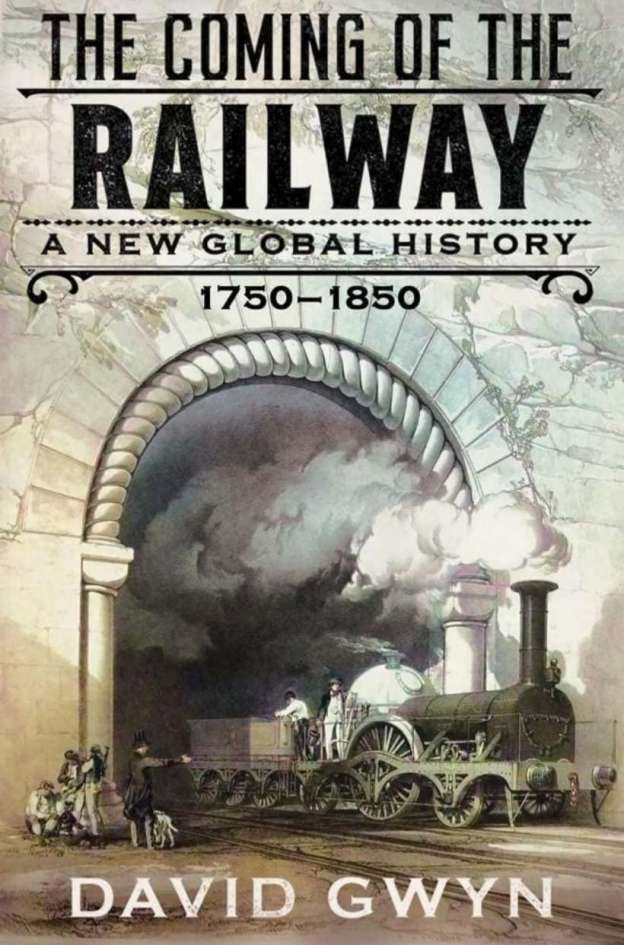
The first global history of the epic early days of the iron railway. Yale University Press says, “Railways, in simple wooden or stone form, have existed since prehistory. But from the 1750s onward the introduction of iron rails led to a dramatic technological evolution—one that would truly change the world. … In this rich new history, David Gwyn tells the neglected story of the early iron railway from a global perspective. Driven by a combination of ruthless enterprise, brilliant experimenters, and international cooperation, railway construction began to expand across the world with astonishing rapidity. From Britain to Australia, Russia to America, railways would bind together cities, nations, and entire continents. Rail was a tool of industry and empire as well as, eventually, passenger transport, and developments in technology occurred at breakneck speed—even if the first locomotive in America could muster only 6 mph. … The Coming of the Railway explores these fascinating developments, documenting the early railway’s outsize social, political, and economic impact—carving out the shape of the global economy as we know it today.” [1]
Praise
Positive comments made by various readers/critics, marshalled by Yale University Press. …
“One does not have to be a train-spotter to read it: it tells a crucial story of our social and economic history, and does so with recourse to exceptional scholarship.”—Simon Heffer, The Telegraph. [1]
“Written with great confidence and considerable aplomb, The Coming of the Railway is a must for the train enthusiast.”—Jeremy Black, New Criterion. [1]
“With impressive research and superb prose, Gwyn traces the complex evolution of railway technology, finance, and operating practices. . . . [He] succeeds brilliantly.”—Albert Churella, Technology and Culture. [1]
“The nineteenth century was defined by the railway. In this compelling new book David Gwyn weaves together the disparate strands that led to its emergence as the singular new technology of its age; a monumental study, erudite, authoritative, and full of wider historical insights.”—Sir Neil Cossons, former director of the Science Museum London. [1]
“This book is a real eye-opener for rail enthusiasts and scholars with a detailed and well researched account of the dawn of the railways. The rapid advancement in technology in the eighteenth and nineteenth centuries that the railways brought our society is truly astounding.”—Siddy Holloway, historian and presenter. [1]
“A fresh perspective on the early railway story across time and world space, with a wealth of intriguing details. Gwyn ably demonstrates the role played by overlapping technologies, harmonising under the influence of shaping forces.”—Susan Major, author of Early Victorian Railway Excursions. [1]
“The railways were the most important invention of the nineteenth century, but they only emerged thanks to a series of technological developments. This book documents these in a thorough and revealing way which makes it essential reading for anyone interested in the origins of this great invention.”—Christian Wolmar, author of The Great Railway Revolution. [1]
Review
I found this book to be easy to read and yet deeply scholarly. A superb, informative and enjoyable read! It is not too often that you find a railway history book as readable as a novel.
It seems to me that it is possible that the individual chapters are developed from the text of a series of lectures on early railway history. The readable text is backed up by very comprehensive notes and references. There is also a wide-ranging bibliography.
The chapter headings are:
- Trade, transport and coal 1767-1815
- ‘Rails best adapted to the road’: cast-iron rails and their alternatives in Britain 1767-1832
- Canal feeders, quarry railways and construction sites
- ‘Art has supplied the place of horses’: traction 1767-1815
- War and peace 1814-1834
- ‘Geometrical precision’: wrought-iron rails 1808-1834
- ‘Most suitable for hilly countries’: rope and chain haulage 1815-1834
- ‘That truly astonishing machine’: locomotives 1815-1834
- Coal carriers 1815-1834
- Internal communications 1815-1834
- The first main lines 1824-1834
- Coming of age: the public railway 1830-1834
- ‘The new avenues of iron road’ 1834-1850’You can’t hinder the railroad’
- ‘You can’t hinder the railroad’
These are intriguing titles for episodes in the development of railways and Gwyn ensures that there is no myopia, no unwarranted focus just on developments in the United Kingdom.
His chapter on Coal Carriers quickly looks beyond the Stockton and Darlington Railway, first to changes in the Northeast and then to Lancashire and Scotland, before looking across the Channel to France and particularly to the railways of Saint Etienne in the Massif Central. He then directs his readers to events in Prussia; to Pennsylvania; and then to Australia!
In fact it was long-lasting developments in the New South Wales coalfield “which ultimately enabled Newcastle in Australia to take over from Newcastle upon Tyne as the largest coal-exporting harbour in the world. [2] The New South Wales coalfield also remained a stronghold of steam traction into the 1980s, just as the wooden way could still be seen in operation on Tyneside many years after the iron road first appeared. Coal-carrying technologies die hard.” [1: p212]
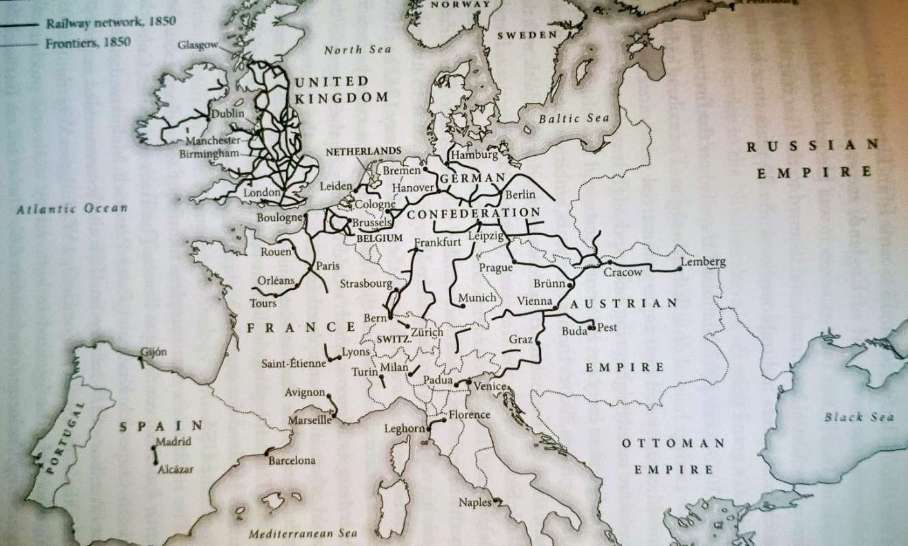
In his chapter on Internal Communications (1815-1832) Gwyn invites his readers to consider two markedly different railways which set the scene for the development of long-distance railways. The Cromford and High Peak Railway in England and the Budweis-Linz horse railway in the Austrian Empire. These two lines had very little in common technically but both sought to connect places at the opposite ends of one jurisdiction. … Long distance railways were seen as feasible: no longer was the ambition solely to connect mines, quarries and factories with navigable water. Railways began to serve rural areas and market towns, and offered a variety of services, including passenger transport.
He highlights the place in that process of development of the tramroads in the Welsh Marches: linking Brecon to the Wye Valley and Kington; and linking Abergavenny to Hereford. Although not in themselves of national significance, they contributed to the growing belief that longer distances could be embraced as rail technology advanced.
“In 1810, Thomas Telford surveyed, and William Jessop approved, a proposal for a ‘cast-iron railway’ from Glasgow to Berwick-on-Tweed, over 125 miles in length, the first credible proposal for a railway connecting the east and west coasts of Britain.” [1: p214] “In 1814, the French engineer Pierre-Michel Moisson-Desroches (1785-1865) urged Napoleon to build seven national railways from Paris. In 1817 the radical English schoolteacher, author and publisher Sir Richard Phillips (1767-1840) anticipated double-track railways connecting London with Edinburgh, Glasgow, Holyhead, Milford, Falmouth, Yarmouth, Dover and Portsmouth, drawn either by horses at 10 mph or by Murray-Blenkinsop locomotives at 15. [3: p75-76] By the 1820s these were becoming a serious possibility.” [1: p214]
During 1824 and 1825, 30 schemes for railways were presented to Parliament. The financial crash of 1825 put paid to most of them. The most ambitious would have connected London, Liverpool, Manchester, Birmingham, South Wales and Edinburgh! [4]
There was no failure in imagination, a scheme was proposed, for example, to build a railway from the Chagres River to Panama City. Gwyn explains that this was one of several speculative schemes to link seaports to their hinterlands. It was eventually built as ‘The Panama Canal Railway’, which runs alongside the Panama Canal from near the city of Colón to Panama City, crossing the Chagres River and the Continental Divide, with the primary passenger route running between Panama City and Colón. Incidentally, while a daily passenger service was suspended during the 21st century pandemic, the railway is of historical significance and still operates, sometimes offering special tours for cruise ship passengers. It was conceived to provide a connection between the Atlantic and Pacific oceans. Like other early railways it was conceived as a grand project. These projects required imagination and demonstrated the potential for railways to unite distant parts of a country, even if they weren’t immediately profitable.
Other proposed schemes mentioned by Gwyn linked: Newcastle to Carlisle; Manchester to Hull; Limerick to Waterford. These speculative schemes created space for the Liverpool and Manchester Railway to be successfully promoted.
However, what was contributed by the Cromford and High Peak Railway in England and the Budweis-Linz horse railway in the Austrian Empire was not so much about imagination as about practicalities. They demonstrated that “a considered scheme did have the potential to attract capital, as well as state support (or to do without it), and to bring together an engineering team capable of creating an iron road to unite distant parts of the country, even though one was not profitable for years and the other struggled to be completed.” [1: p232]
So it was that by the 1820s and early 1830s railways were for the first time being built to meet a needy in regional economic life, rather than purely serving a locality by connecting a mineral region with navigable water.
Gwyn points to three completed schemes designed to connect seaports to their hinterland, carrying passengers as well as goods – the first main lines. Two were in the USA and one in the UK – the Baltimore and Ohio, the Charleston and Hamburg and the Liverpool and Manchester.
The backers of the Liverpool and Manchester had deep pockets and needed them. The £600,000 that the line cost (£19,355/mile) was twice the cost per mile of the Baltimore and Ohio and twelve times the cost per mile of the Charleston and Hamburg. [5] Interestingly, there was a real imbalance in the contributions made by investors from Manchester and Liverpool. While the Exchequer made £100,000 available as a government loan and Manchester investors contributed £12,000, this from Liverpool provided £488,000! [6][7][8]. The difference in funding allowed the Liverpool and Manchester Railway to be considerably more robust!
Although the Liverpool and Manchester was definitely the first intercity main line railway, the three schemes developed in parallel and were completed only a matter of a few short years apart. Nevertheless, the opening of the Liverpool and Manchester Railway on 15th September 1830 was to be remembered in British and world history. “Previous transport undertakings in the United Kingdom had been inaugurated by local bigwigs, but, on that day of watery sun, Liverpool saw a gathering of continental European nobility such as had not been assembled since the Congress of Vienna rubbing shoulders with the British political elite. Not only was the guest of honour the Prime Minister and war hero, Arthur Wellesley, First Duke of Wellington (1769-1852), but four future British prime ministers were also present, and Sir Henry Brougham, the very embodiment of the ‘philosophic Whig’, was to be Lord Chancellor before the end of the year. Guests of rank, and in some cases of intellect and distinction also, included six earls, two marquises, six viscounts and over twenty other members of the peerage, though only one bishop. Some other guests were people in the public eye, like the writer and actor Fanny Kemble and the polymath Charles Babbage (1791-1871).” [1: p258]
International representation was also strikingly significant with important guests from Russia, Hungary, the United States of America.
Gwyn tells us that it was the opening of the Liverpool and Manchester Railway, rather than the Stockton and Darlington Railway, that took centre-stage as an epoch-defining moment. It represented “a shift in scale and ambition that surpassed both the earlier generation of iron railways and all but the longest canals and turnpikes. Not only was it entirely steam-operated, but its locomotives themselves were the design precursors of nearly all that followed. Another step change was the way that passenger facilities were set out and managed; its stations showed the way forward for railway companies in the years to come. Above all, it broke with most predecessor railways in England in that it was built not to carry coal or some other mineral, but to serve the globalised economy of cotton. It connected two great industrial centres, one an ocean-serving port, the other a manufacturing town. Its architecture celebrated what the railway embodied, not only the empirical philosophy which identifies successful solutions to technical problems but also Britain’s role as the ‘mart of nations’.” [1: p260]
In addition to the price per mile of the three first main line railways, Gwyn quotes the cost of others:
- The Dublin and Kingstown (Dun Laoghaire) cost £60,000 per mile, much more even than the Liverpool and Manchester;
- The Leicester and Swannington Railway, a mere £7,740.24;
- The New York and Harlem was the costliest per mile in the USA at $141,333, a consequence of having to build a very solid road using stone sleepers through the middle of a built-up area;
- Otherwise the most expensive American railway for its route length had been the Pontchartrain in Louisiana, at $72,000 a mile; it was only 4.5 miles long but was double-track throughout and ran through a swamp.
- The Boston and Lowell cost $70,000;
- The Mohawk and Hudson, $63,568;
- The soundly built Baltimore and Ohio cost $38,232;
- The Tuscambia, Cortland and Decatur, making its way over more than 45 miles of Alabama, along a single line of strap rails, was built for no more than $8,840 per mile!
Gwyn continues to look at the forms of finance which applied in different jurisdictions. …
In the UK, a variety of private finance arrangements were made among these were some railways funded by local subscription, not necessarily by wealthy individuals, some through provincial joint-stock banks and London banking houses. Interestingly “Quaker finance played an important part: Dublin and Kingstown was a Quaker initiative, as the Stockton and Darlington had been. In the north-east of England, where coal ownership and political power had always been virtually synonymous, Joseph Pease’s election to the reformed House of Commons in 1832 meant that the influence of the Society of Friends now extended to parliament.” [1: p270]
In the USA, capital finance was difficult to obtain. Most railroads raised capital through the services of an intermediary selling bonds to the money markets of London. Gwyn points out the significant role of Quakers, particularly through the banking houses of Philadelphia. He suggests that this was a significant factor in that city becoming a railway hub so very early in the development of railways in the USA.
Rail development in the USA in the first half of the 1830s greatly surpassed that in the UK and Europe. Many lines in the USA were built using wrought-iron straps on timber rails and as a result kept construction costs to a minimum. Whereas most bridges in the UK were built with masonry, brick and steel, in the USA timber was used most often.
The use of horses increased, in absolute terms, in the 1830s. “Horses were used where traffic did not justify locomotives or where mechanical traction was forbidden, such as in built-up areas, either absolutely or during the hours of darkness or through covered bridges. Short-haul movement and shunting was often carried out by horses. … Many well-established railways had no need to convert to locomotive operation if traffic did not increase. The independent carriers who operated the trains on many systems often had neither the means nor the need to use them.” [1: p276][9: p152, 245, 569]
As the 1830s unfolded there were still railways being designed and built with horse-operation in mind examples include – the Ffestiniog in North Wales, the Bratislava-Trnava railway in Hungary. Gwyn notes that while many applications for horse power continued through the middle of the 19th century, the times were very definitely changing, “by mid-century, recognisable national [rail] networks were becoming evident in some countries, connected with seagoing ships carrying textiles and foodstuffs across oceans.” [1: p285] Nothing could be what it once was. Steam power was already, by 1850, dramatically reordering the world!
In the final chapter of the book- ‘You can’t hinder the railroad’, Gwyn muses on the impact of the coming of the railway. “The coming of the railway was not the least of the many changes that characterised the long and tumultuous period of modernisation we call the ‘Industrial Revolution’, which in turn paralleled convulsive alterations in political order across the world in the late eighteenth and early nineteenth centuries. The close, often complicated, relationship between mechanical capacity and governmental, military, economic and social developments has formed a theme of this study but what is also evident is that the railway also had a profound imaginative impact.” [1: p315-316]
Charles Dickens, ‘Dombey and Son‘ “famously recalls the building of the London and Birmingham through Camden. Here ‘the first shock of a great earthquake had, just at that period, rent the whole neighbourhood to its centre’, bringing ‘dire disorder’ in its short term but opening a ‘mighty course of civilisation and improvement’. Narrative events reflect Dickens’s ambiguity; the defeated Carker is killed by a train whereas Mr Toodle finds a steady job which he loves as a locomotive stoker, and then driver.” [1: p315]
Gwyn sees that same ambiguity in J.M.W. Turner’s ‘Rain, Steam, and Speed – The Great Western Railway‘.
Thomas Cole’s, painting, ‘Rain in the Catskills‘ seems to portray the railway as an unobtrusive part of the landscape, the wild and the utilitarian coexisting, yet Cole wrote that “the railway made the human body ‘merely a sort of Tender to a Locomotive Car, its appetites & functions wait on a Machine which is merciless & tyrannical’.” [10]
Gwyn affirms that “Speed, dispatch and distance fed the imagination as well as the bank balance.” [1: p318] Victor Hugo was “delighted by the way … speed turned flowers and cornfields into swathes of colour and made nature dance before his eyes.” [1: p318][11]
Ralph Waldo Emerson saw these changes as disturbing – the railroad had seemingly eroded and reordered nature. Yet he was drawn to this new technology. On his way home to the USA in 1833, he “filled an idle hour in Liverpool by visiting the railway, where he ‘saw Rocket and Goliath and Pluto and Firefly and the rest of that vulcanian generation’. He even listened patiently to Jacob Perkins … expounding on his locomotive proposals. [12: p190-191]] When he rode behind a ‘teakettle’ on the Boston and Worcester the following year, like Booth he sensed ‘hitherto uncomputed mechan-ical advantages’. [12: p305] If he deprecated the way the railroad had coarsened the fabric of American life and contributed to its materialism, he nevertheless came to hold bonds or stock in at least six American concerns, affording him the financial security to develop and expound his philosophy of a universe composed of nature and of soul.” [1: p319]
Gwyn goes on to quote Henry David Thoreau and John Ruskin who both loathed and were drawn to this developing technology. He notes that George Eliot (Mary Ann Evans) depicts the clash of old and new in the novel Middlemarch.
Gwyn concludes his book with this final paragraph: “For George Eliot … the railway came to Middlemarch at the same time as parliamentary reform and cholera, and she understood that the unknown was rarely welcome. Princes, ecclesiastics and philosophers variously welcomed or feared the coming of the railway, but she also sensed a profound if barely articulate concern that it meant no good to the waggoner or the labourer. All that Caleb Garth can do is persuade Hiram Ford and the smockfrocks that they shall do no more ‘meddling’, because ‘you can’t hinder the railroad’. On that, at least, all came to agree.” [1: p321]
References
- https://yalebooks.yale.edu/book/9780300267891/the-coming-of-the-railway, accessed on 3rd September 2025.
- Gwyn tells us that “The shipping of coal from rail-served harbours remains important in the USA, Australia, India and China to this day. Railways retain an advantage over roads carriers, particularly where long overland distances are involved.” [1: p352]
- R. Phillips; A Morning’s Walk from London to Kew; J. Adlard, London, 1817.
- See for example: P. R. Reynolds; The London & South Wales Railway Scheme of 1824/25; in South West Wales Industrial Archeology Society Bulletin No. 95, p3-7.
- “In 1830 £1 was worth $4.56. The Liverpool and Manchester cost £600,0000, the Baltimore and Ohio $4,000,000, the Charleston and Hamburg a mere $951,140, though still considerably in excess of the original estimate of $600,000 (D.A. Grinde; Building the South Carolina Railroad; in South Carolina Historical Magazine Vol. 77 No. 2, 1976, p91). Only eight other engineering projects in the United Kingdom had cost more than the Liverpool and Manchester: the Royal Canal in Ireland, the Worcester and Birmingham, the Grand Junction, the Birmingham and Liverpool Junction and the Caledonian canals, Plymouth Breakwater, Sheerness Dockyard and Kingstown Harbour.” (A. W. Skempton {ed.); Biographical Dictionary of Civil Engineers Volume 1 – 1560-1830; Thomas Telford and Institution of Civil Engineers, London, 2002, p834-6).
- R. H. G. Thomas; The Liverpool and Manchester Railway;, Batsford, London, 1980, p29
- A. W. Skempton {ed.); Biographical Dictionary of Civil Engineers Volume 1 – 1560-1830; Thomas Telford and Institution of Civil Engineers, London, 2002, p690.
- P. Reynolds; Railway Investment in Manchester in the 1820s; in Journal of the Railway & Canal Historical Society No. 211, 2011, p38-48.
- F. C. Gamst; Early American Railroads: Franz Anton Ritter Von Gerstner’s ‘Die innern Communicationen’ (1842-1843); Stanford University Press, Stanford, California, 1997.
- A. Wallach; Thomas Cole’s ‘River in the Catskills’ as Antipastoral‘; in The Art Bulletin, Vol. 84 No. 2, 2002, p334-350. “The Canajoharie and Catskill was an unsuccessful concern and had already closed following a bridge collapse by the time the painting was completed.” [1: p362]
- Contre Vaudois: Journal de la Suisse Romande; 16th July 1892, p1-2.
- R. W. Emerson; Journals of Ralph Waldo Emerson, Volume 3, 1833-1835; ed. E. W. Forbes & W. E. Forbes, Houghton Mifflin, London and New York, 1910.
 Roger Farnworth