Category Archives: The Middle East

Railways in Iran – Part 6 – Foreign Articles – Collection A

As I have shared this series of articles about Iranian Railways on the internet, I have been pointed to articles in Swedish, Danish and German which cover the early years of Iran’s Railway network….

Contributors to the SJK Postvagen (the forum of the Swedish Railway Club) have been particularly keen to share some of these. I have used Google Translate to create a first translation draft of each article and then sought to clarify anything unclear.

The articles and extracts below are of particular interest because they are written from the perspective of the time, rather than with the benefit of hindsight!

Here are the first three items:

The first is a short extract from an article which was originally written, I believe, in German in the Traffic Engineering Journal in 1933: [1]

A Trans-Persian Railway.

The Persian government has been working the construction of a railway across Persia from the Caspian Sea to the Persian Gulf for several years. Around 400 km of this line have already been completed at both ends. The remaining distance of about 1000 km is now to be tackled. The entire engineering work has been outsourced to two Danish companies and one Swedish company. The railway starts from the southern tip of the Caspian Sea. The Persian plateau is reached after about 100 km. There is only one major city along the route, Tehran, of course. At the southern end of the railway, the southern Iranian Zagros mountains are crossed. The Persian government intends to cover the estimated cost of RM 240 million from the normal state budget. The construction work is expected to take 6 years.

The second extract was originally written in Swedish. The contributor on SJK Postvagen provided only pictures. They are, however, intriguing. The notes associated with each picture are direct translations of the original notes: [2]

Locomotives in Persia
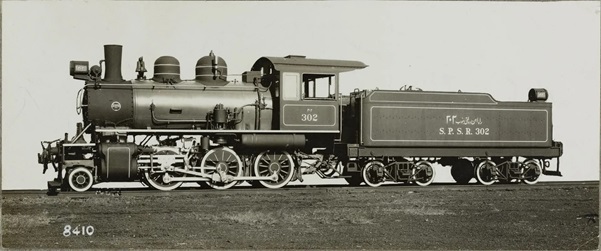
A Steam Locomotive from South Persian State Railways, built by Baldwin as Works No. 61670 in 1932. Note that the locomotive has short buffers and AAR coupler combined with screw coupler. Probably the locomotive was oil-fired because the ash box seems to be missing.
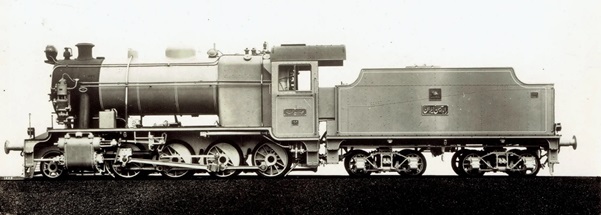
Iranian Railways locomotive made by Beyer Peacock.

Iranian Railways  2-10-2 made in England after the Second World War.

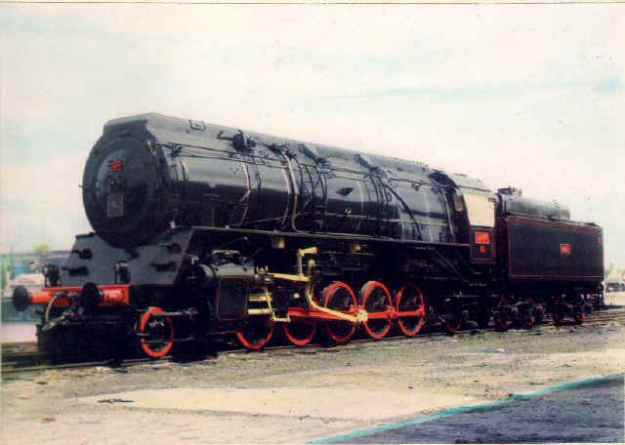
Iranian Railways oil-fired steam locomotive, built in America.

The pictures above have limited information associated with them. It is to be hoped that I can fill out details when I come to focus on the motive power on the Iranian Railway Network in a future article.

The third article is from a Danish source it is an Appendix containing a lecture by P. Swartling given at the Danish Engineering Federation on 17th March 1933.

Proceedings of the Danish Engineering Federation 1933: Appendix 2 – Page 19-31

P. Swartling: Railway Construction in Persia. 

Persia was only in name a free country with a ruler who spent most of his life in Europe. It was completely in the hands of its neighbours, Russia in the North and Great Britain in the South.

In order to prevent Russia from stretching its tentacles down into India, it was in Britain’s interest not to expedite the development of communications in Persia. … The result has been that the country is now significantly behind in this regard. As late as 1918, cars and other motor vehicles were completely unknown in Persia to the greater part due to the lack of import provisions. The country’s topography also mitigated against the development of communications.

While much of the country is made up of a pasture. This is surrounded in the north By the Elburs Mountains and to the west and south by the no less imposing Zagross Mountains. The difficulties in advancing and building through these mighty mountain ranges have been too great.

In the spring of 1918, after the Brest-Litovsk peace deal, the Russians withdrew their troops from Persia. An example of the difference this made to the British occupation of Persia was that they were forced to build a road from Kanakin (Iraq) on the Persian border across the Zagross Mountains to Hamadan to enhance the already existing road to Baku, previously built by the Russians.  At the same time, British forces were busy building a road from the port city of Bushir to the town of Shiras, located about 1000 metres above sea level. From Shiras, one can access the other larger cities in southern Persia such as Kerman, Yezd and Ispahan without too much difficulty.
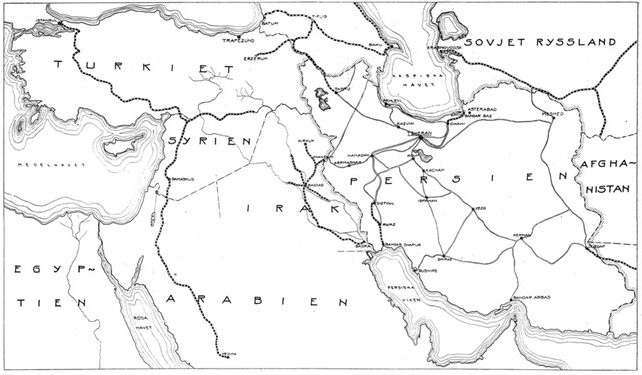
Map of Persia with its surrounding states.

Talard Valley in the neighbourhood of Pol-e-sefid

As a result, wagons and cars flooded into Persia, giving an impetus to interest in them. The now reigning Shah, Riza Kahn Pahlevi, who ascended the throne after the revolution in 1925, is very interested in the development of communications. In the relatively short time he has been in power, these have progressed rapidly.

According to reports, at the end of 1930 there was a network consisting of about 1950 km first class routes, 9500 km second class and 2200 km third class routes, all accessible by motor vehicles all year round. These figures clearly show that development has moved quickly.

The ruling Shah has a burning interest not just in roads, but perhaps to a still greater extent in railways. One of his first acts after his accession in 1925 was also to introduce a tax on tea and sugar, the yield of which is intended to be used entirely for railway purposes. This tax amounts to about 20 million kroner a year and has even in 1932 brought in about 100 million kroner of investment of which 60 million has already been spent.

Before I focus on the construction company on the present project, I want to touch on some previous projects. An important issue just before the war was the construction of a route running west to east, which would link India with Europe. It should have been an extension of the so-called Baghdad railway. However, with the outbreak of the World War, these plans were completely shelved.

During the war, England, which is in charge of the neighboring country of Iraq, built some railways in that country, and in 1919 the Basra — Baghdad — Kanakin line was opened at the Persian border. A continuation of this line into Persian territory across Kermanska — Hamadan to Tehran then became possible. Of course, this project has great advantages. Using an existing route, it would cross the Zagross Mountains at one of their lowest points. The line would to a large extent follow the traffic route that was already used, and thus go through neighbourhoods with some human settlements. As an advantage, the existing oil canals at Kanakin can also be accessed, which could mean cheap rail costs.

Vreskdalen, whose steep rock walls will in the future be joined by an iron-arch bridge 120m above the valley floor.

However, the project has a very big disadvantage, as the railway would not end at a port within the borders of Persia, but in a port owned by another nation, which if relations sour could have unforeseen consequences.

Another proposal has the same disadvantages – a line from Tebris (Tabriz) to Trebizond (Trabzon) at the Black Sea.

It was believed, and probably with reason, that no project is satisfactory, which does not end at a port – a sea-port located in the Persian territory and under the control of the Persian state. The line, which is now under construction, fulfils this requirement and should largely be a good solution to Persia’s communication problems. The line will connect the Caspian Sea with the Persian Gulf and thus cross the entire country and so has been named The Trans-Persia Railway. It is about 1450 km long and has been estimated to cost about 500 million pounds.

From Bender Shapur port on the Persian Gulf, the railway route ascends along the Karun River, crosses it with an 1100 metre long viaduct at Ahvas and continues up to the city of Disful. This route of nearly 300 km is completed and is currently operated by two trains a week. From Disful, the railway begins to meander up into the high Zagross Mountains. This is the first length of the work under American leadership under the auspices of the Persian state. The ongoing route has yet to be finally determined. One option is to connect Hamadan-Kaswin to Tehran, alternatively, a more direct route may be followed. The direct route saves approximately 70 km of travel but loses the advantage of passing two large cities. The longer route is preferable.

The so-called ‘north line’ from the Caspian Sea to Tehran starts at the port of Bender Shah, situated on the Caspian Sea about 20 km east of the city of Bender Guez. A test track from Bender Shah to Shahi, about 130 km in length was completed by a German consortium with Julius Berger as the main stakeholder, and this part also operates in traffic with two trains a week in each direction. The remaining line, from Shahi to Tehran, is about 300 km long and is being constructed by a Swedish company. The work was started in the winter of 1932 with Captain Ragnar Sjodahl as work manager.

The Abbasabad valley as seen from the future Kirnveig line.

Shahi is at the foot of the Elburs Moutains and the railway route must run through these to Tehran. This mighty mountain range’s lowest pass is at an altitude of 2200 metres above sea level. Once this point is passed, the line descends in a narrow valley down to Binnekou, after which the line can be completed without difficulty through the countryside to Tehran, which is at a height of 1200 metres above sea-level.

The German syndicate which built the Bender Shah – Shahi line provided complete proposals for the entire Shahi – Tehran route. For the so-called north ramp (nordrampen), the uphill slope of the Elburs Mountains up to the tunnel under the pass, two alternatives were established. The first, which was fully developed, was based on a maximum grade of 2% with a minimum curve radius of 300 metres. The second, which was not fully developed, was based on a maximum grade of 3% and with the lowest curve radius of 220 metres. The line in general was based on a maximum rise of 1.5% and minimum curve radius of 300 metres.

As the north ramp will be one of the most interesting railway routes, I will focus more closely on this part of the line. It follows the Shahi Talar River valley up into the mountains, but because the river rises significantly in its upper course, considerably more so than a railway could accommodate, the line meanders from side to side to reach sufficient height to reach the pass tunnel at Gaduk. The German syndicate, in its suggested alternatives,  provided an ingenious route using the side valley of the Talar – specifically the Shurmast and the Delilam valleys.

The most serious issue with these proposals is that these side valleys lie quite far down from the pass tunnel. The line will almost certainly, as a result, runs at a considerable height above the Talar Valley floor 600-700 metres! This entails high construction costs. In addition, the side valleys chosen show signs of relatively recent or old landslides and so must be completely avoided.

A surveying party in the mountains. There is hard work ahead!

It was clear that new proposals had to be drawn up and the aforementioned valleys completely avoided. Furthermore, we adopted the principle of following the valley floor as long as possible. When this was no longer feasible, due to the steep slope of the valley floor, we used spirals and tunnels, etc. to gain sufficient height above the valley floor. The line will always lie in the valley floor except when when the terrain is easier to climb higher up on the lateral slopes of the valley. Furthermore, costs are kept to a minimum and the  transport of all building materials will be more economic.

The most important issue, a question that obviously has the biggest consequences for the future of railway traffic, was the determination of the maximum grade. The only fully prepared proposal was based on a maximum increase of 2%, which is not steep enough to for such a pronounce rollercoaster of a journey.

A significantly steeper ascent should be used. …. A gradient at least as steep as used in Central Europe which has much higher traffic flows should be considered. A gradient steeper than for example, the one at the Gotthard Railway (2.7%) or the one at  the Arlberg Railway (3.14%) should therefore be justified.

In this context, it may be appropriate to mention, as a comparison, that the highest altitude of Persian Railway at Gaduk (2050 metres above sea level) is almost twice as high as the highest point of Gotthard Railway (1150 meters above sea level). For our main proposed route, we intended a maximum grade of 3.2%, but cost comparison purposes, we considered alternatives based on a range of maximum gradients between 2.5% and 4%.

Theoretically, one can calculate the most suitable maximum gradient if one fixes a certain amount of freight to be transported, and determines the rolling stock to be used. The latter can be done but would be rather difficult to make assumptions about the future amount of goods.

Professor Blum has, in an investigation found in the Verkehrtechnische Woche, vintage 1930, concluded that the largest increase of 35% would be the most suitable. He compiles two curves, one constituting the variable operating costs for different gradients, and the other line costs for different gradients, where in the line costs are assumed to be interest and amortization of the construction costs, track maintenance and transported freight costs.

Before we were able to complete this interesting investigation of the best maximum gradient. Hans Maj. Shahen fixed the maximum gradient at 2.8%. I believe that a steeper gradient would have been feasible and therefore acceptable.

The choice of the minimum permissible radius of curvature is governed by impact on construction costs. Due to the development of technology, it is clear that one should be able to make use of a significantly smaller radius of curvature than for example used on the approximately 50-year-old Gotthard Railway (Gotthardbahn – between Switzeralnd and Italy), where curves of 280 metres radius were used. At stations, point curvature is fixed at a radius of 160 metres. Of course, a larger radius must be allowed on the line between stations. On the Trans-Persia Railway, the minimum radius of curvature has been fixed to 220 metres, although 200 metres can also be defended, and even less could be defended, for instance as used on the  Semmering Railway (Semmeringbahn – in Austria) which has a minimum radius fixed at 190 metres.

The distance between the stations on the line is about 15 km, but between each station there is a rest area with 0.25% slope, which may later be converted to a station site.

We generally use the process of staking/fencing the route to allow for mapping of the planned route. After general observation by the human eye a provisional line is determined approximately in the position of the future railway. Angles and lengths are measured and fixed with stakes. By using a tachymeter or possibly with phototheodolite, the terrain is measured on each side of the line and a map is drawn.

The route of the line is then more firmly determined and the ground cover removed. The staking/fencing of the line was led by the engineer Harry Hacklin, who remained on site throughout the work on the northern gradient into the mountains. The work is of utmost importance and demanding.

Under Hacklin’s leadership two survey teams of six men and one staking/fencing team were at work. Maps were made at a scale of 1:1000, contours were set at one or two metres but on steep ground the contours were set at 5 metres.

An insignificant offset of the line sideways on a level map with 5 metre contours can have a significant effect on the line’s position. Many times adjustments to the line as shown on paper had to be carried out in the difficult terrain at the time of fencing , before the line was handed over for construction.

En-route from Sbahi to the tunnel at the head of the pass at Gaduk, the railway continued to follow the Talar river. As far as Pol-e-Sefid 560km from Bender Shah, the line is in the valley bottom with a maximum rise of 15%. From Pol-e-Sefid, where a locomotive station is planned, the line rises at 28% with a reduction for curves and tunnels. Through a change in the Talar Valley, the line travels on the valley floor to Sorkhabad. Here the real difficulties start. From this point the river valley climbs steeply to the pass at Gaduk – a stretch of 12 km – with a rise of 1:15. Since the railway has to rise by no more than 1:40, the line has to deviate significantly to achieve the necessary gain in height. Two alternatives were considered for this stretch of the line. The first – the spiral proposal – required 5 spirals and two tunnels. The second – the ‘lacet’ proposal – required the line to be laid in long loops. … The latter proposal will probably come to fruition because of its cheaper construction costs.

As staking/fencing progressed, we were urged to make an immediate start on construction work.

The whole stretch from Shahi to Tehran was divided into 4 building sections 5 or 6 parts each. The length between Shahi and Gaduk was divided into 2 sections of 65 and 45 km length. The first section, which was divided into 5 parts, was in progress along its full length when I left Persia in November last year.

Of the whole second building section, only two parts had started by that time. The workforce was between 8000 and 9000 men, but will almost be doubled if the program for building the northern track in 5 years is to be met.

That it was not an easy task to organize and get started on this work should be pretty clear when one considers that contracts were let to a series of sub-contractors and the company had to direct their work.

Even if the start was difficult, you can easily see that the continued construction work will not be easier. I want to express the hope that the new Swedish leadership will succeed in completing the work expeditiously and that Persia will gain the hoped for benefits of the railway route.

References

  1. The reference information for this extract was provided in German: Verkehrstechn. Zeitschr 1933: N.B., on https://www.postvagnen.com/sjk-forum/showthread.php/12693-Irans-Järnvägar/page2, accessed on 3rd April 2020.
  2. No specific reference information was provided on SJK Postvagen: https://www.postvagnen.com/sjk-forum/showthread.php/12693-Irans-Järnvägar/page2, accessed on 3rd April 2020.
  3. The reference information for this lecture was provided in Danish: Swartling var då han skrev nedanstående vid BJ. Troligen var han senare SJ Distriktschef i Giiteborg. Jårnvågsbyggnader i Persien. (Foredrag av gyste byråingenjiiren P. Swartling vid Ingenibrsfiirbundets extra måle den 17 inars 1933.) p19 Bilaga 2., on https://www.postvagnen.com/sjk-forum/showthread.php/12693-Irans-Järnvägar, accessed on 2nd April 2020.
Railways in Iran – Part 4 – 1970s

My recollections of the 1960s are vague. As a child I was almost entirely focussed on my immediate environment. The 1970s were a different matter. Events in the Middle East and in Iran began to intrude on my childhood. New of conflicts in Palestine and in the wider region became part of my consciousness.

Many of us will be aware that Shah left Iran for exile in January 1979, as the last Persian monarch, leaving his duties to a regency council and Shapour Bakhtiar who was an opposition-based prime minister. Ayatollah Khomeini was invited back to Iran by the government, and returned to Tehran to be greeted by several million Iranians.

“Demonstrations against the Shah commenced in October 1977, developing into a campaign of civil resistance that included both secular and religious elements.[3][4][5] The protests rapidly intensified in 1978 as a result of the burning of Rex Cinema which was seen as the main cause of the Revolution.[6][7] Between August and December 1978, strikes and demonstrations paralyzed the country” [2] and led to the departure of the Shah at the beginning of 1979.

Wikipedia [2] says of the 1970s: “Several events in the 1970s set the stage for the 1979 revolution. The 1971 2,500-year celebration of the Persian Empire at Persepolis, organized by the government, was attacked for its extravagance. As the foreigners reveled on drink forbidden by Islam, Iranians were not only excluded from the festivities, some were starving. [8] Five years later the Shah angered pious Iranian Muslims by changing the first year of the Iranian solar calendar from the Islamic hijri to the ascension to the throne by Cyrus the Great. Iran jumped overnight from the Muslim year 1355 to the royalist year 2535.” [2][5: p444]

The oil boom of the 1970s produced an alarming increase in inflation, waste and an accelerating gap between the rich and poor, the city and the country, [9: p94] along with the presence of tens of thousands of unpopular skilled foreign workers. Many Iranians were also angered by the fact that the Shah’s family was the foremost beneficiary of the income generated by oil, and the line between state earnings and family earnings blurred.” [2]

By 1976, the Shah had accumulated upward of $1 billion from oil revenue; his family – including 63 princes and princesses had accumulated between $5 and $20 billion; and the family foundation controlled approximately $3 billion. [10: p285]. By mid-1977 economic austerity measures to fight inflation disproportionately affected the thousands of poor and unskilled male migrants to the cities working construction. Culturally and religiously conservative, [11: p163] many went on to form the core of the revolution’s demonstrators and “martyrs“.” [2][9: p226]

All Iranians were required to join and pay dues to a new political party, the Ḥezb-e Rastakhiz party – all other parties were banned.[11: p174] That party’s attempt to fight inflation with populist “anti-profiteering” campaigns – fining and jailing merchants for high prices – angered and politicized merchants while fueling black markets.” [2] [9: p96]

Although, in 1977, the Shah responded to the “polite reminder” of the importance of political rights by the new American president, Jimmy Carter, by granting amnesty to some prisoners and allowing the Red Cross to visit prisons. Throughout 1977 liberal opposition formed organizations and issued open letters denouncing the government. [5: p501-503] “Against this background a first crucial manifestation of public expression of social discontent and political protest against the regime took place in October 1977, when the German-Iranian Cultural Association in Tehran hosted a series of literature reading sessions, organized by the newly revived Iranian Writers Association and the German Goethe-Institut. In these “Ten Nights” (Dah Shab), 57 of Iran’s most prominent poets and writers read their works to thousands of listeners. They demanded the end of censorship and claimed the freedom of expression.” [2][12]

“Also in 1977 the popular and influential modernist Islamist theorist Ali Shariati died under mysterious circumstances. This both angered his followers, who considered him a martyr at the hands of SAVAK (The Shah’s secret police), and removed a potential revolutionary rival to Khomeini. Finally, in October Khomeini’s son Mostafa died of an alleged heart attack, and his death was also blamed on SAVAK. A subsequent memorial service for Mostafa in Tehran put Khomeini back in the spotlight.” [2][11: p184-5][13: p182-3]

The Railways of Iran were to some great extent lost in the political turmoil. However, right at the end of the 1960s Iran Sate Railways sought additional diesel motive power from external suppliers. Delivery was taken of a number of power units in the very early 1970s. A further lot of locomotives was delivered in 1975. Wikipedia indicates that these locomotives were in three different lots: [14]

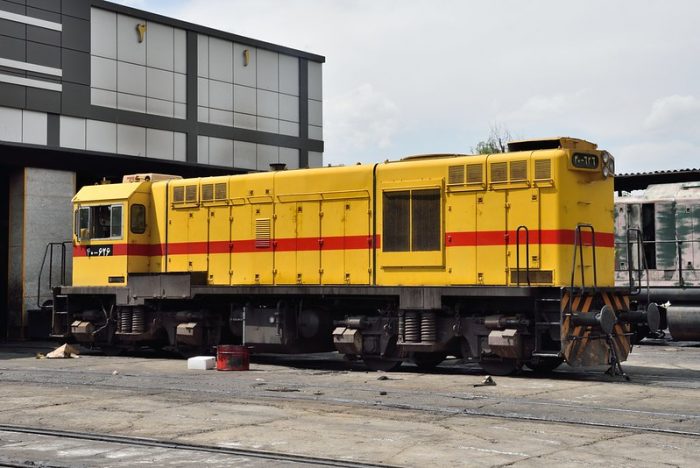
In 1970: 37 No. Hitachi HD10C Locomotives which had numbers within the range 601-638 in Iranian State Railways Class 40. They weighed 68 tons, were rated at 709 kW with a tractive effort of 122 kN and a top speed of 100 km/hr. [14] There are a few pictures of these locos in service in Iran on Flickr and http://www.farrail.com, including:

……………………….https://www.flickr.com/photos/alcoalbe/5380090479, ……………………….https://www.farrail.com/pages/touren-engl/Railways-in-Iran-2016.php, and ……………………….https://www.flickr.com/photos/alcoalbe/5382251132

Typical of these power units in later life (c) blackthorne57 on Flickr (used under a Creative Commons Licence). [15]

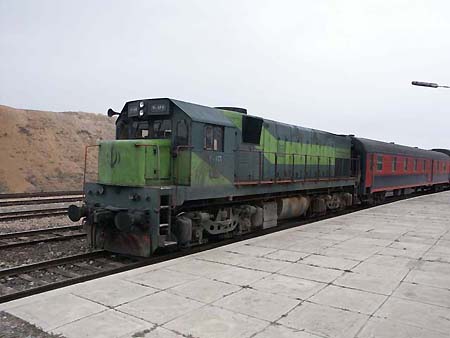
In 1971: 83 No. EMD-GT26CW Locomotives numbered 501-569, 801-914 were purchased by Iranian State Railways. (Class 60 included an additional 9 No. EMD-GT26CW Locomotives numbered 975-984 which were purchased in the 1980s.) They weighed 120 tons, were rated at 2205 kW with a dynamic brake power of 1500 kW. They provided a tractive effort of 235 kN and a top speed of 123 km/hr. [14] There are some pictures of these locos on Flickr, including:
…………………….https://www.flickr.com/photos/alcoalbe/5115657564, …………………….https://www.flickr.com/photos/alcoalbe/5115655258, and …………………….https://www.flickr.com/photos/alcoalbe/5106973247.

EMD-GT26CW Locomotive in 21st Century. [16]

In 1975: 41 No. EMD-G22W Locomotives which were numbered 138-178 in Iranian State Railways Class 40. They were rated at 1103KW with a tractive effort of 116 kN and a top speed of 105 km/hr. [14] A number of pictures of these locomotives are on the http://www.railpictures.net website and on Flickr. These include:

……………….https://www.railpictures.net/viewphoto.php?id=629929, ……………….https://www.railpictures.net/photo/577373, and ……………….https://www.flickr.com/photos/131021490@N02/27357570957.

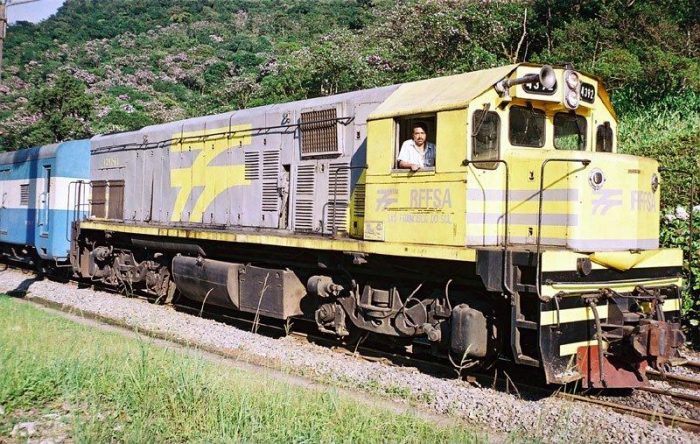
Not in Iran, but in Brazil, this picture of an EMD-G22 Locomotive has a Creative Commons Licence, (c) Heron Soares. The Locomotive is an EMD-G22U of Rede Ferroviária Federal S.A. MACOSA No. 4392-6L working on the Teresa Cristina Railroad – Paraná, Brazil. The suffix ‘U’ indicates narrow- rather than standard-gauge (which would have the suffix ‘W’). [17]

During the 1970s, the railways Iran remained under the control of Iran State Railways. A number of schemes to extend the railways were undertaken during this time. Wikipedia talks of the following schemes:

The length from Tabriz to Bazargan (192 km) which was started in 1912 was not finally completed until 1971. Please see the notes below as this date and destination need to be verified. The more southerly of the lines referred to in the section below was not completed until 1977. [31]

The length from Qom (Qum) to Zarand (847km) which was started in 1939 was not finally completed until 1971.

The length of line between Isfahan and Zarrin Shahr (111km) was started in 1969 and finished in 1972.

The length from Zarand to Kerman (80km) was not started until 1975 and was finished in 1979.

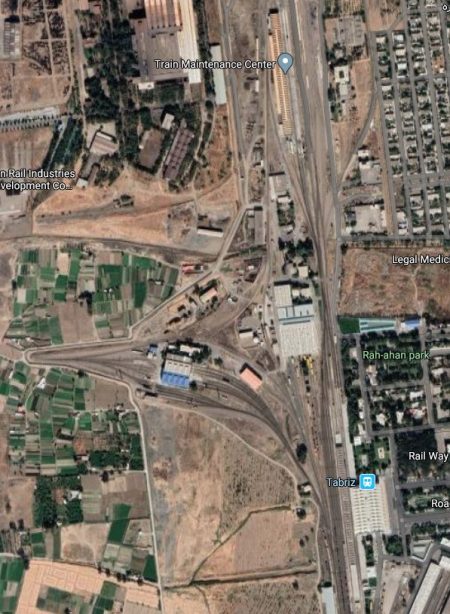
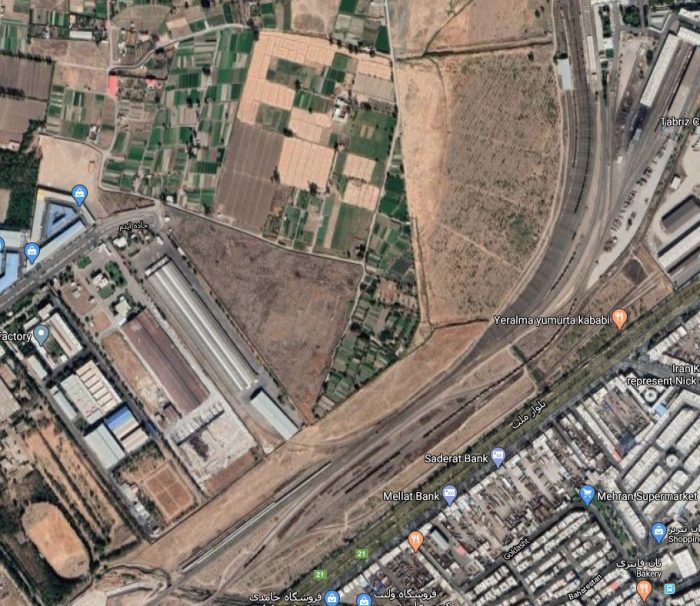
Tabriz to Bazargan: We noted the size of Tabriz in the second articles in this series. [18] Bazargan is a city in Maku County, West Azerbaijan Province, Iran. It is the most important Iranian ground border for importing and exporting. from Turkey In the 2006 census, its population was 9,047, in 2,126 families. [19][20] The railway station in Tabriz in 21st century is shown on the two adjacent satellite images (Google Earth). North of the station is the Railway Maintenance Centre. North of Tabriz the railway line becomes single track. The Railway line can be followed on Google Earth to Sahlan, where a Station serves a special economic zone. Northwest of Sahlan the railway passes under the Marand-Tabriz Road and runs parallel to it for some distance, alternately on its Southwest and Northeast sides and passing through a number of stations on the way.

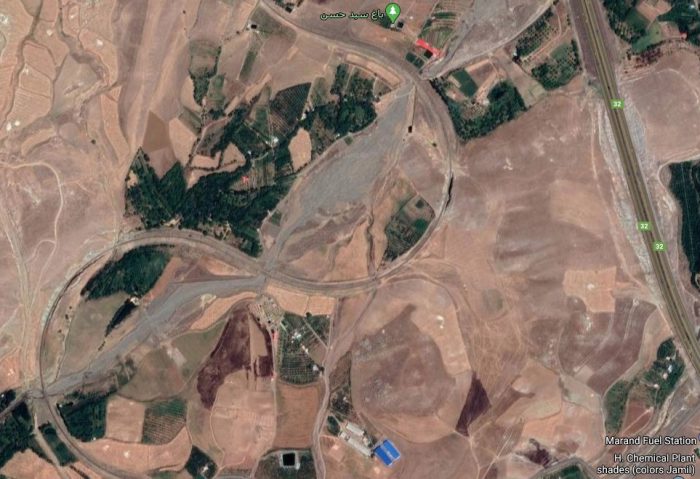
The railway divides to the West of Soufian. The more northerly route heads for Marand. Near Marand the highway begins to climb and the railway needs space in order to gain height. Two switchback curves provide room for the gradient to be kept manageable. These appear on the satellite image below.

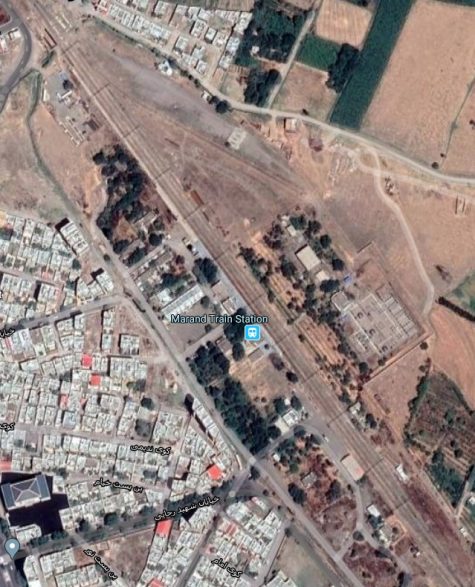
The railway then runs round the Eastern outskirts of the city of Marand to its railway station, sown on the adjacent satellite image. It then passes under the Marand-Hadishahr Road and parallel to the Marand-Jolfa Road. The line continues all the way to Jolfa and the border with Armenia and Azerbaijan.

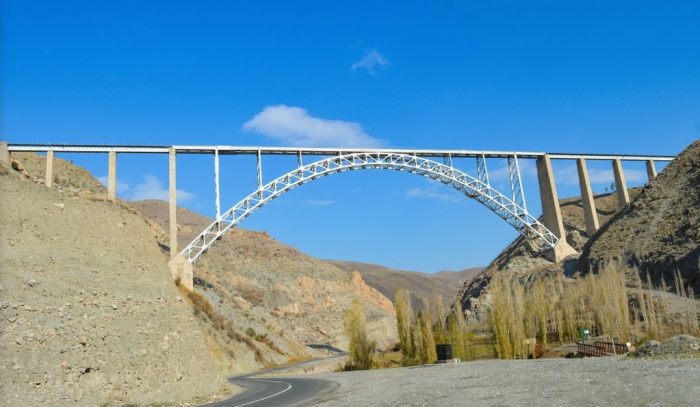
The more southerly route heads Southwest on the south side of Souflan, running roughly parallel to Route 14, through Dizaj Khalil Station and Sharafkhane Station and on into Iran’s West Azerbaijan Province. It travels on through Salamas, Yazdekan and through dramatic mountains to Razi and Kapikoy, crossing the Ghotour Bridge on the way.

The Ghotour Bridge (Google Earth (c) Behzad Monajjemi, 2019)

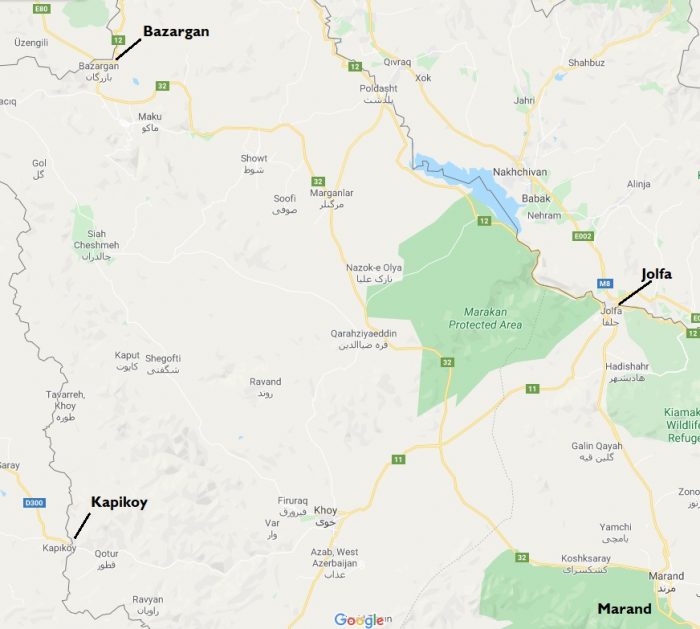
I have followed both the lines above on Google Earth and looked at various online resources and cannot identify the route of a line between Tabriz and Bazargan. I am not sure, therefore which of these two routes the Wikipedia article relates to. The relative locations of the cities concerned are shown on the Google Maps extract below.

The line through Kapikoy and into Turkey extend to Vana dn is often referred to as the Van-Sufian Railway [30]

“The oldest segment of the railway dates back to the early 20th century, during World War I, when a 53 km (33 mi) branch railway was built from Sufian to Sharafkhaneh ” [30]

Wikipedia explains that ,”the construction of a railway to Iran, via Van, was approved on 15th June 1937. The railway would continue east from Diyarbakır to Van and to the Iranian border at Kapıköy. [31: p123] Construction began shortly after and the railway reached Kurtalan in 1940. Due to the mountainous terrain between Kurtalan and Tatvan, the route was changed and its western starting [point] became Elazığ. From Elazığ the railway would be built to Tatvan, via Muş, reaching Tuğ in 1964. [31: p174] A train ferry was established as a temporary means of transport between Tuğ and Van, as a bypass of Lake Van was planned. [31: p175] In the 1960s, Turkey and Iran came to an agreement to construct a railway from Van to Sharafkhaneh. The Van-Razi segment opened in 1971, while the Razi-Sharafkhaneh segment opened in 1977.” [30]

Isfahan to Zarrin Shahr: A 111km length of line was constructed between 1969 and 1972. Isfahan is located 406 kilometres (252 miles) south of Tehran. It has a population of approximately 2.0 million, making it the third largest city in Iran after Tehran and Mashhad, but was once one of the largest cities in the world. [25][26]

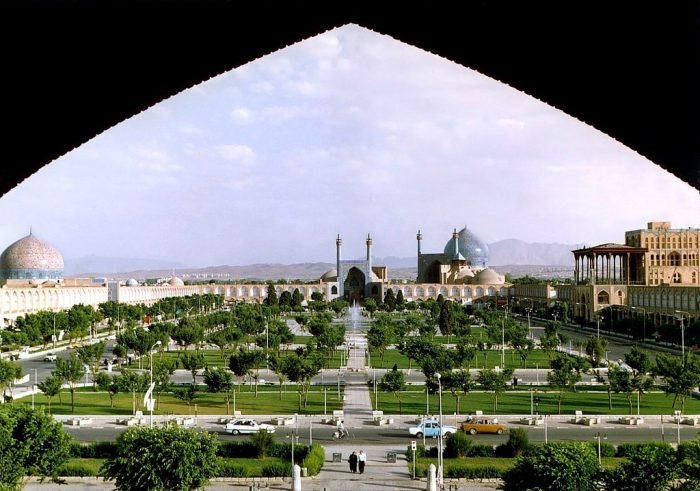
Isfahan flourished from 1050 to 1722, particularly in the 16th and 17th centuries under the Safavid dynasty when it became the capital of Persia for the second time in its history under Shah Abbas the Great. Even today the city retains much of its past glory. It is famous for its Perso–Islamic architecture, grand boulevards, covered bridges, palaces, tiled mosques, and minarets. Isfahan also has many historical buildings, monuments, paintings and artefacts. The fame of Isfahan led to the Persian pun and proverb “Esfahān nesf-e- jahān ast”: Isfahan is half (of) the world.” [25][27]

The Naghsh-e Jahan Square in Isfahan is one of the largest city squares in the world, (c) Arad Mojtahedi, used under a Creative Commons Licence. [25]

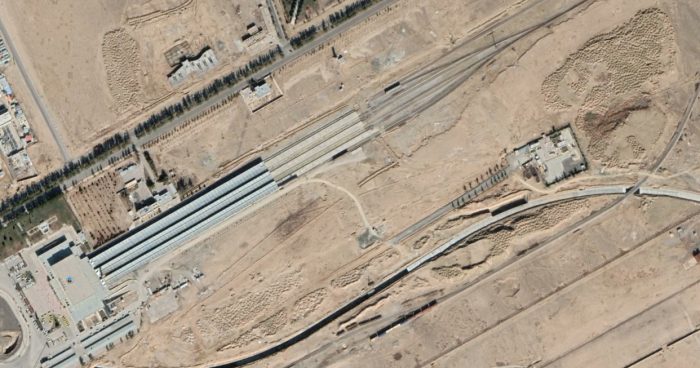
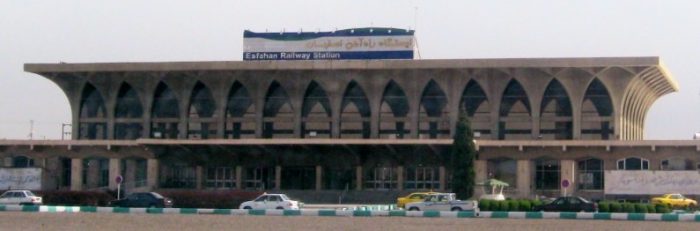
The modern, 21st century, Isfahan Station is some distance (15km) outside the city to the South (Google Earth).

Isfahan Railway Station. [28]

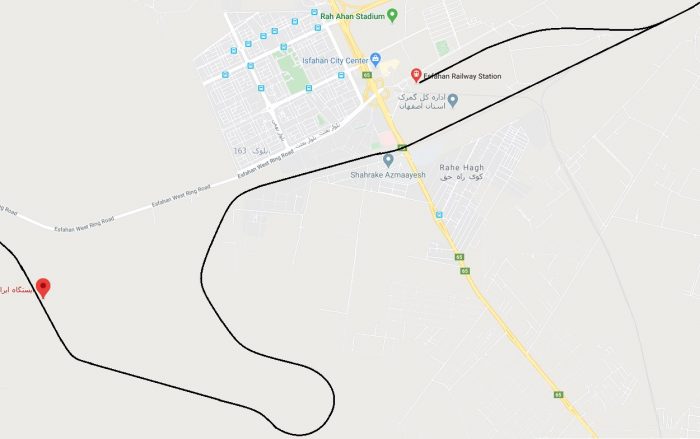
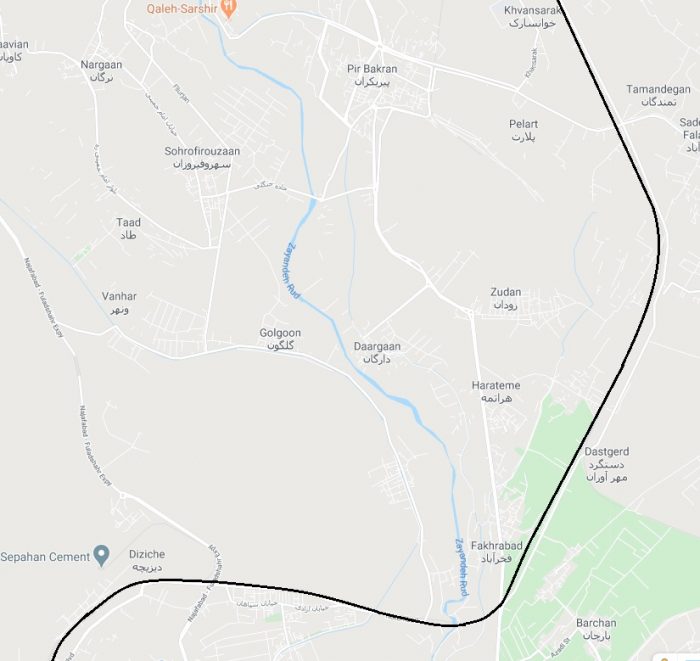
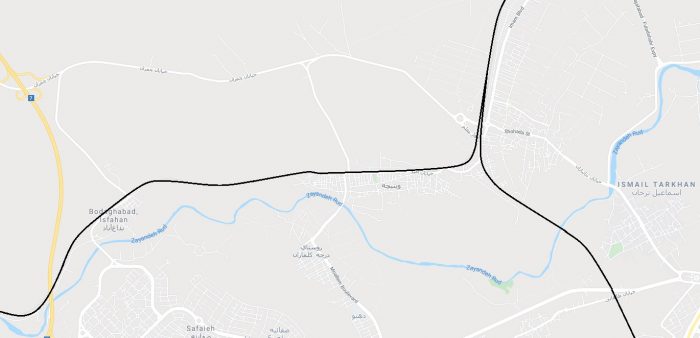
Isfahan Railway Station is shown in the top right of this Google Maps extract. Trains to Zarrin Shahr left travelling East and then reversed to head Southwest. The topography dictated that the line had to loop around in order to allow trains to negotiate significant differences in height. The distance between the two cities by road (along Route 51) is only 47km. The railway is 11km in length!

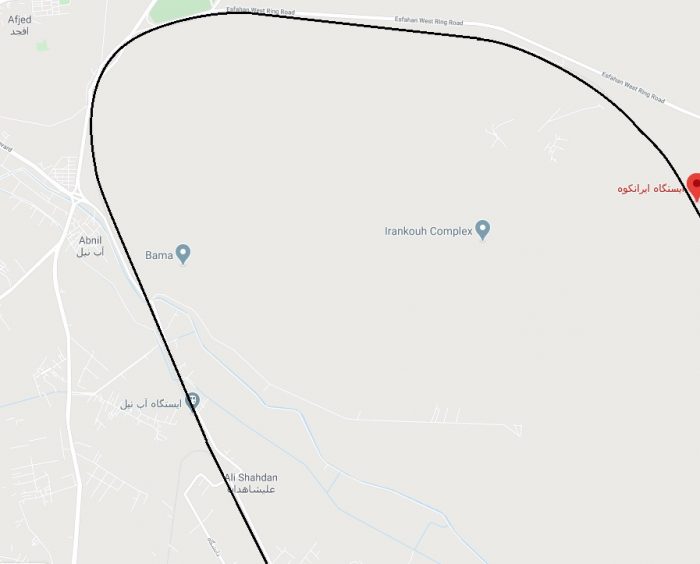
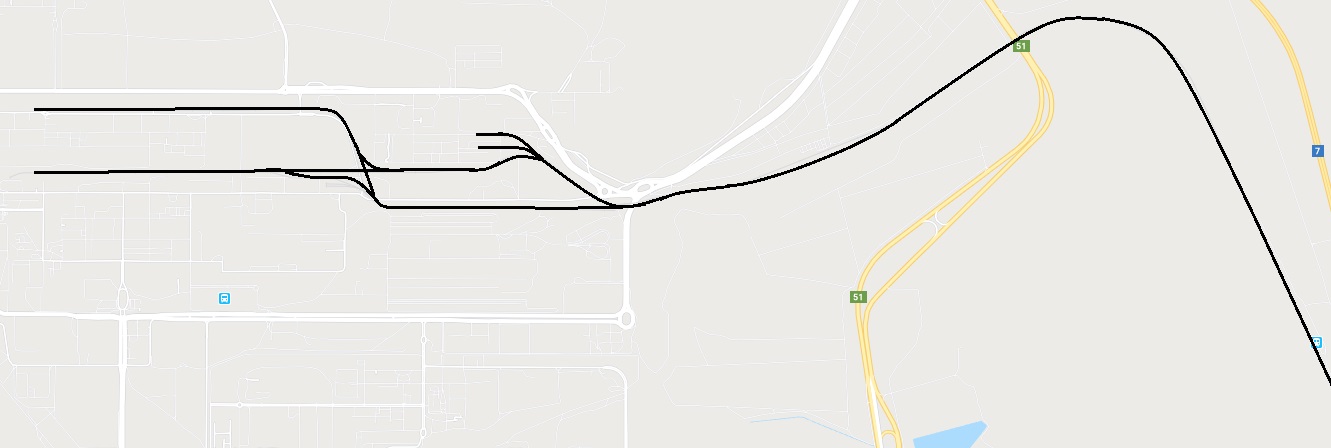
The route to Zarrin Shahr was a branch line which served an industrial complex on the North side of the city of Zarrin Shahr.

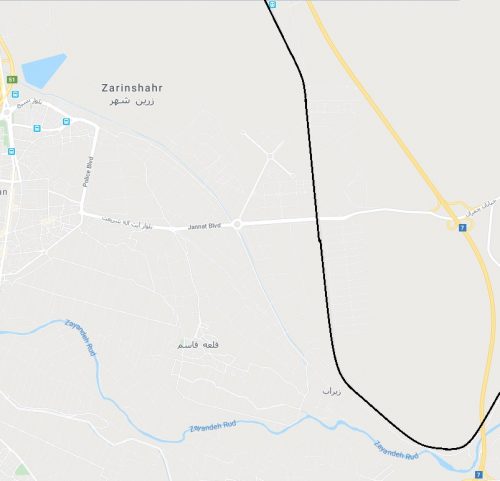
The station was to the Northeast of the city. It can just be seen at the top of the adjacent Google Maps excerpt.

Zarrin Shahr is, as of the 2006 census, a city with a population of 55,984, in 15,154 families. [20] In the past 30 years people, from various parts of Iran have moved to Zarrin Shahr to work in the nearby steel mill [29] which is served by the railway and sited to the North of the city.

Qom (Qum) to Zarland: This is a significant long-distance route.

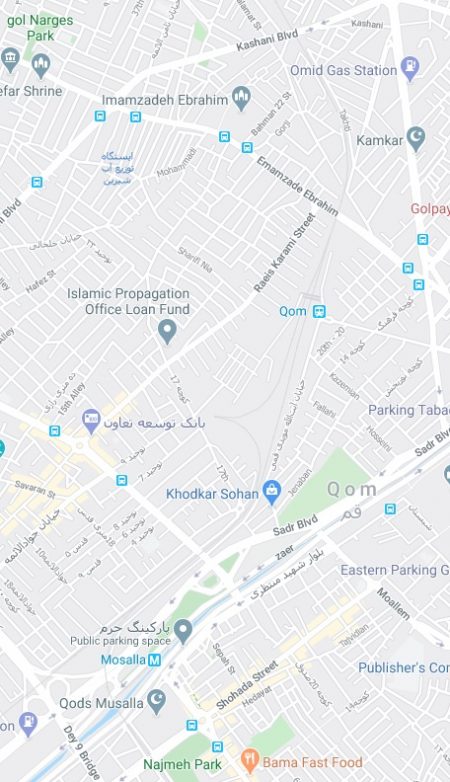
Earlier in this series of articles we provided a Satellite Image of Qom (Qum) Railway Station. [18]. The adjacent Google Maps extract shows the station site. The line to the North of the station heads for Tehran. South of the station there is a junction to the Northwest of the Mosalla Metro Station. The line heading Southwest runs towards Arak and the South, and that turning to the Southeast heads for Yazd and Zarand. The line to Zarand was close to 850km long!

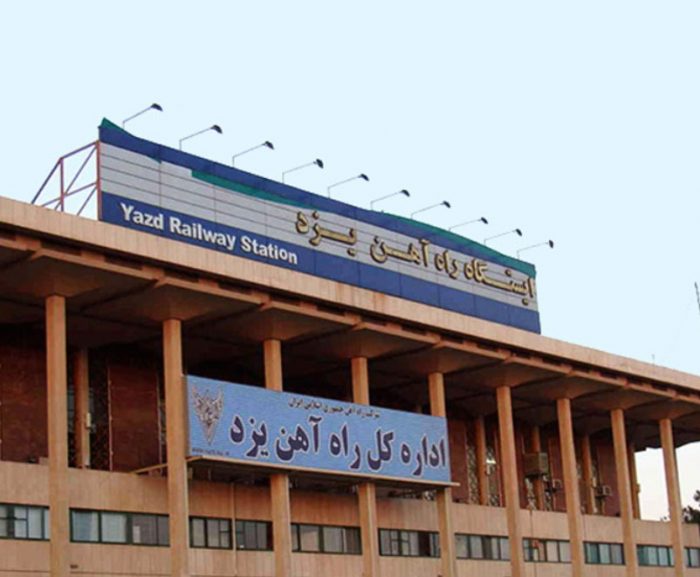
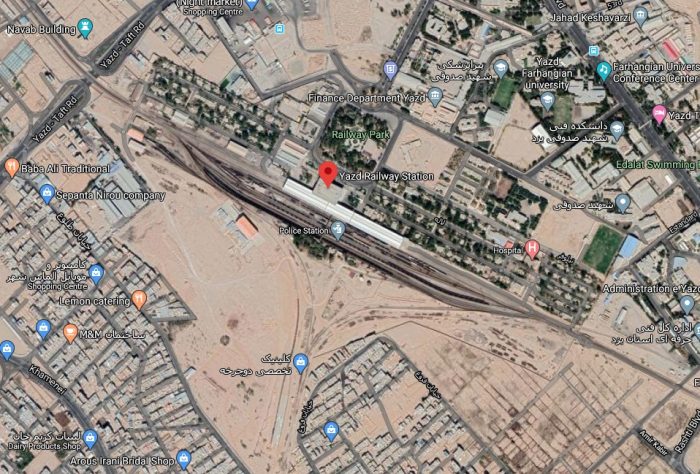
Yazd was encountered first around 500 km from Qum.

Yazd Railway Station Building in the 21st century, (c) Hamid Khorshidi on Google Maps.

Yazd Railway Station in the 21st century (Google Earth).

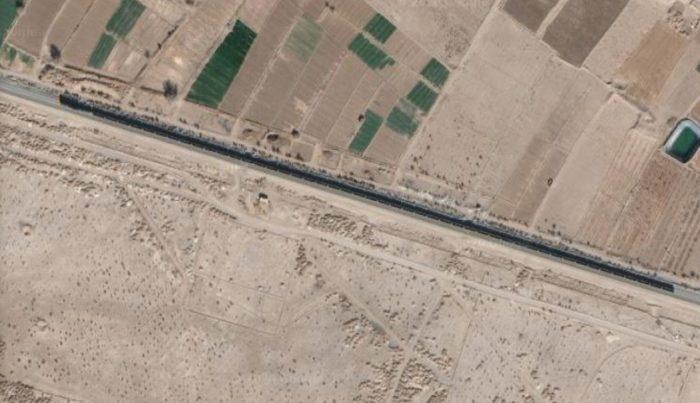
A large mineral train travelling between Zarand and Yazd, captured in the 21st century on the satellite imagery from Google Earth.

Zarand is a city of more than 54,000 people in the early 21st century. [20] It is also home to the Zarand Iranian Steel Company (ZISCO). [22] ZISCO was established in 2008. [23]

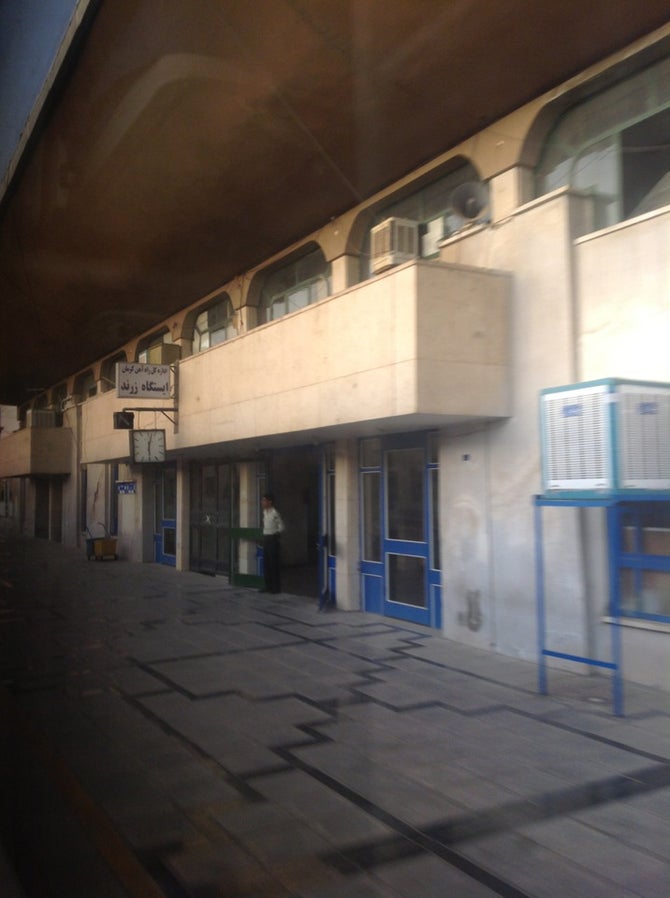
Zarand Railway Station. [24]

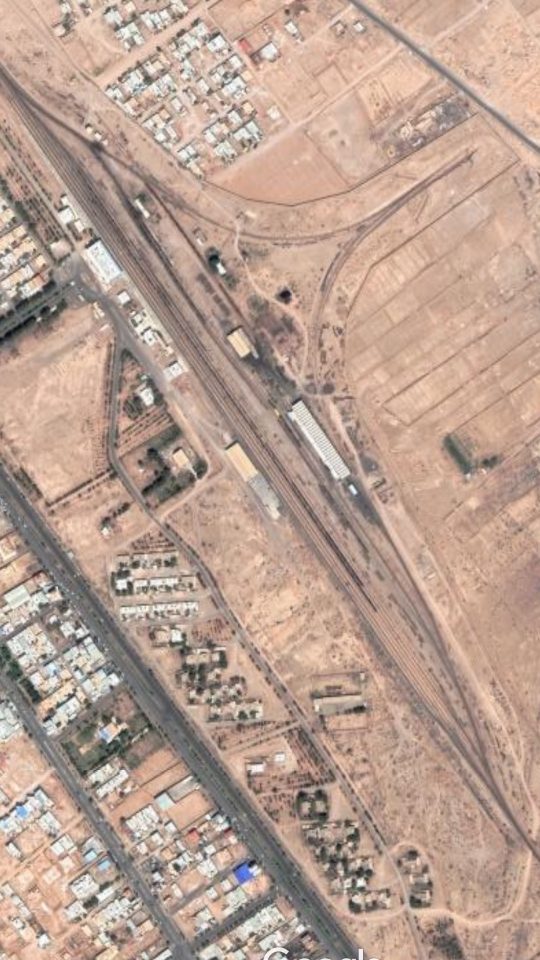
Zarand Railway Station (Google Earth).

Zarand to Kerman: The extension of the line from Qom to Zarand to the provincial capital city of Kerman was complete in 1979. The route was direct across relatively open plains.

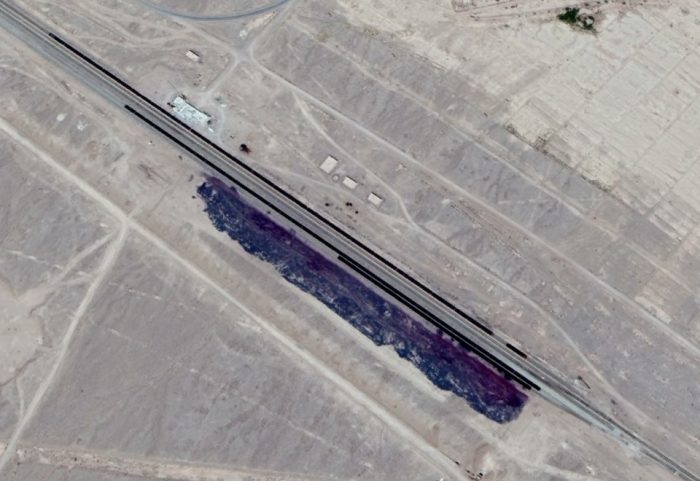
These appear to be either coal of iron ore sidings parallel to the main line between Zarand and Kerman. The strong black lines visible on the satellite image are long trains of open wagons in what appear to be exchange sidings (Google Earth).

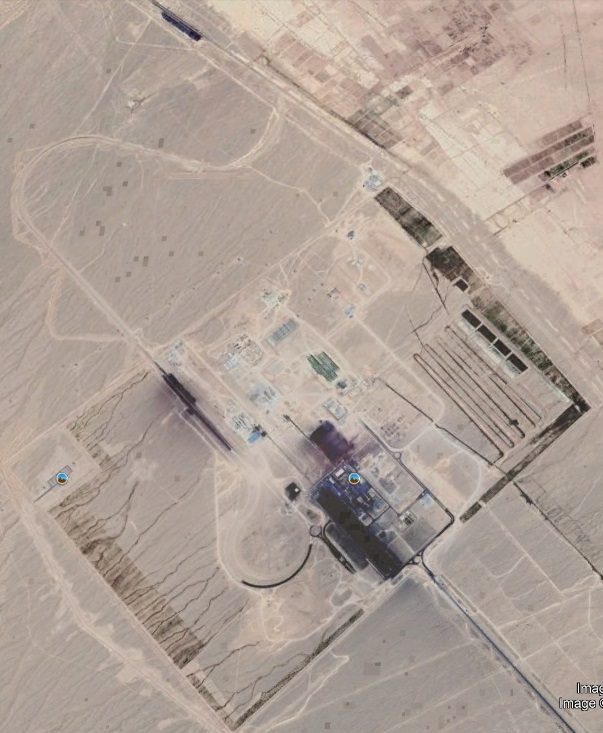
This satellite image shows the exchange sidings highlighted on the previous image alongside the main Zarand to Kerman line in the top left of the image. A branch line which serves the min complex in the centre of the image can be seen curving away from the main line and leading a complex of sidings to the Southwest side of the mining site (Google Earth) .

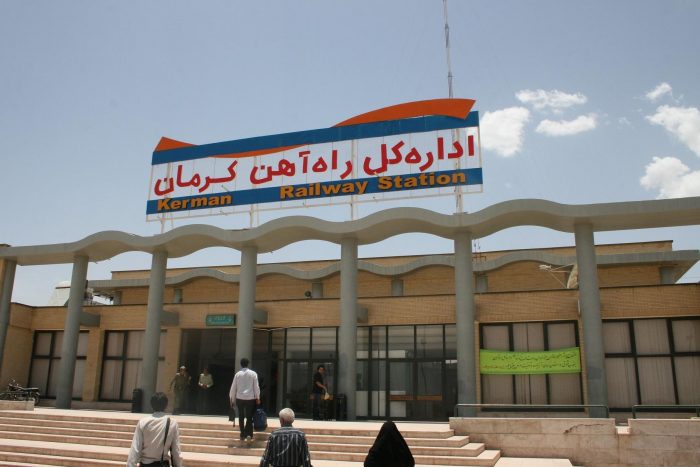
Kerma Railway Station, taken on 13th June 2009 (c) Teekkari, used under a Creative Commons Licence. The station is to the Southwest of the city and a little distance beyond the outskirts of the city. [32][33]

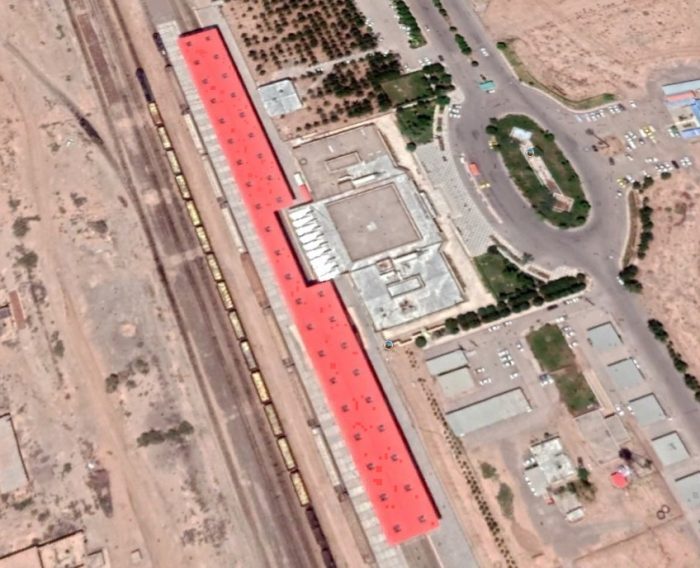
Kerman Railway Station is to the Southwest of the city (Google Earth). It is shown in gradually increasing detail on these three satellite images.

At the 2006 census, Kerman’s population was 821,394, in 221,389 households, making it the 10th most populous city of Iran.[20]

Wikipedia comments: “Kerman is … the most important city in the southeast of Iran. It is also one of the largest cities of Iran in terms of area. Kerman is famous for its long history and strong cultural heritage. The city is home to many historic mosques and Zoroastrian fire temples.

Railway development in Iran has continued apace from the 1980s through to the early 21 century. I hope to cover more about about these more recent developments in further posts.

References

  1. https://www.railway-technology.com/projects/northsouthtransnatio, accessed on 25th March 2020.
  2. https://en.wikipedia.org/wiki/Iranian_Revolution, accessed on 28th March 2020.
  3. Ervand Abrahamian; Iran between two revolutions. Princeton University Press; 1982, p515.
  4. Gholam-Reza Afkhami; The Life and Times of the Shah; 12th January 2009, University of California Press.
  5. Ervand Abrahamian; Mass Protests in the Islamic Revolution, 1977–79; in Adam Roberts and Timothy Garton Ash (eds.), Civil Resistance and Power Politics: The Experience of Non-violent Action from Gandhi to the Present; Oxford University Press, Oxford & New York, 2009, p162–78.
  6. Roy Mottahedeh; The Mantle of the Prophet: Religion and Politics in Iran; One World Publications, 2004, p375.
  7. http://www.fsmitha.com/h2/ch29ir.html, accessed on 28th March 2020.
  8. Robin Wright; The Last Great Revolution: Turmoil And Transformation in Iran; Alfred A. Knopf: distributed by Random House, 2000, p. 220. Read on https://archive.org/details/lastgreatrevolut00wrig/page/220, accessed on 28th March 2020.
  9. Robert Graham; Iran, the Illusion of Power; St. Martin’s Press, 1980.
  10. James L. Gelvin, The Modern Middle East – Second Edition; Oxford University Press, Oxford, 2008, p. 285.
  11. Baqer Moin; Khomeini: Life of the Ayatollah; Thomas Dunne Books, 2000.
  12. Olmo Gölz; Dah Šab – Zehn Literaturabende in Teheran 1977: Der Kampf um das Monopol literarischer Legitimität; Die Welt des Islams Volume 55, No. 1, 2015, p83–111.
  13. Amir Taheri; The Spirit of Allah; Adler & Adler, Newbury Park, CA, 1985.
  14. https://en.wikipedia.org/wiki/List_of_stock_used_by_railways_in_Iran, accessed on 22nd March 2020.
  15. https://www.flickr.com/photos/laversentertainers/31277206921/in/photostream, accessed on 25th March 2020.
  16. https://www.trains-worldexpresses.com/300/306.htm, accessed on 28th March 2020.
  17. https://en.wikipedia.org/wiki/History_of_rail_transport_in_Iran#Railway_construction%5B3%5D, accessed on 28th March 2020.
  18. https://rogerfarnworth.com/2020/03/24/railways-in-iran-part-2-the-1910-to-1945, published in March 2020.
  19. https://en.wikipedia.org/wiki/Bazargan,_Iran, accessed on 28th March 2020.
  20. Census of the Islamic Republic of Iran, 1385 (2006); Islamic Republic of Iran. Archived from the original (Excel) on 11th November 2011 and quoted by Wikipedia in reference 19 above and 21 below.
  21. https://en.m.wikipedia.org/wiki/Zarand,_Iran, accessed on 28th March 2020.
  22. https://m.facebook.com/pages/Zarand-Iranian-Steel-Company/214051678754211, accessed on 28th March 2020.
  23. https://www.hoofd-nek-rug-bekken-pijn.nl/1/4125-Zisco-Iron-Ore-Mine.html, accessed on 28th March 2020.
  24. https://it.foursquare.com/v/%D8%A7%DB%8C%D8%B3%D8%AA%DA%AF%D8%A7%D9%87-%D8%B1%D8%A7%D9%87%D8%A2%D9%87%D9%86-%D8%B2%D8%B1%D9%86%D8%AF–zarand-railway-station/51d0dacc498eb3887a444479, accessed on 28th March 2020.
  25. https://en.wikipedia.org/wiki/Isfahan, accessed on 29th March 2020.
  26. http://worldpopulationreview.com/countries/iran-population/cities, accessed on 29th March 2020.
  27. Robin McKown; Isfahan Is Half The World; New York Times: 2nd November 1975; https://www.nytimes.com/1975/11/02/archives/isfahan-is-half-the-world-isfahan-is-half-the-world.html, accessed on 29th March 2020.
  28. https://www.iranrail.net/stations.php, accessed on 29th March 2020.
  29. https://en.wikipedia.org/wiki/Zarrin_Shahr, accessed on 30th March 2020.
  30. https://en.wikipedia.org/wiki/Van-Sufian_railway, accessed on 30th March 2020.
  31. Efdal As; Cumhuriyet Dönemi Ulaşım Politikaları (1923-1960) (in Turkish); Atatürk Araştırma Merkezi, Ankara; 2013, quoted in reference 30 immediately above.
  32. https://erasmusu.com/en/erasmus-iran/erasmus-blog/discovering-iran-kerman-city-pt-1-501432, accessed on 30th March 2020.
  33. https://it.wikipedia.org/wiki/File:Kerman_Railway_Station.jpg accessed on 30th March 2020.

Railways in Iran – Part 3 – 1945 to the 1960s

In June 1945, shortly after the end of the War in Europe, “the allied military authorities returned the operating responsibility for the Trans-Iranian Railway to the Iranian Government. The line and its equipment were in a very run-down condition due to the hard usage received, and recovery took some years.” [1: p24]

The Cambridge History of Iran – Volume 1, which was published in 1968 says that after shortages disappeared a pattern became established, and by 1968, railways provided the basic freight-transport service from the Persian Gulf ports to Tehran and the eastern Caspian Sea region. The authors said, “Branch lines have been extended to Tabriz and Mashhad (Meshed), mitigating to a high degree the relative decline of these cities since 1925. A 120 mile westward extension of the railway line from Tabriz, now being built under the sponsorship of the Central Treaty Organization, will connect the Iranian and Turkish railways. (It was completed between Tehran and Tabriz by 1960.) An eastward extension from Qum, south of Tehran, is now complete as far as Yazd (but not by 1961 when Baker visited) and will ultimately connect with the Pakistan railway system in Baluchistan. During World War I a line of this system (then part of India) was extended as far as Zahidin in Iran, a short distance from the border. Service to Zahidin is provided by Pakistan National Railways, but there is no regular schedule.” [10: p559] The line when built was 5ft. 6in. gauge.

Because of shortages after the War, the parlous state of the network and the political/economic difficulties of the country arising out of the nationalisation of the Anglo Iranian Oil Company, “it was not until the mid-1950s that the railway system again began to grow significantly. After the completion of the Trans-Iranian Railway in 1938, Reza Shah launched the construction of lines from Teheran, 461 miles northwest to Tabriz, second city of Iran and capital of Azerbaijan province, and 575 miles to Meshed in the north-east, fourth city of the country in size and its most holy place of pilgrimage.” [1: p24]

It was planned to complete the Meshed line, which branches from the Trans-Iranian at Garmsar, 71 miles south-east of Tehran, in 1943, but the war brought construction to a halt in 1942. By this time the line was open to Shahrud, 267 miles from Tehran. Work on the Tabriz line, which was scheduled for completion in 1944, was likewise brought to a halt after it had reached Mianeh, 273 miles from the capital, and construction on both lines was not resumed for more than a decade. In April 1957, however, the line to Meshed was opened, followed a year later by that to Tabriz.

M.H. Baker says that rebuilding to “4 ft. 8½ in. gauge, of the line from Tabriz to Jolfa, and the branch to Sharif Khaneh, was also completed in 1958. These lines had been handed over to Iranian control by the Soviet Union shortly after Shah Reza’s coup d’etat” [1: p24] in the 1920s.

Baker was writing in the early 1960s. At that time he said that construction was “now under way of a line from Sharif Khaneh via Khoi and Qutur to Razi on the Turkish frontier where it is hoped to effect a junction with an extension of the Turkish railways. The connection with the railway system of Europe which this will create may prove of great economic benefit to Iran as it will be possible to carry exports and imports to and from Europe far more speedily than by the very circuitous sea route around the south of Arabia.” [1: p24]

He continued: “Likely to be of less importance, is a proposed link-up with the railway system of the Indian sub-continent. The immediate project is for a line from Qum on the Trans-Iranian Railway, 112 miles south of Teheran, through Kashan to Yazd with a branch to Isfahan. Work had already begun on the Qum-Yazd section (295 miles) in 1938 but was interrupted by the war. The earthworks were practically complete however, and it was possible to start laying track from Qum to Kashan in 1947, and this 61-mile stretch was opened in 1949. In 1959, construction onwards to Yazd was started. It is proposed ultimately to carry then line to Zahidan in the southeast,” [1:p24] where is would connect with the line from Quetta which we remarked on in the second article in this series.

The Trans-Iranian Railway was extended from Bandar Shah to Gorgan in 1961. [4][7] During the land reforms implemented by Mohammad Reza Shah in 1963 as part of the “White Revolution” the Trans-Iranian Railway was [also] extended to link Tehran to Mashhad, Tabriz, and Isfahan. [5][6: p133]

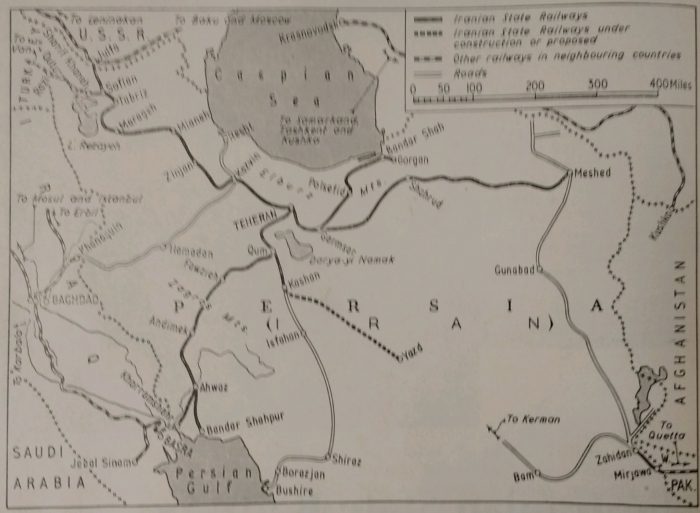
The Railway Magazine carried this map of Iran’s railways in January 1963. [1: p22]

Line

Length in km

Construction period

Teheran – Ray (1.000 mm)

9

1886 – 1888

Tabriz – Jolfa (1.524 mm, now 1.435 mm, 1975 electrified) (– Armenia)

148

1912 – 1916

Zahedan – Mirjaveh (1.676 mm) (– Pakistan)

93

1920 – 1921

Tehran – Bandar Shah (all following lines: 1.435 mm)

461

1927 – 1937

Tehran – Bandar Shahpur

928

1927 – 1938

Ahvaz – Khorramshahr

121

1942 – 1943

Sar Bandar – Mahshahr

12

1950 – 1951

Garmsar – Mashhad (Meshed)

812

1938 – 1958

Tehran – Tabriz

736

1939 – 1959

Gorgan – Bandar Shah

35

1960 – 1961

This table summarises developments in the network in Iran up until the 1960s [9]

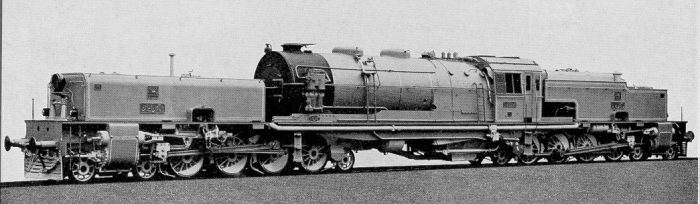
Iranian State Railway Garratt. 418 – 421 (BP 6787-6790/1936) later renumbered 86.01 – 86.04. Built by Beyer-Garratt. [12]

Iranian State Railways 2-10-2 Locomotive. [8][11]

These Vulcan Foundry built 2-10-2 ‘Decapod’ locomotives were supplied in two batches, 40 in 1952 and 24 in 1954. [8][11]

British-built Steam was a feature of this period in the history of the network in Iran and was dominant until the late 1950s. [19] There will be more about the motive power on the network in a future article. The two pictures above give an idea of the necessary power of the locomotives used on the steep grades of the Trans-Iranian Railway. Those grades were as steep as 1 in 35.

The Railway Gazette of February 1945 illustrates the gradient profile of the three lines referred to above. [18: p159]

Steam was not the only form of motive power. Diesel propulsion was introduced by the Americans during the Second World War and performed particularly well on the steep grades of the southern section of the Trans-Iranian Railway. However, the ALCO RCD-1 locomotives used during the war were all shipped back to the USA once the conflict was over. [14][15][16][17]

For a time, the network was again served by steam but as the 1950s progressed diesel power began to be sought out. [19] Wikipedia highlights the following units in use in the late 1950s all manufactured by Electro-Motive Diesel in the States. Full details are not provided and in its list of diesel power it makes no reference to the power units which were brought into Iran during the Second World War which it appears all were exported back to the USA. ….. [13]

The network, by the late 1950s was being run by the Iranian State Railway Company. The Cambridge History of Iran – Volume 1, says that the country had, in all, “2,300 route miles of railway, 120 steam and 252 diesel locomotives, 378 passenger coaches, 27 dining-cars and 5,762 freight-cars of all types. Employees numbered over 36,000; the total volume of freight carried was 334,000 tons, and there were about four and a half million passengers.” [10: p560]

The 252 diesel locomotives mentioned in the paragraph immediately above include the 171 tabulated above. In addition to those tabulated, there were a number of locomotives supplied by Electroputere/Sulzer in 1959. There were a number of older 0-4-0 diesels which had been in country prior to the War. Martin Baumann points out that the EMD G16 were numbered 60.301 to 60.320, that a single G12 was delivered in February 1968 (40.137), and that two G18Ws followed in March as 40.451 and 40.452. [24]

I have only been able to find pictures of one of the Electroputere/Sulzer locomotives which ran in Iran and they are on Flickr. Two pictures show the loco. They can be found on the following links:

……….https://www.flickr.com/photos/alcoalbe/5381331217

……….https://www.flickr.com/photos/alcoalbe/5381331229

The Sulzer website has three pictures of a pair of this class of locomotives which were sent to Iran for trials. [23]

One of three views of a pair of 060 DA’s led by 0518 that were sent for testing in Iran. All three pictures can be seen on the Derby Sulzer Website All three views were taken at the town of Arak. (c) F Burdubus. [23]

Electroputere S.A. was a company based in Craiova, Romania. Founded in 1949, it was one of the largest industrial companies in Romania. “Electroputere has produced more than 2,400 diesel locomotives, and 1,050 electric locomotives for the Romanian, Bulgarian, Chinese, and Polish railways” [21] and seems also to have produced a number of units for Iran. The company is still a significant economic presence in Romania. [22]

The country’s railway service was, at that time, supplemented by, and suffered severe competition from, road transport. There were “considerable restrictions on the types of cargoes lorries may carry on the routes running parallel with the railway. Railway freight traffic also suffered from the construction of petroleum-product pipelines from Khuzistan to Tehran and Mashhad, which eliminated its most important cargoes; and the completion of a refinery in Tehran in 1966 … removed most of the railway’s transport of fuel-oil.” [10: p560]

We will look at the 2ft. 6in. narrow-gauge railway system which supplied the Agha Jari oilfield from Bandar Shapur on another occasion.

Into the 1960s, the number of diesel locomotives remained relatively constant. Wikipedia lists only 2 No. new EMD locomotives – EMD-G18W locomotives – which arrived in 1968. [13] The ‘W’ suffix relates to the fact that these locos were built for standard-gauge lines (a ‘U’ would designate narrow-gauge). [20]

As we noted above some railway construction continued in the 1960s – specifically the line from Qum to Yazd.

The next article in this series will look at the period from the 1970s onwards.

References

  1. M.H. Baker; The Iranian State Railways; in The Railway Magazine, January 1963.
  2. https://rogerfarnworth.com/2020/03/23/railways-in-iran-part-1-tehran-to-rey-1888, published 23rd March 2020.
  3. https://rogerfarnworth.com/2020/03/24/railways-in-iran-part-2-the-1910-to-1945, published 24th March 2020.
  4. https://en.wikipedia.org/wiki/Trans-Iranian_Railway, accessed on 22nd March 2020.
  5. https://kavehfarrokh.com/uncategorized/a-short-history-of-the-iranian-railway-system, accessed on 22nd March 2020.
  6. Ervand Abrahamian; A History of Modern Iran; Cambridge University Press, Cambridge, 2008.
  7. X. De Planhol; Bandar-e Šāh;,Encyclopaedia Iranica. III. 1988, p688–689 – http://www.iranicaonline.org/articles/bandar-e-sah, accessed on 25th March 2020.
  8. Beyer Peacock Locomotive Order List, Garratt Locomotives, Customer List V1, (PDF); BeyerPeacock.co.uk. 2002-04-08, acccessed on 26th March 2020.
  9. https://www.farrail.com/pages/touren-engl/Railways-in-Iran-2016.php, accessed on 25th March 2020.
  10. W. B. Fisher, William Bayne Fisher, John Andrew Boyle, Ilya Gershevitch (eds); The Cambridge History of Iran – Volume 1; Cambridge University Press, Cambridge, 1968.
  11. http://enuii.com/vulcan_foundry/photographs/pictorial_loco_list.htm, accessed on 25th March 2020.
  12. http://www.beyergarrattlocos.co.uk/pics5.html, accessed on 25th March 2020.
  13. https://en.wikipedia.org/wiki/List_of_stock_used_by_railways_in_Iran#cite_note-rfe-2, accessed on 26th March 2020.
  14. https://en.wikipedia.org/wiki/Persian_Corridor, accessed on 26th March 2020.
  15. https://www.historynet.com/the-battle-before-the-battle.htm, accessed on 26th March 2020.
  16. https://en.wikipedia.org/wiki/ALCO_RSD-1, accessed on 26th March 2020.
  17. https://transportation.army.mil/museum/AOTM/aotm-august-2018.html, accessed on 26th March 2020.
  18. British Work on Persian Railways, 1942 – Parts 1 and 2; The Railway Gazette, 2nd and 16th February 1945, p111-114 and p159-162.
  19. https://iranrails.com/description/17/Iran-railway-locomotives, accessed on 27th March 2020.
  20. https://en.wikipedia.org/wiki/EMD_G18, accessed on 27th March 2020.
  21. https://www.wikiwand.com/en/Electroputere, accessed on 27th March 2020.
  22. https://www.electroputere.ro/en, accessed on 27th March 2020.
  23. https://www.derbysulzers.com/cfr2100.html, accessed on 27th March 2020.
  24. https://www.drehscheibe-online.de/foren/read.php?017,10514750,10517240#msg-10517240, accessed on 10th August 2023.

Railways in Iran – Part 2 – 1910 to 1945

I have been reading old copies of the Railway Magazine from the 1950s and 1960s. The old small format magazines somehow seem more attractive than the glossy larger format modern magazines, perhaps that is a sign of ageing on my part!

In the January 1963 edition of the magazine there is a long article about the railways of Iran which is based on a visit in 1961 to Iran by M.H. Baker MA. [1] I have already posted an article, based on Baker’s visit, about the first railway in Iran – a short 5.5 mile long line from Tehran to Rey (https://rogerfarnworth.com/2020/03/23/railways-in-iran-part-1-tehran-to-rey-1888) [2]

Until the 1930s, Iran was relatively isolated, various attempts had been made to develop concessions for railways in the country but to little avail. The short railway from Tehran to Rey finished in the 1880s was only expanded early in 1890s to include two branch-lines reaching quarries to the Southeast of Tehran. [3: p625][4: p14]

No further railway construction took place until the eve of the First World War. The Tabriz – Jolfa line (146 km) was built in 1914, the Sufiyan – Sharaf Khaneh (53 km) in 1916, and the Mirjaveh – Zahedan (93 km) in 1920. [5]

Tabriz to Jolfa – Tabriz is the most populated city in northwestern Iran, one of the historical capitals of Iran and the present capital of East Azerbaijan province. It is the sixth most populous city in Iran with a population in excess of 2 million. It is in the Quru River valley, in Iran’s historic Azerbaijan region,[3] between long ridges of volcanic cones in the Sahand and Eynali mountains. [6] Tabriz is over 4,430ft above sea level. The valley opens up into a plain that gently slopes down to the eastern shores of Lake Urmia, 60 kilometres (37 miles) to the west. With cold winters and temperate summers, Tabriz is considered a summer resort.

Jolfa is on the border with present day Azerbaijan, which in the early 20th century was part of Russia. is located to the north of Tabriz, separated by the Aras River from its northern neighbor and namesake, the town of Julfa in the Republic of Azerbaijan. Jolfa is much smaller than Tabriz, with a population of the order of 10,000. Its importance was its location on the border of what was the Russian Federation. [7] The railway was built by Russians during the height of World War I. The first trains ran in the spring of 1916. [8]

Baker explains that this line was essentially “an extension to Russia’s railways. … The line was constructed to the Russian 5ft gauge.” [1: p21] As well as the 146 km (90 mile) mainline from Jolfa to Tabriz, there was a branch line which served Sharif Khaneh, a port on Lake Rezayeh. ….

Sufiyan – Sharif Khaneh – as we note immediately above. this was a branch line from the Tabziz – Jolfa line. It was 53km (33 miles) in length. Like the Tabriz – Jolfa line, this line also became part of the much longer route in later years, but more of that anon. Sufiyan is a city with a population less than 10,000 but valued for the junction station which permitted rail access to Lake Rezayeh. [9]

Sharif Khaneh was even smaller (about 5,000 population) on the shores of Lake Rezayah (or Lake Urmia). [10]

The building of these two lines in the North consolidated Russian influence and gave logistical support to its army resisting Ottoman attempts to wrest control of the country.

The Great War – “Despite a declaration of neutrality, during the war Iran became a field of operation for British and Russian forces on one side and German and Turkish on the other, and the ensuing years found her in a state of political disintegration and economic chaos which the Qajar dynasty seemed unable to arrest.” [1: p21]

“On the eve of the war, the global shift of industry, armies and naval units from using coal to oil fuels resulted in an exponential growth in demand for petroleum products. This had enormous implications for the strategic significance of west Asia, a region that contains the world’s largest oil deposits. Persian [(Iranian)] oil became not only an economic resource of fundamental importance to British interests worldwide, but also a strategic military asset. Its vast oil deposits and its geographic location at the gates of the Indian subcontinent turned Iran into one of the major theatres of war in west Asia.” [11]

The occupation of north and south Iran by Russian and British troops prompted the Ottomans to invade western and north-western Iran early in the war. The resulting  pressure on Iran  caused the long-lasting rifts in Iranian politics to widen as noted by Baker above.

Mirjaveh – Zahedan – Mirjaveh is the main road crossing point between Iran and Pakistan. Mirjaveh is also the point where the railway line from Pakistan crossed the border on the way from Quetta to Zahedan. [12] Zahedan is the capital of Sistan and Baluchestan Province, Iran. At the 2016 census, its population was 587,730. [13] The line between these two cities was an extension of the Pakistan Railways line from Quetta to the border. The total length of this  line in Pakistan is 523 kilometres (325 miles). There are 23 railway stations from Queta to Koh-e-Taftan on the border. The line is one of the 4 main routes within Pakistan. [14] The extension into Iran was built by the early 1920s and was 93km (58 miles) in length. [5] It was built to 5ft 6in gauge to match the line in Pakistan. [15]

The next 12 to 24 months we’re to be a significant period in the history of Iran and also of the development of its railways. 1921 saw a coup d’etat led by Satip Reza Khan. Within a year or two, he had sufficiently consolidated his power to assume the throne as Reza Shah. He subdued dissident tribes and provinces and set about modernising the country. He saw the construction of railways as the means of maintaining political unity and promoting economic development. [1: p22]

The Trans-Iranian Railway – When completed, the Trans-Iranian Railway was an immense achievement. It ran for 850 miles and linked the South and North of the country. For the first time the northern agricultural lands and the Caspian Sea ports would be linked to ports and oilfields in the south. [16] It linked the capital Tehran with the Persian Gulf and Caspian Sea. The railway connected Bandar Shah (now: Bandar Torkaman) in the north and Bandar Shahpur (now: Bandar-e Emam Khomeyni) in the south via Ahvaz, Ghom and Tehran. [18: p371] The featured image at the head of this article shows an American Locomotive in service on the line. [17]

Construction work started in 1927 and was completed in 1938. Impressively, external loans were not countenanced. Reza Shah was determined to fund the project with indigenous capital – taxes on sugar and tea helped subsidize the project. [16][17] The Trans-Iranian Railway was completed just before the advent of the Second World War. One source suggests that the total length of railways in Iran at the start of the Second World war was little more than 700km. [19] Given the length of the Trans-Iranian Railway, this is a significant underestimate, but nonetheless Iran did not have an extensive railway system.

Construction of the railway was an overwhelming task. “It required the building of 4,100 bridges and 224 bored tunnels (64 miles in total).” [16]  C.L. Champion, in the Journal of the Institution of Civil Engineers, stated in 1947 that, “no other standard-gauge railway has been driven through such great lengths of very difficult country. The remote and inaccessible nature of important sections of the route added considerably to the difficulty of construction.” [21: p160]

Initially, an international syndicate called “Syndicat du Chemin du Fer en Perse” which included the American Ulen and Company and a German “Konsortium für Bauausführungen in Persien” formed by three German companies undertook the construction of the initial test lines. [17][20]

The Americans started from Bandar Shahpur and built the line through Ahvaz as far as Dezful. The German group started with a new harbour at Bandar Shah on the Caspian sea and reached the foothills of the Alborz mountains at Shahi. Ascending the Alborz terrain to build the Trans-Iranian railway was an amazing engineering feat. [31]

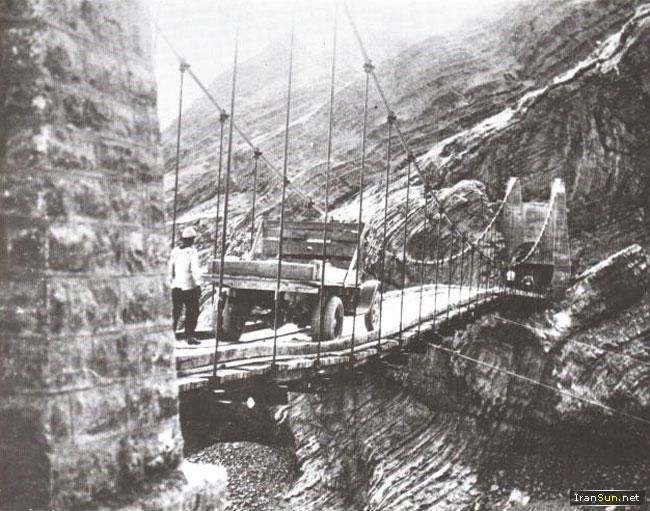
In April 1933, Iran drew up a new contract with the Danish firm Kampsax which was already active in railway construction in Turkey. “The contract required Kampsax to complete the line by May 1939. Kampsax completed the project under-budget and ahead of schedule, with it being formally opened throughout on 26 August 1938.” [17][25]A contractor’s temporary suspension bridge used during the construction of the Trans-Iranian Railway. [32]

Examples of the different work undertaken follow below. …

The first comes from the period when the USA was working in the South of the country. The second is an example of a company working on five of the different lots in the 1930s. The third is an early example of work by a modern day European construction giant. …

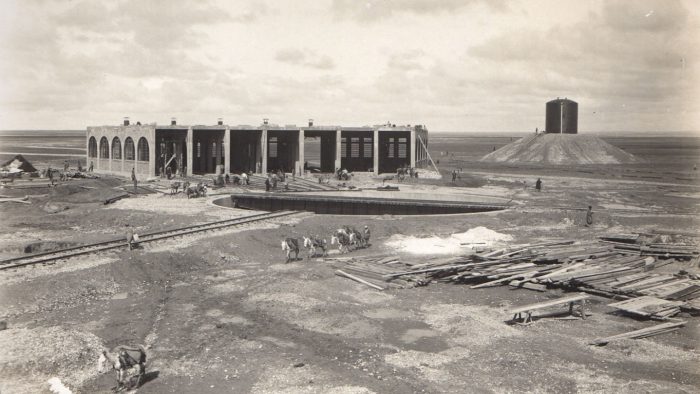
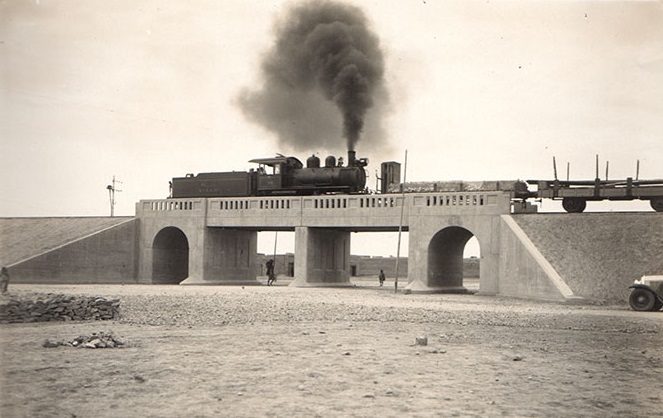
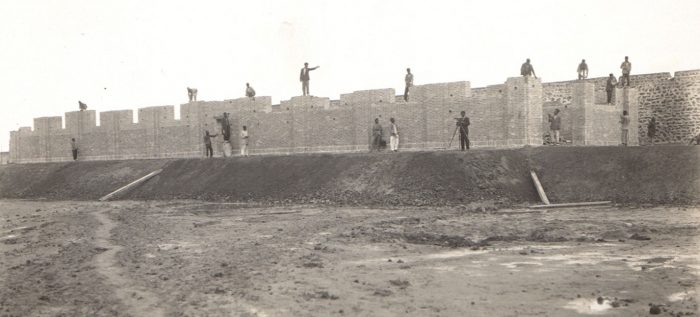
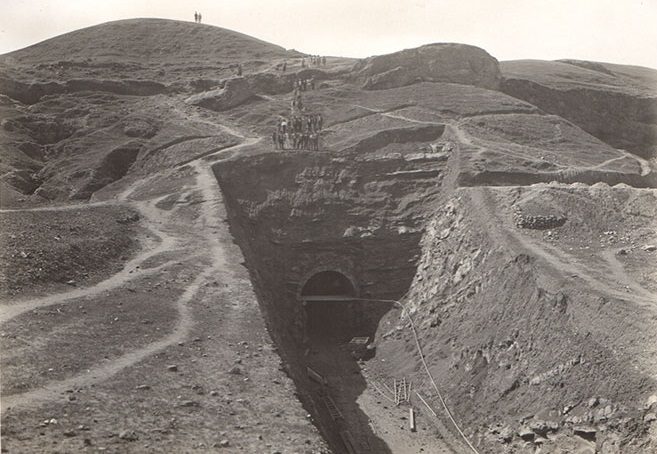
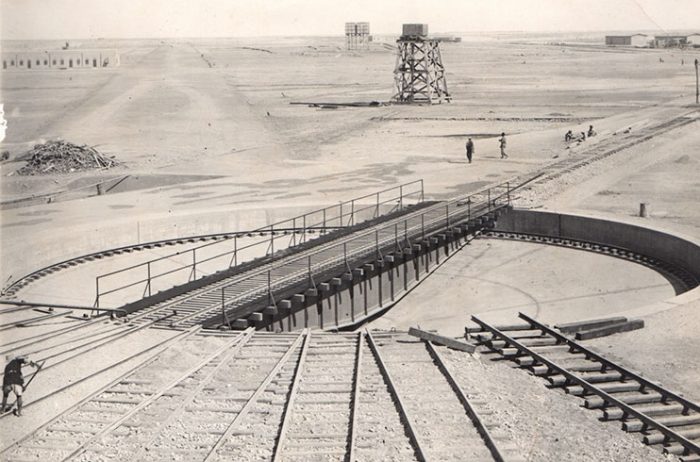
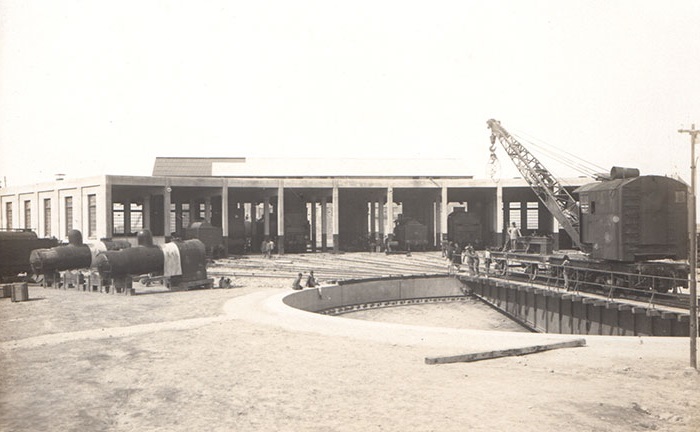
First, American  engineer, Edward Miles Crawford was responsible for some 20 million dollars worth of infrastructure and work on the railway. He supervised the design and purchasing of some 250 kilometres of the railway and the development of the port at Bandar Shahpur located on the Persian Gulf. He served as Acting Assistant Chief Engineer and Office Engineer for the Imperial Railways of Persia, a position he held from Feb. 1930 to June 1932. [22] As part of his work, he took a number of pictures, just a few are reproduced below.The Roundhouse at Salehabad [22]Small Baldwin Locomotive on contractors operations crosses a newly constructed concrete bridge in Ahwaz. [22]Balarud Steel Bridge. Steelwork from Germany. [22]Bandershapour Engine Shed under construction. [22]Kalla Kassum Cutting. [22]The first tunnel north of Salehabad, looking North. [22]The turntable at Ahwaz close to completion. [22]Ahwaz again. [22]

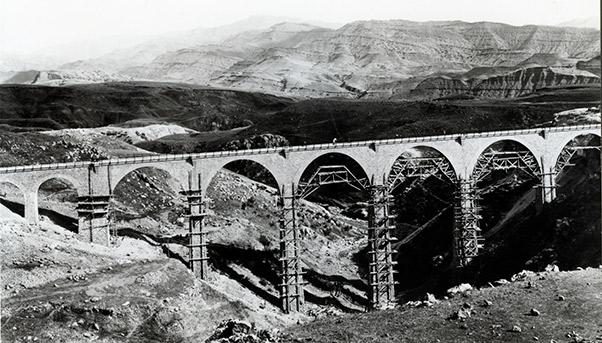
Second, as we have already noted, a number of different contractors were used on different sections (‘lots’) of the line. One example is the Italian contractor “Impresit.” It acquired five of the more challenging lots. Four of the lots were in the north where Impresit had to build a steep incline to a tunnel under Gaduk Pass in the Alborz mountain range. The railway formation climbed 1,200 metres in less than 50 kilometres a signiicant grade at the best of times! Winters during construction were merciless, sometimes dumping two metres of snow. [23]Viaduct Construction on the Trans-Iranian Railway. [23]

Impresit’s fifth lot was in the south, where the train was to wind its way through the mountainous province of Khuzestan. The remoteness of the location made it difficult to maintain supply lines. In summer, temperatures meant that work was conducted at night. In the end, in its 5 lots, Impresit built about 50 kilometres of railway, including 73 tunnels and 2,000 metres of bridges and viaducts. [23]Viaduct Construction on the Trans-Iranian Railway. [23]

The result of the construction of the railway and improved general transportation was dramatic reductions in transport costs and times. The British Central Office of Information noted that: “…the Persian people had every reason to be proud of [the Iranian railway], for they themselves had supplied most of the labour for its construction and they, with a small population living in every circumstance in hardship, had found every Rial of the thirty million Pounds which it had cost.” [16][24]

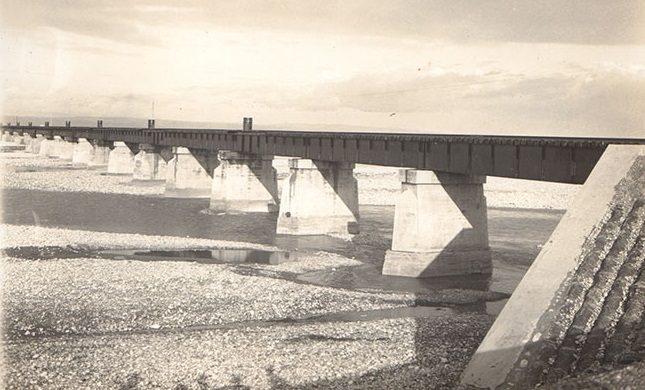
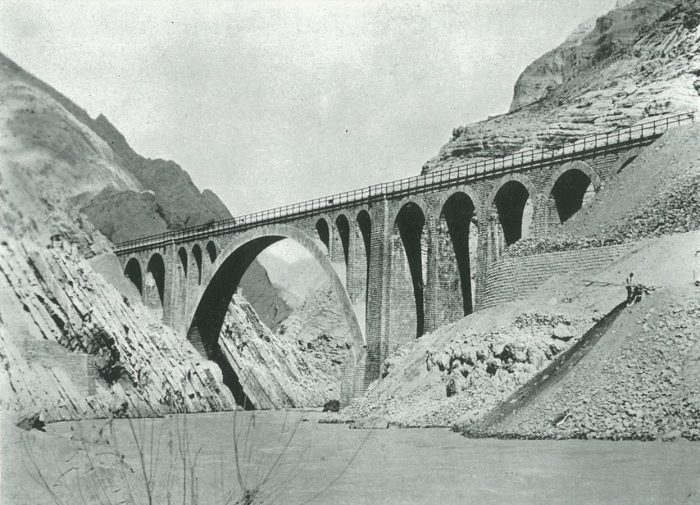
Thirdly, Danish engineers Olaf Kier and Jorgen Lotz formed J Lotz and Kier in 1928 and became early pioneers of reinforced concrete design and construction. They participated in the construction of the Trans-Iranian Railway, building the concrete structure pictured below.A graceful structure on the Trans-Iranian Railway built by Lots and Kier, the forerunners of the Kier Group of construction companies. [30]

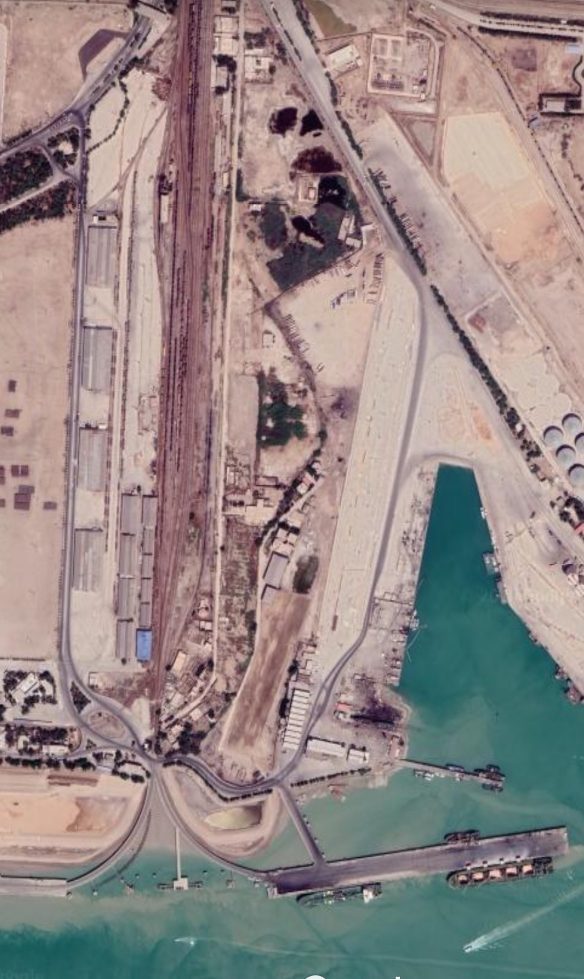
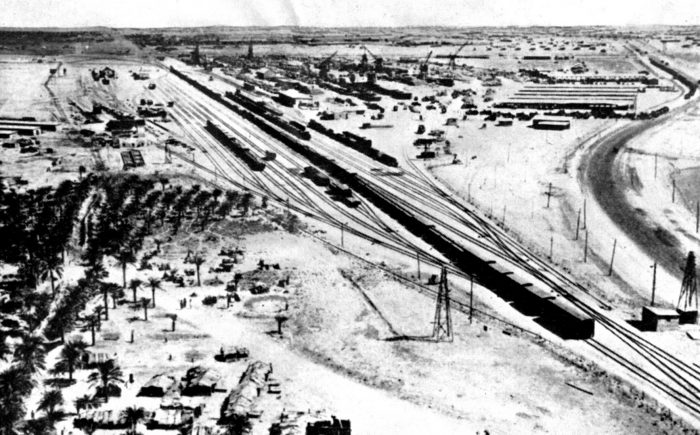
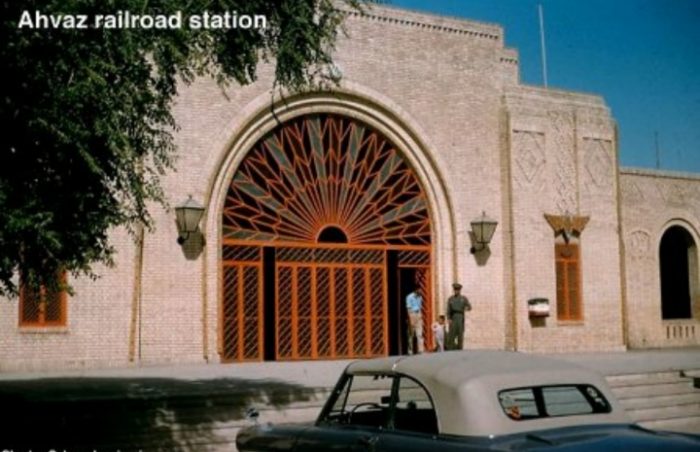
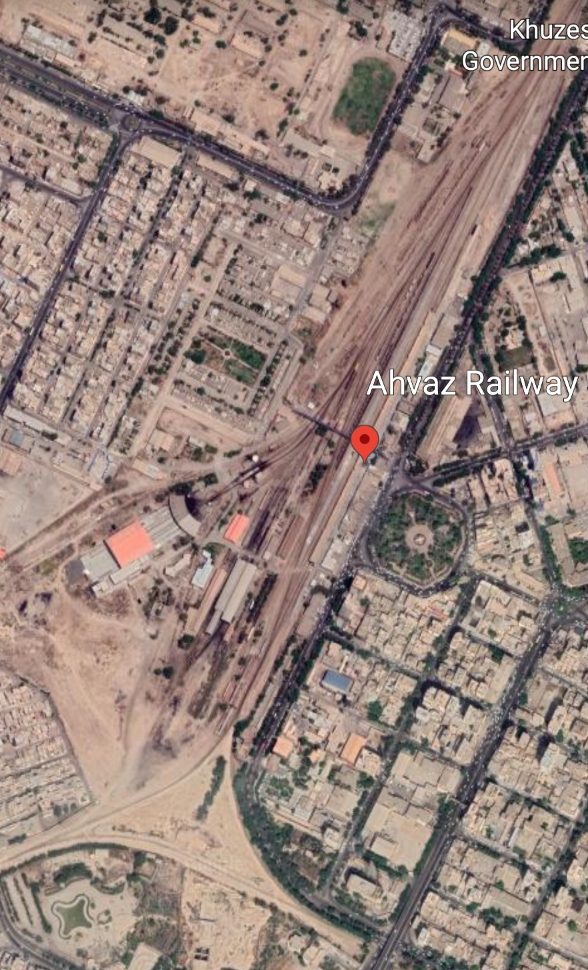
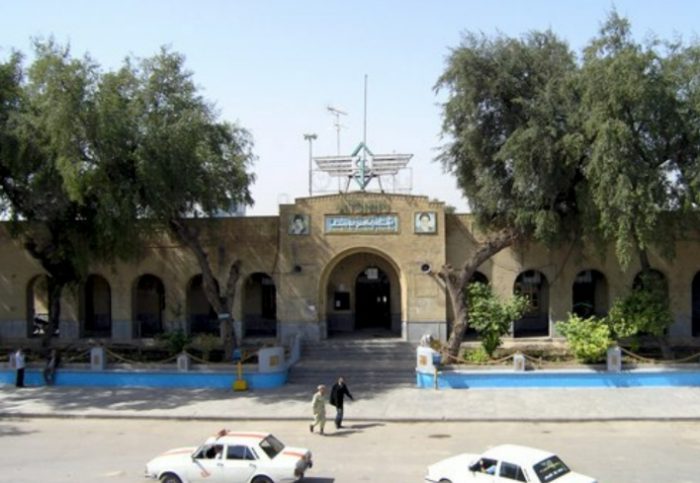
The Trans-Iranian Railway passed through only a few towns and cities along its route. From Bandar Shahpur (now Bandar Imam Khomeini) in the South, the next major location was Ahwaz (Ahvaz) (where a branch line from Khorramshahr joined what was the original main line in the middle of the Second World War). Andimek (Adnimeshk) was reached before the line crossed the Zagros Mountains, then Fawzieh (Arak) and Qum before reaching Tehran. There are very few pictures of the line in use in the years before the Second World War and there are no Google Street view images available in Iran. Satellite images give us an idea of what is on the ground in the 21st century.Bandar Shahpur (now Bandar Imam Khomeini) Railway Station (Google Earth).A Wartime image of Khorramshahr Railway Station. The Persian Gulf port of Khorramshahr was one of the railheads of the ” Persian Corridor” for supplies to Russia. [43]Khorramshahr Railway Station (Google Earth).Ahwaz (Ahvaz) Railway Station (Google Earth).Andimeshk Railway Station. [33]Andimeshk Railway Station. [34]Andimeshk Railway Station (Google Earth).Arak (Fawzieh) Railway Station (Google Earth).Image result for Qum railway station iranQum (Qom) Railway Station (Google Earth).Tehran Railway Station in the mid-20th century. [35]

Kaveh Farrokh comments: “By 1933, the Iranian railway and road network system had reduced the cost of transportation to a third of what it had been in 1920. The time needed for transport in 1933 was now reduced to just one-tenth of what it had been in comparison to 1920. The efficiency of the Iranian railway and road networks was one of the primary factors that encouraged the Anglo-invasion of Iran in August 1941. The primary objective of that invasion was to use the Iranian network to supply the Red Army of the Soviet Union. This is because Nazi Germany had been engaged in a massive invasion of the Soviet Union since 22nd June 1941.” [16]

World War II – Iran became a very significant theatre in the Second World War. Not only was it a prized asset because of its massive reserves of oil, it also provided a possible and significant supply route to resource the resistance of the Soviet Union which was under attack from the German Armies in Operation Barbarossa.

Edwin M. Wright, writing in 1942 [18] said: “The alleged reason for the Russian and British invasion of Iran last August was the refusal of the Iranian Government to expel an unknown number of Germans who, it was feared, were paving the way for a German coup d’etat. A second purpose, stressed in the press and alluded to by Winston Churchill in his speech of 9th September 1941, was to open a road for the transport of war supplies to Soviet Russia.” [18: p367] In addition, the British may have wanted to strengthen the defenses of India against possible German invasion.

Wright continues: “A strong hope was expressed at the time of the invasion that Iran might provide another “Burma Road” by which supplies could be shipped to Russia to compensate for the heavy Soviet losses incurred in the retreat from the Ukraine. Actually, there are three routes which might possibly be used for this purpose. One is the road leading north from Zahidan, through eastern Iran, near the Afghanistan border, to Meshed, and thence into Russian Turkestan. Zahidan … is the terminus of the Baluchistan railway running north and west via Quetta from Karachi, a first-class port on the Indian Ocean. The second route is the Trans-Iranian Railway, from Bandar Shahpur, on the Persian Gulf, to Bandar Shah, on the Caspian Sea. The third route is the narrow-gauge railway from Basra, on the Persian Gulf, to Baghdad, [now in Iraq] and the standard-gauge line thence to Khanikin, Kirkuk and Erbil. From near the latter place a road leads over the Rowanduz Pass into western Iran, and thence northward to strike the Russian wide-gauge railway at Tabriz. Each of these three routes has great limitations and presents enormous difficulties for through transport.” [18: p367] The map provided by Wright as part of his article in 1942. [18]

Writing for an American audience, Wright goes on to explore the practicality of each of the three routes that he mentions above. He dismisses the route via Zahidan as it would be exposed to heavy enemy bombing. “All in all,” he says, “it would take six months of hard work to arrange for even a meager 500 tons per day to be delivered to Russia by this route, and it could never become a major artery.” [18: p369]

He next considers the Trans-Iranian Railway, completed in 1939. He says that it, “is a marvel of engineering skill. On its 870-mile course it passes through terrain as rough as our Rocky Mountains — or even rougher. …. At both ends the grades are very steep. After leaving Bandar Shahpur, the southern terminus, the line crosses a coastal plain and then reaches the Kotals — a series of rising ranges, rank upon rank. It tunnels through the solid rock of these and is suspended by precarious-looking bridges across the deep intervening chasms. Two engines have to be used to a point near Khurramabad, when the plateau level is reached. Only 27 percent of the line is on a plain; 6 percent is in tunnels. The same thing happens at the other end of the line, north of Teheran. After crossing the backbone of the Elburz range at a height of almost 9,500 feet, trains begin a long and rapid descent, plunging through more than 90 tunnels and traversing many bridges before they finally reach the Caspian at Bandar Shah. Here everything has to be put on shipboard for transport to Baku or Astrakahn. Harbor facilities are meager and the ships which would be used here are the same which would have to handle goods arriving by the road from Zahidan. A real bottle-neck therefore exists on the Caspian.” [18: p369] 

What is really interesting, is his assessment of the locomotive capacity of the Trans-Iranian Railway, which in 1942 only a few years after its opening seems to have a locomotive complement of 80 available for regular work. Given the need for double-heading a certain part of the route, he assesses that 40 trains could operate with the then current provision. In addition, the freight capacity f the line amounted to around 3,000 wagons. This was all still, in Wright’s view, marginally less that needed to supply Iran’s needs, let alone provide for an increased logistical effort.

Wright continues: “For some time the [Iranian] Railway Commission was trying to buy equipment from the United States. Now an attempt is being made under British supervision to double the track in many places, and an appeal has been made to the United States to allocate 200 locomotives and additional rolling stock, as well as rails, in the hope that by April 1942 the railway’s capacity may be doubled or trebled. A motor trail roughly parallels the railway; but it has bad stretches and is hard on transport vehicles, which so far are practically non-existent. Whether we speak of traffic by rail or road, the United States and some part of the British Empire (such as Australia) will first have to ship all the transport equipment to Iran before any appreciable flow of materials can be attained by the various Iranian routes to Russia. The port facilities on the Persian Gulf will also have to be improved. Basra, a good port, is only 70 miles distant from Bandar Shahpur; but the intervening terrain is swampy and passable only with difficulty. Bandar Mashur, on the Persian Gulf, is only 20 miles from the railway terminus; but it is inaccessible to ocean-going vessels. Much dredging, dock-building and road-making will have to be done before heavy overseas traffic can reach the Trans-Iranian Railway.” [18: p369]

Wright notes that a spur of the Trans-Iranian Railway was started in the direction of Tabriz In 1939, incidentally, a spur of the Trans-Iranian Railway was started to-ward Tabriz, some 400 miles distant, but it reaches only half way, to Zenjan. He says: “Tabriz is linked by rail via Julfa with Baku. If this spur were completed, then, the Trans-Iranian Railway would have a direct connection with the Russian railway system, and the strain upon the Caspian Sea fleet would be greatly relieved. [But the extension to Tabriz] includes a steep mountain pass at Shibley, where extensive tunneling must be done; so this part of the break must be serviced by motor trucks in any event.” [18: p369-370]

Wright dismisses the third route from Basra because supplies “would need three transshipments and would have to cover a total distance of over 1,600 miles.” [18: p370]

Wright’s assessment is that in 1942 it was unlikely that all three routes combined would provided a supply route capable of providing more than 1,000 tons a day of supplies to Russia. If all of his recommended improvements were to be completed, including doubling of much of the Trans-Iranian Railway, Wright suggests that the supply route might be enough to support a defence of the Caucasus by Russia against an anticipated German advance in the Spring of 1943, but not to enable them to defend a long line on the open plains of Russia. [18: p371]

The Trans-Iranian Railway was used to supply Russia. Wikipedia tells us that, “In December 1942 the US Army Transportation Corps (USATC) replaced the British and Empire force operating the Southern Division.” [26: p5][28] The use of steam on the southern sections of the Railway meant harsh working conditions for their crews. [27]  “The USATC therefore considered diesel-electric locomotives more suitable and requisitioned the 13 ALCO RS-1s built and had them converted to ALCO RSD-1 1,000 horsepower Co-Co locomotives. [26: p5] An additional 44 RSD-1s were built for use in Iran. These totalled only 57 locomotives so initially they were used to operate only the southern part of the Southern Division between Bandar Shahpur and Andimeshk.” [17][27: p86]

On the shallower grades further North between Andimeshk and Tehran, steam was still considered viable and the “USATC brought 91 S200 Class steam locomotives, designated class 42.400 in the Iranian State Railways numbering system. The USATC also introduced another 3,000 freight cars.” [27: p86]

Later a further 18 ALCO RSD-1’s entered service, [29: p107] “enabling the USATC to return some LMS 2-8-0s to the British Middle East Command [26: p4] and extend diesel operation northwards, reaching Qom by September 1943 and regularly serving Tehran by May 1944. [27: p87] The USATC further increased freight traffic so that in 1944 it averaged 6,489 tons per day.”[17][29: p105]

Russia’s ability to supply and equip an army estimated at 3,000,000 men for the mightiest Soviet offensive of the war on the broad front from East Prussia to Slovakia continues to amaze commentators. From 1942 “an ever-increasing flood of Lend-Lease fighting equipment from the United States went to Russia via the Allied supply corridor in Iran.” [28]

It is not clear to what degree this assistance contributed to the Russian success. However, had not the tremendous quantities of American supplies rolling across Iran been forthcoming, the Russian offensive would not have been possible. [28]

Wikipedia tells us that “‘Aid to Russia’ traffic ceased by May 1945 and in June the USATC withdrew its RSD-1’s [27: p87] and returned control to the British authorities. Shortly afterwards the British restored the line to Iranian State Railways, [26: p31] the predecessor to the Islamic Republic of Iran Railways.” [17]

Two videos give an impression of what life was like on the railways and docks of Iran during the War years:

Supplies For Russia (1941). [36]

This video shows the ALCO RSD-1 Locomotives being unloaded at the docks in Iran prior to be prepared for service by the 762nd battalion. [37]

During the War, The American forces running the Trans-Iranian Railway supplied 13 ALCO diesel locomotives. [38] There was a battalion of American soldiers who primary function was the assembling of “modified 1,000-horsepower ALCO RSD-1 diesel-electric locomotives and thousands of freight cars. The locomotives, made in Schenectady, New York, by the American Locomotive Company, had arrived before the [battalion] and without the requisite tools, so the diesel shop boys forged their own implements and set to work. Within days of landing in Iran the 762nd [battalion] was sending an RSD-1 out the shop door.” [39]

These ALCO (RSD-1) locomotives was intended originally as what the Americans call a road switcher, designed to both haul freight in mainline service and shunt them in railroad yards, they were rated at 1,000 horsepower (750kW) and rode on two three-axle bogies. [40]

Following the war, these locomotives were shipped back to the US where they continued to work either hauling freight on military installations, used for training, or were sold to railroad companies. [41]

8008 was an ALCO (RSD-1) locomotive that was requisitioned by the War Department for the Trans-Iranian Railroad. The series of 13 locomotives were numbered 8000 to 8012. This engine returned from Iran in 1945. (c) ALCO Historic Photos. [42]

Given that we started this article with a reference to The Railway Magazine and particularly to an article by M.H. Baker [1] it seems appropriate to me to complete the article with what Baker has to say about the war effort and the part played by the Trans-Iranian Railway.

Baker [1] had the following to say:

“An Anglo-Soviet-Iranian Treaty of Alliance was … signed in Tehran, in January, 1942, under Article 3 of which the Allies received “the right to maintain, guard and, in certain circumstances, control all means of communication.” With regard to the railway, an agreement was reached whereby additional employees whom the State Railway might have to engage would be paid by the Allies, who would also pay for the movement of goods and supplies so that the railway could earn sufficient revenue to enable it to replace, subsequently, any equipment worn out during wartime operation. The Allies were also to replace any motive power, rolling stock or shop equipment that might be seriously damaged.

The tempo of activity on the railway increased beyond recognition. The Times on 12th July 1942, described how villages like Andimek, which before the war had been a few mud huts, had become mushroom towns within a few months: ‘Greek traders have established ‘Churchill’ cafes and ‘Victory’ bars, and of an evening British railwaymen from Crewe and Swindon, American titters from Detroit, bearded Sikhs and hefty Russians, Armenian and Persian truck drivers, rub shoulders in a ‘boom town’ atmosphere worthy of a Hollywood film in a temperature which seldom drops below 100 degrees.” British and American engineers effected improvements which the capacity of the line, new signalboxes being constructed and locomotives and rolling stock imported. The facilities of Bandar Shahpur could not cope with the volume of shipping, and as early as November 1941, the construction was begun of a branch from to the port of Khorramshahr Abadan. The flat country presented and the 75-mile branch was by June 1942. Subsequently, it superseded the Bandar Shahpur route as the main line.

A Transportation Directorate, under a former manager of the East African Railway was set up in Tehran to organise the despatch of the. supplies needed by the Russians. … Lorries were also used extensively to carry the war materials, but over half the more than 5 million tons delivered to Russia across Iran during the war was carried by the Trans-Iranian, which by mid-1944 was handling over 10,000 tons per day.”

While researching these articles about the Railways of Iran, I came across a number of photographs taken by an non-commissioned officer in the British Army during World War II. I was, at first intending to include them with this article, but after correspondence with the King’s Own Museum in Lancaster, I decided that those images should have their own short article. The source of these photographs is the King’s Own Royal Regiment Museum. [44] The twelfth article in this series of posts is about these photographs. [45]

References

  1. M.H. Baker; The Iranian State Railways; in The Railway Magazine, January 1963.
  2. https://rogerfarnworth.com/2020/03/23/railways-in-iran-part-1-tehran-to-rey-1888, published 23rd March 2020.
  3. Albert Houtum-Schindler, “Persia,” Encyclopaedia Britannica, XXXI, 1902 (10th ed.), pp. 617-627.
  4. Baron E. Beyens, Commerce et industrie de la Perse, Brussels, 1898.
  5. https://en.wikipedia.org/wiki/Islamic_Republic_of_Iran_Railways, accessed on 23rd March 2020.
  6. https://en.wikipedia.org/wiki/Tabriz, accessed on 23rd March 2020.
  7. https://en.wikipedia.org/wiki/Jolfa,_Iran_(city), accessed on 23rd March 2020.
  8. https://en.wikipedia.org/wiki/Tabriz_railway_station, accessed on 23rd March 2020.
  9. https://en.wikipedia.org/wiki/Sufian, accessed on 23rd March 2020.
  10. https://en.wikipedia.org/wiki/Sharafkhaneh, accessed on 23rd March 2020.
  11. https://encyclopedia.1914-1918-online.net/article/persiairan, accessed on 23rd March 2020.
  12. https://en.wikipedia.org/wiki/Mirjaveh, accessed on 23rd March 2020.
  13. https://en.wikipedia.org/wiki/Zahedan, accessed on 23rd March 2020.
  14. https://en.wikipedia.org/wiki/Quetta–Taftan_Line, accessed on 23rd March 2020.
  15. https://dlca.logcluster.org/plugins/servlet/mobile?contentId=3801847#content/view/3801847, accessed on 23rd March 2020.
  16. https://kavehfarrokh.com/uncategorized/a-short-history-of-the-iranian-railway-system, accessed on 22nd March 2020.
  17. https://en.wikipedia.org/wiki/Trans-Iranian_Railway, accessed on 23rd March 2020.
  18. Edwin M. Wright; Iran as a Gateway to Russia; Foreign Affairs Journal, Council of Foreign Relations, New York; Volume 20 No.2, 1942, p367-371.
  19. https://www.sinfin.net/railways/world/iran.html, accessed on 23rd March 2020.
  20. Manfred Pohl; Philipp Holzmann, Geschichte eines Bauunternehmens 1849–1999. Verlag C.H. Beck, Munich, 1999, p 189 ff.
  21. Cuthbert Llewellyn Champion; The Construction of the Trans-Iranian Railway; The Journal of the Institution of Civil Engineers, Volume 29, Issue No. 2, London 1947, p160-167.
  22. https://www.jamesarsenault.com/pages/books/5094/edward-miles-crawford-photographer-and-compiler/construction-of-the-trans-iranian-railway/?soldItem=true, accessed on 23rd March 2020.
  23. https://www.webuildvalue.com/en/stories-behind-projects/the-railway-that-united-iran.html, accessed on 23rd March 2020.
  24. PAIFORCE; The Official Story of the Persia and Iraq Command 1941-1946; British Central Office of Information, HMSO, London, 1948, p92.
  25. Jonas Kauffeldt; Danes, Orientalism and the Modern Middle East: Perspectives from the Nordic Periphery (Ph.D.). Florida State University. Docket Electronic Theses, Treatises and Dissertations. Paper 3293, May 2006; Archived from the original (PDF) on 15 December 2014.  Accessed via https://web.archive.org/web/20141215063326/http://diginole.lib.fsu.edu/etd/3293 on 24th March 2020.
  26. R. Tourret; War Department Locomotives; Tourret Publishing  Abingdon, USA, 1976.
  27. R. Tourret; United States Army Transportation Corps Locomotives; Tourret Publishing  Abingdon, USA, 1977.
  28. Paul Rugile; They helped Russia to Victory ; The Port Macquarie News and Hastings River Advocate (NSW : 1882 – 1950). NSW: National Library of Australia. 28 April 1945. p. 4, and The Christian Science Monitor,  via  https://trove.nla.gov.au/newspaper/article/106044674 on 24th March 2020.
  29. Hugh Hughes; Middle East Railways; Continental Railway Circle, Harrow, 1981, p101–113.
  30. https://www.kier.co.uk/who/our-story, accessed on 24th March 2020.
  31. https://erenow.net/modern/iran-a-modern-history/9.php, accessed on 24th March 2020pp.
  32. https://rayanworld.com/20170809141027005/The-Trans-Persian-Railway-Opening?subarticle=13, accessed on 24th March 2020.
  33. https://www.google.co.uk/maps/uv?hl=en&pb=!1s0x3fe9bc31cd8ed029:0xe5fb6a321f5b8e11!3m1!7e115!4shttps://lh5.googleusercontent.com/p/AF1QipMapPnDYj48YkIcB8Xdrz8Vfpn5PlkiBrOPcEfE%3Dw221-h160-k-no!5sAndimeshk+railway+station+-+Google+Search&imagekey=!1e10!2sAF1QipMapPnDYj48YkIcB8Xdrz8Vfpn5PlkiBrOPcEfE&sa=X&ved=2ahUKEwj42oH8zLPoAhUzQUEAHWWeD3YQoiowE3oECBYQBg, accessed on 24th March 2020.
  34. https://www.google.co.uk/maps/uv?hl=en&pb=!1s0x3fe9bc31cd8ed029%3A0xe5fb6a321f5b8e11!3m1!7e115!4shttps%3A%2F%2Flh5.googleusercontent.com%2Fp%2FAF1QipMapPnDYj48YkIcB8Xdrz8Vfpn5PlkiBrOPcEfE%3Dw221-h160-k-no!5sAndimeshk%20railway%20station%20-%20Google%20Search&imagekey=!1e10!2sAF1QipNJxc1n99dk0LRFwVM6A_OMLraTkfgX2hWpK_q6&sa=X&ved=2ahUKEwj42oH8zLPoAhUzQUEAHWWeD3YQoiowE3oECBYQBg, accessed on 24th March 2020.
  35. https://bia2safa.net/24440/نادیده-های-ایستگاه-راه-آهن-تهران, accessed on 24th March 2020.
  36. https://youtu.be/dAWGse0bc1g, accessed on 26th March 2020.
  37. https://youtu.be/7xMhN3kPjp4, accessed on 26th March 2020.
  38. https://en.wikipedia.org/wiki/Persian_Corridor, accessed on 26th March 2020.
  39. https://www.historynet.com/the-battle-before-the-battle.htm, accessed on 26th March 2020.
  40. https://en.wikipedia.org/wiki/ALCO_RSD-1, accessed on 26th March 2020.
  41. https://transportation.army.mil/museum/AOTM/aotm-august-2018.html, accessed on 26th March 2020.
  42. https://salutetofreedom.org/ny.html, accessed on 26th March 2020.
  43. British Work on Persian Railways, 1942 – Parts 1 and 2; The Railway Gazette, 2nd and 16th February 1945, p111-114 and p159-162.
  44. http://www.kingsownmuseum.com, accessed on 8th April 2020.
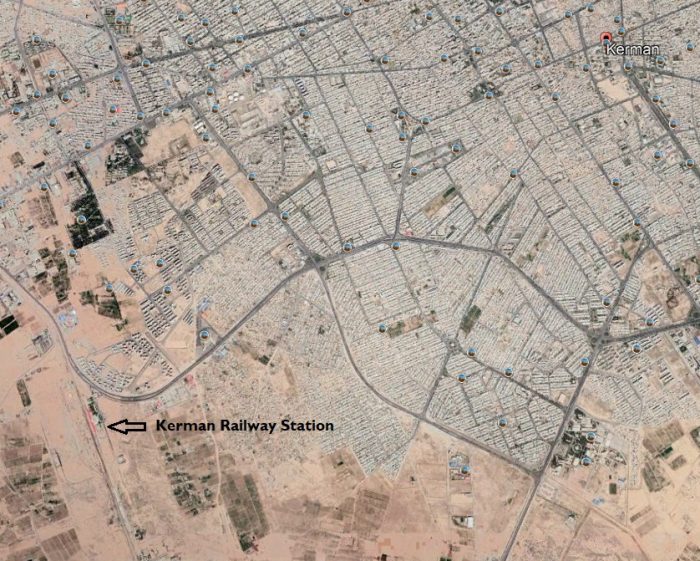
  45. https://rogerfarnworth.com/2020/04/13/railways-in-iran-part-12-photographs-from-the-second-world-war, completed and published on 13th April 2020.
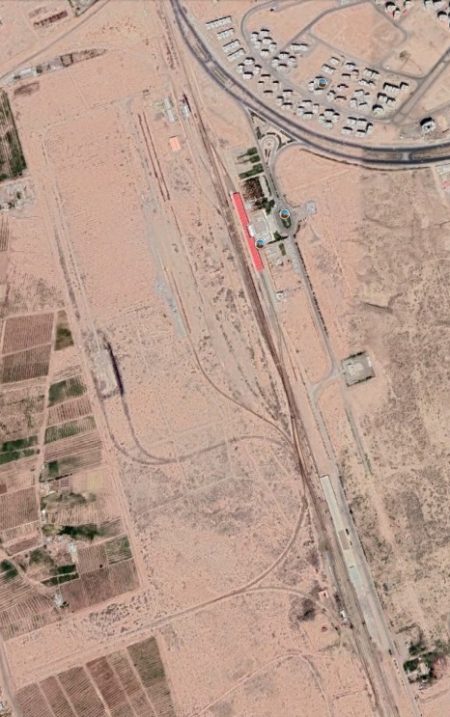
Railways in Iran – Part 1 – Tehran to Rey 1888

I have been reading old copies of the Railway Magazine from the 1950s and 1960s. The old small format magazines somehow seem more attractive than the glossy larger format modern magazines, perhaps that is a sign of ageing!

In the January 1963 edition of the magazine there is a long article about the railways of Iran which is based on a visit in 1961 to Iran by M.H. Baker MA.

Until the 1930s, Iran was relatively isolated, but from around 1865 various European Countries had sought concessions to construct railways but the Imperial government continued to value isolation above integration.

Baker says that, “Shah Naser-ed-Din … was so delighted with railways that he determined to have one built in Iran.” [1: p21] Shah Naser-ed-Din reigned from 1831 to 1896. He was the first modern Iranian monarch to formally visit Europe. He wrote travelogues about his trips, that also were translated in foreign languages. [2][3]

Shah Naser-ed-Din called on a French engineer and concession hunter, Fabius Boital, to build a line from Tehran to the shrine of Abdul Aziz at Rey, 6 miles south of the city. He also received a concession to build tramways in Tehran. [4] It seems that he was probably short of money and sold “both of these concessions to a Belgian company named “La Société Anonyme des Chemins de Fer et Tramways en Perse,” founded in Brussels on 17 May 1887. The company had a capital of 2 million francs.” [5][6: p865]

The rail concession allowed the Belgian company to construct and operate a railway line from Qazvin to Qom through Tehran and Rey for 99 years. [7: p45]  The principal draw was the number of pilgrims who visited the shrine of Abdul Aziz. However, although “the large number of pilgrims (over 300,000 per annum) who visited the shrine … promised handsome returns for the company, its executives wanted much more: a railway line connecting the Caspian Sea and the south, and passing through Tehran. [8] This did not materialize because speedy means of communications connecting the north and south of Persia ran contrary to both British and Russian interests.” [5]

Glyn Williams says that the line, as built, had a track gauge of 800mm it was approximately 5.5 miles in length and had two branch lines of 2.5 miles in length. [16] The branch lines connected the main line to some limestone quarries southeast of Tehran. The mainline was opened in 1888, the branch lines in 1893. [9: p625][10: p14] The gauge quoted by Williams above appears not to be correct. Further investigation of the locomotives built for the line by Tubize of Belgium indicates that they were built to metre-gauge. [17]

Tableau des locomotives Tubize livrées pour la Perse (Iran)
n°     Année   Voie     Essieux             Destinataire
662   1887     1000   Cn2t / 0-6-0T     CF et Tramways en Perse, Téhéran-Rey No. 1
663   1887     1000   Cn2t / 0-6-0T     CF et Tramways en Perse, Téhéran-Rey No. 2
664   1887     1000   Cn2t / 0-6-0T     CF et Tramways en Perse, Téhéran-Rey No. 3
665   1887     1000   Cn2t / 0-6-0T     CF et Tramways en Perse, Téhéran-Rey No. 4
1436 1905     1000   Cn2t / 0-6-0T     CF et Tramways en Perse, Téhéran-Rey No. 5
Source : liste établie par Sébastien Jarne
Cn2t = 3 essieux moteurs, vapeur saturée, 2 cylindres, tender (tank in UK terminology)

Construction of the line was difficult as all equipment had to be transferred from Antwerp to Batum on the Black Sea by sea, “then by land through the Transcaucasian Railway to Baku, then by sea again to Anzali on the Caspian Sea, and from there once more by land and on the back of animals, through difficult terrain, to Tehran through Qazvin. … In order to minimize the difficulties involved in the cumbersome process of shipping from Belgium to Persia, [the  company] established a workshop in Baku for packing the material from Belgium, bought animals from Tbilisi for transportation, purchased part of the rails from Russia, built boats for river transport, and employed local workers for maintaining the roads.” [5] These measures proved very costly. [11: p5-6]

“The Tehran terminal, a building in the European style, was situated in the southeast of the capital, near the Darvāza-ye Khorasan Street, some 150 metres from the main bazaar. There were two waiting rooms, one on each end, one for men and the other for women, while in the middle of the building there was a hall for the Shah. Separate wagons were allocated for men and women. The latter formed a considerable part of the line’s clientele. The line itself passed over a 26 metre-long bridge and a plain covered by trees. It was operated by a staff of five Europeans and sixty Persians. [5][12]

There was initially a real reluctance among the local population to use what they saw as a fire-breathing monster. “The Belgian company, which did not anticipate such a financially disastrous outcome, complained to the Shah. In order to allay public fears, the shah ordered high-ranking individuals and the commanders of the army to travel with him by train. …  Following their example, local passengers, including clerics, began to use the train. But a number of factors caused a decline in the number of passengers: First, the growing number of fatal accidents involved in operating the line; second, the train was labeled ‘Satan’s work’ by clerics, after one of them was run over by it; third, the short distance that it covered meant that many people continued to prefer the leisurely pace of walking or riding on donkeys; and fourth, the relatively expensive price of the tickets was an inhibiting factor.” [5] 

There were five 0-6-0T locos, numbered 1 to 5 (Tubize No. 662-665/1887 & 1436/1905), locally called “Mashin Doodi”, meaning smoke machines. [13]There are very few pictures of the locos serving this short line. This is one. [14]

Thomas Kautzor wrote in 2011: “One loco was plinthed at the PARS Wagon factory in Arak (290 km southwest of Tehran). … A second loco was photographed by … Arsam Behkish in Mellat Park, north Tehran, in July of 2005, together with an open coach. It still carried a No. 3 and works plate No. 664/1887 on one side and was in very poor condition.”  A picture of that locomotive appears at the head of this article and another below. [5][13]Locomotive No. 3. [12]

The line continued to operate sporadically until the middle of the 20th century, public use of it gradually declined. By 1901 it was making only a limited number of journeys. This deteriorated even further with the growing use of road transportation. [5][15] Its route was parallel to what is now Tehran’s Metro Line No. 1 but it is very difficult to make out any remaining features on Google Earth.

When M.H. Baker visited Iran in the very early 1960s a sporadic service was still operating. He was able to take a few photographs which were reproduced in the article in The Railway Magazine. I have reproduced these images here as they give a good idea of the state of the line at that time. Interestingly, the locomotive shown was in relatively good condition. [1] ……The front of the station building in Rey (Ray) in 1961. [1]Rey railway 0-6-0T locomotive No. 4 was built in Belgium in 1887 by La Metalurgique S.A. de Construction de Tubize for the opening of the Tehran to Rey line. Baker remarks on its relatively good condition in his article. [1]Ramshackle open-sided four-wheel coaches in the carriage sidings at Tehran in 1961. [1]

Baker commented that Steam was still active on the line from Tehran to Rey. He goes on to say: “Even the Fridays-only service of recent years was said to have been suspended, and a visit to the once rather grand station in Tehran showed it to be closed up and apparently derelict. In the year behind, however, one locomotive, No. 4, was in steam and another, No. 5, was under repair, so the line has not been finally abandoned. Both engines looked spick and span in their green livery with broad yellow lining. Numbers 2 and 3 were in the shed, with the wheels and frames of what had presumably been number 1. Numbers 2, 3 and 4 are all outside-cylinder 0-6-0 tanks built in 1887 by La Metallurgique Societe Anonyme de Construction at Tubize, Belgium, for the opening of thy line, and bear consecutive works numbers, 663 to 665. No. 5 was constructed by the same firm in 1904 (works number 1436), and appeared identical to her elder sisters.

Also to be seen were a number of decrepit four-wheel coaches. There were some closed saloons with upholstered seats, but. many of the coaches were open-sided and with their hard seats must have been, hot and. dusty in summer, cold and wet in winter, and very uncomfortable at all seasons. At the opposite extreme was the opulent Victorian comfort of the royal coaches built for the train-loving Shah Naser-ed-Din, lying long disused in the back of the carriage shed.”  [1]

Future articles will focus on the lines built in Iran in subsequent years, first from the perspective of the early 1960s and then looking forward to more recent times.

To finish this article here are three further pictures. The first is adjacent to this text and shows another of the locomotives used on the line and displayed on a plinth in Rey, (c) Alireza Javaheri, used under a Creative Commons Licence. [18]

The second and third pictures (below) show the station building which was the terminus of the old line in Rey. These two pictures are still-frame pictures from a German-produced Video which was made in the early 21st century. [19]

References

  1. M.H. Baker; The Iranian State Railways; in The Railway Magazine, January 1963.
  2. https://www.worldheritagesite.org/connection/Naser+ed-Din+Shah, accessed on 22nd March 2020.
  3. https://en.wikipedia.org/wiki/Diary_of_H.M._the_Shah_of_Persia_during_his_tour_through_Europe_in_A.D._1873, accessed on 22nd March 2020.
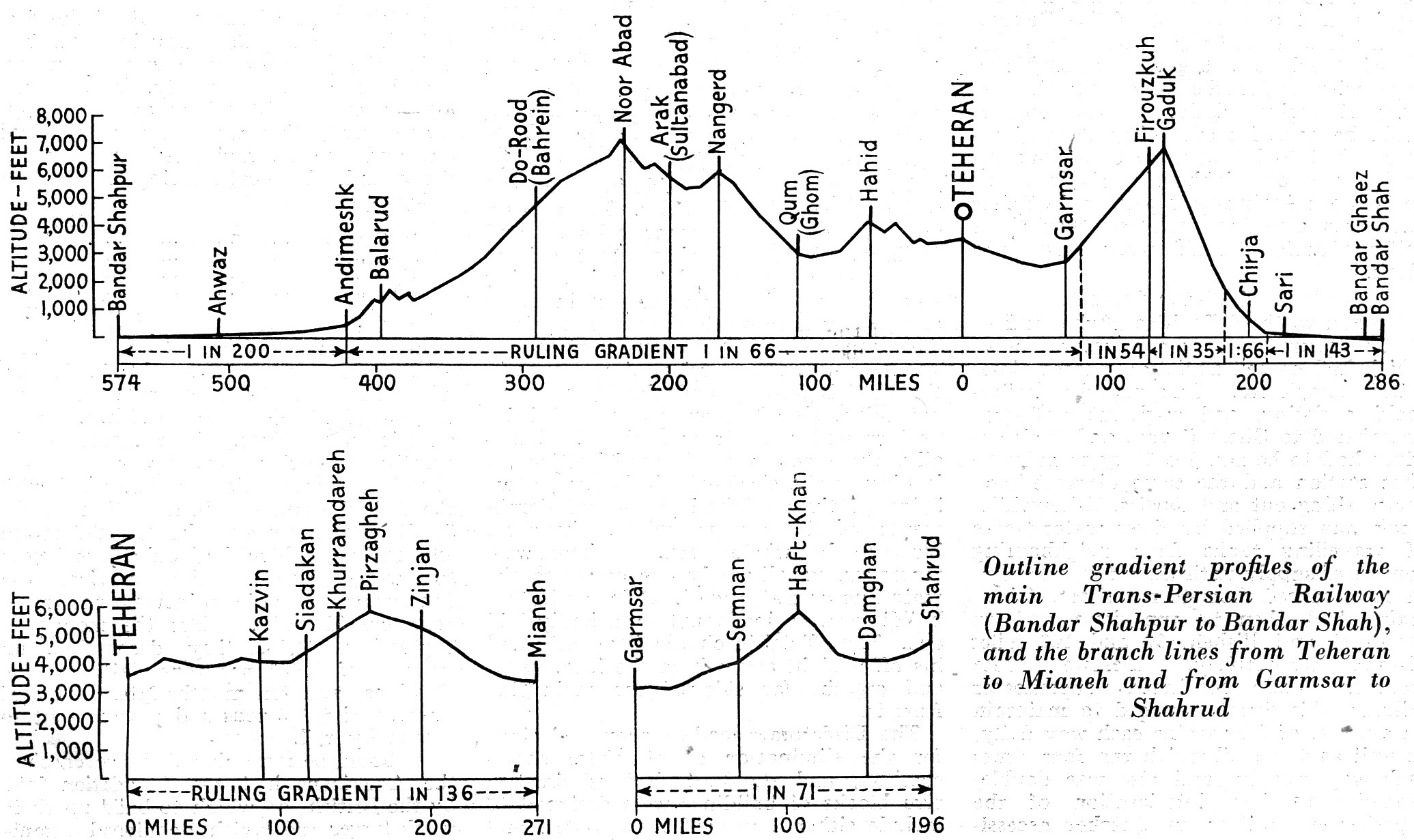
  4. Sidney J. A. Churchill, Memo, at the Shah’s Camp, 27 August 1888, enclosure in no. 13, Sir Henry Drummond Wolff to the Marquis of Salisbury, Gulahek [Golhak], 10 September 1888, FO 539/40 (Confidential 5755). Memo entitled: “Memorandum on Persian Railways”, p16 and quoted in reference 5. below.
  5. http://www.iranicaonline.org/articles/railroads-i, accessed on 22nd March 2020.
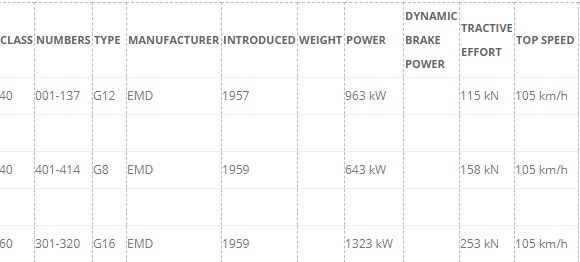
  6. “Acte”: “L’acte de constitution de la société du 17 mai 1887”, Recueil spécial des actes, extraits d’actes, procès-verbaux et documents relatifs aux Sociétés, Brussels, 1887, XV, pp. 865-69, quoted in reference 5. above.
  7. “Concession”, enclosure in no. 58, Sir Henry Drummond Wolff to the Marquis of Salisbury, Tehran, 8 October 1888, FO539/40 (Confidential 5755), quoted in reference 5. above.
  8. Otlet à Barbanson, 3 Juin 1887 (copie), Archives Générales du Royaume, Brussels, Fonds Otlet, liasse 4, quoted in reference 5. above.
  9. Albert Houtum-Schindler, “Persia,” Encyclopaedia Britannica, XXXI, 1902 (10th ed.), pp. 617-627.
  10. Baron E. Beyens, Commerce et industrie de la Perse, Brussels, 1898.
  11. Rapport”: “Société Anonyme des Chemins de Fer et Tramways en Perse, Assemblée générale du 4 juin 1888: Rapport,” Archives du Ministère des Affaires étrangères de BelgiqueBrusselsdossier 2889 II (1887-1908), quoted in reference 5. above.
  12. Ḥamida Amāni, “Farār az čarḵ-a-ye nābudi: Eḥyā-ye baqāyā-ye māšin dudi-e ḵ-aṭṭ-e āhan-e Tehrān Šāh ʿAbd-al-ʿAẓim,” Hamšahri, 25 Bahman 1383 Š./13 February 2005, available online, accessed on 22nd March 2020.
  13. https://www.internationalsteam.co.uk/trains/iran01.htm, accessed on 22nd March 2020.
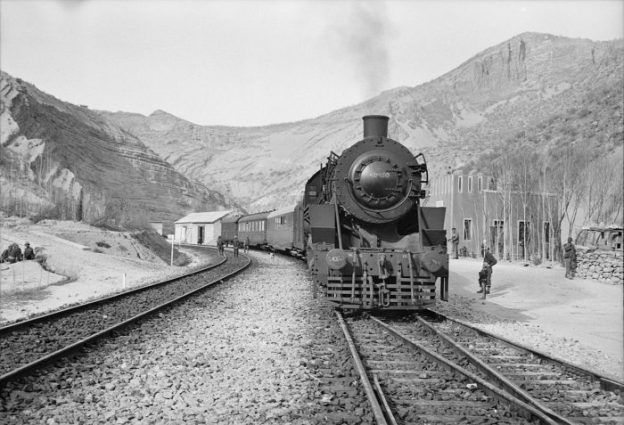
  14. http://www.farsinet.com/tehran, acccessed on 22nd March 2020.
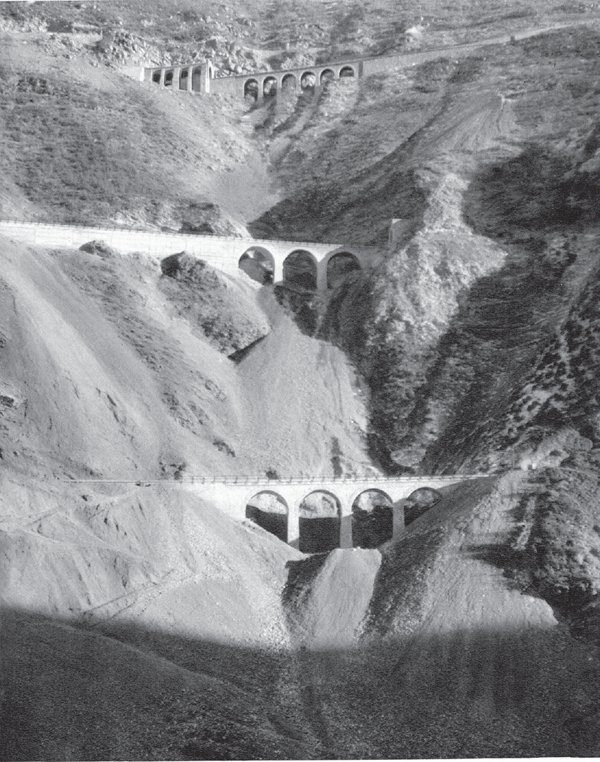
  15. https://en.wikipedia.org/wiki/History_of_rail_transport_in_Iran, accessed on 22nd March 2020.
  16. https://www.sinfin.net/railways/world/iran.html, accessed on 19th March 2020.
  17. http://www.museedelaporte.be/patrimoine/?p=1655&pdf=1655, accessed on 25th March 2020.
  18. https://commons.wikimedia.org/wiki/File:Old_steam_locomotive_in_Rey.jpg; https://web.archive.org/web/20161104221645/http://www.panoramio.com/user/1317158, accessed on 26th March 2020.
  19. DW Documentary; https://youtu.be/lqSoLVkYYu0, accessed on 25th March 2020.