Category Archives: Railways and Tramways Blog

The Network of the Tramways of Nice and the Littoral (Chemins de Fer de Provence 53)

Tramway de Nice et du Littoral

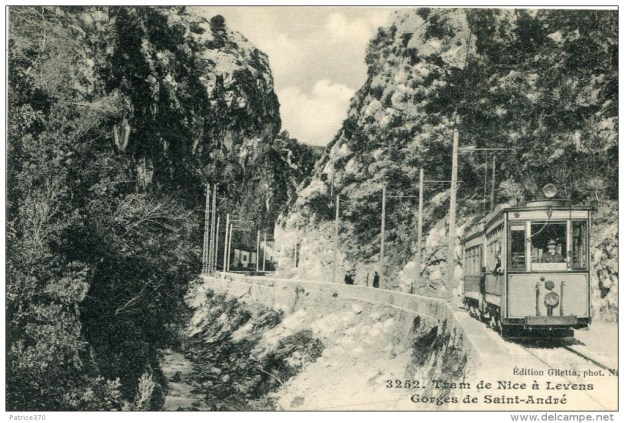
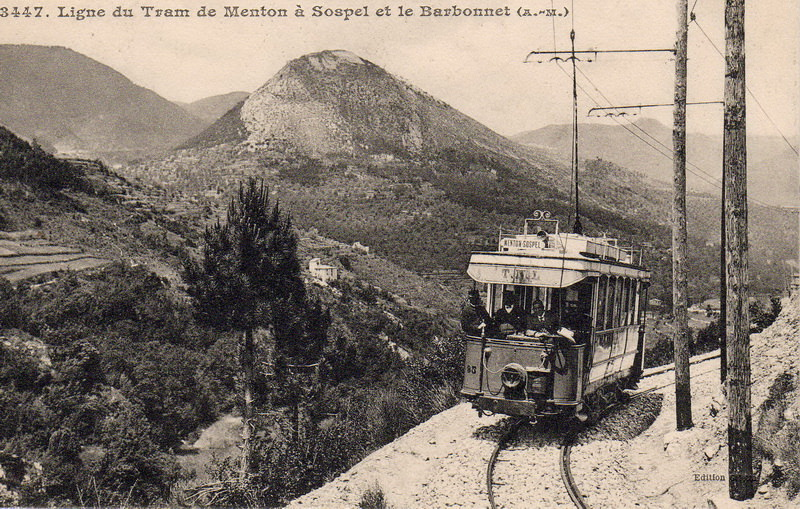
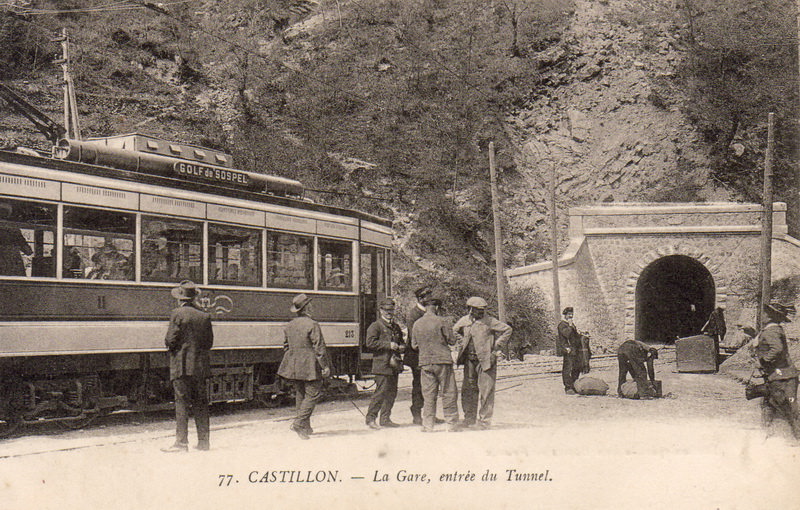
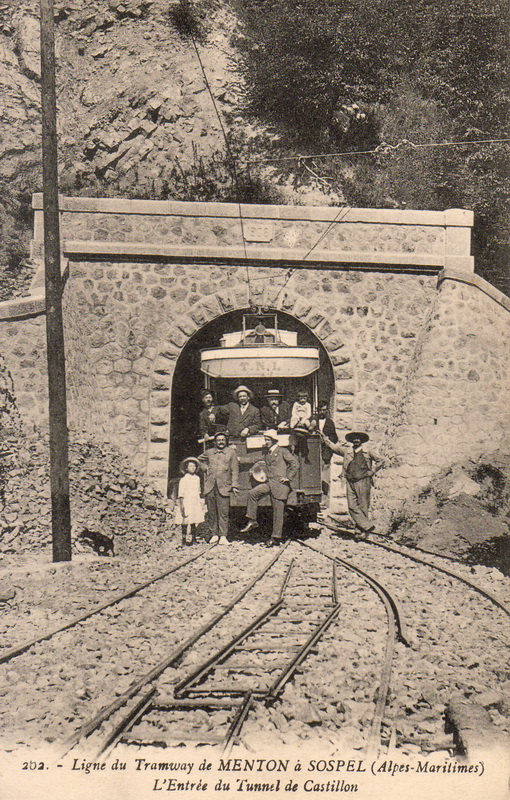
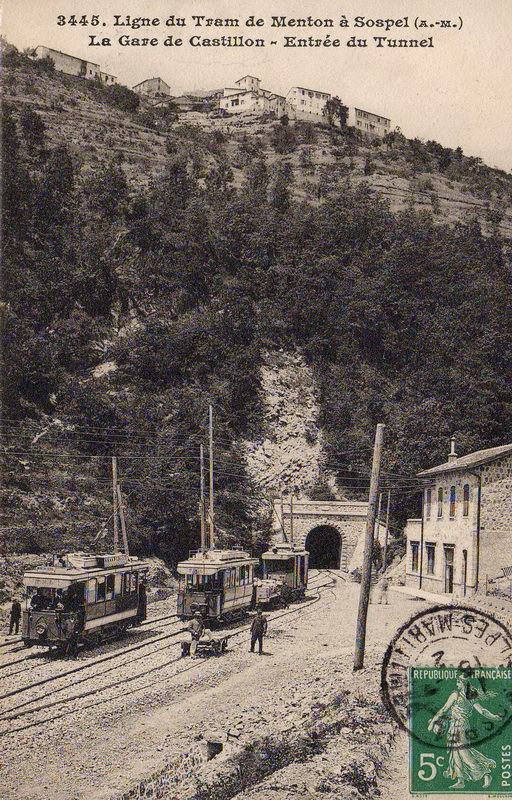
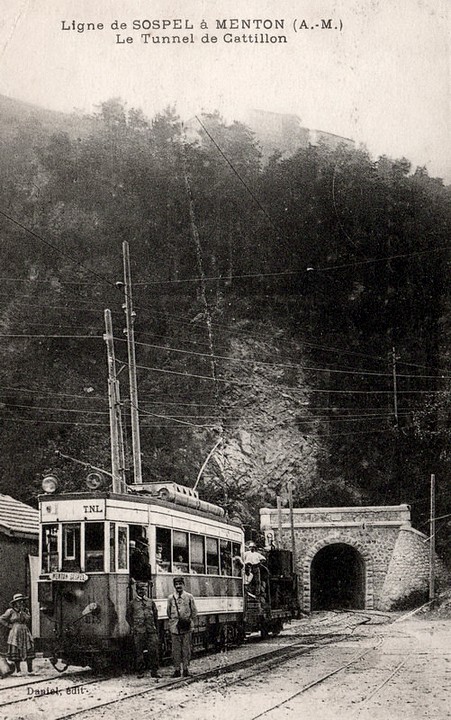
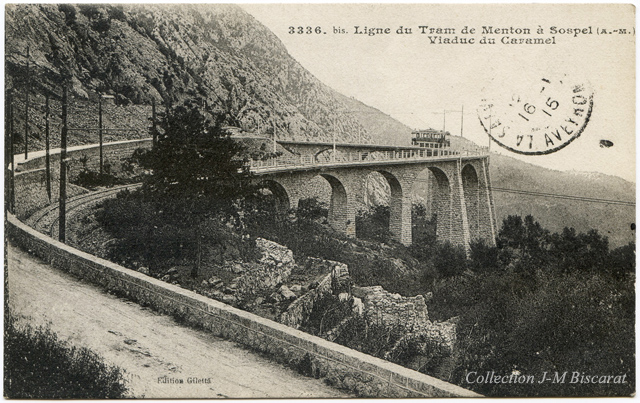
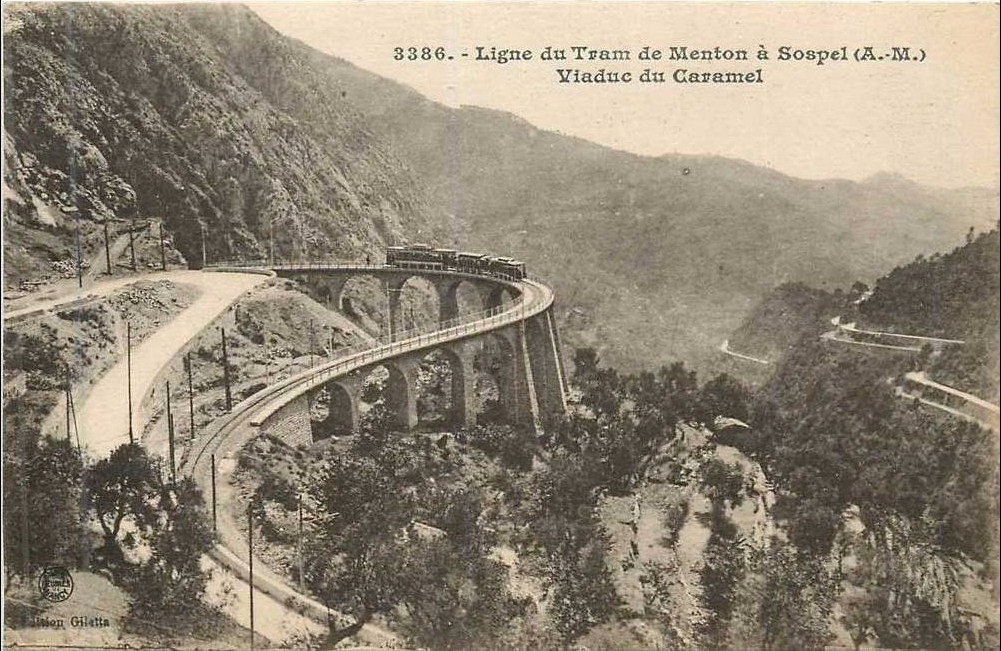
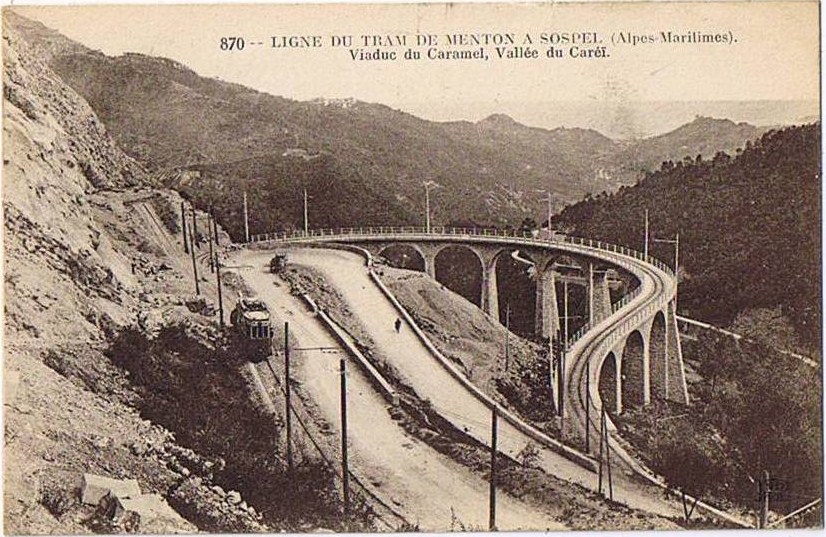
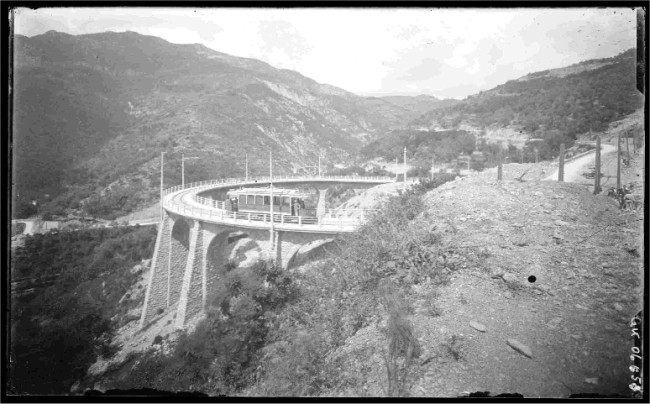
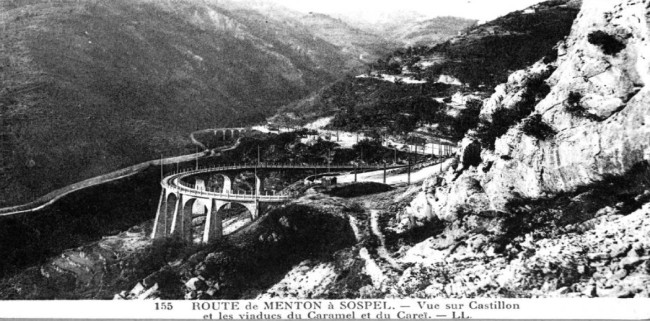
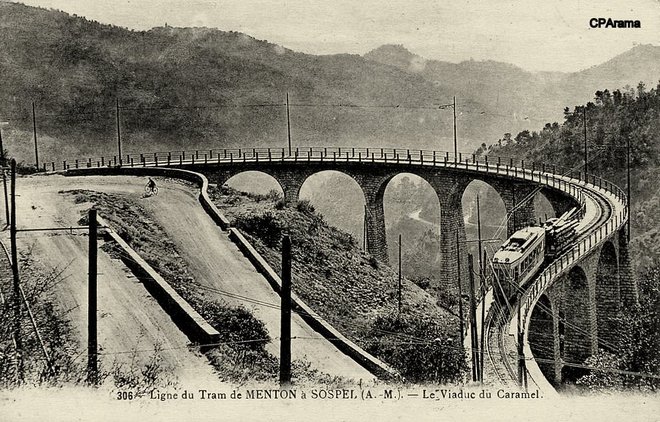
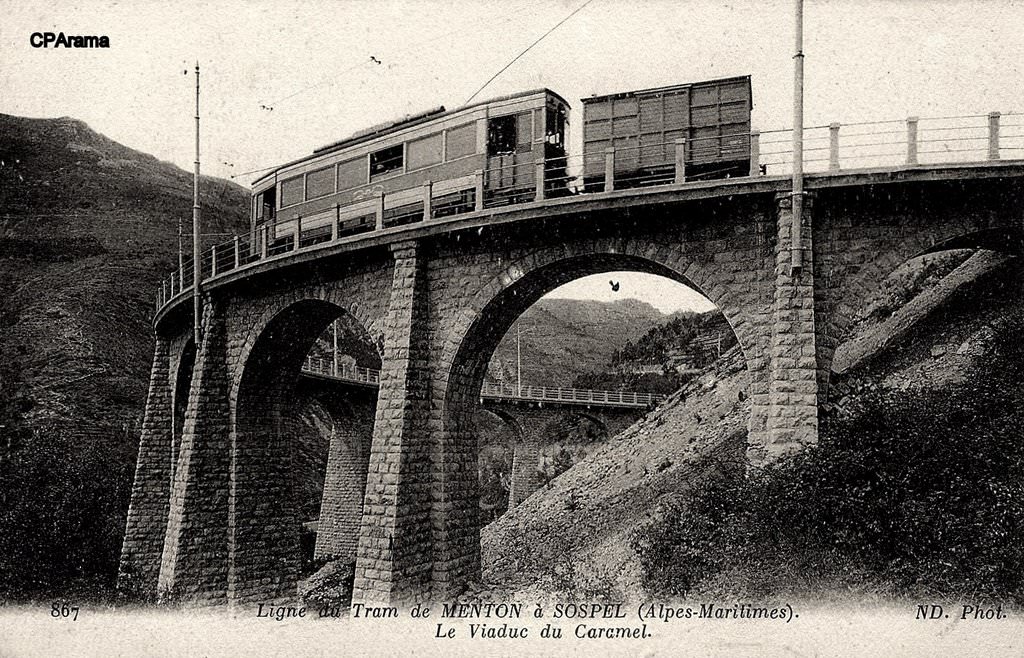
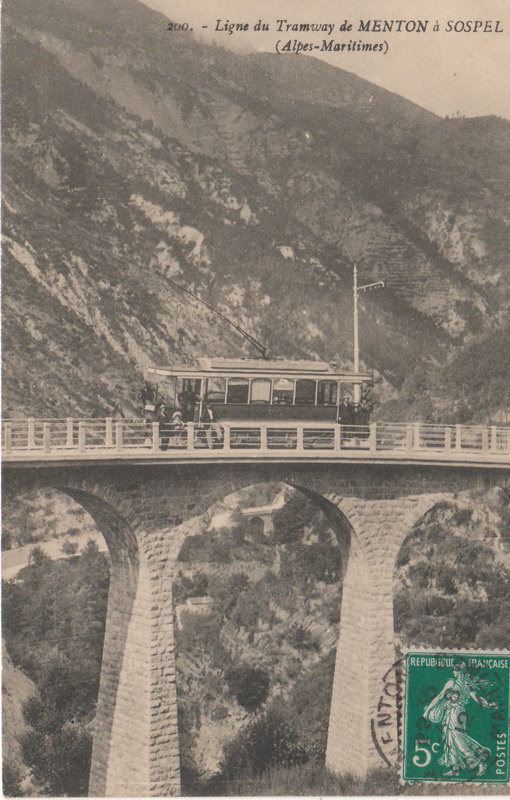
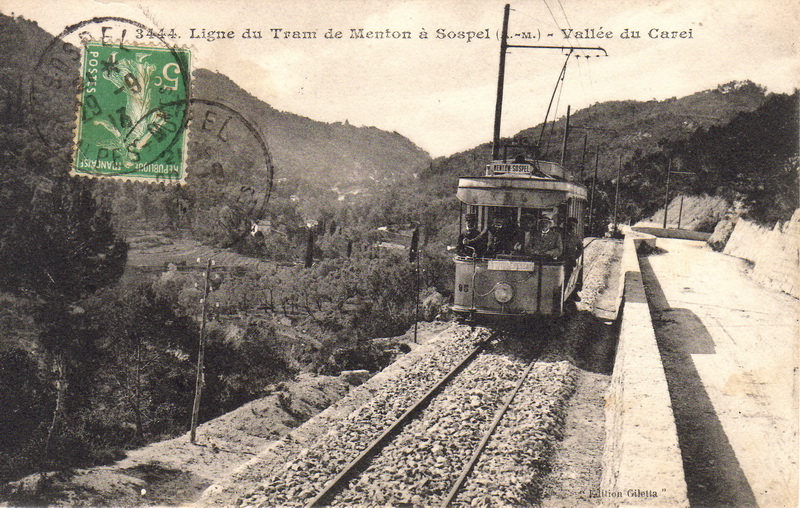
There were a series of tramways which extended different arms of Le Tramway de Nice et du Littoral (TNL). We have already followed the route of the Sospel to Menton tramway which extended the coastal/urban line between Nice and Menton into the mountains close to the coast. Menton to Villa Caserta, opened in October 1911 and Villa Caserta to Sospel opened in 1912.[3]

The TNL was a tramway network that served Nice and the municipalities of the Alpes-Maritimes department between 1878 and 1953.

Around 1833, a Monsieur Legrand, owner of the Hotel de France which is sited on what is now the Quai des Etats-Unis, bought a large omnibus in Paris and three large horses. He ran a twice daily service from Nice to Le Pont de Var which at the time marked the border between France and Italy.[10] The fare was 40 centimes.

One of his competitors, Monsieur Laupias, proposed in 1845 two services at an hour’s frequency between Cagnes sur mer and the Place Saint Dominique, as well as between the Paillon and the Faubourg du Ray. In 1854, another service commenced linking Pont Vieux (Place Garibaldi) with Le Ray.

After Nice was attached to France in 1860, the PLM railway arrived in 1864 and Nice became a preferred tourist destination for a wealthy class of traveller. At the same time, the town was growing north of Paillon. Urban planners adopted a network of perpendicular roads, but of a fairly modest width, sufficient, however, to encourage the circulation of horse-drawn omnibuses. By 1865, a network of horse drawn omnibus routes had been established.[9]

Monsieur Laupias was responsible for the expansion of the network of l’Entreprise Générale des Omnibus de la Ville and the railways. He set up two new lines: one between the PLM station and the port, and the other between the Place Charles-Albert and the Saint Barthélémy district of the city.

These horse-drawn services were ultimately short-lived as Nice began to talk about inaugurating tram services as a result of seeing tramways being developed in industrial cities further north in France. Several attempts were made to implement tramway working. One of these endeavours even sought to make use of compressed air to propel the trams.[11]

The Société Financière de Paris , associated with the Société de Travaux Publics et de Constructions, was responsible for the construction and operation of a horse-drawn tramway network in 1876 in the city of Nice. The first horse drawn tramway service was commissioned on 27th February 1878 and inaugurated on 3rd March. A series of 4 lines made up the early network … Place Massena to Magnan Bridge, a separate line from Magnan Bridge to Saint Helena, and two other lines from Place Massena, one to Saint-Maurice and the other to Abattoirs. The lines were single-track and of metre-gauge.

Soon after the first lines were completed the tramway system was placed in the care of the Compagnie Generale des Omnibus in Marseille. This arrangement lasted until 1887 when that company went into liquidation. After its collapse, La Société Nouvelle des Tramways de Nice (SNTN) resumed operation of the network.

In addition, in 1895, the Compagnie Anonyme des Tramways Electriques of Nice-Cimiez was awarded a concession for a new tram line, between the street of the Hotel des Postes and the zoological garden of Cimiez. This line was a 600mm track-gauge and used electric traction batteries because of its steep gradients, the design was seen by the promoters at a technical exhibition in Lyon in 1894.[10]

Cimiez: the appearance of the first electric tram

A casino, a zoological park and a theatre were established in Cimiez, near the Roman arena. After flirting with the idea of a steam powered service from Nice to Cimiez, the owners of the site set up the Compagnie Anonyme des Tramways Electriques of Nice-Cimiez

Unofficially the trams started running on 27th February 1895, the service was interrupted on 10th March because of fire at the generating plant. The servicecresumed on 20th June but was halted on 12th July as the required legal processes had not been followed. Eventually, on 22nd November the company was declared as being ‘d’utilité publique'[4] and an official inauguration took place on the 25th November

The 3.9 km long line had very steep gradients, 8 trams were in service on the line. Six daily services were provided in the winter and a half-hourly service was available in summer months. Stops were on request, except on the steepest sections of the line. The trams were powered by an 8bhp motor and had a maximum capacity of 32 people. Redesign of the trams took place very early in the life of the tramway, the wheelbase and overall length of the trams were shortened and the single 8bhp power unit was replaced by two 50bhp motors. The people of Nice nicknamed the trams the “slugs”.[10]

The Cimiez tramway was again taken out of operation in 1899, to allow a revision to the electrical power system and tompermit integration with the wider metre-gauge tram network in the City of Nice. The line was operating again by January 1900.

La Compagnie des Tramways de Nice et du Littoral (TNL)

Within two years of its foundation, La Société Nouvelle des Tramways de Nice had been replaced by La Compagnie des Tramways de Nice et du Littoral (TNL). The company set itself a series of goals relating to the improvement an expansion of the urban network:

  • to create a Coastal Network , extending from Cagnes to Menton , with connections to other networks in Nice and at Contes .
  • to electrify the urban network.
  • to resume operation of the Cimiez line, abandoning the accumulator tramway and converting it to metric gauge.

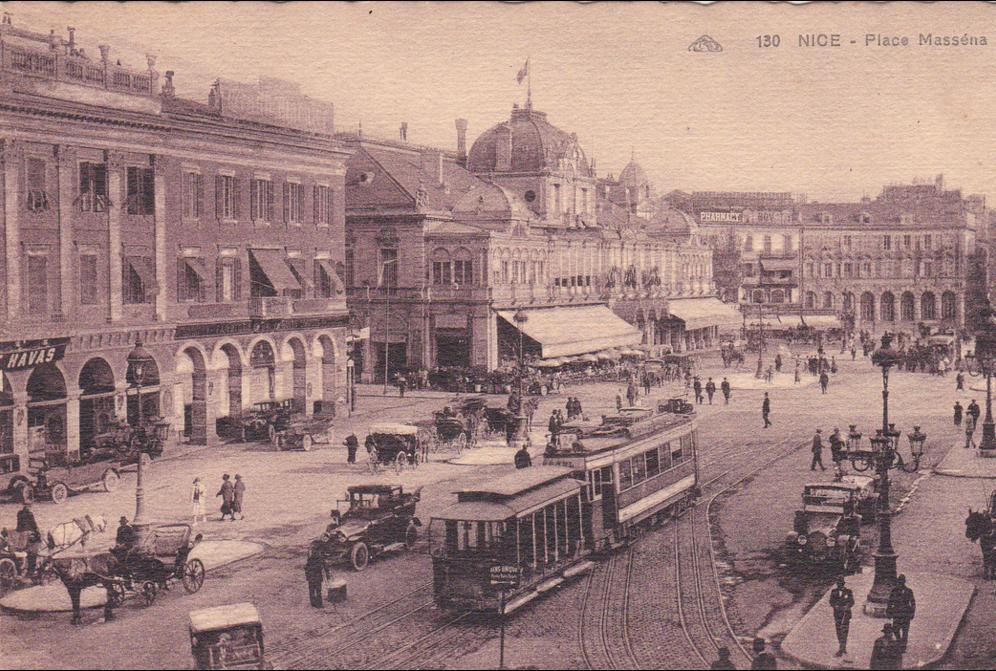
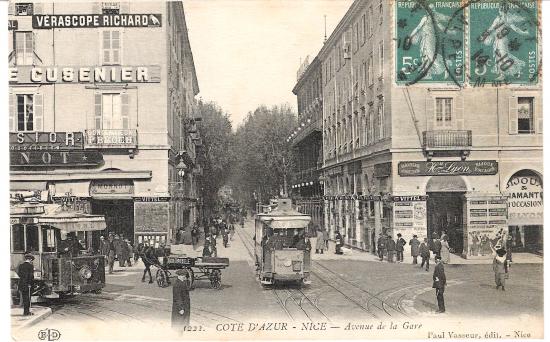
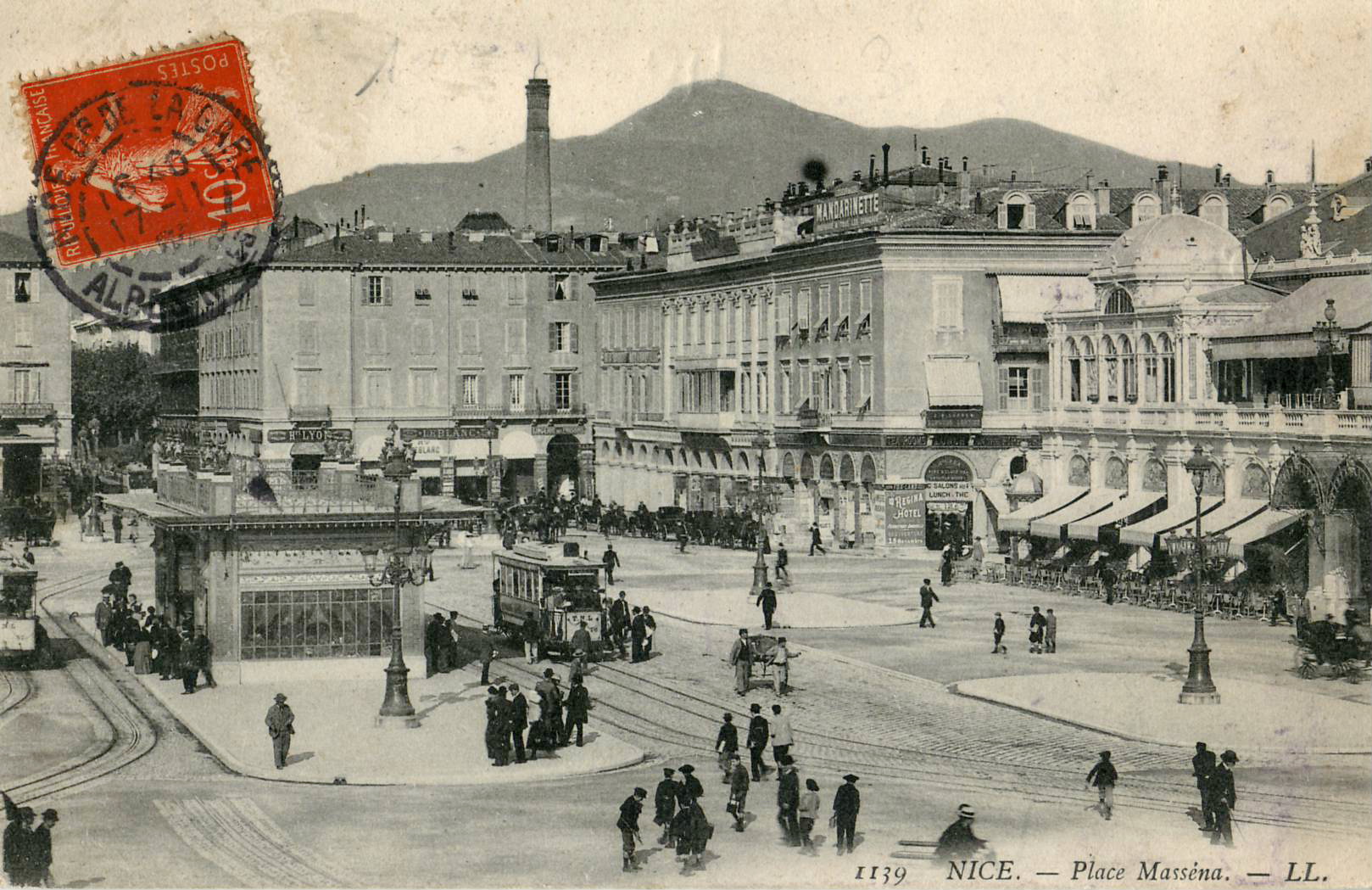
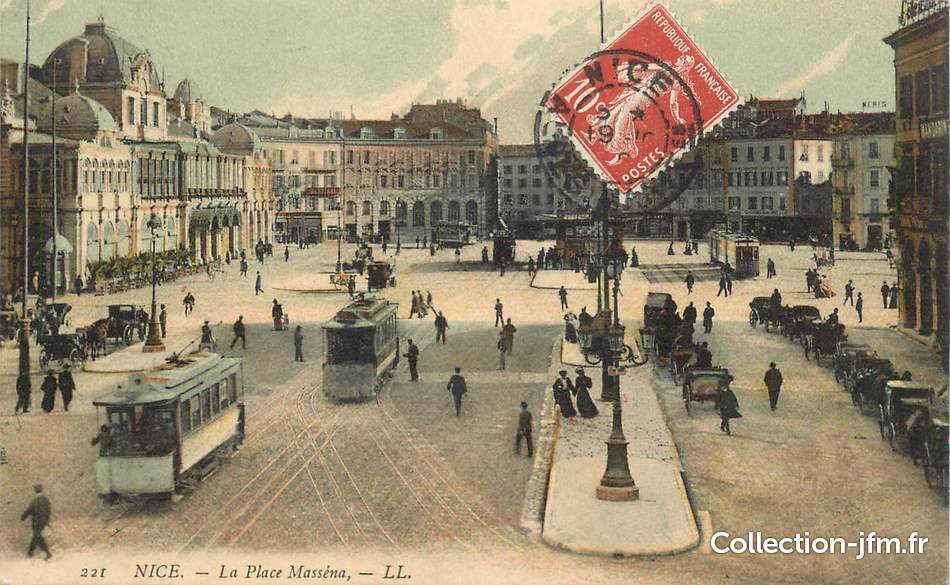
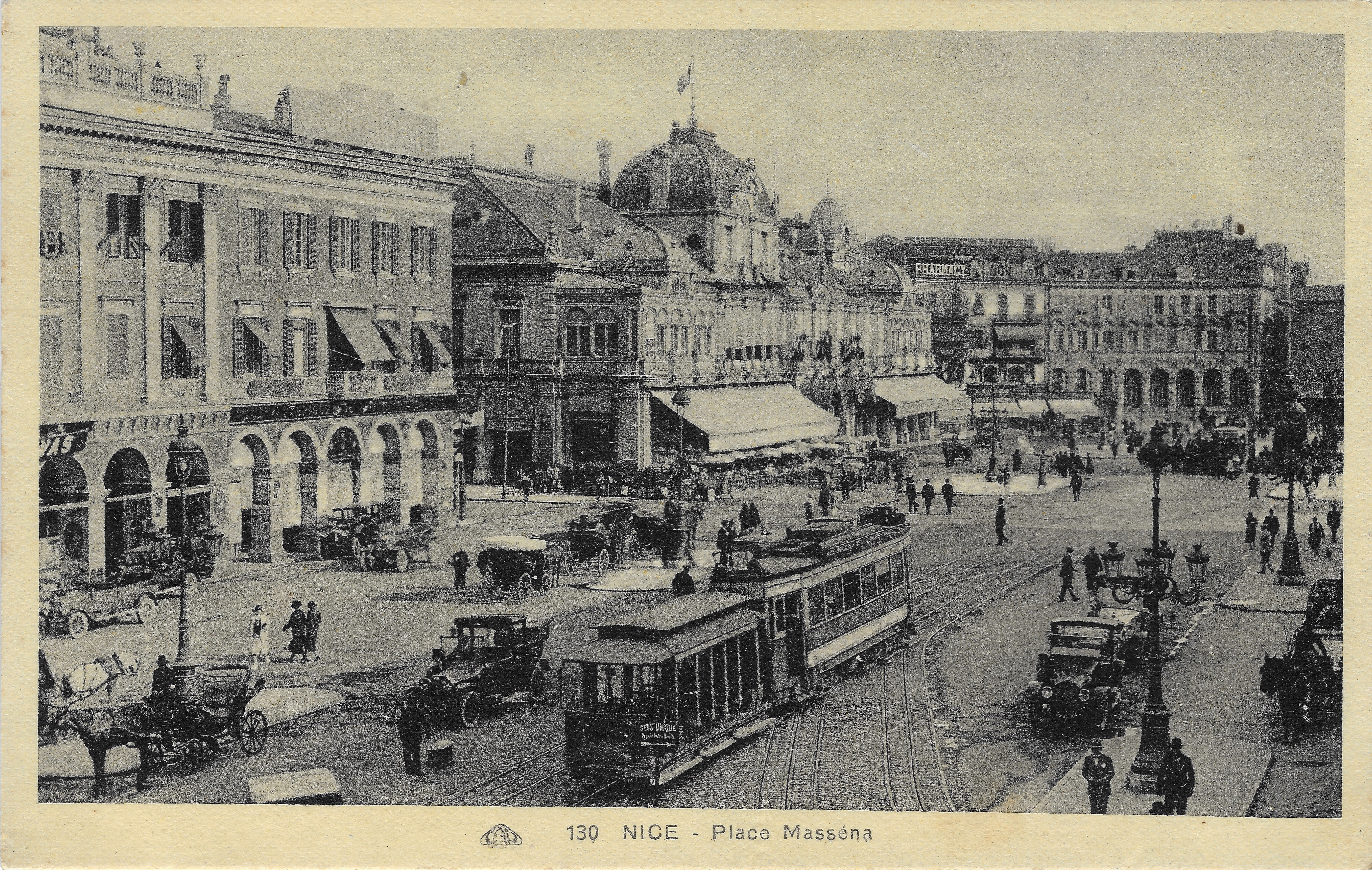
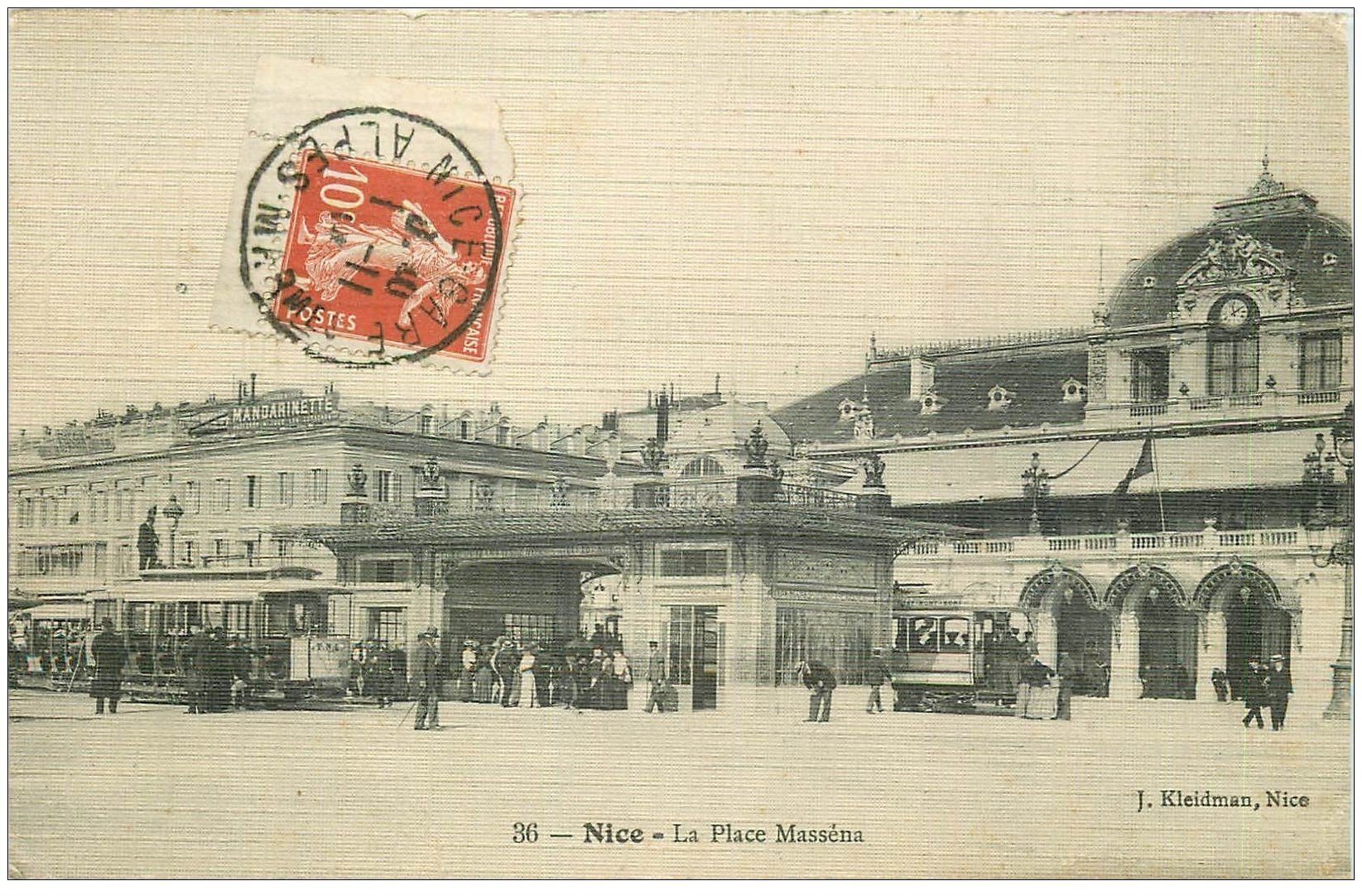
The company was effective in meeting its initial goals and it created an extensive network centred on the Place de Massena in Nice. A few images of the Place de Massena follow ………

Lines opened or reopened as follows:[1]

  • Nice – Cimiez , January 1900
  • Place Massena – Villefranche-sur-Mer , February 1900
  • Nice – Saint Laurent du Var, February 1900
  • The port – Saint Maurice, February 1900
  • Nice – Cagnes, March 1900
  • Nice – Contes , June 1900
  • Nice – Beaulieu, June 1900
  • Magnan – Saluzzo (via Lépante Street), November 1902
  • Gambetta – Massena (via avenue Joseph Garnier), November 1902

All the lines were electrified by underground gutter as soon as they were put into service, and a fleet of 100 motor-trams was ordered.

In total, for the construction of the 12 urban lines and the first 3 sections of the suburban network, it took only 2 years to lay a total of no less than 94 km of network (150 km of single track)! From 31st December 1899, the tests of the first of the Thomson-Houston, Thomson-powered motor-trams, equipped with 2 engines of 35 bhp were carried out inside the depot at Sainte Agathe. There were 30 of these yellow and white trams in two classes. The initial plan had been to provide a limited number of 1st Class trams. This idea proved unsuccessful and the 1st Class trams were later converted to standard class. When first in operation these 6 1st Class trams were marked with a colour code.

Service frequency on the urban network was high. Generally, services started at 5.30am and ended at around midnight. However, the first departure from Cagnes-sur-Mer (for the florists) was scheduled at 3am! A TNL kiosk was built in 1901 to act as a ticket office and an information desk at the heart of the network.

Menton and its Trams[14]

The coastal network took 3 years of work to reach Menton and to create a branch-line between Place Saint Roch and Place Caserta. The trams provided strong competition for the PLM along the coast and the PLM took every opportunity to obstruct the construction of the underpasses and bridges required for the line, and prohibited the installation of a terminus in front of the station at Menton. Finally, the TNL decided to drop their passengers 25m  from the PLM station, at the foot of the climb to the station yard. The trams finally provided a service to Menton by 22nd December 1902, and the connection with the station was operational by July 1903.[12]

Completion of the line to Menton provided a continuous service from Cagnes-sur-Mer to Menton. By this time the TNL had over 94km of lines, 29km in Nice, 12km in Cagnes, nearly 16km of the line to Contes and nearly 38km of tracks on the line to Menton via Monte Carlo.

CP-Villefranche-BeaulieuThe shoreline was itself a tourist object: the panorama of the Mediterranean and the villages did not lack charm. On the heights of Beaulieu, the tram takes the pose with a platform abundantly stocked for the occasion.CP-nice-VillefrancheAnother view of the coast line with a motor-tram running on the Corniche at Villefranche sur Mer. The road was still made only of dirt and gravel, and in the shadow of the tramway there is a cart pulled either by a donkey or by a horse.An attempt to provide a reversible train with two motor-trams framing a trailer-car on the line of Monte-Carlo. The power of the leading motor-tram proved to be inadequate for the load.  

The Tramway Company of Monaco

The Compagnie des Tramways de Monaco was founded in 1897 by Mr. Crovetto, a Monegasque entrepreneur. The company obtained concessions for a number of different lines, as listed below before, in 1908, becoming part of the TNL:

  • Place d’Armes – Saint Roman, opened on May 1898
  • Gare de Monaco – Place du Gouvernement, opened on March 1899
  • Casino – Monte Carlo Station, opened May 1900.
  • Nice – Monte CarloCarlo, opened in 1900.

The Cote d’Azur is a stunning series of headlands, towns and villages alongside the azur-blue waters of the Mediterranean sea. Wikipedia has produced an excellent introduction to the coast-line – Road by the sea[2].

La ligne de Monaco et Menton

This line connected towns and cities along the Corniche: Nice, Villefranche, Beaulieu, Monaco and Monte Carlo by a route established on the Basse Corniche. The line opened towards the end of 1903 and was quickly followed by the completion of an extension from Monaco to Menton just in time for Christmas 1903. The line was separate from, but connected to the tramway network in Monaco.

Further Extensions

The  network continued to grow. The TNL began to extend inland into Les Alpes Maritimes department creating a network of single track metre-gauge lines which served key villages and towns in the hinterland. It also extended and consolidated it presence in the urban areas along the coast. The departmental network not provided extended access into Nice and the coastal towns for local people, it was perceived as creating significant opportunities for tourism.

The Departmental Network

The departmental network included 14 proposed lines shared between the TNL, the TAM and the Compagnie des chemins de fer du Sud de la France . The TAM was actually a subsidiary of La Compagnie des chemins de fer du Sud de la France and the larger company decided to confine tramway operations to the TAM despite having a shared track-gauge. Other blog posts provide details of some of these TAM lines, particularly:

The lines were shared out using geographical criteria which resulted in the TNL being offered the following concessions:

All these lines were declared ‘d’utilité publique'[4] on 10th February 1906.[1]

Once the network opened its line from Cagnes-sur-Mer to Antibes it was able to connect to the tram network in Cannes .[5]

Developments in the Urban Network

One further line was introduced in 1908, that between Magnan/Le Madeleine and the centre of Nice.

Magnan is a valley located west of Nice. Today it is urbanised and used to designate one of the districts of Nice. The river which flows through the valley is called Le Magnan (or Torrent de Magnan).[6] This is a short coastal river of 12.6km in length. Le Madeleine[7] was the small village with a chapel in the valley.

The line from Menton to Sospel

This line connecting Menton to Sospel was opened on April 15, 1912, as part of the construction of the departmental network. Its length was 18km . It marked the last extension of the TNL.

The peak of the tramway network and its demise

In fifteen years, the growth of the population of Nice and the surrounding towns and villages necessitated a rapid development of the network. The advent of the Great War prevented any further development of the network.

At the end of the war, the network was in need of an in-depth modernization programme. However, it was not until 1924 that the authorities granted the TNL the authorization to increase tariffs.

A refurbishment program was initiated, significant improvements were intended for the trams themselves but these improvements were not introduced in full.[12] Changes were made in different ways to different batches of limited numbers of trams.

A major study in 1921, looked at the possibility of providing a tramway tunnel under Monaco, but the proposal did not see the light of day.

To speed up service and reduce operating costs, a system of fixed and optional stops was introduced. Buses began to be introduced by the TNL in October 1921 under the company name, Société Anonyme Niçoise de Transports Automobiles, to serve remote villages where the tram no longer operated. The TNL also bought its own buses.

10 Schneider Type H buses similar to the one above were purchased. They were similar to those in use in Paris. They arrived in Nice in 1925. They were followed in a short period of time by 3 Somua MAT2 buses.

Despite reducing revenues, the TNL decided to build a new series of trams strongly inspired by the Parisian L-type, and adapted to the Nicois metre-gauge track. Eight reversible motor trams were were ordered along with trailers. The trams were 200bhp and had a 3.60m wheelbase. These performed well on straight track but found the windowing nature of much of the network difficult.

After the Great War, very quickly, other forms of transport began to develop in competition with the tramways. These began to be regarded as more modern than the tramways. A number of accidents occurred on the network which began to result in a lessening in confidence in trams as an appropriate form of transport beyond the immediate urban areas.[8] There was an increasingly vociferous anti-tram lobby.

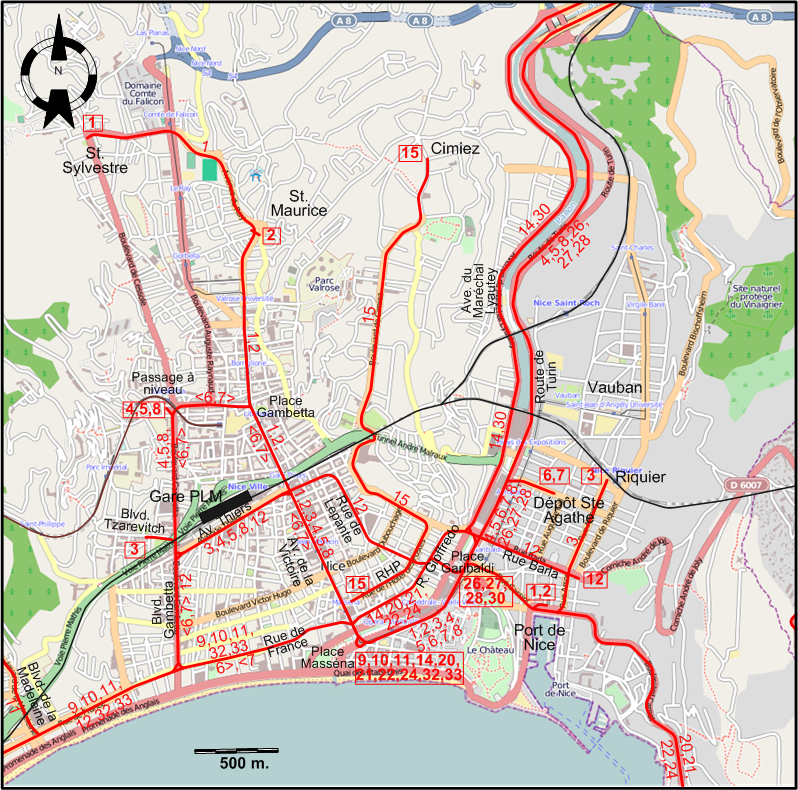
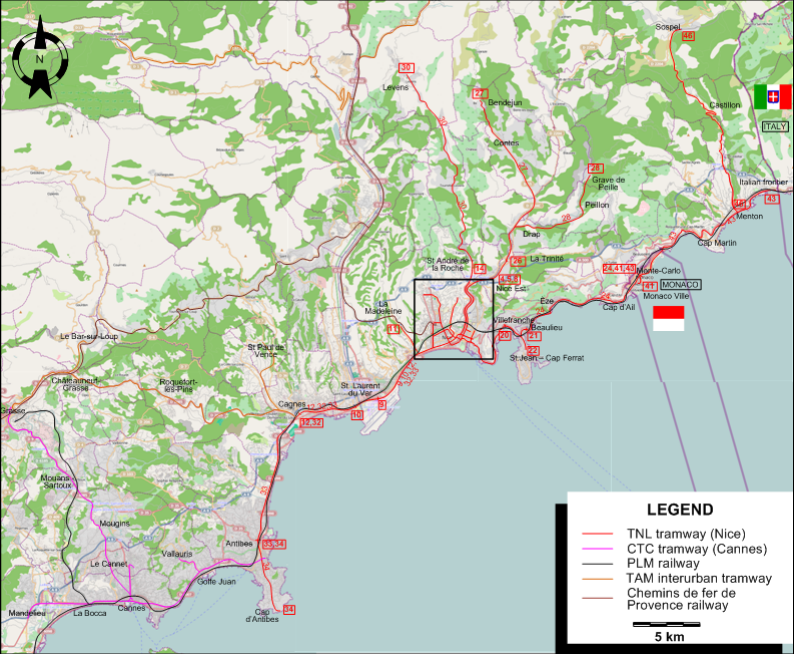
The above images show the extent of the tram network in 1925, both within Nice and along the coast.[13]

In 1925, the TNL network had 144 km of track, & a fleet of 183 motor trams and 96 trailers.[15] The tramways were also used to transport goods and a series of wagons were also purchased. Goods were transported within Nice to and from the station of Le Chemin de Fer de Provence. Coal was transported from the port to other parts of the city, and cement, lime and gas were transported from the cement factory in Contes to various areas of Nice. The Sospel to Menton line was used for construction materials for the building of the railway line from Nice to Breil-sur-Roya.

Initially, it was the coastal tram lines that suffered strongest competition from road vehicles. But, across the whole network, cars and lorries and their inherent flexibility came to dominate the public’s choices over transport use. The coastal lines between urban centres disappeared between 1929 and 1932. By 1934, the longer suburban lines had all disappeared. Nevertheless, the tramway was not yet banned from the city, even if criticism from part of the population was growing. 

In 1927, André Mariage[16] took the presidency of TNL and STCRP, amplifying the hostility towards the tramway. The election of Jean Médecin at the head of the municipality, who was a virulent opponent of the tramway, seemed to legitimise those who saw the tramway as a symbol of the past.

Over following years the municipality decided to close different urban lines and by 1939 only four lines remained open:

  • Line 3: Abattoirs – La Madeleine – Trinidad Victor
  • Line 9: Port – Saint Augustins
  • Line 22: PLM station – Carras
  • Line 35: Rue Hotel des Postes- Cimiez

During the Second World War, two urban lines were reopened as the buses which had been gradually being introduced were requisitioned for the war effort:

  • Line 6: Level crossing – Pasteur
  • Line 7: Level crossing – Riquier

And two lines into the hinterland: the one to Contes and the one to La Grave de Peille.

The network had, by the end of 1942, 48 motor-trams and 22 trailers (some motor-trams were rebuilt in 1942).

After the Second World War, the tramway systems, having suffered from years of war/occupation and neglect, were replaced by trolleybuses . The trolleybuses were put into service from 1942 on the Cimiez line (line 35). The last tram ran on the whole network on 10th January 1953.

Lines disappeared slowly over a period of years: the line to La Grave de Peille closed in 1947, line 22 closed at the end of 1948. The line to Contes and Line 6 closed in 1950, and lines 3 and 9 closed in 1951. Line 7 was the last line in operation and closed, as we have already noted, on 10th January 1953.

Rolling stock 

Motor-trams[1]

  • No.1 to 100, were sourced from the workshops of Saint-Denis.
  • No. 101 to 106, were sourced in 1903 from Brissonneau and Lotz.
  • No. 111 to 130, were delivered in 1904 by Thomson-Houston.
  • No. 151 to 170, came in 1906 from Thomson-Houston.
  • No. 201 to 216, were sourced  in 1910 from Thomson-Houston.
  • No. 251 to 258, were delivered in 1925 by les Établissements Soulé.

Trailers[1]

  • No. 301 to 316, delivered in 1908 by les Établissements Soulé.
  • No. 351 to 358, delivered in 1925 by les Établissements Soulé.
  • No. 401 to 418, commissioned in 1902, and were former horse trams.
  • No. 501 to 515, delivered in 1901 by  les Établissements Carde.
  • No. 516 to 520, delivered in 1901 by les Établissements Carde.
  • No. 600 to 619, commissioned in 1900, and were former horse trams.
  • No. 700, commissioned in 1900, a former horse tram.
  • No. 731 to 736, commissioned in 1911, and converted from former motor-tram cars No. 101 to 106.
  • No.801 to 812, (initially numbered 201 to 212), bought second-hand in 1903 from les Chemins de fer Nogentais.
  • No. 813 to 822, (initially numbered 213 to 222), delivered in 1905 by les Établissements Carde.
  • No. 901, commissioned in 1916, built by TNL workshopsworkshops.
  • No. 921, commissioned in 1927, built by TNL workshops.

References 

1. Tramway de Nice et du Littoralhttps://fr.m.wikipedia.org/wiki/Tramway_de_Nice_et_du_Littoral, accessed 5th March 2018.

2. Route du bord de mer (Alpes-Maritimes); https://fr.wikipedia.org/wiki/Route_du_bord_de_mer_(Alpes-Maritimes), accessed 5th March 2018.

3. The Sospel to Menton Tramway Revisited; https://rogerfarnworth.wordpress.com/2018/02/23/the-sospel-to-menton-tramway-revisited-chemins-de-fer-de-provence-51the-sospel-to-menton-tramway-revisited-chemins-de-fer-de-provence-51.

4. This term is a standard French term for a transfer of status for a company, a definition is provided on this link: http://projaide.valdemarne.fr/la-reconnaissance-dutilite-publique-definition-et-demarches, accessed 14th March 2018.

5. Tramway de Cannes; https://fr.wikipedia.org/wiki/Tramway_de_Cannes, accessed 14th March 2018, c.f. Trams in Cannes; https://en.m.wikipedia.org/wiki/Trams_in_Cannes, accessed 15th March 2018.

6. Magnan; https://fr.wikipedia.org/wiki/Magnan_(Nice), accessed 14th March 2018.

7. https://fr.wikipedia.org/wiki/Liste_des_quartiers_de_Nice#Magnan_ou_La_Madeleine, accessed 14th March 2018.

8. See for example: https://rogerfarnworth.wordpress.com/2017/11/28/the-tramway-between-grasse-and-cagnes-sur-mer-part-1-chemin-de-fer-de-provence-20 and https://rogerfarnworth.wordpress.com/2018/02/23/the-sospel-to-menton-tramway-revisited-chemins-de-fer-de-provence-51the-sospel-to-menton-tramway-revisited-chemins-de-fer-de-provence-51.

9. Transports en Commun de Nice TNL; http://www.nissalabella.net/tnl.htm accessed 13th March 2018.

10. Les tramways de Nice : avant l’électrification; http://transporturbain.canalblog.com/pages/les-tramways-de-nice—avant-l-electrification/31975770.html, accessed 13th March 2018.

11. Les tramways de Nice : avant l’électrification; http://transporturbain.canalblog.com/pages/les-tramways-de-nice—avant-l-electrification/31975770.html, accessed 13th March 2018; c.f. https://www.thevintagenews.com/2016/10/17/the-mekarski-system-compressed-air-propulsion-system-for-trams, accessed 15th March 2018; https://en.m.wikipedia.org/wiki/Mekarski_system, accessed 15th March 2018; and http://www.tramwayinfo.com/Defair.htm, accessed 15th March 2018.

12. Les tramways de Nice: de l’apogée au déclin; http://transporturbain.canalblog.com/pages/les-tramways-de-nice—de-l-apogee-au-declin/31975780.html.

13. The GS Tram Site: Nice/Cannes and Area, France and Monaco 1925; http://www.tundria.com/trams/FRA/Nice-1925.shtml, accessed 15th March 2018.

14. Photographs and Postcards showing the trams of Menton can be found at http://menton.tramways.monsite-orange.fr/index.html, accessed 14th March 2018.

15. Trams in Nice; https://en.m.wikipedia.org/wiki/Trams_in_Nice, accessed 15th March 2018.

16. André Mariage; https://fr.wikipedia.org/wiki/André_Mariage, accessed on 15th March 2018.

Bullo Pill and the Forest of Dean Tramway

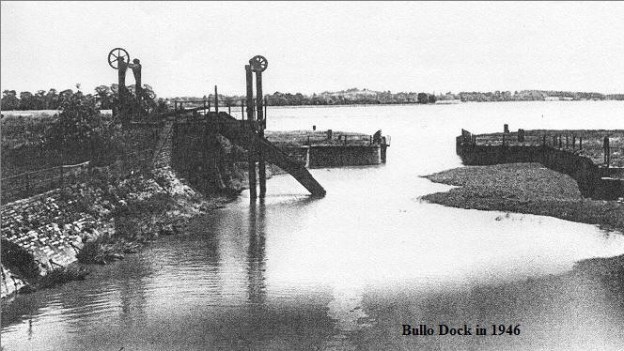
Bullo Pill, on the Severn near Newnham, originally a small tidal creek off the main river used for boat building, was developed by building a dock basin with lock gates, and wharfs for loading goods for shipment.[1] Coal and stone from the Forest could be loaded at the dock and exported on the Severn trows up or down the river. In addition, there was a flow of barges carrying coal across the river to Framilode and then along the Stroudwater Canal to Brimscombe, Stroud and Chalford. The name ‘Bullo Pill’ is unusual. ‘Pill’ is a local word meaning a tidal inlet. The Oxford English Dictionary[2] gives the etymology as Old English (Anglo Saxon) – but some internet sources state it to be Welsh or Irish.[3]

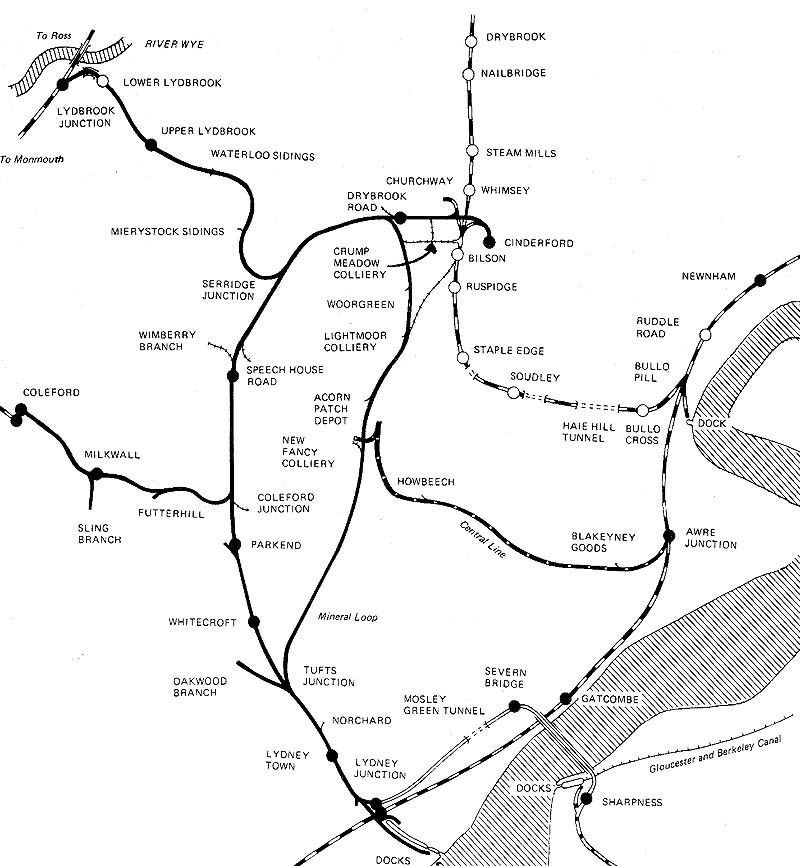
A private railway (a tramway/tramroad) was built from Bullo Pill via Soudley and Ruspidge to Churchway near Cinderford Bridge in 1807, a distance of nearly four and a half miles; when it was nearly complete, the Bullo Pill Railway Company applied for an Act of Parliament in order to extend the railway a further two miles to the summit of the hill above Churchway Engine, and to make branches. The Royal Assent to the Act was made on 10 June 1809.

The railway was of approximately 4 ft gauge, laid as a plateway, with rails of L-shaped section, spiked to stone blocks. Rails were supplied by the Ayleford Foundry, near Soudley; a branch line was constructed from the foundry. All traffic was horse-drawn, using privately owned four-wheeled wagons of an approved type, with an oak underframe supporting a hopper-shaped body, and with un-flanged cast-iron wheels. The line was single, with frequent passing loops.

By 5th May 1826, the Forest of Dean Railway Company had taken over the Bullo Pill Tramway. An Act of Parliament was passed to establish the Forest of Dean Railway Company. In some places the tramway was built over. In others, the railway took a different route.  In 1852, the Forest of Dean Railway was acquired by the South Wales Railway.

Details of The Forest of Dean Railway Company and its railway can be found on a variety of internet sites.[4] There were a series of branch-lines as far north as St. Annals to the east and Crump Meadow to the west.

On the Bullo Pill dockside, at SO 6907 0981, there is a pile of stone blocks, some with a single drilled hole. These may well be original tramroad blocks.[5]

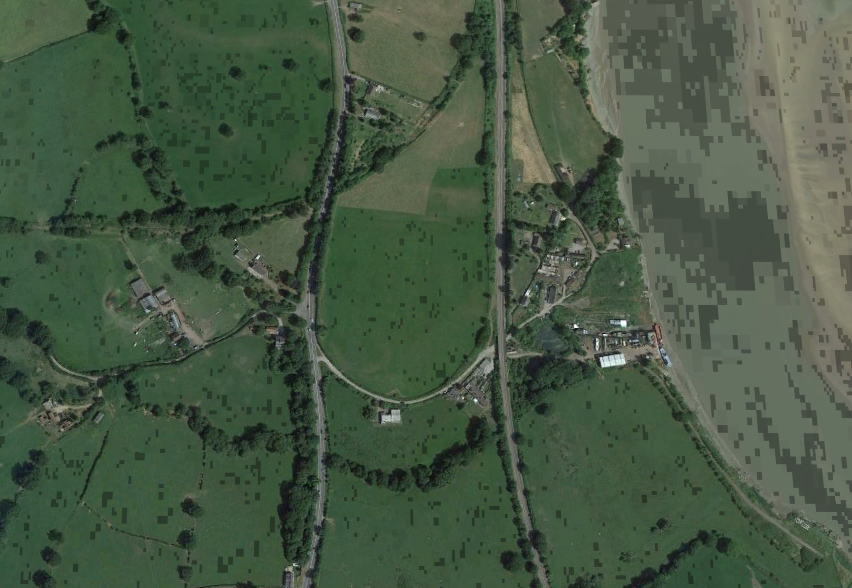
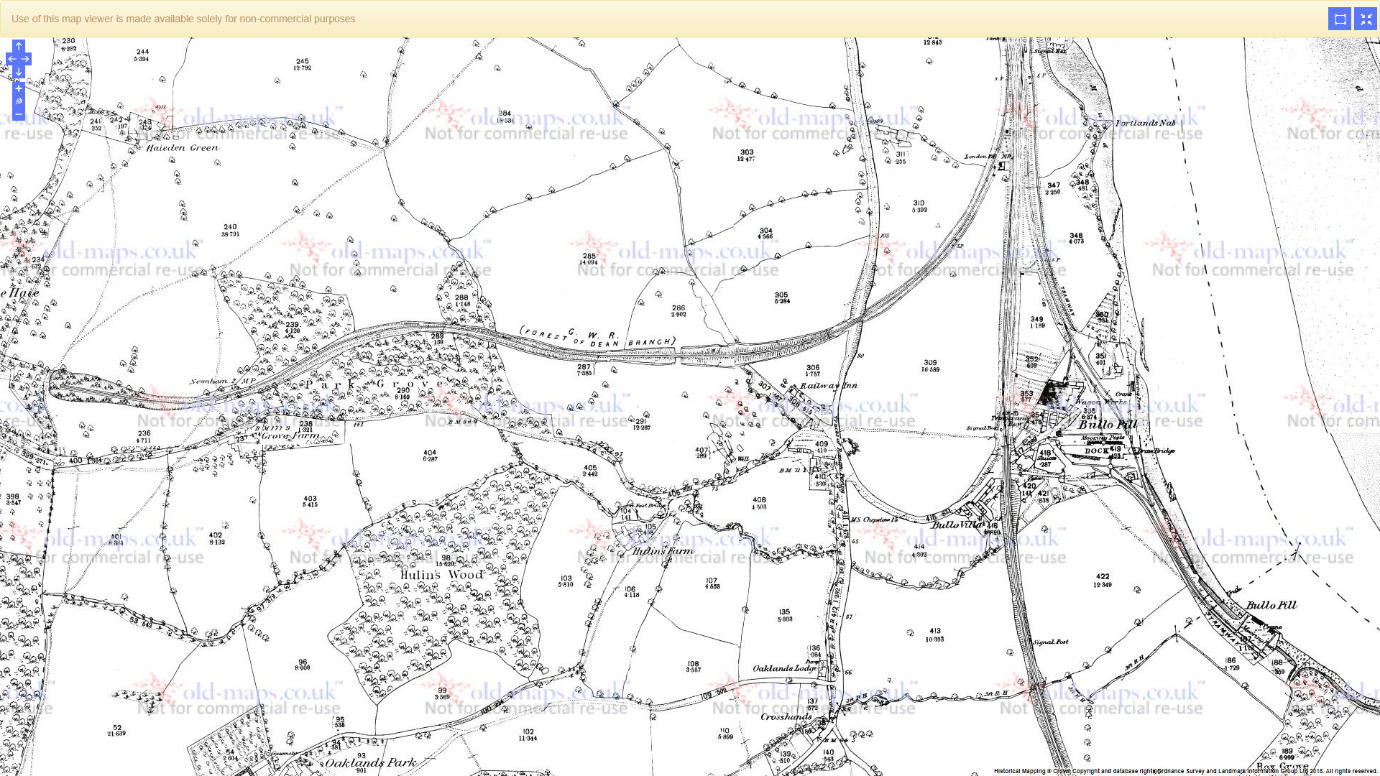
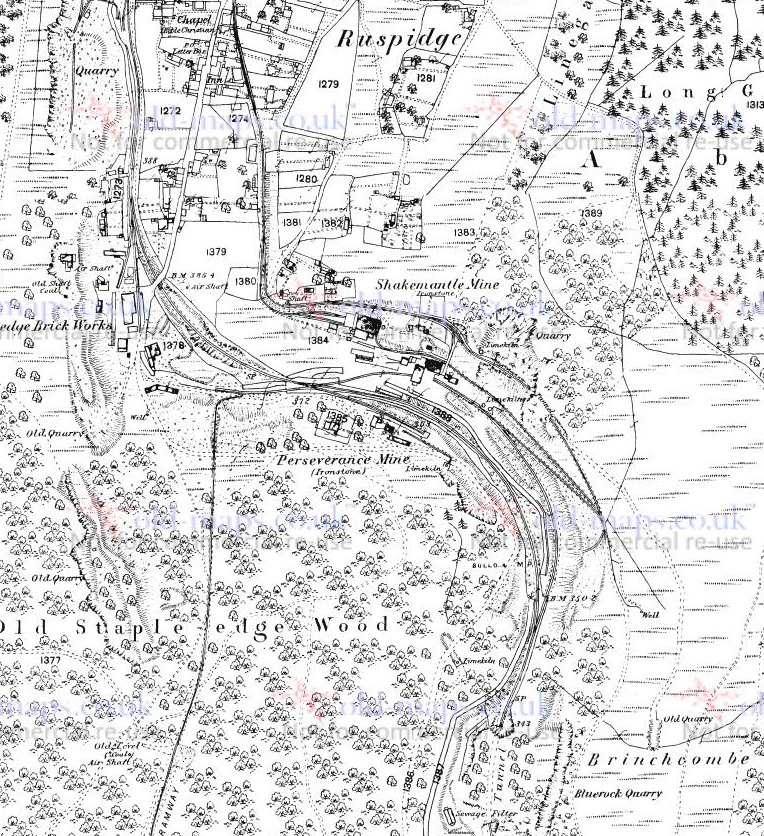
The dock at Bullo Pill became inadequate for the level of traffic by the 1830s, so a wharf was built at Box Meadow.[6] The tramway, which is now a track, ran south from the dock at Bullo Pill to the wharf and can be see alongside the Severn estuary to the right of the Google Earth satellite image above. The watermarked map above is an excerpt from the 1881 1:2500 OS County Series and clearly shows the location of the wharf in relation to the Pill. The map is sourced from the http://old-maps.co.uk website.[7] The old tramway is clearly visible at Bullo Pill and at the wharf and was still in use within the site. It is also seen travelling north towards Bullo Pill Station which is north of the railway junction.

From Bullo Pill the tramway ran west and crossed what is now the main A48 road at quite an angle and at grade. It passed a building now in private ownership which was formerly a public house and before that a tramway building. The route is visible as a curved track on the above map and satellite image to the West of the main railway line between Gloucester and Chepstow.

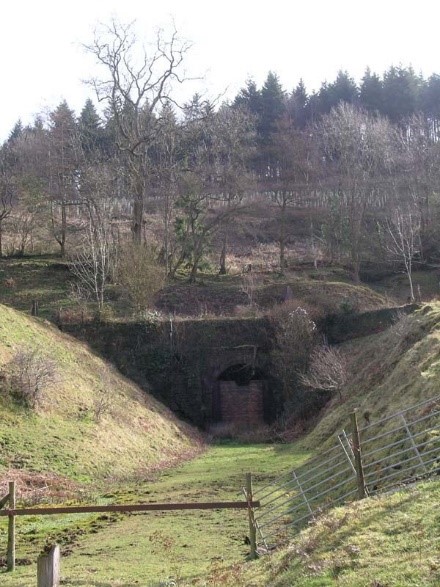
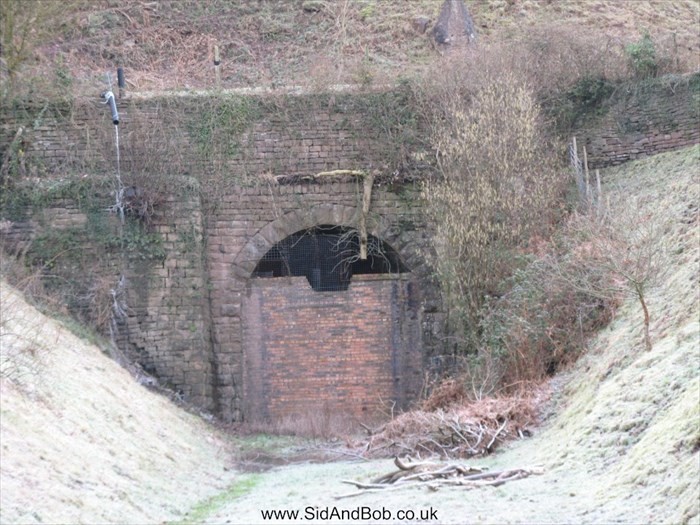
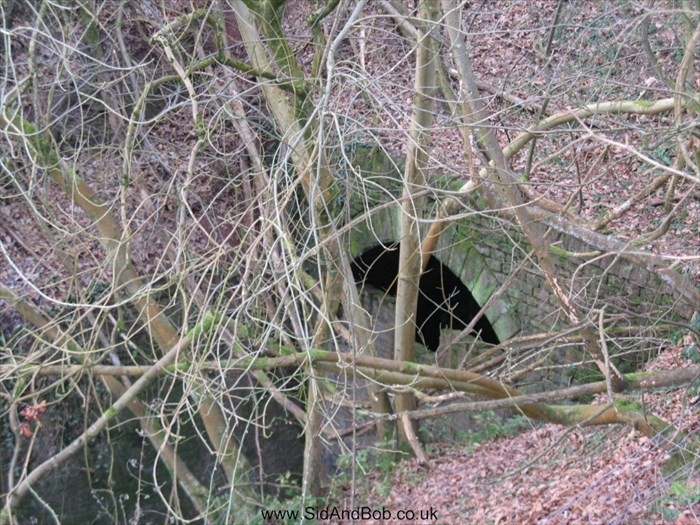
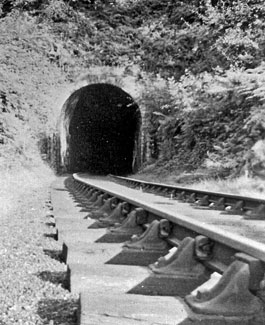
Beyond the A48, the tramway route is crossed by the later Forest of Dean Railway embankment.[8] The railway is also now abandoned, but its path and that of the tramway are approximately coterminous as they approach Haie Hill Tunnel, sometimes known as Bullo Pill Tunnel. Some images of the railway line and the enlarged tunnel required for it are shown below. Other images can be found on Flickr.[9]Interestingly the tunnel was, when built in 1810, the longest in the world! It was 1,083 yards long and remains the oldest tunnel ever to used by passenger carrying trains.[10]

From Bullo Pill, the distance to the entrance of Haie Hill Tunnel was approximately a mile.

The present (early 21st Century) state of the enlarged tunnel bore can be seen on the above photos which show, in order, the approach from Bullo Pill, a closer shot of the tunnel portal and then the northern portal.[10a] The children of Bullo Pill used the tunnel to reach their school at Soudley, having to time their walks so as not to meet any trains.

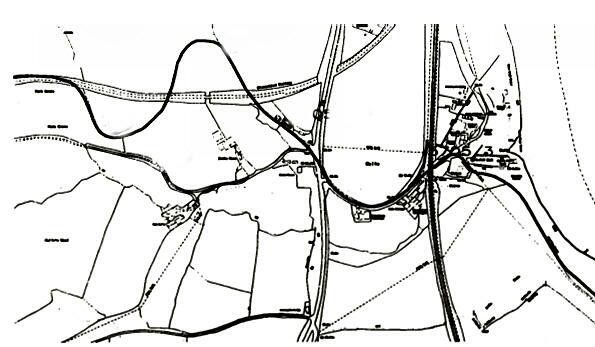
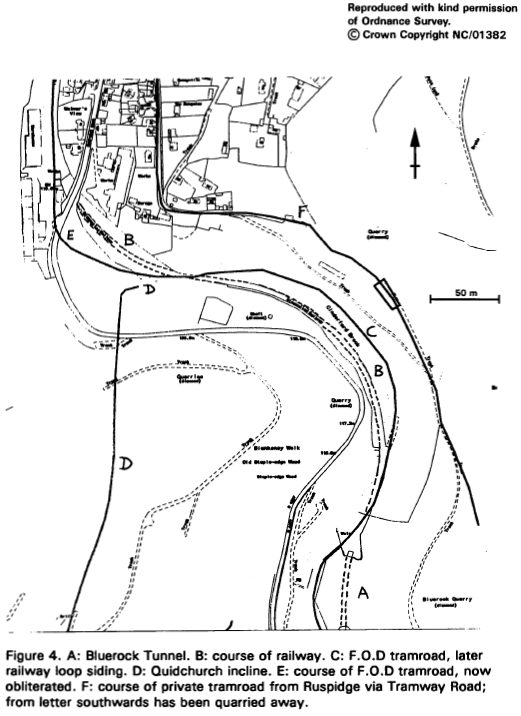
To reach the tunnel, the tramway needed shallower grades than the later railway and its route can be picked out on the plan above.[11] It took a more circuitous route than the later railway needing a loop to the north and then to the south side of the railway to allow it to gain enough height. The shallower grades permitted the horses to pull a reasonable number of wagons.

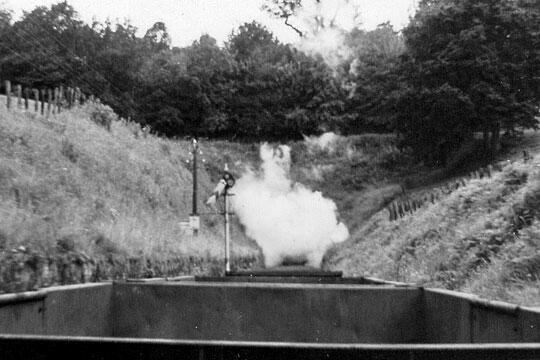
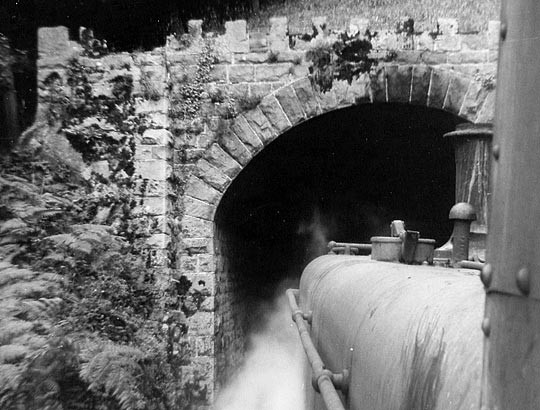
The following image is of the railway, rather than the tramway, and comes from a short post on www.forgottenrelics.co.uk by a former loco fireman, Bob Barnett.[12] It shows the approach to the tunnel while it was still in use.

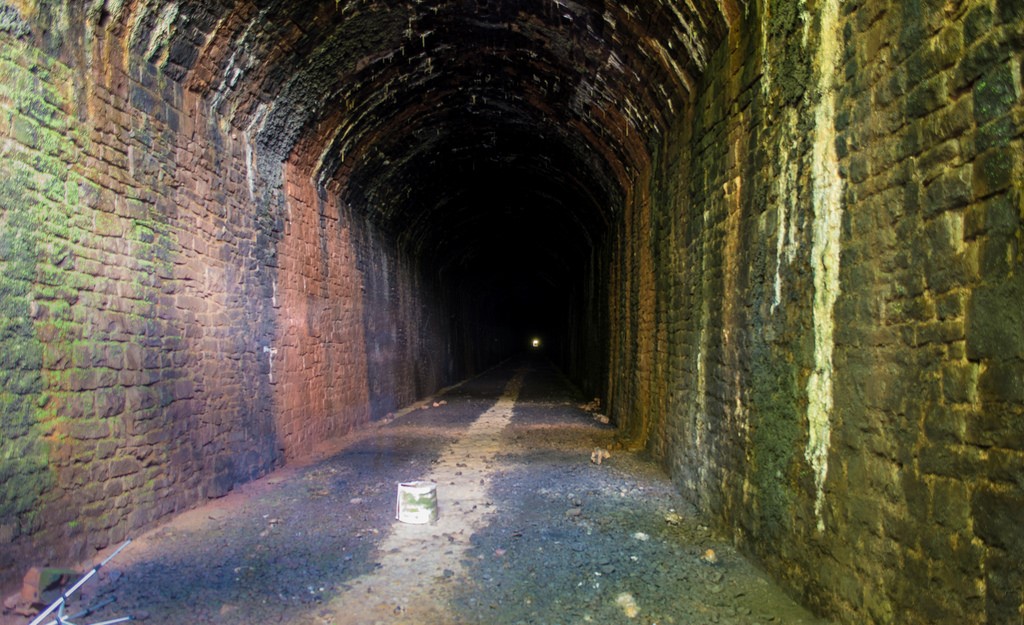
The engineer for the tunnel construction was John Hodgekinson and the Contractor was Robert Tipping.[13] The Eastern portal, closest to Bullo Pill, stood at the end of a stonewalled cutting which is overgrown and obscured by vegetation. The portal has been partly bricked up, an opening has been left at the top to allow bats to enter and roost[14] and a low-level access hatch has been provided to allow human access. Inside, the bore is tidy and mostly dry (see the image below). The tunnel was enlarged for broad gauge by Isambard Kingdom Brunel[15] in The tunnel climbs at a steep rising gradient of 1:56 in the westward direction. It could take a train of empty wagons five minutes to pass through. Although mostly straight, a slight curve to the north is encountered at the west end.[16]

The masonry lining features an arched roof with vertical side walls into which generous refuges are provided at regular intervals, some with exposed rock at their rear. Signalling pulleys and cable hangers remain in situ on the south wall. Near its centre, a rare milepost remains.[17] A drain runs down the tunnel’s centre line – accessed via numerous small catchpits – and many weep holes have been cut into the lining, resulting in some significant accumulations of calcite on both walls. At the west portal, which is also bricked-up, a stream runs in a channel beneath the bore.

The Western portal[18] is near the village of Soudley but separated from it by another short tunnel – Bradley Hill Tunnel. Close to the Western portal of Haie Hill Tunnel a tramway branch ran south to the site of a forge/foundry at Bradley House.[19] The railway track is now a footpath.

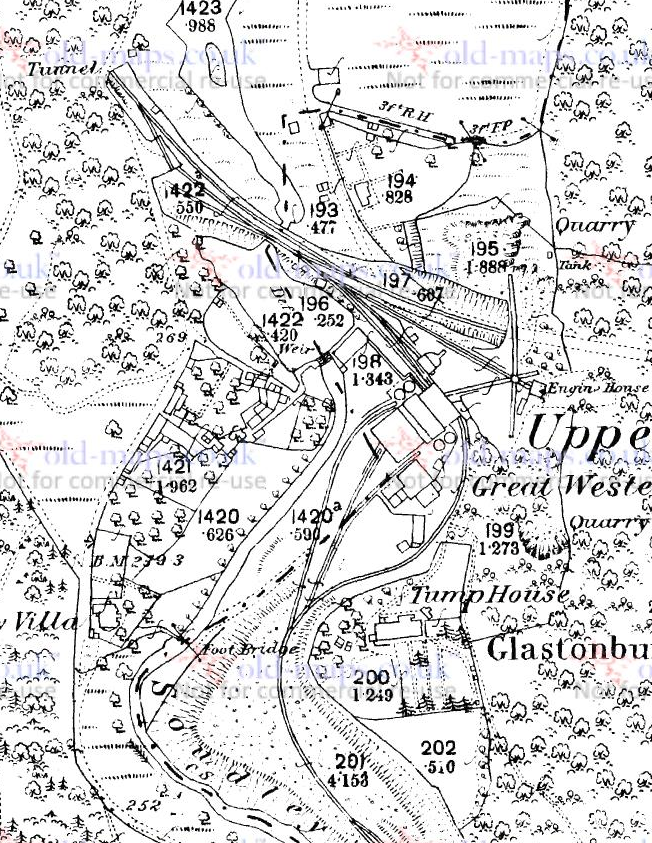
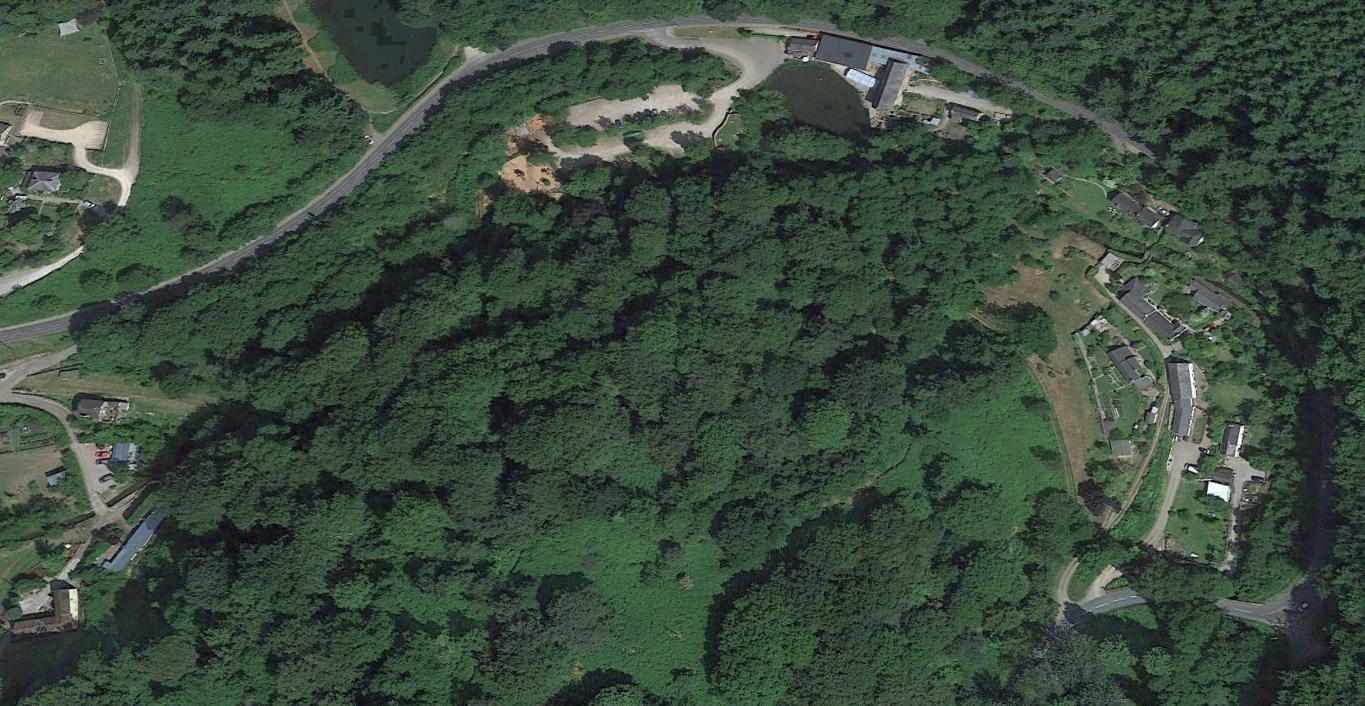
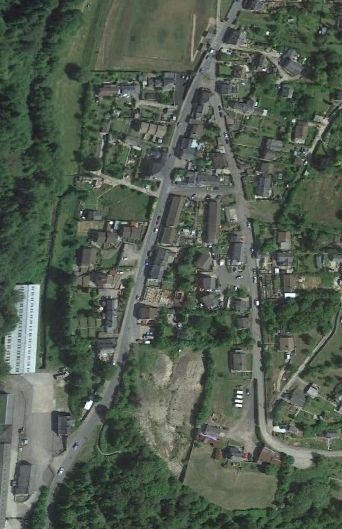
From the tunnel portal the railway headed north-west across the Soudley Brook through Bradley Hill Tunnel to Soudley Crossing.[20]  “The tramroad circuitously headed north along the modern tarmac lane past Furnace Crossing to join the B4227 by the bridge at SO  6649  1041, thence following the modern road north then west past Camp Mill, now the Dean Forest Heritage Centre, to re-join the railway at Soudley Crossing,  SO  6610 1050.”[21]The satellite image above shows the area at the western portal of Haie Hill Tunnel, Bradley Hill Tunnel and at the western edge of the satellite image, the formation of the old railway emerging to the west of Bradley Hill Tunnel. The tramway followed what is now the road to the north of the hill running past the Dean Heritage Centre which is at the top of the image.

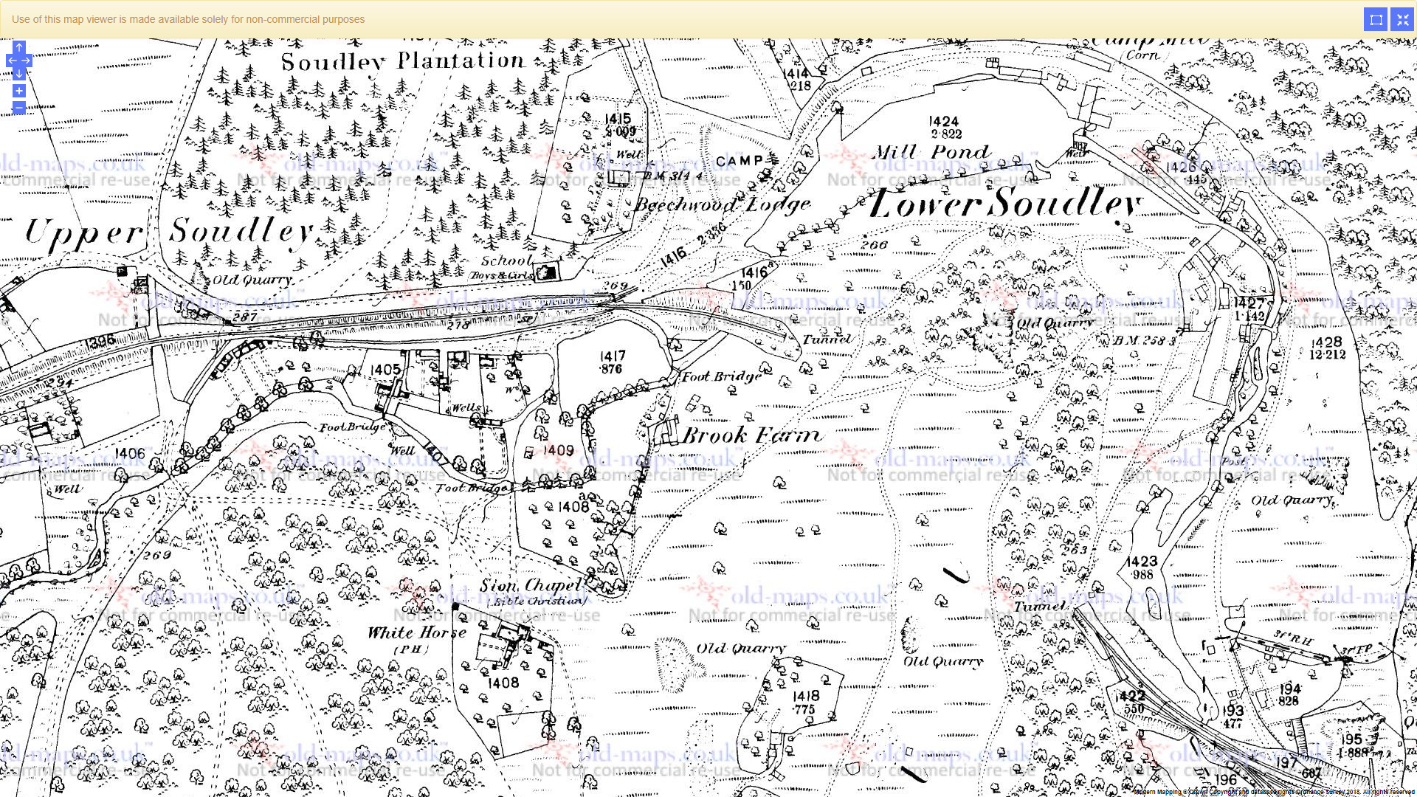
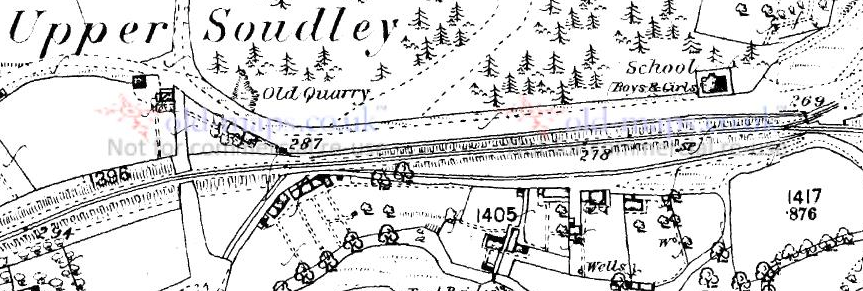
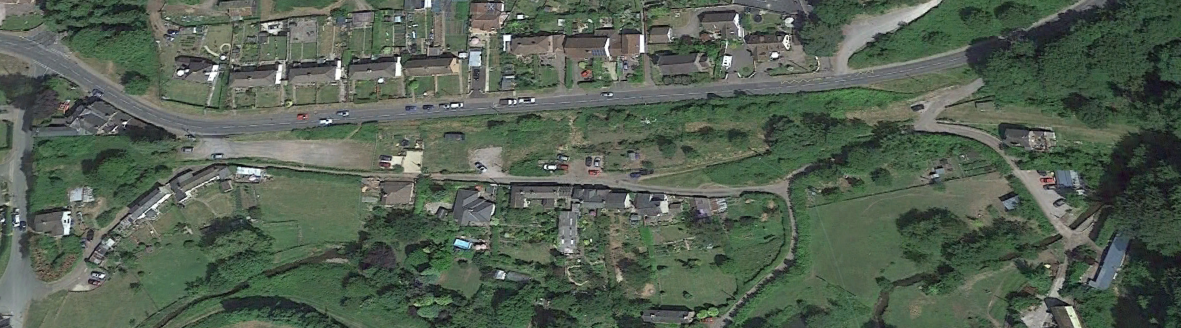
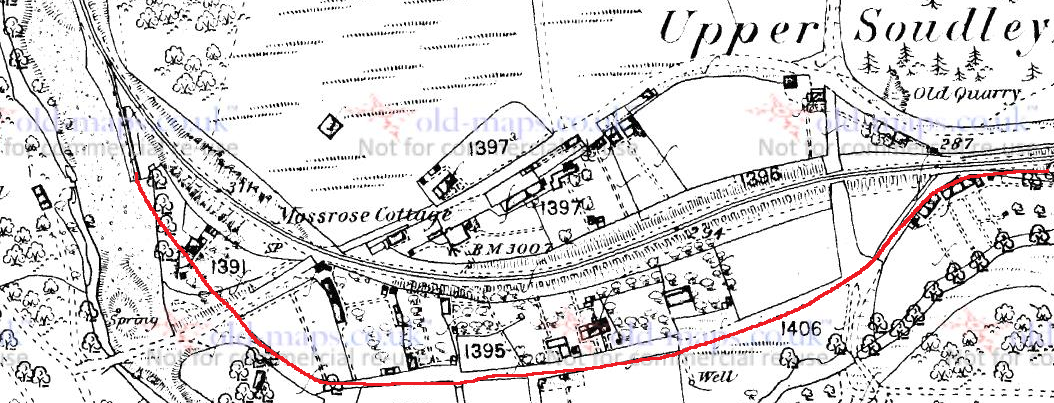
From this point, the railway track-bed and the road run in parallel, westwards towards the White Horse Inn. Just to the south of the railway is a track, known locally as ‘The Dram’. The pub is not shown on the 1881 Ordinance Survey map below but is at the site of the Old Quarry. The Dram still has tramway track shown on it in the OS Map below.At the White Horse Inn/Old Quarry the track-bed of the tramway appears to divert south from the railway. Its presumed route is shown as a red line on the next OS Map excerpt below from 1881.At the point where the tramroad heads sharply north, there was a short branch which crossed the river to serve Flindall Ironworks which were already disused at the time of the 1881 Ordnance Survey.

It is then assumed that the tramway formation is hidden under the railway formation travelling north from Upper Soudley towards Shakemantle and Perseverance Mines.This next extract (above) from the OS Map of 1881 shows these two mines as well as the short Blue Rock Tunnel (at the very bottom of the excerpt). This tunnel is shown in the photograph below that map – a picture taken from the cab of a pannier tank locomotive.[22] Blue Rock Tunnel was built for the railway, the tramway skirted the rocky promontory, following the course of the river and re-joined the railway track-bed immediately north of the Tunnel.

A few metres further north the main railway line curved to the West and a branch-line provided access to Shakemantle Mine. That line was built over the route of the tramway which passed close to the limekilns shown at the centre of the map above.

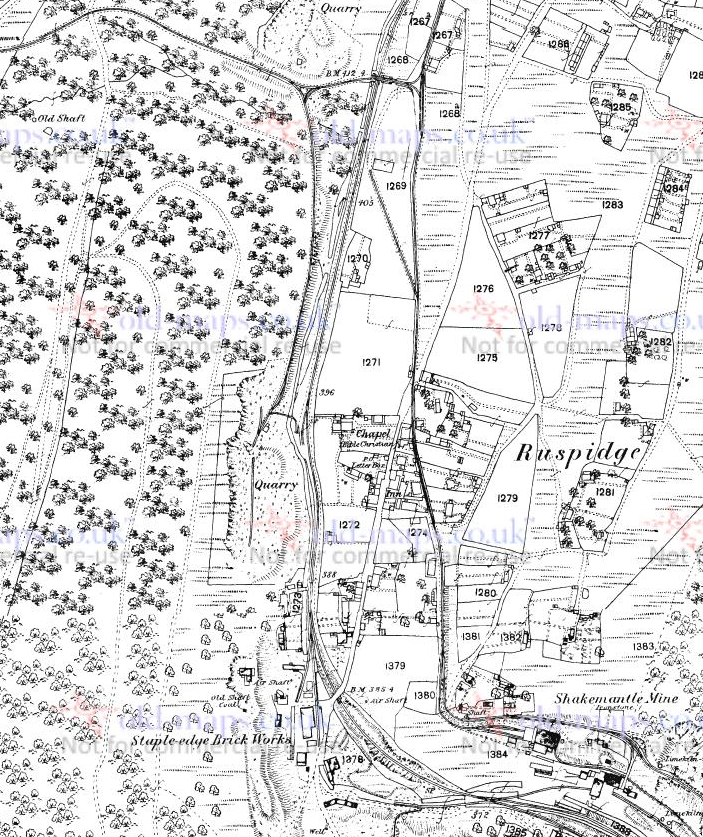
One source suggests that the tramway formation turned west and crossed the railway line close to the interchange with Quidchurch Colliery tramroad incline at SO 6551 1128.[23] However, as the next excerpt from the 1881 Ordnance Survery shows, there was clearly a tramway running north from Shakemantle Quarry and through the village of Ruspidge. It is possible that the route suggested by Youles[24] is actually a branch serving the Quidchurch Mine. Although the visible line on the 1881 map appears to be higher on the contours of the valley side than might have been feasible for the tramway mainline.

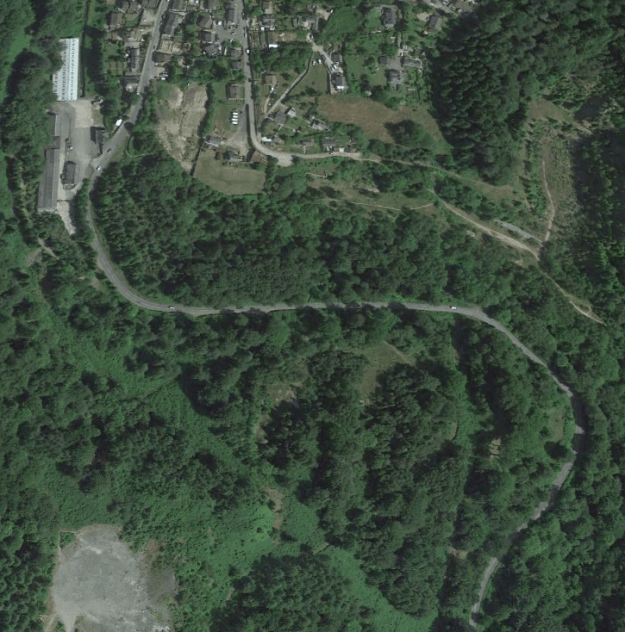
Youles seems to refer to this line as a private tramway.[25] If Youles is right, then we need to acknowledge an alternative route for the tramway which probably followed the railway formation. He says, “the Quidchurch interchange site is now thickly wooded, but the course of the railway siding which it shared with Perseverance Ironstone Mine, can still be seen, as can the earthwork remains of the interchange wharf. A GWR boundary marker situated between the siding and the railway, confirms that the siding was a private one. From here the tramroad incline ran south to cross the Soudley to Ruspidge road before climbing the steep slopes of Staple Edge Wood en-route for Quidchurch.”[26] The incline to Quidchurch headed towards the bald area shown on the bottom left of the satellite image above.

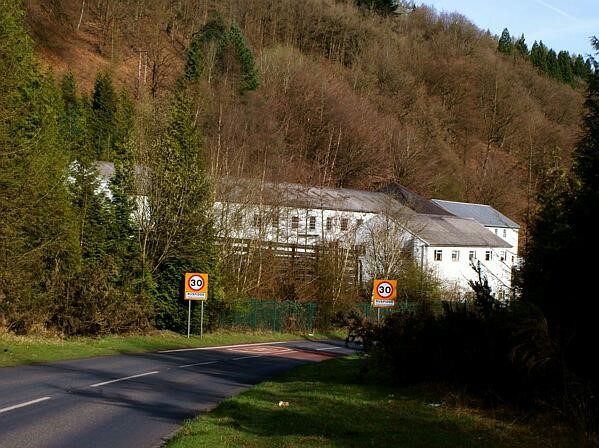
Youles goes on to say that the earthworks associated with the former Eastern United Colliery have obliterated all traces of the tramways in this area. The Eastern United Colliery was built over the site of the Staple-edge Brick Works and itself closed in 1959. All that is left in the early 21st Century are the colliery office and the power house. Eastern United was a drift colliery, dug into the side of the hill, but it did have a shaft. It was a ventilation shaft, Findall later known as Walmers shaft, hill on the hill above the colliery. The buildings are currently in use as a factory making dyes and colourants for paint.

On the map above, a tramway can be seen running north through Ruspidge. It is shown on the satellite image to the right as a tarmacked road which meets the main road north of the site of the Eastern United Colliery.

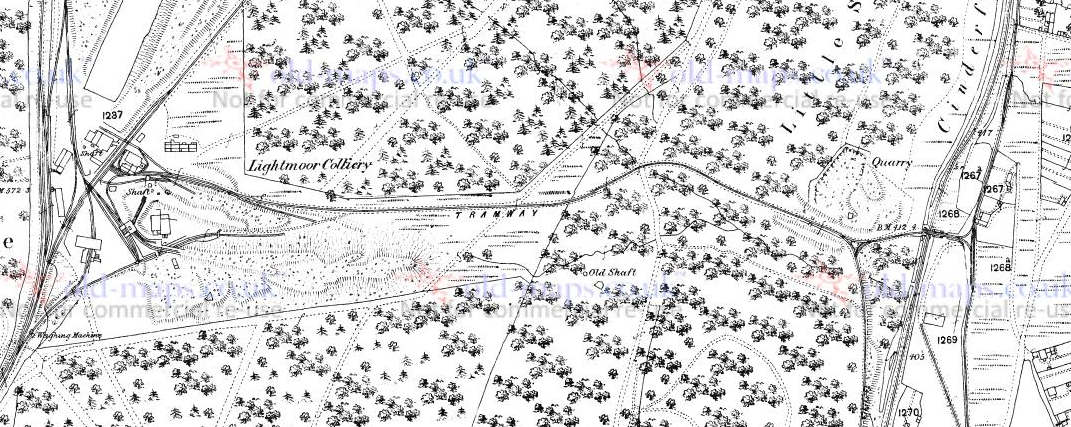
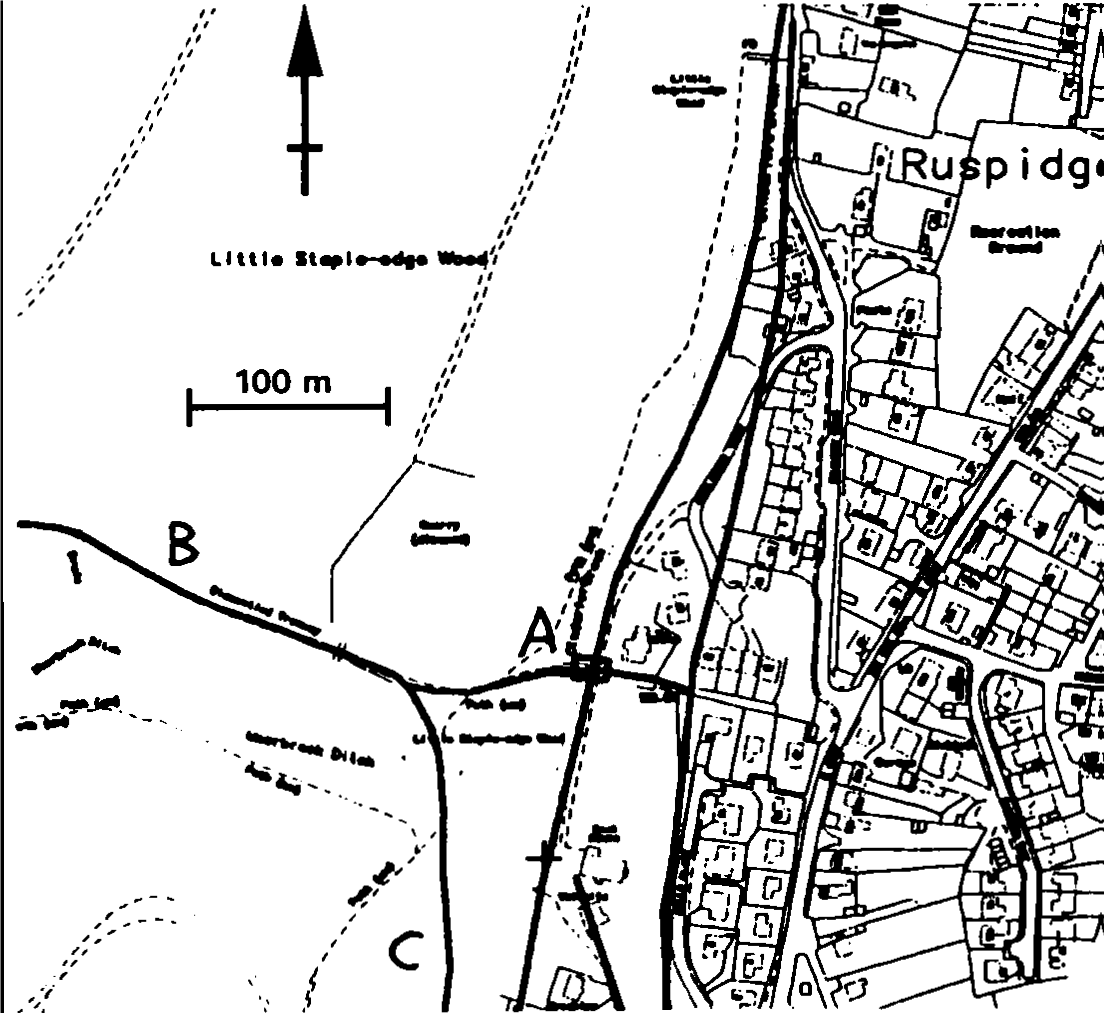
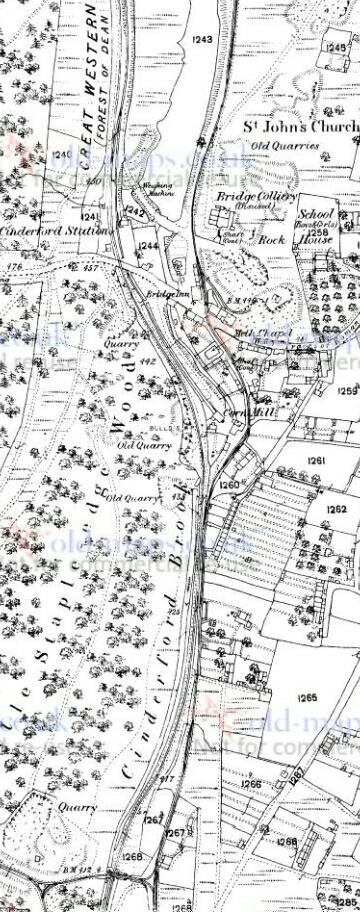
That ‘private’ tramway continued north of the main road to a junction with a tramway which ran East-West (crossing the line of the railway and serving Lightmoor Colliery to the West. This is illustrated in the next smaller map which shows Lightmoor Colliery in the West.Another tramway is shown serving a quarry adjacent to Cinderford Brook which connects to the East-West tramway. North of the branch to the Lightmoor Colliery, the tramroad formation and the railway formation converge alongside Cinderford Brook. The spoil heap from Eastern United Colliery buried the route of the Forest of Dean Tramroad. It appears (Figure 4)[27] that the route ran west from the interchange wharf, then turned north to rejoin the railway formation at the Eastern United site. In this case, the tramway ran parallel to both the ones already mentioned. The site of Eastern United Colliery is shown in the photo below. The railway formation overlies the tramway formation from this point to Cullamore Bridge.Cullamore Bridge (A) carried the tramroad from Lightmoor Colliery over the Cinderford Brook and the Forest of Dean Tramroad to a junction with the private Ruspidge to Shakemantle Tramroad. The Lightmoor Colliery Tramroad formation can still be accessed on foot. We have already noted the tramroad serving the quarry (C). The tramway link into Lightmoor (B) ascends the hillside through a cutting, on the sides of which are the remains of bridge abutments; the bridge led to the quarry’s spoil heap on the other side of the tramroad. After a few more metres, a path trails off to the south, following the line of another tramroad to Staple Edge Quarry. The Lightmoor track continues west to the colliery site, now an open-cast operation, where stands a large derelict and roofless building.[28]

About 200 metres north of Cullamore, near the foot of the modern Railway Road, the private Ruspidge – Shakemantle tramroad trailed in. From the junction it ran almost due south, gradually diverging from the mainline, and climbing, to cross the Ruspidge Road at SO 6500 1169 where the Bible Christian Chapel (now a studio) stands. The first part of this section remains as a track and private drive, but from the chapel it continues, still climbing, as Tramway Road, to end at SO 6525 1133 high on the hillside overlooking the site of Shakemantle iron mine and adjacent to the extensive abandoned quarry workings.[29]

From the junction near Cullamore the mainline tramroad diverged from the railway, following the modern lower Railway Road, crossing the B4226 and reaching Valley Road via the passage between the Bridge Inn and the adjoining building. From here to its terminus at Churchway, few traces of the mainline tramroad remain, although much of the route can be followed using later roads and a few tracks, as far as the site of the Cinderford Ironworks.

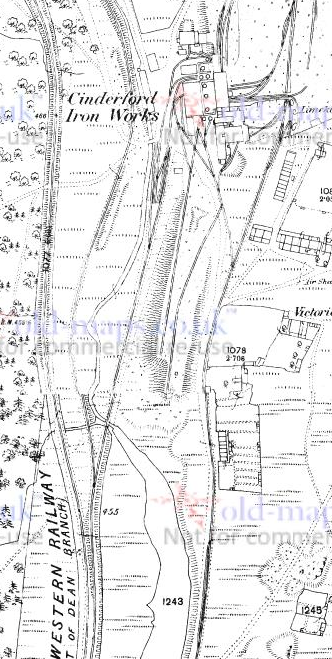
The next map below shows the Ironworks. The 1881 Ordnance Survey shows much of the detail of the tramway which enters centre right at the bottom of the map and runs north past a series of cottages before serving the Ironworks.

On the 1881 Map, the Forest of Dean Branch (standard gauge) Line can be seen entering the map on the bottom left. Two lines are present, the most Westerly is the main line and the branch (to the East of the main line) serves the Ironworks and splits to provide separate access to the Works and its spoil heap. The main line of the Forest of Dean Branch leaves the map on the top right.

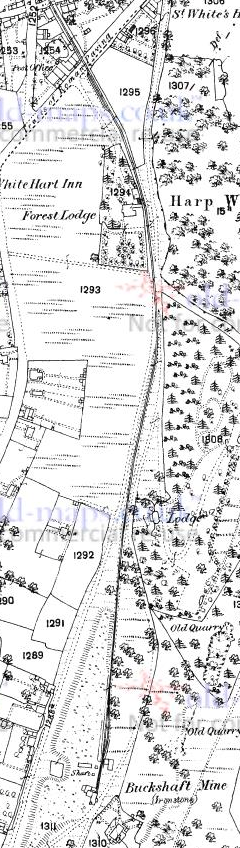
The Buckshaft Branch Tramway 1881 Ordnance Survey (Not to Scale).

Just north of Cinderford Iron Works, the Buckshaft and St. Annals branch tramroads diverged, and these also can be followed for much of the way, but as routes only, physical traces being virtually nonexistent. The 1881 Survey shows the Buckshaft line clearly on the maps immediately below.


The satellite image from the early 21st Century shows the line of the Buckshaft branch among all the modern housing and industry.

The Annals Branch Tramway 1881 Ordnance Survey (Not to Scale).

The St. Annals branch crossed Cinderford Lower High Street at SO 6549 1457 and followed Albion Road to enter Haywood Plantation. At the road’s end, three paths are seen. The centre one follows the branch route. It slopes up quite steeply to SO 6564 1500, where it curves sharply south west through 160 degrees to reach the edge of the plantation at Causeway Road, which it follows to the mine site, the last few hundred metres being an overgrown track to the south of, and parallel to, the road.[30]

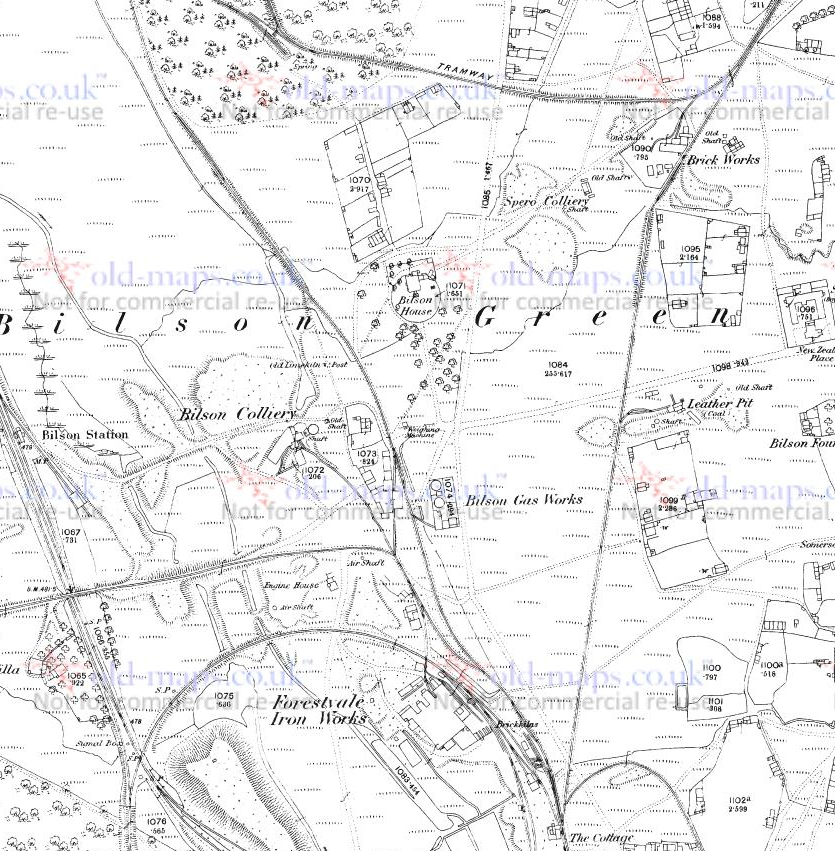
The St. Annals tramway appears as one of a myriad of different tramways north of Cinderford Ironworks on the 1881 Survey. It leaves the map of the Buckshaft Branch below at the top of the first panel of the maps below above ‘The Cottage’.

It travels just to the East of North in a straight line for some distance, past Bilson Gas Works and a Leather Works before deviating North-North-East close to Spero Colliery and being joined by another tramroad from the West. The St. Annals tramway continues North-North-East to run trough a small complex of sidings close to Seven Stars Inn which served Haywood Colliery. After this the tramway turned northwards for a short distance before swinging sharply round to a South-Easterly direction to head for St. Annals Ironstone Mine which was close to Latimore’s Lodge.

The Annals Branch Tramroad (A) sustained a short branch of its own which accessed Haywood Level (B) – see Figure 5 above.

Returning now to Cinderford and Forestvale Ironworks, three significant tramway routes still have to be explored.

We will leave these for a future blog.

References

[1] https://www.revolvy.com/main/index.php?s=Bullo%20Pill%20Railway, accessed 11th March 2018.

[2] Shorter Oxford English Dictionary: Pill [OE pyll, var of pull, pul pool, creek] A local name on both sides of the Bristol Channel, in Cornwall etc., for a tidal creek on the coast, or a pool in a creek etc.

[3] http://www.waymarking.com/waymarks/WM60XN_Haie_Hill_Bullo_Pill_Tunnel_Forest_of_Dean_UK, accessed 11th March 2018.

[4] For example: https://www.gracesguide.co.uk/Forest_of_Dean_Railway, accessed on 11th March 2018, https://en.wikipedia.org/wiki/Forest_of_Dean_Railway, accessed 10th March 2018.

[5] https://www.gsia.org.uk/reprints/2000/gi200019.pdf, accessed 23rd February 2018; R. J. Morris, The Forest of Dean Tramroad, Coleford, 1997.

[6] R. J. Morris, The Forest of Dean Tramroad, Coleford, 1997, p16.

[7] https://www.old-maps.co.uk/#/Map/365500/213500/12/100203, accessed 11th March 2018.

[8] https://www.gracesguide.co.uk/Forest_of_Dean_Railway, accessed 11th March 2018.

[9] https://www.flickr.com/photos/midlandexplorerboy/sets/72157624265737465, accessed 11th March 2018.

[10] http://www.waymarking.com/waymarks/WM60XN_Haie_Hill_Bullo_Pill_Tunnel_Forest_of_Dean_UK, accessed on 11th March 2018; Humphrey Household, Gloucestershire Railways in the Twenties. Alan Sutton Publishing Limited, Gloucester, 1984; Rex Christiansen, A Regional History of the Railways of Great Britain: Volume 13: Thames and Severn, David & Charles, Newton Abbot, 1981; Colin G. Maggs, The Branch Lines of Gloucestershire, Amberley Publishing, Stroud, 2009.

[10a] http://www.sidandbob.co.uk, accessed 9th March 2018.

[11] http://www.deanweb.info/history2.html, accessed 11th March 2018.

[12] http://www.forgottenrelics.co.uk/tunnels/bradleyhill.html, accessed 10th March 2018.

[13] https://www.gracesguide.co.uk/Haie_Hill_Tunnel, accessed 11th March 2018.

[14] http://www.waymarking.com/waymarks/WM60XN_Haie_Hill_Bullo_Pill_Tunnel_Forest_of_Dean_UK, accessed 11th March 2018.

[15] http://news.bbc.co.uk/local/gloucestershire/hi/people_and_places/history/newsid_8255000/8255346.stm, accessed 12th March 2018.

[16] http://www.forgottenrelics.co.uk/tunnels/gallery/haiehill.html, accessed 11th March 2018.

[17] http://www.forgottenrelics.co.uk/tunnels/gallery/haiehill.html, accessed 11th March 2018.

[18] SO  6649  1041

[19] Ayleford Forge (Morris op.cit., p.16); Bradley Foundry.

[20] Tony Youles, Tramroad Remains in the Forest of Dean, Gloucestershire Society for Industrial Archaeology Journal, 2000, p20.

[21] Ibid., p20.

[22] http://www.forgottenrelics.co.uk/tunnels/bradleyhill.html, accessed 10th March 2018.

[23] Tony Youles, Tramroad Remains in the Forest of Dean, Gloucestershire Society for Industrial Archaeology Journal, 2000, p20.

[24] Ibid., p20.

[25] Ibid., p21.

[26] Ibid., p20.

[27] Tony Youles, Tramroad Remains in the Forest of Dean, Gloucestershire Society for Industrial Archaeology Journal, 2000, p25.

[28] Tony Youles, Tramroad Remains in the Forest of Dean, Gloucestershire Society for Industrial Archaeology Journal, 2000, p21.

[29] Youles, op. cit., p21, comments: Morris implies that the tramroad line descending via Tramway Road was the mainline, rather than the private branch recorded by the Sites and Monuments Record (SMR) department of Gloucestershire County Council. See the captions to plates 6 and 7 in his book, and the Ruspidge paragraph on page 48. This route seems unlikely, since the mainline would have to climb from near the north portal of Bluerock tunnel, just above the level of the Cinderford Brook, to high on the hillside above (as shown in Morris’s plate 6 upper left) only to take the long descent to regain the level of the brook just north of Cullamore. The route shown on the SMR map, which follows the valley floor, is taken from an 1856 Board of Guardians map which shows the then recently completed railway and vestigial sections of the mainline tramroad not directly overbuilt by the railway, including that part later overlaid by the railway’s Shakemantle siding. Also shown is the private tramroad from near Cullamore Bridge, running south via Tramway Road to its terminus on the hillside high above Shakemantle, the railway and the mainline of the Forest of Dean tramroad.

[30] Tony Youles, Tramroad Remains in the Forest of Dean, Gloucestershire Society for Industrial Archaeology Journal, 2000, p22-29.


The Sheffield, Ashton-under-Lyne and Manchester Railway – 3

The Sheffield, Ashton-Under-Lyne and Manchester Railway[1] was opened in stages between 1841 and 1845 between Sheffield and Manchester via Ashton-Under-Lyne.

The company was formed in 1835 and it appointed Charles Vignoles as its engineer.[2] A route was proposed which required a 2 mile long tunnel and passed through Woodhead and Penistone. Vignoles and Joseph Locke[3] were asked to make independent surveys and in October met to reconcile any differences. Their meeting resulted in the decision to build a longer tunnel so as to lessen the gradients needed on the line.

The line obtained its Act of Incorporation in Parliament in 1837 and work on the tunnel started. Vignoles arranged for the boring of a series of vertical shafts followed by a horizontal driftway along the line of the first bore. Enough land was purchased for two tunnels but it was only intended to build one at first.

A ceremony was held on 1st October 1838 at the west end of the tunnel at which ground was disturbed for the first time. In 1839 work was progressing well with Thomas Brassey as contractor. However Vignoles was not relating well to the company’s board and he resigned. Joseph Locke agreed to act in a consultative capacity if the Board would appoint resident engineers for the day to day supervision of the work.

In 1841 Locke reported that the tunnel would probably cost £207,000, about twice the original estimate, because the amount of water encountered required the purchase of more powerful pumps. By this time a length of the line was open for business from Godley to a temporary Manchester terminus at Travis Street.

In 1842, Manchester Store Street (now Piccadilly) was brought into use and at the eastern end the line had linked to Broadbottom and Glossop.

By 1844, the western end of the Woodhead tunnel had been reached.

In 1845 the eastern section of the line in Yorkshire was opened between Dunford Bridge and Sheffield. The tunnel was finally ready for inspection in December 1845 and after it was approved the formal opening of the line took place on 22nd December that year.

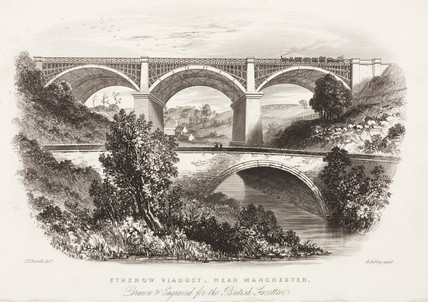
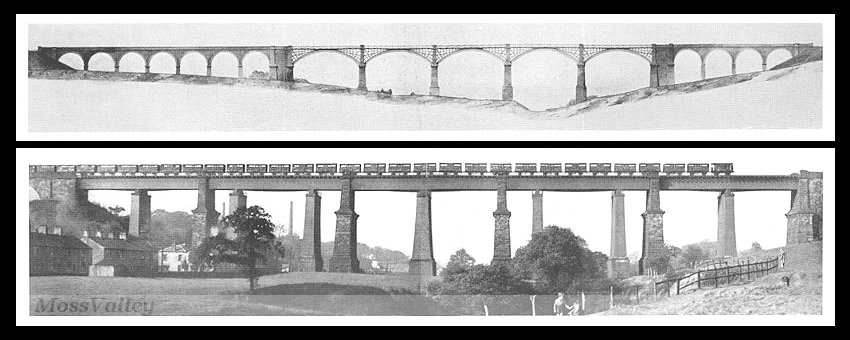
Besides Woodhead, there were short tunnels at Audenshaw Road, Hattersley (two), Thurgoland and Bridgehouses. Among the bridges the two most notable were the Etherow Viaduct and the Dinting Vale Viaduct, the latter with five central and eleven approach arches. The line initially terminated at a temporary station at Bridgehouses until Sheffield Victoria was built in 1851.Dinting Vale Viaduct – at the top, the original viaduct, at the bottom, the later replacement.

While the line was being built, the directors were looking at ways to extend it. They had hoped to connect to the Liverpool and Manchester Railway, but their approach to the board of that line was rejected. Eventually they secured a relationship with the London and Birmingham Railway which enabled the Manchester, South Junction and Altrincham Railway to be put before Parliament in 1845. That line was not completed for some years.

The Ashton to Stalybridge branch which had been part if the original scheme was completed in 1845. And in the same year a branch was built to Glossop itself, which needed no Act, since it was financed by the Duke of Norfolk and ran over his land, the original Glossop station was renamed Dinting.

In 1844 representatives of the proposed Sheffield and Lincolnshire Junction Railway made plans for a line from Sheffield to Gainsborough. Plans were also made for the Barnsley Junction Railway to connect Oxspring with Royston on the North Midland Railway.

The directors of the Sheffield, Ashton-under-Lyne and Manchester Railway realised that expansion was best achieved by amalgamating with other lines, after the pattern being set by the Midland under George Hudson.

In 1845, they gained shareholders approval for the Manchester, South Junction and Altrincham Railway,[4] the Sheffield and Lincolnshire Junction Railway,[5] and also the proposed Barnsley Junction Railway.[6] They would also lease the Huddersfield and Manchester Railway and Canal Company.[7]

The board also contemplated:

• a line from Dukinfield to New Mills connecting with the Manchester and Birmingham Railway (https://en.m.wikipedia.org/wiki/Manchester_and_Birmingham_Railway)
• an extension of the Barnsley Junction to Pontefract joining the Wakefield, Pontefract and Goole Railway.
• The Huddersfield and Sheffield Junction Railway.

In September 1845 agreement was reached in a meeting in Normanton, agreement was reached to amalgamate with the Sheffield and Lincolnshire Junction Railway and the Great Grimsby and Sheffield Railway. Further amalgamations included the Grimsby Docks Company Railway and an attempt to take over the East Lincolnshire Railway which was planned between Grimsby and Lincoln, although ultimately that was taken over by the Great Northern.

The merger received royal assent in July 1846 and the combined company was formed at the beginning of 1847. The line became the Manchester, Sheffield and Lincolnshire Railway.[8]


References

1. https://www.gracesguide.co.uk/Sheffield,_Ashton-under-Lyne_and_Manchester_Railway, accessed 9th March 2018.

2. https://www.gracesguide.co.uk/Charles_Vignoles, accessed 10th March 2018.

3. https://www.gracesguide.co.uk/Joseph_Locke, accessed 10th March 2018.

4. https://en.m.wikipedia.org/wiki/Manchester,_South_Junction_and_Altrincham_Railway

5. https://en.m.wikipedia.org/wiki/Sheffield_and_Lincolnshire_Junction_Railway, accessed 10th March 2018.

6. http://discovery.nationalarchives.gov.uk/details/r/C1793638, accessed 10th March 2018.

7. https://www.railscot.co.uk/Huddersfield_and_Manchester_Railway_and_Canal_Company/index.php, accessed 10th March 2018.

8. https://en.m.wikipedia.org/wiki/Manchester,_Sheffield_and_Lincolnshire_Railway, accessed 10th March 2018.

Rolling Stock on the Central Var Line (Chemins de Fer de Provence 54)

The final post in this series about the Central Var Metre-Gauge Line between Nice and Meyrargues. This covers the rolling stock used on the line.

For information about steam and diesel traction on the line please see the following two links:

https://rogerfarnworth.wordpress.com/2018/02/23/locomotives-and-rolling-stock-on-the-central-var-line-chemins-de-fer-de-provence-50

https://rogerfarnworth.wordpress.com/2018/03/02/locomotives-and-rolling-stock-on-the-central-var-line-chemins-de-fer-de-provence-52

And for a journey along the line please go to the french forum ‘Passions Metrique et Etroite’ and picking up the trail with my post dated 3rd February 2018:

http://www.passion-metrique.net/forums/viewtopic.php?f=2&t=8154&start=180

The rolling stock used on the Central Var line was very similar to that used on the coastal line, Le Macaron. In producing the details of rolling stock on that line, photographs from the wider network were used.

Some images from that post are repeated here. The post about rolling stock on the Toulon to Saint Raphael line can be found on this link:

https://rogerfarnworth.wordpress.com/2018/01/26/ligne-du-littoral-toulon-to-st-raphael-part-14-locomotives-and-rolling-stock-chemin-de-fer-de-provence-49

Coaches on the Chemin de Fer du Sud – Central Var Line

Very little of the rolling stock from the line entered into preservation, but a few items did. The following photos from the 21st Century provide good details for those who are interested.

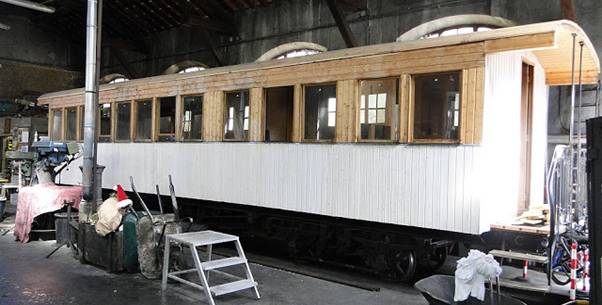
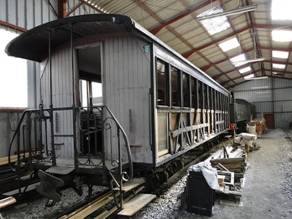
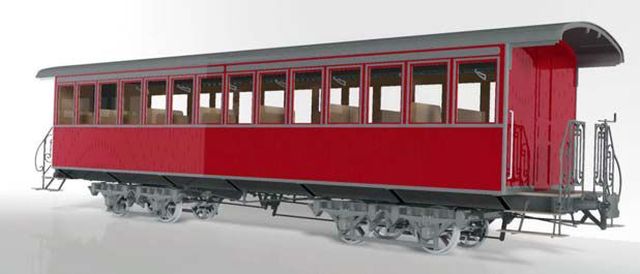
One of 2 authentic coaches from Le Chemins de Fer du Sud de la France preserved today. They are used with the steam train managed by the GECP on the Puget-Théniers-Annot route. They are 2nd class bogie coaches, with wooden bodywork, built by Desouches and David (factory in Pantin) in 1892. They were numbered B74 and B77 by the Chemins de Fer du Sud and were renumbered B505 and B508 at the creation of Les Chemins de Fer de Provence in 1925. They are currently in the traditional colours for coaches on the network – a brown / red colour known as Brown-Van Dyck, with the window surropunds and roof in black. The symbol CP of the Railways of Provence o-is on the panel side of the coach together with the Class shown in Roman numerals (Collection: GECP).[1][5]

Coach AB 506 constructed by Desouches & David, which served originally on Les Chemins de Fer du Sud before being transferred elsewhere. It is now part of the stock of the Vivarais Railway (CFV) – No coaches had a toilets! Only stops in stations allowed passengers to relieve themselves (Photograph: Pierre Virot, 2003).[1][5]

B-505 is 12.3 m (40.35 ft), its height 3.25 m (10.66 ft), its weight 10.5 t. The seating capacity is 52 passengers. During WWI it was requisitioned for use by the French Army. In June 1915, it was sent to Chemins de Fer de la Camargue (Camargue Railway), and used to transport workers to and from the gunpowder factory in Salin-de-Giraud (near Arles, NW of Marseille). In March the following year it left Camargue and was sent to the war zone near Verdon, to the 10ème Section des Chemins de fer de Campagne, a French military railway unit. It was used for military transport on the narrow gauge line “Le Meusien” (owned by Compagnie Meusienne de Chemins de Fer) in the French department of Meuse. [1][5]

After the war, it was returned to SF on April 12, 1919. However, the years of military service had left it in a poor condition. It took two years to get it back to operational condition, on 2nd April, 1921. It then served on the network for another 30 years or so. When the use of steam engines ceased after WWII, it escaped being scrapped. It was instead reordered to be used as a service vehicle for railway line maintenance. For this purpose, the interior was gutted to make space for various tools and supplies. Even a sliding door was installed on its side to allow loading of bulky items. It served in this capacity for about a decade, until it was retired during the second part of the 1960s.

With the advent of the preservation movement, B505 was rescued by the GECP and put into service behind its steam engines in Provence. B508 was added to it and restored.

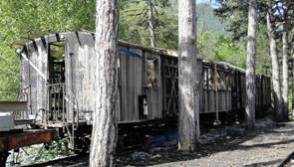
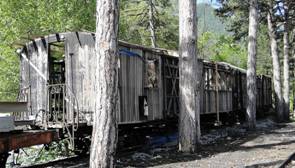
Further restoration work is ongoing at the Puget-Thenier workshops. Pictures follow:Three coaches shown in different states of repair.

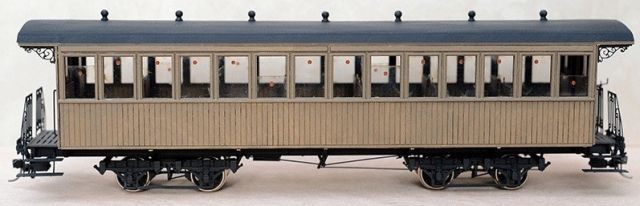
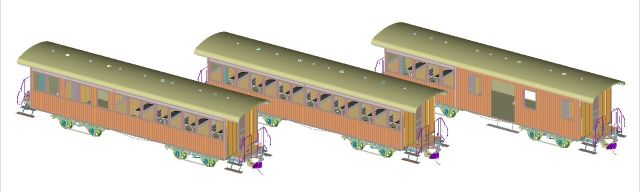
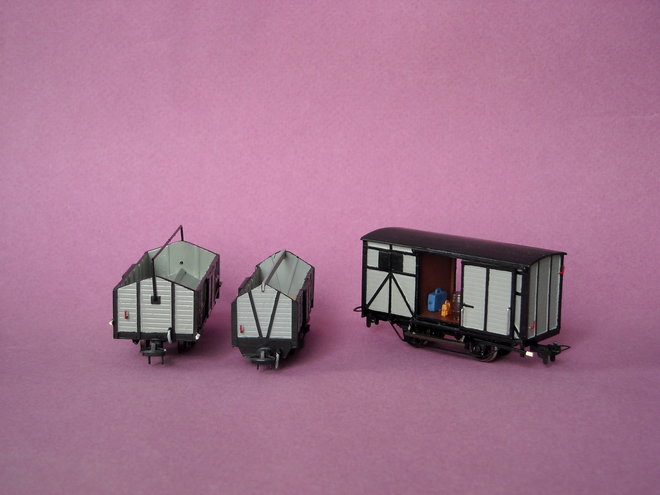
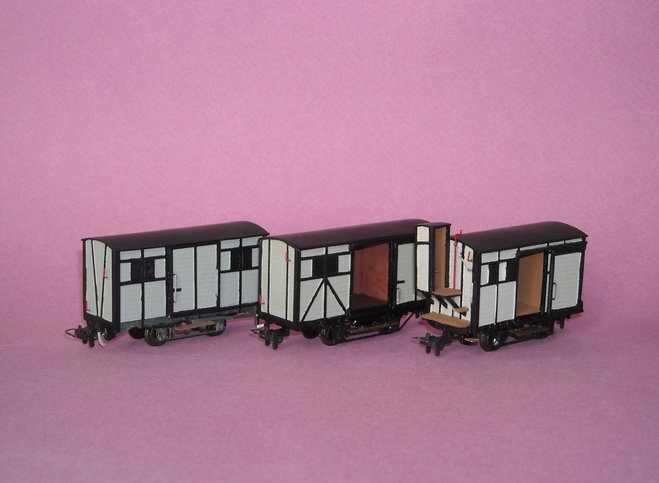
A number of modellers have sought to reproduce these coaches, usually in HOm scale.[2]

Photo Aubertrain – Model of a 2nd class coach, Desouches & David du Sud France – At the beginning of the operation, the car bodies were made of teak wood simply painted with the car number, the class indication in figures Romans and the monogram of South France, SF painted in yellow.

Model of a mixed coach of 1st and 2nd class Desouches & David of South France. Photo AuberTrain

Photo Aubertrain – Model of a mixed car of 1st and 2nd class Desouches & David of South France.

Photo Aubertrain – Interior of a passenger car Desouches & David du Sud France

Photo Aubertrain – Model in Om of a mixed car of 1st and 2nd class Desouches & David with the new colors set up on the South France from 1898: for the box: brown-red Van Dyck and black for the roof.

Bogie coaches from the series AB-501 to 508 made by Desouches and David. in HOm (Photo: Metrique43).

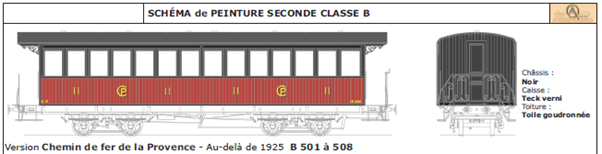
Paint schemes are shown below. These are provided by a kit building firm, AuberTrain. [2]


Wagons on the Chemin de Fer du Sud – Central Var Line

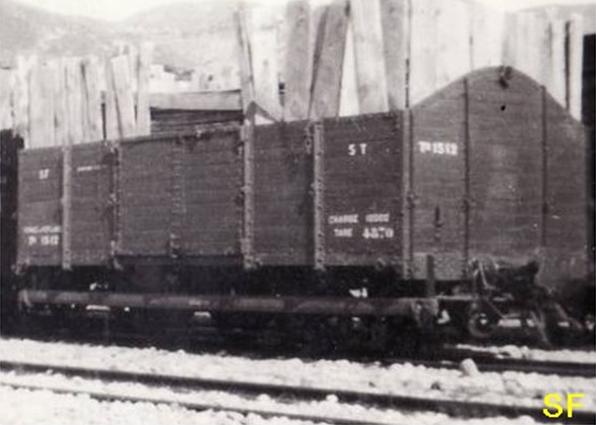
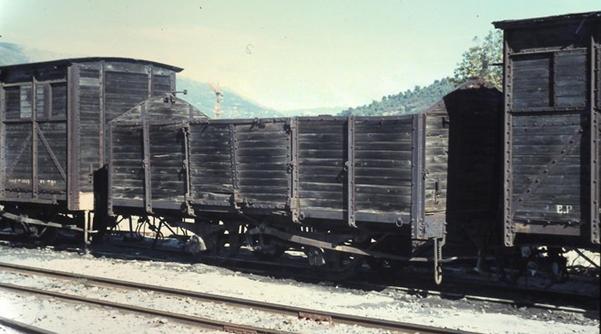
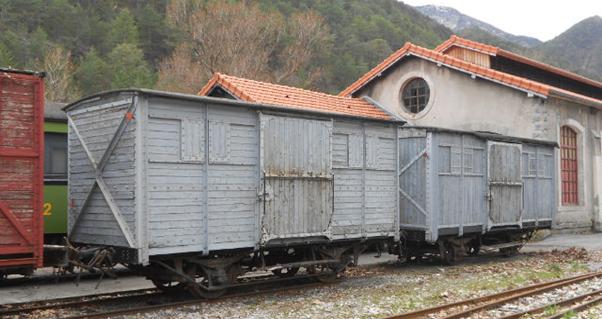
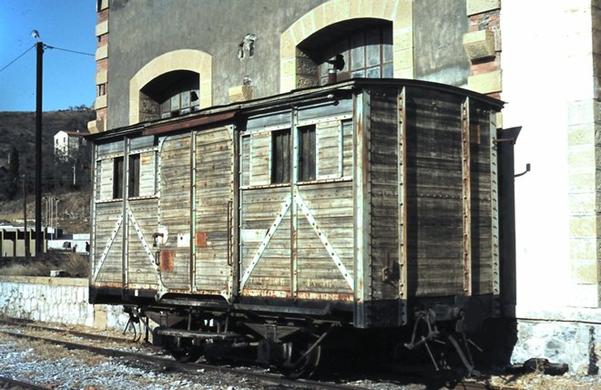
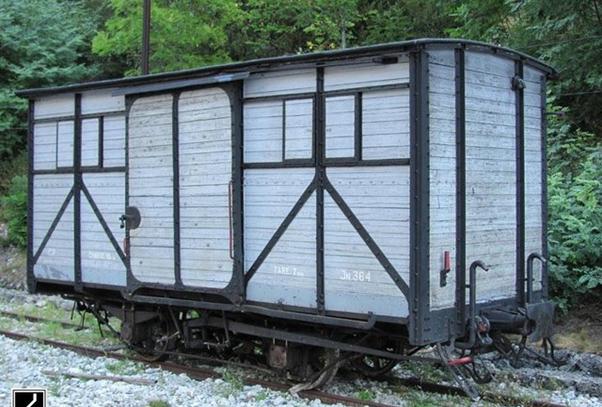
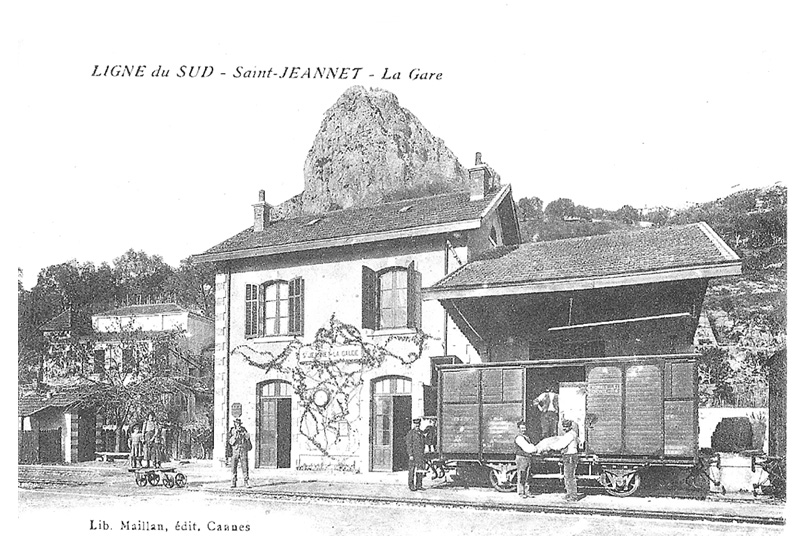
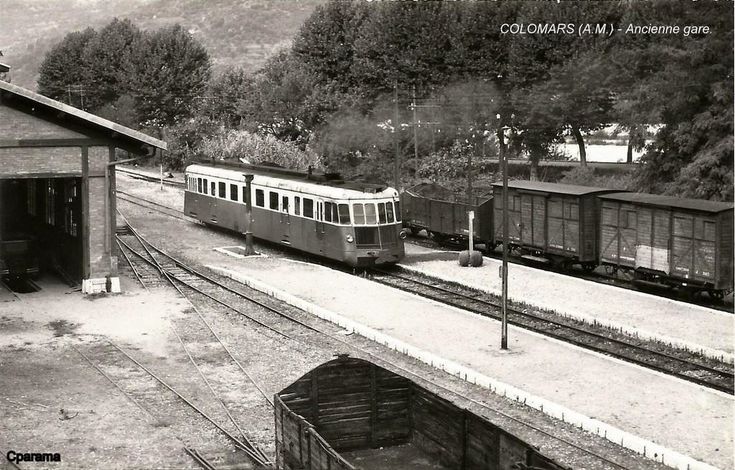
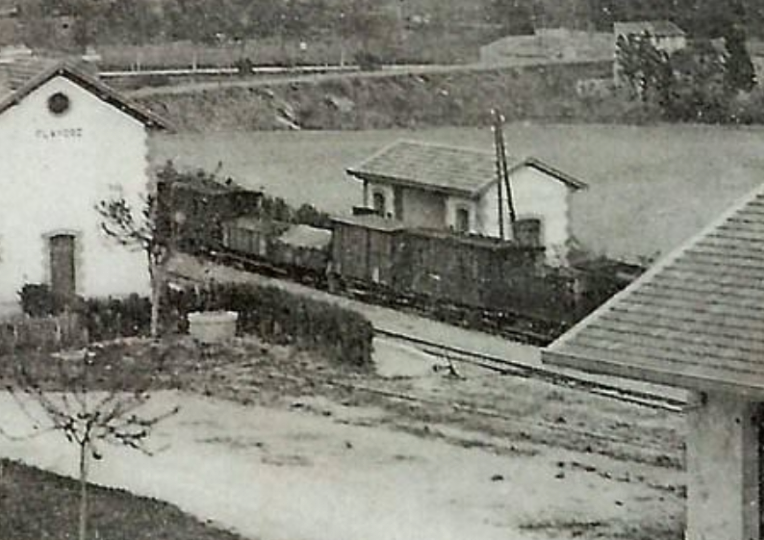
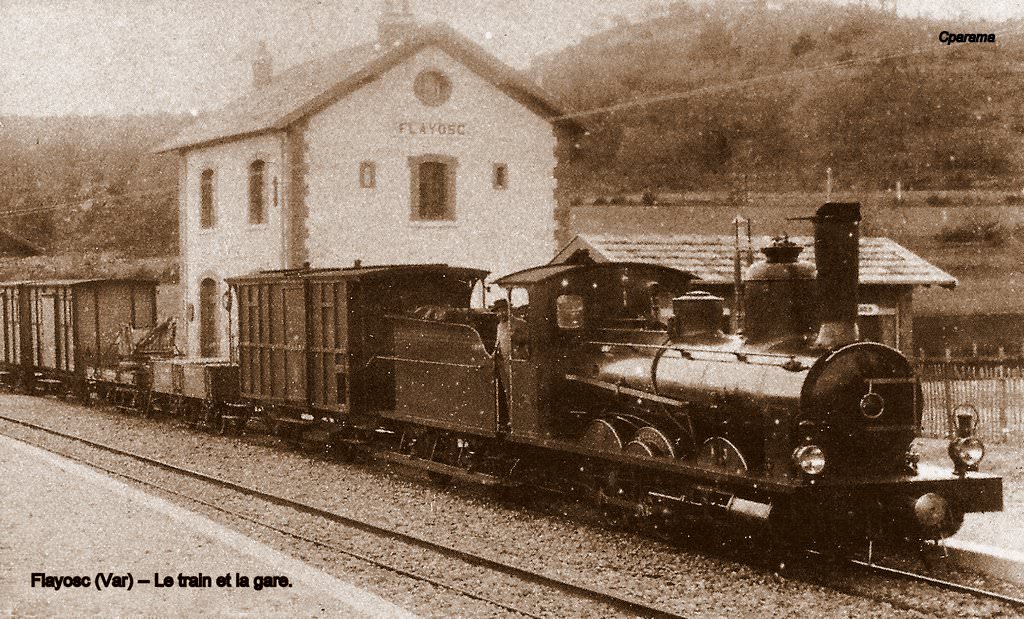
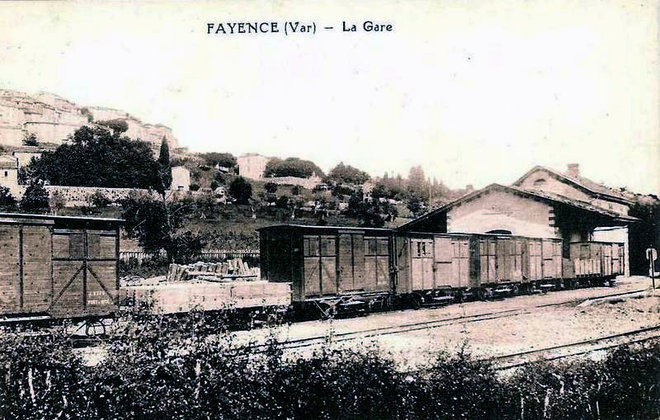
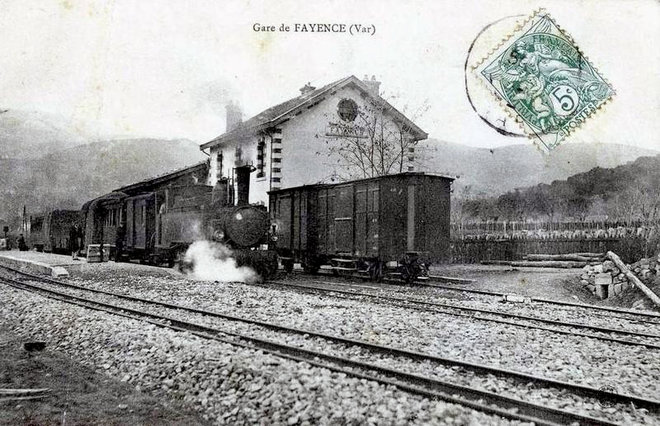
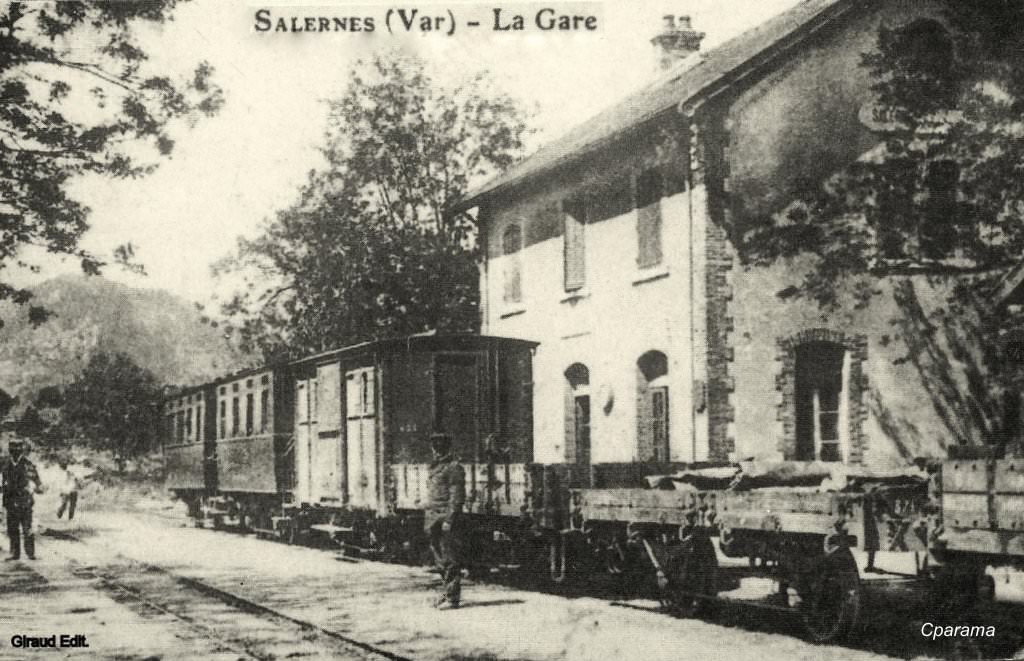
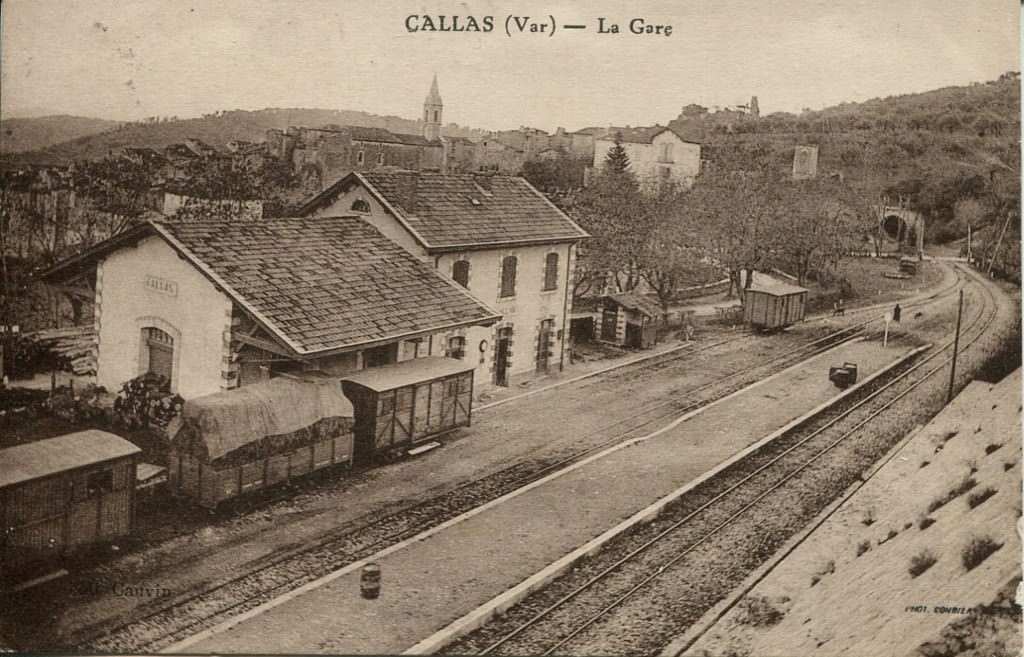
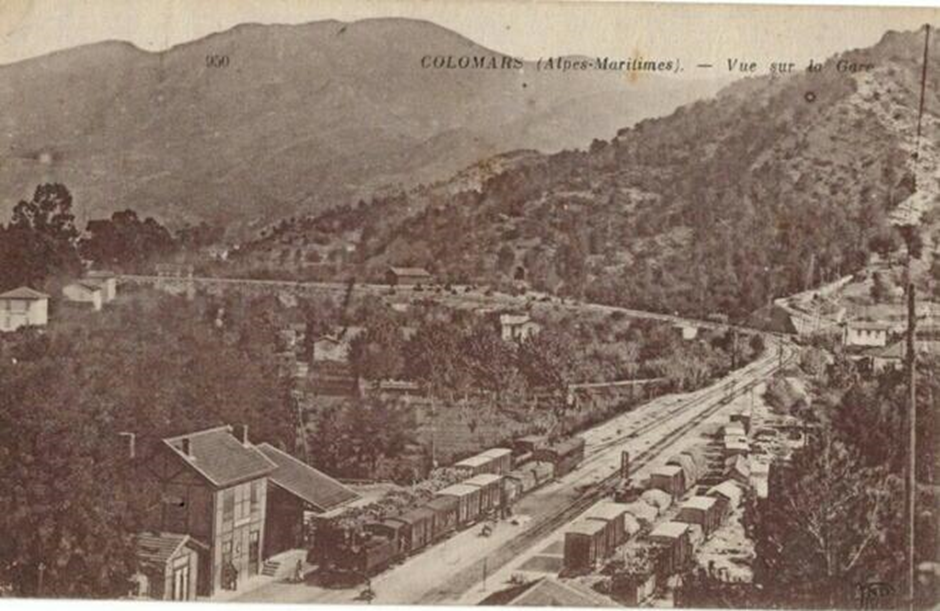
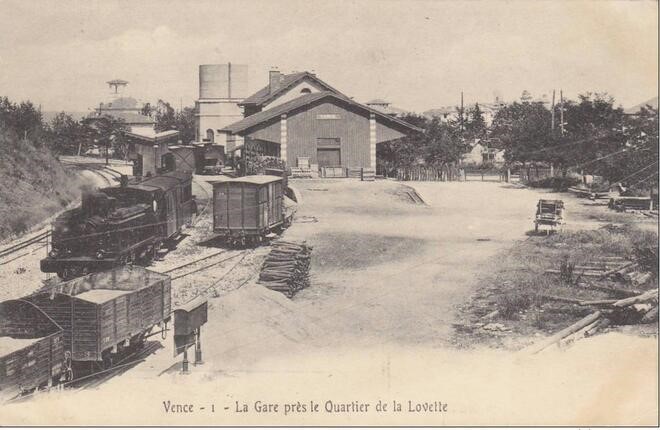
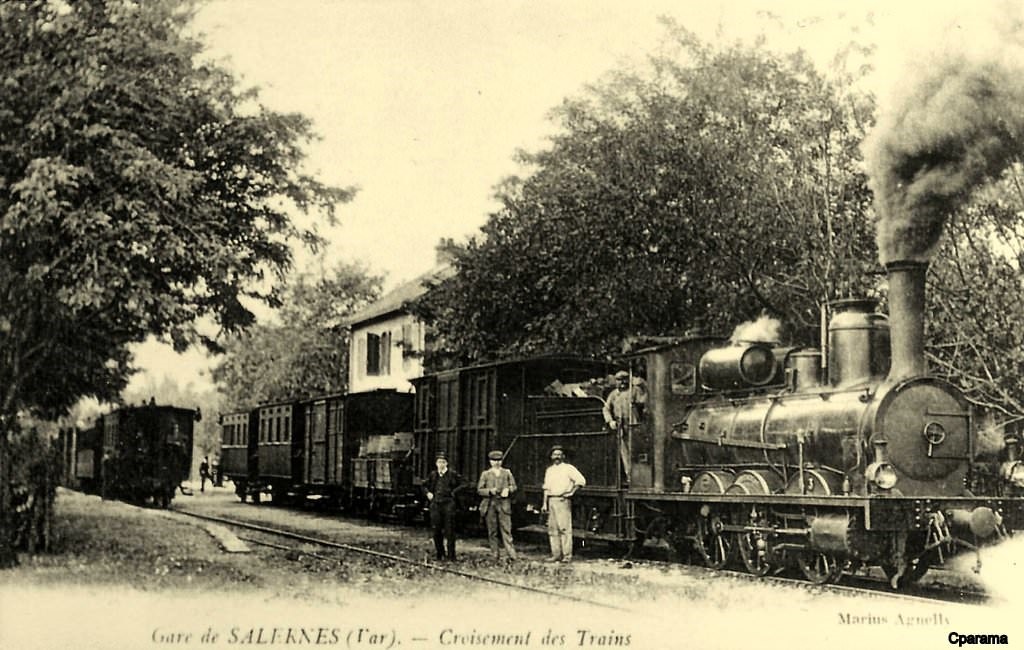
An early box van is being unloaded at Saint-Jeannet Station, another wagon is just visible on the right of the picture, and a luggage trolley can be seen sitting on its own in front of the station building. The next image was taken at Colomars Station at La Manda and was presumably intended to be a record of the Renault autorail in the station. It does, however, give us sight of both some box vans and some open wagons at the station.We have seen the next image before, it shows Vence station after the advent of the tramway and allows us to see a number of wagons. There is a goods train passing through the station which is made up primarily of box vans and a similar box van sitting in the goods lane. To the far right of the picture a TAM tramway box van can just be picked out and a flat tramway wagon sits just to the right of the wagon turntable.Both the tramway and the main line were of the same track gauge which meant that it was possible to transfer wagons from the tramway onto the mainline, however, the loading gauge was very different. That fact is illustrated by the pictures of models of wagons below, and particularly in the first image which shows two open wagons which run on metre-gauge track but which clearly have different loading gauges, the narrower wagon being one used on the TAM Tramways. (These pictures were taken by ‘Abran’ on the forum Passions Metrique et Etroite and are used with permission.) [16] The image immediately above is taken at Flayosc, probably at about the turn if the 20th Century. Just visible in the grainy image is the tender of a Class A or Class B 0-6-0 locomotive. It is also just possible to make out the expansion tanks in front of the loco cab. The locomotive is in charge of a mixed goods consisting of box wagons and open wagons.Another mixed train at Flaysoc in the charge of A Class A 0-6-0 tender locomotive with a variety of box vans and open wagons.A train of mixed wagons at Fayence awaiting the next scheduled mixed goods.Again at Fayence, a mixed goods and passenger train sits alongside two box vans.The image above shows a mixed passenger and goods train awaits departure at Sallernes at around the turn of the 20th Century, it includes two short-wheelbase carriages a box wagon and a series of different open wagons.At Callas, four wagons await the arrival of the next goods train, three box vans and a heavily loaded and tarpaulined open wagon.

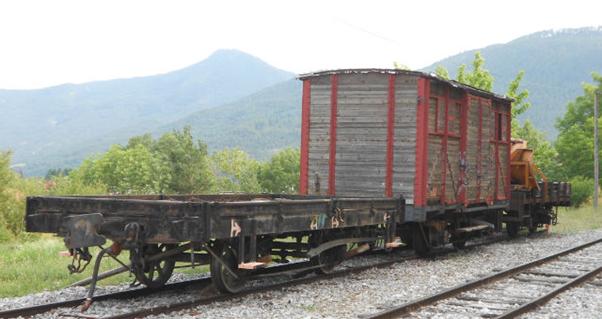
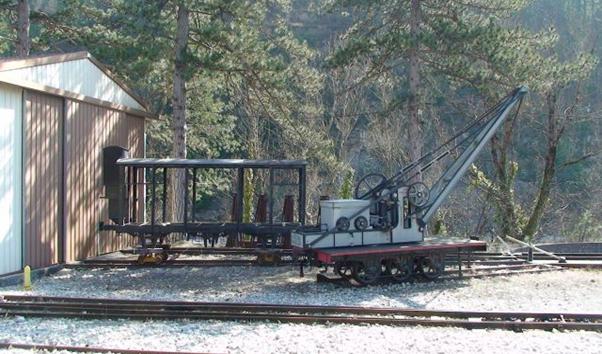
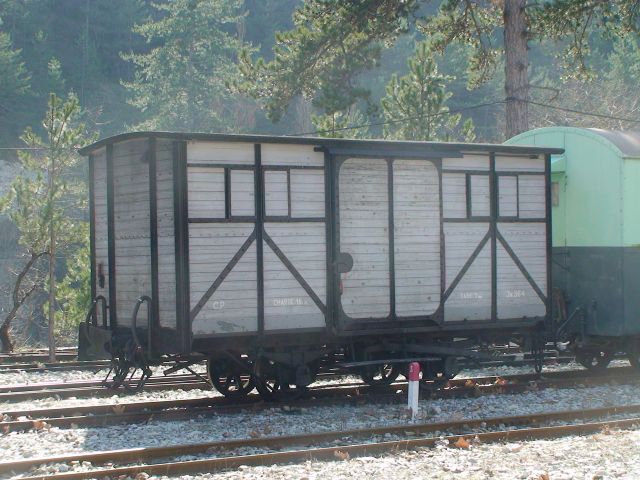
This first image is of a covered wagon probably built in 1912 and in use on the Central Var line. The next is of Rolling Crane No. 2 (1891) and what looks like the frame of a box wagon of the Central Var line of around 1888.

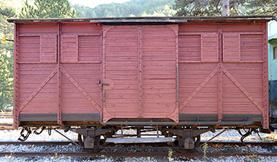
2-axle wagon as used by Les Chemins de Fer du Sud de la France (Photo: Clive Lamming). It compares well with the photos above.

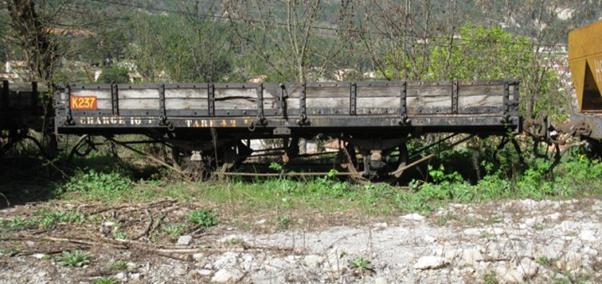
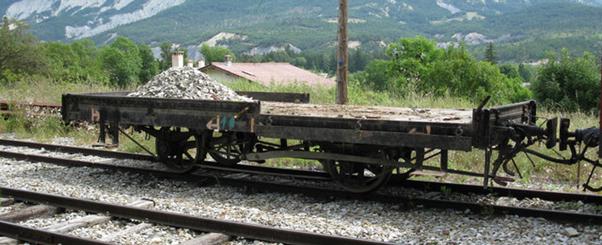
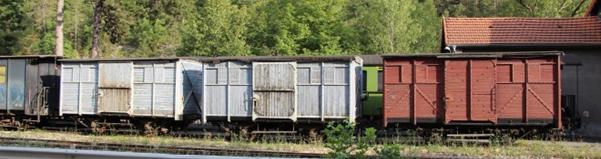
A series of photographs culled from the forum http://www.passion-metrique.net showing older wagons from the network which are still in use, renovated or in sidings waiting for work to be undertaken.[3]

The following images show some models made of the goods wagons on Les Chemins de Fer de Provence.[2]G 20x – Buire 1911

The Aubertain website has details of the paint schemes used on these wagons.[2]


Various Manufacturers supplied wagons to the Central Var line and the wider network of Les Chemins de Fer du Sud de La France, these included:

Chantiers de La Buire[4]

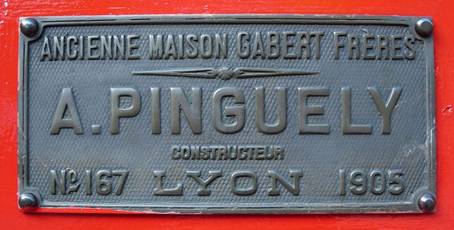
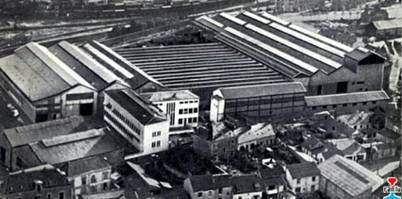
The Chantiers de La Buire was founded in 1847 in Lyon , in the district of Buyre or la Buire to build railway equipment [11] . The sites are in the suburb of Guillotière , on the left bank of the Rhone [12] near the castle of Buire [13] , whose estate had been sold to various owners.

The company was founded by the brothers Frossard Saugy, from the Canton of Vaud in Switzerland, who founded the workshops of Jules Frossard & Cie [14] by partnering with a local mechanical engineer, Zacharie Rouveure [15] .

In 1866, the brothers Félix and Lucien Mangini bought the company with the help of Credit Lyonnais and founded the Société anonyme des Chantiers de la Buire. Augustin Seguin (1841-1904), their brother-in-law ran the business.

In 1877, Chantiers de la Buire were acquired by the Compagnie des Fonderies and Forges de l’Horme and became Chantiers de l’Horme and La Buire.

The workshops manufactured wagons (8 per day in 1856), all railway rolling stock (except locomotives) and parts for navigation (paddle wheel axles), industrial equipment.[4]

De Dietrich Ferroviaire[6]

De Dietrich Ferroviaire was the designation of the Dietrich family ‘s railway rolling stock factory in Reichshoffen , Alsace , which is now part of Alstom under the name Alstom DDF .

De Dietrich Ferroviaire supplied, among other things, the cars of the Enterprise train connecting Dublin and Belfast in Ireland . It was responsible for a significant number of wagons and coaches and supplied a number of these for the metre-gauge railways in Provence.

De Dietrich Ferroviaire was a partner of Linke-Hoffmann-Busch of Salzgitter in Germany for the joint development of a diesel self propelled for the French national railways (SNCF) and Deutsche Bahn ; the result is known in France as X 73500 and X 73900 , also nicknamed the Whale, and at the DB as Serie 641.

In 1995, De Dietrich Ferroviaire was bought by Alstom and is known since as Alstom DDF or simply by the place name Reichshoffen.

Lorraine-Dietrich[7]

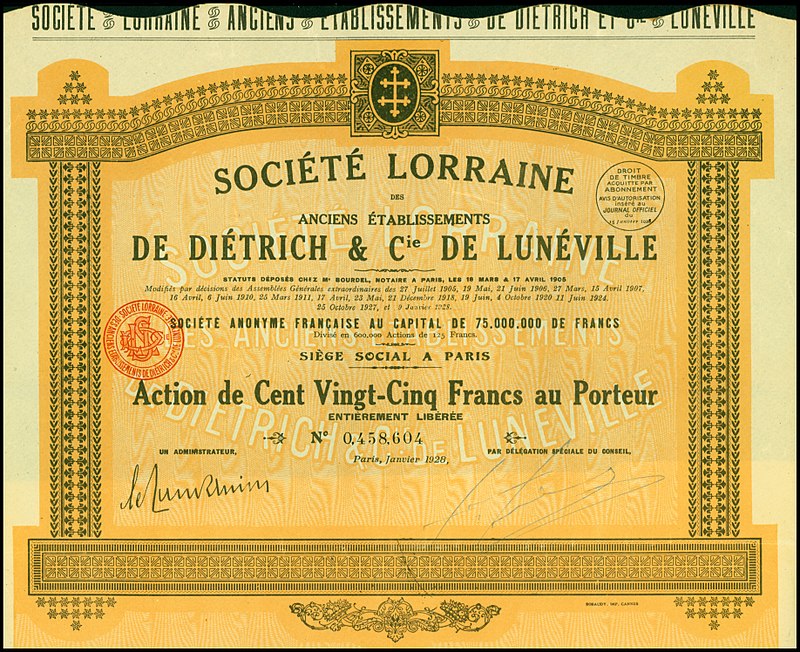
The Lorraine Company derived from the companies of Dietrich and Cie de Lunéville was better known under the name of Lorraine-Dietrich. It constructed cars, railway rolling stock, heavy equipment and aircraft engines. The company was born as a result of the 1871 Frankfurt Treaty, annexed Alsace-Moselle to the German Empire. In 1879, in order to be able to continue his deliveries to the French railway companies, Eugene de Dietrich (1844-1918) founded a factory west of the new border, in Lunévillein Lorraine. Originally, these workshops were only required to assemble carriages. In 1897, in view of the importance of this workshop, the creation of a distinct society, subject to French legislation, was decided; it was renamed “Société de Dietrich et Compagnie de Luneville”. The management of the company was provided by Baron Eugène de Dietrich, assisted from 1890 by his nephews Adrien de Turckheim , then a young dynamic and enterprising engineer, and Eugène de Turckheim.

In 1905 , Dietrich’s family withdrew from the firm and on March 4, 1905, the Luneville Company was transformed into a public limited company with a capital of 5 million francs with no ties to its first founders. It became known under the name of Lorraine-Dietrich. Its head office was located in Paris at 8, Boulevard Malesherbes .

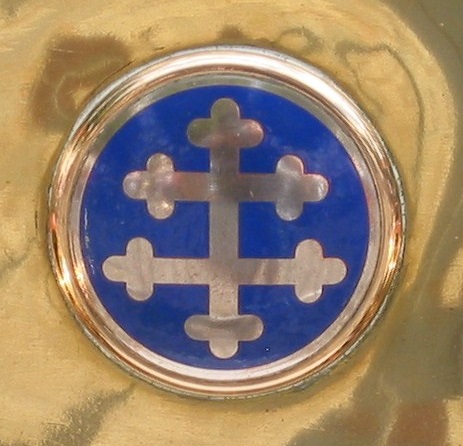
The Company adopted as its logo the Cross of Lorraine , gold on blue background. Its area of work, according to its corporate objectives was the  “construction of wagons, automobiles and all mechanical objects for the transport industry by automobile and other means”.

In 1907, a second factory was created, this time in the Paris region, in Argenteuil . This factory specialized in the manufacture of passenger cars, the “Lorraine” 3 . The Lunéville plant continued to focus on the production of railway equipment, but also of heavy commercial vehicles and racing cars ; It had a workshop specialized in the construction of prototypes intended to compete in car rallies and endurance races.

Throughout the first half of the 20th Century, the Luneville factory continued to specialize in equipment for the railways.

Lorraine-Dietrich was taken over by Gnome and Rhône in 1941.

Hanquet-Aufort et Compagnie à Vierzon

I have been unable to find any significant details about this firm. Evidence of them supplying a series of different tramways around France can be found on various websites.

Compagnie des Fonderies and Forges de l’Horme

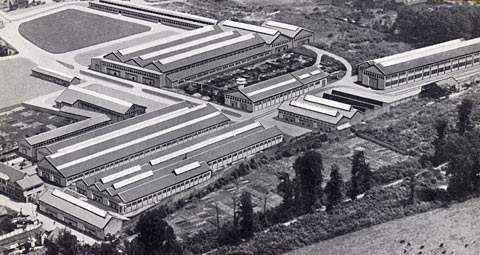
The Company was formed in Lyon in 1847[8] Its forges were located in the town of Saint-Julien-en-Jarez (Loire) in the valley of Gier. The company grew out of an association between Augustin Girardet and Jacques-Marie Ardaillon.[9] The company owned the iron mines of Saint-Chamond and Veyras. 

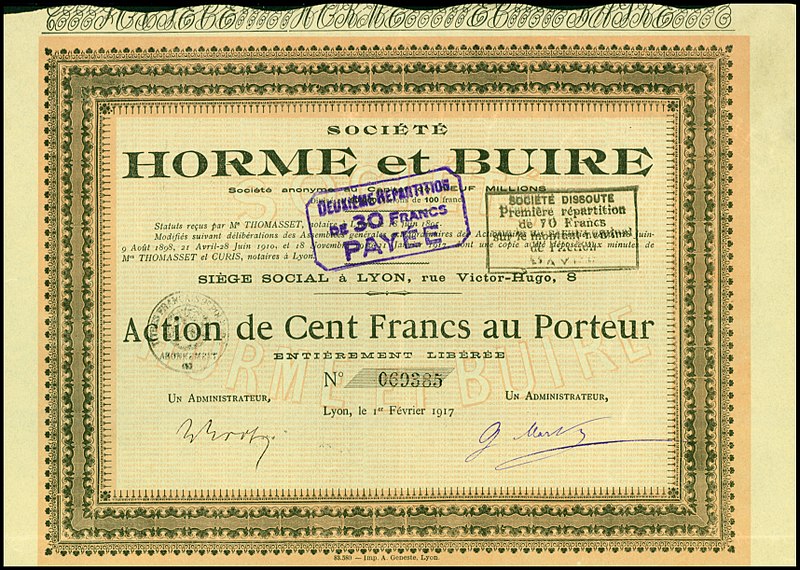
In 1877, the Company was reformed after taking over the Chantiers de La Buire and became Les Établissements de l’Horme et La Buire and in 1895 the company was put in liquidation and disappeared replaced by the Société Nouvelle des Établissements de l’Horme et de la Buire.

Société Nouvelle des Établissements de l’Horme et de la Buire

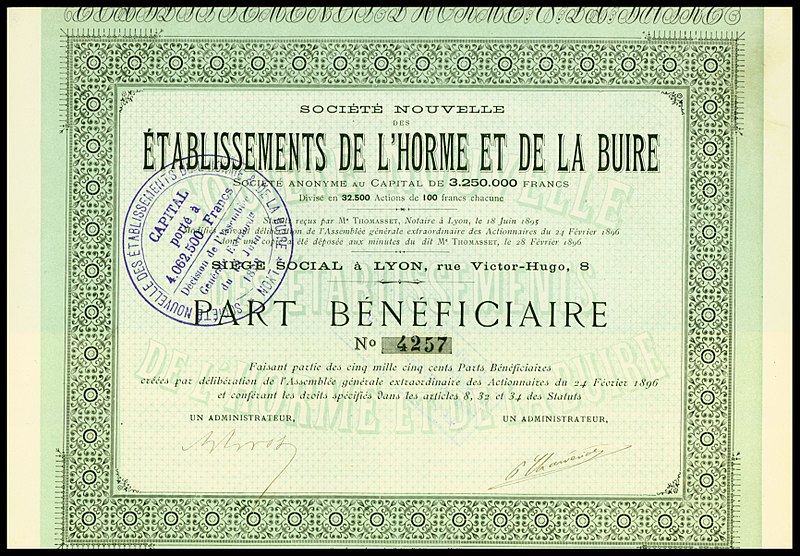
La Société nouvelle des Établissements de l’Horme et de la Buire was created in 1895 in Lyon at maitre Thomasset on 18th June 1895. It succeeded the Company of Foundries and Forges de l’Horme which had been put in liquidation on 27th December 1894. The headquarters of the company was in Lyon , Rue Victor Hugo in the second arrondissement. In 1899, the electrical construction department was sold to the Swiss firm Alioth, which moved to the Lyon site and took the name of Alioth-Buire.In 1899, the electrical construction department was sold to the Swiss firm Alioth, which moved to the Lyon site and took the name of Alioth-Buire.

In 1905, a subsidiary was created to develop the car manufacturing sector: the Société des Automobiles de laBuire

In 1909, the company went bankrupt and became Société Horme et Buire

Société Horme and Buire

The Societe Horme et Buire was created in 1909 to replace the Société Nouvelle des Establishments Horme and Buire founded in 1895 and in financial difficulties. It disappeared in 1929 and the site was then occupied by Les Acieries due Nord.

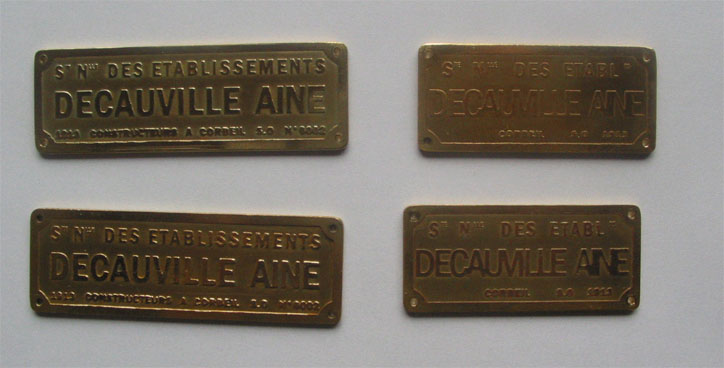
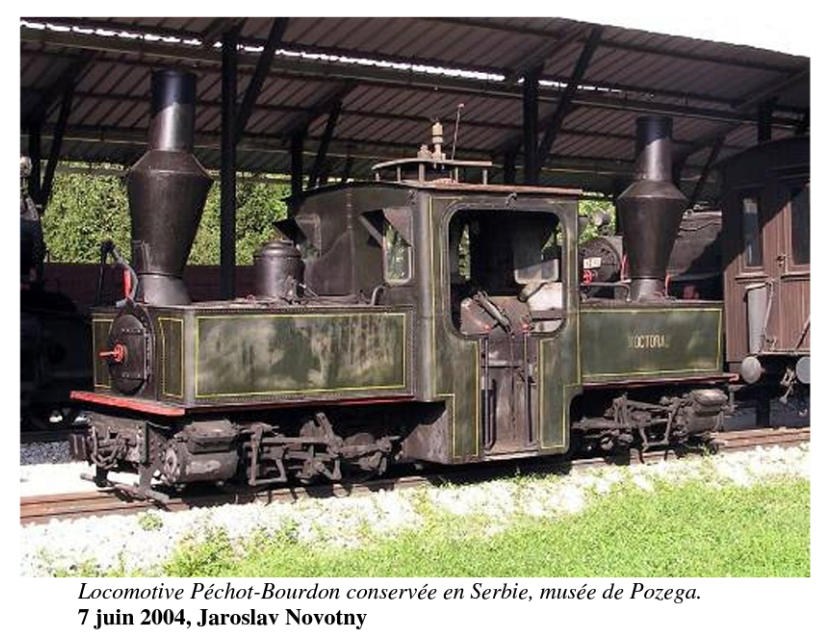
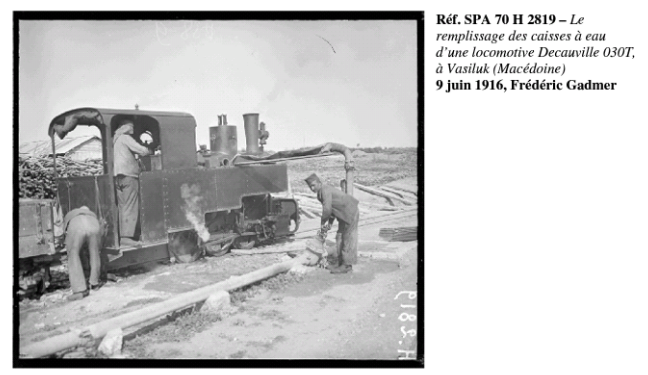
Pechot-Magnard and Decauville

In the 1870s, the Decauville family, exploited a property of 700 hectares of sugar beet land and a boiler-making workshop in Petit-Bourg (in the commune of Evry), where they manufactured equipment for refineries and distilleries (boilers, tanks, steam engines). Paul Decauville invented a system composed of modular track which could be handled by two men, and small carts. This track system proved very popular and the range was widened to include track widths from 0.40 m to 0.60 m. This portable railway enjoyed great success in a variety of different farming and industrial locations (beet, cereal and wine, mining, quarrying and forestry). The factory at Petit-Bourg grew from 35 workers in 1876 to 1,600 in 1916. 7 factories were established in the provinces and abroad, in Italy and Spain.

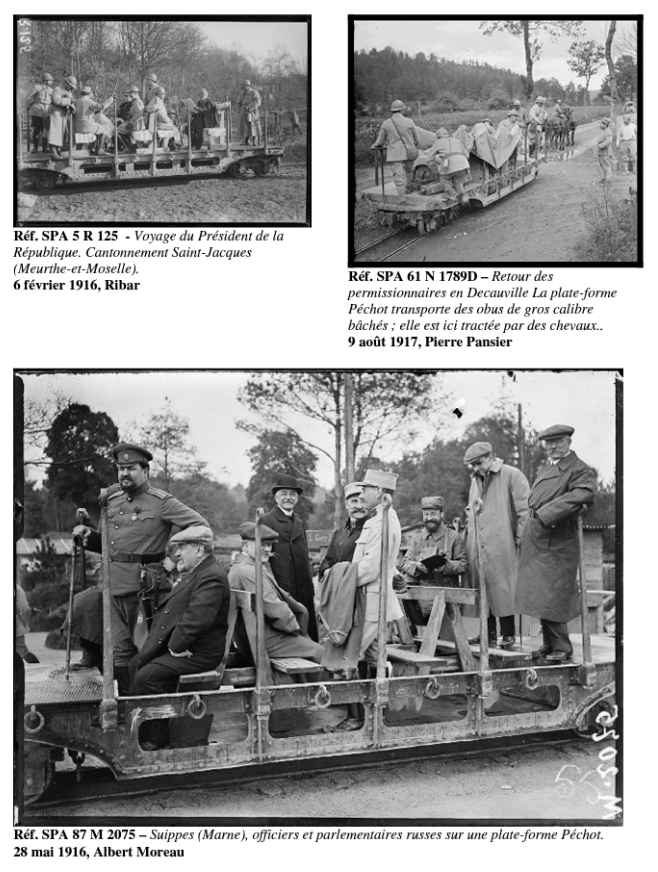
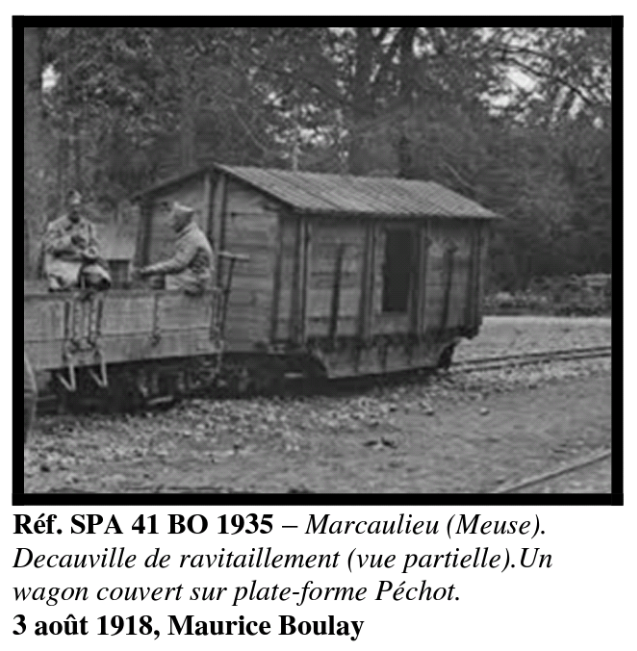
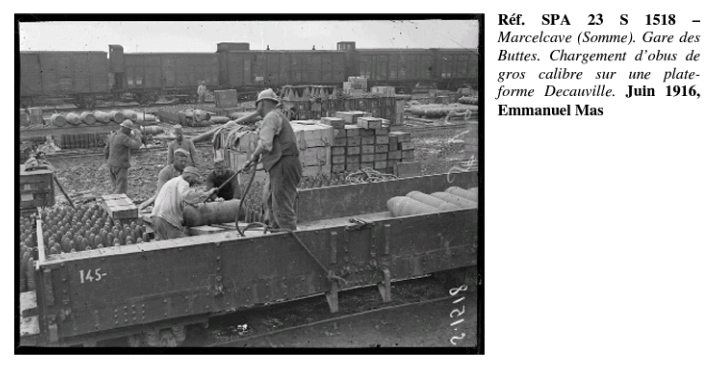
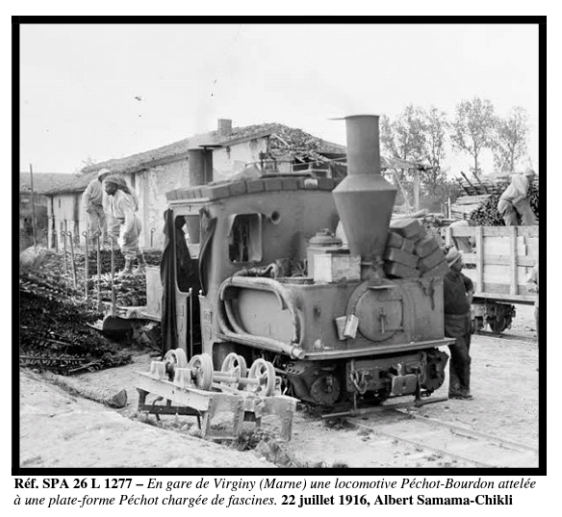
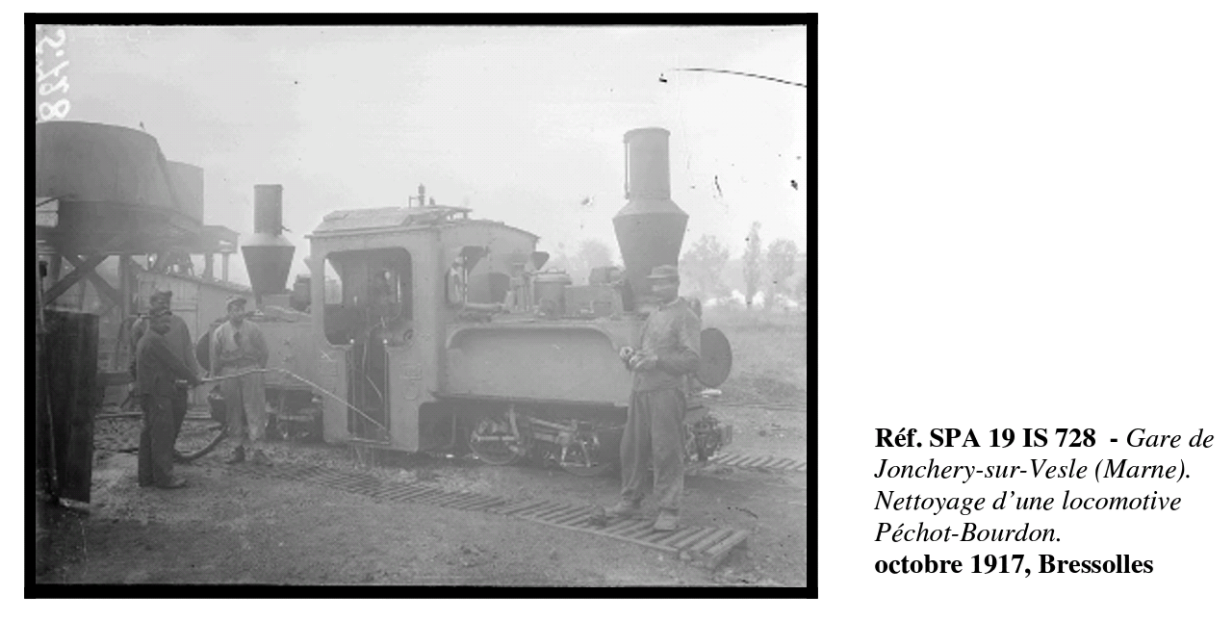
As the First World War approached this flexible, easily moved, track became very important in supplying the troops in the trenches. The 0.60 m track became standard and the company supplied locomotives and wagons for the war effort.[10]

The Company’s contribution to the war was significant. Details can be found in ‘Les Petits Trains de La Grande Guerre: La voie de 0,60 m militaire en 1914-1918’ (les-petits-trains-de-la-grande-guerre.pdf).[10]   The pictures below show some of the rolling stock and locomotives produced by the group on companies and factories for the war effort.

References

  1. Roland Le Corff; http://www.mes-annees-50.fr/Le_Macaron.htm, accessed on 13th December 2017.
  2. AuberTrain; http://www.aubertrain.com/DOWNLOADS/INS-S.pdf, accessed on 25th January 2018.
  3. Les Chemins de Fer de Provence; Les Forums de Passions Métrique et Etroite; http://www.passion-metrique.net/forums/viewtopic.php?f=2&t=4143&sid=4bb1d3e27f39656eb05c8d08b7a7801d., accessed on 25th January 2018.
  4. Chantiers de La Buire; https://fr.m.wikipedia.org/wiki/Chantiers_de_La_Buire, accessed on 4th March 2018.
  5. Aubertrains; http://aubertrain.com/sud-france-om.html, https://www.google.co.uk/url?sa=t&source=web&rct=j&url=http://www.aubertrain.com/DOWNLOADS/INS-S.pdf&ved=2ahUKEwj3o7vL29PZAhVjFMAKHRDNBe4QFjADegQIBBAB&usg=AOvVaw11KImpMXD1o2poqoP2_mCM, and http://aubertrain.com/chargements.html, accessed on 2nd March 2018.
  6. De Dietrich Ferroviaire; https://en.wikipedia.org/wiki/De_Dietrich_Ferroviaire, accessed on 3rd March 2018.
  7. Lorraine-Dietriche; https://fr.wikipedia.org/wiki/Lorraine-Dietrich, accessed 4th March 2018.
  8. Compagnie des Fonderies and Forges de l’Horme; https://fr.m.wikipedia.org/wiki/Compagnie_des_Fonderies_et_Forges_de_l%27Horme, accessed on 5th March 2018.
  9. https://books.google.fr/books?id=MhjBHF5Qrd4C&pg=PA66&dq=Compagnie+des+Fonderies+et+Forges+de+l%27Horme&hl=fr&sa=X&ei=QPsDUPCKMamH0AWbyNnBBw&ved=0CGoQuwUwCDgU#v=onepage&q=Compagnie%20des%20Fonderies%20et%20Forges%20de%20l’Horme&f=false, accessed 5th March 2018.
  10. Les Petits Trains de La Grande Guerre: La voie de 0,60 m militaire en 1914-1918; https://www.google.co.uk/url?sa=t&source=web&rct=j&url=http://archives.ecpad.fr/wp-content/uploads/2011/04/les-petits-trains-de-la-grande-guerre.pdf&ved=2ahUKEwi6pNHA4tjZAhVKIcAKHfZNAIgQFjADegQIBhAB&usg=AOvVaw3eC_0k71f6qpk94qFhj5cz, accessed on 6th March 2018.
  11. Site rhonealpes.fr Electronic Records of the General Inventory of Cultural Heritage in Rhône-Alpes: The railway equipment factory Establishments in Horme and Buire then car plant Chantiers the current theater of Buire Alphodèles, accessed on 18th July 2012.
  12. Site Christian Palluy, Neighborhoods Lyon – the suburb of Guillotière -1, accessed on 18th  July 2012.
  13. http://bechevelin.canalblog.com/tag/Buireaccessed on 18th July 2012.
  14. Site Encyclo.43: The Buire, accessed on 18th July 2012.
  15. Pierre Cayez, jacquard and blast furnaces to the origins of the Lyon industry, University Presses Lyon, 1978, p.  316, accessed on 18th July 2012.
  16. Les Chemins de Fer de Provence; Les Forums de Passions Métrique et Etroite; http://www.passion-metrique.net/forums/viewtopic.php?f=2&t=8464, accessed on 5th April 2018.

Locomotives and Rolling Stock on the Central Var Line (Chemins de Fer de Provence 52)

This post seeks to bring together as much information as possible about the motive power on Les Chemins de Fer du Sud de la France Central Var Metre Gauge Line after the demise of steam traction. There is inevitably less information available about this short era on the line as the line closed fully in early 1950 and a significant segment between La Manda and Tanner on was closed with effect from August 1944 after major damage was inflicted on a number of viaducts along the line.

For information about steam traction on the line, please follow this link:

https://rogerfarnworth.wordpress.com/2018/02/23/locomotives-and-rolling-stock-on-the-central-var-line-chemins-de-fer-de-provence-50

And for details of rolling stock, please follow this link:

https://rogerfarnworth.wordpress.com/2018/03/02/rolling-stock-on…r-de-provence-54

A study of the whole line is available following links on the french forum ‘Passions Metrique et Etroite’ and picking up the trail with my post dated 3rd February 2018:

http://www.passion-metrique.net/forums/viewtopic.php?f=2&t=8154&start=180

Diesel/Electric Traction on the Central Var Metre-Gauge Line

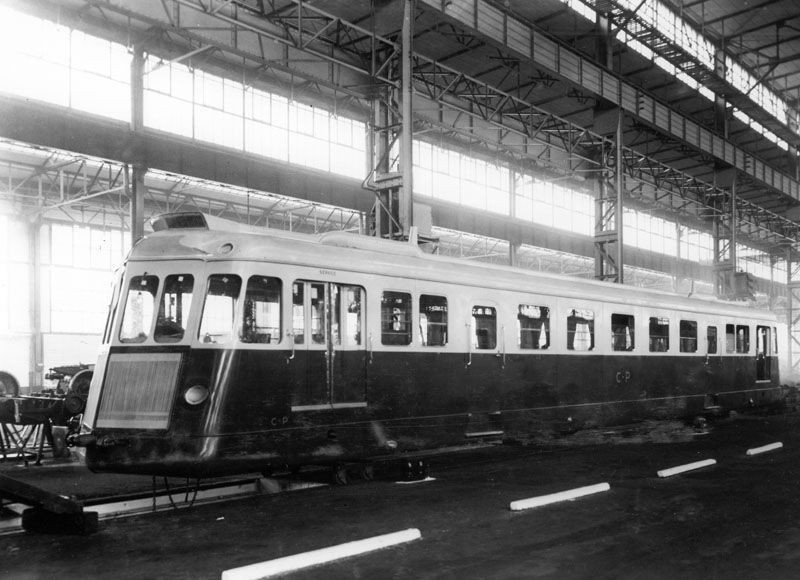
Renault ABH Autorails

Renault produced this Autorail and others similar to it from 1935 onwards.  The first batch of the railcars was of type ABH1 and they were numbered ZZ-1 to ZZ-6. The picture below shows the first of these railcars on the production line – © SHGR.

The 1st series of these autorails were 265hp, their maximum speed depended on the gear ratios. They were 20.60 metres long over the buffers. The bogie wheel base was 13.60 metres with bogie axles 2.20 metres apart. They had a seating capacity of 46. Their empty weight was 26.80 tonnes and fully loaded, 32.15 tonnes.

The second series were released from 1936 onwards, they were 300hp and their maximum speed was similarly dependent on gear ratios. They were slightly larger, the length over the buffers was 20.69 metres. The bogie wheel base was 13.69 metres with bogie axles 2.20 metres apart. They had a seating capacity of 44. Their empty weight was 26.80 tonnes and fully loaded, 32.15 tonnes.

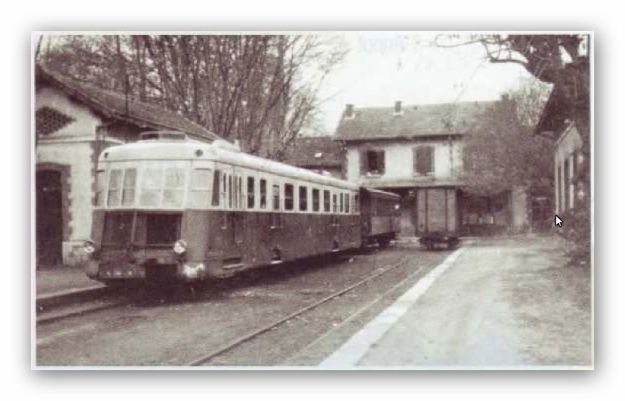
The picture below shows Renault ABH5 railcar No. ZZ-12 with a wooden wagon as a trailer. The picture was taken in 1948 at the western terminus of the Central Var line at Meyrargues. This autorail came from second series of Renault autorails, of Class ABH5. It was delivered in 1942 numbered ZZ-7 to ZZ-12. Only one, ZZ-10, of these remains in existence, although no longer in general service. Similar, but later, Renault railcars of class ABH8 are still part of the roster on the Chemin de Fer de Provence, although not in use on the line.

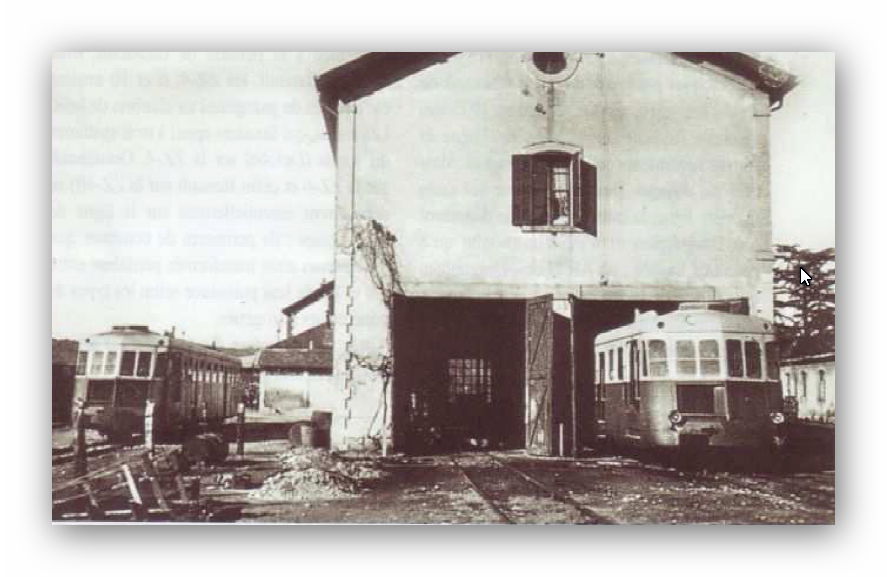
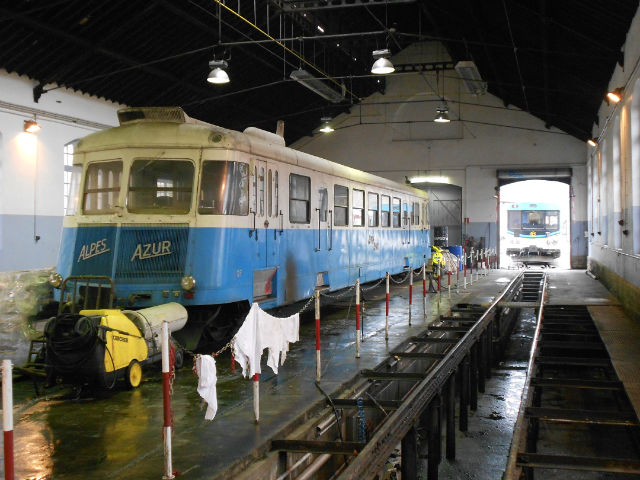
Draguignan shed with two Renault ABH railcars, probably taken post war. (Photograph: Pierre Virot, 2003).[1]

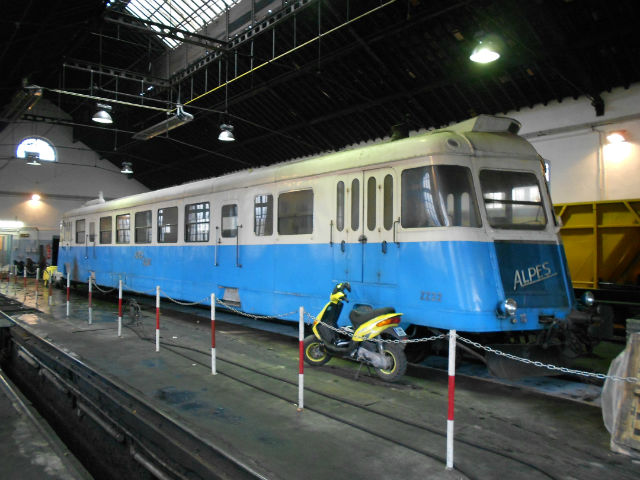
This image shows ABH1 NO. ZZ-22 (former ZZ-2) at Nice in the Year 2000  – © Ian Boyle.

This is ZZ-6 stored in the disused metre-gauge station at Digne, in February 2003 – © Ian Boyle

The following video shows one of these Renault ABH autorails at work on the Nice to Digne line in the late 1970s.

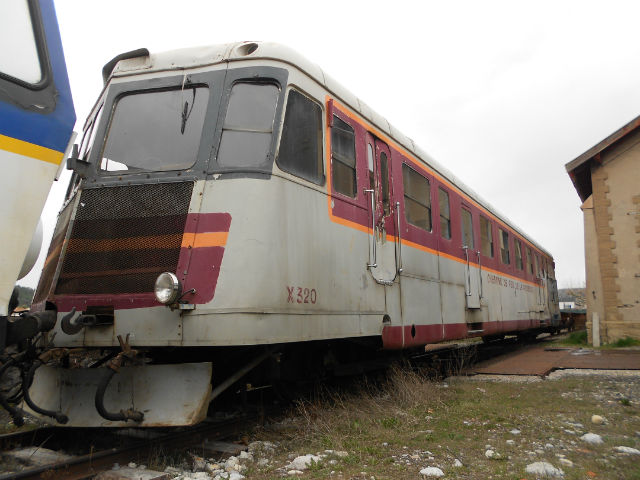
The picture below is F.A.C.S. postcard 507 of a Renault ABH5 autorail, with original window design. X.320, above is a Renault type ABH5 railcar, built in 1936, and delivered in 1942, with some difficulty because of war, and equipped with a gasifier. Soon after, this railcar became isolated on the Central Var line at Draguignan. It was not until after the war that it was used in regular service. After the closure in 1950 of the line between Tanneron and Meyrargues this railcar was transfereed to the Nice to Digne line. It was completely modernized in 1985, and was kept as a reserve at Digne until the early 2000s. It was used later for maintenance trains for a few years beforevitvwas stored at the MPD at Digne. At the time this picture was taken it was awaiting a major overhaul. This picture was taken by ‘La bête de Calvi’ and loaded onto the Passions Metrique et Etroite Forum in April 2013.

This next photos come from the same source – ‘La bête de Calvi’ and loaded onto the Passions Metrique et Etroite Forum in April 2013. The photographs are of ZZ-22 (ZZ-2) standing on the central lane of the Digne depot. It had been standing in this location for a few years at the time the pictures was taken in 2013. The photographer commented that the autorail remained in working condition, the engine is turned occasionally and it is moved around the depot yard sporadically.[2]

The first of the following pictures shows the modernized interior of ZZ-22. Some of the seats are removable and can be replaced by tables on excursion trains.

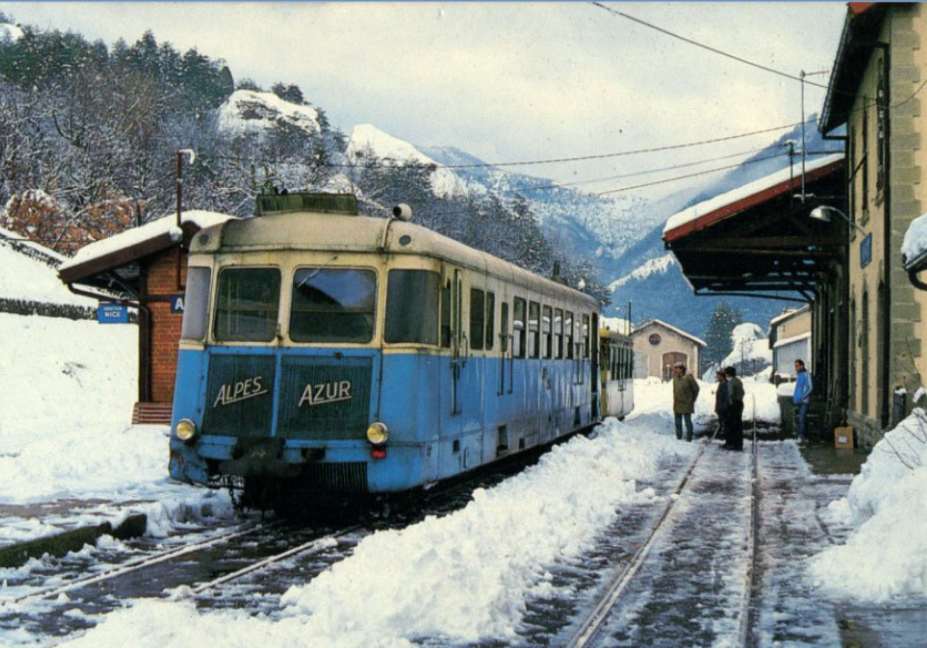
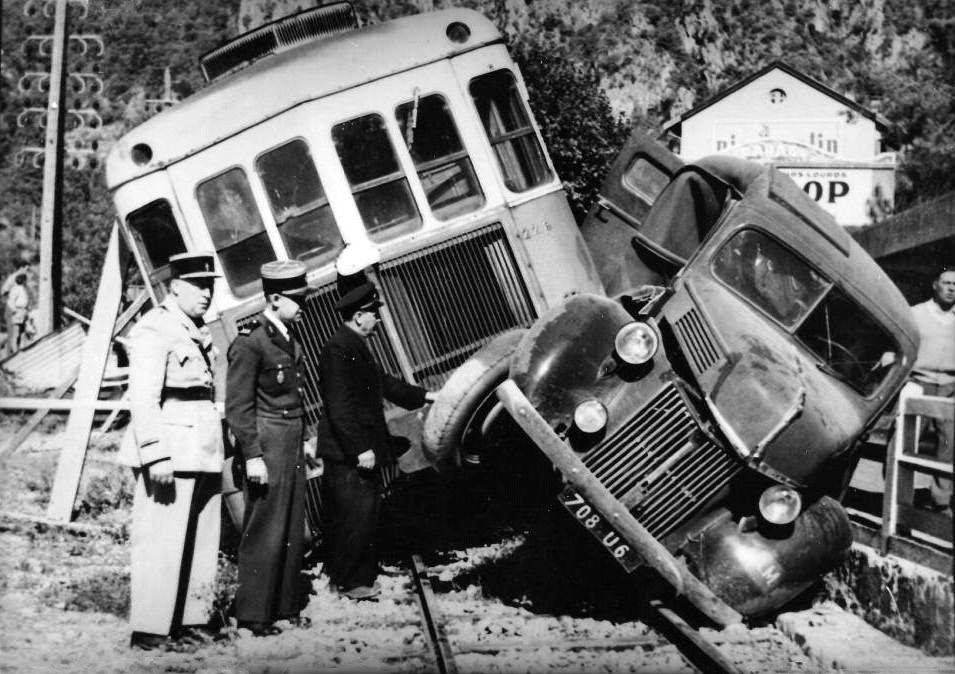
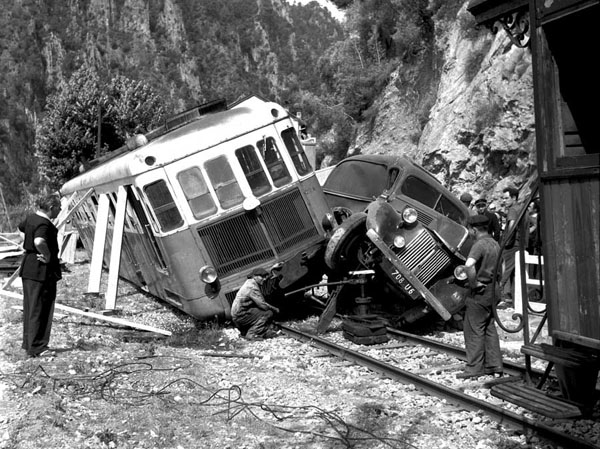
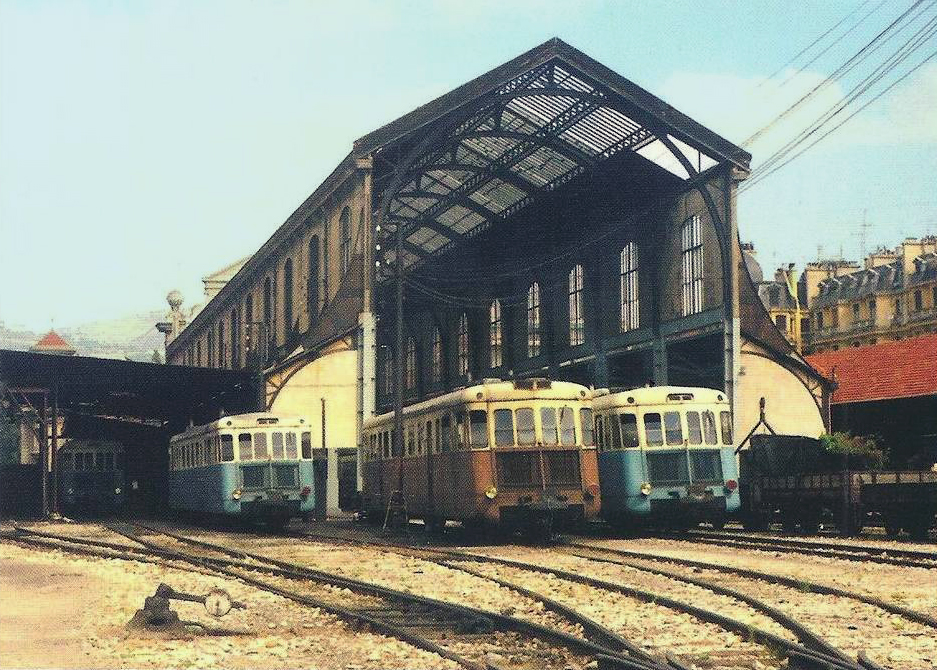
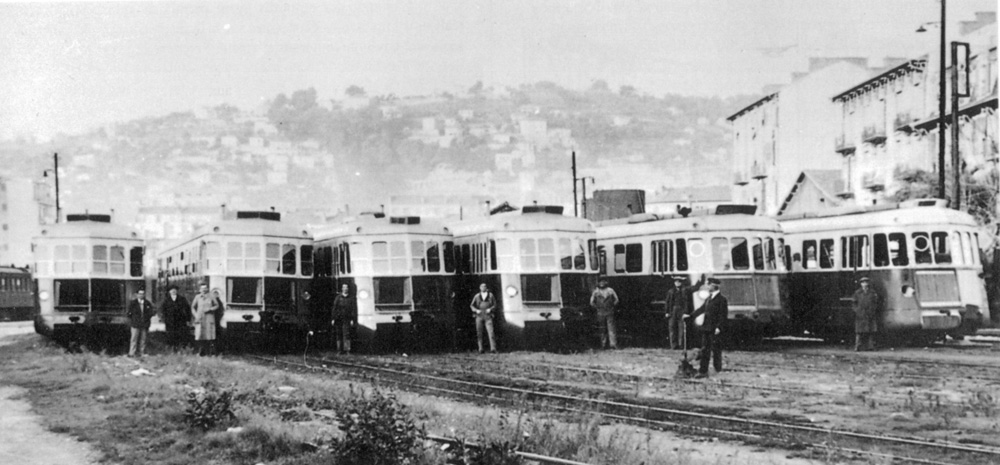
The next photograph below shows a Renault ABH railcar and Billard trailer in the snow at Annot station on the Nice to Digne line in 1987 (Pierre Boyer Collection).Two shots of an accident between a Renault autorail and a Ford panel van in 1952 And finally a group of 4 Renault ABH railcars at the Nice terminus followed by a line-up of  6 in a pristine condition also at Nice.

The separation of the Central Var line from the Nice to Digne line occurred in 1944 at the time of the Allied invasion. We know that at least one of the Renault ABH Autorails was trapped on the Central Var and served there until the line closed. I have not been able to find many photographs of diesel traction on the Central Var from the date in the 1930s when these autorails were introduced until 1950 and the closure of the line.

I’d be really grateful if others could point me to more images of diesel traction on the Central Var line rather than the Nice-Digne line.

References

  1. José Banaudo, Le train des Pignes; éditions du cabri.
  2. La bête de Calvi; http://www.passion-metrique.net/forums/viewtopic.php?f=2&t=4143


The Sospel to Menton Tramway Revisited (Chemins de Fer de Provence 51)

I first posted a very short blog in 2013 about discovering this tramway while on a bus journey from Sospel to Menton. Further investigation has shown just how closely the present D2566 road follows the line of the tramway which when it was in use was remote from the then main road between Sospel and Menton over much of its length, only really following that road in the kilometers closest to Menton.

The original blog from December 2013 can be found using this link:

https://rogerfarnworth.wordpress.com/2013/12/10/sospel-to-menton-tramway

It was written when I was just getting used to the idea of producing a blog and came at a time when I was just beginning to realise the extent of the TAM tramways and the Chemins de Fer de Provence. Naively I thought that the Digne to Nice line was a stand alone narrow gauge line rather than being at the heart of a much more extensive network.

I plan to take us on a journey down the tramway from Sospel to Menton and to pick up as much information as I can along the way. A similar exercise has been undertaken by Randonnees Ferroviaires as well but with less detail and without a great deal of narrative – click on this link to see the .pdf they have produced about the Sospel to Menton Tramway:

06083.a.pdf

We start at Sospel ………………..

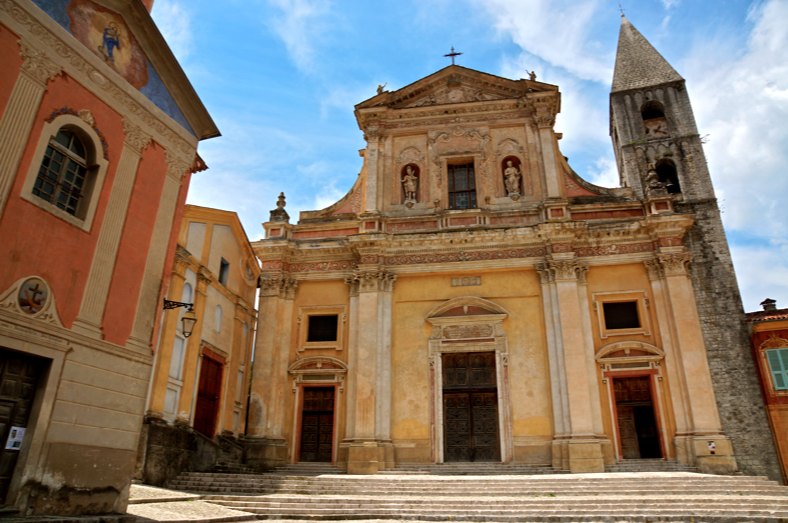
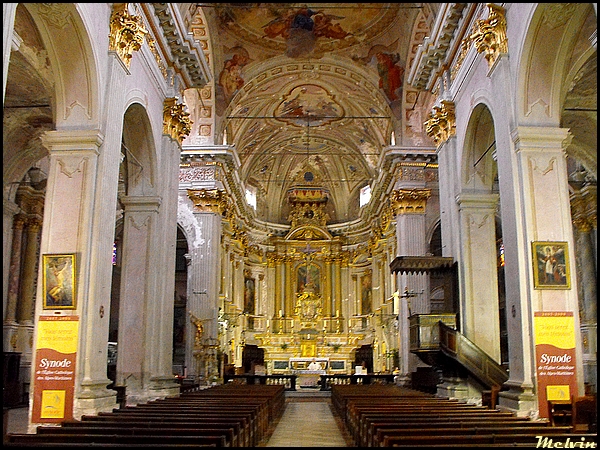
Sospel[1] dates back to the 5th century, when it served as an important staging post on the royal road from Nice to Turin. Its main monument is the former cathedral.[2]

The Cathedral was formerly the seat of the schismatic Bishopric of Sospel, created in 1378 from the Diocese of Ventimiglia during the Great Schism as the Avignon-obedient seat of the effectively split bishopric (the ‘Italian’ part remaining loyal to Rome with seat in Ventimiglia) and restored to Rome’s papal rule and Ventimiglia’s diocesan authority (after three anti-bishops) in 1412; formally recognized as abolished under the Concordat of 1801. the ex-cathedral is now in the Diocese of Nice.

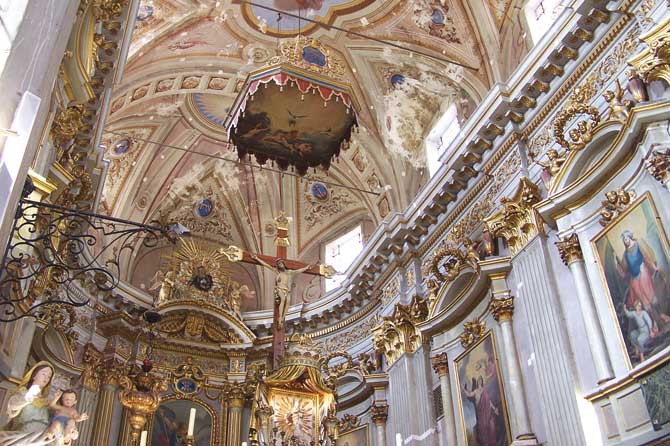
Apart from a belltower of either the 11th or the 13th century, from the Lombard period of Sospel’s history, the cathedral was built between 1642 and 1762, and is claimed to be the largest building in the Alpes-Maritimes. The Renaissance façade is from 1642, and contains in two niches the statues of the town’s protectors, Saint Hippolytus and Saint Absende. Inside, the principal feature is the altar-piece in carved wood in three panels, containing the figure of the “Immaculate Virgin of Sospel”. It is by the artist François Brea, of a family of artists from Nice, from the 15th or early 16th century.

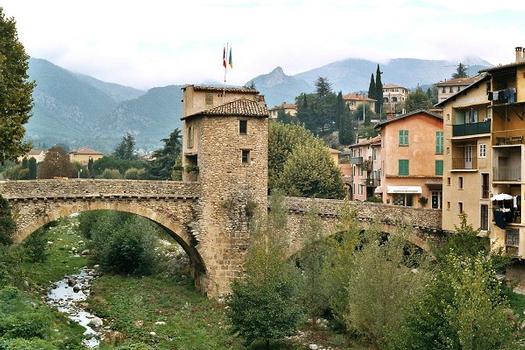
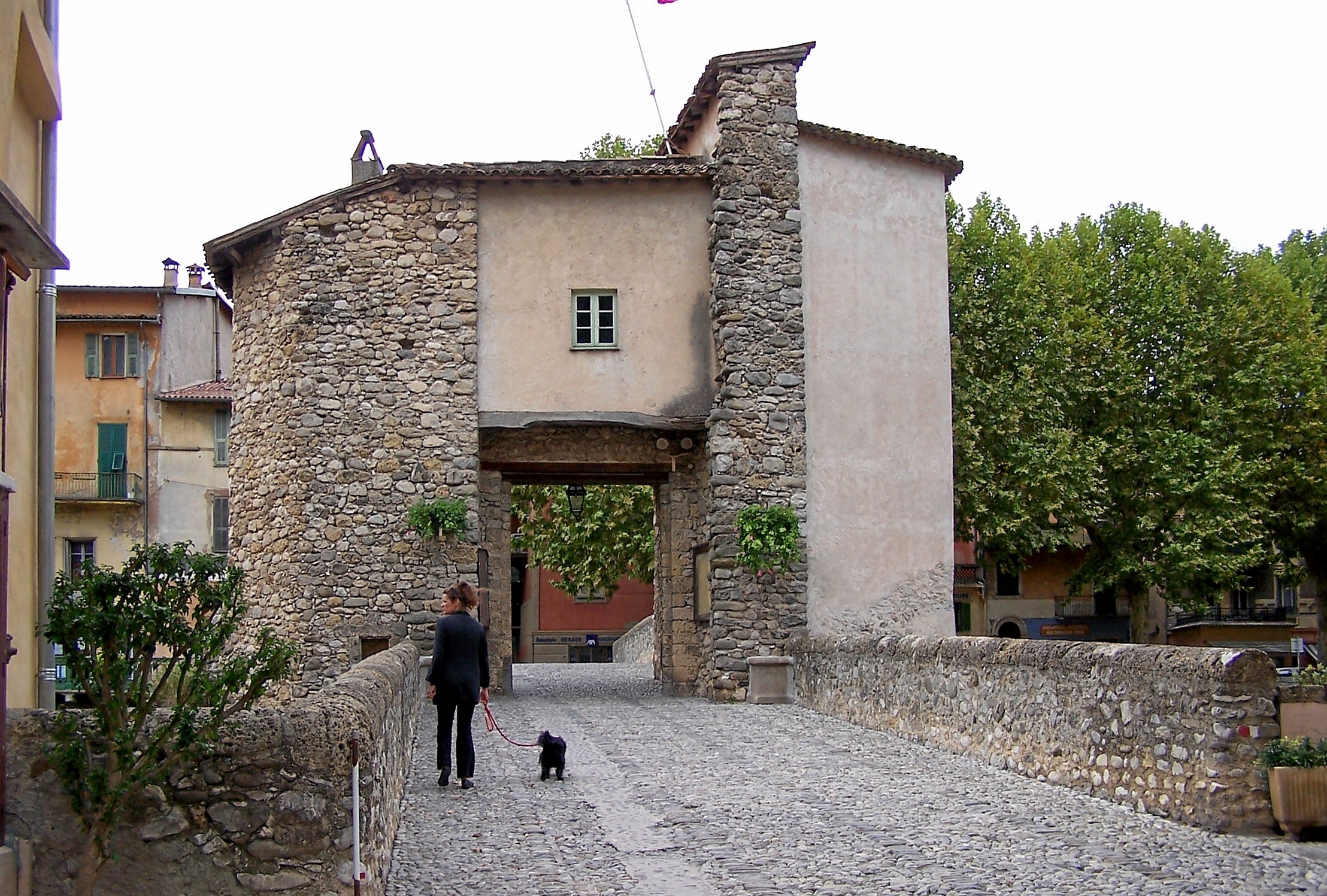
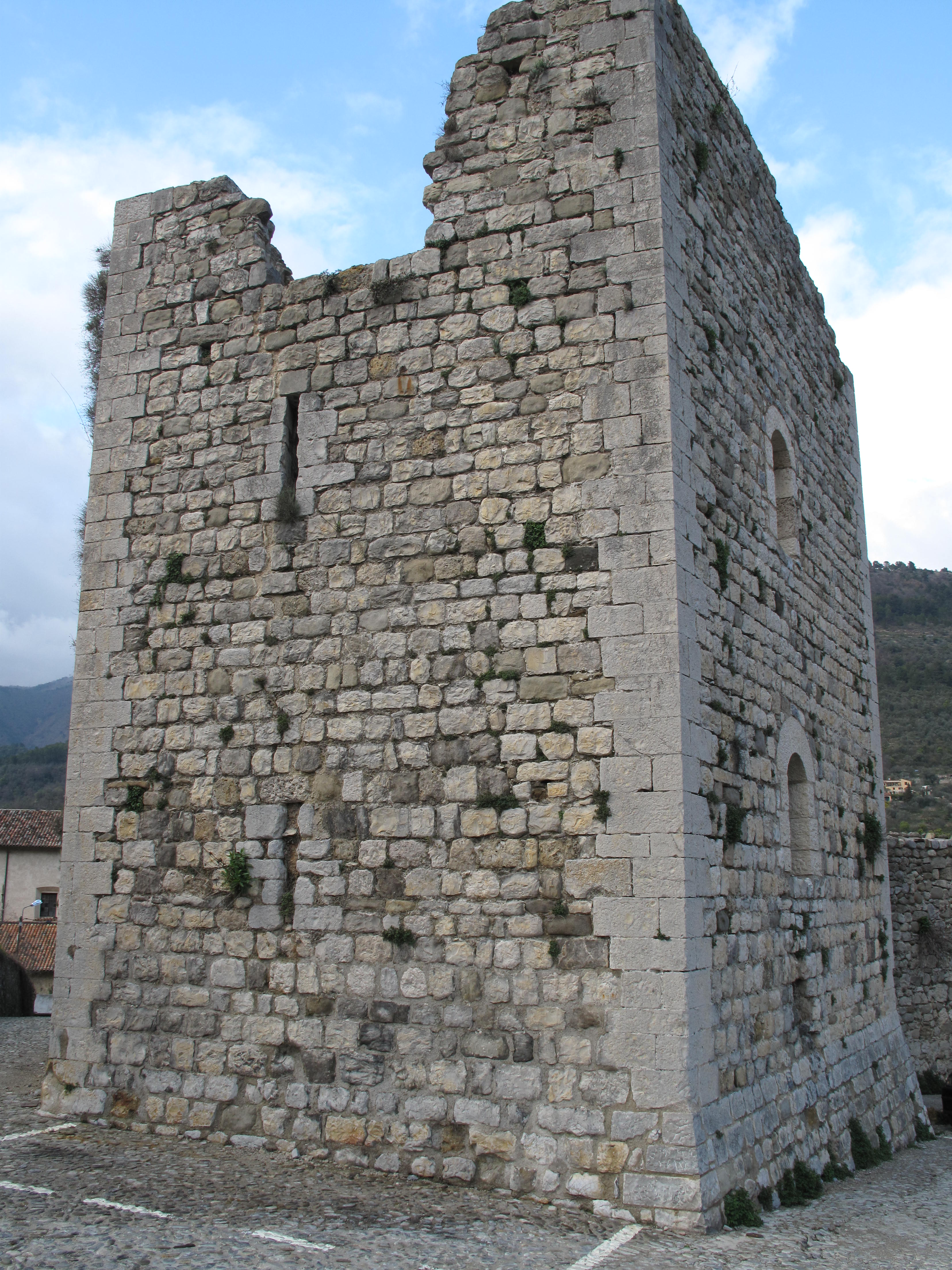
The old toll bridge used by travellers to cross the River Bévéra, built in the 13th century, still stands. It was bombed by the Germans during World War II to prevent contact between the French Resistance (“The Maquis”) and the Italians. Much of the town was destroyed at that time. The bridge was renovated after World War II it now houses the tourist office.The ruins of a tower, part of a château belonging to the counts of Provence, are all that remain of the 14th century city walls.

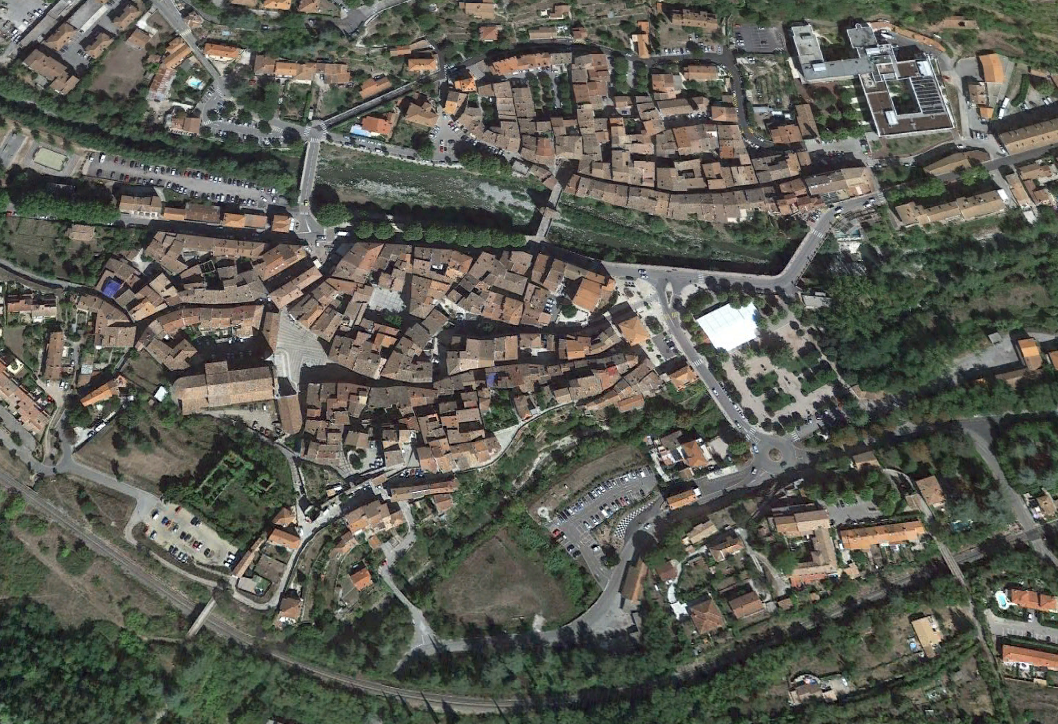
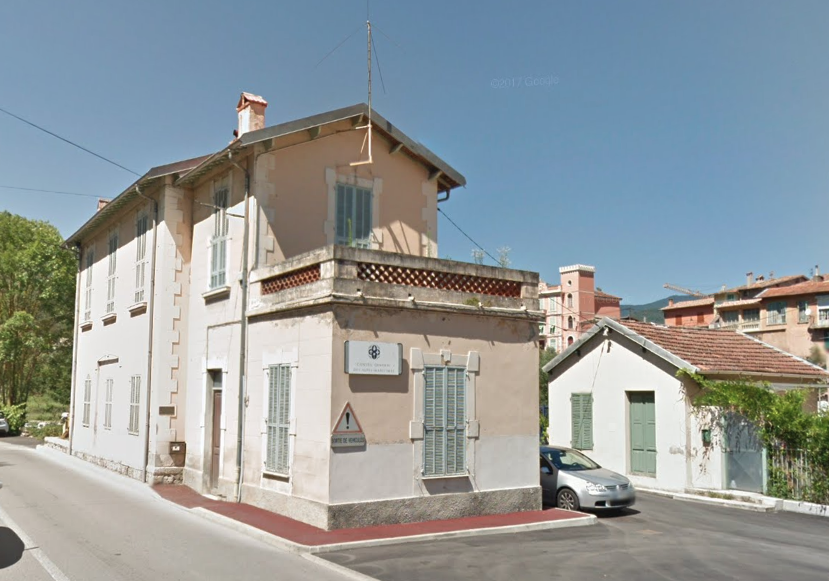
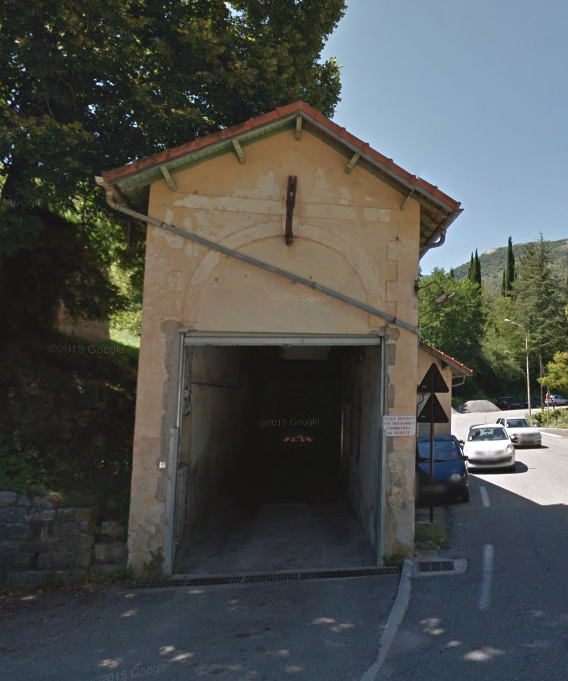
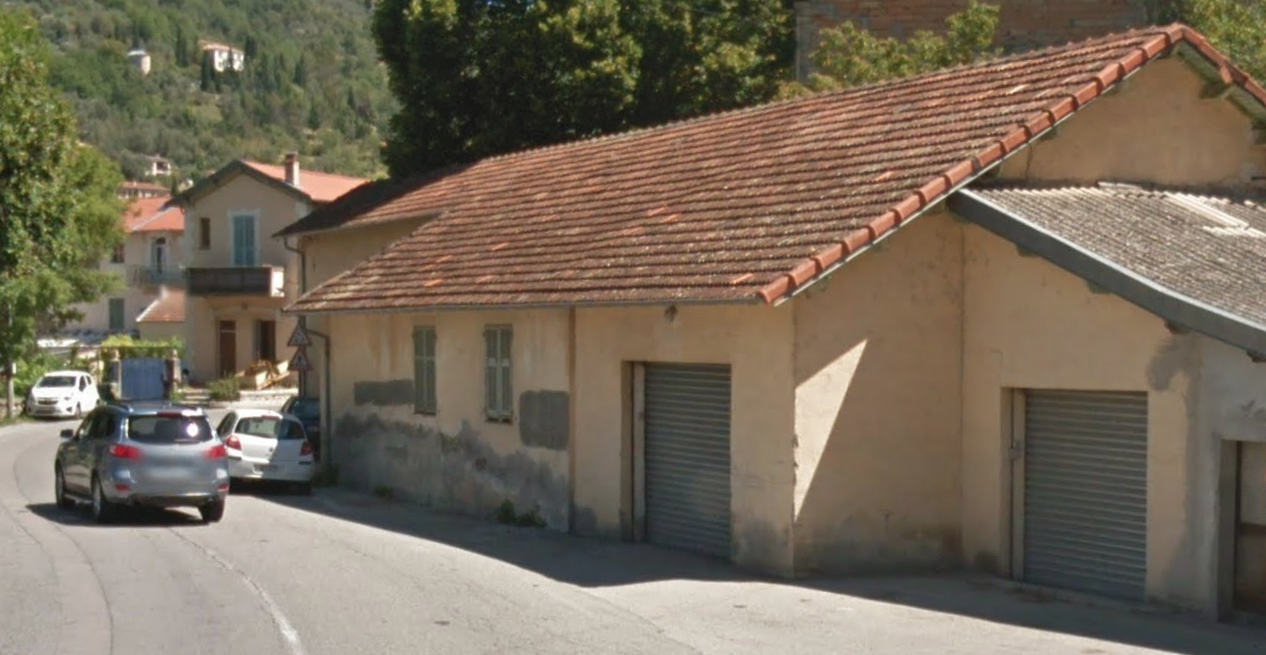
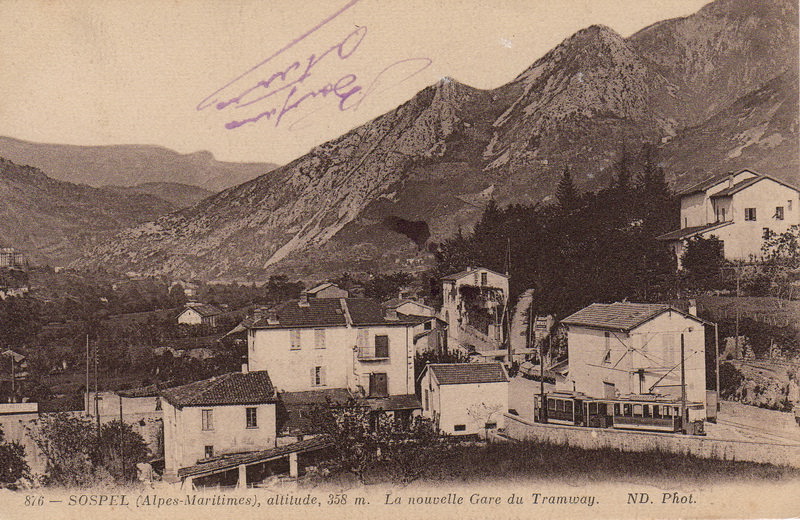
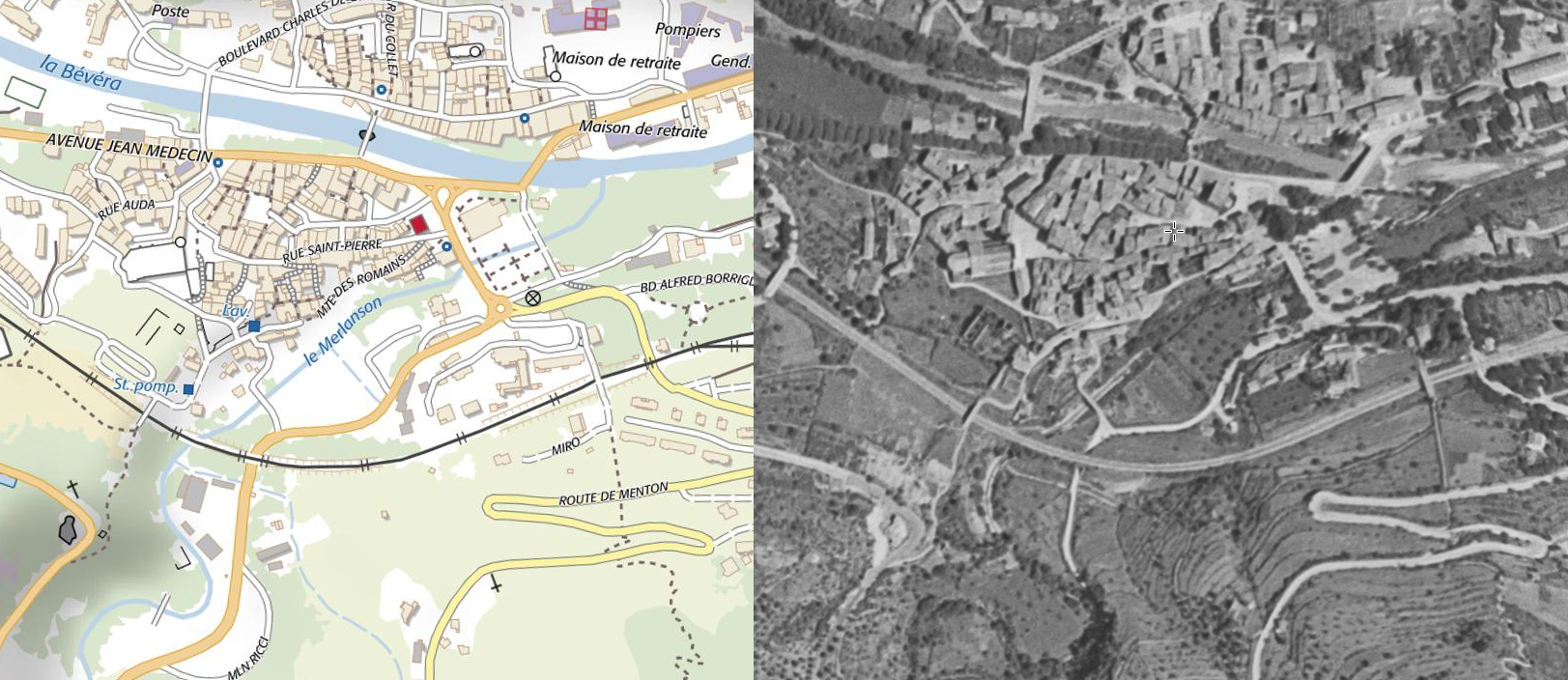
The tramway left the town from a station on the south-side of the river. Buildings from the tramway station still exist. They can be seen on the satellite view below to the east and south of the car-park towards the bottom of the image.

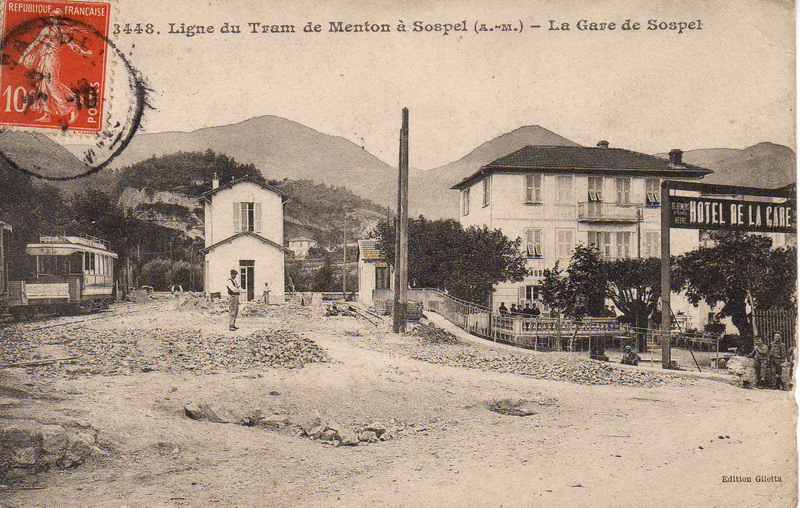
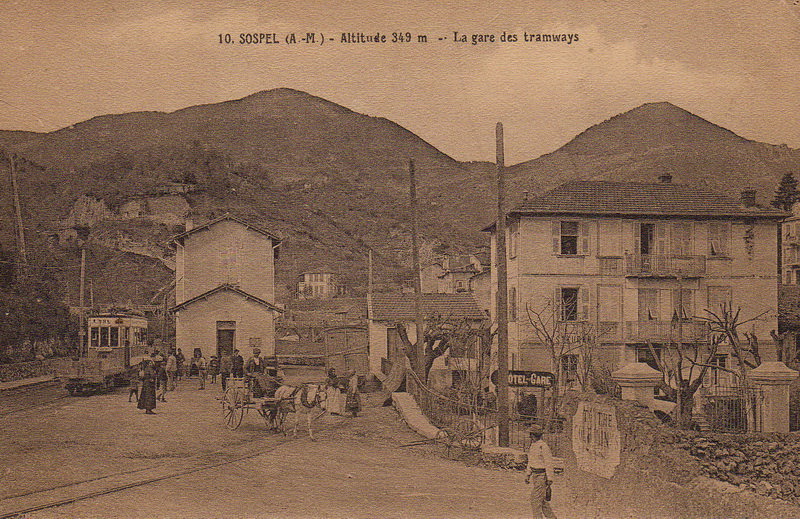
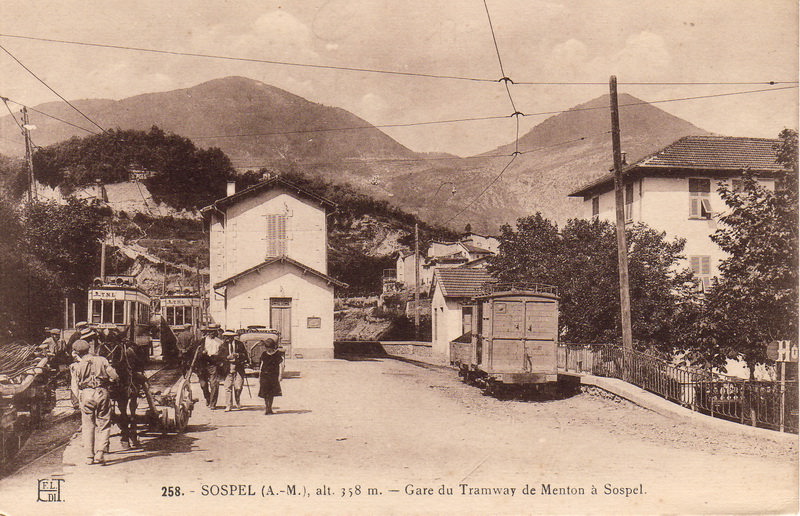
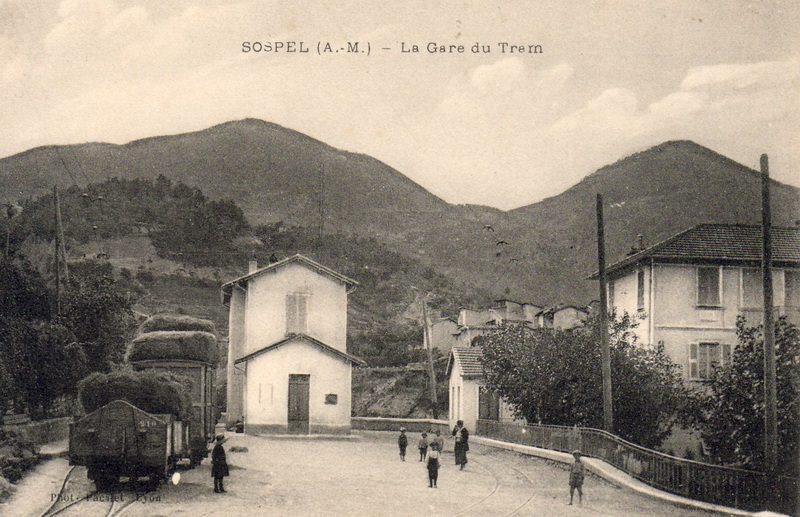
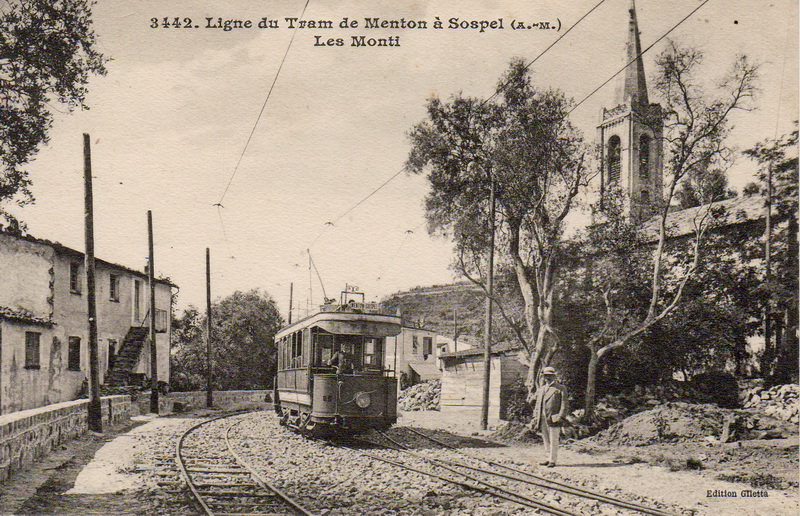
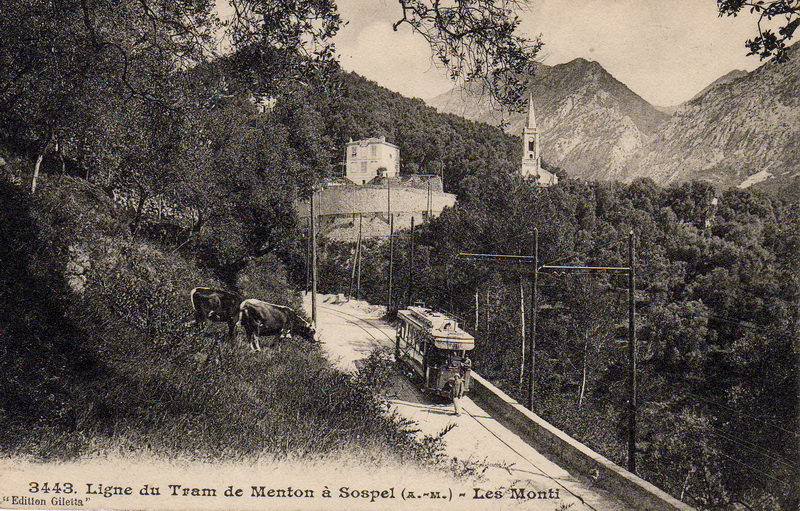
These present day images can be compared with those on postcards from the early 20th Century, some of which are reproduced below.

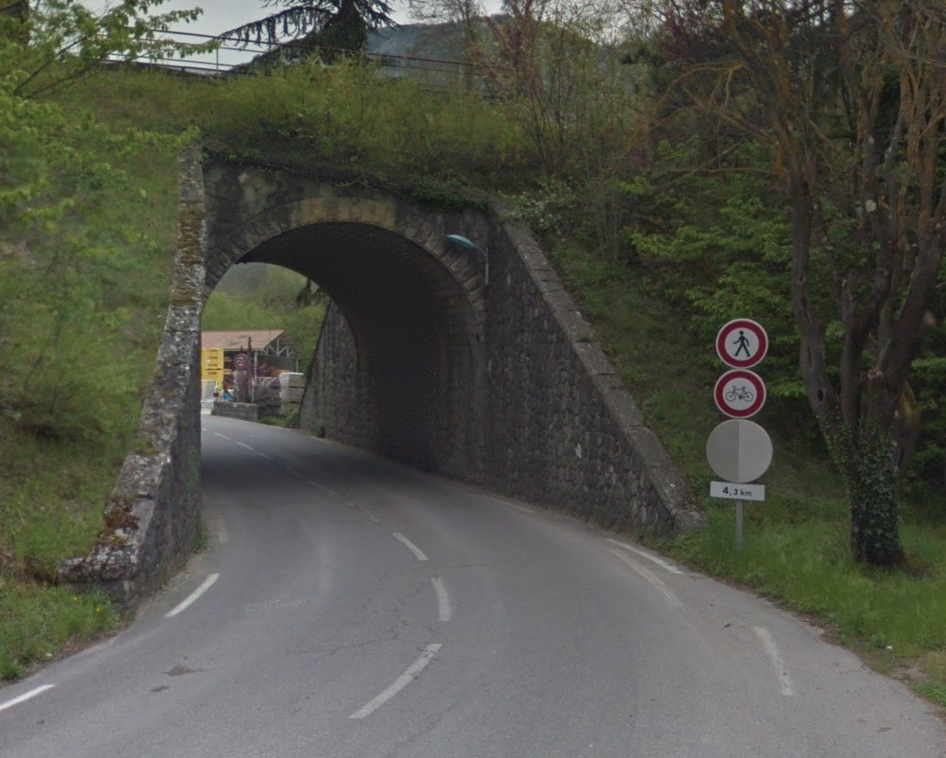
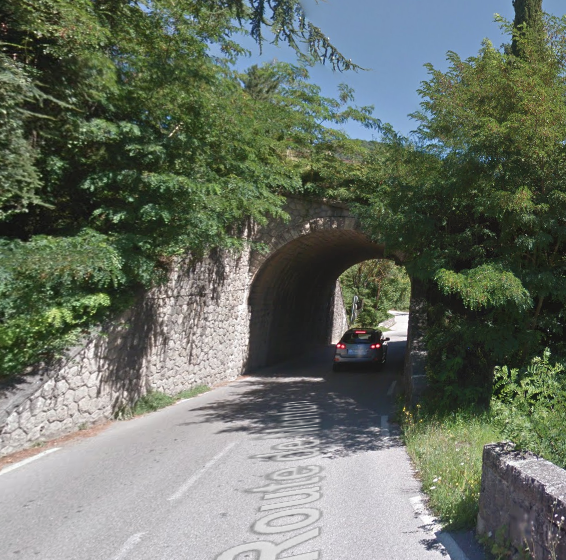
The tramway left Sospel and passed under the Nice to Cuneo line through a bridge which now accommodates the D2566A main road to Menton. At the time the tramway was operating this road did not exist.

Along a significant portion of the journey to Menton the new road has replaced the tramway.

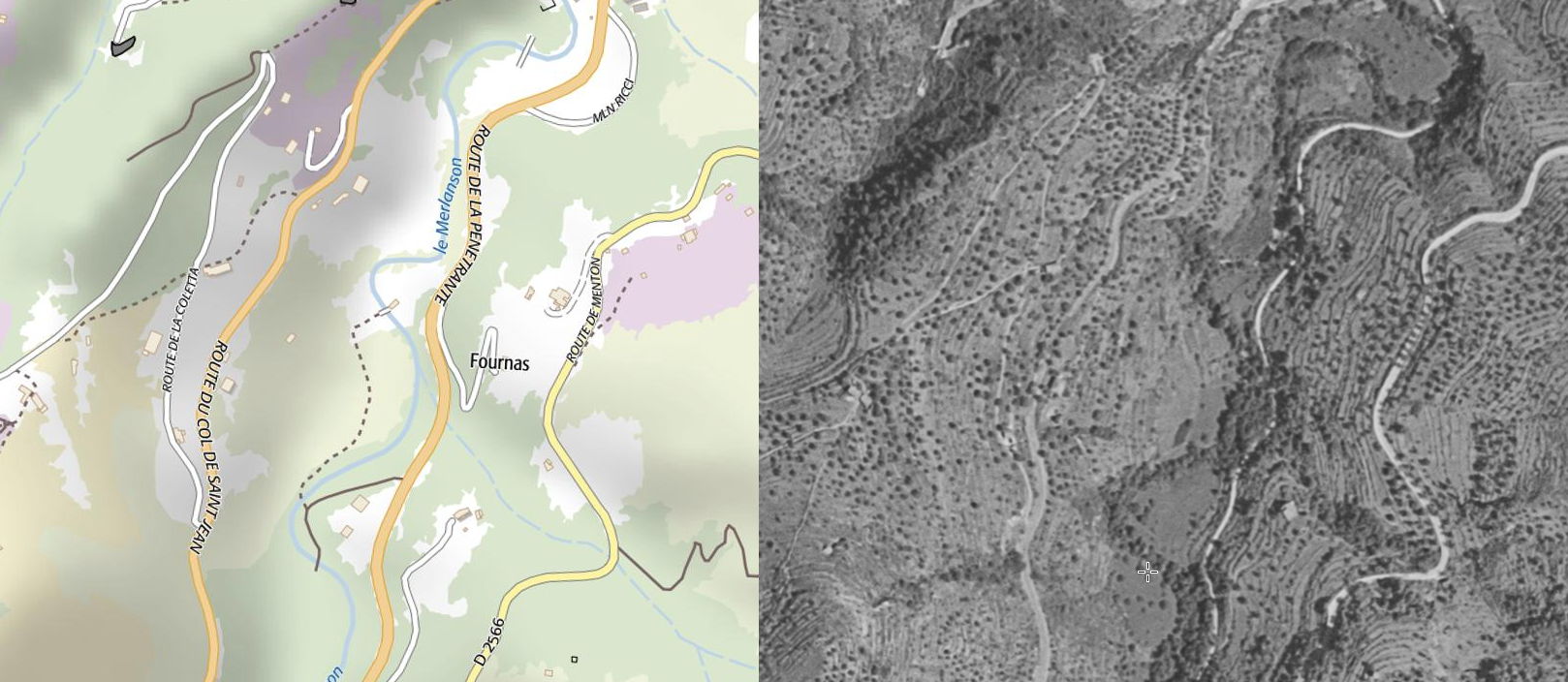
Beyond the bridge the road has been realigned and the old tramway route takes a tighter curve along what is now Rue Moulin Ricci as it passed along the valley of the Merlansen into the hills between Sospel and Menton


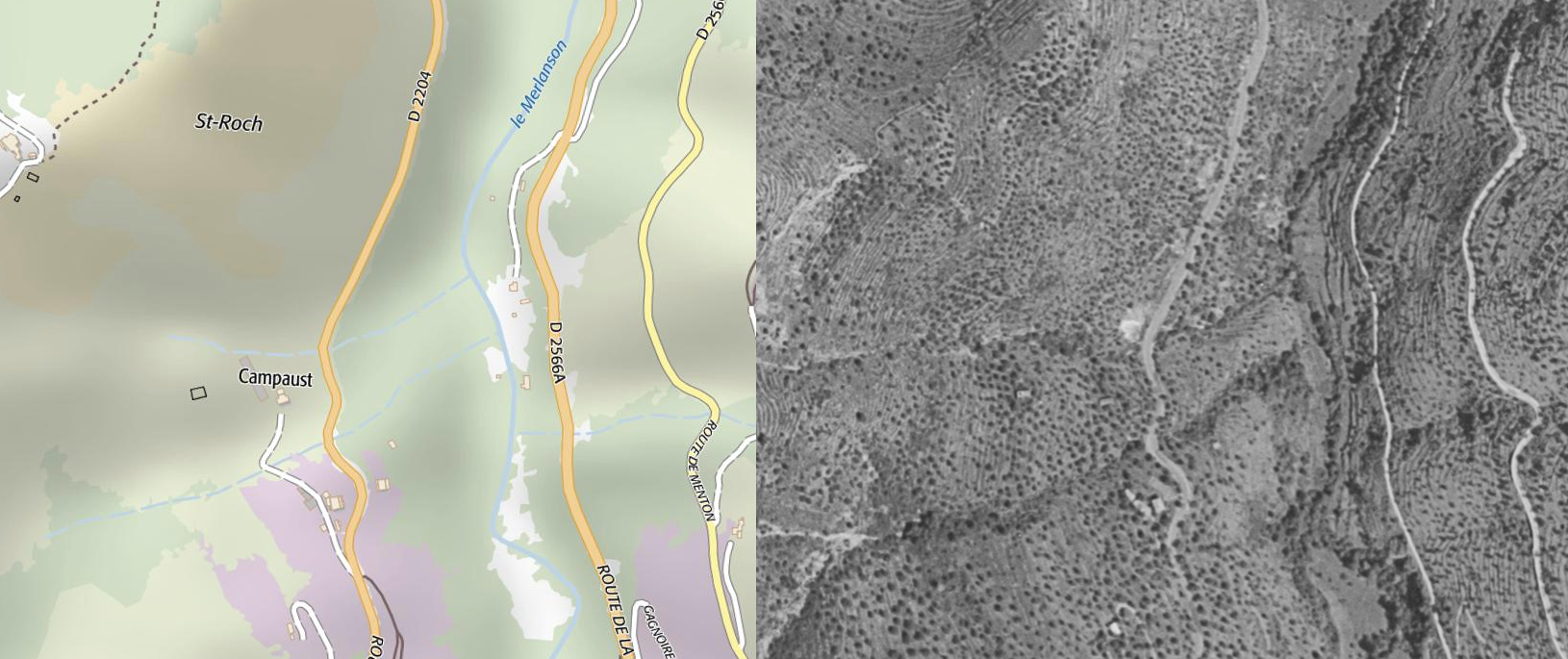
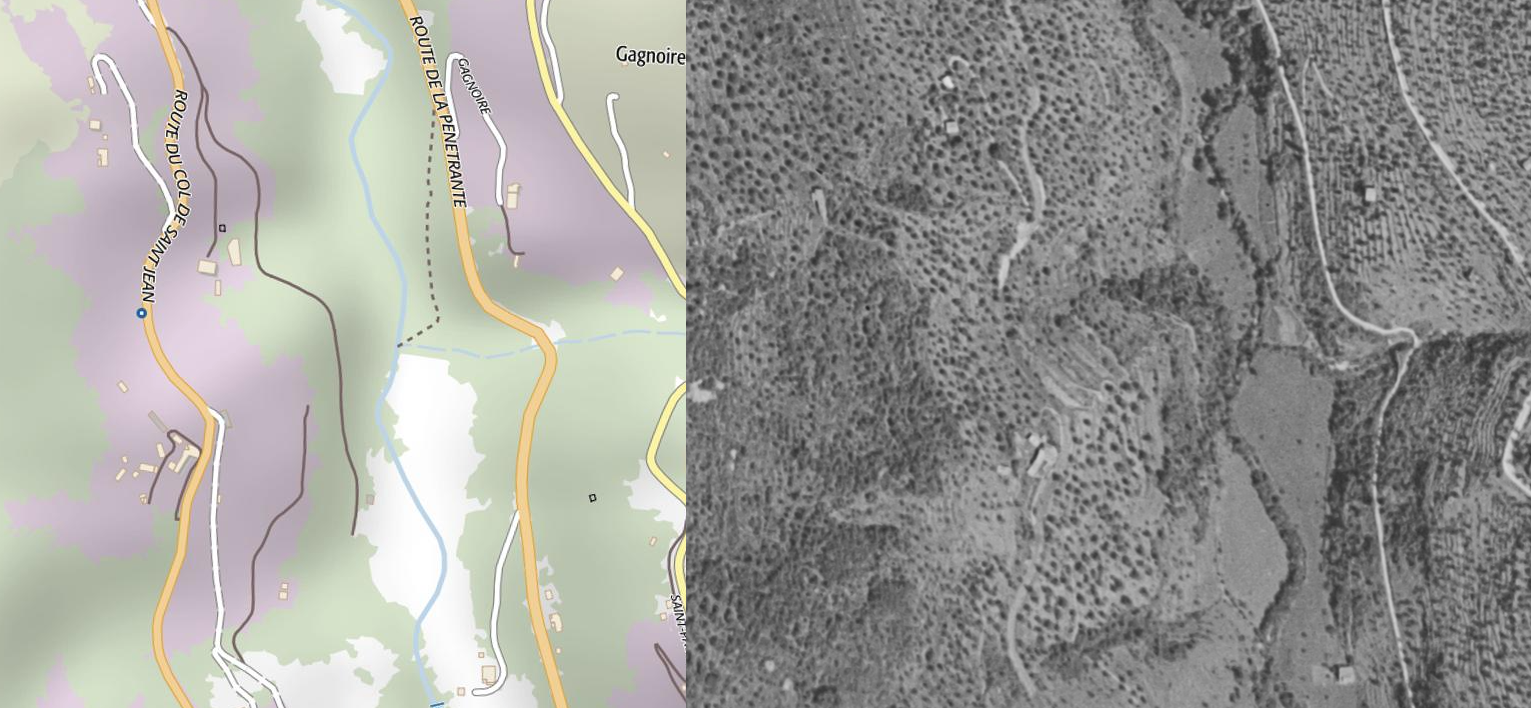
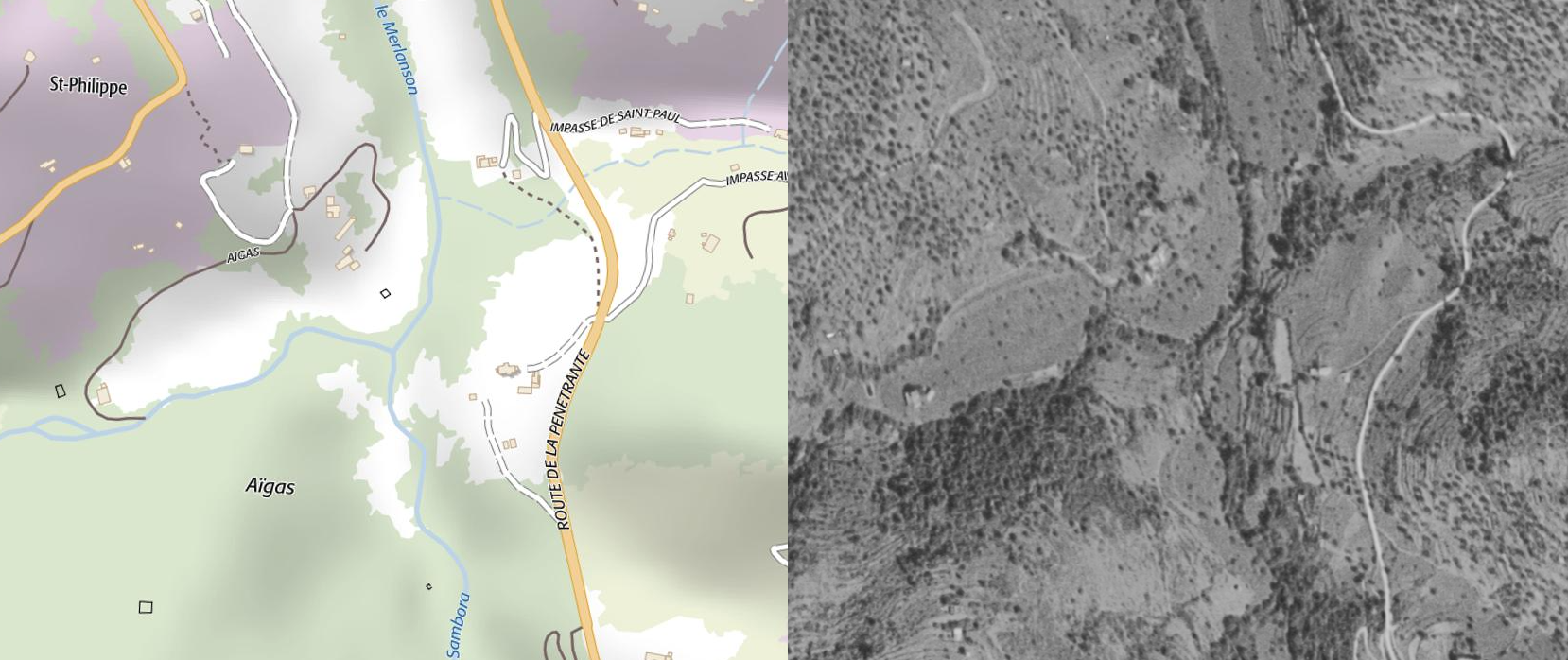
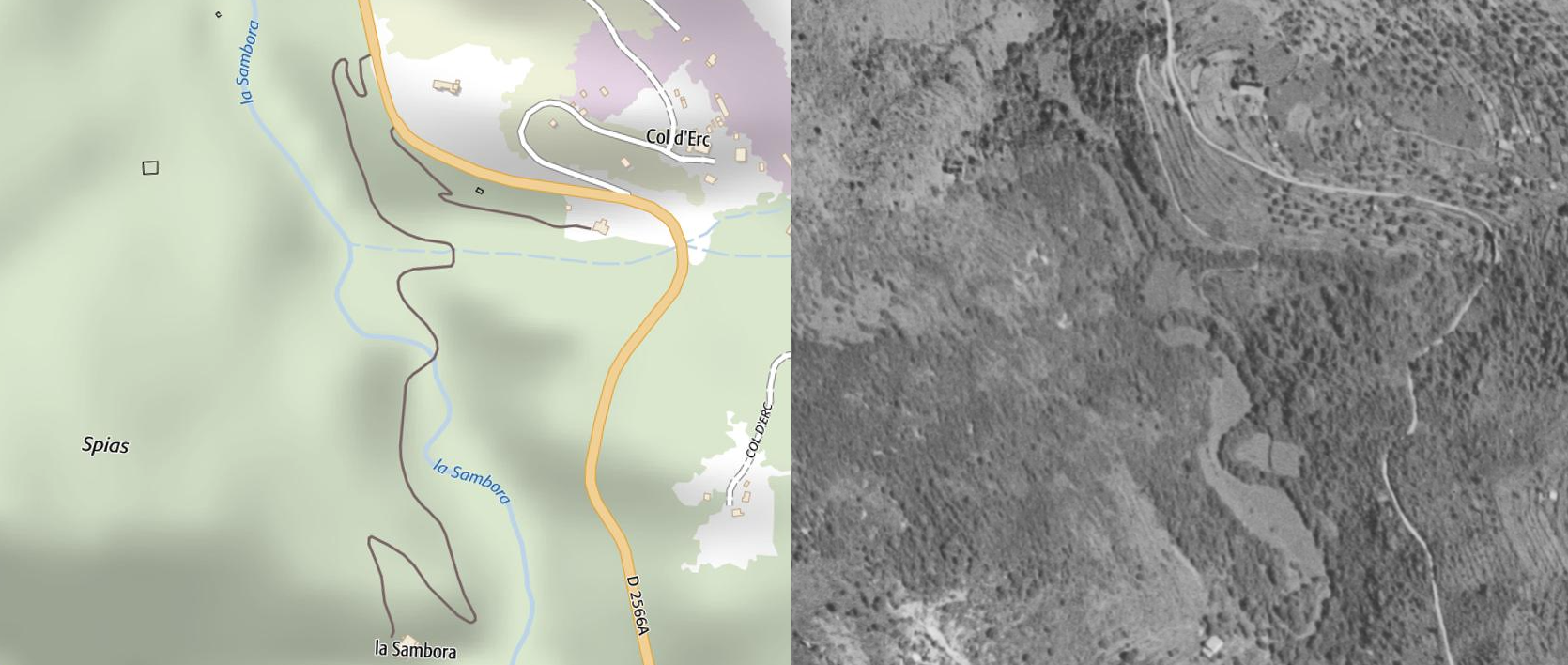
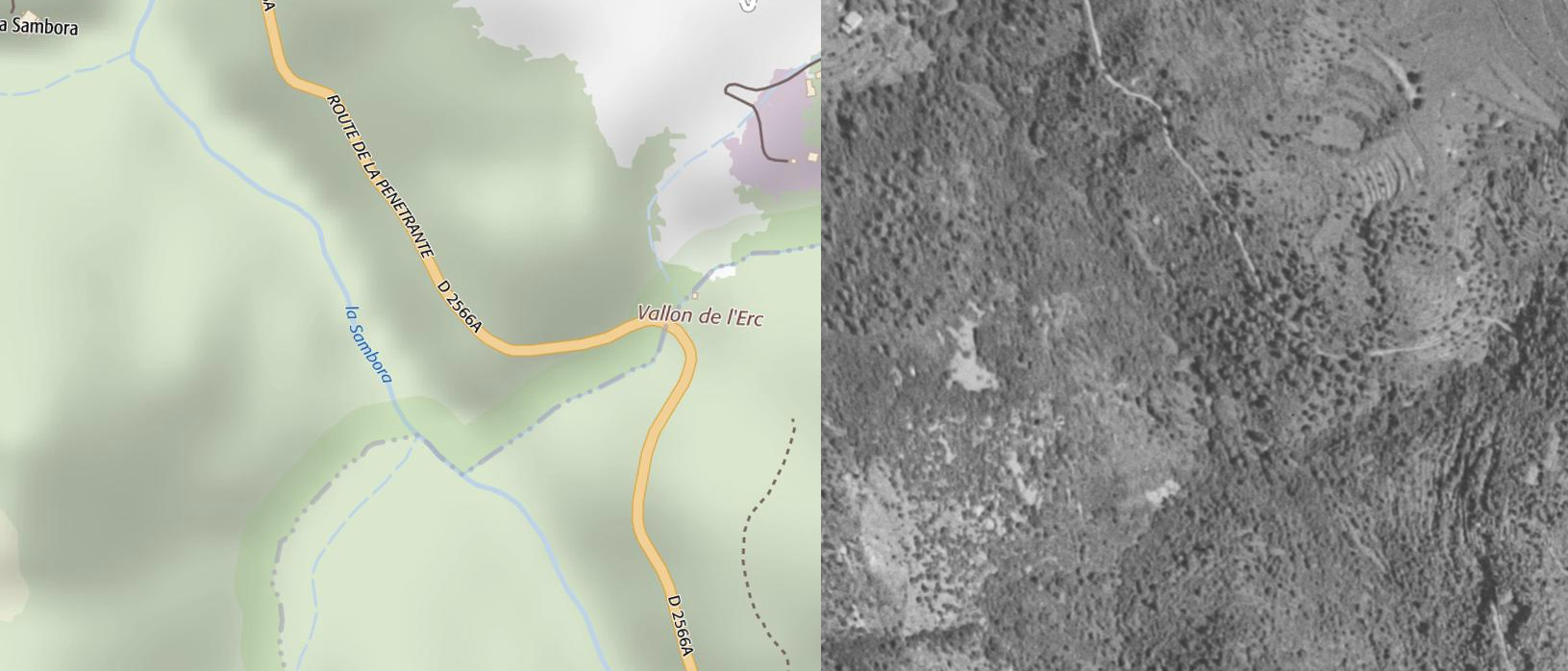
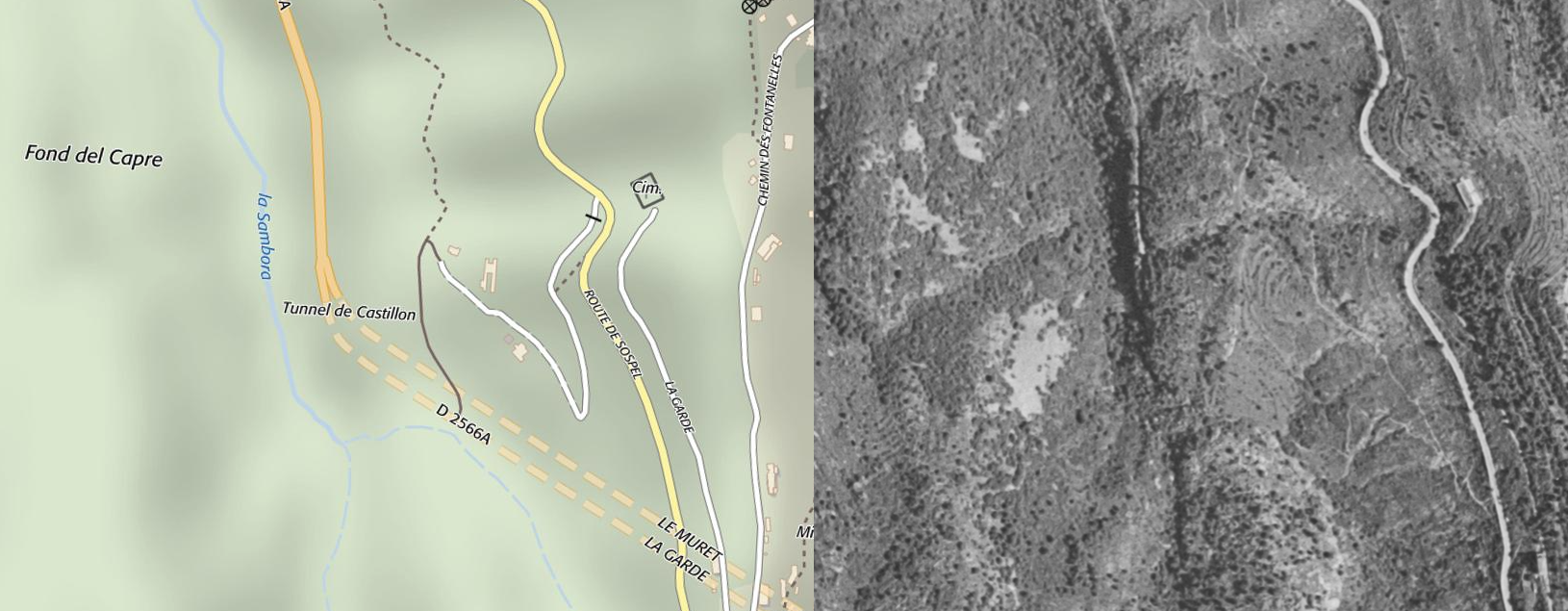
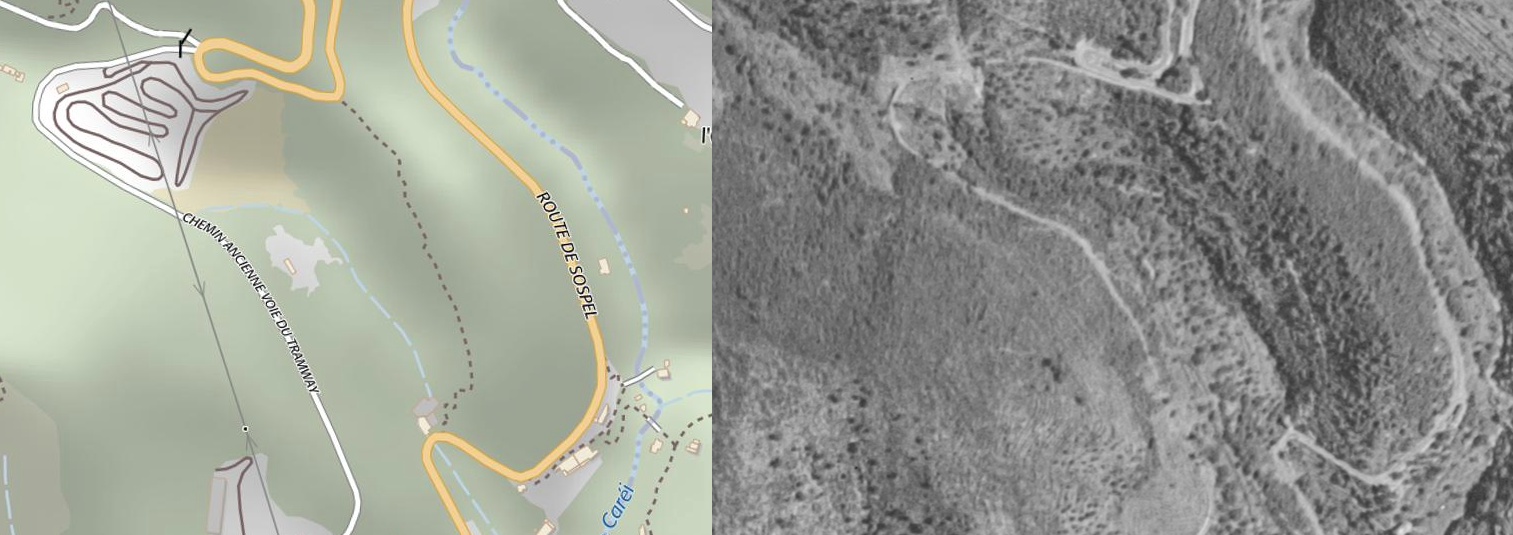
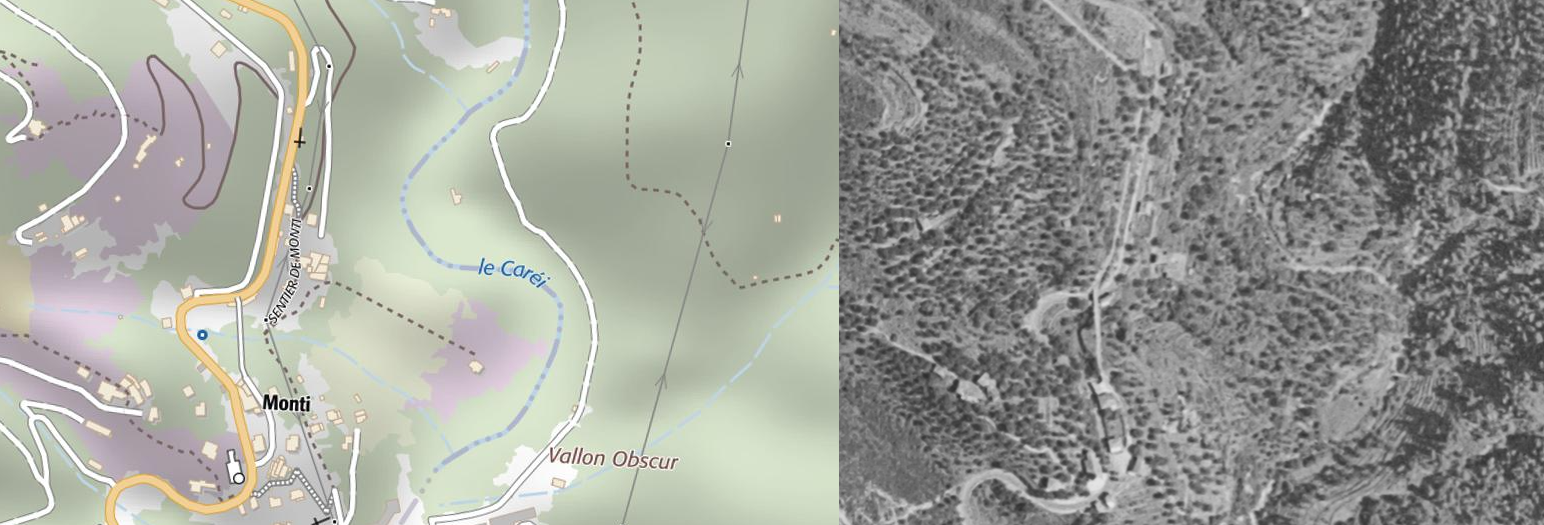
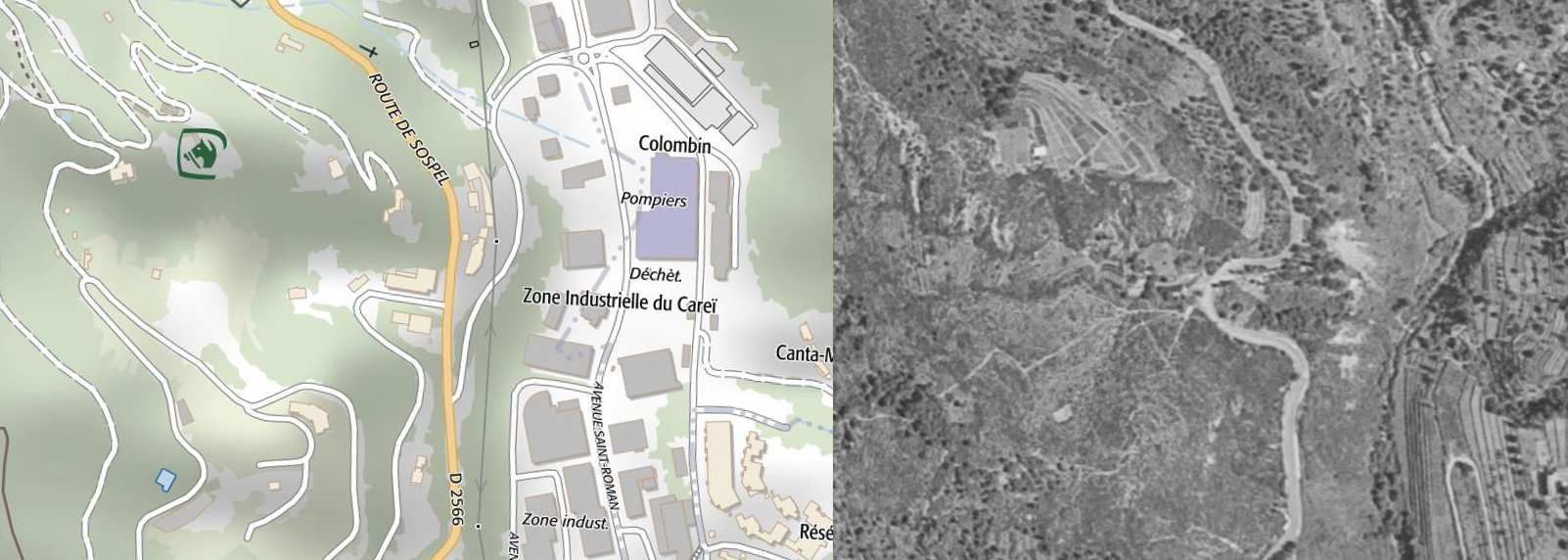
In the map/aerial photograph immediately above, the tramway turned away from the new road alignment into a side valley along what is now called the Impasse de Saint-Paul it crossed the stream in the valley and returned back to the main valley along what is now the Impasse Aigas. Incidentally the aerial photographs in these images come from the website https://remonterletemps.ign.fr and are dated 1955.

With just minor deviations along the way, the tramway and the D2566A follow the same alignment until reaching the tramway tunnel under the Col de Castillon. The road either side of the tunnel bears the name: Route de la Penetrante.The original tunnel was single bore and followed the line of the more northerly (left-hand) bore shown on the above picture. The scond image of the tunnel is taken from the Menton side and shows the original tunnel mouth (on the right) and the old tramway station building.The two bores are given different names. The original bore is known as Le Muret, the new bore, La Garde.The Tunnel de Castillon was 570 metres above sea-level and extended over 710 metres in length. [3] This final image of the tunnel shows the tramway dropping away steeply.At the South-East end of the tunnel the new road rejoins the historic D2566, Route de Sospel and the tramway deviates to the south along the brown line shown on the maps immediately below. This track bears the name Figournas. There is one image of a tream on this section of the tramway below the next two maps. The tramway formation meets the D2566 again just below the village of Castillon and the second of two hairpin bends.The formation of the old tramway can be seen decending steeply to the right of the modern D2566. It crossed the road at this point and dropped down to rejoin the road below the hairpin bend – Saint-Louis Streus.The tramway followed the road as it dropped steadily down the contours of the valley until the Viaduc du Caramel. We were able to take pictures of this viaduct in 2015 and 2016. Sadly I cannot now find those photos and have had to trawl through online pictures to find similar ones without copyright issues.The final picture above highlights the line of both the tramway and the old D2566 as they wind down the valley towards Menton. Two viaducts are in the picture, Viaduc du Caramel and Viaduc du Carei

The Viaduc du Caramel is 125 m long andmade up of 13 arches. As the photos illustrate it is heavily curved. It was built during the period 1908 to 1910. The line was closed in 1931. The alignment of the viaduct was imposed by the War Ministry so that it could be easily destroyed if necessary.  The designer/engineer for the work was Engineer Arnaud, who was also repsonsible for Le Pont de la Mescla (1909) and at the Gros-Vallon Viaduct (1900) towards Annot (Alpes de Haute-Provence). The line and viaduct first carried trams in 1912.[4]

Beyond Viaduc du Caramel the line continued to drop steeply down to Viaduc du Carei which is visible roughly in the centre of the last image above. I think that the image below is perhas the best of all the images in this post, it shows the Viaduc du Caramel in the backgroud, the Viaduc du Carei in the foreground and the bridge carrying the D2566  thorugh one of the arches of the Viaduct.

Menton – Alpes Maritimes – PACA – France – Ligne dy Tral de Menton a Sospel, le Viaduc du Carei

The D2566 used to run through the first arch on the left side of the viaduct on the image below, the new road has significantly reduced the height of what were tall viaduct piers over the valley. 

The viaduct is named after the river which flows under it. The tramway follows this valley all the way to Menton. Initially a little distant from the D2566 to the West and at a higher level it rejoined the line of the D2566 for a distance unitl the road dropped steeply away at a hair pin bend and the tramway needed to continue to follow the contours. The first image below shows the tramway alongside the road, the next comparative plan view shows the road dropping away and the tramway continuing on the north side of what is now an off-road biking (moto-cross) venue.The tramway is marked from this point as the Chemin Ancienne Voie du Tramway on the modern maps. And the formation is tarmacked and we have a record of the rout on google maps and streetview. The tramway route seen leaving the road. It is the roughly tarmacked route on the left.The moto-cross venue is on the left in the second image.Some substantial structures, particularly retaining walls were needed to create the space for the tramway formation. Both above and below the tracks.The formation was narrow and at times significantly constrained by the topography of the valley sides.This next image shows the point at which the modern narrow road rejoins the D2566.As can be seen on the plan above the tramway rout actually crossed the line of the road. The bridge on which it was carried has now gone. But the route can clearly be picked out on the satellite image below as a viaduct crosses the small valley to the south of the D2566 road.

Before we look at old postcards, here are some views of the viaduct at Monti in the 21st Century, the first few are taken from the roads around it.

These next images are postcard photographs, first of the viaduct, then of the tramway station at Monti and then of the line south of the village.

A very serious accident, which cost the lives of two people, occurred on 11th September 1912, about six months after the opening of the Sospel to Menton tramway [5] .

A goods train carrying gravel for the completion of the line left the Caramel Quarry at about 4.00pm with nearly six tons of gravel. Four people were also due to travel on the train. At the last moment, M. Vallaghé, an entrepreneur, and Viale, an employee, decided not to travel on the train as they noticed a rail in bad condition and wanted to wait to warn the next train. This decision saved their lives.

At around 4:30 pm, about two hundred metres before the Monti station, the tram electric catenary boom jumped; the dynamic brake became unusable, the driver tried to use the handbrake, but at the north side of the viaduct of Monti, the pole hooked a rock … The tram became unbalanced and crashed onto its roof some 50 metres below the viaduct, killing both employees.

The news spread very quickly and by 7.20pm, the manager of the tramway, the mayors of Castillon, Sospel and Menton, and even the Prefect of the Alpes-Maritimes had arrived at the site. The next day at 4 pm, all traffic on the tramway was halted. A company tram took the bodies to the Saint-Joseph Church in Carnolès, where the funeral was held, attended by all the network’s workers. As a result of this accident, various safety measures were implemented, in particular the installation of mandatory stops and safety switches.

From Monti, the route curves round the edge of the valley gradually dropping through the contours.The modern road cuts across one loop of the tramway. This can be seen by comparing the map and the aerial image immediately above. Otherwise the tramway formation follows the D2566 to a point close to the motorway, the D2566 gives way to the off-pink road on the modern map and the tramway follows the Route de Sospel while the old D2566 dropped down into St-Roman (white road). The Route de Sospel at this location overlays the tramway formation and was not present when the tramway was operational in the early 20th Century.

The two routes meet again at the modern roundabout next to the River Carei shown on the adjacent satellite image. The tramway then continued along the line of the Route de Sospel alongside the D2566, passing under the PLM (SNCF) railway line to the East of Menton Station until it reached Rue Partouneaux and then Place Saint-Roch. The terminus location in Place Saint-Roch is marked with a red flag on the last satellite image below’

Originally the terminus was back along the valley of the River Carei at a place called “Villa Caserta”, in the valley of the Careï. This was the northern limited of the tram network in Menton.

References

[1].  Wikipedia; Sospel, https://en.wikipedia.org/wiki/Sospel, accessed 23rd February 2018.

[2].  Wikipedia; Sospel Cathedral, https://en.wikipedia.org/wiki/Sospel_Cathedral, accessed 23rd February 2018.

[3].  Inventaire des Tunnels Ferroviaires de France; http://www.tunnels-ferroviaires.org/tu06/06036.1.pdf, accessed 23rd February 2018.

[4].  Heritage Resources of the Alpes-Maritimes; http://www.media-crdp.net/A&C06/bassin-menton-roya/castillon/caramel/caramel_plus.html, accessed 23rd February 2018.

[5].  Le Temps (Paris); Le Temps No. 18699, 13th September 1912 (ISSN 1150-1073)


Locomotives and Rolling Stock on the Central Var Line (Chemins de Fer de Provence 50)

Locomotives and Rolling Stock

Background information on the companies which built the locomotives which served on the Central Var line can be found by reading my post on the locomotives of the Coastal Line  – Le Macaron.[4]

In this next series of posts we will focus on the locomotives and rolling stock rather than primarily on their manufacturers and specifically on the locomotives and rolling stock used on the Central Var railway line. There are stories to tell about the history of some of the major French manufacturers of locomotives but they are stories for another time and place.

At the height of its powers, between 1888 and 1908, Le Chemins de Fer du Sud de la France network had:

• 23 steam locomotives.
• 42 passenger coaches: 3 in 1st class A series; 21 mixed 1st and 2nd class series AB; 6 in 2nd class B series; 2 mixed 2nd class + van series BD and 10 open coaches called ‘jardiniers’ series AC and C. These were sourced from various manufacturers: the Foundries and Forges of Horme Company, Chantiers de la Buire in Lyon; the Desouche and David workshops in Pantin; the Hanquet factories -Aufort and Company in Vierzon; the establishments De Dietrich in Lunéville; and the ‘jardiniers’ came from a network of steam trams – the Raincy-Montfermeil in the northern suburbs of Paris.
• 12 luggage and post office vans: 10 luggage vans with DD series postal compartment and 2 DS series emergency vans. Their manufacturers were as follows: 6 Buire vans, 4 De Dietrich vans, 2 Hanquet-Aufort vans.
• 219 goods wagons: built by Horme and Buire, Hanquet-Aufort, De Dietrich, and Magnard and Decauville.

Later there was a concerted effort to modernise the whole network and a series of diesel railcars were purchased. More about these in a later post. This first post pulls together a number of pictures of the steam locomotives on the Central Var line, and with the aid of friends on the Passions Metrique et Etroite forum, particularly 242T66, and the help he has given in accessing the french text of the book by Jose Banaudo[1], I attempt to provide useful and interesting reflections. I hope that all of these posts on Les Chemins de Fer du Sud de La France in Provence will enable English readers to appreciate the extent and diversity of the metre-gauge lines in Provence and perhaps as a result to investigate the amazing network of these lines which supplemented the standard gauge network in France.

As I discover more images of these steam locomotives, I will add text to this blog post, so if you are interested in this material, you might want to review notifications of updates to my blog. You might also discover things which call into question something I have written or which supplement the various posts that you will discover on my blog. Please feel free to contribute observations, corrections or questions …….……….…

Steam Locomotives on the Central Var Metre-Gauge Line in Provence

Between 1889 and 1894, 19 steam locomotives were put into circulation on the whole network; divided between 3 manufacturers: 8 SACM, 8 Pinguely and 3 Corpet-Louvet.[5] A number of these were used on the Central Var line.

Later, other locomotives were purchased …..These Locomotives included some from the manufacturer Franco-Belge as well as SACM, Pinguely and Corpet-Louvet.

In the first decade of the 20th Century, Pinguely 4-6-0T locomotives were ordered. The close-up shot shown below is taken at Toulon, but these locomotives also served on the Central Var Line.

Very similar 4-6-0T locomotives were ordered from SACM. The image below is one used on the Macaron but it is identical in design to ones used on the Central Var line.

Details of these locomotives and pictures of them operating on the Central Var line can be found below.

1. Pinguely 4-6-0T Locomotives

Locomotive No. 89 is a 4-6-0T Pinguely (Works No. 192) delivered in November 1905 and remodelled in 1949. Sérié E of Les Chemins de Fer du Sud de la France, it is part of a series of 12 locomotives delivered between August 1905 and December 1907. The whole network including the coastal line had a total of 28 E and F Series 4-6-0T locomotives, supplied by several manufacturers. No. 89 was scrapped in January 1951. According to José Banaudo, these 4-6-0T locomotives were the best steam engines on the network.

The picture of SF No. 89 was taken at La Manda Station. This is the best head-on picture of a Pinguely 4-6-0T engine that I have discovered.

It is difficult to distinguish between the different 4-6-0T locomotives on many of the postcard images available today. For example, there are two images of the La Manda Station near Colomars below. In the first image it appears that the locomotive is a 4-6-0T but the resolution of the image is not good enough to determine whether it was made by Pinguely or SACM. The second image appears in Jose Banaudo’s book (reference [1] below) and on the CPArama website.[2] Banaudo highlights the fact that the locomotive in that image is a 4-6-0T but does not clarify which manufacturer. He does draw attention to the flat wagon at the left of the picture which he says must have come off the TAM network because of its narrower loading gauge.

I have been consulting with 242T66 on “Les Passions Metrique et Etoile!!” Forum[3] about some of the photographs in this blog. They comment that it is likely that the locomotive in the second image is an type E 4-6-0T because the type F had an air-compressor fitted to the right-hand side of the smokebox. It is possible that the locomotive is a SACM Series 81-86 rather than a Pinguely locomotive. Other people’s reflections on this locomotive would be appreciated.
The next few pictures are taken at Vence Station. The first shows 4-6-0T No. 129 Franco-Belge on a long Grasse to Nice mixed train in the early 1930s.

4-6-0T Pinguely on a Nice to Grasse mixed train is shown at Vence in the image below. The van on the right of the picture is a wagon from the TAM tramway. The picture was taken after 1916 as the third rail has been lifted from the left-hand track.

The locomotive in the image below is likely to be Class E 4-6-0T (quite likely it is a Pinguely, I am told, because of the bigger oil-lamp casing on top the cab). This is a relatively early picture because there is no evidence in the picture of the tramway and it appears that the third rail is still evident on the glimpse of the track to the left of the locomotive.

In the image below a passenger train heading from Nice to Grasse crosses the Viaduc de la Pascaressa, near Tourrettes-sur-Loup pulled by a Class E 4-6-0T, probably a Pinguely engine.

In this image of Pont du Loup a mixed train from Grasse to Nice is in the care of a Class E 4-6-0T prior to 1916 as the mixed gauge track is still in place. The locomotive is probably a Pinguely 4-6-0T.

2. Franco-Belge 4-6-0T Locomotives

This image shows a Franco-Belge class E 230T at Claviers on a short Grasse – Draguignan working at Claviers.[1]

The Société Franco-Belge was a Franco-Belgian engineering firm that specialised in the construction of railway vehicles and their components and accessories. The company originated in 1859 as the Belgian firm Compagnie Belge pour la Construction de Machines et de Matériels de Chemins de Fer, founded by Charles Evrard. The company expanded its share capital in 1881 forming a new firm Société Anonyme Franco-Belge pour la Construction de Machines et de Matériel de Chemins de Fer and constructed a factory in Raismes (Valenciennes) in the Département Nord in France.

In 1927, the company split into a Belgian (Société Anglo-Franco-Belge, SAFB) and a French company (Société Franco-Belge).

The company’s factories were occupied during World War I, during which period it was used as a sawmill, and during World War II, during which period it manufactured Kriegslokomotives. SAFB merged with the Ateliers Germain in 1964; the company closed in 1968 due to lack of work.

The Franco-Belge (based in Raismes) was acquired by Alstom in 1982, as of 2012 the factory Alstom Petite-Forêt, Valenciennes operates as an Alstom subsidiary, specialising in metros, trams, and double deck trains, A test track Centre d’Essais Ferroviaire is located west of the Raismes factory.

Wikipedia[9] provides further information:

In 1859, Charles Evrard acquired Parmentier Freres et Cie. based in La Croyère, (La Louvière, Belgium) and merged it with the Ateliers Charles Evrard (of Brussels, Belgium) to form the Compagnie Belge pour la Construction de Machines et de Matériels de Chemins de Fer (1862), (often referred to as Compagnie Belge pour la Construction de Matériels de Chemins de Fer). At the Exposition Universelle (1867) in Paris, the company exhibited a locomotive, passenger coaches, an iron goods wagon, and a steam rail crane.[6][7]

In 1881, the plant in Brussels was closed and the factory’s equipment was transferred, reducing pollution and other inconveniences caused to the populace of Brussels.[8] The area of Molenbeek-Saint-Jean in Bruxelles, in which the Société Belge’s factory was located gained the nickname “le Manchester belge” due to the industry there. The company was restructured and named Société Anonyme Franco-Belge pour la Construction de Machines et de Matériel de Chemins de Fer. In 1882 a new factory was established in Raismes in the north of France, allowing the company to circumvent protectionism in the French market; initially the factory at Raismes in France assembled machines using components manufactured across the border in Belgium. All types of railway rolling stock were built.[8][10][11][12]

In 1911, the company was renamed Société Franco Belge de Matérial de Chemins de Fer.[8] The company manufactured a wide variety of rolling stock (locomotives, carriages, specialised freight wagons) for clients, including the Belgian railways, private French railways, as well as exporting to Spain, Portugal, and other European countries; China, Turkey, and Indochina; as well as to African and South American countries.[8][13]

By 1914, the company had a capacity of around 50 locomotives and over 1,500 carriages and wagons per year; during German occupation during World War I, the plant in Raismes was ordered to carry out repair work, but this was resisted by the plant management – the factory was used under occupation as a sawmill.[14]

After World War 1, French and Belgian diverged. The French operations continued under the name “Franco-Belge”. The Société Franco-Belge was in operation from 1927 to 1981.

Amongst other production in the 1930s, Franco Belge in Raismes manufactured Beyer Peacock designed 4-6-2+2-6-4 ‘Garratt’ locomotives for Algeria,[15] and also carriages for an imperial train built for Emperor Haile Selassie of Ethiopia.[16] The association as sub-contractor to Beyer Peacock continued to the 1950s.[17] Over 80 Indian Railways WG class 2-8-2 locomotives were produced in the early 1950s before production capacity at the Chittaranjan Locomotive Works, India, was built up.[18]

The later history of the company can be followed on Wikipedia.[9]

3. SACM 4-6-0T Locomotives

The Alsatian mechanical engineering company (Société Alsacienne de Constructions Mécaniques (SACM)) based in Mulhouse was a flagship of French industry. It produced a lot of locomotives.

During the 1890s the company was particularly noted for its fast and efficient compound locomotives designed by Alfred de Glehn.

A whole series of different locomotive types were constructed by SACM, two were present on Le Chemins de Fer du Sud. SACM 2-4-2T Series No. 51-56, which were all in use on the Littoral line, Le Macaron, and SACM 4-6-0T locomotives. Series No. 61-62 were used on Le Macaron and the wider network.

 The image above shows what is probably a 4-6-0T locomotive at Callas Station. The arrangement of the front lamps seems to match that on the 4-6-0T locos elsewhere in this post. Other locos seem to have the lights more widely spaced.

This image of the station at Montauroux is shown in Banaudo’s book[1] but no details about the engine are provided. Sadly the station sign is placed so that the cab is not visible. All that can be said is that the cab does not curve downwards at the side but rather has a lip between roof and side. The overall impression, I get, is that of a 4-6-0T locomotive as it appears to have a front bogie. However, the definition of the photograph is not good enough to place any weight on this opinion.

Here at Barjols a class E or class F 4-6-0T (230T) locomotive is in charge of a Draguignan bound train.

Here a 4-6-0T (230T) enters Jocques Station.

4. Mallet 0-4-4-0T

The railways of Provence had eight of these locos No. 13 to 18 and 31, 32 which were made by SACM. The image below shows one of these locomotives crossing the Viaduct de la Lubiane to the north-west of Vence town and travelling towards Nice, Vence. Banuado says that it is a ‘mixed train, Class C Mallet 020+020T SACM’ in British terms this is a 0-4-4-0T loco.The image above shows a Class C Mallet 0-4-0+0-4-0T, SACM (built 1892/1900) in charge of a
Mixed train travelling across Le Pont du Loup from Grasse towards Nice.

This image taken at Barjols station shows a train heading for Meyrargues headed by a SACM class C Mallet 0-4-4-0T (020+020T) locomotive.

5. Corpet-Louvet Large 0-6-2T

I believe that three of these 0-6-2T locomotives were purchased by the SF/CP and that they were all predominantly used on the Nice to Meyrargues line.

6. SACM-Belfort 0-6-0 Tender Locomotive (Class A)

The Central Var had four 030 tender locomotives, they were built in 1887 by SACM Belfort: No. 1 “Draguignan”; No. 2 “Flayosc”; No. 3 “Entrecasteaux”; No. 4 “Salernes.” Two images of these engines follow. The first at Draguignan and the second at Flayosc. Both the last two images must predate 1890 because it was in that year that the large cylinders were installed in front of the cab.These cylinders were compressed air tanks for the brakes. An air pump was installed on the fast side of the locomotive shown at Salernes. Originally, the machines were equipped with the vacuum brake “Soulerin system” which proved insufficient. [1]

A very similar locomotive in model form.

A side elevation view of one of the 0-6-0 tender locos including the compressed air tanks for the brakes. This is one of those 4 locomotives built by SACM for Les Chemins de Fer du Sud de la France, although it is not clear which one of the four it is. (Publisher: HMP 8 rue de Tournon in Paris.)

And finally, a distant view of what may well be one of these locomotives pulling a mixed goods and passenger train, leaving Grasse for La Manda and Nice across the Viaduc de Font-Laugières, near Grasse. The loco is either a Class A 0-6-0T SACM or Class B 2-4-0T SACM (built 1887/1888). These were almost identical engines, but for the wheel arrangement which is hidden by the viaduct girders.

7. SACM-Belfort 2-4-0 Tender Locomotive (Class B)

The next image is, I believe, an early photograph of one of the Class B locomotives on the turntable at Draguignan.Banaudo[1] says of the above picture, that it shows Claviers station after the lifting of the third rail. The locomotive in the picture has a narrower body than many others which suggests that it might be a tender-loco rather than a tank-loco. Image definition is not good enough to warrant any claim of certainty but it may be a SACM-Belfort 2-4-0 Tender Locomotive (Class B) or possibly a SACM-Belfort 0-6-0 Tender Locomotive (Class A).

Aups-Sillans with a Draguignan to Meyrargues train hauled by a SACM class A or class B tender engine.

Here at Draguignan we have a view of the station building after it was rebuilt and extended (1905/1908) with a SACM class A or class B tender engine. The steam exhaust makes it impossible to tell whether this is an 0-6-0 or a 2-4-0 locomotive.

Three further images of the Class B 2-4-0 locomotives pointed out y members of the Passions Metrique et Etroite Forum follow below.

Here, a Class A 0-6-0 or a Class B 2-4-0 Tender Locomotive is in charge of a train at Rians Station, heading for Meyrargues.

8. Corpet-Louvet 0-6-2T (Class D)

Four of these locomotives were in use on the network. As far as I am aware they were restricted to the Central Var Line and the Nice to Digne Line. They were built in 1894 and numbered 20 to 23. The image below shows one of these locomotives at Claviers.

It has been suggested to me that the next image may well show an 0-6-2T (Class D) at Callas. However, the cab roof line suggests that it is not from the same batch of Corpet-Louvet 0-6-2T locomotives as the one above. For those interested in pursuing this issue the Passions Metrique Forum has a thread that is worth following.[19] The different cab roof-lines can be seen in images of 0-6-0T (030T) and 0-6-2T (031T) locomotives on that thread.This Corpet-Louvet class D 0-6-2T (031T) locomotive is at Lorgues Station.

9. Corpet-Louvet Mikado Locomotives – 2-8-2 tender-locomotives

I am indebted to 242T66 who posts on the French Forum Passions Metrique[3] for some of the notes about this class of locomotive. I know from earlier research[4] that this class of locomotive was almost an accidental acquisition by the network.

During the Second World War, the Littoral network received reinforcement from the largest steam locomotives that had ever been in regular service on a metre-gauge track in France. They were imposing type 2-8-2 tender locomotives (or Mikados). These machines were to be delivered to Senegal but their delivery was blocked. In the spring of 1943, 6 Mikado locomotives were allocated to the company’s network in the Alps and 3 others, numbered 21, 22 and 30 to the Littoral network. The image below comes from the collection of B. Roze and shows Corpet-Louvet Mikado 2-8-2 locomotive “Dakar-Niger” with its 16 cubic-metre bogie tender seen on the Littoral Line. The image below that shows Chemins de Fer Dakar-Niger, Corpet-Louvet 1736 of 1927. It was typical of a large number of metre gauge 2-8-2 tender locomotives built for service with the railways of French West Africa. Cylinders: 450mm x 550mm. Coupled Wheels: 1200mm. This is the same class of loco as the one shown in the first image.

These locos ultimately proved to be unsuitable for the line between Toulon and Saint-Raphael with derailments being common because of their longer wheel-base that other locomotives on the line.

242T66 quotes Jose Banaudo in saying that: “Following an earlier successful series of 1927, 20 more 141 ‘Mikado’ engines (n° 40.011-40.030) were ordered from Corpet-Louvet for the Dakar – Niger railway shortly before the war. N° 40.011-016 were shipped to Dakar between August 1941 and February 1942 then the colonies of West Africa joined the Forces Françaises Libres (Free French Forces). To avoid the rest of the order to be stolen by the Germans, those Mikados that were completed were loaned to the CP in 1943.

40.017, 40.018, 40.019, 40.020, 40.023 and 40.024 went to the Réseau des Alpes;
40.021, 40.022 and 40.030 went to the Ligne du Littoral;
40.025, 40.026, 40.027, 40.028 and 40.029 were left unfinished at La Courneuve and were completed after the war for shipment to Africa.”

This means that 6 locos were received by the Central Var and Nice-Digne lines and three were supplied to the Coastal Line. We have already noted that the three locos sent to Le Macaron were not a great success. 242T66 comments: “40.030 was transfered from the Littoral to the Alpes system in January 1944. CP retained the last two digits only, hence 40.030 was known as 30. It so happened that older SF/CP engines with the same numbers had been withdrawn already and some of them scrapped. Therefore no renumbering was necessary.”

This last photo of a Mikado is taken from the CPArama website and it shows No. 30 purportedly at Draguignan. 242T66 comments: “According to José Banaudo, the picture was taken at Annot (not Draguignan!).  From what we can see of the mountainous background, I guess he is right.”

References

[1].    José Banaudo; Les Train des Pignes; Les Editions de Cabri, 1999.

[2].    http://www.cparama.com/forum/colomars-t23738.html, accessed 12th February 2018.

[3].   http://www.passion-metrique.net/forums/viewtopic.php?f=2&t=4143&start=3120.

[4].   https://rogerfarnworth.wordpress.com/2018/01/26/ligne-du-littoral-toulon-to-st-raphael-part-14-locomotives-and-rolling-stock-chemin-de-fer-de-provence-49.

[5].   Roland Le Corff; http://www.mes-annees-50.fr/Le_Macaron.htm. Retrieved 13th December 2017.

[6].   Exposition universelle de Paris en 1867: Belgique : Catalogue des produits industriels et des oeuvres d’art (in French), Bruylant-Christophe, 1867, Classe 52, p.437; Classe 63, p.464

[7].   Sources:

  • Zerah Colburn, ed. (30 August 1867), “Iron Cattle Truck for the Belgian Railways: Paris Exhibition”, Engineering: An illustrated weekly journal, 4, p. 179
  • Zerah Colburn, ed. (6 September 1867), “Steam travelling crane at the Paris Exhibition”, Engineering: An illustrated weekly journal, 4, p. 187

[8].   Alain Dewier; “Le site Germain-Anglo à La Louvière..”, De la création à 1914; p.3

[9].  Wikipedia; https://en.wikipedia.org/wiki/Soci%C3%A9t%C3%A9_Franco-Belge, accessed 22nd February 2018.

[10]. Odette Hardy-Hémery (1985), Industries, patronat et ouvriers du Valenciennois pendant le premier XXè siècle: développements et restructurations capitalistes à l’âge du charbon et de l’acier, (in French), 1, Atelier National Reproduction des Theses, Université Lille III, pp. 227–9.

[11]. René Fruit (1963), La croissance économique du pays de Saint-Amand (Nord) 1668-1914 (in French), A. Colin, p. 230.

[12]. Jean-Pierre Poussou; Francois Crouzet (2000), L’économie française du XVIIIe au XXe siècle (in French), Presses Paris Sorbonne, p. 248.

[13]. Marie-Thérèse Bitsch (1994), La Belgique entre la France et l’Allemagne, 1905-1914 (in French), Publications de la Sorbonne, p. 220.

[14]. Firmin Lentacker (1974), La frontière francobelge (in French), Service de reproduction des thèses, Univ. de Lille, p. 170.

[15]. Oswald Stevens Nock (1975), Locomotion: a world survey of railway traction, Taylor & Francis, p. 223.

[16]. Jeanne-Pierre Crozet; Francoise Faulkner-Trine, “Le Chemin de Fer Franco Ethiopien et Djibouto Ethiopien – Djibouti Addis-Abeba : The Imperial Cars”, www.train-franco-ethiopien.com, accessed 22nd February 2018.

[17]. Gavin Hamilton, Garratt Locomotive Production List, http://metroworld.com/bigtoys/rail/units/garratt.html, accessed 22nd February 2018

[18]. Indian Steam Pages – Post War Steam, Indian Railways Fan Club, IRFCA, Building locomotives at Chittaranjan, http://www.irfca.org/steam/postwar.html, accessed 22nd February 2018.

[19]. http://www.passion-metrique.net/forums/viewtopic.php?f=2&t=8377, accessed 23rd February 2018.

Ligne du Littoral (Toulon to St. Raphael) – Part 14 – Locomotives and Rolling Stock (Chemins de Fer de Provence 49)

PAUL LÉVERÉ (Oil on canvas)[11]
Paul Levéré (1875 -1949), landscape painter of Toulon was also official painter for the Navy. He painted this large painting in 1909 – (it measures several metres long: at the sight of about 4.50m to 5.00m x 1.50m). It decorated the main hall of the Chemins de Fer du Sud Station in Toulon.
After the war, when the demolition of the station (which had been badly damaged by the bombing of 1944) was due to proceed, this painting was saved by the Society of Friends of Old Toulon. The painting figures prominently in the Musee du Vieux Toulon located in Cours Lafayette.

Locomotives and Rolling Stock

At the height of its powers, between 1888 and 1908, Le Chemins de Fer du Sud de la France network had:

• 23 steam locomotives.
• 42 passenger coaches: 3 in 1st class A series; 21 mixed 1st and 2nd class series AB; 6 in 2nd class B series; 2 mixed 2nd class + van series BD and 10 open coaches called ‘jardiniers’ series AC and C. These were sourced from various manufacturers: the Foundries and Forges of Horme Company, Chantiers de la Buire in Lyon; the Desouche and David workshops in Pantin; the Hanquet-Aufort and Company in Vierzon; the establishments De Dietrich in Lunéville; and the ‘jardiniers’ came from a network of steam trams – the Raincy-Montfermeil in the northern suburbs of Paris.
• 12 luggage and post office vans: 10 luggage vans with DD series postal compartment and 2 DS series emergency vans. Their manufacturers were as follows: 6 Buire vans, 4 De Dietrich vans, 2 Hanquet-Aufort vans.
• 219 goods wagons: built by Horme and Buire, Hanquet-Aufort, De Dietrich, and Magnard and Decauville.

Later, there was a concerted effort to modernize the network between 1934 and 1938. This resulted in the purchase of:

• 16 diesel-electric multiple units: Brissonneau and Lotz railcars.

• Two locotractors (shunters) from the same manufacturer were added to the inventory.

A. Steam Locomotives

Between 1889 and 1894, 19 steam locomotives were put into circulation on the network of South France; divided between 3 manufacturers: 8 SACM, 8 Pinguely and 3 Corpet-Louvet.[11]

Later, between 1902 and 1904, four locomotives were purchased for the Toulon-Hyères line (Corpet, Krauss and JF Cail). Three locos were also lent by the Alpine network in 1905, 1925 and 1931.[11]

Pinguely Locomotives

The Pinguely company was formed by Benoit Alexandre Pinguely in Lyon, France in 1881. He was born on 20th April 1849.[1] In 1881 he took over a company run by the Gabert brothers which had specialised in bucket dredgers.[2]
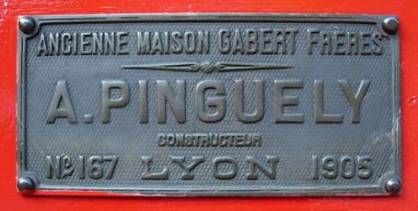
At first they made steam locomotives, but diversified into making other equipment. In 1892, they supplied a locomotive to the Chemins de Fer de St Victor à Thizy.[3] In 1895, Pinguely supplied seven locomotives to the Voiron – Saint-Béron railway.[4] Pinguely was not a major locomotive manufacturer in terms of numbers produced.[5]

In 1930, Pinguely supplied a steam tram locomotive to the Chemins de Fer du Haut-Rhône.[6] By 1932, Pinguely was also making steam shovels.[7]

Production of steam locomotives was stopped in the 1930s, and the company concentrated on manufacturing earthmoving equipment and mobile cranes.

The majority of the locomotives produced by the company were 0-6-0T locos although as we will see the company also produced a range of other locomotives and some steam railcars. [8]

In addition to the Chemins de Fer du Sud de La France their clientele included: The tramway of Pont-de-Beauvoisin, The railways of Dauphiné, The West Tramway du Dauphiné, The railways of the Drôme, The trams of the Dordogne, The Camargue railways, The trams of the Indre, The Regional Railways of Rhône et Loire, The Departmental Board of Railways Bouches-du-Rhone.[8]
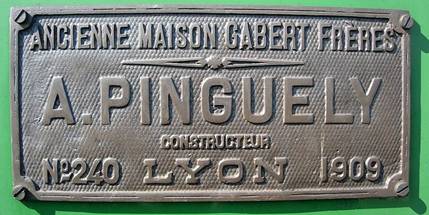
The French railway system worked on a series of metre gauge feeder railways connecting to the standard gauge main lines. Pinguely locomotives were used on many of these feeder lines. There are a number of these locomotives in preservation today as across France, metre gauge railways are ripe for preservation. Many of these lines, like those in Provence, still have the majority of their formation/route in public ownership. The two plaques shown alongside the text are from Pinguely locomotives on Le Réseau du Vivarais.

Pinguely Locomotives on Le Chemins de Fer du Sud Littoral

1. Pinguely 2-6-0T (ex 0-6-0T) [11]

In 1902, as soon as the Toulon-Hyères line was opened, the Chemins de Fer du Sud management decided to order 4 0-6-0T locomotives designated “Type 18” by the Albert Pinguély works. Modifications were requested by the company to increase the power and speed of these machines, which were considered too slow and too little nervous: these machines were given the same stroke of pistons, the diameters of cylinders and wheels of the 4-6-0T SACM Locomotives (see below).

The diameter of the coupled wheels increased from 90 cm to 1.20 m, the wheelbase from 2.15 m to 2.70 m, the diameter of the cylinders from 35 cm to 38 cm. The net weight (empty) was increased as a result from 23.1 tonnes to 25 tonnes and the gross weight in running order from 27.8 tonnes to 31.7 tonnes.

Very quickly, it was found that these new machines had major defects. They were highly unstable when they exceeded 25 km/hr. The instability was likely to cause breakdown of the suspension, movement in track alignment and derailments.

As early as 1906, Jacques Henry, the engineer, studied the possibility of transforming these locomotives into 2-6-0T locos by adding a steering axle to the front. The modification was carried out by the Fréjus workshop from December 1906 onwards and everything was completed in 1908.

The increased tare of 6 tons and the new front axle considerably improved the road holding and the grip and they gave satisfaction until the period of the 2nd World War. Some weaknesses of the boiler were however reported as early as 1921.[11]
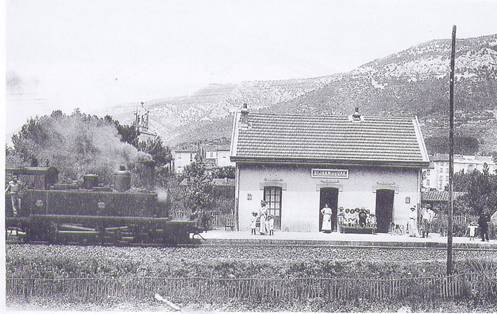
A 2-6-0T Pinguely series 41 to 44 arrives at the stop of Saint-Jean du Var whose small building is characteristic of the stops of the suburbs of Toulon (Collection: Renaud Semadé).
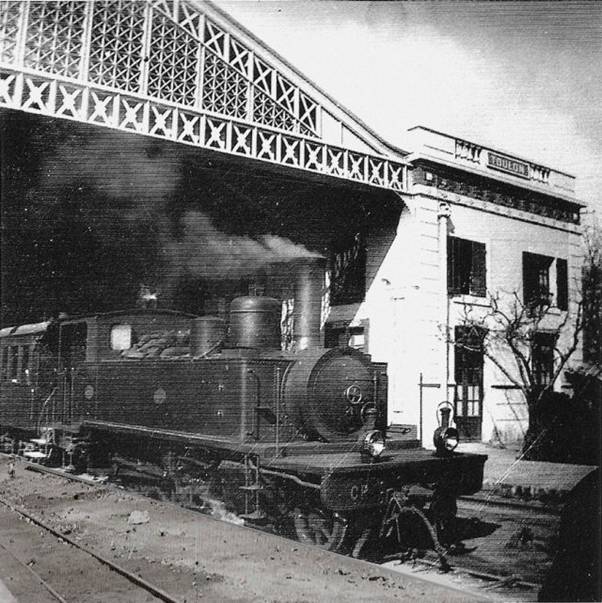
Pinguely 2-6-0T locomotive at Toulon Sud-France station awaiting clearance to head for St. Raphael. The photo dates from the years 1925-1930 (Collection: Gérard Bernaud).
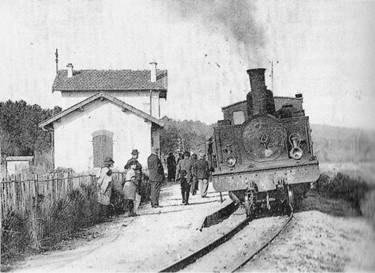
A train pulled by a 2-6-0T Pinguely, stops at Warvieille-Beauvallon near Sainte-Maxime. The station house is identical to that of the gatekeeper’s but it is completed with a desk and a waiting room. Note the super-elevation of the line. (Collection: Edmond Duclos).

MAIN CHARACTERISTICS OF 2-6-0T PINGUELY
Type:  0-6-0T then 2-6-0T Usable track type: Metre gauge
Builder: Albert Pinguely Works in Lyon Driving Cab: Closed – with 4 rectangular portholes
Year of construction:  1904 Date of commissioning: 03-1905
Number on the South France Railway network  4 Coupled axles:  3
Rigid wheelbase: 2.70 m
Factory number: 174 to 177 Diameter of driving wheels: 1.20m
Numbered: 41 to 44 Diameter of carrying wheels: 0.82 m
Unloaded weight;  31.10 tons Cylinders: 2 with plan drawers
Weight in working order:  37.80 tons Valve Gear: Walschaerts
Total length:


 8,982 m Average speed in tests: 38 km/hr
Total width: 2.50 m Water Tank Capacity:  3500 litres
Total height: 3.59 m Coal Capacity:  0.94 ton
Usage: Nos. 41, 42 and 44 were taken out of use in around 1938; No. 43 in around 1944. The locos were scrapped only after the closure of the network.


2. Pinguely 4-6-0T [11]

The 4-6-0T Pinguely locomotives are almost twin sisters to the 4-6-0T SACMs numbered 61 and 62 -The difference is at the rear: a straight and closed cabin for the Pinguely, an overflowing charcoal hood and an open cabin for the 4-6-0T SACM. The shape of the side window was different as well.
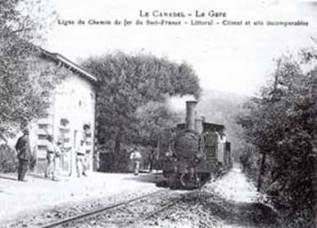
Here at Canadel Halt, 4-6-0T Pinguely No. 65 arrives at the head of a mixed train.

Delivered between January and July 1906, the Pinguely were assigned to the heaviest trains.

These machines had a weak point: the bad behaviour of their boiler.
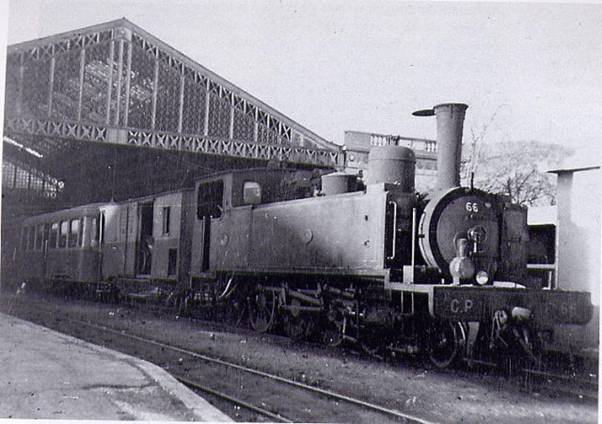
Pinguely 4-6-0T No. 66 at Le Chemins de Fer du Sud Station of Toulon in around 1941-1943; at that time there are only 3 steam engines left on the network. An electric headlight powered by a turbo-dynamo has been added to the right side of the original oil lantern (Collection: GECP)
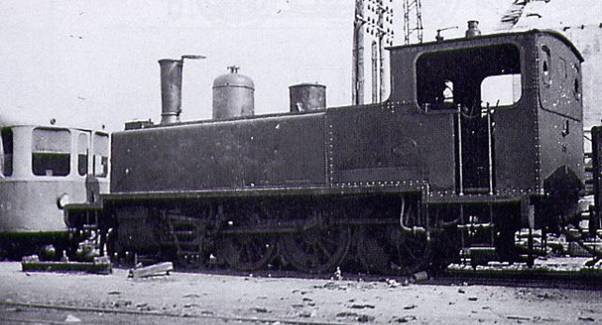
This time seen from behind, 4-6-0T Pinguely No. 66 is stabled at the Fréjus depot. Note at the back of the cab, the 2 small circular openings not original, which give light and a little visibility in the cabin. Originally there were 2 more large windows that were closed with sheet metal plates. These probably were broken regularly be the charcoal shovel and furnace tools.
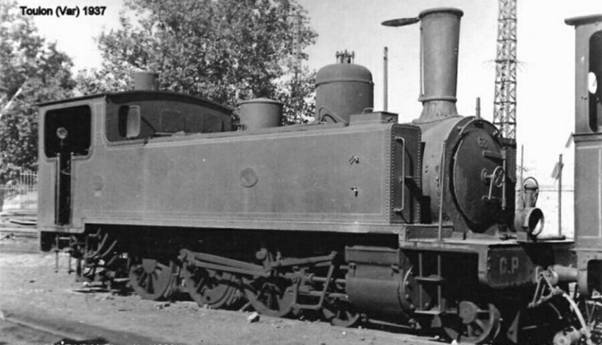
The 4-6-0T No. 63 is stabled on the No. 3 siding at Toulon station ready to refuel with coal briquettes (Collection: Bernard Rozé).

MAIN CHARACTERISTICS OF 4-6-0T PINGUELY

Type: 4-6-0T Usable track type: Metre Gauge
Builder: Albert Pinguely Works in Lyon Driving Cab: Closed
Year of Construction:  1906 Delivery date: 1906
Number on the South France Railway network:  4 Coupled axles:  3
Wheelbase:
Factory number: 203 to 206 Diameter of driving wheels: 1.20m
Numbered: 63 to 66 Valve Gear: Walschaerts
Unloaded weight:  28.4 tons Cylinders: 2 with plan drawers
Weight in working order:  36.8 tons Estimated power:
Total length:


 9.39 m Estimated maximum speed:
Total width: 2.50 m Water tank capacity:  4500 litres
Total height: 3.60 m Coal capacity:  1.2 ton
Usage: No. 63 and 66 set aside in 1948 and then scrapped in 50-51 – No. 64 and 65 set aside in 1944

Preserved Pinguely Locomotives

Locomotives working on preserved lines or preserved in a non-working condition include:[8]

a) 0-6-0T Locomotives (metre gauge)

No. 38 of 1897, Trams of the Drome No. 16 – entrusted by an individual to the Association of Friends of Petit Anjou
No. 1899, Beaujolais Railway (CFB) – Association of Friends of Petit Anjou
No. 112 of 1901, CFD 81, 1949 transformed into locotractor, CFDT, CP 52 – Railways of the Velay
No. 143 of 1903, Railway of Morbihan “14” – monument in Korofina (Mali)
No. 165 of 1905, Railways of Morbihan “No. 101” – entrusted by the FACS to the railway of the Bay of Somme . In service.
No. 167 of 1905, Railways of Morbihan “No. 103” – Train of Bas-Berry. [9]
No. 240 of 1909, Tramways of the West of Dauphiné “No. 31” – Railway of Vivarais. [10]

b) 0-4-0T Locomotive (600 mm gauge)

No. 368 of 1922, Tuilerie de la Rochefoucaud (Charente) – Maurice Dufresne Museum, Marnay. then Azay-le-Rideau (Indre & Loire).


SACM Locomotives

The Alsatian mechanical engineering company (Société Alsacienne de Constructions Mécaniques (SACM)) based in Mulhouse was a flagship of French industry. It produced a lot of locomotives.

In 1839, André Koechlin, after producing textile machines since 1826, opened a locomotive construction workshop in Mulhouse in Alsace.[15] The business grew rapidly but in 1871, the annexation of Alsace-Lorraine by Germany, brought about the transfer of some production to Belfort in France. In 1872 the company merged with the Graffenstaden company of Illkirch-Graffenstaden (a suburb of Strasbourg) to form SACM.

The new company diversified into the production of boilers, steel equipment, printing equipment, compressors, firearms and other engineering products growing to 4500 employees by 1910.[16]

A new foundry was built in 1922 for textile machinery. In 1928 the Thomson-Houston Electric Company merged with the Electrical Engineering division of SACM to form a new company named Alsthom, (Alsace-Thomson), later changed to Alstom.

Production of steam locomotives was originally carried out at Mulhouse and Graffenstaden (for German production), and Belfort for the French production. The plants also exported models. However, after the First World War, Mulhouse and Graffenstaden built French steam locomotives, and Belfort specialized in the construction of electric locomotives.

During the 1890s the company was particularly noted for its fast and efficient compound locomotives designed by Alfred de Glehn.

A whole series of different locomotive types were constructed by SACM, two were present on Le Chemins de Fer du Sud.

SACM Locomotives on Le Chemins de Fer du Sud Littoral

1. SACM 2-4-2T Series No. 51-56
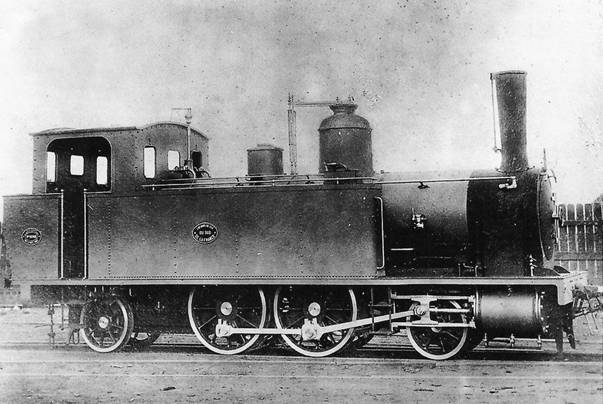
2-4-2T Locomotive No. 56 series 51 to 56 built by SACM in Belfort for Le Chemins de Fer du Sud network (Collection: Bernard Rozé).
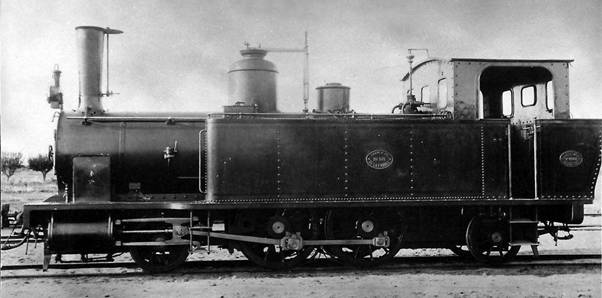
2-4-2T SACM No. 53, one of six locomotives of the series numbered 51 to 56 delivered between April 1889 and March 1890, they allowed the opening of the section St-Raphaël – La Foux in September 1899. They were attached to the depot of Fréjus. These machines had 1 carrying axle at the rear, one at the front (small wheels) and 2 coupled axles (driving wheels) – One of these machines was presented at the World Fair of 1889 before leaving for the Var (Collection: Bernard Rozé).
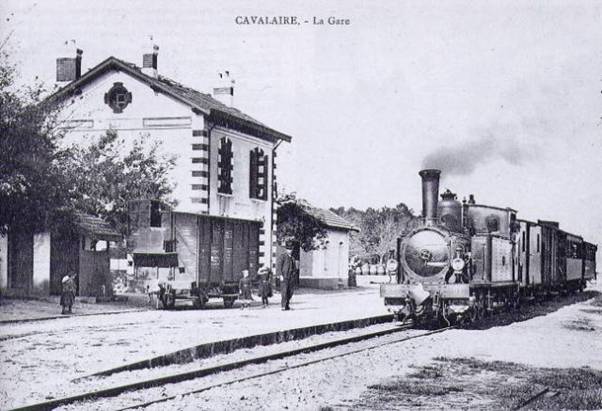
A mixed train St-Raphaël-Hyères pulled by the 2-4-2T No. 51 enters Cavalaire station. It was this locomotive that represented Le Chemins de Fer du Sud de la France at the World Fair in Paris in 1889 (Collection: Edmond Duclos).
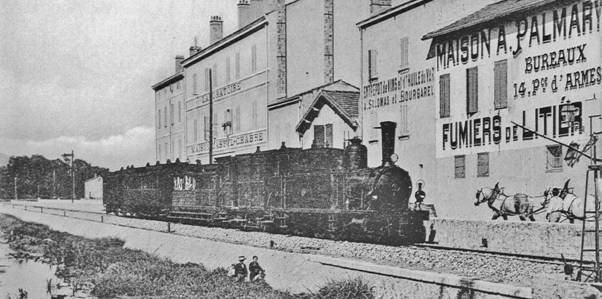
A 2-4-2T SACM locomotive at the head of a Hyères-Toulon passenger train running along the Eygoutier wharf, a small river to which the Toulonnais give the poetic name of “River of Lovers.” The photo is taken towards the slaughterhouse bridge at the entrance of the Rode (this bridge still exists today, crossing the river). A level crossing allowed to cut at right angles Rue de Cap Brown (nowadays Avenue Resistance) and to cross the tracks of the tram (Line 7 – to Magaud). In the background, are the laboratories and warehouses of Castel-Chabre and the Palmary house selling litter manure for gardens (Collection: R Renaud Sémadéni Corfund).

MAIN CHARACTERISTICS OF THE 2-4-2T SACM
Type 85 for the manufacturer: 2-4-2T Loco Usable track type: Metre-gauge
Builder: SACM (Alsatian Society of Mechanical Engineering in Belfort Driving Cab: closed with charcoal bunker at the back
Years of construction: 1889-1890 Delivery date: between 1889 and 1890
Number on the South France Railway network: 6 Coupled axles: 2
Wheelbase: 1.30 m
Factory number: Diameter of the coupled wheels: 1.20m
Numbered: 51 to 56 Valve Gear: Allan sliding system
Unloaded weight: between 25.5 and 25.86 tonnes Cylinders: planar drawers
Weight in working order:  33.55 tonnes Estimated power:
Total length:


 8.64 m Estimated maximum speed:
Total width: 2.50 m Water Tank Capacity: 4000 litres
Total height:  3.54 m


Coal Capacity: 1 ton
Usage: June 1926: numbers 51 and 56 were scrapped. In 1935 the remaining locos were withdrawn following the putting into service of the railcars. Nos. 52 and 55 were sold for scrap in October 1937, Nos. 53 and 54 in 1939 – They still had a career of some 50 years.

2. SACM 4-6-0T Series No. 61-62

SACM locomotives numbered 61 and 62 were almost twin sisters of the 4-6-0T Pinguely, the differences are at the rear: the coal hood and open cabin for the 4-6-0T SACM, with the cabin straight and closed for the Pinguely. The shape of the side window is different as well. In this image a SACM 4-6-0T in charge of a train from St. Raphael to Toulon enters La Londe Station.
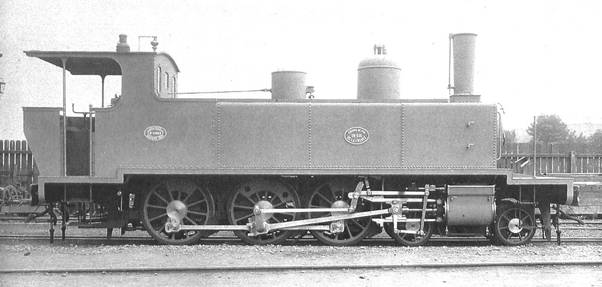
Locomotive 4-6-0T No. 61 of the Littoral network is seen on display just after out-shopping at the SACM factory in Belfort in June 1900, it is the first of a long line of 124 units delivered to France, Spain and the colonies of French West Africa (Collection: Bernard Rozé).

MAIN CHARACTERISTICS OF THE 4-6-0T SACM
Type: 4-6-0T Loco with open cab. Usable track type: Metre-gauge
Builder: SACM (Alsatian Society of Mechanical Engineering in Belfort (90) Driving Cab: Open at the back
Year of construction: 1900 Delivery date: 20th June 1900
Number on the South France Railway network: 2 Coupled axles; 3
Factory number: 4963 – 4964 Diameter of the coupled wheels: 1.20m
Numbered:  61 and 62 Valve Gear: Walschaerts
Unloaded weight: 28,400 tons Cylinders: 2
Weight in working order: 36,800 tons Estimated power: 375 hp
Total length: 9.39 m


Estimated maximum speed: 60 km/hr
Total width: 2.50 m Water tank capacity; 4500 litres
Total height: 3.60 m Coal capacity; 1,200 tons
Usage: No. 61 decommissioned around 1944 – No. 62 in 1948


Corpet-Louvet Locomotives on Le Chemins de Fer du Sud Littoral[11]

Corpet-Louvet is the name of a company known particularly for its production of steam locomotives. It was a family business with a focus on motive power for the secondary railway network in France and elsewhere. It had a history of nearly 100 years in railway infrastructure and motive power, although during this period it went through a number of different legal entities. It was active from the second half of the nineteenth century throughout the first half of the twentieth century, with the end of railway production in 1952.
Founded in 1855 as Anjubault, based in the Avenue Phillippe-Auguste in Paris, the firm was taken over by Lucien Corpet in 1868. Corpet’s daughter Marguerite married Lucien Louvet, the engineer of the Compagnie Meusienne des Cheminss de Fer, which used Corpet locomotives. Corpet died in 1889, and the management of the firm was taken over by Louvet. In 1912, the firm moved to new premises at La Corneuve, and a limited liability company, Corpet, Louvet et Compagnie was formed. The last steam locomotive was built in 1953, but the company is still in business, manufacturing ‘Caterpillar’ earth moving equipment under licence.

Corpet-Louvet, could not be ranked with the large locomotive building companies: Schneider et Cie; the Batignolles Construction Company; JF Cail et Cie, the Compagnie de Fives-Lille; André Koechlin & Co. and the Graffenstaden Society. It was a family-size railway manufacturer, which nevertheless satisfied its customers with simple, well-built and robust machines.

Corpet-Louvet locomotives are regularly cited as emblematic of the secondary railways in France. From 1855 until 1952, the plant produced 1962 locomotives. The majority of them were metre-gauge tank locos.

1. Small 0-6-0T Locomotives

Three 0-6-0T Corpet-Louvet series 70 to 72 locomotives were ordered by the company for the line between Cogolin and St Tropez. These 0-6-0T locomotives were of a light weight, suitable for the branch tramways either side of La Foux. The three locos provided this service with two active and one in reserve at all times.
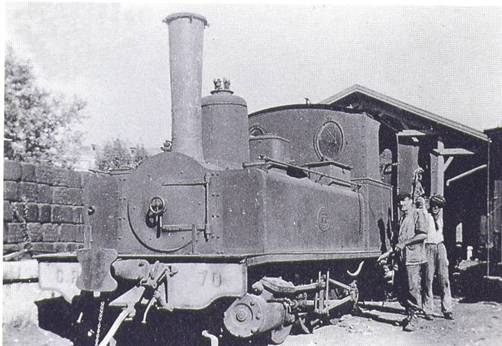
0-6-0T Corpet-Louvet No. 70 stabled at the fuel depot at Toulon Station in around 1930 (Collection GECP).
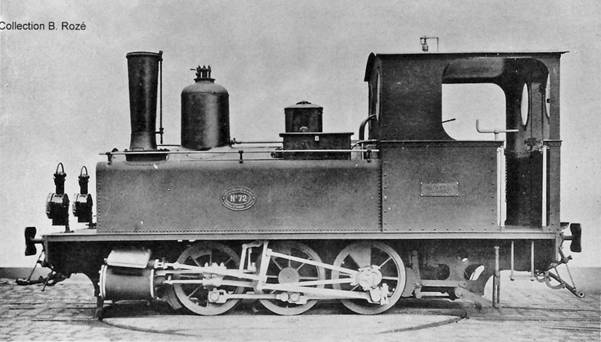
0-6-0T No. 72 taken at the time of out-shopping at the Corpet-Louvet factory in February 1894. The photo may have been used in a commercial catalogue (Collection: GECP – Pierre Virot – Bernard Rozé).
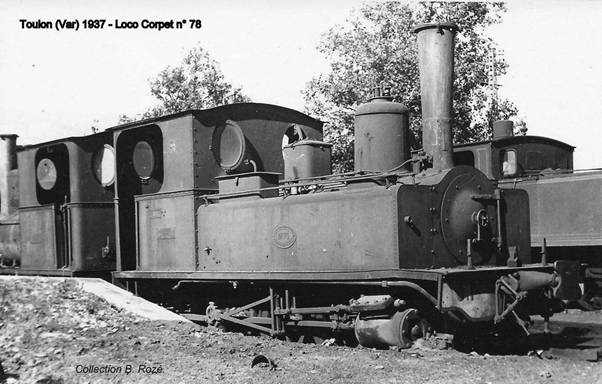
A few years later, in Toulon, in 1937 0-6-0T Corpet-Louvet N ° 70 awaits disposal for scrap. To the left, No. 71 already has its water tanks removed and is awaiting the same sad fate (Collection: Bernard Rozé).


MAIN CHARACTERISTICS OF THE 0-6-0T CORPET-LOUVET
Type:  0-6-0T Usable track type: Metre-gauge
Builder: Corpet-Louvet

Works in Paris

Driving Cab: closed, lit by 2 oval portholes and equipped with a door opening at the back
Year of construction: 1894 Delivery date: February 1894
Number on the South France Railway network: 3 Coupled axles: 3
Total wheelbase:  1.70 m
Factory number: 591 to 593 Diameter of driving wheels: 0.80 m
Numbered: 70 to 72 Valve Gear: slider and double eccentric Stephenson system
Unloaded weight: 11,540 tons Cylinders: 2 outside planar drawers
Weight in working order: 15,180 tons Estimated power:
Total length:


5,997 m Estimated maximum speed: 20 km / h in ramp of 25 with a load of 40 t
Total width: 2.50 m? Water Tank capacity: 1640 litres
Total height: 2,840 M Coal capacity: 0.445 tonnes
Usage: In October 1937, No. 70 and No. 71 were set aside and sold for scrap then it was the turn of the No. 72.


2. Mikado Locomotives and Other Temporary Residents

During the Second World War, the Littoral network received reinforcement from the largest steam locomotives that had ever been in regular service on a metre-gauge track in France. They were imposing type 2-8-2 tender locomotives (or Mikados). These machines were to be delivered to Senegal but their delivery was blocked. In the spring of 1943, 6 Mikado locomotives were allocated to the company’s network in the Alps and 3 others, numbered 21, 22 and 30 to the Littoral network.

They started service at the end of the summer of 1943. From the end of January 1944, No. 30 was transferred to another network. Only No. 21 and No. 22 ran on the coast line. Because of the worn state of the track, the relatively tight curves and the light rails, there were several derailments. The 2 Mikados left Toulon in 1945, underwent an overhaul by Corpet-Louvet then were sent to Africa, where their service did not last more than a decade before dieselization.

Their sojourn on Le Chemins de Fer du Sud was short and there are very few photographs.
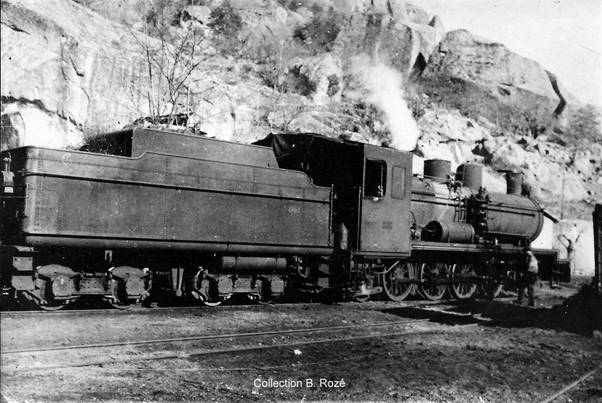
Corpet-Louvet Mikado 2-8-2 locomotive “Dakar-Niger” with its 16m3 bogie tender seen on the Littoral (Collection: Bernard Rozé).
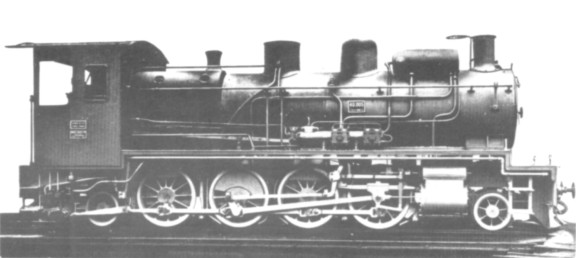
Chemins de Fer Dakar-Niger, Corpet-Louvet 1736 of 1927, was typical of a large number of metre gauge 2-8-2 tender locomotives built for service with the railways of French West Africa. Cylinders: 450mm x 550mm. Coupled Wheels: 1200mm. This is the same class of loco as those used on Le Chemins de Fer du Sud.

The Mikado Locos were not the only temporary residents on the Littoral Network. A BB Mallet locomotive was seen on the network during the occupation in the Second World War. Its sojourn was not a great success nd it was discovered languishing on depot after the German troops withdrew. The Locomotive was built by SACM and served elsewhere in France before being requisitioned for the Chemins de Fer du Sud.
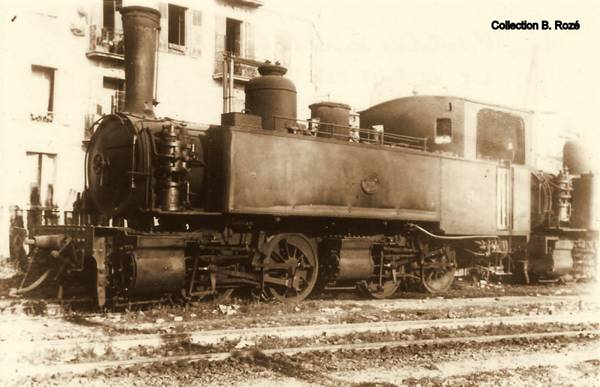
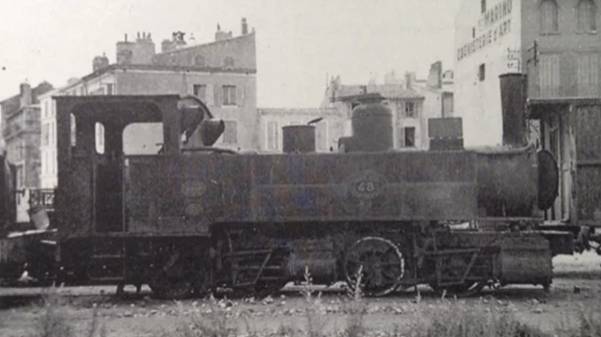
It was requisitioned in July 1943 and then shipped to Toulon. It was first used on behalf of the occupation authorities before being found at the liberation in 1944 stored in the naval workshop near La Londe. Requiring major repairs and no longer serving the needs of the network, the loco was taken to Toulon to be scrapped in 1947.

Interestingly there is a picture of a Mallet Loco (see below) being moved from St. Raphael to the Alpine network on 17th January 1935 which suggests that the loco, or another similar one, served on the network before the war.
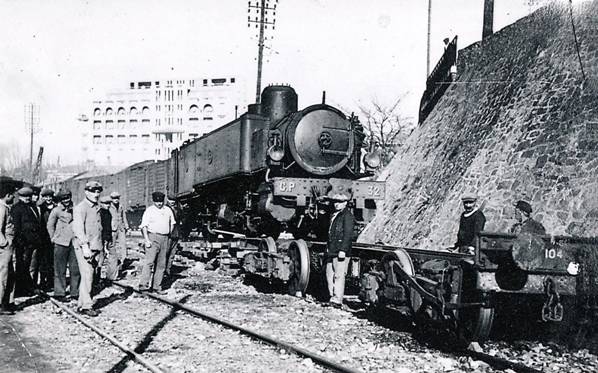
The embarkation of locomotive 020 + 020T SACM n ° 32 on wagon PLM at St.Raphaël January 17, 1935, for restitution to the network of general interest of the Alps. The chimney, the valves, the steam dome casing and the cabin were dismantled so as not to exceed the loading gauge (Photo Marcel CAUVIN – G. E. C. P. Collection).

B. Railcars

All the railcars on the Chemins de Fer du Sud Littoral were supplied by one company – Brissonneau et Lotz.

Brissonneau et Lotz

Brissonneau et Lotz [19]was a French locomotive engineering company, engaged in the manufacture of railway locomotives and wagons.[20] The company was also a supplier of rolling stock to the Paris Metro, constructing in 1951 the first metro trains in the world to be equipped with rubber tyres.[20]

In 1837, Etienne Lotz and Paul-Henri Renaud founded an engineering company that quickly became very successful. In 1849, they were the first in France to manufacture locomotives and became the leading manufacturers of agricultural steam engines.
Meanwhile, in 1841: Mathurin (1814-1897) and Joseph (1817-1900) Brissonneau created the engineering company Brissonneau in Nantes, rue du Chapeau Rouge. At the time, they worked for the sugar industry and in shipbuilding. They patented and improved a number of industrial machines.

In 1862, Etienne Lotz left the company he had founded with Renaud and entered, with his son Alphonse (1840-1921) into the service of their main competitors: Brissoneau.
In 1866, Alphonse Lotz, married the daughter of Mathurin Brissonneau. In 1878, Brissonneau Frères became Brissonneau and Lotz and moved from Launay Street to Doulon. By 1908, the company had diversified into boilermaking, refrigerating installations, machine tools, and wagons. At this time Brissonneau and Lotz employed more than 400 skilled workers.
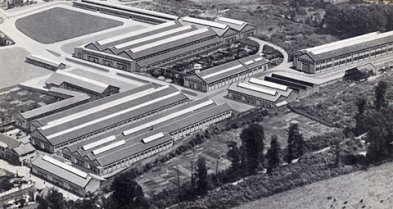
In 1920 they created a factory located sixty kilometres north of Paris in Montataire, the industrial suburb of the city of Creil and decided to build railcars (autorails) primarily for the metre-gauge secondary railways in France and for export.[21]

In 1972, Brissonneau & Lotz was absorbed into Alstom, becoming Alsthom Groupe Brissonneau. The company was founded in Nantes where it had many of its main facilities, but by the time it lost its independence it had acquired or established factories and workshops in many parts of France.[19]

Diesel traction made its appearance on the Chemins de Fer du Sud in Provence in 1935. The diesel service continued until the closure of the line in the late 1940s, apart from the period of the Second World War (1939-1945) during which steam was brought back onto the network.

Trains usually composed a motor unit and a trailer unit, independent bogie coaches but permanently coupled. 10 combined units went into service in 1935 and a further 6 were purchased and in service by 1938. Two of the original batch were destroyed by fire at Frejus.
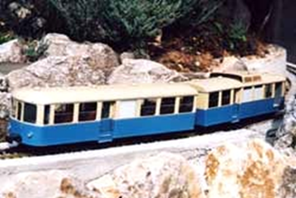
Steam operation in the 1920s was beginning to prove expensive and the Company was seeking ways to reduce operating costs. Electic traction was seriously considered before the decision was taken in October 1933 to acquire the 10 diesel units. The motor units were 270 horsepower. The order was placed on February 16th, 1934.[11]
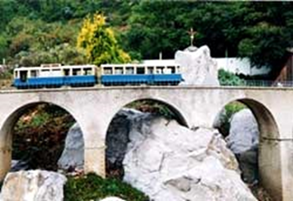
These two pictures show models of the units in use from 1935. The models were produced by Ardèche Miniatures and are shown on a garden railway.

Brissonneau & Lotz railcars on the Chemins de Fer du Sud Littoral were painted grey and blue rather than cream and blue.
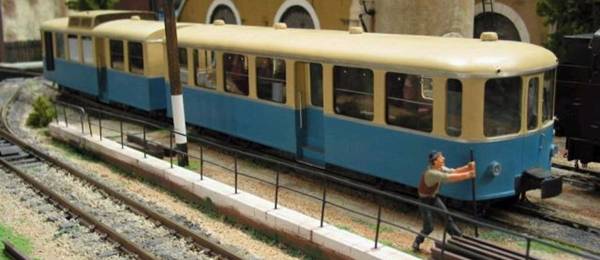
Brissonneau-&-Lotz in the colours of the Railways of Provence: it is a magnificent model (probably at 1/22.5) made by Jean-Pierre Minard of Le Sarthe, and presente at an amateur meeting about garden trains organized by Ardèche Miniatures in September 2002. The railcar is powered by Aristo-Craft engines/bogies.[22]

The first 10 sets were numbered ZM-1+ZR-1 to ZM-10+ZR-10. The further six sets delivered in 1938 went into service, two to replace ones destroyed by fire and four which became ZM-11+ZR-11 to ZM-14+ZR-14. One was delivered to Draguignan on the Alpine system in 1940 by SNCF, but was returned to St Raphael without being unloaded. There were plans in 1948 to move two to four sets to replace the steam locos on the remaining sections of the Nice-Meyrargues line (which had been badly damaged in the war). Instead, the whole line was abandonned and the coastal railcars were sold for use on the metre-gauge lines of northern Spain. One set is preserved in the narrow gauge museum at Gijon, as shown in the image below the data table. Another set ZM-8+ZR-4 returned from Spain to the Chemins de Fer du Vivarais.

MAIN CHARACTERISTICS OF BRISSONNEAU & LOTZ AUTORAIL
Type: diesel-electric railcar (or self-propelled) Usable track type: Metre-gauge
Builder: Brissonneau and Lotz in Creil Colours: Blue and pale gray.
Year(s) of construction: 1st series 1934 – 1935

2nd series: 1938

Delivery date: from March 1935 to July 1935 – 2nd delivery of 4 railcars in April 1938
Number on the South France Railway network:  14 Formation: 2 boxes permanently coupled by a rigid hitch
Number of seats: 60 including 16 in 1st class and 44 in 2nd class Bogies: Bril type 84-E
Number of standing places: 48 Engine: 2 Berliet MDK 2C diesel engines Ricardo license 2 x 135 hp = 270 hp
Unloaded weight: 35 tons (24 + 11) Engine characteristics: 4 stroke -6 cylinders in-line direct injection
Weight in working order:  41 tons

(26.7 + 14.3)

Power developed by the generators: 90 kwh or 122 hp
Total length:


2 x 12.08 m

= 24.16 m

Electric motors: 4 Brissonneau engines of 45 kw or 180 KW = 245 hp
Total width: 2.70 m Power:  135 hp at maximum speed of 1500 rpm
Total height: Diesel tank capacity:  425 litres
Pivot centre distance: 7.44 m Wheelbase of bogies: 2.00 m
Total wheelbase: 9.44 m by car Wheel diameter: 0.70 m
Maximum speed reached:  about 95 km / h Numbering: ZM 1 to 14 for motor and ZR 1 to 14 for trailers
Usage: 2 railcars were destroyed by a fire in November 1937 – In 1946, the train ZM 9 caught fire at St-Tropez station, in January 1947 it was the turn of the ZM 5 which caught fire on the run near Cavalaire then the ZM 2 was badly damaged in a collision. Sale of the remaining cars was agreed at the closure of the network but did not take place until 1951.


Brissonneau and Lotz EA MAZ 1 former property of Ferocariles Económicos de Asturias. Oviedo Sto- Domingo. Museum of Gijón (Asturias). Daniel P. Lanuza – © listado.pizias.com.
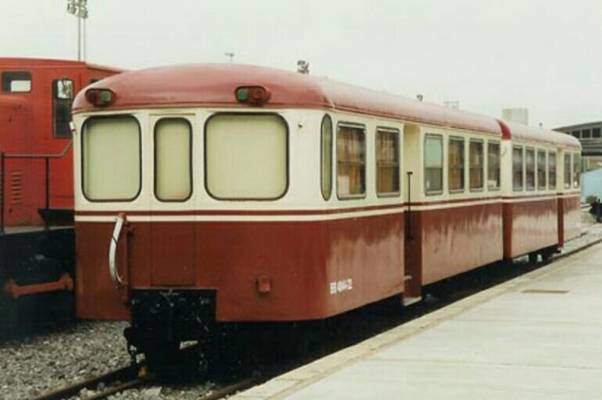
The railcar is painted in the colours it was given when in use in northern Spain.

In April 1936, 2 railways Brissonneau and Lotz railcars are shown below at Toulon Station. In the middle of the central platform, we can seen the diesel pump from which the railcars were refueled (Photo by Jacques Chapuis – Collection: FACS-UNECTO)
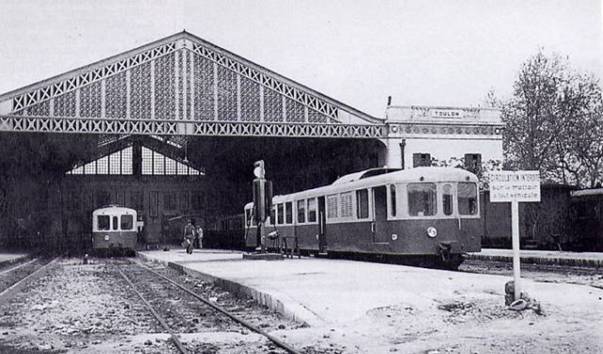
In August 1937, 2 Brissonneau and Lotz railcars at Toulon Station (Collection: FACS-UNECTO).
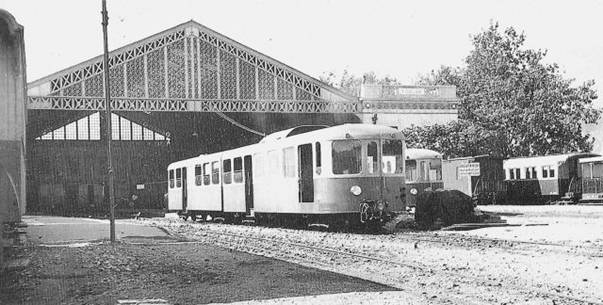
At Toulon station: the train includes a 1st Class and a 2nd Class coach with a luggage compartment.

The coaches were connected by a gangway to allow the conductor to pass between the coaches. The raised area on the roof housed the engine cooling elements.

The driver did not have a fixed seat at his disposal, a simple wooden stool was delivered with the units. This was quickly replaced in each case by a more comfortable chair. The comfort of the driver was not a priority. There was a toilet on board (1 WC + 1 sink) located in the trailer. This was a good development, the earlier coaches on the system were not equipped with these facilities and passengers had to rely on the frequent station stops to relieve pressing need.

During the war, from 1941 onwards, fuel shortages almost closed the network. Old steam locomotives had to be brought out to sustain the service. Shortly after the liberation, the service resumed with tired old railcars; some damaged by bombing (MZ 1, 5, 7 and 14). The speed limit was reduced from 75 km/hr to 60 km/hr.

At the closure of the network, railcars were sold, where possible. Some found a new life in northern Spain.

A train (ZM 12 + ZR 12) was set aside in 1943 in Creil because there was no money to pay for repairs. The network did not recover after the War. The line closed in June 1948. Some traffic continued between Toulon and Hyères to ensure the workers shuttles, until October 18, 1948. Another train continued running from La Foux towards St. Tropez to cover workers access to the Bertaud torpedo factory. It operated until 4 June 1949. 5 units were set aside immediately at the Fréjus depot awaiting sale.

After many visits from various representatives of other networks, estimates and various consultations, sale was agreed in 1951 to 3 Spanish companies operating metre-gauge lines in the north of the country.

The Ferrocaril Santander – Bilbao (SB) bought 10 units that received new equipment (buffers, hitches, recessed lights) and a green and silver livery with yellow nets. They served the Bilbao-Valmaseda and Bilbao-Santander lines.

Ferrocaril Cantabrico (FC ) commissioned a single train for the Santander – Llanes line.

Ferrocariles Economicos de Asturias (EA ) received a train that covered the Oviedo – Llanes line and an extension beyond on the line of the FC to Santander. The last units continued in operation until 1985.

I have struggled to find images of these Brissoneau and Lotz railcars in service in Spain. Very similar vehicles show up well in photographs. For instance, the first two pictures below show very similar Billiard A 150 D 7 railcars. Friends on the Passions Metrique et Etoile Forum have commented that these were much better vehicles to travel in than the Brissonneau and Lotz autorails.
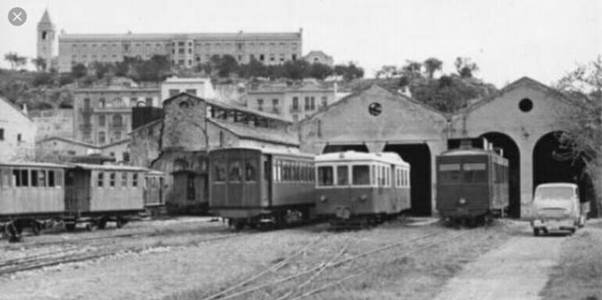
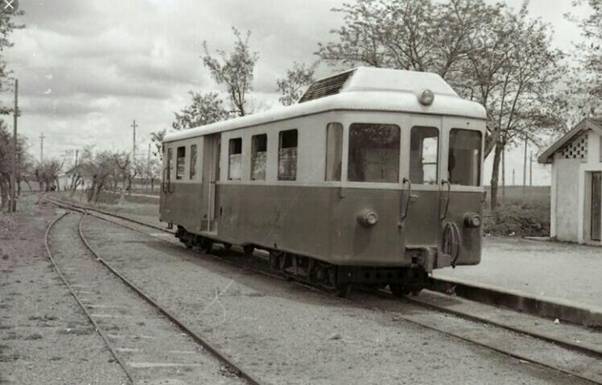
These three images above show various units operating on the Ferrocaril Santander-Bilbao, only the third of these shows a Brissonneau and Lotz railcar. It is operating in the vicinity of Liérganes and Balmaseda. (Photograph: Ferrán Llauradó. Collection: EuskoTren Archive / Basque Railway Museum).[23] As we have already noted, the middle image above shows a Billiars A 150 D 7 unit on the Reus-Salou line.[24] The top image shows one of the Billiard units on depot.[25]
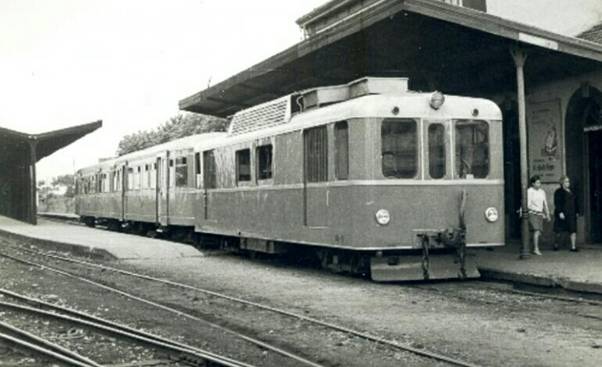
The image above shows a Brissonneau & Lotz diesel-electric locomotive from the Littoral network (these are covered later in this blog – it is either ZT51 or ZT52) in northern Spain, this time in Asturias. The locotractor was probably numbered EA-MAZ-1 on the Spanish system. The vehicle being towed my be a MAN trailer.
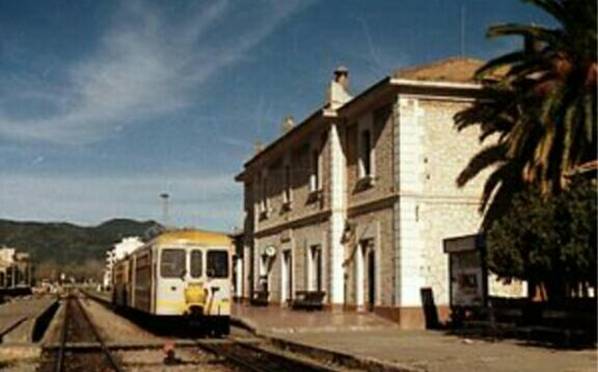
Another unit on the Ferrocariles Economicos de Asturias.

There are a few units in preservation. We have already seen images of one of the preserved units at the Museum of Gijón (Asturias). Another is shown in blue livery below in 2009 at the same museum.

There are enhanced Cine Film Videos of these units in action in Spain. These include the Video on these links: https://youtu.be/7TaTCFvv8iM, https://youtu.be/45dCddESOu4
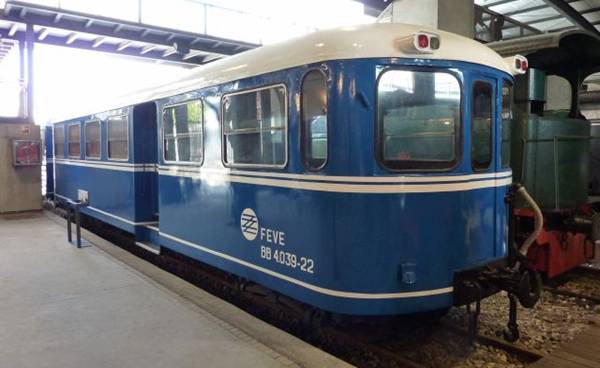
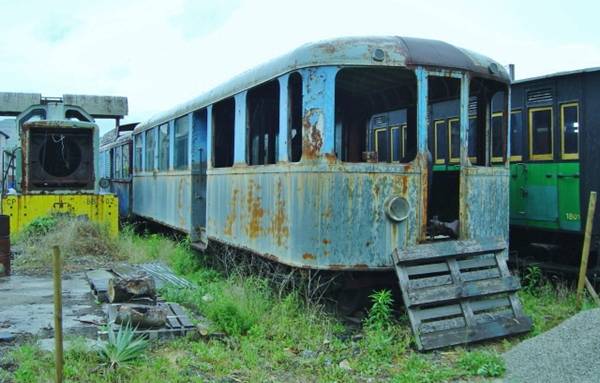
In February 1983, the Vivarais Railway (CFV) bought the MCD-8 and the RC-4 trailer and repatriated them to France, despite their poor condition. Currently, it has still not been restored. Here is a picture seen on a forum of http://www.passion-metrique.net/forums (Photo Malletslm -Tournon May 2007).

In addition to these railcar units the Chemins de Fer du Sud had two diesel shunter units – locotractors. These were also supplied by Brissonneau & Lotz.

C. Shunter Units

The ZT 51 and 52 Brissonneau and Lotz Shunters

The electric diesel transmission: one of the unique features of Brissonneau and Lotz railcars and shunters was the use of diesel-electric transmission. This consisted of a diesel engine that drives a generator supplying direct current to electric motors directly driving the wheels of the vehicles.

From 1930 onwards diesel-electric railcars and shunters were built by the Company for a whole series of secondary networks including: the railways of Anjou; the network of the Var; the railways of Provence; the railways of Morbihan; the railways of the Charentes; the railway of the valley of Celles in the Vosges; the railways of Madagascar; the railways of the Port of Reunion (Reunion Island). In 1937, Brissonneau and Lotz built for 16 tramway cars for Lille, intended for. They are intended for the ELRT network (Électrique Lille – Roubaix – Tourcoing). In 1950, a further order was placed by the same network for 28 engines. The Company was also responsible for a large part of the equipment of the Metro in Paris and for networks in Lyon, Marseille, Brussels, Caracas.

Later, in 1949, Brissonneau & Lotz built a series of 10 tractors type 600 CV:

for the Railways of Provence, No. 51-54
for the Railways of Corsica, No. 401-402
for the railways of Dauphine, No. 1 to 4.
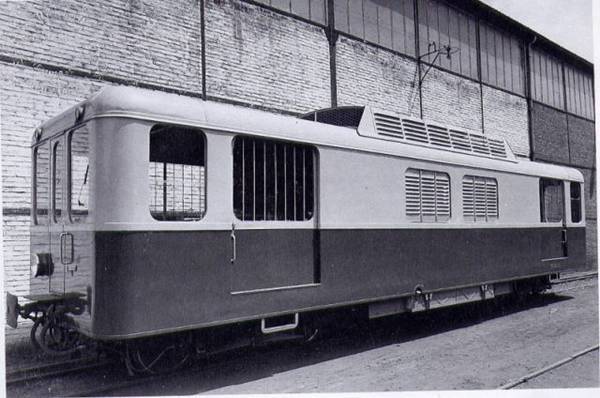
ZT-51 locomotive when it left the Brissonneau & Lotz factory in Creil in the spring of 1938 (Collection: José Banaudo). Colours were blue and light gray.

MAIN CHARACTERISTICS OF THE TRACTOR ZT
Type: Shunter Usable track type: Metre-gauge
Builder: Brissonneau and Lotz in Creil Colours: Sill: blue; pale gray topside
Year of construction: 1938 Delivery date: the 1st was delivered on the 27/06/1938 and the second on the 01/08/1938 spring 1938, the tests took place on July 22, 1938
Number on the South France Railway network: 2
Number of seats: 0 Number of standing places: 0
Unloaded weight: 25 tonnes Engine characteristics: 4 stroke -6 cylinders in-line direct injection
Weight in working order: 28 tonnes Power: 245 ch
Total length:


12,440 m and 12,320 m off buffers Total width: 2.70 m
Total height: 3.565 m Diesel tank capacity:  425 litres
Total wheelbase: 9.440 m Wheelbase of bogies: 2.00 m
Bogies: 2 Brill bogies Baggage compartment: 7.5 m2
Bogie spacing: 7.440 m Wheel diameter: 0.70 m
Generators: 2 Berliet-Ricardo MDK 2 C of 150 HP each with 6 cylinders in line Generator: Brissonneau of 90 Kwh
Traction motors: 4 electric motors Brissonneau of 40 Kwh Braking: vacuum + rehostatic type brake
Maximum speed reached:  about 60 km / h Numbering: ZT-51 and ZT-52
Usage: ZT-52 damaged by a fire in 1943 but eventually brought back into service. ZT-51 taken out of service in 1951. These units were broken up in 1983 and 1988.


In the autumn of 1936, in the face of the growing success of the railcars, the company and the department decided to order two 300-horsepower locomotives to ensure the traction of freight trains as well as additional passenger trains. In 1943 the ZT-52 caught fire following tests conducted by Brissonneau & Lotz to improve the electric circuit and after a time was brought back into service. ZT-51 remained in service until the closure of the network.
After a period in storage after the line closed, both shunter units were sold for ongoing use in Spain. In 1951 they served for a few days carrying equipment sold to Spain, from Fréjus to St-Raphaël. Once they reached Spain they were remotorized with Renault type 561-B diesel engines and modified to meet local standards.

One was commissioned on Ferrocaril Cantabrico (FC) under No. MD-1; renovated in 1980, it was scrapped in 1983.

The other was used by Ferrocariles Economicos de Asturias (EA) under No. MA-2, Renovated in 1985, it was scrapped in 1988 (50 years after its commissioning).

D. Coaches
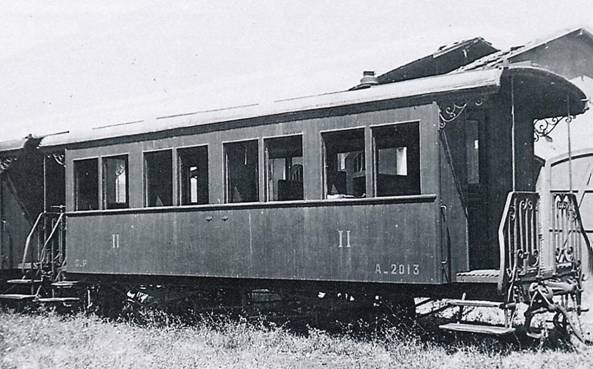
Taken in 1937 at Hyeres, this is a two-axle 2nd Class A-2013 Decauville (José BANAUDO Collection).
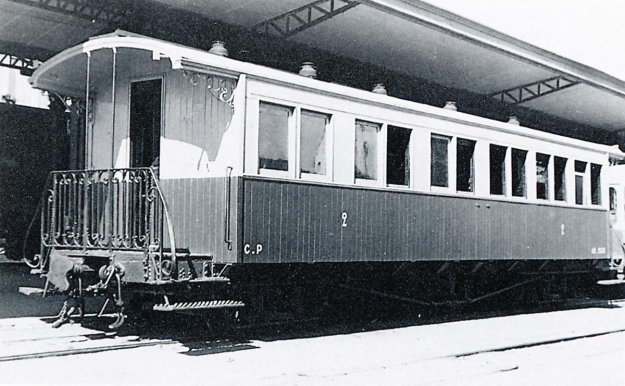
Mixed car AB-2531 (ex-1031) Hanquet-Aufort seen in 1937 at St. Raphaël was repainted in blue and grey to be used as a trailer behind the railcars Brissonneau & Lotz (José BANAUDO Collection).

Very little of the rolling stock from the line entered into preservation, but a few items did the following photos from the 21st Century provide good details for those who are interested.
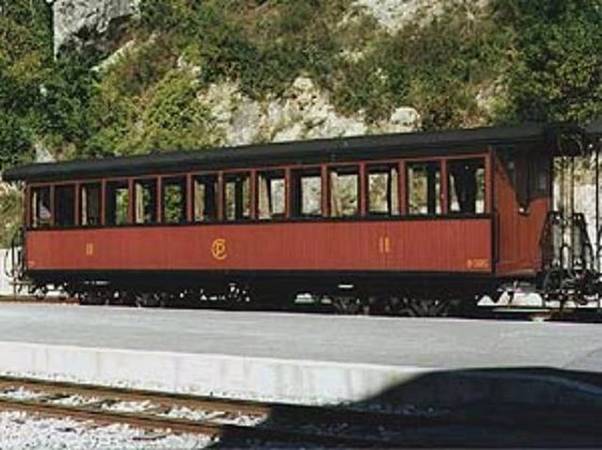
One of 2 authentic coaches from Le Chemins de Fer du Sud de la France preserved today. They are used with the steam train managed by the GECP on the Puget-Théniers-Annot route. They are 2nd class bogie coaches, with wooden bodywork, built by Desouches and David (factory in Pantin) in 1892. They were numbered B74 and B77 by the Chemins de Fer du Sud and were renumbered B505 and B508 at the creation of Les Chemins de Fer de Provence in 1925. They are currently in the traditional colours for coaches on the network – a brown / red colour known as Brown-Van Dyck, with the window surropunds and roof in black. The symbol CP of the Railways of Provence o-is on the panel side of the coach together with the Class shown in Roman numerals (Collection: GECP).[11].
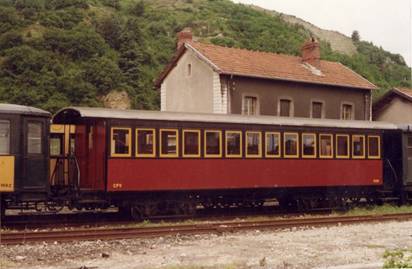
Coach AB 506 constructed by Desouches & David, which served originally on Les Chemins de Fer du Sud before being transferred elsewhere. It is now part of the stock of the Vivarais Railway (CFV) – No coaches had a toilets! Only stops in stations allowed passengers to relieve themselves (Photograph: Pierre Virot, 2003).[11]
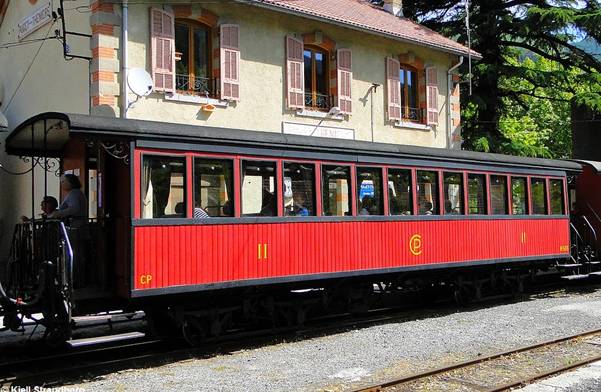
B-505 is 12.3 m (40.35 ft), its height 3.25 m (10.66 ft), its weight 10.5 t. The seating capacity is 52 passengers. During WWI it was requisitioned for use by the French Army. In June 1915, it was sent to Chemins de Fer de la Camargue (Camargue Railway), and used to transport workers to and from the gunpowder factory in Salin-de-Giraud (near Arles, NW of Marseille). In March the following year it left Camargue and was sent to the war zone near Verdon, to the 10ème Section des Chemins de fer de Campagne, a French military railway unit. It was used for military transport on the narrow gauge line “Le Meusien” (owned by Compagnie Meusienne de Chemins de Fer) in the French department of Meuse. [11]
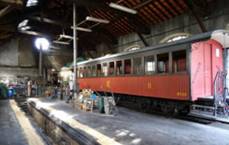
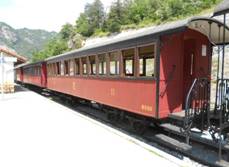
After the war, it was returned to SF on April 12, 1919. However, the years of military service had left it in a poor condition. It took two years to get it back to operational condition, on 2nd April, 1921. It then served on the network for another 30 years or so. When the use of steam engines ceased after WWII, it escaped being scrapped. It was instead reordered to be used as a service vehicle for railway line maintenance. For this purpose, the interior was gutted to make space for various tools and supplies. Even a sliding door was installed on its side to allow loading of bulky items. It served in this capacity for about a decade, until it was retired during the second part of the 1960s.

With the advent of the preservation movement, B505 was rescued by the GECP and put into service behind its steam engines in Provence. B508 was added to it and restored.

Further restoration work is ongoing at the Puget-Thenier workshops. Pictures follow:Three coaches shown in different states of repair.
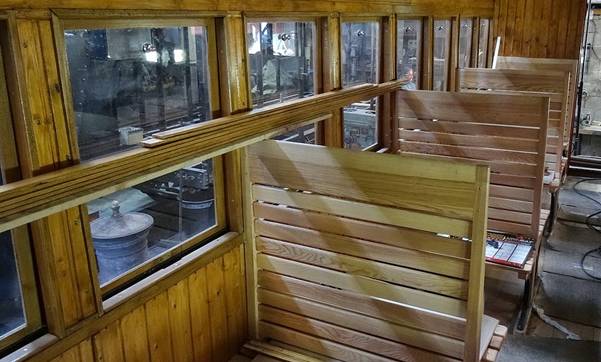
A number of modellers have sought to reproduce these coaches, usually in HOm scale.
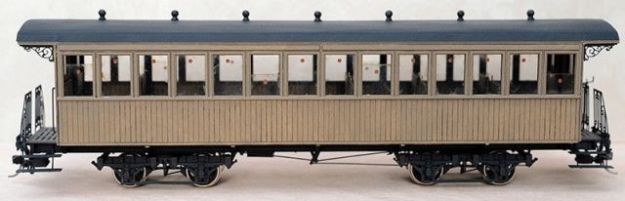
Photo Aubertrain – Model of a 2nd class coach, Desouches & David du Sud France – At the beginning of the operation, the car bodies were made of teak wood simply painted with the car number, the class indication in figures Romans and the monogram of South France, SF painted in yellow.
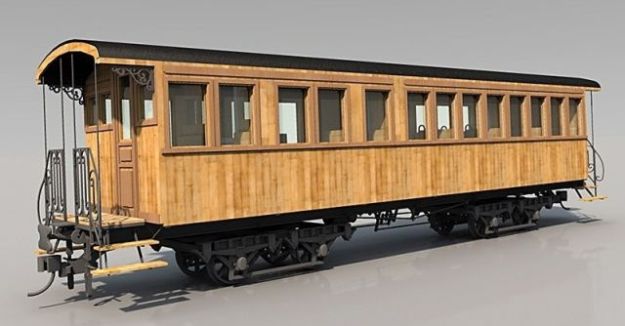
Model of a mixed coach of 1st and 2nd class Desouches & David of South France. Photo AuberTrain
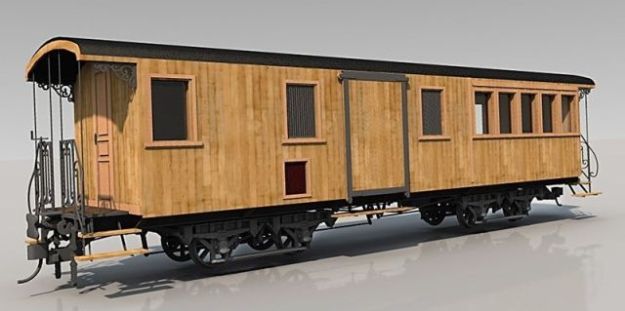
Photo Aubertrain – Model of a mixed car of 1st and 2nd class Desouches & David of South France.
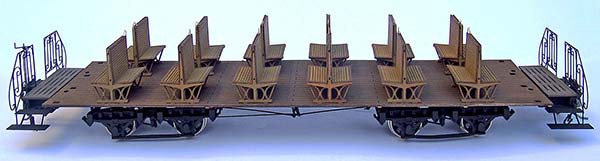
Photo Aubertrain – Interior of a passenger car Desouches & David du Sud France
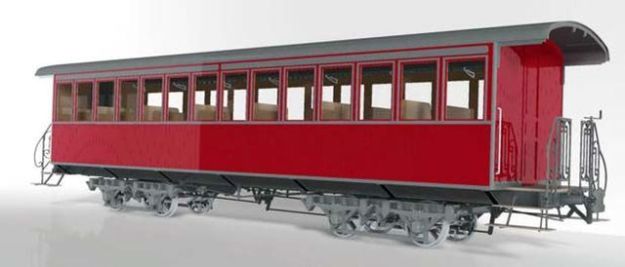
Photo Aubertrain – Model in Om of a mixed car of 1st and 2nd class Desouches & David with the new colors set up on the South France from 1898: for the box: brown-red Van Dyck and black for the roof.
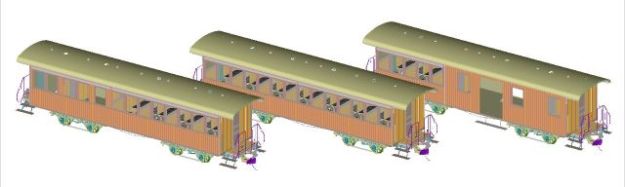
Bogie coaches from the series AB-501 to 508 made by Desouches and David. in HOm (Photo: Metrique43).

Paint schemes are shown below. These are provided by a kit building firm, AuberTrain. [27]
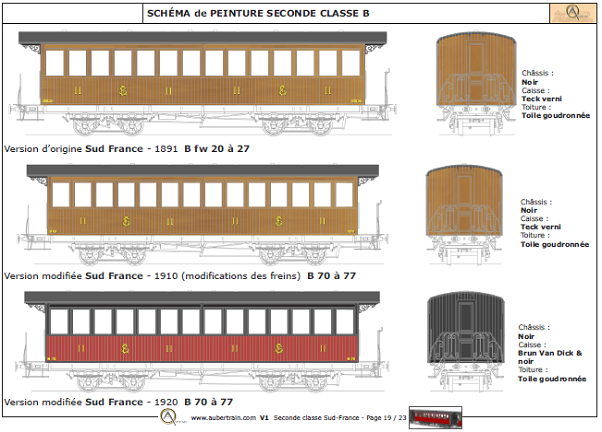
 

E. Wagons
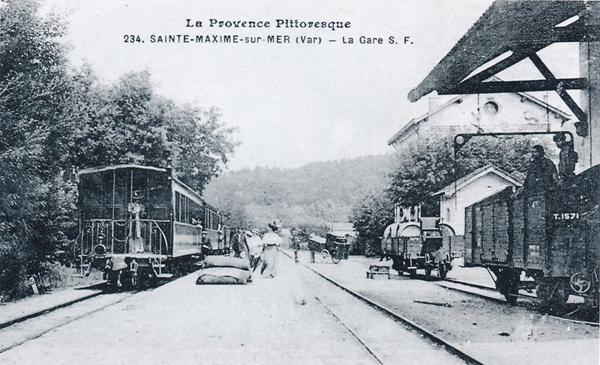
This image is taken in around 1910 and the station is busy. On the left is a short passenger train from La Foux – St.Raphaël. To its right, we see bags piled up on the platform, a cart loaded with furniture, barrels of wine on an open wagon (Buire X-147) which is equipped with a seat for the brakeman. We also can see, on the left of the picture, workers unloading a De Dietrich wagon No. T-1571 under the canopy of the goods shed (Pierre VIROT Collection).
This image is taken at St. Raphael Station It shows the trans-shipment yard with wagons from Les Chemins de Fer du Sud on the right. Those of the PLM are on the left (Raymond BERNARDI Collection).
Two open wagons stand in the foreground of this picture, parked at Cogolin-Grimaud station around 1910: on the left a T-1522 with interchangeable sideboards (construction Hanquet Aufort in 1899), on the right a T-1563 (construction Magnard in 1901). Both are equipped with the hand turned screw brakes, whose steering wheel is visible at the end of the chassis (Edmond DUCLOS Collection).
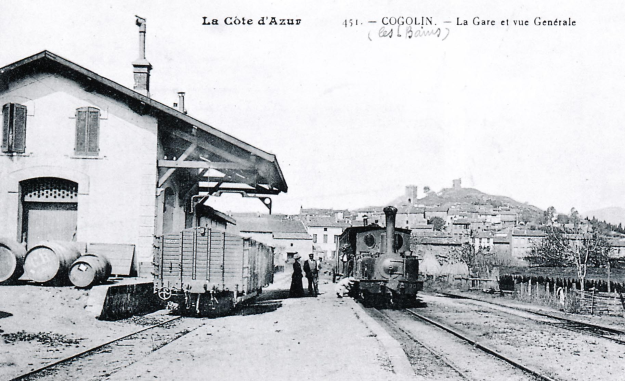
Cogolin-Grimaud station around 1910 with an 0-6-0T Corpet-Louve series 70 to 72 ready for departure to La Foux and St. Tropez; on the left, a Hanquet – Aufort series TM-15O1 to 1516 open wagon with removable sides (René CLAVAUD collection).
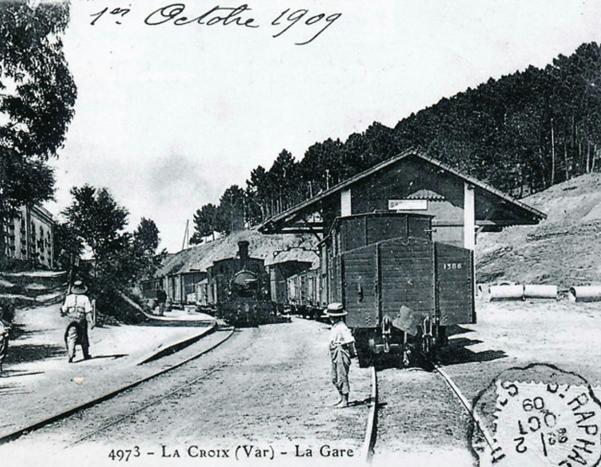
This picture shows a mixed train from St. Raphael to Toulon, pulled by 2-4-2T SACM No. 56 stopping at La Croix. A line of wagons is stabled in the goods siding. Note the buffer, couplers and coupling for the vacuum brake of the Buire T-1386 open wagon (Philippe LEPINE Collection).
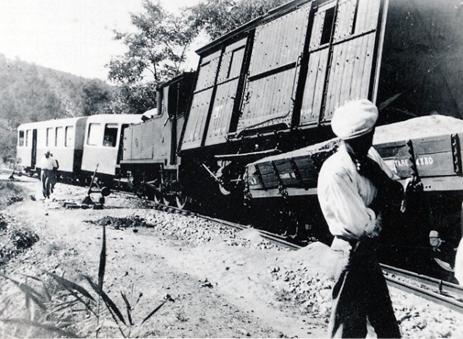
Locomotive Pinguely 4-6-0T No. 62 failed to brake effectively and passed the stopping position in Cavaliere station and struck the Brissonneau & Lotz ZM-10 railcar, train 103, Toulon to St. Raphael. They would usually have passed at this station.
Among the derailed vehicles of the freight train 182, depicted covered wagon J-2141 De Dietrich and a flat V series wagon loaded with sand.
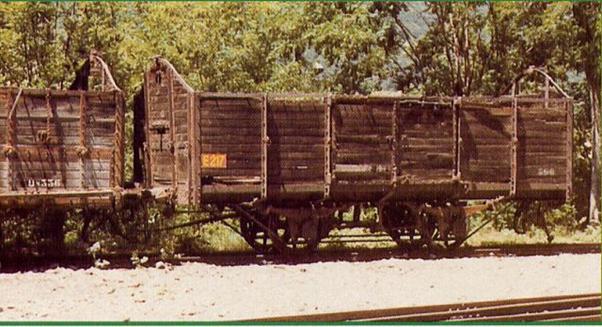
2-axle wagon as used by Les Chemins de Fer du Sud de la France (Photo: Clive Lamming). It compares well with the photos above.

A series of photographs culled from the forum http://www.passion-metrique.net showing older wagons from the network which are still in use, renovated or in sidings waiting for work to be undertaken.[28]
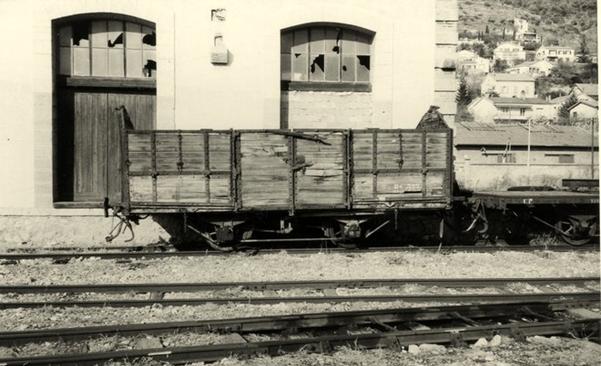
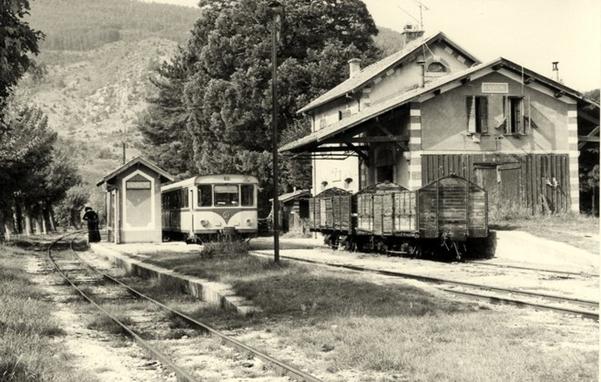


The remaining images show some models made of the goods wagons on Les Chemins de Fer de Provence.
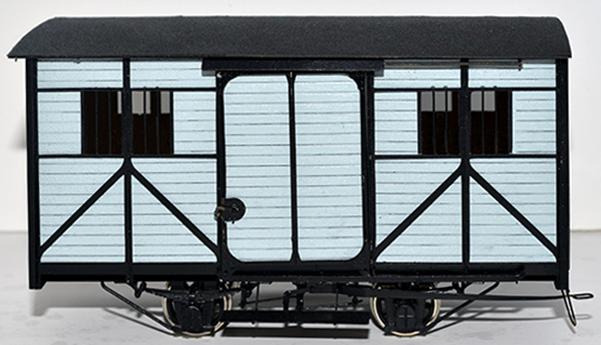

This last image shows the paint schemes used on these wagons.
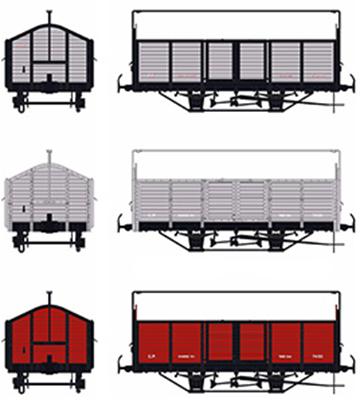
References

1. Les Racines de Leurs Vies; http://lesracinesdeleursvies.over-blog.com/article-644638.html. Retrieved 20th January 2018.
2. Philippe Mioche & Jacques Roux; Henri Malcor: Un héritier des maîtres de forges; Editions du CNRS, 1999.
3. Corpet-Louvert, Chapter 2, The Classic Six-Coupled Tank; Industrial Railway Society; http://www.irsociety.co.uk/Archives/27/CL_3.htm. Retrieved 20th January 2018
4. P. E. Clegg; The Railroad Runs Through the Middle of the House; (.pdf), retrieved 20th March 2008.
5. History of Pinguely-Haulotte SA; http://www.referenceforbusiness.com/history2/58/Pinguely-Haulotte-SA.html; Retrieved 20th January 2018. Which says:“Pinguely had been a manufacturer of steam locomotives, producing more than 25 steam locomotives in the years around the turn of the 20th century.” Other references suggest that the number made was over 360 locomotives between 1881 and 1932. See reference [8].
6. The Train Tram Concept, Part 1 – Historical Context; The Locomotive & Carriage Institution; https://web.archive.org/web/20080308084631/http:/www.lococarriage.org.uk/train_tram.htm. Retrieved 20th January 2018.
7. When our past legitimises our future; (.pdf), Haulotte Group Magazine 13th October 2007; https://web.archive.org/web/20071013183546/http:/www.haulotte.com/CMS/Files/HaulotteTime/8/Haulotte%20time%208-uk.pdf; p5. Retrieved 20th January 2018.
8. Pinguely; Wikipedia; https://fr.m.wikipedia.org/wiki/Pinguely. Retrieved 20th January 2018.
9. Arrivée de la PINGUELY 030 No. 103; Le Train du Bas-Berry http://www.traintouristiquedubasberry.com/arrivee-de-pinguely-030-n103. Retrieved 21st January 2018.
10. Notice No. PM07000324 , Protection des droits des auteurs de la base Palissy , French Ministry of Culture; http://www.culture.gouv.fr/public/mistral/palissy_fr?ACTION=CHERCHER&FIELD_1=REF&VALUE_1=PM07000324. Retrieved 21st January 2018.
11. Roland Le Corff; http://www.mes-annees-50.fr/Le_Macaron.htm. Retrieved 13th December 2017.
12. Marc Andre Dubout; http://marc-andre-dubout.org/cf/baguenaude/toulon-st-raphael/toulon-st-raphael3.htm. Retrieved 4th January 2018.
13. Jean-Pierre Moreau; http://moreau.fr.free.fr/mescartes/ToulonGareSudFrance.html. Retrieved 24th December 2017.
14. José Banaudo; Histoire des Chemins de Fer de Provence – 2: Le Train du Littoral (A History of the Railways of Provence Volume 2: The Costal Railway); Les Éditions du Cabri, 1999.
15. Société Alsacienne de Constructions Mécaniques; https://www.revolvy.com/main/index.php?s=Soci%C3%A9t%C3%A9%20Alsacienne%20de%20Constructions%20M%C3%A9caniques. Retrieved 21st January 2018.
16. Société Alsacienne de Constructions Mécaniques; https://en.wikipedia.org/wiki/Soci%C3%A9t%C3%A9_Alsacienne_de_Constructions_M%C3%A9caniques. Retrieved 21st January 2018.
17. Corpet-Louvet; Wikipedia; https://en.m.wikipedia.org/wiki/Corpet-Louvet. Retrieved on 22nd January 2018.
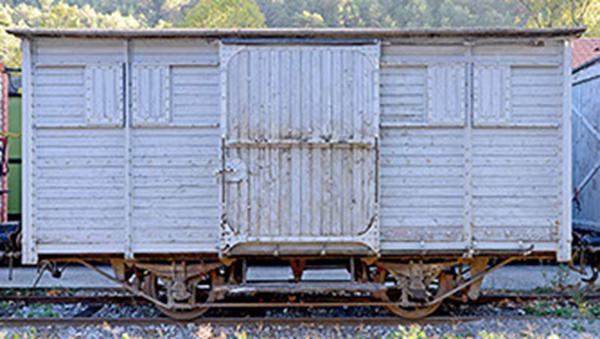
18. C. W. Clingan; Corpet-Louvet: Locomotive Builders; The Industrial Railway Record. The Industrial Railway Society. 3 (27). December 1968, http://www.irsociety.co.uk/Archives/27/CL_1.htm, p129-153. Retrieved 22nd January 2018.
19. Brissoneau & Lotz; Wikipedia; https://en.m.wikipedia.org/wiki/Brissonneau_and_Lotz. Retrieved 20th January 2018.
20. René Bellu; Automobilia. Toutes les voitures françaises 1959 (salon Paris Oct 1959). Paris: Histoire & collections. 21: 14, 2002.
21. L’Usine de Creil; (Brissoneau & Lotz); http://fccdf.free.fr/article.php3?id_article=13&lang=fr. Retrieved 23rd January 2018.
22. Ardèche Miniatures; http://ardecherail.blogspot.fr, retrieved 18th March 2018; and http://www.jardin-des-trains.com, retrieved 23rd January 2018.
23. Historias del Tren; http://historiastren.blogspot.co.uk/2014/10/el-ferrocarril-de-santander-bilbao.html. Retrieved 23rd January 2018.
24. Quaranta Anys Sense el Carrilet; http://reusdigital.cat/noticies/reus/quaranta-anys-sense-el-carrilet. Retrieved 23rd January 2018.
25. Carrilet Tortosa – Amposta -La Cava; https://www.todocoleccion.net/postales-cataluna/carrilet-tortosa-amposta-la-cava-542-7-fesa~x20678367. Retrieved 23rd January 2018.
26. Pasando Pagina; http://vitorino-pasandopagina.blogspot.co.uk/2013/07/historia-de-feve.html, 29th July 2013. Retrieved 23rd January 2018.
27. AuberTrain; http://www.aubertrain.com/DOWNLOADS/INS-S.pdf. Retrieved 25th January 2018.
28. Les Chemins de Fer de Provence; Les Forums de Passions Métrique et Etroite; http://www.passion-metrique.net/forums/viewtopic.php?f=2&t=4143&sid=4bb1d3e27f39656eb05c8d08b7a7801d. Retrieved 25th January 2018.

Bibliography

1. Henri Domengie, Les petits trains de jadis – Sud-est de la France, ed. du Cabri, 1985.
2. Claude Wagner , “Les locomotives Pinguely 030T type 107 : et types proches,” Chemins de fer régionaux et urbains, vol. 1997/1, no 259,‎ 1997, p. 5-20 (ISSN 1141-7447).
3. Frédéric Toublanc, Tacot et galoche en Roannais et Forez : Histoire des Chemins de fer départementaux de la Loire, editions de l’Ormet, 1993 (ISBN 2-906575-17-8, notice BnF No. FRBNF35671053).