
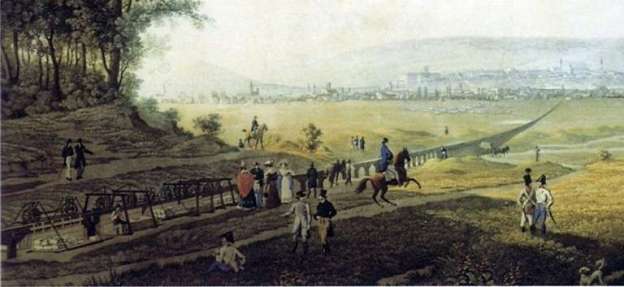
The first Hungarian ‘railway line’ was completed nearly 20 years before the first steam-powered railway in Hungary (which was opened in 1846) on 15th August 1827, and ran from Pest to Kőbánya. [1]
It was one of the early horse-drawn ‘railways’ but was definitely atypical in form!!
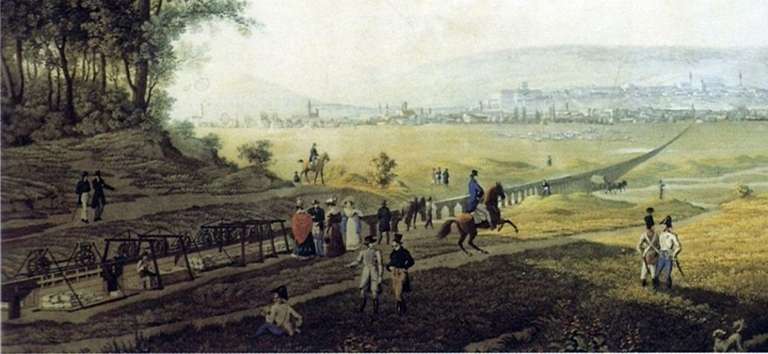
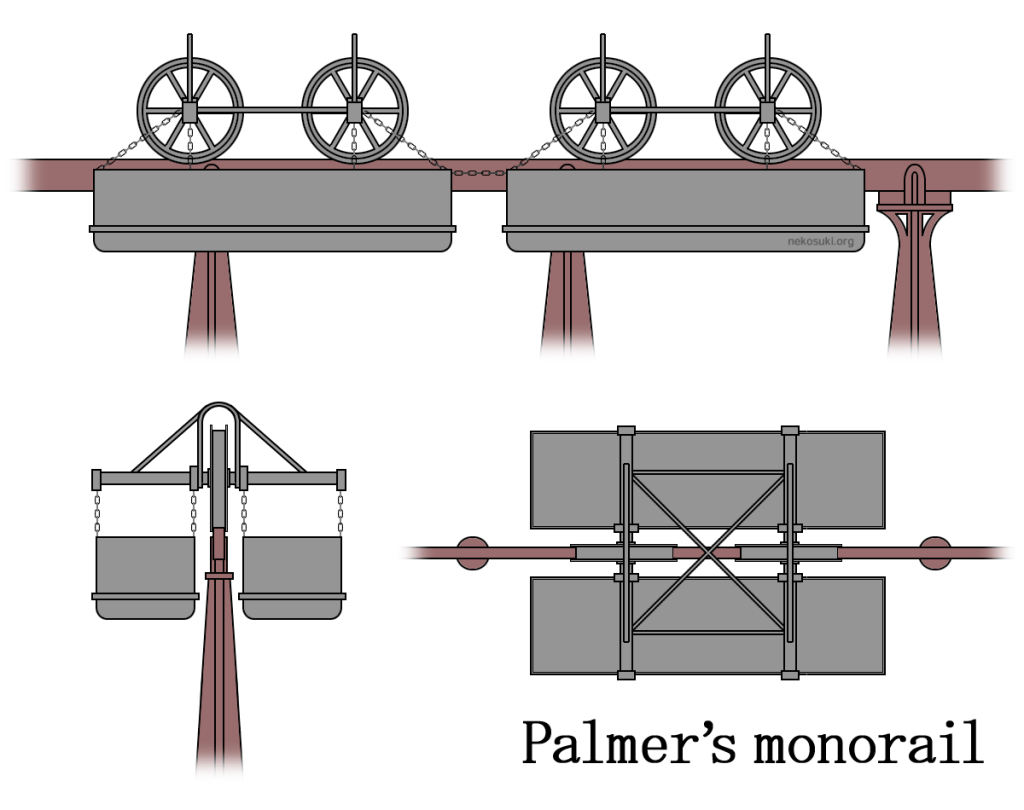
That railway “ran on a wooden structure running at an average height of one and a half to two metres above the ground, where the wooden beams were held by densely placed wooden posts. The wheels ran on very closely spaced rails on top of the beams, and the carriages hung down on either side of the entire structure, therefore floating, i.e. the design was very similar to a monorail.” [1]
“The strange, complicated structure was not a Hungarian invention, it was patented by an Englishman, namely Henry Palmer.” [1][4]
“Palmer made a patent application in 1821 for an elevated single rail supported on a series of pillars in an ordinary distance of ten feet, inserted into conical apertures in the ground, with carriages suspended on both sides, hanging on two wheels the one placed before the other. A horse is connected to the carriage with a towing rope, proceeding on one side of the rail on a towing path.” [4]
There was an earlier monorail in Russia, [5] of which Palmer was unaware. By 1823, George Smart had set up a trial version of Palmer’s monorail. [6]
Palmer wrote in the study presenting his system: “the charge of carrying the raw material to the manufacturing district, and the manufactured article to the market, forming no small proportion of its price to the consumer.[…] The leading problem in our present subject is, to convey any given quantity of weight between two points at the least possible expense.[…] In order to retain a perfectly smooth and hard surface, unencumbered with extraneous obstacles to which the rails near the ground are exposed, it appeared desirable to elevate the surface from the reach of those obstacles and at the same time be released from the impediments occasioned by snows in the winter season.” [7]
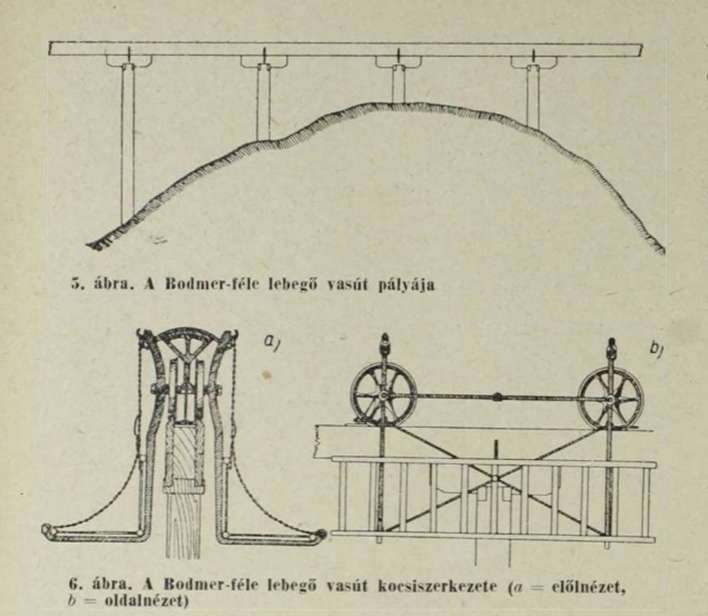
“In the 1820s, this system seemed to be very advantageous, since it was not necessary to raise embankments for its construction, the track could be created with relatively little earthwork, only a suitable amount of wood was needed. Such a railway was experimented with in several places in Europe, and Baden salt mine manager János Gáspár Bodmer jointly applied for a patent with the Austrian company Bollinger & Co. for the construction of a Hungarian network of more than 900 kilometers, which would have connected Pest with Debrecen and Fiume, for example. The costs were correspondingly high, the price of the entire network was set at two million forints.” [1]
Palatine Joseph liked the idea. “Archduke Joseph Anton of Austria … was the 103rd and penultimate Palatine of Hungary who served for over fifty years from 1796 to 1847, after a period as governor in 1795.” [3]
Before the entrepreneurs could get a license covering the entire country, the Palatine first wanted a test track that led from Pest to Kőbánya. “The Pest-Kőbánya route was ideal because the stones and bricks for the constructions in Pest were transported from Kőbánya, and by joining this stone transport business, the railway would have made a profit even on this short section of less than 7 and a half kilometres, according to the plans.” [2]
“Work on the 7.6 kilometre railway section began in May 1827. The company issued shares, a total of 513 shares were sold, among the shareholders were the palatine himself, György Sina, one of the richest men in the empire, as well as the banker Móric Ulmann and István Széchenyi. However, there was not enough money to use hardwood, so they built the course out of pine. The rapid work was hampered by the lack of manpower, so the palatine also ordered the military, but an additional problem was that one of the company partners and also the construction manager, János Bodmer, died unexpectedly in the early summer of 1827.” [1]
“The 1,372-pole line from Pest to Kőbánya was finally completed on 15th August 1827. Its main purpose was to supply Pest with building materials, so it branched off at Kőbánya, one end point was at the Kauser quarry, and the other branch was at the Lechner brick kiln. To facilitate stone transport, the line [was] slightly inclined towards Pest.” [1]
The ceremonial opening took place on 20th August 1827, attended by the Palatine himself and his entire family, who travelled from Pest to Kőbánya on the new railway. The 25th August 1827 issue of Hazai’s Külföldi Tudósítások, commented:
“His High Duchy with his family, and the Deputation, led by Honourable Baron József Venkheim Főispán of Arad, at the city’s new Kőbánya, got on the carriages used for sitting, decorated with two flags with Hungarian colours flying in front of it, and all the way to the Kerepesi line, pulled by a horse, he arrived.” [2]
Palatine Joseph observed the return journey on which “a horse pulled 68 soldiers and a load of 148 Viennese quintal (that is, almost 8.3 tons), and later another train was started, and it was loaded with a total of 27 tons of stone, wool, and 40 barrels of wine. The journey time was approximately 1 hour.” [1]
The investors of the railway line leading from Pest, today’s Baross Square, to Kőbánya, naturally hoped for profit and the right to cover the entire country with their railway line later. Illés Aladár Edvi, in his study of Pest-Kőbánya Trial Railway (issue 7 of 1895 of the Magyar Mérnök és Építész-Egylet bulletin) cites the call made by János Bodmer, which he wrote to the hopeful shareholders:
“In Hungary, one of the most important points to be connected would be the one that would connect Pest, the centre of the country, with Szolnok by road, because goods coming from Poland and the Russian Empire could arrive here on Tisza or the newly built road in Ungvár county; the noble wines of Hegyalja, the linen of Upper Hungary, all of these can be transported to the world market quickly and cheaply from here.” [2]
“The business seemed to be successful, but problems soon appeared. On the one hand, there were not enough cars, i.e. not enough trains could run for the company to generate a profit. Of the existing 11 cars, usually only a maximum of 8 could be used at the same time, the rest had to be repaired, while three times as many, i.e. 24, were supposed to be running constantly, so the planned two trains per day could not always be started.” [1]
In addition, softwood rather than hardwood was used in the construction in order to save money. Hardwood was expensive and difficult to source at the time of construction. This led, however, to high maintenance costs and problems with deformation under load and natural drying of the timber meant that screws loosened and fell out. [1][2]
The wheels were above the cars. “The four wheels – 2 on each side – very close to each other rolled on the iron bands laid on the horizontal beams. Loads or passengers were accommodated in open structures hanging from the sides. The whole thing was drawn by horses, which of course walked on the ground. The idea was not completely unviable, according to reports from the time, a workhorse easily towed a 6-car, loaded assembly, which – converted to SI units – was nearly 14 tons including the weight of the cars.” [2]
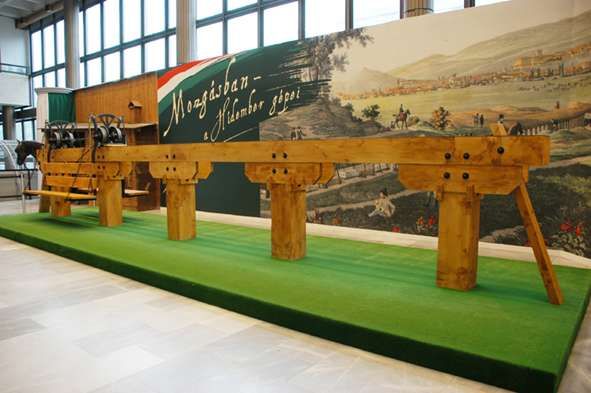
The railway could not “run in strong winds, because the structure had a significant defect, which could actually have been easily rectified. Since there were only wheels at the top, four per car, which were located quite close to each other, the cars hanging over the sides were rocked by the wind. This could have been avoided if the carriages were equipped with horizontal wheels that roll on the sides of the beams supporting the track and thus prevent swaying, but neither the freight nor the passenger carriages had such wheels.” [1]
“As early as the spring of 1828, it became clear that the entire line should be rebuilt and replaced with hardwood, and new, horizontal wheels should be placed in the cars, which would reduce the swaying.” [2]
The venture also carried high finance costs. The project exceeded the 20,000 HUF budget, coming in at 31,000 HUF. New shares were issued, but not enough money came in. As a result, the Company owed nearly 5,000 HUF to master carpenter József Spiegel, the head of the construction, who took over the management of the construction after Bodmer’s unexpected death in 1827. [2]
No account appears to have been taken of the state of the market at the time. “The company would have been successful if it had continuously delivered building materials to Pest. However, it would have been necessary to successfully break into an already well-established … market, which would have been possible if the work was taken away from the competitors, who used to carry out the deliveries with carts, or … construction work in Pest … accelerated in such a way that … excess capacity” was required. [2]
The market did not grow and there was no need for additional capacity. The carriers who had been transporting building materials until then were not happy about the competition and formed a cartel to lower their prices, i.e. it was cheaper to transport by cart than by rail.
“At the shareholders’ meeting held on 20th March 1828, the situation was quite hopeless. The railway was already struggling with a debt amounting to 4,339 HUF 35 kreuzer, and it did not generate enough income to start making a profit. To hope for a profit, major improvements would have been necessary, for example, new cars would have had to be purchased. For the continued operation of the railway, and to have enough money for purchases, each shareholder should have had to pay an additional 15 HUF.” [2] This they were not willing to do. so the company ceased operations on 20th March 1828, i.e. after 7 months. The line was dismantled, the timber was sold for firewood, but there were beams that were used at the Chain Bridge. [1][2]
“From the point of view of Pest, the suspension railway was important for several reasons. On the one hand, this investment also confirmed what was stated in law 10 years later, that Pest and Buda are the country’s transport hub. The railway was based on the future hope that Pest [would face] development, not only in the field of construction but also in the field of industrial plants, which [would] require a large increase in land transport [capacity]. It is no coincidence that the railway was a trial section of a line extending to the Tisza and beyond to Debrecen – that is, from where it was not possible to transport by ship. … However, the railway was about 10 years ahead of its time. Only one public railway line operated in one place in the world, England.” [2]
References
- https://pestbuda.hu/en/cikk/20220812_the_first_hungarian_railway_was_built_195_years_ago_the_special_structure_delivered_construction_materials_from_kobanya, accessed on 6th February 2025.
- https://pestbuda.hu/en/cikk/20230322_the_downfall_of_the_first_hungarian_railway, accessed on 6th February 2025.
- https://en.m.wikipedia.org/wiki/Archduke_Joseph_of_Austria_(Palatine_of_Hungary), accessed on 6th February 2025.
- https://en.m.wikipedia.org/wiki/Henry_Robinson_Palmer, accessed on 6th February 2025.
- https://en.m.wikipedia.org/wiki/Monorails_in_Russia, (the first Russian monorail was built by Ivan Elmanov in Myachkovo village, near Moscow in 1820. In this road on pillars”, horses pulled railroad carriages placed on a horizontal beam. The wheels were mounted on the beam, not on the carriages. Elmanov could not find investors to fund for his project, and stopped working on the monorail); accessed on 6th February 2025.
- Anton Howes; Smart, George; in the Oxford Dictionary of National Biography. Oxford University Press, Oxford, 2004.
- Henry R. Palmer, Palmer’s Observations on Railways / Description of a Railway on a New Principle; J. Taylor, London, 1823, p1, 2, 33, 34–35; via https://archive.org/details/bub_gb_HezfU0-Af4QC, accessed on 6th February 2025.
- https://commons.m.wikimedia.org/wiki/File:Palmer-monorail.png#, accessed on 6th February 2025.
 Roger Farnworth
