Category Archives: Comments and Reflections

28th June 2020 – A Cup of Cold Water – Matthew 10: 40-42

The interests of the wealthy Western world are often at odds with the interests of the majority of peoples on our planet. We have an unjust global trading system, we have nations so burdened by debt that it suffocates any chance of recovery, we have trade surpluses from wealthy countries dumped in the third world destroying the livelihoods of local producers. We have inefficient and ineffective aid arrangements and are still far from finding an acceptable global position on climate change. … The cards are stacked against the poor – the poor get poorer while the rich line their pockets.

And we are part of the system which makes this happen – we elect the leaders that make these decisions. I wonder what you might want to say to leaders of the most wealthy countries in the world, if you had the chance? If you=d been invited to speak at the latest G7 or G8 meeting what would you have said were the priorities for our world? What would Jesus want to say to them?
Perhaps it is there in our Gospel reading this morning:

“Whoever gives even a cup of cold water to one of these little ones in the name of a disciple – truly I tell you, none of these will lose their reward.”

This verse at the end of Matthew 10 points forward to a later story in the gospel of Matthew – in Matthew 25 – the story of the sheep and the goats.

In that story, Jesus welcomes the sheep into the kingdom and he says,

“I was hungry and you gave me food, I was thirsty and you gave me something to drink, I was a stranger and you welcomed me, naked and you clothed me.”

“When was that, Lord,” the righteous reply.  Jesus response: “Just as you did it to one of the least of these who are members of my family, you did it to me.”

When you gave money to Christian Aid to provide shelter, clean water and good food, you did it to me. When you gave money to Oxfam to help people begin to stand on their own two feet, you did it to me. When, at Harvest, you gave money for a water tank in Kisoro in Uganda, (as did the churches of the Parish of the Good Shepherd, a year or two back), you did it for me. When you welcomed the immigrant and the asylum seeker into the life of your church, you welcomed me, or even just the newcomer who did not know anyone. When you fought for the rights of the poor and the dispossessed, you fought for me. When you understood and acted on the pressing climate issues which faced the world, you did it for me.

Sadly, the story in Matthew 25 also tells of those who did not give and share, who did not welcome the stranger – and Jesus is just as clear that their failure to act for those who were marginalised, hungry, thirsty and hurting was a failure to serve him. And in the story they receive not a blessing but a curse.

So what can we do to fulfil our Lord’s commission to us?

The very least we can do is be welcoming to all who are new. In our churches, when we are able once again to attend, that will mean watching out for those who are new and taking time to be with them to welcome them over coffee at the end of the service. And in doing so, we will welcome the stranger in our midst – particularly the asylum seeker and the immigrant. We can choose to set aside our embarrassment, perhaps our fears and prejudices and commit ourselves to friendship and love.

We could write to our leaders, and to our MP, and tell them of our concern for the poor and the dispossessed and demand that they use our resources, our taxes, to bring about justice in our world.

We can begin to buy or continue to buy produce which has been fairly traded. This seems to me to be a no-brainer. … Wherever possible we can choose goods in our supermarkets that guarantee not to have been bought at unfairly low prices. We cannot continue to exploit others in our world just so that we can get our bananas, our coffee, our tea, our sugar, our chocolate a few pence cheaper. We are committed as churches in our parish, for all church functions, to only using fairly-traded coffee and tea (I wonder if we are sticking to that promise?) And we have promised that we will do everything we can to fight for justice for the whole world – even if that means a little extra expense for ourselves. And that is a big commitment: we have agreed to fight injustice in whatever form we encounter it, financial, racial, climate or ……… And we know that this is one of the Marks of Mission to which all Anglican Church assent.

Jesus doesn’t give us the option. The reward he mentions in our Gospel reading, the reward of the righteous, is not a reward given to pious and holy people who go to Church, it is a reward give to those who follow Jesus, who live according to his values, who give of themselves to others in just the same way as Jesus would have done.

It is enough, at least at first, to take just one small step in the right direction: just talking to the stranger in church on a Sunday morning; just setting up a standing order to Christian Aid, Oxfam or Tear Fund; even just giving a cup of water to someone in need, says Jesus is a start down the road. Just one small step, but it is a step down a route which places others needs on a par with our own. And it is the same road that Jesus travelled – a road which ultimately runs through the cross and on into resurrection.

“Just as you did it to one of the least of these,” says Jesus, “You did it to me.”

…. “Whoever gives even a cup of cold water to one of these little ones …….. truly I tell you, none of these will lose their reward.”


21st June 2020 – Prayer is like sunbathing! – Matthew 10:27

My colleague, Revd. Ben Brady writes:

Have you said your prayers today?

What is prayer? … Is there a WRONG way to pray? … Why pray?

So what is prayer?

“It’s like sunbathing” according to Rowan Williams. [1]

He speaks of allowing ourselves to soak in the presence of God like sun rays. I like that, more importantly, I CAN do that. In Rowan’s description, prayer is opening ourselves to God’s presence, to allow ourselves feel and be shaped by God like a potter with clay. This image suggests a lovely relaxing experience and sometimes I do feel a deep sense of peace in prayer. However, often prayer also triggers different emotions, challenges and less comfortable feelings.

I find it is important to remember that prayer is an intentional act. We decide to be active participants and therefore can work through difficulties in prayer rather than simply passively accepting them.

A popular practice is called “The Examen”. This is when you think through your day, addressing what you are thankful for, sorry about and where you experienced a sense of the Divine; a holy moment. This approach to prayer allows the positives and negatives to coexist. We don’t have to ignore our anger or sadness in favour of gratitude. We can be with God in both our frustration and joy.

Over time, I’ve reflected on who I am and how my interests impact my prayer life. I’m always trying to be aware of how I’m feeling and how I can be in that same headspace with God in prayer. I’m a musician and so sometimes listen to music, but sometimes I simply sit in silence. I can be fidgeting, so I hold something (holding cross, prayer rope, rosary). Sometimes I close my eyes, sometimes I look at an Icon or look out the window. I have times when I use the daily offices set by the Church of England. Sometimes I use The Book of Common Prayer but at other times I can’t be bothered with “Thee’s, Thou’s and “Sundry places”. What I find matters most is that I’m willing to adapt my approach to prayer to ensure that I don’t just avoid spending time with God because ‘I’m just not in the mood’.

A little while ago, Rev. Liz Devall and I hosted sessions on different forms of prayer called “Pick & Mix Prayer”. This was an opportunity for people to gather and try out different or new forms of meeting with God. I really like this idea of having a “Pick & Mix Prayer” approach. A famous saying is that it takes longer to prepare to pray, than the actual praying. I believe there is wisdom in that.

St. Ignatius suggests standing just next to where you will be praying, say the Lord’s Prayer and then sitting down. This gives yourself time to enter into a prayerful space. A friend of mine said that he loves Morning and Evening Daily Office prayers, because once he has said the words, read the Psalms, the set readings and the Gospel Canticle, he feels more focused on who he is praying to.

I’ll be honest, despite my best intentions I sometimes slip into a superstitious way of thinking about prayer. I’ll hear myself think “well I didn’t pray properly today so it’ll probably be a crap day”. This is not true, we do not believe in a petty God who deliberately trips us up throughout the day due to missing/forgetting/not feeling it on a particular day. The Gospel has a very different description of prayer. I love the verse from Matthew 10:27:

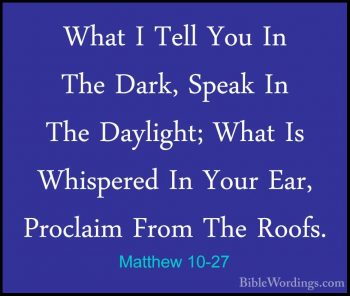
“What I say to you in the dark, tell in the light; and what you hear whispered, proclaim from the housetops.”

God may whisper life changing news to us in the smallest of quiet prayerful moments. We might sunbathe in prayer and feel replenished, altered and enlivened. We may just receive enough strength to face the next day.

Rev. Ben

References:

  1. For a parallel but different reflection, see what Revd. Giles Fraser has to say picking up Rown Williams theme: https://www.theguardian.com/commentisfree/belief/2012/jul/27/religious-sunbathing-giving-up-control, accessed on 20th June 2020.

14th June 2020 – Sheep without a Shepherd (Matthew 9: 35ff)

Psalm 100 is one of the Psalms set for services during the day today (14th June 2020). The first 3 verses say:

Shout for joy to the Lord, all the earth.
Worship the Lord with gladness; come before him with joyful songs. Know that the Lord is God.
It is he who made us and we are his;
we are his people, the sheep of his pasture.

The gospel reading from Matthew says this of Jesus:

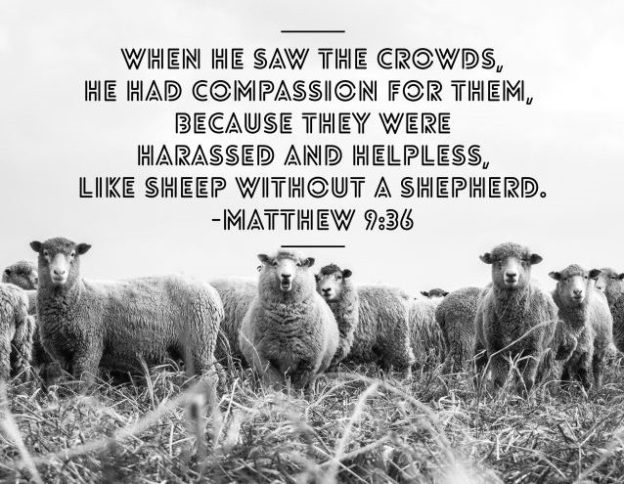
When he saw the crowds, he had compassion for them because they were harassed and helpless, like sheep without a shepherd.

As the readings for today are taken from the lectionary, used by churches around the world, as Anglicans we’ve heard these readings every three years for a number of years. Indeed, having been ordained for twenty-one years, this is the seventh time round for me, listening to these readings as part of Sunday worship and then preaching and writing about them as a member of the clergy.

The imagery of sheep and shepherd is very appropriate for churches that are members of the Parish of the Good Shepherd, here in Ashton-under-Lyne. But it is a well-loved and important analogy for the Christian life wherever it is experienced.  The use of the word ‘harrassed’, translated elsewhere as ‘confused’ to describe those who do not know Jesus could as easily be applied to our generation as it was to Jesus’ own times.

At this point in Matthew’s Gospel, Jesus is still at a relatively early stage in his ministry. People will have encountered or heard of John the Baptist; they might have heard the rumours of what happened at Jesus’ baptism when a voice from heaven proclaimed him to be God’s Son; they might have heard Jesus teaching in the synagogue; some will know that a few have been chosen to live alongside Jesus; most of them will have heard his challenging teaching on the mountain. There have been healings, a storm has been calmed, demons have been cast out, a girl has been raised from the dead. But still people haven’t had enough time to understand who this man, Jesus, really is.

Is he just a really good teacher? … Where does his power come from? … Why is he saying such different things to the established religious leaders? People are confused – they hear Jesus’ voice, they hear the voices of their priests. Who should they listen to? Who is really helping them to know God?

Society today has many conflicting voices speaking about what people should believe and how they should behave. Some say God exists and some say he doesn’t. Some say that we must maintain the Christian heritage of our nation, and others say that any mention of God and religion in public life is wrong. There are those who say that there is an absolute set of morals while others say that they are free to do anything they want to. Some people let their lives be governed by the voices of astrologers and clairvoyants – claiming to see into the future. Some people follow the voices of those who say that happiness comes through possessions not relationship and friendship.

And there is a perpetual stream of voices saying that if we buy this car, or that face cream, or this floor cleaner our lives will be instantly so much better.

Each of us has our own struggles, I guess, with working out how to live our lives in a complicated world. Working out which voices to listen to can be so complicated – and for some people it is simply overwhelming. The confusion is just too great. We feel harassed. …

To block out the voices, some turn to alcohol or drugs to bring respite from the need to make decisions. When voices that urge people to focus solely on their own needs become too strong, relationships can suffer and breakdown, or people can get into debt or a life of crime. Overwhelmed by voices that undermine self-confidence, mental health problems can emerge. These social problems are apparent in many areas of our cities, towns and in our neighbourhoods.

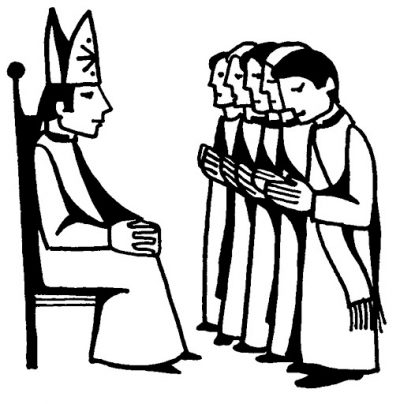
It is perhaps good, at least occasionally, for me to remind myself what priests are told as part of accepting their role. This is called the Bishop’s Charge and is read out in ordination services. This is the charge that the Bishop gave to my wife and I when we were ordained as priests:

Priests are called to be servants and shepherds among the people to whom they are sent. With their Bishop and fellow ministers, they are to proclaim the word of the Lord and to watch for the signs of God’s new creation. They are to be messengers, watchmen and stewards of the Lord; they are to teach and to admonish, to feed and provide for his family, to search for his children in the wilderness of this world’s temptations, and to guide them through its confusions, that they may be saved through Christ for ever.

Priests are called to be servants and shepherds among the people to whom they are sent … and to guide them through the world’s confusions. ….

A daunting task! Only possible with God’s Spirit at work in us! But this is not a task for priests on their own. It is a charge that was given, as our Gospel tells us, by Jesus to his disciples.

Filled with compassion at the confusion of the people around him, Jesus empowered his disciples to minister to them – to bring wholeness and healing to damaged lives. This task was on such a large scale that Jesus chose not to limit it to significant religious leaders, but to also use ordinary people, like you and me, to fulfil it. As people who follow Jesus, you share with your priests the task of reaching out to all in our parishes, and in our local communities wherever we live and work, who are confused, who feel harassed and worried, and whose lives are damaged.

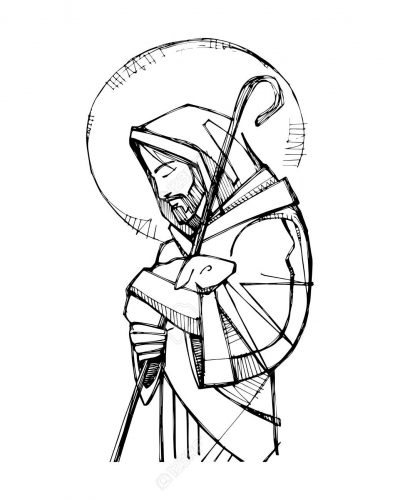
Together, we all embody the Good Shepherd who seeks the lost and places them once again in God’s company – so that they may be whole, secure, safe and free from confusion and fear.

Trinity Sunday – 7th June 2020

Think of the smallest child you know. It might be one of your own, or a grandchild, a nephew, a niece or a neighbour’s child.

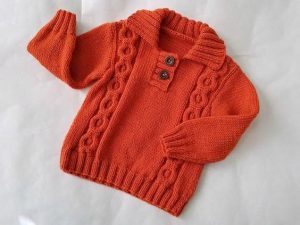
Almost inevitably, the clothes they wear are endearing.

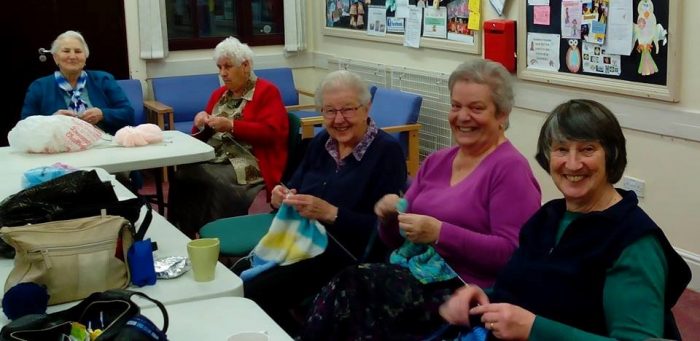
We have a neo-natal knitting group in our Parish which meets at Holy Trinity Church and Community Centre on a Wednesday. You can find out more about them at the bottom of this reflection. They make some of the most wonderful, the most amazing small things which contribute to keeping delicate little ones alive and well. Their work is much appreciated by the hospitals they work for.

Little clothes suit tiny people! You and I need something a little bigger to wear. And during this time of crisis, I am finding that some of the things I normally wear are getting gradually tighter.

Nevertheless, if I was to ask you to put on a small child’s jumper, you’d look at me as though I was being daft. I guess you would probably tell me that you were too large, or that the jumper or cardigan was too small.

It is Trinity Sunday this weekend. It is the patronal festival for Holy Trinity Church, one of the five churches in our Parish of the Good Shepherd, Ashton-under-Lyne. This is often a Sunday when clergy struggle to help us understand what God is like. It is as though, if we try once again, we might just this year be able to explain the Trinity. We come up with a whole range of different images which are helpful to some extent but which never quite work. I guess we wind up proving something very important – that our minds are too small to comprehend fully what God is like!

We all do it. We often expect God to be able to fit into our human-sized minds. So, when we think about God we come up with all sorts of questions, like: How can God possibly be able to hear us all praying at once?

What we mean when we ask such questions, is that we know a human being could not do that, so it must be impossible for God as well.

Or perhaps we say something like – everything has to begin somewhere, everything has a beginning, so God too must have had a beginning!

It is so hard to understand God. So often, when we ask these kinds of questions, it is the same as holding out a child’s jumper; holding out our small human shape (or jumper) and expecting God to climb into it. And, of course, God does not fit, because God is so much bigger and deeper and wider and higher than any human being can comprehend.

God is so different. God is always going to be full of wonderful mystery for us. However much we learn about God, however clever we are, however much we think about God, we will always struggle to understand God. We will never be able to hold God’s nature in our minds and understand God, no more than a child’s sweater can hold someone like me.

So, does that mean that we cannot know God? Not at all! We are not at the moment able to make physical contact with other people outside our own household. But just imagine if we could walk across a room and shake hands with another person. Imagine talking with someone you don’t know, finding out things about them.

You might ask questions like these:  How old are you? What do you do during the week? How many people are in your family? What is your favourite colour? What music do you like listening to?

We don’t need to completely understand someone before we can become friends. Indeed, being friends is partly about discovering new things about each other and about sharing together in discovering things around us.

Just because God is God and I am a human being – it does not mean that we cannot be friends. There are people in our church communities who talk with God everyday! Did you know that? It is called praying. And if you ask them, they might well tell you that God is the person that they love and trust best in their lives!

We’ve been given a lifetime to get to know God really well and to live as his friends. Sometimes we waste that time,at other times we realise that nothing else matters as much as knowing God and how much God loves us.

Sometimes we can’t be bothered to talk about God, or sometimes we let our behaviour suggest that God isn’t worth knowing, sometimes we are unkind of difficult or rude or selfish. But at other times we feel such love for God that we cannot wait to tell other people. And sometimes our loving behaviour speaks of God too.

God is Father, Son and Holy Spirit. God is wonderful and all-knowing. God is the maker of the universe and of each one of us. God is the one who came as Jesus to die to love and save us. God is present in and with his people, living in us as the Holy Spirit. We cannot possibly expect to fully understand a God as amazing as that!

The fact that God is great and full of holy mystery should make us excited not frustrated. It should encourage us to get to know God more. But, ultimately, if I could get a hold on God, if I could fit God into my small mind then God wouldn’t be God.

I wonder how big a jumper we’d need for God to fit in it?

Neonatal Knitters are a community group who knit, crochet and sew items for the Neonatal units of Tameside, St Mary’s and Royal Oldham hospitals.  We meet every Wednesday 10.30 – 1.00 at Holy Trinity Church and Community Centre.  We are a very friendly bunch and welcome new members from our community.  Unfortunately, we cannot include children in our group for safety reasons and we do not have the capacity to teach people to knit or crochet.  For more information please drop into the group any week, check out our Facebook page (Neonatal Knitters) or email us on neonatalknitters@outlook.com.


Sunday 31st May 2020 – Pentecost – A Reflection by Cath Sheldon (ALM)

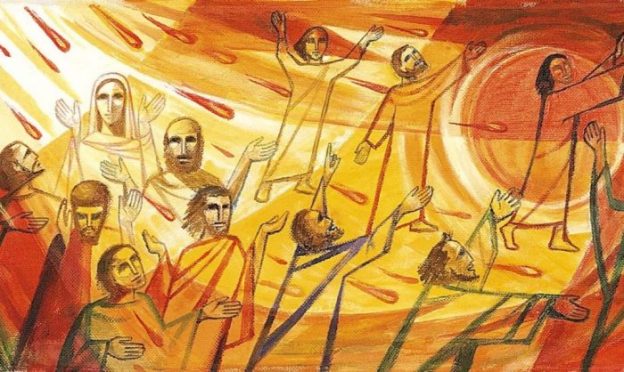
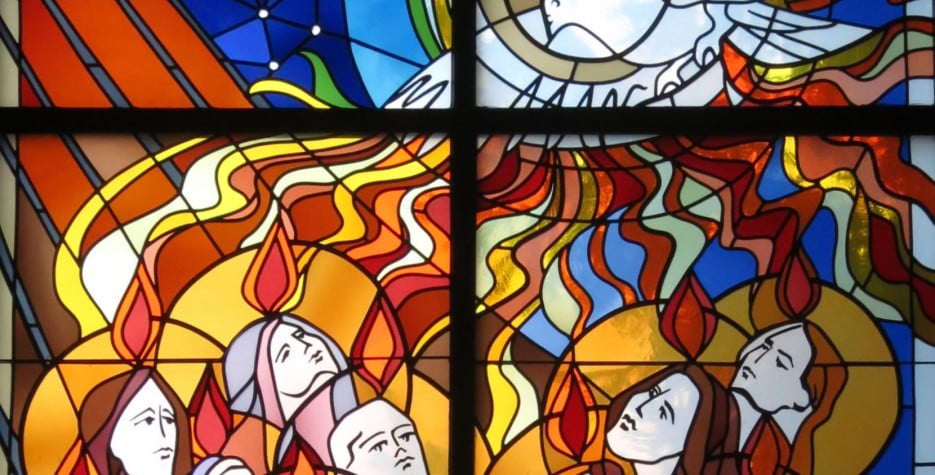
The featured image above has a sense of both the wind and flames of Pentecost, and the call to move out into the world as God’s ambassadors and servants. [1]

Today is Pentecost or Whit Sunday the birthday of the Christian Church and a time for celebration and gifts.

Gift, what does that word conjure up?   Something given to us, something special that the person who is giving has taken the time to pick, or that one thing we were born with and able to excel at without trying, a talent.

On the very first Pentecost the Holy Spirit descended on the disciples and gave them the gift to be able to go out into the world and spread the Gospel.   It says in Acts 2, ‘suddenly there was a noise from the sky which spread like a strong wind blowing, and it filled the whole house where they were sitting.  Then they saw what looked like tongues of fire which spread out and touched each person there’. (Flames of fire just like candles on a birthday cake!) The Holy Spirit being the ultimate gift from Jesus.

Jesus told them at The Ascension, “I am going so I can send the Spirit to you”. (The Holy Spirit is another name of comforter, which is very apt).  They were able to speak and be understood in different languages, what must that have felt like?

Just before the lockdown, the Parish of the Good Shepherd in Ashton-under-Lyne started a group to learn to speak Spanish, we were given simple phrases and words to learn, it certainly wasn’t something that happened straight away! So, it must have felt pretty frightening to the disciples, that they were able to understand and speak a language that was not their own.

Do we all have this gift, to be able to go out and spread the love that God has for us all?   Yes, I think we do, because it not just about speaking, it’s what we do and how we conduct ourselves.  We all know that person who has the knack of being able to say the right thing when someone needs a helping hand with a problem, it might not be the answer, but sometimes it is a pointer in the right direction.   Or that person who sees that something needs doing and organises a group to do it or just gets on with it without a big show.

The past few weeks have brought out the gifts in people. Simple things like shopping for those who are self-isolating, or making contact by phone or text to check that people are OK. We are reflecting the love of God with what we do in our daily lives.

The way we ‘do’ church has changed during the pandemic, many of us have followed services online, radio, television, from many different sources, and we have received each week, by post or email the service and prayer sheet.   And although we have not been able to meet up with our friends from our own church, we are able to worship God with others who we may never meet but have so much in common with.    But we are still in touch with other because we pray together, sing together.    The fact that we haven’t physically seen each other doesn’t necessarily mean we are apart, God has given us the gift of being part of the his greater family.

Some ‘gifts’ are waiting to be recognised.   It takes a nudge, a word, an email or a post on social media to start the ball rolling.   We question ourselves, could I do that?  Do I have the time? Am I qualified enough? Am I doing this for the right reason?   But if we put our trust in God, he will show us the way. God will help us fit things into our daily lives. God will show us where to find the time. God will point us in the right direction.

No matter what our gift is, it is a mission given by God, and all we need to do is trust in him.

References

  1. https://buildfaith.org/planning-for-pentecost, accessed on 29th May 2020.
  2. https://www.officeholidays.com/holidays/pentecost-sunday, accessed on 29th May 2020.


Pentecost 2020 – A Magazine Article by my Colleague Revd. Ben Brady

Pentecost

I love superheroes. I love reading graphic novels (comic books), watching the films and wondering which power I would like to have. Having a 7-month old child means early mornings but a surprise benefit of these early starts is that together Stanley and I have been working our way through the classic (in my opinion) Michael Keaton Batman films. Batman is one of my favourites. But whether the hero is bitten by a radio-active spider (Spider-Man), crashing to Earth from the planet Krypton (Superman) or even caught in Gamma rays and can’t control their temper (The Incredible Hulk) I love them all.

So, if you could have a super-power, what would it be? Speed, so you could complete lots of work in a short period of time? Invisibility, so you can have some undisturbed alone time? Flight, so you can really save on those flights during the summer holidays? Super strength, so you may be able to beat Mick from St Gabriel’s at boxing?

Personally, I find all of these worthy of countless hours of daydreaming.

However, two problems tend to arise. Firstly, I always seem to focus on how they would benefit ME.

Secondly, I’m pretty sure they are never going to happen and only appear in daydreams.

The Church celebrates Pentecost on Sunday 31st May this year. This is when we remember the gift of the Holy Spirit coming on to the disciples “like tongues of fire” (Acts 2:3). I find this image very dramatic.

Once in a school assembly, I heard someone say “The Holy Spirit came as fire onto all their heads!” Quite rightly, this received gasps of horror from the children. In some Christian icons, the Holy Spirit is depicted like a candle flame above the disciples’ heads. This holy anointing is so powerful, it calls to my mind the verse that speaks about “Children of Light” (1 Thessalonians 5:5). … Now comes the challenge, because this applies to us too, now. …. To carry this light into our homes, work and communities. But what does this look like?

We are told about the fruit of the Spirit. This is what we are to bear out with the Spirit within us. Galatians 5:22-23 tells us “the fruit of the Spirit is love, joy, peace, patience, kindness, generosity, faithfulness, gentleness and self-control.”

It is important to note that it says “fruit” not ‘fruits”. This is a real game changer. It means that unlike choosing whether you would rather fly OR have super strength, we get both. We don’t have to choose between having more patience or faith. We can pray for all the fruit of Spirit. I don’t know about you, but I definitely need at least a few of them daily!

God in his love for us sent us the Holy Spirit so that, just like planting a seed, we can bear this fruit. However, like tending a plant, we need to tend to ourselves. When I was in Uganda, I led a session on the Holy Spirit. I openly shared how personally I have experienced great senses of being loved and a deep sense of peace. We used the metaphor of a sponge saturated in water. Then over time the sponge dries out. There is no need to panic, just put the sponge into some water again. Over time, we may feel like we have dried out of patience, kindness or self-control. But Jesus says he is the “Living Water” (John 4:10) and we just have to ask to be filled again.

So I encourage you to nurture the Holy Spirit within you. Bear the fruit and pray to be refreshed whenever you need. In doing so, we can all bless and reflect the love of God onto all those with who we come into contact.

Revd Ben 


John 17: 1-11 – Sunday 24th May 2020

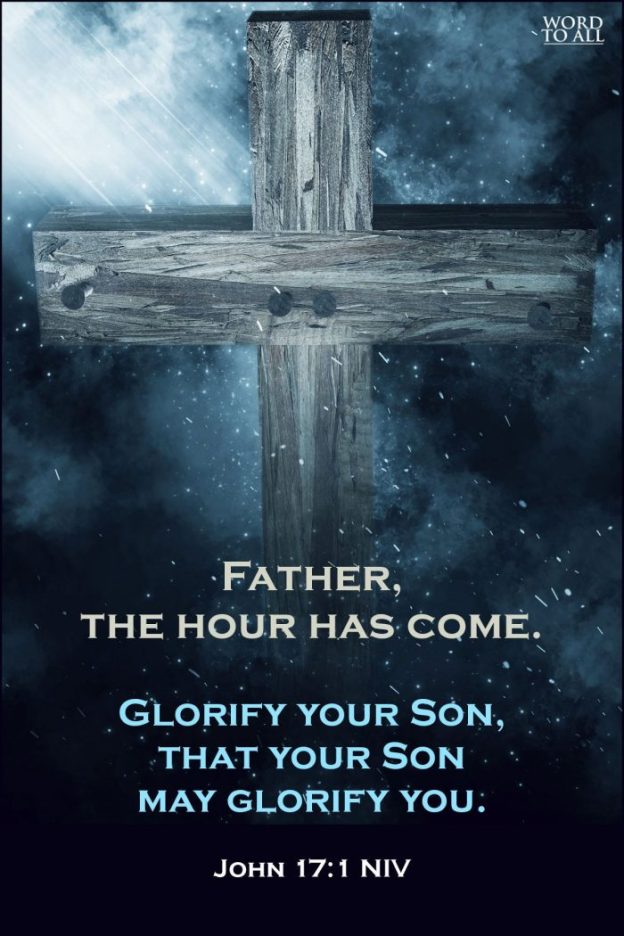
Father, the hour has come; glorify your Son so that the Son may glorify you (NRSV)

I wonder what Jesus means when he says these words? …

If we are to discover answers to this question, we need to look at the context.

In our Gospel reading, time seems to have stood still. The first 12 chapters of the Gospel cover the first 33 years of Jesus’ life. Then, from the beginning of Chapter 13 right through to the end of Chapter 17, we are in the Upper Room at a Passover Meal with Jesus and his disciples, his friends. This is last evening of Jesus’ time with his disciples before the Crucifixion.

We have watched Jesus washing his disciples’ feet. We have heard him talking of the Holy Spirit who will walk alongside them, live within them, help them to be witnesses to the love of God as they live their lives. We know that these actions and these words were spoken as much for us as for the disciples’ benefit.

In what Jesus says and does, he is encouraging us to share in his priorities for our lives: serving others; receiving their service to us with grace and love; witnessing to the love of God; listening to the inner voice of the Holy Spirit; and later in Chapter 17, placing a priority on working together as one, respecting each other, knowing that without our shared fellowship and witness, we are so much poorer.

And in the middle of all this, come those words of Jesus:

Father, the hour has come; glorify your Son so that the Son may glorify you.

I guess that there are two ways that we can think about those words.

First, there is the wider context of all that Jesus has been saying and doing in the Upper Room and the wider context of the whole prayer in John 17. He could be praying that God will be glorified through the lives of his friends. Jesus has commissioned them to serve him and they will, from now on, be the ones through whom God is glorified. This means that we are the ones to be God’s visible presence in the world. Our actions, good or bad speak about the Lord that we claim to follow and serve. Our choices and actions speak loudly about the God we say we serve. We are the ones who will glorify God. Or our behaviour and actions could bring shame on the God we say we serve. So, Jesus prays that God will be glorified by the choices we make and by our actions.

Secondly, and in line with the immediate context of John 17: 1-6, Jesus could be talking about something very different. …

When Jesus talks about himself being glorified and so bringing glory to God, it seems that he has in mind the days which immediately follow this prayer. He sees the events of the crucifixion and resurrection as being about glory! And particularly, the events of Good Friday. For Jesus, the glory of God will be revealed in him at the cross and in his resurrection. As Jesus is lifted-up in the eyes of everyone, so he gives glory to God.

Glory is to be found, not in power and influence, but in obedient submission to God’s will.

Jesus’ throne is the Cross. God’s glory is revealed in suffering. God is revealed most clearly at the place of suffering.“Father, use these next hours,” prays Jesus in John 17, “to glorify me and to glorify you.” And Jesus re-emphasises this as he says to God the Father, in John 17:4: “I glorified you on earth by finishing the work that you gave me to do.”

Jesus’ example to us is one which centres on the Cross. It is at the Cross, the place of suffering, that God’s redeeming work is done. The place of weakness is the place of glory! This is the place where we discover who God really is, and God’s glory is revealed.

We are safe in the love of God, in some mysterious way, because of the Cross.

And because of the Cross, we too can serve others without counting the cost. And if we suffer, we can be sure that, in Christ, God has walked the same journey that we walk. God is not surprised or shocked by our struggles, but there alongside us each step of the way.


Prayers for Sunday 24th May 2020 from Jesuit communities in the USA.

Jesus Christ, you travelled through towns and villages “curing every disease and illness.” At your command, the sick were made well. Come to our aid now, in the midst of the global spread of the coronavirus, that we may experience your healing love.

Heal those who are sick with the virus. May they regain their strength and health through quality medical care.

Heal us from our fear, which prevents nations from working together and neighbours from helping one another.

Heal us from our pride, which can make us claim invulnerability to a disease that knows no borders.

Jesus Christ, healer of all, stay by our side in this time of uncertainty and sorrow.

Be with those who have died from the virus. May they be at rest with you in your eternal peace.

Be with the families of those who are sick or have died. As they worry and grieve, defend them from illness and despair. May they know your peace.

Be with the doctors, nurses, researchers and all medical professionals who seek to heal and help those affected and who put themselves at risk in the process. May they know your protection and peace.

Be with the leaders of all nations. Give them the foresight to act with charity and true concern for the well-being of the people they are meant to serve. Give them the wisdom to invest in long-term solutions that will help prepare for or prevent future outbreaks. May they know your peace, as they work together to achieve it on earth.

Whether we are home or abroad, surrounded by many people suffering from this illness or only a few, Jesus Christ, stay with us as we endure and mourn, persist and prepare. In place of our anxiety, give us your peace. …… Jesus Christ, heal us.          Amen.

Ascension Day 2020

The Ascension begs a question: … What exactly is happening as Jesus goes into heaven?

Is this the triumphant finale, the final victory parade? When at last Jesus goes home to the Father, to be paraded through the streets of heaven in victory – much like the Liverpool  football team had hoped to be driving around the streets of the city in an open-top bus at about this time. Is it the time when Jesus is welcomed back into that indescribable unity which is the Trinity of the Godhead – back home at last?

Or is it a moment of desertion. The disciples have only just received Christ back among them after his death and now cruelly he is taken from them into heaven. A renewed relationship is abruptly ended!! A commission is given and then the bombshell is dropped.

“Listen!” says Jesus, “I have a job for you to do – to be my witnesses throughout the known world.”

“Great, Lord, when do we get down to business, when do we work out the strategy, when to do you provide the corporate plan of action, when do we do our Mission Action Planning?”

“Not us. … Not me!” says Jesus, “You! …… I’m going away and you’ll never see me again this side of heaven!”

Or is this, actually, rather than desertion, the point at which followers become leaders, children become adults. Is this primarily the point where Jesus followers can no longer hide behind a leader and have to begin to make important choices themselves.

For all the participants in this story, this must have been a confusing moment. A time which carried so much emotion – parting from friends, losing a friend and leader, going home …

All sorts of mixed emotions.

In the end all of these scenarios have more than a grain of truth to them.

Christ is going home in victory. A job well done.

Christ is leaving behind a ragged group of followers who must have felt deserted. Yes, he did promise the Holy Spirit as helper and guide. But what’s a Spirit when you’ve had real flesh & blood to relate to?

And perhaps most crucially for us, Jesus is asking this ragged group to stand up for themselves. To be what he knows that they can be with the Spirit’s strength – a missionary band that will turn the world upside down within a century.

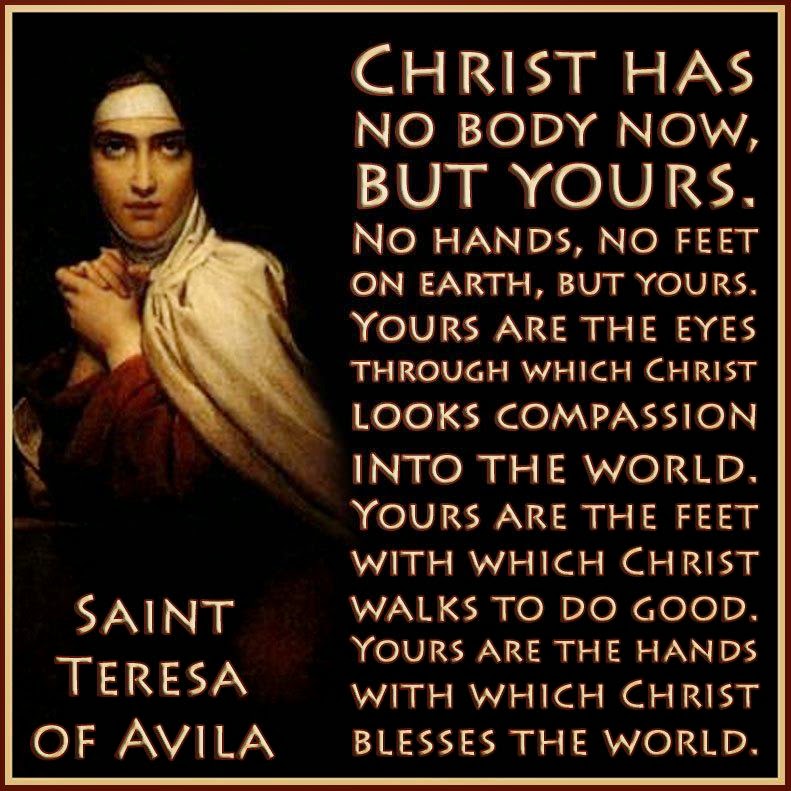
St. Teresa of Avila’s prayer sums it up well …..

Christ has no body now but yours. No hands, no feet on earth but yours. Yours are the eyes through which He looks compassion on this world. Christ has no body now on earth but yours.

stteresaavilaquoAs we mark the Ascension today, of course we celebrate a job well done, the earthly part of Christ’s mission over. But, most critcally, the Ascension reminds us that we are the ones that count – between now and eternity God has left his concerns, his mission in our hands. And on Ascension Day, it behoves us to commit ourselves again to serving to God – to discovering his way and walking in it, to being his hands, eyes and feet here in the places that God has put us.

Sunday 17th May 2020 – 1 Peter 3: 13-22

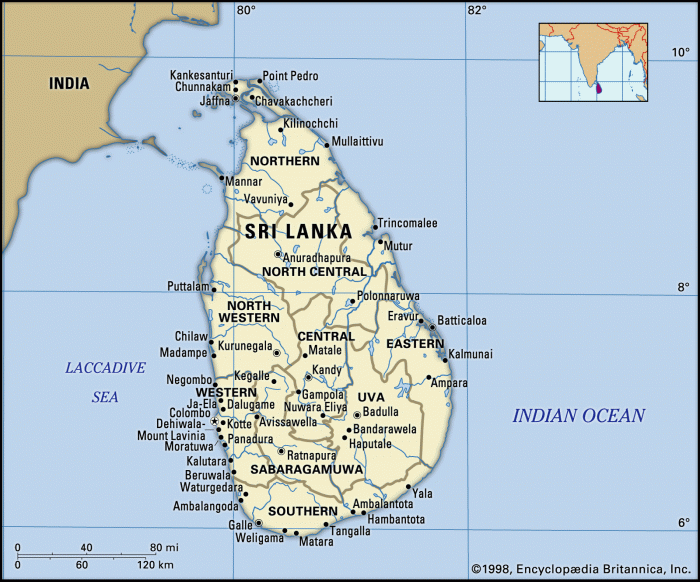
My wife Jo and I studied together at St. John’s College, Nottingham when we were training to become priests in the Church of England. We both had overseas placements in the Summer of 1998. I went to Sri Lanka for 8 weeks and Jo went to South Africa. My placement was at Lanka Bible College on Christopher Road in Peradeniya, near Kandy which can be picked out on the map below in the centre of the island country. The main building of the college features in the image above! [1]

Sri Lanka, formerly Ceylon, is an island country lying in the Indian Ocean and separated from the Indian peninsula by the Palk Strait. It is located between latitudes 5°55′ and 9°51′ N and longitudes 79°41′ and 81°53′ E and has a maximum length of 268 miles (432 km) and a maximum width of 139 miles (224 km), (c) Encyclopedia Britannica, 1998.

Sri Lanka is primarily a Buddhist and Hindu country. Christians are very much in the minority – perhaps less than 5% of the population. The church is growing quite quickly, particularly in rural areas. … I want to introduce you to two of the people I met while I was staying there. … A woman called Lalani and a man called Anargith.

Anargith gave up work in the capital city, Colombo, to be a missionary in one of the driest and poorest parts of Sri Lanka. He exchanged a comfortable flat for a small grass-roofed mud house with no running water or sanitation. The nearest church was around 50 km away. He started sharing his faith with people in the villages around where he lived and, when I met him, he had a small group of people meeting in his home. In the months after I returned from Sri Lanka they began to build a church. When I last heard from Anargith, which must over 15 years ago now, none of the people in his church had yet been baptised.

Anargith explained that it would only be when they got baptised they would be marked out as converts from Buddhism. It was important that their faith was strong enough to cope with the persecution they most probably would face. They would be threatened and, if experience elsewhere in Sri Lanka was to be matched, the church building and their houses could be burnt down.

Lalani’s story is a little different. When I met her, she was Pastor of an Assemblies of God church in southern Sri Lanka. In the mid to late 1990s, her husband Lionel had a successful ministry in their village – a lot of people were becoming Christians. He received threats from local Buddhist community leaders, but he continued to work, and the church continued to grow.

A contract was taken out on his life and he was shot and killed.

Lalani had trained with her husband and after he died took over the role of Pastor to the Church in their village. When I met her she was still working in that same village – witnessing to people that she knows were involved in her husband’s death.

These are stories that have touched me personally. But throughout the world today there are many Christians suffering and dying for the faith that they hold so dear:

  • Many of the Saints who fill our Anglican calendar were martyred.
  • In Pakistan, Christians have regularly been accused under strict blasphemy laws and imprisoned without trial.
  • Some time ago I was told an astounding fact: There were more Christians tortured and killed in the 20th century than throughout the whole of the history of the church before that.

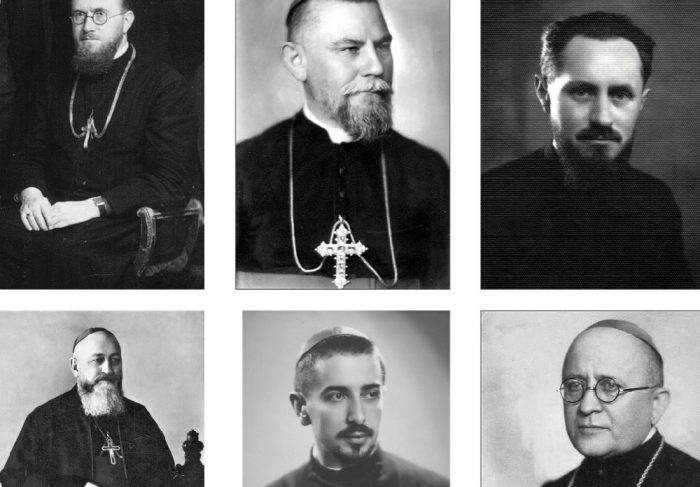
    One example of persecution in the 20th century is the deaths of seven bishops in Romania. Pictured are six of those seven bishops of the Eastern-rite Romanian Catholic Church who died during a fierce anti-religious campaign waged under the communist regime in Romania. Pope Francis recognized their martyrdom and beatified them in Romania on 2nd June 2019. Clockwise: Auxiliary Bishop Vasile Aftenie of Fagaras and Alba Iulia; Bishop Ioan Balan of Lugoj, Auxiliary Bishop Tit Liviu Chinezu of Fagaras and Alba Iulia; Bishop Valeriu Traian Frentiu of Oradea Mare; Bishop Ioan Suciu, apostolic administrator of Fagaras and Alba Iulia; and Bishop Alexandru Rusu of Maramures. Not pictured is Bishop Iuliu Hossu of Gherla. (CNS photo/courtesy Romanian Catholic bishops’ conference). [2]

Since the time of the early church, when the gospel has been proclaimed persecution and suffering have been close at hand. Sacrifices have been made, both by those sharing the good news of God’s kingdom and those accepting God’s rule. And Peter’s epistle reflects that. The passage set for today is about suffering for being a Christian.

But what do stories of persecution in Sri Lanka, or words of comfort from an apostle to Christians in the early church have to do with us in our communities?

Peter wants to stress that being a Christian will not be an easy ride. We can’t take our status as children of God for granted and then sit back with our feet up. Peter warns us what to expect, so as to enable us to be prepared. He then makes it clear what we are called to do:

First, says Peter: “Do what is just and right even if there is a personal cost. … For it is better to suffer for doing what is right than what is wrong.” When you see injustice in your local community do something about it, even if it is inconvenient, even if there is a real cost to you. Be the difference that makes the difference in your community.

Secondly, says Peter: “Be a witness to what God has done in Christ.” Share the faith that is in you. “For Christ suffered for sins in order to bring you to God.” What God does in history is consistent – right from the time of Noah, God has been active saving and transforming his world. Christ’s death and resurrection is part of that plan of salvation which is brought right up to date in our own generation in our own baptism. God’s work of salvation made real for us in our own baptism. God’s work of salvation made real for other’s as we share our hope with them.

And thirdly, let’s remember that in our own country we belong to the majority, there are others who experience being in the minority in our culture. How will we behave towards them? Will we ostracise them? Or will we welcome and support them? Will we push them away? Or will we recognise that although they are different from us, although they may worship in a different way to us, they too are God’s children.

Sadly, the Church, of whatever denomination, over the centuries, has not been good at accepting difference and has justified all sorts of atrocities in the pursuit of purity of doctrine. In our generation we are just as capable of bigotry. We can so easily slip into a pattern of thought which makes the other person less valuable than we are and that makes it seem OK to ridicule and hurt those different from ourselves. Our faith as Christians calls us to love and not to hatred. It calls those of us with  the privilege of being in the majority to give space to other views, to recognise those different from ourselves and children of God and fellow human beings. Our faith calls on us to be those who create the space for good dialogue and who always see the good in our neighbours.

So let me remind you of Anargith and Lalani who testify that God is with them in the midst of persecution.

Let me remind you of Peter, who is convinced that we will not find life easy as we give ourselves to God. But who is just as convinced that we will know we are ‘saved’: that we sit in the heart of God’s will, safe and secure in God’s love. Sure too, that as we seek to serve Jesus and to live lives that honour our Lord, we are doing something worthwhile even if we suffer for doing so.

References

  1. http://www.lbcs.edu.lk, accessed on 13th May 2020.
  2. https://www.thetablet.co.uk/news/11622/pope-to-beatify-beatify-seven-bishop-martyrs-in-romania, accessed on 13th May 2020.

Sunday 10th May 2020 – John 14: 1-14

A reflection for Sunday 10th May 2020 – The Fifth Sunday of Easter

Revd. Pat Lodge

This week’s reflection comes from my colleague in the Parish of the Good Shepherd, Ashton-under-Lyne – Revd Pat Lodge.

Oh, my goodness, what an appropriate reading for the current times that we’re living in!

This is a Gospel reading that we may well be very familiar, partly because it often used in the funeral service, and the reason for that is that it is such a comforting reading.  It reminds us that Jesus is with us on the journey of life, that he loves us and cares for us particularly when we are sad, lonely, confused and troubled, and that he prepares the way ahead for us.

Before the disciples heard Jesus speak these words to them they knew that there were dark days ahead for them.  There they were, closeted in an upper room.  It had all been going so well.  They would have been planning for a future following Jesus, and helping him in his work.  And then, suddenly, their world fell apart.  Judas betrayed Jesus to Caiaphas.  Jesus was arrested and crucified. Peter had denied even knowing Jesus three times, just as Jesus had said he would, and they had no idea what was ahead of them.  For their own safety, they had locked themselves away in fear, in sadness and in apprehension about the future.  Ring any bells?

I think that situation chimes with all of us at the moment.  Our world was chugging along quite happily.  We were making plans for the rest of the year ahead and all was well till, suddenly, this dreadful virus sweeps through our world and stops us all in our tracks. Don’t we feel that fear and apprehension for the future that the disciples felt as we keep our distance from family, friends and neighbours, closeted away as we are in our homes as much as possible?  I know I have.

And then Jesus comes to comfort them and to show them the way forward, just as he does with us.  He lets them know that he’s with them, and asks them to trust in God the Father and in himself, just as he does us.  He tells them to hang on by putting their faith in him, just as he tells us.  He assures his disciples that he will be going ahead of them to prepare the way for them, just as he does us.

Thomas, perhaps harshly nicknamed Doubting – for wasn’t he in exactly the same boat that we’re in now in wanting to know more – wants some detail about what’s going to happen in the future?  What does Jesus mean by telling them that they know the way they must go?  And where is Jesus going?  He needs to know so that he knows where to follow him.  And then we hear, as the disciples did, those words of infinite comfort, strength, support and healing, “I am the way and the truth and the life.”

No matter what we have to face in these dark and difficult days, no matter how long this uncertainty goes on for, we have Jesus’s assurance that he will be with us always, that he is there to help us on the onward journey from here, and that by following him will we have God’s promise of eternal life – and I think that’s a tremendous comfort right now.

And I said to the man who stood at the gate of the year:
Give me a light that I may tread safely into the unknown.
And he replied: Go out into the darkness
And put your hand in the Hand of God
That shall be to you better than a light
And safer than a known way.

from Desert by Minnie Louise Haskins