
Category Archives: Comments and Reflections

St. Bartholomew 24th August 2014

St. Bartholomew  24th August 2014

The church asks us today to remember St. Bartholomew.

What do we know about him? We’re not even sure of his name – either Bartholomew or Nathaniel. Various sources have him working as a missionary in India, and Armenia and that he died a martyr in Armenia. But perhaps the most outstanding thing about Bartholomew is that we really know very little about him. He was a regular guy, a normal bloke, not one of the outstanding well-known disciples. Just like one of us. Yet he was still faithful to God’s call.

Perhaps that is why the Anglican lectionary asks us to read Luke 22: 24-30 as the Gospel passage on the feast of St. Bartholomew. … The disciples squabble among themselves about who is the greatest and Jesus in exasperation says to them: “The greatest among you must become like the youngest, and the leader like one who serves. For who is greater, the one who is at table or the one who serves? Is it not the one at the table? But I am among you as one who serves.”

If Jesus is to be our pattern for life, then his call is to serving and not to power, to faithfulness rather than to success, and to giving God’s call first place in our lives. It is a call to being ordinary people at God’s disposal, part of a greater cause – the coming of God’s kingdom.

Jo (my wife) and I follow the Northumbrian office when we pray together in a morning. The reflections that are provided for August focus on Iona. This was Friday’ 22nd August’s reflection:

“Back in 561 AD St. Columba arrived on Iona with 12 disciples (13 ordinary men who set up a small community on Iona) and to their great surprise that faithful action began one of the great missionary movements in history.george-macleod-t.jpg

Many years later in 1938, George Macleod also arrived on Iona with 12 other people – half were craftsmen without jobs and them other half were students training for the ministry. Together, they began the rebuilding of the abbey and monastery which had been derelict since 1561. A group of ordinary men.

George Macleod recounts that the group needed money to start the restoration. He says:

“I wrote to the richest man I knew. He replied that I should immediately visit a psychiatrist. Then I tried Sir James Lithgow – now I’m a pacifist – Sir James built warships on the Clyde at his Govan shipyard. He was interested but asked me to give up my pacifism in return for a donation of £5000 (a very large sum in 1938). I said ‘Not on your life.’ Then,’ said Lithgow, ‘I’ll give you your £5,000.’ I’m glad I held to my principles.”

“We were working during WW2 and materials were very hard to obtain: the government commandeered all timber for the war effort. But a ship coming from Canada struck a storm and jettisoned its cargo of lumber in the Atlantic. The timber floated 80 miles and finally landed on the coast of Mull just opposite Iona. And it was all exactly the right length. It roofs the library today.”

George Macleod’s ordinary men trusted in our extraordinary God and their faith bore fruit.

St. Bartholomew’s life – the person who we remember today – suggests that ordinary people can achieve important things by being faithful to what God wants, by being faithful to God’s call. The amazing story from George Macleod of Iona is a clear example of circumstances and God’s intervention coming together to allow ordinary men and women on Iona to create something beautiful.

What might be the ordinary thing be that God is calling you, or us, to do? What might turn out to be our ‘Iona’? What might be the place where the ordinary people that we are, see God providing for us and for our community?

Is God calling you to be his ordinary faithful disciple? I hope so and I pray so.



James Foley and Graham Turnbull

Faith that sustains in the darkest night!

In the 1990s I had a friend, Graham Turnbull, who gave up a safe job in the UK because he was sure God was calling him to Rwanda. After teaching there for a short while during the immediate aftermath of the genocide, he sensed God calling him to work for the UN as an observer. His friends and family also saw this as God’s call. After Graham had been some weeks working in Rwanda and Burundi, I heard a BBC report of the death of UN observers, ambushed and killed. Graham was one of them.

People like Graham and like James Foley are modern martyrs – people who have sought to bring peace and hope, or to raise awareness. People who have seen the light of God and have chosen to follow that light wherever it leads.

While they have not sought death, they have seen the goodness and justice of particular actions and have undertaken them even at risk to their own lives. They call us to greater efforts for peace, justice, honesty, openness.

RIP Graham and James.

See the article below from 

Remembering James Foley’s Remarkable Faith

Vicky Beeching: “I’m gay. God loves me just the way I am.”

I’ve been deeply impressed over recent years by the careful thought that a number of people such as Steve Chalke have given to how we listen to God speak through the Bible. It is so easy to read the scriptures and have our existing positions strengthened rather than allow scripture to speak clearly to us.

I continue to feel a tension between different passages in scripture. It seems to me that the more I listen to scripture, and the more I listen to others, there is no clear scriptural position on matters of sexuality. Clearly worded proof texts do little to help as they seem to me to speak contrary to other clear scriptural statements. It seems to me that many of the texts that are relied on to support traditional positions on sexuality do not carry the strength of certainty and gravitas that many commentators suggest they do. We are always left uncertain of the social context into which those texts spoke and we cannot be clear what was being addressed by the original authors. Almost inevitably we hear our own ideas and values reflected in scripture. However, those passages exist and are part of God’s word and we need to listen to them.

On the other hand we have some amazing passages in scripture which affirm that we are all created in the image of God. These passages assure me that God’s love reaches out to all of us. I am also sure that he affirms who we are as his children, created in his image, carefully and wonderfully formed in the wombs of our mothers. Our status before God is determined not by our correct theology, nor by our obedience to God’s rules, but ultimately, primarily and only by the strength of God’s love for us.Ashampoo_Snap_2014.08.18_12h39m35s_004_

I listen to the personal testimony of people like Vicky Beeching I am challenged about where I stand in the debate not so much on an intellectual level, nor on a theological level, but most of all on a pastoral level.

Vicky has courageously put her income at risk as a Gospel Singer in the States by coming out as gay. This for her and many others is not just a theological issue, not an intellectual issue, but an overwhelmingly personal issue. It is about who she is.

I am still a ‘fence-sitter’ as far as theology is concerned.

I am, however, very clear about the pastoral issues and the acceptance God offers to us all regardless of sexuality, and perhaps, since our sexuality is so integral to who we are, because of our sexuality. I know that God does not condemn us for who we are, rather he reaches out to all of us in love.

I want to listen more carefully to Vicky Beeching and to what she chooses to share on her blog:

http://vickybeeching.com/blog

There was an excellent article in the Independent which tells much of Vicky’s story:

http://www.independent.co.uk/news/people/news/vicky-beeching-star-of-the-christian-rock-scene-im-gay-god-loves-me-just-the-way-i-am-9667566.html

The Dark Ages – New and Old

It has been so difficult, hearing about the difficulties that Yasidis and Christians are facing in Iraq at the moment – the deaths of so many under persecution. Churches around the world are uniting in prayer for peace and for restoration, deeply concerned for those families affected by persecution. It also seems as though the Christian faith is in retreat, no longer present in cities controlled by IS (Islamic State).

Daily prayer for my wife Jo and I has recently been based on the Northumbrian Office ‘Celtic Daily Prayer’. During August we have been thinking about St. Columba and his ministry on Iona and to the Picts across Scotland.

A sentence written by Fiona Macleod which appeared as part of the reflection for 11th August struck me as significant:

“In this little island (Iona) a lamp was lit whose flame lighted pagan Europe.”

Like so many of us, I have been struggling with what has been happening to all minorities in the areas of Iraq controlled by IS and perhaps most of all to the large numbers of Christians who have had to leave their homes and who cannot see anyway open to them of returning. All they can see now is a hostile Sunni Muslim population around them in the places they called home, rather than neighbours with whom, until recently, they happily shared their lives. These Christian people have been part of faith communities that have been in cities in Northern Iraq since before Islam was founded.

I have been wondering this week whether this experience is in fact similar to that of many different peoples, Christian or not, over the centuries. Hearing Fiona Macleod’s words left me thinking of Europe at the end of the Roman Era. As Roman civilisation was pushed out of the countries of Northern Europe including England, the Christian faith also retreated. The land was taken by groups of people, probably our forebears, whose faith was pagan. In our islands, Christianity retreated to the fringes of Wales and Ireland; and during the Dark Ages, Christian faith was kept alive by small communities around the Western Coast.

If people had been able, in those days, to see what was happening across Europe. It would have seemed to be all encompassing. The Christian faith was pushed out and remained invisible, or non-existent, for generations. Over time, faithful missionaries, at first from Ireland, began once again to share the faith with those in England and across northern Europe. St. Columba was one, and he founded Iona. As time passed, other Celtic Saints travelling out from Iona, drew many back to faith in Christ as they traversed the land setting up small monastic houses.

As the light of Christ seems to be going out in significant parts of Iraq at the moment, and as increased secularism dominates in many countries of the West, where is the light of Christ being faithful kept alive in the world today? What different forms does that Christian faith take? Where will those new Christian missionaries come from?

We have to believe that this is in God’s hands. Much as we in England and Scotland saw revival first through Celtic missionaries before Augustine’s own mission in the south took root, so we can trust that God will prepare messengers of the Gospel for the future. They will be messengers who will once again bring the light of Christ into lands where that light seems only to flicker feebly or indeed even to have been extinguished.

Jelly Babies and Peace in the World!

Jelly Babies are perhaps my favourite sweets. They were first introduced at the end of the 1st World War as a celebration of peace. They were first called ‘Peace Babies’. Their introduction marked a new beginning (because they were babies) and they showed that life was returning to normal and could be fun again (because they were jelly sweets).

In 1989 each of Bassett’s six ‘babies’ was given a name and an identity – do you know what they are? Bassett’s packaging tells us all about them:

“Pink Baby Bonny wears a nappy and frilly bonnet. She is always crawling into mischief! Boofuls is soft-hearted and cries a lot, even when he is happy! Bumper is orange, wears a bum-bag, and bumps into things! Bubbles has her hair in a ponytail and is yellow. Bigheart is grey and always puts his friends first. Brilliant is the red leader of the gang.”

Peace is enjoyed when people of different ages, interests and appearances live together in harmony. (Wouldn’t a bag of jelly babies be dull if the sweets were all one colour and flavour!)

We are all unique, all special. You are special and I am special. Being different from other people makes our world and our communities special. Real peace, is peace that respects our differences, real peace in our homes and communities is built on respect and care for each other even though we are different.

On August 3rd and 4th we commemorate the start of the First World War – we remember all the people who died and we honour their loss and the sacrifice that they and their families made. We do not celebrate war, rather reflect on the courage of many, the honour and valour shown, and perhaps above all the terrible loss of war. No one really wins a war, everyone loses.

Peace built on justice is our goal. We pray for an end to all wars, we pray for just peace for areas of conflict in our world. We pray that everyone will take the risks necessary to bring about lasting peace. We pray this, for our own families, our own communities, our town, our city and our nation. And perhaps at this time for countries torn apart by strife – Iraq, Syria, Lebanon, Israel and Pakistan, Afghanistan, Ukraine, and so many other places that fail to make our news headlines but where strife is endemic, destroying all that people hold dear.

We pray for them as we remember the sacrifices made in the past in the cause of peace.

Next time you pick up a Jelly Baby, rather than biting off its head, please suck it slowly, and as you do so, pray for peace, for justice and for hope in places of conflict in our world.

Women Bishops for the Church of England

Church of England General Synod approves female bishops

This news is long overdue. I particularly enjoyed seeing colleagues from Manchester Diocese at General Synod so delighted with the outcome of the vote. This picture comes from a Guardian internet post on July 14th. It was entitled: “Clerics at the Church of England synod in York take a ‘selfie’ as they celebrate after the vote to allow female bishops.” Photograph: Lindsey Parnaby/AFP/Getty.

Applause in the public gallery at the meeting in York greeted the overwhelming vote in favour of the measure. With a two-to-one vote for the move needed, 152 lay members of the synod were in favour and 45 against. Majorities among bishops and clergy were even greater. These were the voting figures:

Bishops: 37 in favour, 2 against, 1 abstention.

Clergy: 162 in favour, 25 against, 4 abstentions

Laity: 152 in favour, against 45, 5 abstentions.

The Parish of the Good Shepherd in Ashton-under-Lyne has for a long time now been fully committed to the fullest expression of women’s ministry in the Church of England and is delighted to see the national church come to a very clear mind on the issue.


Matthew 10:24-39 – Mordechai Vanunu

Do you remember the story of Mordechai Vanunu, the Israeli whistle‑blower? In 1986 Vanunu, an Israeli nuclear scientist, publicly exposed Israel’s possession of nuclear weapons. He was arrested, tried in secret and sentenced to eighteen years in prison, eleven of which were spent in solitary confinement. He was released in April 2004, but lived under virtual house arrest in St George’s Cathedral in Jerusalem, having earlier converted to Christianity.
Israel insists Vanunu still poses a security threat and he is banned from leaving Israel – including visiting the West Bank and Gaza Strip – or talking to foreigners without permission. He is also banned from using the internet or mobile phones, and may not approach embassies or borders.

In 2010 he was jailed again for three months for breaching restrictions imposed on him, which included speaking to foreigners and attempting to attend Christmas Mass in Bethlehem.

He was asked to address an Amnesty International Conference in the UK on Tuesday (17th June 2014) and the UK Parliament on Wednesday, (18th June 2014) but Israel decided to uphold the travel ban it imposed on him years ago.

Mordechai Vanunu is regarded throughout Israel as a heinous and dangerous traitor, a criminal who has revealed Israeli secrets to the rest of the world. Yet a woman who befriended him in prison said this about him, “After 18 years that were so difficult, this man has not even a drop of bitterness, he has no desire for revenge. I do not know if I could behave like that after so many years of continuous suffering. He is a wonderful man.”

Whatever the rights or wrongs of the case, Vanunu has already paid a huge price for his conscience. He lost his life, or, at least, many years of it, languishing in prison. Yet it seems from the words of his friend that through being prepared to risk all for that in which he believed, he has found himself. He has discovered the depths of his being and has become “a wonderful man”.

The same is true of others, like Nelson Mandela, in prison for years for fighting against an evil system. Instead of becoming bitter, Mandela and others decided to keep working for truth and justice whatever the cost.  People making tough decisions, costly decisions to ensure that God’s kingdom is being built.

In our Gospel reading, Jesus says what can seem a very strange thing to our ears:  “Do not think that I have come to bring peace to the earth.”

Jesus said to his twelve selected followers, “I have not come to bring peace, but a sword. For I have come to set a man against his father, and a daughter against her mother …”

Harsh words, which at first glance seem to be the very reverse of Christian love. But then Jesus explains what he means. “Whoever loves father or mother more than me is not worthy of me; and whoever loves son or daughter more than me is not worthy of me; and whoever does not take up the cross and follow me is not worthy of me. Those who find their life will lose it, and those who lose their life for my sake will find it.”

Christian love is tough. Christian love holds justice, integrity and truth in high regard. Other considerations pale into insignificance beside it. Christian love places a premium on justice and integrity even when it is very likely to alienate nearest and dearest to us. For some people, like Jesus, truth will alienate the entire nation and send the truthful person to the gallows.

Jesus tells his disciples that Christians are called to integrity, to being truthful, even when it seems that being truthful will result in their own destruction, will harm, not someone else but themselves. But, as Jesus’ own story shows, death leads to resurrection. Those who lose their lives for his sake will find them.

Most of us are not called to be a Mordechai Vanunu. But Jesus does call us to honesty and integrity, even at the cost of upsetting those we love or losing our own status or reputation.

Christian love is at times about bearing the pain of rejection and facing up to the need to stand against what is wrong. For some people – that might mean a long, hard look at their job or the way they do their job. Because a job which requires someone to lie or to exploit others cannot compatible with Christian faith. Such workers might lose their jobs or their reputations for the sake of the gospel, but gain their life.

For some of us, it might be about having the courage to say the difficult thing to those whom we like and respect. It is so much more comfortable to be of one mind with those around us than to stand alone and to be at odds with them. But by being prepared to risk our own comfort for the sake of what is right, we gain our life.

Love which fails to speak out when it is right for fear of hurting or upsetting the other person is not real love, but is self‑indulgence. Love which really has the genuine needs of the other person at its heart is tough and painful for the one who loves, and may lead to crucifixion. But the other side of crucifixion is an unexpected and magnificent resurrection, a new and different kind of life.

Eternal life is life lived with God in glorious freedom, because the truth really does set us free. If we really want to enjoy the rewards of Christianity, then we too must take up our cross and follow Jesus.


John 20:19-31 – 27th April 2014

How often have you sat in a room with a group of friends and realised that you’ve no real idea what they’re talking about? Like you’ve dozed off for a bit and the conversation has dramatically changed direction. How did you feel? It can be a quite lonely or confusing experience.

Sadly for some, Manchester UTD have not had the best of seasons. Others might be quite pleased! I don’t have many UTD memories, being an Arsenal supporter, how could I! But there is one that sticks in the mind. Nearly 15 years ago, on Wednesday 26th May 1999  – I’d been watching the United/Bayern Munich Champions League Final on TV. I had to go out to do a Baptism visit, there was perhaps only minute or two to go and United were losing, they were on the rack and going nowhere. The result was a foregone conclusion – Bayern Munich had obviously won the cup.

I wasn’t out that long, but I missed the key last minutes of the match. When I got back, I couldn’t believe what people were saying. United had scored twice in the last minute – they’d won. I wasn’t there – and if there hadn’t been independent accreditation of the victory, I would not have believed what people were telling me!

Whether we wake after having dozed off in a crowded room, or we were just not there when a key event happened – we easily feel ostracised and left out. No matter what anyone says, it still feels that way.

We’re not told why Thomas wasn’t in the upper room that first Easter evening when Jesus visited his disciples. We could spend time trying to imagine where he was – but we won’t! Suffice to say, he missed the key event, the turning point, the moment that changed defeat into victory. And how did he respond? In exactly the same way as most of us would have done. … Thomas couldn’t believe what the others told him. I doubt any of us would have done under those same circumstances.

Seeing is believing – but so is sharing in an experience with others. Thomas not only didn’t see what happened, he was left out of the experience that everyone else shared. He was in a lonely place, wanting to believe, wanting to share in everyone else’s happiness, but unable to do so. He hadn’t been there, he hadn’t seen Jesus.

Thomas’ reactions and feelings are understandable, and as we read the story we can see that Jesus thought so too. He provided a repeat of the same encounter – one in which Thomas could share; he gently reminded Thomas of his outburst – no indignant rebuke, just words which drew Thomas back to faith. Thomas’ response is one of the clearest statements of Jesus’ divinity in the Bible. Having seen the truth of the resurrection he cannot but exclaim, “My Lord and my God!”

The next 3 verses are important, and they are pivotal to John’s message:

Jesus said to Thomas, “Have you believed because you have seen me? Blessed are those who have not seen and yet have come to believe.” ….  Now Jesus did many other signs in the presence of his disciples, which are not written in this book. But these are written so that you may come to believe that Jesus is the Messiah, the Son of God, and that through believing you may have life in his name.

John has led his readers through a story – a story which allows those readers to meet Jesus and begin to understand who he is. It’s a journey of discovery, one in which we can identify with the different characters, feel their emotions, struggle with them to understand what Jesus is doing and saying. Thomas’ words are the culmination, the pinnacle of the story – the point where even the strongest of doubters expresses faith. Jesus response is not just for Thomas’ ears, not just for the disciples, but for all who read John’s Gospel in coming generations. “Don=t think,” says Jesus, “that the disciples were in some way special because they saw all these events first hand. Rather, blessed are those who read the stories and encounter Christ through the work of his Spirit in their lives and the lives of those around them.”

“Blessed,” says Jesus, “are all who read this Gospel, who struggle with doubts and come to believe that he is the Son of God.” We’ve not missed out on the party, we can still be part of the events which changed defeat into victory. We too can own the risen Jesus as our Lord.

This is good news – particularly for those of us who struggle with doubt; for those of us who’d like to believe more strongly than we do; for those of us who see other people’s faith, or the joy they seem to experience in their Christian life, and feel that we are somehow missing out.

The story of Thomas is important because it embraces doubt.

The story is also important because it embraces change. Everything is different, Jesus was dead and is now alive. This changes everything – nothing can now be the same. Thomas struggles to accept the new situation. For so many of us change is difficult to handle, yet it is happening all the time. We need to continue to engage with the communities around our churches, looking for new ways to serve, new ways to make Christ known and to bring hope where there is despair. We need to accept that the future for the Church of England is one with significantly less stipendiary clergy – perhaps one third less in numbers in ten years time – and we need to imagine new forms of ministry both lay and ordained, new ways of being church. Nothing is the same as it was, nothing will be the same as it was, and we want to shout out the loudest “No!” that we can manage.

There are two key things we can take away from this passage.

First – it’s OK to be honest – don’t pretend that everything is OK when it isn’t, don’t manufacture faith if it isn’t there. We can express our fears and we can express our doubts. In fact expressing our fear and our doubt is often, like it was for Thomas, the first step to faith.

Second – this story of doubt and faith is made the crowning moment of John’s Gospel – the pinnacle – Jesus reaching out to his loyal but doubting and fearful follower, not in anger but in love. Thomas’ exclamation, “My Lord and my God!” is the point at which John chooses to rest his case. … Honest struggling with change, honest struggling through doubt towards faith is given the highest honour in John’s Gospel.

So, don’t be discouraged if the pace of change or the circumstances we face are a struggle. Don’t be discouraged if believing is a struggle. For many football fans winning or losing is a life or death issue. But here we go beyond issues of life or death, we’re concerned with eternity. Be encouraged as you struggle to be faithful in an ever changing context, when at times everything you hold dear seems threatened. Be encouraged as you struggle to believe, for the story of Thomas makes it very clear that God loves the open and honest doubter.

Good Friday

Most of us want to succeed, none of us likes to be seen as a failure.

How do you measure success? Climbing to the top of the social ladder? Keeping up with the Jones’s? Getting promotion at work? Moving to live in the better area of town? Being liked by everyone?

And once you’ve decided what success means – how do you achieve it?

Isaiah, a couple of chapters before the Old Testament reading set for today in the Revised Common Lectionary – in chapter 50 – says these words, words which are often thought, like our reading from Isaiah 53, to point forward to Christ as the suffering servant:

I gave my back to those who struck me, and my cheeks to those who pulled out the beard; I did not hide my face from insult and spitting. The Lord God helps me; therefore I have not been disgraced; therefore I have set my face like flint, and I know that I shall not be put to shame; he who vindicates me is near. (Isaiah 50:6-8)

Isaiah uses the phrase: “I have set my face like a flint.” How might we rephrase that in today’s language if we want to talk about being successful?

“Go for it, no matter the cost.”

“Climbing over dead men’s bodies.”

“The end justifies the means?”

Or what about a picture that I find quite vivid – that  of the powerboat moving at such speed towards its destination that its wash overturns everything in its wake.

Ambition, determination, whole-hearted commitment to our goals. Quite good things in themselves. Often, however, when our hopes for ourselves conflict with the interests of others we can produce all sorts of justifications for less than generous attitudes and actions.

Isaiah in that reading talks of whole-hearted commitment, of being determined, even when shamed, made fun of, disgraced. A determination to see things through.

We start Holy Week by marking the events of Palm Sunday as Jesus rides into Jerusalem on the donkey. Jesus on Palm Sunday sets his face like a flint towards Jerusalem, nothing is going to stop him fulfilling God’s will – nothing will deflect him from the path of the cross.

The adulation of the crowd – could easily go to his head, but it doesn’t. On that first Palm Sunday, Jesus is lonely, he is alone in the midst of the crowd. No one else understands, no one really knows what is happening. The clues are all there, the donkey ridden through the gates of Jerusalem is one of the biggest. Jesus is no ordinary king, yet people ignore the signs, they want him to be their King, a King in their mould, a real King!

But success for Jesus as King is not measured by the standards of the crowd. Success for Jesus is measured in terms of apparent personal failure. In his weakness, God’s purposes will be fulfilled.

In Isaiah, the Suffering Servant, sets his face like a flint into the suffering that is coming his way – confident of God’s help to endure. There’s no disgrace, no shame, in the torture he faces because he knows that he can trust God for his future, for his ultimate vindication.

How different these attitudes are to our own? We struggle and strive to protect ourselves. We’ve taught ourselves to be self-reliant. “Look after number one – no one else will!”

We’ve learnt to see failure and weakness as shameful. Success in the world’s terms is important to our sense of self-worth. We cannot be seen to fail, even if that means that we need to put others down.

Isn’t this all being a little harsh. …. Perhaps I’m being unfair?

Am I? … I don’t think so. I only need to ask myself a few questions to see how true it is of me. How willing would I be to embrace apparent failure, like Jesus did, for the sake of people I don’t know? … Would I be prepared for you to think bad of me, to reject me – if I only knew that I was doing what God wanted?

In the end, though, it is hardly ever as obvious an issue as that. Things are never that clear-cut. It’s in the smaller things that I need to learn to place the needs of others above my own, in the smaller things that I need to learn to set aside self-protection and look to the interests of others.

It was because Christ was open to others, vulnerably sharing himself with them listening to their needs, that he set his face like a flint to the cross. Because he was aware of others – he chose suffering and death.

Jesus’ actions and his words call us to set aside our well-being, our comfort, so as to meet the needs of others. So, how do we succeed? Jesus answer would be, “By becoming vulnerable. By being willing to die, by being willing to embrace failure.”

By accepting the Palm Sunday’s adulation needs to give way to Good Friday’s rejection. A very different measure of success!

Jesus sought his own honour not in the eyes of those around him but in the eyes of God. Success was measured by faithfulness to God’s plan for him. What seemed to the world to be shameful became his greatest success. Jesus greatest shame in the eyes of his society became his greatest honour in the eyes of God. The shameful cross became the place of glory, the place of salvation.

Take time to think about how we measure success, what is honourable and what is shameful for us. How can we … ? How can I serve God most faithfully?

A Poem by Shashikant Nishant Sharma (an Indian poet)

Success lies in being happy
After losing the game
Success lies in giving credit
And taking the blame
Success lies in doing good
Without thinking for name and fame
Success lies in winning friends
Sharing goods and claim
Success lies in the fair means
Not in anyhow achieving the aim
Success lies in team spirit
Making efforts jointly for the same
Success lies in enjoying the journey
Not in reaching the hall of fame.

These are lovely words. We could aspire to this kind of measure of success. ‘Very Christian,’ we could say. And perhaps they are. Perhaps they are the most pragmatic way we can find to emulate Christ in today’s world.

It is, however, Christ’s shameful death that is meant to be the measure of success for us. We are called to take up our Cross and to follow him. We are called to follow Christ through shameful death to resurrection. And, even if we find that following too difficult, we are called to accept that it is only through that shameful death that salvation is possible.

Salvation can only be won for us by a God who is prepared to take onto himself all that separates us and our world from God, all that divides us as God’s people, all of the pain and hurt that we impose on each other. It is at the cross that God in Christ succeeds, he triumphs, he is enthroned as King, he is glorified, but his triumph, his success, is not a battle won but relationship restored. His success is measured in the depth of his identification with us and in the strength and reality of his divinity. His success comes in the midst of apparent failure.

The cross is the centre of our salvation, the resurrection God’s seal of approval. It is not after his resurrection, but on the cross that Jesus says in triumph, ‘It is finished!’

Almighty Father, look with mercy on this your family for which our Lord Jesus Christ was content to be betrayed and given up into the hands of sinners and to suffer death upon the cross; who is alive and glorified with you and the Holy Spirit, one God, now and for ever. Amen.

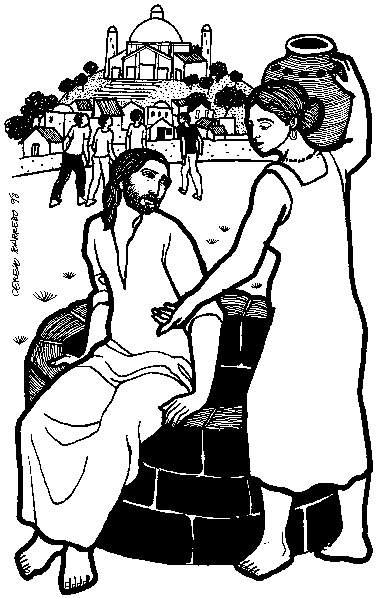
John 4: 5-42 and Romans 5:1-11

Lent-3-2014Our worship is central to our lives as Christians, and perhaps because it is so very important it is often something that fuels heated discussion and even division. I’m sure you’re familiar with many of the arguments.

We’ve special societies ‘protecting’ ways of worshipping. One, The Prayer Book Society seeks to defend and uphold the BCP. There was for a short while, an ASB Society fighting to hold on to the ASB (do you remember that). On one hand we have people arguing for BCP or Hymns Ancient and Modern and on the other, those who can’t imagine how anyone can worship without singing choruses more than 3 or 4 times – those who sometimes argue that everything old has to go – only the new is of value.

Now I know these are parodies, but unfortunately they are so very close to reality, for if it isn’t the forms of service we use, it’s the version of the bible they use or their churchmanship that seems to matter so much and make it impossible for us to share fellowship with them.

It is natural that we’ll have our own commitments to styles, forms and the substance of worship. But it isn’t styles or patterns that matter to God. ‘What matters,’ says Jesus, ‘is that those who worship God, worship in spirit and truth’. That worship is from our hearts and has integrity.

It was these kinds of arguments that separated Jews and Samaritans. Oh, there were a few age old grudges as well, but it was the arguments about worship that were most often used to maintain their divisions.

The Samaritan woman brings up the debate to change the subject. The conversation with Jesus has got too personal and she tries to deflect Jesus’ attention away from herself. Jesus generously accepts that change of direction, and, as they talk, he makes it clear that place and practice will soon no longer matter. ‘What’s important,’ says Jesus, ‘about worship is the heart of those who worship.’

How I wish that down the centuries we’d listened to Jesus. Many awful acts have been done in the name of the Church. We’ve even burnt people at the stake to protect our ways of doing things. We’ve refused burial rights in our cemeteries, we have ostracised and vilified those different from ourselves. I have seen the speck in their eye and ignored the plank in my own. We have been so concerned with the peripheral and the unimportant that we Christians have separated into thousands of denominations the world over – and we continue to condemn each other over the outward forms of our religion.

So, what does it mean to worship in spirit and in truth? Is there a particular way of worshipping that we can latch onto, that will ensure that we don’t worship in error and without the spirit rather than with the Spirit and in truth? …… Clearly the answer is, ‘No!’ Each generation, each community has to explore for itself what it means for that generation or that community to worship in spirit and in truth.

The world is constantly changing and our understanding of God is always developing. God may not change, but in every generation people have had to find new ways of expressing themselves to one another and to God … new forms of expression – in order to remain faithful to the revelation of God that we have received.

So, please let’s not allow the peripheral, the ultimately less important, to become the central and most important things. Let’s begin to believe that others are at least as sincere as we ourselves are, in our efforts to honour God in our worship.

Let’s focus with Paul in Romans on what is important and what we all share – the death and resurrection of Jesus – through which we have peace with God – through which, and through whom, we live by faith in the grace and love of God. No longer enemies of God but friends, no longer at odds with each other but reconciled as friends.

Do outward forms of worship matter? Are they important? Of course they are, for they’re the framework, the place where we are set free to worship in Spirit and in truth. They’re also the space where the other person is set free to worship. But worship itself is not about those different ways of doing things. Worship in spirit and in truth is about our hearts and wills focussed on the grace of God.

Worship in spirit and in truth brings us face to face with the love and grace of God in Jesus, our hearts focussed on God, drawn to him through the love shown to each of us in Jesus. Worship in spirit and in truth brings reconciliation and not division because ultimately our focus is not on ourselves but on the love which shines out from the face of Jesus.