Category Archives: Comments and Reflections

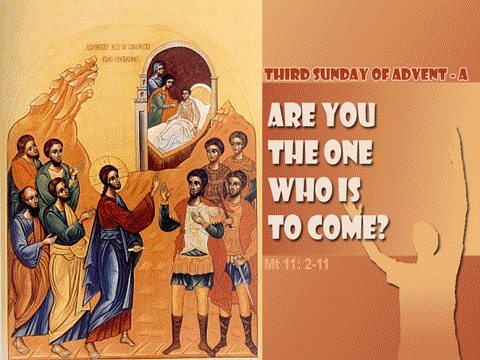
Sunday 14th December 2025 – Matthew 11: 2-11

How are you doing with your presents? Bought them all yet?

Surprisingly we’ve bought nearly all of ours already – and don’t ask me how much we’ve spent! It is hard work though, isn’t it, trying to pick something that you think someone will appreciate. And then comes that exciting job of wrapping them up – trying to hold three different bits of paper together at the same time as cutting the sellotape; sticking the sellotape onto one finger and trying to fold everything back up, only to discover that a bit of the tape has stuck to the paper and ripped it! Then there’s the present which turns out to be just too big for the largest sheet or roll of wrapping paper you could find.

I find wrapping presents to be is a bind!

And then you sit back a look at your endeavours and it’s still pretty obvious what most things are – it isn’t easy to disguise the shirt with the collar which sticks up above the rest of the pack, a tennis racket is a tennis racket even inside Christmas wrapping, a bottle of wine is a bottle of wine however you try to wrap it – and a mountain bike – well what else could it be?

It is a wonder that anyone is surprised by the presents that they get.

And yet we are, aren’t we. There is always something that comes as a complete surprise – even if we’ve given everyone a list of what we want, we still get that present or presents which are impossible to guess from their wrapping. We look at them and wonder what they might be.

Sometimes the surprise is positive. I’ve had some wonderful unexpected presents. But the surprise can also be negative. … As a teenager in the 1970s, I set my sights on a lovely pair of cowboy boots that had good 3 inch high heels, and 1.5 inch platforms. They were bright orange in colour. I told my parents about them and they assured me that my boots would be waiting for me on Christmas morning.

As teenagers are wont to do, I slithered downstairs on Christmas morning, trying not to betray my excitement. Mum and Dad had always said “No!” to my choice in clothes before and they still held the purse strings!

When we started opening the presents, I was immediately aware that I was going to be disappointed. There were no presents large enough. Still I maintained a slim hope that perhaps the boot calves had been folded over to get them into a smaller box. But no, when I opened the present from Mum and Dad, there were a pair of boots, ankle height, elasticised slip-on boots with half inch heels – Chelsea Boots. How could they have got it so wrong? I thought. I don’t think I wore boots more than once. I was really disappointed!

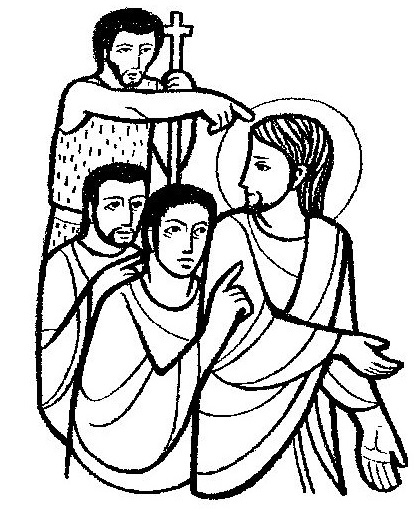
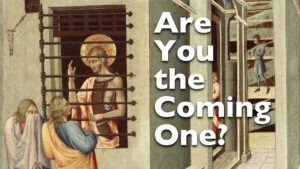
John the Baptist believed that he was preparing the way for a Jewish Messiah. He had in mind what he wanted. The trouble was that when that Messiah arrived he did not fit John’s idea of a Messiah. God’s gift to Israel was not what it wanted. Not even John the Baptist, who did so much to prepare the way for Jesus had any confidence in what Jesus was doing now that His ministry had started.

I guess John the Baptist was sitting in prison wondering whether his life had been wasted!

In our reading, Jesus has to remind John of passages from Isaiah about the suffering servant.

 Israel, and John the Baptist, had ignored these prophecies about the Messiah and clung onto the one’s they preferred – those that foretold a military messiah, a powerful leader who would free them from the yoke of oppression.

‘No,’ says Jesus, ‘I am here to inaugurate a different kingdom, a kingdom built on justice for all, and peace and healing for the oppressed.’

The thing with God is … that we can never pin God down. We think we have listened. We form our ideas of what God wants, or what God is doing. And then, … well, God does something different. We’ve tried to understand what he wants and yet again we’ve been trapped by our own ideas and our limited understanding of God.

It is wonderful when God surprises us with something new, something different. The incarnation of Jesus, was one of those occasions: the most important of them. In Jesus’ life and death he turned convention on its head, he disturbed the status quo, and out of a shameful death brought new life and hope to the world.

Jesus is God’s present to us this Christmas. ……… But don’t go thinking that you’ll get the present you’ve asked for!

Jesus at work in our lives is more disturbing, more exciting, more wonderful than we can anticipate. I was disappointed with my boots back in the 1970s, but I have never been disappointed with Jesus. Occasionally confused, sometimes disturbed, sometimes bewildered, sometimes wondering what I believe and why, but following Jesus’ lead has taken me all over the place – to University to study Civil Engineering, to different Councils to work as a bridge engineer, to Uganda for a time, into training for the ministry, marriage later in life, into ministry in the Church of England in and around Manchester, and most recently to retirement here in Shropshire! And God continues to change and challenge me – and I am still slow to learn and slow to trust!

Ultimately, John the Baptist died before he could see Jesus come in his glory.

In Jesus’ death, shame became glory. The Bible reminds us that the cross was itself Christ’s glory, Christ’s throne. It was the place where the love of God for the world was revealed.

As Christians, we can look back with gratitude to those days. … For those who lived through them, they were days full of hope …. then of deep disappointment … and then of hope once again. … Days full of shocks and surprises. Their world was truned on its head more than once.

Our God is a God of surprises. God asks for our loyalty and trust. God wants to surprise each of us with God’s presence in Christ this Christmas time. May we be those who are open to those surprises. Amen. 

The Sermon on the Plain (Luke 6: 20-31)

Luke 6: 20-31 is known as “The Sermon on the Plain” and is parallel to Matthew Chapters 5 to 7, which are known as “The Sermon on the Mount”. It is known as ‘The Sermon on the Plain’ because Luke writes in Luke 6:17 “Jesus came down with them and stood on a level place”. …

There are four blessings in this passage, rather than the eight blessings in Matthew’s Gospel, and ‘woes’ follow quickly and starkly after the blessings. Whereas in Matthew’s Gospel the ‘woes’ are much more gently couched and hidden in the longer text.


Luke’s account of Jesus’ words is much more direct, more immediate, more pressing, and does not, obviously, carry a spiritual meaning. Here in Luke’s Gospel Jesus says, ‘Blessed are you poor, for yours is the kingdom of God’. In Matthew he says, ‘Blessed are the poor in spirit, for theirs is the kingdom of heaven’. … We need to hear and heed both of these versions of Jesus’ sermon if we are not to misinterpret what he says. …

Recognising our spiritual poverty (as in Matthew’s Gospel) is important if we are to hear the gentle word of God’s love spoken to us in the bible. Spiritual poverty is the opposite of arrogantly assuming that we know God’s will and purposes, it encourages an enquiring mind, seeking out what God’s Holy Spirit is doing in our lives. It accepts that we will always have something to learn. It might even mean that we really do try to see things from the perspective of those with whom we disagree.

But what might it mean to say that the poor are blessed? …

Jesus uses the present tense. … The poor already have the Kingdom of Heaven. … They are blessed now. … This is hard to accept. It seems uncaring. How can those who have next to nothing be blessed? …… Perhaps Jesus means that for those who are poor there is nothing to distract them from their need for the love of God. Whereas for those of us who have resources and money, who are wealthier than so many, we can be distracted by our wealth. Rather than relying on God for our daily needs, our daily bread, we rely on own resources. Perhaps we are in danger of missing God’s blessing.

This seems to be borne out in human experience. It is when we are aware of our deepest needs that we are most prone to pray. … Even those of us who profess no faith in God.

In Luke’s Gospel, Jesus goes on to say: ‘Blessed are you who hunger now, for you will be satisfied. Blessed are you who weep now, for you will laugh.”

The parallel lines in Matthew’s Gospel say: ‘Blessed are those who hunger and thirst for righteousness, for they will be filled’, and ‘Blessed are those who mourn, for they will be comforted’.

Jesus, in Matthew’s Gospel, seems to be more concerned about some kind of spiritual intensity. … Jesus’ statements, in Luke, are more pithy and seemingly more concerned about physical things. It is those who do not have enough to eat now who will be satisfied; those who weep now will laugh. It is people’s immediate; substantive needs that Luke’s words focus on.

In each of these two cases in Luke’s Gospel, one part of the sentence is in the present and the other in the future. Jesus, in Luke, seems to be saying, ‘I know you are hungry, I know you weep and your tears exhaust you. But what you suffer now does not need to define you’.

The truth is that as Christians, we are defined by God’s perspective, God’s idea of who we are. We are defined by God’s love. We are defined by the Kingdom of Heaven. There is a place beyond our current situations when hunger will be satisfied, and tears will no longer fall. … While we are building the Kingdom of God on earth we can experience pain, suffering and persecution, but something is certain: the Kingdom will be attained, and you will have your fill and you will laugh! …

I don’t think this is meant to be just about a heavenly future, a hope of heaven; although it is certainly that. But it is more. It is about the land of the living, it is about living as people who have hope, who trust that the whole of their future is in God’s hands, who persevere because they believe, along with the psalmist who says (in Psalm 27:13): “I believe I will see the goodness of the Lord in the land of the living.” And along with Isaiah (in Isaiah 40: 31): “Those who wait on the lord will renew their strength, they shall mount up with wings like eagles, they shall run and not be weary, they shall walk and not faint.” With our future secure in God’s hands, we are free to love and to live with courage today.

Jesus’ first three blessings encourage us to live as those who are not distracted by all the things we have; to live as those who believe that the future is in God’s hands.

Jesus’ fourth blessing seems utterly absurd. How can those who experience hatred and abuse be blessed. How can those who are persecuted be blessed? Jesus seems to answer that question by explaining that when we experience difficulty for our faith we are identifying with the Old Testament prophets. We are identifying with myriad faithful saints of God.

We know that Jesus’ words spoke directly to the early church and were heard, not as absurd, but as an encouragement to see beyond their current circumstances – suffering and persecution were not the ultimate reality, but rather a sign of new life and hope.

I cannot imagine the things those who are persecuted face. I do know that it is not just Christians across the world who experience times of deep darkness, or hatred from neighbours and acquaintances. We repeatedly see them on our television screens. In Gaza, in Ukraine, in the Democratic Republic of Congo, in Sudan and South Sudan. So often it is the weak and vulnerable who suffer most. There is little that I can do for them but pray and give.

To the question, ‘Where is God when the innocent die, or face persecution?’ The answer available to us, the only answer I can offer, seemingly the only one God offers us, is a story of God becoming human, living first as a refugee, then as an itinerant preacher, before dying in acute suffering, treated as a common criminal, on a cross.

The God we believe in has identified with human suffering, has felt the pain of rejection, has been persecuted. … This God points to the cross and says time and again, “I love you, this is my answer to your questions. This is how much I care. ”

The Godhead, Father, Son and Holy Spirit torn apart as Jesus cries out, “My God, My God, why have you forsaken me?”

It is as if God says to us, “This is where you will find the answers to all the questions you ask – in sitting at the foot of the cross and pondering on the depth of love that it demonstrates.”

As Paul says in our reading from Ephesians: “I pray that the God of our Lord Jesus Christ, the Father of glory, may give you a spirit of wisdom and revelation as you come to know him, so that, with the eyes of your heart enlightened, you may know what is the hope to which he has called you, what are the riches of his glorious inheritance among the saints.”

This God, who loves us so much, welcomes us at his table to share in bread and wine. This God, calls on all his saints, you and me too, to live in the light of that loving welcome and acceptance. To live as those who are not distracted by all the things we have; to live as those who believe that the future is in God’s hands; and to love others with an all-inclusive, death-accepting love that knows no limit.

Prayer
God our Father, you redeem us and make us all your children in Christ. You extend a loving welcome to all. Look with favour upon us, give us true freedom and bring us to the inheritance you promise. We ask this through our Lord Jesus Christ, Your Son our Lord. Amen.

The Persistent Widow – Luke 18: 1-8

Have you ever made a commitment to doing something and then found it really hard? Perhaps a friend has asked you for a favour and you’ve agreed before finding out what they want, and what seemed like a simple job turns into a nightmare. Or perhaps you have started to decorate the lounge only to realise that the plaster is really damp and you need a new damp-proof membrane. If we are not going to just put our heads in our hands and give up, these circumstances call for perseverance.

What other kinds of things have you had to face? Where have you had to persevere against the odds? … Perhaps it is a visit to the hospital, and as you sit waiting for your appointment, or in the casualty department, you begin to realise just how dependent you are on others, how out of control life feels. Or the trip to the benefit office, where you are asked all sorts of intrusive questions and you feel like walking out, but you know that you have to stick it if you’re going to get the cash you so desperately need. Or perhaps you are struggling with the cost of feed and seed rising and the value of grants and the income from produce depleting.

Our Gospel reading this morning talks of a woman facing just this kind of circumstance. Can you imagine how she might have been feeling? Waiting for someone else to do something. Being rebuffed time and again. Sitting in the waiting room, wondering if this time, on this visit, something might be done to change her circumstances. How does she feel? …… Perhaps you can hear the desperation in her cry for justice, “For heavens sake, grant me justice against my adversary. Things just cannot go on like this. I can’t cope any longer.” …. Or perhaps you can hear her anger, “I’m not moving from this spot until you grant me what I ask. And I mean it! I’m not moving, not an inch.” ……

It is quite an image. … Jesus uses it to get us to think about prayer. To show us that we should always pray and never give up.

If that corrupt judge will grant that woman’s request because she would not give up, how much more will God grant the request of those who pray to him day and night? Those who come to him in faith.

So, what kind of circumstances do we face where Jesus’ advice applies? … Perhaps it is our own personal or family circumstances. We have a long-standing illness or complaint. We have somehow found ourselves in conflict with another member of our family, and we are no longer talking, and perhaps that circumstance has lasted for years. Perhaps we have been trying to get justice, or deal with noisy neighbours. Perhaps we have been unjustly accused.

Perhaps it is the world in which we live – perhaps we are weighed down by the conflicts which surround our world and which we wish were resolved – in Ukraine, in Palestine, in Sudan, in Myanmar, among the drug cartels in South America. Perhaps it is the injustice of the distribution of the world’s resources, or even the poverty some face in our own country, even in our rural communities.

Perhaps it is the life of our own churches. Numbers seem to be decreasing, hope for the future life of our congregations just seems to be ebbing away, where are the next generation of church goers?

In all of these areas, what would Jesus say to us? … We have his answer in our Gospel reading. … “Always pray and never give up!” And how do we respond? … “Oh, we’ve tried that and it didn’t work?” …. “Always pray,” says Jesus, “and never give up! … Demonstrate your faith and trust in me by praying and believing that I can change these circumstances.” … “Believe me, trust me,” says Jesus, “Don’t give up on me!”

Jesus challenge is to a renewed commitment to prayer. ……

How can we do this? …. Firstly by making space in our day, perhaps only a little time in the busyness of our lives when we say to God, and remind ourselves that all these things are in God’s hands. That we can trust God. … Secondly by making time to pray together as churches, time to listen out for God speaking to us. These are words in season for us. If we are serious about facing the reality of where we are as churches, with declining numbers and with an air of despondency over us. If we want things to be different, then we need to pray. Even if our prayer is something like this. “Lord, I believe but I also doubt. I fail to consistently trust you. I cannot see where the answers will come from. It all seems hopeless. I am not even sure that you hear my prayer. But, Lord, please act, if you are there and you hear me, please respond!”

With prayers like that, we are in good company – listen to the Psalmists speak out their prayers:

Psalm 10:1: Why, O Lord, do you stand far off? Why do you hide yourself in times of trouble?

Psalm 13: 1-2: How long, O lord? Will you forget me for ever? How long will you hide your face from me? How long must I wrestle with my thoughts and every day have sorrow in my heart?

Psalm 22: 1-2: My God, my God, why have you forsaken me? Why are you so far from saving me, so far from the words of my groaning? O my God, I cry out by day, but you do not answer, by night, and am not silent.

Like Jacob, in our first reading today, wrestling with God, fighting his fears and doubts, Refusing to let go until he receives God’s blessing, our prayer needs to be honest, embracing our hopes and fears. Like the widow in the Gospel reading, it needs to be persistent and faithful even in the midst of our doubts.

In the midst of the praise and rejoicing that is so much a part of the Psalms, we hear the honest cry of hurt and anger, of loss and anguish.

Let’s heed Jesus’ story of the widow in our Gospel reading, and chose to persevere in prayer, whether our faith is strong or weak, looking to God to act and change things.

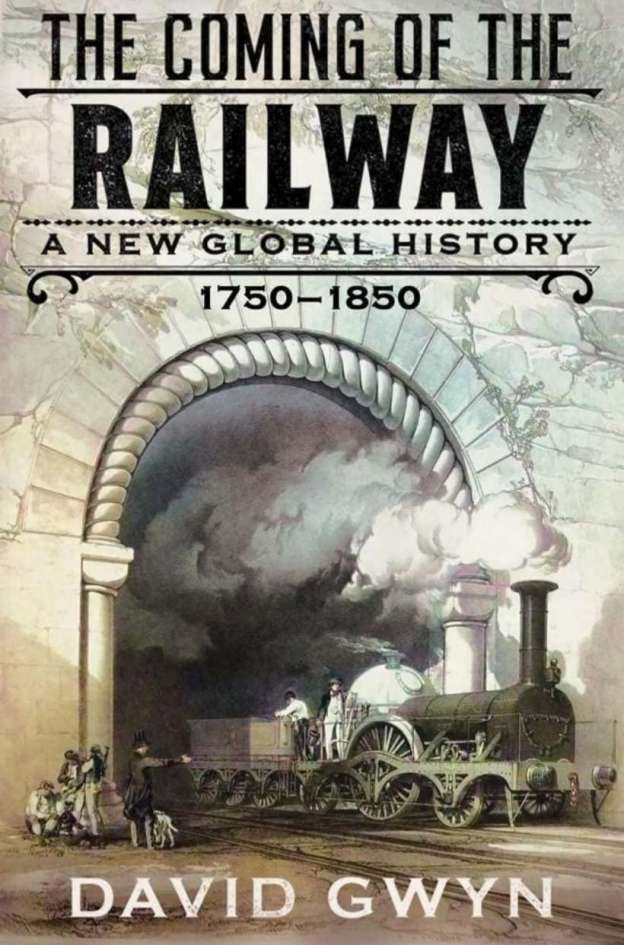
David Gwyn; The Coming of the Railway: A New Global History, 1750-1850; Yale University Press, London & New Haven, 2023.

The first global history of the epic early days of the iron railway. Yale University Press says, “Railways, in simple wooden or stone form, have existed since prehistory. But from the 1750s onward the introduction of iron rails led to a dramatic technological evolution—one that would truly change the world. … In this rich new history, David Gwyn tells the neglected story of the early iron railway from a global perspective. Driven by a combination of ruthless enterprise, brilliant experimenters, and international cooperation, railway construction began to expand across the world with astonishing rapidity. From Britain to Australia, Russia to America, railways would bind together cities, nations, and entire continents. Rail was a tool of industry and empire as well as, eventually, passenger transport, and developments in technology occurred at breakneck speed—even if the first locomotive in America could muster only 6 mph. … The Coming of the Railway explores these fascinating developments, documenting the early railway’s outsize social, political, and economic impact—carving out the shape of the global economy as we know it today.” [1]

Praise

Positive comments made by various readers/critics, marshalled by Yale University Press. …

“One does not have to be a train-spotter to read it: it tells a crucial story of our social and economic history, and does so with recourse to exceptional scholarship.”—Simon Heffer, The Telegraph. [1]

“Written with great confidence and considerable aplomb, The Coming of the Railway is a must for the train enthusiast.”—Jeremy Black, New Criterion. [1]

“With impressive research and superb prose, Gwyn traces the complex evolution of railway technology, finance, and operating practices. . . . [He] succeeds brilliantly.”—Albert Churella, Technology and Culture. [1]

“The nineteenth century was defined by the railway. In this compelling new book David Gwyn weaves together the disparate strands that led to its emergence as the singular new technology of its age; a monumental study, erudite, authoritative, and full of wider historical insights.”—Sir Neil Cossons, former director of the Science Museum London. [1]

“This book is a real eye-opener for rail enthusiasts and scholars with a detailed and well researched account of the dawn of the railways. The rapid advancement in technology in the eighteenth and nineteenth centuries that the railways brought our society is truly astounding.”—Siddy Holloway, historian and presenter. [1]

“A fresh perspective on the early railway story across time and world space, with a wealth of intriguing details. Gwyn ably demonstrates the role played by overlapping technologies, harmonising under the influence of shaping forces.”—Susan Major, author of Early Victorian Railway Excursions. [1]

“The railways were the most important invention of the nineteenth century, but they only emerged thanks to a series of technological developments. This book documents these in a thorough and revealing way which makes it essential reading for anyone interested in the origins of this great invention.”—Christian Wolmar, author of The Great Railway Revolution. [1]

Review

I found this book to be easy to read and yet deeply scholarly. A superb, informative and enjoyable read! It is not too often that you find a railway history book as readable as a novel.

It seems to me that it is possible that the individual chapters are developed from the text of a series of lectures on early railway history. The readable text is backed up by very comprehensive notes and references. There is also a wide-ranging bibliography.

The chapter headings are:

  1. Trade, transport and coal 1767-1815
  2. ‘Rails best adapted to the road’: cast-iron rails and their alternatives in Britain 1767-1832
  3. Canal feeders, quarry railways and construction sites
  4. ‘Art has supplied the place of horses’: traction 1767-1815
  5. War and peace 1814-1834
  6. ‘Geometrical precision’: wrought-iron rails 1808-1834
  7. ‘Most suitable for hilly countries’: rope and chain haulage 1815-1834
  8. ‘That truly astonishing machine’: locomotives 1815-1834
  9. Coal carriers 1815-1834
  10. Internal communications 1815-1834
  11. The first main lines 1824-1834
  12. Coming of age: the public railway 1830-1834
  13. ‘The new avenues of iron road’ 1834-1850’You can’t hinder the railroad’
  14. ‘You can’t hinder the railroad’

These are intriguing titles for episodes in the development of railways and Gwyn ensures that there is no myopia, no unwarranted focus just on developments in the United Kingdom.

His chapter on Coal Carriers quickly looks beyond the Stockton and Darlington Railway, first to changes in the Northeast and then to Lancashire and Scotland, before looking across the Channel to France and particularly to the railways of Saint Etienne in the Massif Central. He then directs his readers to events in Prussia; to Pennsylvania; and then to Australia!

In fact it was long-lasting developments in the New South Wales coalfield “which ultimately enabled Newcastle in Australia to take over from Newcastle upon Tyne as the largest coal-exporting harbour in the world. [2] The New South Wales coalfield also remained a stronghold of steam traction into the 1980s, just as the wooden way could still be seen in operation on Tyneside many years after the iron road first appeared. Coal-carrying technologies die hard.” [1: p212]

In his chapter on Internal Communications (1815-1832) Gwyn invites his readers to consider two markedly different railways which set the scene for the development of long-distance railways. The Cromford and High Peak Railway in England and the Budweis-Linz horse railway in the Austrian Empire. These two lines had very little in common technically but both sought to connect places at the opposite ends of one jurisdiction. … Long distance railways were seen as feasible: no longer was the ambition solely to connect mines, quarries and factories with navigable water. Railways began to serve rural areas and market towns, and offered a variety of services, including passenger transport.

He highlights the place in that process of development of the tramroads in the Welsh Marches: linking Brecon to the Wye Valley and Kington; and linking Abergavenny to Hereford. Although not in themselves of national significance, they contributed to the growing belief that longer distances could be embraced as rail technology advanced.

In 1810, Thomas Telford surveyed, and William Jessop approved, a proposal for a ‘cast-iron railway’ from Glasgow to Berwick-on-Tweed, over 125 miles in length, the first credible proposal for a railway connecting the east and west coasts of Britain.” [1: p214] “In 1814, the French engineer Pierre-Michel Moisson-Desroches (1785-1865) urged Napoleon to build seven national railways from Paris. In 1817 the radical English schoolteacher, author and publisher Sir Richard Phillips (1767-1840) anticipated double-track railways connecting London with Edinburgh, Glasgow, Holyhead, Milford, Falmouth, Yarmouth, Dover and Portsmouth, drawn either by horses at 10 mph or by Murray-Blenkinsop locomotives at 15. [3: p75-76] By the 1820s these were becoming a serious possibility.” [1: p214]

During 1824 and 1825, 30 schemes for railways were presented to Parliament. The financial crash of 1825 put paid to most of them. The most ambitious would have connected London, Liverpool, Manchester, Birmingham, South Wales and Edinburgh! [4]

There was no failure in imagination, a scheme was proposed, for example, to build a railway from the Chagres River to Panama City. Gwyn explains that this was one of several speculative schemes to link seaports to their hinterlands. It was eventually built as ‘The Panama Canal Railway’, which runs alongside the Panama Canal from near the city of Colón to Panama City, crossing the Chagres River and the Continental Divide, with the primary passenger route running between Panama City and Colón. Incidentally, while a daily passenger service was suspended during the 21st century pandemic, the railway is of historical significance and still operates, sometimes offering special tours for cruise ship passengers. It was conceived to provide a connection between the Atlantic and Pacific oceans. Like other early railways it was conceived as a grand project. These projects required imagination and demonstrated the potential for railways to unite distant parts of a country, even if they weren’t immediately profitable.

Other proposed schemes mentioned by Gwyn linked: Newcastle to Carlisle; Manchester to Hull; Limerick to Waterford. These speculative schemes created space for the Liverpool and Manchester Railway to be successfully promoted.

However, what was contributed by the Cromford and High Peak Railway in England and the Budweis-Linz horse railway in the Austrian Empire was not so much about imagination as about practicalities. They demonstrated that “a considered scheme did have the potential to attract capital, as well as state support (or to do without it), and to bring together an engineering team capable of creating an iron road to unite distant parts of the country, even though one was not profitable for years and the other struggled to be completed.” [1: p232]

So it was that by the 1820s and early 1830s railways were for the first time being built to meet a needy in regional economic life, rather than purely serving a locality by connecting a mineral region with navigable water.

Gwyn points to three completed schemes designed to connect seaports to their hinterland, carrying passengers as well as goods – the first main lines. Two were in the USA and one in the UK – the Baltimore and Ohio, the Charleston and Hamburg and the Liverpool and Manchester.

The backers of the Liverpool and Manchester had deep pockets  and needed them. The £600,000 that the line cost (£19,355/mile) was twice the cost per mile of the Baltimore and Ohio and twelve times the cost per mile of the Charleston and Hamburg. [5] Interestingly, there was a real imbalance in the contributions made by investors from Manchester and Liverpool. While the Exchequer made £100,000 available as a government loan and Manchester investors contributed £12,000, this from Liverpool provided £488,000! [6][7][8]. The difference in funding allowed the Liverpool and Manchester Railway to be considerably more robust!

Although the Liverpool and Manchester was definitely the first intercity main line railway, the three schemes developed in parallel and were completed only a matter of a few short years apart. Nevertheless, the opening of the Liverpool and Manchester Railway on 15th September 1830 was to be remembered in British and world history. “Previous transport undertakings in the United Kingdom had been inaugurated by local bigwigs, but, on that day of watery sun, Liverpool saw a gathering of continental European nobility such as had not been assembled since the Congress of Vienna rubbing shoulders with the British political elite. Not only was the guest of honour the Prime Minister and war hero, Arthur Wellesley, First Duke of Wellington (1769-1852), but four future British prime ministers were also present, and Sir Henry Brougham, the very embodiment of the ‘philosophic Whig’, was to be Lord Chancellor before the end of the year. Guests of rank, and in some cases of intellect and distinction also, included six earls, two marquises, six viscounts and over twenty other members of the peerage, though only one bishop. Some other guests were people in the public eye, like the writer and actor Fanny Kemble and the polymath Charles Babbage (1791-1871).” [1: p258]

International representation was also strikingly significant with important guests from Russia, Hungary, the United States of America.

Gwyn tells us that it was the opening of the Liverpool and Manchester Railway, rather than the Stockton and Darlington Railway, that took centre-stage as an epoch-defining moment. It represented “a shift in scale and ambition that surpassed both the earlier generation of iron railways and all but the longest canals and turnpikes. Not only was it entirely steam-operated, but its locomotives themselves were the design precursors of nearly all that followed. Another step change was the way that passenger facilities were set out and managed; its stations showed the way forward for railway companies in the years to come. Above all, it broke with most predecessor railways in England in that it was built not to carry coal or some other mineral, but to serve the globalised economy of cotton. It connected two great industrial centres, one an ocean-serving port, the other a manufacturing town. Its architecture celebrated what the railway embodied, not only the empirical philosophy which identifies successful solutions to technical problems but also Britain’s role as the ‘mart of nations’.” [1: p260]

In addition to the price per mile of the three first main line railways, Gwyn quotes the cost of others:

  • The Dublin and Kingstown (Dun Laoghaire) cost £60,000 per mile, much more even than the Liverpool and Manchester;
  • The Leicester and Swannington Railway, a mere £7,740.24;
  • The New York and Harlem was the costliest per mile in the USA at $141,333, a consequence of having to build a very solid road using stone sleepers through the middle of a built-up area;
  • Otherwise the most expensive American railway for its route length had been the Pontchartrain in Louisiana, at $72,000 a mile; it was only 4.5 miles long but was double-track throughout and ran through a swamp.
  • The Boston and Lowell cost $70,000;
  • The Mohawk and Hudson, $63,568;
  • The soundly built Baltimore and Ohio cost $38,232;
  • The Tuscambia, Cortland and Decatur, making its way over more than 45 miles of Alabama, along a single line of strap rails, was built for no more than $8,840 per mile!

Gwyn continues to look at the forms of finance which applied in different jurisdictions. …

In the UK, a variety of private finance arrangements were made among these were some railways funded by local subscription, not necessarily by wealthy individuals, some through provincial joint-stock banks and London banking houses. Interestingly “Quaker finance played an important part: Dublin and Kingstown was a Quaker initiative, as the Stockton and Darlington had been. In the north-east of England, where coal ownership and political power had always been virtually synonymous, Joseph Pease’s election to the reformed House of Commons in 1832 meant that the influence of the Society of Friends now extended to parliament.” [1: p270]

In the USA, capital finance was difficult to obtain. Most railroads raised capital through the services of an intermediary selling bonds to the money markets of London. Gwyn points out the significant role of Quakers, particularly through the banking houses of Philadelphia. He suggests that this was a significant factor in that city becoming a railway hub so very early in the development of railways in the USA.

Rail development in the USA in the first half of the 1830s greatly surpassed that in the UK and Europe. Many lines in the USA were  built using wrought-iron straps on timber rails and as a result kept construction costs to a minimum. Whereas most bridges in the UK were built with masonry, brick and steel, in the USA timber was used most often.

The use of horses increased, in absolute terms, in the 1830s. “Horses were used where traffic did not justify locomotives or where mechanical traction was forbidden, such as in built-up areas, either absolutely or during the hours of darkness or through covered bridges. Short-haul movement and shunting was often carried out by horses. … Many well-established railways had no need to convert to locomotive operation if traffic did not increase. The independent carriers who operated the trains on many systems often had neither the means nor the need to use them.” [1: p276][9: p152, 245, 569]

As the 1830s unfolded there were still railways being designed and built with horse-operation in mind examples include – the Ffestiniog in North Wales, the Bratislava-Trnava railway in Hungary. Gwyn notes that while many applications for horse power continued through the middle of the 19th century, the times were very definitely changing, “by mid-century, recognisable national [rail] networks were becoming evident in some countries, connected with seagoing ships carrying textiles and foodstuffs across oceans.” [1: p285] Nothing could be what it once was. Steam power was already, by 1850, dramatically reordering the world!

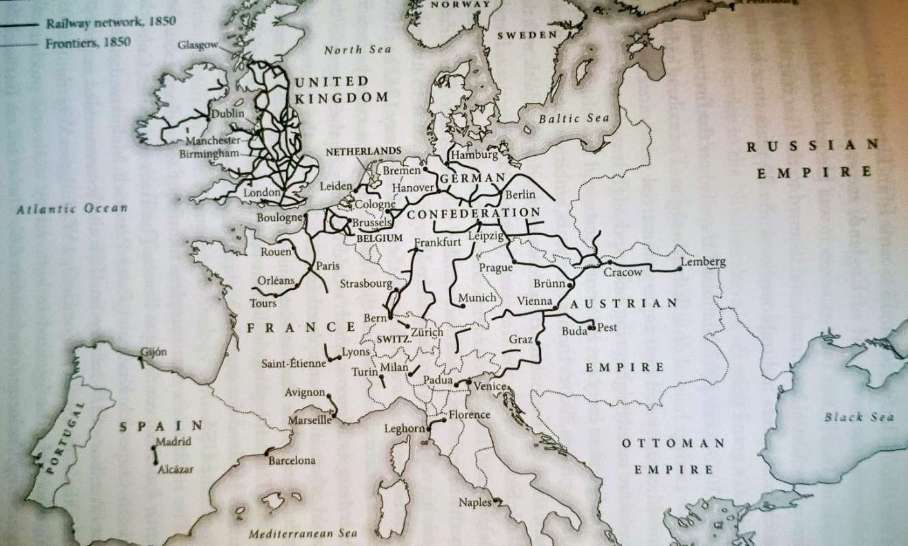
The European railway network in 1850. … There was a marked difference between England and the rest of Europe in 1850, but that would not last, national networks across Europe would continue developing throughout the century. [1: p293]

In the final chapter of the book- ‘You can’t hinder the railroad’, Gwyn muses on the impact of the coming of the railway. “The coming of the railway was not the least of the many changes that characterised the long and tumultuous period of modernisation we call the ‘Industrial Revolution’, which in turn paralleled convulsive alterations in political order across the world in the late eighteenth and early nineteenth centuries. The close, often complicated, relationship between mechanical capacity and governmental, military, economic and social developments has formed a theme of this study but what is also evident is that the railway also had a profound imaginative impact.” [1: p315-316]

Charles Dickens, ‘Dombey and Son‘ “famously recalls the building of the London and Birmingham through Camden. Here ‘the first shock of a great earthquake had, just at that period, rent the whole neighbourhood to its centre’, bringing ‘dire disorder’ in its short term but opening a ‘mighty course of civilisation and improvement’. Narrative events reflect Dickens’s ambiguity; the defeated Carker is killed by a train whereas Mr Toodle finds a steady job which he loves as a locomotive stoker, and then driver.” [1: p315]

Gwyn sees that same ambiguity in J.M.W. Turner’s ‘Rain, Steam, and Speed – The Great Western Railway‘.

Thomas Cole’s, painting, ‘Rain in the Catskills‘ seems to portray the railway as an unobtrusive part of the landscape, the wild and the utilitarian coexisting, yet Cole wrote that “the railway made the human body ‘merely a sort of Tender to a Locomotive Car, its appetites & functions wait on a Machine which is merciless & tyrannical’.” [10]

Gwyn affirms that “Speed, dispatch and distance fed the imagination as well as the bank balance.” [1: p318] Victor Hugo was “delighted by the way … speed turned flowers and cornfields into swathes of colour and made nature dance before his eyes.” [1: p318][11]

Ralph Waldo Emerson saw these changes as disturbing – the railroad had seemingly eroded and reordered nature. Yet he was drawn to this new technology. On his way home to the USA in 1833, he “filled an idle hour in Liverpool by visiting the railway, where he ‘saw Rocket and Goliath and Pluto and Firefly and the rest of that vulcanian generation’. He even listened patiently to Jacob Perkins … expounding on his locomotive proposals. [12: p190-191]] When he rode behind a ‘teakettle’ on the Boston and Worcester the following year, like Booth he sensed ‘hitherto uncomputed mechan-ical advantages’. [12: p305] If he deprecated the way the railroad had coarsened the fabric of American life and contributed to its materialism, he nevertheless came to hold bonds or stock in at least six American concerns, affording him the financial security to develop and expound his philosophy of a universe composed of nature and of soul.” [1: p319]

Gwyn goes on to quote Henry David Thoreau and John Ruskin who both loathed and were drawn to this developing technology. He notes that George Eliot (Mary Ann Evans) depicts the clash of old and new in the novel Middlemarch.

Gwyn concludes his book with this final paragraph: “For George Eliot … the railway came to Middlemarch at the same time as parliamentary reform and cholera, and she understood that the unknown was rarely welcome. Princes, ecclesiastics and philosophers variously welcomed or feared the coming of the railway, but she also sensed a profound if barely articulate concern that it meant no good to the waggoner or the labourer. All that Caleb Garth can do is persuade Hiram Ford and the smockfrocks that they shall do no more ‘meddling’, because ‘you can’t hinder the railroad’. On that, at least, all came to agree.” [1: p321]

References

  1. https://yalebooks.yale.edu/book/9780300267891/the-coming-of-the-railway, accessed on 3rd September 2025.
  2. Gwyn tells us that “The shipping of coal from rail-served harbours remains important in the USA, Australia, India and China to this day. Railways retain an advantage over roads carriers, particularly where long overland distances are involved.” [1: p352]
  3. R. Phillips; A Morning’s Walk from London to Kew; J. Adlard, London, 1817.
  4. See for example: P. R. Reynolds; The London & South Wales Railway Scheme of 1824/25; in South West Wales Industrial Archeology Society Bulletin No. 95, p3-7.
  5. In 1830 £1 was worth $4.56. The Liverpool and Manchester cost £600,0000, the Baltimore and Ohio $4,000,000, the Charleston and Hamburg a mere $951,140, though still considerably in excess of the original estimate of $600,000 (D.A. Grinde; Building the South Carolina Railroad; in South Carolina Historical Magazine Vol. 77 No. 2, 1976, p91). Only eight other engineering projects in the United Kingdom had cost more than the Liverpool and Manchester: the Royal Canal in Ireland, the Worcester and Birmingham, the Grand Junction, the Birmingham and Liverpool Junction and the Caledonian canals, Plymouth Breakwater, Sheerness Dockyard and Kingstown Harbour.” (A. W. Skempton {ed.); Biographical Dictionary of Civil Engineers Volume 1 – 1560-1830; Thomas Telford and Institution of Civil Engineers, London, 2002, p834-6).
  6. R. H. G. Thomas; The Liverpool and Manchester Railway;, Batsford, London, 1980, p29
  7. A. W. Skempton {ed.); Biographical Dictionary of Civil Engineers Volume 1 – 1560-1830; Thomas Telford and Institution of Civil Engineers, London, 2002, p690.
  8. P. Reynolds; Railway Investment in Manchester in the 1820s; in Journal of the Railway & Canal Historical Society No. 211, 2011, p38-48.
  9. F. C. Gamst; Early American Railroads: Franz Anton Ritter Von Gerstner’s ‘Die innern Communicationen’ (1842-1843); Stanford University Press, Stanford, California, 1997.
  10. A. Wallach; Thomas Cole’s ‘River in the Catskills’ as Antipastoral‘; in The Art Bulletin, Vol. 84 No. 2, 2002, p334-350. “The Canajoharie and Catskill was an unsuccessful concern and had already closed following a bridge collapse by the time the painting was completed.” [1: p362]
  11. Contre Vaudois: Journal de la Suisse Romande; 16th July 1892, p1-2.
  12. R. W. Emerson; Journals of Ralph Waldo Emerson, Volume 3, 1833-1835; ed. E. W. Forbes & W. E. Forbes, Houghton Mifflin, London and New York, 1910.

Shame at the wedding banquet …. Luke 14:1,7-14

feastWhenever I hear today’s Gospel reading, I can feel myself cringing in embarrassment at the situation that the wedding guest creates for themselves.

I can just imagine all the other guests muttering to one another: Did you see that?  The cheek of it ‑ thinking that they should sit in the best place!  Surely, no‑one in their right mind would do such a thing?  After all, we all know our place and we’d never put ourselves in such a situation, would we?

I can also imagine the shame that the guest must have felt having been moved from their chosen seat to the worst place ‑ in full view of all the other guests.   I guess they wished that the ground would swallow them up, as they went red in the face and started to stammer.

This parable ‑ seemingly about the etiquette of dinner invitations ‑ turns into a story about shame and honour.  Luke draws us into the story by choosing a scenario that we can identify with ‑ we’ve all been to wedding feasts and we all know the social rules that go with them.  Bridal party on the top table ‑ everyone else in the rest of the room, carefully placed so all possible conflicts are avoided and no‑one is left on their own.   We know the rules and we are expected to stick by them ‑ so how could anyone be so foolish, do such a shameful thing as sit in the wrong place?

Shame is a very powerful emotion ‑ accompanied by often visible signs ‑ and it is one that we seek to avoid.  It can bring very real distress and pain.  Shame can also be a healthy reminder to us that we’ve transgressed, that we’ve done something wrong. To avoid being shamed, we have to think about doing the right thing, about being honourable.

CN22TN CAnd this is where Luke takes his parable ‑ by describing the honourable way to behave when you have a wedding invitation.  Start off by assuming that you have been allocated the worst place and you might just find that you are rewarded with a better seat. And Luke wraps up the tale with these words of wisdom: “If you put yourselves above others, you will be put down.  But if you humble yourself, you will be honoured.”

This story is worldly-wise ‑ perhaps it echoes advice in Proverbs: “Do not take a place among the great; better to be invited ‘come up here,’ than be humiliated in the presence of the prince.” The parable is a neat and slightly crafty lesson on how to get on in the world.  And yet…….  As with all of Jesus’ parables it has a meaning on many other levels.

There are several lessons here for Christians about knowing one’s place as a Christian disciple.  But first a few words which come from a different direction. A true story. A friend of mine had not been to church in a very long time. The first time she came to church with her family she chose to sit near the front of the church – it was a little odd, for no one came to sit with them until just as the service was starting … She enjoyed her first service in church – the singing was wonderful and the family decided to come again. The next Sunday they took the same seats, the same people came to sit with them and again they enjoyed the worship. They started going to church regularly. It was only after they had been there a couple of months that one of the congregation came to them and asked why they were sitting in the choir stalls …

So many who come to church no longer know the right things to do, don’t understand why in Anglican churches we don’t use the front pews. Often I have seen new people sitting right at the front (in the best seats) then not able to work out what to do with their service sheets and hymn books and clearly feeling ill-at-ease, feeling shamed. How do we help these people to feel at home? It is so important. …

Having seen that the parable can be turned on its head. What are the other lessons here for Christians about knowing one’s place as a Christian disciple?

There’s a message for those in leadership.  Jesus was speaking to the lawyers and Pharisees when he told this tale and he wanted them to heed the warning about pushing themselves forward in the sight of God.  In Jesus’ day it was all too easy for the well‑off and the legally trained to imagine that they were superior in God’s sight to the poor and to those without the opportunity to study, let alone practice the law.  So he spoke to the powerful people in the Jewish faith ‑ wanting them to think about the way they related to other Jews.  This, of course, is also important for powerful Christians, such as church leaders (ordained or lay), to remember when they relate to other Christians.  Power and learning make no difference to the way that God relates to his children.

But Jesus spoke not just to the powerful and learned ‑ he also spoke to his disciples.  Perhaps you remember the story of James and John who were eager to take the top two places at Jesus’ right and left hand ‑ above everyone else.  They didn’t know what they we asking, because Jesus’ came in his glory not on a throne but on a cross and the places on either side of him were reserved for thieves.

James and John were rebuffed and reminded that this was not the aim of discipleship ‑ it was not for them to seek the highest places.   So to for us ‑ there is no hierarchy in our church, our parish, our Deanery, our Diocese  ‑ we are all brothers and sisters in Christ.  Yes, we have different roles and some of these roles mean that some people are more visible than others.  But as disciples, we all occupy the same place ‑ as God’s children, all equal in his eyes.  So this parable reminds us that we need to act with humility in the church.

There is however a wider message delivered by this parable and this would have been obvious for those in the world for which Luke was writing.   Within Luke’s lifetime, thousands of non‑Jews had become Christians.  They had entered, as it were, into the dinner party prepared by the God of Abraham, Isaac and Jacob.  Many Jewish Christians found this difficult, if not impossible to understand or approve.  They were so eager to maintain their own places at the top table that they could not grasp God’s great design to stand the world on its head.  They couldn’t see that their pride, their belief that they were favoured, blotted out God’s generosity to others and ultimately denied their own place as Jews in God’s plan for the world.

Because, in the end, if anyone reckons that they deserve to be favoured by God, not only do they declare that they don’t need God’s grace, mercy and love, but they also imply that those who don’t deserve it shouldn’t have it.  And perhaps this is the most challenging aspect of this parable ‑ a message for all Christians.  Whenever we act without humility and see ourselves as better than others, not only do we shame ourselves but we act dishonourably towards other people by seeking to limit their access to God’s love and God’s grace.  And where does that leave us in relation to God? For each of us needs the grace of God as much as anyone else.

So lets keep our eyes open for those who are new and who struggle with knowing the social rules of our church, let’s give them every help and support that we can.

May this parable also prompt us to be aware of those times when we bring shame on ourselves because of our lack of humility.  May it also cause us to rejoice that God’s love is so forgiving that at the end we will all be invited to feast at God’s banquet.

The Sabbath …. (Luke 13: 10-17 and Isaiah 58:9b-14)

Sabbath. … The very idea feels Victorian! It smacks of rules to be kept and of restriction of freedom. If your experience is anything like mine growing up in the 1960s and 1970s, you’ll remember a Sabbath, or a Sunday, which meant being in Church three times (yes, three times each Sunday), no television, only Christian books, no playing out. Supposedly the ‘Sabbath’ was day of rest, but really it was a day of restrictions and rules. Nowadays, if we have any idea at all what Sabbath is about then I suspect that we honour it more in the breach than in the keeping. The idea of a day when we can’t play, can’t work – a day that has to be all about Church and God. That is not our idea of fun! ….

But, we need space, we need time to recuperate. We need time for ourselves and our families. Even if we don’t find that space on a Sunday, we’ve learnt just how important it is to make space in the week for those we love and for ourselves. We honour the Sabbath in a way that fits our lifestyle. Jo and I make sure that we keep her day off as special. We both used to take Tuesdays as our day off (in Manchester) Now, usually, Jo does not work on a Friday.

One way or another though, we’re hampered by our culture when we come to think about what the Bible calls ‘the Sabbath’. We have a history of keeping Sunday special that we need to acknowledge – which some will argue is essentially biblical and therefore very important. While others will see the idea of ‘the Sabbath’ as yet another example of the irrelevance of the Bible and Christianity to the modern world. For in today’s world just doesn’t seem to allow people the space to rest! Certainly such times are at a premium!

But, look again at our passages this morning. How do our ideas of Sabbath fit with the biblical evidence? Who is right? Do you remember the ‘Keep Sunday Special Campaign’ Were they right? Or are those who see ‘Sabbath’ as an anachronism right?

For sure, we mustn’t be like the leader of the synagogue – Jesus clearly has no time for his attitudes! Yes the bible does command us to keep the Sabbath – but Jesus also makes it clear elsewhere that the Sabbath is made for humanity, not humanity for the Sabbath. So perhaps then, we can ignore any idea of keeping Sundays special and do our own thing!

But wait, Isaiah clearly has something else in mind. He calls the idea of ‘Sabbath’ a delight!!

So … What is the Sabbath about? How can we keep it?

Look first at our gospel reading, Luke 13: 10-17 – clearly Jesus sees the Sabbath as a time for healing, but what kind of healing? Physical healing? Yes, a woman is set free from a debilitating condition. But the gospel writers seem to have more in mind. … This woman has spent eighteen years doubled up, face to the ground, unable to see more that a footstep or two in front of her – she was trapped – her physical condition speaks so clearly of the spiritual condition of so many people – certainly of the synagogue leaders, but also of many people in our world today.

Figuratively, we spend so much of our time looking at the ground just in front of our feet – bound up in our work, our homes, our fears and worries – they loom so large that we can see nothing else.

Figuratively, we spend so much of our time looking at the ground just in front of our feet – bound up in our work, our homes, our fears and worries – they loom so large that we can see nothing else.

The Sabbath, says Jesus, is about being set free from this bondage. It is about being enabled once again to see the whole picture. The Sabbath is intended to allow us to regain a correct perspective, to affirm again that our concerns, our limited vision of the world around us, are not actually the way things are. As we observe the Sabbath, we can begin to replace our narrow perspective with God’s wider perspective As we observe the Sabbath, we affirm again that our God is Lord – despite what our immediate circumstances might suggest. … Sabbath is about making room for a realignment of our perspectives, and this happens most effectively in worship.

Our Old Testament reading from Isaiah 58: 9b-14, has something to add. …

While the Gospel speaks about removing the negative, of release from wrong perspectives, Isaiah calls us to consider the positive. The Sabbath fast, or any other fast, is intended to refocus our minds on what matters most. Isaiah helps us to focus on what are God’s priorities.

‘Delight in the Lord’ he says, because, when you do, you will begin to see with God’s eyes – the removal of gossip, the feeding of the hungry, meeting the needs of others, bringing light into darkness, rebuilding lives and communities.

So Sabbath is about rest, about time for each other, about time for our families – but primarily it is about giving time to the reordering and refocusing of our lives. It is about God’s perspective becoming our perspective. It is about picking-up God’s concerns and letting them become our priorities.

So we need to make our own ‘Sabbath’, whether it is on a Sunday, or perhaps when our shift pattern, or working week allow. And the Bible’s claim is that if we fail to do so, we will lose perspective on life and our living will become directionless. …

The Bible has still more to say …

On top of the principle of Sabbath, a weekly day enshrined in the ten commandments, there was also a principle of every 7 years letting the land rest for a whole year and people were to stop working in the fields, and then every 49th year (7 lots of 7 years) there was the year of jubilee, of celebration – a sacred time of freedom and celebration when land was returned to its original owners and slaves returned to their homes, freed from bondage.  These yearly periods were a time of sabbatical, a time of resting and refreshing and preparation for the next cycle of 7 years, or 49 years.

If you listened to the BBC Sunday Worship on Radio 4 last week you will have been reminded that the Roman Catholic church is, this year (2025), observing a Year of Jubilee.

The BBC’s Sunday Worship [1] focussed on young people on pilgrimage to Rome.

Pilgrimage is itself a form of Sabbath a time for refocussing on what God wants for our lives.

That principle of a ‘Sabbath’, a sabbatical, is something which the Church of England sees as important for all its clergy and lay ministers. It makes allowance for clergy to have what Lichfield Diocese calls ‘extended study leave’ and often it is just that, a time when reading and ideas have space to refresh and strengthen, reinvigorate ministry.

We all need these times of Sabbath: times of refreshment, renewal and reorientation. I’d like to finish this reflection with a prayer attributed to St. Patrick, which I am sure you will know well, a prayer which is all about refocussing our lives around God who is Father, Son and Holy Spirit. Let us pray:

Be thou my vision, O Lord of my heart,
be all else but naught to me, save that thou art;
be thou my best thought in the day and the night,
both waking and sleeping, thy presence my light.

Be thou my wisdom, be thou my true word,
be thou ever with me, and I with thee Lord;
be thou my great Father, and I thy true son;
be thou in me dwelling, and I with thee one.

Be thou my breastplate, my sword for the fight;
be thou my whole armour, be thou my true might;
be thou my soul’s shelter, be thou my strong tower:
O raise thou me heavenward, great Power of my power.

Riches I heed not, nor man’s empty praise:
be thou mine inheritance now and always;
be thou and thou only the first in my heart;
O Sovereign of heaven, my treasure thou art.

High King of heaven, thou heaven’s bright sun,
O grant me its joys after victory is won;
great Heart of my own heart, whatever befall,
still be thou my vision, O Ruler of all.

References

  1. https://www.bbc.co.uk/programmes/m002h9mr, accessed on 20th August 2025.

Luke 12: 32-40

Last week’s Gospel reading from Luke 12: 13-31, had Jesus telling the story of a rich man who had done well for himself and decided to enjoy the fruit of his labours – he built bigger barns to store his wealth and got ready for a long retirement. Jesus called him a fool, for he had given no thought to his eternal welfare. We could imagine him hoarding everything for himself and giving nothing, or very little, to God; hoarding everything for himself and giving no thought to the poor. And we saw him condemned as a fool.

Jesus ended his talk with his disciples after the story of the rich man with very similar words to those used by Matthew in his record of the Sermon on the Mount. “Don’t worry about material things,” Jesus says, “Instead strive for God’s kingdom and all these things will be given to you as well.”

Our Gospel reading today follows directly on from those words. … Immediately after, Jesus says, “Do not be afraid, little flock, for it is your Father’s good pleasure to give you the kingdom.”

The Gospel reading expands these thoughts: “Do not be afraid little flock. … Sell your possessions, and give alms. Make purses for yourselves that do not wear out, an unfailing treasure in heaven, where no thief comes near and no moth destroys. For where your treasure is, there your heart will be also.”

How do we feel when we hear Jesus’ exhortation to sell our possessions and give to the poor? … If you’re anything like me you’re likely to respond in one of two ways: either you will feel guilty, then perhaps remember the appeal from the Aid Agencies for the latest part of the world in trouble, get out your credit card and make a telephone donation. Or you will try to justify yourself. Don’t I already give enough? How can I possibly give more? And, like me, if you’re not careful, there’s a danger that you’ll dismiss the Gospel reading from your mind with a sense that it no longer applies to you.

These challenging words of Jesus are hard to handle! And if we’re not careful we become just like the rich young ruler in Matthew’s Gospel who asked Jesus, “What must I do to gain eternal life?” … He heard Jesus say ““If you want to be perfect, go, sell your possessions and give to the poor, and you will have treasure in heaven. Then come, follow me.” He found Jesus’ words too hard, and walked sadly away from Jesus because his riches were too great.

Is a sense of guilt or self-justification the right way to respond to today’s Gospel reading? … How should we respond? … After all, we are all relatively rich when compared with the income of everyone in the world, even if we are pensioners or clergy! Perhaps I should sell all my theological books. My model railway. The nice furniture that we have in the vicarage. Perhaps I should cash in my savings and give them to Oxfam. Perhaps this is what Jesus wants? … And maybe I need to allow this passage to challenge me about my acquistorial nature – I love to collect things! … But would this help me to really learn to trust my heavenly Father? … For with all this wealth, with insurance, with an effective health service and social services, with the safety net that this society provides it is very difficult for us to know what it means to trust God for our daily needs. …

So how does God expect us to respond to the challenge?

Greater generosity is clearly part of our calling. And if the regular giving of many to the Church of England is any measure of our generosity, then we still have a lot to learn about giving and trusting God. But that is not the main challenge of our Gospel reading. …

Jesus’ challenge is actually far deeper, much harder to handle. For just as in the first part of Luke 12, with the story of the rich farmer, just as with Jesus’ sayings about the kingdom and the wealth of this world, in our passage this morning, Jesus is challenging us not to give more, but to let go of everything we think we own. “It is not yours, it is God’s,” says Jesus. “Everything is God’s.”

The challenge is to let go of all of our securities – our wealth, our status – and to trust God. “And,” says Jesus, “when you do so, you will begin to lay up treasure for yourselves in heaven. You will begin to experience the kingdom of God at work in your life. You will have no problem with giving, for you will be glad to return to God what is his already.”

Our Gospel reading this morning is not so much a challenge to us to be more generous. Although it is definitely that. It is more pertinently a challenge to see everything we have as not ours but God’s, held on trust to be used to bring in the kingdom of God

One of the regular parts of the liturgy in the Church of England expresses this so well. In many Anglican churches these words follow the Offertory: ‘Yours Lord, is the greatness, the power, the glory, the splendour, and the majesty, for everything in heaven and on earth is yours. All things come from you and of your own do we give you.’

All things come from you, and of your own do we give you.

These are words taken from the Old Testament, from 1 Chronicles 29: 11-14. And I will finish this short reflection with those words: …

“Yours, LORD, is the greatness and the power and the glory and the majesty and the splendour, for everything in heaven and earth is yours. Yours, LORD, is the kingdom; you are exalted as head over all. … Everything comes from you and we have given you only what comes from your hand.” (1 Chronicles 29: 11 & 14b)

And our response to the love of God for us, has to be: … “All things come from you, and of your own do we give you.”

John 17: 20-26 – The Sunday After Ascension Day 2025

During this week the church celebrated Ascension Day. The day when Jesus returned to heaven after his death and resurrection. The Ascension begs a question:

What exactly is happening as Jesus goes into heaven?

Is this the triumphant finale, the final victory parade? When at last Jesus goes home to the Father, to be paraded through the streets of heaven in victory – much like a Roman general would be feted after a battlefield victory, or a triumphant football team parades through its home town or city.

Is the Ascension the final triumphant seal on Christ’s work on earth? Or is it the time when Jesus is welcomed into that indescribable unity which is the Trinity of the Godhead – back home at last?

Or is it a moment of desertion. The disciples have only just received Christ back among them after his death and now cruelly he is taken from them into heaven. A renewed relationship is abruptly ended!!

A commission is given and then the bombshell is dropped. “Listen!” says Jesus, “I have a job for you to do – to be my witnesses throughout the known world.” … “Great, Lord, when do we get down to business, when do we work out the strategy, when do you provide the plan of action?” … “Not us, not me!” says Jesus, “You! I’m going away and you’ll never see me again this side of heaven!”

Or is this, actually, rather than desertion, the point at which followers become leaders, children become adults? Is this primarily the point where Jesus followers can no longer hide behind a leader and have to begin to make choices themselves?

For all the participants in the Ascension story, this must have been a confusing moment. A time which carried so much emotion – parting from friends, losing a friend and leader, going home … All sorts of mixed emotions.

Ultimately this is all true. … Christ goes home in victory. A job well done. … He leaves behind a ragged group of followers who must have felt deserted. … And perhaps most crucially for the church today, Jesus is asking this ragged group to stand up for themselves. To be what he knows that they can be with the Spirit’s strength – a missionary band that will turn the known world upside down within a century.

You may well recognise this prayer of St. Teresa of Avila. … In summary:

Christ has no body now but yours.
No hands, no feet on earth but yours.
Yours are the eyes through which He looks compassion on this world.
Christ has no body now on earth but yours.

The Ascension story reminds us that we are the ones that count – between now and eternity God has left his concerns, his mission in our hands. And as a result of Ascension Day, it behoves us to commit ourselves again to serving to God – to discovering his way and walking in it, to being his hands, eyes and feet in our local communities.

Our Gospel reading reminds us that in this endeavour, we need to give the highest priority to just one thing …. Working together with a common purpose – being united.

Jesus makes one thing his priority in his final long prayer in John 17 – God’s call to his church to be ‘one’, to be united. ….. We have not done so well with this! Have we?! It is, I believe, our greatest failure.

Rather than unity being the high priority that Jesus makes it in our gospel reading. The church down the ages has always set Jesus’ prayer for unity aside in favour of other things. … Often these other things have been so very important to us. Doctrinal purity comes high up the list, perhaps the role of women in ministry, perhaps issues of human sexuality, perhaps inclusive church, perhaps ….. the list could go on. One of the most significant lessons from church history is that the Church has played fast and loose with Jesus’ call to be one.

‘Being one’ does not mean that we all agree about everything. ‘Being one’ is about recognising just one thing and one thing alone. ‘Being one’ is about recognising that we are family, God’s family. However much we wish it was not true, however much we wish we could choose our Christin sisters and brothers we must not. Our failure to be one, gives the lie to all that we claim as Christians. We cannot claim to love others if we don’t love each other, in our churches, in our communities, in the national church and in the international church.

God’s call is that we work together for a common aim. For the church that aim, that purpose, is the Good News, the Gospel of Jesus.

Just as Jesus, at his Ascension, leaves his disciples to do his work, so God gives us the freedom to choose to build hope, joy and peace in our world and in our church. Each of us, each one of us, sits in the midst of a stream of the overflowing love of God. … We have a choice, over whether we share that love with each other. And so very often we have chosen not to do so.

The national church makes this period between Ascension and Pentecost a time of prayer, it calls it a “Novena” (that just means 9 days – 9 days of prayer). Our prayer needs to be that we will be one just as Jesus desires that we be one. Nothing for God, for Jesus, has a higher priority, not getting things doctrinally correct, not our own priorities, not the state of our buildings, not even the future of our churches. One thing matters above all else to Jesus, that we are united. We are one family under God.

This is Jesus’ prayer for us. Listen again to what he prays:

(John 17:20-23) “I do not ask for these only, but also for those who will believe in me through their word, that they may all be one, just as you, Father, are in me, and I in you, that they also may be in us, so that the world may believe that you have sent me. The glory that you have given me I have given to them, that they may be one even as we are one, I in them and you in me, that they may become perfectly one, so that the world may know that you sent me and loved them even as you loved me.”

A New Commandment: John 13: 31-35 – 18th May 2025

Dolly Parton first sang, ‘Love is like a butterfly’, in the Summer of 1974:

“Love is like a butterfly, as soft and gentle as a sigh,

The multi-coloured moods of love are like its satin wings,

Love makes your heart feel strange inside, it flutters like soft wings in flight,

Love is like a butterfly, a rare and gentle thing.”

Jesus said: “I give you a new commandment, that you love one another.” His words seem to be at odds with our culture. In our society, love isn’t something you can command, love is something that you feel. Love is something that you fall into and fall out of. Love is as much about sexual attraction and desire as it is about anything else. When we say, ‘I love you’, to the love of our life – we are talking about deep feelings not about something that we feel we have much control over.

And yet Jesus says: ‘I command you to love one another’.

We know that love is so much more than sexual desire. We feel love for our parents, our children – we even feel some kind of love for the football team we support, for our friends and our work colleagues. But even in these relationships love can be so temporary or dependent on events and our emotions.

Love is just like a butterfly, made up of multicoloured moods, flitting here and there, dependent on circumstance and passion.

The love Jesus commands, the love that Jesus often talks about, is just not like that. Love, as Jesus sees it. Love modelled on the love of God, is constant and committed love, unwavering in its strength and focus, determined to be there for the one who is loved no matter what they do. Determined to love, even when it seems as though that love is rejected.

In English we have one word for love. The New Testament uses four different words for love.

Eros – for romantic and sexual love

Storge – genuine affection for someone

Philio – for brotherly love or fellowship

Agape – the love God has for us and the depth of love he calls on us to have for each other. A committed, divine, unconditional, self-sacrificing, active love, generously and freely given with no thought for the self, only for the other. It is this word ‘Agape’ that is used in our Gospel reading.

The King James bible translated ‘agape’ as ‘charity’. In today’s world ‘charity’ means something different. It has lost the emphasis on God’s self-sacrificial love for humankind. It has become something that often people do not want to receive, demeaning to their sense of honour. Or, it is the name of a kind of organisation that has some sort of good purposes. We need hold onto the word ‘love’ rather than the word ‘charity’ in today’s world if we are to begin to understand the meaning of the Greek word ‘agape

C. S. Lewis, in his book The Four Loves, uses ‘agape’ to describe what he believed was the highest level of love known to humanity – a selfless love, a love that was passionately committed to the well-being of the other. It is ‘agape’. It is this kind of love that Jesus commands us to show, not erotic love, not even brotherly or sisterly love, not affection.

In last week’s Gospel (Easter 4), Jesus talked about a love that will not let us go.

My sheep listen to my voice; I know them, and they follow me. I give them eternal life, and they shall never perish, no one can snatch them out of my hand. My Father who has given them to me, is greater than all; no one can snatch them out of my Father’s hand.”

“No one,” says Jesus, “will ever snatch you out of my hands.” It is not a sense of charity that God feels towards each of us, not a sense of charity that he feels for humankind. It is a love that give its all. No holds barred. A love that throws itself away in order to rescue those who are lost. A love that celebrates over every single person who returns to be enfolded by that love. It is that kind of love which we are commanded to show. Christ calls on us to decide to love others in the same way as God loves us.

Please, allow yourself to hear again that God loves and cares for you. And remind yourself again that God calls you not to love that is flighty or buffeted by circumstance, but to a love which is self-giving, committed and strong.

Bereavement Care in Local Congregations

An essay written in 1998 as part of training to become an Anglican Priest.

INTRODUCTION

Susan Hill tells the story of a young woman, Ruth, whose husband dies suddenly. As Ruth works through her grief she is supported daily by Jo, the 14 year old brother of her dead husband. In the early months after the accident he is the only one who can reach into her grief (Hill: p9-116). Jo’s care of Ruth is effective care. He has no training but be deeply loves her

Christ has enjoined us to love our neighbour as ourselves. All questions of pastoral care, and particularly bereavement care, must start from the premise that all Christians, at the appropriate time and place, have something to offer, presumably love, in the first instance. This essay outlines the key issues in bereavement care and explores the different levels of care that a church congregation can provide to those working through the pain of loss.

1. THEORIES OF LOSS

Arnold van Gennep proposed a theory of loss in his book “Rites de passage” which has become generally accepted. He envisaged three main ‘stages’. A person experiencing loss starts in a ‘Prelminal’ stage caused by the separation, which is characterised by detachment, pain and anxiety; passes through a ‘Liminal’ stage of transition, characterised by ambivalence, distortion, chaos and loneliness; and gradually reaches a ‘Post-liminal’ stage of reincorporation back into the community, a time of new beginnings and moving on (from lecture by A. Chatfield). Much has subsequently been written about bereavement. William Worden talks of four tasks of mourning: accepting the reality of loss, working through the pain of grief, adjusting to an environment in which the deceased is missing, and emotionally locating the deceased and moving on with life (Worden p10ff) Ainsworth-Smith and Speck speak of three main phases: shock and disbelief, awareness, and resolution (Ainsworth-Smith: p5ff). Elizabeth Kubler-Ross suggests that dying patients and their families go through similar grief processes (Kubler-Ross: p150ff). She identifies five different stages: denial and isolation, anger, bargaining (more obvious in the terminally ill than in the bereaved), depression, and acceptance (ibid. p35-101). Colin Murray Parkes identifies a series of different behaviour patterns common among the bereaved, from broken hearts (and increased attendance at doctor’s surgeries) through alarm and stress, searching, mitigation, anger and guilt, to the gaining of a new identity. (Parkes p36-112)

These different theories all suggest a process which takes some considerable time. It would be possible to describe each individual stage in each theory but this is not necessary within the scope of this essay, the diversity of description of these stages serves to illustrate the fact that each individual responds to the loss associated with bereavement in different ways. Each author emphasises the need to recognise the way in which the individual is responding to their loss. Strath and Speck talk in a number of places of the way in which the various feelings tend to flow back and forth during the grief process like the tide coming in and out each day. Each time the tide comes in it can leave behind a different ‘response’ (eg. Ainsworth-Smith: p30-31). It must be appreciated that these theories are models to assist understanding rather than timetables for grief or routes through the grief process.

2. ATYPICAL GRIEF

Parkes points out that for some people the grief process can become distorted. He highlights two specific reactions “one was a tendency for grief to be prolonged, the other a tendency for the reaction to bereavement to be delayed.” (Parkes: p125). His work suggested that persistent panic attacks, persisting and intense guilt, intense separation anxiety, strong but only partially successful attempts to avoid grieving, and development by the patient of symptoms mirroring those of the deceased, were all associated with abnormal grief (ibid: p128). Worden outlines a number of factors which contribute to a falure to grieve. These fall into relational, circumstantial, historical, personality, and social categories. He considers abnormal grief under a series of headings: chronic grief reactions, delayed grief reactions, exaggerated grief reactions; and masked grief reactions (Worden: p73-74) Ainsworth-Smith and Speck identify the main distortions of the proces of grieving as delay, denial, prolongation and clinical depression (Amsworth-Smith p106-112).

Those caring for the bereaved need to be able to identify atypical grief if they are to be able to reassure those whose grieving is ‘normal” and be able recognise the need for greater help for others “Grief may be strong or weak, brief or prolonged, immediate or delayed, particular aspects of it may be distorted and symptoms that usually cause little trouble may become major sources of distress In some cases it may seem that a particular response is the consequence of a number of circumstances cach of which contributes to the outcome, in others, one factor may appear to be the chief determinant” (Parkes p136).

The texts refer to ‘determinants of grief’. Parkes suggests that there are a number of factors (determinants) which will influence the way people respond to loss – previous experience of loss, current issues (personality, sex, age, socio-economic status, nationality, religion and culture); and issues subsequent to the loss (support or isolation, other stresses, new opportunities).

3. SPECIAL CIRCUMSTANCES

Most of the authors referred to above write of the need to give special consideration to those grieving different kinds of death. Each loss will have its own unique issues but it is possible to group losses into some broad categories that enable the development of understanding. For example, Worden provides details of anticipated grief responses to suicide, sudden death, sudden infant death, miscarriages, still births, abortion, long term illness and AIDS (Worden: p93ff). He helpfully suggests appropriate caring responses for each case as part of his discussion.

4. WHAT DOES ALL THIS MEAN?

We have undertaken a rapid review of current thinking in relation to grief and the process of grieving. It illustrates the need for those involved in caring to have a thorough understanding of bereavement. It seems to indicate that care of the bereaved is something for experts or specialists. I want to suggest that, although there are clearly circumstances when only an expert will do, this is not just an area for the specialist. There is much that a caring Christian community can give to those experiencing bereavement. The remainder of this essay discusses such ministry and highlights gifts and qualities necessary for those involved in it.

5. A HIERARCHY OF CARE

All of us live within a complex network of social relationships, friends, immediate family, work, church and other acquaintances which is supplemented at different times by contact with specific professionals. Bereavement, at least temporarily, extends that social network as we are visited by funeral directors, clergy, extended family and, dependent on our need, by counsellors and therapists.

Society has its own pattern of care and there are now many organisations specialising in bereavement care. The church should not set itself up in competition with those who provide specialist support and counselling but may be able to offer some of these services if they are not available locally and may well be able to provide support for its own members without competing with others. In any locality, the church needs to work out a specific caring response to those who have been bereaved.

Care for the bereaved may involve prayer, practical support, listening, counselling and therapy. Members of the church will be involved in all levels of care either in a professional capacity or as members of the body of Christ. It is possible to think in terms of a hierarchy of care with professionals providing specialist care and other equally valid ministries being undertaken by ordinary people, such as church members, for which the primary qualifications are love, sensitivity and time. The church should encourage members of its congregations to enter the fields of counselling, and psychotherapy Church leaders should also be aware of Christians in their vicinity with these skills. There is, however, much more that a congregation can do than just referring those grieving to specialists. We will consider later the nature and development of appropriate qualifications for involvement in this ministry. Firstly we must consider the unique position and role of the clergy.

Public Health Palliative Care: developing a community response to Covid-19 pandemic; written evidence submitted by the Royal College of General Practitioners (DEL0327)


6. THE CLERGY

Those outside the church will often not meet a member of the clergy except in connection with one of the occasional offices baptisms, weddings and funerals. Wesley Carr calls these occasions ‘brief encounters’ (Carr: p11) Many funerals in the UK are still conducted by a religious figure, usually Christian. The minister has to become accustomed to ministering to those with no obvious belief. She or he seems to represent something significant. But most people would not be able to articulate what! He or she is probably believed to be able to manage everything that surrounds this final boundary to life. She or “he  looked to as a man [or woman] of professed faith, who is believed to be able to face the spectre of death and, as it were, to defeat it. Whereas ordinary people are afraid of death and dying, the minister is supposed not to be. [She or] he is expected to be competent. His [or her] believed strength in the face of death and … ability to handle it produce a curious amalgam in people’s minds, whereby he [or she] may almost become the purveyor of death. As such, [she or]he is both needed and shunned” (ibid. p106-107). Because the minister has [her or] his own struggles, “the pressure upon him [or her] is to respond by acting a part, so that [she or] he may meet the expectations of [their] audience and not be hurt [themselves]” (ibid: p107).

The funeral is a very significant part of the bereavement process and is therefore a major pastoral ministry that the church is able to offer to the community. Early in the bereavement process, it serves to crystallise the immediate realities, that a person has died and that the living have to do something about this. It provides a fixed reference point to which people can relate as they work through the bereavement process. It becomes crucial to the way that the family remembers the dead relative.

The clergyperson, therefore, has a vital role of directing the funeral service (as a kind of choreographer of grief), articulating in the service things that the bereaved may not be able to articulate themselves, and allowing the appropriate expression of feeling “People under stress surrender to him [or her] an alarming amount of power, which [she or] he has to hold with astuteness. As a Christian he [or she] may be tempted to respond with almost glib talk of life after death, rather than profound exploration of the gospel emphasis that life is in the midst of death” (ibid. p117).

A considerable investment may be held even by those who have no formal religious belief m the representative role of the muruster in terms of unchangingness and security. But her [or his] ability to behave, and sometimes say things, which may sensitively challenge the established expectations may also be crucial” (Ainsworth-Smith: p116)

It is important that members of the clergy are able to engage with their own issues of loss, their own fears of death, and their own mortality, so that they grow in self understanding, Failure to do so will prevent effective involvement in the losses of others. The clergy also need to be aware of the processes of grieving, being able to judge when the grieving process has become distorted. They need to be able to counsel and to listen but must be able to judge their own limitations for caring (through lack of time, interaction with their own issues, or where care requires more professional involvement).

7. THE BODY OF CHRIST

The local church, or the body of Christ, has much to offer to the bereaved. Firstly, through its corporate nature, it is a living and theological resource for the community (Gal 6:2,10). The church should be the one place above all others where people are welcomed into a loving community which cares for its members and for outsiders (Rom. 12:4-5; 1 Cor. 12:12-27, Eph 4:1-6); a place where we carry each other’s burdens. It is a place where death and loss can be faced in a community that is centred on the suffering and death of Christ. It is a place where Christ’s death is regularly ‘made real’ in Holy Communion. It can offer services for the bereaved, such as funerals, requiems, thanksgiving services, services for loss of babies, and anniversary services. Each of these meets specific needs and is surrounded by opportunities for care. The church has various fellowship and support groups (home-groups. Mothers Union, youth groups, men’s groups) which have been learning to care for each other at a deeper level than much of the rest of the community. There is a sense in which, at times, care which comes from a community seems much stronger and mere effective than that from a few individuals.

Secondly, the individual members of the body of Christ have different gifts to offer. We considered possible areas of ministry earlier in this essay. It is important that those involved in the care of the bereaved are personally prepared for their ministry through engagement with their own experiences of loss, fears of death and mortality. It is important that they understand the process of grieving and that it will essentially be unique to each person that they care for. The level of training appropriate for ministry will vary dependent on the person’s involvement, those offering a listening or immediate prayer ministry will need more training than those who see their ministry as limited practical care or more remote prayer. Likewise the natural capabilities required of those ministering will depend on their role. Qualities necessary for ministry to the bereaved would to a greater or lesser degree include listening skills, transparency, durability, adaptability, time and commitment, approachability, experience of loss or bereavement; honesty before death, and a lack of their own agenda. it is also important that this ministry is clearly ‘other focused’ and that people are not trying to work out their own grief through caring for others.

8. DEVELOPMENT OF CARING CONGREGATIONS

We have discussed many of the specific areas of care that a congregation can offer. We have noted that, as its pastoral care structures develop, there will be a natural sense in which care for all people and also, therefore, for the bereaved will develop. Specific training in specialist skills will be appropriate for some members of the congregation; particularly in counselling, listening skills, and bereavement visiting. A congregation should be encouraged to engage with individual and corporate loss at all levels – the teaching of the church should touch this area regularly; home-groups should work together on recognising their own sense of loss and consider what ministry they, as a group, might have in this area, at times of change in the church, the element of loss should be acknowledged and faced; individuals should be helped to face their own fears of death and their own mortality.

CONCLUSION

Towards the end of Susan Hill’s novel Ruth visits Potter who had been present when her husband died. They share together the events of that day:

Without any warning, the tears rose up and broke out of her, and Potter sat on his chair saying nothing, and yet being a comfort to her, taking some of her grief on to himself. She wept as she had never wept before in front of another human being, and it was a good thing to do; it was more value than all the months of sobtary mourning. It brought something to an end” (Hill: p135).

The local church is in a unique position to provide both community and individual care to those experiencing bereavement. The aim of all of its ministry in this area must be to provide space to allow each individual to grieve in the sure knowledge that they are, and will always be, accepted and loved, both by special friends and the whole church community.

BIBLIOGRAPHY

  1. Susan Hill; In the Springtime of the Year; Penguin, London, 1977, (International Edition, 5th April 2012).
  2. Wesley Carr; Brief Encounters: Pastoral Ministry through the Occasional Offices; SPCK, London, 1985.
  3. Elizabeth Kubler-Ross; On Death and Dying; Tavistock, London, 1970.
  4. Colin Murray Parkes; Bereavement: Studies of Grief in Adult Life; Penguin, London, 1986.
  5. J. William Worden; Grief Counselling and Grief Therapy: A Handbook for the Mental Health Practitioner; Routledge, London, 1991.
  6. Ainsworth-Smith & P Speck; Letting Go: Caring for the Dying and Bereaved; SPCK, London, 1982.
  7. Public Health Palliative Care: developing a community response to Covid-19 pandemic; written evidence submitted by the Royal College of General Practitioners (DEL0327); via https://committees.parliament.uk/writtenevidence/9415/html, accessed on 14th April 2025.