
Author Archives: Roger Farnworth

Unknown's avatar

About Roger Farnworth

A retired Civil Engineer and Priest

Rest ….. Mark 6:30-34, 53-56 – Sunday 19th July 2015

A few thoughts based on the Gospel reading set for 19th July 2015 ….

Rest …
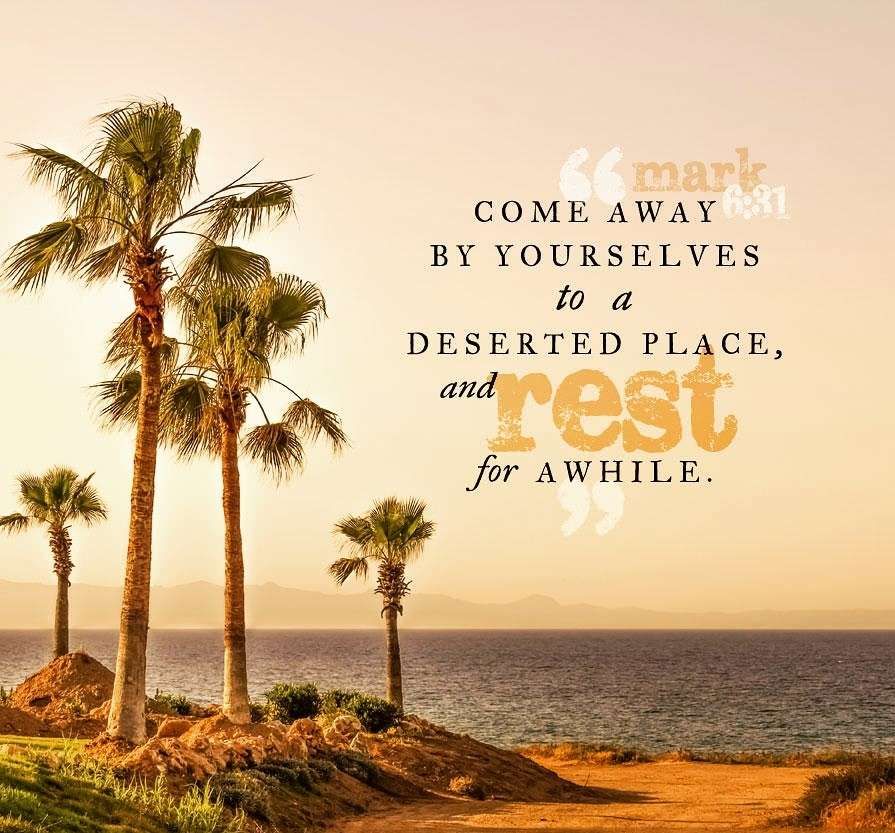
Mark 6:30-56 includes the story of the feeding of the 5,000. Those who drafted our lectionary wanted us, however, to focus on the context of the story rather than on the miraculous feeding of the 5,000. So they have left the feeding of the 5,000 for another day!

Some interesting statistics:

  • 7 out of 10 British workers want to put in only 40 hours a week at work. But the average employee works almost 45 hours a week – longer than any other nation in the European Union.
  • One in four male employees works more than 48 hours a week. One in five manual workers puts in more than 50 hours. And one in eight managers works more than 60 hours a week.
  • The average British lunch-hour is now only 30 minutes long.
  • One in ten workers still get no paid holiday!

Just walking round Ashton town centre I see people on their mobile phones – keeping up to speed with work, running the home or catching up with friends. Social media and emails mean that we can contact people in an instant, and expect an instant response. Everything is busy, busy, busy.

For many life is too busy – they feel stressed. … But then others have no work at all – and that lack of work is stressful in itself. Stress related illnesses are now so prevalent in our society. Relationships suffer and so our homes and communities suffer.

Busyness was a problem in Mark 6. It began with the disciples returning from their mission. They want to tell Jesus all that they had done and taught. You can imagine them surrounding Jesus full of excitement. They’ve made a difference in people’s lives and they’re eager to talk about what they’ve done, how great it was.

Moments later we’re told that Jesus and his disciples were recognised by many people who hurried to meet them, in a rush to hear Jesus’ teaching or receive healing. At every village, town or farm that Jesus went to, he was surrounded by people begging for his attention.

Yet in the midst of this busyness, Jesus says something highly significant. Listen to his words: “Come away to a deserted place all by yourselves and rest a while”. … Jesus recognised that without rest, refreshment and reflection neither he nor his disciples would be fit for anything. Throughout the Gospels we see this model: Jesus goes off by himself to pray and to find some peace – especially when he has a major task ahead of him. He goes into the wilderness for forty days after his baptism and before starting his ministry. The night he’s arrested he’s found in the garden of Gethsemane taking time to pray to prepare himself for the ordeal to come.

The needs around him were obvious, but Jesus took time to relax, to rest and reflect, to pray, and he encouraged his disciples to do the same. It must have been hard to do this, with needs pressing in on every side. … Jesus faced the same dilemma we do. If we take time out for ourselves, how’s the ironing going to get done; how will I find time to visit my friend who’s lonely? Or in my case, how will next Sunday’s sermon get written?! Can you imagine the vicar turning up on Sunday shrugging his shoulders – “Sorry, no sermon today, I needed time to rest!”

As Christians we seek to model ourselves on Jesus – to be like him, to make him known to others. This doesn’t just apply to the active Jesus – telling people about God, showing God’s love in action – it needs to apply to the Jesus we see resting, or seeking time to rest. Just as Jesus knew that he needed timeout away from the daily demands so that he would be fully effective in his ministry, we need to ensure that we get timeout in our lives so that we too are effective for him.
If we’re too busy to stop, to spend time with God, to spend time on our own resting, then we’re too busy. We need to hear Jesus’ words: “Come away to a deserted place all by yourselves and rest a while”. I spend time reading and being quiet, when I can. Jo and I make sure that we keep our day off sacrosanct. But we need to heed Jesus call to rest more than we do. Each of us will need to discover our own pattern. But we all need to find rest & refreshment so that we can be effective in what we do, in who we are.

As well as making sure that we “rest a while” ourselves, we need to make sure that others are able to do the same. We need to be aware of others who are too busy and we need to seek to share their load so that they are not overloaded. We need to make it possible for them too to find refreshment.

Jesus and his disciples needed to rest, needed time out. We do too if we are to play a full part in building his kingdom on earth. But we also need to look around us, in our churches and parishes, at home, at work, wherever we find ourselves and be ready to share other people’s loads so that each person is able to have space for themselves and for God in the midst of their demanding schedules.

Is there anything worth dying for? Mark 6:14-29

In August 2014, I wrote a very short blog which mentioned Graham Turnbull. In 2015, I had a call from a Daily Mail journalist asking me about Graham. His death in the 1990s had been linked with the arrest in June 2015 of Karenzi Karake, Rwanda’s intelligence chief on a European Arrest Warrant.  Karake was wanted in Spain for war crimes. He was accused of ordering massacres while head of military intelligence in the wake of the 1994 Rwanda genocide. Later in 2015 he was released from custody in the UK.
See more at:

http://www.dailymail.co.uk/news/article-3141105/Rwanda-spy-chief-accused-war-crimes-bailed-help-Cherie-Blair-Britain-meet-head-MI6.html

http://independent.co.ug/news/regional-news/10380-karake-arrest-tests-uk-rwanda-relations#sthash.bG3PwQK8.dpuf

http://www.independent.co.uk/news/uk/crime/karenzi-karake-rwandan-spy-chief-arrested-in-london-is-implicated-in-killings-of-two-britons-10340225.html

The Spanish indictment named Chris Mannion, a British Catholic missionary shot dead in 1994, and Graham Turnbull, an aid worker and observer with the UN High Commission for Refugees killed in 1997, among foreign nationals who were targeted alongside thousands of Rwandan Hutus in the aftermath of the genocide, during which ethnic Tutsis and moderate Hutus were massacred wholesale by Hutu extremists.

I wonder, is there anything that you think it is worth dying for?

Perhaps if those you love were threatened? …….

What would you risk your life for?

I first met Graham Turnbull when I was staying in Uganda in 1994. Graham had given up his job as a solicitor in the UK, driven across the Sahara to deliver a landrover to Rwanda and had the intention of teaching English in a small town there. His visit coincided with the genocide in Rwanda and he could not get into the country. We shared a house for a short while in Kisoro in SW Uganda.

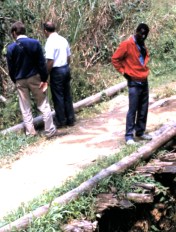
GrahamI can only find this picture of him taken in 1994 on a trip out to inspect some of the main road bridges in Kisoro District. Graham is facing away from the camera in the blue top.

After I had returned to the UK, Graham later managed to get into Rwanda and taught there for a time. About three years later he felt that God was asking him to be a UN observer in Rwanda. A very dangerous occupation. He wanted to do what he could to stop some of the killing which was still going on. He and his family prayed about this for some time and everyone agreed that Graham should apply for the job. It was in 1997, I was listening to the BBC news at 6 o’clock and there was a report of a group of UN observers being killed in Rwanda. Graham was one of them.

Graham gave up life in this country to serve God, and died doing so. He was 34 years old when he died.

British soldiers around the world are similarly risking their lives on a daily basis for the cause of peace and justice.

What would you be prepared to risk your life for?

That might be too hard a question to answer, so let me ask you a perhaps easier question – I wonder what it would take to make you stand up and be counted?

At times I’ve lobbied the local MP about third world debt. A little while back some of us felt that it was right to try to fight the introduction of a sex shop near the centre of Ashton. There has been the rise and fall of the British National Party and the English Defence League  – an increase in racist views. ……….

What kind of issue would be big enough for you to do something in a committed way?

We are usually reasonably happy if someone chooses to write a few letters, or to do a bit of campaigning, provided of course they don’t go overboard about it! But what would make you act, even at the risk of the disapproval of others?

gerrit-van-honthorst-salome-and-herodias-with-the-head-of-saint-john-the-baptist

John the Baptist, in Mark 6:14-29, was prepared to make a stand. His stand against Herod’s wrong relationships cost him his life.

For the sake of God’s work and God’s Word, for the sake of truth and justice, John was prepared to die. He was willing to be a martyr for what he knew to be right, for his faith. And John is not alone – for down through the centuries many people have seen their faith as more important than their own lives. Astoundingly the 20th century saw more Christian martyrs than in all 19 previous centuries since the birth of Christ, put together.

As Christians we talk sometimes about being a prophetic people. A people who model God’s love and God’s life in the world. John the Baptist, and Graham Turnbull model for us what it means to be prophetic. When we see injustice, when we see wrong, when people around us are far from God – we need to take up their challenge. We need to do something about it.

If we talk about our Christian faith we may feel foolish, we may even suffer rejection. If we stand out and speak against injustice, it’s possible people may become fed up with us. But these afflictions are nothing compared to what our sisters and brothers around the world or down the centuries have faced for the sake of the Gospel.

Working with the ongoing campaign for the relief of debt. Speaking out against injustice in our own communities. Fighting for the human rights of asylum seekers. Taking action on behalf of the oppressed. Talking of, and living out, the love of God in our communities. These, and things like them, are just small steps in the footprints of those who have gone before us.

My friend Graham decided that there were things that were worth more than his own life. Not selfish things, but things which benefited others. British soldiers have died in Afghanistan and in many other places in recent years. It is unlikely that any of us will personally be faced with the same kind of life and death issues. But we live in a world where everything is not right, where injustices exist, where people live in fear and have little or no hope. Graham and others like him are a challenge to us all.

We too need to be courageous, to be willing to act. And as we do these things we know that we do not stand alone. We stand with people like John the Baptist, like Graham Turnbull. We stand with many people that we call Saints.  But more than that, we have Jesus’ promise to his disciples. “I will be with you always – even to the end of the age!” We have Jesus walking alongside us as our friend, strengthening us by his spirit. Enabling us to be his servants. Whatever actions it is right to take, whatever decisions we face, we are definitely not alone.

Travel Light – 5th Sunday after Trinity – Mark 6:1-13

In Mark 6, the disciples are beginning a new phase in their ministry, in their relationship with Jesus. And Jesus gives them instructions and advice as he sends them out to work for him.

Jesus sends the disciples out, two by two. He tells them to take nothing for their journey except a staff – no bread or money – and just one pair of sandals and one tunic. “Travel light,” says Jesus.

Travelling is always about leaving something behind. There is always something ahead of us, but a journey always means leaving something behind. When we go on holiday by plane we have to decide what size case we’re going to take, what clothes we’ll wear, what books we’ll read. We only have a finite space available to us and we have to prioritise.

Jesus says to us all that travelling with and for him will mean travelling light, making decisions about what we need with us, about what is important and what can be left, or should be left, behind. We have to prioritise!

We have to decide what being sent, what travelling light mean for us. We have to decide what is really important and what is secondary and of lesser importance. We have limited resources. We cannot do everything.

“Carry only what you need,” says Jesus, “and target you efforts, stay with those who welcome you. God will provide for everything else.” Jesus’ disciples discovered that it was true. God did provide for their needs. This is how Jesus wants us to live – depending on him, trusting him to provide what we need.

But listen to what else Jesus says in our passage this morning:  “Stay with those who welcome you,” he says. “If you are not made welcome move on.” These seem to be quite harsh words. Yet in saying them Jesus is highlighting two important things: The importance of welcome … and the risk of rejection.

Welcome is so important. If we fail to welcome others, to draw them into our community, to be willing to change to accommodate them, they will move on, they won’t stay.

But in everything we do, we risk rejection. When we reach out with the love of Christ to others, there will be those who turn their backs on us. It is our calling as a Christian family to be an open and welcoming place, to excel in our efforts to make people feel at home even if that means change and uncertainty.

Ultimately though, Jesus suggests we should target our efforts. But target them not according to our own agenda but according to God’s agenda. But, here is a word of warning: God is often at work in the least expected places, sometimes in places or people we avoid at all costs.

Think of the story of Zacchaeus, the little tax collector, so hated by everyone, especially by the most religious of people – but God was at work in his life. Think of the Roman Centurion, symbol of Roman occupation, Roman power of whom Jesus said, “Never have I found faith like this in Israel.”

Think of the Cross, the place of curse and condemnation, the place where everyone knew no good could occur, but the place where God did his greatest work of love.

“Stay,” says Jesus, “where you receive a welcome – where God is at work.” At the Cross; with people like Zacchaeus; with the poor, with the outcast, with the prostitute; even with the oppressor.  … Wherever God is at work.

We need to commit ourselves again to travelling light, to focussing on the important and essential, to giving ourselves as best as we are able to those around us in our community – for if we don’t our Christian congregations will die.

“Live by trusting me,” says God in Jesus, “live in my strength; and work where you see me at work.”

Islam, Christianity and Violence

I have heard it said that Islam is a violent religion. I have been told that the Qur’an legitimises violence and that the interpretation put on the message of the Qur’an by those called Islamic terrorists does not distort the message of the Qur’an.

I don’t know enough about Islam or the Qur’an to speak with authority. However, it seems to me that for every argument that Islam is a religion of the sword there are equally well constructed arguments that it is a religion of peace. Here are a few …..

http://www.huffingtonpost.com/kabir-helminski/does-the-quran-really-adv_b_722114.html (cf: http://www.barakainstitute.org/articles/is-islam-a-religion-of-the-sword)

http://islam.about.com/od/terrorism/f/terrorism_verse.htm

http://www.islamicwritings.org/quran/peace/does-the-quran-teach-violence/

http://acc.teachmideast.org/texts.php?module_id=2&reading_id=62&sequence=9

There are also those who have made comparisons between the Bible and the Qur’an. Here is one example  …

http://www.npr.org/templates/story/story.php?storyId=124494788

Ultimately, almost every argument has a counter argument. So, for example, this is a response to Patrick Sookhdeo’s Article (July 30, 2005) in London’s The Spectator , “The Myth of a Moderate Islam” …

http://www.islam101.com/terror/mythViolence.htm

I am no expert, but all I hear in these articles is argument and counter-argument which seek to portray Islam as violent, or non-violent. I cannot easily determine right from wrong.

I do know something, however, about the Bible and I have spent a lot of time studying it over the years. I am a Christian and I have something of an implicit faith that God speaks through the Bible. I am also convinced that the message that God wants us to hear through the scriptures is one of love, forgiveness, grace and faith and that God’s kingdom is a kingdom of righteousness and faith. I pray for that kingdom to become a reality here on earth.

However sure I am that this is the message of the Bible – both Old and New Testaments – I have to accept that the Bible is a book full of stories, many of which contain violence. It is a book which contains instructions, which it claims come from God, which speak of violent retribution. I believe that I have integrity when I say that God’s kingdom is a kingdom of justice and peace. But my scriptures contain a great deal of violence, some of which, even in context, appears to be justified by the writers of the text.

So, for example, there is the story of Samson who in Judges 16 kills himself in order to take out a large number of his enemies. His actions appear to be justified in the story, yet they are essentially the same as many of the suicide terrorists of today.

There are instructions from God – see Deuteronomy 7: 1-2, Deuteronomy 20:10-17 and Numbers 31:17-18.

Then there are Jesus’ own words in his parables … see for example, Luke 19: 26-27. Of course, this is only a parable, a story, and these are the words of a character in the story, but ….  there are also Jesus’ words: ‘I have not come to bring peace but a sword.’ (Matthew 10:34).

There are many more references to killing and violence throughout the Bible. It is possible, because of its relative length compared to the Qur’an, that there are considerably more references in the Bible to violence and killing than there are in the Qur’an.

If I believe that I have integrity when I argue that Christianity is not a violent religion, but a religion of peace and justice, forgiveness and grace … then surely it is possible that when a Muslim friend argues that Islam is not a violent religion, this is also the case – he or she is speaking with integrity.

There is much that is different between Islam and Christianity.

As a Christian, I am firmly convinced that, in Christ, God is reconciling the world to himself; that God, in Christ, takes into himself the sin of the world, my sin. As a Christian, I believe that, in Christ, God is with us, Emmanuel, not remote and ‘other’.

But I really don’t have any firm grounds for claiming that Islam is a more violent faith than Christianity. I need to listen to, and believe, the majority of Muslims who tell me that their faith is a faith of peace and not of the sword.


Interruptions – Mark 5:21-43 – 4th Sunday After Trinity

Interruptions can be really irritating. … I always tried, when I worked for Stockport Council to maintain an open door policy for the people who worked for me. However, it did not stop me feeling aggrieved every time my concentration was interrupted!

A prominent Catholic teacher called Henri Nouwen said in the prime of his career that he became frustrated by the many interruptions to his work. He was teaching and had a heavy agenda each day and didn’t like to be disturbed. Then one day it dawned on him that his interruptions were his work. The unplanned things were his ministry. It was in those interruptions that he had his most important encounters.

There is a saying: “Life is what happens to you while you’re making other plans!” … Often, when we are interrupted, it turns out that the interruption is of greater consequence than what we were doing at first!

Our Gospel reading says something about the way that Jesus treated people. Jesus left the crowd to minister to a single person. He was never too busy to respond to the needs of an individual … Bartimeaus, the blind man by the road side, the epileptic youth and his distraught father after the Transfiguration, Zaccheus the troubled tax collector, the widow of Nain weeping over her dead son, Nicodemus at the dead of night, the woman at the well in the heat of the day …. Yet even Jesus could not minister to everyone.

When we look at the needs of the world, we can feel overwhelmed. We want to help, but we hardly know where to begin or where to stop. … We can give in to despair, wringing our hands, feeling that anything we do would be of little or no significance. Or we can help by responding to needs that present themselves to us, often small or individual needs, with the resources at our disposal.

We can’t do everything but even if we just do something, we make a difference.  There is a story of someone who watched a man walking along a beach where for some reason thousands of starfish had become stranded above the usual tide line – they covered the beach. The man was picking up individual starfish and throwing them back into the ocean one by one. This person asked the man why he bothered – you can’t possibly save them all….. the reply was  “But I can save these ones from dying in some shell hunter’s collection.”  It clearly wasn’t possible for him to retrieve them all, but he was giving a precious few another chance to live.  We see this same thing in Jesus; unable to respond personally to everyone in the crowd, he helped some  – and made a difference.

So, Jesus’ time with the crowd is interrupted by Jairus, and Jesus responds, and as he hurries to Jairus’ house he is interrupted again. This time it is a stealthy interruption. Jesus feels the flick of someone’s fingers on the fringe of his outer garment. He stops and asks: “Who touched my clothes?” The disciples laugh: “You see the crowd pushing in on you and you ask who touched you?” perhaps too they thought, “You’ve got urgent work to do for one of the leaders of the town. Let’s get on with it.” But Jesus is not deterred. He looks around to see who has touched him, and a woman comes forward, falls at his feet, and tells him the whole truth.

She has a chronic debilitating disease. She’s suffered from haemorrhages for twelve years. She has spent all she has on doctors but is no better. She’s heard about Jesus, and she has determined just to touch the tassel of his robe in hope of a cure. (It was a superstition in Jesus’ day that if you touched the garment of a holy person, you might be cured. Much like today we might touch the cross on the chain around our necks, or some may have a rabbit’s foot.) And now she has experienced healing.

No one, nobody else, anyway, would speak to her openly. She is ceremonially unclean because of her blood flow. But Jesus speaks to her, he notices her, he is kind to her! He calls her, “Daughter,” and says, “Your faith has made you well. Go in peace and be healed of your disease.” In other words, it isn’t the touching of his robe, but her faith that works her healing.

This is quite amazing.   A poor, diseased, outcast woman, clutching her tattered garments tightly around her, pushing through the throng, frantically reaching out her hand for help and, suddenly, all the love and power of God in Christ focuses for a brief moment in her. She goes from being a nobody to being the centre of God’s attention.

And this is how God is with each of us. We celebrate this love this morning. As we receive the elements at Communion God’s love is focussed on each of us and we receive it once again into ourselves.

Sixteen centuries ago, St. Augustine affirmed that God loves each of us as if we were the only person on earth, yet God loves everyone as much as God loves each one of us. There’s no one on earth today that God loves any more than he loves you, nor is there anyone God loves any less than he loves you. That realization should give us assurance about our own well being; and, should motivate greater concern for others.

If this is how God is with us, then this is his call to us. When we encounter need, we should respond in love, in whatever way love dictates.

The woman’s faith should also grab our attention.  She never gave up hope. She had heard about Jesus of Nazareth and the wonderful things he was doing, the difference he was making in people’s lives. She sought him out and acted on her belief. She was wrong about just needing to touch the robe, but she was right about reaching out to Christ in total commitment. The healing she experienced is God’s gift to all who seek him in sincerity and in truth – and we too can receive this gift when we reach out to him.

A Prayer

Loving God, in your majesty you number the stars in the heavens; and in your mercy, you heal the broken hearts of our world. In Jesus you entered our human world as a helpless infant. You know what it is like to be human and you are ever present with us in all that we go through. Open us up to the hurt of individuals all around us. Use us in a world full of loneliness and misery. Help us to bear one another’s burdens and so fulfil your long love through Jesus Christ our Lord. Amen.

21st June – 3rd Sunday After Trinity – Mark 4: 35-41

The readings set for Sunday 21st June in the Anglican lectionary are Mark 4:35-41, Job 38:1-11 and 2 Corinthians 6:1-13. The passage from Mark 4 reads:
On that day, when evening had come, Jesus said to his disciples, “Let us go across to the other side of the lake.” And leaving the crowd behind, they took him with them in the boat, just as he was. Other boats were with him. A great windstorm arose, and the waves beat into the boat, so that the boat was already being swamped. But he was in the stern, asleep on the cushion; and they woke him up and said to him, “Teacher, do you not care that we are perishing?” He woke up and rebuked the wind, and said to the sea, “Peace! Be still!” Then the wind ceased, and there was a dead calm. He said to them, “Why are you afraid? Have you still no faith?” And they were filled with great awe and said to one another, “Who then is this, that even the wind and the sea obey him?”

When was the time when you felt closest to God?

I remember in my twenties sitting at the end of Buttermere in the lake district on a still and bright summer’s day with the lake as flat as a pond and the mountains reflected as clearly in the water as I could see them above it. And for a moment I had the strongest of senses that God loved me and that everything would be OK.

So, when did you feel closest to God?  Perhaps seeing a stunning view; perhaps the birth of a grandchild or a son or daughter; perhaps out fishing early in the morning; perhaps when you knew that you’d be getting married.

Many of us will have had those special moments when God seems present in a special way – when we feel something of his glory, his majesty, his closeness, his love. Perhaps not just in good times, maybe in the saddest of times too – God breaks into our fear, confusion or depression, our grief or loneliness and reveals his love or a way out of the mess we feel we are in.

But the vast majority of our lives are spent plodding on, aware of God somewhere in the background but without that intensity of feeling that we experience on those special occasions. And perhaps just as frequently as the good moments, the highlights, we experience things that draw us down into the deepest of despair.

The reading from Job comes at the end of a great dialogue between Job, and his friends about suffering and hardship. In which they have discussed the meaning of suffering and the reasons for it. At the end of the book of Job, God speaks, and we heard the first eleven verses of God’s response to their deliberations. God asks a series of questions about their authority to challenge him. Who are you, says God to challenge me, can you possibly understand the workings of the universe?

The reading from 2 Corinthians, talks of Paul’s hardships and sufferings as he served God and as he spoke about Jesus. In the midst of the list of his hardship, Paul seems to find hope and life:

“Sorrowful, yet always rejoicing; poor, yet making many rich; having nothing, yet possessing everything.”

Suffering and joy intermingle in Paul’s experience but he remains sure of his faith and of God’s love despite whatever hardship comes his way. … Paul is convinced that God has given us work to do and that as he faithfully serves God, whatever comes his way, can be overcome. The book of Job reminds us that suffering and hardship is ever present and it encourages us to express our feelings to God, secure in the knowledge that God will always be there for us, secure too in the knowledge that God knows and understands what is happening, even if we have not a hope of understanding.

The reading from Mark’s Gospel tells the story of an encounter with a violent storm. Jesus disciples find themselves in a place of fear and worry and concern. It is a place that they cannot cope with and they fear for their lives.  In this story, God’s power breaks in. Jesus seems at first to be ignoring the danger. And then the disciples are amazed when they see him command the water and the winds and return them to safety. … The disciples are afraid and then they see God’s power at work in a dramatic way that leads them into peace.  As the disciples spent more and more time with Jesus they saw again and again how God could break into the lives of people and transform them.  And it didn’t end with Jesus’ death and resurrection  – for as we read our Bibles, we see this continuing through the disciples ministry in the book of Acts.

There have been times when God has broken into our lives. ………..  Often at these times that we gain a new perspective on God, or a reminder of something we’ve forgotten.  These moments can motivate us, or sustain us. They’re moments to treasure.

But, if you’re like me, there will be those times when you desperately want God to break in again. When you want to know for sure, to feel that God is with you. But for some reason God is absent, or the pain is too great, or the anger overpowering.

fpsGod does not deal with us in predictable ways. We want to feel his presence all the time. When actually what we may need is to begin to grow in faith, to grow in our confidence that God is there with us even when it doesn’t seem to be the case. God wants us to grow to be strong in faith. And so will be times when we need to remind ourselves that God is intimately concerned with us, with me, giving me life, giving me purpose and giving me hope for the future.

God has created us, God has redeemed us, God walks alongside us in the mundane experiences of life, at times of greatest difficulty, when he seems most absent he remains there with us in the pain, and ultimately God has a future for us in heaven.

Parables – Mark 4: 26-34

Jesus  said, “The kingdom of God is as if someone would scatter seed on the ground, and would sleep and rise night and day, and the seed would sprout and grow, he does not know how. The earth produces of itself, first the stalk, then the head, then the full grain in the head. But when the grain is ripe, at once he goes in with his sickle, because the harvest has come.”

He also said, “With what can we compare the kingdom of God, or what parable will we use for it? It is like a mustard seed, which, when sown upon the ground, is the smallest of all the seeds on earth; yet when it is sown it grows up and becomes the greatest of all shrubs, and puts forth large branches, so that the birds of the air can make nests in its shade.”

With many such parables he spoke the word to them, as they were able to hear it; he did not speak to them except in parables, but he explained everything in private to his disciples.

Jesus’ parables are intended to intrigue us, to catch the imagination, to get people thinking, to draw out a response which when reflected on becomes a place where God interacts with us and changes us. There’s the parable of the shepherd who leaves 99 sheep in open country and goes looking for the one that is lost. Can you imagine Jesus’ audience’s response: “The fool. Who will look after the 99?” …. “He should cut his losses and look after what he still has.” … “One in 99 isn’t that big a loss. Why risk the whole flock over one wayward sheep?”

And in that process of response Jesus’ listeners are hooked. They go away full of a story that will provoke discussion in the pub. Perhaps you can imagine the conversation:  “What do you think he meant?” … “Perhaps he was just telling us a joke about shepherds – after all they are a dim-witted lot.” … “No, I’m convinced that he said something important …”

In our Mark 4, we hear Jesus telling two parables about the kingdom of God. Picture stories about growing plants. His listeners would know all about growing plants, as many of us do. So, we say, that in his parables, Jesus draws on his listeners own experiences to make his point. He uses stories to convey deep truths, usually referring to an aspect of life that people can identify with. And that is part of the truth. …

But if that was all of the truth then surely he would go on, in these stories, to apply the truth. A parable would be something like a fable, the moral would be underlined at the end of the story.

But that doesn’t happen here. … In fact it doesn=’t happen with many of Jesus’ parables. And here, Mark is at pains to emphasise that Jesus didn’t explain what he was talking about, except to his disciples. These parables are intended to have hidden meaning, to intrigue, to provoke questions. And Jesus choses not to answer them or explain what he is saying.

Perhaps, in this case, Jesus knew that having heard the story, the next time his listeners were out in the fields sowing their crops they would be reminded of his words.  As the farmer scattered seed in his field maybe he would suddenly be brought up short, exclaiming “Ah, now I see, that’s what the kingdom of God is like.”     Perhaps he would think about the planning that is involved in seed sowing – reviewing how his crops have fared in the past, choosing the right place and time for actually sowing the seeds, and his hopes for a healthy crop to sustain him later in the year.  And then think, for God’s kingdom to grow, perhaps we need to make sure that it has the right conditions to grow – and what might these be?  What can I do so that my hope in this kingdom is realised?

Perhaps when the farmer sowed his mustard seed he would look at it and notice for the first time just how small and insignificant it looked and remember again just how large a bush the seed would produce. Perhaps he or she might cotton on that the weakest and smallest of things can become something of importance.

Rather than being told the meaning, Jesus listeners would have discovered a meaning for themselves. And because they had made the discovery, it would stick. Perhaps ……….

As Christians, we pray for God’s kingdom to come. We do so every time we pray the Lord’s Prayer.  We say that we desire to see a world which operates in line with God’s way of being; a place where his love is known by all and where all thoughts and words and deeds stem from this love.  As with all prayer, we need to expect to be part of the answer, to have some part to play in the outworking of our desires.  What does it mean for God’s kingdom to come? What does it mean for God’s kingdom to come in our place of worship? What does it mean for our community? What does it mean for the village, town or city in which we live?

I’m not going to suggest answers for you. I’m going, so to speak to take a leaf out Jesus’ book. I’m going to leave you with his parables. So, when you visit a Garden Centre, when you see the plant stalls on the Market, when you buy a packet of seeds or when you plant some seed. When you put mustard on the side of your plate. At any of these times, you might just find yourself being reminded of these parables – don’t dismiss them from your mind but allow yourself to hear them again and ponder what they mean for you and for us all. The question to ask is: “What on earth was Jesus getting at?”

God’s Face in the New Testament

Jayson Georges suggests that the bible wants us to understand that God welcomes us into his presence. We are welcome to see the face of God. Yet so often we chose to turn away in shame. The bible tells us very clearly that:

God shows and offers his face to people, but due to both disgrace and arrogance people often turn their faces away, from glorious communion to shameless isolation.

The bible often talks of the ‘face’ of God, particularly in the Old Testament, but its message comes into clear focus in the New Testament. See:

God’s New (Testament) Face

Screen Shot 2015-04-26 at 3.45.18 PM