
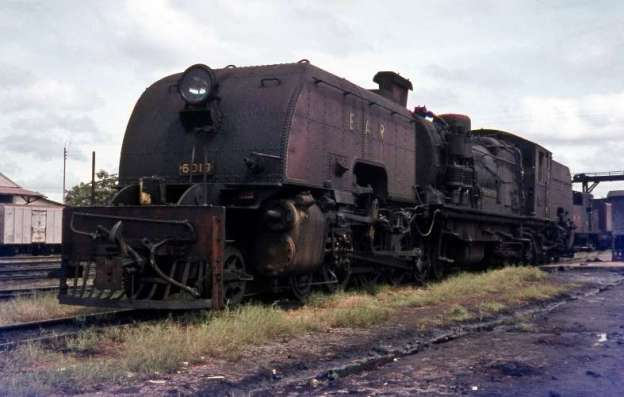
The featured image shows East African Railways (EAR) ’60’ Class Beyer-Garratt steam locomotive No. 6019 at Tabora depot, Tanzania in 1968, © Basil Roberts and licenced for reuse under a Creative Commons licence (CC BY-SA 4.0). [1]
’60’ Class
The Railway Magazine of November 1954 reported that East African Railways & Harbours had begun to name its new ’60’ Class Beyer- Garratt locomotives. They chose to name them after past and present Governors. The ’60’ Class were then the most powerful Beyer-Garratt locomotives to be delivered to East Africa. Twenty-seven (29? [1]) had been ordered, and by the Autumn of 1954, twenty-five had been delivered, with 20 already in service.
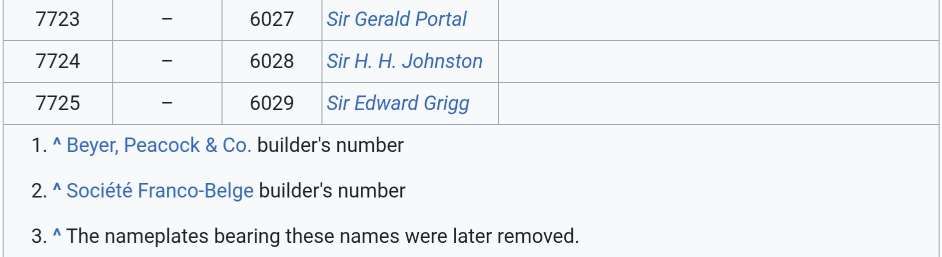
“Sir Edward Twining, Governor of Tanganyika, named one of the class after himself at a ceremony at Dar es Salaam on 18th September; on 25th September 25, Sir Andrew Cohen, Governor of Uganda, named another locomotive at Kampala; and Sir Evelyn Baring, Governor of Kenya, named a third of the class at Nakuru on 29th September. With the subsequent naming of the other locomotives after past Governors, the ’60’ Class [would] become known as the ‘Governor’ Class.” [2: p804]
“The first 12 of them were built by sub-contractors Société Franco-Belge in Raismes (Valenciennes), France, and the rest were built by Beyer, Peacock in Gorton, Manchester, England. The class entered service in 1953-54.” [1][3: p77-78]
“They were 1,000 mm (3 ft 3 3⁄8 in) gauge 4-8-2+2-8-4 Garratt-type articulated steam locomotives built for the East African Railways as a development of the EAR’s existing ’56’ Class.” [3: p77]
Initially, all members of the class carried the name of a Governor (or equivalent) of Kenya, Tanganyika or Uganda, but later all of the Governor nameplates were removed. [3: p77-78]
The Railway Magazine also noted that, “The policy of naming locomotives [was] to continue and it [had] been suggested that the ’59’ Class Beyer-Garratt locomotives, delivery of which [was] expected to begin in 1955, should become the ‘Tribal’ Class.” [2: p804]
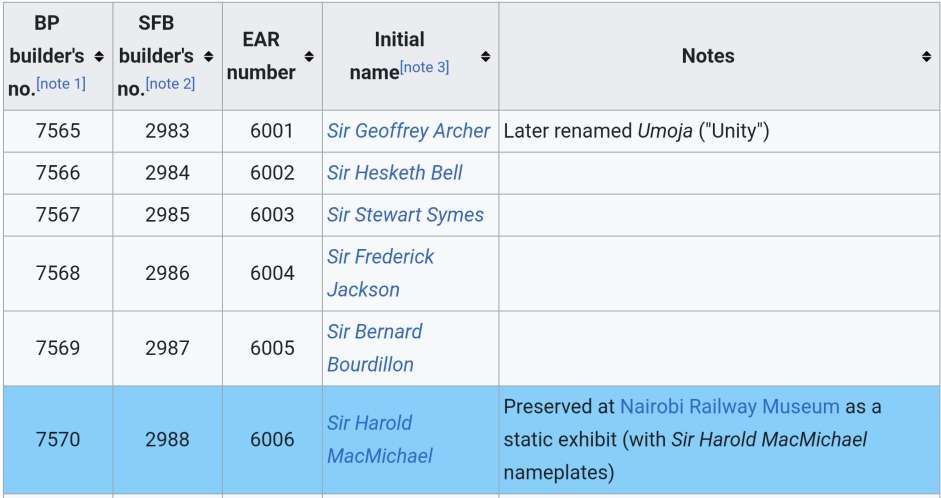
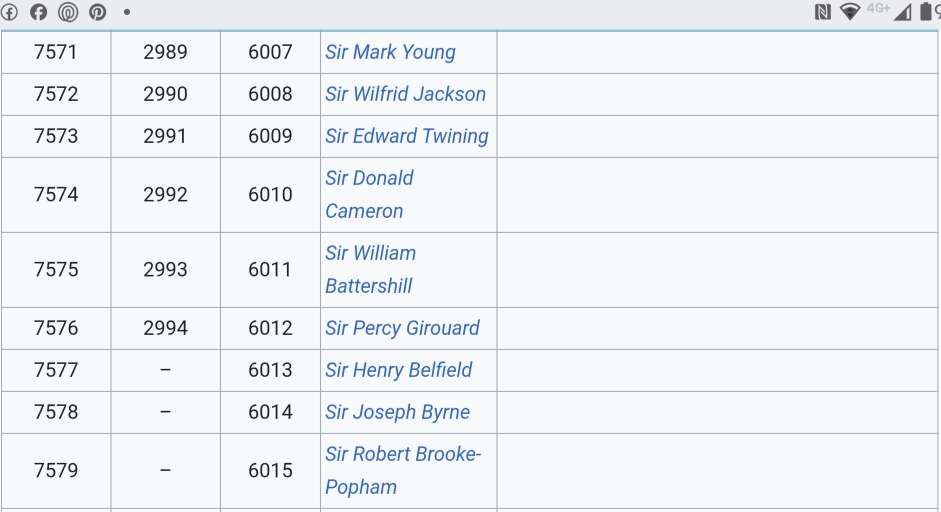
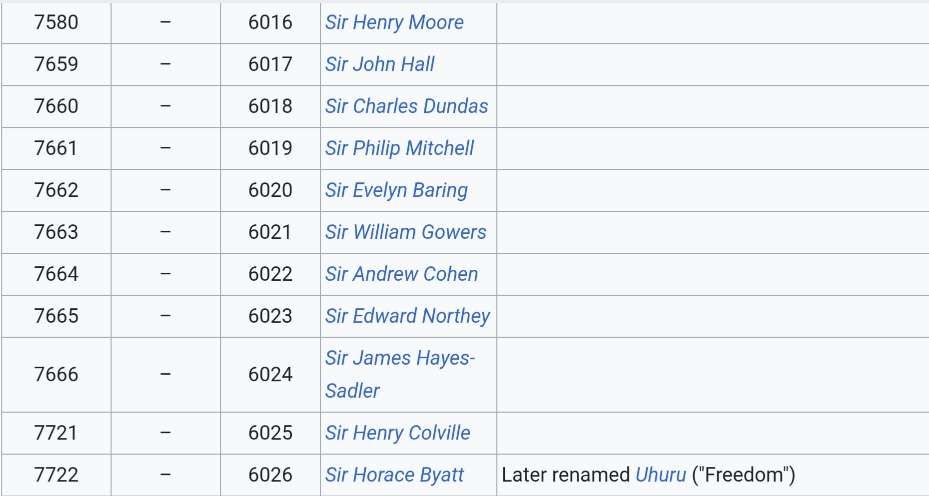
The table below (in 4 parts) comes directly from the Wikipedia article about the ’60’ Class locomotives. The information included in the table is taken from two important texts,, both published by David & Charles, one by Ramaer, [3: p91] the other by Durrant. [4: p190]
’59’ Class
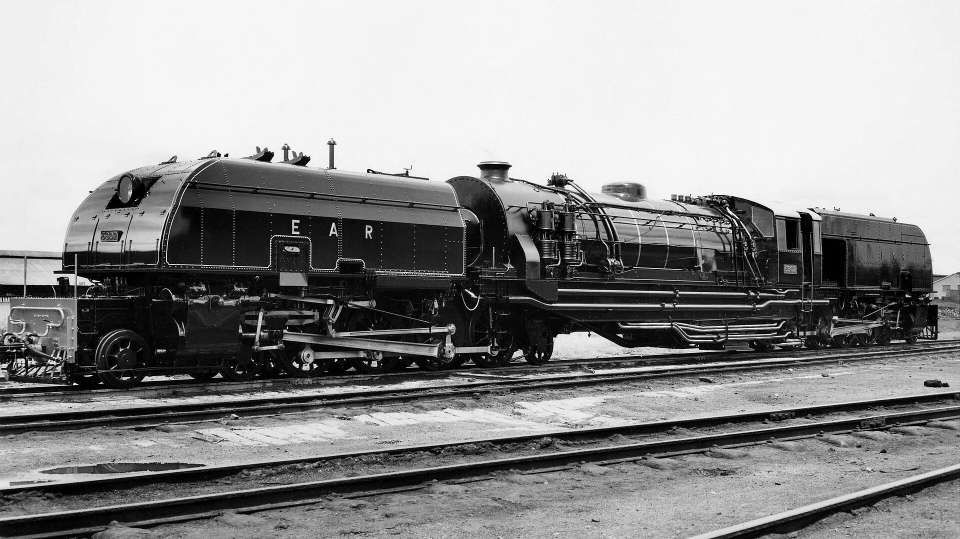
The ’59’ Class Beyer-Garratt locomotives entered service in 1955–56, and were the largest, heaviest and most powerful steam locomotives to operate on any metre-gauge railway in the world. [3: p72-73] In the end, the 34 locos of the Class were named not after Tribes but after Mountains. [5]
The Wikipedia article continues:
“The locomotives had a 4-8-2+2-8-4 wheel arrangement, weighed 252 t (248 long tons; 278 short tons), and delivered a tractive effort of 83,350 lbf (370.76 kN). They were designed to haul 1,200-ton trains on 1.5% gradients and were the mainstay of freight services on the 330 mi (530 km) run from Mombasa to Nairobi until the late 1970s.
“During normal service, the locomotives were attended to by two regular crews on a ‘caboose’ basis, one working and one resting in a van with sleeping accommodation, changing over at eight-hour intervals.
“The engines, many with Sikh drivers, were kept very clean and well maintained. The most famous of the 59 class was 5918 Mount Gelai with a devoted crew known as the ‘Magnificent Foursome’ who worked on it for 16 years. The two drivers, Kirpal Singh and Walter Pinto, simply went on holiday when the locomotive went into Nairobi works for scheduled maintenance.
“According to railway photographer Colin Garratt (in 1975), ‘the overall condition of Mount Gelai is possibly unrivalled anywhere in the world today. Her cab interior is more akin to a Sikh temple than a locomotive footplate for its boiler face abounds in polished brasswork, embellished with mirrors, clocks, silver buckets and a linoleum floor’. [6]
“Withdrawals started in 1973, with the last locomotive (Mount Gelai) removed from service in April 1980 when it was driven by its long time driver, Kirpal Singh directly to the Nairobi Railway Museum; Mr. Singh retired from railway service the same day. Together with Mount Gelai, Mount Shengena was also saved from scrap and both are now preserved by the Nairobi Railway Museum.
In August 2001, Mount Gelai was transferred from the Nairobi Railway Museum to the Kenya Railways’ main works for an overhaul to working order. Between November 2001 and September 2005 the locomotive made three round trips to Mombasa hauling excursion trains. It was also used on at least one occasion to haul a freight train to Nairobi due to a shortage of diesel locomotives. However, it has not operated outside of Nairobi since 2005 and is unlikely to do so again due to operational restrictions and the partial regauging of Kenya’s metre-gauge.” [5]
The names of the ’59’ Class were:
- 5901 Mount Kenya
- 5902 Ruwenzori Mountains
- 5903 Mount Meru
- 5904 Mount Elgon
- 5905 Mount Muhavura
- 5906 Mount Sattima
- 5907 Mount Kinangop
- 5908 Mount Loolmalasin
- 5909 Mount Mgahinga
- 5910 Mount Hanang
- 5911 Mount Sekerri
- 5912 Mount Oldeani
- 5913 Mount Debasien
- 5914 Mount Londiani
- 5915 Mount Mtorwi
- 5916 Mount Rungwe
- 5917 Mount Kitumbeine
- 5918 Mount Gelai – preserved at Nairobi Railway Museum
- 5919 Mount Lengai
- 5920 Mount Mbeya
- 5921 Mount Nyiru
- 5922 Mount Blackett
- 5923 Mount Longonot
- 5924 Mount Eburu
- 5925 Mount Monduli
- 5926 Mount Kimhandu
- 5927 Mount Tinderet
- 5928 Mount Kilimanjaro
- 5929 Mount Longido
- 5930 Mount Shengena – preserved at Nairobi Railway Museum
- 5931 Ulguru Mountains
- 5932 Ol’donyo Sabuk
- 5933 Mount Suswa
- 5934 Menengai Crater
References
- https://en.wikipedia.org/wiki/EAR_60_class, accessed on 26th March 2026.
- Notes and News; in The Railway Magazine November 1954; Tothill Press, London, 1954, p800-805.
- Roel Ramaer; Steam Locomotives of the East African Railways. David & Charles Locomotive Studies, David & Charles, Newton Abbot, 1974.
- A. E. Durrant; Garratt Locomotives of the World (rev. and enl. ed.); David & Charles, Newton Abbot. 1981.
- https://en.wikipedia.org/wiki/EAR_59_class, accessed on 26th March 2026.
- Colin Garratt; Steam Safari; Blandford Press, London, 1974.
 Roger Farnworth